Spring Sale: Get 1 Year, Save 58%

Time for Merrick Garland to act: Trump can’t get a pass on serious crimes over “politics”

Donald Trump should not be given a pass for committing serious crimes just because he used to be president and has a major political operation still backing him.

Last week, a federal judge found that Trump more likely than not committed felonies, through his systematic efforts to overturn the 2020 election, including the crimes of obstructing an official proceeding and conspiracy to defraud the United States. That finding adds to many developments that point toward the need for Attorney General Merrick Garland to seriously consider whether to prosecute Trump.

Trump’s congressional and political allies have begun to preemptively make the case against the Department of Justice charging him with these and other crimes. They argue that any prosecution of Trump will immediately be dismissed by Americans as political and illegitimate, and some have even begun to intimate that such charges will result in turn in congressional investigations and eventually indictments of Democrats when Republicans regain control.

These arguments are without merit and bad for democracy. Garland must tune them out and make the right call on the facts and the law.

RELATED: Merrick Garland is ignoring the DOJ’s original mission: Battling seditionists like Donald Trump

A federal court relied on extensive factual evidence provided by the House committee investigating the Jan. 6 attack to back up its finding of likely Trump crimes, and we can expect much more evidence — and more damning analysis — to come from that committee. That will put pressure on the Justice Department to seriously investigate the former president for potential crimes and, if the facts and the law support it, to prosecute him.

Trump’s allies understand this, and they are looking to preempt Garland from even starting down this road, but all they have are bad faith arguments. Many have said things similar to Sen. Mike Braun’s statement that if there is a federal prosecution of Trump, “at least half the country would say it’s all politically motivated.”

“I wonder if they’re ever going to file charges against Hillary Clinton for what she did after 2016,” mused Sen. Ron Johnson recently.

Some have raised the prospect that charges would be met with congressional investigations, and perhaps eventually criminal charges, of Democrats. “I wonder if they’re ever going to file charges against Hillary Clinton for what she did after 2016,” Sen. Ron Johnson said recently. Hillary Clinton, of course, did not lead an effort to overturn the 2016 election, and certainly not one that led to a violent attack on the Capitol.

Of course it is essential in a democracy that our law enforcement agencies and justice system never be used for politics. An administration using investigators and prosecutors to protect a president’s friends and go after his enemies is what happens in authoritarian countries. It is what happens every day in Vladimir Putin’s Russia. That is why, as a former federal prosecutor, I was so outraged when Attorney General Bill Barr, at Trump’s public urging, interfered in unprecedented and grossly political ways to undermine the prosecutions of Trump allies Roger Stone and Michael Flynn and set up investigations that appeared designed to go after political enemies of Trump.


Want a daily wrap-up of all the news and commentary Salon has to offer? Subscribe to our morning newsletter, Crash Course.


It is also why Attorney General Garland has likely been so cautious about any move toward investigating Trump. Garland is working hard to restore the internal morale and external integrity of the Justice Department and understands that a prosecution of Trump, regardless of its obvious merits, could be criticized as political.

But appropriate caution does not mean giving a pass for criminality and anti-democratic abuses. My organization, Citizens for Responsibility and Ethics in Washington, has documented 48 credible allegations of criminal violations by Donald Trump while serving as or running for president. Forty-eight.

Some of those potential offenses stem from Trump illegally withholding military aid from Ukraine, in an attempt to extort President Volodymyr Zelenskyy into helping Trump politically by launching a phony investigation of Joe Biden and his family members. Others involve Trump’s efforts to misuse the government to help overturn an election that he lost and to incite a violent crowd to prevent Vice President Mike Pence from certifying the election. The crimes also include destroying records and obstructing justice.

The sheer scope of Trump’s likely criminality is unprecedented, as is its severity. It is hard to conceive of more serious crimes that a president could be involved in than illegally acting to interfere with the peaceful transfer of power, which is the cornerstone of a successful democracy. Investigating and seriously weighing prosecution would not be political under these conditions. 

In fact, the failure to investigate and seriously consider prosecuting such egregious conduct would be inexplicable. Forgoing meritorious prosecutions for fear of political criticism is itself a political act, and one that would do grave damage to the republic. It would send the message that a president can do essentially anything without consequences. If Donald Trump regains the presidency, which he seems poised to try to do, he would most certainly heed this lesson and become still more brazen in illegal steps to consolidate his own power.

Indeed, it is the threat of retaliatory investigations and prosecutions — without anything resembling a similar set of well-developed facts and legal analyses to justify them — that is inherently and dangerously political. To say that any prosecution of Trump for real and supported charges would be met with manufactured charges against opponents is the very definition of misuse of the justice system for politics.

That is not what America is about. It is time to let the law and the facts lead and to ensure that abuses of democracy, regardless of who commits them, do not go unpunished.

Read more on the Jan. 6 investigation:
Stealth school board candidates are everywhere: But “Stop the Steal” isn’t working for them

As in an antidemocratic fever dream of Ralph Reed, a slew of conservative Christians, white nationalists and QAnon followers are running for school boards across the nation.

Many are doing so as quietly as possible, not admitting to voters who they really are, but hiding behind anodyne campaign slogans for “parental rights” and “school accountability.” Former Christian Coalition leader Reed, who spoke of duping voters in this way as far back as 1992, must be proud.

Some of these parents might be running independently, given the stresses experienced by both parents and children during the pandemic. But many of the school-board candidacies by conservatives appear to be coordinated, much in the same way that Republican bills (and, uh, fraudulent election documents) are written as templates and sent out to state legislators.

In some states, conservatives are asking that school board campaigns, against tradition and even current law, become more partisan, with candidates declaring their political affiliations. Tennessee has already passed such a law. Their thinking must be that in some red states, a candidate with no affiliation, or a D next to their name, won’t do as well. As they reflexively do with every criticism, conservatives claim that liberals and progressives are the real stealth candidates. In this case, their I know what you are but what am I? schoolyard taunt is particularly fitting.

As Salon’s Kathryn Joyce exclusively reports in a three-part seriesHillsdale College, a private Christian college in Michigan, is the center of the right-wing effort to undermine — they would likely say “rescue” or “transform” — America’s public education system by creating charter schools all over the country which will be “classically based,” with emphasis on teaching traditional Christian values and a bowdlerized American history to make every student proud. Speaking of Tennessee, Joyce notes that the Volunteer State has put in an order for 50 of the charter schools.

RELATED: Salon investigates: The war on public schools is being fought from Hillsdale College

Meanwhile, current school board members across the country continue to face harassment and even death threats from political and religious zealots, according to a recent special report from Reuters, which makes for some very disturbing reading (and listening).

But with stealthiness, that major Trumpist ploy is necessarily missing — claims beforehand that if their preferred candidates do not win, the elections are rigged, and claims afterward that voter fraud stole the election. (Oh, yes, or if the candidate actually prevailed, that he would have won even more bigly. I almost forgot that last one.)

In fact, Trump is so big on pre-stolen elections, he’s got his minions around the country working to fix the next one and to make the United States a sham democracy.

With all the Russian dirty money trading hands in the West, you have to wonder how many Republicans are really working for their constituents.

The Republican poor loser’s “If I don’t win, the thing was rigged” is just a step away from the autocrat’s “Vote for me. Or else.” But, of course, many Republicans these days seem to have no problem with autocrats. With all the dirty money of Russian oligarchs trading hands in the West, one wonders how many Republicans in Congress are really working for their constituents. Think of how often, and in how many ways, they and their disgraced, twice-impeached president have heaped praise on Russian President Vladimir Putin. Recently, the former president admiringly said Putin’s strategy in declaring parts of Ukraine independent was “genius” and saying it showed his “savvy” (while, as always, working in his unsubstantiated claims about the 2020 election having been rigged). Just the other day, he openly asked Putin — the man who is destroying the lives of Ukrainians and reducing their cities to rubble — to help him dig up dirt on the Bidens.

It’s more uncomfortable to do this stuff now, but they’re still shamelessly at it.

Still, maintaining your stealth status as a candidate for the school board keeps you from complaining like that, at least before the election, lest you reveal yourself. But the Christian right has long understood the value of a hidden agenda. In the aftermath of Bill Clinton’s elecction in 1992, they set out furiously to take over the Republican Party, by putting up stealth candidates and flooding the precincts with voters to overwhelm their opposition.

In 1996, Reed, noting the importance of local control for the Christian right, wrote, “I would rather have a thousand school-board members than one president and no school board members.” The fight then was to “save the country” by stopping the teaching of evolution and sex education and mandating school prayer. The battle lines drawn now by conservative political operatives and fundamentalist leadership are about mask mandates, critical race theory (well, American history in general) and gender identity.


Want a daily wrap-up of all the news and commentary Salon has to offer? Subscribe to our morning newsletter, Crash Course.


As Salon contributor Paul Rosenberg writes, in an excellent piece on the well-funded Astroturf movement in Colorado by Christian conservatives to take over school boards, “If secular liberals and progressives are to successfully fight back, they need to understand what they’re up against.”

Groups like Red Wine & Blue and Run for Something are stepping up to speak up and encourage people to run for school boards who don’t have a hidden antidemocratic, religious or conspiracy-based partisan agenda.

But I wonder when it will happen: When will the first conservative loser of a school board election claim voter fraud? Will school districts have to go to the expense of conducting multiple recounts of the vote?

Perhaps even these stealth candidates understand that in the “full forensic audit” of the vote in Maricopa County, Arizona, pushed by Trump and the Arizona Republican Party, Biden garnered 99 additional votes, while Trump lost more than 261. In fact, the only instances of voter fraud that have turned up have been minuscule and have largely belonged to Republican voters. Most recently, Mark Meadows, Trump’s former chief of staff, is under investigation in North Carolina for voter fraud.

Conservative candidates hiding their true intentions is just another form of voter fraud — or fraud against the voters — is it not? Many of them may be against masking to protect the public’s health, but they’re apparently quite happy to put on a mask to run for office.

Since the Republicans have long turned psychological projection into their modus operandi, given their re-energized claims that Democrats are pedophiles, why shouldn’t we be worried about conservative Christian school board members being around our kids? After all, it has been conservative-leaning organizations like the Catholic Church and the Boy Scouts that have infamously been deeply embroiled in sexual abuse scandals.

Given the GOP’s obsession with pedophilia, shouldn’t we be worried about right-wing school board members being around our kids?

Indeed, given the GOP’s remarkable history of this psychological projection, when senators the likes of Lindsey Graham, Josh Hawley and Ted Cruz confront Judge Ketanji Brown Jackson on being soft on child pornography — something even a contributing editor at the conservative National Review called “meritless to the point of demagoguery” — what, again, are we to think about them?

Our strength as a nation lies in our diversity and our diverse thought. Parents who want their children to get a religious education — that so-called “classical” education of what they consider “the good, the true and the beautiful” — certainly have the right to do that. The rest of us are happy with science, history, free speech and human rights. We enjoy the freedom to have our own conceptions of what is good, true and beautiful.

In short, those parents have no right to try to destroy public education in this country for the rest of us, who do not have any desire to live in a theocracy.

The main claim they point to, that the United States was founded as a Christian nation, is not true. As Garry Wills writes in his masterful “Head and Heart: A History of Christianity in America“:

Almost all the framers of our government were Deists. Their influence was not, for a crucial period, countered by a strong Evangelical counterweight. This goes against a myth fondly held by modern Evangelicals — that America was founded in a time of deep religiosity and that this religious fervor has been cooling ever since. The truth is exactly the opposite.

As a one-time Presbyterian and a grandson of a minister, I do understand the appeal of religious belief and sometimes wish I could access it myself. But as an American I strongly say, God save us from the fervor of the religious right.

Just as a practical matter, look at how Russia was doing economically even before Putin’s terror war on Ukraine. With a huge landmass and an abundance of natural resources, Russia nonetheless has a very limited economy, almost totally based on oil and natural gas, with massive side hustles in spewing disinformation, election interference, cyber-attacks and money laundering. If you want evidence of how America would fare under a Trumpian or a DeSantian white nationalist Christian autocracy masquerading as a democracy, look no further.

I have a note here that I should mention that we live in the best country that has ever existed on this planet. A country with a troubled history, yes, but even so, a great country. The note says, “Work that in, because it’s true.” And the main reason it is true is the separation of church and state. As Wills puts it: “Disestablishment was a stunning innovation. No other government had been launched without the protection of an official cult. This is the only original part of the Constitution.”

And, yes, it all starts at school. Members of the Christian right say that they don’t want children indoctrinated, but that is precisely what they want for their children, and yours.

None of this is about religion; it is about power. It should be noted here that in this country, most distinguished by its separation of church and state, we somehow find ourselves with a majority of conservative Catholics on the Supreme Court.

Getting back to the local stealth candidates, I say they ought to at least consider claiming voter fraud. A school board candidate in my town is emphasizing “Stop the Slide,” in terms of academics, which seems a clever bit of signaling. In any case, crying “Stop the Steal” even at the local level would be consistent with the overarching political philosophy of today’s GOP, who have proven themselves to be a bunch of losers, no matter what the election outcome.

Read more on the school board battles across the country:

Bernie Sanders praises growing union movement as top threat to “oligarchy and corporate greed”

Sen. Bernie Sanders delivered a floor speech on Monday hailing the growing wave of union victories across the United States, including high-profile wins by Amazon and Starbucks workers, as an essential challenge to the country’s vastly unequal political and economic status quo.

“While the billionaire class is becoming much, much richer, real weekly wages for American workers are $40 lower today than they were 49 years ago,” Sanders (I-Vt.) said in an address in the Senate chamber just days after Amazon warehouse workers in Staten Island, New York voted to form the company’s first-ever union in the U.S.

“In fact,” Sanders continued, “during that period there has been a massive, massive transfer of wealth from the working class and middle class of our country to the top 1%.”

The Vermont senator pointed to a recent analysis estimating that $50 trillion in wealth was redistributed from the bottom 90% to the top 1% between 1975 and 2018.

That decades-long trend of ballooning wealth at the very top has accelerated during the coronavirus pandemic, which has seen the roughly 700 billionaires in the U.S. add $1.7 trillion to their collective fortunes as Covid-19 inflicted devastation on the country, with poor communities and low-paid workers bearing the brunt.

“Today,” said Sanders, “multi-billionaires like Elon Musk, Jeff Bezos, and Richard Branson are off taking joy rides on rocket ships to outer space, buying $500 million super-yachts, and living in mansions with 25 bathrooms. And let’s be clear. It’s not just income and wealth inequality. It is economic and political power.”

Corporate profits also soared to record highs last year even as the deadly coronavirus continued to wreak havoc and as inflation ate away at ordinary workers’ wages.

In his speech on Monday, Sanders portrayed grassroots unionization efforts at Amazon and Starbucks as further evidence that “working people all over this country are sick and tired of being exploited by corporations making record-breaking profits.”

“They are sick and tired of billionaires like Jeff Bezos and Howard Schultz, the founder of Starbucks, becoming obscenely rich during the pandemic, while they put their lives on the line working for inadequate wages, inadequate benefits, inadequate working conditions, and inadequate schedules,” said Sanders, the chair of the Senate Budget Committee. “If you think that the union victories at Amazon and Starbucks are an aberration, you would be sorely mistaken.”

While union membership declined last year, 2021 was marked by a wave of strikes and organizing efforts that many saw as the possible start of a resurgent labor movement after years of devastating corporate attacks on collective bargaining rights. According to one recent study, the corporate assault on unions over the past four decades has cost the median U.S. worker $3,250 per year.

“The union struggles that have been taking place against corporate greed ultimately determine the quality of wages, benefits, and working conditions that all American workers enjoy,” Sanders said Monday.

There’s no sign that corporate America intends to end its union-busting in the face of mounting labor organizing across the country. In 2021 alone, Amazon spent $4.3 million on anti-union consultants, and the company is expected to challenge the election results in Staten Island.

During a town hall on Monday, Schultz—an experienced union-buster who returned as Starbucks CEO this month amid organizing drives in dozens of states nationwide—declared that the hugely profitable coffee company is “being assaulted in many ways by the threat of unionization.”

Sanders argued Monday that “in the year 2022, the United States and the rest of the world face two very different political paths.”

“On one hand, there is a growing movement towards oligarchy in which a small number of incredibly wealthy and powerful billionaires own and control a significant part of the economy and exert enormous influence over the political life of our country,” said the Vermont senator. “On the other hand, in opposition to oligarchy and corporate greed, there is a movement of working people and young people who, in ever-increasing numbers, are fighting for justice in a way that we have not seen in years.”

“And it is that growing trade union movement that makes me so very hopeful for the future of this country,” he added, “and it is a movement that I will do all that I can to support.”

Ohio GOP Senate candidate J.D. Vance launches new ad asking fans if they “hate Mexicans”

Republican U.S. Senate candidate and “Hillbilly Elegy” author J.D. Vance has some choice words for Ohio voters. In a new 30-second TV spot he asks: “Are you a racist? Do you hate Mexicans?”

Vance is spending $1 million throughout the state to air the ad in which he attacks President Joe Biden for not completing former President Donald Trump’s ineffective border wall with Mexico, according to a Fox News report.

Just last week the Republican laid the foundation of his views on race when he defended Georgia Rep. Marjorie Taylor Greene’s speaking role at the White nationalist gathering America First Political Action Conference, organized by Nick Fuentes. “She did nothing wrong,” Vance said of her appearance.

The TV spot cements that image. In the ad, Vance says, “The media calls us racist for wanting to build Trump’s wall. They censor us, but it doesn’t change the truth. Joe Biden’s open border is killing Ohioans with more illegal drugs and more Democrat voters pouring into this country.”

According to Fox, the message in the 30-second spot largely fits with the central, nationalistic message of Vance’s campaign, which includes closing the border and focusing on domestic U.S. issues rather than foreign entanglements.

Vance is competing in a crowded May 3 GOP primary. A Fox News Poll conducted early last month showed Vance in third place in the race, trailing investment banker Mike Gibbons (with 22%) and former state Treasurer Josh Mandel, (20%). Vance came in third at just 11%.

Julia Child’s secret sauce and the little black dresses of French cuisine

On this week’s episode of “The Julia Child Challenge,” we tackle our namesake chef’s spy years! Well, kind of . . .

The extent to which Julia Child was actually “spying” during her years in the O.S.S. (the precursor to the CIA) is much debated. As guest judge Alvin Cailan points out, Julia did for sure work on a formula for shark repellant. I wrote about this – it’s a rather delightful anecdote.

Mostly, however, the spy angle is an excuse to show lots of footage of Julia doing outrageous things on camera. To which I say, by all means!

The first challenge for the five remaining competitors is to make a dish with a “secret sauce,” which is a real stretch to stay on theme. What head judge Antonia Lofaso (“Top Chef“) is really referring to are the five “mother sauces” of French cuisine: béchamel, hollandaise, velouté, espagnole and tomate. A pretty classic choice that probably didn’t need dressing up in espionage accouterments – but whatever.

“Julia . . . refers to the mother sauces as the little black dresses of French cuisine.”

All of the challengers watch a tape of Julia, who refers to the mother sauces as the little black dresses of French cuisine. Bill gives a bow to Britt, who is indeed wearing a sweet black ensemble. Awww, I like these guys. For the challenge, they each get their own sauce.

Elena decides to make a flatbread pizza with bechamel sauce and a topping of greens and lemon. While it sounds like something I’d like for dinner, Alvin and our other guest judge – Nilou Motamed – worry the warm sauce could make the flatbread soggy.

Jaíne renders chicken skin so she can use the fat as a base for her hollandaise. I’m behind this choice. (In an aside, Jaíne opines that she would make a good spy . . . and that she would cook for her enemies. Well, that’s a little terrifying.) She goes the Benedict route, poaching an egg and roasting vegetables – which she tops with a schmaltz hollandaise.

RELATED: It’s nostalgic to watch amateur cooks tackle Julia Child’s oeuvre — but this “challenge” also irks me

Bill amps up his sauce tomate with chipotle and pairs it with a pork tenderloin. Bill consistently makes wise choices when it comes to his flavor profile, but it looks like he may run out of time on the pork.

Dustin goes the simple, yet challenging route, with a New York strip and espagnole sauce. He admits that he hasn’t previously made espagnole, which isn’t a terribly challenging sauce. That makes it all the more important to get it spot-on. Moreover, the decision to pair it with a simple, perfectly cooked steak places a lot of pressure on the perfection of the cook.

“This is a double yawn from me. That chicken is going to need to be perfect.”

Britt gets veloute, which to me is a bit of a yawn of a sauce. She makes hers with crème fraîche and uses it to top some chicken breasts. This is a double yawn from me. That chicken is going to need to be perfect.

While we wait for the judges, the contestants are interviewed about Julia’s O.S.S. years. Three of the five remaining challengers – Elena, Dustin and Britt – served in the military. The show doesn’t make a whole lot of this, so I don’t know if I should – but it does seem an odd coincidence.

Indeed, Bill did not get his tenderloin done, but his sauce was on point – with the chipotle considered an excellent addition. Dustin also gets compliments for his sauce – it’s a bit thin, but the bonito flakes he sprinkled on top wow the judges. Elena underwhelms, which makes me very nervous. Britt’s dish is underseasoned – and looks it – while Jaíne’s hollandaise dish is, predictably, perfect.

For the second challenge, the cooks have to make a dish inspired by one of the countries Julia worked in during her time with the O.S.S. One little wrinkle is Julia didn’t actually work in that many countries, so there’s some doubling about to happen. Only Dustin gets his own territory with Sri Lanka (Ceylon in Julia’s time). This could be a great opportunity.

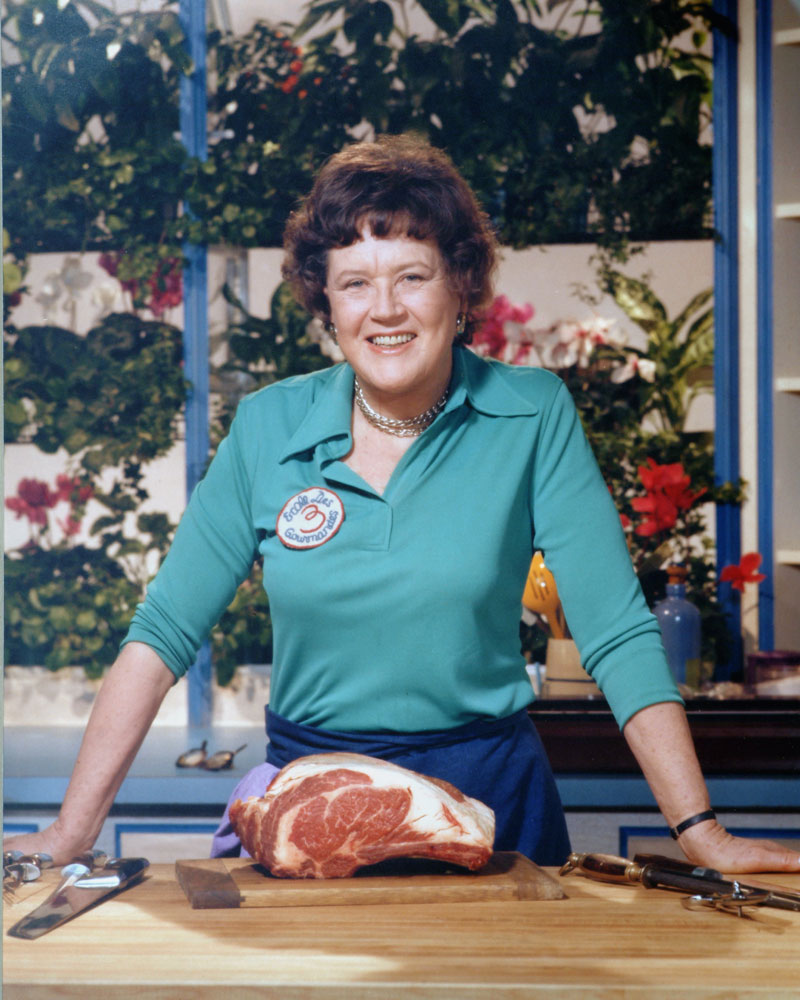
Julia ChildA portrait of the American chef Julia Child (1912 – 2004) shows her standing with a cut of meat in her kitchen, late 20th century. (Bachrach/Getty Images)Britt and Jaíne both get China. Britt makes kung pao shrimp, which seems a bit Panda Express – but we’ll see. Jaíne makes a beef short rib with lo mein, which I would happily partake of – authentic or not.
Elena’s trip to Germany involves sweet potato pancakes with braised red cabbage. She hopes to get a schnitzel on top but worries about time. Bill also has Germany, and he makes a very fancy-looking trout roulade with white asparagus.

Dustin doesn’t know anything about Sri Lankan food, but the “dossier” he’s given walks him through the basic seasoning and techniques. He figures it isn’t that far off from Indian food, and he decides on a shrimp, lobster and butternut squash curry – which I reckon will be close enough for this competition. 

“This newfound information about their buddy-hood feels ominous . . . “

Turns out Bill and Elena have become fast friends! They’ve bonded over their shared experience as cooks and members of the LGBTQ community. Somehow, this newfound information about their buddy-hood feels ominous . . .

Everyone is seated at the group table for the second and final round of judging. Dustin comes away clean with his curry. Bill gets a couple of knocks: The caraway is too aggressive, and a couple of people found bones in their trout.

Elena’s schnitzel isn’t really schnitzel – it’s a paillard. I’d love for the judges to dig into that a bit more. I guess they’re referring to the fact that it isn’t thin enough? They also think it’s a bit overdone. 

Britt’s shrimp goes over well – and I will say it looks beautiful. Jaíne’s beef lo mein soup looks like something I’d gladly jump into face-first. The judges nitpick about the bok choy being a little underdone, but they love the broth.  


Want more great food writing and recipes? Subscribe to “The Bite,” Salon Food’s newsletter.


Everyone is still seated around the table when Elena says to Jaíne, “The bottom line is we went on this competition because of Julia – and nobody embodies that more than you.” Now, Elena is crying and Jaíne is crying.

I’m just having allergies – leave me alone! Also, Elena is toast.

Sure enough, Elena is out, and I’m a bit heartbroken. To be fair, I’ve grown attached to everybody, but I can think of one or two people I wouldn’t have minded being sent home first. That aside, the challenges were strong this week – even if the spy angle was a bit silly.

But who doesn’t like to think about Julia Child being a spy? I’ll allow it.

The Julia Child Challenge” airs Mondays at 9pm EST/8pm CST on The Food Network; it is also available to stream on discovery+.

Read more stories about Julia Child and Julie Powell on Salon:

Burger King accused of a whopper: Lawsuit claims chain’s popular burger is deceptively advertised

Have you ever opened a fast-food bag only to realize that the order you received bears little resemblance to the professionally shot, styled and color corrected images plastered on the side of the restaurant? Well, Anthony Russo, a South Florida lawyer, allegedly has — and now he’s suing Burger King.

Russo has filed a federal lawsuit seeking class-action status, alleging that the home of the Whopper has deceived customers by “portraying its food as being much larger compared with what it has served to customers in real life,” according to NBC News.

The plaintiffs listed include Walter Coleman, Marco DiLeonardo, Matthew Fox and Madelyn Salzman, who are leading the suit against Burger King on behalf of anyone who “purchased a Burger King menu item based on false and misleading advertising concerning the size and/or the amount of ingredients contained in said menu item.”

Related: Szechuan Sauce, the cult-favorite condiment of “Rick and Morty” fans, returns to McDonald’s

The complaint alleges that current advertisements feature a Whopper that is 35% bigger when compared to 2017 ads. However, “the recipe or the amount of beef or ingredients contained in Burger King’s Whopper has never changed.”

The suit seeks monetary damages and a court order requiring the fast-food giant to more fairly depict its menu items in future advertisements. Listed as witnesses are multiple Twitter users who complained about the state of their orders, as well as several online food reviewers who specialize in fast food.  


Want more great food writing and recipes? Subscribe to “The Bite,” Salon Food’s newsletter.


“Big or small, justice is justice, and laws are laws,” Russo said in a statement to NBC, “and just because something happens to appear in someone’s opinion to be minor doesn’t mean that it is.”

He continued, “If I’m advertising a vehicle, you don’t Photoshop it to enhance it. Sure, maybe you shoot it in its best light, but certainly you don’t make it misleading. That’s really the basis for these kinds of lawsuits.”

Read more: 

Secrets of a gossip writer: The unchecked power of Lady Whistledown on “Bridgerton”

It’s no longer a secret who the gossip writer is on “Bridgerton,” the Netflix hit now in its second season. Revealed to be Penelope Featherington at the end of last season, the youngest daughter, overlooked, of a family besieged by scandal, Lady Whistledown serves as a narrator for the show (well, Julie Andrews doing a voiceover does). 

Her identity still a mystery to her well-to-do community, Lady Whistledown (Nicola Coughlan) continues to write and print what she knows, or thinks she knows, about the goings-on of her high society. And the whole “ton” continues to react, eating up every issue. But now that the gossip writer has been unmasked to the viewing audience, it remains to be seen what the tension will be with her role.

How does Lady Whistledown do what she does? What’s the history of gossip writing? And should Penelope even risk it?

Related: Is Lady Violet the oracle of “Bridgerton”?

“Bridgerton” concerns itself with the courting season of its Regency-era characters, including the large family of the Bridgertons, and the Featheringtons, who have a lower status in the “ton”: a family of daughters always dressed in colorful, floral flocks. Penelope is the youngest Featherington, consistently ignored by her family; Colin (Luke Newton), the Bridgerton she has a crush on, who thinks of her primarily as a good friend; and her actual good friend, Eloise Bridgerton (Claudia Jessie). 

We haven’t yet seen how Penelope first turned to writing, how exactly a wealthy and sheltered young Regency girl figured out where to go to print her work (and that she would need to be in disguise as a lady’s maid to do so) or how to distribute it. As “Bridgerton” is not exactly actual history, perhaps the character was inspired by newspaper columns of the day (or later in the 18th century) which would cover balls, fashion and the happenings of socialites.

Lady Whistledown gives full names

As Shondaland writes in an interview with “Bridgerton” historical adviser Hannah Greig, “Unlike Lady Whistledown, however, the columnists and writers, many of whom were anonymous, didn’t typically reveal whom exactly they were talking about.” Lady Whistledown gives full names — perhaps not yet realizing she needs to protect herself – but that was not usually done in gossip columns or “scandal sheets,” where the character of the day would be identified only by an initial or a descriptive hint about their identity. We know these entries as “blind items” today.

Penelope may have been emboldened to become Lady Whistledown due to the combining force of several factors: the relaxing of some licensing laws during the Regency making it less likely to be accused of libel, and a revolution in printing, making publications much more available. Greig told Shondaland, “The print culture changed. There was a massive explosion of newspaper culture, of publications of pamphlets — it was a world of paper, basically. And you needed information to put in there. It was a kind of journalistic heyday.”

Some popular books around this time were also based on real-life figures, dramatizing the goings-on of wealthy members of society in fiction. Regency autofiction, if you will. Known as “silver fork novels” or “fashionable” novels, they were specifically marketed as aspirational books for readers in lower classes, “providing the insider’s insights into high life,” as Tamara S. Wagner writes on The Victorian Web. Penelope is often reading — what else can a neglected young woman without suitors do? Perhaps silver fork novels make up some of her library.

Lady Whistledown writes about high society for high society

But Lady Whistledown writes about high society for high society, not as an aspirational manual so much as an insular “who’s who” among the “ton.” Her readers pick up her work hoping (or not hoping) to see themselves as much as to find out what’s going on, or what she deems worthy enough to write about in each issue.

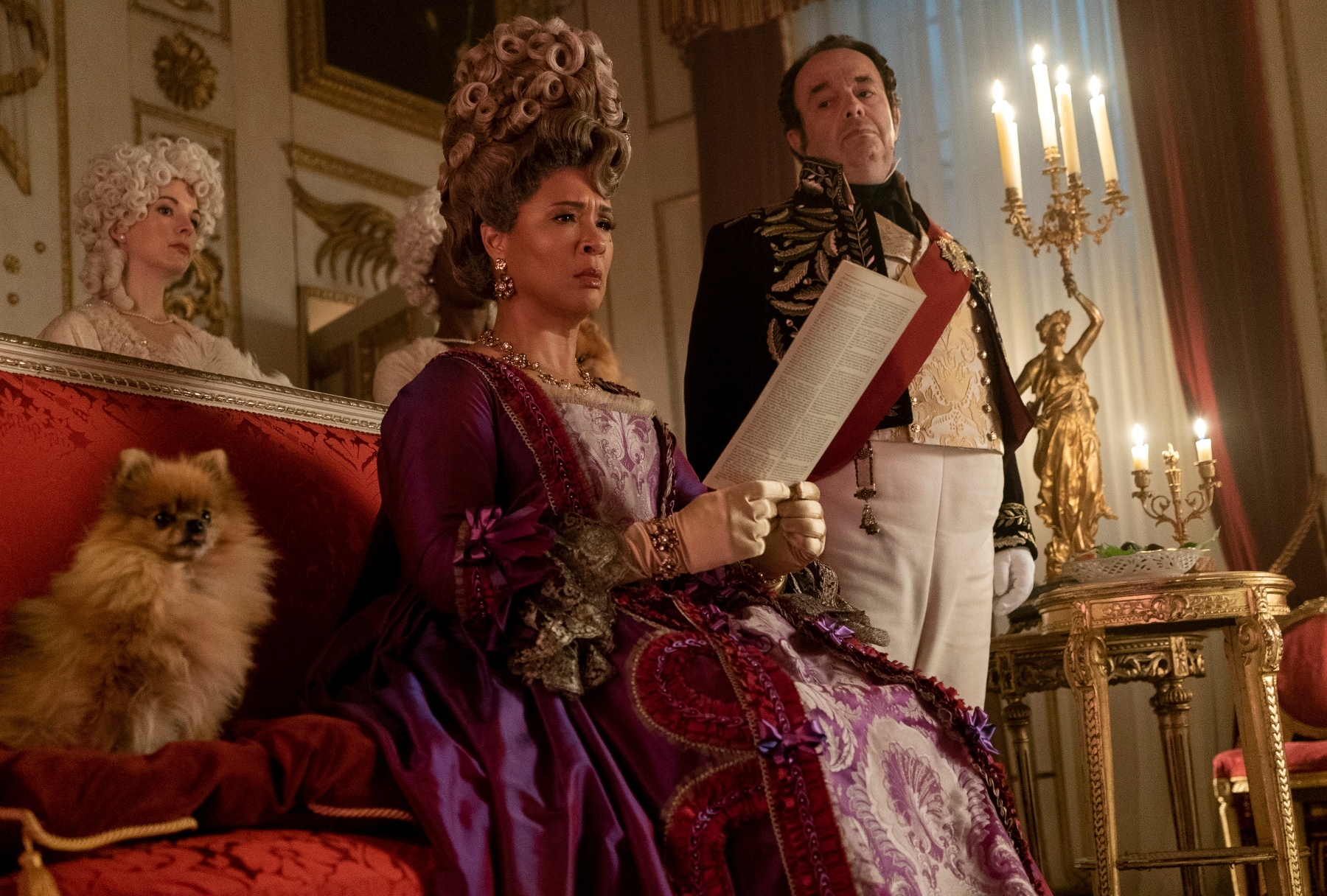
Golda Rosheuvel as Queen Charlotte, Hugh Sachs as Brimsley on “Bridgerton” (Liam Daniel/Netflix)Lady Whistledown is a kingmaker. With a sentence, she can send customers to the modiste or suitors away from annoying Cressida Cowper. In a very real sense, Lady Whistledown has the same kind of power as the Queen (Golda Rosheuvel), who anoints a diamond every season: the belle of all balls. Lady Whistledown has the ability to say whether or not she believes the Queen is right. And, perhaps unlike her royal advisers, the Queen actually listens to Lady Whistledown. She cares very much what the gossip writer thinks, so much so she’s desperately trying to find her. 
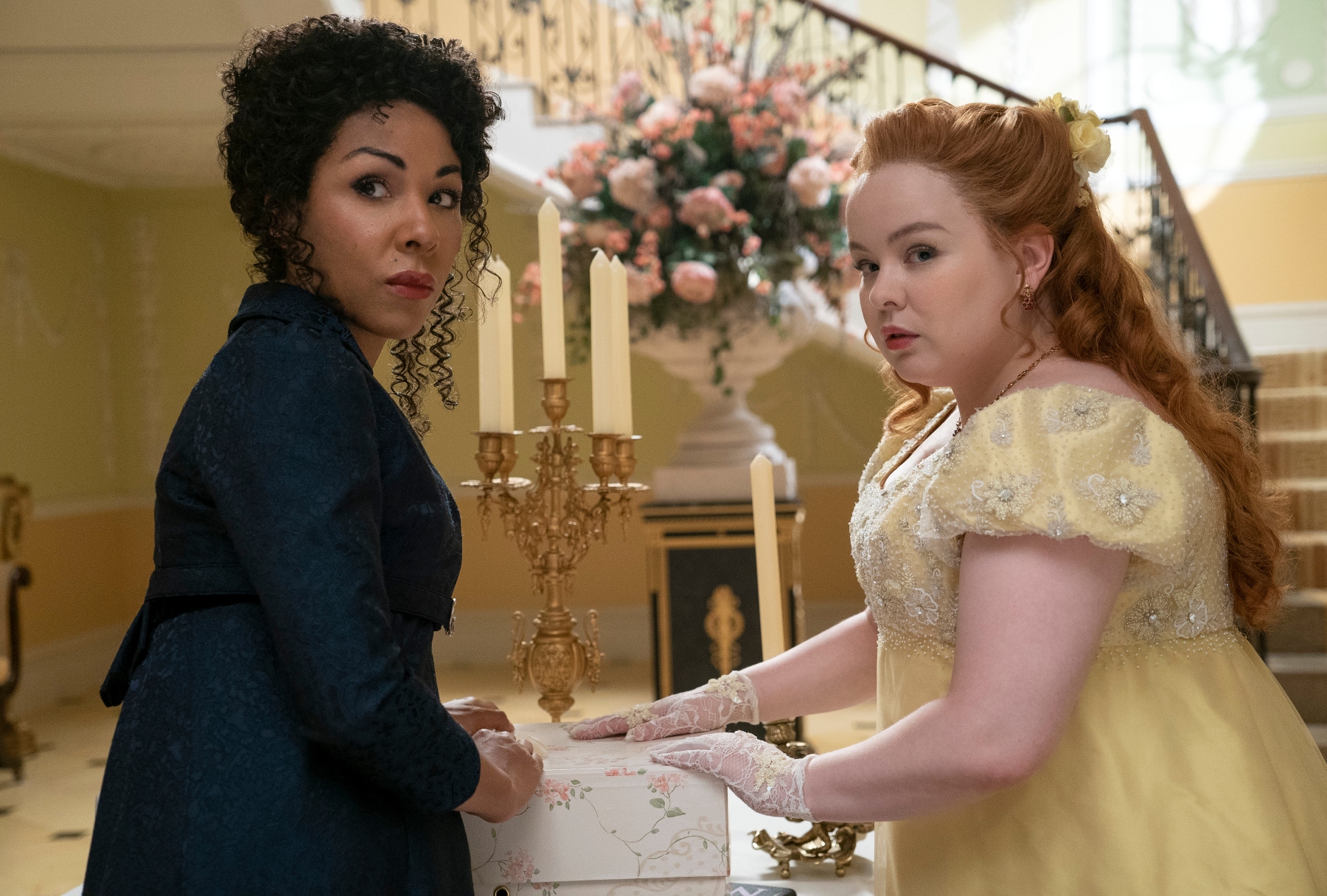
In contrast to the Queen, Penelope has her power because everyone ignores her. They forget she’s standing there in a corner of the ball. They would never assume the powerful, influential and often cutting writer to be sweet little Penelope Featherington. She uses her disadvantages to her advantage, and her vigilante-type writing allows her to have an alter ego, a life outside the shadows by the punch bowl, a self-actualization that would not be afforded to a young woman of her status otherwise. 

Nobody puts Lady Whistledown in the corner.

But is Lady Whistledown taking advantage of her power?  She sent business to dressmaker Madame Delacroix (Kathryn Drysdale). But she also basically threatened her. Last season, she ended the marriage hopes of her cousin by not-so subtly alluding to the young woman’s pregnancy. That was punching down. And the fact that her cousin had been engaged to her longtime crush, Colin Bridgerton? That was convenient. 


Want a daily wrap-up of all the news and commentary Salon has to offer? Subscribe to our morning newsletter, Crash Course.


In the 1930s and ’40s, gossip writing saw a heyday in Hollywood’s “Golden Age” when writers with columns were a powerful tool of studios, used to control actors and their under-contract lives. Leaks about romantic dalliances were well-timed for publicity and other, less favorable stories squashed to protect reputations. (This calls to mind Shy Baldwin’s recent storyline on “The Marvelous Mrs. Maisel” with a whole team devoted to protecting the singer’s image.) 

Kathryn Drysdale as Madame Delacroix, Nicola Coughlan as Penelope Featherington on “Bridgerton” (Liam Daniel/Netflix)Gossip writers like Hedda Hopper had huge readerships at the time. Hopper’s numbered 35 million. But Hopper also was a vocal supporter of The House Committee on Un-American Activities, targeting actors and screenwriters for blacklisting, including accusing them of being communists and going after Ingrid Bergman for being pregnant out of wedlock.

Lady Whistledown is on no payroll but her own.

Lady Whistledown is on no payroll but her own. She answers to no one. But with no editor, no newspaper and no real friend who even knows what she does (except Madame Delacroix who has her own reasons for cooperating), the writer has no oversight. No one to ask: Has she gone too far? 

Will Penelope regret some of her whisperings, the way that 2000s internet gossip maven Perez Hilton, who called abuse survivor Evan Rachel Wood a “whore” and mocked Britney Spears’ mental health, now does? Once Penelope’s friends find out, will they treat her differently? (This season only begins to address the fallout when Eloise susses out the truth.) Will the queen? And how much danger can a young woman of this time be in for speaking, not only her own mind, but trying to influence others?

XOXO Lady Whistledown. 

More stories like this:

Dry Lambrusco is delicious — why is it also so hard to find?

I can pinpoint the only moment I’ve ever felt cool in the presence of a bartender: It was early summer 2018 at a casual yet self-serious bar in my native Chicago, and I ordered a dry Lambrusco. “I love Lambrusco,” he said, affirming my early-adopter status for the first and last time. “I want to get everyone drinking it.” 

A far cry from the cloying, bulk-produced juice that dominated the category in the 1970s and ’80s, the new guard of Lambrusco from Italy’s Emilia-Romagna region represents everything I like in a wine: A chilled, low-ABV red with a gentle, prickly fizz, it’s equal parts no-brainer and deserving of deep contemplation. It’s low intervention and artisanally made, and almost always under $20 a bottle. It’s delicious with pizza, cured snacks, and richly sauced pastas — or all by itself at 5 in the afternoon. It’s also still irritatingly hard to find.

Higher-quality wines made by producers like Venturini Baldini, a family-owned producer of organic Lambrusco, and fourth-generation family-owned and operated Lini910 — from manually harvested grapes on relatively small plots, which undergo long second fermentations or are naturally bottle fermented — understandably come in very finite quantities, even more so when you tack on international distribution. And in the shadow of the still-dominant mass-market Lambruscos, “it takes time to change things,” says Julia Prestia, co-owner of Venturini Baldini.

There’s also trickiness of how to categorize Lambrusco, which straddles the historically strange bedfellows of red and sparkling all while fighting old stereotypes of how Lambrusco “must be sweet.”

“A lot of wine is about personal preference and expectation,” says AK Brunson, assistant buyer at Good Wine shop in Brooklyn. “When you think of a stereotypical personality or taste profile of a red wine drinker, to me it’s something a little denser, richer, rounder, and fuller than what Lambrusco will give you. Then you have a lot of sparkling wine drinkers wanting something a little more simple — I’m thinking like a prosecco or cava choice — than the complex flavors you’d get into with Lambrusco.” 

It’s easier to embrace straightforward, if occasionally polarizing, categories like orange (aka whites made like reds) and unfiltered, naturally sparkling pétillant-naturel — both little known by mass-market consumers five years ago that have since positively exploded. “Orange wine is totally new to a lot of people, but less of a weird combination,” says Martina Mirandola Mullen, Italian portfolio manager of New York-based importer and wholesaler Massinois, which imports Venturini Baldini. 

Zack Eastman, co-owner of Chicago’s hybrid bar and wine shop Easy Does It, says the pét-nat boom has actually helped more drinkers understand bottle-fermented Lambruscos. Those who came in through the “natty” (aka natural wine) door welcome a little effervescence in their reds. 

Since that summer of 2018, Lambrusco has claimed a prime spot in my regular drinking rotation. No, scratch that. I drink it whenever the hell I can find it — which has become maddeningly infrequently. Yet as folks up and down the Lambrusco supply chain gently remind me, coolness in the eyes of a handful of editors (and one determined enthusiast) does not beget an endless supply of this ruby sparkler. 

For starters, Lambrusco has a long way to go to shed its image as a sweet, mass-market wine.

“It’s still a work in progress,” says Prestia. “Unfortunately, what happened in the ’70s was not just in the States, but in many countries. In a lot of places, the majority of Lambrusco wines on offer are still that cheap, fizzy drink. We need to keep that in mind, especially when we think about who is driving that renaissance — which is definitely the smaller, family-owned wineries.” 

“For people still defining their palates, Lambrusco can be a really cool stepping stone — from crazy, wild pét-nat moving into the new Lambruscos, along with other more niche styles or esoteric expressions of classic styles,” says Eastman.  

Retailers are fielding more requests for Lambrusco specifically and, more broadly, “red sparkling” wines, as is the case at Good Wine, which stocks a handful of Lambruscos year-round, like Lini910 (categorized under sparkling wines, mind you). 

“Working at this store for three or four years, I definitely have seen an evolution in the type of questions asked, but I also think it could be demographic-based,” Brunson says. “This neighborhood skews more wine knowledgeable — customers who work in restaurant service, or who own or grew up in food- or wine-based businesses come in asking what’s new or interesting in that way.”

What might offer an easier bridge for those outside the urban, fizzy-red bubble is rosato, a Lambrusco subcategory that Mullen says didn’t really exist a few years back. She’d prefer to categorize this technically sparkling rosé as sparkling rather than rosé. 

“Rosé is so oversaturated,” she says, adding that it’s understandably harder to nudge someone to buy, say, a pricier Sangiovese rosé when light, affordable, no-brainer Provençal rosé is within reach. 

“Organic and sparkling are big parts of the attractiveness and easiness to say OK to the new guard of Lambrusco,” Mullen says. “And if it’s not going to cost me an arm and a leg, why not?”

That’s especially true in the warmer months, when people are craving chilled, quenching bubbles, Eastman says. Plenty of customers end up buying a bottle of fresh, puckering Ferretti Vini Al Cēr Lambrusco Rosato (made by sisters Elisa and Denise Ferretti) in the shop after downing an easy-drinking glass or two on the patio. Indeed, for now, much like that fateful summer of 2018, Lambrusco remains a warm-weather wine in the eyes of most American drinkers.

“I feel like it’s on its way to being a staple,” Eastman adds, though his tone suggests he’s just trying to appease me. Till then, think of it “a little like a Joe Freshgoods shoe collab drop,” he says: Get it while it lasts, and relish it if you do. 

“I do not like gay cookies”: Conservatives vow to boycott Oreo over new ad

A new two-minute short film about coming out, collaboratively produced by Oreo and PFLAG, has predictably gotten under the skin of conservatives. Already, Greg Kelly and Ben Shapiro are among the right-wing talking heads vowing to boycott “gay cookies” following Oreo’s public display of LGBTQ allyship. 

The Note,” which was directed by Alice Wu (“Saving Face” and “The Half of It”), depicts a young Chinese-American man practicing a coming-out speech before a few close family members. Before the young man shares his truth with his grandmother, his mom slips him a note. “She might be my mother,” it reads, “but you are my son.”

The video ends with a message for viewers to pay it forward. “Coming out doesn’t happen just once,” it says. “Be a lifelong ally.”

Related: “For the morning gays”: The importance of LGBTQ-owned cafes as sober, queer spaces

“The Note” is, for sure, a tearjerker. Despite my admitted initial cynicism about “rainbow capitalism” and whether a multi-billion dollar corporation can assert itself as an ally, Oreo is doing all the right things here. According to Fast Company, the film — which was refreshingly not released as part of a Pride Month campaign — was accompanied by a $500,000 donation to PFLAG. 

What’s more, there’s history here. “The Note” follows the 2020 short film “OREO Proud Parent,” which was also released in conjunction with PFLAG. In it, a woman brings her girlfriend home to meet her family. 

Initially, the dad is chilly towards the same-sex couple, but everything changes after he witnesses a neighbor look disparagingly at them. The video ends with the dad painting his white picket fence the colors of the rainbow.

Is it a little on the nose? Sure, but the film’s message that “a loving world starts with a loving home” is a poignant one — especially amid current events. In addition to Florida’s controversial “Don’t Say Gay” law, transgender students are facing increased discrimination and violence.

“‘The’ Note is not Oreo’s story,” Oreo senior brand manager Olympia Portale said in an interview with Fast Company. “Oreo is there to lend our megaphone to the community we want to support, to illustrate the message we, as a brand, want to stand behind is a great place to start.” 

Instead of engaging with the message of allyship, several conservatives pundits responded by vowing to boycott “gay cookies.” 

“COOKIE!” Newsmax host Greg Kelly wrote on Twitter above a photo of Sesame Street’s Cookie Monster. “I love COOKIES. C is for COOKIE. COOKIE IS FOR ME.  I do NOT like GAY COOKIES.  ‘Sexuality’ has NOTHING TO DO with the Cookie experience.  Cookies are for ALL!  Basically Cookies are ‘asexual’—why is the WOKE LEFT messing around with OREOS?!?!  STOP THE INSANITY.” 


Want more great food writing and recipes? Subscribe to “The Bite,” Salon Food’s newsletter.


In a more concise tweet, Lila Rose, the founder of a movement dedicated to ending abortion, told Oreo to “stop sexualizing children.”

With the passage of the controversial “Don’t Say Gay” law, Florida Republicans revived the deadly “queers recruit” myth. While Oreo is newly feeling the heat, Disney has thus far been a more prominent recipient of conservative wrath. 

As Salon’s Amanda Marcotte recently wrote, “Fox News has run a dizzying number of segments accusing the company of ‘sexualizing children’ and creating ‘propaganda for grooming.’ This is unhinged QAnon stuff, designed to give credence to the conspiracy theories of the growing right-wing cult that believes Democrats run a secret conspiracy of blood-drinking pedophiles.”

Kelly followed up his tirade about the sexualization of the Oreo with a tweet comparing the taste of the creme-filled chocolate cookies to “driveway gravel.” 

“Not MOIST. Even Nabisco knows the truth–the cookies are too DRY,” Kelly wrote in his review of the more than 100-year-old sandwich cookies. “Milk Reliant, not a stand alone cookie. Go with the FIG NEWTON. We don’t care about Mr Fig’s orientation!” 

Commenters quickly pointed out the hypocrisy of Ben Shapiro’s attempted barb by sharing images of him shopping at Home Depot in 2021.

Ben Shapiro, who infamously weighed in on a different moist-to-dry spectrum after listening to the Cardi B and Megan Thee Stallion song “WAP,” tweeted a link to “The Note.” The accompanying caption read, “Your cookie must affirm your sexual lifestyle.” 

Commenters quickly pointed out the hypocrisy of Shapiro’s attempted barb by sharing images of him shopping at Home Depot in 2021. Georgia’s controversial Election Integrity Act of 2021 — which President Joe Biden dubbed “Jim Crow in the 21st century” — was then under a tremendous amount of heat from major corporations like Coca-Cola and Delta. 

As Forbes reported at the time, Home Depot, on the other hand, stayed silent — prompting calls for a boycott. In a show of support, Shapiro filmed himself shopping at the home improvement retailer and emerging from a check-out line with a single piece of wood in a plastic bag. 

“Your wood must affirm your conservative lifestyle,” one Twitter commenter wrote below Shapiro’s post. 

As Zachary Petrizzo wrote for Salon in 2021, conservatives love to announce boycotts of prominent brands — but they somehow never pan out as planned. 

“By the end of the boycott, an unknown number of Fox News viewers were just left with expensive coffee machines they had tossed off balconies or otherwise obliterated.”

“Then there was the occasion in 2017 when Sean Hannity fans destroyed their Keurig coffee machines to back the Fox News host after the company pulled its ads from Hannity’s program over his defense of Alabama Republican Senate candidate Roy Moore,” Petrizzo wrote. “Hannity tried to save the advertiser (and the valuable ad dollars) by giving away 500 Keurig machines, but it was too late. By the end of the boycott, an unknown number of Fox News viewers were just left with expensive coffee machines they had tossed off balconies or otherwise obliterated.” 

In 2016, angry Breitbart readers dumped Kellogg’s cereal down toilets because the manufacturer of Corn Flakes wanted nothing to do with Breitbart News, whose former executive chairman was Steve Bannon

And in 2021, Trump called for a boycott of Coca-Cola over the company’s aforementioned objections to Georgia’s Election Integrity Act. As recounted by Salon, a Coke bottle was spotted on Trump’s desk only a few days later. 

To that end, it will be interesting to see just how long conservatives’ newfound allegiance to Fig Newtons and Hydrox cookies lasts. 

More stories at the intersection of food and politics: 

Iranian director Asghar Farhadi denies plagiarism charge for “A Hero” after public indictment

Iranian director Asghar Farhadi, who is regarded as one of the most prestigious international filmmakers, is currently in hot water.

On Tuesday, Farhadi was found guilty of plagiarizing his 2021 film, “A Hero,” by an Iranian court after a former film student of his, Azadeh Masihzadeh, claimed Farhadi stole the plot and themes of her earlier documentary, “All Winners, All Losers.” Both Masihzadeh and the subject of her documentary sued Farhadi — the latter for defamation — per The Hollywood Reporter. Farhadi also countersued for defamation, but his case was dropped after the ruling.

Now, only a few hours after his public indictment, the Oscar-winning director and his French producer Alexandre Mallet-Guy are denying Farhadi’s plagiarism charge. In a statement to Variety, Mallet-Guy revealed that only a preliminary investigation has taken place on the case, which will be brought to trial. Aside from that, there has been “no definitive and legally binding ruling.”

RELATED: Asghar Farhadi’s “A Hero” is a devastating portrait of a man damned by a good deed built on a lie 

“A Hero,” which won the Jury Grand Prize at the 2021 Cannes Film Festival, follows Rahim (Amir Jadidi), an indebted prisoner who, during a two-day leave, comes across a lost handbag filled with gold coins and strives to find its owner in an attempt to clear his name. Masihzadeh’s documentary tells the real-life story of Mohammad Reza Shokri, a former prisoner who one day found a backpack full of money and sought to find its owner in order to redeem his character and leave prison for good.   

“We firmly believe that the court will dismiss Ms. Masihzadeh who cannot claim ownership on matters in the public domain given that the prisoner’s story has been disclosed in both press articles and TV reports years before Mrs. Masihzadeh’s documentary was published,” Mallet-Guy wrote.

“I think it is important to emphasize here that ‘A Hero,’ like Asghar Farhadi’s other films, features complex situations where the lives of the characters are built upon one another,” he continued. “The story of this former prisoner finding gold in the street and giving it back to its owner is only the starting point of the plot of ‘A Hero.’ The remaining is Asghar’s pure creation.”


Want a daily wrap-up of all the news and commentary Salon has to offer? Subscribe to our morning newsletter, Crash Course.


Farhadi reportedly told Variety last year that the story behind “A Hero” was inspired by various Iranian news stories:

“From time to time in the news in Iran you get stories about very average people who in their daily lives do something that is very altruistic,” he said. “And that humane way of being makes them very noticeable in society for a few days, and then they are forgotten. The story of the rise and fall of these kinds of people was really what interested me.”

Farhadi previously won two Oscars for Best Foreign Film — one in 2012 for “A Separation” and another in 2017 for “The Salesman.” The director is part of a small, elite group of filmmakers who won multiple awards in that category. Other notable names include Vittorio de Sica, Federico Fellini and Ingmar Bergman.

More stories you might like:

“The View” calls Lindsey Graham and Ben Sasse’s hypocritical stance against KBJ “pathetic”

Judge Ketanji Brown Jackson is set to become the first Black woman Supreme Court justice, following the Senate Judiciary Committee’s vote on Monday to advance her nomination.

Her journey, however, has not been easy.

Throughout Jackson’s confirmation hearings, members of the GOP attacked her judicial history and diminished her expertise in an attempt to prohibit her eventual nomination. Recently, only three Republicans made a comeback — Senators Lisa Murkowski (R-AK), Mitt Romney (R-UT) and Susan Collins (R-ME) — to vote to confirm Jackson’s SCOTUS seat.

Of course, “The View” hosts had to weigh in and discuss how the nomination process, which was once based solely on legal merit, has now become extremely politicized. During Tuesday’s segment, the hosts also slam Lindsey Graham, who voted to confirm Jackson to the D.C. Circuit in 2021 but has adamantly opposed her Supreme Court nomination due to her “record of judicial activism [and] flawed sentencing methodology regarding child pornography cases.”

Co-host Joy Behar acknowledges that Graham’s hypocrisy is a major slap in the face but argues that Senator Ben Sasse’s actions are much worse. Sasse, who praised Jackson’s credentials and knowledge of the law, also voted “no” in the committee because the nominee “refuses to claim a judicial philosophy.”

“There’s something so pathetic about that type of stance and it’s almost like the Ben Sasses of the world are more dangerous than even the Lindsey Grahams,” Behar claims.

Her sentiment is not shared by guest co-host — and Trump’s former White House press secretary — Stephanie Grisham, who says Sasse’s threat was not necessary and only does more harm. “An eye for an eye makes the whole world blind,” she adds, quoting Mahatma Gandhi.

RELATED: Journalist warns “performative” attacks on Ketanji Brown Jackson may “come back to bite the GOP”

Co-host Sunny Hostin then shames Republicans for being “so out of touch with the American people,” while Hostin also references a Gallup poll, which found that 58% of Americans support Jackson’s SCOTUS nomination.

“Well, this process has become so political, which it should never have been,” says co-host Sara Haines. “I look at Mitt Romney, Murkowski and Collins and think those are the only three that took the job seriously and said, ‘Let me look at this person [Jackson], remove my political beliefs and my judicial interpretation.'”

The entire panel agrees that it’s “unfortunate” that the SCOTUS nomination & confirmation process has become “a party over country” matter.

“Whether somebody votes with you or not, there’s no guarantee that they’re going to vote with you on any given case that comes up,” co-host Whoopi Goldberg states afterwards. “This is what the court does. This isn’t about your politics. This is about what’s good, what is the law for the American people.”

“With the Supreme Court . . . you want to feel like they’re going to protect us in terms of what goes on and how it goes on,” she adds. “They [SCOTUS justices] are there to protect.”


Want a daily wrap-up of all the news and commentary Salon has to offer? Subscribe to our morning newsletter, Crash Course.


Grisham later points out that Republicans, like Graham and others, purposefully asked Jackson a slew of inflammatory questions on gender politics and transgender rights (remember when Sen. Marsha Blackburn asked Jackson if she could “provide a definition for the word ‘woman’?”) to “rile up the base.”

Watch the full discussion below, via YouTube:

More stories you might like:

Matt Gaetz blows up at defense secretary, accuses Lloyd Austin of prioritizing “wokeism”

U.S. Defense Secretary Lloyd Austin and Rep. Matt Gaetz., R-Fla., got into a heated argument over the agency’s intelligence capabilities on Tuesday, with Gaetz accusing Austin of prioritizing “wokeism” over defense. 

The acrimonious exchange played out during a House Armed Services Committee hearing on the Pentagon’s proposed $773 budget for 2023, an amount that Gaetz adamantly opposed over what he felt was poor leadership displayed by Austin.

In his questioning, Gaetz referred to recent intelligence predictions around military conflicts in Afghanistan and Ukraine, noting that the Pentagon overestimated Kabul’s ability to remain in control during America’s withdrawal and overestimated Russia’s ability to carry out a quick takeover of Ukraine. 

RELATED: Lloyd Austin removes hundreds of Pentagon advisory board members to purge last-minute Trump picks

“So, I guess I’m wondering, what in the $773 billion that you’re requesting today is going to help you make assessments that are accurate in the face of so many blown calls?” Gaetz asked Austin. 

“Has it not occurred to you that Russia has not overrun Ukraine because of what we’ve done and our allies have done?” the defense secretary shot back. 


Want a daily wrap-up of all the news and commentary Salon has to offer? Subscribe to our morning newsletter, Crash Course.


Gaetz also alleged that America was “behind” other countries when it comes to hypersonic missile development. 

“What do you mean we’re behind in hypersonics?” Austin responded. “How do you make that assessment?”

But the Florida congressman failed to provide any explanation, continuing on with his rant: “While everyone else is in the world seems to be developing capabilities and being more strategic, we got time to embrace critical race theory at West Point, embrace socialism at the National Defense University, to do mandatory pronoun training.”

RELATED: Defense secretary rips Matt Gaetz over ‘spurious’ critical race theory claims

“I’m sorry you are embarrassed by your country,” the retired general quipped after Gaetz capped off his rant. 

But that apology appeared to rile up the conservative firebrand even more. 

“That is so, that is so disgraceful that you would sit here and conflate your failures with the failures of the uniformed service members,” Gaetz raged. “You guys said that, that Russia would overrun Ukraine in 36 days, you said that the Taliban would be kept at bay for months”.

“You totally blew those calls and maybe we would be better at them if the National Defense University actually worked a little more on strategy and a little less on woke-ism,” the lawmaker added. 

It isn’t the first time Gaetz and Austin have sparred. Last June, Gaetz accused the defense secretary of allowing the Pentagon to teach critical race theory. 

“I don’t know what the issue of critical race theory is,” Austin explained at the time. “We do not teach critical race theory.”

The United Kingdom could lose more than a third of its iconic fish and chips shops

The blows from Russia’s invasion of Ukraine continue to reverberate throughout various parts of the world’s economy, commerce and policy, with the latest, seemingly random target of this conflict striking near and dear to the hearts of Brits everywhere: the fate of the United Kingdom’s fish and chip shops.

The global food supply chain has already faced a stacking number of hurdles in the past years and months, with labor shortages, climate change, and recent trade hiccups all surmounting in skyrocketing prices and increased ingredient scarcity. When Russia first began its globally sanctioned invasion of Ukraine, alarm bells went off for countries that relied on life-giving imports from the Eastern European nation. This included flour, sunflower oil and more.

Related: We aren’t only facing a supply chain issue — for grocery workers, it’s also a labor rights issue

As the conflict has evolved and environmental pressures have continued to squeeze tighter, a perfect storm has emerged to potentially push many of the long-struggling shops over the edge, as reported by Politico.

The president of the National Federation of Fish Friers had estimated before the start of the Russian invasion of Ukraine that up to a third of the UK’s shops could close due to supply and labor shortages, in addition to increased taxes. However, he was quoted in the aforementioned Politico piece saying that the number would likely be higher, given new constraints ushered in by the geopolitical conflict that seems to have no end in sight.

The difficulties start from the very beginning with the process of making the iconic dish, which consists of fried fish, “chips”  (french fries for the uncultured) and peas. 

For starters, there is already a strain on the world’s vegetable oil supplies, one that will only continue to compound. White fish shortages, bread crumb shortages and even energy shortages to cook the dish itself mean trouble for the COVID-battered small businesses — no pun intended. 

What follows now will be a question of adaptation: among the many new challenges presented, will the purveyors of this classic dish find a way to evolve with the times? Or will they be forced to shutter their doors, losing these newspaper-wrapped delicacies permanently?

Read more: 


What will COVID-19 look like in 2100? Scientists predict three possible scenarios

Imagine it’s March 2100. What cars remain are electric, or flying, or both; subways and high-speed rail are the dominant forms of transit. Contemporary architecture is designed around climate change, the main crisis humanity is facing. And as public health leaders around the world gather for an annual summit, they reflect on the 80th anniversary of the COVID-19 pandemic. Just as 2008 marked the 80th anniversary of the 1918 influenza virus pandemic, March 2100 will mark the 80th anniversary of the COVID-19 pandemic. Where will COVID-19 be then?

Of course, nobody can predict with perfect accuracy what COVID-19 will look like eighty years hence. Yet infectious disease experts know a remarkable amount about the SARS-CoV-2 virus two years since its discovery — and they have predictions as to how COVID-19 will play out over the next century.

Those predictions are based on what we’ve observed about how the SARS-CoV-2 virus has behaved in the past two years. For example, experts know that the virus can mutate to become more contagious, and (to some extent) can evade vaccine-induced immunity; yet we also know that vaccines have proven to be very effective at preventing severe disease and hospitalization, even if they cannot stop breakthrough infections of certain variants. Scientists also know that COVID-19 has a long tail: among those infected with COVID-19, about 10 percent will experience symptoms that can possibly persist as long as two years after an infection.

Knowing these caveats, Salon spoke to experts and scientists about how COVID-19 might look in 10, 20, and 80 years from now. Though their responses had some variation, the main lines of future prediction were remarkably similar. 

The best-case scenario

Some theorize that the lesser phase of COVID-19 is already upon us. Indeed, last week, the World Health Organization reported that new coronavirus cases around the world are declining. While deaths by COVID-19 were up slightly, the new numbers did follow a 23% drop in fatalities the week before.

“SARS-CoV-2 will likely be one of the endemic respiratory viruses that humans deal with just like the other four coronaviruses that cause common colds,” Adalja said.

Thus, as COVID-19 restrictions are being lifted around the world, many have wondered if the world is finally entering an “endemic phase” — which, in epidemiology, means that the disease is present in a society, but at a baseline level rather than a widespread infection. 


Want more health and science stories in your inbox? Subscribe to Salon’s weekly newsletter The Vulgar Scientist.


Dr. Amesh Adalja, an infectious disease and critical care medicine doctor, told Salon he believes by 2100 — or “actually much sooner” — SARS-CoV-2 will be endemic.

“SARS-CoV-2 will likely be one of the endemic respiratory viruses that humans deal with just like the other four coronaviruses that cause common colds,” Adalja said.

The coronaviruses belong to a class of viruses known as RNA viruses, which also includes influenza, hepatitis C and SARS. RNA viruses like SARS-CoV-2 have relatively malleable genetic codes, prone to mutation; every time they enter a host’s cell and replicate, there is a chance that mutations will occur.

As Salon has reported before, this is not always a bad thing, as natural selection tends to favor viruses that are highly transmissible and not those that are necessarily deadliest. Hence, some experts hope is that SARS-CoV-2 has reached peak transmissibility — and, through immunity gained by previous infections and vaccines, the virus will stop mutating or its mutations won’t cause more severe disease than we’ve already seen.

RELATED: Do we all need a fourth booster? Why docs are not convinced — yet

Dr. Monica Gandhi, infectious disease doctor and professor of medicine at the University of California, San Francisco, told Salon she agrees that in the year 2100, COVID-19 will be similar to the common cold. More optimistically, she believes it might not even be as bad.

“The thing to remember about the common cold coronaviruses, rhinovirus and adenovirus and other viruses that cause common colds, is that they can cause severe illness in older people,”  Gandhi said. “Because even a rhinovirus in a 90-year-old who is otherwise doing well can actually be a cause of death.”

“We will have medications that will bring down the viral load of COVID,” Gandhi said. “So, actually, I think the outcomes for older people will be better than a common cold.”

Gandhi said the difference with COVID-19 is that the world has a vaccine for it. Previously, creating a vaccine for the coronaviruses has been hard to make, partly because of how the virus infects the upper respiratory tract.

“But in this case [of COVID-19], we will have medications that will bring down the viral load of COVID,” Gandhi said. “So, actually, I think the outcomes for older people will be better than a common cold.”

Adalja said there may soon be a “universal coronavirus vaccine” that “covers SARS-CoV-2 plus other human coronaviruses.” He speculated that might arrive by 2025.

Likewise, it is probable that all citizens will be immunized via vaccine by then, as part of a series of childhood vaccinations.

“It’s unclear whether vaccination will be at birth or at age 6 months so as not to be blunted because of maternal antibodies,” Adalja said, noting that only the hepatitis B vaccine is given at birth.

Medium-case Scenario

Not all infectious disease experts agree that in 80 years, COVID-19 will peter off to the point that it is more benign than a common cold. Among them is William Schaffner, a professor of infectious diseases at the Vanderbilt University Medical Center. When asked if COVID-19 will then be akin to the common cold today, Schaffner told Salon: “I don’t think that there’s enough information out there for us to be secure in any way.”

“There are people who haven’t received that first booster yet, and how is it that we haven’t been able to communicate, motivate, persuade, comfort and reassure them that this is really the best thing for them in their families to do?” Schaffner lamented, speaking to the difficulties of gaining public trust around the vaccines. “We have major challenges ahead of us in that regard, and if it’s necessary for us to do what we do with influenza, more or less to get an annual booster — you can see what a challenge that is.”

“It’s not as though the virus says ‘well, I’d like to get from A to B’ and then it designs its genetics to get there — they’re random events.”

Schaffner added that the way SARS-CoV-2 mutates makes it more difficult to predict the future of COVID-19 because they “occur at random.”

“It’s not as though the virus says ‘well, I’d like to get from A to B’ and then it designs its genetics to get there — they’re random events,” Schaffner said. “And, I suppose, having the virus modulate itself to become more like a regular common cold virus, or developing an entirely new variant that could evade the protection of our vaccine and have the whole Fandango start all over again, they’re probably comparable statistically — so I don’t know which way this is going to go.”

A 2008 study suggested that the virus that causes cold-like symptoms today may have jumped from birds to humans as recently as 200 years ago. But not much is known about this jump, and how severe colds were at the time.

This is one reason why scientists struggle to find a proper historical analogy to draw from in terms of predicting COVID-19’s future track. Indeed, on that note, Schaffner added that each group of viruses has very distinctive characteristics. For example, measles is known for its durable immunity — meaning if a person is infected with the virus (or vaccinated against it), they are immune to the virus for the rest of their lives. COVID-19 is different, in that vaccination or infection seems to merely confer transient immunity, meaning short-term immunity.

Moreover, some viruses are difficult to vaccinate against not because of issues with transient immunity, but because of their propensity to mutate. HIV is one: it has been difficult for scientists to develop an HIV vaccine over the last 40 years in part because of how rapidly it mutates.

Nonetheless, Schaffner said by the year 2100 — due to a growing human population and increased travel due to technological advances — humanity can expect to face new epidemics or pandemics as well.


Want more health and science stories in your inbox? Subscribe to Salon’s weekly newsletter The Vulgar Scientist.


“We are going to encounter a lot of the viruses that are out there in the world that circulate in the animal population, and then have the opportunities to jump species on occasion and get into humans,” Schaffner said.

He noted that this situation will be somewhat balanced by an increase in scientific knowledge and advances as well.

“We will continually be making better and better vaccines against more and more of these potential viruses that are out there,” he said. “If we don’t use them all, we will have the potential to have them on the shelf … and quickly manufacture vaccines.”

Schaffner imagines vaccines will look differently, too.

“We will have vaccines that are delivered by patches on the skin by just taking oral capsules and swallowing them,” Schaffner said. “So they will be much easier to deploy rapidly and safely.”

Worst-case scenario

Schaffner warned there could be a worst-case scenario that humanity could be looking at 80 years from now.

“That would be the development of a new variant that was very contagious and was more inclined to create more severe disease,” he said. “And most importantly, the third characteristic would be that it could distinctively evade the protection of our current vaccines.” 

Such a nightmare scenario would perpetually extend the pandemic, he warned. “If that happened, that would start basically a new pandemic with another coronavirus, and that would cause once again, an economic, social and political calamity,” he fretted.

Schaffner added that in this case, the world would be able to respond more quickly with a vaccines — but noted that the world could face, once again, the issue of deployment.

Read more about COVID-19:

Trump inadvertently admits defeat while trying to spin historians: “When I didn’t win the election”

Former President Donald Trump reportedly admitted he didn’t win the 2020 election during a video interview with a panel of Princeton historians in July 2021. The contents of the interview were recently published in The Atlantic

In the article, Julian Zelizer, editor of The Presidency of Donald Trump: A First Historical Assessment, confirmed Trump reached out to a group of professional historians to correct the hardening consensus that his presidency was a failure. 

Zelizer wrote that Trump “seemed to want the approval of historians, without any understanding of how historians gather evidence or render judgments” but following the panel, the ex-president announced that he would no longer be giving out interviews for books about his time in the White House. 

RELATED: What will be most remembered of Trump’s presidency?

Zelizer went on to note that “our conversation with the former president underscored common criticisms: that he construed the presidency as a forum to prove his dealmaking prowess; that he sought flattery and believed too much of his own spin; that he dismissed substantive criticism as misinformed, politically motivated, ethically compromised, or otherwise cynical.” The former president, Zelizer writes, has a limited historical worldview and measured American politicians “primarily by how they treated him.


Want a daily wrap-up of all the news and commentary Salon has to offer? Subscribe to our morning newsletter, Crash Course.


During the interview, Trump attempted to influence the historical narrative by repeatedly trumpeting his administration’s successes. Zelizer writes that Trump refused to acknowledge or engage when presented with criticisms about his presidency. “He did, however, admit to having sometimes retweeted people he shouldn’t have, and at one point he said, “when I didn’t win the election”—phrasing at odds with his false claim that the 2020 vote was stolen.” 

During the interview, Trump said of South Korea’s Moon Jae-In, China’s Xi Jinping and Iran’s Imran Khan, “By not winning the election, he was the happiest man – I would say, in order, China was – no, Iran was the happiest.”

RELATED: Historians rank Trump near bottom of U.S. presidents, Obama rises into top 10

“He was going to pay $5bn, $5bn a year. But when I didn’t win the election, he had to be the happiest – I would rate, probably, South Korea third or fourth happiest,” said Mr Trump on pressuring Seoul to increase military spending. 

After the interview, Trump said the whole thing was a “total waste of time.”

“These writers are often bad people who write whatever comes to their mind or fits their agenda,” he said. “It has nothing to do with facts or reality.” 

Elon Musk blows up Twitter with board of directors announcement

Elon Musk will join Twitter’s board of directors, the social media platform announced on Tuesday. The news comes one day after a regulatory filing revealed the Tesla and SpaceX CEO purchased 9.2% of Twitter stock, officially setting him up as the company’s largest shareholder. 

Twitter CEO Parag Agrawal shared the news in a tweet Tuesday morning saying, “Through conversations with Elon in recent weeks, it became clear to us that he would bring great value to our Board.” Agrawal added as a “passionate believer and intense critic of the service,” Musk would, “make us stronger in the long term.”

Musk responded that he was, “Looking forward to working with Parag & Twitter board to make significant improvements to Twitter in coming months!”

The Tesla and SpaceX CEO will serve for a term that concludes in 2024 and has made an agreement he will acquire no more than 14.9% of the company’s shares while on the board. Twitter founder Jack Dorsey currently holds only 2.3% of the company’s shares.

Last November, Dorsey stepped down as Twitter’s CEO and was replaced by Agrawal, who at the time worked as chief technology officer. When the announcement came out, Stripe CEO Patrick Collison tweeted that Google, Microsoft, Adobe, IBM, Palo Alto Networks and Twitter were now all run by CEOs from India, to which Musk replied: “USA benefits greatly from Indian talent!”

A few days later Musk took to Twitter again sending out a meme that depicted Agrawal as Joseph Stalin and Dorsey as the former Soviet leader’s confidant which Stalin later assassinated.

The news of Musk”s board appointment came as a surprise to many as Musk has been a long time critic of the platform. His shares in the company as well as his influence over the social media platform have drawn concern. 

Twitter commenters were quick to point out Musk’s questionable history with the social media platform. With over 80 million Twitter followers, Musk’s frequent tweets have often led to controversial results, one time going so far as to involve the U.S. Securities and Exchange Commission (SEC). 

RELATED: Elon Musk ignites Twitter with controversial meme mocking Ukraine

Musk tweeted in 2018 that Tesla was going private and funding was secured for $420 a share. Funding, however, had not been secured at that point and as a result of the tweet, the vehicle manufacturer’s share prices spiked as high as 13.3% in violation of SEC laws. Musk settled the lawsuit brought by the SEC and stepped down as Tesla’s chairman while retaining his position as CEO. 

Musk has also recently been in the news for a lawsuit filed against Tesla by the state of California over accusations of what employees describe as “a racist work environment.”

RELATED: Elon Musk’s Tesla factory in California sued (again) as alleged racist work environment

While Musk has indicated he will be making “significant improvements” to Twitter it is unclear what those improvements will be. On Monday he tweeted out a poll asking if people wanted an edit feature added to the platform.

Texas Lt. Gov. Dan Patrick pushing for his own version of Florida’s “Don’t Say Gay” bill

Lt. Gov. Dan Patrick said Monday he will prioritize passing Texas legislation that mimics the recently signed Florida bill referred to as the “Don’t Say Gay” law.

That state’s controversial law prohibits classroom lessons on sexual orientation or gender identity for kids below the fourth grade or any instruction that is not “age-appropriate or developmentally appropriate” for older students. It has come under heavy scrutiny as opponents of the bill say it will harm LGBTQ children.

While Texas’ next legislative session doesn’t start until January, the issue will be addressed in Education Committee hearings before then, Patrick said in a campaign email.

“I will make this law a top priority in the next session,” he said.

Patrick’s office did not immediately respond to a request late Monday.

Enforcing Florida’s law falls to parents, much like Texas’ restrictive abortion law, Senate Bill 8, which empowers private citizens to sue anyone who “aids or abets” an abortion after about six weeks of pregnancy.

A parent can sue a school district for damages if they believe it has broken the law. If they win, parents will receive money and recoup attorney fees. In Florida, the law’s supporters portrayed it as a way to give more rights to parents. Gov. Greg Abbott has similarly said parents should have more rights concerning their children’s education as he campaigns for a third term.

Val Benavidez, executive director of the Texas Freedom Network, said in a statement to The Texas Tribune that Patrick’s promise to bring similar legislation to the state is a “stain on Texas.”

“Gender expression by children is not something that is scary or harmful. What is scary is that political activists are grasping at power by overstepping into the lives of Texas families and education of students,” Benavidez said. “While politicians use hate speech that is far from center to harm our vulnerable youth, we will continue to love our children and make sure that all families are uplifted in public life.”

Critics say that the Florida measure’s intent is to stifle and marginalize LGBTQ people and their families. A lawsuit filed by LGBTQ groups in Florida seeks to strike down the law there. The lawsuit alleges that the law violates the constitutional rights of free speech, equal protection and due process of students and families, according to NPR.

Florida’s law also requires school districts to notify parents about health services offered at the school and the option to decline such services. Schools must also inform parents of any health-related questionnaires or health screening forms that may be given to any kindergarten through third grade student.

Patrick’s announcement comes on the heels of a Republican-led spree to limit what can be taught in schools about race and American history, restrict what books about race and sexuality appear on library shelves and criminalize gender-affirming health care for transgender children, even treatment medical experts support.

Texas Republicans are following a national playbook of feeding off conservative parents’ fears that “critical race theory” is being taught in public schools and children are being exposed to obscene sexual content.

Critical race theory is the study of how race has influenced not only human behavior but shaped laws and policies, and educators say it is not taught in Texas’ public schools as it is mostly a university-level subject. The GOP often misapplies the term to any discussion about race.

Legislation like Texas’ so-called critical race theory law and investigations into books about race and sexuality have put added pressure on teachers already feeling burnout caused by the pandemic.

Texas’ teacher shortage has increased so much that Abbott called for the creation of a taskforce that will look to fix the issue. But education advocates say that the state’s own laws are driving teachers out of the profession and scaring away potential teachers.

Patrick vowed to prioritize Texas legislation limiting lessons about LGBTQ people in a campaign email Monday with the subject “I AM DONE WITH DISNEY!” Patrick denounced The Walt Disney Company for publicly promising to help repeal the controversial Florida law. After Florida Gov. Ron DeSantis signed the bill into law last week, Disney published a statement saying the law should have never passed and that the company would support organizations fighting to have it repealed, according to a Variety article about the company’s stance.

Disney’s statement comes after employee backlash and a walkout in response to Disney CEO Bob Chapek’s initially soft public stance on the bill, according to NPR. These employees called for Chapek to better advocate for LGBTQ people by publicly condemning the bill, refusing funding from lawmakers who support anti-LGBTQ legislation and donating to organizations fighting for LGBTQ rights and causes, according to the employees’ walkout website.

In his email, Patrick links to a conservative news website purportedly “Exposing Disney’s ‘Gay Agenda.'” The site includes videos of an internal Disney staff meeting held after the “Don’t Say Gay” bill passed in Florida obtained by Christopher Rufo, a conservative activist who in 2020 began using the term “critical race theory” publicly to denounce anti-racist education efforts.

One recording shows a Disney employee discussing adding more queer characters into company productions, according to National Review. Another shows an employee discussing the removal of gendered terms when greeting guests at Disney parks, according to FOX News. For example, instead of saying,”Hello, ladies and gentlemen, boys and girls,” the park employees may use “Hello, friends” or “dreamers of all ages.”

In his email, Patrick calls for parents to boycott Disney and stop their children from interacting with Disney products, lest the company “indoctrinate the children of America with their radical ‘woke’ views.” He also said he sold his personal Disney stock and encouraged his supporters to do the same.

Disclosure: Texas Freedom Network has been a financial supporter of The Texas Tribune, a nonprofit, nonpartisan news organization that is funded in part by donations from members, foundations and corporate sponsors. Financial supporters play no role in the Tribune’s journalism. Find a complete list of them here.

We can’t wait to welcome you in person and online to the 2022 Texas Tribune Festival, our multiday celebration of big, bold ideas about politics, public policy and the day’s news — all taking place just steps away from the Texas Capitol from Sept. 22-24. When tickets go on sale in May, Tribune members will save big. Donate to join or renew today.

This article originally appeared in The Texas Tribune at https://www.texastribune.org/2022/04/04/texas-dont-say-gay-dan-patrick/.

The Texas Tribune is a member-supported, nonpartisan newsroom informing and engaging Texans on state politics and policy. Learn more at texastribune.org.

What is an egg cream, anyway?

A well-made chocolate egg cream is hard to find. The beverage was invented by Louis Auster in the 1890s, and remained popular throughout the early 20th century. Famously containing neither eggs nor cream, the sweet treat was once poured freely by soda jerks in candy stores throughout Bay Ridge, a neighborhood in Brooklyn, and the Lower East Side of Manhattan in New York City. Recently, it’s been popping up on menus as a relic of the past or a novelty; but, if you order it, odds are you will be disappointed with the taste. Not many people know how to make it well anymore — egg creams often come out too chocolatey, too watery, too thin-tasting.

So what’s the secret to mixing an egg cream that rivals an old fashioned soda shoppe (because of course it has to be spelled with two p’s and an e on the end) without the use of a time machine? Before we get into how to make egg cream at home, here’s a quick primer on egg creams.

What is an egg cream? 

If an egg cream isn’t made with egg or heavy cream, what ingredients does it contain? When made correctly, a chocolate egg cream is made with cold, whole milk, chocolate syrup, and seltzer water in just the right proportions. Ideally, one would use Fox’s U-Bet Chocolate Syrup, which is the key to a New York-style egg cream. Not eggs or cream. Not chocolate milk or ice cream. Too much chocolate results in a drink that’s cloyingly sweet. Too much seltzer from the soda fountain, and the drink will taste diluted, a bubbly embodiment of disappointment. An egg cream is the perfect balance of sweetness, richness, and effervescence. And a very good egg cream is a frothy, refreshing treat. As for why it’s called “egg cream?” Auster’s grandson, Stanley Auster, has one theory: That the name had simply gotten mangled over time. The drink had been originally called “echt” (or “genuine, real” in Yiddish) cream, as in “good cream,” but somehow “egg” had stuck.

Regardless, the only way to have an echt cream today, that would make Auster proud, is to make one yourself. So let’s get started.

How to make an egg cream

1. Choose the correct glass.

Begin by choosing the correct glass. It should hold approximately 12 ounces of liquid, be tall enough to showcase the beautiful chocolate foam you are about to create, and wide enough to allow you to properly mix the drink with a spoon. A wide highball glass will work well, as will an old-fashioned ice cream parfait glass (if you don’t own one, now’s a good time to invest).

2. Pour the milk.

Once you have selected your glass, add in the milk. However tall your glass is, you want to fill it a little less than a quarter of the way with milk (so, ideally around two to three ounces, or a little more than a quarter cup). Use whole milk for the creamiest, richest egg cream but feel free to try it with almond milk or oat milk for a dairy-free egg cream that will be just as delicious.

3a. Add the chocolate syrup — like you mean business. 

Next, add about an inch of chocolate syrup to the bottom of the glass. If you are making this drink with a friend or family member, add an extra little squirt of chocolate to your drink, while giving them a hard stare, so they know that you mean business (and your egg cream will surely be the best and chocolatiest).

3b. Reverse, reverse!

Quick side note: It is totally acceptable to first add the chocolate to the glass, then pour the milk. I personally like to add the milk first. My father, a Brooklynite born and raised, added the chocolate first. Either way is fine. Just don’t mix the milk and chocolate together yet. That would be a mistake. Let them go their separate ways for now.

3c. You do not have to use Fox’s U-bet chocolate syrup. Controversial, I know. 

OK, here is the most controversial thing I’ve ever written: You do not have to use Fox’s U-bet chocolate syrup. I know, I know, Fox’s U-bet chocolate syrup was invented in Brooklyn in 1895 and it is iconic. It is definitely the chocolate syrup most associated with the classic egg cream and it is sacrilegious for me to be telling people not to use Fox’s U-bet. But the original Fox’s U-bet was made with sugar, and the current version is made with corn syrup. So if you really want an original-tasting egg cream, find a chocolate syrup that is made with real sugar instead of corn syrup (which wasn’t invented until the late 1950s). Hershey’s chocolate syrup will do just fine, as will any other chocolate syrup that is easy to find in the grocery store. Just don’t tell my father I gave you this permission.

4. Add the seltzer and stir very aggressively. 

When you have your milk and chocolate syrup ready in the glass, select a long spoon to stir with and an unopened bottle or can of seltzer. It is of the utmost importance that the seltzer be fresh and unopened. It needs to be as ferociously bubbly as possible to make an excellent egg cream. In fact, when I make this drink, I open a new bottle of seltzer and then immediately add seltzer into my glass. It should have a million tiny bubbles, like a flute of champagne on New Year’s Eve.

Pour the freshly opened seltzer in an aggressive way: The seltzer should come crashing down into the glass, a disruptive force not unlike the jet of a soda fountain. Stop pouring the seltzer as the liquid approaches the top of the glass. Some foam may rise up and spill over the top of the glass at this point, but that is normal. In fact, that’s a good thing — it’s a sign you’re having fun, and egg creams are supposed to be fun! Ignore the spillage and start stirring the drink right away. I move the spoon in a quick up-and-down motion, rather than a swirling, spinning stir. Chopping up and down with the spoon will help develop a nice, thick head of foam on the drink, which is essential.

5. Check out that foam! 

When the chocolate syrup has been thoroughly mixed, take a look at your foam. If it is white, turn it brown and chocolaty by taking some liquid from the bottom of the egg cream glass, and folding it over the top of the foam. Do this until the foam turns brown, and is nice and chocolaty. This is called “turnover” and it is a vital step. If someone ever tries to give you a chocolate egg cream with a white foam on top, you should send it back. The chocolate flavor won’t be well-incorporated and you’ll miss out on the beverage’s signature sweetness. Enjoy your egg cream right away after it is made. Don’t let it sit for any length of time, or it will lose some of its foam, as well as some of its intangible vitality, power, and beauty.

Marjorie Taylor Greene leads GOP revolt against “pro-pedophile” Republicans voting for Judge Jackson

Rep. Marjorie Taylor Greene, R-Ga., triggered an online calamity on Monday after three Republican senators signaled support to confirm President Joe Biden’s nominee to the Supreme Court, calling all three Republicans “pro-pedophile.”

“[Sens.] Murkowski, Collins, and Romney are pro-pedophile,” she tweeted. “They just voted for #KBJ.”

Greene’s remarks, widely shared over Twitter, fall in line with the Republican-led smear campaign that was waged against Ketanji Brown Jackson during her confirmation hearings last month when several Republican senators brought up the federal judge’s past sentencing of child porn offenders. Many conservatives accused Jackson of handing down decisions that were far too lenient, even though her jurisprudence on child sex offenses is well within the mainstream

RELATED: Republicans turn Ketanji Brown Jackson’s Supreme Court confirmation hearings into a QAnon circus

On Monday, Greene’s tweet drew a maelstrom of criticism from her detractors, many of whom pointed out that Georgia Republican herself is a close friend and ally of Rep. Matt Gaetz, R-Fla., who remains stepped in a federal investigation of child sex trafficking allegations. 

Still, a broad array of conservatives lent a greater platform for Greene’s baseless equivalency, suggesting that Romney, Collins and Murkowski’s recent votes makes them pedolhile-aligned. 

“Watch your kids around Susan Collins, Lisa Murkowski AND Mitt Romney,” Lavern Spicer, a Republican congressional candidate for Florida, tweeted. “Because they’re voting to put through a SCOTUS justice who barely thinks child porn is a crime.”

“Romney wants a pedophile apologist in the supreme court, your kids fighting WW3 & masks on our faces,” echoed Joe Kent, a Republican congressional candidate for Washington. “Trump endorsed America 1st Congressional candidate for WA-3. He is our enemy, tread him as such.

RELATED: Why Republican cries about Robert Bork still ring hollow

Meanwhile, Mollie Hemingway, Editor-in-Chief of right-wing news site The Federalist, added to the chorus by way of intimation, claiming that “the only new info since [Romney] voted against [Jackson] a few months ago was increased awareness of her’ ‘soft-on-pedos’ approach, which makes this new Romney position super interesting.”


Want a daily wrap-up of all the news and commentary Salon has to offer? Subscribe to our morning newsletter, Crash Course.


Hemingway’s tweet drew immediate outrage from Stephen Hayes, the former Fox News commentator who recently left the conservative network to join MSNBC. 

“Why is it super interesting? Say what you mean. Enough bullshit innuendo,” Hayes quote-tweeted her. “Are you suggesting Mitt Romney is a pedophile? Or just pro-pedophile?”

Sean Davis, CEO of The Federalist, quickly rushed to Hemingway’s defense, calling Hayes “an incompetent, chickenhawk clown who managed the impossible task of running a blank check magazine [The Weekly Standard] into the ground.”

“And all you have left now is running interference for pedophile apologists and peddling DNC propaganda in exchange for a booster seat on MSNBC,” Davis added. 

The right-wing Twitter meltdown comes amid much broader Republican effort to draw associations between pedophilia and LGBTQ+ community, with state lawmaker proposing and passing a wave of bills ban the instruction and discussion of sex and gender in classrooms. Conservatives have largely argued that these laws are designed to prevent left-wing teachers and administrators from “grooming” and “sexualizing” school children. 

RELATED: Disney hysteria and litter boxes: Republicans’ deeply odd war on LGBTQ people escalates 

Trump court filing demands his judge be removed from case – because he was appointed by Bill Clinton

In court documents filed in the Southern District of Florida, former President Donald Trump demanded that Judge Donald M. Middlebrooks be disqualified from his case because he was appointed to the bench 25 years ago by former President Bill Clinton.

“Hillary Clinton acted as First Lady of the United States, during the time of the Judge’s nomination,” the court document explained. 

Trump is suing Clinton along with about 50 other people in a typo-laden lawsuit saying that there was a conspiracy attempting to link him to Russia ahead of the 2016 election. Ironically, Trump’s case has already proved that former Secretary Clinton wasn’t the driving forcebehind the alleged conspiracy. 

Trump is seeking $24 million in damages, though given that he won the presidency, it’s unclear how he was wronged. According to Trump, he spent $24 million “in the form of defense costs, legal fees, and related expenses.”

Trump, however, admits that they don’t really know if there is any impropriety, they just assume that there is. 

“The Plaintiff is also unaware if the Judge has [a] current relationship with either the Defendant, HILLARY CLINTON, or her husband, and how far back the relationship has existed,” said the documents.

Given the 2016 election happened after Judge Middlebrooks was put on the bench, it’s unclear whether meeting Hillary Clinton’s husband 25 years ago would qualify as a reason to be dismissed. 

“Trump’s primer on the law included Roy Cohn’s three rules of litigation: Never settle, never surrender; counterattack immediately; no matter the outcome, always claim victory. Over the course of his litigious life, Trump was better at adhering to the latter two rules than the first, because the social reality of legal facts often dictates settling,”  wrote Gregg Barak, emeritus professor of criminology and criminal justice at Eastern Michigan University.

Putin’s war crimes — and his military failures — are making his GOP apologists squirm

It wasn’t supposed to happen like this. When Russian dictator Vladimir Putin first sent troops to invade Ukraine, the assumption around the world — but especially among those on the right — was that Russia would enjoy a swift and brutal victory over the fledgling democracy. In the U.S., Republicans broke into two camps. Putin fanboys like Donald Trump, Rep. Madison Cawthorn of North Carolina, and Fox News’ Tucker Carlson were practically drooling with glee, declaring Putin was a “genius” acting out of “love,” and gearing up a narrative about how Russia’s commanding victory was a blow against the decadence bred by democracy. Others were a little more squeamish about openly backing Putin but nonetheless backed the notion that his invasion was proof that authoritarian leaders are manlier, stronger and more effective leaders, especially compared to mewling wimps like President Joe Biden and the Democrats. 

Then the unexpected happened: Russia did not conquer Ukraine in a weekend.

Ukrainians fought back — and defied the expectations of both Putin and his Republican supporters. Rep. Marjorie Taylor Greene, for example, got so mad she openly started yelling at Ukraine to just give up. Then images started to pour in of the atrocities committed by Russian forces, really giving lie to authoritarian claims of Putin’s moral superiority over the decadent West. It quickly became clear that the right was not as clever as they thought with their assumption that democracy is a house of cards. 


Want more Amanda Marcotte on politics? Subscribe to her newsletter Standing Room Only.


Yet, as late as Thursday, Carlson was still at it on his prime time Fox News show in a segment where he brought on far-right British politician Nigel Farage to blame Russia’s invasion on “the unnecessary provocation of Vladimir Putin” by American and European efforts to promote democracy in the region. Naturally, Carlson framed this argument as a strike against the elites who want to silence hard truths, because reframing reactionary drivel as rebellion is his one big rhetorical trick. 

But then the weekend happened, and while no one should get in the prediction business on something as unstable as the invasion of Ukraine, there is now little doubt that Russia is facing major setbacks, especially in terms of being pushed back in Kyiv. The evidence clearly shows the violence Russian soldiers unleashed on the local population, including committing horrific massacres of civilians. President Joe Biden has declared that Putin is a “war criminal” and called for him to be tried for war crimes. Now even the biggest Putin apologists at home are struggling to argue back in the face of images of dead civilians with their hands tied behind their backs and laying in the mud in Bucha, a suburb of Kyiv. Just to underscore how Russia is very much the bad guy here, Putin’s government is trying to claim that Ukrainians killed those people, which is easy to disprove and also preposterous. 

“Putin is making it very hard for the American right these days.”

Putin is making it very hard for the American right these days. Not just for the Putin fanboys, either. He’s also making life harder for Republicans who merely want to portray him as stronger and more adept than Biden and the other supposed weaklings of liberal democracy. 

RELATED: Tucker Carlson’s Hungarian rhapsody: A far-right manifesto for waging the “demographic war”

So Carlson, as usual, decided to pivot. On Monday, he retreated from the Putin apologia back to his safe zone of hyping the “good news” that Hungarian Prime Minister Viktor Orbán was re-elected. Prior to the Ukrainian invasion, Carlson had been using Orbán as his avatar for his fascist longings. He’s repeatedly run segments using Hungary as evidence to his aging right-wing audience that the white nationalist utopia of his dreams is there for the taking, at the low price of abandoning liberal democracy. For now, this fantasy version of the supposedly white idyllic Hungary will be dangled out in front of Fox News viewers as a distraction from the true nature of the ideology Carlson is peddling, visible in the dead bodies rotting in the streets of Bucha. 

Still, this whole situation has done as much damage to the softer version of Putin apologia, the kind that doesn’t try to defend him on moral grounds but still argues that he’s “stronger” than Biden and other democratic leaders. As such, many of them — like Bret Stephens of the New York Times — are pivoting to an asinine claim that Putin “never intended to conquer all of Ukraine” and that this was just a play for the Eastern regions. It’s a claim being taken up by Michael Brendan Dougherty of the National Review and, of course, former Intercept editor Glenn Greenwald, who is a primary cheerleader of the anti-anti-Putin camp. 


Want more Amanda Marcotte on politics? Subscribe to her newsletter Standing Room Only.


It’s not hard to see the appeal of this narrative. If Putin’s invasion was actually the behavior of a “canny fox, not a crazy fool,” as Stephens argues, then that preserves the spine of the Republican argument that Putin — and authoritarians in general — are smarter, stronger, and more effective than liberal leaders of democratic nations. Republicans can maintain the pose of believing in the morality of democracy, while still advancing the idea that it’s inherently weak as a system. Which, in turn, allows for a “more in sorrow than anger” pivot back to Donald Trump if and when he attempts another coup in the United States. 

“But this whole situation has done as much damage to the softer version of Putin apologia”

And as Zack Beauchamp writes at Vox, these Republican “arguments do not stand up to even light scrutiny” when one looks at “the structure of Russia’s military campaign, public statements by Russian authorities, or even a basic cost-benefit analysis.” What happened with Putin isn’t even that mysterious. As expert in authoritarianism Brian Klaas explained last month in The Atlantic, the “stubborn myth” of “the savvy strongman, the rational, calculating despot who can play the long game” doesn’t hold up to reality. In truth, he writes, authoritarians often “make catastrophic short-term errors—the kinds of errors that would likely have been avoided in democratic systems,” because they “hear only from sycophants” and end up making decisions with bad information, having long ago run off or killed anyone who would speak truths they don’t want to hear. One only has to watch the video of Putin lashing out at a chief intelligence officer for very mild pushback to see that is almost certainly what’s going on with him. 

RELATED: Trump admits he was wrong about Putin — but just can’t quit him

But the American right doesn’t want to hear that, whether they are cheering for Putin’s victory or not. To admit that he screwed up is to admit that the democracy might have hidden strengths, precisely because it allows liberal values to flourish. As Ezra Klein notes at the New York Times, the right has been exploiting a sense that liberal democracy is “exhausted, ground down, defined by the contradictions and broken promises.” They’ve been using people’s exhaustion to advance an anti-democratic argument that ideologies like Trumpism are a necessary alternative. But “Ukraine’s refusal to bend the knee to Vladimir Putin” has been a reminder that “liberalism is a marvel of imagination and ambition,” and that basic values like democracy and freedom are, in fact, worth fighting for. 

Again, it would be unwise to make bold predictions about how this will ultimately play out. Putin is devious and unhinged, and there’s no telling what he will do in the face of these setbacks in Ukraine. The right’s hopes that this situation can be leveraged as propaganda for authoritarianism around the globe have also not been totally dashed, and could come roaring back if Russia regains ground. Still, it’s heartening to see that neither Ukraine nor supporters of democracy around the world are cowed so easily. It appears that authoritarians both here and abroad started to buy their own propaganda about how liberal democracy is a paper tiger. Now they’re finding out that it actually has teeth. 

Congress just made a “choice to extend the pandemic” by cutting international COVID aid to $0

Republican and Democratic congressional negotiators on Monday are reportedly set to announce a $10 billion coronavirus funding package that contains no money to fight the pandemic globally, prompting outrage from public health experts who say the decision will prolong the Covid-19 crisis.

“Failing to fund the global fight against Covid-19 is a choice to extend the pandemic, to accept preventable suffering and insecurity for all, and to live with the knowledge that, deep in the time of the world’s greatest need, the United States gave up,” tweeted Peter Maybarduk, Access to Medicines director at Public Citizen.

Lawmakers were initially considering a package that included $1 billion in funds for the global pandemic response, money that would go toward worldwide vaccination initiatives and other key programs that are languishing due to cash shortfalls. The Biden administration is already facing mounting backlash for falling well short of its modest vaccine donation pledges.

But “The Washington Post” reported Monday that lawmakers “were unable to agree on how to pay for” the $1 billion in Covid-19 aid, even though it amounted to a fraction of the $5 billion the White House asked for last month.

The reported agreement to strip global Covid-19 money from the spending deal comes weeks after Congress approved a $782 billion military budget, $29 billion more than President Joe Biden originally requested last year.

“The deal set to be announced Monday is expected to repurpose funding from previous stimulus packages,” the “Post” noted. Republican lawmakers have repeatedly questioned the need for any new Covid-19 funding and demanded that money for the pandemic come from already-approved sources.

The agreed-upon $10 billion aid package, which is expected to receive a vote as soon as this week, will fund the purchase of tests, vaccines, and therapeutics for the U.S.

Jen Kates, director of global health policy at the Kaiser Family Foundation, told the “Post” that the decision to drop money for the international pandemic response is “a victory for the virus.”

“It demonstrates that one of the main take-home messages of this experience—that this is truly a global phenomenon—has not resonated or at least not resonated above politics,” Kates added.

According to Our World in Data, just 14.5% of people in low-income countries have received at least one coronavirus vaccine dose as rich nations and pharmaceutical companies continue to hoard doses and technology.

“Politico” reported last week that “for nearly three months, top officials at the U.S. Agency for International Development privately warned the White House and lawmakers on Capitol Hill that USAID would soon run out of money to help put Covid-19 shots in arms across the world, jeopardizing one of President Joe Biden’s key Covid promises.”

Experts have long warned that failure to ensure global, equitable access to coronavirus vaccines increases the likelihood of variants emerging and spreading—a fear that appears to have been validated by worldwide infection waves caused by the Delta and Omicron mutations.

Recent surges in Asia and Europe, believed to have been driven by a highly infectious Omicron subvariant, have heightened concerns that another U.S. wave is imminent just as Congress is skimping on pandemic preparation and response funding. The subvariant currently accounts for more than half of all new coronavirus cases in the U.S., according to the Centers for Disease Control and Prevention.

“Congress is about to announce $10 billion in Covid funding. That money is needed for domestic purposes and is good,” Robert Weissman, the president of Public Citizen, said Monday. “But zero for global Covid equals many needless deaths in poor countries—and heightened risk of new variants.”

A research paper published in February estimated that an investment of $61 billion could fund the production of three coronavirus vaccine doses for every person in low- and lower-middle-income countries—and save more than a million lives.

“There’s no shortage of money,” Weissman said. “Just will.”

Big Hillary Clinton FEC fine could be very bad news for Trump’s $770 million campaign fund scheme

According to a report from the Daily Beast’s Roger Sollenberger, former president Donald Trump could be looking at a massive fine from the Federal Election Commission over the handling of $800 million in campaign donations.

At issue is how Trump’s 2020 re-election campaign shuffled money around in his losing bid to remain in the Oval Office.

As Sollenberger wrote, former Secretary of State Hillary Clinton’s 2016 campaign was on the receiving end of a $113,000 fine from the FEC last week for its involvement in research for the so-called Steele file with the federal government claiming the campaign hid the payments.

Coming on the heels of that, Sollenberger reports watchdog group Campaign Legal Center previously filed a complaint with the FEC alleging Trump’s people ” violated federal campaign finance transparency requirements by routing hundreds of millions of dollars in campaign spending through intermediaries without disclosing the ultimate payees,” and now a former FEC official has asked a judge to force them to investigate it.

According to the Beast report, the FEC — “specifically its three Republican commissioners” — has turned a blind eye to accusations against the Trump campaign but now, with the recent Clinton fine as a reminder, that may change.

“Dan Weiner, a former counsel at the FEC who now directs the Brennan Center’s Elections and Government Program, said the Republican commissioners will have to contend with this precedent.,” Sollenberger wrote, with Weiner explaining, “The FEC isn’t exactly overzealous about enforcement, but you’ve got to have some modicum of accuracy. You can’t describe something as ‘legal services’ when it’s nothing like legal services.”

Calling the Clinton fine “an interesting precedent,” he added, “Historically both sides have placed some emphasis on consistency, and it will put some constraint on the commissioners to reconcile any refusal to go forwards in the Trump case.”

After noting, “While it’s inescapable that the three Republican commissioners are far more averse to action than the Democrats, there’s debate over whether the rift is political or purely ideological. The conservatives may not specifically be in the bag for their own party, some observers argue—just less inclined to enforcement generally,” the Beast report added, “The filing alleges that the Trump campaign laundered about $770 million in expenses to an unknown number of vendors through a single shell company. According to news reports, that company—American Made Media Consultants—was designed by members of Trump’s inner circle (with Trump’s blessing) specifically to conceal campaign payees from the public.’Like the Clinton complaint, CLC said the Trump arrangement “has hidden the identities of other sub-vendors’ and the details of payments to those sub-vendors.”

“CLC filed that initial complaint more than 600 days ago, but, according to Adav Noti, a former FEC attorney and current vice president at CLC, there has been “no indication” that the FEC has taken any action. So purely by coincidence, the same day that the Clinton news leaked to the press, Noti filed a lawsuit asking a federal judge to order the FEC to move,” Sollenberger reported, adding that Noti told him, “The law requires campaigns to disclose where they spend money and what they spend it on, because voters deserve to know where their money goes. But there’s a growing problem in federal political campaigns of running spending through shell corporations to hide where it’s going. We’ve seen it now in multiple election cycles, and campaigns for all federal offices.”

Tennessee Republicans push to abolish age limit on heterosexual marriages amidst “groomer” outrage

A GOP-backed bill in Tennessee would eliminate any age requirements for marriage, a move that critics are calling hypocritical amid baseless Republican accusations that the LGBTQ+ community is attempting “groom” and “sexualize” school children. 

H.B. 233 gives Tennesseans “an alternative form of marriage” between individuals who have a “conscientious objection to the current pathway,” according to state Rep. Tom Leatherwood, the bill’s Republican sponsor. 

As WKRN ​​reported, the GOP bill, first introduced in January, establishes a common-law marriage between “one man” and “one woman” but omits any age requirements for the union, an omission that Democrats have blasted.

“I don’t think any normal person thinks we shouldn’t have an age requirement for marriage,” said Democratic state Rep. Mike Stewart. “It should not be there as it’s basically a get out of jail free card for people who are basically committing statutory rape,” Stewart. I mean it’s completely ridiculous, so that’s another reason why this terrible bill should be eliminated.”

The measure is a significant step back from a Tennessee law passed in 2018 that prohibited minors under the age of seventeen from getting married. 

According to Unchained at Last, Tennessee ranks the 13th highest state in child marriages per capita. Nearly 10,000 children were granted marriage licenses in the state between 2000 and 2018. 

RELATED: Banning child marriage in America: An uphill fight against evangelical pressure

Sexual Assault Center of Middle Tennessee told WKRN that the age of consent for marriage should not be any lower than it already is. “It makes children more vulnerable to coercion and manipulation from predators, sexual and other,” the group added.

The measure comes as Republicans wage a sweeping campaign to undermine LGBTQ+ rights by banning classroom discussion and instruction of sex and gender. Animating their effort is the baseless claim that LGBTQ+ advocates are attempting to “groom” and “sexualize” children by indoctrinating them with left-wing “ideology.”

That lie was widely peddled during the much-covered leadup to Florida Gov. Ron DeSantis’ “Don’t Say Gay” bill, which severely restricts the extent to which teachers are allowed to discuss any topics related to sex or gender. 

“The bill that liberals inaccurately call ‘Don’t Say Gay’ would be more accurately described as an Anti-Grooming Bill,” tweeted DeSantis spokeswoman Christina Pushaw earlier this month. “If you’re against the Anti-Grooming Bill, you are probably a groomer or at least you don’t denounce the grooming of 4-8 year old children. Silence is complicity. This is how it works, Democrats, and I didn’t make the rules.”

RELATED: Disney, DeSantis and the “Don’t Say Gay” bill: A Florida showdown over money, power and equality

As this partisan conflict plays out, Vice notes, LGBTQ+ youth face disproportionately high rates of depression and and anxiety, and are four times more likely to attempt suicide than other young kids. Meanwhile, 85 percent of trans and nonbinary youth said that the recent rash of anti-LBGTQ+ laws in GOP-led state have negatively impacted their mental health, according to a Morning Consult poll.