Spring Sale: Get 1 Year, Save 58%

There’s no point in releasing photos of Bob Saget’s hotel room, besides feeding gruesome speculation

A week after a final police report was released regarding Bob Saget‘s fatal head injuries, the “Full House” patriarch’s ongoing death investigation still remains in news.

Earlier this week, the Orange County Sheriff’s Office released more than 50 new photos and redacted body camera footage of Saget’s final moments, which are all part of his full death report. The images, obtained by People, refrained from showing anything graphic in nature and instead, highlighted Saget’s hotel room at the Ritz-Carlton in Orlando and a few of his personal items, including toiletries, clothing and shoes.

In the photos, Saget’s bed was neatly made and his personal belongings were organized on a nearby nightstand. A privacy sign laying on Saget’s room floor was even photographed along with his thermostat — which was set to 74 degrees — a trash bin filled with masks, a valet vehicle claim tag for his car and his rental car’s keys. Saget’s final photo alive, which was taken by a fan outside of the hotel around 2:13 a.m. on Jan. 9, was also included.   

RELATED: What made Bob Saget’s Danny Tanner so different from other sitcom dads

Nothing seems objectionable content-wise but it does raise the question of why these photos were released.

Saget’s widow, Kelly Rizzo, and their three daughters had already been granted a permanent injunction by Florida judge Vincent Chiu, thus blocking the release of Saget’s autopsy records last week.

“The entire Saget family is grateful that the judge granted their request for an injunction to preserve Bob’s dignity, as well as their privacy rights, especially after suffering this unexpected and tragic loss,” the family’s attorney, Brian Bieber, said in a statement. Saget’s family previously filed a lawsuit against Orange County Sheriff John Mina and the medical examiner’s office, requesting that they don’t release graphic medical records on behalf of the family’s own mental well-being.

Officials reportedly took a total of 147 photographs, but only 57 were approved by Judge Chiu for public release, according to a separate report from People. Because the photos did not explicitly showcase Saget’s bodily injuries and violate the family’s plea, Judge Chiu “determined that the release of the 57 photos was mandated by Florida law.”

Despite the ruling, it’s still bizarre that the photos were released in the first place since they clearly serve “no legitimate public interest” — a key argument made in the Saget family’s lawsuit. Since the “final” report on his autopsy has been made, it’s hard to understand what these photos add to the public’s understanding of his death other than satisfying a gruesome curiosity. It’s also unclear if there’s a larger and, maybe, an underlying motive for the recent disclosure. 


Want a daily wrap-up of all the news and commentary Salon has to offer? Subscribe to our morning newsletter, Crash Course.


One could also argue that the photos aren’t overtly “sensitive” and pose no harm to Saget’s grieving family. But each image captured Saget’s personal possessions and once again reminds us — and his family — of his absence. As strangers continue to create bizarre conspiracy theories about Saget’s cause of death, the availability of these photos just fuels their false claims and invites their blatant disrespect. 

It has been over two months since Saget passed away from head trauma. It’s now time to finally let him rest in peace and allow his loved ones to mourn in peace too.  

More stories you might like:

12 NASA-approved plants that actually improve air quality

Even if you’ve never given indoor air quality much thought, the past two years have likely changed that. HEPA air cleaners and negative air machines have become conversation topics, and indoor air quality is very much on everyone’s mind. You might be contributing to better air quality already, though, with your collection of indoor plants.

We’ve actually known that houseplants can do quite a bit to improve air quality since 1989, when NASA conducted a study to determine how popular houseplants contribute to air quality by removing toxins. Ever since, the plants that improve air quality have been nicknamed “NASA-approved plants”.

Since NASA conducted its study more than three decades ago, indoor air quality has become an even more pressing issue, because our buildings are much better insulated. This made them more energy-efficient but they also trap pollutants indoors. This, combined with so many people seriously getting into houseplants, makes it worth another look at how phytoremediation — the use of plants to remove pollutants — works, and which plants can improve the air quality in your home or office.

How plants clean the air

The three toxins included in the NASA study are benzene, formaldehyde, and trichloroethylene (TCE), and these volatile organic compounds are virtually everywhere. Benzene is in glues, paints, furniture wax, and detergents. Formaldehyde is in composite wood products such as plywood, as well as in building materials and insulation, glues, permanent press fabrics, paints, coatings, lacquers, finishes, as well as paper products. Trichloroethylene is in cleaning wipes, aerosol cleaning products, paint removers, spray adhesives, carpet cleaners, and spot removers.

The study looked at how the leaves, roots, soil, and associated microorganisms of plants reduce indoor air pollutants. It found that the plant root zone plays the biggest role. For your indoor plants, it means that the more plant roots and soil area are exposed to air, the better the plant purifies the air. In other words, larger pots or containers with a bigger soil surface are better than smaller ones.

The NASA Clean Air Study also combined the plants with activated carbon filters that purified large volumes of polluted air, thereby speeding up the air-cleaning process. While installing carbon filters is not something most of us will do in our homes, the findings on houseplants stand on their own and have become like the golden reference list for air-purifying houseplants. Newer studies, however, have found that the air-purifying effect of plants occurs at such a small rate that it might not make a difference in a large room. Still, given the many other benefits of houseplants, even a little is a good enough reason to have them around.

The NASA-approved list of plants

In space, there’s no sky to create ambient light, so all the plants included in the NASA Clean Air Study require low light to grow. And that’s ideal — you don’t need a room with a large sunny window for those plants, you can put them in virtually any room, even in a bathroom. I’ve had two large peace lilies in my basement office for many years, surviving just fine in the limited light from two small windows. And you don’t necessarily need a big green thumb here — some of the NASA-accepted plants are also on the list of plants that are hard to kill.

The only caveat is that with two (noted) exceptions, all the plants on the list are toxic to pets. If you have a puppy nibbling on just about anything, make sure to put the plants higher up and out of reach.

1. Bamboo Palm (Chamaedorea Seifritzii)

A low-maintenance palm that filters out benzene, formaldehyde, and TCE. It is not toxic to pets.

2. Corn Plant (Dracaena Deremensis)

A tall and narrow houseplant that removes benzene and formaldehyde.

3. Chinese Evergreen (Aglaonema Modestum)

A slow-growing plant that is valued for its color variations. It reduces the level of benzene and formaldehyde in the air.

4. Dragon Tree (Dracaena Marginata)

A tough, palm-like plant that filters out benzene, formaldehyde, and TCE.

5. English Ivy (Hedera Helix)

A low grower that is also suitable for hanging baskets. It removes benzene, formaldehyde, and TCE.

6. Gerbera Daisy (Gerbera Jamesonii)

In order for it to bloom, Gerbera daisy needs bright sun for a few hours, ideally in the morning. It reduces the benzene, formaldehyde, and TCE levels in the air.

7. Golden Pothos (Cindapsus Aureus)

Easy-to-grow vining plant with waxy leaves. It filters out benzene, formaldehyde, and TCE.

8. Green Spider Plant (Chlorophytum Elatum)

A popular hanging plant that propagates prolifically and is good for formaldehyde removal. It is not toxic to pets.

9. Snake Plant (Sansevieria Trifasciata)

Also known as Mother-in-Law’s Tongue, this tough succulent filters out benzene, formaldehyde, and TCE.

10. Peace Lily (Spathiphyllum)

Probably the most ubiquitous and well-known of the air-purifying plants, it reduces the level of benzene, formaldehyde, and TCE.

11. Pot Mum (Chrysanthemum X Morifolium)

Also known as a florist’s daisy or hardy garden mum, it needs direct sunlight to bloom. It filters out benzene, formaldehyde, and TCE.

12. Weeping Fig (Ficus Benjamina)

One of the taller air-purifiers, the ficus removes formaldehyde.

15 breakfast casserole recipes worth rolling out of bed for

Breakfast casserole recipes are practical — they are generally super easy to make, designed to feed a crowd, endlessly versatile, and offer a complete meal all in one porcelain baking dish. But they haven’t risen to the top of the classic breakfast podium out of mere pragmatism. They’re also delicious. Who wouldn’t want to dig into an egg casserole filled with bell peppers, green onions, bacon and sausage, and cheddar cheese, which is then topped with tater tots? If you have a sweet tooth at the breakfast table, there’s French toast casserole, which some skeptics might call bread pudding aka dessert for breakfast. But those skeptics have been permanently disinvited from any and all group brunches that I may host in the future. I’m not here to judge what you eat for breakfast. I’m here to give you options. And if that turns out to be a scoop of both the savory and sweet breakfast bakes, then hand me your plate.

1. Breakfast Casserole

The breakfast casserole of all breakfast casseroles, the hangover cure you’ve been dreaming of: an eggy, herby, sausage-packed casserole topped with hash browns. And for those mornings when you know you’ll be too busy to cook (like Christmas morning, or just a Saturday) there’s a solution: make it in advance! Yes, really! Prepare the casserole fully (but don’t bake it!), then wrap it and chill it in the refrigerator for up to 24 hours. Let it come to room temperature before baking in the oven.

2. Baked Challah French Toast

Baked French toast is the sweet breakfast casserole I didn’t know I needed, but now is the only thing that gets me out of bed in the morning. Use a really flavorful, rich bread like challah or brioche, which also works wonders at absorbing the rich custard.

3. Challah Bread Pudding with Raspberries

We’re back and bread-ier than ever. We added fresh raspberries to the challah bread pudding that you already know and love, lightened up the custard (less milk and fewer eggs), and made it a little bit sweeter all-around. Think the only thing left to do is bake them both and see which one you prefer.

4. Herby Ham and Gruyère Breakfast Casserole

A croque monsieur turned breakfast casserole? Enchanté. This one doesn’t call it quits after the ham and two kinds of cheese are added. It goes so far as to call in reinforcements in the form of broccoli, tomatoes, fresh herbs (including an entire cup of parsley), and a trio of spices.

5. Mushroom, Kale, and Sausage Strata

Not quite a frittata and not quite a traditional breakfast casserole, this strata swoops in to save the day . . . err, at least your morning. Like all of our favorite casseroles, this one can (and should!) be made the night before, stored overnight, and then baked the following morning.

6. Fennel and Pear Strata

Now your guests don’t have to choose whether to be on team sweet or team savory: this super chic casserole offers a little bit of each. Halved croissants are tucked into the bottom of a casserole dish and then layered generously with slices of Cambozola cheese, fennel, and pears. The whole thing is topped with a traditional egg custard and baked until firm.

7. Caramelized Pear French Toast Bake

Come fall, this is all I want to eat. If we’re being honest, I would like to take a bath in the spiced maple custard, which is accented with orange zest and vanilla bean. Milk has moisturizing benefits, right? Thought so.

8. Glorious Croissant Bread Pudding

Buy a package of croissants (but only the good kind) and eat them as you please. After a few days, you might start to get discouraged by how stale they’ve become, but don’t toss them. They’re the perfect base for this croissant bread pudding and in fact, the staler, the better. The dry surface is exactly right for absorbing the rich custard without the pudding getting soggy.

9. Chrissy Teigen’s French Toast Casserole with Salted Frosted Flakes

Two sweet breakfast staples join hands for one family-friendly breakfast casserole that’s sweet as can be.

10. Skillet Strata with Bacon, Cheddar, and Greens

Recipe developer Alexander Stafford offers up some brilliant tips for efficiently making this casserole, which I know you want to do so that you don’t have to needlessly stand at the stove while you’re still half-asleep.

11. Tomato and Cheddar Bread Pudding

Inspired by a classic diner lunch — grilled cheese and tomato soup — comes this bread pudding, which is accessorized with a trio of fresh herbs: thyme, chives, and basil.

12. Sheet-Pan Eggs and Potatoes, Huevos Rotos-Style

I’m here to confirm that you don’t need to bake a casserole in a casserole dish in order for it to count. Traditionally that might not make sense, but the idea of a casserole is to make a big batch breakfast that will feed a crowd; this sheet pan preparation of eggs, kale, potatoes, and chorizo does the job just as well.

13. Toast Frittata

If you’re hosting breakfast or brunch for a crowd, you might not only be anxious about cleaning the house and preparing enough food for everyone, but also doing it on a budget. Enter: Assigning Editor Rebecca Firkser’s under $10 frittata that’s jam-packed with cheese, vegetables, and herbs.

14. Bacon, Parmesan, and Cherry Tomato Strata

Yes, there’s meat, cheese, and veggies here. But there’s also tanginess from sourdough bread and balsamic vinegar, plus a subtle kick from red pepper flakes that makes this breakfast casserole big, bold, and beautiful.

15. Capirotada de Leche

Food52 Resident Rick Martinez upgraded his family’s version of Capirotada, a traditional Mexican bread pudding, by adding an assortment of dried fruits and nuts, queso fresco, three kinds of milk (condensed, evaporated, and whole milk), and dried chiles.

Mitt Romney riles up Republicans with refusal to endorse fellow Utah GOP Sen. Mike Lee

Sen. Mitt Romney, R-Utah, still has yet to endorse Sen. Mike Lee, R-Utah, in his re-election campaign, claiming that he’s attempting to stay above the fray. 

“I don’t think endorsements make any difference in a race to speak of,” he told Utah reporters earlier this month. “People in the race are my friends. I usually try and avoid situations where they’ve been friends. I may endorse and I may not, but I really haven’t given it any thought at this point,” 

“I’m not sure my endorsement is a plus or a minus, so maybe that’s why no one is asking,” he added. 

Lee, a staunch conservative who voted to overturn the 2020 election, faces significant opposition from former CIA officer Evan McMullin, an anti-Trump Republican who has adovcated for the creation of a new center-right political party. 

Chris Karopwitz, co-director of the Center for the Study of Elections and Democracy at Brigham Young University, told Deseret News that Romney’s unwillingness to endorse Lee “reflects the fact that he and Mike Lee have different bases of support.”

“This is one more piece of evidence that Utah’s senators see the political world and the demands of representing the state quite differently, even though they share a partisan label and geographic constituency,” Karopwitz said. 

Conservative columnist Henry Olsen called Romney’s refusal to endorse Lee a “betrayal of his party.”


Want a daily wrap-up of all the news and commentary Salon has to offer? Subscribe to our morning newsletter, Crash Course.


RELATED: Trump lashes out at GOP senators, blames Lindsey Graham and Mike Lee for his failed coup attempt

According to the Salt Lake Tribune, polling indicates that the 2022 Senate elections are Lee’s to lose. Still, McMullin reportedly outraised Lee, who holds a $2 million war chest, by a margin of two to one during the final quarter of 2021. McMullin has also been endorsed by the Democratic mayor of Salt Lake County, Erin Mendenhall, in addition to other Democratic leaders.

In many ways, Romney, a former Democrat, has over the past year expressed a stronger political alignment with McMullin than Lee, often criticizing his own Republican colleagues over their fringe and extremist antics. 

Last month, Romney called Reps. Marjorie Taylor Greene, R-Ga., and Paul Gosar, R-Ariz., “morons” after the two associated themselves with a white nationalist conference. 

“Marjorie Taylor Greene and Paul Gosar, I don’t know them,” Romney said during an appearance on CNN. “I’m reminded of the old line from the ‘Butch Cassidy and the Sundance Kid’ movie, where one character says, ‘Morons, I have morons on my team.'”

RELATED: “I have morons on my team”: Mitt Romney blasts radical Republicans in Congress

More recently, Romney came out as the only Republican senator to oppose repealing President Biden’s transportation mask mandate. An aide told Fox News that the Utah Senator believed that U.S. policy should accord with guidance put out by the Centers for Disease Control. 

Romney also opposed the Republican-led effort to censure Reps. Adam Kinzinger, R-Ill., and Liz Cheney, R-Wyo., over the leading roles in the January 6 select committee.

“Shame falls on a party that would censure persons of conscience, who seek truth in the face of vitriol,” he wrote at the time. “Honor attaches to Liz Cheney and Adam Kinzinger for seeking truth even when doing so comes at great personal cost.”

“Star witness”: After Trump rescinds endorsement, speculation swirls that Mo Brooks will flip on him

Former President Donald Trump announced that he was withdrawing his endorsement of Rep. Mo Brooks (R-AL), who is running for U.S. Senate in Alabama. Brooks, who is running behind in the polls, evidently angered Trump when he refused to declare Trump won the 2020 election.

In a shocking statement, Brooks responded to Trump’s release revealing the personal conversations that he had with Trump, in which the former president directly told him to overrule the election and hold another vote. Brooks, a lawyer, would know that this directly links Trump to an effort to overthrow the election.

The startling admission was compared to the infamous “flip” that former Trump lawyer Michael Cohen made after Trump abandoned him. Some giggled at the internal GOP drama while others noted the significance for the House Select Committee investigating the Jan. 6 attack on the U.S. Capitol and what lead up to it.

See some of the comments below:


Racist babies: Republicans reduced to white wailing at first Black woman nominated to Supreme Court

During Tuesday’s Senate hearing to confirm Judge Ketanji Brown Jackson to the Supreme Court, Sen. Ted Cruz, R-Tex., provided yet another reminder that his true talent as a troll lies in how shameless he is.

Certainly aware that by getting “racist babies” in headlines, people would assume he’s talking about himself, Cruz forged ahead, indifferent to the inevitable jokes, just focused on getting that sweet, sweet attention. The immediately infamous “racist babies” exchange, of course, had nothing to do with the actual job Jackson is nominated for. Instead, Cruz used his allotted questioning time to freak out over “critical race theory,” which is the trendy scare term in right-wing circles to demonize basic concepts like “racism is bad” and “racism is real.” So Cruz ginned up the outraged over a book called “Antiracist Baby.” 

“Do you agree with this book that is being taught with kids that babies are racist?” Cruz raved, because, as part of their efforts to break the English language, Republicans now call it “racist” to teach kids not to be racist.

RELATED: Elie Mystal: Our Constitution is “actually trash” — but the Supreme Court can be fixed

To her eternal credit, Jackson did not retort that the only racist baby she could see was the junior senator from Texas. Instead, she reminded Cruz that random children’s books “don’t come up as my work as a judge.” She did, however, being a flesh-and-blood human, release a teeny but audible sigh over his childish display. It was enough for the New York Times, desperate for any crack in Jackson’s placid demeanor, to run with “Cruz and Jackson spar over antiracism curriculum at a private school,” rewarding Cruz’s idiocy with the fireworks-style coverage he craves.

In reality, Jackson was no more “sparring” with Cruz than I’m “sparring” with a loud and persistent car alarm going off on my block. “Enduring” would be the more accurate description.


Want more Amanda Marcotte on politics? Subscribe to her newsletter Standing Room Only.


Jackson is the first Black woman ever nominated for the Supreme Court, and any hopes that Republicans would be respectful of this historic moment were thoroughly dashed this week. Instead, the nation is bearing witness — or in many cases, looking away in pained embarrassment — as Republicans have a lengthy, racist tantrum instead. It’s enough to make one wish they all had a copy of “Antiracist Baby,” as it’s the kind of remedial picture book they clearly need. Too bad none of them would read it. 

Seriously, it got so bad that Sen. Mike Braun of Indiana let slip that he would be cool with letting states ban interracial marriage, under the guise of “states rights.” He was responding to Jackon’s nomination with an extended tear about his — entirely false — belief that the Supreme Court was wrong in the past to prioritize federal protections for human rights over “states rights.” A reporter asked him if this belief also applied to Loving v. Virginia, the ruling that blocked states from banning interracial marriage. Braun said yes, extolling “the beauty of the system” that “states ought to express themselves.” In this case, the “beauty” would be in arresting people for interracial marriage. 

Braun backtracked a few hours later, claiming, “I misunderstood a line of questioning.” This excuse doesn’t fly, however. In the video, the reporter explicitly asked him, “You would be okay with the Supreme Court leaving the issue of interracial marriage to the states?” and Braun replies, “Yes.” Braun didn’t misunderstand the question. That’s just how unhinged the GOP’s racist tantrum is getting. 

RELATED: Ted Cruz turns Ketanji Brown Jackson’s Supreme Court hearing into rehabilitation of Brett Kavanaugh

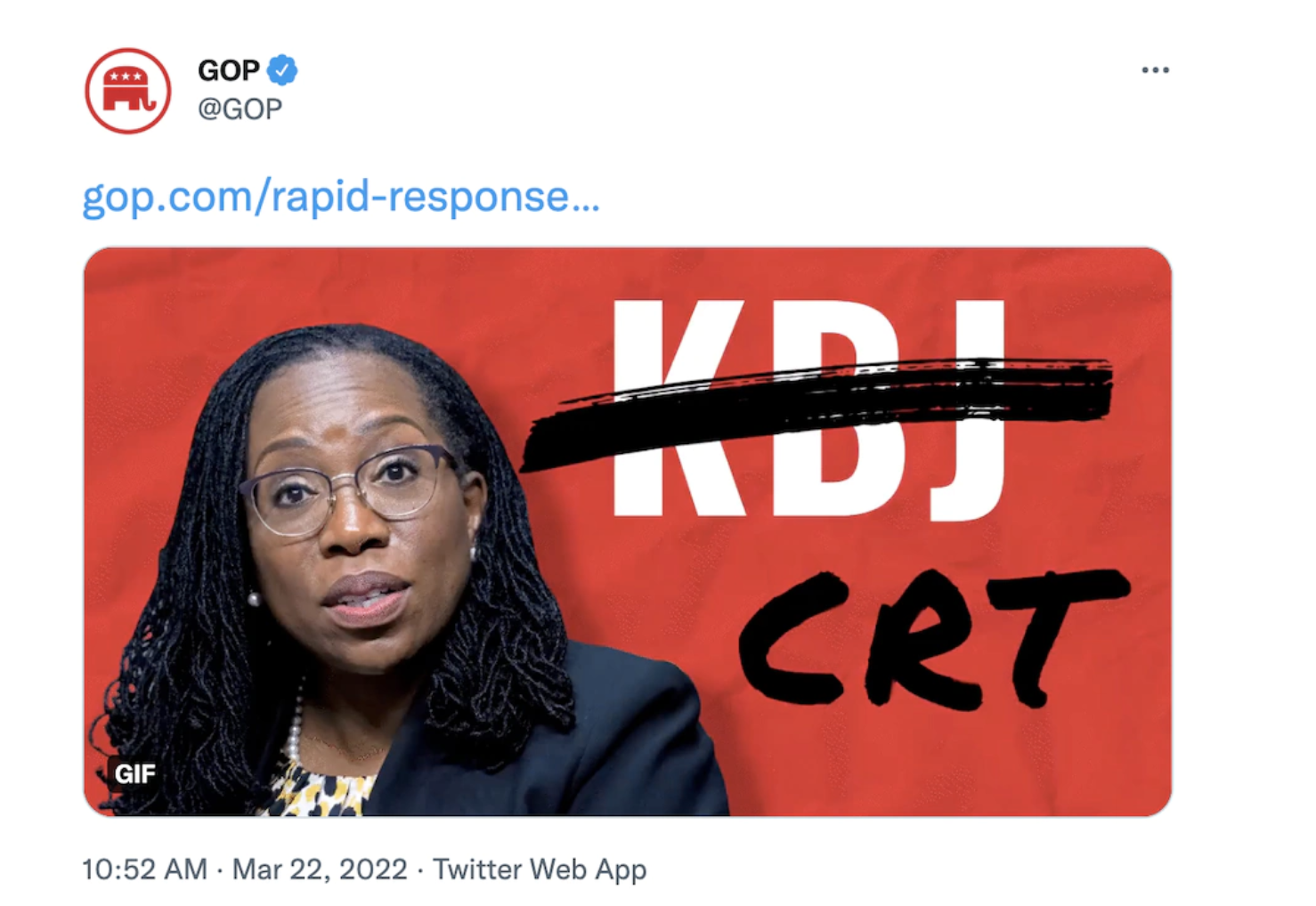
Most of the other Republicans letting the racism fly aren’t even bothering with the unconvincing walk backs. As with Cruz, the Republican National Committee also made clear that “critical race theory” is just the right’s newest effort to craft a racial slur they think they can get away with on camera. The RNC tweeted out this gruesome meme where they replace Jackson’s initials with “CRT.” 


Want more Amanda Marcotte on politics? Subscribe to her newsletter Standing Room Only.


There are just so many more examples I hate to report.

Sen. Marsha Blackburn of Tennessee used her hearing time to hector Jackson about “so-called white privilege.” Note that the presence of a twit like Blackburn in the Senate is inarguable proof of the concept. Tucker Carlson of Fox News insisted it has “degraded” and “diminished” the country to have Jackson on the court, and she should be replaced with “a rap star off the street.”

The concept of the racist “dog whistle” is a quaint relic from the pre-Donald Trump era.  It’s all bullhorns and the GOP tweeting memes that would not be out of place on a white nationalist website. 

To be certain, this berserker mode racism is sincerely felt. Modern Republicanism is a clearinghouse for every mediocre person who coasts on white and/or male privilege. They are incredibly threatened at the idea that they might have to compete with women and people of color who are smarter than them. Black women, being both Black and women, draw twice as much vitriol. It’s a phenomenon so widespread that there’s even a specific word for the bigotry they face: “Misogynoir.” Witness the endless, pointless hate that explodes from Republicans every time they’re reminded that Vice President Kamala Harris exists, which often turns on white men insisting she’s not as smart as she very obviously is. 

RELATED: Newt Gingrich tells Fox News that Kamala Harris is “the dumbest person ever elected vice president”

But there’s also no small element of this that is performative trolling.

As with Cruz and his bad faith about “racist babies,” Republicans have learned that deliberately acting stupid garners liberal dunks and attention. That, in turn, gets translated to the base as “triggering the liberals,” which is all they live for. This narrative is clung to, even though the only people acting “triggered” are right-wingers who lose their minds because a Black woman got a prestigious job. The point is to draw liberals into fights over whether or not it’s “really” racist to deny white privilege exists or to use “critical race theory” as a slur. The coin of the realm is attention, and there’s no quicker way to get it than to be really, really, really gross. 

Unfortunately, as with the rape apologism I wrote about in my Tuesday coverage of the hearing, just because these antics are about political point-scoring doesn’t mean that their damage isn’t real. Whatever the “trigger the liberals” justification, the result is that blunt racism and misogyny are normalized. And with Republicans constantly relabeling anti-racism as “racism,” language is deliberately muddied and confused, making it harder to have a rational discussion about these issues. Which is, of course, the point.

They are racist babies who are so angry about increasing diversity that they’re going to smear their garbage all over the place, demeaning not just themselves, but anyone who has the misfortune of watching this deplorable spectacle. 

“Classic GOP hypocrisy”: Mark Meadows’ wife may have committed voter fraud too

Former White House chief of staff Mark Meadows is already under investigation for possible voter fraud, and now it appears that his wife Debbie also filed three false voter forms in the 2020 election, according to the Washington Post.

North Carolina officials are currently investigating Mark Meadows on potential fraud charges. The New Yorker reported that Donald Trump’s former top aide was registered to vote at a mobile home in a remote rural area where he never appears to have lived or even visited, at the same time he was spreading and supporting Trump’s false claims about widespread voter fraud in the 2020 election

The North Carolina attorney general’s office said that the State Bureau of Investigation and the State Board of Elections are investigating the matter after Macon County District Attorney Ashley Welch, a former Meadows ally, referred the case to the state for “potential prosecution.”

The attorney general’s statement did not mention Debbie Meadows, who appears to have used the address of the Scaly Mountain home on three different voter forms. She listed that as her home address on a one-stop voter application to cast an early ballot in the 2020 presidential election in Franklin, North Carolina, according to documents provided by the North Carolina Board of Elections to the Washington Post. The form requires voters to certify that they have lived at their address for at least 30 days and warns that “fraudulently or falsely completing this form” is a Class 1 felony.

RELATED: “GOP finally found some voter fraud”: Mark Meadows registered to vote at an N.C. “dive trailer”

Debbie Meadows also dropped off an absentee ballot that she had requested for her husband, an election board official told the outlet. In all, she signed three forms that warned of legal consequences for providing false information: the one-stop application, the absentee ballot request for her husband and the voter registration form previously reported by The New Yorker.

State investigators declined to say whether their probe of Meadows would also include his wife.

“We are early into the investigation,” Anjanette Grube, a spokesperson for the State Bureau of Investigation, told the Post. “As the investigation continues, information will be shared with the prosecutor who will make a determination as to whether any additional persons could be subject to the investigation.”

The voter registration form requires voters to enter the residential address “where you physically live” under “penalty of perjury.” The Meadowses entered the address of the Scaly Mountain home where, according to what its former owner told the New Yorker, Debbie Meadows had only stayed for a night or two and Mark Meadows had never stayed at all.

Melanie Thibault, the director of Macon County’s Board of Elections, told the New Yorker she had been “dumbfounded” to learn what address the Meadowses used after selling their North Carolina home when Meadows was tapped to serve in the White House.

“I looked up this Mcconnell Road, which is in Scaly Mountain, and I found out that it was a dive trailer in the middle of nowhere, which I do not see him or his wife staying in,” she said.

North Carolina law requires voters to have lived in a county where they register for at least 30 days before the election. Both of the Meadowses’ voter registration forms were filed on Sept. 19, 2020, but listed their move-in date as the following day, Sept. 20. (That in itself would be a violation, although one unlikely to be pursued or prosecuted.) The Meadowses also listed a post office box in a town about 70 miles away from the mobile home as their mailing address, according to the Post.


Want a daily wrap-up of all the news and commentary Salon has to offer? Subscribe to our morning newsletter, Crash Course.


In March 2020, Meadows sold his home in Sapphire, North Carolina, and moved to a condo the couple owns in northern Virginia, where they are both also registered to vote. Debbie Meadows, however, apparently used the Sapphire address to vote in a June primary runoff election. Gerry Cohen, a North Carolina elections official, told the Post that until this year the state allowed anyone who had voted in an initial primary election to cast a ballot in the runoff without updating their registration.

Debbie Meadows later requested that her husband’s absentee ballot be sent to their Virginia address, and then traveled to Macon County, North Carolina, to cast both their 2020 general election ballots on Oct. 26. At the one-stop early voting location, Debbie Meadows signed a declaration that she had lived at least 30 days in the county.

Debbie Meadows is the founder and executive director of the Right Women PAC, which financially backs “solidly conservative women” in House races, including far-right Reps. Marjorie Taylor Greene, R-Ga., and Lauren Boebert, R-Colo. She played a key role in her husband’s early relationship with Trump, backing the former president after the release of the infamous “Access Hollywood” tape where Trump bragged about sexually assaulting women, according to the Washington Post.

“Is it offensive? Yes. Can we forgive it? Yes!” she said during a 2016 campaign event before attacking Trump’s opponent Hillary Clinton. “How can she be so offended by his nasty talk, his lewd talk, when she bullied, silenced and intimidated women who had been abused by her husband?”

After leaving the White House, Mark Meadows joined the Conservative Partnership Institute, a Washington nonprofit that seeks to move the Republican Party even further to the right. Trump’s Save America PAC donated $1 million to the group shortly after the House launched its investigation into the Jan. 6 Capitol riot, which Meadows then refused to cooperate with. The couple later bought a 6,000-square-foot home in South Carolina for nearly $1.6 million, although North Carolina officials told the New Yorker they are still registered to vote at the Scaly Mountain address. 

Meadows played a key role in helping Trump spread falsehoods about the election, claiming in a 2020 interview that mail voting was rife with fraud.

“What we do know is a number of times as we have mail-in ballots, if there is not a chain of custody that goes from the voter to the ballot box, mischief can happen,” he told ABC News at the time.

These repeated false claims of mail ballot fraud, when paired with the Meadowses’ dubious voter-registration history, amounts to “classic GOP hypocrisy,” charged the Center for American Progress Action Fund, a liberal advocacy group.

“As Trump’s chief of staff, Mark Meadows accused mail-in ballots of being a haven for fraud,” the watchdog group Citizens for Responsibility and Ethics in Washington said on Twitter. “It appears that he may have been talking about his wife’s ballots.”

Read more:

Why the right is suddenly attacking Dr. Rachel Levine, the highest-ranking trans woman in government

Rep. Marjorie Taylor Greene, R-Ga., said that she felt “threatened” by Assistant Secretary for Health Dr. Rachel Levine, a transgender woman, for “replacing” what she thinks are biological women. 

“As a woman, I feel threatened because biological men are aggressively replacing women,” Greene tweeted. “All of my life, as an American women, I’ve been equal in every place to men, but not anymore.”

The inflammatory tweet, which violated Twitter’s code of conduct, stemmed from remarks made by conservative youth activist Charlie Kirk, who challenged USA Today’s decision to name Levine as “Woman of the Year.”

“Levine spent 54 years of his life as a man. He had a wife and family,” Kirk tweeted. “He ‘transitioned’ to being a woman in 2011, Joe Biden appointed Levine to be a 4-Star Admiral, and now USA Today has named ‘Rachel’ Levine as a ‘Woman of the Year’ Where are the feminists??”


Want a daily wrap-up of all the news and commentary Salon has to offer? Subscribe to our morning newsletter, Crash Course.


Twitter shortly suspended Kirk’s account for violating the site’s hateful conduct policies, which expresssly bars the “targeted misgendering or deadnaming of transgender individuals.” He was later required to delete the post in order to regain access to his account. 

RELATED: Twitter suspends GOP congressman for misgendering Dr. Rachel Levine, first trans four-star admiral

This week, Twitter also locked the account of conservative news site The Babylon Bee for similarly misgendering Levine over an article, since deleted from Twitter, in which the outlet named Levine as “Man of the Year.” 

“This king doesn’t care what people think about him! He often wears a dress, which some people think is weird—but he doesn’t care one bit,” the article said. “Come on! Men in India wear dress-type garments, don’t they?”

Following the account’s suspension from Twitter, CEO Seth Dillon claimed that the site is “not deleting anything.”

“Truth is not hate speech,” Dillon added. “If the cost of telling the truth is the loss of our Twitter account, then so be it.”

Levine, 64, was originally appointed by President Biden and confirmed by the Senate back in March. She is America’s first transgender four-star admiral throughout in all of nation’s eight uniformed services. Since being nominated, Levine has come under fire from a host of conservative pundits and politicians who have casted doubt over her gender identity. 

RELATED: Lauren Boebert slammed as a “hateful bigot” by colleague after mocking first trans four-star admiral

Who pays for the COVID lies?

The Wall Street Journal reported this week that a new study, the biggest to date, has determined that the anti-parasite drug ivermectin did not prevent hospitalization or death in COVID-19 patients. I’m sure you are shocked to learn this. After all, tens of thousands of your fellow Americans insisted that it had cured them. Unfortunately, many others died after having used it in lieu of the vaccines that likely would have kept the virus from being so deadly. The “ivermectin protocol” prescribed by many doctors, largely at the request of their patients, is bunk.

“There was no indication that ivermectin is clinically useful,” Edward Mills, one of the study’s lead researchers and a professor of health sciences at Canada’s McMaster University, told the Journal. 

The people who thought it cured them would have survived the virus anyway and those that eschewed the vaccines in favor of this drug and wound up in the hospital were placing their faith in something that didn’t work. The new study clears up any confusion. If some people took ivermectin and survived COVID, it was a coincidence.

Right-wing celebrities touted the drug. Some, like notorious podcaster Joe Rogan, said that healthy people need not get vaccinated, caught the virus and lived to tell the tale. Others, such as conservative talk show host Phil Valentine, weren’t so lucky.

And this wasn’t the first dubious COVID cure out there. You’ll remember that the first one that caught the popular imagination among the MAGA crowd was Hydroxychloroquine, a malaria and lupus drug. It, too, was highly touted by right-wing media, particularly Fox News host Laura Ingraham who took her so-called “medicine cabinet” (a couple of Fox News physicians) up to the White House to push for the government to use it as a treatment back in 2020. One of the doctors gave then President Trump “a detailed presentation” about the drug’s efficacy “based on his own experiences and studies.”

Trump was very impressed. He tweeted, “HYDROXYCHLOROQUINE & AZITHROMYCIN, taken together, have a real chance to be one of the biggest game changers in the history of medicine, and it should be “put in use IMMEDIATELY. PEOPLE ARE DYING, MOVE FAST!”

He spent the next few months relentlessly pushing the drug and under pressure, the FDA granted it emergency use authorization even though the agency knew it was ineffective. Trump said he took the drug himself, for all the good it did him. But when a major study conducted on VA patients was released showing that the drug not only didn’t work and it actually harmed people, Trump claimed it was a hoax study given to people who were “ready to die” as a way to hurt him politically:

As it turned out, an analysis of patients across six continents found that patients treated with the drug were more likely to develop irregular heartbeats leading to sudden cardiac death. Other reports yielded similar findings.

So the desire for that particular fake cure was eventually superseded by a new snake oil cure ivermectin, pushed by many of the same people who pushed Hydroxychloroquine:

https://youtu.be/VLoGUC4S3Q0

As you can see Fox News touted ivermectin as a cure for COVID many times. They pushed Hydroxychloroquine more than 300 hundred times. It’s fair to suspect that the use of these two drugs based upon bogus science and anecdotal Facebook posts with heavy promotion by Donald Trump and Fox News cost many lives. They have a large audience of gullible viewers who were more than happy to experiment on their bodies with unproven cures — but curiously didn’t trust the COVID vaccines.

What’s the reason for this bizarre behavior? Some of it was Trump, of course. He pushed the phony cures, even going so far as to suggest that ingesting disinfectant might be a way to “clean” the lungs of COVID. And Fox News and other right-wing media were no doubt influential. But mostly, I think it had to do with the propensity among right-wingers to dive headfirst into conspiracy theories. This study looked into some of the possible theories:

Some believe that COVID-19 is a business for health care workers (HCWs) and doctors are diagnosing every fever as COVID-19 for their benefits. Ironically, in some places, people attacked HCWs in the hospitals for not handing over the dead body immediately to the family.The claim that COVID-19 is a pre-planned project to cover the Bill Gates trackable microchip conspiracy was also raised.Myth about the origin of virus was also emergedand people also believe that government is providing false number of COVID-19 cases because a large number of cases will get more profit and donation. Many people also believe that it is from God as a punishment,the 5G technology directly transmits the virus and weaken the human immunity, and some consider that the virus is a bio-warfare weapon. In addition, the video “Plandemic” that shows that COVID-19 pandemic is a conspiracy of pharmaceutical companies to sell their products also have become viral through social media platforms adding the list of conspiracy theories.

This tracks with all the other conspiracy theories swirling around the right-wing fever swamps so I suppose it’s not surprising. But what’s the logic of Republicans and Fox News being anti-vax and pro-snake oil? They all got vaccinated themselves but they pushed “alternative” treatments hard while degrading the vaccines as dangerous. You still have GOP senators like Ted Cruz running around with that sad sack anti-vax “trucker convoy” that’s driving in circles in the beltway for no good reason.

As the historian Rick Perlstein pointed out some time back, peddlers of quack medicine and right-wing extremists have had a long and happy relationship. Their customers and their audience are the same people. Take a look at how the “nutritional supplement” industry largely supports right-wing media, from Alex Jones to Tucker Carlson. There’s a financial incentive to keep their audience believing in snake oil but it’s very short-sighted. After all, telling your followers that a pill will improve their sex life probably isn’t going to kill them. But pushing them to take an alternative quack cure for COVID might.

Pfizer CEO pushes yearly Covid shots while experts hesitate

When Pfizer CEO Albert Bourla said March 13 that all Americans would need a second booster shot, it struck many covid experts as a self-serving remark without scientific merit. It also set off spasms of doubt over the country’s objectives in its fight against the coronavirus.

The decision on how often and widely to vaccinate against covid-19 is part science, part policy, and part politics. Ultimately it depends on the goals of vaccination at a time when it’s becoming clear that neither vaccines nor other measures can entirely stop the viral spread.

On March 15, Pfizer made a more limited request of the FDA, seeking authorization of a second booster only for people 65 and older. Advisers for the FDA and the Centers for Disease Control and Prevention are likely to approve a fourth shot for people in that age group because they’re the group most likely to be hospitalized or die of covid. Pfizer competitor Moderna on March 17 also filed for a second booster shot, although its application extended to all adults.

The vaccines’ protection against covid infection generally wanes within several months in all age groups. But experts disagree on whether frequent boosters, especially for younger people, can do anything about that. Two or three vaccinations protect most people from serious disease — but do relatively little to prevent infection, which is generally mild or asymptomatic, after three or four months.

Statements like Bourla’s create public pressure for a fourth dose that could force the Biden administration’s hand before government experts have time to assess the evidence, said John Moore, professor of microbiology and immunology at Weill Cornell Medical College.

It appears to be based on a yet-to-be-peer-reviewed Israeli study that examined patients only a few weeks after they had received their fourth dose of vaccine. The limited scope of the data raises questions about the duration of that protection, said Dr. Phil Krause, a former deputy director of the FDA’s biologics center. Krause helped lead the agency’s covid vaccine reviews before resigning last fall.

Throughout the pandemic, repeated public proclamations by pharmaceutical company executives — broadcast widely via the media, often without supporting data — have created pressure for politicians and their scientific advisers to act.

Last summer, Bourla announced the likely need for an initial booster in April 2021, then, in August, President Joe Biden promised the first booster shots would be available to all adults starting the following month. “That created an expectation that everyone would get their slice of yummy chocolate cake,” Moore said. “Who wants to be ‘the cake nazi’ and say, ‘No cake for you?!'”

Although FDA and CDC expert panels, and some federal scientists, were hesitant about recommending the first booster for younger populations, the agencies overrode their advice and approved boosters for everyone 12 and older. That continues to be a sore point with many immunologists and infectious disease specialists.

”The last thing we need is to have corporate CEOs in March saying this is what you need in December because ‘we know,'” Moore said. “How do you know?” CEO announcements have often been made before scientific evidence supporting the claims has been publicly released, meaning scientists have not had time to evaluate their validity.

The desire to react to growing signs of infection is understandable but may be futile in the face of a virus that seems to infect even the well-vaccinated. If we keep chasing the virus with boosters, “we’re going to be making the drug companies very happy, since our antibodies will go down every four months,” said Dr. Paul Offit, director of the Vaccine Education Center at Children’s Hospital of Philadelphia.

But whether those levels are a good measure of protection — especially against serious disease, and in which populations — is an open question. The answer is important because, like all vaccines, there is a small risk of adverse reactions from each shot.

There’s some disagreement among experts on how well covid vaccines to date have prevented serious disease in healthy young people, and whether and how often they should be boosted.

While a recent CDC study showed an increased risk of hospitalization among people ages 18 to 49 several months after second and third vaccine doses, the data categories in the study aren’t fine-grained enough to show whether many of those who suffered severe disease had comorbidities such as chronic disease or obesity, Offit said.

But others argue there’s enough evidence to show that yearly vaccines, perhaps in combination with influenza vaccinations, would be the best solution. “Given how safe the vaccines are and how effective they are, I think it probably does make sense for people to get a booster, and the most convenient would be once a year,” said Dr. Otto Yang, an infectious disease specialist at UCLA. If covid turns out to be seasonal, peaking in winter months, vaccination in the fall would provide decent protection, he said.

“We are bound to need another booster. We just don’t know when or for which variant,” said Dr. Daniel Douek, chief of the human immunology section at the National Institute of Allergy and Infectious Diseases.

The coronaviruses that cause about a third of all common colds appear to infect people as frequently as once a year on average, said Stanley Perlman, a coronavirus expert at the University of Iowa. Vaccines could never prevent all those infections, yet the federal approach has largely acted as if this were feasible, Offit said.

“We’re coming off two years where we treated this virus like smallpox, isolating anyone with mild illness, even asymptomatic people,” he said. “That’s going to have to change. Because neither vaccination nor natural infection is going to protect you from mild illness for a longer period of time.”

It’s important for U.S. health officials to have and share with the public some clarity about the goals of the vaccination program, said Dr. Luciana Borio, a former FDA and National Security Council official who is now a senior fellow for global health at the Council on Foreign Relations. “We need people to understand that protection against all illness is not long-lasting, instead of thinking the vaccine is not working.”

“The goal is not to stop transmission, it’s mainly to protect the vulnerable at this point,” said Dr. Norman Hearst, a family physician and public health researcher at the University of California-San Francisco.

How, in the absence of perfect vaccines, we will protect the vulnerable remains a conundrum. Borio argues that we need systems to rapidly test elderly and immunocompromised people for covid and quickly give them treatment if their results are positive.

But this is more easily said than done, Hearst said, since people rarely seek medical help for upper respiratory diseases until the illness is too developed for antiviral drugs to work; antivirals generally work best, sometimes only, if they are taken within a few days of onset of symptoms.

For the time being, all debate on a second booster is moot, said John Wherry, chair of the Department of Systems Pharmacology and Translational Therapeutics at the University of Pennsylvania. Unless Congress reverses itself and decides to give the administration more money to fight covid, there won’t be any free vaccines — or free covid treatments — available to the public next fall.

“We have an acute budgetary problem and we’re not yet out of the woods,” Wherry said. Covid numbers are spiking in Europe again, and concentrations of the virus in wastewater are starting to multiply in some areas of the U.S., indicating that a loosening of covid restrictions may be causing spread among those who weren’t infected during the omicron wave in December and January.

Offit, a vaccine inventor and longtime champion of vaccination, cautions against leaning too hard on covid boosters for answers.

“What’s our response going to be if we have another variant like omicron that sweeps across people who got two or three doses?” he asked. “Will we accept this, and say, ‘OK, calm down?'”


Elie Mystal: Our Constitution is “actually trash” — but the Supreme Court can be fixed

Elie Mystal, attorney and author of the New York Times bestseller “Allow Me to Retort: A Black Guy’s Guide to the Constitution,” wanted actor Samuel L. Jackson to record the audio version of his book. Mystal’s title, after all, is drawn from one of Jackson’s famous lines in “Pulp Fiction.” But if you’ve seen Mystal on cable news, you know he doesn’t need Jackson to provide passion and emphatic delivery. Mystal gives you all that and more, as you will see first-hand in our recent “Salon Talks” conversation.

Mystal takes, shall we say, the controversial position that the U.S. Constitution is not only “not good,” but that it’s “actually trash.” He notes that our founding document was drafted by men who owned slaves and enshrined that evil institution with the infamous Fugitive Slave Clause and the “three-fifths compromise.” But Mystal’s bigger point is that our Constitution is given too much deference: “We act like this thing was kind of etched in stone by the finger of God, when actually it was hotly contested and debated, scrawled out over a couple of weeks in the summer in Philadelphia in 1787, with a bunch of rich, white politicians making deals with each other.”

Mystal also lays bare the myth that the motivation behind the Second Amendment was about self-defense or a check on the government. As he notes, George Mason — then the governor of Virginia and one of the drafters of the Constitution — flat-out said that the Second Amendment was meant to guarantee that Southern states could form a “well-regulated militia” to “fight slave revolts.” Mason and other Southerners feared that the federal government wouldn’t help them put down slave uprisings, and they needed to have guns close at hand. 

Mystal also shared his views on the Supreme Court nomination of Judge Ketanji Brown Jackson and her ongoing confirmation hearings. As Mystal explains, the GOP has “nothing on her record that they can attack” and only has one card to play: racism.  “Because they can’t find anything wrong, they go to all of these other kind of racist smear campaigns because, frankly, racism always works for them,” Mystal said. 

This following transcript has been lightly edited for clarity and length.

You were recently on “The View” talking about your book and created some controversy. The first line in “Let Me Retort” is “Our constitution is not good,” followed up a few paragraphs later with “Our constitution is actually trash.” You’re obviously trying to challenge people. Tell people what your goal is there.

There are two things going on there. One, the veneration that this country has for the Constitution is simply weird. It’s crazy. It’s not what other countries do for their written documents. We act like this thing was etched in stone by the finger of God, when actually it was hotly contested and debated, scrawled out over a couple of weeks in the summer in Philadelphia in 1787, with a bunch of rich, white politicians making deals with each other, right? These politicians were white slavers, white colonizers and white abolitionists — who were nonetheless willing to make deals with slavers and colonists. No person of color was allowed into the convention. Their thoughts were not included. No women were allowed to have a voice or a vote in the drafting of the Constitution. And quite frankly, not even poor white people were allowed to have a voice or a thought in what the Constitution was.

The thought that this document, made by one class of people, represents the best we can do in America is just ludicrous. Of course it’s not very good. You only let one kind of person write it. So that’s one aspect of it. The second aspect of this, and how we go from “not good” to “trash,” is that structurally there are a lot of stupid things in the document. There are a lot of things that you just wouldn’t think we should do if you were starting again from first principles. Like the idea that we don’t elect our own president; that’s pretty dumb.

Pretty dumb.

You wouldn’t do it that way, right? The way that voting rights have been couched as “We will not abridge the right to vote,” as opposed to “You have a positive right to vote,” that’s dumb. The federal system has 50 different election systems instead of one federal system, that makes us have literally 3,000 police systems — that’s 3,000 sheriff’s offices around the country, instead of one national police system. That’s pretty stupid. If you just go structurally through the document, you see — it’s not exactly bad-idea genes, but you see quite a lot of bad ideas throughout the document.

The Judicial Crisis Network has been attacking you for your comments about this, tying it to the nomination of Judge Ketanji Brown Jackson. What are they saying? What did you say that they view as blasphemous in some way?

Again, here’s another issue where there are two things going on. One, they have nothing on Ketanji Brown Jackson. There’s nothing on her record that they can attack. They don’t have a case. They don’t have a law review note that she wrote. They don’t have anything that she’s actually done to attack her with, so they’re trying to bank a shot against her off some of these other issues. And apparently, I’m one of the issues these idiot people think they can bank a shot off of, because these are the kinds of people who think that all Black people know each other — like we all go to the same barbecue and we talk about our plans for whitey and then we go out into our separate corners.

That’s not how it works. I’ve never met Ketanji Brown Jackson. I’ve literally never been in the same room with her in my life. I have no idea. She probably hasn’t read the book because she’s busy. She’s about to be a Supreme Court justice, right? I would imagine there are parts of my book that she doesn’t agree with, and that’s fine too. So that’s part of what’s going on.

The other thing that’s happened is that there are people who take the Constitution as gospel without really examining what the document is — people who haven’t actually read it, and even people who have read it but don’t really understand what it’s saying and what it’s doing. So for instance, Dean — and you’ll find this funny — there are people telling me the Constitution is not trash and is actually great because it’s a living document that evolves with our times, which is an interesting thing for them to say because that’s what I say. That’s what liberals say the Constitution is.

It is the conservatives who say the Constitution is ossified in the original public meaning and intent of the slavers who wrote it. It is people like me who are like, “No, no, no, the document lives and breathes and evolves.” So these idiot white people are literally trying to attack my position by restating my position, because they don’t know any better, because they haven’t actually read it or thought about it or understand it. And the big reason why I wrote the book is so more people could think about it, understand it. As we’ve talked about before on your show, I write in plain English so people can really get into what’s happening and not be intimidated by the legal jargon. It’s so you can understand why you’d want the constitution to live, breathe and evolve, for instance.

RELATED: Republicans know Brett Kavanaugh lied under oath: They just don’t care

Your book is written very accessibly. You don’t have to be a lawyer, you don’t have to know the Constitution, you don’t have to be Black. I’m a lawyer and there are things I learned. For example, one thing I think is vitally important for Americans to know is the origin of the Second Amendment. Today they talk about the Second Amendment as something about defending your house, or when the black helicopters coming to chase you, that kind of stuff, or for deer hunting. Share a little bit about the true origins of our Second Amendment.

The Second Amendment was here to stop slave revolts. The “well-regulated militia,” which is the first part of the Second Amendment, that was a thing was because in the South, the principal way of putting down revolting slaves was to bring out the well-regulated militia. It turns out it’s kind of hard to hold Black people in bondage against their will, so occasionally you have to bring in the guys with the guns to do it. Well, in the original Constitution, without the amendments, it was unclear who had the authority to raise the militia. White Southerners thought that the Northerners would dominate the federal government, wouldn’t raise the militia, and when Black people rose up for their freedom and rights, the South would be powerless to stop them militarily.

The Second Amendment is there to make it clear that everybody can be armed so they can raise this militia to go and fight slave revolts. That is not me theorizing or making things up. That is what George Mason, then governor of Virginia, said, when advocating for a Second Amendment. He literally made a speech where he said that, all right? People don’t know that history, and part of the reason why people don’t know that history is because Republicans have purposefully obscured it.

When you fast-forward 250 years, Antonin Scalia in D.C. v. Heller, invents a right to bear arms for personal self-defense that did not exist at the original founding of the constitution. Scalia quotes George Mason’s speech, because at the beginning of the speech, a lot of it is about personal self-defense — again, personal self-defense from the slave revolts. Scalia leaves that part out and talks only about this right to personal self-defense, taking out the context. That’s how Republicans be!

This is something that goes through all the way through my book. Originalists have this PR campaign that they’re going back to the original definitions of the Constitution as understood by the founders, when really they’re just making stuff up that’s convenient for their current political agenda.

You also talk about how the right to vote gets abridged all the time. Tell people what’s in the actual, original Constitution. What did the framers have in mind about for could vote in the early days of this country?

The framers did not think that the right to vote, or even citizenship in the country, flowed down from the federal government. They thought it flowed up from the states. Your right to be a citizen was to be a citizen of Georgia or New York or New Jersey. Your right to vote, therefore, was determined by Georgia or New York or New Jersey or Virginia. There was no federal right to vote because all voting was done at the state level, in the conception of the framers. They weren’t worried about minority voting rights because they didn’t think minorities were going to vote at all.

They weren’t worried about women voting rights because they didn’t think women were going to vote at all. They were only concerned with making sure that the states had the power to decide for themselves who could and could not vote. So even when you go forward to things like the 15th Amendment, which says that you can’t abridge voting on the context of race, color or creed; when you go to the 19th Amendment, which says that you can’t abridge voting because of gender, which of course did not mean Black women at the time the 19th amendment was ratified.

All these amendments did, technically, was to say that the states could not restrict voting based on racial or gender grounds. And let’s not forget that the states looked at the 15th Amendment and thought, “That’s a very nice try,” put it in a drawer and ignored it for 100 years. The states restricted voting on the basis of race all the time after the 15th Amendment because courts wouldn’t enforce it. So the Constitution is silent on the right to vote because our election system is dumb. And it’s based on, like I said, at this point 50 state electoral systems — at the founding, 13 state electoral systems — as opposed to one unified, rational, intelligent federal election system, which is what they have in all the other democracies, by the way. Let’s not forget that we’re the outlier here; other advanced Western democracies have a federal election system, not province by province.

You make a very compelling point that four of the 17 amendments ratified after the Bill of Rights have to do with voting. That was nearly 25 percent of the updates to the Constitution, because the framers didn’t give it much thought. Later in life, the Constitution evolved and people were like, “Let’s do something about it.” What does that say to you?

One, it says that no matter what you try to do with your written document, it can’t survive bad-faith conservatives. The reason we’ve had to have four different voting amendments, and probably are going to need a fifth one at some point in our future, is because at every point conservatives have tried to restrict the rights of everybody to vote. And to be clear, I’m saying “conservatives” because I don’t care what conservatives call themselves in the morning. After the Civil War, conservatives called themselves Democrats. Now, they call themselves Republicans. In the future, they might call themselves Whigs. I don’t care. Doesn’t matter. The conservative party, however they define themselves, has opposed the idea of universal suffrage at every point, and that continues today. 

The reason why you have to have so many updates is because every time you try to extend the vote, conservatives come up with some new, crazy reason to restrict the vote. One lreally small way of, I think, pointing this out is that the 26th Amendment says that basically everybody over 18 can vote. Simple, straightforward amendment: If you’re over 18, you can vote. The thought being, if you can go to war, you can vote on whether or not we have a war. Makes sense, right?

So what happens if you turn 18 after the election in November, but before the end of the year? The election happens in your 18th year, but you don’t actually turn 18. Let’s say you have a Christmas birthday, essentially. Now, the constitutional amendment is silent about that. So conservatives step in and say, “Nope, you have to be 18 by the time the…” Why? They just made that up. That’s just an arbitrary cut-off. Why wouldn’t you make the arbitrary cut off the end of the year, as opposed to the end of the election? It makes no sense.

Do we really think that the difference in the intellectual quality of a 17-year-old in November changes radically when he hits his 18th birthday at Christmas? Who thinks that? Liberals are like, “We should just vote if you’re…” So this is what I’m saying: Conservatives, at every point, even in really small ways, try to restrict the right to vote.

You have a chapter called “Reverse Racism Doesn’t Exist,” meaning of course racism against white people. But how do you square that with the Pew poll that found Republicans are likely to believe that white people face more discrimination than Black people and Hispanic people or Asian Americans do? You’ve got a whole group of Americans out there who think they’re suffering discrimination and ask why our legal system doesn’t protect white people, even though they are technically the majority.

They’re technically the majority. That’s exactly why. I explain protected-class status as understood by our constitutional interpretation. I’m just the messenger, don’t shoot me. Constitutionally speaking, white people are not, and pretty much cannot be, a protected class, because the way that we define protected class, you have to be a minority or somebody singled out for a special historical kind of torment. So again, I’m a liberal: I think poor people should be a protected class. I think that. It is conservatives who won’t let me do that. I think poor white people should be part of the impoverished protected class, but conservative white people won’t let me do that.

Instead, they want to say all white people are a protected class, which just doesn’t make sense based on our protected-class jurisprudence. So yes, from a legal definition, reverse racism doesn’t exist. And I would say that also, from that legal basis, that extends through any kind of understanding of our social power structure.

Here’s the problem when you tell white people that they’ve experienced privilege. There are white people who are the beneficiaries of white privilege who still have crappy lives. And they think that because I say that they have privilege, then that privilege means that they shouldn’t have a crappy life. No, that’s not what white privilege is. White privilege is that if you take a white person with a crappy starting position and a Black person with a crappy starting position and kind of play out the string, what we’ll see is that the Black person will have the same crappy life as the white person, only a little worse. It’s the whole thing of whenever white America catches a cold, Black America catches the flu. 

It’s the defensiveness of white Americans who are struggling who go, “Where’s my privilege?” I understand. Maybe the term — it’s not literal in that way, but they take it literally. “Where’s my privilege? Where are my happy days?” I get it. It’s actually a minority burden, versus someone white who is just living a normal life, where you’re not judged by the worst in your society and the worst in your community, and politicians don’t demonize you for that and don’t pass laws based on this mythical caricature that they’ve created about your community. The list goes on and on.

White people will look at me right now and be like, “Well, I’m not doing as well as that Black guy, so how am I having white privilege?” And it’s like, because if I was white I would be the attorney goddamned general. That’s how you know. That’s the difference.

That brings us perfectly to the nomination of Judge Ketanji Brown Jackson. You had sitting senators, including Roger Wicker of Mississippi, call it a “quota hire,” literally affirmative action. Ted Cruz called it offensive and said, “I guess if you’re a white man or a white woman, you’ve got no shot at this.” You’re going to have one Black woman in the history of this nation and that’s one too many for them, because they feel this is a zero-sum game.

There have been 115 Supreme Court justices in American history, and 108 of them have been white males. And Ted Cruz fixes his mouth to say, “I guess if you’re a white man, you have no shot.” It’s an idiot statement, designed to play into the grievances of his idiot base, but also to be horribly offensive to everybody else because Ted Cruz doesn’t care about being horribly offensive to everybody else. Again, all these attacks come because they have nothing that they can use against her. I have read her cases. They haven’t maybe read her cases. She’s been on the bench for nine years. That is more than four current Supreme Court justices had combined when they were elevated to the Supreme Court.

She has a deep legal record that these people could pick through and find something wrong. They picked through it, they haven’t found anything wrong. Because they can’t find anything wrong, they go to all these other racist smear campaigns because, frankly, racism always works for them. Show me, in the last 10 or 15 years, the white politician who got drummed out of office because they were too racist. I mean, Steve King in Iowa, maybe, after just doing some straight-up Nazi rhetoric, but that’s about it, right? Ted Cruz knows that he’s not going to lose a primary because he is too racist to the Black woman Supreme Court nominee, so he’s just going to double down in that field. It’s all he’s got.

RELATED: Ted Cruz turns Ketanji Brown Jackson’s Supreme Court hearing into rehabilitation of Brett Kavanaugh

You make a compelling case for reform. Having Judge Ketanji Brown Jackson, if she’s confirmed, that’s not enough of a reform to make the Supreme Court what it should be. We can pass voting rights legislation right now, and this Supreme Court, with a 6-3 conservative majority, might just strike it down after all the work. What do you think fundamentally has to be done to change that institution?

It’s court expansion or bust. You expand the court or you cede the next 30 years of American law to six conservative justices. And as I try to explain throughout the book, nothing survives 30 years of six conservative justices. There’s nothing. Anything you want, doesn’t happen. John Roberts eviscerated the Voting Rights Act in 2013, as you mentioned, in Shelby County v. Holder. Roberts and Alito ganged up on Section 2 of the Voting Rights Act in 2021 in Brnovich v. Arizona. What makes anybody think the John Lewis Voting Rights Act is going to be upheld by this Supreme Court? Has John Roberts gone somewhere? Is he on vacation? No, he’s still right there, and he’ll knock it down just like he’s knocked down everything else.

As long as you have six conservative justices, you get nothing on voting rights, you get nothing on gun rights, you get nothing on climate change, you get nothing on police brutality, you get nothing on health care, you get nothing. So you expand the court and take your chances there, or you resign yourself to getting nothing. And people will say, “Oh, well, if we expand the court, Republicans will just expand it right back.” So what? How is that worse than where we are now? I would argue that if we expand the court, it makes it harder for Republicans to expand it back because it makes it harder for Republicans to control all of government, because when everybody votes, Republicans lose.

So I say, let’s go. I’m on record, I think, in the book for plus-20 judges. I think there are other reform ideas. A greatly expanded court does a lot of nonpartisan reforms. It leaves the Supreme Court as powerful as it is, but it makes each individual Supreme Court justice less powerful. That makes confirmation hearings less go-to-the-mattresses kind of situations. So there are lots of reasons why I get all the way to 20, but more, at this point, is the only way to stop the next 30 years of conservative takeover.

Read more: 

New research on Trump voters: They’re not the sharpest tools in the box

The United States is experiencing an existential democracy crisis, with leading Republicans and millions of their voters and supporters either tacitly or explicitly embracing authoritarianism or fascism. Democrats, for the most part, have not responded with the urgency required to save America’s democracy from the rising neofascist tide.

American society was founded on white settler colonialism, genocide and slavery. This unresolved birth defect at the foundation of the American democratic experiment meant that the country was racially exclusionary by design, from the founding well into the 20th century. At present, American politics is contoured by asymmetrical political polarization, in which Republicans have moved so far to the right that the party’s most “moderate” members are far more extreme than the most “conservative” Democrats. This makes substantive compromise and bipartisanship in the interests of the common good and the American people almost impossible.

Democrats and Republicans, liberals and conservatives, Trump supporters and Trump-loathers, increasingly do not live in the same neighborhoods or communities. In all, they largely do not socialize with each other, or have other forms of meaningful interpersonal relationships in day-to-day life.

To the degree that “race” is a proxy for political values and beliefs, the color line functions as a practical dividing line of partisan identity and voting. Religion is also a societal space that is divided by politics. For example, public opinion research shows that white right-wing evangelical Christians have increasingly embraced authoritarian views, conspiracy theories and other anti-democratic and antisocial values.

As the new Faith in America survey by Deseret News & Marist College highlights, the basic understanding of the role of religion in a secular democracy has become so polarized that 70% of Republicans believe that religion should influence a person’s political values, where as only 28% of Democrats and 45% of independents share that view.

RELATED: Who were the Jan. 6 attackers? Isolated white folks, searching for meaning — and enemies

Republicans and Democrats, liberals and conservatives, also do not consume the same sources of information about news and politics. Conservatives now inhabit their own self-created media echo chamber, which functions as a type of lie-filled and toxic closed episteme and sealed-off universe. The creation of such an alternate reality is an important attribute of fascism, in which truth itself must be destroyed and replaced with fantasies and fictions in support of the leader and his movement. 

America’s struggle for democracy and freedom against authoritarianism is taking place on a biological level as well. Social psychologists and other researchers have shown that the brain structures of conservative-authoritarians are different than those of more liberal and progressive thinkers. The former are more fear-centered, emphasizing threats and dangers (negativity bias), intolerant of ambiguity and inclined to simple, binary solutions. Conservative-authoritarians are also strongly attracted to moral hierarchy and social dominance behavior.  


Want a daily wrap-up of all the news and commentary Salon has to offer? Subscribe to our morning newsletter, Crash Course.


Recent research by Darren Sherkat, a professor of sociology at Southern Illinois University, demonstrates that America’s democracy crisis may be even more intractable than the above evidence suggests. In his recent article “Cognitive Sophistication, Religion, and the Trump Vote,” which appeared in the January 2021 edition of Social Science Quarterly, Sherkat examined data from the 2018 General Social Survey and concluded that there are substantial negative differences between the thinking processes and cognition of white Trump voters, as shown in the 2016 presidential election, as compared to other voters who supported Hillary Clinton or another candidate, or who did not vote at all.

Sherkat observes that Trump support has been linked to religion and level of education, but until now not to “cognitive sophistication,” which was found “to have a positive effect on voting, but a negative effect on choosing Trump.” He notes that “philosophers and political elites have debated the potential effects of mass political participation” for generations, concerned “about the unsophisticated masses coming under the sway of a demagogue.” In effect, this debate was always about the quality he calls cognitive sophistication, since citizens who lack it “may not be able to understand and access reliable and valid information about political issues and may be vulnerable to political propaganda”:

Low levels of cognitive sophistication may lead people to embrace simple cognitive shortcuts, like stereotypes and prejudices that were amplified by the Trump campaign. Additionally, the simple linguistic style presented by Trump may have appealed to voters with limited education and cognitive sophistication. Beginning with [T.W.] Adorno’s classic study of the authoritarian personality, empirical works have linked low levels of cognitive sophistication with right-wing orientations….

Trump’s campaign may also have been more attractive to people with low cognitive sophistication and a preference for low-effort information processing because compared to other candidates Trump’s speeches were given at a much lower reading level…. While much of the Trump campaign’s rhetoric and orientation may have resonated with the poorly educated and cognitively unsophisticated, those overlapping groups are less likely to register to vote or to turn out in an election.

As part of his research, Sherkat evaluated the political decision-making and cognition of Trump’s voters, using a 10-point vocabulary exam. In a guest essay at the website Down with Tyranny, he explains what this vocabulary test revealed about white Trump voters:

Overall, the model predicts that almost 73% of respondents who missed all 10 questions would vote for Trump (remember, that is controlling for education and the other factors), while about 51% who were average on the exam are expected to vote for Trump. Only 35% of people who had a perfect score on the exam are predicted to be Trump supporters.

Notably, this very strong, significant effect of verbal ability can be identified within educational groups. While non-college whites certainly turned out more heavily for Trump, the smart ones did not — only 38% of those with perfect scores are expected to go for Trump, and only 46% of non-college graduates who scored a standard deviation above the mean. The same is true for college graduates — low cognition college graduates were more likely to vote for Trump. …

What is really depressing isn’t just the poles of the vocabulary exam, it’s the average. The mean and median of the scale is 6 — so half of white Americans missed 4 of the easy vocabulary questions.

Sherkat’s research also explored how religion impacted support for Donald Trump among white voters: “This study confirms that white Americans with fundamentalist views of the Bible and those who embrace identifications with sectarian Protestant denominations tended to vote for Donald Trump in the 2016 election.

RELATED: Christian nationalism drove Jan. 6: Now it’s embraced the Big Lie, and wants to conquer America

Belief that the Bible is the literal “word of God” also impacted Trump voting: “Viewing the Bible as a book of fables is also significantly predictive of vote choice, with secular beliefs reducing the odds of a Trump vote by 80 percent when compared to literalists, and reducing the odds of a Trump vote by 52 percent when compared to respondents who view the Bible as inspired by God.”

In an email to Salon, Sherkat offered additional context and implication on the relationship between white Christianity, American neofascism and cognition:

The problem of the contemporary American fascist right is rooted in education and information. And this problem is not simply about attainment of some quantity of education, but of the quality and content of education, how that leads generations of white Christian Americans to process information about a wide range of issues. The segregation academies that proliferated in the mid-1960s and accelerated in the 1970s have taught millions of Americans a radically skewed version of American and world history and encouraged a continued segregated society. The homeschooling movement augmented this division, and further denigrated the value of knowledge.

White fundamentalist Christians have always segmented their communities from the rest of America, and even exert considerable control over public educational institutions, particularly in rural areas and in the states which embraced slavery. White fundamentalist Christians distrust mainstream social institutions like education and print media, and they actively seek to eliminate public education and to provide alternative sources of information. As a result, people who identify with and participate in white Christian denominations and who subscribe to fundamentalist beliefs have substantial intellectual deficits that make them easy marks for a wide variety of schemes — from financial fraud to conspiracy theories.

If you can’t read the New York Times, you’re going to believe whatever you hear on talk radio or on television. It’s simply impossible for people with limited vocabularies and low levels of cognitive functioning to make sense of the complex realities of the political world. And we now have a population where for 55 years substantial fractions of white people have gone to private fundamentalist Christian schools that leave them both indoctrinated in Christian nationalism and ill-prepared to process any additional information. Worse, we now have over a million children in a given year who are homeschooled by parents who are uneducated white fundamentalists — and that total has been pretty constant for three decades since the homeschooling movement blossomed.

What does this mean for the present and future of American democracy in this time of crisis? Sherkat cited the “disturbing … influence of anti-intellectualism on American public life,” which lends “performative power to ignorant elites”: 

Spouting off obvious untruths is no longer a mark of shame, because even basic historical and contemporary truths are not recognized. We seem to have a stable set of about 30% of Americans, 35% of white Americans, who are oblivious to political realities and incapable and unwilling to come to terms with any of our key social problems. The increasing control over public education by right-wing fanatics is entrenching ignorance and intellectual laziness in future generations. It does not bode well for the future of American democracy.

Donald Trump and his movement did not create all these American authoritarians and aspiring fascists. Such people have long been a feature of American society. What Trump and the Republican-fascists and their movement have accomplished in recent years is to empower and normalize a dangerous set of antisocial, anti-human, retrograde and anti-democratic values and beliefs.

Saving America’s democracy will require a moral and political reckoning and acts of critical self-reflection on a nationwide scale about the American people’s character and values, and about how their leaders and governing institutions have failed them.

Changes in laws and institutions are necessary. But on their own, such interventions will not stop the spread of fascism. A lasting remedy will demand that the country’s political, cultural, and educational institutions be renewed, re-energized, and reimagined. The questions Americans must ask themselves are simple yet enormous: Who are we? What are we to become? How can we unite in defense of democracy, the common good and the general welfare? Without real answers to those questions, there will be no democratic renewal in the 21st century — and fascism wins. 

Read more on Trump supporters and the rise of fascism:

Russia’s war is an inexcusable crime — but the U.S. is not a credible force for peace

Russia’s war in Ukraine — like the U.S. wars in Afghanistan and Iraq — should be understood as barbaric mass slaughter. For all their mutual hostility, the Kremlin and the White House are willing to rely on similar precepts: Might makes right. International law is what you extol when you aren’t violating it. And at home, rev up the nationalism to go with the militarism.

While the world desperately needs adherence to a single standard of nonaggression and human rights, some convoluted rationales are always available in a quest to justify the unjustifiable. Ideologies get more twisted than pretzels when some people can’t resist the temptation to choose up sides between rival forces of terrible violence.

In the United States, with elected officials and mass media intensely condemning Russia’s killing spree, the hypocrisy can stick in the craw of people who remain mindful that the Afghanistan and Iraq invasions started massive protracted carnage. But U.S. hypocrisy in no way excuses the murderous rampage of Russia’s war on Ukraine.

At the same time, hopping on a bandwagon of the U.S. government as a force for peace is a fantasy journey. The U.S. is now in its 21st year of crossing borders with missiles and bombers — as well as boots on the ground — in the name of the “war on terror,” and its military spending is more than 10 times higher than Russia’s.

RELATED: America is united on the Ukraine war, right? Still, let’s follow the money

It’s important to shed light on the U.S. government’s broken promises that NATO would not expand “one inch eastward” after the fall of the Berlin Wall. Expanding NATO to Russia’s border was a methodical betrayal of prospects for peaceful cooperation in Europe. What’s more, NATO became a far-flung apparatus for waging war, from Yugoslavia in 1999 to Afghanistan a few years later to Libya in 2011.

The grim history of NATO since the disappearance of the Soviet-led Warsaw Pact military alliance more than 30 years ago is a saga of slick leaders in business suits bent on facilitating vast quantities of arms sales — not only to longtime NATO members but also to countries in Eastern Europe that recently gained membership. The U.S. mass media makes a careful collective detour around mentioning, much less illuminating, how NATO’s dedication to avid militarism keeps fattening the profit margins of weapons dealers. By the time this decade began, the combined annual military spending of NATO countries had hit $1 trillion, about 20 times Russia’s.


Want a daily wrap-up of all the news and commentary Salon has to offer? Subscribe to our morning newsletter, Crash Course.


After Russia launched its invasion of Ukraine, denunciations of the attack came from one U.S. antiwar group after another after another, which had long opposed NATO’s expansion and war activities. Veterans for Peace issued a cogent statement condemning the invasion while saying that “as veterans we know increased violence only fuels extremism.” The organization said that “the only sane course of action now is a commitment to genuine diplomacy with serious negotiations — without which, conflict could easily spiral out of control to the point of further pushing the world toward nuclear war.”

The statement added that “Veterans for Peace recognizes that this current crisis did not just happen in the last few days, but represents decades of policy decisions and government actions that have only contributed to the building of antagonisms and aggressions between countries.”

We should be clear and unequivocal that Russia’s war in Ukraine is an ongoing, massive, inexcusable crime against humanity for which the Russian government is solely responsible. But we should be under no illusions about the U.S. role in normalizing large-scale invasions while flouting international security. And the geopolitical approach of the U.S. government in Europe has been a precursor to conflict and foreseeable calamities. 

Consider a prophetic letter to then-President Bill Clinton that was released 25 years ago, with NATO expansion on the near horizon. Signed by 50 prominent figures in the foreign-policy establishment — including a half-dozen former senators, former Defense Secretary Robert McNamara and such mainstream luminaries as Susan Eisenhower, Townsend Hoopes, Fred Iklé, Edward Luttwak, Paul Nitze, Richard Pipes, Stansfield Turner and Paul Warnke — the letter makes for chilling reading today. It warned that “the current U.S.-led effort to expand NATO” was “a policy error of historic proportions. We believe that NATO expansion will decrease allied security and unsettle European stability.”

The letter went on to emphasize: “In Russia, NATO expansion, which continues to be opposed across the entire political spectrum, will strengthen the nondemocratic opposition, undercut those who favor reform and cooperation with the West, bring the Russians to question the entire post-Cold War settlement, and galvanize resistance in the Duma to the START II and III treaties. In Europe, NATO expansion will draw a new line of division between the ‘ins’ and the ‘outs,’ foster instability, and ultimately diminish the sense of security of those countries which are not included.”

That such prescient warnings were ignored was not happenstance. The bipartisan juggernaut of militarism headquartered in Washington was not interested in “European stability” or a “sense of security” for all countries in Europe. At the time, in 1997, the most powerful ears were deaf to such concerns at both ends of Pennsylvania Avenue. And they still are. 

While apologists for the governments of either Russia or the U.S. want to focus on some truths to the exclusion of others, the horrific militarism of both countries deserves only opposition. Our real enemy is war.

Read more on the Ukraine war and its consequences:

Inside a years-long neo-Nazi plot to attack the U.S. power grid

Two members of an accelerationist neo-Nazi terror network accused of plotting to attack the power grid in preparation for an assassination campaign have pleaded guilty and agreed to cooperate with the government’s prosecution.

Paul James Kryscuk, a former porn actor who used the alias “Deacon” while active in the neo-Nazi group BSN from 2017 through 2020, pleaded guilty to conspiracy to damage an energy facility on Feb. 10, with the possibility of receiving a reduction from a 15-year prison sentence in exchange for “substantial assistance” in the government’s prosecution in the case.

Following Kryscuk’s plea, Marine Corps veteran Justin Wade Hermanson aka “Sandman” entered a guilty plea for conspiracy to illegally manufacture, ship, transport and receive firearms on March 8. Like Kryscuk, Hermanson’s plea deal includes an agreement to cooperate with the government’s investigation and testify against his codefendants should they go to trial. Both men pleaded in the Eastern District of North Carolina, where the case is being tried.

Three codefendants, including BSN leader Liam Montgomery Collins, have yet to be arraigned on charges from a third superseding indictment that include multiple counts of conspiracy to illegally manufacture and transport firearms, and destruction of an energy facility.

Collins and Kryscuk met through Iron March, an international online forum set up to facilitate networking by violent neo-Nazis.

“I have a tightknit crew of ex-Mil and Security I train with,” Collins wrote in a post on Iron March in August 2017, the same month he entered basic training for the Marine Corps. “We do hikes, gym sessions, live firing exercises, and we eventually plan to guy a lot of land. Can’t really specify the name or details because it’s an inner-circle thing, but it will serve its purpose when the time comes. Think of it as a modern-day SS.”

In 2017, Kryscuk outlined a plan for launching a race war that he hoped would lay the groundwork for a future white ethno-state in a post on Iron March, according to the indictment: “First order of business is knocking down The System, mounting it and smashing its face until it has been beaten past the point of death… eventually we will have to bring the rifles out and go to work…. We will have to hit the streets and strike as many blows to the remaining power structure as we can to keep it on the ropes.”

Jordan Duncan, also a Marine Corps veteran, and Joseph Maurino, a member of the New Jersey National Guard who was previously deployed to Qatar, are also defendants in the conspiracy case.

All five defendants were charged in a superseding indictment unveiled in August 2021 with conspiracy to illegally manufacture and transport firearms as part of a plot to instigate civil disorder. The indictment also charged all the defendants, with the exception of Hermanson, with conspiracy to sabotage the power grid. It is unclear why Hermanson was not included.

The indictment describes the purpose of the attack on the power grid as “creating general chaos and to provide cover and ease of escape in those areas in which they planned to undertake assassinations and other desired operations to further their goal of creating a white ethno-state.”

Led by Kryscuk, the members of BSN began to relocate to Boise, Idaho in early 2020 and conducted a live-fire training there in July of that year. When Kryscuk was arrested in October 2020, Black Lives Matter co-founder Alicia Garza disclosed that the FBI notified her that her name was on a list found at Kryscuk’s home.

While the broad outlines of the plot by BSN have been known for some time, testimony by a special agent with the Naval Criminal Investigation Service, or NCIS, that has not been previously reported provides additional detail about members of the terror network, its targets and tactics discussed to carry out the campaign.

Testifying during Mauro’s detention hearing in Wilmington, NC in August 2021, Special Agent Chris Little told Chief District Judge Richard E. Myers II that a former police officer described to him how the group discussed the Metcalf sniper attack, in which six individuals with AK-47 assault rifles shot out 17 transformers at a substation near San Jose, Calif. that provided electricity to Silicon Valley, as a model for the attack the group hoped to carry out.

Joseph Zacharek, the witness who described the discussion to Little, joined BSN in the fall of 2017 and remained involved until October 2020, when Kryscuk and Collins were arrested by the FBI, Little told the court. Little also told the court that Zacharek, whom he identified by his last name, was a police officer.

A former Army tank crewman, Zacharek joined the Lafayette Police Department in Indiana as a probationary recruit in June 2020, as a wave of protests against racist policing prompted by the murder of George Floyd swept the country. On Oct. 16, 2020, an antifascist researcher doxed Zacharek, revealing that he was a member of Iron March, the same neo-Nazi online forum where Collins and Kryscuk had met. In his bio for Iron March, Zacharek reportedly claimed an interest “in (National Socialist) economics as a way of throwing off the chains of usury and Jewish owned banking,” while reportedlysharing on the site: “It wasn’t until I started working as an EMT in the inner city that I openly questioned the view that all races are equal.”

Within 24 hours of the dox, the Lafayette Police Department announced that Zacharek had been fired.

What was unknown at the time was that Zacharek was also involved with the neo-Nazi terror network set up by Collins and Kryscuk. Although the two men had been indicted on Oct. 14, it would be another eight days before the charges were unveiled.

During the August 2021 hearing, Little testified that Zacharek exchanged text messages with Duncan about how he was going to handle getting doxed.

“Mr. Duncan appeared to be encouraging him to get to Boise, and that’s what Mr. Duncan understood the plan to be,” Little testified. “And it — from being able to communicate with Mr. Zacharek, that stressed him out. He became scared and concerned at that point of being — because of being publicly outed and what that meant within the group.

“He was afraid that the group would think he had talked or given information to law enforcement, and he feared retribution,” Little added.

Law enforcement found Zacharek at his parents’ home in upstate New York around the same time Kryscuk, Collins and Duncan were arrested, Little testified. He began cooperating with law enforcement immediately.

Little also told the court about a Marine named Maxwell Womack, who began providing information about BSN to the FBI and the NCIS in October 2020. Womack had served in the same Marine Corps unit as Collins and Hermanson, and was recruited into the group by the two men, Little testified. Womack has not been charged.

Little testified that Zacharek’s description of the group’s discussion of attacks on the power grid was corroborated by Womack’s description of a video reenactment made by members of BSN.

Charging documents also reference another unindicted co-conspirator identified by the initials “TC.” Little said he reviewed a photograph in which the image of Kryscuk, Duncan, Maurino and “TC” standing together was superimposed on a panoramic view of a large electrical tower. And according to the indictment, Kryscuk passed on information collected by Duncan about explosives to “TC,” and encouraged him to build explosive devices.

Little told the court that “TC” is Collins’ juvenile younger brother. During the same hearing in August 2018, Damon Chetson, the lawyer representing Maurino, said “TC” was facing state charges in Rhode Island.

During the summer of 2020, the government alleges, the neo-Nazi terror cell stalked Black Lives Matter in Boise and openly discussed acting out violent fantasies. The plans to attack the power grid were specifically tied to BSN’s antagonism towards Black Lives Matter, Little told the court.

Little testified about text messages he reviewed in which Kryscuk said he had torn down BLM fliers and wanted to replace it with BSN’s propaganda. According to Little, Maurino suggested a slogan: “The lights go out and so do you.”

“This is significant to me because of the statements made by Mr. Hermanson regarding how the group discussed the use of power outages in their — what he described as operations,” Little testified. “This would be creating an outage that diverts the police, causes chaos from the outage itself, causes damage to equipment, takes a long time to replace and causes an outage of significant length; and then using that to create a favorable operating environment to conduct an assassination or murder of specific person.”

Little testified that Kryscuk carried an envelope with a list of intersections that coincided with power substations in Boise; Portland, Ore., Seattle, San Francisco and other locations in California, along with a fuel depot. On the other side of the envelope, he had written the names of 12-14 individuals, Little said. Kryscuk had screenshots of the addresses for some of the targets, Little testified. One of the addresses, in San Francisco, was “in close proximity” to multiple power substations on the first list.

While the national leadership of Black Lives Matter has previously been identified as a target of the assassination plot, Little also testified that the list included the governor of Oregon, who is Kate Brown, and other local and state politicians. During the hearing, Chetson said one of the targets was an Associated Press reporter.

“I believe it’s a, we’re going to us this to accelerate the fall and make it happen,” Little told the court. “I see that as just from the consistent ideology within the group as far as accelerating and creating that, by using these types of operations to create that kind of chaos, but I do not know of a specific date that was set to do it.”

The FBI did not arrest Hermanson until January 2021 and Maurino until June 2021. Both appear to have provided information to investigators following the arrests of their co-defendants Collins, Kryscuk and Duncan in October 2020.

Following his arrest in New Jersey on state firearms charges, Maurino admitted to an FBI agent during an Oct. 23, 2020 interview that he was “Bishop,” the code name he used in encrypted chats with other BSN members, Chetson said. His lawyer added that Maurino was scheduled to serve at a mass vaccination site in January 2021, but he was administratively discharged from the National Guard after his officers learned about the FBI investigation.

“In February — or March rather — the government simultaneously is engaging in interviews with Hermanson,” Chetson told the court. “They have a conversation with Mr. Hermanson back in October and I think he’s in Okinawa. During that — they spell out for him, you know, you know you can help yourself. Mr. Hermanson begins talking to the government…. Mr. Hermanson tells them things about my client, I’m assuming.”

Consistent with Chetson’s account, much of Little’s testimony during the August 2021 hearing cited Hermanson, who pleaded guilty earlier this month to a single charge of conspiracy to illegally manufacture and transport firearms.

Little testified that he asked Hermanson about the list of assassination targets. Hermanson told the investigator, according to Little’s testimony, that Kryscuk made comments to the group — including Zacharek, the probationary police officer — “that for the group to accomplish their goals, people would have to die.” Asked how they would carry out the murders, according to Little, Hermanson said that Kryscuk told them: “Don’t worry about it. I have a list of 12 to 14 people that we will check off the list.” Or he said, “We will check them off the list.”

Little also testified that, according to Hermanson, he and Kryscuk extensively discussed techniques for using car bombs to carry out assassinations.

Little also testified that Hermanson told him about a plot by the group to infiltrate a New Jersey National Guard armory using Maurino’s uniform and identification card so they could steal M240s, which are belt-fed machine guns that require two people to operate. Collins, BSN’s leader, told Hermanson, according to Little, “that there were two guards that they would need to kill to gain access.” In September 2020, a month before his arrest, Collins traveled from Camp Lejeune in North Carolina to Maurino’s house in New Jersey, although Little said he did not know the reason for the visit.

The purpose of Special Agent Little’s testimony in August 2021 was to support the government’s request to hold Maurino in pre-trial detention.

Little testified that he was concerned about Maurino’s potential access to weapons, adding that there were a number of firearms components like a folding stock lower and lower receivers without serial numbers mentioned by Maurino in encrypted Signal chats that had not been recovered.

But Judge Myers, a Trump appointee, made light of some of the government’s evidence — a chat from a Signal thread that Little described as a list of weapons possessed by Maurino.

“I’ll need a list of ammo to get, and then, I got seven Mack 11s,” Assistant US Attorney Barbara Kocher recited. “And then my copy is illegible. To the right, it says, about eight, I think 38s, nine 9s.”

Following Little’s testimony, Judge Myers said, “I’ve got a follow-up question about the Biggie Smalls lyric.”

Both Kocher and Little said they were unfamiliar with the lyrics.

“There’s a lot of other stuff going on here, but that particular one is not compelling,” Myers said. “So, I’ll pass that on for what it’s worth.”

Myers ordered Maurino released to home incarceration in the custody of his mother, later modified to home detention, based on the observation that the defendant had given no indications that he posed a flight risk or a danger to the community in the eight months prior to his arrest when he knew he was under investigation.

As a final accommodation, Judge Myers granted Maurino’s request to travel next week to an Italian restaurant in Old Bridge, NJ to celebrate a christening for the child of his cousin.

Progressives rally to support Ketanji Brown Jackson after Republicans attack Supreme Court nominee

Progressive advocacy groups and other backers of Judge Ketanji Brown Jackson’s nomination to the U.S. Supreme Court renewed calls for senators to swiftly confirm her as the Senate Judiciary Committee on Monday kicked off four days of hearings.

While GOP attacks of Jackson have mounted since President Joe Biden last month announced her historic nomination to fill the seat of retiring Justice Stephen Breyer, supporters have celebrated the Harvard-trained attorney’s record as a federal judge, member of the U.S. Sentencing Commission, and public defender.

“This week, Americans will witness Judge Ketanji Brown Jackson’s path to becoming the first Black woman to serve on the nation’s highest court, an institution long dominated by white men,” said Stand Up America executive director Christina Harvey in a statement.

“President Biden has honored his promise to nominate a justice to the court that truly reflects the American public,” she continued, “and now the Senate must do its part by confirming Ketanji Brown Jackson.”

That message was echoed by activists who rallied in Washington, D.C. on Monday to express support for Jackson’s nomination, carrying signs that said “#ConfirmJackson” and “Our Supreme Court should look like all of us.”

Harvey said that “from the moment Judge Jackson was announced as President Biden’s nominee, it was clear her exceptional qualifications and experience as a public defender would bring an invaluable perspective to the Supreme Court.”

“Senate Republicans have stumbled over themselves to justify their opposition to this supremely qualified candidate,” she noted. “Instead of carrying out their constitutionally mandated duty to ‘advise and consent,’ they’re choosing to lie and fearmonger.”

After Sen. Josh Hawley (R-Mo.) took aim at Jackson in tweets about some of her rulings as a federal judge last week, Senate Judiciary Committee Chair Dick Durbin said Sunday that “as far as Sen. Hawley is concerned, here’s the bottom line: He’s wrong.”

“He’s inaccurate and unfair in his analysis,” Durbin said of Hawley in a televised interview. “Judge Jackson has been scrutinized more than any person I can think of. This is her fourth time before the Senate Judiciary Committee, and three previous times, she came through with flying colors and bipartisan support.”

“This was the man who was fist-bumping the murderous mob that descended on the Capitol on January 6 of last year,” the chair added of the GOP senator, referencing an infamous action caught on camera. “He doesn’t have the credibility he thinks he does.”

As the Senate Judiciary Committee began confirmation hearings, the Lawyers’ Committee for Civil Rights Under Law released a report evaluating Jackson and recommending her confirmation.

“After carefully vetting Judge Ketanji Brown Jackson’s record, it is clear that she has the extraordinary qualifications, experience, and character to serve the nation on the Supreme Court,” said Damon Hewitt, the committee’s president and executive director.

Hewitt continued:

Judge Jackson is a highly skilled and meticulous jurist who will bring a welcome perspective to the high court as the first justice with experience as a public defender, and the first since Justice Thurgood Marshall to bring significant criminal defense experience to the court. Just as Justice Marshall broke barriers as the first Black justice, Judge Jackson will become the first Black woman to serve on the Supreme Court when she is confirmed.

Judge Jackson’s extraordinary legal career demonstrates that she will be a champion for justice, and a defender of civil rights, and can be counted on to be fair and impartial as the court decides some of the most monumental cases of our time. She is the right person for this moment and will help the Supreme Court return to its highest calling of being a driver of fairness and equality.

Alongside the report, the committee released a letter to the Senate signed by over 100 members arguing that Jackson “possesses extraordinary qualifications and a breadth of experience in her legal career, and she is exceptionally well-qualified” to serve on the court.

Other advocates of voting rights, reproductive freedom, and climate action also made their support for Jackson clear on Monday.

“Our environmental laws are only as strong as the judges who uphold them, and Judge Jackson’s record shows that she will decide cases based on facts, science, and settled law—not political ideology,” said Earthjustice president Abigail Dillen. “With her stellar qualifications and her lived experiences as a federal judge and public defender and as a Black woman in this country, Judge Jackson will bring essential perspectives to the Supreme Court.”

“As the court takes up questions with profound implications for people’s lives, our climate and environment, and our democracy, we need someone with the temperament and judicial qualifications to uphold the law with fairness and a deep commitment to justice,” she asserted. “Judge Jackson is that person.”

Greenpeace USA Democracy Campaign director Folabi Olagbaju said that “I understand what it’s like to overcome systemic hurdles Black and Brown communities across the U.S face. That is why I am proud to acknowledge that Judge Jackson’s sterling judicial credentials and her lived experience make her uniquely qualified for a seat on the highest court of the land.”

“The Supreme Court determines whether the government can take action on the most important issues of our time, from combating the climate crisis to upholding our right to clean air and water, and protecting our right to vote,” Olagbaju added. “Because this year, the court is expected to decide on several important environmental cases, it is urgent for Judge Jackon to be confirmed without delay following the Senate hearing this week.”

Jackson’s hearings began as 73-year-old Justice Clarence Thomas, part of the nine-member court’s right-wing supermajority, was hospitalized for an infection. The court said in a statement Sunday night that “he expects to be released from the hospital in a day or two.”

How Ted Cruz gets around a key campaign finance rule

Under U.S. campaign finance law, candidates can directly donate no more than $2000 per election to other candidates. But Sen. Ted Cruz of Texas, journalist Roger Sollenberger reports in the Daily Beast, found a way around that when he “poured a staggering $137,183 into the House campaign for Cassy Garcia, his former staffer turned Texas congressional candidate.”

“Along the way, the tendentious Texan — who regularly pushes campaign finance boundaries and is currently challenging the federal election regulator in the Supreme Court — broke new ground, assuming unlimited spending powers and raising campaign finance red flags,” Sollenberger explains in an article published on March 22. “Cruz’s last-minute blitz paid off. His six-figure spending helped Garcia get through the Republican primary to a May 24 runoff. And Cruz’s support may have played a pivotal role, because none of Garcia’s campaign finance reports show a dime spent on promotion: no advertising, no digital marketing, no signs, no mailings, no call lists, no get-out-the-vote efforts. Just a $600 website.”

According to Sollenberger, Cruz’s “move appears unprecedented.”

“If it seems illegal, technically, it probably isn’t,” Sollenberger notes. “At least, it probably isn’t illegal as long as the senator and his former deputy state director never ‘coordinated’ on the spending — a broad term, which also applies to candidates and super PACs.”

Sollenberger goes on to explain how Cruz got around the $2000 limit.

“Federal rules restrict the amount of money that campaigns can give directly to each other, to a surprising degree: $2000 for the primary, and another $2000 for the general,” Sollenberger notes. “That’s less than the limits on individual donors, who can give a combined total $5800. But the rules don’t put a cap on how much money campaigns can spend on indirect types of support, known as ‘independent expenditures.’ This means that a campaign can theoretically spend millions of dollars on advertisements or marketing efforts to back a friend’s campaign — or to attack a friend’s opponent.”

Sollenberger continues, “Essentially, Cruz cut out the middleman. His campaign committee, Ted Cruz for Senate, shoveled tens of thousands of dollars into the kinds of promotional efforts that those $2000 donations would typically help fund, the same way a super PAC supplements an official campaign. The spending kicked off on February 23, a week before primary day, when Ted Cruz for Senate shelled out the first $64,800 — $40,000 on GOTV door-knocking; $24,500 for two media buys; and a final $300 for printing and design. The next day, the campaign dropped $40,000 on web services, $9306 on printed materials, and $16,200 on GOTV phone calls and text messages. The spree wrapped up with another $5000 media buy on February 25, and an $1877 kicker for media and travel on February 28.”

According to attorney Caleb Burns — who Sollenberger describes as an expert on campaign finance law — Cruz’s actions on behalf of Garcia are unusual but appear to be legal.

Burns told the Beast, “Candidates typically reserve campaign funds for themselves and rely on other vehicles to make independent expenditures. For example, candidates and officeholders could use their leadership PACs — which cannot be used to support the candidates’ or officeholders’ own elections — to make independent expenditures in support of other candidates. And since Citizens United v. FEC, allied super PACs and other organizations are making independent expenditures too.”

Truckers protesting mask orders are now experiencing Covid-like symptoms

Some of the truckers driving around suburban Washington, D.C, have developed a cough while protesting coronavirus safety measures.

Participants in the so-called “People’s Convoy” have come down with symptoms resembling COVID-19 while taking part in a demonstration that started out as a protest against public health mandates aimed at preventing the spread of the coronavirus, reported The Daily Beast’s Zachary Petrizzo.

“Today out in Hagerstown, more and more truckers with The People’s Convoy have complained about becoming sick with a bad cough,” tweeted Petrizzo, who has been covering the protest. “One streamer, ‘OTR Survival,’ ended up going to an urgent care, and described the illness as getting ‘hit by a bus.'”

While it’s not clear what illness the truckers actually do have, a cough is often a telltale symptom of COVID-19, and many sufferers also complain about feeling as if they have been hit by a bus, truck or some other large vehicle.


The power of Kirsten Dunst and Jesse Plemons

In “Hamilton,” when the characters of Alexander Hamilton and his wife Eliza kiss, my child, attending his first Broadway musical performed by the nationally touring “And Peggy” cast, leaned over to me and whispered: “Wouldn’t it be great if they were actually together?”

Let me introduce you to Kirsten Dunst and Jesse Plemons, kid. Actually together, Dunst and Plemons met on the set of FX’s stellar second season of “Fargo,” where they played high school sweethearts. Engaged since 2017, the pair have two children together along with hundreds of films, TV shows, commercials: two bodies of work from a pair of performers who have been professionally working since they could talk. This year, Dunst and Plemons join a small but notable group: couples who have both been nominated for Oscars in the same year. 

Related: Benedict Cumberbatch is intimidating in Jane Campion’s exquisite and potent “Power of the Dog”

Dunst and Plemons are not the only Oscar nominated couple this year. Penelope Cruz and Javier Bardem are also up for the awards at the same time, Cruz for her work in “Parallel Mothers,” Bardem for playing the role of Desi Arnaz in “Being the Ricardos.” 

It’s best actress that Cruz is up for, and Bardem will be competing for best actor. Similarly, both Dunst and Plemons are vying for supporting acting Oscars. It’s like the most intense, glamorous prom court ever. 

Historically, other Oscar nominated couples include Vivien Leigh (who won) and her husband-to-be Laurence Olivier (who did not win), Elizabeth Taylor (won) and Richard Burton (lost), Jack Nicholson (lost) and Angelica Huston (won), and Paul Newman and Joanne Woodward, neither of whom won the year they were nominated together. 

It’s a potent lineage and one that skews heavily toward classic, old Hollywood with all the baggage that entails. Many of the nominated couples over time include a best actress or supporting actress nod combined with a best director or producer nomination. 

The last couple nominated for performing in the same film together was Heath Ledger and Michelle Williams for “Brokeback Mountain,” which shares some commonalities with “Power of the Dog,” the movie that has garnered both Dunst and Plemons their first Oscar nods. 

Both films are centered on the American west, and the west of the past, though the Jane Campion-directed “Power of the Dog” is set earlier, in 1925’s Montana. Both were adapted from fiction. And both movies deal with the consequences of being forced to hide one’s sexuality. Plemons plays the rancher brother of a cruel and terribly repressed man (Benedict Cumberbatch). While Cumberbatch dominates the film, as his character, Phil, can suck the air out of the room, Plemons’ George is a quiet portrait of hope in the face of great pain. 

He’s insulted by his brother near-constantly, teased for wanting love — and yet embodies a healthy masculinity Phil is missing. George cries out of joy when the woman he loves teaches him to dance, and he rolls up his sleeves and helps her with dinner service without being asked.

Dunst plays George’s recent wife, Rose, a “suicide widow” as Phil calls her, who has been managing an inn and raising her creative and introspective son Peter (Kodi Smit-McPhee) alone. Plemons plays anxiety expertly, awkwardly patting Rose on the back when they have only just met and he walks in on her crying. He keeps making blunders, like insisting his nervous wife play the piano for important company, because he truly does believe in her.

Next to George’s gawky optimism, Dunst’s Rose silently suffers, completely lost and isolated in the world her new husband has brought her into, which includes the hostile and abusive Phil. She drinks to deal with it. When she meets the governor and his wife, Rose doesn’t even try — to make conversation, to smile. Dunst’s whole body sags with defeat.  

The actors don’t seem like a long-term couple on screen, and they are quite a pair in the film: the hope in George’s eyes, the crestfallen absence of hope in Rose’s.

In real life, Dunst and Plemons started a friendship on the set on “Fargo,” which later blossomed into a relationship (the opposite of George and Rose’s quick courtship). Both former child actors, Dunst had her movie breakthrough at 11 years old, stealing the show from heavy-hitting movie stars Tom Cruise and Brad Pitt in “Interview with the Vampire,” but she had been a child model in TV commercials since the age of 3. Plemons started acting at 2 years old, in a Coke commercial

Perhaps like the best artistic couples, Dunst and Plemons perform wonderfully together (Dunst called Plemons her “favorite actor to work with” in a Hollywood Reporter interview) but also are great alone. I’ve been a fan of Plemons since his Crucifictorious days, when he appeared as Landry, the best friend of the quarterback in the acclaimed NBC football series “Friday Night Lights.” Landry, nerd that he is, ends up “getting” the popular girl because he’s steadfast, devoted and there for her when she really needs him. 

There’s an earnestness in Plemons’ eyes. Whether he’s the smart, polite high school kid who has a death metal band, or an exterminator turned meth cook in “Breaking Bad” — you believe him.

But Plemons has played a lot of best friends over the years, a lot of sidekicks and sheriffs. His upcoming Martin Scorsese-directed “Killers of the Flower Moon” marks a star turn, as he takes on the leading man role originally written for Leonardo DiCaprio.

Dunst has played many leading parts, including Mary Jane in “Spider-Man” and the titular character of Sofia Coppola’s “Marie Antionette.” She brings vulnerability, energy and earnestness, like Plemons, to all her roles, even to that of the doomed (and unsympathetic) queen.

But some of her roles, though starring, have felt like the talented actor making the best of a shallow part. Skimming the surface, she contains depths as a performer the role as-written doesn’t allow her to touch: the manic pixie dream girl of “Elizabethtown,” the “requisite love interest” of “How to Lose Friends and Alienate People” (the New York Times described her in their review of that film as “poor Kirsten Dunst“).

As Guy Lodge wrote in a Variety review of her 2017 film Woodshock: “Dunst has form in playing irretrievably inverted depression to riveting effect, but the Mulleavys’ script hardly gives her as complex an emotional or intellectual palette to work with.” To be better than your material is a particular kind of loneliness. 


Want a daily wrap-up of all the news and commentary Salon has to offer? Subscribe to our morning newsletter, Crash Course.


Dunst has been overlooked even when bringing to life roles of more heft, as in “Melancholia.” She won the Best Actress prize at Cannes for that but received no Oscar nomination. Not until this year, her 36th year of working. 

She received a Golden Globe nomination in 1995 for “Interview with the Vampire,” back when she was a child, and did not receive her second Globe nomination until “Fargo” in 2016. (It seems that perhaps TV knows what to do with her; her Showtime series “On Becoming a God in Central Florida,” was masterful.) Plemons was also nominated for his first Primetime Emmy for “Fargo,” and won a Critics’ Choice Television Award. He received his second Emmy nomination for playing a believable William Shatner “playboy starship captain”-type composite for a Star Trek-inspired episode of “Black Mirror.”

As Dunst said in a 2019 interview, she feels many of her films, like “Drop Dead Gorgeous,” have been panned upon release, but then praised later. Later is too late for awards like the Oscars.

It is time for Dunst and Plemons. A power couple who seem sweet, who don’t suck, and who have quietly worked, really really hard, alone and together, their entire lives. 

More stories like this:


Republican Sen. Mike Braun says Supreme Court was wrong to legalize interracial marriage

The U.S. Supreme Court was wrong to legalize interracial marriage, Indiana Sen. Mike Braun, a Republican, argued on Tuesday. 

Suggesting the historic Loving v. Virginia ruling by the Supreme Court decades ago was a case of improper judicial activism, Braun said the court should have left that decision to the individual states, including those which had already outlawed interracial marriage. 

“When you want that diversity to shine within our federal system, there are going to be rules and proceedings, they’re going to be out of sync with maybe what other states would do,” Braun told reporters. “It’s the beauty of the system, and that’s where the differences among points of view in our 50 states ought to express themselves.”

The Republican’s larger point was to publicly dissuade President Joe Biden’s Supreme Court nominee, Ketanji Brown Jackson, away from what he described as “activist” behavior from the bench. 


Want a daily wrap-up of all the news and commentary Salon has to offer? Subscribe to our morning newsletter, Crash Course.


“She seems well-qualified. But whenever I vote for a Supreme Court justice it’s going to be, basically, how are you going to interpret the law,” Braun said. “If your record shows that you’re going to be kind of an activist there, I don’t think that’s good, and I don’t think the Founders intended it that way.”

He continued: “Stick with interpreting the law. Don’t legislate from the bench.”

RELATED: Ted Cruz turns Ketanji Brown Jackson’s Supreme Court hearing into rehabilitation of Brett Kavanaugh

Braun then disapprovingly pointed to the Supreme Court’s 1973 Roe v. Wade ruling legalizing abortion nationwide. Pressed by a reporter on if he similarly disapproved of the decision to federally legalize interracial marriage, Braun said he did.

“If you’re not wanting the Supreme Court to weigh in on issues like that, you’re not going to be able to have your cake and eat it too,” Braun said. “I think that’s hypocritical.”

Braun went on to tell a Times of Northwest Indiana reporter that he is also open to the Supreme Court rescinding its 1965 Griswold v. Connecticut ruling establishing a right to privacy on contraceptive use.

“You can list a whole host of issues,” Braun said. “When it comes down to whatever they are, I’m going to say they’re not going to all make you happy within a given state. But we’re better off having states manifest their points of view, rather than homogenizing it across the country as Roe v. Wade did.”

RELATED: Republicans turn Ketanji Brown Jackson’s Supreme Court confirmation hearings into a QAnon circus

The Republican later tried to clean up his remarks. 

“Let me be clear on that issue — there is no question the Constitution prohibits discrimination of any kind based on race, that is not something that is even up for debate, and I condemn racism in any form, at all levels and by any states, entities or individuals,” Braun said.

Sandra Bullock says she’s still “embarrassed” by “Speed 2,” but is that really her worst film?

Sandra Bullock has starred in an impressive list of hit films, but that doesn’t mean she’s a fan of them all. The “Miss Congeniality” actor, who also had leading roles in its sequel and the Netflix post-apocalyptic thriller “Bird Box,” revealed the one film she wished she said no to.

In an interview with TooFab, Bullock and her “The Lost City” co-star Daniel Radcliffe are asked to each name a project they were “once embarrassed about” but eventually came to accept after seeing favorable reactions from fans.

“I have one [that] no one came around to and I’m still embarrassed I was in,” Bullock says, shrugging her shoulders. “It’s called ‘Speed 2.’ I’ve been very vocal about it. Makes no sense. Slow boat. Slowly going towards an island.”

RELATED: “The Matrix” producers offered Neo to Sandra Bullock and were willing to gender-flip the role

The 1997 film – a sequel to 1994’s much-lauded action thriller “Speed,” in which Bullock co-stars with Keanu Reeves on a fast-moving bus –  is called “Speed 2: Cruise Control.” Despite its upgraded title, maybe it was doomed to disappoint from the start seeing as how Reeves did not return to the franchise, and the action this time around takes place on a boat.

In “Speed 2,” a young couple (Bullock and Jason Patric) embarks on a Caribbean vacation aboard a luxury cruise ship. Their relaxing trip, however, soon turns dangerous when the ship is hijacked by a crazed passenger who kills the onboard captain, shuts down the vessel’s engines and detonates explosives inside. As they continue to aimlessly sail on the sea, the pair struggles to defeat the villain and save their fellow passengers and themselves. 

“I will tell you I enjoyed that movie as a teenager,” the interviewer tells Bullock.

“That’s one I wished I hadn’t done, and no fans came around that I know of, except for you,” she says. “So, I’m glad you enjoyed it.”

Radcliffe points out that the film has a “kind of cult love” despite the hate.  

“Very quiet,” Bullock clarifies. “Like, almost, five people. Him [the interviewer] and the other four 12-year-olds that were watching the slow boat going towards the tiny island.”


Want a daily wrap-up of all the news and commentary Salon has to offer? Subscribe to our morning newsletter, Crash Course.


Even though “Speed 2” has a tiny but dedicated following, critics on Rotten Tomatoes deemed it one of Bullock’s worst films. Perhaps its because the film’s predecessor, “Speed,” was such a surprise hit, earning a whopping 94% rating on the tomatometer and a “Certified Fresh” status. But is it truly Bullock’s worst film? 

Salon investigated what Rotten Tomatoes ranked Bullock’s 10 worst films, in order from best to worst:

  1. “Gun Shy” (2000) – 26%
  2. “The Lake House” (2006) – 25%
  3. “Love Potion No. 9” (1992) – 25%
  4. “Practical Magic” (1998) – 21%
  5. “Miss Congeniality 2: Armed and Fabulous” – 16%
  6. “Two If by Sea” (1996) – 13%
  7. “In Love and War” (1996) – 11%
  8. “Premonition” (2007) – 8%
  9. “All About Steve” (2009) – 6%
  10. “Speed 2: Cruise Control” (1997) – 4%

While it appears that the critics agree that “Speed 2” is indeed Bullock’s worst, time and context might argue that it’s not as offensive in quality as some of her other work. Rather it’s just a baffling letdown. 

Bullock’s latest release, “The Lost City,” is currently in theaters and also stars Channing Tatum and Brad Pitt. The highly anticipated action comedy is Bullock’s last film for now before she takes a break from her acting career. In an interview with Entertainment Tonight, Bullock said she’s stepping away from acting to spend more time with her children and family.

“I need to be in the place that makes me happiest. I take my job very seriously when I’m at work,” Bullock said, noting it’s a 24/7 job. “And I just want to be 24/7 with my babies and my family.”

Watch the full interview below via YouTube.

More stories you might like:

Are “doomsday gardens” here to stay?

Despite the mini-recession precipitated by the COVID-19 pandemic, a few select industries actually thrived. In particular, for the green industry — plant nurseries, garden centers, and landscaping companies — business boomed. Now, as life returns to normal in many locales, the industry is wondering whether gardening is simply another pandemic fad, like bread-baking — or if Americans all emerged from Covid with permanently green thumbs. 

Alas, new research from the University of Georgia hints that the “doomsday garden” may have been a fad. An online survey from the university’s Department of Agricultural and Applied Economics found that one out of three people started a garden in 2020, but a return to normal consumer behavior is likely as pandemic restrictions dissipate. 

In other words, nurseries and greenhouses may want to hold off on building that new wing.

“We’re going to see a backslide,” Benjamin Campbell, an associate professor, told Salon. “We’re going to have a lot of those consumers that entered the market leave.”

Historically low interest rates drove some people to landscaping as a means of boosting property value before refinancing mortgages on their homes. According to Campbell, it was the perfect storm for the green industry.

“People were refinancing, pulling money out, and putting it into their yards,” he said. “People were at home spending time with their families. What happened was you had this mass buying of plants and things for landscaping.”

Compared to the previous year, plants and landscaping supplies experienced an 8% revenue spike from January to July; yet more than half of new gardeners in 2020 had no intention of gardening in the future. Still, one out of 10 people new to gardening in 2020 intended to continue to do so. Millennials and younger individuals, a critical demographic in an aging consumer base, were the most likely to give this response.


Want more health and science stories in your inbox? Subscribe to Salon’s weekly newsletter The Vulgar Scientist.


“We saw a lot of younger consumers come into the market because of the pandemic and because they were having to stay home,” Campbell said in a statement. “Plants have been shown to help with a lot of different things related to people’s psyche. Gardening not only gave people something to do, but it also gave them a little bit more happiness.”

According to a University of California, Davis survey of gardeners across the world, stuck at home, many found solace in backyard gardens.

“Not only did gardeners describe a sense of control and security that came from food production, but they also expressed heightened experiences of joy, beauty and freedom in garden spaces,” read the report.

Gardening gained widespread popularity during lockdowns, but the University of Georgia study indicated that going forward those who started gardening because of the pandemic may not continue with a return to normalcy.

Just 11 percent of people said being home more was the reason they would plant a garden in 2021. Concerns over potential food shortages were more prevalent.

Food insecurity was one of the bigger reasons why people started gardening,” Campbell asserted. “Think of the shelves during Covid. They were bare in a lot of places. What we had was this group not being able to get enough food. They started buying to plant their own gardens so that they could alleviate that.”

Supply chain issues, worker shortages, and economic downturn have exacerbated food insecurity. Empty grocery shelves, stripped of commodity goods may not return to normalcy for some time. The cost of food in general is on the rise as well with inflation and may drive people to start gardening or continue their backyard gardens if the cost of growing remains low.

“If you’re going to grow enough for a garden, the issue becomes the amount of money we spend to grow a garden compared to what we can buy at the store,” he explained.

RELATED: A prescription for a post-COVID economy: A national climate bank

Green industry supply chains are impacted by the same problems, and costs are influenced in part by the global market, especially crude oil, which influences the price of synthetic fertilizer and other supplies produced or transported via fossil fuels.

“It may drive costs of plants up in the short term . . . .  It’s going to be more costly to go in there and buy plants or buy seeds that you’re going to put in your garden because they have to recoup some costs of these higher gas prices, higher input costs, higher labor costs right now.”

Campbell coauthored the study, which appeared in the American Society for Horticultural Science, with David San Fratello, a graduate from the University of Georgia’s masters program in agribusiness; William Secor, assistant professor in the department; and Julie Campbell, assistant research scientist in the Department of Horticulture.

Read more on the pandemic economy:


Newt Gingrich tells Fox News that Kamala Harris is “the dumbest person ever elected vice president”

Former Speaker of the House Newt Gingrich called Vice President Harris ‘the dumbest person ever elected vice president” on Monday following news that her national security advisor stepped down. 

“If you want a strong reason to pray for the health of the president of the United States, you are reminded again today that the reason is the vice president,” Gingrich told Fox News host Sean Hannity. “She’s not only totally incoherent. He may or may not have cognitive decline problems at his age but at her age, she’s just dumb. Let’s be clear. Kamala Harris may be the dumbest person ever elected vice president in American history. And that’s why people keep resigning.”

Gingrich, who served as speaker from 1995 to 1999, specifically remarked on a recent speech Harris delivered in Louisiana, where she announced the rollout of high-speed internet to smaller towns throughout the country. During her address, she repeated the phrase “talking about the significance of the passage of time” on several occasions, leading to some criticism. 

The former speaker also made reference to a video in which Harris allegedly laughed off questions around Ukrainian refugees at a press conference with Polish President Andrzej Duda. (The video exchange of the incident, widely shared over social media, was later found to be deceptively edited.)

“I mean, if you were her national security adviser, and you were competent and you’d worked hard, and you knew what you were doing and you watched her in Poland break up laughing when she’s asked about Ukrainian refugees, you had to feel a sense of total humiliation,” Gingrich continued. “So, I’m not surprised that that particular advisor resigned.”

RELATED: Liz Cheney fires back at Newt Gingrich after he suggests throwing Jan. 6 committee in jail


Want a daily wrap-up of all the news and commentary Salon has to offer? Subscribe to our morning newsletter, Crash Course.


Although Gingrich has been out of office since 1999, the former speaker has not loath to comment on the goings-on of both political parties, often making inflammatory remarks through various conservative outlets. 

Back in January, the Republican suggested that members of the January 6 committee investigating the Capitol riot might be thrown in jail over “the kind of laws they’re breaking.”

“It’s basically a lynch mob,” he said during a Fox News appearance. “I think when you have a Republican Congress, this is all going to come crashing down.”

Gingrich has also promoted the racist conspiracy theory that Democrats are deliberately loosening borders to dilute the electoral power of white Americans.

“The anti-American left would love to drown traditional, classic Americans with as many people as they can who know nothing of American history, nothing of American tradition, nothing of the rule of law,” he said last August. “If you go and look at the radical left, this is their ideal model. It’s to get rid of the rest of us because we believe in George Washington, or we believe in the Constitution, and you see this behavior over and over again.”

RELATED: ​​Newt Gingrich: The left wants “to get rid of the rest of us because we believe in George Washington”

In the past, critics have also questioned Gingrich’s mental faculties, a particular point of irony in light of his comments around Harris’ intellect. 

Back in 2013, Gingrich released a video expressing confusion around the distinction between a computer and a cellphone. 

“We’re really puzzled,” Gingrich said in the video, clutching a small phone. “Here at Gingrich Productions, we’ve spent weeks figuring out what do you call this? You probably think it’s a cellphone.” 

“But think about it,” he added. “If it’s taking pictures, it’s not a cellphone. If you can get Wikipedia or go to Google, that’s not a cellphone.”

“The Julia Child Challenge” and the mystique of one of America’s most iconic chefs

Hello, this is Julie, your friendly neighborhood recapper. Together, we’re going to dive into “The Julia Child Challenge.”

Because this isn’t going to be a bitter or petty commentary, I should probably get the bitter pettiness out of the way at the get-go. I’ll admit that I feel more than a little possessive of my small role in the Julia Child story. “Mastering the Art of French Cooking” did, after all, hit the bestseller list for the first time in decades after my book, “Julie and Julia,” came out in 2005. (Of course, Julia got an even bigger boost after Nora Ephron’s movie came out in 2009.)

So, am I a little resentful? Sure. Does this cooking competition engage in some exploiting and some pussy-footing around? Absolutely. But that isn’t what I’m here for — so we’ll put that all behind us, bygones be bygones and all that.

“Does this cooking competition engage in some exploiting and some pussy-footing around? Absolutely.”

Unlike a Gordon Ramsey kill-fest, “The Julia Child Challenge” is a show very much in the vein of “The Great British Bake Off” or “Making It.” Everyone is exceedingly happy to be here and supportive of their fellow home chefs. Additionally, some of the contestants have day jobs that make me feel like I’m 82 years old. Dustin H. is a fitness instructor, who looks the part — I mean dayum. Christine is a marketing consultant, Britt a social media manager. Fabrizio, the youngest of the group at 24, is a “TikTok creator,” and I honestly don’t entirely know what that is . . . Like I said, 82.

All the competitors are introduced to their new cooking digs, a rather twee version of Julia’s famous kitchen (you know, the one that’s in the Smithsonian Museum). Everything is robin’s egg blue, and there are pots and pans hanging from pegboard on every wall. Everyone is entranced. Suspiciously entranced. (OK, I’ll stop now, for real.) They begin to watch footage of Julia — and I start to weep. 

Julia ChildChef Julia Child poses with assorted rolling pins. (Lee Lockwood/Getty Images)
My emotions are complicated. Also, I’m pre-menopausal. Give me a small break.

Our judge is “Top Chef” veteran Antonia Lofaso. Each week, she’s accompanied by two different guest judges. In Episode 1, we have Francis Lam and Michael Voltaggio to help introduce the first challenge: sole meunière.

“My emotions are complicated. Also, I’m pre-menopausal. Give me a small break.”

Now, Julia-heads know that sole meunière is famously the first dish Julia ate with her husband Paul when they arrived in France together. It’s a meticulously filleted dover sole (which is a really fun thing to do, BTW), dredged lightly in flour and sautéed in butter with lemon and parsley. Simple. Each of the contestants is asked to do their take.

Most of the cooks go classic, which seems to be the right choice. Some folks, however, go a more ambitious route. Jaíne, a tall and smiling Brazilian woman whom I already love, decides to make sole meunière quenelles, a sort of poached fish mousse ball, which worries me. Christine tops her fish with roasted grapes in simple syrup, which I’m also concerned about. Elena, who I also immediately adore, wants to serve gnocchi with hers but runs out of time. Fabrizio’s decision to add chorizo to the brown butter seems really smart.

Meanwhile, my heart breaks for Dustin R. He is deeply phobic of fish, to the extent that he has to cover their little heads with a towel before he breaks them down. This sweet man throws elaborate dinner parties for his friends (which are seemingly as much about the costumes as the food, according to his backstory). I suspect that he usually has more time to put everything together because time management is proving a problem. He had plans to meticulously plate his deep-fried meunière with aioli, but he’s out of time. 

Judging for the first round is now complete. The judges are so nice that I almost long for a Simon Cowell or Paul Hollywood. Almost, but not quite. Bill, Dustin H. and Fabrizio come out on top, which makes sense — they took smart but not crazy risks.

Next, we have “The Dish That Changed Your Life.” In other words, what made you decide to be a cook.

“This show is heavy on the corn, which to some extent I can get behind. Who doesn’t like an afternoon cry with Julia Child clips? But it’s a lot.”

This show is heavy on the corn, which to some extent I can get behind. Who doesn’t like an afternoon cry with Julia Child clips? But it’s a lot.

Next, everyone has to make a meal from several ingredients apparently chosen at random: oysters, shallots, fromage blanc, red wine, and baguettes. I mean, sure.

A lot of the competitors go nostalgic with comfort food. A couple of them go nuts. Dustin H. does charred octopus with coffee-rubbed fried oysters. I mean, what?! Bill makes duck breast with an oyster “escargot.” 

They both kill it, as does Fabrizio, who is rapidly winning my heart despite my reverse ageism. Dustin R., bless his lovely soul, is out, based only on time management.

***

Episode 2 continues the schmaltz. Coq au vin, a sentimental favorite, is the first dish. Susan Feniger and Molly Baz are the guest judges this week. Fabrizio has never broken down a chicken before. Watching Molly stand over him while he’s trying to do it makes me very nervous — not least because he clearly has a crush on her.

“We never witness anyone getting cut, but I’ve seen at least four cooks with bright-blue finger cots . . . and it’s freaking me out.”

May we talk, BTW, about the finger cots? We never witness anyone getting cut, but I’ve seen at least four cooks with bright-blue finger cots — often more than one — and it’s freaking me out. Also, there have been multiple grease fires — but no one seems the least bit disturbed.

Also, in the BTWs, Elena begins an interview by saying there’s no way anyone is confident enough at this point in the competition to think they have a handle on winning. Then she says, “Well, Dustin H. could.” That is some shade I can get behind. The dude is pretty and he’s talented, but man, the ego . . .

It’s fascinating to observe who goes classic with this signature French dish and who doesn’t. We’re beginning to get a feel for the characters here. Fabrizio, who is the only one to choose white wine, brings in ginger, scallions and umami notes of anchovy and miso. Bill makes the simple and smart choice to replace the bacon with andouille and up the spice. Dustin H. may be going insane with his coq au vin ravioli, as well as Elena with her coq au vin burrito.

The Julia Child ChallengeGuest judges Susan Feniger and Molly Baz check in on contestant Bill Borman during the first challenge, as seen on “The Julia Child Challenge.” (Photo courtesy of Food Network/Discovery)We’re then treated to a clip of Julia flambéing her own coq au vin with brandy. “I don’t know if this does much of anything except make people feel good.” Again, I start to cry. ‘Scuse me.

Judge Molly Baz, who I have a vague distrust of, thinks these two things are delicious separately but too much together. I’m prone to disagree.”

We’re just going to keep on with the waterworks here because the second challenge is to make a recipe that represents a special relationship. The requirement? It has to include wine.

Everyone cooks for a family member or partner. Dustin H. declares he’s cooking for Sarah, his “on-again-off-again, it’s complicated girlfriend,” which is deeply suss. Judge Susan Feniger aptly responds, “We need to talk to Sarah.” He pairs a french onion soup with sherry, which is classically Julia, alongside a grilled cheese sandwich with bacon and an apple pear chutney. Judge Molly Baz, who I have a vague distrust of, thinks these two things are delicious separately but too much together. I’m prone to disagree.

Fabrizio’s “drowned sandwich,” or tortas ahogados, look amazing. He’s replacing the cola his family traditionally braised the meat in with reisling. Also, he’s using a pressure cooker for the first time in his life. “All I’ve heard about pressure cookers is that they’re terrifying and can explode.” He ultimately decides that “this pressure cooker is like my grandmother,” you just have to step back and trust. This kid.

“I love that this show is so kind. I do wonder about the mystique around Julia.”

I know Britt is in trouble when there are less than 15 minutes left, but she hasn’t started frying her chicken yet. I’m enough of a Southerner to know that’s a problem. Sure enough, both she and Christine have serious issues with their cooks. Christine is out, while Britt is saved by her excellent first meal.

I love that this show is so kind. I do wonder about the mystique around Julia. She changed my whole life and I love her, but so many of the competitors quote her talking about how mistakes are fine and part of the process. This is true, but Julia was also a stickler — and this is a competition. There’s a lovey-dovey aspect here that I’m susceptible to but also slightly leery of . . .

The Julia Child Challenge” airs Mondays at 9pm EST/8pm CST on The Food Network; it is also available to stream on discovery+

Read more stories about Julia Child and Julie Powell:

Do we all need a fourth vaccine dose? Why doctors are not convinced — yet

Studies continue to show that mRNA vaccines and boosters for COVID-19 are very successful at preventing hospitalization and death, but there has been some data to suggest their overall effectiveness against coronavirus infections is waning — especially when confronted with the omicron variant.

Notably, one recent study published in the New England Journal of Medicine analyzed data from 2,239,193 people in Qatar who had received at least 2 doses of either the Pfizer-BioNTech or Moderna COVID-19 vaccines. Researchers found that for those who were fully vaccinated and boosted, protection against the delta variant was 86.1 percent; but against symptomatic illness from the omicron variant, protection was only 49.4 percent. A separate study from the United Kingdom determined the effectiveness of a third Pfizer dose declined from 67 to 46 percent within a few months after vaccination at preventing a symptomatic infection.

Though they may seem low to a layperson, these numbers are not particularly out of line with other vaccines. For example, this year’s influenza vaccine has been 36 percent effective; that is slightly lower than typical, as it usually hovers between 40 percent and 60 percent. The measles, mumps and rubella (MMR) vaccine is a triumph, with about 97 percent effectiveness. In other words, vaccine efficacy varies greatly.

RELATED: Public health officials don’t feel safe

Last week, Moderna sought emergency use authorization from the Food and Drug Administration for a second booster shot for all adults, a move that came days after Pfizer and BioNTech filed for emergency authorization for a second booster of its coronavirus vaccine for people 65 and older. But doctors and scientists are divided on whether a strategy to keep boosting periodically will be effective or not.

Dr. Amesh Adalja, an infectious disease and critical care medicine doctor, tells Salon that he isn’t convinced everyone will need a fourth shot — but notes that it might benefit some.

“In older or high-risk individuals fourth doses appear beneficial at preventing severe disease,” Adalja said. “I do not think younger age groups — apart from those with high risk conditions — benefit much from even 3rd doses.”

According to the Centers for Disease Control and Prevention (CDC), vaccine antibodies from a third dose start to wane after four months. Yet as public health officials saw during the omicron wave, older adults were significantly less likely to be hospitalized and die if they were boosted.

However, a study published in late February in The Lancet found that blood samples taken from a small group of older people showed significant waning in neutralizing activity three and a half months after a first booster shot, strengthening the case for older adults over the age of 65 to receive a fourth shot.

Adalja said he believes the goal of vaccination should be to prevent severe disease and hospitalization, not to prevent infection as a whole.

“And targeted — not blanket, one-size-fits-all — booster policies are how to achieve it,” Adalja said. “I do not think continual boosting is a viable strategy and we must become clear on the goals — it’s not eradication or elimination, but reduction of severe disease.”

Adalja added that most people who are low-risk to get severe disease from COVID-19 will be well-protected with two doses of the mRNA vaccines.

“For the high risk, boosting and Evusheld are necessary,” he said.

Dr. Monica Gandhi, infectious disease doctor and professor of medicine at the University of California, San Francisco, stands by the idea that antibodies being measured in studies aren’t always indicative of how well-protected vaccinated people are against COVID-19’s existing and future variants. The immune system produces both B and T cells in response to an infection; B cells produce antibodies and T cells specifically attack and kill pathogens. Science suggests that memory B cell protection is often long lasting.


Want more health and science stories in your inbox? Subscribe to Salon’s weekly newsletter The Vulgar Scientist.


“Memory B cells are generated by the vaccines and have been shown to recognize different variants of SARS-CoV-2 as they emerge,” Gandhi said. “Although we do not know how long memory B cells from SARS-CoV-2 vaccination or infection will last, survivors of the 1918 influenza pandemic were able to produce antibodies from memory B cells when their blood was exposed to the same strain nine decades later.”

There is evidence to suggest that a second booster will increase antibodies against omicron, but there remain many unknowns — such as how long the increase in antibodies will last. According to a correspondence paper recently published in the New England Journal of Medicine (NEJM), a fourth dose restores previous antibody levels conferred by the earlier third-dose boosters. But the antibodies were only measured four to five weeks after receiving the fourth dose.

“It is too early to say whether the protection is more durable after the fourth dose than after the third dose, but personally I doubt that it would be — though I can’t be certain,” said Paul Hunter, a professor of medicine at the University of East Anglia. “To my mind the implications of this study are that we shouldn’t rush to broaden the roll out of the current plans for a fourth dose in the UK. Though I would still progress with what is currently planned for our most vulnerable groups.”

Dr. Julian Tang, a clinical virologist at the University of Leicester, said in a press statement that if omicron keeps circulating, it might be better for scientists to design a variant-specific vaccine.

“Ideally, we need new COVID-19 vaccines designed specifically against omicron if we want to improve this protection for the most vulnerable – in the same way that we update the seasonal flu vaccine each year – to ensure the best possible match against the currently circulating virus strain,” Tang said.

Read more about COVID-19: