Spring Sale: Get 1 Year, Save 58%

In 2022, the Ukraine war forced the world to see refugees again. How long will that last?

It has been 10 months since Russian forces began their invasion of Ukraine, with the apparent aim of overthrowing President Volodymyr Zelenskyy’s government. Since then, tens of thousands of people have been killed, and more than 7.8 million Ukrainians have sought refuge across Europe. 

Ukrainian refugees have demonstrated extraordinary resilience and captured the world’s attention while making the treacherous journey out of their home country and into neighboring countries like Poland, Romania, Slovakia and Moldova. Many children on their backs and helped elderly people reach safety, prioritizing the safety of the most vulnerable in their community before themselves. 

It didn’t take long for the EU to come to their aid with the Temporary Protection regime that grants Ukrainians the automatic right to stay and work across its 27 member nations with health care, education, shelter and financial support for up to three years. 

The immediate support and solidarity given to the Ukrainian crisis in Europe were impressive, but it leads to reasonable questions about why the EU never offered these services over the past few decades to millions of refugees from the Middle East and Africa who traveled thousands of miles for protection only to be turned away at Europe’s borders.

In a season when one of the world’s largest religions celebrates the birth of a child in Roman-occupied Palestine more than 2,000 years ago — whose family can reasonably be described as homeless refugees — these questions carry a special resonance.

During the Ukrainian refugee crisis this year, hundreds of Syrian refugee men and boys were deported from Turkey back into an active war zone between February and July. Last winter, between 2,000 and 4,000 migrants — many from Syria, Iraq and other parts of the Middle East — were also forced to camp in freezing conditions in the border areas of Poland and Belarus.

“The message that European countries have been delivering for years is that they have the power and willingness to open their doors to refugees, but only if those refugees look like ‘Europeans,'” three experts from Harvard’s School of Public Health said in a report about the double standard in refugee treatment earlier this year.

While the double standard applied to Ukrainian refugees was frustrating, it had an undeniably positive side effect: Refugees from Afghanistan, Eritrea or Iraq were back in the headlines, for the first time in months or years. 

The discrimination at the border didn’t seem to reflect the migrants’ geographical origins so much as their racial and ethnic backgrounds. For example, many African students studying in Ukraine during the invasion reported waiting at the Polish border in freezing temperatures while white Ukrainians went ahead of them. Also facing harsh discrimination at border crossings were Ukrainian Roma women — an ethnic minority persecuted for generations across Europe — who were aggressively removed from refugee-dedicated rooms in Romania. 

This discrimination was no surprise to many from the global south who have experienced racism and xenophobia in European nations for decades. Right-wing politicians in Europe have routinely used nonwhite refugees as scapegoats, blaming them for economic decline or higher crime rates in an attempt to fear-monger and craft harsher immigration policies that seem uncomfortably reminiscent of Europe’s darker past. 

While the double standard for refugees this year were frustrating and undoubtedly painful for many, it also had an undeniable effect in terms of renewed global interest in other refugee populations that haven’t been discussed in headlines for years. It was the first time concerns about people fleeing from Afghanistan, Eritrea or Iraq had made headlines in the West for months, or perhaps years.

After almost 12 years of war, the Syrian people still comprise the largest refugee population in the world, with more than 6.8 million having been forced to flee their country since 2011. Syria has been called the “worst man-made disaster the world has seen since World War II,” yet for many people in Western Europe or North America, it has almost become background noise. . 


Want a daily wrap-up of all the news and commentary Salon has to offer? Subscribe to our morning newsletter, Crash Course.


There’s a reason for this, and it’s too simplistic to say that Americans and Europeans simply don’t care. It may actually be true that we are incapable of imagining the suffering of millions of people. Paul Slovic, a psychologist at the University of Oregon, spent years researching the question of why the world so often ignores large-scale atrocities and mass suffering. Slovic explained that as the number of victims in a tragedy increases, our empathy and willingness to help usually decreases, in a process he calls “psychic numbing.” 

He used Syria as a case study. As almost everyone reading this will remember, in 2015, a photo of Aylan Kurdi, a young Kurdish boy who drowned off the coast of Turkey after fleeing Syria, went viral and made headlines for weeks. More than 20 million people viewed the image on social media, according to Slovic’s study, which analyzed the reaction to the photograph.

“Since 2011, the … death toll in Syria was relentlessly climbing to hundreds of thousands,” Slovic said in an interview with Vox in 2017. “Suddenly, we see this little boy washed up on the beach, and it woke people up.”

People around the world began to pay attention to the war in Syria — which by then had been going on for four years — and the perils faced by refugees. As with the Ukraine war in early 2022, search results and donations for refugees spiked significantly. 

How long did that wave of empathy last? By Slovic’s reckoning, less than a month.

“The day after that photograph appeared, donations [to the Red Cross] went from $8,000 to $430,000 — because of the photograph. Then we could see over time how … it stayed elevated for about a month or so, and then it went back [down],” he explained.

A year after Aylan’s photo went viral, there had been minimal change in the treatment of refugees — more than 2,510 refugees died in boat-related accidents between January and May of 2016, leading Aylan Kurdi’s father to proclaim, “My Aylan died for nothing.” 

“Refugees challenge the assumptions of the modern idea of a nation-state,” says Sarah Aziza. When millions of people flee across international borders, “It shows how fragile and arbitrary those borders are.” 

Many people also feel they are powerless when it comes to helping refugees or that no available solutions will work, and that’s not exclusive to war-related situations. This same phenomenon was apparent after natural disasters like Hurricane Katrina in 2005 and the 2010 earthquake in Haiti, and even during the COVID pandemic. For a few weeks we may donate money, share news articles and express solidarity with those suffering but, ultimately, we feel that nothing we can do really matters: Too many people are struggling, and we can’t possibly help them all. That provokes negative thoughts and emotions and leads to withdrawal, according to Slovic. “The warm glow you get from helping gets hijacked by the negative elements in the picture,” he explained in the Vox interview. 

So we stop. We retreat and try not to think about it, and then move on to the world’s next catastrophic event.

Sarah Aziza, an Arab American writer who has lived and worked in Saudi Arabia, Algeria, Jordan and the West Bank, says journalists are uniquely positioned to spark change for refugee populations by sustaining compassion. She spent two years reporting on Syrian refugees in Jordan in 2015, focusing on their mental health and integration into a new environment.

“I think continuing to tell [refugee] stories and telling them in fresh, human ways is our best shot at keeping compassion going,” she says. “But also, the generation of compassion is not the final answer.” According to Aziza, part of any genuine reckoning with the struggles of refugees requires the realization that our current nation-state system was created to exclude specific populations, and can offer no sustainable pathway to solving the global refugee crisis.

“Something I wish people talked more about is how refugees challenge the assumptions of the modern idea of a nation-state,” Aziza says. “We haven’t had nations for that long, and when people are being pushed around borders, it shows how fragile and arbitrary those borders are and how inadequate they are.” 

Refugees, she says, are constantly being pushed around, shoved from one nation into another, leading to a series of political emergencies and stopgap measures. “Suddenly, another nation has to deal with them, and they don’t want to,” she explains. 

Often, refugees travel across the nearest border into a country that likely has the same racial and ethnic makeup as their homeland, yet still struggle to find a place in their new environment. Aziza recalls conversations with Syrians in Jordanian refugee camps who said their host country had been welcoming but they just wanted to go home. Both countries speak Arabic as their main language, and have majority-Muslim populations with significant Christian minorities. Before World War II, they made up a part of the Ottoman Empire called Bilad al-Sham, or “the land of Shem,” one of Noah’s sons. But with the enforcement of British and French mandates in the region in the 20th century, and the rise of nation-states globally, they were forced to distinguish themselves.

As Aziza puts it, “This poses the question for us about what nationhood means, what belonging means.”

For many people in developed Western nations, these questions may feel abstract or distant from everyday life. But wherever we live, we may face becoming refugees due to climate change sooner than we think. 

If the flooding in South Asia, extreme heat waves in North America and Europe, and wildfires in Australia are any indication, a large proportion of the world’s population is at risk of having to leave our homes to seek safety somewhere else. In 2020, the New York Times found that 1 percent of the world was constituted as a barely livable hot zone. By 2070, that area will rise to 19 percent, potentially affecting billions of people. 

Migration will increase year after year with or without catastrophic climate change, but the scale will increase substantially as the climate changes, according to the Times model, which predicts that in the most extreme scenarios, more than 30 million migrants from Central and South America may head toward the U.S. border over the next 30 years. 

It’s understandable for us to feel helpless in the face of the onslaught of daily news, which is why it cannot be up to individuals to solve these systemic issues. Our future as a global society will depend on sustained compassion as a social and institutional practice, not on momentary waves of emotion. The world is in desperate need of systemic policy change that moves beyond the arbitrary restrictions on movement set by nation-states — change that also cannot entirely depend on international NGOs or independent agencies. 

If the crises in Ukraine and Syria can provoke a global  realization that refugees are not “other” or “exceptional” but people like ourselves, facing circumstances that will ultimately affect us all, that will be an unexpected benefit of this tragic historical episode.
Trump calls Biden ‘mentally disabled’ as he wishes everyone a Merry Christmas

Former President Donald Trump lashed out at President Joe Biden, the January 6 committee, and his other perceived rivals in two Truth Social posts on Christmas Eve.

“The Unselect Committee’s January 6th Report is a Hoax, no different than RUSSIA, RUSSIA, RUSSIA, and all of the other Scams that the Disinformation laden Democrats have been planting for years,” Trump wrote. “If I weren’t leading by a lot in the Polls, against both parties, this continuation of falsehoods and lies would end quickly. I won in 2016, did much better in 2020 (RIGGED!), and the Radical Marxists don’t want to run against me or MAGA in 2024. I had almost nothing to do with January 6th. FREE SPEECH!”

Earlier this week, the House select committee investigating the attack on the U.S. Capitol has urged the Justice Department to pursue Trump for inciting an insurrection, obstruction of an official proceeding, conspiring to defraud the US government and making false statements.

The panel has begun turning over evidence to independent prosecutor Jack Smith, who is overseeing federal probes into Trump’s role in the riot and his handling of government secrets improperly stored at his Florida beach club.

“If the evidence is as we presented it, I’m convinced the Justice Department will charge former President Trump,” committee chairman Thompson told CNN ahead of the report’s release.

The twice-impeached 76-year-old Trump is also facing criminal and civil investigations into his business practices and efforts to overturn his election defeat in the swing state of Georgia.

In a subsequent Truth Social post, the former president raged against Biden and law enforcement.

“Merry Christmas to EVERYONE, including the Radical Left Marxists that are trying to destroy our Country, the Federal Bureau of Investigation that is illegally coercing & paying Social and LameStream Media to push for a mentally disabled Democrat over the Brilliant, Clairvoyant, and USA LOVING Donald J. Trump, and, of course, The Department of Injustice, which appointed a Special ‘Prosecutor’ who, together with his wife and family, HATES ‘Trump’ more than any other person on earth. LOVE TO ALL!”

With additional reporting by AFP.

“Miracle on 34th Street” reminds us that home ownership was once an elusive dream for many Americans

“Miracle on 34th Street” is one of those distinctive holiday classics that also happens to be a good movie.  The film is celebrating its 75th anniversary in 2022 and is remembered today for its obvious sentimentality and its half-hearted critique of the over-commercialization of Christmas. But one of the film’s subplots reflected real anxieties about an issue that is just salient 75 years later – home ownership.

The film was a bright spot in an otherwise dismal period for Hollywood.

Given the recent stories about the obstacles first time home buyers face in 2022, from a record-low inventory earlier in the year to spiking mortgage rates last month, looking backward to a time when our country was in the grips of a truly transformational housing crisis offers some important insights. The film industry reflected the concerns of the immediate postwar era and helped to assuage the anxieties of a frustrated public that, like “Miracle on 34th Street’s” young protagonist, dreamed of a home.

In the film, young Susan Walker (8-year-old Natalie Wood) lives with her mother in a high-rise apartment in Manhattan. Her mother Doris (Maureen O’Hara) is a divorcée (rarely depicted in films of the period) and a driven career woman who works for the corporate office of Macy’s Department Store. Doris has brought Susan up to be practical and is ardently against anyone filling her daughter’s head full of “legends, myths, or fairy tales.”  Susan is drawn to “Kris” (Edmund Gwenn in a role that would win him the Academy Award for Best Supporting Actor), an older man her mother has recently hired to portray Santa Claus after the original shows up drunk to the Macy’s Thanksgiving Day parade.  Kris soon wins Susan and her mother over with his charming and affable personality.  

One evening after dinner, he asks Susan what she wants for Christmas. She is hesitant but finally shares that she would love nothing more than for her and mother to move into a real house.  She pulls a picture of a real estate advertisement out of her dresser drawer, shows Kris a picture of a quaint, cozy Cape Cod-styled home, and declares that the only way she’ll believe that he’s Santa Claus is if he can get her that house. Big demands for such a little girl!  By the film’s end however, Susan, her mother, and her mother’s boyfriend and Kris’ lawyer Fred Gailey are driving out to Long Island when Susan suddenly sees the very house she’s asked for. A “For Sale” sign hangs out front. They stop the car and Susan runs in, claiming that this is “their house.” The two adults look at each other with confusion and Susan continues to insist this is the very house she’s asked for. A final shot of Kris Kringle’s cane in the corner of the living room seems to confirm that he’s delivered on his promise, and Susan, Doris, and Mr. Gailey will live happily ever after, not only as a new family, but also in this home which for many film audiences must have symbolized the suburban ideal.  

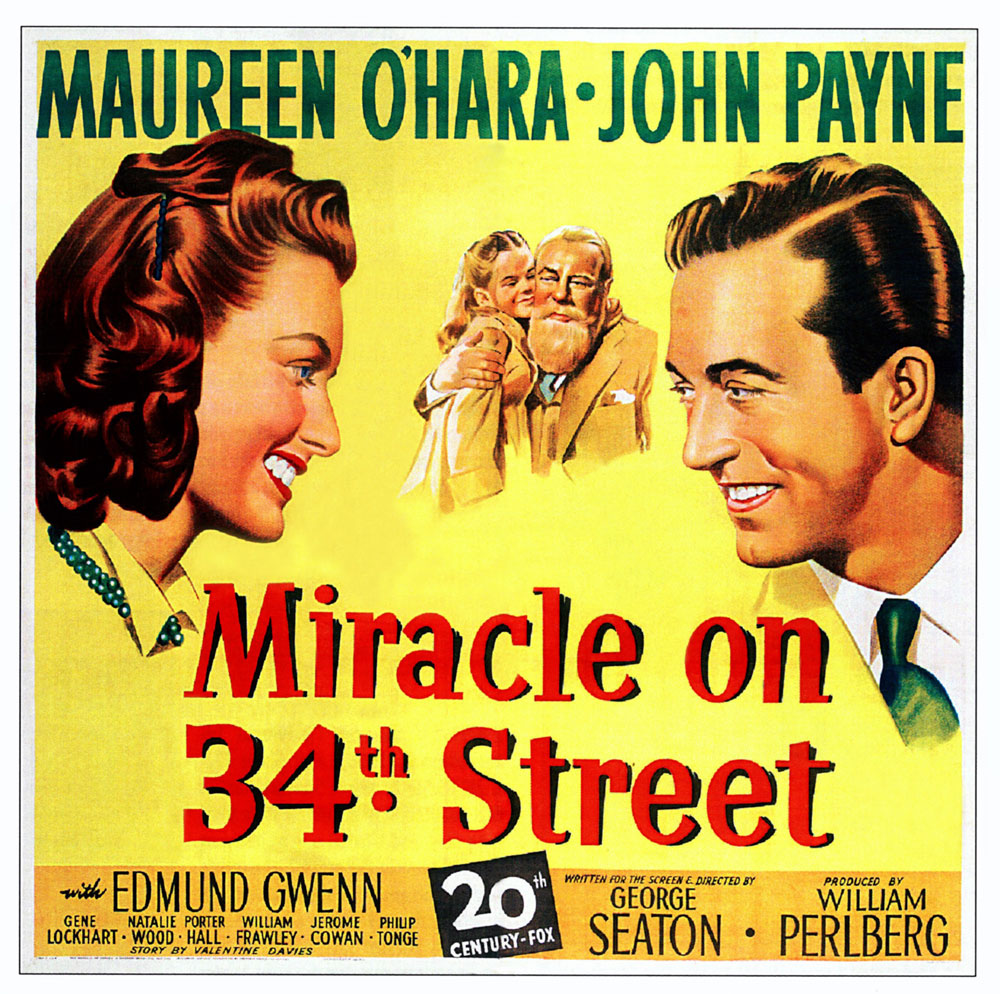
Miracle On 34th Street, posterMiracle On 34th Street, poster, from left: Maureen O’Hara, Natalie Wood, Edmund Gwenn, John Payne on poster art, 1947. (LMPC via Getty Images)
“Miracle on 34th Street” was initially released in May of 1947. Darryl F. Zanuck, studio head of 20th Century Fox believed that audiences tended to stay away from movie theaters during the winter months. He thought a summer release would result in higher profits. Consequently, hardly any mention of Christmas or Santa Claus was made in marketing the film.  Despite this, “Miracle on 34th Street” was a financial success and received glowing reviews from publications like The New York Times where its longtime film critic Bosley Crowther wrote that it was, “the freshest little picture in a long time, and maybe even the best comedy of this year.”  

And the film was a bright spot in an otherwise dismal period for Hollywood. By the following year in a bleak review of the 1947 box office, editors at Life wrote, “Since the invention of the cinematograph, hardly a movie season has seen the bad pictures so heavily outweigh the good.” The article acknowledged the toll of the House Un-American Activities Committee on the industry’s creative output, along with a diminished foreign market for American films.  “Miracle on 34th Street” remained popular however, even almost a year after its release with the magazine’s editors writing in the same piece that the “unheralded little picture about Santa Claus was [the] funniest and most original” of the year.  

Given the context of the late 1940s, “Miracle on 34th Street’s” success should not be surprising. Susan’s Walker’s ultimate desire for a home tapped into a yearning countless Americans also had for a single-family home after years of austerity, sacrifice and frugal living brought on by the twin traumas of the Great Depression and World War II.  This collective expectation and unprecedented demand contributed significantly to a national housing crisis despite the Roosevelt and subsequently, the Truman administration’s passage and implementation of the G.I. Bill. In November of 1945, the legislation was amended so that ex-servicemen could have easy access to low interest home loans. But veterans and their families soon realized that there was a severe shortage of homes available to actually buy.

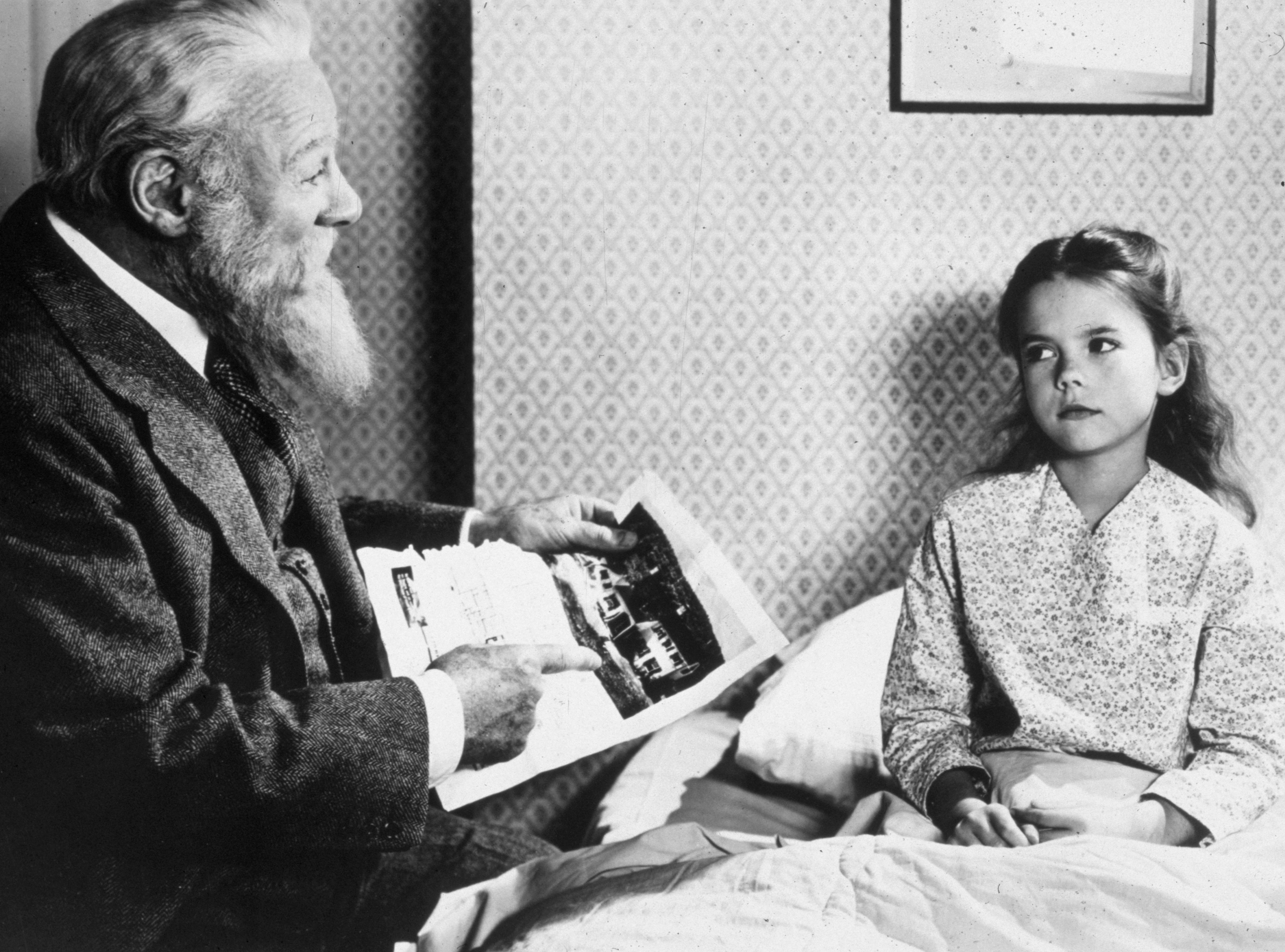
Miracle on 34th StreetWelsh actor Edmund Gwenn (1875-1959) talks with American child actor Natalie Wood (1938-1981) at her bedside in a still from director George Seaton’s film, ‘Miracle on 34th Street’. (Getty Images)
Susan’s Walker’s ultimate desire for a home tapped into a yearning countless Americans also had for a single-family home after years of austerity, sacrifice and frugal living.

And so, from 1946-47, the nation found itself in the throes of a dire housing crisis brought on by a convergence of factors beyond simple supply and demand. Low home inventory was exacerbated by a shortage of building materials, a robust black market in the home building industry and numerous battles between private enterprise and the federal government about how new home construction should be financed. In April of 1946, the editors of Fortune devoted their entire issue to the housing industry, at various points championing the Truman administration‘s plans, questioning the federal government’s role within the industry, pondering how prefabricated homes made of unconventional materials like aluminum or porcelain might shake things up, and profiling well-known builders across the country.  

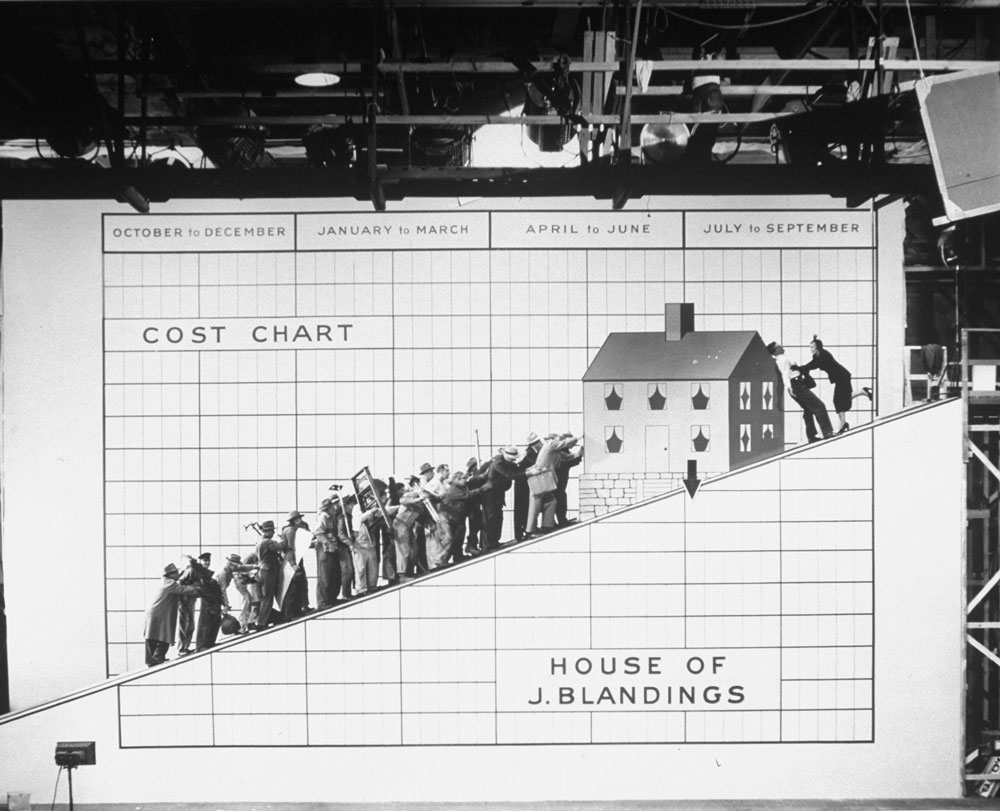
The magazine also included a short story written by Eric Hodgins, the former managing editor of Fortune who had worked his way up to an executive position with Time, Inc. The short story was titled “Mr. Blandings Builds His Castle” and it breezily chronicled the real-life experience of Hodgins and his family as they remodel a run-down country house in the wilds of Connecticut. Costs spiral out of control; hilarity ensues. The story struck such a chord with readers that it was adapted into a film two years later, becoming “Mr. Blandings Builds His Dream House” and starred Cary Grant as the title character.

Like “Miracle on 34th Street,” “Mr. Blandings Builds His Dream House” (1948) intertwines the happiness and satisfaction of the family and traditional family roles with the depiction of single-family homes. Indeed, the immediate postwar period saw a significant increase in discourse around the “Dream House,” best embodied by the proliferation of model homes that worked to stoke the desires of a consuming public anxious to participate in the frenzy of home buying that marked the latter half of the decade. 

Chart showing rising costs of building houseChart showing rising costs of building house, from film Mr. Blandings Builds His Dream House. (John Swope/Getty Images)

These films also promised something else a bit more intangible – community.  As landscape architect Gregory Randall has noted, “the perception of the village, where everyone could own their own home, walk to school or town, and live not just among neighbors but among friends, became a deep desire which would fuel the dreams of young families across the nation.”  Whether a colonial manor or modest Cape Cod, the ways these films juxtaposed the prospect of home ownership with stark visions of the alternative – the concrete jungle and isolating nature of the big city, further demonstrated the allure of suburban living for many families.

A new era in home construction came to define an entire generation of family life.

For example, when the audience first encounters Susan, she is watching the parade from a high-rise apartment owned by Mr. Gailey, a young lawyer who is interested in dating her mother.  Susan is depicted as intelligent, but lonely and somewhat socially awkward with children her own age. Through her friendship with Kris Kringle, she essentially learns how to be a kid, and yearns for nothing more than that house with a big back yard, a tree, and a swing.  The audience of 1947 is also naturally led to conclude that Susan would thrive in such an environment and that the notion of community symbolized by suburban living would significantly aid her social development.

As Louis Hyman has argued, in the immediate postwar period, the embrace of consumer debt made the “good life possible,” and eventually enabled the postwar housing boom of Levittowns and “little boxes” after the Truman Administration made its peace with the home builders by lifting price controls, the availability of low interest home loans became widespread, and supply chain bottlenecks were eventually resolved.  A new era in home construction came to define an entire generation of family life.

Mr. Blandings Builds His Dream HouseMr. Blandings Builds His Dream House, US lobbycard (LMPC via Getty Images)

However, the readily available access to credit did not come easily to everyone.  African Americans were forced to borrow at much higher rates than their white counterparts to achieve their slice of the American dream, the promise of home ownership. In both “Miracle on 34th Street” and “Mr. Blandings Builds His Dream House,” it is no surprise that African Americans have a minimal presence – they are depicted as the domestic help.  In actuality, African Americans enthusiastically moved into suburbs to carve out their slice of the postwar American dream.  They just faced more challenges and obstacles from financial institutions unwilling to lend or developers who denied them the opportunity to move into many of most well-known new neighborhoods and subdivisions. Levittown, Pennsylvania, for example did not allow African American families in any of its developments until 1957 when William and Daisy Myers bought a home from a progressively minded white couple who were committed to the cause of integration.  The Myers were harassed so mercilessly that they stayed in Levittown for only four years.

Another way then to understand the cultural power of film like “Miracle on 34th Street,” of the way it taps into that desire for the perfect home, is as a kind of whitewashing of the more complex realities that many Americans dealt with as they adjusted to a new, uncertain era in the years immediately after World War II. In many instances, they faced obstacles to achieving their dream of home ownership that were simply beyond their control. In the 21st century, we also view films like “Miracle on 34th Street” through the veil of nostalgia.  It is endlessly re-aired on cable television or is there waiting for on-demand viewing in the streaming age. In light of our nation’s current challenges when it comes to home ownership – both the pleasures and pitfalls – it is crucial that we consider how the American dream and the American home became so closely intertwined.  

Learning to love — and protect — burned trees

A forest needs all kinds of trees — even dead ones.

Dead trees, known as “snags,” are some of the most valuable wildlife structures in the forest and help support hundreds of animals.

“A tree really has a second life after it’s been killed, particularly with fire-killed trees, which decay far slower than if a tree succumbs to disease or insects,” says Timothy Ingalsbee, a wildfire ecologist and executive director of the nonprofit Firefighters United for Safety, Ethics and Ecology. “I’ve called them ‘living dead trees.'”

Wildfire-ravaged forests may appear devoid of life from a distance — they’re often described in the media as “destroyed” or “moonscapes” — but the reality is quite different, as more than 200 scientists and land managers wrote in a letter to Congress when the 2018 Farm Bill contained proposals to speed up and expand logging on public lands in response to increasing wildfires:

“Though it may seem to laypersons that a postfire landscape is a catastrophe,” they wrote, “numerous studies tell us that even in the patches where fires burn most intensely, the resulting wildlife habitats are among the most biologically diverse in the West.”

But that hasn’t stopped federal agencies like the U.S. Forest Service and Bureau of Land Management from cutting trees burned in wildfires or selling the logging contracts to private timber companies. Post-fire logging, which is done in forests all over the world, is prevalent the western United States, where there’s a large amount of federally owned land, a lot of big trees, and frequent fires.

Even the term frequently used by agencies for post-fire logging — “salvage logging” — gives a good indication of how forests are seen after a fire.

“Just about every time you get a burn — a severe burn, especially — the agencies are going to go in and do post-fire logging,” says Dominick DellaSala, chief scientist at Wild Heritage, a nonprofit that focuses on forest protection and restoration. “They’ve taken advantage of the public’s perception that if there was a big burn and it’s a blackened forest, it’s no longer important, so why not just log it.”

The Value of ‘Living Dead Trees’

The ecological reasons for leaving burned trees in a forest are numerous.

For one thing, dead trees help jumpstart the new forest. They’re biological legacies that offer habitat, food, and other resources to bugs, birds and mammals.

After a fire life returns within days. Longhorn beetles and other wood borers come to feast on the sap from burned trees while they’re still smoldering. They’re usually followed by the birds that feed on them. In the West’s coniferous forests, that often means black-backed woodpeckers. They build homes for themselves in the burned trees, as well as for other cavity-nesters, including birds, squirrels and martens. Other birds that flock to burned forests include white-headed woodpeckers, Lewis’s woodpeckers, three-toed woodpeckers, olivesided flycatchers, Clark’s nutcrackers and mountain bluebirds.

As wildflowers, shrubs and morels emerge, more small mammals arrive to eat the newly regenerating vegetation. Then come the larger mammals and birds like spotted owls to prey on these smaller animals.

When snags fall, they also have benefits. Downed trees can help retain moisture, add nutrients to the soil, and become “nurse trees,” out of which new saplings grow. “An astounding two-thirds of all wildlife species use deadwood structures or woody debris for some portion of their life cycles,” wildlife biologist Richard Hutto of the University of Montana wrote in a study for Conservation Biology. They can even help provide habitat for fish and other aquatic animals if they fall into creeks and rivers.

“The snags and the downed logs are all part of the rebirthing of a forest — a process that eventually gives you an old-growth forest,” says DellaSala.

Logging’s Degradation

While some people may think a wildfire is a disaster for a forest, DellaSala says the real disaster is what can happen if the area is heavily logged after such an event. The process can impede the forest’s recovery by compacting soils and killing the associated microbial communities that are important for a healthy, biodiverse ecosystem.

“A burned forest is very sensitive to additional disturbances,” says Ingalsbee. “Bare exposed soil is very erosive and when you’re slamming large logs and dragging them on steep slopes, then you lose forest soil and that is more or less a permanent loss in a human lifetime. It takes a long time to develop a fertile soil bed.”

Logging trucks and equipment can also kill or disturb native seed banks that would naturally regenerate after fire and lead to new growth. The associated roadbuilding can cause water-quality problems and degrade habitat.

And it’s not just the initial clearcutting that’s problematic — it’s also what follows, which is usually intensive management with tree planting and herbicides.

“Instead of having this natural diverse mosaic of vegetation patterning that comes in after a fire with patches of hardwoods and patches of conifers and open areas where flowering species can thrive,” says Luke Ruediger, conservation director of the Klamath Forest Alliance. “The agencies tend to come in and plant these even-aged, evenly spaced and relatively densely packed plantation stands that then can increase fire risks and are more biologically sterile than the naturally regenerating habitats that surround them.”

Agency Rationale

These cumulative impacts add up to a lot of reasons not to log a forest after a wildfire.

“I am hard pressed to find any other example in wildlife biology where the effect of a particular land-use activity is as close to 100% negative as the typical postfire salvage-logging operation tends to be,” wrote Hutto in the Conservation Biology study.

So why does post-fire logging persist? Mostly, it’s money.

“Harvesting timber following fire is usually an economic undertaking and rarely a restorative activity in the sense of ecological restoration,” a 2009 Forest Service study makes clear.

Fire-killed or damaged trees are still seen as valuable if they’re cut within a couple of years. Usually there’s just a thin layer of char on the outer bark of the trees that can be stripped off. The inside wood is then used for lumber or other wood products, just as green-cut trees would be.

While private companies can make good money, government agencies also bring in a fair amount. “The federal government pulls in about $150 million annually from selling the timber in national forests, about one-fourth of which comes from post-fire logging,” reported Forbes.

But the math doesn’t always pencil out for taxpayers, who also foot the bill for roadbuilding, replanting, herbicides, and the other treatments that follow. A 2006 report by the Government Accountability Office found that salvage logging after the 2002 Biscuit Fire, which burned 500,000 acres in California and Oregon, was a $2 million loss for taxpayers.

The other reason is safety. Fire-killed trees in areas where people drive or recreate can be hazardous. That’s why popular hiking trails are often closed following wildfires when trees are at risk of falling.

Removing dead trees that pose a public safety risk is a legitimate concern. But increasingly environmental advocates say they’ve seen roadside post-fire logging projects for remote Forest Service roads or needlessly far from the road’s edge.

“A number of years ago they were logging about 50 feet on either side of the road and now they’re going to 200 and 300 feet, which starts to look and feel a lot more like unit logging than hazard tree removal,” says Ruediger. Much of this work is done using a “categorical exclusion” under the National Environmental Policy Act, which doesn’t require an environmental assessment or environmental impact statement. That makes the approval process quicker and allows cutting to begin before fire-killed trees are too compromised by bugs and rot to be used for lumber.

“Agencies were proposing a lot of categorical exclusions for roadside logging, calling it ‘road maintenance,’ ” he says. Last year in Oregon, for example, the Forest Service planned to allow commercial logging 200 feet on either side of 400 miles of Forest Service roads in areas burned during the 2020 Labor Day fires in the Willamette National Forest.

The agency said the 20,000-acre plan fell under a categorical exclusion for “repair and maintenance” of roads in the national forest. But three conservation groups sued, saying it was nothing more than a standard logging project disguised as a hazard tree removal effort and should be subject to environmental review.

A federal judge agreed, writing in his decision that, “This Project allows commercial logging that, at least at this stage, will almost certainly have more than a minimal impact on the environment.” His order halted the project in November 2021, and the agency formally withdrew the plan in January 2022.

In a similar case last year, the Klamath Forest Alliance legally challenged a 4,000-acre logging project in the Rogue River-Siskiyou National Forest following the 2020 Slater fire along the California-Oregon border. The group contended that many of the areas proposed for logging to remove hazard trees were along backcountry roads that saw little traffic. The Forest Service settled with the organization out of court, agreeing to limit cutting to only important roadways where there are imminent safety hazards.

Shifting Perspective

Legal challenges from environmental groups have helped prevent some unnecessary logging of snags, but DellaSala admits that a much bigger effort is needed to change hearts, minds and policy. Getting the public, legislators and agency staff to see the benefit of a burned forest isn’t easy, because wildfires — pardon the pun — are a heated issue.

“There’s issues of economics, the smoke, fire phobia, misinformation, people losing their homes, firefighters losing their lives,” he says DellaSala. It’s complicated.

His own understanding of the value of burned forests changed after three decades of studying forest ecosystems. In 2012 he went for a hike with his daughter near their home in Ashland, Oregon. The area had been burned a decade earlier in a wildfire, but they were surprised to find the area alive with wildflowers, dragonflies, butterflies, songbirds and woodpeckers.

“There was more sound in that high-severity burn patch than I was used to hearing in old-growth forests. It was so alive. It was not a moonscape, it was not a catastrophe,” he says. “I had to recalibrate my understanding of what a forest is.”

Ruediger has seen the same thing in the mountains of California and Oregon.

In July he hiked through forest burned two years prior in the Slater fire and found a superbloom. He wrote of the experience:

Bursting with vibrancy, life and unbelievable color, the flowers are currently so thick that you can see bright yellow swaths of Oregon sunshine (Eriophyllum lanatum) and mountain arnica (Arnica latifolia) blooming from ridges away. The butterflies, bees, pollinating beetles and flies swarm the sea of blossoms in a frenzy, collecting pollen and nectar. Songbirds dart about in the regenerating vegetation, eating insects and wildflower seeds. Deer and elk nibble on the herbaceous growth and the abundant, fire-coppiced trees and shrubs. Bears graze on the greenery. Raptors soar above the snag forest looking for prey species, whose populations have exploded since the fire, and woodpeckers drum against the standing snags in a repetitive chorus, noisily foraging for ants, grubs and other insects.

And that experience, he says, is not uncommon.

“I think that people will be shocked and surprised by how much life there is in a lot of these areas that they were told were devastated by wildfire,” he says. “My experience is that as long as there isn’t post-fire logging, in a lot of these situations the regeneration comes back — the trees come back. Sometimes that just takes more time than people are willing to give it.”

Judge Luttig: A judge might have no choice but to put Trump in prison

Former Federal Judge J. Michael Luttig said this week that former President Donald Trump would likely end up behind bars if he were convicted of inciting an insurrection and other charges.

Earlier this week, the House select committee investigating the attack on the U.S. Capitol urged the Justice Department to prosecute Trump for inciting an insurrection, obstruction of an official proceeding, conspiring to defraud the US government and making false statements.

During an appearance on Yahoo News’ “Skullduggery” podcast, Luttig was asked about the potential charges facing Trump and whether he could land in prison if convicted.

“I believe that were the former president convicted of, let’s say, all four of these counts, that a district court judge would sentence the former president to imprisonment,” Luttig said.

“That would be, of course, as you can appreciate, merely the beginning of the very long process, during which the former president would challenge the convictions themselves, the sentencing by the district judge, all the way up through the Court of Appeals, and then just violated.”

Luttig is a renowned conservative legal scholar who advised Trump’s vice president Mike Pence.

“I don’t know that a district judge would have any choice but to sentence the former president to imprisonment under the terms and provisions of these various offenses,” Luttig said.

Watch video below.

Colorado considers changing its red flag law after mass shooting at nightclub

A Nov. 19 shooting that killed five people and wounded 19 at a Colorado Springs nightclub has officials considering changes to strengthen Colorado’s red flag law, particularly in self-declared “Second Amendment sanctuaries,” where emergency petitions to remove a person’s guns are filed less frequently and usually denied.

The three-year-old state law allows law enforcement officials or family members to seek a court order to seize the guns of a person who poses a threat to themselves or others. But the Club Q shooting underscores a fundamental challenge for it and other red flag laws: Sheriffs often refuse to use the measures based on a belief that they infringe on the Second Amendment’s right to bear arms.

El Paso County, where the Colorado Springs shooting happened, is one such place. It has the lowest approval rate for initial court petitions filed under the law of any county in Colorado where more than three cases have been filed, according to a KHN analysis of court records. Now Colorado lawmakers, like those in other states that have experienced mass shootings in recent years, will try to turn angst over the incident into legislative action to strengthen the state’s red flag law, including potentially expanding the pool of people who can petition for a protection order.

Soon after the arrest of Anderson Lee Aldrich, the man accused of the Club Q shooting, reports surfaced of a previous incident in which he surrendered to police after threatening to blow up his mother’s home with a homemade bomb.

According to The Associated Press, court transcripts show that the judge who dismissed the case said in a hearing that the defendant had been stockpiling weapons and explosives, was “clearly” planning a shootout, and that he needed mental health treatment. Neither the family nor law enforcement sought an extreme risk protection order to ensure Aldrich didn’t have access to guns, leading to questions about whether November’s shooting could have been prevented if they had.

Colorado’s red flag law, passed in 2019, has been used more than 350 times, with initial petitions for protection orders being granted in nearly 2 in 3 cases.

Judges in El Paso County approved 11 out of 53 initial petitions, just over 20%, through Nov. 22. Although El Paso County is the most populous county in Colorado, about twice as many petitions were filed in Denver County, the next largest. There, judges approved 91 of 104 initial petitions, or nearly 88%.

Violence prevention advocates attributed El Paso County’s low approval rate to several factors. Among them, the county declared itself a Second Amendment sanctuary county in opposition to the red flag law, and El Paso County Sheriff Bill Elder has been adamant sheriff’s officials won’t seek any protection orders, “unless exigent circumstances exist.”

So far, the only two petitions filed by law enforcement in the county were sought by the Colorado Springs Police Department.

Analyses of red flag laws across the country show law enforcement officials are much more successful when they file petitions than when relatives or roommates of the person in question do.

“The ones that are petitioned for by law enforcement were approved more than 90% of the time, whereas the ones that are petitioned by family members, cohabitants, or parents were approved less than a third of the time,” said Dr. Chris Knoepke, a gun safety researcher with the University of Colorado’s Firearm Injury Prevention Initiative.

It’s unclear why law enforcement’s batting average is higher. It may be that police are more familiar with the legal requirements for processing and don’t make simple mistakes that can sink a petition. Law enforcement may also have easier access to legal help in filing, and judges may consider law enforcement officials more credible than family members.

Second Amendment sanctuary declarations by county governments or sheriffs can also have a chilling effect on petitions if laypeople misconstrue the largely symbolic gesture as preventing them from seeking a protection order.

The El Paso County Sheriff’s Office was widely criticized for not seeking a protection order after the Club Q suspect had been arrested and his guns seized in June 2021 after threatening to blow up his mother’s home. The sheriff’s office issued a statement in December saying the suspect’s weapons had already been seized and a mandatory protection order was in place, preventing him from buying additional firearms.

However, the charges against him were dismissed in July 2022, removing the mandatory protection order. The case records were sealed, which sheriff’s officials said prevented them from using that incident to pursue an extreme risk protection order. And no new evidence was available that would have allowed the sheriff to seek one, officials added.

Colorado Gov. Jared Polis, a Democrat, said his administration will look into why petitions were not filed in Colorado Springs and ways to strengthen the red flag law.

“We’re having a discussion now with local law enforcement, with state legislators about what holes exist in extreme risk protection orders and how we can better make sure that we have a system that works to keep people safe across Colorado,” the governor said.

Polis has floated the idea of expanding the group of eligible petitioners and has mentioned district attorneys as another potential category.

Nineteen states and the District of Columbia have red flag laws on their books, allowing different parties to petition for protection orders. Law enforcement officers file most red flag law petitions, although the lines between filing groups are often blurred. Family members or others with the ability to petition often ask police to file on their behalf, and some police departments urge relatives to let police handle the petition because they’re better at it.

Four states and the District of Columbia also allow health providers to petition. But those still represent a sliver of the total petitions filed.

“Health providers see this as a tool that can help their patients, but they don’t have the time to do it,” said Lisa Geller, director of state affairs at Johns Hopkins University’s Center for Gun Violence Solutions.

Maryland is hiring navigators to help health providers petition for protection orders, without having to go to court themselves. That kind of assistance could help other petitioners improve their chances of getting a protection order granted.

“When petitioners for domestic violence restraining orders have lawyers, their petitions for restraining orders are more likely to be granted,” said April Zeoli, an associate professor with the Institute for Firearm Injury Prevention at the University of Michigan. “These legal forms are not something that the general public is used to filling out.”

Geller said advocates are pushing states to use money available through the Bipartisan Safer Communities Act to increase education about red flag laws, both to make more people aware of the tool and to help law enforcement or other eligible petitioners learn how to seek them.

Colorado can access $4.6 million in funding for the 2022 and 2023 fiscal years and must apply for funds this month.

Florida passed its law after the 2018 Parkland high school shooting, and New York and Illinois expanded their laws after mass shootings in Buffalo and Highland Park, respectively. New York Democratic Gov. Kathy Hochul directed state police to expand the use of protection orders and created staff positions to make that happen. According to the governor’s office, 832 temporary and final extreme risk protection orders were issued in New York state in the three months after Hochul’s directive, compared with 1,424 issued from August 2019 to April 2022.

Colorado gun violence prevention advocates expect state legislators to push for tougher gun laws in the upcoming legislative session. Democrats held a slim majority in 2019 when they passed the bill establishing the red flag law, limiting its scope. But a landslide victory by Colorado Democrats in 2022 could provide the votes to offer more sweeping gun measures, such as a red flag law expansion, a semiautomatic weapons ban, or a raise in the minimum age for purchasing guns to 21.

“There was an appetite for this, anyways, before the Springs shooting,” said Eileen McCarron, president of gun violence prevention group Colorado Ceasefire Legislative Action. “But I think that shooting has exacerbated the issue, giving it more momentum.”


KHN (Kaiser Health News) is a national newsroom that produces in-depth journalism about health issues. Together with Policy Analysis and Polling, KHN is one of the three major operating programs at KFF (Kaiser Family Foundation). KFF is an endowed nonprofit organization providing information on health issues to the nation.

Subscribe to KHN’s free Morning Briefing.

The 13 most buzzworthy fashion statements of 2022, ranked

Whether they’re challenging gender norms or ditching fashion trends for riskier choices, celebrities never fail to make headlines on the red carpet. This year, there were several notable moments in celebrity fashion, from one star’s iconic maternity style to another’s contentious decision to don a historical gown that everyone had an opinion about. We also saw a grotesque Halloween costume and a high fashion dress made purely from spray-on fabric.

Of course, listing out all the major fashion statements from 2022 would be both vast and lengthy. So, we narrowed down our selections on the basis of how prominent they were discussed online. What makes a fashion showcase buzzworthy is lots of public attention, notably on social media sites like Twitter and media coverage. All of these moments spurred some kind of online discourse, both favorable and unfavorable.

From Florence Pugh’s free the nipple moment to Kanye “Ye” West’s “White Lives Matter” shirt, these are the buzziest fashion moments of the year, ranked from least to most discussed.

13
Bella Hadid’s spray-on Coperni dress
Bella HadidPerformance of fashion model Bella Hadid during the Coperni Womenswear Spring/Summer 2023 show as part of Paris Fashion Week on September 30, 2022 (Estrop/Getty Images)

The 26-year-old supermodel went viral after closing out French label Coperni’s Spring-Summer 2023 show in a dress that was sprayed on in front of a live audience. Social media videos of the iconic moment show Hadid wearing nothing but a nude thong as Manel Torres — a Spanish fashion designer and creator behind the patented spray-on fabric Fabrican — showered her with mists of liquid that slowly morphed into a figure-fitting dress. The dress was then altered with a neckline and a high leg slit before Hadid strutted down the runway.


Spray paint technology is not a foreign concept in haute couture — Alexander McQueen first implemented the technology 23 years ago for his Spring 1999 collection. However, Hadid’s showcase is the first time a full outfit has been created purely from spray-on fabric, thus changing the future of fashion as we know it.

12
Anne Hathaway cosplays as Andy Sachs
Anne HathawayAnne Hathaway is seen on September 14, 2022 in New York City (Rachpoot/Bauer-Griffin/GC Images/Getty Images)

Hathaway channeled her iconic “The Devil Wears Prada” character, Andy Sachs, while attending a Michael Kors show at New York Fashion Week. Her complete look featured an all-black turtleneck sweater with a brown croc-embossed skirt and a matching trench coat, which was very reminiscent of Sachs’ final outfit in the 2006 comedy-drama film.


Per Hathaway, the entire look was put together by accident. “I was supposed to wear something else,” she later said during an October appearance on the “Today” show. “The shoes didn’t fit, this was the other outfit that came.”


The real highlight of the moment was Hathaway sitting next to Vogue editor-in-chief Anna Wintour, who served as the inspiration for Miranda Priestly (Meryl Streep) in the film.

11
Katie Holmes’ casual Jingle Ball outfit
Katie HolmesKatie Holmes speaks onstage at the Z100’s iHeartRadio Jingle Ball 2022 at Madison Square Garden on December 09, 2022 in New York City (Michael Loccisano/Getty Images)

Holmes’ simple Y2K ensemble of a sleeveless mini dress, loose-cut jeans and black sneakers sent the internet into a frenzy. Some said her look was “so bad that it’s actually camp” while others asked, “How dare Katie Holmes have the audacity to try to bring back” the outdated dress-over-jeans trend.


Holmes’ stylist, Brie Welch, later defended the ensemble in an interview with The New York Times, saying, “We decided the rich color and subtle bustier effect detailing of the top was elegant and would be fun if paired with jeans.” Welch added that both she and Holmes wanted to flaunt “a more youthful feel for Jingle Ball and the atmosphere there.” 

10
Julia Fox’s gripping Oscars after party look
Julia FoxJulia Fox attends the 2022 Vanity Fair Oscar Party hosted by Radhika Jones at Wallis Annenberg Center for the Performing Arts on March 27, 2022 in Beverly Hills, California (Arturo Holmes/FilmMagic/Getty Images)

The “Uncut Gems” star, who is notably co-director Josh Safdie’s muse for the film, quickly rose to popularity for her ludicrous yet divisive street style. There’s her underwear in the parking lot look, her plunging V-crotch leather trousers look and her teeny-tiny denim bra top look.
 
But her most outrageous getup was the menacing “Grip” dress she wore to Vanity Fair’s 2022 Oscars after party. Designed by Han Kjøbenhavn, a Copenhagen-based label that specializes in leather and fur, the all-black dress featured a claw-like hand gripping Fox’s neck. The complete look also included leather gloves and a clutch that Fox claimed was made of human hair. That’s not creepy at all.
09
Summer Walker’s revealing cultural appropriation
Summer WalkerSummer Walker attends the 2022 BET Awards at Microsoft Theater on June 26, 2022 in Los Angeles, California (Paras Griffin/Getty Images for BET)

The R&B singer’s risque BET awards outfit — which consisted of a bejeweled miniskirt, black and gold body jewelry and matching gold nipple covers — was reportedly inspired by the Indigenous Hmong people of Southeast Asia (why??). Many online critics accused Walker of cultural appropriation and deemed her showcase as disrespectful. Following the backlash, Laurel Street — the brand that designed Walker’s look — issued a statement on its Instagram story apologizing for “not sharing and educating on the history of the Hmong people” and asserting that it was not its “intention to sexualize” the jewelry Walker wore.
08
Timothée Chalamet’s backless jumpsuit
Timothee ChalametTimothee Chalamet attends the “Bones And All” red carpet at the 79th Venice International Film Festival on September 02, 2022 (Stefania D’Alessandro/WireImage/Getty Images)

If Chalamet’s recent red carpet outfits told us anything, it’s that the 26-year-old actor is not afraid of challenging or breaking gender norms. Chalamet did exactly that while promoting his new coming-of-age romance film “Bones & All” at the 2022 Venice Film Festival, where he bared his back in a bright red halter-neck jumpsuit by designer Haider Ackermann. The complete look was finished off with a pair of black boots (akin to cowboy boots) and a pair of black RayBan sunglasses.


On Twitter, fans gushed, “Timothée Chalamet is the most special sexy man alive.. no one can forget him,” and even proclaimed, “I let [sic] the Timothée Chalamet crush me.”

07
Florence Pugh’s revenge “Don’t Worry Darling” dress
Florence PughFlorence Pugh at the 79 Venice International Film Festival on September 5th, 2022 (Rocco Spaziani/Archivio Spaziani/Mondadori Portfolio via Getty Images)
Prior to its September premiere, “Don’t Worry Darling” — Olivia Wilde’s psychological thriller — was at the center of multiple scandals and conspiracy theories. Amid rumors of rifts and feuds amongst the cast, star Florence Pugh attended its premiere at the Venice Film Festival in a black Maison Valentino frock that was later dubbed a “revenge dress.”
 
The elaborate off-the-shoulder gown, with built-in hotpants and a winding train, was interpreted by many as an act of defiance, presumably toward Wilde, whom she allegedly had a issues with). Not to mention, Pugh was not in attendance at a press conference for the film that took place just a day prior. Per Wilde, Pugh’s absence was due to scheduling conflicts and a late-arriving flight. But those claims were debunked when Pugh was spotted in Venice, wearing an all-purple Valentino fit and holding a matching clutch in one hand and an Aperol spritz in the other.
06
Billie Eilish and Jesse Rutherford’s baby and old man Halloween costumes
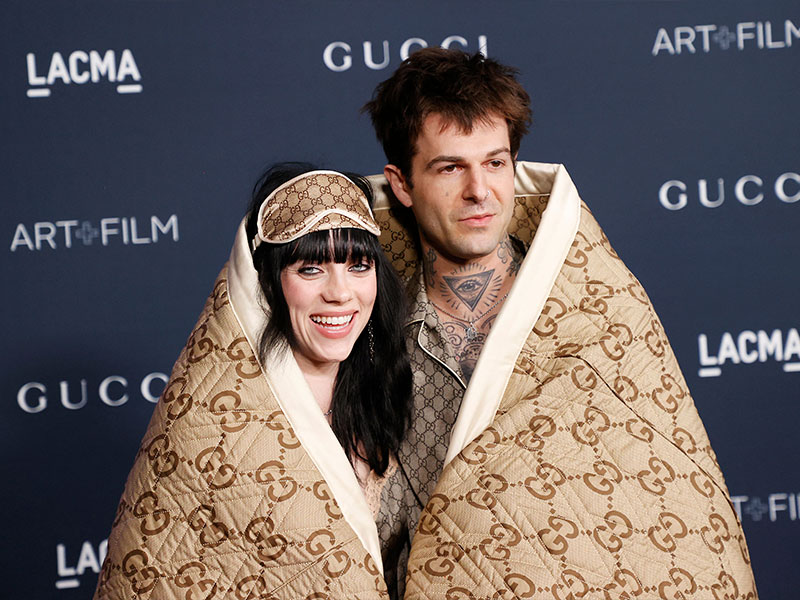
Billie Eilish and Jesse RutherfordBillie Eilish and Jesse Rutherford attend the 11th Annual LACMA Art+Film Gala at the Los Angeles County Museum of Art on November 5, 2022 (MICHAEL TRAN/AFP via Getty Images)

The contentious couple raised eyebrows with their bizarre Halloween costumes, which seemed to poke fun at their vast 10-year age gap. Pictures showed Eilish, 21, dressed as a baby, while Rutherford, 31, dressed as an old man. Fans were quick to call out the bizarre couples costume on Twitter, saying, “Something doesn’t sit right with me knowing that Billie Eilish dressed up as a baby and Jesse Rutherford dressed up as an old man” and calling the relationship both “wrong” and “weird.” Others speculated that Eilish and Rutherford were trolling online critics after receiving an outpour of backlash.


Shortly after their Halloween stunt, the pair made their red carpet debut, dressed in matching Gucci sleepwear and covered in a giant Gucci blanket.

05
Rihanna’s maternity style
RihannaRihanna is seen outside the Dior show, during Paris Fashion Week, on March 01, 2022 in Paris, France (Edward Berthelot/Getty Images)

After staying quiet about her pregnancy, Rihanna announced the news via a series of iconic maternity outfits, which showcased her growing belly front and center. A few of her notable ensembles include her sheer black Valentino gown worn at Jay Z’s Oscars after party, her silver two-piece outfit for a Fenty Beauty event in Los Angeles, her lingerie-themed getup at the Dior show at Paris Fashion Week and, most notably, her custom slinky set worn at a launch event for her Fenty Beauty and Fenty Skin lines. 


“It’s been me personally saying, I’m not going to buy maternity clothes — I’m not gonna buy maternity pants, jeans, dresses, or [do] whatever society told me to do before,” Rihanna told Bustle. “When I saw women dress during their pregnancy [in the past], I’d think that that was the only way. So I challenged myself to push it further and really just have fun with [maternity style].”

04
Heidi Klum’s worm Halloween costume
Heidi KlumHeidi Klum attends Heidi Klum’s 2022 Halloween Party at Sake No Hana at Moxy LES on October 31, 2022 in New York City (Taylor Hill/Getty Images)

The Queen of Halloween hosted her 21st annual Halloween bash dressed as a grotesque earthworm with husband Tom Kaulitz accompanying her as a fisherman. Making Klum’s suit was no easy feat — per The Hollywood Reporter, the whole process took four months of development and 12 hours to apply — and wearing it wasn’t either. “I was so claustrophobic in that costume,” Klum said. “It is one thing to add prosthetics to your body — but to be stuck inside the worm body and not really be able to use my arms or feet was not very comfortable. But Halloween is not about comfort.”


The costume also spurred a slew of internet memes, with fans referencing the classic “Would You Still Love Me If I Was a Worm” joke. Others likened Klum’s worm to a vertical shawarma broiler, meat or bacon and, even cruelly, Samantha Jones’ raw, red face post-chemical peel.

03
Florence Pugh’s free the nipple moment
Florence PughFlorence Pugh attends the Valentino Haute Couture Fall/Winter 22/23 fashion show on July 08, 2022 in Rome, Italy (Vittorio Zunino Celotto/Getty Images)

Pugh bared her chest in a sheer pink gown at Valentino’s Fall/Winter 2022 Haute Couture runway show in Rome. Naturally, the outfit garnered outrage from online trolls, who shamed Pugh and criticized her body.


The actress later took to social media to address the backlash, writing in a caption, “Listen, I knew when I wore that incredible Valentino dress that there was no way there wouldn’t be a commentary on it. Whether it be negative or positive, we all knew what we were doing. I was excited to wear it, not a wink of me was nervous. I wasn’t before, during or even now after.”


She added, “What’s been interesting to watch and witness is just how easy it is for men to totally destroy a woman’s body, publicly, proudly, for everyone to see. You even do it with your job titles and work emails in your bio.”


Shortly after the controversy, Pugh freed her nipples yet again in a sheer long-sleeved nude crop top with a matching maxi skirt and a pink nightdress at the British Independent Film Awards.

02
Kanye West’s “White Lives Matter” shirt
Kanye WestKanye West aka Ye is seen wearing a Balenciaga boxing mouthguard, outside Givenchy, during Paris Fashion Week on October 02, 2022 (Edward Berthelot/GC Images/Getty Images)

During his surprise Yeezy fashion show in Paris, the controversial rapper wore a black t-shirt emblazoned with the message “White Lives Matter” on the back. A matching white version of the shirt was also donned by controversial political personality Candace Owen.


In an Oct. 7 interview with Tucker Carlson, West explained why he wore the shirt, saying, “I do certain things from a feeling, I just channel the energy. It just feels right. It’s using a gut instinct, a connection with God and just brilliance.”


He added, “People, they’re looking for an explanation, and people say, ‘Well, as an artist you don’t have to give an explanation,’ but as a leader, you do. So the answer to why I wrote ‘White Lives Matter’ on a shirt is because they do. It’s the obvious thing.”

01
Kim Kardashian’s Met Gala dress
Kim KardashianKim Kardashian attends The 2022 Met Gala at The Metropolitan Museum of Art on May 02, 2022 in New York City (Gotham/Getty Images)

Perhaps the most buzzworthy fashion moment from this year is Kardashian’s infamous Marilyn Monroe showcase at the Met Gala. The reality TV star broke the internet yet again when she donned Monroe’s iconic 1962 gown — in which the esteemed actress sang “Happy Birthday Mr. President” to John F. Kennedy at Madison Square Garden — before changing into a lookalike gown. The brief moment was enough to spur criticism from internet critics and costume historians, who deemed it as a sign of disrespect. In fact, the outrage was so immense that the International Council of Museums, the novelty museum that bought the dress for $4.8 million at a 2016 auction, issued renewed guidelines on handling historic garments.


To add to the controversy was Kardashian’s strict and extreme diet regime that helped her lose 16 pounds in three weeks to fit into the original dress. In an interview with Vogue, she explained, “I would wear a sauna suit twice a day, run on the treadmill, completely cut out all sugar and all carbs, and just eat the cleanest veggies and protein.”

Michael Tomasky: “No one has damaged the Supreme Court’s reputation more than the Thomases”

During the 1990s, Justice Clarence Thomas and the late Antonin Scalia represented the lunatic fringe of the U.S. Supreme Court. Thomas’ far-right social conservatism stood in contrast to the liberalism of the late Justice Ruth Bader Ginsburg, the right-wing libertarianism of Justice Anthony Kennedy and the moderate conservatism of Justice Sandra Day O’Connor.

But with the high court now dominated by the radical right, Thomas is no longer out of step with most of his fellow justices. These days, Thomas is arguably more influential on the court than Chief Justice John Roberts. And the activism of his wife, far-right conspiracy theorist Ginni Thomas, has been drawing more and more scrutiny — especially in light of his wife’s efforts to help former President Donald Trump overturn the 2020 election results.

Many critics of the Thomases have been stressing that it is a major conflict of interest for someone as active on the far right as Ginni Thomas to be married to a Supreme Court justice. Democratic Rep. Alexandria Ocasio-Cortez of New York City has even called for Justice Thomas’ impeachment.

Ginni Thomas has insisted that there is no conflict of interest because the Thomases operate in “separate lanes.” But journalist Michael Tomasky, in a scathing article published by The New Republic on Dec. 23, lays out some reasons why the “separate lanes” argument is problematic. The New Republic, in fact, has picked Clarence and Ginni Thomas as their “Scoundrels of the Year” for 2022.

“Clarence Thomas, now concluding his 36th year as an associate justice of the Supreme Court, has spent years flouting the ethics rules to which all federal judges except Supreme Court justices must adhere,” Tomasky explains. “Ginni Thomas has spent those same years in the thick of the right-wing infrastructure that has pushed cause after cause after cause — many of which have eventually made their way to the Supreme Court. She has maintained that the two operate in ‘separate lanes’ professionally. It’s a line that kinda-sorta worked . . . It was always murky at best. But in 2022, it became far less so.”

Tomasky continues: “She texted urgently with Trump White House Chief of Staff Mark Meadows in late 2020 and early 2021 about strategies to overturn the election, as The Washington Post revealed in a blockbuster story back in March. In due course, the matter of Meadows’ e-mails and other White House documents relating to the Jan. 6 insurrection came before the Supreme Court — an extremely conservative Supreme Court, remember, now with three justices appointed by Trump himself. And in Jan. 2022, the only justice to vote against ordering the release of the material was the one whose wife’s scribblings were included within it.”

The Big Lie — Trump’s false claim that the 2020 presidential election was stolen from him through widespread voter fraud — has been thoroughly debunked time and time again. But it’s a conspiracy theory that the wife of a U.S. Supreme Court justice aggressively promoted during the late 2020/early 2021 lame-duck session.

In one of her text messages to Meadows, Tomasky notes, Ginni Thomas wrote, “Biden crime family & ballot fraud co-conspirators (elected officials, bureaucrats, social media censorship mongers, fake stream media reporters, etc) are being arrested & detained for ballot fraud right now & over coming days, & will be living in barges off GITMO to face military tribunals for sedition.”

The U.S. is in a dangerous place, Tomasky warns, when the wife of an influential U.S. Supreme Court justice holds such views and is very active in her party.

“If we are to believe the ‘separate lanes” theory,” Tomasky argues, “then we accept not only that Ginni did not share the content of these messages with her husband, which is plausible, but also, that she never said to him, over dinner or while relaxing with Fox News at night, that she had exchanged texts with Meadows. You can believe that if you want.”

Tomasky adds that when it comes to conflicts of interest, no one on the Supreme Court is worse than Justice Thomas.

“When Ruth Bader Ginsburg joined the D.C. Court of Appeals, her husband quit practicing tax law and returned to teaching,” Tomasky notes. “When John Roberts was nominated for the high court, his wife left her law practice and resigned from a position at a pro-life group. Not the Thomases. Make no mistake: The entire right-wing bloc has damaged the court’s credibility. But no one has damaged the Supreme Court’s reputation more than the Thomases.”

Words of the year 2022: We were gaslit in goblin mode

The words of 2022 were “goblin mode,” in the United Kingdom, and “gaslight,” in the United States.

In these times of the right’s determined distribution of disinformation, conspiracy theories and lazy thinking, those choices make perfect sense.

We are all now more than familiar with gaslighting, which dates back to the original 1940 film “Gaslight,” (remade by MGM in 1944, starring Charles Boyer and Ingrid Bergman), in which a deceitful husband repeatedly lies to his wife about many things, including the gas lamps dimming in the lower part of the house as he secretly lights lamps in the attic, in an effort to shake her sanity.

A real-life example of gaslighting, the word of 2022 selected by the folks at the Merriam-Webster Dictionary, would be, for instance, Donald Trump insisting that he is a good businessman or that the 2020 election was stolen. When any of the scores of open traitors in Congress, like Marjorie Taylor Greene or Josh Hawley, refer to themselves as patriots, that would also be gaslighting. The claim in no way fits the reality, and it refutes what anyone of good faith can plainly see, that these people violated their oaths of office and should not be allowed to serve again at any level.

Nazi propagandists knew all about gaslighting, about how if you repeat an untruth over and over again, a surprisingly large percentage of people come to believe it, even in the face of contrary evidence. In recent years there’s been no end to the GOP’s efforts to gaslight the public, from Trump’s ceaseless lies about voter fraud to his claim that all presidents walk away with classified documents to his habit of referring to himself as one of the greatest presidents of all time (“Better than Lincoln, better than Washington”).

Earlier this year, I wrote about how Republicans have tried to gaslight us on their “originalist” view of the Constitution, on liberals as sexual deviants, on liberals as an oppressive “elite,” on mass shootings in America being “unthinkable” and on how somebody or other (it’s never clear who) is coming for you and all your stuff.

“Goblin mode” was new to me. As the Oxford English Dictionary has it, the 2022 winner describes behavior that is “unapologetically self-indulgent, lazy, slovenly or greedy, typically in a way that rejects social norms or expectations.”

For some, the term can describe positive behavior, describing people who reject unnecessary societal norms, which many have done in the face of the pandemic. One could also say that many Republican leaders have been in goblin mode since their frat-boy days, or at least since the Age of Rush and Newt, when they were trained to despise members the opposing party and do absolutely everything to prevent government from functioning normally.

Let’s try it in a sentence:

As president, Trump was in goblin mode from the first day he took office, when he watched television all morning in what he called “executive time” [spot the gaslighting?], to his determined effort to attack his own government and destroy all norms, all the way to his lazy, unconcerned response to the Department of Justice’s attempts to retrieve stolen classified documents.

The disgraced, twice-impeached, document-stealing, insurrection-fomenting, perpetually lying former president has been in goblin mode since childhood, allegedly cheating to get into college; cheating on his wives, apparently even when they were expectingharassing, groping and sexually assaulting women (“I don’t even wait…”); and cheating competitors (not to mention taxpayers) while playing golf, a game based on personal honor.


Want a daily wrap-up of all the news and commentary Salon has to offer? Subscribe to our morning newsletter, Crash Course.


But in our era of trolls (meaning those unhappy fellows who find deep satisfaction in annoying others, for example as the proprietor of Twitter), these words bubbling to the top make perfect sense. Because what the far right desires most is never again to have to present policy options — all that hard work of thinking things through and making compromises! — and just somehow “MAGA” a version of America that never existed or even a feudal state of play, where women and other serfs and peasants know their place and only the truly deserving people (who largely happen to be rich white Christian men) have a say in running a government devoted to keeping the masses down.

Think “Game of Thrones,” with the dragons replaced by white nationalist cretins who now apparently are game to attack their own country’s critical infrastructure and scientific advances like the COVID vaccines that are still saving lives.

Speaking of cretins, Elon Musk has repeatedly huffed and puffed and blown his ram’s horn, inviting all exiled trolls back to Twitter so they can taunt and gaslight the public to their heart’s content, while he himself, in hyper-goblin mode, repeatedly threatens the ever-shrinking staff of his own company.

Our twice-impeached, document-stealing, insurrection-fomenting former president is a master gaslighter, and has been in goblin mode since childhood.

Five conservative Catholics dominate the Supreme Court, a few of whom appear to definitely hold medieval views on personal freedom and “religious liberty.” They gaslight the public by claiming not to be partisan hacks while being wined and dined by conservative groups. Both Justices Samuel Alito and Clarence Thomas are perpetually and gleefully in goblin mode, the former overturning Roe while quoting 17th-century English jurist Matthew Hale, who was happy to excuse marital rape and to put women to death for witchcraft, and the latter refusing to recuse himself from cases pertaining to Trump’s attempted coup, which Thomas’ wife worked diligently to foment.

Filmmaker, activist and all-around mensch Michael Moore may dress like he’s in goblin mode, but is decidedly not. He correctly predicted there would be no red wave in the 2022 midterms and worked hard to convince the rest of us not to give up hope. He describes those five justices as “priests” in their robes handing down theocratic decisions. As Moore has put it, though the corporate media did its utmost to downplay this, one of the top reasons Republicans did not do nearly as well in the midterms as they hoped was pretty simple: “The right-wing Supreme Court issued a religious edict on June 24 reminding women they are second-class citizens.”

In addition, Florida senator and infamous Medicare fraudster Rick Scott annoyed Mitch McConnell and others in the GOP by not gaslighting the public about Republican intentions. He did us all a favor by publishing his infamous 11-point plan to remake our democracy into a theocracy headed by religious zealots, one free of those endless “entitlements” of Medicare, food stamps and Social Security.

As it turned out, most Americans prefer living in a democratic republic that offers at least some semblance of a social safety net.

Armed with these two highly useful and relevant terms, “gaslighting” and “goblin mode,” we can hope a majority of Americans will continue to see the endless nonsense coming from the right — especially from its abusive cult leader — in a way many on the right no longer can. As the people who run these high-profile dictionaries know, words matter.

Republicans will “get crushed”: Evangelicals sour on “elementary schoolchild” Trump’s 2024 bid

A “silent majority” that supported Donald Trump in his 2016 and 2020 presidential runs is now quietly bowing out, Vanity Fair reports.

The University of Chicago Divinity School’s magazine reported that nearly 81% of “self-identifying white evangelical voters” voted for Trump in 2016.

However, despite Trump keeping several promises to evangelical voters during his term — including nominating conservative judges to the Supreme Court and successfully overturning Roe v. Wade as a result — it may not be enough to win the voting bloc over again.

Bob Vander Plaats, a noted evangelical pastor, said “there’s a lot of people who share a lot of our similar thoughts but don’t want to go on record.”

Last month, Washington Times Columnist Everett Piper penned an article in which she expressed that Trump is “hurting . . . not helping” evangelicals. She said “the take-home of this past week is simple: Donald Trump has to go.”

“If he’s our nominee in 2024, we will get destroyed,” Piper added.

Recently James Robinson, a prominent televangelist, compared Trump to a “little elementary schoolchild.”

Although many evangelical leaders are not thrilled about another Trump run, some are indeed intrigued by Florida Gov. Ron DeSantis’ potential run, as he was recently a featured speaker at the conservative Faith & Freedom Coalition’s Road to Majority conference and endorsed by evangelical pastor Tom Ascol.

Other candidates Vander Plaats mentioned he’s willing to support, if they ran, include Mike Pence, Tim Scott, Ted Cruz, Mike Pompeo and Nikki Haley.

Even with drastically shifted views, and their newfound support of other possible candidates, Vanity Fair reports that it is still too early to confirm whether Trump has completely lost their support as some leaders continue to stand by him.

Texas pastor and former faith adviser to the Trump White House Robert Jeffress told Vanity Fair he was “one of the only and first megachurch pastors supporting President Trump during the primary.” He said “most were divided among a plethora of other candidates. But as soon as they saw Trump beginning to gain momentum they coalesced around him, and I think the difference in 2024 is that people will coalesce around him much sooner than last time.”

On the contrary, an evangelical leader who chose not to be named said he has “no doubt” that if Trump is the GOP 2024 candidates, they will “get crushed in the general.”

Atheists aren’t fighting a “war on Christmas” — many of us even celebrate it

I’m an atheist author and an activist for secular governance in the U.S. and elsewhere, and I celebrate Christmas every year.

It’s not all that unusual, actually. Contrary to what you might believe if you’ve been fed a steady diet of right wing propaganda over the last few decades, atheists don’t spend the holiday season eagerly waiting for someone to wish them a “Merry Christmas!” so that they can pounce on them, insult their faith or file a lawsuit. In other words, there is no “war on Christmas.” And if there is such a battle, atheists are not leading the charge.

As it turns out, I and many other atheists enjoy celebrating as much as anyone else does on December 25. We might visit family, exchange gifts, overeat and do all the other Christmas things. And while many of us will try to be inclusive when it comes to non-Christians during the holiday season, we might even wish a “Merry Christmas!” right back to you on the street.

In fact, a Pew Research Center study from 2013 showed that more than 80% of non-Christians in the U.S. also celebrated Christmas. When you look specifically at those non-Christians who are also religiously unaffiliated, such as atheists and agnostics, the numbers were even more astonishing, with 87% of “nones” saying that they do celebrate Christmas.

So, the question then arises: Why do atheists and other non-Christians want to celebrate the birth of Jesus Christ, whom they don’t believe is divine? The quick answer is that we don’t. The fact is that the date of December 25 has about as much to do with Jesus as any other date on the calendar, and that date is most certainly not the actual birthdate of Jesus of Nazareth.

As I mentioned, I am indeed an atheist. I don’t believe in deities. But I am also a graduate of one of the top religious studies programs in the country, with an emphasis on Christianity and Mediterranean traditions. That means I’ve read the Bible more times than I can count. And I can confirm with absolute certainty that there isn’t a single passage from the Bible that says — or even implies — that Jesus was born on December 25, or in December on any date.

We might even wish a “Merry Christmas!” right back to you on the street.

In fact, according to Luke 2:8, there were “shepherds out in the field, keeping watch over their flock by night” on the date of Jesus’ birth, which would indicate a day more closely tied to springtime (due to weather conditions), according to the story. Other clues, including the biblical description of the alignment of the stars on the night that Jesus was born, back up that Jesus was likely born sometime in the spring, not winter.

So, if the source isn’t biblical, how was December 25 first linked to Jesus’ birth?

Prior to the existence of Christmas as a holiday, Romans already had multiple celebrations around that same time of the year, as did many others around the world, for agricultural and astronomical purposes. First, there was Saturnalia, which included feasting and gift exchange and preceded a December 25 celebration of Sol Invictus, a Roman sun god. December 25 also became associated with the god Mithra, a child of the Earth itself, who was said to have been born with a torch and a knife. Many of these winter celebrations involved gathering with family to eat lots of food, in part because certain livestock were slaughtered at that time. At that time, the birth of Jesus was not celebrated, yet it was common to celebrate the story of his resurrection at Easter.

In the Fourth Century, during emperor Constantine’s reign, it was the Catholic Church that decided to make Jesus’ birthday a formal holiday and set that date for December 25, centuries after Jesus was said to have lived, died, resurrected, and ascended to his throne in Heaven. Because the date of December 25 was explicitly not biblical in nature, some experts believe this decision was motivated by a desire to weaken the pagan celebrations that already flourished in the region during that time.

And, it turns out that the plan to institute a Christian holiday among the other celebrations worked. It took several centuries for the December 25 date to catch on as a major holiday, but it did indeed draw power away from the pagan celebrations and, ultimately, overtook them entirely in most areas. In modern times, Christmas is often treated as the sole December 25 holiday, with some Christians refusing to acknowledge those that came prior to their holy celebration — or that some Christian groups mark Christmas on a different date, such as January 6, 7 or 19.

As December 25 approaches, atheists and people of pretty much every belief system should feel free to enjoy their food and gatherings and gift-giving if they choose to, confident in the knowledge that it has nothing to do with an ancient Jewish carpenter. They should remember that these traditions are not exclusively Christian in nature and that there are many reasons people have celebrations surrounding the winter solstice. Today, Christmas for many of us is about family, feasting, fun — and good old-fashioned consumerism, of course.

For those who are Christians who celebrate Christmas in December, feel free to share this holiday with the rest of us instead of insisting that Jesus “is the reason for the season.” In reality, we can contribute the importance of the holiday known as Christmas to axial tilt, agricultural practices and politics of ancient Rome. Merry Christmas to all, regardless of what you believe or do not believe.

Abbondanza: A brief history of the Feast of the Seven Fishes

If you happen to hail from southern Italy — or somewhere in the northeast U.S. — a fish-filled feast may be a harbinger of holiday joy. Though its origins can be traced back to the old country, the Feast of the Seven Fishes is a tradition that crystallizes and defines the Italian-American holiday ethos.

As Stacy Adimando notes in Saveur, “a complete lack of familiarity with the Seven Fishes tradition is actually not uncommon among Italian cooks.” The Denver Public Library echoes this finding, stating that “for starters, the Feast of Seven Fishes is a term that has become more common in recent years, but isn’t a codified tradition in Italy or even in Italian-American families. In researching this article, we found no formal definitions for the feast and almost no one agrees on which seven fishes should actually be included.”

In spite of its undeniably Italian roots, the entire concept of “seven fishes” is a decidedly Italian-American concept.

Instead of bursting a bubble, hopefully, this knowledge expands your imagination of what the Feast of the Seven Fishes could look like if you celebrate it at home. Ideally, embracing this notion of a custom that isn’t strictly defined frees you to make your own creative and culinary decisions in the kitchen. When it comes to this tradition, you shouldn’t feel constrained by what it should look like to guests.

Historically, the earliest iterations of the Feast of the Seven Fishes (called “La Viglia” in Italy) are said to have originated in the 1800s, around the time in which southern, often poorer areas of Italy had a surplus of fresh fish but not much else by way of food. The notion of eating seafood is thought to hail from the Christian custom of abstaining from eating meat on certain holidays, which may have more or less necessitated the consumption of fish on Christmas Eve (and perhaps even Christmas Day, too).

Fast forward to today, and there’s a real element of abbondanza when it comes to Christmas Eve, both for Italians and Italian-Americans.


Want more great food writing and recipes? Subscribe to Salon Food’s newsletter, The Bite.


Whether you’re looking to tap into the “abundant” embrace of this custom or simply hoping to differentiate your Christmas Eve spread, I implore you to create a feast of your own volition. If seven types of fish intimidate you, scale back and enjoy a smaller feast. During the pre-vaccine era of Christmas 2020, my family stayed home, and I whipped up a “Feast of the Five Fishes” for our little unit. (I did buy two more fish, but I got kind of tired halfway through. I realized that I didn’t need to put on a whole song and dance because I was only serving my parents and brother and wound up cooking the other two fish on New Year’s Day. Win-win!)

At least for me, there’s something about making Italian-inspired dishes on Christmas Eve that just feels right. When those flavors are concentrated on fish-centric offerings (from appetizers and soups to entrées and even desserts), embracing this age-old custom may become a new Christmas highlight. Furthermore, while it’s an Italian-American tradition, you don’t have to adhere to a specific flavor profile. Feel free to switch things up by trying Mexican, KoreanChinese or other fish dishes that honor your own traditions or expand your repertoire.

For some time, I thought the name of this celebration implied there was only room for “fish” like cod, snapper or trout. Once I realized that an invitation could also be extended to shellfish, my dinner menu grew tenfold. ​​Clamscrab, lobster, mussels and oysters, along with lots and lots of scallops and shrimp, suddenly showed up at the party.

For some time, I thought the name of this celebration implied there was only room for “fish.”

When you think beyond fish entrées to more options — such as hot and cheesy crab dip, shrimp cocktail, lobster bisque, clams oreganata, shellfish stuffed mushrooms or lightly-dressed greens with goat cheese and fried clams or oysters — it’s that much easier to dream up ideas for multiple “courses.” Baccalà is a must-have for many, and if you’re not a bisque person, why not try out a cioppino, the hearty stew hailing from San Francisco? If you’re feeling especially sophisticated, aim for tartare, poke, ceviche or carpaccio. Or even sushi!

An incredible assortment of seafood-studded pastas or risottos are typically part of the rotation. For many, another interesting inclusion is brandade, which is a creamy potato-salt cod mixture. Also, don’t feel as though you have to purchase only fresh fish. There are so many wonderful canned or tinned seafood options on the market right now, all of which would be incredibly welcome at a Feast of the Seven Fishes.

Other ideas? Throw in a whole fish main course (perhaps a roasted branzino with fennel, herbs and lemon), plus a super-light first course (raw oysters on the half shell with mignonette, an appetizer of tiny fish like sardines or anchovies with orange segments, thinly-sliced fennel, olive oil and some flaky salt) and round it all out with a post-entrée fish dish (a simple shrimp tempura between the main course and the dessert would be neat).

Or get a little outlandish and incorporate some sort of fish or shellfish essence into your dessert. I know, I know, that might be a bit much for some guests (or those who aren’t especially culinarily adventurous), but a super subtle hint of fish in your dessert is one way to fully incorporate the ethos of “Seven Fish” throughout the entire meal.

Other wonderful options involve shaved bottarga, calamari, catfish, caviar, halibut, mahi mahi, monkfish, octopus, salmon, sea bass, swordfish, uni a​​nd — of course! — tuna. There’s really no limit to the number of fish dishes you can develop; regardless, there will be something for everyone.

“Kentucky for Christmas”: Here’s how KFC became Japan’s go-to Christmas dinner

Christmas means different traditions for those who celebrate, whether it’s white elephant gifts, seeing holiday lights, volunteering, caroling with good company or partaking in various foods.

Here in the U.S., Christmas dinner staples include roast turkey (usually set atop a bed of herbs and festive fruit), glazed ham and mincemeat. In Spain’s Catalonia region, sopa de galets — a hearty soup made with minced beef and pork meatballs and pasta shells — is a must-have for Christmas lunch. In Denmark, there’s julesild — a pickled herring seasoned with cinnamon, cloves and sandalwood — and in Southern Italy, there’s the Feast of the Seven Fishes — an elaborate spread of seven fish dishes consisting of clams, mussels, halibut, shrimp, anchovy, calamari and scallops.

Even those who don’t observe Christmas per se, may still celebrate on the day with Chinese food, which has become a customary meal among Jewish folks. The tradition first started in New York’s Lower East Side, where Chinese cuisine shared similar flavor profiles of classic Jewish cooking.

However, in Japan, Christmas feasting comes from a distinctly American source. Family, friends and loved ones gather around the dinner table to enjoy buckets of hot & fresh Kentucky Fried Chicken (KFC). Here’s a closer look at the history behind this fast food tradition and its significance today:

The history

Japan’s welcoming of American fast food took off shortly after World War II, when the country’s once-devastated economy experienced a record period of growth. Consumerism was at an all-time high and Western franchises — notably Baskin-Robbins, Mister Donut and The Original Pancake House — were successfully being introduced nationwide. Western fashion, foods and travel were also well-liked due to the United States being a culture powerhouse at the time.

In 1970, Japan’s first KFC opened in Nagoya, and by 1981, the chain had opened 324 stores and made roughly $200 million per year. Four years after its inception, KFC launched its first Kurisumasu ni wa Kentakkii, or “Kentucky for Christmas” marketing campaign created by Takeshi Okawara, the manager of Japan’s first KFC, whose source of inspiration still remains a mystery today. Some say Okawara was inspired after attending a Christmas party dressed as Santa while others claim it was a foreign customer’s request for fried chicken on Christmas that piqued his interest. Regardless, Okawara’s campaign immediately became a national phenomenon.

It didn’t take long for “Kentucky for Christmas” to gain traction amongst consumers. The campaign was known for its clever advertising, which hailed fried chicken as a luxurious meal and appealed to Japan’s cultural values tied to family. Per CNN, such early advertisements often showed a family enjoying a grand feast of crispy fried chicken while the song “My Old Kentucky Home” played in the background. The chain’s “Christmas Party Barrels” of fried chicken, coleslaw and a holiday cake were also popular showcases that consumers typically enjoyed with large crowds.

https://www.instagram.com/p/CXwlqGrhMwB/

“Being able to share food is an important social practice in Japan. So a bucket of fried chicken both tastes familiar and fulfills this desire to eat together,” Ted Bestor, a professor of Social Anthropology at Harvard University, told CNN.

KFC in Japan today

Come December, many KFC restaurants feature life-sized Colonel Sanders statues dressed as Santa Claus. It’s hard not to mistake Sanders for Father Christmas, especially with his white facial hair, potbelly and festive get-up.

Colonel Sanders in Santa outfitA statue of Colonel Sanders in Santa outfit is pictured on December 23, 2020 in Tokyo, Japan. (Yuichi Yamazaki/Getty Images)

Today, an estimated 3.6 million Japanese families enjoy KFC during the Christmas season. Because the demand for fried chicken is so high, KFC Japan “starts advertising and taking pre orders and reservations for its holiday specials as early as late October,” according to the chain’s official website. Lines outside the restaurants start on Dec. 23, with Christmas Eve being KFC Japan’s busiest day when the chain usually sells about five to 10 times more than typical days.

In addition to their signature “party barrels,” KFC Japan offers seasonal items like a premium roast chicken, which KFC describes as “a locally grown and sourced, premium chicken that’s hand prepared and stuffed with cheese and mushrooms, baked fresh in the restaurant.” The buckets also change each year and feature different side options, a new festive bucket design and a fun commemorative plate inside.

People queue in front of a KFC restaurant on December 23, 2020 in Tokyo, JapanPeople queue in front of a KFC restaurant on December 23, 2020 in Tokyo, Japan. (Yuichi Yamazaki/Getty Images)
“While the design of the bucket and the sides may change each year, KFC’s famous fried chicken stays at the center of the party bucket, and the Christmas holiday in Japan,” KFC said. “Kentucky for Christmas is a Japanese tradition that’s here to stay.”

5 holiday-ready recipes that make the humble potato shine

In Food52’s latest contest, we asked you to take our trusty cooking sidekick — the humble potato — and make it shine. From mashed to hashes, you gave us potatoes in all forms. We peeled, chopped, and sliced our way through pounds of potatoes to bring you our five finalists.

Now, we need your help narrowing down our picks to just two finalists. Give one (or more!) of these recipes a shot in your own kitchen, and let us know your thoughts. Voting will begin on January 1, 2023 at 12 p.m. EDT. May the best potato win!

1.  “World Famous” Greek Mahogany Potatoes By CREAMTEA

A dish that is truly greater than the sum of its parts. You will love the depth of potato flavor that is achieved after spending so much time in the oven and then freshened up with loads of lemon. This recipe is written with lots of helpful commentary — follow it! We would love to have this dish with some beautiful roast lamb at the holidays.

2.  Everything (Plus Chives) Baked Potato Puff Pastries By Bevi

This is a simple, well-balanced, and versatile potato dish. We used goat cheese (Bevi gives you a choice) and, combined with the potato, bacon, chives, lemon, and mascarpone, you have a delightful side dish. You could even make these a bit smaller than the recipe suggests and serve them as a dressed-up potato appetizer for your holiday party.

3.  Rose Buldak Hasselback Potato Gratin By Saltypeeps

We loved the way the flavors came together in this creative spin on hasselback potatoes gratin. The chile paste and powder created a lovely red color, added some heat, and really paired nicely with the cream and sharp, nutty Gruyère.

4.  Potato Moussaka By Queen Sashy

Queen Sashy’s potato moussaka is a beautifully crafted potato dish that works well as a side or as a main course (just add a nice green salad). We loved the herby notes — Queen Sashy suggests marjoram or oregano if you can’t find summer savory — and the crunchy layer of potatoes on top. Definitely get out your mandoline because you will want your potato slices nice and thin.

5.  Duck Fat Hash By Aargersi

The flavors in this potato side dish are not fussy or complicated — but thanks to this recipe’s technique-driven approach, the results are flawless. The potatoes got nice a crunchy crust, the shallots were sweet, and, of course, the duck fat was luxurious. The herbs added a perfect fresh counterpoint. We found this dish also works beautifully with sweet potatoes. Enjoy!

*Voting for the final two recipes will open January 1, 2023 at 12 p.m. EDT here.

Horror stories of that holiday favorite “The Nutcracker”

It was over before it even really began. At 16 years old, in ballet company practice, I watched a childhood dream crumble before me in the floor-to-ceiling mirrors as my knee crumbled, dislocating to the horror of the dancers all around me. I wasn’t doing anything strenuous when I suffered the injury that would knock me out of ballet forever. I was simply standing at the barre, warming up, something I did every day as I rehearsed with my company for hours.

But every night, I was performing in “The Nutcracker,” and had been practicing the ballet for weeks. And that, as it turns out, is a lot.

“The Nutcracker” is a holiday tradition, as Christmas-y for many people as cookies, presents and trees. It’s something to do, an excuse to dress up and expose the family to culture. It’s also a long, gruelingly intense ballet with multiple set changes and many performers, including a whole host of young children as party guests, a bunch of rats, and in the case of The Joffrey Ballet production, dancing walnuts

The seasonal story of a girl named Clara who’s given a nutcracker doll by her Uncle Drosselmeyer, which Pyotr Tchaikovsky debuted in 1892 in St. Petersburg, Russia, is a cash cow for theaters and ballet companies. You must do a “Nutcracker.” It’s one of the few ballets that the average non-ballet fan might recognize, let alone attend.

In 2019 the New York City Ballet earned over $15.3 million in ticket sales from “The Nutcracker,” as Town & Country wrote, describing the ballet as “the company’s most lucrative production.” In 2017, The Economist reported that “The Nutcracker” can be responsible for up to 45% of the annual revenue of a ballet company and “you can see at least one version in every state.” There are so many “Nutcrackers,” it’s hard to keep track of them all.  

And still, it’s not enough. Ohio’s BalletMet does a lottery for tickets for students. This year, “Nutcracker” need may be especially high due to the pandemic, which saw many performances canceled or go virtual the first few years of COVID.To keep up with demand and get that dough from ticket sales, dancers must do quite a few performances of “The Nutcracker”— and here’s where the trouble may start. Because “The Nutcracker”? It’s trouble.

Dance is a rigorous sport as much as an art, and dancers are serious athletes who are no strangers to injury. “The Nutcracker” has seen a lot of them. Dancer James Whiteside had a patellar tendon disconnect while performing the ballet in 2021. He had already done two performances but was added to another matinee after a dancer become ill. In 2016, Nicole Ciapponi danced in The Joffrey Ballet’s “Nutcracker” with her pointe shoes hiding the heavy scar tissue on her ankle from where a surgical screw was taken out. The screw had kept her foot in place, due to a Lisfranc injury, but as USA Today wrote, the screw “caused Ciapponi to limp, so she had it removed.”  

We’re masters of making it all seem beautiful, hiding even the fact that we’re breathing.

Accidents in “The Nutcracker” are so common there are injuries named after the ballet. A nutcracker fracture is a foot fracture of the cuboid bone. A 2015 issue of the professional publication “Journal of Dance Medicine & Science” contains a case study of a ballerina who suffered a nutcracker fracture while in “The Nutcracker.” 

You may have seen a dancer injured on stage without realizing it. Certainly, you’ve seen one in pain because we’re masters of making it all seem beautiful, hiding even the fact that we’re breathing (perhaps one of the reasons in my post-ballet life I have failed spectacularly at doing yoga, which is all about the breath).

During another “Nutcracker” performance, before my injury, I was in the wings backstage watching older girls perform “The Waltz of the Snowflakes.” I remember thinking how beautiful and perfect they looked, exactly what I aspired to be. When the dance ended, they drifted off stage, silent and floaty in their gossamer tutus, and I watched in horror as one of the dancers, my friend, fell onto the floor, sobbing. She had been kicked hard in the stomach by another dancer’s toe shoe, the slipper with a block of hard board in the toe that allows ballerinas to stand en pointe. The injury was bad, and she had been holding it in, continuing to dance.

The NutcrackerIn a ballet scene about the ballet, dancers from the Cottbus State Theater dance during a rehearsal for the piece “The Nutcracker”. (Frank Hammerschmidt/picture alliance via Getty Images)Toe shoes are responsible for the blood in slippers. Toward the end of my time as a dancer, new gel inserts to pad the tips of toe shoes, separating bare feet from the packed layers of hard board forming a “box” which allows dancers to stand up on their toes, started to come on the market. We thought they were very fancy, and they were hard to find. We used cotton to try to cushion our feet, which would have to be peeled from our bloodied toes at the end of practice and performances.
A ballerina friend lost toenails. When I danced in “The Waltz of the Flowers,” my costume included a high collar of wire-stiffened petals around my neck, which left welts. The Washington Post once described “The Nutcracker” as “a marathon of pain.” The legendary ballerina Gelsey Kirkland, who danced “The Nutcracker” many times, including opposite Mikhail Baryshnikov, titled her autobiography “Dancing on my Grave.”


One of the tall, movable set pieces had been placed too close to the overhead lights and was on fire. 

Then there are the accidents and calamities that come standard with showbiz. I continued performing after I stopped dancing, and Christmas shows, perhaps because of the frantic nature of the holidays, or the rush of the crowds, or the pressure, seem to be especially perilous. I have fond memories of being a member of the Cratchit family in “A Christmas Carol” production and our teamwork when we realized one of the tall, movable set pieces had been placed too close to the overhead lights and was on fire. We adjusted it while not breaking character. 

It’s not just that “The Nutcracker” has a lot of cast members — who have sometimes become ill with things such as the norovirus and spread it like an en pointe plague; I caught the chicken pox performing in a Christmas show — it has a lot of sets too, moving pieces that can move the wrong way. Or not move at all. And the snow. A key magical moment of many “Nutcracker” productions is when snow falls from the sky onto the stage floor, as if it has been conjured by Bing Crosby.

The NutcrackerMembers of Dance Centre Kenya (DCK) perform during a production of ‘The Nutcracker.’ (YASUYOSHI CHIBA/AFP via Getty Images)But anything on the floor of the stage when you dance is bad news. Sometimes the floor itself is bad news. Dancing for a school assembly once, my dance company realized only after we had arrived at that the floor was solid concrete. It would be murder on our not-cheap shoes and on our feet. 

Stage snow can be made of paper, treated to be non-flammable (remember those “Christmas Carol” lights), or shredded plastic, which a dancer with the Oregon Ballet Theatre said gets “stuck in your fake eyelashes.” The snow usually needs to move about the stage, so it might be blown by industrial fans. “You can inhale it,” the dancer told Oregon Live, “so you try very hard not to cough until you get off stage.” 


Want a daily wrap-up of all the news and commentary Salon has to offer? Subscribe to our morning newsletter, Crash Course.


Fake snow can cause slips and falls, just like real snow can. It’s slick under satin, leather or canvas ballet shoes, and it’s unpredictable. It can also be expensive. Or maybe the theater where I danced was trying to be thrifty, environmentally friendly, when they swept up the snow at the end of every performance and gathered into great bags to be reused at the next show. By the end of the production’s run, the snow was starting to show some wear. Stagehands had swept up other items with the snow that made its way into the bags and down from sky, like dust and rubber bands. One dancer got something in her contact lens.   

And then there was the night a wire coat hanger fell from the sky, like a giant Joan Crawford snowflake, and banged a ballerina in the face. She kept dancing. 

The Christmas tree is a tradition older than Christmas

Why, every Christmas, do so many people endure the mess of dried pine needles, the risk of a fire hazard and impossibly tangled strings of lights?

Strapping a fir tree to the hood of my car and worrying about the strength of the twine, I sometimes wonder if I should just buy an artificial tree and do away with all the hassle. Then my inner historian scolds me – I have to remind myself that I’m taking part in one of the world’s oldest religious traditions. To give up the tree would be to give up a ritual that predates Christmas itself.

A symbol of life in a time of darkness

Almost all agrarian societies independently venerated the Sun in their pantheon of gods at one time or another – there was the Sol of the Norse, the Aztec Huitzilopochtli, the Greek Helios.

The solstices, when the Sun is at its highest and lowest points in the sky, were major events. The winter solstice, when the sky is its darkest, has been a notable day of celebration in agrarian societies throughout human history. The Persian Shab-e Yalda, Dongzhi in China and the North American Hopi Soyal all independently mark the occasion.

The favored décor for ancient winter solstices? Evergreen plants.

Whether as palm branches gathered in Egypt in the celebration of Ra or wreaths for the Roman feast of Saturnalia, evergreens have long served as symbols of the perseverance of life during the bleakness of winter, and the promise of the Sun’s return.

Christmas slowly emerges

Christmas came much later. The date was not fixed on liturgical calendars until centuries after Jesus’ birth, and the English word Christmas – an abbreviation of “Christ’s Mass” – would not appear until over 1,000 years after the original event.

While Dec. 25 was ostensibly a Christian holiday, many Europeans simply carried over traditions from winter solstice celebrations, which were notoriously raucous affairs. For example, the 12 days of Christmas commemorated in the popular carol actually originated in ancient Germanic Yule celebrations.

The continued use of evergreens, most notably the Christmas tree, is the most visible remnant of those ancient solstice celebrations. Although Ernst Anschütz’s well-known 1824 carol dedicated to the tree is translated into English as “O Christmas Tree,” the title of the original German tune is simply “Tannenbaum,” meaning fir tree. There is no reference to Christmas in the carol, which Anschütz based on a much older Silesian folk love song. In keeping with old solstice celebrations, the song praises the tree’s faithful hardiness during the dark and cold winter.

Bacchanal backlash

Sixteenth-century German Protestants, eager to remove the iconography and relics of the Roman Catholic Church, gave the Christmas tree a huge boost when they used it to replace Nativity scenes. The religious reformer Martin Luther supposedly adopted the practice and added candles.

But a century later, the English Puritans frowned upon the disorderly holiday for lacking biblical legitimacy. They banned it in the 1650s, with soldiers patrolling London’s streets looking for anyone daring to celebrate the day. Puritan colonists in Massachusetts did the same, fining “whosoever shall be found observing Christmas or the like, either by forbearing of labor, feasting, or any other way.”

German immigration to the American colonies ensured that the practice of trees would take root in the New World. Benjamin Franklin estimated that at least one-third of Pennsylvania’s white population was German before the American Revolution.

Yet, the German tradition of the Christmas tree blossomed in the United States largely due to Britain’s German royal lineage.

Taking a cue from the queen

Since 1701, English kings had been forbidden from becoming or marrying Catholics. Germany, which was made up of a patchwork of kingdoms, had eligible Protestant princes and princesses to spare. Many British royals privately maintained the familiar custom of a Christmas tree, but Queen Victoria – who had a German mother as well as a German grandmother on her father’s side – made the practice public and fashionable.

Victoria’s style of rule both reflected and shaped the outwardly stern, family-centered morality that dominated middle-class life during the era. In the 1840s, Christmas became the target of reformers like novelist Charles Dickens, who sought to transform the raucous celebrations of the largely sidelined holiday into a family day in which the people of the rapidly industrialized nation could relax, rejoice and give thanks.

His 1843 novella, “A Christmas Carol,” in which the miserly Ebenezer Scrooge found redemption by embracing Dickens’ prescriptions for the holiday, was a hit with the public. While the evergreen décor is evident in the hand-colored illustrations Dickens specially commissioned for the book, there are no Christmas trees in those pictures.

Victoria added the fir tree to family celebrations five years later. Although Christmas trees had been part of private royal celebrations for decades, an 1848 issue of the London Illustrated News depicted Victoria with her German husband and children decorating one as a family at Windsor Castle.

The cultural impact was almost instantaneous. Christmas trees started appearing in homes throughout England, its colonies and the rest of the English-speaking world. Dickens followed with his short story “A Christmas Tree” two years later.

Adopting the tradition in America

During this period, America’s middle classes generally embraced all things Victorian, from architecture to moral reform societies.

Sarah Hale, the author most famous for her children’s poem “Mary had a Little Lamb,” used her position as editor of the best-selling magazine Godey’s Ladies Book to advance a reformist agenda that included the abolition of slavery and the creation of holidays that promoted pious family values. The adoption of Thanksgiving as a national holiday in 1863 was perhaps her most lasting achievement.

It is closely followed by the Christmas tree.

While trees sporadically adorned the homes of German immigrants in the U.S., it became a mainstream middle-class practice when, in 1850, Godey’s published an engraving of Victoria and her Christmas tree. A supporter of Dickens and the movement to reinvent Christmas, Hale helped to popularize the family Christmas tree across the pond.

Only in 1870 did the United States recognize Christmas as a federal holiday.

The practice of erecting public Christmas trees emerged in the U.S. in the 20th century. In 1923, the first one appeared on the White House’s South Lawn. During the Great Depression, famous sites such as New York’s Rockefeller Center began erecting increasingly larger trees.

Christmas trees go global

As both American and British cultures extended their influence around the world, Christmas trees started to appear in communal spaces even in countries that are not predominately Christian. Shopping districts in Dubai, United Arab Emirates, Hong Kong and Tokyo now regularly erect trees.

The modern Christmas tree is a universal symbol that carries meanings both religious and secular. Adorned with lights, they promote hope and offer brightness in literally the darkest time of year for half of the world.

In that sense, the modern Christmas tree has come full circle.

Troy Bickham, Professor of History, Texas A&M University

This article is republished from The Conversation under a Creative Commons license.

Climate change may have encouraged the Huns to invade Europe

The fall of the Roman Empire roughly 1500 years ago has attracted uncountable theories for what caused it. A predominant hypothesis is that roving bands of invaders overwhelmed Roman settlements across Europe and Central Asia, spreading violence and destruction wherever they went. These pressures were too great for the Empire to withstand, and so it collapsed.

A nomadic, pastoralist people known as the Huns are particularly implicated in usurping this superpower. Their fierce cavalries struck fear in the hearts of anyone unfortunate enough to cross their path. However, the motives of the Huns is still somewhat of a mystery. Most historical accounts depict these people as barbaric and ruthless, with an insatiable lust for blood and gold.

“The Huns’ apparently inexplicable violence may have been one strategy for coping with climatic extremes.”

But most of these descriptions don’t come from firsthand accounts — more often Roman elites — and attempts to paint the Huns as subhuman may have been politically motivated. A new paper in the Journal of Roman Archaeology suggests that climate change may have been a driving factor for these raids between the 430s and 450s AD. Specifically, a few decades of drought pushed the Huns to the brink, forcing them to brutalize others in pursuit of survival. They weren’t necessarily greedy or violent — though they may have been that, too — but they were mostly just starving.

The authors, associate professor Susanne Hakenbeck from Cambridge’s Department of Archaeology and Professor Ulf Büntgen from the university’s Department of Geography, argue that “the Huns’ apparently inexplicable violence may have been one strategy for coping with climatic extremes within a wider context of the social and economic changes that occurred at the time.” Ominously, that sentence has parallels to the geopolitical situation and climate change today. 

To back up this argument, the researchers relied on analysis of tree rings, which are the bark outgrowths of plants that form slowly and can tell scientists a lot about the past. They also relied on archaeological and historical evidence, such as analysis of skeletons recovered from the region. The data paints an interesting picture of Europe 1500 years ago, which was plagued by stretches of unusually dry summers. This would have affected the availability of grazing land for livestock, as well as agricultural stability. Thus, the Huns were spurred to shift from herders to raiders.

Access to food is an overlooked aspect as a motivation for war.

“Tree ring data gives us an amazing opportunity to link climatic conditions to human activity on a year-by-year basis,” Büntgen said in a statement. “We found that periods of drought recorded in biochemical signals in tree-rings coincided with an intensification of raiding activity in the region.”

Access to food is an overlooked aspect as a motivation for war. In fact, war and famine are both deeply linked, as described in detail in the 2019 book “Food or War” by climate scholar Julian Cribb, who describes the human jawbone as the “most destructive object on the planet.” Cribb links nearly every major conflict in history, from the 30 Years’ War to World War II, to having some link to food scarcity as an incentive for warfare. The Huns may be no exception.

“Between about 150 AD and 400 AD weather conditions cooled and deteriorated with temperatures reaching unprecedented lows in what became known as the ‘Late Antique Little Ice Age,'” Cribb wrote. “This had a compounding effect on the Roman food supply and economy, and especially on the ability of Rome to pay and feed its legions … Scholars have also found that periods of drought correlate strongly with the assassinations of 25 Roman Emperors and unrest among Germanic tribes between 27 BC and 476 AD.”

Hakenbeck and Büntgen note that it would be “problematic to link historic events to climatic conditions in a way that implies a simple cause-and-effect. Nevertheless,” they write, “the climatic fluctuations of the period, in particular the dry summers from 420 to 450 CE, would likely have had an impact on both agricultural and pasture carrying capacities, at least in areas that were not directly in the moisture-rich floodplains.”

In other words, history is complex and tidy narratives may not do it justice. However, the role of climate as an author of history is often overlooked and there are important correlations that deserve more scrutiny Hakenbeck and Büntgen argue. They point to the most devastating Hunnic attacks occurring in 447, 451 and 452 AD, which coincided with extremely dry summers.

“People living in the Carpathian Basin tried a range of strategies to buffer the effects of prolonged summer droughts,” Hakenbeck and Büntgen write. “They flexibly changed their subsistence economy between herding and farming, and some — Hunnic war bands — also changed their social and political organization in favor of raiding and extraction of gold.”

This may have not been a winning strategy. After all, Hakenbeck and Büntgen write, “just a few decades after their appearance in central Europe, the Huns had disappeared.”


Want more health and science stories in your inbox? Subscribe to Salon’s weekly newsletter The Vulgar Scientist.


We may be seeing a little bit of history repeating itself. Europe recently experienced its hottest summer on record, which has been devastating for some farmers in the region. Unlike the droughts in the region 1500 years ago, which were natural abnormalities, human activity is what is accelerating the current climate crisis. It doesn’t seem likely that agricultural collapse this time around would spur anyone to start raiding villages again. But it could worsen the ongoing global refugee crisis and, as Cribb warns, lead to more war on a much more massive scale. We should look to history to avoid the perils of the future and the Huns are a good example of what not to do.

“Lots of reasons” for Trump to be “concerned” after new tax revelations: former federal prosecutor

According to one federal prosecutor, 2023 is shaping up to be a pretty bleak year for Donald Trump as multiple criminal investigations ramp up and new legal woes await him now that his tax returns are being scrutinized.

Speaking with MSNBC host Katie Phang, former U.S. Attorney Joyce Vance suggested that it is up in the air if the Department of Justice will indict the former president following multiple criminal referrals from the House select committee investigating the Jan. 6 riots, but recent revelations about Trump have opened the door to a multitude of new investigations.

With host Phang asking what Trump can expect in 2023, Vance painted a picture of legal woes for Trump and his family.

“What do you expect from Donald Trump, legally, in the year ahead, both on the Mar-a-Lago documents case and the 1/6 investigation by the DOJ?” Phang prompted.

“I understand how so many people are impatient with the criminal justice system, which seems to move very slowly that I think we’re finally at tick-tock for Donald Trump,” Vance replied before noting multiple investigations into Trump’s actions and suggesting possible defenses his lawyers will likely employ.

“The remarkable thing about Trump’s situation is that new information continues to come to light increasingly,” she continued. “For instance, we learned this week again about potential tax issues, and we know that the prosecutions in New York that involve his company could also ultimately lead to some sort of personal tax liability.”

“So, lots of reasons for him to be concerned heading into 2023,” she concluded.

Watch below or at the link:

https://www.youtube.com/watch?time_continue=1&v=_Q4r1Bu5Vh0&feature=emb_logo

“We lost support”: Mitch McConnell acknowledges that Trump’s “political clout has diminished”

Senate Minority Leader Mitch McConnell (R-Ky.) recently shared his brutally honest opinion of former President Donald Trump’s influence in the political world.

According to McConnell, it appears Trump’s time in the limelight has waned. During an appearance on NBC News this week, McConnell insisted that the former president has created a perspective of Republicans being the type of people who are “nasty and tended toward chaos.”

Per HuffPost, the top-ranking Republican lawmaker also weighed in on Trump’s 2024 presidential campaign, saying “he will no longer be cowed by Trump’s endorsements and vowed instead to ‘actively’ seek ‘quality candidates’ for 2024.”

At one point during the discussion, McConnell shared his opinion of the midterm elections and the decline in support for the Republican Party.

“We lost support that we needed among independents and moderate Republicans, primarily related to the view they had of us as a party — largely made by the former president — that we were sort of nasty and tended toward chaos,” McConnell said.

According to the Kentucky lawmaker, Trump’s decline in influence is making members of the party “less inclined to accept cards that may be dealt to us,” McConnell said.

McConnell admitted what he believes has changed since Trump left office. “Here’s what I think has changed: I think the former president’s political clout has diminished,” McConnell said.

The former president has not issued a response to McConnell’s remarks yet.

Watch the video below or at this link:

Bring a plate! What to take to Christmas lunch that looks impressive (but won’t break the bank)

Christmas lunch is at your friend’s house this year, and they’ve asked you to bring a plate. Money is tight. So, you find yourself wondering, “What’s cheap, healthy but also looks impressive?”

While a tray of mangoes would certainly be a cheap, healthy and colorful contribution, you want to look as if you’ve put in a bit of effort.

If you’re struggling for inspiration, here are some tried and tested ideas.

First, choose your ingredients

Check your pantry for inspiration or ingredients. Crackers, dried fruit or nuts are great ideas for a charcuterie board. You can use herbs and spices to add flavor to dishes, or you could use up packets of dried pasta to make a pasta salad. This is also a great way to clean out your pantry.

Focus on fruit and vegetables that are in season, so they are cheaper and more readily available. Keep an eye out at your local fruit and veggie shop or market, as it will usually have in-season fruit and vegetables in bulk quantities at reduced prices. Check out this seasonal food guide to help you plan your Christmas menu.

Ask around for deals by chatting to your local butcher, fishmonger or grocer and let them know your budget. They may suggest cheaper cuts of meat (such as oyster, blades, rump caps). Try cooking corned beef or roast chicken in a slow cooker with lots of vegetables. Slow-cooked meals can be frozen and come in handy for leftovers.

Lean into legumes. These are packed with fiber, protein, vitamins and minerals. They are also budget-friendly and a great way to add texture to salads. Tinned chickpeas, or cannellini, kidney or butter beans, are quick and easy additions that can make filling dishes go further. You could even turn tinned chickpeas into homemade hummus for a healthy and delicious side dish. Check out these healthy legume recipes.

7 ways to keep food costs down this Christmas

1. Plan ahead

Plan your menu by asking how many people are coming and checking for any food preferences or dietary requirements. Check for items you already have at home and make a shopping list for only what you need.

2. Use free recipes

Use free online recipe collections and e-books tailored for budget cooking that can help you design your Christmas menu to meet your budget. This one was created by a group of accredited practicing dietitians and has healthy, budget-friendly recipes and ideas. You could also try this budget-friendly collection of Christmas recipes from taste.

3. Involve the family

Get together with other family members and make it a challenge to see who can make the cheapest, most delicious dish. Get the kids involved in fun activities, such as making a DIY gingerbread house or putting together mixed skewers for the barbecue.

4. Pool your resources

Larger quantities of a single dish will be cheaper than multiple different dishes (and easier to prepare).

5. Frozen is fine

Use frozen fruits and vegetables if you need to. These can have just as many vitamins and minerals as fresh, are often cheaper than fresh produce and last longer. Try using frozen berries to decorate the pavlova or add them to your favorite cake, muffin or pie.

6. Make your own drinks

You could make your own drinks, such as home-brewed iced tea. See if anyone in your family has a soda stream you can borrow to make sparkling mineral water. Add some freshly squeezed lemon or lime for extra flavor.

7. Reduce waste

Use your own crockery and reuse leftovers to reduce waste. After all, washing up is cheaper than buying plastic or paper plates and better for the environment. Remember to save any leftovers and reuse them. Leftover fresh vegetables could be used to make a hearty soup or chutney.

It doesn’t have to be perfect

Christmas comes and goes quickly. If your cooking ideas don’t work out, it’s not the end of the world. Choosing healthy foods on a budget is important all year around, so you may like to think about trying these tips throughout 2023. The Conversation

Lauren Ball, Professor of Community Health and Wellbeing, The University of Queensland; Amy Kirkegaard, Postdoctoral Research Fellow, School of Human Movement and Nutrition Sciences, The University of Queensland; Breanna Lepre, Research Fellow, Mater Research Institute, The University of Queensland, and Emily Burch, Dietitian and Researcher, The University of Queensland

This article is republished from The Conversation under a Creative Commons license.

Best of 2022 | Queer wedding planning at the end of the world

August 12, 2021, 9:40 a.m.

Hello Michael & T,

Re: your atypical wedding menu —

  • 1 entree is Indian
  • 1 entree is Chinese
  • 1 side is Korean
  • 1 side is local California farm-to-table 

I suggest something clean and green for the last dish (asparagus???). Might cleanse the palate after all these bold flavors.

Best,
Linda

* * *

September 10, 2021, 3:56 a.m.

Hi sweetie,

See email below from Aunt Maya about Rohingya refugees displaced by hurricanes in Bangladesh. She is doing so much for these abused people (more like traumatized for generations!). Help if you can — I know you and Michael are busy with planning.

Now with climate change we must do our part.

Love you both,
Mom

* * *

September 11, 2021, 12:24 p.m.

Greetings Michael and T,

Attached please find attached the COVID addendum to our contract. The deposit for the venue is non-refundable, but we can reschedule if necessary due to coronavirus or other Acts of God.

Be well,
Alina

* * *

Sep 20, 2021, 7:12 p.m. 

“What the fuck are stone fruits?” I asked and looked around the table. Michael and I sat across from our friends Mei and Jonathan. Our monthly dinners had become a support group for wedding planning. The evening sun turned the kitchen walls a dappled orange. Catering menus and the sticky remains of Chinese takeout were spread out before us. 

“Peaches, I think.” Mei said. She wiped sauce from the corner of a menu and squinted at the text, bringing her other hand to rest on her pregnant belly. “But don’t quote me.”

“That’s right, babe.” Jonathan said, adjusting his glasses and reaching for our plates. “And plums, cherries, raspberries. Probably a few more.”

“Apricots, mangoes, nectarines, lychees.” Michael added. “Queers know their fruits.” He winked at me and rose to help Jonathan clear the table.

“Not immigrant queers,” I said. “Fruits are the worst. Also, vegetables. I can’t remember all the queens from ‘RuPaul’s Drag Race’ and the names of produce in two languages.” 

“Neither can I,” Mei said, shaking her head. “I forget more words as I get older, too. Hopefully that’s an immigrant thing and not early Alzheimer’s.”

“I don’t think that’s how Alzheimer’s works. But,” I said, “test me anyway.” 

Mei thought for a moment. The clink and splash of dishes filled the room. Then she grinned and pointed across the table.

“Watermelon!” she said. “Say ‘watermelon’ in Bengali.”

Time slowed. I sensed Jonathan and Michael pause their washing at the sink. I noticed the tang of soy sauce lingering in the air. I searched my memories, and the silence grew taut.

It’s somewhere between your teeth and your tongue.

“Shit,” I said, finally. “I can almost taste it, but I can’t remember the word.” 

Everyone nodded and the world sped up. Mei patted my arm and stood slowly, one hand supporting her lower back.

“Lucky for you, we have some sliced up in the fridge. Eating dessert might jog your memory.”

* * *

October 2, 2021, 8:30 a.m.

Hey babe,

Drowning at work today. Can you call the caterer about the last side dish? Thinking broccolini since you hate asparagus.

<3
Michael

* * *

October 2, 2021, 5:59 p.m.

Hi T,

Sorry to hear you’ll miss therapy. Will reach out if another appointment opens up this week. Meanwhile, feel better.

Joseph

* * *

October 5, 2021, 7:15 a.m.

Hi Alina,

Contract attached. Quick question: do wildfires/smoke count as Acts of God? Want to make sure our families can breathe lol.

— Michael (and T)

* * *

September 20, 2021, 10:38 p.m.

After dinner, we hugged our friends goodbye and drove home. Michael started running a bath and I walked the dimly lit rooms of our apartment, closing curtains for the night. My head was full of fruit. In the living room, I paused with my hand on a window ledge. I closed my eyes and thought back to dinner with Mei and Jonathan, and my first bite into a slice of cool watermelon. Saliva flooded my taste buds, and my tongue shaped the word.

Tormüj, I thought. 

The soft “toh” like teeth gently parting for the bite. 

The “r” which arches the soft palate open. 

The “müj” like lips and gums crunching into the delicate, pink sponge. 

I tasted the sweet dribble that meandered down my chin. My grandmother’s shawl brushed the corner of my mouth. I was five years old, and we sat at her kitchen table. The evening light shone glorious through the windows, filtered by banana leaves in her courtyard. The bangles on her wrist chimed. She gestured to a fading picture on the wall. It was a photo of her younger brother wearing a marigold wreath at his own wedding’s gaye holud. He’d died before I was born, rescuing civilians in his van near the end of the war, when the military shot him. My grandmother was saying something urgent. With a small start, I realized I could no longer hear the Bengali words she spoke. 

Tormüj, I thought, desperate. 

Tormüj.

Down the hall, I heard the shower running. The rest of the apartment lay quiet as I turned off the lights and walked to the bedroom. I lay down and wiped my eyes. How many other fruits had I forgotten, I wondered? And how incalculable the loss. 

* * *

September 22, 2021, 6:48 a.m.

Good afternoon,

Your leave request was denied as it was not submitted 45 days in advance. Please adjust and resubmit.

Regards,
Jeremiah

* * *

September 28, 2021, 9:25 a.m.

Hey girl hey,

Quick question: I know Rahul’s gotten way into boudoir photography (his IG is fire). Any chance he’d want to photograph our ceremony? 

Zero pressure, but T and I are trying to keep our vendors homo-exclusive 😉

xoxo
Michael

* * *

October 8, 2021, 4:00 p.m.

Hi guys,

The venue offers early access to a separate bridal suite for makeup, hair, etc. (lighting is gorgeous).

Do you need this?

Alina

* * *

October 31, 2021, 10:05 p.m.

Michael decided to stay home from the Halloween party that weekend. We’d had an intense week of discussing flowers, feelings and the merits of a drag queen at the afterparty. So, verging on burnout, I decided a solo adventure suited me just fine. I rummaged through our clothes for anything that resembled a costume.

“This one,” he said, handing me a leather jacket from his side of the closet. “Go party like it’s 1999.”

I ran mousse through my hair, kissed him goodbye and shivered in excitement as I waited outside. A car pulled up to carry me across the Golden Gate Bridge. My boots clicked down Castro Street till I found the address. I tottered up a narrow stairwell to the warmth and noise of the third-floor apartment. 

I paused at the top to pull off my cloth mask and catch my breath. I spotted the host across the room. Mark tossed the strands of a long, black wig over his shoulder and wound his way through the crowd. A purple bodysuit clung to his hips and rhinestones glittered with each swivel. Reaching me, he leaned over and pouted overdrawn lips.

“Hola, Selena!” I said. We laughed and hugged each other in the middle of the party. 

“You know I had to do it, bitch,” he said. “Who’re you supposed to be?”

“I’m Billy Idol.”

“Who’s she?” He asked. “Actually, tell me later.” Mark’s nails scraped my palm as he pulled me to the kitchen.

“I need to show you the best thing I’ve gotten in the mail all month.” He handed me a sweating glass of champagne and pointed to the refrigerator. There, our Save-the-Date card hung from a magnet. On it, Michael and I mugged for the camera, bowties askew. I cleared my throat.

“You’re coming to the wedding, right?”

“Of course.” Mark said. “Is your family?”

“Some,” I said. I felt briefly dizzy, like the earth had begun to tilt underfoot.

“Good enough.” He pressed his cheek to mine. “Finish your drink, Ms. Billy.” 

I left the kitchen and wandered the crowded apartment, feeling out of sync with the crowd. The boozy, Brownian motion of the party carried me past 30-somethings in superhero leotards and feather boas, cat ears and vampire capes. A fireman stripped to his waist for a small circle of admirers. Two Sailor Moons crooned “Like a Virgin” at the karaoke machine. A co-worker shrieked when she recognized me and leaned in for a shouted conversation. Through it all, I watched Mark’s tentpole figure loom wherever he went, regal and tireless. 

Feeling neither of those things, I sought the relative quiet of a bedroom. The lights were off, but the room glowed with the candles of an ofrenda at one end. I stepped closer to examine the pictures on the wooden altar. Many were familiar — Mark’s mother and father striking movie-star poses in the 1980s. His grandparents smiling in the streets of their small town. The family kneeling at the church before his baptism, serious and radiant before the priest. Colorful tarot cards and drawings of skulls hung from ribbons above the photos. The whole wall glowed in amber chiaroscuro, a monument to traditions that had stretched across continents. I couldn’t help but think about my own family albums, which had gathered dust on our living room shelf for years. 

The fireman found me in the room sometime later. When I kissed him, his arms grew tight across my shoulders. But mostly I felt eyes on my back; the gaze of someone else’s ancestors upon us. 

* * *

November 16, 2021, 8:50 p.m.

Hey cuties,

SO delighted to DJ your wedding! Omg!

I found this Spotify list of Bollywood remixes. Can you listen? I think it’s legit but Jason Derulo is on there?

Love,
Adriana aka DJ Fuck-Around-n-Find-Out 

(I’m working on this too)

* * *

December 5, 2021, 1 a.m.

Hi cuz,

Long time no talk. Saw the news on FBook and wanted to email since you don’t use WhatsApp. Congrats. We are all ok. When I see Grandma she asks about you. These days with corona she is always indoors like all of us. No vaccine here but we are praying you have gotten it.

Love,
Zulkar

* * *

December 9, 2021, 2:20 p.m.

Hi Michael and T,

The food servers wear masks but aren’t all vaccinated. We can try to contract with a company that mandates vaccines. This will depend on your budget of course.

Alina

* * *

December 12, 2021, 4 p.m.

We breathe deep on the drive down the coast. It’s Sunday afternoon, and we’ve left the final walkthrough of our venue. The Pacific Coast Highway is as grand as I remember, and the seaweed scent is familiar from past rides. Only this time we aren’t trying to distract ourselves from wedding stress with rolling vineyards or booming surf. 

This time we’re in it for the zebras.

Michael puts on a podcast about the unlikely tale. We listen to the story of how William Randolph Hearst, at the height of his megalomaniacal wealth, built Hearst Castle in San Simeon, California, over a hundred years ago. How he imported a herd of wild zebras to roam the grounds with a menagerie of other non-native species. After Hearst’s financial collapse, the castle closed, and many animals found themselves relocated around the country. Not so the zebras. These ran free and continue to do so. They gallop and breed on the grassy hills by the Pacific and have even evolved thick coats to better survive the frigid winters. 

At this part of the story, Michael pats my knee in excitement. “Shaggy zebras! I think we’ll see them.”

But we circle the small seaside town for hours to uneventful views. We pass dying palm trees and small, boarded-up stores. We scan browning hillsides with binoculars, hoping for a flash of black and white stripes. We bicker, buy coffee, and raise our binoculars once more. We inquire about the zebras’ whereabouts to a gas station attendant, the cashier at a local Motel 6 and a hipster baker who sells us flaky rolls.

“Haven’t seen them in about five years,” the gas station attendant says.

“At sunset on that hill,” the cashier says. “You can see them best from the second story windows if you want a room.”

“They don’t come anywhere near people or buildings,” the baker laughs. “I guess I wouldn’t either if I didn’t work here.”

Two hours later, we sit in the Motel 6 parking lot eating burgers. I am thinking of saying again how much I enjoyed the drive. Then Michael sits suddenly upright, tosses his wrappers onto the dashboard, and reaches for the binoculars. A beat of silence passes as he scans the countryside, then:

“It’s them. Holy shit.”

“Let me see.”

Through the blurry lenses I watch two animals slowly coalesce in the distance, growing clearer as they crest the hill. Soon we see more ghostly figures emerge from the brushes, some pausing to sniff the air, or to chew at the brush, before continuing towards the coast. Soon we put down the binoculars and see their stripes unaided. We count several times. Nine, we finally agree.

“It’s a mini-herd,” I say.

“A dazzle,” he says. “It’s called a dazzle of zebras. How gay is that?”

I reach for Michael’s hand and interlace our fingers. For long minutes I don’t think about the Bengali words I’ve forgotten and the queer lexicon that seeped in like rain to fill the empty spaces. I don’t fret about smoke in our lungs, or refugees in the storm, or the banal anxieties of a wedding. Instead, I notice the way our rings press against each other. We watch together as the zebras stroll to a hilltop above the crashing waves. They pause their chewing and turn their gazes west, shaggy coats glistening in the last rays of the sun.


Want a daily wrap-up of all the news and commentary Salon has to offer? Subscribe to our morning newsletter, Crash Course.


“I did not answer the call”: Kayleigh McEnany ignored Trump’s phone call after receiving subpoena

According to newly released transcripts of testimony from the House Jan. 6 Select Committee, former White House press secretary Kayleigh McEnany ghosted former President Donald Trump when he tried to call her after she received a subpoena as part of the committee’s investigation.

McEnany revealed this during an interview with Rep. Liz Cheney (R-Wyo.), one of the committee’s two Republican members.

“I believe, shortly after I was subpoenaed, I received a call from President Trump, but I did not answer the call,” said McEnany. “As I noted to the committee, I have not spoken with him since being subpoenaed. But that’s all to the best of my recollection. I might have received another text I’m forgetting about.”

“And have you talked to anybody in the Trump family about the investigation?” asked Cheney, according to the transcript.

“To the best of my recollection, no,” said McEnany. “I paused because Lara Trump and I are friends, so she might have texted me. But I don’t — I don’t recall any texts regarding the committee. More, you know, ‘I see you on Fox & Friends. Great Job. Good to work with you at Fox.’ That kind of thing.” She went on to say Trump administration officials Stephen Miller and Kash Patel also reached out to her, and that she had conversations with a family member who works for House GOP Leader Kevin McCarthy (R-Calif.) prior to giving testimony under the subpoena.

This comes after prior reporting that McEnany deliberately avoided Trump in the immediate aftermath of the 2020 presidential election because she was concerned he would lean on her to push voter fraud conspiracy theories in the media.

“His world is so, so small’: As Trump wanders Mar-a-Lago, adviser laments “the magic is gone”

In a deep dive into how things are going for Donald Trump’s 2024 presidential run as he skips holding his rallies and holes up at his Mar-a-Lago resort in Florida, Olivia Nuzzi notes that things are not well at all — and his advisers are admitting they are witnessing a downward spiral.

In the Intellinger report, under the telling headline “The Final Campaign: Inside Donald Trump’s sad, lonely, thirsty, broken, basically pretend run for reelection. (Which isn’t to say he can’t win),” Nuzzi spoke with multiple Trump insiders — and one lamented “the magic is gone.”

According to her report, Nuzzi claims she interviewed the former president 28 days ago, and in the intervening time, he has rarely left the compound, saying defensively weeks ago: “I stay here “but I am outside of Mar-a-Lago quite a bit. I’m always largely outside of Mar-a-Lago at meetings and various other things and events. I’m down in Miami. I go to Miami, I go to different places in Florida.”

Writing, “he is sensitive about smallness. His entire life, he has rejected smallness,” Nuzzi spoke with some close associates who claimed that is what his life has come to after his announcement that he will run again in 2024 landed with a thud.

According to a former White House official, “it feels like he’s going through the motions because he said he would.”

Another questioned his actions while ensconced at his Florida resort, singling out his highly publicized dinner with controversial Kanye West: “He doesn’t have anything else to do. What else can he do? Why did he see Kanye? He wants to be relevant and wants the limelight. He’s thirsty.”

One Trump adviser painted a sad portrait of the former president as his legal problems pile up and his approval ratings plummet.

“He just goes, plays golf, comes back and f**ks off. He has retreated to the golf course and to Mar-a-Lago,” they reported before commenting: “His world has gotten much smaller. His world is so, so small.”

Another complained about the quality of people who are still hanging on to Trump hoping for a comeback.

“It’s not there. In this business, you can have it and have it so hot and it can go overnight and it’s gone and you can’t get it back. I think we’re just seeing it’s gone. The magic is gone,” they remarked. “When Seb Gorka and Raheem Kassam and Kash Patel and Devin Nunes are your stars, that’s the D-list.”

You can read more here — subscription is required.

There really is a “great replacement” — but it’s not what Tucker Carlson says it is

Very likely the reader is wearily familiar with one of the memes that American right-wingers endlessly repeat. It’s called the “great replacement”: the claim that shadowy but apparently omnipotent elites are deliberately replacing the old stock (meaning white) American population with immigrants from predominantly non-white or non-Christian countries.

The notion had its beginnings decades ago in the mental swamps of Southern segregationist politicians and has been recycled in various iterations through white supremacist groups. Donald Trump’s election and the popularization of the phrase (in more or less coded language) by professional jackasses like Tucker Carlson made it into another of the Republican base’s innumerable slogans.   

The idea is bunk, of course, and easily understood as yet another of the many myths designed to play into right-wingers’ persecution complex. But it is also possible to understand it as a folk-psychological projection of something that is indeed happening in the strongly Republican regions of the country inhabited by what Sarah Palin called “real Americans.” It’s not so much the great replacement as the great die-off, and Republicans are both its chief promoters and its principal victims.

The phenomenon first received attention in 2015, thanks to a paper by Anne Case and Nobel Prize laureate Angus Deaton. They detailed first the stagnation and then the absolute decline in life expectancy among non-Hispanic white populations, particularly in white rural areas of the U.S. They charted a significant rise in “deaths of despair” like suicide or drugs (particularly synthetic opioids) or obesity-related illness among the white working class. 

This phenomenon cannot entirely be explained by the relative economic disadvantage of those who live in rural areas as compared to cities. Black and Hispanic populations, whether rural or urban, also experience economic disadvantage, but rates of midlife mortality among those groups continue to decline significantly, while they keep rising among white people with no college education

Much has been written in recent years about the demographic collapse Russia is experiencing. In 2021, that nation lost nearly one million in population, following many years of decrease, a pattern that began in the 1980s. Russia’s population is now smaller than Bangladesh and its per-capita income lower than that of the Maldives. Male life expectancy has also fallen below that of Bangladesh, a nation with a relatively recent history of dire poverty and famine. In 2022, with Russia confronting combat deaths, economic sanctions and the exodus of at least 900,000 people, most of them young and educated, the demographic decline may have accelerated into free-fall.

Russia’s case is considered singular in the developed world, yet there are swaths of rural America that are beginning to replicate it. Owsley County, Kentucky, has a life expectancy similar to that of Russia; from 1980 to 2014, the county’s cancer death rate increased by 45.6 percent, the largest increase in the nation. In 2020, Donald Trump received 88 percent of the Owsley County vote. This correlation between early death and heavily Republican voting patterns may be one of the biggest stories of the decade.

Russia’s demographic collapse is seen as singular in the developed world — its population declined by nearly a million in 2021 — but swaths of rural America are beginning to replicate it.

With the onset of the COVID pandemic in 2020, the longevity disparity increased between regions in the United States, a gap that also correlates strongly with partisan political leanings. Statistical research has consistently shown higher COVID death rates in Republican jurisdictions than in Democratic ones and that  gap increased after the rollout of COVID vaccines. A study by Lancet Regional Health-Americas found that the more conservative the voting records of  members of Congress and state legislators were in a district, the higher the rate of age-adjusted COVID mortality was, even after compensating for race, education, income and vaccination rates.

This partisan difference in death rates also applies to traffic deaths. Some of this might be explained by the fact that Republican areas tend to be rural, which means lots of high-speed driving on two-lane roads, worse engineering and maintenance of those roads, and longer trips from an accident scene to the nearest emergency room, which may be an hour or more away. But one sociologist who studies the attitudes of red-state conservatives suggests an additional factor: “a kind of cowboy mentality, a kind of deregulatory, anything goes culture” that may result in collective carelessness. The gap in seatbelt use would tend to support this hypothesis.

If we recall the Republican-generated uproar over Michelle Obama’s campaign to encourage schoolchildren to eat healthy food, we might predict that spinach and KFC have become totems of the culture wars. Sure enough, there is also a correlation between political leaning and obesity, a condition strongly associated with early death. There is also a striking correlation between areas that supported Donald Trump and the presence of fast-food chain restaurants

Could it be that poorer areas simply cannot sustain more expensive restaurants that serve healthier fare? That’s possible, but the ubiquity of fast-food outlets in red states or red regions may also be connected with the fact that many Republican-dominated states have passed laws prohibiting civil suits against fast-food franchises over obesity. One doesn’t have to be a Republican to believe that dietary preferences are largely a matter of personal responsibility that generally precludes third-party liability. Still, this is one more case, as with firearms, where Republican politicians immunize an industry (and its potential donors) from lawsuits. How many of us would feel queasy if auto manufacturers were similarly protected from lawsuits over the injuries and deaths caused by their products?


Want a daily wrap-up of all the news and commentary Salon has to offer? Subscribe to our morning newsletter, Crash Course.


This year, Scientific American summarized the result of all these factors: a striking differential in overall death rates in Republican versus Democratic counties, a gap that has been widening for 20 years and shows no sign of leveling out. The article suggests that policy choices are a factor.

It is easy enough to rationalize this disparity by pointing to external factors, such as poorer quality and less available health care in the rural communities where Republicans are more likely to live, along with less developed infrastructure (such as roads) in general. But here as well, those conditions at least partly result from decades of political choices made by Republican voters in electing state and local officials. 

During the pandemic, Florida Gov. Ron DeSantis prohibited localities from implementing masking and social distancing ordinances. The fact that DeSantis was overwhelmingly re-elected this year demonstrates that a majority of his state’s voters approved of his policy and believed the resulting additional deaths were “worth it” (whatever “it” is”). 

Social scientists are likely to shy away from drawing admonitory conclusions about behaviors that link to partisan values. But there is enough evidence to infer that the blue-red gap in the death rate is determined mostly by political attitudes, not external economic factors.

If someone is conditioned by Fox News or an angry voice on talk radio to believe that public health measures for COVID are useless or harmful, that person is more likely to die of COVID. If someone embraces “personal freedom” with so much enthusiasm as to defy common-sense safety precautions, that person is more likely to drive without a seat belt or engage in risky behaviors — hinting at the redneck joke that begins, “Hold my beer….” If that person repeatedly elects politicians who demonize government as evil, he shouldn’t expect to get treated at a fully-equipped rural hospital.

Possibly there is also a less direct but deeper explanation for the white Republican die-off. This group has been systematically fed a steady diet of fear, rage, resentment and loss, which may well condition a fatalistic mental state that has real-world consequences. The great die-off is, at bottom, a form of self-sacrifice to an angry pagan idol that can never be propitiated.

I have argued before that the Republican Party has become a death cult, and one can see evidence in the diatribes of conservatism’s faux-intellectual wing. In 2016, right-wing operative Michael Anton, writing under the pretentious pseudonym Publius Decius Mus, wrote “The Flight 93 Election,” a hysterical comparison of a low-turnout presidential contest between a toxic bully and a lecturing scold to Armageddon, in which true conservatives were the doomed passengers of a hijacked plane rushing the cockpit.

During the COVID pandemic, First Things, a website that seeks and invariably finds theological justification for its crank political views, published a piece in a similarly apocalyptic vein. R.R. Reno, its editor, wrote “Say No to Death’s Dominion.” Contrary to its title, he argues that death should be embraced, and that those who save lives through medical science are in league with Satan. 

This echoes the theology of the religious right, which has turned its back on science, progress and humanitarianism because the Rapture may come at any moment. It is but a short step from viewing life as a vale of tears to calling modern medicine junk science and mandatory seat belt use an oppression by the Safety Nazis. Given that evangelicals are the largest segment of the Republican base, it is hardly surprising that Republican areas should suffer from higher rates of preventable death.

Republicans have become a death cult, fed a steady diet of fear, rage, resentment and loss, which conditions a fatalistic mental state with real-world consequences. The great die-off is a self-sacrifice to an angry pagan god that cannot be propitiated.

Paranoid crackpots have been scribbling since the dawn of written language; why have they become so influential now, to the point where they are dragging down American life expectancy? Post-World War II American conservatism always had an apocalyptic, doomsaying strain; one need only think of Whittaker Chambers or James Burnham, whose works were replete with cataclysms and existential catastrophes. Even William F. Buckley Jr., the putative founder of modern conservatism and a supposedly sunnier, more optimistic philosophy, said that the mission of conservatism was to “stand athwart history yelling stop.” But to do so also means yelling “stop” to science, enlightenment and the amelioration of human suffering.

What has changed is that the American conservative ecosystem, once a counterculture that people could ignore for days at a time, has been suitably dumbed down, amplified and infused with the ill-gotten loot of sinister billionaires to the point where it has become a media-entertainment complex fully on par with Hollywood and the pre-existing mainstream media. Crackpots who were once compelled to howl in the wilderness are now the savants of this propaganda empire. “The Turner Diaries,” the novel that inspired Oklahoma City bomber Timothy McVeigh, is far more influential today than when it was published  in 1978.

Consistent with this development, the Republican Party has evolved into an anti-party. Its agenda largely consists of stunts, trolling, performative cruelty and gaslighting. Such legislation as it bothers with is mostly designed to negate laws already on the books; its amendments are poison pills intended to doom substantive legislation.

The GOP has become a religious-ideological mashup embodying the worst features of post-World War II conservatism and religious right know-nothingism. As for the religious part, many religions emphasize “transcendence,” the existence of a purer, better world than the merely material one we temporarily inhabit. Buckley was fond of using the word in hammering home conservatism’s spiritual superiority.

But what we see in the contemporary Republican Party, and in the results it has wrought in places where it is entrenched, is not transcendence but its philosophical cousin: nihilism. It is advocating needless death, either to own the libs or to find salvation, and its followers are embracing it, just as they embrace political violence, in a kind of slow-motion Jonestown. If political parties were labeled with consumer information in the manner the FDA mandates that cigarettes be labeled, the GOP would be branded in bold letters: “WARNING: THIS PRODUCT WILL KILL YOU.”