Spring Sale: Get 1 Year, Save 58%

With 100 days to go, Republicans are flatlining — yet somehow still poised to win

Breaking news! (No, not really.)

It’s just a little more than 100 days before the midterm elections, and the Republicans are outwardly giddy and chittering like rabid field mice.

Conventional wisdom — a questionable term — has the Republicans taking back the House in the midterm elections this fall. The idea has risen like cheap champagne in the putrescent bowels of the Republicans. Hell, they’re so light-headed with their possible success they’ll even tolerate Matt Gaetz publicly and historically embarrassing himself — yet again. 

That is, unless you’re Marc Short, the former staffer to Sen. Kay Bailey Hutchison who became Mike Pence’s chief of staff. On CNN this week, Short flayed Gaetz into small morsels with an honest and sardonic description of the Florida congressman as Donald Trump’s latest favorite fool. CNN aired a soundbite of Gaetz speaking to a youthful crowd,  where he dismissed Pence as a nice guy who will never be president because he’s no leader. Then Short got his shot — live.

He quickly slowed the congressman’s roll, reminding everyone that Gaetz has more serious problems to worry about. “I don’t think Matt Gaetz will have an impact” on the 2024 election,” Short said. “In fact, I’d be surprised if he was still voting. It’s more likely he’ll be in prison for child sex trafficking by 2024, and frankly I’m surprised law enforcement lets him speak to teenage conferences like that.”  

For those who are unsure: Yes, that was a mic drop.

Those who are even casually acquainted with Short know him to be something sorely lacking in the rest of the Republican Party. He’s an adult. A professional. He makes sense, and he’s immune to Trump as well as the groans and mutterings of Trump’s latest flailing acolytes. In fact, he made it quite clear that, at least in Gaetz’s case, he just doesn’t give a shit what the future federal prisoner has to say.

If the GOP had more men like Short, there’d be far fewer like Trump. And such a revelation would frighten the Democrats — that is, if the Democrats were seen by a larger number of Americans as being in serious contention to hang on to the House.

Those who think the Democrats will win are a little busy right now eating their own, once again. Let’s move along. 

*  *  *

I went to one great Christmas party on the South Lawn during the last days of the Clinton administration. That’s the highlight of my time covering presidents, presidential campaigns, traveling with candidates and listening to endless recitations of mostly horrible stump speeches while eating fast food of questionable quality and origin. I swallowed my fair share of insects, I’m sure, on some of the campaign stops on pig farms in Iowa. Saw some strange things too. I remember Jesse Jackson sitting in a stall with an Iowa pig farmer. It was a cold winter’s day, but the pungent smell of the farm was thick and on everybody’s mind as dozens of us in the press watched Jesse sit and talk with the farmer. I believe both men were wearing overalls. But the farmer, who sat talking for several long minutes about political issues (remember those?) was wearing a Confederate flag baseball hat. Jackson, a veteran of the civil rights movement and good friend of Martin Luther King Jr., got along with him just fine. That sticks in my mind.

So does watching Gary Hart stumble badly at his first public appearance after he turned himself into a political pariah. He showed up at a pig farm, wrestled with a few swine, fell into the muck and grabbed a piglet, which gave off some piercing squeals. It was embarrassing, and he knew it. There were maybe half a dozen reporters and photographers in attendance. A month previously, Hart had been the 1988 Democratic frontrunner, followed around by dozens if not hundreds of reporters. Now he was an also-ran. Why? Here it is, boys and girls: Don’t issue the “Gary Hart” challenge to the press corps — no matter how incompetent you think we are — especially if you’re a liar.

Hart fell from grace after being photographed with a paramour. Today Trump would call him an amateur, but the deliciously salacious irony of finding the 1988 Democratic presidential frontrunner with a woman who wasn’t his wife on his arm was too much to pass up. That happened because of what Hart told the press. Rumors had circulated for weeks that he had ongoing affairs outside of his marriage. His response to the press when asked about them? He challenged reporters to follow him. “They’ll be very bored,” he said publicly.


Want a daily wrap-up of all the news and commentary Salon has to offer? Subscribe to our morning newsletter, Crash Course.


A few days later, NBC anchor John Chancellor answered that on the air, “We did. We weren’t.”

Thus ended Gary Hart’s political ambitions.

Democrats eating their own is an old and repetitious story. A frontrunner taking himself down with one sentence? Priceless.   

The Democrats claim to have moved on, but former Sen. Al Franken was forced to resign over a sexual accusation that seems like a preschool watery nose compared to the warped shit people like Gaetz and his demented mentor, Donald Trump have been accused of. 

Today, at every conceivable turn, from Steve Bannon being found guilty of ignoring a congressional subpoena to the revelations of the Jan. 6 committee hearings, the Republicans are taking it on the chin. The pain is real. So with all the bad press the Republicans have received, you’d think the Democrats could run a flatlining squid for office and still retain control of the House. 

But as it turns out, only the Republicans have that bizarre ability. That is the only way to explain the likes of Lindsey Graham, Jim Jordan, Matt Gaetz, Marjorie Taylor Greene and Lauren Boebert. Five squid — spineless, thoughtless, ignorant and brain-dead. Some question whether they were ever sentient. I’ll give them the benefit of the doubt: the critics, I mean. It’s true: Republicans can run dead squid for office and still win. 

Democrats are protesting against themselves — and then yelling at themselves for protesting themselves. They can’t stay focused, but are pissed at the media for not staying focused.

The Democrats, meanwhile, remain true to form. They are protesting against themselves, and then yelling at themselves for protesting themselves. They’re unable to remain focused, yet remain pissed at the media for not staying focused. They have a point there. We have trouble these days recognizing facts in some quarters, let alone distributing them. Lately, a day in the White House press briefing room is as intellectually stimulating as a day in high school study hall. 

Should the Republicans prevail in the fall, many voters (and not just Democrats) won’t necessarily like the people they’ve just elected. That sentiment is common, and a lot of people rationalize it by hoping newly elected members of Congress will “grow into the role.” But that’s a fool’s paradise. The stunted emotional growth of the Republican Party leaves anyone who’s still in it not only incapable of growing into anything other than a pair of pants with a much wider waistband, but incapable of seeing how bloated, distended, cancerous and distasteful their party has become. Did Donald Trump “grow into his role”? There’s your reality. He only grew more effective at abusing the system. Gaetz and the rest are merely appendages of the Trump hydra. 

There is no GOP any more. Just Trump and those modeled after him, many of whom are ready to fight for control of the party once Trump leaves. To them the party is everything. Yet it stands for nothing. 

You can thank Ronald Reagan for that — a former B-movie actor cast in the role of a lifetime. Reagan was the first reality-show president. Donald Trump and the current GOP are merely his bastard offspring. I mean politically, of course. I have no proof of anything else.

Reagan embraced the free market and trickle-down economics. The result of 40 years of those policies? Well, it isn’t a good look for the United States. It’s becoming too Third World. But Reagan and those who followed him were never about helping people — unless you mean rich, powerful people. In a move labeled by historian Joseph McCartin “The Strike That Busted Unions,” Reagan destroyed the air traffic controllers’ union in 1981, undermining the whole labor movement. Reagan’s actions while in office enabled the re-emergence of robber barons, drooling with a lustful and narcissistic longing for every dollar they could make at the expense of everyone else.

It turns out Marc Short recently testified before a grand jury investigating the Jan. 6 insurrection. So maybe Merrick Garland is methodically and quietly gunning for Trump after all.

Most former Republicans view the Reagan years as the good old days. Before the dark times. Those left today in the Republican Party certainly don’t care about Reagan, whom they view as too liberal. Most of the oafs left in the Republican Party think they’re the real-life version of Billy Batts, the mobster played by Frank Vincent in “Goodfellas.” They are faux bullies with no heart, only a head for the fight and no care for anything but the shallowest of victories. They love “owning the libs” and telling them, “Now go get your shine box.” That’s a great line, but the Republicans never see past that line — and neither do most Americans. Billy Batts ended up in the trunk of Henry Hill’s car after being beaten, shot and stabbed. It wasn’t a good look. Neither is the Republican Party.

But never fear. The Donner Party had a better chance of survival than the current Republicans. Why? Because Marc Short did a lot more than just call out Matt Gaetz on CNN this week. 

Short became one of the highest-ranking former members of the Trump administration to testify before a grand jury investigating the Jan. 6 insurrection. Other revelations this week suggest that Attorney General Merrick Garland is methodically and quietly gunning for Donald Trump.  

The noose is tightening. This isn’t going down easy. 

As it turns out, Donald Trump may have accomplished something Gary Hart couldn’t. Trump did to the Republican Party what Hart only did to himself. 

This would be the part of the story, if you were writing a Hollywood ending, where truth, justice and Captain America (played by Merrick Garland) would prevail. But we are talking about Donald Trump and the Republicans. They’re hoping this is a dark comedy or a horror story, and that Soldier Boy and Homelander will prevail.

We have a little more than 100 days left to find out. There’s just that much time before the most important election of our lifetime.

Don’t look at the miserable miscreants in the Republican Party. Ignore the Democrats eating their own, as usual. Give Garland a chance to do his job.

Right now the question is: What are you going to do about it?

Is the extreme weather of 2022 the climate tipping point for Americans, at long last?

Record rainfall and flash flooding in the St. Louis metro area, with more than eight inches of rain in less than eight hours, breaking the previous record from more than a century ago. Another heatwave throughout the East, Midwest and Northwest, with more than 85 million Americans subject to extreme heat warnings from temperatures reaching 90° to 100° Fahrenheit for the greater part of a week. As Axios reports:

[T]he deadly heat wave set or tied 359 daily high-temperature records [in the U.S.] over the last week [of July], along with 709 records for the warmest overnight low temperature, according to NOAA’s National Center for Environmental Information.

We can all see it: Extreme weather is the “new normal.” The implications for humanity are anxiety-inducing, bordering on apocalyptic, with climatologists warning about the imminent harm from more frequent droughts, rising sea levels, extreme heat, intensifying wildfires and the rise of mega-storms and increasingly severe flooding. 

For those who have been paying attention, the link between increasingly angry weather and a warming planet is no surprise. Climate scientists have a name for this: “attribution science.” In other words, one can reasonably expect that increasingly extreme weather events become statistically more likely with a warming planet.

The link between extreme weather and climate change is especially frightening in light of our society’s near-complete failure to address this crisis. Some of the polling numbers on the climate crisis are encouraging, while others are alarming. On the general “problem definition” level, people seem to get it. For example, Pew Research Center polling from early 2022 reveals that three-quarters of Americans think the U.S. should participate in global efforts to combat climate change. The survey finds that nearly 7 in 10 Americans (69 percent) favor efforts to “prioritize developing alternative energy, such as wind and solar,” and the same number support the U.S. “taking steps to be carbon neutral by 2050.”

On the other hand, other surveys demonstrate that Americans don’t prioritize climate action, and are reluctant to embrace the kinds of change needed to address the crisis. Gallup polling from this year finds the public is almost evenly split between prioritizing energy production (46 percent) and environmental protection (50 percent). Only about half of Americans are willing to pay more for their energy consumption to combat climate change. And as Gallup surveys reveal, only a tiny proportion of Americans — 2 percent — list environmental concerns such as pollution or climate change as the nation’s most important problem, with much larger numbers — more than a third — citing economic concerns such as the cost of living, inflation and energy prices. 


Want a daily wrap-up of all the news and commentary Salon has to offer? Subscribe to our morning newsletter, Crash Course.


To make matters worse, neither of our political parties has demonstrated a serious commitment to dealing with the climate crisis, and one of them has actively sought to avoid the issue altogether, or to deny it even exists The Democratic Party often pays lip service to the importance of climate, with the Biden administration making various failed proposals to move the U.S. toward greater reliance on renewable energy and less on fossil fuels. These modest efforts go nowhere because of obstructionists within the party who have consistently blocked serious action, most notably Sens. Joe Manchin and Kyrsten Sinema. On the other side of the aisle, Republicans effectively act as flat-earth denialists, often rejecting the science of climate change and almost unanimously embracing policies that will intensify the crisis by increasing our reliance on fossil fuels. 

Considering that both political parties have systematically failed to address the crisis, the question remains: What will it take for Americans to take this threat seriously? There may be a simple answer.

Considering that systemic political failure to address this crisis, the question remains: What will it take before Americans take the threat more seriously? It appears there is a simple answer, made especially vivid by this summer’s headlines: a growing number of people directly experiencing extreme weather. In 2019, an Associated Press-NORC poll revealed that half of Americans agreed that “weather-related disasters” were becoming “more severe mainly because of climate change,” as opposed to being a function of “natural year-to-year variations in weather.” By 2021, a Quinnipiac poll found that 61 percent of Americans believed “extreme weather events in the United States over the past few years” were “related to climate change.”

Another 2021 poll from National Geographic and Morning Consult found almost half of Americans felt that “extreme weather and related events” such as rising sea levels, droughts, hurricanes and wildfires were impacting their “views[s] on climate change,” and Pew polling from 2020 found that 62 percent said “global climate change” was “affecting” their “local community” in various ways. Among the nearly two-thirds of the public who shared this concern, Pew found that significant majorities said the effects of climate change included “long periods of unusually hot weather” (79 percent), “droughts or water shortages” (64 percent), “severe weather, like floods or intense storms” (70 percent), “damage to forests and plant life” (67 percent), “more frequent wildfires (54 percent) and “rising sea levels that erode beaches and shore lines” (56 percent). 

Although personal experiences with extreme weather are clearly sensitizing the public to the danger of climate change, it isn’t immediately clear from the above surveys whether these experiences are encouraging rising support for political action. To address this question, I draw on polling from the Pew Research Center, specifically its April 2020 survey on extreme weather and political attitudes related to climate change. I utilize statistical regression analysis to measure whether experiences with extreme weather are positively associated with heightened support for political action on the environmental front. I look at Pew’s question: “How much, if at all, do you think global climate change is currently affecting your local community?” to see how it may be impacting attitudes about government climate action. Statistically accounting for other factors such as respondents’ party identification (Democratic, independent and Republican), self-described ideology (liberal, moderate and conservative), age, education level, race, income and gender, I find consistent links between experiences with extreme weather and support for action. 

Those who experience extreme weather events in their community are significantly more likely (88 percent) to agree that “the federal government” is doing “too little” to “reduce the effects of global climate change,” in contrast to those who have not experienced such weather, just 29 percent of whom share that view. Furthermore, experiences with extreme weather in one’s community are also significantly associated with a variety of policy preferences, including:

  • Introducing “tougher restrictions on power plant carbon emissions” (95 percent support among those experiencing extreme weather, compared to 56 percent of those who don’t).
  • Implementing “tougher fuel-efficiency standards for automobiles and trucks” (90 percent support for those experiencing extreme weather; 45 percent of those who don’t).
  • Support for “taxing corporations based on the amount of carbon emissions they produce” (90 percent support for those experiencing extreme weather; 40 percent of those who don’t).
  • Agreeing that “the most effective way to increase reliance on renewable energy sources” is through “government regulations” that will “encourage businesses and consumers,” rather than by relying on “the private marketplace” (78 percent agreement among those experiencing extreme weather; 33 percent of those who don’t). 

As I read these findings, they seem as encouraging as they are terrifying. The proverb that necessity is the mother of invention seems highly appropriate in providing a glimpse of how we may begin to address the climate crisis moving forward. As extreme weather intensifies, affecting more and more people in unexpected and sometimes tragic ways, we will only see demands for action grow. But this path is fraught with peril. Will there be enough pressure on governments across the world to act in the near future? And even if there is, will government actions be enough to mitigate the worst impacts of a rapidly warming planet? To use the metaphor of Russian roulette seems particularly apt, considering both the stakes and the monumental risks of waiting too long to mount an effective campaign to limit the damage. 

Still, my survey findings should provide environmental activists some encouragement. They suggest that the public is increasingly waking up to the severity of the threat at hand. People’s real-life experiences with extreme weather are acting as a catalyst driving support for reducing CO² emissions, and will likely fuel rising support for action in the future as the climate crisis worsens. Whether we act in time for this change in public attitudes to matter is up to us.

Ibram X Kendi on how antiracism can defeat Ted Cruz: “His political life rests on racist propaganda”

Can a Black person be racist? In my humble opinion, the answer is no, because there is not a strong enough power structure in place to allow Black people to systemically, socially and physically oppress a complete racial or ethnic group. However, Black people are totally capable of perpetuating racist ideas — my family and myself included.

I have an uncle who blames all of his financial problems on Mexican people — that is a racist idea. I once graded a paper by an older Black student who argued that all the new rappers are dangerous, trigger-happy thugs –– that is a racist idea. And I recently made a joke about my distain for tardiness­­ — praising myself for always getting to meetings early, while my colleagues stay on CPT— which is also a racist idea. Spreading that idea isn’t right, even in the form of a joke.

I understand where these racist ideas come from; they are learned behaviors passed down from previous generations who were also raised on the same racist ideas. The beauty of learned behaviors is that you can unlearn them as well.

Ibram X. Kendi has dedicated his life to helping the world unlearn dangerous racist ideas that continue to hurt us all. Kendi is a National Book Award-winning and #1 New York Times bestselling author of 10 books and the founding director of the Boston University Center for Antiracist Research. In 2020, Time magazine named him one of the 100 most influential people in the world. The recognition and global praise has not derailed Kendi’s mission. On this episode of “Salon Talks” he explained why it’s important to continue to do anti-racist work and his latest book “How to Raise an Antiracist.”

Watch my “Salon Talks” conversation with Kendi here or read the transcript below for Kendi’s response to Sen. Ted Cruz mischaracterizing his book “Antiracist Baby” on the Senate floor and his plans for adapting his work for television.

The following conversation has been lightly edited for clarity and length.

You are the top scholar on race in America. I have been watching your rise and watching the impact that your books have had on so many people. How do you gauge the success of the work that you’ve been doing?

One of the things that I’ve really tried to do through my work is to not only conduct a tremendous amount of historical research that would not only allow people to understand this nation’s history of anti-Black racism, but also trying to point a way forward in a way that we can actively seek to deconstruct racism and thereby be anti-racist. I’ve really attempted to try to make my books and my work accessible to everyday people.

One of the reasons why I admire your work, D, is the way your books are just so accessible to regular folks. For me, I’ve been trying to ensure that everyday people can have an understanding of this larger complex structure of racism, but more importantly, have the language to understand it and express and imagine how they could and should be. 

Seeing people, regular folks, reading the work and being impacted by the work and joining and organizing and pushing against racism, that’s the reason why I do it. That’s been exciting to see. Of course, it’s also brought a tremendous amount of hate, but that’s part of the work.

I got upset when I saw Ted Cruz using your book as a talking point. How did you process the experience of watching him display pages of your “Antiracist Baby” book during Judge Ketanji Brown Jackson’s Supreme Court hearing?

In the moment, I didn’t know what type of impact his weaponizing of my book would have. I was deeply concerned and it was just part of a larger effort to weaponize my work—well, first distort it and then weaponize it and then use it to attack people and certainly to attack me. I think in the moment, I was just like, OK, what’s going to come out of this? But obviously when people rallied around the book and recognized that he was distorting my work, and of course, Judge Jackson would go on to be confirmed, I was fine.

It’s hard to know whether what’s happening now is the last gasp of white supremacy or whether it is the turning into a new nation.

But I think it’s just an example of just how badly and cruelly and crudely they’re distorting the work because they don’t really have an argument. All they can do is change what we’re saying, and then argue against what they’ve changed. They can’t really directly respond to us when we’re like, the problem is racism and we need to eradicate it.

Somebody like Ted Cruz, who benefits off of racism — is there ever a way to address a person like that and to help them see that if they had more understanding and more love, how better we would all be?

I think it would be tough to address someone like Senator Cruz, because as you stated, his political life rests on racist propaganda and making particularly white and, to a lesser extent, Latinx male voters like him, believe that the problem are people like me and that he’s then going to save his constituents. 

He really won’t have any political standing if he didn’t have the ability to manipulate people. But what we can do is we could protect people through information and knowledge and through systematic forms of anti-racist education, including children so that they won’t grow up and become vulnerable to the propaganda of somebody like Senator Cruz.

In a way, their negativity has had a positive impact because more people are paying attention to the work because they want to know why it’s being rejected the way it’s being rejected. Have you seen that?

I have. I mean, and I think that is precisely what happened with “Antiracist Baby” because many people were like, “Wait, hold up. I got to see this for myself.” And then when they actually read the text of the book, they realized that it was encouraging the youngest of people and their parents to recognize racial equality and to be anti-racist in that sense. I think it actually made him look worse. At the same time, it made the book look better.

Why would you want your baby to not be anti-racist? Is the real question.

I think what’s the problem is that we as adults and parents, we’re taught that race and racist ideas are these extremely sophisticated concepts that apparently the youngest of people can’t understand. But I think if we were to really break it down, the idea that dark skin is ugly, is bad, that’s a very simple idea that even a two-year-old can understand. The idea that light is beautiful. That’s a very, very simple idea. 

They can’t really directly respond to us when we’re like, the problem is racism and we need to eradicate it.”

That’s why in “How to Raise an Antiracist” I wanted people to understand what young people are experiencing at different ages. And indeed by three years old, according to studies, kids are already attaching negative traits to dark skin, because in many ways, that’s the environment in which they’re being raised in.

Do you feel like we’ll get there in our lifetime?

I mean, that’s the hope, because if we can get there in our lifetime then our children will be able to build from it. But we’re in a pitched battle right now. It’s hard to know whether what’s happening now is the last gasp of white supremacy or whether it is the turning into a new nation. But we don’t have anything else other than to try to create that type of anti-racist society.

You recently moved to Boston with your family. How has Beantown been treating you?

We really like it. I think for me in particular, I just really like the all sorts of radical Black history that’s here in Boston and all of the people who came through here, going all the way back to people like David Walker, who appealed “To the Coloured Citizens of the World” in 1829 to throw off the yoke of slavery, to people like W.E.B. Du Bois and Malcolm X. Especially in this moment when it’s easy to feel hopeless. I’m really trying to remember that those people didn’t feel hopeless and they still fought the good fight.

I heard you might be breaking into television. Anything you can talk about?

Some of my book projects, we are in the process of transforming them into film and television. And so we’ve also decided to create a production shingle that could not only steward those, but even steward projects of other writers and creators and thinkers. It’s a completely different, new, scary field. But there are many people who won’t read one of our books, but they will watch a show that is going to convey similar ideas.


Abortion rights advocate targeted by Gaetz flips it into fundraising opportunity

In the less than 72 hours since being publicly ridiculed by right-wing Rep. Matt Gaetz, political strategist and college student Olivia Julianna had raised over $300,000 as of Wednesday for abortion funds that offer direct financial assistance to people who need abortion care.

“This is absolutely the most insane amount of donations we have had thus far from individuals, especially in such a short frame of time,” Olivia, who goes by her first and middle names publicly, told The Washington Post Wednesday. “On a broader scale, this highlights the extreme power of social media mobilization, and it shows Republican politicians that their cheap attacks and political theater will no longer be tolerated.”

Gaetz (R-Fla.) drew condemnation over the weekend after speaking at a rally where he called abortion rights advocates “disgusting” and “odious from the inside out,” and confirmed to a reporter that he believes activists are ugly and overweight. His comments came two months after he referred to pro-choice women as “overeducated and underloved.”

Olivia responded to his latest comments on social media, noting allegations against the lawmaker that he sex-trafficked a teenage girl, which he has denied.

Gaetz then tweeted a photo of the 19-year-old Gen-Z for Change strategist, setting off online attacks against Olivia.

“I’ve gotten body-shaming comments,” she told Teen Vogue Wednesday. “I got a really nasty email calling me homophobic and racial slurs and the subject line of the email was ‘MATT.’ So I received hateful comments about my body, being like nobody would ever want to sleep with you.”

Olivia decided to spin the sudden attention in her favor and that of her progressive organization, which leverages “social media to promote civil discourse and political action,” particularly focusing on “Covid-19, climate change, systemic inequity, foreign policy, voting rights, and LGBTQIA+ issues.”

The group also set up an abortion fund after the U.S. Supreme Court overturned Roe v. Wade last month, splitting donations between 50 funds in states most affected by the ruling. The funds offer direct financial and logistical aid to people who need abortion care.

“Well Matt Gaetz, I have to hand it to you,” tweeted Olivia when the donations hit $50,000 on Tuesday. “I didn’t think you cared about us abortion rights activists, but your spotlight on me has helped raise $50,000 for abortion funds in the last 24 hours!”

By Wednesday morning, the donations had surpassed $150,000, and as of this writing supporters had contributed more than $300,000.

Olivia has begun taking aim at Gaetz for refusing to publicly respond to her, beyond the photo he shared of her on social media.

“I think he’s scared,” Olivia told Teen Vogue. “I honestly think he’s terrified. I would be if I tried to go after someone and their response was to raise $168,000 in less than 48 hours.”

“He expected me to cower and hide,” she added, “but that’s not how it played out.”

Clarence Thomas turns down teaching job due to protests

On Wednesday, The Associated Press reported that Supreme Court Justice Clarence Thomas is canceling plans to teach a seminar at George Washington University, after outrage and widespread protests from students.

“Thomas, 74, has taught at the private school since 2011,” said the report. “He was supposed to lead the seminar with Judge Gregory Maggs of the U.S. Court of Appeals for the Armed Forces. Maggs once served as a Supreme Court clerk to Thomas.”

“Thomas was part of the conservative majority that in late June overturned the Roe v. Wade decision that guaranteed the constitutional right to abortion,” said the report. “In the following days, thousands of students signed a petition calling for the school to sever its relationship with Thomas. But university officials refused.”

According to the report, Maggs will still teach the course.

In recent weeks, the justices involved in the abortion case have been inundated with protests, including at their houses and in public. Justice Brett Kavanaugh was forced to exit a restaurant through the backdoor as protesters converged on the premises. The restaurant itself then faced protests for angrily condemning the protests, with activists placing thousands of fake reservations to deny them business.

Activist groups like ShutDownDC have even offered cash bounties for sightings of the right-wing justices that allow protesters to converge on them.

Watch the first scenes from Netflix’s “The Sandman,” cry, rinse and repeat

Next week, Netflix will debut “The Sandman,” its adaptation of Neil Gaiman’s beloved graphic novel. The show follows Dream of the Endless (Tom Sturridge) as he goes about his cosmic duties as the Lord of Dreams, with occasional guest appearances from siblings Death, Desire, Despair, and others. It’s a heady, ambitious show with a lot on its mind. It could also be very difficult to translate to the small screen. Has Netflix succeeded?

Well, based on the two clips it just released, the answer is “definitely.” In this first clip, Dream accompanies his sister Death (Kirby Howell-Baptiste) as she makes her daily rounds escorting humans to the great beyond. This scene made Neil Gaiman cry when he watched it. Hell, I teared up when I watched it, and I didn’t even write it and then wait several decades for someone to effectively adapt it to the screen.

Would that we could all go that easy. I love this.

Gwendoline Christie is wickedly sweet as Lucifer in “The Sandman”

Part of the reason “The Sandman” is so tricky to adapt is because it changes drastically story to story. The scene above is from an episode where Dream and Death just kinda hang out and chat; it’s very chill. But in another episode, Dream has to literally travel to hell to get back his helm, which has been stolen by a demon. He encounters Lucifer (Gwendoline Christie), who plays the scene like a coiled snake ready to strike at any moment. Watch:

It looks like Christie is having a blast playing someone so sweetly sinister. She’s one of several high-profile actors in the show; we’ve also got Stephen Fry as Gilbert, Patton Oswalt as Matthew the Raven, Mark Hamill as Merv Pumpkinhead, David Thewlis as John Dee, and fellow “Game of Thrones” alum Charles Dance as the dark wizard Roderick Burgess.

Full disclosure: I’ve seen the first season of “The Sandman” ahead of time and have oh so many thoughts. But there’s no talking about it until after the show premieres on Aug. 5. See you then.

Ron DeSantis makes plans to regulate “woke CEOs”

Florida Gov. Ron DeSantis (R) gave a briefing on Wednesday detailing his plan to regulate what he refers to as “woke CEOs.” In front of a banner reading “Government of Laws, Not Woke CEOs,” DeSantis said “The leveraging of corporate power to impose an ideological agenda on society represents an alarming trend.” 

“Do we govern ourselves through our constitution and through our elections or do we have these masters of the universe occupying these commanding heights of society?” DeSantis said during the press conference, covered by Florida news outlet The Free Press. “For every master of the universe who’s prattling on about, you know, no emissions and all this stuff, I don’t see very many of them giving up their private jets,” he furthered.

“Gov. Ron DeSantis slams ‘woke capital’ and ESG, says Forbes in a Tweet, along with footage from the briefing. 

The three main components of DeSantis’ plan are as such:

Prohibit big banks, credit card companies, and money transmitters from discriminating against customers for their religious, political, or social beliefs.

Prohibit State Board of Administration (SBA) fund managers from considering ESG factors when investing the state’s money.

Require SBA fund managers to only consider maximizing the return on investment on behalf of Florida’s retirees.


Want a daily wrap-up of all the news and commentary Salon has to offer? Subscribe to our morning newsletter, Crash Course.


“From Wall Street banks to massive asset managers and big tech companies, we have seen the corporate elite use their economic power to impose policies on the country that they could not achieve at the ballot box,” DeSantis said on Wednesday. “Through the actions I announced today, we are protecting Floridians from woke capital and asserting the authority of our constitutional system over ideological corporate power.” 

Joe Biden is working remotely while he has COVID-19. Experts say you probably shouldn’t do that

Last week, after news broke that President Joe Biden tested positive for COVID-19, the administration worked to play down the severity and risk to the septuagenarian commander-in-chief. After a status update from his staff that his symptoms were “mild” and improving with Paxlovid, another narrative around his update surfaced from the administration: Biden was still working, albeit remotely.

“The president right now feels well enough to continue working, and he has continued to work at a brisk pace,” White House COVID-⁠19 Response Coordinator Dr. Ashish Jha told reporters last week.

On Tuesday, at a press conference with reporters, press secretary Karine Jean-Pierre emphasized that he was working away while ill.

“As you’ve seen today, he’s had another busy day of working,” she said, adding that he resumed “his physical exercise regimen.”

While Biden is vaccinated and boosted, he still is considered to be at high risk due to his age, 79.

As the president of the United States, it is certainly hard to take a sick day. But the reassurance that Biden was still working remotely despite having COVID-19 may be setting a bad precedent for America, which already has a pervasive “work-while-you’re-sick” culture, also known as presenteeism. Biden is not the only government official to encourage, if indirectly, this kind of behavior; when Chief Medical Officer Dr. Anthony Fauci tested positive for the coronavirus, his federal agency announced that he would “continue to work from his home.”

For Carliss Chatman, as associate professor at the Washington and Lee University School of Law, the news of Biden working while he had COVID-19 became personal when she tested positive for the second time during the pandemic.

“No one said to me, ‘You must teach these classes or you must get these edits in,’ but I think there’s this underlying pressure to be productive no matter what, and to work even when you’re sick,” Chatman told Salon. “And so if what we’re doing with the president is saying, ‘Look, he’s 79, he’s got COVID, he’s coughing but he’s got his suit on and he’s working,’ it just doesn’t set the right example — we’re not machines, we’re people, and we should be able to not work when we’re sick.”


Want more health and science stories in your inbox? Subscribe to Salon’s weekly newsletter The Vulgar Scientist.


Still, Chatman has found herself working remotely for a second time with COVID-19.

“The first time I had COVID, I was very, very sick. I probably should have been in bed for two weeks, but I just got up, got dressed and did all my work online,” Chatman said. “I didn’t cancel a single meeting.”

And Chatman is not alone in feeling the pressure to work through it. According to a survey by the Kaiser Family Foundation (KFF), one in ten workers surveyed said they physically went to work when they had COVID-19 symptoms or had been exposed to the virus; that number increased for low-income workers.

As more people get COVID-19 while working from home, it raises the question: even though you can technically work without the risk of infecting others, should you? From a recovery perspective, many physicians have recently said they don’t believe it’s a good idea.

“Sleep equals immunity,” Dr. Susan Cheng, a cardiologist, researcher and professor in the Smidt Heart Institute at Cedars-Sinai Medical Center told the Los Angeles Times. “You want to have your immune system not distracted by anything else.”

Dr. Caitlin McAuley agreed.

“Getting adequate sleep lets the immune system rebalance,” McAuley said. “At a minimum, you really should unplug for three to five days.”

Dr. Michael Daignault, an ER doctor in Los Angeles, told CNBC it can prolong a person’s recovery.

“All your resources at that time are focused on bolstering your immune system responding to the virus,” he said. “If you’re focusing on other things mentally for work or trying to continue your workout regimen, it diverts a limited amount of resources your body has to those things instead of fighting the virus and recovering.”

William Schaffner, a professor of infectious diseases at the Vanderbilt University Medical Center, told Salon one of the “striking features of BA.5 is that it induces a fair amount of fatigue.” Yet in contrast with other experts, Schaffner said he though completely disengaging from work could cause undue stress.

“People have to adjust how much they can do when they are at home, but lots of people have been working with their computers and then taking naps,” Schaffner said, adding people should “do whatever makes you feel good.”

“It’s psychologically very good for people to remain engaged, so they don’t feel that they’re falling behind and get stressed from that point of view,” Schaffner said.

Of course, depending on a person’s socioeconomic status and job, not everyone has that privilege to take a sick day, or to work remotely. According to the aforementioned KFF survey, only one-third (32%) of workers in households with incomes below $40,000 reported getting paid time off while having COVID; whereas over 50 percent of workers making over $40,000 received paid time off while being infected with the coronavirus, according to the survey.

“Engaging in presenteeism requires willpower, which depletes employees’ psychological energy,” Rivkin told Salon via email. “Organizations and leaders should emphasize that employees are not pressured to work if they experience health complaints.”

In addition to having to work to not miss a paycheck, the societal pressure to work while you are sick is counterproductive and can lead to further adverse health effects. Before the pandemic, 90 percent of workers in a Robert Half survey admitted going to work while sick. The most common reasons included feeling like they have too much work to do, not wanting to use a sick day and facing pressure from their employer.

Wladislaw Rivkin, an associate professor in organizational behavior at Trinity College in Dublin, who has studied the effects of presenteeism, found in one study that working while you’re sick with a headache or back pain can affect you mentally the next day.

“Accordingly, our findings show that engaging in presenteeism as a consequence of such complaints has negative consequences for people’s effectiveness on the next day, as engaging in presenteeism requires willpower, which depletes employees’ psychological energy,” Rivkin told Salon via email. “Organizations and leaders should emphasize that employees are not pressured to work if they experience health complaints — by, for example, refraining from role modeling and thereby glorifying the act of presenteeism (i.e., going on Zoom calls with a running nose) but rather making it clear that people can also take time off without any repercussions.”

Once the coronavirus took hold in the U.S., some wondered if presenteeism as a phenomenon was over, as the public grew more fearful of those with a cough or sniffle — something that was less true prior to the pandemic. But with the rise of remote work, Rivkin told Salon he doesn’t think that presenteeism has improved or worsened in the pandemic, but instead the nature of it has changed.

“While someone who has to be physically present at work can only decide once (i.e., in the morning) whether they engage in presenteeism, a remote worker can change their decision multiple times throughout the day,” Rivkin said. “For example, if I have a headache in the morning I can decide to stop working, but if the headache goes away by midday I can resume work.”

Still, world leaders could set an example, Rivkin said — noting that it’s worth considering that Biden may truly feel good enough to work. 

“One may ask whether they actually engaged in presenteeism as it is defined as ‘working while feeling unwell,'” Rivkin said. “I think this is what should be also emphasized when covering topics around presenteeism as it puts such behaviors as those of Joe Biden into context.”

An expert guide to summer tomatoes — from Beefsteak to Roma — and how to use them

Despite being summer’s most misunderstood fruit, tomatoes are enjoying their time under the produce spotlight. The bulbous cultivars are a common sight at local farmer’s markets, outdoor vendors and grocery stores, where they are fruitfully (pun intended) sold in abundance.

Tomatoes are revered in the culinary scene for numerous reasons. But their greatest features are versatility and variety. The fruits, which belong to the nightshade family of flowering plants, are deliciously salty with syrupy undertones, making them perfect to use in salads, pizzas or, even, desserts. They also come in different types, from Roma tomatoes and Beefsteaks to  Cherokee Purples and Brandywines.

But which varieties work well in savory dishes and which ones can be paired with more saccharine flavors? How should tomatoes be stored and maintained? And what key characteristics, like size and firmness, signify a good pick?

To help answer these questions and give us the 101 on these fruits, we spoke with Jessica Botta, a part-time chef instructor at the Institute of Culinary Education (ICE) and an all-around tomato aficionado. Botta offers tips on how to choose the perfect tomatoes, breaks down a few varieties and shares two recipes you can make at home.

Here’s an expert guide to summer tomatoes:

The Basics

When are tomatoes at their peak?

Botta says peak season for tomatoes depends on the location where they are grown and harvested in. Most tomatoes grown in the Mid-Atlantic area — where Botta is based — first crop up in May, then reach peak ripeness in June and stay in-season up until late October.

A general timeline for tomatoes begins in mid-to-late summer and lasts well into fall, although the specific peak months for different cultivars vary from coast-to-coast.

Determinate vs. indeterminate tomato varieties?

Different types of tomatoes and hybrids (a mesh of two particular varieties) can be grouped into two categories: determinate and indeterminate.

Determinate tomatoes grow to a fixed mature size, ripen in a short period of time and are in season for just a couple of months, usually between July and September, according to Botta. Plants that carry these kinds of tomatoes “will begin to diminish in vigor and will set little to no new fruit” after reaching peak ripeness, per The Spruce. Determinate tomatoes are also referred to as “bush tomatoes” and are small in plant size, typically growing to about 4 to 5 feet tall.

Examples of determinate tomato varieties include Roma, San Marzano, Rutgers and Celebrity.

Indeterminate tomatoes, on the other hand, have a longer growing season and ripening period. They are commonly known as “vining” tomatoes. These plants will bear fruit continuously, while they are in season, instead of producing one large harvest. And unlike determinate tomatoes, which stop growing at a fixed time, indeterminate tomatoes continue to ripen until harsh weather conditions kill off their plants.

Examples of indeterminate tomato varieties include Beefsteak, Brandywine, Sungold, Big Boy and most cherry tomatoes and heirlooms.

How to choose good quality tomatoes?

Botta says there are no hard-and-fast rules for choosing tomatoes — it all depends on your own cooking needs and the specific dishes you’re planning on preparing. She does, however, offer one important tip, which is to pick firm tomatoes (they tend to hold their shape and maintain their flavors when sliced) by giving them a quick squeeze and checking for any bruises and blemishes.

“Tomatoes, to me, definitely have an aroma. And that varies depending on the kind of tomato it is…some are more fragrant than others,” Botta adds. “I love to give them a smell too — almost like a melon — just to get a sense of [their] peak ripeness.”

How to ripen tomatoes?

If your red tomatoes are more green in color, you can speed up their ripening process by storing them in a paper bag and letting it rest at room temperature on the kitchen counter.

“[Tomatoes] may have been picked just a day or two before peak ripeness to make sure they aren’t going to be too soft for transport to the market or to the grocery store,” Botta explains. “So letting them ripe on the counter or in a paper bag can just take them to that state of perfection for use.”

How to store tomatoes?

Whatever you do, never refrigerate your fresh tomatoes, even after slicing them. Cool temperatures, specifically below 50 degrees Fahrenheit, will spoil the texture and reduce the flavor of both ripe and unripe tomatoes, regardless of their specific varieties.

Best way(s) to cut tomatoes?

Botta recommends using a serrated knife which is sharp enough to cleanly slice through a tomato without ruining its shape and its slimy flesh. Serrated knives are also a great tomato-cutting tool if your chef knives or regular chopping knives are blunt from repeated use.

How you cut your tomatoes and the way in which you do so matters, especially when preparing raw tomatoes in summer salads or dressed up bruschetta. On the flip side, presentation isn’t a big deal when you’re blending or mashing tomatoes.

Although Botta rarely grates her tomatoes, she says it can be done when making salsas or Spanish tapas, like a classic pa amb tomàquet, also known as pan con tomate or simply, grilled bread with tomato.

Best way(s) to peel tomatoes?

The best way to remove a tomato’s skin is to blanch it. To start, remove the tomato’s stem and make a slight cross mark (a technique called scoring) on the bottom of the fruit before dipping it into boiling water for approximately 10-20 seconds. Remove the tomato and quickly shock it in an ice cold water bath. When the tomato has cooled, use the tip of a paring knife to slowly peel back its skin.   

If you’re looking to be more adventurous in the kitchen, try the frying method instead. First, heat up your frying oil to about 325 to 350 degrees Fahrenheit and score your tomatoes the same way you would when blanching them. Once they are dropped into the hot oil, the tomatoes will crisp up and “pop.” Scoop up the fried tomatoes and place them on a tray to cool before peeling. Botta says this method comes in handy when peeling smaller tomatoes, like cherry or plum tomatoes.

After peeling the tomatoes, be sure to save the skin instead of hastily discarding it. Botta suggests dehydrating the fruit’s skin using an at-home dehydrator, and then pureeing them into a powder or adding them into sauces, soups and cocktails, like a classic Bloody Mary.

The Varieties

Beefsteak Tomatoes

This meaty, juicy and bright red variety is best enjoyed raw, whether that’s in a traditional Caprese salad or a BLT sandwich or a hefty burger.

“For me, a beefsteak really shines as a slicing tomato,” Botta says. “It’s your classic raw, slicing tomato.”

Beefsteaks are also wonderful frying tomatoes. For your next meal, try making this Food52 recipe for Panko-Crusted Beefsteak Tomatoes with Cilantro Garlic Pesto.

Cherokee Purple Tomatoes

Known for their dusky purple hue, these Tennessee native tomatoes are sweet with hints of smoky and salty flavors. Out of all the tomato varieties, Cherokee Purples are the most versatile and can be prepared raw or blended in soups and sauces.

Some savory dishes that can be made with Cherokee Purples include Fattoush, a Levantine salad with pieces of pita bread, mixed greens, radish and other fresh veggies, or a simple “no cook” tomato sauce. If you’re craving something sweeter, check out these recipes for a Watermelon-Heirloom salad and a Cherokee Purple Heirloom Tomato Sorbet.

Cherry Tomatoes

Botta suggests roasting these sweet, multicolored and bite-sized tomatoes with garlic, herbs and a little lemon and orange zest. Cherry tomatoes can also be used to make pasta sauces or topped in salads and bruschetta.

Because cherry tomatoes are more bright in flavor, they can be incorporated into sweet baked goods and desserts. A few fun recipes include Martha Stewart’s Cherry Tomato Crisp and Southern Living’s Cherry Tomato Cobbler with Basil Ice Cream.

Green (unripe) Tomatoes

Botta recommends pickling any kind of unripe red tomato varieties. They can also be eaten raw or fried with a sprinkle of cornmeal, similar to beefsteak tomatoes. Unripe tomatoes tend to be firmer in texture and more acidic in taste. But they can also be sweetened with granulated sugar, lemon juice and cinnamon and enjoyed in both pies and jams.

Roma Tomatoes

Roma tomatoes are a specific variety of plum tomatoes that are more elongated in shape. In terms of flavor, they are saltier and more sour compared to cherry and Cherokee Purple tomatoes.

Roma tomatoes can be roasted — Botta likes to first cut them in half, lengthwise, and then coat them in garlic, anchovies and breadcrumbs before popping them into the oven. They can also be canned and preserved in water, lemon juice concentrate or a tomato-based purée.


Recipe: Spanish Salmorejo

Courtesy of Jessica Botta, chef-instructor at the Institute of Culinary Education

Yields
4 servings
Prep Time
10 minutes
Cook Time
10 minutes

Ingredients

  • 2 pounds ripe tomatoes*
  • ½ pound day old bread with crusts removed
  • ½ cup extra virgin olive oil, plus more for garnish
  • 2 tablespoons sherry vinegar
  • 2 cloves garlic, peeled
  • Salt

For the Garnish

  • 1 hard-boiled egg, diced
  • 6 green olives, pitted and sliced
  • Extra virgin olive oil, for drizzling

*Any ripe tomatoes can work, but beefsteaks work well. Chocolate stripes or kumatoes really shine flavor-wise, but will alter the color of the salmorejo.

Directions

  1. Combine the tomatoes, bread, olive oil, sherry vinegar and garlic in a food processor, and puree until smooth.
  2. Season to taste with salt, and additional sherry vinegar, if necessary.
  3. Ladle into bowls, and garnish with the chopped egg and green olives.
  4. Drizzle with extra virgin olive oil.


Note: Salmorejo can be eaten as a cold soup or a dip for crusty toasted bread.


Recipe: Pesto Trapanese with Busiate Pasta

Courtesy of Jessica Botta, chef-instructor at the Institute of Culinary Education

Yields
4 servings
Prep Time
10 minutes
Cook Time
15 minutes

Ingredients

  • 3-4 cloves garlic, peeled
  • 1 teaspoon coarse salt
  • 3 ounces fresh basil leaves, picked (approximately 1 cup packed)
  • 4 ounces blanched whole almonds, coarsely chopped
  • 1 pound ripe tomatoes*, peeled and chopped
  • ½ cup extra virgin olive oil
  • Black pepper
  • 1 pound dried busiate pasta (you can substitute casarecce, gemelle, or fusilli)
  • Salt, for pasta cooking water

For the Garnish

  • 2 tb freshly grated pecorino siciliano (or pecorino romano)
  • Fresh basil leaves, for garnish

*The bold flavor, acidity and sweetness of cherry tomatoes work great here, but also full-flavored heirlooms like Brandywines can also work well.

Directions

  1. Combine the ingredients in a blender or food processor* and pulse until combined. Adjust seasoning if necessary.
  2. Bring a large pot of salted water to a rolling boil.

  3. Add the pasta and cook until al dente, according to package instructions.

  4. Drain the pasta into a large serving bowl, and toss gently with the pesto and some of the pasta cooking water, if necessary, to ensure the pasta is evenly coated with the sauce.

  5. Garnish with freshly grated pecorino Siciliano and small leaves of fresh basil.


Note: The pesto can also be made in a mortar (a marble one is ideal), in which case you would start by pounding the garlic, salt, and basil to form a paste, then add the almonds half at a time, and continue to pound. Then add the tomatoes, olive oil, and freshly ground black pepper.


The unfailing elegance of a French 75

I would consider myself a gin drinker, but not a particularly adventurous one. I like ending the week on a well-calibrated Negroni; occasionally I’ll go for a bright and honeyed Bees Knees. It’s not that I’m against branching out, though I do require a nudge to venture outside my creature-comfort cocktails. Which brings me to a delicious, refreshing gin-based number that I’d all but forgotten until a few weeks ago: the French 75. 

There I was, poised to order my standard Friday Negroni at the Elephant Ranch bar in Las Cruces, N.M., when I got to talking to co-owner and head bartender Dillon Nunn.  

“What’s your favorite cocktail to make right now?” I asked. “A French 75,” he replied without so much as a breath. It’s clean, lovely and timeless, he said, much more than the sum of its parts. This being a wantonly dressed-down establishment, my French 75 arrived a few minutes later in a small, clear plastic cup; its fat lemon peel garnish slipped off the rim and bobbed lazily amid the tiny cava bubbles. The drink was elegant and stealthily boozy — a quiet symphony of botanical gin, prickly fizz and bright lemon softened with simple syrup. I couldn’t help but order another, wondering how I’d been sleeping on this delightful tipple for so long.

A few days later, head still full of French 75, I sent a note to Danny Shapiro, owner of posh Chicago gin joint Scofflaw, to gauge his thoughts on this century-old cocktail. 

“We love a French 75!” he replied. “It’s refreshing, complementary, and a crowd pleaser — a good go-to when you can’t think of anything else to drink.”

Named after the French army’s weapon of choice during World War I, the French 75 as we know it today first appeared in print in an American bootlegger publication at the height of Prohibition, in 1927. When it was picked up three years later by the Savoy Cocktail Book, it quickly took off, cementing itself in the canon of classic gin cocktails. Of course, the notion of mixing gin with citrus and champagne was nothing new. An earlier iteration was purportedly a favorite elixir of Charles Dickens when he visited Boston in the mid-1800s, back when the word “cocktail” itself was only a few decades old.

As I perused the sporadic coverage of the French 75 through the decades, some outlets suggested mixing and serving it like a Tom Collins, over ice — upping the refreshment factor and allowing the maker to use cheaper sparkling wine. Shapiro says he’d never add ice, which I suspect has largely to do with his love and life pursuit of exploring and highlighting the nuances of gin. For example, in the French 75 recipe he shared (below), he prefers London Dry — “the more juniper-forward the better,” he said, adding, “I enjoy the botanical canvas for the supporting ingredients. The peppery, tingling flavor of the juniper matches up nicely with the bubbles from the sparkling.” 

I like to think the bartenders who perfected this deliciously wicked sipper during America’s wretched dry years wouldn’t want us icing it down either — and not just for potency. Icons are icons for a reason, even if we forget them for a little while. 

Scofflaw’s French 75
Yields
1 servings
Prep Time
5 minutes
Cook Time
0 minutes

Ingredients

1 oz London Dry gin (the more juniper-forward the better)
½ oz fresh squeezed lemon juice
½ oz simple syrup
Sparkling wine (preferably blanc de blancs, “which has tight bubbles — always a plus!” per Shapiro)
Lemon peel for garnish


Directions

  1. Add the gin, lemon juice and simple syrup to a shaker with ice. Shake, then strain into a coupe or flute glass.
  2. Top with blanc de blancs, then drape a lemon peel over the lip of the flute to garnish.

Want more great food writing and recipes? Subscribe to Salon Food’s newsletter.


Celebrating Norman Lear, progressive architect of the Archie-verse, as he turns 100

Comedy expresses the foolishness of the human condition,” said Norman Lear. “Humor makes it possible to see our biggest social issues.”

He transformed the situation comedy from a vehicle for cheap, screwball gags into a medium for profound reflection.

Lear shared that observation with Salon shortly before his 100th birthday on July 27, 2022. As a centenarian, he has now lived through a full quarter of the 400-year culture war that has bloodied America’s history. Widely known for creating some of the most groundbreaking sitcoms ever broadcast, from “All in the Family” to “The Jeffersons,” Lear devoted his entire comedic life to amplifying the voices of Americans who have historically been stifled.

In the 1970s, when American television was still full of white middle class stories, Lear centered Black narratives, integrated Puerto Rican and queer characters into his stories, depicted interracial relationships, and introduced provocative subjects like racism and abortion into the primetime landscape. One of the first inductees into the Television Hall of Fame, he transformed the situation comedy from a vehicle for cheap, screwball gags into a medium for profound reflection.

Lear toiled as a television writer throughout the repressed 1950s and early 1960s, becoming a gifted technical craftsman who mastered the form. It wasn’t until the early 1970s, however, when America was erupting with wave after wave of progressive identity movements, that he started to find his real voice. Against a backdrop of resurgent feminism, Black Power, Puerto Rican pride, and the Stonewall Riot, he produced “All in the Family,” a sitcom that changed television forever by holding a mirror up to America.

“Norman spoke out,” actor and director Rob Reiner, a key member of the “All in the Family” cast, told Salon. “He taught me to do the same.”

Architecting the Archie-Verse

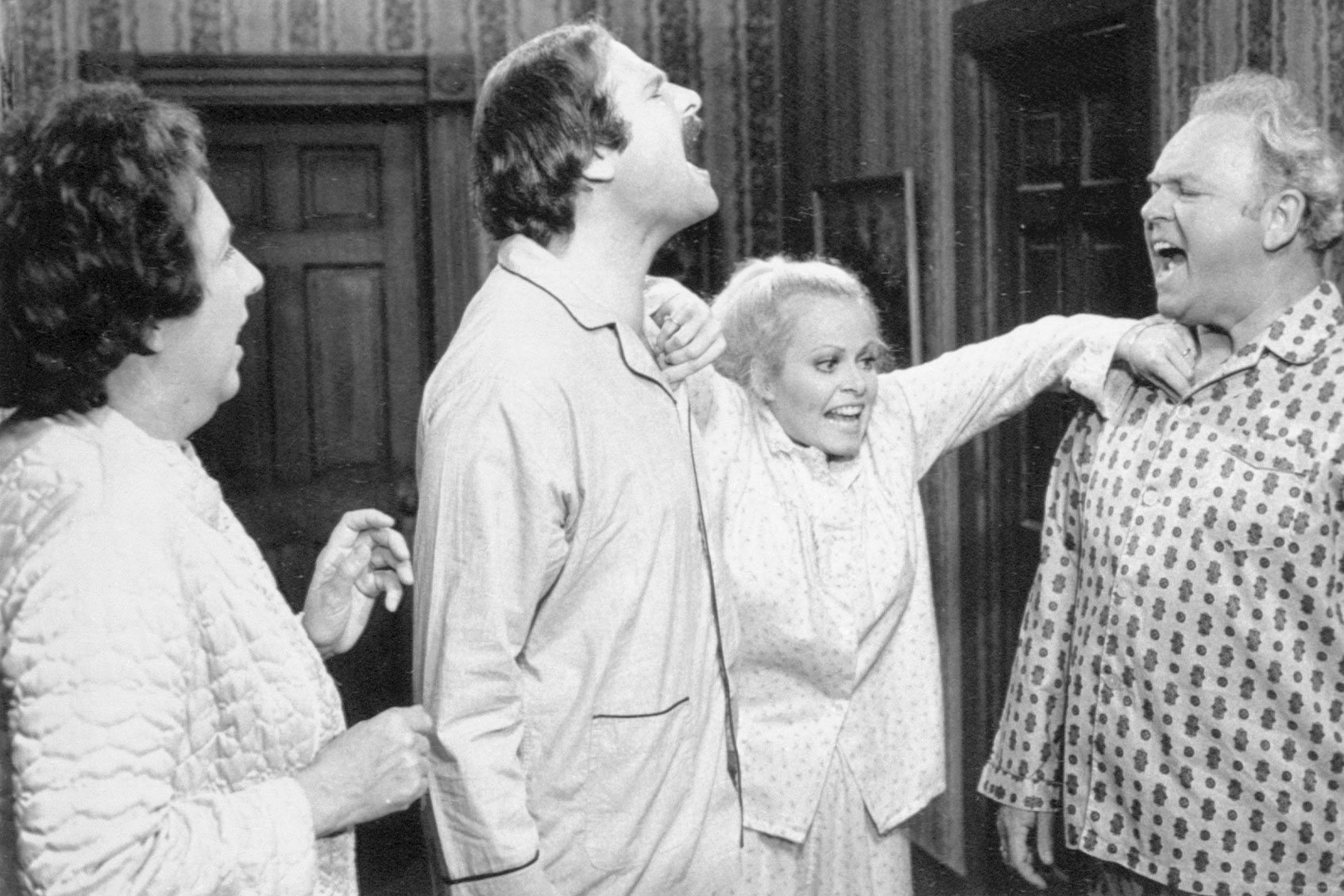
All In The FamilyThe cast of CBS TV’s All In The Family, (shown here), once again spend the night under Archie’s roof as the young couple, Mike and Gloria spend their last night in New York at Archie’s home prior to moving to California to live (Getty Images / Bettmann / Contributor)
Premiering in 1971, the show heard ’round the world gave voice to the sort of intense political debates that were happening in living rooms all over the country. Inspired by a British program, “Till Death Us Do Part” that features “a bigoted father and a liberal son who argued about everything under the sun,” as Lear wrote in his memoir, “All in the Family” depicts Archie Bunker (Carroll O’Connor), an avatar for aggrieved white male ignorance, in comedic combat with his wife Edith (Jean Stapleton), their daughter Gloria (Sally Struthers), and Gloria’s husband Mike,  played by Reiner.

“Norman spoke out. He taught me to do the same.” – Rob Reiner

The show’s scandalous pilot features a heady mix of sexual innuendo, Christian vs. atheist antagonism, and a raft of racial slurs. CBS, which picked up the series only after ABC had twice rejected it, tried to stave off any controversy by airing a disclaimer before the first episode. “‘All in the Family,'” they wrote, “seeks to throw a humorous spotlight on our frailties, prejudices and concerns. By making them a source of laughter, we hope to show — in a mature fashion — just how absurd they are.”

The initial critical response was mixed. Variety dubbed the show “the best tv comedy since the original ‘The Honeymooners,'” but critic John Leonard, writing for Life, suggested the show ought to be exterminated with roach spray. Some viewers thought “All in the Family” was a scathing satire of conservative values, while others thought it was just plain bigoted. By the end of its first season, though, the show was an unqualified success, earning scores of Emmy Awards and nominations.

Lear, however, was just getting started. Over the next five years, he created an Archie-verse of kindred series and interconnected spinoffs that captured the 1970s zeitgeist and remained popular until 1994, when “704 Hauser,” the last direct “All in the Family” spinoff, went off the air. Never in television history has a producer achieved the same feat of sustained creativity. Even the vaunted Marvel Cinematic Universe (which now has invaded our small screens) would have to continue for another 14 years to match Lear’s record.

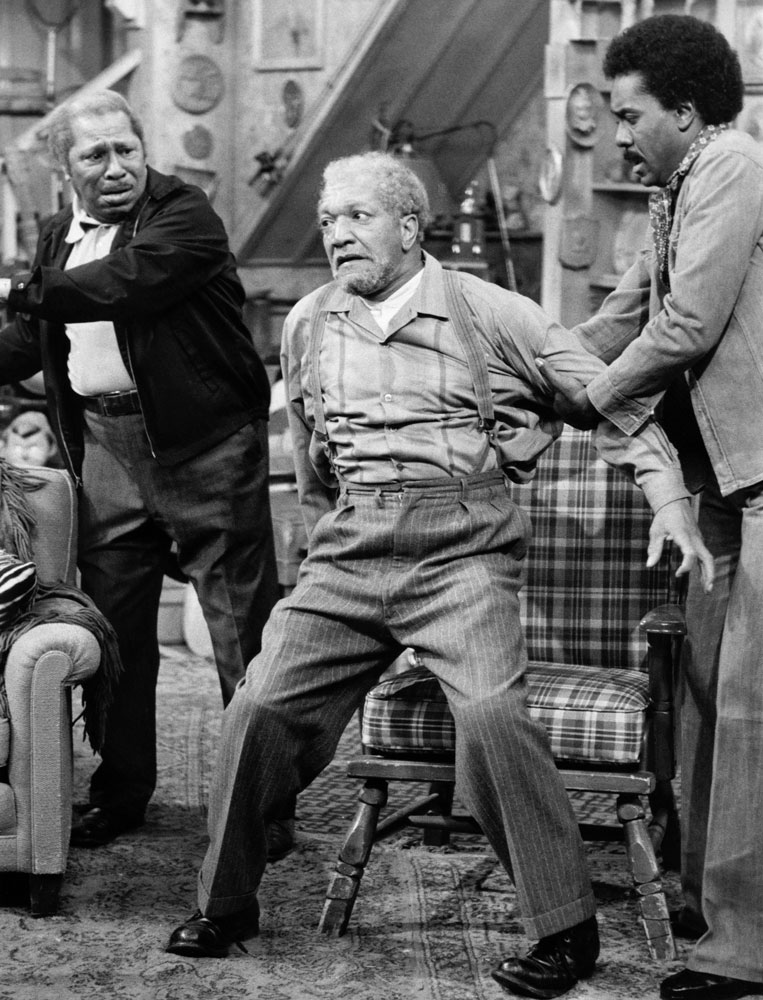
Sanford and SonFred Sanford’s (Redd Foxx) buddy, Bubba (Don Bexley, left), and son, Lamont (Demond Wilson), seem to be in as much anguish as Fred himself, who is the afflicted one in the Sanford and Son colorcast of A Pain in the Neck on the NBC Television Network (Getty Images / Bettmann / Contributor

First up after “All in the Family” was “Sanford and Son,” a vehicle for comedic superstar Redd Foxx that recreated the Bigoted Old Man vs. The World formula in the context of a Black family. Foxx played Fred Sanford, who owned and ran a junkyard with his son Lamont (Demond Wilson). 

While Lamont was friends with the Sanfords’ Puerto Rican neighbor, a recurring character named Julio Fuentes (Gregory Sierra), Fred harbored deep prejudices that allowed the show to celebrate Black culture and portray the difficulties of life in Watts without sacrificing the complexities of racism and generational conflict.

Next came “Maude,” a direct “All in the Family” spinoff featuring Edith’s feminist cousin Maude Findlay. The late Bea Arthur, a former Marine Corps Women’s Reservist during World War II, brought toughness to the title role. The series introduced substance abuse, mental health, and the struggles of women in the 1970s workplace into American entertainment at a time when they were barely spoken about publicly. The writing was as unflinching as Maude herself, asking hard questions and honestly portraying a wide range of perspectives. 

Maude’s maid, Florida Evans (Esther Rolle), then got her own show as well. “Good Times” was the first spinoff of a spinoff in television history, and it was also the first sitcom to depict a two-parent Black family. While Jimmy Walker’s goofy portrayal of Florida’s son J.J. Evans, along with his character’s “Dyn-o-mite” catchphrase, stole the show a bit and captured the public imagination, “Good Times” was more than a series of gags. It confronted contemporary issues without easy solutions, like systemic racism in education and the need for criminal justice reform.

In the wake of his first three successes, Lear arrived at his office one day to find it occupied by members of the Black Panthers. They were intent on asking him why he only made shows featuring poor Black characters. “Sanford and Son,” after all, was set in a junkyard, while “Good Times” took place in Chicago’s Cabrini Green housing project.

Lear knew they were right to challenge him, and he knew just what to do about it, too. In short order, the Bunkers’ affluent Black neighbors, George and Louise Jefferson (Sherman Hemsley, Isabel Sanford), moved on up to a show of their own. “The Jeffersons” became the most successful of Lear’s “All in the Family” spinoffs: the second-longest-running series in television history featuring a Black family. 

Lear’s new show was also the first series in television history to feature an interracial couple, the Jeffersons’ next-door neighbors, Tom (Franklin Cover) and Helen Willis. When Roxy Roker was cast in the role of Helen, Lear took her aside to warn her about the firestorm that would no doubt ensue. Without a word, Roker reached into her purse and pulled out two pictures. One was a portrait taken during her wedding to her white husband, Sy Kravtiz, and the other was a snapshot of her mixed-race son Lenny. She was prepared. She lived the struggle in her everyday life.

The JeffersonsStarring members of the comedy series The Jeffersons include Paul Benedict, Isabel Sanford, Sherman Helmsley, Zara Cully, Franklin Cover, Roxie Roker, Berlinda Folbert, and Damon Evans on the CBS Television Network (Getty Images / Bettmann / Contributor
Collectively, the shows that made up the Archie-verse recontextualized straight white male supremacy. Every new series Lear produced helped the country learn about and laugh at a new part of itself, and Archie’s voice — always the butt of Lear’s best jokes — slowly became just one of many different narrative voices in an increasingly diverse television landscape.

“Each spinoff told a different side of contemporary America,” Emmy winner Ken Levine, who wrote for “The Jeffersons,” told Salon. “His shows were really grounded in reality and reflected America at that time.”

After the Archie-verse was established, Lear continued to produce series that humanized the members of marginalized groups. He developed both “One Day at a Time,” which centered on a divorced single mother — a television rarity at the time — and “Hot l Baltimore,” a show with gay supporting characters that was seen as so provocative the Baltimore affiliate refused to air it.

Even while he focused on breaking new ground, however, Lear remained committed to comedy.

“Norman would do a show that was so issue-oriented and so edgy. He was so incredibly smart to make sure that above all else, the shows were funny,” Levine said. “When people tuned in to watch ‘All in the Family’ or ‘Maude’ or ‘The Jeffersons,’ they knew there were going to be laughs in the show, it was not just going to be a civics lesson.”

The American Way

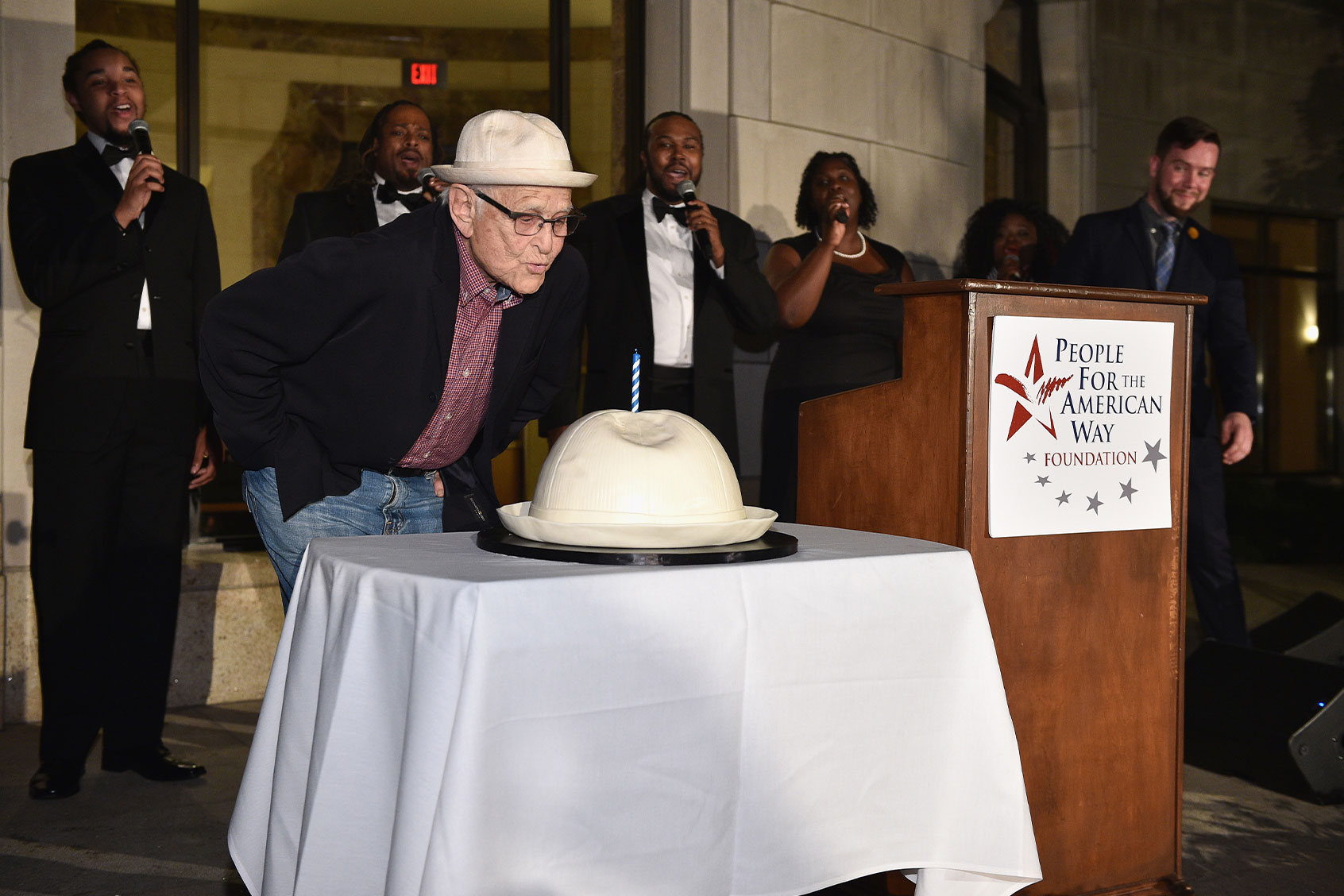
Norman LearNorman Lear blows out a candle on the birthday cake at an event in NYC to celebrate People For the American Way Foundation (PFAW) founder and national treasure, in honor of his 95th Birthday on October 5, 2017 in New York City. (Bryan Bedder/Getty Images for People For The American Way
By the end of the 1970s, Lear had become a legend, but American political winds started to blow in a different direction. Baby boomers entered their prime earning years, and yippies became yuppies. Ronald Reagan soared into power, marrying the greed of the well-heeled with the racism of the general populace. Groups like the Moral Majority led a cultural backlash to the pride movements of the 1970s, beginning an effort to take over the government and encode conservative values into law.

“Fifty years ago, Norman’s People for the American Way was prescient in calling out the Religious Right’s attack on our civil liberties,” said Reiner. “Sadly, many of his warnings went unheeded.”

Lear watched as religious conservatives like Jerry Falwell and Oral Roberts worked to silence voices of dissent and make the United States a monoculture in which some votes were more equal than others. He knew their hate needed to be confronted head-on. Their way, he was convinced, wasn’t the American Way, so he created a series of public service announcements in which working Americans and celebrities said as much.

The resulting ad campaign was immensely successful, earning ample press coverage, airtime on the nightly news, and high-profile interviews for Lear. Fueled by the positive reception and concerned about increasing hostility and divisiveness, Lear co-founded the nonprofit People for the American Way to fight right-wing extremism, devoting his creative genius to the organization.

“Fifty years ago, Norman’s People for the American Way was prescient in calling out the Religious Right’s attack on our civil liberties,” said Reiner. “Sadly, many of his warnings went unheeded.”

Today, at a moment when cultural discord seems to be escalating dangerously, Lear’s steadfast progressive activism deserves to be celebrated.

“Part of what Norman brought to People for the American Way was his skill, talent, and impact using culture and humor to shape how people think about something, to shape a political narrative,” long-time staff activist and researcher Peter Montgomery told Salon.

When evangelical groups tried to remove both evolution and the Holocaust from school textbooks, People for the American Way fought back, successfully protecting history and free speech from, as Lear wrote in his memoir, “the fundamentalist zealots who ran the Texas School Board Authority.” Televangelist Pat Robertson, furious about the defeat, sent Lear a pointed note.

“Your arms,” he wrote, “are too short to box with God.”

Clearly, though, they weren’t.

As much as the members of the religious right have vilified him, those on the left have always seen Lear differently. “He is a mensch and a warm human being,” said Montgomery, who praised Lear’s “gut sense of right and wrong, and his gut sense of what the Constitution means, and what is important about America.”

King Lear

What initially lit the fire in Lear? His passion for giving voice to marginalized and oppressed people, through both comedy and politics, derived from his relationship with his father. Herman Lear preferred to be called H.K. The “K,” he claimed, stood for “King,” and he was, indeed, an imperial presence.

He sat in the family’s living room on an Archie Bunker-like chair: a throne on which no one else dared sit. Whenever H.K. and his wife Jeanette would argue, the veins in his neck would bulge and he’d yell at her — again, just like Archie — to “Stifle!”

When Lear was eight years old, H.K. was arrested for fraud and sent to prison for five years. Lear’s mother and sister moved in with his grandparents, while Lear himself was shuffled from one relative to another, never at home anywhere. He felt perpetually alone — a burden, an outsider — and years later that feeling gave him tremendous empathy for anyone else who felt similarly vulnerable.

If that weren’t difficult enough, 1930s radio made Lear feel even more alienated. Father Coughlin, the radio priest whose weekly nationwide broadcast demonized Jews, gnawed at him. He couldn’t understand why being Jewish made him a threat to American values. Forever after, the need to combat religious bigots and conservative radio pundits — like Fallwell, Roberts, Robertson, and later Rush Limbaugh — would burn inside him, and today’s social media seems to have amplified his anguish.

Lear said, “There are those using social media and the internet, the way Father Coughlin used the radio to spew hate and lies. Online these dangerous falsehoods spread at lightning speed.”

Lear’s enduring relevance

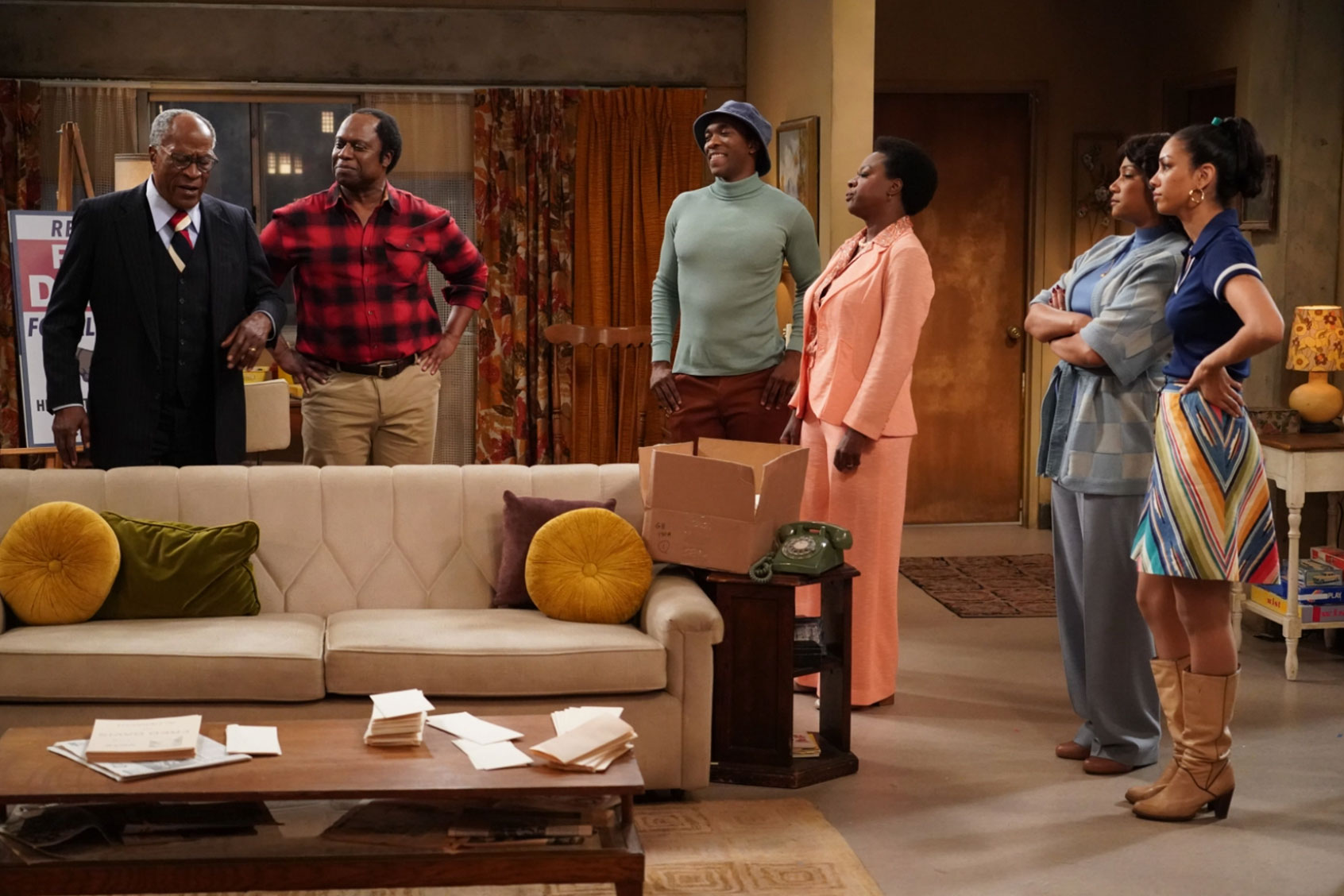
Live in Front of a Studio Audience: Norman Lear's All in the Family and Good TimesLive in Front of a Studio Audience: Norman Lear’s ‘All in the Family’ and ‘Good Times’ (Eric McCandless/ABC)

Although the bulk of Lear’s work as a television writer and producer was done by the mid 1980s, the shows he created remain relevant even to the present day. In 2019, when Jimmy Kimmel created “Live in Front of a Studio Audience,” a series of television specials in which contemporary celebrities recreate decades-old sitcom episodes word for word on exact-replica sets, he started by resurrecting Lear’s work for a new generation.

“Norman rejected the notion that uncomfortable topics and flawed characters need to be sanitized for our protection,” Kimmel told Salon. “If anything, his then-groundbreaking idea to depict real people and serious issues on television comedies feels even more groundbreaking now than it did in the seventies.”

Part of the thrill of Kimmel’s series comes from watching beloved actors like Will Ferrell, Tiffany Haddish, Ellie Kemper, and Sean Hayes tackle the televised high-wire act of live performance. What’s genuinely astonishing, however, is how Lear’s writing still speaks so clearly to America’s current cultural divisions decades after it first appeared.

In part one of the series’ first installment, Woody Harrelson and Marisa Tomei channel Archie and Edith Bunker in an “All in the Family” episode called “Henry’s Farewell.” The episode features an extended comedic argument about whether a woman or a Black candidate would have a more difficult time being elected President that feels exceptionally prescient, given that it was written almost five decades before Barack Obama and Hillary Clinton became candidates.

In part two, Jamie Foxx and Wanda Sykes bring George and Louise back to life for a new generation in the pilot episode of “The Jeffersons,” “A Friend in Need.” The storyline crackles with intersectional energy and class conflict as Louise Jefferson struggles with whether to hire a friend as a maid. Marla Gibbs, reprising her role as the woman they did hire, notes that not one, but two Black women own apartments in the same high-end highrise, then slams the door of the episode shut with an explosive final line: “How come we overcame,” Gibbs’ Florence Johnston asks, “and nobody told me?”

“Live in Front of a Studio Audience” retired a few months later in 2019, this time with another “All in the Family” episode (“The Draft Dodger,” which featured guest appearances by Kevin Bacon and Jesse Eisenberg) and an episode of “Good Times” (“The Politicians”) recreated by Andre Braugher, Viola Davis, and a similarly accomplished cast. Any in-depth look at Lear’s body of work would undoubtedly uncover a great many more shows that would speak to a present-day audience.


Want a daily wrap-up of all the news and commentary Salon has to offer? Subscribe to our morning newsletter, Crash Course.


In 1972, in fact, the year before Roe v. Wade, Lear produced an episode of “Maude” in which the title character — unexpectedly pregnant at 47 years old – decides to get an abortion. Although abortions had been depicted on soap operas before then, Maude was the first primetime character to terminate a pregnancy (in a comedy no less), and the deftness with which “Maude’s Dilemma” handled the subject matter met the delicate moment in America. Might that episode be next in line for the “Live in Front of a Studio Audience” treatment?

“Comedy on television helps us learn about and understand each other. The power of comedy and media is still here.” – Norman Lear

“We’d love to explore it,” Lear’s producing partner Brent Miller told Salon, “but have yet to officially pitch it to our partners at ABC and Sony.”

Given the Supreme Court’s recent overturning of Roe, “Maude’s Dilemma” would seem like an obvious choice.

“We need to understand each other at the present moment,” Lear said, sharing his vision for contemporary entertainment. “Comedy on television helps us learn about and understand each other. The power of comedy and media is still here.”

The power of Lear’s work remains clear. He and his writing partner are currently working on a remake of Lear’s 1970s series “Mary Hartman, Mary Hartman” with “Schitt’s Creek” alum Emily Hampshire in the title role. Many, like both Kimmel and Reiner, continue to keep Lear’s legacy alive in their comedy, too, making audiences laugh and think in an effort to change the world for the better.

“I’ll always be grateful for Norman’s wisdom and guidance,” said Reiner.

On his 100th birthday, so should we all.


Trump threatens to sue CNN for defamation

Former President Trump has announced that he plans to move forward with a lawsuit against CNN for what he believes are acts of defamation against him that date back to 2016. 

The 282-page letter from Trump’s attorneys to CNN, dated July 21, states that “Without regard for President Trump’s genuine belief in his statements, CNN has published numerous articles characterizing him as a ‘liar’ and the purveyor of the ‘Big Lie,'” as reported by The Hill

“I have notified CNN of my intent to file a lawsuit over their repeated defamatory statements against me,” Trump said in a statement. “I will also be commencing actions against other media outlets who have defamed me and defrauded the public regarding the overwhelming evidence of fraud throughout the 2020 Election. I will never stop fighting for the truth and for the future of our Country!”

The intended purpose of the lawsuit is to encourage CNN to retract or “amend” statements made both in print, as well as on-air, that Trump and his counsel deem defamatory. Examples of such statements listed in the 282-page letter deal in good portion with CNN referring to Trump’s belief that the 2020 election was stolen from him as “baseless.”

In reference to Trump and CNN’s coverage of “The Big Lie,” the letter states “CNN’s on-air personalities – including John King, Jake Tapper, John Avlon, Brianna Keilar, Don Lemon, and Jeffrey Toobin, among others – have continued to use the phrase in describing President Trump’s subjective state of mind despite an apparent admonition from their Chief Executive Officer.”


Want a daily wrap-up of all the news and commentary Salon has to offer? Subscribe to our morning newsletter, Crash Course.


“In this instance, President Trump’s comments are not lies: He subjectively believes that the results of the 2020 presidential election turned on fraudulent voting activity in several key states. Furthermore, the repeated characterization of President Trump lying was distinctly at odds with CNN’s treatment of individuals claiming President Trump’s 2016 was ‘illegitimate’ or based upon ‘Russian interference,'” the letter furthers. 

Depression may not stem from a “chemical imbalance” after all — suggesting the problem is social

When you suffer from depression, it can feel like your own brain has betrayed you. That feeling may explain why the theory that depression is caused by a chemical imbalance in the brain is so widely believed to be true. Indeed, if depression can be reduced purely to anatomy, then perhaps it can be cured as easily as any other physical ailment. After all, who wouldn’t want to take a magic pill that makes all of their suffering go away?

Now, a new study has undermined the aforementioned “serotonin hypothesis” — namely that, as the American Psychiatric Association puts it, “differences in certain chemicals in the brain may contribute to symptoms of depression.” That hypothesis motivated the pharmaceutical industry’s drug formulations, and indeed, underpins the chemistry of their anti-depressant drugs (particularly SSRIs, or selective serotonin-reuptake inhibitors), which were marketed to correct said imbalance. Neurologically speaking, these kinds of drugs perpetuate the presence of serotonin, a neurotransmitter with a wide variety of functions, in the brain; specifically, a “reuptake inhibitor” prevents the serotonin from being reabsorbed as quickly as it might naturally, meaning more of it circulates for longer. 

To determine whether SSRI medication was effective, researchers writing for the journal Molecular Psychiatry performed a systematic umbrella review of 17 studies to determine what the evidence says.

Their conclusion?

“There has been [three] decades of intense research on many aspects of the serotonin activity in depression, and we found that it provides no support for the idea that depression is caused by low serotonin.”

“The main areas of serotonin research provide no consistent evidence of there being an association between serotonin and depression, and no support for the hypothesis that depression is caused by lowered serotonin activity or concentrations,” the researchers explained. “Some evidence was consistent with the possibility that long-term antidepressant use reduces serotonin concentration.”

That calls into question the chemical imbalance theory of depression. 

Salon spoke by email with corresponding author Dr. Joanna Moncrieff, a professor of psychiatry at the University College London. Moncrieff made it clear that the new paper does not definitively disprove the serotonin hypothesis, since it is impossible to prove a negative and future research can always alter present conclusions.


Want more health and science stories in your inbox? Subscribe to Salon’s weekly newsletter The Vulgar Scientist.


“But there has been [three] decades of intense research on many aspects of the serotonin activity in depression and we found that it provides no support for the idea that depression is caused by low serotonin,” Moncrieff explained. “I think that is about as definitive proof that the theory is false as you can get.” Moncrieff also pointed out that although depression could be caused by a different biological mechanism, “no other testable hypotheses have been proven either.”

Jonathan Sadowsky, an award-winning historian at Case Western University who specializes in the history of psychiatry and recently wrote the book “The Empire of Depression,” criticized the paper when corresponding with Salon by email.

“The finding that there is little or no association between serotonin levels and depression is not a decisive blow against the SSRIs, because medicines should be evaluated primarily on their efficacy, not their theoretical premise,” Sadowsky wrote to Salon. “The authors of this study propose that the efficacy is based on an amplified placebo effect or blunting of emotion generally. These are possibilities and they should be studied.”

Moreover, Sadowsky argued that there could be other explanations, and ultimately “if something works to help treat it — whether it is psychodynamic therapy, cognitive-behavioral therapy, psychedelic drugs, or the drugs we call antidepressants — it should be considered as a treatment, whether the theory of causation that lies behind it is true or not.”

Perhaps anticipating this kind of feedback, Moncrieff shared an official set of responses with Salon that address this criticism of the study.

“The most common rejoinder to a widely reported study that antidepressants don’t act on the underlying chemical cause is that even if we don’t know what their mechanism of action is we know that they work,” Moncrieff explained. “But the authors of the original piece have countered that the evidence for the drugs working is not convincing, and argue that how we understand what antidepressants do has major implications for decisions people might make about whether to use them or not.”

“There is almost no research on the effects of long-term use at the moment even though millions of people use these drugs for years and decades,” Moncrieff told Salon.

For his part, Sadowsky (who is not a scientist) acknowledged that he believes the question of whether depression has environmental causes is “settled science.” The new study emphasizes the need to focus more on environmental factors, with Moncrieff telling Salon that there is a lot of research on that subject (including in their review) and “we know depression is strongly associated with adverse life events and circumstances — such as child abuse, divorce, poverty, loneliness etc.”

In addition to increasing our research on the role of environment in causing depression, Moncrieff argued that scientists need to learn more about the long-term effects of antidepressants that alter brain chemistry. 

“There is almost no research on the effects of long-term use at the moment even though millions of people use these drugs for years and decades,” Moncrieff told Salon. “We also need research into withdrawal effects and how to minimize these and how to treat people who suffer from severe and prolonged withdrawal and also from post SSRI sexual dysfunction.”

So if a chemical imbalance may not be the cause of depression, what is? For decades, numerous researchers and public intellectuals have noted the substantial evidence that depression and other mental illness are linked to capitalism, the dominant economic system in the Western World — and one which governs the way we relate to each other, our selves, and our hopes and dreams. Oliver James, a psychologist who authored the 2008 book “The Selfish Capitalist: Origins of Affluenza,” argued that the materialistic, self-obsessed and competitive culture of neoliberal capitalist societies instill “emotional distress” in their populations. Some of his evidence comes from the impressive rise in SSRI prescriptions in western countries, which far outpace population growth. 

“It may at first seem remarkable that so many workers have been persuaded to accept such deteriorating conditions as ‘natural’, and to look inward — into their brain chemistry or into their personal history — for the sources of any stress they may be feeling.”

Likewise, the late Mark Fisher, a cultural critic and philosopher, argued in a 2011 essay, “The Privatization of Stress,” that precarious economic circumstances engendered by the inequality innate to capitalist economies generate depression and anxiety.

He gave an example from an interviewee, an underemployed man named Ivor who was relying on short-term temp contracts to eke out a living, and who went on a trip to the grocery store and missed a call from an employment agency offering him work for the day. When Ivor returned home, Fisher writes, the contract was already filled. 

“Such laborers are expected to be waiting outside the metaphorical factory gates with their boots on, every morning without fail,” Fisher said. “It is hardly surprising that people who live in such conditions — where their hours and pay can always be increased or decreased, and their terms of employment are extremely tenuous — should experience anxiety, depression and hopelessness. And it may at first seem remarkable that so many workers have been persuaded to accept such deteriorating conditions as ‘natural’, and to look inward — into their brain chemistry or into their personal history — for the sources of any stress they may be feeling.”

Mikkel Krause Frantzen, author of “Going Nowhere, Slow: The Aesthetics and Politics of Depression,” has described depression as “collective” and political problem. In a 2019 essay in Los Angeles Review of Books, Frantzen describes how many people are understandably depressed by the sad state of real-life events and politics — such as looming existential crises like climate change, and the way that neoliberal capitalism forecloses the possibility of any alternative future. In Frantzen’s narrative, these sad situations are very rightfully inducing depression; Frantzen borrows a term, “depressive realism,” to describe the relatable depression one might feel from observing the state of the world. 

If the “chemical imbalance” hypothesis is further undermined by future studies, it suggests that the cause of depression may indeed be political — as writers like Fisher have theorized for decades — and related to the social conditions engendered by capitalism and modernity, rather than mis-aligned brain chemistry. 

“Only Murders in the Building” co-creator on how Jane Lynch became Charles’ stand-in

“Only Murders in the Building” is a puzzle box of references; secret passageways, asides from Oliver (Martin Short) about his past that may or may not be relevant (or true). One of its great surprises was the reveal of the stand-in for TV actor Charles (Steve Martin) who played Brazzos, a jaded detective, on a long-running cop show of the same name.

As Brazzos, a kind of cross between David Caruso’s John Kelly and Columbo, Charles wore a brown leather jacket and sunglasses inside like Corey Hart, an ever-present toothpick dangling from his lips as he uttered his signature line: “This sends the investigation into a whole new direction.” 

And as his stand-in on the show — and sometimes, increasingly, in his life — we have Jane Lynch

The surprise of Lynch as Sazz Pataki is a gift that keeps giving. Not only do Lynch and Martin resemble each other in breathtaking ways, so much so that Oliver and Mabel initially think Sazz is Charles with their identical pork pie hats and oversized suit jackets, Sazz has Oliver’s mannerisms down. She’s played him so much she’s become him in her off hours — the way they sit, the way they move their arms or read the paper. The way they react.

And she hasn’t just played him onscreen. Charles has social anxiety while Sazz is a confident, queer woman with clear, resonant sex appeal; she stole Charles’ girlfriend once. But, no hard feelings. Like an alter ego, Sazz is there to step in for Charles during the difficult times, being it TV sex scenes (Charles’ hip movements weren’t “natural”) or in the episode “Performance Review”: rough life stuff. Get you a stand-in who will visit prison for you.  

Martin and Lynch are both 6 feet; both have short white hair. But how did the character of Sazz come about, and who landed on the genius idea for Lynch to play her? Salon talked to “Only Murders” co-creator John Hoffman about Lynch, Sazz, the heart of true crime and more happenings in our favorite, homicidal apartment building: the Arconia.     

This interview has been lightly edited for clarity and condensed.

What was your approach to this second season? Especially coming after a first one that was so successful and is so loved.

I think the approach is always narrative first. You have to ground yourself in the characters and the story and feeling: what’s the brightest, funniest way to tell a story where three characters have really stepped into it at the end of season one? So that was the first thing driving us. Of course, now that Season 1 is out, the world knows the show. There have been responses to it, and the embrace was so lovely . . . I was really thrilled that our mystery built a lot of interest as well. That was a real pursuit of ours, knowing that we needed to do that, but the thrill of watching these message boards light up with theories and mystery abounding, it was just fantastic. And so there was the onus on us, certainly to: “OK, now have to craft a second season mystery.”

When doing that, there was the next level, meta part of our show that is: here we have our three characters trying to set up to do a second season of their own podcast. And so there were moments — probably maybe a little too many here and there; they were so fun to play with as writers to call up the insecurities of trying to craft an equal to or better than second season of anything when it’s been embraced like that. That was really fun. 

It was one of the greatest moments you could ever have in a writers’ room, I will tell you honestly — and I wasn’t even in the room.” 

I encourage everyone to hang tight because there are many things coming at our heroes in Season 2, and it feels a touch disorienting. That’s very intentional because of the situation they’re in. But I’m very excited for people to see the full season because I guarantee a big-time banger coming around at the end.

Only Murders In The BuildingCharles (Steve Martin) in “Only Murders In The Building” (Craig Blankenhorn/Hulu)We also have had the return of some important characters, including Jane Lynch as Charles’ stand in. Can you talk about the creation of that character?
Oh my God. It was one of the greatest moments you could ever have in a writers’ room, I will tell you honestly — and I wasn’t even in the room. That was why it was probably so good, but I was out for, I think it was a phone call, and then I came back in. And we’ve been on Zoom both seasons of this show; we wrote the whole thing on Zoom, which is not easy. We tried very hard to use programs that would allow us to have a digital whiteboard, which is the most essential thing in a writers’ room, especially when crafting a mystery like this, but we couldn’t seem to manage that. I feel so proud of this writers’ room in so many ways, but that was one of the things: holding all of it in our heads as we were discussing and crafting both seasons.

We bypassed agents. We bypassed everybody. Jane said, ‘I’m in.’

When I came back from this phone call, I saw each little square of this writers’ room on Zoom, they looked like they’d eaten the cat that ate the canary. It was unbelievable. [They said], “We have something to pitch you.” And I said, “OK, what’s going on?” And they said, “So, Charles-Haden Savage from his days in ‘Brazzos’ has a history with his stunt double.” They went into that history and then they just landed right off the pitch. But the big pitch is that this stunt double has to be played by Jane Lynch.

Only Murders In The BuildingSazz (Jane Lynch) in “Only Murders In The Building” (Craig Blankenhorn/Hulu)It was pitched exactly that way, and I literally heard it — and I might have screamed. I don’t know, but I basically said we’re doing that. And so, there was the next step, which may be your next question, I think, but the next step was how do we secure that? Because this was really the only person in our minds who could do it for the joke to play: for the humanity, for the brilliance of imagining the two of them standing next to each other.
“At the heart of it are those three lonely, isolated people who need to help each other. And through this weird obsession with this mystery that lands in their lap, find a life raft in each other.” 

The next step was how do we get her to commit at this early stage to this part, and luckily one of our co-executive producer writers, Kristin Newman, had been friendly with Jane Lynch. I think there was an apartment situation where Jane was staying in Kristin’s apartment at some point. Kristin literally texted and said, “Hey, there’s a part here, blah, blah, blah, Steve Martin, Martin Short, Selena Gomez, Hulu. And here’s the part.” We bypassed agents. We bypassed everybody. Jane said, “I’m in. When is it? I’m in.”

We had to go through negotiations. We had to check her schedule, our schedule, all of that, but one of the great miracles of Season 1 for me was that not only did we get Jane Lynch to play this part as pitched, she just went above and beyond, fulfilling our dreams on set with her and Steve. [She] found things, the gesturing that marries the two of them — all of it was just heaven.

It’s really remarkable to see on screen.

Only Murders In The BuildingCharles (Steve Martin) in “Only Murders In The Building” (Craig Blankenhorn/Hulu)

“We were more necessary than we might have been otherwise had we not been spending the last two, three years isolated and lonely — and wondering if the person in the hall might kill us.”

It was a big leap. The show takes these big leaps and we’re like, “OK, they either buy all into our leaps or . . .”  And they do comedically. We do it with some poignant moments too. I’m not shy about the storytelling in many ways. I’ve just been so delighted that the audience response to all those leaps has been one collective “we’re all diving in together.”

It reminds me of a part I really loved in the first season where Martin Short’s character is talking about that theatre performance with the fall, and there’s the montage where all the characters have a fall in a sense. And the show is always falling, I guess, but the audience is always falling with them.

That’s so sweet of you to say that. Yes, it’s very much the central core of the show that at the heart of it are those three lonely, isolated people who need to help each other. And through this weird obsession with this mystery that lands in their lap, find a life raft in each other. They’re constantly being pulled up to the surface by each other by this thing they’re following. Meeting each other is what they’ve come to learn, to help get them out of their own ways and their own path. 

“It is very important to point out that true crime is still crime and true crime still has great truth in it. That truth is multidimensional always.”

Unintentionally, it feels like a very prescient topic to swing into in these times that we’re in, and I don’t know, the timeliness of when we dropped, it felt like we were more necessary than we might have been otherwise had we not been spending the last two, three years isolated and lonely — and wondering if the person in the hall might kill us.

Only Murders In The BuildingBunny (Jayne Houdyshell) in “Only Murders In The Building” (Craig Blankenhorn/Hulu)I think the show helps us feel less lonely. It helps us think about the possibility of friendship.

And unexpected places to find that connection. That’s the real connective tissue to the whole show, and that’s the hope of it, I think. You always have to keep that front of center between the three of them in the building and in the spirit of the show.

This season we get that deepening of some minor characters and we get more history from everyone, including Bunny, whose backstory actually made me cry. I hated Bunny in the first season, and then by the second season, I’m crying over her loss. So, what were the creative decisions that went into deciding to have those backstories?

It feels necessary to me. Our whole show is built on this understanding of using and playing with and poking fun of the format of the podcast, and the true crime podcast particularly . . . But beyond that, I felt that it is very important to point out that true crime is still crime and true crime still has great truth in it. That truth is multidimensional always. And for victims, for a person committing this crime, there’s no forgiveness, but there is humanity: an understanding of what drives people and what motivates people to be the way they are, and to walk the world on a daily basis the way they do. 


Want a daily wrap-up of all the news and commentary Salon has to offer? Subscribe to our morning newsletter, Crash Course.


I think remembering and reminding about that, about all the dimensions to people who you might presume certain things about, finding the humanity that makes you realize, “Holy crap, this is someone I might have enjoyed spending time with,” when you on the surface might not have felt that way. To me, it’s essential to the storytelling we do.

“Only Murders of the Building” releases new episodes Tuesdays on Hulu.

ABC News hit with cease-and-desist after “The View” compares TPUSA summit to Third Reich

ABC News was issued a cease-and-desist from counsel for the Turning Point USA Student Action Summit for comments made during a segment of “The View” in which hosts compared the event to the Third Reich. 

The weekend-long summit that inspired the comments was held in Tampa, Florida last weekend and grouped students together with political leaders such as Ted Cruz, Matt Gaetz, former President Trump and Marjorie Taylor Greene for the intended purpose of providing them with leadership skills, but “The View” hosts Whoopi Goldberg and Joy Behar saw the end result as being more nefarious than that. 

“Neo-Nazis were out there in the front of the conference with anti-Semitic slurs and, you know, the Nazi swastika and a picture of a so-called Jewish person with exaggerated features, just like Goebbels did during the Third Reich. It’s the same thing, right out of that same playbook,” Behar said during the opening segment of “The View” on Monday.

In New York Post coverage of the episode that led to the cease-and-desist they highlight that later on in that same episode a disclaimer was read specifying that “Turning Point USA condemned the neo-Nazis protesters who had ‘nothing to do’ with the organization,” but host Goldberg had some thoughts on that disclaimer.

“But you let them in, and you knew what they were,” Goldberg said, before the hosts were made to read a second disclaimer making it clear that “the neo-Nazis were ‘outside protesters’ and TPUSA didn’t let them in.”

“My point was metaphorical,” Goldberg said.


Want a daily wrap-up of all the news and commentary Salon has to offer? Subscribe to our morning newsletter, Crash Course.


These disclaimers, and the comments made around them, were not enough to appease TPUSA.

“The false statements of fact intentionally made during The View’s July 25th segment were unquestionably harmful to TPUSA’s reputation and brought the organization and its student affiliates into disrepute with the public, potential donors, and current and future business partners, posing a significant financial loss to the organization,” TPUSA in-house counsel Veronica Peterson wrote in the cease-and-desist.

“The View hosts intentionally and falsely associated TPUSA with neo-Nazi protestors outside the event placing TPUSA in denigrating and false light and negatively impacting its public perception. Such action will not be tolerated,” the cease-and-desist specified. “Specifically, The View hosts insidiously and cavalierly stated that TPUSA ‘let [neo-Nazis] in’ to its SAS event, metaphorically ’embrase[d] them’ [sic] and that neo-Nazis were ‘in the mix of people.’ The assertion that TPUSA is complicit or affiliated in any way with the neo-Nazi protesters outside the event is outlandish, false, defamatory, and disgraceful,” the letter furthered. 

ABC News was given a deadline of today, July 27, to issue a retraction and apology for the statements made by “The View” hosts. That on-air apology can be seen below:

GOP colluding with Big Pharma behind closed doors to undermine bill lowering prescription costs

Republican lawmakers are working behind closed doors to convince the Senate parliamentarian—the chamber’s unelected rules arbiter—to tank Democrats’ watered-down but still potentially impactful proposal to require Medicare to negotiate the prices of a small number of prescription drugs directly with pharmaceutical companies.

Sen. Mike Crapo, R-Idaho, a major beneficiary of pharmaceutical industry campaign cash, admitted as much in remarks to reporters on Tuesday, saying that he and his GOP colleagues are “going through line by line, literally, making objections” in private meetings with the Senate parliamentarian, who is tasked with offering advice on whether reconciliation provisions comply with chamber rules.

Under the Senate’s Byrd Rule, every provision of a reconciliation package must have a direct, not “merely incidental,” impact on the federal budget. Democrats contend their Medicare proposal meets that requirement, citing the Congressional Budget Office’s recent estimate that the plan would save the federal government $290 billion over 10 years.

But Crapo insisted Tuesday that “there are many Byrd objections,” and Politico reported that Democrats are currently “making tweaks” to the legislation to ensure it survives the parliamentarian’s scrutiny—even though the official’s opinions are nonbinding and can be overruled.

“Republicans are working hand in hand with Big Pharma to try to block Democrats from lowering drug prices,” warned Social Security Works, a progressive advocacy group.

The GOP’s efforts come as the pharmaceutical industry is mobilizing its huge army of Capitol Hill lobbyists in a last-ditch campaign to defeat Democrats’ plan, which would require Medicare to directly negotiate the prices of a subset of prescription drugs—an idea that is overwhelmingly popular with the U.S. public.

While Democrats’ proposal has faced criticism from progressive lawmakers who say it doesn’t do enough to challenge the pharmaceutical industry’s power to drive up costs, advocates and experts say the bill could still have a significant effect on prices for seniors and people with disabilities, given that a small number of medicines account for a major portion of Medicare’s prescription drug spending.

“Sen. Mike Crapo is proud that he’s trying to gut legislation to lower drug prices supported by more than 70% of Americans,” said David Mitchell, the founder of Patients for Affordable Drugs. “Legislation to improve health and save Americans money. Folks in Idaho need to know he’s not working for them—he’s working for Big Pharma.”

Senate Majority Leader Chuck Schumer, D-N.Y., is aiming to get the Medicare proposal as well as a plan to extend Affordable Care Act subsidies through the chamber before the August recess, which is set to begin next week.

In the face of unanimous Republican opposition, Democrats will need the support of all fifty senators in their caucus to pass the reconciliation package, which is exempt from the 60-vote filibuster.

“Republicans are going to use every tool they have to keep drug prices high and drug industry profits higher,” Sen. Chris Murphy, D-Conn., warned Tuesday.

Sen. Brian Schatz, D-Hawaii, added that “every single elected Republican in the Senate is about to vote against reducing the cost of prescription drugs for those on Medicare.”

“This is not a show vote or a symbolic thing—we are going to make a new law,” Schatz wrote. “It will save seniors thousands of dollars a year.”

Josh Hawley hit by fellow GOP senator for running away on Jan. 6: “Not his greatest moment”

Sen. Mitt Romney, R-Utah, on Tuesday said that a recently-surfaced video of Sen. Josh Hawley, R-Mo., running away from the Capitol riot was “not his greatest moment.”

“You know, I haven’t heard what his explanation is, but obviously that was not his greatest moment in that hearing,” Romney told Insider shortly after the January 6 committee played footage of Hawley fleeing in its latest hearing. 

It isn’t the first time Romney has attacked Hawley over his possible role in inciting the riot.

Last May, The Washington Post reported that Romney screamed at Hawley while the mob was ransacking the Capitol. “You have caused this!” Romney reportedly erupted at the Missouri Republican. 

Hawley’s desperation to escape the riot as it was unfolding runs in stark contrast to his persona just hours before, during the “Stop the Steal” rally, where the conservative lawmaker raised his fist for the throng of Trump supporters who would go on to breach the Capitol. Hawley has since said that he has no regrets about striking that pose. 

During last Thursday’s January 6 hearing, Rep. Elaine Luria, D-Va., played never-before-seen footage of Hawley running out of the Capitol building to escape the violent crowd of Trump supporters. 

“Earlier that afternoon before the joint session started, he walked across the East Front of the Capitol,” said Luria, displaying a photo of Hawley fist-pumping the riotous mob. “As you can see in this photo, he raised his fist in solidarity with the protesters already amassing at the security gates.”


Want a daily wrap-up of all the news and commentary Salon has to offer? Subscribe to our morning newsletter, Crash Course.


“Later that day,” she added, “Senator Hawley fled after those protesters he helped rile up stormed the Capitol. See for yourself.”

RELATED: Hawley roasted by hometown paper after ridicule for running out of Capitol on Jan. 6

After the footage was displayed, Hawley was widely mocked by Democrats and some Republicans.

On Sunday, Hawley’s hometown paper, The Kansas City Star, called him a “laughing stock,” who despite championing “masculine virtues,” is actually a “fleeing coward.”

Hawley, elected in 2019, was notably the first GOP senator to officially object to then-President-elect Biden’s win in the 2020 election.

Republicans recycle their mass shooting playbook to deflect blame for Roe overturn

In the wake of the overturn of Roe v. Wade, the horror stories about what happens when you ban abortion have quickly piled up. Women are bleeding out from miscarriages because doctors cannot abort a failing pregnancy unless the patient is on the verge of death. A 10-year-old girl was forced to travel hundreds of miles to avoid giving birth to a rapist’s child. Patients with ectopic pregnancies, which are always unviable, are seeing care delayed and denied, risking their lives and their fertility.

And in the face of all of this suffering, what is crucial to remember is this: This was always the point.

Abortion bans are meant to cause pain and suffering. They act otherwise, but anti-choice activists are not surprised by any of these horror stories. The misogynist sadism that fuels the anti-abortion movement has never been limited to punishing women for having sex for pleasure rather than procreation. Maiming — and even killing — women who wanted to be pregnant was always part of the plan. Forcing victims to give birth to a rapist’s child was always a guiding impulse. 

We can know this because anti-abortion propaganda is awash in stories romanticizing dead and maimed women, whose “sacrifice for the unborn” causes right-wing hearts to pitter-patter. Christian conservative media loves nothing more than a woman dead from childbirth, and it’s no wonder. A dead woman embodies the right’s ideal of femininity: silent and compliant, with no desires of her own.

The only woman they love nearly as much as a dead one is a rape victim submitting to childbirth. Such a woman may not be entirely silent, but she meets the right’s ideal of total female self-abnegation, a complete embrace of her role as a servant and vessel for the desires of others. As for those women who don’t want to sacrifice themselves? They are deemed “selfish,” which only justifies forcing the sacrifice upon them. 

Republicans can’t win the abortion argument on the merits. Instead, they flood the discourse with bad faith, lies, victim-blaming deflections and conspiracy theories.

Glowing stories of mutilated female bodies and submissive rape victims are mainstays of anti-abortion propaganda. But most conservatives aren’t dumb enough to think the majority of the country swoons at stories of pointless female suffering. On the contrary, the GOP is experiencing a political stomachache in the face of such stories flowing from the Supreme Court decision in Dobbs v. Jackson Women’s Health. But not so much that they’re willing to back down from these horrific abortion bans, of course. Restoring women to second-class citizen status is too important a political goal to simply give up on just because the public is reeling over its bloody impacts.


Want more Amanda Marcotte on politics? Subscribe to her newsletter Standing Room Only.


Still, they do want to find a way to make septic pregnancies and child rape victims less politically damaging to the GOP’s midterm prospects. And Republicans already have an existing playbook for how to stand by unpopular, deadly policies, even in the face of widespread public revulsion. It is the one they use to get through the now-routine mass shootings caused by lax gun laws they support.  

The GOP’s mass shooting playbook is built on a true, if nihilistic premise: People will grow accustomed to all manner of evil, so long as they’re sufficiently demoralized.

All that needs to be done to get the public to accept mass death and destruction is to strip away any hope of change. Eventually, the public grows numb and starts tuning out the horror stories, since there’s no point in getting outraged over something you are powerless to stop. With that in mind, the political strategy is simple. Republicans can’t win the abortion argument on the merits. Instead, they flood the discourse with bad faith, lies, victim-blaming deflections, and conspiracy theories, wearing people out until despondency kicks in and people give up fighting back entirely. 

For decades now, Republicans and the gun industry have mastered the art of deflecting blame for mass shootings through one simple pivot: Blaming the victims for their own deaths. This usually comes in the form of the “good guy with a gun” argument, in which Republicans claim that if only the victims of the mass shooting had returned fire, they would have been saved. Victims are also blamed for not locking doors or having military-style self-defense training to prepare for a trip to school or the grocery store. Not only are these arguments falsethey’re morally reprehensible, as the implication is that ordinary people should have to live as if they were in a war zone. But they have been successful at convincing most voters that nothing will ever change and mass shootings are just a thing we have to live with now.  

On the abortion front, the blame-the-victim strategy is manifesting as claims that doctors are somehow “misinterpreting” abortion bans if they fear legal consequences for terminating miscarrying or ectopic pregnancies.

In the National Review, Alexandra DeSanctis was blunt in her victim-blaming, writing “it is the fault of the doctors themselves, not the fault of the pro-life laws” if abortion bans prevent doctors from helping patients with failing pregnancies. John Seago of Texas Right to Life worked the same false claim in a comment to the New York Times, blaming “a breakdown in communication of the law, not the law itself” for denials of miscarriage care under abortion bans.

This victim-blaming is, of course, also flat-out dishonest.

In the very same interview with the New York Times, Seago ended up admitting the Texas law requires doctors to deny miscarriage care until the fetus has fully died on its own, even though doing so means forcing patients to endure sepsis that can cripple or kill them. And, as Slate’s legal expert Mark Joseph Stern carefully laid out on Twitter, DeSanctis’s lengthy article is also a bunch of nonsense, as “doctors who terminate a pregnancy because of a medical emergency may face lawsuits” where the burden of proof is on them to show that an abortion was necessary to save a patient’s life.


Want more Amanda Marcotte on politics? Subscribe to her newsletter Standing Room Only.


Needless to say, the right-wing lawyers who will bring forward such lawsuits will deny that the abortions were necessary, and count on the fact that most jurors aren’t medical doctors to confuse them on the facts. 

All that needs to be done to get the public to accept mass death and destruction is to strip away any hope of change.

The anti-choice community is also rapidly developing its own version of the “false flag” conspiracy theories that proliferate on the right after a mass shooting. With shootings sites like Infowars push false stories a shooting is staged by the “deep state” to increase political support for gun control. In real-time, we can now see a similar accusation rising up on the right with regards to abortion, as Stern documented. 

The embrace of disinformation and noise to deflect attention from reality was likely inevitable. The modern GOP operates exclusively through mendacity. This iteration of the strategy really kicked off after a report of a 10-year-old rape victim being forced to travel for an abortion became national news. Right-wing media made a bet that, due to the low reporting rates for rape and medical ethics regulations preventing doctors from sharing private patient information, verifying this story would be difficult — and then used that as cover to falsely accuse the doctor of lying about the story. When the doctor’s account was vindicated by reports that this was one of those rare rape cases with an arrest, there was no apology or backing down. Instead, conservatives pivoted to telling more lies about the doctor. Catherine Glenn Foster of Americans United for Life, in a true show of shamelessness, even denied that aborting a pregnancy in a 10-year-old is an abortion

Foster isn’t dumb. She knows that the process of aborting a pregnancy in a child rape victim is the same as aborting a pregnancy in a 25-year-old who had consensual sex — and that both are banned under Ohio’s stringent abortion law. She’s playing games with the word “abortion,” invoking the way it connotes sexual stigma to avoid talking about the legal and medical definition of the word. But, of course, abortion is defined as terminating a pregnancy. That is what these laws ban, regardless of whether you’re a rape victim or you are experiencing an incomplete miscarriage. 

Foster’s glibness tells the whole story. She doesn’t care about child rape victims. All she cares about is bullshitting her way through the next few minutes, days, or months — however long it takes for the public’s unsustainable outrage to fade into acquiescence. After all, the maimed women and retraumatized rape victims are a feature, not a bug, of abortion bans. The central animating belief of the anti-choice movement is that women were put on this Earth to submit and sacrifice, and so women’s death and pain are necessary.

Most Americans don’t agree, but no matter. Republicans learned from gun violence that the public can be made to accept all amounts of misery and death, so long as they’re drained of hope that things could ever be better. 

“Explains a lot”: Trump kids’ eulogies at mom’s funeral reveal their dark origin stories

Arwa Mahdawi, a columnist for The Guardian, believes that she’s figured out why former President Donald Trump’s children turned out — according to her — to be “extremely awful.”

In her latest piece, Mahdawi examines the eulogies that the Trump children delivered last week at the funeral of their mother, the late Ivana Trump.

In particular, Mahdawi noted that Donald Trump Jr. painted a portrait of his late mother that was unflattering in the extreme.

“Once, when they were kids, said Donald Jr, his sister Ivanka accidentally destroyed an expensive chandelier,” she writes. “Ivanka — it will shock you to hear — lied and said it was her brother’s fault; Ivana then pulled out a wooden spoon to teach Donald Jr a lesson. He kept insisting that Ivanka was the responsible party, but, by the time he had finally convinced his mother of his innocence, she was ‘too tired to deal with Ivanka.'”

Additionally, Mahdawi writes, Trump Jr. told attendees at the funeral that his late mother excelled at “emasculating” him and added that she “could do that with the best of them, and usually it was on purpose.”

Ivanka Trump’s eulogy was little better, writes Mahdawi, as she claimed her mother once encouraged her to wear shorter skirts, which is not exactly common motherly advice.

Mahdawi wraps up her column by asserting that these stories explain “a lot” about the Trumps’ behavior and she muses that “if these kids had had a few more hugs, the world might have been spared the worst of their shenanigans.”

Read the whole piece here.

22 Republican attorneys general sue Biden administration over federal school lunch policy

Over twenty state attorneys general, including Texas Attorney General Ken Paxton and Indiana Attorney General Todd Rokita, have signed onto a lawsuit arguing that the Biden administration is using federal funding for meals to illegally force schools into complying with the federal government’s anti-discrimination policies. 

The suit, originally mounted by Tennessee Attorney General Herbert Slatery, centers on the Department of Agriculture’s school meal program which requires that participating schools “investigate allegations of discrimination based on gender identity or sexual orientation.” Evidence suggests that LGBTQ+ and students of color face the highest rates of food insecurity.

“Whether you are grocery shopping, standing in line at the school cafeteria, or picking up food from a food bank, you should be able to do so without fear of discrimination,” Food, Nutrition and Consumer Services Deputy Under Secretary Stacy Dean said back in May, when the policy was first rolled out. 

Since then numerous states – like Alabama, Arkansas, Nebraska, Ohio, and Virginia – have objected to the program, claiming that it constitutes a “misapplication of U.S. Supreme Court precedents,”

“We all know the Biden administration is dead-set on imposing an extreme left-wing agenda on Americans nationwide,” wrote Slatery and Indiana Attorney General Todd Rokita and Tennessee in the suit. “But they’ve reached a new level of shamelessness with this ploy of holding up food assistance for low-income kids unless schools do the Left’s bidding.”

Their suit specifically argues that Biden’s federal agencies are warping federal law to their own liking and will cause “regulatory chaos that threatens essential nutritional services,” Rokito’s office added, as The Hill reported


Want a daily wrap-up of all the news and commentary Salon has to offer? Subscribe to our morning newsletter, Crash Course.


Earlier this month, a judge sides with the attorneys general, contending that the federal program undermines states’ ability to institute their own laws. A number of the states at hand have already enacted laws that prohibit trans students from accessing gender-affirming care and participating in sports teams that match their gender identity. 

The suit comes amid a rising tide of anti-LGBTQ+ sentiment.

Back in March 2020, the Southern Poverty Law Center reported that anti-LGBTQ hate groups soared by 43 percent in the year prior. And just this May, President Biden warned of a”‘rising hate and violence” against the LGBTQ+ community, stressing that “we continue to witness disturbing setbacks and rising hate and violence targeting LGBTQI+ people in the United States and around the world. This is wrong.”

“Reactive strategy”: How polio crept back into the U.S.

ProPublica is a Pulitzer Prize-winning investigative newsroom. Sign up for The Big Story newsletter to receive stories like this one in your inbox.

About a month ago, British health authorities announced they’d found evidence suggesting local spread of polio in London.

It was a jolt, to be sure. The country was declared polio-free in 2003.

But at least no one had turned up sick. The proof came from routine tests of sewage samples, which can alert health officials that a virus is circulating and allow them to intervene quickly. Based on genetic analysis of those samples, officials in the United Kingdom moved to protect the city’s children by reaching out to families with kids under 5 who hadn’t been fully vaccinated.

Polio’s first appearance in almost a decade in the U.S., confirmed late last week by health officials in New York, would play out quite differently.

In the U.S., public health agencies generally don’t test sewage for polio. Instead, they wait for people to show up sick in doctor’s offices or hospitals — a reactive strategy that can give this stealthy virus more time to circulate silently through the community before it is detected.

In New York, the first sign of trouble surfaced when a young man in Rockland County sought medical treatment for weakness and paralysis in June. By the time tests confirmed he had polio, nearly a month had passed.

Because the majority of polio infections cause no symptoms, by the time there’s a case of paralysis, 100 to 1,000 infections may have occurred, said Dr. Yvonne Maldonado, a professor of pediatrics at the Stanford School of Medicine who chairs the American Academy of Pediatrics’ committee on infectious diseases.

“You’re already chasing your tail if you’re going to wait for a case to show up,” she said.

Only after the case was identified did New York health officials start the sort of surveillance the British did, testing wastewater samples from Rockland County and beyond to help determine if the virus is spreading and where. Like many parts of the U.S., New York already was collecting sewage and analyzing it to track the spread of COVID-19. Health officials say they’re now testing stored samples for signs of polio. They say they’ve detected polio in a few Rockland County samples but need to analyze more to understand what the initial results represent.

For decades, the cost of doing wastewater surveillance for diseases like polio pretty clearly outweighed the benefit.

High U.S. vaccination rates, topping 90%, made the risk of such diseases incredibly low, though there have long been pockets of population in which rates are far lower. Rockland County, a suburban area northwest of New York City, is one such place. It suffered an extended outbreak of measles, another vaccine-preventable disease, in 2018 and 2019 that was largely concentrated in its Orthodox Jewish community, where many opt out of vaccines. Several news organizations have reported that the polio patient is a member of that community.

Nationally and globally, there are signs that the pandemic has opened up new vulnerabilities to diseases long in retreat. Routine immunizations have been hindered by a host of obstacles, including COVID-19-related lockdowns and growing vaccine resistance stoked by misinformation and politicization. A recent analysis by UNICEF and the World Health Organization showed that the percentage of children worldwide who received all three doses of the vaccine against diphtheria, tetanus and pertussis — a measure of overall immunization — dropped 5 points between 2019 and 2021 and that measles and polio vaccinations fell, too. The organizations say that’s the largest sustained decline in childhood vaccinations in the roughly 30 years they’ve been collecting data.

That could create greater risk of polio, a scourge of the first half of the 20th century in the U.S. Highly contagious and potentially life-threatening, polio historically has victimized mostly young children, attacking their spinal cords, brain stems or both.

The virus spreads when fecal material or respiratory droplets from infected people get into water or food or onto other people’s hands, which they then put into their mouths. This may sound unusual, but it’s among the more common ways viruses circulate, especially among children.

Around 70% of those who are infected show no signs of the illness but can infect others. Of those who do get sick, most have mild symptoms, such as fever, sore throat, muscle weakness and nausea. But about 5 in 1,000 infected people develop irreversible paralysis.

At its peak in 1952, polio killed more than 3,000 Americans and paralyzed more than 20,000. Images of children encased in coffin-like iron lungs terrified parents. Those fears faded swiftly after the first polio vaccine was approved in 1955. Within two years, cases dropped by as much as 90%.

Since 1988, when the Global Polio Eradication Initiative began pouring billions into immunization campaigns and surveillance around the world, polio has been eradicated in much of the rest of the world. Wild polio, the kind that occurs naturally, remains endemic in just two countries, Pakistan and Afghanistan.

But there’s another kind of polio that’s circulating, one linked to the type of vaccine that’s used in much of the world, particularly lower-income countries. This oral vaccine, which hasn’t been used in the U.S. since 2000, is easy to administer — just a few drops on the tongue — and cheap to make. It uses weakened live viruses to trigger the immune system to create protective antibodies.

That brings a bonus. When the vaccinated shed the weakened live viruses in their stool, they can spread to the unvaccinated, triggering protective antibodies in them as well.

But it also brings a risk. In rare instances, when the weakened viruses circulate in people who have not had the vaccine or are under-immunized, they revert to a form that can sicken unvaccinated people, causing the disease they were meant to prevent. The injectable polio vaccine used in the U.S. contains only inactivated viruses and cannot cause this.

Cases of vaccine-derived polio have surged in recent years after global health authorities in 2016 decided to remove one strain of polio from the oral vaccine after determining that the wild version had been eradicated globally. That left a growing number of children with no immunity to the vaccine-derived version of that strain, type 2. (The injectable form of vaccine used in the U.S. conveys protection against all strains of polio.)

Type 2 vaccine-derived poliovirus is the kind that was found in the British sewage samples. It was also the kind that infected the unvaccinated Rockland County man, indicating a transmission chain from someone who received the oral polio vaccine, health officials in New York said.

Officials are still investigating where the man caught the virus, here or abroad. The Washington Post has reported that the man traveled to Poland and Hungary this year, but a spokesperson for the Rockland County Health Department said in an email, “The person did not travel outside the country during what would have been the incubation window.”

Ultimately, New York health officials will use wastewater monitoring to tell them quickly whether they have a bigger problem, essentially allowing them to test thousands of people at once for polio infection rather than individually, David Larsen, an epidemiologist and Syracuse University professor who directs the state’s wastewater surveillance network, said in an email.

Wastewater testing for polio has been a staple in developing nations for decades, but at least a few countries where cases are rare and vaccination rates are high do it, too.

The U.K. began monitoring wastewater in 2016 for polio and several other viruses that occur in the gastrointestinal tract, a spokesperson for the British health security agency said via email. (It has since added the virus that causes COVID-19 to the list.)

Israel has monitored sewage for polio since 1989. In 2013, health officials were able to detect an outbreak of wild polio just from sampling and launch a vaccine campaign in response without ever experiencing a case of paralysis. This year, though, a young child in the Jerusalem area came down with paralytic polio. Public health authorities there found additional infections through sewage tests.

Some U.S. public health officials have been skeptical of the value of such testing here.

“I’ve always been unenthusiastic about doing it for polio in the U.S. and a big supporter of doing it elsewhere, where there are deficiencies in other surveillance systems,” said Mark Pallansch, who retired in 2021 after spending much of his career working on polio eradication efforts for the Centers for Disease Control and Prevention.

COVID-19 has triggered a blast of interest in wastewater surveillance, prompting cities, states and colleges to launch programs and opening a floodgate of funding for them.

The CDC sent federal money to health departments in over 40 jurisdictions to support such tracking efforts, working with them to collect data that’s published on the agency’s National Wastewater Surveillance System website. A spokesperson said in an email that the agency was working to expand the platform to include data on other pathogens, from foodborne infections like salmonella to influenza, but not polio. Testing nationally for polio would be labor and resource intensive, requiring increases in public health laboratory capacity, the spokesperson said.

One asset of wastewater monitoring is the ability to pivot quickly to test something new.

In November 2020, the Sewer Coronavirus Alert Network, based out of Stanford and Emory universities, started daily monitoring at California wastewater plants for the virus that causes COVID-19. It’s since added monitoring for other pathogens, including COVID-19 variants, the common respiratory virus RSV and, most recently, monkeypox. Such additions are relatively economical since the network can test for multiple pathogens from a single sample, said Marlene Wolfe, one of the two principal investigators and an assistant professor at the Rollins School of Public Health at Emory.

In adding more tests, Wolfe said, the question is always whether monitoring a disease this way is likely to surface anything of enough concern to drive public health decisions.

Many question whether the expansion of wastewater testing fueled by the pandemic will last. Maldonado, the American Academy of Pediatrics’ infectious diseases committee chair, said the recent polio case is another signal that more disease tracking is critical.

“Maybe this is a clarion call for us to really start building better surveillance networks,” she said.

Hulu caves after Democrats threaten boycott of Disney-owned streaming giant

Hulu appears to have backed down after users on Twitter slammed the TV and movie streaming service when it announced that it would not be running Democratic-backed political ads on issues like abortion and gun rights. 

According to The Washington Post, The Democratic Senatorial Campaign Committee, Democratic Congressional Campaign Committee, and Democratic Governors Association all attempted to purchase slots for a joint ad buy on Hulu, which is majority owned by Disney. But in the end, none of them were reportedly aired. 

“Hulu’s censorship of the truth is outrageous, offensive, and another step down a dangerous path for our country,” the executive directors of the three committees – Christie Roberts, Tim Persico and Noam Lee – said in a joint statement distributed to the Post. “Voters have the right to know the facts about MAGA Republicans’ agenda on issues like abortion – and Hulu is doing a huge disservice to the American people by blocking voters from learning the truth about the GOP record or denying these issues from even being discussed.”

Suraj Patel, a U.S. congressional candidate in New York City, said that after he submitted an ad to the streaming service, a Hulu representative told his campaign that the company has an “unwritten policy” to avoid controversial subjects. 

“To not discuss these topics in my campaign ad is to not address the most important issues facing the United States,” Patel wrote in a letter reported by Jezebel. “Your ban on mobilization messaging has a perverse effect on Democracy.”

One person familiar with the matter told the Post that Hulu reviews its ads on a case-by-case basis. “We do accept candidate ads that reference those topics,” they said of abortion and gun violence. “It needs to be in context.”


Want a daily wrap-up of all the news and commentary Salon has to offer? Subscribe to our morning newsletter, Crash Course.


On Wednesday, Axios reported that Disney would allow such ads effective immediately. 

“After a thorough review of ad policies across its linear networks and streaming platforms over the last few months, Disney is now aligning Hulu’s political advertising policies to be consistent with the Company’s general entertainment and sports cable networks and ESPN+,” Disney said. “Hulu will now accept candidate and issue advertisements covering a wide spectrum of policy positions, but reserves the right to request edits or alternative creative, in alignment with industry standards.”

Much of the outrage unfolded over Twitter, where numerous users circulated the ads online and claimed that there was nothing objectionable about them. Calls to #BoycottHulu and #CancelHulu were trending on Twitter ahead of Disney’s reversal. 

“Abortion isn’t controversial. What’s controversial is blocking ads about abortion,” Kate Smith, the senior director of news content at Planned Parenthood tweeted. “We’re in a public health crisis and voters deserve the facts. Do better, Disney and Hulu.”

Sherrilyn Ifill, the director-counsel of the NAACP Legal Defense Fund, argued that it was problematic for Hulu not to allow such ad buys when they routinely run ads for Walden University, a for-profit college that is currently being sued for exploiting Black and female students. The suit, reported this April by The New York Times, alleges that Walden concocted an “insidious scheme” to “lure and then trap students” by misrepresenting credits and costs for classes, ultimately overcharging students by more than $28.5 million.

“A gift to prosecutors”: Emails expose Trump aides admitting plot to send “fake” electors

Newly released emails are shedding light on the frantic effort by aides to then-President Donald Trump trying to reverse the results of the 2020 election in the weeks leading up to the Jan. 6 Capitol riot, The New York Times reported on Tuesday.

The emails show people connected to Trump working to assemble lists of people who could falsely claim to be Electoral College electors on his behalf in battleground states that he lost.

“Previously undisclosed emails provide an inside look at the increasingly desperate and often slapdash efforts by advisers to President Donald J. Trump to reverse his election defeat in the weeks before the Jan. 6 attack, including acknowledgments that a key element of their plan was of dubious legality and lived up to its billing as ‘fake,” the newspaper reported.

“In emails reviewed by The New York Times and authenticated by people who had worked with the Trump campaign at the time, one lawyer involved in the detailed discussions repeatedly used the word ‘fake’ to refer to the so-called electors, who were intended to provide Vice President Mike Pence and Mr. Trump’s allies in Congress a rationale for derailing the congressional process of certifying the outcome,” The Times reported. “And lawyers working on the proposal made clear they knew that the pro-Trump electors they were putting forward might not hold up to legal scrutiny.”

The emails show how the Trump campaign conspired with others “to organize the elector plan and pursue a range of other options, often with little thought to their practicality,” according to The Times.

According to Just Security’s Ryan Goodman, the emails are a “gift to prosecutors.”

Former federal prosecutor Renato Mariotti tweeted that this is “the sort of proof DOJ is looking for in its investigation of the fake electors scheme.”

Trump goes on lengthy Truth Social tirade over report that DOJ is investigating him

Following a Tuesday night bombshell report from the Washington Post that the Department of Justice has opened a massive criminal probe into Donald Trump’s attempt to steal the 2020 presidential election, the former president went on an early morning muti-post tirade on Truth Social.

As expected, after the Post reported that aides to Mike Pence have been providing investigators with insider information about the former president’s fake elector plot, Trump began a social media campaign that mainly consisted of pointing fingers all over the place while also pleading, “I was just doing my job as President.”

Trump kicked off his morning by writing, “Just more disinformation by the Democrats, like the Russia, Russia, Russia Scam, Impeachment Hoax #1, Impeachment Hoax #2, the long running Mueller Report, which ended in No Collusion, and so much more. Now that we have found the answers to these crooked, election changing events, why is the Justice Department not prosecuting those responsible? Plenty of time left!”

He then added, “People forget, this is all about a Rigged and Stolen Election. But rather than go after the people that Rigged and Stole it, they go after the people that are seeking Honesty and Truth, and have Freedom of Speech, and many other defenses, on their side! Justice Department should look at The Crime of the Century. Evidence is massive and irrefutable!!!”

The former president also included the Fulton County, Georgia grand jury election fraud investigation in his list of complaints.

“The Georgia phone calls were PERFECT. Many people and lawyers, on both sides, were knowingly on the one call, I assumed the call was taped, there were Zero complaints or angry ‘how dare you’ charges made during the call, and no ‘hang ups’ by anyone aggrieved or insulted at what was said.” he wrote. “THEY WERE PERFECT CALLS. I was just doing my job as President, and seeking Fairness and the Truth. The Election was Rigged and Stolen!”

After he seemingly spent his fury, he implored his fans to attend a golf tournament he is hosting at Bedminster this weekend, writing, “Just arrived in Bedminster for the big LIV Tour Golf Tournament. Record money to winners, great excitement. Come on out on Friday, Saturday or Sunday to watch the great play by the best players!”