Spring Sale: Get 1 Year, Save 58%

Chris Perfetti on what aspect of “Abbott Elementary” is like “trying to play one-on-one with LeBron”

For decades, sports have been known as the great unifier. The most racist white men crowd around the TV to gladly cheer on their favorite Black running back on Sundays. After every major league desegregated, the idea of winning had begun to trump something as pedestrian as color. But what happens when a Black athlete does something a white fan believes they shouldn’t? Are they immediately filed back into the category as other, or does the quest toward winning continue to drive that fan toward unity?

Through the lens of “King James,” a play at Manhattan Theater Club, actor Chris Perfetti (known as the loveably woke Jacob “Mr. C” Hill on the hit ABC show “Abbott Elementary”) explores the complex dynamics of race and sports in his lead role as an obsessed Lebron fan. I talked to Perfetti on “Salon Talks” about playing Matt, a privileged, white, somewhat progressive Cleveland Cavaliers season ticket holder, who plays opposite Shawn, an upcoming Black writer, played by Glenn Davis.

In “King James,” written by Rajiv Joseph (“Bengal Tiger”) and directed by Tony Award winner Kenny Leon (“A Raisin in the Sun,” “Fences”) the dynamics of Matt and Shawn’s relationship and their worlds get flipped upside down when LeBron James decides to join the Miami Heat. Matt goes from “we are all equal” to “those people need to stay in their place” – instantly, driving a wedge in his relationship with Shawn. The stark differences between Perfetti’s characters on “Abbott Elementary” and “King James” make him the perfect person to provide insight into the intersection between sports and race, and if we should be calling these leagues progressive at all. 

Watch Chris Perfetti on “Salon Talks” here or read our conversation below to learn more about his theater work and his plans to return to “Abbott Elementary” – as soon as writers get paid what they deserve. (Salon’s unionized employees are represented by the WGA East.) Fresh off the show’s Screen Actors Guild award for comedy ensemble, Perfetti says of his “Abbott” cast mates: “I’m obsessed with those people. I feel very lucky that I get to do it.”

The following conversation has been lightly edited for length and clarity.

I had the opportunity to see “King James” last week. For our viewers who are not really familiar with the play, could you talk about the story?

“King James” is this epic meditation on friendship. It’s a new play. I’ve dubbed it like a platonic love story between these two friends who bond over their love of LeBron James and basketball. Our brilliant playwright, Rajiv [Joseph], uses basketball and LeBron’s career to track the friendship of these two guys over 12 years. It’s really about what guys are maybe talking about when they’re talking about sports. It’s about male friendship. It’s about life. You meet these characters the day that they meet each other, and then there’s four quarters, four scenes of the play, and it ends 12 years later and you see every facet of a friendship you can.

You’re from upstate New York. I don’t know how these things work, but does that make you a Knicks fan by default?

No.

If so, I was going to pray for you. 

“I never imagined a year in my career where I would get to work more than I am not working.”

I am, for the entire time that I am working on this play, I am a Lakers fan, but I grew up in a very sports-centric house and upstate New York has a lot of love. We have so many teams up there, but I knew very early on that sports was not going to be my thing. So it’s been a nice deep dive into what that life is like working on this play.

You came into the play as a LeBron fan?

Yeah, and I feel like every time I start a new part, I’m trying to figure out what it takes to make that person exist in the world, and I felt like I was really ready to start the play when we did, but it was only after going to games – I went to a couple Cavs games – and just watching all of the history that is LeBron’s life and career, and then it all clicked for me.

I think the more you learn about LeBron as a person, the more respect you have. “King James” gives viewers an opportunity to see how two people from different places can approach a topic without knowing everything.

Yeah, it’s amazing. One of the things I love about the play is the way that they talk about him. The two characters in the play are fascinating people, but they could never do, none of us could ever do what LeBron does, and they talk about him like the decisions that he makes or the things that he achieves or doesn’t achieve, are things that they could even hold a candle to. That’s an amazing facet of pop culture, and I feel like sports especially, that we talk about these people who are so talented, as if we could do a fraction of what they do.

You play Matt. And I think the portrayal was really good, because Matt is a helper and Matt is progressive, but then Matt flicked that switch, with that line: “He needs to know his place.” So many of us who feel like we identify as liberal or progressive don’t really understand how even we can get it wrong. Can you talk about the danger of that?

One of the things that attracted me to the play is I think Rajiv is really good at writing, not just the way that people actually speak, conversations that are real and feel like life, but the way he’s handled this topic and the way it is illuminated by their friendship. I feel like a maybe less clever writer would’ve written a scene about race that is very academic, a scene that is maybe more explicit and less subtle. The grayness and the ickiness of that scene between the two of them, I feel like achieves many things as opposed to just trying to solve the problem of race in America.

“A maybe less clever writer would’ve written a scene about race that is very academic, a scene that is maybe more explicit and less subtle.”

It just felt very real to me. The scene builds with all of these microaggressions that Matt is having towards Shawn and just the way he’s talking about him and the way he’s treating him. I just felt like that was very real. I was like, I think Matt is a well-meaning person, but I think he’s a little high on himself a little bit right now, and it just felt like real life. And so I was like, we have to do that.

I felt like even when they linked back up, they never really addressed that particular issue. So many friendships and relationships explode because s**t happens and you don’t hold yourself accountable and learn what you did wrong. You just hope enough time will go by, and then they’ll say f**k it, and you’ll say f**k it.

Yeah. I think there’s really only one moment in the play where these characters, they’re blunt about their feelings or say something that isn’t coded in a way. I think that’s a great point. I think there’s a strong argument for that may never happen. What I love about the way the play ends is there’s a lot of possibility, but everything’s not tied up in a bow. You can read that as an incredible feat of generosity on Shawn’s part to not need to go back and rehash that. And I think, again, at the end of the day, Rajiv was just interested in the feeling that they have with each other and the understanding, and maybe it doesn’t need to be quashed, and maybe their friendship will never be the same, but maybe it will.
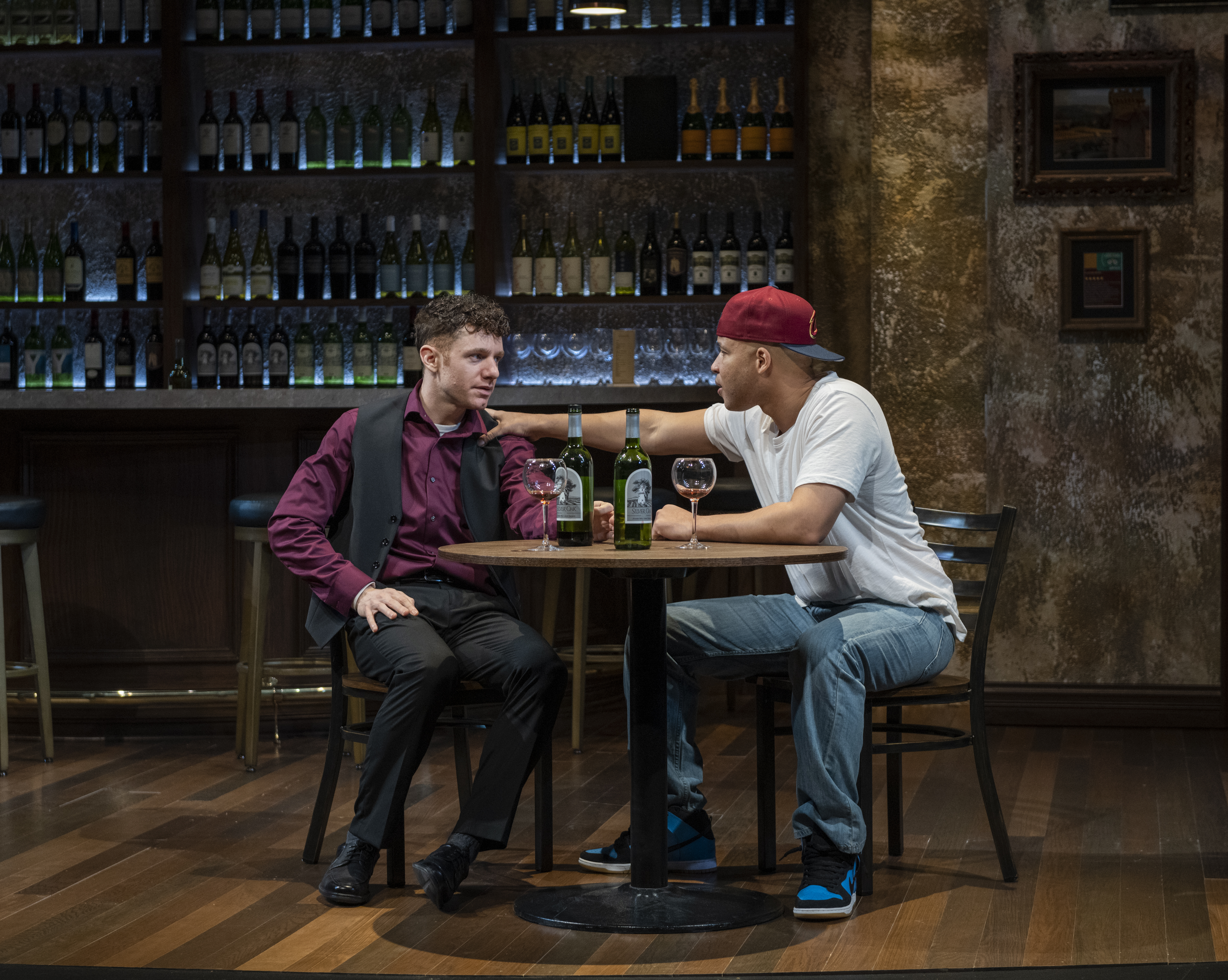
Chris Perfetti and Glenn Davis in “King James” (Michael Brosilow)

And you’re right, that didactic approach, it wouldn’t hit as hard, because for me, what Shawn had is what the Black experience is. It’s like somebody says something racist or something f**ked up or something insensitive, and if you try to fight every battle, you will never get anywhere.

Yeah.

On “Abbott Elementary” your character, Jacob “Mr. C,” he’s the opposite of Matt because he wants to have too many conversations about race. How fun has it been playing him?

“I typically get cast as these brooding, darker, more tragic figures, and Jacob is obviously the opposite of that.”

It’s great. It’s a blast. I feel like I’m a very lucky dude right now, getting to hold both of these things at the same time. They do feel very different, but it’s weird how they inform each other. Like you said, they are in many ways opposites.

But I can’t wait to go back to work. I’m obsessed with those people on that show, and I feel very lucky that I get to do it. It’s only helped by this weird moment that we’re having, where people are responding to the show, and I feel like I’ve gotten very comfortable with s**t not working out, and so having strangers come up to me and tell me that the show means something to them is pretty cool.

I feel like with both of the projects, you play two different people, but they’re both in this space trying to figure out that balance between getting it right and getting it wrong. What role does art play in that for you?

I feel like the other thing that connects them for me is they’re both somewhat loners. They’re both waiting for somebody to give them permission to, in Jacob’s case, change the world and in Matt’s case, just be the best version of himself. It’s weird. I feel like I typically get cast as these brooding, darker, more tragic figures, and Jacob is obviously the opposite of that. I’m trying to just make peace with, while I do feel very connected to that character, that part of this art thing is letting somebody else have control and just trusting that Quinta [Brunson] was like, “Yeah, that’s actually the person that I imagine, or that guy understands something more than maybe he even knows.”

Jacob’s one of my favorite characters in television because I’ve made 300 school visits over the past six years. When I have conversations or when I meet teachers, especially good teachers, it’s nothing like when I went to school. I went to school in the ’90s, and when I went to school, teachers used to say things like, “You’re going to get murdered just like your cousin.”

Oh my God.

But these new teachers, they say stuff like, “Oh, I see you’re having a difficult time, would you like some granola? I just got here from TFA and I brought granola and you can have a part of my check for reparations.” I’m telling these kids like, “Yo, y’all don’t know how good y’all have it. They’re giving away granola and talking about self-care. That’s why it’s so funny to me because “Abbott” is so on-brand. When we had Janelle James on “Salon Talks,” she was talking about how cool it is to improv lines with you and to riff back and forth. What’s that experience like?

“We are blessed with really incredible writers.”

It’s amazing. Improv-ing with Janelle is like trying to play one-on-one with LeBron. She’s just so genuinely funny in life and amazing on the show. It’s a good vibe on set. We are blessed with really incredible writers, and so I feel like the show comes very well baked and there’s not much that we need to do. And I’m fully aware that anything that I come up with on the day is just usually not going to be as funny as what they already wrote down, but a lot of stuff that we do makes it into the show, and there’s a real air of improvisation.

We will riff on stuff that’s already there, and that’s just essential, I think, to the show. If we’re going to make this thing and on some level dupe you into thinking that it’s a documentary, you have to believe that it’s real life. I find that when something is genuinely coming from an actor and not planned or maybe happening for the first time or in collaboration with somebody that doesn’t know it’s going to happen, I feel like that captures the most real life stuff, and that’s just the most enjoyable thing for me to watch. And so I’m trying to do that with Janelle, but the show is usually very well written.

You guys have just given so much life to so many people, and it sucks that we have this strike going on right now, but at the same time, hopefully it’s going to make everyone more comfortable. I know “Abbott” was one of the first shows impacted. What do you hope comes of this?

I hope the writers get what they deserve. I’m simultaneously fretting and not at the same time. People in France do this all the time. We need to get, I think, a little more comfortable with standing up in the way that we are now. It’s unfortunate that we have to do it in this way, but it’s an oddly terrifying and beautiful moment, and I hope it’s over soon.

“Abbott” is also documentary style, so you can probably pay the writers under the table in cash, just maybe shoot a couple of episodes, so we don’t get bombarded with 750,000 brand new reality shows.

I feel like that’s going to happen regardless, but I’ll see what I can do about that.

We were in the studio talking about your fashion sense and how cool your outfits are. Does Mr. C have it in him to dress like Chris?

Maybe Season 5, but no, I think fashion is utility for Jacob. I appreciate that though.

What’s next for you?

We’ve got a month left to do the play, which I’m really excited about. And then I hope it’s not long before we get to go back and start shooting the third season of “Abbott.” It’s wild to even be able to answer that question. I feel like I never imagined a year in my career where I would get to work more than I am not working, and that’s happening, and that’s pretty rad. I’m just so excited to go back to “Abbott.” I think Quinta is a really singular talent and I know that she’s excited about our third season, and so that makes me excited.

Harvard professor warns: Here’s how AI could take over elections — and undermine democracy

Could organizations use artificial intelligence language models such as ChatGPT to induce voters to behave in specific ways?

Sen. Josh Hawley, R-Mo., asked OpenAI CEO Sam Altman this question in a May 16 Senate hearing on artificial intelligence. Altman replied that he was indeed concerned that some people might use language models to manipulate, persuade and engage in one-on-one interactions with voters.

Altman did not elaborate, but he might have had something like this scenario in mind. Imagine that soon, political technologists develop a machine called Clogger — a political campaign in a black box. Clogger relentlessly pursues just one objective: to maximize the chances that its candidate — the campaign that buys the services of Clogger Inc. — prevails in an election.

While platforms like Facebook, Twitter and YouTube use forms of AI to get users to spend more time on their sites, Clogger’s AI would have a different objective: to change people’s voting behavior.

How Clogger would work

As a political scientist and a legal scholar who study the intersection of technology and democracy, we believe that something like Clogger could use automation to dramatically increase the scale and potentially the effectiveness of behavior manipulation and microtargeting techniques that political campaigns have used since the early 2000s. Just as advertisers use your browsing and social media history to individually target commercial and political ads now, Clogger would pay attention to you — and hundreds of millions of other voters — individually.

It would offer three advances over the current state-of-the-art algorithmic behavior manipulation. First, its language model would generate messages — texts, social media and email, perhaps including images and videos — tailored to you personally.

Whereas advertisers strategically place a relatively small number of ads, language models such as ChatGPT can generate countless unique messages tailored for you personally.

Second, Clogger would use a technique called reinforcement learning to generate a succession of messages that become increasingly more likely to change your vote. Reinforcement learning is a machine-learning, trial-and-error approach in which the computer takes actions and gets feedback about which work better in order to learn how to accomplish an objective. Machines that can play Go, chess and many video games better than any human have used reinforcement learning.

Third, over the course of a campaign, Clogger’s messages could evolve in order to take into account your responses to the machine’s prior dispatches and what it has learned about changing others’ minds. Clogger would be able to carry on dynamic “conversations” with you — and millions of other people — over time. Clogger’s messages would be similar to ads that follow you across different websites and social media.

The nature of AI

Three more features — or bugs — are worth noting.

First, the messages that Clogger sends may or may not be political in content. The machine’s only goal is to maximize vote share, and it would likely devise strategies for achieving this goal that no human campaigner would have thought of.

One possibility is sending likely opponent-voters information about nonpolitical passions that they have in sports or entertainment to bury the political messaging they receive. Another possibility is sending offputting messages — for example, incontinence advertisements — timed to coincide with opponents’ messaging. And another is manipulating voters’ social media friend groups to give the sense that their social circles support its candidate.


Want a daily wrap-up of all the news and commentary Salon has to offer? Subscribe to our morning newsletter, Crash Course.


Second, Clogger has no regard for truth. Indeed, it has no way of knowing what is true or false. Language model “hallucinations” are not a problem for this machine because its objective is to change your vote, not to provide accurate information.

Third, because it is a black box type of artificial intelligence, people would have no way to know what strategies it uses.

Clogocracy

If the Republican presidential campaign were to deploy Clogger in 2024, the Democratic campaign would likely be compelled to respond in kind, perhaps with a similar machine. Call it Dogger. If the campaign managers thought that these machines were effective, the presidential contest might well come down to Clogger vs. Dogger, and the winner would be the client of the more effective machine.

We can imagine the day when a machine wins the election, rather than a person. That election would not be democratic, even though the ordinary activities of democracy would have occurred.

Political scientists and pundits would have much to say about why one or the other AI prevailed, but likely no one would really know. The president would have been elected not because his or her policy proposals or political ideas persuaded more Americans, but because he or she had the more effective AI. The content that won the day would have come from an AI focused solely on victory, with no political ideas of its own, rather than from candidates or parties.

In this very important sense, a machine would have won the election rather than a person. The election would no longer be democratic, even though all of the ordinary activities of democracy — the speeches, the ads, the messages, the voting and the counting of votes — would have occurred.

The AI-elected president could then go one of two ways. He or she could use the mantle of election to pursue Republican or Democratic party policies. But because the party ideas may have had little to do with why people voted the way that they did — Clogger and Dogger don’t care about policy views — the president’s actions would not necessarily reflect the will of the voters. Voters would have been manipulated by the AI rather than freely choosing their political leaders and policies.

Another path is for the president to pursue the messages, behaviors and policies that the machine predicts will maximize the chances of re-election. On this path, the president would have no particular platform or agenda beyond maintaining power. The president’s actions, guided by Clogger, would be those most likely to manipulate voters rather than serve their genuine interests or even the president’s own ideology.

Avoiding Clogocracy

It would be possible to avoid AI election manipulation if candidates, campaigns and consultants all forswore the use of such political AI. We believe that is unlikely. If politically effective black boxes are developed, the temptation to use them will be almost irresistible. Indeed, political consultants might well see using these tools as required, given their professional responsibility to help their candidates win. Once one candidate uses such an effective tool, their opponents could hardly be expected to resist by disarming unilaterally.

Enhanced privacy protection would help. Clogger would depend on access to vast amounts of personal data in order to target individuals, craft messages tailored to persuade or manipulate them, and track and retarget them over the course of a campaign. Every bit of that information that companies or policymakers deny the machine would make it less effective.

Another solution lies with elections commissions. They could try to ban or severely regulate these machines. There’s a fierce debate about whether such “replicant” speech, even if it’s political in nature, can be regulated. The U.S. extreme free speech tradition leads many leading academics to say it cannot.

But there is no reason to automatically extend the First Amendment’s protection to the product of these machines. The nation might well choose to give machines rights, but that should be a decision grounded in the challenges of today, not the misplaced assumption that James Madison’s views in 1789 were intended to apply to AI.

European Union regulators are moving in this direction. Policymakers revised the European Parliament’s draft of its Artificial Intelligence Act to designate “AI systems to influence voters in campaigns” as “high risk” and subject to regulatory scrutiny.

One constitutionally safer, if smaller, step, already adopted in part by European internet regulators and in California, is to prohibit bots from passing themselves off as people. For example, regulation might require that campaign messages come with disclaimers when the content they contain is generated by machines rather than humans.

This would be like the advertising disclaimer requirements — “Paid for by the Sam Jones for Congress Committee” — but modified to reflect its AI origin: “This AI-generated ad was paid for by the Sam Jones for Congress Committee.” A stronger version could require: “This AI-generated message is being sent to you by the Sam Jones for Congress Committee because Clogger has predicted that doing so will increase your chances of voting for Sam Jones by 0.0002%.” At the very least, we believe voters deserve to know when it is a bot speaking to them, and they should know why, as well.

The possibility of a system like Clogger shows that the path toward human collective disempowerment may not require some superhuman artificial general intelligence. It might just require overeager campaigners and consultants who have powerful new tools that can effectively push millions of people’s many buttons.

This article is republished from The Conversation under a Creative Commons license. Read the original article.

Geraldo outed me on national television

Just before Christmas in 1987, Geraldo Rivera outed me on national television. I’m sure it wasn’t malicious, even though he has a history of shock journalism. He didn’t even know my name. During a primetime special, he showed a video clip of me and my boyfriend kissing on the National Mall, taken during the National March on Washington for Gay and Lesbian Rights.

I think about this often during Pride Month, even though it happened more than 30 years and several boyfriends ago. The broadcast caused a scandal in my family because I wasn’t out to them. In fact, they knew very little about my life. I had kept them at arm’s length for years because I was afraid. There are many stories — too many stories — about LGBTQ people being ostracized by their families when they come out. I didn’t know how to come out to my parents, so I put it off.

Then, in late December 1987, my sister Betsy called me. She said she had seen me on TV kissing another guy.

“So are you gay?” she asked.

“Modern Love” was a live special in which Geraldo purported to show how AIDS had changed contemporary society. The U.S. Surgeon General’s report on AIDS was a year old by then. Twenty million copies of Koop’s report had been distributed. Where C. Everette Koop had tried to inform the public, Geraldo Rivera was intent on scaring them.

He introduced his special with these words: “‘My love is like a red red rose’ wrote the poet but that was long before a modern-day thorn appeared and added a new dimension to love. The dimension of fear. The new thorn of course, is AIDS. Love, relationships, romance and sex will never be the same.” As if sex and death hadn’t been linked in Western culture for centuries. As if women worldwide hadn’t had reason to fear sex. What was new was that men were dying, particularly gay men. The overall death toll was nearing 100,000.

It was an open secret: If you didn’t tell people, they could (and usually would) pretend they didn’t know you were gay.

For a segment on the gay community, Geraldo ran footage of the march that had taken place that fall. At the time, I was 23 years old and living in Minneapolis. I had been working for a small, gay and lesbian service organization (it was only “gay and lesbian” then) and had attended the march with my boyfriend, Terry. My brother-in-law, whom I had never met in person, was watching the broadcast in California and recognized me from family photos. He told my sister when she got home that night. Betsy didn’t believe him, so he showed her the recording.

Terry and I were able to catch the show the night she called. We were both shocked to see ourselves. The clip of us was used during the opening credits, the body of the story and the closing credits. There we were, arm in arm, and yes, we were kissing. It was a short, affectionate peck. It wasn’t like we were making out in front of the cameras. But if you thought you saw your little brother at the beginning, you had two more chances to confirm that yes, that was your little brother. Watching it myself, I thought about being at the demonstration on the Mall and seeing the scaffolding with television cameras. They had to have been at least a football field away. I never considered they might focus on us, much less that the images would be broadcast on national television. I mean, that’s the stuff of paranoia and nightmares.

Thanks to Geraldo’s special, my own nightmare scenario had arrived. Coming out to my large Catholic family was only the beginning of the process of dismantling the closet I had spent years building. In the days before social media, you could be out in your personal circle, and you could almost manage the number of people who knew or the situations in which you were out or closeted. It was an open secret: If you didn’t tell people, they could (and usually would) pretend they didn’t know you were gay. Sure, there might be some whispers, but it would be among a small group of people. Not the whole world. The closet as a Western construct existed (and still exists) on a spectrum from you’re out all the time to you’re not even out to yourself. Everywhere on that spectrum, the closet exists as a set of internal and external constraints put on LGBTQ people. For some of us, it keeps us safe, for some it is a mental prison. For me, it is a continual process of undoing its effects.

“If you don’t tell Mom, I will,” Betsy said. She says now she wouldn’t have, but I didn’t know that then.

For about 15 minutes I cried and screamed into a pillow. Terry tried to comfort me but he didn’t know what to do or say. I knew my parents would find out someday, and they would disown me, I was sure of it.

True to expectations, Dad said, “Then you’re no son of mine,” and hung up.

Mom answered the phone and got my dad to pick up the other line. I don’t remember what I said, probably that there was this show and did she see it. No, she didn’t. Why, what’s this about? I must have said my roommate is really my boyfriend, and we were on television kissing. Silence. I imagined her sitting at the kitchen table, tight-lipped. It’s a look I inherited.

“Are you telling us you’re a gay?”

“Yes.”

True to expectations, Dad said, “Then you’re no son of mine,” and hung up. The immediacy of his response suggested he had thought about this day.

Mom stayed on the line long enough to say, “I could have gone my whole life without hearing that.”

This was exactly why I hadn’t come out to my family. In my college years, I had gradually told friends, had sought out gay roommates, and had boyfriends. Terry was the first boyfriend I had lived with. I grew up in northern Wisconsin, about 150 miles from Minneapolis. Since I couldn’t talk about this one foundational part of my identity, I didn’t talk to any of them about anything much. At one holiday gathering, we were talking about music and someone asked me what I liked. My mind froze because I couldn’t think of one band or singer that didn’t sound too gay. Wham!? Uh no. Bronski Beat? Oh, hell no.

My sister, with the help of Geraldo, had broken down the closet door for me. With nothing more to lose, I made some other calls. My brother Bill was calm and reassuring on the phone. “It’s not like it’s a surprise.” By the end of the night, I was exhausted, cried out. Terry consoled me, and I began to feel relieved that the conversations I had dreaded for so long were finally over. 

The next day, it seemed like five for, and two against, with my mom in the middle. Mom explained that my dad wouldn’t allow me in their house, so I was no longer invited for Christmas. I told myself (and others) I could live with that—Dad and I never liked each other. He pushed me into traditional boy things, like sports, that I didn’t want to do, and then he was disappointed when I hated them. I wouldn’t miss him at all. Mom went along since, as she said, she had to live with him.

Over the next year, I talked to Mom on the phone a few times. I visited her once when Dad wasn’t home. If I was going to a family event, they wouldn’t attend. They made that clear to my siblings. So when gatherings happened in or near our hometown, I stayed away. Someone said I was “estranged” from my family during this period. That seemed too strong a word. Were we estranged or just distant? When I was in the closet, I had convinced myself that no one would be interested in anything I was doing, anyway, whether it was a relationship, a job, or graduate school. Some of my mom’s (perhaps well-meaning) comments supported this impression. I told her in a letter when Terry and I broke up. She wrote back, “Maybe it’s for the best.” I felt the judgment in that—as if she could deal with me being gay in theory but didn’t want to think about me being with another guy. It was best that I remained single. I didn’t.

On or about my 25th birthday, I wrote my dad a letter asking if he was ever going to relent. It wasn’t a pleading letter. The impression I meant to give was that I didn’t care one way or the other. But I had spent a lot of time with my therapist talking about what she called my “family of origin issues.” So I told him I wanted a final answer: “Did I have a father or not?” He called me when he got the letter. Before Caller ID, you could still be surprised when you answered the phone and heard the voice on the other end. He missed me, his youngest, and wanted to make up. Sort of. He made it clear he didn’t want to hear about anything gay, and he certainly never wanted to meet my boyfriend.

A few years passed. I fell in love and moved in with Gary. Eventually, we were invited, together, to a holiday gathering hosted by another sister, Nancy. My parents were also invited. “If they don’t want to come, they don’t have to,” she said. They did.

The four of us met in Nancy’s dining room. Mom and Dad were polite to Gary and me, and then we all went into separate rooms. A truce, a bit of a thaw.

He made it clear he didn’t want to hear about anything gay, and he certainly never wanted to meet my boyfriend.

I think of families in terms of houses. The bigger the family the more bedrooms. My parents had their room, each sibling had a room with their spouse and children, and there’s a kitchen and living room where group activities happen. Gary and I left our room once in a while, for birthdays and holidays, but mostly we stayed in out of the common areas. Not in the closet anymore but still separate. If we invited people into our space—a clearly gay space—it didn’t always go well. If I thought everyone had become open and accepting of All Things Gay, I saw the truth when Betsy brought her daughters to a Pride Day in Minneapolis. They didn’t feel welcome or safe, and she let me know it.

For my part, it hurt that my parents didn’t see Gary on par with my sisters’ husbands or my brothers’ wives. No, we weren’t married. It wasn’t legal, and we didn’t really believe in marriage anyway. We didn’t need the government to sanction our relationship, thank you. Not like that was going to happen in our lifetimes, I thought, particularly after the Defense of Marriage Act banned recognition of same-sex marriage in 1996. I wrote as much in a literary magazine I edited around then, offending one of my sisters. “What’s wrong with mimicking heterosexual marriage?” she asked. Either I wasn’t communicating well enough about my life and values, or they weren’t ready to hear it. Had we moved away from being estranged only to remain distant?

Honesty takes practice. We didn’t have that much time to practice being honest with one another.

This went on for a few years, and I thought things were going well enough. When we found out in the summer of 1997 that my dad had cancer, Gary and I drove from Minneapolis to my parents’ home in Wisconsin. We had a pleasant visit outside on their patio. They were friendly, even kind. My dad died a few months later at 64, and I mourned the relationship we didn’t have, that we would never achieve. Would he have become more accepting as he got older, mellowing with age, the way my mom seemed to? Would I have liked him? Would he have liked me?

Amid the grief there was relief. For the first time in my life, I didn’t have to worry about, or even think about, his disapproval or his negativity. It was as if the censor on my shoulder had gone away. My relations with my mom and my siblings were easier, freer. And yet, I still felt they didn’t want to know me, the real me. There were things I held very close, like my academic work that I thought would be “too gay” for them.

After the funeral, my brother-in-law, Chuck, my oldest sister’s husband, tried to help break down my walls. He had been welcoming and compassionate back when I was a girly 17-year-old boy.

For the first time in my life, I didn’t have to worry about, or even think about, his disapproval or his negativity. It was as if the censor on my shoulder had gone away.

“Everyone here cares about you,” Chuck said. It was the simplest statement but it shook me. I had believed the opposite. I needed to reassess my family, see my brothers and sisters as individual people again. What was my role in the family now that I was an adult, and our father was gone? How could I support my mother and be a brother to them?

Gary and I decided to end our relationship in 2006, and I took a job in California. I met Koji in 2011. He lived in New York, and we started a long-distance relationship. Neither of us was that interested in marriage as a concept, but we recognized there might be practical benefits — some of the 100+ benefits married people get — particularly since he is Japanese and not a U.S. citizen. When the Supreme Court made same-sex marriage legal in 2015, all of our ambivalence about it came into clear view. I moved to New York the next year, and we registered a domestic partnership soon after. The idea of something happening to one of us and the other not being allowed in the hospital room tipped the scales. Of course, the domestic partnership only mattered in New York City, so after cajoling from a friend, we decided to get married. We chose a date in April 2021 to have a ceremony in Palm Springs. I would need to tell my mom.

We had gotten a bit closer over the years. She visited me in California, loving the warmth and the sun. She met Koji there and liked him. Mom and I talked more about our lives, I asked questions about her growing up, and she asked about my work. We never talked about the Supreme Court rulings. I felt there were things she still didn’t want to hear about. Twenty years later, some of those walls still stood.

She was the first person I told about us getting married. She was in assisted living by then and in a wheelchair. Her traveling days were over. So I knew there was no way she could attend. Still, she didn’t take it well.

“Oh Jim, I wish you weren’t saying that.”

I took a second to clear my mind, push away my immediate defensive reaction, and asked her why.

“I don’t know, I just … wish you weren’t saying that.”

Here we were, two guys in our 50s, recognized and honored by family and friends. My brothers and sisters welcomed me into a club I didn’t know I wanted to be in.

It felt to me like a knee-jerk reaction. I had set my own aside, but she did not filter hers. She was OK with my relationship but marriage was a step further than she was prepared to go. Although she was Catholic, and she raised her kids that way, she never seemed particularly religious to me. Maybe I misunderstood. I had left the church years before, and I never really asked her about her own views. Like I never asked her views on gay marriage.

She called me back the same day. I let it go to voice mail. She left a message that I listened to immediately. She apologized. I waited until she called again the next day to talk to her.

“I should be happy for you,” she said, “I am happy for you. I can’t believe I would act that way to my own son.”

“We’ve been through all of this before,” I said, thinking back to the Geraldo episode. “I thought you were OK with it.”

“I never had a problem with you being gay,” she said. “That was all your dad.”

I had to stop myself from laughing. Mom was revising history to make herself feel better, more tolerant and accepting. She was 85 at the time. I wasn’t going to argue with her or try to make her remember things the way I remembered them. She had always played the middle between me and my dad. I told myself it didn’t hurt me at all, but it did.

My mother died in January 2021 at age 86. Because of the pandemic, we delayed the funeral until August. Our wedding was also delayed that year from April to November. All of my siblings made it to the wedding, along with many of their children and grandchildren. Koji’s family in Japan would have had to quarantine for 14 days in both directions, so they couldn’t come.

The importance of marriage, or of a wedding, was obvious to me, for once. Here we were, two guys in our 50s, recognized and honored by family and friends. My brothers and sisters welcomed me into a club I didn’t know I wanted to be in. It wasn’t the Club of the Married, though — it was the Club of My Family.

It should have been obvious, but my brother-in-law made sure to remind me: “We all care about you.” Of course, they had all along. It took me 25 years to realize how much.

It was the cruelty of the closet, amplified by my own fear, that had created and kept such a distance between my six siblings, their spouses and me. Finally, we had reached a point where we could all celebrate my happiness, my marriage and our whole family. As my brother Bill said, counting Koji as one of us, “Now we are fourteen.”

Your secret weapon to becoming a better cook costs nothing

When my daughters were little, their school was a block away from the public library. Once a week, we’d faithfully do an afterschool trip there so they could stock up on picture books and YA lit — and I could grab the latest big, expensive bestseller cookbook. It was the greatest and cheapest culinary education I ever had. 

Growing up in my home of indifferent cooks, I didn’t stir pots at the elbow of a doting grandmother or wait for tattered recipe cards to be passed down from my mother. I instead followed their example and ignored the entire concept of food preparation for as long as possible. When I finally reached a point in adulthood where I’d grown tired of subsisting on beer and cigarettes, a friend who worked at a Williams Sonoma gave me a copy of “The Silver Palate Cookbook,” and I pretty much felt that covered everything. Several years later, my lifestyle had changed dramatically but my income had not. So when I knew I wanted to take my cooking to the next level, I whipped out my card (library, not credit). 


Want more great food writing and recipes? Subscribe to Salon Food’s newsletter, The Bite.


There are any number of significant idealogical reasons to patronize your local library right now. With economically and politically motivated cuts decimating funding and conservative backed book bans spiking, libraries across the country are under serious threat. Patronizing and supporting them feels like a statement, a declaration in favor of free speech and intellectual pursuit. But also, did you know that libraries are really cool if you like not spending money? I swear, they’re amazing for that. And whether you have a nascent curiosity about making easy meals or a burning passion for esoteric baking techniques, the library can be your new favorite place after your kitchen.

Of course, there’s the book lending aspect. You just get this card and then you can borrow things and enjoy them and return them so someone else can do the same. Yes, I can and do read plenty on my numerous devices, and yes, I do have Smitten Kitchen bookmarked and Google the phrase “best ____ recipe” daily. But real books made of paper are generally really nice, and cookbooks are especially beautiful. From the very first of those cherished library trips with my daughters, I was able to try out books I’d been curious about but unsure if they deserved a permanent place on my tiny cookbook shelf. I was able to enjoy the singular pleasures of books I was intrigued by unlikely to spend money on, those single topic tomes or the celebrity recipe collections. I explored entire cuisines and styles that I hadn’t been sure where to begin with.

“There’s always something to discover in the cookbook section”

Food scientist, dietitian, and nutritionist Anna Cassidy, an author and founder of the knives and cookware site Imarku, has a similar love affair with the library. “Whether it’s exploring new ethnic cuisines and flavors, trying out new cooking techniques, or getting creative with ingredients, there’s always something to discover in the cookbook section. Even if the library doesn’t have the book you’re looking for, they can usually get a copy through inter-library loan.” 

Cookbooks, however, are just the beginning. In my own library visits I’d also frequently wind up with something from a different place in the Dewey decimal system too. From the library, I checked out books on nutrition, on the value of adopting vegan and vegan-ish practices, on organizing my home kitchen to be more efficient and appealing. I borrowed Ruth Reichl’s memoirs and Michael Pollan’s books on the science and politics of food.

Becoming a confident cook isn’t just about following recipes. It’s about appreciating our place in our homes and in our food systems. It’s about feeling part of the endless, fascinating conversation. And a library book is somehow just enough of an investment — it doesn’t have the commitment factor of a purchase but it isn’t the rabbit hole of distraction that the internet is either. To sit with a book you’re going to have to give back is to spend time with something you really want to spend time with and learn from.

For Anna Cassidy, the library is also a place of community and experimentation. “I also like to take advantage of the free lessons and cooking demonstrations offered,” she says. “These lessons are usually geared toward a variety of skill levels and interests.”

Currently at the Brooklyn Public Library, they offer regular live cook alongs on Instagram with recipes shared by locals. And at the Culinary Literacy Center at the Free Library of Philadelphia, there are regular cooking classes, demonstrations and discussions for children, teens and adults. 

“From sous-vide machines to slow cookers to air fryers, you can often check these items out to try them out”

Cassidy also notes that “Your library often holds a wealth of kitchen equipment and tools that you may not otherwise be able to purchase. From sous-vide machines to slow cookers to air fryers, you can often check these items out to try them out before committing to purchase.” Hundreds of libraries, both traditional book-centric institutions and specific tool orientated ones, offer these services, and they’re easily searchable. The Berkeley Public Library, for example, has a tool library that includes items like a stand mixer and immersion blender. 

“I’ve gotten several different varieties of squash, herbs, lettuces, and other easy-to-grow plants for free”

Ashley Schuering, creator of the money saving blog Confessions of a Grocery Addict, also loves the library as a resource for books and classes. But she also uses it yet another ingenious way. “Use the seed bank to grow your own produce!” She advises. “Here in Nashville, our library system offers a free seed exchange. I’ve gotten several different varieties of squash, herbs, lettuces, and other easy-to-grow plants for free.”

During the pandemic, the building where my local library stood for decades was torn down. A new one will supposedly one day occupy the ground floors of the enormous new apartment building that’s going up in its space, but for now it’s still just a skeleton of steel. But while I haven’t had the pleasure of taking out a physical book in a while, I still utilize my library constantly. I use my account to discover and download loads of books, sometimes following a random yet satisfying whim about Irish cookery or the history of beer. And I listen more these days to audiobooks than podcasts, savoring the likes of Kwame Onwuachi’s “Notes From a Young Black Chef,” on subway rides and walks around my park.

The library can’t help change the astronomical price of groceries or the widening creep of food deserts. But it can help you get the seeds to grow your own food, the books and classes to learn the best ways to cook it and even lend you the right kitchen equipment to prepare it, at absolutely no cost. That’s a pretty great deal. It’s not just about the bottom line, though. I am the cook that I am because of my library, and I’m the eater that I am because of it. I’m part of a community, sometimes standing at the stove, sometimes curled up between the covers, bound by our relationship to food and to each other. It’s a joy that can’t be bought. It’s free for everyone.

Progressives say U.S. debt limit lift is “Nothing to brag about”

President Joe Biden delivered his first televised address from the Oval Office on Friday night to applaud the final result of legislative negotiations between his administration and Republicans in Congress who took the U.S. economy hostage over the debt ceiling, but progressive critics found the victory lap hard to take given the details of the deal and the devastating impacts they will have.

“It was critical to reach an agreement and it’s very good news for the American people,” Biden said during his remarks from the White House. “No one got everything they wanted but the American people got what they needed. We averted an economic crisis and an economic collapse.”

But what Biden called a “big win for our economy and the American people,” progressives—who argue the entire debt ceiling law is unconstitutional because it violates the 14th amendment and warned since last year that Republicans would orchestrate a crisis to protect wealthy tax dodgers and corporations while imposing fresh cuts on key social programs—should be seen for what it is: a kick in the face to the planet, democracy, and the material needs of poor and working-class Americans.

“Wall Street and corporate interests may be enthusiastic about this bill, but I believe it moves us in exactly the wrong direction.” —Sen. Bernie Sanders

Warren Gunnels, majority staff director for the Senate Health, Education, Labor and Pensions (HELP) Committee chaired by Sen. Bernie Sanders (I-Vt.), said on social media Friday, the final legislation—which Biden is expected to sign into law Saturday—should be seen as “a big win for the donor class and a big loss for the 99%.”

“It’s nothing to brag about,” Gunnels added.

“Not everyone got what they wanted?” Nina Turner, former Ohio State Senator and congressional candidate, asked rhetorically. “The 1% and the military-industrial complex got exactly what they wanted.”

As Common Dreamsreported, Lockheed Martin CEO James Taiclet this week said Biden signing the agreement into law would be “as good an outcome as our industry or our company could ask for at this point,” noting that it calls for “3% growth for two years in defense where other areas of the budget are being reduced.”

Journalist and author Mark Jacobs suggested that much of the coverage in the corporate press has been friendly to Biden’s framing of the legislative result, but that this should be challenged.

“Here’s the news media’s takeaway on the debt ceiling deal: Yay! Bipartisanship works!” said Jacobs. “Here’s the reality: GOP radicals held the economy hostage, Democrats paid the ransom, and bipartisanship is badly broken.”

In addition to across-the-board spending caps for non-defense discretionary spending—which economists note is a real-world cut, given inflation, to key programs that serve tens of millions working class individuals and families—the deal greenlit permitting reforms for oil and gas projects desired by the fossil fuel industry and will force fast-track approval of the controversial Mountain Valley Pipeline that frontline communities in West Virginia, Virginia, and elsewhere have opposed for years.

Katie Bergh and Dottie Rosebaum, policy analysts with the Center on Budget and Policy Priorities, detailed this week how changes to the Supplemental Nutrition Assistance Program (SNAP) contained in the deal championed by Biden and Speaker of the House Kevin McCarthy “would put almost 750,000 older adults aged 50-54 at risk of losing food assistance through an expansion of the existing, failed SNAP work-reporting requirement.”

“The older adults who lose access to SNAP would lose about $8 per person per day in benefits,” explained Bergh and Rosenbaum. “These individuals often have very low incomes, and the loss of SNAP will push most of those affected into or deeper into poverty.”

At the same time, the deal championed as a “big win” included large cuts to the IRS budget that a CBO analysis this week showed will actually cost the federal government over $40 billion in lost revenue and increase the deficit—the opposite result of what the GOP claims regarding the budget but very much in line with helping wealthy tax dodgers and corporations pay less each year.

In a Friday op-ed explaining his opposition to the legislation, Sen. Sanders said the only thing good to say about the bill was that it was not worse—which it certainly could have been.

“At a time when this country is rapidly moving toward Oligarchy, with more wealth and income inequality than we’ve ever experienced, I could not in good conscience vote for a bill that cuts programs for the most vulnerable while refusing to ask billionaires to pay a penny more in taxes,” Sanders wrote. “Wall Street and corporate interests may be enthusiastic about this bill, but I believe it moves us in exactly the wrong direction.”

“The fact of the matter is that this bill was totally unnecessary,” Sanders concluded in his op-ed. “The President has the authority and the ability to eliminate the debt ceiling today by invoking the 14th Amendment. I look forward to the day when he exercises this authority and puts an end, once and for all, to the outrageous actions of the extreme right-wing to hold our entire economy hostage in order to protect their corporate sponsors.”

Jazz guitarist Dan Wilson on urgency in “Eleanor Rigby” and what genius actually looks like

Grammy Award-nominated jazz guitarist Dan Wilson joined host Kenneth Womack to talk about covering the Beatles for his new album “Things Eternal,” finding “your band” and much more on “Everything Fab Four,” a podcast co-produced by me and Womack (a music scholar who also writes about pop music for Salon) and distributed by Salon.

Wilson, who said he grew up in a “sort of” musical family, didn’t realize his parents could sing and play before he himself took an interest as a teen. As he told Womack, his father taught him to play drums and bass, but it wasn’t until their local church needed a guitar player that he picked up that instrument and became “borderline obsessed.”

As he became a better player and got to know other musicians, his appetite for listening to and learning about all kinds of music expanded. It was upon hearing guitarist George Benson’s 1970 album “The Other Side of Abbey Road” that Wilson says he “got hip to the Beatles.” Taking note of the arrangements, Wilson then turned to the actual Beatles’ albums themselves and fell in love with “the interesting ways they put phrases together” in songs.

“They were doing something nobody else was doing,” he said. “And to have so many eyes on them, so many hangers-on, and still have that amount of success even when you have people around who think you shouldn’t, is just incredible.”

LISTEN:

Subscribe today through Spotify, Apple Podcasts, GooglePodcasts, Stitcher, RadioPublic, Breaker, Player.FM, Pocket Casts or wherever you’re listening.

Experimenting with musical arrangements led to his cover of “Eleanor Rigby,” having been particularly taken with the “tension and urgency” of the strings and the “rhythmic bounce,” which Wilson found “lively despite the dark subject matter.” As he told Womack, the Beatles continue to reside “in the front room” of his mind, and he’s been working on another arrangement of a Fab Four song that he “hasn’t brought to the masses quite yet.”

As for being a performer himself, Wilson explained (paraphrasing saxophonist Branford Marsalis): “It’s not the audience’s job to understand the intricacies of the music. It’s your job to make them feel something on a visceral level.”


Love in-depth interviews with artists? Listen to the “Everything Fab Four” podcast.


Listen to the entire conversation with Dan Wilson on “Everything Fab Four” and subscribe via Spotify, Apple Podcasts, Google, or wherever you’re listening. “Everything Fab Four” is distributed by Salon.

Host Kenneth Womack is the author of a two-volume biography on Beatles producer George Martin and the bestselling books “Solid State: The Story of Abbey Road and the End of the Beatles” and “John Lennon, 1980: The Last Days in the Life.” His latest project is the authorized biography and archives of Beatles road manager Mal Evans, due out in November 2023.

Taylor Swift and the ways white women exploit allyship

Anthropormorphized into a green-clad mountain valley, Taylor Swift sings a new version of her song “Karma,” while above her, a cloud shaped into the profile of rapper Ice Spice provides encouraging adlibs. “Facts,” she says at one point in the new music video, a clip that has become a running joke over the duo’s sparse and confusing collaboration — and the reason that the pop star is embroiled in new controversy. 

It felt an awful lot like the ole “I’m not racist; I have a Black friend” defense, as if that shields you from prejudice.

Unimaginatively, the source of the drama begins with a man: Matty Healy, frontman of The 1975. Prior to the remix, rumors began that Healy and Swift were dating, having been spotted at each other’s shows. The news was shocking in many ways. Swift is Miss Americana, an icon who’s worked painstakingly hard to keep her reputation clean and pure. Healy is a guy who eats raw meat on stage and calls it performance art. He inspired the rat, Rodney St. James, in “Flushed Away.”

He’s not interested in political correctness. He used to follow Kyle Rittenhouse on Instagram. He jerks off to and jokes about Ghetto Gaggers, a porn website that focuses on the brutalization of Black women. And importantly, he, in a resurfaced episode from Adam Friedland and Nick Mullen’s podcast, laughed along and thus encouraged the hosts as they mocked Ice Spice as an “Inuit Spice Girl” and “Chubby Chinese Lady” (even though she’s Nigerian and Dominican and previously publicly declared herself a fan of The 1975). He first responded to the episode by saying, “Sorry if I’ve offended you,” a classic non-apology that evades admitting any wrongdoing and instead implies those offended were being overly sensitive. He now says, per the New Yorker, that his offense “doesn’t matter.”

Rather than commenting on the controversies of her alleged new beau or denouncing his remarks, Swift decided to team up with rapper Ice Spice in a move that many felt was obvious damage control. And considering the timing, as well as how Swift’s girl squad is predominately white, it felt an awful lot like the ole “I’m not racist; I have a Black friend” defense, as if that shields you from prejudice. (Though Swift has said it was the rapper’s team who reached out first.) The star’s silence is loud. To be “neutral” is to still be complicit in racism. Whether she’s dating Healy or this is all an elaborate PR scheme, Swift has proven herself to be another white woman who claims to be an ally, claims Black Lives Matter and calls herself a feminist — but only as long as it serves her.

History is repeating itself. White women, after all, have consistently been complicit in racism. Approximately 54% of them voted for former President Donald Trump in 2016, and even those who appeal more explicitly to liberal sensibilities often reinforce this dynamic through the appearance of feminism, aka white feminism. Academic Rachel Elizabeth Cargle defines the term as a “type of behavior that rests under the guise of feminism only as long as it is comfortable, only as long it is personally rewarding, only as long as it keeps ‘on brand.'” In other words, white feminism leverages whiteness and a proximity to white men to exclude and disavow women of color. It believes in equality for white women in a false assumption that doing so will open doors to others. Core to this ethos is marketability, because it pursues a limited view of empowerment gained by capitalist means.

Swift’s pseudo-activist track record certainly raises a few questions.

Poster child for white feminism, Lena Dunham (who Swift credits for teaching her about the movement), is a fine example, having aligned herself with women’s rights only to famously accuse a woman of color of lying about being raped, had cast only white women in her HBO series “Girls” and has a catalog of controversial and racist remarks, including but not limited to the time she told Rolling Stone she feels more sympathy for “India’s stray dogs” than its “poverty-stricken people.” 

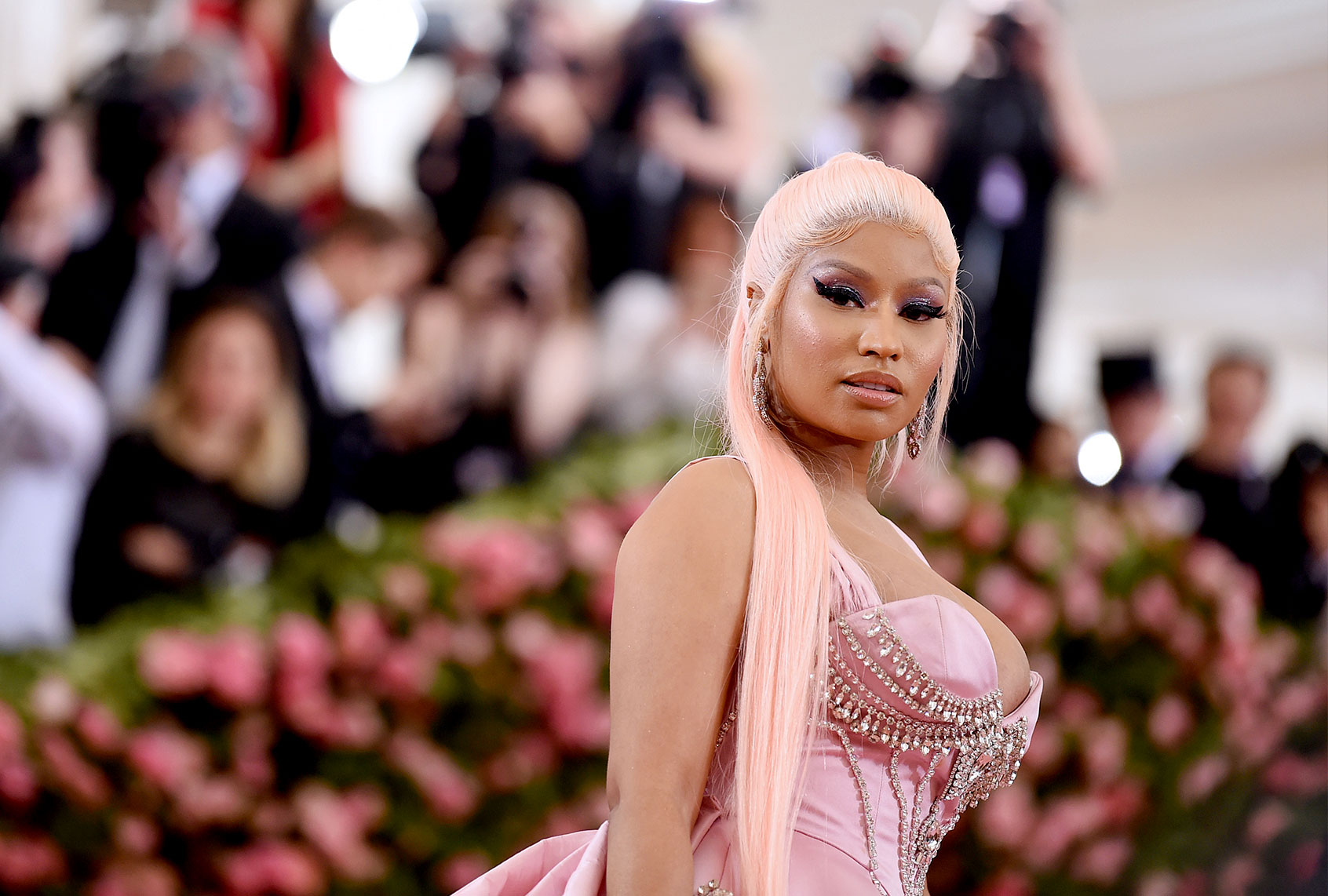
Nicki MinajNicki Minaj attends The 2019 Met Gala Celebrating Camp: Notes on Fashion at Metropolitan Museum of Art on May 06, 2019 in New York City. (Jamie McCarthy/Getty Images)Even before Healy, Swift has proven to take after her white feminist mentor. Her lore as a problematic fave could go on its own Eras tour. In 2015, the singer proved her definition of feminism to be insular when she got into a Twitter feud with Nicki Minaj who tweeted, “If your video celebrates women with very slim bodies, you will be nominated for vid of the year.” Swift, in thinking this was about her, responded, discouraging the rapper for “pit[ting] women against each other.” Minaj, who was referring to the ways the music industry overlooks Black women, was understandably confused about the reply, but the message was clear: Swift, like a true girlboss, panders to how women need to stick up for women, missing and dismissing how race factors in — nevermind the fact that her music video for “Shake It Off,” released one year before, was met with backlash for culturally appropriating Black culture.
When it comes to politics and activism, Swift’s true beliefs have always been opaque. The star exceeds at always being one foot in and one foot out, saying just enough to support a cause (and receive praise for it) but never enough to follow through on any of them. In 2017, she showed support for the Women’s March but did not actually attend. In 2019, she became an LGBTQ+ ally, releasing the anti-homophobe single “You Need To Calm Down,” donating to queer-led organizations and inviting drag artists on stage but has since remained quiet on the issue, which is especially vital now that a slew of anti-trans and anti-gays laws are sweeping through the country. In 2020, she spoke out against statues in Tennessee that depict Confederate generals and Ku Klux Klan members and in support of justice for George Floyd . . . and yet she is supposedly dating an unapologetic racist. While it’s unrealistic to expect celebrities to speak up about every issue, it is reasonable (and wise) to hold them to account for the things they do say, and Swift’s pseudo-activist track record certainly raises a few questions.

It’s understandable, then, how many have critiqued the star for carefully and opportunistically speaking up about issues when it’s advantageous for her. The most notable instance is in 2020, when she vocally disparaged Trump — but only after receiving backlash for refusing to voice her opinion during the 2016 election when Trump became president. (She revealed in a 2019 interview with The Guardian that her political silence stemmed from a fear of being canceled.) 


Want a daily wrap-up of all the news and commentary Salon has to offer? Subscribe to our morning newsletter, Crash Course.


But if she really cared about how, as she tweeted, Trump stoked “the fires of white supremacy and racism,” why is she (at the very least) cozy with Matty Healy, a guy described by Azealia Banks as “one shared needle away from tetanus”? The discrepancy between her actions and her words reveal how she, like the many white women who came before her, capitalize off of empty allyship for their own self gain. At the height of her most successful Eras Tour, Swift will visit 52 stadiums at record-breaking crowds and rake in an estimated $500 million to $1 billion. Her platform is larger than ever, which only makes her silence more troubling. She used it to address Ticketmaster when it was difficult to get tickets to her shows. Addressing her complicity in racism? Not as big a deal, apparently. 

For people of color, none of this is shocking; it’s tiring. If your anti-racism can be so easily cast aside by a greasy mop of curly hair, then you never cared about people of color to begin with. In this, Swift and Healy were right for each other all along. I’m just happy Ice Spice got to collect her check.

The oldest ever pterosaur in Australia was just discovered; it’s 107 million years old

Pterosaurs are perhaps the most popular dinosaur that isn’t actually a dinosaur.

The massive beasts, whose name is Greek for “winged lizards,” are so strongly associated with the age of dinosaurs that they memorably appear everywhere from natural history museums to movie franchises like the “Jurassic Park” series. Pterosaurs like the iconic pterodactyl are closely related to birds and other dinosaurs, and as such new discoveries about them regularly excited fans of science. That is why there has been considerable media attention around a recent study in the journal Historical Biology. Researchers from Australia have confirmed pterosaur bones that are 107 million years old, the oldest set of pterosaur bones known to the fossil record specifically on the continent.

They were able to confirm discovery of the first ever juvenile pterosaur in Australia — bones that are . . . believed to be 107 million years old.

The lead researcher, a PhD student at Curtin’s School of Earth and Planetary Sciences named Adele Pentland, told SciTechDaily that Australia was much farther south during the Cretaceous Period (145-66 million years ago) than it is presently, and as a result the pterosaurs discovered in present-day Victoria would have lived within the polar circle. They would have endured “sensationally harsh conditions,” surviving for weeks on end in frigid darkness.

“It is clear that pterosaurs found a way to survive and thrive,” Pentland explained to SciTechDaily. “Pterosaurs are rare worldwide, and only a few remains have been discovered at what were high palaeolatitude locations, such as Victoria, so these bones give us a better idea as to where pterosaurs lived and how big they were.” In addition, they were able to confirm discovery of the first ever juvenile pterosaur in Australia — bones that are, as with the other pterosaur discovered, believed to be 107 million years old.

Yet some mysteries remain. “It will only be a matter of time until we are able to determine whether pterosaurs migrated north during the harsh winters to breed, or whether they adapted to polar conditions. Finding the answer to this question will help researchers better understand these mysterious flying reptiles,” Pentland added.


Want more health and science stories in your inbox? Subscribe to Salon’s weekly newsletter The Vulgar Scientist.


Well-preserved pterosaur fossils are difficult to find.

These are not the only notable pterosaur discoveries in recent years. In 2022 a study in the journal Nature revealed that a pterosaur known as Tupandactylus imperator had microscopic structures in its skin known as melanosomes. Because there were different shapes of melanosomes in the pterosaur’s skin as well as feathery and pillowy filament bodies within its skull, scientists concluded that pterosaur’s skin was not only colored, but indeed had multiple colors. Previous pterosaur skin discoveries had only included melanosomes with the same shapes, meaning they either had the same color or were given varying hues through other chemicals in their skin. The 2022 finding was the first to confirm that pterosaurs had multiple colors in their skin.

Similarly a 2021 study in the scientific journal “Current Biology” transformed our understanding of pterosaurs by revealing the existence of a so-called “monkeydactyl” — a pterosaur with the equivalent of opposable thumbs. Officially known as Kunpengopterus antipollicatus, the small pterosaurs inhabited a “unique forest ecosystem” in Jurassic China and possessed the oldest known set of palmar (or true) opposable “thumbs.” In addition to its implications for the evolution of other animals with opposable thumbs, the discovery also confirmed that pterosaurs lived in trees. “The opposed thumb is likely to have been an adaptation for that,” paper co-author and paleontologist Rodrigo Pêgas of Brazil’s Federal University of ABC–São Bernardo told Salon at the time. “This means that treetops were also occupied by pterosaurs during the Jurassic, along with mammals and some small dinosaurs, before birds even appeared.”

Also in 2021, a study in the scientific journal iScience shed light on an enigma that had long plagued paleontologists: How could pterosaurs swoop down and scoop up large prey without breaking their necks? The study revealed that pterosaurs had spoke-like bones in their necks organized helically, like the spokes on a bicycle wheel.

“It explains that the pterosaur was able to actually carry a greater load than what we once thought, like prey items,” Cariad Williams — then a Ph.D. student at the University of Illinois at Urbana-Champaign who co-authored the paper — told Salon at the time. “It was able to carry larger prey by the support of its neck . . . It actually distributed this stress along the spokes inside the vertebrae.”

Not everyone agreed with the paper’s finding. Dr. Alexander Kellner, a paleontologist and director of the National Museum at the Federal University of Rio de Janeiro, told the magazine Science at the time that he was “not very impressed” because “I think you should have more specimens to really make a claim.” Another paper co-author, University of Portsmouth paleobiology professor Dr. David M. Martill, explained to Salon at the time that the scientists had to look specifically “at the hyper-long necked pterosaurs called azhdarchids (like Quetzalcoatlus, Hatzegopterus, Arabourgiania), not the ‘ordinary pterosaurs'” because they “needed well preserved 3D material that would scan well in the CT scanner.”

As it turns out, well-preserved pterosaur fossils are difficult to find. Fortunately for scientists, at least two managed to stay sufficiently intact for 107 million years.

CORRECTION: An earlier version of this story incorrectly reported that the oldest pterosaur fossil was found. It was merely the oldest in Australia. The story has been updated. We regret the error.

From bee to bottle, Savannah Bee Company founder answers your buzziest questions about honey

Call me Winnie the Pooh, I guess, because I’m a honey adherent through and through.

Viscous as all get out, sweet as heck, and an amazing inclusion in anything from cheese boards and savory dishes to sweetened beverages and rich desserts, honey is (clearly) a top-tier ingredient.

Even though it can certainly add a saccharine note when used in excess, it is legitimately near perfect when used sparingly. 

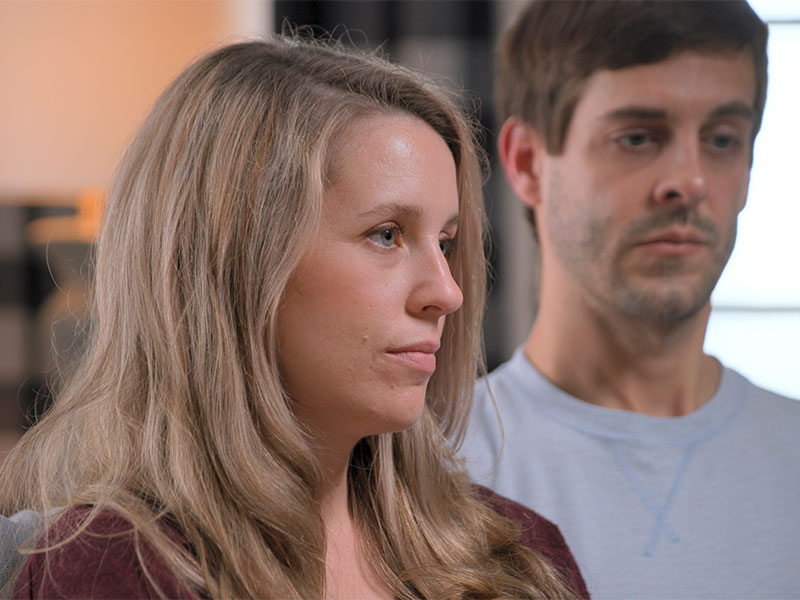
At the same time, however, I’ve had some burning questions about honey that I could never seem to get a handle on. So, who better to answer my questions than bee expert and founder of Savannah Bee Company Ted Dennard, who established the company back in 2002. 

As their website states, though, “You’ll notice our name doesn’t contain the word ‘honey’ — our mission has always been about the bees.”

While the company certainly sells honey in a truly incredible array of flavors and variations (their orange blossom honey is genuinely one of the best honeys I’ve ever tasted) their true ethos is bee-centric. Furthermore, they have a nonprofit organization called The Bee Cause Project, about which I also spoke with Dennard. 

The following interview has been lightly edited for clarity and length.

I know that Tupelo Honey is elusive; how short is the “spring bloom” season? 

The bloom is about 2 weeks long, once a year, but the weather has to align with just the right amount of temperature and humidity and wind for the bees to actually make any honey. Just like this year’s crop where it was the last 3 days of the bloom where the bees made 90% of the honey, the actual honey making time is very, very short.

 How would you describe the flavor profile of Tupelo honey? 

Tupelo honey is my love and the one that launched Savannah Bee Company. The flavor is distinctly buttery and softly sweet. When it is the pure stuff, it will have a greenish cast to it and a bubble gum taste. Because it has a different sugar composition than most all other honeys the softer, less candy sweet is more on the middle back of your tongue before it just vanishes leaving your mouth with that delicious bubble gum dust flavor.

 What is unique about the regions in which Tupelo honey is produced? 

Well for starters, the trees only grow in rivers and swamps in an endangered ecosystem called a Tupelo Cypress Swamp. The only honey produced comes on rivers between Savannah, Georgia and Apalachicola, Florida. There are still some beekeepers today that will use a barge to get their hives into the deep tupelo stands in remote river regions. They are called black water rivers because the tannins from all the leaves turn the water into a dark iced tea color that looks very dark when deep. Alligators and turtles thrive there. 

 Ted DennardTed Dennard (Photo courtesy of Savannah Bee Company

How exactly is honey made? From the bee to the bottle, what is the process? 

Most adults don’t know that honey is made from the nectar the bees collect from the flower, not the pollen. They have a little carrying tank before their stomach that is full of enzymes and probiotic bacteria that begins the process of making honey. Once they put it in the honeycomb cells, they fan the water out of it. Usually, the nectar is about 80% water and they fan it down to about 17% water before capping it. Then, when the frames inside the top boxes are capped off and full, they are taken to the ‘honey house’ and extracted. You must first cut the beeswax capping off and then place the frames in a metal basket that spins inside of a stainless-steel drum. The honey is slung out and then stored in a tank before putting into drums for storage before bottling. Honey doesn’t need to be heated or treated. It never spoils. We lightly filter it to get out the little pieces of wax and any other little specs.

Please answer this for us for once and for all: Should honey be refrigerated or not?

The answer is definitely NO. Most honey will granulate at 57 degrees or any temperature near that (remember honey types vary in sugar composition and some are more prone to it than others). Honey never spoils, so all you do is keep a lid on it on your shelf or counter. And if honey does granulate it is still perfectly fine to eat. You can melt it back out in a double boiler if you feel the need.


Want more great food writing and recipes? Subscribe to Salon Food’s newsletter, The Bite.


What is a monofloral honey? 

Bees practice floral specification otherwise known as flower fidelity. The bees will pick “the best” flower in their area and tell the rest of the hive. All of the bees will then use it as their primary nectar source. This gives each honey a distinct flavor, color and sugar composition. If the beekeeper can get the bees into an area filled with the species of plant, she wants to make the honey from then with some skill and some luck the bees will make a monofloral (single flower) honey. They will need to remove the boxes of honey made during that bloom to avoid mixing of other types of honey. When the nectar from the ‘best source’ dries up they will move on to the next species that is producing nectar. The term wildflower honey refers to the multiple flower species involved in producing the bottle. Most honey is just mixed from everything the bees made over the previous months.

 Did you get into beekeeping when growing up?

Yes. When I was young, a man named Roy Hightower put his bees on our family land. I took an interest and began helping him clean hives and harvest honey. He was the spark for my lifelong love of bees and honey. 

 Jar of Whipped Honey with CinnamonJar of Whipped Honey with Cinnamon (Photo courtesy of Savannah Bee Company

What else does Savannah Bee sell aside from strictly honeys? 

In addition to pure honey, we sell a hot honey infused with peppers, a creamed honey infused with cinnamon or spices, honey body care products like body butters, lotions and hand creams, mead (honey wine) honey hot sauce, honey BBQ sauces and other bee related products.

 The “about” states that Savannah Bee “makes decisions about sourcing honey based on purity rather than on profit”  could you talk a bit about that?

Well, we could cut corners on getting honey that is marginal and cheaper. Like a honey that has a lot of other stuff besides tupelo in it and cutting our pure tupelo with it. But we do our best to make sure we don’t do that even if that means we are going to run out and not be able to make the sales. There is a saying that five times as much tupelo honey is sold than is made. And my guess is that most people just don’t know the difference but I certainly do. The same goes for any honey that we sell. We are more like honey snobs. Another example is our recent switch to a much more expensive honey to make our honey hot sauce and our hot honey. It just tastes better which is more important than reducing our cost of goods.

 I’d love to learn about The Bee Cause Project. Can you tell me about it? 

The Bee Cause Project began in 2013. Tami Enright, the Bee Cause Project’s current Director and I were offhandedly talking about how cool it would be to put beehives in 1000 schools. We never thought anyone would actually be on board for this and at first, they weren’t. Our goal is and has always been to raise a generation that understands, loves and protects the honey bee. The Bee Cause project puts observational hives in schools and gives grants for educational materials to teach kids about pollinators. We are looking forward to hitting 1000 schools with grants/hives in the coming years. 

 Jar of The Bee Cause Project HoneyJar of The Bee Cause Project Honey (Photo courtesy of Savannah Bee Company

What are your favorite ways to use Tupelo honey? 

Strong black Yunnan tea with some milk. Every morning. In fact, I just finished a cup while answering these questions.

Generally, do you prefer honey drizzled onto cooked food or honey actually incorporated into cooked, composed dishes? 

I do both, depending on what it is. Drizzled will maintain more of the enzymes in raw honey as cooking can kill the enzymes. But sometimes you just need to cook it. Yesterday, a friend told me how he added the hot honey to his chili instead of sugar and that his girlfriend thought it was so much better. So, I wouldn’t be exclusive on trying to maintain the enzymes. You can always eat a spoon of honey.

 What exactly is raw honey?

Raw honey is honey that has not been heated to a temperature that would kill the living enzymes and also hasn’t had the pollens filtered out. Raw honey in its purest form would be the honeycomb which is edible and filled with natural vitamin A and also is a source of roughage. Beekeepers are supposed to live longer than any other profession and that longevity is attributed to the raw honey and pollens they eat.

Jar of Tupelo Raw HoneyJar of Tupelo Raw Honey (Photo courtesy of Savannah Bee Company)
Is there anything else you’d like to share about bees, honey, beekeeping, Savannah Bee or Tupelo honey that we haven’t yet touched on?
 
Our mission is and has always been to Save the Bees. We do this by supporting beekeepers, raising awareness and through the Bee Cause project. One hive will visit 500,000,000 flowers per year and one pound of honey is the result of 2,000,000 flower visits. Bees work hard to help us and we want to work hard to help them. 
 
You can read more about Savannah Bee Company here.

New Dolby mix of Beach Boys’ “Pet Sounds” takes its luminous vocals to soaring heights

When it comes to the Beach Boys, “Pet Sounds” (1966) is an outlier, the moment when Brian Wilson harnessed the energy and inspiration that he gleaned from repeated listenings to the Beatles’ “Rubber Soul” (1965) and transformed his experience into an artwork for the ages. The degree to which the Fab Four returned the favor when it came to making
Sgt. Pepper’s Lonely Hearts Club Band” (1967) is an ongoing matter of debate, but there’s little doubt that the Beatles’ groundbreaking album is filled with brilliant colors and breathtaking exuberance, qualities that “Pet Sounds” harvests by the spadeful.

Prior to “Pet Sounds,” the Beach Boys were essentially a boy band with soaring vocals and an impressive hit parade. And afterward, when it became clear that Brian Wilson wouldn’t be able to sustain his feats of artistry with “Smiley Smile” (1967), they reverted to their default gear, the one that would manifest itself years later in their comeback hit “Kokomo.”

Over the years, “Pet Sounds” has been the subject of various remixing and remastering exercises, including 1997’s superb “The Pet Sounds Sessions,” an exhaustive study of the album in all of its astounding component parts. But when it comes to a pure listening experience, the new Dolby Atmos mix compiled by Giles Martin is the best of the lot.

“Recordings don’t age,” producer Martin explained last week at New York City’s Dolby Theater. “We age around them.” Hearing “Pet Sounds” unfold within the confines of the Dolby Theater’s screening room made this point abundantly clear. The surround-sound experience, coupled with Martin’s deftly produced mix, found the album shimmering in new and unexpected ways. The son of legendary Beatles producer George Martin, he has taken full advantage of Dolby Atmos’s three-dimensional technology to bring the album to life.

When I asked him about his approach to making atmos mixes enhancing the listening experience, he noted that “instinct” often acts as his touchstone. This is dazzlingly apparent on “Pet Sounds.” Not surprisingly, the Beach Boys’ luminous vocals are the prime beneficiaries of the Dolby Atmos technology’s capacity for enhancing the spatial experience. With songs like “Wouldn’t It Be Nice” and “God Only Knows,” the vocalists seem to cascade around the listener, creating the feeling, artificial as it may be, of being enveloped in sound.

And the best news is that you don’t have to have access to the Dolby Theater’s screening room to enjoy “Pet Sounds” in all its glory. Martin’s spatial enhancements come shining through no matter the environment; whether you’re listening at home with a top-of-the-line sound bar or sampling the LP through your earbuds, the music of “Pet Sounds” soars with spatial vistas where once there were only flat soundscapes. The recordings behind “Pet Sounds” may not have aged, but Martin has ensured that the LP sounds as bright and buoyant as ever.

Seduced by war yet again: Why Washington is underwriting violence in Ukraine

Allow me to come clean: I worry every time Max Boot vents enthusiastically about a prospective military action. Whenever that Washington Post columnist professes optimism about some upcoming bloodletting, misfortune tends to follow. And as it happens, he’s positively bullish about the prospect of Ukraine handing Russia a decisive defeat in its upcoming, widely anticipated, sure-to-happen-any-day-now spring counteroffensive.

In a recent column reported from the Ukrainian capital — headline: “I was just in Kyiv under fire” — Boot writes that actual signs of war there are few. Something akin to normalcy prevails and the mood is remarkably upbeat. With the front “only [his word!] about 360 miles away,” Kyiv is a “bustling, vibrant metropolis with traffic jams and crowded bars and restaurants.” Better yet, most of the residents who fled that city when the Russians invaded in February 2022 have since returned home.

And despite what you might read elsewhere, incoming Russian missiles are little more than annoyances, as Boot testifies from personal experience. “From my vantage point in a hotel room in the center of Kyiv,” he writes, “the whole attack was no big deal — just a matter of losing a little sleep and hearing some loud thumps,” as air defenses provided by Washington did their work.

While Boot was there, Ukrainians repeatedly assured him that they would cruise to ultimate victory. “That’s how confident they are.” He shares their confidence. “In the past, such talk may have contained a large element of bravado and wishful thinking, but now it is a product of hard-won experience.” From his vantage point in a downtown hotel, Boot reports that “continued Russian attacks on urban areas are only making Ukrainians angrier at the invaders and more determined to resist their onslaught.” Meanwhile, “the Kremlin appears to be in disarray and mired in the blame game.”

Well, all I can say is: From Boot’s prayerful lips to God’s ear.

Courageous Ukrainians certainly deserve to have their stalwart defense of their country rewarded with success. Yet the long history of warfare sounds a distinctly cautionary note. The fact is that the good guys don’t necessarily win. Stuff happens. Chance intervenes. As Winston Churchill put it in one of his less well-remembered “always remember” axioms: “The Statesman who yields to war fever must realize that once the signal is given, he is no longer the master of policy but the slave of unforeseeable and uncontrollable events.”

President George W. Bush, for one, can certainly testify to the truth of that dictum. So too, assuming he’s still sentient, can Vladimir Putin. For either Ukrainian President Volodymyr Zelenskyy or Joe Biden to suppose that they’re exempt from its provisions would be daring indeed.

Boot is hardly alone in expecting the much-hyped Ukrainian operation — with June upon us, will it become a summer counteroffensive? — to break the months-long stalemate. The optimism voiced throughout Western quarters stems in significant part from a belief that new weapons systems promised to but not yet actually fielded by Ukraine — Abrams tanks and F-16 fighter jets, for example — will have a decisive impact on the battlefield.

There’s a term for that: It’s called cashing a check before it clears.

Punching holes?

Even so, for Boot, the operational imperative appears obvious. With the Russian army currently defending a 600-mile front, he writes, “they cannot be strong everywhere.” As a consequence, “the Ukrainians just have to find a weak spot and punch through it.”

However unintentionally, Boot thereby recalls the infamous theory of warfare devised by German general Erich Ludendorff to break the deadlock on the Western Front in 1918: “Punch a hole and let the rest follow.” In their spring offensive that year, German armies under Ludendorff’s command did indeed punch a gaping hole in the Allied trench lines. Yet that tactical success yielded not a favorable operational result but exhaustion and ultimate German defeat.

Punching holes is a poor substitute for strategy. I make no pretense to be able to divine the thinking that prevails within senior Ukrainian military circles, but the basic math does them no favors. Russia’s population is roughly four times greater than Ukraine’s, its economy 10 times larger.

A war of attrition in which the U.S. suffers no casualties while plenty of Russians die suits some key players in Washington. Whether it comports with the well-being of the Ukrainian people receives no more than lip service.

Western support, especially the more than $75 billion in assistance the U.S. has so far committed, has certainly kept Ukraine in the fight. The West’s implicit game plan is one of mutual attrition — bleeding Ukraine as a way to bleed Russia — with the apparent expectation that the Kremlin will eventually say uncle.

Prospects of success depend on either of two factors: a change in leadership in the Kremlin or a change of heart on the part of President Putin. Neither of those, however, appears imminent.

In the meantime, the bloodletting continues, a depressing reality that at least some in the U.S. national security apparatus actually find agreeable. Put simply, a war of attrition in which the U.S. suffers no casualties while plenty of Russians die suits some key players in Washington. In such circles, whether it comports with the well-being of the Ukrainian people receives no more than lip service.


Want a daily wrap-up of all the news and commentary Salon has to offer? Subscribe to our morning newsletter, Crash Course.


American enthusiasm for punishing Russia might actually have made strategic sense if the zero-sum logic of the Cold War still pertained. In that case, the Ukraine war might be seen as a sort of do-over of the 1980s Afghan war. (Forget what the next version of that war did to this country in the 21st century.) Back then, the U.S. used the Afghan mujahideen as proxies in a campaign to weaken Washington’s principal Cold War global adversary. In its time (and overlooking the subsequent sequence of events that led to 9/11), it proved a brilliant stroke.

In the present moment, however, Russia is anything but America’s principal global adversary; nor is it obvious, given the pressing problems facing the United States domestically and in our own near abroad, why baiting Ivan should figure as a strategic priority. Beating up on the Russian army on battlefields several thousand miles away won’t, for example, provide an antidote to Trumpism or solve the problem of this country’s porous borders. Nor will it alleviate the climate crisis.

The Ukraine war offers Washington a convenient opportunity to wipe its ethical slate clean by striking a virtuous pose as it defends innocent Ukraine against brutal Russian aggression.

If anything, in fact, Washington’s preoccupation with Ukraine only testifies to the impoverished state of American strategic thinking. In some quarters, framing the present historical moment as a contest between democracy and autocracy passes for fresh thinking, as does characterizing American policy as focused on defending a so-called rules-based international order. Neither of those claims, however, can withstand nominal scrutiny, even if it seems bad form to cite close U.S. ties with autocracies like Saudi Arabia and Egypt or to point out the innumerable instances in which this country has exempted itself from norms to which it insists others must adhere.

Granted, hypocrisy is endemic to statecraft. My complaint isn’t with President Biden fist-bumping Crown Prince Mohammed bin Salman or conveniently forgetting his support for the illegal 2003 invasion of Iraq. My complaint is more fundamental: It concerns the apparent inability of our political establishment to wean itself from obsolete thinking.

Classifying the survival and well-being of the Saudi monarchy as a vital U.S. security interest offers a specific example of obsolescence. Assuming that the rules that apply to others need not apply to the United States is certainly another more egregious one. In such a context, the Ukraine war offers Washington a convenient opportunity to wipe its own slate clean by striking a virtuous pose as it defends innocent Ukraine against brutal Russian aggression.

Think of U.S. participation in the Ukraine war as a means of washing away unhappy memories of its own war in Afghanistan, an operation that began as “Enduring Freedom” but has since become Instant Amnesia.

A pattern of intervention

The gung-ho American journalists summoning Ukrainians to punch holes in enemy lines might better serve their readers by reflecting on the larger pattern of American interventionism that began several decades ago and culminated in the disastrous fall of Kabul in 2021. To cite a particular point of origin is necessarily arbitrary, but the U.S. “peacekeeping” intervention in Beirut, its 40th anniversary now fast approaching, offers a convenient marker. That bizarre episode, today largely forgotten, ended with 241 U.S. Marines, sailors and soldiers killed in a single devastating terrorist attack, their sacrifice neither keeping nor making peace.

Frustrated by developments in Beirut, Ronald Reagan wrote in his diary on Sept. 7, 1983, “I can’t get the idea out of my head that some” U.S. Navy fighters “coming in at about 200 ft … would be a tonic for the Marines & at the same time would deliver a message to those gun happy middle east terrorists.” Alas, by blowing up the Marines’ barracks, the terrorists delivered their message first.

Yet Reagan’s belief that the application of force could somehow provide a tidy solution to dauntingly complex geopolitical problems expressed what would become a continuing all-American theme. In Central America, the Persian Gulf, the Maghreb, the Balkans and Central Asia, successive administrations embarked on a series of interventions that rarely produced any long-term successes, while exacting staggering cumulative costs.

Since 9/11 alone, U.S. military interventions in distant lands have cost American taxpayers an estimated $8 trillion and still counting. And that’s not even considering the tens of thousands of GIs killed, maimed, or otherwise left bearing the scars of war or the millions of people in the countries where the U.S. fought its wars who would prove to be direct or indirect victims of American policy-making.

Memorial Day commemorations, such as those just past, should remind us of the costs that result from punching holes, both real and metaphorical. With something close to unanimity, Americans profess to care about the sacrifices of those who serve the nation in uniform. Why don’t we care enough to keep them from harm in the first place?

That’s my question. But don’t look to the likes of Max Boot to provide an answer.

What grows together goes together: A simple wine and food pairing guide

Food and wine pairing doesn’t necessarily require sommelier-level expertise, nor chemist-level abilities to calibrate a wine’s acids, tannins, or alcohol added to a dish. Not that a somm couldn’t lend a hand, but in a pinch, there’s a shortcut. The “what grows together goes together” approach isn’t just a philosophy, it’s a practice that delivers.

Centuries ago in the Old World, people ate and drank locally by necessity, not because it was trendy to be able to cite which farm, butcher, or dairy your goods came from. What was nearby was what you had to work with. It makes sense that communities designed wines to work with the local fare, tailored recipes to work with the local wines, or created dishes utilizing regional wine within them. A great example: classic French Boeuf Bourguignon—or Burgundy beef—made with regional Burgundy wine and local beef.

These days, we don’t have those challenges. From my Los Angeles condo I can have pretty much anything in my grasp—from Korean BBQ, to pupusas, to a simple salad. Not everyone’s home has the breadth L.A. does, but in general, modern humans have no need to worry if the grapevine growing next door will pair well with what’s growing in the garden or being raised in the barn.

While the expansive variety of food and drink we can often source is liberating, calling on classic regional pairings as a springboard is inspiring. The pairing of dishes and wines from the same place really puts me in situ, as they say in the art world (it means “in its original place”), even if I’m just ordering into my little apartment. Despite our current horticultural climate, you can’t always find the exact regional wine to go with your meal. Consider this your guide both to geographically enmeshed pairings, and how to remix them to meet your needs.

1. Classic: Chèvre and Sancerre

Chèvre is made from goat’s milk. It’s an undeniable friend to Sancerre, made of sauvignon blanc. Both made names for themselves in the Loire Valley, particularly from the village of Chavignol. Goat cheese can be quite earthy, some might even say goat-y, and a little nutty. Sancerre’s refreshing grassy notes partner with the hearty and earthy flavors of the cheese—plus the high acidity lightens the creamy and buttery nature of a chèvre.

REMIX: PECORINO

Hailing from the Abruzzo region of Italy, pecorino wine (not the cheese!) mirrors the Sancerre’s all-important crisp acidity and minerality, with a slightly richer and more floral edge. Plus, it will be fun to throw company for a loop when you mention you are pairing chèvre with pecorino—and why no, this is NOT a cheese-on-cheese pairing!

2. Classic: Asparagus and Alsatian Dry Muscat

Asparagus is notoriously hard to pair with wine. It contains a compound that can make wines taste weirdly metallic or overly vegetal, and can grossly exaggerate the aromas that come with oak-aged wine. The solution is found in Alsace, where dry muscat and asparagus are best friends with shared terroir. A dry muscat will be crisp and a touch floral—think orange blossoms—and have a richness that resists becoming vegetal in the face of asparagus. If anything, the asparagus tempers the wine. Try it. You may be surprised as I was.

REMIX: VINHO VERDE

Vinho Verde wines come from northern Portugal and are typically blended—not to mention bargains—with low alcohol and a hint of effervescence. They are refreshing, can show floral notes depending on the blend, and the light bubbles cut through any interference that may come from the asparagus. Home run at an amazing bargain.

3. Classic: Truffles and Barolo

By truffles, I mean the type that grow in the ground, not the chocolate treats. Truffles can be incorporated into, or shaved onto a variety of dishes ranging from risotto, to pizza, to French fries. Whatever you add truffles to, one thing is for sure: The truffle will likely take the lead in terms of flavor and aroma. Barolo, which is made of the nebbiolo grape, grows in the Piedmont region, like many truffles. It is likewise able to overtake the senses with its high acid, alcohol content, and tannins. Put the two together, especially in a rich dish, and they partner in a dance that must be tried to be believed.

REMIX: XINOMAVRO

Xinomavro, from Naoussa, is the nebbiolo of Greece. Enough said. But in case that isn’t enough, I’ll add that it has the same nature, with all the right stuff from the high tannins to the earthy and floral aromas that make a Barolo dance. It definitely keeps up with truffles.

4. Classic: Parmigiano Reggiano and Lambrusco

Both the cheese and the wine hail from the northern Italian region of Emilia-Romagna. Lambrusco wines come in quite a few styles, depending on which clone is used and how the wine is made, but the deepest and driest of them, lambrusco grasparossa di castelvetro, cries out for a protein-rich foodstuff. Its balsamic aromas match well with the browned nut flavors and the saltiness inherent in Parmigiano. The animal in the cheese pulls out the earthy notes in a richer lambrusco making it more than a fruit bomb, and the bubbles in the lambrusco break down the fat.

REMIX: BARBERA

Got a dish finished with Parmigiano, or relying on the rind to infuse it with flavor, as many stews do? Savory and earthy wine is where it’s at for a Parmigiano pairing, so I’m gonna stay in Italy, not too far away, and recommend a barbera d’asti or a barbera d’alba. They hit the ripe red fruit and earthy herbal notes with a hit of acid all cheese can use.

5. Classic: Oysters and Muscadet

Oceanside fare, meet oceanside wine! Muscadet is a dry white from the westernmost side of the Loire valley, right by the Atlantic ocean. They boast a hint of briny aromatics, but frequently are bottled as “sur lie” a process means that as the wine matured, it was allowed contact with the spent yeast cells, which adds a richness and body to the wine that won’t be fully subdued by oyster flesh (which I know some vegans eat them I am not there yet). Muscadet mirrors the marina freshness of oysters while adding the light richness of lees contact making a harmonious pairing.

REMIX: ALBARIÑO FROM RIAS BAIXAS

Like Muscadet, this is a wine with a lot of seaside influence with body, also often intensified by lees contact. Albariño can be a bit more floral, but it is in touch with the sea. It hits all the right chords.

6. Classic: Bistecca Alla Fiorentina and Chianti Classico

Made from Italy’s Chianina cattle, bistecca alla Fiorentina is a classic Italian steak dish incorporating lemon and rosemary as finishes. The fat and protein temper the drying tannic nature of chianti classico, made from the sangiovese grape. The herbs in the dish complement the wine’s aromatics. It’s like you can taste the nearby land in both.

REMIX: COONAWARRA CABERNET SAUVIGNON

We’re going to Australia! It goes head-to-head with Chianti in terms of being tannic and powerful. The fruit here will be richer and more fruit-forward. It can be herbal, like sangiovese, although it will veer more in the direction of minty notes given the eucalyptus growing nearby.


Trump appointed judge works to keep drag shows lawful in Tennessee

On Friday night, a two-day trial pertaining to an anti-drag law in Tennessee ended in a big win for the LGBTQ+ community.

In a surprising move that goes against what one would expect from a Trump appointed judge, U.S. District Court’s Thomas L. Parker ruled the Adult Entertainment Act (AEA) unconstitutional. In his ruling, Parker writes that, “There is no question that obscenity is not protected by the First Amendment. But there is a difference between material that is ‘obscene’ in the vernacular, and material that is ‘obscene’ under the law . . . Simply put, no majority of the Supreme Court has held that sexually explicit — but not obscene — speech receives less protection than political, artistic, or scientific speech.”

“Whether some of us may like it or not, the Supreme Court has interpreted the First Amendment as protecting speech that is indecent but not obscene,” the judge furthers, explaining that laws of this nature allow opportunity for problematic enforcement.

“The chance that an officer could abuse that wide discretion is troubling given an art form like drag that some would say purposefully challenges the limits of society’s accepted norms,” Parker writes. “The Court emphasizes that the fear of prosecution from law enforcement officers is not merely speculative but certainly impending.”

The AEA was put in force by Republican Gov. Bill Lee back in March, as part of a systematic attack against the LGBTQ+ community — along with a bill banning gender-affirming care for youth — as highlighted by a report from The Advocate. Prior to the signing of the bill, Lee spoke of the intent behind the new law saying that the hope was that it would prevent minors from being exposed to “sexualized entertainment” and “obscenity,” according to an AP News article that also mentions photographs surfacing of Lee in drag himself, unearthed from a high school yearbook. 

When asked about the photos, Lee saw no comparison saying, “conflating something like that to sexualized entertainment in front of children” was ridiculous. 


Want a daily wrap-up of all the news and commentary Salon has to offer? Subscribe to our morning newsletter, Crash Course.


Winning out in the suit filed in March to fight against the AEA, Memphis-based theater group Friends of George’s celebrated their win on Friday with a post to Instagram.

“Judge Parker has declared Tennessee’s anti-drag law unconstitutional,” the caption reads. “Friends of George’s would like to thank Brice Timmons and Melissa Stewart at Donati Law and all who have stood by us during this fight!”

“Bama Rush” reminded me of my own desperate need to belong

When a friend sent me the trailer for “Bama Rush,” Max’s documentary about Greek life at the University of Alabama, I watched with an outcast’s perverse need to glimpse a world from which I’d been excluded. Opening credits roll over a dizzying mash-up of TikTok videos, bronzy, blonde girls sharing the secrets of how to be yourself but also just like everyone else, and grim, gossipy warnings that this documentary would “change Greek life as we know it.”   

The film follows four PNMs (potential new members) as they navigate rush in the summer of 2022. The young women are forthcoming and vulnerable about their desire to fit in, to find community and belonging, a need I understood deeply, especially when I thought back to my own experience. 

Social capital hinged on appearances and lineage.

I grew up in Mountain Brook, a wealthy suburb outside of Birmingham, Alabama, and we had sororities in high school, breeding grounds for future University of Alabama students and pledges. Social stratification started early, before birth even, when you were divided along the lines of haves and have nots; old money and new money; white, wealthy Christians whose roots ran deep down to Confederate days and everyone else.  

In Mountain Brook, social capital hinged on appearances and lineage. Perfectly manicured lawns cut to military precision, gleaming white, brick homes, flawless hair, impeccable, designer clothes. Beautiful exteriors designed to belie whatever turmoil lay beneath the surface. 

We were outsiders, having moved to the area when I was a kid. My mother couldn’t even volunteer for the Junior League, because it was invitation only, and like the sorority system, criteria for inclusion remained elusive, though it was practically guaranteed for those with generational ties to the area.   

Rush started the summer between junior high and high school, which began sophomore year. I’d survived three painfully awkward years of junior high, trying my hardest to fit in, despite my unfortunate Ronald McDonald perm. Here was my chance to charm my way into acceptance. 

We were told that girls from interested sororities would stop by our homes and decorate our rooms with their sorority colors. My mother, a former sorority girl herself, waxed on about the joys of belonging to a group of like-minded girls. I think she was even more excited than me, and together we redecorated my room in a Laura Ashley explosion of purple and pink tulips. 

One summer day, a red Cabriolet convertible pulled up in front of our house, and a gaggle of girls descended on our home, slinging red and white crepe paper across the ceiling fan and bed, leaving notes, every “i” dotted with a heart, and shiny mylar balloons that floated around my room until they deflated to the floor. 

Every year, the three “elite” groups took turns accepting a mercy bid . . . we all knew who it was.

There were four sororities, organized by standard teen tropes: the popular girls (typically the blue bloods), the preps, the party girls and then the nerds and leftovers – each with a corresponding version at the University of Alabama. In some bungled attempt at inclusion, everyone who rushed had to be accepted, which meant one sorority took on most of the girls who defied categorization or simply weren’t cool enough to be accepted by the other three, although every year, the three “elite” groups took turns accepting a mercy bid, and in one of life’s great cruelties, we all knew who it was. Jewish students weren’t even allowed to participate.

I didn’t fit neatly into any of the groups. I certainly wasn’t getting into the blue bloods group, and I wasn’t a party girl. I was a nerd but didn’t want to be and most closely identified with the preppy girls – who wore matching sweater sets and giant bows in their hair; “nice” girls who would make wonderful wives and mothers with perfectly polished silver and tastefully spare bone china patterns.  

I don’t know why anyone thought it wise to take kids at the height of self-consciousness, in their messy, formative years and try to corral them into various chutes of sameness. It’s a kind of cruelty only the South would devise. A way to weed out the “weak” early on.  

The preps hosted a pool party one late August day. Pert, slim girls, in polka-dot and striped bikinis, lounged around a comma-shaped pool. The upperclasswomen covertly reviewed us like swimsuit models for poise and grace, sipping on Diet Cokes and whispering as we all chattered nervously.  

Rushees lazed about, trying their best to appear nonchalant and indifferent to the outcome of their social futures. Their limbs long and bronzed, pouring on Banana Boat, pulling aside silky manes so a friend could oil their backs, flipping like kebabs every 15 minutes or so.  

A boombox blared U2 and R.E.M. while a few brave girls floated on rafts or batted a rubber ball around in the pool, like a commercial for some generic island getaway. 

I hunkered down under the single umbrellaed table, slathering SPF 50 on my alabaster legs. I was not fat, but lumpy, so I wore shorts and a baggy white t-shirt with the image of a large, green, bulls-eye button in the center. Most certainly something my mother had found on sale at TJ Maxx. 

I decided to ham it up, doing my best Michael Jackson moonwalk, pumicing my bare feet as I dragged them awkwardly across concrete. Then I took a few steps back and ran and hurled myself cannonball-style into the pool. Water shot up and out around me, waves crashing into floats, knocking girls about, splashing their faces, dousing the kebab crew. I reared my head back to clear soggy permed hair from my face, sending more stray droplets into the eyes of onlookers. I knew, scanning the perimeter of girls wiping water from their faces that I had f**ked up. I climbed out of the pool, un-suctioned the giant button from my belly and boobs and scuttled back to my shady corner.

The pool party sealed my fate, that grim, summer day when I displayed my clowniest self. I had strayed way too far from the norm. 

A few days after the pool party, I got invited to drive around with the leftovers, because a member was in my French class and liked me. It felt nice to be wanted, so I snuck out of the house and joined them. Five of us wedged into somebody’s dad’s sedan, driving around the town’s windy roads, Def Leppard blaring. I didn’t want to belong to their group. They weren’t the chosen, they were different, in the way you didn’t want to be in high school. And yet most were more like me than any of the other sorority girls. Outsiders. The only difference is they’d given up caring what others thought, or at least pretended not to; whereas I continued my dogged pursuit of popularity, flinging myself like a bird against the clear glass that divided me from a society I could see but never gain admission to. 

On bid day, sorority girls picked up new pledges and drove them to parties. I waited by the window for that Cabriolet, but it never came. Instead, the sedan pulled up, and I asked my grandmother, who was babysitting while my parents were away, to decline their offer and tell them I wasn’t home. I felt too guilty to turn them down myself. 

Only one of the four girls featured in the documentary is shown pledging a sorority. Two girls dropped out, and the one who’d zealously created a thick binder dedicated to her rush experience dropped out of the film, fearful her participation would ruin her chances of pledging. In fact, once rumors of the documentary spread through campus, another PNM, not even involved in the filming, got kicked out of rush, accused of wearing a mic that turned out to be a hair tie. One wonders, with that level of paranoia, what the sororities are trying to hide

I am grateful for a rejection that saved me from sacrificing myself in order to belong.

I had high hopes for the film. I wanted to see that world cracked open, the underbelly of the Machine exposed, all the dirty secrets of that cult-like life unfurled before me, but that never happened. The Greek world at Alabama seems almost impenetrable, a fortress of secrets heavily guarded by those who benefit most from their preservation.  

So little was revealed beyond the need we all have to belong, laid bare in these young women striving for acceptance in a world that grants it on a whim. 

The director, Rachel Fleit, who is bald from alopecia, awkwardly inserts herself into the movie in a few scenes. She tells the viewer about when she finally gave up wearing wigs, her sophomore year of college.  

“The pain of not being myself became greater than the pain of not fitting in,” she says, looking balefully into the camera. That’s a lesson I wish I’d learned much earlier in life. 


Want a daily wrap-up of all the news and commentary Salon has to offer? Subscribe to our morning newsletter, Crash Course.


Greek life ended at Mountain Brook High School in the late ’90s, after I graduated. The wounds of not belonging stayed with me for a long time. I am still occasionally overcome by loneliness, a sense of separation from others, and wonder how much of that stems from striving to belong to a world I could never quite fit into. Mostly though, I am grateful for a rejection that saved me from sacrificing myself in order to belong. I believe in that parallel world I would have married out of college, had kids and always felt a longing for something more, for all the adventures I’ve been able to pursue on my own. 

I think the community that Greek life offers in college can be a good thing, but the system does more harm than good by creating and supporting a culture of exclusivity. There’s a binary where you fit in or you don’t, and when that belonging hinges on assimilation, you have a society that is intolerant of difference, of true self-expression, and that is a dangerous place to live.


The eczema boom: Air pollution may be to blame

In 2000, the American Academy of Dermatology warned Americans: eczema was on the rise. In the warning, the group of dermatologists said that the rate of atopic dermatitis — an inflammatory skin condition also known as eczema — had nearly tripled since 1970. At the time, it was estimated that nearly 6 percent of all Americans had the condition that can cause itchy, red, and scaly skin. Today, the National Eczema Foundation estimates that at least 10 percent of Americans have eczema, and that one in ten people will have eczema in their lifetime.

Despite the increase in prevalence, which has been documented by many researchers — especially among children— one aspect from the warning that donned headlines 23 years ago remains the same: nobody knows what’s causing an increase in the number of people diagnosed with the itchy-skin condition.

“We need to learn more.”

Dr. Ross Radusky, a board-certified dermatologist at the Dermatology Treatment and Research Center in Dallas told Salon that “one possibility is that as our population increases and people live in more densely populated locations, the rates of eczema will naturally rise, [but] more research is definitely needed.”

As one study found, around the world the prevalence of eczema increased only 0.98 percent over the last decade in adolescents, and 1.21 percent in children. However, there were major variations based on regions as the rise in eczema was most pronounced in urban areas. While there is no definitive reason as to why that is, as Radusky said, there is an increasing suspicion that pollution could be to blame.

“Past studies have looked at the rates of eczema in urban versus rural settings, and the incidence rates tend to be higher in city settings, places you’d expect higher pollution rates,” Radusky said. “There are other factors in that equation, but it is important to know that pollutants affect rates of asthma, seasonal allergies, and possibly even food allergies, and all three have been linked with higher rates of eczema.”

Allergies are worse here in general due to air pollution, climate change, industrialization and disruption in our microbiomes from overexposure to chemicals, pesticides, processed foods, plastics.

Radusky said by their nature, pollutants are foreign substances that shouldn’t be in our daily lives, and our skin might not appreciate that.

“Our skin doesn’t like intruders,” Radusky said. “It needs to mount a significant defense and when it does that and forms a high inflammatory state, an eczema flare may not be far behind.”

In March, dermatologists said they observed an increase in patient visits to dermatologists for eczema during the California wildfires. In a study published in the journal Science Advances in January, researchers found a link between common chemicals and eczema. Specifically, by testing on mice, the researchers found that when the skin was exposed to isocyanic acid — a component of wildfires, cigarette smoke, and car exhaust from catalytic converters — the bacteria that normally live on skin stops producing oils that the skin needs to stay healthy, leaving the skin vulnerable to a flare-up.


Want more health and science stories in your inbox? Subscribe to Salon’s weekly newsletter The Vulgar Scientist.


Part of not knowing what’s behind the rise in eczema stems from the complexities of eczema itself. Scientists know that eczema happens when a person’s immune system has an overreaction to an irritant or trigger. The immune system sees a trigger as an invader, like a virus or bacteria, and as a result the body’s immune system creates inflammation. The inflammation causes the physical symptoms of eczema on a person’s skin. However, despite functioning similarly to an autoimmune disease, eczema is not classified as one. That’s because the reaction doesn’t technically result in the body attacking its own healthy cells or organs.

Radusky said it is largely believed that there is a genetic component to eczema, specifically a deficiency in a protein called filaggrin.

“That protein helps keep the cells that make our skin stay glued together. Without it, the tiny holes that exist between our skin cells allow water to escape and that causes a very inflammatory and itchy skin condition known as eczema,” Radusky said. “We think of eczema as a mix of environmental and genetic factors. Certain stressors like dry, cold climates as well as seasonal and food allergies can set off the inflammatory cascade that leads to the rash we know as eczema.”

But it’s the “interplay” between genetics and environmental causes that are difficult for researchers to suss out an exact cause behind the rise.

“While we know the leading cause of atopic dermatitis (the most common form of eczema) is the protein deficiency filaggrin, it is not the only reason we see flares,” Radusky said.

Dr. Purvi Parikh, an allergist with the Allergy & Asthma Network, told Salon via email that she believes eczema could be more common in the U.S. due to environmental factors, like pollution.

“Allergies are worse here in general due to air pollution, climate change, industrialization and disruption in our microbiomes from overexposure to chemicals, pesticides, processed foods, plastics,” Parikh said. “Pollutants make you more allergic in general and this can trigger eczema, being an allergic individual predisposes you to developing eczema compared with a non-allergic person.”

Indeed, Radusky said food allergies, seasonal allergies and eczema form what is known as the “atopic triad.”

“They run together and it is known that the inflammatory reaction that occurs in all these conditions follow the same pathway,” he said. “Our immune system reacts very much the same to both eczema triggers and asthma/allergy triggers.”

Unfortunately, there is no cure for eczema. However, there are many treatments available. And while other conditions like celiac disease, which are on the rise for unknown reasons, are hard to understand due to a lack of funding, Radusky said that’s not the case with eczema.

“I don’t think a lack of funding is the reason why it is difficult to know what causes eczema. There has been tons of research and new medications that limit the body’s inflammatory response common eczema triggers,” Radusky said. “So while we can’t cure eczema at the current time, we have new therapies that can limit how bad a flare can be.”

CORRECTION: An earlier version of this story incorrectly identified isocyanate as causing the issue with dermal bacteria, when it is technically isocyanic acid, a compound in the functional group isocyanate. The story has been updated. 

Fascism, free speech and Cop City: What’s happening in Atlanta and why it matters

What happened to the promise of 2020?

Sure, Donald Trump was booted from the White House that year. But as his current status as the leading Republican candidate for 2024 indicates, that feeling of accomplishment was fleeting. The hope of real policy reform, at least as it relates to policing and justice, held out for just a bit longer. Three years after the brutal death of George Floyd, crushed under a Minneapolis police officer’s knee, the dream of defunding bloated local police budgets look like it’s been deferred and more like it’s dead. 

On Friday, a judge denied an effort by prosecutors in Atlanta to detain three activists who’ve been instrumental in protests against “Cop City,” a planned multi-million-dollar police training facility. The activists were arrested earlier this week and charged under Georgia’s domestic terrorism and critical infrastructure law. The three members of the Atlanta Solidarity Committee, a collective that has bailed out protesters and helped them find lawyers, were specifically cited for money laundering and charity fraud. Video of a raid on an Atlanta home where the three — Adele MacLean, 42, Marlon Scott Kautz, 39, and Savannah Patterson, 30 — were arrested on Wednesday shows an armored police truck and at least 10 officers wearing body armor, carrying ballistic shields and wielding semiautomatic rifles. 

Audio recordings appear to capture officers on police radio describing Wednesday’s raid on mutual aid staff as part of a larger strategy to “[put] pressure on [Stop Cop City activists] and [attack] them from all different angles.” Georgia Gov. Brian Kemp, a Republican, has described protesters as “violent activists.” In fact, to describe anything the Cop City protesters have done as violent stretches the word beyond recognition. 

In a statement issued after the arrests, Kemp said the state would “track down every member of a criminal organization, from violent foot soldiers to their uncaring leaders.” Judge Shondeana C. Morris, a Kemp appointee, signed off on the arrest and raid warrants, which cite the use of PayPal as evidence of money laundering. Deputy Attorney General John Fowler told a judge on Friday that the activists present a flight risk because they harbor “extremist, anti-government views” and that money raised by the bail fund has gone toward “numerous violent acts.” What did he mean? Various protests that occurred “across the country” following Floyd’s 2020 death. As a defense attorney pointed out in court, one defendant’s warrant cites her car repair reimbursements as evidence of charity fraud.

Friday’s ruling granting bail to the three arrested activists appears be one of the first instances of Georgia’s court system actively stepping in to restrain what looks like a coordinated effort to crush an organized protest movement. For months, anti-protest legislation has been wielded to quash the movement for police accountability in Georgia. In March, dozens of people, including a Southern Poverty Law Center attorney who attended a planned Cop City protest as a legal observer,​​ were charged with domestic terrorism and initially held without bail amid protests. That same month, Manuel Páez Terán, a 26-year-old member of the Atlanta Solidarity Committee (he went by the name Tortuguita), was shot and killed by police at a protest against the construction of Cop City. 

Lauren Regan, executive director of the Oregon-based Civil Liberties Defense Center, issued a statement decrying the “extreme provocation” caused by Atlanta-area law enforcement.

“Bailing out protesters who exercise their constitutionally protected rights is simply not a crime,” Regan said. “In fact, it is a historically grounded tradition in the very same social and political movements that the city of Atlanta prides itself on. Someone had to bail out civil rights activists in the ’60s — I think we can all agree that community support isn’t a crime.”


Want a daily wrap-up of all the news and commentary Salon has to offer? Subscribe to our morning newsletter, Crash Course.


First proposed in 2009 by then-Atlanta Police Chief George Turner, construction on Cop City began in 2017. The planned center will include a variety of training facilities, including a mock city, a driving course and a shooting range for law enforcement agents to train in military-style weapons and tactics. Corporations like ​​Wells Fargo, UPS, Home Depot and Coca-Cola have pledged millions to help fund the state-of-the-art facilities. While the facility was initially sold to the public in 2021 as costing the city $30 million to construct, the latest estimate approaches $51 million in public funds — in a city facing chronic budget shortfalls. The 85-acre center, opponents argue, would increase police militarization and train officers to quell dissent. Climate activists, meanwhile, argue that hundreds of trees will be cut down in a poor, majority-Black neighborhood.

“You would not have the sort of unrest that we’ve seen, and so much anger in the community, if Coca-Cola and other companies like that had not given millions of dollars to the Atlanta Police Foundation to build this cop city that no one wants,” one activist told Salon, requesting anonymity.

“You would not have the sort of unrest that we’ve seen, and so much anger in the community, if Coca-Cola and other companies like that had not given millions of dollars to the Atlanta Police Foundation.” 

Last month, a federal judge ruled that the city of Atlanta must hold a public hearing on the project before it can move forward. The City Council is expected to vote Monday on whether to approve millions for the project, at a hearing that is now likely to be packed with protesters after this week’s show of force by police. 

So is this what a summer of protest gave way to? 

It was easy to mock the kente-cloth-clad Democrats in Congress for their performative kneel-down after Floyd’s murder, but there’s no denying that many people felt more hopeful about the possibility of change in that moment. The protests against Cop City, in the face of a ferocious clampdown, is what that hope has turned into three years later. Determined activists, defiant as ever, remain determined to ensure that Cop City never gets built. 

As for the legacy of George Floyd, Sen. Tim Scott, R-S.C., a cosponsor of the Justice in Policing Act that was meant to address the demands of the 2020 uprising, is now running for president. His co-sponsor, Rep. Karen Bass, a California Democrat, left Congress and is now mayor of Los Angeles. Looking to D.C. for meaningful change in America’s police culture was never remotely realistic. The promise of 2020, we might say was in returning the power to the people — one protest movement at a time.

How Fox News is boosting a “coordinated planned attack on the LGBTQ+ community” during Pride month

Fox News hosts and guests have repeatedly peddled false claims about Target selling “tuck-friendly” or “tuck-’em” swimsuits for children as part of its Pride Month collection, fueling right-wing viewers and activists to wage a war on companies that are supporting the LGBTQ+ community.

Despite the story being debunked by the Associated Press, such claims have emerged as part of a more extensive campaign against national brands that support Pride Month and promote efforts encouraging diversity and inclusion. 

“This is just one side of this extremist playbook,” Eric Bloem, Human Rights Campaign senior director of programs and corporate advocacy, told Salon. “As we enter Pride Month this year, it has been the most historic anti-LGBTQ+ legislative year. We’ve had over 500 anti-LGBTQ+ pieces of legislation across different states across the country – most of them targeting the trans community.”

Their goal is to instill fear by advancing falsehoods and push the community back in the closet, Bloem added. 

Fox News dedicated over two hours of airtime discussing Target’s Pride collection between May 23 and the morning of May 30, with different hosts expressing outrage over the retailer exposing children to inclusive messaging and products, Media Matters found

Ultimately, Target decided to remove some of its Pride Month displays and products on May 24 after receiving repeated threats. 

“Since introducing this year’s collection, we’ve experienced threats impacting our team members’ sense of safety and wellbeing while at work,” Target said in a statement on Tuesday. “Given these volatile circumstances, we are making adjustments to our plans, including removing items that have been at the center of the most significant confrontational behavior.”

Right-wing media has incited boycotts against other national brands, including Bud Light after transgender influencer Dylan Mulvaney posted a video to her Instagram account promoting a Bud Light March Madness contest. 

The video featured a photo of a promotional Bud Light tallboy with the influencer’s face on it. Soon after, the company was bombarded with criticism from the right with conservatives calling for boycotts.

Kid Rock even released a video destroying cases of Bud Light with an assault weapon. 

“What we’re seeing is a very coordinated planned attack on the LGBTQ+ community,” Bloem said. “It is playing out as these extremists attack businesses, who have made commitments to diversity, equity and inclusion and have really stepped out in support of the LGBTQ+ community.”

He added, now more than ever businesses need to be “standing strong in their values,” and continue to support their commitment to the LGTBQ+ community. 

After the parent company Anheuser-Busch InBev suffered in sales, they put two of their executives on leave and issued a statement from CEO Brendan Whitworth.

“We never intended to be part of a discussion that divides people. We are in the business of bringing people together over beer,” Whitworth said in the statement.

In recent days, other major companies like Nike, The North Face, Kohl’s and Chick-fil-A have also been targeted for their inclusion efforts with right-wing media portraying the companies as “woke” corporations trying to groom children with radical or Satanic gender ideology.

Nike and The North Face have also faced criticism for letting drag queens and transgender people serve as spokespersons and models for ad campaigns.


Want a daily wrap-up of all the news and commentary Salon has to offer? Subscribe to our morning newsletter, Crash Course.


There are two central anti-LGBTQ+ narratives that are at play here, pointed out Sarah Moore, an Anti-LGBTQ+ Extremism Analyst at the Anti-Defamation League (ADL) in partnership with Gay & Lesbian Alliance Against Defamation (GLAAD).

The first theme is the conversation around grooming and the false idea that being supportive of the LGBTQ+ community or being an LGBTQ+ identifying person in the presence of children is some how amounting to “grooming or child abuse”, Moore added.

“This is really coming up in a lot of these boycotts that we’re seeing against stores like Target but also stores like Walmart, Kohl’s, North Face, Adidas and looking at the ways in which some of their merchandise which is directed towards children, and includes supportive phrases of the community is now being called acts of grooming,” Moore said.

The second narrative that’s being pushed out centers around gender ideology and the false idea that children are being indoctrinated or coerced into becoming LGBTQ. 

“And because of that, they think that offering something like Pride merchandise or having a transgender influencer advertising your product, somehow is forcing people into becoming gay,” Moore said. 

Several of the claims being pushed out by Fox hosts lack evidence, Media Matters pointed out in its report. 

Host Rachel Campos-Duffy has called on other Target brands to speak out against the store, suggesting that it’s their moral obligation to publicly call out the retail giant. 

“No one doubts that Chip and Joanna are good people, kind, moral, and aligned with American values, but if I had a line at a company, and my name was on it, and that brand partnered with a trans satanist that makes tuck-’em bikinis for kids, I would feel compelled to speak up,”  Campos-Duffy said. “Now, maybe they’re raising questions internally — of course, that’s possible — but why aren’t they doing so publicly?”

But Target has only been selling tuck-friendly swimsuits made for adults and not for kids as false rumors have claimed. Even after the AP debunked these falsehoods, Fox hosts have continued to push out baseless claims.

Failed Michigan gubernatorial candidate Tudor Dixon appeared on Primetime and expressed her resentment towards Target.

“This is outrageous,” Dixon said. ” They are certainly not trying to hide this. They come out with these tucking bathing suits. So they are saying, look, we are going to let you tuck your junk. We’re not even going to camouflage the fact that we are trying to tuck your junk. We want to even tuck your child’s junk. This is ridiculous. They’re doubling down.”

While some right-wing hosts have used falsehoods to attack companies’ inclusivity efforts, others like Daily Wire podcaster Matt Walsh, a leading voice in the right-wing anti-trans campaign, have explicitly stated that their aim is to create negative consequences for brands that openly embrace the LGBTQ community.

“The goal is to make ‘pride’ toxic for brands,” Walsh tweeted. “If they decide to shove this garbage in our face, they should know that they’ll pay a price. It won’t be worth whatever they think they’ll gain. First Bud Light and now Target. Our campaign is making progress. Let’s keep it going.”

The public criticisms of these companies have pushed social media users to also partake in expressing outrage with videos of people throwing Pride displays to the floor in a Target store.

The retail giant has celebrated Pride Month for more than a decade, but this year’s collection has led to a significant increase in confrontations between customers, Target spokeswoman Kayla Castañeda said in a statement.

“The boycotts against the stores and the corresponding threats and harassment the stores are facing are just part of a bigger picture of threats and attacks against the LGBTQ+ community,” Moore said.

She added that in the past couple of years, she has noticed that extremism has become more mainstream with the introduction of hundreds of pieces of anti-LGBTQ+ legislation.

“These conversations are coming from all areas of society – from legislation to grassroots movements to our national government to the extremist aspect of this as well,” Moore said. “And so this has kind of created a perfect storm around Pride month in which we are seeing companies getting targeted for supporting pride.”

As a result of businesses failing to address anti-LGBTQ+ extremism language and efforts, more than 100 organizations have banded together to call out companies for caving to political pressure and betraying their commitment to the LGBTQ+ community.

“What we’re really trying to do here is to raise the alarm for businesses, saying that this is a strategic and coordinated effort and if and when their values are tested, that they need to stand strong and uphold those values,” Bloem said.

He added that the letter calls out Target to take specific actions to release a public statement  and reaffirm their commitment to LGBTQ+ community.

“What they do matters in this moment,” Bloem said. “It does matter in the context of this extremist strategy. Can they say that they’ve won with Target? If they can, then they have more power to go to the next company. Target has had a long history of support for the LGBTQ+ community and this is a moment where they need to once again, stand up for the community in a full-throated way.”

“Shiny Happy People”: The 8 most horrifying revelations from Prime Video’s Duggar family doc

Before the Kardashians or the real housewives of Beverly Hills or the elite real estate brokers at The Oppenheim Group attained reality TV stardom, there was the Duggar family, who became a nationwide sensation thanks to their hit TLC show “19 Kids and Counting.”

Led by patriarch Jim Bob Duggar and matriarch Michelle Duggar, the Duggars were the epitome of the Christian fundamentalist life. After all, the family of 22 followed a conservative Christian Organization known as the Institute of Basic Life Principles (IBLP), which preached obedience, discipline and even world domination in the name of God. On screen, the Duggars encapsulated exactly that. Their 19 children were meek and compliant, never raising their voices to their parents or going against their orders. To many, they were the blueprint of the ideal American, Christian family. 

It didn’t take long for that picture-perfect image to shatter when in 2015, the family’s eldest son, Josh Duggar, was accused of molesting five younger girls — four of whom were his sisters — when he was 15. Years later, Josh was sentenced to about 12 years in prison after he was convicted of receiving and possessing child pornography in December 2021.

The Duggar family along with the cult-like IBLP are the subjects of Prime Video’s docuseries called “Shiny Happy People: Duggar Family Secrets.” Over the course of four episodes, the series explores how the insidious teachings and hush-hush scandals of the IBLP allowed for abuse to flourish — and remain unchecked — within the Duggar family. The series features interviews with Jill Duggar Dillard — who, for the first time ever, goes on the record with her own story — along with close friends and family and former IBLP followers.

Here are the eight most heartbreaking revelations from the series: 

01
Josh Duggar molested his sisters, beginning at the age of 12
Shiny Happy PeopleJill Duggar Dillard from “Shiny Happy People” (Photo courtesy of Prime Video)

Jim Holt — a close friend of Jim Bob — and his wife Bobye Holt recalled that the Duggar family patriarch had approached the pair and told them that Josh had gotten “into some trouble” and “touched his sisters inappropriately.” Jim Bob later clarified that his eldest son had “molested” his sisters, which he had been doing since he was 12 years old.


At the time of this revelation, Josh, who was just 15, was dating Jim and Bobye’s daughter, Kaeleigh Holt. Josh also asked the pair for their daughter’s hand in marriage.


The Duggars also told the Holts that they planned on staying mum about Josh, saying that they wanted Josh to only confess to Kaeleigh after they got married. When Jim asked the Duggars if they were basically using Kaeleigh as a “carrot” to get Josh to “behave the right way,” they said “yeah, kind of.”


The irony of it all was that Jim Bob, while a member of the Arkansas House of Representatives, co-sponsored a bill that prevented anyone from being convicted of a felony sex offense from being eligible for parole. Jim Bob also co-sponsored a bill to provide rape victims more protection against their assailant.

02
The IBLP curriculum taught “slut-shaming” rather than math
Shiny Happy PeopleEx-IBLP members Tara and Floyd Oathout (Photo courtesy of Prime Video)
The IBLP heavily pushed for so-called “wisdom” booklets, which children read in lieu of textbooks throughout their home schooling. These “wisdom” booklets preached God’s greater knowledge and perspective because, ultimately, “no one but God has full knowledge.”


“In the wisdom booklet, there’s these drawings of women, and they’re wearing various different outfits,” recalled ex-IBLP member Brooke Arnold. Children were then asked to identify the specific “eye-traps” — things that might attract a man’s “lustful attention” — in each picture and what they could do to alter them.


“And so you circle, ‘Oh, it’s the lace right here. Oh, it’s the mid-calf leaf shirt,” Arnold continued. “Instead of learning math, you’re learning slut-shaming.”


The booklet also admonishes women who wink, saying that men and boys who “fall to her whoredom are stripped of resources and vibrancy of life.”

03
Jill said she regrets doing the Megyn Kelly interview
Shiny Happy PeopleJill Duggar Dillard from “Shiny Happy People” (Photo courtesy of Prime Video)
In 2015, news broke that Josh had molested four of his sisters and a family friend. Shortly afterwards, Jill and her sister Jessa appeared on Megyn Kelly’s “The Kelly File,” in which they seemed to downplay the abuse they faced at the hands of their older brother.


Jessa said Josh’s behavior was “inappropriate touching on fully clothed victims, most of it while girls were sleeping,” emphasizing that “the extent of it was mild.” She also asserted that her brother was not a “child molester or a pedophile or a rapist.” As for Jill, she said she chose to “forgive” Josh and applauded her parents for how they dealt with her brother.


In the documentary, however, Jill revealed that the interview was merely the family’s attempt “to get to where TLC would be cool moving forward with this show.”


“In hindsight, I wouldn’t have done the Megyn Kelly stuff,” Jill said tearfully. “I felt like I was in a place again of bearing the burden and the weight of just . . . even though you volunteer, it’s like you feel obligated to help.”


She continued, “The Megyn Kelly thing, I don’t even like to talk about it because it’s not something that I’m proud of. If I hadn’t felt obligated to 1) do it for the sake of the show and 2) do it for the sake of my parents, I wouldn’t have done it.”


Jill’s husband, Derick Dillard, added that the interview was anything but “voluntary”: 


“Basically, being called on to carry out a suicide mission,” he said. “You’re gonna destroy yourself, but we need you to take the fall so that we can carry the show forward because the show cannot fail, and they were going to do whatever they could to get the return on their investment. If that meant collateral damage, that meant collateral damage.”

04
Jim Bob made Jill secretly sign a long-term TLC contract
Michelle and Jim Bob DuggarMichelle and Jim Bob Duggar (Brendan Hoffman/Getty Images)
Jill recalled that on the day before her wedding to Derick, she was approached by her father, who asked her to hastily sign a contract.


“I just saw the signature page. It was like on the end of the kitchen table — like, ‘Hey, I just needed you guys to sign these,'” Jill said. “We were literally running through the kitchen, and it was like whoever you could grab on the way through. I didn’t know what it was for.”


Unbeknownst to both Jill and Derick at the time, the contract “was a commitment of [our] life for the next five years to the show.” Amid their missionary duties in El Salvador, the couple were forced by TLC to return to the U.S. for a shoot. Jill and Derick initially refused to return before they complied with the terms of the contract and the show.


“My dad sends us the signature page along with just the obligation of the contract. I was like, ‘Somebody forged my signature,'” Jill said. “That’s when we realized that I had signed this the day before we got married. . . . That’s not what I thought I was signing.”

05
Jim Bob offered his older kids a lump sum, if they signed another contract
Shiny Happy PeopleJill Duggar Dillard and Derick Dillard from “Shiny Happy People” (Photo courtesy of Prime Video)
On the topic of compensation, Jill said she “never received any payout” while on “19 Kids and Counting” and the spinoff series “Counting On,” which ran from December 2015 to March 2021.


“No check, no cash, no nothing,” she added. “For seven-and-a-half years of my adult life, I was never paid.”


It was only when Jill and Derick refused to return to TLC that Jim Bob offered the couple money to be on the show. The specific amount, however, was just a measly $10 an hour for filming. Prior to the offer, Jim Bob had offered some of his older children a lump sum for their participation.


“In order to receive that, you had to sign another deal with my dad, his production company, Mad Family Inc.,” Jill explained. “It would be like forever.”


“We were automatically like, ‘We’re done,'” she said. “Eventually you start making your own decisions and it’s piece by piece, little by little to do what you need to to survive.”


The Dillards left “Counting On” for good in 2017.

06
IBLP founder was the subject of a major sex scandal
Shiny Happy PeopleJosh Pease from “Shiny Happy People” (Photo courtesy of Prime Video)

Back in 1980, Bill Gothard, the infamous founder of IBLP, found himself at the center of a major sex scandal after his brother, Steve Gothard, was accused of sexually harassing, abusing and preying on his female employees. 


“People are coming forward and saying that Steve has sexually abused and harassed multiple people in the office,” said pastor and journalist Josh Pease. “So what Bill did was take his brother, send him out to a campus that has even less oversight than the main campus [of IBLP] and then [leave] Steve to basically do whatever he wants out there.”


Ex-IBLP members added that girls who “disobeyed” Bill would be sent to Steve at the remote campus. In one instance, Bill was caught with a young woman in a cabin, which prompted those working for the Gothards to confront the brothers.


“Bill keeps trying to find ways to keep Steve in the organization. And one of his solutions is, ‘Why don’t we have him marry one of the women,'” Pease continued. “And when you try to get an understanding of what was going on in this culture and how women were viewed and how sexuality is viewed, the story is terrifying.”


Bill’s solution, however, was rejected by other IBLP higher-ups. So to compromise, Bill stripped his brother of his position and came up with a new teaching called the “Matthew 18.” The new teaching was called “biblical” and made it “impermissible to gossip,” meaning allegations against IBLP leaders could no longer be made.

07
IBLP’s disturbing “Law of Crying Out”
Shiny Happy PeopleHeather Heath from “Shiny Happy People” (Photo courtesy of Prime Video)
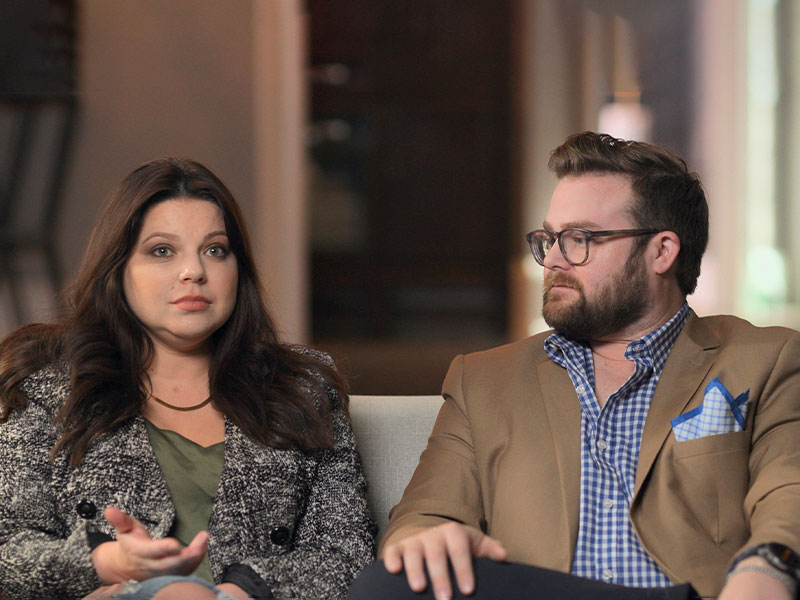
IBLP members had to follow the “Law of Crying Out,” which basically says that if a woman doesn’t cry out to God while being sexually assaulted, she’s at fault and equally to blame as her predator.  


“God has established some very strict guidelines of responsibility for a woman who is attacked,” the law read. “She is to cry out for help. The victim who fails to do this is equally guilty with the attacker.”


“It’s a teaching that basically resituates sexual assault as the victim’s fault,” Arnold clarified.


The law greatly influenced IBLP members’ ideas about rape and assault, so much so that many believed being assaulted was a sort-of gift from God. Heather Heath, an ex-IBLP member, recalled that she and her fellow followers were once asked if they had been attacked, molested or raped and if so, what they did to deserve it.


“They glorified being attacked, ‘Would you rather have never been attacked and not be spiritually mighty?'” Heath continued. “And I almost became jealous of my friends who had gotten raped because God wanted to use them more. And that’s so weird to say out loud.”

08
Jill and her cousin are no longer in contact with the Duggars
Shiny Happy PeopleAmy and Dillon King from “Shiny Happy People” (Photo courtesy of Prime Video)

“Everything within the family dynamic has shifted and not for the better,” Jill said about her relationship with the Duggars following Josh’s conviction.


“They don’t talk to us,” said Dillon King, the husband of the Duggar children’s cousin, Amy King. “And so for us, we don’t know what’s going on. We typically find out what’s going through People magazine, through In Touch, through E!”

“Shiny Happy People” is currently available for streaming on Amazon Prime. Watch a trailer for the docuseries below, via YouTube:


E. Jean Carroll and Mary Trump are collaborating on a romance novel

In an unexpected twist that fans of one-handed reads are unlikely to have had on their Bingo cards, E. Jean Carroll is partnering with Mary Trump and law professor Jennifer Taub on a serialized romance novel titled "The Italian Lesson."

The first installment of the novel hit Substack on Friday and introduces the story of "an American woman with a secret past who tries to reinvent herself in Tuscany, where she opens a cafe and meets a handsome local vineyard owner," per The New York Times

A report from The Advocate on the collaboration details that the three women "became friends in a knitting circle over Zoom during the COVID-19 pandemic," and landed on the idea for the novel after initial plans for writing a screenplay together didn't pan out. 

Carroll, Trump and Taub express the hope of finding a publisher for their novel once it's finalized, but for now they're content with piecing it out on Substack, where they all maintain their own newsletters. 

The writers state that the book's installments will be free for three weeks, after which time a paid subscription will be required to read further. Knitting patterns and recipes for Italian meals will be included with the price of the subscription, and Carroll promises "a no-politics zone," meaning that readers won't have to worry about Donald's name popping up.


Want a daily wrap-up of all the news and commentary Salon has to offer? Subscribe to our morning newsletter, Crash Course.


In May, Carroll won a civil case against Trump for sexual abuse and battery, which the former president continues to rail against. 

In a recent report by The New Republic, it's detailed that a "Trump ally" sought the dismissal of one of Carroll's defamation lawsuits "on the grounds that he is being treated unfairly for being a 'white Christian.'

Prior to the writing of "The Italian Lesson," Carroll worked for many years as a columnist and famously released a memoir in 2019 titled, "What Do We Need Men For?" in which she goes into detail about Trump raping her in the '90s.

Mary Trump, Donald's niece, released a book in 2021 titled, "The Reckoning: Our Nation's Trauma and Finding a Way to Heal."

Former gun company executive explains roots of America’s gun violence epidemic

ProPublica is a Pulitzer Prize-winning investigative newsroom. Sign up for The Big Story newsletter to receive stories like this one in your inbox.

From the movie theater to the shopping mall, inside a church and a synagogue, through the grocery aisle and into the classroom, gun violence has invaded every corner of American life. It is a social epidemic no vaccine can stem, a crisis with no apparent end. Visual evidence of the carnage spills with numbing frequency onto TV shows and floods the internet. Each new shooting brings the lists of loved ones lost, the galleries of their smiling photos and the videos of the police response. And each mass shooting brings another surge of national outrage.

According to the Centers for Disease Control and Prevention, guns became the leading killer of children in 2020, overtaking car crashes, drug overdoses and disease for the first time in the nation’s history. Yet as the one-year anniversary of the massacre at an elementary school in Uvalde, Texas, passes, nagging questions loom.

Why haven’t lawmakers acted with forceful correctives? What will it take to regain a sense of safety? When will change happen? And how, exactly, did America end up here?

Ryan Busse, former executive at Kimber America, a major gun manufacturer, recently shared his thoughts on these questions with ProPublica. He was vice president of sales at Kimber America from 1995 to 2020 but broke with the industry and has become a gun safety advocate. He testified about mass shootings and irresponsible marketing last July in front of the House Committee on Oversight and Reform and authored the book “Gunfight: My Battle Against the Industry That Radicalized America.”

In June 2021, he became a senior adviser for Giffords, a gun violence prevention group led by Gabrielle Giffords, the former Arizona congresswoman gravely injured in 2011 during a mass shooting. This conversation has been edited for length and clarity.

Where are we, as a nation, on guns? And where do you think we need to go?

I think we might be on the precipice of things getting much worse. I think this Bruen decision, the Supreme Court ruling, quite possibly will unleash so many lawsuits against so many counted-upon regulations that citizens may wake up to the equivalent of, like, no stop signs in their town anymore, except for it’ll be on gun regulation. [The Bruen decision has been called one of the court’s most significant rulings on guns in decades. It struck down New York’s concealed carry law as unconstitutional, saying it conflicted with the Second Amendment.]

What do you attribute this trend to?

As I write in my book, there was a time not that long ago, maybe about 15 to 20 years ago, when the industry understood a sort of fragile social contract needed to be maintained on something as immensely powerful as the freedom to own guns. And so the industry didn’t do certain things. It didn’t advertise in egregiously irresponsible ways. It didn’t put, you know, growth, company growth, above all other things. There were just these unspoken codes of conduct the industry knew not to violate. And those seem to have broken down. And now it’s kind of a victory at all costs. And sadly, I think there’s a lot of cost.

What do you say to people who make the argument that guns are protected by the Second Amendment and that yes, a deranged person here or there may do something bad, but is it fair to punish or penalize law-abiding gun owners with unnecessary or extra government intervention?

I am a gun owner. I hunt and shoot with my boys. I want to continue doing that. I believe and I think that I have a right to do those things. On the other hand, I do not believe that right can exist without a commensurate amount of responsibility. And that responsibility either has to be voluntary or it has to be legislated.

I don’t think universal background checks are an infringement. I just don’t buy that. I think it’s part of the responsibility of exercising this right. I don’t think strengthened red flag laws are in any way an infringement. I think that’s what we must do as responsible citizens. I don’t think that controlling irresponsible marketing is an infringement on our Second Amendment rights. In fact, I think it’s our responsibility to do it. I think there’s a small thread of truth in the position you portray, but democracies function in a sort of carefully balanced gray area. And I think our balance in the country right now is way, way off.

Are there others in the gun industry who share your view?

There were people who agreed with everything I said before the sort of radical shifts started to happen in about 2005, 2006, 2007 and 2008. But, you know, as with most things, when you earn a paycheck from something, you’re likely to be greatly influenced by it. And so, over time, most of the people in the industry have either converted to a true belief in the sort of radicalized Second Amendment absolutism that now I think is very dangerous, or they have just left the industry. There is only a place for complete, 100% devotion.

What caused the radicalization?

It was a combination of factors. After Columbine in 1999, the National Rifle Association in very well-publicized meetings now, thanks to sleuthing and digging by reporters at NPR, we now have tapes of the meetings where they literally said, are we going to be part of the solution here? Or maybe we can use these things to drum up hate and fear in our members? We might even be able to use them to drive membership. And they chose the latter. They perfected that system for about seven or eight years, getting their feet underneath them. They figured out it can drive politics. And then an explosion hit. That explosion was the future Black president leading in the polls in 2007. And then Barack Obama won in 2008. So you have this sort of uncapping of hate and conspiracy, much of it racially driven, that the NRA was tapping into. Prior to 2007, people in the United States never purchased more than 7 million guns in a single year. By the time Barack Obama left office, the United States was purchasing almost 17 million guns a year. And so I think it’s impossible to discount the degree to which Obama’s presidency lit this whole thing on fire.

When Trump was elected, there was what was called in the industry the “Trump Slump,” meaning since a Republican was elected, the fear of Obama was gone, and Hillary Clinton didn’t get elected. The sort of fear and conspiracy subsided, and sales stagnated for a little while because the industry and gun owners believed that the threat had passed. But with Trump, we experienced a whole new, never seen before level of fear, racism, hatred and conspiracy that culminated in 2020. In that year, you had George Floyd, COVID lockdowns, Black Lives Matter, Antifa protests and Kyle Rittenhouse. I mean, it’s the most tumultuous year any of us can remember with the most hatred and conspiracy and nastiness. None of us can remember a year like that. In that year, the United States consumers bought almost 23 million guns in a single year, more than three times as much as before Barack Obama took office.

Last year there was a rash of youth-related mass shootings. Uvalde comes to mind. The tragedy at a Buffalo, New York, supermarket comes to mind. How do race, conspiracy and these political headwinds you mention result in young people committing these massacres?

When those things happen, they’re not products of one particular event or series of events. They are the culmination of lots of turmoil in our society. And we’ve always had turmoil in our society, and every society has always had turmoil in it. What no other society has had is 425 million guns and this culture, on the right, that tells young men that to be real young men, they must purchase an AR-15 and go out and solve their problems. The industry 15 years ago would not even allow the AR-15 to be used or displayed at its own trade shows. I mean, they were locked up in a corner. You had to have military or police credentials to even go in there. Now, they’re spread around like crazy, and the marketing campaigns are so aimed at young men that in some ways, it’s not shocking that Uvalde or Buffalo or [the July 4 shooting at a parade in the Chicago suburb of] Highland Park, all three heinous crimes, all three committed with AR-15s, all by very young men. It’s not shocking to me that those happen; it’s shocking to me that they don’t happen every day.

What is more powerful in this country right now than social media advertising? And if it’s not so powerful, why do all the gun companies and the tactical gear companies maintain such polished social media accounts? Advertising is something that happens over time, and creates a perception and creates brands, and creates ways of thinking. And I think that certainly happened with the Buffalo shooter.

The Buffalo shooter wrote in his manifesto about perusing YouTube videos, social media accounts, all the places where tactical gear — which are some of the most egregiously advertised items in the firearms industry right now, bulletproof vests, helmets, gloves, all things that weren’t marketed at all 20 years ago. He studied very carefully what bulletproof vest to wear, what tactical gear to wear, he used the exact same gun that was used in Sandy Hook, the Bushmaster XM-15, the same gun that was advertised in [Remington Arms’] man card campaign that told young men: “You don’t have a man card if you don’t have one of these rifles. And you do have a man card if you do have one of them.”

Now, can you draw a direct line from that ad to those two shooters? I don’t know that you can draw a direct line, but I think you could damn sure draw an obtuse line. I mean, two young men who, obviously, I mean, come on, like, that’s not a mistake. And if advertising doesn’t matter, then why are they doing it?

What are the fixes? Are there any fixes?

What did Winston Churchill say? “Americans will eventually do the right thing.” And I think we may be in for more ugliness before we do the right thing. Some of that will be demanding that the Supreme Court not apply foolish originalist reasoning to instances like this. So part of that will be demanding that either through public pressure or through eventually, in the long game, replacing those justices with ones who don’t believe that way.

The other thing is, we’re going to have to, as a society, just rise up and demand responsibility, the same kind of responsibility that the industry that I worked in once imposed on itself.

You know, I tell the story that 15, 20 years ago, the industry named guns like the Smith & Wesson 629 or the Remington 870 because you had [industry] attorneys that knew that even the names of guns could be important. They could encourage people to do irresponsible things. And so you’d never wanted to even name things that might encourage bad things to happen. Now we have a gun called the Wilson Urban Super Sniper. I mean, what are you supposed to do with that? We now have a gun called the Ultimate Arms Warmonger. What are you supposed to do with that? We now have an AR-15 company called Rooftop Arms, as in when you don’t get what you want, you vote from the rooftops. And what happened in Highland Park? A kid got up and killed people from a rooftop. You see the old self-imposed responsibility; those old norms of behavior have been just completely trashed.

So we can, as a society, demand reinstatement of those norms. Those have nothing to do with laws. They don’t require legislation. They don’t require two-thirds of the vote in the Senate. We can demand that. And we may have to.


Justin Cooper, chief of operations at Rooftop Arms, told ProPublica the business name stems from the origins of founders and is in no way related to “voting from the rooftops,” past events or political causes, or views.

ProPublica contacted Remington Arms and Bushmaster for comment but didn’t receive a response.

Changes in pandemic-era benefits mean new hardship for millions

With the official end of the COVID-19 public health emergency, in May the federal government rolled back nearly all benefits that were broadened in 2020 to accommodate the waves of newly sick and financially vulnerable. Now those suffering from long COVID could lose supplemental income, food stamps and Medicaid just when they need it most. 

People with long COVID, a catchall term for a wide range of often debilitating health problems potentially lasting long after an initial COVID infection, now face new barriers to accessing food or supplemental income. These requirements include filling out additional, complicated forms; providing medical documentation; and submitting to in-person interviews.

In the early days of the pandemic, many benefits were extended without the usual application steps and time limits. Medicaid recipients were guaranteed not to lose their coverage during the national public health emergency, a policy that led to a significant drop in the nation’s uninsured rate. With the end of the emergency declaration, Medicaid recipients must reapply for the health coverage, and up to 15 million could lose it over the next year, the government estimates.

Other vital federal aid programs besides Medicaid are returning to the stricter limits and requirements in place prior to the pandemic. 

Funds for the federal food stamp program known as SNAP (Supplemental Nutrition Assistance Program) ended March 1 in 32 states and the District of Columbia, reducing monthly payments for about 32 million people. SNAP pays recipients an average of $6 per person per day.

People needing direct cash assistance through TANF (Temporary Assistance for Needy Families) must prove their disability in order to be exempt from a work requirement, which can necessitate multiple tests and appointments with medical specialists. A report by the Center for Law and Social Policy documents additional renewed hurdles to accessing benefits. These requirements can be challenging for people with long COVID who are housebound, bedbound or unable to drive, according to Lisa McCorkell, co-founder of the Patient-Led Research Collaborative and contributor to the CLASP report.

“An in-person appointment can exacerbate symptoms, especially for severe [long COVID sufferers], including added cognitive dysfunction and brain fog,” McCorkell said. “Even filling out the forms can be extremely difficult, to stay on deadlines and give necessary documentation.”

Whitney Lee, a 29-year-old part-time disability rights consultant and long COVID patient in Utah, said SNAP has been a lifeline for her for more than two years. In February, Lee was surprised to learn that she missed a new cutoff for recertifying. She was able to reapply but meanwhile lost two months of benefits. 

“Now [SNAP administrators] are sticklers about when you get paperwork in and they want that mailed, but I don’t have a printer,” she said. “[They require you] to go to a doctor to get the diagnostic tests, and you need transportation to go to the doctor.” Lee stopped driving when her COVID-related cognitive dysfunction led to two accidents. Utah also scuttled the extra $100 per month it provided to SNAP recipients during the pandemic. “Now costs are rising, so I have less money and food is more expensive,” she said. 

Lee was already dealing with chronic illness, including fibromyalgia and chronic bronchitis, when a COVID infection in 2021 significantly worsened her health, and she hasn’t felt well since. She needs a portable oxygen concentrator for any amount of exertion — it was not covered by insurance, so her father bought her one — but nothing has helped her ongoing exhaustion and brain fog, and she’s able to work only about five hours a week. “Trying to get food or anything physically demanding can exhaust me, so I have to choose between something I enjoy, like walking the dog, or chores. Even showering some days is too exhausting.” Fortunately, Lee has subsidized housing, and she was able to remain on Medicaid for nearly three years while the continuous enrollment policy was in place. Her Medicaid enrollment will be up for review in the fall. “Now that the emergency is over, I think there is at least a chance I can lose Medicaid,” Lee wrote in an email. 

California is one of the few states that makes it easier for Medicaid recipients, who have to recertify only once a year. Most states, including Utah, require recipients to notify the agency any time their income or employment status changes. TANF, in most states, also requires immediate notification when there’s a change. California is also one of only 11 states that offer health coverage for undocumented residents (or in some states just children). California does it through its own budget rather than through federal matching funds. 

Angela Vazquez, president of grassroots health justice organization Body Politic, worries that many long COVID patients, especially those such as essential workers who are at high risk of being reinfected, will lose access to Medicaid and other services that they still need, due to a “renewed culture of skepticism among county agencies reviewing benefits applications.”

According to a new study, one out of 10 people continue to suffer from long COVID after an initial infection with the Omicron variant — including mild and asymptomatic cases — and the rate of long COVID is even higher for people who are reinfected. Some long COVID patients recover, but many are now in their fourth year of debilitation. 

Data from the U.S. Census Bureau show that Black and Hispanic adults, and those with lower income, are more likely to suffer from long COVID, and these adults are also more likely to suffer from food, housing and financial insecurity. 

“Long COVID is a mass disabling event, and there are many folks who are newly disabled and newly low income,” Vazquez said. “Imagine being disabled and dependent on what coverage you can get from Medicaid providers, and now you have this task to prove you’re still poor enough for Medicaid. It’s quite shocking that we make people prove that they are disabled enough or poor enough to get health care.”

To Access Benefits, Prove You’re Disabled

As with those applying for disability insurance, many SNAP and TANF applicants must prove they are unable to work due to mental or physical disability. States have different standards for who’s considered disabled but all require diagnosis from doctors. If an applicant already has disability coverage, getting on SNAP or TANF is easier, but with the years-long wait times for processing disability applications, it’s unlikely someone with long COVID will currently be covered. And proving disability is challenging when there’s no single biomarker for long COVID and no reliable diagnostic tests for the disorder. 

“Doctors who are not informed well on long COVID may say your tests are coming back normal,” McCorkell said. “Some doctors are not aware of the right tests to use and are not familiar with other post-viral syndromes like ME/CFS [myalgic encephalomyelitis/chronic fatigue syndrome], which has a huge overlap [with long COVID].”

McCorkell and other advocates recommend that the Department of Health and Human Services give states guidance to add long COVID to the list of qualifying disabilities for exemptions to work requirements for both SNAP and TANF. They also recommend reducing the administrative burden by requiring only a single application for all services, as California does. Ideally, McCorkell said, there would be federal funding to help people fill out applications, which often ask the same questions in different and confusing ways.

Eliminating in-person interviews is crucial, disability advocates say, especially when phone and conference calls were the norm for three years. People with long COVID are at high risk of reinfection, and possibly greater disability, when forced to be in public spaces that have scrapped all virus mitigation.

There may be long odds of retaining relatively easy access to benefits in a political environment where Republicans want to further restrict access. Although President Biden’s budget calls for “eliminating barriers to food assistance for vulnerable groups,” House Republicans are demanding additional restrictions to SNAP, including a work requirement, as well as clawing back remaining COVID funds, in the debt limit standoff. Republicans also want new work requirements for Medicare, Medicaid and social security.

The End of the Beginning

It’s not just the U.S. dismantling its pandemic scaffolding. On May 5 the World Health Organization declared an end to the “public health emergency of international concern” and recommended a global transition to “long-term management of the COVID-19 pandemic.” 

But in the U.S. it is now harder to simply know the risk of contracting COVID and long COVID.  The Centers for Disease Control has stopped tracking community levels and transmission rates of COVID-19. At-home testing is no longer free, presenting yet another barrier for poor and uninsured Americans. Although government data are harder to come by, wastewater analysis shows continued widespread transmission, meaning COVID, and long COVID, will continue. 

In early 2021 COVID was killing 3,000 Americans per day, but as the national emergency was lifted on May 11, deaths were about a fifth of that. Death, however, isn’t the only metric of concern. Even for those younger, healthy and vaccinated, a “mild” COVID infection can lead to a life altering illness, regardless of age, comorbidities or vaccination status. COVID impacts nearly every organ in the body, and currently, there are no effective treatments. The virus continues evolving to find new ways to evade immunity, and there’s apparently no limit to the number of infections a person can have. The White House recently received a sobering report about the possibility of a newer variant that could cause mass infections to come roaring back. 

Advocates for long COVID patients have decried the ending of the national emergency, not only because of the scaling back of benefits but for the message that it sends: that the pandemic is over and there’s no need to be careful. 

“Early on, [government] messaging was, ‘Protect loved ones, the elderly, the immunocompromised,'” Vazquez said. “But now the message is personal choice. Even though the risk of getting infected is not individual but community driven. Everyone is at risk of long COVID, and each infection puts you at more risk of developing long COVID. It’s increasingly dangerous to be disabled and high risk in the U.S.”

Classified document spoken of in 2021 Trump recording is MIA

Audio of a 2021 meeting held at Trump’s Bedminster golf club — in which he speaks of a classified document pertaining to a potential attack on Iran — is at the top of the pile of evidence in the ongoing investigation into his handling of sensitive materials post-presidency. Missing from that pile is the document itself, as his lawyers are unable to locate it.

In mid-March, a federal subpoena was issued asking for Trump’s attorneys to hand over material related to the information discussed on the audio, but have yet to be able to produce the physical document that was referenced on it, which presents an even larger issue.

According to CNN, “The fact that Trump’s team was unable to produce the document underscores the challenges the government has faced in trying to recover classified material that Trump took when he left the White House and in understanding the movement of government records that Trump kept.”

There has been concern that Trump’s team has not been forking over everything there is to fork over, and this latest disappearing act points to that concern being valid. In the ongoing search for the requested materials, CNN’s reporting points out an alternate possibility for why it can’t be found in that “it’s unclear if the government already possesses a copy of the Iran document from the boxes Trump’s legal team returned to the National Archives last year or recovered in the subsequent FBI search.”


Want a daily wrap-up of all the news and commentary Salon has to offer? Subscribe to our morning newsletter, Crash Course.


Whether the document is recovered or not, the 2021 audio of Trump talking about it is damning enough. In a report by The New York Times, it’s highlighted that “his statements on the recording could prove damaging to him as [Jack] Smith’s team moves toward concluding its investigation and turns to the question of whether to file charges.”

In a recent appearance on “Meet the Press,” attorney Andrew Weissmann co-signs this saying, “If the document doesn’t exist … the evidence on that tape is still useful to show his state of mind.” 

West Virginia governor’s coal empire sued by the federal government — again

ProPublica is a Pulitzer Prize-winning investigative newsroom. Sign up for The Big Story newsletter to receive stories like this one in your inbox.

Federal authorities sued West Virginia Gov. Jim Justice’s business empire on Wednesday, seeking $7.6 million in unpaid environmental fines and overdue fees. The move adds to Justice’s growing legal and debt problems and comes just a month into his campaign for the U.S. Senate.

Justice Department lawyers filed the suit to collect fines assessed by the Interior Department against 13 companies for strip mining violations that “pose health and safety risks or threaten environmental harm” to neighboring communities.

For years, Justice has been dogged by allegations that his family businesses haven’t paid their business and regulatory debts. In 2020, an investigation by ProPublica and Mountain State Spotlight found that the total judgments and settlements owed by Justice family businesses had reached $140 million. The review found hundreds of lawsuits that dated back more than 30 years, with many filed by workers, vendors, business partners and government agencies, alleging they hadn’t been paid.

This week’s lawsuit is the third time in the last two months that either federal agencies have pursued legal action against the Justice companies or a court has ruled against them over fines for environmental and worker safety violations. In April, a federal appeals court ruled that Justice companies must pay $2.5 million in fines assessed by the Environmental Protection Agency. In mid-May, the Labor Department sought a judge’s help in collecting millions of dollars in fines, alleging Justice companies are habitually late making payments related to violations that could have endangered the health and safety of coal miners.

The new suit cites more than 130 violations and more than 40 more serious enforcement orders issued between 2018 and 2022. The Justice companies previously argued that the government had reneged on a deal to resolve some of these violations for a $250,000 fine. But a federal judge threw out their case.

In response to this week’s suit, Justice sought to divert attention from the substance of the case by implying that the White House was using regulatory agencies for political purposes. “Joe Biden, Chuck Schumer, and the Democrats have seen the polling that show me winning this U.S. Senate race. Now the Biden Administration has started their political games to beat me,” the governor said in a tweet.

Justice, a hugely popular Republican, is seeking the GOP nomination to challenge Sen. Joe Manchin, a Democrat who is often the swing vote on key legislation.

Government lawyers said the underlying violations included the failure to maintain and ensure the stability of a dam, violating pollution limits and not controlling erosion or sediment from mine sites.

Christopher R. Kavanaugh, the U.S. Attorney for the Western District of Virginia, said in a statement that the companies “failed to remedy those violations and were ordered over 50 times to cease mining activities until their violations were abated.”

Kavanaugh continued, “The filing of this complaint continues the process of holding defendants accountable for jeopardizing the health and safety of the public and our environment.”

In addition to unpaid environmental penalties, the case also seeks nearly $200,000 in unpaid Abandoned Mine Land fees, which fund the federal cleanup of coal mines abandoned prior to 1977. West Virginia has more than 175,000 acres of abandoned mine sites awaiting cleanup, the second-highest total in the country. According to one estimate, the Interior Department program for cleanups is projected to have a shortfall of more than $25 billion nationwide by 2050.

As the mining industry continues a downward economic spiral, reclamation of abandoned mines is an increasing concern in coalfield communities, especially in the wake of corporate bankruptcies that threaten to shift the costs to taxpayers.

The total amount sought by the government also includes interest and administrative expenses.

Justice has said that he and his family’s companies always pay their debts. The governor was not named as a defendant in the Interior Department suit, but 12 of the 13 companies involved were listed among his business holdings on his most recent financial disclosure filed with the West Virginia Ethics Commission.

The new lawsuit does name the governor’s son, James C. “Jay” Justice III, as a defendant. The suit states that Jay Justice is a “controller” of 12 of the companies named in the complaint and that he was previously assessed fines as a corporate owner, as allowed by the federal strip mine law.

Representatives for Jim Justice’s businesses and for Jay Justice did not respond to requests for comment on the lawsuit.

Four years ago, Jay Justice issued a news release after the family’s coal firms sued the Interior Department over what was then $4.2 million in unpaid strip mining penalties and fees. The companies alleged that they had a verbal deal to resolve the matter for $250,000. But, they said, the agency backed out. Fearing a government collection action like this one, the Justices sued to try to enforce that verbal deal.

“We don’t want to have to go to court to get the government to do the right thing and live up to its end of the bargain,” Jay Justice said at the time, “but we can’t sit back and let the government take advantage of our good faith efforts to resolve this matter.”

Five months after that case was filed, a federal judge in Virginia dismissed it.

Christie rerun will pay residuals

On Tuesday in New Hampshire, former Gov. Chris Christie is expected to formally announce he’s entering the increasingly crowded 2024 Republican presidential primary field.

Why?

Could it be he feels remorse that on his recommendation, a sufficient number of Americans in 2016 voted for Donald Trump, so that he won the Electoral College vote and then four years later, after losing both the popular and Electoral College vote, incited a violent insurrection that continues to destabilize the United States to this very day?

Does he believe he can restore the good standing of his party that includes dozens of U.S. House members and U.S. Senators who voted against certifying the legitimate results of the 2020 Presidential election AFTER the violent assault on the U.S. Capitol?

Not likely.

And there’s little in his past performance that should encourage another run for the White House. Christie’s 2016 bid crashed and burned in New Hampshire. Despite his close to 200 visits to the state, he won less than 10 percent of that state’s primary voters.

While the rear-view mirror snapshot is hardly encouraging, the look at the road ahead provided by the most recent Monmouth University poll would appear to be even more discouraging.

According to Monmouth, former Vice President Mike Pence got a 46 percent favorability rating versus 35 percent unfavorability rating with the 655 Republicans the poll surveyed last month. By contrast, Christie “receives a decidedly negative rating (21 percent favorable and 47 percent unfavorable) and is the only contender of the ten tested in this poll who gets a net negative score from the Republican electorate.

Back in April, in an interview with Politico’s Rachel Bade, the former Governor positioned himself as the only candidate who would have the “balls” to take on former President Trump directly, a job Christie opined was best reserved for “somebody who knows him,” adding that “nobody” knew “Donald Trump better” than he does.

In his pre-announcement buzz, Christie insists he’s no mere 2024 spoiler but would be in the contest to win it.

“I’m not a paid assassin,” Christie told Politico. “When you’re waking up for your 45th morning at the Hilton Garden Inn in Manchester, you better think you can win, because that walk from the bed to the shower, if you don’t think you can win, it’s hard.”

At a relatively young looking 60, it’s his very busy brand that can’t afford to sit out 2024 on the sidelines. Win, lose or draw, by submitting himself to the 2024 red meat fray, he’ll get the windfall of what’s called earned free media. (In 2016, experts estimate Donald Trump raked in close to $5 billion worth of earned media.)

Christie has been working as a lobbyist and commentator for ABC News for the last several years. His Christie 55 Solutions firm, which offers an array of services, includes May Pat Christie, Rick Bagger, Bob Martin and Michele Brown, who is also the executive director of the Christie Institute for Public Policy, a 501c3 non-profit partnership with Seton Hall University.

Christie’s firm offers guidance in business strategies, crisis management, disaster response and guidance for environmental regulation, as well as insights for the financial services, gaming, healthcare, life sciences, utilities as well as transportation and infrastructure sectors.

And unlike so many of his Republican rivals, Christie can still get some Democrats to reach across the partisan divide to find some common ground in the spotlight like U.S. Sen. Cory Booker did back in April as a guest at Christie’s Institute.

Matt Arco with NJ.com, reported the pair “shared laughs, heaped praise on each other and talked about how to bring civility back to politics.” Previous Christie guests include Leon Panetta, a Democrat, and former Secretary of Defense during the Obama presidency as well as Sen. Joe Manchin (D-WV).

This time out, Christie’s gotten some support from some very unlikely quarters.

As “the only potential contender with the guts to give Trump the thrashing he deserves, and the skill set to get it done. He’s made for this moment,” wrote Tom Moran, the Star Ledger’s Editorial Page editor recently. “To qualify for the debates, Christie needs one percent support in the polls, which he has, along with 40,000 individual donations, according to the draft rules. So, even if you can’t stand him, get ready to donate $1 as a patriotic duty when the clock starts ticking, after he announces.”

Moran reports that “Christie himself has vowed that he won’t vote for Trump, even if he is the GOP nominee.”

“I know, Christie helped create this monster in 2016 as the first major Republican to endorse Trump, and he stuck with Trump through his first term,” Moran recounts. “He prepped Trump for his debates with Joe Biden in 2020, long after it was clear that Trump was a racist, a liar, and an enemy of democracies worldwide. For that, Christie will have to answer to history.”

Christie may have lost the 2016 GOP primary, but in many ways, it was his role as chair of the Republican Governors’ Association back a decade ago, that laid the foundation for the Republican Party’s success at capturing dozens of state legislatures and Governorships in a rout of the Democratic Party that has had generational consequences that endure to this day.

When I was covering Christie at the 2012 Republican Convention in Tampa for WNYC it was the lobby of Christie’s hotel that felt like the heavy-gravity center of power for the Republican Party. In 2014, after his re-election, and beating of the Bridgegate rap, he was feted by the Republican Governor’s Association for netting in excess of $100 million for the party.

In 2023, as women see their reproductive freedoms radically curtailed across an increasing swath of America and voters of color see their access to the ballot increasingly restricted, they can thank Sen Booker’s friend Chris Christie who quarterbacked the GOP’s state level renaissance one race at a time.

It doesn’t matter if his brand is electable as long as it is bankable. Christie got great results for his party and the donors aren’t complaining either.

According to the Center For Responsive Politics in 2014 Exxon donated $750,000 to the Republican Governors Association. Other major energy sector donors included the Koch brothers Koch Industries which gave Christie’s RGA $4.25 million dollars.

That next year, Reuters reported “New Jersey’s long legal battle to recover $8.9 billion from Exxon Mobil Corp for environmental damage ended when Governor Chris Christie’s chief counsel, Christopher Porrino, cut a deal to settle for $250 million.”

Word of a deal came after the conclusion of an eight-month long trial after both sides wrote the presiding judge asking him to hold off on issuing a ruling because the two sides had reached an agreement.

Environmentalists and local elected officials, who had been tracking the litigation closely, expressed outrage over the deal which was widely expected to yield the state billions of dollars. “I grew up in the Bayway section of Elizabeth. The smell there was terrible but the stench this deal gives off is worse,” said State Senator Ray Lesniak during an interview. “$250 million dollars is just two weeks of profit for Exxon.”

For over a decade the state’s attorneys general under four governors, including Christie, aggressively pursued Exxon Mobil. Back in 2008 a state court judge ruled in the state’s favor holding Exxon-Mobil liable for the massive contamination of 1,500 acres in Hudson and Union counties. All that remained was to determine how much the state would be compensated.

The language of the 2008 ruling was powerful and set a strong legal foundation for what promised to be a substantial damages award. “It was estimated in 1977 that at least some seven million gallons of oil ranging in thickness from 7 to 17 feet, are contained in the soil and groundwater underlying a portion of the former Bayonne site alone,” wrote former Judge Ross R. Anzaldi. The level of hydrocarbon contamination was so high one creek was covered with “a gelatinous, oily emulsion overlying grey silt.”

The reported Exxon settlement came at a critical point in the history of the Newark Bay according to Dr. Angela Cristini, who taught biology at Ramapo College and studied the region for decades. Cristini credited billions of dollars invested in municipal sanitary sewers and declines in direct toxic discharges for bringing back oxygen and life back into these once dead waters. “There has been an amazing recovery in the Hackensack and even in Newark Bay,” Cristini said back in 2015.

How much more of an ecological recovery could Newark Bay have made if New Jersey had gotten those billions from Exxon in reclamation funds that just evaporated?