Spring Sale: Get 1 Year, Save 58%

The crispiest, easiest and most delicious bacon ever

At the beginning of last week, Alton Brown tweeted a missive that would eventually go viral.

“Could someone help me with a culinary question,” the “Good Eats” star asked. “What is ‘leftover bacon?'”

Of course, this question could be extended to any food that elicits fervid, impassioned loyalty. If and when you eat something that you truly enjoy, is it actually possible to leave leftovers behind?

I recall the time I was at a friend’s for breakfast, and she took out a frying pan to make bacon for us. I watched in quiet horror as she flippantly added an inexplicable amount of bacon to a pan, cranked the heat to high and stirred it around a few times. She then placed a plate on the table that consisted of flabby, unappetizing bacon with a few char marks.

For whatever reason, I’ve always had an innate distaste for bacon that is flaccid or not teeth-shatteringly crispy in any way. My dad — always a passionate proponent of IHOP and breakfast at large — would only ever order bacon “well done.” (My parents would also only ever order pizza in the same exact manner.)

This proclivity was passed down to my brother and me. In the early days of the pandemic, I would make bacon often, filling the house with its familiar aroma.

I eschewed many forms of meat years back; as my friend astutely put it, I had effectively given up consuming any and all “four-legged animals.” But I’m still adamant that there’s one and only one way to cook bacon, no matter if you’re making porkbeef, turkey or vegan bacon.

The latter variety is, of course, devoid of any and all animal-derived ingredients. Nowadays, bacon operates in a much more inclusive realm, with alternative options on offer at practically every supermarket. I digress . . .

Let’s focus on bacon. I have a trick for making better bacon, but what is it?

Two words: cold oven. Trust me, do not preheat the oven. I promise you’ll thank me later.


Want more great food writing and recipes? Subscribe to Salon Food’s newsletter, The Bite.


Food is an incredibly personal and individualistic enterprise. If you’re fond of bacon that is stretchy and fatty (uffa!), then make it to your own taste. Up until I stopped eating pork, this was the only way I’d ever enjoy bacon at home. So, why not give this method a try? Bonus: It also makes cleanup a lot easier.

A final thought about bacon: It comes by way of @cleverlychloe on Twitter, who recently re-shared a TikTok video by user @mskatthomas that shines a light on a timeless question. It still befuddles me whenever I think of it, but why the heck is bacon packaging so incredibly un-user-friendly?

In an ideal world, big bacon would roll out resealable packaging in this still new year. Until then, grab some foil or reusable food storage baggies because you’ll likely have some uncooked bacon left over after making this recipe.

Though, if Brown is right, does leftover bacon even exist?

Best Ever Sheet Pan Bacon
Yields
04 servings
Prep Time
02 minutes
Cook Time
25 minutes

Ingredients

  • 1 package bacon of choice (pork, beef, turkey, vegan, so on and so forth), thick-cut preferred
  • 1/4 cup high-grade pure maple syrup
  • 1 teaspoon white miso
  • Dash of cayenne or crushed red pepper flakes, optional


Directions

  1. On your largest sheet tray, lay out individual slices of bacon in a single layer, with as little overlap as possible. If you’d like, lay down parchment paper or a silicone baking mat, though it’s not necessary.
  2. In a small bowl, combine the maple syrup, white miso and your spice of choice until smooth and well mixed.
  3. Using a pastry brush, lather the mixture across every slice of bacon.
  4. Place in a cold oven, turn the heat to 400 degrees Fahrenheit and don’t open the oven for 20 minutes.
  5. When the aroma is especially alluring, check the bacon. Note that it will crisp even further as it cools. If you’d like, let cook another 3 to 5 minutes.
  6. Remove the sheet pan from the oven. Wait a minute or two, then transfer the bacon to a ceramic or glass dish. (Do not transfer to a napkin or paper towel.) Drain the bacon grease into a small bowl before it solidifies on the pan. Reserve for another use.
  7. Let the bacon sit for about 5 minutes.
  8. Eat with reckless abandon.

Salon Food writes about stuff we think you’ll like. While our editorial team independently selected these products, Salon has affiliate partnerships, so making a purchase through our links may earn us a commission.

Palates meet palettes: When did so many fast food brands also launch makeup lines?

The age-old adage “looks too good to eat” has frequently described edible works of art, from life-like cakes to aesthetic pastries. But more recently, the cliché has also applied to food-themed cosmetics, which allow consumers to beautify themselves with the aid of their favorite foods.

Over the last several years, multiple food brands have partnered with makeup brands, forming some admittedly odd partnerships.

 In 2016, US fast food chain Kentucky Fried Chicken took its motto “finger lickin’ good” to the extreme by releasing a line of edible nail polishes in Hong Kong. The specific nail colors included “Hot & Spicy,”, which BBC described as “a trendy burnt orange shade similar to Tabasco hot sauce,” and “Original Recipe,” which resembled “a dirty olive green color with black specks” instead of the advertised nude shade.

Following in KFC’s footsteps is Cheetos, which collaborated with clothing brand Forever 21 to launch various makeup products, including a Cheetos Flamin’ Hot Eyeshadow Palette. Similarly, Hershey’s Chocolate teamed up with K-beauty brand Etude House to release its own makeup kit, equipped with two mini chocolate bar-themed eyeshadow palettes, two sweet-themed lip tints and a brush duo. Chipotle, with e.l.f. Cosmetics, also dropped its limited-edition line of cruelty-free, vegan cosmetics, which are all inspired by the California-based chain’s menu.

Even convenience store 7-Eleven launched its own cosmetics brand, called Simply Me Beauty, which includes mascara, concealers, blush, BB Cream, brow powders and, even, makeup removing wipes.

Perhaps the real trendsetter is Lip Smacker and its line of food-scented lip balms. In 1973, the brand debuted the world’s first flavored lip balm in Strawberry, Lemon and Green Apple. Two years later, Lip Smacker introduced its iconic Dr. Pepper lip balm, which smells exactly like the famed soft drink.

“The line’s early appeal was its clean, fresh approach. The ads described its products as ‘honest’ and linked health and beauty in a wholesome, unthreatening way,” Allure magazine’s founder, Linda Wells, told Today. “The models had freckles and wore tennis clothes or equestrian gear, they rode bikes and carried bunches of flowers, they posed with fresh watermelon or cherries.”

Lip Smacker then released its first tropical flavors — Passion Fruit and Pina Colada — in 1986. Amid the early 2000s, the brand launched flavors like Sapphire Berry, Strawberry Garnet Glaze and Butterscotch Topaz and collaborated with colorful candy brands Starburst and Skittles.

Fast food-themed cosmetics continue to be so successful because they are both fun and cheap, just like the fast foods they represent. They’re incredibly eye-catching and appealing too — it’s hard not to be intrigued by an eyeshadow palette that resembles neon orange Cheetos dust or the ingredients of a burger.   

“You can play with the color scheme and the color story as well as the layout, and the graphics that go in the palette,” Canadian beauty vlogger and makeup artist Jaime Paige told CBC News. “It just creates a whole experience.”

Paige added that marketing plays a big role in promoting such products. There’s also the nostalgia factor — considering that most makeup lines are available for a limited-time-only, there’s a greater desire to attain them, preserve them and, hopefully, flaunt them in the future.

“I think that’s why you are hearing so much more about palettes and why companies are kind of jumping on the makeup bandwagon,” Paige continued. “Because they know that it’s popular, it sells and it’s what is really in right now.”


Want more great food writing and recipes? Subscribe to Salon Food’s newsletter, The Bite.


As for whether fast food-themed cosmetics are popular amongst consumers, the answer is yes. Following Cheetos’ makeup release, YouTubers Jeffree Star and Mayra Isabel were quick to review and use the brand’s eyeshadow and bronzer sets. YouTuber and makeup artist Nikkie de Jager, who runs the account NikkieTutorials, also reviewed the Glamlite Burger palette when it came out in 2019.

It makes sense why fast food chains have dipped their toes into makeup. The final product is buzzworthy, funky and, yes, — but it never fails to pique consumers’ interest.

5 food and cooking trends for 2023, according to Food52

2022 was a year of viral foods. It was impossible to escape talk of butter boards, caviar bumps, and, of course, the negroni sbagliato (with Prosecco in it). Cloud bread, so-called “Healthy Coke” (aka: a shrub), and baked oatmeal all enjoyed moments of stardom. We debated the merits of pasta chips, chicken caesar wraps, and that blue smoothie from Erewhon that spawned many a copycat.

Rather than trying to predict the next big fad — destined to blow up and fade away in a matter of weeks — I wanted to consider the way we ate in 2022 from a more practical perspective. So, I asked my fellow editors to share what will change about their approach to food in 2023. Here’s what they came up with:

Our 2023 food rules

1. Cooking with stock -> Cooking with water

“This year, I’m using water instead of stock whenever possible. Water from my faucet is free (I think?) and doesn’t take up any of my perpetually disappearing pantry space. Also, flavor. Water (in place of stock) keeps my braises and soups light and crisp, and I’m into that right now. Turn your faucet on and join the water movement.” — Paul Hagopian, Editorial Intern

2. Still wine -> Sparkling wine

“Bubbles make every occasion feel special, whether it’s a pink pet-nat enjoyed with a cheese board for weeknight dinner (eaten in front of the TV, naturally) or a sparkling red sipped alongside a burger at my favorite natural wine bar. Don’t get me wrong, I love all wine, but these days it’s the sparkles for me.” — Madison Trapkin, assistant editor

3. Dining out -> Dinner parties at home

“For me, dinner parties bring back a sense of the salon nostalgia: everyone chatting over a delectable spread we’ve all made (it certainly helps that most of my friends are professional chefs). Plus, my favorite music is always playing (goodbye weird hipster Muzak!). The dinner party is also a nice low-pressure way to gather in 2023. Maybe you have sober friends, or a friend who really can’t afford a dinner out right now — at home, everyone’s invited to the table in whatever way they can show up. Bring an appetizer, bring an ice breaker, or bring a lovely aperitif; there’s something for everyone.” — Emily Ziemski, food editor

4. Cold salad -> Cooked salad

“Give me all the comforting, hearty goodness of a baked salad (à la this roasted squash and cauliflower number) over cold lettuce and raw veggies swimming in a pool of dressing any day of the week.” — Erin Alexander, managing editor, content

5. Soft yolk -> Hard yolk

“The internet loves a runny yolk, but I have never seen the appeal. I firmly stand by a 10-minute hard-boiled egg, sometimes 12 if I forget. Does the recipe call for a jammy egg? I’m leaving it in for four more minutes. Does the recipe need a fried egg with a gooey center? I’m flipping it over and letting it fry until it’s cooked. For me, it’s the taste. Don’t get me wrong, I love eggs, but I prefer the flavor of the whites over the yellow, which is why I’m a hardcore fan of the overcooked egg.” — Dominique Evans, social content creator

Hands! Before “The Bear” returns, the cast and producers serve up a light appetizer

How does one top a flawless eight-course meal? The producers and cast of FX’s “The Bear” answered TV reporters’ version of that question that defines a Michelin star craftsperson’s emphasis on perfection.

“I keep telling everyone it’s going to be bad. I’m serious,” co-showrunner Joanna Calo told press at the Television Critics Association conference in Pasadena, California. “I’m trying to set expectations super-low. I’ve been telling a lot of people this, and I’m hoping the message will get out. Because then maybe you’ll be surprised if it’s not so bad.”

“It’s trash,” concurred the show’s lead, Jeremy Allen White. Both know that nobody will believe them, because this show, like The Beef’s menu, is fire. Audiences are still this half-hour –drama? Comedy? Stress-fest? “The Bear” is all of these, and indescribably delicious by refusing to commit to fitting one genre or description. This gives its producers and cast plenty of room to play in a second season that expands from eight to 10 episodes, set to debut early this summer.

“The Bear” stars Jeremy Allen White as Carmen “Carmy” Berzatto, a celebrated up-and-coming chef who abandoned his rising career and a post at one of the top restaurants on the globe to take over The Original Beef of Chicagoland, a beloved Chicago hole-in-the-wall joint left to him by his brother Mike (Jon Bernthal), who died by suicide.

In assuming ownership of The Beef he also gets a combative staff devoted to a chaotic “system” that allowed its team of cooks to limp along and eventually gets the place whacked with a “C” rating.

“The Bear” is a slow-cooking phenomenon viewers are still discovering.

Helping him meet the challenge of getting the restaurant into shipshape condition, and out from under its $300,000 debt, is an ambitious newcomer Sydney (Ayo Edebiri), who is drawn to The Beef by the opportunity to work with Carmy. But in addition to beating the system they have another obstacle in Mike’s best friend and Carmy’s “cousin” Richie (Ebon Moss-Bachrach) who takes out his misplaced rage over Mike’s death on Carmy.

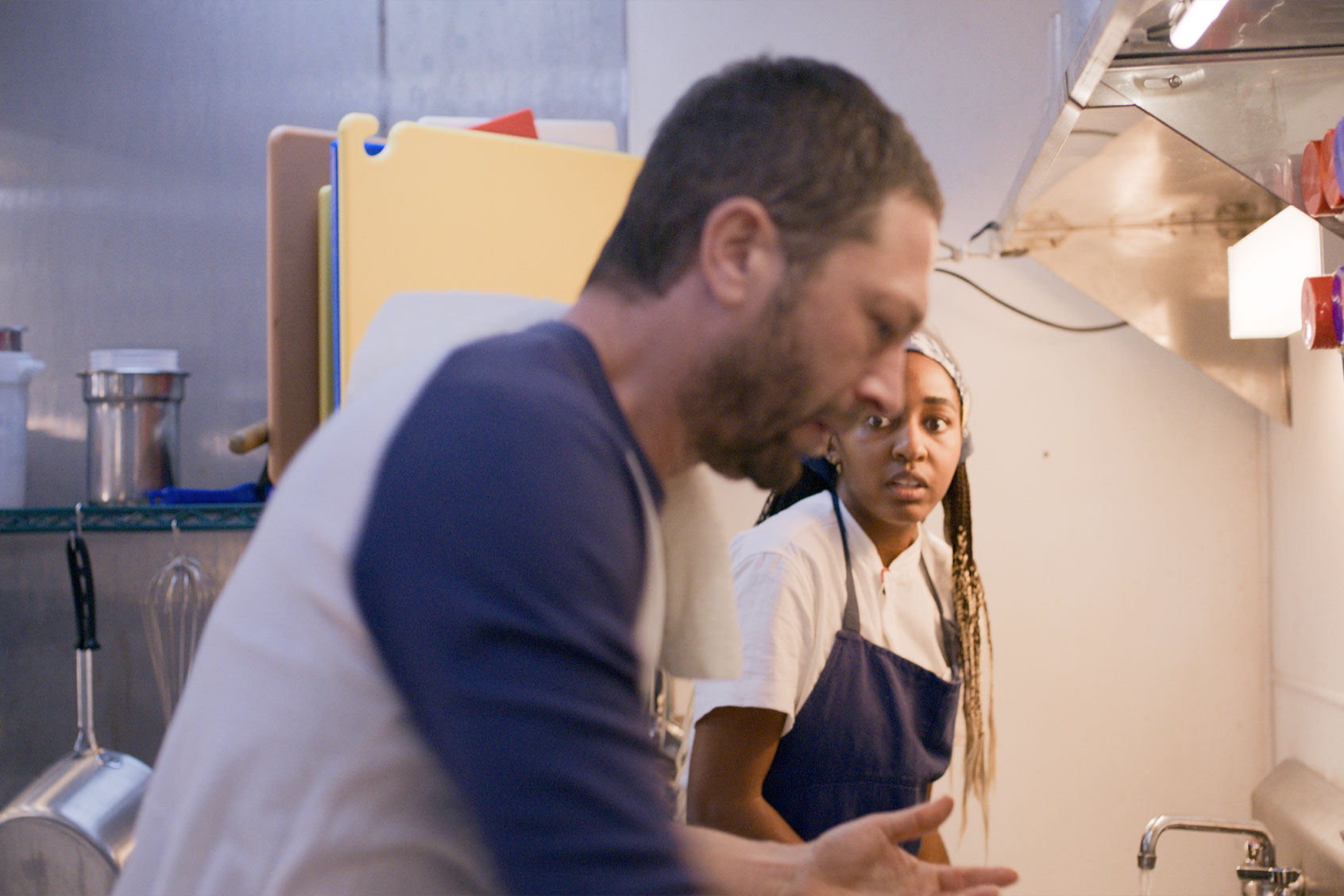
The BearEbon Moss-Bachrach as Richard ‘Richie’ Jerimovich and Ayo Edebiri as Sydney Adamu in “The Bear.” (FX)
“The Bear” is a slow-cooking stew of grief, stress and healing, creating a phenomenon viewers are still discovering and others have deemed worthy of going back for second and thirds. That trend is likely to accelerate now that White has won a Golden Globe for best performance by an actor in a television series, musical, or comedy, joining its list of SAG, DGA, WGA, and Spirit Award nominations, along with earning a place on the AFI’s list of the Top 10 Television Programs of 2022.

Its success was entirely not a surprise to FX Content and FX Productions chairman John Landgraf, who says the show received a universally positive response in a test screening of the season before its debut. Having said that, Landgraf adds, “We thought we were making a kind of small, bespoke little jewel box. I didn’t know it would be the most watched comedy we’ve ever had in our history as a channel.”

“The Bear” isn’t simply a domestic hit, according to Landgraf, but performs well internationally. As FX watched the conversation around the show expand he landed on a theory as to why it has such a broad appeal.

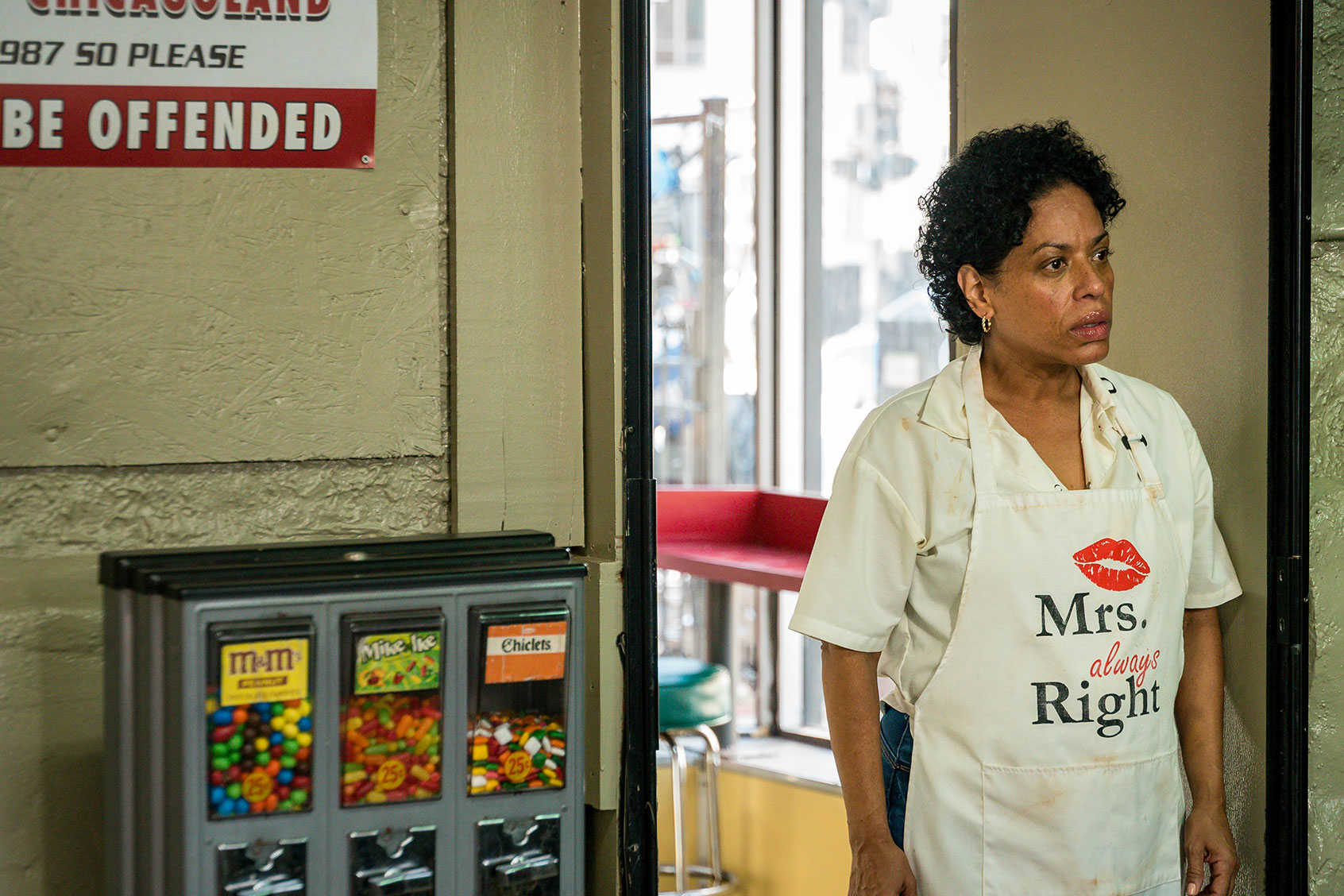
The BearLiza Colon-Zayas as Tina in “The Bear.” (Matt Dinerstein/FX)
“Part of that is just the cast, which is a really amazing, diverse cast,” he told Salon. “But that’s one part of it. Then I realized, almost everybody has had an experience of either working in a restaurant or with a sibling or a friend or a spouse that’s worked in a restaurant. That’s the job that most people have in their lives, growing up. And so there’s something that’s resonating to them on a very personal level about a personal experience they’ve had in their lives.”

But he doesn’t discount the overall quality of the writing, the acting, and the story’s quickened pulse for its appeal. “It’s a family show like ‘Cheers’ or ‘Taxi,’ where a group of people come together in one place, and are fractious, complicated, but then ultimately, deeply interconnected. It’s universal, but it’s very specific in terms of its time and place and its character. So that’s kind of the gold standard.”


Want a daily wrap-up of all the news and commentary Salon has to offer? Subscribe to our morning newsletter, Crash Course.


That also explains why the bar for success may be a little higher in the second season, which picks up after Carmy and the crew find a way to save The Beef from going under, prompting Carmy to embrace the opportunity to transform the humble sandwich show into his creation.

The actors and producers were purposefully vague on the details about the coming season’s arc beyond its creator and co-showrunner Christopher Storer saying, “It’s about balance in a lot of ways, between time and what it means to start fresh and how can you start in a healthy direction.”

Storer added, “I feel like if we continue to tell an honest story and we try to be low to the ground like we did last time, I at least think our hearts are in the right place. “

The first season of “The Bear” is currently streaming on FX on Hulu. The second season will be served up in early summer.


“Ginny & Georgia” has a tone problem, undermining its emotional impact

As a young adult, my two favorite shows aired at the same time. In the dark days before DVRs or streaming, this meant a lot of toggling between channels during commercial breaks. Both shows had their issues, as it turned out. “Buffy the Vampire Slayer” boosted nearly as many racist, sexist and homophobic jokes as monsters. Its competition, “Gilmore Girls,” ignored issues of class while doing terribly with queer issues and characters of color

Ginny & Georgia,” now returning for its second season on Netflix, caught my interest immediately. The show was billed as like “Gilmore Girls”— where the two main characters start as a 16-year-old and her mom who had her at 16 — but a story that shows what it’s really like to have a teen mom. I’m friends with adults who were born into similar circumstances, and in high school, some classmates became parents at that young age. It wasn’t like “Ginny & Georgia” for any of them. 

But then “Ginny & Georgia” operates in its own universe, one where the rules of physics don’t seem to apply. Events happen fast and dramatically. Consequences, rarely at all. And in its second season, the show has a major tone problem.

“Ginny & Georgia” stars Brianne Howey as Georgia, who starts the show as the 30-year-old single mom of two. Her kids, Antonia Gentry as teen Ginny, and Diesel La Torraca as nine-year-old Austin, have two separate dads, one of whom Georgia sent to prison, framing him for embezzlement (although he did do some financial crimes on his own) after he abused her. Another husband, Georgia murdered with poison. Wait, that’s two husbands she murdered, having married then murdered her creepy landlord when she was a teen mom who lost custody briefly after being busted for running an illegal gambling ring. She was also in a biker gang.

The town is an afterschool special.

Are you following? Even seeing every episode religiously, it’s hard to keep track. When the second season starts, Georgia is engaged to Paul (Scott Porter) her boss and the mayor of the bucolic, New England town to which she moved her kids. She’s also balancing Ginny regularly seeing Zion (Nathan Mitchell), her dad, and Austin seeing his dad, Gil (Aaron Ashmore), who gets out of prison and starts coming over (and worse). A private investigator is also hot on Georgia’s heels. It’s not simply Georgia, but multiple characters, even minor ones, who have convoluted and ever-complicating backstories as well as current stories. 

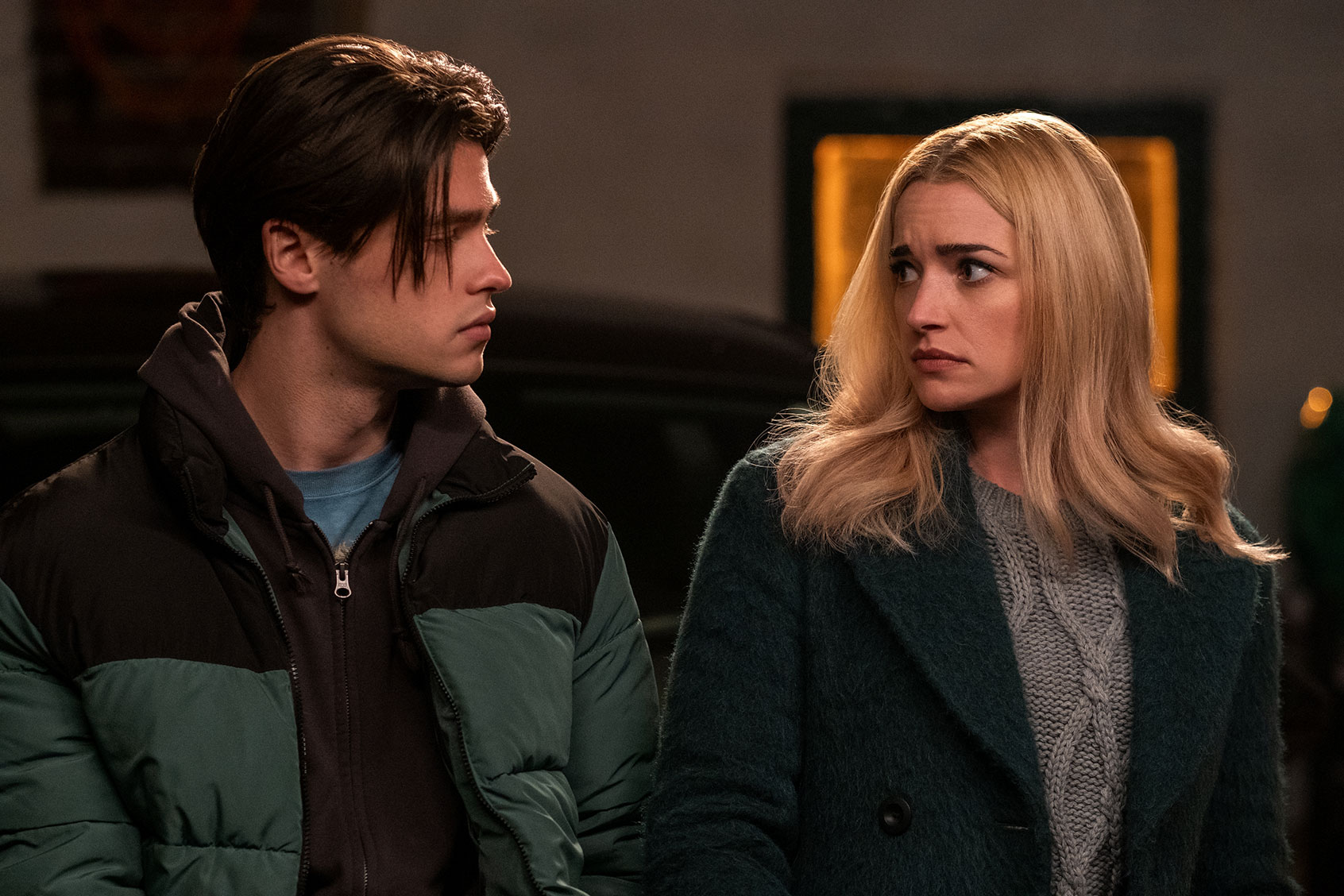
Ginny & GeorgiaFelix Mallard as Marcus Baker and Brianne Howey as Georgia in “Ginny & Georgia.” (Brooke Palmer/Netflix)Along the lines of other Netflix shows such as “Sweet Magnolias,” there’s an undercurrent —that’s not so under — of teen characters and their drama. Young characters break up and get together, stop speaking to one another, have addiction issues and disordered eating. And they put on a play! (Think “Bridgerton” crossed with “Into the Woods.”) The town is an afterschool special. It’s not that the events are too much on their own; it’s that there’s so damn many of them. Coincidences abound. Joe (Raymond Ablack), the owner of the popular café Blue Farm is someone Georgia met when they were teens, and though they appear to not recognize each other at first when Georgia moves to his town, he’s carried a torch for her all these years.

A big part of effectively writing about trauma is giving space to the aftermath.

Too much also happens too fast on “Ginny & Georgia,” particularly in its second season. Young heartthrob Marcus (Felix Mallard), the bad boy Dawson of this show, complete with sneaking into neighbor girl Ginny’s window, becomes a teen alcoholic over the course of minutes. Yet another intense storyline is given so much explicit weight, it feels exploitative: Ginny self-harming. Much of the first part of the new season is bogged down by very real issues that unfortunately are conveyed through a lot of screaming.

We need to have empathy for Ginny, and it’s a problem that we don’t have more. But we can’t catch our breath. The show shifts from Ginny trying to reach out to an angry friend to pretending to poison her future stepdad at breakfast. We switch from Ginny heading up the stairs in slo-mo to a scene from the recent past of Georgia discovering Ginny had discovered evidence of her past murdering. This takes place over mere minutes. We jump from screaming to sweet talk, and from current subplot to the far past to a few days ago. Was this edited by a teen experiencing mood swings?

Ginny & GeorgiaAntonia Gentry as Ginny and Diesel La Torraca as Austin Miller in “Ginny & Georgia.” (Courtesy of Netflix)Heavy-handed with both knowing voiceovers and TikTok hits, transitions seem like an afterthought in the wild ride that is Season 2. The music is jarring, none more so than when Georgia kills again and the music is downright jaunty, a disconnect. The season ends on a cliffhanger, but what could have been — and probably should have been — an emotional moment of a young, sobbing child running after a police cruiser is spoiled by the upbeat stylings of that classic girl group song “Chapel of Love.” It doesn’t feel ironic. It feels tonally wrong.


One thing “Ginny & Georgia” has plenty of is plot twists, like a Stars Hollow “Virgin River.” But something the show lacks desperately is reaction time and processing. Is Georgia just a psychopath? It’s possible, though female psychopaths may be rarer than male. Georgia also displays great love, not only for her children, but for Paul and for some of her friends. That’s not an entirely believable portrayal of psychopathy. It’s also not like the audience comprises all psychopaths. We need events and emotions to line up, and we need time to respond to them.


Want a daily wrap-up of all the news and commentary Salon has to offer? Subscribe to our morning newsletter, Crash Course.


Sometime in the last few years, shows started addressing trauma in major ways. Many of the strongest stories, like “Yellowjackets,” effectively use flashbacks with younger characters to trace the lasting impression of violence. But a big part of effectively writing about trauma is giving space to the aftermath: the slow, crooked path to recovery. Or not recovery. The impact, which can last years. Or forever. Despite its drama, “Virgin River” does that well. A character was raped before her first appearance on the show. That unseen violence colors all her decisions, and her current relationships with lovers, friends and family. The viewer sees her processing. We see her feeling. There’s not a lot of feeling on “Ginny & Georgia.” The characters don’t have time.  

It’s hard to experience the aftermath of trauma when events come faster than Georgia’s outfit changes, when we’re still reeling from the last major soapy twist and confused by its breezy musical accompaniment. We’re trying to figure out what just happened when something else happens, equally huge and head-scratchy. It makes the events, many of which are big and important, like self-harm, seem cheap. And the tone: fragmented at best.

The best thing “Ginny & Georgia” could do for its third season? Slow down. 

The cult of expertise comes for Buddhism

It’s been the case for exactly two hundred years, so we may as well admit it: the poet Percy Bysshe Shelley was wrong. Poetry is not the “unacknowledged legislator of the world,” as he put it. Science is. Not only that, but science is the “true religion” of the Western world. Which is not necessarily a bad thing. As the great Protestant theologian Paul Tillich thought, “[The sciences] can be a very solid expression of ultimate concern in secular language… as long as the ultimate concern or ‘infinite passion’ is still in them and shines through them.”

When Buddhism was joined to Western science, it would generate its own clerisy and become not a thing of infinite passion but a sort of cult, specifically a cult of expertise.

Perhaps the efforts of science, especially neuroscience, to integrate Buddhism into its own worldview is the realization of what Tillich was imagining. In an article in Religion and Ethics News Weekly written in 2001, Carl Bielefeldt, professor of Buddhist studies, observed: “We seem to be dealing not with a religion, but with something that might be called American ‘secular spirituality.'” But Bielefeldt also recognized the danger that Buddhism could be “submerged in a spiritual soup in which the Asian religion of Buddhism has been so fully blended into American culture that we may no longer be able to speak of it either as ‘Asian’ or as ‘religion.'”

What Bielefeldt could not foresee at the time was the possibility that when Buddhism was joined to Western science, it would generate its own clerisy and become not a thing of infinite passion but a sort of cult, specifically a cult of expertise. The evidence for this cult is not hard to find. Take for example, Rick Hanson’s most recent book, “Neurodharma: New Science, Ancient Wisdom, and Seven Practices of the Highest Happiness.” (Hanson is a psychologist and a fellow at UC Berkeley’s Greater Good Science Center.) The book begins with a formidable list of blurbs (eight pages in all) from some serious heavy hitters on the American Buddhist scene: Sharon Salzburg, Joseph Goldstein, Tara Brach, Jack Kornfield, Deepak Chopra. The people on this list are all credentialed. Nearly all of them are doctors of one kind or another, mostly PhDs and a few MDs, lots of psychologists and neuroscientists. Hanson, too, has a PhD in psychology, something he notes purposefully on the cover. I suppose that this is a way of saying, “You’re in good hands. All the experts say so, and I’m an expert myself.” As Spirit Rock Meditation teacher Jack Kornfield has concluded, confirming Bielefeldt’s fears, “Buddhism is not a religion. It is a science of the mind.”

In marked contrast, Thai forest master Ajahn Chah taught that markers of expertise are only “appendages.” As Chah said, “We think they are real and carry them around with us. We carry possessions, status, name, and rank around.”


Proudly foregrounding prestigious academic degrees is a symptom of the American cult of expertise, although Hanson’s epic eight pages of Who’s Who blurbs lead me to wonder if his isn’t a cult of expertise Gone Wild! That wouldn’t be anything new. The experts have been going wild for some time now — conspicuously wild since 1990, the year of the first TED talk (Technology, Entertainment, and Design), whose stage is the national shrine for this improbable cult.

Not in the least surprisingly, Hanson gave a TED talk in 2014 on meditation and happiness. He is not the only science guru to do so. Self-styled “mindfulness expert” Andy Puddicombe gave a TED talk, and so did a Buddhist Monk with a PhD in molecular genetics, Mathieu Ricard. There’s an irony here. Hanson’s TED talk is not only a presentation of “ideas worth spreading,” as TED likes to say. It is also an exercise in not noticing, in inattention, the opposite of mindfulness. TED talks are exercises in not noticing how white the audience is, nor how well-heeled the audience is, nor how siloed these talks are from those who can’t afford or have never heard of TED.

But from the perspective of the corporate culture of that time and our own, the counterculture and its alien religions are threats in need of secularization. Like every contrary thing in corporate America, Buddhism needs to be managed.

Extending this irony, the affluence of the TED crowd is a good part of what the Buddha meant by samsara, the world of craving, grasping, clinging, and consequent suffering. TED’s congregation arrives “with a hand full of gimme/and a mouth full of much obliged,” as Taj Mahal sang. In short, the wealth displayed at TED talks is itself one cause of the suffering that TED’s audience is hoping a neuro-Buddha can fix for them! Conflating Buddhism with a science of happiness creates a perpetuum mobile of self-inflicted dukkha, suffering. Its final meaning is, “I can be happy while keeping my wealth and a scientific world view. I can be a Buddhist without actually having to change.” From a properly Buddhist perspective, this is a delusion.

But in a way this is all beside the point because what TED is really about is branding — thus “neurodharma,” the Rick Hanson brand. Like many another, Hanson aspires to be a charismatic entrepreneur engaged in expanding a market-based enterprise. This is what Danish scholar Jørn Borup calls “prosperity Buddhism,” marketing happiness to elites who can afford to buy their entrance into the path of enlightenment.

American Buddhism didn’t have to go down this path, the Way of the Expert. The growth of Buddhism in the West began with the arts, especially poets like Blake, Whitman, and Thoreau (whose nickname was “the Concord Buddha”), followed by William Butler Yeats, Rainer Maria Rilke, and, later, Gary Snyder, Jack Kerouac, and the explosion of all things Eastern during the ’60s counterculture. But from the perspective of the corporate culture of that time and our own, the counterculture and its alien religions are threats in need of secularization. Like every contrary thing in corporate America, Buddhism needs to be managed.

This managing came early on when Steve Jobs introduced his omnivorous creation, the Apple I microcomputer (1976). Jobs later introduced the iPhone and other products through theatrical product launches—TED talks before the fact. Jobs adapted both Zen and the counterculture to the purposes of a corporate monopoly (co-opting the name of The Beatles’ label, Apple Records, in the process). Jobs not only neutralized the counterculture and Zen, he used them as marketing tools— e.g., “Think different!”

This is not Buddhism, not even close. But from the perspective of the tech industry, it will do. It will “pass,” especially if there is a statue in the background—the Buddha smiling knowingly. And why shouldn’t he smile? The money is good. Productivity is up. Techy peeps are happy. So, “That’s that.” That’s that unless, as William Butler Yeats wrote, “Soul clap its hands and sing, and louder sing,” and unless we take seriously the Boddhisattva vow: “Those who suffer are infinite. I vow to save them all.”

The Way of the Expert, on the other hand, is not serious. It is content with its position in and among the residents of capitalism’s “protected class,” buffered for now from the consequences of climate disaster and the sixth great extinction.

The Buddha’s reasoning did not require glowing fMRI maps of brain circuitry. The Buddha’s reasoning was simple: wake up and live differently, or suffer.

An underrated (and simple!) technique for fancy-feeling eggs

I’ve been trying to spread the gospel of coddled eggs to friends, coworkers, acquaintances — really, anyone who will listen. But I keep getting a similar response along the lines of, “What on earth is that?”

I’ll give you the short answer first: A coddled egg is simply an egg gently cooked in a ramekin-like container (outfitted with a screw-on lid) in a pot of simmering water. Safely nestled in their individual vessels, the egg gets cooked by what is essentially a warm bath.

The truth is that coddled eggs have a somewhat cloudy history. According to Royal Worcester, a centuries-old British porcelain producer famed for its egg coddlers, there’s no record of who exactly invented the technique. All we know is that by the late 1800s, coddled eggs were a popular dish found across Europe.

Throughout the 1940s, my grandmother on my dad’s side ate coddled eggs in British-colonized Burma, now known as Myanmar. Across the globe and decades later, he often made the same dish for weekend breakfasts in our Los Angeles home (served with meticulously cut toast “soldiers” for dipping, of course). After recently receiving a set of coddlers much like the ones that I grew up eating from, my love for this often-overlooked egg preparation was revived.

Based on my description, you may be thinking, “Hey, these sound a lot like a poached egg.” And you wouldn’t be entirely wrong. But here’s the thing: Because each coddled egg is a self-contained, sealed unit, you can cook said egg with any number of toppings and add-ins. I’m talking chives, cheese, smoked salmon, mushrooms, crumbled bacon, leftovers from last night’s dinner — the possibilities are endless.

To make coddled eggs, you’ll need, as the name suggests, an egg coddler. I’m usually against kitchen gear that only serves one super-niche purpose (looking at you, garlic press), but I’ll make an exception in this case. Personally, I’d recommend scouring Ebay, Etsy, and other secondhand sites for vintage ones made by Royal Worcester. Not only are they durable and available for a reasonable price, each one features an adorable illustration (fruitflowers, and birds are popular motifs). They’re distinctly unfashionable and fashionable at the same time, which, to me, is part of the appeal.

It’s worth noting that similar results can be achieved by slow cooking your eggs, whether in their shells in an immersion circulator (as explained in this helpful piece from Serious Eats), in a ramekin or mason jar over simmering water, or in a dedicated egg-poacher. These are all great options for yielding a tender, buttery egg if you don’t have — or can’t get your hands on — a coddler.

Once you’ve acquired your cooking vessel, it’s time to make some eggs. Start by generously buttering the inside of the coddler, then add a cracked egg. Top with some grated cheese — I often use Gruyère or aged cheddar, but I bet a creamy cheese like Boursin would also be delicious — herbs, and anything else you have lying around. Screw on the lids and submerge your coddlers in a pot of barely-boiling water for about seven minutes (many sources say not to submerge the coddlers completely, but I find this results in unevenly cooked eggs). Using tongs or another tool to grab them, carefully remove the coddlers from the water, wrap them in a clean dish towel, and use said towel to help you remove the lids.

It may take a few tries to get the timing right, but the end product will be worth it: a creamy, buttery yolk, fully-set whites, and toppings scattered like tiny treasures throughout the cup. And, of course, strips of buttered toast on the side. Can it get any more coddled than that?

Of course even Taylor Swift’s cats are capitalists

One thing Taylor Swift and I have in common is that we are obsessed with our cats. Swift even played one in “Cats,” a movie that we’re still trying to recover from as a society. The main difference in our cat obsession is that hers are worth nearly $100 million. According to a recent report from All About Cats, Swift’s Scottish fold Olivia Benson is worth $97 million, which she earned from appearing in music videos and commercials with her owner, making her the third richest pet in the world. Until a few days ago, I didn’t know that animals could accumulate wealth, but as a lifelong Swiftie, it comes as no surprise that Swift is the mother of the feline 1%. That’s just who she is.

Taylor Swift is one of the most successful artists ever for many reasons, with her talent and songwriting abilities being paramount. But, as the first person set to become a billionaire with music as their primary source of income, Swift is more than the woman who consistently writes songs that make me cry. She’s a savvy businesswoman, whose girlboss version of feminism is sometimes too much for those who love her most. 

November’s Ticketmaster meltdown is an obvious example. When fans skipped school and sat in hours-long virtual waiting rooms to spend hundreds of dollars on nosebleed tickets to her Eras Tour (if they got tickets at all), Swift responded as though she wasn’t partly responsible for the chaos. Following a disastrous presale and canceled general sale due to “insufficient remaining ticket inventory,” Swift posted a statement comparing the experience of buying tickets to her show to going through “several bear attacks.” Between bots, ticket resellers and the sheer demand for her first tour in five years, it’s not fair to blame Swift for everything that went wrong. However, decisions like using dynamic pricing (a Ticketmaster feature that increases prices from face value based on demand) during a Verified Fan presale is just one example of Swift asking fans to dole out a lot of cash to someone who already has plenty. 

“When my other favorite artists release a new album, all I do is open up Spotify the next morning, but somehow Swift has me staying up until midnight, credit card in hand.”

It’s the Eras Tour that is expected to bring Swift to billionaire status. Forbes estimates that she has a net worth of $570 million and predicts that she could make as much as $620 million from the tour between ticket and merchandise sales. It’s not like she doesn’t work hard; the tour is 52 stops, and she has released five albums since 2020, all of which broke multiple records. But, if there’s one thing I learned from years of following everything Swift’s said and done, it’s that she doesn’t like being treated differently or held to unfair standards. The “there’s no such thing as an ethical billionaire” rule should apply to her too. 

There is a Taylor Swift song that makes me cringe every time I hear it, especially in the context of her net worth. Despite the fact that “The Man” is an upbeat, catchy song perfect for my running playlist, it’s also the epitome of the problem I run into with my favorite artist. At first listen, it’s her response to the years of sexism she faced from the fixation on her dating life to the trivialization of her music to her bad-faith portrayal in the media. It tells the classic story of how much harder women need to work in order to become successful and builds to the crushing question, “When everyone believes ya / What’s that like?” 

This girl power anthem, though, also reveals her capitalist fantasies. The song is about double standards, mostly about how they pertain to Swift not being able to enjoy her money and success like a man can. She tells us, “If I was a man, then I’d be the man,” and she’s right, but becoming like the men who got us into all this in the first place shouldn’t be the goal. Therein lies the cringe: a song that gets credit for speaking against the patriarchy while also daydreaming about becoming part of it. Furthermore, when Swift sings about female empowerment, she sings about only herself — and making a lot of money. 

I’ll give Taylor the credit she’s asking for: no one knows how to make money better than she does. In the Taylor Swift fandom, it’s become a standard practice to buy multiple versions of one album. Generally, there’s the regular version, the deluxe version, the Target version(s), and multiple colors of the same vinyl. We’re led to believe that some of these are limited editions, creating a sense of scarcity, or in our terms, FOMO. Then, there are singles and remixes only available for purchase on her site, with no mention of if or when it’ll turn up on a streaming service forcing fans to hit “add to cart” to find them uploaded to Spotify weeks later. 

Swift’s techniques had become a bit of a joke with her newest album “Midnights,” which became the first album to occupy all 10 spots of the Billboard Hot 100 at once. Swift released four vinyl variations for this album that can be assembled to look like a clock. In order to do this, you’d need to spend $29.99 on each vinyl, plus an extra $49.99 on a Taylor Swift branded wall mount that comes with battery-powered clock hands. This clock is the definition of unnecessary, but it functions to sell the same album to one person four times. Swift also surprise-released a deluxe version of “Midnights” a mere few hours after the regular version, meaning that everyone who pre-ordered the original but would have wanted the deluxe just had to pay for a second album.

“It comes as no surprise that Swift is the mother of the feline 1%. That’s just who she is.”

Swift has been using tactics like this for years; when she released “Lover” in 2019, she released four different versions at Target that had different posters and journal entries inside. And, amid all the Eras Tour chaos, fans speculated that buying merch from her website would increase their odds of getting a “boost” to buy tickets, something that probably came from the days when buying merch or streaming her videos literally did give them an advantage toward tickets to the Reputation Tour. This only worked if you bought official merch, of course. In 2015, Swift cracked down on the fan-made kind, sending cease and desist letters to Etsy store owners selling apparel with lyrics and phrases that she trademarked. It’s bizarre how conditioned we are to spend money on Swift. I’ve grown used to the frequent emails from her store announcing new “limited” collections, and oftentimes, I open them, just in case. When my other favorite artists release a new album, all I do is open up Spotify the next morning, but somehow Swift has me staying up until midnight, credit card in hand. 


Want a daily wrap-up of all the news and commentary Salon has to offer? Subscribe to our morning newsletter, Crash Course.


Whatever she’s doing, it’s working. “Midnights” became the world’s most-streamed album in 24 hours with 184.6 million streams. This broke her record (and de-gendered the superlative) from her last release “Red (Taylor’s Version),” which broke the record for most streams in a day for a female artist that was previously held by another one of her recent releases “folklore.” She’s on track to become a billionaire, one that’s self-made and the first to have done it through music — of any gender. She has the private jet carbon emissions to prove it. And yes, even her cat is filthy rich.

Sitting on $1 billion isn’t a feminist success, it’s a policy failure, and a pretty good sign that someone has been underpaid or exploited. The cat of a billionaire having millions of dollars is also pretty tragic, but the world is feline Olivia Benson’s oyster. Maybe she’ll start a line of cat carrier backpacks perfect for joining your owner on tour or become an influencer like the other rich pets on the list. Maybe she’ll go full nepo baby and become a pop star. Based on who her mother is, I can’t say that I wouldn’t listen. Taylor Swift’s music is brilliant and fun and insightful and means more to me than I could ever explain, but the label “billionaire” doesn’t make me proud. In this case, it is exhausting rooting for the anti-hero.

Video circulating of George Santos introducing himself as Anthony Devolder raises questions

A 2019 video clip of Republican congressman-elect from New York, George Santos, has been making the rounds over the weekend as it introduces further questions regarding his credibility.

In the clip, shared by @PatriotTakes on Twitter, Santos takes the mic during a question and answer session at a pro-Trump LGBTQ event and introduces himself as Anthony Devolder, leaving many to wonder, who the hell is Anthony Devolder?

“So my name is Anthony Devolder. I’m a New York City resident. I recently founded a group called United for Trump so if you guys wanna follow, that would be awesome,” Santos is seen and heard saying in the clip.

After his now befuddling introduction, Santos goes on to ask a question to a trans woman on the event’s panel.

“How do you think that, as a trans woman and a conservative, you can help educate other trans people from not having to follow the narrative that the media and the Democrats put forward?”

“My approach has always been to just live my life authentically,” the panelist answers.


Want a daily wrap-up of all the news and commentary Salon has to offer? Subscribe to our morning newsletter, Crash Course.


After facing considerable criticism in the brief time he’s been in his position, this latest piece of the puzzle comes after Santos had to answer for why he lied on his resume, why he lied about his mom dying on 9/11, and several other trip-ups.

As the Independent points out, Santos claims that his full name is George Anthony Devolder Santos, but the flip flop in usage is curious.

As one Twitter user puts it, in response to the video clip,  “At a certain point the level of fraud swirling around ‘George Santos’ has to be actionable under the rules & statutes of the U.S. Congress right? I mean… he 1) ran a ponzi scheme, 2) under an assumed name, 3) which WASN’T EVEN HIS ONLY ALIAS. So is George Santos even his name?”

Football’s problem isn’t the rules, the equipment or the medical care: This sport kills

One month and a day before Buffalo Bills safety Damar Hamlin came frighteningly close to becoming the second in-game fatality in NFL history, he was ejected from the Amazon Prime Thursday night game for an illegal hit on New England Patriots wide receiver Jakobi Meyers. See it for yourself on YouTube. Hamlin, a defensive safety, blasted Meyers helmet-to-helmet, preventing a touchdown catch in the end zone. As everyone reading this undoubtedly knows, on the aborted Jan. 2 edition of ESPN’s “Monday Night Football,” Hamlin made a clean tackle against a Cincinnati Bengals receiver, and then collapsed seconds later, likely from commotio cordis, or percussion-induced cardiac arrest.

Dirty-shmirty. Clean-shmean. Football is deadly. It was designed to be deadly. The clock isn’t the only thing that gets “killed” during the two-minute drill.

I juxtapose these two plays in Hamlin’s recent career to underscore the point — which was made properly neither in the initial horrified media reaction nor in the feel-good sequel — that “making football safer” is an illusion. For every band-aid fix of the rules, there’s a Newtonian equal and opposite reaction, a cosmic game of life-and-death Whack-a-Mole. In the second Hamlin play above, he was dutifully following the recently emphasized “heads up” tackling doctrine (which is already almost always impossible to execute at game speed). The result left him unconscious on the field, without a pulse, seconds or minutes from death.

As I’ve reported previously, commotio cordis is not an everyday occurrence in football, but it happens, and it was bound to play out grotesquely, sooner or later, in an NFL prime-time game. But the gatekeepers of phony commercial solutions to existential violence — such as better helmets, no more effective than better mousetraps — want us to focus on only one aspect of football harm. I call this demimonde of deceit and self-deceit “Concussion Inc.”

There have been at least a dozen football deaths, below the professional level, from chest-trauma cardiac events. The classic Journal of the American Medical Association article on the syndrome was published in 2002. Lead author Barry Maron, a prominent cardiologist who maintains a registry of known death cases, also chronicled deaths that involved incidental and intuitively sub-lethal contact (such as a teacher who was elbowed in the chest the wrong way while breaking up a playground fight). But around a fifth of such fatalities occurred in sports, including, of course, from chest blows in football.

Football’s problems won’t be solved by changes on the periphery — by tweaking the rules or inventing new high-tech equipment. The problem of football lethality is football.

In the very first episode of “Mad Men,” Jon Hamm’s antihero protagonist Don Draper, an advertising agency creative executive circa 1960, laments to his mistress that he’s out of tricks for softening the image of his tobacco company client: “The whole safer cigarette thing is over. No more doctors, no more testimonials, no more cough-free, soothes-your-T-zone, low-tar, low-nicotine, filter-tip. Nothing. All I have is a crush-proof box, and four out of five dead people smoke your brand.”

Ladies and gentlemen, girls and boys: Football = tobacco. There should be no more new age hit-sensor helmets for unethical experimentation on high school guinea pigs and crash test dummies. No more rules-evolving, geometrically impossible positioning of heads on tackles, on pain of penalty or disqualification or fine or suspension. No more “roughing the passer” coddling of our favorite quarterbacks. No more moving kickoffs to the 35-yard line just to ensure more contact-free touchbacks and fewer kamikaze-squad collisions. No more keeping the clock running after a guy goes out of bounds, just so slightly fewer deadly plays can be shoehorned into a three-hour game with a 60-minute clock.


Want a daily wrap-up of all the news and commentary Salon has to offer? Subscribe to our morning newsletter, Crash Course.


And for God’s sake, in the wake of the Hamlin catastrophe in Cincinnati earlier this month, no more smoke signals to the future contractors of Concussion Inc. to start developing a better protective pad for the precordium (the area in front of the heart). Players are already armored up the wazoo, and the only thing that has accomplished is to give them a false sense of being bulletproof.

Few people realize this, but boxing’s transition from bare-knuckles to gloves made the sport far more lethal. Padded gloves protect the hand inside them more than the head it hits, and the diminished fear of broken hands made punches harder, faster and more confident, worsening the damage at the other end.

As the lyrics of “The Skeleton Dance” inform us, “The knee bone is connected to the thigh bone.” The problem of football won’t be solved by changes on the periphery. The problem of football lethality is football. The truly dangerous aspect of the sport is playing it. Fundamentally, football players are killed or maimed not by cranial or vertebral or neurological or orthopedic damage; nor do they die in conditioning drills because of asthma, exertional heatstroke or exertional sickling. They are killed by football itself, by its unchecked purchase on the (mostly male) soul of this particular precinct of American exceptionalism.

Since the human race has never been able to legislate stupid, we should just play on. But at least let’s get our public schools and public fields out of the business of blood sport.

Allison Mack was “a seeker”: “Infamous” host on being NXIVM’s chosen reporter, interviewing members

A few years ago, Vanessa Grigoriadis started to tell the story of a lifetime. That story would take her to a suburb north of Albany, New York, and to a mysterious location in Mexico. That story would put her in front of people from Clare Bronfman, heir to the Seagram’s fortune, to “Smallville” actor Allison Mack. All in pursuit of the tale of NXIVM, a group first founded as a (now defunct) corporation by Keith Raniere, which peddled personal development courses and videos for a price. 

Starting as a multi-level marketing company, NXIVM offered seminars like the “Executive Success Programs,” and eventually had an estimated 16,000 members. Women within the organization were used to recruit more women for secretive groups inside the group, which used coercive techniques including threats and blackmail. Women were branded and sexually assaulted. 

Grigoriadis was selected by the group to tell their story. As such, she was given unparalleled access to their headquarters, to members and to the group’s leader himself, Raniere. Grigoriadis reported her findings in a series of high-profile, long-form articles for The New York Times Magazine and Vanity Fair.

I started thinking of it almost as like a cookie cutter cult.”

Now, Grigoriadis is telling the story in a new miniseries for “Infamous,” her podcast with fellow journalist Gabriel Sherman. The five-episode series includes exclusive interviews with Raniere, Bronfman and Mack. For her involvement, Mack was sentenced to three years in prison and three years of probation, after pleading guilty to racketeering and other charges. Bronfman was sentenced to almost seven years in prison, more than the recommended sentence, and Raniere is serving a sentence of 120 years after his conviction on charges including federal sex trafficking and procession of child pornography. 

Salon talked with Grigoriadis about NXIVM, what makes it a cult, and why some of its most famous members, like Mack, might have joined the group now commonly known as a “sex cult.”

This interview has been edited for length and clarity.

How did you first become interested in NXIVM?

I had not known much about it until 2017 when a male colleague of mine called me and said that NXIVM was interested in talking to a magazine reporter for a long piece. And he had talked to them fairly extensively, and felt that it was more likely a woman should do the story. 

How would you describe the cult?

“People always want to be part of a group that seems like it has people in it who they imagine themselves to be like.”

They were based in Albany, in New York. They were relatively small, considering how much money was floating around, and how many prominent people or sons and daughters of prominent people were in the group. In “Infamous,” I talk a lot about how I wasn’t sure what to think of them at first. But as I got to know them better and better — what first I thought was: I don’t want to call them a cult unless I’m sure. I want to make sure that I’m not applying that label too indiscriminately. As I got to know them, I started thinking of it almost as like a cookie cutter cult. It uses so many tactics that are just usual cult tactics. It’s sort of extraordinary. And people have talked about how there’s maybe not that much in NXIVM that’s actually new [but] a lot of “cut ‘n paste” from another cult. 

Can you talk about what some of those tactics were?

The classes. People in all the coverage of NXIVM sometimes lost that these many hours long classes were a large part of people’s day-to-day lives in the cult, taking seminar classes. And as we know from large group awareness training, which is what they’re called, over time, putting a group of people for days on end in the same room talking about their problems, and how do we frame their problems for like 12 to 14 hours a day, can be a cult tactic. It’s really about aligning people to a new reality, a new discourse . . . I think they did that. The control over eating is another really clear cult tactic. The way that they describe the war between good and evil, that there are some people who are just irredeemable, and they’ve taken the fall, as they like to say. 

You mention the phrase “prominent daughters.” So many women we would consider “strong” or having a lot of privilege became a part of NXIVM. What do you think the appeal was for them?

I struggle with some of that, even today. I mean, I think there are a lot of tactics that NXIVM was using that just everybody is susceptible to. But I also think that “like follows like” in our world, and people always want to be part of a group that seems like it has people in it who they imagine themselves to be like. And I think having prominent actresses, and having the sisters who are the heirs to the Seagram’s fortune, it gave NXIVM this sheen of respectability and this sense that you were in the in-crowd. I think that helped them draw in a lot of people.

Being the person who was chosen by the group to tell the story of NXIVM and getting all the access that you did, what was that like? Were there ever times that you feared for your safety?

I didn’t fear for my safety. I do think that a couple of weird things happened that were a step up from phishing emails that I thought were connected to them, ways of them trying to figure out what I was doing that were strange. I didn’t feel they were going to physically attack me. I thought that if there was a way they could have broken into my computer, they potentially could have been trying to do that.

Keith Raniere “was like Oz; he was so unimpressive.”

And you met Keith Raniere in person. Can you describe that experience?

I mean, by the time I met with Keith, I had met with a lot of the inner circle beforehand . . . Part of the reason to position him as Oz was because he was like Oz; he was so unimpressive. And I think everybody has this question who has watched any documentary or listened to any NXIVM podcast, which is: How did these people follow Keith? When you see old videos of David Koresh, people can sort of understand the charisma. But Keith was anti-charismatic.

It made me more convinced that everything in NXIVM was an illusion. This guy was the leader?

It really is like Oz, “pay no attention to the man behind the curtain.” One of the prominent people in the group you met was actor Allison Mack. Why did she say that she had joined?

She said that she was a seeker. And she was a person who had been trying to find the meaning of life. She had come across NXIVM and felt that this was what she was looking for. And then she felt also her passion for acting had fizzled, and that she wanted Keith to help her, make her a great actress again, that Keith had the tools to help her achieve that goal.


Want a daily wrap-up of all the news and commentary Salon has to offer? Subscribe to our morning newsletter, Crash Course.


Have you heard from any of the people within the group you spoke to, since you started reporting?

No, I haven’t heard from them. People who are incarcerated, no.

Are there still more stories to tell of NXIVM? Is the group still operating on some level?

I’m sure there are more stories to tell. There are tons of people who haven’t told their stories publicly. I don’t know if they’ll ever choose to do that. I’m not sure of your last question. I think they’re not truly operating, but there’s certainly a group of people in New York who are in the second season of “The Vow” who have remained loyal to Keith.  

Infamous” is a podcast produced by Campside Media and Sony Music Entertainment. Listen to the episodes via Apple Podcasts.


Discussions about antisemitism need to include gender and sexuality

The last few years have been a time of increased antisemitism in Europe. In a 2018 study of 16,395 people, the European Union Agency for Fundamental Rights (FRA) found that 85% of participants considered antisemitism to be a “very big” or “fairly big” problem in their country.

The Community Security Trust, a charity that protects UK Jews from antisemitism, logged 2,255 reported incidents of antisemitism in 2021. This was a record high for a single year, and up from 1,684 in 2020. These high numbers are notable given that Jews make up just 0.5% of the English and Welsh population, and that many incidents are not reported.

In response to this unsettling trend, there have been more discussions about antisemitism and how to combat it. A key moment came at the end of 2022, with the publication of Lord Mann’s report on anti-Jewish hatred in the UK.

The report recommends ways to tackle antisemitism online, in politics, and at schools and universities. It also notes the importance of investigating the link between the Israel-Palestine conflict and antisemitism, and viewing antisemitism as not just religious discrimination, but also racial.

The report, however, falls short in addressing the evidence that some people (for example, Orthodox Jews) are more at risk of antisemitism. In my research, I’ve found that gender and sexuality play an important (but often overlooked) role in people’s experiences.

Experiencing discrimination differently

Women and men generally experience different types of harassment. Women are more likely to face discrimination on the basis of their gender, while men’s experiences are more often linked to their ethnicity, nationality and religion.

By analyzing the responses to FRA’s 2018 survey on antisemitism, I found that Jewish men were significantly more likely to experience antisemitism than Jewish women. Men were 1.8 times more likely to experience a physical attack, 1.4 times more likely to be subject to offensive or threatening comments, 2.3 times more likely to experience offensive gestures and staring. They are also 1.5 times more likely to experience antisemitism online.

There are a couple of potential explanations for this gendered dimension of antisemitism. Jewish men are often more identifiable in public than Jewish women. Some men wear kippah (skullcap) or shtreimel (fur hat), have visible tzitzit (fringes) or wear a tallis (prayer shawl), and have payot (sidelocks). Women’s modest dress code is less noticeably Jewish.

Social hostility towards Jews often involves the myth that Jews control the economy – and political and economic sectors tend to be male dominated. Most antisemitic drawings and cartoons depict men (greedy men sitting on money, puppeteers controlling politicians), not women.

Other gender identities also experience antisemitism in specific ways. In my ongoing PhD research with non-heterosexual Jewish women, multiple trans women described experiencing “double discrimination.”

One visibly Jewish trans woman walked down the street while holding her girlfriend’s hand. People shouted “dyke”, “tranny” and “kyke” (antisemitic slur) at her. In the FRA’s study, there were only 46 transgender and non-binary participants, making it impossible to conduct a statistically representative analysis.

Sexuality and antisemitism

Another aspect often missing from antisemitism discussions is sexual orientation. Many of my research participants discussed experiences of antisemitism that were directly linked to their sexuality.

While the majority of LGBTQ+ communities and people are not antisemitic, some participants discussed experiencing antisemitism in LGBTQ+ spaces. One participant was told: “It’s nice you’re not really Jewish,” (meaning religiously Jewish).

Another participant revealed she was Jewish on a date and was told: “You were fine until I found out you were Jewish. I can’t date you now.” The date said that their family would not accept having, not only a lesbian daughter-in-law, but a Jewish lesbian daughter-in-law.

Another said that her “most uncomfortable Jewish moments have been both in very left-wing and in queer circles”. She mentioned that a date ended abruptly when she mentioned living in Israel for a year during her childhood. Some participants said they did not mention their Jewish identity in some specifically LGBTQ+ spaces out of fear of discrimination.

One explanation for this is that LGBTQ+ people have historically been, and continue to be, subject to religiously motivated discrimination. Many religious denominations have not fully embraced LGBTQ+ people, and the anti-religion attitudes formed in response can cross the line into antisemitism.

A rainbow pride flag with a white Star of David in the centre.

Rising antisemitism has left many LGBTQ+ Jews feeling particularly vulnerable to discrimination and hatred. hafakot / Shutterstock

Some participants’ experiences of antisemitism came from political discussions about the Israel-Palestine conflict. Participants felt they were held accountable for the conflict as a result of their Jewish identity. In 2019, organisers of the Washington DC Dyke March initially banned Jewish pride flags on the grounds that it resembles Israel’s national flag. However, the organisers stated that other Jewish symbols were welcome, and ultimately reversed the decision shortly before the march.

Members of the LGBTQ+ community are already at risk of discrimination based on their sexuality. Paired with the increase of antisemitism, some LGBTQ+ Jews feel increasingly vulnerable. This is partly because some right-wing groups spread propaganda that Jews promote an “LGBTQ+ agenda”.

As Shira Goodman from the Anti-Defamation League notes, “many extremists are both antisemitic and anti-LGBTQ+”. Adequately tackling antisemitism means considering how other aspects of identity might factor into people’s experiences of anti-Jewish discrimination or hatred.

Mie Astrup Jensen, PhD Candidate in Gender & Sexuality Studies and Hebrew & Jewish Studies, UCL

This article is republished from The Conversation under a Creative Commons license. Read the original article.

Why West Coast weather will be chaotic in the future, according to a climate scientist

When I moved to San Francisco in 2013, the state of California was in a drought. As a transplant from the Midwest, I discovered that this manifested itself often at restaurants. Accustomed to water being excessively offered at a restaurant table, I remember waiters telling me that, because of the drought, they were only serving water upon request and in very small quantities. At that moment, I began to understand why Californians bring their own water bottles everywhere.

This week, water is not hard to come by in California. In fact, it’s overflowing in the streets around my house as I write this very sentence, flooding my neighbors’ houses and businesses. Earlier this week, my power went out because of flooding around electrical equipment; this scenario might have seemed unthinkable a decade ago.

“A typical atmospheric river actually has as much [water] as twice the Amazon River.”

Indeed, California’s series of “atmospheric river” storms have splashed across national headlines. From flooding, knocked out trees, power outages and closed highways, the series of storms has caused over $30 billion in damage, according to Bloomberg. 

While atmospheric rivers are not a new weather phenomenon in California, the density of such storms this winter is certainly surprising. And given the ways in which climate change has upset normal weather patterns, an obvious question to ask is whether these unusually powerful and destructive west coast storms are connected to the continued emissions of greenhouse gases from human industrial civilization.


Want more health and science stories in your inbox? Subscribe to Salon’s weekly newsletter The Vulgar Scientist.


To better understand if this is the “new normal” in California— as in weeks of heavy rain that cause damage to much of the state’s infrastructure — I interviewed Christine Shields, a climate scientist at The National Center for Atmospheric Research (NCAR). This interview has been condense and edited for clarity.

Can you explain to people who aren’t familiar with meteorology what an atmospheric river is?

Shields: Atmospheric rivers are these weather features that transport a lot of water in the atmosphere. So if you think of a river on land, you like to think of it like the Amazon River or the Mississippi River, there’s a certain amount of water that goes through these rivers, right? So this is sort of similar except it’s water vapor and it’s in the sky. And they can hold just as much water as the Amazon or Mississippi rivers. In fact, a typical atmospheric river actually has as much [water] as twice the Amazon River.

So these are really big ways of moving water from lower latitudes to higher latitudes. And for the Western U.S. a very common type of atmospheric river is called a Pineapple Express. And this is called the Pineapple Express because it moves water from like the Hawaiian Island region, which is where you get the word pineapple from, and you move the water from the subtropical region where Hawaii sort of lives across the Pacific Ocean and north to the west coast of North America. And California (and Southern California in particular) get a lot of these Pineapple Express atmospheric rivers.

Fascinating.

Yeah and there are two ingredients to an atmospheric river: the water is one ingredient and the wind is another ingredient and the way we measure atmospheric rivers usually takes these two components and sort of condenses it into one metric. And we can quantify how intense these atmospheric rivers are by looking at this combination of wind and water and so it’s just a retrofit actually. They’re also long and narrow. When you look at it from a satellite picture, you can really pick it out because you can see the clouds associated with the atmospheric river, this narrow band of clouds that are thousands of miles long and hundreds of miles wide.

What is making this specific series of atmospheric rivers really newsworthy right now?

“As the global temperature increases, the amount of water that we can evaporate into the atmosphere will also increase… guaranteeing that we’ll have more water available to atmospheric rivers.”

When you have one atmospheric river, it can hold a lot of water content. And even one atmospheric river can actually lift California out of a drought. But what’s happening now is what we call families of atmospheric rivers, where it’s one right after the other. And the overall weather pattern in the atmosphere is basically the jet stream is just bringing one storm after the other across the Pacific Ocean. We have this jet stream that’s just barreling into California. This is something that happens, actually, pretty commonly,  maybe not every year, but definitely, you know, there’s definitely different instances of this. For example, the year that the Oroville dam collapsed in February of 2017. We’re just seeing a really great example of this jet stream in the right position and these families of atmospheric rivers that are just coming one right after the other.

Why have we been hearing more about atmospheric rivers?

The term was actually coined just from an academic standpoint relatively recently, like in the 1990s. These things have always been around. But what we’re calling them and how we understand them has changed.

Do you think this is the ‘new normal’ for California?

As I said, these things have happened in the past and we definitely expect them to happen in the future.

One of the things that I do in terms of climate change research is to try to understand what’s going to happen to these types of things in the future. And so if we just separate this out into water and wind again, we know very clearly what’s going to happen with atmospheric rivers in terms of the water content. As the global temperature increases, the amount of water that we can evaporate into the atmosphere will also increase. So just by the fact that we have warmer surface temperatures in the troposphere— which is the lower part of the atmosphere — is just guaranteeing that we’ll have more water available to atmospheric rivers. So the atmospheric rivers will tend to be definitely wetter, with potentially more intensive rain periods.

But one of the things that is really ongoing research is whether or not the numbers of atmospheric rivers — if there will be more or if there will be less. We’re seeing there’s research out there, not mine, that suggests that you’re going to have more of these, you’re gonna have more drought and then more intense rain periods. And so we might be oscillating from more severe drought to super wet, super dry, super wet, super dry — these swings that can be potentially destructive. 

Building bridges to the future: Infrastructure, the climate crisis and the pandemic

Over the next five years, all 50 states are set to get $350 billion for highway construction thanks to the bipartisan infrastructure bill passed in 2022, which includes the biggest investment in bridge construction since the creation of the Interstate Highway System in the 1950s.

Historically, building bridges was just a matter of engineering a structure to carry a traveler from point A to point B via the most direct and cost-effective route. But in the 21st century it’s no longer that simple. Now when we are thinking about building structures near the sea, or over rivers and bays, we have to thinking not just about where that water is now, but where it will be decades from now.

Those answers, of course, depend on our ability to control climate change and the emissions we know accelerate the earth’s warming. Similarly, in the era of ongoing infectious disease challenges like COVID, we need to think about the health impacts on communities where we site massive infrastructure that carries commercial traffic, even when it’s on elevated highways. As it turns out, that’s where the backbone of our essential workforce often lives.

A lot has happened since Dwight Eisenhower was president and the first interstate highways were built. In just the last few years, there’s ample evidence that the climate crisis is accelerating, while the COVID pandemic has become a health crisis of indefinite duration, in which widespread infectious disease has become a kind of permanent wallpaper, something we’re told we have to just live with.

It can be difficult to see how all these stress points are connected, especially when doing so challenges the established economic power structure that supports our political leadership through campaign contributions.

COVID: More than a speed bump?

As the daily death count from COVID has settled into the hundreds, rather than the thousands, the resolve to address the racial and socioeconomic disparities the pandemic exposed has pretty much faded. It’s been sidelined by the imperative of growing the economy and building wealth. This “moving on” is largely accomplished through compartmentalization, via thematic press releases that appear to give voice to concerns while avoiding any concrete action.

“The COVID-19 pandemic has disproportionately impacted our minority communities and we must work together to eliminate the existing racial disparities in health care,” said Gov. Phil Murphy of New Jersey back in October of 2021, when he signed legislation establishing the COVID Pandemic Task Force on Racial and Health Disparities. No doubt this task force will meet its statutory obligation and issue a report that can be shelved alongside all other such well-meaning reports — but will it have any real impact on a society very much dedicated to getting back to “business as usual”?

Last weekend the New York Times published a lengthy analysis about how various locales were sorting out which road and bridge projects to undertake amid the ever-worsening climate crisis. This ambitious, graphic rich feature posed a provocative question: “Widening Highways Doesn’t Fix Traffic. So Why Do We Keep Doing It?”

As the daily death count from COVID has settled into the hundreds, rather than the thousands, the resolve to address the racial and socioeconomic disparities the pandemic exposed has largely faded.

It has long been established that building more highway lanes only makes traffic worse, but as the Times reported, many local transportation boards still cling to that failed strategy. The article cited a 2009 study that “confirmed what transportation experts had observed for years: In a metropolitan area, when road capacity increases by 1 percent, the number of cars on the road after a few years also increases by one percent.”

It contrasted the cancellation of a proposed widening of Interstate 710 in Los Angeles with a similar project supported by the Murphy administration along the stretch of the New Jersey Turnpike that runs from the Holland Tunnel over Newark Bay, adjoining the busy port complex. Superficially, the two roadways are similar: “In addition to carrying traffic into Manhattan, the Turnpike is, like Route 710 in Los Angeles, an artery heavily trafficked by freight trucks carrying goods between ports and warehouses in the area. The Times analysis did not discuss the well-documented linkage between the diesel particulate matter generated by truck traffic and higher infant mortality, shorter life expectancy and a greater incidence of chronic illnesses like asthma, cancer, and heart disease in the communities through which it flows.

Race, poverty, disease and pollution

Public health data indicates that just three of the counties in New Jersey closest to the Newark port complex account for one-third of the hospitalizations for asthma in the state. Before the pandemic, epidemiologists estimated that exposure to diesel emissions was linked nationally to 125,000 cancer cases and 21,000 premature deaths annually.

Dr. Bob Laumbach is a physician and a professor of environment and occupational health at Rutgers School of Public Health. He’s has spent his career tracking the public health linkages between disease and environmental contamination.

“We’ve done some mapping that looks at the proximity to roadways, the incidence of COVID as well as modeling of diesel emissions using the National Air Toxics Analysis data, and one of our investigators has found a strong association between diesel exhaust and the incidence of COVID,” Laumbach said in a phone interview.


Want a daily wrap-up of all the news and commentary Salon has to offer? Subscribe to our morning newsletter, Crash Course.


Laumbach cautioned that these preliminary findings should not be “confounded because there are a lot of other factors working together — so we couldn’t say, ‘Diesel exhaust did that’ — but these things like poverty, minority proportion of the population and other factors related to social vulnerability are all clustered together with diesel and other air pollution, along with COVID and many other health outcomes.”

The cancellation of the I-710 expansion in L.A. reflected a 21st-century recalibration that New Jersey, at least at the moment, appears incapable of making.

“The location of this major trucking route … is emblematic of a historical pattern of negligent U.S. transportation policy,” according to a description of the Route 710 corridor on the USC Program for Environmental and Regional Equity website. “The 1960s boom in freeway construction advanced the country’s economic productivity, but at the cost of disrupting and displacing communities of color. Planners often built roads right in the middle of thriving Black neighborhoods, inciting community protests best summarized by the slogan, ‘No more white roads through black bedrooms.'”

Proximity to high traffic volume has significant health consequences: Even at moderate levels, particulate matter can damage the short- and long-term health of children, seniors and anyone with respiratory illness.

That proximity to the high volume of traffic has consequences for the I-710 corridor, including significantly higher exposure to pollutants and particulate matter concentrations. “Even at moderate levels, particulate matter harms the short- and long-term health of people sensitive to it — typically young children, senior citizens, and people with respiratory illnesses,” the USC Program reported. “Studies find that those living in high emission zones are much more likely to develop asthma, heart disease, and lung cancer, and women are more likely to give birth prematurely.”

In the case of the I-710 project, it was a 2020 U.S. EPA ruling that the widening violated the federal Clean Air Act that put the brakes on the project, which was ultimately canceled by California transportation officials. Now, the Times reports, the state is looking at encouraging shifting freight to rail, spending money on improving air filtration is schools and “providing better access to green spaces and investing in a zero-emissions truck program.”

Catching up, or piling on? 

Meanwhile, New Jersey Department of Transportation Commissioner Dianne Gutierrez-Scaccetti advocated for the $10.7 billion turnpike project, telling the Times that she did not support widening roads just for the sake of doing so, but insisting that the expansion was needed to accommodate new residential and commercial development as well as to ensure the Port of Newark remains viable.

There has already been pushback from the local communities in Essex and Hudson counties through which that portion of the New Jersey Turnpike extends, and their points of contention strongly echo those of people living in the I-710 corridor.

In a response to a query from InsiderNJ, Newark resident Kim Gaddy, the national environmental justice director for Clean Water Action, wrote that “expanding the Turnpike in Hudson County adds insult to injury in already overburdened communities”:

It makes the bottleneck leading into the Holland Tunnel worse, diverts more vehicles onto local Jersey City and Hoboken streets, and increases greenhouse gas emissions and more deadly pollution, which will disproportionately affect low-income workers, immigrants, and people of color. We need to fix it first and prioritize more freight rail and electric equipment at the ports, not dirty diesel.

In his response to an InsiderNJ email, Gov. Murphy insisted that his administration was eager to balancing New Jersey’s economic interest with the state’s environmental well-being:

“My administration is undertaking the most considerable infrastructure upgrades in the history of New Jersey, a state that continues to compete and grow as an economic and transportation hub not just regionally, but on a national and global scale,” Murphy wrote. “Whether it’s improvements to our airports, train stations, or roadways, these investments will boost our state’s economic efficiency and vitality, especially at our state’s ports, which demand proactive and robust improvements to replace outdated infrastructure and meet the demands of our significantly growing population and economy for generations to come.

“With projects of this magnitude, we will continue to prioritize residents’ health and safety while considering short- and long-term environmental concerns,” the governor continued. “These important factors will be balanced into the State’s comprehensive transportation initiative as plans move forward.”

If past is prologue, the communities of color that have suffered the health effects from the truck emissions generated on New Jersey’s heavy freight corridors for decades can anticipate little respite in the future. In Trenton, as in most other state capitals, commerce comes first because it’s what fuels and sustains our politics.

The dangerous particles “we can’t see”

Consider the decision in 2016 by the Port Authority of New York and New Jersey to reverse its 2010 pledge to ban all diesel trucks manufactured before 2007, when federal truck engine regulations kicked in, which would have meant a major reduction in highly toxic diesel emissions.

In 2010, then-Port Authority chairman Anthony Coscia hailed the move as a sign that the agency “would build on our legacy as good environmental stewards.” Six years later, in rationalizing the backslide, a Port Authority spokesman blamed sticker shock, telling a New Jersey newspaper it would cost the agency $150 million to replace the 6,300 pre-2007 trucks in the fleet. The Port Authority had only committed $1.2 million, which along with $9 million from the federal government, was enough to replace just 6 percent of the polluting rigs.

According to the EPA, a $100 million investment in retrofitting the pre-2007 diesel truck fleet nationally would generate $2 billion in health benefits from reduced premature deaths, hospital visits and other costs associated with diesel emission exposure.

When the Port Authority of New York and New Jersey backed away from a 2010 promise to ban old diesel trucks with high levels of toxic emissions, it effectively decided that higher infant mortality and shorter life expectancy was less important than money.

It is poor working-class neighborhoods of color in and around the Port of Newark’s sprawling cargo handling facilities that bear the brunt of these deadly emissions. These are the same kinds of places where health disparities, as well documented by the Centers for Disease Control and Prevention, already take a toll in terms of higher infant mortality, shorter life expectancy and a higher incidence of chronic illness.

It is hard to overstate the importance of the 2007 breakthrough in diesel technology, which reduced deadly toxic emissions by over 90 percent, and what that could mean for neighborhoods with a high volume of truck traffic.

Such emissions are harmful to everyone, but pose greater risks to children, whose lungs are still developing, and to the elderly, who may have pre-existing respiratory problems that these emissions greatly exacerbate. There are also significant occupational health risks that can mean premature deaths for essential workers in the transportation sector, which is also dealing with the effects of COVID and long COVID. According to the Union for Concerned Scientists, dock workers, truckers and railroad workers who face chronic exposure to diesel emissions have a 20 to 50 percent increased risk of lung cancer mortality.

“It includes particles which we see when soot is coming out of the tailpipe,” said Dr. Laumbach. “But a lot of those particles we can’t see. They are invisible, and those very small particles are the ones we are particularly concerned about because they can get deep in the lungs and cause irritation. They can cause the worsening of asthma. They can cause new-onset asthma, in someone who has not had asthma before as a chronic disease. They also contribute to heart attacks and other cardiovascular diseases.”

In addition to the particles, Laumbach said that diesel emissions include “gases like nitrogen oxide, sulphur oxides, formaldehyde and benzene. A number of those are carcinogens that cause cancer.”

For Newark activist Gaddy, the Port Authority’s reversal was disappointing. All three of her children have asthma, she said, something all too common in Newark, where she says as many as one in six children are similarly afflicted.

“I was quite floored that the Port Authority of New York and New Jersey did not respect the health of Newarkers and decided that, because of money, they are not going to follow through with the plan,” Gaddy said. “So now — my life, my children’s lives, you have put a price on their heads saying they are not good enough for us to save their lives because we can’t afford to remove these older trucks. I think that is an injustice to all the residents in the city of Newark, and I think the Port Authority is a bad neighbor.”

Asthma exacts a high toll on Newark families, Gaddy said: “It is the No. 1 reason for absenteeism [in school]. You complain that our children are not being educated, but some of them have to miss school because they are sick and their parents have to take off work so now they are losing money and can’t pay their bills. So it is all tied in.”

As far back as 2012, the ports of Los Angeles and Long Beach banned all pre-2007 diesel rigs. “The municipality, the mayor, the Port Commission and private investors all decided, ‘Hey, this is important — too many lives are at stake, we are right next to communities. We have to take on this responsibility to save the lives of our residents,'” Gaddy said.

Clearing the air 

By 2018, emissions at the Port of Los Angeles were down an unprecedented 60 percent compared to 2005, their lowest level to date even as the port set records for the volume of cargo it handled. According to a 2019 article in the Journal of the American Medical Association, that move, along with other smog reduction efforts, reduced new childhood asthma cases in the area by 20 percent.

The theory of climate change, and the concept that the burning of fossil fuels could add carbon dioxide gas to the planet’s atmosphere, was first advanced in 1896 by Swedish scientist Svante Arrhernius, according to Spencer Weart’s “The History of Global Warming.” By the 1950s, Weart writes, “new studies showed that, contrary to earlier crude estimates, carbon dioxide could indeed build up in the atmosphere and should bring warming” and by 1960, thanks to “painstaking measurements” it was clear “that the level of the gas was in fact rising, year by year.” 

In 2006, researchers from NYU’s School of Medicine and Robert F. Wagner Graduate School of Public Service made the alarming discovery, after a five-year study, that “soot particles spewing from the exhaust of diesel trucks constitute a major contributor to the alarmingly high rates of asthma symptoms among school-aged children in the South Bronx.”

Fourteen years after that, researchers from the Institute for Atmosphere and Climate at ETH Zurich discovered that “soot particles influence global warming more than previously thought.”

“The results show that the influence of ozone and sulfuric acid on soot aging alters cloud formation and, ultimately, the climate,” reported the Swiss National Supercomputing Center. “Burning wood, petroleum products or other organic materials releases soot particles into the atmosphere that consist mainly of carbon. This soot is considered the second most important anthropogenic climate forcing agent after carbon dioxide. In the atmosphere or as deposits on snow and ice surfaces, soot particles absorb the short-wave radiation of the sun and thus contribute to global warming.”

Perhaps in New Jersey our political brains are compartmentalized in the 20th century, or the vested interests are simply too entrenched. There’s some hope for the future visible in what’s happening in California, where public health experts, climate scientists and the environmental justice movement appear to have clout where it counts.

Political leaders in the Garden State apparently can’t yet see how these challenges are all connected. It’s like binders in a notebook: There’s a section on addressing the deteriorating infrastructure, another on the environment, another about occupational health and yet another one for broader questions of public health. Yet our most pressing challenges require that we perceive how all these challenges are interconnected. Address all of them at the same time, and you can build bridges that will stand the test of time.

Will California’s ‘atmospheric river’ storms end the drought?

For the past three years, California has been suffering under the worst drought in state history. Key reservoirs have bottomed out, farmers have left their fields unplanted, and cities have forced residents to let their lawns go brown.

Now the state’s weather has taken a violent swing in the other direction. A series of powerful “atmospheric river” storms — so called because they look like horizontal streams of moisture flowing in from the Pacific — have brought record-breaking precipitation to the Golden State over the last two weeks, dropping almost a foot of rain in the San Francisco Bay Area, overwhelming the state’s rivers, and bringing several feet of snow to the Sierra Nevada mountain range in the eastern part of the state. The storms have caused widespread devastation, destroying critical roadways in the Bay Area and killing at least five people.

Though it has come at a tremendous cost, the past few weeks of rain have helped to refill the reservoirs that supply much of the state’s water, and snowpack levels in the Sierra Nevada are now well above their average levels for this time of year, meaning that major rivers will be much more robust after the snow melts in the spring. Barring a major dropoff, this year will be much wetter than the last few. 

“I’m cautiously optimistic,” said Jered Shipley, the general manager of the Anderson-Cottonwood Irrigation District, which provides water to pasture owners in the northern part of the state. “It gets us on track.” Shipley’s district takes water from Lake Shasta, the state’s largest reservoir, which all but bottomed out during the drought but has started to rebound over the past month.

If the reservoirs fill up as predicted, that will be great news for farmers and cities up and down the state, from Chico all the way to San Diego. Come spring and summer they’ll release the stored-up precipitation to cattle ranchers, nut farmers, and local water utilities around the state, ending a three-year spell of privation.

“To put it very bluntly, it’s been total devastation,” said Shipley. “This drought was a natural disaster. You may not have seen apartment buildings on fire or communities underwater, but [there were] displaced families, migrant workers not having jobs, businesses closing because nobody needed to service their tractors, feed stores closing.”

Even if 2023 does end up a wet year, it won’t prevent an ongoing water crisis, because surface precipitation is only one pillar supporting the state’s water needs. Since the reservoirs can’t hold more than a year of water, officials don’t have the option of holding it back to conserve for future years. And the other two pillars ensuring regular water availability in the Golden State — groundwater and the Colorado River — are facing crises that even a wet year won’t fix.

“This will fill our reservoirs, so that’s the good news,” said Jeffrey Mount, a senior fellow at the Public Policy Institute of California’s Water Policy Center, who studies atmospheric rivers and their impact on California’s water. “But we have been in a really dry period for the last 20 years, and that hasn’t come to an end yet.”

A false-color satellite image shows the flooding caused by an atmospheric river rain event that struck California around New Year's Day.
A false-color satellite image shows the flooding caused by an “atmospheric river” rain event that struck California around New Year’s Day. NASA Earth Observatory

In the agriculture-heavy Central Valley, for instance, many farmers rely on water deliveries from a federal canal that funnels water westward from the Sierra Nevada. But households in this area also depend on groundwater withdrawn from underground aquifers, and recent research shows that these aquifers are drying up at an alarming rate. This dropoff has led to a surge in the number of dried-up wells in recent years and has forced some towns to rely on deliveries of bottled water.  

A deluge of snow may help recharge the reservoirs that supply major Central Valley irrigators, but it won’t refill the underground aquifers in the region, in part because most valley communities don’t have the ability to store excess water. In other parts of the country like Arizona, officials can bank water from wet years in underground aquifers, but any extra rainfall in the Central Valley just gets lost.

Cities in the Los Angeles metropolitan area face a similar two-pronged challenge. The region gets about a third of its water from the State Water Project, a canal system that diverts water from the reservoirs in the northern part of the state, and these deliveries have declined in recent years, forcing some cities to make drastic cuts. 

The current bout of rain will help fill up those reservoirs, but the rest of the water used by these cities comes from the Colorado River, which snakes through the arid western United States. The river’s two main reservoirs in Nevada and Arizona are both in danger of bottoming out this year, and the federal government may soon slash California’s water allotment to stop that from happening. The rainfall from this week’s atmospheric river event won’t do anything to alleviate that crisis, although it will make the most dire scenarios for Los Angeles much less likely.

“Our focus tends to be on filling of surface reservoirs, and everybody declares the drought over,” said Mount. “That’s just fundamentally wrong.”

Atmospheric river storms like the one that struck California this week account for as much as half of all West Coast precipitation even in normal years, which makes them critical for bringing the region out of prolonged drought periods. The most recent forecasts suggest that this year’s wetter trend will persist through the winter, but there’s still a small chance that “the door slams shut,” as Mount puts it, and rain stops altogether. The northern Sierras also saw high precipitation totals in November and December of 2021, but then the rain flatlined in January and February of last year, leaving the state well short of average rainfall.

“It doesn’t look like that right now,” Mount told Grist. “None of the models I’m aware of are saying that it’s going to stop.”

Andrew Tate charged with human trafficking — and continues to gain followers

Despite being charged with human trafficking by officials in Romania, hyper-macho influencer Andrew Tate has continued to reach millions of followers on Twitter and has received support from several right-wing media figures, who suggest he was arrested because he is “effective” and is “going against the system.”

The infamous former kickboxer and his brother, Tristan Tate, were arrested in Romania on charges of organized crime, human trafficking and rape last month. 

Andrew Tate rose to fame branding himself as a self-help guru, offering his predominantly male fans advice on how to earn money, get with women and escape “the Matrix.” His videos have a history of embracing misogynistic and violent messaging and have received thousands of views. 

In various videos, Tate can be seen expressing overtly sexist or misogynistic beliefs, including his claim that the “easiest way to judge the value of a female” is based on how many sexual partners she has had and asserting that heterosexual relationships work only when the woman “obeys like she’s supposed to.”

In other clips, he has made threatening statements against women and described previous encounters with female partners, suggesting that he has choked, struck or otherwise harmed them.

Meta banned Tate from its platforms last year under its “dangerous individuals and organizations” policy after he posted videos in which he described how he would assault a woman if she accused him of cheating. 

TikTok, YouTube and Twitter also banned Tate from their platforms, but Twitter reinstated his account soon after Elon Musk took ownership of the site. Tate has 4.5 million followers to date. 

“Influencers are very good at walking the line so they know what gets banned,” said Gianluca Stringhini, a professor at Boston University who studies cybersecurity and online safety. “They know what gets removed, so they rephrase things a different way. … Many of these people who get suspended by Twitter or YouTube, they sort of wear it as a badge of honor so it makes them more trustworthy, to some extent, to someone who is a free speech absolutist.”

Following his broad de-platforming in August 2022, Tate was recruited to join Rumble, a site that brands itself as a free-speech alternative to YouTube. The right-wing video-sharing platform has received financial backing from far-right investor Peter Thiel and newly-elected Sen. J.D. Vance, R-Ohio, and has offered to host controversial figures who have been banned from other platforms, according to Media Matters


Want a daily wrap-up of all the news and commentary Salon has to offer? Subscribe to our morning newsletter, Crash Course.


After he was banned from Facebook and Instagram, the platform tweeted, “Rumble is ready for Andrew Tate. We do not take part in shutting down opinions.” 

 “We are going to do whatever it takes to hold the line for free speech, whether we agree or disagree with what’s said,” tweeted Rumble CEO Chris Pavlovski. 

In another tweet, Rumble celebrated Tate joining the platform, proclaiming: “I guess Andrew Tate wasn’t joking when he said ‘this is just the beginning of a mass exodus (to Rumble)’ We are #10 and rising fast (and we don’t even deep link yet).” 

However, influencers like Tate face distinct challenges as they move to more extreme and more polarized platforms, Stringhini explained. Their audience becomes smaller and their content only reaches individuals whose beliefs already align with theirs, which reduces the shock value and the impact on mainstream culture, but also means these users are also more likely to act upon what is being conveyed to them.

After news broke out about Tate’s arrest, prominent right-wing figures like Alex Jones of the conspiracy-theory platform Infowars came to his defense, suggesting that the charges brought against Tate were “completely, absolutely, totally made up.”

“Tate is well known for being neurotic about not breaking the law, about being neurotic about knowing when they’re trying to set him up,” Jones said. “And it’s well known that when people try to start fights with him and stuff, you know what Andrew Tate does? He walks away. And so, I know his M.O. — he was not trafficking women and all this crap.” 

While the charges against Tate remain unproven, he clearly has a history of violence. In 2016, he was removed from the reality TV show “Big Brother” after a video surfaced of him hitting a woman with a belt. In another video, Tate is seen telling a woman to count the bruises he apparently caused on her body.

Tate’s supporters, however, have continued to back him and make excuses for his behavior. Right-wing talk host Dave Rubin jumped to Tate’s defense, implying that his arrest was somehow connected to his Twitter beef with climate activist Greta Thunberg. 

Right-wing talk host Dave Rubin appears to believe that Tate may have been arrested in Romania because of his Twitter beef with climate activist Greta Thunberg.

“OK, so I’m just piecing something together here,” said Rubin, “but it does strike me as a little odd that this guy who has become an internet sensation gets into a fight with the protected child of the climate movement, and then literally two days later, he is arrested in Romania.”

It’s no surprise that several prominent figures in right-wing media have defended Tate after his arrest. He has been massively popular with their audiences for years, despite his documented history of violence and aggressive behavior towards women. 

In 2015, Tate was arrested over a rape allegation in the U.K., following a complaint from a woman who supplied police with messages sent by Tate in which he wrote “I love raping you,” Vice reported.

Fox News host Tucker Carlson invited Tate on his show last year and asked his primetime audience if they thought Tate was a worse influence on the youth than rapper Cardi B, who has supported a variety of progressive candidates and causes.

In another interview with Tate, Lucas Nolan of Breitbart suggested that social media companies had banned him due to “outcry over his pro-masculinity message,” rather than his overtly misogynistic posts, and claimed that other right-wing influencers like Alex Jones have faced “mass blacklisting” and have been “removed from the mainstream internet overnight.”

“Banning [Tate] is important, but it doesn’t necessarily totally dismantle his influence,” said Daniel Kelley, director of strategy and operations at the Anti-Defamation League’s Center for Technology and Society. “I think if a platform is paying more attention to the rise of various actors, and is thinking more holistically about how to address harassment and the ways in which hate manifests on the platform, it will be able to nip these kinds of sort of hateful influences in the bud.”

But when someone like Tate already has millions of followers, and his content is being spread even more widely by other popular influencers with large followings, it becomes harder to remove what’s being shared, Kelley added. 

One of the most challenging issues in content moderation today is that platforms are primarily focused on individual pieces of content that violate their policy and on deciding what is considered harassment and what is not, instead of looking at how people are behaving more holistically across the web, Kelley said. 

“Obviously, you’re not asking platforms to police the whole web,” he said, “but you are asking them to say, ‘Hey, if this person is a known misogynist, if this person is a known extremist, then we should act accordingly regardless of the content they’re putting on our platform.'”

Stringhini of Boston University added that his research is working to develop tools that can identify misinformation being shared online, in order to monitor what kinds of information is spreading and why. One important finding, he said, is that misinformation is spreading more widely due to a simple lack of manpower devoted to addressing the problem.

Another key issue is that platforms are failing to take responsibility in limiting extremism from spreading unless and until public pressure is applied, Kelley said. 

“We saw that a few years ago when we ran the Stop Hate for Profit campaign against Facebook,” he said. “We got advertisers to say, ‘We’re gonna stop advertising on your platform,’ and Facebook made changes they hadn’t made in a decade.”

AOC thinks Republicans having meltdowns over gas stoves is funny

Rep. Alexandria Ocasio-Cortez (D-NY) has fired back at Republican lawmakers who had a “meltdown” over her opinion of gas stoves as the U.S. Consumer Product Safety Commission prepares to move forward with possible regulations for the gas-powered appliance.

On Thursday, January 12, the congresswoman posted a video to her Instagram story responding to the Republican backlash. The lawmaker mocked Republicans for having a meltdown over her remarks.

“I do think it’s funny, the absolute, utter Republican meltdown where they’re like, ‘You can take my gas stove from my cold, dead hands,’ or, ‘How dare you talk about gas stoves, you have a gas stove,'” Ocasio-Cortez said in the video.

She went on to further expound on her opinion of owning a gas stove.

“First of all, I rent, period. Second of all, it doesn’t even matter. Because, by that logic, these are the same people who would have said we should have never gotten rid of leaded gasoline just because someone may have driven a gasoline car,” she said.

Ocasio-Cortez also laid an argument from a scientific evolution perspective saying it “evolves and gives us new knowledge with time.”

The Democratic lawmaker’s remarks come amid a flurry of critical reactions from Republicans. Although the White House initially denied claims about the possibility of a future ban on gas stoves, Ocasio-Cortez tweeted what appeared to be support for the initiative.

As reports emerged about the possible ban, Rep. Ronny Jackson (R-Texas) fired back tweeting, “I’ll NEVER give up my gas stove. If the maniacs in the White House come for my stove, they can pry it from my cold dead hands. COME AND TAKE IT!!”

To which, Ocasio Cortez responded with new facts about gas stoves tweeting, “Did you know that ongoing exposure to NO2 from gas stoves is linked to reduced cognitive performance.”

MTG claims Ashli Babbitt tried to keep people out of Capitol chambers on Jan. 6

This Friday, Georgia GOP Rep. Marjorie Taylor Greene shared a report from the Washington Examiner detailing how the Capitol Police officer who shot and killed Ashli Babbitt on Jan. 6, 2021, was housed for six months “in a hotel suite reserved for top brass at Joint Base Andrews in Maryland.”

“Capitol Police paid for a suite for Lt. Michael Byrd and a ‘pet’ at the hotel inside the fenced base from July 2021 to January 2022 for thousands of dollars,” the report stated.

In a post to her Twitter account, Greene questioned who at the Department of Defense decided to provide taxpayer funded protection for the officer, identified as Lt. Byrd. Greene. She then claimed that Babbitt was killed while trying to prevent other rioters from the breaching the Capitol’s chambers.

“Videos on J6 show Ashli hitting another man as she tried to stop people from going in,” Greene wrote. “People shouldn’t have gone in the Capitol but Ashli was wrongly killed & lied about.”

Greene then shared an edited video from Jan. 6 showing rioters trying to break down the doors to the Speaker’s Lobby inside the Capitol moments before Babbitt was shot. The video purports to show Babbitt “punching” another rioter in the face in an alleged attempt to dissuade him from entering.

In the video, there’s a slight moment where a hand purportedly belonging to Babbitt raises up near another rioter’s face and seemingly knocks off his glasses, but there’s no real indication of what the nature of the interaction was or what Babbitt’s mindset was at the time — or if the person is even Babbitt at all.

Politifact did a fact check on the video last year, pointing out that the claim originated from an Epoch Times article “that made speculative claims about what Babbitt said, did and felt in the moments before her death. Babbitt was the first rioter to reach the Speaker’s Lobby doors, and the first to try jumping through them.”

Furthermore, video of the moment of Ashli Babbitt’s death clearly shows her trying to jump though the broken glass of the door leading to the Lobby.

A sheriff in Louisiana has been destroying records of deputies’ alleged misconduct for years

The Jefferson Parish Sheriff’s Office in Louisiana has been unlawfully destroying its deputies’ disciplinary records for at least 10 years, according to records provided by state officials responsible for overseeing the retention of records by state, parish and local agencies.

The finding comes at a time when the sheriff’s office is facing multiple lawsuits involving allegations of excessive force, racial discrimination and wrongful death at the hands of Jefferson Parish deputies. Attorneys have accused Sheriff Joe Lopinto of failing to discipline deputies and a lack of transparency when it comes to releasing records that might shed light on their history of complaints and disciplinary action.

The illegal destruction of disciplinary records can make it harder to hold deputies accountable in a court of law or track problem officers moving from department to department, said Sam Walker, emeritus professor of criminal justice at the University of Nebraska at Omaha.

The sheriff’s office was recently the subject of a year-long investigation by ProPublica and WWNO/WRKF, which found that JPSO rarely sustains complaints against its deputies. The sheriff’s office refused to provide the news organizations with copies of unsustained complaints, calling it overly burdensome and an invasion of privacy. The agency said it couldn’t even provide the number of complaints filed, stating such a number “does not exist.”

Like all public agencies, the Jefferson Parish Sheriff’s Office is required by law to secure approval from the Louisiana State Archives, a division of the Secretary of State’s Office, before destroying its public records. It also is required to secure approval for policies, or schedules, dictating how long public records are to be retained before they are eligible for disposal.

The sheriff’s office failed to do either, records show. The only JPSO records retention policy on file with the state concerns body-worn and vehicle-mounted cameras. That was approved in November. The sheriff has not sought approval for retention policies concerning any other public record, including disciplinary files, according to the state archives.

As for securing permission to destroy public records, state archivist Catherine Newsome said, “We do not have any disposal requests on file for JPSO.” The state archives maintains records of disposal requests for 10 years.

Newsome said the archives conduct “ongoing outreach” with agencies throughout the state regarding records retention policies, but there is little more they can do.

“We’re not a law enforcement or compliance agency. We don’t have any stick,” Newsome said. “There’s nothing in any of the statutes that say, ‘If an agency doesn’t do this within 30 days, the secretary can fine them $500 or penalize them.’ It is incumbent upon the agencies themselves to comply with these statutes.”

There are more than 4,000 state, parish and local agencies that must comply with state retention records law. The state archives have only four data analysts and a supervisor to handle the workload, making it extremely difficult for them to ensure every agency is following the law, Newsome said.

Destroying, damaging, altering or removing public records “required to be preserved in any public office or by any person or public officer” is punishable by up to a year in prison, a fine of up to $1,000 or both.

JPSO attorney Danny Martiny said the agency could not comment because of pending litigation. The sheriff’s office has denied all wrongdoing in court filings.

“Because they are expunged”

The records retention issue was recently raised as part of a federal civil rights lawsuit filed against Lopinto and seven deputies, among others, by the family of 16-year-old Eric Parsa in New Orleans federal court. The teenager died in January 2020 after sheriff’s deputies attempted to restrain him outside the Westgate Mall in Metairie. Parsa had a violent meltdown caused by his severe autism, according to the lawsuit. The suit asserted that one of the deputies, who weighed more than 300 pounds, sat on him for at least nine minutes.

The coroner ruled the teen’s death an accident as a result of excited delirium, with “prone positioning” as a contributing factor.

When attorneys for the family deposed Deputy Nick Vega, one of two deputies accused in the lawsuit of sitting on Parsa prior to his death, they asked him about his disciplinary history. Vega referred to several complaints that had not been revealed to the family’s attorneys during discovery, as required by law.

JPSO’s standard operating policy states that disciplinary records will be maintained for three years. After that period has expired, they will be “automatically expunged on a monthly basis from the date of complaint” for internal affairs cases and “citizen complaints and the date of occurrence” for disciplinary reports. The records will not be deleted if litigation has been filed against an employee, or if a court orders certain records to be preserved, according to the policy.

Though the sheriff’s office has an internal policy, the law requires it to submit that policy to the state for approval, which it has not done. And as the plaintiffs later noted in a court filing, automatic expungement — without first seeking state approval — is also against the law.

In October, Andrew Clarke and William Most, attorneys representing the Parsa family, filed a motion seeking court sanctions against the sheriff’s office for the destruction of disciplinary records. Beyond the apparent state law violations, they claim the sheriff’s office also violated a 2020 state court order the family secured mandating that it maintain all records relevant to the case.

“But despite all this, JPSO did not stop the destruction of officer disciplinary records. It was not until nearly a year later — after the January 2021 filing of this lawsuit — that JPSO began preserving disciplinary records,” the attorneys wrote.

The lawsuit claims the sheriff’s negligence in handling public records speaks to a more systemic problem of failing to “properly supervise, discipline or otherwise hold accountable deputies who failed to comply with the law.”

“Their disciplinary history may show a history of excessive restraint or force, or episodes casting doubt on credibility,” the attorneys wrote. “That history is now unavailable because JPSO destroyed it.”

In a response filed with the court, JPSO claimed it was not ordered or obligated to stop destroying disciplinary records prior to the lawsuit being filed in January 2021. Further, the agency said “to ensure that any relevant deputy was not subject to” Internal Affairs complaints, “the Sheriff had an officer review attendance records to confirm that none was absent due to suspension, which he argues proves no significant disciplinary action near or after the incident.”

The sheriff’s office accused the family of filing the motion for “harassment purposes.”

U.S. Magistrate Judge Donna Phillips Currault in a November ruling found that JPSO should have known that “evidence regarding the disciplinary and training histories of the officers involved in the incident” leading to Parsa’s death “would be relevant to potential future litigation” and had the “duty to preserve that evidence” by March 2020 at the latest. However, the family failed to prove JPSO destroyed evidence in “bad faith” or with a “desire to suppress the truth.” They also failed to prove that evidence relevant to the case had been lost, she stated in denying the request for sanctions.

Ashonta Wyatt, a leader in Jefferson Parish’s Black community who has pushed for reforms of the sheriff’s office, said the real problem with the agency is that it operates free of oversight.

“Who governs them? Who holds them to account?” Wyatt said of the sheriff’s office. “It’s not like you can go to a mayor, like you can in New Orleans, where the mayor is the governing person for the chief of police. There’s no governing body for them. They operate on an island.”

Other large agencies keep records for far longer

The New Orleans Police Department’s disciplinary records are “effectively retained forever,” according to NOPD’s Public Affairs Division.

“Our state-approved record retention states ‘active + 10 years,’ defining ‘active’ to be as long as the department exists, meaning these records should be kept until 10 years after NOPD no longer exists,” the division stated in an emailed response. NOPD secured approval from the state for its policy, along with the destruction of any documents.

The Louisiana State Police doesn’t dispose of disciplinary records until one year after the end of someone’s employment, according to a September report by the Louisiana Legislative Auditor entitled “Louisiana State Police: Comparison with Law Enforcement Agencies in Southern States.” The Texas Highway Patrol keeps them for five years after the end of a person’s employment, the Alabama Highway Patrol for six years and the South Carolina Highway Patrol for 15.

Emily Dixon, a coauthor of the auditor’s report, said securing state approval for the preservation and disposal of disciplinary records is vital to public safety given deputies or officers might move from parish to parish.

“Incredibly racist”: Wisconsin GOP official boasts about suppressing Black, Hispanic voters

Voting rights advocates in Wisconsin on Thursday called on a far-right conspiracy theorist and member of the state’s election authority to resign following revelations that he boasted about suppressing Black and Brown Milwaukee voters during last year’s midterms.

Urban Milwaukee first reported that Bob Spindell, chairman of the 4th Congressional District GOP and a member of the Wisconsin Elections Committee (WEC), gloated in an email to thousands of Republicans that “we can be especially proud of the city of Milwaukee (80.2% Dem Vote) casting 37,000 less votes than cast in the 2018 election, with the major reduction happening in the overwhelming (sic) Black and Hispanic areas.”

Spindell explained that “this great and important decrease in Democrat votes in the city” was due to a “well thought out multifaceted plan,” which included negative ads targeting Black voters, Republican lawsuits that increased voting restrictions, and an effort to convince Democratic voters to stay home on Election Day.

“While this is incredibly disturbing, we are not surprised by this recent revelation of additional Republican tactics used for voter suppression,” the political action group Black Leaders Organizing for Communities (BLOC) said in response to Spindell’s email. “Many of us have been sounding the alarm about how sinister voter suppression tactics have become, and Spindell’s comments reinforce what we already knew.”

“It is incredibly racist to brag about lowering Black and Brown turnout, it is also unacceptable to have these comments and views held by an election official,” BLOC added. “We join calls from various grassroots partners… to rescind Spindell’s appointment to the Wisconsin Election Commission.”

Chris Walloch, executive director of A Better Wisconsin Together, a progressive research hub, tied Spindell’s email to the official’s support for former President Donald Trump’s “Big Lie” about the last presidential election.

“There’s no easier way to put it — Spindell is a Trump faction conspiracy theorist who has actively tried to sabotage and influence the outcome of Wisconsin elections based upon his own partisan bias,” Walloch said in a statement.

“From participating in a criminal conspiracy to overturn the 2020 election results, to now boasting about the suppression of votes from people of color, Spindell clearly cannot be trusted to fairly and adequately carry out a position directly related to the integrity of the Wisconsin election system,” Walloch added. “Wisconsinites deserve better, and we are demanding better.”

Spindell was already a controversial figure. A prominent purveyor of Trump’s “Big Lie,” he was one of 10 fake Republican electors who plotted to fraudulently hand Trump a second White House term.

“The comments Commissioner Spindell made are not only egregious, they are the antithesis to what a true democracy is all about,” Samuel Liebert, the Wisconsin state director for the advocacy group All Voting Is Local, said in a statement. “Nobody should be celebrating the disenfranchisement of Wisconsin voters, least of all an election official serving on the Wisconsin Elections Commission.”

“The targeting of Black and Brown voters and the rejoicing over tens of thousands of us casting fewer ballots than in previous elections is alarming and leaves little doubt that barriers to the ballot and the spreading of disinformation regarding voting and elections have specifically been implemented and utilized to prevent us from voting,” he continued.

“No matter our color, background, or zip code, most Wisconsinites believe that voters pick our leaders, our leaders do not pick their voters,” Liebert added. “Elections officials, such as those serving on the WEC, should deliver the promise of American democracy to all, regardless of party affiliation.”

A history of medical maltreatment continues to kill Black Americans

The early months of the pandemic exposed vulnerabilities among multiple races and ethnicities in California, perhaps none more profoundly than the state’s Black residents. The first wave of COVID killed Black people at disproportionately high rates, with a combination of working and living conditions, existing health problems and inadequate testing in their communities likely leading to spread of the disease.

The bigger story was far deeper and longstanding. As then-California Surgeon General Dr. Nadine Burke Harris put it at the time, “Because of the true and unfortunate history of medical maltreatment of different groups of people, but especially African Americans in the United States, there are real issues of trust between the African American community and the health care system.”

Those issues persisted through the development of COVID vaccines, which Black Americans were far more reluctant to receive than white, Latino or Asian Americans. In California, one result was that death rates for Black residents went up tenfold during a period in which vaccines were widely available.

It was a nationwide health emergency. But the problems of trust that it underscored are not new, and certainly not confined to a single virus.

As a recent report suggests, they’re not fading, either.

An ambitious survey by the California Health Care Foundation (CHCF) found that nearly one third of Black Californians say they’ve been treated unfairly by a health care provider because of their race or ethnicity. More than 25% of the respondents have avoided care due to concerns about how they’ll be treated.

For those who do use their health systems, two-thirds say they research their condition before speaking with their physician. More than a third report tailoring their speech or their behavior to make their care provider feel more at ease.

That is all done in an effort to avoid a negative experience with their health systems, says Katherine Haynes, a senior program officer on CHCF’s People Centered Care team. And it’s all backward.

“People are taking actions to minimize their race by changing their language, how they speak, how they dress,” Haynes told Capital & Main. “They may not ask questions, or they may ask fewer questions, so as not to be thought of as ‘difficult Black people’ – which is not their job, right?”

The survey was part of a larger CHCF project, Listening to Black Californians. It included one-on-one interviews with Black residents about their health care experiences and thoughts, along with 18 focus groups that included both potential health system users and key stakeholders. The statewide survey of 3,325 people represents, the foundation says, one of the largest of its kind with respect to Black Californians and their use of health systems. The survey was conducted by EVITARUS, a Black-owned public opinion research firm based in Los Angeles.

A couple of themes are evident, said Haynes, who directed the project. On one hand, Black Californians are keenly interested in their health outcomes, with 92% having seen a doctor or other health provider in the last year. Those interviewed also expressed an understanding and appreciation for the pressures that health care providers have been under since COVID’s arrival in the state.

On the other hand, the trust factor is low, and born from past personal experience: 38% of Black Californians overall, and 47% of Black women, said there has been a time when a health care provider did not treat their pain adequately. Some 47% of those with mental health conditions and 43% of those who identify as LGBTQIA+ said they’ve been treated unfairly because of their race or ethnicity.

Haynes said that older Black residents “seem to be much more satisfied with their care than younger people,” perhaps because many of them use Medicare and visit their doctors more often, and have developed relationships with their providers. Younger Black Californians, she said, are more likely to use urgent care or an emergency department, avoiding care until something is really wrong.

“At that point, you’re most likely to see a stranger or to be a stranger” to the system, Haynes said. “You have no relationship with your provider. And yet many people with whom we spoke articulated what they yearned for, which was relationship-based care — to know their providers.”

Black Americans have long-held mistrust of medical systems given their historical mistreatment by some of those systems, and less access to quality care was viewed by the survey respondents as the top reason for generally worse health outcomes for Black people in the U.S. Those are national truths, hardly confined to California. But the state’s richly diverse population argues for a better way.

One road, though unquestionably a long one, is more adequate representation within the health industry. Among those surveyed, 85% said it was extremely or very important to increase the number of Black health care leaders in the state, and 80% said the same about increasing the number of Black doctors, nurses and other providers.

A 2021 UCLA study found that the share of physicians who are Black men in the country has gone virtually unchanged since 1940. In California, about 6.5% of the population is Black, but only about 3% of its physicians are. (The situation for Latino residents is even more dramatic: They comprise 39% of the state’s population, but only 5% of its physicians.)

California also has a shortage of ways to put more physicians in the pipeline, let alone those of color. “There are not enough residencies, not enough medical school seats, in the state,” Haynes said. Los Angeles’ Charles Drew University, the state’s only historically Black university, last October was approved to begin a medical school program, and Kaiser Permanente opened its own medical school in Pasadena three years ago, but in general the state doesn’t produce or recruit doctors in proportion to the need: it ranks 21st in physicians per 100,000 residents.

“Particularly after COVID, the health care system is reeling,” Haynes said. “We have to lead from where we stand, with the workforce that we have.”

Among those surveyed by CHCF, 84% strongly favored an expansion of community-based education programs about health care — including some of the basics, like how to navigate it. Understanding how to use one’s own health care system, researchers say, often directly correlates with how often that system is actually used.

And that may be the short-term answer. The results of the foundation’s survey reflect an unwillingness by many Black Californians to use a health system that they find either pointlessly difficult or biased against them. Aggressive community outreach and education is empowering, whether it’s aimed at helping people find doctors or helping them understand that they can fire a doctor they don’t like.

“There is access and then there is access,” Haynes said. “What this work shows us is that we really need to invest so that people do have meaningful access, along with advocacy, if they need it.” In the absence of that, the status quo remains — and it won’t do.

Tucker Carlson is once again enraged by “woke M&M’s” lack of sex appeal

Tucker Carlson confronted an old ideological nemesis this week.

No, it wasn’t critical race theory or Sen. Lindsey Graham, R-S.C. Rather, the Fox News host gloomily intoned that “woke M&M’s” had returned.

Carlson’s latest rant came after Mars Wrigley unveiled a new promotional wrapper for M&M’s featuring three “female” candy characters, including the classic green and brown characters and the new purple peanut M&M.

“We’re celebrating women across the country who are flipping the status quo!” the official M&M’s Twitter account announced on Jan. 5. Customers can nominate a non-M&M woman in their life “who is breaking barriers and paving a new path” to win $10,000.

While the campaign is certainly underscored by a certain amount of outdated Girlboss-era cringe, it also feels like it was, at least in part, designed to feed the right-wing outrage machine. The pattern is now a familiar one: A large brand releases a product or promotion that may be viewed by some as socially progressive or “woke,” which in turn sparks certain right-wing influencers and pundits to use their respective platforms to rage about said brand.

Whether this is a sustainable marketing strategy in the long term is debatable, but much like in the case of more gonzo food brand stunts — such as Taco Bell releasing a Jalapeño Noir to pair with chalupas or KFC’s Colonel Sanders-themed romance novella — in an oversaturated market, attention is both a commodity and currency.

And in a landscape where media figures like Carlson are invested in fanning the flames of a “culture war,” attention is almost a guarantee.

“The green M&M got her boots back, but apparently is now a lesbian, maybe?” Carlson said on Tuesday’s edition of “Tucker Carlson Tonight,” a reference to a viral 2015 tweet depicting the green and brown M&M holding hands.

The caption on said tweet read: “It’s rare Ms. Brown and I get to spend time together without some colorful characters barging in.”

Carlson then turned his attention to the newest M&M character.

“And there’s also a plus-sized, obese purple M&M,” he said. “So, we’re gonna cover that, of course.”

It’s unclear why exactly the Fox News host characterized the elongated peanut M&M as “obese,” as none of the circular M&M’s have defined “waists” or any other feature that would indicate weight. He then took a quick beat before adding, “because that’s what we do.”

Indeed, Carlson has done this before. Last January, he dedicated a segment on his Fox News program to bemoaning how the candy characters had been desexualized in a then-new campaign by Mars Wrigley.

As Brett Bachman wrote for Salon, the company released new packaging in which the brown M&M swapped out her signature stilettos for kitten heels, while the Green M&M’s go-go boots were replaced with white sneakers.

The relatively benign changes were meant to promote “inclusivity” and bring the female-presenting characters in line with “current” trends that are more “representative of our consumer,” Anton Vincent, the company’s president, said.

Carlson, however, seemed to take the changes as a personal affront, and he attempted to connect “Mars’ decision to make its cartoons ‘less sexy’ to the decline of American society.”

“M&M’s will not be satisfied until every last cartoon character is deeply unappealing and totally androgynous, until the moment you wouldn’t want to have a drink with any one of them,” the Fox News said. “That’s the goal.”

“When you’re totally turned off, we’ve achieved equity,” he added.

At the time, Carlson’s outspoken opinion went viral. He became the subject of internet memes and mockery, which were aptly summed up by Rep. Eric Swalwell, D-Calif.


Want more great food writing and recipes? Subscribe to Salon Food’s newsletter, The Bite.


“You… wanted to have a drink… with an M&M? #DeeperIssues,” the congressman tweeted.

M&M’s weren’t the only subject of Carlson’s ire this week. As Salon Food covered, Carlson also stoked the overblown fear that the government is coming for your gas stoves, prompted by comments made by Richard Trumka Jr., a commissioner of the U.S. Consumer Product Safety Commission (CPSC), suggesting that the federal agency may pursue some form of regulatory action surrounding the manufacturing or installation of gas ranges.

Contemporary research shows their usage may contribute to environmental and health issues like asthma.

On Jan. 10, Carlson invited Stratis Morfogen, the executive managing director of Brooklyn Chop House, onto his show to discuss the rumors of a ban, largely centered on the topic of governmental overreach.

“For people that don’t understand the restaurant industry, for 35 years, we’ve been attacked by everybody,” Morfogen said. “We had organized crime in our industry in the ’70s, ’80s, ’90s. In the 2000s, we had corrupt Wall Street. And for the last three years, we’ve had government overreach.”

However, both the CPSC and the White House have since confirmed that there are no plans for a gas stove ban.

“This is corruption”: Joe Manchin chief of staff now chief lobbyist for Big Oil

The top aide of Sen. Joe Manchin, a close ally of the fossil fuel industry, is leaving the West Virginia Democrat’s office to work directly for Big Oil as a lobbyist at the American Petroleum Institute, one of the most powerful influence-peddling organizations in the United States.

Axios, which first reported the news of Lance West’s departure to API on Thursday, noted that “through the on-again and off-again Build Back Better negotiations, he developed a reputation as a fierce advocate for Manchin’s positions.”

Manchin, the top recipient of oil and gas industry donations in Congress, ultimately succeeded in killing the Build Back Better package, which contained more ambitious climate measures than the recently passed Inflation Reduction Act, a law packed with fossil fuel giveaways that Manchin helped secure.

That the aide who helped Manchin fight for the industry’s interests in Congress is moving on to work as an oil lobbyist hardly surprised watchdogs and progressive critics, who cast the transition as a glaring example of Washington’s ever-spinning revolving door.

“This is corruption. Period,” tweeted Nina Turner, a senior fellow at the Institute on Race, Power, and Political Economy and a former co-chair of Sen. Bernie Sanders’, I-Vt., 2020 presidential campaign.

Others, including Jamie Henn of Fossil Free Media, reacted with mock astonishment:

West, who will be API’s vice president of federal government relations, joins the ranks of other former Capitol Hill staffers and lawmakers who have left Congress to represent the industries they were previously tasked with overseeing and regulating.

According to data compiled by OpenSecrets, more than 60% of oil and gas lobbyists in Washington, D.C. previously worked for the federal government in some capacity—from entry-level aide to chief of staff for members of the U.S. House and Senate.

API, which spent $3.6 million on lobbying in 2022, has been sued by New York City and the state of Minnesota for its role in misleading the public about the climate crisis.

“They can pry it from my cold dead hands”: Rumors of a gas stove ban ignite a right-wing culture war

In the final months before the 2020 election, first lady Jill Biden tweeted a simple question to “Queer Eye” host Antoni Porokowski: “What are you cooking tonight?”

“Well, this is kind of embarrassing,” Porowski admitted in a 12-second video response. The cookbook author then zoomed his camera out to reveal a kitchen island covered in takeout containers.

Why did this quick, seemingly innocuous exchange from Sept. 2, 2020, resurface with a vengeance in conservative political circles this week? It’s because of the accompanying photograph of Biden cooking on a gas stove. In the image, little licks of blue flame are visible underneath the pan the future first lady used to sauté a generous handful of spinach.

“Rules for thee but not for me,” Sen. Ted Cruz, R-Texas, wrote Tuesday in a Twitter caption accompanying the resurfaced photograph.

This attempt at a “gotcha” moment came after Richard Trumka Jr., a commissioner of the U.S. Consumer Product Safety Commission (CPSC), suggested that the federal agency may pursue some form of regulatory action surrounding the manufacturing or installation of gas stoves, as contemporary research shows their usage may contribute to environmental and health issues like asthma. 

“This is a hidden hazard,” Trumka said in a Monday interview with Bloomberg. “Any option is on the table. Products that can’t be made safe can be banned.”

Though Trumka has attempted to get fellow commissioners of the CPSC to write rules regarding gas stoves before, as The New York Times reported, he “could not get support from the other four members.” That being said, Trumka quickly backpedaled his statements to Bloomberg.

“To be clear, C.P.S.C. isn’t coming for anyone’s gas stoves,” he tweeted later Monday, adding that any regulations would apply to new products.

But by this point, Trumka’s comments had already sparked controversy in conservative circles. As a result, gas stoves are now caught in the culture war crossfire as right-wing rhetoric saturates the conversation about potential new regulations from the walls of Congress to the screens of Fox News

On Jan. 9, chef and frequent Fox News guest Andrew Gruel posted a video on Twitter showing himself “strapped” to his restaurant kitchen gas range, tethered by a piece of blue painter’s tape. “In protest of the suggested ban on gas stoves, I’m staying taped to this stove forever,” he wrote.

The next day, Tucker Carlson invited Stratis Morfogen, the executive managing director of Brooklyn Chop House, onto his show to discuss the rumors of a ban, largely centered on the topic of governmental overreach.

“For people that don’t understand the restaurant industry, for 35 years, we’ve been attacked by everybody,” Morfogen said. “We had organized crime in our industry in the ’70s, ’80s, ’90s. In the 2000s, we had corrupt Wall Street. And for the last three years, we’ve had government overreach.”

As the week progressed, versions of the Gadsden flag, in which the tinder rattlesnake had been replaced by a gas range, complete with the phrase “Don’t Tread On Me,” began to be shared on social media, including by Florida Gov. Ron DeSantis, R-Fla.

“Don’t tread on Florida, and don’t mess with gas stoves!” DeSantis tweeted on Thursday morning, echoing a Jan. 10 tweet from Rep. Ronny Jackson, R-Texas.

“I’ll NEVER give up my gas stove,” Jackson wrote. “If the maniacs in the White House come for my stove, they can pry it from my cold dead hands. COME AND TAKE IT!!”

“If the maniacs in the White House come for my stove, they can pry it from my cold dead hands. COME AND TAKE IT!!”

This political circus, however, is underlined by real concerns about how a ban on gas stoves — and natural gas itself — would impact restaurant cooks.

This isn’t a new fear. In May 2022, the Los Angeles City Council passed a motion that would ban most gas appliances in new residential and commercial construction in the city, citing an effort to combat climate change.

It came after the California Restaurant Association (CRA), which lobbies for California restaurant workers, filed a lawsuit against the city after previously attempting to block a 2018 phaseout of gas hookups in newly constructed residential buildings and most nonresidential buildings in Berkeley.

In the lawsuit, the CRA argued that restaurants “rely on gas for cooking particular types of food, whether it be flame-seared meats, charred vegetables or the use of intense heat from a flame under a wok.”

According to The Los Angeles Times, this sentiment was reinforced by area restaurant workers.

“The tabletop gas grill is an important part of our Korean food culture,” Ryan Park, the general manager of Park’s BBQ, told the publication at the time. “It’s connected to the taste of the food and how we grill the meat.”

Additionally, certain techniques are more difficult or simply not possible without the use of flame. Leo and Lydia Lee, owners of RiceBox, a Cantonese BBQ restaurant in downtown Los Angeles, told the outlet that they cook everything on their menu, with the exception of rice, on a gas range.

“The wok itself is really essential to Asian cuisine,” Leo said. “By taking gas away, you’re telling us we cannot use woks anymore, essentially taking away our identity and heritage. It forces us to adapt to American culture.”

Christina Sleeper is a chef, master food preserver and the founder of Sleepers Gourmet. In an email, Sleepter told Salon Food that one of the reasons behind an industry-wide preference for gas is how easy it is to visually regulate temperatures.

“You cannot just plop down the skillet, turn the heat up to ‘high’ and expect great results.”

“You have multiple size burners that can be adjusted for different sized pans with ease,” she wrote. “With an electric or glass top, you have a real learning curve because you must get to know temps by the dial. Also, for electric tops, your pans must be perfectly flat to achieve consistently even cooking. This means abandoning pots and pans we’ve grown to love — like I had to with my beloved nearly 100-year-old family cast iron skillet. This is expensive.”

Could professional chefs adjust? Sure, Sleeper says, but “to become proficient with an electric or glass top takes patience and a willingness to accept the learning curve that comes with using your senses a little differently.”

She continued, “You cannot just plop down the skillet, turn the heat up to ‘high’ and expect great results.”

For now, though, questions about a future without gas stoves can apparently be put on pause. A White House spokesperson told The New York Times that President Joe Biden isn’t in favor of a ban.


Hungry for more great food writing and recipes? Subscribe to Salon Food’s newsletter, “The Bite.”


“The president does not support banning gas stoves,” Michael Kikukawa said. “And the Consumer Product Safety Commission, which is independent, is not banning gas stoves.”

Alexander Hoehn-Saris, the safety commission’s chairman, also said that the agency was “not looking to ban gas stoves” in a Wednesday statement.

In the spring, the commission will begin to seek public comment on gas stove hazards and potential solutions for reducing risks.