Spring Sale: Get 1 Year, Save 58%

No, it’s not just sugary food that’s responsible for poor oral health in America’s children

Brushing your teeth is essential for maintaining optimal oral health, but like most aspects of health, the full story is more complicated.

As directors of the Center for Oral Health Research in Appalachia, we know firsthand that inequalities exist when it comes to oral health, including in children. Some people or groups have considerably more oral health problems than others because of a combination of factors beyond personal dental hygiene.

For example, Appalachia – which stretches from the northern part of Mississippi, Alabama and Georgia up through the southern part of New York, and includes all of West Virginia – has one of the greatest burdens of oral health problems per person in the U.S.

October is National Dental Hygiene Month, which provides an opportunity to draw more attention to this chronic but often preventable problem.

Oral health defined

While the terms dental hygiene and dental health are largely focused on the teeth and gums, oral health is more comprehensive. According to the FDI World Dental Federation, oral health encompasses the proper functioning of the mouth, including one’s “ability to speak, smile, smell, taste, touch, chew, swallow and convey a range of emotions through facial expressions” without pain or discomfort. Oral health affects not only a person’s teeth but also overall well-being and quality of life.

Tooth decay affects children all across the U.S., but far too little attention is paid to how preventable and treatable it is. Cavities, or caries, are the most common chronic disease in kids – five times more common than asthma and seven times more common than environmental allergies, despite being preventable. More than 40% of children have tooth decay when they start kindergarten.

However, people who have less formal education or lower incomes, marginalized ethnic and racial groups and those living in more rural areas, such as Appalachia, tend to have more oral health problems than others, and at younger ages. The greater prevalence of childhood tooth decay in specific populations is not only an inequity but also a serious public health problem. Oral health problems early in life extend into adulthood and can be lifelong.

Beyond personal dental hygiene

It’s a common misconception that consuming sugary foods and beverages is the only cause of tooth decay. While that is undoubtedly a problem, there’s much more to good oral health. It includes consistent brushing and flossing; eating healthy foods, like fresh fruits and vegetables; avoiding tobacco products; and wearing mouth guards while playing certain sports. Regular visits for dental care are also critical, as they provide an opportunity for cleanings and preventive care.

Oral health in kids is a reflection of their overall health and that of their families; however, in addition to behavioral and social influences, genetic and other biological factors are also at play. For example, genes influencing taste preferences – such as those for sweet foods – are associated with cavities on certain teeth and surfaces of teeth. It’s possible that our taste genes predispose some of us to prefer consuming sweet foods and drinks, which is a risk factor for developing cavities.

Bacteria and other microorganisms in the mouth, known as the oral microbiome, also play a role. Some parts of the oral microbiome are beneficial and even required for good oral health. Other bacteria are invaders that can lead to oral diseases.

Just as important are environmental factors, including air quality, access to healthy foods, the cost of dental care, access to transportation to and from the dentist, and school-based programs that encourage good oral hygiene among children. Whether one lives in a community with fluoridated water or otherwise has access to fluoride treatments is also important, as fluoride helps to prevent tooth decay. Water quality in communities is another factor. If the only available water is toxic or unappealing, people may turn to soda and other sugar-sweetened beverages.

Additionally, mothers’ perceived social support and parents’ social networks can influence their children’s oral health too. Among mothers with a high number of cavities, the availability of someone to talk to about problems has been shown to be associated with fewer cavities in their children.

Role modeling good oral health

Parents’ and caregivers’ own oral health greatly influences that of their children. Kids and their parents typically drink the same water and many of the same beverages and eat a lot of the same foods. Children often follow the dental hygiene habits of their parents as well. Children typically take on their parents’ and caregivers’ feelings about dental visits too – whether it’s comfort, stress, anxiety or fear.

Parents’ thoughts about dental care influence their decisions about preventive care. Dental fear and anxiety can lead to delay or avoidance of dental appointments for themselves and their children. “Oral health values” – the importance one places on maintaining natural and good-looking teeth – affect decision-making about dental hygiene and professional dental care. Depression in parents can even influence their own dental hygiene and oral health and that of their children.

Dental problems in kids can lead to missed school, pain and embarrassment about visible decay, and missing or crooked teeth. Teeth and gums are critical for speaking, eating, development and appearance. They affect social functioning and one’s enjoyment of food. Kids’ dental problems affect their parents, too, as they can result in parents’ unexpectedly missing work to bring their child to the dentist.

What can be done to improve oral health?

To a great extent, dental problems in kids can be prevented. Some preventive steps are affected by economic, educational and health care factors. One of the best things parents or caregivers can do is to establish a relationship for their child with a dental practitioner, practice, office or clinic to promote prevention but also to provide emergency care if needed. Within the oral health world, this relationship is called a “dental home.” The American Academy of Pediatric Dentistry and other professional health organizations recommend that children see an oral health care provider before age 1 or at the emergence of the first tooth. Access to dental treatment, especially preventive care, has been shown to improve oral health in families and their communities.

System-level changes are surely needed too. Since cost affects whether parents can provide their children with routine dental care, greater access to dental insurance is an important step to ensuring equal access and reducing oral health inequities. Integrating oral health practices into schools and educational programs is another system-level change that would benefit all children regardless of their family’s socioeconomic status.

Oral health is a critical factor in a person’s overall health. Teaching kids this early can help them develop a healthy smile and care for their pearly whites throughout their lives.


Daniel W. McNeil, Eberly Distiniguished Professor Emeritus, Clinical Professor Emeritus of Dental Public Health & Professional Practice, West Virginia University and Mary L. Marazita, Director, Center for Craniofacial and Dental Genetics; Professor of Oral Biology and of Human Genetics, University of Pittsburgh Health Sciences

This article is republished from The Conversation under a Creative Commons license. Read the original article.

Do conservatives really have an empathy deficit? This is what social science says

It’s the “unvaccinated and conspiracy-theory minded with anger against authority issues” guy who deliberately exposes his family to COVID. It’s the defiantly maskless Republican attending a 2020 Trump rally (who dies of the virus shortly after). It’s the “Proud Boy to rank-and-file supporters” gathering at an anti-vaccine “Defeat the Mandates” protest. We’ve spent nearly three years now, witnessing and often suffering from the behaviors of conservatives who refused to abide by COVID guidelines — or even acknowledge the crisis. And the question that keeps coming up around family dinner tables and in heated exchanges at big box stores is — Do these people just not care about anybody else?

If you’re looking to bolster that particular argument, you might want to look at the new research published in Discover Science and Health exploring the link between risky pandemic behavior and conservatism. The data, according to the authors of “Political Ideology and Pandemic Lifestyles,” has indeed “confirmed that political conservatism is associated with lower levels of empathy relative to their more liberal counterparts.” But let’s not get too self-congratulatory about our presumed moral superiority just yet, progressives.

The increasing polarization of America has undoubtedly led to an uptick in what can only be described as publicly condoned and politically incentivized heartlessness. It’s never been just about social distancing. It’s been about immigration and education and abortion and student loans. Consider Florida Governor Ron DeSantis’s September stunt of dumping a group of migrants in Martha’s Vineyard, an act Democratic state Rep. Dylan Fernandes of Massachusetts could only describe as “inhumane.” Little wonder that DeSantis has also opposed a “social emotional learning” education curriculum that includes focus on cooperation and empathy-building as a form of “indoctrination.”

The idea that conservatives are inherently less empathetic feels like a case that easily builds itself. You mean to say that people who brought you “F**k your feelings” might not care about … your feelings? That checks out. Plenty of research into the phenomenon in the last few years seems to back that up. A 2018 study published in the Personality and Social Psychology Bulletin that asked “Are Liberals and Conservatives Equally Motivated to Feel Empathy Toward Others?” concluded that “On average and across samples, liberals wanted to feel more empathy and experienced more empathy than conservatives did.”

And when that “Political Ideology and Pandemic Lifestyles” study looked into a variety of different factors that might correlate with riskier behavior, it did find a revealing trio of variables. Researchers observed that “People who care less about the welfare of others, hold more authoritarian belief systems, and define the pandemic as less threatening to themselves and to the broader society also tend to report less engagement in healthy pandemic lifestyles.” 

“We are not saying that political conservatives inherently lack empathy.”

But as the paper’s lead author Terrence D. Hill, a professor of sociology at the University of Texas at San Antonio, tells Salon, “We are not saying that political conservatives inherently lack empathy or inherently authoritarian or inherently skeptical of the pandemic. Some political conservatives score high on empathy, low on authoritarianism, and are deeply concerned about the pandemic. Before the pandemic, some studies showed that political conservatism was associated with higher levels of disgust sensitivity (e.g., concern about diseases). These pre-pandemic patterns were seemingly reversed during the pandemic when political elites decided to politicize the pandemic.” He adds that “We should also note that religiosity, which is higher among political conservatives, is associated with greater empathy.” 


Want more health and science stories in your inbox? Subscribe to Salon’s weekly newsletter The Vulgar Scientist.


Empathy is a slippery and subjective concept. That same 2018 Personality and Social Psychology Bulletin study that noted that people “who tend to be more conservative express less empathic concern for others” also found that liberals and conservatives alike report more empathy toward members of their own “in-groups” than outsiders. (Self-described liberals do, however, tend to have more expansive circles.) And in the 2016 collection “The Psychology of Political Polarization,” a chapter on “the expanse of empathy” reported that “Liberalism is correlated with self-reported empathy.” Defining oneself as empathetic doesn’t necessarily translate into being empathetic, especially towards people of a different point view.

But even if a variety of research seems to indicate that conservatives do believe and behave less empathetically than liberals, we can’t ignore signs that we have in recent decades tilted toward becoming a less empathetic species overall. In a noted 2010 study on empathy in college students, social psychologist Sara Konrath found “sharply dropping” empathy among young people, along with a rise in narcissism. Konrath’s work is particularly interesting, because she’s come at the issue not from a specifically political perspective but a social one, paying close attention to the escalating stress and burnout endemic among youth. It’s harder to have space in your heart for others when your own resources are dwindling.

Research data can be shaped in a variety of directions to tell a variety of stories, and Konrath hopes we can go deeper. “It seems like most scientists are studying empathy as a personality trait,” she says. “For example, asking people general questions such as: ‘I am often concerned about people less fortunate than me.’ Although that is a scientifically validated way of measuring empathy, there are other ways too. I would like to see more research that examines people’s emotional/empathic responses in the moment to others who are in need or in distress. It’s possible that people would respond differently in the moment than they claim in a more abstract way.” She also wonders, “There may be a larger correlation between political ideological and empathy when participants are first reminded of (‘primed with’) their political beliefs.” 

We can look at the news about abortion access or insurrections and draw our own conclusions about who holds the larger deficit of empathy in America today. We can certainly not be surprised that conservatives have behaved with less concern for the collective well-being over the course of this pandemic. But we also have to acknowledge our own biases and limitations, our own tribalism and schadenfreude. As Konrath says, “The issue is more complex than what we may see reflected in media depictions.”

This simple twist on a Southern-style mud cake uses rosewater and pistachios

“Gentle rose and pistachio . . . is a very common combination in Indian sweets and desserts. This just lifts the very chocolatey pudding and makes it amazing.”

“The rose is so subtle, and the pistachio just goes so well with chocolate. This is absolutely delicious.” — Chetna Makan

Watch this recipe:

Rose and Pistachio Mississippi Mud Cake
Yields
1 cake
Prep Time
20 minutes
Cook Time
25 minutes

Ingredients

Cake

  • Cooking spray or butter, for greasing pan
  • 280 grams (2 1/3 cups) all-purpose flour
  • 198 grams (1 cup) granulated sugar
  • 78 grams (1/4 cup plus 2 tablespoons) light brown sugar
  • 100 grams (1 cup plus 3 tablespoons) cocoa powder
  • 2 teaspoons baking powder
  • 1 teaspoon baking soda
  • 1/2 teaspoon table salt
  • 200 milliliters (3/4 cups plus 1 tablespoon) boiling water
  • 1 tablespoon instant coffee
  • 200 milliliters (3/4 cups plus 1 tablespoon) vegetable or sunflower oil
  • 2 large eggs, at room temperature
  • 1 1/2-2 teaspoons rose water, to taste
  • 100 milliliters (1/4 cup plus 3 tablespoons) buttermilk, at room temperature
  • 200 grams (4 cups) mini marshmallows

Icing

  • 100 grams (3/4 cup plus 2 tablespoons) shelled pistachios
  • 70 grams (5 tablespoons) unsalted butter
  • 6 tablespoons whole milk
  • 42 grams (1/2 cup) cocoa powder
  • 200 grams (1 3/4 cups) confectioners’ sugar


Directions

  1. Heat the oven to 350°F/180°C. Grease a 9×13-inch cake tin and line with parchment paper with overhang on the two long sides. 
  2. Make the cake batter: In a large bowl, combine the flour, both sugars, cocoa powder, baking powder, and baking soda, and salt. 
  3. In another large heatproof bowl, combine the boiling water and instant coffee and let sit for 5 minutes. Whisk in the oil, eggs, rose water, and buttermilk. Pour the coffee mixture into the flour mixture and beat for 1 minutes until smooth. Pour the batter into the prepared tin. Bake for about 20 minutes, until a skewer inserted in the center comes out clean. 
  4. Sprinkle the marshmallows over the surface of the cake and return it to the oven for about 5 minutes until they have melted slightly (but don’t take on any color—this will vary by oven). Let the cake cool in the tin for 5 minutes before pulling it out by the parchment overhang and transferring to a wire rack to cool completely. 
  5. Make the topping. Use a food processor or knife to very finely chop the pistachios. In a medium saucepan over medium heat, whisk together the butter, milk, and cocoa powder until the butter has melted. Remove from the heat and slowly whisk in the confectioners’ sugar until you have a smooth icing. Dollop the icing over the cake and spread smoothly with an offset spatula, then sprinkle the pistachios on top. Serve at room temperature. Store leftovers in an airtight container at room temperature for 2 to 3 days.


Kari Lake dodges questions about election results in interview with CNN

Late in a combative interview with Dana Bash, Arizona Republican Kari Lake snapped at the CNN “State of the Union” host after she was asked if she would accept the results of the 2022 election where she is vying to become her state’s next governor.

Moments after she asked to present any evidence that there was fraud in the 2020 presidential election — a debunked conspiracy theory she has promoted that landed her Donald Trump’s endorsement — Lake was put on the spot about the midterms and proceeded to talk over the CNN host while ducking repeated questions.

Following a contentious exchange about the 2020 election and fraud, Bash asked, “Will you accept the results of the election in your election.”

“I came on here thinking we’d talk about the issues facing us right now,” Lake snapped. “I think you’re stuck on 2020.”

“I have interviewed many, many Republicans and haven’t mentioned it. I only did with you because this is a big thing you’re running on. So let’s look ahead,” Bash shot back as Lake continued to talk over her, saying, “Dana, Dana.”

“Will you accept the results of your election, Ms. Lake?” the CNN host pressed on.

“I’m running against a twice-convicted racist who cost the taxpayers $3 million because of her hatred for people of color,” the Arizona Republican complained. “She paid a woman of color in her office $30,000 less than men doing the same job. Last week we heard she held a mock slave auction in high school. We saw her running from a Black reporter, [then] hiding in the bathroom.”

“I’m going to talk to Katie Hobbs right after we’re done,” Bash offered in an effort to get the questioning back on track as Lake insisted, “The people of Arizona will never elect a racist like Katie Hobbs.”

“My question is: will you accept the results of your election in November?” Bash pressed.

“I’m going to win the election and I’ll accept that result,” Lake replied.

‘If you lose, will you accept that?” Bash asked.

“I’m going to win the election and accept that result,” the Republican repeated as she smirked.

Watch below:

Ukraine isn’t the world’s only nuclear flashpoint: Taiwan crisis is getting ugly

Thanks to Vladimir Putin’s recent implicit threat to employ nuclear weapons if the U.S. and its NATO allies continue to arm Ukraine — “This is not a bluff,” he insisted on Sept. 21 — the perils in the Russo-Ukrainian conflict once again hit the headlines. And it’s entirely possible, as ever more powerful U.S. weapons pour into Ukraine and Russian forces suffer yet more defeats, that the Russian president might indeed believe that the season for threats is ending and only the detonation of a nuclear weapon will convince the Western powers to back off. If so, the war in Ukraine could prove historic in the worst sense imaginable — the first conflict since World War II to lead to nuclear devastation.

But hold on! As it happens, Ukraine isn’t the only place on the planet where a nuclear conflagration could erupt in the near future. Sad to say, around the island of Taiwan — where U.S. and Chinese forces are engaging in ever more provocative military maneuvers — there is also an increasing risk that such moves by both sides could lead to nuclear escalation.

While neither American nor Chinese officials have explicitly threatened to use such weaponry, both sides have highlighted possible extreme outcomes there. When Joe Biden last spoke with Xi Jinping by telephone on July 29, the Chinese president warned him against allowing House Speaker Nancy Pelosi to visit the island (which she nonetheless did, four days later) or offering any further encouragement to “Taiwan independence forces” there. “Those who play with fire will perish by it,” he assured the American president, an ambiguous warning to be sure, but one that nevertheless left open the possible use of nuclear weapons.

As if to underscore that point, on Sept. 4, the day after Pelosi met with senior Taiwanese officials in Taipei, China fired 11 Dongfeng-15 (DF-15) ballistic missiles into the waters around that island. Many Western observers believe that the barrage was meant as a demonstration of Beijing’s ability to attack any U.S. naval vessels that might come to Taiwan’s aid in the event of a Chinese blockade or invasion of the island. And the DF-15, with a range of 600 miles, is believed capable of delivering not only a conventional payload, but also a nuclear one.

In the days that followed, China also sent nuclear-capable H-6 heavy bombers across the median line in the Taiwan Strait, a previously respected informal boundary between China and that island. Worse yet, state-owned media displayed images of Dongfeng-17 (DF-17) hypersonic ballistic missiles, also believed capable of carrying nuclear weapons, being moved into positions off Taiwan.  

One day after Nancy Pelosi met with senior officials in Taipei, China fired 11 Dongfeng-15 (DF-15) ballistic missiles — all capable of carrying a nuclear payload — into Taiwanese waters.

Washington has not overtly deployed nuclear-capable weaponry in such a brazen fashion near Chinese territory, but it certainly has sent aircraft carriers and guided-missile warships into the area, signaling its ability to launch attacks on the mainland should a war break out. While Pelosi was in Taiwan, for example, the Navy deployed the carrier USS Ronald Reagan with its flotilla of escort vessels in nearby waters. Military officials in both countries are all too aware that should such ships ever attack Chinese territory, those DF-15s and DF-17s would be let loose against them — and, if armed with nuclear warheads, would likely provoke a U.S. nuclear response.

The implicit message on both sides: A nuclear war might be possible. And although — unlike with Putin’s comments — the American media hasn’t highlighted the way Taiwan might trigger such a conflagration, the potential is all too ominously there.

“One China” and “strategic ambiguity”

In reality, there’s nothing new about the risk of nuclear war over Taiwan. In both the Taiwan Strait crises of 1954-1955 and 1958, the United States threatened to attack a then-non-nuclear China with such weaponry if it didn’t stop shelling the Taiwanese-controlled islands of Kinmen (Quemoy) and Mazu (Matsu), located off that country’s coast. At the time, Washington had no formal relations with the communist regime on the mainland and recognized the Republic of China (ROC) — as Taiwan calls itself — as the government of all China. In the end, however, U.S. leaders found it advantageous to recognize the People’s Republic of China (PRC) in place of the ROC and the risk of a nuclear conflict declined precipitously — until recently.

Credit the new, increasingly perilous situation to Washington’s changing views of Taiwan’s strategic value to America’s dominant position in the Pacific as it faces the challenge of China’s emergence as a great power. When the U.S. officially recognized the PRC in 1978, it severed its formal diplomatic and military relationship with the ROC, while “acknowledg[ing] the Chinese position that there is but one China and [that] Taiwan is part of China.” That stance — what came to be known as the “One China” policy — has, in fact, underwritten peaceful relations between the two countries (and Taiwan’s autonomy) ever since, by allowing Chinese leaders to believe that the island would, in time, join the mainland.


Want a daily wrap-up of all the news and commentary Salon has to offer? Subscribe to our morning newsletter, Crash Course.


Taiwan’s safety and autonomy has also been preserved over the years by another key feature of U.S. policy, known as “strategic ambiguity.” It originated with the Taiwan Relations Act of 1979, a measure passed in the wake of the U.S. decision to recognize the PRC as the legal government of all China. Under the act, still in effect, the U.S. is empowered to supply Taiwan with “defensive” arms, while maintaining only semi-official ties with its leadership. It also says that Washington would view any Chinese attempt to alter Taiwan’s status through violent means as a matter “of grave concern,” but without explicitly stating that the U.S. will come to Taiwan’s aid if that were to occur. Such official ambiguity helped keep the peace, in part by offering Taiwan’s leadership no guarantee that Washington would back them if they declared independence and China invaded, while giving the leaders of the People’s Republic no assurance that Washington would remain on the sidelines if they did.

Since 1980, both Democratic and Republican administrations have relied on such strategic ambiguity and the One China policy to guide their peaceful relations with the PRC. Over the years, there have been periods of spiking tensions between Washington and Beijing, with Taiwan’s status a persistent irritant, but never a fundamental breach in relations. And that — consider the irony, if you will — has allowed Taiwan to develop into a modern, prosperous quasi-state, while escaping involvement in a major-power confrontation (in part because it just didn’t figure prominently enough in U.S. strategic thinking).

From 1980 to 2001, America’s top foreign-policy officials were largely focused on defeating the Soviet Union, dealing with the end of the Cold War, and expanding global trade opportunities. Then, from Sept. 11, 2001, to 2018, their attention was diverted to the Global War on Terror. In the early years of the Trump administration, however, senior military officials began switching their focus from the War on Terror to what they termed “great-power competition,” arguing that facing off against “near-peer” adversaries, namely China and Russia, should be the dominant theme in military planning. And only then did Taiwan acquire a different significance.

The Pentagon’s new strategic outlook was first spelled out in the National Defense Strategy of February 2018 in this way: “The central challenge to U.S. prosperity and security is the reemergence of long-term, strategic competition” with China and Russia. (And yes, the emphasis was in the original.) China, in particular, was identified as a vital threat to Washington’s continued global dominance. “As China continues its economic and military ascendance,” the document asserted, “it will continue to pursue a military modernization program that seeks Indo-Pacific regional hegemony in the near-term and displacement of the United States to achieve global preeminence in the future.”

An ominous “new Cold War” era had begun.

Taiwan’s strategic significance rises

To prevent China from achieving that most feared of all results, “Indo-Pacific regional hegemony,” Pentagon leaders devised a multi-pronged strategy, combining an enhanced U.S. military presence in the region with beefed-up, ever more militarized ties with America’s allies there. As that 2018 National Defense Strategy put it, “We will strengthen our alliances and partnerships in the Indo-Pacific to a networked security architecture capable of deterring aggression, maintaining stability, and ensuring free access to common domains.” Initially, that “networked security architecture” was only to involve long-term allies like Australia, Japan, South Korea and the Philippines. Soon enough, however, Taiwan came to be viewed as a crucial part of such an architecture.  

To grasp what this meant, imagine a map of the Western Pacific. In seeking to “contain” China, Washington was relying on a chain of island and peninsular allies stretching from South Korea and Japan to the Philippines and Australia. Japan’s southernmost islands, including Okinawa — the site of major American military bases (and a vigorous local anti-base movement) — do reach all the way into the Philippine Sea. Still, there remains a wide gap between them and Luzon, the northernmost Philippine island. Smack in the middle of that gap lies… yep, you guessed it, Taiwan.

In seeking to “contain” China, Washington relies on a chain of island and peninsular allies stretching from South Korea and Japan to the Philippines and Australia. Smack in the middle of that chain lies Taiwan.

In the view of the top American military and foreign policy officials, for the U.S. to successfully prevent China from becoming a major regional power, it would have to bottle up that country’s naval forces within what they began calling “the first island chain” — the string of nations stretching from Japan to the Philippines and Indonesia. For China to thrive, as they saw it, that nation’s navy would have to be able to send its ships past that line of islands and reach deep into the Pacific. You won’t be surprised to learn, then, that solidifying U.S. defenses along that very chain became a top Pentagon priority — and, in that context, Taiwan has, ominously enough, come to be viewed as a crucial piece in the strategic puzzle.

Last December, Assistant Secretary of Defense for Indo-Pacific Security Affairs Ely Ratner summed up the Pentagon’s new way of thinking about the island’s geopolitical role when he appeared before the Senate Foreign Relations Committee. “Taiwan,” he said, “is located at a critical node within the first island chain, anchoring a network of U.S. allies and partners that is critical to the region’s security and critical to the defense of vital U.S. interests in the Indo-Pacific.” 

This new perception of Taiwan’s “critical” significance has led senior policymakers in Washington to reconsider the basics, including their commitment to a One China policy and to strategic ambiguity. While still claiming that One China remains White House policy, President Biden has repeatedly insisted all too unambiguously that the U.S. has an obligation to defend Taiwan if attacked. When asked recently on “60 Minutes” whether “U.S. forces…would defend Taiwan in the event of a Chinese invasion,” Biden said, without hesitation, “Yes.” The administration has also upgraded its diplomatic ties with the island and promised it billions of dollars’ worth of arms transfers and other forms of military assistance. In essence, such moves constitute a de facto abandonment of “One China” and its replacement with a “one China, one Taiwan” policy.

Not surprisingly, the Chinese authorities have reacted to such comments and the moves accompanying them with increasing apprehension and anger. As seen from Beijing, they represent the full-scale repudiation of multiple statements acknowledging Taiwan’s indivisible ties to the mainland, as well as a potential military threat of the first order should that island become a formal U.S. ally. For President Xi and his associates, this is simply intolerable.

“The repeated attempts by the Taiwan authorities to look for U.S. support for their independence agenda as well as the intention of some Americans to use Taiwan to contain China” are deeply troubling, Xi told Biden during their telephone call in November 2021. “Such moves are extremely dangerous, just like playing with fire. Whoever plays with fire will get burned.”

Since then, Chinese officials have steadily escalated their rhetoric, threatening war in ever more explicit terms. “If the Taiwanese authorities, emboldened by the United States, keep going down the road for independence,” Qin Gang, China’s ambassador to the U.S., typically told NPR in January 2022, “it most likely will involve China and the United States, the two big countries, in military conflict.”

To demonstrate its seriousness, China has begun conducting regular air and naval exercises in the air- and sea-space surrounding Taiwan. Such maneuvers usually involve the deployment of five or six warships and a dozen or more warplanes, as well as ever greater displays of firepower, clearly with the intention of intimidating the Taiwanese leadership. On Aug. 5, for example, the Chinese deployed 13 warships and 68 warplanes in areas around Taiwan and, two days later, 14 ships and 66 planes.

Each time, the Taiwanese scramble their own aircraft and deploy coastal defense vessels in response. Accordingly, as China’s maneuvers grow in size and frequency, the risk of an accidental or unintended clash becomes ever more likely. The increasingly frequent deployment of U.S. warships to nearby waters only adds to this explosive mix. Every time an American naval vessel is sent through the Taiwan Strait — something that occurs almost once a month now — China scrambles its own air and sea defenses, producing a comparable risk of unintended violence.

This was true, for example, when the guided-missile cruisers USS Antietam and USS Chancellorsville sailed through that strait on Aug. 28. According to Zhao Lijian, a spokesperson for the foreign ministry, China’s military “conducted security tracking and monitoring of the U.S. warships’ passage during their whole course and had all movements of the U.S. warships under control.”

No barriers to escalation?

If it weren’t for the seemingly never-ending war in Ukraine, the dangers of all of this might be far more apparent and deemed far more newsworthy. Unfortunately, at this point, there are no indications that either Beijing or Washington is prepared to scale back its provocative military maneuvers around Taiwan. That means an accidental or unintended clash could occur at any time, possibly triggering a full-scale conflict.

Imagine, then, what a decision by Taiwan to declare full independence or by the Biden administration to abandon the One China policy could mean. China would undoubtedly respond aggressively, perhaps with a naval blockade of the island or even a full-scale invasion. Given the increasingly evident lack of interest among the key parties in compromise, a violent outcome appears ever more likely.

If a U.S.-China conflict erupts, it may be difficult to contain the fighting to a “conventional” level. Both sides have shaped their military forces for rapid, intensive combat and decisive victory.

However such a conflict erupts, it may prove difficult to contain the fighting at a “conventional” level. After all, both sides are wary of another war of attrition like the one unfolding in Ukraine and have instead shaped their military forces for rapid, firepower-intensive combat aimed at securing a decisive victory quickly. For Beijing, this could mean firing hundreds of ballistic missiles at U.S. ships and air bases in the region with the aim of eliminating any American capacity to attack its territory. For Washington, it might mean launching missiles at China’s key ports, air bases, radar stations, and command centers. In either case, the results could prove catastrophic. For the U.S., the loss of its carriers and other warships; for China, the loss of its very capacity to make war. Would leaders of the losing side accept such a situation without resorting to nuclear weapons? No one can say for sure, but the temptation to escalate would undoubtedly be great.

Unfortunately, at the moment, there are no U.S.-China negotiations under way to resolve the Taiwan question, to prevent unintended clashes in the Taiwan Strait or to reduce the risk of nuclear escalation. In fact, China quite publicly cut off all discussion of bilateral issues, ranging from military affairs to climate change, in the wake of Pelosi’s visit to Taiwan. So it’s essential, despite the present focus on escalation risks in Ukraine, to recognize that avoiding a war over Taiwan is no less important — especially given the danger that such a conflict could prove of even greater destructiveness. That’s why it’s so critical that Washington and Beijing put aside their differences long enough to initiate talks focused on preventing such a catastrophe.

“U.S. Jews have to get their act together,” says the former president of the United States

Early Sunday morning, former President Donald Trump fired up Truth Social to express views that many are viewing as anti-Semitic.

Seemingly set out to berate Jewish Americans over what he perceives as being a lack of support for Israel, Trump said “U.S. Jews have to get their act together and appreciate what they have in Israel – Before it is too late!”

This isn’t the first time that Trump has made similar statements that could be easily seen as anti-Semitic. In 2021, Trump told Israeli journalist Barak Ravid during an interview for his podcast “Unholy: Two Jews on the news” that “People in this country that are Jewish no longer love Israel.” 

“I’ll tell you, the evangelical Christians love Israel more than the Jews in this country,” Trump said to Ravid. “It used to be that Israel had absolute power over Congress. And today I think it’s the exact opposite.” 


Want a daily wrap-up of all the news and commentary Salon has to offer? Subscribe to our morning newsletter, Crash Course.


Judging by Sunday’s Truth Social rant, Trump’s views haven’t changed since 2021.

“No President has done more for Israel than I have,” Trump says. “Somewhat surprisingly, however, our wonderful Evangelicals are far more appreciative of this than the people of the Jewish faith, especially those living in the U.S. Those living in Israel, though, are a different story – Highest approval rating in the World, could easily be P.M.!”

“Of all the horrendous things Trump has ever said, “U.S. Jews have to get their act together” may be the worst,” Tweets Washington correspondent John McCormack.

“People have different interpretations of this,” says attorney Ron Filipkowski. “Based on watching every interview of him for two years, I think what he is saying is that he was Israel’s great champion, but American Jews didn’t support him in 2020, and they better get behind him in 2024 or Israel will suffer.”

“Anyway, just want to note that this tweet is still up from the House Judiciary GOP,” says Daily Beast reporter Justin Baragona along with a share of the mentioned tweet which reads “Kanye. Elon. Trump.”

Rapper Kanye West, who has tried very badly to endear himself to Trump over the years, at every risk to his reputation as a Black artist, went on an anti-Semitic rant of his own last week.

“I’m a bit sleepy tonight but when I wake up I’m going death con 3 On JEWISH PEOPLE The funny thing is I actually can’t be Anti Semitic because black people are actually Jew also You guys have toyed with me and tried to black ball anyone whoever opposes your agenda,” he wrote, in one of his first tweets in years. The Tweet was later removed by Twitter for violating the platforms rules and guidelines. 

Murder, she edited: In PBS’ “Magpie Murders,” Lesley Manville is a publishing world mystery sleuth

Move over, Jessica Fletcher. A new amateur sleuth has arrived, but instead of writing mysteries, she’s editing them. 

“If I wasn’t an actress, I would be a detective.”

In PBS’ “Magpie Murders,” Lesley Manville plays book editor Susan Ryeland, who becomes embroiled in two mysteries when her top novelist dies under peculiar circumstances. Before his death, author Alan Conway (Conleth Hill) turned in the manuscript of his final novel . . . except it’s missing the last chapter that reveals the killer. Susan believes that finding that chapter is the key to answering questions about Alan’s death.

At the recent Television Critics Association press tour, Manville claimed that she’s not too shabby at ferreting out information herself. 

“I am excellent. If I wasn’t an actress, I would be a detective because I would make a brilliant one,” she told reporters. “I’ve had ex-boyfriends who still don’t know how I found out stuff about them, and honestly, they’ll never know how I found out. I’m a brilliant detective.”

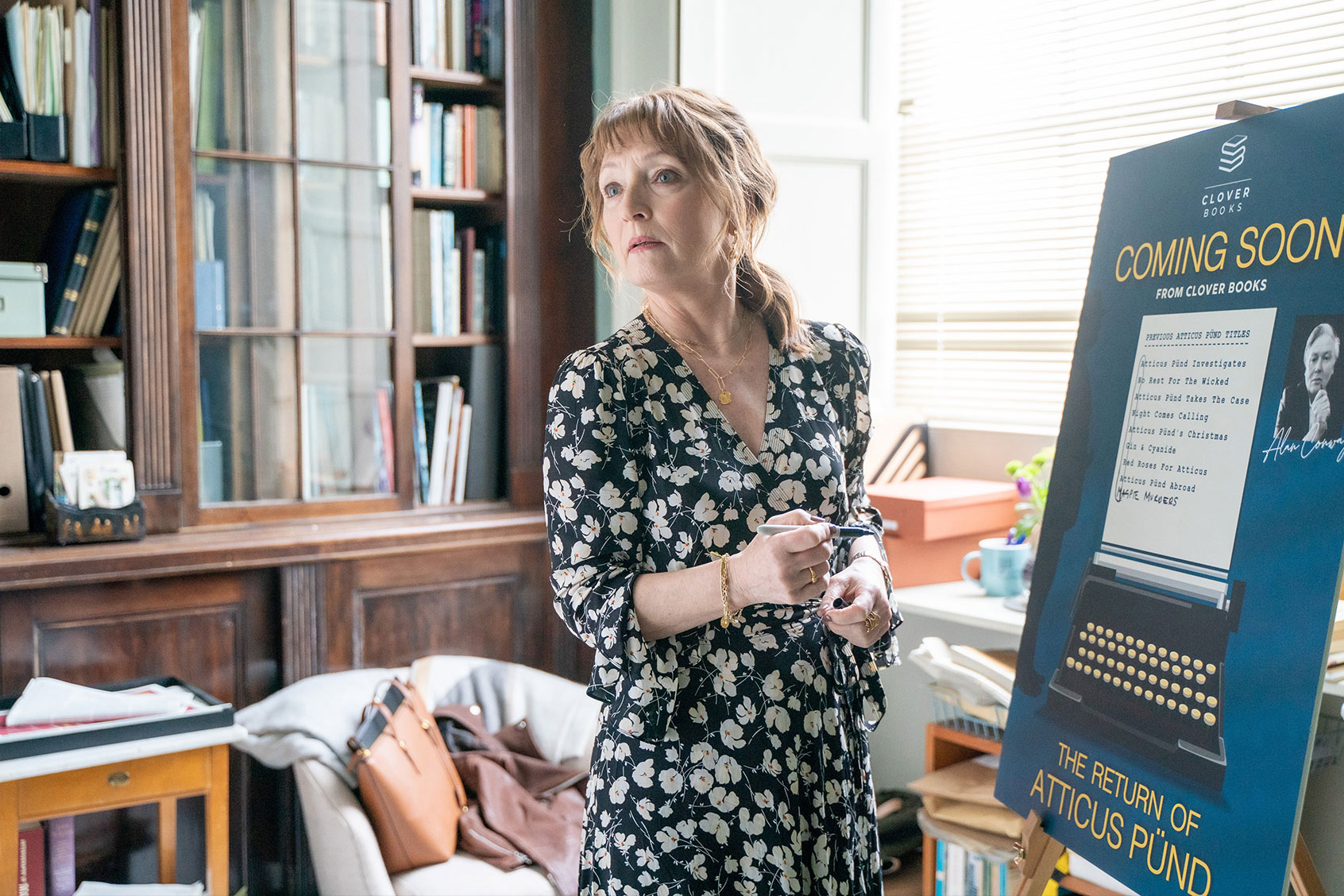
“Magpie Murders” is the six-part series based on Anthony Horowitz‘s best-selling novel, which he also adapted for PBS’ “Masterpiece,” making major structural changes to liven up the television-viewing experience. Originally, Horowitz told the story in two chunks, starting inside Alan Conway’s novel, a 1950s-set mystery in which the fictional detective Atticus Pünd solves the murder of a wealthy land owner. Only when that story ends without being solved, does Horowitz switch to Susan Ryeland’s real-world point of view as she tries to ascertain Alan’s state of mind before his death while also seeking the missing chapter.

Essentially, it’s one full mystery followed by another, creating quite a bit of whiplash. That also means that Susan Ryeland’s character isn’t really introduced until halfway through the original novel, an unacceptable use of the character once Manville was cast in the series. Instead, PBS’ adaptation weaves together both stories, shifting from present-day to the 1950s fiction story and back again. Each mystery mirrors events in the other story, with actors playing dual roles, a different version of a character in each timeline. 

Horowitz credits producer Jill Green for her advice to “bring Susan Ryeland right up front, because in the book she doesn’t appear for 300 pages. If you have a talent such as Lesley here, you do not leave her until Episode 4.” These changes allow the viewers to follow along with Susan as she reads Alan’s book and notices the parallels and clues to his real life.

While Susan Ryeland is approximately the same age as “Murder, She Wrote” protagonist Jessica Fletcher and is in the same business, that’s where the similarities end. No sleepy coastal towns for Susan; she’s a Londoner who’s always on the go, jet-setting around the world for book conferences. When we first meet her, she blithely rebuffs the offer of a German publisher who’s interested in acquiring Alan Conway’s translation rights.

“That’s one of the things I love about Susan, is she doesn’t have to explain herself,” said Manville. “She’s taking absolutely no truck from anybody, and it was just wonderful playing the scenes when she just kind of cuts these men off absolutely brilliantly with her language and her skills.”

There’s nothing stuffy or staid about Susan. She approaches her own life with a similar take-charge attitude, knowing her own worth. She drives around in a shiny red MGB convertible, wears stylish scarves and print dresses paired with motorcycle jackets, and is reluctant to give all that up for her Greek boyfriend Andreas (Alexandros Logothetis) when he tires of teaching in London.

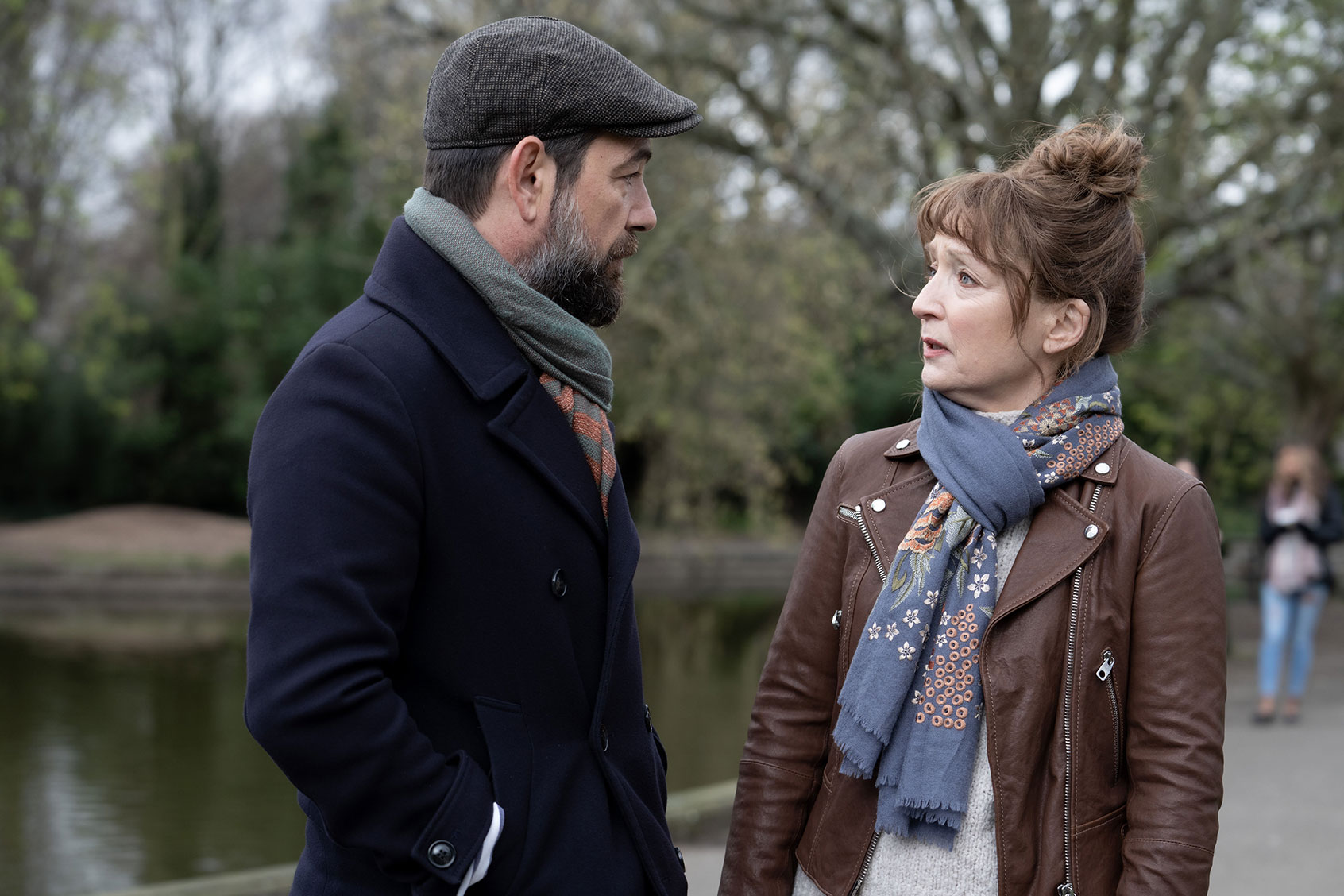
Magpie MurdersAlexandros Logothetis as Andreas Patakis and Lesley Manville as Susan Ryeland in “Magpie Murders” (PBS/Eleventh Hour Films/ Nick Wall)“She’s chosen not to get married,” Manville said. “She’s chosen not to have children. She’s got a nice boyfriend who she sees when she wants to see, and she still drives an open-top sports car. She’s absolutely not conforming to anything.”

Want a daily wrap-up of all the news and commentary Salon has to offer? Subscribe to our morning newsletter, Crash Course.


When Susan begins to investigate Alan Conway’s home and question the residents in his sleepy town, she finds what was initially seen as Alan’s suicide may have been a murder. From the suspicious neighbors to a dismissive police chief, few people are willing to help Susan and worse, most seem to have had motives to kill Alan.

Susan can’t seem to make any headway, and finds inspiration in the most unlikely source: Atticus Pünd (Tim McMullan). It’s not just that Susan thinks Alan’s book detective is smart at stringing together clues. Susan actually begins to see and talk to Atticus when he starts to show up in her world. Whether it’s her imagination or a side effect of too much gin, Atticus becomes a source of insight into the mind of Alan.

“It’s a very dramatic, excellent device,” Manville said. “She knows the way to solve the crime is through the book, and the key person in the book is Atticus. In a way they become one mind. They become this glue of two – well, she’s not a detective, but she’s a publisher, but she’s got these detective antennae on the go.” 

Manville seems to be all over our TVs at the moment. Fresh from starring on the big screen in “Mrs. Harris Goes to Paris,” Manville can currently be seen in Britbox’s crime drama “Sherwood,” inspired by real-life murders in Nottinghamshire, England. And soon, she’s take up the mantle of Princess Margaret when Netflix’s “The Crown” returns this fall.

“You can still be quite exciting even though you’re over 50, oddly enough.”

The actor doesn’t find that these characters have much in common with each other, which is precisely why she enjoys them. Manville also addressed her career for the Television Critics Association panel for Britbox’s “Sherwood.”

“There isn’t a through line, you see? That’s what’s great,” she said. “What gets me up in the morning is that I can play Susan Ryeland, and then I can play Princess Margaret, and then I can play Ada Harris, and they’re all different ends of the social spectrum.

Magpie MurdersLesley Manville as Susan Ryeland in “Magpie Murders” (PBS/Eleventh Hour Films/ Nick Wall)“If you can throw in a corset one week and not a corset the next, then that kind of makes it a little bit more interesting. Frankly, you can leave the corsets for me. I don’t like wearing them but if somebody pays me enough, I’ll put one on.”
Manville appreciates the opportunities, seeing as women over 50 playing such a variety of roles used to be a rare occurrence.

“It’s gotten better very slowly, and there’s still an awful long way to go,” said Manville. “If you don’t represent a huge section of society and you don’t represent them in an interesting way – women over 50, over 60 that are not just being appendages. They can be wives and mothers, but they need to  be telling their own story. . . . Women of my age want to go and see things that are sometimes about women of my age who are doing interesting things. I also want to see things about interesting 30-year-olds, but I want to see my sex and my age group represented fairly.”

In the meantime, Susan Ryeland is living her best life. 

“[She] defies all the kind of stereotypical notions that people might have of how somebody of her age should act and conduct their life,” said Manville. “I just love her. I’m so glad that Anthony didn’t write her as a sort of 20-, 30-year-old something. It’s just so great that she’s got all this gravitas and experience and that she’s just not conforming. It’s terrific. We need to see more women on film across the board that represent women in that way, because you can still be quite exciting even though you’re over 50, oddly enough.”  

“Magpie Murders” premieres Sunday, Oct. 16 at 9 p.m. on PBS. 


Mars may have been teeming with life until it underwent climate change, study suggests

Mars, our planetary neighbor with a similar geologic history, has long been a fascination of Earthlings. Part of that is its proximity to Earth — meaning it’s the most-visited planet (by robots, at least); and part of that is because of a number of hopeful yet faint signs that perhaps life once existed there. These hopeful signs run the gamut from a flower-shaped rock; to the presence of tiny electrical storms; to the ever-present possibility that liquid water exists somewhere on the Martian surface or perhaps once did.

“It’s possible that life appears regularly in the universe. But the inability of life to maintain habitable conditions on the surface of the planet makes it go extinct very fast. Our experiment takes it even a step farther as it shows that even a very primitive biosphere can have a completely self-destructive effect.””

Yet a new paper in the journal Nature Astronomy has an intriguing premise for the history of life on Mars. We know from geologic evidence that the red planet underwent a significant climate shift in its younger years, one which made it much more arid and less watery. The reason for this climactic shift is not well understood, and the aforementioned paper suggests that climate change, caused by gaseous emissions from life on Mars, may have also destroyed the planet’s biosphere.

In a study by French and American researchers, scientists explained that life may have flourished in Martian regoliths (or loose dust and rock on top of a layer of bedrock) because it would have been suffused with salt water and protected from ultraviolet and cosmic radiation. Of course, this would have been roughly 3.7 billion to 4.1 billion years ago, and the life in question would have resembled Earth microbes rather than anything particularly intelligent or sophisticated. Yet these microbes could have flourished to a sufficient degree to consume hydrogen and carbon dioxide, both of which would have existed in troves on Mars at the time — and to release methane.

We know this because, on Earth, microbes like that already exist in hydrothermal vents, and they too release methane using a process known as methanogenesis. Because they do so in the ocean, however, little methane gets released into that atmosphere, as it is absorbed somewhat by the ocean water. These hypothetical Martian microbes would not have had that luxury, and the subsequent release of methane may have altered the planet’s atmosphere so much that it eventually became hostile to the microbes.


Want more health and science stories in your inbox? Subscribe to Salon’s weekly newsletter The Vulgar Scientist.


“The predicted atmospheric composition shift caused by methanogenesis would have triggered a global cooling event, ending potential early warm conditions, compromising surface habitability and forcing the biosphere deep into the Earth crust,” the authors write. They add that, for future explorers to test their hypothesis, they should target “lowland sites at low-to-medium altitudes,” as these are the regions where life forms that behaved this way would most likely have left traces for humans to someday discover.

The life in question would have resembled Earth microbes rather than anything particularly intelligent or sophisticated.

Humans are well-acquainted with the idea of man-made climate change, for which there is scientific consensus that the emissions of industrial civilization, particularly of carbon dioxide, are slowly altering the temperature of the planet. Yet the idea of simple life, perhaps even single-celled life, altering a planet’s atmosphere so much as to change its climate is not far-fetched. Indeed, at multiple points in Earth’s history such a thing has transpired. Between 2 billion and 2.4 billion years ago, algae converted so much carbon dioxide into oxygen as to permanently alter the composition of Earth’s atmosphere. The Great Oxygenation Event, as it is known, also led to the creation of the protective ozone layer around Earth, which shields land-dwelling life from harmful ultraviolet rays. Both of these events permanently changed the future evolutionary history of life on Earth, as well as the climate.

But while the Great Oxygenation Event rendered Earth more inhabitable for some life and less habitable for others (particularly anaerobic bacteria), the prospect of Martian life rendering its own planet inhospitable has an eerie similarity to humanity’s behavior today. Man-made climate change is expected to cause sea levels to rise, increase the number of pandemics, cause heat waves and render large areas of the planet uninhabitable, lead to more wildfires and in other ways destroy Earth life as we know it. The parallels between Earth’s current predicament and the one that may have existed on Mars billions of years ago was not lost on the authors of the study.

“The ingredients of life are everywhere in the universe,” astrobiologist Boris Sauterey from the Institut de Biologie de l’Ecole Normale Supérieure (IBENS) in Paris, France, who led the research, told Space.com. “So it’s possible that life appears regularly in the universe. But the inability of life to maintain habitable conditions on the surface of the planet makes it go extinct very fast. Our experiment takes it even a step farther as it shows that even a very primitive biosphere can have a completely self-destructive effect.”

Deep brain stimulation can be life-altering for OCD sufferers

Imagine growing up tormented by fears and life-consuming rituals that make no sense to you or those around you. Then imagine the shame of being told by mental health providers that, because you understand that your behaviors are illogical but keep doing them anyway, you must want to stay sick.

One of my patients, Moksha Patel, who is a doctor himself, endured this from childhood until his early 30s. In September 2021, Patel underwent deep brain stimulation surgery, a rare neurosurgical procedure that can be used for severe obsessive-compulsive disorder, or OCD, when it has been resistant to less invasive treatments.

Patel has consented to this publication of his medical information. He shares his story publicly to combat stigma and to provide hope for other sufferers that relief is possible.

The term OCD is thrown around casually, often by someone joking about how organized they are: “I’m so OCD.” But true obsessive-compulsive disorder is debilitating and leads to significant suffering.

I lead a team that treats people with OCD using evidence-based approaches. I am also co-director of the OCD surgical program at the University of Colorado, Anschutz campus, and UC Health, a nonprofit health care system in Colorado.

Our surgical program is one of the few academic centers in the U.S. that offer deep brain stimulation for the treatment of OCD. My experience and research have given me insight into how a rare procedure can be used in real-world settings to provide relief to those who suffer from OCD when other less invasive treatments have not been successful.

Dr. Sabine Wilhelm of Mass General Hospital answers the most commonly searched questions about obsessive-compulsive disorder.

What does OCD feel like for a sufferer?

A brain with OCD is primed to detect any signs of potential danger. Many people with OCD wake up every day with a sense of dread and an expectation of bad things happening. Daily life is overshadowed by ever-present guilt, shame, fear and doubt. As a result, they carry out compulsive and repetitive activities to attempt to forestall disaster and manage the painful emotions.

OCD fears most often involve the things and people that matter the most to the sufferer, such as their values, loved ones or purpose in life. For example, someone who values kindness and compassion might fear that they will offend, betray or somehow hurt the people they care about.

Sometimes what is hardest for someone who suffers with OCD is a recognition that the fears and behaviors are illogical – insight that provides no relief.

And because other people usually don’t understand, those with OCD do their best to hide their illness so they won’t be judged as ridiculous or “crazy,” which often leads to long delays in diagnosis and treatment. This is a painful and lonely life for the approximately 1%-2% of the world population with OCD.

Current OCD treatment options

The best initial treatment for OCD is a type of mental health therapy called exposure and response prevention. During these sessions, OCD sufferers are supported in gradually confronting their fears while also limiting the behaviors they have come to associate with providing safety.

For instance, someone with a fear of harming others might start by sitting near a butter knife and work their way up to holding a sharper knife to their therapist’s throat. They either learn that their fear does not play out, or – in the case of fears that cannot be disproved – that they can tolerate their anxiety or distress and move forward even in the absence of certainty.

The primary medications used to treat OCD are serotonin reuptake inhibitors, or SRIs/SSRIs, which are commonly prescribed for treatment of depression and anxiety. But when used for OCD, these medications are typically prescribed at much higher dosages.

Unfortunately, OCD is a chronic condition for most; studies show that only 65% of people with OCD respond to standard treatment, which is a combination of therapy and medication, and only about 35% recover completely. About 10% of individuals with OCD remain severely impaired, regardless of how intensively they are treated.

The potential of deep brain stimulation

For this small group of individuals with severe and persistent OCD, deep brain stimulation – a procedure that fewer than 400 people with OCD have undergone worldwide – provides hope.

Patel, an internal medicine doctor, first came to my office in 2019. He is one of 13 patients I’ve worked with to provide deep brain stimulation for OCD and other psychiatric illnesses.

He has suffered with OCD since the age of 4 or 5, with obsessive fears about germs, contamination and social interactions, among other things. He learned to function and succeed by shaping his life around his rituals – for example, by not consuming water or food at work so that he would not need to use public restrooms.

Patel, like many others with OCD, is conscientious, thorough and compassionate, traits that contribute to his success as a physician. However, before deep brain stimulation, most of his life outside of work was occupied by painful, consuming rituals. These included scrubbing himself with harsh chemicals for hours.

He had explored every treatment he could find, seeing 13 mental health providers since high school and participating in years of exposure therapy. He had tried at least 15 different medications, all with little benefit. Then he learned that deep brain stimulation was available at the hospital where we both work.

How deep brain stimulation works

Deep brain stimulation requires a neurosurgical procedure to place thin electrodes into deep structures of the brain, specifically a region known as the ventral capsule/ventral striatum. These electrodes deliver electrical currents to the brain. The current is produced by pulse generators in the chest that look much like cardiac pacemakers. They are connected to the electrodes in the brain by wires tunneled beneath the skin.

We researchers do not yet have a precise understanding of exactly how deep brain stimulation works, but we do know that it normalizes the communication between parts of the brain responsible for taking in information and those responsible for acting on this information. These areas are hyperconnected in people with OCD, leading to a reduced ability to make thoughtful, value-driven decisions and an over-reliance on reflexive or habitual behaviors. And the changes induced by deep brain stimulation correlate with a reduction in OCD symptoms.

This type of neurostimulation is most commonly used to manage symptoms of Parkinson’s disease, a movement disorder that leads to tremors and body rigidity. OCD is the only psychiatric disorder that currently has approval from the Food and Drug Administration for deep brain stimulation treatment. But deep brain stimulation has been investigated in other conditions, including major depression, Tourette syndrome, schizophrenia, substance use disorders, post-traumatic stress disorder and eating disorders.

Deep brain stimulation is a procedure of last resort for patients with OCD. Because of the invasive nature of brain surgery and the potential for serious adverse effects such as infection or hemorrhage, individuals need to try standard, less invasive treatments first and meet the criteria for severe and persistent OCD, which have been established based on OCD and brain stimulation research.

But for those who do undergo the procedure for OCD treatment and receive ongoing stimulation, up to 70% have a good long-term response. “Good” is considered to be a 35% reduction in OCD symptoms based on a standardized scale for obsessive-compulsive behavior that experts in our field rely on.

This, for example, could mean that someone goes from spending more than eight hours per day on OCD behaviors and not leaving the house at all to spending four hours per day and being able to go to school with significant support. Such progress is remarkable, given how ill these individuals are.

Barriers and stigma

There aren’t very many treatment centers anywhere in the world, so patients who need this procedure may have trouble getting to one. Additionally, as our team has described in published research, getting insurance coverage for the procedure is often time-consuming and sometimes prohibitive.

Another barrier is the stigma associated with brain surgery for psychiatric illness. The reasons behind this stigma are complicated, and some factors have historical roots. In the early to mid-1900s, destructive, dangerous and not very effective brain surgeries such as lobotomies were performed routinely for mental illness without regulation, ethical guidelines or regulatory oversight.

A way forward

After I worked with Patel for about a year, including trials of six additional medications and ongoing exposure and response prevention therapy, his symptoms remained severe. I recommended he begin the extensive evaluation process for deep brain stimulation surgery.

Three weeks after his surgery, I turned on electrical stimulation, and we began the intensive programming procedure to determine the optimal settings. This process takes several hours a day over the course of several days, with fine-tuning in the following weeks and months.

Patel recalls that early on, during programming, he experienced a roller coaster of feelings, shifting between “giddiness and sadness.” Most individuals experience gradual improvement over the course of six to 12 months. At first, they feel happier and less anxious, and weeks to months later they experience a decrease in OCD symptoms.

Most commonly, stimulation is constant, 24 hours a day. But the treating psychiatrist may give the patient the ability to turn it off, such as at night if the stimulation causes problems with sleep.

Since surgery, Patel has continued weekly therapy sessions. Research shows that deep brain stimulation is most effective when people continue to engage in exposure and response prevention therapy. Electricity alone will not break years of hard-wired habits, but it can be the catalyst that allows for new neural pathways to be established and new behaviors to be learned. Likewise, most individuals need to continue medication. Though the effects of deep brain stimulation can be remarkable, it is not a cure.

Patel has experienced a 54% reduction in his OCD, according to the standardized scale. This means that his symptoms decreased from the “extreme OCD” to the “moderate” range.

He can now eat and drink at work and use public restrooms. He has more social connections, seeks less reassurance and spends less time decontaminating himself and his belongings. While sleep was previously his only respite, Patel is now intentional about finding meaningful activities to fill the hours that are no longer occupied by rituals.

Most importantly, he is beginning to feel hopeful that it just might be possible to build a life driven by purpose and intention, rather than by fear.


Rachel A. Davis, Associate Professor of Psychiatry and Neurosurgery, University of Colorado Anschutz Medical Campus

This article is republished from The Conversation under a Creative Commons license. Read the original article.

The inauspicious arrival of Bruce Springsteen

It was my friend, Pete who first introduced me to Bruce Springsteen. It was the summer of 1985, a year after the album “Born in the USA” had catapulted The Boss into the rock ‘n’ roll mainstream. 

As a disciple of British new wave music, I’d yet to become a Springsteen fan. Growing up in England in the early 1980s, I had been too young to be swept away by the power of “Born to Run,” while MTV-era Bruce sounded too curated and conventional to my punk-attuned ears. 

“It was a musical epiphany. … It was like nothing else I’d ever heard.”

All that changed the day Pete sauntered into my house, Benson and Hedges cigarette clenched between his teeth, and a C90 cassette in his pocket containing home-taped copies of “Greetings from Asbury Park, NJ” and “The Wild, the Innocent and the E Street Shuffle.”

“Springsteen. First two albums. Way, way better than his current stuff,” he announced, or words to that effect, lobbing the cassette nonchalantly on to my bed.

Pete and I were in a band, a desperately ambitious three-piece that tried too hard to sound like Echo and the Bunnymen. Musically, he was something of a mentor. It was through him that I had discovered the avant-garde delights of the Velvet Underground and Talking Heads. I took his recommendations seriously.

I can’t recall the full details of our conversation that day, but I do remember that at some point, I carefully extracted the cassette from its plastic box and inserted it into my cheap tape deck. 

It was a musical epiphany. Beautiful sounds pulsated through the speakers and danced around my teenage bedroom: the teasing guitar riff at the beginning of “Blinded by the Light” followed by the song’s dense, verbose lyrics.

“Madman bummers, drummers and Indians in the summer with a teenage diplomat.”

It was like nothing else I’d ever heard. By the end of the third number, I was hooked – not on the stadium-filling, fist-punching Springsteen that everyone else revered, but on the lesser-known, more rebellious younger version. 

“They marked Bruce at his apex, a jumble of loose, jazzy riffs and poetic lyrics colored with intricate rhymes.”

Bruce Springsteen didn’t suddenly explode on the music scene. He arrived inauspiciously in 1973 with two albums released 10 months apart. While garnering positive critical attention, they logged relatively disappointing sales. Major glory only came with “Born to Run” in 1975 after he’d nearly been dropped by his record company. Global domination had to wait until the release of “Born in the USA” nearly a decade later. 

Based on their poor sales, one might assume that Springsteen’s first two albums were undistinguished and forgettable. But, for myself and Pete, they marked Bruce at his apex, a jumble of loose, jazzy riffs and poetic lyrics colored with intricate rhymes. It was the kind of refreshing, rough-around-the-edges sound that directly appealed to callow British teenagers like us. While some critics dismissed the records as grandiloquent and sketchily produced, we embraced their quirky storytelling and spontaneous energy. They might have lacked the broad mainstream appeal and professionalism of “Born in the USA,” but there was a freshness and uniqueness about them that Springsteen would struggle to recreate in his later work.

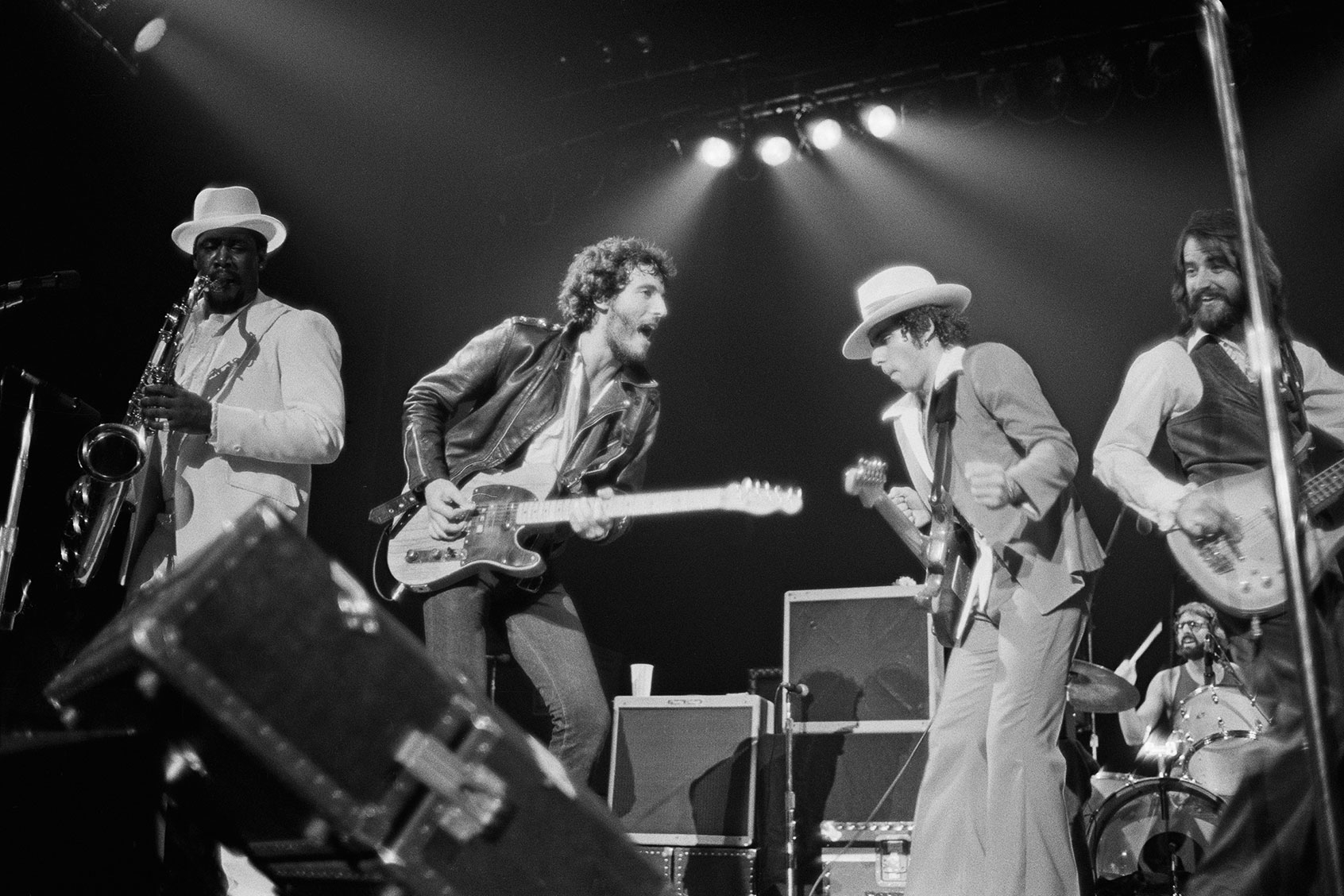
Bruce Springsteen and the E-Street BandBruce Springsteen and the E-Street Band perform live on stage at the Carlton Theatre in Red Bank, New Jersey, USA during the Born To Run tour on 11th October 1975. (Fin Costello/Redferns/Getty Images)

As it turned out, I wasn’t the only Gen-Xer plundering The Boss’ back catalogue for inspiration. His first album, “Greetings from Asbury Park, NJ,” released in January 1973, finally busted its way into the UK album charts in 1985, spearheaded by retro music-loving kids who had belatedly discovered that there was more to Springsteen than Cadillacs and American flags.  

It was in marked contrast to the album’s original release. Back then, Columbia Records had promoted the 23-year-old Springsteen as the next Bob Dylan, a kiss-of-death moniker that rang hollow when the LP flopped. Tuning in 12 years later, it was hard to fathom exactly why. To me, everything about his dynamic debut album, from its picture postcard cover to its enigmatic song titles, seemed novel and intriguing. 

As an aspiring keyboard player, I was particularly drawn to the piano playing of David Sancious, a crucial lynchpin in Bruce’s nascent backing band. Punk rock hadn’t been kind to keyboardists, and I was relieved to finally discover a musician whose complex riffs and jazzy chords were cool, challenging and fun to play. Sancious’ piano was especially crucial in “It’s Hard to be a Saint in the City,” the song that had apparently persuaded legendary producer, Joe Hammond to sign Bruce to Columbia Records in the first place.  

The Boss’ sophomore album, “The Wild, the Innocent and the E Street Shuffle,” released in November 1973, went one better. Earlier that year, Springsteen had been exposed to the jubilant horns of Van Morrison, and his infatuation with the Irishman’s Celtic soul music clearly shows. Eschewing the folksier sound of “Greetings from Asbury Park, NJ,” his backing group, now clearly recognizable as the E Street Band, were eloquently getting into their stride: Vini “Mad Dog” Lopez on drums, Garry Tallent on bass, Sancious on piano, Danny Federici on organ and accordion, and the “Big Man” Clarence Clemons on saxophone. 

The record’s highlights are mostly on side two where three extended songs combine in what can best be compared to a rock ‘n’ roll version of Gershwin’s “Rhapsody in Blue.” 

“Incident on 57th Street” is a gritty West Side Story-style tale that acted as a romantic precursor to “Born to Run.” It segues effortlessly into “Rosalita (Come Out Tonight)” an epic seven-minute-long song that offers a breathless roller-coaster ride through the hurdles of forbidden love and would immediately become a live performance staple. “New York City Serenade” is one of the most underrated songs in the Springsteen canon, a seamless fusion of rock, jazz and classical elements that distills the city through music in the same way as Woody Allen’s “Manhattan” would later do through film.   

Years later, when I visited New York City, I walked its streets to the soundtrack of Springsteen’s first two albums playing on my Walkman.     

While 1973’s record-buying public might not have been quite ready for Springsteen’s precocious song-writing skills, the critics were more charitable. “Bruce Springsteen is a bold new talent with more than a mouthful to say,” chimed the often-scathing reviewer, Lester Bangs while discussing “Greetings from Asbury Park, NJ.” In Rolling Stone Magazine, Ken Emerson claimed the “Uproarious first album sounded like [Bob Dylan’s] ‘Subterranean Homesick Blues’ played at 78 rpm” with Springsteen “rhyming and wailing for the sheer fun of it.”  

The ultimate compliment came when Manfred Mann’s Earth Band radically reworked the album’s most iconic song, “Blinded by the Light,” taking it to No. 1 in the U.S. singles chart in 1976. They went on to release two more cover versions from the album (“For You” and “Spirit in the Night”) to varying degrees of success.

Bruce SpringsteenBruce Springsteen (Michael Ochs Archives/Getty Images)
“The two earliest LPs had … become mere whispers in the musical grapevine. By embracing them, it felt as if you were joining a secret cult.”

Springsteen’s star ascended steeply after 1973 propelled by a litany of great songs and a pulsating live act. “I saw rock and roll future, and its name is Bruce Springsteen,” wrote the musician’s soon-to-be manager Jon Landau after witnessing him play in Cambridge, Massachusetts in 1974. Landau subsequently helped Springsteen through the trials and tribulations of “Born to Run” and its difficult recording process. On its release, the record became an overnight sensation complemented by a raft of legendary live shows and, in October 1975, Springsteen appeared on the covers of both Newsweek and Time. The Boss’ second coming was certainly more auspicious than his first. 

By the time I discovered Springsteen in the mid-1980s, he was at his commercial peak packing out stadiums and grappling with the runaway success of “Born in the USA” which went on to become one of the best-selling albums of all time. Occluded by his global fame, the two earliest LPs had, by that point, become mere whispers in the musical grapevine. By embracing them, it felt as if you were joining a secret cult. 

But it was a cult that grew. Both albums have garnered a groundswell of admirers in more recent times. Rolling Stone Magazine ranked “Rosalita (Come Out Tonight)” and “Incident on 57th Street” at No. 11 and 17 respectively in a 2010 rundown of Bruce’s 100 best songs, and “The Wild. The Innocent and the E Street Shuffle” came in at No. 4 in an all-time Rolling Stone reader’s poll in 2012 (two places above “Born in the USA”). Looking back, they were important harbingers for the glories to come. 


Want a daily wrap-up of all the news and commentary Salon has to offer? Subscribe to our morning newsletter, Crash Course.


As much as I love the grandeur and ambition of “Thunder Road” and the creative artistry of some of Springsteen’s later songs (“Candy’s Room,” “Point Blank,” and “Atlantic City” to name but three), his first two pioneering albums remain my favorites. To my mind, they mark Bruce at his most playful and uncensored, full of big dreams and New York fantasies, unwary of critics and unwilling to fit into a rigid box. Nearly 50 years after their original release, I return to them regularly, the cassette player replaced by a Sonos audio system, but the volume still revved up full as the horns glissando, the guitar kicks in, and that immortal voice starts jabbering effusively about Rosalita, Spanish Johnny, and all those other well-drawn characters from his New Jersey youth. 


Trump’s Truth Social rant called “sharply self-incriminating”: Now it’s up to DOJ

As former President Donald Trump faced an onslaught of criticism and ridicule over his “rambling” 14-page response Friday to a subpoena from the House select committee investigating the Jan. 6, 2021, Capitol attack, calls for action by the Department of Justice continued to mount.

The bipartisan panel voted unanimously to subpoena Trump at the end of Thursday’s hearing — the ninth that the committee has held publicly since June and is expected to be the last before next month’s midterm elections.

Throughout the hearings, “the evidence has proven” that “in a staggering betrayal of his oath, Donald Trump attempted a plan that led to an attack on a pillar of our democracy,” committee chair Rep. Bennie Thompson, D-Miss., declared Thursday. “It’s still hard to believe. But the facts and testimony are clear, consistent, and undisputed.”

Trump’s response to the subpoena, said former federal prosecutor and NBC News legal analyst Glenn Kirschner, “is powerfully incriminating evidence that will be introduced against him when he’s prosecuted. And those who helped him draft it are co-conspirators.”

The ex-president began his missive with what’s known as his “Big Lie,” writing to Thompson, “THE PRESIDENTIAL ELECTION OF 2020 WAS RIGGED AND STOLEN!”

The letter continues:

The same group of Radical Left Democrats who utilized their Majority position in Congress to create the fiction of Russia, Russia, Russia, Impeachment Hoax #1, Impeachment Hoax #2, the $48 Million Mueller Report (which ended in No Collusion!), Ukraine, Ukraine, Ukraine, the atrocious and illegal Spying on my Campaign, and so much more, are the people who created this Committee of highly partisan political Hacks and Thugs whose sole function is to destroy the lives of many hard-working American Patriots, whose records in life have been unblemished until this point of attempted ruination. The double standard of the Unselects between what has taken place on the “RIGHT,” and what has taken place with Radical Left, lawless groups such as Antifa, Black Lives Matter, and others, is startling and will never be acceptable, even to those who will be writing the history of what you have done to America.

This memo is being written to express our anger, disappointment, and complaint that with all of the hundreds of millions of dollars spent on what many consider to be a Charade and Witch Hunt, and despite strong and powerful requests, you have not spent even a short moment on examining the massive Election Fraud that took place during the 2020 Presidential Election, and have targeted only those who were, as concerned American Citizens, protesting the Fraud itself.

Trump’s letter to the panel spans four pages but includes a 10-page appendix featuring photos and bullet-point lists attacking the legitimacy of the 2020 presidential election results in Arizona, Georgia, Michigan, Pennsylvania and Wisconsin.

Noting that Trump’s response “doubles down on the bogus claim that he won the election and on siding with the violent insurrectionists,” Noah Bookbinder of the watchdog group Citizens for Responsibility and Ethics in Washington (CREW) said that “he not only tried to overturn an election and incited insurrection, he is still doing it.”


Want a daily wrap-up of all the news and commentary Salon has to offer? Subscribe to our morning newsletter, Crash Course.


Bookbinder and his group also shared Philip Bump’s Washington Post column about Trump’s letter, which Bump described as “exactly what you would have expected.”

Noting that Trump used the term “fraud” many times, Bump argued that “what hinders Trump’s response, of course, is that there was no rampant fraud in the 2020 election. This is by now so concretely established — following nearly two years of desperate digging and countless tennis matches of debunking and rebunking — that it barely merits lengthy examination.”

“To a good-faith actor, regurgitating the same debunked nonsense would be embarrassing. To have every part of your claims collapse under scrutiny would be humiliating. But Trump is not worried about it,” Bump added. “He knows he can just produce this document and his allies will simply skim it and nod. And he knows that people who work for the Washington Post will angrily print it out and scribble on it and reinforce to the reality-adjacent that his arguments are reality-defiant.”

Several federal lawmakers said after the committee’s vote that, in the words of Senate Majority Leader Chuck Schumer, “Donald Trump must testify before Congress.”

Rep. Ayanna Pressley, D-Mass., also demanded “the former occupant of the White House” testify about “his role in inciting the violent, white supremacist attack on our democracy,” while Sen. Jeff Merkley, D-Ore., called the subpoena “an important step” to bring to justice “everyone involved in this attack on democracy — including the former president.”

Some, such as Rep. Jimmy Gomez, D-Calif., even said that if Trump “refuses to comply, he must be held in contempt of Congress.”

Some experts don’t believe the committee will be able to force Trump to testify, however, given that its work could end in early January, if the Republicans win control of Congress next month. Notably, the panel’s GOP vice chair, Rep. Liz Cheney of Wyoming, lost her primary race against a Trump-backed candidate, and its only other Republican, Rep. Adam Kinzinger of Illinois, is leaving office after this term.

“They’re essentially out of time to enforce a subpoena like this,” explained former federal prosecutor and University of Alabama law professor Joyce White Vance on MSNBC. “If Trump were to come in voluntarily and tell the truth, well, we all know, I think, that that’s unlikely to happen. And going through a court process to enforce this would take some period of time — so likely… we will not hear his testimony but this will simply become a part of the public record.”

Analyzing the panel’s work after the vote Thursday, the New York Times’ Peter Baker noted that there has been “relatively little movement in public opinion since the hearings opened in June, at least as measured by an array of polls.” He continued:

Having fallen short of changing many minds, however, the committee may yet have influenced the thinking closer to home. It amassed an overwhelming collection of interviews, documents, and other evidence that may have lit a fire at the Justice Department just half a dozen blocks from the Capitol, as federal prosecutors appeared to ratchet up their own investigation in recent months.

The real verdict, therefore, may still be months away. If Attorney General Merrick B. Garland ultimately pursues a criminal prosecution against Mr. Trump or his closest allies, the committee will have set the stage by airing the case in painstaking detail. And as they made their final arguments before next month’s midterm elections, the panel members on Thursday left little doubt what they think should happen but left any decision on criminal referrals until after the vote.

As The Hill reported Saturday, NYU law professor Ryan Goodman similarly said of the panel, “I think they were trying to hand the Justice Department all the evidence on a silver platter.”

“I do think that it’s very significant information for a Justice Department with much more powerful tools to pursue a full-blown investigation,” he said. “I do think that they did a very good job of handing that off, and, in a certain sense, showing what a closing argument can look like in a powerful way.”

The panel, concluded CREW’s Bookbinder, “has masterfully laid out overwhelming evidence that Donald Trump engaged in a criminal conspiracy to overturn an election, but the committee cannot itself bring accountability. It’s up to the Justice Department to act now.”

Trump Jr. has conspiracy theories about Nancy Pelosi’s Jan. 6 video

Donald Trump, Jr. on Saturday said he expected backlash after voicing his thoughts on the videos of Speaker Nancy Pelosi during the Jan. 6 attack on the U.S. Capitol.

The videos were shot by Alexandra Pelosi, the Speaker’s documentary filmmaker daughter. Excerpts were played during Thursday’s public hearing by the House Select Committee Investigating the Jan. 6 Attack on the U.S. Capitol.

“CNN obtained roughly an hour of additional material that wasn’t presented by the panel,” the network reported. “The footage, obtained exclusively by CNN, shows in vivid new detail how congressional leaders fled the US Capitol on January 6 and transformed a nearby military base into a command center, where they frantically coordinated with Vice President Mike Pence and Trump Cabinet members to quell the insurrection and finish certifying the 2020 election.”

In one clip, Pelosi discusses reporters that Trump wanted to join the rioters at the U.S. Capitol.

“I hope he comes up here, I’m going to punch him out,” Pelosi said. “I’ve been waiting for this — for trespassing on the Capitol grounds.”

“I’m going to punch him out, I’m going to go to jail, and I’m going to be happy,” the San Francisco Democrat said.

Trump Jr. apparently did not like the videos, which show Democrats seeking to protect Congress during the 179 minutes while Donald Trump failed to act, while reportedly watching the violence unfold on Fox News.

“So Nancy Pelosi refuses Trump’s request for a national guard presence on Jan 6 & simultaneously has a documentary film crew in her office where are you can hear her poorly delivered tough guy act… I’m sure I’ll be called conspiracy theorist for thinking this isn’t a coincidence!” Trump, Jr. posted to Truth Social.

“It’s all so f*cking fake stop buying into the bullsh*t!” he added.

In a subsequent post he wrote, “conspiracy theorists are just people capable of pattern recognition.”

Watch below:

Daughter of Sandy Hook victim rails against Alex Jones in op-ed

The daughter of the slain principal of Sandy Hook Elementary School has penned an op-ed shedding light on the impact of Alex Jones’ perpetuation of conspiracy theories about the mass shooting.

In a piece published by Newsweek, Erica Lafferty, the daughter of Dawn Lafferty Hochsprung, recounted how it felt when conspiracy theorists like Jones began circulating claims about the shooting being a hoax. For Lafferty and family members of other victims, the shooting was anything but a hoax.

“Jones has been in my life for nearly a decade, but not by choice. I was in my late twenties when my mother, Dawn Lafferty Hochsprung, the principal of Sandy Hook Elementary School in Newtown, Connecticut, was killed on December 14, 2012,” Lafferty wrote.

“Within days of the shooting, I heard people online saying it was a hoax; the whole thing had been staged and the families were acting. I just thought: ‘How can people be saying this?'”

After doing her own research, Lafferty was able to learn more about Jones’ history of spreading misinformation. “Over time, I began to connect the dots and figured out who this Alex Jones guy was,” she wrote. “I realized much of this rhetoric was stemming from the lies and the hate he was spewing to his audience.”

She also shed light on the harassment she was subjected to by Jones far-right audience. “The frequency of this harassment depended on Jones and how often he spoke about Sandy Hook,” she wrote, “Whenever he spread his conspiracy theories the abuse amped up. There was sometimes a day or two that I would have some peace.

“Then there were months on end where every single day I would be called an actress or accused of making up my own mom. I would be sent pictures of the school or these doctored photos claiming it wasn’t even open on the day of the shooting, all of these crazy things. It was constant, I literally couldn’t keep up.”

To make matters worse, the former principal’s bereaved daughter also explained how Jones’ actions stifled her ability to grieve. According to Lafferty, the highly publicized nature of her mother’s death complicated things but Jones’ attempts to dismiss what transpired made things far worse.

“It was the first time I had ever experienced anything like this. I had grown up in a small town and outside of sporting events I had never even been in the newspaper. So, to have to grieve the murder of my mom in such a public manner was a whole beast in itself. I was never given the opportunity to mourn her in my own way. I was forced to do it on this international platform.”

Speaking about the lawsuit, Lafferty wrote, “I think taking legal action against Jones did further open ourselves up to his very extreme audience. I feel like we had to put ourselves out there and continue taking hits from him and his followers in order to take back our lives and stories, but also to protect other people, which I think is the best way I ever could have chosen to honor my mom.”

Genetically engineered bacteria make living environmental solutions

With just an incubator and some broth, researchers can grow reusable filters made of bacteria to clean up polluted water, detect chemicals in the environment and protect surfaces from rust and mold.

I am a synthetic biologist who studies engineered living materials – substances made from living cells that have a variety of functions. In my recently published research, I programmed bacteria to form living materials that can not only be modified for different applications, but are also quick and easy to produce.

From living cells to usable materials

Like human cells, bacteria contain DNA that provides the instructions to build proteins. Bacterial DNA can be modified to instruct the cell to build new proteins, including ones that don’t exist in nature. Researchers can even control exactly where these proteins will be located within the cell.

Because engineered living materials are made of living cells, they can be genetically engineered to perform a broad variety of functions, almost like programming a cellphone with different apps. For example, researchers can turn bacteria into sensors for environmental pollutants by modifying them to change color in the presence of certain molecules. Researchers have also used bacteria to create limestone particles, the chemical used to make Styrofoam and living photovoltaics, among others.

Living organisms can be used to “grow” materials to make clothes and furniture.

A primary challenge for engineered living materials has been figuring out how to induce them to produce a matrix, or substances surrounding the cell, that allows researchers to control the physical properties of the final material, such as its viscosity, elasticity and stiffness. To address this, my team and I created a system to encode this matrix in the bacteria’s DNA.

We modified the DNA of the bacteria Caulobacter crescentus so that the bacterial cells would produce on their surfaces a matrix made of large amounts of elastic proteins. These elastic proteins have the ability to bind to each other and form hydrogels, a type of material that can retain large amounts of water.

When two genetically modified bacterial cells come in close proximity, these proteins come together and keep the cells attached to each other. By surrounding each cell with this sticky, elastic material, bacterial cells will cluster together to form a living slime.

Furthermore, we can modify the elastic proteins to change the properties of the final material. For example, we could turn bacteria into hard construction materials that have the ability to self-repair in the event of damage. Alternatively, we could turn bacteria into soft materials that could be used as fillers in products.

The living material advantage

Usually, creating multifunctional materials is extremely difficult, due in part to very expensive processing costs. Like a tree growing from a seed, living materials, on the other hand, grow from cells that have minimal nutrient and energy requirements. Their biodegradability and minimal production requirements allow for sustainable and economical production.

The technology to make living materials is unsophisticated and cheap. It only takes a shaking incubator, proteins and sugars to grow a multifunctional, high-performing material from bacteria. The incubator is just a metal or plastic box that keeps the temperature at about 98.6 degrees Fahrenheit (37 Celsius), which is much lower than a conventional home oven, and shakes the cells at speeds slower than a blender.

Transforming bacteria into living materials is also a quick process. My team and I were able to grow our bacterial living materials in about 24 hours. This is pretty fast compared to the manufacturing process of other materials, including living materials like wood that can take years to produce.

As shown in this video of Caulobacter crescentus colonizing a surface, bacteria multiply very quickly and very easily.

Moreover, our living bacterial slime is easy to transport and store. It can survive in a jar at room temperature for up to three weeks and placed back into a fresh medium to regrow. This could lower the cost of future technology based on these materials.

Lastly, engineered living materials are an environmentally friendly technology. Because they are made of living cells, they are biocompatible, or nontoxic, and biodegradable, or naturally decomposable.

Next steps

There are still some aspects of our bacterial living material that need to be clarified. For example, we don’t know exactly how the proteins on the bacterial cell surface interact with each other, or how strongly they bind to each other. We also don’t know exactly how many protein molecules are required to keep cells together.

Answering these questions will enable us to further customize living materials with desired qualities for different functions.

Next, I’m planning to explore growing different types of bacteria as living materials to expand the applications they can be used for. Some types of bacteria are better than others for different purposes. For example, some bacteria survive best in specific environments, such as the human body, soil or fresh water. Some, on the other hand, can adapt to different external conditions, like varying temperature, acidity and salinity.

By having many types of bacteria to choose from, researchers can further customize the materials they can create.


Sara Molinari, Postdoctoral Research Associate in Synthetic Biology, Rice University

This article is republished from The Conversation under a Creative Commons license. Read the original article.

I won big on “Jeopardy!” So why does it still haunt me?

It was an early evening in the summer of 2019. I’d arrived at LAX with hours to go until my red-eye to Louisville. But even though I had plenty of time, I moved through the airport like a heat-seeking missile — past check-in, through security, down the long hall to my terminal. I found my gate, then kept walking, past the stores and the restaurants, looking desperately for somewhere to be alone. Finally, one terminal over, I found a quiet stretch of unused gates. I scanned the area so I could be sure that no one would hear what I was about to say. Then I pulled out my phone.

My wife picked up on the first ring. “How did it go?”

Once more, I looked over both shoulders with all the subtlety of a six-year-old pretending to be in the CIA.

“I won three games.” I heard her gasp. And then the grand total: “Honey… I just made $86,000.”

We talked for a few more minutes before she had to get back to rehearsal. I swore her to secrecy until my episodes could air. Then I spent the next few hours alone with my thoughts, ambling around the airport in a surreal state of bliss.

It had been a perfect day — the day I became a “Jeopardy!” champion.

It wasn’t until I got home that I started having trouble sleeping.

* * *

At first, the insomnia made sense. I was exhausted from my travels and coming down from one hell of an adrenaline high. It took me just under six months to go from online test to in-person audition to the set of America’s Favorite Quiz Show. I got to shake hands with Alex Trebek, a TV legend working valiantly through what would be his final season. I even got to tease Alex about his habit of saying “Good for you!” to wrap up a contestant interview, something I vowed I would bring up if given the chance. I had made more money in six hours than I’d ever made in a year. Lying in the dark, only sort of trying to sleep, I kept smiling at the sheer improbability of it all.

But when the second night came, I’d already moved on from my triumphs. Now my mind was stuck on game four, the game I lost.

I’d played well in that game — well enough to have a $4,200 lead when I hit the last Daily Double. The category was “Fictional Flags Flying.” I bet $4,000. The clue appeared, something about a submarine, the South Pole and a flag with the letter “N.” I had no idea. (“Who was Captain Nemo?”) My lead evaporated, and I fell back to the pack. I finished Double Jeopardy trailing by $1,400, and Andrew, a handsome journalist from Ottawa, got Final Jeopardy correct with a wager big enough to make anything I did immaterial.

We’ve all seen a game hinge on a moment like that. But those moments happened to other people. This one was all mine, and it cozied up to me in bed, forcing my brain to replay that clue on a loop. If I had just waited a little longer, could I have gotten from submarine to Captain, from “N” to Nemo? Should I have stood there until the last possible second, until Alex nudged me with a gentle “Steve?” Why did I bet so much on “Fictional Flags,” a category that could swerve in almost any direction?

Then there were all the downstream effects of my blunder to obsess about. In my last game, I didn’t even answer Final Jeopardy correctly — though I came close, writing the first two letters of “Steinbeck” before replacing them with “Camus.” Did this reassure me that I wouldn’t have won anyway? No. I told myself that if I had held onto the lead, surely I would have gone with my first instinct on Final. I would have coasted to victory. I would have been a four-day champion.

In the middle of the night, the what-ifs would come back around: Why had I bet so much on Fictional Flags?

Why stop there? Why not think about the game after I lost, the one I stuck around to watch because I was still riding high, and I wasn’t ready for it all to be over. The Final Jeopardy clue in that game, in the category “Religion,” was one I could’ve answered since the age of ten. As trivia folks like to say, I knew it cold. But all three contestants got it wrong. So Captain Nemo was no longer the difference between a three-game and a four-game streak. He was the difference between three and five. And as any dedicated fan of “Jeopardy!” can tell you, five wins is the magic threshold. It’s the guaranteed ticket to the Tournament of Champions.

Adriana E. Ramírez writes about finding peace with losing on “Jeopardy!” in The Atlantic: “I came out stronger on the other side, and also a little humbler.” She wasn’t “crushed with embarrassment” when she watched herself lose — in a game like “Jeopardy!” everyone loses eventually, she points out, and there’s no shame in that.

During the day, when I had things to do and people to talk to, I was similarly upbeat. Sanguine, even. But in the middle of the night, the what-ifs would come back around: Why had I bet so much on Fictional Flags? And why the hell did I stay and watch that last game?! Even though I knew it was irrational, I had gotten stuck in a loop of self-doubt, incapable of appreciating my good fortune.

By the time my episodes aired, I’d received an invite to the Facebook group Jeopardy! Contestants, an ever-growing forum open to anyone who’s appeared on the show. As you’d expect, the page is full of nerdy humor, good-natured memories, and debates about last night’s episode. But occasionally, a group member will express a specific lament — a category they’d failed to study for, or the lunch break that halted their winning streak, or the dreaded buzzer that locked them out when it mattered most.

The first time I read one of those laments, it stood out like a neon sign. Here was a fellow traveler, a contestant who had also walked the path of game-show regret. Following up on a hunch, I called my friend Ben, who’d competed in the Teen Tournament in the ’90s. I asked him if there was anything about his experience on “Jeopardy!” that haunted him. Ben’s very next words were the clue that kept him from advancing to the Tournament final. Twenty-five years later, he still knew it verbatim.

* * *

How can I capture the deep strangeness of appearing on “Jeopardy!”? You step into an actual, physical environment you’ve visited hundreds of times, but never in person. The space feels more intimate than it looks on TV. The big board remains formidable. When I first walked into the studio, I felt like I’d teleported inside a movie. I’ve spent my career in theatre, so I’m comfortable with the difference between illusion and reality. But this place was on another level.

No matter what happens, there are always two smart people going home.

So there you are, soaking in the grandeur of the gorgeous set. You haven’t even competed yet, and somehow everyone knows your name. The entire staff is fantastic. You’re just eager to play, but first, there’s orientation, buzzer practice, camera setups. You don’t realize that the downtime is a blessing, because once the games start, things accelerate at an alarming pace.

“Jeopardy!” shoots five episodes, a full week’s worth, in one day. The gameplay moves so fast that I forgot much of what actually happened. When I watched my episodes two months later, I would say to my wife, “Oh, this question I got right,” only to see someone else ring in with the correct response. “Jeopardy!” time is weird.


Want a daily wrap-up of all the news and commentary Salon has to offer? Subscribe to our morning newsletter, Crash Course.


That sense of acceleration permeates everything, including the definition of success. I feel safe in saying that, for pretty much every “Jeopardy!” contestant, simply getting on the show is an accomplishment. But whatever any of us did right to get that far, well, every other contestant did too. It can be legitimately shocking to see a champ crush it in one game, only to go down 40 minutes later. But that simply illustrates how the show works — no matter what happens, there are always two smart people going home.

I recently polled a group of former champions about what they were hoping going into their first games. The results were refreshingly humble:

I wanted to get at least one question right.

I wanted to make it to Final Jeopardy.

I wanted to avoid becoming a meme.

Perhaps they were just being modest. I thought it’d be great to win one game and something like $15,000. But I certainly didn’t think it would be easy, or even likely.

A game where both triumph and disaster are traced to specific turning points makes for fantastic television. But for the participants, it can mess with your mind.

The funny thing is, when I reached that goal, I had no time to bask in my achievement. There are only 15 minutes between shows, just enough to fit in a wardrobe change, a bathroom break and a rapidly guzzled Diet Coke. The nonstop momentum almost certainly helps the returning champion. But the main thing I was feeling was more, please. More winning, sure — but also more trivia, more buzzing in, more dramatic wagers, more interviews with Alex… more Jeopardy! I went from happy to be here to drunk on success in just under three hours.

And then, after three delirious victories, I lost. I keep wanting to compare the experience to professional athletics. You know, the minor leaguer who finally makes it to The Show and all that. But that analogy doesn’t work, because no sport is designed to retire its players the first time they lose a game. Even the most accursed teams have next season. “Jeopardy!,” on the other hand, is a single-elimination affair.

The sports analogy does feel apt, however, in one aspect — how “Jeopardy!” is constructed. There are four points of maximum drama — three Daily Doubles and the Final Jeopardy round. In these four, the right wager can provide a path to victory. The wrong one can wreck your game entirely. And you never know if the clue is going to be child’s play or hopelessly obscure. These moments are why Merv Griffin called the game “Jeopardy!” in the first place.

A game where both triumph and disaster are traced to specific turning points makes for fantastic television. But for the participants, it can mess with your mind. What are you supposed to do with the feeling that one moment was the difference between the universe you’re living in and an alternate one — a universe where everything’s just a little bit better?

* * *

As it turned out, I did play “Jeopardy!” one last time. Because of a bizarre and tragic confluence of events — a pandemic-shortened TV season; a returning champ’s travel restrictions; and worst of all, the death of a bright young man named Brayden Smith — I found myself invited to the 2021 Tournament of Champions.

The game itself was forgettable, at least on my end. It was a tough board, against stiff competition, with no safe categories for me. The one lesson I could have applied from my previous loss — take all the time you can on a Daily Double — I forgot when it mattered. But it wouldn’t have made a difference. I played tight the whole game, distracted by how sticky my hand sanitizer was as I gripped the buzzer. And I felt weird about being there at all under such awful circumstances. At least I got the Final Jeopardy clue correct.

Once I’d lost, I knew the sleepless nights wouldn’t be a problem this time around. When you make as many errors as I did, punishing yourself over a bonehead response is like a baseball team saying, “We would have won if the other team hadn’t hit all those home runs.” It wasn’t meant to be. Disappointing, yes, but at least I went down in flames.

Instead, I got to focus on the best part of the trip — becoming friends with the other champs. For three days, we ate tacos on an open-air patio in Culver City and swapped stories about life in our different pockets of the country. Everyone was just as thoughtful and genuine as I had hoped. We all still share a group text, and every few months we meet up online for trivia night. I’m told this bond happens with every Tournament cohort, but that doesn’t make it less special. And we do share something unique — we were Alex’s last group of champions.

I don’t stay up late thinking about “Jeopardy!” anymore. But every now and then, when I’m by myself and the house is quiet, my mind will conjure that other universe – the one where I won five games and an extra $30,000. In that timeline, am I more confident in my status as a former champ? Or am I just cursing myself for how I lost game six?

Then sometimes I think about a late night 25 years ago, in suburban Maryland, when I was driving my parents’ car on the Baltimore Beltway and headed down the ramp onto 295 way too fast. I skidded across three lanes into the grassy median on the other side, spinning 180 degrees and blowing out a tire. If it hadn’t been the middle of the night — if there had been anyone on the road at all – I’d probably have killed someone.

Another alternate universe, one born from actual danger rather than simulated jeopardy. The car crash would have been devastating. Winning another game and a bigger cash prize wouldn’t have changed much. Why, then, do both moments feel precarious? Perhaps we’re always veering close to the edge of some other life — and it’s only when we notice that it haunts us.  

The autumnal apple stack cake is rich in flavor and Appalachian folklore

Both the folklore and history behind Appalachian stack cakes have always been a little romantic to me. The traditional dessert looks like a sky-high pile of thick pancakes spread with even thicker apple filling. Sometimes, the top of the heap is dusted with stark white powdered sugar, rendering the cake an ideal mix of rustic and refined.

Legend has it that the first stack cakes were community affairs. Typically served at weddings, guests would supposedly each bring a “layer,” which was spread on-site with steaming dried-apple purée. The higher the cake, the more popular the bride.

Some regional scholars say this part of the legend may be something of a tall tale. Food writer Ronni Lundy, for instance, wrote for “Southern Living” that “all of the layers from the neighboring cooks, baked in pans and skillets of varying sizes, would have different diameters and thicknesses, so stacking a tall cake with even sides would be nearly impossible.”

However, as Lundy further wrote in her beautiful cookbook “Victuals,” the documented history of the stack cake and what it represents to the region is just as interesting.

“Sorghum-scented stack cakes filled with layers of cooked apples show up only in Appalachia and the Ozarks and some scattered pockets of the west where Appalachians migrated,” she wrote. “It appears to be a cake based on the Easter European tradition of tortes with many thin layers glued together by a sweet filling.”

According to Lundy, the dessert likely came to the region with the earliest immigrants from Germany. It became democratized, in a way, once on American soil.

“While European tortes were the purview of the rich and royalty — saturated with sugar, filled with egg, cream, fresh fruit and expensive chocolate — the Appalachian stack cake is almost austere, embellished only with cooked fried apples and whatever sweetener was easily at hand.”


Want more great food writing and recipes? Subscribe to Salon Food’s newsletter, The Bite.


It’s one of those recipes that truly becomes greater than the sum of its parts and is a clear demonstration of Appalachian resourcefulness. It makes me think of my dad’s mom — one of seven children — who grew up in West Virginia coal country. My grandmother went on to become a nurse at a 393-bed Catholic hospital in Huntington.

She met my grandfather while he was staying in one of those beds, hospitalized after an accident. They quickly and quietly married, a fact that she kept concealed from the nuns with whom she worked for some time. Decades later, when they were all in their seventies, my grandmother confessed her secret to one of the nuns, whose mouth stretched into a wry smile.

“We knew, Barbara,” she said. “Of course, we knew.”

It’s one of those recipes that truly becomes greater than the sum of its parts and is a clear demonstration of Appalachian resourcefulness.

I don’t think I’ve ever seen a photograph of my grandparents’ wedding. I’m not sure if there are any, but I’m sure that my grandmother would have been a beautiful bride (and I’m sure her bridal stack cake would have had many, many layers because she was so well-loved). She was, however, a beautiful homemaker.

My mom and I, who are both a little more laissez-faire in the kitchen, still lovingly joke about how organized Barbara was. Her spices were alphabetized, her cutlery all had to face the same direction in the drawer and her chocolate chip cookies were somehow all identical. If I didn’t know better, I’d think she spent decades placing the individual chocolate chips into dough with tweezers. That said, her kitchen still had the warmth of a set kitchen from “The Andy Griffith Show” — my grandfather’s favorite TV series.

Around this time of year every year, she would bring out her “fall things” for her kitchen: apple-shaped trivets and napkin rings; a hand-quilted table runner decorated with alternating Pink Ladies and Granny Smiths; and a bowl of fake, glossy apples. Ronni Lundy recommends making apple stack cake in a cast-iron skillet, one cake at a time. What I would give to be able to make one with my grandmother, trading whispers about my life and her life before me as we trade off making layers.

Salon Food writes about stuff we think you’ll like. While our editorial team independently selected these products, Salon has affiliate partnerships, so making a purchase through our links may earn us a commission. 

Did Madonna’s “I’m gay” TikTok really mean what we think it means?

In an early jump on National Coming Out Day, which was October 11, Madonna posted a cryptic clip to TikTok that has left fans scratching their heads ever since. 

In the video, which is very brief at only five seconds long, but loaded with subtext; pink lettering reading “If I miss, I’m gay” overlays Madonna crumpling up a pair of pink panties, aiming to shoot them into a trash can in her bathroom, and missing. 

The style of the video plays on a recent TikTok trend, but Madonna’s addition to the trend is curious. The sex-positive singer has been linked to a series of women in the past, with actress Sandra Bernhard being one of the most notable amongst them, but is she saying something here that we didn’t already know? Aside from a dalliance with women here and there, the mother of six has historically only had lengthy relationships with men. Well, as far as we know. Could this be her attempt to say otherwise? Or is it just more queerbaiting to jerk LGBTQ+ fans along? There’s certainly a lot of that going around these days. Looking at you, negroni sbagliato

Most assume that Madonna is just having a bit of fun, while others don’t care much one way or the other, but Cassandra Peterson (a.k.a. Elvira, Mistress of the Dark) says she wouldn’t be surprised if the singer was being sincere in the video.

“I can tell you something interesting. Madonna hit on my girlfriend,” Peterson said recently to TMZ. “She wanted to hire her as a trainer but it was obvious she wanted more than training.” 

Last year’s release of Peterson’s memoir “Yours Cruelly, Elvira” revealed that she’s been in a relationship with the woman that Madonna hit on, fitness trainer Teresa “T” Wierson, for the past 20 years.


Want a daily wrap-up of all the news and commentary Salon has to offer? Subscribe to our morning newsletter, Crash Course.


“Madonna has been having sex with women for longer than the internet had existed, this is not news,” says one person on Twitter.

“What do you mean, you are amazed Madonna came out as gay? Where have you been since 2003,” Tweets another fan.

“I’ve finally collected hard evidence that gay people can’t pay attention to more than one thing at a time,” tweets writer and director Jill Gutowitz. “Yesterday Madonna — MADONNA — made a tiktok saying she’s gay and queer women were still like *arms out hobbling like an army of zombies* NEGRONI SBAGLIATO WITH PROSECCO.”

“I did not have Madonna comes out on TikTok by throwing underwear at a basketball hoop on my Sapphic Mad Libs Bingo card today, but I don’t mind being surprised,” says Autostraddle writer Heather Hogan.

Others have taken a more suspicious stance.

“Madonna queer baiting for relevance in 2022 is not something I expected,” tweets one person. 

“Madonna in her old age continues to seek validation from young people, stay relevant and seeking attention comes out as gay.. there I fixed it for you,” says another

In August, to celebrate her 64th birthday, Madonna made out with two female friends in the back of a limo, which she documented in a video for Instagram

Whether it was a definitive statement she was making with her “I’m gay” TikTok or not, Madonna is still out there being Madonna. Best to not get “hung up” on the particulars. 

Chetna Makan’s take on Boston Cream Pie is truly something special

“If mango is in season, I would 100% sprinkle some fresh mango on top. And if you want to change [or] combine different fruits . . . coconut, raspberries, and chocolate is another fantastic combination.” — Chetna Makan


Watch this recipe:


Mango and Coconut Boston Cream Pie
Yields
1 (8-inch) cake
Prep Time
2 hours 40 minutes
Cook Time
10 minutes

Ingredients

Cake

  • 70 grams unsalted butter, cut into cubes, plus more for greasing the pan
  • 150 milliliters coconut milk
  • 2 large eggs
  • 160 grams granulated sugar
  • 150 grams all-purpose flour
  • 6 grams (1 1/2 teaspoons) baking powder
  • Table salt
  • 13 grams (2 tablespoon) desiccated/shredded unsweetened coconut
  • 5 grams (1 teaspoon) vanilla extract

Filling and Assembly

  • 200 milliliters whole milk
  • 90 grams mango purée, divided
  • 3 large egg yolks
  • 75 grams granulated sugar
  • Table salt
  • 5 grams (1 teaspoon) vanilla extract
  • 20 grams cornstarch
  • 250 grams heavy cream, divided
  • 50 grams 70% bittersweet dark chocolate, roughly chopped


Directions

  1. Heat the oven to 350°F/180°C. Grease two 8-inch round cake tins with butter and line the bottoms with parchment paper rounds. 
  2. In a small sauce heat the coconut milk and butter over medium heat and stir until the butter has melted. 
  3. In a large bowl, beat the eggs and sugar with a whisk for 4 to 5 minutes until fluffy and pale. In a medium bowl whisk together the flour, baking powder, salt and coconut and mix well. Whisk the flour mixture into the egg mixture, then gently whisk in coconut milk mixture and the vanilla until combined. Divide the batter between the prepared cake tins. Place both tins on the same oven rack and bake for 20 to 25 minutes, or until a toothpick or cake tester comes out clean. Place the tins on a wire to cool completely.
  4. Prepare the custard. Combine the milk and 50 grams of the mango purée in a medium saucepan over medium-low heat and heat until barely simmering. In a medium bowl whisk the egg yolks, 50 grams of sugar, and a pinch of salt for 4 to 5 minutes until pale, then whisk in the cornstarch and vanilla. Slowly whisk the hot milk mixture into the egg mixture, then pour the custard into the pan. Cook over low heat for an additional 2 to 3 minutes until it’s very thick and almost paste-like (it should be thicker than a standard pudding or custard). Pour the custard through a fine mesh sieve into a clean medium bowl, using a spatula to help it run through the sieve. Press plastic wrap or parchment paper directly onto the surface of the custard (this prevents it from forming a skin). Transfer to the refrigerator to cool completely, about 2 hours. 
  5. When the custard has cooled completely, in a medium bowl, combine 150 grams of the cream with the remaining 40 grams mango purée, 25 grams caster sugar, and a pinch of salt. Whisk until the mixture forms soft peaks. Remove the plastic wrap from the custard and fold in the mango whipped cream. 
  6. When ready to assemble the cake, prepare the chocolate ganache. Place the chocolate in a medium heatproof bowl. Heat the remaining 100 grams of cream and a pinch of salt in a small saucepan until barely simmering, then pour it over the chocolate. Let sit for 1 minute, then stir until all of the chocolate is melted. 
  7. Unmold one cake layer and trim off the dome with a serrated knife. Place the cake on a serving plate. Spoon the mango custard over the top, using an offset spatula to spread almost all the way to the edges. Unmold the second cake layer, trim off the dome with a serrated knife, and place on top of the custard. Pour half chocolate ganache on top, smoothing it out with an offset spatula and letting it drip unevenly off the sides. If you’d like your cake swimming in ganache, pour over and smooth the rest. 
  8. Transfer the cake to the refrigerator and chill for at least 1 hour to set. Store any leftovers in an airtight container in the refrigerator for up to 1 week.

Sugar, spice and everything nice: These southern “tea cakes” are perfect for fall entertaining

When my nieces were young, my mother entertained them with elaborate, imaginative, improv games like “Shop.” In “Shop,” my mom played the shopkeeper and my nieces played various versions of stereotypical shoppers — some young, some old, some nice and friendly, others pushy or with discriminating taste, some who liked everything, some who couldn’t be pleased. The “Shop” setting was my mother’s den, which worked very well because she had lots and lots of beautiful little things, little breakable, fanciful things, displayed in pretty glass-front cabinets and other ornate open-front furniture pieces. 

Inevitably, “Shop” turned into “Fancy Tea Party,” played with British accents, elaborate costumes and very serious character acting. The girls assigned themselves and my mother each a character then went about creating. Having access to the many racks and boxes of costume pieces my sister (their mother), Amy, stored in the upstairs studio of their home, they donned wigs, jewelry, hats, vintage dresses, veils, faux fur stoles, high heeled shoes and anything else they could find. As resident choreographer and dance teacher at the local children’s theater, my sister was always collecting for the always-upcoming next production, so the girls could play dress-up like few others.

Pinkie fingers out; mom’s vintage Royal Albert tea set filled and set; lemon slices, cream, and sugar cubes arranged; the girls practiced their manners while sipping tea and eating what my mother called “tea cakes.” Regardless of whether they were homemade or a store bought variety, the cookies were called tea cakes. 

Inevitably, conversations about what made a tea cake a tea cake arose. By the girls’ logic, neither the Pepperidge Farms cookies they were nibbling nor any of the cookies they baked were actually called “tea cakes” on the label, so clearly what they had couldn’t be a tea cake. 

My mom spun all sorts of stories about all things British, complete fiction really, since she had no firsthand knowledge, but the girls loved her stories and occasionally put the missing real tea cakes out of their minds. Before long, however, they circled back. Never actually being clear, thanks to the imaginative tales mom told while “in character,” the girls managed to revisit their desire to make and serve real tea cakes.

This is the recipe that became the tea cake recipe. It originated from a supposed “friend of my mother’s,” whom she said was born and raised “just outside of London.” As though it had been handed down from royalty, the girls were thrilled to have such a prize. I admit I was, and still am, dubious of this recipe’s origin. But admittedly, I didn’t know much about real English tea cakes at the time, so I kept my suspicions to myself. Regardless of how my mother came to have this recipe, the resulting cookies are just what you’d choose to accompany your hot beverage of choice. Not too sweet and with a hint of vanilla, they are simple and delicious.  

It’s funny, I still don’t know the real story behind this recipe, or if there even is a backstory. I do know these were a hit from the first batch. They are an icebox cookie, so you make the dough then chill it for two hours before rolling it out. They are the perfect cookie with which to let the kids help. I generally make the dough ahead of time when entertaining little ones, then they help roll it out and use their favorite cookie cutters to make the cookie shapes. 

You’ll love the taste of these just as they are, but you can use this recipe to create as many different flavor combinations as you can imagine by adding spices and/or very finely chopped nuts. It is foolproof. 


Want more great food writing and recipes? Subscribe to Salon Food’s newsletter, The Bite.


I can attest that these cookies go great with the telling of tall tales and grand stories. My mother was one of the best at the art of embellishment, and my nieces have incredible memories tied to these cookies thanks to the fun their grandmother both created and inspired while serving them. Riffing off of some kernel of knowledge about some historical figure or bygone British custom, she knew how to weave a wonderful yarn. I think she missed her calling as an actor, but she did help manifest a magical world of pretend for my nieces, all while instilling table manners and providing a history lesson or two. 

This tea cake recipe may very well be an old family recipe of my mother’s friend who was born “on the outskirts of London,” (but it might not be).  All we know for sure is that it makes real tea cakes. Just ask my nieces.     

Yields
30 cookies
Prep Time
30 minutes, plus 2 hours of chilling 
Cook Time
10 minutes

Ingredients

1/2 cup butter, softened

1 cup sugar

2 small eggs

1 tablespoon *sour milk or buttermilk (Sour milk is made from adding a tiny bit of vinegar to regular milk or even alternative milk like almond or macadamia milk; see Cook’s notes) 

1/2 teaspoon baking soda

1/2 teaspoon salt

1/2 teaspoon vanilla extract

2 1/4 cup all-purpose flour


Directions

  1. Beat butter with electric whisk until creamy, then gradually add the sugar, beating well.
  2. Add eggs and beat well.
  3. Combine milk, baking soda, salt and vanilla.
  4. Add this mixture to the butter mixture alternating it with the addition of the flour. 
  5. Knead it to combine thoroughly.
  6. Cover and chill in the refrigerator for 2 hours.
  7. Preheat to 375 and line baking sheet with parchment or lightly butter
  8. Roll dough to ¼-inch thickness on a floured surface.
  9. Cut out cookies using cookie cutters of choice.
  10. Bake for 10 minutes.
  11. Cool completely on wire racks.


Cook’s Notes

Sugar
I like using Brown Coconut Sugar in this recipe. It is unrefined, has a low glycemic index, and imparts subtle caramel and molasses notes. It isn’t as sweet as regular sugar, but I like that too. That said, any sugar works for this recipe. Experiment and see what you like best.

Milk/Buttermilk/Alternative Milk
Any milk works in this recipe. Just make it “sour” by adding a tiny bit of vinegar. I use raw, apple cider vinegar. Because you use so little, and if you choose not to use buttermilk, I make a mixture of 1/4 cup of milk to 3/4 teaspoon of vinegar.
 

Salon Food writes about stuff we think you’ll like. While our editorial team independently selected these products, Salon has affiliate partnerships, so making a purchase through our links may earn us a commission. 

“The Rings of Power” shows us a new side of Middle-earth: girlfriends

Not long ago, a writer friend and I discovered we had something strange in common. As children, we had both lied to ourselves about a major character in J.R.R. Tolkien’s work.

You do the best with what you have, and what we both had was a rich fantasy series we loved reading where very few characters looked like us, not the ones on the journey, not the ones having adventures, not the ones being friends. And so we both somehow, miles and years apart, convinced ourselves that Merry was a girl. The name was close enough, we reasoned. 

The Hobbit Meriadoc “Merry” Brandybuck is most definitely not female. Neither is Sam, Pippin, Frodo or any of the merry (sorry) gang. Not Gandalf. Not brave Aragorn or Fellowship joiners like Legolas. The group — they’re all guys, and while one of Tolkien’s main guiding principles was friendship, it is decidedly a bromance in these rolling smials. But Prime Video’s “Lord of the Rings” prequel would like to stand up to pass the Bechdel test, please. “The Rings of Power,” which just wrapped up its first season, has expanded the lore with the welcome addition of characters of color and that most rare of Middle-earth occurrences: female friendships.

The Season 1 finale of “The Rings of Power” has to get some messy stuff out of the way. We find out the identity of Sauron and it’s not Waldreg (he wishes) and we witness the birth of some ill-advised jewelry. The tone of the episode is decidedly dour, at least partially because some of its most vibrant characters are absent, like Bronwyn (Nazanin Boniadi) and the magnificent Disa (Sophia Nomvete). With multiple plot lines and locations that have interwoven through the series during its brief initial season, this episode chooses to spend all of its time with only three storylines.

For every stalwart woman trying to blaze a path through a man’s (or elf’s) world, it helps to have someone on the practical side.

Fortunately, one of them is Nori’s. Elanor “Nori” Brandyfoot (Markella Kavenagh), that Hobbit ancestor known as a Harfoot, is the Frodo/Bilbo piloting this ship. She has eyes as wide as Elijah Wood‘s and a matching wonder about the world, a curiosity that often gets her, and by extension, her best friend Poppy (Megan Richards), into trouble. It’s un-Harfoot-like to be questioning. They don’t stray from the path and they don’t leave people behind (except when they do). It’s one thing for young Frodo to buck his role, but for a female character to do so is another level of stubbornness and resistance.

Rebecca Bunch had Paula, Buffy Summers had Willow, and Leslie Knope had Ann (“ovaries before brovaries”). For every stalwart woman trying to blaze a path through a man’s (or elf’s) world, it helps to have someone on the practical side of things: to do the research, give the pep talks or cast the spell to bring you back from the dead. Poppy starts as a naysayer, which is a difficult role, but love of her friend causes her to trust Nori before the Harfoot’s own family even does, and by extension, to love her friend’s friend, The Stranger (Daniel Weyman). Poppy isn’t jealous when a very large man comes between them. In a true friendship, people grow and change and sometimes, give a lot of raw snails to a new somebody who shot into your community in a flaming meteor cannon. 

Nori sees the good in other characters, always, and it’s likely Poppy taught her that. Nori is the closest thing to a family that Poppy, an orphan from a young age, has, and both being alone and looking out for her friend has aged her, the resigned and duty-bound older sister who won’t permit herself to have fun, to let her guard down. She can’t. Richards is a quiet revelation, pain etched on her face but only fleetingly, like a shooting star, when the Harfoots mention those the group has lost. Though she’s far from battle-tested, she wages her own internal wars, and Harfoot Poppy is the definition of brave.

The Lord of the Rings: The Rings of PowerSara Zwangobani (Marigold Brandyfoot), Dylan Smith (Largo Brandyfoot), Beau Cassidy (Dilly) and Markella Kavenagh (Elanor ‘Nori’ Brandyfoot) in “The Lord of the Rings: The Rings of Power” (Ben Rothstein/Prime Video)For a show that can bring the emotion when it wants to — Episode 6 featured some of the most stirring battles scenes since Peter Jackson‘s — the finale is surprisingly detached. Not so when Nori decides to leave her community. And her friend. Poppy pretends to be fine. She’s not, of course, and both her initial brush-off of Nori as well as her rush to say a wrenching farewell at the last moment are the most painfully real parts of this hour. It’s a genuine loss, the parting of these two, for Nori as well as for the story.
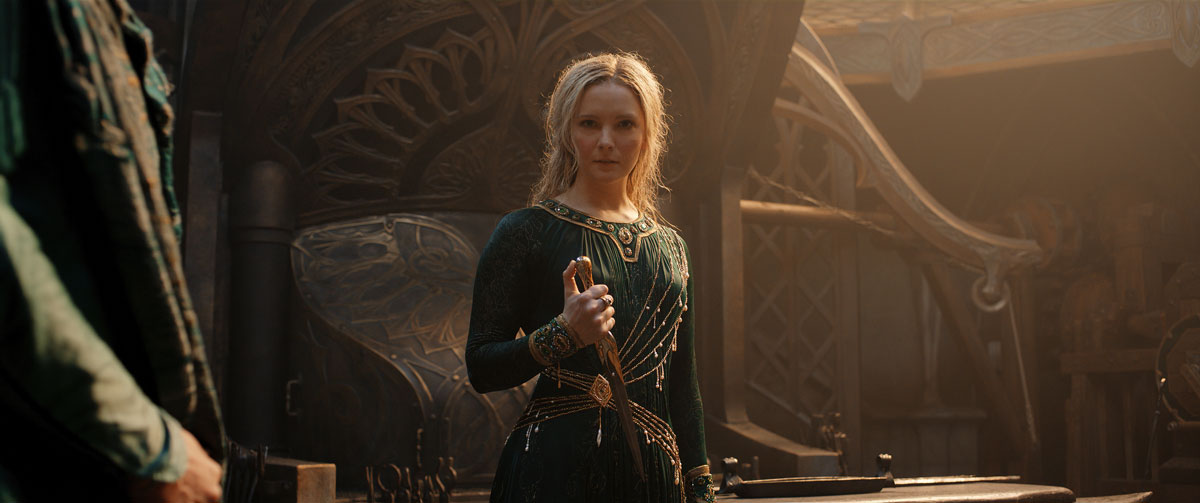
Poppy proves that the sidekick doesn’t have to be on the side, and Nori’s adventures will be weaker without her friend — even though, as Poppy says, the big guy will do for a friend in a pinch. Also, he talks now. While certain to follow The Stranger and Nori, hopefully the second season of “Rings” will return to the other Harfoots as well, both for more of Richards’ heartfelt portrayal as well as insights into the community. With their male leader dead, the group instantly listens to and follows tough love Malva (Thusitha Jayasundera) and there’s some hint that Poppy might take over the role, at least to scout paths. Could the Harfoots be . . . matriarchal?

The Lord of the Rings: The Rings of PowerMorfydd Clark (Galadriel) in “The Lord of the Rings: The Rings of Power” (Courtesy of Prime Video)

Galadriel learns the danger of trusting a certain trope of man, the mediocre ones who fall up and will drag you down with them.

“The Rings of Power” is thankfully missing most of the fuss about women in power (along with that pesky incest) that defines its bastard fantasy cousin “House of the Dragon.” The potential for that tired trope, powerful women in-fighting, is there when the queen regent (Cynthia Addai-Robinson) crosses paths with our main elf, Galadriel (Morfydd Clark). But after some brief, initial suspicion, the women characters become allies, friends. The queen regent believes Galadriel, even though it’s inconvenient for her to do so.

Galadriel is a horse girl and also, a cool girl, and as such, most of her other friends are men. She’s one of the guys: sword-wielding, relationship-resisting, romanticizing the idea of her fallen brother, and her unlikely friendship with the queen regent provides a welcome respite from the elf’s constant bravado. In the finale, Galadriel learns the danger of trusting a certain trope of man, the mediocre ones who fall up and will drag you down with them.


Want a daily wrap-up of all the news and commentary Salon has to offer? Subscribe to our morning newsletter, Crash Course.


With the ships of Númenor flying black flags of mourning, the queen regent is about to ascend to the throne, before she feels ready and now blind after being injured in battle (the show better not mess this up). Minor character Eärien is at the right place at the right time and has likely been given a glimpse of something huge thanks to the dying king. Pay no attention to the palantír behind the curtain, said no Eärien ever. 

And as Galadriel is instrumental in doing a bad thing for a good reason (maybe), with the looming second season, women are posed to gain even more of that elusive power of the title. It’s best if they have their female friends with them.

If you’re surprised by America’s anti-work movement, maybe you need to watch more movies

A femme fatale who tries to con thousands through her lover’s insurance company. Jobless bikers on drug-fueled adventures in New Orleans. People smashing printers at work.

Watching movies like “Double Indemnity,” “Easy Rider” and “Office Space,” you might think Americans had never heard of the Protestant work ethic – the spirit of sacrifice and delayed gratification that helped build capitalism.

Films like these reveal that many Americans’ current anti-work sentiments may not be all that new. As someone who has researched and taught world literature and cinema for over a decade, I believe some of the most fascinating movies make viewers ask, “What if all that hard work isn’t really worth it?”

The pandemic and the “Great Resignation”

Since the pandemic, more Americans than ever have been asking that same question.

During what some have termed the “Great Resignation,” many Americans changed careers, quit bad jobs or refocused on life away from work. More recently, the trend of “quiet quitting,” or doing only what one is paid for, has blown up on social media. The phrase is a bit misleading, as one does not quit one’s job. Instead, workers refuse to hustle in the workplace, especially since going “above and beyond” often means working for free.

The recent wave of quiet quitting comes from a deeper, more long-term disengagement with stressful work environments, unfulfilling roles and, despite recent wage hikes, the inability of paychecks to keep up with the cost-of-living crisis for many working and middle-class families.

Ironically, the drive to hyperproductivity that some argue is a central feature of capitalism is at an all-time high. Workers are told that if they “do what they love,” work should never feel like a burden. Some theorists compare modern forms of work culture, especially in Silicon Valley, to a religion in their attempts to instill people with passion and meaning.

These developments have created a pushback, especially among younger generations, toward work-life balance, flexible schedules and a deeper focus on mental health.

But some people have gone even further, with philosophers questioning the very foundations of an achievement-based society that lends itself to rampant burnout and depression. Political theorists and the anti-work movement are asking how it might be possible to create more free time for everyone, not just those who can afford to quit or take a job where they’ll earn less money.

Crime as an alternative to work

Yet such anti-work sentiments are nothing new to American culture.

It was arguably Charlie Chaplin’s characters that first expressed the anti-work ethos, most famously in the 1936 film “Modern Times,” in which his character works too slowly at an assembly line and gets caught in the cogs of a giant machine.

Around World War II, crime became an allegory for an anti-work ethos: little effort, big payoff.

The film noir genre often explores the existential and psychological factors that drive people to crimes of passion.

Many noir films feature a femme fatale – that is, a woman who seduces men as part of a larger criminal plot for her to get ahead financially. This character type often speaks to a cultural fear around what women might do to remedy their domestic and workplace dissatisfaction.

For instance, in “Double Indemnity” (1944), Phyllis Dietrichson, who’s unhappily married to an older, wealthy man, seduces insurance salesman Walter Neff. They concoct a plot to stage her husband’s murder as an accident and collect his life insurance money. A similar crime of passion against a wealthy husband also takes place in “The Postman Always Rings Twice” (1947).

Joseph H. Lewis’ “Gun Crazy” (1950) charts the story of Bart and Laurie, who “can’t live on 40 bucks a week.” They embark on a string of robberies that allows them to live job-free for a time. After Bart learns that Laurie killed two people, he turns remorseful, exclaiming, “Two people dead – just so we can live without working!”

Youth rebellion and the counterculture

With the arrival of the 1950s, the anti-work ethos becomes associated with youth culture.

A new generation of “hoodlums,” hippies and dropouts is a poor fit for the traditional workplace, beginning with the leather-jacket clad, motorcycle-riding Marlon Brando in “The Wild One” (1953) and James Dean in “Rebel Without a Cause” (1955).

Easy Rider” (1969) follows two unemployed bikers who, after a lucrative drug deal, stop at a New Mexico commune and admire the self-sustaining economy there. They continue toward New Orleans and meet Jack Nicholson’s George Hanson, who tells them, “It’s real hard to be free when you are bought and sold in the marketplace.”

Hanson goes on to contrast America’s world of work to the freedom of a hypothetical alien species with no leaders and no money. The counterculture is crystallized.

Slackers and sabotage

In 1990s popular culture, a “slacker” ideal took hold.

The apathetic, unemployed or underemployed young person appears in films such as “Dazed and Confused” (1993), “Reality Bites” (1994), “Friday” (1995) and “The Big Lebowski” (1998).

Richard Linklater’s “Slacker” (1990) follows a series of unemployed people, hustlers and moochers around Austin, Texas, in their nonworking time. One of these men says, “To hell with the kind of work you have to do to earn a living. … I may live badly, but at least I don’t have to work to do it.” He ends with the rousing proclamation: “To all you workers out there – every single commodity you produce is a piece of your own death!”

However, the slacker doesn’t merely try to work as little as possible. Some seek to actively sabotage the workplace. In “Clerks” (1994), two workers are intentionally rude toward customers. They play hockey on a rooftop and go to a friend’s wake during work hours.

Office Space” (1999) follows three workers, who, frustrated with their company’s malfunctioning printer, decide to take a baseball bat to it before infecting the office computers with a virus.

And in “Fight Club” (1999), Tyler, played by Brad Pitt, sneaks pornographic clips into family films while working as a projectionist. The narrator, played by Edward Norton, describes Tyler as a “guerrilla terrorist of the food service industry” after Tyler “seasons” plates of food at a fancy hotel with his various bodily fluids.

Recent cinema shifts to overt anti-capitalism

The 21st century has witnessed the rise of a whole series of foreign films and TV shows with explicitly anti-capitalist themes, with dramas like “Money Heist” (2017) “Parasite” (2019) and “Squid Game” (2021) centered on the characters’ fight against economic inequality.

This trend is evident in American cinema, too.

In “Sorry to Bother You” (2018), workers are so desperate for economic security that they sell themselves into slavery at a company called “WorryFree.” The satire follows Cassius Green, an African American telemarketer who, in his desire to rise up the corporate ladder, cuts deals with international companies to use WorryFree’s slave labor. While not as explicitly anti-capitalist, Chloé Zhao’s “Nomadland” (2020) paints a portrait of America where jobs are increasingly seasonal, temporary and insecure, leaving people adrift as “nomads.”

Americans have long had a vexed relationship to work, seeing it as alienating, exploitative or simply without real payoff.

Hustle culture and “grinding” might still dominate in America. However, more theorists are now arguing that technological automation and major social change could lead to a world beyond work with more free time for all.

It is therefore more important than ever to pay attention to what these films say: Perhaps work does not hold the key to happiness, fulfillment and the good life.

Zen Dochterman, Lecturer of Writing, USC Dornsife College of Letters, Arts and Sciences

This article is republished from The Conversation under a Creative Commons license. Read the original article.

I was a teenage swimmer. It took me decades to admit my coach was abusive

One of the first things the coach who would ultimately change my life said to my team, the Cincinnati Marlins, when he started working with us in the late ’60s was: “I’ll be turning you into elite swimmers. If you do what you’re asked, you’ll do fine. If you don’t, you won’t survive.”

In addition to miles and miles of what seemed like endless swimming, he brought in weights, and three days a week we also did a half hour of circuit training, which included bench presses, tricep extensions, and bent-over rowing with barbells. The other days we stretched and did dryland exercises. And I don’t mean jumping jacks. At eleven years old, I did five sets of twenty military push-ups, five sets of twenty sit-ups, multiple squats with a teammate on my back, and concentric, isometric, and eccentric exercises with an Exergenie, a piece of equipment that was cutting-edge at the time and just beginning to be used by the NFL as a part of their training. 

Once a place to have fun, swimming had become a place of hard labor, of following the rules and doing what we were told, of stretching the limits of what our bodies could endure. Our coach seemed to be redefining swimming as redemption through suffering.

Earning our loyalty was easy: we were winning, and we were proud. That put him in a powerful position.

And yet I continued, pushing myself through the constant pain of burning muscles and crippling fatigue.  I followed the rules, even as the coach routinely pushed us to do things that seemed unfathomable and hurled kickboards, pull-buoys, paddles, and, worst of all, insults at us.  I continued even when he prescribed us an extreme diet of 1,000 calories per day and began the practice of humiliating daily weigh-ins. I wasn’t fat. Not even close. But I never paused to wonder whether his goals were justified. 

Though I didn’t realize it at the time, our coach had crossed the line to abuse. With my parents unaware and the team bringing in glowing athletic success — we were winning championships, going to Nationals and, some of us, even setting world records — I couldn’t help believing that the coach must be right. Earning our loyalty was easy: we were winning, and we were proud. That put him in a powerful position.

Here are the things I now recognize that he, like other coaches, did time and again that allow them to cross the line to abuse without swimmers or parents giving it a second thought. 

* * *

First, I had thoroughly brainwashed myself into believing he was right about everything, that he had no choice but to throw kickboards, or even stopwatches, to get some swimmers to listen. At the end of his daily lectures, he often would ask if anyone had questions and most of us would sit there, mute. I was scared to death to ask him anything. On one occasion when I managed to find the courage to ask a question, he chuckled and asked, “What is it, Twenty Questions?” –my new nickname—as if I were asking too much. 

It wasn’t until decades later that I realized it was the tough kids, the kids with the mettle, who got the kickboards hurled at them. These were the kids with a voice, and the hurled kickboards were a form of manipulation meant to silence and control them.

* * *

From the very first day, I didn’t know if I trusted what our coach said, but I did trust his ability to instill fear. We swimmers all knew there were negative consequences if we didn’t follow his my way or the highway approach. This became painfully clear the day we practiced in our 50-meter longcourse pool in the middle of a fierce thunderstorm. Despite parents’ arriving in droves to pick us up, our coach continued to bellow: “Stay or you’re off the team.” As I remember, everyone continued to swim. 

Even the parents put up with the yelling and screaming because all that fear had improved our times. And maybe he thought the discipline of losing weight helped swimming too; certainly, it seemed that losing weight meant to our coach that we were serious about swimming. How could I question him?

* * *

Even the coach’s favorites weren’t spared his wrath. When it came to daily weigh-ins, of course it was embarrassing to have to line up and have our weight monitored so closely and publicly every day. But I rationalized that this kind of discipline would help the few girls who had trouble controlling their weight.  

When a swimmer didn’t make weight, the whole team was punished. We rarely knew who was in trouble, and since the punishment never seemed to be directed at a single swimmer, it was somehow more tolerable and harder to peg as abuse.

* * *

As a thirteen-year-old, I was slow to develop physically and would use a shoelace to tie my bathing suit straps in the back so my suit would fit snugly. Our coach would tease that I was the only one he knew who wore a “turtleneck” bathing suit. He would constantly tell me I was uptight and needed to “stop worrying.” He also liked to tell dirty jokes to the team in an effort to loosen us up before practice. 

It took me decades to have the courage to state publicly that my coach’s behavior was abusive and dangerous, scarring many of us for life. This is, in part, because this kind of abuse has been pervasive and ignored for years as a part of the swimming culture. When swimmers are breaking more records and swimming faster than they’d ever imagined possible, a totalitarian approach doesn’t seem like a red flag. 

But the important thing for coaches and parents to remember is that despite the immediate gratification of winning races and setting records, it is important to recognize when a coach crosses the line to abuse because the negative impact can have a devastating lifelong impact. 

GOP nominee Tudor Dixon describes single women in the workforce as having “lonely lives”

During a recent campaign rally in Michigan, Trump-endorsed gubernatorial nominee Tudor Dixon made a broad swing in an effort to rail against incumbent Michigan Gov. Gretchen Whitmer by bashing her support of single women in the workforce.

“Families look all different ways,” Dixon said during the rally, “They’re the ones telling me that on a regular basis but apparently they’re refusing to see one dynamic here. A lot of people wanna have families. This state, we don’t have support from the governor for families, unless they look exactly the way she wants. And you know what that looks like these days? Looks like single moms — not single moms, single women — working. That’s like her dream for women. Single women working. Last time I checked that was a pretty lonely life.”

Whitmer has made a platform on speaking in favor of a woman’s right to choose when it comes to abortion rights, which conflicts in every way with Dixon’s beliefs. In July, Dixon went on record saying that “a 14-year-old incest victim was the ‘perfect example’ of her justification for a nearly total ban on abortion access in the state of Michigan.” While Whitmer fights for the protection of a woman’s rights inside and outside of what those like Dixon frame as an “ideal” family unit.

“It is so disappointing to think of the politicians who want to take away a woman’s freedom to decide what to do with her own body and life, but that’s what we face,” Whitmer tweeted earlier in October.  “Decisions about abortion must be made between a woman, her doctor, and her trusted community – not politicians.”


Want a daily wrap-up of all the news and commentary Salon has to offer? Subscribe to our morning newsletter, Crash Course.


“Gretchen Whitmer vetoed funding for families that want to adopt a child and grants for safe housing for pregnant women,” Dixon tweeted earlier this week.  

“When the Supreme Court overruled Roe v. Wade, my opponent said that didn’t go far enough,” Whitmer said in a Tweet of her own. “She wants to make abortion a felony, no exceptions for rape, incest or health of the woman, and throw doctors and nurses in jail. That is too extreme and too dangerous.”

Abortion issues aside, Whitmer has done a great deal to empower women. In 2021 she secured a grant to “help women workers understand and exercise their rights and benefits in the workplace.”

“Women have been disproportionately affected by the COVID-19 pandemic, and it is crucial that we step up to empower women at the workplace,” Governor Whitmer said in a press release. “I am grateful to Secretary of Labor Marty Walsh and the Biden Administration for their work in supporting women’s economic recovery by increasing access to resources. This FARE grant will help our community organizations connect women to affordable childcare and provide them with the tools that they need to succeed.”  

30 best pumpkin dessert recipes to bake immediately

It’s pumpkin szn, baby! Light up a white pumpkin candle from Bath & Body Works! Arrange velvet pumpkins on your bookshelves! Tell yourself that this is the year you’re going to leaf-peep across Vermont and then never do it! Watch Gilmore Girls on repeat until your eyes and ears bleed! Wear flannel!

We’re celebrating fall every witch way, beginning with our best pumpkin dessert recipes. You’ll find a line-up of classics like pumpkin piepumpkin bread, and a pumpkin roll, as well as scary-good hybrids (pumpkin snickerdoodles, anyone?). There’s a curated list of pumpkin spice-inspired desserts, but not too many because not everyone’s on board with the craze, and we’re not monsters (or are we?).

Our best pumpkin dessert recipes

1. Pumpkin Cream Pie

I promise we’ll get to a traditional pumpkin pie recipe, but first, we need to talk about Emma Laperruque’s extra-creamy creation. A ginger-graham cracker crust and a sour cream whipped topping offset any of the typical sweetness that you’d expect from this pillowy pie.

2. Pumpkin Snickerdoodles

Snickerdoodles are relevant 365 days a year, but they needed an autumnal spin. Leave it to Jessie Sheehan to create our new favorite version. They’re fluffy and cakey without being too fluffy or too cakey like some snicks.

3. Pumpkin Tiramisu

Yes, yes, and yes is all I can say about this tiramisu. Spin pumpkin purée into the mascarpone filling, which not only amps up the fall flavor, but also gives each slice a mesmerizing orange hue.

4. Pumpkin Chocolate Bread Pudding

Sensing a theme here? Our favorite desserts ever are getting pumpkin-ified, including this chocolatey bread pudding made with brioche or challah bread.

5. Pumpkin Bundt Cake

We asked and Riley Wofford delivered a super moist, perfectly seasonal Bundt cake topped with a thick cream cheese-based glaze. Cut a slice and cozy up under your chunkiest throw blanket.

6. Pumpkin Banana Bread with Toasty Pecans

Confession: I only eat breakfast if there are baked goods — pancakes, donuts, buttery pastries, and quick breads. (I hope my doctor isn’t reading this). I’m adding this dreamy pumpkin-banana bread recipe to the rotation of “sweets that get me out of bed.”

7. Pumpkin-Mascarpone Pie with Chocolatey Cookie Crust

We couldn’t possibly serve you just one pumpkin-chocolate dessert. Next up is this seriously easy pie made with a press-in chocolate cookie crumb crust and an ultra-creamy pumpkin filling.

8. Pumpkin Cotton Cheesecake

This isn’t a New York-style cheesecake made with sour cream and ricotta and topped with a sticky-sweet strawberry jam. Instead, it’s a version of a Japanese soufflé cheesecake, which marries the airiness of angel food cake with the luscious, creamy texture of American cheesecake. In this recipe, it has a sneaky affair with a pumpkin pie for what may become your new favorite fall dessert.

9. Pumpkin Butter Cups

We’re not saying you need to ditch the usual chocolate-peanut butter cups for this recipe. They just might need to share the spotlight this season. The filling for these tiny treats is homemade pumpkin butter made with pumpkin purée, brown sugar, the zest and juice of an orange, and warm spices.

10. Pumpkin Spice Latte Caramels

Love it or hate it, the PSL will always make an appearance as soon as the temperature drops below 70℉. But instead of always consuming it in the form of a hot latte from one of the big coffee chains, make homemade caramels with all the yummy flavors of fall’s signature beverage.

11. Apple Cider Pumpkin Pie

Can’t decide between making an apple or pumpkin pie? Now you don’t have to, with this two-for-one recipe. The filling is a classic — sliced apples — while the creamy pumpkin topping is unexpectedly delicious (but we shouldn’t be surprised, really!)

12. Pumpkin Sugar Pie with Cookie Crust

Sugar pies can be tricky to get right, but Erin Jeanne McDowell (unsurprisingly) nails it with this pumpkin version that includes a simple press-in cookie crust.

13. Brown Butter Pumpkin Bars with Brown Sugar-Cream Cheese Frosting

Cream cheese frosting is notoriously extremely sweet, but this one isn’t, thanks to browned salted butter, which cuts the rich flavor and introduces warm, nutty notes. The frosting pairs brilliantly with these cakey bars.

14. Our Best Pumpkin Roll

When I hear “cake roll,” my mind immediately jumps to a Christmas Bûche de Noël. But this showstopping dessert has a life outside of the holiday season. Instead of oil or sour cream to give this cake its moisture, it gets it all from pumpkin purée.

15. Classic Pumpkin Pie

We promised a classic pumpkin pie, and here it is: The bestselling cookbook author shared her recipe for the fall must-have. You can absolutely use canned pumpkin purée, but she also included instructions for how to make your own caramelized pumpkin filling.

16. Our Best Pumpkin Pudding

Love pumpkin but hate the pie? This recipe is for you. It ditches the crust so what you’re left with is the only thing anyone really wants — the spiced custardy filling.

17. Pumpkin Cake with Cream Cheese Icing and Caramelized Pumpkin Seeds

This is the chunky turtleneck sweater of the dessert world, which is to say it’s cozy, a little stylish, and dependable.

18. Vermont Spice Pumpkin Cake

It’s a standard pumpkin spice cake . . . until it’s not. This recipe calls for evaporated milk, which recipe developer Posie (Harwood) Brien says gives the cake a delicate crumb.

19. Pumpkin Pie Cobbler

Quicker, easier, and dare-I-say more delicious than traditional pumpkin pie, this pumpkin pie “cobbler” is the cover girl of fall.

20. Pumpkin Sugar Pie

Erin Jeanne McDowell promises that this pie will never crack, and we’re trusting her with our life — or, um, this year’s Thanksgiving dessert.

21. Pumpkin Pie with Gingersnap Crust and Cinnamon Whipped Cream

Here’s why we love this pie — because for once, the crust (gingersnap! cinnamon!) comes front and center rather than merely playing a supporting role.

22. Pumpkin Cheesecake

Cinnamon, nutmeg, ginger (both ground and crystallized), and cloves enhance the flavor of pumpkin purée for this luscious cheesecake.

23. No-Churn Pumpkin Ice Cream

I refuse to believe that ice cream is for summer only. I’ll eat this fall-forward, purely pumpkin recipe even when the temperature dips into the 50s.

24. Soft Pumpkin Chocolate Chip Cookies

“Anything* goes well with chocolate, but it’s especially good with pumpkin. These cakey cookies get their moisture from pumpkin purée, canola oil, and just one egg.

25. Pumpkin Pavlova with Pecan Brittle

When I picture pavlova, I picture an angelic white dessert piled high with whipped cream and fresh berries. But in reality, they go way beyond that, with fun, seasonal spins like this one — spiced meringue layered with pumpkin-maple whipped cream and topped with crunchy pecan brittle.

26. Pumpkin and Tahini Pie with Chocolate Pie Crust

I told you, everyone loves chocolate and pumpkin together! Introduce tahini, and the crowd will go wild.

27. Gluten-Free Pumpkin and Coconut Cream Tart

Nailing the perfect gluten-free pie crust seemed like an impossible task — until now. This crust is just as flaky and buttery as a traditional crust, and the sweet, subtly spiced filling is just so delicious.

28. No-Bake Pumpkin Cheesecake Bars

Everything you love about cheesecake but easier! More hands-off! More delicious!

29. Pumpkin Whoopie Pies with Chocolate Cream Cheese Filling

Are you on the chocolate-pumpkin train yet? If not, this recipe is your final chance on board.

30. Pumpkin Bread

“Instead of a meager cup or so of pumpkin puree, we used an entire can. This means intense squashy flavor, bright orange color, and increased moistness,” writes recipe developer and “Big Little Recipes” author Emma Laperruque. A spiced-sugar crust takes it over the edge.