Spring Sale: Get 1 Year, Save 58%

Sen. Marco Rubio, Judge Aileen Cannon and Donald Trump: Love triangle?

Sen. Marco Rubio, R-Fla., appears to be a major booster of Judge Aileen Cannon, who recently made the controversial ruling granting former Donald Trump’s request for an independent review of the documents seized by the FBI at Mar-a-Lago. Cannon is a federal district judge appointed by Trump, and Rubio may be eager for the former president’s support in his unexpectedlu tight re-election race against Rep. Val Demings, a Democrat. 

Rubio has rejected claims that Cannon’s decision in the Mar-a-Lago case was politically motivated, although many legal experts — including conservatives like former Attorney General Bill Barr — have strongly criticized the ruling. Rubio has also  emphasized the bipartisan support Cannon received leading up to her nomination and confirmation vote.

Rubio appears to have served as Cannon’s sponsor, asking her to apply for the judicial nomination in 2019 and also created the bipartisan Florida judicial advisory commission that vetted Cannon’s background, alongside other potential nominee candidates. Cannon was confirmed by a bipartisan Senate vote on Nov. 12, 2020, barely a week after Trump lost the presidential election. 

Cannon’s ruling in favor of Trump’s request for a special master to review the seized documents has been widely criticized for appearing to offer special treatment to the ex-president and delaying the Justice Department’s ongoing criminal investigation.

Her decision is “not well-founded in any law or legal theory” and has included “far better advocacy for the former president’s legal position than anything his actual lawyers put forward,” prominent national-security lawyer Bradley Moss told NBC News.


Want a daily wrap-up of all the news and commentary Salon has to offer? Subscribe to our morning newsletter, Crash Course.


Rubio, however, has staunchly defended Cannon’s decision, telling Breitbart that the “attacks against her are just the latest example of hypocrisy from leftists and their media enablers who believe the only time it is acceptable to attack a judge is if that judge rules against what they want.”

Rubio has also criticized the DOJ investigation into Trump, calling it politically motivated and comparing it to events in “third world Marxist dictatorships.” That position could be politically advantageous in terms of Rubio’s relationship to Trump and his campaign against Demings, who has been within a few points of Rubio in recent opinion polls. Rubio is also the ranking Republican on the Senate Intelligence Committee, which will almost certainly be briefed on any national security issues emerging from the Mar-a-Lago search. 

Rubio strongly supported the FBI’s 2016 investigation into Hillary Clinton’s use of a private email server as secretary of state. Apparently the presence of classified information in Trump’s home does not alarm the Florida senator, who suggested in an interview with NBC 6 that he doesn’t think “a fight over storage of documents is worthy” of the FBI’s “full-scale raid.” 

Rubio expressed a much different attitude toward Trump when both were 2016 GOP presidential candidates, warning voters that Trump was “reckless and dangerous.” More recently, he has said little or nothing about the former president’s conspiracy theories regarding the 2016 election or his suggestion that Jan. 6 rioters should be pardoned, let alone his dubious handling of classified documents.

Vladimir Putin celebrates huge new Ferris wheel in Moscow

Russian strongman Vladimir Putin spent Saturday opening a new Ferris wheel in Moscow.

Putin joined Moscow Mayor Sergey Sobyanin, via video conference, for the ceremony, Russian state media reported.

“It is a unique [construction], 140 meters high. There is nothing like that in Europe,” Putin said. “It is very important for people to have a chance to chill out with their family and friends.”

Russian state media reported, “At an overall height of 140 meters, the VDNKh’s open revolving observation wheel is the tallest in Europe. Mounted on the wheel are 30 cabins, and one in six has a transparent floor. The air conditioning, lighting and heating systems as well as an emergency button and audio system are installed in the cabins. One complete rotation of the Moscow Sun takes about 18 minutes 40 seconds, with capacity of up to 450 passengers.”

Meanwhile, Russia’s grip on northeast Ukraine was collapsing as losing a key supply line.

Politico’s Christopher Miller reported it is “absolutely stunning how quickly Ukrainian forces have retaken territory in the east and forced Russian troops to retreat — and they’re still on the move. Big victory for Kyiv and humiliating blow to Russia and Putin — but at least he opened that Ferris wheel in Moscow today.”

BBC’s Steve Rosenberg wrote, “On the day Russian forces retreated from occupied areas of Kharkiv region and Ukrainian forces reported major gains, back in Moscow Vladimir Putin was inaugurating a giant Ferris wheel and there was a fireworks display to celebrate city day. Surreal.”

Associated Press White House correspondent Chris Megerian wrote, “I’m trying to imagine the political blowback for an American president opening a new amusement park ride while the U.S. military retreats.”

Sergiy Kyslytsya, Ukraine’s ambassador to the United Nations, explained how he saw the symbolism.

“Ferris wheel symbolizes the wheel of change and the idea you can’t get off. It’s traced to Middle Ages,” he wrote. “One, as in Putin, is taken round until the ride ends [he dies] and is disgorged back into the spirit world, as in hell. Per Russian obsession with symbolism. Well done! Great timing!”

People think they should talk less to be liked, but new research suggests you should speak up

In conversations with strangers, people tend to think they should speak less than half the time to be likable but more than half the time to be interesting, according to new research my colleagues Tim Wilson, Dan Gilbert and I conducted. But we’ve also discovered this intuition is wrong. Our paper, recently published in the journal Personality and Social Psychology Bulletin, sheds light on the prevalence of these beliefs and how they are mistaken in two ways.

First, we found that people tend to think they should speak about 45% of the time to be likable in a one-on-one conversation with someone new. However, it appears speaking up a bit more is actually a better strategy.

In our study, we randomly assigned people to speak for 30%, 40%, 50%, 60% or 70% of the time in a conversation with someone new. We found that the more participants spoke, the more they were liked by their new conversation partners. We call the mistaken belief that being quieter makes you more likable a “reticence bias.”

This was only one study with 116 participants, but the outcome aligns with other researchers’ prior findings. For example, a previous study randomly assigned one participant in a pair to take on the role of “speaker” and the other to take on the role of “listener.” After engaging in 12-minute interactions, listeners liked speakers more than speakers liked listeners because listeners felt more similar to speakers than speakers did to listeners. This outcome suggests one reason people prefer those who speak up: Learning more about a new conversation partner can make you feel like you have more in common with them.

The second mistake we found people make is failing to recognize that their new conversation partners will form global impressions of them that are not extremely nuanced. In other words, people are unlikely to walk away from a chat with someone new thinking that their interaction partner was quite interesting but not very likable. Rather, they are likely to form a global impression – for example, a generally positive impression, in which they view their partner as both interesting and likable.

For these reasons, our new research suggests that, all else being equal, you should speak up more than you typically might in conversations with new people in order to make a good first impression.

Why it matters

Many people want to know how to make a good first impression, as evidenced by the enduring popularity of related self-help books.

But because such books are not always based on empirical evidence, they can lead people astray with unfounded claims such as this advice from “How to Win Friends and Influence People“: “Remember that the people you are talking to are a hundred times more interested in themselves … than they are in you.”

Research like ours can help people gain a more scientifically grounded understanding of social interactions with new people and ultimately become more confident and knowledgeable about how to make a good first impression.

What still isn’t known

In our research, participants were instructed to speak for a certain amount of time in their conversations. This approach has the obvious benefit of allowing us to carefully manipulate speaking time. One limitation, though, is that it does not reflect more natural conversations in which people choose how long to talk versus listen. Future research should investigate whether our findings generalize to more natural interactions.

Further, we assigned people to speak for only up to 70% of the time. It’s possible, and even likely, that completely dominating a conversation – such as by speaking 90% of the time – is not an optimal strategy. Our research does not suggest people should steamroll a conversational partner but rather that they should feel comfortable speaking up more than they typically might.


Quinn Hirschi, Principal Researcher at the Center for Decision Research, University of Chicago

This article is republished from The Conversation under a Creative Commons license. Read the original article.

I got hooked on Uber Eats. Not as a customer — as a delivery driver

It’s a Saturday night, and I’m stopped at a red light on Sunset Boulevard. My gaze travels to strangers on patios laughing, drinking and eating delicious looking meals. I’m achy from being stuffed into my driver’s seat for hours. Hunger burns a hole in my stomach. My jeans are uncomfortably snug, reminding me it’s an inconvenient time for another bathroom break. Many restaurants won’t let me use their restroom when I’m picking up an order, so I have to hold it until one that will. My car smells like the last three things I delivered — Japanese seafood, barbecued meat and the Chick-fil-A I just dropped off at a Bel Air mansion. I’m a vegetarian

I should log off the app and go home to my basic Hollywood one-bedroom, where budget-conscious meals I prepared myself wait in my fridge. But it’s still the dinner rush, and my phone goads me with the familiar chime of incoming offers. Declining them seems like refusing money waved in my face. As someone who recovered from abusing substances years ago, I recognize the signs of being hooked: I can’t stop even when I want to or when it would be in my best interest. And, through “gamification,” delivery apps encourage and exploit this compulsion. 

I started delivering food several months ago after my unemployment ran out. I still hadn’t replaced the salary I’d lost in a layoff from my full-time editing job. After I was laid off, I wasn’t getting enough pet-care gigs, which I loved, to pay the bills. Despite sending out tons of resumes and constantly hearing about how “everyone’s hiring right now,” I’d gotten only a handful of interviews and no offers. 

At first, I was thrilled by the freedom and the novelty. With no set schedule and no boss, I could hop in my car anytime I wanted, turn on the app and start delivering. I felt like I was engaged in underground anthropological research. I’d previously been ignorant of the existence of citizens willing to fund a $15 taxi for a single bag of gummy snakes. Sometimes I’d get a charming surprise, like when the giant Beverly Hills cupcake order went not to a socialite but to an old folks’ home.

As a relative newcomer to Los Angeles, I got a thorough education about huge swaths of the city’s streets, real estate and eateries. I had glimpses into the lives of the famous and privileged as well as the ordinary. I’d get just enough delivery information — first names, last initials and addresses — that, combined with Googling, I could concoct some pretty tasty blind items: “Which gated luxury tower resident likes her Mexican fast-food like her husband’s reality TV programming — burgeoning and bad for you?” “What Rodeo Drive fashion designer wrote in their Buffalo Wild Wings delivery notes: ‘If you come thru front door rather than alley, I PROMISE I will give you no tip and a thumbs down!’?” (I changed the specifics for the sake of privacy. I love juicy details, but I’m not mean.)

I found I genuinely enjoyed “delivering happiness” by bringing people their favorite comfort foods. My 100% approval rating suggested my customers could tell. 

Just like when I used to drink and smoke pot at home alone, delivering becomes repetitive and sad.

The downsides quickly became apparent. My beloved red Prius was weathering heavy mileage and wear and tear. As a hybrid, it wasn’t the worst gas guzzler, but fuel costs — in addition to a hefty 15% state self-employment tax — ate a chunk of my already modest earnings. I was horrified to learn in an online drivers’ group that I’d unwittingly gone the first two months with zero accident insurance because my carrier didn’t cover me while I was on the job. When I switched to one that did, my premium went up 40%. Besides putting my car and my body at risk, the job was a dead end. It wasn’t something I’d admit on my resume or even at a dinner party. Not that I had a social life. Although the city was waking up as the pandemic waned, my friends understandably wanted to meet at mealtimes and weekends — also the busiest hours to drive. 

So here I am, another Saturday night on the road. The driving isn’t awful; it’s parking that’s a nightmare. I must do it twice for every order, upon pickup and at delivery. Now when I see a street festooned with blinker-flashing, double-parked cars, I don’t leap to judgment. I think, “Greetings, my brethren.” Where that’s not an option, I repeatedly circle blocks hunting for a space (often while the customer, who can trace my path on the app, sends me texts I can’t answer demanding to know what’s going on). I spend my own money on meters and, as a last resort, negotiate dreaded gargantuan parking structures. Some apartment buildings are so vast I voice record directions from the concierge to the customer’s unit. “Staircase to mezzanine. Sharp left all the way to double doors. Turn right after the pool. Take the second elevator bank to the 12th floor after you cross the footbridge to building J.” A round-trip labyrinth, all the while worrying whether the car I left behind will be ticketed (three times so far) or towed (mercifully not), makes what seemed like a decent payout not actually worth it once the extra time and stress are factored in.

Just like when I used to drink and smoke pot at home alone, delivering becomes repetitive and sad. My car radio plays my favorite indie station. But the same tunes on repeat make a soundtrack to vehicle-bound isolation and shame. In one song, a folksy singer intones “I am but a writer, so writing’s what I do.” I swear it plays every time I begin a delivery shift, reminding me of the dream I could be pursuing instead of dead-end gig labor.  So why can’t I quit? The same reason I used to robotically call my dealer after swearing I was done. My conscience has great suggestions: “Work on your script! Do yoga! Send out resumes for a real job!” Meanwhile, an imaginary pusher man whispers: “Screw it. Just drive.”

Clean and sober now for 13 years, I’m still human. If I’m conditioned to get a short-term boost in my brain’s reward center, it’s a hard pattern to break.

Creative goals and self-improvement are hard, requiring sustained effort and faith despite an uncertain payoff. Delivering food is a numbing escape I can pretend is good for me because hey, I’m earning money. The app is designed to keep me hooked. A familiar three-note chime sounds when an offer pops up. It flashes a dollar amount — the expected fare and tip I’ll receive if I accept. Who can resist money set to music? I’m like a trained Pavlovian puppy salivating about the riches coming my way when I hear those notes, even if it’s just $10 to bring Taco Bell to a stoner. As I rack up the deliveries, the app flashes a running total in real time. It knows that the ever-increasing number, even if the actual rate after expenses is paltry, will motivate me to stay on the road. 

The real-time map of the city is also configured to get me hyped to drive. Pale blue during off hours when it’s slow, it turns a rosy pink when things are heating up close to mealtimes. During busy surge hours, it bleeds into a saturated rush-hour purple so intense it implies money is raining from the sky and I just need to bring a bucket. I may as well have won at the slot machine for the dopamine it’s engineered to produce in me. It’s the same thing behind Instagram likes and Facebook notifications that keep users scrolling. I’ve rushed out to deliver based on these sudden peaks, only to find sporadic and lackluster offers.

Clean and sober now for 13 years, I’m still human. If I’m conditioned to get a short-term boost in my brain’s reward center, it’s a hard pattern to break. Some drivers I encounter in online forums are worse off. One guy switches to a second app when the first cuts him off after he’s driven the 12-hour limit. Others are ashamed of neglecting their children because they can’t stop driving.

After decent initial earnings, I noticed the payouts declining. Some said it was inflation or an oversaturation of drivers, others that the algorithm is messed up or it’s an ongoing slump in a stagnant economy.

Recovering from my first addiction gave me the tools to save myself from this one.

I didn’t feel like doing anything healthy or worthwhile after delivering — just consuming TV and junk food. The same as when I’d get stoned, delivering is a conduit to oblivion. And since my higher self knows this, I needed to keep numbing myself in a vicious circle to blot out this truth.

But if my first addiction gave me the tools to spot when I was falling into those old patterns, my recovery also gave me the tools to save myself from this one. It wasn’t the most dramatic consequences of using — lost jobs, injuries, poor health — that spurred me to get sober. It was the hole in my soul and hitting bottom emotionally. Likewise, my first-ever car accident (colliding with another delivery driver) wasn’t the last straw for me in this job. Neither was wiping out on an uneven sidewalk: The customer got their pizza intact, but I went home with a sprained ankle. The change came later, when I could no longer push away the truth. One day a cop tried to write me a parking ticket, and the built-up stress made me burst into tears. “Why don’t you just do something else?” he asked. I asked myself the same thing.

I still drove part-time for extra money for months after that, but with strict boundaries — only after completing more important creative, self-care and job-search tasks, and never on a sudden whim to check out from life. I knew I was done using driving as a mindless escape. It’s not what I was put here to do.  

“Bold and robust”: An expert’s guide to making a better Vietnamese iced coffee

Lan Ho always felt like something was missing from the coffee market. 

“Coffee is harvested all over the world — South America, Africa — but I felt like not a lot of attention is paid to the people behind the beans, especially those working in Vietnam, which is the second largest producer of coffee in the world,” Ho told Salon Food. “It was really eye-opening to me that Vietnamese coffee isn’t as on the map, and I think it should be.” 

That realization led Ho, a Chicago-based pharmacist, to co-found the company Fat Miilk, an artisan coffee retailer that ships nationally, with the goal of bringing Vietnamese coffee into the American mainstream. 

“Not only do I want to make the coffee accessible, but I wanted to tell the story of Vietnamese coffee culture, a culture that is incredibly robust and bold and is a dominant space in the industry,” she said.

Of course, Ho said, any coffee originating in Vietnam is technically “Vietnamese coffee,” but many people — including her customers — associate it with a coffee drink you traditionally see consumed in the country, made by filtering rich, black coffee over ice and sweetened condensed milk. This iconic beverage is also one that Ho wants to bring into the spotlight. 

Currently, she’s making preparations to open Fat Miilk’s first storefront in Chicago’s “Little Vietnam” neighborhood this fall, but in the meantime, Ho spoke with Salon about what goes into making a perfect Vietnamese iced coffee at home. 

The coffee 

Ho: “Really, what makes it ‘Vietnamese coffee’ is the origin, right? Vietnam harvests both main species of coffee, Robusta and Arabica. Ninety-seven percent of the coffee crop in Vietnam is Robusta. So, if you’re having coffee harvested from Vietnam — regardless of whether you’re having it as cà phê sữa đá or a French press or a pour-over drip — you’re having Vietnamese coffee. 


Want more great food writing and recipes? Subscribe to Salon Food’s newsletter, The Bite.


“But what’s really interesting is that I essentially named my company Fat Miilk based on the drink because I feel like that’s ultimately a conversation starter, right? And when most people have Vietnamese coffee, it’s served in a very traditional way, which starts with the Vietnamese Robusta bean. It’s a bean that has two times the caffeine content compared to Arabica. It’s very bold, nutty and chocolatey, and it has a very low acidic profile. That pairs up so nicely with a little bit of sweetened condensed milk over ice.”

The gear

Ho: “The best thing about Vietnamese coffee is that it’s incredibly humble and so easy. We typically brew Vietnamese coffee using a slow-drip phin filter tool. It’s simple. The filter is filled with coffee grounds, and the hot water is poured over the grounds. It takes five minutes, six minutes for it to finish dripping, but it’s worth the wait.”

The condensed milk 

Ho: “Typically, traditional sweetened condensed milk has a lot of sugar in there. I mean, that’s literally what it is: just sugar and milk. The brand that Vietnamese people have used forever is the Longevity brand. At Fat Miilk, we are actually working on our own sweetened condensed milk line to really shed some light on all the variations that are out there. We’re looking forward to being able to vertically integrate those into all our concepts and ideas, but Longevity is our go-to. It’s what my parents and grandparents use.” 

Salon Food writes about stuff we think you’ll like. While our editorial team independently selected these products, Salon has affiliate partnerships, so making a purchase through our links may earn us a commission.

Compound butter: The culinary school-approved way to radically transform your meals

For me, the first few weeks of September always signal a season of transition. Summer is fading and autumn is waiting in the wings. From my apartment window, I watch as kids — kindergarteners, I’m guessing, since they are all almost completely dwarfed by the unwieldy backpacks they carry — dutifully line up at the bus stop and, in turn, I’m compelled to turn towards more scholarly pursuits. It wouldn’t be September if I didn’t buy a new planner and at least contemplate going back to graduate school. 

It also happens to be the season I most need that planner; as someone who works in food, planning for the holiday season has already started in earnest. Between attempting to hold onto the last vestiges of summer (lake swims, Aperol spritzes and scouring the farmer’s market for good tomatoes) and thinking about Thanksgiving, my calendar gets packed pretty quickly. 

As a result, my own cooking shifts during this season, too. 

When time is limited, I cook from my pantry more often, focusing on simple ingredients that pack big flavor with minimal effort. The ultimate example of this? Compound butter

Compound butter, as the name suggests, is simply butter cohesively combined with another ingredient. You’ve likely had it before, whether its lemon-infused butter served over fish or cinnamon-honey butter served with fluffy Parker House rolls. 

“Oftentimes, they’re used as a finishing butter, especially when they have some fresh herbs in it,” Joshua Resnick, a chef-instructor at the Institute of Culinary Education, told Salon. “It’s a nice way to elevate dishes beyond just their traditional elements because you can add something really special to it, but it’s in a way that’s easy.” 

Resnick also said that compound butters are a fantastic way to preserve fresh flavors — like from minced herbs or lemon zest — for just a little longer. 

“By storing them in butter, it allows for those ingredients to maintain their flavor for a longer period of time because you are preserving them in fat.”

“By storing them in butter, it allows for those ingredients to maintain their flavor for a longer period of time because you are preserving them in fat,” he said. “Think about a duck confit, for a minute. The flavors stay preserved because of the duck fat. Compound butter acts in the same manner, elongating the life of your product.” 

And while many compound butters lean into acidic or herbaceous flavors, both Resnick and Edward Kim, the chef at Chicago’s Asian-inspired Mott Street and Second Generation restaurants, encourage home chefs to experiment with savory compound butters, specifically miso butter. 

The combination of miso — a fermented soybean paste that’s especially popular in traditional Japanese cooking — and butter imbues a dish with a one-two punch of fatty, umami flavors. Its addition to even simple items can radically transform them. 

At Mott Street, Kim serves a dish that incorporates pan-seared oyster mushrooms (which are little umami bombs in their own right!), thyme, lemon and, of course, miso butter. 

“It’s so simple, but it is one of our most popular dishes,” Kim said. “One comment we got recently about it was that, ‘It tastes so much like Thanksgiving,’ probably because of the mix of thyme and the savoriness of the mushrooms and miso. I didn’t think about it when originally making that dish, but it does evoke the nostalgia of what you remember Stouffer’s stuffing tasting like when you were a kid.” 

Thanks to its fermented nature, miso also has a little bit of funk that can mimic aged cheese, especially when combined with higher-fat butters. For that reason, it’s really fun to use as an analogue for cheese sauce. 

Resnick recalls working at New York’s Tokyo Record Bar where they would serve gourmet popcorn drizzled in miso butter. 

“You get the bright, sweet corn and the cheddar-like miso,” he said. “It’s an umami bomb. Then you hit it with some red pepper flake, top it with a poached egg. It was just outstanding.” 

Meanwhile, at Second Generation, Kim serves a lobster “mac and cheese” made using a sahm-jang cream; sahm-jang is a Korean paste made using gochujang and doenjang, a Korean fermented soybean paste that is similar to miso, but it is often saltier and funkier. 


Want more great food writing and recipes? Subscribe to Salon Food’s newsletter.


“I feel like it’s really savory,” Kim said. “It has a really great cheesy quality to it, but at the same time, it’s lighter than your traditional mac and cheese.” 

Kim encourages home cooks to incorporate miso butter in places where they would traditionally add a pat of butter or a sprinkle of cheese, like over plain noodles or baked potatoes. Making it is simple. He recommends treating miso like salt — a little goes a long way — and adding a teaspoon or two of water to the butter before mixing to aid in emulsification. 

“I think of adding anchovies to pasta sauce,” he said. “You don’t necessarily want to taste the anchovy, but it gives the sauce a little something extra. Miso butter is a way to get that ‘something extra’ easily when cooking at home.” 

Salon Food writes about stuff we think you’ll like. While our editorial team independently selected these products, Salon has affiliate partnerships, so making a purchase through our links may earn us a commission.

This 5-minute tomato sauce has a secret star

This recipe is a sneak peek from our new “Simply Genius” cookbook — the third in the best-selling Genius family, with the simplest, most rule-breaking recipes yet.

Five-minute tomato sauce sounds like it could very well be a cheat, a gimmick, or an outright lie.

But when Heidi Swanson — founder of the beloved blog 101 Cookbooks and author of the Super Natural series of cookbooks — writes a five-minute tomato sauce, calling it the “little black dress of my cooking repertoire,” I trust. And I try it — and it’s bright and fresh and alive, despite barely cooking.

Then I scrutinize exactly how she does it, so I can commit it to memory:

The cold pan: Rather than heating the oil first till it shimmers, then adding the garlic and seasonings, like we’re so often told to do, Heidi pours them all into a cold saucepan together, stirring over the heat until they start to sizzle and smell good. This little move extracts loads of flavor without burning, and takes all of 45 seconds.

The tomato shortcut: She calls for canned crushed tomatoes, which are already essentially in sauce form, stirs them into the punchy olive oil, then just heats them through. More precious minutes, maybe even hours, saved.

The secret ingredient: In a last swipe of brilliance, she grates in the zest of a lemon, which jolts the tomatoes to life without tasting more acidic or even perceptibly lemony.

Now, as you may recall, there’s another Genius tomato sauce out there — Marcella Hazan’s, the cover star of the first cookbook and the most popular Genius recipe of all time, in fact. I will still make it forever.

But I will turn to it in different moments, when I have 45 minutes and I want to let tomatoes, onion, and butter blub along on the stove while I putter. Then I end up with a sauce that’s sweet, rich, and purely tomato, I’ll make Marcella’s.

When I want something a little feistier and more savory, to quickly layer onto a pizza or lasagna or eggplant parm — especially when I have no time at all — Heidi’s is it.

As I worked on the “Simply Genius” cookbook over the past four years, it was these types of recipes that I unexpectedly needed most — as I molded my cooking around a new baby, then pandemic lockdowns, then a move across the country (then moving two more times).

The recipes in this book — which started out aimed at beginners, and turned out to be just as vital for busy, curious cooks like me — buoyed me through the gauntlet of the past few years, and, most importantly, brought me and my family joy.

It’s my deepest hope they do the same for you.

Recipe: 5-Minute Tomato Sauce From Heidi Swanson

This post contains products independently chosen (and loved) by Food52 editors and writers. As an Amazon Associate, Food52 earns an affiliate commission on qualifying purchases of the products we link to.

Bannon says he was “totally in the zone” during his arrest for money laundering and conspiracy

Steve Bannon, a former White House advisor for Donald Trump, recently revealed the day he was arrested on money laundering and conspiracy charges was actually “one of the best days” of his life.

On Friday, September 9, Bannon recalled his arrest during the latest episode of his podcast. Back in 2021, Bannon was arrested on money laundering and conspiracy in connection with a financial plot involving the “We Build the Wall” fundraising effort.

Speaking to conservative commentator Charlie Kirk, Bannon said, “It was a very powerful, spiritual day for me. A lot of things came into high clarity.”

Bannon went on to describe that day as “one of the best days of my life.”

“I was totally in the zone — as you say in sports — the entire time,” he continued, “They’re not gonna shut me up.”

Bannon’s remarks came one day after he was indicted on money laundering and conspiracy charges related to the financial scheme.

Per Business Insider: “An indictment from the Manhattan district attorney’s office alleged that Bannon had conspired with three men — Air Force veteran Brian Kolfage, venture capitalist Andrew Badolato and Colorado businessman Timothy Shea — to launder money and commit fraud through a sham crowdfunded charity.”

In 2020, federal prosecutors alleged Bannon and other Trump allies had defrauded Trump supporters who donated money to contribute to the border wall being built.

At the time, acting Manhattan US attorney Audrey Strauss released a statement about the plot. “As alleged, the defendants defrauded hundreds of thousands of donors, capitalizing on their interest in funding a border wall to raise millions of dollars, under the false pretense that all of that money would be spent on construction,” Strauss said at the time.

“While repeatedly assuring donors that Brian Kolfage, the founder and public face of We Build the Wall, would not be paid a cent, the defendants secretly schemed to pass hundreds of thousands of dollars to Kolfage, which he used to fund his lavish lifestyle.”

Like many other Trump allies, Bannon received a pardon from Trump during the final days of his presidency. However, it is important to note that presidential pardons typically apply to federal crimes. So, if state-level prosecutors opt to further investigate the case, they do have the ability to file new charges.

We all love Wongers, who brings the real magic to the MCU

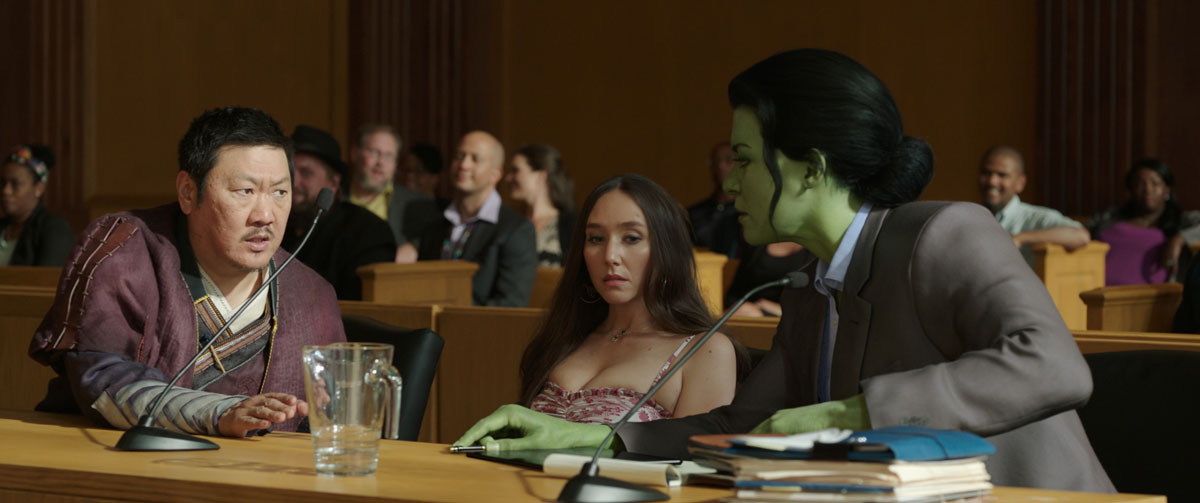
There’s nothing inherently funny or remarkable about a man kicking back to unwind with some snacks, a beverage, and an hour of “The Sopranos.” Unless that guy is Wong. Just Wong. The Sorcerer Supreme, Master of the Mystic Arts, leader and former librarian of Kamar-Taj. Wong does not relax. Tasked with maintaining the balance of the cosmos, everything is a serious undertaking to Wong, even if that endeavor takes place in an episode of “She-Hulk: Attorney at Law.”

That makes the sight of him settling down to catch up with TV of any kind, premium or low brow, as conceptually dissonant as the thought of seeing King Charles III pick his toes in public. Not that such a thing could never happen; anything is possible. I’m merely suggesting that it would take a moment for our brains to process that image. The same is true here.

Just as we do, fate drops a perpetually inebriated party girl named Madisynn King (spelled “with two N’s and one Y . . . but it’s not where you thiiii-iiink!”) into the center of Wong’s TV room. A room which, don’t forget, is inside of an ancient magical fortress in Kathmandu, Nepal, that houses mystical relics alongside a DVR stacked with classic TV episodes.

All this all-powerful sorcerer wants to do is dive into some classic HBO, but without intending to, Madisynn salts his mood by spoiling the episode – Season 5, Episode 12, “Long Term Parking,” in case you’re wondering – before he can send her on her way.

Despite this frustrating meet cute, they eventually team up again to eat popcorn, discuss cocktail preferences and watch “This Is Us.” And by the end of the fourth “She-Hulk” episode, “Is This Not Real Magic?” the mononymous sorcerer has an adorable barfly handle: “Wongers.”

She-Hulk: Attorney at LawBenedict Wong as Wong, Patty Guggenheim as Madisynn, and Tatiana Maslany as Jennifer “Jen” Walters/She-Hulk in “She-Hulk: Attorney at Law” (Photo courtesy of Marvel Studios/Disney+)

Wong is the Ron Swanson of the MCU, minus the red meat obsession.

A recurring joke on “She-Hulk” involves the esteem-challenged Jennifer Walters (Tatiana Maslany) breaking the fourth wall to remind the audience that this is her vehicle. “I just want to make sure that you don’t think this is one of those cameos every week type of shows,” she says in the third episode before copping to the fact that the comedy is exactly what she says it isn’t by listing the cameos that have already come to pass – her cousin Bruce, aka The Hulk (Mark Ruffalo), and reformed supervillain Emil Blonsky (Tim Roth).  

But even she has to admit that the fourth episode belongs to  Wong, the Virgil to Stephen Strange’s Dante, played by Benedict Wong.

Wong is an able leader who builds his wisdom through study and experience, and therefore knows precisely what to do when disaster strikes. He’s also a guy who can be persuaded to put down his books for a second and teleport to a karaoke bar to bust out a rendition of “Hotel California.”

Hence if you already loved Wong, teaming him up with Patty Guggenheim’s Madisynn only increases that affection store, along with helping you to enjoy Madisynn much more than you might in real life. Wong is a man who likes to test himself in death matches with monstrous fighters like Blonsky’s alter ego, The Abomination. Madisynn reminds him that his universal guardian duties include fighting for his right to party.

They shouldn’t make sense, unless you recall that this franchise excels at inserting hummingbird-sized Easter eggs into a movie or TV episode scene, only to hatch it much later into a full-blown storyline. Wong’s briefly featured cage match with The Abomination in “Shang-Chi and the Legend of the Ten Rings” impacts Jennifer’s argument for Emil Blonsky’s parole. Madisynn plays like an extension of a bit extending back to the first “Doctor Strange” film.

She-Hulk: Attorney at LawBenedict Wong as Wong in “She-Hulk: Attorney at Law” (Photo courtesy of Marvel Studios/Disney+)

Remember how delightful it was to watch Wong’s intensely studying while Beyonce bounced through his headphones? The song he was enjoying was “Single Ladies,” a carefree, jaunty melody and message Madisynn personifies, except with way more tequila. That background assists Guggenheim’s scene thievery, which is only possible because of the way her energy amplifies Wong’s.

But her entry into Wong’s side of the multiverse only augments what we know and love about this character, calling attention to the competence everyone around him takes for granted. If you love Wong, it could be that you recognize in him aspects of your best self, a hard-working person so accustomed to keeping his nose down that he never considers showing the outside world any side of himself other than the one that means business. He’s the Ron Swanson of the MCU, minus the red meat obsession.

Unfortunately, Wong’s superior capability requires him to pick up the slack for the cut-rate magicians in the world like Donny Blaze (Rhys Coiro), a clearance shelf version of Criss Angel who only the wasted can appreciate. Enter Madisynn. Donny’s dangerous magical bungling sends her to a demonic dimension, before one of its residents drops her off at Kamar-Taj.  

The inept have a way of making their problems the responsibility of the highly competent, which is how Wong comes to share the common frustration of people who are better than the job they’re given. He’s mastered the mystical forces of the universe only to find himself playing rat catcher cleaning up another man’s interdimensional infestation.

The Marvel Cinematic Universe changes Wong from how he’s written on the page, thank goodness. He began in the comics as Stephen Strange’s manservant and sidekick.

For “Doctor Strange,” Benedict Wong inherited a man who unfailingly works his way through the ranks of the Masters of the Mystic Arts, only to be passed over for a promotion he deserves by a white guy that doesn’t have a problem with bending or breaking universal laws. Strange doesn’t think about the potentially catastrophic costs of his actions because he generally avoids them.

So it’s entirely expected that the job of Sorcerer Supreme would pass from one white wizard who held the title for centuries to another who showed up for the equivalent of a creative retreat. The title would have stayed in Strange’s hands if not for the Blip.

Wong is not just like us. He’s better than most.

Granted, few Wong fans contemplate the wrongheaded office politics rectified in related films and the first movie’s sequel “Doctor Strange in the Multiverse of Madness.” More worthy of appreciation is the way the character behaves and Wong, the actor, plays him, which is as an excessively reasonable man in a world plagued by fools punching too far above their weight class.

Donny extremely angers Wong, but Madisynn leaves him baffled.  Even after she slurs her way through testimony that weakens Wong’s case, he can’t resist accepting her invitation to get fro-yo.


Want a daily wrap-up of all the news and commentary Salon has to offer? Subscribe to our morning newsletter, Crash Course.


Wong is not just like us. He’s better than most in terms of his skill and patience reserves, and sets an example of how someone who sets themselves apart from the world can also benefit from welcoming a bit of tipsy entropy into their orderly sanctum.

Doctor Strange in the Multiverse of MadnessBenedict Wong as Wong in “Doctor Strange in the Multiverse of Madness” (Photo courtesy of Marvel Studios)
“God, everybody loves Wong,” Jennifer concedes at the top of the episode. “It’s like giving the show Twitter armor for a week!”

And how! “Is This Not Real Magic?” made Wong-Madisynn ‘shippers out of some “She-Hulk” viewers and left others convinced that Wong should have his own title. But a romantic team-up would probably require Madisynn to embrace sobriety or Wong to let go of his severe demeanor more than he has so far.

It’s sufficient that these masters of very disparate domains found common ground in a love of TV and an appreciation for cocktails. By the time he and Madisynn are cataloging favorite drinks, watching Wong simply be a couch surfing guy like the rest of us feels right and good . . . and normal. Let’s not get used to that thrill, or it might lose its magic.

New episodes of “She-Hulk: Attorney at Law” debut Thursdays on Disney +.

“Rings of Power” gets casting backlash, but Tolkien’s work has always attracted white supremacists

Since Amazon announced actors of color among the cast of its new series “The Rings of Power” in February this year, criticisms of their inclusion have gained media attention.

The coverage typically positions criticisms of The Rings of Power as “backlash” from true, “diehard” fans resisting so-called “wokeness.”

This misrepresents the situation. There are also fans who welcome the increased diversity over what is seen in Tolkien’s novels and previous adaptations. Racist abuse of actors of color and a “review bombing” campaign against “The Rings of Power” suggest that there is more going on than just fan disagreement about Tolkien’s world.

As Tolkien researcher Craig Franson explains, far-right political actors are whipping up the controversy, weaponizing it to help get fascist talking points into the mainstream. Franson shows that the right-wing “outrage machine” stirred up “a massive hate mob” through mainstream right-wing press.

Fans who feel they are defending Tolkien’s legacy are being used as pawns to serve dangerous anti-democratic and anti-egalitarian agenda and siding, whether they mean to or not, with racist extremists.

Fascist appropriation of Tolkien’s work may seem surprising given his anti-Nazi statements, which include calling Hitler a “ruddy little ignoramus.” It is not new, however. In the 1970s, the books became a favourite of Italian fascists who even held a Camp Hobbit festival to promote their politics.

In the early 2000s, the now former extremist Derek Black Jr started a chat forum dedicated to the “Lord of the Rings” on a major white supremacist website when Peter Jackson’s films came out. He told The New York Times:

I figured you could get people who liked with such a white mythos, a few turned on by white nationalism.

Not all racism is fascist (a specific political ideology), but the far-right always has racist elements in its ideologies.

Why do racists like Tolkien and Middle-Earth?

Tolkien made statements against Nazis and also apartheid, but this is not the same as being anti-racist or pro-equality. His condemnation of Hitler, he wrote in the same letter, was for

ruining, perverting, misapplying, and making forever accursed, that noble northern spirit, a supreme contribution to Europe, which I have ever loved, and tried to preserve in its true light.

The comment shows that he believed that some people were essentially different to and better than others. This notion is foundational to racism.

Tolkien’s belief in racial difference translated to Middle-earth. Within the imaginary species (elves and humans in particular) there are hierarchies. Some humans are inherently better than others; we see this when Faramir talks about “High, Men of the West . . . the Middle Peoples, Men of the Twilight . . . the Wild, the Men of Darkness” in The Two Towers.

Individuals from “High” races may have moral failings and become evil, but collectively they do not serve it. Physical characteristics (like hair and skin colour) are linked to non-physical traits in ways that reflect the logics of real-world racism.

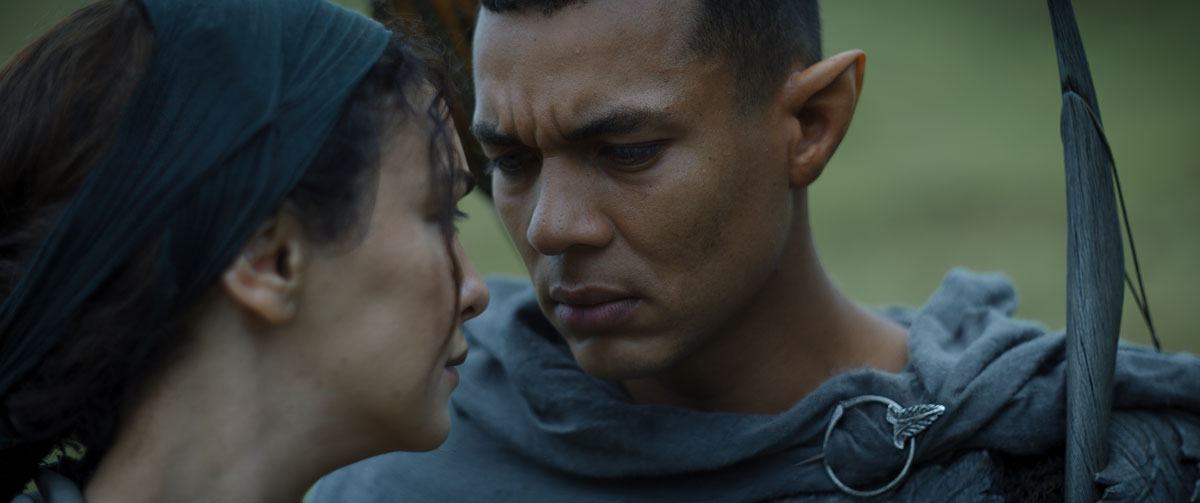
The Lord of the Rings: Rings of PowerNazanin Boniadi (Bronwyn), Ismael Cruz Córdova (Arondir) in “The Lord of the Rings: Rings of Power” (Prime Video)There are traces of evidence that Tolkien did not imagine “good” peoples as exclusively white. The ways these are expressed still sometimes reinforce racial hierarchies. In “The Return of the King,” some people who fight against Sauron are counted as

men of Gondor, yet their blood was mingled, and there were short and swarthy folk among them” because some of their ancestors are not “High Men of the West.”

“Good” species and races in Middle-Earth are constructed through references to European cultures (especially northwestern Europe), and the “bad” races are constructed through orientalist stereotypes. Tolkien’s letters show the ways that real-world ideas about race influenced Middle-Earth. He wrote “I do think of the ‘Dwarves’ like Jews: at once native and alien in their habitations.”

In a 1958 letter about a film treatment of The Lord of the Rings he wrote:

Orcs are . . .  squat, broad, flat-nosed, sallow-skinned, with wide mouths and slant eyes; in fact degraded and repulsive versions of the (to Europeans) least lovely Mongol types.

There is evidence that he revised his representation of Dwarves between “The Hobbit” and “The Lord of the Rings” to try move away from antisemitic stereotypes. There is no such evidence for Orcs even though he wrestled with the moral problem of a purely “evil” species of beings.

The combination of racial stereotypes and hierarchies built into Middle-Earth make Tolkien’s work appealing to racists and a useful political tool for the far-right. There is, however, more to the world and stories he created.

Being troubled by racism is also not just a new “woke” reading of Tolkien’s writing. C.S. Lewis wrote a review in 1955 of “Lord of the Rings” that reported some readers “imagine they have seen a rigid demarcation between Black and white people” draw along clear moral lines.

Given Lewis was Tolkien’s friend, it’s not surprising that he defended the books. A letter in the fanzine Xero from 1963 expressed concern about “subtle racism,” hierarchies within humanity, and “monochromatic” representation of elves and orcs in Middle-Earth.

The contradiction in Tolkien’s world

The need to overcome differences to form alliances and make the world better is a central theme in Tolkien’s writing. Evil is defeated only when different peoples of Middle-earth, such as Elves, Dwarves and Humans, fight against it together.

The prosocial values of cooperation and acting for the good of others are embedded in Tolkien’s stories of Middle-earth. They are also at odds with racism and fascism which see “others” as not only different but inferior, dangerous, not to be trusted, that is, as enemies.

Scholar and fan Dimitra Fimi has written:

Tolkien’s racial prejudices are implicit in Middle-Earth, but his values – friendship, fellowship, altruism, courage, among many others – are explicit, which makes for a complex, more interesting world.

Protecting Tolkien’s legacy

Casting actors of color to play Elves, Dwarves and Harfoots in “The Rings of Power” does not insert beings who are not white into the imaginary world of Middle-Earth. They were already there, constructed through outdated (even for Tolkien’s time) concepts of racial difference among humans and false stereotypes about real peoples.

Tolkien’s imagination was vast and varied, but it was not without limits. The world he created reflected some of the worst aspects of reality with its racist stereotypes and hierarchies.

All adaptations, including of Tolkien’s writings, change their source material in ways that reflect the time and place in which they are made.

With “The Rings of Power,” Amazon, the Tolkien Estate (headed by his grandson Simon) and their partners have decided to protect the positive, humane aspects of Tolkien’s legacy which represented the best, rather than the limits, of his imagination.

Helen Young, Lecturer, Deakin University

This article is republished from The Conversation under a Creative Commons license. Read the original article.

Is there cyanide lurking in your summer peaches?

Some foods really ought to have a safe word. They should let you know when things are going too far, when you ought to stop. Get out of hand with a stone fruit, for instance, and it might try to poison you.

When, earlier this month, writer Hanna Phifer posed the question on Twitter, “What’s the most outlandish thing a customer has ever asked you?” content creator Henny immediately knocked it out of the park with a shocking, viral response. “A woman asked me to blend cherry pits into her son’s smoothie,” they wrote. “I explained that pit fruit has cyanide compounds that can literally be lethal if ground up and ingested. she yelled at me because I refused to do what she asked and demanded the regional manager’s contact.”


Want more health and science stories in your inbox? Subscribe to Salon’s weekly newsletter The Vulgar Scientist.


It’s a darkly entertaining story, perfectly told, an anecdote that feels like it would be at home in a “Knives Out” sequel or a Shirley Jackson novel. And its accuracy makes it all the more chilling. The inside of cherry pits and other drupes like peaches and plums do indeed contain a chemical called amygdalin, which when ingested, is converted to cyanide. “Not a day goes by,” Henny added, “that I don’t think about how this woman was trying to make me an accomplice in her son’s murder.” But how lethal, exactly, would that smoothie have been? How bad would it be — not just for my Vitamix — if I accidentally chucked a whole fruit into the blender this morning?

If you unwittingly swallow a whole cherry pit because your French friend insists it’s not really clafoutis if you’re not spitting out seeds at the dinner table, don’t lose sleep over it. The worst that will likely happen is an uncomfortable eventual experience when that pit finishes its journey, intact, through your digestive system.

It’s not the pit itself that’s the problem. It’s the components inside — that’s why crushing, grinding, or chewing the pits raises the risks. The same warning holds true for other the pits of other fruits, like apples and pears as well. Children are more vulnerable to the effects. If you or your child have reason for concern, Healthline advises to seek immediate medical attention for symptoms of serious toxicity including “headache, nausea, seizures, convulsions, and difficulty breathing.” 

The good news for the little boy in that Twitter tale is that, even had his mother given her smoothie order to a less scrupulous person, he probably would have been okay anyway. As the National Capital Poison Center explains, “small unintentional ingestions generally do not cause harm.” The key word here, however, is “small.”

There are other common foods that fall into the not completely harmless category as well. Potatoes that have turned green or sprouted can contain compounds known as glycoalkaloids, which research from the National Library of Medicine warns can cause diarrhea, nausea, vomiting and other “gastro-intestinal disturbances.” European research has even found that “In severe cases, paralysis, respiratory insufficiency, cardiac failure, coma and death have been reported.” Just do yourself a favor and throw away any potatoes with a sketchy tinge.

Kidney beans contain a protein called lectin that can lead to nausea, vomiting and diarrhea if they’re consumed raw or undercooked. Even a small amount can make you ill, so cook your beans thoroughly and at a high enough temperature. Mango skin contains a chemical called urushiol, which can cause an allergic reaction similar to that of poison ivy in some people. Peel your mango. Rhubarb leaves are high in oxalic acid, and eating them can result in shortness of breath, nausea, vomiting, and in rare cases, kidney stones and even death. Stick to the stalks.

Most people with common sense would naturally avoid things like green potatoes and raw beans. But what makes that Twitter cherry pit story different is that there really are plenty of people who intentionally consume these kinds of things. In 2017, a 67-year-old Melbourne man’s doctors were baffled by the low level of oxygen in his red blood cells — until they learned he’d been consuming an apricot kernel supplement as a supposed cancer preventative. As HuffPost reported at the time, “Blood tests revealed he had cyanide in his bloodstream at 25 times acceptable levels.”

Memorial Sloan Kettering advises that “Although laboratory experiments suggest anticancer properties, clinical evidence does not support this use,” adding that the product “has been linked to several cases of cyanide poisoning in cancer patients.” Yet the quackery around the kernels remains, evidenced by the rampant testimonials for “a highly effective treatment for cancer” on Amazon for a similar product. The issue gets even more complicated because the extract of apricot kernels, properly handled, can be a culinary delicacy. Oh, and did I mention that apricot kernels look near-identical to delicious and not-deadly almonds? 

The easiest way to avoid getting sick is to just educate yourself and your kids about what fruits — especially otherwise seemingly benign ones — can pose a risk. When it comes to fruits, Poison Control advises clearly, “Pits should never be crushed or chewed. Children should be taught to spit out the seeds/pits when snacking on stone fruits.” And don’t be ignorant by ever feeding them to your child — or worse, trying to bully your local smoothie maker into doing it.

Space agriculture boldly grows food where no one has grown before

Whether to spend money on outer space exploration or to apply it to solve serious problems on Earth, like climate change and food shortages, is a contentious debate. But one argument in favor of space exploration highlights benefits that do, in fact, help study, monitor and address serious concerns like climate change and food production.

As access to space increases, the potential for terrestrial benefits directly tied to space exploration grow exponentially.

For example, agriculture has been improved significantly through the application of space-based advances to terrestrial challenges. It is now increasingly likely that food items have been produced with the assistance of space-based technologies, like freeze-dried foods, or through the use of crop monitoring from space-based observatories.

Monitoring farmlands

Satellite monitoring is arguably the most realized benefit of space for farming. Like mindful eyes in the sky, satellites watch over the farmlands across the globe day and night. Specialized sensors on relevant satellites (for example, NASA’s Landsat, the European Space Agency’s Envisat and the Canadian Space Agency’s RADARSAT) monitor various parameters relevant to agriculture.

Sensors monitoring soil moisture can tell us when and how fast soils are drying, helping direct more efficient irrigation on a regional scale. Weather satellites help predict drought, floods, precipitation patterns and plant disease outbreaks.

Satellite data helps us predict food insecurity threats or crop failures.

Plant science

It’s not only lifeless machines that dwell in space. Humans have managed to survive and grow plants in low-Earth orbit aboard several spacecraft and stations. Space is the ultimate “harsh environment” for life to exist in, including plants, due to such novel stressors as cosmic radiation and lack of gravity.

Space biologist Anna-Lisa Paul describes plants as being able to “reach into their genetic toolbox and remake the tools they need” to adapt to the novel environment of space. The new tools and behaviors expressed by plants under spaceflight conditions could be used to solve challenges facing crops in Earth’s changing climate.

Researchers at NASA sent cotton seeds to the International Space Station to understand how cotton roots grow in the absence of gravity. The findings of the research will help develop cotton plant varieties with a deeper root system to access and absorb water more efficiently from soil in drought-prone areas.


Space biologist Anna-Lisa Paul describes how plants respond to stress, and what that can teach us.

Farming technologies

Soon, humans will go to the moon and eventually to Mars. While there, astronauts will have to grow their own food.

Space agencies have been working on specialized systems that provide the conditions necessary for plant cultivation in space. These systems are containers that can control the internal environment and grow plants without soil under LED lights. NASA’s research in controlled environment systems to grow plants was foundational in developing the modern-day vertical farm sector — indoor farms that grow crops in stacks without soil under the purple haze of LEDs.

Now a burgeoning industry, vertical farms are churning out enormous volumes of fresh and healthy leafy crops with a fraction of the water and nutrients that would be used in land-based farm systems. Vertical farms can be set up within cities, right where the demand lies, thereby cutting the need for long-distance transport.

As crops are grown indoors in controlled environments, vertical farms can substantially reduce the reliance on herbicides and pesticides, while recycling water and preventing nutrient runoff.

Space agriculture, Earth benefits

Considering the constraints of space, crop production techniques need to be more energy-efficient and require minimal human input. Crops need to also be nutrition-rich, with the ability to withstand high-stress environments. These features are also desirable for crops on Earth.

Scientists are developing a more resource-efficient potato crop where the whole plant can be consumed, including roots, shoots and fruits. Such crops will play a pivotal role in addressing food and nutritional security on Earth and in space.

Space exploration has served as a major driver for technological advances. The renewed interest in space can only benefit agriculture here on Earth by providing new opportunities to improve agriculture. Innovations that are quite literally out-of-this-world can provide us tools to tackle food production under the looming threats posed by global climate change.

Ajwal Dsouza, PhD Candidate, Environmental Sciences, University of Guelph and Thomas Graham, Assistant Professor, Environmental Sciences, University of Guelph

This article is republished from The Conversation under a Creative Commons license.

Cliff Curtis on his “slow burn” Maori cop thriller “Muru” and how it’s like “Avatar”

The New Zealand actor Cliff Curtis has Māori roots, and so does his character, Sgt. “Taffy” Tawharau, in his intense and powerful new film, “Muru,” receiving its international premiere at the Toronto Film Festival. The role is quite far removed from the rich businessman Curtis played in “Murina” released a few months ago, though it does have an interesting connection to Curtis’ work in “Avatar.” 

” When I first got opportunities to be in central roles exploring Māori themes that were central to the narrative, I realized there were so many stories that I wanted to tell about my culture.”

Taffy is a community police sergeant in the Ruatoki valley, home to a close-knit population of Tūhoe, indigenous Māori people who speak Te Reo Māori. When the New Zealand police force, led by Gallagher (Jay Ryan) come to the Ruatoki valley with the goal of arresting Tame Iti (playing himself, and whose story the film is partly based on), Taffy tries to prevent tensions from escalating. Tame Iti is being investigated for “possible collusion;” the New Zealand police think his Rama (a boot camp) is operating a homegrown terrorist cell with plans to take down the Prime Minister. Other characters, such as the teenage Rusty (Poroaki Merritt-McDonald), a local troublemaker, are also under surveillance and considered suspect.

What emerges is an exciting cop story that depicts an egregious episode of racism based on several raids that have occurred in the Ruatoki valley against the Tūhoe people since 1916. “Muru” is “a response, not a reaction,” to those raids, according to a title card in the film’s opening credits. 

Curtis talked with Salon about his new film and the Māori history it depicts. 

I am glad to see you in a Māori film. Can you talk about the importance of indigenous cinema in New Zealand and the opportunities you have as a Māori actor? 

It means a lot to me. I started off in cinema 30 years ago. My first film was “The Piano,” and I was in the background of the main action. I had some great scenes that didn’t make the cut. I was one of the men who carried the piano from the beach to the house. I often joke about that role, and a number of the roles I’ve played as Māori that have had that aspect [of being in the background]. When I first got opportunities to be in central roles exploring Māori themes that were central to the narrative, I realized there were so many stories that I wanted to tell about my culture, and where I am from. Contemporary things, historical things, comedy, drama, now action. It opened a whole world of possibility of stories that can reflect back to me and my own people who we are as opposed to being in the backdrop of someone else’s story.  

I first saw you in films such as “Desperate Remedies,” and “Once Were Warriors,” which introduced me to Māori culture. 

“Desperate Remedies” brought me to a festival in New York, and “Once Were Warriors” went to Cannes. Those two films helped me see the world and the potential of cinema. At the beginning of my career, theater was my passion and obsession. When I discovered cinema through “The Piano,” which was an incredible film, I started to see the humanity that was available in ways I had not thought were possible. It helped me discover arthouse movies. The first film I ever saw was Bruce Lee’s “Enter the Dragon,” which was amazing, so when I started working in films like “The Piano,” arthouse movies, it was a whole world I didn’t know about. “Desperate Remedies” was ahead of its time. It was beautifully realized. It didn’t hold anything back. It was so outrageous and brave and unapologetic. It’s a fantastic film. 

I appreciate that you are playing a cop in a film that presents a history of incidents against the Māori that are probably little known in North America. Can you talk about the real-life stories and Tame Iti that inspired “Muru?” 

In the early 1900s, our nation suffered a flu epidemic and tragically, the Tūhoe tribe didn’t have confidence in the policies of government at the time and decided to self-isolate. The government didn’t think that was a good idea and raided the Tūhoe tribe because they didn’t like that they were taking their own course.

MuruAuthorities lead Tame Iti away in “Muru” (Jawbone Pictures, Wheke Group Limited)
The 2007 raid was based on 2001 and September 11, when there was a huge global concern about terrorism. They profiled Tame Iti, an artist. He’s been involved in many theatrical, artistic pursuits but was also a political activist, and he was profiled as a domestic terrorist by the government and the police forces. It was really shameful and embarrassing. He went to jail because he had an unlicensed firearm.

“The name of the film is ‘Muru,’ which means ‘forgive.'”

What is absurd is that they could have had a cup of tea and talked to him. A lot of the regional police are Māori and were not informed about what was happening in the area. They were not sought out for advice about how to proceed. It became very embarrassing for the government and everyone, but for the people of Tūhoe, it caused multigenerational trauma as a result. The police force and the government actually did make a very public apology. It was great for them to do that and come to their senses and take responsibility for the mess that they made, not just in 2007, but in the early 1900s. 

The film is not a factual movie or trying to capture the actual events. It’s fictionalized, and a more poetic approach to what I like to term as an allegorical story. It takes those events and turns it into an action thriller with heart. But it is a response to these things, not just the 2007 raids, but a response between the relationship between this tribe and the government and how that unfolds.

I took this as a story about racism and discrimination by the police. It can be analogous to the Black Lives Matter movement in America, or the way immigrants are treated in Europe. 

“As Māori, getting instruction from the government to act upon our own people is a tough place to be.”

It’s easy to make those connections and I think it’s meaningful to do that. It’s not simply coincidental or opportunistic in any way. It’s timely in that the film has arrived when we have language around these things and ways of discussing these things. The name of the film is “Muru,” which means “forgive.” The film is a response to those events and about forgiveness. 

Culturally, for Māori, traditional values would say that stories are purposeful. When we tell a story it’s important to consider the purpose and value of it. Why go back into a painful past when an apology has already been given and accepted? There is only one purpose that makes it worthwhile, which is to forgive. The film offers a challenge to that. Forgive who? Forgive what? And could you forgive so easily? It brings up those kinds of emotions which are very visceral. 

I liked Taffy’s integrity and ethics. He tries to maintain peace but is forced to act to save others. He tries to communicate with Gallagher and others, and they just refuse to listen. Can you talk about his character?

Taffy is short for Tawharau, which means, “to shelter” — he’s a quintessential country cop. I talked to one of my cousins who is a police officer as well as policemen involved on both sides of the line to get a take on it. As Māori, getting instruction from the government to act upon our own people is a tough place to be. We take care of our people, and when the government or someone high up in the police force gets it wrong, they are really conflicted. I spoke to a number of regional police who were Māori and completely shut out. They were shocked by what happened. It was a precarious situation. When you are one country cop working with all of your cousins, aunties, uncles, etc. and the armed forced turn up and they look at you like, “What is happening?” You look like an absolute traitor. 

I love that conflict and that he doesn’t get it right. He’s not a superhero, or smarter or stronger or faster than anyone else. He is just a guy trying to do right thing by everyone around him. At its heart, the film asks, what are we forgiving? I like that Taffy makes mistakes. He is trying to navigate this with all his integrity. It’s messy and hard. He knows the [authorities] are getting it wrong and he tries to protect his community from an institution that is failing his people. That’s a big conflict. 

The Tūhoe community in the film seems very close-knit. Taffy is caring for his father, and he drive the kids to school, and looks out for Rusty, who gets into trouble. What can you say about how the Māori people are depicted in the film and the discrimination they face? 

It’s low-hanging fruit. If you want to hate a community or want a political punching bag, go find a community that is dispossessed and struggling. It’s easy to do a takedown on people that are vulnerable. Our writer/director, Tearepa Kahi, could have told the story from any angle or character. Tame Iti would have been an amazing central figure. Rusty keeps finding himself at the center of things. Was he the cause of it? Youth are everything in a small community. Trying to save one kid is huge. For a community cop to help a friend’s child, that’s the job. It’s not to get him in jail it’s to save the next generation of indigenous children from going off the rails. 

I appreciate that “Muru” becomes an action film only after we learn about and care for the characters.

Most movies, if you follow the Hollywood formula, have a single protagonist, a single antagonist, and are about good versus evil, and right versus wrong — here’s the good guy, here’s the bad guy. “Muru” tell the story about a community and the impact on generations. Tearepa wanted to make something generations would see. It’s doing well back home. It is No. 1 at the box office. I’m getting messages from 15- to 70-year-olds. It’s a huge win for us. We are speaking to a broad spectrum of an audience.

It’s a slow burn, but it picks up pace. Having a more complex beginning means that when it started to get into the action sequences, you care about what happens. Otherwise, it’s just action, and not everyone is satisfied by just action. There’s an audience that loves that, but for a story with heart, it’s about caring about what’s happening to people we are portraying. It seems to be landing. People are having an emotional response to it.


Want a daily wrap-up of all the news and commentary Salon has to offer? Subscribe to our morning newsletter, Crash Course.


What observations do you have about your career and the roles you are offered? You have played an assortment of characters of different ethnicities and make both Hollywood blockbusters and independent films. But “Muru” is one of the rare films you have headlined. You are shifting from being a character actor to being a lead. 

It’s a treat to play characters and have more of a canvas to play on and do it over more scenes in the same time frame. I try to make all my characters have the same sense of life to them. I have done an array of different kinds of roles and in different films, independent films, Hollywood films, franchises, and when I get home, I get to do films that are meaningful to me. I always look for roles that give me an opportunity to have a more nuanced and complex journey, to touch on the humanity of the character.

I like making the link between “Muru” and “Avatar,” which is coming up later in the year. Coincidentally, they are about the impact on Indigenous peoples, which is crazy when you think about the difference in scale of the movies. And there is the fun fact that both my characters are blue!

Selling “longtermism”: How PR and marketing drive a controversial new movement

In a recent podcast interview with Griftonomics about the increasingly influential ideology known as “longtermism,” I was asked at the end “So, what’s the grift?” The difficulty in answering this is not what to say but where to start.

Longtermism emerged from a movement called “Effective Altruism” (EA), a male-dominated community of “super-hardcore do-gooders” (as they once called themselves tongue-in-cheek) based mostly in Oxford and the San Francisco Bay Area. Their initial focus was on alleviating global poverty, but over time a growing number of the movement’s members have shifted their research and activism toward ensuring that humanity, or our posthuman descendants, survive for millions, billions and even trillions of years into the future.

Although the longtermists do not, so far as I know, describe what they’re doing this way, we might identify two phases of spreading their ideology: Phase One involved infiltrating governments, encouraging people to pursue high-paying jobs to donate more for the cause and wooing billionaires like Elon Musk — and this has been wildly successful. Musk himself has described longtermism as “a close match for my philosophy.” Sam Bankman-Fried has made billions from cryptocurrencies to fund longtermist efforts. And longtermism is, according to a UN Dispatch article, “increasingly gaining traction around the United Nations and in foreign policy circles.”

Phase Two is what we’re seeing right now with the recent media blitz promoting longtermism, with articles written by or about William MacAskill, longtermism’s poster boy, in outlets like the New York Times, the New Yorker, the Guardian, BBC and TIME. Having spread their influence behind the scenes over the many years, members and supporters are now working overtime to sell longtermism to the broader public in hopes of building their movement, as “movement building” is one of the central aims of the community. The EA organization 80,000 Hours, for example, which was co-founded by MacAskill to give career advice to young people (initially urging many to pursue lucrative jobs on Wall Street), “rates building effective altruism a ‘highest priority area’: a problem at the top of their ranking of global issues.”

But buyer beware: The EA community, including its longtermist offshoot, places a huge emphasis on marketing, public relations and “brand-management,” and hence one should be very cautious about how MacAskill and his longtermist colleagues present their views to the public.

As MacAskill notes in an article posted on the EA Forum, it was around 2011 that early members of the community began “to realize the importance of good marketing, and therefore [were] willing to put more time into things like choice of name.” The name they chose was of course “Effective Altruism,” which they picked by vote over alternatives like “Effective Utilitarian Community” and “Big Visions Network.” Without a catchy name, “the brand of effective altruism,” as MacAskill puts it, could struggle to attract customers and funding.

It’s easy for this approach to look rather oleaginous. Marketing is, of course, ultimately about manipulating public opinion to enhance the value and recognition of one’s products and brand. To quote an article on Entrepreneur’s website,

if you own a business, manipulation in marketing is part of what you do. It’s the only way to create raving fans, sell them products and gain their trust. Manipulation is part of what you do, so the trick isn’t whether you do it or not — but rather how you do it.

This is exactly what we see in the ongoing promotion of MacAskill’s new book What We Owe the Future,” which offers an easy-to-understand version of longtermism designed for mass consumption.

“Longtermism” has a feel-good connotation because it suggests long-term thinking, but longtermism the worldview is an ideology built on radical and highly dubious philosophical assumptions that could be extremely dangerous.

Consider the word “longtermism,” which has a sort of feel-good connotation because it suggests long-term thinking, and long-term thinking is something many of us desperately want more of in the world today. However, longtermism the worldview goes way beyond long-term thinking: it’s an ideology built on radical and highly dubious philosophical assumptions, and in fact it could be extremely dangerous if taken seriously by those in power. As one of the most prominent EAs in the world, Peter Singer, worried in an article that favorably cites my work:

Viewing current problems through the lens of existential risk to our species can shrink those problems to almost nothing, while justifying almost anything that increases our odds of surviving long enough to spread beyond Earth.

It’s unfortunate, in my view, that the word “longtermism” has been defined this way. A much better – but less catchy – name for the ideology would have been potentialism, as longtermism is ultimately about realizing humanity’s supposed vast “longterm potential” in the cosmos.

The point is that since longtermism is based on ideas that many people would no doubt find objectionable, the marketing question arises: how should the word “longtermism” be defined to maximize the ideology‘s impact? In a 2019 post on the EA Forum, MacAskill wrote that “longtermism” could be defined “imprecisely” in several ways. On the one hand, it could mean “an ethical view that is particularly concerned with ensuring long-run outcomes go well.” On the other, it could mean “the view that long-run outcomes are the thing we should be most concerned about” (emphasis added).

The first definition is much weaker than the second, so while MacAskill initially proposed adopting the second definition (which he says he’s most “sympathetic” with and believes is “probably right”), he ended up favoring the first. The reason is that, in his words, “the first concept is intuitively attractive to a significant proportion of the wider public (including key decision-makers like policymakers and business leaders),” and “it seems that we’d achieve most of what we want to achieve if the wider public came to believe that ensuring the long-run future goes well is one important priority for the world, and took action on that basis.”

The weaker first definition was thus selected, essentially, for marketing reasons: it’s not as off-putting as the second, and if people accept it, that may be enough for longtermists to get what they want.

The importance of not putting people off the longtermist or EA brand is much-discussed among EAs — for example, on the EA Forum, which is not meant to be a public-facing platform, but rather a space where EAs can talk to each other. As mentioned above, EAs have endorsed a number of controversial ideas, such as working on Wall Street or even for petrochemical companies in order to earn more money and then give it away. Longtermism, too, is built around a controversial vision of the future in which humanity could radically enhance itself, colonize the universe and simulate unfathomable numbers of digital people in vast simulations running on planet-sized computers powered by Dyson swarms that harness most of the energy output of stars.


Want a daily wrap-up of all the news and commentary Salon has to offer? Subscribe to our morning newsletter, Crash Course.


For most people, this vision is likely to come across as fantastical and bizarre, not to mention off-putting. In a world beset by wars, extreme weather events, mass migrations, collapsing ecosystems, species extinctions and so on, who cares how many digital people might exist a billion years from now? Longtermists have, therefore, been very careful about how much of this deep-future vision the general public sees.

For example, MacAskill says nothing about “digital people” in “What We Owe the Future,” except to argue that we might keep the engines of “progress” roaring by creating digital minds that “could replace human workers — including researchers,” as “this would allow us to increase the number of ‘people’ working on R&D as easily as we currently scale up production of the latest iPhone.” That’s a peculiar idea, for sure, but some degree of sci-fi fantasizing certainly appeals to some readers.

But does MacAskill’s silence about the potential for creating unfathomable numbers of digital people in vast simulations spread throughout the universe mean this isn’t important, or even central, to the longtermist worldview? Does it imply that criticisms of the idea and its potentially dangerous implications are — to borrow a phrase from MacAskill’s recent interview with NPR (which mentions my critiques) — nothing more than “attacking a straw man”?

MacAskill says nothing in his new book about the potential for unfathomable numbers of “digital people” in vast simulations spread throughout the universe. Does that mean that idea isn’t central to the longtermist worldview?

I don’t think so, for several reasons. First, note that MacAskill himself foregrounded this idea in a 2021 paper written with a colleague at the Future of Humanity Institute, an Oxford-based research institute that boasts of having a “multidisciplinary research team [that] includes several of the world’s most brilliant and famous minds working in this area.” According to MacAskill and his colleague, Hilary Greaves, there could be some 1045 digital people — conscious beings like you and I living in high-resolution virtual worlds — in the Milky Way galaxy alone. The more people who could exist in the future, the stronger the case for longtermism becomes, which is why longtermists are so obsessed with calculating how many people there could be within our future light cone.

Furthermore, during a recent “Ask Me Anything” on Reddit, one user posed this question to MacAskill:

In your book, do you touch on the long-term potential population/well-being of digital minds? I feel like this is something that most people think is too crazy-weird, yet (to me) it seems like the future we should strive for the most and be the most concerned about. The potential population of biological humans is staggeringly lower by comparison, as I’m sure you’re aware.

To this, MacAskill responded: “I really wanted to discuss this in the book, as I think it’s a really important topic, but I ended up just not having space. Maybe at some point in the future!” He then linked to a paper titled “Sharing the World with Digital Minds,” coauthored by Nick Bostrom, who founded the Future of Humanity Institute and played an integral role in the birth of longtermism. That paper focuses, by its own account,

on one set of issues [that] arise from the prospect of digital minds with superhumanly strong claims to resources and influence. These could arise from the vast collective benefits that mass-produced digital minds could derive from relatively small amounts of resources. Alternatively, they could arise from individual digital minds with superhuman moral status or ability to benefit from resources. Such beings could contribute immense value to the world, and failing to respect their interests could produce a moral catastrophe, while a naive way of respecting them could be disastrous for humanity.

This suggests that digital people are very much on MacAskill’s mind, and although he claims not to have discussed them in his book due to space limitations, my guess is that the real reason was concern that the idea might sound “too crazy-weird” for general consumption. From a PR standpoint, longtermists at Bostrom’s Future of Humanity Institute no doubt understand that it would be bad for the movement to become too closely associated with the idea of creating enormous populations of digital beings living in virtual-reality worlds throughout the universe. It could cause “brand damage,” to borrow a phrase from MacAskill, as critics might well charge that focusing on digital people in the far future can only divert attention away from the real-world problems affecting actual human beings.

Indeed, the early EA movement experienced a degree of brand damage because it initially recommended, loudly and proudly, that many EAs should “earn to give” by working on Wall Street or for petrochemical companies. As an article by MacAskill for the 80,000 Hours organization states:

When 80,000 Hours first launched, we led with the idea of earning to give very heavily as a marketing strategy; it was true that we used to believe that at least a large proportion of people should aim to earn to give long-term; earning to give is much simpler and more memorable than our other recommendations; and earning to give is controversial, so the media love to focus on it.

Yet, MacAskill adds, “giving too much prominence to earning to give may nevertheless have been a mistake.” As the EA movement gained more attention, this marketing decision seemed to backfire, as many people found the idea of working for “evil” companies in order to donate more money to charity highly objectionable.

This foregrounds an important point noted by many in the EA community: Movement-building isn’t just about increasing awareness of the EA brand; it also requires strategically enhancing its favorability or, as some would say, the inclination people have toward it. Both of these can be “limiting factors for movement growth, since a person would need to both know what the movement is and have a positive impression of it to want to become involved.” Or to quote another EA longtermist at the Future of Humanity Institute:

Getting movement growth right is extremely important for effective altruism. Which activities to pursue should perhaps be governed even more by their effects on movement growth than by their direct effects. … Increasing awareness of the movement is important, but increasing positive inclination is at least comparably important.

Thus, EAs — and, by implication, longtermists — should in general “strive to take acts which are seen as good by societal standards as well as for the movement,” and “avoid hostility or needless controversy.” It is also important, the author notes, to “reach good communicators and thought leaders early and get them onside” with EA, as this “increases the chance that when someone first hears about us, it is from a source which is positive, high-status, and eloquent.” Furthermore, EAs

should probably avoid moralizing where possible, or doing anything else that might accidentally turn people off. The goal should be to present ourselves as something society obviously regards as good, so we should generally conform to social norms.

In other words, by persuading high-status, “eloquent” individuals to promote EA and by presenting itself in a manner likely to be approved and accepted by the larger society, the movement will have a better chance of converting others to the cause. Along the same lines, the Centre for Effective Altruism compiled a lengthy document titled “Advice for Responding to Journalists,” which aims to control EA’s public image by providing suggestions for interacting with the media. Movement advocates should, for example, “feel free to take a positive tone about EA, but don’t oversell it,” “be gracious about people with differing viewpoints or approaches to doing good,” and “be calm and even-handed.” Meanwhile, articles like the one you’re reading, which are critical of EA, are “flagged” so that leaders of the movement can decide “whether some kind of response makes sense.”

In yet another article on movement-building, the author, an employee at the Centre for Effective Altruism who was formerly a professional poker player, suggests that neoliberalism could provide a useful template, or source of inspiration, for how EA might become more influential. “Neoliberalism,” they write, “has two distinct characteristics that make it relevant for strategic movement builders in the EA community.”

One article on movement-building suggests that the global success of neoliberalism could provide a useful template for how EA can become more influential.

The first is that neoliberalism “was extremely successful, rising from relative outcast to the dominant view of economics over a period of around 40 years.” And second, it was “strategic and self-reflective,” having “identified and executed on a set of non-obvious strategies and tactics to achieve [its] eventual success.” This is not necessarily “an endorsement of neoliberal ideas or policies,” the author notes, just an attempt to show what EA can learn from neoliberalism’s impressive bag of tricks.

Yet another article addresses the question of whether longtermists should use the money they currently have to convert people to the movement right now, or instead invest this money so they have more of it to spend later on.

It seems plausible, the author writes, that “maximizing the fraction of the world’s population that’s aligned with longtermist values is comparably important to maximizing the fraction of the world’s wealth controlled by longtermists,” and that “a substantial fraction of the world population can become susceptible to longtermism only via slow diffusion from other longtermists, and cannot be converted through money.” If both are true, then

we may want to invest only if we think our future money can be efficiently spent creating new longtermists. If we believe that spending can produce longtermists now, but won’t do so in the future, then we should instead be spending to produce more longtermists now instead.

Such talk of transferring the world’s wealth into the hands of longtermists, of making people more “susceptible” to longtermist ideology, sounds — I think most people would concur — somewhat slimy. But these are the conversations one finds on the EA Forum, between EAs.

What’s the long-term grift here? To use cold-blooded strategy, marketing and manipulation to build the movement, and ultimately to maximize “the fraction of the world’s wealth controlled by longtermists.”

So the grift here, at least in part, is to use cold-blooded strategizing, marketing ploys and manipulation to build the movement by persuading high-profile figures to sign on, controlling how EAs interact with the media, conforming to social norms so as not to draw unwanted attention, concealing potentially off-putting aspects of their worldview and ultimately “maximizing the fraction of the world’s wealth controlled by longtermists.” This last aim is especially important since money — right now EA has a staggering $46.1 billion in committed funding — is what makes everything else possible. Indeed, EAs and longtermists often conclude their pitches for why their movement is exceedingly important with exhortations for people to donate to their own organizations. Consider MacAskill’s recent tweet:

While promoting What We Owe The Future I’m often asked: “What can I do?” … For some people, the right answer is donating, but it’s often hard to know where the best places to donate are, especially for longtermist issues. Very happy I now have the Longtermism Fund to point to!

The Longtermism Fund is run by an organization called Giving What We Can, which was co-founded by MacAskill. Hence, as the scholar and podcaster Paris Marx put it on Twitter: “Want to preserve the light of human consciousness far into the future? You can start by giving me money!”

In fact, EAs have explicitly worried about the “optics” of self-promotion like this. One, for example, writes that “EA spending is often perceived as wasteful and self-serving,” thus creating “a problematic image which could lead to external criticism, outreach issues, and selection effects.” An article titled “How EA Is Perceived Is Crucial to Its Future Trajectory” similarly notes that “the risk” of negative coverage on social media and in the press “is a toxic public perception of EA, which would result in a significant reduction in resources and ability to achieve our goals.”

Another example of strategic maneuvering to attract funding for longtermist organizations may be the much-cited probability estimate of an “existential catastrophe” in the next 100 years that Toby Ord gives in his 2020 bookThe Precipice,” which can be seen as the prequel to MacAskill’s book. Ord claims that the overall probability of such a catastrophe happening is somewhere around one in six. Where did he get this figure? He basically just pulled it out of a hat. So why did he choose those specific odds rather than others? 

First, as I’ve noted here, these are the odds of Russian roulette, a dangerous gamble that everyone understands. This makes it memorable. Second, the estimate isn’t so low as to make longtermism and existential risk studies look like a waste of time. Consider by contrast the futurist Bruce Tonn’s estimate of human extinction. He writes that the probability of such a catastrophe “is probably fairly low, maybe one chance in tens of millions to tens of billions, given humans’ abilities to adapt and survive.” If Ord had adopted Tonn’s estimate, he would have made it very difficult for the Future of Humanity Institute and other longtermist organizations to secure funding, capture the attention of billionaires and look important to governments and world leaders. Finally, the one-in-six estimate also isn’t so high as to make the situation appear hopeless. If, say, the probability of our extinction were calculated at 90%, then what’s the point? Might as well party while we can.

What Ord wanted, it seems to me, was to hit the sweet spot — a probability estimate alarming enough to justify more money and attention from governments and billionaires, but not so alarming that people are frightened away, or dismiss it as doomsday alarmism.

All of this is to say that you, the reader who is perhaps encountering EA and longtermism for the first time, should maintain some skepticism about how the EA and longtermist visions are presented to the public. This goes for policymakers and politicians, too, although there are also efforts to “strategically channel EAs into the U.S. government,” which would make converting those who already hold power unnecessary. As the philosopher Simon Knutsson, who has published a detailed critique of EA, told me last year:

Like politicians, one cannot simply and naively assume that these people are being honest about their views, wishes, and what they would do. In the Effective Altruism and existential risk areas, some people seem super-strategic and willing to say whatever will achieve their goals, regardless of whether they believe the claims they make — even more so than in my experience of party politics.

Worse yet, the EA community has also sometimes tried to silence its critics. While advertising themselves as embracing epistemic “humility” and always being willing to change their minds, the truth is that EAs like the criticisms that they like, but will attempt to censor those they don’t. As David Pearce, an EA who co-founded the World Transhumanist Association with Bostrom back in 1998, recently wrote, referring to an article of mine: “Sadly, [Émile] Torres is correct to speak of EAs who have been ‘intimidated, silenced, or ‘canceled.’” In other words, cancel culture is a real problem in EA.

A striking example of this comes from an EA Forum post by Zoe Cremer, a research scholar at the Future of Humanity Institute. In 2021, she co-authored an excellent paper with the political scientist Luke Kemp that was critical of what they called the “techno-utopian approach,” found most clearly in Bostrom’s work. But this ended up being “the most emotionally draining paper we have ever written,” Cremer writes. Why? As she explains,

we lost sleep, time, friends, collaborators, and mentors because we disagreed on: whether this work should be published, whether potential EA funders would decide against funding us and the institutions we’re affiliated with, and whether the authors whose work we critique would be upset. 

Some “senior scholars within the field” even “tried to prevent [their] paper from being published,” telling Cremer and Kemp “in private that they were concerned that any critique of central figures in EA would result in an inability to secure funding from EA sources, such as Open Philanthropy.” The single “greatest predictor of how negatively a reviewer would react” to criticisms of EA, Cremer notes, “was their personal identification with EA.”

According to a New Yorker article about EA and longtermism, when Cremer later met with MacAskill to discuss her experience, she “felt that MacAskill, the movement leader who gave her the most hope, had listened perfunctorily and done nothing.” As Cremer later detailed on Twitter, MacAskill’s “role in EA leadership is to play the normal one, the public facing charming character who onboards skeptics. Maybe that’s also why talking to him felt like talking to the PR shopfront.” He seemed “curiously uncurious about ideas on how to tame hero-worshipping or robust decision-making mechanisms.”

This yields a very troubling picture, in my view. Effective Altruism and its longtermist offshoot are becoming profoundly influential in the world. Longtermism is ubiquitous within the tech industry, enthusiastically embraced by billionaires like Musk, encroaching into the political arena and now — in what I’m calling Phase Two of its efforts to evangelize — spreading all over the popular media.

To understand what’s really going on, though, requires peeking under the hood. Marketing, PR and brand management are the name of the game for EAs and longtermists, and this is why, I would argue, the general public should be just as skeptical about how EAs and longtermists promote their brand as they are when, say, Gwyneth Paltrow’s Goop tries to sell them an essential oil spray that will “banish psychic vampires.”

“Devil in Ohio” creator on reinventing the Satanic cult and that ending: “Is she a force for evil?”

Netflix’s “The Devil in Ohio” has the distinction of being the first show that I know for certain both my partner’s mother, grandmother and I watched. The age-defying appeal makes sense as “The Devil in Ohio” is a story of generations, as much the tale of Suzanne (the always compelling Emily Deschanel), a middle-aged therapist, wife and mother of three, as it is the story of Mae (a luminous Madeleine Arthur) a teen girl who ends up in the emergency room with a terrible wound cut into her back and a secret she won’t tell, at least not right away. 

It joins a bumper crop of Netflix shows that seem to be responding to our need for shorter stories, after a plethora of lengthy movies. The limited series is only eight episodes long, yet still manages to be a ride. Mae has escaped from a strict and cloistered cult in rural Ohio, and despite Suzanne’s acceptance of her into her own home, the girl has trouble adjusting (understandably, as do Suzanne’s daughters). Mae’s first meal with Suzanne’s family? She prays earnestly to Satan. 

While Suzanne’s determined to keep Mae from falling back into the clutches of the cult members who mean to burn her as a sacrifice, Suzanne’s own family one by one begins to resent Mae for what they perceive to be her underhanded narcissism. Chief among those is middle daughter Jules (Xaria Dotson), who is Mae’s age and eventually feels supplanted by her. Not only does Mae somehow become popular at school, a feat Jules has never achieved, but Mae also attracts Jules’ crush on the school newspaper. 

Mae is a complex, shifting character, difficult to read, to know her intentions — or if she’s simply falling back upon what she knows. This complexity is crystalized in the end of the series. Time has passed. Mae seems to have settled into a life with Suzanne (completely disrupting Suzanne’s family in the process), then Suzanne learns from a cop investigating the case that Mae went back to her cult family willingly, requiring Suzanne to “save” her. The last shot of the series is a dazzling image of an altar Mae has set up secretly in the woods with candles, roses, ribbons, offerings and an image of herself and Suzanne. To pray for what she wants, to the god she knows.

Daria Polatin adapted the series based on her novel of the same name. Salon talked with Polatin about Mae, reinventing the Satanic cult and that shocking ending.

This interview has been edited for length and clarity. 

What was the process of turning your book into this Netflix series?

Really exciting. And you know, a book is very interior. This was mostly told through Jules, her point of view. We’re really inside her head. And the horror kind of comes from that, Mae coming into her family and starting to displace her and gain her mother’s interest. It was really fun to tell the story through that lens.

I’ve been working on this story for eight years since we started the book. And so, moving into series I was really interested in: well, why does Suzanne take Mae home? Because that’s sort of the crux of the story, right? She brings in the outsider into the home. 

“The monster is the gap in our own psychology, the gap between who we are and who we think we are.” 

I was really interested in the series as more of a psychological study of Suzanne. What happened to her that made her do that? How far is she going to go to protect [Mae]? For me that became a really exciting thing about this series, to get to tell that story through her point of view, and have an incredible actress like Emily Deschanel play that role and give it so much life and depth and complexity. Then it was really fun also to open up some of the other storylines, to do the Detective Lopez [Gerardo Celasco] storyline, the kind of investigation part which we didn’t have the room for in the book. To get into Peter’s [Sam Jaeger] storyline, Suzanne’s husband, and see how it was affecting their marriage.

In the first episode, you see these little cracks between the characters, and then Mae comes in and makes those cracks chasms. She’s the catalyst for unearthing all this stuff that’s been there and destabilizing the family. We get to just watch them fall, watch the car crash, watch the crumble. It speaks to the fragility of relationships and groups and families . . . We’re all always wondering, is [Mae] a force for good? Is she a force for evil? Is she actually intentionally doing something to upset Jules or someone else? 

Or is she just a victim and a survivor looking for a safe place? We ask that question of her up until the very last moments of the show. So, she was a very intriguing character.

Devil in OhioCaroline Cave as Abigail Dodd and Madeleine Arthur as Mae Dodd in “Devil in Ohio” (Ricardo Hubbs/Netflix)
This really is a story of different women from different generations, Suzanne and Mae and Jules and also Mae’s mom. How did you decide to make it about the stories of all these women?

That’s what interests me as a writer and from my own background. I grew up with a mostly single mother and a sister, and I was always very interested in why my mom was the way she was, and then how that made me feel and react. Now I have a son, and how is the way I behave affecting him? The psychology is really interesting to me. 

Can you ever change the trauma? Can you ever outrun the trauma of your past is one of the big questions of this show, and, you know, Suzanne is in therapy; she says, “I’ve dealt with it. I’m good, I get it.” But then Mae’s presence unlocks this piece of her psyche that she hadn’t dealt with . . . It’s like what Dr. Daniels says, from Carl Jung, “Until you make the unconscious conscious, it will direct your life and you will call it fate.”

The monster is not some vampire or ghost or werewolf. The monster is the gap in our own psychology, the gap between who we are and who we think we are. 

What first inspired this story?

I think what has always interested me is the dynamics of micro communities and small groups. And what makes something just fitting into a group and what are the lines between that and a cult? If you have to wear your hair a certain way to fit in with a social group at school or dress a certain way or adopt certain beliefs in your in your family to fit in, to not have an argument at the dinner table, where are the lines between taking certain steps to fit in and then giving up your own ideas to buy into the group ideology? That gray line is very interesting to me. I had written this pilot, kind of about those ideas. And then our executive producer, Rachel Miller, came to me and she said, “I heard this true story of this girl who escaped from a Satanic cult, and the psychiatrist’s family took her in,” and I was like, “Oh my God. I have to tell that story.” I was just hooked from the beginning. We took the seeds of the story, the building blocks, and then built out from there and fictionalized it.

It’s interesting that it’s a Satanic cult because I went into it not knowing anything. You might assume something from Mae’s more modest, conservative dress, but we discover at the end of the first episode, she’s praying to Lucifer, which is quite a moment. 

“You hear ‘Satanic cult,’ and you think, goat’s head and blood and pentagram on the floor and candles. I wanted to reinvent what that might look like.”

Apparently that’s very big on TikTok. People are obsessed. It’s really funny. Well, what’s normal for one person is completely abnormal for somebody else . . . It just came to me when I was writing the pilot. We don’t spend a lot of time with the cult. We only have the screentime that we have. How do you show who Mae is through the way that she acts and interacts with people? . . . It was about how to give clues about where she’s from, and what her background is through these moments of behavior, action, and speech and what feels completely normal for her.

Creeping around the house and leaving a corn husk doll by Jules in her bed or going into her room in the night. You then see when you go to her flashback, [Mae] sleeps in a room with many other girls, and her brother shows up at the foot of her bed . . . It’s what she’s used to. She doesn’t eat at the beginning of Episode 2. She’s sitting in her room waiting until the doors open. 

Devil in OhioHeather Feeney as Purple-Robed Nun in “Devil in Ohio” (Ricardo Hubbs/Netflix)

How did you create the cult? The specifics, especially the wings and the black birds, the masks and the black feather crown, how did you come up with these elements of a cult?

My writers’ room and I did a lot of research. We looked at a lot of different cults, communities, religious groups. We interviewed people. We read books. We watched documentaries. We absorbed as much as we could. And I really wanted to create something that we hadn’t seen before. I think you hear “Satanic cult,” and you think, goat’s head and blood and pentagram on the floor and candles. I wanted to reinvent what that might look likeand make it really specific and give them a backstory as to how they got to be the way that they are. 

They are locked in time. They became very insular, almost 100 years ago. It’s a breakaway cult. They’re not looking for new members. They’re just looking to stay isolated . . . You’ve seen a crow or raven as an omen, but what if we take that further? What if we take that to be an important visual image for them? Caleb Dodd heard a message from a crow. So, was it a vision? Was it a psychotic break? Lots of religions are started over visions. And then, so taking the seed of that, and building on that, and the crow becomes a very sacred image to them, that they lean into.

Another element that’s striking about the show is the music. Can you talk about the music, such as the theme song? How did those songs come to be?

We hired the most brilliant composer Will Bates, who has been such a huge, creative, artistic contributor to this show. We worked very closely with him to find the right sound. There are a lot of old fashioned instruments he’s using to create that authentic feel of that sort of locked in time. He started earlier than composers usually start — usually, once you have your rough cuts of the edits. But he came on early because we were filming the scene in the church with the hymn and we needed people to sing on camera.

He and I sat down and I gave him all our cult imagery and language: the dawning, the Morningstar, the sacrifice, the pain. He took that and created this gorgeous hymn, which we then play from the beginning where you don’t know; it could be just a church song. It’s a bit of a misdirect.

He did an incredible job finding the sound for everybody … Then we brought in Bishop Briggs who’s got such an incredible emotional strength and vulnerability to her voice and her music. We went to her for our title music and she and Will worked together to compose the song “Lessons of the Fire,” which we absolutely loved. We also brought Isabella Summers from Florence and the Machine who did a song. In the last episode, we have a few pieces of it playing throughout, but it also plays at the very end. 

It’s about finding these collaborators who had that sort of visceral raw emotion and beauty to their work . . . We’re very excited that [the music is] out there and can stand on its own as well, in addition to being part of the show,

A big part of the story is Mae. It’s not totally clear what her intentions are, maybe until the very end. Maybe not even then. Why was that important to you to have that kind of ambiguity?

That’s what’s interesting about her. Is she an innocent victim or a manipulative perpetrator? It depends on what perspective you look at it through. In working on the character with Madeleine Arthur, who does an incredible job with this role, she has so much going on, but you also can’t fully tell what she’s thinking. She’s so enigmatic. She’s just completely nailed this role.

The way we approached it is that she’s looking for safety. She’s looking to make a place for herself. She’s looking for a home. She’s looking for people to love her and take care of her. And those are very basic human instincts. We never approached it from a nefarious place. Because most people think they’re doing the right thing. Even if they are doing things that end up hurting other people. They don’t think they’re being evil humans, for the most part.

Devil in OhioEmily Deschanel as Suzanne Mathis in “Devil in Ohio” (Courtesy of Netflix)

What was so interesting to me about her character is to always be asking that question about her. On one hand, Suzanne has loved her and sheltered her and is taking care of her, and she wants to stay with Suzanne. She’s a young woman who wants a home. On the other hand, again, it’s about outrunning your past. She’s the daughter of a manipulative cult leader. She’s grown up with these dynamics. So she doesn’t know that they’re maybe not the best way to go about things in the outside world. But that’s what she knows.

At the end, it doesn’t even necessarily mean she’s evil. This is how she knows to continue to maintain safety in the bounds of her world. To just do what she’s always done.

If you were to have a second season, what would you accomplish with it? Do you think there’s more of the story to tell? 

We looked at this as a limited series with a beginning, middle and end. We put all our cards on the table. We threw it all out there. But naturally, the story does have some questions. Where did the cult go? What are they doing? What is Suzanne gonna do in the next moment? Is she going to pick up the phone and call Peter?

Is Suzanne’s family going come back together? 

It organically has these questions built into it. I do think that there is a kind of ending for Suzanne, because I think we see in that last moment on her face, the shoe fully drops for her. She realizes what Mae has done. And we tee it up in that conversation with Dr. Daniels, where Suzanne, says, “I’m working on myself. I’m working through these things.” Then Dr. Daniel says, “Do you think everyone’s capable of change, if they put the work in?” And Suzanne says, “Well, if I can do it, so can Mae.”

So the answer to the question: Can you outrun or change the trauma of your past? It has one answer for Mae. And one answer for Suzanne.


Want a daily wrap-up of all the news and commentary Salon has to offer? Subscribe to our morning newsletter, Crash Course.


Suzanne does to me, finally, fully realize that even though she’s able to change her behavior, Mae might not be able to. I’ve imagined all sorts of different permutations of this show and where it goes, and these relationships. So I think there is a world where story could continue. And there’s also a world where it can just be what it is. A conversation piece and something for people to talk about and wonder about.

America’s next big labor battle could be Minor League Baseball

When the Major League Baseball Players Association sent union authorization cards to approximately 5,000 minor league players in an attempt to unionize them, I was both surprised and not surprised at all.

If any industry is crying out for unionization, it’s this one. Minor league baseball players are subject to some of the poorest wages and most dreadful working conditions in America. Most of them toil for years before being washed out of the game without ever having reached the promised land of the big leagues.

On the other hand, as someone who has written about baseball’s labor history, I’ve noticed how nobody seemed to care all that much about minor leaguers until relatively recently.

Which begs the question: Why now?

Unionization, once a powerful weapon in the arsenal of the nation’s workforce, looks to be making a comeback – at least marginally, after decades of declining membership and strong-arm tactics by management to defang it.

If unions can work their way into the strip mall coffee shop, why not Minor League Baseball?

Big leaguers get their due

It was hard enough to get major league players to work collectively on behalf of one another.

Marvin Miller, a former labor negotiator for the United Steel Workers of America, became the executive director of the Major League Baseball Players Association in 1966. He soon realized that he faced a monumental task in encouraging big league, brand-name players to stand up for themselves against management.

By 1968 he was able to negotiate the first collective bargaining agreement for MLB players. Two years later, he succeeded in not only raising the minimum major league salary 25% to US$10,000, but also securing for his players arbitration rights. By 1976, players with more than six years of service had won the right to become free agents and negotiate with any team of their choice. Salaries skyrocketed.

As the MLBPA scored victory after victory on the labor front, life for the minor leaguers remained as it had been, and the chasm between being a big leaguer and a minor leaguer grew more pronounced as the decades passed.

Over time, the grueling life of a minor leaguer became the stuff of legend, explored in films like “Bull Durham” and “Sugar.” Travel often remained as it always had been: by bus. Trips could last for days; it wasn’t considered cruel and unusual punishment to include clubs residing in Maine, Virginia and Ohio in the same league.

Players are only paid during the roughly five-and-a-half month season. According to Advocates for Minor Leaguers – which was subsumed by the MLBPA as part of the union organization push – until 2021, the minimum minor league salary came out to around $4,800, which amounted to about one-third of the national poverty level of $12,880 for a single-person household. Meanwhile, the median minor league salary hovered around the national poverty level. On top of all this, players were responsible for securing and paying for their own housing.

A weak attempt to appease

In 2021, MLB began restructuring the minor leagues, realigning and contracting them such that 43 out of 163 minor league clubs were eliminated.

After this reorganization, MLB finally upgraded minor league pay, at least somewhat, increasing the Single-A minimum salary from $290 to $500 per week and the Triple-A minimum salary from $502 to $700 per week over the course of the season. MLB also assumed responsibility for most player housing.

This improved things, but only incrementally. Most minor leaguers still toil for substandard wages under conditions that seem unfathomable given the gravy train that is pretty much everything else Major League Baseball touches.

To be sure, not all minor leaguers suffer under these circumstances. Early-round draft picks have the luxury of dipping into their substantial signing bonus money to supplement their minor league incomes. But all minor league players remain subject to a litany of further indignities at the hands of their employers: Clubhouses – where players can spend up to 12 hours a day – can be dingy shacks with dirt floors. Off days are few and far between – sometimes as few as a single day per month – and players are often made to feel disposable.

“Minor-league players need to be looked at as investments, not pawns,” one minor leaguer confided to a reporter for The Athletic in 2021.

“They act like we aren’t a part of the organization,” added another.

The winds of change

Suddenly, however, there’s been movement on the minor league front.

If nobody else saw this coming, MLB likely did. Why else did the league finally make incremental changes in 2021?

I doubt the MLB did this out of the goodness of their hearts. I believe they did it because, like Bob Dylan, they didn’t need a weatherman to know which way the wind was blowing.

In July, MLB settled a $185 million class-action lawsuit over minor league pay, agreeing to permit clubs to compensate these players for their work during spring training.

Formerly, clubs were prohibited from doing so. Now they’re free to compensate their players for this time – if they so choose.

The MLBPA could sense the shifting winds as well.

After decades of silence, people with influence were at last beginning to take note of what was going on down on the farm. Reporters started digging, and former players started speaking up, publishing thoughtful and incisive pieces detailing not only MLB’s back-of-the-hand treatment of minor league players, but also how the MLBPA often ignored or sold out their minor league counterparts in labor negotiations.

And then, of course, there have been the high-profile unionization efforts at places such as Starbucks, Amazon, Apple, Chipotle and Trader Joe’s, which signaled that something was clearly afoot beyond the bushes.

According to a recent Gallup poll, Americans’ support for unions is not merely ticking upwards – it’s at a 57-year high.

The real work begins

The unionization effort is far from a done deal; the MLBPA merely distributed union authorization cards. Now it’s up to a critical mass of minor league players to vote in favor of unionization.

How many of these highly vulnerable minor leaguers are going to be willing to risk angering the people who hold their precarious futures in their hands? How many of them are going to be willing to put their lifelong dreams on the line for a union card? How many are confident enough that their skills are such that they won’t be released in retaliation for organizing?

All I know for sure is that minor league baseball today finds itself in a place it has never been before: on the precipice of real, profound change.

Depending on how things turn out, perhaps one day the reality of being a professional ballplayer might actually resemble the fantasy so many young ballplayers have clung to for generations.

Mitchell Nathanson, Professor of Law, Villanova School of Law

This article is republished from The Conversation under a Creative Commons license. Read the original article.

King Charles III’s new monarch proclamation ceremony the first of its kind to be televised

King Charles III was officially proclaimed the new British monarch on Saturday in an ancient ceremony that was televised for the first time in history.

During the ceremony, held in two parts at St. James’s Palace, the new king swore to uphold the constitution and protect the Church of Scotland. While signing his oath before it was stamped by the Accession Council, King Charles found the desk he was working on to be a bit too cluttered, and called for help to clear it. Watch that moment here courtesy of ABC:

In his official statement at the ceremony, King Charles said “My mother’s reign was unequalled in its duration, its dedication and its devotion. Even as we grieve, we give thanks for this most faithful life. I am deeply aware of this great inheritance and of the duties and heavy responsibilities of sovereignty, which have now passed to me.”

After making his statement, which was read with Camilla, Queen Consort and his oldest son, William, standing next to him, Penny Mordaunt, the Lord President of the Council of the United Kingdom and a senior Conservative Party politician “asked the new king whether the declaration that has just been signed could be made public,” according to NBC News

“Approved,” he replied.


Want a daily wrap-up of all the news and commentary Salon has to offer? Subscribe to our morning newsletter, Crash Course.


The New York Times highlights in their coverage of the ceremony that “not a single person present in the room had been part of the ceremony the last time around, when Queen Elizabeth was proclaimed sovereign 70 years ago.”

Now that Charles has officially been made king, William takes on his father’s old title, the Prince of Wales. As of now, no date has been set for the new king’s coronation, where he will receive the orb and scepter, but it will take place after the traditional period of mourning the queen has ended.

Watch the full ceremony.

A newly-discovered exoplanet orbiting a cool star is remarkably like Earth

The more we look out at the universe, the more it seems our home planet isn’t as unique as we thought. Recently, an international team of scientists announced the discovery of two new exoplanets that are each about 40 percent larger than Earth — and they say these distant worlds would make prime targets for the James Webb Space Telescope (JWST), in part because one of them may have a climate similar to Earth.

The two planets were discovered orbiting a star obliquely named LP 890-9, which is in the constellation Eridanus, about 105 lightyears from where you’re reading this. The first planet, LP 890-9b, was initially detected by NASA’s Transiting Exoplanet Survey Satellite (TESS) and completes an orbit around the star in less than three days.

Researchers, led by Laetitia Delrez, astrophysicist at the University of Liège, in Belgium, wanted to confirm the planet was really there and learn more about it. So they used ground telescopes, as opposed to TESS, which orbits Earth. They employed five other systems of telescopes, including SPECULOOS (shorthand for Search for habitable Planets EClipsing ULtra-cOOl Stars), a network of robotic telescopes being used to inventory terrestrial, rocky planets like our own and assess their potential for hosting life.

When the researchers aimed the SPECULOOS network at the same spot as TESS, they found an additional planet, this one named LP 890-9c (emphasis added). It’s about the same size as b, but has an orbit of about 8.5 days. The discovery was published in the journal Astronomy & Astrophysics.

“Although this planet orbits very close to its star, at a distance about 10 times shorter than that of Mercury around our Sun, the amount of stellar irradiation it receives is still low,” Francisco J. Pozuelos, a researcher at the Institute of Astrophysics of Andalusia and one of the main co-authors of the paper, said in a statement. This could “allow the presence of liquid water on the planet’s surface, provided it has a sufficient atmosphere,” he said.

LP 890-9 is the second coolest star discovered to have its own planetary system.

The star these newly discovered exoplanets orbit is about 6.5 times smaller than the Sun and LP 890-9 has a surface temperature about half that of our star. “This explains why LP 890-9c, despite being much closer to its star than the Earth is to the Sun, could still have conditions that are suitable for life,” Pozuelos said.

LP 890-9 is the second coolest star discovered to have its own planetary system. The first coolest star is TRAPPIST-1, a red dwarf star in the constellation Aquarius, that made headlines in 2017 because it was the first star discovered to have Earth-like planets orbiting in the habitable zone, meaning the region in which scientists believe life as we know it might form and survive. Likewise, this zone is just the right distance from the star to allow for liquid water, believed to be a requirement for life in the universe.

That even more planets with Earth-like conditions exist bodes well for the continued search for extraterrestrial life. All the more reason to point the James Webb Space Telescope (JWST), the most powerful interstellar camera ever developed, in the direction of the most likely habitable places.

It’s not easy spotting exoplanets — which, unlike stars, don’t produce their own light. Hence, scientists employ several search techniques, such as detecting the shadows planets make when they pass in front of their suns, or checking for tiny gravitational tugs that planets make on stars. Yes, even though planets are tiny compared to stars, they do have some gravitational influence on their much larger “parent” and even these small fluxes can be detected by scientists down here.

It requires a lot of data crunching to fully validate that a new exoplanet has actually been found. You also have to account for the light from other stars that can contaminate the information a telescope receives. To make sure they were really seeing another world, the scientists used a few different methods to make sure their observations were accurate, such as plugging their stats into a software called Triceratops.

The JWST has already been busy taking a peek at exoplanets. Earlier this month, NASA announced the first-ever direct images of a distant world taken by JWST. The planet in question, HIP 65426 b, is about six to 12 times the mass of Jupiter, according to NASA. That makes it a gas giant that lacks a rocky surface. So it’s very unlikely aliens could be living there.

Maybe JWST should give astronomers a closer look at LP 890-9b and LP 890-9c next.

“The discovery of the remarkable LP 890-9 system presented in this work offers another rare opportunity to study temperate terrestrial planets around our smallest and coolest neighbours,” the authors who found these two Earth-like worlds concluded.

California’s ban on gas-powered vehicles: Huge victory in the 50-year war for the electric car

The California Air Resources Board’s recent decision to phase out all sales of gasoline-powered vehicles by 2035 marked the culmination of a 50-year struggle by CARB to clean up California’s vehicular pollution, which has long been the largest source of the state’s infamous and sometimes horrendous smog syndrome, and is now its biggest contribution to the climate crisis.

The story begins with two defeats, more than 20 years apart: All the way back in 1969, the California legislature came within one vote of phasing out the internal combustion engine. Even then, nearly enough legislators were convinced that the gasoline-powered engine could never be sufficiently clean. A generation later, in 1990, CARB tried again to mandate a shift  to electric vehicles (EVs) in place of oil-dependent gasoline and diesel — this time with new concerns about climate change as a driving force. On that occasion the oil and auto industries dug in their heels — while making seemingly insincere efforts to produce a few thousand electric cars — and then managed to roll back the entire EV mandate as a failure. The cars that had actually been built were almost all scrapped, leaving behind, as this effort’s principal legacy, the powerful but plaintive 2006 documentary “Who Killed the Electric Car?” narrated by Martin Sheen.

From 1970 to 2020, CARB conducted a steady and successful pressure campaign that persuaded or coerced the auto industry to clean up its regular combustion engines incrementally. By 2020 the average California car emitted only 1% as much pollution as its 1970 predecessor. To accomplish this, CARB and environmental supporters in the Congress fought battle after battle with the oil and auto industries. California regulators gained and fought to retain — and then, under Donald Trump, briefly lost — the right to set tougher standards than those mandated by the federal government. That waiver was just restored by the Biden administration, and over the years 17 other states have choses to adopt California’s cleaner car standards rather than EPA’s less stringent ones. California’s privilege is once again under attack, this time through a court challenge by a group of Republican state attorneys general.

Even with that undeniable progress, the state’s booming population and the increasing number of miles they drive in ever-larger and more powerful vehicles means that the five most heavily polluted counties in the U.S. are in California, including Los Angeles County, with its population of roughly 10 million people and 8 million cars. Although other factors contribute to pollution, the biggest is still motor vehicles. 

In other words, for the last 50 years California has tried to do the impossible — solve its smog problem and address climate change by cleaning up gasoline-powered vehicles. The plain fact is that internal combustion engines are simply incompatible with healthy air, and we also now understand they pose the greatest remaining threat to a livable climate. 

Beginning in 2012, as the technical limits of clean-up for gasoline and diesel engines were reached and as emissions of carbon dioxide increasingly became the focus of the anti-pollution effort, CARB began to set requirements that “zero-emission vehicles” should make up a small but constantly growing percentage of vehicle sales.

This time, automotive technology was ready and some in the auto industry had seen this coming. There were already alternatives on the market. Toyota began selling the Prius, initially only as a gas-electric hybrid, in 1997. In 2004, Elon Musk created the high-end EV market with the 100% battery-powered Tesla. 

Ironically, Tesla’s rise to global prominence was greatly accelerated by Toyota’s 2010 decision to sell its assembly plant in Fremont, California, to Tesla instead of shifting Prius manufacture there. Tesla’s rapid ramp-up, thanks to the new plant, enabled the auto industry to meet CARB’s growing EV mandate. Other automakers, most notably Nissan, began to explore the EV market. All these changes empowered CARB to set bolder goals and encouraged California’s partner states in the clean-vehicle struggle to join in as well. Pressure began to mount for a full and final phase-out of internal combustion engines, culminating in CARB’s historic new regulation. 


Want a daily wrap-up of all the news and commentary Salon has to offer? Subscribe to our morning newsletter, Crash Course.


This time around, the auto industry’s attitude is strikingly different. Automakers have seen the writing on the wall for some time, and many are ready or even eager to embrace a clean vehicle future. Most major manufacturers are well down the road to phasing out gasoline and diesel vehicles, globally as well as in the United States. Ford has announced that 40% of its global sales will be EVs by 2030, and GM says it already planned to phase out internal combustion engines by 2035, the same timetable as California regulations envisage. Volkswagen, the world’s second-largest carmaker after Toyota, plans to stop selling gasoline cars in Europe in 2033. Audi, VW’s luxury-car subsidiary, recently announced it will stop designing new gasoline or diesel engines in the 2026 model year. 

Ford says that 40% of its global sales will be EVs by 2030 — and has 200,000 buyers on the waiting list for its electric F-150. GM plans to phase out internal combustion engines by 2035, and just announced a $30,000 all-electric SUV.

To a large extent, this is about obvious changes in the market: Consumers are embracing electric cars. At least a million are already on the road in California, and so far this year, about one in six cars sold has an electric drivetrain. Some observers were skeptical that Ford would find buyers for its new F-150 Lightning, the all-electric version of its massively popular pickup. Within a few weeks of its release, Ford’s waiting list for the truck was capped at 200,000. Just this week, GM announced production of an all-electric version of the Chevy Equinox SUV with a price around $30,000, which will make it one of the cheapest EVs on the market.

Major barriers remain, however, when it comes to including everyone in this crucial transition. People in rural areas, big-city apartment dwellers and low-income families will need access to affordable charging networks that currently do not exist. Loans and financing to buy or lease EVs need to be made as affordable as normal car loans. The Alliance for Automotive Innovation notes that a successful transition away from gasoline will depend on a series of external factors, including  “charging and fuel infrastructure, supply chains, labor, [and] critical mineral availability.” CARB’s job is not over with this historic announcement, and the larger job of federal, state and local governments is just beginning.

But let’s take a moment to appreciate this achievement. In an era when most regulatory agencies gradually become captured by those they were intended to oversee, CARB’s 50-year battle against air pollution and climate-destroying emissions stands out as a stellar exception that’s worth celebrating.  Starting with smog scientist Ari Haagen-Smit as its first chair, and onward through my friend Mary Nichols’ 23-year tenure (13 of them as chair), CARB has been protected by a series of California governors of both parties and staffed by people who kept their eyes for half a century on a seemingly impossible prize: freeing California, and eventually all of America, from the curse of automotive pollution. 

Many preventive medical services cost patients nothing. Will a Texas court decision change that?

A federal judge’s ruling in Texas has thrown into question whether millions of insured Americans will continue to receive some preventive medical services, such as cancer screenings and drugs that protect people from HIV infection, without making a copayment.

It’s the latest legal battle over the Affordable Care Act, and Wednesday’s ruling is almost certain to be appealed.

A key part of the ruling by Judge Reed O’Connor of the U.S. District Court for the Northern District of Texas says one way that preventive services are selected for the no-cost coverage is unconstitutional. Another portion of his ruling says a requirement that an HIV prevention drug therapy be covered without any cost to patients violates the religious freedom of an employer who is a plaintiff in the case.

It is not yet clear what all this means for insured patients. A lot depends on what happens next.

O’Connor is likely familiar to people who have followed the legal battles over the ACA, which became law in 2010. In  2018, he ruled that the entire ACA was unconstitutional. For this latest case, he has asked both sides to outline their positions on what should come next in filings due Sept. 16.

After that, the judge may make clear how broadly he will apply the ruling. O’Connor, whose 2018 ruling was later reversed by the U.S. Supreme Court, has some choices. He could say the decision affects only the conservative plaintiffs who filed the lawsuit, expand it to all Texans, or expand it to every insured person in the U.S. He also might temporarily block the decision while any appeals, which are expected, are considered.

“It’s quite significant if his ruling stands,” said Katie Keith, director of the Health Policy and the Law Initiative at the O’Neill Institute for National and Global Health Law at the Georgetown University Law Center.

We asked experts to weigh in on some questions about what the ruling might mean.

What does the ACA require on preventive care?

Under a provision of the ACA that went into effect in late 2010, many services considered preventive are covered without a copayment or deductible from the patient.

A recent estimate from the U.S. Department of Health and Human Services found that more than 150 million people with insurance had access to such free care in 2020.

The federal government currently lists 22 broad categories of coverage for adults, an additional 27 for women, and 29 for children.

To get on those lists, vaccines, screening tests, drugs, and services must have been recommended by one of three groups of medical experts. But the ruling in the Texas case centers on recommendations from only one group: the U.S. Preventive Services Task Force, a nongovernmental advisory panel whose volunteer experts weigh the pros and cons of screening tests and preventive treatments.

Procedures that get an “A” or “B” recommendation from the task force must be covered without cost to the insured patient and include a variety of cancer screenings, such as colonoscopies and mammograms; cholesterol drugs for some patients; and screenings for diabetes, depression, and sexually transmitted diseases.

Why didn’t the ACA simply spell out what should be covered for free?

“As a policymaker, you do not want to set forth lists in statutes,” said Christopher Condeluci, a health policy attorney who served as tax and benefits counsel to the U.S. Senate Finance Committee during the drafting of the ACA. One reason, he said, is that if Congress wrote its own lists, lawmakers would be “getting lobbied in every single forthcoming year by groups wanting to get on that list.”

Putting it in an independent body theoretically insulated such decisions from political influence and lobbying, he and other experts said.

What did the judge say?

It’s complicated, but the judge basically said that using the task force recommendations to compel insurers or employers to offer the free services violates the Constitution.

O’Connor wrote that members of the task force, which is convened by a federal health agency, are actually “officers of the United States” and should therefore be appointed by the president and confirmed by the Senate.

The decision does not affect recommendations made by the other two groups of medical experts: the Advisory Committee on Immunization Practices, which makes recommendations to the Centers for Disease Control and Prevention on vaccinations, and the Health Resources and Services Administration, a part of the Department of Health and Human Services that has set free coverage rules for services aimed mainly at infants, children, and women, including birth control directives.

Many of the task force’s recommendations are noncontroversial, but a few have elicited an outcry from some employers, including the plaintiffs in the lawsuit. They argue they should not be forced to pay for services or treatment they disagree with, such as HIV prevention drugs.

Part of O’Connor’s ruling addressed that issue separately, agreeing with the position taken by plaintiff Braidwood Management, a Christian, for-profit corporation owned by Steven Hotze, a conservative activist who has brought other challenges to the ACA and to coronavirus mask mandates. Hotze challenged the requirement to provide free coverage of preexposure prophylaxis (PrEP) drugs that prevent HIV. He said it runs afoul of his religious beliefs, including making him “complicit in facilitating homosexual behavior, drug use, and sexual activity outside of marriage between one man and one woman,” according to the ruling.

O’Connor said forcing Braidwood to provide such free care in its insurance plan, which it funds itself, violates the federal Religious Freedom Restoration Act.

What about no-copay contraceptives, vaccines, and other items that are covered under recommendations from other groups not targeted by the judge’s ruling?

The judge said recommendations or requirements from the other two groups do not violate the Constitution, but he asked both parties to discuss the ACA’s contraceptive mandate in their upcoming filings. Currently, the law requires most forms of birth control to be offered to enrollees without a copayment or deductible, although courts have carved out exceptions for religious-based employers and “closely held businesses” whose owners have strong religious objections.

The case is likely to be appealed to the 5th U.S. Circuit Court of Appeals.

“We will have a conservative court looking at that,” said Sabrina Corlette, co-director of Georgetown University’s Center on Health Insurance Reforms. “So I would not say that the vaccines and the women’s health items are totally safe.”

Does this mean my mammogram or HIV treatment won’t be covered without a copayment anymore?

Experts say the decision probably won’t have an immediate effect, partly because appeals are likely and they could continue for months or even years.

Still, if the ruling is upheld by an appellate court or not put on hold while being appealed, “the question for insurers and employers will come up on whether they should make changes for 2023,” said Keith.

Widespread changes next year are unlikely, however, because many insurers and employers have already drawn up their coverage rules and set their rates. And many employers, who backed the idea of allowing the task force to make the recommendations when the ACA was being drafted, might not make substantial changes even if the ruling is upheld on appeal.

“I just don’t see employers for most part really imposing copays for stuff they believe is actually preventive in nature,” said James Gelfand, president of the ERISA Industry Committee, which represents large, self-insured employers.

For the most part, Gelfand said, employers are in broad agreement on the preventive services, although he noted that covering every type or brand of contraceptive without a patient copayment is controversial and that some employers have cited religious objections to covering some services, including the HIV preventive medications.

Religious objections aside, future decisions may have financial consequences. As insurers or employers look for ways to hold down costs, they might reinstitute copayments or deductibles for some of the more expensive preventive services, such as colonoscopies or HIV drugs.

“With some of the higher-ticket items, we could see some plans start cost sharing,” said Corlette.


KHN (Kaiser Health News) is a national newsroom that produces in-depth journalism about health issues. Together with Policy Analysis and Polling, KHN is one of the three major operating programs at KFF (Kaiser Family Foundation). KFF is an endowed nonprofit organization providing information on health issues to the nation.

Subscribe to KHN’s free Morning Briefing.


Florida ranked No. 1 for “education freedom” — by right-wing group that wants to privatize it all

A new education report released Friday by the Heritage Foundation, an influential right-wing think tank, ranks Florida as the best state in the country for “education freedom,” with Arizona a close second, and Washington, D.C., New York and most of the Northeast falling to the bottom. 

That claim, along with the fact that the list’s top 20 states are mostly deep “red” and its bottom 10 are almost all dark “blue,” might come as a surprise to education watchers who are familiar with more traditional assessments of education performance. But in the Heritage Foundation’s inaugural “Education Freedom Report Card,” the think tank is grading according to a different metric entirely: not things like average student funding, teacher salary or classroom size, but how easily state legislatures enable students to leave public schools; how lightly private schools and homeschooling are regulated; how active and welcome conservative parent-advocacy groups are; and how frequently or loudly those groups claim that schools are indoctrinating students.

Florida’s Department of Education was quick to celebrate its No. 1 Heritage ranking, but digging into the four main categories the report assessed — “school choice,” “regulatory freedom,” “transparency” and “return on investment” — illuminates both what that ranking means and, perhaps more important, what conservatives’ long-term goals for public education are. 

In the category of education choice, Heritage’s primary focus is on education savings accounts (ESAs), a form of school voucher that allows parents to opt out of public schools and use a set amount of state funding (sometimes delivered via debit card) on almost any educational expenses they see fit. ESAs can be used towards charter schools, private schools, parochial schools and low-cost (and typically low-quality) “voucher schools,” as well as online schools, homeschooling expenses, unregulated “microschools” (where a group of parents pool resources to hire a private teacher) or tutoring. The report’s methodology also notes that the percentage of children in a state who attend these alternatives to public schools figures into its rankings, implying that families who choose traditional public schools are not considered examples of educational “freedom.” The “choice” category also awards points based on how non-public schools are regulated, docking states that require accreditation or the same level of testing mandated for public schools.

In terms of “regulatory freedom,” Heritage weighs whether states enforce “overburdensome regulations … in the name of ‘accountability.'” The chief concern here appears to be teacher certification credentials, since states that encourage “alternative” credentialing or that employ more teachers without teaching degrees are ranked higher than those where more educators have traditional qualifications. This section also penalizes states where a high percentage of school districts employ chief diversity officers, since, the report claims, such positions primarily exist to “provide political support and organization to one side of the debate over the contentious issues of race and opportunity.” 

In the third category, “transparency,” the report rewards states that have “strong anti-critical race theory” laws, high rates of engagement by groups like Parents Defending Education — which has ties to the Koch network — and laws requiring school districts to provide exhaustive public access to any student curricula or educational materials. States where Parents Defending Education have reported more “indoctrination incidents” — which usually means conflicts regarding teaching about racism or LGBTQ issues — are ranked lower. 

Lastly, in terms of spending, the report compares per-pupil spending not just to learning outcomes but also to matters like the future tax burden created by teacher pensions, which Heritage sees as a reflection of concentrated “teacher union power” and “deficient political leaders.”

Heritage proposes teaching an “aspirational and inspirational take on America’s history” which debunks the “misguided argument” that “injustices” of the past lead to the “present-day problems” of Black people.

The report also included a section containing model legislation written by the Goldwater Institute, the libertarian law firm Institute for Justice and the Heritage Foundation itself, covering more “anti-CRT” proposals, more requirements for schools to publicize their training materials for students and staff and more or bigger ESA voucher programs. In its own model bill, “Protecting K-12 Students from Discrimination,” Heritage proposes that schools teach an “aspirational and inspirational take on America’s history, debunking the misguided argument that present-day problems of black Americans are caused by the injustices of past failures” and holding that no teachers or students can be compelled “to discuss public policy issues of the day without his or her consent.” 


Want a daily wrap-up of all the news and commentary Salon has to offer? Subscribe to our morning newsletter, Crash Course.


What’s especially noteworthy about this report — which Heritage says it will release on an annual basis — is how closely most of its ranking criteria track with the right’s broader education agenda. Over the last few months, almost all  the issues addressed in this report have been highlighted as key action items for conservative education reformers, from the promotion of ESAs, as a preferred pathway to universal school vouchers, to alternative teacher credentialing to the expansion of the anti-CRT movement, which now encompasses anything related to “diversity, equity and inclusion.” 

In late June, Arizona passed a sweeping expansion of its own ESA policies, instantly creating the most wide-reaching school privatization plan in the country and sparking immediate calls for other Republican-led states to follow suit. (Although Florida ranked first overall in Heritage’s report, the authors note with evident enthusiasm that Arizona’s new ESA law will “certainly give Florida a run for its money next year.”) 

Likewise, the report’s emphasis on alternative teacher credentialing underscores a major new focus of conservative activism. In February, the right-wing bill mill American Legislative Exchange Council, or ALEC, declared “alternative credentialing” to be one of 2022’s “essential policy ideas.” Two months later, anti-CRT activist Christopher Rufo called on state lawmakers to rescind requirements that teachers hold education degrees, saying that university education programs serve only to indoctrinate teachers in left-wing ideology. In early July, Arizona passed a law decreeing that public school teachers don’t even need college degrees in order to begin teaching. And in August, Florida Gov. Ron DeSantis did the same, arguing that teacher certification requirements were “too rigid” and announcing that military veterans who were halfway to a college degree could now be hired to teach in public schools. 

Individually and together, these education “reform” proposals tie back to larger calls to privatize education — which is sometimes acknowledged out loud, as when Rufo declared this April that increased controversy around public schools would help create the environment for “universal school choice.” The Heritage report is part of a similar long game, declaring in its opening paragraphs that “America has never been closer than it is today to realizing Milton Friedman’s vision for universal education choice.” 

Framing the report by invoking the libertarian economist Friedman — who, over the course of his controversial career, proposed eliminating Social Security, the Food and Drug Administration, the licensing of doctors and more — is a telling choice. In a foundational 1955 essay, as Heritage notes, Friedman famously argued that “government-administered schooling” was incompatible with a freedom-loving society, and that public funding of education should be severed from public administration of it — which would end public education as the country had known it for generations.

Milton Friedman claimed that school vouchers would solve all the “critical problems” faced by schools. In fact, says Carol Corbett Burris, they haven’t “delivered on any of his promises … [and] all evidence shows they have made segregation worse.”

As Duke University historian Nancy MacLean writes, Friedman’s call for “education freedom” came at the same moment that Virginia segregationists were pioneering the use of school vouchers to enable their “regionwide strategy of ‘massive resistance'” to integration. Critics have long pointed out that, in that same 1955 essay, Friedman acknowledged that school vouchers might be used to uphold segregation, creating a system of “exclusively white schools, exclusively colored schools, and mixed schools” that parents could choose between. Friedman’s defenders, including at EdChoice, the school privatization advocacy organization he founded in the late 1990s, counter that this quote must be considered within the larger context of Friedman’s professed belief that free-market educational competition would eventually mean that “the mixed schools will grow at the expense of the non mixed, and a gradual transition will take place.” (Assuming that integration advocates managed to successfully “persuade others of their views.”)

“Friedman may have been an accomplished number-cruncher, but when it came to social issues, he was a crackpot,” said Carol Corbett Burris, executive director of the Network for Public Education. He claimed that “vouchers ‘would solve all of the critical problems’ faced by schools,” from discipline, to busing to segregation, Burris continued. “He presented no evidence, just claims based on his disdain for any government regulation.”

This theory has been tested, Burris said, and proven false. “The jury is in. School choice in the form of charters and vouchers has not delivered on any of his promises; in fact, all evidence shows they have made segregation worse.” 

By 1980, Friedman was declaring that vouchers were merely a useful waypoint on the road to true education freedom, which would include revoking compulsory education laws. In 2006, shortly before his death, Friedman told an ALEC audience that it would be “ideal” to “abolish the public school system and eliminate all the taxes that pay for it.” 

For Heritage to use Friedman as its ideological lodestar, public education advocates observe, makes clear what the report values most in the state education systems it’s ranking.

“The fact that the Heritage Foundation ranks Arizona second in the country, when our schools are funded nearly last in the nation, only underscores the depraved lens with which they view the world,” said Beth Lewis, director of the advocacy group Save Our Schools Arizona, which is currently leading a citizen ballot referendum against the state’s new universal ESA law. “Heritage boasting about realizing Milton Friedman’s dream reveals the agenda — to abolish public schools and put every child on a voucher in segregated schools.”

“This is a report that celebrates states not funding their students,” agreed Andrew Spar, president of the Florida Education Association, the state’s largest union. Noting that Florida in fact ranks 45th in the nation in average per-student funding, Spar continued, “In their report, it seems like the states that fund their students at a higher level have a worse ranking than those who invest less in their children.”

This amounts, Spar continued, to “the Heritage Foundation celebrating the rankings of how well you underfund public schools, how well you dismantle public schools. I don’t think we should celebrate the fact that we’re shortchanging kids.” 

“With this report,” added Burris, “the Heritage Foundation puts its values front and forward — that schooling should be a free-for-all marketplace where states spend the least possible on educating the future generation of Americans, with no regulations to preserve quality.” It’s no accident, Burris added, that Heritage’s top two states, Florida and Arizona, were ranked as the worst on the Network for Public Education’s own report card this year. 

“These two states now have such a critical teacher shortage, due to their anti-public school agenda, that you do not even need a college degree to teach,” said Burris. “Parents who are looking for the best states in which to educate their children should take this report card and turn it on its head.” 

Hillary Clinton wants to know how Melania Trump’s summer is going

Hillary Clinton offered up some questions she has for Melania Trump, Supreme Court Justice Clarence Thomas and Facebook chief Mark Zuckerberg.

The former secretary of state appeared on Andy Cohen’s Bravo talk show “Watch What Happens Live” with her daughter Chelsea Clinton to promote their own TV show, “Gutsy,” and she admitted that she often thinks about how correctly she had predicted how the Donald Trump presidency would play out, reported The Daily Beast.

“It does cross my mind honestly,” she said. “But it doesn’t provide any kind of solace to me. I am so sad, I am so distressed that everything that happened during the time that he was there, and then his refusal to accept the election, and inciting violence, is heartbreaking. I hope people (of whatever party) will just say, ‘No, enough! We are not going to let that kind of divisiveness and disruption exist in our country any longer.’ It’s so important to stop it.”

Clinton also called for laws codifying abortion rights and same-sex marriage, and she said she’s newly open to term limits for Supreme Court justices, and she told viewers she had one question for Thomas.

“Don’t you want to retire?” Clinton said.

Clinton also revealed what she would ask Melania Trump after the FBI searched Mar-A-Lago looking for classified materials.

“How’s your summer going?” she said.

Video: Doug Mastriano caught praying for MAGA to “seize the power”

A clip of a prayer led by Pennsylvania gubernatorial candidate Doug Mastriano is now circulating online.

According to Rolling Stone, the prayer meeting is said to have been organized by Jim Garlow, who is described as “a prominent figure in the far-right New Apostolic Restoration (NAR) movement.” The prayer meeting reportedly aligned with Garlow’s beliefs which center around the ideology of the government operating around biblical principles.

The controversial clip features Mastriano praying for the Make America Great Again (MAGA) movement to “seize the power” amid Republicans’ pushback to overturn the outcome of the 2020 presidential election during the time leading up to lawmakers affirming the Electoral College vote.

In the clip, Mastriano can be heard saying, “We remember the promises of old,” he said, before invoking the book of Revelations and its account of the End Times: “We know we overcome Satan by the blood of the Lamb and the word of our testimony and not loving our lives unto death.”

At one point, Mastriano also spoke about the United States’ inception from a biblical stance, saying, “We remember 1776, our Declaration of Independence, speaking God’s Truth and Word over what would become the United States of America.”

Rolling Stone also notes that he “tied Pennsylvania to God’s divine plan, from the Battle of Gettysburg to the fate of Flight 93, which crashed after a ‘strong Christian man’ confronted Islamist hijackers on 9/11, with the cry, ‘Let’s roll!'”

“God I ask you that you help us roll in these dark times, that we fear not the darkness, that we will seize our Esther and Gideon moments. We’re surrounded by wickedness and fear, and dithering, and inaction,” he added, “But that’s not our problem. Our problem is following Your lead.”

In reference to Jan. 6, Mastriano said: “I pray that… we’ll seize the power that we had given to us by the Constitution, and as well by You, providentially. I pray for the leaders also in the federal government, God, on the Sixth of January that they will rise up with boldness.”

Other religious leaders also expressed similar sentiments. Abby Abildness, a well-known, Pennsylvania-based NAR pastor, weighed in with her sentiments during a prayer of her own. “We look for the victory that you have proclaimed Lord that there would be another term for Pence and for Trump to continue the righteous values that they have opened the door for in this nation,” Abildness said.

James Goll, one of the movement’s prophets also weighed in. “We say that the Spirit of God is at move,” Goll intones. “And we release the word over senators.”

During the call, Goll also attempted to condemn one of the state’s senators saying: “I declare over Marsha Blackburn, I say, rise up, be a spokeswoman, join the Senator from Missouri…. You are you are an Esther, and you’re called to rise up and be a righteous voice that will also say, ‘I will not allow this on my watch.'”

Watch the video below:

The Elizabethan Age of pop culture, from Sex Pistols and “The Crown” to Paddington and beyond

Queen Elizabeth II’s seven-decade reign made her Britain’s longest-serving monarch, fulfilling her duties until she died on Thursday, Sept. 8, at the age of 96. Over a life that stretched across most of a century the world transformed around Elizabeth even as the institution she represented stubbornly clung to tradition.

Some of this is by design — and no doubt at the insistence of The Firm, the organization that runs the royal household and maintains its interactions with the public. Most is the result of Elizabeth’s insistence on maintaining the corona of privacy expected of her station. The less we knew about who the queen was as an individual, the easier it was to maintain the ideological portrait of the crown’s integrity and constancy.

Queen Elizabeth II grew up in tandem with TV, becoming the first British monarch to allow full coverage of her coronation ceremony in its entirety. Her reign coincided with the monstrous expansion of tabloid culture, the explosion of celebrity influence, and the ostentatious consumerism of 1980s and 1990s, along with the commercialization of counterculture in music, fashion and in the art world.

Each stratum treats access or the lack of it as a type of currency, making the untouchable, indecipherable Queen fame’s equivalent of El Dorado. Getting to know her was the rarest of privileges; knowing what she really thought about anything happening in the world was nigh impossible.

Sir Paul McCartney said it best in “Her Majesty,” the 23-second hidden ditty that closed The Beatles’ 1969 classic “Abbey Road.”

“Her majesty’s a pretty nice girl, but she doesn’t have a lot to say,” he croons to the strains of his acoustic guitar. “Her majesty’s a pretty nice girl, but she changes from day to day . . .”

The essence of gentility and service, Elizabeth was equal parts public figure and living mystery. She was real and mortal, and most of us never knew what she thought about anything beyond what experts told us. And who can say whether they were right? She rarely did.

But her relative unreadability also made her a blank canvas that readily accepted any message that suited the situation. This made her a brilliant comedy co-star and the heart of TV and film dramas endeavoring to explore her humanity . . . or underscore her lack of it.

From her starring role as the subject of one of rock’s most famous album covers to her cameo as Paddington Bear’s fanciest companion at high tea, here are five ways we viewed Queen Elizabeth II through popular culture.

01
A majestic comic foil
ImagThe Naked GunActor Leslie Nielsen sits in an electric bumper car during the 1988 Santa Monica, California, filming of the comedy movie “The Naked Gun.” (George Rose/Getty Images)e_placeholder
Slapstick and its cousin, parody, each require a straight man to work. And few public figures or institutions match the queen and the royal family when it comes to rigidity. Indeed, that is the monarchy’s brand.
 
Hence, as the world’s most famous and consistently popular royal Elizabeth became one of the most popular characters in film and TV, especially when the aim was to stick a finger in the eyes of propriety. Elizabeth’s requirement to appear unfailingly polite and absolutely unflappable made her a flawless comic foil; where snobby aristocrat figures are more common in entertainment than found pennies, she’s a figure who is required to remain pleasant and patient regardless of whatever absurdity breaks out in her presence.
 
Of course, she rarely appeared as herself save for a few unique circumstances placing her in control of the punchlines. There was never a reason to ask her — not that she’d entertain the invitation anyway — since a couple of women made a career out of specializing in doubling for Elizabeth, the most famous being Jeannette Charles. The British actor stumbled into her status as the go-to double for Elizabeth, appearing as the queen in “National Lampoon’s European Vacation,” “Austin Powers in Goldmember” and other movies.
 
Charles’ most famous appearance has to be in 1988’s “The Naked Gun: From the Files of Police Squad!” which gifted us with the unforgettable scene of Leslie Nielsen’s bungling lieutenant Frank Drebin throwing himself on top of the queen to protect her from a misconstrued threat, ending in a compromising position for both of them.
 
But that’s the equivalent of the kid glove treatment compared to what Ma’am is subjected to in Sacha Baron Cohen’s “Ali G: Indahouse,” where his character does horrifying things to her hand with his mouth. Scott Thompson’s impersonation of the queen in “Kids in the Hall” exemplifies the affectionate approach most comedians adopt, capitalizing on her unyielding decorum as he waltzes through monologues that portray her as being laughably disconnected from reality.
 
02
An inspiration for rock n’ roll rebellion . . . or reverence
Image_plThe Sex PistolsThe Sex Pistols, London, UK, 10th March 1979. (Bill Rowntree/Mirrorpix/Getty Images)aceholder

In direct opposition to The Beatles’ cheeky ode was the Sex Pistols’ defining 1977 anthem “God Save the Queen,” the second single off their only album, “Never Mind the Bollocks, Here’s the Sex Pistols.
 
Released at the same time as Elizabeth’s Silver Jubilee, the single’s lyrics contain little reverence for the queen or the monarchy. “God save the Queen/ ‘Cause tourists are money,” Johnny Lydon wails in the second verse, “And our figurehead/ Is not what she seems.”
 
The song reached No. 1 in the UK in 1977 despite (or more like, because of) being banned by the BBC, and though the lyrics screamed out the working class’ frustrations at the growing divide between the wealthy and poor — “No future, no future, no future for you!” blares its indictment of an outro, a repeat of the song’s original title  — the band and song’s primary intent was to shock the public. Until then, no popular song had dared to be so openly disrespectful of Elizabeth or the monarchy. But it would not be the last.
 

The Smiths’ 1986 hit “The Queen Is Dead” lets its title shoulder most of the ire, styling Morrissey‘s disdain for the monarchy in sullen lyrics that close by repeating, “Life is very long when you’re lonely.”  The Stone Roses flip that concept with 1989’s politely titled “Elizabeth, My Dear,” with lyrics explicitly stating the singer’s desire to topple the monarchy:


Tear me apart and boil my bones
I’ll not rest ’til she’s lost her throne
My aim is true, my message is clear
It’s curtains for you, Elizabeth my dear

Not every pop star was or is anti-Windsor, proven by the outpouring of condolences from rock stars in Britain and the U.S. in light of the queen’s death, which also resulted in the Mercury prize’s award ceremony being delayed. (It was already underway on Thursday night when organizers halted the affair.) Songs released prior to the Sex Pistols’ aural assault, and since, sprinkle doting references to Elizabeth in an assortment of lyrics. Even the late and legendary BB King pictures himself in conversation with Elizabeth, leaning out of Rolls Royce and admitting to him that “sometimes it’s so hard to pull things together” in his song, “Better Not Look Down.”
 
If the pop music world liked the queen, or at least respected the office, the feeling was somewhat mutual . . . at least when it comes to Wham! According to a memoir entry from  band’s late ex-manager Bryan Morrison,the queen allegedly requested an audience with George Michael and Andrew Ridgeley in 1985 when the band was at the apex of its popularity.
 
Michael would later return the sentiment by showing a cartoon version of queen grooving alongside him in the video for his 2004 single “Shoot the Dog,” one of many videos that imagine a secret after-hours version of Elizabeth that liked to get on down and party, same as the rest of us.
03
Keeping Calm and Carrying On: Dignity, commercialized
ImKeep Calm and Carry OnPostcards featuring the World War II British slogan “Keep Calm and Carry On” are seen outside a newsagent in London, on 24 June, 2016. (LEON NEAL/AFP via Getty Images)age_placeholder
As popular as the Sex Pistols’ anti-monarchist single was, Jamie Reid’s cover design for “God Save the Queen” became synonymous for the punk rock revolution and teenage rebellion. You’ve seen it somewhere, and it probably wasn’t on one of the record’s sleeves.
 
Reid’s collage features a black and white copy of a Cecil Beaton photograph with a band of paper torn away where Elizabeth lips and eyes should appear, replaced by cut-outs of letters in various fonts spelling out the song’s title and the band’s name.

 
Alternate versions of the image exist, the most famous being one where Reid replaced the irises and pupils of Elizabeth’s eyes with swastikas and gave her a nose piercing with a safety pin.
 
The latter version sells merch for a reason, is what we’re saying, which is why it appears on any surface one can think of. Originally it was considered disrespectful and rude. Now it’s a chic design detail that convey kitsch or a mild ironic edge to those buying it.
 
Only Andy Warhol’s colorful brash portrait from his 1985 “Reigning Queens” series comes close to being as commercially recognizable, which is fitting. Warhol’s work reflected a lifelong obsession with fame, excess and hierarchical division, traits connected to the Windsors. In both cases, the implied grace in the queen’s “impenetrable mask,” to quote the Tate, makes the image classic, not the other way around.
 

Warhol featured three other monarchs in his series, Queen Beatrix of the Netherlands, Queen Margrethe II of Denmark and Queen Ntombi Twala of Swaziland, none of whom are as instantly recognizable as the woman who symbolized queendom for most of the post-World War II West.

 
This is so much the case in terms of the queen’s association with the phrase “Keep Calm and Carry On” that is doesn’t matter that the phrase pre-dates her reign, originating as a morale-boosting slogan that the British government circulated on posters starting in 1939. When the slogan was resurrected in the swell of Anglomania surrounding Prince William’s wedding to Catherine, Duchess of Cambridge, all vestiges of wartime resolve were replaced by rosy tones and grace, making it suitable adornment for teapots, trays and wall hangings.
 
These images and designs inspired by them make the queen’s brand synonymous with cool, in a sense, but also the trappings of queenly household chic attainable by the hoi polloi. Elizabeth may never have been everyone’s cuppa; her former daughter-in-law Diana Spencer still owns that vaunted status. But even in her old age the queen’s regal profile, shadow and crown typify a way of life Britons and Americans buy into, whether as a concept or an item of decor.
04
Humanizing the mystery beneath the crown
Image_placeThe CrownClaire Foy in “The Crown” (Alex Bailey/Netflix)holder

The queen rarely revealed her emotions, owing to the inscrutability and dignity required of her station. But she was a human with the same aches as the rest of us, something she reminded the public, when she gave a speech admitting to the emotional difficulty living through 1992, the year she famously described as the family’s “annus horribilis.” Three of her four children’s marriages crumbled that year, which was topped off by a fire tearing through Windsor Castle.


Aside from that rare instance of speaking her pain aloud, Elizabeth hid her troubles, along with that of Britain, behind that facade keeping calm and carrying on. For Peter Morgan and other writers endeavoring to tenderly close the distance between the glacial royal and the vulnerable human, this presented an opportunity to write a personality for the queen based on what we, or they, either hope or assume about her behavior when the eyes of the world aren’t on her.


Morgan manifests this through three actors in “The Crown,” with Claire Foy playing Elizabeth as the young queen, Olivia Colman taking over in the third season to portray her in middle age and Imelda Staunton taking over the role for the series’ final two seasons. Before “The Crown,” however, Dame Helen Mirren established what would become the streaming series’ core tension in “The Queen,” set in the wake of Diana’s death. By giving us a version of Elizabeth struggling to balance the longstanding expectation to stifle her emotions with her public’s demand to share in their sorrow, Mirren plays out what is presumably the punishing emotional duality of the royals’ existence: being a symbol to millions while existing as a full person.


Want a daily wrap-up of all the news and commentary Salon has to offer? Subscribe to our morning newsletter, Crash Course.


If we think we know something about what it is to be Queen Elizabeth II, it’s probably due to these works, even though her personality has been dramatized by many more works, whether with the maternal softness “Downton Abbey” star Penelope Wilton lent her in the live-action version of “The BFG” or the matriarchal spikiness Stella Gonet assigned to her in 2021’s “Spencer.” Every emotional note these actors and writers played through their portrayals is guesswork, for the most part. To those who adore Elizabeth, however, they contribute to a fuller picture of who they hope she is, or want her to be.

05
The quintessential Brit
Image_placeholdeQueen Elizabeth II having tea with Paddington BearThe crowd watching a film of Queen Elizabeth II having tea with Paddington Bear on a big screen during the Platinum Party at the Palace staged in front of Buckingham Palace, London on Saturday June 4, 2022. (Victoria Jones/PA Images via Getty Images)r
No artist or artwork can match the real thing, which is why Elizabeth’s scripted entrance to the opening ceremonies 2012 Summer Olympics in London, escorted by Daniel Craig in James Bond mode, went viral. The queen is rumored to have insisted on a speaking role; it amounted to greeting 007 with the classic, “Good evening, Mr. Bond,” and that was enough. From there, director Danny Boyle takes the queen and the MI6’s most famous agent to a helicopter, flying them to London Stadium, where they appeared to parachute to the ground together. (A double stepped in for that stunt.)
 
Ten years later, and a few months before she died, the queen shared tea with Paddington Bear, confessing to him that she kept a marmalade sandwich in her purse for emergencies. And as drummers pounded out the signature riff to Queen’s “We Will Rock You,” Elizabeth and everyone’s favorite teddy tap keep time by tapping their teaspoons against their cups.
 
All the footage of impersonators and actors who have rendered their versions of her over the year may not leave as much of an impression as these short stunts, bits that prove the queen had a sense of humor about the way the world sees her and a desire to have some say in the matter. She also took her father’s Christmas radio addresses to the newer medium of television, making her appearance a yuletide tradition across the globe. In many remembrances, journalists have credited Elizabeth for modernizing the monarchy, eliciting scoffs from audience members aware of how intensely monitored, shaped and manipulated the monarchy’s image is.
 
The social media era only sharpens the cynicism directed toward the royal family and Elizabeth herself, evident in the typhoon of grave dancing that whirled up shortly after her death was announced. And it’s easy to surmise that the queen ignored that as much as she was reputed to have ignored most of the ways she was depicted, whether irreverently or respectfully.  
 
With Craig as James Bond, her formality is a put on. Across from Paddington, she radiates a joy that’s almost childlike while remaining regal. Whether she’s inserting an element of truth into a life defined by performance, or simply adding a playful grin to the long-established mask can be debated. Either way, with these brief and storied windows into her personality, Elizabeth had a say in creating how she’s seen and remembered: She was queen to the last, perhaps Britain’s last great monarch. But it may have been important for her to confirm Sir Paul suspicions that under that hard jeweled surface, she was pretty nice.