Spring Sale: Get 1 Year, Save 58%

Matt Gaetz says “women who look like a thumb” shouldn’t complain about abortion rights

Rep. Matt Gaetz (R-Fla.) gave a speech during Saturday’s Turning Point USA Student Action Summit in Tampa, Florida in which he said women who “look like a thumb” shouldn’t concern themselves with losing abortion rights. 

The summit, which Salon covered on Friday when Ted Cruz gave a speech saying his pronoun is “kiss my ass,” is intended to offer leadership training to students by grouping them with political leaders such as Cruz, Gaetz and Marjorie Taylor Greene.

“Have you watched these pro-abortion, pro-murder rallies?” Gaetz asked attendees of the Summit. “The people are just disgusting. Why is it that the women with the least likelihood of getting pregnant are the ones most worried about having abortions?”

“Nobody wants to impregnate you if you look like a thumb. These people are odious from the inside out,” Gaetz continued in his speech. “They’re like 5′2,″ 350 pounds, and they’re like, ‘Give me my abortions or I’ll get up and march and protest.’ “I’m thinking, march? You look like you’ve got ankles weaker than the legal reasoning behind Roe V. Wade,”  Gaetz continued: “They need to get up and march for like an hour a day, swing those arms, get the blood pumping, maybe mix in a salad.”


Want a daily wrap-up of all the news and commentary Salon has to offer? Subscribe to our morning newsletter, Crash Course.


 “OK, I’m not going to say every Republican is like Matt Gaetz,” Tom Malinowski, a Congressman representing New Jersey’s 7th district said on Twitter in a share of footage of Gaetz’s speech. “. . . Though there will be more like him in the next Congress. But look at how the audience reacts to this brain-dead misogyny, at a conference meant to showcase the youthful future of the GOP.”

This isn’t the first time Gaetz has brought up looks and lifestyle in relation to being deserving of human rights. In May, the Florida congressman Tweeted “How many of the women rallying against overturning Roe are over-educated, under-loved millennials who sadly return from protests to a lonely microwave dinner with their cats, and no bumble matches?”

Human garbage is a plentiful but dangerous source of food for polar bears finding it harder to hunt

More than 50 hungry polar bears invaded the Russian coastal village of Belushya Guba over a period of three months, attracted by the local dump. Some bears entered homes and businesses by ripping doors off hinges and climbing through windows. These invasions have been steadily increasing in Arctic settlements, though this case, in the winter of 2019, was one of the worst. While few people have been attacked, the number of dead bears has climbed.

I’m a biologist who has studied bears for the past 30 years. Over millennia, polar bears evolved an ability to locate food in the harsh Arctic climate. Now, as climate change causes a loss of sea ice, their foraging season is shorter and they’re forced onto land far more than ever before. Once on land, bears’ noses draw them into villages where they find ample unsecured food.

My colleagues and I recently published a paper on how human food and waste are becoming a major threat to polar bear existence – and jeopardize human safety. We also offer solutions.

Masters of scent and memory

Polar bears live in an extremely austere environment where finding food drives their every move. To aid them in their perpetual hunt for food, polar bears have one of the most highly developed senses of smell of any animal on the planet. Their ability to detect scents from afar can be a problem, however, when the scent is not coming from seals – their main food resource.

Smelly substances associated with human villages can also attract polar bears. These scents include game meat hung outside homes, open dumps, barbecue grills and even bird seed.

Once a polar bear has discovered a food source, it is not going to forget about it. While studies are few, work in zoos suggests bears are among the most curious mammals, investigating and exploring new objects long after other mammals have abandoned them. That, coupled with their extraordinary ability to remember both the timing and locations of seasonal food opportunities, serves them very well.

At the top of the Arctic food chain, polar bears feed largely on ringed seals (Pusa hispida), which feed on fish, which in turn feed on plankton. Disruption of this food chain will have dire consequences for the stability of the entire ecosystem. The U.S. has classified the once-abundant polar bear as threatened, meaning it is in danger of going extinct if trends continue.

Disappearing sea ice

Polar bears are ambush predators. They attack seals surfacing through holes in the sea ice to breathe. In the water, bears are good swimmers but not nearly agile enough to catch a fleeing seal, so they rely on sea ice as a platform from which to hunt.

Side by side maps comparing sea ice from 1980 and 2020. The ice in the 2020 map looks to be roughly half the size of the 1980 map.

Maps show Arctic sea ice on Sept. 1, 1980, and Sept. 1, 2020. Map from ClimateReanalyzer.org, Climate Change Institute, University of Maine. Data credit to Sea Ice Index, Version 3, National Snow and Ice Data Center., CC BY-NC

Climate change has caused an alarming decrease in polar sea ice. Approximately 40% less ice exists today than only three decades ago.

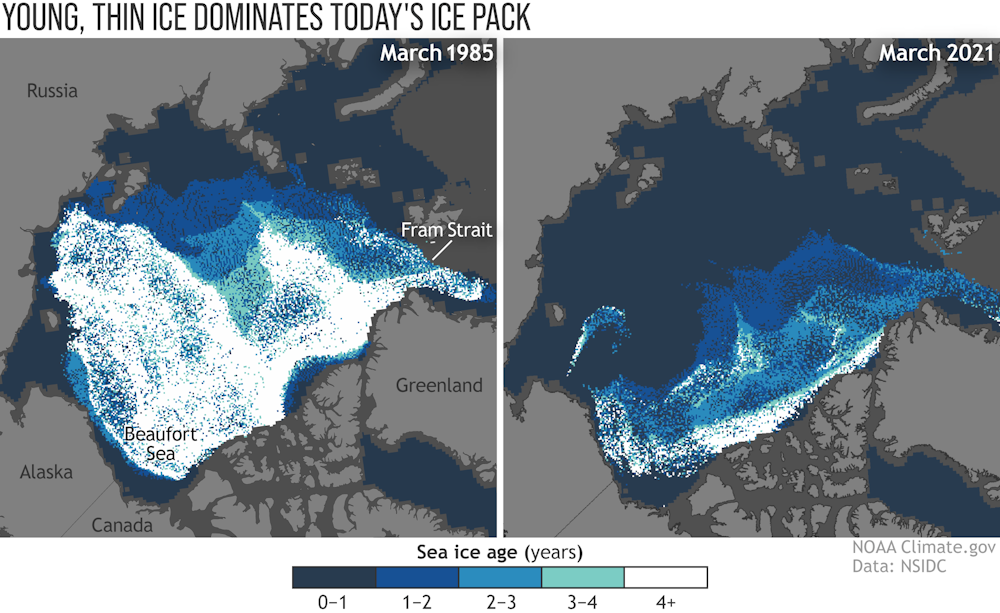
Side by side maps comparing the thickness of sea ice from 1985 and 2021. The ice in the 2021 map is considerably thinner than that of the 1984 map.

Maps from National Oceanic and Atmospheric Administration Climate show decreasing coverage of longstanding perennial ice in the Arctic between March 1985 and 2021. Data credit to Sea Ice Index, Version 3, National Snow and Ice Data Center.

Not only does less sea ice cover the Arctic Ocean, but what remains is not as thick as it used to be – a prelude to what will eventually become an ice-free Arctic basin. When that happens, all polar bears will be forced ashore, without the ability to hunt seals.

Polar bears’ cruising the shores and entering human settlements are direct results of reduced sea ice – and the loss of hunting opportunities that come with it.

The threat of unsecured garbage

Indigenous peoples and more recent arrivals make up the nearly 4 million people living throughout the Arctic in the countries of Russia, Norway, Greenland, Canada and the U.S. The economies of these villages are largely subsistence-based and are by no means affluent. Historically, food was never discarded in these areas. But today’s throwaway global economy has resulted in dumps full of waste, including foodstuffs.

When polar bears enter these dumps in search of food, they are attracted to strong-smelling substances, some of which are not even edible. For example, antifreeze attracts bears – and is fatal when ingested. The many chemicals in dumps become toxic potions, which either kill bears outright or weaken their immune systems. Additionally, bears have been known to ingest nonfoods. Wood, plastics and metal have all been found in dead bears’ stomachs. Wraps, bags and other membranelike items jam up the small opening from the bear’s stomach to its intestine, resulting in a slow and painful death.

Once bears have thoroughly rummaged through dumps, they spin off into nearby villages – confronting people, attacking their pets and livestock and foraging around structures, within which they expect to find food.

Solutions already exist to remedy this situation. However, they require money and political will.

Electric fencing is highly effective at separating bears from garbage but can be costly for a small village. Warehousing garbage, then barging it offsite to facilities where it can be safely disposed of, is also effective, but expensive. Incinerators have been used in some villages like Churchill, Canada, and have greatly reduced the amount of garbage. But these solutions come at an even greater cost, so villages would need financial assistance to put them in place. Education about how to properly store bear-attracting foods and substances would also help address the problem.

In brown and black bear battlegrounds like Yellowstone and Yosemite, managers have long fought the problem of bears attracted by garbage, learned and succeeded. From a high of 1,584 human-bear incidents in 1998, Yosemite recorded only 22 by the end of 2018 – a 99% decrease.

The knowledge exists on how to put an end to “dump bears” – and all that goes with that unfortunate title. In the battle of bears and garbage, bears are most often the losers.


Thomas Scott Smith, Professor – Wildlife and Wildlands Conservation Program, Brigham Young University

This article is republished from The Conversation under a Creative Commons license. Read the original article.

“Persuasion”: It was the best of characters, it was the worst of characters

Watching the new Netflix adaptation of Jane Austen‘s “Persuasion,” with Dakota Johnson in the lead role of Anne, is like being trapped in a theatre with locked doors when a community production starts to go terribly wrong.

I’ve been in the audience when the set of “The Importance of Being Earnest” fell down. I’ve been on stage when someone skipped dozens of pages in “The Curious Savage” and the story stopped making sense. I’ve been backstage when a ballerina was hit in the face by a coat hanger that plummeted with the falling snow of “The Nutcracker” (the plastic snow was expensive and so they swept it up and reused it every night, you see).

It’s hard to pinpoint exactly what’s happening with “Persuasion,” though many have gamely tried. So many luminous stars, including Johnson and the wonderful Richard E. Grant, and yet not much shining. Such rich source material, and yet an adaptation that has sucked much light and sense from its story, disappointing and infuriating Austen fans. 

Let’s focus on the positive. There are some compelling characters here who draw our attention away from the disaster happening center stage; they’re simply not supposed to.

“Persuasion” centers Anne Elliot (Johnson), the middle daughter of a family who, seeking to save money thanks to the lavish lifestyle of their patriarch (Grant), must rent out their home and move into cheaper lodging. Their renters are an Admiral and his wife whose brother, Navy Captain Frederick Wentworth (Cosmo Jarvis), was once engaged to Anne years ago.

Anne was “persuaded” (wink, wink) to break off their engagement back then due to Wentworth’s then-low prospects. He’s rich now, though (thanks, Navy!), and circumstances may be bringing the two back together.

Sadly, the rabbit does not have a role which benefits its station. 

Grant’s Sir Walter Elliot vainly primps in sheer delight, but doesn’t have screen time to save everyone in this story. In Netflix’s version, for some reason, our heroine Anne is a drunk who talks to the camera a lot. For some other reason, she has a pet rabbit. Sadly, the rabbit does not have a role that benefits its station. The music has more chemistry with the scenery, the carriage wheels have more chemistry with the road, than any person has with any other person. 

That said, as Vox wrote, the adaptation gets a “jolt of energy” when Henry Golding’s Mr. Elliot, Anne’s wealthy heir cousin, shows up to provide the third side of the love triangle between Anne and Wentworth. 

PersuasionHenry Golding as Mr. Elliot in “Persuasion” (Nick Wall/Netflix
His angle is that he could definitely be a cult leader.

Vox describes Golding as being “in pure mustache-twirling villain mode,” though Golding’s mustache is faint and the villainy even fainter. It’s a watered-down role from the source material, but despite his dour black attire, Elliot stands out. Do Elliot and Anne have chemistry? No. (In fairness, Anne and Wentworth don’t have chemistry, either). But Golding’s Elliot has a fling with the camera, smirking at it like he knows some secret we don’t, perhaps when this movie will be blissfully ending. Elliot smolders, barely contained by a cravat, whether blocking the path when Anne is on a walk with her family, or entering a room.

“Anyone that attractive must have an angle,” Anne says. His angle is that he could definitely be a cult leader, and seems to be acting, compellingly, in his own private movie. He’s not the only character who appears to be in a different, perhaps better, story.

Mary unwittingly serves as a kind of Greek Chorus for the viewers, voicing what everyone is thinking: wow, this is terrible. 

Nowhere is this more painfully clear than in the character of Mary Musgrove, Anne’s younger, married sister. Mia McKenna-Bruce plays this role like she’s Corky St. Clair, and producer Mort Guffman has actually showed up to his saved seat and will spirit her off to Broadway if she only sings her heart out in “Red, White and Blaine.” In other words, she’s flawless. 

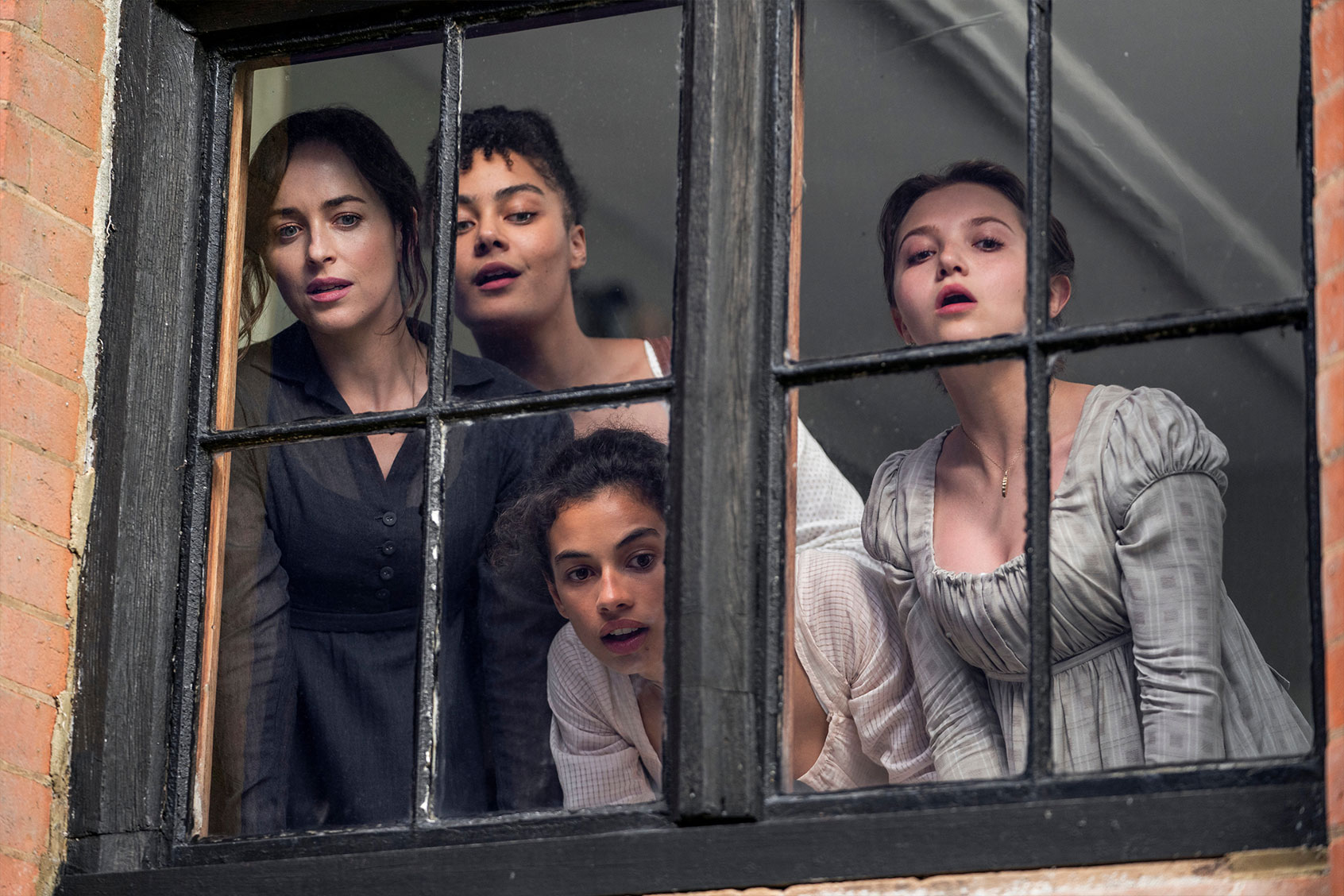
PersuasionDakota Johnson as Anne Elliot, Izuka Hoyle as Henrietta Musgrove, Nia Towle as Louisa Musgrove and Mia McKenna-Bruce as Mary Elliot in “Persuasion” (Nick Wall/Netflix)Her impeccable Mary is a complaining, bitter hypochondriac. In Netflix’s production, she unwittingly serves as a kind of Greek Chorus for the viewers, voicing what everyone is thinking: Wow, this is terrible. “I’m so close to death,” she says in tight-lipped, throaty seriousness. We are too.

Mary is sarcastic, dour and hilarious. A young mother, she’s also a reluctant one, constantly complaining about being stuck with the children. Yes, her children. McKenna-Bruce does more with an eyeroll than “Persuasion” does with hours (well, it feels like it) of uneven dialogue. “I can’t endure the sound of laughter before noon,” she pouts perfectly. Not to worry: This film will ensure one doesn’t have too much of that.

Mary’s marriage with Charles (Ben Bailey Smith) is also a bright spot. Sure, Mary was his second choice after Anne, a fact the story brings up repeatedly (as it does with Anne’s alleged plainness, which makes little sense in Johnson’s portrayal). But Mary and Charles are playful together. Charles seems more than gamely resigned to the other, lesser Elliot sister; he seems happy, toting Mary around after she tires of walking like a sack of potatoes, belligerent but beloved. 

Charles and Mary make the best of a consolation marriage, as Smith and McKenna-Bruce, like Golding, do their very best with this material. It’s probably better than the adaptation deserves.


Want a daily wrap-up of all the news and commentary Salon has to offer? Subscribe to our morning newsletter, Crash Course.


“Your noble relations disappoint you,” Anne is told in the film. Yet it’s those relations who steal the show, what there is to steal. Watch “Persuasion” at your own risk. But do so with a view toward the minor, so-called unlikeable characters, whose performances prove there’s nothing minor about them.


Yeah, Biden is a bit like Jimmy Carter — but not for the reason right-wingers think

In a column published over the Fourth of July weekend I compared Joe Biden to America’s founding fathers — in particular to George Washington and Thomas Jefferson — because they all supported ambitious economic policies that were not realized in their lifetimes. (Or that potentially, in Biden’s case, will never be realized at all.) One reader responded by tweeting an image of actual feces at me, but other critics took a more measured approach: Writers at Fox News and the Daily Wire arguing that it was more appropriate to compare Biden to Jimmy Carter.

According to Fox News, Biden is like Carter “because of the economic similarities of high gas prices and inflation,” while the Daily Wire quoted a tweet that claimed Biden was “the worst American president since Jimmy Carter, and possibly of all time.”

There’s something to these arguments, but not for the reason the Biden-haters think. The most important similarity between Carter and Biden is that each was a bland, moderate Democratic hope who was elected after a period of unprecedented Republican corruption — and who failed to stem the rising Republican tide. 

As I’ve written before, nostalgia for Barack Obama played a big role in Biden’s nomination, and then Donald Trump’s spectacular failure to respond to the COVID pandemic pretty much decided the election for Biden: He presented himself to a public that was largely fed up with the incumbent, and promised a return to the pre-Trump status quo of “normal” politics. Basically Biden was in the right place at the right time, and mainstream Democrats saw him as the only option to fend off first Bernie Sanders and then Trump.

Jimmy Carter’s story was quite different. He ran a grassroots primary campaign in 1976 that pioneered many modern campaign tactics, and beat back more than a dozen other candidates, including mainstream Democrats like Sen. Henry “Scoop” Jackson and Sen. Frank Church and progressive favorites like Rep. Mo Udall of Arizona and Gov. Jerry Brown of California. Carter pioneered a new style of retail politics, one in which candidates campaigned hard on the ground, while studying the primary and caucus calendars carefully. Through this method, Carter managed to pull off an upset over both the mainstream and progressive preferences.

That approach became normal for both Democratic and Republican candidates in the following decades, but it was brand new in 1976, and Carter stunned the political universe. Hardly anyone outside the Deep South had ever heard of Carter, a one-term Georgia governor with a mixed record, at the time Richard Nixon resigned in August 1974. Two and a half years later, he was the president.

Contrary to conventional wisdom, Carter accomplished some impressive things. U.S. energy security today is the direct result of legislation he passed, according to Stuart Eizenstat, Carter’s former domestic affairs adviser. In a 2018 interview with Salon, Eizenstat also ticked off Carter’s achievements in passing landmark ethics legislation and doubling the size of the national park system. Carter had appointed more women and more Black people to senior positions and to the federal bench, Eizenstat said, “than all 38 presidents before him put together.” In a distant pre-echo of the Biden presidency, Carter also endorsed the Federal Reserve’s decision to raise interest rates to “choke the economy and squeeze out inflation,” at great risk to his chances of re-election.

In foreign policy, Carter helped forge a historic peace deal between Israel and Egypt, one that has endured to this day and produced the immortal photograph of Carter beaming while Israeli Prime Minister Menachem Begin shook hands with Egyptian President Anwar Sadat. Concluding that America’s colonial era belonged in the past, he negotiated a treaty that returned control of the Panama Canal to the Panamanian government. More broadly, he worked to reorient American foreign policy toward human rights, cutting back or ending support to Latin American despots, opposing white minority governments in South Africa and Rhodesia and speaking out against Soviet human rights violations and the invasion of Afghanistan.

Stuart Eizenstat: “This Southern president appointed more women and more African-Americans to judgeships and to senior positions than all 38 presidents before him put together.”

Then there was the downside, which in Carter’s case was abundant. His leadership skills were lackluster, he was not a charismatic or inspiring speaker, he tended to vacillate in decision-making and he struggled to retain the best staffers. It wasn’t his fault that the military mission attempting to rescue U.S. hostages in Iran was a disastrous failure, but that failure stuck to him. Overall he appeared unequal to a series of major problems amounting to what he correctly identified as a “crisis of confidence.” He was decisively defeated by Ronald Reagan in 1980, an election that proved to be a massive turning point in American history and politics.


Want a daily wrap-up of all the news and commentary Salon has to offer? Subscribe to our morning newsletter, Crash Course.


That’s why Carter is widely regarded as a failure. He was elected by a nation thirsty for real leadership, and he left it in a more advanced state of dehydration. His good intentions don’t seem to count for much against that legacy. But that doesn’t mean Carter didn’t accomplish important things as president — or that it wouldn’t have been preferable if Americans had given him a second chance. Joe Biden is now risking a Carter repeat: Replacing a problem president in one election, and then creating an opening for another one.

Biden won the Democratic nomination mostly because of nostalgia for Barack Obama. After that, Trump’s failure to respond to the pandemic effectively decided the election.

Nothing Richard Nixon ever did can hold a candle to Trump’s carnival of political horrors, and it was quite a different time: Some Republicans were willing to turn against Nixon in the end, revealing an era when they hadn’t yet decided to place the quest for power above all else. They too had not yet forfeited their soul.

Joe Biden has, at least arguably, reestablished the legitimacy of government simply by not being Donald Trump — and no matter what Republicans may claim about his son’s laptop, Biden has avoided major scandals as well. 

Biden’s achievements on the COVID pandemic and the climate crisis, although modest in scale and hamstrung by implacable Republican opposition, go beyond simply a return to “normal.” His mass vaccination program has saved thousands of lives, he brought the U.S. back into the Paris Climate Agreement and he has worked to reform both environmental regulation and immigration policy. His infrastructure bill, which will create new jobs and strengthen communities across the country, may well be his most lasting achievement.

Carter forged a lasting peace deal between Israel and Egypt, and presided over one of the most famous handshakes in recent history.

Like Carter, Biden is hardly a dynamic public speaker. Like Carter, he has presided over a major foreign policy disaster. (In Biden’s case, it was the U.S. withdrawal from Afghanistan, so it’s at least mildly ironic that Jimmy Carter so vigorously protested the Soviet invasion more than 40 years earlier.) Like Carter, Biden has seen many of his domestic policy initiatives go nowhere.

Joe Biden’s last, best hope for political redemption may be the potential prosecution of Donald Trump for his actions before and during the Jan. 6 insurrection. If Attorney General Merrick Garland is reluctant, for whatever reason, to pursue the prosecution of a former president, the Democrats not only face likely defeat in the 2022 midterms, but still worse to follow.

America took a hard right turn after Carter’s defeat, and may do so again if Biden (or another hypothetical Democrat) loses to Donald Trump (or another hypothetical Republican) in 2024, especially in the wake of an evident coup attempt going effectively unpunished and the planet continuing to warm to catastrophic levels without Republican policies to address it. In that scenario, there could be reasons to feel concerned not just about the future of democracy, but the future of the planet.

Alan Dershowitz defends Bannon against conviction controversy

In an interview with Newsmax host Greta Van Susteren late Friday, former Harvard Law professor Alan Dershowitz came down on the side of former Donald Trump adviser Steve Bannon after a jury took only three hours to convict him on two charges of contempt of Congress for ignoring a subpoena.

According to Dershowitz, who recently jumped back into the news by complaining he is being shunned in Martha’s Vinyard because of his views among other issues, Bannon’s trial was “unconstitutional” and will be overturned upon appeal.

Speaking with the host he explained, “The only provision of the Constitution, which appears basically twice, is trial by jury in and in front of a fair jury. Number one, he didn’t have a fair jury. Number two, the judge took his defenses away from him.”

Asserting that jury pool was drawn from a community that is “97 percent Trump haters,” he continued that Bannon wanted to invoke “executive privilege” but that the judge wouldn’t allow — with the Harvard professor glossing over the fact that legal experts have argued he was not covered after leaving Trump’s employ.

“The judge denied the jury that basic facts,” he continued before adding, “The issue in this case has always been a legal one.”

He added the Supreme Court will have to “resolve that issue.”

Watch below:

Hawley roasted by hometown paper after ridicule for running out of Capitol on Jan.6

The editorial board of the Kansas City Star joined the pile-on being experienced by Sen. Josh Hawley (R-MO) after the House committee investigating the Jan 6th insurrection juxtaposed the infamous photo of him encouraging the pro-Donald Trump rioters with a clenched fist to a video of him fleeing from them hours later.

As the editors were quick to point out, Hawley is now a national “laughingstock” because he has been exposed for the “fleeing coward” he is.

Getting right to it, the editors wrote, “During Thursday night’s televised hearings of the House committee investigating the Jan. 6, 2021, coup attempt at the U.S. Capitol, Rep. Elaine Luria showed video of Missouri’s junior senator that will surely follow him the rest of his life.”

After noting that the conservative senator has already taken his lumps on social media after the nationally televised humiliation that has spectators at the committee hearing openly laughing, the board buried him for his oft-stated worries about American “masculinity.”

“A signature Hawley issue is masculinity — as in, how little of it American men seem to have these days. It’s a frequent topic in his speeches and on his podcast, where ‘the left-wing attack on manhood’ is a dire threat to our society. Regnery Publishing is set to release his book ‘Manhood: The Masculine Virtues America Needs’ next year. Twitter didn’t see much virile bravado as he ran from the mob,” they wrote.

“Shame, clearly, is not a motivating factor for any number of Republicans still caught up in Trumpworld. Hawley has never apologized for attempting to reinstall a man who everyone around him knew had lost the election, as witness testimony continues to confirm. Surely the Yale and Stanford grad isn’t gullible enough to believe the craven lies about tampering with voting machines and dead people casting ballots that ooze through social media,” they wrote before concluding, “Sen. Josh Hawley might not fear a little mockery of his hasty flight from Capitol marauders. But he might be justified if he’s afraid of what emails or text messages some previously-loyal staffer might be considering turning over to the House committee. Stay tuned to the hearings.”

Biden announces new climate change actions but holds an emergency declaration in reserve

On July 20, 2022, President Joe Biden traveled to a former coal-burning power plant in Massachusetts that is being converted into a manufacturing site for offshore wind power equipment. Biden announced millions of dollars in funding for climate change measures, including upgrading infrastructure, weatherizing buildings and installing cooling in homes. He also touted job growth from clean energy production and pledged to use all of his executive power to reduce U.S. greenhouse gas emissions.

But Biden did not declare a national climate emergency – a step that some Democratic officials and activists have urged after Democratic Sen. Joe Manchin seemingly blocked legislative action and the Supreme Court limited the Environmental Protection Agency’s power to regulate greenhouse gas emissions.

According to White House officials, an emergency declaration remains an option. As a legal scholar who has analyzed the limits of presidential power, I believe that declaring climate change to be a national emergency could have benefits, but also poses risks.

Taking that route sets an important precedent. If presidents increasingly make free use of emergency powers to achieve policy goals, this approach could become the new normal – with a serious potential for abuse of power and ill-considered decisions.

President Joe Biden has proposed sweeping action to slow climate change, but has failed to muster majority support in the closely divided Senate.

Yesterday, the border; today, the climate

President Donald Trump declared a national emergency on border security on Feb. 15, 2019, after Congress refused to fund most of his US$5.7 billion request for border wall construction. As Trump’s intent became clear, Republican Sen. Marco Rubio warned that “tomorrow the national security emergency might be, you know, climate change.”

Rubio was right to take this possibility seriously. In my view, declaring a climate emergency would probably be legal and would unlock provisions in many laws that authorize the president or subordinates to take specific actions under a national emergency declaration.

Like Trump, Biden might use the power to divert military construction funds to other projects, such as renewable energy projects for military bases. Biden could also use trade measures – for example, restricting imports from countries with high carbon emissions, or perhaps imposing a carbon fee on goods from those countries to level the playing field.

Another potential action would be ordering businesses to produce certain goods. The Trump administration used the Defense Production Act, a law dating from the 1950s, to expand production of medical supplies for treating coronavirus patients. Biden has already used the law to accelerate domestic production of solar panel parts, insulation and other clean energy technologies.

After declaring an emergency, Biden could provide loan guarantees to critical industries in order to help finance goals such as expanding renewable energy production. Oil and gas leases on federal lands and in federal waters contain clauses that allow the Interior Department to suspend them during national emergencies, though that seems unlikely in the immediate future given current gas prices.

Declaring a national emergency would also enable the president to limit oil exports to other countries – although this also appears unlikely given the war in Ukraine, which has increased European reliance on U.S. oil. Biden also could limit U.S. financing for foreign coal projects.

Would it be legal?

Emergency powers are only available assuming climate change qualifies as an emergency. The law empowering presidents to declare national emergencies doesn’t define the term.

Among recent precedents, President Barack Obama declared a cybersecurity emergency, and Trump declared that steel imports were an urgent threat to national security.

It’s not hard to make a case that climate change is an equally critical problem, especially with much of the world suffering through record-breaking heat waves and wildfires. There’s also clear support for the idea that climate change is a major national security threat.

To date, courts have never overturned a presidential emergency declaration, and a climate emergency would probably not be an exception. Legal challenges to Trump’s border security declaration failed.

However, the Supreme Court’s recent decision in West Virginia v. EPA adds a wild card to the legal analysis. The court ruled that certain actions are so important that they require extra clear authority from Congress. How the Court would apply this doctrine in the context of the National Emergencies Act remains unclear.

Frustration with gridlock

Emergency actions can sometimes shortcut bureaucratic procedures and reduce the potential for litigation, compared to the normal cumbersome regulatory process. That makes them faster and more decisive. They also place responsibility squarely on the president, which increases political accountability. There’s no question of who to blame if you don’t like the border wall – or emergency climate actions.

Unlike legislation, an emergency action does not have to move through Congress. And compared with most federal regulations, there is less requirement for transparency or public comment, and less room for judicial oversight.

That can speed things up, but it also makes major mistakes more likely. The internment of Japanese Americans during World War II is a vivid example.

Cartoon of a giant hand looming over a city.

‘Iron-fisted Breach,’ a cartoon by Jerry Costello reacting to President Harry Truman’s effort to nationalize the U.S. steel industry through an emergency declaration, published in the Knickerbocker News (Albany, N.Y.), April 23, 1952. Library of Congress, CC BY-ND

In addition, once an emergency is declared, civil libertarians fear that a president could use emergency powers in laws that aren’t even related to that emergency. “Even if the crisis at hand is, say, a nationwide crop blight, the president may activate the law that allows the secretary of transportation to requisition any privately owned vessel at sea,” wrote Elizabeth Goiten, director of the Brennan Center’s Liberty and National Security Program.

Legislating is difficult and time-consuming. It requires the agreement of both houses of an increasingly polarized Congress. The filibuster rule requires 60 votes in the Senate for most legislation, and right now the Democrats don’t seem to be able to muster even the 50 votes they would need to take advantage of the “reconciliation” exception to this requirement.

But there are also real dangers to invoking emergency powers. Normalizing their use could make these expanded presidential powers hard to limit.

Congress can nullify emergency declarations by passing a resolution of disapproval, but this has proved ineffective in practice. For instance, despite bipartisan support, Congress failed to muster veto-proof margins for two resolutions overturning Trump’s border emergency, which the administration used to divert billions of dollars to wall construction.

As Justice Robert Jackson wrote in Youngstown Sheet & Tube Company v. Sawyer – a famous 1952 Supreme Court decision in which the court held that President Harry Truman did not have the constitutional authority to nationalize the U.S. steel industry during the Korean War – emergency powers “afford a ready pretext for usurpation,” and the potential for using those powers “can tend to kindle emergencies” to justify their use.

Unlike some observers, I still see room for making real progress through the normal regulatory process. In my view, it’s not time yet for Biden to break the glass and pull the red emergency lever.

This is an updated version of an article originally published on March 9, 2020.


Daniel Farber, Professor of Law, University of California, Berkeley

This article is republished from The Conversation under a Creative Commons license. Read the original article.

A stranger, twisted and bleeding on the sidewalk. What would you have done?

I thought at first that it was a tangled pile of clothes, strewn in a heap ahead on the sidewalk. But then, a young duo passed me, clutching watery iced coffees.  And the long haired one met my gaze and said, “Can you call 911 for that guy up there?” It was a cloudless summer afternoon. I’d just finished eating an ice cream cone, feeling proud that I hadn’t dripped any on my new blouse. The couple never broke their stride, gliding further and further away from the pile as I continued walking apprehensively toward a steadily spreading pool of blood from what turned out to be an elderly man, his limbs askew, unconscious on the ground.

I’ve never been a fan of the phrase, “If I’d have been there . . . .” I cringe at those “What Would You Do?” hidden camera shows that present unsuspecting individuals with moral dilemmas. I’ve been in too many split-second decision moments of my own; I understand that there is no certainty in hypotheticals, that so much within a real dramatic situation hinges on its surrounding details. What would you do . . . if you were running late for something else? If you were alone late at night? If you grew up on a farm? If you were on antidepressants? Of if you were, as I was that day, coming off a weekend of tending to a sick kid, and it was two and a half years into a pandemic?

“We all think that we would intervene and we would help.”

“We all think that we would intervene and we would help,” said Jennifer Blumenthal-Barby, Ph.D., a professor and associate director of the Center for Medical Ethics and Health Policy at Baylor College of Medicine and author of “Good Ethics and Bad Choices: The Relevance of Behavioral Economics for Medical Ethics.” 

But the study of forecasting errors shows that when people are asked to speculate how they’ll feel or behave about certain situations, “We often do a really poor job” of predicting our own responses, Blumenthal-Barby said. “It makes it easy for us to blame other people who don’t intervene, because we think that we would have.”

Scientific literature shows, and psychologists have demonstrated, that “we may not actually [intervene and help] if we’re in that situation,” she said. 

I was standing in the midst a grim, clear-cut tableau — a set of crumbling building steps, a scattered cane and pair of eyeglasses, a crumpled man in a baggy T-shirt and corduroy trousers. He wasn’t moving. He looked like he’d broken a few bones. And the blood was not stopping. His white hair, his surgical mask and the entire left side of his face were already soaked in it, along with other matter I couldn’t identify. What would you do?

I would have hoped that under such circumstances, I’d be noble and brave and quick witted. Instead, I pulled out my phone and looked at it dumbly, because I had completely forgotten how to dial 911. How to dial anything, in fact. Then I shook myself back to sense and called for an ambulance. I gave the exact address of the building the man was sprawled in front of. The operator asked for the cross street, and I told her that it was Broadway.

More than two years of pandemic protocols mean I don’t really touch people anymore. I don’t shake hands with strangers. I carry hand sanitizer. I wear a mask and I wash up as soon as I come through the front door. But as I waited for the ambulance, I sat down on the building’s front steps, next to the glassy-eyed, very still man, and clutched the hand that was curled up closest to me. “Your ride’s on the way,” I said, helplessly. “Don’t move.” He didn’t respond. 


Want a daily wrap-up of all the news and commentary Salon has to offer? Subscribe to our morning newsletter, Crash Course.


A couple with a dog walked by and asked if they could help. A pair of college students, at least I think they were, stuck around too. Other people walked past, seemingly oblivious. A tiny older woman stepped out of the building, and gasped at the scene. She said she didn’t know the man but thought he lived downstairs. Someone — it might have been me, it might not have — asked her if she had something for his head. She went back inside and returned a minute later with a kitchen towel, paper towels, and a bottle of water. I took the towel, and held it gently, probably ineffectively, to the man’s temple. The woman said she couldn’t do it because she wasn’t wearing gloves.

The man started to moan. “What’s your name?” I asked, and he mumbled something. For the sake of privacy I’ll say it was Sam. Then Sam groaned and tried to pull himself up. The college students steadied him by his shoulders so he wouldn’t crash back down, and I knelt behind him, in case he did anyway.

Twenty minutes passed. Over the endless wait, I called 911 a few more times. Some others of our little group called too. “You said it was on Broadway,” a dispatcher told me, and I felt my stomach drop. A bleating ambulance whizzed by a half a block away. The woman with the dog said her husband would flag it down. Her animal barked, confused at all the fuss.

I had very few coherent thoughts and even fewer productive ideas. I knew not to try to move Sam. I tried, with marginal success, to be calm and reassuring. I held his hand almost the whole time, and I will never know if that was for his sake or mine.

Eventually, an ambulance pulled up, and two sturdy men jumped out. “He says his name is Sam,” I blurted. “Sam, are you on blood thinners?” one of them asked him. I looked behind me to the sidewalk. Sam’s cane. His eyeglasses. His inhaler. A single sandal that had flown off his foot.

The paramedics loaded him into the ambulance, and I handed one of them Sam’s stained, scooped up belongings. The man with the dog had started picking up wadded up paper towels. Then the ambulance door shut with a distinctive thunk, and I wondered a beat too late if I should have gone with Sam, or if they even would have let me.

I thought back to a few weeks prior, when I was in the emergency department with my teenaged daughter for a minor medical emergency. There had been a flurry of activity nearby when a stabbing victim was brought in. Later, my daughter asked her nurse how the patient was doing. “He’ll be all right,” he’d said casually. “And by the looks of what was in his backpack, he had it coming.” Would the people who tended to Sam say that he had it coming too, based on the contents of his pockets? Would I have said the same, had I known anything of his life prior to the moment after he hit his head?

I looked down at the blood on my arms and hands, already dark and drying in the afternoon sun.

I looked down at the blood on my arms and hands, already dark and drying in the afternoon sun. Sam’s blood. I felt suddenly, ominously contaminated. “Would you let me come inside and wash up?” I asked the old woman with the kitchen towel. She didn’t say no. She didn’t say anything at all; she just blinked back at me in silent refusal.

“It’s OK,” I said quickly.

She tried to hand me the bottle of water.

“You can have this,” she said, but I told her I didn’t need it.

I understand her reluctance. 

“Covid has done a lot of things to people psychologically,” said Blumenthal-Barby. “I think it has definitely put them more on guard and more protective of themselves as individuals and their families, rightly so. But it becomes psychologically hard to think about when to turn that off sometimes. It becomes ingrained enough that it then becomes difficult in moments where maybe we need to turn it off, and engage and help other people where the risk is relatively low.”

In the diner from “Seinfeld,” no one looked twice at the blood splattered woman trying to make her way to the restrooms in the back. “There’s a line,” an aproned waiter explained nonchalantly when I said I needed to get in. The patrons kept on eating their eggs and burgers.

I turned around and walked to another restaurant, a very nice one with a very nice wine list that a friend used to take me when she taught at Columbia. In the quiet, dimly lit bathroom, I scrubbed up to my elbows. I splashed soapy water on my legs. And then I absently wiped away some snot from my nose and realized that my hands still carried the unmistakable, metallic scent of Sam’s blood. So I just went home on a dirty train and cried and showered and threw my clothes in the laundry.

In the days that followed, I checked in with my doctor and got tested for hepatitis, HIV and COVID, just to be sure. I asked myself why I’d gone up that particular street, instead of the other one I’d intended to walk that afternoon. I thought about Sam incessantly. I wondered if the place on the sidewalk where I found him was still deeply stained, or if the rainstorm that had howled in the next day had scoured it clean. I wondered about the couple who’d told me to call 911, and whether they had their own vulnerabilities, their own reasons for not making the call. I wondered what would have happened if they hadn’t commanded me, so clearly and directly, to get involved.

“We always think that somebody else is going to intervene so that’s why we don’t do it,” said Blumenthal-Barby. “It’s this common feeling when we encounter a situation where somebody’s in need. That often gives us the justification to not do it.”

On a different day, even a different moment, I would have handled the same situation differently. But I have thought lately about what I could have done better. Mr. Rogers said that in a crisis, “Look for the helpers. You will always find people who are helping.” I want to be one of the helpers. I need to figure out how.

Did Sam have someone who loved him out there, wondering why he was running late that afternoon? Would he have called 911 if the roles were switched and it had been me, knocked out on that sidewalk? Would he have capably staunched my bleeding, or walked on by? What would you do, Sam?

I want to know how he is. I worry about him. I recognize, however, that he’s not mine to worry about, that his experience isn’t about me at all. So I stay away. Yet I wonder what Sam would think if he knew that when he fell, he crashed into the path of a group of strangers and became their sole focus for 20 minutes. That he pulled together a disparate sextet who cared about him, briefly but deeply. And that just as quickly as they came together, they all went all their separate ways, melting back into the day with nothing but a blood-slicked sidewalk to show anything had ever happened there at all.

“Always push the skillet cookie”: An ode to the star of the ’90s chain restaurant dessert menu

In late high school and early college, I held a string of random jobs: Skate School figure skating instructor, costumed cashier at a local Halloween store, dog walker, college entrance essay editor. But one of my absolute favorites was working front-of-house at Chili’s

While it wasn’t the pinnacle of a fine dining experience, it was (and is) also a very typical restaurant experience for most of America. This Chili’s sat in the shadow of a Costco, constructed between an Olive Garden and Longhorn Steakhouse.

The bartender who — despite his real name being something like Chad or Brian — went by Spike had been there the longest. He was tall, a little gangly and world-weary in a way that seemed more fitting for a dive bar owner than someone who served electric blue, sugar-rimmed margaritas to giddy suburban moms out for girls’ night.

He offered every new female employee the same bits of advice: If you’re kind to the back-of-house guys, they’ll keep you fed; never smile too much when you’re serving couples or you’ll risk making someone jealous; and always push the skillet cookies

While some may regard some of Spike’s advice as a little sexist, it definitely served me well — especially the skillet cookie bit. Those things were a home run. I’d watch as the cooks would drop oversized dollops of chocolate chip cookie dough into miniature greased cast iron skillets — the same kind from which the restaurant serves its queso — and toss them in the oven for 12 minutes or so. When they emerged, they were immediately topped with one scoop of vanilla ice cream and a drizzle of sticky-sweet chocolate syrup

On Friday and Saturday nights, especially, they sold like hotcakes. They ran about $6 at the time and were definitely large enough for two people to split, though there was something decadent about having one all to yourself. One of our regulars, a woman with a collection of Ann Taylor blazers that screamed “real estate agent” or “pharmaceutical rep,” would typically come in on Wednesday nights after the dinner rush and find a seat at the bar. 

She’d order a glass of red wine and a skillet cookie, then Spike would slide her the remote so she could find a hockey game. She was Canadian, we later found out. It seemed like a really cozy ritual, one I was thinking about recently after I stumbled upon a few 3.5-inch Lodge cast iron skillets at a resale store. 


Want more great food writing and recipes? Subscribe to “The Bite,” Salon Food’s newsletter.


Initially, they were great for small-batch cooking — a single egg, some baked apples, etcetera — and just looking cute in my kitchen. But then a few Wednesdays ago, I realized I’d already had quite the week and the week wasn’t even over yet. To paraphrase food writer Bettina Makalintal, I deserved a little treat

So, I popped a little blob of frozen homemade cookie dough (thank you, Past Ashlie) into a skillet and let it bake until crisped around the edges and gooey in the center. I didn’t have ice cream or syrup, but I made do quite nicely with a frankly embarrassing amount of whipped cream. I skipped the wine and found some hockey. 

Since then, I’ve nailed down a version that works well in a standard 10-inch cast iron skillet, meaning there’s more than enough to share with friends.

Dark Chocolate Chunk Skillet Cookie
Yields
4 servings
Prep Time
10 minutes
Cook Time
20 minutes

Ingredients

  • 6 tablespoons unsalted butter, softened 
  • 1/2 cup packed dark brown sugar 
  • 1/3 cup granulated sugar 
  • 2 large eggs
  • 2 teaspoons pure vanilla extract
  • 1 1/4 cup all-purpose flour
  • 1/2 teaspoon baking soda
  • 1 teaspoon Kosher salt 
  • 1 cup dark chocolate chunks


Directions

  1. Preheat the oven to 350 degrees. In a large bowl, combine the butter and sugars. Stir in the eggs and vanilla, followed by the flour, baking soda and salt. Finally, stir in the chocolate chunks.
  2. Transfer the cookie dough to a 10-inch cast iron skillet. Smooth the dough with the back of a spoon to ensure it’s even across the skillet.
  3. Bake just until the edges are golden-brown, 18 to 20 minutes. Allow to completely cool before topping with too much whipped cream. 


Salon Food writes about stuff we think you’ll like. Salon has affiliate partnerships, so we may get a share of the revenue from your purchase.

This milk and cookies tart is such fun to make — and it’s a total crowd-pleaser

This tart is such fun to make and to eat, and is a total crowd-pleaser. It starts with an easy-to-make press-in cookie crust, speckled with plenty chocolate chunks. Leaving out the chemical leaveners that would normally be in a cookie recipe (like baking soda and powder) helps the crust bake up flat, leaving room for the filling later. After the crust is baked and cooled, it’s filled with a simple vanilla panna cotta. Once the custard has set, this tart is the most incredible combination of milk and cookies in every bite. And if you really want to send it over the top, top it with piles of swoopy whipped cream and nestle some mini chocolate chip cookies on top, too.  Erin Jeanne McDowell

Watch this recipe

Milk and Cookies Tart
Yields
1 9-inch tart
Prep Time
1 hour 20 minutes
Cook Time
30 minutes

Ingredients

Chocolate chip cookie crust

  • 6 tablespoons (85 g) unsalted butter, at room temperature
  • 1/2 cup (106 g) light brown sugar
  • 3/4 teaspoon vanilla extract
  • 1 large egg yolk
  • 1 2/3 (201 g) all-purpose flour
  • 1/2 teaspoon fine sea salt
  • 1/2 cup (90 g) fine chocolate chunks (or mini chocolate chips)

Filling

  • 1/3 cup (76 g) cool water
  • 1 tablespoon powdered gelatin
  • 1 1/4 cups (290 g) heavy cream, divided
  • 1/3 cup (66 g) granulated sugar
  • 1 vanilla bean, halved and scraped (or 1 tablespoon vanilla extract)
  • 3/4 cup (170 g) whole milk

Topping (optional)

  • 1 cup (235 g) heavy cream
  • 1/3 cup (38 g) powdered sugar
  • 1/2 teaspoon vanilla extract
  • 12 to 15 mini chocolate chip cookies (such as Tate’s)


Directions

  1. Lightly grease a 9-inch tart pan with nonstick spray and place on a baking sheet. Make sure you have room in your freezer and fridge to place the tart pan later. 
  2. In the bowl of an electric mixer fitted with the paddle attachment, cream the butter and brown sugar until light and fluffy, 3 to 4 minutes. Add the vanilla and egg yolk and mix to combine. 
  3. Add the flour and salt and mix until the dough comes together and is uniform. The mixture should look like a stiff chocolate chip cookie dough – if it seems dry or crumbly, add a little milk (1 tablespoon at a time) until it comes together. Add the chocolate chunks and mix to combine.
  4. Press the dough into the prepared tart pan into an even layer – take special care to make sure the sides of the tart dough and the corner (where the sides meet the base) aren’t too thick. Using a small measuring cup can help you get into those corners and ensure it’s even.
  5. Place the tart pan into the freezer while you preheat the oven to 350°F. 
  6. Press the tines of a fork all over the chilled dough to dock it. Bake until the crust is lightly golden brown and fully baked, 20 to 24 minutes. Cool completely.
  7. When the crust is cool, make the filling. Place the cool water in a small bowl, and sprinkle the gelatin over it. Let it sit for 5 minutes.
  8. Heat 1 cup of the heavy cream, sugar, and the vanilla bean and scrapings in a medium pot, stirring until the sugar is dissolved, 1 to 2 minutes. Add the bloomed gelatin and heat until the mixture melts completely, about 1 minute. 
  9. Place the hot liquid into a large vessel with a pour spout (such as a 4 cup liquid measuring cup), and stir in the remaining ¼ cup cream and the milk, stirring well to combine. Remove the vanilla bean (if using vanilla extract instead of the bean, stir it in now). 
  10. Pour the filling into the cooled crust, and gently transfer to the refrigerator. Chill until the filling is totally set, at least 1 hour, and up to 8 hours.
  11. The tart is now ready to serve, or you can add the optional topping. In an electric mixer fitted with the whip attachment, whip the cream, powdered sugar, and vanilla to medium peaks. Spread the cream on top of the tart, and decorate with mini chocolate chip cookies.

“Primal” may be the most unconventional love story on TV. Just not in the way you think

It’s strange to remember that “Primal” creator Genndy Tartakovsky broke into the animated mainstream more than two decades ago with “Dexter’s Laboratory.” Tartakovsky helmed several titles in the years between, including “Star Wars: Clone Wars,” “Sym-Bionic Titan” and “Samurai Jack,” but stylistically speaking “Dexter” and “Primal” are precise opposites.

“Dexter” is family-friendly, bright, and revolves around a title character who talks a mile a minute. “Primal” is gory, brutal and drenched in a bloody earth-toned color palette. It ran for 10 episodes before its protagonist, Spear (Aaron LaPlante) uttered a single word. He and his partner Fang never needed speech to understand each other. Spear is a knuckle-dragging Neanderthal with a heart of gold, and Fang’s a Tyrannosaurus rex who cares about Spear enough to refrain from eating him.

Adding another human to their traveling band, an escaped enslaved woman named Mira (Laëtitia Eïdo) brought language into their world, along with advancements like food preparation and a bow and arrow. Her entry also fundamentally changes the show from a visually stunning, wordless survival epic into the most wonderfully unconventional tragic love story on TV.  Just not in the way you might think.

The Emmy-winning “Primal” established its fable about a pair of tragedy survivors banding together against a supernaturally savage world over 10 riveting episodes that defy the common approach to narrative. And Tartakovsky’s inspiration was simple. “How do you deal with grief? You can’t speak,” he explained at a Television Critics Association press conference held earlier this year. “You don’t have the words to communicate your suffering.  . . . I think it creates a language of its own.”

Spear watched his mate and children get eaten by the same enormous T. Rex that devoured Fang’s young and would have killed her as well if the caveman hadn’t intervened. Their first adventures journey far from that horror, with each discrete story translated through Spear and Fang’s movements through their cruel, fantastic world. Steadily they build a shared understanding of each other before eventually proving they refuse to live without each other.

“”How do you deal with grief? You can’t speak,” Tartakovsky said.

The beauty in that transcends romantic expectation, trading that feeling for something people are willing to draw blood to maintain.

One might characterize it as a human need. But that leaves out the dinosaur, who is equally driven, passionate, and loyal to the hunched-over Neanderthal watching her back with a weapon.

Mira’s addition and her abduction at the end of the finale kick off a serialized quest in the second season. Desperate to find her, Spear and Fang make their way across the sea, with Spear ensuring Fang stays fed, as always. But the primacy of their bond remains the same. Recovering Mira isn’t a mission driven by chivalry or romance, but out of a need to restore the family Spear and Fang are building. The dinosaur wants to rescue her as badly as the man.

PrimalPrimal (Courtesy of Adult Swim)

Theirs is not a conventionally acceptable relationship, as they discover when they wash ashore in separate places in an unfamiliar country where dinosaurs and human beings roam, the latter resembling 3rd or 4th century Celts. Spear is taken in by a village, Fang by a fellow predator. Their unexpected reunion forces them to choose either the fellowship of their own kind, or their interspecies family unit. Merging both worlds is impossible.

“I think when I watch things that are more visual . . . [I] have a better reaction to it,” Tartakovsky said. He went on to explain that he still loves dialogue, but that his discovery with “Primal” “was that people started to pay attention more. . . . If you turn away, you’re going to miss everything. And I think it focused people in, and because this show is so intense, it drew you in more.”

Removing language also draws the eye toward what characters do rather than what they say. Mira speaks an actual dialect – ancient Arabic, according to Tartakovsky – as does the village leader in the new season. It doesn’t matter that we don’t know what they’re saying, because we comprehend his intent, just as we understand the painful cost of Spear’s loyalty to Fang, and vice versa, without either having to say a thing.

New episodes of “Primal” air Thursdays at midnight on Adult Swim, and stream Fridays on HBO Max. Watch a trailer for Season 2, via YouTube.

Dog parent–shaming is the new mom-shaming: Why the internet is furious over your pet-rearing skills

Five years ago, Jeannie Assimos adopted a mini pinscher from the Humane Society in Pasadena, California.

“He was super shy, not socialized — he had been abused, so, I kept going back and seeing him and he wasn’t very friendly,” Assimos explained. Still, she decided to take a chance on him. “I brought him home and he hid behind my couch, but I pulled him out and said, ‘no, Buddy, we’re going to be friends.”

From that day forward, Jonny has never left her side. On his Instagram page, Jonny the Min Pin, it’s hard to tell how much trauma Jonny endured. To his nearly 10,900 followers, Assimos shares Jonny’s adventures at the beach and sometimes hanging out with his “best friend” Santo, who is a pitbull. While the Instagram feed is full of joyful photos, a small but visible number of Assimos’ followers are obsessed with shaming her and her dog-parenting skills.

RELATED: Do dogs miss us when we leave?

Just as social media has provided a platform for parents to give each other their unsolicited opinions on how to parent their kids, the same curious trend is happening in the world of so-called dog parenting. Showing pictures of one’s child in the online sphere is always a minefield: cultural differences mean that a swathe of people are bound to disagree with one’s parenting habits. But curiously, this critical lens extends beyond the human realm, and into pet-rearing.

Assimos first noticed the trend about a year ago when she posted a video of Jonny at the beach, chewing on a stick.

The phenomenon of “mom-shaming” has been known and studied since the era when mommy blogs first emerged. “Dog parent– shaming,” however, is a newer phenomenon.

“Then I got this lady DMing [direct messaging] me about how irresponsible I was as a dog mom, and that he could get splinters from this stick and that I was a horrible dog parent basically,” she said. “I’ve had people someone DM me, ‘How can you let your dog hang around that pit bull?'”

Additionally, some viewers criticized Assimos for dressing her dog in clothes. “Some thought it was mean,” she mused. Assimos, for her part, takes it with a grain of salt: “I think it’s par for the course when you put things out there on social media, I am so detached I could care less, and know that I give my rescue dog Jonny an amazing life,” Assimos said. “I have encouraged others to adopt this attitude, but some find it difficult.”


Want more health and science stories in your inbox? Subscribe to Salon’s weekly newsletter The Vulgar Scientist.


That random internet strangers would have such strong opinions about pet-rearing, and moreover would be inclined to loudly and furiously share them, suggests something deeper lurking within our collective psyches — some penchant for pedantic criticism and anger directed towards strangers that, somehow, bubbles up from the sociological ether via the catalyst of cute pet pictures and videos.

Assimos has observed other “dog influencers” shut down their account because of such hate. Indeed, such shaming behavior isn’t exclusive to influencers on Instagram, but seemingly anyone who shares any tidbit about their dogs online.

The phenomenon of “mom-shaming” has been known and studied since the era when mommy blogs first emerged; the neologism refers to situations in which mothers are shamed on social media by those who criticize their parenting. Yet dog parent–shaming is a newer phenomena.

As blogging evolved in the early 2000s, and parents moved away from getting information from traditional sources, many parents took to sharing their own parenting experiences via blogs and social media. But what was meant to be a space to share the more intimate and personal details about parenting turned into a place for strangers to shame each other. As Danielle Campoamor wrote in Romper in 2018, “at a time when we share so much of our personal lives — including our parenting decisions — online, more and more mothers are finding ourselves defending our decisions from, of all people, other moms.” A mother of a three-year-old at the time, Campoamor said she had “experienced call-out culture via the internet more times than I care to count.” One time, she was attacked for placing her son on Santa’s lap.

So how and why did this type of shaming move from human parenting to the world of pet parenting?

Sarah Hodgson, a pet trainer, behavior consultant, and author of several books including “Modern Dog Parenting,” told Salon that when she started her career, dogs were considered to be pets and treated like them (although there were some cultural variations). But about 15 years ago, more scientists began to research the dog’s brain. For example, research conducted by Stanley Coren published in 2009 showed that dogs’ mental abilities are close to a human child aged 2 to 2.5 years old. That changed the way that many perceive dogs.

“So now it’s widely accepted that dogs are like little children, and they stay like toddlers forever, so all of a sudden the parenting just kind of followed that wave,” Hodgson said. “And for people like me who have just been obsessed with dogs my entire life — I’ve always felt that but now, people write about it, science writes about it, and social media has had this explosion.”

With this evolution in how we perceive dogs, Hodgson said it’s no surprise that dog-parent shaming became prominent.

“It’s a very divisive time in our history, everybody likes to know more and be better and be in the right, that’s what we do as a species now, which is kind of ridiculous,” Hodgson said, adding that dog-parents should take a page from human parents in being a “good enough” parent.

“There’s good enough parenting, and there’s good enough dog parenting, as long as you’re not abusing your dog and you’re providing for those five basic needs — eat, drink, sleep, play, bathroom— as long as you’re providing for those needs and your dog feels relatively happy, it’s all OK.”

Read more about dogs:

How the states went nuts: Democratic backsliding in state capitals — and how to defeat it

Every week seems to bring a new stress fracture in American democracy to light. While the drama of the Jan. 6 hearings focuses attention on former Donald Trump’s top-down predation, the Supreme Court’s overturning of Roe v. Wade has unleashed a torrent of state and local conflicts that only grow more intense. This is happening even as many states now enforcing or enacting abortion bans laws actually have pro-choice majorities, as noted in this Monkey Cage analysis by political scientists Jacob Grumbach and Christopher Warshaw.

What comes next is very much up for grabs, but Grumbach’s new book Laboratories Against Democracy: How National Parties Transformed State Politics,” casts a dramatically different light on how we got here, which in turn says a lot about the task of setting things right. 

While “Trump has been characterized as an aberrant wrecking ball that disrupted American politics, Grumbach writes, “it was the states that were the wrecking ball, clearing a path for Trumpism throughout the American political system.” His book refutes received wisdom about wisdom of American federalism: Rather than stabilizing and strengthening American democracy, the relative autonomy of states has played a significant role in undermining it, and the disconnect between abortion laws and public opinion disconnect is just one example of a broader democratic breakdown. 

State politics is not so much the culprit as the conduit, as Grumbach’s subtitle indicates. As the two national parties became more homogeneous with the breakdown of the New Deal coalition, the nature of state-level politics changed significantly. In the period Grumbach’s data covers, from 2000 to 2018, there was significant change in public opinion regarding marijuana legalization and LGBTQ rights that was reflected in state legislation. But these two high-salience issues were the exception, not the rule. “For the rest of the issue areas, state policies have changed profoundly, but state opinion has been mostly static,” he writes. “And you can’t explain change with a constant.”  

This antidemocratic lawmaking was just one example of a nationally-driven agenda that voters weren’t asking for, either on the state or national level.  That’s the good news, as well as the bad. To make sense of this contradictory state of affairs, I recently spoke with Grumbach about his new book. This interview has been edited for length and clarity.

In your preface you use the metaphor that the states served as a “wrecking ball clearing a path for Trumpism.” What are some salient developments you’d cite as examples of this?

There’s many angles to take on this. One is that since the 2010s there is a huge shift in state-level democratic institutions and some serious democratic backsliding in a handful of states, including key Midwestern and Atlantic seaboard swing states. States like Wisconsin and North Carolina, which Barack Obama won in 2008, proved hugely consequential, as an example, in the 2016 election.

In the 2010 redistricting cycle, you saw states like Wisconsin set records for partisan bias in legislative gerrymandering for both their U.S. House seats as well as their state legislative seats. This allowed a minority of voters to set state legislative majorities, and also to affect who controls the U.S. House. So, that’s one thing. Later, after the Supreme Court ruling in Shelby County v. Holder, those state legislative majorities were able to restrict voting rights and make it more costly and burdensome to vote.

By contrast, other states, like where I am in Washington state or Colorado, were expanding access to the ballot over that same time through things like automatic voter registration, same-day voter registration and expansive mail balloting with drop-off locations. That divergence in democratic performance proved really consequential, and that’s happening at the state level. And if the Supreme Court rules on the “independent state legislature” doctrine, which may be incoming, it will be even more so.

You also write that “the three monumental crises in 2020 [meaning the pandemic, policing and democracy] revealed an American political system that lacked the capacity to solve fundamental challenges.” Keeping in mind that you don’t blame federalism alone, what would you highlight to make your point?

Those three crises are different, but they all strongly point us to the role of decentralization and state governments in not solving these problems and allowing them to worsen over time. First would be COVID-19. Early on state governments had trouble coordinating on getting PPE equipment to essential workers, and lack of coordination during the economic crisis precipitated by COVID-19 was hugely important. Also, states don’t have a unified unemployment insurance system. They have various underfunded and decentralized forms of welfare state provision, like unemployment insurance or Medicaid. The fact that states were allowed to reject Medicaid expansion, even though the federal government is paying for it through the Affordable Care Act, means that people who are working poor, but may not have children do not have access to Medicaid in these states, which worsens COVID relief, and COVID-based health care. 

With Trump in the White House and governors of different parties, decentralized authority meant that no one was really responsible for the outcomes of the COVID pandemic.

Finally, with Trump in the White House and governors of different parties in the states, decentralized authority means decentralized accountability. So that means that no one political office or legislature was really responsible for the outcomes of COVID-19. Decentralized authority means that politicians at different levels of government — mayors, governors, presidents — can reasonably point to the other and say, “That crisis going on in your area, it’s this other level of government’s fault!” This makes it extremely difficult for voters — especially in the context of sensationalist national media and the decline of state and local journalism — to hold their politicians accountable. If you’re a Republican, you can say, “It was my dumb Democratic governor’s fault.” If you’re a Democrat, you can say, “It’s Donald Trump’s fault.” It’s really hard to draw lines of accountability there. 

What about the second crisis: policing?

Policing is constitutionally a state level authority, and states then delegate authority to local governments. So mayors are the commanders in chief of their police departments and states then have ultimate authority over them. Yet what we see pretty consistently is that police departments tend to be the de facto government and they’re extremely insulated from democratic inputs. Police departments are essentially impervious to reform, so when reform-minded mayors and district attorneys come in at the local level what you see is not much change.

One finding I have in the book is that criminal justice policy, unlike other policy areas like abortion rights, the minimum wage, labor relations, health insurance or climate change — all of those areas are really polarized by party. But in terms of policing and incarceration, there’s not much difference between red and blue areas, they all tend to take the “tough on crime” approach, even when reform-minded state and local politicians take office. Unlike in other democracies that tend to have centralized authority over policing, in the U.S. this decentralized form of policing allows police department cartels to really run their towns and cities. 


Want a daily wrap-up of all the news and commentary Salon has to offer? Subscribe to our morning newsletter, Crash Course.


And what about the last crisis: democratic backsliding?

We see throughout American history that state-level authority — state legislatures, especially — have been the main forces of democratic backsliding. They’re often aided by a permissive Supreme Court that says, “States, you can do what you wish” with respect to elections or gerrymandering or, in the past, Jim Crow laws and before that slavery, giving states free rein to do that. Democratic backsliding right now is not as extreme as under Jim Crow or slavery, but it is meaningful. What we see is that Congress then decides to get its act together and stop the state-based backsliding, or not. And Congress has not organized to pass laws to ban gerrymandering or certain forms of voter suppression, which it certainly could.

You argue that today’s Democratic and Republican parties have nationalized in a way that has fundamentally changed how American federalism operates. So, two questions. First, how have they nationalized in a new way?

Throughout American history, state legislatures have been the main force of democratic backsliding. But what’s new in this era is that the political parties are nationalized, and highly polarized.

Throughout American history, the constitutional system has been really decentralized. But what’s new and recent is that the political parties are no longer decentralized. They’re very nationalized through a series of processes since the 1970s. One is the breakdown of the New Deal coalition, which meant the Democratic Party in the mid-20th century was extremely decentralized. Southern Dixiecrats were pro-Jim Crow, while Northern labor and civil rights Democrats were in favor of egalitarian racial democracy and economic justice. So the Democratic Party was very decentralized through racial politics and then, more recently, you see the Republican Party take on a “Southern strategy” since Nixon which made the party much more Southern.

So that’s part of it: racial realignment. But the other processes are things like the nationalization of fundraising since the ’70s, where activist organizations, new technology, changes in campaign finance, economic inequality which gave donors much more money to spend, all those things contribute to nationalizing how politicians can be successful. No longer do you tap into local elites to get elected, you can tap into national fundraising and also nationalized media. Since the 1990s, the advent of the internet and Craigslist really destroyed newspaper revenue, so we saw the decline of state and local political journalism, the rise of the internet and especially cable news.

It seems cliché at this point to say that Fox News had a big effect, but it really had an overwhelming effect on nationalizing politics and making the Republican Party much more competitive. That started in the 1990s, which coincided with the Gingrich revolution that made the Republican Party much more extreme and aggressive and nationalized in orientation. Great research by Greg Martin, for example, shows causally that Fox News has improved the electoral fortunes of Republicans over this time period. On the Democratic side, you’ve got groups like MoveOn, environmental groups and various other activist groups that have nationalized the Democratic Party. There are huge differences between the parties on all sorts of dimensions, but it is true that both became nationalized. 

So how did this connect with the main consequences that you cite? First, the resurgence of state-level policymaking?

As the parties nationalized you see that Democrats across the country become more similar to each other. There are no longer Southern conservative Democrats and northern liberal Democrats. There’s one Democratic Party and one Republican Party. States like Mississippi and Arkansas had Democratic state legislatures up to the 2000s. It’s really remarkable how long it took for them to go Republican. They had a lot of Joe Manchins and even more conservative Democratic state legislators in the South. 

Those states become Republican and start passing things for the national Republican agenda. That also happened in the Midwest after 2010. On the Democratic side you see states start to have similar agendas on things like climate and LGBTQ rights and so forth.  

Talk about Louis Brandeis’ phrase “laboratories of democracy,” and why it didn’t work out that way.

The idea was that states would serve as national laboratories making policy experiments and would learn best practices from each other. So we have a financial crisis, let’s see which states do best in tweaking economic policy, and we’ll copy them. In the modern period you don’t really see any evidence of that. Policies that do well are no more likely to be emulated by other states, unless that state is controlled by the same party. It’s much more about two national communities of state governments, when it was not all about party in the previous period. 

What about democratic backsliding in states controlled by the Republicans?

States have done really bad things for democracy in the past — slavery, Jim Crow and so forth. But the politics of those moments of backsliding were much more regional. They were barbaric, but they were really not about national goals. Whereas now you see through Jan. 6, for example, as well as issues around trans rights or critical race theory, that these are really national in orientation. If you listen to the Republican voting base, they say, “Our country is slipping away,” and their opposition to the direction of the country is in terms of multiracial democracy rather than highly localized and regional conflicts like Jim Crow legislation. 

You’re seeing a national orientation, where if the Supreme Court rules on this independent state legislature doctrine, state governments and state legislatures are really battling over who is going to control the country. So when they decide to gerrymandering House districts or suppress the vote, or shut down ballot drop-boxes or whatever — all these voter suppression policies are done with national ambitions to affect national elections, not just control of your state. And that is fundamentally different than before. So the collision of these national parties with these decentralized institutions is creating this explosive moment for American democracy that we may see in the 2024 presidential election.

Talk about the arguments in favor of federalism. We’ve already discussed the Brandeis tradition, but what about the “decentralist” argument?

Going back to the Federalist Papers and James Madison, the “decentralists” argue that in a large, diverse country like the U.S., it will be more harmonious if we can customize our local areas to the policies we like and not have to battle this out at the national level. So places that are very religious can have a more socially conservative life, while places can be more permissive and libertarian in spirit, they can be customized to local culture and conditions. 

The collision of national parties and decentralized institutions is creating an explosive moment for American democracy that we may see play out in the 2024 presidential election.

Another argument Madison made is this idea of “double security”: Federalism, by decentralizing authority, meant that one autocrat or dictator couldn’t capture the whole system easily. I think there’s something to both of those arguments, in the best of times. If you have a would-be dictator with national power, certainly that’s not the time to centralize all sorts of institutions. At the same time, state-based authority and decentralization helped propel Trump to office in the first place, right? So there’s a flipside to the trade-off. 

What about the “new federalist” argument? 

So the new federalist arguments are a set of more political economy-based theoretical arguments in the latter half of the 20th century as the social sciences were getting more sophisticated. They believe a lot of the arguments of the decentralists, but use more sophisticated tools. One of their big arguments is that governments will be more efficient and effective because individuals in a decentralized system can move to the place that they’d like to live under.  

There’s not much evidence that’s working very well. First, it’s hugely costly to move, even across states, and the people that are able to threaten to move and can influence governments by saying. “I don’t like the taxes in this state, I’m going to move,” tend to be much wealthier people. So this gives wealthy individuals and big business an advantage over ordinary workers and voters. You hear this all the time, whereas ordinary people don’t have that same ability to threaten to leave. 

One key observation you build on is that while policy has shifted dramatically at the state level, public opinion in the states has been mostly static over the past generation. 

A key example is abortion policy. I wish I had written this knowing all of this would happen now, but I think I called it pretty accurately. Legal abortion has like 61% support in the U.S. and has been at about that level for a generation or more. But right now we’re seeing some states banning abortion despite no real change in public opinion or, if anything, an increase in support for legal abortion over time. 

Note that the issues where you do see a lot of responsiveness are those that have seen big changes in public opinion, like on marijuana. States that saw huge support for legal marijuana legalized it. The same with LGBTQ rights. Before the Supreme Court ruling that legalized same-sex marriage in all states, more progressive states started implementing marriage equality. 

But on other issues where you see states take hugely important policy changes over the past generation — on taxes, or on labor relations, where in the Midwest they totally dismantled labor unions, for example — you actually don’t see people suddenly saying, “Oh, I really hate unions.” That’s just not happening. It’s happening because of these group coalitions when a party takes power in a state and has an ambitious policy agenda based on its coalition. Now the party that controls your state really, really matters for policy outcomes. Again in most areas, you don’t see much change in public opinion despite these huge policy changes. 

The “laboratories of democracy” idea wasn’t about isolated state-level experimentation, but the collective learning process that’s typical of science. So how did that model break down?

One trend I do find is that policy emulation or copying between states is much more within one party — parties only share policies within themselves now — than it was in the 1970s. Policies that political economists used to think were objective standards of quality — things like whether the economy grows or whether unemployment gets reduced by state economic policies — are not likely to be emulated by other states if they’re controlled by the other party. So it doesn’t matter how well the state next to you is doing: If it’s controlled by the other party, you will not copy their policies. 

Your most crucial finding has to do with the undermining of democracy itself. How do you go about measuring the state of democracy and democratic erosion? 

Democracy is a really tough, big concept. One thing that democratic theorists and philosophers do is to break it down into different components. So I mostly talk about electoral democracy. That’s things like: Are elections free and fair? Do people have a reasonably easy time getting to the polling place and casting a ballot, or are there really tough burdens to doing that? How fairly are districts drawn in legislative maps? How secure are elections and how much integrity do they have? Do states follow public opinion when passing policy?

I take a bunch of indicators or variables of measures of how fair districts are, or whether a state has certain policies around allowing people to register to vote on Election Day.  Or, you know, whether they allow absentee voters, or do they have to prove an onerous health burden, things like that. I put them into a statistical model which then tells me how to weigh those different indicators in measuring democracy. So it’s not me imposing my philosophy of things on it. It generates a state democracy score over the past couple of decades, and the big finding there is that some states have done some really serious democratic backsliding, and that has pretty major consequences for democratic performance in the U.S. as a whole, and for the stability of the American political system.

What were the competing causal theories that you tested to explain this democratic backsliding?

This has been a big question for a long time. What causes a society to be a democracy or an autocracy or an oligarchy or whatnot? There’s been hundreds of years of theorizing about this. With the focus on the U.S. and recent democracies, there’s been some focus on the idea that democracy is really about political competition between the parties, or that it’s about polarization between the parties: How distant are the two parties? If they’re very polarized, democracies may not work very well. 

Another argument is about immigration and racial threat. This is true around the world: As societies change through immigration or there’s increased economic or political power of a minority group within society, the majority group gets threatened and will reduce democracy. You see in European far-right parties that are anti-democracy that they are really mobilized against new immigration. 

Finally there’s one line of theory that’s more focused on parties of the wealthy and parties of racial hierarchy, Those tend to be anti-democratic parties and the Republican Party, kind of uniquely around the world, is a party whose elite constituency wants high-end tax cuts and things that help the very wealthy, and also wants to restrict multiracial democracy and maintain racial hierarchy at the electoral base level. 

The wealthy constituency of the Republican Party doesn’t want a robust democracy of working people, and the electoral base doesn’t want a party that shares political power with Black people and more recent immigrants.

Both of those things point towards not wanting to expand democracy and potentially wanting to backslide democracy. What I find is none of those other potential causes are really driving democratic changes in the states. It’s really the national Republican Party. When it controls a state it backslides democracy and I think this can be explained by the fact that the wealthy constituency of the Republican Party doesn’t want a robust democracy of working people redistributing their wealth, and the electoral base doesn’t want a party that has important political influence and political power for Black Americans especially, as well as recent immigrant groups.

You use the term “plutocratic populist partnership” in talking about the GOP. In contrast, you note that civil rights activists such as Martin Luther King Jr. and Bayard Rustin, as well as labor leaders such as Philip Randolph and Walter Reuther, emphasized linkages between race, class and democracy, arguing that powerful interests exploit racial division for political gain. This is precisely the argument that Ian Haney López and Anat Shenker-Osorio make, and I read this passage as a de facto endorsement of their approach.

Yeah, I really like those two. I would say they’re focused on the behavioral aspect of it and whether messaging in the race-class narrative, as they put it, is most effective. I don’t do that. I do the political economy and policy side rather than the psychological and behavioral side, so I can’t comment on whether that’s the most effective messaging. It seems pretty effective to me,  but that’s not my area of expertise. But it’s clear that one thing that’s driving changes in democratic institutions — and we see this in terms of political coalitions throughout American history — is this tragedy of the white working class rejecting coalitions with Americans of color that are also working class. They’ve rejected class-based multiracial coalitions, and as W.E.B. Du Bois has written, have been willing to accept a lower status that at least is not the lowest rung. 

The Republican Party at the elite level, which I study much more, is clearly about maintaining this coalition. You see wealthy individuals and big business titans, they realize they’re not going to be popular for their economic platforms. It’s really hard to win elections saying, “Let’s cut taxes for billionaires.” So you have to build a coalition with more popular items and somehow get members of the white working class to support the big-business party that supports tax cuts and anti-labor policy. One way to do that is to really focus on anti-immigration politics or social conservatism around gender and sexuality, to avoid elections being about your economic platform. Because it’s clear that the Democratic economic platform of more labor rights and health care spending tends to be more popular, but Republicans are very electorally competitive and it’s not for their economic platform. It’s for these other cultural areas of politics. 

So what do you suggest should be done to protect American democracy, in terms of the problems you identify?

A basic pointer for politicians at the national level is this: If you have the opportunity, it’s really important to pass national policy that prevents states from doing this type of democratic backsliding. I know that seems ridiculous to say, with getting things through the U.S. Senate and the Supreme Court the way it is. But it’s clear there have been missed opportunities to pass national policy that would prevent democratic backsliding. You could pass a gerrymander ban. You can reform the Electoral Count Act to prevent a stolen presidential election by state legislatures. There’s a lot of things like that. 

There’s also things that are just as important for protecting democracy, through national policy supporting the labor movement and labor unions. My research with Paul Framer shows that the decline or destruction of labor unions has really increased the power of resentment-based politics, and has helped the Republican Party in this era of the culture war. The decline of labor is not just a problem for wages and health benefits and working situations, it’s also a big deal for democracy. 

For ordinary activist types reading this book, I would say that state-level politics is highly important and hard to monitor, and that organizations really matter and it takes a long time to produce electoral gains. So long-term organizing, especially through the labor movement, is important. The labor movement is well situated for this, because locals within the unions are federated but have a national coordinating mechanism. It’s important to get involved with long-term robust organizations, not just sending a check to a national group in D.C., but getting involved in your community in an organizational capacity. Even though it’s extremely boring and thankless, it’s more effective over the long term than all the phone-banking and text-banking every presidential election.

One reason labor unions are really important is that we go to work all day. That’s like our main task in life. That’s one reason why the gun-rights community on the right has been very successful, and the religious right. Having something that brings you together through a social aspect makes you a really powerful force in politics. Groups on the left should think about that. The resurgence of young people organizing union campaigns at Amazon and Starbucks is, I think, one of the bright spots in American politics. 

A perfectly nostalgic peanut butter and jelly pie with graham crust

A perfectly nostalgic pie: graham crust, rich peanut butter custard, and a layer of jelly. — Erin Jeanne McDowell

Watch this recipe

Peanut Butter and Jelly Pie
Makes
1 9-inch pie
Prep Time
1 hours 45 minutes
Cook Time
25 minutes

Ingredients

For the crust:

  • 3/4 cup (90 g) all-purpose flour
  • 1/2 cup (60 g) graham flour
  • pinch salt
  • 8 tablespoons (113 g) very cold unsalted butter, cubed
  • ice water, as needed
  • egg wash, as needed

For the filling:

  • 1 cup (235 g) cold heavy cream
  • 1/2 cup (56 g) confectioners’ sugar
  • 1 1/4 cups (300 g) smooth peanut butter
  • 8 ounces (226 g) cream cheese, at room temperature
  • 1/2 cup (99 g) sugar
  • 2 teaspoons vanilla extract
  • 1/2 cup (170 g) good quality jelly


Directions

  1. Preheat the oven to 425° F. Prepare a 9-inch pie plate. 
  2. In a large bowl, whisk the all-purpose flour and graham flour to combine. Add the cubed butter into the flour to coat each piece. Use your hands to shingle the butter between the palms of your hands or using your fingers. Continue until the pieces of butter are about the size of walnut halves. 
  3. Make a well in the center of the flour mixture, and add ice water. I start with 3 tablespoons for a single-crust pie, and then continue adding 1 tablespoon at a time until the dough comes together. Wrap the dough and chill it well, at least 30 minutes. 
  4. On a lightly floured surface, roll out the dough to 1/4- to 1/8-inch thick. Roll the dough onto the rolling pin and gently transfer to the pie plate, unfurling the dough off the pin and into the plate. Press firmly to make sure the crust reaches all the way to the bottom of the plate, but don’t poke any holes in the dough. Trim the dough to have a 1/2-inch overhang all the way around, and chill it for 15 to 30 minutes.
  5. Tuck the excess dough under at the edges, working all the way around and pressing lightly to help the dough “seal” to the outer edge of the pie plate. Crimp the edges as desired. Freeze the crust for 15 minutes.
  6. Place a piece of parchment over the pie crust and fill with pie weights. Bake until the crust is lightly golden brown, 15 to 17 minutes. Remove the parchment and pie weights, and brush the base of the dough with egg wash. Return to the oven and bake until fully baked, 5 to 10 minutes more. Cool completely.
  7. In the bowl of an electric mixer, whip the cream to soft peaks. Add the confectioners’ sugar and whip to medium peaks. Set aside.
  8. In the bowl of an electric mixer, cream the peanut butter, cream cheese, and granulated sugar until light and fluffy, 4 to 5 minutes. Add the vanilla and mix to combine. 
  9. Fold the whipped cream into the peanut butter base. Pour the filling into the cooled crust. Smooth into an even layer. Refrigerate the pie until the filling is quite firm, 30 minutes.
  10. In a small pot, heat the jelly until fluid and stir until smooth. Pour the the jelly in an even layer on the top of the pie. Chill until cool before serving, and keep chilled until ready to serve.

Martha Stewart lost six peacocks in a daytime coyote attack

Six of Martha Stewart’s strutting peacocks, including favorites named BlueBoy and White Boy, were killed during a daytime coyote attack on her estate in Westchester County. 

Stewart broke news of the tragic incident via a post to Instagram on Saturday in which she said “RIP beautiful BlueBoy. The coyotes came in broad daylight and devoured him and five others including the magnificent White Boy. Any solutions for getting rid of six large and aggressive coyotes who have expensive tastes when it comes to poultry? We are no longer allowing the peafowl out of their yard, we are enclosing the top of their large yard with wire fencing etc.”

Amidst condolences, Instagram and Twitter couldn’t pass up the opportunity to rib Stewart for her flair for drama.

“Martha Stewart is honorary gay Leo poet (August 3),” said Poetry Project Executive Director, Kyle Dacuyan.

“Martha Stewart posting a video set to Marvin Gaye with a caption about coyotes murdering her peacocks in broad daylight…..,” said another Twitter user.


Want a daily wrap-up of all the news and commentary Salon has to offer? Subscribe to our morning newsletter, Crash Course.


“One thing about Martha Stewart is she’s gonna write an incredible insta caption eulogy when she tells us one of her animals died,” wrote yet another fan on Twitter.

“RIP to Martha Stewart’s peacocks that were devoured in broad daylight by coyotes, absolutely trash Leo season moment,” said artist and writer Krista Leigh.

Back in April, Martha took to socials to publicly mourn the death of her cat, Princess Peony, who was killed by her own dogs.

“Burying the beautiful and unusual Princess Peony,” Stewart wrote alongside a photo of the cat’s burial. “The four dogs mistook her for an interloper and killed her defenseless little self. I will miss her very badly.”

8 facts about Philip K. Dick

During the course of his career, sci-fi author Philip K. Dick — who was born on December 16, 1928, in Chicago, Illinois — confronted soulless corporations, authoritarian governments, and divine entities in his novels and short stories. His work has since gone on to inspire generations of science-fiction authors and provide the framework for more than a dozen TV and movie adaptations. Learn more about the fascinating mind behind “Blade Runner,” “Minority Report” and so many other standouts of the genre.

1. Philip K. Dick started reading sci-fi by accident.

Dick started reading science fiction when he was about 12 years old — but it wasn’t something he purposefully set out to do: When he went into a store to get the latest copy of “Popular Science,” he found the shelf empty. A magazine called “Stirring Science Fiction” caught his eye, and he thought “Well, shit, the title is similar,” and decided to pick it up. From then on, he was hooked.

He said the writing, on reflection, was terrible, but he was able to suspend his disbelief and enjoy the offbeat tales. Dick started reading every sci-fi writer he could and followed the genre throughout the rest of his life. In a 1974 interview, he said his favorite writers at the time were John Sladek, Chip Delaney, and Ursula LeGuin.

2. He believed a supernatural voice guided him throughout his life.

Dick claimed on numerous occasions that a disembodied voice would pop up now and again to guide him through crucial moments in his life. He called it “Ruah,” meaning the spirit of God, and it first began speaking to him in high school when he was stuck on a physics exam, which he says he aced with the voice’s help. The voice would reappear for short intervals afterward and only offer brief bits of advice before disappearing again. “I have to be very receptive to hear it. It sounds as though it’s coming from millions of miles away,” Dick once said.

During one such “talk” (which came complete with a blinding pink light), the author claimed the voice alerted him that his son was in danger of dying from an undiagnosed right inguinal hernia. Though Dick’s retelling differs from his wife’s, they eventually got the baby to a specialist, where he was officially diagnosed and eventually operated on to save his life.

Many of the details surrounding the voice were eventually folded into the book “VALIS,” where a fictionalized version of Dick (named Horselover Fat) is guided by a similar omniscient pink light. He later said the voice in his head went completely silent after writing “The Divine Intervention,” the follow-up to “VALIS.”

3. Philip K. Dick’s first novel only earned him around $1,500 in 20 years.

Despite being one of the most acclaimed sci-fi writers of all time, Dick didn’t always see a lot of money from his work. In a 1976 interview, he said his first novel, 1955’s “Solar Lottery,” only made him around $1,500 (around $7,705 today) during the first 20 years after its release — there was a $1,000 upfront payment followed by a $500 payment 10 years later for a reprint. A few years after “Solar Lottery,” his first hardcover novel, 1959’s “Time Out of Joint,” earned him just $750 (around $7,500 today).

4. He read actual Gestapo diaries while writing “The Man in the High Castle.”

“The Man in the High Castle” shows a terrifying alternate reality in which Nazi Germany and Japan prevailed in WWII and split the world up among themselves. In researching the novel, Dick spent seven years trawling through documents to work out what choices the Nazis could have made to realistically win the war. This included reading actual Gestapo diaries to get into the heads of the Nazi regime.

Though the material gave him the insight necessary to craft a more believable book, the experience was too off-putting for Dick to ever consider writing a follow-up. “I started several times to write a sequel to it and I would [have had] to go back and read about Nazis again,” Dick said in an interview. “And I’d just like to off every one of them — it’s what I’d like to do. And so I could never do a sequel to it.”

5. He hated the original “Blade Runner” screenplay.

“Blade Runner”— based on the novel “Do Androids Dream of Electric Sheep?” — is one of the best-known Philip K. Dick adaptations, but the author was less than enamored with the original script written by Hampton Fancher.

“They had cleaned my book up of all of the subtleties and of the meaning [. . .] It had become a fight between androids and a bounty hunter,” Dick said in his final interview. But the studio soon brought in David Peoples to revise the script, which Dick described as “simply sensational.”

6. Dick turned down the chance to write a “Blade Runner” novel tie-in.

Though “Blade Runner” is an adaptation of Dick’s novel, it’s also fairly removed from the original text. To make things more consistent for audiences, the movie studio offered Dick a handsome sum to write a screen-accurate adaptation of the “Blade Runner” script that would land on shelves for the film’s release — but it came with a catch.

“The amount of money involved would have been very great, and the film people offered to cut us in on the merchandising rights. But they required a suppression of the original novel, ‘Do Androids Dream of Electric Sheep?’ in favor of the commercialized novelization based on the screenplay,” Dick said. “My agency computed that I would accrue, conservatively, $400,000 if I did the novelization. In contrast, if we went the route of rereleasing the original novel, I would make about $12,500.”

Instead, Dick and his agency “stuck to our guns” and re-released the original book, despite the studio’s threats that they would forbid them from mentioning “Blade Runner” on the cover.

7. Every major adaptation of his work was released posthumously.

Though Philip K. Dick’s work has spawned numerous TV shows and movies — “Minority Report,” “A Scanner Darkly,” and “Total Recall” (twice!), to name a few — only one was released while the author was alive. It came in an episode of the 1962 British television series “Out of this World,” which loosely adapted the author’s 1953 short story “Imposter.” Unfortunately, every episode of the show except one (“Little Lost Robot”) was erased after airing, so there’s no way of watching it now.

Dick was alive during the bulk of “Blade Runner’s” production, but he died on March 2, 1982, just months before the movie’s release. Fortunately, he did see a few special effects shots from the film during its production and was impressed by what the team came up with, saying that effects wizard Douglas Trumbull captured his version of futuristic Los Angeles perfectly.

His views on the movie had grown more positive by the end of his life, and in his final interview, he even expressed excitement about attending its premiere, saying, “I hear the film’s going to have an old-fashioned gala premiere. It means I’ve got to buy — or rent — a black tuxedo, which I don’t look forward to. That’s not my style. I’m happier in a T-shirt.”

8. He was turned into an android in 2005. (Then again in 2011.)

In 2005, Hanson Robotics debuted an android modeled on “Dick at Wired NextFest.” The project was the brainchild of David Hanson and was as true to the genuine article as a mid-2000s android could be. It wore clothes donated by Dick’s children, had a synthetic face that was hauntingly lifelike, and spoke in the author’s actual voice. To get the speech element right, thousands of pages of Dick’s journal entries, interviews, and books were uploaded into the robot’s software. This allowed people to ask the android a question and get a response in Dick’s voice in return. If you had asked a question that wasn’t uploaded into the android, there was a built-in language-deciphering system that would attempt to answer it.

In a strange twist, Dick’s robot head was lost after Hanson forgot it in a duffel bag while changing planes bound for San Francisco. A new one was constructed in 2011 for $50,000 and touts improved facial expressions and vision technology.

Monkeypox declared a global health emergency by the World Health Organization

On Saturday morning, news broke on the World Health Organization’s decision to declare monkeypox a global health emergency. WHO Director-General Tedros Adhanom Ghebreyesus “made the decision to issue the declaration despite a lack of consensus among experts serving on the U.N. health agency’s emergency committee,” according to AP News, but did so in response to there being more than 16,000 cases of monkeypox reported from 75 countries.

The global emergency classification is the highest alert the WHO can issue, and adds to the list of the other two such global emergencies taking place presently, “the coronavirus pandemic and the continuing effort to eradicate polio,” as highlighted in coverage from BBC

“We have an outbreak that has spread around the world rapidly through new modes of transmission about which we understand too little and which meets the criteria in the international health regulations,” Ghebreyesus says. “I know this has not been an easy or straightforward process and that there are divergent views among the members of the committee.” 

Dr. Michael Ryan, WHO’s emergencies chief, said in a quote from AP News that Ghebreyesus “made the decision to put monkeypox in that category to ensure the global community takes the current outbreaks seriously.”


Want a daily wrap-up of all the news and commentary Salon has to offer? Subscribe to our morning newsletter, Crash Course.


Earlier this month NPR reported that there has been a shortage of testing and vaccines for monkeypox. “The demand is high, but the supplies are limited,” NPR health reporter Pien Huang said. “So far [as of July 9] they’ve sent out around 40,000 doses to health departments. And these are being mainly offered to the gay and bisexual male community, where the virus appears to be spreading through intimate contact. It’s also being offered to health workers and others who may have been exposed.”

“Although I am declaring a public health emergency of international concern for the moment, this is an outbreak that is concentrated among men who have sex with men, especially those with multiple sexual partners,” Ghebreyesus says. “That means that this is an outbreak that can be stopped with the right strategies in the right groups.”

“The Lord of the Rings” star Billy Boyd has advice for “The Rings of Power” cast

When Amazon brought the television rights to “The Lord of the Rings” for $250 million in 2017, it made the eventual show, in theory, the most expensive television program ever made. The trailer for that daunting venture, “The Lord of the Rings: The Rings of Power” ignited a firestorm of internet commentary, speculation and excitement. It is a prequel, set thousands of years before the familiar tale, and based on author J.R.R. Tolkien’s history of the world of Middle-earth — a wise route, both building on Tolkien’s extensive imagination and breadth of work as well as possibly avoiding a problem with the story: we know it well. And we love it in the capable hands of a few. 

For many people, “The Lord of the Rings” will be forever linked with several performers, joined to the story as if by a ring themselves. Dominic Monaghan and Billy Boyd breathed life into hobbit characters Merry and Pippin respectively, so much so, they nearly replaced a seminal interpretation from my childhood: Ralph Bakshi’s 1978 animated version. 

About “The Rings of Power,” Monaghan told Salon: “It’s great to see something that we enjoyed working on so much and is such a huge influence in our lives now be explored by a different creative team . . . and see a new breath of life come into it.” He says it harkens to another role in his near past: “I’m sure it was probably the same way for the original ‘Star Wars cast to watch this new ‘Star Wars’ pick up the baton and run with it.” 

Monaghan, who’s been asked what advice he might have for the new Middle-earth crew, said, “I just say: Just have fun, just enjoy it. This might be the longest, most enjoyable, most fun job that you’ve ever done.” Boyd has advice as well. 

Boyd has had an interesting career. A former bookbinder, he was classically trained at the Royal Scottish Academy of Music and Drama and performed in theatre before his big film break came in the form of “The Lord of Rings.” He’s a musician, fronting the band Beecake (allegedly named after Monaghan texted a picture of bees buzzing on dessert). One of Boyd’s songs appeared in the 2014 film “The Hobbit: The Battle of the Five Armies,” and when we spoke, he was in the process of working on a one-person, musical show. 

“Don’t play it like it’s a fantasy and there’s elves — it’s real. And people were hurt. And people were angry and sad. And play those things real.”

Boyd spoke with Salon, as did Monaghan — his partner in several audio ventures, including a podcast about their longstanding friendship, “The Friendship Onion“— on the occasion of their new Audible Originals podcast “Moriarty: The Devil’s Game,” a reimagining of the classic Sherlock Holmes villain. But Boyd has much wisdom about “Rings” still and always.  

This interview has been edited for length and clarity.

Have people been asking you what you think about “The Rings of Power? And if you have advice for the actors?

I’m excited to watch Middle-earth and not be watching it going, “Oh, I remember that day. I had the sore leg,” and that kind thing. To be able to just sit and watch a Middle-earth story.

I think if I had any advice for them, it would be a piece of advice that Peter Jackson gave us before we started filming, where he said, “This isn’t a fantasy. Think of it as a history. So, everything that you are doing happened, and the people felt it and they were emotional. And don’t play it like it’s a fantasy and there’s elves — it’s real. And people were hurt. And people were angry and sad. And play those things real.” I think that’s the only piece of advice. And enjoy the costumes.

It’s got to be interesting to see this story that was a big part of your life be taken in a different direction and kind of passed on.

“”It’s also hard for people if you’re known for a world, for you to leave that world.”

Well, and exciting to see what they do, because obviously we were lucky enough that we had the three books of Tolkien, and Tolkien — it’s a word that’s thrown around a lot, [but he] was a genius . . . Tolkien devoted his life to those books, not in a small way. He created languages. He drew the maps before he wrote any story. And then he created this incredible, incredible universe and story and characters that we were lucky enough to play. 

But now the difficulty is — and Tolkien sort of knew this, he says: “I have left that universe now for others, other minds to put music and song.” I think I’m destroying his words, but something like that. And this is what’s happening now. Other minds are now going to flesh out Middle-earth, so let’s hope it’s the right minds.

The impulse of an actor and a writer are very close, I think, in that regard. You’ve created this world and then you have to leave it. And you have to go onto a new world.

It’s very strange. And it’s also hard for people if you’re known for a world, for you to leave that world as an actor. A lot of people get stuck in the one thing. We’re lucky that even if people do sort of typecast or think of us as one thing, at least it’s that wonderful world of Tolkien. You know? Which is a good thing.

“It’s not about being lazy. It’s just: I was on a road there that maybe is not the right road.” 

I know you’re also a musician. Have you had opportunities to pursue your music much lately? 

Do you know, that’s what I was doing this morning . . . I’m working on a sort of a one-man show just now, because I’ve been writing music all my life, mainly with the band Beecake, who put quite a few albums out, but also, I wrote some songs for “The Lord of the Rings” and “The Hobbit.” And I thought, maybe I should just put together a little sort of show. How would I play these songs now? And tell the stories of how they were written or where I heard them? . . . I’m very slow unless I’ve got someone cracking a whip, so there will be a show at some point. 


Want a daily wrap-up of all the news and commentary Salon has to offer? Subscribe to our morning newsletter, Crash Course.


I feel like it’s a good time for the new podcast too. We’re still in the midst of COVID. We’re still at home. We need some comforting, fireside-type conversation. 

And maybe it’s reinventing how the listener is more involved, you know? I think maybe pre-COVID we got a little bit just stuck on the TV and watched any trash that [we aren’t] a part of and forget tomorrow.

And I think COVID was a real kind of reset for a lot of things. I mean, as we know, a lot of people haven’t gone back to their job because they’re like, “Wait a minute.” And it’s not about being lazy. It’s just: “I was on a road there that maybe is not the right road, so let’s just take a second.” And I think that’s happening with entertainment as well. It’s happening with a lot of things, and I think that’s a good thing.

Some good changes, maybe this time.

Let’s hope so. Fingers crossed.  

“The Lord of the Rings: The Rings of Power” premieres Sept. 2 on Prime Video. Watch a trailer, via YouTube.


D.B. Cooper, the changing nature of hijackings and the foundation for today’s airport security

Though many Americans may associate airport security with 9/11, it was a wave of hijackings in the late 1960s and early 1970s that laid the foundation for today’s airport security protocols.

During that period, a hijacking occurred, on average, once every five days globally. The U.S. dealt with its own spate of mile-high crimes, convincing reluctant government officials and airport executives to adopt the first important airport security protocols.

The subject of a new Netflix docuseries, hijacker D.B. Cooper emerged as something of a folk hero during this era. While other more violent hijackings might have played a bigger role in prompting early airport security measures, it was the saga of Cooper that captured the imagination of the American public – and helped transform the perception of the overall threat hijackings posed to U.S. air travel and national security.

Incidents become impossible to ignore

The first airplane hijacking happened in 1931 in Peru. Armed revolutionaries approached the grounded plane of pilot Byron Richards and demanded that he fly them over Lima so they could drop propaganda leaflets. Richards refused, and a 10-day standoff ensued before he was eventually released.

That remained a somewhat isolated incident until the late 1940s and 1950s, when several people hijacked airplanes to escape from Eastern Europe to the West. In the context of the Cold War, Western governments granted these hijackers political asylum. Importantly, none of the airplanes hijacked were flown by U.S. carriers.

Beginning in the early 1960s, however, hijackers began targeting U.S. airlines. Most of these individuals were Cubans living in the U.S. who, for one reason or another, wished to return to their native land and were otherwise blocked due to the U.S. embargo against Cuba.

U.S. officials responded by officially and specifically making hijacking a federal crime. Though the new law didn’t stop hijackings altogether, the crime remained relatively rare. When they did occur, they usually didn’t involve much violence.

Officials wanted to downplay hijackings as much as possible, and the best way to do this was to simply give the hijacker what they wanted to avert the loss of life. Above all, airline executives wanted to avoid deterring people from flying, so they resisted the implementation of anxiety-inducing security protocols.

That changed in 1968. On July 23 of that year, members of the Popular Front for the Liberation of Palestine hijacked an El Al flight from Rome to Tel Aviv. Though that 39-day ordeal ended without any loss of life, it ushered in a new era of more violent – often politically motivated – hijackings of international airlines.

From 1968 to 1974, U.S. airlines experienced 130 hijackings. Many fell into this new category of politically motivated hijackings, including what has become known as the Dawson’s Field hijackings. In September 1970, the Popular Front for the Liberation of Palestine hijacked four aircraft, including three belonging to U.S. carriers, and forced them to land at Dawson’s Field in Libya. No hostage lives were lost, but the hijackers used explosives to destroy all four aircraft.

Additionally, and more worrying to U.S. officials, two different groups of hijackers, one in 1971 and another in 1972, threatened to crash planes into nuclear power plants.

Cooper inspires copycats

Amid this dramatic rise in the number of hijackings, on Nov. 24, 1971, a man known to the American public as D.B. Cooper boarded a Northwest Orient 727 flight from Portland, Oregon, to Seattle. Shortly after takeoff, he showed a stewardess the contents of his briefcase, which he said was a bomb. He then instructed the stewardess to take a note to the cockpit. In it, he demanded US$200,000 in $20 bills and four parachutes.

Upon arrival in Seattle, Cooper allowed the other passengers to deplane in exchange for the money and the parachutes. Cooper then ordered the pilot to fly to Mexico but low and slowly – no higher than 10,000 feet (3,048 meters) and under 200 knots (230 mph, 370 kph). Somewhere between Seattle and a fuel stop in Reno, Nevada, Cooper and the loot disappeared out the back of the aircraft via the 727’s aft stairwell. No one knows for sure what happened to him, though some of the money was recovered in 1980.

Cooper wasn’t the first person to hijack an American airliner and demand money. That dubious honor belongs to Arthur Barkley. Frustrated with his inability to get government officials to take seriously his dispute with the IRS, on June 4, 1970, Barkley hijacked a TWA aircraft, demanding $100 million and a hearing before the U.S. Supreme Court. Barkley’s efforts failed, and he ended up confined to a mental institution.

The idea that Cooper might have succeeded, however, clearly inspired several imitators. While it remains uncertain whether Cooper lived to enjoy the fruits of his escapade, none of his imitators did. They included Richard McCoy, Jr., Martin J. McNally and Frederick Hahneman, all of whom successfully parachuted out of the aircraft once they received their ransom payments, only to be eventually caught and punished.

Tightening the screws

In response to the spate of more violent and costly hijackings, the U.S. government established the first anti-hijacking security protocols. Most of them aimed to prevent hijackers from getting on aircraft in the first place. The measures included a hijacker profile, metal detectors and X-ray machines. Specific to Cooper, airlines retrofitted aircraft with a devise known as a Cooper vane that made it impossible to open aft stairwells during flight.

The protocols put in place in the 1970s also laid the foundation for the expansive security measures taken after 9/11. A series of court cases upheld the constitutionality of these early measures. For example, United States v. Lopez, decided in 1971, upheld the use of the hijacker profile.

More importantly, in United States v. Epperson, a federal court ruled in 1972 that the government’s interest in preventing hijackings justified the requirement for passengers to pass through a magnetometer at the airport. And in 1973, the Ninth Circuit Court, in United States v. Davis, declared that the government’s need to protect passengers from hijackings rendered all searches of passengers for weapons and explosives as reasonable and legal.

These rulings upholding early anti-hijacking measures helped create the strong legal grounds for the rapid adoption of the more rigorous security protocols – including detailed identification checks, random pat-downs and full body scans – adopted after 9/11.

The mystery surrounding the fate of Cooper may have afforded him an outsized place in American popular culture, but his crime should also be remembered as one in a consequential wave of hijackings that finally forced the U.S. government, airline executives and airport officials to adopt the first versions of the security measures travelers take for granted today.

Janet Bednarek, Professor of History, University of Dayton

This article is republished from The Conversation under a Creative Commons license. Read the original article.

New Jersey Gov. Phil Murphy has a paper-thin climate change plan

It’s been a really bad few weeks for combating climate change in Washington, D.C. 

This month the U.S. Supreme Court kneecapped the ability of the U.S. EPA to regulate the fossil fuel emissions that cause global warming and Sen. Joe Manchin (D-WV) pledged to block a last chance revival of President Biden’s Build Back Better agenda that includes action items to address climate change.

That should be setting off alarm bells in Trenton, the capital of a coastal state like New Jersey that’s been hit by increasingly powerful storms that climate scientists predict will only increase in severity as the Atlantic Ocean continues to heat up and rise. Last September, Hurricane Ida killed 30 New Jersey residents unable to outrun the record setting flood waters that upended communities destroying homes and businesses. 

Whether we like it or not, just like we were with COVID, we are in the crucible of a global challenge that our federal government is once again failing to address effectively.

DEATHS AND COSTS MOUNT

According to the CDC, Ida killed 91 people over nine states. doing close to $100 billion in property damage along the way. The National Oceanic and Atmospheric Administration reported that last year there “were 20 separate billion-dollar weather and climate disasters” with a total cost of $145 billion, making 2021 “the third most costly year on record, behind 2017 and 2005.” 2021 was the seventh year in a row that the U.S. had “ten or more than a billion dollar disaster events.” 

“The total cost for the last five years (742.1 billion) is more than one-third of the disaster cost total of the last 42 years ($2.155 trillion),” according to NOAA. That averages out to close to almost $150 billion. Consider that five year look back doesn’t include Super Storm Sandy in October of 2012, that damaged 350,000 homes, destroyed tens of thousands of businesses and killed 38 in New Jersey alone.

Last September, as officials were collecting Ida flood damage estimates from Ida, NJ Spotlight’s reporting on Trenton’s response was headlined “Ida Floods Force a New Reckoning for NJ—There’s a building boom in flood zones brings more rain, damage.” 

“In the days following, Shawn M. LaTourette, commissioner of New Jersey’s Department of Environmental Protection, called the storm’s impact on New Jersey ‘a new reality.’, NJ Spotlight reported. “David Rosenblatt, the state’s chief climate and flood resiliency officer, conceded we were, and are ‘unprepared.'”

With another hurricane season looming, several of New Jersey’s leading environmental subject matter experts say the Murphy administration response to climate change is more press releases than substance. 

Just like after Sandy, the traumatic events elicited comments from the sitting Governor resolving to learn our collective lesson from the pummeling at the hands of the natural world we’ve been altering at an accelerating pace with carbon emissions into the atmosphere. 

On ABC News, Gov. Phil Murphy reverted to his ever handy sports analogy as if life was a football game. “We’ve gotta update our playbook for sure—we gotta turn it up,” he told the national news outlet. 

DEJA WHO?

Yet, with another hurricane season looming, several of New Jersey’s leading environmental subject matter experts say the Murphy administration response to climate change is more press releases than substance. They note that despite a recent slight bump in funding, the first in many years, the state’s Department of Environmental Protection’s budget, when accounting for inflation, has not kept pace with the increasing workload that Murphy’s ‘paper agenda’ has generated.

The state’s appropriations for the DEP’s direct state services “have been flat since 2005,” said Amy Goldsmith, the New Jersey executive director of Clean Water Action. “That’s a 40 percent cut given inflation. $250 million dollars does 40 percent less in 2022 than does in 2005.”

In terms of boots on the ground Goldsmith said the DEP has gone from “3,500 employees to 2,700 employees, as the Governor and the legislature demand more from the DEP while giving it less to work with.”

A DEP spokesman did pick up the phone and discuss InsiderNJ’s query but was not able to provide a response by press time. 

“Murphy wants to talk about climate change but he doesn’t really want to do anything,” said Jeff Tittel, who recently retired after 23 years as the director of the New Jersey Sierra Club. “When it comes to the actual DEP personnel and budget we are half of what we were 30 years ago while the problems have gotten worse and the types of programs we need to be bigger and we are just not there to meet the challenge.”

GLASS HALF FULL

Ed Potosnack, the executive director of the New Jersey League of Conservation Voters credited Trenton with increasing DEP’s appropriation in its most recent round of budgeting. “For ten years, as long as I have been doing this we have seen flat funding at the DEP which amounts to a cut with inflation,” he said. “We are pleased to see even a slight increase at $45 million that equates to 60 more employees and that is better but there clearly is a need to have more funding and increased staffing.”

Potosnack observed that the backlog DEP permitting and rule making causes collateral damage across the state from an economic development perspective.

“I have a friend who is trying to open a daycare site that requires really stringent environmental certifications because they found a contaminant and ever month that goes by without follow through by the DEP she’s paying rent on a space she can’t occupy because of redcap that could have been shortened with more robust DEP staffing,” he said.

“DEP personnel has been cut back consistently over the last several administrations,” said Greg Remaud, Baykeeper and CEO with NY/NJ Baykeeper, a non-profit environmental advocacy group. “I don’t think we expect it to go back to its height, but we are concerned it has been consistently diminished.”

Remaud continued. “On top of that, we have recently lost a lot of important institutional knowledge with people who have been with DEP along time. There’s been a lot of turnover at the top. It’s taking longer and longer to get the rules made and we haven’t heard back on a range of important issues.”

As it turns out, the splashy landmark legislation like Gov. Murphy’s widely celebrated Environmental Justice Act, meant to environmentally safeguard communities already overburdened by toxic air generating energy plants, requires the DEP to draw up specific standards and rules to enforce the new law.

Without these small print specifics, no matter how well intentioned the ‘landmark law’ is, it will remain just a press release, according to the environmental experts InsiderNJ polled. And it’s during the behind the scenes rulemaking that the state’s lobbying interests do their most effective surreptitious work that rarely leaves any fingerprints. 

THE DEP STAFF SHUFFLE

Remaud said that even when the Murphy administration and the “DEP is moving in the right direction there is a real concern that they just don’t have the capacity to do so in a timely fashion because we have experienced the exact opposite. The Environmental Justice Law is a great example, along with our successful court case supporting the public’s waterfront access, the backlog in rulemaking is where things are getting caught up. We talk to the DEP staff and they frankly tell us they are just overwhelmed and being moved from one department to another.”

He continued. “The Murphy administration has done a good job with public relations highlighting the things that are going well but we really haven’t seen movement in the more substantive part of the issues. The administration is always promoting something (environmental) but they are the lighter lifts—the easy programs.”  

Elliot Ruga is the policy director for the New Jersey Highlands Coalition, a community based watershed protection non-profit. Ruga says the lack of resources appears to have slowed follow through on Governor Murphy’s Executive Order 100 he signed in January of 2020 that warned that the state needed to expeditiously “integrate climate change considerations, such as sea level rise, into its regulatory and permitting programs, including but not limited to, land use permitting, water supply, stormwater and wastewater permitting and planning, air quality, and solid waste and site remediation permitting.”

“Some areas of the budget might have seen a bump but overall the ability of the DEP to fulfill its extremely critical role today is not being met by the level of financial commitment needed to provide the agency with the personnel it needs,” Ruga said during a phone interview. “They just don’t have enough rule makers and legal staff that can interpret the risk factors and the impact of the rules these laws require. They have been delaying the proposals for DEP’s land use regulations that were required by the Governor’s Protecting Against Climate Threats (NJPACT)” that was supposed to follow up on Murphy’s Executive Order 100.

Ruga concedes that some of the hold up on DEP follow through could be attributed to the pandemic “but that’s another reason the department needs additional resources. Yes, there was a pandemic hurricane IDA, and before that Sandy and Irene. Every year there is going to be another catastrophe that distracts the DEP from what they need to do.”

GOT THE FACTS RIGHT

Gov. Murphy’s Executive Order 100 cited a 2019 report  “New Jersey’s Rising Seas and Changing Coastal Storms”  prepared by Rutgers University for the Department of Environmental Protection (“DEP”) that showed “that sea-level rise projections in New Jersey are more than two times the global average and that the sea level in New Jersey could rise from 2000 levels by up to 1.1 feet by 2030, 2.1 feet by 2050, and 6.3 feet by 2100, underscoring the urgent need for action to protect the State from adverse climate change impacts.”

As Coffey sees it, despite setbacks in Washington, the state has to move quickly on two tracks simultaneously. It must drastically reduce greenhouse gasses while continuing to insulate people from the life and death impacts of the flooding and storm damage that continues to intensify even as we try to get our arms around climate change.

EO 100 reiterated that the state’s Energy Master Plan (“EMP”) set “forth a strategic vision for the production, distribution, consumption, and conservation of energy” and that recognized “the need for significant investment in and support for clean energy sources necessary” to “transition away from the State’s reliance on fossil fuels that contribute to global climate change” with a “forward-thinking blueprint for the transition of the State’s energy profile to 100% clean energy sources on or before January 1, 2050.” 

Jennifer Coffey is the executive director of the Association of New Jersey Environmental Commissions (ANJEC). Coffey notes that Murphy executive order committed to have his NJPACT reset of the state’s environmental regulations, that dealt with things like prohibiting development In floodplains two years from when he issued the executive order in January of 2020. “That would have been January of this year,” she wrote in an email.

As Coffey sees it, despite setbacks in Washington, the state has to move quickly on two tracks simultaneously. It must drastically reduce greenhouse gasses while continuing  to insulate people from the life and death impacts of the flooding and storm damage that continues to intensify even as we try to get our arms around climate change.

CLIMATE CHANGE TAI CHI

“We have to do both things at the same time,” she said during a phone interview. “We need to protect people from the impacts that are continuing to happen and will continue to happen as well as we need to rapidly and massively reduce greenhouse gasses. Right now, if we continue with emissions the way they are, we are looking at losing all arctic ice by 2050 and that’s going to cause massive climate changes in a way that we are not going to be able to stop.”

Coffey was in attendance at a May press conference in Lambertville at the site of where Ida’s flood waters swept two houses into Swan Creek and Gov. Murphy was promoting the state’s $50 million Blue Acres Buyout Program that buys out vulnerable residential properties built in existing flood plains.

“As New Jersey continues to experience more extreme weather events, we must become proactive in our approach to protect the communities and businesses that continue to bear the brunt of flooding and damage from these storms,” said Governor Murphy. “This $50 million investment of federal Ida recovery funds in our nationally recognized Blue Acres program will allow homeowners in communities like Lambertville to facilitate market-rate purchases of properties which have experienced repetitive flood losses. Helping families relocate and turning these properties into open space will allow more flood waters to be absorbed or diverted so that we don’t see the kinds of catastrophic losses we did during Tropical Storm Ida.”

At that press conference Coffey said she thought that Murphy’s remarks seemed to suggest he understands the urgency for action. 

“But I asked him about where were the rules (prohibiting construction in flood plains) because the Lambertville property was but one property while we were continuing to see the problem” of floodplain encroachment around the state actually “continuing to get worse,” Coffey recalled. “He told me I was right and that we needed the rules and I asked him ‘where are they?’ “

In June, Coffey says the DEP held a series of meetings with environmentalists, local elected officials as well as engineers but than the ANJEC executive director said the June 15 deadline came and went.

“What we heard was that 19 different developers and organizations advocating for continued economic growth in New Jersey weighed in with the Governor’s office saying that addressing this issue was going to cause too much economic pain,” Coffey said. “The developers want to put up town homes in flood plains and run away. They are not the ones that will feel the pain and putting their families at risk.”

Coffey is not the only environmentalist worried about the gap between Gov. Murphy’s green rhetoric and action.

Back in April, EmpowerNJ, a coalition of environmental groups, issued a report warning that  New Jersey would miss its goals to combat climate change if the Murphy administration didn’t  stop fossil fuel projects it had already signed off on and was more proactive in implementing the rules and regulation necessary to achieve the goals. 

“Murphy, a Democrat, has set a lofty target of cutting emissions 50% by 2030 and 100% by 2050 in New Jersey, a coastal state that has been battered by major storms in recent years,”  reported Brent Johnson for NJ Advance Media. “”But the report from EmpowerNJ — which has taken Murphy’s administration to court to push for more action on climate change — estimates the Garden State’s emissions have increased by 19% from six fossil fuel projects the state has approved in the last four years.”

EmpowerNJ also warned emissions could actually “increase another 38 percent if seven pending projects are approved and completed before Murphy’s second term is up in January 2026,” the news outlet reported. 

Kim Dolsky of the Don’t Gas the Meadowlands Coalition told Johnson the report showed “the enormous difference between the governor’s stated policies of reducing greenhouse gasses and the reality that we are rapidly heading in the opposite direction.”

Trump counts himself amongst “Americans who kneel to God and no one else”

During a speech given at the “Save America” rally held in Prescott Valley, Arizona Friday night, Former President Trump showed his support for Republican candidates Kari Lake for governor and Blake Masters for the U.S. Senate and endeared himself to religious voters in attendance. 

“We will never give in, we will never yield, we will never, ever, ever back down,” Trump said as he lead the rally. “As long as we are unified, the tyrants we are against do not stand a chance because we are Americans who kneel to God and no one else.”

Emphasizing the importance of midterm elections, Trump said “We are just four months away from the most important election in America’s history. If we do not get this done then it is going to be tragic.”

As highlighted in coverage of the event from outlets such as Fox News, Trump dropped several hints during the rally on the possibility of him running for president in 2024.

“Take the five worst presidents put them together and it would not be worse than Biden’s damage,” Trump said “. . .We may have to do it again.”


Want a daily wrap-up of all the news and commentary Salon has to offer? Subscribe to our morning newsletter, Crash Course.


“We will make America wealthy again. We will make America strong again. We will make America proud again. We will make America safe again. And we will make America great again,” Trump said further on into his speech.

Going on to question what Fox News referred to as the “Democratic agenda” in their coverage of Trump’s speech, the Former President said “They do not believe in God, they do not believe in oil, they do not believe in the 2nd Amendment – and they want to win elections?”

Republican candidate Kari Lake, honored by Trump during the event, said of the Former President at the close of his speech “We can’t wait for Superman to save us, we have to get involved . . . “I believe Superman is coming back and hopefully soon. And when he does, we will be by his side.”

Liz Cheney’s smug, self-satisfied con job: Don’t fall for it

You don’t even have to look for the tell. It’s right there in the first thing they say after they  “cooperate” with the Jan. 6 Committee: The Republican functionary witnesses sit there looking smug and self-satisfied as they tell what they know about what Trump did and the puny shit they did to try to stop him, and when they’re finished they’ve been told they can smile and say, “but just look at his accomplishments.”

That creation stamped out of a prep-mold in a suit and tie sitting at the witness stand on Thursday night with the last name Pottinger was a perfect example of the con job they’re trying to run. Why, I was so horrified by what I saw when I got finished with my off-site meeting with India’s ambassador to the United States that I resigned! 

Then what does Pottinger tell us? A complete and utter crap-load of smarmy claptrap about how dedicated he is to “national security,” and how proud he was that he served as deputy national security adviser, and how Trump got “tough” with China and put together some treaty in the Middle East that’s not worth the paper it’s written on.

Mr. Pottinger was at his desk in the National Security Council office when Trump was completely and utterly capitulating to Vladimir Putin at Helsinki. He was sitting there in the Executive Office Building working for John Bolton when Trump was putting a gun to the head of Volodymyr Zelenskyy and telling him he wanted the “favor” of trashing Joe Biden before Trump would release $400 million in military aid the Ukrainians needed in their fight against the Russian incursion into their territory. Pottinger sat there on his hands when Trump fired Ambassador Marie Yovanovitch on utterly spurious grounds, knowing that she had done nothing to deserve it and that Trump was just positioning himself to exploit Ukraine in his effort to get reelected. 

Pottinger knows full well that it was Trump’s lap-dog nuzzling of Putin and his constant attacks on NATO and his weakening of U.S. support for Ukraine that gave Putin the idea he could attack Ukraine and get away with it in the first place. Where was our hero Pottinger when Trump virtually disassembled the entire foreign service profession at the State Department by cutting its budget by more than 30 percent? We’re supposed to thank him for his heroic decision to resign 14 days before Trump left office after helping to facilitate every stupid-ass foreign affairs move Trump made for four long years?

It’s a con job, and the chief con artist running the whole game is Liz Cheney. She was right there at Trump’s side for 3.9 years as he loaded up the Supreme Court with right-wing lunatics and ripped children from the arms of migrant mothers at the border and then proceeded to lose them in a miasma of botched red tape and incompetence. She was all-in for that crime against humanity. She was all-in for the tax cut for millionaires and billionaires like her father who used his political connections to make millions as chairman and CEO of Halliburton and then turned around and loaded up Halliburton’s coffers by being the chief architect behind the war in Iraq. 

Cheney was all-in for Trump’s absurd wall on the border. To this day she’s all-in on every attack on women’s rights Trump enabled, including the overturn of Roe v. Wade.

She was all-in for Trump’s absurd wall on the border, another boondoggle for Republican contractors that has done precisely nothing — zero, nada, zip — to stop migrants from crossing the border who are seeking to flee oppressive regimes in Central and South America. She is to this very day all-in on every attack on women’s rights Trump enabled with his Supreme Court appointments. including the disastrous decision to overturn Roe v. Wade. She was all-in on Trump’s loon-laden appointments to his Cabinet, all-in on his assaults on the environment and the regulatory powers of the EPA and other important agencies. She is still all-in on the complete legacy of Donald Trump, with the sole exception of his attempted coup after he lost the election of 2020.

And how about “rule of law” hero Pat Cipollone? He sat there in his White House counsel’s office for more than two years while Trump told lie after lie after lie and eviscerated every single tradition and norm that has helped keep our nation running for 240 years. He supported Trump’s disastrous policies at the border, including taking children from migrant parents and then losing them. He defended Trump at his first impeachment trial for soliciting foreign interference in the 2020 election, when Trump attempted to extort a foreign leader and obstructed justice by instructing officials to ignore subpoenas and refuse testimony. Cipollone authored an eight-page letter to Democratic leaders refusing to cooperate in any way with the impeachment inquiry and accused Democrats of “violating the Constitution, the rule of law and every past precedent” in their investigation of Trump. He represented Trump at his second impeachment trial for inciting the riot on Jan. 6. He provided legal cover for everything Trump did to attempt to “deconstruct the administrative state,” in the immortal words of Steve Bannon. 


Want a daily wrap-up of all the news and commentary Salon has to offer? Subscribe to our morning newsletter, Crash Course.


In short, Cipollone enabled Donald Trump right up to his attempt to overturn the election of 2020, and then he refused to cooperate with the  Jan. 6 committee until testimony by witnesses like Cassidy Hutchinson forced him to meet with the committee, and then he still refused to answer questions about what Donald Trump did on Jan. 6 on spurious executive privilege and attorney-client grounds, although he knows perfectly well there is no privilege if you  witness a crime being committed, which Cipollone certainly did if he was present in the room with Trump on Jan. 6. And he was. 

And Cipollone was the chief usher to Trump’s right-wing theocratic appointments to the Supreme Court, and I’m sure his buddies in the Federalist Society have patted him on the back so much he’s worn out a couple of suit jackets.

Are we supposed to be impressed that these Republican witnesses “stood up for the rule of law” after four years of an administration that never cared about it?

Liz Cheney has spent about a quarter of her time on the dais of the Jan. 6 committee hearings reminding us that all the witnesses called before the committee to testify about Trump have been Republicans. Oh, boy, does she beat that tired-ass drum, like it’s supposed to mean something. Of course they’re Republicans! They were working for Donald Trump! And we’re supposed to be impressed that responding to subpoenas, they showed up and in many, many cases reluctantly revealed a few “truths” about Trump’s lies and illegal behavior after he lost the election in November? We’re supposed to be impressed that they “stood up for the rule of law” after participating in an administration whose hallmark was breaking laws and norms for four long years? 

I’m sick and tired of Eric Herschmann getting praised over and over again for telling John Eastman that the only two words he wanted to hear out of his mouth were “orderly transition!” Wow! What a tough guy!

Uhh, hey, Eric, did it ever occur to you while you sat there watching Giuliani and Eastman and Jeffrey Clark and Sidney Powell and the rest of them commit multiple federal crimes in your presence in the damn Oval Office that you should pick up the phone and call the deputy attorney general in charge of the criminal division and report a crime?

Herschmann was in his White House office supporting Trump through two solid months of lying about “winning” the election, while he had his minions file no less than 60 lawsuits to overturn election results, every one of which he lost. Herschmann and the rest of the White House heroes supported everything Trump did right up until they made a determination that participating in Trump’s conspiracies to overturn the election might subject them to criminal charges, and only when served with subpoenas demanding their testimony in the face of possible jail time did they reluctantly utter a few squeaks of disapproval to congressional investigators. 

Wow! That’s some heroic Republicans for you! And according to Liz Cheney, these Republican pipsqueaks should be thanked for “coming forward and telling the truth.” 

At the close of Thursday’s hearing, Cheney gave one of her self-justifying-reach-around-and-pat-myself-on-the-back-like-I’m-triple-jointed statements, and this one was a doozy. She included this gem, which apparently we’re supposed to get down on bended knee to thank her for: “As January 6 approached, I circulated a memo to my Republican colleagues explaining why our congressional proceedings to count electoral votes could not be used to change the outcome of the election.”

Well, goodness gracious, sakes alive! She wrote a memo! Even thinking there was a need to tell her “Republican colleagues” something that is written into the Constitution should have been all the evidence she needed that the Republican Party had so completely gone off the rails that she didn’t belong there any longer. But did she resign and become an independent? Noooooo. She started laying plans for a future she thought she could see, even if none of her “colleagues” could.

I think on Thursday night I realized what the Republican long-term plan is. Liz Cheney and the  “adults in the room” in the Republican Party are laying the groundwork for the party to survive after Trump is finally put in jail or in some other yet-to-be-determined way expunged from their midst. Liz Cheney is Dick Cheney’s daughter. She is a lifetime right-wing Republican functionary. She wants there still to be a Republican Party so they can continue to grease the skids for billionaires to make more billions and millionaires to make more millions like her dad did. 

Remember the arc of Dick Cheney’s career? He did his time as a House Republican back when that was a real shit-detail, for which he was rewarded with the secretary of defense slot under Bush I. He was an architect of the first Gulf War, which ensured that oil would continue to flow from Saudi Arabia and Kuwait and that oil company coffers in the good old USA would continue to bulge. When Bill Clinton was elected, Cheney was taken under the wing of the Owners who made him CEO and Chairman of Halliburton, where he fattened his own bank account to the tune of several tens of millions of dollars. Then he appointed himself vice president under Bush II and promptly began his campaign for the war in Iraq, which further filled Halliburton’s bottom line (it owned KBR, a major defense contractor in Iraq) and ensured that oil would flow from Iraq’s massive oil fields and further pad the bottom line of the oil companies to whom he owed his millions.

Liz Cheney learned at her father’s knee how the Republican Party works. It’s who they are and who they have always been. As Gore Vidal used to call them, they are the “Owners.” All the rest of this stuff, like screaming about transgender bathrooms and vaccine mandates and school choice and even their anti-abortion hallelujah chorus with fundamentalist Christians is crap. It’s red meat for the rubes. Do you really think they care if their wife’s or mistress’ hairdresser marries his longtime partner? Do you think if a Cheney granddaughter got raped at college and got pregnant that she wouldn’t be able to get an abortion? Do you think if a Cheney granddaughter just wanted an abortion because she broke up with the boyfriend who got her pregnant that she wouldn’t be put aboard a biz-jet and flown across state borders to the best abortion doctor in the country? 

Of course not. They’ll always protect the Owners and their mansions and their yachts and their Gulfstreams and their ability to avail themselves of abortion services or even contraception if it comes to that. They’ll always cut taxes for each other even if it means that poor people get poorer and that children don’t get fed at lunchtime in public schools and migrants continue to die in tractor-trailers in Texas. 

They don’t give a shit about the poor. As Liz Cheney is at last admitting, they don’t give a shit about Trump, either, so long as they’ve got their tax cuts and their millions and billions and they can keep the minimum wage at $7.25 an hour and maintain their control over red-state governments. Trump was just a hireling. He strayed off the reservation, and they grew tired of his gross lack of taste and slovenly appearance. So they’re serving up a few schmucks with smug grins on their faces to tell us what a bad guy they suddenly discovered he is, after his usefulness to them came to an end. 

It’s a con job. Don’t believe a word of it. They’re just ridding themselves of a cancer they accidentally found growing on one of their legs so they can continue stomping on poor people and women and gay people and anybody they don’t like and ensuring we stay in our place. They’re Republicans. It’s what they do. 

Cells become zombies when the ends of their chromosomes are damaged

Damage to the ends of your chromosomes can create “zombie cells” that are still alive but can’t function, according to our recently published study in Nature Structural and Molecular Biology.

When cells prepare to divide, their DNA is tightly wound around proteins to form chromosomes that provide structure and support for genetic material. At the ends of these chromosomes are repetitive stretches of DNA called telomeres that form a protective cap to prevent damage to the genetic material. However, telomeres shorten each time a cell divides. This means that as cells divide more and more as you age, your telomeres become increasingly shorter and more likely to lose their ability to protect your DNA.

Damage to genetic material can lead to mutations that cause cells to divide uncontrollably, resulting in cancer. Cells avoid becoming cancerous when their telomeres become too short after dividing too many times and potentially accruing damage along the way, however, by entering a zombielike state that stops cells from from dividing through a process called cellular senescence.

Because they are resistant to death, senescent – or “zombie” – cells accumulate with age. They can be beneficial to health by promoting senescence in nearby cells at risk of becoming cancerous and attracting immune cells to clear out cancer cells. But they can also contribute to disease by impairing tissue healing and immune function, and by secreting chemicals that promote inflammation and tumor growth.

We wanted to know if direct damage to telomeres can be sufficient to trigger senescence and make zombie cells. In order to figure this out, we needed to confine damage just to the telomeres. So we attached a protein to the telomeres of human cells grown in the lab. Then we added a dye to the protein that makes it sensitive to light. Shining a far-red light (or light with a wavelength slightly shorter than infrared light) on the cells induces the protein to produce oxygen free radicals – highly reactive molecules that can damage DNA – right at the telomeres, sparing the rest of the chromosome and the cell.

We found that direct damage to the telomeres was sufficient to turn cells into zombies, even when these protective caps weren’t shortened. The reason for this, we discovered, was likely a result of disrupted DNA replication at the telomeres that leaves chromosomes even more susceptible to damage or mutations.

Microscopy image of chromosomes with telomeres damaged by oxidation

The telomeres (green) at the tips of chromosomes (blue) damaged by free radicals become fragile (green arrows) and trigger senescence. Ryan Barnes/Opresko Lab, CC BY-NC-ND

Why it matters

Telomeres naturally shorten with age. They limit how many times a cell can divide by signaling cells to become zombies when they reach a certain length. But an excess of free radicals produced from both normal bodily processes as well as exposure to harmful chemicals like air pollution and tobacco smoke can lead to a condition called oxidative stress that can accelerate telomere shortening. This can prematurely trigger senescence and contribute to age-related diseases, including immunodeficiency, cardiovascular disease, metabolic disease and cancer.

Our study reveals that telomeres not only serve as alarm clocks that indicate a cell divided too many times, but also as warning bells for harmful levels of oxidative stress. Age-related shortening of telomeres isn’t the only thing that triggers senescence; telomere damage is also sufficient to turn a cell into a zombie.

What other research is being done

Researchers are studying treatments and interventions that can protect telomeres from damage and prevent zombie cell accumulation. A number of studies in mice have found that removing zombie cells can promote healthy aging by improving cognitive function, muscle mass and function and recovery from viral infections.

Researchers are also developing drugs called senolytics that can either kill zombie cells or prevent them from developing in the first place.

What’s next

This study focuses on the consequences of telomere damage in actively dividing cells, like kidney and skin cells. We’re now looking at how this damage will play out in cells that don’t divide, like neurons or heart muscle cells. While researchers have shown that the telomeres of nondividing cells and tissues become more dysfunctional with age, it’s unclear why this happens when these telomeres should not be shortening in the first place.


Patricia Opresko, Professor of Environmental and Occupational Health, University of Pittsburgh Health Sciences and Ryan Barnes, Postdoctoral Researcher in Environmental and Occupational Health, University of Pittsburgh Health Sciences

This article is republished from The Conversation under a Creative Commons license. Read the original article.

Michigan GOP candidate: 14-year-old incest victim is “perfect” evidence for abortion ban

In an interview that first aired last week, Michigan’s leading Republican gubernatorial candidate, Tudor Dixon, said that a 14-year-old incest victim was the “perfect example” of her justification for a nearly total ban on abortion access in the state. 

During an interview with journalist Charlie LeDuff, host of the internet talk show “No Bullshit News,” Dixon, who formerly worked in the steel industry and as founder of a “pro-America, pro-Constitution morning news program” for children, doubled down on her previous statements that she opposes abortion in all cases except when necessary to save the life of the mother. 

Asked by LeDuff about a hypothetical situation in which a 14-year-old girl became pregnant as a result of sexual abuse by a family member, Dixon said, “Perfect example.” She went on, “Because I know people who are the product. A life is a life for me. That’s how it is. That is for me, that is my feeling.” 

The story gained wider attention this week when it was first picked up by the regional news outlet Heartland Signal and then by national outlets. In a statement to HuffPost, Dixon, who is endorsed by Right to Life Michigan, elaborated, saying, “Not everyone agrees with me that every life has value and we should have the courage, as [University of Michigan football coach] Jim Harbaugh put it, to let unborn children be born.… I know that. I’m not hiding from it.” 

Dixon’s position is in alignment with a 1931 abortion law in Michigan, which bans all abortions except to save the life of the mother, and which might go into effect in the state following the Supreme Court ruling that overturned Roe v. Wade last month. Currently, a lawsuit from Planned Parenthood challenging the law’s constitutionality has resulted in a temporary injunction on the old law taking effect. 

To moderate and progressive politicos in Michigan, however, Dixon’s comments are par for the course in a Republican field that has tilted far to the right. 

“It’s not particularly shocking and it also doesn’t really differentiate her much from the rest of the Republicans she’s running against,” said Michigan Democratic spokesperson Rodericka Applewhaite. “They have all pushed pretty extreme anti-choice agendas.” One of Dixon’s opponents, far-right pandemic skeptic Garret Soldano, declared this winter that rape victims should recognize that “God put them in this moment” and the child that could result from their rape “may be the next president.” 


Want a daily wrap-up of all the news and commentary Salon has to offer? Subscribe to our morning newsletter, Crash Course.


While most Republican voters in Michigan say they support abortion exceptions in cases of rape and incest — and that position would have been normal just a few elections ago — Applewhaite continued, “It’s just testament to the purity tests that have come to define the Republican Party at this point. In Michigan in particular, there’s been a real sprint to the right.” The entire GOP field of gubernatorial candidates, she noted, is basically in agreement on denying the validity of the 2020 election and stripping the state budget of funds for public services, from  schools to infrastructure.

“The electorate isn’t necessarily there yet, but at the same time, those voters are about to line up to support these people in 11 days,” on the Aug. 2 Michigan primary, Applewhaite noted. “So the candidates are dragging the party to the right and I expect the electorate to follow them.” 

Former executive director of Michigan GOP says Dixon’s “barbaric” and “insane” incest comments “show how far outside the mainstream the party has become.”

Jeff Timmer, the former executive director of Michigan’s Republican Party, agreed, saying Dixon’s comments “show how far outside the mainstream the party has become.” Timmer, who publicly opposed Donald Trump and has since left the GOP, said that, before Dixon, no past Republican candidate for the office “has ever taken the position that we’re going to take a 14-year-old girl and make her carry her rapist’s baby. Dixon is the first one to ever demand that that happen, and that’s barbaric and it’s insane.” 

That’s indicative of larger problems in the GOP, he said: “Michigan is a microcosm of the insanity around the MAGA movement. We have what really amounts to unprecedented lawlessness within the Republican Party.” 

Throughout this election cycle, Michigan has stood out for repeated scandals involving Republican elected officials and candidates for office. Of 10 initial Republican candidates for governor, five were disqualified for submitting fraudulent signatures in their voter petitions. One, Ryan Kelley, was arrested in June on charges relating to his participation in the Jan. 6 attack on the U.S. Capitol. (“Instead of ending his candidacy,” remarked Timmer, “it catapulted him to the top tier.”) 

Further, Timmer pointed out, a GOP candidate for attorney general is under investigation for pushing false election fraud claims; the Republican speaker of the House is being investigated for both financial and sexual misconduct; the Republican Senate majority leader is being investigated for campaign finance violations; and the co-chair of the state party is being investigated, alongside others, for voter fraud in association with Republicans’ “alternate electors” scheme. 

“There’s no top Republicans right now that aren’t touched by criminal investigations,” said Timmer. “It’s unheard of.” 

And it doesn’t even stop there. As Salon has reported, last March a candidate for state House, Robert Regan, said during a livestream that he’d told his daughters, “If rape is inevitable, you should just lie back and enjoy it.” In April, state Sen. Tom Barrett, who’s running for Congress, sent out fundraising texts claiming that recipients’ children had been scheduled for “gender reassignment surgery,” and if they didn’t like it, they should sign up with Republicans now. In June, state Rep. Steve Carra proposed a resolution to mark Jan. 6 as an official day of “remembrance” for the Capitol rioters. 

Earlier this month, Trump’s pick for Michigan secretary of state, Kristina Karamo, was reported to have described abortion as a “satanic practice” and “demon possession” as a sexually transmitted disease.” Not to mention that throughout the late winter and spring, a suite of right-wing ballot initiatives — restricting voting rights, curtailing state power to address pandemics and sending public money to private schools — joined radical far-right activists with mainstream GOP leaders like Betsy DeVos (and another dose of petition fraud).  

Everything happening in Michigan, said Applewhaite, is “reflective of a trend we’re seeing across the country in which Republicans are moving further to the right, it’s turning off a lot of independent voters and it is galvanizing a lot of Democrats.” A recent poll by The Detroit News found that almost 60% of Michigan voters “strongly oppose” the recent Supreme Court abortion decision overturning Roe. 

Yet given the current state of politics, Timmer warned, the likelihood that even a far-right candidate like Dixon could become governor is very significant. 

“The easiest thing to do would be to look at someone like Tudor Dixon and say she’s so outside the mainstream she can’t win. Except that she might not just win the nomination, but any of those people could be elected governor in this climate, where any of these crazy candidates are going to get 47% [of the vote],” Timmer said.

“I think 2022 is a harbinger of what we can expect in 2024 and the return of Donald Trump,” he continued. “A dark dystopian future for America can become a fait accompli this year if the MAGA candidates — like Tudor Dixon, Doug Mastriano in Pennsylvania, Kari Lake in Arizona, Joe Lombardo in Nevada — win. If these folks win, we’re looking at a very dark future, beginning in 2024, where how states like Michigan vote will not matter. Republicans will have their thumb on control of the certification process, and will use that power that they didn’t have in 2020 to skew the election results. And that bodes very poorly for the future of democracy in America.”