Spring Sale: Get 1 Year, Save 58%

The best time to water your plants — and why it’s crucial

A There are exceptions to the 2-inch rule though — sandy soil lets water run through much faster than heavier clay soil, so it needs more frequent watering to make up for the loss.

perfect amount of rainfall is every gardener’s dream, but the reality is that almost every summer, there are stretches of hot, dry days when we need to water to keep our plants alive. The question of when it’s the best time to water your garden goes hand in hand with the question of how to water. To help you get the most out of that precious H2O, here are some watering basics:

Why water is necessary

You’ll recall from biology class that water is necessary for plants to perform photosynthesis — the process of transforming water into sugar and oxygen when the leaves are exposed to light. But water does more than that, it also transports nutrients inside the plant, so even in the richest of garden soils, plants will be undernourished if the water supply is insufficient.

How much water?

The basic rule is that your vegetable garden or raised beds needs an inch of rain every week. So for every 100 square feet, that translates into 62 gallons of rain. If it rained, but you don’t have a rain gauge, or you’re not sure how much it rained, check the local weather information.

Or, check whether the soil feels dry about two inches below the surface. If you mulched your plants, poke a hole in the mulch to get to the soil. Don’t go by how the soil looks; instead, stick your index finger in it to feel whether it’s dry. (This is one of the few gardening activities for which I don’t wear gloves.)

When to water

The best time to water is early in the morning when it’s still cool, which preps the plants for a hot day, but that’s not always easy to accomplish with a busy schedule. The second-best time is late in the afternoon or early evening. Unless you’re using drip irrigation or a garden hose (we tested the best ones here), watering in the late evening after dark is not a good idea, as the leaves won’t be able to dry off, which can spread fungi (tomatoes are prime candidates for this).

Again, there are exceptions to the early morning and early evening watering rule. If your plants look wilted, they are under drought-stress. In this case, don’t wait — water them right away, even if it’s in the middle of a hot afternoon.

Hit the base

Always try to spray as little water on the leaves as possible and target the soil around the plant with your watering can or hose; don’t shower the plants from above. If a plant has lush foliage, chances are that water will never reach the soil from overhead watering.

Overhead sprinklers also have no place in vegetable gardens, all they do is get the foliage wet instead of the soil, and most of the water evaporates. Dry irrigation and soaker hoses are ideal for vegetable gardens — and they help you save water. A watering wand attached to a hose is also great, as it reaches the base of the plant.

Keep a watchful eye on your container plants

Anything you grow in containers, even plants that naturally have low water needs, require more water and more frequent watering than plants in the ground. Pots, especially made of plastic, absorb and store heat and the soil dries out much faster than garden soil. That’s why container plants need to be watered daily, even twice a day on hot days, until water drips out of the drain holes. Again, do the finger test to check whether it feels dry down to the second knuckle, and if it does, water right away.

Go into slow motion

When it hasn’t rained and the soil or the mulch layer on top is very dry, you should water very little at first, using the nozzle of the watering can or a spray nozzle of a hose, until the top layer is soaked; otherwise, the water will just run off. Be patient, as it can take a few repetitions until you see the water disappearing into the soil.

Think deep

Plants in deeply watered soil develop stronger roots and are healthier overall. So the goal of watering is to get water to the roots of a plant, which is much better achieved by watering deeply and infrequently rather than superficially and often. The depth of plant roots varies but the general idea is to soak the soil to a depth of 5 to 6 inches, assuming that the soil has adequate drainage. Clay soil with poor drainage holds water and needs less water because overwatering can lead to root rot.

Plants that need extra TLC

Just because it hasn’t rained for a while doesn’t necessarily mean that you need to water anything and everything in your yard. The motto here is: Water as needed. If a plant, even an established one, looks wilted and under drought stress, it needs water.

However, there are some candidates that always need your special attention: Anything newly planted (whether it’s a tree, a shrub, or a perennial) needs regular watering at least during the first year. In the absence of abundant rain, water it until the soil around the plant is well saturated.

Also, anything you have seeded needs to be kept consistently moist in order to germinate, whether it’s the lettuce in your garden or raised bed or the wildflower seeds you scattered. Unless it rains every day, you need to water those daily, and very gently, so you don’t wash out the seeds. Using a hose or a watering can fitted with a fine spray nozzle works best.

Why gun control laws don’t pass Congress, despite majority public support

With the carnage in Uvalde, Texas, and Buffalo, New York in May 2022, calls have begun again for Congress to enact gun control. Since the 2012 massacre of 20 children and four staff members at Sandy Hook Elementary School in Newtown, Connecticut, legislation introduced in response to mass killings has consistently failed to pass the Senate. We asked political scientists Monika McDermott and David Jones to help readers understand why further restrictions never pass, despite a majority of Americans supporting tighter gun control laws.

Mass killings are becoming more frequent. Yet there has been no significant gun legislation passed in response to these and other mass shootings. Why?

Monika McDermott: While there is consistently a majority in favor of restricting gun access a little bit more than the government currently does, usually that’s a slim majority – though that support tends to spike in the short term after events like the recent mass shootings.

We tend to find even gun owners are in support of restrictions like background checks for all gun sales, including at gun shows. So that’s one that everyone gets behind. The other one that gun-owning households get behind is they don’t mind law enforcement taking guns away from people who have been legally judged to be unstable or dangerous. Those are two restrictions on which you can get virtual unanimous support from the American public. But agreement on specific elements isn’t everything.

This isn’t something that people are clamoring for, and there are so many other things in the mix that people are much more concerned about right now, like the economy. Also, people are insecure about the federal budget deficit, and health care is still a perennial problem in this country. So those kinds of things top gun control legislation in terms of priorities for the public.

So you can’t just think about majority support for legislation; you have to think about priorities. People in office care what the priorities are. If someone’s not going to vote them out because of an issue, then they’re not going to do it.

The other issue is that you have just this different view of the gun situation in gun-owning households and non-gun-owning households. Nearly half of the public lives in a household with a gun. And those people tend to be significantly less worried than those in non-gun households that a mass shooting could happen in their community. They’re also unlikely to say that stricter gun laws would reduce the danger of mass shootings.

The people who don’t own guns think the opposite. They think guns are dangerous. They think if we restricted access, then mass shootings would be reduced. So you’ve got this bifurcation in the American public. And that also contributes to why Congress can’t or hasn’t done anything about gun control.

Democratic Sen. Chris Murphy of Connecticut speaks on the Senate floor, asking his colleagues, ‘Why are you here if not to solve a problem as existential as this?’

How does public opinion relate to what Congress does or doesn’t do?

David Jones: People would, ideally, like to think that members of Congress are responding to public opinion. I think that is their main consideration when they’re making decisions about how to prioritize issues and how to vote on issues.

But we also have to consider: What is the meaning of a member’s “constituency”? We can talk about their geographic constituency – everyone living in their district, if they’re a House member, or in their state, if they’re a senator. But we could also talk about their electoral constituency, and that is all of the people who contributed the votes that put them into office.

And so if a congressmember’s motive is reelection, they want to hold on to the votes of that electoral constituency. It may be more important to them than representing everyone in their district equally.

In 2020, the most recent congressional election, among citizens who voted for a Republican House member, only 24% of those voters wanted to make it more difficult to buy a gun.

So if you’re looking at the opinions of your voters versus those of your entire geographic constituency, it’s your voters that matter most to you. And a party primary constituency may be even narrower and even less in favor of gun control. A member may have to run in a party primary first before they even get to the general election. Now what would be the most generous support for gun control right now in the U.S.? A bit above 60% of Americans. But not every member of Congress has that high a proportion of support for gun control in their district. Local lawmakers are not necessarily focused on national polling numbers.

You could probably get a majority now in the Senate of 50 Democrats plus, say, Susan Collins and some other Republican or two to support some form of gun control. But it wouldn’t pass the Senate. Why isn’t a majority enough to pass? The Senate filibuster – a tradition allowing a small group of Senators to hold up a final vote on a bill unless a three-fifths majority of Senators vote to stop them.

Monika McDermott: This is a very hot political topic these days. But people have to remember, that’s the way our system was designed.

David Jones: Protecting rights against the overbearing will of the majority is built into our constitutional system.

Do legislators also worry that sticking their neck out to vote for gun legislation might be for nothing if the Supreme Court is likely to strike down the law?

David Jones: The last time gun control passed in Congress was the 1994 assault weapons ban. Many of the legislators who voted for that bill ended up losing their seats in the election that year. Some Republicans who voted for it are on record saying that they were receiving threats of violence. So it’s not trivial, when considering legislation, to be weighing, “Yeah, we can pass this, but was it worth it to me if it gets overturned by the Supreme Court?”

Going back to the 1994 assault weapons ban: How did that manage to pass and how did it avoid a filibuster?

David Jones: It got rolled into a larger omnibus bill that was an anti-crime bill. And that managed to garner the support of some Republicans. There are creative ways of rolling together things that one party likes with things that the other party likes. Is that still possible? I’m not sure.

It sounds like what you are saying is that lawmakers are not necessarily driven by higher principle or a sense of humanitarianism, but rather cold, hard numbers and the idea of maintaining or getting power.

Monika McDermott: There are obvious trade-offs there. You can have high principles, but if your high principles serve only to make you a one-term officeholder, what good are you doing for the people who believe in those principles? At some point, you have to have a reality check that says if I can’t get reelected, then I can’t do anything to promote the things I really care about. You have to find a balance.

Wouldn’t that matter more to someone in the House, with a two-year horizon, than to someone in the Senate, with a six-year term?

David Jones: Absolutely. If you’re five years out from an election and people are mad at you now, some other issue will come up and you might be able to calm the tempers. But if you’re two years out, that reelection is definitely more of a pressing concern.

Some people are blaming the National Rifle Association for these killings. What do you see as the organization’s role in blocking gun restrictions by Congress?

Monika McDermott: From the public’s side, one of the important things the NRA does is speak directly to voters. The NRA publishes for their members ratings of congressional officeholders based on how much they do or do not support policies the NRA favors. These kinds of things can be used by voters as easy information shortcuts that help them navigate where a candidate stands on the issue when it’s time to vote. This gives them some credibility when they talk to lawmakers.

David Jones: The NRA as a lobby is an explanation that’s out there. But I’d caution that it’s a little too simplistic to say interest groups control everything in our society. I think it’s an intermingling of the factors that we’ve been talking about, plus interest groups.

So why does the NRA have power? I would argue: Much of their power is going to the member of Congress and showing them a chart and saying, “Look at the voters in your district. Most of them own guns. Most of them don’t want you to do this.” It’s not that their donations or their threatening looks or phone calls are doing it, it’s the fact that they have the membership and they can do this research and show the legislator what electoral danger they’ll be in if they cast this vote, because of the opinions of that legislator’s core constituents.

Interest groups can help to pump up enthusiasm and make their issue the most important one among members of their group. They’re not necessarily changing overall public support for an issue, but they’re making their most persuasive case to a legislator, given the opinions of crucial voters that live in a district, and that can sometimes tip an already delicate balance.The Conversation

Monika L. McDermott, Professor of Political Science, Fordham University and David R. Jones, Professor of Political Science, Baruch College, CUNY

This article is republished from The Conversation under a Creative Commons license. Read the original article.

“Alternative facts”: Harsh book reviews for Kellyanne Conway’s new memoir

In a book review for the Guardian, attorney Lloyd Green claimed there are few reasons for anyone who has ever listened to former Donald Trump adviser Kellyanne Conway defend the former president to buy her new book, “Here’s The Deal: A Memoir” which he labeled as “thoroughly selective when it comes to inconvenient truths.”

Conway, is currently making the rounds of the cable news shows to plug her book, often clashing with her hosts.

As Green points out, her book may be “readable” but she has a knack for omitting anything that would cast a negative light on her former boss, with the reviewer saying the woman who memorably created the excuse “alternative facts” to dodge hard questions deployed the same strategy in her book.

Writing “Like most Trump memoirs, Conway’s book revels in selective recall as well as settling scores,” he added, “Some realities cut too close to the bone. Despite acknowledging Trump’s loss in 2020, Conway is silent on his infamous post-election call with Brad Raffensperger, the Georgia secretary of state, in which he sought to overturn Joe Biden’s victory,” with Green adding, “The only thing missing was the president telling Raffensperger he was receiving an offer he couldn’t refuse.”

“Unsurprisingly, Conway has few kind words for [President Joe] Biden. She recounts the disastrous withdrawal from Afghanistan and rightly tags his administration for inflation. But she also blames the president for Russia’s invasion of Ukraine and for Iran threatening nuclear breakout,” green points out before adding, “Hello, alternative facts. In February, Trump praised Vladimir Putin as smart and denigrated Nato. These days, Putin is under siege and Nato is the club to join. This somehow escapes Conway’s attention.”

According to the reviewer, Conway’s book appears to be an attempt to spill the beans on the Trump Administration in such a way that it won’t keep her from landing a job with Trump should he run again in 2024.

“Conway remains in the arena. Here’s the Deal doubles as an audition for a campaign slot in 2024,” he wrote before adding, ” In Trumpworld, few are ever permanently banished. Conway should ask Steve Bannon. He could tell her some things.”

You can read his whole piece here.

Gun violence, neoliberalism and Citizens United: We can’t change things without facing the truth

For several years after the 1998 Columbine high school massacre, and again after the 2012 Sandy Hook massacre, I wrote so often about the causes and consequences of American gun slavery that I felt a bit like the 19th-century abolitionist William Lloyd Garrison, railing against an evil that seemed indomitable.

In our own time, the real root causes of our gun mayhem seem so hard for Americans to understand or even to rebut that my efforts to highlight them — especially in the Washington Monthly in 2016 and in the Atlantic, with law professor Daniel Greenwood, as well as on the Brian Lehrer show on WNYC — hardly altered public perceptions.

So I left off for a while, recognizing that most of us perceive only what we’re incentivized most strongly to perceive, and ignore what we’re pressured and trained to ignore. 

But those incentives and pressures are shifting now. Let me try again to help the perceptions and responses get ahead of what’s really driving gun violence. 

RELATED: Gun violence is the health care crisis we’re ignoring

The most powerful immediate drivers are fairly obvious: First, the aggressive marketing and easy availability of guns, some of which shouldn’t even be in any civilian hands. Second, the racial and ethnic or religious hatred that drove Dylann Roof in a Black Charleston church in 2015, Robert Bowers in a Pittsburgh synagogue in 2018 and Peyton Gendron in a Buffalo supermarket this month, among others. Third, the mentally deranged but seemingly “raceless” rage that drove Adam Lanza in the Sandy Hook elementary school in 2012, Stephen Paddock at a Las Vegas concert in 2017, Nikolas Cruz in Parkland in 2018 and Salvador Ramos in a Texas elementary school this month. Those are the virulent symptoms and accelerants, but not the root cause that grips millions of us so tightly and intimately that we’re too numb to it to be alarmed or even to name it, let alone change it.

I’m not thinking about the evil in our divided human hearts that runs back to the Garden of Eden and to Cain’s murder of Abel. I’m not even thinking mainly about American jurisprudence that has reinforced the Second Amendment and its enthusiasts. I’m thinking about the jurisprudence that, even more directly if more subtly, has expanded First Amendment protections of the commercial speech that indoctrinates us, 24/7, to embrace narrow, self-interested strategies of “self-improvement” and protection. 

That kind of commercial speech, rendered ever more relentless, more intrusive and more intimate, strikes me as the main reason why we’re losing our capacity and inclination to bind our sense of selfhood to our contributions to the good of the whole — to “enlightened self-interest,” as Alexis de Tocqueville and others called it.

Commercial speech is degrading our public and private lives, not malevolently or conspiratorially but for the most part mindlessly. It’s groping us, goosing us, titillating us, tracking us, indebting us and, sometimes, as in commercials for drugs and home-protection systems, intimidating us, bypassing our brains and hearts on its way to our lower viscera and our wallets. Even ads that are “entertaining” incentivize defensive selfishness and greed.


Want a daily wrap-up of all the news and commentary Salon has to offer? Subscribe to our morning newsletter, Crash Course.


Some conservative Roman Catholic thinking calls for a “common good constitutionalism” aimed at reconfiguring and curbing self-interest by redirecting the energies unleashed by today’s markets über alles neoliberalism. But a theocratic, semi-authoritarian solution won’t work in our society, which in its best civic-republican mode is “ethical and pragmatic, disciplined and free,” as a mentor of mine, the late literary historian Daniel Aaron, put it. 

To renew that civic-republican ethos, we need first to face a hard truth that, in my experience, many Americans consider too close for comfort: Commercial speech, combined with social media, has deranged the public sphere by fragmenting, privatizing and alienating millions of us, and I don’t mean only the shooters.

The toxic effects of commercial speech and social media have deranged the public sphere by fragmenting, privatizing and alienating us by the millions. I don’t just mean the shooters.

Those who become shooters have indeed been mentally disturbed or especially susceptible to displacing their early personal hurts and resentments, often consequences of social fragmentation and family disintegration. But many others among us “merely” embrace conspiracy theories and believe whatever Donald Trump or Tucker Carlson tell them. Still others — and here’s where it gets too close for comfort for many of us — depend on retirement accounts or other forms of investment in the publicly-traded corporations and private-equity ventures that sustain the deluge of commercial speech that’s miseducating and disorienting the most impressionable, most vulnerable and most badly stressed among us.

That deluge peddles false escapes into impulse buying and degrading entertainment, and for almost the last three decades social media platforms have amplified and catalyzed the viral spread of the violent displacement of rage and envy by the most deeply wounded among us. 

Retirees, gung-ho investors and financial managers are all implicated in the investments that bypassing other people’s brains and hearts in ways that weaken their inclination and ability to sustain public trust. The hard truth that few of us want to face, including those of us who produce “news” as well as consume it, is that the commercial “speech” that our employment and our supposed standards depend on must somehow be altered and curbed.

A rare acknowledgment of the problem — in the form of a boast — came in CBS president Les Moonves’ famous declaration, at a Morgan Stanley conference in 2016, that Donald Trump’s presidential campaign “may not be good for America, but it’s damn good for CBS.”

One necessary step will be reversing the Supreme Court’s notorious Citizens United ruling, which extended First Amendment protections to corporate “speech,” both in the form of direct campaign contributions and untraceable, unlimited “dark money” spending. 

That kind of jurisprudence hands the megaphone, along with almost incalculable political power, to incorporeal entities, and leaves ordinary citizens who struggle to advance the public interest feeling powerless and straining to be heard. It doesn’t strengthen speech but hollows it out, incentivizing selfishness and leaving us with empty platitudes. Pumping corporate speech into politics leaves a vacuum in public beliefs and virtues that clueless armed citizens have too often tried to fill by besieging state capitols — and storming the U.S. Capitol. 

These are too often the same people who refuse to wear masks because masks protect others more than themselves. Many of them buy guns not in the theoretical interest of making  society safer, but to protect themselves against a society that they’re making less safe day by day.

Still others work for investment banks and hedge funds, or pour their money into them, not to make business more efficient and effective but in order to accumulate enough wealth to insulate themselves from the decay their own activities accelerate, whatever clouds of pious public rhetoric they may offer. Others offer gifts, including large philanthropic donations, more intended to make themselves look good than to help the wounded and bereft around the world whom their activities have damaged.

“How many conservative economists does it take to screw in a lightbulb? None. The Invisible Hand will take care of it.” That’s an old joke about the false presumption that through some magical process a greater good will flow from everyone pursuing their own individual “good,” and the less interference there is from “bleeding heart,” “busybody” big-government liberals, the better.

Mass shootings may not be inherent in capitalism, but they stem from our individual drive to maximize narrow self-interest without considering the unintended consequences.

The accelerating danger of mass shootings and other forms of gun mayhem may not be inherent in capitalism as such, but in our long-internalized, individualistic drive to maximize personal profit and narrow self-interest, rather than reconciling what we do to “make a living” with its unintended consequences. The real danger lies in denying that a democratic polity must ultimately have sovereignty over an economy, and in pretending that wealth is anything more than a necessary support for a commonwealth

“Ill fares the land, to hastening ills a’prey, when wealth accumulates and men decay,” wrote Oliver Goldsmith in 1777, as the American republic was  being born. Now that the republic is in danger of dying, let’s take that warning to heart and find ways to pledge our lives, our fortunes and our sacred honor to defending its truth. 

That kind of idealism may have been outflanked in our current era by developments that can only be described as fascist. We may have to move to tighter organizing and take to the streets. We may have to follow the example of unarmed peoples who’ve brought down vast, national security states — in Eastern Europe, in South Africa, in British India — by following the examples of Gandhi and Martin Luther King Jr., with disciplined purpose and our eyes on the prize, even at risk of death.

Read more on America’s epidemic of mass shootings:

On Wednesdays, we wear Hellfire Club shirts: “Stranger Things” and the real-life Satanic panic

The children of “Stranger Things” are called a lot of names by their terrible classmates. “Freaks.” “Losers.” “Nerds.” In its fourth season, we are witness to some new ones: “snitch,” and, in reference to some of the kids collectively: “a cult.”  

Really? The ragtag band of lovable outsiders a cult? Sure, they follow Eleven, but if one of your friends had superhero powers (even if she doesn’t currently have them) and had saved your life multiple times, wouldn’t you listen to her too? But it’s not El the children are accused of unquestionably following. It’s Eddie Munson (Joseph Quinn), a super senior at Hawkins High who leads a Dungeons & Dragons gaming group called The Hellfire Club.

Eddie is a long-haired dungeon master (the energetic Quinn resembles Eddie Van Halen more than a little) and being much older than the other high schoolers (he’s been held back a few years): their natural, if bombastic, leader. On Wednesdays, we wear Hellfire Club shirts.

The main kids of “Stranger Things” have never fit in and it doesn’t look like much has changed in high school, despite Lucas’ attempts to get in with the jocks. Though they’ve found a group who loves the same role-playing game, our heroes exist on the fringes of it. But when murder comes to Hawkins, as it always seems to, it comes darker and more graphic than ever, and for some of the more . . . conventional high school citizens, Eddie looks like a good person to blame.

He is a satanist, after all. 

RELATED: “Firestarter” taught me the mighty power and powerlessness of childhood

What is the Satanic panic and how does it relate to the Netflix show? The moral outrage, which blamed abusive Satanists for the ills of society, was not only raging in the mid-’80s, when “Stranger Things” is set, it’s still happening today

Manson Murders

It’s hard to pinpoint the exact start of the Satanic panic, but the late 1960s and ’70s were a maelstrom of interest in and fear of the occult. The summer of 1969 became legendary, the sweltering time of the Manson murders, when failed musician Charles Manson led a group of devoted followers to viciously kill multiple people, including pregnant actor Sharon Tate, the wife of director Roman Polanski (who wasn’t home at Cielo Drive at the time). 

It was a memoir, not a textbook. No matter. The book lit the burning idea: Satanists were everywhere.

“The Satanic Bible” was published that same year by former organist Anton LaVey, who would go on to start The Church of Satan (he played the devil in Polanski’s “Rosemary Baby”). Two years later, William Peter Blatty published “The Exorcist,” the bestselling novel turned into a popular horror film in 1973.

After the Manson murders, America next lived in fear of the Zodiac Killer, the Alphabet Killer, John Wayne Gacy, Ted Bundy and the Son of Sam, who terrorized during another blisteringly hot summer. 

“Michelle Remembers”

But the collective moral outrage of the Satanic panic may have its origins in other books, ones presented as factual. “Satan Seller” was a memoir published in 1972, where Christian evangelist Mike Warnke claimed he was forced to participate in Satan worship starting as a child, eventually serving as a high priest and taking part in ritualistic sexual orgies. 

Another memoir was published 8 years later. Lisa Bryn Rundle, host of the CBC podcast “Uncover: Satanic Panic,” calls that book “Michelle Remembers,” a now discredited memoir: “the spark that set off the hellfire.” In the book, Michelle Smith recounted to her psychiatrist (and future husband) Lawrence Pazder the alleged horrific physical and sexual abuse she had endured as the victim of Satan-worshipping cultists. 

Despite the outlandish claims, the book became a huge success, and Pazder became a sought-after expert on “ritual abuse,” a term he made up. “Michelle Remembers” was so popular it was used as training material for social workers in a daycare abuse case in California.

Hundreds of people, primarily daycare workers, were accused of abusing children for … Satan reasons.

Remember, it was a memoir, not a textbook. No matter. The book lit the burning idea: Satanists were everywhere. They were organized, underground and maybe in your community. They wanted your kids for sacrifices. 

As Rundle says, “Much of what fueled the panic was not real, but these claims led to a wave of high-profile, criminal trials” as hundreds of people, primarily daycare workers, were accused of abusing children for . . . Satan reasons. Despite extensive investigations in the years since, there has never been any evidence of any conspiracy of any organized, Satanic groups who abuse children for rituals.

Pazder said there was no evidence because bodies would be eaten by Satanists to “leave no evidence around.” Convenient!

Hail Satan, tonight 

But daycare employers were not the only targets of outraged parents who wanted the moral high ground. As so often happens, rock ‘n roll got blamed too. Well, specifically heavy metal music. 

His mother blamed the game. 

As Janice Headley writes, “The Prince of Darkness has long been a shadowy presence in the music world.” But “things really escalated in 1970 when Black Sabbath released their self-titled debut album, pioneering the “heavy metal” genre.” KISS, Judas Priest (who had to defend themselves in court against Satanism accusations) and countless others followed.(Crucifictorious is a personal favorite.)

As the Satanic panic gathered momentum, politicians accused bands of hiding evil messages in tracks, particularly if you played them backward. Eddie of “Stranger Things” knows his way around a heavy metal tune or two; he plays in a band called Coroded Coffin after all (and he has the hair for it). 

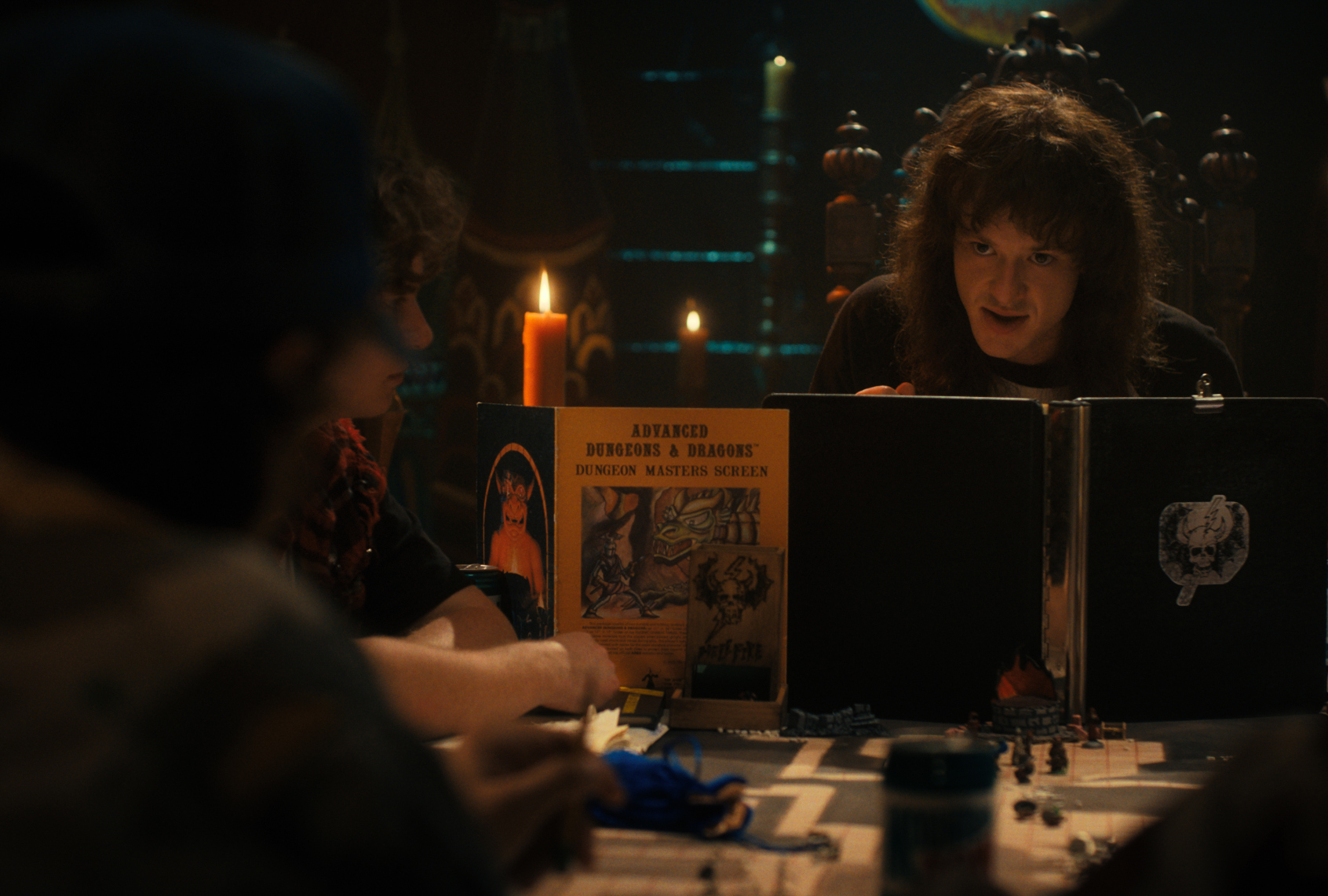
Joseph Quinn as Eddie Munson in “Stranger Things” (Courtesy of Netflix © 2022)Bothered About Dungeons and Dragons
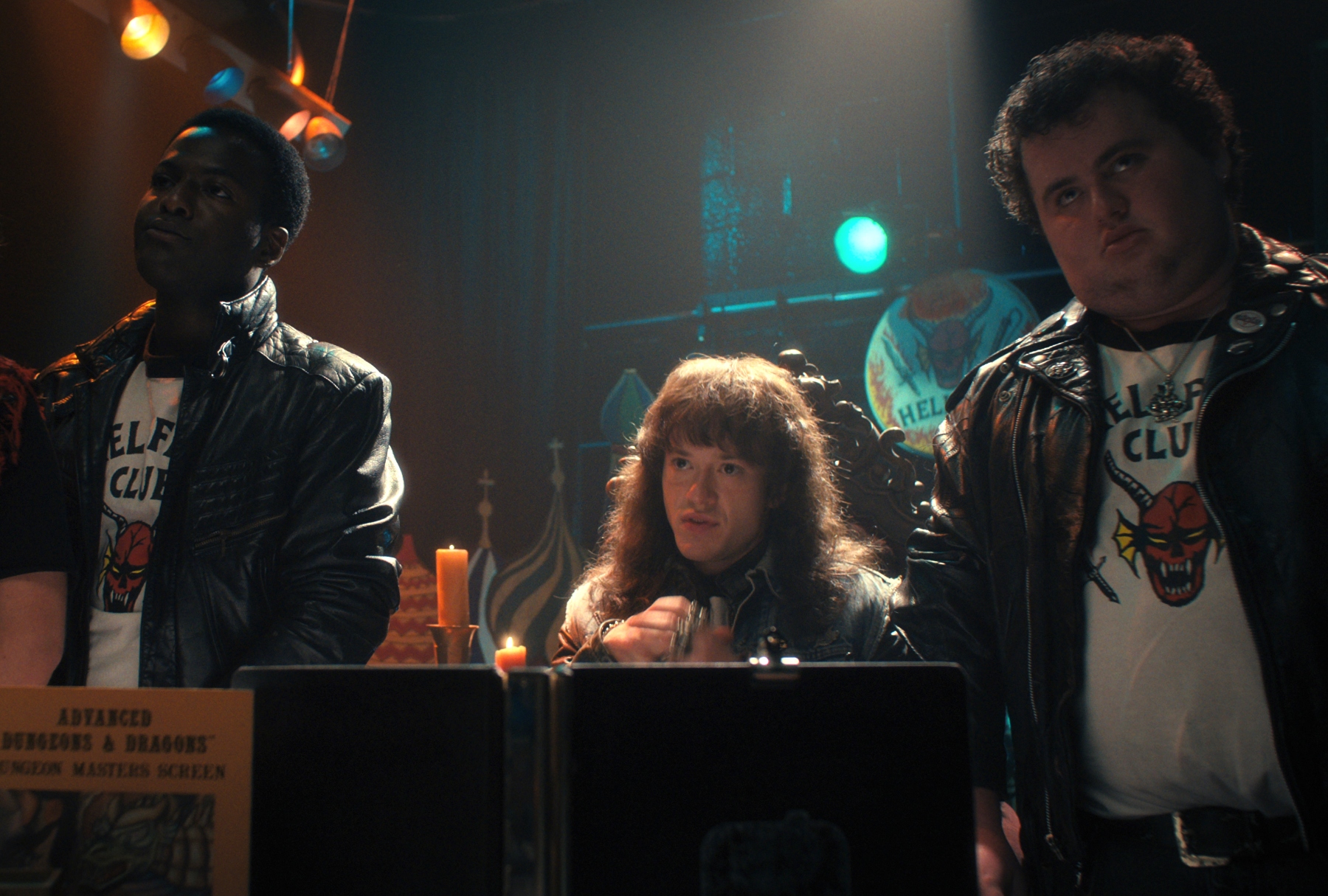
But Eddie also loves Dungeons & Dragons, and yes, that game specifically got roped into this mess too. 

To be honest, it’s hard to think of many games that are more pure. A fantasy tabletop role-playing game originally designed by Gary Gygax and Dave Arneson, Dungeons & Dragons was first published in 1974.

My family first played it in the early months of the pandemic. It was one of the few things that could take my child’s mind off the encroaching horrors of the real world, instead focusing on bards and druids, wizards and rogues, and what snacks we would bring to our campaign. Snacks are very important. We played for hours. The voice of my partner, tasked with being the Dungeon Master, who leads the games, would grow hoarse long into the night. 

People fear what they don’t understand, and many people don’t understand imagination. 

But in 1979, a Michigan State University student who was only 16 ran away. He was believed to have gotten lost in the steam tunnels below the university, believed to be lost in a world of his own making, a fantasy, because he was a  D & D player. As Keith Roysdon writes in Crime Reads: “He went back home but left again and died of a self-inflicted gunshot wound a year after his initial disappearance.”

His mother blamed the game. 

Patricia A. Pulling founded a group called Bothered About Dungeons and Dragons, or BADD for short. Known as an anti-occult campaigner, she popularized the views of BADD: that D & D encouraged suicide and devil worship, via conservative Christian and mainstream media, and in 1984, became a director of the National Coalition on TV Violence. BADD fell apart upon her death in 1997.


Want a daily wrap-up of all the news and commentary Salon has to offer? Subscribe to our morning newsletter, Crash Course.


But the moral panic of Satanism persists. The Season 4 storyline of “Stranger Things” recalls other events from real life, including a Dungeons & Dragon club that was targeted at a high school in Herber City, Utah. The tendrils of the panic, like vines from the Upside Down, keep growing, with echoes in conspiracy groups like QAnon. People fear what they don’t understand, and many people don’t understand imagination. 

As Ander Monson writes, “The Dungeon Master makes the rules, knows all — or as much as is possible to know.” People fear those who dream, who refuse to give up their creativity or love of fantasy and surrender to a magic-less world. It’s no wonder Eddie of “Stranger Things” is a target, that Dustin and Lucas are mocked. Most dreamers are.

I’m gonna need a Hellfire Club shirt. 

Joseph Quinn as Eddie Munson in “Stranger Things” (Netflix)

More stories like this


Study: Warming temperatures are eroding our ability to sleep

Humans have evolved to spend roughly a third of our lives sleeping. How we sleep impacts productivity, alertness, mood, hunger, energy, and other basic functions that comprise a huge chunk of the human experience. But we are not sleeping well. The Centers for Disease Control and Prevention reports that 1 in 3 American adults don’t get enough sleep, and we’re sleeping less than we did about a decade ago. Similar trends are developing across the globe. 

Previous studies have pinned some of the blame for our collective sleep problems on technology and noise and light pollution. But Kelton Minor, a doctoral student at the University of Copenhagen’s Center for Social Data Science, wondered whether rising nighttime temperatures due to climate change might be contributing to the growing sleep deficit. On Friday, Minor and some colleagues published the largest study ever conducted on the relationship between ambient temperature and sleep. Their findings, published in the science journal One Earth, don’t bode well for humans’ sleep outlook in a climate-changed world. 

Studies have shown that people recall sleeping poorly during hot periods, but, until now, researchers haven’t been able to pinpoint what, exactly, is happening to people’s sleep patterns during heatwaves. Are they waking up earlier, going to bed later, more restless throughout the night? Fitness wristbands and other wearables, like Apple Watches, clued Minor and his fellow researchers into how, exactly, temperatures affect sleep and what our sleep might look like as climate change accelerates. 

By working with an enormous data set — 10 billion sleep observations pulled from 7 million sleep records from 47,000 individuals across 68 countries — and comparing that data to meteorological and climate data, the researchers found that warming temperatures have already eroded 45 hours of sleep per person per year by influencing people to fall asleep later and wake up earlier. That’s roughly 10 or 11 additional nights of poor sleep annually. The effects of climate change on sleep start at surprisingly low temperatures, at around 50 degrees Fahrenheit, and grow more severe as temperatures rise. By the end of the century, even if we stabilize greenhouse gas emissions, we’ll lose 50 hours of sleep per year, or 13 days of short sleep.

“What we found is that, already, early in the 21st century, right around now, we already estimate that suboptimal ambient temperatures erode quite a lot of sleep,” Minor told Grist. 

Robbie Parks, a researcher of environmental health sciences at Columbia University who was not involved in this study, called it a “landmark” addition to the field of climate change and sleep. “Using rigorous methodology and an unprecedented dataset of human wearables around the globe, Minor and colleagues have demonstrated how the loss of sleep due to rising temperatures could worsen everywhere under future climate projections,” Parks said. “Lack of sleep can have far-reaching consequences for human health, worsening physical and mental health, potentially resulting in injuries such as transport accidents, and also potentially increasing aggression and deaths of despair,” he added.

As with most climate change-related impacts, the effects of rising temperatures on sleep will not be felt by everyone equally. Minor’s study shows that people in low-income countries, the elderly, and women are experiencing bigger sleep impacts from climate change. The researchers aren’t sure why, exactly, that is, though they have some theories. Reduced access to cooling technology like air conditioning could be a factor in why people in lower-income countries are three times more impacted by higher nighttime temperatures than people in higher-income nations. 

Minor’s research shows that, for the elderly, sleep quality is twice as impacted per degree of warming. That could be because thermal sensitivity increases with age. For cisgender women, core body temperature decreases earlier in the night than it does for cis men, which means they go to sleep earlier on average and may be exposed to higher temperatures as they’re preparing for bed. 

Howard Frumkin, former Dean of the UW School of Public Health and senior vice president of the Trust for Public Land, who was not involved in the study, said the research is an advancement over previous studies. He wasn’t surprised that climate change affects the way people sleep unevenly. “While the paper didn’t provide data, it’s likely that poor people here in the U.S. are disproportionality affected too,” Frumkin told Grist. “In fact, the study was likely skewed toward relatively wealthy people (that’s who wears fancy wristbands) so it may underestimate the impact of heat on sleep.”

Minor was surprised to discover that people in warmer climates were more likely to experience sleep loss as temperatures rise than people in colder climates. He had assumed that people living in warmer places are already acclimated to hot temperatures and wouldn’t have trouble adjusting to a new normal. That wasn’t the case. “This really suggests that there’s limited evidence of adaptation,” he said. In other words, it looks like we’re not going to get used to sleeping in hotter temperatures any time soon. 

Limiting climate change as much as possible will also limit the number of nights of short sleep we’ll experience by the end of the century. But some of that warming is already baked in. That doesn’t mean that climate change’s worsening impacts on sleep are inevitable, though. The fact that individuals’ sleep in richer countries is less impacted by climate change than the sleep of those in lower and middle-income countries indicates that there is a way to limit the impact of rising temperatures on sleep. More research needs to be done, Minor said, but it’s a good bet that expanding access to cooling technologies like air conditioning, planting more trees in urban areas to prevent streets and houses from absorbing so much heat, and lifting people out of poverty could all contribute to better sleep. 

“It provides a path forward,” Minor said, “as long as cooling is provided equitably.” 

The smartest thing “Chip ‘n Dale: Rescue Rangers” does

While making my Emmys predictions a few months ago, I needed a final film to round out my picks for Outstanding TV Movie. I saw Disney+’s “Chip n’ Dale: Rescue Rangers” was eligible and added it to my ballot as a joke, figuring I’d swap it out for a more serious film when voting got closer. After all, how could a hybrid live-action/CG animated film based on a late 1980s cartoon about anthropomorphic chipmunks be good? There was simply no way. 

In the current landscape of Hollywood, adaptations, reboots, revivals, and sequels grow like weeds, choking what few original ideas are able to take root and grow. And “Chip ‘n Dale: Rescue Rangers,” with its meta storyline and frequent references to famous properties owned and controlled by Disney, appeared to be more of the same: an opportunity to cash in on the company’s deep library through nostalgia-obsessed Millennials.

But I was wrong. “Chip ‘n Dale: Rescue Rangers” is not just a very funny and exceptionally good time, it’s also a spiritual successor to the classic movie “Who Framed Roger Rabbit?” And the reason that the film works is because the world that Chip and Dale live in is one that could easily be our own.

RELATED: New movies to stream, from “The Valet” to “Chip ‘n Dale: Rescue Rangers”

How could a hybrid live-action/CG animated film based on a late 1980s cartoon about anthropomorphic chipmunks be good? … I was wrong.

In the movie, comedians John Mulaney and Andy Samberg lend their voices to Chip and Dale, respectively. Childhood best friends-turned-eventual costars on the late ’80s TV show “Chip ‘n Dale: Rescue Rangers,” the duo go their separate ways in 1990 after Dale decides he wants to strike out on his own with a new series.

They reunite years later when their former co-star Monterey Jack (Eric Bana) is kidnapped by a cynical, middle-aged Peter Pan (Will Arnett), who’s altering famous cartoon characters to avoid copyright laws and then forcing them to make bootleg versions of their properties for his financial gain. With the help of a local LAPD detective (KiKi Layne), Chip, now a successful insurance salesman living in the suburbs, and Dale, a washed-up actor trying to recapture the glory days while on the convention circuit, team up to find their friend and rescue him before it’s too late. 

Dale (voiced by Andy Samberg) and Chip (voiced by John Mulaney) in “Chip N’ Dale: Rescue Rangers” (Disney)As the chipmunks embark on their latest adventure, the movie — which was directed by Akiva Schaffer and written by Dan Gregor and Doug Mand — satirizes Hollywood and reboot/revival culture through the actions and attitudes of Chip and Dale (the former is against a reboot, while the latter is always trying to drum up interest), but it also makes excellent use of razor-sharp sight gags with posters and billboards for movies like “Fast & Furious Babies,” “Batman vs. ET,”  and “Lego Misérables.” 

Want a daily wrap-up of all the news and commentary Salon has to offer? Subscribe to our morning newsletter, Crash Course.


It doesn’t take much to imagine a Hollywood executive greenlighting the Fast Saga franchise‘s version of “Muppet Babies” or “The Boss Baby,” or perhaps even giving it the “Look Who’s Talking” treatment. After all, Netflix has already released six seasons of the teen-centric animated series “Fast & Furious Spy Racers,” while the popular film franchise has gone to space and convinced both Dame Helen Mirren and EGOT winner Rita Moreno to appear. The idea that babies could take the wheel next feels ridiculous and yet somehow also within reason. Meanwhile, “Chip ‘n Dale: Rescue Rangers” quickly pays off on its excellent “Batman vs. ET” gag by actually treating us to a scene in which everyone’s favorite Reese’s Pieces-loving alien forgives Batman, to which the terse Caped Crusader replies, “Fine.” 

These jokes … hold a mirror up to pop culture and our own revival-obsessed society, and they are all simple but exceptionally well done.

The film – which also features the voices of original “Rescue Rangers” actors Tress MacNeille and Corey Burton in addition to J.K. Simmons, Keegan-Michael Key and Dennis Haysbert – is jam-packed with relatively lowbrow, low-stakes humor, but it’s executed at a high level. Take, for instance, the appearance of Ugly Sonic (Tim Robinson), the 2020 version of Sonic the Hedgehog who had realistic teeth and who the internet criticized mercilessly until the studio agreed to redesign the character. You don’t need to know the background to understand why he’s doing the convention circuit now (but it certainly does elevate the joke).

And when the movie takes shots at the motion-capture animation style of the mid-2000s by taking a trip to the (Uncanny) Valley and referencing the disturbing “Polar Express” eyes of a Viking (Seth Rogen) animated in the same style, you don’t have to place the reference to be able to laugh or understand its truth.

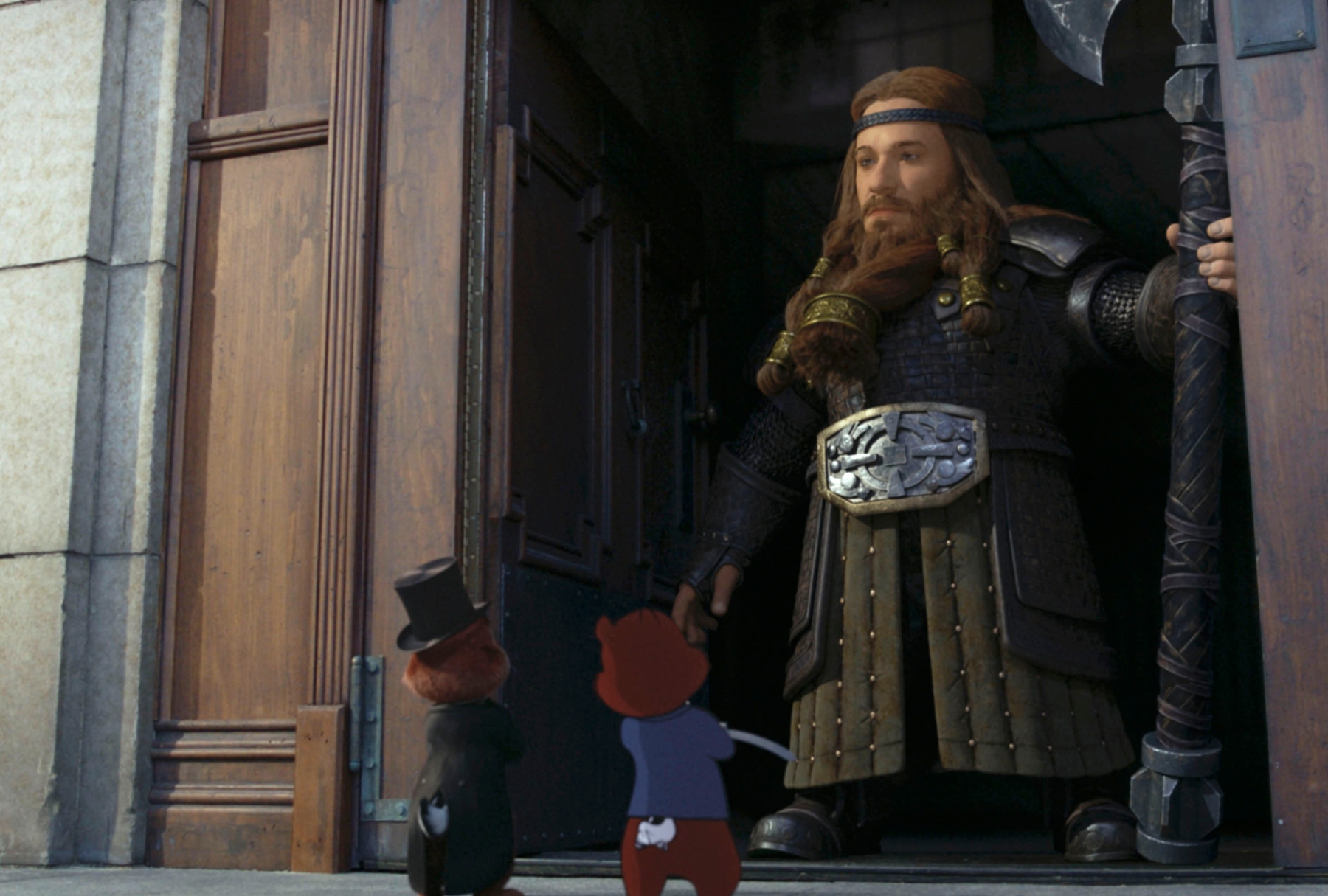
Dale (voiced by Andy Samberg), Chip (voiced by John Mulaney) and Bob the Warrior Viking (voiced by Seth Rogen) in “Chip N’ Dale: Rescue Rangers” (Disney)These jokes form the connective tissue of the movie. They hold a mirror up to pop culture and our own revival-obsessed society, and they are all simple but exceptionally well done, effectively turning “Chip ‘n Dale: Rescue Rangers” into a piece of high art that effortlessly nails joke after joke after joke. Whether it’s a billboard for “Waze: The Movie” or a Chun Li star on the Hollywood Walk of Fame, “Chip ‘N Dale: Rescue Rangers” simply does not miss.
And when you look back at the films that have been nominated for and won the Emmy for Outstanding TV Movie in recent years, it stands head and shoulders above the rest (and we’re not talking chipmunk height here). The writing is sharp; the use of various animation styles is worthy of achievement, not just admiration; and it’s one of the most creative and enjoyable films we’ve seen in a long time. But perhaps the most important thing the film has going for it this Emmy season, is that it’s a film about Hollywood, and we all know there’s nothing Hollywood loves more than patting itself on the back.

“Chip ‘n Dale: Rescue Rangers” is now streaming on Disney+. Watch a trailer, via YouTube.

Read more about movies:

Right-wing snowflakes love to whine about free speech — this socialist went to jail for it

Nothing divides Americans like the question of free speech: What it means, who deserves it and who does not. Conservatives like to complain about being “censored” or “canceled” for their attacks on LGBTQ rights or mask mandates, but lately have started trying to impose all kinds of restrictions on speech in education, especially on issues of gender identity, sexual orientation and race.

When it comes to the legendary Eugene Victor Debs, however — a leading labor and political activist in the late 19th and early 20th century — there’s just no question: He was a martyr for free speech and a case study in overcoming oppression. When Debs was sent to prison for speaking truth to “the man” — and in this case, it really was The Man, meaning President Woodrow Wilson — he fought back by deciding to run for president himself.

RELATED: We celebrated “free speech” this week — just as it’s slipping away from us

Our story begins on June 16, 1918, on a balmy afternoon in Canton, Ohio, where Debs was scheduled to speak at the state’s Socialist Convention, and then at a picnic — in fact, one named for him. Debs was then a 62-year-old veteran of the labor movement, who had helped found the American Railway Union (ARU) and the Industrial Workers of the World (IWW), and had gradually moved leftward out of the Democratic Party to various socialist organizations. In the 1900 presidential election, he was the Social Democratic Party’s presidential nominee; after that party imploded, he was the Socialist Party candidate in 1904, 1908 and 1912. Voter turnout in that last election was so low that although Debs only got about 900,000 votes, that was about 6% of the total — one of the most impressive electoral performances by a left-wing independent in American history. (Robert La Follette got 4.8 million votes and nearly 17% of the total in the 1924 election, as well as his home state of Wisconsin; by contrast, Ralph Nader got almost 2.9 million votes in the 2000 election, but that was only 2.7% of the total.)

That election further cemented Debs’ status as a celebrity, and America’s most powerful socialist, prominently articulating an anti-capitalist, anti-corporate ideology that would inspire generations yet to come (including Bernie Sanders, who took Debs as something of a role model). By 1918, however, Debs was preoccupied by foreign policy. After considerable hesitation, the U.S. had committed troops to fight in World War I, which Debs believed was driven by irrational nationalist rhetoric and a combination of imperialism and capitalism run amok. (The term “military-industrial complex” was not yet in use, but Debs would surely have embraced it.) To him, the so-called Great War was about the working class suffering and dying for the benefit of the wealthy few.


Want a daily wrap-up of all the news and commentary Salon has to offer? Subscribe to our morning newsletter, Crash Course.


Unsurprisingly, Debs was also opposed to the military draft, which put him at odds with Woodrow Wilson’s administration, which had just passed an infamous law called the Espionage Act, which, among other things, made it a federal crime to interfere with conscription. When Debs spoke in Canton on that June afternoon, the audience included agents from the Department of Justice, eager to see if they could ensnare him in something that might conceivably violate the law. Debs was aware of the risk and warned his audience that he had to be “extremely careful, prudent, as to what I say, and even more careful and more prudent as to how I say it.” Maybe he was daring the agents to come after him for whatever he said, and they took the bait, as did a federal prosecutor named Edwin Wertz after Debs said this:

They have always taught you that it is your patriotic duty to go to war and slaughter yourselves at their command. You have never had a voice in the war. The working class who make the sacrifices, who shed the blood, have never yet had a voice in declaring war.

As soon as he was charged under the Espionage Act, Debs knew he would be convicted. It was essentially a political show trial, an attempt by Wilson to intimidate left-wing critics into silence, in a wartime climate of patriotism when Americans were even more suspicious of the left than usual. Debs refused to call defense witnesses, speaking directly to the jury to explain why he was unwilling to play the court’s game. After his inevitable conviction, he delivered a statement to the court that would later be immortalized:

Your Honor, years ago I recognized my kinship with all living beings, and I made up my mind that I was not one bit better than the meanest on earth. I said then, and I say now, that while there is a lower class, I am in it, and while there is a criminal element I am of it, and while there is a soul in prison, I am not free.

I listened to all that was said in this court in support and justification of this prosecution, but my mind remains unchanged. I look upon the Espionage Law as a despotic enactment in flagrant conflict with democratic principles and with the spirit of free institutions …

Debs’ 1920 campaign wasn’t so much about anything he said or did as about the symbolic importance of “Prisoner 9653” running for president.

On the day Debs went to prison, a protest march in Cleveland was attacked by police, leading to the May Day riots of 1919. The Socialist Party nominated him once again as its presidential candidate, although he had not run in 1916 and likely hadn’t intended to in 1920. Debs wrote numerous statements from his prison cell, detailing his views on everything from the war to class inequality. But his campaign wasn’t based on anything he said or did, but the symbolic importance of the imprisoned free-thinker running for the highest office in the land. Supporters didn’t just ask people to vote for Debs; they told them to vote for “Prisoner 9653.” Word quickly spread that Debs, by all accounts a kind and courtly man in his personal interactions, was highly popular among both prison staff and his fellow inmates.

Of course Debs didn’t win — he was running as a third-party candidate, after all — but he received just over 913,000 votes, slightly more than he had in 1912. Notably, that was only about half as much of the total popular vote (3.4%) as it had been eight years earlier, largely because the electorate was much larger: The 1920 election was the first in which all American women had the right to vote, following the passage of the 19th Amendment.

That was Eugene Debs’ last presidential campaign. He declined to run in 1924, facing failing health, and died in 1926. If it had been up to Wilson, Debs might have died in prison — but it was the next president, conservative Republican Warren G. Harding (winner of that 1920 election), who ultimately let him go. After taking office, Harding sent Attorney General Harry Daugherty to discuss terms for a potential pardon or clemency with Debs. On Christmas Eve of 1921, Harding announced he would commute the sentences of 24 political prisoners from the Wilson era, and that Debs would be among them.

Harding made a point of criticizing Debs in his public statement, stating that he was guilty as convicted and calling him “a dangerous man calculated to mislead the unthinking and affording excuse for those with criminal intent.” Harding said he was extending clemency because of Debs’ age and physical frailty, and because he “was by no means, however, as rabid and outspoken in his expressions as many others, and but for his prominence and the resulting far-reaching effect of his words, very probably might not have received the sentence he did.”

As Debs walked out of the Atlanta Penitentiary on Christmas Day 1921, he and his brother heard hundreds of prisoners standing at the bars of their cells cheering for him. Harding then asked for a private meeting with Debs — no reporters allowed — where he reportedly told him, “Well, I’ve heard so damned much about you, Mr. Debs, that I am now glad to meet you personally.”

There are many lessons to be drawn from Debs’ story, but perhaps the most important one is so obvious that it needs to be stated directly. When we talk about free speech, there is a big difference between people who merely face criticism for what they say and those who are actually persecuted or oppressed for it. If people write mean things about your Netflix special, or an online platform decides not to host a particular video, that’s not oppression or censorship. But journalists targeted for violence over their reporting, or teachers who lose their jobs for telling the truth about American history, really are being oppressed, censored and silenced. Eugene Debs refused to shut up or follow the rules, and paid the price. That makes him a free-speech hero whether you agree with his views or not.

Read more from Matthew Rozsa on U.S. history:

Trump does grotesque jig after reading off names of Uvalde victims at NRA convention

Former President Donald Trump and Republican Sen. Ted Cruz on Friday doubled down on a pro-gun response to gun violence as they addressed the National Rifle Association’s conference in Houston—a gathering that opened just three days after the mass shooting in Uvalde, Texas that left 19 elementary school students and two teachers dead.

Among the elements of Trump’s apparently poorly attended speech that drew criticism on social media was his reading of the Uvalde victims’ names, each of which was followed by a bell sound, and a brief dance-like movement right after he concluded his remarks.

“What is wrong with these people?” asked one observer. Another called it “a grotesque caricature of sympathy.”

Rejecting the idea that Congress should take up legislation to address easy access to guns, the former Republican president said instead it was necessary to “harden our schools” and proposed a militarized security system in which all educational buildings “have a single point of entry,” armed officers, armed teachers, metal detectors, and classroom doors that lock from the inside.

But in Uvalde, as The Associated Press noted, a locked classroom door “kept victims in and police out.”

Trump also vowed to “crack down on violent crime like never before” should he win the presidency for a second time.

His remarks came after a similarly falsehood-pushing speech from Cruz, one of the Republicans who’s faced heightened criticism over his campaign cash from the gun lobby and his opposition to gun control legislation.

As Trump later echoed, the Texas Republican said that “the only way to stop a bad guy with a gun is a good guy with a gun”—a theory that, as MSNBC host Chris Hayes put it Friday, “utterly failed” in Uvalde and reveals “the bankruptcy of the arms race theory of violence prevention.”

Gun control advocate David Hogg, a survivor of the 2018 mass shooting at the Marjory Stoneman Douglas High School in Parkland, Florida, also took issue with the popular right-wing refrain of “armed good guys” stopping “armed bad guys.”

“But they didn’t [in Uvalde] and they didn’t in Parkland,” Hogg tweeted Friday. “Stop endangering … the lives of our students, teachers, and first responders.”

“First responders,” he said, “should be our last resort not our first to stopping a shooting.”

San Francisco Giants manager wants to skip national anthem post Uvalde shooting

San Francisco Giants manager Gabe Kapler has vowed not to take the field during the national anthem in wake of the deadly massacre that claimed the lives of more than 20 victims in Uvalde, Texas.

On Friday, May 27, Kapler made the announcement and insisted he would not take the field in acknowledgment of the song until something the United States makes a move in the right direction. “I don’t plan on coming out for the anthem going forward until I feel better about the direction of our country,” Kapler said on Friday.

Kapler also shared a statement on his website as he shared his sentiments on the Robb Elementary shooting. He admitted how it felt to take the field for Wednesday’s game just hours after the massacre had taken place. Although there was a moment of silence for the victims, Kapler admitted that he still felt like a coward for standing for the national anthem.

“On Wednesday, I walked out onto the field, I listened to the announcement as we honored the victims in Uvalde. I bowed my head. I stood for the national anthem. Metallica riffed on City Connect guitars,” Kapler wrote. “My brain said drop to a knee; my body didn’t listen. I wanted to walk back inside; instead, I froze. I felt like a coward.”

Kapler insisted that he also did not want to take attention away from the tragic loss of those who were slain during the shooting. However, he also noted that he still feels disappointed for not taking a stand.

“But I am not okay with the state of this country. I wish I hadn’t let my discomfort compromise my integrity. I wish that I could have demonstrated what I learned from my dad, that when you’re dissatisfied with your country, you let it be known through protest. The home of the brave should encourage this,” he said.

Burned out by COVID and 80-hour workweeks, resident physicians unionize

In the early weeks of the pandemic, Dr. Lorenzo González, then a second-year resident of family medicine at Harbor-UCLA Medical Center, ran on fumes, working as many as 80 hours a week in the ICU. He was constantly petrified that he would catch the covid-19 virus and guilt-ridden for not having enough time to help his ailing father.

In April 2020, his father, a retired landscaper, died of heart and lung failure. González mourned alone. His job as a doctor-in-training put him at high risk of catching the virus, and he didn’t want to inadvertently spread it to his family. Financial stress also set in as he confronted steep burial costs.

Now, González is calling for better pay and benefits for residents who work grueling schedules at Los Angeles County’s public hospitals for what he said amounts to less than $18 an hour — while caring for the county’s most vulnerable patients.

“They’re preying on our altruism,” González said of the hospitals. He is now chief resident of family medicine at Harbor-UCLA and president of the Committee of Interns and Residents, a national union that represents physician trainees and that is part of the Service Employees International Union.

“We need acknowledgment of the sacrifices we’ve made,” he said.

Residents are newly minted physicians who have finished medical school and must spend three to seven years training at established teaching hospitals before they can practice independently. Under the supervision of a teaching physician, residents examine, diagnose, and treat patients. Some seek additional training in medical specialties as “fellows.”

These trainees are banding together in California and other states to demand higher wages and better benefits and working conditions amid intensifying burnout during the pandemic. They join nurses, nursing assistants, and other health care workers who are unionizing and threatening to strike as staffing shortages, the rising cost of living, and inconsistent supplies of personal protective equipment and covid vaccines have pushed them to the brink.

More than 1,300 unionized residents and other trainees at three L.A. County public hospitals, including Harbor-UCLA, will vote May 30 on whether to strike for a bump in their salaries and housing stipends, after a monthslong negotiation deadlock with the county. Since March, residents at Stanford Health Care, Keck School of Medicine at the University of Southern California, and the University of Vermont Medical Center have unionized.

“Residents were always working crazy hours, then the stress of the pandemic hit them really hard,” said John August, a director at Cornell University’s School of Industrial and Labor Relations.

The Association of American Medical Colleges, a group that represents teaching hospitals and medical schools, did not address the unionization trend among residents directly, but the organization’s chief health care officer, Dr. Janis Orlowski, said through a spokesperson that a residency is a working apprenticeship and that a resident’s primary role is to be trained.

Residents are paid as trainees while they are studying, training, and working, Orlowski said, and the association works to ensure that they receive effective training and support.

David Simon, a spokesperson for the California Hospital Association, declined to comment. But he forwarded a study published in JAMA Network Open in September showing that surgery residents in unionized programs did not report lower rates of burnout than those in nonunionized programs.

So far, none of the new chapters have negotiated their first contracts, the national union said. But some of the longer-standing ones have won improvements in pay, benefits, and working conditions. Last year, a resident union at the University of California-Davis secured housing subsidies and paid parental leave through its first contract.

With more than 20,000 members, CIR represents about 1 in 7 physician trainees in the U.S. Executive Director Susan Naranjo said that before the pandemic one new chapter organized each year and that eight have joined in the past year and a half.

Residents’ working conditions had come under scrutiny long before the pandemic.

The average resident salary in the U.S. in 2021 was $64,000, according to Medscape, a physician news site, and residents can work up to 24 hours in a shift but no more than 80 hours per week. Although one survey whose results were released last year found that 43% of residents felt they were adequately compensated, those who are unionizing say wages are too low, especially given residents’ workload, their student loan debt, and the rising cost of living.

The pay rate disproportionately affects residents from low-income communities and communities of color, González said, because they have less financial assistance from family to subsidize their medical education and to pay for other costs.

But with little control over where they train — medical school graduates are matched to their residency by an algorithm — individual residents have limited negotiating power with hospitals.

For unionizing residents seeking a seat at the table, wage increases and benefits like housing stipends are often at the top of their lists, Naranjo said.

Patients deserve doctors who aren’t exhausted and preoccupied by financial stress, said Dr. Shreya Amin, an endocrinology fellow at the University of Vermont Medical Center. She was surprised when the institution declined to recognize the residents’ union, she said, considering the personal sacrifices they had made to provide care during the pandemic.

If a hospital does not voluntarily recognize a union, CIR can request that the National Labor Relations Board administer an election. The national union did so in April, and with a certified majority vote, the Vermont chapter can now begin collective bargaining, Naranjo said.

Annie Mackin, a spokesperson for the medical center, said in an email that it is proud of its residents for delivering exceptional care throughout the pandemic and respects their decision to join a union. Mackin declined to address residents’ workplace concerns.

Dr. Candice Chen, an associate professor of health policy at George Washington University, believes that the federal Centers for Medicare & Medicaid Services also bears some responsibility for residents’ working conditions. Because the agency pays teaching hospitals to train residents, it should hold the facilities accountable for how they treat them, she said. And the Accreditation Council for Graduate Medical Education, which sets work and educational standards for residency programs, is moving in the right direction with new requirements like paid family leave, she added, but needs to do more.

How far these unions will go to achieve their goals is an open question.

Strikes are rare among doctors. The last CIR strike was in 1975, by residents at 11 hospitals in New York.

Naranjo said a strike would be the last resort for its L.A. County members but blamed the county for continuously delaying and canceling bargaining sessions. Among its demands, the union is calling for the county to match the wage increase granted to members of SEIU 721, a union that represents other county employees, and for a $10,000 housing allowance.

The union’s member surveys have found that most L.A. County residents report working 80 hours a week, Naranjo said.

A spokesperson for L.A. County’s Department of Health Services, Coral Itzcalli, thanked its “heroic” front-line workforce for providing “best-in-class care” and acknowledged the significant toll that the pandemic has taken on their personal and professional lives. She said limits on hours are set by the Accreditation Council for Graduate Medical Education and that most trainees report working “significantly less” than 80 hours a week.

Jesus Ruiz, a spokesperson for the L.A. County Chief Executive Office, which manages labor negotiations for the county, said via email that the county hopes to reach a “fair and fiscally responsible contract” with the union.

Results of the strike vote are expected to be announced May 31, the union said.

This story was produced by KHN, which publishes California Healthline, an editorially independent service of the California Health Care Foundation.

KHN (Kaiser Health News) is a national newsroom that produces in-depth journalism about health issues. Together with Policy Analysis and Polling, KHN is one of the three major operating programs at KFF (Kaiser Family Foundation). KFF is an endowed nonprofit organization providing information on health issues to the nation.

Subscribe to KHN’s free Morning Briefing.

Beatles roadie Mal Evans was born to play the befuddled Channel Swimmer in “Help!”

Had he lived into old age, Beatles roadie Mal Evans would have been 87 now. In August 1963, the 28-year-old giant of a man began the adventure of a lifetime when he joined the British band’s cozy entourage, which included manager Brian Epstein and fellow roadie Neil Aspinall. With the release of their “She Loves You” single, the Beatles were poised to shift from a regional to a national sensation. And Mal would be right alongside them as they conquered the world, a jack of all trades who was willing to take on any duty — no matter how big or how small — in their service.

In February 1965, as the Beatles and director Richard Lester alighted in the Bahamas, Mal took on his famous role as the befuddled Channel Swimmer in “Help!,” the group’s second feature film. It was a bit part, to be sure, but a cameo appearance that never fails to warm the hearts of Beatles fans across the globe.

RELATED: Peter Jackson’s “Get Back” docuseries is a mesmerizing feast for the eyes

It was a role, in many ways, that Mal had been born to play. In his teen years, he had toned his large frame through a dedicated regime of swimming and cycling. He had been known to bike for hours — full days, even — on the rural outskirts of Liverpool. And when it came to swimming, there was scarcely a body of water that he didn’t — simply couldn’t — pass up. From the frigid Irish Sea to a serene country lake to the modest dimensions of a chlorinated motel pool, Mal lived to swim. And no mere soak would do. For Mal, thrashing about and playing in the shallows was for amateurs. He preferred the vigorous exertions of a breaststroke to the comparatively pedestrian aquatic ministrations of ordinary folk.

As it turned out, Mal’s first day on the set would be anything but amiable.

When it came to “Help!,” Lester and his production team couldn’t have dreamt up a better role for him to play. Humble to a fault, Mal couldn’t wait to take his place on the set. When Lester called for action, Mal was treading water just off the beach at Nassau. As the wayward Channel Swimmer, he was clad in a bathing cap while searching in vain for the White Cliffs of Dover. As it turned out, Mal’s first day on the set would be anything but amiable.


Love the Beatles? Listen to Ken’s podcast “Everything Fab Four.”


“As the scene is finalizing on the beach,” he later wrote in his memoirs. “I had to swim out to sea for one-half mile and tread water until the scene is ready to be shot. The film crew are situated higher up on the beach and suddenly, Dick Lester is shouting at me saying, ‘Come in Mal. Come back Mal!’ And so, just thinking they weren’t ready for the scene, I swam leisurely to shore, not knowing at the time there was a huge stingray chasing me!”

Safely standing with the crew back on the beach, Mal spotted the giant fish, which in his estimation was more than 15 feet long. But his hair-raising experience didn’t end there. In mid-March, Lester’s production shifted a continent away to Austria, where Mal reprised his role.

What should have been a simple cameo appearance turned into something much more harrowing.

As with the Bahamas, what should have been a simple cameo appearance turned into something much more harrowing. Beatles press officer Tony Barrow would never forget the sight of Mal, clad only in his bathing suit against the bitter cold. “Poor Mal must have been absolutely frozen,” Barrow wrote in a column for “The Beatles Book.” “All he was wearing was an old fashioned swimming costume with cap and goggles and a very thick layer of grease to protect him from the cold. Everyone was a bit concerned that he would freeze to death before the scene was over.”

Working amidst the snow-covered mountains, the scene called for the Beatles to be engaged in a good-natured curling match, when one of the film’s villains substitutes a bomb for a curling stone, which blows a hole in the ice and allows the Channel Swimmer to surface. “This scene had to be shot three times,” Mal recalled, because “I was so cold, I just couldn’t speak! Going down again and coming up, I spoke my lines, but on submerging again, could not stay down and kept popping to the surface.”

At this point, “somebody had the bright idea of putting a large weight in the bottom of the hole for me to hang onto, with the instructions from director Dick Lester, ‘Stay down as long as you can Mal so we can finish the shot.’ Being a real trooper, after I said my lines I submerged, took hold of the weight and stayed down holding my breath.”

“You can come up now. Mal, come up now!”

And that’s where he stayed, holding out as long as he possibly could. Unbeknownst to Mal, the director had been shouting — with increasing desperation — “You can come up now. Mal, come up now!” Meanwhile, the roadie was nestled below the surface, pushing himself to the limit in order to land the scene.

“Finally, self-preservation brought me up for air,” Mal wrote. “Wrapped in a towel, I walked in my bare feet about 400 yards to the local police station, while the whole crew stood up and cheered. I spent two hours in the hottest bath with a bottle of rum, thawing out. It was pins and needles from head to toe, but the cheers and the clapping made it all worthwhile.”

Mal’s bravura turn as the Channel Swimmer was a highlight, to be certain, in the roadie’s storied career with the Beatles. But coming fewer than two years into his tenure with the band, it was still early days yet. By the mid-1960s, he had proven his mettle among the entourage for his ability to lug gigantic amplifiers onto some far-flung stage. And he prided himself on being able to assemble Ringo Starr’s drum kit in a matter of seconds.

But the quality that would see him through, that would ensure his place among their tightly knit circle, was far less tangible than his capacity for hoisting heavy objects with minimal complaint. By the time that Help! enjoyed its gala premiere at the London Pavilion that July, as he and his wife Lily mingled with the Beatles and their friends and relations, he knew that he had made it. 

Read more Kenneth Womack stories about Beatles history: 

New York residents can now choose ‘X’ as their gender on state IDs

In the first big step made after the Gender Recognition Act was passed by the New York state assembly in 2021, residents of New York can now select ‘X’ as their gender marker on state issued ID cards.

According to a news release from Governor Kathy Hochul‘s office, this option will be available as of June 24 for driver licenses, learner permits and ID cards at every DMV office, statewide, and will also be made available as an option to change online as of July.

“As we prepare to celebrate Pride Month in a few days, I am excited to announce this historic change that represents another victory in our fight to help ensure equality and respect for the LGBTQ+ community,” Hochul said in the release, first reported on by CNN. “Every person, regardless of their gender identity or expression, deserves to have an identity document that reflects who they are,” Hochul furthered in her release.”My administration remains committed to ensuring that New York is a place of value, love and belonging for members of the LGBTQ+ community.”

RELATED: Lauren Boebert introduces bill to stop TSA modernization, slams “gender-neutral” screenings as woke

“Perhaps more than any other state agency, New Yorkers directly engage with their government through the DMV, so offering identity documents that are representative of all New Yorkers is a significant milestone,” says Department of Motor Vehicles Commissioner Mark J.F. Schroeder. “We are thrilled to implement this new option that we know will have a positive impact on the lives of so many of our customers.”   


Want a daily wrap-up of all the news and commentary Salon has to offer? Subscribe to our morning newsletter, Crash Course.


“Each and every New Yorker should be recognized for who they are by their government,” adds State Senator Brad Hoylman. “Before the Gender Recognition Act, it was incredibly hard for many New Yorkers to get the identification documents they require for travel, to get a job, and even to go to school.”

Detailed in the release, “This announcement comes as part of the major advancements in LGBTQ+ equity Governor Hochul fought for and secured in the Enacted Fiscal Year 2023 State Budget. The Budget includes $13.5 million for the Department of Health to support the LGBTQ+ community and more than doubles annual LGBTQ+ Health and Human Services funding.”

Read more:

Kosher, table, flaky and sea: Your guide to the most popular types of salt

Before I started cooking more seriously in my early 20s, certain ingredients seemed pretty simple. Butter was butter. Flour was flour — I didn’t know that there was a marked difference between A.P. and bread until much later. And salt was salt. 

However, it only took one classic mix-up between table and kosher salt, leading to an almost comically salty batch of brownies, for me to realize that there was an entire world of salt out there, and that choosing the right one could literally make or break a dish. 

Related: 5 simple summer snacks for when it’s just too hot to turn on your oven

Here is a handy guide to the four salt types you’re most likely to run into in your own cooking and baking. 

Kosher Salt 

While any salt that is produced under kosher supervision can be classified as “kosher,” when recipes call for kosher salt, they are referring to a particular type of large-grained salt. This type of salt was originally used to pull all the blood out of meat as it underwent the koshering process — and the name “kosher salt” just kind of stuck. 

Within the world of kosher salt, there are two big brands. There’s Morton’s, which comes in a dark blue box emblazoned with an illustration of a young girl walking under an umbrella, and then there’s Diamond Crystal, which comes in a red box. 

Recipes will typically call for one or the other. That’s because they are actually distinct enough to change the outcome of your dish. Diamond Crystal (for which most pro chefs have an affinity) has larger, lighter grains, while Morton’s is made up of flattened, thin flakes. If a recipe calls for two teaspoons of Diamond Crystal, and you replace it with two teaspoons of Morton’s, your dish may end up a little over-salted. 

Table Salt 

The salt hanging out in the shaker at your local diner? That is most likely garden-variety table salt. Unlike kosher or sea salt, the grains in there are dense, tightly packed together and pretty uniform. Again, since the crystals are smaller, you can’t necessarily swap it one-for-one in recipes that call for a different kind of salt. 

Most table salt is iodized; this has been the case since the 1920s when doctors realized that iodine deficiency was causing goiters and manufacturers agreed that adding iodine to table salt was an easy way to rectify that problem. Pro: Less thyroid issues for the masses. Con: Iodized salt can give food a metallic taste. 

These days, most Americans consume enough iodine naturally through a well-balanced diet, so if you opt to buy table salt, seek out a non-iodized version for better flavor. 

Sea Salt 

Sea salt, as the name suggests, is made by letting salt water dry out to reveal the salinic crystals within. There is a wild array of sea salts available — ranging from red and black salts to fleur de sel — that each offer their own nuanced flavor to dishes. This makes sea salt exceptionally popular as a “finishing salt,” meaning that one would use it to season certain dishes, like roasted vegetables or fresh-baked bread, at the last minute, so the subtleties of the salt aren’t masked during the cooking process. 

Flake Salt 

Flake, or flaked, salt is shaped like little, flat plates. Even more so than sea salt, it is used for finishing dishes. A little goes a long way towards making a recipe feel complete, and the addition of it (especially when paired with a good-quality olive oil and some citrus zest) can elevate a plate of raw, seasonal vegetables into something that’s really special. 

There are a number of specialty flake salts on the market, which can add different dimensions to a meal. Smoked salt is definitely a good place to start — especially, and this is real talk, sprinkled on dark chocolate chip cookies. 

Some of our favorite warm-weather recipes


This butter-soaked lobster roll has a decadent secret ingredient

These lobster rolls shine with sweet chunks of fresh lobster meat tossed in a mixture of celery, red onions, thyme, and mayonnaise. Split-top hot dog buns slathered with cannabis-infused butter adds a delicious twist to this summertime classic.

Related: How to start cooking with CBD (plus, recipes for infused pesto and dark chocolate truffles)

Suggested dosage: Approximately 52 milligrams of THC per recipe; serving; Approximately 13 milligrams THC per serving; 21% THC.

Recipe: Classic Lobster Rolls with Cannabis-Infused Butter 
By Jazmine Moore, Green Panther Chef 

Yields
4 servings
Prep Time
12 minutes
Cook Time
40  minutes, plus 2 hours of chilling

Ingredients

3 (11/4 pounds each) fresh live Maine lobsters (about 2 cups of meat)

1/2 cup finely diced celery

1/2 cup finely diced red onion

1/2 cup mayonnaise, homemade or store-bought

1/2 tablespoon fresh minced thyme

1/2 tablespoon fresh lemon juice

Salt and freshly ground black pepper

2 tablespoons cannabis-infused unsalted butter, melted, homemade or store-bought

4 New England–style split-top hot dog buns

Microgreens

Lemon wedges


Directions

  1. Place a large bowl of ice water near your cooking area. Place a rimmed baking sheet near the ice-water bath.
  2. To steam the lobsters: Fill a large stockpot with 2 inches of salted water. Bring to a boil. Using tongs, carefully lower the lobsters, one at a time, headfirst into the boiling water. Cover the pot and return the water to a boil, about 4 minutes. Steam until the outer shells of the lobsters turn bright red and an internal temperature of the lobster meat reaches 135°F, about 9 minutes.
  3. Using tongs, carefully plunge the lobsters into the ice-water bath for about 2 minutes, replenishing the ice in the bowl of water as necessary. Transfer the chilled lobsters to the baking sheet. Repeat with the remaining lobsters.
  4. Remove the meat from the lobsters and cut into ½-inch chunks. Pat the lobster meat dry with paper towels, then transfer to a medium bowl. Cover with plastic wrap and place in the refrigerator until the meat is very cold, about 2 hours.
  5. In a separate large bowl, stir together the celery, red onions, mayonnaise, thyme, and lemon juice until well combined. Fold in the lobster meat. Adjust seasonings with salt and pepper.
  6. To grill the buns: Preheat a skillet over medium-low heat. Brush the outside of each bun with the cannabis-infused butter and grill until golden brown, about 2 minutes on each side.
  7. To assemble: Evenly divide the lobster meat mixture among the buns and top with microgreens, to taste. Serve with a lemon wedge, a bowl of chowder or chips and pickles on the side.


Cook’s Notes

Variation: Serve the lobster meat mixture on 8 toasted mini potato rolls, such as Martin’s, for the perfect-party appetizer.

Note: If you can’t find microgreens, an alternative garnish is lining each bun with 1 to 2 lettuce leaves before adding the lobster salad.

Related

Salt and pepper . . . ice cream?!

Big Little Recipe has the smallest-possible ingredient list and big everything else: flavor, creativity, wow factor. That means five ingredients or fewer — not including water, salt, black pepper, and certain fats (like oil and butter), since we’re guessing you have those covered. Inspired by the column, the Big Little Recipes cookbook is available now.


Salt and pepper are a given in savory recipes, so much so that they’re often shortened to S&P, like a dear friend signing an email with a single initial. The other letters are unneeded. You know who they are.

This is especially true in savory Big Little Recipes, where there might be only a few other ingredients. Like tuna, avocado, bread, and lemon. Or pasta, onions, and butter.

But by changing the context, salt and pepper can raise their voices, demand your attention, tell you to listen up. Just switch from dinner to dessert. My favorite dessert, in fact: ice cream.

In the U.S., vanilla is treated as the default scoop, the canvas onto which you draw hot fudge or sprinkles or whipped cream. But vanilla isn’t vanilla, it’s vanilla. You know? As Sohla El-Waylly puts it, “I get offended when something bland is called ‘vanilla.’ Good vanilla is anything but boring. It’s sultry, floral, and oozes nostalgia.”

Similarly, salt and pepper are vibrant, earthy, and full of oomph. And taken for granted. Because their presence is a given, we don’t even notice them, like a couple of extras drinking coffee next to Jennifer Aniston drinking coffee at Central Perk. How many of those were there in “Friends”? How many of them can you remember?

Rich yet humble, cream and sugar are happy to let salt and pepper snatch the spotlight. At first, the contrast is jarring. But once you settle into it, it is sweet meets salty meets spicy, like the weather switching from hot to cold to hot, a delightfully confusing reminder that summer is almost here.

Recipe: Salt and Pepper Ice Cream

The lost meaning of “Top Gun”

With the long-awaited “Top Gun” sequel hitting theaters in what might be the most anticipated blockbuster in years, it’s worth revisiting an earlier critique of the original that’s still prevalent today. In the late ’90s or early aughts, if the movie “Top Gun” came up, someone would be bursting with newfound zeal to educate you on what the film was really about – and that was, why of  course – repressed homosexuality.  

The theory was based on two pillars: a half naked Iceman (Val Kilmer) getting very close to a half naked Maverick (Tom Cruise) during the locker room scenes to bitingly decry that he’s “dangerous.” And, of course, ladies and gentlemen of the jury, those volleyball scenes. “See how the camera lingers on the  glistening abs and tight jeans of Tom Cruise! It’s all about the unspoken homoerotic!”  

Part of this theory’s ubiquity came out of a need to release the massive bear hug with which “Top Gun” had wrapped around pop culture. The ode to “F Yeah!” masculinity in “Top Gun” was so loud and fever-pitched, that armchair Gen X cultural critics could not resist the urge to drown it out with a half in jest, half serious counter melody that cried out, “Don’t you see! They’re all just gay!”  

RELATED: The frustrations of “Stranger Things” and Gen X’s ’80s nostalgia habit

The film is a Trojan Horse. It lures you in with its soaring jets and  preening male fighter jocks, but the real story is one about male vulnerability.

Others in the culture had floated this notion. When the film came out in 1986, New Yorker film  critic Pauline Kael had labeled it a “shiny homoerotic commercial.” And then Quentin Tarantino acting in the1994 indie “Sleep With Me” had a whole riff on the supposed gay subtext of the  movie and how it was about Mav’s “struggle with his own homosexuality.”  

So prevalent was this idea that in 2016 Yahoo! News did an article on it and pressed Jack Epps Jr., a co-writer on the film, whether it was true. And then last May, for the 35th anniversary of the movie, Vulture got in on the riddle and asked Jerry Bruckheimer, the producer of the film, about the conjecture.  

What the critique overlooked though, and what many who have not seen the original in many  years have forgotten, is that the film is a Trojan Horse. It lures you in with its soaring jets and  preening male fighter jocks, but the real story is one about male vulnerability. As millions get  excited to see the sequel and revel in watching Mav “kick some ass!” it’s instructive to see that the original is not about the macho mystique, and nor is it a sly, reductive Easter egg about sexual repression. “Top Gun” explores something much larger and more timely for today: the complex sensitivities of men.  

Val Kilmer and Tom Cruise on the set of “Top Gun,” directed by Tony Scott (Paramount Pictures/Sunset Boulevard/Corbis via Getty Image)
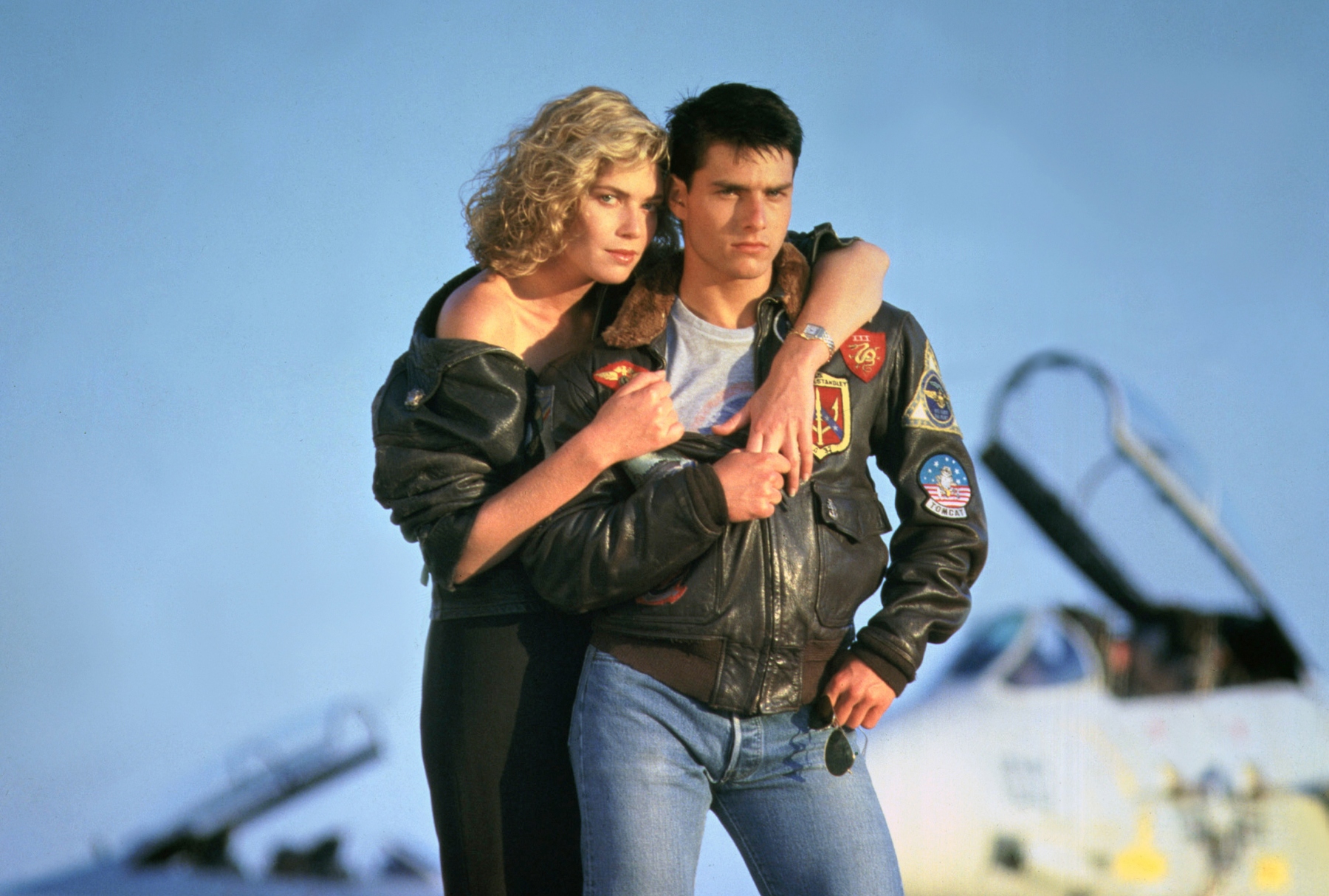
Nonsense, you might say. “Top Gun” is about Goose and Mav singing “Great Balls of Fire!” Or Mav gunning his motorcycle! Or Mav giving an upside-down bird to the Russian pilot!  

But then you don’t remember that “Top Gun” begins and ends with a panic attack. The very first scene of the film is a pilot who is about to disintegrate into an abyss of terror. His vision blurs, his face caked with sweat brought on by crippling fear. Mav gamely helps steer the pilot, barely, back to the aircraft carrier but for the film, what’s at stake has been set: How does a man deal with his fear?  


Want a daily wrap-up of all the news and commentary Salon has to offer? Subscribe to our morning newsletter, Crash Course.


And at the end of the film, it is Mav who has the onset of blurry vision and terror. When we think of the end of “Top Gun” we might recall the blithe violence and “Team America”-esque spirit with which Mav giddily shoots those Russian MiGs into oblivion. But what we should remember is the moment of terror that precedes it.  

Tom Cruise has rarely acted with such vulnerability as he does when he reacts to Goose’s confession of just how afraid he is.

In our current age of anxiety, the original “Top Gun” asks the pertinent question: How should men deal with their fear? What do they do when looming panic, and the fear of panic, can literally overwhelm them? And “Top Gun” (yes that “Top Gun”) actually provides some serious answers.  

Have fun. Mav initially at least can maintain an imperviousness to fear by remaining playful. He sees flying as an outlet for sheer pleasure, one where antics must be pursued not just because they are fun, but because this mind for play can stave off terror.  

Nurture friendship. It is his profound love for Goose (Anthony Edwards) that keeps Mav grounded and able to avert fear. Tom Cruise has rarely acted with such vulnerability as he does when he reacts to Goose’s confession of just how afraid he is. Cruise plays the moment as if rocked to his core, and he replies with profound sensitivity when he reassures him, or at least tries to (you can see his doubt creeping in as he says it), “I’m not going to let you down.”  

It is this sensitivity that is central to the movie. The love relationship between Mav and Kelly  McGillis’ Charlie, a story which, importantly, is never incidental but central to the story, begins  not as some would remember it – during the goofy karaoke Righteous Brothers moment – but rather when Mav hears Otis Redding sing “Sittin’ on the Dock of the Bay.”  

Again in a moment of tremendous vulnerability, Mav recalls how his mother used to have him  play the song “over and over again.” And Cruise lets down his guard completely, recalling a moment of great connection to his mother, one that leaves him exposed with real feeling.  

And it is this raw emotion that courses throughout the story. Mav mourning Goose’s death. Mav mourning his lost father’s death. Mav mourning the loss of his love. There is so much grief in the original “Top Gun” that the music is steeped in it, making it feel more like a sun-soaked opera than an action movie. Most people remember the cocky, insipid Kenny Loggins tune, “Danger Zone” as the sonic touchstone for the movie. (After all, they misremember that it’s a film about bros being bros, and so they recall that bro anthem and its “highway to the Danger Zone!’ )  

But if you watch the movie again, you’ll see that the music that gets the most play are two  others: “Take My Breath Away” a sumptuous, stirring ballad by the synth-pop band Berlin (and  one of the best songs ever written about the perils and thrill of falling in love); and the  instrumental piece “Memories” by the synth pop composer Harold Faltermeyer. 

And its the piece “Memories” that plays throughout the most critical part of the movie, like a  Wagnerian leitmotif (Faltermeyer is German after all). The song is a very simple melody that is plunked out on a keyboard as if by child – and it throbs with sadness. It keeps repeating, building slightly more each time, the longing in the piece becoming more insistent with each refrain.  

RELATED: What “Top Gun” has in common with “The Odyssey”

The repetition of that piece of music is central to unlocking the meaning of the movie. For the  piece underscores how vulnerability – nurturing and releasing it – is a crucial step for the hero’s (or anyone’s) growth. After Goose dies, Mav is only able to fly again when he takes some steps towards his grief, towards his feelings. (This is when we hear this music “over and over and over”). We do not see Mav have a conversation where he talks it all out or rationalizes his feelings about Goose, where he gets some distance. Instead, we see him get closer to his feeling of loss. He wraps himself in loss.  

Kelly McGillis and Tom Cruise on the set of “Top Gun,” directed by Tony Scott (Paramount Pictures/Sunset Boulevard/Corbis via Getty Images)
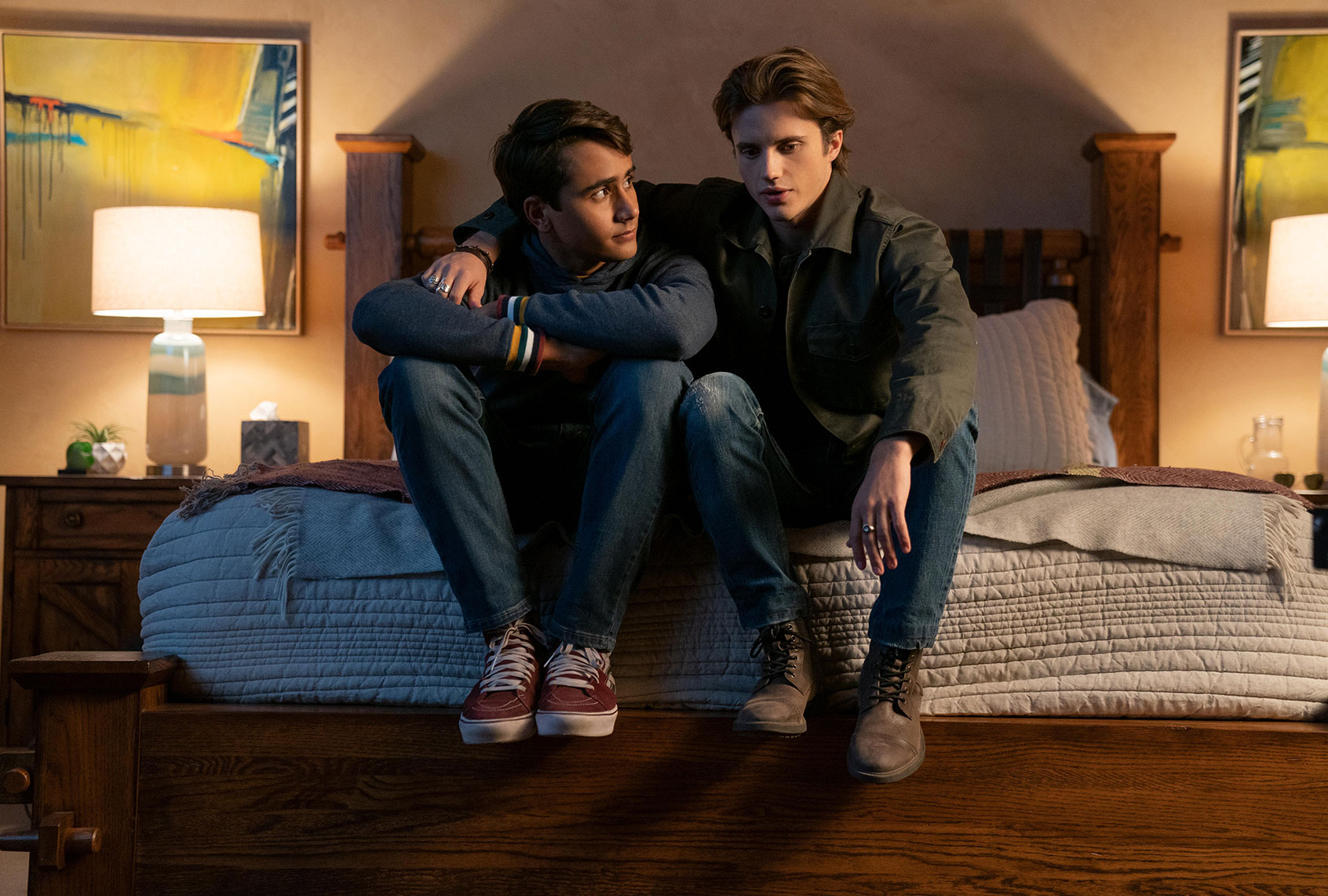
And there’s a lesson here for us, in our hyper-isolated, hyper-competitive era. Mav at the end of “Top Gun,” is no longer interested in being the best, or being alone. He eschews the meritocracy and the alienation that it can lead to. Instead he has gotten closer to himself, to his feelings, to his loss, not to avenge them, but to simply feel them. And it is this feeling, and acceptance of his feelings, that allows him to reenter the world, this time as a collaborator.  

As young men gather across the country in excitement to be “bros” and watch jets and Mav do manly, tough acts of daring, and as critics of this kind of “toxic masculinity” recoil from such  displays, it’s worth recalling that the original “Top Gun” was so affecting and its power so lasting because it ultimately was about not a man in flight killing things, but getting to know his wounds and living with them.

“Top Gun” is currently streaming on Netflix. “Top Gun: Maverick” is now in theaters.

More stories to check out:

[CORRECTION: A previous version of the article stated that the band Berlin was German. This has been updated.]

11 time capsules waiting to be opened

When it comes to burying time capsules, the anticipation is half the fun. It’s impossible to predict how the people of the future will react to the items past generations deemed valuable (though not quite valuable enough to hold onto), and this has led to some underwhelming unearthing ceremonies. As long as the cache remains sealed away, we can imagine it being opened in a brighter world — hopefully by people who are easily impressed. With that in mind, here are 11 time capsules set to be opened tens, hundreds, or even thousands of years in the future.

1. The Nickelodeon Time Capsule

There are many time capsules buried around the world, but few of them were curated by children. In 1992, Nickelodeon teamed up with the Kids World Council to choose items the youth of the 1990s felt best represented their generation, including a Nintendo Game Boy, a jar of Gak, a skateboard, and a VHS copy of “Home Alone “(1991). The capsule has been moved twice since it was sealed at Nickelodeon Studios in Orlando, Florida — first to Orlando’s Nickelodeon Suites Resort and more recently to the Nickelodeon Animation Studio in Burbank, California. It’s set to be opened on April 30, 2042, the 50th anniversary of its initial burial.

2. The Victorian Time Capsules Beneath Cleopatra’s Needle

First erected in Ancient Egypt in 1450 B.C.E., Cleopatra’s Needle is the oldest human-made object in New York City’s Central Park. The Khedive of Egypt, who “governed as a viceroy of the Sultan of Turkey between 1879 and 1914,” gave the 69-foot-tall granite obelisk to the United States in 1881 to commemorate the construction of the Suez Canal. Generations of tourists have stood beneath the monument since it arrived in its current home, but few of them were aware of the more recent historical artifacts beneath their feet. 

Before Cleopatra’s Needle was unveiled in New York, a time capsule was buried at the site. It contained a copy of the 1870 U.S. census, a Bible, a dictionary, the complete works of William Shakespeare, a guide to Egypt, and a facsimile of the Declaration of Independence. It’s one of two packages at the base of the obelisk. The contents of the second container—put there by William Henry Hurlbert, editor of The New York World and the man who organized the purchase and transport of the monument — remain a mystery. The Central Park Conservancy confirmed to Gothamist that there are no plans to dig up the items, and as long as the structure remains in the park, the time capsules will likely stay put as well.

3. The National Millennium Time Capsule

The turn of the second millennium was a time of innovation and optimism in the United States — it was also the era of processed snack foods and cell phones with buttons. In 1999, the White House filled the National Millennium Time Capsule with an array of objects that would “represent America at this time in history.” This included audio from the Metropolitan Opera, a transoceanic cable, a cell phone, Ray Charles’s sunglasses, and a chunk of the Berlin Wall. A Twinkie was originally meant to be part of the collection, but it was removed out of fear of attracting vermin. The National Archives and Records Administration will store the time capsule until it’s ready to be opened in 2100.

4. The World’s Largest Time Capsule

Unlike many of the items on this list, we won’t have to wait long to see the contents of this time capsule, which is located in Seward, Nebraska. Local businessman Harold Keith Davisson put it together for a Fourth of July celebration in 1975, and it’s set to be opened exactly 50 years later on July 4, 2025. Instead of using a small tube or box as his container, Davisson buried a 45-ton vault beneath the front yard of his furniture store. The time capsule, which was named the world’s largest by Guinness World Records in 1977, contains various items belonging to Davisson, including bikini bottoms, an aquamarine leisure suit, and a Chevy Vega with zero miles.

Davisson died in 1999, but his legacy will be remembered when the crypt is unsealed in 2025. If you can’t wait that long, you can still visit the site of the world’s largest time capsule and see the concrete pyramid that protects it.

5. The Star Wars Capsule at Skywalker Ranch

The establishment of Skywalker Ranch in California marked the start of a new era for George Lucas’s production company, Lucasfilm. To celebrate the new workspace, Lucas had a time capsule buried on the property during the company’s annual Fourth of July Picnic in 1981. The tube is filled with Star Wars merchandise made by the franchise’s early licensees. Six Kenner “Star Wars” action figures, two Ballantine Books “Star Wars” paperbacks, and a 17-minute Super 8 reel from “The Empire Strikes Back” (1980) are among the contents. Much of the vintage merchandise is valuable today, and it’s bound to be even more precious when — or if — the time capsule is uncovered. The capsule has no set opening date, and Lucas has stated: “I hope this time capsule lasts a thousand years.”

6. MIT’s High-Tech Time Capsule

In 1957, MIT president James R. Killian and professor Harold Edgerton buried a time capsule at the university to honor the opening of a new laboratory. The tube was marked with instructions not to open it until 2957—a full millennium after its burial. To keep the books, coins, and MIT memorabilia inside preserved for such a long period, the science-minded men filled the capsule with argon gas. A small amount of carbon-14 was also added so future scientists would be able to carbon-date the package from the past. The capsule was briefly unearthed during the construction of a new research facility, but MIT decided to honor Killian and Edgerton’s wishes to keep it sealed until the 30th century.

7. Disneyland’s 40th Anniversary Time Capsule

Visitors with a sharp eye will find Easter eggs hidden around Disneyland in Anaheim, California. One underlooked detail is a plaque at Sleeping Beauty’s castle commemorating a time capsule buried at the site for the park’s 40th birthday. It holds various items selected by Disney cast members and Imagineers, including an Indiana Jones time decoder, a copy of the Disneyland Line newspaper, and Disney dollars. The container will be unearthed for the amusement park’s 80th anniversary on July 17, 2035.

8. The 500,000-Year Time Capsule in Norway

If all goes according to plan, this time capsule buried 13 feet into the ground on the Arctic fjord of Hornsund in Norway will remain sealed for half a million years. Polish Academy of Sciences permafrost specialist Marek Lewandowski organized the project in 2017 with the goal of helping future archaeologists “understand who we are.” The steel tube was stuffed with human and rat DNA samples, a cell phone, a meteorite sample, and 300 live tardigrades.

9. Time Capsule Inside the World’s Largest Axe

It’s hard to forget the location of this time capsule in Nackawic, New Brunswick, Canada. The official forestry capital of Canada is home to the world’s largest ax, and embedded inside the 23-foot-long steel axehead is a time capsule from the statue’s construction in 1991. With no immediate plans to dismantle the local landmark, the capsule will be an intriguing surprise for future generations.

10. The Millennium Vault

While the U.S. was putting together a time capsule for the new millennium, Britain was building a time capsule of its own. The Millennium Vault on the grounds of Guildford Castle in Surrey, England, is the largest time capsule in England. Organized by the Guildford Borough Council, the collection is meant to sum up the 20th century for whoever opens it in the year 3000. Highlights from its contents include a Sony Walkman, one of Yehudi Menuhin’s violins, and a Mini Cooper treated to prevent decay.

11. South Korea’s K-Pop Time Capsule

A time capsule on display at the National Museum of Korean Contemporary History in Seoul was curated by the K-pop group BTS. In honor of South Korea’s first annual Youth Day on September 19, 2019, the group selected items that represented their “musical achievements, memories, love, and gratitude toward our fans,” band member RM said during the ceremony. The purple box will be opened in 2039 on the 20-year anniversary of the inaugural Youth Day.

A formula shortage has some wondering whether men can lactate. Experts say yes — but it’s not easy

As America’s baby formula shortage continues to inspire scammers and politicians alike, parents have become desperate for solutions. Sometimes they get so creative that it worries the medical establishment; take how doctors have had to warn parents away from dangerous approaches like making their own baby formula. Yet in the midst of all this, a purported transgender woman who opened up on Reddit about being able to breastfeed her daughter received an all-too-predictable unscientific, transphobic backlash.

Ironically, though, individuals with biologically male breasts actually do have the ability to lactate. When the baby formula shortage started in March 2022, inquisitive Americans wondered as much, as search traffic from Google from that month reveals. But if you’re a cisgendered man aspiring to make your own breastmilk amid a shortage, I have some bad news: making this happen is very, very complicated.

RELATED: Scammers and price gougers are taking advantage of desperate parents seeking baby formula

“Men have milk-producing tissue in their breasts normally. If the production of milk is stimulated (putting the baby to the breast and allowing the baby to suckle) and/or some medications which cause milk production to be stimulated,” they could ostensibly lactate.

“Everyone has the same basic breast structures at birth,” Tamar Reisman, MD, assistant professor of medicine, endocrinology, diabetes, and bone disease at the Icahn School of Medicine at Mount Sinai, told Salon by email. (Reisman has assisted in helping a transgender woman exclusively breastfeed.) “Exposure to 4 ingredients are needed to transform the breast and allow for milk production and expression — estradiol, progesterone, prolactin, and oxytocin.”

Dr. Jack Newman from The Newman Breastfeeding Clinic and International Breastfeeding Centre, and co-author of the book “Dr. Jack Newman’s Guide To Breastfeeding,” echoed these observations.


Want more health and science stories in your inbox? Subscribe to Salon’s weekly newsletter The Vulgar Scientist.


“The conditions exist,” Newman told Salon when asked what conditions must be present for people who are born biologically male to be able to lactate. “Men have milk-producing tissue in their breasts normally. If the production of milk is stimulated (putting the baby to the breast and allowing the baby to suckle) and/or some medications which cause milk production to be stimulated,” they could ostensibly lactate. Speaking previously to Scientific American, Newman pointed out that hormone spikes must occur for biological males to produce milk. Referring to how the Russian novelist Leo Tolstoy had a biologically male character lactate in the 1878 book “Anna Karenina,” Newman said that the way that it was depicted in that work of literature is likely inaccurate.

“That Tolstoy quote suggests that the father just put the baby to the breast and he would produce milk; I think that’s pretty unlikely,” Newman told Scientific American. “It could be that you have this man with this pituitary tumor and he produces milk once the baby starts suckling.”

Proposing means of making biological males lactate is hardly new territory for humanity. Charles Darwin himself commented on this possibly happening in his landmark 1871 text “The Descent of Man, and Selection in Relation to Sex,” where he observed that “it is well known that in the males of all mammals, including man, rudimentary mammae exist. These in several instances have become well developed, and have yielded a copious supply of milk.”

He added that “their essential identity in the two sexes is likewise shown by their occasional sympathetic enlargement in both during an attack of the measles. The vesicula prostatica [part of the male urethra], which has been observed in many male mammals, is now universally acknowledged to be the homologue of the female uterus, together with the connected passage.”

Given that mammals are all part of the same class of vertebrates, the fact that some biologically male animals can lactate raises intriguing questions about evolution. 

Interestingly, it is not unheard of for biological males in other species to lactate. There is a type of megabat known as a flying fox, and within that sub-species the Bismarck masked flying fox is known to be able to lactate. The same is true of the Dayak fruit bat, which can only be found in southeast Asia’s Sunda Shelf.

Given that mammals are all part of the same class of vertebrates, the fact that some biologically male animals can lactate raises intriguing questions about evolution. Could it be that the explanation for occasional lactation among human biological males is linked to our past as a species?

“This may not be an evolutionary issue but rather an embryologic one,” Reisman hypothesized. “Male and female embryos initially have the same structures and only begin sexually differentiate several weeks into development. Further sexual development happens at puberty in response to hormone exposure. If you have the baseline structures for lactation but you are not exposed to the proper hormones you will lack the means to do so.”

This has not stopped desperate parents (and others) from trying. A 2011 article published in Slate documents a 33-year-old cisgender adult man’s months-long quest to lactate, which was ultimately unsuccessful. Perhaps the best lesson about the future of male lactation can be derived from a famous tale in the Babylonian Talmud about precisely that. It is written that “the rabbis taught: ‘It happened with one man whose wife died and left him a nursing child, he was so poor that he could not pay a wet-nurse. A miracle happened to him; his breasts opened and he nursed his child.'” When a scholar replied that the man must have been bad — “that the nature of mankind changed in him and nothing occurred to enable him to earn enough money to pay a nurse” — he was told, “come and see how hard it is for heaven to change the fate of a man concerning his livelihood; that the nature of the world was changed, but not his fate.”

Read more on breastfeeding and baby formula:

We’re rethinking our lawn design (and you should, too)

If bright yellow dandelions and purple clover are popping up on lawns that usually look like carpet, or it’s eerily quiet on your street on a Saturday afternoon when you would otherwise hear the humming of lawn mowers, there’s a chance that your neighbors are participating in the No-Mow May campaign.

The idea behind it is this: In May when native pollinators like bees and butterflies wake up after the winter, they need a major calorie boost to get them started for the season ahead. When faced with manicured lawns with no blooming plants in sight, our pollinator friends are starved for a meal. By not mowing for a month, you create a habitat — and place to forage — for bees and other early-season pollinators.

Not mowing for one month in the spring is a step forward in protecting our food chain and biodiversity, but pollinators need more than a meal in May — they need food during summer and fall, too. Lawns are also the single-largest irrigated crop grown in the U.S. and require exorbitant amounts of water to maintain, so perhaps what we really need to do is rethink our lawns for the entire year.

That’s where Doug Tallamy comes in. Tallamy is a professor of agriculture in the Department of Entomology and Wildlife Ecology at the University of Delaware, has authored books on the importance of going native in your yard, and is the founder of the Homegrown National Park (HPN), the largest cooperative conservation project that’s ever been undertaken in the U.S. HNP is a grassroots call to action to restore biodiversity and ecosystems by planting natives, with the goal of creating 20 million acres of native plantings in the U.S. — the equivalent of half the area taken up by mowed home lawns.

Here’s why Tallamy believes we need to rethink our lawns, and what the alternatives are.

The downsides of a well-kept lawn

A picture-perfect lawn might be visually pleasing, but it provides no benefit for wildlife. Tallamy puts it bluntly: “Lawns, with all the chemicals that go into them, have the worst environmental record. A lawn, especially one without clover, also does not support any pollinators. From an ecological and biodiversity perspective, a lawn is a total wasteland.”

Chemical-heavy lawns can be harmful to humans, too. Kids and pets rolling around and playing in grass can be directly exposed to the insecticides and pesticides that have been applied to the grass. Mowing also creates noise and air pollution — all the gas-powered lawn mowers together make up 5% of total air pollution in the U.S., according to the EPA.

In 2021, Nevada became the first U.S. state to ban certain kinds of water-hogging decorative grasses, leading to lawns being dug up and replaced with native succulents, mulch, and crushed stone. And states like California and Florida — no strangers to drought — are restricting how frequently you can water your lawn.

Reduce your lawn size

This doesn’t mean that you shouldn’t have any lawn at all. Instead, think about how much lawn area you really need, and for what purpose. If 40% of your yard offers spaces for chilling out and playing, then you’re left with 60% that you can replace with a natural habitat. This approach can be applied no matter how large or small your yard is.

While a lawn may look neat, it looks the same all season long. When you replace it with other plants, you create a kaleidoscope of seasonal interest, ranging from ephemeral spring flowers to sturdy, vibrant asters in the fall.

Create more shade or an edible landscape

A large lawn left to bake in the merciless sun starts to look sad pretty quickly during dry spells. Instead, get rid of part of your lawn and plant a tree to create more shade in your yard, then fill the area below with groundcover — but make sure to select native ones. Similar to our obsession with lawns, there is also the widespread conviction that “imported species are what makes an attractive, valuable landscape,” says Tallamy. “Our ecosystems, however, are built on a foundation of native plants.”

You don’t have to stick with planting native ornamentals, such as red oaks, either. Native edibles such as highbush blueberry, blackberries, pawpaw trees, and American persimmon trees make great additions to the landscape. The native plant societies in each state are an excellent resource to find out which plants are native to your area.

Replace your lawn with a mini meadow

If you prefer something more low-growing than trees and shrubs, or a more uniform look, the closest to a lawn is a prairie-style meadow with native grasses and sedges, or a mix of perennial wildflowers and native grasses. Each region has its own native grasses that are perfectly adapted to your local climate and less affected by drought and other environmental conditions. Look for seed companies specializing in native grasses. Again, size doesn’t really matter — you can have a mini meadow even in a small backyard.

As with a traditional lawn, it takes time for a meadow to establish itself, but the grasses don’t need to be mowed regularly like a lawn. In fact, a meadow only needs mowing once a year, if at all — in the spring, it will regrow on its own. Many grasses have eye-catching seed heads and some are even fragrant, such as the prairie dropseed, which smells like cilantro. And in the fall, many of them have a striking color palette, such as the tufted hairgrass that turns golden late in the season.

City folks can take action, too

What about city folks who don’t have a yard but are still itching to contribute? Does it make sense to grow natives in containers in an urban environment, or is that more of a symbolic contribution to the movement? “Sure,” he says, “If you put Joe-Pye weed in a planter, butterflies will come. And potted milkweed or fall asters will attract native bees. So you can turn things around in your own little ecosystem — an individual can make a difference.”

What about invasive weeds?

The question that inevitably comes up when replacing a lawn is: What can be done about non-native, invasive weeds? It seems impossible to create a lasting native habitat such as a meadow in your backyard without constantly battling invasive plants such as tree of heaven, oriental bittersweet, autumn olive, kudzu, and garlic mustard, to name just a few. Is it possible to eradicate them without using a broad-spectrum herbicide? “It’s the lesser of two evils,” says Tallamy. “The harmful effect of herbicides is not comparable to the harm that invasive plants cause. However, instead of spraying, I use the cut-and-paint method, in which you apply the herbicide on the cut stem of a woody plant or perennial. It’s a more targeted use.”

Plant the species, not the bred cultivar

When you set out to replace your lawn and refill it with native plants and meadows, does it matter what type you plant — the straight species or a cultivar? Tallamy’s response is unequivocal. “Unfortunately, cultivars that have been bred as a novelty have absolutely zero food value for pollinators; they are just ornamental. So, there is no point in planting cultivars whose genetic makeup has been changed in a way that makes them unpalatable to native insects — and ornamentals without any value for insects is like a house built of wallpaper instead of walls.”

Sophie Turner is sure she’ll “exhibit some symptoms of trauma” from “Game of Thrones”

Sophie Turner was barely a teenager when she auditioned for the role of Sansa Stark on “Game of Thrones.” She filmed the first season a year later, and by the time the first season premiered, she was 15.

Right out of the gate, “Game of Thrones” was known as a brutal series. In the final episode of Season 1, there’s a scene where Joffrey Baratheon — the sadistic king who just had Sansa’s father killed right in front of her — takes her up on the ramparts so she can look at her father’s severed head on a pike; again, this is a 14-year-old actor playing this, and doing a fantastic job.

Things only got more brutal from there, with Sansa being beaten before the Iron Throne, raped by her new husband Ramsay Bolton, and feeding Ramsay to his own dogs a season later. How does a young actor cope with playing such intense scenes? Turner talked about it with her “X-Men: Dark Phoenix” costar Jessica Chastain in a new article from The Cut.

Sophie Turner developed strategies on the “Game of Thrones” set “so I wouldn’t get traumatized”

“I kind of find it quite easy to go in and out [of character],” Turner said. “You saw on ‘X-Men,’ in between takes, singing and dancing together. It does help having people around that are also willing to step out of it as well. And it’s just something that growing up on a show like ‘Game of Thrones,’ the subject matter was so heavy that I just developed a coping mechanism of just having the most fun in between takes, so I wouldn’t get traumatized.

I’m sure I’ll exhibit some symptoms of trauma down the road. At that age, I don’t think I could comprehend a lot of the scene matter. And the first few years, I had my mom with me because she was chaperoning me, so she would be very helpful and give me snacks. I don’t know what it is, but I feel like a 10-year-old in a school play again when someone that I know comes and sees me on set. I feel so embarrassed.


Now 26 years old, Turner has done a lot of growing up; she’s married to Joe Jonas and has a second child on the way. But in some ways, she still feels like she has a lot to learn about herself. “It’s amazing because I think for 10 years, I felt like I needed to be the person that everyone else saw because I was growing up and I didn’t know anything else,” she said. “Other than the character that I was playing in ‘Game of Thrones’ and then other people’s perceptions of me, I didn’t have time to figure out who I was as a person. And so when ‘Game of Thrones’ ended, I started developing, like, a personal life and then finally a taste for what I actually wanted to do in my work and things like that. I feel like I’m only on the beginning of my journey of evolving into a person I probably should have evolved into about 10 years ago.”

You can see Turner now on the HBO Max limited series “The Staircase,” where she stars alongside the likes of Colin Firth and Toni Collette.

Will we ever know what really happened to Natalie Wood?

Actress Natalie Wood died in 1981 as the result of a drowning incident off the coast of Catalina Island that remains a mystery to this day. Forty-one years after the event occurred her husband at that time, actor Robert Wagner, has been officially cleared as a person of interest in Wood’s death.

Wood, star of classic Hollywood films such as “Rebel Without a Cause,” “West Side Story,” and “Splendor in the Grass,” was aboard a 60-foot yacht called Splendour on the day she died, along with Wagner and Christopher Walken, her co-star in what would end up being her final film, “Brainstorm.” 

According to police reports, on the night of November 28, 1981, Wood is said to have gone off to bed before the other two men on the boat, and was discovered the next morning floating face down in the water. Her death was initially ruled an “accidental drowning,” but changed to “drowning and other undetermined factors.” The timeline of Wood’s death never seemed to explain how she landed overboard and in 2011, her case was reopened. 

Fresh scrapes and bruises listed on the coroner’s report seemed to indicate Wood had been assaulted prior to her death, but nothing ever added up concretely enough to hold any one person accountable. Both Wagner and Walken were questioned on the events of the night time and time again, and their accounts often conflicted, but no charges were ever filed.

RELATED: A suspect has been named in the 2007 case of missing toddler Madeleine McCann

“Our biggest challenge is time,” Lt. John Corina of the Los Angeles County Sheriff’s Department’s Homicide Bureau said in a 2018 quote given to the Los Angeles Times. “Many witnesses have passed away, who were on boats nearby. The original investigator has passed away. We’re reaching out one more time to see if people will come forward with information.”

People have been left to wonder, all this while, what exactly happened to Wood on that night in 1981; and though Wagner and Walken are both still alive, their stories aren’t changing. It’s likely this mystery will remain as such forever.


Want a daily wrap-up of all the news and commentary Salon has to offer? Subscribe to our morning newsletter, Crash Course.


“All leads in the Natalie Wood case have been exhausted, and the case remains an open, unsolved case,” Lt. Hugo Reynaga said in a quote to Page Six on Friday. “If additional leads surface in the future, which have not already been investigated, the case will be reassigned to a detective to investigate the new leads.”

In 1986 the yacht that Wood spent her final moments on was bought by a man named Ron Nelson, but he later sold it claiming that it was haunted by the ghost of the actress.

Read more:

Franz Kafka predicted Fox News — but even he might have been shocked

Paranoia sells, and Rupert Murdoch’s Fox News enterprise likes to scare the hell out of its viewers for fun and profit if there’s good money to be made — especially when it’s got skin in the game. But this time the political stakes are much higher than usual: America’s future as a democracy is on the line.

Witness the obsessive preoccupation at Fox with the “great replacement” theory, as if hyping such a transparently fabricated existential crisis to its targeted demographic — that is, mostly older white conservatives — was purposely intended to raise doomsday anxiety levels in a gullible audience, the sort of viewers long conditioned to interpret events in a conspiratorial framework. Following the twisted path of this racist creation myth to its origins reveals a provenance that stretches well beyond Tucker Carlson’s nightly pitch to his loyal fans, many of whom share a collective fear that the traditional barriers intended to keep certain groups of others outside and out of sight are no longer working as expected. 

Fox is running in a crowded field of competitors in the faux-paranoid theme park that it’s been meticulously ginning up over the years — hanging with a deeply weird array of QAnon rubes, white supremacists, Christian nationalists, Trumpian dead-enders and similarly motivated co-conspirators — all of them working overtime to push an agenda of racist fear and animus. One tragic consequence of their deadly stimulus project recently played out in a Buffalo supermarket. 

RELATED: Fox News exploits Buffalo shooting to further radicalize Republicans with “great replacement” theory

Still, for all its high-volume flailing, the Fox hype machine is mostly amateurish stuff, a perverse riff on Donald Trump’s side-hustle con involving an American Wall, one that promised his cult of MAGA pawns to keep the threatening hordes of invasive species permanently excluded on the other side. At root, it’s a protocol for ensuring dominance and control of the public spaces that define every element of American culture; more ominously in the short term, it’s also a mobilizing electoral strategy now fully embraced by one of the two major American political parties.  

For a guided tour of this paranoid mindset from a true connoisseur of the art of cynical manipulation, though, one needs to turn to Franz Kafka, whose story “The Great Wall of China,” written in 1917, offers prescient psychological insights into the storyline being performed on Tucker Carlson’s show any night of the week.

“Against whom was the great wall to provide protection,” Kafka asked, adding that there were no genuine threats besides the terrifying portraits  in “the books of the ancients,” which served the emperor’s purposes by conjuring up atrocities committed by malicious outsiders, enemies whose “sharp pointed teeth … will crush and rip to pieces” the peaceful citizens living behind the Great Wall. “When children are naughty, we hold up these pictures in front of them,” Kafka wrote in his century-old warning memo to us, “and they immediately burst into tears and run into our arms.” 

Franz Kafka, meet Tucker Carlson (and friends).

Replacement theory and CRT set up a target-rich environment of Black people, Jews, Muslims, LGBTQ folks and immigrants who can be portrayed as mortal threats to the fantasy world of white supremacy.

Joining the reception line are a coterie of like-minded race-baiting provocateurs and conspiracy-mongers littered throughout cable news shows and the darker social media corners of the internet. Replacement theorizing — along with its kissing cousin “critical race theory,” another imaginary playmate at Fox — offers a useful platform for this loose confederation of proto-fascist trolls to practice their specialized craft, setting up a target-rich environment of Black people, Jews, Muslims, LGBTQ folk, feminists and foreigners of all kinds (well, non-European ones, anyway). Think of their nihilistic search-and-destroy mission as a Kafkaesque effort to discover hidden enemies — even imaginary ones will do, in a pinch — who can be portrayed as mortal threats to the fragile fantasy world at the core of white supremacists’ self-deluding ideology.  

Granted, the more respectable members of this confederacy may suffer brief moments of panic when one of their unhinged followers becomes a breaking news story, as when it turned out that the alleged Buffalo shooter’s 180-page manifesto acknowledged that the bloody rage-killings were live-streamed online as a self-promoting “act of terrorism,” a fantastical infomercial intended to prevent white people from succumbing to “replacement.”

Put another way, when a lethal mode of performance art seizes control of the public stage, demanding that attention be paid to its incoherent rhetoric of virulent hate, Fox and friends get as nervous as the Wizard of Oz (right before Dorothy’s little dog Toto pulls back the curtain on the sad old man working the gears). Rupert Murdoch’s media magic quickly loses its persuasive charms if folks get too close a look at the inner workings of the cynical manipulation machinery. 

Following Buffalo, the unanticipated exposure of the machine’s source code may explain the peak hysteria coming from the primetime players at Fox, who have frantically scrambled to deny that they share any responsibility for inspiring and/or inflaming one of their (ahem) crazier viewers to violently act on his paranoid fantasies about replacement theory. “Goodness, who knows where he might have picked that nonsense up. It must have been antifa!”


Want a daily wrap-up of all the news and commentary Salon has to offer? Subscribe to our morning newsletter, Crash Course.


Arguably, the Trump-organized mob actions of Jan. 6, 2021 — performed live on the steps of the U.S. Capitol as a theatrical rehearsal for fascism — differed in terms of the number of actors taking part in the patriotic cosplay drama (and the body count at the end of the day). Nonetheless, that staged event was produced and directed with essentially the same motivational goals as the alleged Buffalo shooter: Capture the attention of an aggrieved audience; play upon their sense of resentment and victimhood; engage them in the urgent task of redeeming the country from their godless enemies; justify the use of violence as legitimate political discourse in the service of an imaginary version of “our America.”  

Despite such temporary program interruptions, things at Fox News quickly settle back down to a normal daily routine of partisan demagoguery and fear-mongering, though carefully re-coded just enough to allow for some degree of plausible deniability, at least until the next mass shooting (or perhaps a seditious insurrection) breaks out.

We are now entering uncharted territory, a place far beyond the familiar era of earlier forms of institutionalized racism in America — back when segregated schools, employment and housing discrimination, mortgage redlining and gated communities served as more structured (that is, less overtly chaotic) mechanisms for excluding certain others from participating in the public square. No less oppressive, such exclusionary traditions seem almost quaint by contrast now that the façade has fallen away, revealing an apocalyptic vision of the new authoritarian political agenda, which makes no pretense about its core beliefs and anti-democratic intentions (including a hair-trigger readiness for organized violence, if needed).

Years before the killings in Buffalo, an American president once stood in front of other mourners in a Black church and sang “Amazing Grace,” a poignant moment signaling what the country was then only reluctantly coming to understand about itself: There are no safe spaces left in the once-shared public squares of our communities: Not in churches, synagogues or mosques; not in elementary school classrooms or high school corridors; not in women’s health clinics; not in workplaces; not on public street corners. And now, not even in grocery stores.  

In Buffalo, a grieving Black woman told a CNN reporter about the far deeper emotional scars the shootings left on her shattered community. “We didn’t have much, and you took what was left,” she said, as if speaking to the killer. “Now our safe space has been infiltrated and taken from us.

Present-tense domestic terrorism may appear different from earlier versions, but the logic of its embedded racist code is the same that motivates white supremacist politics everywhere and always.

Such domestic terrorism may appear different in form than earlier versions, often relying on the lone-wolf-deranged-gunman mythology to distract public attention from questions of broader political accountability, but the logic of its embedded racist code is still rooted in the covert agenda motivating white supremacist politics everywhere and always. Not that long ago, lynchings were public entertainment in certain parts of America, a shameful history still viewable online today in the hundreds of archived photographs of white mobs cheerfully posing in front of the bodies of dead Black men. Billie Holiday knew what she was telling a segregated America the moment she recorded “Strange Fruit.” even if most white folks back in 1939 weren’t ready to listen to its lyrics: 

Southern trees bear a strange fruit
Blood on the leaves and blood at the roots
Black bodies swinging in the southern breeze
Strange fruit hanging from the poplar trees 

If in the present era the Ku Klux Klan has traded in its bedsheets for military camo gear and morphed into the heavily militarized Proud Boys, their implicit message has just been repackaged as something that generally gets a pass from the morally flexible content standards of primetime Fox News, Facebook and Twitter: say, for example, replacement theory.

The chant of “Jews will not replace us,” shouted by a Tiki-torch-carrying mob of fascist wannabes during the 2017 Unite the Right demonstration in Charlottesville — where Donald Trump saw “good people on both sides” — was an early harbinger of the emerging and rebranded white nationalist movement, freed at last from the political closet by a different sort of president, one who surely wouldn’t know the words to “Amazing Grace.” Apart from a few minor setbacks, including a failed insurrection and some indictments for seditious conspiracy, it’s been a bull market ever since for replacement theory and the cynical Fox News con artists who peddle it 24/7.  

When a significant element of the political culture tolerates (and even encourages) a racist discourse that reduces certain groups to the status of invasive species — implying that such persons ought to be “weeded out,” one way or another — the shared public square in a democratic society is no longer safe for anyone. Stoking racial and class fears to produce a sense of paranoid resentment and faux victimhood may be an effective political technique in the short-term, assuming that its practitioners simply don’t care about the longer-term existential sustainability of the society, but it reveals the moral cognitive blindness motivating the authoritarian impulse for power at any cost.

Kafka understood this sort of cynical fear-mongering when he warned us about it a hundred years ago. If he could offer us some political consultation today, it might be simply this: “Paranoia does not seem to be a bug in this system that you are describing; it’s quickly becoming a feature. Please stop before you destroy yourselves.”

Read more on the formerly “fair and balanced” network:

Will no one think of the tweens? Kids need more queer stories than just “Heartstopper”

At 12 years old, I was first yelled at by a teacher for reading. 

The class was Pre-Algebra, and though it was perfectly fine to read before the bell rang, my reading material, “Clan of the Cave Bear,” was “not appropriate for a girl my age,” according to the teacher. Perhaps the controversial novel with very adult scenes was not the best use of my time, but the school library didn’t hold much for me, either. We had “Charlotte’s Web,” yet the rise of middle grade books was still years away.

Like many children, I read above my age. I wanted to see beyond my world. I wanted to read about kids like me, but also different from me and especially, older than me.

Tweens, children usually considered between the ages of 8-12, are a specific, misunderstood and often-ignored age group. The middle child of childhood, they can switch from a stuffed animal-loving kid to a music-blaring, moody teen, sometimes in the same moment (trust me: I’m parenting one). Netflix’s “Heartstopper” is one of the few mainstream shows in recent memory that actually is aimed at this age group. The show was recently renewed for two more seasons, to the joy of viewers of all ages.

But “Heartstopper” is the outlier, bucking a disturbing trend: canceling shows that center queer youths and storylines — and a larger, national one: negating queer stories for all children. 

RELATED: “Yellowjackets” unapologetically follows YA logic, from the Big Dance to bitter betrayals

Based on the graphic novel by Alice Oseman, “Heartstopper” follows a group of young British teens as they navigate school, friends and matters of the heart. Although an ensemble piece, its main character is Charlie (Joe Locke), who is gay and may be falling for his seemingly straight classmate, the kind boy he sits next to, Nick (Kit Connor). Other young characters, all compelling and with meaningful storylines, include Tao (William Gao), Elle (Yasmin Finney), Tara (Corinna Brown) and Darcy (Kizzy Edgell).

It’s important for kids to realize they don’t have to have all the answers or even any of the answers right now. 

“Heartstopper” is heart-stoppingly earnest. Its main characters are young high-schoolers, and both the shorter format of each episode as well some of the visual touches, like cartoon fireworks and fall leaves and hearts, reflect that. It’s nice to see the graphic novel — a hugely popular format with teen and middle school readers — find its way onto the screen in a way that feels natural, like an extension of the characters’ feelings. Like their doodles come to life. 

And “Heartstopper” was embraced with open arms. It landed on Netflix’s Top 10 English TV titles in just two days and received a 100% approval rating on Rotten Tomatoes. The Guardian called it “possibly the loveliest show on TV.” Viewers swooned, with many adults saying they wished a show like this had existed when they were kids, but kid viewers (like my own) also stayed riveted. 

“Love, Victor” met a different fate.

Love VictorMichael Cimino as Victor and George Sear as Benji in “Love Victor” (Hulu)A spin-off of the film “Love, Simon,” based on a YA novel by Becky Albertalli, the Hulu series follows a young teen named Victor (Michael Cimino) as he starts a new high school and comes out, finding friends, love interests and all the confusion, joy and hardships of growing up. 
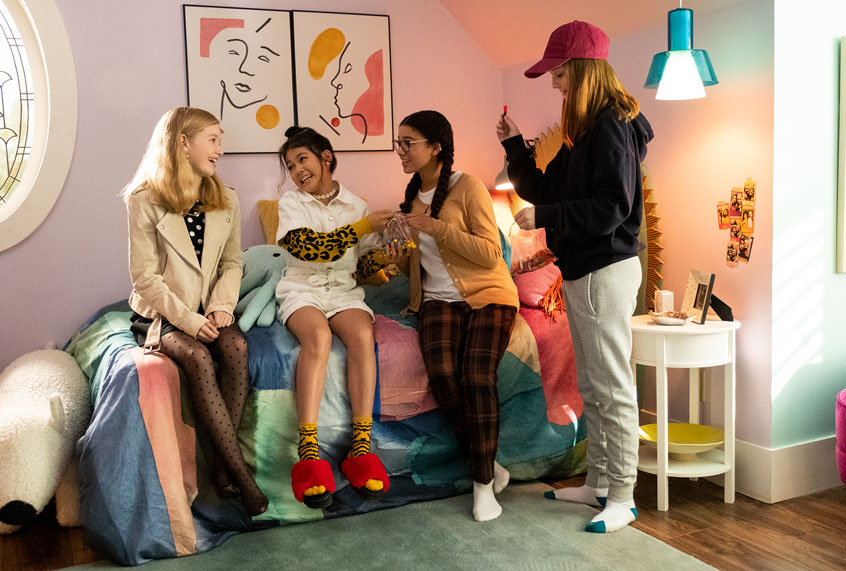
Like “Heartstopper,” the show is sweet but not saccharine, positive but not unrealistic, and it centers a child of color. Despite a wildly positive response — in their review, Paste Magazine said about the show: “What more could you want in a half-hour series?”— the series was canceled after only three seasons, with its bittersweet final season debuting in June. Them wrote the cancellation was “distressing proof that nothing pure lasts forever.” Newsweek theorized that the show was canceled “for the reason many high school dramas are ended: Because the show has run out of high school.”

Not so with “The Baby-Sitters Club.”

The Baby-Sitters ClubThe Baby-Sitters Club (Netflix)

We need love-positive shows too.

The Netflix series, based on the children’s books (ones I actually read as a child) by Ann M. Martin, was canceled after only two seasons. Again, the show received a positive critical reception, audiences loved it — yet another 100% Rotten Tomatoes score.

Following a group of middle school friends who decide to form a babysitting business, “The Baby-Sitters Club” is noted for having a young trans child as a recurring character: Bailey, played by trans actor Kai Shappley. As Alive wrote, it was refreshing to see the show come to the screen “as queer-friendly as Ann M. Martin must have wished it always could have been.” Martin is openly gay.

Malia Baker as Mary Anne Spier and Kai Shappley as Bailey Delvecchio in “The Baby-Sitters Club” (Kailey Schwerin/Netflix)The babysitters accepted and defended their trans charge, as they defended all of their young charges, and Bailey’s story was simply one of many, a plot tapestry that may have included some queer babysitters too, like Dawn who said she disliked labels and could date anyone (as the show is canceled, we’ll never know now). We need stories of lots of types of queer kids, not just their parents.  

We need stories with happy endings.

Importantly, “Heartstopper” has more than simply one gay character — in so many shows, the gay character is a mere supporting character who is the “best friend,” and the only one: their own story relegated to the sidelines while they cheer on the straight hero.

That’s not what friend groups often look like, and that’s not the friend group on the Netflix show, where multiple characters, including kids of color, are gay, bi, or trans. 

Also important, as The Mary Sue writes, “Everyone is at different points in their journey . . . characters are at different points in their lives when it comes to their queer identity.” Some characters have known they were gay for a while. Others are just beginning to consider their sexuality. Some characters are out, some are not. 

Not everyone is on the same path and not everyone is on the same part of the path. That’s important for kids to see, to realize they don’t have to have all the answers or even any of the answers right now. 

Tweens need hope, just like all children do.

We also need shows about love that are not about sex. We need them because kids younger than high schoolers want and need to watch them. I love “Sex Education” and its sex-positive, inclusive message, but it is definitely not yet appropriate for my kid. We need love-positive shows too.

Though focused on slightly older kids than “Heartstopper,” “Love, Victor” was, as Them wrote, “pure,” perfectly fine to watch with your tweens. The high school storylines were not without their drama, of course, but the tensions of the show, like Victor coming out, dealing with his family and trying to decide who to be with romantically, generated healthy discussion. And it generated hope.


Want a daily wrap-up of all the news and commentary Salon has to offer? Subscribe to our morning newsletter, Crash Course.


We need stories with happy endings. So many queer stories still fall into the trap of “bury your gays.” That’s not a message kids need to hear, a cliched trope where the queer character is more likely to die than the straight ones, especially if they have finally found love or happiness. Not so with “The Baby-Sitters Club,” “Love, Victor,” “Julie and the Phantoms,” the “Saved by the Bell” reboot and “Heartstopper.” But “Heartstopper” is the only show standing. 

I watched “Heartstopper” with my middle-schooler. He ended each episode happy, hopeful about the world. Tweens need hope, just like all children do. They need stories about them and about kids very different from them. They need stories about their friends and the friends they might make in the world. They need to see it can work out. And here’s how.  

More stories like this