Spring Sale: Get 1 Year, Save 58%

Republicans who pushed fake Electoral College documents should face “criminal prosecution”: attorney

MSNBC’s Rachel Maddow has been doing a great deal of reporting on MAGA Republicans who, after the 2020 presidential election, circulated fake “Electoral College” documents in states that Joe Biden won and falsely claimed, on those documents, that Donald Trump won the states in question. In an article published by the conservative website The Bulwark on January 17, attorney Philip Rotner argues that those fake electors deserve to face criminal prosecution in federal court.

Rotner isn’t the only one making that argument. During a January 13 appearance on Maddow’s show, Michigan Attorney General Dana Nessel — who is part of Democratic Gov. Gretchen Whitmer’s administration — told the host, “Under state law, I think clearly you have forgery of a public record, which is a 14-year offense, and election law forgery, which is a five-year offense.”

But while Nessel was mainly talking about Michigan during that January 13 conversation with Maddow, Rotner points out that MAGA Republicans circulated fake Electoral College documents in multiple states.

“While the story of phony electoral certificates submitted to Congress by Republican officials in five states as part of a failed attempt to overturn the results of the 2020 presidential election has caught on in a big way over the last week, it isn’t new,” Rotner explains. “The phony certificates were submitted nearly a year ago, and as early as March 2, 2021, American Oversight published the documents themselves after obtaining them through the Freedom of Information Act.”

Rotner adds, “Actually, there weren’t just five states in which, despite Biden having won there, Republican pseudo-electors submitted Electoral College certificates in support of Trump. There were seven. The Republicans in two of those states, however, hedged their bets.”


Want a daily wrap-up of all the news and commentary Salon has to offer? Subscribe to our morning newsletter, Crash Course.


The two states where Trump supporters “hedged their bets,” Rotner notes, were New Mexico and Pennsylvania. The other five — the ones Maddow specifically discussed on her show —were Wisconsin, Georgia, Arizona, Nevada and, of course, Michigan.

“The submissions from (New Mexico and Pennsylvania) deserve the benefit of the doubt,” Rotner writes. “They can and should be read as contingent, belt-and-suspenders backup plans to make sure that Trump electors were identified in the event, however unlikely, that the courts reversed the election results in their states. Not so the other five states. The phony Trump electors from each of the other five states — Arizona, Georgia, Michigan, Nevada and Wisconsin — certified that they were, in fact, the ‘duly elected and qualified Electors for President and Vice President of the United States of America’ from their respective states. Those representations were lies.”

Rotner continues, “Biden, not Trump, had won the elections in each of those states. In each of those states, Biden’s victory had been certified by the officials given clear statutory authority to do so…. In short, the individuals who signed the documents certifying that they were the ‘duly elected and qualified’ electors from their states were not. Their certificates were fraudulent, full stop. No doubt or ambiguity about it.”

According to attorney Rotner, those “phony GOP state certifications” were “not just deplorable political acts of subversion — they are criminal acts.”

“The signing and transmission of the phony certificates were also stand-alone crimes in and of themselves, committed in broad daylight and easily prosecuted,” Rotner writes. “State and federal law enforcement should have been all over this for almost a year now. Worse, even for those inclined to think ‘better late than never,’ it’s still not clear that they are on it now…. The real action here is — or should be — at the federal level. These phony certifications were not isolated, one-off events. They were highly coordinated.”

More stories like this: 

What makes some people hold transphobic views?

Following 2021’s aggressive, unprecedented wave of anti-trans legislation, seven U.S. states introduced measures that would curtail the rights of transgender and non-binary youth in just the first week of this January. In related news, hate crimes against the trans community have been rising as well. What’s going on here? Why are so many people out there so worked up over other people’s gender expression? Maybe there’s an inevitable rhythm to social progress, and with increased visibility comes increased and often ugly outcry. It doesn’t make any of it less painful, dangerous or alarming. It simply demands we look for reasons, so we can start to find solutions.

Anti-trans attitudes don’t bloom in a vacuum. They bloom in exactly the political conditions we’re living under right now. Way back in 2008, a study of undergraduate students published in the research journal Sex Roles found that “For both sexes, transphobia and homophobia were highly correlated with each other and with right-wing authoritarianism, religious fundamentalism, and hostile sexism.” 


Want more health and science stories in your inbox? Subscribe to Salon’s weekly newsletter The Vulgar Scientist.


Research out of the United Kingdom and Belgium in 2017 revealed similar findings and even deeper motivation. “Perceiving ambiguity surrounding indeterminate gender identities associated with transgender individuals may be especially disturbing for those who generally dislike ambiguity and have preference for order and predictability, that is, for people scoring higher on Need for Closure (NFC),” the study, published in Sex Roles, noted. After testing the correlation between NFC and transphobia, the authors found that “NFC was significantly associated with transphobia through both stronger adherence to social conventions and obedience to authorities (i.e., right-wing authoritarianism).”

And now here with are, living with what President Biden recently called “a dagger at the throat of America and American democracy.” Is it any wonder that the Venn diagram of people who love authoritarianism and fear trans people is a near perfect circle, or that it’s filled with all the usual suspects? Last year, Marjorie Taylor Greene gained attention both for hanging an anti-trans sign outside her office opposite that of a fellow representative with a transgender daughter, and for declaring that trans men and women are “destroying God’s creation.” And in October, after Dr. Rachel Levine made history as with her appointment as a four-star admiral, Tucker Carlson blew a gasket, declaring on his show that “the Biden administration declared that a biological man who wears a dress is now a female admiral…. You have to ask yourself how long will it be before Joe Biden appoints his horse to the Supreme Court.” I didn’t even know Joe Biden had a horse.

It’s not surprising that extreme trolls would take extreme positions. But there are other contributing factors to transphobia that affect all of us, because it’s not just an individual problem. As Clark University Professor of Psychology Abbie Goldberg, who recently published “How to tell if your college is trans-inclusive,” in The Conversation, says, “We live in a society that is fundamentally transphobic by virtue of the fact that being cisgender is positioned as normative and trans/all other gender identities are other (and thus lesser than/devalued/deviant/etc.); this is reinforced by the medical community, school systems, etc.” 

“In this context,” she says, “it is difficult for people in general not to be shaped by transphobic assumptions and ideas (the idea that trans is ‘wrong’).” And people who place a high value on binary gender identities can hold these assumptions more tightly. A 2018 study out of St. Louis University found a correlation between more fixed gender ideals and a perception of a “distinctiveness threat” around trans people.

RELATED: “Pose” star Michaela Jaé Rodriguez makes history as first transgender actress to win a Golden Globe

Most of us can be shaped by our assumptions without becoming immutable within them. Some prefer to double down. There was a time when J.K. Rowling was just the author of one of the most beloved book series ever written, and not also the person who fears sharing a bathroom with “any man who believes or feels he’s a woman.” There was a time when a Dave Chapelle standup special wouldn’t inspire a walkout at the network airing it. When Graham Linehan was just the guy who created “The IT Crowd.” Over the past few years, however, they’ve all had to have the assessments of their fans and the entires on their Wikipedia pages updated, thanks to their hostile comments about trans people. Linehan has pretty much become a full time transphobe now, to the extent that in 2020 he was banned from Twitter for comments like “Men aren’t women tho.” (Maybe we should have seen that one coming.)

Karen Tibbals, author of “Don’t Preach: Restoring Civility across the Political Divide,” says that “Transphobia is one of the manifestations of the conservative interpretation of sacredness. It goes against what they believe is true about how the world is supposed to be. Because it traces to a deep value, it is hard to overcome. This is an application of a theory in psychology called Moral Foundation Theory.”

You can see what she’s talking about when you examine one of the pillars of Moral Foundation Theory — the concept of fairness. “You have to look at it from a woman’s perspective,” Dave Chapelle says in ‘The Closer.’ Look at it like this, Caitlyn Jenner was voted woman of the year her first year as a woman. Ain’t that something? I’d be mad as sh*t if I was a woman.” The joke to Chapelle is the perceived injustice of it all. And Joe Rogan, who frequently treats the trans community as a favored punchline, retreated to his own sense of victimhood and bias on his show last summer that ‘The most vicious sh*t is coming from transgender people or gay people.'” 

There are no easy or surefire means of changing anybody’s mind, just as there’s no one reason someone holds bigoted or simply ignorant views. The optimistic among us have to keep looking toward the signs of progress as well as the setbacks, and appealing to the reason of those who possess it. Karen Tibbals says, “One way to overcome it is to access other deeply held beliefs. An example of how to do this could be saying something like: ‘Shouldn’t people who are trans also deserve to work hard to achieve the American dream?'” Or maybe, shouldn’t a trans woman also get to be a woman of the year?

More of our trans rights coverage: 

The time Oma’s stuffed cabbage rolls went “viral”

A recent Google search for “stuffed cabbage rolls” yielded some 17.8 million results, from Chinese fei cui bao rou stuffed with pork and mushrooms, to Lebanese malfouf with spiced beef and pork-filled Polish golabki with a dollop of sour cream on the side. The fillings spanned lentils, lamb and bison; some were bound with egg and flavored with cooked onions and garlic; others incorporated uncooked rice, while others still called for par-boiling the rice.

Almost every recipe I perused featured a lively and deep comments section, in which readers shared small epiphanies (“I line the pan with cabbage leaves”), ingredient swaps and additions (“parmesan!”) or simply delighted aloud in finding a recipe close to what they’d grown up eating. 

It briefly took me back to my recipe blogging heyday, when I shared my German Oma’s stuffed cabbage rolls on my now-defunct WordPress account in March 2013. It would prove the closest I ever came to going “viral” as a food blogger, by the way. Some half a dozen comments (from strangers!) appeared in my inbox within a matter of days. That’s right, days.

RELATED: When you drink Chardonnay, the spaetzle get bigger

Alice wanted to know what liquid Oma used if she didn’t have tomatoes. “Water and sauerkraut juice” was my uncorroborated reply. (That, or Oma would’ve made something else.) 

Karen wondered if you could bake it in the oven or make it in a slow cooker. “Yes, either!”

Pam, who’d been searching online for a recipe just like her Oma’s, thrilled at the new-to-her addition of bacon. Debbie’s grandmother passed down a similar recipe (without the tomatoes and bacon) called pominy.


Want more great food writing and recipes? Subscribe to Salon Food’s newsletter.


“Everything else is EXACTLY what we did,” she wrote. “Dad complained if there was too much rice, and not enough meat, LOL.”

Marilyn suggested freezing the cabbage whole for a few days rather than boiling it, to which Karen replied: “@ Marilyn … it totally sucks any flavour out of the cabbage.”

Deb, on the other hand, was confused as to why the meat mixture looked raw in the step-by-step photos when the directions implied that it was pre-cooked, to which I apologetically clarified that everything but the beef went in par-cooked. (Inside, I nearly died of mortification about my unclear recipe writing.) 


Stuffed Cabbage CookingStuffed Cabbage Cooking (Melisa Limanowski)Revisiting this spirited discussion was the first time I internalized what a gift this kind of recipe is, thanks to its endless variations and wide-reaching nostalgic appeal. My family recipe doesn’t claim any remarkable flavor superlatives (except the tinge of smoke from the bacon, which indeed takes it over the top). Nor does it contain groundbreaking tips or techniques.

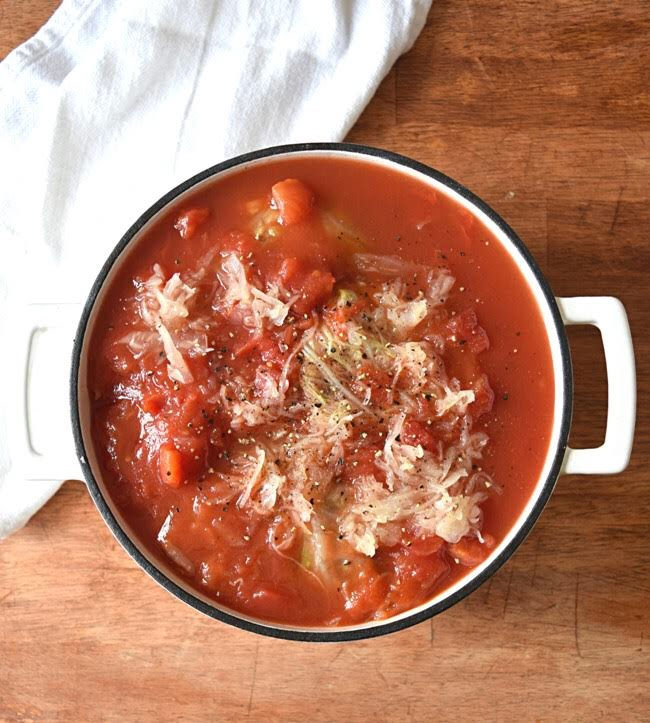
I make mine saucier than Oma did, but otherwise it’s blissfully the same: ground beef, par-cooked rice and sautéed bacon and onions rolled up inside plain old cabbage leaves then stacked in my biggest soup pot to simmer in a tangy, unadorned sauce of tomatoes and sauerkraut. 

Its savory, stewed comfort never fails to warm me through on those especially dark and bitter winter nights. And I always marvel when I retrieve each perfect little packet at the end of cooking, which forgives every lazy wrap job and torn cabbage leaf during assembly. Then again, I’m sure someone out there has figured out how to prevent the cabbage leaves from tearing. I sure hope they’re active on the stuffed cabbage rolls comment boards this week.  

***

Recipe: Oma’s Stuffed Cabbage Rolls

Yields
4-6 servings
Prep Time
30 minutes
Cook Time
2 hours

Ingredients

  • 1/2 cup white rice
  • Salt, as needed
  • 1 large head cabbage 
  • 3-4 strips bacon, diced 1/4 inch
  • 1 tsp. butter
  • 1 medium yellow onion
  • Black pepper, to taste
  • 2 lbs. 85% lean ground beef
  • 2 eggs, beaten
  • 1 lb. sauerkraut
  • 14 ozs. passata or good-quality puréed tomatoes (I like Pomi brand)
  • 1 14-oz. can diced tomatoes


Directions

Step 1

Bring 1 cup of water to a boil in a small saucepan. Add the rice and cook for about 10 minutes, until cooked about halfway through (it will cook the rest of the way inside the cabbage rolls). Drain off any excess water and tip the rice into a large mixing bowl.

Step 2

While the rice cooks, heat a large pot two-thirds full of salted water until boiling. Carefully add the whole head of cabbage and boil for 5 minutes. Remove and immediately plunge into a large bowl of ice water for 30 seconds, turning constantly to stop the cooking process. Set on paper towels to drain.

Step 3

Place the diced bacon in a cold skillet with the butter. Turn the heat up to medium and slowly render the bacon until just starting to brown, about 5 to 7 minutes. Add the onion and a sprinkling of salt and pepper. Sauté until the onion is softened and slightly caramelized, about 5 minutes. Add the onions and bacon to the bowl with the rice. Then add the raw ground beef, eggs and another generous sprinkling of salt and pepper. Mix everything together with your hands until evenly incorporated.

Step 4

To assemble the cabbage rolls, pull one cabbage leaf off at a time and place it on a cutting board with the inside facing up and the root end closest to you. (I used 12 leaves from a fairly large head of cabbage for this recipe.)

Step 5

Place a few tablespoons of the beef mixture in the center of the leaf. Fold each side in toward the center so they’re overlapping. (Don’t worry if the cabbage leaves rip a little. Everything will come together when it cooks.)

Step 6

Roll forward and away from you, tucking in the sides as you go like you’re rolling up a burrito. Set the rolls seam-side down on a sheet tray and repeat until you’ve used up all the filling. Thinly slice about 1 cup of leftover cabbage and place the rest in an airtight container in the fridge for another use. Otherwise, seal the rest in an airtight container and put it in the fridge.

Step 7

Place a 5-quart Dutch oven or other large, heavy-bottomed pot on the stove. Cover the bottom with a layer of sauerkraut (and extra sliced cabbage), then a layer of cabbage rolls. Season with a sprinkling of salt and pepper. Repeat this process until all the cabbage rolls are nestled inside the pot.

Step 8

Pour the tomato sauce and diced tomatoes over everything. Fill the tomato sauce can with water and pour that over the rolls as well. Top with a little more sauerkraut and season again with salt and pepper.

Step 9

Turn the heat to medium and bring the mixture to a simmer. Turn the heat down to low. (The pot should be lightly bubbling.) Cover the pot and cook the cabbage rolls for 2 hours, until the meat is cooked through and the cabbage leaves are tender.

Step 10

To serve, place 2 rolls in a shallow bowl or on a plate. Top with a few ladles of the sauerkraut tomato sauce. 


Cook’s Notes

Stuffed cabbage rolls freeze beautifully. Place the cooked cabbage rolls and a few spoonfuls of sauce in airtight containers in the freezer for up to 3 months. The day you’re ready to eat them, thaw them in the fridge for 8-ish hours, then reheat them gently over medium low on the stove.


More by this author:

What you need to know about sugarcane burning

Between candy, baked goods, drinks and more, Americans eat a lot of white sugar, roughly 68 pounds a year. A little under half of that is produced from sugarcane, but growing that sugar isn’t all sweet, especially for the people who live around cane fields in Central Florida, which are traditionally burned before harvest to make the processing simpler. Residents complain the burning aggravates respiratory problems, but haven’t had much success in fighting the region’s big industry. But for consumers wanting to buy a product made in a better way, there are some options.

The problems with burning sugarcane fields 

The practice of burning sugarcane fields has been largely discontinued throughout the world because of concerns about air pollution, but farmers still do it in Florida’s main sugar-producing region known as the Glades. Producers there say continuing the traditional practice is necessary to prevent harvesting accidents and keep costs down.

Burning requires a permit, and at least in theory, farmers are not allowed to burn on days when the smoke will drift in certain directions. But despite regulations, residents around cane fields complain that smoke often impacts sensitive areas like schools and hospitals. On burning days in the fall and winter, the air fills with ash the residents refer to as “black snow.”

For communities in the Glades, cane season means an increase in asthma attacks, sinus issues and other breathing problems. Local health care providers are also well aware of the effects of the “black snow” and see a 35% uptick in respiratory-related hospital visits when cane is burning.

Older residents report chronic breathing trouble and chest pain, and there’s mounting evidence that exposure to burning sugarcane fields can cause other long-term health problems. Researchers have also found that sugarcane burning is responsible for significant quantities of cancer-causing pollutants, like formaldehyde, in the air and that residents in the Glades breathe in more of these chemicals than the rest of the state.

Despite complaints from locals and years of their own evidence, however, the local health departments have largely ignored the burning at the behest of sugar industry representatives.

Problems with monitoring sugarcane burning pollution 

The sugarcane industry insists it complies with Clean Air Act standards and that federal monitoring says the Glades have higher air quality than average. Technically, this is correct, but only because of a measurement loophole.

An investigation by ProPublica and The Palm Beach Post earlier this year found that there was only one air quality monitor in the area around the sugarcane fields, and it’s been broken for eight years. And it might not matter if the monitor was working correctly anyway. Compliance with the Clean Air Act is determined by the 24-hour average of particulate matter in the air, but because individual cane fields don’t burn very long, pollution from the burning fields happens in quick episodes. So while the average amount of pollution detected over a 24-hour period might not be enough to trigger federal regulators to take action, ash and smoke may spike in short, intense episodes that are enough to set off asthma attacks and other problems. Investigators using their own monitors found that during some time windows, the amount of fine particulate matter in the air could be up to four times higher than the average, more than enough to cause respiratory distress.

Residents have made attempts to challenge the burning, but it hasn’t been easy. For starters, many feel a sense of conflict about taking on the sugar industry, as it’s one of the main employers in the area. There is a class-action lawsuit in progress on behalf of residents, though new legislation designed to protect the industry may make it more difficult for residents to get any money.

Ultimately, the people who live near the sugarcane fields — predominantly lower-income Black and Hispanic communities — don’t have the time or the resources to effectively advocate for clean air. This is a stark contrast to some of the other communities in the area, like Wellington, a wealthier white community that launched strong opposition to cane smoke decades ago. As a result, the Florida Department of Agriculture banned burning cane fields when the smoke was likely to blow towards Wellington. This scenario, where a polluting industry uses an under-resourced community as a dumping ground, is a classic case of environmental racism, and it’s common in polluting industries across the food system.

Why burn at all? 

But why burn sugarcane fields in the first place? The dried leaves that accumulate around the base of the canes, known as trash, can be difficult to deal with, and industry advocates cite a number of reasons to burn. Leaf trash is highly flammable, and cane farmers say leaving the fields unburned means exposing harvesters and processors at risk for accidental fires. There’s also evidence that leaf trash left in fields can slow down the next season’s growth, since the black, burned soil heats up more quickly than soil covered in last season’s vegetation. But this quickly evens out and plants catch up to have the same yield by the end of the growing season.

Ultimately, the choice to burn sugarcane comes down to money: leaving leaf trash attached to the canes means hauling more material to the processing plant. This requires more trips and more time in processing, which is expensive. Other green harvesting methods, like removing trash in the field, require additional equipment and attention, both of which cut into profits. But the cane sugar industry in Florida isn’t willing to do anything that might make production more expensive, arguing these costs would just be transmitted to consumers.

This is an odd position for the sugar industry to take, considering that Americans already pay an artificially high price for sugar by the industry’s own request. Florida might be a good place to grow sugarcane, but the combination of year-round tropical weather, cheap (often heavily exploited) labor and generous government support makes growing sugarcane in countries like Brazil even easier.

To protect American sugar producers from losing out to lower-priced imported sugar, the government restricts imports, so even though we think of sugar as an inexpensive ingredient, American shoppers actually pay extra to support the domestic industry. The American Enterprise Institute, an anti-subsidy group, estimates that restrictions on imports and other supports for sugar cost about $10 per person annually. This  doesn’t seem like a lot, but this money ends up in relatively few hands, meaning that sugar producers are getting wealthier.

A lot of this money goes towards lobbying, explaining why the American sugar industry has been able to dodge regulation on burning when other countries have imposed tighter restrictions. This is especially true in Florida, where the sugar lobby spent $11 million on industry-friendly candidates in 2020. This paid off in April when state legislators passed a bill making it harder to sue sugar producers for polluting communities, mirroring North Carolina’s “Right to Farm” laws that protect factory-farmed pork producers from lawsuits. Environmentalists say the law allows the industry to continue burning sugarcane fields while capping the possible damages from challenges like the class action suit in progress.

An industry that already relies on the public to stay afloat shouldn’t be pushing the extra costs of polluted air on the surrounding community. But it is true that transitioning to green harvesting takes money: countries that have eliminated burning generally did so with subsidies to help farmers afford new equipment or more expensive processing. Short of handing the industry more money to transition, however, there are other measures that could limit damage. Louisiana, which grows nearly as much sugar as Florida, gets far fewer complaints about trash burning. ProPublica points out that even a small tweak to harvesting there — cutting canes first and then burning trash — has resulted in far less intense fires that generate less smoke and far fewer complaints.

Sustainable sugar options 

So what does this mean for sustainable sugar? Unfortunately, white sugar is sold as a commodity: perfectly interchangeable and nearly impossible to trace back to the source. This means that avoiding cane sugar that comes from burnt Florida fields is difficult if you’re buying conventional sugar. Buying U.S.-grown organic sugar doesn’t solve the problem either, since organic cane is grown mainly in Florida. Domestic sugar produced from beets won’t come from burnt fields, but sugar beet cultivation has its own problems, like erosion and high chemical use, along with a rancid smellthat impacts surrounding communities, though this doesn’t trigger the same health problems that burning sugarcane does. Sugarcane imported from abroad is riddled with its own problems with labor and sustainability.

Still, finding ethically produced sugar isn’t impossible: the fair trade labels can help with sourcing imported sugar that was produced with higher labor standards, and other certifications like Bonsucro are working to bring transparency about sustainability to the international sugar market (though neither certification currently works with U.S. sugar producers). It isn’t easy to replace white sugar in every recipe, but using alternative sweeteners — including maple, date and other sugars — may also help drive down the foodprint of your sweet tooth.

Want healthy in a hurry? Try our favorite beans and greens recipes

Mid-December, I got a text from my mother: “This year, I’m making peanut butter balls, pumpkin cookies with cream cheese icing, ginger cookies, cranberry-date bars and I was going to try to come up with some kind of eggnog cookie.” 

There was a beat, then she sent a follow-up message. 

“I am not talking like dozens of each,” she wrote. “Just a little assortment of things.” (Reader, there were still dozens of each). Meanwhile, her mother, my maternal grandmother, had already embarked on her own batches for the holidays: chocolate fudge, peanut butter fudge, sugar cookies, gingerbread and likely some competing cranberry-date bars and peanut butter balls. 

If my dad’s mother were still alive, she’d have added to the mix, most notably with her pillowy-soft chocolate chip cookies, which she placed on the baking sheet with such exacting precision that they all looked shockingly uniform; my siblings and I used to lovingly joke that she rearranged the chocolate chips with a pair of tweezers so that the end result would be identical. 

This to say, I come from a line of women who bake — I mean, really bake — for the holidays. I’ve picked up the habit, too, and found my lane making miniature gingerbread cloud cakes, homemade cinnamon rolls and assorted breads. If you’re curious, ask me sometime about the year I made 72 miniature babka knots in my studio apartment galley kitchen as Christmas gifts. 

Like many people, the holidays were a season of sugar surges and dips, and while I’m not one for equating food with guilt or shame — I politely, but promptly, unfollow anyone who posts about how many jumping jacks or sit-ups you’d have to do to “work off” various holiday treats — the first of the year offers a time to rebalance my diet so it’s not 20% royal icing. 

January is when I lean on beans and greens, so here are some of our favorite recipes and stories from the Salon archives that really let those ingredients shine. This list first appeared on Salon Food’s weekly food newsletter, “The Bite.” Be sure to subscribe for special recipes, essays and how-tos that come straight to your inbox every weekend. 


Want more great food writing and recipes? Subscribe to Salon Food’s newsletter.


Kale-ing it this holiday season 

Earlier this week, I made a variation of Molly Baz’s crunchy chicken salad, which Mary Elizabeth Williams covered this summer in her weekly column Quick and Dirty. Typically, the recipe uses a head of Napa cabbage as the base, then builds flavor with briny cotija cheese, radishes, cilantro, garlic, lime, shredded rotisserie chicken — and a healthy bit of crunch from crushed corn nuts or Fritos. 

My version involved rescuing a bunch of farmer’s market kale from the refrigerator and topping it with goat cheese, an errant handful of peppery arugula, corn nuts, rotisserie chicken and some clementine segments and juice. While it wasn’t completely true to the original, this version was incredibly flavorful, filling and served as a nice kitchen clean-out recipe that was heavy on the greens. 

Use Molly and Mary Elizabeth’s recipe as a base for your winter salads, along with Maggie Hennessy’s guide for digging out of your next salad rut (plus, her panzanella recipe fit for a hearty lunch)

Bean pies, gratins and love letters 

In celebration of the 50th anniversary of Frances Moore Lappé’s “Diet for a Small Planet,” Mary Elizabeth Williams revisited her fall bean pie which — with its pleasant mix of corn, kidney beans and grated cheddar cheese — is really seasonless. It’s a perfect dish for cool winter evenings when you don’t want something too heavy, but still comforting. 

For something a little more decadent, David Kinch’s beans and greens gratin blends a healthy amount of melting cheese with cannellini beans and torn kale, all topped with a crispy breadcrumb crust. Jackie Freeman’s cauliflower and lima bean gratin is a similar recipe — use either as a jumping-off point based on what you have in your own fridge and pantry. 

While you’re waiting for your pies and gratins to bake, take a few moments to read Maggie Hennessy’s love letter to kidney beans, in which she “wax[es] poetic on this special bean that is often, inconceivably, overlooked in a lot of households.”

To learn how COVID affects the ear, scientists turn to cadavers

In a narrow medical school hallway, Matt Stewart opened a large cabinet to reveal dozens of shelves stacked with wooden boxes and trays, some at least 100 years old.

Stewart, tall and silver-haired, pulled out one of the trays and showed off its contents: Thin slices of human skull bones and the organs of hearing and balance they contain, stained shades of pink. Affixed to microscope slides, the anatomical bits resembled abstract rubber stamp art, no bigger than thumbprints. “Our Johns Hopkins history,” he said, referring to the university’s collection of specimens from more than 5,000 patients.

Stewart’s research team at Johns Hopkins University in Baltimore had a long, complicated journey to make slides like these in 2021. The researchers need these specimens, sliced from the portion of skull that houses the inner ear, to ask a fundamental question about the novel coronavirus, SARS-CoV-2: Does it directly invade the cells of tissues that enable hearing and balance?


Ear surgeon Matt Stewart leads a research team at Johns Hopkins University that is investigating how SARS-CoV-2 might infect ear cells that enable hearing and balance.

Data on ear problems as they relate to Covid-19, the disease caused by SARS-CoV-2, is spotty. To date, case reports and small studies have found that some Covid-19 patients experience significant and rapid hearing loss, ringing in the ears called tinnitus, or balance issues. Estimates vary on the prevalence of these symptoms, but because the coronavirus has infected hundreds of millions of people, even a few percent of Covid patients experiencing hearing loss would add up to a large increase globally. Yet no causal link has been drawn between the novel coronavirus and auditory symptoms. Hearing problems aren’t even on lists of Covid-19 symptoms, short or long-term, published by the Centers for Disease Control and Prevention.

There are several possible explanations for why the disease might be associated with severe hearing problems, and scientists may never pinpoint all of the underlying mechanisms. But researchers like Stewart are pursuing the theory that the virus could be directly damaging inner ear cells. The coronavirus is already known to infect the cells of the upper nasal cavity, leading to loss of smell. A similar process might occur in the ear, explained Stewart, an associate chief medical officer who specializes in inner ear surgery at the Johns Hopkins Hospital.

The implications would extend beyond the novel coronavirus. Each year some 90,000 people in the United States — that is, 27 out of 100,000 — experience sudden hearing loss from damage to the inner ear, and viruses are thought to cause many of these cases. Viruses can also lead to other issues with hearing and balance. But investigating why viruses cause these problems has long been a challenge for scientists. To study these delicate parts, researchers can’t cut up a living person’s inner ear — the research would require the removal of sensitive tissue, risking an injury that might result in total deafness or loss of balance.

The Covid-19 pandemic has motivated researchers to develop new approaches to tackling this longstanding question. At Johns Hopkins, Stewart and colleagues are using cadavers, dissecting the ears using surgical methods from the 1800s, and more recently, with a $7,000 diamond-bladed saw. Meanwhile, a separate group at the Massachusetts Institute of Technology and the Massachusetts Eye and Ear Infirmary has tackled the question by studying human tissue remnants from rare surgeries and by growing inner ear tissue from stem cells — a unique type of cell that can replicate and generate organs. The team published early results in the Nature journal Communications Medicine in October.

Viruses such as SARS-CoV-2, herpes, and the common cytomegalovirus “all have these tentacles that seem to touch the ear, but nobody’s been able to study them because the ear is so inaccessible,” said virologist Lee Gehrke, a senior author of the Communications Medicine study and a professor at both MIT and Harvard University. “So that’s the part that I think I get most excited about,” he said. “Now we have a way to look at these things in a way that we were not able to do before.”

* * *

Cadavers can be hard to come by because they require donors. But for Stewart’s team, getting cadavers of patients who had died with Covid-19 wasn’t the most difficult part — Johns Hopkins was initially able to provide three. The bigger challenge was adhering to CDC guidelines. Early in the pandemic, when the research began, no one knew exactly how long the coronavirus could survive under different conditions. The CDC discouraged the use of powered surgical tools like drills, which would be the most obvious choice to get into a cadaver’s ear, but also could shoot viral particles into the air and pose a risk to anyone in the room. Since modern tools were out, Stewart had to rely on surgical techniques from the late 1800s, performed using hand tools that wouldn’t electrically spin up viral particles at high speed.

In an autopsy room, the researchers donned N95 masks and other surgical gear. On each cadaver, they began by making an incision behind the ear, and then found the triangular opening to the mastoid, a part of the skull that “kind of looks like a beehive with a bunch of air cells and very, very, very thin bone,” Stewart said. They operated with a tiny chisel-like instrument called an osteotome in addition to a set of instruments called curettes, “which look like little sharp ice cream scoops,” said Stewart. The curettes can scrape a fraction of a millimeter at a time. From the mastoid they created a 2-millimeter opening — roughly the width of a spaghetti noodle — into the middle ear. They then swabbed inside with tiny disposable brush.

The Hopkins researchers eventually found the genetic signature of the SARS-CoV-2 coronavirus in two of the three cadavers, confirming that the virus can make its way to the middle ear and mastoid. Stewart and colleagues published these findings in a research letter in the journal JAMA Otolaryngology-Head & Neck Surgery in July 2020, recommending that health care providers wear eye protection and N95 masks during procedures involving the middle ear. (In unpublished follow-up research, the viral signature was found in 60 percent of more than 20 cadavers.)

Ear anatomy and mastoid bone. Visual: Blausen Medical Communications, Inc./Wikimedia Commons

In an email to Undark, Jameel Muzaffar, a surgeon and researcher at the University of Cambridge and Oto Health in the U.K., said he was not surprised by the signature of SARS-CoV-2 in the middle ear and mastoid since both structures are linked to the nose, where the coronavirus is known to concentrate. Indeed, Stewart said, the virus could have traveled with “infected snot” from elsewhere in the sinuses without necessarily invading precious inner ear cells.

The study does lend support to “the idea that as the virus is present in the middle ear, it could more easily access the inner ear,” potentially causing sudden hearing loss, Muzaffar said. Still, it did not answer the question: Could the coronavirus directly invade and harm the cells of hearing?

A December 2020 study in Laryngoscope explored this question in an organism easier to examine than humans: mice. The novel coronavirus is known to enter cells by interacting with a receptor called ACE-2, which sits on the surface of some human cells. Researchers at the University of Tokyo looked to see if ACE-2 receptors and related proteins are present in mouse ear structures. It turns out, they are.

That study “lit a creeping fire under me,” Stewart said. If his team replicated this in humans, they would need to slice up the inner ear into individual thin cross-sections to analyze under a microscope. But from the time researchers obtain ear samples from cadavers, it can take a year for the bones to soften enough to be sliced thin. That’s a long time to wait in a pandemic.

* * *

To look at human cells, Stewart’s team would need to make new slides with thin cross-sections of the organs of hearing and balance like the historical ones in the medical school hallway cabinets. In the previous cadaver study, his team did not have a way to access the inner ear. This time, they’d have to carve their way to that delicate area, and make very fine cuts.

Stewart thought back to when he studied geochemistry as a graduate student. Back then, he had used specialized tools to cut into rocks and gems. “So I had the idea to use a diamond mineralogic saw,” Stewart said. Since the thickness of the blade is just .03 inches, less material would be lost when cutting into temporal bone — a part of the skull encasing the inner ear and balance organs. From there, Stewart reasoned, the research team could rapidly decalcify the cut bones with acid to soften them, so that they could reach those sensitive hearing and balance organs, slice them thin, and perform experiments to look for key cell receptors.

The diamond-bladed saw cost about $7,000 — an unusual purchase for an ear surgeon with a wild idea. While the National Institutes of Health had provided funding for Stewart’s previous cadaver study, the agency declined to support this unproven technique, so Stewart directly approached a family that had donated to the hospital, asking if they would support the use of their funds for this project. They did.

Matt Stewart holds a tray of slides containing slices of human skull bone and the organs of hearing and balance from the Johns Hopkins’ temporal bone collection, which contains specimens from over 5,000 patients.
Historical cross-sections of the organs of the ear, about the size of thumbprints. To create new slides to study Covid-19, Stewart had to get creative. 
Stewart looks under a microscope at a temporal bone, which encases the organs of hearing, from a donated cadaver.
To prepare cross-sections for study, Stewart’s team carefully cut through temporal bones like this one with a diamond-bladed mineralogic saw.

Using this technique, Stewart and colleagues successfully created the specimens they needed just about two weeks after the initial surgery. When he got back the first slide last year in early June, “I just sat back in my office and I felt like I had really accomplished something,” Stewart said. His team had surmounted a key obstacle in looking for receptors that the Covid-causing virus could attack.

Preliminary results suggest that they’re on the right track. Using temporal bones from six cadavers that did not have a Covid-19 infection, the researchers found these vulnerable cell receptor types in the middle ear, cochlea, and balance system. That means the novel coronavirus could potentially cause hearing damage by directly invading cells. “That was a big piece of the puzzle,” Stewart said. This has not yet been peer-reviewed, but Stewart presented the results at the American Neurotology Society’s meeting in September 2021, and his team is preparing a manuscript to submit to a journal.

* * *

Separately, before the pandemic, a team in the Boston area led by surgeon Konstantina Stankovic, now at Stanford University, was growing inner ear tissues using a type of stem cell that aggregates to form clusters called organoids. But it wasn’t until the advent of Covid that they, in collaboration with researchers at MIT, started using these cells to better understand vulnerability to viruses.

Under a microscope, the organoid tissues resemble what’s inside a human ear, said Gehrke, the virologist, who collaborated with Stankovic. The team has even grown hair cells, sensory receptors that detect movement and enable hearing with tiny stalks called stereocilia sticking out of their surface. These scientists also studied human inner ear tissue from two live patients. It came from a rare surgery that alleviates debilitating vertigo but reduces hearing.

Cells from both the organoids and the patients’ inner ears contained the same proteins that Stewart found in his cadaver research. Gehrke and colleagues then went one step further: They exposed both the organoid and the patient tissues to SARS-CoV-2. As they predicted, the novel coronavirus infected some of the cells. “Their work is so important,” Stewart wrote in a recent email. Gehrke characterized Stewart’s preliminary findings as great news. “Any data that are complementary,” he said, are “very useful.”

Next, Stewart’s team plans to look for evidence of direct invasion in the cells of hearing and balance system organs using samples from Covid-19-positive cadavers. In that way, they could look for possible interactions between human tissue and a virus that had infected it naturally, rather than through an experiment. Stankovic and Gehrke’s team, meanwhile, would like to test experimental treatments in their organoids, Gehrke said, as well as look at other viruses. Both groups want to adapt their models to explore other possible causes of hearing loss from viruses, such as inflammation and immune responses.

All of this may one day lead to better treatments and supportive care for people who struggle with hearing and balance impairment, Stewart said. The subject is personal for him, as he witnessed his father develop hearing loss after years of using dynamite as a field geologist. Because of communication difficulties when sounds are muffled, Stewart added, a patient’s “world kind of contracts.”

With a greater understanding of how viruses interact with the ear, doctors will be able to better help both patients with current Covid disease as well those who have “post-viral effects,” Stewart said.

* * *

Elizabeth Landau is a science journalist and communicator living in Washington, D.C. She has contributed to The New York Times, The Washington Post, Quanta Magazine, Smithsonian, and Wired, among other publications. Find her on Twitter at @lizlandau.

This article was originally published on Undark. Read the original article.

All photos by Elizabeth Landau for Undark.

Genomic surveillance: How scientists know which COVID variants are circulating

The omicron variant quickly took over the global coronavirus landscape after it was first reported in South Africa in late November, 2021. The U.S. became the 24th country to report a case of omicron infection when health officials announced on Dec. 1, 2021, that the new strain had been identified in a patient in California.

How do scientists know what versions of the coronavirus are present? How quickly can they see which viral variants are making inroads in a population?

Alexander Sundermann and Lee Harrison are epidemiologists who study novel approaches for outbreak detection. Here they explain how the genomic surveillance system works in the U.S. and why it’s important to know which virus variants are circulating.

What is genomic surveillance?

Genomic surveillance provides an early warning system for SARS-CoV-2. The same way a smoke alarm helps firefighters know where a fire is breaking out, genomic surveillance helps public health officials see which coronavirus variants are popping up where.

Labs sequence the genome in coronavirus samples taken from patients’ COVID-19 tests. These are diagnostic PCR tests that have come back positive for SARS-CoV-2. Then scientists are able to tell from the virus’s genome which coronavirus variant infected the patient.

By sequencing enough coronavirus genomes, scientists are able to build up a representative picture of which variants are circulating in the population overall. Some variants have genetic mutations that have implications for prevention and treatment of COVID-19. So genomic surveillance can inform decisions about the right countermeasures – helping to control and put out the fire before it spreads.

For example, the omicron variant has mutations that diminish how well existing COVID-19 vaccines work. In response, officials recommended booster shots to enhance protection. Similarly, mutations in omicron reduce the effectiveness of some monoclonal antibodies, which are used both to prevent and treat COVID-19 in high-risk patients. Knowing which variants are circulating is therefore crucial for determining which monoclonal antibodies are likely to be effective.

How does genomic surveillance work in the US?

The U.S. Centers for Disease Control and Prevention leads a consortium called the National SARS-CoV-2 Strain Surveillance (NS3) system. It gathers around 750 SARS-CoV-2-positive samples per week from state public health labs across the U.S. Independent of CDC efforts, commercial, university and health department laboratories sequence additional specimens.

Each type of lab has its own strengths in genomic surveillance. Commercial laboratories can sequence a high number of tests, rapidly. Academic partners can provide research expertise. And public health laboratories can supply insight into local transmission dynamics and outbreaks.

Regardless of the source, the sequence data is generally made publicly available and therefore contributes to genomic surveillance.

What data gets tracked?

When a lab sequences a SARS-CoV-2 genome, it uploads the results to a public database that includes when and where the coronavirus specimen was collected.

The open-access Global Initiative on Sharing Avian Influenza Data (GISAID) is an example of one of these databases. Scientists launched GISAID in 2008 to provide a quick and easy way to see what influenza strains were circulating across the globe. Since then, GISAID has grown and pivoted to now provide access to SARS-CoV-2 genomic sequences.

The database compares a sample’s genetic information to all the other samples collected and shows how that particular strain has evolved. To date, over 6.7 million SARS-CoV-2 sequences from 241 countries and territories have been uploaded to GISAID.

Taken together, this patchwork of genomic surveillance data provides a picture of the current variants spreading in the U.S. For example, on Dec. 4, 2021, the CDC projected that omicron accounted for 0.6% of the COVID-19 cases in the U.S. The estimated proportion rose to 95% by Jan. 1, 2022. Surveillance gave a stark warning of how quickly this variant was becoming predominant, allowing researchers to study which countermeasures would work best.

It’s important to note, however, that genomic surveillance data is often dated. The time between a patient taking a COVID-19 test and the viral genome sequence getting uploaded to GISAID can be many days or even weeks. Because of the multiple steps in the process, the median time from collection to GISAID in the U.S. ranges from seven days (Kansas) to 27 days (Alaska). The CDC uses statistical methods to estimate variant proportions for the most recent past until the official data has come in.

How many COVID-19 samples get sequenced?

Earlier in 2021, the CDC and other public health laboratories were sequencing about 10,000 COVID-19 specimens per week total. Considering that hundreds of thousands of cases have been diagnosed weekly during most of the pandemic, epidemiologists considered that number to be too small a proportion to provide a complete picture of circulating strains. More recently, the CDC and public health labs have been sequencing closer to around 60,000 cases per week.

Despite this improvement, there is still a wide gap in the percentages of COVID-19 cases sequenced from state to state, ranging from a low of 0.19% in Oklahoma to a high of 10.0% in North Dakota within the past 30 days.

Moreover, the U.S. overall sequences a much smaller percentage of COVID-19 cases compared to some other countries: 2.3% in the U.S. compared to the 7.0% in the U.K., 14.8% in New Zealand and 17% in Israel.

Which COVID-19 tests get sequenced?

Imagine if researchers collected COVID-19 tests from only one neighborhood in an entire state. The surveillance data would be biased toward the variant circulating in that neighborhood, since people are likely transmitting the same strain locally. The system might not even register another variant that is gaining steam in a different city.

That’s why scientists aim to gather a diverse sample from across a region. Random geographically and demographically representative sampling gives researchers a good sense of the big picture in terms of which variants are predominant or diminishing.

Why don’t patients in the US get variant results?

There are a few reasons patients are generally not informed about the results if their specimen gets sequenced.

First, the time lag from specimen collection to sequence results is often too long to make the information clinically useful. Many patients will have progressed far into their illness by the time their variant is identified.

Second, the information is often not relevant for patient care. Treatment options are largely the same regardless of what variant has caused a COVID-19 infection. In some cases, a doctor might select the most appropriate monoclonal antibodies for treatment based on which variant a patient has, but this information can often be gleaned from faster laboratory methods.

As we begin 2022, it is more important than ever to have a robust genomic surveillance program that can capture whatever the next new coronavirus variant is. A system that provides a representative picture of current variants and fast turnaround is ideal. Proper investment in genomic surveillance for SARS-CoV-2 and other pathogens and data infrastructure will aid the U.S. in fighting future waves of COVID-19 and other infectious diseases.

Alexander Sundermann, Clinical Research Coordinator & DrPH Candidate in Epidemiology, University of Pittsburgh Health Sciences and Lee Harrison, Professor of Epidemiology, Medicine, and Infectious Diseases and Microbiology, University of Pittsburgh Health Sciences

This article is republished from The Conversation under a Creative Commons license.

The 25 highest grossing movies of 2021

The first year of the 2020s was a strange time for the global box office, and 2021 looked only slightly more normal. Many movie theaters reopened for the first time in a year in 2021, and several big titles that were delayed due to the COVID-19 pandemic (including “No Time to Die,” Daniel Craig’s final latest, and final, outing as James Bond) finally appeared on marquees. Some releases had underwhelming ticket sales, while others smashed box office expectations.

According to Box Office Mojo, two of the three highest grossing movies of 2021 came from China. “The Battle of Lake Changjun,” which was commissioned by the publicity department of the Chinese Communist Party, tells the story of Chinese soldiers defeating American troops in a battle during the Korean War. It’s the most expensive Chinese film ever made, and it became the country’s highest grossing film of all time with global box office earnings exceeding $902 million, which was enough to make it the second highest grossing movie worldwide in 2021.

https://youtu.be/1aHDj84CcsY

China also claims the third slot on the list. The Chinese comedy “Hi, Mom” earned $822 million at the global box office in 2021. Some of the highest grossing English language movies last year were “No Time to Die,” with a total gross of $774 million, and F9: The Fast Saga, with $726 million in ticket sales.

The top spot, however, was owned by Marvel. “Spider-Man: No Way Home,” starring Tom Holland, arrived in theaters on December 17, and quickly racked up more than $1.3 billion in ticket sales to make it the top earner at the global box office. The third film in the MCU‘s Spider-Man trilogy earned $260 million in the U.S. in its opening weekend, making it the second-biggest domestic debut of all time behind its fellow MCU property “Avengers: Endgame.” That’s especially impressive considering it premiered at a time when pandemic fears are still hampering ticket sales.

After reading the list of 2021’s biggest movies by box office gross, check out the other end of the spectrum with 11 movies that made less than $400 at the box office.

  1. “Spider-Man: No Way Home” // $1,372,600,664
  2. “The Battle at Lake Changjin” // $902,541,161
  3. “Hi, Mom” // $822,009,764
  4. “No Time to Die” // $774,034,007
  5. “F9: The Fast Saga” // $726,229,501
  6. “Detective Chinatown 3” // $686,257,563
  7. “Venom: Let There Be Carnage” // $501,138,437
  8. “Godzilla vs. Kong” // $467,863,133
  9. “Shang-Chi and the Legend of the Ten Rings” // $432,233,010
  10. “Eternals” // $401,454,419
  11. “Dune” // $396,115,864
  12. “Black Widow” // $379,631,351
  13. “Free Guy” // $331,503,757
  14. “A Quiet Place Part II” // $297,372,261
  15. “Cruella” // $233,274,812
  16. “My Country, My Parents” // $221,701,823
  17. “Jungle Cruise” // $220,889,446
  18. “Encanto” // $206,346,390
  19. “Raging Fire” // $205,838,889
  20. “The Conjuring: The Devil Made Me Do It” // $201,965,074
  21. “Chinese Doctors” // $197,143,218
  22. “Ghostbusters: Afterlife” // $184,720,032
  23. “Cliff Walkers” // $181,325,565
  24. “The Suicide Squad” // $167,400,219
  25. “Space Jam: A New Legacy” // $162,828,072

In defense of the overlooked Kristen Stewart

I am a latent Kristen Stewart apologist.

Like many viewers, I first encountered the Los Angeles native in "Panic Room" where then-child actor Stewart played Jodie Foster's daughter, looking like, well, a mini Jodie Foster, and acting with a surety and naturalness that seem to place her on equal footing with the legendary star. In a tiny voice, she encourages Foster, playing her mom, to curse forcefully on the intercom of the panic room where the two have barricaded themselves after their home is invaded. She's a trash-talking, floppy-haired tween for the ages.

Though Stewart appeared in dozens of films throughout her youth, including as a horse girl in "Cold Creek Manor" despite the young Stewart having a personal phobia of horses, I didn't really think of Stewart again until "Twilight." The series of blockbuster films, based on the bestselling novels by Stephenie Meyer, placed Stewart in the enviable, then very unenviable position of falling in love with an ancient vampire teen (Robert Pattinson), marrying him, becoming a vampire herself, and giving birth to his weirdly named vampire child. 

RELATED: "Yellowjackets" unapologetically follows YA logic, from the Big Dance to bitter betrayals

As the "Twilight" movies got increasingly odd, the plots far-fetched even for a series about vampires — and seemed to be more and more thinly veiled mortality tales about Meyer's support for traditional gender roles and abstinence — Stewart appeared like the best performer in a school play, desperately trying to act her way onto other, better stages.

She did, trading the teen angst, toughness, and unquestioning love of her "Twilight" character, Bella, for roles opposite Juliette Binoche in "Clouds of Sils Maria" and Laura Dern in "Certain Women." Stewart parlayed sparkly vampire success into roles in films that were less mainstream, lower-budget, and often, less seen, like "The Yellow Handkerchief" and "Anesthesia."

Although she racked up some awards over the years — including the British Academy of Film and Television Arts (BAFTA) Rising Star Award — she has also attracted a lot of criticism for her acting and for her personal life. Complaints about her performances center around the criticism that Stewart is "one note," acting the same in every film. And about her personal life? Director Rupert Sanders had an affair with Stewart on the set of his film "Snow White and the Huntsman." That the judgement about the affair came down harshest on Stewart, while barely grazing Sanders — who was married at the time to the model and actor playing Stewart's mother in "Snow White," Liberty Ross, and who went on to direct projects like the pilot episode for the 2021 Apple TV+ show "Foundation" — is due both to sexist double standards, as well as to the fact that Stewart was one half of a popular couple with her former co-star Pattinson at the time.

Some people don't like a movie to not be real, for a couple forged in the close quarters of performing a fiction together to not last forever, to last as long as a vampire's immortal life. Stewart and Pattinson broke up, became friends. Stewart later joked about it when she hosted "Saturday Night Live."

It was Stewart's self-deprecating turn in the "SNL" monologue — where she slipped into a nervous girl persona, admitting "the president's probably watching," and relating her relationship with Pattinson with a Valley Girl accent: "We broke up and then we got back together, and for some reason, it made Donald Trump go insane"— when I first began to realize there was more to this actor than some press would have you believe. "The president tweeted about me 11 times . . . I don't think Donald Trump hates me. I think he's in love with my boyfriend," Stewart said, then read some of the tweets with expert, deadpan delivery.

She also, there in front of a live studio audience in 2017, declared simply: "I'm like, so gay, dude."


Want a daily wrap-up of all the news and commentary Salon has to offer? Subscribe to our morning newsletter, Crash Course.


Stewart has said she was urged not to come out, or at least, not to be public about it. In a 2019 interview, she said she was advised "[just] do yourself a favor, and don't go out holding your girlfriend's hand in public, you might get a Marvel movie . . . .I don't want to work with people like that," Stewart said.

Stewart — who has not done a Marvel movie — has had public relationships with singer Soko, visual effects producer Alicia Cargile, model Stella Maxwell, and is currently engaged to longtime girlfriend Dylan Meyer, who is a screenwriter. Stewart also both endeared and irked the gay community by starring in Hulu's "Happiest Season," a gay Christmas film which unfortunately, is not very happy, although it does feature Stewart as a leading lesbian. 

It's a kind of role we need to see much more of, and Stewart is born to play it, shrugging and hanging back awkwardly in an oversized peacoat, doing what she needs to do for as long as she can stand it to protect her girlfriend, even if that means hiding herself.

But she's also born to play, of all things, Princess Diana, as she does expertly in the 2021 Pablo Larraín directed film "Spencer." 

It's not simply the physical transformation of Stewart into Diana, and the rushed and lilted speech pattern the actor adopts — but the sadness emanating from Stewart's eyes, the anxiety as she hugs her frame. She rallies with empathy and longing as she embraces her children, tries to fight for more and better for them and for herself. It's a portrait of a woman in flames from the inside out.

But Stewart lost the Golden Globe to Nicole Kidman for Kidman's performance in "Being the Ricardos." Stewart was also not nominated for the 2022 Screen Actors Guild (SAG) Awards. And as Glenn Whipp wrote in the Los Angeles Times, "No one has won the lead actress Academy Award without being nominated by SAG." It seems more than possible that attention like the Oscars might skip Stewart in this career-defining role. 

That would be a mistake. Misogyny and homophobia have trailed her, but the criticism about Stewart also often seems grounded in mischaracterization as to what the craft of acting entails, how the most restrained performances can sometimes be the most powerful. Stewart is understated in almost all of her roles, small in her motions . . . and big in her emotions. She conveys repression and quiet suffering as Diana locking eyes with her husband's mistress outside a church — but also in "Personal Shopper," as the low-level employee efficient at her job yet inwardly lost, unmoored and reckless without her brother. 

I would like to argue that Stewart is the kind of good actor that you forget is actually acting. She is Joan Jett in "The Runaways" with her shifting eyes and sly confidence. She melts into her roles, and it's hard to tell where the actor ends and the role begins. Which is a problem when it comes to things like awards, like serious critical attention, like giving credit where credit is due.

It's time to come back to Stewart, to her subtle but sophisticated performances. She makes disappearing look easy. It is anything but.

More stories like this:


Once again Republicans will try to claim MLK — but if he were here, they’d despise him

Books possess great power. Those who own only a few, yet return to them like old friends for wisdom, comfort and knowledge, or to revisit a special memory, know this to be true. Those of us who have many books — who read and and reread them and carefully compile our collections — know this also.

Our books are a type of biography in themselves, an accounting of our lives. I take my books very seriously. People know not to ask if they can borrow any of my books.

The number of books a person owns reveals little about their understanding of the power of literacy and books. For too many people who have huge libraries, the whole project is one of social signaling and bourgeois habitus.

One of my most personally important books is an early edition of “The Black Book.” This landmark work was edited by Middleton A. Harris, Ernest Smith, Morris Levitt and Roger Furman, with a foreword by Toni Morrison. My mother purchased “The Black Book” for a community college course and wanted to make sure that I read it. I was seven or eight years old at the time.

All these years later is sits prominently on a bookshelf that I walk by many times each day. If there was a fire, I would grab my “Black Book,” along with a handful of other prized possessions, as I ran out the door.

My copy of “The Black Book” is old, tattered and yellowing. Several pages are missing. The book has no monetary value. Its power and value cannot be measured in such terms. “The Black Book” reinforced for its readers that we, Black Americans and others of the Black diaspora, have a history and experience as a people that white supremacy, the white gaze and white power in its many forms could not erase.

RELATED: Right’s cynical attack on “critical race theory”: Old racist poison in a new bottle

Beyond important historical facts, narratives and other information, “The Black Book” (and other work in that tradition and spirit) served as a kind of shield against the many big and small lies of white supremacy and white racism that can diminish and crush the way Black folks (and other people of color) imagine their own possibilities and reality — and this remains true decades after the civil rights movement.

In many ways, America was built on white supremacist lies about Black and brown people. Those lies have not been exorcised; they still have great power and many people believe them today. The social institutions those lies helped create and legitimate still exist. The Jim Crow Republicans and other neofascists are empowered by racist and white supremacist lies.

On this holiday weekend set aside to honor the legacy of Dr. Martin Luther King Jr. and the Black Freedom Struggle, Republicans and other “conservatives” will deploy their racist and white supremacist lies (as they have done for decades) to diminish the meaning of Dr. King’s struggle and sacrifice

According to their deranged worldview, Dr. King is a Reagan Republican and Christian nationalist, and a neoliberal gangster capitalist who supports deregulation, privatization and gun culture. This alternate reality version of Dr. King also stands against “wokeness” and “Black Lives Matter.” His legacy has been “stolen,” we are told, by the Democrats and the “Black establishment” as a means to “oppress” the Black community. Moreover, the Democratic Party is a “plantation,” and Dr. King’s memory and legacy are being used by Democrats, liberals and “Black elites” to keep Black Americans “mentally enslaved” and “not thinking for themselves.”


Want a daily wrap-up of all the news and commentary Salon has to offer? Subscribe to our morning newsletter, Crash Course.


This white supremacist disinformation campaign is part of a much larger, and in fact global, fascist project meant to convince white Americans that they are the “real” victims of racism and that simultaneously they are losing “their country” — a country where they control every dominant social, political, economic and cultural institution.

Public opinion polls and other research have consistently shown that agreement with such values and beliefs is heavily predictive of support for and allegiance to Donald Trump, the Republican Party and the larger white right.

As expected, the Republican fascists and their allies and agents are using Dr. King’s life and legacy as one of the newest weapons in their moral panic over “critical race theory.” The true goal of this assault on reality is to make it illegal to teach the real history of American racism and the color line.

The real Martin Luther King Jr. — as opposed to the de-radicalized, deracinated, distorted, whitewashed and commodified figure now used to sell all manner of consumer goods, was a civil rights leader, a hope warrior and a martyr. He was also a democratic socialist. The real Dr. King opposed militarism and nationalism. He stood with the powerless and oppressed against the powerful. He supported affirmative action, reparations for white-on-Black chattel slavery and Jim Crow, a guaranteed minimum income and other substantive material and other attempts to ameliorate America’s long history of injustice against Black Americans and other people of color. The real King supported social democracy.

The real Martin Luther King Jr. would without a doubt have supported the scholarly framework known as critical race theory and its conclusions about inequality and America’s social and political institutions. The real Martin Luther King Jr. would have stood firm against the forces of Trumpism, American neofascism, white supremacy, and the white right and “conservative” movement more broadly. Leaders of those movements would have found him an implacable enemy.

At the time of his assassination, King was one of the most unpopular major figures in the United States — as he would be today, were he were alive. Many white liberals and “moderates” would view him with mistrust and disdain for speaking too much truth about their complicity with white supremacy and other forms of injustice.

In 1963, Dr. King wrote in his famous “Letter From Birmingham Jail“: 

I have almost reached the regrettable conclusion that the Negro’s great stumbling block in the stride toward freedom is not the White Citizens Councilor or the Ku Klux Klanner but the White moderate who is more devoted to “order” than to justice.

This is the second Martin Luther King Jr. holiday since Donald Trump and his Republican fascists attempted a coup on Jan. 6, 2021, with the ultimate goal of terminating America’s multiracial democracy

Last year, I wrote the following here at Salon about Dr. King, Jan. 6, and America’s imperiled democracy:

The real Dr. King would demand that substantive justice be done and that Donald Trump, his coup plotters, enablers and foot soldiers, and those others who participated in a lethal attack on the Capitol be held accountable. Such an outcome is not vengeance; it is justice.

Dr. King, who was a product of the Black Christian prophetic tradition of resistance and love and social justice, said this: “Forgiveness does not mean ignoring what has been done or putting a false label on an evil act. It means, rather, that the evil act no longer remains as a barrier to the relationship. Forgiveness is a catalyst creating the atmosphere necessary for a fresh start and a new beginning.”

He also said, “He who passively accepts evil is as much involved in it as he who helps to perpetrate it. He who accepts evil without protesting against it is really cooperating with it.”

As the crimes of the Age of Trump are investigated and punishments meted out, the American people would be wise to heed Dr. King’s wisdom. We have ignored it far too long.

One year later, where are we? The answer is that matters are more dire. America is in a moment of interregnum, with fascism and white supremacy in the ascendant. Republican fascists and their movement are threatening a second civil war and terrorist insurgency. Republicans will likely regain control of Congress after the midterm elections this November, and could well retake the presidency as well in 2024. Donald Trump and his cabal have yet to be punished for their crimes against the Constitution and the rule of law, and to all appearances never will be.

In this moment of democracy crisis, America needs hope warriors and other freedom fighters who are prepared for a long struggle, one in which the pendulum will swing between hope and despair, optimism and nightmares, terror and elation many times over. 

In a 2012 interview, theologian James Cone reflected on what could be learned from Dr. King and Malcolm X about such struggles:

But as long as people have hope, they struggle. If they only have nightmare, if they only have despair, they won’t struggle. So, even in Malcolm you got hope, because you wouldn’t have him articulating so strongly, so powerfully unless there was hope in the articulation itself. So, while King expresses the hope, he also articulates despair too. King and Malcolm have each other in each other and that’s true of all groups who are struggling for justice. You have one group that’s going to emphasize the negative side and one that’s going to emphasize the positive side, but both have both.  Because it ain’t all positive and King knew that — that’s why he was fighting. And it ain’t all negative, Malcolm knew that, that’s why he was talking. Otherwise, he wouldn’t be talking to his people if there was not hope, if they, through his discourse, wouldn’t be empowered about the situation in which they found themselves in.

With his prophetic wisdom and vision, Dr. King warned us that America could be destroyed by racism, white supremacy and other societal ills. As our democracy weakens even further day by day, his prophecy looks to be coming true in real time.

The arc of the moral universe may indeed be long, but the challenge is this: Do the American people have the will at this time to bend it more fully towards democracy and justice, in what will likely be a decades-long battle against fascism and white supremacy? Or have too many Americans already surrendered, before the battle has even been joined?

Read more on American history and white supremacy:

Trump kids’ refusal to pay their bills is coming back to haunt them in investigation: report

According to a report from the Daily Beast, the Trump Organization — and by extension Don Jr., Ivanka and Eric Trump — may have created another legal headache for themselves due to their history of not paying their bills.

As reported by the Beast’s Jose Pagliery, Washington D.C, District Attorney Karl Racine is incorporating a dispute between the family’s business and a D.C. hotel over an unpaid $49,358 bill into his investigation over the misuse of inauguration funds dating back to 2017.

At the center of the dispute was the Trump Org’s refusal to pay for the block of rooms they booked at the Loews Madison Hotel after 13 people didn’t show up — which then led to the bill being sent to a collection agency.

According to Pagliery, that financial dispute put Trump and family back in the “crosshairs in an ongoing investigation into how the Trump kids used the Presidential Inauguration Committee to throw lavish parties of their own.”

Lending credence to the charges is Stephanie Winston Wolkoff, who help coordinate the inaugural festivities and now is working with investigators.

According to Winston Wolkoff, “It was their friends. It should never have been sent to the PIC. That’s misuse of funding. The Trump Organization being involved in any way and getting the PIC to pay any sort of balance anywhere on their behalf? It just doesn’t seem legitimate.”

While the bill was eventually “paid by the Presidential Inaugural Committee at the direction of Rick Gates,” the investigation has turned up a series of communications that show that Don Jr’s aides was in the loop over the fight over the money.


Want a daily wrap-up of all the news and commentary Salon has to offer? Subscribe to our morning newsletter, Crash Course.


“In the typical fashion of an aggressive collections agency, Campbell Hightower & Adams in Arizona started bombarding the company with phone calls and emails in June 2017, picking up where the Loews Madison Hotel had left off,” the report states. “A collector, identified only as ‘Sherie,’ jotted down notes when she repeatedly communicated with Don Jr.’s executive assistant, Kara Hanley,” which led Hanley to deny the company had anything to do with the bill.

That, in turn, led to another Don Jr. aide to enter the conversation, with the report noting, “A few weeks later, Sherie notified the Trump Organization that she had just found out that yet another Don Jr. executive assistant, Lindsey Santoro, had initially requested the rooms and added Beach as the main contact for the deal. That information seemed to cement even further that the company was indeed involved.”

According to the report, that raised red flags.

“The District of Columbia’s AG hopes this evidence proves that the Trump Organization should remain part of the lawsuit, which seeks to seize money it deems was misused and divert it instead to another nonprofit. Otherwise, the civil investigation would continue only against the PIC (which is no longer active) and the Trump International Hotel Washington (which is being sold anyway),” the Beast reports, adding, “When approached by The Daily Beast, the AG’s office pointed to the arguments it made in court. The Trump Organization’s lawyer didn’t respond to a request for comment. The collection agency didn’t return calls on Friday.

Notably, none of these documents described yet another layer of Trump Organization involvement: how company chief financial officer Allen Weisselberg puzzlingly assumed the responsibility of auditing the nonprofit PIC’s finances. Last summer, D.C. investigators wanted to interview him under oath, but he was then indicted for criminal tax fraud in New York City.”

You can read more here.

More stories like this: 

Five ways to celebrate Betty White’s 100th birthday, from catching a new film to eating cheesecake

Whether she was on the big screen or our home televisions, Betty White captivated us with memorable performances on “The Golden Girls,” “The Mary Tyler Moore Show,” “The Proposal” and many more.

The beloved comedian and actress was hailed as a television legend but also made her mark in other pursuits. In 2010, she appeared in the famous Super Bowl commercial for Snickers. That same year, she hosted an episode of “Saturday Night Live” at the age of 88. And throughout her career, she was at the forefront of combatting racial injustice within the entertainment industry in addition to giving voice to the voiceless in her advocacy for animals.

RELATED: Betty White on “The Golden Girls” taught me queer self-acceptance

White, who died on New Year’s Eve at the age of 99, was just a few weeks shy of celebrating her 100th birthday on Jan. 17. Numerous media pieces and events were planned in anticipation of her centennial, but were abruptly canceled or transformed into tributes with her unexpected passing.

Now that her 100th birthday has arrived, it’s the perfect opportunity for fans to do more than just mourn but to celebrate a long life well and truly lived. Salon has compiled some of the best ways to thank the Golden Girl for being a friend.

Watch the film that Betty White helped make for her 100th birthday

A documentary film — previously titled “Betty White: 100 Years Young” and renamed “Betty White: A Celebration” — was originally produced in anticipation of her birthday. Now, the film be released as a remembrance of White’s life and long television career.

The documentary features behind-the-scenes footage of White’s life, including her entertaining at home, working on set and advocating for animals. There’s clips from White’s most famous television roles along with a lost episode from White’s early 1950s sitcom. A slew of guest stars appear, ranging from Carol Burnett and Valerie Bertinelli to Ryan Reynolds and even the late Alex Trebek.

If you feel safe enough to sit in a public auditorium, nearly 900 theaters will play the documentary at 1, 4 and 7 p.m. local time on Monday, Jan. 17. Buy tickets online at FathomEvents or at participating theater box offices. Watch a trailer for the film below, via YouTube.

Binge Betty White’s most iconic TV shows and movies

Hulu has been Betty White Central for a while, and the streaming service had already added new content in anticipation of her 100th celebration. All seasons of “The Mary Tyler Moore Show,” “The Golden Girls” and its newly added spinoff, “The Golden Palace,” are available, along with the 2009 rom-com “The Proposal,” in which White stars as Ryan Reynolds’ Grandma Annie.

You might know “The Proposal” better as the movie that inspired the iconic “behind-the-scenes” footage that reveals White’s less than golden behavior. Watch the spoof, via Touchstone Pictures:

Meanwhile, “Hot in Cleveland,” which follows three 40-something best friends and their newfound lives in Cleveland, Ohio, can be streamed on Paramount+. And the crime drama, “Boston Legal,” where White appeared in 16 episodes, is available on Prime Video.  


Want a daily wrap-up of all the news and commentary Salon has to offer? Subscribe to our morning newsletter, Crash Course.


If you’d rather let someone else do the curating for you, Hallmark Channel is running a day’s worth of the most popular episodes of “The Golden Girls” in White’s honor. According to Southern Living, the selected episodes will “highlight Rose’s surprising competitive streak; visits by her St. Olaf relatives; funny career moments from the grief center and assisting consumer reporter Enrique Mas; along with plenty of romance, including boyfriends Dr. Jonathan Newman, Mister Terrific and of course, Miles Webber.”   

The channel will also air the 2011 romance film “The Lost Valentine,” in which Jennifer Love Hewitt and Sean Faris star alongside White’s Caroline Thomas, an elderly widow whose husband was declared missing during World War II.

Indulge in a homemade rendition of the “Golden Girls” cheesecake

Katherine Grandstand’s recipe for the show’s staple dessert touts golden Oreos and a signature touch of orange flavors from the zest and juice of Florida’s signature fruit. You can make a different type of cheesecake or just buy one ready-made. What’s important is what the confection symbolizes.

After its introduction at the end of the first season, cheesecake became the show’s signature late-night comfort food and way to bond with your besties. Be sure to indulge in a generous slice of your own alongside Dorothy, Rose, Blanche and Sophia while they tackle their own problems.

Take the #BettyWhiteChallenge and help a cause dear to her heart

The online movement encourages people to donate to their local animal shelters, welfare organizations and rescue centers to carry on White’s lifelong animal advocacy. (You can even see the evidence of her love for animals in numerous “Golden Girls” episodes.)

Posts read, “On Betty White’s 100th birthday, January 17th, everyone should pick a local rescue or animal shelter in your area and donate just $5 in Betty White’s name. Make her 100th birthday the movement she deserves.”

Some fans have already given to their rescue of choice. But many have targeted White’s birthday to make a clear and concerted impact. Celebrities like Trisha Yearwood are even getting in on the action to match some donations

See the sights and eat lunch in LA

While these final two activities can only be done in Los Angeles, they’re representative  how fans are finding many other ways to celebrate the actor locally. Artist Corie Mattie’s new mural in Los Angeles on Melrose Ave. honors White and her work as an animal advocate. Along with the mural’s simple message — “Be More Like Betty” — is a QR code that allows visitors to donate directly to Wagmor Pets, an organization that rescues and rehabilitates dogs in need. According to TMZ, Mattie’s artwork reinforces the aforementioned #BettyWhiteChallenge.

Not too far away one can also indulge in one of White’s favorite indulgences: a plain hotdog with nothing but the meat and the bun at Pink’s Hot Dogs. The Los Angeles hot dog stand, located near the corner of Melrose Avenue and La Brea Avenue, will honor their famed customer with a new, toppings-free special called the “Betty White Naked Hot Dog.” During White’s birthday week and in memoriam of her love for animals, all proceeds from the sale will go to the Los Angeles Zoo.

More stories celebrating Betty White:

“Yellowjackets” boss on the killer ending revelation “that will blow a lot of people’s minds”

In hindsight, maybe “Yellowjackets” obsessives focused too much on trying to figure out who was the main dish in the premiere’s stomach-turning barbecue. Instead it’s the one that closes the season finale: “Who the f**k is Lottie Matthews?!”

If that blindsided you, that’s good news for showrunner Jonathan Lisco. With everyone obsessing over the premiere’s ritualized hunt and kill, few – save for the obsessed Reddit faithful – may have been expected Lottie (Courtney Eaton) to transform from one of the quieter figures on Wiskayok High School girl’s soccer team into a carnivorous pagan priestess.

“It’s funny,” Lisco said in a recent interview with Salon. “At the beginning, some people went, ‘Well what’s the show really about?’ We never thought cannibalism was the point. In other words, it wasn’t about whether cannibalism, it’s about why.”

RELATED: “Yellowjackets” is wild & terrifying

He elaborates on that with, “Most people understand that there is cannibalism embedded in the show. And what is interesting is like, it’s not just about scarcity. So I think that will blow a lot of people’s minds. Because they think, ‘Oh, well, you crash in the woods, you get hungry, you have to do what you have to do.” And then people forgive you, likening it to [the situation depicted in] ‘Alive’ or the Donner party or whatever it may be. This may not be that. “

The fact that we’re more curious and invested in “Yellowjackets” after seeing its finale “Sic Transit Gloria Mundi” is as sure of an indication of success as Lisco and series creators Ashley Lyle and Bart Nickerson could hope for.

With viewers still discovering this thriller about teenage girls stranded in the Canadian wilderness for 19 months, and what that trauma unleashes in their lives decades later, “Yellowjackets” is on a trajectory to become a solid phenomenon for its second season.

Still, one can’t be blamed for wondering whether a slow-burn puzzle-box mystery that leaps between 1996 and 2021 while developing complex character profiles for actors playing the same roles in separate eras would succeed in driving its ambitions into the goal. 

“Yellowjackets” did all that while incorporating hints of supernatural themes into its ’90s story, while leaving a breadcrumb trail through a 2021 murder mystery linked to a blackmail plot.

YellowjacketsLiv Hewson as Teen Van and Jasmin Savoy Brown as Teen Taissa in “Yellowjackets” (Kailey Schwerman/SHOWTIME)

Oh, and let’s not forget the psilocybin-spiked orgy at the climax of the team’s so-called Doomcoming rager, the penultimate episode’s spree. “Sic Transit Gloria Mundi,” written by Lyle and Nickerson, picks up the 1996 story in the hangover phase of that event, but 2021 is equally as harrowing.


Want a daily wrap-up of all the news and commentary Salon has to offer? Subscribe to our morning newsletter, Crash Course.


The episode ties off a number of loose ends for 40-something versions of Shauna (Melanie Lynskey), Natalie (Juliette Lewis), Misty (Christina Ricci) and Taissa (Tawny Cypress) as it burrows toward deeper trouble.

Only some of their woes could have been avoided, to be fair. For example, if Shauna hadn’t been lured into an affair with Adam (Peter Gadiot), who lied about his identity and may have been their blackmailer, maybe she wouldn’t have knifed him to death in a fit of rage. Then she wouldn’t have had to call Misty, Natalie and Taissa to help her get rid of the body.

And if Taissa, in her concern about her pals’ loose lips about what really happened in those woods, had been honest about hiring a fixer (Rekha Sharma) to investigate them, maybe Misty wouldn’t have had to kidnap her and, you know, make sure she wouldn’t talk.

And maybe if Natalie hadn’t broken her sobriety, then Misty . . . hey, are you noticing how many threads lead back to Misty?

This is how “Yellowjackets” sent us off in web of directions while slowly building the scaffolding for Lottie (Courtney Eaton) to ascend to power in 1996.  She begins the season a secondary character while Jackie (Ella Purnell), the team captain is established as the queen bee and best friend to the younger Shauna (Sophie Nélisse) with Natalie (Sophie Thatcher) slandered as the burnout on the fringes.

But in the finale’s last spate of shocking turns, Jackie is literally driven out into the cold while Lottie is seen establishing what can at least be called a power bloc that includes Misty (Samantha Hanratty) and Taissa’s (Jasmin Savoy Brown) significant other Van (Liv Hewson). Meanwhile Natalie and Travis (Kevin Alves ) reunite, forging the “us against the world” bond that appears to continue into adulthood.

This explains why we haven’t seen the 2021 version of Jackie. Then again, we haven’t encountered 40-something Lottie either, which creates more questions.

Lisco was game to answer a few of them as accurately as possible in the moment while keeping the larger secrets about where the second season is headed close to the vest. Here are highlights of our wide-ranging conversation.

What is the show really about?

According to Lisco, there isn’t meant to be a single, concrete answer to this partly because aspects of the long-term plot are still coalescing as the story unfolds. “‘What is society? What is morality?’ are questions that we will definitely be playing with, both in the 1996 story, but also in the 2021 story,” going forward, he said.

But the drama’s metaphor about what Lisco describes as in-group, out-group politics, “and with the growth of that, how inevitably you have to marginalize someone, to sort of like or demonize someone, to kind of find your place in a social circle,” concretizes with Jackie’s death by exposure, the result of the group kicking her out of the cabin.

“We’re much more interested in kind of mushrooming your consciousness and getting you to invest in these characters, to see yourself in these characters as they make their very difficult choices,” he added. “But it was interesting to us, I think, that we got this reputation for being kind of brutal, which is of course true.”

Killing off a main character with a passionate following underlines that.

Is Jackie dead or alive?

Ella Purnell as teen Jackie in “Yellowjackets” (Paul Sarkis/SHOWTIME)

While the writers and directors of “Yellowjackets” enjoy messing with the audience’s perspective and its characters’ heads, the only part of Jackie’s fate that’s a dream is the one she has about being welcomed back inside as she’s slipping into the great beyond. She really did freeze to death in an overnight snow storm.

“A lot of people will probably say, ‘How could you kill off Jackie that way? That’s Ella Purnell!’  Or maybe, ‘They should have eaten Jackie!’ Whatever their theories are,” Lisco mused.

However, Jackie’s death intimately shapes Shauna’s story. “Here are two people who love each other, who just can’t cross a line in the sand because of their obstinance,” he explained. “So it’s a tragic accident based on a female friendship where both parties are stubborn. Neither one will even say one word of apology to each other. 

“And that’s the burden that Shauna has to carry with her for the rest of her life,” he added.

Is Jackie really gone?

With a show like this, those are two different questions.

“I think something that was really embedded in [Jackie and Shauna’s] relationship is this idea of rupture and repair,” Lisco explained. “Like a lot of friendships, you get mad, but then you apologize and come back together. And this was a big rupture, and then no ability to repair. So I think if we’re going to see Ella-slash-Jackie, again, it’s going to be because of Shauna’s desire and search for repair.”

Was revealing Lottie as a “cult leader” the plan from the start?

YellowjacketsYellowjackets (Kailey Schwerman/SHOWTIME)

From what Lisco told us . . . not exactly.

For the record, he also took issue with my usage of the term cult to describe, um, what really happened out there. As for the lavender-clad hooligans who busts into Natalie’s motel room and kidnaps her at the end of the episode . . . maybe they’re just a very exciting fan club.

But Eaton’s performance inspired them to move her forward as a force that factionalizes the group. “We always had this idea that we wanted to play with the idea of the supernatural and explore what the supernatural even is,” he said, “and whether or not the darkness, so to speak, the existential dread that all humans feel at some point comes from outside of us or within.

“We always knew that Lottie was going to be a linchpin character for us, because we knew that she was taking meds for a certain mental illness,” he continued. “So whether or not that then blossoms into something that is just a result of her mental stressors . . . or whether or not that darkness is external to her and the girls is something that we always wanted to explore.”

Are there other survivors we haven’t met yet in 2021?

Lisco teases there may be. (Our guess? Of course there are.) 

“That’s something we’ve thought about from the beginning . . . There may be other people out there who’ve been keeping quiet for whatever their particular reasons are . . . but we don’t want to tell you exactly who those people are right now. And frankly, I don’t think Ash, Bart and I are even one million percent sure. We’d like to see how they complement the other stories that we want to tell before we decide exactly who those people are.”

Is “Yellowjackets” a supernatural story?

YellowjacketsSophie Nélisse as Teen Shauna in “Yellowjackets” (Kailey Schwerman/SHOWTIME)

The jury is still out, and that is intentional, as we see in the finale, when Lottie’s unearthly prognostication that the starving band wouldn’t be hungry for much longer comes true. The spooky part is how that happens: a bear wanders up to Lottie, lays down and allows her to stab it in the base of its skull. Whether that’s a sign of something mystical afoot or because the bear was already dying divides the group.

“I’m not saying we never will answer that,” Lisco says about the supernatural question, “but a lot of what is happening is in the mind of the beholder, right? So, not to get all ‘Rashomon’ on you, but people have different perceptions of the same truth.”

With that in mind, defining what constitutes the supernatural is a theme the show’s writers are keen to run with. He points to Taissa’s being haunted by a man with no eyes and that specter’s connection to the memory of her grandmother’s death, as we saw in the third episode.

“Whether or not that will become more of a bugaboo for her in the wilderness that then infects and sort of infatuates, in a dark way, the rest of the crew is something that we’re exploring,” he said. “But even if it does, does that mean that No-Eyed Man is real? Or does that mean that No-Eyed Man is real enough?”

What does the emergence of Taissa’s alter ego tell us about what it takes to win in politics?

Biscuit the dog on “Yellowjackets” (Showtime)

Lottie’s mental health struggles are a known factor, but Taissa’s sleepwalking habit of eating dirt catches everyone by surprise – including her. When it resumes in 2021 during her run for office she struggles to keep it under control but not before the personality affixed to it terrorizes her son. Soon enough that persona surfaces in her waking hours too. And that sinister smile she pulls out after her unexpected win in her uphill race for a state senate seat borders on demonic.

“She’s now aware, truly conscious, of her bifurcated self and the advantages of that,” Lisco explained while being careful to add that Taissa’s plot isn’t saying anything specific about American politics. “But the truth is, politicians are bifurcated real people who are attempting to often achieve good things in the world, and they have to use these cruel means to do so. And I think that’s emblematic of something like it’s truly afoot in our society right now.”

He also expressed concern about the audience forgiving Taissa’s dark self for committing one of the most grievous sins in all of entertainment. 

“We all love our animals. And the fact that her alter ego has done something terrible to Biscuit is something that we really need to redeem her from,” he said. “We hope that the audience will go on that ride with her and us and realize that she’s not fully in control of her own capacity.”

Listening and reading for extra credit

“Yellowjackets” is a fertile show for Easter Egg gatherers. Theorists are fond of poring over the credits sequence, which is spiked with images that make more sense the further one goes into the season.

Some of the less obvious references are literary. While “Lord of the Flies” is an obvious influence on the story, Lisco also points to John Fowles’ “The Magus” as a major influence. “It sort of [asks] the question of whether or not the supernatural was happening outside of you or in your head. Then it got very ‘Eyes Wide Shut’ at the end, so it also dealt with ritual,” Lisco said.

“We put that in the show, actually. Coach Scott (Steven Krueger), I believe he’s reading it near the stream as Natalie comes up.  Of course, that’s one of the Easter Eggs that maybe people won’t notice. But now they will.”

Another book he mentions is “The Keep” by Jennifer Egan, one of many texts the writers consult in their quest “to play the perception of reality, and what is horrific, what is real.”

And if you fell for the soundtrack, that’s by design. “The needle drops are not casual on our side of things,” Lisco confirms. “We’re not trying to be completely logical or left brain about this, we want you to be moved on a kind of infrared, right brain level and not even know why you’re moved.”

A favorite of his Enya’s “Only Time,” which plays in the finale,”We actually wrote a letter to Enya, because we wanted to use the song so much. We tried a million different things. None of them quite transported us enough . . . [it] linked that photo montage at the reunion beautifully with what was happening in the cabin, and then segues into the big fight between Jackie and Shauna. When you find that particular needle drop that moves you at that level, it’s so . . . your fingertips just get all warm, and you just go with it.”

All episodes of “Yellowjackets” are available to stream on the Showtime app or with an upgraded Paramount+ subscription.

More stories like this:

Ina Garten would “happily” eat this salad every day — it’s that good

Whether because of holiday excess, pandemic-related stress or the general weight of existence, you might be looking to mix up your arsenal of weeknight recipes with something light and simple. And you’re in luck, because the queen of modern comfort food aka Ina Garten recently shared an idea for dinner that’s delicious and filling even though it’s on the lighter side. 

Full of texture and flavor, this Barefoot-Contessa approved farro salad is hearty enough to keep you satisfied until morning. The recipe, which originates from Charlie Bird, an Italian-inspired eatery in New York’s tony SoHo neighborhood, was previously published in Garten’s 2018 cookbook “Cook Like a Pro: Recipes and Tips for Home Cooks.”

“Post holiday excess, I’m making lighter dinners for us this month but this Charlie Bird’s Farro Salad is so delicious and satisfying that no one minds!” Garten wrote on Instagram.

Related: Ina Garten advises us to “drink more large cosmos” after reading Reese Witherspoon’s wellness tips

It’s so good, in fact, that Garten once told The National Post that she “really would happily eat it every day.”

To start, take pearled farro and simmer it with fresh apple cider, bay leaves and salt in a saucepan. Once your grains reach the perfect tender texture, transfer them to a large serving bowl. (The bay leaves get discarded and the excess water gets drained, of course.)

For the vinaigrette, mix some quality olive oil up with lemon juice and salt and pepper. Combine with the warm farro and set aside to cool for at least a quarter of an hour. The magic begins to happen as the layers of flavor meld together.

https://www.instagram.com/p/CYZM08dreVD/

The original recipe calls for some herbs (mint and parsley), plus roasted pistachios, thinly sliced radishes and bite-sized tomatoes to be stirred in before serving. However, you can easily adjust the herbs to your liking — fresh basil would provide a bright, peppery compliment to the notes of mint — or toss in the veggies currently languishing in your crisper drawer. (FYI: This “clean out the crisper drawer” pasta is high on flavor — and it cuts down on food waste, too.)

To finish things up, add a little bit of greens — in this case arugula, for a sharp finish that builds upon the flavors of the herbs — and fold in shaved Parmesan cheese. The result? A beautiful salad that’s low on effort, high on delicious. Click here for the full recipe.

More simple (Ina-approved!) comfort recipes to make at home: 

Salon Food writes about stuff we think you’ll like. Salon has affiliate partnerships, so we may get a share of the revenue from your purchase.

Meet the “it” condiment that belongs on your shelf

There can never be too many condiments. Tomatoes are the vehicle that often drives these concoctions — salsa, harissa, and ketchup, to name a few — to stardom. Another tomato-based sauce, matbucha, is starting to gain more mainstream popularity as it’s increasingly sold premade. Of course, the zesty Moroccan mix of tomatoes, red peppers, olive oil, garlic, and spices has a long history in households and restaurant kitchens, but this relative newcomer to the manufactured condiment game certainly is worth paying attention to.

Matbucha likely originated in the cuisines of the Maghreb region in North Africa, which includes countries like Egypt and Tunisia, but it’s most strongly associated with Moroccan cuisine. Matbucha means “cooked” in Arabic, and it is made by slowly cooking down fragrant roasted garlic, juicy tomatoes, oil, and sweet and/or hot peppers with a selection of North African spices that change from cook to cook — cumin, paprika, and turmeric are all likely to make an appearance. Its flavor is a balanced union of acidity, heat, saltiness, and sweetness. In Israel, where many Moroccan Jews have roots, matbucha is a common picnic and breakfast accompaniment to cooked meals, sandwiches, and barbecue, beloved by myriad ethnicities within the country. It’s also a frequent member of the salatim, or salads, in a meze spread you’d find at a Mediterranean restaurant. Its popularity in Israel is perhaps best showcased by the fact that it’s manufactured by a number of local brands and sold at grocery stores. In the U.S., it’s been primarily a home-cooked indulgence — until now.

While different matbucha products by Israeli brands and American kosher manufacturers can be found online at U.S.-based kosher supermarkets, in 2021, a few U.S.-based independent brands started experimenting with selling premade “boutique” matbucha. Curiously enough, it’s matbucha’s second spin on the U.S. market: It was once manufactured by larger condiment brands Sabra and Pikante, but both have ceased production of matbucha.

This time around, brands are giving it an artisanal spin. One of them is New York Shuk, owned by Israeli couple Leetal and Ron Arazi. The two launched their brand with Middle Eastern staples better known to American customers, like harissa and za’atar, but in recent years have expand their assortment to numerous dry spices as well as matbucha. New York Shuk currently offers a classic matbucha made with tomatoes, Hatch chile peppers, garlic, and paprika, as well as a more unorthodox option featuring olives and mint, which aren’t common ingredients in the classic recipe.

“The Middle Eastern pantry has such a rich culinary heritage and breadth of flavors, beyond the two or three that exist commonly on store shelves,” said Leetal. Matbucha, she said, is especially versatile since it works perfectly as a spread — try it on a piece of freshly fried malawach — and as a simmering sauce for stews. Purists like nothing more than dipping fresh bread into it. Ron still remembers his mother’s homemade version: “When her matbucha was ready, she would spoon it into jars, then we would dive in to the cooking pot, warm challah in hand, to sop up every leftover bit.”

On the other side of the country, GarLic It, a Bellevue, Washington, brand dedicated to all things garlic, recently launched its own spicy matbucha. The condiment also has been recently made available for online ordering by the Butcherie, a Massachusetts-based kosher online store.

GarLic It founder Lance Kezner discovered matbucha at a friend’s house. “She made it to go with the meal, we tasted it, and we were hooked,” he said. Looking at the condiment through a garlicky lens, he played around with a recipe for over three months, trying 10 different versions, before launching the final result a few months ago. It features, among olive oil and spices, caramelized garlic as a base.

As for how to use matbucha, the sky is really the limit. The condiment’s spicy, savory nature will punch up even the most basic of avocado toasts. Use it as a base for shakshuka instead of canned tomatoes. Give it a go in a Tunisian sandwich, or casse-croûte — a bun stuffed with tuna, hard-boiled eggs, pickles, and preserved lemons. Try it in a wintry stew instead of tomato paste or harissa, or spoon over scrambled eggs in the morning. You certainly don’t have to use it exclusively with dishes that slant Middle Eastern or Mediterranean: “Wrap Brie with puff pastry, top with matbucha, and bake,” suggested Kezner. “Or make a Greek omelet with feta, minced red onions, and Kalamata olives.” You really can’t go wrong.

How I learned the power of lies: Fact and falsehood in the age of Trump (and long before)

Author’s note: This essay below was originally written in September 2018, first posted on TomDispatch.com and reposted the same month on Salon. Spurred by the wave of reminiscences and revelations surrounding the first anniversary of the Jan. 6 U.S. Capitol riot, I retrieved this piece from my files and read it again. When I did, I was stunned by how much truer and more troubling my words felt now than when I wrote them nearly three and a half years ago. Yes, Donald Trump has been out of office for nearly a year, but instead of fading into the past, his war on truth has only continued to gain ground. His enablers are more subservient and his challengers, to all appearances, less effective. And because his lies now are aimed directly at destroying public trust in U.S. elections — an issue that was not yet prominent in 2018 — they represent a much graver threat to our fundamental democratic process and values. Those realities lead me to think that my observations and analysis, and my recollections of some moments long before the Trump era that taught me significant lessons about the power of lies, may have something meaningful to offer now. It appears here in lightly edited form, to acknowledge the passage of time.

It’s easy — and not wrong — to think that truth is in dire danger in the era of Donald Trump.

His own record of issuing breathtaking falsehoods from the exalted platform of the White House is unprecedented in American history. So is his consistent refusal to back down when a statement is proven false. In Trump’s world, those who expose his lies are the liars and facts that show he was wrong are “fake news.”

In this war on truth, Trump has several important allies. One is the shameful silence of Republican politicians who don’t challenge his misstatements for fear of giving offense to his true-believing base. Another is a media environment far more cluttered and chaotic than in past decades, making it easier for people to find stories that fit their preconceived ideas and screen out those they prefer not to believe.

These trends come in the context of a more general loosening of the informal rules that once put some limits on the tone and content of political speech. American politicians have always done plenty of exaggerating, lying by omission, selecting misleading facts and using slanted language. Typically, though, if not always, they tried to avoid outright, provable lies, which it was commonly assumed would be politically damaging if exposed.

RELATED: Do GOP voters actually believe Trump’s Big Lie about “rigged” elections?

Nowadays, the cost of being caught lying seems less obvious. Some politicians show no apparent embarrassment about lying. Take, for instance, Corey Stewart, the Republican candidate trying to unseat Virginia’s Democratic senator, Tim Kaine [in the 2018 midterms]. Stewart unapologetically told the Washington Post about a doctored photograph his campaign distributed, “Of course it was Photoshopped.”

In the altered photo, an image of a much younger Kaine is spliced in to make it appear that he is sitting with a group of armed Central American guerrillas. The caption under the picture says, “Tim Kaine worked in Honduras to promote his radical socialist ideology,” suggesting the photo proves that he consorted with violent leftist revolutionaries while working at a Jesuit mission in Honduras at the start of the 1980s.

In reality, the guerrillas in the original photograph (which dates from well after Kaine’s time in Central America) were not leftists and not in Honduras, but right-wing Contra insurgents in Nicaragua. So the visual was a double fake, putting Kaine in a scene he wasn’t in and then falsely describing the scene. When I read the story, I wondered whether Stewart would think it legitimate if an opponent Photoshopped him into a picture of American Nazis brandishing swastika flags. (If anyone asked him that question, I have not found a record of it.)

It may still be uncommon for a politician to acknowledge a deception as forthrightly as Stewart did, but it does seem that politicians today feel — and probably are — freer to lie than they used to be.

So, yes, truth is facing a serious crisis in the present moment. But two things are worth remembering. First, that crisis did not begin with Donald Trump. It has a long history. Second, and possibly more sobering, truth may be more fragile and lies more powerful than most of us, journalists included, would like to believe. That means the wounds Trump and his allies have inflicted — on top of earlier ones — may prove harder to heal than we think.

An early lesson

I began learning about the fragility of truth many years ago.

George Wallace, the segregationist governor of Alabama, taught me an early lesson. In the spring of 1964, less than a year after his notorious “stand in the schoolhouse door” attempt to block two black students from enrolling at the University of Alabama, he came to Maryland as a candidate in the Democratic presidential primary (not to be confused with his more widely remembered presidential runs in 1968 and 1972).

His real target wasn’t the presidential nomination but the 1964 Civil Rights Act, then being filibustered in the Senate. There were plenty of segregationist Democrats in Maryland then, and Wallace calculated that scoring a significant vote there (as well as in a couple of other states) would send a message to Senate Democrats that supporting civil rights was politically perilous.

I was 23 that spring, barely halfway through my second year as a reporter, when I was assigned as the (very) junior half of the Baltimore Sun‘s two-man team covering the primary campaign. I was under the direction of the Sun‘s chief political reporter, an old-timer named Charlie Whiteford. But Charlie didn’t hog all the big stories, as would have happened on most newspapers. In an effort to show balanced and even-handed reporting — an appearance the Sun in those days went to extreme lengths to maintain — he switched off with me, so that his byline and mine would appear alternately over stories about each candidate. As a result, young and green as I was, I got to cover Wallace’s rallies on a roughly equal basis with my senior colleague.


Want a daily wrap-up of all the news and commentary Salon has to offer? Subscribe to our morning newsletter, Crash Course.


From the start, I heard the governor saying things about the civil rights bill that weren’t just misleading or slanted in ways I was already accustomed to hearing, even that early in my reporting life, but unequivocally false. (For example, he regularly warned his crowds that homeowners would be sent to prison for refusing to sell or rent to African Americans. In fact, the 1964 law did not mention housing at all.) After the first rally I attended, I got a copy of the bill from the Sun‘s library and carried it with me for the rest of the campaign, so I could accurately cite Wallace’s misstatements as I was typing my stories.

The first time I nailed his lies in print, I was smug. Maybe he can get away with this stuff in Alabama, I remember thinking, but the Baltimore Sun will keep him straight in Maryland. Very soon, though, I found out that I couldn’t have been more wrong. The people Wallace was speaking to believed him, not the Sun, and Wallace knew that. He didn’t care in the least what I wrote about him and kept right on offering his untruths about the civil rights bill.

More than a half-century has passed since I learned that lesson, and it’s still sobering: When people like a politician’s lies better than they like the truth, it’s tough to change their minds, and even after lies are proven false, they can remain a powerful force in public life.

Learning another lesson, far from home

Thirteen years later, in a factory on the other side of the Earth, I had another moment of truth that taught what might be an even more chilling lesson: Lies can still have power even when we know they’re lies.

That moment came during my first trip to China in May 1977, eight months after the death of that country’s leader, Mao Zedong. As the Sun‘s correspondent in Hong Kong, still under British rule at the time, I had been writing about Chinese affairs for nearly four years. But that visit, seven days in and around the city of Guangzhou (then commonly called Canton), was the first time I was able to look with my own eyes at a country still largely closed to the outside world.

On one of those days, my minders took me to the Guangzhou Heavy Machinery Plant, which manufactured equipment for oil refineries, chemical and metallurgical factories, and other industrial facilities. Its walls were plastered with posters showing standard images of Chairman Mao and of soldiers, workers, and peasants heroically struggling to realize his socialist ideals. The scene I saw from a catwalk over the factory floor, however, looked nothing like those melodramatic images. A few workers were tending machines or trundling wheelbarrows across the floor, but most were standing around idly, sipping tea, chatting in small groups or reading newspapers.

I was startled by that very unheroic scene and even more startled when it dawned on me why I was so surprised. It wasn’t discovering that those propaganda images were false. I knew that already. Instead, I realized that, even knowing that, I had still unconsciously expected to see workers looking like the men and women shown on those posters, faces glowing with devotion while giving their all to carry out “Chairman Mao’s revolutionary line.”

Until that moment, I would have said with absolute certainty that I was immune to such Chinese propaganda. I had seen too many of its crude falsifications, such as the doctored photographs of Mao’s funeral that had run only months earlier in the same publications that regularly showed those heroic workers. Mao’s widow, Jiang Qing, and her three principal associates had been in the front row of mourners when the photos were taken. Only a couple of weeks later, they were arrested and denounced as counterrevolutionary criminals. The Chinese media kept on publishing those funeral photos, but with Jiang and her allies — now labeled the “Gang of Four” — airbrushed out. Blurred smudges or blank spots appeared where they had been shown in the originals, while vertical rows of X’s blotted out their names in the captions. (Had anyone asked about the retouching, it’s a safe bet that Chinese authorities would have answered with the 1976 equivalent of “Of course they were Photoshopped.”)

Having seen those and so many other transparently false words and images, I could not believe I would ever confuse any official Chinese lies with reality. Still, there I was on that factory catwalk, stunned to realize that those propaganda images had shaped what I expected to see, even though I knew perfectly well that they were unreal.

That moment, too, taught me a lasting lesson: that truth could be a fragile thing not just in the outside world but inside my own mind and memory.

An immunodeficiency disease?

By these recollections from four or five decades ago, I don’t mean to suggest that there’s nothing new about the immediate crisis. Quite the opposite. Trump’s outlandish untruthfulness, an increasingly chaotic media landscape and the decline of traditional habits of political speech unquestionably represent a new and deeply alarming threat to public discourse and the foundations of democratic government.

One element of that crisis might be considered analogous to what doctors call an immunodeficiency illness — a disease that destroys or weakens the body’s ability to cure or control its symptoms. The immunodeficiency disease in today’s political and cultural wars is the campaign to undermine public trust in journalists and other watchdogs, the very people who are supposed to counter fake facts with real ones.

That campaign isn’t new. Attacks on news organizations (most prominently from the right but also from the left) go back at least to the 1960s. Under Trump, however, that assault has become uglier, more intense — and more dangerous.

Calling journalists “enemies of the American people,” for example, doesn’t just raise echoes of past totalitarian regimes. It gives aid and comfort to present-day officials and lawmakers who want to avoid being held publicly accountable for their acts. That applies not just in the United States but internationally. Trump’s anti-media rhetoric abets repressive rulers across the world who suppress independent, critical reporting in their countries.

A recent column by the Washington Post‘s Jackson Diehl documented the worldwide impact of Trump’s anti-media assault. He reported that his search for examples “turned up 28 countries where the terms ‘fake news’ or ‘false news’ have been used to attack legitimate journalists and truthful reporting” during Trump’s time in office. Around the world, Diehl found, authoritarian leaders like Rodrigo Duterte of the Philippines, Cambodia’s Hun Sen and Turkey’s Recep Tayyip Erdogan have explicitly endorsed the American president’s attacks or echoed his exact words while cracking down on press freedom in their own countries.

Journalists have responded to Trump with an outpouring of indignant commentary — an understandable reaction, though it’s far from clear whether it helps or hurts their cause. A gesture like the Boston Globe‘s initiative that led more than 300 newspapers across the country to publish editorials on the same day calling for freedom of the press and attacking Trump’s stance on the media raised valid challenges to the president’s charges, but also may have cemented in place a kind of equivalency in the public mind: Trump is against journalists, journalists are against Trump.

Beyond any reasonable doubt, that equivalency reinforces Trump’s side more than it defends good reporting or strengthens public knowledge. For his supporters, it validates his posturing as a president besieged by a hostile media — and his repeated insistence that stories he doesn’t like are “fake facts.” Pious editorials declaring journalists’ devotion to truth and fervently exalting the First Amendment may be justified, but as a practical matter, eloquent self-righteousness seems unlikely to be an effective weapon in the war against the war on truth.

It would be nice to think that tougher, more factual reporting would be more helpful, but as I learned covering the Wallace campaign all those years ago, that has its limits, too.

How to be right (always)

I couldn’t read George Wallace’s mind in 1964 and can’t read Donald Trump’s 54 years later. So what follows is speculation, not verifiable fact. With that qualifier, my impression is that Trump’s falsehoods come from a different place and have a different character than Wallace’s. If there’s a Wallace reincarnation on the landscape today, it would be someone more like Corey Stewart. Wallace might not have said it to a reporter — though I did sometimes sense an unseen wink in our direction when he delivered some outrageous statement — but I strongly suspect that “of course it was Photoshopped,” adjusted for the different technology of that era, exactly reflected his attitude.

Trump looks like a quite different case. He clearly lies consciously at times, but generally the style and content of his falsehoods give the impression that he has engaged in a kind of internal mental Photoshopping, reshaping facts inside his mind until they conform to something he wants to say at a given moment.

A recent report in the Daily Beast described an episode that fits remarkably well with that theory.

As told by the Daily Beast’s Asawin Suebsaeng, at a March 2017 White House meeting between the president and representatives of leading veterans organizations, Rick Weidman of Vietnam Veterans of America brought up the subject of Agent Orange, the widely used U.S. defoliant that has had long-term health effects on American soldiers and Vietnamese villagers.

As Suebsaeng reconstructed the discussion, Trump responded by asking if Agent Orange was “that stuff from that movie” — a reference evidently to the 1979 film “Apocalypse Now.” Several veterans in the room tried to explain to the president that the scene he remembered involved napalm, an incendiary agent, not Agent Orange. But Trump wouldn’t back down, Suebsaeng recounted, “and proceeded to say things like, ‘No, I think it’s that stuff from that movie.'” His comment directly to Weidman was, “Well, I think you just didn’t like the movie.”

What makes the Daily Beast report particularly revealing is not just that Trump was ignorant of the facts and would not listen to people who clearly knew better. That behavior is all too familiar to anyone even casually aware of Trump’s record. The argument with the veterans was different because his misstatement did not arise from any of the usual reasons. He was not answering a critic or tearing down someone who frustrated him or making an argument for a policy opinion or defending some past statement.

Sticking to his version of Agent Orange was purely a reflection of his personality. On a subject one can safely assume he had not thought about until that moment, he seized on a fragmentary memory of something he’d seen on a screen years earlier, jumped to a wrong conclusion and was then immediately convinced that he was correct solely because he had heard himself saying it — not only certain that he was right, but oblivious to the fact that everyone he was talking to knew more about the subject than he did.

In effect, this story strongly suggests, Trump’s thought process (if you can call it that) boils down to I am right because I am always right.

Lots of people absorb facts selectively and adapt them to fit opinions they already hold. That’s human nature. But Trump’s ability to twist the truth, consciously or not, is extreme. So is his apparently unshakable conviction that no matter what the subject is, no one knows more than he does, which means he has no need to listen to anyone who tries to correct his misstatements. In a person with his power and responsibilities, those qualities are truly frightening.

As alarming as his record is, though, it would be a serious mistake to think of Trump as the only or even the principal enemy of truth and truth-tellers. There is a large army out there churning out false information, using technology that lets them spread their messages to a mass audience with minimal effort and expense. But the largest threat to truth, I fear, is not from the liars and truth twisters, but from deep in our collective and individual human nature. It’s the same threat I glimpsed all those years ago at George Wallace’s rallies in Maryland and on that factory floor in China: the tendency to believe comfortable lies instead of uncomfortable truths and to trust our own assumptions instead of looking at the evidence.

That widespread and deep-rooted failure of critical thinking in American society today has helped make Trump and his enablers, like other liars before them, successful in the war against truth. In the words of the mid-20th-century cartoonist Walt Kelly’s comic-strip character, Pogo the Possum, “We have met the enemy and it is us.” That’s a powerful enemy. Whether there’s an effective way for the forces of truth to oppose it is far from clear.

Read more on Donald Trump’s long history of saying untrue things:

Does Lara Trump think Microsoft Word’s Clippy assistant is a real person — and “woke”?

Fox News contributor Lara Trump either has a new conspiracy theory, or she is very confused.

Hosting the 5 p.m. EST hour, Trump was ranting about Microsoft Word’s Clippy and the suggested changes to words like “postman” into “letter carrier” and “mankind” into “humankind.” It’s part of the right’s latest attack on “wokism,” which they define as anything done in polite society that makes them uncomfortable.

“Someone is reading this?! And assessing what I’m writing?” Trump said, assuming that a person was actually watching and reading what she was typing in Word instead of an AI programed into what they call “office assistant.” It was once named Clippy, and it was never a real person.

According to Trump, the “office assistant” is a lot like her fancy new car that doesn’t require a key, just a push-button to start it. She said that the car wouldn’t start if she didn’t jingle the keys around. That’s false. Push-button start cars use safety technology that requires your foot on the break, the car in park, and the key fob in the car with you. It’s essentially a small low-frequency transmitter. So if the car won’t start, it’s likely that you need to replace the batteries.

Watch Lara Trump’s rant on YouTube.


Want a daily wrap-up of all the news and commentary Salon has to offer? Subscribe to our morning newsletter, Crash Course.


More stories like this:

CORRECTION: An earlier version of this article syndicated from Raw Story identified Lara Trump as a Fox News host. Trump is a Fox News contributor. The story has been updated.   

“No sense of morals”: Lindsey Graham called out by GOP consultant for cynically sucking up to Trump

Appearing on MSNBC on Sunday afternoon, Republican political strategist Susan Del Percio called out Sen. Lindsey Graham for his slavish devotion to Donald Trump, explaining that the moment the former president’s popularity craters, the South Carolina Republican will drop him like a hot rock.

Laughing at Graham’s assertion that Senate Minority Leader Mitch McConnell (R-KY) needs to learn to work with the twice-impeached ex-president if he wants to remain the GOP leader in the Senate, Del Percio said that wasn’t going to happen and accused Trump’s Senate golfing buddy of being a sycophant with no “morals.”

Speaking with host Alex Witt, Del Percio explained, “Donald Trump is the most important influencer of Republican primaries there is. So people are bending over backward to try and out-Trump each other to gain his support.”

“Of course Mitch McConnell and [House Minority Leader] Kevin McCarthy are not too thrilled about this because in any swing-seat or even tight within two or three points, district or state, this works against Republicans,” she elaborated. “Let’s not forget, the state that Donald Trump spoke in last night, Arizona, more people voted below the top of the ticket — meaning not for Donald Trump — than they voted for Donald Trump.”


Want a daily wrap-up of all the news and commentary Salon has to offer? Subscribe to our morning newsletter, Crash Course.


“The Republicans do not want to have Donald Trump as their president,” she continued. “They saw him as dangerous and divisive — not all Republicans — but there’s a sliver out there and that sliver really does matter when it comes to the general election. But as far as being the influencer on Republican politics, he’s still there.”

“Look at Lindsey Graham,” she smirked. “If Lindsey Graham didn’t think Donald Trump was still an influencer, he wouldn’t be on that bandwagon. He has no sense of morals whatsoever.”

Watch on YouTube.

More stories like this:

11 royals who married commoners

If you thought your love life was complicated, try being a royal. It’s hard enough finding someone to love, never mind the added pressures of being trained from birth to uphold certain expectations, follow rules and traditions that have been in place for generations, and lead the rest of the country by a perfect example of royal excellence.

Naturally, it was only a matter of time before the forces and spontaneity of modern love got in the way. Here are 11 royals who defied familial expectations by marrying commoners (gasp!) and risked it all to be with the people they loved.

1. EDWARD VIII

December 11, 2021, marks 85 years since Edward VIII abdicated the British throne, making history as the first royal ever to do so voluntarily. Choosing love with twice-divorced American socialite Wallis Simpson over a life of kingly privilege — as King, he wasn’t allowed to marry Simpson because of her scandalous marital status — Edward VIII served as king for 325 days before transferring power to his brother, Queen Elizabeth II‘s father, King George VI. The two married shortly after and despite some controversy, they lived together in France until his death in 1972. In 1986, Simpson was laid to rest by Edward’s side at the Royal Burial Ground at Frogmore, near Queen Victoria‘s Royal Mausoleum, just outside Windsor Castle.

2. PRINCE CHARLES

When Prince Charles married Lady Diana Spencer in 1981, she was considered to be a commoner by royal standards (she wasn’t a princess in her own right, though she did come from a noble family). Their marriage, which seemed like a fairy tale, ended in divorce in 1996 following a series of affairs, one of which involved Prince Charles and his former flame, Camilla Parker Bowles, whom he had dated in the 1970s. In 2002, several years after Diana‘s untimely death, the Church of England changed some of the rules regarding royal remarriage and divorce, which allowed Charles and Camilla (who was also a commoner) to eventually be wed in 2005. They’ve been married ever since.

3. PRINCE WILLIAM

In a classic case of friends becoming more, Prince William met Kate Middleton at the University of St. Andrews and after nearly 10 years of dating, William — who is second in line to the throne — proposed in 2010 with his mother’s famous sapphire ring while the couple was on holiday in Kenya. Millions tuned in from around the world to watch their Westminster Abbey wedding on April 29, 2011. The couple, currently known as the Duke and Duchess of Cambridge, have since had three children: Prince George in 2013, Princess Charlotte in 2015, and Prince Louis in 2018.

4. PRINCE HARRY

Thanks to what has to be one of the most successful blind dates in history, Prince Harry met American actress Meghan Markle via a mutual friend in 2016. The couple became engaged in 2017 and married at St. George’s Chapel at Windsor Castle on May 19, 2018. In 2020, the couple officially stepped back from their roles within the royal family, surrendering their royal duties, titles, and privileges in favor of living privately in California with their two children, Archie and Lilibet.

5. PRINCESS MAKO

Sometimes the stakes are higher and royals are forced to give up their special status to be with the ones they love. That’s what happened to Princess Mako of Japan, who met and fell in love with Kei Komuro, a fellow student at the International Christian University in Tokyo. As per Japanese law, female royals lose their privileges if they marry commoners. Still, knowing the consequences, she followed her heart, and even refused a royal wedding and the payment that’s typically given to royal women in her situation. The couple married in October 2021, and are now living in New York City.

6. PRINCE RAINIER III

Prince Rainier III of Monaco first met Hollywood film star Grace Kelly during a Cannes Film Festival photo shoot in 1955. The couple kept their private correspondence and budding romance out of the public eye until they were married in April 1956 in a glamorous affair described as the “wedding of the century,” with Hollywood legends including Cary Grant and Ava Gardner in attendance. Following her marriage, Kelly retired from acting, embraced her new title of Princess Grace, and had three children with Prince Rainier III: Princess Caroline in 1957, Prince Albert in 1958, and Princess Stéphanie in 1965. Tragically, Princess Grace died in 1982 at the age of 52 after suffering a stroke while driving home to Monaco, which caused her to lose control of her car and veer off the road

7. PRINCESS EUGENIE

Queen Elizabeth II’s granddaughter Princess Eugenie married brand ambassador Jack Brooksbank on October 12, 2018, at Windsor Castle. The couple, who have described their first meeting at a Swiss ski resort in 2010 as “love at first sight,” kept their long-distance love alive between New York and London for several years before announcing their engagement in 2018. Their first child, son August Philip Hawke Brooksbank, was born on February 9, 2021.

8. PRINCESS BEATRICE

Princess Beatrice followed in her sister Eugenie’s footsteps when she married a commoner, real estate mogul Edoardo “Edo” Mapelli Mozzi, on July 17, 2020, in a private ceremony at the Royal Chapel of All Saints, sometimes known as Queen Victoria’s Chapel, in Windsor. The two were introduced by mutual friends in 2018 — as Mozzi hails from a family of Italian aristocrats, they shared similar social circles — and their daughter, Sienna Elizabeth Mapelli Mozzi, was born on September 18, 2021.

9. CROWN PRINCESS VICTORIA

In 2001, in true rom-com fashion, Swedish Crown Princess Victoria had just broken up with her boyfriend when she returned home after studying at Yale University, and joined the nearest gym. Lucky for her, Daniel Westling, one of the start-up fitness center’s co-founders, became her personal trainer — and eventually, her husband. The couple, who married in 2010, are the proud parents of two children — Princess Estelle and Prince Oscar.

10. PRINCE CARL PHILIP

Crown Princess Victoria’s brother, Prince Carl Philip, made news in 2015 by marrying his commoner sweetheart, model/reality TV star Sofia Hellqvist. The pair first met through mutual friends at a nightclub in 2009 and are happily married with three children.

11. KING FELIPE VI

In 2003, Spain’s King Felipe VI—then Prince Felipe — stunned the nation by announcing his engagement to Letizia Ortiz Rocasolano, a popular broadcast journalist and news anchor. The couple met in 2002 while she was covering an oil spill in Galicia. The prince was already a fan of the journalist, and asked a mutual friend to arrange for them to meet. The two kept their romance quiet, then married in 2004; they now have two lovely daughters, Leonor and Sofía.

Southern hospitality doesn’t always apply to Black people, as revealed in killing of Ahmaud Arbery

The idea of community and who belongs and who does not was a common theme in the Jan. 7, 2022, sentencing hearing of three white men convicted of killing Ahmaud Arbery.

“They chose to target my son because they didn’t want him in their community,” said Arbery’s mother, Wanda Cooper-Jones, during the hearing. “When they couldn’t sufficiently scare him or intimidate him, they killed him.”

Arbery was the 25-year-old unarmed Black man who was shot to death on Feb. 23, 2020, while jogging through a predominantly white, middle-class neighborhood in Brunswick, Georgia. Race went largely unspoken throughout the trial, but the idea of belonging was clearly drawn in black and white.

As a professor of sociology and criminal justice at Clark and Atlanta University, I have witnessed and studied perfunctory Southern ways that are often referred to as Southern “gentility” and Southern “hospitality.” These “Southern” ways of knowing and being get presented as niceties, but they often serve to maintain the racial order of the past.

On their face, these common rituals — like waving to neighbors and strangers — brand the Southerner as gentler and kinder than others, closer to God, and perhaps even more patriotic. As practice, the actions tie people not only to the land, but to a culture.

That culture seems innocuous, innocent and friendly — but it is not. And the death of Ahmaud Arbery is a powerful example of how that gentility can camouflage deadly discrimination.

Racial reckoning

In a nation still reeling from the murder of George Floyd and other violent attacks on people of color, many breathed a momentary sigh of relief after Greg McMichael and his son Travis were sentenced to life in prison without the possibility of parole for Arbery’s murder.

McMichaels’ neighbor William “Roddie” Bryan was given life in prison with the chance of parole. He had filmed the cellphone video as Arbery fell dead in the street. A jury convicted the three in November of last year.

Before sentencing, Judge Timothy Walmsley paused for a minute of silence, which he later explained represented a fraction of the five minutes Arbery spent running from the three white men who chased him in pickup trucks on that Sunday afternoon.

“At a minimum,” Walmsley said, “Ahmaud Arbery’s death should force us to consider expanding our definition of what a neighbor may be and how we treat them. I argue that maybe a neighbor is more than the people who just own property around your house. . . .”

In a sense, Walmsley was asking those assembled in the courtroom and watching on television to put themselves in Arbery’s running shoes and imagine the sheer shock of discovering that Southern hospitality had a violent reality.

Terms commonly used among Southerners can likewise mean the opposite of how they sound.

Consider the “bless your heart” that is meant as anything but a blessing, and, in fact, is used as a heavy dose of sarcasm. Or the respectful and deferential, “Yes, ma’am,” “No, sir,” or other courtesy titles customarily given to whites and withheld from Blacks, irrespective of their age. W.E.B. Du Bois referred to this last practice as “the public and psychological wage of whiteness.” Du Bois was suggesting that even among low-wage white earners, the racial identity of whiteness paid dividends that people of color could not collect.

Simple Southern practices like waving to strangers are steeped with double meanings that work to preserve a de facto segregation.

Consider: There is an expected action-interaction order present in the deed of speaking or otherwise gesturing to strangers. The salutation itself is a performance of belonging in the space. A specific response is expected. It may be a nod of the head, tip of the hat, raised hand or a simple hello. The routine says, “I know the rules of engagement here, and I accept them. You want me to make you feel comfortable with my presence here, and I am willing to do that.”

Arbery did not engage the men or play the game of deference.

Race and public space

In “How Ingrained Racism Became Invisible,” I explain how place and where people belong and with whom is part of an often unspoken broader U.S. racial structure that positions whites on top and Blacks on the bottom.

In my larger body of research I argue that despite advances by racial and ethnic minorities and other disadvantaged groups, vestiges of this American Jim Crow belief system still operate in society. This racial ideology may be more pronounced in some parts of the nation, like the U.S. South, but my research shows that this racial order is present above, below and across the Mason-Dixon Line.

Kara Cebulko, a sociology and global studies scholar, explains how racial privilege allows whites and those who pass as white to “navigate public space without being stopped, questioned, arrested, detained and/or deported.”

That clearly was not the case with Arbery, who was Black and couldn’t claim that privilege.

Protecting the racial status quo

At sentencing, defense counsel continued to stress that the defendants had good intentions and simply wanted to support their community. In this telling of the story, the defendants were represented as good neighbors — hardworking individuals just looking out for one another. It was painted as the Southern way, and they were simply engaged in Southern hospitality.

But in the journal Study the South, Betsie Garner writes that Southern hospitality uses language and practices whose real purpose is “to exclude minorities and maintain their marginalized status in the community.”

“The politics of belonging in southern communities continues to be determined in large part by the practice of southern hospitality,” Garner says.

If the McMichaels’ and Bryan’s actions that day were to help their community, that community did not include Arbery.

Before his son, Travis, fired the shots that killed Arbery, defendant Greg McMichael told 911 dispatch the reason for his call: “I’m out here at Satilla Shores. There’s a Black male running down the street.”

During cross-examination by the prosecutor at their trial, defendant Travis McMichael explained, “I wouldn’t say [I] ordered [Arbery to stop running], I was asking him … [in order to] keep the situation calm.” But shortly after the murder, the senior McMichael told police, “We had him trapped like a rat.”

Travis McMichael argued he felt threatened by Arbery and feared for his own life until he pulled out his shotgun and shot him.

Ahmaud Arbery’s sister didn’t mince words when she said she believed race — not self-defense — played a role in her brother’s shooting.

“Ahmaud had dark skin that glistened in the sunlight like gold. He had thick, coily hair and he would often like to twist it,” Jasmine Arbery said at the sentencing hearing. “He was tall, with an athletic build. These are the qualities that made these men assume that Ahmaud was a dangerous criminal.”

By all accounts, Arbery was not a dangerous criminal. But in the eyes of three white vigilantes, Arbery was clearly not their neighbor.

Barbara Harris Combs, Associate Professor of Sociology and Criminal Justice, Clark Atlanta University

This article is republished from The Conversation under a Creative Commons license. Read the original article.

Why are at-home COVID tests so hard to find?

Anyone who’s had a COVID-19 scare over the last few weeks has likely experienced how challenging it can be to find an at-home test.

“Difficult doesn’t even describe it. I think you have better luck finding a diamond than one of these at-home tests in Northern New Jersey,” said Matthew Hart from Texas who was visiting family over the holidays.

During the visit, they thought a family member had COVID-19, and therefore they wanted to find a rapid at-home test. Unlike Polymerase chain reaction tests, also known as PCR tests, which are considered the gold standard for detecting the virus but can take a few days to get a result, at-home tests can yield one in 15 minutes.

“Everywhere you went, Walgreens & CVS mostly, they had a sign at the door saying they didn’t have any tests left, this was the case for the entire week we were there; it didn’t matter what day or time you went, you weren’t going to find one of those tests.”

Indeed, Hart’s story isn’t a unique one.

“I have had an extremely difficult time finding a COVID test,” said Matt Campbell from Colorado. “I live in a small mountain town in Colorado. On Monday our Walgreens received 3,000 COVID tests and they sold out within two hours, the employees said it was the busiest day they have ever seen.”


Want more health and science stories in your inbox? Subscribe to Salon’s weekly newsletter The Vulgar Scientist.


Plenty of people have tales about how impossible it feels in many places to get an at-home test right now during the omicron surge — and how frustrating it is when appointments for PCR tests are hard to come by, too. The good news is that help is on the way via the Biden Administration, but maybe people are concerned it will arrive too late. Indeed, the Biden Administration has promised to ship 1 billion at-home tests to Americans. On Friday, the Biden Administration announced shipping will begin on January 19, and each family in America will be eligible to get four free at-home tests via this website. The Biden Administration is also requiring health insurers to cover the cost of eight tests per person for those who purchase an at-home test from a retailer starting this weekend.

But why have at-home tests been so hard to come by these days?

Carri Chan, Professor and Faculty Director of the Healthcare and Pharmaceutical Management Program at Columbia Business School told Salon the current shortage of at-home tests is likely a confluence of various factors. The first is the supply and demand mismatch. Prior to the omicron surge, at-home tests weren’t in such high demand.

“The first, which we could have predicted, was the holiday season and the gatherings, and so people naturally and smartly wanted to get tested before gathering with lots of people,” Chan said. “What was less predictable was the rapid rate at which the omicron variant swept through the country,  and so the combination of those two put a time where demand would already have been higher than normal, really out of reach of the current demand.”

Chan noted that many at-home manufacturers ramped down production over the summer because the demand wasn’t there like it was in other countries. Thus, ramp-down of the production over the summer has likely made it more difficult to catch up now with the increase in demand. “I can tell you that we’re seeing unprecedented demand for BinaxNOW and we’re sending them out as fast as we can make them,” John Koval, Abbott’s director of public affairs for rapid diagnostics, told Recode in December. “Despite public health guidance over the summer that caused the market for rapid testing to plummet, we never stopped making tests.”

Chan told Salon it’s difficult to know exactly how long ramp-up to meet such high demand will take because there are so many moving components to production.

“It depends on what is the access to the raw materials, the solution, the swabs, the papers, and so there are lags in getting those raw materials to factories,” Chan explained. “Then you have to think about once you are at the production facility, your capacity depends on the availability of the raw materials, but also staff to work there as well as the machines that are necessary.”

In terms of staffing these factories, because demand wasn’t there over the summer, a lack of labor shortages now and the omicron variant are likely causing a delay to ramp-up production as well, Chan said.

“That’s in part why it’s challenging to immediately ramp up production,” Chan said. “If you have a large enough factory and you have enough staff, you could be spitting out many kits very rapidly, but it just takes a lot of time to ramp up that capacity and you can’t do it instantly.”

So, can the situation be rectified at this point via the Biden administration’s plan?

“I think it’s a step in the right direction, in a number of cities, and I’m based in New York, there’s a cautiously optimistic view that we are perhaps past the omicron peak, but that doesn’t mean that we’re out in the woods yet,” Chan said. “Because the peak just means we’re not going to continue to increase infections, but the total number of infections we’re having daily is already very high, so it’s going to take a while before we go back down, but it would have been more beneficial if we had this availability just one month ago in anticipation of the end of year holiday celebration, and before things with this particular variant really took off.”

More on the fight against COVID-19:

Leanne Brown’s “self-love potion” will get you through a rough day

I think the best kind of food writing is the kind that makes you feel like you’ve got a friend at your side in the kitchen. From Laurie Colwin to Ella Risbridger to Nigella Lawson, the writers whose recipes I trust the most are the ones whose personal stories I appreciate the most too. Into that company comes Leanne Brown.

Brown, who gained attention with her innovative bestseller “Good and Cheap,” aptly titles her emancipating latest work “Good Enough. A Cookbook.” Written with bracing honesty and intimacy, it’s a chronicle of her own real world experiences of working, parenting and getting food on the table even on the most overwhelming, anxiety-producing days. It’s an admission of imperfection, and a celebration of self-care. It’s also a collection of beautiful, soul-nourishing recipes, like miso-salmon taco bowls and cheesecake pots. I talked to Brown recently about the tyranny of “guilty pleasures,” and lowering the bar. 

This conversation has been condensed and edited.

I feel like this pandemic has made cooks of all of us. We’ve all had to cook. And I believe we’re divided into two kinds of people. There are people who never could cook, never wanted to cook, had the luxury of not cooking and were wondering, “How am I going to get in there and do it?” And then there are the people who do cook and love to cook and feel like, “If I have to walk into that kitchen one more time, I swear to God I’m going to lose my mind.”

There’s nuance on nuance on nuance, and we all go through waves of all of these experiences. This is what I do. It used to be my safe space, the place of peace and creativity. And truly, for over a year now, I’ve just been like, meh.

I do it because I do find it calms me down. It makes me feel more in touch with myself, and I think that’s meaningful. But I don’t feel like, ooh, can’t wait until I try that new lemon thing that I’ve earmarked.

What made you want to write something that’s so intimate and so vulnerable?

My first book, “Good and Cheap,” was this surprise success. I was faced with my assumptions in writing it as a cookbook for very low budgets and for people who are on food stamps or a budget. Why do people struggle to cook? People often say, “I want to cook more, but I don’t have time or I don’t have the money or these major physical barriers get in the way.” When people say something, I believe them and I agree.

As I was talking to people everywhere, what really resonated deeply was much deeper than just those physical barriers. I think a lot of people don’t cook or struggle to cook for reasons that have more to do with not feeling good enough about yourself, about feeling like you have somehow failed at adulting by not being this cook or this provider of food in a way that you imagine, in a way that you have some standard that you’re failing to achieve at some level in your mind. That makes it so much harder to step into the kitchen each time. And it really hurts people.

RELATED: A chocolate sandwich tastes exactly as comforting as it sounds — and it’s sublime

I began to notice how much the culture of perfectionism was really just everywhere in food culture. I also had to face that it was very much present in my own life and in my own experiences. As I began to write about this, at first was like, I’m going to solve this problem. And then I was like, I have to write about my own experience. I had to accept that I needed to talk about myself and be really, really honest and really raw because that was the only way that I could tell this story in its fullness. That took a while to frankly build up the courage to do that.

There were so many things that encouraged me. With “Good and Cheap,” I would get so many emails or people reaching out and saying, “Thank you for that section that’s just called Stuff on Toast, because it makes me feel like I have permission to eat this way and that I’m not eating poorly.” People were saying, “I feel so guilty for eating the way that I do.” That’s terrible, to be feeling guilty for feeding your body. It’s such a beautiful and caring act. You’re doing your best. That’s wonderful thing.

There’s so many times where we feel guilt or shame for eating. I describe a few different points in the book about eating a handful of nuts over the sink in between things or when we’re busy or distracted or whatever. I remember feeling ashamed during those moments, like I was somehow not doing it right.

Really, if I reframed that, I actually got myself fed in a complicated time, in a time when I didn’t maybe have the mental energy to do that. Life isn’t like that all the time, but it does have moments like that, and getting through them that way one way or another and take care of yourself is something that we should all be proud of.

There’s this really important conversation that needs to be had around this that can relieve a lot of the unnecessary pain and suffering that we pile on ourselves when we judge ourselves by these standards that just don’t belong in our homes, in our home kitchens, and in our own minds.

I talked to someone recently who used the phrase “guilty pleasure.” I don’t understand why should I feel guilty about how I feed myself or my family on any given day.

These terms we have like “guilty pleasure,” that language is so ingrained so deeply and often comes from people who absolutely have the best of intentions and mean very well. It’s just, yeah, I don’t want to be feeling guilty in any way for the choices that I make in my own home.

I would love for people to think about it like, “How did I feel while I was making my food? Was I even present? Was I just worrying about tomorrow or about the emails or about the things that I haven’t done? Was I really there with my body having this really calming, healing, sensory experience that cooking can be, engaging with food? Or was I worried like, I have to make it just right, and everyone has in my house has to like it?” That really steals the joy from those moments.

We can just be present with the process of cooking. It’s actually really, really healing. When we focus on that, if the end result was a little bit lackluster, so what? You still got a lot out of it. Ultimately, you still have food that you can eat, which is always truly good enough.

Few recipes represent Brown’s philosophy better than her spicy, warming and non-alcoholic self-love potion. I make mine in less time and with less prep than she does, but go the longer route if you’re feeling more meditative. Make it for yourself some time when you need a little generosity from someone, and that someone is yourself.

***

Recipe: Self-love potion

Inspired by “Good Enough. A Cookbook” by Leanne Brown

Yields
1 serving
Prep Time
5 minutes
Cook Time
15 minutes

Ingredients

  • 1/2 cup of water
  • 1 tablespoon of sugar or honey (I like buckwheat.)
  • 1-inch piece of sliced ginger or 1/2 teaspoon of ginger paste
  • 8 crushed cardamon pods or 1/2 teaspoon of ground cardamon
  • 1 cup of oat milk (or milk of your choice)


Directions

  1. Place the water, sugar or honey, ginger, cardamon and salt in a small pot and simmer gently for 10 minutes.
  2. Add the milk, and remove from the heat. Cover and let steep another five minutes.
  3. If you’ve used sliced ginger and cardamon pods, pour your drink through a sieve into your cup. Otherwise, just pour and drink as is. If you have a milk frother, it’s a nice touch to use it here.

Want more great food writing and recipes? Subscribe to Salon Food’s newsletter.


More cozy winter drinks: 

The traveling bartenders that sustain New Orleans’ parade goers

Shannon Paxton is standing in the middle of a New Orleans street, her T-shirt declaring her a “Hood Celebrity,” the smile across her face an invitation to the crowd growing around her.

“How you doing, queen?” she calls through the mix of locals, tourists, and curious passersby to a trio of friends, who immediately ask for “something with Hennessy.” Paxton says of course, and her hand disappears among the rainbow of pouches in the ice-filled wagon at her feet. She finds what she’s looking for and completes the transaction, handing off the pouch of Hennessy lemonade from the small cart filled with blood orange margaritas, Crown Apple concoctions, and Paxton’s own special, a bright-blue tropical drink she calls the Pussy Fairy.

“Coming from me,” Paxton says, “they know, yeah, these are those drinks. They’re a little stronger than normal. I want to give you your money’s worth because I want my money.”

It’s one of those Sunday afternoons in New Orleans that could convince you to live here forever. It’s early fall, the sky is crystal clear, and behind Paxton is the start of the Sudan Social and Pleasure Club second-line, one of the city’s first to return after a two-year pandemic hiatus from the near-weekly parading tradition among New Orleans’ Black residents.

As Eric Seiferth, a curator for the Historic New Orleans Collection (HNOC) who curated a photo exhibition dedicated to the practice, puts it, second-lines are a lot like roving block parties, hosted and led by the city’s social aid and pleasure clubs. The clubs have their roots as mutual aid societies for Black New Orleanians, who were excluded from white-operated health and life insurance, and today the parades honor and celebrate the clubs’ history.

In short, second-lines are an explosion of joyfulness, fellowship, and music, where nearly everything, from the feathered fans to the club members’ matching outfits, is made from scratch or carefully customized by hand. The drinks are no different.

The usual New Orleans heat means second-line drinks have to be refreshing, but more than anything, they have to be portable. To-go drinks took on a new meaning during the height of the pandemic, when gathering in bars and drinking holes wasn’t an option.

In cities around the world, the usual rules banning drinking in public were suspended as a means of supporting local businesses that typically relied on socializing and gathering. But New Orleans is a place where drinking on the go has been part of the social fabric for decades, and there is no greater display of that than at a second-line, where the parade can roll along, with hundreds of onlookers marching and dancing behind, for three or four hours. Here, on second-line Sundays, you can find full bars set up from the door of a minivan, daiquiri machines in the back of rented trucks, and people like Shannon Paxton, who create their own roaming bars to pull behind themselves in wagons, all ready to put a drink in the hand of a thirsty parading club member or dancing onlooker.

“It’s just a relaxing day. It’s a day when you can go see a little bit of everything and let loose. It goes with the day, the mood: A good drink, a good time, get something good to eat all in one,” says second-line drinks vendor Rhonda White, who’s best known for the margaritas she pours from a full, top-shelf bar in the back of a pickup truck. “Everything is right there. Turn to the left, there’s something for you. Turn to the right, there’s something for you.”

In Seiferth’s research for the HNOC’s exhibition, he noticed drinks vendors were popping up in photos of the parading practice by the 1990s.

“It’s part of the visual scene. Second-lines kind of touch all your senses,” he says. “There’s the music you hear, the ground under your feet when you’re dancing. It’s a visual feast.”

Paxton herself didn’t start slinging second-line drinks until nearly a decade ago, when her love for making drinks for friends’ parties and hosting her own combined with the business sense she inherited from her mother. She noticed drinks vendors selling 1-ounce Jell-O shots and figured she could do a little better.

“I’m like, this is not gonna work, so I would do 2 ounces,” she says. Eventually, she moved on to mixed drinks, realizing the high-value inventory made for a better financial outcome.

Working in her New Orleans East kitchen two nights before the Sudan second-line, she shows off her process. “I like to always step it up a notch, and I know what it is to attract a person. My drinks, they’re flavorful, but they’re strong enough that you can either drink them out of the bag or pour them over ice.”

Paxton swings open the door of her refrigerator to reveal shelves packed full of red, green, blue, and yellow-brown pouches. Each drink is shaken, stirred, or mixed by hand, and she takes pride in each one. She prefers to use fresh fruit, cutting it herself to make sure it’s just right, and every time she spills, she stops to top off the pouch so no one gets shortchanged.

“When you take what I’m giving you, you’ll understand you get a fair deal,” she says.

At the second-line, before the club members kick off the parade, Paxton does quick business, exchanging cash as she keeps a cigarillo balanced between two fingers. You can just see the martini glass she has tattooed on her left forearm, and onlookers begin to gather at the parade’s start. Then, there’s a horn blast, the club members appear, and it’s time: Paxton grabs her wagon handle, and she’s off.

This new cheesy pasta bake with crispy breadcrumbs is the one-pot equivalent of eggplant parmesan

I bet there’s a dish you absolutely love, but you rarely go through the actual steps of making at home on a weeknight. I have a few: birria tacos, lamb biryani and eggplant parmesan. To me, these dishes are weekend projects.

Nonetheless, eggplant parm is a meal I consistently crave because it hits all of the right notes. It’s deliciously cheesy, crisp and punched up with the right amount of tomato-umami goodness. 

When I recently had one of these now-routine cravings, I wondered if it was possible to create a shortcut to the same flavors. I don’t know about you, but my energy has been completely vampirized by these 4 p.m. winter sunsets.

RELATED: Salon Food’s top 10 recipes of 2021: From impossibly crisp chicken parmesan to chocolate sandwiches

That was the impetus for this pasta bake, which features a flavor-rich eggplant and sun-dried tomato sauce as the base and crispy toasted breadcrumbs and hand-torn mozzarella as the topping. The whole thing comes together in under an hour an hour, which is not too bad for a weeknight.

Bonus: If you use an oven-safe pot or a Dutch oven, this is a one-pot meal (because who really has the time to scrub multiple pans on a Monday?). 

***

Recipe: One-Pot Eggplant Pasta Bake

Yields
6 servings
Prep Time
15 minutes
Cook Time
45 minutes

Ingredients

  • 16 ounces rigatoni, cooked according to package directions (reserve 1 cup pasta water) 
     
  • 1 large eggplant, roughly chopped 
     
  • 1/2 cup sun-dried tomatoes, roughly chopped 
     
  • 2 shallots, roughly chopped 
     
  • 2 cloves garlic, minced 
     
  • 2 to 4 teaspoons crushed red pepper flakes
     
  • 1 1/2 cups dry red wine 
     
  • 4 ounces fresh mozzarella, chopped or torn
     
  • 2 tablespoons basil, torn 
     
  • 1/2 cup Panko bread crumbs 
     
  • 2 teaspoons dried Italian seasoning 
     
  • Salt and pepper to taste
     
  • Olive oil 
     
  • Grated Parmesan cheese (for serving)

Directions

  1. Preheat the oven to 350 degrees Fahrenheit. Cover the bottom of a large pot with olive oil, then add the garlic and shallots. Cook over medium heat until they get jammy and a little browned, about 4 minutes. Add the crushed red pepper flakes, eggplant and sun-dried tomatoes. 
  2. Add the wine to the pot, followed by just enough water to cover the contents of the pot. Add salt and pepper to taste, then bring the mixture to a low simmer and cover the pot. Once the liquid has reduced by half — this should take about 15 minutes — remove the pot from the heat. 
  3. Using an immersion blender — or carefully scooping batches into a countertop blender — pulse the sauce until the mixture takes on a thick, paste-like consistency. If you like a more cohesive pasta sauce, blend more; if you like chunkier, blend less. 
  4. Add the pasta to the pot, followed by the reserved pasta water. Stir until the sauce coats all of the pasta. At this point, transfer the pasta to a rimmed 8″-x-5″ baking dish. (If you’re using an oven-safe pot, keep the pasta there.)
  5. Add a glug of olive oil to a small pan and bring it up to medium heat. Add the Panko bread crumbs, Italian seasoning and salt and pepper to taste. Stir slowly until the bread crumbs are toasted and slightly brown. 
  6. Use the bread crumbs to top the pasta bake, followed by the chopped or torn mozzarella and the basil. 
  7. Place the pasta in the preheated oven and bake for 25 minutes. 
  8. Remove from the pasta from the oven and let it sit for 5 minutes before serving with grated Parmesan cheese. 

More simple weeknight recipes: