Spring Sale: Get 1 Year, Save 58%

“Vote her the hell out”: Progressives target Kyrsten Sinema after her filibuster defense

On what would have been Martin Luther King Jr.’s 93rd birthday, voting rights advocates and progressive lawmakers rallied in Arizona on Saturday to target the first-term Democratic senator blocking legislation aimed at strengthening ballot access amid growing GOP-led suppression efforts.

In attendance at Saturday’s demonstrations in Phoenix were members of the King family, which is planning to lead a march to Washington, D.C. on MLK Day with a simple message to lawmakers: “No celebration without legislation.”

Referring to Sen. Kyrsten Sinema’s (D-Ariz.) Thursday speech defending the 60-vote legislative filibuster, Martin Luther King III argued Saturday that “what she said is, ‘I support voting rights, but not as much as I support the ability of someone to take those rights away.'”

“The filibuster is a meaningless Senate rule,” he added. “It’s a remnant of slavery used to block civil rights for generations.”

Sinema’s opposition to changing Senate rules means that the House-passed Freedom to Vote: John R. Lewis Act—new legislation that combines Democrats’ two major voting rights bills—is likely to fall victim to a Republican filibuster when the majority party attempts to move to a final vote on the measure Tuesday.

If the Senate GOP filibusters, Majority Leader Chuck Schumer (D-N.Y.) is expected to try to alter the chamber’s 60-vote threshold—an effort that is also doomed to fail unless Sinema and Sen. Joe Manchin (D-W.Va.) drop their support for the rule.


Want a daily wrap-up of all the news and commentary Salon has to offer? Subscribe to our morning newsletter, Crash Course.


The Arizona Democrat’s refusal to consider even a voting rights exception for the filibuster has infuriated Arizona residents who’ve watched the state’s Republican-controlled legislature ram through voter suppression measures along party lines, making a mockery of Sinema’s purported desire for bipartisan cooperation.

“I want the Senate to pass the John Lewis Voting Rights Act, and the only way that will happen is if we carve out the filibuster,” Tessa Williams, an Arizonan who attended Saturday’s demonstrations in Phoenix, told the local Arizona Republic. “It’s critical to protect the right to vote. It’s under threat right now, and I think it’s much more important that Senator Sinema gets behind this legislation than hold on to the filibuster.”

Williams said she feels “betrayed” by Sinema’s decision to prioritize the Senate filibuster over voting rights, a sentiment that other Arizonans have expressed in recent months as the Democrat has repeatedly obstructed her own party’s agenda.

Sinema’s speech Thursday—delivered just before President Joe Biden addressed the Senate Democratic caucus in a closed-door meeting—intensified calls for her ouster in 2024, the end of her first six-year term. A recent Data for Progress survey showed that 70% of likely Arizona Democratic primary voters disapprove of Sinema’s job performance.

“She is really disappointing a lot of Arizonans,” Rep. Ruben Gallego (D-Ariz.), who is believed to be gearing up for a primary challenge against Sinema, said in an interview Friday. “The fact that she’s using a very archaic rule that’s not even found in the Constitution to stop voting rights is very problematic for a lot of Arizonans.”

During a rally in Phoenix on Saturday, Rep. Mondaire Jones (D-N.Y.)—who implored Arizonans to “vote her the hell out of office” if Sinema doesn’t budge on the filibuster—introduced Gallego as “the next senator from the great state of Arizona.”

In the wake of Sinema’s floor remarks Thursday, more than 70 women involved with Arizona’s Democratic Party signed an open letter urging the reproductive rights political action committee EMILY’s List—a leading contributor to Sinema—to “immediately make a public demand to Senator Sinema to support ending the filibuster now.”

The Daily Poster reported last week that anti-abortion groups have been pushing Sinema to uphold the legislative filibuster, which is standing in the way of House-passed legislation that would codify Roe v. Wade into federal law.

Sinema is a co-sponsor of the Women’s Health Protection Act, just as she’s a co-sponsor of the Freedom to Vote Act and the John R. Lewis Voting Rights Advancement Act.

About an hour from where voting rights advocates marched in Phoenix on Saturday, former President Donald Trump held a rally in Florence, Arizona that underscored the threat he and the Republican Party pose to democracy.

As the New York Times reported, “Mr. Trump’s favored candidate for governor, Kari Lake, is a first-time office seeker who has threatened to jail the state’s top elections official. His chosen candidate to replace that elections official, a Democrat, is a state legislator named Mark Finchem, who was with a group of demonstrators outside the Capitol on January 6 as rioters tried to stop the certification of the 2020 election.”

The Times added that when Trump “took the stage in the evening, he lavished praise on the slate of election-denier candidates in attendance.”

More stories like this: 

Now and then: How “Yellowjackets” purposefully reminds Gen Xers of who we thought we’d be

There’s no better event for “Yellowjackets” to close its first season than at Wiskayok High School’s 25-year reunion, a place to reconnect with old friends, reconstitute long-dissolved memories and slow-dance to their year’s Top 40 hits.

As surviving members of the 1996 regional championship soccer team, the girls who lived through a plane crash and refuse to talk about it, Shauna (Melanie Lynskey), Natalie (Juliette Lewis), Misty (Christina Ricci) and Taissa (Tawny Cypress) would rather their classmates and the rest of the world forgot about them.

They’ve been hounded all their adult lives by gossips and reporters eager to confirm suspicions that these girls survived 19 months in the wild by committing horrific acts. A middle-aged gathering with a depressing slideshow of unfortunate hairstyles is probably the last thing they need.

But they’re showing up to honor tradition . . . and besides, they have grimmer problems to confront than realizing how far away they’ve drifted from the girls they used to be. They have a body to hide, a blackmailer to find and the murder of an old friend to solve. Their lives depend on completing all these tasks. And if there’s one thing women of their generation have drilled into them, it’s that winners can and must do it all.

RELATED: 10 breakout TV performances of the year

There’s something about the 25-to-30-year distance between adolescence and middle age that lends itself to gazing back at our teenage years with absolute clarity, inviting us to assess how many of our cocky adolescent ambitions fell by the wayside. It’s also enough time for the trappings of an outdated era to cycle back into fashion while losing the contextual meanings that made them edgy in their day.

“Yellowjackets” rages at the divide, and that makes it less of a sweet memory piece than the likes of “Almost Famous” and “Stand By Me,” definitive nostalgia traps with a male frame of reference. These movies wistfully avail themselves of the quarterlife separation between youth and wisdom; “Yellowjackets,” in its 10-episode opening salvo, hints at the things a woman is expected to compromise when time and circumstance shrink her list of options. But the repressed anger that launched countless manifestos all those years ago remains intact.

And the 1996 story vein flows with the feeling of that era. The proof isn’t simply in the photos of Kurt Cobain and “Dazed and Confused” and “Reality Bites” posters on the walls of Shauna’s (Sophie Nélisse) childhood bedroom, or each episode’s conscious deployment of mood-shifting pop songs likke Salt-N-Pepa’s “Shoop” or Love and Rockets’ “Alive.” It’s in watching golden girl Jackie (Ella Purnell) cool down in-fighting among friends at a bonfire party not with an empty feel-good speech, but with the directive to say something nice to each other, about each other.

This is a very high school thing to do . . . but it also sounds like an imperative the team captain borrowed from an affirmation on a sticker or two (or 10) on her locker, one of those Claire’s Boutique or Hot Topic trinkets declaring “The Revolution Starts Here + Now With Each One of Us” while reminding us to “Be a dork and tell your friends you love them.”

Those ideas were never supposed to be purchased. Originally they were offered for free. But that’s the odd thing about 1996 – it was an in-between place for women.

In their hometown the local pizza parlor roots for the boys baseball team even though the girls are the ones who brought home trophies of their school. Out in the middle of nowhere, young Shauna, Jackie Misty (Samantha Hanratty), Taissa (Jasmin Savoy Brown), Natalie (Sophie Thatcher),  Lottie (Courtney Eaton), Van (Liv Hewson) and their other surviving classmates rule unchallenged.

There, they were free to do all these things and perhaps never as liberated as when they were facing starvation. They meet it head-on with a Doomcoming, their version of a class dance where they plan to get drunk on berries they’ve foraged that have fermented. But they also accidentally ingest psychedelics, and end up surrounding Travis (Kevin Alves), one of the boys who lived through the crash with them, and chasing him through the forest.

This is a terrifying sequence that also goes entirely wrong; in some ways it’s also euphoric to witness. Because this is one of the few scenes we see of the girls where they’re not angry, worried, exhausted or coping, nor are they falling into classic visions of what we expect girls to be or do. They’re feral as a Bikini Kill riff and set loose on the world.

From the perspective of 25 years’ worth of remove, the youthful dreams of the ’90s weren’t being lived up to even then. Girls like the Yellowjackets probably read Sassy while being aware that if you were a woman like Anita Hill, who took a public stand against a powerful man who did her wrong, the man would win.

Their ordeal happened a few years before Britney Spears burst onto the scene, and the world became familiar with the name Monica Lewinsky. It has taken most of the years that passed between the crash and the reunion for the world to recognize how deeply wrong the public was for judging and hounding these real women for their perceived sins.

Thus we can understand the ways holding the secrets of those unforgiving hinterlands take a toll on the adult versions of those unfettered girls. At one time or another during these episodes, each of has wondered what kinds of women they would be if they hadn’t been lost to civilization for 19 months.

Shauna muses that she would have gone to Brown and written about Dorothy Parker and Virginia Woolf while romancing a floppy-haired boyfriend. Taissa counters by listing all the things she actually accomplished, including a double major at Howard University, where she graduated first in her class, leading to Columbia Law and a stint at one of the biggest firms in New York.

“If I’m being honest,” she admits to Shauna, “not a single one of those things felt real.”

Shauna’s reveal about abandoning her Ivy League dreams is one thing. But we see her settling for less in her marriage to Jeff (Warren Kole), which chugs along blandly as she suspects him of cheating on her. In its most stable moment we watch Shauna’s long pent-up rage strike out at a rabbit digging up her garden, which she butchers without a blink and cooks for her family. That’s her darkness, but it’s also part of her that doesn’t go away. Neither do her carnal desires.

Separately Shauna’s and Taissa’s marriages are in trouble, if not ruins; Natalie’s sobriety is floundering; and Misty isn’t entirely sane. Since we’re a few years past the point when Generation X woke up to all the ways that the mainstreaming of feminism in 1990s hoodwinked young girls into equating empowerment with “Leaning In,” the tyranny of self-actualization and twice the work for half of the payoff, many of us can relate to them.

And while millennial women are the ones bearing the greater burden in our pandemic-induced “she-cession,” Taissa shows how much of a toll a relentless “have it all, win it all” drive for its own sake takes on a woman’s sanity. Her need to win brings out the aggression we first witness on the soccer field, when she accidentally breaks a freshman teammate’s leg; the plane crash’s near-death experience morphs it into something beastly that’s eating who she is from the inside out.

We’ve yet to see how Natalie fell from her launch trajectory, but her familiarity with abuse and hard living hasn’t dulled her intelligence. Instead it has banged up a heart that disaster opened wide. Misty, in contrast, is exactly where she needs to be from what we can tell. Working in an elder care facility, she exerts control over the elderly and frail who both need and fear her.

In 1996, Shauna, Misty, Taissa and Natalie haven’t an inkling that any of this is in store for them before their plane plummet to earth in a blaze or in the precarious weeks afterward.

Sprinting through a time when the popular definitions of female empowerment were being reduced to some invisible line between the riot grrrl movement and the Spice Girls, the world nevertheless yawns wide with possibility. But the tragedy underneath everything else that happens is that even stripped of all obligations to convention and hierarchy in those woods, they still cannot help turning on each other.


Want a daily wrap-up of all the news and commentary Salon has to offer? Subscribe to our morning newsletter, Crash Course.


And this is the knottier grimness beneath the ever-present dread written into the 1996 mystery asking how these young women fell from collaboration, real girl power, to devouring each other. A radio bursting with poppy anthems sung in confident voices assured us that could never happen: friendship never ends, right?

If the “Yellowjackets” viewer who lived through that era relates to how stifled 40-something Shauna, Natalie, Taissa and Misty are, perhaps a part of them is also thrilled at seeing their girl-selves howling through the woods during their Doomcoming frenzy.

That’s one of the most terrifying, dangerous passages the foursome likely never talks about in public, let alone with classmates who weren’t there. We’ve gotten clues that this bacchanalia isn’t a one-off and leads to eviler turns.  But there’s a shiver of honesty in that moment, a wildness that the pressures of career and family responsibility, along with ache of time’s passage, smothers. That makes this show so viscerally addictive and thrilling, because in 2021, we know these women are capable of savagery but very afraid of threats they can’t identify in the dark.

But in that scene from 25 years ago, they were teen girls fearlessly pursuing prey for once instead of the other way around.

The season finale of “Yellowjackets” airs Sunday, Jan. 16 at 10 p.m. on Showtime. Watch a teaser for it below, via YouTube.

More stories like this:


Where are memories stored in the brain? Research suggests they may be in connections between cells

All memory storage devices, from your brain to the RAM in your computer, store information by changing their physical qualities. Over 130 years ago, pioneering neuroscientist Santiago Ramón y Cajal first suggested that the brain stores information by rearranging the connections, or synapses, between neurons.

Since then, neuroscientists have attempted to understand the physical changes associated with memory formation. But visualizing and mapping synapses is challenging to do. For one, synapses are very small and tightly packed together. They’re roughly 10 billion times smaller than the smallest object a standard clinical MRI can visualize. Furthermore, there are approximately 1 billion synapses in the mouse brains researchers often use to study brain function, and they’re all the same opaque to translucent color as the tissue surrounding them.

A new imaging technique my colleagues and I developed, however, has allowed us to map synapses during memory formation. We found that the process of forming new memories changes how brain cells are connected to one another. While some areas of the brain create more connections, others lose them.

Mapping new memories in fish

Previously, researchers focused on recording the electrical signals produced by neurons. While these studies have confirmed that neurons change their response to particular stimuli after a memory is formed, they couldn’t pinpoint what drives those changes.

To study how the brain physically changes when it forms a new memory, we created 3D maps of the synapses of zebrafish before and after memory formation. We chose zebrafish as our test subjects because they are large enough to have brains that function like those of people, but small and transparent enough to offer a window into the living brain.

Black and white image of larval zebrafish.
Zebrafish are particularly fitting models for neuroscience research. Zhuowei Du and Don B. Arnold, CC BY-NC-ND

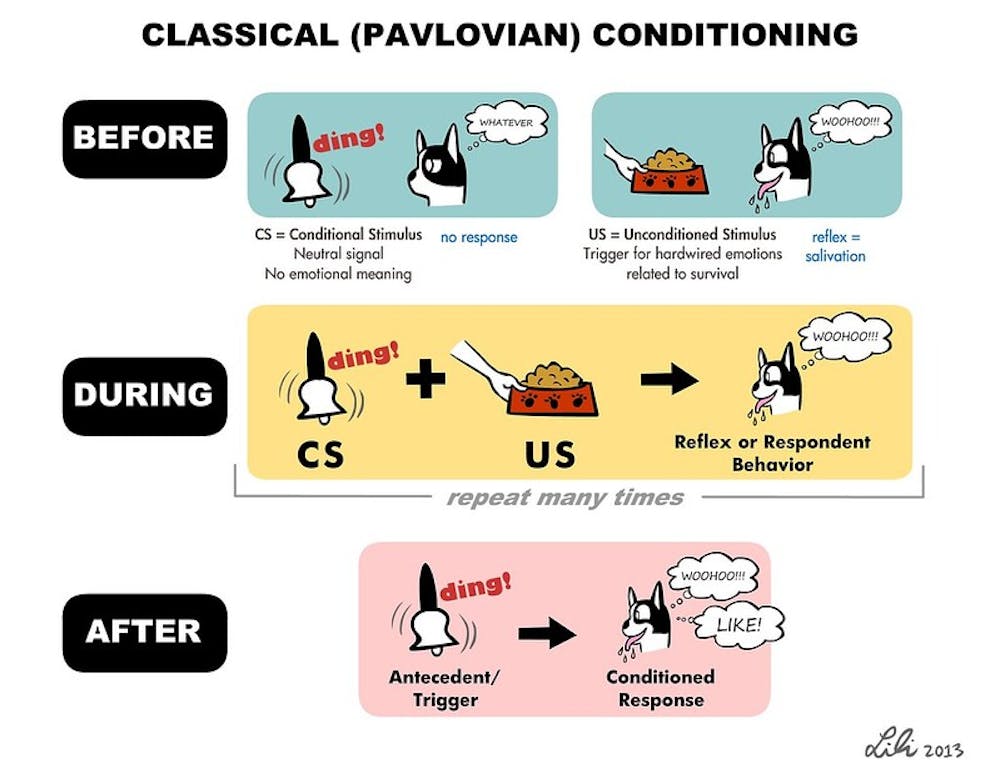
To induce a new memory in the fish, we used a type of learning process called classical conditioning. This involves exposing an animal to two different types of stimuli simultaneously: a neutral one that doesn’t provoke a reaction and an unpleasant one that the animal tries to avoid. When these two stimuli are paired together enough times, the animal responds to the neutral stimulus as if it were the unpleasant stimulus, indicating that it has made an associative memory tying these stimuli together.

As an unpleasant stimulus, we gently heated the fish’s head with an infrared laser. When the fish flicked its tail, we took that as an indication that it wanted to escape. When the fish is then exposed to a neutral stimulus, a light turning on, tail flicking meant that it’s recalling what happened when it previously encountered the unpleasant stimulus.

Diagram illustrating classical conditioning of a dog to salivate in response to a ringing bell.
Pavlov’s dog is the most well-known example of classical conditioning, in which a dog salivates in response to a ringing bell because it has formed an associative memory between the bell and food. Lili Chin/Flickr, CC BY-NC-ND

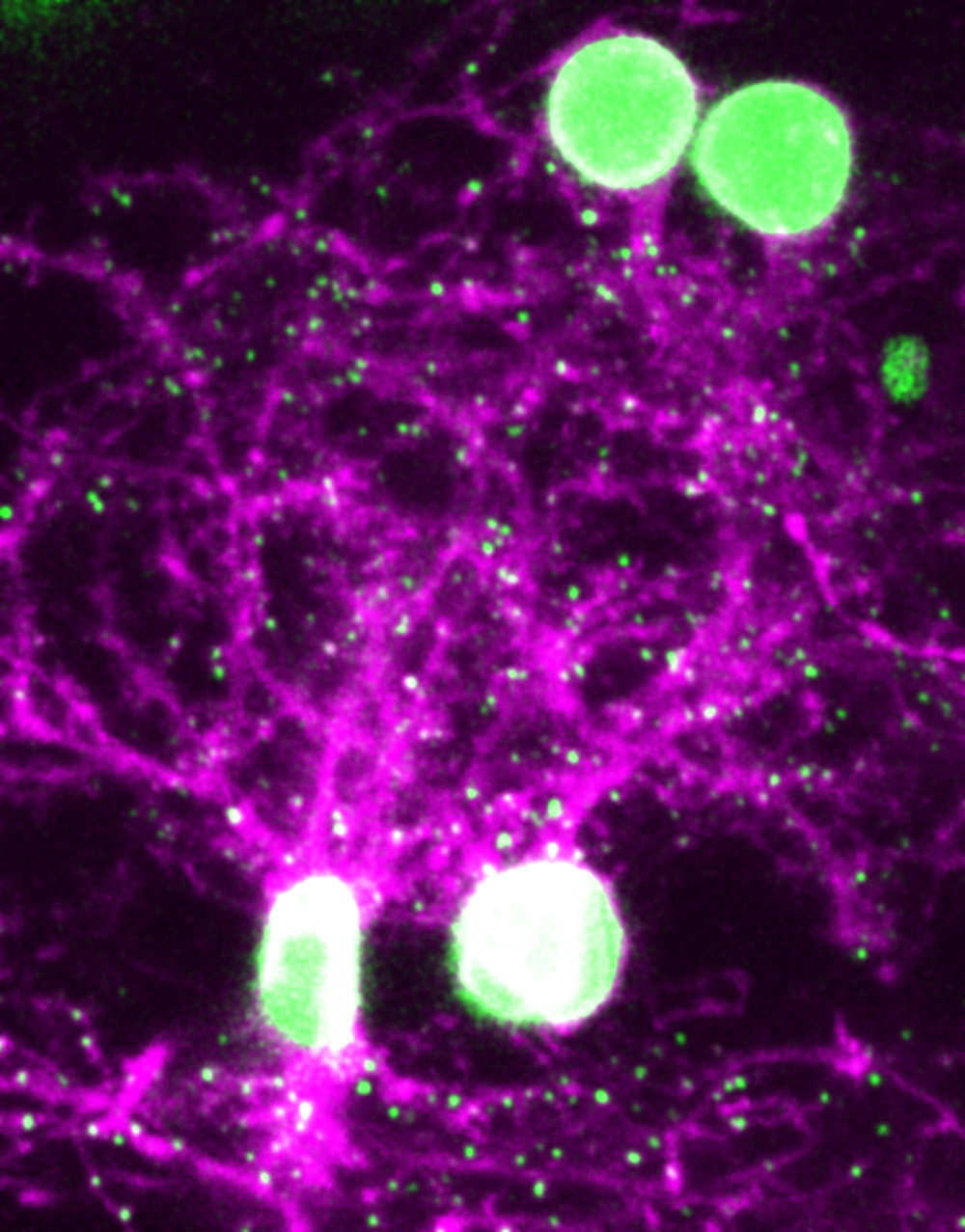
To create the maps, we genetically engineered zebrafish with neurons that produce fluorescent proteins that bind to synapses and make them visible. We then imaged the synapses with a custom-built microscope that uses a much lower dose of laser light than standard devices that also use fluorescence to generate images. Because our microscope caused less damage to the neurons, we were able to image the synapses without losing their structure and function.

Image of magenta-colored neurons in a live fish brain, with the synapses colored in green
This image shows neurons in a live fish brain, with the synapses colored in green. Zhuowei Du and Don B. Arnold, CC BY-NC-ND

When we compared the 3D synapse maps before and after memory formation, we found that neurons in one brain region, the anterolateral dorsal pallium, developed new synapses while neurons predominantly in a second region, the anteromedial dorsal pallium, lost synapses. This meant that new neurons were pairing together, while others destroyed their connections. Previous experiments have suggested that the dorsal pallium of fish may be analogous to the amygdala of mammals, where fear memories are stored.

Surprisingly, changes in the strength of existing connections between neurons that occurred with memory formation were small and indistinguishable from changes in control fish that did not form new memories. This meant that forming an associative memory involves synapse formation and loss, but not necessarily changes in the strength of existing synapses, as previously thought.


Researchers from Howard Hughes Medical Institute captured video of the firing neurons of a baby zebrafish as it sees things and tries to move.

Could removing synapses remove memories?

Our new method of observing brain cell function could open the door not just to a deeper understanding of how memory actually works, but also to potential avenues for treatment of neuropsychiatric conditions like PTSD and addiction.

Associative memories tend to be much stronger than other types of memories, such as conscious memories about what you had for lunch yesterday. Associative memories induced by classical conditioning, moreover, are thought to be analogous to traumatic memories that cause PTSD. Otherwise harmless stimuli similar to what someone experienced at the time of the trauma can trigger recall of painful memories. For instance, a bright light or a loud noise could bring back memories of combat. Our study reveals the role that synaptic connections may play in memory, and could explain why associative memories can last longer and be remembered more vividly than other types of memories.

Currently the most common treatment for PTSD, exposure therapy, involves repeatedly exposing the patient to a harmless but triggering stimulus in order to suppress recall of the traumatic event. In theory, this indirectly remodels the synapses of the brain to make the memory less painful. Although there has been some success with exposure therapy, patients are prone to relapse. This suggests that the underlying memory causing the traumatic response has not been eliminated.


Conceptually tied to classical conditioning, prolonged exposure therapy is one way to treat PTSD.

It’s still unknown whether synapse generation and loss actually drive memory formation. My laboratory has developed technology that can quickly and precisely remove synapses without damaging neurons. We plan to use similar methods to remove synapses in zebrafish or mice to see whether this alters associative memories.

It might be possible to physically erase the associative memories that underlie devastating conditions like PTSD and addiction with these methods. Before such a treatment can even be contemplated, however, the synaptic changes encoding associative memories need to be more precisely defined. And there are obviously serious ethical and technical hurdles that would need to be addressed. Nevertheless, it’s tempting to imagine a distant future in which synaptic surgery could remove bad memories.

Don Arnold, Professor of Biological Sciences and Biomedical Engineering, USC Dornsife College of Letters, Arts and Sciences

This article is republished from The Conversation under a Creative Commons license.

How to organize your pantry — and keep it shipshape

As a result of my job (home writer) and my personality (perfectionist) I’ve done a lot of research about how to best organize every little space in my home. I’ve long heard the praises sung of clear containers, listened to people preach the merits of a label maker, and seen pantry organizer upon pantry organizer topple off the shelves at TJ Maxx. Suffice it to say, I feel like I’ve heard and seen it all — from legitimate overhauls to unrealistic hacks. It wasn’t until this year, though, that I really decided to tackle the lid-flying, carton-crashing warzone that is my pantry.

For some context: when I get home from the grocery store, I’m so exhausted after lugging my tote bags from store to train to train transfer and finally, to my home, that I can’t be bothered to really organize things as they go into cabinets. Know the feeling? This is where the unraveling of intention begins. Three more grocery trips, an overstock on Trader Joe’s apple banana fruit crushers, and a teetering bag of rice later — it’s game over. Still, being stuck at home, cooking more than I ever have, has really prompted me to reassess my pantry storage and put my own advice into action.

Take it from me, these tips for containing the clutter are the real deal. I’ve implemented them myself, and have had far fewer things fall on my head as a result. Some things still fall on my head though, because nobody’s perfect.

(Maybe) Put everything into clear containers

This one is controversial, I know. I scoffed at this idea for so long. “Why should I spend money on clear containers when the food comes in containers?” I asked. Because, future me insists, seeing exactly everything you have in the pantry is an invaluable asset. I can’t tell you how many duplicate bags of Jasmine rice I’ve purchased just because I couldn’t easily take inventory of it before I hit the store. Cereal, rice, pasta, quinoa, couscous, oatmeal — get ’em all into clear bins! If they come with specific instructions, I cut them out of the package and tuck them inside so as not to overcook my farro.

You don’t need to run out and purchase all new storage bins, either. Collect clear vessels little by little, and before you know it, a complete organizational collection will be amassed. Some ideas for repurposed clear containers: quart containers leftover from takeout, washed-out sauce jars, and plastic bins from Costco-sized snacks (yeah, I’m talking about the giant tub of peanut butter pretzels . . . you know the one). And if you’ve tried the clear container thing and it made you nuts? Skip it! Your pantry, your rules.

Label everything

It doesn’t need to be a fancy machine-made label, I just use Scotch tape and a Sharpie, marked with the date opened and expiration date. I learned this all-important tip from my mom, who’s fastidious in her labeling of pantry, fridge, and freezer items. It’s easier than we like to believe to let things go past their expiration dates, especially if they’re out of their original packaging. Take this extra step and save yourself the stress later.

Elevate things with wire racks 

Let’s say your cabinet shelf is a foot tall, but you’re leaving 8 inches of space above the jar of peanut butter . . . you can definitely be storing more efficiently. If you have yet to be introduced to shelf risers, oh man, are you in for a treat. They are the simplest addition to your pantry, but they completely transform the amount of storage available to you. By elevating one layer of items (spices, dry goods, jars of sauce, etc.) you get an entirely new level of space with which to store things. Bonus points for tiered shelving that keeps everything on display — like stadium seating for spices.

Add hooks to the inside of cabinet walls 

Take advantage of every last bit of space by adding hooks (Command or otherwise) to the inside walls of cabinets and closets. These are the perfect places to hang oven mitts, tea towels, utensils (with a hole in the handle), aprons, and mugs — in order to make room for more pantry items.

Keep all packets in one place 

Salad dressing mixes, taco seasonings, and other miscellaneous packets have a tendency to get lost in the shuffle of everything else in the pantry. Instead of losing and rebuying every packet-ed item, file them away in a recipe card box or a dedicated clear container.

Add wheels to bottom bins 

If you’re working with a pantry that has space on the floor (as in, under the bottom-most shelf), it’s ridiculously helpful to either get bins with wheels or add wheels to existing bins to create sliding storage. The wheeled bins slide out far easier than ones sitting on the floor getting dragged in and out, it’s a total no-brainer.

Employ turntables for spices 

Just like an upscale breakfast table, but for spices in the pantry! Add turntables for spices, sauces, shakers, and more, to easily access all of them within the pantry. Now, instead of fumbling through the cinnamon and tumeric to reach the cayenne pepper, you can just spin on over to the side where it’s located.

Get canned goods their own rack 

You know how satisfying it is at the grocery store when you remove one can of soup, and the next one just plops right into the empty slot? You too, can experience this feeling in your pantry, because there are racks that exist solely for this purpose. For a surplus of canned goods, a rack that holds them all on their sides seems to be the only way to go, yes? The less stacked-up, wobbling cans in the pantry, the better.

Stack bins for snacks 

Items like apple sauce pouches, bags of cheddar bunnies, and peanut butter packets exist most harmoniously in stackable bins. These kinds of open-front bins that nest on top of each other make small snacks and loose items easier to keep inventory of, as well as easier to access.

Give your spices some love 

You’ll see below that a couple of our community members had differing opinions on how to organize spices. Mary says it “makes life much easier,” but Carolyn says “I never wanted to alphabetize my spices because I wanted the ones that I used the most within the easiest reach (hello, oregano and smoked paprika!).” And I happen to agree . . . with both of them. While I don’t have my spices alphabetically, I do have them in a drawer with some semblance of organization. I recently transferred all my spices into matching jars with adorable little labels, and they’re so much easier to find than when they were in their original containers. I thought for a long time that I’d memorize what each bottle looked like and therefore never lose a spice . . . but that was simply not true.

Try an over-the-door shoe rack 

Says community member, Jerri D., “in addition to lazy Susans in several cabinets, I also use a hanging shoe rack on the inside of the utility room/pantry door . . . there are dozens of pockets for all kinds of products (i.e., pasta, lentils, dried fruits, pet treats, plastic storage bags, reusable produce bags, etc.). It saves tons of cabinet space and is surprisingly versatile!” Genius, Jerri!

Doctors urge Spotify to stop “enabling” Joe Rogan to “damage public trust in scientific research”

A group consisting of hundreds of scientists, professors, doctors and healthcare workers is calling on Spotify to incorporate stricter measures when it comes to censoring misinformation on its platform.

On Wednesday, January 12, the group penned an open letter to Spotify amid concerns about one of its most popular podcasts, “The Joe Rogan Experience.” In the letter, the group expressed concern about “a highly controversial episode featuring guest Dr. Robert Malone (#1757)” as it has been “criticized for promoting baseless conspiracy theories.”

“By allowing the propagation of false and societally harmful assertions, Spotify is enabling its hosted media to damage public trust in scientific research and sow doubt in the credibility of data-driven guidance offered by medical professionals,” the letter reads.

The letter went on to highlight problems with Malone’s history of spreading misinformation and promoting COVID-related conspiracy theories.

The letter went on to assert that, “Dr. Malone is one of two recent JRE guests who has compared pandemic policies to the Holocaust. These actions are not only objectionable and offensive, but also medically and culturally dangerous.”


Want a daily wrap-up of all the news and commentary Salon has to offer? Subscribe to our morning newsletter, Crash Course.


The group explained how the concerns of misinformation are not just medical and scientific. The spread of misinformation also contributes to sociological turmoil. Since Spotify is being used as a means of promoting conspiracies and misinformation, the group believes the company should be held accountable for providing a platform for individuals like Rogan.

“This is not only a scientific or medical concern; it is a sociological issue of devastating proportions and Spotify is responsible for allowing this activity to thrive on its platform,” the letter reads.

The group’s letter follows multiple attacks on the scientific community as a result of misinformation, conspiracy theories and politicization of the pandemic. Throughout the pandemic, members of the medical community have even faced threats for simply doing their jobs. The letter is urging Spotify to be part of the movement to resolve this problem as opposed to contributing to it.

More stories like this: 

“An avalanche of lies”: Trump’s Arizona speech dismissed by CNN host

The morning after Donald Trump rehashed all of his complaints about the 2020 presidential election that saw him lose to President Joe Biden and then attacked fellow Republicans, a CNN host dismissed his words as an “avalanche of lies.”

During the speech, the president also asserted that his “Stop the Steal” rally crowd was massive, telling the crowd, “They talk about the people that walked down to the Capitol, They don’t talk about the size of that crowd. I believe it was the largest crowd I’ve ever spoken before, and they were there to protest the election.”

After sharing clips of Trump’s ranting about critics within his own party who aren’t buying into his election lies, host Abby Phillip cut to the chase and also noted the former president’s defense of the Capitol insurrectionists.

“I don’t actually recommend people listen to the avalanche of lies last night,” she stated, “but it’s notable how much effort went into defending these January 6th defendants and saying that they were being held as political prisoners. It’s a window into where this is all headed for Republicans.”

Watch on YouTube.


Want a daily wrap-up of all the news and commentary Salon has to offer? Subscribe to our morning newsletter, Crash Course.


More stories like this:

America’s deepest and most dangerous divide isn’t between Democrats and Republicans

This is a story about America, an America that, even today, exists largely beyond the serious attention of mainstream politics and news media. Rather, these institutions ignore or marginalize the story’s deeper significance, at a great cost to the country. In other words, the story is not about the usual things that are said to have caused the crisis in American democracy: policy gridlock, electoral fraud, political corruption, even insurrection. Nor is it about the competition between the ideologies of capitalism and socialism, nor the various threats to democracy, such as autocracy, plutocracy and kleptocracy.

The story offers a different perspective on politics, based on different evidence, from that offered by most political analysis. It draws on people’s profound disquiet about life in America, and on the existential challenges America faces, both physical and social. This condition is also true, to differing degrees, of other liberal democracies and beyond.

In 2013 I collaborated in a survey that investigated the perceived probability of future threats to humanity in four Western nations: the U.S., U.K., Canada and Australia. Across the four countries, over half (54%) of all people rated the risk of “our way of life ending” within the next 100 years at 50% or greater, and almost three-quarters (73%) rated the risk at 30% or greater. Almost a quarter (24%) rated the risk of “humans being wiped out” in this time at 50% or greater.

The U.S. stood out from the other three countries in several respects. It had the highest percentage (30%) who thought humans might be wiped out (this ranged from 19% to 24% in the other countries). It had a much higher level of agreement with fundamentalist responses to global threats, with 47% agreeing or strongly agreeing that “we are facing a final conflict between good and evil in the world” and 46% agreeing that “we need to return to traditional religious teachings and values to solve global problems and challenges.” (These results presumably reflect the strength of religion in the U.S., especially “end times” thinking among evangelical Christians.) In the other three countries only 30% to 33% agreed with these two statements.

RELATED: Democracy vs. fascism: What do those words mean — and do they describe this moment?

The survey also included questions about how concerned people were about a range of personal and societal issues. The U.S. stood out here too, with higher levels of concern about many societal issues, especially political and economic. Two-thirds (65%) were moderately or seriously concerned about “the state of politics in my country,” compared to a range of 42% to 53% for the other three countries; 64% were concerned about “corruption of politicians/officials,” compared to 39% to 47% in the other countries.

Other surveys around that time told a similar story. In 2011, Time magazine reported a poll showing that the U.S. was going through “one of its longest sustained periods of unhappiness and pessimism ever,” adding that it was “hard to overstate what a fundamental change this represents.” Two-thirds of Americans believed the past decade was one of decline, not progress, for the U.S. (68%), and that the greatest threat to the long-term stability of the U.S. came from within, not from outside, the country (66%).

A 2012 article in The Atlantic reported on a survey showing that Americans believed their country was heading in the wrong direction, that their generation was worse off than their parents’ generation, and that their children would be still worse off:

Americans believe that political corruption, too much focus on material things, and the influence of money in politics are weakening our values and standing in the world. They believe elected officials reflect and represent mainly the values of the wealthy and think the economic system is unfair to middle- and working-class Americans. And they believe that Wall Street is more like a cancer than an engine for economic growth.

U.S. life expectancy began to stall around 2010, then fell between 2014 and 2017, the first three-year decline since World War I and the Spanish flu pandemic 100 years earlier. Contributing to the trend has been rising mortality among those in the prime of life, including from drug overdoses, alcohol use and suicides. The decline in life expectancy revealed a broad erosion in health, with no single “smoking gun,” a health policy expert said. “There’s something more fundamental…. People are feeling worse about themselves and their futures, and that’s leading them to do things that are self-destructive and not promoting health.”

RELATED: A steep drop in American life expectancy is only partly because of the pandemic

This was Barack Obama’s America. Yet Obama failed to see it. For him, progress was still progress: Life was continuing to get better; climate change and other environmental issues were being solved through orthodox policy initiatives. As he often avowed, the arc of history was long, but it bent towards justice. Obama’s faith in progress provided the foundation of his ideological commitment to incremental, rather than radical, political change. As he said in a 2016 BBC interview:

My view of human progress has stayed surprisingly constant throughout my presidency. The world today, with all its pain and all its sorrow, is more just, more democratic, more free, more tolerant, healthier, wealthier, better educated, more connected, more empathetic than ever before. If you didn’t know ahead of time what your social status would be, what your race was, what your gender was, or your sexual orientation was, what country you were living in, and you asked what moment in human history you would like to be born, you’d choose right now.

The surveys cited above show many Americans did not view their lives in this light — a situation that continues to this day.

Trump’s America and the dominance of race

Enter Donald Trump. A political outsider, Trump did see the America I have described; he acknowledged people’s anger and anxiety, most notably in the deindustrialized heartland of America that became his base. Writing this essay has made me aware that it is almost impossible to get people to see Trump in any other way than they are predisposed to see him, to see past him to my main message. So let me be clear: It is only in his awareness of people’s unease, and in his shock to the political status quo, that I want to consider Trump’s impact. It is what interested me in applying my work to U.S. politics. What follows is not an attempt to give a full account of his presidency, policies and behavior.

A recent study, “Bowling With Trump,” says researchers have attributed Trump’s success largely to “racialized economics,” in which economic hardships are seen in racial terms, not personal; they are blamed on “other groups.” But the study suggests that more fundamental to Trump’s support has been heightened anxiety and a lack of social attachment or belonging. This increased racial and national identification, which, importantly, was politicized as racial prejudice and nationalism. This is how the authors of the study describe their findings:

We find that the oft-observed positive relationship between racial animus (prejudice) and Trump’s vote share is eliminated by introducing an interaction between racial animus and a measure of the basic psychological need for relatedness. We also find that rates of worry have a strong and significant positive association with Trump’s vote share, but this is offset by high levels of relatedness. Together, these two results imply that racial voting behavior in 2016 was driven by a desire for in-group affiliation as a way of buffering against economic and cultural anxiety. … This suggests that the economic roots of Trump’s success may be overstated and that the need for relatedness is a key underlying driver of contemporary political trends in the U.S.

When societies come under increasing pressure and strain, as America has, they tend to fracture along traditional fault lines such as class, religion, ethnicity or race. Those in power promote and exploit these fractures. Profound disquiet is easily manipulated, and expressed as more obvious or tangible grievances. America is particularly susceptible to a political focus on racial divisions and antagonism. This tactic is obvious in recent politics, especially with Trump and the far right. However, the Democrats also played on these fractures in the sense of using them for political leverage or gain — as revealed in Hillary Clinton’s infamous “basket of deplorables” remark.

The political focus on race is evident in a recent account of how the New York Times set up a project that attempted to understand the forces that led to Trump’s election. Rather than digging deep into the “half of America” that had voted for the president, the author says, the newspaper “chose to blame the events of 2016 on the country’s pervasive racism, not only here and now but everywhere and always.” The preoccupation with race is also seen in the current furor over “critical race theory,” which likewise looks at America’s history through the lens of racism, arguing racism is systemic in the nation’s institutions, which maintain the social dominance of white people.


Want a daily wrap-up of all the news and commentary Salon has to offer? Subscribe to our morning newsletter, Crash Course.


The danger in this fraying and fragmentation of public debate and discussion is that we lose sight of the bigger picture and its more fundamental elements, with the result that we are caught up in perpetual conflicts over what are, at least in part, derivative or secondary causes and consequences. Improving the lot of the marginalized and disadvantaged, however legitimate and however much it may help them, will not solve the deeper challenges facing humankind. Climate change provides a useful example of, and metaphor for, this perspective: The poor will suffer its consequences most, and this disparity demands attention, but climate change must be studied and addressed, first and foremost, as a planetary crisis that affects all of us. 

The standpoint of “we are all in this together” offers the advantage of creating more generous and tolerant ways of understanding America, encouraging people to look past the rancor and conflict promoted by its politicians and media, their obsession with “identity” and “issue” politics and protest. For example, the “Bowling With Trump” study notes that Trump’s supporters have been said to be “in mourning for a lost way of life.” The liberal media interpreted this nostalgia in terms of historic white male privilege.

However, this is not the only possible meaning or interpretation: There have been many social, cultural, economic, environmental and technological changes since the 1950s (the oft-cited historic benchmark) — in income inequality, work, education, mainstream and social media, relationships, the family and climate, for example — that have increased a shared sense of isolation, insecurity, uncertainty, risk and precarity.

RELATED: Why Americans hate and fear the poor: Joanne Samuel Goldblum on the price of inequality

These changes fed into the growing and overarching political influence of postmodernism, with its multiple narratives, relative truths, ambiguities, pluralism, fragmentation and complex paradoxes. A consequence has been a flourishing of conspiracy theories. All this served to fracture and divide American society.

For all his faults and failings — and there were many — Trump achieved something the U.S. needed: He rocked the political establishment to its core. And while he tried to subvert democracy, he also reinvigorated democracy: voter turnout in 2020 was the highest in 120 years. In doing this, however negatively, Trump offered at least a small chance of triggering systemic change.

Environmental writer and activist Joanna Macy expressed this opportunity succinctly: Trump’s election was “a very painful waking up,” she said; if Clinton had won, “we would have stayed asleep.” This was a relatively common view among environmental and leftist commentators, especially around the time of Trump’s victory. They saw Trump’s victory as exposing the failings of the entire U.S. political system and its pursuit of a capitalist, imperialist agenda. And they were scathing toward the Democrats, notably Clinton and Obama, for their complicity and collaboration in this agenda.

The elite liberal media spurned this chance for a deeper, wider inquiry, and instead devoted four years to trying to remove Trump from office. This was also largely true of the Democrats (with the exception of a progressive minority that championed a more radical policy package, the Green New Deal). Trump’s relationship with the liberal media became one of mutual loathing and goading; it was hugely destructive. In showing such contempt for Trump, the liberal media also derided his supporters, deepening the national division they accused Trump himself of provoking.

It was only later in his term, when the COVID-19 pandemic was devastating the country, and Trump looked unlikely to win re-election, that some commentators in the mainstream liberal media began to acknowledge the need to look beyond Trump to understand America’s troubles. But these occasional pieces did not reflect, or challenge, the editorial tone of these media outlets.

Generally speaking, during Trump’s term, liberal commentary took as a benchmark, a frame of reference, the old political status quo. It was as if they had forgotten the legitimate grievances that took him into office, and believed the task was to restore politics to what it had been before his election, even though everything had changed and needs to change. Much of the coverage implied that there was little wrong with the U.S. that removing Trump would not fix. This focus distracted attention from the country’s systemic failings.

RELATED: Media can’t decide on 2022 midterms: Normal politics or total apocalypse?

The liberal media embraced Joe Biden’s election victory with sighs of relief over his centrist policies and a return to political normalcy. “Cometh the hour, cometh the man,” The Guardian proclaimed. But the story does not end with Trump’s eviction from the White House. The liberal media’s celebration of Biden’s victory is another aspect of their failure to understand how profoundly things are changing.

Nothing has been settled, as has become clear since. Republicans’ strong showing in the November 2021 state and local elections, especially winning the governorship of Virginia, a state Biden won handily in 2020, has several lessons for the Democrats, according to media commentators, including that they were mistaken in campaigning on anti-Trump sentiments and need “to go big and bold.” This is consistent with my analysis.

With Trump, politics and the media “zeroed in” on him, when they should have also “drawn back” to consider the larger social context. I have targeted the liberal media here because their stand-off with Trump provides a striking example of my thesis about the failure of the cultures of politics and journalism to reflect and address people’s concerns about life. This broader analysis, to which I return below, is not partisan, but applies across the political spectrum.

Politics and the media arbitrarily define what warrants debate and discussion; much that is important is excluded. Journalism historian Daniel Hallin, writing about the Vietnam War, distinguished between three spheres of political debate: the sphere of consensus, the sphere of legitimate controversy and the sphere of deviance. Only matters falling within the second sphere, the sphere of legitimate controversy, gained attention. However, the boundaries between the spheres shift as public opinion changes, and can differ between media.

My argument is that existing boundaries are lagging far behind — and so distorting — public opinion about life today. The forces reshaping America mean that debate needs to expand the sphere of legitimate debate to encompass more of the sphere of consensus, meaning what is understood to be broadly agreed and accepted, and the sphere of deviance, what is judged to be unworthy, ridiculous or dangerous.

Politics and progress

I am not American, but Australian, living on the far side of the world, so I have no direct experience of American life. I am not a political scientist or policy analyst, steeped in political history and policy detail, but a social researcher into human progress and well-being, and the future. But perhaps both these attributes allow me to see more clearly — or at least differently — the bigger picture of American life. As I said, this picture is also true, but mostly to lesser degrees, of other developed nations, including my own.

My research and writing address questions about whether life is getting better or worse. It includes how we conceptualize and measure progress, its sustainability, its impacts on people’s health and well-being, and how these might shape our future. In a nutshell, the scientific evidence shows that there is a widening gap between the science and politics of human progress and development. Politics is based on an outmoded and increasingly destructive model of human progress that is environmentally, socially and economically unsustainable, and undermines the quality of life. This predicament is not reflected in the dominant indicators we use to measure progress, and which inform our politics.

The theory and methodology behind my work is transdisciplinary synthesis, which is undervalued in research. While empirical research seeks to improve understanding of the world by creating new knowledge, synthesis creates new understanding by integrating existing knowledge from across a range of fields, disciplines and sciences. It aims to develop new, common frameworks of understanding, striving for coherence in the overall conceptual picture rather than precision in empirical detail. It dispenses with expectations of scientific certainty and exactness, including with respect to cause and effect; everything is provisional, and relationships are often reciprocal.

Science favors depth of knowledge, but breadth also has its place: Synthesis adds value to existing specialized knowledge, reduces disciplinary biases, transcends interdisciplinary tensions, improves researchers’ knowledge outside their specialization, generates new research questions and enhances the application of knowledge. Synthesis is particularly appropriate for addressing the increasing scale, complexity and interconnectedness of human problems, and suits the complex, diffuse processes of social change.

My work has focused especially on the “psychosocial dynamics” of progress, notably the social and personal relationships that shape our way of life, and the worldviews, cultural stories, myths and symbols that define reality and give meaning to our lives. My “American story” illustrates the importance of these dynamics. This has given me a perspective that differs radically from most other analysis, on both left and right.

Take, as an example, materialism and individualism, two defining qualities of modern Western culture. The research literature suggests that, when taken together and too far, they reduce social integration, self-worth, moral clarity and existential confidence and certainty. There is a shift from intrinsic to extrinsic values and goals; from self-transcendence to self-enhancement; from doing things for their own sake to doing things in the hope or expectation of other rewards, such as status, money and recognition. The result is an increasing focus on our own lives and an unrelenting need to make the most of life. Frustration, disappointment and failure become more likely; loneliness, anger, depression and anxiety are a greater risk.

Consumer culture has shifted its unceasing messaging beyond what we have to who we are and what we do; from the acquisition of things to the enhancement of the self. It both fosters and exploits the restless, insatiable expectation that there must be more to life. It has created a self that is socially and historically disconnected, discontented and insecure; pursuing constant gratification and external affirmation; a self at risk of addiction, obsession and excess. We find It harder to answer the fundamental questions of existence: Who am I? Where have I come from? Why am I here? Nietzsche said that “he who has a why to live for can bear almost any how.” Western consumer culture over-emphasises the “how,” at the expense of the “why.”

As sociologist Zygmunt Bauman has observed, today’s social ills have their source in an “individualized society of consumers,” with consuming more being the “sole road to inclusion” and “existential uncertainty” now a universal human condition. Single-issue solutions might bring temporary and partial relief, he says, but short of reforming the individualistic way of life, they will not remove the cause.

This situation not only erodes social capital and diminishes our well-being, contributing to people’s dismay about life and politics, as discussed above; the overconsumption it promotes is also a major driver of climate change and other environmental crises that confront America and the world, which I discuss below. Everything is linked.

The demise of the official future

In the four-nation survey cited above, 75% of Americans agreed that “we need to transform our worldview and way of life if we are to create a better future for the world”; 65% agreed that “hope for the future rests with a growing global movement that wants to create a more peaceful, fair and sustainable world.” (Percentages were similar in the other countries, unlike those to the more fundamentalist responses reported above.)

In other words, the public is aware of the risks we face and the need for a radical change of course, a new paradigm of progress. Yet our journalistic and political cultures remain stuck in a paradigm that constrains electoral choice and is crippling democracy. The mutually reinforcing cultures of journalism and politics are outdated and dysfunctional, defined by conflict and contest rather than cooperation and consensus; deepening our difficulties rather than helping to solve them.

It is this failure that lies behind the unease, mistrust and disenchantment in the electorate, not just political corruption and incompetence and policy mistakes. It is part of a layered political complexity, resulting in what I have described as the “demise of the official future”: a loss of faith in the future that governments promise, and on which they base their policies.

Put simply, the official future is one constructed around notions of continuing material progress and economic growth, and scientific and technological advances, with the aim of providing an ever-rising standard of living. It is increasingly being challenged by sustainable development as a framework for thinking about human betterment. Authentic sustainable development does not give economic growth overriding priority. Instead, it seeks a better balance and integration of social, environmental and economic goals and objectives to produce a high, equitable and enduring quality of life. The concept of sustainability is gaining ground in politics, but it still falls far short of what is required.

The demise of the official future is causing a cascade of consequences, including to the “psychosocial dynamics” of progress that I mentioned earlier. Our visions of the future are woven into the stories we create to make sense and meaning of our lives. This “storying” is important in linking individuals to a broader social or collective narrative, and affects both our own personal well-being (by enhancing our sense of belonging, identity and agency, for example), and societal functioning (by engaging us in the shared task of working for a better future).

The extent to which Obama’s politics and policies reflected his worldview, his continuing belief in the “official future,” shows why we need to place these fundamental frameworks of how we understand the world at the center of political debate. Such a debate would be very different from today’s emphasis on “issue” and “identity” politics, whose elements are kept firmly within the conventional model of progress. The interconnected risks facing humanity cannot be solved by focusing only on the discrete, specific issues that characterize and define today’s politics, however legitimate the concerns are in themselves.

In science, paradigms change when they are confronted by a growing body of anomalous and contradictory evidence that they cannot explain or resolve. So it is with politics, which also confronts a growing array of policy failures, unsolvable problems and bitter divisions — but is struggling to understand or resolve them. We need a new paradigm that better acknowledges and addresses the emerging realities of planetary conditions and limits, and our better understanding of human needs and well-being.

There is no reason why political debate cannot be reframed in this way — except for the entrenched cultures of politics and journalism, which are both too “short-sighted” and too “narrow-minded.” Watching the four-part documentary series, “The Fourth Estate,” about The New York Times and Trump, while I worked on this essay drove home to me just how removed from my “American story” political journalism has become, how absorbed and obsessed with Washington intrigue, tweets, scoops and the 24/7 news cycle. We need to change the “idea” of progress, and to do that we must change the “idea” of politics and journalism.

I am acutely conscious of how radical, even fanciful and improbable, my position is. But it is based on a wide range of scientific evidence, however much we choose to ignore that evidence. It is a long shot, but hope for the future now rests on long shots. Cultures are so ingrained that they appear to be the natural and right way to look at the world. They tend to be “transparent” or “invisible” to those living within them because they comprise deeply internalized assumptions and beliefs, making their effects hard to discern or study. It is all but impossible to see beyond them to allow for other, fresh perspectives. Yet this is what we must do.

I might add that this is also true of the cultures of scientific disciplines: Different disciplines see things differently; they develop different models for explaining and studying the world, which generate different research questions, produce different results and lead to different interpretations of reality. Transcending disciplinary boundaries and perspectives is not easy. But this, also, is what we must do.

Existential threats

The study of future threats cited at the beginning of the essay is about perceptions, not realities. Nor do those perceptions necessarily reflect an informed understanding of the risks. Rather, they are likely to be an expression of a more general uncertainty and fear about the future, as discussed in the previous section. Nonetheless, the science validates these perceptions.

Early in 2021 I took part in an online discussion of existential threats to humanity. The global risks include the decline of key natural resources; the collapse of ecosystems that support life, and the mass extinction of species; human population growth and demand beyond earth’s carrying capacity; global warming, sea-level rise and change in the earth’s climate affecting all human activity; widespread chemical pollution of earth systems; rising food insecurity and failing nutritional quality; nuclear arms and other weapons of mass destruction; pandemics of new and untreatable disease; advent of powerful and uncontrolled new technologies; and widespread human failure to understand and act preventively on these risks.

Participants agreed that solutions exist to all these threats — except a solution to our inability to get political traction on the solutions. We confront a huge scale anomaly, or reality gap, between the challenges and our responses. From the 1970s onward, we have declared each decade to be a decade of reckoning for Earth’s environment, a time when humankind must deal decisively with growing global environmental crises. And as each decade passed without the necessary action, we deferred the reckoning to the next decade. Climate change became a focal issue, scientifically and politically. Now, it is the 2020s that we claim to be the last chance to avert catastrophic consequences. We are in the sixth decade of “The Reckoning.”

This repeated “kicking the can down the road” means we have already missed critical chances, at least with some hazards. It is not that nothing worthwhile has been done but that not enough has been done, with the result that the gulf between what we are doing, and what we now know we need to do, continues to widen. In an email exchange after the online discussion, a leading climate-change scientist said of the latest research on the 2015 Paris Agreement goals: “The sober message is that 1.5oC is gone and a reasonable chance to cap temperature rise at 2oC will vanish quickly without a truly emergency approach to the challenge.” He and other climate-change experts who participated agreed that achieving “net zero carbon emissions by 2050,” the current political goal, would not be enough.

It will take time to gauge the success or failure of the Glasgow COP 26 climate-change meeting; judgments have been mixed. From a political perspective, we advanced on Paris; from a scientific one, we failed to close the gap between the reality of climate change and our response. As one journalist summed it up: “Whatever its outcome, it will be too little too late, but far better than nothing.” Politics continues to produce incremental change while science demands urgent, radical action. Perhaps the central lesson from COP 26 is that the pressure on the political status quo is increasing, but has yet to crack it open; we are still kicking the can down the road.

Whatever the truth about what Glasgow did or did not achieve, it is also important to remember climate change is not the only physical challenge humanity faces; there is also the need to address the psychosocial deficits, which are jeopardizing our health and well-being and playing out in our precarious politics.

Conclusion

The evidence shows that the political systems of the United States and other Western liberal democracies are failing, unable to deal with the nature and scale of 21st-century realities. Blinkered by their cultures, most politicians and journalists do not see the extent of this failure. Without a transformational change in the cultures of politics and journalism, we will not and cannot “look outward” far enough or “look inward” deeply enough to address the two types of existential threat humankind confronts: the extrinsic, environmental and other tangible problems that pose a threat to human civilization and survival; and the intrinsic, intangible problems of finding meaning and belonging in today’s world. This should be the most fundamental layer of political discourse, one which remains largely missing.

To respond effectively to this situation, political debate needs to incorporate and reflect all the complexity and depth of today’s challenges, to encourage the conceptual space for a transformation in our worldview, beliefs and values as profound as any in human history.

Read more on American unhappiness and the failures of media and education:

Frank deserves better than “Station Eleven.” So do disabled stories

A friend used to joke, darkly, that he never would have survived to adulthood a century or two ago. He wears contact lenses and has allergies. As a person who is half deaf, I wouldn’t make it through the apocalypse, either, at least not according to the most popular fictions of coming dark times. The writers simply wouldn’t let me.

Station Eleven” is not kind to disabled people like me. Published in 2014, the novel by Emily St. John Mandel tells the stories of an ensemble of characters around the Great Lakes and their interconnected lives both before and after a devasting flu, a pandemic (hm, sound familiar?) that swiftly has a 99% morality rate.

One of those who survives is Jeevan Chaudhary (Himesh Patel), an underemployed freelance journalist and aspiring EMT whose brother, Frank (Nabhaan Rizwan), is a wheelchair user, paralyzed after being shot while working as a war correspondent. It is surprising, then, in the HBO Max adaptation of “Station Eleven” when Frank answers his apartment door standing upright. Frank does not use a wheelchair in the series. He is not paralyzed. Instead, he relies half-heartedly on a cane. With shrapnel in his leg in the series, rather than the bullet-severed spinal cord injury in the book, he says simply: “Someone tried to blow me up.”

It’s unclear why the decision was made to make a major character of “Station Eleven” less disabled. Yes, navigating a wheelchair in a small apartment would be difficult — that sounds a lot like real life where spaces are often not accessible. But it seems like the decision to minimize Frank’s disability was made for the comfort of an abled audience. The cane is easy to forget. Half of the shots of Frank don’t even show it.

RELATED: What “Hawkeye” gets right about deafness – and what it glosses over

The HBO Max show expands Jeevan’s story. One of the ways the series deviates from the book is that a child actor Jeevan helps in the beginning, Kirsten, played as a young person by the confident and compelling Matilda Lawler and as an adult by Mackenzie Davis, who goes onto become the star of the series, sticks by his side. 

That always struck me as strange in the novel: that Jeevan would get a child to safety as the pandemic, as deadly and apparently as fast as the zombie virus of “28 Days Later,” ravages their city of Chicago — only to leave her, well, probably unsafe. Keeping Jeevan and Kirsten together for longer deepens their connection, and reinforces the backbone of the story, that of found family and making the best of dire circumstances.

The addition of the trio of the brothers and Kirsten also makes for some scenes achingly relatable to us now: the would-be family stuck together in the apartment, trying to ride out the virus. Frank becomes the child’s de facto teacher, assigning a book report, and Kirsten, who performs tween sullenness to perfection, approaches remote learning with the same eye-rolling enthusiasm as my child.

Kirsten reads the same book over and over again, the titular “Station Eleven,” a science fiction graphic novel written, illustrated, and self-published by Miranda (Danielle Deadwyler, who quietly anchors the show). It is odd that only one book would seemingly survive the pandemic, and a paperback at that. “Station Eleven” and Shakespeare is the only literature in this world? I love science fiction, but I’d rather be in an apocalypse that at least had some Marsha Norman and Anna Deavere Smith around.

But despite having many more scenes with Jeevan and Kirsten, Frank’s story does not expand.

He’s trying to ghostwrite a biography, much as the writers of “Station Eleven” are trying to touch upon — but not get too close to, that might be uncomfortable — the story of a disabled person. I can think of no greater metaphor here than ghostwriting, to pretend to have lived a life you have not.

Frank has an addiction problem, one that he seemingly and implausibly shakes off without too much difficulty, as the pandemic rages on and the trio is unable to leave Frank’s apartment. In both the book and series, Frank is described as reclusive because of “the war.” Frank describes himself as “sort of a shut-in” and says he gave up on journalism because “journalists have to go outside,” obviously neither predicting our current era of work from home, nor knowing much about disabled journalists. Such depression could be believable, but it’s not given the space to be explored. Frank’s trauma is the least examined in a story whose very marrow is trauma. 

As an actor, Rizwan is underused (as is the only openly disabled performer in the show, fire survivor Prince Amponsah, who radiates with energy and empathy in his few scenes as the Traveling Symphony’s costumer). A scene where Rizwan busts into rap shows this actor was capable of much more life than the story gave him.

It’s a story that ends badly for Frank, as most disabled stories written by abled people do. In the novel, Frank kills himself, after telling Jeevan bluntly that he’s going to do it. And Jeevan does nothing to stop him. That’s a clearly ableist view of what life is like for a disabled person, the notion that we are a burden to the abled people who love us, and it’s better for everyone if we just die. 

It also presents the disabled character as a martyr, that only in Frank sacrificing himself can Jeevan go on to live. It doesn’t make much sense in the book, feeling like a thinly plotted excuse for the idealization of a marginalized character. Disabled people aren’t villains. But we also aren’t perfect saints. Yes, the characters are in a pandemic, but Frank can travel in his wheelchair. His decision to die seems as flimsy as Kirsten’s cobbled-together rain gear.

In the HBO Max series, it makes even less sense. Frank walks with a cane — a disability mirrored by his brother later when Jeevan is injured in an attack, forcing him to rely on a cane pretty much exactly like Frank’s. Weirdly, Jeevan manages just fine then (and travels great distances) as a disabled person. But Frank’s character is still determined to sacrifice himself. 

In the episode titled “Goodbye My Damaged Home” Frank meets death by home invader. His death feels like a waste and the moment lacks energy or believability. It would be one thing if Frank at least dies defending the young Kirsten or even his brother, but he doesn’t. He simply kinda sorta stands there, after apologizing to Jeevan, while a man who breaks into their apartment stabs him after Frank mildly provokes the stranger on purpose. 

My high school acting teacher would say this action lacks follow-through, but it doesn’t have any motivation in the story, either. It’s so lacking in believability that Kirsten, in the way of a child, blames herself — that by convincing the brothers to put on a play adaptation she has written of her beloved “Station Eleven,” she somehow made this bad thing (which she doesn’t understand for a long time to be the death of Frank, but simply his staying behind) happen.

It’s fitting that Frank dies as the family was performing Kirsten’s play, because the whole thing feels staged.

The abled gaze was always strong in the novel as well, where the character of Lily Patterson, a young woman unable to receive her medication Effexor, used for the treatment of depression, among other illnesses, simply walks off to die. She leaves her driver’s license behind. Clark places it in his museum of objects from before the pandemic, and no more is said of Lily. 


Want a daily wrap-up of all the news and commentary Salon has to offer? Subscribe to our morning newsletter, Crash Course.


This sacrificial disabled person trope is a genre specialty, seen in a whole host of science fiction and fantasy from the gothic classic “The Hunchback of Notre Dame” to the 2021 film “Mother/Android.” It’s more unusual, virtually unheard of, to have a disabled character simply live. 

This is a narrow view that we see happening in real-time during our own pandemic too, as some have dismissed the implications of long COVID, unable to imagine a lifetime of chronic illness or disability. That’s a very black and white view of the world: that you are abled, or you are dead. But 61 million Americans, including me, live in the middle. 

In a brilliant review, the writer Sim Kern describes “Station Eleven” as an “ableist fantasy” of a return to an agriculture lifestyle. Disabled people, after all, must often utilize technology, from hearing aids to prosthetics. A world without technology, as “Station Eleven” weirdly is, without even solar panels, except for the Severn City Airport, would be a world without many disabled people. 

Failing to imagine how disabled folks are going to get by in your apocalypse is a failure to do the main job of an artist: to reflect and imagine the world, even an invented one. You don’t have to be everything to everyone all the time — but you do have to remember that humanity is complex. Why would Frank, for example, have more trouble with long distances than Kirsten, a small and complaining child?

If anyone, disabled folks are the most resourceful, used to navigating a system that was already collapsing for us. Sidewalks didn’t have curb cuts, a sloped side on the street to allow for wheelchairs (and strollers and scooters), until the 1980s. Disabled activists died to get them. Many buildings today are not accessible, despite the Americans with Disabilities Act. Many stages don’t have ramps. Many videos don’t have captions. Many disabled people are legally paid cents on the dollar, those who get hired at all.

Our news today is full of stories, presented as heartfelt but actually sickening, of disabled children building their own wheelchairs or raising money for classmates, denied by insurance, to have prosthetic limbs — or seniors jury-rigging a pulley to lift their wheelchair out of a building which doesn’t have an elevator so they can leave the house.

If anyone is built for surviving apocalypse, it’s the disabled people who have been living it already. If anyone is a survivor, it would be someone like Lily. Someone like Frank. Someone counted out and left behind long before the world went dark, used to finding and making their own way come hell, high water, or Georgia flu. 

More stories like this:

A vegetarian pastitsio for when “you don’t eat no meat”

“He don’t eat no meat? What do you mean he don’t eat no meat!?”

It’s a line from “My Big Fat Greek Wedding” that brings the engagement party to a halt. Horrified faces turn to the xénos (foreigner), Ian Miller. Aunt Voula looks at her niece, the bride-to-be Toula Portokalos, as if to telepathically chastise her: “How can you, a Greek, marry a vegetarian?” Then, the solution comes to Aunt Voula and she pats Ian on the arm. “That’s okay,” she smiles. “I make lamb.”

It’s a quote that comes up every now and again when I’m with my wife Melanie’s Greek-American side of the family. See, I’m a bit like the Ian Miller in our marriage. My side of the family is small in numbers, though my parents weren’t stale like the Millers. Melanie’s side can be more eccentric, like the film’s Portokalos family, but they didn’t fashion their home based on the Acropolis.

And though I’m not a full-fledged vegetarian (I’ll sometimes eat meat if I’m a guest in someone’s home and they offer), I’m the closest thing to a vegetarian in the family. That means my wife, Melanie, and I make classic Greek dishes without meat. To my mother-in-law, a Greek-American through and through, dishes like moussaka, soutzoukakia, and pastitsio are made with meat. End of story.

Melanie is a bit more flexible. Over the years, we’ve mostly stopped cooking with meat. It’s for a lot of reasons, chief among them the carbon footprint of the meat industry and its generally deplorable treatment of both animals and workers. At this point the knowledge is so commonplace, it’s practically its own depressing category of documentaries on Netflix. (If you liked “Animal Tears” then you’ll love “Meat Murders.”)

This shift in our diet meant figuring out how to make those culturally meaningful dishes sans meat. One of Melanie’s first attempts led to this vegetarian pastitsio. Traditionally, it’s a layered Greek pasta dish baked in the oven. From bottom to top you’ve got your bucatini noodles, ground meat, and béchamel sauce. Some call it “Greek lasagna,” but I don’t think it’s so much to ask to learn how to pronounce the dishes we’re making (he says, ascending his soapbox).

To replace the ground meat, we use a simple mirepoix (that’s fancy French for onions, carrots, and celery) with lentils cooked in vegetable stock seasoned with cinnamon, nutmeg, and oregano. The mirepoix is topped with Greek béchamel sauce, invented by Nikolaos Tselementes, an early-20th-century Greek chef who brought the mother sauce to Greece. Tselementes added an egg yolk to the traditional recipe, modernizing recipes for dishes like moussaka and pastitsio.

In the end, I don’t miss the meat. It’s still a deliciously creamy, flavorful, and hearty dish that fills my imagination with visions of a Greek taverna on a quiet island or memories of Sunday family dinners with my in-laws and Yiayia sitting next to me, insisting I eat more.

***

Recipe: Vegetarian Pastitsio

Yields
One 13×9-inch casserole
Prep Time
20 minutes
Cook Time
2 hours


Ingredients

Lentils and noodles

  • 1 tablespoon olive oil
  • 1 large yellow onion, chopped
  • 4 stalks celery, chopped
  • 3 carrots, chopped
  • 4 garlic cloves, chopped
  • 1 cup brown or green lentils
  • Kosher salt and freshly ground pepper
  • 2 cups homemade or store-bought vegetable stock
  • 500 milliliters tomato sauce
  • 4 bay leaves
  • 1 large fresh basil sprig, chopped, or 1 tablespoon dried basil
  • 1 1/2 teaspoons dried oregano
  • 1 1/2 teaspoons ground cinnamon
  • 300 grams bucatini
  • 1 large egg white
  • 1 teaspoon Parmesan, grated

Greek-style béchamel sauce and assembly

  • 2 tablespoons unsalted butter
  • 2 tablespoons all-purpose flour
  • 1 cup plant-based or regular milk
  • 1 large egg yolk
  • 3 teaspoons Parmesan, grated
  • Olive oil, for drizzling
  • 1/4 teaspoon ground nutmeg
  • 1/4 teaspoon ground cinnamon


Directions

Lentils and noodles

  1. In a large skillet over medium-high heat, warm the oil. Cook the onion, stirring occasionally, for 7 to 10 minutes, until translucent. Add the celery, carrots, and garlic and cook for about 5 minutes more, until softened and warmed through. Stir in the lentils and continue to cook for about 5 minutes, until the lentils are softened; season with salt and pepper.
  2. Add the stock, tomato sauce, bay leaves, basil, oregano, and cinnamon. Bring it to a boil, then reduce the heat and cover the pan. Simmer for 30 to 40 minutes, until most of the liquid has been reduced. Optional: Add another 1½ teaspoons cinnamon at the end and mix. Remove and discard the bay leaves.
  3. Meanwhile, in a large pot of generously salted water, cook the bucatini according to the package directions. Drain and arrange in the bottom of a lightly greased 13×9-inch baking dish. Let cool.
  4. In a small bowl, mix the egg white and Parmesan. Coat the noodles with the egg mixture.

Greek-style béchamel sauce and assembly

  1. Heat the oven to 350°F. In a medium saucepan over medium heat, melt the butter. Slowly add the flour while whisking constantly to form a paste. 
  2. Slowly pour in the milk while constantly whisking. Most recipes say to leave the béchamel sauce over low heat and to keep stirring until it boils. This takes forever and we’ve never had an issue with cooking over medium-high heat with nondairy milk to speed up the process. Just make sure you stir constantly, especially if you’re working over higher heat, to avoid burning. This should take 10 to 15 minutes total. If you opt to use dairy milk, you’ll have to use a lower heat to avoid curdling.
  3. Once the béchamel sauce has a thicker consistency, remove from the heat. Add the egg yolk and Parmesan, stirring constantly; you don’t want the heat from the sauce to cook the egg. You should have a creamy, thick sauce at the end.
  4. Drizzle some oil over the noodles. Top with the lentil mixture (you might have some leftovers, which you can snack on while the dish bakes), followed by the sauce, using a spatula to spread and keep the layers even. Sprinkle some cinnamon and nutmeg on top.
  5. Bake for about 40 minutes, until golden brown on top. Let cool for at least 10 minutes in order for the pastitsio to keep its shape after cutting.

How Ron DeSantis became “the 1,100-pound gorilla” in Florida politics: “Cross him once, you’re dead”

Gov. Ron DeSantis (R) is considered one of the most powerful governors to ever hold office in the state of Florida, according to a new report.

Per Politico, the Republican governor exerted even more power over top state officials and lawmakers by “cracking down on election crimes, spending $8 million to transport ‘unauthorized aliens’ out of state and targeting ‘wokeness’ in schools.”

“Democrats, who are in the minority, are unable to stop him,” Politico reports. “And Republicans in the Florida Legislature are enthusiastically carrying out his wishes or are unwilling to buck him.”

“He’s become the 1,100-pound gorilla in state government,” said Tom Lee, a member of the Republican Party and former president of the Senate who worked with four different governors over the course of his 18 years with the Legislature. “Gov. DeSantis is extremely popular relative to most of his predecessors. With that goes a tremendous amount of power.”

Lee also noted how Republicans have enabled the governor.

“Republicans are doing very well and hanging together on a lot of these issues. If it’s not broke, don’t fix it,” said Lee. “He’s been very effective in picking issues and having his finger on the pulse on how the public reacts… When you are on the trajectory he is on right now, you are not going to have a lot of detractors in your own party.”

“There are no second chances,” said one former legislator, who spoke to Politico anonymously. “It’s well known you can’t go against him. If you cross him once, you’re dead.”

A number of lawmakers from both sides of the aisle have also expressed concern about the imbalance of legislative power within Florida’s state government. State Rep. Ben Diamond (D-St. Petersburg, Fla.) offered critical remarks about the power disparity between DeSantis and the Legislature noting that they have an obligation to “their constituents, not the governor.”


Want a daily wrap-up of all the news and commentary Salon has to offer? Subscribe to our morning newsletter, Crash Course.


“While Gov. DeSantis is the leader of his party, there are a number of Floridians depending on their legislators to represent their best interests, not those of the governor and his potential presidential campaign,” Diamond said.

One Republican lawmaker, who spoke on the condition of anonymity, shared a startling assessment of the governor’s legislative role. “They are not going to embarrass Ron DeSantis,” the lawmaker said. “Ron DeSantis is essentially the speaker of the House, the president of the Senate, and the chief justice of the Supreme Court right now.”

According to State Rep. Anna Eskamani (D-Orlando, Fla.), DeSantis’ popularity among “rank-and-file Republican voters” is a large part of the problem as many lawmakers within his party refuse to challenge his authority.

“In addition to his veto pen, Republican lawmakers see him as appealing to their base, so if they question him they’re questioning the base which would hurt them on the campaign trail,” Eskamani said. “So not only do they consent to his extreme agenda but some try to appeal to it by filing their own bills grounded in the culture wars.”

More stories like this: 

“We’re 15 years too late”: Endocrine-disrupting plastic additive BPA is still in everything

Shortly before 2021 came to a close, a little-known agency proposed some new safety standards that accidentally triggered serious questions about human health in the age of plastics. 

More specifically, the European Food Safety Authority (EFSA) determined that a plastic additive called bisphenol A (BPA) needs to be dramatically reduced in our environment — that is, people should have their exposure to the chemical limited to no more than 0.018 nanograms per pound of body weight per day. This would decrease one’s interactions with the pollutant by a factor of 100,000 from what they currently are.

In case you have been living in a part of the world that is untouched by plastic — which, it turns out, doesn’t exist — BPA is everywhere, in all kinds of different plastics. Aside from some laws limiting its use in infant formula packaging and baby bottles, companies use it to make water bottles and food can liners, leftover containers and dishware, eyeglass lenses and household electronics, and even commercial receipts that come out of thermal printers. BPAs are in microplastics, or tiny plastic particles that you consume but rarely see because they are so small. And BPA is so ubiquitous that it gets inside our bodies before we are even born: one 2014 study detected the chemical in 75% of nursing mothers’ breast milk, and in the urine of 93% of their infants. 

This wouldn’t be an issue if there weren’t concerns about BPA affecting human health. (More on that later). Despite its ubiquity in the human body, and despite growing public awareness about plastic pollution, there are almost no meaningful regulations on BPA in the United States.

Many companies claim to be reducing their use of BPA, as observed in the recent trend of labeling cans and plastic bottles “BPA-free.” Unfortunately, many of the replacements for BPA are equally bad, and some cause genetic defects, as Science previously reported

Indeed, while many corporations say they are reducing the presence of BPA in consumer plastics, studies have cast doubt on whether they are telling the truth. Either way, there are no agencies to hold them accountable.

Who should Americans trust — the government agencies that, through their inactivity, imply that you should not be worried about BPA? Or the European regulators whose drastic new regulation indicates that you should?

Part of the challenge is that chemistry is not as precise in its conclusions as would be convenient for the general public.

“First, let’s address some of the ‘baggage’ that comes from studying chemicals the ways that we do… when we want to know something ‘for sure,’ that’s sort of a nice way of saying that we’ve proven​ a link between X and Y,” Dr. Laura N. Vandenberg, a professor at the Department of Environmental Health Sciences at the University of Massachusetts–Amherst, told Salon by email. “But to a scientist, we never actually prove anything, we merely determine the strength of the evidence that X can cause Y. This means that there’s always the chance that new evidence would change our minds — tip the scales, so to speak, for the strength of the evidence.”

RELATED: How Big Tobacco used bad science to avoid accountability — and set the blueprint for Big Oil

That is why, when it comes to BPA, there is always a chance that the existing body of research is wrong and more evidence will come out revealing it to be innocuous. For right now, however, the scientific material is sobering.

“As for BPA, let me say this: for many, many effects of BPA, the evidence is overwhelming that is causes harm,” Vandenberg explained. “It would be extremely unlikely that a new study, or even many new studies, would overturn that conclusion.” Vandenberg specifically pointed to research on how BPA seems to damage the brain and metabolic health, as well as experiments on rodents which suggest links with prostate and mammary gland diseases.

“Some of these effects are harder to look at in human populations because, for example, there would be a 20-50 year lag between a fetal BPA exposure and an increase in breast cancer,” Vandenberg told Salon.

“As an endocrinologist and a scientist doing research on endocrine-disrupting chemicals (EDCs) such as BPA, the new regulations are a step in the right direction,” Dr. Andrea C Gore, Professor and Vacek Chair in Pharmacology at the University of Texas at Austin, wrote to Salon. “There is simply no such thing as a ‘safe’ dose of any chemical known to disrupt hormones. The endocrine system evolved to be extraordinarily sensitive to natural hormones, and as a result, it is also sensitive to infinitesimally small amounts of hormone-disrupting chemicals.” In Gore’s opinion, regulators should not try to find acceptable minimums for these chemicals, but ban them outright.

“BPA studies in animals consistently demonstrate cause-and-effect relationships with abnormalities of reproduction, behavior, metabolism, and others,” Gore explained. “Although we can’t prove cause-and-effect in humans, epidemiological (population) studies are consistent with the experimental data.”


Want more health and science stories in your inbox? Subscribe to Salon’s weekly newsletter The Vulgar Scientist.


You might think that a story such as this would make headlines, but as with Big Tobacco fighting nicotine regulations and Big Oil fighting climate change regulations, the various industries that use BPA engage in a practice known as “manufacturing doubt.” This is when an industry begins to raise spurious points criticizing the scientific body of evidence proving that something they want to do should be curtailed, whether through the law or other means. They will find sympathetic researchers to give them industry-friendly conclusions, smear people who bring up science as “opponents” and overall make a cut-and-dried scientific fact seem like a “controversy” to the general public.

While BPA hasn’t garnered the headlines of nicotine or carbon pollution, the polluters have still benefited from the dynamics of manufacturing doubt.

“For 25 years we have been seeing ‘manufacturing of doubt’ by the producers of BPA and by many of the companies using the chemical in their packaging, to prevent regulators banning this chemical in food packaging,” Jane Muncke of the Food Packaging Forum, a nonprofit foundation that studies chemicals in all food packaging materials and their impacts on health, told Salon by email. “This ranged from making fun of scientists who issued the alarm and share their concern to hostile attacks, threats and attempts to ‘buy out’ academics and prevent them from publishing their work. It would make a great Hollywood movie!”

Even when they do not try to wrongly smear the science, the various industries will sow doubt by making it seem like they’re doing the right thing when in fact they are not.

“Some have just switched from BPA to BPF [bisphenol F] or BPS [bisphenol S], placed a label ‘BPA-free’ on their products and peddled the new, equally hazardous chemical to the world,” Muncke explained. “This is called ‘regrettable substitution’ (in polite circles), but one could imagine other more explicit terms. It’s basically taking people for a ride.”

Even companies that sincerely try to replace BPA struggle with the fact that we still do not know whether their alternatives are actually safer.

“The best way to eliminate BPA is to switch to alternative packaging, ideally reusable and made from inert, non-migrating materials – or to eliminate packaging altogether,” Muncke concluded.

Vandenberg had a similar idea, noting to Salon that there are plenty of ways that people could do away with BPAs and not even really notice the difference.

“BPA is widely used in thermal papers used for receipts,” Vandenberg observed. “Do you actually need a hard-copy receipt for every purchase? Certainly not, and this is why some groups are substituting electronic receipts. Thus, thinking in a new way about products and the job those products are intended to do can lead us to more creative solutions. That can take us beyond the whack-a-mole approach of pick-a-chemical, find out it’s bad, pick-another-chemical that we’re reliant on right now.”

Sadly, this thinking may have already come too late for millions of people.

“In my view, the weight of the evidence tipped the scales against BPA more than 15 years ago,” Vandenberg wrote. “Think of what that means — an entire generation of children were exposed to this chemical at levels that we, scientists, knew would likely cause them harm.”

Check out these other stories you might like:

Our evolutionary love of sugar: Anthropologist explains why we’re programmed to crave sweets

The sweetness of sugar is one of life’s great pleasures. People’s love for sweet is so visceral, food companies lure consumers to their products by adding sugar to almost everything they make: yogurt, ketchup, fruit snacks, breakfast cereals and even supposed health foods like granola bars.

Schoolchildren learn as early as kindergarten that sweet treats belong in the smallest tip of the food pyramid, and adults learn from the media about sugar’s role in unwanted weight gain. It’s hard to imagine a greater disconnect between a powerful attraction to something and a rational disdain for it. How did people end up in this predicament?

I’m an anthropologist who studies the evolution of taste perception. I believe insights into our species’ evolutionary history can provide important clues about why it’s so hard to say no to sweet.

Sweet taste detection

A fundamental challenge for our ancient ancestors was getting enough to eat.

The basic activities of day-to-day life, such as raising the young, finding shelter and securing enough food, all required energy in the form of calories. Individuals more proficient at garnering calories tended to be more successful at all these tasks. They survived longer and had more surviving children – they had greater fitness, in evolutionary terms.

One contributor to success was how good they were at foraging. Being able to detect sweet things – sugars – could give someone a big leg up.

In nature, sweetness signals the presence of sugars, an excellent source of calories. So foragers able to perceive sweetness could detect whether sugar was present in potential foods, especially plants, and how much.

This ability allowed them to assess calorie content with a quick taste before investing a lot of effort in gathering, processing and eating the items. Detecting sweetness helped early humans gather plenty of calories with less effort. Rather than browsing randomly, they could target their efforts, improving their evolutionary success.

Sweet taste genes

Evidence of sugar detection’s vital importance can be found at the most fundamental level of biology, the gene. Your ability to perceive sweetness isn’t incidental; it is etched in your body’s genetic blueprints. Here’s how this sense works.

Sweet perception begins in taste buds, clusters of cells nestled barely beneath the surface of the tongue. They’re exposed to the inside of the mouth via small openings called taste pores.

Different subtypes of cells within taste buds are each responsive to a particular taste quality: sour, salty, savory, bitter or sweet. The subtypes produce receptor proteins corresponding to their taste qualities, which sense the chemical makeup of foods as they pass by in the mouth.

One subtype produces bitter receptor proteins, which respond to toxic substances. Another produces savory (also called umami) receptor proteins, which sense amino acids, the building blocks of proteins. Sweet-detecting cells produce a receptor protein called TAS1R2/3, which detects sugars. When it does, it sends a neural signal to the brain for processing. This message is how you perceive the sweetness in a food you’ve eaten.

Genes encode the instructions for how to make every protein in the body. The sugar-detecting receptor protein TAS1R2/3 is encoded by a pair of genes on chromosome 1 of the human genome, conveniently named TAS1R2 and TAS1R3.

Comparisons with other species reveal just how deeply sweet perception is embedded in human beings. The TAS1R2 and TAS1R3 genes aren’t only found in humansmost other vertebrates have them, too. They’re found in monkeys, cattle, rodents, dogs, bats, lizards, pandas, fish and myriad other animals. The two genes have been in place for hundreds of millions of years of evolution, ready for the first human species to inherit.

Geneticists have long known that genes with important functions are kept intact by natural selection, while genes without a vital job tend to decay and sometimes disappear completely as species evolve. Scientists think about this as the use-it-or-lose-it theory of evolutionary genetics. The presence of the TAS1R1 and TAS2R2 genes across so many species testifies to the advantages sweet taste has provided for eons.

The use-it-or-lose-it theory also explains the remarkable discovery that animal species that don’t encounter sugars in their typical diets have lost their ability to perceive it. For example, many carnivores, who benefit little from perceiving sugars, harbor only broken-down relics of TAS1R2.

Sweet taste liking

The body’s sensory systems detect myriad aspects of the environment, from light to heat to smell, but we aren’t attracted to all of them the way we are to sweetness.

A perfect example is another taste, bitterness. Unlike sweet receptors, which detect desirable substances in foods, bitter receptors detect undesirable ones: toxins. And the brain responds appropriately. While sweet taste tells you to keep eating, bitter taste tells you to spit things out. This makes evolutionary sense.

So while your tongue detects tastes, it is your brain that decides how you should respond. If responses to a particular sensation are consistently advantageous across generations, natural selection fixes them in place and they become instincts.


Even newborns have a preference for sweet and an aversion to bitter.

Such is the case with bitter taste. Newborns don’t need to be taught to dislike bitterness – they reject it instinctively. The opposite holds for sugars. Experiment after experiment finds the same thing: People are attracted to sugar from the moment they’re born. These responses can be shaped by later learning, but they remain at the core of human behavior.

Sweetness in humans’ future

Anyone who decides they want to reduce their sugar consumption is up against millions of years of evolutionary pressure to find and consume it. People in the developed world now live in an environment where society produces more sweet, refined sugars than can possibly be eaten. There is a destructive mismatch between the evolved drive to consume sugar, current access to it and the human body’s responses to it. In a way, we are victims of our own success.

The attraction to sweetness is so relentless that it has been called an addiction comparable to nicotine dependence – itself notoriously difficult to overcome.

I believe it is worse than that. From a physiological standpoint, nicotine is an unwanted outsider to our bodies. People desire it because it plays tricks on the brain. In contrast, the desire for sugar has been in place and genetically encoded for eons because it provided fundamental fitness advantages, the ultimate evolutionary currency.

Sugar isn’t tricking you; you are responding precisely as programmed by natural selection.

Stephen Wooding, Assistant Professor of Anthropology and Heritage Studies, University of California, Merced

This article is republished from The Conversation under a Creative Commons license. Read the original article.

Rickie Lee Jones: “I became a Beatle, rather than just being a girl who liked the Beatles”

Acclaimed singer-songwriter Rickie Lee Jones joined host Kenneth Womack to talk about her musical roots, having her 10-year-old world rocked by the Beatles, her recent memoir and more on “Everything Fab Four,” a podcast co-produced by me and Womack (a music scholar who also writes about pop music for Salon) and distributed by Salon.

Jones, the two-time Grammy award winner behind the 1979 hit “Chuck E.’s in Love” (which Womack calls “a breath of fresh air”), describes growing up in her family as a “musical incubator.” Her grandfather was a successful Vaudevillian performer, and her father and uncles were all musicians who raised her on jazz and popular records in the ’50s and ’60s. As she tells Womack, being a singer was considered important and “an acceptable job” in her household, with her mother even encouraging her to follow that dream.

RELATED: Nancy Wilson of Heart: “We weren’t looking to marry or date the Beatles. We wanted to be them

But it wasn’t until Jones saw the Beatles on “The Ed Sullivan Show” in 1964 that she was truly blown away by the power of music. “That moment is embedded in my brain with the surrounding smells and sounds and everything,” she recalls to Womack. “By the end of the performance, the world was changed.”

Jones, who says school was “a terrible hell for me,” found an outlet in the Beatles, who “offered love and an escape – a place to go that wasn’t reality.” Soon she had Beatle boots, a short haircut and, as she recounts in her 2021 memoir “Last Chance Texaco,” “I wanted to write the songs and sing the songs.”

LISTEN:

Subscribe today through SpotifyApple PodcastsGoogle PodcastsStitcherRadioPublicBreakerPlayer.FMPocket Casts or wherever you get your podcasts.

In terms of writing, she credits Lennon and McCartney with giving her a map that always includes “an incredibly beautiful, unexpected moment in between verses. I still write bridges and I love them for teaching me that.” She also believes the two songwriters’ differing views on women, coupled with fantastic imaginations, created a “perfect fusion.” Jones is very clear, though, on the importance of female musicians talking about how much they influence one another, and building each other up, and is quick to name Billie Holiday, Joni Mitchell and Laura Nyro among her favorites.

And, as she says, “if you’re a driven creator, a songwriter, a restless spirit, you just keep doing something new. What could be more Beatle-esque?”

Listen to the entire conversation with Rickie Lee Jones on “Everything Fab Four” and subscribe via SpotifyApple PodcastsGoogle or wherever you get your podcasts.


Want a daily wrap-up of all the news and commentary Salon has to offer? Subscribe to our morning newsletter, Crash Course.


“Everything Fab Four” is distributed by Salon. Host Kenneth Womack is the author of a two-volume biography on Beatles producer George Martin, the bestselling book “Solid State: The Story of Abbey Road and the End of the Beatles” and “John Lennon, 1980: The Last Days in the Life.”

More “Everything Fab Four” conversations: 

Welcome to the new Cold War: U.S. tightens the noose around China

The word “encirclement” does not appear in the 2022 National Defense Authorization Act (NDAA), signed into law by President Joe Biden on Dec. 27, or in other recent administration statements about its foreign and military policies. Nor does that classic Cold War era term “containment” ever come up. Still, America’s top leaders have reached a consensus on a strategy to encircle and contain the latest great power, China, with hostile military alliances, thereby thwarting its rise to full superpower status.

The gigantic 2022 defense bill — passed with overwhelming support from both parties — provides a detailed blueprint for surrounding China with a potentially suffocating network of U.S. bases, military forces and increasingly militarized partner states. The goal is to enable Washington to barricade that country’s military inside its own territory and potentially cripple its economy in any future crisis. For China’s leaders, who surely can’t tolerate being encircled in such a fashion, it’s an open invitation to … well, there’s no point in not being blunt … fight their way out of confinement.

Like every “defense” bill before it, the $768 billion 2022 NDAA is replete with all-too-generous handouts to military contractors for favored Pentagon weaponry. That would include F-35 jet fighters, Virginia-class submarines, Arleigh Burke-class destroyer and a wide assortment of guided missiles. But as the Senate Armed Services Committee noted in a summary of the bill, it also incorporates an array of targeted appropriations and policy initiatives aimed at encircling, containing and someday potentially overpowering China. Among these are an extra $7.1 billion for the Pacific Deterrence Initiative, or PDI, a program initiated last year with the aim of bolstering U.S. and allied forces in the Pacific.

RELATED: Chuck Schumer wants to pump up Cold War with China — at the planet’s expense

Nor are these just isolated items in that 2,186-page bill. The authorization act includes a “sense of Congress” measure focused on “defense alliances and partnerships in the Indo-Pacific Region,” providing a conceptual blueprint for such an encirclement strategy. Under it, the secretary of defense is enjoined to “strengthen United States defense alliances and partnerships in the Indo-Pacific region so as to further the comparative advantage of the United States in strategic competition with the People’s Republic of China,” or PRC.

That the 2022 National Defense Authorization Act passed with no significant opposition in the House or Senate suggests that support for these and similar measures is strong in both parties. Some progressive Democrats had indeed sought to reduce the size of military spending, but their colleagues on the House and Senate Armed Services Committees instead voted to increase this year’s already staggering allotment for the Pentagon by another $24 billion — specifically to better contain (or fight) China. Most of those added taxpayer dollars will go toward the creation of hypersonic missiles and other advanced weaponry aimed at the PRC, and increased military exercises and security cooperation with U.S. allies in the region.

For Chinese leaders, there can be no doubt about the meaning of all this: Whatever Washington might say about peaceful competition, the Biden administration, like the Trump administration before it, has no intention of allowing the PRC to achieve parity with the United States on the world stage. In fact, it is prepared to employ every means, including military force, to prevent that from happening. This leaves Beijing with two choices: succumb to U.S. pressure and accept second-class status in world affairs or challenge Washington’s strategy of containment. It’s hard to imagine that country’s current leadership accepting the first choice, while the second, were it adopted, would surely lead, sooner or later, to armed conflict.

The enduring lure of encirclement

The notion of surrounding China with a chain of hostile powers was, in fact, first promoted as official policy in the early months of President George W. Bush’s administration. At that time, Vice President Dick Cheney and National Security Advisor Condoleezza Rice went to work establishing an anti-China alliance system in Asia, following guidelines laid out by Rice in a January 2000 article in Foreign Affairs. There, she warned of Beijing’s efforts to “alter Asia’s balance of power in its own favor” — a drive the U.S. must respond to by deepening “its cooperation with Japan and South Korea” and by “maintain[ing] its commitment to a robust military presence in the region.” It should, she further indicated, “pay closer attention to India’s role in the regional balance.”

This has, in fact, remained part of the governing U.S. global playbook ever since, even if, for the Bush team, its implementation came to an abrupt halt on Sept. 11, 2001, when Islamic militants attacked the Twin Towers in New York City and the Pentagon in Washington, D.C., leading the administration to declare a “global war on terror.”

Only a decade later, in 2011, did official Washington return to the Rice-Cheney strategy of encircling China and blunting or suppressing its growing power. That November, in an address to the Australian Parliament, President Obama announced an American “pivot to Asia” — a drive to restore Washington’s dominance in the region, while enlisting its allies there in an intensifying effort to contain China. “As president, I have … made a deliberate and strategic decision,” Obama declared in Canberra. “As a Pacific nation, the United States will play a larger and long-term role in shaping this region and its future. … As we end today’s wars [in the Middle East], I have directed my national security team to make our presence and mission in the Asia Pacific a top priority.”

Like the Bush team before it, however, the Obama administration was blindsided by events in the Middle East, specifically the 2014 takeover of significant parts of Iraq and Syria by the Islamic State, and so was forced to suspend its focus on the Pacific. Only in the final years of the Trump administration did the idea of encircling China once again achieve preeminence in U.S. strategic thinking.


Want a daily wrap-up of all the news and commentary Salon has to offer? Subscribe to our morning newsletter, Crash Course.


Led by Secretary of State Mike Pompeo, the Trump effort proved far more substantial, involving as it did the beefing-up of U.S. forces in the Pacific; closer military ties with Australia, Japan and South Korea; and an intensified outreach to India. Pompeo also added several new features to the mix: a “quadrilateral” alliance between Australia, India, Japan and the U.S. (dubbed the “Quad,” for short); increased diplomatic ties with Taiwan; and the explicit demonization of China as an enemy of Western values.

In a July 2020 speech at the Richard Nixon Presidential Library, Pompeo laid out the new China policy vividly. To prevent the Chinese Communist Party (CCP) from demolishing “the rules-based order that our societies have worked so hard to build,” he declared, we must “draw common lines in the sand that cannot be washed away by the CCP’s bargains or their blandishments.” This required not only bolstering U.S. forces in Asia but also creating a NATO-like alliance system to curb China’s further growth.

Pompeo also launched two key anti-China initiatives: the institutionalization of the Quad and the expansion of diplomatic and military relations with Taiwan. The Quad, or Quadrilateral Security Dialogue as it’s formally known, had initially been formed in 2007 by Japanese Prime Minister Shinzo Abe (with the support of Vice President Dick Cheney and the leaders of Australia and India), but fell into abeyance for years. It was revived, however, in 2017 when Australian Prime Minister Malcolm Turnbull joined Abe, Indian Prime Minister Narendra Modi and Donald Trump in promoting a stepped-up effort to contain China.

As for Taiwan, Pompeo upped the ante there by approving diplomatic missions to its capital, Taipei, by senior officials, including Health Secretary Alex Azar and Undersecretary of State Keith Krach, the highest-ranking members of any administration to visit the island since 1979, when Washington severed formal relations with its government. Both visits were roundly criticized by Chinese officials as serious violations of the commitments Washington had made to Beijing under the agreement establishing ties with the PRC.

Biden adopts the encirclement agenda

On entering the White House, President Biden promised to reverse many of the unpopular policies of his predecessor, but strategy towards China was not among them. Indeed, his administration has embraced the Pompeo encirclement agenda with a vengeance. As a result, ominously enough, preparations for a possible war with China are now the Pentagon’s top priority as, for the State Department, is the further isolation of Beijing diplomatically.

In line with that outlook, the Defense Department’s 2022 budget request asserted that “China poses the greatest long-term challenge to the United States” and, accordingly, that “the Department will prioritize China as our number one pacing challenge and develop the right operational concepts, capabilities, and plans to bolster deterrence and maintain our competitive advantage.”

In the meantime, as its key instrument for bolstering ties with allies in the Asia-Pacific region, the Biden administration endorsed Trump’s Pacific Deterrence Initiative. Proposed PDI spending was increased by 132% in the Pentagon’s 2022 budget request, rising to $5.1 billion from the $2.2 billion in 2021. And if you want a measure of this moment in relation to China, consider this: even that increase was deemed insufficient by congressional Democrats and Republicans who added another $2 billion to the PDI allocation for 2022.

To further demonstrate Washington’s commitment to an anti-China alliance in Asia, the first two heads of state invited to the White House to meet President Biden were Japanese Prime Minister Yoshi Suga and South Korean President Moon Jae-in. In talks with them, Biden emphasized the importance of joint efforts to counter Beijing. Following his meeting with Suga, for instance, Biden publicly insisted that his administration was “committed to working together to take on the challenges from China … to ensure a future of a free and open Indo-Pacific.”

On Sept. 24, in a first, leaders of the Quad all met with Biden at a White House “summit.” Although the administration emphasized non-military initiatives in its post-summit official report, the main order of business was clearly to strengthen military cooperation in the region. As if to underscore this, Biden used the occasion to highlight an agreement he’d just signed with Prime Minister Scott Morrison of Australia to provide that country with the propulsion technology for a new fleet of nuclear-powered submarines — a move obviously aimed at China. And note as well that, just days before the summit, the administration formed a new alliance with Australia and the U.K., called AUKUS, and again aimed at China.

Finally, Biden has continued to increase diplomatic and military contacts with Taiwan, beginning on his first day in office when Hsiao Bi-khim, Taipei’s de facto ambassador to Washington, attended his inauguration. “President Biden will stand with friends and allies to advance our shared prosperity, security, and values in the Asia-Pacific region — and that includes Taiwan,” a top administration official said at the time. Other high-level contacts with Taiwanese officials, including military personnel, soon followed.

A “grand strategy” for containment

What all these initiatives have lacked, until now, is an overarching plan for curbing China’s rise and so ensuring America’s permanent supremacy in the Indo-Pacific region. The authors of this year’s NDAA were remarkably focused on this deficiency and several provisions of the bill are designed to provide just such a master plan. These include a series of measures intended to incorporate Taiwan into the U.S. defense system surrounding China and a requirement for the drafting of a comprehensive “grand strategy” for containing that country on every front.

A “sense of Congress” measure in that bill provides overarching guidance on these disparate initiatives, stipulating an unbroken chain of U.S.-armed sentinel states — stretching from Japan and South Korea in the northern Pacific to Australia, the Philippines, Thailand and Singapore in the south and India on China’s eastern flank — meant to encircle and contain the People’s Republic. Ominously enough, Taiwan, too, is included in the projected anti-China network.

That island’s imagined future role in such an emerging strategic plan was further spelled out in a provision entitled “Sense of Congress on Taiwan Defense Relations.” Essentially, this measure insists that Washington’s 1978 pledge to terminate its military ties with Taipei and a subsequent 1982 U.S.-China agreement committing this country to reduce the quality and quantity of its arms transfers to Taiwan are no longer valid due to China’s “increasingly coercive and aggressive behavior” toward the island. Accordingly, the measure advocates closer military coordination between the two countries and the sale of increasingly sophisticated weapons systems to Taiwan, along with the technology to manufacture some of them.

Add all this up and here’s the new reality of the Biden years: the disputed island of Taiwan, just off the Chinese mainland and claimed as a province by the PRC, is now being converted into a de facto military ally of the United States. There could hardly be a more direct assault on China’s bottom line: that, sooner or later, the island must agree to peacefully reunite with the mainland or face military action.

Recognizing that the policies spelled out in the 2022 NDAA represent a fundamental threat to China’s security and its desire for a greater international role, Congress also directed the president to come up with a “grand strategy” on U.S.-China relations in the next nine months. This should include an assessment of that country’s global objectives and an inventory of the economic, diplomatic and military capabilities the U.S. will require to blunt its rise. In addition, it calls on the Biden administration to examine “the assumptions and end-state or end states of the strategy of the United States globally and in the Indo-Pacific region with respect to the People’s Republic of China.” No explanation is given for the meaning of “end-state or end states,” but it’s easy to imagine that the authors of that measure had in mind the potential collapse of the Chinese Communist government or some form of war between the two countries.

How will Chinese leaders react to all this? No one yet knows, but President Xi Jinping provided at least a glimpse of what that response might be in a July 1 address marking the 100th anniversary of the founding of the Chinese Communist Party. “We will never allow any foreign force to bully, oppress or subjugate us,” he declared, as China’s newest tanks, rockets and missiles rolled by. “Anyone who would attempt to do so will find themselves on a collision course with a great wall of steel forged by over 1.4 billion Chinese people.”

Welcome to the new 21st-century Cold War on a planet desperately in need of something else.

Read more on the rapidly heating “New Cold War” with Russia and China:

Trump set off revolt at Census Bureau with attempt to manipulate the numbers for political advantage

According to a report from the New York Times, former president Donald Trump engaged in what was termed “unprecedented” attempts to influence the national census which led to a revolt by senior executives who were upset with his meddling.

The report notes that the twice-impeached president and his aides were attempting to rush the results of the census in September of 2020 so that, should he lose to now President Joe Biden, he could create havoc within the House of Representatives.

As the Times’ Michael Wines wrote, Ron S. Jarmin, the deputy director and the Census Bureau’s day-to-day head was one of three senior execs who pushed back at White House influence.

“The memo laid out a string of instances of political interference that senior census officials planned to raise with Wilbur Ross, who was then the secretary of the Commerce Department, which oversees the bureau,” Wines wrote. “The issues involved crucial technical aspects of the count, including the privacy of census respondents, the use of estimates to fill in missing population data, pressure to take shortcuts to produce population totals quickly and political pressure on a crash program that was seeking to identify and count unauthorized immigrants.”


Want a daily wrap-up of all the news and commentary Salon has to offer? Subscribe to our morning newsletter, Crash Course.


According to the report, officials believe that Trump was going to use the inaccurate numbers to reapportion the House — which could have implications for years in the balance of power.

Former Census Bureau head Kenneth Prewitt, now at Columbia University indicated the memo exhibited “extraordinary pushback against political interference.”

“This was a very, very strong commitment to independence on their part,” Prewitt explained. “They said, ‘We’re going to run the technical matters in the way we think we ought to.'”

According to the Times’ Wines, “The Trump administration had long been open about its intention to change the formula for divvying up House seats among the states by excluding noncitizens from the population counts. That would leave an older and whiter population base in states with large immigrant populations, something that was presumed to work to Republican advantage.”

You can read more here.

Read more stories like this:

Inside the secret “endorsement operation” to get Trump’s “stamp of approval”

Republican candidates, current lawmakers, and those seeking re-election have all adopted one disturbing common theme to get themselves across the campaign threshold: support former President Donald Trump and echo all of his claims of voter fraud in exchange for his endorsement which comes with overwhelming exposure and support from his relatively large base.

With the 2022 midterm elections fast approaching, NBC News’ Jonathan Allen and Marc Caputo are now shedding light on Trump’s “endorsement operation” and how it continues to give him the ability to exert power over the entire political party.

Republican candidates and lawmakers have certain requirements that must be followed in order for them to acquire the former president’s endorsement but the work doesn’t stop there.

“The most common theme of Trump’s endorsements, particularly at the state level, is that he is backing candidates who have voiced support for his lie that the 2020 election was rigged against him,” Allen and Caputo wrote. “Fifty-nine of the 91 have questioned the 2020 election results, according to an NBC News review, including those who voted against certifying President Joe Biden’s victory in Congress.”


Want a daily wrap-up of all the news and commentary Salon has to offer? Subscribe to our morning newsletter, Crash Course.


On the other side of the spectrum, there is also a system in place for those who choose to challenge the former president’s position. For those candidates and lawmakers, whom Trump refers to as “RINOs: Republicans in Name Only,” there are countermeasures in place.

“He has also become enamored of the anti-endorsement, ripping into Republican incumbents who challenge him or his lie about the election,” they wrote.

Arizona Gov. Doug Ducey (R), Senate Minority Leader Mitch McConnell (R-Ky.) and Sen. Mike Rounds (R-S.D.) are current targets for the former president due to their decision to speak freely in a manner that goes against Trump’s wishes.

“Rumors are that Doug Ducey, the weak RINO Governor from Arizona, is being pushed by Old Crow Mitch McConnell to run for the U.S. Senate,” he said in a Friday statement, ahead of his weekend rally in that state. “He will never have my endorsement or the support of MAGA Nation!”

RELATED: Trump gives Rep. Paul Gosar his “complete and total endorsement” one day after censure

“I will never endorse this jerk again,” Trump said last Sunday after Rounds admitted that the 2020 presidential election was legitimate.

The writers also highlighted another common trend as they noted that “Trump is looking to find races where his endorsement can be tied directly to a hopeful’s fate.”

“He has stayed away from several competitive GOP Senate primaries where multiple candidates are running as acolytes, including in Missouri, Arizona, and Ohio,” Allen and Caputo explained. “In Pennsylvania, Trump endorsed Sean Parnell — only to see Parnell suspend his campaign amid domestic abuse allegations. That served as a warning that he needed a better vetting process.”

There is also a process for uncharted territory. In regions where Trump does not have a solid relationship with a current Republican lawmaker or candidate, there is what is described as a more “strategic” approach.

“In cases where Trump doesn’t have a long-standing relationship with the candidate — or isn’t making the endorsement to thwart an adversary — Republicans familiar with the process describe a more cautious and strategic approach than the one he pursued as president or in the immediate aftermath of his defeat,” the wrote.

RELATED: Trump tried to handpick the winner of a Texas House race. He failed miserably

A categorization of Republican candidates also exists. According to Allen and Caputo, there is a “two-tier process” in place. “The candidates Trump is going to endorse come hell or high water, and the lower-tier hopefuls who are getting vetted,” they explained.

A Republican operative also weighed in with details about this process. “In the end, he makes these decisions, but he does it after having it run through channels,” the operative said. “There’s nobody that would have stopped him from endorsing Jody Hice or David Perdue,” Georgia candidates who are trying to unseat Secretary of State Brad Raffensberger and Gov. Brian Kemp, both of whom rejected Trump’s false claims of foul play in their state in 2020. “No process would have stopped that.”

So what does the future hold for the Republican Party? While that remains uncertain, it does not look like Trump’s endorsement process will end anytime soon since he’s been allowed to exert so much power over the political party.

“There’s a lot of other people milling around and keeping a room at Mar-a-Lago and finding a way to spin by the table, but I don’t think those people, by and large, have any sway in the process,” said the GOP operative. “Not everybody gets a meeting. If they’re considering [an endorsement], they meet with everybody who they’re considering.”

A Zoom of one’s own: Leaving my job helped my mental health — and my mission

It’s too soon to tell if 2022 will continue “The Great Resignation,” where millions of Americans, a record number, left their workplaces in 2021, wanting more money, flexibility or fulfillment. Though my salary was low, I never thought I’d join their ranks.

Why should I? I adored being a writing professor at a local university blocks from my home. For a quarter century my students walked me home from the crowded, energetic evening classes that made me feel hip and useful. Unlike my frustrating publishing rejections and erratic contract assignments, this gig was steady: I showed up, they paid me. They took taxes out and even gave me a 401k and teaching award. My staid Midwest father, who’d sneered that I was “freelance everything,” said “Finally, a real job!”

When the coronavirus hit Manhattan, I was heartbroken my undergrads were getting sick and thrown out of their dorms as their jobs and internships dried up. Several fought to return to their homes amid travel bans and chaos. A struggling technophobe, I was determined not to let them down. I dressed up and put on makeup to Zoom from my laptop, thankful to still be working, amazed how intimate remote learning could be. 

RELATED: The sobering truth about quitting my job: I was addicted to high-stress, nonprofit work

I’d promised my students “writing is a way to turn your worst experiences into the most beautiful,” but now the stakes were higher. Their evocative essays, heightened by the pandemic, exposed issues from sudden poverty, racism and homelessness to anti-Asian and anti-Semitic violence to lack of childcare. One mom held her infant, trying to get Wi-Fi from her hall closet. I was moved by their dedication to showing up despite obstacles as everyone struggled through escalating traumas. 

To combat budget problems exacerbated by Covid, the school hired corporate consultants. Layoffs, pay reductions and union complaints about executive salaries followed. Shortly after, they sent a group email mandating teachers take a 20-hour remote course to master Canvas, a digital learning management system in “asynchronous mode.” That meant you post and access lectures, assignments and homework on discussion boards, but don’t actually have to meet. The “customized portals” were designed to retain foreign-based pupils in other time zones (though this same system crashed twice in December, screwing up college finals internationally.) It was owned by a billionaire CEO of a private equity growth firm. Preoccupied by helping my students craft and publish poignant first person pages on a one-to-one basis, I’d missed the corporatization of academia. 

For an author with a creative writing degree and brain whose operating system was synchronized by confessional poetry and Bob Dylan lyrics, this tech terminology was gibberish. A part-timer, I juggled a book deadline and led two Zoom classes for the university, along with other private seminars on the same platform.  After a week grappling with the convoluted lingo, trying to translate “custom integration with SIS and open cross-platform compatible LTI,” I gave up, and begged to continue Zooming. When I didn’t complete the new requirement, the school’s software automatically cancelled my already-full fall roster. I was shocked to be annulled by an algorithm. But I rallied, deciding to teach on my own that term, posting fliers on social media. The response was heartening; so many people signed up I could afford more visits from top editors. Still, I expected to go back to normal the next semester. That didn’t happen.

RELATED: I’m not going back to work in restaurants — but only because I have a choice

I couldn’t return to my in-person (now masked) classes without completing the computer proviso, in case the virus threw everyone back online. It was hard seeing new teachers half my age with little experience posting social media photos in the rooms where I’d taught. A coworker suggested I pay an IT expert to do the 20-hour course for me. But as someone who only worked at the university four hours a week and made them ten times my salary in the tuition they charged for classes I invented, I wouldn’t fake it. They’d called me a “distinguished” professor with 25 years of loyal service. I couldn’t wrap my head around ruining classes that were better on Zoom to fulfill a post-requisite from business outsiders who didn’t teach or write. I assumed they’d excuse the unnecessary computer requirement since my classes were overstuffed with undergrads paying $4000 for the credits during a financial crisis. I assumed wrong. I didn’t hide my disappointment.

Reading a former student’s assignment in the New York Times about why she’d never love a job again, I was fascinated. She’d been employed at a tech firm where a higher up was sexually harassing her. When she reported him, the company protected itself, claiming he’d been punished while insisting they still work together closely. Betrayed and disillusioned, she left. Despite the vast differences — I was twice her age and wasn’t harassed — I related to her story. Naively I thought my close connection to the school made me more than a cog in their machine.

 “Most institutions run on a bureaucracy of groupthink and self-protection,” a colleague reminded me. I was privileged to have choices denied essential workers, who put their lives on the line for employers who didn’t protect their health or safety. I’d advised students in art fields to get a day job or side hustle to pay bills, citing my teaching gig. It felt like I failed my own Plan B. 


Want a daily wrap-up of all the news and commentary Salon has to offer? Subscribe to our morning newsletter, Crash Course.


In her 2021 book “Work Won’t Love You Back: How Devotion to Our Jobs Keeps Us Exhausted, Exploited, and Alone,” labor reporter Sarah Jaffe exposed the dark side of employment in a capitalist society as a power struggle over time and conflicting goals. Yet that wasn’t true in my family. My parents’ professions led them out of poverty, as if achievement were redemption. My mother, orphaned at 13, put my father, a Lower East Side street kid, through medical school as a secretary turned office manager. A physician until his 80s, his title became his calling, as he championed doctors of color who were mistreated at his hospitals and took care of low-income patients for free. He made time to teach, waking up at 5 a.m. to make rounds with interns. Like him, I cherished the dual career I wasn’t ready to relinquish. Yet I didn’t know how to stem the hurt and change the narrative.

Then I read a tweet I found enlightening: “Don’t ever attach yourself to a person, place, company, organization or project. Attach yourself to a mission, a calling, a purpose ONLY. That’s how you keep your power and your peace.” It was by Erica Williams Simon, author of “You Deserve The Truth: Change the Stories that Shaped Your World and Build a World-Changing Life,” who’d left a high-level position to find more satisfying work solo.

That helped me see I wasn’t a powerless victim or a martyr. I was just too emotionally attached to my long-term employer. At first, I feared not having a personal plan (aside from affording to stay in my city.) Then I realized I always knew what I wanted: teach aspiring writers who felt marginalized to find their voice and place in the publishing world. It took me until my forties to make a living in my field. I’d wanted my past challenges to empower my students.  

Over the last 20 months teaching on my own, I pressed the same Zoom buttons to make faces of all ages and backgrounds appear. New York neighbors mixed with early risers in Vietnam, Hong Kong, Malaysia and India looking bleary-eyed before dawn, light streaming through windows and balconies. Night owls from Brussels, France, Italy, Israel and Egypt — some sitting outside in darkness — stayed up late to meet the editors and agents I’d invited to join us. It was like an airport full of international travelers meeting on my small screen. “You’re better than caffeine,” one European pupil commented in the Chat.

RELATED: Rapture in the Zoom

When I Zoomed in from Michigan on a visit to my mom, a Hong Kong student emailed, “Welcome to the gig economy life. You’re a digital nomad too.”

Surprisingly, I fell in love with my new brand of online learning. At the university, only the officially registered were allowed a seat in my classroom. I couldn’t make exceptions to help former students, those with  scheduling conflicts or special needs from a disability, financial or childcare limitations. Now it was my choice who could attend. I was able to invite more than a hundred diverse students who were in need, or going through crises, to audit, many who chronicled experiences with Black Lives Matter protests and Covid inequities. It was gratifying to watch their brave timely debuts in top newspapers, magazines and books. Someone who depicted the poverty and homophobia he’d faced was offered a staff writer position. A 17-year-old West Coast high schooler who’d Zoomed in for 15 weeks said his new clips led to a full Stanford scholarship. Two former students, in Texas and Michigan, launched debut children’s books. A single mother of two landed a six-figure deal with Random House for a memoir about racism and gentrification. I was beyond proud, feeling blessed that I could transform my past mistakes into inspiration for a younger generation.

While I’ve upgraded my Zoom account in case Omicron continues, I’m remaining open for a mix of face-to-face and electronic education in the future. Either way, I’ve learned that not relying on one job or institute can enhance a mission that means more.

More stories related to the Great Resignation: 

Why is BJ always drinking milk on “The Righteous Gemstones”?

In the new season of “The Righteous Gemstones,” which premiered last weekend, the titular family of corrupt evangelical superstars gathers for a Sunday lunch on the upper floor of a nearby restaurant. The weekly ritual is meant to serve as a time for reflection and relaxation following services in the stadium-sized church run by the Gemstones, but it inevitably devolves into pointed ribbing between siblings Jesse (Danny McBride), Kelvin (Adam DeVine) and Judy (Edi Patterson). 

The three siblings angle for their father’s affection “Succession”-style as they debate the validity of Judy’s recent marriage to her longtime fiancé BJ. (They eloped to “an area by some rides” at Walt Disney World, where Prince Eric of “The Little Mermaid” presided over the nuptials.) Meanwhile, BJ (short for Benjamin Jason, played by Tim Baltz) is busy swirling milk in a wine glass, bringing it to his face as if he’s testing the nose on an expensive Malbec. 

One of the reasons why I love this series so much (other than the fact that I was raised in a conservative Christian community not unlike that of the Gemstone’s)? It’s absolutely packed with these types of split-second visual gags. But this wasn’t the first time the folks behind the “Righteous Gemstones” made this particular creative choice. 

RELATED: Hoagies, Wawa and that funeral spread: The stories told by the food in “Mare of Easttown”

Go back and zoom in on BJ’s place at the vast majority of Gemstone family dinners, both inside and outside of home. He enjoys a tall glass or goblet of milk while everyone else has soda, water or wine at the ready. I did this as I re-watched the series and re-watched it again. Each time, I found it to be progressively more funny. 

I thought of what Jesse must have said the first time BJ, who the family continually needles for his softness, ordered a glass of milk at dinner. “What are you, BJ? A f**king child?” 

And I think that’s kind of the point. Milk is a big deal in the Bible, where it’s referenced in the Old Testament about 50 times alone. While the concept of “the Land of milk and honey,” a phrase used to describe the physical and spiritual abundance that awaited the wandering Hebrew people in Israel, is perhaps the most well-known, there are several passages found throughout the New Testament that equate consuming milk to being in a childish state. 


Want more great food writing and recipes? Subscribe to Salon Food’s newsletter.


“I fed you with milk, not solid food, for you were not ready for it,” Paul the apostle wrote in his letter to the Corinthians. “And even now you are not yet ready.” 

This sentiment is echoed in the Book of Hebrews: “For though by this time you ought to be teachers, you need someone to teach you again the basic principles of the oracles of God. You need milk, not solid food, for everyone who lives on milk is unskilled in the word of righteousness, since he is a child.” 

In the context of the Christian scriptures, “solid food” or “meat” are elements of the word of God that can be understood and applied by more mature believers, whereas those who consume this metaphorical milk are living somewhere on a spectrum between complete ignorance and understanding only the basics of Christian living. 

This happens to be true for BJ, whose baptism into the church promises to be a major plot point in the season (especially after it’s revealed that he comes from a particularly science-minded family). However, I think there’s a little more nuance to it. There’s a long legacy in pop culture of portraying adults who drink milk as either pathetically delicate (in the video game “Skyrim,” “milk-drinker” is hurled as an insult) or otherwise just . . . off. 

Look at Liam McPoyle (Jimmi Simpson), the incestuous and sweaty creep who is constantly swilling milk from “It’s Always Sunny in Philadelphia,” or Anton Chigurgh (Javier Bardem) of “No Country for Old Men,” the cruel hitman who managed to create an air of palpable tension by simply downing an entire bottle of milk stolen from a potential victim’s refrigerator. 

Thus far, BJ is portrayed as odd — a sexless roller-blading weirdo with a failed nose job — though not malicious. 

As the video essay “Milk in Movies: Why do characters drink it?” points out, milk can also be used as a visual cue to indicate a character’s child-like innocence or wholesomeness. This reading is applicable to BJ, too.

While the rest of the Gemstones are battling their own demons borne of their own respective forms of corruption — ranging from tremendous greed to hiring sex workers and doing drugs at a prayer conference — BJ largely stays out of the fray. To date, his biggest display of rebellion is getting an earring, which he cheerfully wears to his job as the optometrist at the local Piggly Wiggly. 

While the milk-drinking detail is so far just that — a background Easter egg for enthusiastic viewers like myself — I would like to think that it hints at more character development in the coming season. Will BJ maintain his innocence as he becomes more deeply involved in the church? Or will his oddball behavior take a more devious turn? Time will tell, but I’m just saying, we know something’s up if BJ reaches for a glass of wine. 

“The Righteous Gemstones” airs on Sundays at 10 p.m. EST on HBO. 

For more stories at the intersection of food and TV, check out:

How better airline technology could minimize flight disruptions

The holidays didn’t go as planned for thousands of U.S. air travelers. Delays and cancellations started piling up Christmas Eve and trended steadily upward through the new year, according to data from the flight-tracking company FlightAware. From Dec. 24 to Jan. 3, airlines delayed more than 71,000 U.S. flights and flat-out cancelled more than 18,000. As of this writing, disruptions appear to have peaked on Jan. 3, with more than one-third of flights delayed and about 13 percent cancelled — though they remain higher than normal.

“It was a bad mixture of several bad situations,” said Max Li, a visiting assistant professor of aerospace engineering at the University of Michigan. Severe winter storms rocked several regions of the country just as a surge of the coronavirus variant omicron sickened flight crew and air traffic control staff. “On top of that, it’s a high-demand season,” said Li, noting that traffic typically picks up with people traveling for the holidays and then getting back to business with the new year. “I’m even guilty of that.”

The holiday meltdown is the most recent disruption in what has been a rocky six months for the airline industry. In July, six of the nation’s 10 largest airlines cancelled or delayed more than 30 percent of their flights, according to the U.S. Department of Transportation’s December Air Travel Consumer Report. In early October, Southwest Airlines cancelled more than 2,500 flights during the long weekend encompassing Columbus Day/Indigenous Peoples’ Day. American Airlines then cancelled a similar number of flights around Halloween.

“Currently, the system is very fragile,” said Li. Airlines are running so short-staffed that when weather or illness hits, it can take days to recover. In the best of times, flight scheduling is complex, he added, and outdated computer systems aren’t up to pandemic challenges on top of the usual vagaries of weather and mechanical problems.

My oldest son got married in Austin in mid-October and, with friends and family scheduled to fly Southwest, we paid close attention to the airline’s announcements. By mid-week, the airline was saying that its operations were back to normal after the shaky holiday. Still, on Thursday, some guests hadn’t arrived as scheduled. My youngest son was especially glum as flight delays and a missed connection left him stranded in the airport in Charlottesville, North Carolina, while his brother’s bachelor party went on without him.

We were doubly frustrated because explanations for the disruption didn’t make sense. In a published statement, Southwest blamed the weather and other “external constraints.” According to the Federal Aviation Administration, the problems were concentrated in Jacksonville, Florida, and lasted only a few hours on Friday, Oct. 8. How could a bad night in Florida result in days of cancellations?

“I’m not going to cite any airline specifically,” said William J. McGee, a former airlines operation manager. “But it’s clear that airlines are lying about why flights are being severely delayed and cancelled.” Companies are less culpable both legally and in the court of public opinion for factors such as weather that are outside their control, said McGee, who is now a passenger advocate and authored the book “Attention All Passengers.” Since airlines self-report data on reason for delays and cancellations to the FAA, they are incentivized to be less than truthful.

The travel disruptions that affected our family and so many others were largely avoidable, said McGee. As part of a series of stimulus bills, the federal government gave passenger carriers $54 billion to maintain their workforce during the pandemic. With tens of thousands of flights cancelled in the last six months, McGee said he thought that the airlines have broken their promise to taxpayers: “We gave you this money with a condition that you’d be ready, and you weren’t ready.”

While some disruptions are unavoidable, airlines could have better used the federal funds to ready equipment and staff for when air travel demand bounced back, said Li. But beyond that, companies need to update their flight scheduling technology to become more resilient to the challenges that inevitably pop up, he said. Among other things, this means using more sophisticated algorithms to predict demand and increasing data-sharing among airlines.

“At the end of the day, Southwest and American could have had beautiful schedules planned out for those two weekends,” said Li. “But if they weren’t able to tackle disruptions well, then, it really didn’t matter.”

* * *

To grasp how a spate of bad weather can blow up flight schedules for days, it helps to understand how airlines route flights. Before the Airline Deregulation Act of 1978, the federal government dictated where and when airlines flew, which was mostly from point A to point B. After deregulation, most carriers, including American, Delta, and United, went to a hub-and-spoke system, routing many of their flights through centralized airports. Southwest and Jet Blue take a hybrid approach, routing some flights point to point and others through a few major cities.

The hub-and-spoke system is useful for serving smaller cities, said Li. Too few people may want to fly from Champaign, Illinois, to Denver, Colorado, for example, to support a regular direct flight. But by routing flights through Chicago, an airline can consolidate all the traffic from smaller cities going to Denver into one flight on a larger aircraft. 

While it’s more complex to schedule flights in a hub-and-spoke system, it’s ultimately more cost effective for airlines, which can concentrate staff and resources at the hubs said Seock-Jin Hong, associate professor in the Department of Logistics & Operations Management at the University of North Texas. Of course, “when the problem happens in that one city,” said Hong, “it causes huge problems all over the network.” That’s what happened to American Airlines in late October when high winds shut down three of five runways at the Dallas-Fort Worth International Airport, the airline’s largest hub.

Southwest has different vulnerabilities, said Martin Dresner, chair of the Logistics, Business, and Public Policy Department at the University of Maryland. The airline lacks strong hubs with spare crews and planes that other airlines use to pick up the slack when something goes awry (unless, as in the American example, the hub is affected). When bad weather grounded flights in Florida, a big area for Southwest, those planes and crews were then out of position for the next flights scheduled across the country — and so on.

“It’s a bit of a cascading effect,” said Dresner, who also heads the Air Transport Research Society, a nonprofit dedicated to transportation research. “Unless you have some surplus crew and surplus aircraft available, then you’re going to be in a very tight situation.”

Before the pandemic, the U.S. airline industry was operating at maximum capacity without the backup crews and aircraft that were once the norm said McGee, the passenger advocate. So when things went wrong, there was little hope of quick recovery. That situation was made worse when travel ground to a halt in the spring of 2020. Airlines mothballed planes, furloughed workers, and incentivized people to leave with early retirement and buyouts packages.

These realities were probed in a recent hearing of the U.S. Senate Committee on Commerce, Science, and Transportation. Doug Parker, CEO of American Airlines, insisted that his airline, at least, is adequately staffed. When weather disrupts schedules, American relies on pilots and flight attendants to pick up extra shifts. He did acknowledge, though, that workers have been less willing to take extra hours during the pandemic, given the Covid-19 risks and increasingly unruly passengers.

McGee was critical of the industry’s response to the pandemic. He said the airlines failed to prepare for the inevitable surge of air travel after vaccines rolled out in early 2021. “The fact is that taxpayer bailout money was specifically designed to prevent staff shortages, and yet U.S. airlines encouraged early retirements, staff downsizing, cutting of hours, and etcetera,” he wrote in an email. As McGee put it, this was a failure of airline planning departments, which have an obligation to anticipate and prepare for variability.

“Their job is to analyze global big-picture trends,” he added, “and plan accordingly for it.”

* * *

The pandemic has mucked up nearly everything. My son and daughter-in-law cancelled their originally planned wedding in 2020 after Covid-19 rendered it too dangerous. But we adjust. They exchanged vows in the presence of a few friends on a mountain in Colorado and followed up with a formal wedding in Austin last fall. We enjoyed a wonderful celebration outside with vaccinated guests. And, although my youngest son and a few others missed some of the pre-game activities, everyone arrived in time for the main event.

Why are some airlines still struggling to adjust, given federal funds to cover staffing? The experts I spoke with pointed to several actions the industry could take to improve flight reliability, including updating their data processing.

The pandemic has underscored how airline scheduling needs to become more dynamic, said Renzo Vaccari, a senior vice president at Amadeus, a Spanish company that provides information technology to the aviation industry. In the past, airlines have used historical data to predict future demand, but that’s less helpful given the ups and downs of the industry in the last two years. Vaccari noted that the industry could make more accurate predictions by integrating nontraditional sources of information such as air traveler search and shopping patterns. In a recent white paper, Amadeus proposed numerous other technology upgrades. Instead of tweaking schedules from the previous year, for example, airlines could start fresh using more sophisticated algorithms that optimize schedule planning based on a myriad of variables.

In addition, Li said that both the airlines and air traffic control systems at the airports need to do a better job of analyzing data in real time to figure out what to do when those optimized schedules fall apart due to weather, crew shortages, or any number of other inevitable problems. The airlines already collect vast amounts of data on their planes, passengers, crew, weather, and more, but the modeling systems are outdated. It’s a new paradigm to think about how to harness data to manage disruptions in real time, said Li. And doing so will require airlines to make a financial, philosophical, and strategic shift in their perspective.

Furthermore, he said, “I would like to see more collaboration, more data sharing between the FAA and the airlines as well as amongst the airlines.” He admits, though, that more research is needed to determine how to share data without revealing sensitive business practices.

“I agree wholeheartedly that airlines need to invest in upgrading their technology, and in many different areas,” McGee wrote in an email. “However, I also question how technology can address the current crisis, when there simply are more seats being sold than the airlines have the capacity to operate.” No software in the world can ameliorate the fundamental problem of not having enough employees, he said.

Ultimately, said McGee, airlines don’t have the incentive to invest in measures that would make travelers’ lives easier. They face virtually no penalties from regulatory agencies, he points out. 

And while deregulation was supposed to increase competition by making it easier for new airlines to enter the market, in fact, companies have just consolidated over the last 40 years. He points out that there were 11 major domestic airlines in 1978 and now there are only four — American, Delta, Southwest, and United.

Under federal law, airlines are required to offer refunds for cancelled or significantly delayed flights, although McGee points out that companies still owe passengers more than $10 billion in refunds on flights cancelled during 2020. He’s long lobbied for Congress to create a passenger bill of rights, like those in many other countries, that would spell out exactly what U.S. travelers are entitled to in terms of compensation, meals, and accommodations when planes don’t fly on time.

As for 2022, while passengers are still likely to experience some frustration, Li said he is cautiously optimistic. For the first time in 14 years, two new carriers, Breeze Airways and Avelo Airlines, launched last year. This could spur more competition in routes to smaller cities. And the combination of the pandemic and a changing climate may force airlines to upgrade their technology to become more resilient to disruption and fluctuating demand. The last two years have caused an upheaval in standard practices, he said: “I’m hoping it’s for the better.”

As we wrapped up our conversation, he reminded me not to take for granted the ability to bring people from all over the country to bear witness to a lovely little ceremony in the woods outside of Austin. “You sit in this metal tube for three hours, and then you’re at a completely brand new city,” he said. “I think people have lost sight of just the amount of background, people, and systems that make sure you get from A to B safely and efficiently.”

This article was originally published on Undark. Read the original article.

Relax this long weekend with THC-infused s’mores brownies

Chocolate chips work fine in this recipe, but higher-quality chocolates will make a richer product. Since marshmallows and graham cracker crumbs are a topping, feel free to add as many marshmallows as your heart desires. It will not affect the potency of your brownie. You can also use crushed graham crackers instead of crumbs, if desired. Also, feel free to experiment with any toppings that you wish, or none at all. This recipe is great any way you make it. — Hope Frahm, Love’s Oven 

Yields
20 servings (10mg THC per brownie)
Prep Time
00 hours 15 minutes
Cook Time
00 hours 30 minutes


Ingredients

2/3 cup plus 3 tablespoons all-purpose flour
1 tablespoon plus 2 teaspoons dark cocoa powder
1/2 teaspoon baking powder
1/2 teaspoon kosher salt
2/3 cup unsalted butter
200 milligrams THC concentrate, or preferred dose
1 1/4 cups high-quality semisweet chocolate chips
1 tablespoon instant coffee powder
2/3 cup granulated sugar
3 eggs
1 teaspoon pure vanilla extract
1 cup mini marshmallows
1/4 cup (2 large rectangular crackers) graham cracker crumbs


Directions

Step 1

Preheat the oven to 325°F. Line a 9×13-inch baking pan with parchment paper on the bottom and up the sides of the pan. Set aside.

Step 2
Whisk together the flour, cocoa powder, baking powder, and salt in a bowl. Set aside.

Step 3
Melt the butter in a small saucepan over medium heat. Add the THC concentrate and mix thoroughly.

Step 4
In a separate bowl, add the chocolate chips and coffee. While the butter is hot, pour over the chocolate and let sit for 3 to 5 minutes. Whisk until the chocolate is fully melted. Keep the chocolate mixture warm until ready to use. Note: You want the chocolate to be warm and slightly fluid, but not so hot as to burn the chocolate or cook the eggs when added. The chocolate temperature should be no higher than 125°F.

Step 5
In a separate large bowl, whisk together the sugar, eggs, and vanilla until the sugar slightly dissolves. Add the reserved dry ingredients and mix until well incorporated. Add the chocolate mixture and stir until no streaks remain. Note: The batter will be thick like frosting.

Step 6
Scoop the batter into the prepared pan, pressing it out to the edges with a spatula. Bake for 15 minutes, remove from the oven, and top with marshmallows and graham cracker crumbs, then continue to bake until the marshmallows are lightly toasted, about 15 minutes. Note: If desired, using a kitchen torch, carefully torch the marshmallows for extra toasty-ness.

Step 7
Allow to cool completely before cutting the brownies into twenty 41/2×11/3-inch rectangles.


This recipe is excerpted from “The Art of Cooking with Cannabis: CBD and THC-Infused Recipes from Across America by Tracey Medeiros” (Skyhorse Publishing, May 2021).   

Biden administration slammed for funding “false” plastics solutions

The U.S. Department of Energy, or DOE, announced this week that it will invest $13.4 million in research funding to address the plastic industry’s contributions to pollution and climate change. But while the agency cast the investment as an opportunity to address urgent environmental problems while creating an “influx of clean manufacturing jobs for American workers,” environmental advocates said it was the wrong approach.

“It’s a waste of tax dollars,” said Judith Enck, a former regional administrator for the Environmental Protection Agency and founder of the advocacy group Beyond Plastics. Taking aim at the funding’s focus on “upcycling” and biodegradable plastics, she said the grants perpetuated “false solutions” that would keep the U.S. hooked on single-use plastics and do little to reduce the glut of plastic waste entering the oceans each year.

Enck’s take is a stark departure from the tone set by the DOE’s press release, which says it will contribute up to $2.5 million each to seven plastic-related research projects led by corporations and universities. It cites the need to “build a clean energy economy and ensure the U.S. reaches net-zero carbon emissions by 2050” and includes laudatory quotes from Democratic Senators Elizabeth Warren and Ed Markey of Massachusetts.

But environmental advocates say most of the projects set to be funded by the DOE — “infinitely recyclable single-polymer chemistry,” “catalytic deconstruction of plasma treated single-use plastics to value-added chemicals” — are just industry-speak for a process known as “chemical recycling.” This process, which theoretically melts plastic into its constituent molecules so it can be repurposed into new plastic products, has been criticized as an industry pipe dream; due to technological and economic difficulties, most chemical recycling facilities end up just melting used plastic into oil and gas to be burned. One 2020 analysis from the nonprofit Global Alliance for Incinerator Alternatives, or GAIA, found that of the 37 chemical recycling facilities proposed in the U.S. since 2000, only three are operational, and zero specialize in plastic-to-plastic conversion.

According to GAIA, the plastics industry has spent decades researching chemical recycling without much to show for it. Advocates like Tok Oyewole, GAIA’s U.S. and Canada policy and research coordinator, don’t think that more research funding is ever going to deliver on the industry’s promise of a closed-loop chemical recycling system, let alone on the rapid timescale demanded by the accelerating plastic pollution crisis. “It is disingenuous to assert that these technologies are a real solution,” she said.

Other nice-sounding projects flagged for DOE funding — like the development of “biodegradable films” for food packaging — have a similarly bad track record, Oyewole said. She argued that the DOE could have better spent taxpayer money by investing in strategies to reduce plastic production and scale up plastic alternatives. 

Kelly Speakes-Backman, the principal deputy assistant secretary for the Energy Department’s Office of Energy Efficiency and Renewable Energy, argued that addressing plastic pollution requires a “multidimensional approach” and that chemical recycling can be a part of that approach. “Designing plastics to be more readily recyclable or biodegradable and developing viable recycling pathways are crucial steps toward reducing plastic waste, new plastic use, and the associated emissions that can be pursued alongside other potential solutions,” Speakes-Backman said in a statement provided to Grist.

Scientists and advocacy groups have long promoted a reduction in plastic manufacturing. Plastic production facilities burden disproportionately low-income and nonwhite communities with toxic air pollution, and the U.S. only recycles a pitifully small fraction of the 42 million metric tons of plastic waste it generates every year. Experts say that phasing down plastic production — as a high-profile report from the National Academies of Sciences recommended last month — is a logical first step toward eliminating pollution. As Melissa Valliant, senior communications manager for the nonprofit Oceana, told Grist, the U.S. needs to stop plastic pollution “at the source, which is at the point of production.” 

There is already proposed legislation in the U.S. seeking to do this. The Break Free From Plastic Pollution Act, introduced in March by Senator Jeff Merkley of Oregon and Representative Alan Lowenthal of California, both Democrats, would place an immediate moratorium on new petrochemical facilities, effectively halting the expansion of plastic production pending a review of the industry’s environmental impact. 

According to Kim Warner, a senior scientist for Oceana, the DOE — or another government agency like the Environmental Protection Agency — could coordinate with this effort by funneling money toward the rapid scale-up of plastic alternatives. There are already many companies making reusable dishware, packaging, diapers, and more, and public funding could help them make their products more widely available. 

Enck added that there’s room for creativity in this area — solutions can go beyond reusable materials to imagine different ways of consuming things. She cited Pepsi’s buyout of Sodastream in 2018 as a good example. A Sodastream machine, which allows customers to make carbonated water at home and flavor it with store-bought syrups, could potentially prevent the use and disposal of hundreds of soda bottles each year.  “That’s the sort of innovation we need,” Enck said. For more ideas, she suggested that the federal government put out a request for proposal to identify a list of fundable projects promoting reuse and refill. Then, she said, “you’d get a very different list of projects than what is before us today.”

Yet another option for federal funding is to focus on harmful chemicals in essential plastics — things like medical equipment and airplane parts, for which there aren’t really any good alternatives. “How can plastics that are absolutely necessary for our future be made with less harmful chemicals?” Warner asked, suggesting that the DOE give researchers money to find an answer. She also noted a need for research funding to ensure that reusable plastics can withstand multiple washes at high temperatures without leaching harmful chemicals.

Whatever the DOE does, advocates say the agency has a role to play in signaling the U.S.’s commitment to solutions that look beyond recycling technology — and especially beyond the fossil fuel industry’s obdurate efforts to make chemical recycling somehow work.

“What this funding does is perpetuate our reliance on single-use plastic,” Enck said. “And that’s not good for the environment, it’s not good for health, and it’s not good for environmental justice.”

How to turn $10 Trader Joe’s flowers into a fancy-schmancy bouquet

Last weekend, I wandered into a flower shop to buy blooms for a friend’s birthday. Everything was beautiful and lush and wild, and I was happily putting together a lovely bouquet — until I realized that peonies cost $14. Per stem.

I love the simple, everyday pleasure of flowers. I treat my apartment, each week, to a bunch of feverfew or ranunculus, or whatever’s in season, and I think a bouquet makes an old-fashioned, charming gift. But I’m quite honestly tired of shelling out over $50 for the delivery of a standard-issue bouquet that I don’t even really love. (I don’t know about you, but it takes ages to sift through some pretty garishly assembled options just to even get to the handful that don’t make my eyes bleed — those rainbow bouquets destroy me.)

One of my decisions this year has been to switch to more affordable, DIY options. I swing by my corner deli or supermarket, pick my own flowers, rearrange them, re-wrap them with some fun bits and bobs, and give them as a gift. (Or I just keep them — a nice-looking vessel can work magic!) This way, I rarely spend more than $10-12 on a bunch I genuinely like, and I also manage to get my weekly grocery shopping done at the same time.

I walked out of that shop and headed straight to the source for my weekly flower treat: yes, it’s Trader Joe’s (but it could be your corner deli). And, with a couple of simple flourishes, I whipped together a wild summer bouquet for $10 to present to my friend.

Here are my four steps to dress up flowers — from the grocery store, bodega, even the farmstand — to make them a bit dressier, for gifting at a birthday, shower, summer dinner party, or just because. It’s genuinely possible to create a lovely, giftable bouquet for less — and to enjoy the creativity of doing it yourself, too.

1. Buy flowers in all one type.

The first step to an elegant-looking bouquet? Keep it simple (and safe). Either opt for one type of flower in one color or both. You can do just yellow tulips for instance, or pick a color, say, purple, and do an all-purple arrangement, with purple roses and lilacs (of course, the more you mix and match, the more you spend). Grocery stores often sell bunches of single types of blooms so it’s a no-brainer really; it’ll make your bouquet look effortlessly elegant and make your life easier, too.

To keep costs down, for my friend’s bouquet, I opted for a single bunch of gerbera daisies (you could also go with roses or tulips) and then proceeded to add in a tall, wispy green leaf filler — for a grand total of just over $7. Speaking of fillers: When in doubt, fresh eucalyptus is always a great idea. In fact, if the recipient of your bouquet is so inclined, you can also put together a bouquet with just mixed greens as the main feature of the arrangement.

2. Unwrap, cut, and style.

When you get home, take all of the plastic wrapping and rubber bands off of the flowers (save the rubber bands for styling later). Before arranging the flowers, make sure to remove any extra or wilted leaves, and in the case of flowers like roses, the thorns. Then, arrange the flowers whichever way you like. If they’re one type of flower, I prefer to arrange them at roughly the same height, with any filler poking out a bit higher. To adjust heights, re-cut the stems on the diagonal (it allows the stems to absorb water better).

If you’re feeling braver than me, cut the flowers at slightly varying lengths to give the arrangement a more freshly-picked, farmhouse feel. When in doubt, always leave the stems a little bit longer than you think — that way the recipient can cut them to whatever size vase they have. Hold the arranged bouquet in place with the rubber bands.

3. Re-wrap.

The real trick to gussying up grocery store blooms? Giving them an upgrade from their plastic wrapping. Find a beautiful piece of paper: It could be a square of brown butcher paper (I personally love this option), old newsprint, a length of wrapping paper, or even — for smaller posies — a vibrant page torn from a magazine. For my friend’s bouquet, I used a spare length of wrapping paper that I loved and had saved: a cream background with black checks.

Place the paper diagonally on a flat surface, then wrap it around your flowers in the shape of a cone and use clear tape or staples to secure it in place, at the top and bottom. I like to position the flower heads in one corner of the paper, then wrap, to help display and support them.

Pro tip: If you want to keep your flowers fresh and hydrated until you’re ready to gift them, try wrapping the base of the stems in a slightly damp towel, a trick I learned here.

4. Add the finishing touches.

For an optional final touch, use some string, ribbon, or raffia (extra points for reusing and recycling) to tie around the paper. You can cut two unobtrusive holes in the back of the cone and thread the ribbon through to keep it from slipping off.

Voilà. A thoughtful, personalized bouquet (in my case, for under $10).

“RuPaul’s Drag Race” star Maddy Morphosis on her transformative looks: “I pull a lot from nostalgia”

This season of “Drag Race” already promised to be the best ever after RuPaul deigned to perform in last week’s premiere, but it wasn’t done with its surprises. 

On Friday, after introducing the remaining seven of the 14 queens in competition, one queen’s debut was of particular interest to fans — and her fellow contestants. Amid the parade of big looks and big personalities, Maddy Morphosis stole the show when RuPaul outed her to the queens . . . as the show’s first straight contestant. 

Of course fans had already known of Maddy’s imminent unveiling. When her casting was first announced in December, fans call out the series on social media for years of denying transgender and gender-diverse queens the same platform it was now offering to a cisgender, straight man from Arkansas. Maddy responded to the backlash with a lengthy statement on Instagram that addresses the dangers of accepting the gender binary, how drag helped them explore their own sexuality and representation in drag, among other topics.

“If there’s a message that I hope to convey to people, it’s that you don’t have [to] inhabit the box society puts you in just to be comfortable in your own sexuality,” posted Maddy.

RELATED: The epic theater of “RuPaul’s Drag Race”: The surprising intellectual rigor behind TV’s campiest competition

While “Drag Race” has recently attempted to rectify its failings around representation, it’s a legacy that continues to plague the beloved series and its matriarch. Last year marked some of the franchise’s biggest strides, as Gottmik became the franchise’s first transgender male competitior in season 13 of the flagship series, and Kylie Sonquie Love was crowned its first transgender winner in season 6 of “All Stars.”

This season, two Los Angeles-based transgender queens, Kerri Colby and Kornbread “The Snack” Jeté, are early frontrunners, wooing judges in the first part of the premiere with their charisma, uniqueness, nerve and talent. 

Where Maddy will fit into the season 14 landscape remains to be seen. After her unmasking, much of the episode was dedicated to a somewhat bewildered workroom and judging panel digesting Maddy’s Guy Fieri-inspired opening look, electric guitar number and over-the-top Marie Antoinette runway look. Her presence on the show has made this year one of the buzziest yet.

Salon spoke with Maddy about how she first fell in love with drag, what inspires her performance style and how she went from working at an Arkansas Target to the mainstage of “RuPaul’s Drag Race.”

How did you start doing drag, coming from a small rural town in Arkansas?

Growing up in a small conservative country town, I didn’t really fit in. I wasn’t super into sports and hunting and all of that. I was almost terminally online when I was in high school, because it was the only escape that I had. We lived out in the middle of nowhere, in the boonies, and our closest neighbor was two miles away. 

In high school, I started to question myself. The fact that I wasn’t into the same things as the other guys and that I was interested in fashion and makeup, I started to wonder: Am I gay? Am I trans? There were no resources or people to talk to in my area. And there was no such thing as just gender non-conforming men in the spotlight

So, when I graduated high school, I went on a journey of self-discovery, changing what I didn’t like about myself and trying to explore new things. I made more open-minded friends, people that were around the [gay] community. And it led me to explore my own gender identity. 

But I never intended to do drag. 

Where I was going with friends at that time — at what is now my home bar, C4, in Fayetteville — just happened to be a place where drag shows were happening. I think the camp and comedy queens coming into town, and seeing what they did, made me start to get interested in it. Seeing them make people laugh and put on these really theatrical, fun shows, that started to pique my interest. And one day, [the bar] had an open stage night, and a friend pushed me to do it. I did it and ended up getting the bug for it. And it just kind of took off from there.

So would you describe yourself as a comedy queen? Because, on Instagram, you turn big, transformative looks.

I feel, like, I might almost be catfishing people on Instagram. Whenever I perform, I do more camp, comedy and just stupid stuff. But that doesn’t usually translate well into pictures.

What has inspired your looks and performance style? Are there any cultural icons or drag queens you gravitate toward?

I take a lot of things from outside of drag and make them drag — things that would entertain me. I pull a lot from nostalgia. I have numbers where I reference old commercials from the early 2000s. I do a number based around Colonel Sanders. I take things that I think could be really funny and turn them on their head. 

But one of the biggest things that had an effect on my performance style was watching a video of Bob the Drag Queen a long time ago. I had just started doing drag and everyone was talking about voguing. And at that time I didn’t really understand what to look for — or anything. I remember Googling “how to vogue,” and one of the first things that popped up was a performance by Bob the Drag Queen. The way he intermixed music with little sound bites from YouTube videos and turned it into a skit had a big effect on how I started doing my mixes and performances. It opened my mind up to even more possibilities of how to piece together a story within a number. It doesn’t just have to be a three-minute song and lip sync; there can be more to it.


Want a daily wrap-up of all the news and commentary Salon has to offer? Subscribe to our morning newsletter, Crash Course.


Do you have a drag mother or a drag family that you collaborate with?

I’m really fortunate in the drag scene that I find myself in. Maybe it’s because we are kind of out in the middle of nowhere, but we all really help each other. There’s always someone that I can get advice from or ask, “What do you think of this idea? Can I borrow this outfit? Can I borrow this hair?” So I don’t have a drag family, per se. But it’s almost like a drag village. 

But I don’t like to be influenced too much by other people. I don’t have a drag mom or any drag children, because I don’t want anyone to sway me or push me too much into a certain way of being — and vice versa. I know that if I had a drag daughter or son, I would just try to project myself through them.

I do have my partner [Miss Liza]. She does drag as well, and we share a lot of things. But, as far as performance styles, I don’t tell her how to do her drag and she doesn’t weigh too much into mine. We’re completely different people when it comes to performing.

It seems common for contestants on “Drag Race” to get help from their partners, at least when it comes to their looks.

It’s almost a trope of the drag community: people’s partners being forced to become their dressers. [Laughing.]

Going into “Drag Race,” were there challenges you were excited about or elements of the competition that you were particularly worried about? 

I wasn’t really scared about the competition itself. I’ve seen “Drag Race”; I knew what to expect. And even things that weren’t in my comfort zone, per se . . . I’ve always worked pretty well under pressure. 

The thing I was most worried about was the time constraint. I can sew an outfit, put together a routine and come up with a skit. But to do that while cameras are on you and you’re trying to get to know all of these people, in a strange environment, it’s hard to keep your mind focused on one thing. There’s so many little things happening around you. 

What about putting yourself out there on national television?

No. I spent the first almost 20 years of my life unhappy with what I was doing, too scared to try anything different. Once I started to change things about myself and try new things, that’s when the best things started to happen to me. It was doing that that led me to drag. 

Doing “Drag Race” was, obviously, very huge and very scary. But I embraced it. I was telling myself that no matter what happens, even if it doesn’t go the way I hope it does, I can always just go back to working at Target. And that never happened. 

I knew that I would have more regret about not doing it than about it not going the way I planned.

RELATED: RuPaul sashays into the mainstream

Going into the work room, how did you expect to be received as a cis, straight man doing drag?

I think what a lot of people don’t realize is that there have been straight people doing drag for a long time. After entering the drag scene, I’ve been the butt of a joke every now and then. But I’ve performed across multiple states, in — I don’t know how many — different bars and venues. I’ve done national pageants. And I’ve never encountered pushback because of that. 

Obviously, there has been some hesitancy. And I think you should have some healthy skepticism, because there are some straight people that see the popularity of drag and see dollar signs and want to take advantage of that. But doing drag, especially in a place like Arkansas, I don’t think I’ve even turned a profit up until this point. [Drag is] so expensive, and doing shows for $40 and two drink tickets doesn’t pay the bills.

It must get old, driving around to gigs for that much. Do you think you’ll stay in Arkansas or try somewhere else like LA, now that you’ve been on the show?

I know if I stay in Arkansas my whole life, I’m going to regret it. I need to at least try moving to a bigger city, make the push, see what happens, see what lands. Like I was saying before, if everything doesn’t work out, I can always move back to Fayetteville and go back to Target like nothing ever happened.

Speaking of making it work, I read that you cashed in some bitcoin to help get you to the show.

It was shortly before I got the call for “Drag Race.” I just happened to get a little bonus from work, so I had an extra $100 to spend. And I ended up investing it into Dogecoin [stock], because everyone was talking about it at the time. Then, when I got the call for “Drag Race,” I was running around trying to get all of these outfits together, and I didn’t have a lot of money. 

When we were about to fly out, Dogecoin happened to spike and the $100 became, like, $600. It isn’t a crazy amount, but it was enough to cover my rent and pay for a bit more stuff. It was that down to the nitty-gritty for me.

Did you make most of the outfits that you took with you?

I did. Like I said, I was working at Target when I got the call. And I don’t live in a big city; I don’t know a bunch of designers. Even if I did, you obviously can’t go around telling everyone that you’re going to be on “Drag Race.” I didn’t trust reaching out to random designers and saying, “Hey, I’m going to be on ‘Drag Race’ but don’t tell anybody. Can you do an outfit for free that I’ll pay for later?” I just had to buckle down and get everything done myself, for the most part.

I know a lot of drag queens have a plan. They might never get the call for “Drag Race,” but they have designers on standby and they have everything lined up. I cannot imagine.

Well, as a fellow Arkansan, I’m excited to see what you came up with. It’s already been a pretty exciting season.

Yeah, it’s already starting to feel like some of the older seasons, especially with the photoshoots, talent shows and other things. And RuPaul doing choreographed talent numbers . . . It’s going to be really fun.

“RuPaul’s Drag Race” airs Fridays at 8 p.m. on VH1.

More stories you might like: 

Leonard Mlodinow, author of “Emotional,” on how fear and disgust are your brain’s friends

The adage that “Facts aren’t feelings” is only true up to a point. Our emotional responses are intrinsic to our survival — and our happiness. They help us avoid danger; they steer us toward the people we trust. Yet emotion is often dismissed as the inferior sibling of rationality, the impulsive, chaotic troublemaker that it always has to bail out.

In “Emotional: How Feelings Shape Our Thinking,” physicist and author Leonard Mlodinow lays out all the reasons why reason can’t work alone. “Emotion is not at war with rational thought,” he writes, “but rather a tool of it. In thinking and decision making, in endeavors ranging from boxing to physics to Wall Street, emotions are a crucial element of success.” And as one of his most compelling and central examples of the life changing power of feeling, he draws upon the experiences of his Holocaust survivor parents.

Salon talked to Mlodinow recently via Zoom about what Darwin got wrong, and how disgust can be your best friend.

This conversation has been edited and condensed for clarity.

You start this book and end it in such a deeply personal way. Talk to me about how your family experience and your parents influence the work that you do in this book.

My parents were very influential in all things with me — my father through his heroic and very sad experiences in the war and my mother through her loss and her reaction to it, which was quite severe. My mother had a very strong imprint on her from what happened. It really, I feel, made her a bit pathological in some ways that she had to deal with her very intense grief throughout her life, and her innate pessimism that came from that.


Want more health and science stories in your inbox? Subscribe to Salon’s weekly newsletter The Vulgar Scientist.


She was about 16 when the war started. I wrote about it also in “Subliminal: How Your Unconscious Mind Rules Your Behavior,” and talked about how that set a context for everything. When you’re experiencing the world and thinking about your experience about the world, your brain is trying to make sense of what’s going on and create an understanding of your surroundings. That’s not done in a purely logical manner. That’s very much dependent on the mode of operation that you’re in, your emotional state.

If you’re fearful, you interpret things a certain way. If you’re hungry, another way. If you’re happy, another way. The way your brain makes sense of things around you is based on that emotional mode of thinking and on the context that’s set from your experiences. If certain events happen, one woman might interpret that a certain way and my mother might do it completely differently. That’s based on the way her brain was formed to work — not just genetically, but her early experiences. I used both my mother and my father a lot in the book, because of their experiences and their somewhat exaggerated emotional reactions to things.

You start the book out with a plane crash, and with this idea that emotion is creating fear and fear is creating bad outcomes. Yet you show that emotion can also be an incredibly positive force in our lives and on our decision making. Talk to me about some of the evidence for that, because we get very binary in how we see rational as good and emotional as not good or negative or dangerous.

The stories of emotion gone haywire, and I tell several of them myself, tend to dominate the discourse sometimes because they’re dramatic and somewhat interesting. It’s like when you talk about vision, people yawn, but when you talk about optical illusions, they go, “That’s cool.” That doesn’t mean that vision isn’t good, it just means that there are cases where it misleads you. The same thing is true of emotion. You don’t need to look at a lot of studies. everywhere in your life, you can see how emotion helps you.

RELATED: Steven Pinker: “I’m trying to resolve how we can be so rational and irrational at the same time”

For example, a friend sent me one hundred oysters and I’m trying to eat them as fast as I can. I love oysters, but it’s a lot, and they’re very perishable. How do I know whether I can eat them or not? If they start to smell, you can’t eat it. It stops you from eating. Nowadays, we know about bacteria and we also have experience far beyond our own. But when we were in the wild, in bands of twenty, thirty, forty people in nomadic life, that was the experience. You’d come across an oyster, let’s say, and no one’s ever seen or knows anything about an oyster. No one knows anything about bacteria or any context. You still wouldn’t eat it if it started to smell because the smell would put you off. Disgust is a very important emotion.

So if you’re walking down a dark street and maybe a bad neighborhood, you might be thinking, “I’m hungry. I can’t wait to get home. I’m going to take a shortcut through that alley so I get home quicker to get my sandwich.” Then you hear something, and you’re in a state of fear because you know it’s a bad neighborhood and people get mugged there. Suddenly, your hunger goes away. You don’t even realize that you’re hungry anymore and fear takes over. It’s just a different mode of operation.

Not everything that your eyes detect or your ears detect makes it to your conscious mind. But when you’re in a state of fear, you’re amplifying that. There are things that you’ll hear that you wouldn’t hear otherwise.You’ll take those into account about whether to turn here or there or cross the street or whatever you’re going to do. Fear protects you. Disgust protects you. Anxiety protects you.

I tell some spectacular stories of crazy emotions, and those are really fun. I see it as saying, “This is an interesting case of where your emotion went wrong.” It does illustrate a very important point that your emotion affects your logical thinking. But the second part of the point is that it’s good for you. You don’t realize it because those ways are very mundane things in all your life.

I have a couple chapters on motivation and determination, and your feelings play a big role in that too. As someone who used to program computers, I can imagine that if I was programming the program for a robot, what you’d have to put in there to get the robot to do what you want it to do. It could have reflexive reactions that if there’s a fire, if you detect heat and detect smoke, then turn around and go for the nearest exit.

But the robot will not do anything unless there’s a rule that is applying to that specific situation. The robot is not like you, who can go, “That guy is holding a match under the curtain that could cause a fire and that would be dangerous, so I’d better leave.” The robot will just sit there because the programming says, “If there’s a fire, leave.” It’s going to wait for the fire. It has no motivation and it has no drive to do anything. All of that comes from our feelings. Without feelings, we would just sit there, or we would run an automatic reflexive program like bacteria do, or very simple organisms, maybe a C. elegans roundworm, where they just have a list in their programming of how to react if something happens in the environment.

We live in such a reactive culture, and it feels like the primary motivation that we see depicted on the news, certainly on social media, is anger and fear. Yet you spend a lot of the time in the book talking about joy. It’s nice to see. Joy is a real, non-negotiable part of our lives and our health and our humanity. It’s a motivating factor and it is a driver of what we do. And it is good for us to be motivated by joy. It’s primary to our existence.

It is. Until a couple decades ago, scientists or psychologists didn’t like to study it. The reason for that is that people connect the negative emotions to problems that they want to solve and joy doesn’t seem to be associated with any problems, so where’s the money in figuring it out?

Barbara Fredrickson did pioneering work in understanding what the evolutionary purpose of joy is. It needs to get respected just like fear and sadness and disgust and other emotions because it’s there for a reason. The reason for joy is to open you up to new experiences, to be more exploratory, more creative and more risk-taking. That’s important in our society today, but it was vital in ancient times when we lived nomadic life, when we lived in the wild. In today’s world being exploratory and creative can get you some monetary gain, or maybe a better job position. You might realize a way to rearrange the room that’s more optimal than the way it was, or however you were applying your creativity. But when we lived in the wild, it was a life or death matter with regards to exploring and knowing the area you live in.

If where you get your water dries up or is no longer available and you don’t know another place for water, then you could die of thirst. But if someone in your group is exploratory and you know that there’s a water hole a kilometer away and there’s another one there five kilometers away, then when this one dries up, you go to that one.

If you don’t know about that one and just wait till this dries up, you’re sunk. It’s the same for whatever other resources there were, or inventing new ways of killing animals or new ways of eating them, like making tools to get the meat off the bone and so forth. The idea of trying to expand your current situation to other possibilities, that comes from joy. And just as important as running from the predators is the idea that you would explore your environment and be more creative.

Joy, exuberance, curiosity, resilience, all of these things are part of, as you say, not just what we’re running away from, but what we’re running toward. That is a big part of our emotional motivation. You talk about different kinds of emotional personalities, and you have part of the book where you can test yourself. Why is that such an important component of the book to understand that we all are guided by emotion, but may be guided in different ways, intrinsically?

It’s very useful when you read those questionnaires to help you understand the kinds of questions that psychologists and scientists relate to emotions. By reading the questionnaires, you get an understanding of what is meant by that emotion.

They weren’t just made up by the scientists. They were developed over years and tested in fronts of thousands of people. The statistics were gathered on correlations between emotional states. They’re really pieces of scientific data more than they are just questions. But from the point of view of you answering them, I thought that to make the book come alive and feel more relevant for you, it’s important to know how you feel emotions and what emotions you gravitate toward.

What do you think we get wrong about emotion? I feel there is also a gender and an age component of this — that emotion is seen as feminine, ergo, weak, or emotion is seen as young, ergo, weak.

Part of it has to do with stereotypes in our society, the female not being “logical” just because women may have a tendency to talk more about their emotions — which is good. I talk about in the book how that helps. People think that women have more feeling, and because people think emotions are bad, they think that women are off the deep end.

There’s a little more truth with kids, because the cortex doesn’t develop fully until you’re 25. So you have less inhibitions and filters when you’re younger, which makes you actually more creative and have a lot of advantages, but also maybe more impulsive and that could be interpreted as being emotional or maybe acting feelings sooner without censoring yourself.

However the different stereotypes feed into it, the bottom line is that this is all based on wrong thinking, which goes back to Darwin. Darwin studied emotions, wrote a book on emotions. He had this problem that he needed to explain in order for evolution to be correct — why we have emotions. What is the evolutionary purpose of emotion? At the time, society believed in a Platonic Christian view of emotion. I think Plato was smarter than what his view developed into. But the Christian view was that emotions are to be controlled, are to be suppressed. They lead you astray. They lead you to do unethical things to satisfy appetites that you should ignore.

Darwin was looking at emotions from an evolutionary point of view and he saw correctly that “lower” or non-human animals seemed to display emotion. He judged that by facial expressions, growling and other things that the animals do. He came up with reasons that it was useful for a fox or a wolf to bare its teeth to scare away other animals that might want to fight with it. Or to communicate that there’s danger, one animal might make a noise and then the other members of the group would be aware and so forth.

Then he looked at humans and said, “We don’t really do that because we have this rational mind that has developed.” What the Christians really worshiped and was part of Platonic idea, but it wasn’t really, was the charioteer of rationality. It’s the boss, you could say. I’m not a Plato scholar, but I think it  wasn’t so much the boss as someone to control the horses. But by the time we get to Darwin it was like, “The ideal evolved human is purely Mr. Spock or Data from ‘Star Trek.'”

Well, the horses have become a car. We can’t control the horses, but we can control a car.

That’s a good analogy. The Christians turned it into thinking now we are in control. Darwin had to explain why we have emotions, and they were vestigial like the appendix. He said, “Humans have evolved to have the superior form of thinking and emotions are outmoded and something that we don’t need and don’t really want. I think the false notion that women experience more emotion, combined with the idea that emotion is bad in the first place, fits in very nicely for people who believe that.

But all that’s not true. The point of the book is that not only are emotions useful, but that you can’t separate emotion from rational thoughts. You have reason that you apply, but that is never separated from what you’re feeling. You don’t always realize the connection, but it’s always there that your reasoning is not purely logical, rational, objective. It is always affected by the state of the mode that your brain is operating in. Whether it’s hunger, fear, anxiety, or some combination, those things have the effect of changing the way your mind considers the data that it’s working with.

Your mind may have logical structure that “If A leads to B and B leads to C, then A leads to C.” But the way you judge A, B and C in terms of the probabilities of them occurring, the goodness or badness of them occurring, all this is inextricably affected by your emotional state. Your mental processing isn’t just the act of those logical operations of A going to B going to C means A goes to C. It’s also affected by the database of past experiences you have and what they mean, and by the way you value the data that’s coming in through your senses. That all is working together, just like you can’t take a computer and separate the memory and run the computer without any of the memory. The program itself is part of the memory, so you just can’t separate things. They’re all part of the same unit.

More of our favorite brain science stories: