Spring Sale: Get 1 Year, Save 58%

Trump threats will only backfire on him — they prove Jack Smith’s entire case

Last week, Donald Trump let loose with one of his tantrums disguised as a fundraising appeal on Truth Social, this time claiming that special prosecutor Jack Smith had sent him a letter indicating he’s the target of a Justice Department investigation, this time related to Trump’s attempted coup that resulted in the insurrection on January 6, 2021. Such letters are often preliminary to indictments. Most legal experts say it’s a near-certainty in this case. Recent reporting suggests that Trump will likely face indictments for conspiracy to defraud the government and obstruction of an official proceeding. He may also be charged with conspiracy to deny people their civil rights, utilizing a law first passed to empower federal authorities to deal with the Klu Klux Klan. 

Considering that his last round of indictments involved the Espionage Act, it’s wild that these potential indictments are even more serious. Most experts believe Smith wouldn’t do this if he didn’t have the evidence for a conviction, and the possible charges are serious enough to put Trump away for the rest of his life. As the hearings of the House Select Committee on the January 6 attack showed, there’s substantial evidence Trump knowingly led a conspiracy, and no doubt the grand jury investigation Smith is leading uncovered more.  All of which suggests Trump’s regular meltdowns on social media aren’t just fundraising gambits, but sincere displays of panic from a man who has no doubt been long worried if all his criming would eventually catch up to him. 

We need your help to stay independent

Trump isn’t just whining in his usual all-caps style, however. He’s also escalating his violent threats, in an impotent bid to scare federal prosecutors into backing down. On Tuesday, Trump gave an interview on an Iowa-based talk show where, mob-style, he issued a “warning” that was actually a threat. When asked about the possibility of going to jail, the former president said, “I think it’s a very dangerous thing to even talk about, because we do have a tremendously passionate group of voters, much more passion than they had in 2020 and much more passion than they had in 2016.”

Then on Thursday, Trump posted a video on his Truth Social account that was even less subtle. In it, ominous music plays over a shot of Trump’s eyes glaring, as his voiceover says, “If you f**k around with us, if you do something bad to us, we are going to do things to you that have never been done before.”

On Sunday, he went hard on Truth Social, winding up his supporters with unsubtly violent language. “IT WILL ONLY GET WORSE. WE MUST STOP THESE “MONSTERS” FROM FURTHER DESTROYING OUR COUNTRY!” he raved in one post. He also repeatedly reposted threatening memes sent by his often QAnon-drunk followers. 

This is part of a larger pattern of Trump trying, with intermittent success, to replicate the events of January 6 by inciting his followers to violence. He posted photos suggesting he’d like to beat District Attorney Alvin Bragg, who is prosecuting him for fraud in New York, with a baseball bat. He implicitly celebrated the 30th anniversary of the Branch Davidians’ self-immolation in Waco, TX, with a rally that also valorized the January 6 riot. He posted former president Barack Obama’s address, which led to a follower allegedly trying to assassinate Obama. He shared information about prosecutors’ families, another obvious threat. He posted threatening rhetoric after the feds searched Mar-a-Lago for missing classified documents, which led to one follower dying in an attack on an FBI office.

Being bad at terrorism is no defense, especially for someone who keeps trying to instigate political violence. 

Trump loves hiding behind his security guards while telling his idiot followers to commit acts of violence for him. He does it more often than most people eat breakfast. This is why legal experts so often pity Trump’s defense lawyers, even though they are making a fortune off his campaign donors. This stuff isn’t just dangerous and a bad look. It also nukes what was Trump’s strongest defense in any January 6 case. No longer can he argue that he wasn’t trying to kick off a riot when he told his followers to “march” on the Capitol, and they just did that on their own. Instead, Trump is handing prosecutors a pattern of behavior they can point to. 


Want more Amanda Marcotte on politics? Subscribe to her newsletter Standing Room Only.


Trump’s repeated efforts to make another January 6 happen don’t just make it harder to argue his innocence in a court of law. It also makes a lot harder for Republicans who, foolishly, are still trying to defend Trump in the court of public opinion. Speaker of the House Kevin McCarthy, R-Calif., squealed that this is only happening because “Trump went up in the polls.” This is the same McCarthy who, in the immediate aftermath of the insurrection, correctly stated that Trump “bears responsibility for Wednesday’s attack on Congress by mob rioters.” Other Republicans followed suit in pretending this is all ridiculous. House Minority Leader Steve Scalise, R-La., for instance, complained about a “double standard.”

These kinds of B.S. defenses depend on pretending that Trump didn’t attempt a coup or incite an insurrection as if it was all just some weird coincidence. Gov. Ron DeSantis, R-Fla., offered a good example of how silly this gets, lamely saying on CNN that Trump “should have come out more forcefully” in telling rioters to go home on January 6. The clear implication is that the rioters were just acting on their own accord and Trump’s only sin was in moving too slowly in response. In reality, Trump sent those rioters to the Capitol as part of a larger plot to block President Joe Biden’s election certification so that a group of fake electors — some of whom are facing charges of their own — could come in and steal the election for him. The “Trump didn’t want that riot” play is stupid on its face but becomes even more so every time Trump makes another threat.

Unsubtly begging his followers to use violence to block a legal proceeding is the standard operating procedure for Trump. Sure, it doesn’t work most of the time. Mostly, his followers ignore his repeated entreaties that they go to prison in an ineffective bid to keep him out of it. Even when he can get his followers to act out violently, they’ve so far not achieved their goals, thankfully. Trump keeps returning to the well of violent threats because he’s mean and not very bright, so can’t accept that his favorite move just isn’t working for him. But being bad at terrorism is no defense, especially for someone who keeps trying to instigate political violence. 

“Stop saying I’m violent or I’ll send people to murder your family” is an unpersuasive argument, of course. That Trump keeps going there, however, is a sign he is as desperate as he is stupid. He knows that he can’t win the case on the merits, so his efforts are focused on trying to stop any case from going forward. The good news is that Smith is not going to be intimidated. The man has prosecuted violent gang members and war criminals. A coward like Trump is not going to rattle the nerves of the special prosecutor who has taken him on so forcefully. 

“Fifth-tier people”: Ex-Trump official Miles Taylor on who would want to work for the next regime

In the Age of Trump, complicity has been a common thread holding together the Republican coalition. Conservative detractors have been few and far between — but the small cadre has been vocal. One of the earliest voices, “Anonymous,” revealed in a 2018 New York Times editorial that Donald Trump’s own cabinet members had concluded that he was dangerously unfit for office.

Predictably, Trump became obsessed with discovering the identity of “Anonymous,” who he attacked as a “traitor” and “leaker” who should be punished severely. In his new book “Blowback”, Miles Taylor, a national security expert who served under the Trump administration as chief of staff at the Department of Homeland Security, continues sounding the alarm about how Trump, his MAGA followers and a corrupted Republican Party are an imminent existential threat to American society.  

In this conversation, Taylor warns that the American people are risking “civic suicide” if they reelect Trump to the White House in 2024. He also explains how revenge-driven, unrestrained, and even more maniacal Trump is now and how he will turn the United States into a de facto dictatorship if returned to power. 

Taylor implores Democrats, liberals, progressives, and centrists (especially in the mainstream news media) to escape their own echo chambers so that they can properly understand and respond to the danger embodied by Trump and the MAGA movement. 

This interview has been lightly edited for clarity

You rose to public attention as “Anonymous.” You were forced to go public in order to continue sounding the alarm about the dangers to the country posed by Donald Trump and his regime. Who are you now as opposed to who you were seven years ago? 

I was absolutely the optimistic, idealistic, young staffer who believed that people under pressure, especially in government, would ultimately end up doing the right thing. Seven years ago, I was also a firm believer in this notion of an axis of adults in Washington DC. I was one of the big progenitors of the idea of an “axis of adults” those “adults in the room” early in the administration. I kept sharing that phrase with journalists, I would tell them that “yes, Donald Trump is a disaster. I didn’t vote for him. I didn’t support him. I’m a Republican, but I went to work for the Trump administration because the adults in the room were going to protect us from his worst impulses.”

“I have realized that I was completely, if not catastrophically wrong, in that assessment. I was naive.”

Why am I different seven years later? I have realized that I was completely, if not catastrophically wrong, in that assessment. I was naive. Given my upbringing, I loved superheroes as a kid. The government looked like a place where you could be a real-life superhero. I was deeply rocked by the fact that during the Trump years, I met my heroes and a lot of them disappointed me. In moments of decision when it mattered, many of them didn’t step up. That experience left me very jaded for quite a while. That experience was one of the things that forced me to come forward and reveal I was “Anonymous.”

We need your help to stay independent

Ultimately, as much as I’ve been disappointed time and time and time again in Washington about these so-called leaders not living up to the expectations and responsibilities it has at least given me a chance to see what their shortcomings are — and to try my damnedest not to repeat those mistakes. I am trying and have tried to sound the alarm about the crisis we are in with Donald Trump. I am trying to do better than those “leaders” in government who failed the nation so badly under Trump.

Who were we, “the Americans,” seven years ago? Who are we today?

Before Donald Trump took office, we were a really restless and really divided country, frustrated that the system wasn’t representing us the way we want it to. That is true across the political spectrum. Thinking about a casino, many Americans who supported and continue to support Trump took a gamble. America was a group of gamblers who were really hoping they would hit the jackpot if we pulled the lever. We were ignorant of the reality that usually the house wins in the end. We pulled that lever, and we lost big time.

What worries me is that many Americans are not just casual gamblers. When we look at the prospect of Donald Trump, potentially returning to the White House or a MAGA copycat, the fact that tens of millions of Americans would pull that lever again for Trump in that metaphorical casino tells me they are now gambling addicts. We don’t see how severe of a problem we have. We didn’t learn the lesson from losing the first go around. The continuing support for Trump and that he stands a very good chance of returning to the White House feels a little bit like civic suicidal ideation. America is on a path to self-destruction if Trump or a MAGA imitator or successor were to win the presidency.

“I was deeply rocked by the fact that during the Trump years, I met my heroes and a lot of them disappointed me.”

To use another example of therapeutic language, Trumpism and the MAGA movement and what it represents is a type of addiction that is pushing the country towards disaster. I know from experience that the very first step toward recovery is just admitting the truth. The American people and their leaders are not there yet.

I was recently at a dinner with some, as I and others like to describe them, “good white liberals with money.” They honestly believe that the tide is turning against Donald Trump and the MAGA movement and the Republicans.

They asked me what I thought. I told them I am off the clock and let’s talk about something else. They persisted. I then plainly explained that people like them truly have no idea what is happening in the real world and the forces they are up against. The Trumpists do not believe in democracy — especially multiracial pluralistic democracy. They are playing for keeps. I also told the people at the party that they are so naive and privileged and that the world they want to believe exists is not the world that actually exists. Trump is much more popular than you all want to admit or can even understand. I concluded by telling them that the 2024 Election is going to be far closer than you all realize, and Trump has a very good chance of winning — even if he is on trial or in jail. They literally looked at me like I spat on the floor of their nice house because I told them the truth. They then went back to their fantasies and making each other happy with self-soothing stories.

If I were to bet on who is going to be the next president of the United States, I would put my money on Donald Trump. Obviously, that is the last thing I want to see happen. But if I had to make a bet today, despite the impeachments and the indictments, and the widespread opposition to him, I think he’s likely to be the next President of the United States. That should be a five-alarm fire for our democracy. Our democracy right now is at very grave risk of going through a period of destruction, and in many ways it already has. But I can remain optimistic in the midst of all these troubles because the crisis can be an opportunity to improve our democracy. The United States may need to experience more pain as we are seeing with Trumpism and renegotiate our social contract and democracy for the better to prevent such a leader and movement from rising to power again in the future. But the jury’s still out on what decision we will make about whether to continue the American experiment.

How do the mainstream news media and other centrist political types – and many among the general public too — sustain such naivete and denial? Why are they perpetually “shocked” and “amazed” at the horrible things that Trump and his Republican Party and their followers do and believe? After seven years, it all seems like willful ignorance to me; it is very unhealthy and maladaptive.

Because it’s the same thing they accused the other side of doing.

The good white liberals and centrists and media types and elite political class you are speaking of accuse the MAGA people and others on the right wing of being inside of an echo chamber and living in a false reality. But in their refusal to associate or really engage with the MAGA people and right-wingers those centrist types, mainstream liberals and Democrats, means they too are living in a separate reality of their own making. When I go home to the Midwest and talk to Trump supporters, they are telling me they are going to vote for Trump again.

“The continuing support for Trump and that he stands a very good chance of returning to the White House feels a little bit like civic suicidal ideation.”

These people have brought into the right-wing echo chamber and lies about the “Biden crime family” and “the Democrats are evil and they’re destroying America.” They are ready to put Trump back in the White House. Many Democrats, liberals, centrists, and progressives, those good white liberals in their echo chamber bubbles refuse to accept that reality because it is upsetting and foreign to them. We are fragmented and living in different realities, and we must address that problem if we are going to survive as a country and democracy.

How do you explain Donald Trump’s “dark charisma” and the hold he has over so many tens of millions of people? Unfortunately, too many in the mainstream news media and political class are avoiding that question — which is why they do not fully understand the peril that American society is facing right now.   

A person like Donald Trump appeals to the devils of our nature, not the better angels of our nature. Sometimes it’s very difficult for people to see when something is detrimental to them — like a Donald Trump. Demagogues rise to power, especially fake populists, not because they are promising to destroy people’s lives and control them, but because of the promise that they will give the people safety and security and make their lives better.


Want a daily wrap-up of all the news and commentary Salon has to offer? Subscribe to our morning newsletter, Crash Course.


The sleight of hand is that demagogues like Trump are taking freedom and liberty away. Many members of the public are willing to make that trade and they do not really care if such a leader has too much power and may abuse it. It would be grand hubris to assume that we, the American people, are immune to those types of autocratic tendencies, tendencies that have plagued democracy back to antiquity and government well before that. New technologies such as the internet and social media have made it very difficult to suppress those types of autocratic forces.

Beyond the dedicated ideologues, what types of people will want to go work for Trump’s regime if he takes back power? Who would want that stink and filth all over them?

The worst types of people.

Friedrich Hayek was trying to grapple with how Nazi Germany became a totalitarian society under the Nazis and what types of people would serve such a regime. The regime starts with the people who are already part of the government and then starts removing anyone who will resist or is otherwise an impediment to the agenda. Trump did that in his first term. Trump got rid of the experienced public servants who told him that what he was doing was illegal and/or immoral and unethical and then replaced them with sycophants. In the next stage, the sycophants basically compete with one another to be the one that does whatever the leader wants, no matter how bad and extreme.

“As the saying goes, ‘Stalin was bad, but the little Stalins were a hell of a lot worse.’ And that is what we would be seeing in a second Trump term. “

In researching “Blowback” that is one of the themes that I heard repeatedly in my interview with ex-Trump administration officials. They warned that if Trump returns to power, it wouldn’t be first-tier or second-tier or even third-tier people who he surrounds himself with. Trump would have the fifth-tier people, which would consist of some quite dangerous and amoral individuals, who would be empowered to run federal agencies and be in the White House as his advisers and staff.

The banality of evil is very real.

As the saying goes, “Stalin was bad, but the little Stalins were a hell of a lot worse”. And that is what we would be seeing in a second Trump term. As bad as Donald Trump will be if he wins a second term, his lieutenants will likely be people who are even more evil than he is. That is going to be true of Trump’s successors too because they will be following his authoritarian playbook to win the MAGA base.

How do you maintain your energy and moving forward with this work?

I’m absolutely exhausted too. Doing this work and having these conversations is exhausting because it often feels futile. I hate being in politics. Writing books such as “Blowback” is the last thing I want to do. But I sincerely believe that we are really at the brink of throwing our democracy away here in America. I must devote my energy to doing this work instead of focusing on the things that I love and that bring me joy. But if we don’t fight to defend and protect our democracy then our kids and grandkids won’t be able to enjoy their lives. It’s really easy to get exhausted by this fight but there are some pretty dark forces at play in our political system with Trump and the MAGA movement and the larger democracy crisis and we must defeat them.

How do you respond to the claim, which is absurd, that you are some type of “grifter” who is speaking out against Trump for the money? That is a charge that is made against many people who are in the pro-democracy movement and trying to save this country from its worst impulses. 

There is nothing I’ve done in my life that has been less profitable financially, and damaging in terms of general life security, than staying involved in politics and being part of pro-democracy movement. When I stepped out of government and moved away from all of this I started doing fantastically well in the private sector. There was zero financial incentive to unmask myself as “Anonymous.” I pledged away the proceeds of the money I made from the book “A Warning.”

I lost my job. I lost my home. I lost my financial security and my savings. Every single time I do an interview like this or go on TV, or otherwise talk about Trump it makes it that much more difficult to go get a job in the private sector and to make money because people don’t want to touch politics. It’s toxic. I always laugh when the grifter label is leveled at me. I wish the folks who lob the grifter label at me had been sitting there with me filing for unemployment in the months after the Trump presidency ended because fighting against him meant I didn’t have a job, and I had to go avail myself of the welfare system. I don’t say that for any sympathy, but the public needs to realize that the people who are in this fight, the vast majority of them, are in it for the right reasons, because very few of them are really making great money by doing this.

Why do people do it then?

I was raised in a family where if something is wrong you have an obligation to call it out and do something about it within the appropriate channels. Donald Trump and his rise to power and the threat to democracy he represents is a simple and obvious moral dilemma. You rarely get that moment in life to be presented with such a clear moral cause for which you can be on the side of wrong or right. I have chosen to be on the right side of history and that comes at a great cost. I will take that tradeoff.

The New York Times had a recent story about Trump’s plans to become a de facto dictator when and if he retakes power in 2025. There is Trump’s “Agenda 47” that I and a few others have been writing about, which is again a plan for a de facto dictatorship. Where is the mass outrage by the public? Where is the mobilization? Are people just spent and stuck in a state of learned hopelessness and exhaustion? It is a function of agenda setting by the mainstream news media and other influentials? Too many everyday Americans actually believe that their leaders are going to save them — they will not.

“The United States may need to experience more pain as we are seeing with Trumpism and renegotiate our social contract and democracy for the better to prevent such a leader and movement from rising to power again in the future. “

What I tried to do with the new book “Blowback” is to outline Trump and his forces’ playbook. The first step in stopping them is to understand what they intend to do. We now have the benefit of Trump and his cabal’s own words and plans because they have detailed it publicly. His second term will be based upon retribution and revenge. We have to mobilize those Americans who have a moral aversion to Trump’s plans for a de facto dictatorship. The diehard MAGA people support Trump’s plans. But there is a cohort among Republican and other conservative voters who do not like the direction the party is going and who are scared of people like Trump, but they continue to quiet because they’re intimidated by the right-wing tribe. We need to explain to those people who can be persuaded on the right that it is okay to turn against the hive mind and to oppose Trump and the threat to democracy he and the MAGA movement and other neofascists and authoritarians represent to the country. I don’t have a great deal of confidence that they’re going to be able to muster up that coalition fast enough to stop Donald Trump from being the Republican 2024 presidential nominee, however. Those resisters inside of the party are going to have to be mobilized to fight back during the election and beyond if Trump takes back the White House.

I am frustrated for you in terms of how the new book is being received and framed. There are all these news stories that cherry-pick scintillating and scary details about what you saw and experienced firsthand with the Trump regime but fail to connect the dots to the bigger picture, the more important message and agenda of the book. It’s easy to write 500 words or 250 words and pull a quote to get eyes and clicks and views, downloads, and listens. It is traffic chasing in a broken attention economy. How do you explain the bigger picture — what really matters — that you are trying to communicate with “Blowback”?

The systemic dismantlement of American democracy’s guardrails is not easily condensed into popcorn talking points. It requires thought and it requires time to explain the stakes and the extreme danger we in this country are in right now.  Sadly, in this moment that we are in as a society, people don’t want to give serious things much thought or attention. But if we as a society are not willing to do that basic work then we are going to suffer the consequences. If we reelect someone like Donald Trump to the White House, then we will deserve everything that happens to us. Good or bad, or more likely, ugly, we will deserve it.

But we have a choice not to put ourselves in that situation. The refusal to think has led people to make too many snap judgments that are really detrimental to the health and welfare of our democracy. Ultimately, I hope that people will take the time to actually read, digest, share and live their lives in a more contemplative way — such as reading books and other longform writing and work — instead of just TicTok snippets and other nonsense.

These invasive ants have bizarre genomes that defy biology

Yellow crazy ants (Anoplolepis gracilipes) are, to put it simply, one of the more well known aggressive ‘jerks’ of the ant world. And that’s saying a lot for any of the countless number of invasive ant species that typically don’t have too many fans to begin with.

Outside of Indonesia, A. gracilipes ants have little to no natural predators in the wild. That gives the little bugs an invasive advantage, allowing them to spread to Florida and the American Gulf states, in addition to parts of Australia, New Zealand, Papua New Guinea, Mauritius and throughout Southeast Asia.

Also known as long-legged ants or Maldive ants, these tiny insects don’t have mental illness. Instead, their strange name comes from their infamous frenetic zig-zag scurrying that, to the untrained eye, seems frankly terrifying, especially if you’re squeamish about bugs.

But these ants do have extremely bizarre genetics, according to a recent study in the journal Evolutionary Biology which revealed that all male yellow crazy male ants have both maternal and paternal genomes in different cells of their body, making the ants chimeras, which is somewhat different than the lion-goat-serpent combo from Greek myth. A genetic chimera is simply an organism or tissue that contains at least two different sets of DNA. In this case, the ants have haploid cells from two divergent lineages: R and W. Humans, for example, have X and Y haploid cells.

Male yellow crazy male ants have both maternal and paternal genomes in different cells of their body, making the ants chimeras

Previously, scientists thought that this kind of reproduction happened very rarely and only by accident. But as the study notes, A. gracilipes ants showing “obligate chimerism” via this unique fertilization and reproduction appears to give advantage to their W genome.

“Chimerism appears to provide two related fitness advantages to the W genome which persists in the population despite its association with female sterility,” the study notes. 

“If you study the biology of the yellow crazy ant, they are fascinating,” said Dr. Hugo Darras, an assistant professor at the Johannes Gutenberg University Mainz, and one of the lead co-authors of this new study, told Salon. Darras explained their years-long research confirmed their hunch that A. gracilipes males don’t reproduce the normal way.

Reproduction that breaks all the rules

Ants in the wild live in colonies, typically with one queen ant and many worker ants. All worker ants are female, but the queen ant is the only one that can lay eggs, the most common form of their reproduction. Drones, the male version of ants, have one function only: to mate.

The male yellow crazy ants had essentially cloned themselves, something that was highly unusual

But when it comes to A. gracilipes, particularly males, all of the basic ant reproductive norms are turned on their head.

“The male usually only has one copy of the genome. The way the ants reproduce is one copy of the genome usually comes from the mother, and another from the father in the case of female ants,” Darras explained.

But in this study, the researchers found that the male yellow crazy ants had essentially cloned themselves, something that was highly unusual, Darras said. He quipped that male ants are usually pretty useless when it comes to reproduction, since the queen ant and the female workers often bear the majority of the reproductive-work burden.

The average male lifespan is typically only a few days. In contrast, female worker ants may live a few weeks to a few months on average. Female queen ants live longest, up to a few years in the wild. In lab settings, an ant’s  lifespan can be extended significantly. There are reports of queen ants living for decades in labs, while the average worker ant may live several years in a lab setting.

Darras notes that yellow crazy ants are polygynous, meaning they have multiple queens — in some cases their reproductive capabilities are essentially limitless. While reproduction in these colonies does happen the regular way, crazy ant males simultaneously exhibit these strange reproductive capabilities as well, making them chimeras.

Darras points out another factor that helps yellow crazy ants’ reproductive capabilities is they often cooperate well with other A. gracilipes ants that are not in their native colony — again a very highly unusual trait among these insects. Most ants can be highly territorial and even go to war or enslave other ants.


Want more health and science stories in your inbox? Subscribe to Salon’s weekly newsletter The Vulgar Scientist.


Yellow crazy ants have an appetite for everything from nectar, fruit, insects, spiders, all the way to frogs, crabs, nesting birds and other small invertebrates. They will eat whatever is available dead or alive — even other ants on occasion. While the most common form of A. gracilipes ants generally do not bite humans nor do they have stingers, these invasive ants often will swarm in houses, crawl spaces, basements or even electrical units.

A. gracilipes ants generally do not bite humans nor do they have stingers, but often will swarm in houses, crawl spaces, basements or even electrical units

Yellow crazy ants can be incredibly aggressive and successful at competing for resources in their new adopted habitats, Darras said. Naturally, ant colonies with hundreds of thousands of ants (up to an estimated million ants per colony) mean that the high numbers of ants take up a lot of resources in their habitat.

Throughout this multi-year study, researchers observed 30 colonies, each with more than 1,000 workers in European lab settings, while also analyzing the ants’ cellular and genetic makeup. Normally, A. gracilipes ant cells contain identical genetic material. But in the case of the male ant, they possess a unique genetic composition.

“If you would ever see two different copies of the genome, usually it would happen by accident. But in the case of yellow crazy male ants, this was actually happening all of the time. It was kind of strange and remained a mystery for many years,” Darras said. “Before, we didn’t understand the ‘why’ behind it.”

We need your help to stay independent

“We suspected this was the case, but only more recently with our research were we able to definitively prove it,” Darras noted the lab team did granular cellular genetic analysis on the ants to definitively confirm their findings.

“There are so many unanswered questions when it comes to chimera studies, involving the influence of paternal genomes,” Darras said. “Sometimes the eggs are fertilized and you get a normal diploid offspring. We have no idea why during the egg stage when it doesn’t fertilize as expected, how does this happen?”

“There are so many unanswered questions when it comes to chimera studies.”

Do these male reproductive capabilities have anything to do with the significant increase seen within the yellow crazy ant population? Perhaps not. But when it comes to better understanding ant reproduction capabilities, these ants certainly are covering all of their bases.

The power of one ant vs. a colony

An ant isn’t necessarily intelligent from an individual perspective and cannot accomplish much on their own, according to ant expert Dr. Andrew Suarez, who is an entomology professor at the University of Illinois at Urbana-Champaign. Ants use very simple decision-making rules, such as where they need to go and forage.

“But when you put ants together, the colony as a whole is doing things that you might not have ever predicted,” Suarez, who was not part of the chimera research, explained to Salon. “The colony is dividing labor in ways that are amazing. There is a lot we can learn from ants, ant colonies and invasive species of ants from how they work together and the things they accomplish. Computer programming, efficiency, architecture, you name it. We are just at the tip of the iceberg.”

Can we slow the global spread of this pest?

For obvious reasons, most humans aren’t so crazy about yellow crazy ants. They don’t just impact native ant populations, but they disrupt bird habitats and breeding areas. They are considered so dangerous and disruptive, they’ve earned a spot in the top 100 of the Global Invasive Species Database’s invasive species list. 

“I don’t know that there is any advantage to having the crazy yellow ant in the United States,” Suarez said. Many experts are not exactly sure where A. gracilipes ants come from originally. “My best guess is they are from Southeast Asia … but we don’t really know where they originate from. But at some point hundreds of years ago they spread to Asia, part of Africa, and then Australia and New Zealand, the United States and elsewhere.”

One A. gracilipes eradication initiative is to introduce hump-backed Phorid flies from South America

But when it comes to their adopted homelands, many believe yellow crazy ants have long overstayed their welcome. Going even further, many humans fear their presence spells ecological disaster. There are some early stage government-sponsored A. gracilipes eradication initiatives that could be brilliant — or completely crazy.

One such initiative, out of the University of Texas, Austin, aims to introduce hump-backed Phorid flies from South America. The idea is the flies will only attack specific species of ants, like A. gracilipes. In lab settings, the experiments have promise, according to emerging research, but there could be off-target effects. If deployed in the wild and things do not go as planned, the fix could be worse than the original problem.

The bottom line is, humans have no idea how to stop invasive A. gracilipes ants from overpopulating any habitat they move to. Many entomologists believe that some ant colonies could be naturally susceptible to viruses and even colony collapse, as is the case with certain bees, but the truth of the matter is this hardy invasive ant species are most likely not going anywhere anytime soon.

Still there are many lessons we can learn from A. gracilipes  ants, no matter how unpopular they may be. Since yellow crazy ants consistently outcompete other kinds of ants and other animals for food and other ecological resources, it’s possible there are many lessons humans could benefit from, such as social cooperation and how to handle competition.

Some scientists hope chimera-specific research could potentially have real-life value for humans. While there are ethical concerns to consider, potential real-life scientific research breakthroughs involving stem cell research, including perhaps a better understanding of cell response to disease growth, are among the benefits down the road.

At any rate, given the widespread problem these strange, crazy ants pose, it would be worthwhile to invest in research into their truly unique reproductive strategies. Yellow crazy ants have much to teach us.

Will Trump debate in August? There’s a lot of push and pull

As Politico reported on Sunday, “Donald Trump, Ron DeSantis, Nikki Haley, Vivek Ramaswamy, Chris Christie and Tim Scott have all met the Republican National Committee’s polling and fundraising thresholds to earn invitations to the first primary debate next month,” but the former president may have other plans.

During an interview on Fox News’ “Sunday Morning Futures” last weekend, Trump said a new version of what he’s been saying, “When you have a big lead, you don’t do it,” but Fox News sure would like him to. In a recent feature from Insider, they highlight that “Fox News anchors are trying to entice the former commander in chief to come to their party, but he has yet to RSVP,” sourcing quotes from Steve Doocy, Brian Kilmeade, John Roberts, and Piers Morgan all but begging for the man to “show up, debate, and shine.” 

Following the news of his official qualification, Trump responded to a Truth Social user suggesting that he have a one-on-one with Tucker Carlson instead of showing up for the GOP presidential debate on August 23 in Milwaukee, Wisconsin saying, “Interesting? So many people have suggested this!” Which leaves many believing that, debate or not, he’ll certainly make himself heard, per usual. 

“And Just Like That,” Steve offers a chance at renewal – but did he have to be so mean about it?

Every new episode of “And Just Like That…” reminds us of how much has changed since Carrie (Sarah Jessica Parker), Charlotte (Kristin Davis) and Miranda (Cynthia Nixon) were in their prime and ruled New York City’s scene.

Carrie is reminded of this at the top of “Bomb Cyclone” when she sits for an interview with a social media influencer, to whom everything is “heh-larryus,” and realizes the poor vapid child neither knows who she is nor has read her new book.

When she asks what it’s about, and Carrie responds that it’s about her husband dying, the young woman can only roll her eyes nervously while downing a massive glug from her Starbucks cup. Then she tries to recover by asking, “So, girl, what lipstick shades are you just loving right now?”

Life’s a real twister at the best of times, stirring us up and throwing us off. But I hold that some things should be immutable in our favorite TV shows, especially ones that make the case that good lovers are hard to find. If the “Sex and the City” universe is a fantasia of materialist gloss tethered to reality by genuine truths, then the personifications of this idea should maintain a crumb of constancy.

With that, let’s talk about Steve Brady (David Eigenberg). Miranda’s jilted husband barely shows up in “Bomb Cyclone,” which was directed by Nixon and written by Michael Patrick King and Rachel Palmer. But his relatively limited screentime makes an impression.

The title describes a severe weather event that empties the city streets, leading Charlotte, Carrie and Lisa Todd Wexley (Nicole Ari Parker) to make Manhattan’s streets their slick couture runway. Each struts to momentous events – Carrie to a reading at “Widow-Con”; LTW to an interview after her documentary screens at MOMA; and Charlotte to any place she can find for condoms so that Lily, who announces she’s ready to pluck, can be deflowered safely.

And Just Like ThatSarah Jessica Parker in “And Just Like That” (Craig Blankenhorn/Max)
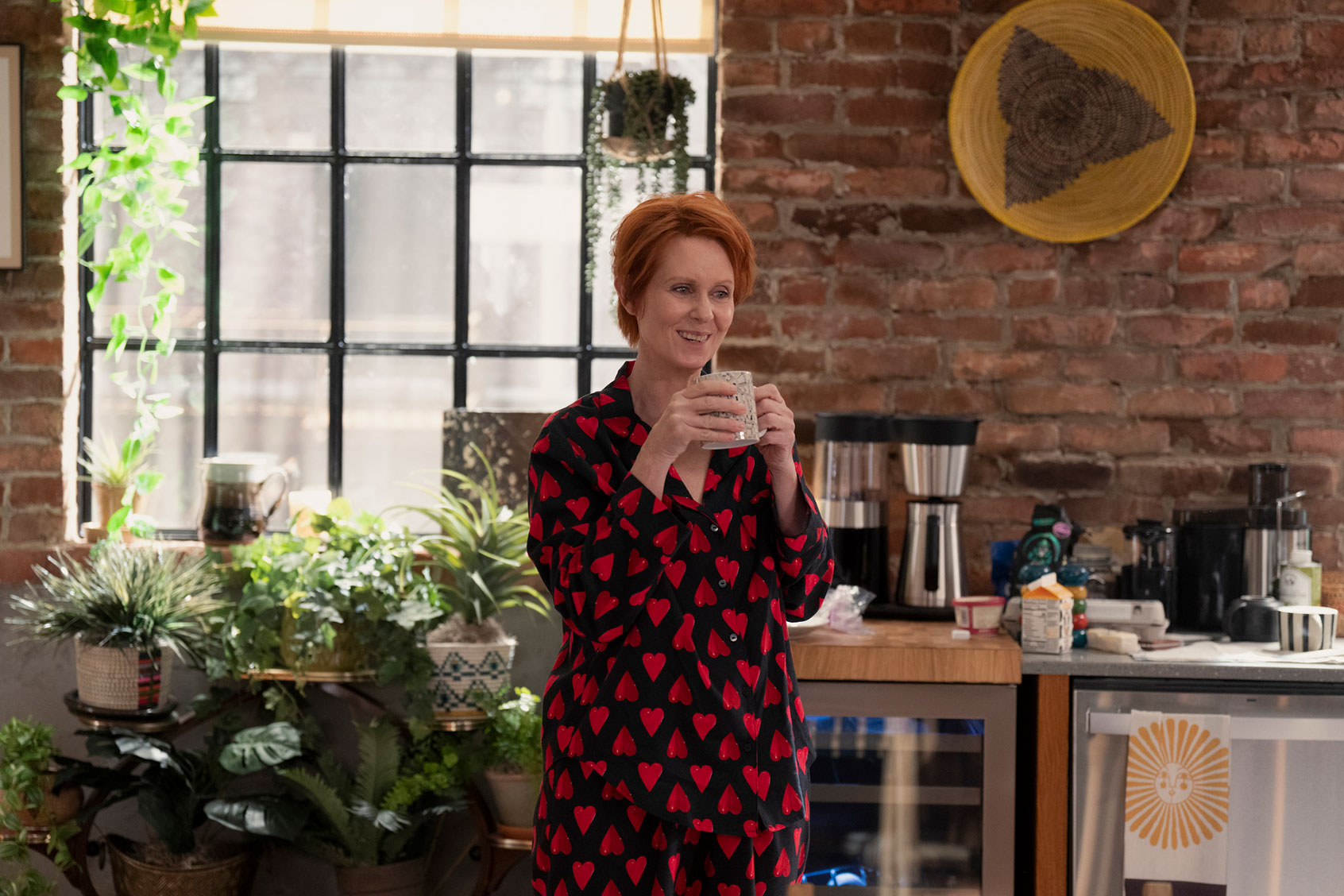
Adverse reactions to Miranda’s midlife freak-out may be linked to a sense that we used to feel a little simpatico. Now every scene with her in it feels like a personal attack.

At the end of all that, we watch Steve stomp into his and Miranda’s Brooklyn domicile from places unknown. His face is bitterer than the cold as Miranda asks him how his apartment hunt is going. Then it all slides downhill fast. He informs her that, contrary to what he said in front of their manchild Brady (Niall Cunningham) at family therapy, he’s not leaving. This angers Miranda since, as she points out, her name is the only one on the mortgage.

Then comes the reveal I’ve been bracing for since that first glimpse of Steve pounding the speed bag in their bedroom: He screams at Miranda “This is my house. My house! … I made it! This kitchen, I built it. It was a s**thole before I did everything. I did everything here! This floor. The fireplace. The f**king bookshelf. All of it — it’s my house. My house.”

The proverbial body blows rain down after that. “You never wanted to come here to Brooklyn. You never wanted me,” he says, winding up for the K.O. before spitting, “And you? You never even wanted Brady! So why don’t you find a new place and get the f**k out of our lives?”

Our previous coverage of “And Just Like That” amply establishes my feelings on Miranda and Steve, but mainly Miranda, who has been on an irritating behavior bender lately. Recently Salon’s Chief Content Officer Erin Keane pointed out to me that most of this site’s readers probably quizzed out as Mirandas, too. (Guilty as charged!) Adverse reactions to Miranda’s midlife freak-out may be linked to a sense that we used to feel a little simpatico. Now every scene with her in it feels like a personal attack.

Maybe she also has some of us wondering, Is this what we’re like?  She’s definitely provided a case study of how not to be throughout “And Just Like That.” Not even Che (Sara Ramirez), whose ego is under the basement floor after losing their pilot, can put up with Miranda’s trenchant insistence that they pull themselves out of their situational depression right this instant.

It is not for me to opine who should get the house. Sweat equity is a real thing, but so are mortgage payments. However, I’m not sure Miranda deserves that psychological pounding regardless of what she did. Your resident Steve fan may feel differently, though. Ask when they’re done crying hallelujah at this display of their favorite guy nutting up! Where have you been buddy? 

They have a point. Not too long ago, Steve was handy around the house and, according to Miranda’s reports of having the best sex of her life, pretty darned skillful with other body parts too. But sometime in the years between the “Sex and the City” movie and this show, the writers forgot Steve’s role in this fantasy’s ecosystem. Steve is the sensible, sensitive mate who evens us out as opposed to the kicked hound dog who waits by the door for his mistress. He returned to us as a hard-of-hearing grampa putting up with his kid loudly banging his girlfriend in the other room, morosely insisting to Carrie that he was fully devoted to the promise of ’til death do us part.

And Just Like ThatCynthia Nixon in “And Just Like That” (Craig Blankenhorn/Max)Cut to a couple of episodes ago, with its lingering shot of Steve knocking around the old punchball and launching many admiring headlines celebrating his “revenge bod.” It’s not as if Eigenberg ever slacked off in maintaining his physique; he also plays a main role in “Chicago Fire.”


But that reaction tells us how effective “And Just Like That” has been in propping up the illusion that Steve’s testosterone cratered over the years. Steve’s biceps were so hypnotic that Miranda’s observation to Carrie moments later – “It’s the silent agreement Steve and I cosigned,” she said of her living situation. “He’s not allowed to punch me in the face, and I’m not allowed to take up any more space than the couch” – may not have turned enough sensors red.

We need your help to stay independent

Nobody’s implying there was ever any danger of Steve physically assaulting Miranda. But as all the discussion of the whole Jonah Hill soft boy misogyny business reminds us, emotional manipulation counts too.

Right after Steve’s outburst he apologizes and blocks her from leaving, persuading her to lay with him on their bed as he spoons her – and she finds a condom wrapper, confirming that while she’s been finding herself, he’s been shopping for a hot side dish from their local Whole Foods.

Our verdict? ESH – everyone sucks here.

But he doesn’t own it immediately. “It’s not what it looks like,” Steve says, before Miranda points out that it looks like he’s been screwing someone else in their bed. “No! . . . I mean, maybe.”

Good for Steve, right? . . . Right?

Another useful societal innovation we’ve gained in the 25 years since “Sex and the City” debuted is the popular subreddit “r/AmItheA**hole.” This is where people with moral dilemmas can crowdsource judgment. It’s an excellent arbiter in situational conflicts.

Miranda (56ishF) didn’t only cheat on Steve (57ishM), she cheated on him with someone the Internet couldn’t stand. Steve stepped out on Miranda too, but it was in the distant past, and since we never met the person, we can’t be sure if we should despise them.

But for all of Steve’s insistence to Carrie that he was never taking off his wedding ring, as Miranda points out, he sure has been fine with Miranda’s maid service. “Who said I was a victim? That’s in your head,” Steve says when she calls him on the rubber discovery. “You’ve moved on. I’ve moved on. I ain’t a f**king victim.”


Want a daily wrap-up of all the news and commentary Salon has to offer? Subscribe to our morning newsletter, Crash Course.


Miranda is spiky and no-nonsense, so when she throws everything out the window in “And Just Like That” it is entirely contradictory to what we expect of her. Even so, it fits our picture of what would happen if someone who spent their whole life trying to avoid mistakes leaped off a cliff, mainly out of curiosity.

We’ve grown accustomed to Steve being her harness, holding steady and ensuring a safe return. Their first reconciliation after Steve’s transgression was beautiful; also, maybe it was a pause on a ticking time bomb.

Our verdict? ESH: everyone sucks here. The thought of this storyline continuing makes my head hurt. Apparently King and Palmer agree, because a few scenes after Miranda exits Brooklyn, announcing that she’s drawing up the divorce papers, she gets dumped by Che too.

“Two back-to-back breakups,” she mutters next to Che. “I’m killing it over here.” Yes. Finally. In the spirit of the winter, some things need to fully wither before we can welcome renewal. Maybe it’s a decades-long relationship that has descended from dormant to moribund. Maybe it’s a new romance that never felt entirely right in the first place.

Either way, to salvage Miranda, it’s time she shed everything preventing her from replenishing her character, including a guy that was always too good for her but ideal for us. “And Just Like That” has the potential to do better by all of them and its audience. So in the spirit of “Widow-Con,” let it die so all of us can move on.

Live long and flounder: An aging expert on the looming crisis of our longer lifespans

First, the good news. As author, MacArthur Fellowship recipient and founding head of DOJ’s Elder Justice Initiative M. T. Connolly writes in her new book, “For millions of people, there has never been a better time to be old.”

Over the past century, we have expanded our average lifespans by an incredible thirty years, and we’ve done it with astonishing advancements in medications and other interventions to improve our health and mobility. 

Now, here comes the really bad part. Our collective aging is wildly outpacing our social, financial, medical and caretaking abilities. In “The Measure of Our Age: Navigating Care, Safety, Money, and Meaning Later in Life,” Connolly lays out some stark statistics. In a little over a decade, we will have more people in this country over the age of 65 than under the age of 18. People eighty-five and older are “the fastest growing segment of the US population.” Half of them require financial assistance, and three quarters of them have some form of disability.

Already, 41.8 million Americans “provide an average of twenty-four hours of ‘informal’ or unpaid care every week for a person fifty and older.” And while the challenges for individual elders and their caregivers are immense, socially, we are simply shrugging our shoulders and pretending this isn’t happening. But the book is not a doom and gloom report. Rather, it’s a practical guide to facing an ignored dilemma in order to manage the elder care of our loved ones’ and ourselves, laying out how we can as a culture change the narrative before it’s too late.

Despite what Elon Musk has warned, the idea that “low birth rates is a much big­ger risk to civ­i­liza­tion than global warm­ing,” is false. But it is true that our rapidly graying population and willful ageism is creating a crisis that’s only going to accelerate in the next few years, even in spite of a slipping average lifespan in the U.S. (Additionally, the risk anthropogenic climate change poses to civilization cannot be overstated.) Throw in the deeply complicated burdens of caregiving — often fraught with profound financial strain, painful isolation and at times, intergenerational abuse — and it becomes clear, aging poses significant problems on multiple fronts.

Having experienced the illnesses and deaths of my stepfather, mother and mother-in-law — and a father living with dementia — over the past three years, I’ve learned firsthand the brutal toll of growing old in America. So I was grateful to talk via video chat recently with M. T. Connolly about what we don’t understand regarding the tradeoffs of our longer lives, why we’re wildly ill-equipped to manage our aging population and what still gives her hope as we all face the prospect of growing older. 

This conversation has been edited and condensed for clarity.

You open this book with some statistics that shocked me. The numbers are staggering, in terms of how much longer we are living, how few resources we have and what we’re in for, as a country. Talk to me a little bit about some of the things maybe that surprised you, even as an expert.

“By 2030, one in five Americans is going to be 65 and older. That’s an astonishing shift.”

Those numbers totally inform how hard caregiving is, and how much harder it’s going to be. I was really shocked also. I had been working in the field for a long time, and mostly seeing what was going wrong, but then started making the connections between these really common issues of aging, like care and money and balancing autonomy and safety.

I was seeing at the Department of Justice the really negative outcomes, things have their roots in very common problems. Then as I started to do the research, like you, I was gobsmacked. I knew that people 85 and older were the fastest growing part of the population, but that that number is going to almost triple from 2019 to 2050 is pretty amazing. The baby boom, we ain’t no babies anymore. It’s an aging boom. The outer edge of the baby boomers are already turning 75. By 2030, one in five Americans is going to be 65 and older. That’s an astonishing shift in terms of the demographics. 

You have that, and you have the fact that about three out of four people 85 and older have some kind of functional disability, and many are going to need care. Then the question is, where does all that care come from? One thing that comes as a big surprise to many people is that Medicare does not cover long term care. The CLASS Act, which was the part of the Affordable Care Act that covered Long Term Care, was repealed. Most private health insurance plans don’t cover long term care.

People are really on their own in terms of how to figure this out if they are not people of significant means. Even if you have significant means, often you’re on your own because people don’t want to go to nursing homes. They don’t want to go to residential care. Other things are going on there, largely because we don’t have a system that we want to rely on. 

We need your help to stay independent

The numbers that you throw out about the number of people who are caring for their parents and the number of hours that they are spending per week doing it — my spouse and I both did it and I am still shocked. Talk to me about what it looks like on the other side for the for the caregivers, because a lot of people my age and younger don’t know what they’re in for.

One thing that really struck me is how alone people are in this, because we don’t talk about it. And care should be a team sport. When I was raising my kids, I had my village and it was collective. When you’re trying to decide what schools or what teams or what activities, you go to the neighborhood cabinet. We don’t have that with aging. People are so alone, and get increasingly isolated.

Vivek Murthy, the current Surgeon General, has talked a lot about loneliness and isolation, including of older people. But we don’t talk about how alone caregivers are, too. There isn’t the concrete support people need about how to how to provide care. 

For example, dementia is a tremendously complex illness. We need to understand what it what it means to have dementia, how many different manifestations and the caregiver relationship. What if you’re estranged? What if this is a really fraught relationship? What should the expectations be? I think we’re making a lot of assumptions as a society, that come as a complete surprise to caregivers. That was another set of data that I found shocking, that for so many, they didn’t anticipate becoming a caregiver. They didn’t plan for it. Sometimes they don’t even call themselves a caregiver. But suddenly, somebody ends up in an ER, and there’s a call like, “Okay, come get Mom.”

“Suddenly, somebody ends up in an ER, and there’s a call like, ‘Okay, come get Mom.'”

This is aligned with something else you talk about, that people don’t understand the heterogenous nature of being old. We have certain benchmarks for children. We don’t have them for the elderly. Everybody’s mom is different. Everybody’s grandma is different. Tell me why we don’t have a system that is prepared for that.

We can trace it back to our ageism. We haven’t caught up with our longevity in all kinds of different ways. One huge way is culturally. We want to get old, but we don’t want to be old. We feel all this fear and bias and disgust and denial about getting old. That doesn’t really serve us all that well, culturally, because that gets into our institutions. Then it is reflected back at us, that resistance to even contemplating aging. We need to be able to contemplate what it means to age, both the hard and the good stuff, in order to really grapple with it on a policy level. Then we take it into ourselves. 

We know that we shouldn’t be feeling racism, sexism, bias about gay people. We know that in a visceral sort of way. We don’t feel that way about aging. We feel like it’s okay to be horrified about and feel all this animus about aging. It’s a double whammy, it’s a problem culturally, because it means we don’t have the institutions we need and the support we need. And for us personally, it’s actually devastating. 

Becca Levy, an epidemiologist, has done research suggesting that the people who hold the most ageist views live seven and a half years shorter than the people who hold the most positive views about aging. The age-centered bias is tremendously complicated for health systems too, which Levy estimates costs us $63 billion in excess annual spending. If we take the negative stuff into ourselves, it’s like a toxin. It makes us sick, and makes us less healthy in mind and body. It makes us resistant to looking at aging. Then we have systems that are wholly unprepared, notwithstanding this enormous train that’s barreling down the tracks toward all of us.

I have three kids who are young adults themselves. One thing that was sort of wonderful for me was to see that it resonated for them. I’m talking to younger people about it and lot of them are worried about their parents who are caregivers, because they see the stress of it. They see how arduous it is. And then the parents think, “I want to protect my kids from this.” They’re terrified about inflicting that on their kids. So I hold hope.

“If we can’t face it, we can’t do anything about it.”

We need a language to be able to talk about it. We need to be able to demand better of policymakers, and lawmakers and arbiters of culture to say, “No, we have to talk about this and we can’t be so alone in it.” 

We think of the big bad as being these institutions and homes and care facilities and a lot of them are terrible. But you also talk about the abuses that are perpetuated by individuals and family members — whether it’s financial, physical or emotional. Why do we need better systems in place to circumvent those kinds of traps?

The broken systems make it worse and there’s never an excuse for abuse or neglect or exploitation. There’s never an excuse, but I think it’s really important to also pay attention to how the broken systems exacerbate it. With that as a backdrop, we don’t really have support for caregivers. 

Our mental health system is also pretty broken, as is our drug treatment system. If you look at that combination, a lot of older people are supporting younger relatives — kids, grandkids, nieces, nephews, whatever — who they’ve supported for a long time, because they love them, even though there’s a mental health issue or developmental disability issue or drug issue. Then, as the older person ages deeper into old age, and sometimes into frailty, sometimes the tables turn, and they need care. But they want to stay at home, they feel loyal to the younger person they’ve been trying to support, and suddenly it shifts so that the younger person falls into the position of being a caregiver. That can work for a little while. But as the care needs mount, it’s often a recipe for disaster. 

I think we haven’t recognized it. We don’t have good data on it. We don’t talk about it. I get the reluctance to talk about it, because we want to say, caregivers should be hallowed. And also, a lot of people aren’t equipped to provide decent care. Part of it is that social pressure to say, “Okay, now you have to be the caregiver,” because there are very few options that are affordable. That pressure can be really insidious, and really counterproductive in terms of health and well-being. People need to perceive that they have choices, and that they have support so that they’re not so alone.

We need your help to stay independent

I feel like we should have an organization sort of like AA or NA. We should have Caregivers Anonymous as a very robust structure, because it’s so complicated, and people derive real benefit from talking to one another. Forty-one million people [are caregivers]. That’s more than the population of California. There are an awful lot of people in the workforce who are caregiving, and struggling with caregiving. 

We need a much better system of long term supports and services or home and community-based services. We need a more robust suite of options in the community, so that people who are trying to do caregiving have release valves and options so that they’re not carrying the whole thing themselves. [We need] respite care and education and readily available groups. There are places, AARP, Family Caregiver Alliance, Caring Across Generations, trying to shine a light on caregiving. But as a broad cultural matter we’re not getting traction yet. 

You spend the second half of the book talking about some of the the options we have. How can we make it better, as individuals, and collectively, looking at our parents future’s looking at our own futures? I don’t want my kids to spend their childbearing years like this. How do we change it?

I describe this book as a declaration of interdependence. We have this illusion of independence that really harms us. It’s an illusion, it’s not true at all. In any phase of life, it’s not true. 

How I came to look at it is that we need things at all levels, from the level of culture to systems to community to consciousness. At the cultural level, I really think we need to be less tolerant of ageism. We need to say, okay, this is a bargain we struck. We want to live longer, that’s an extraordinary thing. It’s an extraordinary victory. Now we have to deal with the consequences of that. 

We have to build the systems that we need. In terms of the systems we need, there’s better support for caregivers. There are better options, like long term services and supports. There’s having a better long term residential system that people aren’t terrified to use, which means better stewardship over the funds, better accountability and doing what we know works. These nursing homes, and CCRCs get more than $100 billion dollars in taxpayer money a year. We don’t actually have a great understanding of how those monies are spent, and we don’t even know who owns some of those places.

Culturally and overall, we’ve fallen into a trap as a society where we think we can just keep eviscerating services and it’s going to be fine. In fact, what happens is that problems flow downstream, so that cops and prosecutors deal with them. We have this crisis and violence driven response system. Then we say, “Oh, God, look at all the problems!” when we never really got out ahead of them. We have a pretty decent sense of what we need to do to alleviate some of these issues, and we don’t do it. Then we’re shocked that there are bad outcomes. 

“We need to start having the hard conversations.”

As a culture, we need to be less reactive and more proactive. We also need to do that in our own lives and families. We need to start having the hard conversations. We need to have them way earlier. We need to say okay, what do I want my old age to look like? What’s important to me? How much money do I have? How do I want to allocate it?

Generally, there’s someone in the family maybe who’s better at helping with money, and maybe somebody who’s better at fighting with insurance companies and somebody who’s better at maybe arranging caregiving or dealing with parents. How do we want to allocate that? What’s important to us is tremendously important. We have the social structures and what’s called choice architecture that takes us to retirement. But we don’t have much for this prolonged, late chapter of life to help us through 20, 30 years. 

There’s no template of how to really live a meaningful life yourself as an older person of value and service and connection. And there’s very little conversation about how the generation below then plans for and prepares for being in conversation of care. 

Right, and not wipe out the entire generational wealth, which is even more urgent in families of color. Women and people of color bear the brunt. 

All that said, I was really surprised and hopeful by writing the last chapter of the book. Talking with you gives me hope, because I think there’s a cohort of us who are realizing that we have to figure out how to talk about these issues in a public way.That’s really my biggest hope for this book. There are no silver bullets, but there are better approaches and there are ways to talk about it.

We miss that old age can be this period where we explore and have expanding consciousness and try new things, and really think about sort of the big mysteries of the universe

Steve Cole of UCLA says we have a lot of unrealized control over how we spend our time which is how we spend our lives. Where we put our attention is how we experience existence. We do have a good amount of control about that. What I was really struck by is not only that there’s some really concrete ways to make sure that we can focus on the things that matter most to us, and not get lost in all the noise of life. To say, “Okay, what matters to me?” In terms of what matters to most people, connection.

It’s two pronged: people you love, and taking care of those relationships, which requires work and intentionality and thoughtfulness and communication. And then, also just being with other people, in our book clubs and community gardens, just being in the world. Isolation and loneliness are really bad for our health. Having ways to spend our time that have purpose for us. Here too the data are pretty robust. 

I think we miss that old age can be this period where we explore and have expanding consciousness and try new things, and really think about sort of the big mysteries of the universe in a way that is both scary and really exciting and kind of wonderful. There’s this notion of creativity and play, and thinking beyond the usual boundaries that we often restrict ourselves to and sometimes we don’t feel like we have time to move beyond them. It’s really a question of flipping things to say, “How do I want to use In my my precious time?”

We shouldn’t be giving up on people. There’s still human potential, we just have to kind of redefine it a little bit. Anthropologists talk about us, as Homo narrans — that we are narrating humans. How we tell the story of our lives is how we experience our place in the world, and how we define our existence and make meaning of the hard things that happen. It’s true individually, but it’s also true collectively. How we tell stories with other people is how we create a shared understanding of the world and shared sense of meaning in it — and also exploration of new ways of thinking and different approaches. I found all of that extraordinarily hopeful. Because that’s something we all have control over, no matter how screwed up our systems are.


When Greenland was green: Ancient soil from beneath a mile of ice offers warnings for the future

About 400,000 years ago, large parts of Greenland were ice-free. Scrubby tundra basked in the Sun’s rays on the island’s northwest highlands. Evidence suggests that a forest of spruce trees, buzzing with insects, covered the southern part of Greenland. Global sea level was much higher then, between 20 and 40 feet above today’s levels. Around the world, land that today is home to hundreds of millions of people was under water.

Scientists have known for awhile that the Greenland ice sheet had mostly disappeared at some point in the past million years, but not precisely when.

In a new study in the journal Science, we determined the date, using frozen soil extracted during the Cold War from beneath a nearly mile-thick section of the Greenland ice sheet.

A brief look at the evidence beneath Greenland’s ice sheet and the lessons its holds.

The timing – about 416,000 years ago, with largely ice-free conditions lasting for as much as 14,000 years – is important. At that time, Earth and its early humans were going through one of the longest interglacial periods since ice sheets first covered the high latitudes 2.5 million years ago.

The length, magnitude and effects of that natural warming can help us understand the Earth that modern humans are now creating for the future.

A world preserved under the ice

In July 1966, American scientists and U.S. Army engineers completed a six-year effort to drill through the Greenland ice sheet. The drilling took place at Camp Century, one of the military’s most unusual bases – it was nuclear powered and made up of a series of tunnels dug into the Greenland ice sheet.

The drill site in northwest Greenland was 138 miles from the coast and underlain by 4,560 feet of ice. Once they reached the bottom of the ice, the team kept drilling 12 more feet into the frozen, rocky soil below.

A man in a fur-lined coat removes a long ice core about as wide as his hand

George Linkletter, working for the U.S. Army Corps of Engineers Cold Regions Research and Engineering Laboratory, examines a piece of ice core in the science trench at Camp Century. The base was shut down in 1967. U.S. Army Photograph

In 1969, geophysicist Willi Dansgaard’s analysis of the ice core from Camp Century revealed for the first time the details of how Earth’s climate had changed dramatically over the last 125,000 years. Extended cold glacial periods when the ice expanded quickly gave way to warm interglacial periods when the ice melted and sea level rose, flooding coastal areas around the world.

For nearly 30 years, scientists paid little attention to the 12 feet of frozen soil from Camp Century. One study analyzed the pebbles to understand the bedrock beneath the ice sheet. Another suggested intriguingly that the frozen soil preserved evidence of a time warmer than today. But with no way to date the material, few people paid attention to these studies. By the 1990s, the frozen soil core had vanished.

Several years ago, our Danish colleagues found the lost soil buried deep in a Copenhagen freezer, and we formed an international team to analyze this unique frozen climate archive.

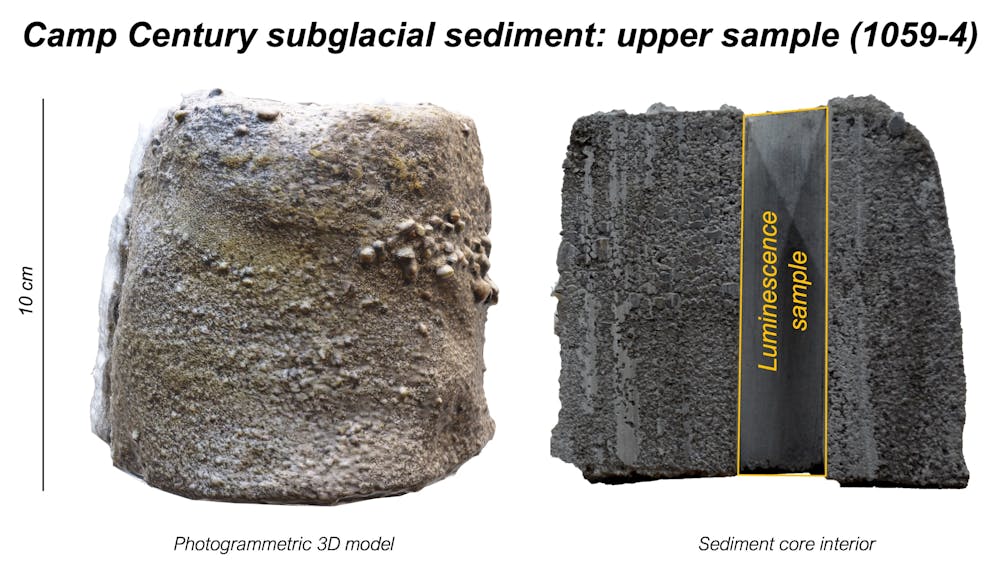
In the uppermost sample, we found perfectly preserved fossil plants – proof positive that the land far below Camp Century had been ice-free some time in the past – but when?

Two microscope images show tiny plant fossils. One a moss stem and the other a sedge seed.

Exquisitely preserved fossils of more than 400,000-year-old moss, on the left, and a sedge seed on the right, found in the soil core from beneath the Greenland ice sheet, help tell the story of what lived there when the ice was gone. Halley Mastro/University of Vermont

Dating ancient rock, twigs and dirt

Using samples cut from the center of the sediment core and prepared and analyzed in the dark so that the material retained an accurate memory of its last exposure to sunlight, we now know that the ice sheet covering northwest Greenland – nearly a mile thick today – vanished during the extended natural warm period known to climate scientists as MIS 11, between 424,000 and 374,000 years ago.

A composite photograph of the sediment core showing the luminescence sample used to determine when Greenland was last ice-free beneath Camp Century.

The uppermost sample of the Camp Century sub-ice sediment core tells a story of vanished ice and tundra life in Greenland 416,000 years ago. Andrew Christ/University of Vermont

To determine more precisely when the ice sheet melted away, one of us, Tammy Rittenour, used a technique known as luminescence dating.

Over time, minerals accumulate energy as radioactive elements like uranium, thorium, and potassium decay and release radiation. The longer the sediment is buried, the more radiation accumulates as trapped electrons.

In the lab, specialized instruments measure tiny bits of energy, released as light from those minerals. That signal can be used to calculate how long the grains were buried, since the last exposure to sunlight would have released the trapped energy.

How optically stimulated luminescence works.

Paul Bierman’s laboratory at the University of Vermont dated the sample’s last time near the surface in a different way, using rare radioactive isotopes of aluminum and beryllium.

These isotopes form when cosmic rays, originating far from our solar system, slam into the rocks on Earth. Each isotope has a different half-life, meaning it decays at a different rate when buried.

By measuring both isotopes in the same sample, glacial geologist Drew Christ was able to determine that melting ice had exposed the sediment at the land surface for less than 14,000 years.

Ice sheet models run by Benjamin Keisling, now incorporating our new knowledge that Camp Century was ice-free 416,000 years ago, show that Greenland’s ice sheet must have shrunk significantly then.

At minimum, the edge of the ice retreated tens to hundreds of miles around much of the island during that period. Water from that melting ice raised global sea level at least 5 feet and perhaps as much as 20 feet compared to today.

Warnings for the future

The ancient frozen soil from beneath Greenland’s ice sheet warns of trouble ahead.

During the MIS 11 interglacial, Earth was warm and ice sheets were restricted to the high latitudes, a lot like today. Carbon dioxide levels in the atmosphere remained between 265 and 280 parts per million for about 30,000 years. MIS 11 lasted longer than most interglacials because of the impact of the shape of Earth’s orbit around the sun on solar radiation reaching the Arctic. Over these 30 millennia, that level of carbon dioxide triggered enough warming to melt much of the Greenland’s ice.

Today, our atmosphere contains 1.5 times more carbon dioxide than it did at MIS 11, around 420 parts per million, a concentration that has risen each year. Carbon dioxide traps heat, warming the planet. Too much of it in the atmosphere raises the global temperature, as the world is seeing now.

Over the past decade, as greenhouse gas emissions continued to rise, humans experienced the eight warmest years on record. July 2023 saw the hottest week on record, based on preliminary data. Such heat melts ice sheets, and the loss of ice further warms the planet as dark rock soaks up sunlight that bright white ice and snow once reflected.

Meltwater pours over the Greenland ice sheet in a meandering channel.

At midnight in July, meltwater pours over the Greenland ice sheet in a meandering channel. Paul Bierman

Even if everyone stopped burning fossil fuels tomorrow, carbon dioxide levels in the atmosphere would remain elevated for thousands to tens of thousands of years. That’s because it takes a long time for carbon dioxide to move into soils, plants, the ocean and rocks. We are creating conditions conducive to a very long period of warmth, just like MIS 11.

Unless people dramatically lower the concentration of carbon dioxide in the atmosphere, evidence we found of Greenland’s past suggests a largely ice-free future for the island.

Everything we can do to reduce carbon emissions and sequester carbon that is already in the atmosphere will increase the chances that more of Greenland’s ice survives.

The alternative is a world that could look a lot like MIS 11 – or even more extreme: a warm Earth, shrinking ice sheets, rising sea level, and waves rolling over Miami, Mumbai, India and Venice, Italy.

Paul Bierman, Fellow of the Gund Institute for Environment, Professor of Natural Resources and Environmental Science, University of Vermont and Tammy Rittenour, Professor of Geosciences and Director of Luminescence Lab, Utah State University

This article is republished from The Conversation under a Creative Commons license. Read the original article.

Food allergies are on the rise — are they causing an increase in eating disorders?

When I was 19, I got sick. A few weeks into an interminable summer spent puzzling over baffling symptoms and going back and forth to doctors, my bloodwork was flagged for a possible cause — a food sensitivity issue that might just clear up with some dietary changes. It wasn’t a serious health crisis. It wasn’t anything I couldn’t handle. But I was a teenage girl in America, so I already had a fraught relationship with food and my body. Naturally, then, I took this new information as a challenge to restrict my Diet Coke and celery sticks lifestyle even more sharply. A few weeks later, I returned to school with nearly twenty pounds carved off my already slim frame. And it took me the next several years to unlearn the self-sabotaging habits I picked up that summer.

Decades later, the combination of dietary issues and disordered eating patterns is still a perversive challenge for many of us. How could it not be? Monitoring what you eat, being mindful that your food could actually hurt you, is stressful. For people already struggling around food and body image, it can make tough mealtimes even tougher. And for people with previously untroubled eating habits — like children — those allergies and intolerances might just nudge along some brand new emotional problems.

“Higher rates of eating disorders have been reported among those with chronic illnesses, particularly those requiring strict dietary adherence.”

In June, a research review published in the Journal of Allergy & Clinical Immunology: In Practice found that “Eating disorders appear prevalent in individuals with FA [food allergies].” The survey’s lead author, Murdoch Children’s Research Institute PhD scholar Daniela Ciciulla, further found “Higher rates of EDs [eating disorders] have been reported among those with chronic illnesses, particularly those requiring strict dietary adherence such as type 1 diabetes mellitus, celiac disease, cystic fibrosis, and Crohn disease.” Two years ago, a review published the Journal of Affective Disorders Reports similarly noted “a potential association between FA and distorted body image and disordered eating.” 

It’s a double whammy problem that patients and healthcare providers alike need to be on the lookout for as a mutually fueling fire. “Disordered eating combined with a co-occurring medical condition is a complicated mix,” says Rui Tanimura, MS, RD, CYT, a registered dietitian at the virtual eating disorder treatment company Equip. “Disordered eating behaviors can cause significant disruptions to the digestive function. Oftentimes, health professionals treating people with food sensitivities and disordered eating try to understand if it was the chicken or the egg.”

We need your help to stay independent

The National Eating Disorders Association estimates that up to “30 million Americans struggle with eating disorders, such as anorexia, bulimia, and binge eating.” Simultaneously, we are living in an increasingly food sensitive age. Allergies, in both children and adults, are on the rise, although the exact causes for the uptick are uncertain. Common culprits include shellfish, nuts, milk and eggs. Roughly ten percent of us — that’s about 26 million Americans — currently have at least one allergy. But that number pales next to the population living with diabetes — about 37 million people, with the CDC predicting a “surge” in that number in the next few years. Meanwhile, autoimmune issues like celiac disease are also steadily rising, affecting roughly 1 in every 133 Americans. In other words, a whole lot of us have to be careful to avoid certain foods that can make us sick — and then we have to recognize that our caution can veer into unhealthy thoughts and patterns. After all, a medical dietary issue can be a real gift to someone with a tendency toward disordered eating, a credible excuse to obsess over food intake, and to abstain when everyone else is digging in. 

So what can those of us whose relationship with food can already be problematic do to sidestep disordered habits? Leah Graves, Vice President of Nutrition and Culinary Services for the eating disorder organizations Veritas Collaborative and The Emily Program, says that the first step is acknowledging that there may be potential problems. “When a medical need requires modification with food selection, those vulnerable to disordered eating are at risk,” she says, “and a diagnosis of food allergy or intolerance is no exception. For individuals with disordered eating, managing both the allergy and the eating disorder together is essential.” After that, it’s important to build a team that’s in communication with each other.

If a person is already dealing with a disorder or potential disorder, Graves says, “Close collaboration between the eating disorder care team (therapist, dietitian, psychiatrist, primary medical provider) and the allergy care team is necessary to ensure that care plans consider the needs of individuals with all diagnoses, while staying alert for any signs of worsening eating disorder thoughts and behaviors.” She adds, “It is ideal to include a registered dietitian on the allergy team who is informed in both allergy and eating disorder care, as they can help individuals adapt eating patterns as necessary for allergy management while monitoring for and addressing signs and symptoms of disordered eating.”

It’s also important to have a strong support system, and to let the people in our lives know what’s really going on. Isaac Robertson, co-founder and chief editor at Total Shape, says, “Educating friends, family, and colleagues about food allergies and intolerances can help create a sense of empathy and inclusivity. By encouraging open conversations and providing accurate information, we can reduce the stigma and misconceptions surrounding these conditions, thereby easing the burden on individuals struggling with them.”

It also helps to take a few cues from existing eating disorder treatment practices and apply them to those dietary limitations. Cherie Miller, MS, LPC-S, a Dallas-Fort Worth area eating disorder psychotherapist, notes, “Intuitive eating principles are about attuning to our body’s cues about what, when, and how much to eat instead of depending on external food rules to guide our eating. Having an allergy or sensitivity to a food will typically lead to unpleasant issues in your body if you eat that food, so it can be helpful to think of not eating that food as a form of self-care. I’ve worked with clients on seeing it less as, ‘I can’t eat this food’ and more, ‘I could eat this food, but I choose not to because I want to care for myself and my body.'” 


Want more great food writing and recipes? Subscribe to Salon Food’s newsletter, The Bite.


Managing those “unpleasant issues” can be hard, and the temptation to just avoid food altogether can be immense. But doing so can exacerbate not just the psychological but the physical challenges. “When someone is restricting their food intake, they are already throwing off one’s hunger and fullness cues,” explains Rui Tanimura. “So as a result, tolerating more food becomes even more difficult. Someone who isn’t fueling adequately with a wide variety of nutrients is negatively impacting the strength and function of the digestive system.”

We don’t have to spend our lives stressed out about what’s on our plates, and we definitely don’t have to go it alone. There are millions of us in the ever expanding pool of people who have food related health issues, and millions of others — often overlapping with them — who grapple with disordered eating. Fortunately, the challenges of one of those issues do not automatically have to worsen another. Dr. Kelvin Fernandez, a a physician and healthcare educator with Ace Med Boards, offers an encouraging example. “I had a patient who was already dealing with anorexia when she found out she had a gluten intolerance,” he recalls. “We worked hand in hand, not just with the new dietary changes she needed to make but also with giving her the emotional backup she needed. Much of our work was helping her see this new issue not as a punishment, but as a tool to help her get healthier and feel better.”

I still get anxious about the ways in which the things I eat might play havoc with my health. I also still sometimes find myself harboring some messed up thoughts about food and my body and the relationship between the two. I’m still working on it all. But most days, I’m okay. I know how to steer clear of the things that make me sick, and what do you know? There’s still plenty of food to go around. Just because I can’t eat everything, it doesn’t mean I can’t eat anything. 

“These people look pathetic”: Nancy Pelosi weighs in on Trump pulling McCarthy’s strings

During a segment of CNN’s “State of the Union” on Sunday, Nancy Pelosi weighed in on what she views as an apparent fear of Trump, and the fact that her Republican successor, House Speaker Kevin McCarthy would ever even consider expunging Trump’s two impeachments, much less move forward on actually doing it.

“This is about being afraid. As I’ve said before, Donald Trump is the puppeteer and what does he do all of the time but shine the light on the strings. These people look pathetic,” Pelosi said in a quote obtained from Politico. “Kevin is playing politics. It is not even clear if he constitutionally can expunge those things,” she furthered. “If he wants to put his members on the spot, his members in difficult races on spot, that is a decision he has to make. But this is not responsible.”

As Politico’s Kelly Garrity points out, “McCarthy told Trump, the current front-runner in the Republican presidential primary, that he would move to expunge the two impeachments against the former president before Congress breaks for its August recess,” but has “subsequently denied making that vow, though he said he supported expunging the impeachments.”

Coffee bags are changing instant coffee’s reputation— but don’t throw out your French Press just yet

Coffee contains multitudes, if you will.

It truly represents something different for so many. There’s that meditative morning cup poured into your favorite, years-old, slightly chipped mug; the harried afternoon iced coffee in a plastic cup dripping with condensation that effectively destroys your desk; and sometimes there’s a top-notch brew made by a barista who actually cares about the way your single origin beans are roasted and ground. 

But despite the ways we all connect to a good cup of coffee, many find the process of making it at home pretty tiresome. From wrangling complicated Keurigs to old-fashioned percolators, Chemexes and French presses, some mornings, it just feels easier to take that Starbucks runs or fire up DoorDash for a delivery from your favorite local coffee spot. 

But could coffee bags usher in a new frontier for at-home coffee prep?

If you’ve stayed in a hotel over the past few years, or perused the coffee aisle at Whole Foods, you’ve probably come across coffee bags already; they look and function just like a tea bag, where you steep ground coffee in hot water with the promise of a perfect cup on the other side. I was curious just how true that would be. 

How do coffee bags stack up to other methods? 

I’ve now tried a few different readily available coffee bag varieties, but none really blew me away like my espresso machine did when I first got it a few Christmases back. Generally, I found them . . . tepid? No matter how long I steeped the bags, I couldn’t seem to get them to yield a full-bodied, dark, robust coffee. The color would remain frustratingly light, with a flat flavor. Even attempting to gussy up the brew with creamers or syrups did next to nothing and barely amounted to much. I also tried a cold brew approach — and that was even less successful.

Some of this, admittedly, is pretty subjective. As discussed earlier, coffee is an intensely personal product, so someone’s “too strong” is often someone else’s “too weak.” Liz Ahern, Chief Marketing Officer of Chamberlain Coffee — a coffee brand founded by Emma Chamberlain — says that one way customers can find their perfect cup is by experimenting with water ratios or even by brewing two bags at once to strengthen the flavor.

But while coffee bags aren’t necessarily leading the pack in terms of taste, those in the coffee industry — including Ever Meister, a coffee journalist, educator and author of “New York City Coffee: A Caffeinated History” — believe that coffee bags may help in reshaping the general perception of instant coffee. “Steeping coffee still feels like ‘brewing’ in a way that dissolving instant doesn’t,” Meister told Salon Food via email. “It has more romance in a big way.” 

We need your help to stay independent

And sure, any time you can’t control the variables of coffee brewing, namely grind size and the coffee-to-water ratio, you’re risking a sacrifice to quality. 

But given that most people don’t know all the many ways they can modify these variables to improve coffee quality anyway, the bags give them an easy in-road to ‘good enough,’ which keeps the coffee business alive while making mouths happy,” Meister said. 

They continued: “Someone might buy a $30 bag of beans and butcher the brewing of it; at least this way they’re set up for a reasonable degree of success, if that makes sense.”

What’s the final verdict? 

While I’m enticed by the idea of being able to buy a box of coffee to cover my caffeine habit for a month, rather than spending $7 a day on my coffee of choice, I haven’t yet found a brand of coffee bags that inspire me to make the jump. 

However, for those looking for a decent cup of coffee while camping, traveling or rushing out the door — without having to make a completely romance-less batch of instant  — coffee bags are a “good enough” choice for now. 

Just don’t throw out your French press just yet.

How to have better orgasms, according to science

With all the chaos in the world, maybe you need a guide on how to come so hard your brain turns into an etheric lightening rod and madhouse pleasure spikes your spine with 20,000 household volts of orgasmic delirium. If so, you came to the right place.

As Gloria Steinem once famously hypothesized, women may be the one group that grows more radical with age. For those of us in the Bikini Kill generation of feminism, at least, our belief in the radical possibilities of pleasure only grows more scientifically justified through the years. In fact, a 2010 study of more than 600 female test subjects revealed women aged 31 to 45 are the most sexually active, with 87% reporting they get it on regularly. 

While hormone levels can be credited for the heightened frequency, credit for actual satisfaction in the deed lay mostly in the mind. We’re less self-conscious about our bodies in mature age and — as a 2017 poll of more than 2,000 women over 40 found — 91% of us are more confident and “at ease sexually” as we strut into cougarhood. 

That’s why I’ve analyzed the advice of more than a dozen clinical sex therapists and surveyed more than 25 academic studies on the science of female pleasure. All my homework on experiencing transcendent boudoir bliss boils down to three key components: brain hormone production, blood flow to nerve clusters and pelvic muscle contraction training. There are a few ways to get each component in gear and working in tandem with the others, and one element common to all three components — a relaxed psychological state of playful focus.   

Some of these tricks may be old hat to you carnal connoisseurs, but I guarantee you’ll find at least a few to be titillatingly novel. Here, then, are the must-know moves for any would-be freak in the sheets. 

Rest, restore, repeat

Boring, I know. Who wants to focus on restoring emotional well-being and physiological nourishment when you’re hungry for the kind of unhinged sex normally only found in the hyper-toxic relationships of your early 20s? Sorry to be the bearer of bad news but, contrary to the sage wisdom of internet memes, those of us who’ve gone on grippy-sock vacay (shout-out to my fellow survivors) aren’t somehow predisposed to life-altering orgasms. 

Nothing’s wrong with you. It’s just that sexuality isn’t divorced from the rest of your brain health. Pleasure and pain are physically mingled in many of the same subcortical regions in your brain, with your insular and cingulate cortices both lighting up and triggering heart-pounding amygdala responses. 

Stress, anxiety, fatigue — the daily management of these libido-killers is the responsibility of your brain’s dorsolateral prefrontal cortex. That’s the filter part of your brain that stops you from road-raging through a farmer’s market when you see your ex there. It’s also the part that stops you from jumping a hot stranger’s bones while waiting in line at the bank. 

But too much activation of that part when it’s time to get hot can suppress the primal sexual pleasure responses that are howling like a wolf from within your ventral prefrontal and orbitofrontal cortices. You’ve got to be able to turn off the filter if you want crazy-good pleasure. 

Long story short? Stress management, daily meditative practices of some kind, brain-healthy nutrition and sleep cycles conducive to emotional regulation — all of these things create the foundation for a thriving sex life and all of them revolve around getting the rest and emotional restoration that you need. 

A 2015 study found that the more women slept, the more randy they were the next day — and that even one hour of extra sleep could spike their libidos by as much as 14%. This relationship between good sleep and good sex has been found to be even closer in women entering menopause and to affect female subjects more than those who are male. 

The takeaway: In the words of Mavis Beaumont, “keep your plants watered.” Restore your energy reserves and deplete your cortisol levels with a few nights of deep rest and good food. Nourish the heart, and you nourish the nymph. 

Zen on, zone in, bliss out

Good sleep is the physical component to getting your head in the game, but the mental component can be found in meditative mindfulness practices. A 2013 study in the Journal of Psychosomatic Medicine found that mindful meditative practices that are focused on increasing body awareness can actually heighten sensations in your clitoris — and with more than 8,000 nerve-endings there, it’s worth a go. 

Wanna hear something that’ll really blow your mind? In 2016, a small brain study of 11 people showed researchers that if you simply mentally imagine erotic stimulation of your nipples and clit, your brain will light up in the same way as it does when you’re actually getting touched. This research suggests some of you can actually think yourself into having a bonafide leg-shaker. You’re welcome. 

Don’t think I’m advocating for a far-fetched mental-gasm either. Regular mindfulness and meditative practices increases your ability to control your thoughts and enrich your fantasies so that you can quickly swat away any errant distractions while you’re getting it on. A focused mind is a sexy thing — and a 2011 study found a direct connection between women who lack erotic thought engagement during sex and women who have reduced or no orgasms. So make it a point to get your head in the game while you’re getting your head in the game. 

It’s not just about meditating and getting a golden eight hours and waking up ready for a pounce, though. It’s about all the things we can do in the long haul to deal with grinding existential dread and the resultant cortisol build-up that suppresses testosterone (a necessary sex-drive hormone). 

Exercise routines will burn off cortisol the best, of course. Might I also recommend including these five hip-opening yoga poses that are known to heighten sexual pleasure? They seem like excellent warm-ups for the four coitus techniques that are known to produce orgasms for women at the highest rate of reliability. (But let’s not leave out the hero of our more grind-centric sessions, the ever-delicious Side Straddle.)

The takeaway: Develop long-term stress management habits and get your fantasies rocking with meditative focus. If you give your brain a chance to work with your body, you’ll be back on demon time before you know it. Oh, and don’t forget the kegels. 

The vibe is off 

No, this isn’t implying that vibrating sex toys are harmful or deplete your sex life. On the contrary, a 2017 study found that when women use vibrators, they generally report positive sexual benefits that ultimately increased long-term satisfaction, with the majority reporting improved vaginal lubrication, orgasm frequency and genital sensation. 

Furthermore, the over-hyped sexist myth about vibrators causing “dead vagina syndrome” (what a name) was put to rest in a 2009 article studying vibrator use among more than 2,000 U.S. women (more than half used vibrators.) In 2010, another study found that the continuous restructuring of vulva nerve beds make it highly unlikely that sex toys will cause any permanent nerve damage.

All the same, vibrators are a well-studied consumer health product for which proper usage guidelines should be noted and adhered to, so that you aren’t over-clocking your crotch. In the 2009 study above, 17% of women reported experiencing low-grade desensitizing affects that lasted anywhere from a couple of hours to a couple of days. 

Temporary numbness isn’t the biggest problem you’re likely to find with vibrator overuse, but the psychological dependency that can be created by repeated physiological conditioning. That means longer term misuse of vibrators can train your brain to respond to that particular sexual stimuli of a vibrator at the cost of reduced partner response and arousal building.

The takeaway: If you want to trigger astral-projection levels of soul quivering, lay off the vibrator for a bit. Or at least use it more lightly and in varied ways. You’re going to need a full head of steam to reach new heights. You can give yourself that by retraining your body and brain to derive pleasure from the first two stages of the three-stage sexual response cycle — arousal building and the pleasure plateau. 

Love wins

To hookup culture connoisseurs, we regret to inform you that your more tender-hearted counterparts are (probably) actually having hotter sex than you. And among committed lesbian couples, that sex actually gets progressively hotter through the years. Across the range of studies and expert advice I’ve surveyed, the release of serotonin and dopamine — and, most importantly, the love chemical known as oxytocin — among committed partners was found to be tied to stronger and more consistent orgasms for women.  

In most cases, scientists seemed to find it hard to tell whether the chicken or egg came first: the more emotionally satisfied a partner was, the more likely they were to reach increasingly powerful orgasms. And the more powerful the orgasm, the more satisfied they were emotionally. 

The feedback loop of love doesn’t appear by itself, though. Among the most consistent factors that appear in the literature is a female partner’s openness with communication about her pleasure. The truth is, if you’re a hetero-partnered gal over the age of 30, you probably want more sex than him. That means you’ve got to start talking about what you like and don’t like — and what exotic adventures you’d like to try — with warmth, plainspoken frankness and humor.

That last bit isn’t a bit. As the science has shown: partners who laugh together, come together. 

The takeaway: Get comfortable, let yourself feel something secure, develop intimacy and trust and a good sense of humor with your partner. All of these things not only help you relax, but bring your pleasure chemistry to a faster and more intense boil. They also help you cultivate the sense of emotional safety necessary to discover new things about your tastes with a sense of playful curiosity. 

Whatever you do, just keep the socks off in bed, babes — I don’t care what the science says.

The migrant boat disaster and America’s endless wars: Why we missed the real story

Seeking news coverage about the Adriana, the boat crowded with some 700 people migrating to Europe to seek a better life that sank in mid-June off the coast of Greece, I googled “migrant ship” and got 483,000 search results in one second. Most of the people aboard the Adriana had drowned in the Mediterranean, among them about 100 children.

I did a similar search for the Titan submersible which disappeared the same week in the North Atlantic. That kludged-together pseudo-submarine was taking four wealthy men and the 19-year-old son of one of them to view the ruins of the famed passenger ship, the Titanic. They all died when the Titan imploded shortly after it dove. That Google search came up with 79.3 million search results in less than half a second.

Guardian journalist Arwa Mahdawi wrote a powerful column about the different kinds of attention those two boats received. As she astutely pointed out, we in the Anglophone world could hardly help but follow the story of the Oceangate submersible’s ill-fated journey. After all, it was the lead news story of the week everywhere and commanded the attention of three national militaries (to the tune of tens of millions of dollars) for at least five days.

The Adriana was quite another story. As Mahdawi pointed out, the Greek Coast Guard seemed preoccupied with whether the migrants on that boat even “wanted” help, ignoring the fact that many of those aboard the small trawler were children trapped in the ship’s hull and that it was visibly in danger.

On the other hand, few, she pointed out, questioned whether the men in the submersible wanted help — even though its hull was ludicrously bolted shut from the outside prior to departure, making rescue especially unlikely. Glued to the coverage like many Americans, I certainly didn’t think they should be ignored, since every life matters.

But why do people care so much about rich men who paid $250,000 apiece to make what any skilled observer would have told them was a treacherous journey, but far less about hundreds of migrants determined to better their families’ lives, even if they had to risk life itself to reach European shores? Part of the answer, I suspect, lies in the very different reasons those two groups of travelers set out on their journeys and the kinds of things we value in a world long shaped by Western military power.

An American preoccupation with the military

I suspect that we Americans are easily drawn to whatever seems vaguely military in nature, even a “submersible” (rather than a submarine) whose rescue efforts marshaled the resources and expertise of so many U.S. and allied naval forces. We found it anything but boring to learn about U.S. Navy underwater rescue ships and how low you can drop before pressure is likely to capsize a boat. The submersible story, in fact, spun down so many military-style rabbit holes that it was easy to forget what even inspired it.

Why do people care so much about rich men who paid $250,000 apiece to make what any skilled observer would have told them was a treacherous journey, but not about hundreds of migrants determined to better their families’ lives?

I’m a Navy spouse and my family, which includes my partner, our two young kids and various pets, has been moving from one military installation to another over the past decade. In the various communities where we’ve lived, during gatherings with new friends and extended family, the overwhelming interest in my spouse’s career is obvious.

Typical questions have included: “What’s a submarine’s hull made out of?” “How deep can you go?” “What’s the plan if you sink?” “What kind of camo do you wear?” And an unforgettable (to me, at least) comment from one of our kids: “That blue camo makes you guys look like blueberries. Do you really want to hide if you fall in the water? What if you need to be rescued?”

Meanwhile, my career as a therapist for military and refugee communities and as a co-founder of Brown University’s Costs of War Project, which might offer a strange antiwar complement to my spouse’s world, seldom even makes it into the conversation.

Aside from the power and mystery our military evokes with its fancy equipment, I think many Americans love to express interest in it because it seems like the embodiment of civic virtue at a time when otherwise we can agree on ever less. In fact, after 20 years of America’s war on terror in response to the Sept. 11, 2001, attacks on the Pentagon and the World Trade Center, references to our military are remarkably widespread (if you’re paying attention).

We need your help to stay independent

In our militarized culture, we seize on the cosmetic parts like the nature of submarines because they’re easier to talk about than the kind of suffering our military has actually caused across a remarkably wide stretch of the planet in this century. Most of us will take fancy toys like subs over exhausted service members, bloodied civilians and frightened, malnourished migrants all too often fleeing the damage of our war on terror.

Migration during wartime

We live in an era marked by mass migration, which has increased over the past five decades. In fact, more people are now living in a country other than where they were born than at any other time in the last half-century.

Among the major reasons people leave their homes as migrants are certainly the search for education and job opportunities, but never forget those fleeing from armed conflict and political persecution. And of course, another deeply related and more significant reason is climate change and the ever more frequent and intense national disasters like flooding and drought that it causes or intensifies.

The migrants on the Adriana had left Afghanistan, Egypt, Libya, Palestine and Pakistan for a variety of reasons. Some of the Pakistani men, for instance, were seeking jobs that would allow them to house and feed their desperate families. One Syrian teenager, who ended up drowning, had left the war-torn city of Kobani, hoping to someday enter medical school in Germany — a dream that was unlikely to be realized where he lived due to bombed-out schools and hospitals.

The migrants on the Adriana had left Afghanistan, Egypt, Libya, Palestine and Pakistan for a variety of reasons. In my mind’s eye, a specific shadow looms over many of their individual stories: America’s forever wars, the series of military operations that began with our 2001 invasion of Afghanistan.

In my mind’s eye, however, a very specific shadow loomed over so many of their individual stories: America’s forever wars, the series of military operations that began with our 2001 invasion of Afghanistan (which ended up involving us in air strikes and other military activities in neighboring Pakistan as well) and the similarly disastrous invasion of Iraq in 2003. It would, in the end, metastasize into fighting, training foreign militaries and intelligence operations in some 85 countries, including each of the countries the Adriana’s passengers hailed from. All in all, the Costs of War Project estimates that the war on terror has led to the displacement of at least 38 million people, many of whom fled for their lives as fighting consumed their worlds.

The route taken by the Adriana through the central Mediterranean Sea is a particularly common one for refugees fleeing armed conflict and its aftermath. It’s also the most deadly route in the world for migrants — and getting deadlier by the year. Before the Adriana went down, the number of fatalities during the first three months of 2023 had already reached its highest point in six years, at 441 people. And during the first half of this year alone, according to UNICEF, at least 289 children have drowned trying to reach Europe.

If there’s one thing I’ve learned — even if on a distinctly small scale — as a therapist in military and refugee communities, it’s this: A painful history almost invariably precedes anyone’s decision to embark on a journey as dangerous as those the migrants of that ill-fated ship undertook. Though I’m sure many on it would not have said that they were fleeing “war,” it’s hard to disentangle this country’s war on terror from the reasons so many of them made their journeys.

One Syrian father who drowned had been heading for Germany, hoping to help his three-year-old son, who had leukemia and needed a treatment unavailable in his devastated country, an area that the U.S. invasion of Iraq first threw into chaos and where war has now deprived millions of health care. Of course, it hardly need be noted that his death only ensures his family’s further impoverishment and his son’s possible death from cancer, not to mention what could happen if he and his mom were forced to make a similar journey to Europe to get care.

Pakistan’s war story

As many as 350 migrants on the Adriana were from Pakistan, where the U.S. has been funding and fighting a counterinsurgency war — via drones and air strikes — against Islamist militant groups since 2004. The war on terror has both directly and indirectly upended and destroyed many lives in Pakistan in this century. That includes tens of thousands of deaths from air strikes, but also the effects of a refugee influx from neighboring Afghanistan that stretched the country’s already limited resources, not to speak of the deterioration of its tourism industry and diminished international investments. All in all, Pakistan has lost more than $150 billion over the past 20 years in that fashion while, for ordinary Pakistanis, the costs of living in an ever more devastated country have only increased. Not surprisingly, the number of jobs per capita decreased.

One young man on the migrant ship was traveling to Europe to seek a job so that he could support his extended family. He had sold 26 buffalo — his main source of income — to pay for the journey and was among the 104 people who were finally rescued by the Greek Coast Guard. After that rescue, he was forced to return to Libya where he had no clear plan for how to make it home. Unlike most of the other Pakistanis on the Adriana, he managed to escape with his life, but his is not necessarily a happy ending. As Zeeshan Usmani, Pakistani activist and founder of the antiwar website Pakistan Body Count, points out, “After you’ve sacrificed so much in search of a better life, you’d likely rather drown than return home. You’ve given all you have.”

Rest stops in a militarized world

We certainly learned much about the heady conversations between the Titan’s OceanGate CEO, his staff and certain estranged colleagues before that submersible embarked on its ill-fated journey, and then about the dim lighting and primitive conditions inside the boat. Barely probed in media coverage of the Adriana, however, was what it was like for those migrants to make the trip itself.


Want a daily wrap-up of all the news and commentary Salon has to offer? Subscribe to our morning newsletter, Crash Course.


What particularly caught my attention was the place from which they left on their journey to hell and back — Libya. After all, that country has quite a grim history to be the debarkation point for so many migrants. A U.S.-led invasion in 2011 toppled dictator Muammar Gaddafi, leaving the country’s remote beaches even less policed than they had been, while Libya itself was divided between two competing governments and a collection of affiliated militias.

In such a chaotic setting, as you might imagine, conditions for migrants transiting through Libya have only continued to deteriorate. Many are kept in warehouses by local authorities for weeks, even months, sometimes without basic needs like blankets and drinking water. Some are even sold into slavery to local residents and those lucky enough to move on toward European shores have to deal with smugglers whose motives and practices, as the Adriana’s story reminds us, are anything but positive (and sometimes terrorizing).

It would be far-fetched to count people like the migrants on the Adriana as “war deaths.” But in many cases, their fates were directly impacted by fighting in or around their countries of origin.

Onward, to the sea itself: When, some 13 hours after the first migrants called for help, the Greek Coast Guard finally responded, it sent a single ship with a crew that included four armed and masked men. The Guard alleges that many of the migrants refused help, waving the men away. Whether or not this was the case, I can imagine their fears that the Greeks, if not smugglers, might at least be allied with them. They also might have feared that the Guard would set them and their children, however young, on rafts to continue drifting at sea, as had happened recently with other migrant ships approached by the Greeks.

If that sounds far-fetched to you, then consider how you would feel if you’d been adrift at sea, hungry, thirsty and fearful for your life, when men in another boat, armed and wearing masks, approached you, further rocking a boat that was already threatening to capsize. My guess is: not good.

Uncounted war deaths

It would be far-fetched to count people like the migrants on the Adriana as “war deaths.” But framing many of their deaths as in some sense war-related should force us to pay attention to ways in which fighting in or around their countries of origin might have impacted their fates. Paying attention to war’s costs would, however, force us Westerners to confront the blood on our hands, as we not only supported (or at least ignored) this country’s wars sufficiently to let them continue for so long, while also backing politicians in both the U.S. and Europe who did relatively little (or far worse) to address the refugee crises that emerged as a result.

To take language used by the Costs of War Project’s Stephanie Savell in her work on what the project calls “indirect war deaths,” migrants like the drowned Syrian teenager seeking an education in Europe could be considered “doubly uncounted” war deaths because they weren’t killed in battle and, as in his case and others like it, their bodies will not be recovered from the Mediterranean’s depths.

When we see stories like his, I think we should all go deeper in our questioning of just what happened, in part by retracing those migrants’ steps to where they began and trying to imagine why they left on such arduous, dangerous journeys. Start with war-gutted economies in countries where millions find slim hope of the kind of decent life that you or I are likely to take for granted, including having a job, a home, health care and safety from armed violence.

I’ll bet that if you do ask more questions, those migrants will start to seem not just easier to relate to but like the planet’s true adventurers on this planet — and not those billionaires who paid $250,000 apiece for what even I could have told you was an unlikely shot at making it to the ocean floor alive.

Come closer and see: I saw The Cure with my parents – and here’s what I learned about myself

One of the first Cure songs I heard was not actually sung by The Cure. It was a cover of The Cure’s “Lovesong,” done by 311, a band hailing from Omaha, Nebraska that created songs meant to live somewhere in the seafoam along the California coast, while a bonfire spits embers into the surf. 

As a child, I loved “Lovesong” — it was wistful and soft, an ethereal, hypnotic hymn, and I spent many car rides with my temples pressed against the window of my family’s silver Honda minivan, memorizing the lyrics incorrectly. In the original version of the song, in a split-second interlude between the chorus and the third verse, Cure frontman Robert Smith sighs to some unknown other, “Fly me to the moon.” At age six, those achingly beautiful words about love and longing imprinted on my soft adolescent mind, floating me to a place of raw emotion before I was even old enough to understand the acute experience of such feelings. 

In June at Madison Square Garden, Smith sang those same words for the last night of The Cure’s New York City summer tour stay. But he didn’t whisper; he belted them, beseeching some entity in the celestial ether to carry him to the cosmos, all while wearing his signature, red-lipped harlequin makeup, his black hair a frizzled crown beckoning pigeons from across the city to nest within.

Before the show, I had met my parents for a drink near Penn Station. Our laughs ricocheted around the bar until a shared yet unspoken sentiment gently nudged us to leave. It was a symbolic meeting of sorts, a full circle moment in which The Cure’s gothic energy — specifically during the live rendition of “A Forest,” in all its downbeat, verdant glory — ultimately mimicked my own melancholy.

It was my last night living in New York since the summer of 2016, when I had moved there to attend college as an unwitting, gangly 18-year-old. Seven years later, I was leaving, moving back to my parent’s home in coastal New Jersey indefinitely to save money, soon to spend every waking moment prematurely scouring StreetEasy and furnishing haphazard plans to move back. While I’m grateful to be extremely close with my family, leaving New York behind in my mid-20s, if only for the short term, was a less-than-ideal scenario. 

During “A Forest,” the backdrop screen behind the band displayed footage of barren and stripped trees lurching in jerky motions. The clips conjured memories of Snow White tearing through the woods in a technicolor fever dream while spindly branches snare her blue and yellow dress. And while I may have dressed as the Disney princess for Halloween three years in a row as a kid, I knew the real reason the performance resonated with me (other than simply liking the song) was its disorienting quality. “Lost in a forest, all alone,” just about summed up my pervasive sense of confusion. 

Bending the emotion stuffed into song lyrics so that it mirrors the reality of our own lives is nothing new, but finding commonalities with and an appreciation for more dated music has become something of a recent phenomenon, at least for my generation. As The Atlantic reported last year, “Old songs now represent 70% of the U.S. music market,” per music-analytics firm, MCR data.

We need your help to stay independent

I should qualify that, at least for myself, old songs have always defined the bulk of my playlists. I’ve never been particularly privy to whatever is sliding in and out of the U.S. Top 50 list unless it includes Lana Del Rey or the Arctic Monkeys. My parents, who met in high school, were (and still are) bonafide concert junkies, with my dad spending the earliest years of his career working in the music industry. They were vegetarians with too many foster pets, spending many nights in their 20s moshing up and down the east coast to the likes of Nirvana, Metallica and the Foo Fighters. They had a deep appreciation for David Bowie, The Doors, Bauhaus, The Police, Peter Gabriel, The Cure (before their “Boys Don’t Cry” heyday), Led Zeppelin and many, many more. 

By extension, so would I, and I developed a precocious music taste at an early age, warbling off Red Hot Chili Peppers lyrics at the beach and listening to The Beatles’ “While My Guitar Gently Weeps” on repeat before many a middle school cross country race. 

I was largely content to live within those musically monolithic walls, supremely enjoying the fact that I’d been spoon-fed “In Utero” since I was in utero.

When I received an iPod shuffle for Christmas in 2009, I also was given a CD of New Order’s “Power, Corruption & Lies.” My parents, in an effort to stave off the sound pollution they saw as early to mid-2000s pop music, diligently downloaded pre-selected albums on my new device for me: The Psychedelic Furs’ “Forever Now” (1982) and “Mirror Moves” (1984), interspersed with the best of U2’s ’80s hits.

My parents had U2’d my iTunes account before the Dublin quartet would have the chance to in 2014. There were times I’d gripe over this, relishing the moments when I could listen to Lady Gaga, unfiltered, in my babysitter’s car without worrying about broaching the ill-fated question: “Can I put [insert local pop radio station] on?” But even as a kid, I was largely content to live within those musically monolithic walls, supremely enjoying the fact that I’d been spoon-fed “In Utero” since I was in utero. It was cool, something to be proud of, something that I had finessed (with a not-so-gentle push from my parents) that was idiosyncratically mine

Along with that self-aggrandizement came an annoyingly compulsive gatekeeper-ness on my part, specifically when much of what I’d listened to growing up went mainstream. I was frustrated when Luca Guadagnino popularized “Love My Way” amongst Gen Z through the drippy peachiness of “Call Me By Your Name,” and felt embittered when Season 2 of “Stranger Things” didn’t give enough screentime to The Cars’ “Moving In Stereo” (although I get what the directors were trying to do by tugging on the “Fast Times at Ridgemont HighPhoebe Cates pool scene.) Like Kate Bush, I was caught off guard by the show’s  — but mainly TikTok’s — mega-resurgence of “Running Up That Hill (A Deal With God.)” When I watched Netflix’s true crime documentary “Don’t F*ck With Cats”, I was horrified to learn how the killer played New Order’s “True Faith” while he committed unthinkable acts, essentially bastardizing a once-favorite song of mine. And when “The Last of Us” made use of Depeche Mode’s “Never Let Me Down Again” to signal that something was rotten in the state of Denmark, I was a punctured balloon, pointing at the TV screen with droopy fingers as I mumbled some unintelligible incantation to my roommates about how I was hoping to get tickets to see the band for their upcoming North American tour.

In my large family of seven, music has created an unequivocally shared existence.

Let me be clear, I’m not simply some elitist, ornery crustacean, falling asleep and waking up to the thought that the most sacred songs on my Spotify must remain vaulted, never to reach the ears of curious friends. Isn’t music made to be discovered and then resurrected from the catacombs of time somewhere down the line? Shouldn’t these old tunes be plucked from the days of their infancy and plugged into a 2023 cartridge to be born into new life? 

This process of rediscovery may in fact be a sign of the times, or rather, a continuation of them — Rolling Stone recently proclaimed, “The Cure Are This Summer’s Hottest Rock Tour. Yes, Really.” At the concert, much of the setlist reached far back into The Cure’s catalog, pulling from tracks like “Push,” “10:15 Saturday Night,” “Jumping Someone Else’s Train” and “The Walk.” To my surprise, they didn’t even perform “The Lovecats.”

More than anything, however, my sense of affectionate protectiveness over songs of this ilk stems mainly from their innate connection to my identity. And not merely my personal identity — in my large family of seven, music has created an unequivocally shared existence. From a young age, my parents nurtured in my siblings and me a distinctive piece of themselves, allowing their five scions to snap and spurt in their own unique musical directions while wholesomely shepherding us under a unifying taste. What my parents had set out to instill in us has evolved into a Spotify symbiosis amongst my brother and sisters. When my sister asked, “Hey, which ‘Talking Heads’ song is that?” one recent weekend morning,” I happily told her that it was “Perfect World.” Though her identification with and experience of the song would be wholly different from my own, I knew she would maintain the same sense of earnest care for it that I had, swaddling it around her when she needed it most or simply for fun.

I am certainly happy that my generation has haplessly stumbled upon such amazing artists, all while imbibing the Kool-Aid of some pretty A-1 television shows and films. What leaves me with a perennial sense of anxiety is the fear that those stomping, synthy, shuffling-eyed old songs that mean so much to me will be chopped and diced and julienned so aggressively that their golden kernels of  “substance” that legendary producer Teddy Riley speaks about will be lost on the modern-day listener. Sure, The The’s “This Is The Day” doesn’t mean the same thing to me that it does to my mom. But over years of listening, that song, and so many others, has sunken so deeply into my psyche that I can’t help but feel a visceral twang of piety for something incomprehensibly vast anytime it comes on. It’s how I’m certain I’ll feel this fall, when I attend Depeche Mode’s tour in New York with my parents.

Several days after we saw The Cure, my parents and I sat in the quiet darkness of our dining room, scooping heaps of tangled spaghetti onto plates and debriefing about the concert. “They dug really deep. Those were some deep cuts,” my dad said, my mom nodding in agreement. The setlist had reflected their longtime appreciation of the band, and between forkfuls of twirled pasta, my parents hypothesized that The Cure’s three-night residency in New York had been a sort of “thank you” to veteran fans. I smiled in agreement, feeling the energy of the moment, and so many similar moments before it flow between us, seeping into our old home’s walls and floorboards with the sun’s final surges.

In the next room, an episode of M*A*S*H that no one was really watching rolled onto the TV. My brother sat on the couch, locked in a debate with his laptop screen, trying to parse out just how much was too much to spend on Pearl Jam tickets. One of my sisters walked through the front door, sand from the beach constellated across her tanned back sprinkling across the floor with each step, as our two Great Pyrenees rose to meet her. 


Elon Musk hints at logo change for Twitter

Late Saturday night, Elon Musk tweeted a flickering image of an “X,” hinting at a rebranding of the social media platform he took ownership of in 2022. Twitter’s bird logo was first introduced in 2010 and has remained a steadfast point of recognition for the site, but Musk says the change “should have been done a long time ago.” 

“And soon we shall bid adieu to the Twitter brand and, gradually, all the birds,” Musk said along with the share of his new logo idea. “If a good enough X logo is posted tonight, we’ll make go live worldwide tomorrow.” In response to Zoe Alannah, who handles Tech Ops at Twitter, asking, “Will users now be called Xers? I can’t lie I kinda love the sound of that,” Musk replied, “We will have no name.”

As Reuters points out, “Under Musk’s tumultuous tenure since he bought Twitter in October [2022], the company has changed its business name to X Corp, reflecting the billionaire’s vision to create a ‘super app’ like China’s WeChat.

Wait, is white noise harmful for sleep now? How these bland vibes can be bad for baby — and you

Among emerging trends to improve sleep is the idea to generate neutral noise as a way to drown out distracting noises or fill gaps in the silence. For some, too much silence can be just as disturbing as car alarms or traffic. Due to the rise in both technology and sleep issues, “white noise” sound machines, apps and streaming playlists have become a necessity for many to get some good shuteye. 

According to a recent market analysis, the global white noise machine market size is expected to reach $1.9 billion by 2028. A white noise machine is usually a must-have item on baby registries, as it’s recommended by many infant sleep consultants to help babies sleep. Some articles proclaim white noise will give you the “best sleep ever.” However, the opposite may be true.

While it’s true that white noise can mask background noise — which logically seems like an advantage for restful snoozing — there is a rise in research and scientists showing that white noise could potentially be negatively affecting human brain development, especially in infancy.  

White noise contains all frequencies across the spectrum of audible sound to the human ear, just like how white light contains all colors in the color spectrum. Also known as “broadband sound,” white noise plays all audible frequencies at the same intensity, which is measured in decibels. White noise sounds like a “shh” sound in the form of radio static or the hum of an air conditioner. Some of the most viewed videos on YouTube are hours and hours of nothing but gauzy, soft sound.

Hundreds of millions of people have tuned into these vanilla vibrations, but while it seems harmless, neuroscientist April Benasich says early in life, it could be keeping the infant brain from doing its job to be able to decipher between sounds, which ultimately helps them develop language skills later in life. 

“The infant brain is exquisitely sensitive to acoustic cues in the environment, these tiny changes in sound that occur in the 10s of milliseconds. That helps it to focus on phonemes, which is the smallest unit of language, and promote the creation of the neuronal connections that helped to process those phonemes automatically,” Benasich told Salon. “This automatic processing is what allows a child to decode the rapid sounds of the incoming language stream, so they can identify phonemes, words made from phonemes, and then associate actions, objects and sensations with those words as they get older.”

Benasich said exposure to these relevant acoustic cues is “essential” to language development, especially during sleep, which is a very active period of brain development for infants.

“White noise, there’s no variation there, and so you’re masking the sounds that the developing brain needs to listen to during that time period early on,” she said. “And that’s why white noise is definitely not what you should be using for your baby.”

“White noise is definitely not what you should be using for your baby.”

There are other types of noise based on the frequencies that are emphasized. For example, pink noise has reduced higher frequencies, which can resemble noises like rainfall or a waterfall. Brown noise focuses on low-frequency sound that creates wind-like sounds. However, Benasich said the “color” isn’t the point — they’re all happening at the same intensity, hence masking out variations that the infant brain craves to decode sounds.

However, it’s true that there has been research touting the so-called benefits of white noise. In one study published in the journal Sleep Medicine, 10 people living in New York City found that white noise helped mask environmental noise. Another study published in the journal Frontiers in Neurology in 2017 found that white noise decreased the time it took for 18 people between turning their lights and falling into stage 2 sleep by 38 percent. Aside from sleep, some research has suggested that white noise could be a “therapeutic option” for children with ADHD by improving focus on tasks. In a small study from University of Southern California researchers, for people who don’t have ADHD, there still could be cognitive benefits from quiet levels of white noise.

We need your help to stay independent

In a systematic review Mathias Basner, a professor of psychiatry at the University of Pennsylvania School of Medicine, identified 38 studies that have investigated noise as a sleep aid. While there was evidence that white noise reduced the amount of time people fell asleep, Basner and his co-authors concluded that the quality of these studies was low and that there is no evidence to suggest that there are actually benefits to using white noise. His results were published in Sleep Medicine Reviews in 2020.

There is no evidence to suggest that there are actually benefits to using white noise

“There were like one or two studies that used the gold standard for measuring sleep — polysomnography — and one study found that actually introducing the white noise in the bedroom was disturbing sleep more,” Basner told Salon. “There’s really not much out there, so there’s no way to conclude that it’s either good or bad for your sleep. We really just need more research and also more rigorous research.”

Basner said he agrees there are potential negative effects of using white noise while you sleep for a number of reasons. First, he said that if a sound is being played back constantly it could negatively affect sleep. Then there’s the idea that the brain is recuperating while we sleep.

“The idea is that the auditory system also needs to recuperate and the best time to do that is during the night because sound levels are typically lower,” Basner said. “So, introducing a noise source in the bedroom basically means that the auditory system is constantly processing those noise events or those sounds.”

He added that it could have consequences “noise-induced hearing loss in the long run,” too. In addition to being dangerous: what if it masks the noise of a fire alarm or a child crying?

As for infants and toddlers, Basner said we need more data, especially in regards to long-term exposure. Fortunately, he and his colleagues are working on a study to try and answer some of these questions. In the meantime, he doesn’t think it’s a good idea to do white noise or any color of noise.

“They’re all broadband noise,” Basner said. “in my field, sleep research, we wouldn’t be able to say whether one is better, better or worse than the other because there’s literally nothing out there.”


How feminists are catching up to Barbie: She’s everything – and has always been subversive

The pink trailer for Greta Gerwig‘s clever, campy meta-comedy “Barbie” was viewed 42 million times on its way to becoming the top grossing movie in the country,  proving that the iconic doll is the hottest 64-year-old around. 

Not that her hard-won popularity has been universal. 

“Barbie was everything we didn’t want to be . . . everything the feminist movement was trying to escape,” Gloria Steinem said in the 2018 documentary “Tiny Shoulders: Rethinking Barbie.” Yes,  as the movie lampoons: the original doll’s infamous measurements are purported to be the  equivalent in a 5-foot-6 woman of 29-18-33 measurements with a size three shoe and feet arched for heels. Only 1 in 100,000 real women are this size, with a body fat ratio so low they couldn’t menstruate, a symptom of anorexia. Furthermore, the miniature scale on 1965 Barbie’s  Sleepytime Gal Slumber party was stuck at 110 pounds  (while the average woman weighed 140) and came with a mini Barbie book called “How to Lose Weight” containing two words: Don’t Eat! 

Yet for six decades feminist leaders overfocused on Barbie’s petite size, fashion flair and materialism, missing the bigger picture of how wildly progressive she was. Indeed, the film begins by mixing Mattel mythology with real-world sociology, satirically dramatizing the climate where Betsy Wetsy, Tiny Tears and Chatty Cathy baby dolls were used to indoctrinate girls into the selfless sainted role of motherhood – until Barbie showed up in a tight striped bathing suit in 1959. At a time when a woman couldn’t even get a credit card in her name to buy a house or car without a father or husband cosigning, the revolutionary Barbie offered a more exciting life filled with possibilities. She was a teen model (and fashion designer, nurse, ballerina, singer, college graduate, astronaut and eventually president), with her own automobile and apartment, creating a prescient role model for little girls like me. I had 68 Barbies including a Black Christie, Francie and Julia. It was no accident that Barbie’s inventor Ruth Handler, who’d been the victim of antisemitism, created dolls of color in the ’60s, during U.S. race riots. 

Growing up in a conservative Midwest suburb with a stay-at-home mom, working dad and brothers who they encouraged professionally, I found Barbie to be the perfect subversive mentor. I couldn’t wait to escape to college early and have autonomy, multiple careers, my own wheels and a cool pad I controlled —unlike my mother but just like Barbie.  

The author's Barbies in a carThe author’s Barbies in a car (Susan Shapiro)

Meanwhile there was a reason the 29-year-old Steinem became America’s favorite populist feminist in 1963. We didn’t choose the older Betty Friedan, “The Feminist Mystique” author who argued that women deserved the same pay and professional opportunities as men, the brilliant Congresswomen Shirley Chisholm or Bella Abzug, co-founders of the National Woman’s Caucus. Instead the younger Steinem captured our collective imagination with one photograph: fully made up in her undercover bright satin Playboy Bunny costume and heels, she looked gorgeous and hot in a revealing outfit similar to Barbie’s 1959 bathing suit debut.  Even in her street clothes,  Steinem’s long silky hair, tinted glasses, bell bottoms and clingy sweaters perpetuated an alluringly sexy style; McCall’s magazine called her “a life-sized counterculture Barbie doll.”  That served her well, since we wanted a brainy woman as beautiful as Margot Robbie’s Barbie. (We still do, even at 89, Steinem has 622,000 followers of her photogenic images in her  Instagram account and recently had a role in the “Sex and the City” reboot.) 

Steinem’s Show Magazine exposé of Hugh Hefner’s sexist culture was scathing, whereas the photos of her (which she posed for and popularized, republishing her piece under the title “I was a Playboy Bunny,” later made into a TV movie starring Kirstie Alley) ironically led to her fame and rise as our most visible crusader for women’s rights. Superficial yes, but this coincided with our voting the handsome JFK and fashionable Jackie into the White House, after the less appealing Nixon sweated on TV debates.

Despite a blind spot when it came to Barbie’s body image, Ruth Handler was a trailblazer whose doll emulated her life. Ruth (played by Rhea Perlman in the movie), enjoyed dressing up, driving her own car, living in an L.A. apartment with girlfriends and holding a job at Paramount Pictures as a teen, decades before independent women were socially acceptable. She became a successful businesswoman happily married to her partner Elliot – whom she proposed to. She’d suggested a grown-up-looking doll after noticing her daughter Barbara playing with adult paper cutouts but was told they were too expensive to produce. She wound up modelling Barbie after a German sex toy,  naming her and Ken after their two children. Handler knew that a woman could love work, men and marriage – and also want to dress up, use lipstick and look pretty. This was – and still is – representative of a large part of women that the women’s movement tends to overlook, ignore or vilify. 

A Barbie the same age as the author, hanging out on a typewriterA Barbie the same age as the author, hanging out on a typewriter (Susan Shapiro) 

As critics misjudged Barbie, modern women still harbor misconceptions about feminism. In 25 years of teaching college in Manhattan, I’ve been dismayed by female students who strive for the same pay, power and work status as men but don’t want to be seen as feminist. When I’ve asked why, they’ve implied that their interest in beauty, shopping, a fairy tale wedding or white picket fence was antithetical to the women’s movement. A 2020 poll showed that only 61% of women identified as feminists, while others called the word polarizing and outdated. However, you can be a be a stay at home mom and be a feminist.  Or a workout fanatic who gets plastic surgery (Jane  Fonda). Or a famous musician in glittery leotards who is married with three kids (Beyoncé). Or a woman with her own TV show married to a woman (Ellen). Or a bombshell comic actress  showing off cleavage as the  highest  paid woman on TV (Sophia Vergara.) Or an unmarried entrepreneur whose favorite thing is a $2,000 TV that morphs into a painting (Oprah.) As activist Audre Lorde noted, “There is no such  thing as a single-issue struggle because we do not  live single-issue lives.”  

In “Tiny Shoulders” social commentator Roxane Gay, author of the bestselling “Bad Feminist,” held up one of Mattel’s curvier New Body Type dolls introduced in 2016 and said, “I’d like to see an actual fat Barbie.” Still, she admits the new dolls are “a step in the right direction.” So are the Barbie “Sheroes” line paying tribute to Frida Kahlo, Katherine Johnson, Chloe Kim, Bindi Irwin, Ava DuVernay and Eva Chen. According to Maya Angelou (an Inspirational  Barbie herself since 2018)  “When you know better, do better.” Thirty-nine-year old Greta Gerwig’s self-knowingly ironic $145 million dollar PG-rated extravaganza is similarly all-inclusive: Robbie shares the screen with Ryan Gosling, Hari Nef, Dua Lipa, Simu Liu, America Ferrera, Ncuti Gatwa, Issa Rae as President Barbie and a hilarious Kate McKinnon as Weird Barbie,  punctuated with Dame Helen Mirren’s knowing narration.  

Despite Ryan Gosling’s showboating performance, this winning motion picture plays with and  parodies the fact that Ken was only Barbie’s boyfriend, never the boss, the husband or star.  Ruth Handler made sure Barbie never officially wed or had children. It reminds me of the line my (long-married female) therapist told me in graduate school that I still live by as I celebrate my 27th anniversary: “Love doesn’t  make you happy. Make yourself happy.” Barbie’s popularity is undiminished because, unlike most  young women, she’s the one in the spotlight, the man just an afterthought or sidekick because she sometimes needs a  date. This becomes the focus of the rom-com with no rom, which replaces the notion of an amorous happily ever after with self-empowerment, never  betraying its tagline: “She’s everything. He’s just Ken.” What better message for little girls — or big ones? 

Running blue in a red state: Why it’s important

Consider the story of the person who runs toward a car crash or into a burning building. Tripp Narup would never equate what he is doing with an act of heroism, but I’m happy to do so. The impulse is pretty much the same.

He’s not trying to save an individual’s life but the life of the Democratic Party in his part of Iowa.

Full disclosure: I know Tripp Narup well. He’s a friend, a fellow poet and a former colleague in medical publishing. At work, he was a knowledgeable and kind manager, who championed making our content more accessible for consumers, especially students. (His desire to help others and level the educational playing field might make him seem “woke” to some on the right.)

Narup ran for the state Senate seat in Iowa’s 9th district last year because when he had voted previously, there was no one for him to vote for. No Democrat had even bothered to run. (According to Narup, only 17% of voters in his district are registered Democrats.) He was “soundly defeated,” but now has bigger plans to help Democrats get their message out to southwest Iowa voters. Here’s what he told me in an email exchange:

After losing spectacularly for the Senate, I have now started a PAC to raise money to support (as yet undetermined) candidates to run for four [state] House seats and one open Senate seat. The plan is to raise $2,000 per candidate as an enticement to get someone to step up and run. Any additional money will be used to run ads pointing out the many sins of our current state Senators and state Representatives. Now this may strike you as small potatoes (these are farming districts, after all), but my whole campaign cost less than $6,000 and I paid for a third of it. “Big campaign money” around here is $10,000 or so. (In farm terms, that’s about 7 cows.) Compared to big-city politics, this is quaint and kind of endearing.

It’s axiomatic that you cannot win if you do not play the game. Republicans have very successfully over the past few decades encouraged candidates to run at every level, from Congress down to local school boards. Democrats need to start doing the same everywhere, and Narup is doing what he can in his area of Iowa.

We need your help to stay independent

That’s basically what filmmaker and activist Michael Moore has been advocating for some time. Moore notes that when he first moved to his area of Michigan, it was almost entirely Republican. There were few registered Democrats. People of different political views didn’t realize they had a community, until they started to reach out to each other and organize. From Moore’s Rumble podcast:

One of the lessons I learned over the years is that there are always more of us than you realize. A lot of people just give up or they go into hiding or they say “I don’t care about politics” or “I just live in a Republican area and there’s nothing I can do.” So, I know you’re thinking, “Oh, Mike, Mike, you don’t understand, I live here. I’m in Oklahoma, I’m in Arkansas.” Yeah, OK. Well, you know, it’s not exactly how we think this is in this country, because we are the majority. The majority of Americans agree with us on the issues, from the climate catastrophe to minimum wage to paid leave to health care. Go down the whole damned list. The majority of Americans are with us.

As Walt Whitman wrote in “Leaves of Grass,” (the 1855 first version is the best), our uniquely expansive democratic republic depended on our friendliness with each other. We could argue and squabble and disagree, but we were never supposed to hate one another. We needed to see God not as a punishing patriarchal figure but as a glorious presence in everything and to do our utmost to follow the main message of Jesus, which is without question a collectivist one: That which you do to the least of mine, you do also to me.


Want a daily wrap-up of all the news and commentary Salon has to offer? Subscribe to our morning newsletter, Crash Course.


As if to exemplify this message, the man Tripp Narup ran against for that state Senate seat belongs to the same Presbyterian church as Narup. They literally both sang in the choir. No rancor, no ill will. Just American politics as it was for many decades, and perhaps could be again. 

Reasonable people who believe in the basic tenets of democracy and who, as Michael Moore observes, share the opinions of a large majority of their fellow Americans, should step up and run for office. Even in the most hopeless circumstances, even in places where Democrats won’t win this election or the next one or the one after that. No more ceding ground and conceding defeat in advance. It’s time to win back, little by little, the places that have been lost.

Tripp Narup’s defeat was one very small but genuinely inspiring battle in that much longer struggle. Now he’s starting his PAC aimed at funding many more Democratic candidates like him in deep-red corners of Iowa. Most of them will lose. But sooner or later, one of them will win.

First contact with aliens could end in colonization and genocide if we don’t learn from history

We’re only halfway through 2023, and it feels already like the year of alien contact.

In February, President Joe Biden gave orders to shoot down three unidentified aerial phenomena – NASA’s title for UFOs. Then, the alleged leaked footage from a Navy pilot of a UFO, and then news of a whistleblower’s report on a possible U.S. government cover-up about UFO research. Most recently, an independent analysis published in June suggests that UFOs might have been collected by a clandestine agency of the U.S. government.

If any actual evidence of extraterrestrial life emerges, whether from whistleblower testimony or an admission of a cover-up, humans would face a historic paradigm shift.

As members of an Indigenous studies working group who were asked to lend our disciplinary expertise to a workshop affiliated with the Berkeley SETI Research Center, we have studied centuries of culture contacts and their outcomes from around the globe. Our collaborative preparations for the workshop drew from transdisciplinary research in Australia, New Zealand, Africa and across the Americas.

In its final form, our group statement illustrated the need for diverse perspectives on the ethics of listening for alien life and a broadening of what defines “intelligence” and “life.” Based on our findings, we consider first contact less as an event and more as a long process that has already begun.

Who’s in charge of first contact

The question of who is “in charge” of preparing for contact with alien life immediately comes to mind. The communities – and their interpretive lenses – most likely to engage in any contact scenario would be military, corporate and scientific.

By giving Americans the legal right to profit from space tourism and planetary resource extraction, the Commercial Space Launch Competitiveness Act of 2015 could mean that corporations will be the first to find signs of extraterrestrial societies. Otherwise, while detecting unidentified aerial phenomena is usually a military matter, and NASA takes the lead on sending messages from Earth, most activities around extraterrestrial communications and evidence fall to a program called SETI, or the search for extraterrestrial intelligence.

SETI is a collection of scientists with a variety of research endeavors, including Breakthrough Listen, which listens for “technosignatures,” or markers, like pollutants, of a designed technology.

SETI investigators are virtually always STEM – science, technology, engineering and math – scholars. Few in the social science and humanities fields have been afforded opportunities to contribute to concepts of and preparations for contact.

In a promising act of disciplinary inclusion, the Berkeley SETI Research Center in 2018 invited working groups – including our Indigenous studies working group – from outside STEM fields to craft perspective papers for SETI scientists to consider.

Ethics of listening

Neither Breakthough Listen nor SETI’s site features a current statement of ethics beyond a commitment to transparency. Our working group was not the first to raise this issue. And while the SETI Institute and certain research centers have included ethics in their event programming, it seems relevant to ask who NASA and SETI answer to, and what ethical guidelines they’re following for a potential first contact scenario.

SETI’s Post-Detection Hub – another rare exception to SETI’s STEM-centrism – seems the most likely to develop a range of contact scenarios. The possible circumstances imagined include finding ET artifacts, detecting signals from thousands of light years away, dealing with linguistic incompatibility, finding microbial organisms in space or on other planets, and biological contamination of either their or our species. Whether the U.S. government or heads of military would heed these scenarios is another matter.

SETI-affiliated scholars tend to reassure critics that the intentions of those listening for technosignatures are benevolent, since “what harm could come from simply listening?” The chair emeritus of SETI Research, Jill Tarter, defended listening because any ET civilization would perceive our listening techniques as immature or elementary.

But our working group drew upon the history of colonial contacts to show the dangers of thinking that whole civilizations are comparatively advanced or intelligent. For example, when Christopher Columbus and other European explorers came to the Americas, those relationships were shaped by the preconceived notion that the “Indians” were less advanced due to their lack of writing. This led to decades of Indigenous servitude in the Americas.

A black and white engraving of a group of armed and armored men standing on the shore speaking to many naked men. Large ships sail in the background.

This 16th century engraving shows Christopher Columbus landing in the Americas, where he and his explorers deemed the Indigenous people there as ‘primitive,’ as they had no writing system. Theodor de Bry/Wikimedia Commons

The working group statement also suggested that the act of listening is itself already within a “phase of contact.” Like colonialism itself, contact might best be thought of as a series of events that starts with planning, rather than a singular event. Seen this way, isn’t listening potentially without permission just another form of surveillance? To listen intently but indiscriminately seemed to our working group like a type of eavesdropping.

It seems contradictory that we begin our relations with aliens by listening in without their permission while actively working to stop other countries from listening to certain U.S. communications. If humans are initially perceived as disrespectful or careless, ET contact could more likely lead to their colonization of us.

Histories of contact

Throughout histories of Western colonization, even in those few cases when contactees were intended to be protected, contact has led to brutal violence, pandemics, enslavement and genocide.

James Cook’s 1768 voyage on the HMS Endeavor was initiated by the Royal Society. This prestigious British academic society charged him with calculating the solar distance between the Earth and the Sun by measuring the visible movement of Venus across the Sun from Tahiti. The society strictly forbade him from any colonial engagements.

Though he achieved his scientific goals, Cook also received orders from the Crown to map and claim as much territory as possible on the return voyage. Cook’s actions put into motion wide-scale colonization and Indigenous dispossession across Oceania, including the violent conquests of Australia and New Zealand.

A painting showing five men, two dogs, and a statue of a woman standing in a clearing near the ocean shore. The center man, James Cook, is holding his hat out.

The 1768 voyage of British captain James Cook, center, put into motion wide-scale colonization and Indigenous dispossession across Oceania. John Hamilton Mortimer via the National Library of Australia

The Royal Society gave Cook a “prime directive” of doing no harm and to only conduct research that would broadly benefit humanity. However, explorers are rarely independent from their funders, and their explorations reflect the political contexts of their time.

As scholars attuned to both research ethics and histories of colonialism, we wrote about Cook in our working group statement to showcase why SETI might want to explicitly disentangle their intentions from those of corporations, the military and the government.

Although separated by vast time and space, both Cook’s voyage and SETI share key qualities, including their appeal to celestial science in the service of all humanity. They also share a mismatch between their ethical protocols and the likely long-term impacts of their success.

This BBC video describes the modern ramifications of Captain James Cook’s colonial legacy in New Zealand.

The initial domino of a public ET message, or recovered bodies or ships, could initiate cascading events, including military actions, corporate resource mining and perhaps even geopolitical reorganizing. The history of imperialism and colonialism on Earth illustrates that not everyone benefits from colonization. No one can know for sure how engagement with extraterrestrials would go, though it’s better to consider cautionary tales from Earth’s own history sooner rather than later.

This article has been updated to correct the date of James Cook’s voyage.

David Delgado Shorter, Professor of World Arts and Cultures/Dance, University of California, Los Angeles; Kim TallBear, Professor of Native Studies, University of Alberta, and William Lempert, Assistant Professor of Anthropology, Bowdoin College

This article is republished from The Conversation under a Creative Commons license. Read the original article.

Want a better char on your hot dog? Try them spiral-cut

Nothing screams summer like a good old fashioned hot dog. They’re simple. They’re convenient. And they’re quite tasty, especially when paired with your favorite cold beverage. No wonder hot dog sales continue to be at an all time high this season. In 2022, Americans spent more than $8.3 billion on hot dogs and sausages in supermarkets nationwide, per the National Hot Dog and Sausage Council. Recent statistics also estimated that on Fourth of July, Americans enjoy a whopping 150 million hot dogs — which is enough to stretch from D.C. to L.A. more than five times.

Simply put, hot dogs are an American classic. So it came as a surprise to many when a recent TikTok trend showcased a unique method of cooking the dogs, revamping both they’re taste and overall look. In early June, food influencer Carolina Gelen shared a step-by-step tutorial on how to make spiral-cut hotdogs, which are essentially hot dogs that are cut and shaped into, well, an elongated spiral. Many praised Gelen, calling the technique “genius,” “life changing,” and “game-changing,” per The Independent.

“BIG THINGS ARE HAPPENING IN THE HOT DOG SPACE,” declared Twitter user @urbenist.

Underneath Gelen’s video, which garnered 5.4 million views and over 500,000 likes, are a slew of positive remarks and reviews: 

“My hot dog life will never be the same thank you,” one user wrote while another said, “I’ll be 100 percent doing with my hot dogs and bratwursts from now on.” A separate user wrote, “I did the spiral hot dogs thing tonight and I can confirm it’s got me a Michelin star.”

Turns out, spiraled hot dogs aren’t anything new — or revolutionary. People have actually been making them for years. Back in 2017, Delish shared the best spiralized hot dog recipe (it only calls for a wooden skewer, hot dogs and buns). And in 2019, The Takeout wrote about the cooking technique and argued that hot dogs, traditionally low-effort foods, are worth a little extra attention. 

Gelen makes her hot dogs by first spearing them on a skewer and then using a sharp knife to gently cut around it at a 45-degree angle. The hot dogs, once removed from the skewers, should look like a bouncy spiral with cuts that are deep enough to help preserve its curly shape. To cook, simply place the hot dogs on a heated pan, cast iron skillet or grill for approximately eight minutes.

“They caramelize beautifully and they can hold so many more toppings due to their shape,” Gelen explained. “All those flavors and sauces will fall between those nooks and crannies and stay in between the buns.”

Indeed, spiral-cut hot dogs do have their perks. As Ian Lang wrote, the spiraled cut helps the meat cook faster because both the inside and outside of the hot dogs are exposed to the heat. It also “boosts the hot dog’s surface area,” allowing for the edges to crisp up or achieve a more charred finish. And lastly, it creates several pockets for condiments, like ketchup, mustard or relish, to sit on the meat. This means every single bite of hot dog will be packed with plenty of spices and flavor.

“You could fit an entire oil drum of chili and cheese on that hot dog, if you wanted to — and I do,” Lang added. “I’m not mad at the extra-crispy edges, either.”

We need your help to stay independent

In her video, Gelen recommends topping the spiraled hot dogs with her homemade roasted red pepper salsa, her homemade pickled mayonnaise and plenty of mustard. If you’re looking to serve up some gourmet dogs, you could try Melissa Stadler’s recipe for a Texas Chili Cheese Hot Dog, which includes homemade chili, shredded cheddar cheese, bacon and diced white onion. You could also just include a dollop or two of tzatziki or a drizzle of sriracha…that’s if you can find it at stores.

It’s also worth noting that the legendary Jacques Pépin has his own recipe for curly hot dogs, which is a major fan-favorite. One fan wrote, “Only Jacques Pepin can make the lowly hot dog into a thing of beauty! Love this Chef!” In the same vein, another commented, “Can’t have too many reasons to eat hot dogs. I’m going to try this soon. This 60 year old kid thanks you Jacques.”

Spiral-cut hot dogs are also quite popular in the Philippines where they are commonly served fried as a snack. If you don’t have the means to purchase a plane ticket but are eager to try the hot dogs from the comfort of your own home, check out this recipe from Food 52. The hot dogs are topped with a homemade atchara, which is akin to a pickled slaw or sauerkraut that’s typically served with fried and grilled meats.

With age comes birds: Notes on time, awareness and watching for wings

Birds are disgusting. They really are. Sure, they can fly. And sure, some of them are brightly colored (male birds, mostly. Way to go, patriarchy.) And when sung at an appropriate and non-grating hour, they make a beautiful melody that has a way of pausing the chaos of any given day, reminding us that so much of what life has to offer is overlooked. But they’re also rude, covered with mites, and will poop just any ol’ where.

Until very recently, I took a firm “no thanks” stance on the things. Now my tiny household refers to me as “Miss Bird,” after I developed what feels like an out-of-nowhere obsession with them. Not because anything particularly magical happened, but because I’m old.

I’m, apparently, in my bird era now, and I’ve got the feeders to prove it. It happens fast.

In 1995, the year I graduated high school, Peter Murphy released an album called “Cascade,” which features the song “Wild Birds Flock To Me.” During this time, I worked at a small amusement park in Riverside, California, as an illustriously titled “ball floater,” which means that for five days a week I would spend my after-school and/or weekend hours walking around the park’s mini-golf course picking up trash with one of those grabby sticks and waiting for people to alert me to the fact that their golf ball had gotten stuck in something, dispatching me to go fish it out. That was my job description in theory, but mostly — after a few laps just to make myself seen by my boss — I would sit on the back fence of the course, up against the flashing lights of the Tilt-O-Whirl, sneaking cigarettes and listening to music, with this album, and this particular song, in heavy rotation on the Discman concealed in the waistband of my pants.

The Crow,” starring tragically deceased Brandon Lee as Eric Draven — a musician who, along with his fiancée, is brutally killed and then brought back to life one year later via a crow pecking on his grave, aiding in the avenging of both of their deaths — had just been released the year prior. As much as I would love to sit here and stretch listening to Peter Murphy while thinking about “The Crow” into the basis of my “Miss Bird” origin story, it’s just not the case. Birds were as lost on me at that time as the majestic California mountainscapes that my mom would yell for me to pay attention to while I was engrossed in a book in the backseat of our family Jeep. “Look how, beautiful!” she’d exclaim, in frustration, while all I saw was dirt. And heat.

Birds, man. They just happen to you.

There’s an Oscar Wilde quote to put to use here: “With age comes wisdom, but sometimes age comes alone.” It doesn’t come alone though. It comes with birds. Just like the house sparrows that use their beaks to break open seeds in the three (THREE!) feeders I’ve newly installed in my backyard to get to the soft bits inside, the years have softened me, cracked me open. Now, seeing a rare raven perched on my fig tree, sizing me up and then resuming its work on the summer fruit hanging from it, a song from “The Crow” soundtrack doesn’t immediately come to mind. I think something deep. Something about the fragility of life, and of the creatures that live it with us. I think of peaceful moments, and how they sometimes just happen, taking us by the shoulders as if demanding, “Stop. Just stop a minute and breathe.” And I think about how, every minute, I’m getting older. And will, hopefully, one day be as old as my gramma, who died at 91 as a “Miss Bird” herself.


Want a daily wrap-up of all the news and commentary Salon has to offer? Subscribe to our morning newsletter, Crash Course.


For as long as I knew my gramma, she was into birds. She had bird figurines in her kitchen, some of which made their individual bird songs when you pressed a button. She had ceramic cardinals and bluejays on tables in the living room of her farmhouse in Illinois, where I’d spend every summer. And she often wore T-shirts and sweatshirts with birds on them, one of which I took home with me after helping to clean out her house after she’d died. I’d never stopped to think about what her whole deal was with birds. It was just part of what made her my gramma. But now it’s all so clear. Born in 1927 and growing up to catch the eye of a local farmer named Dale, my papa, it’s doubtful she was going around in her bobby socks or whatever they wore back then talking to him about birds. That came much later, when she was old. At 46, I’m still far from my “gramma” years, but I’m closer to them than I ever was before, and getting closer each day. Birds, man. They just happen to you. It’s happening. Right. Now.

We need your help to stay independent

I’m aware that there are young people who are into birds, and that having a fondness for them isn’t an exclusively “old person” thing, but this feels like a turning point for me, and I’m embracing it as such. Like in “The Crow,” when Eric pulls on his tight-fitting, long-sleeve black shirt, paints his face white, and goes out onto the perpetually rain-slicked streets, crow on shoulder, to hunt down bad guys. I sit here now, facing the feeder I hung outside my office window, watching the sparrows, bluejays, cardinals and grackles eating the seeds I put out for them and I feel . . . something. I feel so much. Watching my birds, I’m fighting for something too. I’m fighting for my own peace. For the ability to pause for a minute and take deep breaths, while I can still take them.

After my gramma died in 2018, I got a tattoo in her honor, same as I did when my mom and dad died. For hers, since she loved birds so much, I got a bright red cardinal. And it means so much more now. Most things do.

“Luann & Sonja: Welcome to Crappie Lake”: An indicator of just how little class money can buy

In Bravo’s latest offshoot from their “Real Housewives” franchise, “Luann & Sonja: Welcome to Crappie Lake,” “RHONY” alums Luann de Lesseps and Sonja Morgan package themselves as modernizations of Laverne & Shirley or Thelma and Louise in adventurous “fish out of water” scenarios that find them a-wrasslin’ and a-catchin’ catfish with their bare hands in a lake in Benton, Illinois called “Crappie Lake” — referring as much to the type of fish found within (pronounced Craw-pee) as to the odorific sewage plant nearby. But, to my recollection, neither of the buddy duos mentioned above are known for blasting out farts in public or aggressively propositioning local municipal workers as Luann and Sonja are. Not like there’s anything wrong with doing that. Or not doing that for that matter. These are just points of distinction that money, so it seems, really cannot buy you class, but classlessness does make for great reality television. Ask the cast of “Vanderpump Rules” about their new Emmy nominations to prove this point.

To give some background on the “Crappie Lake” stars, Luann is a 58-year-old former model, cabaret singer and author of the book “Class with the Countess: How to Live with Elegance and Flair,” who became a literal countess when she married her now ex-husband, Count Alexandre de Lesseps. Holding on to that title with both hands, she released a song called “Money Can’t Buy You Class” in 2010, in direct contrast to her arrest in 2017 for battery on a law enforcement officer, resisting arrest with violence, disorderly intoxication and corruption by threat for slurring, “I’m going to kill you all” in the back of a cop car.

“Elegance is learned my friends. Elegance is learned, oh yeah,” the lyrics of her song preach. And if cash can’t buy it, just use it to sop up the mess.

Sonja, a 59-year-old socialite and entrepreneur with a number of fashion, alcohol and household appliance ventures (remember the toaster oven?) under her belt, got the bulk of her “class” while married to and eventually divorcing John Adams Morgan, son of Henry Sturgis Morgan, co-founder of the banking firm Morgan Stanley. For Sonja, class is never an issue when you’re tied to not just considerable amounts of money, but the very institutions where money itself originates. Get it, girl. Don’t break the bank. Marry it. In past episodes of “The Real Housewives of New York,” Sonja can be seen getting blackout drunk on the regular, washing her face in bidets, and celebrating the use of adult diapers on trips where she’d rather s**t herself than use public restrooms.

So, yeah. One could argue that these ladies are not actually classy, and one would be right. But watching super wealthy people barf, poop and perv their way through life is a lot of fun, so who cares? Certainly not them.


Want a daily wrap-up of all the news and commentary Salon has to offer? Subscribe to our morning newsletter, Crash Course.


What makes “Crappie Lake” so enjoyable goes way beyond the “fish out of water” premise. Watching these two messy firecrackers explode what they believe to be their “world famous” personalities upon the town of Benton in a very “ta-da” way, only to be met with the same reception as employees of a traveling circus would be, is refreshing. You know that expression, “money talks, wealth whispers”? Well, these two haven’t whispered a day in their lives.

In the opening scene of the first episode of “Crappie Lake,” the owners of Motel Benton prepare to welcome Luann and Sonja to their small town, getting their humble lodgings all situated and arranging letters on the sign out front to read, “Welcome Hollywood,” although both ladies live in New York.

“It’d be great if you had an exclamation point,” one of the owners says to her husband as she takes in the sign.

“They’ll either like it or they don’t,” he says.

Later, when the ladies step off of their private plane to greet everyone for the first time, a voice from within the awaiting crowd can be heard saying, “Who is that?”

This scene made me think of the time I asked my cousin — a resident of a small town in Illinois similar to Benton — if he was on Instagram, and he answered, “I don’t think so.” Small town people live a very “I don’t give a s**t” lifestyle. Fame, money and the trappings of the internet that occupy so much time for so many others matters way less to them than the people who rely on such things for their very self-worth. It’s humbling.

Luann de Lesseps in “Luann and Sonja: Welcome to Crappie Lake” (Nick Fochtman/Bravo)
Throughout the first three episodes (the fourth, “The Belles of the Balls” airs Sunday) Sonja is perfectly Sonja, (organizing her stockpile of pads for her leaking liposuction, yelling out “We wanna see your pole” to firemen, wedging a pool noodle in-between her legs and pretending it’s a penis, etc.) and Luann is perfectly Luann (bringing a Louis Vuitton box for “storage,” making goat noises at a townie with a foot-long salt and pepper goatee, making sex eyes at men she’s just met and asking if they “like to party.”) The small-town setting they’re clomping around in amplifies just how little class they have, and just how much that fact is lost on them. But that’s the show. And what would be the alternative? Something completely boring? The news? I’d say we have enough of that right now.

When Sonja stands at the lip of Crappie Lake and lets the world know, “I have to do gas,” and Luann reins her in by blowing on the vintage “Wazoo” purchased during her drunken days in Palm Beach, they’re not fooling anyone. Well, maybe just themselves.

It’s “Uncle Tom’s Cabin,” but for QAnon: Film spreading child trafficking hysteria is making bank

During a post-movie visit to the women’s restroom, I overheard a woman sobbing in a stall. I’m not a psychic, so I can’t say for a fact that “Sound of Freedom” is the reason she was crying. I can only confirm that she was one of the nine other people in the theater with me. 

Two more walked in looking similarly stricken, and I overheard one say in an astonished tone, “They’re just children.”

Never underestimate the power of the movies, even the rare ones with no marketing budget and lacking major studio support. Regardless of whether you agree with the partisan forces that have attached themselves to “Sound of Freedom,” the child trafficking thriller starring Jim Caviezel is an unmitigated box office hit. Since its July 4 domestic release, it’s well on its way to out-earning heavily promoted features like “The Flash.”

More than this, “Sound of Freedom,” which had a $14.5 million budget,  is now the highest-grossing independent release since theaters reopened in 2021, with its $100 million box office take blazing by the $77.1 million total for 2022’s Best Picture winner “Everything Everywhere All at Once.” On Wednesday alone it cleared $4,722,496, according to Box Office Mojo, making it second in popularity only to “Mission: Impossible – Dead Reckoning Part One,” which made $4,740,147.

Predictably its success has been claimed by far-right conservatives as a victory for the team. But which one?

Church groups, who reportedly bought tickets by the busload and packed theaters in its opening weeks? The right-wing mediasphere, which has happily claimed its success as evidence that real America thinks more like them than evil Hollywood claims to?

QAnon, whose conspiracy theories embrace wild you-can’t-make-this-up-except-you-totally-can stories about youth-obsessed liberal cabals kidnapping moppets to suck them dry of fright juice, i.e. adrenochrome?

The MAGA world, whose leader screened it at his golf club in Bedminster, New Jersey? No surprise there, since the film’s producer Eduardo Verástegui is the founder of CPAC Mexico and a former advisor to Ghislaine Maxwell’s well-wisher Donald Trump.

If there’s any beneficiary to this phenomenon perhaps it is Tim Ballard, the former Homeland Security agent and Operation Underground Railroad founder, played by Caviezel. Even that’s debatable since according to multiple reports, Ballard quietly left O.U.R. a week ago, around the time the movie began breaking box office records and reporters started digging into the substance of the allegedly true story on which the movie is based.

As for the losers, start with everyone who gave their money and two hours and 15 minutes of their life to a story that is at best embellished and, whether intentionally or by coincidence, profiting off conspiracy-fueled mass hysteria

For people who don’t recognize Ballard as the most public face of a ridiculous tall tale accusing Wayfair of shipping stolen children in cabinets, the film’s content may be extremely traumatizing. “Sound of Freedom” doesn’t explicitly depict small children being abused, but the implication is enough. When a scene shows a thin little girl cowering in the corner of a bed in a strange room entered by an old white gringo, tumbler of brown liquor in one hand and bottle in the other, what else do we need to see?

There’s a general lack of clarity concerning most of the plot’s legitimacy.

Somehow, though, director Alejandro Monteverde recognizes the power of visual restraint, crafting “Sound of Freedom” into an action thriller with less violence and gunplay than you’d encounter on Caviezel’s long-running CBS show “Person of Interest.” The director knows his audience – and this audience – and styles his white savior exploits accordingly.

By the time Caviezel interrupts the end credits to comfort the audience and pass the tithing plate, even I felt primed to chip in for his earnestness. “I’m guessing some of you are feeling sad, maybe even overwhelmed or a sense of fear, which is understandable,” he says, concern tugging at the corners of his eyes. “But living in fear isn’t how we solve this problem. It’s living in hope. It’s believing that we can make a difference because we can.”

Explaining that he believes “Sound of Freedom” can be “the ‘Uncle Tom’s Cabin’ of the 21st Century” (wow) he invites people to scan the QR on the screen to become a part of the studio’s Pay It Forward campaign. This gives the audience a means of contributing to ensure that nobody is denied the chance to watch “Sound of Freedom” due to economic hardship. How that makes a difference to any entity besides Angel Studios, the film’s distributor, isn’t clear.

Then again, there’s a general lack of clarity concerning most of the plot’s legitimacy.

The soul of “Sound of Freedom” recreates the origin story that Ballard has been telling, and figures such as Glenn Beck have promoted for nearly a decade. Recently, however, investigations by several journalists, including Vice News reports published in 2020 and 2021, and multiple findings by American Crime Journal, have put a few cracks in Ballard’s heroic façade.

Sound of FreedomSound of Freedom (Angel Studios)The movie introduces Caviezel’s Ballard as he busts a pedophile in Calexico, Calif. Once the man is in custody, he persuades him to arrange for him to get a live child. This is how Ballard comes to save Miguel (played by Lucás Ávila), a Honduran boy intercepted in the backseat of a van coming over the border, driven by a roly-poly perv claiming to be his uncle.

Once Miguel is examined, Ballard takes him out for a meal at American Burger (!) where the kid tells him he’s eight and informs him that his sister Rocio (Cristal Aparicio) has also been captured. When he tells Miguel his first name is Timoteo, the boy’s eyes light up and he shows Ballard a necklace his sister gave him that happens to have ‘Timoteo’ emblazoned on it.

The real Ballard claims the pendant was engraved with a line from 1 Timothy 6:11; at any rate, it explains why Mel Gibson’s Jesus heads on a crusade to and through Columbia to find her. He ends up quitting his job and setting up an island-based sting operation funded by a multimillionaire (Verástegui) who “likes to play cop” which ends up saving more than 50 kids, but not Rocio.

But while everyone else tells him to give up the search, Ballard – who has an infinitely supportive blonde wife (played by Mira Sorvino) and half a quiverful of towheaded scamps waiting for him at home – refuses.

“God’s children are not for sale,” he declares before soldiering solo into the heart of the jungle to wrest Rocio from the clutches of a sweaty cocaine-manufacturing rebel, killing the creep with his bare hands.

We need your help to stay independent

Yes, I just spoiled the film. (You’re welcome.) But did I? Ballard has been fundraising off that necklace story at MAGA rallies and QAnon hootenannies for years. “Sound of Freedom” backs up some of his claims with archival footage that rolls at the end, showing photographs of the actual traffickers caught in the main island sting. American Crime Journal found arrest reports and court documents raising questions, though, about the tale’s veracity.

Movies embellish the truth all the time. Most of them aren’t blasting QAnon fearmongering via mainstream movie houses to an impressionable public that isn’t aware, for example, that O.U.R. sells the opportunity to have courtside seats to such child trafficking stings – or in the case of one journalist invited to join him back in 2014, poolside.

“Sound of Freedom” also makes it seem as if the bulk of child sex trafficking happens to children like Rocio, small innocents yanked off the street by strangers.

A montage of CCTV footage capturing every parent’s worst nightmare, showing scene after scene of kids being dragged off the street by adults, opens the movie. This plays in proximity to innocent Rocio, a slight girl of 11, first seen singing and banging out a syncopated rhythm on her childhood bed, grimly foreshadowing the fate Monteverde and his co-writer Rod Barr plot for her.

Rocio and Miguel are perfect victims – they’re tiny, innocent, not even in their teens. Anti-trafficking experts are sounding the alarm about that inaccuracy and others, foremost being that most juveniles who are trafficked are adolescents and are groomed and victimized by people they know. Many are also LGBTQIA kids who are kicked out of their homes and preyed upon by malefactors claiming to be their saviors.

It’s a straightforward rescue mission that channels a similar tension to “Predator,” only the monsters are human.

One also has to wonder whether the movie would be receiving as much attention or scrutiny if it had come out closer to when production was completed in 2018. Part of the right-wing narrative claims that its five-year delay in getting to theaters was part of some entertainment industry plot to silence the truth.

The reality is mundane and recognizable to anybody who’s been keeping up with the media industry’s multiple mergers over the last few years. “Sound of Freedom” was originally set to be distributed by a subsidiary of Rupert Murdoch’s 20th Century Fox, but when Disney acquired the company in 2019, it was shelved until the Christian-focused Angel Studios picked it up in 2023.

Despite Caviezel’s starring role and the fact that Ballard is a Mormon, “Sound of Freedom” is not an overtly Christian feature. There is a moment when Caviezel’s hero quotes Mark 9:42 before arresting a pedophile – “And whosoever shall offend one of these little ones that believe in me, it is better for him that a millstone were hanged about his neck, and he were cast into the sea” – and the movie’s catchphrase. But other than a reformed cartel figure’s story about divine intervention, that’s pretty much the extent of the God stuff.


Want a daily wrap-up of all the news and commentary Salon has to offer? Subscribe to our morning newsletter, Crash Course.


Otherwise it’s a straightforward rescue mission that channels a similar tension to “Predator,” only the monsters are human. That makes “Sound of Freedom” tougher to stomach but easier to sell to an audience that deplores nudity and gore but can go all-in on child endangerment.

And it’s a canny ploy, because who would dare poke holes in the accounts of youngsters suffering? Parsing the accuracy of the epilogue’s litany of statements presented as fact, such as “Human trafficking is a $150 billion a year industry,” opens a person to accusations that they either don’t believe that child sex trafficking is a problem or worse, that they support it.

That statistic is true, by the way, but it refers to Homeland Security’s data on all human trafficking, not just children. But to find that out you’d have to be skeptical of what you’re seeing. You’d also have to dig for data crunched by experts in the field who, unlike Ballard, aren’t fundraising off video stings set up in foreign countries. Most folks aren’t going to do that.

“The most powerful person in this world is the storyteller,” the actor says in his ending message, and $100 million in ticket sales would seem to back up that claim, regardless of whether it translates to full theaters. But the real proof is in what was said as I washed my hands of the experience in that ladies’ room. Those were the voices of a few sad and overwhelmed people who are buying every scene. And we are right to find that disconcerting.

Light pollution is the easiest pollution to fix — so why aren’t we doing it?

Our night sky is rapidly disappearing. At our current rate of dumping excess light into the world, a child born today who could see 250 stars right now from their nearby night sky will only be able to see 100 stars from that same spot on their 18th birthday.

Light pollution does far more than ruin stargazing experiences — it has a devastating affect on the environment. Driven primarily by unchecked urbanization, light pollution disrupts firefly mating ritualslengthens pollen season and makes navigation more difficult for diverse species ranging from monarch butterflies to Atlantic salmon. It isn’t good for human health, either. Too much artificial light has been linked to an increased risk of depression while electronic devices can negatively impact our sleep.

“If we can’t do this to simply not waste light… then we will have failed the fundamental test of progress and change into the next 50 years.”

Globe at Night regularly monitors the sky, but not because these astronomers are casually sky gazing for fun. They are citizen scientists from all over the world united by a common goal: The need to monitor the sky and measure light pollution, or excess artificial lighting that has a negative impact on the natural environment. They discovered that the night sky on average gets 9.6% brighter every year.

Considering the seriousness of the light pollution problem, one would think that it’s impossible to solve. In fact, it would be quite easy for people to reduce light pollution both for their own sake and that of animals in their environment. After all, light pollution exists entirely as a result of human behavior.

“Light pollution is rooted in long-standing global trends of ever-increasing urbanization, industrialization and population growth.”

“The causes of light pollution are many, all related to our planet’s global changes over the last two centuries, and especially over the past few decades,” Andrea Bonisoli Alquati, an associate professor of biology at California State Polytechnic University, Pomona, told Salon by email. “Light pollution is rooted in long-standing global trends of ever-increasing urbanization, industrialization and population growth.”

Alquati added, “It also depends on more recent phenomena, such as the increased reliance on billboards and illuminated signs.”

Travis Longcore, an adjunct professor of environmental science and engineering at the University of California Los Angeles Institute of the Environment and Sustainability, detailed the ways that ordinary people can make a difference.

“Do things like turning the lights out when you don’t need them, which I learned growing up inside, but it applies to outside as well,” Longcore told Salon. “Simply testing when you need to have lights on all the time, limiting the amount of what I refer to as ‘vanity lighting,’ some people would call architectural lighting.” Longcore also urged people to start “focusing light where it needs to be and make sure that it’s not shining where it doesn’t. A lot of people put in lights that they just shine off in a direction that ends up simply being glare and light collection.”


Want more health and science stories in your inbox? Subscribe to Salon’s weekly newsletter The Vulgar Scientist.


“If you light too brightly for the conditions, you’ve made the shadows darker.”

Sometimes, the solution is “simply doing something like shielding light so that it’s going down onto the surfaces that it needs to,” Longcore continued. “If we care about wildlife as well, we also want to keep it from shining into wetlands and other sort of habitats, beaches, etc.” He added that all wasted light does is to light up the undersides of birds and airplanes. In other words, it’s useless. Overall, Longcore argued, it comes down to common sense. Even if people do not reduce light pollution for the environment, they should do so for their own sake.

“If you light too brightly for the conditions, you’ve made the shadows darker!” Longcore pointed out. “Actually often people are doing this on an individual level for quote unquote security lighting. You actually make the shadows darker and make people within them essentially invisible.”

As for outdoor lighting, people who care about wildlife “should be using longer wavelength light — yellow and red as opposed to full spectrum light or blue light,” Longcore said. “That’s because of the physical properties of blue light. It’s because of the way that the visual systems of organisms have evolved to be most sensitive to those, middle and shorter ways of light.”

As he had said at the beginning of his impassioned explanation, Longcore told Salon that “I think it’s an important issue to work on the solutions because they are so win-win that if we can’t do this to simply not waste light… Then we will have failed the fundamental test of progress and change into the next 50 years.”

Although individual changes can help reduce light pollution, Alquati elaborated on the systemic issues that produce light pollution.

“These crises we are experiencing are broad and systemic,” Alquati wrote to Salon. “Individual actions are important for us to match our individual choices with our values, but they can’t address these crises alone. “

Observing that he uses the term “politically” to refer to “the broad sense of involvement in society,” Alquati urged that people can support projects like the Dark Sky Initiatives, as well as support regulations that reduce light pollution.

“We can express support and participate in campaigns that educate about the risks of light pollution to human and ecosystem health, and advocate for responsible lighting, and for turning lights off in our cities, especially at times that are crucial for the activities of organisms, such as during bird migration,” Alquati explained. “Crucially, we can also express support for research on the effects of light pollution and on the solutions to those deleterious effects.”

CORRECTION: An earlier draft of this article incorrectly quoted Longcore about lighting the undersides of airplanes to protect birds. The article has been updated.

All about arepas: How to make this ancient, 4-ingredient staple

When I was in high school, I would often visit my friend and her mom would — without fail — make arepas. I am fairly certain she made them every single time I ever came over.

Essentially a corn cake, they were pillowy and soft, with a crisp exterior and a slight corn flavor; there’d always be a heap of them on the dining room table alongside whipped butter and shredded mozzarella cheese. These after-school snacks have become embedded in my food memory; unfortunately, no arepa I’ve ever had at a restaurant (or at anyone else’s home) has ever measured up to these.

I’m indebted to my friend’s mom for introducing me to such a wonderful food. 

While arepas may not be as widely recognized as some other appetizers, they are a beloved food throughout South America that are nourishing, incredibly flavorful, wildly customizable and even naturally gluten-free. They come together in almost no time and with only four ingredients, making them a truly versatile and dependable food.

In order to further delve into the lore, history and culinary aspects of arepas, Salon Food spoke with Irena Stein, author of the new cookbook “Arepa: Classic and Contemporary Recipes for Venezuela’s Daily Bread” and founder of Alma Cocina Latina restaurant in Baltimore, Md, who discussed how she grew up eating them, how they are still important in her daily life and how easily you could make the simple, perfect food at home.

Arepa, book coverArepa, book cover (Irena Stein)

The following interview has been lightly edited for clarity and length.

What originated your interest in arepas? Do you remember your first bite of one? 

I am Venezuelan, so my interest in arepas  or rather  my love for arepas, started in childhood. Most Venezuelans eat arepas daily and they start at breakfast. Kids eat before or on their way to school.

What led you to develop and write a cookbook focused on arepas?

My interest in writing a book about arepas stemmed initially from the consistent reactions of surprise, satisfaction and joy from many of our guests that have eaten them in our Baltimore establishments (Azafrán at Johns Hopkins University and at our restaurant Alma Cocina Latina).

I have also witnessed the profound discontent when arepas were discontinued from our menu, to the point of receiving threats of boycott from our regulars! These observations made it clear that there was a deep love and interest in arepas in our own city past many people were just getting introduced to them for the first time.

Aside from these personal direct observations, the popularity and growth of the arepa around the world is increasing every year. This recent phenomenon truly started with the mass migration of more than 7 million Venezuelans in the last decade, due to the extreme hardships of hunger and lack of medicine in their country of origin.

10 to 15 years ago, arepas were unknown to the majority of people outside Latin America. Now, they are not only familiar in many foreign countries, but they are very loved.

It’s often said that arepas are a very, very, very old dish, dating as far back as the origins of corn, perhaps up to 3000 years ago in South America. What did you find out about their history in your research? 

The historic reference of Miguel Felipe Dorta Vargas, author of the book “Viva la Arepa!”, explains that the archeological excavations on American soil suggest that the oldest findings of fossilized corn pollen were found in what is now Mexico City, dating around 80,000 years. The corn then migrated to different parts of the Americas; to the North, 5,000 to 6,000 years ago and to South America 3,000 years ago. In our particular region, the corn was introduced around what is now the border between Colombia and Venezuela.

Basic arepa recipe from cookbookBasic arepa recipe from cookbook (Irena Stein)

Arepas are naturally gluten-and-dairy-free, making them an excellent food for so many and they also only require 4 ingredients. What are your cooking tips for beginners?

There are many online recipes on how to make an arepa. Not all of them get you to really good results. Some of my tips include:

1.After making the dough (please use Harina PAN, available everywhere), griddle the arepas till they are golden on each side. 

2. But, what some omit in their recipes: It is important to then put them in the oven at 450 degrees, for 10 minutes on each side, so they turn crispy on the outside and they slightly puff up. 

3. Eat them within 15 minutes of taking them from the oven! If not, they become soggy and hard. Not good! 

4. After they are ready, do not cover them because they will sweat and lose their crispiness.


Want more great food writing and recipes? Subscribe to Salon Food’s newsletter, The Bite.


What are your favorite arepa toppings, mix-ins, flavors and spreads?

My desire for the arepa fillings depends on the day and the time I am eating them. One has to follow our cravings for the things we want to eat that day! One day we desire chicken, another fish, another vegetarian. But typically for breakfast, I love very simple ones. I make them simply with cheese, or add plantains, cilantro and avocado

For lunch or dinner, I prefer a more filling arepa. I love using leftovers, playing with sauces and herbs for a completely new meal. It is a perfect way to avoid food waste!

The arepas that I’m most familiar with are Colombian. What differentiates a Venezuelan arepa from a Colombian, Bolivian or Ecuadorian arepa? 

-The Venezuelan arepa gets filled with whatever food you want.

-The Colombian ones are more often used as an accompaniment to a meal. They are larger and flatter. Sometimes the dough is mixed with cheese and then grilled and sometimes they add cheese in the middle of the dough and then cook them. 

-In Bolivia, arepa doughs are mixed with cheese as well before cooking and instead of using water in the dough, they use milk. 

-In Ecuador, I have read that in the magical town of Patate, they add squash, cheese and honey.

Arepa cabra y vegetalesArepa cabra y vegetales (Irena Stein)

What recipes in the book are you proudest of? 

Eduardo Egui, author of the arepa recipes, says that the most outlandish one he created is the “Fried Black Pudding Arepa with Reina Pepiada and sweet red pepper purée“. He also mentions the Korean-inspired arepa with fried pork and kimchi.

Aside from being proud of offering not only classic arepas, he is proud to present arepas filled with foreign flavors, to show how easily it adapts to every culture around the world. A true ambassador of our culinary legacy. 

Do you have a preference for savory versus sweet arepas? 

Savory arepas are much more common and more consumed than the sweet ones. The traditional sweet one really known across Venezuela is made with anise and melao (popular raw sugar syrup made with spices). The recipe is in the book as well.

Hector Romero says that “the sweet arepa appears in various dishes from the Andes., specifically in the state of Trujillo. The combination of spices and sweet flavors are often found in sweets and desserts. The creation of other sweet arepas is a recent tendency among some chefs.

We need your help to stay independent

Is there a recipe in the book that you think is ideal for an arepa novice? Conversely, are there some more complicated recipes that arepa aficionados might enjoy working on? 

The easiest arepa is the one filled only with cheese. If you have a Latin store nearby, you can buy Mexican white cheese which is most similar to what we would typically use as the filling. These markets will provide you with many ingredients you can use to make the recipes of the book. They are also very interesting. You might get inspired by new ingredients found in the store and explore cooking with new flavors! 

Irena Stein with her cookbook, ArepaIrena Stein with her cookbook, Arepa (Irena Stein)

The Alma Cocina Latina menu is beautiful! Do you often have dishes containing an arepa component on the menu?

Our menu at Alma is presenting arepas for brunch at the present time, but not for dinner. We do have Chicharrón arepitas to start your meal, a favorite of most guests. 

Is there anything else you would like to add? 

We are eagerly working on a long awaited arepa bar next to Alma, opening in the Fall. For everyone’s delight!