Spring Sale: Get 1 Year, Save 58%

Ron DeSantis thinks he can troll his way to the White House — but there’s a big flaw in his strategy

Wednesday in Philadelphia bore witness to one of those moments in politics where it’s hard to avoid succumbing to pure cynicism. Florida’s Republican Gov. Ron DeSantis made his way to the City of Brotherly Love to receive an “award” from a group called the Union League, a once-venerable institution that has turned itself into a right-wing country club. Unsurprisingly, he was most definitely not welcome in the very liberal, racially diverse city, especially after recent reports that DeSantis had banned African-American history courses on the grounds that they have no “educational value.” Sure enough, his appearance was met with a robust protest that featured Black community leaders giving speeches denouncing racism and a crowd of people waving queer inclusivity flags and holding up Black Lives Matter signs. 

Watching this spectacle on social media, I was torn. 

Part of me was proud to see so many people braving the cold to stand up for democracy and against the authoritarian politics DeSantis peddles. But I also have no doubt that DeSantis was thrilled by this display, which was no doubt exactly what he hoped he’d get coming to Philly. The whole thing was an obvious troll, meant to “trigger the liberals” and get this angry reaction. The crowd heckled people going in and took their photos in hopes of “outing” them, but rather than react with shame, the attendees gloated, smiled, and laughed. As with the January 6 insurrectionists who filmed themselves, the face of modern fascism is proud and defiant. I will not be surprised if DeSantis uses footage from the protest in a campaign ad. 


Want more Amanda Marcotte on politics? Subscribe to her newsletter Standing Room Only.


Trolling, after all, is the entirety of the DeSantis campaign strategy. It’s how he won Florida and how he clearly intends to win the White House, by dunking on one “triggered” liberal at a time. It’s why DeSantis does stupid stuff like pretend to believe President Joe Biden is taking away a gas stove he likely has no idea how to operate. It’s why he embraced the spectacle of showing up in Philadelphia, a city he has never lived in and has no real relationship to. Being seen protested by “the libs,” especially if they are predominantly people of color, is the most surefire way to gain popularity with the MAGA base. It’s pure tribalist warfare. 

As Jamelle Bouie of the New York Times pointed out Tuesday, DeSantis doesn’t just troll for attention, but also to distract Republican voters from the array of policies he supports that they very much do not want. “By leaning into high-profile battles as a culture warrior par excellence,” Bouie writes, “DeSantis has made himself the hero of conservative elites and the bête noire of liberals and Democrats without so much as mentioning his radical and unpopular views on social insurance and the welfare state.”

For instance, as Bouie points out, DeSantis has been a fierce opponent not just of the Affordable Care Act, but Social Security and Medicare, having voted in Congress to strip a quarter trillion dollars from programs that allow retired Americans to survive. Democrats would be wise “to spend less time on cultural conflict and more time making the clear case that if given the chance, he would slash what’s left of the safety net and use the proceeds to help the rich stay rich,” Bouie writes. 

Being seen protested by “the libs,” especially if they are predominantly people of color, is the most surefire way to gain popularity with the MAGA base.

Bouie, as always, makes a strong point. The reason DeSantis won Florida is because he successfully appealed to the state’s influx of white retirees, by using racist and sexist stunts to appeal to their bigotries while distracting from the fact that he wants to steal their nest eggs from under them. But, despite all the trolls cackling with delight at “triggering” the residents of Philadelphia, I must admit I’m not as worried as Bouie that Democrats are making a mistake by reminding voters on the regular that DeSantis is a book-burning, queerphobic, racist authoritarian. 


Want more Amanda Marcotte on politics? Subscribe to her newsletter Standing Room Only.


For one thing, there’s no tension in voters’ minds between “he’s a bigot” and “he wants to take away Social Security.” On the contrary, as with the attacks on democracy and attacks on abortion rights being seen as tandem issues by voters in the 2022 midterms, the bigotry and anti-safety net fanaticism can be tied together to make a case that DeSantis is a MAGA nut. Democrats should surely highlight DeSantis’ desire to destroy our retirement system, but that can be done while also drawing attention to how he’s hateful in all sorts of ways. 

There’s no doubt, of course, that there are still a ton of voters that are being tricked with the culture war antics into ignoring the economic threat of Republicanism. We see this every time Democrats lose a state or local election while Democratic policies — such as legal abortion or minimum wage hikes or the Medicaid expansion — win on ballot initiatives. But, as the last few elections have shown, the “big government bigots” voter bloc is shrinking, while the “fed up with MAGA B.S.” bloc is growing.

DeSantis is going to find there is not much of a constituency for people who want Trump, but with less charisma.

In the 2022 midterms, Republicans across the country ran the DeSantis playbook of using election denialism, COVID-19 conspiracy theories, race-baiting over crime and the border and other such antics to distract from their plans to gut the economic fortunes of Americans. As a result, the predicted red wave never materialized. 

After all, the master at the use of trolling and bigotry as a distraction is Trump. He successfully concealed plans to end Obamacare, for instance, with his loud racism and relentless Twitter buffoonery. But, in the end, all that just made most Americans hate him more. Trump isn’t a uniquely loathed politician because of his bog standard GOP hostility to fair taxes and health care spending. His skill at provocation is also what makes most people dismiss him, correctly, as a terminal asshole. Only MAGA blowhards think all the trolling is cute. Everyone else is increasingly grossed out by it. 

Yes, DeSantis won in 2022, unlike a lot of Republicans in the midterms. But that was in Florida, where the retired Fox News addict demographic is overrepresented. Those folks are still sadly way too likely to be bamboozled with dumb culture war stunts into voting for people who want to cut them off from their Social Security checks and Medicare coverage. The rest of the country, however, doesn’t look like Florida. Instead, there’s an anti-MAGA majority that is sick of the clown show, sick of the conspiracy theories, and sick of hate for its own sake.

His hatefulness might make him a contender in the GOP primary, but if he makes it to a general election I suspect DeSantis is going to find there is not much of a constituency for people who want Trump, but with less charisma. 

Fascists expertly exploit the free press: Media rush to rehabilitate reputations of Trump’s regime

There is no such thing as “the liberal media.” 

That is language concocted by the Republican Party and right-wing consultants with the goal of bullying the American news media into being compliant and subservient to the “conservative” agenda.

And they were remarkably successful in achieving that goal.

Decades later it is now an accepted “fact” among America’s political class, the general public, and the mainstream news media itself that there is such a thing as “liberal bias” in the news industry. The enduring myth of the “liberal media” is one of many examples of how the American right has successfully weaponized language with a propaganda campaign to shape the country’s political terrain in their interests.

Republicans have marketed themselves as defenders of “freedom.” In reality, they are authoritarians who support a range of policies that limit human and civil rights.

The Republican Party has created a brand that is based upon “family values.” This is fiction. The policies and ideology of the modern GOP are centered upon gutting the social safety net and ending the county’s already very weak and still developing social democracy. If they are successful in that agenda, the overall well-being of American families will be greatly diminished.

The “conservative” movement staunchly claims to be “pro-life.” This is not true. Their policies and ideology have actually shortened the lives of the American people as seen with health care, gun violence, the global climate crisis and environment, the COVID pandemic, and social inequality more generally.

Former Rep. Newt Gingrich is one of the main architects of the strategy that allowed the Republican Party to win the language wars and the central role of the myth of “the liberal media” in that outcome. In 1995, the media watchdog group FAIR explained how:

Since winning control of Congress, Rep. Newt Gingrich (R.-Ga.) has constantly complained about “destructive” and “negative” coverage from the “liberal elite media.”… In fact, the new speaker of the House—who once described his goal as “reshaping the entire nation through the news media” (New York Times, 12/14/94)—has given a great deal of thought to the media and how to manipulate them. One Newtonian axiom is “fights make news” (Boston Globe, 11/20/94). Another skill he has taught to Republican candidates through his political organization, GOPAC, is how to create a “shield issue” to deflect criticism…

But the clearest expression of Gingrich’s philosophy of media came in a GOPAC memo entitled “Language: A Key Mechanism of Control.” Distributed to GOP candidates across the country, the memo’s list of words for Democrats and words for Republicans was endorsed by Gingrich in a cover letter: “The words in that paper are tested language from a recent series of focus groups where we actually tested ideas and language.” Next time you hear Gingrich complain about media focusing on the negative, refer back to these lists.

In a widely cited 2003 essay at The Nation, media critic and author Eric Alterman said the following about the myth of “the liberal media”:

Move over to the mainstream publications and broadcasts often labeled “liberal,” and you see how ridiculous the notion of liberal dominance becomes. ….

I could go on, but the point is clear: Conservatives are extremely well represented in every facet of the media. The correlative point is that even the genuine liberal media are not so liberal. And they are no match–either in size, ferocity or commitment–for the massive conservative media structure that, more than ever, determines the shape and scope of our political agenda.

In a careful 1999 study published in the academic journal Communications Research, four scholars examined the use of the “liberal media” argument and discovered a fourfold increase in the number of Americans telling pollsters that they discerned a liberal bias in their news. But a review of the media’s actual ideological content, collected and coded over a twelve-year period, offered no corroboration whatever for this view. The obvious conclusion: News consumers were responding to “increasing news coverage of liberal bias media claims, which have been increasingly emanating from Republican Party candidates and officials.”

The right is working the refs. And it’s working. Much of the public believes a useful but unsupportable myth about the so-called liberal media, and the media themselves have been cowed by conservatives into repeating their nonsensical nostrums virtually nonstop. As the economist/pundit Paul Krugman observes of Republican efforts to bully the media into accepting the party’s Orwellian arguments about Social Security privatization: “The next time the administration insists that chocolate is vanilla, much of the media–fearing accusations of liberal bias, trying to create the appearance of ‘balance’–won’t report that the stuff is actually brown; at best they’ll report that some Democrats claim that it’s brown.”

In the real world of the right-wing media, the pundits are the conservatives’ shock troops. Even the ones who constantly complain about alleged liberal control of the media cannot ignore the vast advantage their side enjoys when it comes to airing their views on television, in the opinion pages, on the radio and the Internet.

In total, the mainstream news media is inherently “small c” conservative. As a social institution it prioritizes making money and is averse to change. As such, the American mainstream news media also serves an agenda-setting and boundary-enforcing function that sets limits on the “approved public discourse.” In that role, liberal and progressives are routinely silenced out of deference to “conservative” and right-wing voices – however extreme the latter may be.

Because the mainstream news media are aligned with the powerful as a class, they prioritize having access to them in what is a parasitic and symbiotic relationship. In practice, this meant that access to the powerful — especially for DC beltway journalists — is more important than bold truth-telling and consistently speaking truth to power. The conservative nature of the American news media and its institutional bias towards “normalcy” helps to explain why it has been so unable to properly pivot and adapt to the realities of the Age of Trump, rising neofascism, and the country’s ongoing democracy crisis. Thus, the continued habit of using obsolete norms such as “bothsideism,” an overempahsis on “horserace coverage,” an obsession with political personalities instead of systems and power, and an amplification of the controversy of the day instead of on fundamental issues.

One of the most dangerous examples of how the media has been conditioned by the right through the myth of “liberal bias” is how it is now helping to launder the reputations of several Trump regime members and other Republican fascists. In a very high-profile example of reputation laundering, The New York Times — which is routinely attacked by right-wing media for committing the “crime” of “liberal bias” (a baseless and absurd claim) — recently featured a guest opinion essay by former Trump regime advisor and propagandist Kellyanne Conway. Her Times op-ed contained Trump political pornography such as this:

Donald J. Trump shocked the world in 2016 by winning the White House and becoming the first president in U.S. history with no prior military or government experience. He upended the fiction of electability pushed by pundits, the news media and many political consultants, which arrogantly projects who will or will not win long before votes are cast. He focused instead on capturing a majority in the Electoral College, which is how a candidate does or does not win. Not unlike Barack Obama eight years earlier, Mr. Trump exposed the limits of Hillary Clinton’s political inevitability and personal likability, connected directly with people, ran an outsider’s campaign taking on the establishment, and tapped into the frustrations and aspirations of millions of Americans.

Some people have never gotten over it. Trump Derangement Syndrome is real. There is no vaccine and no booster for it. Cosseted in their social media bubbles and comforted within self-selected communities suffering from sameness, the afflicted disguise their hatred for Mr. Trump as a righteous call for justice or a solemn love of democracy and country. So desperate is the incessant cry to “get Trump!” that millions of otherwise pleasant and productive citizens have become naggingly less so. They ignore the shortcomings, failings and unpopularity of President Biden and Vice President Kamala Harris and abide the casual misstatements of an administration that says the “border is secure,” inflation is “transitory,” “sanctions are intended to deter” Vladimir Putin from invading Ukraine and they will “shut down the virus.” They’ve also done precious little to learn and understand what drives the 74 million fellow Americans who were Trump-Pence voters in 2020 and not in the U.S. Capitol on Jan. 6, 2021.

In her New York Times audition for a job on Trump’s 2024 presidential campaign, Conway also wrote:

A popular sentiment these days is, “I want the Trump policies without the Trump personality.” It is true that limiting the name-calling frees up time and space for persuasion and solutions. Still, it may not be possible to have one without the other. Mr. Trump would remind people that it was a combination of his personality and policies that forced Mexico to help secure our border; structured new trade agreements and renewed manufacturing, mining and energy economies; pushed to get Covid vaccines at warp speed; engaged Kim Jong-un; played hardball with China; routed ISIS and removed Qassim Suleimani, Iran’s most powerful military commander; forced NATO countries to increase their defense spending and stared down Mr. Putin before he felt free to invade Ukraine.

When it comes to Donald J. Trump, people see what they wish to see. Much like with the audio debate a few years ago “Do you hear ‘Laurel’ or ‘Yanny’?,” what some perceive as an abrasive, scornful man bent on despotism, others see as a candid, resolute leader unflinchingly committed to America’s interests.

There were thousands of comments on the New York Times website in response to Conway’s column and the publication’s decision to allow her such a privileged platform. Based on a cursory review, a good many, if not most of these comments were negative. The Times even featured one such complaint in a letter to the editor:

A diversity of opinions and perspectives is a fantastic goal, and one reason I’ve been a longtime subscriber. Generally speaking, your opinion guest essays are well written and thoughtful and provide a point of view that makes one examine a topic with fresh eyes.

The opinion from Ms. Conway is not that.

Time and again she employs sloganeering to sling arrows at Democrats and non-Trumpists in an attempt to burnish the reputation of her former boss.

She continues to attempt to turn neighbor against neighbor by perpetuating the othering of Trump detractors and the denial of Mr. Trump’s and her attacks on voting, democracy and simple decency.

Hers is not another “opinion”; it is carefully crafted and intentional spin to appeal to people’s sense of grievance and to reaffirm the lies and misinformation they are so ready to believe.

Her inclusion in your paper diminishes the quality of debate, and galvanizes a person America would be better off forgetting.

Conway is representative of a larger pattern where such leading news media outlets as the New York Times, CNN, CBS, NBC and others are deciding to amplify and provide a platform for Trumpists, Republican-fascists, and other right-wing anti-democracy voices. They are doing this behind the cover of “fairness” and “balancing” when in reality such a decision is based on fear, profit-maximizing, and strategically positioning themselves to be in good favor with the Republican Party, “conservatives” and other anti-democratic forces as a type of insurance policy and security blanket for what promises to be a very perilous and unsettled future.

In an essay at Medium, journalist and author Wajahat Ali warns that “Even in the face of increased threats and a failed coup, too many journalists in mainstream media outlets will continue to pave the road toward fascism with their ‘both sides’ coverage.” He continues, “Access journalism is a parasitic relationship. Some of these journalists are like small remoras, or shark suckers, who attach to sharks to get to their destination. If they were riding the shark in JAWS, they’d write an article blaming the townspeople for forcing the shark to eat them”:

There’s a class of journalists belonging to legacy outlets and corporate media who are incapable of shedding their antiquated, toxic skin and adapting to the changing political and cultural landscape where disinformation, white supremacist conspiracy theories, and right-wing stochastic terrorism is the norm. Instead, they chase the North Star, which isn’t the truth, but rather access to power, ratings, and a path toward personal success….

Instead of bending the knee to right-wing intimidation, platforming their lies, mainstreaming their hate, and engaging in “both sides” nonsense to create the fiction of symmetry in an utterly asymmetrical reality, these political journalists need to be biased in favor of the truth and democracy.

Ultimately, the American mainstream news media needs to engage in a type of personal inventory and critical self-reflection about its role in democracy and failings (and successes) in the Age of Trump and beyond.In short, it must do better as it strives to live up to the ideals of the Fourth Estate in a democracy. A big step in that direction would be refusing to participate in the reputation laundering and rehabilitation of Trump’s regime members and other neo-fascists and enemies of democracy in today’s Republican Party and larger right-wing and “conservative” movement.

If the American mainstream news media does not do this necessary and hard work it is just contributing to its own legitimacy crisis and lack of trust among the American people, which in turn means aiding the Republican fascists and other enemies of a free press and democracy.

Kevin McCarthy “stands by” George Santos: Now the MAGA caucus owns his lies

House Speaker Kevin McCarthy said on Wednesday that he is all in for Rep. George Santos, the embattled New York Republican who appears to have invented his entire résumé: “You know why I’m standing by him?” McCarthy told the media. “Because his constituents voted for him.” 

That came just a day after McCarthy, who appointed Santos to two committees last week, ejected Reps. Adam Schiff, D-Calif., and Eric Swalwell, D-Calif., from the House Intelligence Committee. 

Wait! Didn’t their constituents elect them, too?

McCarthy and his MAGA caucus’ arrangement of convenience with Santos has the hallmarks of an illicit affair: Hypocrisy, protective cover-ups and even occasional spats all have their part. 

Transactional arrangements of convenience are all about satisfying mutual needs. Boosting each partner’s power can be part of the art of the deal. If we look beneath the sheets of phony talk, one thing is clear: McCarthy and the GOP majority now own every lie that Santos told in getting himself elected.

That’s not much of a surprise, honestly. Donald Trump made lying the Republican brand. Santos is merely the latest, greatest example. 

You can count on plenty more coming from the House Oversight committee chaired by Rep. Jim Comer, R-Ky., which features consummate GOP bomb-thrower Marjorie Taylor Greene of Georgia and such fellow  MAGA extremists as Scott Perry of Pennsylvania, Lauren Boebert of Colorado and Paul Gosar of Arizona.

In the MAGA game of power for its own sake, telling voters the truth now seems to be off the table. It’s a dog-charity-eat-dog-charity world out there.

In case you missed the reference, Santos allegedly used a fake dog charity to steal $3,000 raised to help military veteran Rich Osthoff’s critically ill dog.

That’s by no means the latest of Santos’ fictions to come to light. On Wednesday, ABC News reported that the purported “treasurer” of Santos’ congressional campaign, whose name is listed on a newly revised Federal Elections Commission form, has denied any association with the campaign. 

The new form looks to be a flailing attempt to correct multiple false statements made on Santos’ previous form. That’s not just lying times lying; it’s also federal crimes squared.  

And that’s not to mention the frauds inflicted on New York’s voters among Santos’ well-chronicled lies. He claimed to have two college degrees when he has none, claimed to have worked at Goldman Sachs and Citigroup when he worked at neither, and falsely claimed that four of his employees died in the Pulse nightclub massacre in Florida, that his grandparents had fled the Holocaust in Ukraine and that his mother had survived the 9/11 attack on the Twin Towers.

And that list doesn’t even include the grave, and equally false, claim that Santos played on a championship volleyball team at Baruch College!


Want a daily wrap-up of all the news and commentary Salon has to offer? Subscribe to our morning newsletter, Crash Course.


With McCarthy’s statement that he “stands by” Santos, the speaker of the House explicitly assumes responsibility for the lies. The vast majority of MAGA House members also own those lies through their silence.

Even those Republican members of Congress willing to go on TV to say that Santos should resign looked an awful lot like cast members in political theater. Why wait until after Santos cast his decisive vote for McCarthy’s speakership? 

And if they were looking to have a real world effect — rather than a show of faux-righteousness — why not challenge McCarthy to do something by filing a motion to vacate the speakership unless he acts to expel Santos from the House? Under the new rules changes the MAGA group of 20 forced on McCarthy, a single member can file such a motion.

Even those Republicans willing to go on TV and urge Santos to quit are just acting out political theater. They won’t challenge Kevin McCarthy to do anything about it.

Consider this asymmetry with the Democrats. In December 2017, Sen. Al Franken quickly resigned over allegations of unwanted kissing or touching of women, after Sen. Kristen Gillibrand of New York and then-Minority Leader Chuck Schumer, both fellow Democrats, demanded it. There were no mincing words and no equivocation over Ethics Committee hearings.

Even hard-nosed former New York Gov. Andrew Cuomo, after briefly trying the Trumpist “deny and counterattack” approach, was forced to step down in November 2021 under a barrage of unrelenting pressure from his own party following similar allegations.  

The MAGA caucus is different, and interested exclusively in holding power for its own sake and at all costs. They know as well as McCarthy does that they will need Santos’ future votes in a razor-thin House majority..

In Santos’ personal case, he may be after tangible personal benefits: The lifetime health care coverage and pension afforded to members of Congress are why he ran in the first place, according to a former roommate.

Here’s the joke the MAGA House seems to be playing on ordinary Americans: Republicans steadfastly opposed Obamacare and steadily denigrated and demolished the unions that once provided pensions to working people. Now the GOP is stuck with a credibly accused con man who found a way to score those benefits for himself, by lying all the way into Congress. 

Republicans like to present themselves as the party of individual initiative. Was this what they had in mind?

George Santos’ ex-boyfriend says he’s a “completely different person” now

George Santos’ ex-boyfriend is speaking out about the ongoing barrage of scandals against his former partner.

Pedro Vilarva, a man eight years Santos’ junior who lived with him for a year and rebuffed multiple marriage proposals from him, gave an interview with CNN’s Erin Burnett from São Paulo, Brazil on Thursday.

“Does this George Santos, the one that we are now all seeing, sound like the man that you dated and lived with?” asked Burnett.

“Not at all. Completely different person,” said Vilarva. “It’s just — at the beginning of the relationship, he was fine. He was so sweet, caring, he actually showed that he cared. But, later on when I started finding out the lies, I thought that was it, that it was my phone that he stole, I believe. And the jewelry as well, from a friend that used to live with us, and the tickets to Hawaii that he had purchased for us to go when he was planning the proposing for the third time as well. The engagement never happened. Nothing like that.”

“When did you know that you couldn’t trust him?” asked Burnett.

“Toward the end of the relationship,” said Vilarva. “I started finding out about the lies in December and then it went on to February. Then, that is when I broke up with him and I went on my way. But then later on, we still had contact with each other because I found out about the lies, and we still kept in contact with each other. Just saying how are you, how is your mom and stuff, because when I found out she was sick I still cared about her. I went to visit her a couple times later on, but when I found out about the other stuff, I thought, what a psycho.”

Asked why he believes Santos fabricated his life story, Vilarva said, “I don’t know. I think he is just out of his mind and one lie led to another … he always looked for fame and power. That’s all he cared about. And he got it, he got the same thing in Congress, but he should not be there.”

He added that he does not expect Santos to resign of his own free will, because “his ego’s too big and too high.”

Watch below:

Five Memphis cops charged with murder of Tyre Nichols

The five Memphis police officers who were fired in connection with the beating death of 29-year-old Tyre Nichols have all been jailed on charges of second-degree murder, aggravated assault, and kidnapping, The Washington Post reports.

Demetrius Haley, Desmond Mills, Jr., Emmitt Martin III, Justin Smith and Tadarrius Bean are being investigated for the death of Nichols, who was severely beaten after a traffic stop on Jan. 7. He died three days later.

As The Post’s report points out, all the former officers each are charged with second degree murder, “aggravated assault — acting in concert,” two counts of aggravated kidnapping, two counts of official misconduct and one count of official oppression.

From The Washington Post: “After viewing body-camera video of the arrest on Monday, lawyers for Nichols’s family said he was kicked, punched and Tasered less than 100 yards from his home. A police spokesperson said officers pulled Nichols over for alleged reckless driving, and Nichols fled on foot before he was ultimately arrested. The Department of Justice and the Tennessee Bureau of Investigation are conducting separate investigations into the arrest, and Memphis officials have said the body-camera footage will be released to the public soon.”


Pregnant wife faints and gets pinned by flag during Republican’s presidential run announcement

Mid-way through a press conference held at the West Virginia State Capitol last Friday, during which Republican Dr. Rollan Roberts II announced his intent to run as a presidential candidate in 2024, his pregnant wife Rebecca fainted behind him.

A video clip of the incident has since circulated on social media, along with comments that the presidential hopeful seemed to have taken longer than one would expect to go check on his wife after she hit the ground just a few feet away from him.

In the clip, the five-months pregnant woman can be seen wobbling on her feet before beginning to fall, at which point a man standing nearby attempts to help, seemingly causing a large American flag in a stand to then fall upon the woman as she lay on the ground.

According to The West Virginia Daily News, medical personnel attended to the woman, after which Roberts II said “Can we give a hand to the medical team for their assistance?”

“I am running for president, not to take us backwards to the way things used to be, and not to reset humanity to some ideology,” Roberts II said prior to his wife fainting. “But through principled and disciplined leadership – sound wisdom grounded in truth, and with respect for all people – to lead America in solving the great issues of our day in a way that lays the foundation for our leadership and excellence in the 22nd century.”

Roberts II, who is the son of W.Va. State Senator Rollan A. Roberts, R-Raleigh, later said that his wife is fine, having suffered no serious injuries in her fall.

“I prefer a simple, quiet, God-fearing life with my family,” Roberts furthered in his speech. “But God had a different plan for me. I did not come from money. I was not born with a silver spoon in my mouth. I had to go to a regular college – not a fancy one – and I had to pay my own way through school and work.”


Want a daily wrap-up of all the news and commentary Salon has to offer? Subscribe to our morning newsletter, Crash Course.


One tweet from a person after the clip of Roberts II’s wife fainting began to circulate presented two questions:

A. Who the hell is Rollan Roberts?
B. How was he THE LAST person to move after his pregnant wife passed out???

“You clearly don’t answer to the health needs of your wife,” another person chimed in on Twitter. “I’d drop out now, sweetie.”

Here’s why “That ‘90s Show” is missing these “That ‘70s Show” cast members

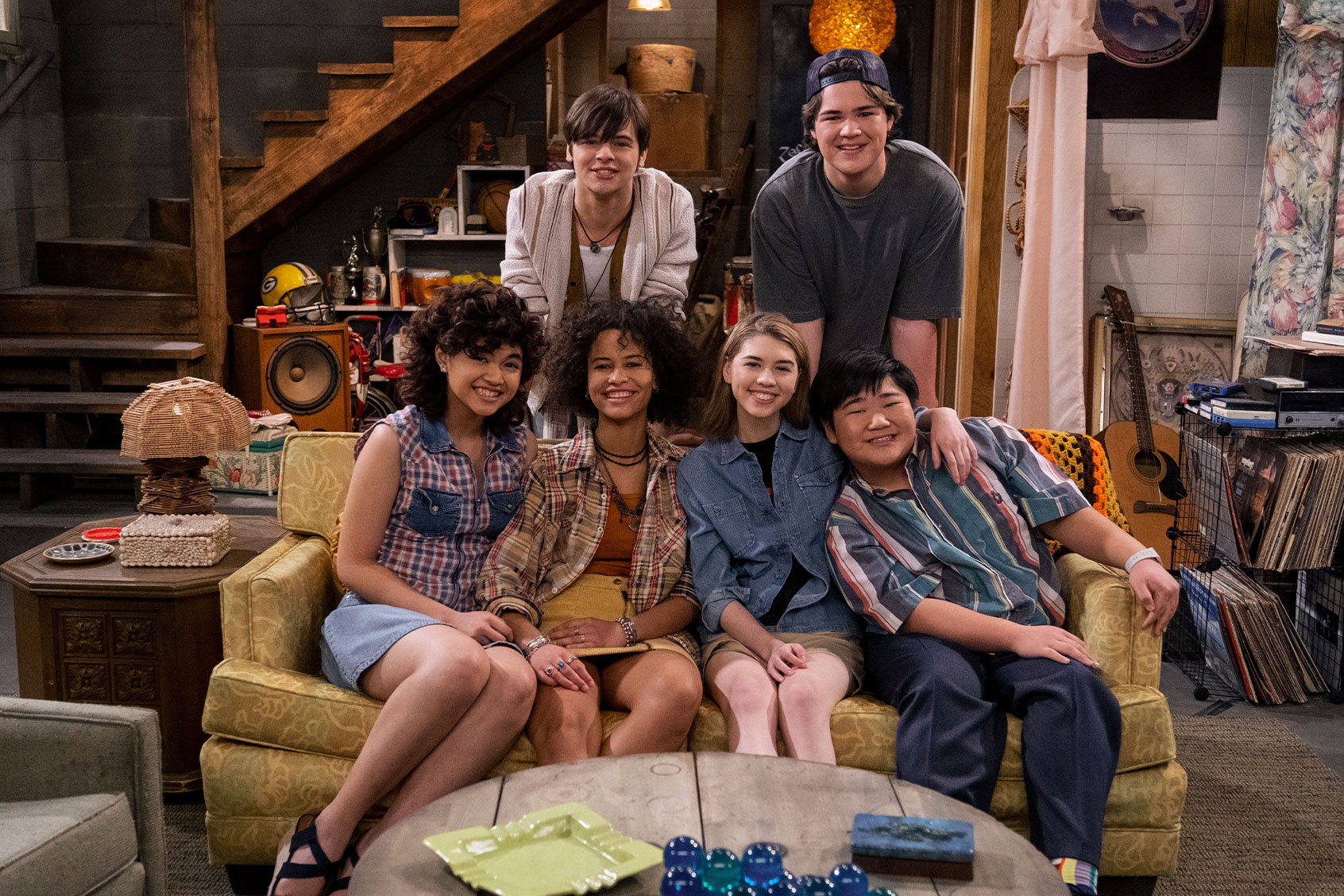
The Forman Basement has welcomed a new batch of cool kids in “That ’90s Show,” Netflix’s spinoff continuation of “That ’70s Show.” Set 15 years after the events of “That ’70s Show,” the comedy series features plenty of new faces and several familiar faces, albeit mainly for brief cameos.

Red and Kitty Forman (Kurtwood Smith and Debra Jo Rupp), who anchored “That ’70s Show,” are back and reprising their roles as the host of the teens’ favorite hangout spot. While Red is as grouchy and forbidding as ever, Kitty is the warm presence that makes the Forman home so inviting. This time around, the pair is welcoming their granddaughter Leia Forman (Callie Haverda) to stay for the summer, which also brings the return of her parents Eric Forman and Donna Pinciotti (Topher Grace and Laura Prepon) in the first episode when they drop her off.

Among the original crew of friends, we briefly see Michael Kelso and Jackie Burkhart (Ashton Kutcher and Mila Kunis), the now married couple who are also married in real life. There’s also their foreign exchange student pal Fez (Wilmer Valderrama) who is now running a hair salon called ‘Chez Fez’ and dating Sherri Runck (Andrea Anders), the Formans’ new next-door neighbor and the mother of Gwen and Nate Runck (Ashley Aufderheide and Maxwell Acee Donovan). We even get a glimpse of Donna’s dad Bob Pinciotti (Don Stark) who wants to impress his granddaughter Leia, and  frequent “That ’70s Show” guest star Tommy Chong, who makes an appearance in the third episode as aging hippie and stoner Leo.

That '90s ShowThat ’90s Show (Photo courtesy of Netflix)With so many of the original stars back, it’s easy to overlook the ones who are missing. Here’s a look at who didn’t return to Point Place and why:

Steven Hyde (Danny Masterson)

Their run on “That ’70s Show”: The foster son of Red and Kitty Forman, Steven Hyde is a sarcastic loner who is best friends with his later foster-brother Eric Forman, despite being polar opposites. Similar to many teenagers growing up in the ’70s, Hyde is skeptical of the government and authority, often doing drugs or partaking in underage drinking as forms of rebellion. Hyde is initially the more “street smart” member of the friend group but over time, he becomes the intelligent yet compassionate “tough guy” who harbors a deep love for his ex-girlfriend Jackie Burkhart.

Danny MastersonDanny Masterson (Getty/Anna Webber)

Why they’re not back: In 2020, Masterson was embroiled in his own legal troubles after being charged with forcibly raping three women in separate incidents between 2001 and 2003. The actor pleaded not guilty to all the charges in January 2021 and stood trial in 2022. In December of that year, Masterson’s trial was declared a mistrial after the jury said they were unable to agree upon a verdict. A new trial date has been set for March 2023.  

Amid the allegations, Netflix fired Masterson from its original series “The Ranch,” which also starred Ashton Kutcher in a lead role and featured several “That ’70s Show” alumni, including Valderrama, Smith and Rupp. Per a statement published by HuffPost, Netflix announced that production for the eight-season show would resume in early 2018 without Masterson.  

In “That ’90s Show,” Hyde is not mentioned by any of the other characters — at least not in the first season. His absence is also not explained nor is it a major plot line.

Laurie Forman (Lisa Robin Kelly)

Their run on “That ’70s Show”: Laurie Forman is the older sister of Eric and a recurring antagonist on the show. She is an aimless college dropout who is best known for bullying her younger brother — much to her enjoyment — being Red’s favorite child and jeopardizing romantic relationships, mainly Jackie and Michael’s. At the end of Season 5, Laurie “married” Fez to help him avoid possible deportation, but their relationship was short-lived due to Laurie’s adultery. Laurie’s final appearance was in Season 6.

Laurie isn’t referred to by name on “That ’90s Show,” but Red acknowledges that Eric is his second child with Kitty.

Why they’re not back: In Season 6, due to her personal struggles with alcohol and substance abuse, Kelly was replaced by actor Christina Moore. In 2010, Kelly was arrested for a DUI and in 2012, she was arrested on several domestic violence charges. On June 23, 2013, she was arrested for a suspected DUI after failing a field-sobriety test. That same year, Kelly tragically passed away in her sleep, just a few days after checking into Pax Rehab House in Altadena, California. It was later revealed that her death was due to an accidental overdose.

Midge Pinciotti (Tanya Roberts)

Their run on “That ’70s Show”: Midge Pinciotti is the dim-witted yet caring stay-at-home mother of Donna Pinciotti. She was married to her high school sweetheart Bob and together, the pair lived next door to the Formans. In Point Place, Midge was best known for being a source of embarrassment to her daughter and, at one point, a sexual fantasy for Eric (Roberts was famously a cast member on “Charlie’s Angels”). Her tumultuous relationship with her more old-fashioned, traditional husband later led to Bob and Midge’s on-screen divorce and her leaving for California to pursue a career on Broadway.

Why they’re not back: Sadly, Roberts passed away on Jan. 5, 2021 from a urinary tract infection that spread to her kidney, gallbladder, liver and bloodstream. She was 71 years old.

Randy Pearson (Josh Meyers)

Their run on “That ’70s Show”: Introduced during the show’s eighth and final season, Randy Pearson is an avid music enthusiast who helps Steven run his record store and later, dates Donna. Interestingly, Randy was meant to replace both Eric Forman and Michael Kelso, as their respective actors chose to leave the show after Season 7. Randy’s personality is also a mesh of both Eric and Michael — he shares Eric’s sense of humor and is both good looking and successful with women, like Michael. 

Despite his relationship with Donna, Randy has never met Eric in person. The former, however, knows about the latter through his conversations with the crew.

Why they’re not back: Now that Eric and Donna are happily married, there seems to be no place for Randy in the spinoff. Some fans, however, proved otherwise, theorizing that Leia isn’t actually Eric’s daughter — but rather, Randy’s. Reddit user u/bored_bingewatcher noted that in Episode 6, Leia is seen celebrating her 15th birthday in 1995. This means that Leia would have to have been conceived in early 1980 or the end of 1979, almost immediately after Donna and Eric reunited in the “That ’70s Show” finale.

Meyers’ Randy is neither seen nor mentioned in “That ’90s Show.”

“That ’90s Show” is currently available for streaming on Netflix. Watch a trailer for it below, via YouTube:


An absolutely genius trick for mess-free bacon

Are you someone who goes hog wild for bacon?

Though you may have your own opinion about the most delicious way to make it, bacon’s versatility and popularity are both undeniable. Bacon can be enjoyed on its own at breakfast or as a topping at lunch, sending classics like burgers and sandwiches soaring to new heights. During the “bacon mania” of the 2010s, bacon wasn’t limited to the plate. Apparently, bacon can also elevate candlesdesserts, perfumes, T-shirts and more.

And while there may be differing thoughts on whether to season and spice up bacon, one thing about this iconic food holds true, no matter if it’s made from pork, beef or plants. After you cook bacon, the clean-up job can be a little tricky.

Bacon fat is a terrific “liquid gold” to hang on to (and coat roasted potatoes with or use as a base for this salmon chowder), but it can be a real nuisance if it isn’t handled properly or disposed of correctly. Luckily, I know an absolutely genius trick for mess-free bacon.

As I wrote in a recent article, I’m a proponent of lacquering bacon with the sweet-and-savory combo of maple syrup and white miso, which is the perfect complement to its salty, pork-y, smoky essence. Doing so can result in a bit of a messy sheet pan or baking sheet. However, if you use a silicon baking mat, parchment paper or foil, you can tamp down on the mess.

Don’t have any of these kitchen tools handy? No problem. Immediately after pulling your bacon out of the oven, allow it sit and cool for about five minutes. Using a fork or spatula, transfer it off the sheet, leaving the bacon grease and miso-and-maple remnants on your sheet tray. Wait another five to 10 minutes, or until it begins to slightly solidify, then immediately transfer to a glass or Mason jar.

I’m a proponent of lacquering bacon with the sweet-and-savory combo of maple syrup and white miso, which is the perfect complement to its salty, pork-y, smoky essence.

From there, add hot soap and water to the sheet pan — and you’re good to go. You can dispose of the solids when they’re fully solidified, or conversely, use the maple-and-miso flavored bacon fat as a cooking fat. (Just be sure not to pour it down the sink.)

Be mindful that without a little care, the maple and miso coating might burn when you recook it. If you’re not a fan of extra seasonings, and you’ve simply made nothing but bacon in your sheet pan, feel free to use the leftover fat as you wish. Pure bacon fat is much more easily usable than bacon fat with maple or miso remnants.

Another idea would be to take a sheet tray, line it with parchment and place a rack on top, where you’ll lay the bacon. Washing the wire rack is a bit trickier, but the sheet tray itself will benefit from a super-easy cleanup. Simply throw out the parchment, and you’re all set. This also helps ensure that your bacon is as “‘lean” as it can be (is that an oxymoron?), as the bulk of the fat will drip through and wind up on the parchment-lined sheet tray instead of your plate.


Want more great food writing and recipes? Subscribe to Salon Food’s newsletter, The Bite.


One very important note: Do not drain your bacon on napkins, paper towels and/or paper plates. I made this mistake a few times back in the day, and it’s laborious and unpleasant, resulting in crispy, delicious bacon being hamstrung by pieces of paper towel that feel impossible to remove.

Avoid this mistake altogether by “draining” your bacon on a wire rack affixed atop a sheet tray or simply letting it cool on a glass or ceramic plate. From there, “dab” the bacon ever so slightly with a rolled-up paper towel to pick up and remove any extraneous fat or grease.

Now, you can have crisp, super-flavorful bacon that is well-cooked, a sheet rack that won’t intimidate you as it sits in the sink waiting for a wash, as well as a tidy oven. Depending on how you proceed with the solidified bacon fat, there may also be an outrageously delicious dip, soup or pasta on the horizon later in the evening. After all, it always feels good to set yourself up for success in the kitchen.

Salon Food writes about stuff we think you’ll like. While our editorial team independently selected these products, Salon has affiliate partnerships, so making a purchase through our links may earn us a commission.

Experts: GOP’s 30% federal sales tax plan is “one of the most regressive proposals in a generation”

A House GOP proposal to repeal all federal income taxes—including levies on corporations and the rich—and replace them with a whopping 30% national sales tax is drawing increasingly vocal backlash from economists, tax policy experts, and Democratic lawmakers who say the plan is yet another Republican ploy to reward the wealthy at everyone else’s expense

Unveiled earlier this month by Rep. Buddy Carter, R-Ga., the Fair Tax Act is hardly a novel piece of legislation. As Steve Wamhoff of the Institute on Taxation and Economic Policy noted in a recent blog post, the bill has its origins in a proposal “initially pitched by an organization created by the Church of Scientology during its dispute with the IRS over whether it constituted a church and was thus tax-exempt.”

“The Church of Scientology’s only goal in the matter was to eliminate the agency causing it trouble, and lost interest once the IRS threw in the towel and allowed it to present itself as a church,” Wamhoff explained. “But by then several politicians had bought into the idea and introduced it as legislation, which has been reintroduced in each Congress since as the Fair Tax.”

Carter’s legislation, which currently has nearly two dozen House GOP co-sponsors, would abolish the IRS—a major gift to wealthy tax cheats—and eliminate the payroll taxes that finance Medicare and Social Security. The bill would also nix the individual income tax, the corporate income tax, the estate tax, and other taxes, establishing in their place a sales tax of 30% for calendar year 2023.

“The GOP’s so-called ‘Fair Tax’ proposal is one of the most regressive proposals in a generation, imposing a 30% federal sales tax on everything Americans buy from gas to food,” said former U.S. Labor Secretary Robert Reich. “There’s nothing ‘fair’ about it. It would punish the poor and middle class while helping the rich.”

In an attempt to offset the inherent regressivity of the sales tax, Carter’s bill would send most U.S. households a monthly “prebate” to help families cover the costs of basic necessities—effectively replacing the Earned Income Tax Credit, the Child Tax Credit, and other existing tax benefits that the measure would eliminate.

But Wamhoff argued the prebates would not be “nearly enough to offset the financial hit most Americans would face from the new national sales tax.”

“Back in 2004, ITEP estimated that if the Fair Tax was enacted and the national sales tax rate was set at 45%, the poorest 80% of Americans would face net tax hikes from the proposal while most of those among the richest 20% would enjoy net tax cuts,” Wamhoff wrote. “ITEP plans to re-estimate the proposal because a great deal has changed since 2004.”

In a detailed video analysis of the “Fair Tax” plan, Matt Bruenig of the People’s Policy Project estimated that the poorest 20% of the U.S. public would pay roughly 70% of their income in taxes as a result of the bill’s levy on consumption.

Democratic lawmakers and President Joe Biden have wasted no time seizing on the tax proposal as further evidence of the Republican Party’s commitment to delivering huge windfalls to the rich.

“The GOP wants to scrap the income tax and replace it with a 30% sales tax,” tweeted Rep. Pramila Jayapal, D-Wash., the chair of the Congressional Progressive Caucus. “In WA State, where we have no income tax and rely on sales and excise taxes, the poorest families spend 17% of their income on taxes. The wealthiest spend 3%. This effort is a tax cut for the rich, period.”

Sen. Jeff Merkley, D-Ore., quipped on Wednesday that “it really must be Opposite Day if Republicans are claiming that a national 30% sales tax is ‘fair.'”

“In what world is it fair to slam working families with huge tax increases, while giving tax breaks to the mega-rich?” Merkley asked.

On Thursday afternoon, Biden is expected to attack the GOP tax proposal as well as the Republican push to cut Social Security and Medicare in a speech at a steamfitters union hall in Springfield, Virginia.

“The president will outline the biggest threat to our economic progress: House Republicans’ MAGA economic plan,” an unnamed White House official told Reuters ahead of the address.

With Democrats in control of the Senate and the White House, the Fair Tax Act has no chance of becoming law, and Rep. Kevin McCarthy, R-Calif., only agreed to allow hearings on the legislation as part of the speakership deal he struck with far-right GOP holdouts.

But progressives argued the proposal offers a telling glimpse into the Republican Party’s extreme economic priorities at a time of skyrocketing inequalitylarge-scale corporate tax avoidance, and economic hardship for poor and middle-class households.

“MAGA extremists are testing the waters to see how far they can go in their backwards economic agenda written by and for wealthy special interests—starting with a staggering 30% tax hike on the middle class with a national sales tax that would immediately make necessities unaffordable while letting greedy corporations off scot-free from any tax responsibility,” Liz Zelnick, director of the Economic Security and Corporate Power program at Accountable.US, said in a statement Thursday.

“That’s only the beginning,” Zelnick continued. “A growing chorus in the Republican House caucus is scheming to sabotage the economy and the U.S. government’s full faith and credit unless they get deep cuts to Social Security and Medicare benefits that keep millions of Americans out of poverty and in better health.”

“When MAGA extremists openly threaten to push the economy off the cliff unless they can further enrich billionaires and big corporations at the expense of everyone else,” she added, “believe them.”

School administrators ignored warnings that 6-year-old had a gun before he shot teacher: report

The first-grade teacher who was shot by one of her own students now plans to sue the school for ignoring the obvious warnings from the student, according to NBC Nightly News.

Teacher Abigail Zwerner says that she went to school officials in Newport News earlier to report that the same student who would go on to shoot her had threatened to physically assault another student.

“This entire situation was completely avoidable if the school administrators responsible for school safety had done their part,” said Diane Toscano, attorney for Zwerner.

School administrators were given a warning about the student, who also threatened another student after showing them a gun in their backpack. Another teacher told administrators about the threat and asked to search the student, but their efforts were denied.

In the hours before Zwerner was shot, her nerve about the student threat increased, even texting relatives about the troubled student and his threats that were not being addressed by school officials.

The superintendent of the Newport News School District, Dr. George Parker III, has been forced out of his position due to his lack of response to the emergency.

Millennial moms and dads are consciously striving to parent differently than Boomers, study finds

It is only human nature for the younger generation of parents to strive to parent differently than their own parents. Parenting is a journey that inherently calls us to compare and contrast observations from our own childhood. But as more millennials are having kids, they’re making more of an emphasis on parenting very differently than their parents — who typically Baby Boomers — parented them.

On Thursday, Pew Research published a new study on parental attitudes that had some eyebrow-raising revelations about how different the two connected generations are. In it, they surveyed over 3,700 parents of children under the age of 18; while the ages of all of the survey’s participants weren’t disclosed, many of them were in their late 20s, 30s and 40s—many children of Boomers.

“Both groups of parents talked about the importance of having family dinners, supporting their children in their extracurricular activities, and generally spending time with them on a regular basis.”

In the survey, nearly as many American parents, 43 percent, said they are raising their children similarly to how they were raised. Yet 44 percent said they were trying to take a different approach than their parents.

How exactly are the two generations going about it differently? When asked in an open-ended question to describe the specific ways in which those who are raising their kids differently than their own did, a common theme emerged: being an “involved parent.”

“Among those who say they’re taking a different approach to parenting, some said they want to be more present in their kids’ day-to-day lives than their parents were,” Pew Research explained. “Both groups of parents talked about the importance of having family dinners, supporting their children in their extracurricular activities, and generally spending time with them on a regular basis.”

Parents who want to raise their children differently from their parents also said they wanted to have better communication with their children, not yell at them, and listen more.

“I am trying to be more attentive to my children than my father was,” one 35-year-old dad said in the survey. “Raising with more direct interaction and more forward-thinking and understanding nature.” A 33-year-old mother said: “I want my children to know that a parent is supposed to be there for them 100% of the time, not just when it’s convenient.” A 39-year-old mother said it was important for her child to have an emotional connection with her, and that their child has “more room to express feelings.”


Want more health and science stories in your inbox? Subscribe to Salon’s weekly newsletter The Vulgar Scientist.


Nearly one in 10 parents surveyed said they would not use corporal punishment when disciplining their children.

As Dr. Harvey Karp (a Baby Boomer himself), pediatrician and Founder & CEO of Happiest Baby, told Salon last year, the focus on emotions among millennial parents is one big difference he’s noticed between how the two generations parent.

“Forty years ago, more parents were still being verbally tough with their kids, saying ‘Don’t be a baby,’ ‘You shouldn’t be scared,’ and denying their feelings,” Karp said. “And that’s something we’ve learned not to do.”

In highlighting the generational divide, parental shaming came up in the survey four-in-ten or more parents said they feel judged by their own parents and their spouse or partner’s parents at least sometimes.”Parents are more likely to say they feel judged by family members than by their friends, other parents in their community or people they interact with online,” Pew Research stated.

Notably, only one-fifth of the parents surveyed in the study said it was important to them that their children get married and have a family of their own one day. Perhaps it’s because about four-in-ten parents surveyed said being a parent is tiring; 29 percent of parents said they are stressed and tired most of the time.

Aside from the emphasis on generational differences, when asked what parents’ greatest fears are for their children today, four in ten parents surveyed said that their children might struggle with anxiety or depression one day, followed by 35 percent who were concerned about their children being bullied.

Mothers surveyed were more likely to be preoccupied by these fears than fathers. Nearly half of mothers said they were extremely or very worried their children could struggle with anxiety or depression at some point, compared with 32 percent of fathers. Mothers are also more likely than fathers to say they are worried about their children being bullied, being kidnapped or abducted, or getting shot, piling on the evidence on how it’s one of the toughest times to be a mom in America.

How pistachio became the new “it flavor” of early winter

If you visit a coffee shop right now, I almost guarantee there is a pistachio-flavored drink on the menu. 

That’s been the case at Starbucks for four years, since launching the original pistachio latte in 2019. This winter, the global coffee chain announced their seasonal menu “featuring the return of the fan-favorite Pistachio Latte and the new Pistachio Cream Cold Brew.”

“The new handcrafted Starbucks Pistachio Cream Cold Brew features Starbucks Cold Brew sweetened with vanilla syrup and is topped with silky pistachio cream cold foam and salted brown-buttery sprinkles,” the news release said. “The Pistachio Cream Cold Brew builds on customers’ love of the Pistachio Latte and the popularity of cold coffee year-round.”

Rosalyn Batingan, a member of the Starbucks beverage team, wrote for the company that “pistachio is the perfect flavor to follow the holidays and carry us through the winter season” — and other brands certainly seem to agree. From local coffee shops to flavor-makers to perfume companies, pistachio has morphed into an early winter “it flavor.”

I’m delighted by the development. I tried the Starbucks drinks and enjoyed both; the nuttiness was there, but it was subtle and there was no overt sweetness, so anyone who is especially spooked of saccharine coffees need not be alarmed. The foam itself was nuanced but rich and I thought the more reserved flavors really elevated the drinks.

But my interest in the rise of pistachio is a little more personal, too. 

While to me, shelling pistachios always felt like a bit of a laborious process — and so they were never my favorite snack — for as long as I can remember, my dad was obsessed with pistachios. On every holiday or birthday, he’d wind up being given multiple bags of the nut. He would eat them while watching TV, while sitting at the table, while doing paperwork and so on. I distinctly recall certain instances in which he would drive, nonchalantly munching on pistachios, mindlessly chucking the shells out the windows.

For whatever reason, in the United States, nuts like almonds, hazelnuts, peanuts, pecans and walnuts seem to attract more “attention” than pistachios. But to my dad, pistachios held the spotlight. 

Lately, however, there seems to have been a shift. Never did I think to connect “pistachio” with “winter” — but as evidenced by the scads of companies now offering pistachio flavored and scented products this January, there seems to be a growing subsection of people doing just that. This caused me to ask: is pistachio the new, seasonal flavor of winter?


Want more great food writing and recipes? Subscribe to Salon Food’s newsletter, The Bite.


Pistachio’s current ascendancy isn’t entirely unexpected, though; in 2015, Eater reported that “Bartenders Across the Country are Going Nuts Over Pistachio Cocktails

At the time, multiple bars had begun incorporating pistachio flavor into their cocktails. At Gunshow in Atlanta, “cocktail conductor Mercedes O’Brien turned her favorite pistachio strawberry pastry into a fun Boulevardier,” while AOC in Los Angeles, helmed by Christiaan Rollich, uses “pistachio syrup [to provide] the body and balance to the sour mix of absinthe, Green Chartreuse, and lime.” NYC’s Booker and Dax “creates a frothy texture when shaken [by bartender Dee Ann Quinones] … extracted the pistachio nut milk,” resulting in a “creamy pistachio flavor and texture.” Also in New York City, Mace’s Nico de Soto offers a cocktail with pistachio oil-washed vodka, espresso, and cardamom syrup in order to capture the flavors of “Turkish coffee with baklava.”

In the ensuing years, pistachio’s popularity has continued to grow. 

“Since launching the brand’s pistachio syrup in April 2018 ‘sales have grown by double digits every year. In general, pistachio benefits from its familiarity and affinity. ‘”

According to Andrea Ramirez, the manager of consumer and customer market insight at Torani, since launching the brand’s pistachio syrup in April 2018 “sales have grown by double digits every year. In general, pistachio benefits from its familiarity and affinity. It has wide consumer recognition (94% of consumers know it and 80% have tried it) and 68% like it or love it.”

She described the flavor by saying that it has “an inherent familiarity.” 

“It’s the kind of flavor of pistachio you might find in a pistachio cream puff,” Ramirez said. “It’s got a hint of marzipan-like nuttiness, and [a] sweet fragrance that’s both novel and familiar. It’s a flavor that pairs very nicely with Chocolate and Caramel.”

According to Ramirez, pistachios have come a long way over the years. For a long time, they were only available in-shell and when they were served at restaurants, they were available in specific contexts like “baklava in a Middle Eastern or Mediterranean restaurant, or maybe in the Spumoni ice cream or cannoli at an Italian restaurant.”

Now, though, we have mainstream access to pistachio as a flavor, primarily in drinks, Ramirez said. 

This point was echoed by Kristen Wemer, the chief technical officer at Flavorman — a food and beverage consultancy based in Louisville, Ky. — who said that pistachio flavoring is “one of those flavors that’s ‘new’ to specific categories, but still familiar to the public’s palate…what’s exciting is using the flavor in new applications, especially lattes and cocktails.” 

Colectivo Coffee Roasters — which has numerous locations in Madison, Milwaukee and Chicago — is one of the companies that is applying pistachio flavor in this new format, specifically in their pistachio matcha latte. 

“I’d describe this drink as a sweetened, nutty, matcha drink,” Emma Cowen, the company’s beverage category manager, told Salon Food. “The flavor profile is really well balanced with sweetness and earthy notes, like fresh cut grass and vanilla. It reminds me of green tea flavored mochi! It’s a treat for the everyday matcha drinker, and a fun one for coffee lovers to try to expand their horizons.”

She continued: “I think pistachio and matcha pair really well together because of their subtle earthy notes. The drink is sweetened with a little white chocolate which brings the whole thing together.”

Cowen categorizes pistachio as “the new hazelnut” in terms of its popularity, as it exists at an ideal intersection of familiarity and novelty. 

Cowen categorizes pistachio as “the new hazelnut” in terms of its popularity, as it exists at an ideal intersection of familiarity and novelty. That popularity extends beyond the world of food and drink, too. 

D.S. & Durga — a Brooklyn-based, husband-and-wife helmed company that makes “immersive fragrances” — is one of these companies. (Side note: I’m a frequent customer, who loves their candles.) An Instagram post announcing the return says that the “cult classic” pistachio product is “back by popular demand” and “joining the line full time.”

As noted by the Pistachio perfume product page, the top notes are pistachio and cardamom, the “heart notes” are “more pistachio and roasted almond,” while the base notes are “even more pistachio, patchouli, and vanilla creme.” Elsewhere on the page, the company notes “I think pistachio is an elegant nut. Also a fun nut. It’s around good climes (sic) and everyone seems to dig it. We made this on a whim; a fragrance with no story that just evokes the fun of pistachio (especially as a dessert flavor). It was a STUDIO JUICE (limited edition of 100 bottles). People went nuts for the concept (pun somewhat intended) and we knew we had to add it to the line. It’s dank & unabashedly sweet which is something I don’t normally do.” 

The perfume is also getting some top-tier ratings and reviews on the Reddit page  r/fragrance.

Clearly, what may have once been deemed a relatively quiet nut has clearly found its “voice.”  Perhaps, as Perfectly Daily Grind notes, a pistachio “milk” (in the vein of almond or oat milk) might even be next on the horizon?

No matter what it is about pistachio that is causing people to now flock to it, it’s great to see a sudden resurgence of appreciation for the flavor, which was once relegated to merely artificially-colored and flavored ice cream that was, as far as I’m aware, never a flavor that particularly elicited hordes of raving fans.

But now things have changed. I think my dad would be happy about that. 

Is Veganuary bad for you? A nutritionist explains why plant-based diets need proper planning

Veganuary is upon us again, with thousands of people around the world giving up animal products for the month of January. The movement, which encourages people to follow a vegan lifestyle, started in 2014 and has grown rapidly since, with 629,000 people from 228 countries taking part in 2022.

When it comes to internet searches, figures for 2020 show that the U.K. had the most Google searches for veganism in the world. In 2019, there were 600,000 vegans in the U.K. And, according to the Vegan Society, this number is expected to continue to rise, with vegans and vegetarians predicted to make up a quarter of the British population by 2025.

Of course, veganism and vegetarianism originated long before westernized veganism became popular. Vegetarianism was practiced as early as the fifth century B.C. in India, and it is strongly linked with a number of religious traditions worldwide, such as Hinduism, Jainism, Buddhism and Sikhism. And tofu, a well-recognized alternative to meat, originated in China more than 2,000 years ago.

When it comes to vegetarianism and veganism, the basic principles are similar; both involve eating plant-based food for environmental, ethical, health or religious reasons. But while vegetarians mainly just exclude meat, vegans follow a much more restrictive diet, excluding all animal products, as well as any animal-derived foods, such as milk, eggs and honey.

Pros of veganism

There are several benefits attributed to a vegan diet, as long as it is carried out properly. It can help people lose weight, and as with a vegetarian diet, has been linked with a reduced risk of heart disease and certain cancers, such as colon and breast cancer.

A recent study looking at the effects of a vegan diet in people with or at risk of developing Type 2 diabetes, found that a plant-based diet may help to control blood glucose levels.

Vegan diets can also be high in iron, though the form of iron from plants is not as “bioavailable” as the iron in meat, which means the body does not absorb it as efficiently as the iron found in animal products. However, this intake can be boosted by combining plant-based iron with foods rich in vitamin C – such as oranges, tomatoes and peppers – because vitamin C helps the body absorb iron better.

And the cons

On the flip side, becoming a vegan does not automatically guarantee good health. You could, for example, eat chips for every meal, and while you would qualify as a vegan, you wouldn’t necessarily be doing your body any favors. Along with the growth in veganism has come an increase in vegan-friendly ready meals — and these have additional salt, sugar and fat to improve their taste. Processed foods commonly include trans fats and emulsifiers, which can harm beneficial gut bacteria.

Poorly planned vegan diets may not provide enough niacin, riboflavin (vitamin B2), vitamin D, calcium, iodine, selenium or zinc, all of which are important for maintaining good health. Vegans can be at a greater risk of becoming anemic because of the lack of vitamin B12 and omega-3, which can cause fatigue and the inability to concentrate, especially in young people. There is also an association between veganism and lower bone density, which can lead to an increased risk of fractures.

If you did want to change what you’re eating but don’t want to go the vegan way, the Mediterranean diet is classed as one of the healthiest in the world. Think lots of vegetables, fruit, beans, lentils, nuts, olive oil, wholewheat bread, brown rice and fish. This diet does not eliminate meat but limits the intake.

There is growing evidence that following a Mediterranean diet is associated with good overall health and can help in protection against cardiovascular diseases, diabetes, high blood pressure and obesity. There is also evidence that it has a role in reducing the risk of certain cancers. And it has been linked to a lower risk of cognitive decline and depression.

What’s right for you

So to Veganuary or not? While eating less meat — especially processed meat — is good for your health, going vegan isn’t the only way to do it. As a nutritionist, I think that rather than fixating on one particular way of eating, it’s better instead to consume a healthy and varied diet.

Indeed, everyone needs to understand what they are eating to ensure a balanced intake, with the correct quantities of protein, carbohydrates, fats, vitamins and minerals. This is especially the case given that diet-related health concerns are on the increase around the globe.

So, if you are considering taking up Veganuary, you need to be aware of the potential dietary deficiencies. It will also be necessary to take supplements such as B12.

Ultimately, veganism is a lifestyle rather than just a diet, so changing to a vegan way of eating requires long-term commitment and planning. It has to be carefully looked into and carried out in an educated way to ensure you are getting all the nutrients needed to maintain a healthy life.

Hazel Flight, Programme Lead Nutrition and Health, Edge Hill University

This article is republished from The Conversation under a Creative Commons license. Read the original article.

McCarthy fumes at journalists: “You don’t get to determine whether I answer a question or not”

House Speaker Kevin McCarthy, R-Calif., snapped at reporters on Tuesday while answering questions about committee assignments for lawmakers in the 118th Congress.

Journalists were seeking clarification about who will serve on the House Intelligence Committee. McCarthy confirmed that Democratic California Congressmen Adam Schiff and Eric Swalwell will not be on Intelligence and noted that embattled Representative George Santos, R-N.Y., will be placed elsewhere.

“Intel Committee? Is Santos on the Intel Committee? Am I allowing Schiff — am I allowing Schiff to be on other committees? Go right ahead,” said McCarthy.

That prompted a journalist to press McCarthy on what he believes is acceptable behavior:

Because you have direct power over who goes on the Intelligence Committee. You also will be able to create for your full House taking off other Democrats, perhaps Representative [Ilhan] Omar [D-Minn]. But you said that lying to us is something that means you should be removed from the Intelligence Committee, but why is it not a factor in making a statement that this is a man who should not be on committees, something you have power over?

McCarthy defended Santos: “Well, let me be very clear. He’s gotten elected by his district.

The reporter replied, “that doesn’t answer my question. Why does lying…”

McCarthy cut her off and lost his cool:

Okay. Let me be very clear and respectful to you. You asked me a question. When I answer it, it’s the answer to your question. You don’t get to determine whether I answer your question or not, okay? In all respect, thank you. No, no, let’s answer her question. You just raised the question. I’m going to be very clear with you.

The Intel Committee is different. You know why? Because what happens in the Intel Committee you don’t know. What happens in the Intel Committee, although the secrets are going on in the world, other members of Congress don’t know. What did Adam Schiff do as the chairman of the Intel Committee? What Adam Schiff did, use his power as a chairman and lie to the American public. Even the Inspector General said it. When [ex-Congressman] Devin Nunes, [R-Calif.,] put out a memo, he said it was false. When we had a laptop, he used it before an election to be politics and say that it was false and said it was the Russians when he knew different, when he knew the intel. If you talk to John Radcliffe, DNI, he came out ahead of time and says there’s no intel to prove that. And he used his position as chairman knowing he has information the rest of America does not and lied to the American public. When a whistleblower came forward. He said he did not know the individual even though his staff had met with him and set it up.

So, no, he does not have a right to sit on that. But I will not be like Democrats and play politics with these where they removed Republicans from committees and all committees. So, yes, he can serve on a committee, but he will not serve on Intel because it goes to the national security of America, and I will always put them first. All right. And if you want to talk about Swalwell, let’s talk about Swalwell, because you have not had the briefing that I had. I had the briefing, and [former Speaker] Nancy Pelosi [D-Calif.] had the briefing from the FBI. The FBI never came before this Congress to tell the leadership of this Congress that Eric Swalwell had a problem with a Chinese spy until he served on Intel. So it wasn’t just us who were concerned about the FBI was concerned about putting a member of Congress on the Intel Committee that has the right to see things that others don’t because of his knowledge and relationship with the Chinese spy. They brought it to the works of the leaders. I’ve got that briefing. So I do not believe he should sit on there, that committee. And I believe there’s 200 other Democrats that can serve on that committee.

So this has nothing to do with Santos. Santos is not on the Intel Committee. But you know what? Those voters elected Schiff even though he lied. Those voters elected Swalwell even though he lied to the American public too. So you know what? I’ll respect his voters too. And they’ll serve on committees, but they will not serve on a place that has national security reverence. Because integrity matters to me. That’s the answer to your question.

Watch below or at this link.

“Hyperbolic hypocrites”: Republicans blasted for double standard on Biden and Pence documents

Several congressional Republicans are swiftly moving past Tuesday’s news that classified documents were discovered in former Vice President Mike Pence’s Indiana home, but still suggest there is something more suspicious about the documents found at President Joe Biden’s home and former office.

In a letter to the National Archives, Pence’s lawyer Greg Jacobs wrote that there were a small number of classified documents that were “inadvertently boxed and transported to the personal home” after Pence’s term ended in January 2020. 

Outside counsel “with experience in handling classified documents” were hired to conduct the search, which Jacobs says was performed “out of an abundance of caution” after Biden’s home was searched. 

Some GOP lawmakers have appeared to be more sympathetic to Pence while criticizing Biden. 

While appearing on Fox Business on Tuesday, Sen. Ted Cruz, R-Texas, said Biden’s situation was “just a mess.”

“It is incompetent. It is corrupt,” Cruz said. “That is an enormous political problem for the Biden White House.”

However, when he was asked about Pence just moments later, Cruz said that the former Republican vice president is “a good man” and that his collection of classified documents was simply “a mistake.”

House Republican Conference chairwoman Rep. Elise Stefanik, R-N.Y., was also quick to distinguish the two cases during a Wednesday news conference.

“In the case of Vice President Mike Pence, he came forward and proactively reached out and is following the process,” she said. “In the case of Joe Biden, he has had classified documents going back to his time in the Senate, where he started serving before I was born. So this is a longstanding national security threat.”

Stefanik also shared her concern that Biden’s son may have had access to the documents, claiming it was a “very important fact that Hunter Biden also had access and used as his home address where those classified documents were improperly and illegally stored.”

Other Republicans, who have defended Trump for his hoarding of over hundreds of classified documents in his Mar-a-Lago home, have condemned Biden for keeping documents from his Senate tenure.

“I do not understand how a U.S. senator can take a classified document out of a SCIF [sensitive compartmented information facility] if they’re not stuffing it in their pants or somewhere else,” House Speaker Kevin McCarthy, R-Calif., told reporters Tuesday.

Cruz also called for the FBI to search Hunter Biden’s homes and offices to check for more classified documents.

“If these classified materials in particular implicate Burisma, Ukraine, Communist China, payments going to Hunter Biden or Joe Biden’s brother or the Biden family, then this shifts from a political problem to a very serious problem of criminal liability and major crimes,” Cruz said on Fox Business.

A Senate investigation led by Republicans in 2020 found no evidence of wrongdoing by Joe or Hunter Biden regarding the latter’s work with Burisma Holdings, a private natural gas company in Ukraine.

Cruz and Stefanik have been blasted for their reactions to the two situations, with many critics pointing out the hypocrisy of their statements. 


Want a daily wrap-up of all the news and commentary Salon has to offer? Subscribe to our morning newsletter, Crash Course.


When asked about Pence in his Fox Business interview, Cruz immediately said the story is “still early” and that it is “very different from what Joe Biden has done.” Twitter users immediately criticized these remarks.

“Like so many in the @GOP, @SenTedCruz will completely ignore their own party members’ actions while attacking the actions of others. Cowards and hypocrites is all you get with conservatives,” one user said.

Former Biden staffer Chris Strider tweeted that “Ted Cruz is/was/will always be a joke,” and another user called him a “hyperbolic hypocrite.”

“It’s like ‘hypocrisy’ punches him square in the face and Ted simply responds with ‘thank you sir, may I have some more?'” Myles Davies wrote.

“Can I just say again that Ted Cruz sucks?” tweeted former Republican Congressman Joe Walsh. “He doesn’t have the honesty, the decency nor the fair-mindedness to simply say ‘It was wrong for Biden to have classified docs at home, and it was wrong for Pence to have classified docs at home’ and leave it at that.”

Other observers labeled Stefanik’s statements during her press conference “soulless” and “shameful.” 

“These people are unbelievable,” replied one user. “How do they not smell what they’re shoveling?”

However, not all Republicans were ready to dismiss Pence’s handling of classified information.

“It is a serious matter for any government official to mishandle classified documents,” tweeted Rep. Mike Turner, R-Ohio, chairman of the House Intelligence Committee. “I plan to ask for the same intelligence review and damage assessment to see if there are any national security concerns.”

Sen. Lindsey Graham, R-S.C., wrote in a tweet that he doesn’t believe Biden, Trump or Pence had any “sinister motives,” but added that “we have a classified information problem which needs to be fixed.”

Rep. Jamie Raskin, D-Md., the top Democrat on the Republican-led House Oversight Committee that is investigating Biden’s handling of classified documents, aired out his frustrations with GOP lawmakers in a statement on Tuesday.

According to Raskin, Republicans’ “glaring failure to acknowledge that former President Trump refused to cooperate with the government and continually rebuffed calls to turn over thousands of presidential records and hundreds of classified documents” shows that they are “simply not serious about” preserving and protecting presidential records and classified information.

Proud Boys charged over Jan. 6 attack “intend to subpoena Trump as a witness at trial”: report

Members of the Proud Boys are reportedly telling former President Donald Trump to stand back and stand by for a subpoena.

According to New York Times reported Alan Feuer, members of the Proud Boys who have been accused by the government of engaging in a seditious conspiracy are saying they “intend to subpoena Donald Trump as a witness at the trial.”

Although it’s not clear why members of the gang would want Trump to testify on their behalf, many other January 6th defendants have argued that broke into the Capitol and violently clashed with police officers because it was what the former president wanted them to do.

Feuer, however, expresses skepticism that the defendants will really be able to compel Trump’s testimony.

“That hasn’t flown with judges in other J6 cases so we’ll see where it goes,” he said of past efforts to score Trump as a witness. “An Ohio exterminator tried to subpoena Trump at his own trial last year. The judge shut it down.”

The Proud Boys members are under increased pressure after the government earlier this week won seditious conspiracy convictions against four more members of the Oath Keepers militia, whom prosecutors argued engaged in a plot to block the peaceful transition of power to keep Trump in the White House.

“Would make Alex Jones blush”: GOPer says land conservation is a plot to “control” and “kill” people

Rep. Harriet Hageman, R-Wyo., spewed conspiracy theories about an environmental plan to conserve 30% of US land and waters by 2030 ahead of her election last year.

Speaking at R-CALF, a convention for independent cattle producers, Hageman in August 2021 and 2022 baselessly claimed that conservation plans like the global initiative 30×30 are a government plot led by President Joe Biden to control Americans through starvation. 

The congresswoman likened the environmental plans to African dictators starving their people to stay in power.

“Anytime their dictator needed to control the masses and needed to make sure that there would be no uprising, he just starves his people,” Hageman said in the previously unreported video. “You can look at Somalia, you can look at the Congo, you can look at country after country after country after country, and what they’ve done is they control their people with food. That’s what 30 x 30 is about. That’s what the Green New Deal is about.”

The-then candidate’s statements are similar to a number of anti-government conspiracy theories shared by anti-public land extremists. Many of these conspiracy theorists have also equated 30×30 with the Holocaust and Stalin’s genocide of Ukrainians in the 1930s.

“History repeats, and I think it’s being done again,” said one 30×30 conspiracy theorist on Facebook. “They did the very same thing in Ukraine, and they intend to do it to us.”

In another video, Hageman claimed that 30×30 is the first step towards government-led “starvation” in order to “control” citizens.

“Whenever those leaders want to control the masses, they starve them. They kill them. And that’s how they keep control. And that’s where the 30 x 30 program is headed,” she claimed.

“We need to stop looking at this as preserving the environment,” she added. “We need to stop talking about protecting water and natural resources. That isn’t what it’s about, it’s about control. It’s about control of you.”

This is not the first, or second, time that Hageman has boosted conspiracy theories: she has a long history of espousing misinformation and fighting against conservation and public lands. Hageman proudly bears the nickname “Wicked Witch of the West,” which she earned after opposing the Clinton administration’s roadless forest rule

“Harriet Hageman’s unhinged conspiracy theories show that her motivations for ‘oversight’ are completely unrooted in reality,” Jordan Schreiber, director of the Energy and Environment program at the left-leaning watchdog group Accountable.US, said in a statement to Salon. “The next time she alleges wrongdoing remember that she subscribes to a set of falsehoods that would make Alex Jones blush. She cannot be taken seriously as a legislator or an investigator.”


Want a daily wrap-up of all the news and commentary Salon has to offer? Subscribe to our morning newsletter, Crash Course.


During her unsuccessful gubernatorial campaign in 2018, Hageman suggested transferring one million acres of federal land to the state of Wyoming, which would have sold off significant hunting, fishing, and hiking areas, according to a report from The New York Times

Two months before the midterm election in 2022, Hageman also claimed that the federal government controls too much land in the United States. 

“Joe Biden has absolutely no authority whatsoever to try to take more private land out of production and use in this country,” she said during a September R-CALF conference. “The federal government already has 612 million acres, and frankly, that’s too many.”

She further accused the World Wildlife Federation of trying to “destroy the livestock industry,” calling them “evil people.”

“They will put you out of business if you do not comply with their mandates that are going to be coming down the road,” she said of the environmental organization. “They want to either destroy the livestock industry or make sure that it is only the elite that are able to eat beef in the future.” 

In addition to conspiracy theories, Hageman has also previously shared that she believes regulatory agencies such as the United States Department of Agriculture and the Bureau of Land Management are “destroying our republic.”

“I felt like we were in ‘Goodfellas’”: Investors claim Santos defrauded them in “Ponzi scheme”

Rep. George Santos has been inundated with terrible publicity during his weeks in Congress, with countless reports detailing the many lies the Queens/Long Island Republican told on the campaign trail in the 2022 midterms. On top of lying about his employment and education history, Santos falsely claimed that his mother was inside the World Trade Center during the 9/11 terrorist attacks and that his grandparents were Holocaust survivors. Records obtained by NBC News show that Santos’ mother was in Rio de Janeiro, Brazil on 9/11.

Despite all that, Santos has vowed to serve out his full two-year term in the U.S. House of Representatives. Republican House Speaker Kevin McCarthy is fine with Santos having committee assignments, and Rep. Marjorie Taylor Greene, a far-right MAGA Republican, has unapologetically defended Santos.

But the negative publicity surrounding Santos is not letting up. And that includes a Washington Post report on his alleged role in a Ponzi scheme involving the Florida-based investment firm Harbor City Capital. Santos has denied doing anything unethical on behalf of that company.

In an article published on November 25, Post reporters Jonathan O’Connell, Isaac Stanley-Becker, Emma Brown and Samuel Oakford, explain, “Santos worked as the company’s New York regional director for more than a year before the Securities and Exchange Commission filed suit in April 2021, alleging that the firm defrauded investors of millions of dollars in a ‘classic Ponzi scheme.’ Santos, the 34-year-old freshman Republican congressman from New York who lied brazenly about key aspects of his biography, has said he was unaware of any fraud by Harbor City.”

New York City resident Christian Lopez alleges that Santos, in November 2020, tried to persuade him to invest in the scheme. Two months earlier, according to the Post, Santos had been awarded $2 million in insurance money because of injuries he suffered at the hands of a drunk driver in Queens in 2018.

The 35-year-old Lopez recalled meeting with the embattled congressman at an Italian restaurant in Queens, telling the Post, “I felt like we were in ‘Goodfellas,’ like we were in a mafia movie. They were like, ‘Hello, I see you are here with George, right this way.’ Bringing us to this fancy restaurant and doing all this, I felt like he was doing it to capture us…. He was saying if you give me $300,000, I am going to make you money. I’m going to make you $3 million.”

According to O’Connell, Stanley-Becker, Brown and Oakford, “accounts gathered by The Post” show a “detailed picture of Santos’ efforts to recruit investors for Harbor City.”

“In two instances,” the Post reporters note, “he inflated his own academic or professional credentials, the Post found. In addition, Zoom recordings of workplace meetings show Santos offering anecdotes about his purported interactions with wealthy people — stories disputed by those involved — for potential inclusion in marketing materials or to impress prospective clients.”

The journalists add, “Two of the people he pitched said they did not realize until being contacted by a reporter that the man they’d known as ‘George Devolder’ was the newly elected congressman who, among other things, falsely claimed that his mother was working in the World Trade Center on September 11, 2001. ‘Devolder’ was Santos’ mother’s surname.”

Al Conard, a real estate agent from Minnesota, told the Washington Post that he lost $50,000 to Harbor City and that George Santos and George Devolder are the same person.

“In internal Harbor City meetings,” the Washington Post reporters note, “Santos refined his pitch, breezily offering stories he said he could tell investors to demonstrate his credentials or lighten the mood, according to the Zoom recordings obtained by the Post. Some of the tales were self-deprecating, but they delivered the same message: that he operated in the orbit of the rich and powerful.”

“Justice requires repair”: Nikole Hannah-Jones on why Hulu’s “1619 Project” is essential viewing

The New York Times Magazine issue that published the first edition of “The 1619 Project” came out on a Wednesday – August 14, 2019. The night before was unforgettable for its creator Nikole Hannah-Jones, who admitted to Salon, “I was a complete mess. I was anxious. I couldn’t sleep because I had no idea.”

She’s referring to the question of whether she had an inkling as to how people would react to it – not the gargantuan cultural impact its essays, fiction, poetry and photographs would eventually have. “The 1619 Project” earned Hannah-Jones a Pulitzer Prize for her essay on democracy, the work’s foundational text. In 2021 she became Howard University’s inaugural Knight Chair in Race and Journalism.

The project’s goal was to invite a reconsideration of the United States’ legacy of slavery on the 400th anniversary of the first time enslaved Africans set foot on Virginian soil. That it did, powerfully enough to set in motion a right-wing backlash that’s still reverberating through state legislatures and school districts. 

The Critical Race Theory canard is sold to justify the excision of Black history from school curriculums and criminalizing its teaching in the most basic sense, as Florida Gov. Ron DeSantis and Texas Gov. Greg Abbott are busily doing. There have been shoddily produced attempts at rejoinders to “The 1619 Project” in the form of the Trump Administration’s “1776 Project” and a committee dedicated to creating a “patriotic” telling of Texas history dubbed the 1836 Project.

“The backlash is a sign of the success of the project,”
 said Hannah-Jones.

Book bans have also become a feature of these spasmodic reactions, but legislators haven’t found a way to stop history lessons from being broadcast or streamed to people’s televisions. Few TV adaptations of historic or cultural texts can match the depth of the written work, but in distilling “The 1619 Project” into six installments partly presented from the perspective of Hannah-Jones’ personal history, it becomes more easily consumable and attainable to a much broader swath of people. 

“Part of the backlash, I think, is people are just really surprised by what we argue in the project and there are certain Americans who think, if this were true, certainly I would have heard about it before,” Hannah-Jones recently told reporters at a Hulu-hosted press conference for the Television Critics Association. “And then, of course, there’s the backlash that is strictly political, which is this project exposes power, exposes hierarchy, exposes that we were founded on lofty ideals of democracy and freedom and also the practice of slavery and what does that mean for the country that we live in today.

“To me, the backlash is a sign of the success of the project,” she added. “If there weren’t lots of Americans who were ready and willing to have a different understanding of our country, you wouldn’t see such intensity against the project.”

Before that event Hannah-Jones sat down with Salon to discuss what it means to see “The 1619 Project” evolve from a magazine issue, a podcast and a book into a documentary series that blends history with what she describes as artistic “breaths.”

This interview has been edited for length and clarity.

When you were conceiving “The1619 Project,” did you have any idea of how it would be received after its publication?

No, I didn’t. As a journalist, you can work really hard on something, you can think it’s really important and powerful, but you have no control over how it goes into the world and how people respond to it. And there’s so much grabbing your attention at any one time. And this was thousands of words on slavery and its legacy. So no, I had no expectation whatsoever, and in fact, a lot of trepidation. But of course I have been continuously awed by how people have responded to the work.

Related to that, did you think that it would ever become a TV series or streaming series?

No. I’m an old school print journalist, I’ve spent my entire career in print and didn’t even conceive of it as something that would be turned into television. So that’s been an amazing bonus, because of course I understand the power of the medium. But it’s not a medium I’ve ever worked in.

With regard to the Hulu version of “1619,” what do you perceive are the strengths of seeing a visual version of this work?

I think that what having this as a docuseries does is, in some ways, democratizes access. I come from, as you can see in the documentary, a very working class community in a small town or a small city in Iowa. And I think a lot about, as we were deciding to turn this into television, this is something my family will watch. People want this information but frankly, like most Americans, no matter what your education or occupation, are not reading a 500-page book, right? Or they’re not reading 10,0000-word magazine essays. But that doesn’t mean they don’t want the information.

So to me, that is the beauty. You’re able to connect with people on a different level. You appeal to different senses, and I think, different parts of the brain when you have television. But also, you’re able to get people this type of information who may not have access to it in the same way. So that, to me, is really the strength of this type of storytelling. And it’s been really interesting, because, you know, now it’s been a magazine, a book, a podcast, and you see all of the different ways you can bring storytelling to bear on a single project.
The 1619 ProjectNikole Hannah-Jones in “The 1619 Project.” (Patti Perret/Hulu)

I also think that in this day and age – and this is going to sound naïve but I stand by this – I do think that when you put the visual in front of somebody that makes the fact a little less deniable, unless somebody is really married to the lie, by dint of the perspectives that are brought by historians, experts, people who lived this history.  And I know that you’ve gone through it, with everything that came out and in terms of the backlash to the project. So, I’m curious to know, were you thinking about that when you were selecting what to put into these episodes? Were there elements or people that you included in order to make the details undeniable?

What we spent a lot of time on is one, how do you humanize this history? How do you find representatives that are trying to carry the weight of this history, the people who are living today? And that really is the beauty of the series. Yes, I can teach you about this history, and I can argue that this history is impacting real human beings. But are you seeing those real human beings? Are you seeing the story of the way that something that happened 100 years ago or 200 years ago is still playing out in the lives of regular people whom you can relate to? You can see your own struggles or your own stories in their stories. . . . Once we selected which essays we wanted to build the episodes around, the first things we were thinking about were, who are the people, the real regular people that we will tell these stories through?

When I first read “The 1619 Project” in the New York Times, all of these concepts marry together in each of the essays, but these specific episode titles – “Democracy,” “Race,” “Music,” “Capitalism,” “Fear” and “Justice” – can you talk about why you chose to break down the series that way?

Sure, we really wanted to get those that distill the American identity with the most strength, that if you wanted to understand how slavery has shaped our entire country, what are the subject areas that most help explain that? But also, we think we know so much about and in fact, we don’t.

So, of course, Democracy and Capitalism are the two pillars that have this notion of American exceptionalism, that we are the oldest greatest democracy in the history of the world, and that capitalism is the freest economic system in the history of the world, and that we were built upon these two ideas. So we wanted to really challenge those core ideas of American identity.

Race was important, because race is something that we believe we understand . . . but we really don’t. How can you understand the legacy of slavery if you don’t actually understand how race was constructed? So that was really critical.

“Yes… I can argue that this history is impacting real human beings. But are you seeing those real human beings?” asked Hannah-Jones.

Music: One, we didn’t want this project to just be about what has happened to Black people, or the suffering of Black people, but really, to show through the series, that out of these unique circumstances, Black Americans have created amazing culture. And that to really reinforce this idea that there is no America without Black Americans, that the America that we all live in has been shaped indelibly by the contributions of Black Americans.

And then of course, the Fear essay is in some way, staring into the moment, these divisions that we see in our country every single day, and trying to show that we are responding to Black people in certain contexts, because we are primed to respond to them, based on our history.

And, of course, the last essay being Justice, which is the same argument that we make in the book: if you watch this entire series, if you buy the argument that we’re making, then you know that a great debt is owed to Black Americans. And it was really important to me in this series, that we get an hour that is geared towards making the argument for reparations. That it’s not enough to just talk about the past and the harm that was done, but to empower people to know we actually have a tool to address it and that justice requires repair. So that was really our thinking in selecting these six episodes. But some of them were easier than others.


Want a daily wrap-up of all the news and commentary Salon has to offer? Subscribe to our morning newsletter, Crash Course.


There’s a lyrical artistic presentation throughout these episodes. It isn’t simply the standard documentary series in that way. There are these moments with, for instance, dancers by the ocean. Or when we see subjects shot through elaborate picture frames. What was the importance of including those touches?

Thank you for that question. So that was inspired really by two things. One, our book, the “1619” book and the project was also not kind of typical journalism or typical anthology, and we really wanted to bring in those creative elements. Because how do you tell a 400-year story of a people? It never felt like it could just be essays. So we wanted to visually bring that same element of the beauty and the creativity and kind of a mental break from all of the heaviness of the material into the project. We wanted to kind of replicate that in documentary form.

And we also didn’t want this just to feel like a standard documentary series. We wanted to be contemporary. It’s not just again, about something that happened a long time ago, it is about our country right now. And so bringing those elements in, we hope, sends a message that we’re not a typical documentary, gives you a different, more modern feel, and brings these beautiful . . . breaths, I think that’s, that’s what I will call it. These provide breaths in the series.
The 1619 ProjectNikole Hannah-Jones attends the TCA Press Event for Hulu’s “The 1619 Project” at the Langham Huntington in Pasadena, California on January 14, 2023. (Photo by Stewart Cook/Hulu)

I never like to tell people to only watch one episode of like this or any show, but I also think it’s inevitable that people with ask something like that. And I’m curious to know from you which episode you would recommend if someone simply wanted to have an entry point that’s not necessarily in the order its presented? Which one would you tell them to watch?

OK, what would you say?

I’m going to offer this with a caveat, because I know exactly who I would say this to. But I would say the “Fear” episode, because I think it explains a lot about things people don’t understand. That also goes against what I believe in terms of what you’re saying, in terms of showing the joy, because that’s important. But I think in terms of what people are disbelieving, and the right’s reframing of the Black Lives Matter movement, and the uprisings and their importance, that episode gives those a lot of context. And going back to what I was saying, Derrick Ingram’s story is undeniable. That’s why I was asking which one you’d think of.

Yes. Thank you for sharing that.

It’s hard for me, of course, as you knew it would be, to pick an episode. But I guess if I had to pick one, it would probably actually be “Race.” Because, again, we all think we get how race works, and how, why we divide people in different races, but we don’t. But also, I think what’s so powerful about that essay, is we talk about slavery through Black women. And that is a rare thing.

We tend to think about slavery as being the physical labor, but not the sexual labor, the sexual exploitation that Black women had to undergo for slavery to continue. The fact that slavery was literally being reproduced in the wombs of Black women. And that we still think that Black women are hurting our children through our wombs. So I think that’s just an important way for us to think about slavery.

I tell my students at Howard all the time, we have to stop thinking about slavery as a racist institution. Slavery is an economic institution, and race is a political construct. It is a sociopolitical construct. It’s not real, it was created with a purpose of determining who could be enslaveable and who couldn’t. And if you understand that, and that the rules are nonsensical – I can be Black and someone who has no white in them whatsoever can be Black, and it’s all just made up, really to perpetuate the legacy of slavery –  I think that can be a transformative understanding to have all of these other more challenging conversations.

But it’s hard. And if you asked me that question, tomorrow, I’ll say something different.

I will say this: if you only watch one episode, though, then I want people to watch the “Justice” episode. Because the most powerful thing I think that this documentary series can do is finally help us continue to move forward on, what do we do about this legacy of slavery? Black Americans are at the bottom of every indicator of wellbeing, and it’s not because there’s something wrong with Black people. And so if we can help move that conversation about what justice looks like forward, that will be the reason that this project exists.

The first two episodes of “The 1619 Project” premiere Thursday, Jan. 26 on Hulu.


Mini-bottles of Fireball Cinnamon don’t actually contain whiskey, new lawsuit claims

If you thought Fireball Cinnamon — the small bottles of liquor commonly found at convenience stores and gas stations — contain whiskey, think again! Turns out, those mini bottles contain a malt beverage flavored to taste like whiskey, according to a class-action lawsuit filed against the maker of the beverage.

The Jan. 7 lawsuit was specifically filed against Sazerac, the parent company behind Fireball Cinnamon and its authentic twin Fireball Cinnamon Whisky, over the former brand’s deceptively similar packaging to the latter. The only way consumers are able to differentiate between the two brands is by reading the fine-print text on the Fireball Cinnamon bottle.

“The label misleads consumers into believing it is or contains distilled spirits,” says Anna Marquez, the plaintiff who filed suit in the United States District Court Northern District Of Illinois. The lawsuit added that the fine print on Fireball Cinnamon bottles is also misleading, stating that the words “With Natural Whisky & Other Flavors” are a “clever turn of phrase” because ‘consumers who strain to read’ the label will assume the phrase “Natural Whisky” is a separate item from “Other Flavors.”

“They will think the Product is a malt beverage with added (1) natural whisky and (2) other flavors,” the suit claims, per Today. “What the label means to say is that the Product contains ‘Natural Whisky Flavors & Other Flavors,’ but by not including the word ‘Flavors’ after ‘Natural Whisky,’ purchasers who look closely will expect the distilled spirit of whisky was added as a separate ingredient.”

The suit continues, saying that a distilled spirit like whiskey loses its classification as a spirit when blended with other ingredients. That’s why Fireball Cinnamon is allowed to be sold at various places that its counterpart is not.    

The filing also cites local news stories about the confusion surrounding mini Fireball whiskey bottles and its appearance. In a 2021 article from the Hudson Valley Country, author CJ McIntyre questions the availability of Fireball at gas stations, writing, “You can’t buy wine, or any other hard liquor at any stores like this, so why is Fireball OK? Yes it’s convenient for Fireball drinkers, but what about vodka drinkers, or bourbon fans, I want to see a Tito’s display right next to the Fireball . . . LOL!”

Fireball Cinnamon products don’t contain any whiskey, but they include both malt-based and wine-based alcoholic beverages made to “capture the essence” of classic Fireball Cinnamon Whisky. The mini bottles are commonly sold for 99 cents each in stores across the U.S., including gas stations, convenience stores and grocery stores.

Per Today, the lawsuit further alleges that Sazerac “violated state consumer fraud statutes, breached express warranty and benefitted from unjust enrichment.” The suit seeks to represent “more than 100” plaintiffs alongside Marquez, who purchased the item at “thousands of stores including grocery stores, big box stores, gas stations and convenience stores.”


Want a daily wrap-up of all the news and commentary Salon has to offer? Subscribe to our morning newsletter, Crash Course.


In addition to Illinois, the lawsuit is seeking to cover consumers in North Dakota, Wyoming, Idaho, Alaska, Iowa, Mississippi, Arkansas, Kansas, Arizona, South Carolina or Utah who purchased Fireball Cinnamon. As outlined in the filing, the amount of damages for plaintiffs in the suit would exceed “$5 million, including any statutory and punitive damages.”

Marquez and her fellow plaintiffs are represented by Spencer Sheehan, a notable New York-based attorney known for tackling high-profile cases against major food and drink companies. Dubbed the “Vanilla Vigilante” for his work targeting food products that contain artificial vanilla, Sheehan also challenged Frito-Lay’s “Hint of Lime” Tostitos for using a “negligible amount of lime” in its chips and Kellogg’s strawberry Pop-Tarts for containing just as much apple and pear as strawberry.

The 8 traits that can help you identify a narcissist, according to experts

Like “psycho” and “sociopath,” the term “narcissist” gets thrown around a lot, typically as a casual, insulting diagnosis. Despite this, the term has a clear clear clinical definition. Celebrities ranging from former president Donald Trump to pop star Kanye West have been described as narcissists, both in media and by their friends and family. Mass public reactions to events like the war in Ukraine have been characterized as narcissistic; individuals who are attracted to other narcissists, such as cult leaders, have been categorized as having “narcissism by proxy.”

Yet though dubbing someone a narcissist might be an apt (and perhaps cathartic) riposte from those they’ve wounded, narcissistic personality disorder is very real. If you or someone you know has a sense of self-importance that is untethered to reality, the explanation may lie in narcissism.

To a narcissist, the ideal companion is a “follower,” individuals willing to be “extensions that either support or espouse their ideas, behaviors or beliefs.”

Of course, one instance of self-centeredness is not the same as having narcissistic personality disorder. So where does casual selfishness end and true narcissistic personality disorder begin? To help separate narcissism fact from myth, Salon reached out to psychologists for a clearer understanding of the condition.

As it turns out, there are so many manifestations of narcissistic personality disorder that the main challenge lies in classifying them. Here are the main signs that they identified, categorized into clusters for convenience. 

01
They have a grandiose sense of importance

The term “narcissist” originated from Greek mythology; according to Hellenic tradition, a beautiful hunter named Narcissus fell in love with his own reflection and stared at it until he died. While few real-life narcissists are quite this extreme in their behavior, it is obvious from their grandiose sense of self-importance that they are indeed in love with themselves — or, at least, that is the impression they want to present to the world.


“It is important to recognize that the grandiose projection of self-importance in a pathological narcissist is overcompensation for extremely low self-esteem,” explained psychiatrist Dr. Bandy X. Lee in an interview with Salon. If people who try to help a narcissist validate their delusions, “it can swell out of control into megalomania, delusions of grandeur, and grotesque abuses of power.”


Psychologist Dr. Ramani Durvasula noted that for narcissists are prone to “egocentricity” because, from their point of view, they are the star of life’s show and are therefore simply more important than everyone else. They must always be the center of attention, and all others’ needs are “secondary at best.” In their own mind, they are living an exceptional existence that makes all of this behavior justifiable.


“They live in a fantasy world, the greatest love story, the greatest business ever, they know this celebrity or have this new next great thing, or they ‘know a guy’ who just magically makes things happen,” Durvasula explained. “They aren’t living in the real world, and if you are, it can feel detached, and they may also get angry at you if you bring up real world stuff.”


Indeed, as Lee observed, narcissists will often weed out people who share inconvenient truths that deflate their self-image. A narcissist “believes that he or she is ‘special’ and unique and can only be understood by, or should associate with, other special or high-status people (or institutions).” A narcissist with power might “take over institutions or recruit patrons (‘flying monkeys’) in a manner that can destroy the institutions over which they take charge.”

02
They have a strong sense of entitlement

“The person acts as if they are owed by others.”


These words from psychologist Dr. Jessica January Behr succinctly sum up the notable second characteristic of narcissists. They do not simply have an unjustified feeling of self-importance. As a result of that feeling, they act as if the rest of the world should give them whatever they want, as they believe “they are special and the rules don’t apply to them but do apply to others,” as Durvasula put it.


Anyone who has been in a relationship with a narcissist — romantic, familial, professional or otherwise — can relate to feeling “as though you are mired in a world of hypocrisy which can make a relationship feel impossible.”


This can manifest itself in a number of ways. As Lee pointed out, the sense of entitlement often leads to unreasonable expectations, “especially favorable treatment or automatic compliance with” whatever the narcissist demands.


“When there is an excessive sense of entitlement — and disordered individuals will be prone to take more than they give — a person will be more destructive than constructive toward others and society,” Lee added.


Want more health and science stories in your inbox? Subscribe to Salon’s weekly newsletter The Vulgar Scientist.


03
They are excessively envious

Envy is the other side of the entitlement coin. If a narcissist believes that the world owes them what they want, then naturally they will also become jealous of other people who have those things if they do not.


“They hate that anyone has something they want — can be stuff, money, opportunities, love — and when this happens, they can be quite petty, critical, manipulative, and victimized,” Durvasula explained. “It means that in a relationship you may feel chronically guilty when things go your way.”


Perhaps the thing that narcissists envy most are people who succeed in cultivating meaningful relationships, which narcissists struggle immensely to do. To help themselves feel better, narcissists will often become convinced that others are equally jealous of them.


“The subconscious recognition that one is excluded from the loving, caring, and empathic life that most people enjoy makes pathological narcissists extremely envious, vengeful, and hateful toward others,” Lee told Salon. “Hence, it is more tolerable to believe that others are envious of them.”

04
They are arrogant in very specific ways

Arrogance is a broad term, but it applies in a very specific ways to narcissists. As Behr observed, an arrogant narcissist will easily have their ego deflated and act “angry, empty, disposed” when life fails to hold them up in the regard that they desire. By contrast, if a person validates the narcissist’s sense of self, the narcissist will lift them up “because of your association to them — the person compliments you or praises you because of how your image reflects back on them.”


Perhaps not surprisingly, narcissistic arrogance can also come out in the ways one usually associated with pomposity — “pretentiousness, preening, snobbery, a sense they are better than others,” according to Durvasula. Yet in seeming contrast to this sense of superiority, narcissists will often act in very immature ways when pressured to do something they do not want to do.


“They do not like being told what to do, and will become intransigent 3-year-olds when you ask them to do something from emptying the dishwasher to providing discovery for a divorce,” Durvasula observed. “They will yell about freedom and my rights and other nonsense (even when the thing is actually good for them). You often feel like you are trying to get a 3-year-old to eat their broccoli in these relationships because anything you ask them directly, they will not do.”

05
They lack empathy

In addition to having an extremely high opinion of themselves, narcissists are noted for their shocking indifference to others. All of the psychiatrists to whom Salon reached out named “lack of empathy” as one of the defining characteristics of narcissism.


This can be “manifested as a callousness in the face of yours or others feelings, disinterest in the experiences of others,” Durvasula explained. Lee added that it can also “be taken further into finding pleasure in others’ suffering. The thrill of the sense of power when others suffer or die does not compare to any feeble feeling of empathy. This is why detecting a lack of empathy, or lack of conscience, is critically important in elected officials, and why fitness testing would be highly advisable; no electorate should desire to put into office individuals who are driven to destroy them and society.”


Behr identified other narcissistic traits that one could classify as lacking empathy. For instance, Behr pointed to “transactionality,” which means that “relationships or interactions are often transactions and are valued by how much can be gained or traded.”

06
They are oversensitive to criticism
If you have ever argued with a narcissist, you may have noticed that while they will insist others need to accept their “honesty” as they “keep it real,” they are quite bitter when others serve them the same medicine. This is because, from a narcissist’s point-of-view, criticism is not about objectively ascertaining truth or morality in a given situation. Narcissists view conversations as exhibitions in which there can only be one winner (them), and they want to make sure you are the loser.
 

Hence why narcissists have, as Durvasula put it, “sensitivity to feedback or criticism.”


“Narcissistic people are thin skinned,” Durvasula added. “They can dish it out but they cannot take it, and if you do give them even the most constructive feedback, they will reach with rage, tantrums, gaslighting, passive aggression. It can make moving forward impossible.”

07
They shift blame

Since “losing” in any form is an absolutely unacceptable prospect to a narcissist, someone with that personality disorder will bend the rules of reality themselves to guarantee that they triumph. Untethered by empathy for those they must gaslight or otherwise harm to achieve this goal, a narcissist who is about to “lose” — even if, logically and morally, they should lose — will pull out every stop they can think of to avoid that outcome.


Nothing is ever their fault or responsibility, they are chronic victims and accountable for nothing,” Durvasula told Salon. “They will blame you for their extramarital affair or embezzlement.”


Behr identified another manifestation of this, one in which narcissists will put people up on a pedestal or deride them as utterly worthless depending on how it serves their ego’s purpose. Called “splitting,” Behr defined this as “the person devalues and idealizes you or others.”

08
They are controlling

In addition to never wanting to lose, narcissists want to always be in control of other people. This leads to manipulative behavior, with narcissists possessing “an uncanny ability to get what they want from you while making it seem like it is in your best interest,” according to Durvasula. They also have transactional rather than emotional relationships with people, valuing others based solely on what they can gain from them.


“If nothing can be extracted from a person, they are deemed as having no intrinsic value,” Behr wrote to Salon. To a narcissist, the ideal companion is a “follower,” individuals willing to be “extensions that either support or espouse their ideas, behaviors or beliefs.” In addition to valuing their ego, followers are convenient because “the narcissist can add and remove these extensions with ease.”


“Narcissistic folks have to control everything,” Durvasula wrote. “The narrative, the plans, the money — all of it, and this can mean relationships with them are stifling.”

“Ranting like a deranged hobo”: Conservative says Trump’s Truth Social posts show “deterioration”

National Review columnist Charles C.W. Cooke believes that former President Donald Trump has been more unhinged than usual, and his latest essay examines what he describes as Trump’s “deterioration” as observed through his Truth Social posts.

Cooke describes Trump as “ranting like a deranged hobo in a dilapidated public park” and he notes that his Truth Social posts are loaded with esoteric references that only his diehard fans can even begin to understand.

“Throughout his public career, Trump has resembled nothing so much as a drunken talk-radio caller from Queens, and, on Truth Social, readers get the treat of watching him at the zenith of his rhetorical powers,” he argues. “One moment he’s proposing that the solution to the Supreme Court leak is to ‘arrest the reporter, publisher, editor — you’ll get your answer fast,’ or, if that fails, ‘put whoever in jail.’ The next, he’s describing the prosecution of his business associate, Allen Weisselberg, as ‘the greatest Witch Hunt of all time.'”

Cooke says that this is a contrast to Trump’s rants during the 2016 campaign, where he would mostly direct his wild rants at policy concerns, while occasionally letting himself get distracted by a disrespectful Gold Star family or critical former Miss Universe contestant.

“He can do anything,” Cooke concludes. “Anything, that is, except focus on the world outside — where the problems that Donald Trump once used to propel himself into the White House remain real and pressing, whether or not he chooses to engage with them.”

Despite this, recent polls have shown Trump continues to lead other Republicans by a significant margin among prospective 2024 GOP primary voters.

The creamiest, fluffiest and most nostalgic chocolate peanut butter pie ever

The diner had not been our first choice. The four of us had been driving, for seemingly forever, in search of the Chinese restaurant. It was just past 4 p.m., and my lunchtime hunger window had come and gone a good two hours prior. So when we pulled into the parking lot to see the Dragon Garden door locked and its lights out, can you blame me for wanting to cry a little?

Instead, our family headed in the direction of the beckoning diner sign a few yards down the road, where we swapped chow fun for club sandwiches. And when my daughter saw the words “chocolate peanut butter pie” etched on the menu, all our spirits lifted higher. Sometimes, your Plan B turns out to be exactly what you wanted after all.

I grew up in New Jersey, a state whose unofficial motto might be “baking done on premises.” My idea of a great restaurant involves laminated menus and an illuminated carousel of desserts. But while the likes of key lime and lemon meringue are appealing in their own ways, there is to my mind no better finale to a plate of fries and maybe a tuna melt than something that tastes reminiscent of a giant Reese’s.

At home, chocolate peanut butter is a surprisingly easy indulgence. It comes together in minutes, and it’s ready to eat almost immediately. Mine has a generous Oreo crust, a cream cheese and whipped cream base and a thick ganache topping. You can throw it together while you’re boiling the water for a pasta dinner and have a killer dessert waiting for you at the end of the meal.


Want more great food writing and recipes? Subscribe to Salon Food’s newsletter, The Bite.


I made this recipe for my family last week and can attest it tasted like it had been put in front of us by a lady named Pearl with a pen behind her ear. Serve as is, or with a flourish of whipped cream and chocolate shavings for the full diner effect.

* * *

Inspired by Chef Savvy, Genevieve Ko and A Family Feast

Diner-Style Chocolate Peanut Butter Pie
Yields
 8 servings
Prep Time
 15 minutes
Chill Time
 10 minutes

Ingredients

  • 20 Oreos
  • 5 tablespoons melted butter
  • 1 3/4 cups heavy cream
  • 1 cup creamy peanut butter  
  • 6 ounces softened cream cheese 
  • 3/4 cup confectioners’ sugar
  • 2 teaspoons vanilla extract
  • 1/4 teaspoon sea salt
  • 1 cup semisweet chocolate chips (See Cook’s Notes)


Directions

  1. Make the crust: In a food processor, pulse the Oreos to fine crumbs. Add the melted butter and pulse until combined. (If you don’t have a food processor, crush the Oreos in a Ziploc bag with a rolling pin, then pour into a bowl and stir in the butter.)
  2. Press the crumbs into a 9-inch pie pan to form a crust, then stick in the freezer while you make the rest of the pie.
  3. Make the filling: With a hand or stand mixer, beat 1 1/4 cups of the cream until stiff peaks form. Beat in the peanut butter, cream cheese, confectioners’ sugar, vanilla and salt until blended.
  4. Remove crust from freezer and pour in the peanut butter filling. Stick it back in the freezer.
  5. Make the ganache: In a small saucepan, simmer the rest of the cream, then stir in the chocolate until melted and smooth.
  6. Remove the pie from the freezer. Gently pour the ganache on top, smoothing out to cover.
  7. Refrigerate until ready to serve.

Cook’s Notes

To save even more time, use a premade Oreo pie shell.

Chopped semisweet chocolate works fine if you don’t have any semisweet chocolate chips on hand.

Salon Food writes about stuff we think you’ll like. While our editorial team independently selected these products, Salon has affiliate partnerships, so making a purchase through our links may earn us a commission.

Students threaten to sue DeSantis over rejection of AP African-American studies course

Three high school students represented by attorney Benjamin Crump are planning to sue Republican Florida Gov. Ron DeSantis for rejecting a new high school Advanced Placement African-American studies course, the prominent civil rights lawyer said Wednesday.

As Common Dreams reported last week, DeSantis rejected the pilot course in AP African-American studies being tested by the College Board—the organization behind the SAT exam—as he believes it “lacks educational value” and violates the state’s Stop WOKE Act by promoting critical race theory (CRT). There is little to no evidence that CRT—a graduate-level academic discipline examining systemic racism—is being taught in any K-12 school in Florida, or anywhere in the United States.

“We are here to give notice to Gov. DeSantis that if he does not negotiate with the College Board to allow AP African-American studies to be taught in the classrooms across the state of Florida, that these three young people will be the lead plaintiffs in a historic lawsuit,” Crump said during a Wednesday press conference at the state Capitol in Tallahassee, referring to students Elijah Edwards, Victoria McQueen, and Juliette Heckman.

Victoria McQueen, a junior at Leon High School in Tallahassee, said that “there are many gaps in American history regarding the African-American population. The implementation of an AP African-American history class will fill in those gaps.”

“Stealing the right for students to gather knowledge on a history that many want to know about because it’s a political agenda goes to show that some don’t want… the horrors this country has done to African-Americans to finally come to light,” she added.

In Florida, those “horrors” include the centuries-long experiences of slavery and Jim Crow, including 20th-century atrocities like the Ocoee and Rosewood massacres and lynchings like the Newberry Six —events that shaped the state’s modern history.

Another one of the students, high school sophomore Elijah Edwards, said that “Gov. DeSantis decided to deny the potentially life-changing class and effectively censor the freedom of our education and shield us from the truths of our ancestors.”

“I thought here in this country, we believe in the free exchange of ideas, not the suppression of it,” he added.

Also present at the press conference were Florida House Minority Leader Fentrice Driskell, D-63, Florida Legislative Black Caucus Chairwoman Dianne Hart, D-61, state Sen. Shevrin Jones, D-35, American Federation of Teachers secretary-treasurer Fedrick Ingram, and National Black Justice Coalition executive director David Johns.

“By rejecting the African-American history pilot program, Ron DeSantis clearly demonstrated he wants to dictate whose story does and doesn’t belong,” said Driskell.

She continued:

He wants to control what our kids can learn based on politics, not on sound policy. He repeatedly attacks the First Amendment rights of Floridians with books being banned from libraries and classrooms and now throwing his weight against this AP African-American history course. He is undermining the rights of parents and students to make the best decisions for themselves. He wants to say that I don’t belong. He wants to say you don’t belong… But we are here to tell him, we are America. Governor, Black history is American history and you are on the wrong side of history.

Acknowledging that the course “will be altered and resubmitted and most likely they’ll be able to make enough changes for the governor to approve it,” Driskell asked, “but at what cost? Are we really okay with Ron DeSantis deciding what’s acceptable for America’s students across the country about Black history?”

“Accurately teaching our history is not political until others make it so,” Driskell asserted. “How is political to talk about the struggles we’ve endured? How is political to talk about and to remember our history?”

“The truth is the truth; you can’t change it, it simply is,” she added. “But if you try to sugarcoat it, if you refuse to teach it accurately, then the truth can be suppressed, it can be diminished, and if we’re not vigilant, it can even be erased.”

DeSantis, a potential 2024 presidential candidate, has backed dozens of right-wing school board candidates while purging education officials who promote or enforce Covid-19 mandates. Last year, he outraged LGBTQ+ advocates by signing into law the so-called “Don’t Say Gay or Trans” bill, falsely claiming that schools were promoting “pornographic” material while perpetuating homophobic and transphobic tropes.

The governor also signed a law requiring “media experts” to ensure that all books in Florida classrooms are “free of pornography,” are “appropriate for the age level and group,” and contain no “unsolicited theories that may lead to student indoctrination.” Violators face felony charges, leading some teachers to cover or remove books from their classroom libraries for fear of running afoul of the law.

DeSantis stridently touts himself as a champion of “freedom.”

“Together we have made Florida the freest state in these United States,” he said during his 2022 State of the State address. “While so many around the country have consigned the people’s rights to the graveyard, Florida has stood as freedom’s vanguard.”