Spring Sale: Get 1 Year, Save 58%

With “Prey,” Amber Midthunder gives us a woman warrior worthy of sequels

“Prey” yields a slew of reasons to sing its praises. But for a certain viewer, what makes the latest round in the “Predator” franchise stands head and shoulders above its four predecessors is Naru, Amber Midthunder‘s aspiring Comanche hunter.

Tradition designates women as caregivers in charge of domestic tasks, but Naru doesn’t subscribe to that role. She’s more at home tracking game with her loyal dog Sarii at her side.

That’s how she crosses paths with an enormous bipedal alien that sees Earth as its own game preserve and humans as the ultimate prize. Naru’s peers don’t believe her when she tries to warn them that a new danger is nearby; they think the tracks she’s found belong to a bear. Instead of leaving that problem to them, however, she heads out to confront it . . . solo.

A couple of years ago I spelled out my frustration at pop culture’s persistent rehashing of the white warrior woman archetype, lamenting the dearth of such leading roles for women of color.

“Prey” delivers a potent response through Midthunder’s Naru, a warrior who is not a divine weapon or designated to fulfill some distant purpose, but simply someone who wants to live her life as she sees fit.

Naru knows things, like how to gather and use medicinal plants, and notices things men don’t, like the way the otherworldly butcher hunting the rest of her party uses his tools and how they work.

Midthunder’s Naru is not a divine weapon or …designated to fulfill some distant purpose, but simply someone who wanted to live her life as she sees fit.

No one except for her brother Taabe (Dakota Beavers) is interested in helping Naru to complete the rite of passage known as Kühtaamia, requiring warriors to successfully track and confront prey that’s also hunting them. So she trains hard, innovates improvements to her weapons to make up for what she may lack in brute strength, and learns how to move through her environment with caution and courage.

Naru brings home the head of the same type of alien that nearly ended Arnold Schwarzenegger’s special forces commander in the original 1987 “Predator” movie.

And that act also proves these lethal aliens are equal opportunity foes: neither his soldier, Dutch, nor Naru, are strong enough to physically overpower a Predator. They can only defeat it by being intelligent. That’s why women have survived Predator encounters before, as shown in 2004’s “Alien vs. Predator,” an offshoot of the franchise where Sanaa Lathan’s arctic guide outlasted her alien fighting partner, and in 2010’s “Predators,” where Alice Braga’s Isabelle lives through the hunt to survive another.

However, and no shade to those ladies, Naru’s triumph is hers alone, earned by employing ingenuity and bravery that isn’t explained by any mystical boon or prophecy.

PreyAnia (Cody Big Tobacco), Itsee (Harlan Kywayhat), Wasape (Stormee Kipp), Taabe (Dakota Beavers) and Naru (Amber Midthunder) in “Prey” (Photo courtesy of 20th Century Studios)

“Prey” is an alien encounter set in the Northern Great Plains, circa 1719, where Naru, Tanabe, and their Comanche Nation community come under threat by a hunter from outer space, as well as colonizing Frenchmen who are equally as alien and vastly more thoughtless about their violence. The white men kill and maim anything they come across; at least Naru, like the Predator, has a code and standards.

The movie is also a work of meticulous creative precision top to bottom, starting with director Dan Trachtenberg’s decision to shoot the film in versions featuring the English language and the Comanche language.

Along with producer Jhane Myers’ dedicated insistence on presenting the details of 18th-century life in the Comanche Nation as accurately as possible and the work of a primarily Native cast, the director, producers, and cast create a multi-sensory experience out of what could have been a simplistic action slaughter.

But in Naru, we have an alternative to the European-history inspired model of the warrior woman who doesn’t have to explain why she yearns to run with other hunters. Everyone in her community seems passionate about it, and she excels at it. What they don’t see is that she has the guts to look death in the face and say, “This is as far as you go.”

To declare Naru to be the start of a trend of non-white women being featured in parts to rival “Xena: Warrior Princess,” “Hanna,” or “Buffy the Vampire Slayer” would be wildly optimistic. Fantasy producers are casting more inclusively these days, evidenced by the “Game of Thrones” prequel “House of the Dragon” and Prime Video’s “The Lord of the Rings: The Ring of Power.”

“House of the Dragon” prominently features a powerful clan of Black royals close to the heart of the action, while “The Ring of Power” populates Middle Earth with humans, dwarves, hobbits, and elves of every complexion. But the women riding the dragons are still the palest ones, and in this TV adaptation of J.R.R. Tolkien the golden-haired Galadriel commands the central focus.

This TV season witnessed the debut and demise of Ava DuVernay‘s adaptation of “Naomi,” a Black teenage superhero from the DC universe, along with the cancellation of The CW’s “Charmed” remake, where Latinx women were The Charmed Ones.


Want a daily wrap-up of all the news and commentary Salon has to offer? Subscribe to our morning newsletter, Crash Course.


Those shows, and others like them, wrought small cracks in the unspoken standard implying that these mantles can only be borne by white women, in the same way that high fantasy characters have long been coded white. And now our ability to watch them has ended.

We may yet see an HBO adaptation of Nnedi Okorafor’s 2010 fantasy novel “Who Fears Death,”  which Tessa Thompson is executive producing alongside George R.R. Martin.

And, as if we could forget, “Black Panther: Wakanda Forever” arrives in a couple of months and charges King T’Challa’s mother, sister, lover, and trusted general – all women – with defending their nation. Wakanda is mythical, but it lacks the problematic history rewrite required to make the forthcoming Viola Davis-starring “The Woman King” and its lionizing of a kingdom built on the slave trade palatable. Plainly this genre has quite a distance to travel to achieve representational parity that doesn’t come at the cost of justice.

“Prey” and Naru exist free of such concerns owing to the care taken to make her adventure breathe . . . and bleed. Midthunder’s athletic portrayal of a woman coming of age on her own terms should, by rights, open more creators’ minds to the possibility of seeing more characters fit to follow her path.

Naru achieved greatness where previous heroes in her place merely survived. She also shows us that when it comes to looking beyond the standard picture of what a hero looks like, movie audiences are ready for creators to go much further.

“Prey” is streaming on Hulu.

Who is the killer in “Bodies Bodies Bodies”? (Spoilers)

“Bodies Bodies Bodies” is now playing in theaters nationwide, a Gen Z whodunnit with a couple of really standout performances. The A24 film stars Amandla Stenberg, Maria Bakalova, Pete Davidson, Lee Pace, Chase Sui Wonders, Rachel Sennott, and Myha’la Herrold as friends getting together to party the nights away. But when they start playing what’s meant to be an innocent game, they learn it has fatal consequences.

The 95-minute horror-comedy is Certified Fresh on Rotten Tomatoes, with a 91% critic score at the time of this writing. We’d highly recommend you watch it if you’re in need of many laughs and screams.

Spoilers ahead for “Bodies Bodies Bodies”

Though “Bodies Bodies Bodies” is a pretty quick movie, there are several twists and many suspects. After the group of friends decide to play their game, called Bodies Bodies Bodies, they’re shocked to find their friend David (Davidson) dead outside by the pool. His throat is cut, signaling to the girls that he was murdered. Panicking, the women don’t know what to do. They don’t have any service to call for help because the power goes out, and their only car’s battery dies.

Almost immediately, the girls start pointing fingers, first accusing Alice’s (Sennott) boyfriend Greg (Pace) who she brought along despite only knowing him for about two weeks. Others speculate it could’ve been their friend Max (Conner O’Malley), as he left the house after confessing his love for Emma (Wonders) the night prior, who just happens to be David’s girlfriend.

It’s a tough one to figure out, and everyone ends up looking suspicious in one way or another. But in the end, we do get all the answers.

Is there a killer in “Bodies Bodies Bodies”?

By the film’s end, we find out that there’s actually no killer after all! All of the deaths are accounted for after Sophie and Bee find David’s phone out by the pool and watch the TikTok he was making at the time of his death. In the video, David attempts to open a champagne bottle with a sword, something Greg is able to do seamlessly at the start of the film. But David can’t figure it out, and he ends up accidentally slicing his throat with the sword.

Here’s how all the deaths happen:

  • David – Accidentally kills himself with a sword
  • Greg – Killed by Bee in what she thinks is self-defense
  • Emma – Falls down the stairs
  • Alice – Accidentally shot while fighting for a gun
  • Jordan – Falls off the balcony onto a glass table while fighting with Bee and Sophie

In the final moments of “Bodies Bodies Bodies,” Max finally shows up and asks Sophie and Bee what happened. They’ve certainly got a lot of explaining to do as the sole survivors.

Bodies Bodies Bodies” is now playing in theaters.

Animals could hide the key to human super-longevity. Here’s why

Everywhere on earth, people are living longer than ever before—on average. The fastest-growing age group is centenarians, although living to a hundred years of age is still a rare accomplishment. Fewer than one person in a thousand lives that long, even in Japan, today’s longest-lived country.

Rare though they may be, the number of centenarians alive today has almost quadrupled since Jeanne Calment’s death in 1997. But for all this increase, some twenty-four years after her death, no one has approached Jeanne Calment’s longevity record. For that matter, no one has surpassed the 119-year longevity of Sarah Knauss. It is also difficult to ignore the fact that the rate of life expectancy increase in the world’s longest-lived countries has slowed appreciably, even before we were blasted by COVID-19. Life expectancy in the United States, for instance, has not increased since 2015.

If you want to start a brawl at a demography convention, bring up the subject of a “limit” to human life. Is there a limit to life expectancy? Is there a longevity limit that no human will ever surpass? Either question will probably do for one demographer or another to throw the first punch.

More and more people, living longer and longer and pushing up against a limit of human life, could require more and more medical help and could live more and more years in pain—demented and disabled.

In 1980, Stanford physician James Fries made a strange, somewhat optimistic, somewhat pessimistic prediction. He claimed — and still claims, in fact — that the limit of life expectancy is about eighty-five years. That’s the pessimistic part of his prediction. The optimistic part is that he also predicted that science will continue to find ways to keep us healthy longer, so that more and more of those eighty-five years will be spent in good health. The period of ill health that many suffer will be compressed into a smaller and smaller slice of time. The alternative is frightening. More and more people, living longer and longer and pushing up against a limit of human life, could require more and more medical help and could live more and more years in pain—demented and disabled. Some people might say that we are reaching toward that dystopian future today as healthcare systems worldwide groan under the weight of care for the elderly.

A decade after Fries made this prediction, it was echoed by a group of professional demographers, most notably S. Jay Olshansky from the University of Illinois Chicago, who has been particularly vocal on the issue. Olshansky also weighed in on the length of maximum life. He offered then and still thinks that no one is likely to surpass Jeanne Calment’s longevity record by more than a few years — ever. Other demographers have been equally vociferous about their opinion that human life has no limit. They think that life expectancy will keep rising for the foreseeable future and that maximum longevity records will be broken again and again. One group has predicted that people born after the year 2000, which includes all the students I teach today, can expect to live a century or more. For what it’s worth, some forty years after Fries’s prediction, Japan now has a life expectancy of 84½ years. The “limit” people can smirk about this. The no-limits crowd would be quick point out that Japanese life expectancy is being dragged down by those wimpy men. Japanese women have already surpassed the Fries limit. They can now expect to live 87½ years. It was mainly due to my appreciation for the lessons nature could teach us about living healthy and living long that Olshansky and I made our $1 billion wager, which I’ll describe shortly.

The workhorse of medical research continues to be the laboratory mouse — one of the shortest-lived and most cancer-prone mammals known. 

Recall that nature — in the guise of certain animals such as birds, bats, and mole-rats — has repeatedly discovered how to deal with damaging free radicals much better than humans can. Other species (like elephants and whales) have developed dramatically better cancer resistance than humans. Still others, such as my beloved quahogs, have evolved ways to keep muscles strong and hearts beating for centuries. At some point, I am confident, the full armamentarium of the biomedical research enterprise will be deployed to study and eventually understand these lessons nature has to teach us about preserving and prolonging health.

The biochemist Leslie Orgel, who is famous for his research on the origin of life, was fond of pointing out something that should be obvious to all readers of this book by now. In fact, he pointed it out so often that it has become known as “Orgel’s second rule” — to wit, evolution is cleverer than you are. What Orgel meant by his second rule, of course, was that evolution, with several billion years and billions of species with which to tinker, will have discovered solutions to problems that humans might never dream of. In the context of prolonging our health, this means that nature will have discovered many ways of combating the inherently destructive processes of life, such as free-radical damage and protein misfolding. Given that such a well-respected scientist pointed out such an obvious truth decades ago, I am somewhat astonished that the biomedical research community has stuck largely with studying animals that are so demonstrably failures at combating these processes. The workhorse of medical research continues to be the laboratory mouse — one of the shortest-lived and most cancer-prone mammals known. In a certain sense, I understand why. So much work has gone into developing tools for instructive intervening in mouse biology that we can do more sophisticated experiments with the mouse than any other mammal. We can deliberately turn individual genes on or off in any part of the mouse body at any time during a mouse’s life. We can insert genes from humans, whales, bats, or other species into the mouse and turn them on and off when and where we wish. But genes do not operate in isolation. A whale gene in a mouse may do little more than caricature its role in its hometown, so to speak. Genes’ activities must be coordinated like the instruments in an orchestra if you want them to produce beautiful music. Introducing a car horn into an orchestra is not likely to improve its music, no matter how useful the car horn may be in its native environment.

Because of the mouse’s short life, we can also determine quickly whether a particular gene variant or new drug will preserve health or life in a mouse. In fact, researchers focusing on the biology of aging have already discovered about a dozen drugs that keep mice healthy and alive longer. Some of these drugs are in early human trials as I write. I purposely am not mentioning the names of any of them because some people are so desperate to live longer they might start taking them before we know for sure whether they are safe, much less effective, for people. What works in mice does not necessarily work in humans.

Medical research is as inherently tradition-bound and conservative as any ecclesiastical hierarchy.

Certainly, some of these drugs may represent longevity breakthroughs. Time will tell. But remember, mice are losers in the game of healthy longevity. An exercise designed to improve the gait of the lame may be unlikely enhance the speed of an already accomplished sprinter. Mice are lame, but humans are already accomplished sprinters. So a drug that allows a mouse to live three rather than two years (or a fruit fly three rather than two months) may be unlikely to extend human health. Human biology may have already solved whatever problems limit a mouse’s life. Don’t forget, we are already the longest-lived terrestrial mammal. A mouse could learn a great deal about improving and extending its health from studying us. From this perspective, it is hardly surprising that only about one in ten cancer therapies effective in mice has turned out to also be effective in people. We are certainly grateful for the one in ten of those therapies, but might there be a more evolutionarily sensible approach to prolong health? For Alzheimer’s disease, none of the over three hundred mouse successes has succeeded in people.

Medical research is as inherently tradition-bound and conservative as any ecclesiastical hierarchy. Funds for research are distributed according to the opinions of scientists who are exquisitely well trained in spotting flaws and detecting uncertainties in traditional experimental paradigms. I ought to know, as I have served on many, many such committees, and I plead guilty to having weighed in on such flaws and uncertainties as I found. There is nothing wrong with such scientific conservatism. It prevents money being wasted on hopelessly wrong-headed research.

But there is also a role for the scientifically adventurous and for out-of-normal-bounds research—for the wild and crazy idea that just might turn out to be true and, if so, then revolutionary. An acquaintance of mine, who also happens to be a Nobel Prize winner, likes to recount with glee how the work that won him his Nobel Prize was the only part of his research proposal that was rejected by a governmental review group.

But I think this hidebound approach to health research is changing. The bestiary of acceptable species on which respectable researchers can experiment is expanding. Naked mole-rats and blind mole-rats are now safely within the research bestiary. That progress may be due to another kind of limit — the limit of what we can learn from studying short-lived, cancer-prone laboratory species. As more and more people realize that nature provides us many examples of animals that combat fundamental aging processes more successfully than humans, there will be pressure to see what we can learn from those species. Some of that pressure may come from the private sector, where some very wealthy people appear to have a personal interest in remaining healthy longer. If you pay attention to headlines, this already seems to be happening.

We are not likely to have laboratory colonies of Greenland sharks, bow-head whales, rough-eyed rockfish, or even Brandt’s bats any time soon. The good news is that while we may not have whales in the lab, we can have whales in a dish. That is, we can grow and study whale cells grown in the lab in exquisite detail today. The 2012 Nobel Prize in physiology or medicine was won by Shinya Yamanaka for discovering how to transform skin, liver, blood, or virtually any cell type into stem cells. Stem cells in a dish can in turn be transformed back into heart cells, muscle cells, or brain cells or even turned into miniature organs. An obvious use of the Yamanaka technology is to develop it to grow replacement parts for aging humans from their own cells. We are not far from being able to use this technology to cure certain diseases such as diabetes and Parkinson’s disease. But a less obvious use of Yamanaka technology is to study how bird or bat or whale or shark brain or muscle cells deal with damaging free radicals and avoid turning cancerous or how quahog cells avoid misfolding their proteins for centuries.

Methuselah’s Zoo, I believe, holds the key to prolonging human health. It may seem like a radical idea but perhaps a radical idea whose time has come. Let’s all agree to acknowledge that evolution is cleverer than you are. Are you listening, Silicon Valley zillionaires?

It was this sort of thinking that led to my $1 billion wager.

It was 2001. I found myself sitting in a small conference room on the UCLA campus with perhaps a dozen scientists and a reporter from the New York Times. We had come together to discuss the future of human health. The reporter asked a question: when will we see the first 150-year-old human? We shifted uncomfortably in our seats. No one wanted to go out on a limb— except me. I blurted out, “I think that person is already alive.” As I think back on that moment, it seems like that was exactly the right question to ask. And, amazingly, I think I gave exactly the right answer.

No one, I suspect, thinks that we will ever see a 150-year-old human, someone nearly thirty years older than Jeanne Calment, just because we have gotten better and better at diagnosing and treating individual diseases like cancer, stroke, and dementia. I certainly don’t think that. It will happen only if we learn to treat aging itself as if it were a disease and delay or eliminate all those diseases simultaneously.

Jay Olshansky, premier public skeptic of exceptional longevity, whom I already knew and respected, read an account of this conference and phoned me to disagree. How strongly did I believe that, he asked. Would I like to make a friendly wager?

We didn’t actually put up half a billion dollars each. Neither of our university salaries were quite up to that. What we did decide to do was put up $150 apiece. It had a nice symmetry. $150 each for 150 years to see if a 150-year-old human was alive. Olshansky did some quick back-of-the-envelope calculations. At the historic growth rate of the US stock market, our $300 could in 150 years turn into about $500 million. A dozen years later, when no one had still approached the age of Jeanne Calment, a reporter asked us once again whether we still felt confident that we would win our bet. We both did. To prove it, we doubled its size, each putting another $150 into the pot. Now we could safely claim that our wager was for a cool $1 billion. Even better, Olshansky had been actively investing our money, and now some twenty years after we made the wager, our pot had grown at considerably faster than the historical rate of the US stock market.

So what exactly was the wager? If by the year 2150 there exists or has ever existed a single, thoroughly documented 150-year-old and if that 150-year-old is mentally competent enough to hold a simple conversation, then my descendants — or in the best of all scenarios, I myself—will get the accumulated wealth. If not, then Olshansky’s descendants will inherit the money.


Want more health and science stories in your inbox? Subscribe to Salon’s weekly newsletter The Vulgar Scientist.


I keep documentation of the wager in a safe place. My daughters have been informed of their—or their sons’ and daughters’—future wealth. In many public debates and private conversations, Olshansky and I have discovered that we agree on many things. We agree that traditional medical research will not get us to the 150-year-old human. We agree that the only way to accomplish that is to find ways to treat aging itself as if it were a disease. A relatively small group of scientists, including yours truly, is working on exactly this in a new research specialty we call geroscience. Olshansky and I disagree only on how rapidly the big breakthroughs in treating aging will occur. Most of my geroscientist colleagues are sticking with the tried and true laboratory animals. But a few are now branching out. Many species with exceptional resistance to aging now have now had their genomes sequenced, and their cells are safely tucked away in laboratories, where researchers labor to learn their secrets. On the day that we can rely on staying healthy for ninety or a hundred years and somewhere someone is 150 years old or older, then we will have the creatures in Methuselah’s Zoo to thank.


Adapted from “Methuselah’s Zoo: What Nature Can Teach Us About Living Longer, Healthier Lives” by Steven N. Austad, published by The MIT Press.


Iced green tea with cardamom is the perfect way to celebrate summer

For as long as I can remember, I’ve been a bit of a Japanophile. My grandfather was an East Asian history professor, so I suspect that has something to do with it. But I also grew up as a painfully dorky teenager in the ’90s when a lot of popular culture — video games, comics, fashion — was heavily influenced by Japan. I wasn’t much of a foodie growing up, but that didn’t stop me from loving Japanese drinks. As a teenager, I was lucky enough to have regular access to favorites like Pocari Sweat, Ramune, and C.C. Lemon. But I also loved green tea in all its forms, from sweetened bottles to meticulously prepared matcha and the ceremony associated with it. 

Cold-infusing tea, just like cold brew coffee, is a great lazy way to make a concentrated base that keeps in the refrigerator, allowing you to pour yourself a portion whenever the need strikes. With that method, this drink produces an extremely refreshing and complex non-alcoholic cocktail. (Yes, this is a cocktail.) I’m using both standard green tea leaves, as well as matcha powder — which is a finely ground form of green tea — to create a super concentrated, double layered infusion. Cardamom provides an additional “green” dimension, and honey rounds everything out. This recipe is quite forgiving: Feel free to use lemon or lime juice, whatever you have handy, and dial up or down your measurements depending if you want more acidity or sweetness. You can also have a little fun and swap out the still water for sparkling, or even go wild with a sparkling wine. — John deBary

Watch this recipe

Iced Green Tea with Cardamom
Yields
1 serving
Prep Time
8 hours
Cook Time
5 minutes

Ingredients

Tea

  • 3 ounces Green Concentrate (below)
  • 3 ounces chilled filtered water
  • 1/2 to 3/4 ounces freshly squeezed lemon or lime juice
  • 1 lemon or lime wedge

Green Concentrate

  • 2 cups chilled filtered water
  • 4 green tea bags
  • 1 tablespoon matcha
  • 1 pinch cardamom
  • 1/2 cup (168 grams) honey


Directions

  1. Tea: Combine all ingredients in a tall, ice-filled glass. Stir briefly to combine. Garnish with a lemon or lime wedge. 
  2. Green Concentrate: In a jar, combine the water, tea bags, matcha, and cardamom. Cover and refrigerate for 8 to 12 hours. Strain through a fine-mesh strainer such as a gold coffee filter, cheesecloth, or sieve. Add the honey and stir with a fork or small whisk until completely integrated. This should yield enough for 7 drinks — store in the refrigerator for up to 2 weeks or freeze for up to 3 months.


“All is destiny”: “Indian Matchmaking” star on her oldest match and how Indian clients are different

“Indian Matchmaking,” Netflix’s popular desi-centric reality series, chronicles the dating escapades of several single millennials searching for their perfect matches. Over the course of two seasons, viewers have traveled between India and the United States to join each couple and their families on a tumultuous but undeniably memorable journey to find a partner.

In the same vein as most reality dating shows, “Indian Matchmaking” has no shortages of drama, tension and unfavorable characters. The show’s main selling point, however, is its host, Sima Taparia, who is commonly known as “Sima from Mumbai” or if you’re lucky, Sima Aunty.

“Since childhood, I had a unique ability to talk to people — scan them, filter them and match them.”

Revered as Mumbai’s top matchmaker, Taparia is a household name in the matrimonial business and has decades of experience. For Taparia, no specific list of preferences — whether it’s man-buns, an “ovo-lacto-semi-vegetarian” diet or a strict height requirement of 5 feet 8 inches — is too difficult to tackle. And although she loves reminding her clients to settle for just a fraction of what they desire, Taparia still makes it her mission to find them their other halves using her network of trusted resources.  

Shortly after the show launched its second season, Salon spoke with Taparia about her reputable career, her penchant for using pen and paper and what she’s learned about her international assemblage of clients. Perhaps the most gratifying aspect of the interview was Taparia’s own exuberant persona, which was incredibly infectious over Zoom.  

This interview has been lightly edited for clarity.

This season, you mentioned that marriage is a “very big, fat industry” in India and highlighted the importance of matchmakers. What encouraged you to pursue this specific industry and how did you break into the matchmaking business?

Since childhood, I had a unique ability to talk to people — scan them, filter them and match them — to socialize and enjoy the parties. So then I thought, “When I have this unique ability, why can’t I start matchmaking?” because these qualities are needed for a matchmaker.

So, I’ll take you 25 years [before]. I did a matchmaking of my sister, Priti, who is in Boston right now [and] happily married. Then when I saw that I can do this matchmaking and it was a great success, I thought that I should start for the community because it’s a great help for the community. And in 2005, I started matchmaking. And I am very happy doing this matchmaking because I get a lot of blessings — divine blessings — from the people. And I get a sense of satisfaction — peace of satisfaction.

You frequently introduce yourself as “Sima from Mumbai” rather than “Sima” or “Sima Taparia.” Is there a specific reason why?

I say “Sima from Mumbai” in the show. I may say I’m “Sima Taparia from Mumbai” also. Or I say “Sima Taparia” also, many times. And many people call me “Sima Aunty.” And in India, “maamee” means aunt. So many people call me “Sima Maamee.” Now that my title has become famous, I’m “Sima from Mumbai.” So there’s a tagline — people know me by that title.

I’ve also noticed that you’re not a huge fan of technology — you use a hefty book to keep track of all your clients and you print out your clients’ biodatas before sharing them with potential matches. Is the old-fashioned method of using pen & paper better and, perhaps, more efficient than online softwares?

I love pen and paper, number one. I also think I’m not a slave of technology. There’s that. But, I can say that my office does use technology and has all the technology, but I don’t use it. I always like pen and paper. It’s personal interest that I like pen and paper.

Many of the couples this season met on their own instead of through your services. For example, there’s Pradhuyman Maloo and Ashima Chauhan, who are now married, and Shital Patel and Niraj Mehta. How does your work as a matchmaker contribute to these specific matches and success stories?

I try my best to match, that’s the thing. But it’s all destiny. When the match happens, we don’t know what will happen afterwards because nothing is in my hand. The stars have to get aligned. So I try, in this job, for thousands of people, but everything is destiny, and it’s in God’s hand when they get matched. The same thing is with them, that they are matched to somebody else or they find their own partner. It’s all destiny.

In Pradhuyman’s case, I have shown him so many matches, but he was not happy with them. But Ashima was in his destiny. So one day, Ashima came, and he liked her. The stars were aligned and they got married. All is destiny. Nothing is in our hand.

Your mantra that one will never find a 100% match and must prepare to settle for 60-70% is really interesting. What’s the reasoning and logic behind this mantra? And do you find yourself reminding more male or female clients about this mantra?

When a client comes to me for a match, they give me their criteria and I guide them. Somebody wants looks, somebody wants height, somebody wants finance, somebody wants upbringing, somebody wants compatibility, somebody wants beauty. I have to help them because they have come to me with the following criteria and my job is to help them. But, I tell them that if all these criteria cannot be fulfilled — because nobody has got 100% — to [prioritize] which criteria are the most important.

“You give us four or five or six criteria and if they’re fulfilled, then you have to say yes.” So, I tell them, “You satisfy 60 to 70% and then you proceed.” And they agree when I explain it to them and guide them.

There has to be somebody to guide them. Or they will dream that I want so and so and so, and everything is just not possible. What is written in the destiny, they will only get that thing. So, when I guide them and when I explain it to them, then they understand.

This mantra applies to both women and men — this is for both of them. Little adjustment, little compromise, being flexible, giving love and take, appreciating each other’s work and respecting each other’s strength . . . all these points are very important for a good and happy relationship. And the other thing is to have patience. That’s also very important.

Throughout your career, you’ve worked with a diverse group of clients who live across the world, from the United States to India and even, the United Kingdom. Which specific group of clients do you find are the pickiest?  

“I’m nothing. I’m just a middleman. God has already made the pair. … That’s the beauty of matchmaking.”

Actually, God has given the same nature to everybody. Everybody is pickiest, I can tell that. But, they must understand that if they are very strict when picking [potential matches], they will be at loss. They will not be successful, and things will not materialize. So I explain to my clients, “See the other qualities and don’t go ahead and start rejecting your matches. Just see that your few criteria are fulfilled and then, you have to say yes or no.” Those who are choosier and the pickiest will have a problem.

Are American clients different from Indian clients? And if so, what are the differences?

I have found one difference — in India, the two families are more involved in the matchmaking. They see the compatibility, that is a must. But families get involved in that too. Then they see the other things also — the upbringing or the finances or the studies. And what I’ve seen amongst clients abroad [in the U.S. or UK] is that the children take that decision. There’s no interference from the parents. The children see whether they’re compatible with their matches or not. There is a difference.   

Do you work with older clients, for example, those who lost their spouse or who have been through divorce? What’s the age of the oldest client you’ve worked with?

Yeah, I’ve worked for them also and I have a long list. One of my clients in Mumbai got married a third time. He is now 60 or 61 years of age. He got married five years before, when he was 55 years of age.

Do you keep in touch with all of your clients? How many weddings have you been invited to from this job?

When I work with the client, I become a part of their family. It’s not like I’m doing business or I’m a broker . . . it’s not like that. I become a part of their family and they start loving me and I start loving them because they have full confidence in me and they treat me as a family member. And they say, “Sima Aunty we love you so much and you’re like a family member.” Even I’m happy when the match materializes.

They invite me to the wedding and I make a point to attend the wedding because the couple gives me divine blessing. I get lots of blessings from them. The parents, they say, “Oh, Sima, you have matched our son or daughter.” I said, “I’m nothing. I’m just a middleman. God has already made the pair. God has just sent me as a middleman.” That’s the beauty of matchmaking.

I cannot count but wherever I’ve done the match, they have invited me to the wedding. In two months, one wedding is going to happen in Dubai Palace, and I’ll be going there. They’ve invited me, and I’ll be going there. Wherever the weddings are, my clients invite me and I happily go because I give a blessing to the couples to be happy. And I get divine blessings from them.

“Indian Matchmaking” is currently streaming on Netflix. Watch a trailer, via YouTube.

Understanding “longtermism”: Why this suddenly influential philosophy is so toxic

Perhaps you’ve seen the word “longtermism” in your social media feed. Or you’ve stumbled upon the New Yorker profile of William MacAskill, the public face of longtermism. Or read MacAskill’s recent opinion essay in the New York Times. Or seen the cover story in TIME magazine: “How to Do More Good.” Or noticed that Elon Musk retweeted a link to MacAskill’s new book, “What We Owe the Future,” with the comment, “Worth reading. This is a close match for my philosophy.”

As I have previously written, longtermism is arguably the most influential ideology that few members of the general public have ever heard about. Longtermists have directly influenced reports from the secretary-general of the United Nations; a longtermist is currently running the RAND Corporation; they have the ears of billionaires like Musk; and the so-called Effective Altruism community, which gave rise to the longtermist ideology, has a mind-boggling $46.1 billion in committed funding. Longtermism is everywhere behind the scenes — it has a huge following in the tech sector — and champions of this view are increasingly pulling the strings of both major world governments and the business elite.

But what is longtermism? I have tried to answer that in other articles, and will continue to do so in future ones. A brief description here will have to suffice: Longtermism is a quasi-religious worldview, influenced by transhumanism and utilitarian ethics, which asserts that there could be so many digital people living in vast computer simulations millions or billions of years in the future that one of our most important moral obligations today is to take actions that ensure as many of these digital people come into existence as possible.

In practical terms, that means we must do whatever it takes to survive long enough to colonize space, convert planets into giant computer simulations and create unfathomable numbers of simulated beings. How many simulated beings could there be? According to Nick Bostrom —the Father of longtermism and director of the Future of Humanity Institute — there could be at least 1058 digital people in the future, or a 1 followed by 58 zeros. Others have put forward similar estimates, although as Bostrom wrote in 2003, “what matters … is not the exact numbers but the fact that they are huge.”

In this article, however, I don’t want to focus on how bizarre and dangerous this ideology is and could be. Instead, I think it would be useful to take a look at the community out of which longtermism emerged, focusing on the ideas of several individuals who helped shape the worldview that MacAskill and others are now vigorously promoting. The most obvious place to start is with Bostrom, whose publications in the early 2000s — such as his paper “Astronomical Waste,” which was recently retweeted by Musk — planted the seeds that have grown into the kudzu vine crawling over the tech sector, world governments and major media outlets like the New York Times and TIME.

Nick Bostrom is, first of all, one of the most prominent transhumanists of the 21st century so far. Transhumanism is an ideology that sees humanity as a work in progress, as something that we can and should actively reengineer, using advanced technologies like brain implants, which could connect our brains to the Internet, and genetic engineering, which could enable us to create super-smart designer babies. We might also gain immortality through life-extension technologies, and indeed many transhumanists have signed up with Alcor to have their bodies (or just their heads and necks, which is cheaper) frozen after they die so that they can be revived later on, in a hypothetical future where that’s possible. Bostrom himself wears a metal buckle around his ankle with instructions for Alcor to “take custody of his body and maintain it in a giant steel bottle flooded with liquid nitrogen” after he dies.

In a paper co-authored with his colleague at the Future of Humanity Institute, Carl Shulman, Bostrom explored the possibility of engineering human beings with super-high IQs by genetically screening embryos for “desirable” traits, destroying those that lack these traits, and then growing new embryos from stem cells, over and over again. They found that by selecting one embryo out of 10, creating 10 more out of the one selected, and repeating that process 10 times over, scientists could create a radically enhanced person with IQ gains of up to 130 points.

Nick Bostrom has explored the possibility of engineering “radically enhanced” human beings by genetically screening embryos for “desirable” traits, destroying those that lack these traits, and then growing new embryos from stem cells.

This engineered person might be so different from us — so much more intelligent — that we would classify them as a new, superior species: a posthuman. According to Bostrom’s 2020 “Letter From Utopia,” posthumanity could usher in a techno-utopian paradise marked by wonders and happiness beyond our wildest imaginations. Referring to the amount of pleasure that could exist in utopia, the fictional posthuman writing the letter declares: “We have immense silos of it here in Utopia. It pervades all we do, everything we experience. We sprinkle it in our tea.”

Central to the longtermist worldview is the idea of existential risk, introduced by Bostrom in 2002. He originally defined it as any event that would prevent us from creating a posthuman civilization, although a year later he implied that it also includes any event that would prevent us from colonizing space and simulating enormous numbers of people in giant computer simulations (this is the article that Musk retweeted). 

More recently, Bostrom redefined the term as anything that would stop humanity from attaining what he calls “technological maturity,” or a condition in which we have fully subjugated the natural world and maximized economic productivity to the limit — the ultimate Baconian and capitalist fever-dreams.

For longtermists, there is nothing worse than succumbing to an existential risk: That would be the ultimate tragedy, since it would keep us from plundering our “cosmic endowment” — resources like stars, planets, asteroids and energy — which many longtermists see as integral to fulfilling our “longterm potential” in the universe.

What sorts of catastrophes would instantiate an existential risk? The obvious ones are nuclear war, global pandemics and runaway climate change. But Bostrom also takes seriously the idea that we already live in a giant computer simulation that could get shut down at any moment (yet another idea that Musk seems to have gotten from Bostrom). Bostrom further lists “dysgenic pressures” as an existential risk, whereby less “intellectually talented” people (those with “lower IQs”) outbreed people with superior intellects.

This is, of course, straight out of the handbook of eugenics, which should be unsurprising: the term “transhumanism” was popularized in the 20th century by Julian Huxley, who from 1959 to 1962 was the president of the British Eugenics Society. In other words, transhumanism is the child of eugenics, an updated version of the belief that we should use science and technology to improve the “human stock.”

It should be clear from this why the “Future of Humanity Institute” sends a shiver up my spine. This institute isn’t just focused on what the future might be like. It’s advocating for a very particular worldview — the longtermist worldview — that it hopes to actualize by influencing world governments and tech billionaires. And to this point, its efforts are paying off.

Robin Hanson is, alongside William MacAskill, a “research associate” at the Future of Humanity Institute. He is also a “men’s rights” advocate who has been involved in transhumanism since the 1990s. In his contribution to the 2008 book “Global Catastrophic Risks,” which was co-edited by Bostrom, he argued that in order to rebuild industrial civilization if it were to collapse, we might need to “retrace the growth path of our human ancestors,” passing from a hunter-gatherer to an agricultural phase, leading up to our current industrial state. How could  we do this? One way, he suggested, would be to create refuges — e.g., underground bunkers — that are continually stocked with humans. But not just any humans will do: if we end up in a pre-industrial phase again,

it might make sense to stock a refuge [or bunker] with real hunter-gatherers and subsistence farmers, together with the tools they find useful. Of course such people would need to be disciplined enough to wait peacefully in the refuge until the time to emerge was right. Perhaps such people could be rotated periodically from a well-protected region where they practiced simple lifestyles, so they could keep their skills fresh.

In other words, Hanson’s plan is to take some contemporary hunter-gatherers — whose populations have been decimated by industrial civilization — and stuff them into bunkers with instructions to rebuild industrial civilization in the event that ours collapses. This is, as Audra Mitchell and Aadita Chaudhury write, “a stunning display of white possessive logic.”

Robin Hanson’s big plan is to take people from contemporary hunter-gatherer cultures and stuff them into underground bunkers with instructions to rebuild industrial civilization if ours collapses.

More recently, Hanson became embroiled in controversy after he seemed to advocate for “sex redistribution” along the lines of “income redistribution,” following a domestic terrorist attack carried out by a self-identified “incel.” This resulted in Slate wondering whether Hanson is the “creepiest economist in America.” Not to disappoint, Hanson doubled down, writing a response to Slate’s article titled “Why Economics Is, and Should Be, Creepy.” But this isn’t the most appalling thing Hanson has written or said. Consider another blog post published years earlier entitled “Gentle Silent Rape,” which is just as horrifying as it sounds. Or perhaps the award should go to his shocking assertion that

“the main problem” with the Holocaust was that there weren’t enough Nazis! After all, if there had been six trillion Nazis willing to pay $1 each to make the Holocaust happen, and a mere six million Jews willing to pay $100,000 each to prevent it, the Holocaust would have generated $5.4 trillion worth of consumers surplus [quoted by Bryan Caplan in a debate with Hanson]

Nick Beckstead is, along with MacAskill and Hanson, another research associate at the Future of Humanity Institute. He’s also the CEO of the FTX Foundation, which is largely funded by the crypto-billionaire Sam Bankman-Fried. Previously, Beckstead was a program officer for Open Philanthropy, which in 2016 gave Hanson $290,345 “to analyze potential scenarios in the future development of artificial intelligence.”

Along with Bostrom, Beckstead is credited as one of the founders of longtermism because of his 2013 PhD dissertation titled “On the Overwhelming Importance of Shaping the Far Future,” which longtermist Toby Ord describes as “one of the best texts on existential risk.” Beckstead made the case therein that what matters more than anything else in the present is how our actions will influence the future in the coming “millions, billions, and trillions of years.” How do we manage this? One way is to make sure that no existential risks occur that could foreclose our “vast and glorious” future among the heavens, with trillions of simulated people living in virtual realities. Another is to figure out ways of altering the trajectory of civilization’s development: Even small changes could have ripple effects that, over millions, billions and trillions of years, add up to something significant.

One implication of Beckstead’s view is that, to quote him, since “saving lives in poor countries may have significantly smaller ripple effects than saving and improving lives in rich countries, … it now seems more plausible to me that saving a life in a rich country is substantially more important than saving a life in a poor country, other things being equal.”

Nick Beckstead suggests that “saving a life in a rich country is substantially more important than saving a life in a poor country, other things being equal.”

Why would that be so, exactly? Because “richer countries have substantially more innovation, and their workers are much more economically productive.” This makes good sense within the longtermist worldview. As Hilary Greaves — another research associate next to Hanson and MacAskill — notes in an interview, we intuitively think that transferring wealth from the rich to the poor is the best way to improve the world, but “longtermist lines of thought suggest that something else might be better still,” namely, transferring wealth in the opposite direction.

William MacAskill initially made a name for himself by encouraging young people to work on Wall Street, or for petrochemical companies, so they can earn more money to give to charity. More recently, he’s become the poster boy for longtermism, thanks to his brand new book “What We Owe the Future,” which aims to be something like the Longtermist Bible, laying out the various commandments and creeds of the longtermist religion.

In 2021, MacAskill defended the view that caring about the long term should be the key factor in deciding how to act in the present. When judging the value of our actions, we should not consider their immediate effects, but rather their effects a hundred or even a thousand years from now. Should we help the poor today? Those suffering from the devastating effects of climate change, which disproportionately affects the Global South? No, we must not let our emotions get the best of us: we should instead follow the numbers, and the numbers clearly imply that ensuring the birth of 1045 digital people — this is the number that MacAskill uses — must be our priority.

Although the suffering of 1.3 billion people is very bad, MacAskill would admit, the difference between 1.3 billion and 1045 is so vast that if there’s even a tiny chance that one’s actions will help create these digital people, the expected value of that action could be far greater than the expected value of helping those living and suffering today. Morality, in this view, is all about crunching the numbers; as the longtermist Eliezer Yudkowsky once put it, “Just shut up and multiply.”

In his new book, MacAskill takes a slightly more moderate approach. Focusing on the far future, he now argues, is not the key priority of our time but a key priority. But this move, switching from the definite to the indefinite article, still yields some rather troubling conclusions. For example, MacAskill claims that from a longtermist perspective we should be much more worried about underpopulation than overpopulation, since the more people there are, the more technological “progress” there will be. Trends right now suggest that the global population may begin to decline, which would be a very bad thing, in MacAskill’s view.


Want a daily wrap-up of all the news and commentary Salon has to offer? Subscribe to our morning newsletter, Crash Course.


MacAskill sees an out, however, arguing that we might not need to create more human beings to keep the engines of progress roaring. We could instead “develop artificial general intelligence (AGI) that could replace human workers — including researchers. This would allow us to increase the number of ‘people’ working on R & D as easily as we currently scale up production of the latest iPhone.” After all, these AGI worker-people could be easily duplicated — the same way you might duplicate a Word document — to yield more workers, each toiling away as happy as can be researching and developing new products. MacAskill continues:

Advances in biotechnology could provide another pathway to rebooting growth. If scientists with Einstein-level research abilities were cloned and trained from an early age, or if human beings were genetically engineered to have greater research abilities, this could compensate for having fewer people overall and thereby sustain technological progress.

As Jeremy Flores writes on Twitter, “you can almost see the baby Einsteins in test tubes — complete with mustaches and unkempt gray hair”!

But perhaps MacAskill’s most stunning claim is that the reason we should stop polluting our beautiful planet by burning coal and oil is that we may need these fossil fuels to rebuild our industrial civilization should it collapse. I will let MacAskill explain the idea:

Burning fossil fuels produces a warmer world, which may make civilisational recovery more difficult. But it also might make civilisational recovery more difficult simply by using up a nonrenewable resource that, historically, seemed to be a critical fuel for industrialisation. … Since, historically, the use of fossil fuels is almost an iron law of industrialisation, it is plausible that the depletion of fossil fuels could hobble our attempts to recover from collapse.

In other words, from the longtermist perspective, we shouldn’t burn up all the fossil fuels today because we may need some to burn up later on in order to rebuild, using leftover coal and oil to pass through another Industrial Revolution and eventually restore our current level of technological development. This is an argument MacAskill has made many times before.

From the longtermist perspective, we shouldn’t burn up all the fossil fuels today because we may need to burn them later in order to pass through another Industrial Revolution and eventually restore our current level of technological development.

Just reflect for a moment on the harm that industrialization has caused the planet. We are in the early stages of the sixth major mass extinction in life’s 3.8 billion-year history on Earth. The global population of wild vertebrates — mammals, fish, reptiles, birds, amphibians — declined by an inconceivable 60% between 1970 and 2014. There are huge “dead zones” in our oceans from pollution. Our planet’s climate forecast is marked by mega-droughts, massive wildfires, melting glaciers, sea-level rise, more species extinctions, the collapse of major ecosystems, mass migrations, unprecedented famines, heat waves above the 95-degree wet-bulb threshold of survivability, political instability, social upheaval, economic disruptions, wars and terrorism, and so on. Our industrial civilization itself could collapse because of these environmental disasters. MacAskill argues that if the “Civilization Reset” button is pressed, we should do it all over again.

Why would he argue this? If you recall his earlier claims about 1045 people in vast computer simulations spread throughout the Milky Way, then you’ve answered the question for yourself.

Sam Bankman-Fried is a multi-billionaire longtermist who founded FTX, a cryptocurrency exchange whose CEO is Nick Beckstead. Is cryptocurrency a Ponzi scheme? According to Bankman-Fried’s description of Decentralized Finance (DeFi), it sure sounds like it. He recently claimed that “by number of Ponzi schemes there are way more in crypto, kinda per capita, than in other places,” although he doesn’t see this as especially problematic because “it’s just like a ton of extremely small ones.” Does that make it better, though? As David Pearce, a former colleague of Bostrom, asked last year on a social media post that links to an article about Bankman-Fried’s dealings, “Should effective altruists participate in Ponzi schemes?”

Bankman-Fried has big plans to reshape American politics to fit the longtermist agenda. Earlier this year, he funded the congressional campaign of Carrick Flynn, a longtermist research affiliate at the Future of Humanity Institute whose campaign was managed by Avital Balwit, also at the Future of Humanity Institute. Flynn received “a record-setting $12 million” from Bankman-Fried, who says he might “spend $1 billion or more in the 2024 [presidential] election, which would easily make him the biggest-ever political donor in a single election.” (Flynn lost his campaign for the Democratic nomination in Oregon’s 6th district; that $12 million won him just over 11,000 votes.)

Given Bankman-Fried’s interest in politics, we should expect to see longtermism become increasingly visible in the coming years. Flynn’s campaign to bring longtermism to the U.S. Capitol, although it failed, was just the beginning. Imagine, for a moment, having a longtermist president. Or imagine longtermism becoming the driving ideology of a new political party that gains a majority in Congress and votes on policies aligned with Bostrom’s vision of digital people in simulations, or Hanson’s suggestion about underground bunkers populated with hunter-gatherers, or MacAskill’s view on climate change. In fact, as a recent UN Dispatch article notes, the United Nations itself is already becoming an arm of the longtermist community:

The foreign policy community in general and the … United Nations in particular are beginning to embrace longtermism. Next year at the opening of the UN General Assembly in September 2023, the Secretary General is hosting what he is calling a Summit of the Future to bring these ideas to the center of debate at the United Nations.

This point was driven home in a podcast interview with MacAskill linked to the article. According to MacAskill, the upcoming summit could help “mainstream” the longtermist ideology, doing for it what the first “Earth Day” did for the environmental movement in 1970. Imagine, then, a world in which longtermism — the sorts of ideas discussed above — become as common and influential as environmentalism is today. Bankman-Fried and the others are hoping for exactly this outcome.

This is only a brief snapshot of the community from which longtermism has sprung, along with some of the central ideas embraced by those associated with it. Not only has the longtermist community been a welcoming home to people who have worried about “dysgenic pressures” being an existential risk, supported the “men’s rights” movement, generated fortunes off Ponzi schemes and made outrageous statements about underpopulation and climate change, but it seems to have made little effort to foster diversity or investigate alternative visions of the future that aren’t Baconian, pro-capitalist fever-dreams built on the privileged perspectives of white men in the Global North. Indeed, according to a 2020 survey of the Effective Altruism community, 76% of its members are white and 71% are male, a demographic profile that I suspect is unlikely to change in the future, even as longtermism becomes an increasingly powerful force in the global village.

By understanding the social milieu in which longtermism has developed over the past two decades, one can begin to see how longtermists have ended up with the bizarre, fanatical worldview they are now evangelizing to the world. One can begin to see why Elon Musk is a fan of longtermism, or why leading “new atheist” Sam Harris contributed an enthusiastic blurb for MacAskill’s book. As noted elsewhere, Harris is a staunch defender of “Western civilization,” believes that “We are at war with Islam,” has promoted the race science of Charles Murray — including the argument that Black people are less intelligent than white people because of genetic evolution — and has buddied up with far-right figures like Douglas Murray, whose books include “The Strange Death of Europe: Immigration, Identity, Islam.”

It makes sense that such individuals would buy-into the quasi-religious worldview of longtermism, according to which the West is the pinnacle of human development, the only solution to our problems is more technology and morality is reduced to a computational exercise (“Shut-up and multiply”!). One must wonder, when MacAskill implicitly asks “What do we owe the future?” whose future he’s talking about. The future of indigenous peoples? The future of the world’s nearly 2 billion Muslims? The future of the Global South? The future of the environment, ecosystems and our fellow living creatures here on Earth? I don’t think I need to answer those questions for you.

If the future that longtermists envision reflects the community this movement has cultivated over the past two decades, who would actually want to live in it?

Reactions roll in after Kari Lake endorses Jew-hating Jarrin Jackson

On Wednesday, Jarrin Jackson, an Oklahoma state Senate candidate with a history of making racist and anti-gay remarks, announced that he’s being backed by Kari Lake, Republican candidate for Arizona governor. Following Jackson’s announcement, many took to Twitter to weigh in on how his questionable beliefs will affect his campaign and/or his time in the Senate, should he win.

“I am honored to be endorsed by the #AmericaFirst (and Trump-endorsed) warrior who drained the McCain swamp in Arizona and is now the GOP nominee for governor in Arizona – Kari Lake,” Jackson said on Twitter.

“We need fighters in EVERY state that’s why I’m proud to endorse Jarrin Jackson for Oklahoma state senate,” Lake said in her endorsement. “Jarrin is an America First patriot and does so much to advance our America First movement. RINOs & the Soros media attack him relentlessly because he’s over the target. Jarrin is a winner.”

In the days following Lake’s decision to back Jarrin, the internet flooded with reminders of Jarrin’s personal views and past statements regarding racial, religious, and LGBTQ+ issues.

“Oklahoma state Senate candidate Jarrin Jackson, who says “Jews will go to hell,” “I’m not beholden to Jews or any other group” and “I ain’t owned by the Jews,” announced an endorsement yesterday from Kari Lake,” tweeted journalist Jeremy Duda.

Investigative reporter Eric Hananoki reacted to the news by sharing a video of Jarrin from last year in which he discusses “Jews taking over the world.”

Another person on Twitter linked to a Queerty article from June 2022 in which a video is shared of Jarrin saying “Being gay is gay. It’s the most disgusting, despicable, stupid, thing ever.”

“Only reason Kari Lake supports an antisemite or a homophobe for office is because she is both,” says Ruben Gallego, U.S. Representative for Arizona’s 7th congressional district.”


Want a daily wrap-up of all the news and commentary Salon has to offer? Subscribe to our morning newsletter, Crash Course.


Reacting to the public reminders of his past statements, Jarrin seems relatively unfazed.

“I am getting smeared because they fear me. Their smears are lies,” Jarrin said on Twitter Saturday morning. “We are going to stand up to Joe Biden, China, Soros, Big Tech and the Fake News when I get in office. I will protect our guns, protect our kids, secure our borders, secure our elections, expand oil and gas & will take our land back from China. That is why they fear me. They don’t really fear me, they fear you. I’m just breaching the gap so that the people can have their government back.”

Hot for Preacher: Why “Virgin River” must protect its selfless rescuer at all costs

If you live in Virgin River, you’ve likely been saved by Preacher.

Not in a religious sense. But the aptly named Preacher, cook at Jack’s Bar, the riverfront grill of the beloved, fictional place, basically delivers the entire town at one time or another from certain death, a downward spiral, or heartache. The character centers the Netflix show, yet somehow is not at its center. As the show prepares for its fifth season, Preacher deserves his own life — and his own real love – but both might be in danger. 

John “Preacher” Middleton, played by the wonderful Colin Lawrence, is a former Marine and a longtime friend of fellow veteran Jack Sheridan (Martin Henderson), he of the bar. The beloved series, adapted from novels by Robyn Carr, follows the adventures of a nurse named Mel (Alexandra Breckenridge) who moves to a beautiful small town in Northern California, fleeing tragedy. 

Everyone in Virgin River is running from something. And trouble keeps finding them.

If characters did what was best for them, we’d never have stories at all.

We see the events of “Virgin River” primarily through the lens of Mel, and we see her turn down, turn away from or never consider at all romantic prospects who might be better for her than longtime beau Jack, who has a drinking problem, a commitment problem and is allegedly very fertile. But if characters did what was best for them, we’d never have stories at all.

Case in point: Preacher. 

Virgin RiverColin Lawrence as Preacher in “Virgin River” (Courtesy Of Netflix)Certainly, Preacher is one of the most eligible characters in town. He can cook; he does it for a living. He’s dashing; he plays the king in the weird Renaissance Festival that springs up in the middle of town for some reason. He’s also handy. You know the friend you joke whom you can call when you need to dispose of a body? Well, that’s Preacher. He does that literally.

The woman he had been seeing, baker Paige (Lexa Doig) kills her estranged and abusive husband Wes in self-defense, and devoted Preacher takes care of cleanup. That includes the body, disposing of big evidence like a car — and caring for the person Paige leaves behind when she flees: her young son, Christopher (Chase Petriw, holding his own as one of the only minors in town).

Virgin RiverColin Lawrence as Preacher and Chase Petriw as Christopher in “Virgin River” (Courtesy Of Netflix)Not only does Preacher step forward in a parental role for the boy, he does it solo while balancing work and keeping Paige’s secrets. “Virgin River” always does an interesting juggling act of looping very realistic storylines — the domestic abuse that Paige survived — with outlandish ones: Wes has a twin brother (!) who comes looking for Paige and finds Preacher, has him drugged and kidnaps Christopher. 

It’s really hard to keep tabs on this kid, but eventually he’s reunited with Preacher as Paige sacrifices herself, making a trade with the evil twin brother for her son. If you’re still with us, let’s get back to everything noble Preacher is doing here.

Virgin RiverColin Lawrence as Preacher and Lucia Walters as Julia in “Virgin River” (Courtesy Of Netflix)He’s in love with Paige, who lied to him but did so to protect herself and her son. Once Paige leaves, Preacher steps into the role of the kid’s guardian without a second thought. He finds a day camp for him. He reassures him. He spends every moment he can with the child, and Preacher also forms an unlikely alliance with Connie (Nicola Cavendish) who helps care for the boy in a kind of grandmotherly role. Connie can be an apron-wearing thorn in her petulant niece Lizzy’s side, but she provides rock-solid care for Christopher, and Preacher can count on her. She’s one of the only people he can reliably depend on. 
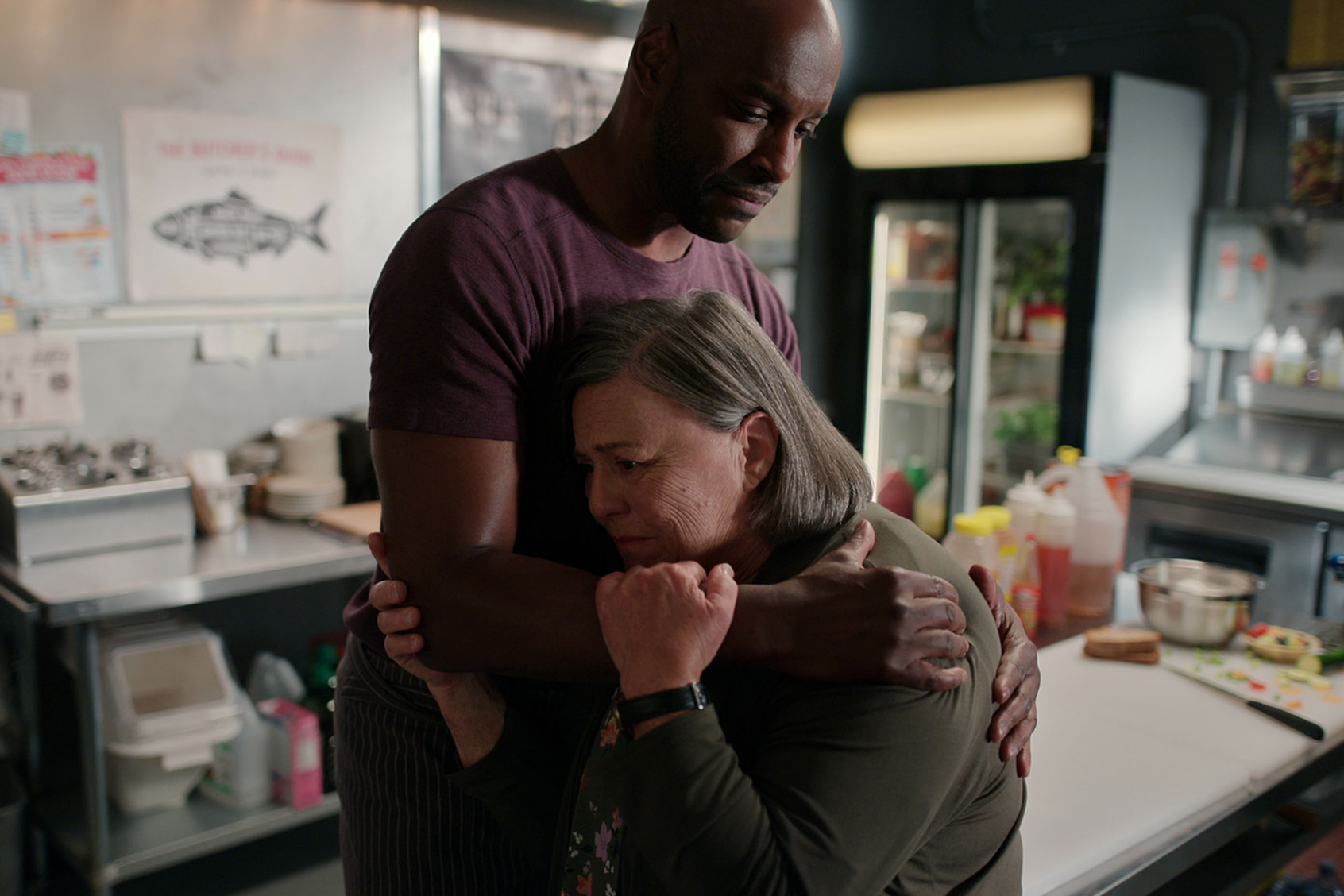
Another surprising and appealing aspect of “Virgin River” is intergenerational friendships such as these (friendships that new writer Patrick Sean Smith hinted to Salon we’ll see more of in Season 5). But it’s frustrating that a character as devoted and loving as Preacher is so alone. 

Virgin RiverColin Lawrence as Preacher and Nicola Cavendish as Connie in “Virgin River” (Courtesy Of Netflix)Preacher’s character is a lonely one. He’s trusting to a fault, believing not only Paige (who has good reasons for lying) but a woman purporting to be her friend, whose reasons for lying include being an accomplice to the twin and betraying Preacher. Preacher gets betrayed a lot, frankly.

When your boyfriend never shows up to your sister’s wedding and you need someone to find him, drunk in his truck, Preacher’s the one you call. When you try to go kayaking while intoxicated in a rough current, Preacher’s going to warn you. When you need to be rescued from an isolated cabin where you’re a hostage, Preacher’s gonna find you. Also, he knows martial arts. 

But who rescues the rescuer?  

Virgin RiverColin Lawrence as John “Preacher” Middleton and Lucia Walters as Julia in “Virgin River” (Courtesy Of Netflix)

Is Preacher truly a tragic hero, whose unselfish devotion to others will ultimately lead to his downfall? 

Season 4 gives Preacher an iota of happiness as he begins a relationship with his Aikido instructor, Julia (Lucia Walters), who seems like a decent person. But once Paige re-enters his life, Julia is out. Can you blame her? (The most emotionally healthy people in “Virgin River” seem to hightail it out of town.) And Preacher is right back to saving Paige again. It’s hard to express any malice toward a survivor of domestic violence, but Paige’s character can be a little grating, especially in how she expects Preacher to always pick up her pieces.

Preacher bails out others to the neglect of himself, displaying a kind of co-dependency in his attraction to and need to be the caring one — his need to be needed. If he wasn’t saving everyone all the time, would they still love him? Would he still have a place in town? Or is Preacher truly a tragic hero, whose unselfish devotion to others will ultimately lead to his downfall? 

“Virgin River” hasn’t exactly followed the books, and we don’t know if twin brother Vince is alive or dead, though an Instagram image apparently shows the actor at a table read for Season 5. If the brother’s back, that may be more trouble for Preacher, the loyal character who’s always helping others out. Preacher seems like he would take the fall for Paige. He takes a lot — and he shouldn’t. Yes, Preacher plays a king at the Ren Faire, but he acts more like a knight. 


Want a daily wrap-up of all the news and commentary Salon has to offer? Subscribe to our morning newsletter, Crash Course.


Jack recently asked Preacher to be the best man at his wedding. Preacher’s now a partner in Jack’s Bar, having turned down a new fancy job for it (there he goes with that loyalty again). But the noble character who once said, “I believe there is nothing more righteous than defending those who can’t defend themselves,” deserves his own help, his own happiness and a love of his own that will last. 

“Nope” and the Fry’s Electronics UFO sighting that almost wasn’t

For many audience members watching “Nope,” a certain UFO sighting may have struck a nerve – evoking both joy and wistful nostalgia.

No, it’s not the resurfaced memory of a past alien abduction. Rather, it’s director Jordan Peele‘s use of the real-life Fry’s Electronics, featuring a giant sculpture of a flying saucer that had “crashed-landed” into its storefront. A favorite with locals, the iconic Burbank, California big box store gives Peele’s movie a quirky specificity while also grounding its fantastical story in the real world. 

“We wanted Fry’s for several reasons: obviously, the spectacle that Fry’s is … It’s iconic, and that intrigued Jordan.”

In “Nope,” siblings OJ and Emerald Haywood (Daniel Kaluuya and Keke Palmer) suspect UFO activity out by their horse ranch. In order to capture evidence for that “Oprah shot,” the two head over to Fry’s Electronics to buy surveillance equipment. Fry’s Tech Team member Angel (Brandon Perea) not only helps them install their cameras but eventually gets pulled into their elusive UFO-imaging mission.

Salon spoke to Ruth De Jong, the film’s production designer who had worked with Peele previously on “Us” about the challenges of shooting at a store with a reputation that outlived the business itself.

“Previous to a script existing, I started brainstorming with Jordan,” said De Jong. “We had a lot of ideas around wanting to ground it in a real place that related to Los Angeles – both [shooting] in Agua Dulce and Santa Clarita – and then wanting to make iconic establishments like Fry’s being one of them.

“We wanted Fry’s for several reasons: obviously, the spectacle that Fry’s is, the experience for the shoppers, all of us who have been in LA forever,” she continued. “It’s iconic, and that intrigued Jordan because typically it’s encouraged that we just create a fictional store to avoid clearances and cost; the cross-branding can be tricky. But we thought, ‘Oh my gosh, this is great. It’s going to just create so much value to the story. It will make sense in Burbank.'”

Sadly, by now all Fry’s stores have closed permanently, but in 2020, the announcement of the impending closure while “Nope” still intended to shoot there sent the production team into a brief panic. Frantic texting between De Jong, the film’s unit production manager and Peele ensued. The film almost backed out entirely on using Fry’s, but in the end, the idea of preserving the store on celluloid won out.

“It’s been here forever, it will always be a piece of history,” said De Jong. “If anything, this movie will be the last known stop for Fry’s and really just give it a sweet goodbye. Long story short, we got in touch with Randy Fry, the owner who’s based out of San Francisco. His son was managing the Burbank Fry’s. They were so gracious and held off the sale of that property to allow us to film.”

That history of Fry’s Electronics’ kitschy decor

Fry's ElectronicsFry’s Electronics at the heart of Silicon Valley April, 2000 in Sunnyvale, CA. (Getty Images/David McNew/Newsmakers)The significance of spotting Fry’s in “Nope” goes beyond a mere Easter egg. To comprehend just how well the store fits the film’s themes, one must understand what the store once represented – both inside and out.

Fry’s had become a destination for young and old who couldn’t resist the carnival-like atmosphere … It was fantastical. It was a fever dream. It was fun.

Like “Nope’s” Haywood Hollywood Horses, Fry’s also began as a family business. The first Fry’s Electronics opened in Sunnyvale, California on May 17, 1985. This was not your typical electronics store, however. In addition to stocking DIY tech items like integrated circuits, microprocessors and other computer components, the store also peddled video games, eclectic household appliances, toys, pocket knives, porn magazines, sodas and snack foods. One could happily get lost browsing the cluttered aisles in the warehouse-sized building, picking up anything from motherboards to Flamin’ Hot Cheetos

Fry's ElectronicsInterior of Fry’s electronics store, Fremont, California, October 18, 2020. (Smith Collection/Gado/Getty Images)The one-stop shop for tech geeks gained another reputation, though. The chain’s outsized, downright kitschy decor became a calling card for the entire franchise, which varied the theme from store to store. Fry’s had become a destination for young and old who couldn’t resist the carnival-like atmosphere of the store that aspired to offer so much more than the tangible. It was fantastical. It was a fever dream. It was fun.
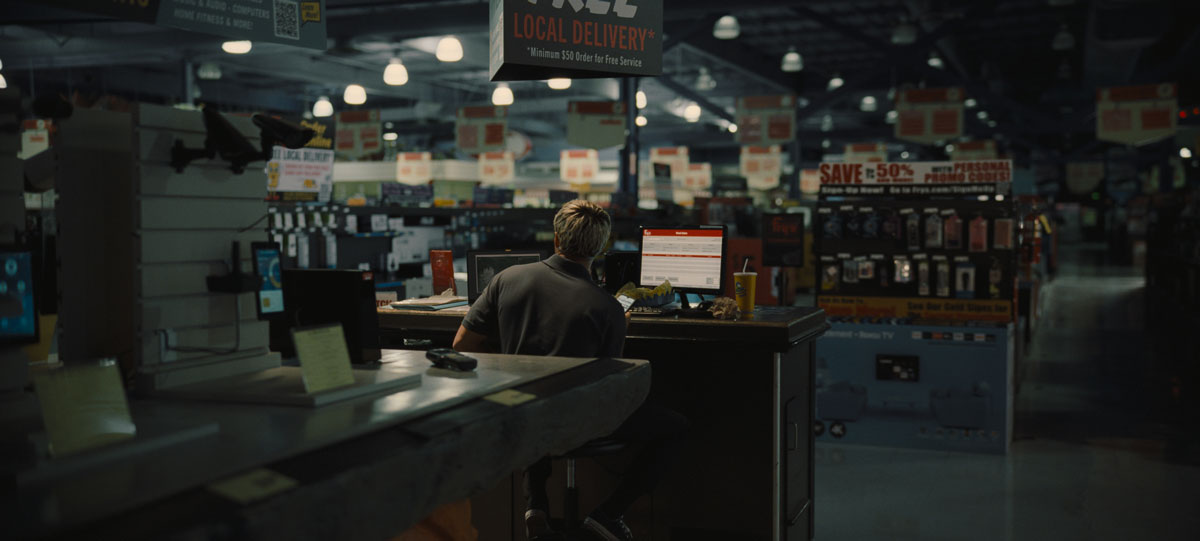
That all began with the second Sunnyvale location, which was designed to look like a giant computer inside and out. The exterior mimicked a DIP integrated circuit, door handles looked like ENTER and ESC keys (clever!), while the interior walls and floor were inspired by circuit components and circuit boards. 

Not content with sticking with the electronics theme, the chain then lost its damn mind and adopted imaginative themes in its other stores, often without apparent rhyme or reason. Oh sure, some of the 31 Fry’s stores across nine states highlighted history specific to its region, but what’s the fun in that? (Although points to the Las Vegas Fry’s going meta with its recreation of the Las Vegas Strip.)

Instead, it was an adventure to drop into the Phoenix, Arizona store that paid tribute to an Aztec temple. Or why not swing by the Steampunk Fry’s in City of Industry? There were also stores devoted to automobile racing, Chichen Itza, Tahiti, the Roman empire, a cattle ranch and the 1893 World’s Fair, just to name a few.

Chris Nichols, an expert on Southern California architecture, told KPCC’s “Take Two” that the bizarre decor mandate was the brainchild of founder John Fry, “this wealthy and exotic personality that wanted to build all of these crazy stores.”

And of course, this level of showmanship and craft came courtesy of Tinseltown. Hollywood prop and movie set designer Eric Christensen, who once worked for George Lucas, designed these larger-than-life themes, which could cost upwards of $1.5 million, reports a 2000 Los Angeles Times story

During the pandemic, Fry’s customers had already realized something was amiss when faced with empty shelves in the usually packed aisles. Once the company announced the chain’s closing, several shoppers made final visits to their local stores to take advantage of liquidation sales and to take photos and videos of the memorable decor – to record the dream that once was.

One can pass through the looking glass in one YouTube video taken at the Woodland Hills, California Fry’s that featured an Alice in Wonderland theme. The floor is a gleaming black-and-white chessboard, while giant playing cards swoop across the ceiling, and red pawns prop up the checkout counter. Throughout are sculptures of the Queen of Hearts, the Caterpillar, Tweedle Dee and Dum, the Jabberwock, Alice and more – all in the style of John Tenniel’s original illustrations.

The Burbank location, which opened in 1995, was practically made for “Nope.” Not only did the alien invasion theme fit the film’s main imagery, but the store’s tribute to science fiction films echoed the theme of filmmaking, storytelling . . . and spectacle. 

https://www.instagram.com/p/BB_rCSsAl6J/?hl=en

Capturing that Fry’s footage

Although “Nope” was able to secure the Burbank location to shoot before everything was taken down, the all-important UFO footage of the storefront came close to not being featured at all. According to De Jong, Peele had played with the idea of swapping out the flying saucer using movie magic.

“We changed the UFO to a 1960s convertible in post[-production]. I created the 1960s Cadillac rear end with the taillights. We went through so many iterations,” said De Jong. “I think Jordan didn’t want to – just at that moment – be so on-the-nose. But I think ultimately, he just was like, ‘Let’s make it what it actually is.'”

Sticking with the original alien theme meant that “Nope” could also use the interior sculptures that were based on sci-fi movies like “Godzilla,” the robot from “The Day the Earth Stood Still” and giant ants from “THEM.” 

https://www.instagram.com/p/CU_tG-pDjss/?hl=en

https://www.instagram.com/p/BnzOqARncOx/?hl=en

“They had the giant massive octopus, the UFO on the inside, and the military installation. All of the stuff would riff off of old movies,” said De Jong.

While the one-of-a-kind sculptures remained, the store itself had already been closed and emptied, which means that the “Nope” team had to recreate the packed shelves.

NopeFry’s Electronics interior in ”Nope” (Universal Pictures)“They kept the majority of the store intact for us, but they did liquidate quite a bit of merchandise,” said De Jong. “We had this massive warehouse we had to dress to make it look like a fully functioning Fry’s. From an art department standpoint, that was a massive undertaking. It’s a lot of stuff and it’s a lot of square footage. 

“There were specific aisles we needed that needed to have all of that type of electronics surveillance components and stuff,” she continued. “We tried to keep it true to how Fry’s had it laid out where we had washing machines and refrigerators and dryers. And then we filled the aisles they walked down with some more electronic-based stuff and different weird things like blow-up swimming pools. It was a hodgepodge. It was exactly like Fry’s.”

Production also had Fry’s corporate branding permission to use the logo on everything from signage to name tags. And while that helped add the last touches to the interior of the store, it also lent verisimilitude to “Nope” techie extraordinaire, Angel. Slap the Fry’s logo on a black polo shirt? Instant uniform. And then there’s his official-looking vehicle for Fry’s Tech Team.

“The van we got from Fry’s. It was one of theirs and we rewrapped it because it was in bad shape,” said De Jong. “We recreated their logo with the electricity because Jordan wanted to just give it a bit more spice and make it a little more exciting. Then we wrapped the whole van and we built out the van with the ladders on top exactly how Angel’s character had it. He was the equivalent of the Geek Squad [but] at Fry’s. We made all that up.”

NopeFry’s Tech Team van and Brandon Perea in “Nope” (Universal Pictures)For their help with the movie, Randy Fry and his wife appear in a cameo as audience members during that fateful Star Lasso Experience scene at the Jupiter’s Claim theme park. Off screen, they also ended up keeping Angel’s Tech Team van as a physical memento.
As for the iconic UFO and other Fry’s sculptures, their fates are less certain. A “Save Fry’s” campaign attempted to raise money for various members of the public to purchase the sculptures, but it doesn’t seem to have had any success. De Jong believes that if Fry didn’t liquidate the sculptures, he may have decided to keep them as a collector himself.


Want a daily wrap-up of all the news and commentary Salon has to offer? Subscribe to our morning newsletter, Crash Course.


“He says a lot of the pieces he and his wife had around their yard or estate up in San Francisco,” said De Jong. “I think he was hard-pressed to just let those go. It’ll be interesting with the life of this film to see what he ends up doing with all the memorabilia.”

The impermanence of Fry’s lends extra poignance to its appearance in the film. As one character cryptically observes, “We don’t deserve the impossible.” Like the Haywoods attempting to capture the fleeting image of the UFO, “Nope” captures some of the magic of what Fry’s offered. Belying its Silicon Valley roots, the store also peddled a dream of something decidedly non-technical. Immersed in such fantastical settings, customers attached meaning and memory to their shopping experiences.

“The crew had so many stories of their experience in Fry’s. Jordan had so many,” said De Jong. “It was such a cool, nerdy, kind of punk [place]. At the end of the day, we were thrilled that we ended up going through with it. It was a nice farewell for Fry’s. We got to forever pay homage.”

“Nope” is currently in theaters.

Someone is having a mental breakdown in public. What is the compassionate way to respond?

In a recent episode of the popular television series “Better Call Saul” (very minor spoilers follow), one character is seen having an emotional breakdown on a bus. As she attempts to casually utilize her community’s mass transit services, she finds herself unable to contain her emotions — and so publicly starts to cry. In the background other passengers are seen awkwardly ignoring her, although a single hand is placed on her in a feeble attempt to offer comfort.

While “Better Call Saul” is a work of fiction, it is not unusual for people struggling with mental health issues to have uncontrollable public displays. Indeed, even when a mentally ill individual isn’t having a literal emotional breakdown, it is still common to get spurned for not behaving in a socially acceptable manner.

Humans are, by nature, compassionate and empathetic creatures: sociologists say we wouldn’t have been able to create such complex societies if not for our predilection for helping each other. And just about everyone at some point has this experience of passing by or observing someone having an emotional breakdown in public.

But we don’t always know what to do for them — or if there even is anything we can do. 

“We should remember that, at their core, mental health conditions are health issues,” psychologist Doreen Marshall, Ph.D., the American Foundation for Suicide Prevention‘s vice president of mission engagement, told Salon by email. This means that they deserve sympathy — especially since they are often “frightened and unsure where to turn for help.”

“They can also feel disconnected from what is happening around them, have worrisome thoughts, or even unaware that others are seeing their distress,” Marshall explained. “There is also a public misperception that those who experience mental health concerns may be violent or aggressive toward others, but the reality is that the vast majority of those who experience mental health conditions have never been violent toward others and are more likely to be victims of violence than perpetrators of violence.”


Want more health and science stories in your inbox? Subscribe to Salon’s weekly newsletter The Vulgar Scientist.


As such, “If you are witnessing someone having a public mental health episode, it is okay to approach them and ask them if they are ok and how you can help them,” Marshall wrote to Salon. “You should approach these situations with compassion and care and recognize the goal is to help the person get connected to what they need.”

At the same time, you should be mindful of whether that person is already receiving assistance. If too many well-intentioned people converge on a person with a mental health crisis, the one they hope to help might instead feel overwhelmed.

“Only one person should really be speaking to the person going through the episode — not like five or six,” Kelly Abreu, a Mental Health Worker at the Worcester Recovery Center and Hospital and Vice President of AFSCME Local 137, told Salon by email. “Because they [the person going through the episode] is confused as it is, so only one person should be speaking to that person. And it should be in a tone that they can understand. Not fast. You can’t be abrupt. You just need to ask them ‘What’s going on? Is there anything I can help you with?'”

Of course, one shouldn’t be too harsh on bystanders whose main mistake is being overwhelming in their desire to help. Their attitude is a stark contrast from what often happens if a person has a public display of poor mental health. There are many mistakes that can be made, and a lot of those errors are derived from the stigma we attach to mental health issues.

“A lot of times, others don’t want to be near someone going through a mental health episode,” Abreu pointed out. “They’ll isolate them. Or they’ll call the police on them. It can get blown out of proportion really fast and make the situation more dangerous. They start yelling at them. It’s not what’s needed.”

Deshonda Copeland of AFSCME Local 1963, a Senior Residential Unit Specialist at Florida State Hospital in Chattahoochee, emphasized that while there are many ways to help a person, would-be allies should avoid seeming confrontational or accusing.

“When people are having mental health issues, there [are] different ways to help,” Copeland wrote to Salon. “But you never want to yell or approach from a place of frustration or anger. Get to know the problem they are having before dealing with it. A lot of folks just need someone to listen to them, talk to them.”

It is also important to understand that people experiencing public mental health episodes are, almost by definition, dealing with an uncontrollable issue. While it may be tempting to simply urge them to calm down and rest, doing so can mistakenly presume that their medical condition is somehow due to a set of conscious choices. It also wrongly simplifies the complex situation at hand.

“It’s also hard to tell why someone might be having a crisis,” Abreu observed. “It could be drug-induced, or it could even sometimes be the result of a medical crisis – like high blood pressure, or diabetes, or other issues that are going on. Sometimes these medical issues present psychological symptoms.”

“We should remember that, at their core, mental health conditions are health issues.”

There are also many factors entirely external to the individual in question that can put them in a mentally compromised state. There is evidence that depression may not stem from neurochemical imbalances in the brain, but rather from systemic injustices that wear people down.

“Unfortunately, poverty and discrimination can play a role in receiving appropriate diagnosis and care for mental health concerns and accessing adequate care,” Marshall explained. “While these situations are not alone responsible for symptoms of mental health conditions, they are certainly stressors that can make growing mental health and other health concerns worse, as well as prevent early identification and care of mental health concerns.”

Moreover, mental health problems can affect everyone — no one, regardless of their background, is immune. That means that, regardless of a person’s background, there are ways to have a positive attitude that can be effective for anyone.

“Some respond like they would respond to a relative or a friend,” Copeland suggested. “If they are having an outburst, approach the situation positively…be their support. A lot of folks just need someone to listen to them, talk to them.”

“It is important to remember that mental health concerns do not discriminate and people from all races, economic levels, genders and backgrounds can experience mental health conditions,” Marshall told Salon. “This is why it is important for all of us to educate ourselves on the mental health resources available in our areas, to challenge our notions of who may experience mental health concerns, and be ready to meet those who struggle with support and compassion.”

Life after Trump: Someday he’ll be gone. What will Republicans (and Democrats) do then?

The problem with politics is that it’s a zero-sum game. There is a finite number of voters out there; every vote that you get is a vote the other side doesn’t get. That’s why the headlines following the FBI search of Mar-a-Lago were practically unanimous: “FBI search cements Trump’s hold on GOP,” screamed the Hill. “Trump’s dominance in GOP comes into focus, worrying some in the party,” was how the Washington Post put it. 

Other headlines made the same point but tied Trump’s iron grip on the party to Liz Cheney’s primary defeat in Wyoming. “What Liz Cheney’s Lopsided Loss Says About the State of the G.O.P” was the New York Times take. “Liz Cheney and the Demise of Anti-Trump Republicanism” was the headline in a New York magazine story that framed Cheney’s fall as the death knell for the “ancien régime of conservative Republicanism as we knew it not so very long ago.”

And that was just on Wednesday.

Suffice it to say that political pundits and professionals are in agreement that despite — or even because of — all the scandals surrounding the former president, Trump has achieved an unprecedented stranglehold on Republican voters. But which voters is a question that’s not being asked. Sure, Liz Cheney got just under 30 percent of the Republican vote in a deep-red state, but the pundits seem to be ignoring the fact that it was Cheney who lost, not her voters. They stood by the Republican Party’s top Trump critic, a woman who announced upon her defeat that she would “do whatever it takes” to keep Trump out of the White House. Where do those people’s votes go now?

Television coverage of House races where the 10 Republicans who voted to impeach Trump were on the ballot showed people who questioned Trumpian orthodoxy being shouted down at town halls. Trump followers stole lawn signs supporting candidates who failed to adequately bow down to the Master. The New York Times reported, “The cleansing of Trump critics from the Republican Party is still in progress and so thorough that much of it now happens without Mr. Trump’s direct involvement. Allies at local and state parties, as well as at Republican-linked organizations, censure or oust those who break with the new orthodoxy.”

That doesn’t sound much like asking those people to stick around and vote Republican when there isn’t a Trump-endorsed or at least a Trump-loving candidate on the ballot. The problem with jettisoning every Republican voter or candidate who isn’t loyal to Donald Trump is that demographics already show that the party is going to need those people “going forward,” as the saying goes. 

The problem with jettisoning every Republican who isn’t loyal to Donald Trump is that demographics already show that the party is going to need those people “going forward.”

This applies to candidates who have entertained the idea of running against Trump in the 2024 Republican primaries, if Trump decides to run for president again. Multiple stories have covered potential Trump opponents, like Florida Gov. Ron DeSantis, pledging allegiance to the Monarch of Mar-a-Lago after the FBI search of his home in Palm Beach. DeSantis appeared at a rally for Turning Point USA last weekend and criticized the FBI: “They’re enforcing the law based on who they like and who they don’t like,” DeSantis told the crowd of fresh-faced young Trumpazoids. “That is not a republic — maybe it’s a banana republic when that happens.”

The Hill quoted a Republican political consultant at the rally saying, “Any pathway for DeSantis to primary him from the right just closed completely shut if Trump decides to run. Our voters now want revenge, and I suspect that will manifest into them concluding the best way they can get revenge is by sending Trump back to the White House.”

The Republican Party is doing everything it can to banish from its ranks anyone who is deemed insufficiently loyal to the former president, especially the so-called “impeachment 10,” the Republican House members who voted to impeach Trump after the Jan. 6 Capitol assault. 

Steve Benen, who writes for the Maddowblog on MSNBC, reported — yes, on Wednesday again — “As members of the Impeachment 10 can attest, it would also be a mistake to downplay Trump’s influence — especially when the former president, fueled by a petty sense of vengeance, is determined to destroy the careers of specific members of his party. What mattered was that much of their radicalized political party wouldn’t tolerate their heresy, which would overshadow every other part of their careers in public service.”

Cheney’s defeat wasn’t just the defeat of an anti-Trump Republican. It was a defeat for what were once known as “movement conservatives,” the group of Republican leaders who had molded the party in their own image as being for tax cuts and national defense, and against anything “liberal,” especially abortion and government handouts. It was, in short, the party of former House Speaker Newt Gingrich. But what does Newt have to say today? Well, interviewed by the Hill for its story about how the FBI search had strengthened Trump’s hold on the party, Gingrich said, “On the Republican side, with the exception of never-Trumpers … virtually everybody else assumes the FBI is corrupt. They assume the Jan. 6 committee is a fake committee covered by fake news, and they presume there is an effort to martyr Trump. If they keep this up, he won’t have a major opponent for the primary.” 


Want a daily wrap-up of all the news and commentary Salon has to offer? Subscribe to our morning newsletter, Crash Course.


Democrats have a lot to run on in the midterm elections, which are now less than three months away. They’ve got lower gas prices, passing the “Inflation Reduction Act” and the Dobbs decision overturning Roe v. Wade, but so far they have been only too happy to make Trump the big issue. Trump has done his part to help them as several of his endorsed candidates appear to be failing. Mehmet Oz is behind John Fetterman in his race for the Senate in Pennsylvania. J.D. Vance is about even with Rep. Tim Ryan, or slightly behind, in Ohio. Hedge-fund bro Blake Masters is trailing Sen. Mark Kelly in Arizona, and Herschel Walker continues to walk into walls in his campaign against Sen. Raphael Warnock in Georgia. 

As longtime Democratic consultant James Carville told the Hill, “The problem the Republican Party has is, they got really stupid people that vote in their primaries. And … really stupid people demand to have really stupid leaders. That’s where the Republican Party is now.” Asked about Walker’s candidacy in Georgia, Carville said, “Come on, man, that guy had an ill-fitting helmet. He’s not right. He’s not right at all.”

If Trump decides to run in 2024, and that doesn’t seem like a very big “if” at this point, it’s pretty clear he will run as a single-issue candidate: The 2020 election was “stolen” from him. Full stop. The search of Mar-a-Lago is just gravy, and there’s sure to be more gravy to come as he faces grand juries in Washington, D.C. and Fulton County, Georgia, not to mention the continuing saga unfolding before the Jan. 6 select committee in Congress. 

Trump’s base is apparently prepared to stand by his side. A poll conducted last month by Monmouth University revealed that an astonishing 61 percent of Republicans believe Jan. 6 was a “legitimate protest.” Fifty-eight percent told pollsters they believe that only by “voter fraud” did Joe Biden win the 2020 election.

If Trump runs in 2024, he’s a single-issue candidate: The 2020 election was “stolen.” That’s already the past: Where do those voters go when he’s gone?

But the question remains: Where do these voters go when Trump is gone, either because he loses the 2024 presidential race and is once again unable to overturn the results, or because he is convicted of a crime that carries a ban on holding further federal office? At least one of the federal statutes for which Trump is under investigation supposedly carries that penalty, and although it’s not clear that a law passed by Congress can prevent someone from becoming president, it’s pretty much beyond argument that if Trump were to run and lose in 2024, he would be way too old to run again in 2028.

When Trump isn’t on the ballot — and he’s only got one more shot at doing that — how much power will pledging allegiance to his legacy have in the Republican Party of the future? Can Trump maintain his iron grip on the Republican Party from the political grave? I’m sure the whole “owning the libs” thing will still motivate the Republican base, but with Trump having patented that particular political tactic, will others be able to make it work as well?

This might seem almost too delicious to contemplate, but it just may be that the name “Trump” has been the magic elixir that stoned the masses for the past six years, and that once he’s gone it will lose its twisted power. Whether Republicans will turn out to stand in line at polling places when their drug of choice is no longer available may well be the great question of our political future. Your guess is as good as mine about what the answer is, but for now, the lesser “leaders” of the Republican Party aren’t spending much time contemplating life after Trump. That may be their biggest mistake of all.

How to destroy a “forever chemical”: Scientists are discovering ways to eliminate PFAS

PFAS chemicals seemed like a good idea at first. As Teflon, they made pots easier to clean starting in the 1940s. They made jackets waterproof and carpets stain-resistant. Food wrappers, firefighting foam, even makeup seemed better with perfluoroalkyl and polyfluoroalkyl substances.

Then tests started detecting PFAS in people’s blood.

Today, PFAS are pervasive in soil, dust and drinking water around the world. Studies suggest they’re in 98% of Americans’ bodies, where they’ve been associated with health problems including thyroid disease, liver damage and kidney and testicular cancer. There are now over 9,000 types of PFAS. They’re often referred to as “forever chemicals” because the same properties that make them so useful also ensure they don’t break down in nature.

Scientists are working on methods to capture these synthetic chemicals and destroy them, but it isn’t simple.

The latest breakthrough, published Aug. 18, 2022, in the journal Science, shows how one class of PFAS can be broken down into mostly harmless components using sodium hydroxide, or lye, an inexpensive compound used in soap. It isn’t an immediate solution to this vast problem, but it offers new insight.

Biochemist A. Daniel Jones and soil scientist Hui Li work on PFAS solutions at the Michigan State University and explained the promising PFAS destruction techniques being tested today.

How do PFAS get from everyday products into water, soil and eventually humans?

There are two main exposure pathways for PFAS to get into humans – drinking water and food consumption.

PFAS can get into soil through land application of biosolids, that is, sludge from wastewater treatment, and can they leach out from landfills. If contaminated biosolids are applied to farm fields as fertilizer, PFAS can get into water and into crops and vegetables.

For example, livestock can consume PFAS through the crops they eat and water they drink. There have been cases reported in Michigan, Maine and New Mexico of elevated levels of PFAS in beef and in dairy cows. How big the potential risk is to humans is still largely unknown.

Scientists in our group at Michigan State University are working on materials added to soil that could prevent plants from taking up PFAS, but it would leave PFAS in the soil.

The problem is that these chemicals are everywhere, and there is no natural process in water or soil that breaks them down. Many consumer products are loaded with PFAS, including makeup, dental floss, guitar strings and ski wax.

How are remediation projects removing PFAS contamination now?

Methods exist for filtering them out of water. The chemicals will stick to activated carbon, for example. But these methods are expensive for large-scale projects, and you still have to get rid of the chemicals.

For example, near a former military base near Sacramento, California, there is a huge activated carbon tank that takes in about 1,500 gallons of contaminated groundwater per minute, filters it and then pumps it underground. That remediation project has cost over $3 million, but it prevents PFAS from moving into drinking water the community uses.

Filtering is just one step. Once PFAS is captured, then you have to dispose of PFAS-loaded activated carbons, and PFAS still moves around. If you bury contaminated materials in a landfill or elsewhere, PFAS will eventually leach out. That’s why finding ways to destroy it are essential.

What are the most promising methods scientists have found for breaking down PFAS?

The most common method of destroying PFAS is incineration, but most PFAS are remarkably resistant to being burned. That’s why they’re in firefighting foams.

PFAS have multiple fluorine atoms attached to a carbon atom, and the bond between carbon and fluorine is one of the strongest. Normally to burn something, you have to break the bond, but fluorine resists breaking off from carbon. Most PFAS will break down completely at incineration temperatures around 1,500 degrees Celsius (2,730 degrees Fahrenheit), but it’s energy intensive and suitable incinerators are scarce.

There are several other experimental techniques that are promising but haven’t been scaled up to treat large amounts of the chemicals.

A group at Battelle has developed supercritical water oxidation to destroy PFAS. High temperatures and pressures change the state of water, accelerating chemistry in a way that can destroy hazardous substances. However, scaling up remains a challenge.

Others are working with plasma reactors, which use water, electricity and argon gas to break down PFAS. They’re fast, but also not easy to scale up.

The method described in the new paper, led by scientists at Northwestern, is promising for what they’ve learned about how to break up PFAS. It won’t scale up to industrial treatment, and it uses dimethyl sulfoxide, or DMSO, but these findings will guide future discoveries about what might work.

What are we likely to see in the future?

A lot will depend on what we learn about where humans’ PFAS exposure is primarily coming from.

If the exposure is mostly from drinking water, there are more methods with potential. It’s possible it could eventually be destroyed at the household level with electro-chemical methods, but there are also potential risks that remain to be understood, such as converting common substances such as chloride into more toxic byproducts.

The big challenge of remediation is making sure we don’t make the problem worse by releasing other gases or creating harmful chemicals. Humans have a long history of trying to solve problems and making things worse. Refrigerators are a great example. Freon, a chlorofluorocarbon, was the solution to replace toxic and flammable ammonia in refrigerators, but then it caused stratospheric ozone depletion. It was replaced with hydrofluorocarbons, which now contribute to climate change.

If there’s a lesson to be learned, it’s that we need to think through the full life cycle of products. How long do we really need chemicals to last?


A. Daniel Jones, Professor of Biochemistry, Michigan State University and Hui Li, Professor of Environmental and Soil Chemistry, Michigan State University

This article is republished from The Conversation under a Creative Commons license. Read the original article.

Treasury Dept. clears up rumor regarding armed IRS Agents

An official from the U.S. Treasury Department confirmed Friday that, contrary to the unrelenting barrage of lies repeated by GOP operatives for over a week, the Internal Revenue Service is not going to hire 87,000 new agents to harass working people at their homes.

Not a single Republican in the House or Senate voted for the Inflation Reduction Act (IRA) that was passed through the filibuster-proof budget reconciliation process last week and signed into law by President Joe Biden on Tuesday, choosing instead to condemn the package’s relatively modest but popular tax reforms.

Despite analysts’ predictions that the 98.2% of U.S. households with annual incomes of $400,000 or less will receive the same tax bill or a slight cut as a result of the IRA, far-right lawmakers have sown disinformation about how the law’s provision of roughly $80 billion in new IRS funding over 10 years—money intended to help the agency crack down on rich tax cheats—poses a threat to every American.

Last week, Rep. Lauren Boebert (R-Colo.) went so far as to claim that Democrats are “using the power of the federal government for armed robbery!” Rep. Marjorie Taylor Greene (R-Ga.) has made similar allegations.

It’s not just fringe members of the GOP who are spreading such falsehoods. One day before Boebert’s tirade, House Minority Leader Kevin McCarthy (Calif.), the highest-ranking Republican in the lower chamber, tweeted, “Democrats in Washington plan to hire an army of 87,000 IRS agents so they can audit more Americans like you.”

On Wednesday, Florida Gov. Ron DeSantis—currently a top contender, along with former President Donald Trump, to be the Republican Party’s 2024 nominee for the White House—called hiring 87,000 IRS agents “a middle finger to the American public,” making clear that he would prefer more “might at the border.”

Where does this oft-repeated number of IRS agents come from?

“The 87,000 figure does exist, buried within a May 2021 Treasury Department report when the Biden administration was pushing a bigger spending bill with the same $80 billion IRS funding,” Reuters noted Friday. “The report estimated the money could fund 86,852 full-time hires through 2031.”

But the actual net increase in staff would be much lower, as the IRS expects more than 50,000 aging Baby Boomer employees to retire over the next half-decade.

In addition to an unspecified number of new revenue agents—there were 8,321 in fiscal year 2021—the agency is looking to hire tens of thousands of new information technology specialists and customer service personnel who can create a user experience more akin to online banking, Natasha Sarin, Treasury counselor for tax policy and administration, told Reuters.

There are 2,100 special agents in the IRS Criminal Investigation branch who are authorized to carry firearms, but right-wing assertions that all 87,000 new hires would be auditors, criminal enforcement agents, or armed are “deeply dangerous nonsense—and false,” said Sarin.

“The speed and voracity with which [Republicans] are coming at this is really a testament to how important these resources are going to be—because there are many wealthy tax evaders that stand to lose a lot,” Sarin continued.

The GOP’s intentionally misleading attacks come after a decade of budget cuts approved by congressional Republicans left the IRS with 16,000 fewer employees in 2021 than it had in 2010.

As ProPublica has documented, the IRS now audits low-income taxpayers at the same rate as the top 1%, but that is a direct result of years of austerity, which have undermined the agency’s ability to audit the rich.

The IRA’s boost in IRS funding aims to rectify this injustice and to begin closing an estimated $600 billion annual “tax gap”—the difference between taxes paid and owed—by strengthening enforcement against the complex avoidance strategies used by the wealthy, especially those with murky sources of income.

New information technology hires will develop “tools to identify more high-end audit targets,” Reuters reported. “To target wealthy taxpayers and handle sophisticated audits, Sarin said the IRS needs mid-career individuals with accounting and often tax law experience.”

The Congressional Budget Office estimates that the increase in IRS funding will raise $204 billion in additional revenue over 10 years, while the Treasury projects that the real revenue impact will likely be $400 billion over a decade—a substantial portion of the IRA’s climate and healthcare spending.

Earlier this week, Treasury Secretary Janet Yellen instructed IRS Commissioner Charles Rettig—a scandal-plagued Trump appointee who spent decades battling the agency—to submit an $80 billion spending and hiring plan within six months. Yellen previously directed the agency not to use any new resources to increase audits of people making less than $400,000 per year.

J.D. Vance has a Big Pharma problem

J.D. Vance, the billionaire-backed U.S. Senate candidate in Ohio, has routinely positioned himself as an anti-opioid China-hawk, promising to rein in Big Pharma and bring jobs back to the U.S. But in recent weeks it has been revealed that Vance, a Trump-backed author, worked for a white shoe law firm that represented multiple Chinese companies and lobbied for Purdue Pharma, the maker of OxyContin. Vance then hired an American Enterprise Institute (AEI) resident who cited Purdue-funded studies to downplay the role overprescribing painkillers plays in the opioid crisis as the addiction specialist to Ohio’s Appalachian region for his nonprofit, “Our Ohio Renewal.”

The apparent contradiction, first reported by Politico, stems from a “vulnerability analysis” posted online by Protect Ohio Values (POV), the Super PAC through which Vance has raised millions of dollars for his Senate campaign. Because campaign finance law bars any candidates from communicating with their associated Super PACs, POV appears to have posted a trove of polling data, strategic documents, and opposition research on a low-profile Medium account for Vance to reference, detailing potential weak spots in his competitors’ campaigns as well as his own. 

Vance’s vulnerability analysis reveals that the lawyer-turned-author, who founded a non-profit dedicated to curbing the opioid epidemic, had at one point worked for law firm Sidley Austin LLP in Washington, D.C. During Vance’s time there, the firm’s lobbying arm was working on behalf of Purdue Pharma, which pleaded guilty in 2020 to criminal charges and faced penalties of roughly $8.3 billion. During that same time, Sidley Austin also reportedly represented “a Chinese real estate company” and lobbied Alibaba Group, a massive Chinese e-commerce platform. But as a Senate candidate, Vance has repeatedly called for the U.S. to sever its economic ties with the country, calling globalization a “gravy train” for China. 

“On one side you have people who want to go back to the America Last foreign policy, the weak on China trade policies,” as Vance said in a recent Fox News interview. “And on the other side you have me, supported by President Trump, trying to bring back our manufacturing jobs from China.”


Want a daily wrap-up of all the news and commentary Salon has to offer? Subscribe to our morning newsletter, Crash Course.


The Associated Press (AP) then reported this week that Vance’s charity suffered a major conflict of interest when it recruited an AEI resident who never disclosed Perdue’s financial contributions to AEI while favorably citing Perdue-funded studies to argue that prescription painkillers played a significant role in the region’s drastic uptick in opioid addiction. According to the AP, Dr. Sally Satel “occasionally shared drafts of the pieces with Purdue officials in advance.” And as ProPublica reported in the past, AEI received financial support from Purdue totaling $800,000. 

Vance’s past work may prove a problem with other areas besides Big Pharma. He was with Sidley Austin while the firm filed an amicus brief in support of gay marriage back in 2015, while the Supreme Court was ruling on Obergefell v. Hodges. Since then, Vance has taken countless swipes at the LGBTQ+ community. AIn 2020, Vance excoriated the “conservative legal movement” after Supreme Court ruled that gay and trans workers cannot be fired for their gender identity or sexual orientation. 

“The conservative legal movement has accomplished two things: libertarian political economy (enforced by judges) and betrayal of social conservatives and traditionalists,” he wrote at the time in a since-deleted tweet. 

Since the beginning of his campaign, numerous critics have also called out Vance’s funding as problematic. Vance has repeatedly blasted Big Tech, claiming that the industry systematically censors conservative voices. But the Republican’s chief benefactor is Peter Thiel, a prominent tech billionaire responsible for co-founding PayPal, Palantir Technologies, and Founders Fund, through which he was one of the first investors in Facebook.  

Robert F. Kennedy, Jr.’s anti-vax nonprofit removed from Facebook and Instagram

During the COVID-19 pandemic, anti-vaxxers have been, to a large degree, far-right MAGA Republicans and evangelical Christian fundamentalists — although former President Donald Trump himself has encouraged vaccination, and former White House Press Secretary Sarah Huckabee Sanders has tried to put a pro-MAGA spin on the Moderna, Pfizer and Johnson & Johnson vaccines by describing them as “the Trump vaccine.” Democrats have, for the most part, joined President Joe Biden and Dr. Anthony Fauci, Biden’s top White House medical adviser, in encouraging vaccination for COVID-19. But one well-known Democrat who is known for his anti-vaxxer views is Robert F. Kennedy Jr., who now finds himself at odds with Facebook and Instagram for spreading what those social media outlets consider misinformation.

Kennedy leads Children’s Health Defense, a nonprofit anti-vaccine group. And on Thursday, August 18, its accounts were removed for both Facebook and Instagram, according to the New York Times. Those platforms are owned by their Silicon Valley-based parent company Meta.

Sheera Frenkel, a technology reporter for the New York Times and co-author of the 2021 book “An Ugly Truth: Inside Facebook’s Battle for Domination,” explains, “In an e-mailed newsletter, Children’s Health Defense said Facebook and Instagram had taken down its accounts after a 30-day ban by the social networks. The nonprofit, which Mr. Kennedy has run since 2018, accused the apps of censorship.”

Kennedy, in an official statement, complained, “Facebook is acting here as a surrogate for the federal government’s crusade to silence all criticism of draconian government policies.”

That sounds like the type of rhetoric that Infowars’ Alex Jones or former Alaska Gov. Sarah Palin, both far-right MAGA Republicans and anti-vaxxers, would make. Jones, in fact, is so angry over Trump’s support of COVID-19 vaccines that he is calling for Florida Gov. Ron DeSantis, not Trump, to be the 2024 GOP presidential nominee. But the 68-year-old Kennedy is hardly an Infowars employee. Kennedy comes from the Democratic Party’s most famous political dynasty; he is the son of the late Sen. Robert F. Kennedy (who was assassinated in June 1968 only two months after Dr. Martin Luther King, Jr.’s assassination) and a nephew of President John F. Kennedy (who was assassinated in 1963). One of his uncles was the late Sen. Ted Kennedy of Massachusetts, and his cousins include former Rep. Patrick Kennedy of Rhode Island (one of Ted Kennedy’s sons) and the late John F. Kennedy Jr.

The Kennedy family is synonymous with the Democratic Party and synonymous with liberal politics in New England. But CDF, Frenkel notes, is “widely regarded as a symbol of the vaccine resistance movement.”

“Facebook’s and Instagram’s actions are a blow to Mr. Kennedy, who is the son of the former senator and U.S. Attorney General Robert F. Kennedy,” Frenkel observes in an article published on August 19. “But the account removals do not completely block him from speaking online. While Mr. Kennedy was personally barred from Instagram in February 2021, his personal Facebook page — with nearly 247,000 followers — is still up. Other Facebook pages dedicated to Children’s Health Defense, including those of its California, Florida and Arizona chapters, also remain online and have thousands of followers, according to a review by The New York Times.”

Robert F. Kennedy, Jr.’s views put him at odds with many of his fellow Democrats, and vaccine proponents have accused him of spreading dangerous misinformation about COVID-19 vaccines — which they credit with saving lives.

First reported in Wuhan, China in late 2019, COVID-19 has, according to Johns Hopkins University in Baltimore, Maryland, killed more than 6.4 million people worldwide, including over 1 million people in the United States — making it the world’s deadliest health crisis since the Spanish flu pandemic of 1918/1919. Vaccine proponents such as Biden and expert immunologist Fauci have emphasized that while vaccines don’t eliminate the possibility of being infected with COVID-19, they are likely to prevent a more dangerous infection. Biden and Fauci have both been infected with COVID-19 in 2022 despite receiving vaccines and booster shots; they are examples of what health experts call “breakthrough” infections, but both of them had milder cases and did not require hospitalization.

Frenkel observes, “Over the course of the pandemic, Children’s Health Defense has repeatedly questioned the safety of COVID-19 vaccines, falsely saying that the vaccines cause organ damage and harm pregnant women. The organization has also tried sowing doubt about other kinds of vaccines. Over the last two months, it claimed that vaccines for tetanus caused infertility and that polio vaccines were responsible for a global rise in polio cases.”

CORRECTION: This article has been revised since original publication to remove any reference to the Children’s Defense Fund, a nonprofit founded in 1973 which has no connection to Robert F. Kennedy Jr. or his organization Children’s Health Defense.

Marjorie Taylor Greene rolls out “Protect Children’s Innocence Act”

Rep. Marjorie Taylor Greene launched her new “Protect Children’s Innocence Act” on Friday which details that anyone who “knowingly performs any gender-affirming care on a minor” is guilty of a class C felony, carrying a punishment of 10 to 25 years in prison and a maximum fine of $250,000, per a statement given by Greene’s office.

In addition to pressing a criminalizing thumb on those providing gender-affirming care to trans youth, the new Act also looks to “prohibit using federal funds for gender-affirming health care, including in Affordable Healthcare Act plans and bar colleges and universities from offering instruction on gender-affirming care.”

Expressing her thoughts on what prompted the Act during an appearance on the Fox News show “Tucker Carlson Tonight” on Thursday, Greene said “When it comes to gender-affirming care, which is really child abuse, this is actually an assault and it’s child abuse . . . This practice should never happen. It’s so disgusting and appalling … this needs to be illegal.”

Following her appearance on “Tucker Carlson Tonight,” Greene tweeted out the official announcement for her legislation.

“Thank you for speaking out about this and being factual in describing what’s going on,” replied DeSantis’ Rapid Response Director Christina Pushaw. “Such a travesty. Their brains aren’t fully developed to make these life changing decisions.”

So far the “Protect Children’s Innocence Act” is co-sponsored by 14 other Republicans, many of whom were tagged in a tweet from Greene in which she shared pages of the new legislation.


Want a daily wrap-up of all the news and commentary Salon has to offer? Subscribe to our morning newsletter, Crash Course.


“All people, including transgender young people, deserve access to health care that helps them live safe and healthy lives,” said Dr. Kellan E. Baker, executive director and chief learning officer of the Whitman-Walker Institute in a statement shared by The Advocate. “This attack makes clear that the federal government must finalize and implement expanded nondiscrimination protections under the Affordable Care Act to ensure that all people, including transgender people, have a fair opportunity to access the health care they need.”

“She-Hulk: Attorney at Law” proves that in the MCU, true comedy is a woman’s heroic calling

Superheroes are ridiculous. No lifelong comic book lover could honestly claim otherwise. For every undercurrent of gravitas and moral certitude driving our favorite crusaders, the picture of them surging into battle wearing tights and capes unironically is goofy as hell.  

She-Hulk: Attorney at Law” head writer Jessica Gao confronts that foolishness in the premiere when Tatiana Maslany’s ambitious lawyer Jennifer Walters learns from her cousin Bruce Banner (Mark Ruffalo) that a Hulk’s greatest friend is Spandex. Not titanic strength or invulnerability, but stretchy fabric.

However, the season premiere’s stickiest bit doesn’t emerge from their training retreat or any of Jennifer’s painful workplace interactions. That honor belongs to the episode’s post-credit scene, where Jennifer finally badgers Bruce into confirming that Captain America fu– well . . . isn’t a virgin.

“She-Hulk: Attorney at Law” is billed as the Marvel Cinematic Universe’s first TV comedy, although that designation is debatable. Certainly it’s MCU’s first true comedy and the rare Marvel title besides “Deadpool” or Taika Waititi‘s “Thor” films that targets our laughter head-on.

She-Hulk: Attorney at LawMark Ruffalo as Smart Hulk in Marvel Studios’ “She-Hulk: Attorney at Law” (Photo courtesy of Marvel Studios/Disney+)But you may recall that “WandaVision” transforms into a different sitcom each week before pulling back its disguise to reveal its identity as a grief-fueled figment of Wanda Maximoff’s magical thinking. That series danced with the way classic sitcoms soothed the audience with unrealistic portraits of domestic bliss, starting with “The Dick Van Dyke” show, “Bewitched” and “The Brady Bunch.”

Those shows are more charming than humorous, similar to the way another series, “Ms. Marvel” is more of a comedy than a drama. That youth-skewing series introduces an emerging hero who isn’t bedeviled by a dark past or activated by trauma. Kamala Khan comes from a close-knit family headed by loving parents and has a supportive community behind her. Her story’s fantastical tone aligns with her bright imagination, leavening its approach with the bubbly spirit of a dreamer suddenly able to make her superhero fantasies real.  

It can’t be a coincidence that all these more lighthearted takes on heroic journeys come from head writers who are women. Jac Schaeffer gave us “WandaVision” and went on to co-write “Black Widow.” Bisha K. Ali, a stand-up comedian who cut her teeth on writing for Mindy Kaling‘s series adaptation of “Four Weddings and a Funeral,” shepherded the first season of “Ms. Marvel.”

Succeeding at comedy is tough, but making a Marvel comedy must be tougher still.

Along with Gao, an alumnus of “Rick and Morty,” each writer confronts the genre’s tendency to sideline mighty women by using humor to subversively comment on the challenges that come with being a powerful girl or a woman, whether in the multiverse or ours.  

Where Kamala and Wanda each struggle to balance family duty and their obligation to serve the greater good, Jennifer’s struggle is what every woman contends with: the need to be taken seriously. Bruce does, but her colleagues and the rest of the public don’t, especially after she’s urged to hulk out to confront Jameela Jamil’s superpowered influencer Titania after she crashes through a courtroom’s wall and derails an extensively rehearsed closing argument.

She-Hulk: Attorney at LawJameela Jamil as Titania in Marvel Studios’ “She-Hulk: Attorney at Law” (Photo courtesy of Marvel Studios/Disney+)Succeeding at comedy is tough, but making a fully realized Marvel-branded comedy must be tougher still. Every title comes with an assortment of brand requirements, like the obligation to incorporate at least one physics-defying fist fight into each season, if not every episode, along with promoting other MCU shows and movies. Provided you have made peace with the reality that a pilot is merely a calling card hinting at what a series endeavors to become, that’s fine.
But that also means that this story about a career woman who society doesn’t allow to be herself isn’t allowed to flex its full potential until the third and fourth episodes. First, it must showcase all the ways that She-Hulk is the match to Banner’s Smart Hulk, if not fundamentally better than him because she’s a woman.

Where Bruce had to gain mastery over his rage trigger, Jennifer has full control over where and when she transforms into a 6-foot-7 glamazon because, she explains, women are obligated to control their anger all the time.

And this is the joke Jennifer confronts in every episode while battling foes such as workplace sexism and the casual cruelty of the app-driven dating scene, or throwing around the self-absorbed Titania as if she were a life-sized Barbie doll.  

The first episode ends with her unintentional coming out in the courtroom necessitated by Titania’s drywall-demolishing ambush; upcoming installments examine all the ways that even the most empowered women face roadblocks to having it all.

Maslany’s time on “Orphan Black” proved her expertise in holding an assortment of personalities in her body at the same time, which makes managing her hero’s duality a breeze. Jennifer and She-Hulk are the same persona dwelling in two different bodies, with her statuesque, green-skinned form gaining her considerably more cachet than her shorter and supposedly mousier self. This informs Jennifer’s constant urge to remind us – playfully! – that this is her show, not a cameo train for Bruce’s Smart Hulk (Ruffalo) or the Abomination (Tim Roth), and especially not everybody’s favorite Sorcerer Supreme Wong (Benedict Wong).

Despite all this, Gao eventually strikes a fertile vein of high jinks once grounds the wild superhero domain in the woolly yet staid legal realm. And this is where “She-Hulk: Attorney at Law” relaxes into its situation’s broad farce in a way those other titles couldn’t, establishing its identity somewhere in the balance between “Ally McBeal” and “Harvey Birdman, Attorney at Law.


Want great food writing and recipes? Subscribe to Salon Food’s newsletter, The Bite.


Gao channels “She-Hulk” comic writer and artist John Byrne’s style into the show, taking advantage of his comic’s practice of breaking the fourth wall and satirizing the trappings of the superhero’s existence.

But the show takes off when she and her writers fully commit to poking fun at the comic book world’s celebration of hyper-masculinity while crashing its supernatural justifications against the unpredictable vagaries of American jurisprudence.

She-Hulk: Attorney at LawTatiana Maslany as Jennifer “Jen” Walters/She-Hulk in Marvel Studios’ “She-Hulk: Attorney at Law” (Photo courtesy of Marvel Studios/Disney+)

Upcoming episodes examine all the ways that even the most empowered women face roadblocks to having it all.

Gao won an Emmy for the third season “Rick and Morty” episode “Pickle Rick,” an installment that kicks off with its narcissistic protagonist transforming himself into a brined cucumber to avoid attending family therapy. “Pickle Rick” travels a tonal spectrum between utter ludicrousness and dead-sober epiphany, and it hits the mark not despite its core absurdity, but because of it.  

This may be the superpower Schaeffer and Ali could not fully access in “WandaVision” and “Ms. Marvel,” even as they tap into comedy’s exuberance. Wanda Maximoff created her sitcom bubble to escape dread and sadness, the same reason we turn to those brisk and digestible shows in times of distress. Kamala Khan’s good-natured wit and optimism keep her exploits lively regardless of the danger she finds herself in.

But Jennifer Walters is inherently comical because of the preposterous nature of her existence, both concerning the humans and superhumans she deals with and the weirdness of being an ambitious woman who’s good at what she does. “She-Hulk: Attorney at Law” is genuinely funny in that classic “you gotta laugh to keep from crying” sense of the term. That also makes it ring true.

New episodes of “She-Hulk: Attorney at Law” debut Thursdays on Disney +.


Dr. Oz should be worried – voters punish “carpetbaggers,” and new research shows why

Pennsylvania’s U.S. Senate race between Democrat John Fetterman and Republican Mehmet Oz has garnered a lot of media attention recently, thanks to the Fetterman campaign’s relentless trolling of his opponent, mainly for being a resident of neighboring New Jersey rather than the state he’s running to represent.

Fetterman has run ad after ad using Oz’s own words to highlight his deep Jersey roots. His campaign started a petition to nominate Oz for the New Jersey Hall of Fame. Fetterman even enlisted very-Jersey celebrities like Snooki of “Jersey Shore” to draw attention to his charge that Oz is a carpetbagger in the Pennsylvania race: a candidate with no authentic connection to an area, who moved there for the sole purpose of political ambition.

Fetterman’s attacks against Oz may be entertaining, but they aren’t unprecedented. Such characterizations can be helpful in elections.

Sen. Jon Tester, a Democrat, won a tight race in Montana in 2018 in part by dubbing his out-of-town opponent “Maryland Matt.” Democrat Joe Manchin has held on for so long to a Senate seat in a deep red state by “play[ing] up his West Virginia roots.” Meanwhile, Maine Democrat (and native Rhode Islander) Sara Gideon got caught – and derided for – sporting a Patagonia fleece in a state that famously is home to L.L. Bean. She lost to Maine native Susan Collins in the 2020 Senate race even as Joe Biden carried the state by nine points.

Given how heavily defined modern congressional elections are by partisanship and by the increasing focus on national rather than local issues, is this kind of messaging actually effective as a campaign strategy?

Do voters really still punish carpetbaggers and reward candidates with deep ties to their districts?

Some politics is local

New research from my upcoming book, “Home Field Advantage,” shows that the answer is an emphatic “yes.”

In the book, I created a “Local Roots Index” for each modern member of the U.S. House of Representatives to measure how deeply rooted they are in the geography of the districts they represent. The index pulled from decades of geographic data about members’ pre-Congress lives, including whether they were born in their home district, went to school there or owned a local business.

High index scores meant members had most or all of these life experiences within the boundaries of their district; low scores meant they had little to no local life experience in their district.

I found that members of Congress with higher Local Roots Index scores perform far better in their elections than their more “carpetbagging” colleagues without local roots in their districts. Deeply rooted members are twice as likely to run unopposed in their primary elections, and they significantly outperform their party’s presidential nominees in their districts. They win more elections by bigger margins and don’t need to spend as much money to notch their victories.

Why do voters care about roots?

Why do voters respond positively to deeply rooted candidates and negatively to their carpetbagging counterparts?

One explanation is that deep roots offer candidates a number of practical campaign benefits. A deeply rooted candidate tends to have more intimate knowledge of the district, including its electorate, its economy and industries, its unique culture and its political climate. Deeply rooted candidates also enjoy naturally higher name recognition in the community, more extensive social and political networks and greater access to local donors and vendors for their campaigns.

Other work has theorized that local roots help candidates tap into a shared identity with their voters that is less tangible but meaningful. Scholars like Kal Munis have shown that when voters have strong psychological attachments to a particular place, it has major impacts on voting behavior. And in a recent survey I conducted with David Fontana, we found that voters consistently rated homegrown U.S. Senate candidates as more relatable and trustworthy, and cast votes for them at higher rates.

Just as you’d trust a true born-and-raised local to give you advice about where to eat in town over someone who just moved there, so too do voters trust deeply rooted candidates to represent them in Washington.

‘Intimate sympathy’ with the voters

Political science tells us that voters care about candidates’ roots, and we know a bit about why. But should they? Deep ties to a place may create a sense of connection and familiarity that voters appreciate, but at what cost?

On the one hand, it’s natural to wonder whether the flood of media and campaign attention to Oz’s residency status is distracting from a discussion of more pressing issues like the economy, climate change and the state of American democracy. There’s also a reasonable concern that a healthy attachment to one’s home place could cross the line into outright nativism and unfair vilification of “outsiders” and immigrants.

On the other hand, the framers of the Constitution devised – for better or worse – a geographically focused system of elections and representation. Party is important, but places are different from each other even if they have similar partisan makeups – think San Francisco and New York City – and have different needs. This means having members of Congress who have lived in and understand the place they are elected to represent.

As a result, shared local ties could also serve as a line of defense against steadily declining levels of trust in government and politicians. Perhaps locally rooted representation can help imbue a sense of what James Madison and Alexander Hamilton called an “intimate sympathy” with the people – and reinvigorate faith in public officials and institutions.


Charles R. Hunt, Assistant Professor of Political Science, Boise State University

This article is republished from The Conversation under a Creative Commons license. Read the original article.

The intriguing, well-acted “Immaculate Room” isolates a couple for 50 days as a test of resolve

The intriguing drama, “The Immaculate Room,” written and directed by Mukunda Michael Dewil (“Vehicle 19“) is certainly a film for the pandemic era. The high-concept plot has Michael (Emile Hirsch) and Catherine (Kate Bosworth) secluded in an almost all-white space for 50 days to win $5 million. However, if either of them leaves the room, the prize money drops to $1 million. Also, while they can bring nothing inside, they can purchase up to two “treats” each for some of the prize money. (Food in the form of a liquid in a milk carton that “smells like nothing,” is dispensed through a device in the wall along with some of the treats.)

The characters spend much of their time inside the immaculate room playing a waiting game, and watching the film is a bit of a waiting game as well. Sure, it opens with Michael full of energy and big ideas about how he will spend his share of the cash. (One involves hanging with Elon Musk.) Hirsch gives a kinetic performance, shaking with restless excitement in the opening moments, and later running around the room in an effort to keep busy and fit. He even draws all over the white walls with the green crayon he gets as his first “treat” to stave off boredom. Hirsch’s eyes are often wide and dart around quickly; he is very expressive, even if it becomes clear that his mind is almost as blank as the room. He repeats the words on his shirt tag in different accents at one point, which amuses.

Michael is the hare to Catherine’s tortoise. She is the more practical character, in part because she has never had money and has her eyes on the prize — not the countdown clock that Michael stares at and insists one second feels like three. Catherine gives herself daily affirmations in the bathroom mirror, meditates, and goes to sleep at 10 and gets up at 7. Her path is sticking to a routine, and that includes no sex with Michael — because, she considers, people may be watching. 

Thankfully, “The Immaculate Room” is not a reality TV show or a webseries, so the overlay of people watching these people is restricted just to the film’s audience. The couple wonders why the man sponsoring the contest would do it, and they consider the human condition, and how people are changed by such stunts. (One could liken this “game” to a Hands on a Hardbody contest.) Likewise, viewers are asked to contemplate the premise, which seems designed to test the morale of the couple. How or would you survive this situation — and is it worth the prize money? 

Michael and Catherine are not married, as Catherine indicates with some dismay early on. It is expected that the characters will get on each other’s nerves and fight and perhaps even break up the longer they are isolated together. And that happens shortly after the anticipated montage of days passing that takes place about 20 minutes into the film. The first fight involves a bug that has somehow entered the room — so much for it being immaculate — and Michael wants to release it while Catherine thinks that if the door opens for any reason, they will forfeiting at least $4 million.

How the bug got inside is not addressed, but another object, a gun, appears in the bathroom suddenly one morning. Suffice it to say, that gun will go off before the credits roll. 

The Immaculate RoomEmile Hirsch, Ashley Greene Khoury and Kate Bosworth in “The Immaculate Room” (Screen Media)

“The Immaculate Room” kind of boxes itself into a corner during its middle act, but the film picks up when it brings in a third character, Simone (Ashley Greene Khoury) who is Michael’s second “treat.” She shows up naked — one might say immaculate — and her time in the room is undetermined. Simone alters the dynamic between Catherine and Michael, creating jealousy between the couple as they get closer to earning that prize money. (Feel free to read Adam and Eve and original sin metaphors here.)


Want a daily wrap-up of all the news and commentary Salon has to offer? Subscribe to our morning newsletter, Crash Course.


The addition of outside people helps the film a bit because it gives Hirsch and Bosworth something to engage with. When Catherine receives a video message from her estranged father (M. Emmet Walsh), she goes into a bit of a meltdown. It prompts her to buy a treat, and she gets ecstasy(!) which she shares with Michael and Simone. Suddenly there are colors and the camera spins upside-down, as the characters hug and kiss and dance and crash. Michael has a bad trip which brings up a trauma from his past. There is talk of love and pain and fear and more fighting. It is largely compelling because of the performances, but it also helps that these episodes play up the use of space and feature some nifty camerawork. A bit more style earlier in the film might have helped stave off the deliberately bland feel that dehumanizes the characters. (It is a safe bet that the director has seen “THX 1138.”) 

“The Immaculate Room” ends with a frustrating lack of ambiguity. Given all that transpires leading up to the will-they-or-won’t-they-make-it climax — and the film is just one suggestion of how things could possibly play out — Dewil feels he needs to explain what happened. That really should be a choice the viewers get to make.

Nevertheless, this film offers some interesting food for thought for folks who are game.

“The Immaculate Room” is available in theaters and on demand on Friday, Aug. 19.


“Intrusion of religion”: Texas GOP forces public schools to put up donated “In God We Trust” posters

Sign up for The Brief, our daily newsletter that keeps readers up to speed on the most essential Texas news.


A new law requiring Texas schools to display donated “In God We Trust” posters is the latest move by Republican lawmakers to bring Christianity into taxpayer-funded institutions.

Under the law, Senate Bill 797, which passed during last year’s legislative session, schools are required to display the posters if they are donated.

The law went into effect last year, but these posters weren’t popping up then as many school officials and parents were more concerned about new COVID-19 strains and whether their local public school would even open for in-person classes.

The “In God We Trust” law was authored by state Sen. Bryan Hughes, the East Texas Republican who crafted Texas’ Senate Bill 8, which restricted abortion to the first six weeks or so of pregnancy starting Sept. 1, 2021. The abortion law artfully skirted legal challenge by relying on the public instead of law enforcement to enforce it.

Hughes’ “In God We Trust” poster law is also precisely written. Texas public schools or colleges must display the national motto in a “conspicuous place” but only if the poster is “donated” or “purchased by private donations.”

After an appearance for a Northwest Austin Republican Women’s Club event on Tuesday, Hughes touted the new law and praised the groups stepping up to donate the posters.

“The national motto, In God We Trust, asserts our collective trust in a sovereign God,” Hughes wrote on Twitter. “I’m encouraged to see groups like the Northwest [Austin] Republican Women and many individuals coming forward to donate these framed prints to remind future generations of the national motto.”

Patriot Mobile, a Texas-based cellphone company that donates a portion of its customers’ phone bills to conservative, “Christian” causes, on Monday donated several “In God We Trust” signs to all Carroll Independent School District campuses, claiming it is their “mission is to passionately defend our God-given, Constitutional rights and freedoms, and to glorify God always.”

“Patriot Mobile has donated framed posters to many other school districts in the Dallas-Fort Worth area and we will continue to do so until all the schools in the area receive them,” the company said in a Facebook post. “We are honored to be part of bringing God back into our public schools!”

Carroll ISD includes Southlake, the mostly white, affluent Dallas-Fort Worth suburb. The community’s struggles with a school diversity and inclusion plan — as well as how parents opposed to the plan started a political movement there — were the subject of a seven-part NBC podcast released last year.

The Southlake Anti-Racism Coalition, or SARC, said in a statement that is not happy that the law mandates public schools put up these posters.

“SARC is disturbed by the precedent displaying these posters in every school will set and the chilling effect this blatant intrusion of religion in what should be a secular public institution will have on the student body, especially those who do not practice the dominant Christian faith,” the statement read.

Donations of the “In God We Trust” posters have also been made to the Cypress-Fairbanks Independent School District, in the Houston area. The posters were a donation from The Yellow Rose of Texas Republican Women.

Moms for Liberty, a conservative nonprofit organization, donated posters for Round Rock Independent School District campuses, said Jenny Caputo, a spokesperson for the district. Most campuses have the signs up in a hallway near the front of each campus.

The Keller Independent School District in Tarrant County has received posters from a private citizen for all its facilities, and they are displayed mainly in front offices, said Bryce Nieman, a spokesperson for Keller ISD.

Erik Leist, a Keller resident and a father of a soon-to-be kindergartner, said the motto represents America’s founding and believes the law allows communities to do what they think is best.

“If it’s important to communities, the community will come behind it,” Leist said. “If it’s not something that the community values, it’s not gonna end up in the school.”

Leist also said he sees it as just the nation’s motto, not pushing any one religion.

The Yellow Rose of Texas Republican Women and the Northwest Austin Republican Women’s Club did not immediately respond to a request for comment.

The Texas Tribune reached out to Hughes as well as Aaron Rocha, Leigh Wambsganss and Scott Coburn with Patriot Mobile to discuss the poster law. None responded immediately to the Tribune’s request for comment.

“In God We Trust” origins

In 1956, Congress passed a joint resolution that made “In God We Trust” the nation’s motto, replacing “e pluribus unum (one from many).” Lawmakers did this partially to differentiate itself during the Cold War from the Soviet Union, which embraced atheism.

The “In God We Trust” national motto can be found on money and government buildings and has proven to be bulletproof when it comes to legal challenges that assert the reference to God could be seen as government-endorsed prayer, impinging on Americans’ First Amendment rights.

In a 1970 case, Aronow v. United States, a federal appeals court ruled “It is quite obvious that the national motto and the slogan on coinage and currency ‘In God We Trust’ has nothing whatsoever to do with the establishment of religion.”

From motto to movement

In this century, there’s been a growing movement to place the motto in more visible government spaces.

Since 2015, efforts to place “In God We Trust” on police cars, for example, have spread. There’s even a website, ingodwetrust.com, that specifically states the movement is about protecting citizens’ “First Amendment right to religious liberty, a freedom that is being threatened through a well-organized and well-funded effort to remove all vestige of God from the public domain in America.”

For Patriot Mobile, this is the company’s latest effort in its plan to “put Christian conservative values into action” and it has been targeting Texas’ public schools through its political action committee, Patriot Mobile Action.

During the past spring and leading into the May school board elections, the Patriot Mobile Action PAC raised more than $500,000 for conservative school board candidates across North Texas, including Carroll ISD.


The full program is now LIVE for the 2022 The Texas Tribune Festival, happening Sept. 22-24 in Austin. Explore the schedule of 100+ mind-expanding conversations coming to TribFest, including the inside track on the 2022 elections and the 2023 legislative session, the state of public and higher ed at this stage in the pandemic, why Texas suburbs are booming, why broadband access matters, the legacy of slavery, what really happened in Uvalde and so much more. See the program.

This article originally appeared in The Texas Tribune at https://www.texastribune.org/2022/08/18/texas-schools-in-god-we-trust/.

The Texas Tribune is a member-supported, nonpartisan newsroom informing and engaging Texans on state politics and policy. Learn more at texastribune.org.

You may have been spreading the omicron variant without knowing it

While omicron subvariant BA.5 has revealed itself to be the most contagious and immune-evasive iteration of COVID-19 yet, scientists have known for a long time that many cases of COVID-19, regardless of variant, are completely asymptomatic. But how frequently the average person was unknowingly contracting COVID was not known with great certainty.

Now, a new study reveals the extent to which people may be spreading the omicron strain of COVID-19 without even realizing it. Because omicron infections are frequently asymptomatic, it had long been assumed that individuals infected with omicron may unwittingly transmit the bug simply because they did not realize they have been infected.

As the recent study published in the medical journal JAMA Network Open makes clear, more than half of the people who contracted the omicron strain of COVID-19 were asymptomatic — and thus likely unaware that they were ever infected.

The researchers from Cedars-Sinai Hospital looked at blood samples submitted by 2,479 healthcare workers and patients during the period immediately prior to and during the initial omicron surge. Within that group, they found 210 individuals who appeared to have been recently infected with the omicron variant based on the SARS-CoV-2 antibodies in their blood. Those participants were invited to provide periodic health status updates. Soon, it was revealed that only 44% of the infected participants were aware that they had the SARS-CoV-2 virus in their bodies.

The explanation as to why 56% of infected participants did not know seems obvious from a key statistic: Only 10% reported having any adverse symptoms, and they generally attributed those to a cold or other type of infection.


Want more health and science stories in your inbox? Subscribe to Salon’s weekly newsletter The Vulgar Scientist.


Salon reached out to Susan Cheng, MD, MPH — a corresponding author of the study and the director of the Institute for Research on Healthy Aging in the Department of Cardiology at the Smidt Heart Institute at Cedars-Sinai — to find out the extent to which unwitting omicron carriers have fueled the surging pandemic.

“It is tough to say,” Cheng told Salon by email, pointing out that “it is hard to capture complete or comprehensive data on infection status across a given community or population at a given point in time, and then at multiple points over a period of time” which is what would be necessary “to measure how quickly a virus is spreading and what proportion of the spread is across or between people who were unaware.” Nevertheless, Cheng pointed out that “the data from our study and others suggest that unrecognized infections have likely played a major role in spread of virus throughout the pandemic.”

Sandy Y. Joung, MHDS, an investigator at Cedars-Sinai and first author of the study, expressed a similar view in a statement about their research.

More than half of people who contracted the omicron strain of COVID-19 were asymptomatic — and thus likely unaware that they were ever infected.

“Our study findings add to evidence that undiagnosed infections can increase transmission of the virus,” Joung explained. “A low level of infection awareness has likely contributed to the fast spread of omicron.”

When Cheng was asked if, based on their research, she believes people should try to get tested for omicron even if they are asymptomatic, the doctor described this as a “good question” and said that based on other studies as well as their own, “it is very reasonable to do rapid antigen testing in situations after there has been a known or strongly suspected exposure to someone with COVID.”

In order to garner better information about omicron infections, the study’s authors said that they would need to study a more diverse group of patients than those who participated in this study and were drawn entirely from a single occupation field (in this case, health care).

“It does often require a large health organization or an organization of a large number of people through some kind of structured effort to recruit and enroll large and diverse groups of individuals into a study,” Cheng explained, adding that this would need to involve “not just a single point of engagement but continuing repeated engagement to follow how they are doing with antibody measures and health status over time.”

The doctors at Cedars-Sinai are not alone in warning that a silent wave of omicron infections is putting the public at risk. Earlier this week Dr. Cheryl Bettigole, Philadelphia’s health commissioner, expressed concern that this would happen while declaring that it would be the first large American city to reinstate an indoor mask mandate.

“If we fail to act now, knowing that every previous wave of infections has been followed by a wave of hospitalizations, and then a wave of deaths, it will be too late for many of our residents,” Bettigole explained. “This is our chance to get ahead of the pandemic, to put our masks on until we have more information about the severity of this new variant.”

“Incredibly embarrassing”: Trump regrets backing “awful” candidate Dr. Oz after collapse in polls

Donald Trump regrets endorsing celebrity Dr. Mehmet Oz after his poll numbers have cratered over the summer.

Sources close to the former president says he’s increasingly concerned that Oz will lose his Pennsylvania Senate race against John Fetterman, and it’s finally starting to sink in with Trump that the polls are not “phony” or skewed, reported Rolling Stone.

“This is not a matter of the polls being ‘rigged,’ there are major problems with this campaign and, more specifically, this candidate,” one source said.

Allies have been showing the polling — which have sometimes shown Oz trailing by double digits — and Trump is personally insulted that his endorsed candidate is losing to Fetterman, who was sidelined for weeks on the campaign trail while recovering from a stroke.

“His view is that it would be incredibly embarrassing for Oz if he loses to ‘that guy‘ because he thinks so little of [Fetterman],” that source said. “He thinks Fetterman is in poorer shape than Biden and has hidden in his basement more [than Joe Biden].”

Trump is increasingly frustrated by Oz’s inability to connect with voters, according to the sources.

“His view is that it would be incredibly embarrassing for Oz if he loses to ‘that guy‘ because he thinks so little of [Fetterman],” that source said. “He thinks Fetterman is in poorer shape than Biden and has hidden in his basement more [than Joe Biden].”

Trump is increasingly frustrated by Oz’s inability to connect with voters, according to the sources.

Ex-Mueller prosecutor zeroes in on key incriminating evidence against Trump that DOJ could release

On Thursday’s edition of MSNBC’s “The Beat,” former Justice Department prosecutor Andrew Weissman — a key official who worked on special counsel Robert Mueller’s Russia investigation — identified a clear piece of evidence that could, without much redaction, be released from the DOJ’s affidavit to obtain the Mar-a-Lago search warrant, and provide damning new evidence against former President Donald Trump.

This comes after a federal magistrate judge signaled intent to release portions of the affidavit, pending redactions.

“What portion do you expect — for people to understand, because we’ve heard a lot of legal terms and redactions, there is more information coming — how much it is and how much of that is a win or loss is to be explained?” asked anchor Ari Melber.

“So remember that the district court — the magistrate judge has seen the entire affidavit, so when the government was saying it’s all something that’s sensitive to a criminal investigation or it’s all something sensitive from a national security perspective or witnesses, he has in front of him the affidavit,” said Weissman. “So he can sort of see, are there portions that don’t implicate those concerns? So the thing that I think we will still not see is anything that could reveal the identity of witnesses. I don’t think we’re going to learn anything about the substance of classified information, those kinds of documents, so if we’re concerned, for instance, was there nuclear information? I don’t know that we’re going to see that, and I think leads, things about various things that the Department might still be doing, so things that they saw in the surveillance tapes if that’s in the affidavit, all of that could be fairly redacted.”

But there is one other major aspect of the investigation, Weissman continued, that could be released.

“An area where I do think we could see something that would be very useful is the whole back-and-forth between the Department and Donald Trump and his people,” said Weissman. “That’s something that Donald Trump knows, those people can clearly put it out there and I could see the judge saying, you know what, I don’t really see how that implicates so much the concerns here from a national security perspective. Maybe some of the substance would be redacted, but that seems like it would give us a fair amount of detail on something, and more than we know now.”

Watch below or at this link.

You’re not alone — olive oil is really, really expensive right now

If you bookmarked Carolina Gelen’s recipe for Orange-Cardamom Olive Oil Cake to bake on a rainy day, do it now. Olive oil is about to get a lot more expensive. According to a recent BBC report, olive oil prices could increase between 20 and 25% in the next 3 to 4 months. A combination of factors — namely the headline-grabbing heatwave in Europe and production delays due to the war in Ukraine and the pandemic — are forcing olive oil producers across the globe, but particularly in Spain and Italy, to raise prices.

“The harvest demand and situation we’re seeing right now is not great, and is hugely due to the climate this year,” says Carlos Agudo, founder of Branche, a DTC brand offering single-source olive oil directly from Spain. For starters, May, June, and July had, on average, the hottest temperatures on record in over 20 years in Spain, says Agudo. Spain’s production of olive oil alone accounts for between 45 to 50% of the world’s production. In the last year, Agudo’s witnessed the retail price of olive oil increase by about 35 to 40%. He estimates that it could rise again by 15 to 20% later this year — and that’s a conservative amount.

So how will this affect the supply on shelves? Agudo estimates that, collectively, olive oil producers across the globe will only be able to produce 2.5 to 2.6 million bottles of olive oil when demand hovers around 3 to 3.3 million bottles, meaning that there’s a large percentage that will go unaccounted for.

Miguel Colmenero, an export manager for Acesur, tells BBC that so long as the heatwave in Europe continues, the dry weather will likely impact next season’s supply of olive oil if olive trees aren’t able to grow back. But the climate isn’t the only factor influencing olive oil prices, says Agudo. “Increases in gas prices, manufacturing, and transportation have all become more expensive. Shipping olive oil to the United States is especially costly right now,” he adds.

Olive oil production isn’t the only oil that’s been disrupted by the current heatwave and supply chain issues. Ukraine is one of the largest producers of sunflower oil in the world, accounting for approximately 47% of the global supply, according to The Wall Street Journal. And consumers are already feeling the impact of the ongoing war as they shop for baking essentials.

Cost aside, Agudo notes that what’s inside the bottle will likely taste different, too. “Even if the fruit remains exactly the same, producers will have to generate quantity over quality,” he says. It’s up to producers to choose when to harvest the olives — “if you harvest earlier, the fruit is greener and generates less oil; if you harvest later, the fruit is riper and has a higher oil content, but the quality decreases because the phenolic compounds and antioxidants start to deteriorate.” Given the crisis over pricing and production, Agudo predicts that most producers will err on the side of a higher yield, regardless of quality.