Spring Sale: Get 1 Year, Save 58%

33 best vegetarian soup recipes because baby, it’s cold outside

So many delicious vegetarian soup recipes are naturally meatless (and sometimes dairy-free to boot) that sharing our favorites with you was a feat. How could we possibly pick from hundreds of vegetarian-friendly crocks? We narrowed down the list best we could but there’s plenty more where these came from here. In the meantime, browse our go-to recipes for chilly days and nights. From creamy classics like butternut squash and broccoli cheddar to hearty stews bursting with pumpkin and chickpeas, make any of these 33 recipes and they’ll warm you from the inside out.

1. Vegetable Soup with Roasted Tomato Pistou

The beauty of homemade vegetable soup is that you can really customize it based on what you have in the fridge. No kale? No problem! Use escarole or chard instead. In this cozy vegetarian soup recipe, you’ll find delicious alternatives if you’re short on one kind of veg.

2. Vegetarian French Onion Soup with Asparagus and Cheesy Croutons

French Onion Soup is almost always made with butter and beef broth — that is, until now. In this vegetarian-friendly iteration of the classic, vermouth and Worcestershire sauce help create a rich, salty body that’s totally meat-free.

3. Chickpea Noodle Soup

Whenever we’re battling a cold or are simply feeling cold, nothing hits the spot quite like a bowl of chicken noodle soup. For a vegetarian-friendly recipe, say goodbye to shredded chicken and hello to a bevy of protein-packed ingredients like chickpeas and root vegetables.

4. Cream of Broccoli Soup with Sizzled Turmeric Croutons

When developing our own recipe for creamy broccoli soup, we didn’t want to serve something bland and definitely not something basic. You’ll find more than just broccoli here — there are white beans, arugula, and miso, too. As for its silky texture, that’s all thanks to Greek yogurt, which is stirred in just before serving.

5. Really Easy Roasted Pepper Soup

There are only five ingredients in this comforting crock of vegetarian soup, so it’s really important that each ingredient — walnuts, red bell peppers, yellow onions, smoked paprika, and feta–holds its weight.

6. Cheesy Potato Soup with Peppered Scallions

All I need to hear is “cheesy potato” to know that I want this soup and I want it now. End of story.

7. Acorn Squash and Tepary Bean Soup

You might need to go on a bit of a scavenger hunt to find tepary beans, but the flavor is worth the hike. (In a pinch, you can swap in navy beans.)

8. Pumpkin Soup with Porcini Crostini

A combination of pumpkin and spaghetti squash form the base of this autumnal soup, which only gets better when served with porcini-topped crostini for dipping.

9. Creamy Celery Soup with Brown Butter and Pesto

Leeks are seemingly impossible to clean, which is why I rarely whip up a pot of vichyssoise soup. And that’s exactly why I love this recipe, which calls for just celery, potatoes, chicken stock, and prepared pesto. It’s nearly identical to the French classic, but so much easier.

10. Spicy Tomato Kabocha Soup with Tofu

Ideally, you’re making this soup in the height of summer — that’s because it tastes best when made with a variety of tomatoes, which are easiest to source during the dog days. During the colder months, turn to readily available fire-roasted canned tomatoes.

11. Tomato Soup with a Whole Head of Garlic

The only thing missing from this striking soup is a thick grilled cheese sandwich (but fear not: we’ve got you covered).

12. Japanese-Style Corn Soup with Sesame-Crusted Croutons

Ignore everything that Stanley Tucci’s character in The Devil Wears Prada said about corn chowder (no, the main ingredient is not cellulite, thank you very much) and dig into this deeply satisfying soup topped with sesame-crusted croutons.

13. Roasted Winter Squash Soup with Sfoglia Lorda

Anytime there’s an opportunity to introduce pasta into a bowl of soup, I’m all for it. Here, bite-sized, cheese-filled ravioli are folded into the soup. You can use any kind of wintery squash, but we’re especially partial to butternut.

14. Crispy Cheesy Broccoli Soup

This is the broccoli-cheddar soup of your childhood dreams reimagined in one actually flavorful, super simple recipe.

15. Vegan Lentil Soup with Sweet Potatoes and Kale

The magic of this nourishing soup comes right from the lentils and sweet potatoes — they’re the superstars in more ways than one here. Beyond adding flavor and heft, they’re what make this soup oh, so creamy.

16. Winter Noodle Soup with Coffee-Roasted Squash

Coffee-roasted what? “Roasting the squash in a bed of spent coffee grounds doesn’t make the squash taste like coffee, rather it heightens the squash’s own flavor,” writes recipe developer Lindsay-Jean Hard.

17. Root Vegetable Soup with Poblano Oil and Pomegranate Seeds

Brilliant is the first word that comes to mind to describe this California-inspired soup. Tart pomegranate seeds are a deliciously juicy contrast against the creamy, blended vegetables.

18. Pasta and Bean Soup with Kale, Revisited

From the pinto beans to the pasta to the abundance of vegetables and fresh herbs, this soup is hearty enough to be the main course any night of the week.

19. Melissa Clark’s Seared Broccoli and Potato Soup

No soggy broccoli here! For this soup recipe, Melissa Clark starts by sautéing the broccoli until it’s browned on one side. The result is a bowl that balances the vibrant green color with a deeply caramelized vegetal flavor.

20. Soupe au Pistou from Jody Williams

For those end-of-season, weak-looking vegetables (or the ones that have been tucked away in your freezer for months), make a batch of this Genius soup recipe. Use any vegetables you have on hand — it’ll be delicious no matter what.

21. Slow-Cooker Shiitake-Noodle Hot and Sour Soup

From satisfyingly slippery noodles to toasted sesame oil to umami-packed ingredients such as shiitake mushrooms and soy sauce, there are no weak links in this slow-cooked soup recipe.

22. Cream of Mushroom Soup

You’ll never buy another can of cream of mushroom soup again (nope, not even for green bean casserole!) so long as you have this easy peasy recipe tucked in your back pocket.

23. Roasted Beet Soup with Beet Green Polenta Croutons

To say that beets are an acquired flavor would be an understatement. If you’re skeptical or simply trying to convince a beet skeptic, make a batch of this earthy beet soup and dig in. Blink and it’ll disappear; it’s just that magical.

24. Brothy Bean Soup with Parmesan

When it’s too dang cold to leave the house, make this cozy recipe for vegetable bean soup — I promise you have everything you need right in your pantry.

25. Clever Parsnip Oven Soup

Parsnips are always, always overlooked, but this recipe will change hearts and minds about the wallflower of root vegetables. Two pounds of parsnips are roasted with garlic and onions drizzled with coconut oil. Once tender, everything is blended with vegetable broth and white beans until it’s just right.

26. J. Kenji López-Alt’s 15-Minute Creamy (Vegan) Tomato Soup

How do you make a delicious bowl of homemade tomato soup in just 15 minutes? Heat garlic, onions, oregano, and red pepper flakes over the stove until browned and caramelized. Add torn white bread and two cans of fresh tomatoes, mash really quickly, and then blend everything together until smooth and creamy.

27. Smoky Minestrone with Tortellini and Pesto

You, our dear readers, voted this recipe your favorite take on minestrone soup ever. Omit the bacon for a vegetarian-friendly cup of soup — we promise there’s plenty of flavor without it.

28. Miso Charred Carrot Soup

Craving a simple, low-fuss soup? Meet your match in this umami-packed carrot soup. The carrots are roasted rather than boiled to death (which is the case for so many vegetable soup recipes) to enhance their flavor rather than eliminate it altogether.

29. Potato-Leek Soup with Spiced Chickpeas

This protein-rich take on classic vichyssoise introduces smoky chickpeas for maximum flavor. And as Chetna Makan notes, this soup is even more delightful because you don’t need to finely chop any ingredients, as they’ll all get thoroughly blended into a smooth purée.

30. Butternut Squash Soup

We couldn’t leave you without a recipe for butternut squash soup, and this one is the best (not that we’re biased). It gets its creaminess both from puréed squash and the water that it cooks in. Read: Its flavor is super pure, and hardly diluted with any dairy at all.

31. Thai-Scented Asparagus Soup with Coconut Milk

A trio of Thai-inspired ingredients — lemongrass, ginger, and coconut milk — give new life to this springy asparagus soup.

32. Chickpea, Pumpkin, and Sage Stew

As soon as the leaves start to change color, we grab a pot and start to assemble this pumpkin-based soup. It’s hearty and flavorful — so much so that it’s hard to believe it comes together in just 15 minutes.

33. Vegan Cream of Mushroom Soup with Garlic-Herb Croutons

A totally dairy-free take on this creamy classic seems too good to be true, but we promise it’s not. “By blending cooked beans with vegetable broth, you end up with a totally luxurious texture that mimics heavy cream,” explains recipe developer Sarah Britton.

Marjorie Taylor Greene says communists got her banned from Twitter

On January 2nd, 2022, Twitter permanently suspended the personal account of United States Congresswoman Marjorie Taylor Greene (R-Greene) for spreading misinformation about COVID-19 and the safety of its vaccines. Greene had received multiple warnings and a temporary block from the platform’s content moderators but continued to post conspiracy theories anyway, most notably that inoculations are “dangerous” and that “extremely high amounts of COVID vaccine deaths are ignored.”

Greene – who is the first Capitol Hill lawmaker whom Twitter totally banned for violating its terms of use regarding the coronavirus crisis (though she is certainly not the only one to be reprimanded) – later called Twitter “an enemy to America” that “can’t handle the truth.” Her congressional account has remained active, however, thanks in part to Twitter’s erring away from the potential appearance of interfering with politics.

Former President Donald Trump had also been famously kicked off the site in 2021 following his incitement of the January 6th insurrection and repeatedly spreading lies about the 2020 election.

Now, with the November midterms just two days away and her Democratic opponent Marcus Flowers having raised a record $15 million this cycle, Greene authored a lengthy complaint about her Twitter eviction in a thread – on Twitter – late Saturday evening.

Greene’s fourteen tweets accused supposed “communists and Democrat activists (and very likely Marcus Flowers donors) at Twitter” of orchestrating a scheme to sabotage her reelection campaign:

I’m the only sitting Member of Congress & candidate, that does not have a campaign Twitter account bc Twitter permanently banned my Twitter account on 1-2-22 for tweeting about Covid & Covid vaccines. Which means I am not able to campaign or raise money for my campaign on this platform but my Democrat opponent has been able to raise over $15 MILLION from Democrat donors all over the country that are being lied to about his ability to win in Georgia’s beautiful deep red 14th district. I mean it’s impossible so they might as well pile up that $15 million and pour lighter fluid on it and set it in fire. Not that I care bc all $15 million was donated in a lying, hateful, MTG derangement syndrome campaign and NONE of that money will hurt ANY Republican anywhere. I created a force field.

I am pointing this out to everyone bc I believe in transparency for everyone. That’s why I called for so many recorded votes forcing Congress to vote on record & not get away with passing billions of taxpayer spending with secretive voice votes. I’m also pointing this out bc the communists and Democrat activists (and very likely Marcus Flowers donors) at Twitter have violated my ability to campaign and raise money for my campaign. I mean my campaign has only been able to raise $12.5 million from incredible people supporting me.

Imagine if my campaign Twitter account was active and I could post campaign ads, information, events, and fundraising links. More America loving patriots would have donated a lot more. But that’s just the point. The people who work (or worked) at Twitter didn’t want that. They didn’t want people to see my tweets and support me more & more bc they want to control information. That’s why they have suppressed news stories and silenced so many people bc they don’t believe in freedom of speech. They believe in controlling speech & that’s dangerous. Now there will be a bunch of hired trolls and bots in my comments that will cry in extremely pitiful whiny key strokes, ‘but you’re tweeting now!’ However that still doesn’t change the fact that my personal freedom of speech has been violated by Twitter and it affects my ability to campaign and raise money for my campaign bc I’m not allowed to on this account. Elon Musk is a busy guy and probably doesn’t know that. If I do use this account for my campaign, get reported to Ethics, committee of 10 Members of Congress -5 Republicans & 5 Democrats. 4 of those 5 Democrats have signed a House Resolution to expel me from Congress that literally has zero reasons listed. Just like Marcus Flowers donations, it’s based on hate, not facts.

Freedom of speech is so important that we have to protect it at all cost. My personal Twitter account was banned as a Member of Congress saying that the FDA should not have approved the experimental covid vaccines and they should not be mandated, and look at where we are now. I tried to stop it. Also, If I had my personal Twitter account I could’ve at least warned all those Democrat donors that they were wasting their money on Marcus. Many of them donated to BLM on ActBlue, the Democrat fundraising platform which funded riots all over the country so I’m not sure if they cared about burning money since they didn’t seem to care about BLM burning American cities, businesses, & attacking police. But at least I would have tried.

I bet other Democrat candidates could have used some of that $15 million that Marcus Flowers got, and maybe those Dem donors would have sent their money to other Dems, but shamefully no one told them it’s literally impossible for Marcus Flowers to win.

Maybe they ask for a refund, who knows. But I would like my personal Twitter account back please. And an edit button.

Georgia’s 14th Congressional District is deeply conservative. Nate Silver’s FiveThirtyEight estimates that Greene has a ninety-nine percent chance of winning a second term. 

Benghazi! The day that launched America’s dizzying downward spiral — and I was there

In the early hours of Oct. 28, a conspiracy theorist broke into House Speaker Nancy Pelosi’s San Francisco home and hit her 82-year-old husband on the head with a hammer, fracturing his skull. The previous July, President Biden visited Saudi Arabia, hoping to persuade Saudi Crown Prince and Prime Minister Mohammed bin Salman to ease oil production to make up for flows disrupted by Vladimir Putin’s war in Ukraine: It was an obvious bid to head off inflation at home and improve Democrats’ chances in the midterm elections. The Saudi-led oil cartel OPEC decided to cut production instead. 

In both of these events, one can find the residue of the 2012 attack on the U.S. mission in Benghazi, Libya, and the nearly four-year partisan melee it unleashed. At many other points in American history the Pelosi attack might have been dismissed as a freak event, but in a political climate boosted into orbit by the Benghazi attack and its extended aftermath, it’s evidence of an  ever-growing pattern of homegrown extremism. The Saudi monarchy’s pass on Biden’s request highlights the degree to which the Middle East, despite endless statements to the contrary, still has the power to change the course of American domestic politics. 

In his 2018 memoir of his years as one of the most influential of Obama’s National Security Council advisers, Ben Rhodes wrote that right-wing attacks emanating from Benghazi had crossed some threshold in American politics. He was right, but the dynamics weren’t completely one-sided. In order to understand how this happened, we have to go back a decade, at least.  

On Sept. 11, 2012, the threadbare U.S. diplomatic mission in Benghazi came under sudden attack by an initial wave of 20-odd men armed with Kalashnikovs and RPGs, some dressed in Afghan-style clothes — the hallmark of ex-mujahideen fighters. They set fire to the compound, killing the U.S. ambassador, Chris Stevens, and one of his deputies. That was followed a few hours later by a second attack on a more fortified CIA facility a mile away, resulting in the deaths of two military contractors, both former members of U.S. special forces.

I’m a former U.S. diplomat and a former colleague of Stevens. I was in Benghazi at the time working on a medical infrastructure project. Stevens invited me to dinner at the U.S. mission that night, but I declined, citing my own security concerns. Later that night, I was on the phone with the mission as the attack began. Holed up in a dark hotel room three kilometers away, I was forced to listen to the sounds of intermittent battle until dawn. I spent much of the following day at the Benghazi Medical Center, where Chris had been brought in, critically injured and unresponsive, late the previous night, and where he and I and our colleagues were to have met to discuss a medical project that morning. Our immediate goal: Find a way out of Libya. 

Back in Washington, over the days and weeks that followed, there was persistent confusion about whether the attack had been an intentional, planned act, or was a spontaneous public reaction to a U.S.-made anti-Islamic hate video that had sparked widespread anger in the Muslim world and had been linked to a protest and attack against the U.S. embassy in Cairo earlier in the day, and several subsequent incidents. 

When I returned to the States eight days after the attack and was asked to comment on the anti-Islamic video that had supposedly caused it, I had no idea what they were talking about.

Frustrated with what they felt was White House stalling, senior Republican leaders, including Sen. John McCain, accused the Obama administration of trying to muddle the causes of the attack for political purposes. Indeed, any explicit connection between the video and the Benghazi attack struck me and several other witnesses — including senior Western diplomats and businesspeople, as well as the Libyans we were in contact with — as highly unlikely. 

When I returned to the States eight days later, and was asked by the Wall Street Journal to comment on the video, I had no idea what they were talking about. I had left the State Department in 2011, but both Stevens and I had served prior diplomatic tours in Libya and were among the Americans most familiar with the city. We had returned as the 2011 revolution was underway, in very different capacities, to try to draw American attention back to the city at a critical time. But as I boarded the last commercial flight out of Benghazi on the night of Sept. 12, I was acutely aware that Stevens’ death would likely produce the opposite effect of what we’d been working for: The United States would abandon Benghazi and would soon abandon Libya. I felt the impact would go far beyond that. On the back of a cocktail napkin, I sketched out a tribute to Chris and a plea for America not to abandon the people of Libya. The New York Times published my op-ed the next morning. I hoped I was being overly pessimistic, but that was only the beginning.

The scandal that erupted around the Benghazi attack represents a paradox: On one hand, it was one of the loudest, longest, most acrimonious partisan blowouts in American history, lasting from the end of Obama’s first term through most of his second. For years this one event was a fixture of American media, with Fox News making it the lead story in more than a thousand broadcasts. Yet ultimately, the mainstream media and the general public have written Benghazi off as inconsequential. 

Intuitively, that claim should be viewed with suspicion. Any scandal that lasts that long and arouses such intense bipartisan anger is bound to have consequences, even if they aren’t immediately obvious. For Libyans, Benghazi’s impact was immediate, and striking: The U.S. evacuation effectively handed the city of just under a million people, along with much of eastern Libya, to al-Qaida and then ISIS for a period of nearly three years. The attack signaled the end of American interest in the Libyan revolution, and in 2014 the U.S. pulled the last of its diplomats out of the country, hastening its fall into an extended civil war. 

The Benghazi attack contributed to the radicalization of the Syria conflict as well, by accelerating the flow of weapons, cash and fighters into Syria, not just from Libya but also other countries whose leaders (correctly) suspected that the chances the U.S. would act to remove Syrian President Bashar Assad were close to nil. 


Want a daily wrap-up of all the news and commentary Salon has to offer? Subscribe to our morning newsletter, Crash Course.


America’s retreat from Libya and Syria would be a major factor in enabling Russian interference in both countries, and contributed to Putin’s belief that the U.S. would not respond to his increasingly aggressive land grabs in Crimea and Ukraine. Similarly, Turkey has used Libya as a springboard to extralegal claims to other American allies’ resources across the Mediterranean, with little American pushback. In Yemen, as elsewhere, in the wake of Benghazi the U.S. moved from in-country spies and diplomats to remote-control drone warfare, which fueled Yemeni anger and partially blinded U.S. to Iran’s increasing support for the Houthi rebels — which ultimately precipitated Saudi Arabia’s 2015 military intervention in Yemen, and one of the world’s worst humanitarian disasters. The United States conveniently forgets its own enabling role in that debacle. 

Benghazi was a common denominator in all the factors blamed for Hillary Clinton’s 2016 defeat: The pseudo-scandal over her emails, James Comey’s statements and Russian cyber-attacks.

After 2015, the media’s focus on “Benghazi” started to wane, even as the Republican-led Benghazi Committee used it to create the pseudo-scandal of Hillary Clinton’s use of a private server for her State Department emails, which in turn generated other derivative conflicts. While Benghazi was barely mentioned in post-2016 election postmortems, several senior former Obama officials have since pointed to it as a common denominator in most of the other factors blamed for Clinton’s loss in 2016, from her emails to FBI Director James Comey statements (which evolved from those emails) to Russian cyber-attacks (which used Benghazi and related anti-Clinton memes liberally). Clinton wrote in her campaign memoir, “What Happened,” that the repeated accusations over Benghazi were a “slime” she couldn’t wipe off. 

One reason the Benghazi scandal hasn’t been given its due as a major event in modern American politics is that the main actors in the drama have absolutely no use for it. Once the visible storm had passed, Democrats avoided any mention of the place,  lest it invite more criticism. And by 2015, the Republicans were already pulling back from Benghazi references, after concluding that they’d gotten all the juice they needed from that lemon. The media, writ large, had been accused of complicity in enabling Trump’s win, and also didn’t want to be reminded of its role in creating and perpetuating the Benghazi scandal. . 

Still, there continued to be those across the foreign policy and security bureaucracies in Washington who called out Benghazi’s impacts on American domestic and foreign policy. Anne Patterson, U.S. ambassador in Egypt during the 2012 Cairo attack, and later assistant secretary of state for the Near East. told me in 2017 that Benghazi had been a “total disaster for American foreign policy and diplomacy abroad,” largely due to the risk aversion it generated. Former Obama Defense Department official Andrew Exum told “PBS NewsHour” the same year that the “Benghazi effect” had undermined U.S. military response capabilities in the Middle East. 

A decade later, the American public is still unaware of most of this backstory. Those who could remember the details have largely banished them from their consciousness, even as they’ve allowed themselves to be swallowed by subsequent obsessions, notably Donald Trump. There was no better evidence of this than the silence surrounding Benghazi’s 10th anniversary last September. America’s attention was on the Jan. 6 hearings and the death of Queen Elizabeth. 

Benghazi occurred on the anniversary of 9/11, and in the final lap of a contested election. Lurking in the background, social media had become capable of amplifying this material into a potent, polarizing force.

So how do we explain Benghazi’s destructive power? Part of it was just bad timing: Benghazi occurred on the anniversary of 9/11, and in the final lap of a contested election in which Republicans were determined to challenge Obama’s record on homeland security. It killed an American ambassador, the first to perish in the line of duty since 1979 — and that happened in a country where the U.S. president had recently intervened militarily, with a notable lack of  success. And lurking invisibly in the background, social media and its algorithms had become capable of taking this kind of material and turning it into a potent, polarizing force. The kindling was all there. 

But even that background was insufficient to explain the partisan blowout that would quickly emerge. Here, the next layer was the long-brewing toxic dynamic between Republicans and Democrats. For more than eight years, Republicans had been telescoping a range of other complaints against the left, and against Obama personally (starting with the birtherism movement and its false claim that Obama wasn’t a “natural-born” U.S. citizen) into the charges that in a post-9/11 world, he sympathized with terrorists. 

Throughout this abuse, Democrats, and the Obama administration in particular, had developed an understandable if counterproductive flight response, described in detail by NSC officials in testimony before Congress about the need to divert valuable resources from planning and policy coordination toward defending the president from social media attacks. This siege mentality was clear in the administration’s reaction to the attempted al-Qaida “underwear” bombing of a Northwest Airlines flight in 2009 (Obama’s staff noted they believed  the president’s second term “hung in the balance over Detroit.”) 

Obama may have thought he had curbed Republican attacks with the assassination of Osama bin Laden, but if anything, the right’s attacks grew. As Craig Whitlock argues in his book “The Afghanistan Papers,” the administration found itself under increased pressure to put space between it and the disastrous wars in Iraq and Afghanistan. This led to a public relations strategy designed to make Obama’s Afghan surge look like it was going well, lest the reality interfere with Obama’s 2012 re-election prospects. Then there was Republican challenger Mitt Romney’s description of Obama’s Middle East policy as an “apology tour.” If there was any doubt within the White House about the Republicans’ strategy were another terror attack to occur, the Romney campaign’s eagerness to condemn Obama’s response to attacks in Cairo and Benghazi, even as the Benghazi attack was underway, offered a clear answer.

When news of the attack on the U.S. mission reached the State Department ops center and the White House, Benghazi must have seemed a manifestation of Obama’s worst political nightmare: A terror-linked election surprise. 

 As the various committees formed to investigate Benghazi confirmed, extreme confusion and bureaucratic miscommunication interfered with efforts to confirm what had actually happened on the ground. But at some point, the administration gave in to the temptation to use that confusion to deflect attention from the involvement of al-Qaida proxies (which some U.S. intelligence officials had already determined were operating in Libya to “soften up” the country), in order to kick the controversy past the election. While the Obama administration denied shaping any of the public talking points, when the president was offered a chance to elaborate on the nature of the Benghazi attack, he repeatedly chose to “duck the question,” as the Washington Post noted. 

The Obama administration’s inclination to duck and cover created intense mistrust on both sides of the aisle, and fueled a long series of claims, suspicions and conspiracy theories that were increasingly divorced from reality.

For me, the  point of no return appeared to have been reached with Obama’s Sept. 25, 2012, speech before the UN General Assembly, which focused on the anti-Islamic video, while eulogizing Stevens and misstating one of Stevens’ purported reasons for visiting Benghazi, i.e., “to modernize a hospital.” That was days after the U.S. intelligence community had swung back to discounting the video-protest theory and endorsing the terror attack theory. 

Even if the Obama administration had no intent to deceive the American public, the inclination to duck and cover was one of the key ingredients that made Benghazi go “viral.” That prolonged unwillingness to state the obvious created a degree of mistrust on both sides of the aisle, which the right exploited to underpin a long series of claims and suspicions and conspiracy theories that were increasingly divorced from reality, all the way up to QAnon and Pizzagate — two of the stated influences of the Pelosi attacker. 

It’s reasonably clear why that bet on low-level obfuscation seemed relatively risk-free to some in the Obama team at the time. Obama-era memoirs suggest that few in his Cabinet — with the likely exception of Hillary Clinton — believed the scandal could last beyond the November 2012 election. But that bet, whatever its rationale, had the unforeseen consequence of trapping both UN Ambassador Susan Rice — who delivered the incorrect initial Benghazi talking points — and Clinton herself within the Obama flight narrative. Furthermore, it ultimately led to the dismantling of large parts of Obama’s domestic legacy, with the election of Donald Trump. 

Over the years, I have felt compelled to write about Benghazi in a number of venues, publishing more op-eds in the New York Times and Foreign Affairs. I guessed that this, more than my status as someone who was actually on the ground at the time, was the reason I was called to testify before the Republican-led Benghazi committee. I wasn’t eager to do this, fearing that anything I said could be turned into political fodder. But I needn’t have worried: I wasn’t asked any questions that would have allowed me to provide interesting input. But the losses in Benghazi and the spectacle bothered me tremendously. In 2015, I resolved that the only possible remedy was to provide my own testimony, in the form of a book. 

This proved far more daunting a task than I expected. When I first approached publishers with a proposal in 2014, several editors jumped at the idea. One flew across the country to offer a handshake. But it was soon withdrawn. “Marketing,” I was informed, concluded that few Americans would buy such a book. There were too many other Benghazi books out there already (indeed there were, almost all of them right-wing polemics). Several well-known New York agents confirmed the standing view that Benghazi was Kryptonite. One told me I’d be better off writing a cookbook. 

But were these projections actually true, or self-fulfilling prophecy? Was the American public really uninterested in Benghazi, or was it just allergic to bullshit? This is still an open question. But I continued my own work on the book, on the side, and found an agent who believed the story was worth the trouble to tell 

One New York agent told me I’d be better off writing a cookbook. But was that true? Was the American public really uninterested in Benghazi, or was it just allergic to bullshit? This is still an open question.

In late 2016, as Benghazi was in the process of being liberated from al-Qaida and ISIS, I returned to the city — another risky venture — to dig deeper. That episode had its hairy moments as well, but it taught me something. Up to that point, I hadn’t really admitted to myself that I was seeking to heal a trauma, the answer to which wasn’t to be found in Benghazi as much as  in my own head. It occurred to me that some of what was preventing a more balanced look at Benghazi by Americans as a whole was a collective trauma reaction to unprecedented levels of post-Benghazi polarization. Ultimately, I had to wait until 2020 before I found publishers who thought that enough time had passed for Americans to have the capacity to look at Benghazi more dispassionately.  

In full awareness of the fact that America’s current situation is highly resistant to easy solutions, are there relevant lessons here for the midterm elections? At this stage, perhaps not. But longer term, maybe: When we speak of undermining democracy, we usually mean executive authority, checks and balances, the rule of law. But the erosion of the independence and quality of the professional bureaucracies is a key ingredient in the erosion of democracy. Without that separation between politics and analysis  there can be no objective truth, no consistency in policy and, ultimately, no accountability. 

While politics can never be divorced from foreign policy (nor should it be), we must demand that our elected officials insulate professional foreign policy, intelligence and security bureaucracies from undue interference. They should also invest in rebuilding and developing those capabilities to face rapidly evolving threats while also allowing for transparency, so that Americans aren’t yet again duped into wars that experts deem likely to be catastrophic to national interests. As I argue in my book, at a grassroots level, we need to find creative ways to draw citizens out of their physical and virtual silos — even temporarily or occasionally — whether through tax incentives to work in communities other than their own, or dramatically increased funding for international programs like Fulbright, the Peace Corps and other programs that haven’t yet been conceived. The principle is the same as that used by Libya’s former dictator Moammar Gadhafi to reduce tribalism: The more people mix, the better. 

But Benghazi offers a fundamental political lesson that Democrats keep failing to learn, which is that the best antidote to fake news and conspiracy theories is brutal, repetitive honesty, supported by long-term vision and a willingness to stand up for one’s values and principles — even at risk of losing an election. 

While writing the book, I often thought about the two founders of al-Qaida, Osama bin Laden and Ayman al-Zawahri. They’re both dead now, killed by covert American operations. While their infamy is well deserved, their destructive accomplishments remain vastly understated. And the worst is yet to come, if American leadership doesn’t grasp and explain to their constituencies that these two men’s diabolical vision created a trap that continues to ensnare and unravel American democracy, while allowing each of our political parties to blame  the other for that achievement. Certainly anything that makes Americans realize that we are our own worst enemy would be a welcome development. 

“Blockbuster” and missing the community of video stores

The entire time I lived in New York, I aspired to impress the video store clerks.

Specifically the clerks at Kim’s Video and Music, a retail store in the East Village since 1986, sharing space with a former dry cleaning business, which eventually expanded into five locations. I remember the shelves, the basement, the hand-lettered signs, the staircase lined with old band posters. I especially remember the disdain of the clerk when I naively rented “Failure to Launch,” a forgettable Sarah Jessica Parker and Matthew McConaughey rom-com.

And I remember the day I did it, the moment (there was only one) when I brought something up to the counter that impressed — or at least surprised — the notoriously snobby clerks of Kim’s. The video was 1992’s Christian Bale musical “Newsies.” And the response from the clerk? “Wow, I haven’t thought about this in years,” he told me, before remarking on its quality and swearing he would do a re-watch himself.

I was befriended by Taylor Negron, developed a seltzer addiction, ran into Martin Short repeatedly and pretended to be cool about it. But that may have been my proudest New York moment. And it’s one that can never be repeated. Kim’s closed. Premiere Video in my hometown closed. The video store in your hometown probably closed too. With them went a history of people who like to talk about film. There went the neighborhood of video stores. There went something we used to do together, a community found in the aisles.

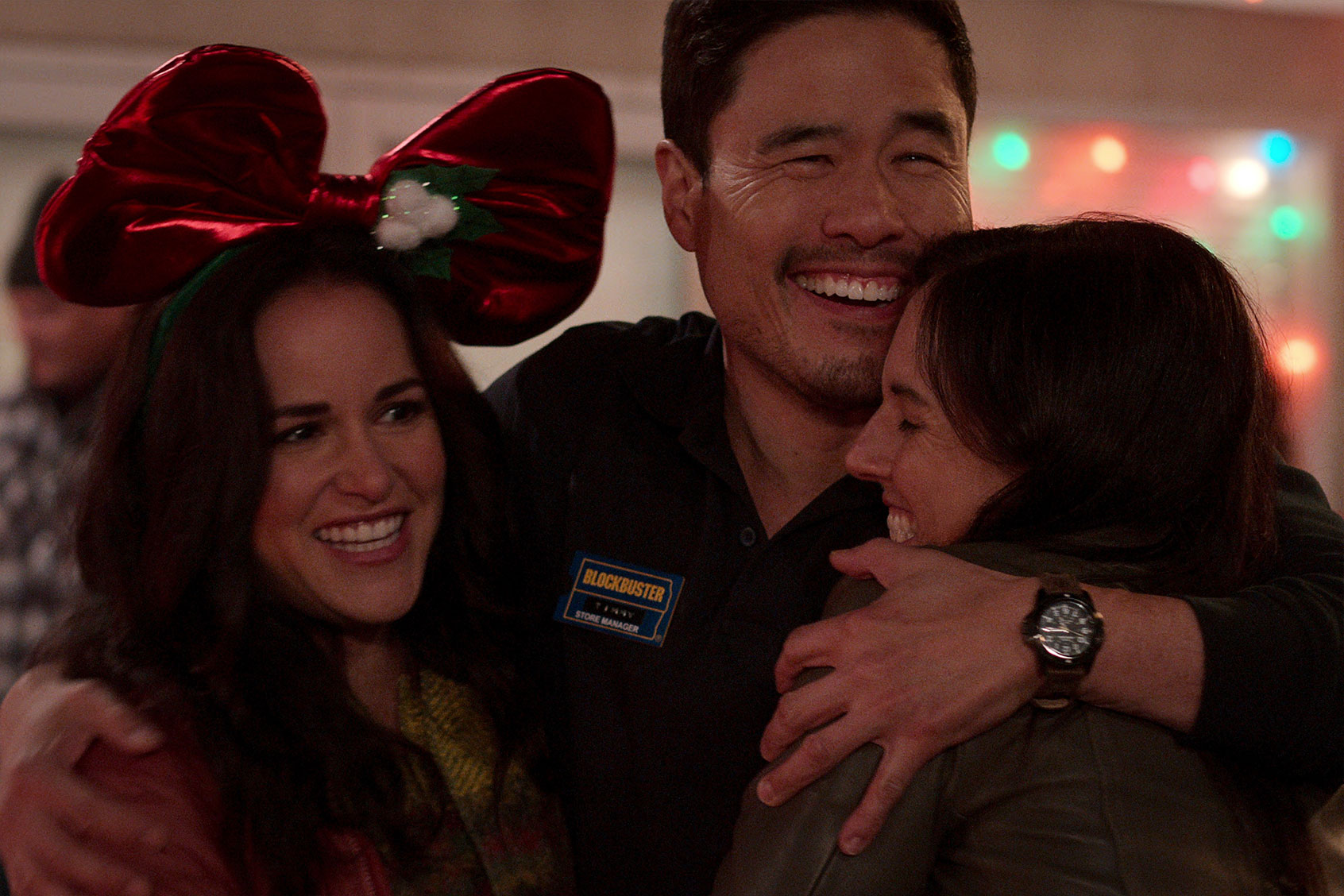
Netflix’s new comedy “Blockbuster” taps into nostalgia with its eponymous blue and yellow video store setting. Though opinions on social media differ as to whether the large cast of the show reflects the often-skeleton crewed Blockbusters people know and remember, it does bring back the ritual. On Fridays, after school or work, but before it grew too late, we would haunt the aisles, searching. It would take forever to pick something out, especially if you were with someone. If that someone was new, a fledging relationship, there would be the hesitation of wanting to impress them with your selection, perhaps choosing something from the Criterion Collection over the popcorn film you really wanted.

There was the moment of truth: reaching behind the case to see if the film was actually available, or if someone had gotten to it first.

There was the moment of truth: reaching behind the case to see if the film was actually available, or if someone had gotten to it first. Video stores were a great equalizer. You ran into everyone there. You could covertly check out someone’s viewing tastes, as you might peer over a neighbor’s cart in the grocery store. But a video store is also the kind of place where, by returning there Friday after Friday, you grew to know the employees, and they you.

newspaper once described the assistant manager of my local video store, Isaac Slater, as having the “knowledge of an art house director.” He would set aside horror for me. We had long conversations about Hammer films. When I was late returning a video, he called because he was worried; it wasn’t like me. I once witnessed him reassure a customer over the phone about the Robert Pattison rom-com “Remember Me,” which she had had overdue for 9 days and which he swore to her was excellent. When he hung up, the other cashier said he had “totally lied.” “She felt so bad about it being overdue,” Isaac said. “She wanted to know it was worth it.”

Compare this camaraderie to streaming a video, which you do in bed on your ancient laptop, in your pajamas and alone.

Compare this camaraderie to streaming a video, which you do in bed on your ancient laptop, in your pajamas and alone. There’s no pressure to finish, no impetus to rewind. No one’s going to ask you about it, or if you want the sequel. You’re not going to compare notes the next morning with someone who has a knowledge of film, someone who might recommend another film, knowing your tastes, knowing you.

BlockbusterMelissa Fumero as Eliza, Randall Park as Timmy and Stephanie Izsak as Lena in “Blockbuster” (Courtesy of Netflix)Video stores were libraries but with membership fees. What might you discover, roaming the aisles? I first watched “The Hunger” because of a video store, “Legend,” “The Lair of the White Worm.” Friends not out at home were able to have safe access to queer media like “The L Word,” “When Night is Falling” and “Kissing Jessica Stein.” My hometown video store had a large kids’ section, where for free you could pick out a movie or show for the young ones if you rented an additional video.
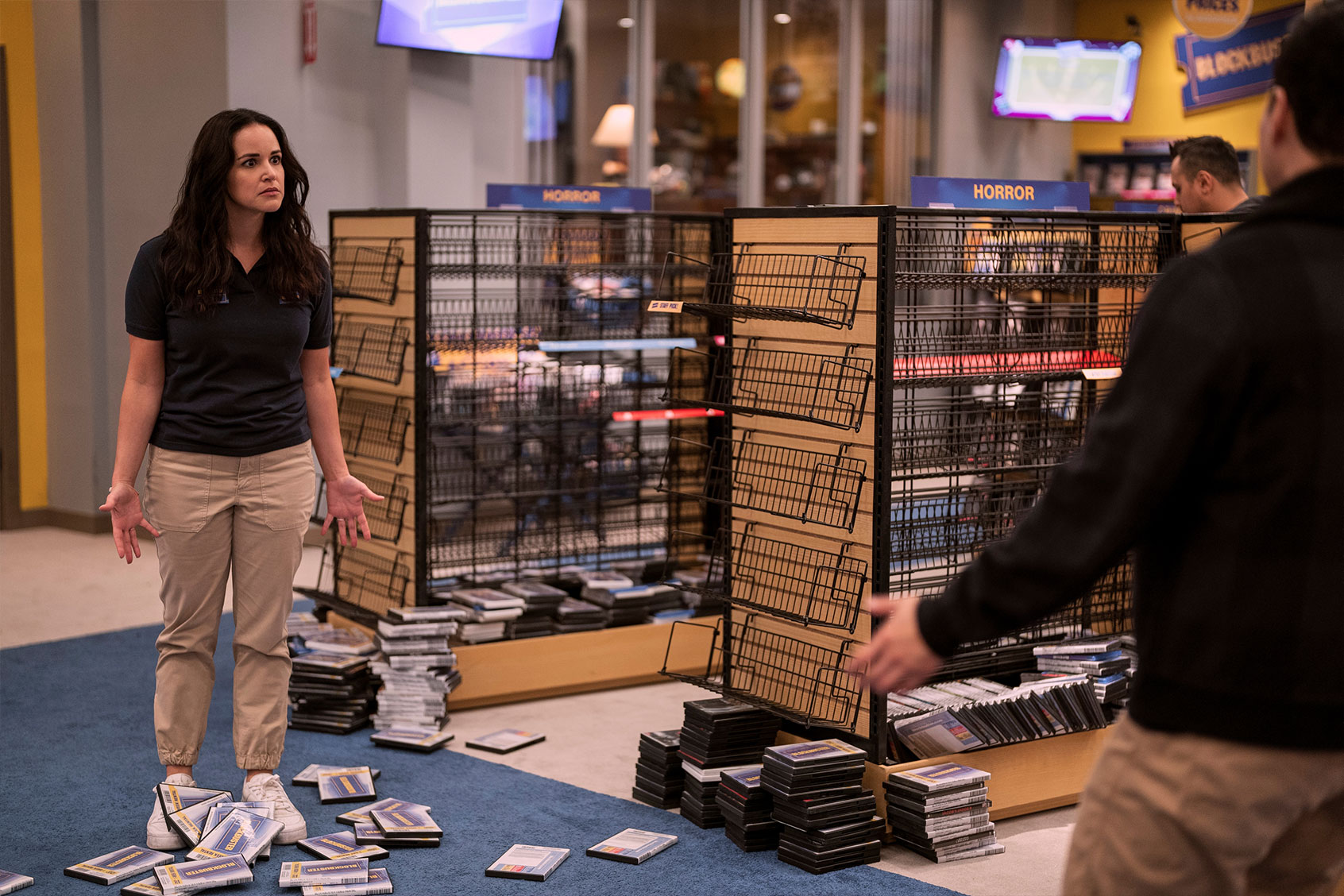
And yes, perhaps it wasn’t the greatest business model. The video store in my college town had a free area with slightly damaged tapes. This is how I first saw “Breakfast at Tiffany’s.” The last few moments, when Holly Golightly finds her cat and gets kissed in the rain, were entirely static. 

BlockbusterMelissa Fumero as Eliza in “Blockbuster” (Ricardo Hubbs/Netflix)In “The Last Blockbuster,” a documentary, also on Netflix, about the real last store standing (which happens to be in Bend, Oregon), Tom Casey, former CFO of Blockbuster Video says, “Do I miss renting from a physical store? No. Absolutely not. I don’t think anybody does.” Actor Adam Brody wonders in the documentary how long until companies stop making DVDs at all.

But there is still a need for DVDs, especially at libraries. Not everyone has the internet at home, particularly at high enough speeds for streaming, including the elderly and people living on lower incomes or in remote, rural areas.

And perhaps the isolation of the pandemic taught us we need any social interaction, even if it’s only a clerk at the video store asking us how we liked the latest Debra Granik or suggesting to check out Ti West. When I was a new single mom, sometimes Isaac was the only adult I talked to on a Friday, certainly the only one who knew my artistic tastes, or what my comfort watch was. In “Blockbuster,” manager Timmy (Randall Park) says the video store is “the only place that’s ever felt like home.”


Want a daily wrap-up of all the news and commentary Salon has to offer? Subscribe to our morning newsletter, Crash Course.


Kim’s re-opened inside an Alamo Drafthouse. The Blockbuster in Bend is still hanging on — hosting overnight guests, video game championships and viewing parties. It’s not just nostalgia. It’s community we miss, being together with a shared love of a type of art. Be kind. Rewind—not just those tapes but time. And take us back.  

Why are so many young people having less sex and fewer friendships?

The right-wing media ecosystem wants more sex.

Specifically, conservative and far-right pundits are worried that young men specifically aren’t having enough of it. That’s their take on an analysis of the General Social Survey, a bi-annual survey conducted by researchers at the University of Chicago, which shows that since 2010 the rate at which both men and women (18-34) are having sex has declined dramatically since 2008. In 2021, the survey found over 20 percent of males under 35 reported not having had sex in the past year, and 19 percent of females of the same age group; in 2008, those groups’ numbers were 8 and 7 percent, respectively.

Graph used with permission from The Institute for Family StudiesThe survey seems to have struck a chord with conservatives, particularly, who have curiously focused on the males, and ignored the females, in these numbers. Indeed, conservative media pundits —  including pseudo-intellectuals like Jordan Peterson and mainstream media figures like Tucker Carlson — have seized upon this data point to argue that there is a conspiracy against men.

Even before this survey was released, fringe far-right figures such as conspiracy theorist Alex Jones — who was recently fined for his public denial of school shootings and massacres that lead to targeted harassment of families of school shootings — have painted this phenomenon as a crisis of masculinity (even though under-35 women seem to be having less sex, too).

This narrative – the notion that there is some kind of crisis of masculinity, that there is a war against men, even – has become dogma among a certain subset of the right. Holding up this explanation are half-truths, pseudo-science, and misogynistic beliefs that have allowed figures like the recently de-platformed Andrew Tate to attract young men seeking advice on their love life, financial well-being, and other societal issues. Yet Tate and other “manosphere” figures seek only to tap into the fears, anxiety, rage, and frustration that these men feel and encourage them to direct it towards women—going as far to say women should not own property, have access to or be financially independent, or even encourage violence towards women.

This angry group of frustrated men often gather in online forums, places like 4chan and the like, to find community and people who share their exasperation. Young men who believe they are incapable of having sex refer to themselves as “incels,” short for involuntary celibates — and researchers such as Cynthia Miller-Idriss, Professor of Sociology in the School of Public Affairs and the School of Education at American University, notes that they pose a serious problem for Western societies. As Professor Miller-Idriss points out, the danger is that these young men’s feelings can quickly spiral into desperation — and that can lead to attempted or real acts of violence, such as the recent thwarted shooting by an Ohio “incel” and a self-identified incel shooter in the United Kingdom who killed five.

Nearly 60 years ago, C. Wright Mills encouraged that we understand this kind of aggregated social data not as the result of personal failings, but as public issues that can be explained by looking to larger historical and structural relationships. When we look at other data points like the graph below, we find that it is not merely sexual relationships that are on the decline, but also friendships. This, from a sociological standpoint, reveals that there is something larger going on here. Untangling it means we must look at the at the larger economic, cultural, and political changes.

Graph used with permission from The Institute for Family Studies

But the connection between relationships and politics goes beyond the rise of incel culture online. As further analysis by the Institute of Family Studies shows, those who have less sex tend to have more conservative beliefs about pornography, tend to attend church more, and have negative feelings towards pre-marital sex. Thus, it would seem that those not having sex may be caught in a peculiar position in society, brought on by their inability to let go of conservative cultural and religious beliefs which might prevent them from finding relationships.

Graphs used with permission from The Institute for Family StudieSecondly, we must also consider larger cultural and societal changes brought on by social media. Numerous studies have found that platforms like Instagram and Facebook have had a negative impact on young women’s self image in particular. Some scholars, including myself, argue that social media has replaced the public square and traditional spaces where others meet. Unfortunately, the unregulated social media environment that we have today is a poor replacement. This is not to say social media could not evolve to meet those needs, but in its present form it leaves something to be desired.

While quite a bit of attention is being raised about this issue, relatively few media outlets have examined the economic situation of those under 35. Indeed, for some time the economic situation of younger Americans has been dire. As early as 2011, think tanks like Pew were pointing out that there is growing inequity between generations, as indicated in this chart. Deeper analysis shows that stagnant wages which create the need to work more, coupled with ongoing concerns for the pandemic, and a work force which has lost faith in the current system has produced a much less economically secure youth. All this is to say that the resulting stress that can accompany economic instability may be as much to blame as anything else.

When social systems become unstable this can produce a societal condition called anomie, a French word meaning without norms. Sociologists use this term to refer to the feelings of disconnect and alienation that individuals can feel under these circumstances. Anomie, if left unchecked, can produce higher rates of crime, mental illness, and even suicide. Those using the concept point to it as a reason for why human beings seek out and join groups (including church groups, amateur sports, or music subcultures). Such groups can shield us from feelings of isolation and loneliness that stem from societal feelings of desperation and loneliness (i.e. anomie).

In the case of young people having less sex, it would seem there are other more plausible explanations that can help us answer this question—a bleak outlook brought on by economic conditions, changing social norms as a result of new communications technologies, and just simply feeling as though one doesn’t have enough time to invest in their personal relationships. Thus, if we really do see this as a serious issue, then we need to make changes at a variety of levels. This would include making having sex more socially acceptable, improving the economic conditions for those 35 and younger, and passing regulations around social media that will help harness its power towards fostering healthy long-term relationships.

In Brazil, Lula vows to halt deforestation — but it won’t be easy

Celebrations broke out across Brazil on Sunday when, after a divisive race, Luiz Inácio Lula da Silva, Brazil’s former president representing the Workers Party, ousted far-right President Jair Bolsonaro in one of the most significant elections in Latin American history. 

For many Brazilians, Bolsonaro’s defeat represents a rejection of the explicit anti-Indigenous, anti-environmental agenda he enacted while in office. Often referred to as the “Trump of the tropics” for his racist rhetoric, pro-corporate policies, and open attacks on democratic institutions, Bolsonaro gutted environmental enforcement agencies and pushed for mining and agribusiness in the Amazon. 

Bolsonaro has yet to formally concede, and fears that he will claim election fraud linger — truckers have been blocking highways in protest of the vote — but so far many of Lula’s opponents seem to tacitly accept the results.

Environmentalists say Lula’s victory is a chance to reduce deforestation in the Amazon, which skyrocketed to historic heights under Bolsonaro, and reestablish Brazil’s reputation as a leader on climate change. But it won’t be an easy task. 

Bolsonaro has two months left in office to carry out what opponents are calling his last-ditch “destruction package” — a suite of at least seven bills that include granting amnesty for land grabbing, restricting the environmental licensing process, and weakening pesticide regulation. The administration is attempting to push the bills through before the end of Bolsonaro’s term.   

“Right now there is dangerous abuse of law happening in Congress,” Suely Araújo, a public policy expert who ran Brazil’s environmental agency, Ibama, from 2016 to 2018, told Grist. “We’ve been fighting the Bolsonaro government for four years and we are in the final part of this, but we must stay alert. If they want to vote this through, they have time.”

Araújo added that the bills contain setbacks in environmental law that violate the rights of Indigenous peoples and the right to an ecologically balanced environment as guaranteed by the Brazilian constitution.

Lula also enters office at a time when agribusiness, miners, and organized crime in the Amazon are emboldened after years of Bolsonaro rhetoric and policies. On top of this, while leftists took the presidential race this weekend, many local Amazonian regions elected right-wing, pro-agribusiness leaders and Bolsonaro received a majority vote in over half of Brazil’s Amazonian states. Lula, who ran on a platform of rebuilding environmental agencies and fighting deforestation, will have to navigate the interests of Bolsonaro supporters in local governments as well as in Congress.

Lula has promised to update Brazil’s climate goals to steer the country back in line with the Paris Agreement. He has also committed to a list of climate proposals put forth by Marina Silva, the most prominent environmental activist in Brazil who served as his former environment minister. In his first speech as president-elect late Sunday night, he reiterated his strong support for zero deforestation in the Amazon. “Brazil is ready to resume its leading role in the fight against the climate crisis,” he told a crowd of supporters in São Paulo, “protecting all our biomes, especially the Amazon Forest.” 

Carrying out that pledge would likely involve restoring cooperation with Norway and Germany on the Amazon Fund, which contains more than $3 billion for the forest’s protection left untouched since the start of 2019, when Bolsonaro disbanded the fund’s governing body. It would also involve bringing back some version of the Action Plan for the Prevention and Control of Deforestation in the Legal Amazon Region, which includes not only monitoring and law enforcement, but also economic incentives to provide alternatives to deforestation.

The transitioning Bolsonaro government will represent Brazil at the United Nations climate summit, COP27, this month in Egypt. It is likely to emphasize the country’s low-carbon energy sector, which relies mostly on hydropower, and deflect from any questions about Amazon deforestation, which makes Brazil a top six global carbon emitter. But Lula has said he will send his own unofficial delegation, where he will pick up his past history of advocating for climate finance and “loss and damage” funding for developing countries. 

“He has a good team that knows how to do this work,” said Araújo, referencing Lula’s acclaimed record on decreasing deforestation during his prior tenure from 2003 to 2010, when his administration reduced rates by over 80 percent. As Lula develops his environmental agenda, Indigenous leaders and environmental groups are calling for a suite of actions, from removing invaders from the Yanomami Indigenous lands to withdrawing PL 191, a bill that is part of the “destruction package” and would allow for mining in Indigenous territories.

“Bolsonaro’s government implemented a kind of textbook dismantling that paralyzed climate policy,” said Araújo. “The first task will be to rebuild, then to advance.”

The election of Lula marks a swing back to the left, joining Brazil with six other Latin American countries that have voted in leftist leaders in the past four years. Like many of these other newly elected presidents, Lula will have to contend with extreme political division, as reflected in the outcome of the vote, where he won by a slim margin of 50.9 percent. 

Brazil’s national congress has a strong conservative block, with links to producers and agribusiness. Lawmakers maintain some leverage over Brazil’s federal budget, but representatives will also need to stay close to the executive branch to access funding for their bases. “It’s common in Brazil’s history to have conservative representatives change when the government changes, to be close to the one in power,” said Araújo, “and Lula is an expert in political articulation. He is good at making coalitions.”

In his victory speech, Lula tied together ideas of fighting inequality and uniting Brazil during a period of political tumult: “No one is interested in living in a divided country,” he said. “Brazil can no longer live with this… wall of concrete and inequality that separate [us] into unequal parts that do not recognize each other.” 

“We need a renaissance”: Photographer Devin Allen on why art is necessary for social change

Have you ever watched the NBA draft and seen how, when a guy from the hood is selected as a lottery pick­­, his whole section goes crazy when the cameraman pans to capture his reaction? 

I have seen this phenomenon on draft nights since childhood. I even used to dream of being in that position one day. When I was younger, I never noticed how big-time white players only pulled up with their parents and maybe a girlfriend. I honestly can’t remember a time when a poor white dude was selected early, causing all the homies up in his section to bust bottles and celebrate their last day in poverty as a collective. I’m sure there are many white millionaires who take care of their whole families, but it kind of seems like a choice. When you make it as a Black person who grew up poor, it is expected.

You don’t even have to become a millionaire; just experience the smallest amount of success, like getting a job at the burger joint, and watch how instantly you will be responsible for making sure your whole hood has unlimited access to free burgers. Award-winning photographer Devin Allen has been experiencing the pressure of being that guy from the hood who made it since he gained worldwide attention for his protest photography after the death of Freddie Gray. 

Gray died as a result of injuries he received from a rough ride in the back of the Baltimore County Police Department paddy wagon after he was arrested for carrying a legal knife back in 2015. Baltimore was already brewing with anger after years of unfair harassment from its crooked police department. That, in combination with Gray’s killing, caused the city to erupt. Allen, a West Baltimore native, took to the streets with his camera in hand and captured everything, producing images that landed in multiple news publications, celebrity Instagram accounts, on television, and eventually making him only the third untrained photographer in history to have one of his photos on the cover of Time magazine.

Since then, Allen has become a highly sought-after photographer; he snagged another Time magazine cover, headlined exhibitions, became the first photographer with his own sneakers, signed a deal with Leica cameras, published his first collection, “A Beautiful Ghetto,” and has been taking care of his neighborhood by giving out money and cameras, mentoring troubled kids, creating jobs and helping other artists find their footing. Allen, who just released his sophomore collection “No Justice, No Peace,” shared with me on “Salon Talks” why giving back, even when it makes him uncomfortable, is so important.

You can watch my “Salon Talks” episode with Allen here or read a Q&A of our conversation below to hear more about his new book, how he wants to grow his career beyond photography and why he wants Jaden Smith to play him if they ever make a movie about his life. 

The following interview has been lightly edited for clarity and length.

Can you start off by talking about what you’ve been up to since we last had you on the show?

It’s been a long journey. I think the last time we did an interview, I had just gotten the Gordon Parks Fellow and I was going to my show, “A Beautiful Ghetto,” at the headquarters. That’s been a beautiful relationship that has been growing and growing and has gotten me a lot of opportunities. I was in HBO’s “A Choice of Weapons,” where I was able to work with Ava DuVernay, Jamel Shabazz, Ruby Frazier, and Spike Lee. It was an amazing moment just to be in a film, not even acting, just being myself, and then that opened up more doors. Since then, I was able to work on “We Own This City” here in Baltimore, playing myself in a little cameo during the uprising.

Unfortunately, due to COVID, I wasn’t able to travel much outside of the country, but I’ve been able to study and hone my skills over time. I’m getting better with interviews and things like that, and then I’ve been working on this book the entire time during COVID. I started working on it in late 2020 after everything that happened with George Floyd, and my second Time magazine cover was published around that. So I’m still on the ground, still working, still teaching. A lot of it was done over Zoom. I had the Under Armour collaboration, where I designed four shoes for Under Armour, including a collaboration with Spike Lee where we donated all the money to teaching Baltimore City kids photography, so I’ve been busy.

You’ve got to be the only photographer with a sneaker. 

“I’m lucky. I’m the photographer, so a lot of times I don’t get into the squabbles of the activists.”

I think it was in an interview with “USA Today” or one of those interviews when they [said], “You’re the first photographer with your name on the shoe.” Not just one, but I had four. It was crazy, but it was just awesome. The collaboration also had imagery of Baltimore’s youth, and boxing, basketball, local kids, and local teams from local gyms, and highlighting the sometimes-forgotten heroes: coaches. 

Your first book, “A Beautiful Ghetto,” was your big introduction to the publishing world. You took us through parts of Baltimore where people don’t go. When people come to town, they go to the trendy spots, they go to the restaurants, they hang around downtown, but you took them to the world where you come from. You showed the beauty inside of that world, and it was a really special book. I feel like you upped everything on the next level with “No Justice, No Peace.” Tell us about it.

“A Beautiful Ghetto” was basically my love letter to Baltimore. I wanted people to better understand what Freddie Gray looked at and what Baltimore was like in everyday life. It was focused on Freddie Gray and everything that happened in 2015, but I still continued that work after Freddie Gray. 

A lot of people don’t know that Baltimore is a very activated city when it comes to activism and fighting back and resilience, so I still continued that work over the years, still supporting. I don’t go to other cities often because I have respect for those communities. I’d rather work with and get close to local artists to know what’s going on because I know how it feels when people come into my city and want to tell me about my city and try to get shine off of it. This book is still Baltimore-focused, but it’s looking at the larger picture. 

Through photography, I find that’s one of the best mediums when it comes to collaborating and working with people like you, like Kondiwani [Fidel], like Tariq [Toure]. Just being around so many writers in Baltimore, I found the power of collaboration. What I wanted to do with this book was what I learned from just being on the ground.

I’m lucky. I’m the photographer, so a lot of times I don’t get into the squabbles of the activists. Every activist has their own way of going about things — “I’m right,” “You’re wrong.” Some activists feel like you’re not militant enough and some activists are, “Well, we’re all about peace and tranquility,” and some activists are, “Well, we don’t support trans lives.” Then other activists are like, “Well, you can’t say Black lives if you don’t include trans lives.” 

It is all these nuances and all these different issues and these different perspectives, but the underlying goal of everybody is to be free and not get killed because of the color of their skin. So, what I wanted to do with this book was collaborate with a bunch of different writers that can tap into those different spaces and understand that it might be a simple goal, but it’s very, very complex. That’s why I bring in people like Keeanga-Yamahtta [Taylor] from Princeton, but then I bring in people like Lawrence Bernie, who talks about George Floyd being an artist, reminding us that he was a human being. You could turn around and read Wallace Lane, who talks about the problem with the pandemic, where we are so worried about COVID, we forget about people in the inner cities and the needs that we have, that we have been neglected before COVID, so I try to bring in a whole bunch of different perspectives.

It’s funny that you made a point about the activists and how so many different groups, all oppressed groups, are figuring out ways to critique other oppressed groups. The person who’s actually doing the oppression is just sitting back with his feet kicked up, drinking a cool drink, and watching all of the infighting happening between change makers. How do we get passed that? Do you think art will help bridge those gaps?

I think art is a vehicle to bridge gaps, educate and bring people closer. As a visual artist, when people are talking to me, I might not understand it verbally, but if you can put it in a poem or put it in a show, I might understand it better. These are different tools to get the point across. That’s why directors are important, poets are important, painters are important. We need a renaissance to better understand some of these things, because just telling a person, “This is what it is,” is not always the best way of doing it. 

I find that for me, as an artist and working on this book, I’ve learned new things. I’m always willing to learn, because I don’t know everything. I feel like a lot of times people think they know everything and there’s no way in the world you can know everything. So, as a photographer, I’m always digesting things visually and I try to do that in everyday life. I might not understand everything, but I know right from wrong and I know what needs my support.

Tell us about your creative process when putting this book together because we know that the bulk of the images are from you, but you selected some Gordon Parks photos, as well.

The process was very interesting. I think the book started to morph in different ways and something that I learned from my mom was, her favorite thing to say, “You’ve got to look to your past to understand your future.” 

“The biggest thing is to go out, create, find your lane, and just grind.”

I studied Gordon Parks’s life in and out and really set out on a journey to be like him and follow in his footsteps and use my camera as a weapon. What I wanted to do with this book was show people where the inspiration comes from, because you would be surprised how many people don’t know Gordon Parks or Jamel Shabazz. It’s sad, but that’s the world that we live in. We learn about Malcolm X and Martin Luther King in Black History Month, but who was the person capturing the image that you’re looking at?

Absolutely.

I wanted to bring it full circle, that it was a Black photographer. It was many, but Gordon is my favorite, and I wanted to show that in the work. That’s what started off the process, but that’s not strong enough. I wanted to write a little bit about my life leading up to why I do the work that I do. I write a little bit about my friend getting killed by Baltimore City police officers and feeling like I didn’t have a voice, leading up to finding the camera and then finding my platform. But when I started working with Brea Baker and Adrian Ingram, they were like that vehicle, where I have a young Black woman who’s an editor that’s on the ground, but then I have Adrian Ingram, who’s older, who worked with Deborah Willis. So, I have these two amazing Black women on my side where we are bringing in the old and the new, the then and the now, but it’s collaborative.

So, Brea Baker, when I say these are the type of people that I want, that I respect. I respect Tiffany Loftin. I’d heard about Sean Monterrosa and she’s like, “Oh, I know their sisters.” Can they write for the book? So, it was essays that I already read, like Keeanga-Yamahtta’s essay, I’ve read a million times. I’ve read your essays. I’ve read Kondiwani’s. I’ve read one Lawrence article, and when he sent me that one, I was like, “That’s got to go.”  

“When I meet artists, you could tell by the fierceness in their eyes how seriously they take it.”

What I did was I pulled things that I already had read that I loved and then quotes that might have inspired me, but then people were submitting other things. I was just excited that people, I was able to pull from Jacqueline Woodson and Charlene Carruthers. Being on the phone with Leslie Arnold for hours that we forgot… We would just start talking about life, we wasn’t even talking about what she could put in my book. She just said, “Oh, we had the same moral compass. Here, take whatever you want.” Dominique Christina, “Hey, pick some photos. This is some of the photos I got, pick a photo that I need you to write about it,” because I understood some of these people, their goals, their moral compasses, what they write about, I follow them on Instagram. So, I went at everybody differently and I think it worked and it came together beautifully. 

The images are beyond beautiful. They’re powerful. The book is a piece of art. Sometimes with art books, the writing is glossed over. So, I would like people to study your images and follow those stories, but also, spend some time with the writing, because I think you curated it in a strong way. Do you feel like you got everything you wanted in this project?

I wanted more, but I understand less is sometimes more. I know a lot of times, as artists, we like to do everything by ourselves, but what I’ve learned from just being able to work with people like Paul Moakley and Aaron Bryan at the Smithsonian, or working with Peter at the Gordon Parks Foundation. Curation is very, very vital. You can overpower or overstimulate someone. So, of course, I wanted more. There were some essays that didn’t make it, some poems that didn’t make it. We was fighting word counts, so a lot of my essay got chopped up. But, I understand just giving a person just enough and not overstimulating them. So, at the end of the day, I feel like it’s the perfect size, it’s not too overwhelming, it’s enough words, it’s enough photos. Like you said, I didn’t want the photos to overpower the words, but I didn’t want the words to overpower the photos, I needed them to coincide and find balance and I think we did that. 

“When I’m old and I can’t even hold a camera and I’ve got arthritis and all my pictures coming out blurry and shaky, the next generation can say, ‘Devin inspired me.’ ‘Devin got a camera for me.’ ‘I took a Devin Allen workshop.'”

Your first book, “A Beautiful Ghetto,” has been used in classrooms all over the country, but especially here in Baltimore, where you’ve been an inspiration to so many young people. When you were working on “No Justice, No Peace,” were you thinking about that same audience?

Yes. Everything that I do, I gear it to the youth, because I know how it felt when I didn’t have anyone to look up to. I grew up looking at the dope boys. They’re the guys I wanted to be with. But if I can continuously be successful and create content that empowers and inspires a younger generation… Since “A Beautiful Ghetto,” I’ve given out 600-plus cameras. One of my students is in college right now for video, one of my kids that took one of my programs is at Baltimore School of the Arts, the same school Tupac and Jada Pinkett went to. 

I’m seeing that change since “A Beautiful Ghetto,” but “A Beautiful Ghetto” was more so about us. But I also want to make sure that I instill in these kids like, “Yes, I take pictures of famous people. Yes, I work for Under Armour, but the work continues.” I want to make sure that they understand the same thing that Gordon and Roy DeCaravas and Jamel Shabazzes understood: the power behind the image that is beyond the likes on Instagram. The work, it’s a tool, it’s a weapon. 

The book is still geared for everybody. I try to put a piece of everybody that I’ve come across. The second Time cover that was shot at a Black Trans Lives Matter march, where they have been very supportive of me, and I make sure, the second anniversary come up, “Devin, where you at? You in town? We need you there.” To the point where we have built a respect and a rapport for the work as a photographer and the person that I use that camera to elevate their voice, so I want to make sure I try to get everybody at least something in there for them that might inspire them. But the work is always going to be geared and packaged to try to inspire and engage the younger generation, because when I’m old and I can’t even hold a camera and I’ve got arthritis and all my pictures are coming out blurry and shaky, the next generation can say, “Devin inspired me. Devin got a camera for me. I took a Devin Allen workshop. Devin came to my school and taught.” I’m just doing the work that was passed down from Robert Houston and all the other photographers that came before me and I want to make sure that I’m a part of that legacy. In the next generation, I can be one of those marks of history that they could say they got it from.

On the internet today, everybody thinks they can be an artist. In this world of hypercreativity, where every single individual person walking up and down the street is a brand, what does it mean to be an artist today?

That’s a tough question because I think everybody has their different views. It depends on what type of artist you are. You have content creators, you have artists. I consider myself an artist because I work with multiple mediums. When I meet artists, you could tell by the fierceness in their eyes how seriously they take it. Some people, “Oh, I’m an artist today,” and then, “Oh, I’m a stripper today.” They’re hitting one lane and then another lane. “Yo, you still paint?” “Oh no, I bake cookies, yo, and I got the juice bar.” 

“I’d rather work with and get close to local artists to know what’s going on because I know how it feels when people come into my city and want to tell me about my city and try to get shine off of it.”

Some people are still trying to find themselves and I love it, I love to see the growth. But when it comes to this, when I think about this, I live and breathe this, I make sacrifices to do what I do. I could easily say, “I don’t want to do no more protests. I don’t want to speak about what I’ve seen. I want to go move to France and shoot models for the rest of my life, done,” but the work is that important to me and I feel it so strongly. So, when I think about artists, I’m thinking about those people that will put it all on the line. You can just see it, it’s something that they give off. But then I know people that are content creators that are passionate about creating content. It’s a very difficult question. It’s cool to be an artist, a lot of people, oh, they think it’s cool, but then when it’s time to go buy that $100 canvas or it’s time to buy that $1,000 camera or it’s time to take this pay cut or do some work for free, you’ve got to take those Ls and those Ws. 

When I think about artists and when I look to an artist and when I’m like, “Oh yeah, they serious,” I can just see how hard they go for it. Every artist that I know, that I’ve been inspired by, that I’ve worked with, they make me want to work harder. Some people want to be artists and they get scared. The biggest thing is to go out, create, find your lane, and just grind. 

You’re talking about television a little bit — we want to know what’s next for you. What’s next for Devin Allen?

Working on this book really showed me that I’m good at curating. It’s showing that I can actually, from hanging with so many writers, I can write. I get overwhelmed by it, but I’ve found my niche to it and how I can go about it, so I want to write more. I’m looking to do more photo essays. I definitely want to move into film. I’ve been on a couple of sets since then, shooting behind the scenes, shadowing directors and different things. My biggest thing is just expanding my creative prowess beyond the lens.

Since “A Beautiful Ghetto,” I’ve done installations, I’ve done performance art, but people still put me in a box like, “He’s a photographer,” but I can do so many different things. So, I think the next couple of years, really inspired by Joshua Kissi and my boy Photodre [Andre Wagner] just directed something with the Nets, that’s the lane that I want to go. They inspired me. But photography has its limits on what I can show a person, so I need more tools to get my point across. What if I do want to turn “No Justice, No Peace” or “A Beautiful Ghetto” into a short film? Those are the things on my mind right now of what I can do and what I want to do for the future, so just expanding, directing, writing more. Just creating more and working with different mediums, just so I can expand, because I definitely want to be one of the greatest artists of my generation.

DeSantis roasted by former students at Georgia boarding school

Days before Florida voters go to the polls and decide if they want Gov. Ron DeSantis (R) to serve a second term, the New York Times did a deep dive into his solitary year teaching a private boarding school in Georgia where he was popular with some students while others are now — as they were then — highly critical of the history classes he was teaching.

According to the report from the Times’ Frances Robles, 23-year-old DeSantis was fresh out of Yale University when he took a teaching position at Darlington School, one of the state’s oldest boarding schools.

As Robles wrote, at a recent 20-year reunion, the topic of DeSantis came up and what graduates had to say about the current Florida governor offers “a window into the formative years of one of the most polarizing figures in American politics.”

Opinions on DeSantis differed, according to the Times.

“As a baseball and football coach at the school, Mr. DeSantis was admired and respected by his team. As a teacher, he was remembered by some former students as cocky and arrogant. He once publicly embarrassed a student with a prank, hung out at parties with seniors and got into debates about the Civil War with students who questioned the focus, and sometimes the accuracy, of his lessons,” Robles wrote.

According to former student Gates Minis who graduated in 2003, “He was a total jock; that was his personality. He was definitely proud that he graduated Ivy and thought he was very special.”

Another graduate, Trip Barnes, added, “He was definitely one of the cooler guys. There were other young teachers who tried to be everybody’s friend who didn’t have nearly his mystique.”

Where students had difficulties with the future politician was in the classroom.

According to the report, his lessons on the Civil War were a bone of contention with students still remembering his approach.

“Danielle Pompey remembers Mr. DeSantis, a Florida native and recent Yale grad, being an outsider like her, a New Yorker with a thick accent to match. But Ms. Pompey, who is Black and was on an academic scholarship, said she felt that Mr. DeSantis treated her worse because of her race,” with the report quoting Pompey, also the class of 2003, recalling, “Mr. Ron, Mr. DeSantis, was mean to me and hostile toward me. Not aggressively, but passively, because I was Black.”

“Like in history class, he was trying to play devil’s advocate that the South had good reason to fight that war, to kill other people, over owning people — Black people. He was trying to say, ‘It’s not OK to own people, but they had property, businesses,'” she stated before adding, “He had a good opportunity to enrich people, to come there from the Northeast and show people in the South that we can blend. It seemed like he didn’t want to do that.”

Minis, who is white, shared that class with Pompey and recalled DeSantis refused to back down when called out by students for getting the history wrong.

According to Minis, “She remembers him claiming that every city in the South had burned, even though she knew her hometown, Savannah, had not and she called him out on it.”

Another former student who didn’t want to give their name, claimed, “Mr. DeSantis’s takes on the Civil War were the subject of so much talk that students made a satirical video about him at the time for the video yearbook.”

In the video, viewed by Robles, “…a short snippet in which a voice purporting to be Mr. DeSantis is heard saying: ‘The Civil War was not about slavery! It was about two competing economic systems. One was in the North. …”‘while a student dozes in class. (A student voiced the role of Mr. DeSantis, because students did not have any actual footage of him, according to a student who helped put it together.)”

According to former student Matthew Arne, “Mr. DeSantis was kind of a smug guy.’ noting that students were well aware that he had just graduated from Yale.”

“It was like a, ‘I’m kind of better than you,” Arne noted before adding, “And we were all just kids.”

“Given Ron DeSantis’ obsessive focus on “sexualization” in schools, it seems pretty strange that he doesn’t talk about the year he spent as a teacher, where former students remember him defending the confederacy and drinking with high school seniors,” one person said on Twitter, along with a photo of DeSantis partying with students.

Mike Davis’ blue-collar odyssey to “City of Quartz”: From trucker to legendary leftist writer

Before there was a “City of Quartz” for Mike Davis, there were hot rod races in the country roads of eastern San Diego County. “There were still country roads and sections of straight roads where you could stage impromptu drag races because the population was less than half of what it is today,” Davis said, describing a vanished era “where your fundamental loyalties weren’t to God or country or race or religion. They were to Chevys or Fords — and never the twain should meet.”

To speak with Mike Davis, who died on Oct. 25 at his home in San Diego at the age of 76, was a chance to speak with a great American writer. (Davis was also an occasional Salon contributor.) But Davis hadn’t set out to be a literary voice. He discovered he was a gifted writer in the process of trying to stand up for working people. He did this more in the tradition of Woody Guthrie, a raconteur for the dispossessed, than in the spirit of aspiring writers with expensive educations and bohemian surroundings.

Davis grew up with friends for whom mobility was, above all else, defined by racing cars. “I have an 18-inch scar on my thigh from one hot rod accident in 1964,” he said during a 2018 interview at his San Diego home, where he reflected on inspirations for his landmark work “City of Quartz,” which turns 30 this year. 

Long before Davis won MacArthur and Lannan awards for his writing, he drove trucks through channelized riverbeds, through affluent neighborhoods delivering toys and furniture, and through the have-and-have-not communities of Los Angeles that would inspire his later writings. That truck-driving career started during his junior year in high school when his father had a heart attack.

With his father unable to work, Davis dropped out of high school and took over his father’s job making deliveries for his uncle’s meatpacking company. “It was at times a great boon to my friends,” Davis told me. “I used to deliver meat to the Chargers training camp,” meaning the pro football team that began in Los Angeles, then moved to San Diego for several decades, and more recently moved back. The camp was located way in the mountains northeast of the city, and players were kept up there in monastic isolation. “After practice they had two passions,” Davis said. The players would “consume enormous quantities of beef. Two or three of my high school buddies would always accompany me up there, and they’d get to meet their hero football players and watch porn movies, and we’d take home a few steaks as well.”

Later Davis qualified for a poverty program designed by UCLA’s Institute of Industrial Relations in partnership with the Teamsters Union. “It was probably the most utopian experience in my life, certainly the most fun,” he said, explaining that he and his fellow trainees got paid to spend three months driving brand new heavy-duty trucks — Peterbilts, Kenworths and Macks. 

The most bizarre and also most practical aspect of the training, he said, was that Davis and his fellow trainees practiced driving those heavy-duty trucks down the channelized sections of the Los Angeles River (later made famous in “The Terminator,” among other movies and TV shows). “We could practice without breaking or smashing into anything,” he said.

That training landed Davis a job driving a Ready Mix cement truck for a construction company. “One day, I was pouring concrete when they were building the ARCO oil towers [in] downtown [Los Angeles], which I think have been torn down now because they were full of asbestos,” Davis recalled. “I got so mesmerized watching the ironworkers 20 stories up there doing their thing. My hearing was bad, even at that point, and all the sudden I realized somebody’s throwing something at me and guys are yelling at me. I was managing to pour concrete right down the center of Figueroa Street!”

Davis lost his job after that incident, but got another one driving for Pensick & Gordon, the largest toy distributor on the West Coast. “They had, at that point, probably the most modern warehouse system in California, a partially automated system,” Davis said, noting that the warehouse featured an automatic order-picking machine. “There were 12 of us hauling 27-foot and 40-foot trailers every day. I ended up staying on that job for almost five years, working full-time.”

Davis said he might have remained a trucker his whole life — if not for a seasonal layoff, a Teamsters wildcat strike and a Marxist newspaper run by UCLA faculty and students.

Those years of experience sparked Davis’ lifelong interest in Southern California labor issues related to the mobility of people and goods. At one point, he considered becoming a maritime clerk for the International Longshore and Warehouse Union (ILWU), and early in his studies at UCLA he wanted to study transportation economics and logistics. “I also nursed this dream, which I never confessed to my socialist comrades, of becoming an independent owner-operator or working in the industry as a logistics expert,” Davis said.

He might have remained a trucker for his entire career, Davis admitted, if not for a company reorganization that shifted all but two drivers to seasonal status. “The rest of us got laid off for a couple of months,” he said. “Because we were working only 10 months a year, we lost all of our seniority. So I decided at that point to go back to UCLA.” 

During a 1970 wildcat strike by the Teamsters — a famous event in L.A. labor history — Davis worked with Marxist professors and students from UCLA to produce a newspaper called Picket Line to support the strikers and labor activism. The students and faculty working on that paper encouraged Davis to enroll at the university himself. That was a turning point in his life.


Want a daily wrap-up of all the news and commentary Salon has to offer? Subscribe to our morning newsletter, Crash Course.


“I was almost 30 years old and married and considered myself a grown man,” Davis said. “I didn’t want to live like a starving student, so I decided I would get a job on the side that could keep me in the style to which I was accustomed.” With his Class 1 driver’s license, he was hired to drive a tour bus — which also meant writing and delivering the scripts to people visiting L.A. from all over the world. “The most peculiar part of the job,” he said, “was that you dressed up like an airline pilot.”

That sparked Davis’ interest in L.A. history, and provided an opportunity to develop the synthesis of literary, historical and sociopolitical elements he would use to full effect in “City of Quartz.” Before that time, Davis said, he “was interested mainly in the trucking industry and left-wing activity inside the Teamsters union.” 

Writing scripts for his tour-guide job sparked an interest in L.A. history, and drove Davis toward a synthesis of literary, historical and sociopolitical elements that would shape his writing career.

Those tour-guide scripts drew Davis to other L.A. and California authors, such as John Fante, Louis Adamic, Upton Sinclair, Raymond Chandler and perhaps his biggest influence, Carey McWilliams — the author, lawyer and editor at the Nation who was known for his influential reporting and commentary on California politics, the plight of migrant farm workers and Japanese American internment during World War II.

As part of his tour guide job, Davis recalled, ” I somehow ended up with these group tours sponsored by the longshoremen’s union,” which had organized the Hawaiian sugar plantations after World War II. His group tours largely consisted of Filipino and Japanese retirees, Davis said. “These were fantastic people. They would sing and chat and the whole thing. They weren’t so interested in seeing movie stars, they were really interested in history, so I got to use my Carey McWilliams.” 

Davis’ life changed again when his employer, Gray Line Tours, decided to break the union and he and the other drivers went on strike. “They brought in professional strikebreakers. It turns out that the private bus industry retains a permanent cadre of strikebreakers that just travel around the country breaking attempts to organize bus lines, whether it’s school buses or tour buses, whatever.”

The Gray Line strike soon fell apart and Davis went back to the trucking business, somehow balancing his studies at UCLA with his trucking income until one fateful traffic stop on the road in central California, “at the scales somewhere around Hollister or Gilroy.” Davis was pulled over by a California Highway Patrol inspector who wrote him for “the most savage and ridiculous series of violations you could imagine.” His employer didn’t pay for tickets: “The drivers had to eat them,” he recalled. “So thanks to this one stop, I ended up paying $100 more than I had earned.”

Around that time, Davis had started teaching one night a week in the Urban Planning Program at UCLA. “So I was driving six days a week, and teaching one night at UCLA,” he said. “One paid me something like $5,000, and the other I was losing money on.” So that was the end of his trucking career and the beginning of his life teaching, research and writing at UCLA and other Los Angeles-area universities.

It was at the Southern California Institute of Architecture (SCI-Arc) where Davis found the most intellectual liberty. During his decade-long tenure there, he used his courses as vehicles to explore Los Angeles in transformative and intellectually mischievous ways. “For instance, I became interested in whether you could restore some of the original streams and creeks that flowed through west of downtown L.A., which reappear in their natural form in certain backyards on the west side, and a couple of the country clubs.”

Another course on design and infrastructure, Davis said, could well have landed him in Guantánamo Bay a few years later. “I tried to figure out a way to get the students excited about infrastructure,” he said, explaining that each student in the course was given a hypothetical $20,000 “to inflict as much damage on Los Angeles as they possibly could.” 

A course on design and infrastructure could have landed him in Guantánamo Bay a few years later, Davis said. Each student was given a hypothetical $20,000 “to inflict as much damage on Los Angeles as they possibly could.” 

This subversive project compelled students to pay attention to freeways, subterranean elements, “aviation, fuel lines running though the West Side, the vast amount of natural gas stored in the Ballona Wetlands. If this had been after 9/11, I’d be in prison,” Davis said. “It was quite remarkable: These kids came up with absolutely brilliant schemes for shutting the entire city down for the cost of a truckload of fertilizer.” That was the kind of freedom Davis had when he started writing “City of Quartz.”

Much of that groundbreaking work is the result of Davis’ time in library stacks poring over books and periodicals. “Part of ‘City of Quartz’ was written while I was teaching in Ottawa and Toronto for a year,” he recalled. “I just read the L.A. Times for a 30-year period — literally cover to cover,” he said, including the local editions for the West Valley, San Gabriel Valley and South Bay:

I was interested in things like the homeowner’s movement. I didn’t just read the front page and the main local news, I went scrupulously through all this other stuff, in far too much detail. I was convinced no one would ever buy “City of Quartz” because it has a 90-page chapter on homeowner’s association, and things like battles over dog poo.

When Davis returned to L.A. from Canada, he spent part of the following year delivering furniture. “I had a brand new Mack cab-over, and me and one of the warehousemen would make the rounds picking up furniture” at illegal manufacturing sweatshop “all over South Central L.A.” 

Davis’ formative experiences within the Southern California supply chain clearly informed the socioeconomic commentary at the heart of “City of Quartz.” A theme that begins in that book and extends through all of Davis’ work — “Ecology of Fear,” “Planet of Slums” and “Buda’s Wagon: A Brief History of the Car Bomb,” to name a few — is that economic and social mobility is directly linked to people’s access to physical and geographic mobility systems. In other words, if people can’t get where they need to go, and don’t have access to resources, they are more than likely to struggle with poverty:

I got to see inside the sweatshop furniture industry and this whole new industrial economy of Los Angeles based on sweatshops. Also, you got to know the workers. You wouldn’t find a harder group of workers in the world than the young Mexican guys and Salvadorans who worked in these plants, and who I worked with at this company. Some of them holding down two jobs at a time. The dignity and heroism and struggling for their families, extraordinary. I thought it was the single most important story to be told about contemporary Los Angeles.

Three decades after the publication of “City of Quartz,” the book remains required reading in cultural and urban studies courses around the world. Its subtitle, “Excavating the Future of Los Angeles,” asks readers to use lessons learned about L.A.’s past — about its “Boosters, Noirs, and Mercenaries,” in Davis’ memorable phrase — to consider not only the future of urbanism in general and cities around the world.

In his final book, “Old Gods, New Enigmas,” Davis challenges readers to think about the city as its own solution in the concluding chapter, “Who Will Build the Ark.” He reflects on a range of perspectives contributed by Lewis Mumford, Jane Jacobs, Frank Lloyd Wright, Walt Disney and Le Corbusier, among others, and concludes that, more than ever before, cities of the future will play host to humanity’s greatest failures and greatest triumphs. At the end of his career, Davis maintained the same spirit of intellectual mischief and creative rebellion evident in the early courses he taught at SCI-Arch, calling for a hacker’s sensibility in reclaiming the cities of the future:

Some of history’s giant trees have already been cut down, a new Ark will have to be constructed out of the materials that a desperate humanity finds at hand in insurgent communities, pirate technologies, bootlegged media, rebel science, and forgotten utopias.

When asked about the ethical importance of mobility in connecting working people to vital urban centers and making cities more egalitarian, Davis said, “Whether you look at Lagos or Cairo or Delhi, for instance, an increasingly large part of people’s budget has to be spent on transportation. Transportation now involves far longer commutes than the vast majority of Americans would conceive of themselves ever having to take. Hundreds of millions of people in the medium, large and hyper-large cities face excruciating tradeoffs between housing and transportation costs.”

In the end, Mike Davis’ blue-collar route that led him to “City of Quartz” now extends to the realities faced by working-class people around the world. “Rational transport planning would look at, ‘Here’s the biggest clump of jobs, here’s the biggest concentration of residences,’ and draw a straight line between them,” he said. But that is “almost never done.” Davis’ landmark book remains a call to action, a reminder that we must  learn from history — both its triumphs and its many failures — to excavate a better future for working people around the world.

“God made me a fighter,” DeSantis says in new campaign ad

Florida Gov. Ron DeSantis is pulling out all the stops, sending his wife in to submit his closing argument for re-election: God endorses me. DeSantis is running to keep his seat from former Florida Governor Charlie Crist, a Democrat.

It’s a not uncommon endorsement Republicans are making – or rather, making up. God isn’t going to issue a statement of denial or a cease and desist order. Anyone, even embattled GOP Senate candidate Herschel Walker, can do it – and they are. Walker this week told Georgians, “I’m a warrior for God.”

DeSantis’ campaign is a bit more polished.

Many may not be old enough to remember Paul Harvey, but many Florida voters are.

The DeSantis campaign, via DeSantis’ wife, Casey, just released a two-minute black-and-white ad, ripping off a wonderful ode the late ABC News Radio broadcaster Paul Harvey, who died in 2009 at the age of 90, once recorded.

If you have two minutes it’s worth listening to the beautiful, original recording by Harvey, “So God Made a Farmer.”

DeSantis’ ode to himself is less poetic, but it does enshrine his legacy as a Christian nationalist.

“On the eighth day, God looked down on his plant in paradise and said, ‘I need to protect her.’ So God made a fighter,” the DeSantis ad begins, clearly taking from the Paul Harvey classic.

“God said, ‘I need somebody willing to get up before dawn and kiss his family goodbye. travel thousands of miles for no other reason than to serve the people, to save their jobs, their livelihoods, their liberty, their happiness.’ So God made a fighter.”

“God said, ‘I need someone to be strong advocate for truth in the midst of hysteria. Someone who challenges conventional wisdom and isn’t afraid to defend what he knows to be right and just,’ so God made a fighter.”

“God said, ‘I need somebody who will take the arrows, stand firm in the wake of unrelenting attacks, look a mother in the eyes and tell her that her child will be in school. She can keep her job, go to church, eat dinner with friends and hold the hand of an aging parents taking their breath for the last time.’ So God made a fighter.”

“God said, ‘I need a family man. A man who would laugh and then sigh and then reply with smiling eyes when his daughter says she wants to spend her life doing what dad does.’ So God made a fighter.”

In 2013 Ram Trucks used the Paul Harvey ode to farmers in an elegant Super Bowl ad, but at least they credited the author. DeSantis did not.

DeSantis is getting highly criticized for this last-ditch closing argument, just four days before the November 8 election.

“New DeSantis ad says DeSantis was created by God on the 8th day to protect freedom,” observed Talking Points Memo founder Josh Marshall.

Economist and frequent political commentator David Rothschild slammed DeSantis by responding with a quote from Exodus.

“You shall have no other gods beside Me. You shall not make for yourself any graven image, nor any manner of likeness, of any thing that is heaven above … You shall not bow down to them, nor serve them, for I, the Lord Your God, am a jealous God …”

Florida Attorney Daniel Uhlfelder, who closely tracked DeSantis’ possibly unlawful shipping of migrants to Martha’s Vineyard, was less eloquent but more specific in his response.

“God created this asshole on 8th day?” he asked.

“If Barack Obama had made an ad like this, evangelicals would have burnt down the country in a ragegasm,” wrote Lee Papa, better known as The Rude Pundit.

VICE News’ Paul Curst said, “I’m not an expert on Christian theology but I did go to Catholic school for a while and I don’t remember reading ‘God created the governor of Florida in order to save America from the libs’ in the Old Testament.”

“Correct me if I’m wrong, but is it not kinda heretical/blasphemous to suggest DeSantis is some kind of prophet sent specifically by God to save us?” asked MSNBC’s Mehdi Hasan. “Is it also not weird that Republicans seem to need to create cults of personality around all their leaders? Idolatrous even?”

Rev. Ben Crosby, an Episcopal Church priest, asked: “Under the imaginary Christian nationalist republic that exists in the minds of some of these Twitter guys, would the creators and approvers of this ad be punished with jail time for blasphemy?”

Many others are labeling it “blasphemy.”

Hurricane Ian’s deadly impact on Florida seniors exposes need for new preparation strategies

All kinds of natural disasters — hurricanes, tornadoes, floods, wildfires, dangerous heat waves — pose substantial risks to older adults. Yet, not enough seniors prepare for these events in advance, and efforts to encourage them to do so have been largely unsuccessful.

The most recent horrific example was Hurricane Ian, the massive storm that in September smashed into Florida’s southwestern coast — a haven for retirees — with winds up to 150 mph and storm surges exceeding 12 feet in some areas. At least 120 people died, most of them in Florida. Of those who perished, two-thirds were 60 or older. Many reportedly drowned and were found in their homes.

Why didn’t more older adults leave for safer areas, as authorities recommended? Understanding this is critically important as the population of older people expands and natural disasters become more frequent and intense with climate change.

“I think the story of Hurricane Ian that people will remember is the story of people who didn’t evacuate,” said Jeff Johnson, AARP’s Florida state director.

Even before the storm, there were worrisome signs that disaster preparedness was lagging. In an AARP survey this summer of 1,005 Florida residents 45 and older, 67% reported having a natural disaster emergency plan, compared with 75% in 2019. The declines were most notable among people with low incomes (less than $50,000 a year) and those who owned their homes.

Meanwhile, 61% of Florida residents 45 and older said they planned to shelter in place during the next bad storm. In 2019, the comparable figure was 55%.

Johnson said concerns about the covid-19 pandemic and inflation’s impact on budgets may have contributed to “a lot of people who were just not mentally prepared to leave.” More broadly, he faulted disaster preparation checklists that target seniors.

Mostly, these resources tell older adults to complete a long list of tasks before a crisis occurs. “Coming out of Ian, what’s become clear is that giving seniors materials with lots of steps they need to follow ends up being overwhelming,” Johnson told me. “The checklists aren’t working.”

Among the items that seniors are advised to assemble: enough nonperishable food, water, and medications for several days; cash for 30 days of living expenses; hearing aids and glasses; flashlights and battery-powered lamps; extra batteries; and first-aid supplies.

Beyond that, older adults are encouraged to create a list of people who can help them in an emergency, familiarize themselves with evacuation routes, arrange for transportation, and compile essential documents such as wills, powers of attorney, and lists of their medical providers and medications.

Doing all this is especially challenging for older adults with hearing and vision impairments, cognitive problems, difficulties with mobility, and serious chronic illnesses such as heart disease or diabetes.

Also at heightened risk are seniors without cars, cellphones that broadcast emergency alerts, extra money for lodging, or family members and friends who can help them get organized or take them in, if necessary, according to Lori Peek, director of the Natural Hazards Center and a professor of sociology at the University of Colorado-Boulder.

“It’s not age alone that renders elderly people vulnerable in disasters,” she noted. “It’s the intersection of age with other social forces” that affects people who are poor and represent racial and ethnic minorities.

This lesson has been painfully learned during the covid pandemic, which has killed enormous numbers of vulnerable seniors. But it hasn’t been incorporated into disaster preparedness and response yet.

Sue Anne Bell, an assistant professor at the University of Michigan, who studies the health effects of disasters, said this must change. “We need to focus disaster preparedness on these vulnerable populations,” she said, adding that a one-size-fits-all approach won’t work and that outreach to vulnerable seniors needs to be tailored to their particular circumstances.

Coming up with better strategies to boost older adults’ ability to cope with disasters should be a national priority, not one specific to areas beset by hurricanes, because lack of preparedness is widespread.

In May 2019, Bell’s colleagues at the University of Michigan’s National Poll on Healthy Aging surveyed 2,256 adults ages 50 to 80 about emergency planning for natural or man-made disasters. Although nearly 3 in 4 respondents said they had experienced an event of this kind, just over half had a week’s supply of food and water available, and only 40% said they had talked to family or friends about how they would evacuate if necessary.

Least likely to have prepared for emergencies were seniors who live alone, a growing portion of the older population.

Of enormous concern are older adults with Alzheimer’s disease or other types of cognitive impairment living in their own homes, a larger group than those living in institutions.

When Lindsay Peterson, a research assistant professor at the University of South Florida, interviewed 52 family caregivers in 2021 and 2022, all of them said they would never take a loved one with dementia to a disaster shelter. Although Florida has created “special needs” shelters for people with disabilities or medical concerns, they’re noisy and chaotic and lack privacy.

Even older adults without dementia are loath to go to shelters because of these issues and because they don’t want to identify themselves as needing assistance, Peek noted.

Using feedback from her research, Peterson this year created a disaster preparedness guide for dementia caregivers in concert with the Alzheimer’s Association that presents information in an easy-to-understand format.

“A lot of caregivers told us, ‘Please help us do this but make it simpler. Every day I wake up and there’s a new crisis,'” Peterson said.

She noted that institutions such as nursing homes have been a focus of disaster planning for older adults in the wake of disasters such as Hurricane Katrina in New Orleans in 2005 and Superstorm Sandy, which hit the New York City metro area and New Jersey especially hard in 2012.

Now, the field needs to do more to address the needs of the vast majority of older adults who live at home, Peterson suggested.

What might that include? A report published by the Federal Emergency Management Agency and AARP in July calls for bringing together organizations that serve older adults and local, state, and federal agencies responsible for emergency preparedness on a regular basis. Together, they could plan for reducing the impact of disasters on seniors.

Separately, a January 2020 report by the American Red Cross and the American Academy of Nursing recommends that home health agencies and other organizations serving older adults at home develop plans for helping clients through disasters. And more opportunities for older adults to participate in community-based disaster training should be made available.

Think of this as age-friendly disaster planning. Until now, the focus has been on individuals taking responsibility for themselves. This is a more communal approach, focused on building a stronger network of community support for older adults in times of crisis.

“All of us are thinking now that communities can’t be age-friendly or dementia-friendly if they’re not disaster-resilient,” said Johnson of AARP Florida. “And everyone who’s been through Ian, I suspect, will be more vigilant going forward, because people have been scared straight.”


We’re eager to hear from readers about questions you’d like answered, problems you’ve been having with your care, and advice you need in dealing with the health care system. Visit khn.org/columnists to submit your requests or tips.

KHN (Kaiser Health News) is a national newsroom that produces in-depth journalism about health issues. Together with Policy Analysis and Polling, KHN is one of the three major operating programs at KFF (Kaiser Family Foundation). KFF is an endowed nonprofit organization providing information on health issues to the nation.

Subscribe to KHN’s free Morning Briefing.

How Vietnam changed me — and changed America

In 1950, Harry Truman made a wrong turn that tragically rerouted the histories of two countries. It happened as the Iron Curtain fell in Eastern Europe, as Mao Zedong’s party took over China and as Joe McCarthy flogged anti-communist hysteria for political gain at home.

It was a mistake that led to calamity akin to the one in which Vladimir Putin has ensnared his nation and its neighbor in 2022. 

Truman’s wrong turn in Vietnam cascaded for two decades into thousands of American deaths, wounded bodies and souls. It also affected lives like mine, people who were then coming of age and didn’t go to war, but who lost both too many of our classmates along with our conviction that America could do no wrong. 

Vietnam turned my life around twice. It led me into activism in the decade from 1965 to 1975. Then, six weeks ago, I traveled to Vietnam on a trip I thought would be mainly rest and recreation, but turned out to reconnect me with a self I’d long forgotten.

Our lives can be like the rings of Saturn, with concentric circles of events that do not seem to touch. And then some intervening event occurs like a stray meteor that both disrupts and attaches the rings.

In 1946, the year before I was born, Ho Chi Minh, Vietnam’s leader in its fight for independence from 1919, wrote to Truman, seeking his support against the French. Charles de Gaulle’s postwar government in Paris was trying to reestablish its colonial authority over Vietnam, which had been interrupted by the Japanese invasion of Indochina in 1940. 

At the time of Ho’s letter, American diplomatic and intelligence officers in Vietnam described him as a nationalist first and foremost. Ho was heir to Vietnam’s thousand-year history of rebelling against foreign occupation by China, long before French colonization beginning in 1862.  

Ho believed or hoped that the U.S. would be sympathetic to his country’s struggle for independence. Washington avoided offending its French allies by not responding. That was an opportunity lost.

In September 1948, a State Department report portrayed Ho as “the strongest and perhaps the ablest figure in Indochina,” and said that “any suggested solution which excludes him is an expedient of uncertain outcome.” 

Two years later, geopolitical forces began to take their course. Receiving no help from the U.S., Ho turned instead to the Soviet Union and China. In response, Truman actively aligned with the French, sending them military and economic assistance. In an ominous but little-noticed harbinger of what was to come, he also dispatched the first American military advisers to Vietnam. 

When Harry Truman aligned the U.S. with French colonial forces in Indochina, it marked a tragic wrong turn in history. Millions of lives were lost, and so was America’s sense of itself.

France’s colonial war ended disastrously in 1954, but the U.S. was in too deep. Across more than 20 years of worsening tragedy, four presidents — Dwight Eisenhower, John F. Kennedy, Lyndon Johnson and Richard Nixon — struggled to avoid being the one who “lost ” Vietnam. Fifty-eight thousand American lives were tragically wasted in that war, and many more came home permanently damaged in body, mind or spirit.

Estimates of Vietnamese civilian deaths start at 2 million, and may have been significantly higher. Even beyond that, the legacy of the 18.2 million gallons of the defoliant Agent Orange that U.S. forces dropped on the Vietnamese jungles remains visible today in the thousands of children born with severe disabilities.

The Vietnam War was my first experience standing up to a government whose policies many government leaders, including former Secretary of Defense Robert McNamara, came to see as fatally flawed even as they served in the government that pursued it. Vietnam formed a central part of my identity, as it did for so many of those who served.

In the years that followed, I went to law school, became a federal prosecutor, a civil lawyer in public settings, the founder of a school and later, after Donald Trump was elected, a political writer and commentator. Each chapter has had its own purpose and engagement. But I seldom connected the later ones to the earlier.


Want a daily wrap-up of all the news and commentary Salon has to offer? Subscribe to our morning newsletter, Crash Course.


Until I went to Vietnam.

Our guide in Hanoi, who called herself Mary, told the story of her grandfather. He was a teacher in 1964, and the North Vietnamese government rejected his request to enlist in the military, saying he was needed in a classroom. A second letter met with the same result. The government finally accepted his third request, Mary explained: “He wrote it in his blood.”

In Hue, tears rolled down our guide Dieu’s cheeks as she told her father’s story. He took a bullet in his hand, and with no antibiotics in the field, the gangrene crept up his arm. Two compatriots held him down as a medic sawed it off without anesthesia. 

But after war, there is sometimes human redemption. I also met Nguyen Hong My, a 79-year-old former North Vietnamese MiG-21 pilot who in later life has befriended both John Stiles, a former U.S. pilot whose F-4 Nguyen shot down over Hanoi in 1972, and former Brig. Gen. Dan Cherry, who shot down Nguyen’s plane the same year. Cherry and Stiles have written a book about this, “My Enemy, My Friend.”

Like those pilots, in Vietnam I connected and cried with people I’d never met, people who live on the other side of the world and who endured inexpressible suffering. Astonishingly, the Vietnamese seem to bear Americans no ill will. 

In an America rent by division and a world cleft by war, John Lennon’s memorable invitation to “imagine” people living life in peace may seem particularly pointless. But my visit to Vietnam reminded me of the incalculable waste of war and of the basic, essential fact that beneath it all, human beings cherish freedom and connection.

Piles of churros and carnitas costra de queso: What a travel writer eats in Mexico City

I first visited Mexico City just after I got engaged to my wife. We had such an amazing time that it has permanently stayed on our list of future cities to visit. When a trip to Peru fell through the day before we were leaving, we bought tickets to Mexico City without hesitation. We had no plan, hotel, or reservations, but we were excited and thrilled to be back. Here are some of the best things we did with no planning or preparation.  

Where I stayed

Live Aqua Urban Resort México

Heading to Mexico was a seriously last minute decision, so of course, I hadn’t planned on where we would be staying. It wasn’t until an hour before the flight in the airport that I started looking, and stumbled across Live Aqua Urban Resort. It had fantastic reviews, was budget-friendly and promised a luxury experience. After a bad experience at a hotel the last time we visited, I wasn’t taking any chances. 

And boy, did the hotel deliver. Walking in, there was a scent of peace and calm. The hotel has its own signature scents, bubbling waterfalls and beautiful decor. Once at the front desk, we were quickly assisted and the concierge made us last-minute dinner reservations at La Popular (more on that later). The hotel room was spacious and comfortable, with a bed so comfy it was hard to get out of. The massive bathroom had a soaking tub, a shower that comfortably fit two — or even three — and a vanity that comfortably allowed two guests to get ready side by side. 

The author and her wife in Mexico City (Carlos Ratti)Expert tip: Mexico City is full of incredible food, so skip the in-house breakfast and restaurant.

While the hotel is fantastic, what stood out above all else was the spa. I’ve been lucky enough to have massages in many places, and our massage at Live Aqua was in my top five, ever. An hour before our appointment, we enjoy the water therapy pools with a glass of champagne. The massage itself was perfect. We added a scrub on to the end of the massage, which was rubbed all over our bodies before we were led to the showers. We left with glowing skin and were so, so relaxed. Make sure that you make a reservation in advance if you have a tight itinerary. The spa fills up. 

Squish factor: The spa did not have robes that fit me, but they did have massive towels that wrapped all the way around me with a little extra to spare. 

Marriot Reforma

Wanting to get closer to the center of the city, we left Live Aqua for the Marriott in Reforma, a solidly four-star hotel right in the middle of everything. Outside, there’s an urban park and just a block away, Zona Rosa, the historical queer neighborhood. The hotel’s spacious lobby has a large, comfortable bar, and there’s a rooftop bar and pool as well. If you’re hungry and don’t want to leave the hotel, there’s a steakhouse and a Mexican restaurant in-house, although I didn’t try either of them. And while restaurants, bars, and quality service are certainly essential, at the end of the day, it’s the bed that makes the hotel, and the bed in our room was perfection. I slept like a baby! 

Outside hotel (Carlos Ratti )

Where I ate

La Popular Taqueria

We arrived in Mexico City without a plan. We just barely managed to secure a hotel before getting on a plane. We were starving when we finally got to the hotel after nearly an hour and a half in the dense Mexico City traffic. The concierge recommended La Popular, a taqueria just two blocks away from the hotel and we jumped on it. Located in a small shopping center, you’ll have to take the elevator downstairs, before walking into the dimly lit restaurant with music so loud you might think you’ve walked into a club. The service was excellent, the drinks strong and delicious, and the food — well, it was really good. 

La Popular starts you off with at least seven different types of salsa, which you can enjoy with the tortilla chips and with all of your food. We got quite a few items (we were hungry) and everything was fantastic, but our favorite bite was the Carnitas Costra de Queso, a popular taco style in Mexico City. The flour tortilla is grilled with cheese, forming the perfect crispy crunchy crust, before being stuffed with absolutely perfect carnitas. 

Lorea

After over a decade of working in the best Michelin-starred restaurants in Europe, Chef Oswaldo Oliva returned to Mexico City to open Lorea, which is located in Roma Norte in a townhouse that doesn’t give away the incredible restaurant inside. From a kitchen that’s visible across the dining room, Lorea serves a menu that celebrates local produce and ingredients in their prime. Choose from an eight-course tasting menu, which you can enjoy at the chef’s counter or the dining room, and the a la carte menu, only available in the dining room. Forever in love with a good-tasting menu, we indulged and sat at the chef’s counter. Our food was absolutely fantastic, with the stand-out course being a taco with huitlacoche, a corn fungus that is like the most incredible flavor bomb. 

Nobu

If you’ve always wanted to dine at Nobu, you may want to consider the Nobu in Mexico City. Not only is it much easier to get a reservation, but the bill was also half of the going rate at the Los Vegas Nobu. There are two locations, one in the same building as the Live Aqua Urban Resort and the other in Polanco, both fantastic. Serving an extensive Japanese menu, you’ll find sushi and sashimi, along with favorites like mirin-marinated Miso Black Cod, and some dishes nodding to Mexican cuisine, like mini tacos stuffed with raw tuna. If you like a good tasting menu, Nobu’s omakase lets you try a little bit of everything. And be sure to save room for dessert. It’s mighty good!

What to Do

Cheese and Draft Beverage Tasting at Lactography

I love cheese so much that I wrote a love letter to cheese, so when I saw a Mexican cheesemonger offering a tasting class, I was all in. Jessica owns Lactography, a tiny cheese shop in Roma Norte. She’s made it her mission to curate Mexican cheeses, champion Mexican cheese makers and make the cheese available to the residents and visitors of Mexico City. Our tasting included a farmhouse goat feta which was so different from what I’ve come to expect from fetas. Then there was the Kato, a cow Camembert with an in-house washed rind with Mexican-produced sake. My favorite cheese was the truffle double-cream cheese, which was rich, creamy, and simply divine. We also tried a washed curd alpine style cheese made from jersey milk and a natural Chèvre with spices. The cheese was paired with locally made beverages, including two craft beers, sake, and mezcal, as well as crusty bread and accouterments. 

Squish factor: The tasting is inside the tiny shop, where you will sit on tall bar-like chairs.

Photoshoot

Last time we visited Mexico City, we found Carlos, a photographer based in the city. Carlos is an absolute pro and a joy to shoot with as a fat couple. As soon as we decided to come back to Mexico, we immediately booked another session. It was just as much fun as the last one and the photos turned out amazing. Having a shoot while traveling is a great way to memorialize your trip and get amazing photos out of it.

Churros Masterclass

If you like desserts, meeting other travelers, and learning about Mexican desserts, you’ll love this churros class. From the same team that hosts a life-changing coffee tasting in CDMX, this class is so much fun! You’ll make a jalapeno and chocolate ganache to dip the churros. Take notes because it was incredible! I have to make it again. Then, we made cafe de olla with cinnamon sticks, dark brown cane sugar, and orange peels. While this simmers, you’ll dive head first into making churros. It turns out that it’s much simpler to make than expected. Christian, our host, carefully assisted with the whole process, before teaching us how to fry the churros, which was the trickiest part. We learned how to make circles, spirals, hearts, and designs as we rapidly cooked up (and ate) an enormous pile of churros! 

Cooking Class in the Forest

I love taking cooking classes when I’m traveling, and they are all memorable, but this one was extraordinary. It’s a full day experience, starting with a visit to a local market before heading into the mountains of the Los Dinamos National Park, home to the famous Magdalena River. After the hustle and bustle of the city, it’s a relief to spend some time in nature without your phone. There, in a family owned restaurant without running water or electricity, you’ll learn how to cook a slew of Mexican food. You’ll make two different salsas and tortillas, and you’ll even fish for your own trout on their on-site fish farm. The final result is an indulgent meal with your host, memories, and skills to last a lifetime.


Want more great food writing and recipes? Subscribe to Salon Food’s newsletter, The Bite.


Squish factor: The bathrooms are a bit of a hike from the restaurant. There are steps to enter the restaurant and the market. The chairs are a bit rickety, but you don’t spend a lot of time sitting, and a few were a bit better.

An easy, but decadent, caramel apple cake to herald in cozy, fall evenings

This recipe is from my friend, Jeni, who loves October even more than I do; in fact, she’s probably at a pumpkin patch right now. 

Jeni and I met as first-year English teachers around 1996, and I quickly learned that she lives for fall. She counts down to the Autumn Equinox and has a party in her back garden on the evening of the Harvest Moon, weather permitting. Do you know that the times of the spring and fall equinoxes change every year? I did not until I met Jeni, and just so you know, the Autumn Equinox officially occurred on September 22nd at 8:03 pm (CST) this year. I know because Jeni told me, and she’s up on other fall-phenomena too. For instance, the first full moon after the Autumn Equinox is the Harvest Moon, named for when the moonrise occurs earlier in the evening, resulting in a longer day, traditionally associated with a longer farming and harvesting day. 

For Jeni, it is all about celebrating her favorite time of the year, but just like all good teachers, she makes learning fun while being genuinely excited and interested in understanding more about what she loves. I think I’ve finally retained what I was taught in elementary school about moon phases, equinoxes and solstices thanks to her. 

As you might expect, she’s that person who is first to have her porch fully “fall-ed” and first to pull out her long sleeves and boots even if it means sweating through our southern Alabama afternoons that continue to be warm and humid despite the equinox occurring and slightly cooler mornings appearing. She has homemade pumpkin pie and hot apple cider, made from fresh-pressed apple juice by the way, ready to share before the sun sets on the first cool weekend of the season. Since Facebook began, there has never been a year without a picture of her surrounded by pumpkins, a huge smile on her face, generally hugging a dog or a child or both, by October 3rd. Her joy and enthusiasm are wonderfully infectious, and I thoroughly get a kick out of how passionately she loves this season. 

One year not terribly long ago, I got so caught up in her fall-love that I agreed to join her on her trek north to Crow Mountain Orchard, an Alabama apple orchard close to 400 miles away in a place called Fackler, an “unincorporated community” of around 800 people. I had never heard of Fackler or this orchard before Jeni convinced me that we really needed to go. 

Fackler’s Crow Mountain Orchard is near the Tennessee state line in northern Alabama. Thanks to Jeni I know of other Alabama apple orchards in other such out of the way places like Cullman, Hazel Green, Jamison, Athens, and Talladega—all in the northern part of the state and all hours and hours away from where we live. But this particular year, she got it in her fall-buzzed brain that we needed to check out Fackler and Crow Mountain Orchard, and that’s what we did. 


Want more great food writing and recipes? Subscribe to Salon Food’s newsletter, The Bite.


Stopping at every exit promising a pumpkin patch or a farmer’s market along our route through Montgomery, Birmingham, Gadsden, and Fort Payne, it took us a really long time to travel those 400 miles, but we had a ball. 

Located halfway between Huntsville, Alabama, and Chattanooga, Tennessee, just outside of Scottsboro, Alabama and spanning 150 acres, we found the charming and beautiful Crow Mountain Orchard. We tasted apples like we were sampling the finest wines, comparing and contrasting sweetness, tartness, crispness, noticing hints of vanilla — we were ridiculous, thoroughly enjoying ourselves as we sampled everything they had to offer. 

Apple cider, apple butter, you name something made from apples, and they had it simmering, baked, jarred, juiced, blended or iced. Although not all available at the same time, they grow Gala, Honeycrisp, McIntosh, Mitsu, King Lusk, Arkansa Black, Golden Delicious, Red Delicious, Winesap, Fuji, Jonathan, Pink Lady and more I can’t even remember. And that’s just their apple varieties. They grow lots more.  

Back in the car, we continued on to a bed and breakfast in Valley Head, Alabama, which is east and across the Tennessee River from Fackler, and it was there that we had our first taste of what became Jeni’s Caramel Apple Cake. Wrapped in blankets and sitting in rocking chairs under the stars sipping hot bourbon cocktails, we ooh-ed and ahh-ed over the cake, wishing we could make room for another piece. It was so good. 

In between laughing to the point of tears while reliving our day, Jeni interjected multiple times that she was certain she could re-create the cake we were eating because it reminded her of one her grandmother made. I figured it was just the bourbon talking, but I must admit, she did it. 

If you’ve never made homemade caramel before, you are really in for a treat. It puts store bought to shame, and I think the process is so fun. Bringing the milk, butter and sugar up to a certain temperature changes it into caramel. And I’ll tell you, there is nothing better than dipping cold apple slices into warm caramel made right on your stove, particularly this time of year. 

Traditionally, you use canned evaporated milk along with butter, brown sugar, and a little vanilla to make caramel, but I make mine with coconut milk. I prefer it, and if you are interested in trying it my way, see the Cook’s Notes section for directions. It is a bit more time consuming but it is not work intensive. You simply allow a can of full fat coconut milk to simmer long and slow until it is reduced by half, and voilà, you have evaporated coconut milk. 

This cake is without a doubt a great cake to serve at your Halloween party or any fall party for that matter. The caramel frosting makes it, but the cake itself, moist and filled with fresh apples is truly outstanding. Use your choice of apple to make this cake; you can’t go wrong with any variety you prefer. Invite a friend over when you make it, someone who loves this time of year and will get excited about dipping apple slices in the caramel as soon as it’s ready. 

Making this cake, especially making the homemade caramel, catapults me back to my childhood and being in the kitchen with my mother, standing on my little red stool, unwrapping individual Brach’s caramels, and dropping them into a bowl, helping her prepare caramel apples. Mom would stick a knife into the bottom centers of each apple so that I could then easily insert the popsicle sticks. I remember how I would stand the apples up like soldiers at attention in straight lines on the laid out wax paper while she stirred the melting caramels on the stove. My memories are so vivid and clear of us smiling and laughing while making them together, the smells and flavors bringing a past life back into sharp focus. I am continually awed and humbled by the way food evokes such deep and exacting memories—what a gift! 

I am so grateful for the kitchen time I got with my mother and for having someone like Jeni in my life, with her childlike ebullience, to enjoy this season of seemingly simple things like the aroma of simmering mulling spices and going to pumpkin patches, and of falling leaves and fire pits. I hope you have these too, and I hope you love this cake.  

Caramel apple cake 
Yields
16 servings
Prep Time
20 minutes
Cook Time
1 hour

Ingredients

Cake

2 1/2 cups all-purpose flour

2 cups sugar

2 tsp baking powder

1 tsp salt

2 tsp cinnamon

4 eggs

1 1/3 cups avocado or other neutral tasting oil

1 tsp vanilla

3 1/2 cups peeled, sliced apples

1 cup chopped pecans

Caramel

2 cups brown sugar

1/2 cup evaporated milk

1/2 cup butter

1 tsp vanilla

1 cup chopped pecans

Directions

  1. Preheat oven to 350. Mix dry ingredients and set aside.

  2. Beat eggs and add oil and vanilla then add to dry ingredients.Mix in apples and pecans and allow apple slices to break up a bit as you stir together.

  3. Pour batter into an oiled and floured Bundt pan. Bake 1 hour or until toothpick comes out clean.

  4. Allow to cool 10 to15 minutes before removing from the pan then allow more cooling time on a rack. Meanwhile, make the caramel.

  5. I use a candy thermometer (or a meat thermometer) when I make caramel, but it isn’t necessary if you don’t have one.Combine sugar, milk, and butter in a saucepan.

  6. Bring to a low boil and simmer until until it reaches 245 to 250 on your thermometer or until it forms a firm ball when drizzled into a cup of cold water.

  7. Add pecans and remove from heat then add vanilla. Stir until it cools and thickens.

  8. Once it is only slightly warm, drizzle over cake.


Cook’s Notes

Evaporated Milk versus Evaporated Coconut Milk
If you’d prefer to use coconut milk, it is simple to make evaporated coconut milk from canned, full fat coconut milk. 

You simply heat a can of coconut milk until it is reduced by half. This takes time because you want to keep it at a very low simmer. I generally turn the heat off and on, keeping it hot but not over boiling. Keep a whisk handy and give it a stir every 10 minutes or so. It will take about an hour to reduce to half. 

Once it has reduced by half, use the amount called for in the recipe.

Sugar
This is a very sweet cake if you follow the recipe. I reduce the sugar in it quite a bit by using one part Swerve (erythritol sweetener) to one part coconut sugar. As long as you make up for the bulk, you can reduce the sugar quite a bit if you like.

I have never tried reducing or using alternative sugar in the caramel.  
 

Salon Food writes about stuff we think you’ll like. While our editorial team independently selected these products, Salon has affiliate partnerships, so making a purchase through our links may earn us a commission.

The apple pizza that Pittsburgh’s oldest residents are obsessed with

When I get older, I’d like to believe that there will be very few things I need to make me happy. Give me carbohydrates, a good painkiller cocktail, Beyoncé’s farewell tour album, Scrabble, and somewhat frequent social interaction.

My grama, who just turned 90 in September, wholeheartedly agrees, arguing that it’s life’s most simple and unassuming pleasures that keep her so upbeat and optimistic. But as we celebrated her monumental birthday, I learned that her happiness came in the form of an apple pizza, prepared only a block away by a red-brick home-turned-“specialty shoppe” called Country Style.

This humble dessert has become so beloved, so renowned among her assisted living facility’s residents that you’d think it was a pseudonym for a celebrity or mythical creature who roams the halls and gifts everyone flowers and hundred-dollar bills on a daily basis.

Of course, as a food writer and connoisseur of all things delicious, I had to try this famous dish for myself, so I walked over to the store and ordered a pie to bring back to my eagerly-awaiting grama, her friends, and my extended family.

The verdict? A delightfully simple, yet flavorful play on classic apple pie with a uniquely flaky and crunchy crust, sweetened cream cheese base, apple pie filling topping, and a layer of streusel that coated the mouth like a buttery sand. It was gone within minutes, enjoyed by cousins who “mmmed” and “ahhhed” in unison and agreed that this was, indeed, “really, really good pizza.”

So in the spirit of journalism (and my relentless curiosity), I reached out to the establishment that brings so much joy to my grama and her neighbors. I wanted to get its backstory and, at the very least, I needed the employees to know just how much of a positive impact a seemingly insignificant menu item had on a group of hungry elders.

Zachary Adams, owner of Country Style, confirmed that he and his family are well-aware of my grama and her pizza-loving posse’s obsession with his pizza.

“We have a long history [with the building],” he says. “It brings us much satisfaction to provide comfort food for our neighbors. Lots of pizzas and friendships have been made.”

In fact, the Country Style brand has provided this aforementioned comfort to the Bridgeville community for almost 30 years. Adams and his family purchased the shop in 2008 to “bring it back to its old glory” and update the local staple to compete with surrounding businesses.

“We implemented better technology and improved customer service,” he adds. “This has really helped our small shop compete. We have our own branded AP for ordering on-the-go. We also host our menu on every third-party delivery platform.”

Despite modernizing the day-to-day workflow and operations, Adams still credits most of the restaurant’s success to their original recipes.

“We haven’t changed,” he says. “We prepare our pizzas the same way as they did 30 years ago.”

When asked about the apple pizza specifically, which reflects a trend among fast food joints venturing into dessert pizza territory, Adams claims that it is a Country Style-original.

“It was created in the early ’90s by the original owners and we have eight more [sweet] flavors ranging from blueberry to Oreo,” he reveals.

But what really sets the pizza apart from neighborhood competition is its distinct crust that flakes like a brioche, yet crunches like a cracker.

“Our crust is a raised Syrian flatbread made in-house every day. Even better, you can purchase our pizza crusts at select grocery stores throughout the area and make pizza at home.”

This same crust is also used as a foundation for some of the store’s creative savory pies, like the Italian Pierogi which includes potato, butter, romano cheese, spiced tomato, and sautéed onions, or the Broccoli and Cauliflower, a six-cheese sauce topped with the vegetable stalks mozzarella, and provolone.

Country Style also prides themselves on having one of the “most extensive vegan pizza menus” in Pittsburgh — quite an accolade in a town that loves meat and is the birthplace to the famous condiments that top them.

In a social media-dominated era where everyone seemingly rushes to get in on the latest food trend or innovation, sometimes it’s worthwhile to pause and appreciate treasures that aren’t concocted for the sake of going viral. Or at least that’s what grama taught me during my last trip. After all, while the apple pizza could join the ranks of unicorn Frappuccinos, corn ribs, and baked feta pastas on TikTok, that’s not its purpose. Instead, it exists to humbly bring joy to a community that finds pleasure in the small stuff. And when I get to an age where I’m too old to tie my shoes, it’s the small stuff, like an apple pizza that brings an entire community together, that I hope to never take for granted.

Wisconsin lawmaker sues to block the counting of military ballots

A lawsuit was filed on Friday in the state of Wisconsin that seeks to block the counting of military ballots after receiving a series of fakes.

According to The Washington Post, this effort was put into motion by a veterans group and a team of individuals, one of whom is Rep. Janel Brandtjen (R), the chairwoman of the State Assembly’s elections committee.

After an investigation, it was discovered that Kimberly Zapata, deputy director of Milwaukee’s election commission, was responsible for sending the fraudulent ballots, which she claims to have done to prove a point.

Zapata had been employed by the election commission for seven years, according to Wisconsin Public Radio, and told prosecutors that she was trying to alert Brandtjen to a weakness in the voting system that needed to be fixed.

“It is my belief that she was pointing out that you can go onto the public system, make up a person and request the ballot,” says Claire Woodall-Vogg, executive director of the Milwaukee Election Commission.

“This has every appearance of being an egregious, blatant violation of trust,” Milwaukee Mayor Cavalier Johnson said during a press conference. “This matter is now in the hands of law enforcement.”

According to Johnson, who was the one to fire Zapata, “the city hasn’t learned of any other violations by Zapata,” but is “looking into the possibility of other misdeeds.”

Zapata has been charged with a felony and three misdemeanors for the fake ballots.


Want a daily wrap-up of all the news and commentary Salon has to offer? Subscribe to our morning newsletter, Crash Course.


The Washington Post’s coverage of the suit looking to block the counting of military ballots highlights that “Wisconsin allows military members to cast ballots without registering to vote or providing proof of residency.”

While it’s clear that there is a procedural problem to look into here, area voters are upset that they are now being punished for it as well.

“These are service members defending our country that have the right to vote and their means to vote is by mail,” says Will Attig, director of the Union Veterans Council in a quote to The Washington Post. “We’ve got what to me appears to be an orchestrated plan by election deniers who do not truly support our democracy.” 

The problem with “The Problem with Jon Stewart” is that it’s not more widely available

"The Problem with Jon Stewart" achieved supreme viral status for the first time this fall, thanks to Arkansas' Republican attorney general Leslie Rutledge's inability to withstand a very basic line of questioning.

Stewart visited the state official's office, sitting down with her on her own turf, to ask her to explain the logic behind the 2021 passage of the "Save Adolescents from Experimentation Act" (HB 1570), which bans doctors from providing puberty blockers or performing hormone therapy.

Their conversation largely consisted of Stewart attempting to wring an honest answer out of Rutledge on a single point: "Why would the state of Arkansas step in to override parents, physicians, psychiatrists, endocrinologists who have developed guidelines, why would you override those guidelines?"

The host was very specific as to which professionals he was referring, citing the American Medical Association, the American Academy of Pediatrics, the Endocrine Society, and the American Association of Psychiatrists, all organizations that recommend a certain set of guidelines for children expressing gender dysphoria. Rutledge responded by claiming that for every single one of those doctors and experts, "there's an expert that says, we don't need to allow children to be able to take those medications."

"But you know that's not true," Stewart counters. "You know it's not 'for every one, there's one.'" Rutledge rebuts that she doesn't know that's true, which leads Stewart to wonder: if she doesn't know if that's true, then why pass this law?

The full interview lasted for about 16 minutes, the longest segment of the second season premiere, "The War Over Gender," and earned widespread praise. Many media analysts observed that this is the type of probative interview professional journalists should be conducting with elected officials. But this is nothing new for Stewart, the 2022 recipient of the Mark Twain Prize for comedy and a man who, at the height of his tenure on "The Daily Show", reminded people that he is a comedian, not Edward R. Murrow.

Breaking down broadcast news' myriad failures is Stewart's bread and butter.

Having said that, if there is an episode equivalent to a whetstone against which Stewart honed his sophomore season approach, it may be the first season's penultimate episode about, yes, the media. Breaking down broadcast news' myriad failures is Stewart's bread and butter, a tradition picked up and refined by "Daily Show" staffers that went on to helm their own shows, including John Oliver, Stephen Colbert, Samantha Bee, Hasan MinhajLarry Wilmore and Wyatt Cenac. (Out of this group, only Oliver and Colbert still have shows.)

The "Media" episode takes a slightly different approach than usual, in that instead of merely bemoaning the TV newsroom tendency to take excellent journalism and smother it in useless alarmist garbage designed to be confusing, torrential, and addictive, he digs into why that is.

The Problem With Jon StewartJon Stewart in "The Problem With Jon Stewart" (Apple TV+)

And when no network news presidents or directors agree to speak with Stewart, he turns instead to Robert Iger, the former chief executive officer of The Walt Disney Company, ABC's and ABC News' corporate owner. Together they confirm what people who view the news with a critical eye already know, which is that the rise of right-wing media successfully conflated news and opinion, driving down the public's trust in the news media and journalists.

Iger tells Stewart that the late Roger Ailes, the Fox executive who molded the network into the hate machine that it is today, figured out there was a business in being biased. "But then, what we've also seen is that other news organizations then pivoted in another direction as a countermeasure to what he was doing," Iger adds. "That, to me, was a huge mistake. That was at the expense of credibility, at the expense of being accurate, and I would argue at the expense of being responsible."

At this Stewart wonders aloud whether there's money to be made by presenting news in a manner that's not as relentlessly hyperbolic. Iger's response is depressingly realistic: "I just don't know how practical that is," Iger says, explaining that this isn't simply a matter of financial viability. "I'm much more interested in whether it would truly make a difference in the world."

Stewart seems determined to test that interest — as far as one can when one hosts a public affairs-focused interview show on a small streaming service.

My initial review of "The Problem with Jon Stewart" made a crack about resisting the easy and cute headline, but in this case, it's tough to avoid since the problem with this show is its relatively narrow availability. Now that Stewart's interviewing mojo is back online, the main concern should be getting more people to see the useful work he's doing, which should inspire fellow interviewers to tighten up their techniques and standards.

A recent example with direct relevance to the 2022 midterm elections is Stewart's interview with Arizona's Attorney General Mark Brnovich in the October 28 episode titled, "Midterms: This Is What Democracy Looks Like?" Stewart points out that Brnovich's Election Integrity Unit, which the official claims has "run a lot of the stuff to ground" — is giving credence to conspiracy theories contending that Arizona's election results are fraudulent.

"When you get it 'to ground,' will you come out and say 'Donald J. Trump is wrong. The election in Arizona was fair, not stolen and not fraudulent?'" Stewart asks. Again, it's a simple question.

Now that Stewart's interviewing mojo is back online, the main concern should be getting more people to see the useful work he's doing.

Brnovich draws out the spin with, "I've always been a straight shooter." Eventually, he comes out and says, "Donald Trump lost Arizona. Period. I've said that from the very beginning." He quickly adds, "we still have some active investigations going on, but people can draw their own conclusions—"

Stewart cuts him off. "No. People cannot draw their own conclusions. That's the point of the law. The law is that you have facts, and you have fiction. The fact is the election in Arizona was well run, not fraudulent, and not stolen from Donald Trump according to even your investigations. Why is it so hard to just say yes to that?

At this Brnovich continues to talk in circles, and a grinning Stewart simply says, "This is blowing my mind."

At Stewart points out, Brnovich went on Steve Bannon's show and brayed, "We all know what happened."

It seems the A.G. is determined to play both sides. But if you were to watch his interview with Scott Pelley on the October 30 episode of "60 Minutes," you would be left with the impression that Brnovich was rock solid in his position that no fraud occurred. Brnovich's appearance on Bannon's show isn't mentioned.

"It's all bulls**t," Stewart tells Brnovich. "And you know it's all bulls**t," adding that the real threat to American democracy is the alarmingly high number of people who don't believe in the multiply verified results of the 2020 presidential election.

The Problem With Jon StewartJon Stewart, Teresa de Graaf, Virginia Chau, Esq. and Adrian Fontes in the "Elections" episode of season two of "The Problem With Jon Stewart" (Apple TV+)

The second half of Season 1 of "The Problem with Jon Stewart" streamed in March of this year, and represents an improvement over the lackluster if well-meaning opening four that premiere in late 2021.

But the second season, which launched in October, is even leaner and sharper. Gone are the writers' room bits, which were humanizing but added to the torpor. Instead, "The Problem" presses more forcefully into its confrontations with elected officials who other interviewers would allow to spew utterly false nonsense without calling them on it.

Even better, Stewart uses his table to grant the people who aren't usually heard in political conversations an opportunity to have their say without being interrupted by more powerful voices who aren't interested in good-faith arguments.


Want a daily wrap-up of all the news and commentary Salon has to offer? Subscribe to our morning newsletter, Crash Course.


Earlier in "The War Over Gender,"  Stewart hosted a roundtable that included Keisha Bell and Debi Jackson, parents to transgender children, alongside the ACLU's Deputy Director for Transgender Justice Chase Strangio and Dr. Joshua Safer, Executive Director of the Mount Sinai Center for Transgender Medicine and Surgery.

Bell and Jackson vehemently disagree with descriptions of being "woke" parents blinkered by political correctness, for example. Strangio and Safer refute claims that gender-affirming treatment is dangerous or abusive.

He takes a similar approach in the "Midterms" installment, allowing two people who volunteer to help run elections to share their perspective, letting people know about the threats they've faced. Instead of viewing the issue through a lens of false equivalence, Stewart gives a face and a voice to the people most intimately impacted by needlessly punitive policies and dangerous conspiracy theory.

These are vital, substantive conversations that should receive a broader reach. But perhaps the best we can hope for is that journalists with bigger audiences might be inspired by what Stewart is doing.

"I've seen the impact that one news organization has had on the deterioration of it," he tells Iger. "Somebody's got to generate fodder that's better quality." Once again, and on a much smaller stage, the task falls to him.

New episodes of "The Problem with Jon Stewart" stream Fridays on Apple TV+.


Selena Gomez documentary revelations: From her faith to how the past haunts her

In 1991, the film “Madonna: Truth or Dare” became the highest-grossing documentary of all time (later dethroned by “Bowling for Columbine”). The director of the Madonna film, Alek Keshishian, was tapped by musician and actor Selena Gomez to helm her own tour documentary. At least, it was supposed to be a concert film. But in 2016, with the cameras rolling, Gomez’s “Revival” tour ended up being cut short due to health issues.

Gomez goes into detail about those issues in the film that emerged, “Selena Gomez: My Mind & Me.” Streaming now on Apple TV+, the documentary is raw, candid and lacking a ton of concert footage. The performing scenes that are included feature more behind-the-scenes glimpses than glamorous shots before sold-out crowds. Intimate views of Gomez interacting with family, friends, fans and spending time in her hometown of Grand Prairie, Texas are what make this documentary so special. In those interactions, in voiceover and in handwritten journal entries, Gomez tells her truth. Here are some of the most striking revelations from the documentary. 

01
Double standards
Gomez is open about body insecurities, particularly with the enormous spotlight placed upon her. The documentary begins with her trying on costumes shortly before her “Revival” tour launches, and she expresses frustration at looking young, trying to shed her old image as a “Disney kid” and be seen as a grown woman. She also acknowledges the double standards of the music industry, that she has to wear one tight, sparkly revealing costume after another while a man could just go onstage in jeans, a T-shirt and a beanie and call it a day. “It’s just hard being a f—ing girl,” she says at one point.
02
Feelings of self-harm
Gomez is also honest about her past feelings of self-harm and suicide ideation. When, on a philanthropy trip, a young woman opens up to her about past thoughts of suicide, Gomez says she knows what that’s like. She comforts another young woman who discusses her self-harm of several years ago, after Gomez gives a speech to a mental health charity.
03
Haunted by the past
“I want nothing more than to not be my past, and it comes back,” Gomez says in the film, alluding both to her early start as a child actor who rose to stardom on Disney, as well as to her past romantic relationships, particularly with Justin Bieber. She questions when she will be “good enough by myself” after a record executive praises her song with him. The documentary includes multiple scenes of Gomez being besieged by paparazzi, who shout at her asking where Justin is and “where’s the alcohol?” Gomez says she feels “haunted by a past relationship that no one wanted to let go of” and identifies thinking about the past as one of the triggers that can lead to depression for her. 
04
Her faith
When a young nursing student tells Gomez she believes in God, Gomez says she does too, to the surprise of the student. The film nods to Gomez’s faith several times. She prays with her cast and crew before a show and tells a beloved neighbor, an important ally from her childhood, who has MS, that the woman is in her prayers. The camera also lingers on a cross on a wall in Gomez’s home.
05
Isolation as a child
Despite her future stardom, Gomez, who calls herself “shy,” had a childhood marked by isolation at school, where she says she only had a couple friends and would sit by herself at lunch. Her cousin and close friend was the cheerleader captain and would protect her from bullies. Gomez only attended school until 8th grade; after which, she had to finish her 9-12th grade schooling on set. “To be homeschooled by a computer, it’s not real,” she tells students in the documentary, “[but] it worked.”
06
Lupus exacerbates her anxiety
In 2011, Gomez was diagnosed with lupus, and later had a life-saving kidney transplant. She manages her lupus in scenes throughout the film, including monitoring her blood pressure and having an infusion of medicine, but Gomez admits lupus makes her anxiety worse. A common issue for those with an autoimmune disease like lupus is an increased risk of mental health issues, and for Gomez, they sometimes occur at the same time, including feeling “despondent” in 2018 because of a complication of her illness, a low white blood cell count. In the documentary, Gomez speaks openly about both physical and mental health, including her later diagnosis of bipolar disorder. She also deals with an issue familiar to anyone managing a chronic illness: she worries she complains too much and is accused by a friend of complaining about her life.

Want a daily wrap-up of all the news and commentary Salon has to offer? Subscribe to our morning newsletter, Crash Course.


07
The main source of her happiness comes outside of performing
Gomez found stardom as a child. She says she loved performing because it allowed her to escape, but what makes her more happy now is “connecting.” She spends time with people in her hometown, people dealing with illness both physical and mental and goes to visit the students of schools she helped build through charitable work in Kenya. In one scene, a comment made to a journalist in which Gomez says she wants to “devote” her life to philanthropy is not received well, but she puts her money and platform to use. Having formed a foundation called Rare Impact Fund, Gomez is devoted to increased access to mental health resources in schools. “My ultimate dream is that I am able to save people’s lives, through something,” Gomez says, whether it’s performing, volunteering, or speaking out about her own struggles. “I’m still here to use whatever I have to help someone else.”
 
“Selena Gomez: My Mind & Me” is now streaming on Apple TV+. Watch a trailer via YouTube below:


Save your cheese rinds for soups, stocks and more

Ever grate a hunk of Parmigiano-Reggiano, Grana Padano, or pecorino Romano, and are left with a hefty cheese rind? Before you toss it, use it to enhance another recipe. The texture of a cheese rind is too hard to eat on its own, but it makes for a great flavoring in soups and pasta sauces. Upcycling rinds is a great way to create something new with excess food waste, leading to a more sustainable way to cook with cheese. Before cooking with cheese rinds, be sure to clean them. To do this, rinse the rinds in water and pat dry with a cloth. Next, remove any excess wax on the exterior with a cheese planer or knife. Now, it’s time to put this technique to use — here are our favorite ways to reuse cheese rinds.

Storing cheese rinds

First things first: If you’re not ready to use your cheese rinds right away, seal them in an airtight plastic bag and store in the freezer until a recipe calls for one. Surprisingly enough, they’ll last indefinitely. Cheese rinds are the only type of cheese you should store in the freezer. Never freeze cheese that you intend to eat at room temperature — the cold temperatures will affect the flavor and texture.

How to use them

Soup

One of the most popular methods for using cheese rinds is soup. If a soup tasted better with grated cheese on top, there’s a good chance that the cheese rinds will enhance the flavor of the crock! This Parmesan Broth is a perfect example. The broth calls for 1 cup of Parmigiano-Reggiano cheese rinds, sautéed with herbs and vegetables and simmered in water. The cheese rinds soften the flavor and liquid, adding subtle nutty and slightly fruity notes. From here, you can customize the soup however you want!

This Minestrone Soup is a cozy winter staple that calls for a 2″ rind of Parmigiano-Reggiano. Here, it’s simmered with vegetables including tomatoes and green beens, two varieties of legumes, fresh herbs like rosemary and thyme, and water to create a zesty and flavorful soup. The rind is removed just before serving but grate even more cheese on top because why not?

Pasta

Rinds are sometimes added to homemade pasta sauce, such as a classic marinara. Add a few rinds of Parmigiano-Reggiano or Grana Padano and simmer with the tomatoes, mirepoix, and basil. This adds a slightly salty flavor to the sauce while thickening the consistency. Remember to remove the rind before serving.

Risotto

Unless it’s totally dairy-free, Parmesan cheese is usually folded into silky risotto just before serving. But don’t wait until the end to add it — use cheese rinds in risotto, too. Normally you’d heat up stock or water before stirring it into the rice, right? While the liquid heats up, add the rind, along with thyme, bay leaves, rosemary, and bring to a light simmer for a more flavorful base. The rice will be enhanced by the cheesy notes in the broth and the result is a deliciously creamy, nutty dish.

Olive oil

If you’re a fan of infused olive oil, you’ll love this trick! Take a pecorino Romano cheese rind and add it to a jar of extra-virgin olive oil. Let this mixture sit for a few days so the flavor of the cheese infuses the oil. You can also add other herbs and aromatics such as thyme, rosemary, and garlic for an extra kick. Serve alongside crusty bread as the perfect aperitivo snack!

Panhandlers are given more money when they’re well-dressed. What does this say about us?

It is the classic test of generosity: If you see a homeless person begging for money, do you give it to them? Certainly homelessness has only gotten worse in recent years, for reasons related to bureaucracies that can’t figure out how to help people, increasing income inequality, and evictions tied to the COVID-19 pandemic. Even before the pandemic destroyed the American economy, the Great Recession doomed an entire generation to an inferior financial life than those which preceded them. In theory, people should be feeling charitable right now — and particularly to the most indigent among us.

“Broadly, relying on charity to solve poverty is never going to work because these kinds of biases against those most in need are likely to stand in the way of charity work.”

Yet a new study in the journal Frontiers in Psychology reveals a disturbing trend about human nature, at least among Americans: People are far more charitable to well-dressed panhandlers than to those dressed like, well, people who are actually poor. A follow up study revealed that participants found the same person would, if well-dressed, be perceived as possessing more “elevated competence, trustworthiness, similarity to the self, and perceived humanity.” The end result is a study that, in the words of one of its authors to Salon, reveals how “relying on charity to solve poverty is never going to work, because these kinds of biases against those most in need are likely to stand in the way of charity work.”

“There are many different ways to approach research questions from a methods standpoint, but when it comes to understanding real-life behaviors in their natural setting, field work can be considered the gold standard,” Quinton Delgadillo, one of the study’s co-authors and a PhD Candidate from Columbia Business School, told Salon by email. “In an effort to meet this standard, we went to the streets of two major metropolitan cities in the US, New York City and Chicago.” Once there, the study’s authors found individuals wearing symbols of relatively high or low social class (such as a suit or jeans) to beg for money. Their conclusion was striking, as the study itself puts it: “Pedestrians gave more than twice (2.55 times) as much money to the confederate wearing higher-class symbols than they did to the one wearing lower-class symbols.”

“There is a lot of work in sociology that finds a general pattern of disrespect and mistreatment for people who are from low status groups, even in situations where others should be motivated to help.”

The authors were not surprised by these results. According to another co-author, Yale University social psychologist Dr. Michael W. Kraus, “there is a lot of work in sociology that finds a general pattern of disrespect and mistreatment for people who are from low status groups, even in situations where others should be motivated to help.” The recent study seems to indicate that people who are asked to be charitable will make superficial judgment calls about an individual’s credibility based on class signifiers like clothing quality — even if, by the act of being charitable, they are theoretically expressing values opposed to such class-based superficiality.


Want more health and science stories in your inbox? Subscribe to Salon’s weekly newsletter The Vulgar Scientist.


“In general we have really powerful rationalization processes for describing why the poor deserve poverty. It’s called belief in a just world,” Kraus told Salon. “People who are poor did something to deserve having little or nothing. These rationalizations help us make sense of the world around us. Think about it. It’s terrifying to live in a world where bad things can happen to you for no reason! Undoing those rationalizations requires you to take on, at times, the signifiers of high status.”

Dr. Richard Wolff, a professor emeritus of economics at the University of Massachusetts–Amherst who frequently writes about inequality, saw the findings as a curious commentary on the way that virtuousness is perceived in capitalist societies based on the study’s findings.

“It is this way of thinking around the people that are victims of this system,” Wolff, who was not involved in the study, explained. Wolff was specifically referencing the rationalizations that some people use to argue that signifiers of a high income level mean that one’s poverty is somehow “innocent,” while others who lack such signifiers are somehow “deserving” of their poverty.  Wolff continued: “It is a way of preventing solidarity between those who are the victims in a desperate way and the rest of us. It precludes finding systemic solutions. It precludes even asking questions about that. And in those ways, it leads to even a quasi-fascistic organization of society into those of us who are somehow rich or well off and those they can look down on as being inferior, at the very least in the sense of the ‘having made bad decisions’ story.”

Because the panhandling confederates were ethically prohibited from deceiving passersby into claiming they directly needed assistance, “that resulted in somewhat-awkward solutions, such as the confederate displaying a sign that did not include a direct solicitation for assistance.”

But others might interpet the study differently. Dr. Matt Darling, an employment policy fellow at the Niskanen Center who was likewise not involved in the study, observed to Salon that while the research “is well-conducted and interesting,” it also lends itself to multiple interpretations.

“While the authors intended for passersby to believe that both the high-class and low-class confederates were a person in financial distress asking for help, I suspect that many guessed that they were soliciting donations for a homeless shelter – which of course was the case,” Darling pointed out by email. “In that case, the low- and high-class signals may have had a completely different interpretation.” He also observed that, because the panhandling confederates were ethically prohibited from deceiving passersby into claiming they directly needed assistance, “that resulted in somewhat-awkward solutions, such as the confederate displaying a sign that did not include a direct solicitation for assistance. ‘Winter is coming, any donation will help.’ This is very unlike the signs I have seen panhandlers use, which typically tie personal details and direct solicitations to establish a connection with potential donors.”

Bennett Callaghan, a postdoctoral researcher at the City University of New York and a fellow co-author of the study, mentioned these limitations when speaking with Salon by email. At the same time, Callaghan argued that “with these caveats, and taking the two studies published in the article together, we can conclude that people are more likely to help, in this situation of a panhandler asking for money, when the panhandler also wore symbols of higher socio-economic status and thus appeared to be higher in socio-economic status as well. On average, people gave more money to this panhandler, compared to one that appeared to be lower in socio-economic status, and people were also more likely to perceive him as warm, competent, and more similar to one’s self — all of which are important precursors to compassion.”

Callaghan concluded that “in this particular context at least, people were more likely to respond in ways that are consistent with compassion when the beneficiary also appeared to be higher in socio-economic status.”

For his part, Darling agreed with the authors that “one of the major barriers in creating effective anti-poverty programs is the demand that programs go to the ‘deserving’ poor and avoid providing anything to the ‘undeserving’ poor. The experiment is a potential illustration of that – wearing ‘high-class symbols’ might simply be interpreted as a person ‘putting the effort in.'”

As Kraus put it, “Broadly, relying on charity to solve poverty is never going to work because these kinds of biases against those most in need are likely to stand in the way of charity work.”

4.3 trillion readers can’t be wrong — why The Onion’s defense of satire should be heard by SCOTUS

If you’ve read, watched and enjoyed the work of America’s best-known satirical publication The Onion, you might be surprised by how serious it suddenly became earlier this month. So serious, in fact, that it might end up before the US Supreme Court.

Each year approximately 7,000 appellants petition to have their cases heard before the Supreme Court, but only 100 to 150 of these petitions are reviewed. What are known as amicus curiae briefs can be filed by interested third parties to strengthen the need for a petition to be seen by the court.

Little wonder, then, that it caught the eye of the media when such a brief was filed by The Onion. Despite the publication’s typically absurd claim to a daily readership of 4.3 trillion, the intent of the brief is far from ridiculous. Because The Onion believes the right to use satire is under threat.

The brief was filed to support an appellant named Anthony Novak, who in 2015 was arrested and charged with using a computer to disrupt police operations. The disruption was said to arise from Novak’s decision to create a satirical Facebook page identical in appearance to that of the police department in the city of Parma, Ohio.

At trial, Novak was found not guilty and then sued the city for violation of his civil rights. The city sought qualified immunity for its officers, which shields them from civil litigation unless they had been shown to violate someone’s civil rights – exactly the claim raised by Novak.

A state judge agreed with Novak and rejected the city’s qualified immunity, indicating Novak could sue. The city appealed and the case moved to the Sixth Circuit Court of Appeals. The Sixth Circuit reversed the lower court’s rejection and ruled the officers should be granted qualified immunity because Novak’s actions were not protected speech.

This barred Novak from seeking any damages for his arrest. His last chance for appeal is now in the hands of the Supreme Court.

Satire and protected speech

The purpose of The Onion’s brief is to provide additional information about the nature of satire, and to urge the Supreme Court to hear Novak’s case and reconsider the decision handed down by the Sixth Circuit.

It’s written with humorous and satirical flair, and is indeed a very good read. True to form, though, the playful aspects of The Onion’s brief contain a serious message: if the Supreme Court were not to hear Novak’s case, future satirists (including the writers at The Onion) may face legal prosecution for creating satire.

Therefore, it argues, the Supreme Court must hear Novak’s case to ensure the preservation of satire as a legitimate means of free speech.

Yet more than 30 years ago, the Supreme Court decided in Hustler v. Falwell that satire and parody are protected speech under the First Amendment of the US Constitution. Why then did the Sixth Circuit rule in favor of the city if Novak’s page was a form of protected speech?

The reason is simple: the Sixth Circuit limited the boundaries of what it considered to be satire. In its decision, the Sixth Circuit noted that while the Facebook site was satire and thus protected, Novak also deleted spoiler comments from his page and copied a warning from the real page to his own.

The Sixth ruled the police officers could not be expected to extend first amendment protection to these actions and thus granted them qualified immunity, squashing Novak’s civil suit.

The court’s decision presents a quandary: how can the creation of a satirical work be protected speech when the maintenance of the work is not? The seemingly contradictory logic behind the Sixth Circuit’s decision is why The Onion’s brief is so important – it provides a definition of satire from a position of experience and expertise.

Defining how satire works

So, what is satire and how does it work? While there is a tradition of defining it as a literary genre, satire is much more than a category on a bookshelf. Satire can occur in any medium, such as Novak’s Facebook page.

This is because satire is “parasitic” – a satirist appropriates formal features of an existing genre, person or event to create a pretense of authenticity and sincerity. By pretending to be something it is not – such as a news story or a police Facebook page – a satirical work arouses expectations and stereotypes associated with that genre.

At the same time, the satirist provides indirect and subtle clues which, when interpreted correctly, belie the satirical pretense and pull back the curtain to expose the ruse, which distinguishes the satire from the real thing.

The second step must be indirect for satire to work, and it cannot work if the satirical object is labeled “satire” in advance. This point is strongly emphasized in The Onion’s brief: killing the satirical pretense kills the satire. If Novak’s efforts to maintain a satirical pretense are an arrestable offense, then satire is no longer protected speech.

Whether Novak’s case goes to the Supreme Court is still uncertain, and the details of his case are more nuanced than asking whether someone can be jailed for making satire. Instead, the Supreme Court would need to draw new lines defining what satire is and how it works. Agreeing on a universal definition of satire is far from easy.

Fortunately, “America’s Finest News Source” has provided the court with an excellent explanation, demonstrating just how serious satire can be.

Stephen Skalicky, Senior Lecturer in the School of Linguistics and Applied Language Studies, Te Herenga Waka — Victoria University of Wellington

This article is republished from The Conversation under a Creative Commons license.

Why I write about war — and why I can’t escape it

As this century began, I was writing “War Is a Force That Gives Us Meaning,” my reflections on two decades as a war correspondent, 15 of them with the New York Times, in Central America, the Middle East, Africa, Bosnia and Kosovo. I worked in a small, sparsely furnished studio apartment on First Avenue in New York City. The room had a desk, chair, futon and a couple of bookshelves — not enough to accommodate my extensive library, leaving piles of books stacked against the wall. The single window overlooked a back alley.

The super, who lived in the first-floor apartment, smoked prodigious amounts of weed, leaving the grimy lobby stinking of pot. When he found out I was writing a book, he suggested I chronicle his moment of glory during the six days of clashes known as the Stonewall Riots, triggered by a 1969 police raid on the Stonewall Inn, a gay club in Greenwich Village. He claimed he had thrown a trash can through the front window of a police cruiser.

It was a solitary life, broken by periodic visits to a small antique bookstore in the neighborhood that had a copy of the 1910-1911 Encyclopedia Britannica, the last edition published for scholars. I couldn’t afford it, but the owner generously let me read entries from those 29 volumes written by the likes of Algernon Charles Swinburne, John Muir, T.H. Huxley and Bertrand Russell. The entry for Catullus, several of whose poems I could recite from memory in Latin, read: “The greatest lyric poet of Rome.” I loved the certainty of that judgment — one that scholars today would not, I suspect, make, much less print.

There were days when I could not write. I would sit in despair, overcome by emotion, unable to cope with a sense of loss, of hurt, and the hundreds of violent images I carry within me. Writing about war was not cathartic. It was painful. I was forced to unwrap memories carefully swaddled in the cotton wool of forgetfulness. The advance on the book was modest: $25,000. Neither the publisher nor I expected many people to read it, especially with such an ungainly title. I wrote out of a sense of obligation, a belief that, given my deep familiarity with the culture of war, I should set it down. But I vowed, once done, never to willfully dredge up those memories again.

To the publisher’s surprise, the book exploded. Hundreds of thousands of copies were eventually sold. Big publishers, dollar signs in their eyes, dangled significant offers for another book on war. But I refused. I didn’t want to dilute what I had written or go through that experience again. I did not want to be ghettoized into writing about war for the rest of my life. I was done. To this day, I’m still unable to reread it.

The open wound of war

Yet it’s not true that I fled war. I fled my wars but would continue to write about other people’s wars. I know the wounds and scars. I know what’s often hidden. I know the anguish and guilt. It’s strangely comforting to be with others maimed by war. We don’t need words to communicate. Silence is enough.

I wanted to reach teenagers, the fodder of wars and the target of recruiters. I doubted many would read “War Is a Force That Gives Us Meaning.” I embarked on a text that would pose, and then answer, the most basic questions about war — all from military, medical, tactical and psychological studies of combat. I operated on the assumption that the simplest and most obvious questions rarely get answered, like: What happens to my body if I’m killed?

I hired a team of researchers, mostly graduate students at Columbia University’s School of Journalism, and, in 2003, we produced an inexpensive paperback — I fought the price down to $11 by giving away any future royalties — called “What Every Person Should Know About War.”

It’s not true that I fled war. I fled my wars but would continue to write about other people’s wars. I know the wounds and scars. I know what’s often hidden. I know the anguish and guilt.

I worked closely on the book with Jack Wheeler, who had graduated from West Point in 1966 and then served in Vietnam, where 30 members of his class were killed. (Rick Atkinson’s “The Long Gray Line: The American Journey of West Point’s Class of 1966 is the story of Jack’s class.) Jack went on to Yale Law School after he left the military and became a presidential aide to Ronald Reagan, George H.W. Bush and George W. Bush, while chairing the drive to build the Vietnam Veterans Memorial in Washington.

He struggled with what he called “the open wound of Vietnam” and severe depression. He was last seen on Dec. 30, 2010, disoriented and wandering the streets of Wilmington, Delaware. The next day, his body was discovered as it was dumped from a garbage truck into the Cherry Island Landfill. The Delaware state medical examiner’s office said the cause of death was assault and “blunt force trauma.” Police ruled his death a homicide, a murder that would never be solved. He was buried in Arlington National Cemetery with full military honors.


Want a daily wrap-up of all the news and commentary Salon has to offer? Subscribe to our morning newsletter, Crash Course.


The idea for the book came from the work of Harold Roland Shapiro, a New York lawyer who, while representing a veteran disabled in World War I, investigated that conflict, discovering a huge disparity between its reality and the public perception of it. His book was, however, difficult to find. I had to get a copy from the Library of Congress. The medical descriptions of wounds, Shapiro wrote, rendered “all that I had read and heard previously as being either fiction, isolated reminiscence, vague generalization or deliberate propaganda.” He published his book, “What Every Young Man Should Know About War,” in 1937. Fearing it might inhibit recruitment, he agreed to remove it from circulation at the start of World War II. It never went back into print.

The military is remarkably good at studying itself (although such studies aren’t easy to obtain). It knows how to use operant conditioning — the same techniques used to train a dog — to turn young men and women into efficient killers. It skillfully employs the tools of science, technology and psychology to increase the lethal force of combat units. It also knows how to sell war as adventure, as well as the true route to manhood, comradeship and maturity.

The callous indifference to life, including the lives of our soldiers, sailors, airmen and Marines, leapt off the pages of the official documents. For example, the response to the question “What will happen if I am exposed to nuclear radiation but do not die immediately?” was answered in a passage from the Office of the Surgeon General’s “Textbook of Military Medicine” that read, in part:

Fatally irradiated soldiers should receive every possible palliative treatment, including narcotics, to prolong their utility and alleviate their physical and psychological distress. Depending on the amount of fatal radiation, such soldiers may have several weeks to live and to devote to the cause. Commanders and medical personnel should be familiar with estimating survival time based on onset of vomiting. Physicians should be prepared to give medications to alleviate diarrhea, and to prevent infection and other sequelae of radiation sickness in order to allow the soldier to serve as long as possible. The soldier must be allowed to make the full contribution to the war effort. He will already have made the ultimate sacrifice. He deserves a chance to strike back, and to do so while experiencing as little discomfort as possible.

Our book, as I hoped, turned up on Quaker anti-recruitment tables in high schools.

“I am sullied”

I was disgusted by the simplistic, often mendacious coverage of our post-9/11 war in Iraq, a country I had covered as the Middle East bureau chief for the New York Times. In 2007, I went to work with reporter Laila Al-Arian on a long investigative article in the Nation, “The Other War: Iraq Veterans Bear Witness,” that ended up in an expanded version as another book on war, “Collateral Damage: America’s War Against Iraqi Civilians.”

The war in Ukraine raised the familiar bile, the revulsion at those who don’t go to war and yet revel in the mad destructive power of violence. By embracing a childish binary universe, war was turned into a morality play.

We spent hundreds of hours interviewing 50 American combat veterans of Iraq about atrocities they had witnessed or participated in. It was a damning indictment of the U.S. occupation with accounts of terrorizing and abusive house raids, withering suppressing fire routinely laid down in civilian areas to protect American convoys, indiscriminate shooting from patrols, the large kill radius of detonations and air strikes in populated areas, and the slaughter of whole families who approached military checkpoints too closely or too quickly. The reporting made headlines in newspapers across Europe but was largely ignored in the U.S., where the press was generally unwilling to confront the feel-good narrative about “liberating” the people of Iraq.

For the book’s epigraph, we used a June 4, 2005, suicide note left by Col.Ted Westhusing for his commanders in Iraq. Westhusing (whom I was later told had read and recommended “War Is a Force That Gives Us Meaning”) was the honor captain of his 1983 West Point class. He shot himself in the head with his 9mm Beretta service revolver. His suicide note — think of it as an epitaph for the global war on terror — read in part:

Thanks for telling me it was a good day until I briefed you. [Redacted name] — You are only interested in your career and provide no support to your staff — no msn [mission] support and you don’t care. I cannot support a msn that leads to corruption, human right abuses and liars. I am sullied — no more. I didn’t volunteer to support corrupt, money-grubbing contractors, nor work for commanders only interested in themselves. I came to serve honorably and feel dishonored.

The war in Ukraine raised the familiar bile, the revulsion at those who don’t go to war and yet revel in the mad destructive power of violence. Once again, by embracing a childish binary universe of good and evil from a distance, war was turned into a morality play, gripping the popular imagination. Following our humiliating defeat in Afghanistan and the debacles of Iraq, Libya, Somalia, Syria and Yemen, here was a conflict that could be sold to the public as restoring American virtue. Russian President Vladimir Putin, like Iraqi autocrat Saddam Hussein, instantly became the new Hitler. Ukraine, which most Americans undoubtedly couldn’t have found on a map, was suddenly the front line in the eternal fight for democracy and liberty.

The orgiastic celebration of violence took off.

The ghosts of war

It’s impossible, under international law, to defend Russia’s war in Ukraine, as it is impossible to defend our invasion of Iraq. Preemptive war is a war crime, a criminal war of aggression. Still, putting the invasion of Ukraine in context was out of the question. Explaining — as Soviet specialists (including famed Cold War diplomat George F. Kennan) had — that expanding NATO into Central and Eastern Europe was a provocation to Russia was forbidden. Kennan had called it “the most fateful error of American policy in the entire post-Cold War era” that would “send Russian foreign policy in directions decidedly not to our liking.” 

In 1989, I had covered the revolutions in East Germany, Czechoslovakia and Romania that signaled the coming collapse of the Soviet Union. I was acutely aware of the “cascade of assurances” given to Moscow that NATO, founded in 1949 to prevent Soviet expansion in Eastern and Central Europe, would not spread beyond the borders of a unified Germany. In fact, with the end of the Cold War, NATO should have been rendered obsolete.

In the early years of Putin’s rule, even he lent the U.S. military a hand in its war on terror. But the pimps of war were having none of it.

I naively thought we would see the promised “peace dividend,” especially with the last Soviet leader, Mikhail Gorbachev, reaching out to form security and economic alliances with the West. In the early years of Putin’s rule, even he lent the U.S. military a hand in its war on terror, seeing in it Russia’s own struggle to contain Islamic extremists spawned by its wars in Chechnya. He provided logistical support and resupply routes for American forces fighting in Afghanistan. But the pimps of war were having none of it. Washington would turn Russia into the enemy, with or without Moscow’s cooperation.

The newest holy crusade between angels and demons was launched.

War unleashes the poison of nationalism, with its twin evils of self-exaltation and bigotry. It creates an illusory sense of unity and purpose. The shameless cheerleaders who sold us the war in Iraq are once again on the airwaves beating the drums of war for Ukraine. As Edward Said once wrote about these courtiers to power:

Every single empire in its official discourse has said that it is not like all the others, that its circumstances are special, that it has a mission to enlighten, civilize, bring order and democracy, and that it uses force only as a last resort. And, sadder still, there always is a chorus of willing intellectuals to say calming words about benign or altruistic empires, as if one shouldn’t trust the evidence of one’s own eyes watching the destruction and the misery and death brought by the latest mission civilizatrice.

I was pulled back into the morass. I found myself writing for ScheerPost and my Substack site, columns condemning the bloodlust Ukraine unleashed. The provision of more than $50 billion in weapons and aid to Ukraine not only means the Ukrainian government has no incentive to negotiate, but that it condemns hundreds of thousands of innocents to suffering and death. For perhaps the first time in my life, I found myself agreeing with Henry Kissinger, who at least understands realpolitik, including the danger of pushing Russia and China into an alliance against the U.S., while provoking a major nuclear power.

Greg Ruggiero, who runs City Lights Publishers, urged me to write a book on this new conflict. At first I refused, not wanting to resurrect the ghosts of war. But looking back at my columns, articles and talks since the publication of “War Is a Force That Gives Us Meaning” in 2002, I was surprised at how often I had circled back to war.  

I rarely wrote about myself or my experiences. I sought out those discarded as the human detritus of war, the physically and psychologically maimed, like Tomas Young, a quadriplegic wounded in Iraq, whom I visited recently in Kansas City after he declared that he was ready to disconnect his feeding tube and die.

It made sense to put those pieces together to denounce the newest intoxication with industrial slaughter. I stripped the chapters down to war’s essence with titles like “The Act of Killing,” “Corpses” or “When the Bodies Come Home.”

The Greatest Evil Is War” has just been published by Seven Stories Press. 

This, I pray, will be my final foray into the subject.

We need gender equality to make a rom-com work

An unintentionally hilarious moment occurs in the new romantic comedy “Ticket to Paradise” when George Clooney’s character says, after his grown daughter decides to stay in Bali, he can see “why she likes it here.” It’s groan-worthy because the film hasn’t developed much of the daughter’s character, or that of Bali beyond a posh resort viewed through the lens of privilege. 

But we can see why we like it here: as long as here is anywhere with Clooney and co-star Julia Roberts. 

What is it about those two? The New York Times describes the actors as the “Tracy-Hepburn of our time.” It’s more than that old Hollywood glamor, though. The stars are of similar stature, orbiting the same sun. We love them together and there’s a reason for it: by supporting each other, they reflect the realistically attainable relationship we want. For a rom-com to work these days, the couple needs to be a team. We need Clooney and Roberts’ kind of gender equality. 

More than 30 years ago, Newsweek ran a cover story with the headline “The Marriage Crunch.” With alarmist prose and sketchy statistics, the magazine declared that a white, college-educated woman who is 40 was “more likely to be killed by a terrorist” than to get married. The magazine eventually retracted the story, but the sentiment got out, bleeding into romantic comedies for years to come.

Take for example “Sleepless in Seattle,” where Meg Ryan’s Annie is reminded of the grim percentage. Leave it to Rosie O’Donnell’s character to reassure Annie that it isn’t true (I’m team Carrie, team Vi and team whoever O’Donnell plays, always). And it isn’t true, that older women can’t find love. Nobody gave rom-coms that memo, though, for a long time. 

Ticket to ParadiseGeorge Clooney and Julia Roberts in “Ticket to Paradise” (Universal Pictures)Youth is wasted on the young, but maybe so is romance. Vox found the average age of women characters in top-grossing romantic comedies since 1978 is 29. The average for men? 37. Everybody’s under the old “Newsweek” scare line of 40, but the men are older by nearly a decade. And maybe that flew in 1985 in “Out of Africa” when Meryl Streep was 36 to Robert Redford’s 49. Or in 1997 when Jack Nicholson was nearly three decades older than Helen Hunt in “As Good as It Gets.”

But things are better now. Or, at the very least, there’s an effort being made to make them better. In the 2000s, the margins narrowed between the ages of romantic leads in top-grossing rom-coms. John Corbett’s two years older than Nia Vardalos in “My Big Fat Greek Wedding,” which earned $374 million. Johnny Depp had only a year on Juliette Binoche in the romantic blockbuster “Chocolat.” “Ticket to Paradise” features 61 year-old Clooney and 55 year-old Roberts, and it’s already passed the $100 million international box office mark.

They have more than chemistry. They have equality.

In the film, Clooney and Roberts play the long-divorced parents of Lily (Kaitlyn Dever) who, confusingly, has a job in a top law firm directly after college (no law school?). But she’s prepared to give it all up for a guy she just met in the place she’s vacationing, Bali. Clooney and Roberts fly to the island (first class, of course) to try and stop the quickie wedding. 

“Ticket to Paradise” has garnered mixed reviews, for its colonialism as well as its plot holes. RogerEbert.com calls it “frustratingly unexceptional.” Perhaps one of the more infuriating aspects is not enough screen time between Roberts and Clooney. Each of their shared scenes sparkle with barbs, what The New York Times calls a “distinctive mixture of stifled sexual attraction and surface exasperation.”

 Ticket to ParadiseGeorge Clooney and Julia Roberts in “Ticket to Paradise” (Universal Pictures)

They have more than chemistry. They have equality. In the film, they both work vague rich people jobs: Clooney’s David is an architect, Roberts’ Georgia an art dealer. Both are nods to the “Ocean’s Eleven,” franchise where the pair famously play a couple (her character runs an art gallery and in “Ocean’s Thirteen,” a hard-hatted Clooney tours a casino construction site). It’s also a sly acknowledgement that the “Oceans” roles are the ones they’re best known for together, though they have played opposite each other in several other films. In “Ticket to Paradise,” their characters’ jobs are each well-paying, if slightly nebulous (and aspirational for George Costanza). 

The secret to that Clooney/Roberts charm? It’s respect.

Much-needed queer romantic comedies like “Bros,” “Happiest Season,” “Fire Island” and “Single All the Way” can teach heteronormative ones a thing or two about being equals in life and love. In “Fire Island,” Noah working as a nurse is an aspect that Will, a lawyer, loves about him: Noah’s commitment to helping people, to doing his job. In “Ticket to Paradise,” Georgia being forced to choose marriage and motherhood over her career early on is a key part in why the older couple didn’t work out the first time. That’s a lesson that the younger, less engaging couple in the movie has yet to learn, as Lily gives up her job and life for love.


Want a daily wrap-up of all the news and commentary Salon has to offer? Subscribe to our morning newsletter, Crash Course.


Romantic comedies must also have a foil, and the new significant other who tries to come between Georgia and David in “Ticket to Paradise”? It’s a younger man Georgia’s been half-heartedly dating. David, it’s noted, has had “age-appropriate relationships.” This is not a revelation. Hollywood, like the rest of the world, has been slowly creeping toward the idea that women can date younger men, or even more shockingly, that a man can love an older woman. But the balance of power is important here. David hasn’t “traded” Georgia in for a “younger model.” Neither one is dismissive or intimidated by the other’s looks, career or life, including their love life. And that’s true offscreen too. The secret to that Clooney/Roberts charm? It’s respect.

In a gag reel that plays during the credits (many of the bloopers are funnier than the actual film), Roberts jokes when another actor spills on Clooney: “It’s only George Clooney.” She’s unimpressed. But the sparkle in both their eyes indicates they actually are impressed with each other, very much indeed. And even more than a luxury Bali vacation, that kind of mutual admiration in a relationship? It’s aspirational.  

The 5 best fall pasta dinners to pick up from Trader Joe’s right now

You can never go wrong with pasta for easy, weeknight fall dinners. From baked casseroles to hearty soups and meaty stews, the selection of seasonal pasta dishes is plenty!

Whatever your specific cravings may be, Trader Joe’s is here to satisfy them all with its popular line of fall pastas and ready-to-eat pasta meals. To help make the search easier, Salon Food compiled a list of the five best fall pasta dinners to pick up from the California based retailer right now. Each meal flaunts the signature flavors of fall, like nutmeg and sage, alongside a slew of fall veggies, such as pumpkin, butternut squash and carrots. There’s also an artisanal ravioli and a fall-themed pasta that resembles mini pumpkins.

This list adds to Salon Food’s growing library of supermarket guides. If you’re looking to enjoy homestyle pancakes, waffles, quiches and mini croissants without the extra prepwork, check out the 10 best frozen breakfast items from TJ’s to add to your cart.

01
Brussels Sprouts & Uncured Bacon Ravioli
Brussels Sprouts & Uncured Bacon RavioliBrussels Sprouts & Uncured Bacon Ravioli (Photo courtesy of Joseph Neese)

Stuffed with brussels sprouts, uncured bacon, cheese and caramelized onion, Trader Joe’s Brussels Sprouts and Uncured Bacon Ravioli is a rich yet simple meal to enjoy for weeknight fall dinners. Per a few Redditors, the pasta is best enjoyed with just butter and salt & pepper or white sauce or TJ’s signature Autumnal Pasta Sauce.


“This was delicious with olive oil and grated Parmesan,” wrote user u/kajacana. “I also added some of the sweet Italian chicken sausage.”

02
Harvest Spaghetti Squash Spirals
Harvest Spaghetti Squash SpiralsHarvest Spaghetti Squash Spirals (Photo courtesy of Joseph Neese)

Trader Joe’s Harvest Spaghetti Squash Spirals includes four clusters of spaghetti squash with chunks of butternut squash in a seasonal tomato sauce made from tomato pureé, pumpkin pureé, butternut squash pureé, heavy cream, butter, onion powder, garlic powder and lemon juice. To prepare, simply thaw and cook the spaghetti squash spirals in a heated pan and then, top it off with sprinkles of grana padano cheese (which is included in the package). The spirals taste great on their own or alongside your choice of protein, such as meatless meatballs, turkey meatballs or chicken sausages.
03
Butternut Squash Mac & Cheese
Butternut Squash Mac & CheeseButternut Squash Mac & Cheese (Photo courtesy of Joseph Neese)

Made exclusively for Trader Joe’s by the same supplier that makes its classic Joe’s Diner Mac & Cheese, the Butternut Squash Mac & Cheese puts an autumnal twist on classic cheesy pasta. The frozen meal is made with mezzi rigatoni pasta that’s mixed with a three cheese sauce — consisting of cheddar, gouda and parmesan — a classic béchamel sauce, butternut squash pureé and seasonal spices like nutmeg and sage.


Be sure to pick up a box or two from TJ’s freezer section during your next grocery run. Who knows, this may be your new favorite comfort meal this season…

04
Butternut Squash Mac & Cheese Bites
Butternut Squash Mac & Cheese BitesButternut Squash Mac & Cheese Bites (Photo courtesy of Joseph Neese)
Trader Joe’s Butternut Squash Mac & Cheese Bites is the fried rendition of TJ’s Butternut Squash Mac & Cheese. The bites are balls of lightly fried roasted butternut squash, macaroni, cheddar & gouda cheese and classic béchamel that’s covered in seasoned breadcrumbs.


“They’re a lot like our perennially popular original Mac & Cheese Bites, but… butternut, baby!” TJ’s described the bites. “A new classic in the making…”

05
Fall Zucchette Pasta
Fall Zucchette PastaFall Zucchette Pasta (Photo courtesy of Joseph Neese)
This specialty pasta is made from butternut squash but resembles mini zucchettes, or small pumpkins. Toss them in your favorite pasta sauce or make them with walnut pesto, crumbled bratwurst, Parmesan, and pomegranate seeds, per this recipe from Reddit user u/hikeswithpup22.