Spring Sale: Get 1 Year, Save 58%

After the pandemic ends, “pathological” health anxiety will persist for years, experts say

Pandemics are inflection points in history — that is, events which profoundly transform society by directly impacting each individual in some way. The Black Death was a catalyst for a scientific renaissance; the polio pandemic added fuel to the burgeoning cause of disability rights activism; and, on a smaller scale, Philadelphia’s yellow fever epidemic in 1793 highlighted simmering political tensions in the early American republic.

Now, both experts and everyday people attest to at least one big social shift caused by the COVID-19 pandemic: A lingering and profound sense of anxiety over our health. 

RELATED: How will COVID-19 change the future? Look to history.

“If there’s something that COVID has taught me is that life is awfully fragile and a random virus can change your life completely,” Evelyn Ott, a tattoo artist at Soul Canvas Ink who lives in the Washington, D.C. area, told Salon by email. “Not only financially, but also physically and emotionally. What scared me the most about getting sick, from anything really, is just how expensive healthcare is. My aunt got sick and had huge bills for random things in the hospital. It was crazy.”

“[F]or a minority of children and young people, this health-related fear may become particularly distressing. It may interfere substantially with their functioning and persist over time.”

Ott recalled observing COVID-19 wreaking medical and financial hardships on the lives of the people close to her, reflecting sadly on “how family members you thought loved you can tend to shun you because you are dealing with bills and hardship they don’t want to get involved in. It was sad how easy it is for people to abandon the sick.”

“I got to see this a lot during the pandemic,” Ott added. “I really don’t want to get sick from anything, because I’m scared of seeing how many people do not actually care about me.”


Want more health and science stories in your inbox? Subscribe to Salon’s weekly newsletter The Vulgar Scientist.


Heather Von St. James is a 53-year-old mother of one in Minnesota who has an additional reason for developing health anxiety as a result of COVID-19 — she is a cancer survivor, and thus she is at much higher risk were she to contract COVID-19.

“I’m a survivor of a rare cancer called mesothelioma and live life with one lung,” Von St. James wrote to Salon. “I’m generally cautious because a simple cold can put me in the hospital with breathing problems. With COVID? Getting sick with anything makes going to the ER scary. I don’t want to be exposed to COVID while waiting to be seen for something else like bronchitis or heart issues. I’ve already been told that COVID may be a death sentence for me, so getting sick with anything scares me.”

Von St. James said that she is always careful to mask up when she goes out. “I’ve survived this terminal cancer for 16 years, and I’ll be damned if I’m going to let a virus take me out,” she added.

“In the middle of the pandemic it is perfectly reasonable for people experiencing these symptoms to attribute them to coronavirus infection, but what happens later? COVID‐19 is not going to disappear suddenly.”

Ott and Von St. James are not alone in feeling a sense of health anxiety from the pandemic. Anyone who has been aware of their surroundings since the start of 2020 knows that this sense of dread has been all-present. It is related to hypochondriasis, the clinical term for when people become hyper-focused on potential health problems.

Dr. Peter Tyrer of the Imperial College London’s Division of Psychiatry wrote in the journal World Psychiatry that COVID anxiety differs from traditional hypochondriasis in that it is based on rational concerns. After all, there is a global pandemic that has claimed millions of lives and shut down society. Yet as with any anxiety, even those based in reality, there is a question as the degree to which people take their potentially legitimate health concerns.

“In the middle of the pandemic it is perfectly reasonable for people experiencing these symptoms to attribute them to coronavirus infection,” Tyrer writes. “But what happens later? COVID‐19 is not going to disappear suddenly. There will be a long period, possibly extending over several years, in which there will still be the danger of infection — and this is when pathological COVID anxiety will occur.”

One group of people that will be particularly impacted: The youth, for whom the pandemic will have shaped their most formative years.

“This will take generations to get past,” Dr. David Reiss, a psychiatrist in private practice and expert in mental fitness evaluations, told Salon last year. “And that’s because at every stage of development, things have been disrupted, whether you’re talking about my two-year-old grandchild who somehow has to understand seeing family members in masks, to four- and five-year-old kids who are just starting to socialize, to adolescents who can’t socialize, and all through different stages of life.”

Other research has found that these disruptions have, unsurprisingly, led to heightened health anxiety.

“In the context of a global pandemic, some degree of health-related fear is normal and adaptive,” explained authors of a 2020 article in the journal Behavioural and Cognitive Therapy. “However, for a minority of children and young people, this health-related fear may become particularly distressing. It may interfere substantially with their functioning and persist over time, in a way that we recognize in [health anxiety].”

There are other, perhaps even more significant, unanswered questions when it comes to the intersection of COVID-19 and mass health anxiety. Now that the restrictions prompted by the pandemic are being gradually rolled back, how will people who struggle with health anxiety cope with the adjustments?

“Braving the pandemic when masks were mandatory, tests were free, and lockdown was an option when infection rates climbed too high, was difficult, but manageable,” writes health anxiety sufferer Jenny Medlicott in the British newspaper. “Now, with the restrictions scrapped, for those of us with anxiety, it can feel like the worry has spiralled into freefall.”

More on COVID-19 and mental health:

The horror of Netflix’s COVID “Bubble” is that celebrities – they’re not just like us

In “And Just Like That” it was a jarring misstep (in a show of mostly missteps): assuming that, by the time the show aired, COVID would be over. “Remember when we legally had to stand six feet apart?” Carrie asks in the first episode, as if anyone would forget. In the whole season, no one wears a mask in New York City, or has a mask around, including at a large funeral. 

At least that’s something that “The Bubble” gets right. The first image of a masked Karen Gillan, playing an actor named Carol, greeting her agent awkwardly and backing away from a hug feels like a jolt of recognition. The removal of the mask while seated in a restaurant, putting it on the table like an extra place setting, black-masked waiters in the background  – all familiar.

But then, things quickly start to go wrong. “The Bubble,” Judd Apatow’s new Netflix film, tells the story of a blockbuster movie’s cast and crew, holed up in a hotel as they attempt to shoot their film during the pandemic. Being stuck inside is where the similarities end (they’re not even stuck for long). Celebrities are not just like us in “The Bubble.” And they’re not anyone we can root for.

Related: Judd Apatow praises Pete Davidson sharing his grief in the dark comedy “King of Staten Island”

Apatow allegedly based “The Bubble” on a story about “Jurassic World: Dominion” told to his wife, actor Leslie Mann, who appears as an actor in the movie. Shot over an unprecedented 18 months, with the pandemic beginning in the midst, “Jurassic World: Dominion” required its cast and crew to be sequestered in England. The movie cost 165 million dollars and took 40,000 COVID tests.

It’s hard to anticipate in art what the next stage of the pandemic might look like, if it will end or evolve or be endless. 

The film in “The Bubble” is titled “Cliff Beasts: 6,” and the rugged and colorful athletic costumes of the cast recall the “Jurassic” franchise, as do the beast themselves, which are basically flying dinosaurs: top-heavy with tiny arms. It was also the sixth “Jurassic” film that was bogged down with so many issues, “Lost in La Mancha“-style.

“The Bubble” feels achingly familiar at first: Carol’s mask and the masks on everyone on set — I’m not sure I’ve yet seen so many masks on screen before. The face shields and awkward testing. The chair placed a distance from a producer Carol speaks to, the muffled voices. 

It’s both startling and something approaching refreshing to see a film depict COVID this way, especially after the willful and wistful thinking of most shows like “And Just Like That.” It’s hard to anticipate in art what the next stage of the pandemic might look like, if it will end or evolve or be endless. 

They’re basically riding out the virus in “Downton Abbey.” 

Rather than engage in weird projecting like the measles panic of “You,” which tried to talk about COVID without ever talking about it, “The Bubble” wisely sets its story smack in the early days of the virus before a vaccine (well, before a vaccine for anyone but “rich people” like Kate McKinnon’s Zooming-in studio head). That’s where the refreshing nature of the film ends, however.

The cast is quarantining and will be posted for the remainder of their film at a gorgeous and sprawling English country estate. It’s a mansion with terraces, topiary gardens, a doting staff and every whim catered to, including weed flown in. They’re basically riding out the virus in “Downton Abbey.”

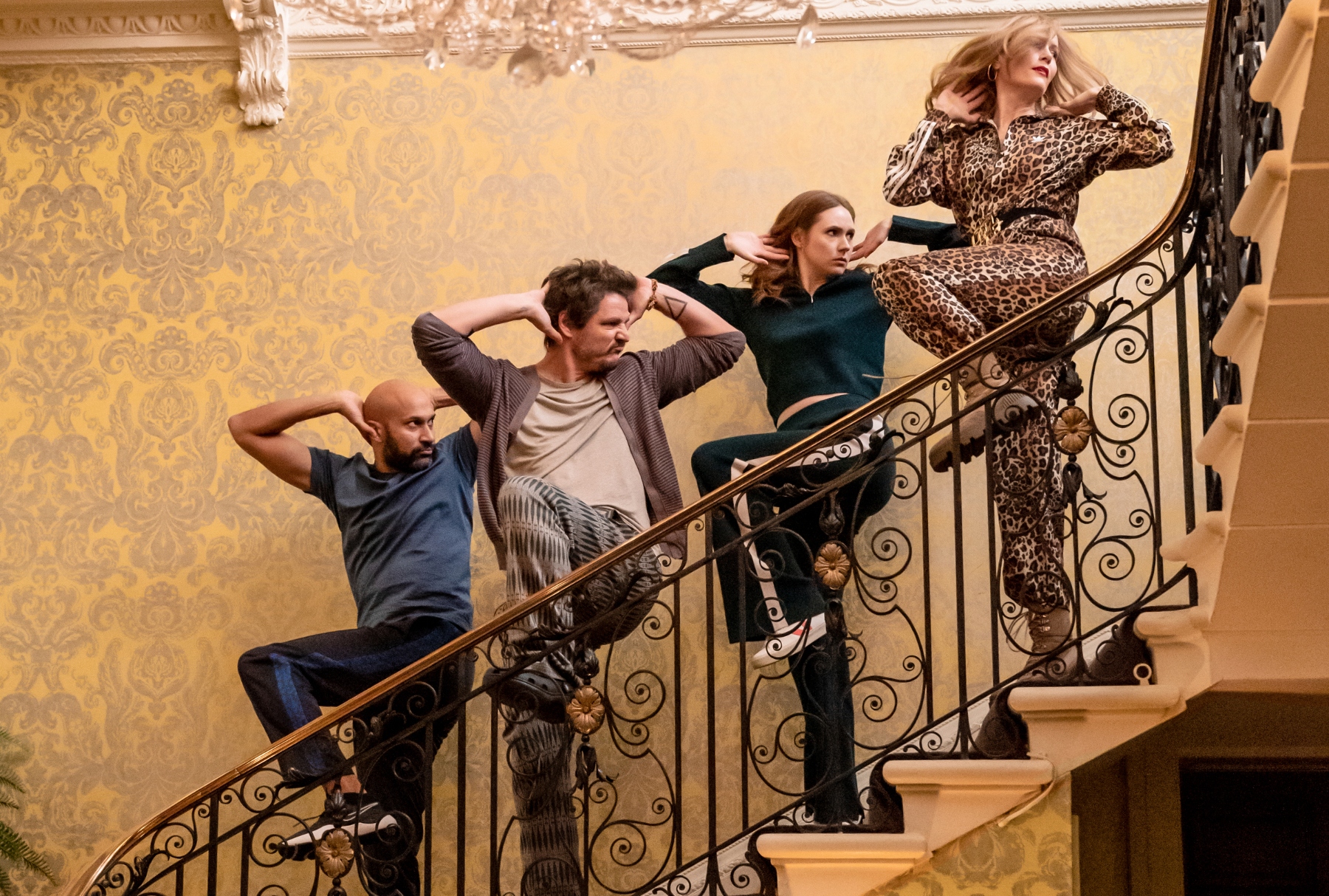
Keegan-Michael Key, Pedro Pascal, Karen Gillan and Leslie Mann in “The Bubble” (Netflix)So, when the characters groan about a positive COVID test from the girl who fetches all their coffees, it rings less true. Yes, they will be confined to their rooms, but their rooms are suites with velvet couches, floor-to-ceiling windows and flat screen TVs. The one griping that feels real? When Mann’s character protests that her room only has a shower, not a bathtub. 

But this is certainly not the claustrophobic longing for green space, an apartment with a balcony or even a fire escape. As the BBC wrote in the first summer of the pandemic, “access to green or open space is often linked to income, particularly in cities. COVID-19 has placed this issue front and centre: those with access to balconies, gardens or good, close neighbourhood parks have been benefiting from them during weeks of lockdown, while others have been trapped.”

The characters of “The Bubble” also have endless food, which someone else prepares and cleans up for them. During her initial quarantine, we see Carol consume a steady stream of junk food. But that’s not an issue, even for an image-conscious actor, because she and the others also have endless workout opportunities, including hand weights and kettle bells in their rooms and those fancy interactive fitness mirrors (that’s going to become a problem for Pedro Pascal’s burnout, sex-addicted character, probably the best in the film, wandering the ornate halls of the country house in his bathrobe like “The Dude“). 

The issue with telling a meta tale is that it can feel pretty indulgent, can keep referring to itself until it swallows itself.

The characters do yoga in a hall that looks like Versailles. The teacher’s mantra? “Release the fear of catching the virus.” Followed by: “Release the fear of the movie industry collapsing.” It’s an insular, self-selecting audience that’s going to laugh at that. 

Yes, it’s a spoof but it’s hard to care about any character when their advantages are so widely inflated. And still, they complain. Like petulant children, they also don’t follow the rules, which takes on new meaning when you’re talking about a deadly pandemic in its infancy. They “break the bubble” to have casual sex. The youngest of the cast and crew run off to London for an urban adventure, endangering everyone. Not only do the struggles of the characters not seem real, they don’t seem sympathetic.


Want a daily wrap-up of all the news and commentary Salon has to offer? Subscribe to our morning newsletter, Crash Course.


The story of “The Bubble” starts to have the very problem it’s dramatizing: it drags on for a really long time, seeming much longer than its already long 2 hour, 6 minute running time. Nothing happens. Nothing happens again. The issue with telling a “meta” tale is that it can feel pretty indulgent, can keep referring to itself until it swallows itself. “People don’t want to hear celebrities complain,” the youngest member of the cast says. It’s the truest line of the film.

More stories like this:

“The View” reveals Ginni Thomas ID’d “deep state” staffers she wanted Trump to fire

Over a year after the Jan. 6 insurrection, former President Donald Trump is still spinning his version of events, and of course the hosts of “The View” have something to say about that. This time though, they have an insider source to fact-check his narratives: guest co-host Stephanie Grisham, who served as the White House press secretary under the former administration.

In particular, they address Trump’s recent interview with The Washington Post in which he makes many claims, including how the Secret Service kept him from marching to the Capitol alongside his supporters, trying to shift the responsibility of stopping the violence to Nancy Pelosi (who was in hiding for fear of her life at the time) and how he doesn’t recall “getting very many” phone calls that day. 

RELATED: “The View” hosts argue over GOP hypocrisy and ask: “How credible is Mike Pence?”

The White House call logs reportedly show a seven-hour gap in Trump’s phone entries on Jan. 6, but per a report from CNN, the House Select Committee investigating the riot found more than two dozen text messages between former Trump White House chief of staff Mark Meadows and Virginia “Ginni” Thomas, the wife of Supreme Court Justice Clarence Thomas. In the texts, Thomas allegedly urges Meadows to continue the fight to overturn the 2020 presidential election.  

“I’ll say one thing about the call logs, and this is my own personal opinion,” Grisham says. “I think there weren’t many calls because he didn’t want to take any. He didn’t want to hear from people.”

She also confirms how much influence Ginni Thomas had on Trump and paints a picture of them as being fairly chummy, occasionally meeting up for lunch. 

Lunch and dirty hiring practices.

“At that time we [the President’s personal staff] would all be scrambling to do damage control knowing that once she [Thomas] left he [Trump] would be telling us who needed to be fired, who was a Never-Trumper in the White House or administration, who was in the ‘deep state’ because she would come with a list of people who should be fired,” Grisham says.

Thomas also advised Trump who to hire, a sticky situation that Grisham says they had to “work around.” 

The revelation shocks co-host Sunny Hostin, who is fascinated that Supreme Court Justice’s wife has influence in the dealings of the executive branch. “It’s like a shadow government,” she marvels.

“She, I think, is one of those folks that demands attention and has lists of things that she wants to make sure he’s aware of,” Whoopi Goldberg says.

Grisham says that Trump ultimately wanted to lead “the largest crowd ever” and be regarded as a “king.” According to her, throughout his presidency, Trump abused Article 2 of the Constitution — which states that “the executive Power shall be vested in a President of the United States of America” — to “do whatever he wants” without considering the repercussions. This is also why she calls “bull” on his claim that he was sitting back to let Pelosi take control of the situation.

“Even in this interview he sounds as sensitive as a toilet seat,” says Joy Behar. “Five people died that day and all he’s talking about is the number of people who were there to, you know, continue with the ‘Big Lie.'”


Want a daily wrap-up of all the news and commentary Salon has to offer? Subscribe to our morning newsletter, Crash Course.


The panelists also ask Grisham if she’s heard from the Trump base following the insurrection.

“I’ve not been hearing from them,” she shares. “They’ve been digging into my personal life, stalking my biological father, trying to plant really bad stories about me.”

Grisham also notes that Trump’s claim that his decision to run for president in 2024 depends on his health doesn’t wash since he’s often bragged about being in “very good” health, even while adhering to a diet of fast foods and high-calorie meals.

“I think it’s a way to be able to not run,” Grisham says.

“He’s scared of losing,” Behar asserts. “And he will lose.”

Watch the full discussion below, via YouTube:

More stories you might like:

Nancy Pelosi positive with COVID-19

Speaker of the House Nancy Pelosi has tested positive for COVID-19.

Pelosi, who just turned 82 two weeks ago, is not currently experiencing symptoms and is currently asymptomatic,” Pelosi’s deputy chief of staff Drew Hammill said, according to CNN. “The Speaker is fully vaccinated and boosted, and is thankful for the robust protection the vaccine has provided.”

She is the latest top government official to test positive for the virus.

Attorney General Merrick Garland tested positive Wednesday, as did Commerce Secretary Gina Raimondo. Both “attended the elite Gridiron Club Dinner in Washington on Saturday, Politico reports. “Other attendees, including Vice President Kamala Harris’ communication director Jamal Simmons and Democratic Reps. Joaquin Castro and Adam Schiff and President Joe Biden’s sister, Valerie Biden Owens, have also announced positive tests.”

D.C. Mayor Muriel Bowser also just tested positive.

ABC News Senior White House Correspondent notes the Speaker was close to President Biden yesterday.

Declassified Pentagon documents discuss UFOs causing “unaccounted-for pregnancies”

For five years, the U.S. Department of Defense ran a program that monitored reports of human encounters with UFOs (unidentified flying objects). Now the release of more than 1,500 pages of documents reveals that the agency compiled bizarre stories of unaccounted pregnancies, radiation burns and even brain damage during a secretive stretch from 2007 to 2012.

First published in the British tabloid The Sun in compliance with a FOIA (Freedom of Information Act) request, the collection of documents was originally created by AATIP (Advanced Aerospace Threat Identification Program). Its existence only became known to the public after former program director Luis Elizondo resigned from the Pentagon in 2017 and released videos of unidentified, fast-moving aircraft. While the U.S. government withheld some of the requested documents in the new release, claiming there were privacy and confidentiality concerns, the materials that were produced are bound to fuel rampant speculation among the large community of UFO conspiracy theorists.

RELATED: The hidden links between conspiracy theories

The Pentagon documents state that people who observed unidentified flying objects frequently displayed a cluster of similar physical symptoms: Injuries consistent with exposure to electromagnetic radiation (such as burns), heart ailments, and sleep disturbances. A report speculates that these could be caused by “energy related propulsion systems” and warns that the underlying technology could pose a “threat to United States interests.” Additionally, in cases that would not seem out of place in an “X-Files” episode, there were accounts of “apparent abduction” and “unaccounted for pregnancy.”


Want more health and science stories in your inbox? Subscribe to Salon’s weekly newsletter The Vulgar Scientist.


Another document from the cache contains a rubric for categorizing different types of seemingly paranormal experiences. If a person claims to have observed a UFO that had extraterrestrials on board, for instance, they are categorized as “CE3.” By contrast, someone who says they encountered “ghosts, yetis, spirits, elves and other mythical/legendary entities” is classified as “AN3.”

Other documents describe efforts to communicate with extraterrestrial civilizations, plans for exploring and colonizing deep space, and studying ways to pioneer technology like mind-controlled robots and invisibility cloaks.

The documents also reveal that former Sen. Harry Reid, a Nevada Democrat who served as Senate Majority Leader from 2007 to 2015, fought to learn more about UFO technology that he believed had been acquired by government contractors. One document shows Reid requesting a “restricted special access program” for work being conducted by BLASS (Bigelow Aerospace Advanced Space Studies), which had been awarded a $12 million contract to study “advanced aerospace weapon threats from the present out to 40 years in the future.” Although Reid pointed out how BLASS had identified “several highly sensitive, unconventional aerospace technologies” which required “extraordinary protection,” he was not allowed to conduct the level of investigation that he wanted.

“The U.S. needs to take a serious, scientific look at this and any potential national security implications. The American people deserve to be informed.”

This is not the first time that the public has been made aware of Reid’s concerns about UFOs. (Reid passed away in December from pancreatic cancer.) Last year, a lengthy report in The New Yorker revealed that Reid suspected Lockheed Martin, the American aerospace firm, had recovered fragments from a UFO that had crashed in the United States.

“I was told for decades that Lockheed had some of these retrieved materials,” he told the magazine at the time. “And I tried to get, as I recall, a classified approval by the Pentagon to have me go look at the stuff. They would not approve that. I don’t know what all the numbers were, what kind of classification it was, but they would not give that to me.”

Reid also suggested in 2020 that the government knows more about UFOs than has been released to the public, tweeting satisfaction that the Pentagon had allowed the release of footage shot by the U.S. Navy in 2004 and 2015 of “unidentified aerial phenomena.” Reid stated that although he was happy with the release of the footage, “it only scratches the surface of research and materials available. The U.S. needs to take a serious, scientific look at this and any potential national security implications. The American people deserve to be informed.”

Publicly, serious scientists have no credible evidence that intelligent extraterrestrial life has landed on Earth or made contact with humans. There are, however, occasional space anomalies observed by astronomers that credible scientists believe may hint at extraterrestrial intelligence, or at least warrant further study. The most prominent of these is the passing interstellar object ‘Oumuamua, which came from elsewhere in the galaxy and blazed through the solar system in 2017. Avi Loeb, a Harvard astronomy professor, believes that object had many of the signatures we might associate with intelligent life, and may have been some kind of probe constructed by an extraterrestrial civilization. 

For more stories on UFOs:

NY attorney general files to hold Trump in contempt

New York Attorney General Letitia James on Thursday filed a motion to hold Donald Trump in contempt for failing to release evidence around possible fraud rife within the Trump Organization – a move that could result in the former president being fined $10,000 per day until he complies with her request. 

“The judge’s order was crystal clear: Donald J Trump must comply with our subpoena and turn over relevant documents to my office,” James said in a press release. “Instead of obeying a court order, Mr Trump is trying to evade it. We are seeking the court’s immediate intervention because no one is above the law.”

Trump and his two children, Donald Trump Jr. and Ivanka Trump, were originally ordered in February to provide private testimony to James’ office as part of her years-long civil probe into whether Trump artificially inflated and deflated certain assets for tax and insurance reasons. 

Since then, the Trump family has vigorously sought to quash James’ subpoenas, accusing the attorney general of waging a politically motivated witch hunt. But for the most part, their efforts have proven unsuccessful. 


Want a daily wrap-up of all the news and commentary Salon has to offer? Subscribe to our morning newsletter, Crash Course.


Back in February, a New York judge shut down the former president’s request to block James’ subpoena, ordering Trump to provide several Trump Organization documents by the end of last month. In response, the former president stonewalled the ruling, “raising objections to each of the eight document requests in the subpoena based on grounds such as overbreadth, burden, and lack of particularity,” according to the motion from Ms James’s office.

RELATED: Trump under investigation: Your guide to who’s probing what, and how it’s going

The documents in James’ purview include financial statements compiled by Trump’s longtime accounting firm, Mazars USA, which in February said that the Trump Organization’s financial records could “not be relied upon.” That development came just a month after James had announced that her office found “significant evidence” that Trump “falsely and fraudulently valued multiple assets and misrepresented those values to financial institutions for economic benefit.”

James’ investigation currently runs parallel to a criminal investigation of the Trump Organization led by the newly-elected Manhattan district attorney, Alvin Bragg. Bragg’s probe, however, now that two head prosecutors on the case have abruptly resigned over Bragg’s apparent resistance to bring charges. According to The New York Times, the prosecutors stepped down after Bragg decided to stop presenting evidence to the grand jury.

LATED: Trump Organization quietly dumped by longtime accounting firm

Greg Abbott’s new border stunt: sending undocumented immigrants to sanctuary cities

Texas Gov. Greg Abbott on Wednesday announced plans to send buses filled with undocumented immigrants to the U.S. Capitol in protest of the White House’s recent decision to lift a Trump-era health policy that restricted the flow of migrants entering from the border. 

“To help local officials whose communities are being overwhelmed by hordes of illegal immigrants who are being dropped off by the administration, Texas is providing charter buses to send these illegal immigrants who have been dropped off by the Biden Administration to Washington, DC,” Abbott said during a news conference.

“We are sending them to the United States capital, where the Biden administration will be able to more immediately address the needs of the people that they are allowing to come across our border,” he added. 

According to CNN, Texas has already assembled a large convoy of up to 900 buses for the operation. Abbott has also noted that all rides will be voluntary, allowing the transfer of immigrants who have been fully processed by the Department of Homeland. 

The governor’s plan came in direct response to the White House’s recent rescission of Title 42, a federal health order that has over the past two years allowed border patrol to expel more than 1.7 million migrants over apparent COVID-19 concerns. Throughout its implementation, the policy was widely criticized by doctors and Democratic lawmakers for being both pseudoscientific and racist. 

RELATED: Why is the Biden administration still keeping migrant kids locked up? The saga of Title 42

Immediately after Abbott’s plan was announced, several Republican lawmakers expressed a desire to take it up a notch. 


Want a daily wrap-up of all the news and commentary Salon has to offer? Subscribe to our morning newsletter, Crash Course.


During a Fox News interview on Thursday, Rep. Dan Cresnshaw, R-Tex., asked the Texas governor to send the immigrants to Vice President Kamala Harris’ house because she’s “forgotten she’s the border czar.”

“Maybe, if you put some busloads of illegal immigrants right in her backyard,” Crenshaw said, “she can finally start paying attention to this crisis at our border.”

Sen. Ted Cruz, R-Tex., also chimed in, announcing that he’s filed legislation to send the immigrants to Martha’s Vineyard and Nantucket, Massachusetts; Palo Alto, California; Greenwich, Connecticut; Scarsdale, New York; Newport, Rhode Island, and Rehoboth Beach, Delaware. 

RELATED: Joe Manchin speaks out against Biden’s lifting of Trump-era border policy

Critics of Abbott’s plan have called it a political stunt designed to rile up the Republican base at the expense of immigrant welfare. 

“You can always count on Abbott to choose stunts over solutions,” tweeted Texas gubernatorial candidate Beto O’Rourke, a Democrat. 

Meanwhile, at the border, Abbott has deployed thousands of National Guard troops to support border patrol – an effort that troops have decried as a logistical and financial disaster.

Don’t ever let green onions (aka scallions) go bad again

We’re putting aside the confusion about scallions vs. green onions for a second (for a record they’re the same thing) to talk about how to store green onions. When you pick up a bunch of green onions from the grocery store, you’ll find that they’re delicately packed into bundles and stacked into piles. Because of their thin skin, green onions don’t last long without proper care. Don’t just throw them in the back of your fridge and toss a package of deli meat, more produce, and a bottle of sparkling water on top. Treat them with some care, dang it!

Think of green onions (or scallions) like flowers. They need moisture to stay fresh and are best when they’re upright. So we’re going to make a bouquet of them: Grab a mason jar or tall glass with water and submerge the green onion’s root in an inch or two of water. Leave the green top out of the water, while keeping the white part generously damp. From here, you can store them on a windowsill because who doesn’t need a little bit of sunshine, or in the refrigerator on the bottom shelf.

If you’ve experienced one too many spills using this method with other types of produce (been there, done that) and want to forgo it altogether, there’s another trick that will keep green onions fresh for days. Wrap the green onions gently in a damp paper towel, tuck them into an airtight plastic bag, and store them in the crisper drawer of your refrigerator. And always, always, always label and date the bag or container that you’re storing scallions in so that you know exactly what they are (no suspicious glances or questions of “are they chives or scallions?”) and when to toss them out (if they start to wilt, that’s a good indication that they’ve seen better days).

To prepare green onions for stir-frys or sautés, cut off the root (compost it to avoid food waste!) and thinly slice them for a crunchy garnish.

Is there really a big difference between cappuccinos and lattes?

During college, I worked at a campus coffee shop, where I easily consumed at least half a dozen shots of espresso each day and nearly as many flaky croissants on a weekly basis. Over time, I mastered the art of pulling an espresso shot, learned what the heck a portafilter was, tasted Italian and French roasts, and learned the difference between a cappuccino and latte.

These two espresso drinks are nearly identical: Depending on the drink size that you order, you can expect that both a cappuccino and a latte will both be made with one to two shots of espresso. The espresso is poured in the mug or paper coffee cup first before being topped with steamed milk. Both drinks contain steamed milk and foam, but the ratios are what distinguish a latte from a cappuccino. This is where things get a little bit tricky: To make a latte, frothed milk is poured evenly into the cup, creating milky coffee with a thin layer of foam on top. On the other hand, a cappuccino is made by pouring the hot milk over the espresso while using a large spoon to hold the foamy milk back. Once the stream of hot milk is added, the remaining foam is then scooped on top of the cappuccino, creating an airy, thick layer of foam on top.

Generally, a cappuccino has a more pronounced coffee flavor, since there is less milk mixed with the espresso. And cappuccinos are generally served in their pure, unadulterated coffee form.

On the other hand, lattes are milkier and generally sweeter. Think of the autumnally trendy Pumpkin Spice Latte or a peppermint mocha latte — these are lattes that have added flavor in the form of an artificial sweetener, chocolate syrup, or both. So how do other popular specialty coffee drinks fit into this?

Americano

An Americano is in its own playing field; this beverage, which can be served hot or iced, is literally just a shot or two of espresso (depending on how tired you are) topped with hot or cold water. It tastes stronger than iced coffee, but dilutes the flavor of bitter espresso for a more palatable pick-me-up.

Flat White

Flat whites are popular espresso drinks in Australia, but they didn’t really gain traction in U.S. coffee shops until Starbucks debuted their version in 2015. It’s hotly debated whether a flat white is more like a cappuccino or a latte . . . and the answer depends on who you ask. But generally, a flat white is made with ristretto shots (which are shorter, sweeter versions of espresso shots), steamed milk, which is richer and velvet-ier than the steamed milk you’d find in a cappuccino or latte, and microfoam made up of fine bubbles poured on top.

Macchiato

A macchiato is a dialed-down version of a cappuccino. A single or double shot of espresso is poured into a Barbie-sized mug and a dollop (just a dollop!) of foamy milk is scooped on top. For the record, this is entirely different from a caramel macchiato, which is just a vanilla latte drizzled with caramel sauce.

Confirmed: Senate votes on historic Supreme Court nominee Ketanji Brown Jackson

Ketanji Brown Jackson was confirmed to the Supreme Court Thursday, making her the first Black woman to ever sit on the nation’s highest court. 

Jackson had support from three Republicans who crossed party lines: senators Lisa Murkowski, Susan Collins and Mitt Romney. The final tally was 53-47. 

“This is really, in my view, a moment to celebrate,” said Senator Michael Bennet. “She is an inspiration to millions and millions of Americans.”

Before the confirmation Republicans pushed their final arguments against her during the debate, accusing her of being soft on criminals, including child sexual abuse defendants. 

Senator Tom Cotton went so far as to say Jackson might have defended Nazis after World War II. 

You know, the last Judge Jackson left the Supreme Court to go to Nuremberg and prosecute the case against the Nazis,” Cotton said. “This Judge Jackson might have gone there to defend them.”

Jackson’s confirmation is a big move for President Biden, who promised on the campaign trail that he would nominate a Black woman to serve on the Supreme Court. 

Jackson is replacing Justice Stephen Breyer, who is retiring from the court after more than 27 years.

Documents show who Trump is turning to for loans now that banks have shut him out

Former President Donald Trump has faced a crisis in bank lending for his business operations. The Trump Organization was the company behind “The Apprentice” and business leaders clamored to “win” a competition that would legitimize their careers. Now it’s Trump who needs help appearing trustworthy to anyone who can lend him money and he’s going to a few odd places searching for capital.

According to NBC News, Trump Tower was refinanced with a $100 million loan from Axos Financial, an obscure internet-only bank in San Diego and Las Vegas, financial documents from New York City’s municipality revealed. According to those documents, the loan was made just days after an auditor from the Trump Organization quit, claiming that none of the financial statements for the past 10 years could be trusted.

Trump has filed for bankruptcy six times for five different companies. Despite being a former president of the United States, banks don’t want to lend to Trump anymore. Axos, however, stepped up, and they aren’t a stranger to different kinds of loans.

Ivanka Trump is accused of turning over false information to Deutsche Bank for loans prior to Jan. 2017, the New York Attorney General alleged.

“Axos has teamed up with nonbank lenders on loans to small businesses that carried cripplingly high double- and triple-digit effective annual interest rates,” reported NBC, citing loan documents. “The bank has also specialized in loans to foreign nationals, internal documents and its website state, and has offered a type of loan that allows borrowers who paid cash for a property to turn around and instantly take money out. Such loans may pose money laundering risks, banking analysts say.”

They’re also involved in a lawsuit with two former employees who had questions about the way Axos was conducting its lending operations. One of those, Jennifer Brear Brinker, worked in the company’s Risk Management and Compliance Department. She alleges that Axos intentionally understaffs the compliance team “in an effort to conceal its failure to comply with federal banking regulations” and contends she was terminated in January 2021 while completing a report highlighting deficiencies at Axos including “significant issues in the bank’s anti-money laundering practices.”

Axos denies it.

They’re also facing a former auditor in court later this month. Charles Erhart alleges he was fired after he had concerns about the lending practices.

New York Times financial investigative reporter Dean Enrich told MSNBC last year that Trump was under the gun to find some cash to pay off some massive loans coming due after his presidency.

“There are both civil and criminal and congressional investigations that are still seeking after years of trying to get trump’s financial records from Deutsche Bank and, you know, it’s anyone’s guess what that is going to show,” said Enrich, who wrote Dark Towers: Deutsche Bank, Donald Trump, and an Epic Trail of Destruction. “We know at Deutsche Bank, though, there were employees who raised money laundering concerns in both the Trump and [Jared] Kushner accounts. We still don’t have the full story about what happened there.”

Read the full report at NBC News.

Boycotting Disney and Oreos: The red flags that MAGA is a cult

Add the humble Oreo cookie to the long and growing list of ordinary bits of Americana the self-declared patriots of the MAGA movement now are expected to shun. As Ashlie Stevens reported at Salon on Monday, the usual yapping heads of the right are so furious at the brand for sponsoring a pro-LGBTQ short film that they are calling on their followers to “boycott” the company. Well, not the actual companyOreos are owned by a multinational corporation that owns hundreds of everyday brands — but just the cookie itself. Ideally, you also issue a lecture on the evils of homosexuality to the poor checkout girl who didn’t even ask why you were going with Nillas instead of Oreos for your cookie purchase today. 

Like every right-wing “boycott” before — from the one against Starbucks to the one against Gillette to the various Twitter “boycotts” to this current Disney “boycott” — the Oreo “boycott” isn’t really a boycott. A genuine boycott is much like an economic sanction, except imposed by organized citizens instead of governements. It’s an effort to cause economic pain for a company or other entity, with an eye towards pressuring them to change their political behavior. The most famous example is the Montgomery bus boycott of 1955, in which Black residents of the Alabama city refused to ride the bus until it was desegregated. A more recent example was the targeted boycott of Wirecutter, in which the union asked readers to avoid the site during their strike. 

RELATED: “I do not like gay cookies”: Conservatives vow to boycott Oreo over new ad

The inability to understand how boycotts work was hilariously illustrated last week when Republican Ohio Senate candidate J.D. Vance tweeted that he intended to “boycott” Disney. The very next day, however, he gushed out how much he loves “Star Wars,” which is owned by Disney. 

These various and seemingly endless right-wing “boycotts” of the most ordinary parts of middle American life really aren’t about political pressure, as much as Republicans may say otherwise. As Republican are keenly aware — and indeed, it’s why they’re in a full-blown demographic panic — they are an aging, shrinking minority. Corporations, after all, aren’t engaged in what the right demonizes as “woke” marketing out of some moral impulse. They only care about the bottom line, which is fatter when a brand appeals to a younger, hipper crowd. If anything, getting that right-wing outrage is good for a brand. Pissing off cranky old people is a well-worn way to make a product seem cooler. Ask all the musicians who sold more records because of the “parental advisory” sticker back in the ’90s. 


Want more Amanda Marcotte on politics? Subscribe to her newsletter Standing Room Only.


MAGA is morphing from a mere political movement to something closer to a cult. 

One of the biggest red flags that a group identity or organization is morphing into a cult is the insistence from leaders that the followers cut themselves off from the rest of society. Any people or practices that anchor cult followers to the rest of society can also act as lifelines, a way for the cult member to escape once they realize they’re in a cult. The “boycotts” of MAGAland look far more like this cult-like separation from society than they do actual efforts to influence corporate decision-making. 

By convincing each other to abandon interests outside of being Trump acolytes, MAGA ends up consuming more.

For instance, as NBC News reporter Ben Collins noted on Twitter last week, some Trump followers are trying to shame each other out of enjoying sports. 

As Collins notes, it’s “a full divorce from regular people.” That is very much what cults do! By convincing each other to abandon interests outside of being Trump acolytes, MAGA ends up consuming more and more of a person’s identity. Soon, they don’t have any life outside of being a full-time right-wing trolls and have no way to relate to people outside of their cult identity. 


Want more Amanda Marcotte on politics? Subscribe to her newsletter Standing Room Only.


The recent Disney “boycott” is very much in line with this. It’s definitely not about economically pressuring Disney, so much as it is about performatively avoiding anything with the official Disney brand. Crucially, it’s also about rejecting any common ground with non-MAGA people that might remind the cultists of the humanity of the “woke” majority they hate so much. To make it worse, it’s about trapping children in the MAGA cult, by cutting them off from connections to the outside world. 

As Matt Gertz of Media Matters pointed out, the dogpile of anti-Disney propaganda from the right was coupled with the announcement from right wing demogague Ben Shapiro that his company is “investing $100 million over three years in animated and live-action children’s entertainment” as an “alternative” to Disney’s children’s entertainment. As Gertz notes, the “alternative is explicitly right-wing.” 

It’s also about rejecting any common ground with non-MAGA people that might remind the cultists of the humanity of the “woke” majority they hate so much.

You have to feel sorry for the kids of Shapiro fans. (Though, thankfully, his audience tends to be more of the grandparent demographic than the parent demographic.) Not only will they be isolated from other kids because they’re not allowed to share in the playground passion for “Frozen,” but they will be stuck only consuming inferior products that are more indoctrination than entertainment. For Shapiro, it’s a money-making enterprise. For the kids being mistreated this way, it’s being forced by your parent to be the “weird” kid no one wants to hang out with, so that your only community is vile bigots and MAGA cultists. 

RELATED: Disney hysteria and litter boxes: Republicans’ deeply odd war on LGBTQ people escalates

To be certain, the left has its own haphazard “boycotts” that never amount to anything but self-righteous and often joyless posturing on social media. But a key difference here is the left almost never redirects people towards propagandistic “alternatives” meant to alienate the would-be boycotters from the rest of the world. The “delete Spotify” thing was ineffectual noise, but it’s not like the people who did it then joined a streaming service that only produced left-wing propaganda. Mostly they just switched to another service that had the same array of podcasts and music. 

It’s unfortunate we live in a capitalistic society where so much of what brings people together is shared affection for various corporate products. But it is what it is, and right now the marketplace does create a multitude of situations where MAGA acolytes encounter ordinary people — liberals, even! — and are reminded that the people they’re told to shun and hate are actually pretty normal. It’s hard to get sucked up in a conspiracy theory about how all of Hollywood is blood-drinking pedophile communists when you watch Marvel movies and think Chris Evans is cute and charming. It’s hard to believe that your progressive neighbors are subhuman when you stand in line with them at the Starbucks. It’s these connections to the real world that Fox News and figures like Shapiro are systematically targeting, by convincing their audiences to cut those ties and instead only consume MAGA products and relate to other MAGA people. 

Jimmy Kimmel claps back after Marjorie Taylor Greene threatens to report him to the police

Jimmy Kimmel poked fun at Rep. Marjorie Taylor Greene R-Ga., for the second time this week, this time mocking her lacking sense of humor Wednesday evening after she became incensed by Kimmel’s initial joke at her expense. 

The exchange started with a joke on “Jimmy Kimmel Live!” earlier this week after Greene called out “pro-pedophile” Republican Sens. Lisa Murkowski of Alaska, Susan Collins of Maine and Mitt Romney of Utah for signaling support for Ketanji Brown Jackson’s confirmation to the Supreme Court. 

“Where’s Will Smith when you need him?” Kimmel asked in reference to the so-called slap heard round the world.

RELATED: Chris Rock’s history of Jada Pinkett Smith jokes, hair commentary and disability

Greene did not find this amusing. She tweeted the clip of the show, saying that this “threat of violence” by Kimmel had been filed with the Capitol Police. 


Want a daily wrap-up of all the news and commentary Salon has to offer? Subscribe to our morning newsletter, Crash Course.


“Officer? I would like to report a joke,” Kimmel then tweeted in response. 

The exchange resulted in a number of responses mocking Greene’s reaction to Kimmel’s joke. 

READ MORE: 

Raskin calls out “Trump-Putin axis” after Marjorie Taylor Greene heckles Jan. 6 committee vote

“If Will Smith was a white guy…”: Right-wing Twitter reacts after Chris Rock slapped at Oscars

A very versatile pickled pepper dressing

In the relentless long game of regular home cooking, I’ve found that few things lend interest to a dish quite like chiles. They’re the spicy, fruity, bright, earthy edible glitter of life. 

I’ll save a treatise on dried chiles for another day. Today, I want to rhapsodize a little on the magic of fresh, roasted and pickled chiles. Lately, I’ve been stocking up on them en masse for days when cooking dinner feels especially insurmountable. Fresh sweet red and yellow bells; tangy Anaheims; fiery serranos; and mild, vegetal poblanos. Plus, frozen or canned roasted Hatch green chiles; pickled banana peppers and jalapeños; and jarred sweet piquillos or cherry peppers. 

Related: How to dig out of your next salad rut (plus, a panzanella recipe fit for a hearty lunch)

I like deploying them as sneaky flavor accents in all manner of dishes. A red bell pepper blistered on the stovetop creates a delicious base for pesto when blitzed with olive oil, toasted almonds, garlic and a little vinegar. Pickled peppers lend zing to slow-stewed beef, tuna salad, grilled cheese and scrambled eggs. Roasted green chiles add tang and earthiness to an elemental pasta sauce of garlic, anchovies and lemon

Perhaps my favorite application of late involves mixing together chiles in a few of the aforementioned guises — roasted and pickled, for example — then tossing them with oil and red wine vinegar to make a coarse vinaigrette. I flavor it with thinly sliced red onion, woodsy oregano and whatever mild(ish), soft fresh herbs I have. 


Want more great food writing and recipes? Subscribe to Salon Food’s newsletter.


This is an excellent dressing for a sturdy romaine hearts salad with breadcrumbs and shaved manchego, a summery pasta salad or a mixture of thinly-shaved crunchies like carrots, celery and onion. You can toss it with just-roasted potatoes for a delightful side dish or drizzle it over charred steak or grilled sweet potatoes (with feta, mmmm).

It would also make a terrific marinade for chicken or meaty fish. You can swirl it into white bean dip, drizzle it over boquerones for a posh Spanish snack or simply dunk fat hunks of toasted sourdough in it to your little heart’s content. A very versatile pickled pepper dressing, indeed.

***

Recipe: Pickled Pepper Dressing 

Yields
1 scant cup
Prep Time
20 minutes
Cook Time
30 minutes

Ingredients

  • 1 Anaheim, cubanelle or small poblano pepper
  • 2-3 teaspoons mixed pickled peppers, chopped (See Cook’s Notes)
  • 1/2 small red onion, thinly sliced
  • 1 teaspoon dried oregano (or 1/2 teaspoon fresh oregano, chopped)
  • 1/4 cup red wine vinegar
  • 1/2 cup extra virgin olive oil
  • Salt and pepper, to taste
  • 2 teaspoons fresh arugula, basil, cilantro, dill or parsley, chopped (See Cook’s Notes)

Directions

  1. Roast the fresh pepper of your choice directly on the gas burner (or under the broiler if your stove is electric), turning often until it is blistered black on all sides. Zip the pepper in a bag for 15 or 20 minutes, then peel off most of the skin with a cloth or paper towel before seeding and dicing it.

  2. Add the freshly diced pepper to a medium bowl along with the pickled peppers, red onion and oregano. Pour in the red wine vinegar and olive oil, whisking furiously until combined. Season to taste with salt and pepper. Let the onion and peppers hang out in the dressing for at least 30 minutes before serving.


Cook’s Notes

For the pickled peppers, think banana peppers, jalapeños, pepperoncini or piquillos — any combination you like, from sweet to hot. 

Similarly, feel free to mix and match when you reach for the fresh herbs. 

More of our favorite salad recipes: 

Salon Food writes about stuff we think you’ll like. Salon has affiliate partnerships, so we may get a share of the revenue from your purchase.

FBI: Men posing as DHS agents on Jan. 6 task force showered Secret Service agents with cash

On Wednesday, the Associated Press reported that the FBI has arrested two men who posed as Department of Homeland Security investigators, who claimed they were part of a January 6 task force and offered to give gifts to Secret Service agents, including some assigned to the protection detail for members of the First Family.

“The two men — Arian Taherzadeh, 40, and Haider Ali, 36 — were taken into custody as more than a dozen FBI agents charged into a luxury apartment building in Southeast Washington on Wednesday evening,” reported Michael Balsamo. “Prosecutors allege Taherzadeh and Ali had falsely claimed to work for the Department of Homeland Security and work on a special task force investigating gang and violence connected to the Jan. 6 insurrection at the U.S. Capitol. They allege the two posed as law enforcement officers to integrate with actual federal agents.”

“Taherzadeh is accused of providing Secret Service officers and agents with rent-free apartments — including a penthouse worth over $40,000 a year — along with iPhones, surveillance systems, a drone, flat screen television, a generator, gun case and other policing tools, according to court documents,” said the report.

“He also offered to let them use a black GMC SUV that he identified as an ‘official government vehicle,'” prosecutors said. “In one instance,” the report added, “Taherzadeh offered to purchase a $2,000 assault rifle for a Secret Service agent who is assigned to protect the first lady.”

According to the report, four Secret Service agents have been put on leave as part of the investigation.

Per The Washington Post, “The charges against Ali and Taherzadeh came as FBI personnel were seen in the Navy Yard area Wednesday night and were photographed on social media going into an apartment building. In a statement, the FBI said personnel were conducting “court authorized law enforcement activity” in the 900 block of First Street SE.”

Why did Paula Patton’s fried chicken recipe break the internet?

Paula Patton, the actress known for roles in blockbusters such as “Hitch” and “Mission: Impossible,” broke the internet this week after she shared a clip of herself making 138 fried chicken wings using her mom’s “famous” recipe. 

Immediately, social media users cried fowl. Thousands fired off passionate responses to the viral video, which was shared across various platforms. 

“If that fried chicken video is an April Fools joke, then Paula Patton is a genius,” tweeted TV writer (“Queens” and “Woke”) and actor Kyra Jones. 

“If that fried chicken video is an April Fools joke, then Paula Patton is a genius.”

Commenters identified two key issues with Patton’s recipe. First, she didn’t wash her chicken long enough before cooking. (For what it’s worth, washing chicken is a hotly contested topic; Julia Child famously recommends doing so, while the CDC does not.)

Second, instead of seasoning her flour, Patton used plain flour and added her seasonings — which included Lawry’s seasoned salt, paprika and pepper — to the avocado oil she used to fry her chicken. By the end of the 90-second video, the oil had taken on a really dark, murky look. It’s unclear how much, if any, of the seasoning actually managed to stick to the wings. 

Now, there are objectively worse food videos floating around the internet. (Remember that lady whose “hack” for making spaghetti and meatballs for a crowd was mixing all the components by hand on a countertop?) So, why did this one garner such an intense reaction? As various commenters pointed out, how someone makes fried chicken is often a clue to their cultural or racial identity. 

Related: “I do not like gay cookies”: Conservatives vow to boycott Oreo over new ad

“When Paula Patton seasoned that grease I knew her mom was the white parent,” one Twitter commenter wrote. (For the record, Patton has publicly stated that despite having a white mother, she personally identifies as Black rather than biracial.)

The discussion surrounding the recipe was reminiscent of the “raisins in potato salad” debate that peaked in 2018 when, as Salon’s Melanie McFarland wrote, the late “Black Panther” star Chadwick Boseman appeared in character on “Saturday Night Live” as a contestant on the recurring sketch “Black Jeopardy.”

“There the Wakandan king competes against Americans Shanice and [Rashad and quickly discovers he is, shall we say, unaccustomed to the realities of being a person of African descent in America,” McFarland wrote. “But the pivotal moment for T’Challa comes when he chooses the category ‘White People’ for $400.”

The answer? “Your Friend Karen Brings Her Potato Salad to Your Cookout.”

“I think I’m getting the hang of this,” T’Challa said. “Before I answer, a few questions. This woman Karen — she is Caucasian, neh? And she has her own recipe for potato salad, neh? Ah, I understand.”


Want more great food writing and recipes? Subscribe to Salon Food’s newsletter.


“It is noble that she would volunteer to cook for everyone,” T’Challa continued. “And although I have never had potato salad, I sense that this white woman does not season her food. And if she does, it is only with a tiny bit of salt. And no paprika. And she would probably add something unnecessary, like raisins. So something tells me that I should say: ‘Aw hell naw, Karen, keep your bland ass potato salad to yourself!'”

At this point, McFarland wrote, “you gotta feel for the Karens of the world.”

“They are legion, and as the Black Panther points out, they’re only trying to contribute to the potluck. (Trick statement, Karen: in this situation, you are at a cookout, not a potluck.) On the other hand, it’s unlikely that they’ve ever been subjected to the cultural pressure of making a crowd-pleasing potato salad, let alone one for an audience that will read you to your face and won’t let you live down your failure for years afterward.”

Whether it’s packing root vegetables into macaroni and cheese à la the Food Network’s Katie Lee or sprinkling dried fruit in the potato salad, there are just some things you don’t do.

Whether it’s packing root vegetables into macaroni and cheese à la the Food Network’s Katie Lee or sprinkling dried fruit in potato salad, there are some things you apparently just don’t do — as Patton discovered this week. That said, the actress is taking the backlash in stride. In a follow-up message posted to Instagram, she said: “I just wanted to respond and say, ‘Listen, I get it.'”

She continued, “It might look crazy. It is the way we do it. My mom taught me . . . We put the seasonings in the oil and all that. It’s just the way we do it.”

Read more: 

5 tools for making better coffee at home, according to caffeine aficionados

One of life’s simple joys is a really good cup of joe first thing in the morning. The intoxicating aroma alone is enough to lure true coffeeholics out of bed. But did you know coffee touts a long list of health benefits, such as boosting serotonin levels and cancer-fighting effects? Hence, it’s often referred to as “liquid gold.”

It’s possible to make the perfect cup of joe in the comfort of your own home without any fancy equipment.

Barista-quality coffee should be a daily indulgence — not just a fleeting treat for the weekends at your local roastery. It’s possible to make the perfect cup of joe in the comfort of your own home without any fancy equipment. You don’t need high-tech espresso machines, fancy tampers or complicated burr grinders. That’s because good coffee doesn’t have to be complicated. 

Whether you’re a fan of cold brew or premium roasts, the caffeine aficionados on the Salon Food team have you covered. Here are 5 tools for making better coffee at home, all of which are guaranteed to make every sip better:

1. Kitch Large Cube Silicone Ice Tray

Warm weather is upon us, which means it’s already time to enjoy iced coffee and cold brew. According to Salon deputy food editor Ashlie D. Stevens, the best way to make a refreshing cold coffee drink is to swap out the ice for a coffee cube. To make some at home, simply pour leftover coffee into an ice cube mold, freeze it overnight and voilà.

Stevens recommends the large silicone tray from Kitch, which holds a generous amount of liquid. Coffee cubes are now an integral part of her morning cold brew routine — and they’ve been nothing but “life-changing.” This pro-trick ensures that your drink is always icy but never watered down. 

Kitchen Large Cube Silicone Ice Tray


Kitch Large Cube Silicone Ice Tray

Giant 2-inch ice cubes keep your drink cool for hours

For stunning, giant, ice cubes that pop out easily without any need to fight with the ice tray.

Buy for $8.95

2. Aphse Electric Milk Frother

A milk frother is a nifty tool that elevates not only the flavor but also the presentation of an otherwise average cup of joe. With one, you can whip up airy, creamy and delectably sweet clouds of foam. Stevens suggests the Aphse milk frother, which is portable, affordable and versatile (aka the holy trinity). “I find that the nicer milk frothers stand up well to thicker, non-dairy milks like oat milk and coconut milk,” Stevens says.  

Aphse Milk Foamer


Aphse Electric Milk Frother

Stainless steel electric milk frother

This handy little gadget really packs a punch! With a 12,000 rpm motor, it produces the thickest, foamiest milk in seconds.

Buy for $13.49

3. Bodum 1928-01 Chambord French Press Coffee Maker

Want to know how to brew a better French press coffee? We already asked the experts, so you don’t have to.

Available in various colors, sizes and styles, the Bodum 1928-01 Chambord French Press is recommended for home users by Stevens, who promises “it’s super simple” and easy to use. “It just works without a hitch,” she adds. “And it’s also very, very cute to have on your counter, which is a plus.”

Chambord French Press


Chambord French Press

The French press is accepted as one of the best ways to brew coffee

A 3-part stainless steel mesh filter is included, which allows for a premium extraction of your coffee’s aromatic oils and subtle flavors.

Buy for $27.99

4. Brita Standard Water Filters

In the wise words of Salon senior writer Mary Elizabeth Williams, “If you’ve got good water, you’re good to go.” When preparing a cup of coffee, the type of beans and milk you use a difference. Likewise, the quality of the water you add to your pot matters. For crisp, fresh water, it’s essential to have a good filtration system. Williams’ go-to filter is Brita, which she has faithfully used for almost 25 years.

5. Mr. Coffee 12-Cup Coffee Maker

“It’s literally just got one button,” Williams says of her go-to Mr. Coffee Maker. The best thing about this machine is that it has the ability to produce large quantities of fresh coffee fast, which makes it the perfect tool for big families and hardcore coffeeholics alike. It may not have a timer like other more fancy coffee makers, but it definitely gets the job done.

Mr. Coffee 12-Cup Coffee Make


Mr. Coffee 12-Cup Coffee Maker

Makes 12 cups of coffee!

Grab a cup auto pause stops the cycle if you need a cup before brewing is finished. Lift and clean filter basket for fast and easy clean-up.

Buy for $39.72

More stories about coffee that you might enjoy: 

Salon Food writes about stuff we think you’ll like. Salon has affiliate partnerships, so we may get a share of the revenue from your purchase.

The worrying murkiness of institutional biosafety committees

In 2004, an activist named Edward Hammond fired up his fax machine and sent out letters to 390 institutional biosafety committees across the country. His request was simple: Show me your minutes.

Few people at the time had heard of these committees, known as IBCs, and even today, the typical American is likely unaware that they even exist. But they’re a ubiquitous — and, experts say, crucial — tool for overseeing potentially risky research in the United States. Since 1976, if a scientist wants to tweak the DNA of a lab organism, and their institution receives funding from the National Institutes of Health, they generally need to get express safety approval from the collection of scientists, biosafety experts, and interested community members who sit on the relevant IBC. Given the long reach of the $46-billion NIH budget, virtually every research university in the U.S. is required to have such a board, as are plenty of biotechnology companies and hospitals. The committees “are the cornerstone of institutional oversight of recombinant DNA research,” according to the NIH, and at many institutions, their purview includes high-security labs and research on deadly pathogens.

The agency also requires these committees to maintain detailed meeting minutes, and to supply them upon request to members of the public. But when Hammond started requesting those minutes, he found something else. Not only were many universities declining to share their minutes, but some didn’t seem to have active IBCs at all. “The committees weren’t functioning,” Hammond told Undark. “It was just an absolute joke.”

The issue has gained fresh urgency amid the Covid-19 pandemic. Many scientists, along with U.S. intelligence agencies, say it’s possible that SARS-CoV-2, the virus that causes Covid-19, emerged accidentally from a laboratory at the Wuhan Institute of Virology, or WIV — a coronavirus research hub in China that received grant funding from the NIH through a New York-based environmental health nonprofit. Overseas entities receiving NIH funding are required to form institutional biosafety committees, and while grant proposals to the NIH obtained by The Intercept mention an IBC at the Wuhan institution, it remains unclear what role such a committee played there, or whether one was ever really convened.

An NIH spokesperson, Amanda Fine, did not answer questions about whether the Wuhan institute has had a committee registered with the agency in the past. In an email, she referred to a roster of currently active IBCs, which does not list WIV. Other efforts by Undark to obtain details about meetings of the Wuhan lab’s IBC were unsuccessful. But so, too, were initial efforts to obtain meeting minutes from several IBCs conducting what is supposed to be both routine and publicly transparent business on U.S. soil. Undark recently contacted a sample of eight New York City-area institutions with requests for copies of IBC meeting minutes and permission to attend upcoming meetings. Most did not respond to initial queries. It took nearly two months for any of the eight institutions to furnish minutes, and some did not provide minutes at all, suggesting that in many cases, the IBC system may be as opaque and inconsistently structured as when Hammond, who eventually testified before Congress on the issue in 2007, first began investigating.

Indeed, recent interviews with biosafety experts, scientists, and public officials suggest that IBC oversight still varies from institution to institution, creating a biosafety system that’s uneven, resistant to public scrutiny, and subject to minimal enforcement from the NIH. Hammond and other critics say these problems are baked into the system itself: As the country’s flagship funder of biomedical research, the NIH, these critics say, shouldn’t also be charged with overseeing its safety.

For its part, NIH has argued that as an agency intimately involved in reviewing the complex details of biomedical research, it is well-suited to manage the network of committees ostensibly set up to help ensure the safety of that research. And the IBC system, the NIH says, is just one part of a multi-faceted biosafety apparatus. “They play an incredibly important part,” said Jessica Tucker, acting deputy director of the Office of Science Policy at NIH, “in this interlay of local and federal oversight.”

In some jurisdictions, including the research-heavy corridors of Boston and Cambridge, Massachusetts, the addition of local policies and oversight structures has provided a comparatively clear view of the potentially hazardous biomedical science undertaken there. But the wider network of IBCs remains far more opaque, and insights into how well they operate, or even whether they operate, remains unacceptably difficult to discern, Hammond and other critics say — perhaps even more so as a rising crop of for-profit companies offer IBC services to clinical research sites for a fee.

In recent interviews with Undark, biosafety professionals variously described Hammond as “kind of an asshole” and “like a bulldozer”— though those same experts also acknowledged that he has identified real issues. “A lot of what he’s saying makes sense,” said David Gillum, the chief safety officer for Arizona State University and a past president of ABSA International, the flagship professional organization for biosafety specialists in the U.S. Many people in the biosafety community, Gillum said, would agree that “the NIH, if it’s conducting the research — maybe they shouldn’t be self-policing.”

Altering the DNA of microbes and other organisms can bring incalculable social benefits, including new insights into pathogens, new tools for synthesizing drugs, and the development of lifesaving vaccines. Much of it poses little, if any, risk. But it can also, in some cases, involve potential hazards: A pathogen might escape, a lab worker or research subject might be harmed, or a genetically altered organism might spill into the wild without appropriate vetting.

Lab accidents involving pathogens do happen, though most are minor. In rare cases, laboratory workers suffer serious harm or die. Occasionally, incidents can have even broader consequences: Many scientists believe a flu pandemic in 1977 may have originated from an accident at a Soviet lab — though researchers have suggested other explanations in recent years. People sometimes hijack research for nefarious ends, too: The perpetrator of the 2001 anthrax attacks in the U.S., which killed five people, was almost certainly a federal laboratory worker with access to the bacteria and lab equipment.

In response to such risks, the U.S. has developed a range of methods to improve biosafety, which applies to accidents, and biosecurity, which applies to intentional misuses of the technology. In addition to IBCs, some institutions with large research operations employ biological safety officers, whose jobs include inspecting labs, advising researchers on safety practices, preparing materials for IBC review, and, sometimes, serving as IBC members. Research with some pathogens and toxins requires additional review from federal agencies — including background checks for employees and rigorous specifications for lab spaces. Those requirements are backed by the force of law, and are administered by the Centers for Disease Control and Prevention and the U.S. Department of Agriculture.

In the biosafety system, the IBC is a kind of local court, overseeing the implementation of the 149-page NIH Guidelines for Research Involving Recombinant or Synthetic Nucleic Acid Molecules. “We get thousands of emails every year with questions,” the NIH’s Tucker said. “So that is usually the entry point for discussions with IBCs about challenges that they may be facing.”

Much of this system emerged in the 1970s, after Paul Berg, Janet Mertz, and other researchers at Stanford University developed a technique to insert pieces of foreign DNA into E. coli bacteria. Scientists had a new power that could be used to engineer organisms with novel properties. But with that power came risk. “There is serious concern that some of these artificial recombinant DNA molecules could prove biologically hazardous,” a panel of prominent scientists, chaired by Berg, wrote in Science in 1974. Among other scenarios, they worried about the escape of a bacteria engineered to resist antibiotics.

The next year, the National Academy of Sciences convened a meeting, chaired by Berg, at the Asilomar Conference Center in California. Despite some calls to include laboratory technicians, custodians, and other members of the public, the Asilomar participants were mostly senior scientists, along with a few lawyers and public officials. The discussion laid out a roadmap for biosafety in the U.S. Notably, an official summary of the proceedings did not include the word “regulation.” The NIH Guidelines, issued in 1976, are just that — guidelines, rather than regulations with the force of law. If any of those requirements aren’t met, NIH can demand changes, and, at least in theory, pull funding.

“In essence, the goal was self-governance,” wrote Susan Wright, a research scientist emerita in the history of science at the University of Michigan, in a 2001 paper on Asilomar and its legacy. The guidelines allow institutions to largely police themselves, with the IBC exercising oversight for most research. When Sen. Edward Kennedy, a Massachusetts Democrat who passed away in 2009, proposed a bill that would hand the power of regulating genetic engineering to an independent commission, Wright said, major scientific organizations rallied to defeat the proposal.

The prospect of NIH oversight did not immediately reassure residents of Cambridge, Massachusetts, a major scientific research hub. In 1976, amid public alarm about a newly proposed virus and genetics laboratory at Harvard, the city council held a hearing on recombinant DNA research. At a packed meeting, some council members were skeptical that the NIH was equipped to handle the issue. “We’re gonna find ourselves in one hell of a bind,” said councilmember David Clem, “because we are allowing one agency with a vested interest to initiate, fund, and encourage research, and yet we are assuming that they are non-biased and have the ability to regulate that and, more importantly, to enforce the regulations.”

The city went on to pass its own biosafety regulations, enforcing compliance with NIH standards. In the years that followed, however, few other municipalities followed suit.

Edward Hammond founded The Sunshine Project, a bioweapons watchdog group, in 1999, along with a German colleague. They figured the subject would stay relatively obscure. Then the September 11 attacks happened, followed by the anthrax scare. In response, the George W. Bush administration and Congress poured billions of dollars into preparing for a bioterrorist attack. The number of laboratories studying dangerous pathogens ballooned.

When Hammond began requesting minutes in 2004, he said, he intended to dig up information about bioweapons, not to expose cracks in biosafety oversight. But he soon found that many institutions were unwilling to hand over minutes, or were struggling to provide any record of their IBCs at all. For example, he recalled, Utah State was a hub of research into biological weapons agents. “And their biosafety committee had not met in like 10 years, or maybe ever,” Hammond said. “They didn’t have any records of it ever meeting.”

Other sources from the period after the 9/11 attacks suggest that institutions were often flouting the NIH Guidelines. In 2002, 2007, and 2010, a group of researchers conducted surveys of hundreds of IBCs. Of the IBCs that responded, many were failing to train their members, and many were conducting expedited reviews of research without full committee input — both violations of NIH requirements. In the 2010 survey, nearly 30 institutions reported that they had no formal process to ensure that relevant experiments even received an IBC review.

The NIH has sometimes cracked down on institutions. In 2007, a young insect geneticist, Zach Adelman, joined the IBC at Virginia Tech. Not long after, the NIH determined the IBC was not functioning properly, and made the committee members go back and re-evaluate all relevant research on campus.

Adelman, who is now a professor at Texas A&M University, was eventually appointed the chair of the committee. The position, he said, was grueling, but also rewarding. Working closely with biosafety staff, Adelman would assess research protocols — each 50 to 100 pages long — and assign them to committee members with relevant expertise for review. If nobody at the institution had relevant experience with a particular pathogen or protocol, he’d shop the proposal out to someone at another institution. During meetings, the group would assess the experience of the researcher, their laboratory space, their training — all to gauge whether the scientist seemed equipped to do the experiment in a way that was safe for lab workers and the community.

It took some time, Adelman said, for researchers to adapt to the new oversight. “We were coming from a point where the IBC wasn’t really reviewing things well,” he said; principal investigators were accustomed to their research proposals undergoing “minimal review, rubber-stamping.”

At the time he became chair, Adelman was seeking tenure — an arduous process that requires approval from more senior peers. His IBC position, he said, sometimes required him to tell senior researchers that their work wasn’t meeting the bar. The interactions could grow confrontational. But, he said, the experience convinced him that IBCs can be effective, with a committed chairperson and strong university support.

Some experts say such support is lacking at some — perhaps many — institutions. IBC oversight is “a very uneven system,” said Richard Ebright, a molecular biologist at Rutgers University and a longtime critic of U.S. biosafety policy. (Ebright has served for 20 years on the Rutgers IBC, which he says functions well.)

Overall, Ebright says, the system is vulnerable to abuse. “It’s a mechanism that delegates full responsibility for evaluating, assessing, and improving research protocols to the institution that will perform them,” he said. “As a result, of course, it’s a policy that has inherent, built-in conflict of interest.” In that structure, he argued, lax oversight should not be a surprise: “It’s all the expected, indeed the intended, result of having a program that is voluntary, not monitored, and not enforced.” Ebright argues that biosafety should be governed by laws or regulations, not guidelines, with monitoring and enforcement supplied by an independent federal agency other than the NIH.

Some biosafety experts say the existing incentives do push institutions to prioritize biosafety. “It does not behoove an institute or an institution to be complacent with a weak IBC and program,” said Barbara Johnson, a biosafety and biosecurity consultant and a former federal employee. “There’s just too many places where that can lead to trouble.” While some institutions may not have strong biosafety programs in place, she said in her experience it’s rare.

Tucker, the NIH official, formerly led the Office of Science Policy’s biosafety and biosecurity division. When her team identified problems with biosafety oversight at an institution, she said, NIH staff could intervene. The agency, she said, is well-positioned to offer oversight. “It is the mission of the [NIH] to responsibly fund research,” she said, “and the ‘responsible’ portion is where the oversight function comes in.”

Still, Tucker acknowledged that the NIH does not perform audits of IBCs to ensure that they’re functioning, or offer other proactive oversight. “You know, we don’t conduct audits, because that isn’t really our role as a funder,” she said. “In this space, our role is to work with the institutions to deal with any compliance issues as they arise.”

In principle, another major role of IBCs is allowing members of the local community to participate in discussions about research in their cities and neighborhoods. Institutions must appoint two unaffiliated community members to their IBCs, for example. And in addition to the requirement to share meeting minutes upon request, the NIH Guidelines encourage IBCs to open up their meetings to the public “when possible and consistent with protection of privacy and proprietary interests.” One 2014 NIH memo says that “the principles of public participation and transparency” are integral to the program.

In practice, though, IBC community members are often scientists or biosafety experts themselves, and many committees are resistant to sharing minutes. Public attendance at meetings — when permitted at all — appears to be rare.

“I don’t think that mission that NIH had in mind is fulfilled anywhere,” said Adelman.

When Undark contacted the New York city area IBCs in mid-October to request recent minutes and the opportunity to attend an upcoming meeting, few committees initially responded. An email to the listed public contact address for the Albert Einstein College of Medicine IBC bounced; it only accepted messages from approved senders or people inside the institution. Six weeks later, despite repeated follow-up notes, none of the eight institutions had supplied minutes. The IBC at SUNY-Downstate did not reply to messages at all.

Eventually, four institutions — Columbia University, New York Medical College, New York University Langone Health, and Rockefeller University — sent minutes and invitations to a meeting. (Shortly before publication of this article, a fifth institution, Weill Cornell Medicine, said IBC minutes were ready to be mailed after a nearly five-month wait.) The three IBC meetings Undark observed involved brisk discussions about a wide range of research. At NYMC, committee members debated whether a specific study involving adeno-associated viruses should be conducted in a BSL-1 or BSL-2 facility. At NYU Langone, the committee considered a laboratory’s request to start working with a strain of SARS-CoV-2 that was adapted to infect mice — were the safety protocols appropriate? And on the Columbia committee, a community member with clinical research expertise raised concerns about whether a laboratory requesting permission to study both SARS and MERS coronaviruses had sufficient procedures in place to prevent the two from mingling.

Even then, institutions appeared concerned about the presence of a reporter. At Columbia University, which conducts biomedical research in upper Manhattan, officials appeared apprehensive about the prospect of a reporter attending a meeting, and a spokesperson, Christopher DiFrancesco, initially declined Undark’s requests to attend a November session. At NYU Langone, the institution required a reporter to travel to a conference room in midtown Manhattan to attend the meeting. A communications staffer, a biosafety office administrator, and a member of the legal counsel’s office were also present in the room — even though the IBC meeting was entirely virtual. (Lisa Greiner, a spokesperson for NYU Langone Health, said the in-person requirement would extend to any member of the public, not specifically journalists.)

Outside New York, some research centers — Georgia State University, the University of North Carolina at Chapel Hill, and Vanderbilt University — were quicker to supply minutes. Others were less easy to reach: At San Antonio’s Texas Biomedical Research Institute, the only private institution in the United States to host a BSL-4 lab — meaning it’s capable of working with the most dangerous pathogens — the IBC lists only a phone number on its website, which goes to a general menu for the institute.

Many biosafety experts caution that transparency can have costs. Some recombinant DNA research, for example, is subject to opposition by activist groups, and researchers may fear public backlash. These fears may have only intensified amid recent reports of harassment and threats directed at virologists and other scientists.

Sharing other details, such as the locations of certain labs, can also pose biosecurity risks. (The NIH permits institutions to redact minutes.) “I am all for transparency, provided it doesn’t put intellectual property at risk, it doesn’t put security at risk, or the personal security of a researcher at risk,” said Rebecca Moritz, the biosafety director at Colorado State University and president-elect of ABSA International. Her ideal, she said, is proactive communication, in which institutions explain why their research matters, and detail the steps they take to keep it safe. But, she said, “there are other institutions who are significantly more risk averse in that conversation. And they would prefer just no one to know what they’re doing.”

One exception to this approach is in the Boston area, a biotechnology hub where, 46 years after the contentious meetings at the Cambridge City Council, municipal governments retain unusual control over biosafety decisions. In both Cambridge and Boston, independent city biosafety committees can review proposed research and policies, and regulations require that anyone doing recombinant DNA research — whether or not they receive NIH funding — maintain an IBC.

In Boston, those regulations emerged from a long-running dispute over the National Emerging Infectious Disease Laboratories, or NEIDL, a high-security facility housed at Boston University. There, scientists study Ebola, SARS-CoV-2, and other pathogens. After it first received a grant in 2003, the project faced pushback from many locals, worried about risks.

In response, said Kate Mellouk, BU’s associate vice president of research compliance, the university committed to full transparency. Unusually, BU voluntarily posts all of its IBC minutes on its website. “We have no secrets,” Mellouk said. “It’s all out there.” Under Boston city regulations, all research in BSL-3 or BSL-4 laboratories requires approval from an independent biosafety committee convened by the Boston Public Health Commission. For the highest-risk research, the Boston City Council also has a 30-day period to review the proposal and raise any concerns – a power, Mellouk said, they’re yet to exercise.

The process can slow down research, and Mellouk said delays are sometimes frustrating for scientists. “The local regulations don’t necessarily provide any additional safety for the public or the community or the environment” or employees, she said, stressing that they have a warm relationship with BPHC. In an email, Leon Bethune, director of the BPHC’s Community Initiatives Bureau, wrote that the commission is working hard to streamline the approval process — and that “our presence and more frequent involvement (lab inspections) provides that extra level of local involvement and assurance that federal oversight alone cannot provide.”

Across the river in Cambridge, city officials offer free training sessions to community members who are getting ready to serve on IBCs. Sam Lipson, the senior director of environmental health for the city’s public health department and chair of the Cambridge Biosafety Committee, said the work can also help address fears in the community.

Shortly after the BSL-4 lab was approved at the NEIDL facility, he recalled, a group placed flyers on cars near MIT warning, inaccurately, of bioweapons research in the area. Lipson met two of the people behind the flyers at a public meeting. He said that he told them how Cambridge regulates local research — and then invited them to come serve on an IBC. They declined. “There was no debate after that,” Lipson said. “I never heard from them.” The approach, he said, reflects a model he’s seen work again and again in the city: respond to worried members of the public with openness, opportunities to participate, and reams of information.

“If people finally get the idea that, if you want more you’ll get more,” he said, “they just — the hunger goes away.”

Recently, the number of IBCs has quietly swelled. That’s especially true in the private sector, where a boom in the use of recombinant DNA in medicine — including gene therapy and mRNA vaccines — requires many biotechnology companies and clinics running trials to gain IBC approval.

In the past six years, a fledgling IBC-for-hire industry has emerged to meet that need. Today, just three companies collectively maintain more than 1,000 IBCs. “We’re fully compliant with NIH guidelines, we provide the same or better level of oversight as a university has,” said Daniel Eisenman, executive director of biosafety services at Advarra. The company contracts a core group of experts who serve on hundreds of IBCs, and cultivates what Eisenman calls “a large network of community members,” in every major U.S. city, who can be tapped to serve as local representatives on IBCs on short notice. The company aims to review proposals within six business days, speeding up biomedical research.

Chris Jenkins, who operates a similar model at his company, Clinical Biosafety Services, said demand is booming. Burning through his savings, he founded the company in February 2017 with just one client; today, he said, they have 37 full-time employees and operate more than 500 IBCs. Companies pay around $6,000 per year for the service, Jenkins said last November; the committee members they recruit make some $150 per meeting.

Some biologists and biosafety professionals are skeptical of the IBC-for-hire model. “I do have my concerns about them, because I wonder if they truly represent the institution and the community,” said Gillum. Companies, he noted, have even approached him to serve as a community member on IBCs, despite his role as a prominent biosafety expert. Still, he believes “they’re meeting the requirements of the NIH.” Other critics point to a possible conflict of interest in a pay-for-oversight model: A company that gets a reputation for frequently saying no could, presumably, lose business. But Eisenman disagreed. “Compensation is not affected based on the committee decision,” he said. “If anything, if there was pressure to rubber stamp or do anything inappropriate, it would ultimately hurt the reputation of Advarra, and compromise the value of the review that we perform.”

The IBC model also appears to be growing overseas. Barbara Johnson, the biosafety consultant, said she has advised clients abroad on how to institute the committees. The World Health Organization, in its nonbinding biosafety manual, recommends that institutions form IBCs as part of a suite of tools to govern potentially risky research — albeit without the transparency requirements that characterize IBCs in the U.S., and at foreign institutions receiving NIH funding.

The use of IBCs has also expanded in China, where until October 2020 the government had no unified biosafety policy. “In China, the IBCs play an increasing role in oversight and biorisk assessment of novel techniques and experiments concerning the manipulation of pathogens and recombinant DNA,” wrote infectious disease specialists Zhiming Yuan and James LeDuc in a 2019 academic article. LeDuc ran the Galveston National Laboratory, a major research center in Texas, before retiring last year. Zhiming is at WIV; he did not respond to requests for comment, but in a biography uploaded to an NIH website in 2014, he is described as the institute’s longtime IBC chair.

Whether the growing scrutiny on biosafety during the Covid-19 pandemic will prompt challenges to this model of scientific self-governance is less clear.

Ebright, who has been campaigning for reforms to U.S. biosafety policy since shortly after the September 11 attacks, believes the context has changed. Before Covid-19 arrived, he said, when someone would suggest that a particular activity could trigger a pandemic, the implications didn’t seem to sink in. “Now everyone grasps that,” he said. Recently, he said, some members of Congress have reached out to him for policy advice — virtually all of them Republicans. A change in the control of Congress in the 2022 elections, Ebright predicted, would lead to proposals for more rigorous biosafety oversight.

At issue, some analysts suggest, are questions of power: How much is the public willing to allow taxpayer-funded scientists and scientific agencies to make decisions about safety and risk, with limited public input? “At the end of the day, this is not just a lab security issue, but it’s a harm to the public or potential risks to the public kind of issue,” said Zeynep Pamuk, a political scientist at the University of California, San Diego who studies the role of science in democracies, including the regulation of high-risk research. “So it affects everybody, every citizen.”

Hammond remains jaded. Speaking with Undark in November, he described what he perceives as a domineering, macho culture in the labs that do the most cutting-edge research. Trusting institutions to maintain effective IBCs, he suggested, is just not enough. “What needs to happen is it needs to become mandatory,” he said. “And there need to be consequences if you don’t do things correctly.”

UPDATE: This piece has been updated to reference federal biosafety regulations administered by the CDC and USDA.

This article was originally published on Undark. Read the original article.

Trump claims the “lunatic left” is “mutilating” children — as usual, the media looks away

Donald Trump remains public enemy No. 1, and in all likelihood the most dangerous person in America today. If the rule of law was applied equally and fairly Donald Trump and his criminal confederates would have already been arrested, tried, convicted, and incarcerated for their many obvious crimes.

He leads a neofascist movement that attempted to nullify the results of 2020 presidential election. Through willful malfeasance, corruption, and negligence, Trump’s regime was responsible for the deaths of hundreds of thousands of Americans during the coronavirus pandemic. Trump openly admires Vladimir Putin and other political thugs. He and his allies in the Republican Party yearn for the same kind of power here in America.

Yet Trump still commands the loyalty of tens of millions of Americans. Even after four years of his ruinous regime, Trump won more votes in 2020 than he did in 2016; Sick societies produce sick leaders.  

RELATED: Time for Merrick Garland to act: Trump can’t get a pass on serious crimes over “politics”

I know that I am not alone in shaking my head, several times a week, and saying aloud, “Merrick Garland, what the hell are you waiting for?”

In an op-ed for Salon this week, Noah Bookbinder, president of Citizens for Responsibility and Ethics, summed it up: 

The sheer scope of Trump’s likely criminality is unprecedented, as is its severity. It is hard to conceive of more serious crimes that a president could be involved in than illegally acting to interfere with the peaceful transfer of power, which is the cornerstone of a successful democracy. Investigating and seriously weighing prosecution would not be political under these conditions. 

In fact, the failure to investigate and seriously consider prosecuting such egregious conduct would be inexplicable. Forgoing meritorious prosecutions for fear of political criticism is itself a political act, and one that would do grave damage to the republic. It would send the message that a president can do essentially anything without consequences. If Donald Trump regains the presidency, which he seems poised to try to do, he would most certainly heed this lesson and become still more brazen in illegal steps to consolidate his own power.

At his rally last Saturday in Michigan, Donald Trump again showed himself to be a danger to the safety and security of the American people, American democracy and American society. As has become habitual, the mainstream news media was largely if not almost entirely silent. In its recent coverage of Trump’s rallies, the media has become more interested in mocking his followers and the size of his crowds than in calling attention to his threats of right-wing violence.

Donald Trump, like other members of the Republican-fascist movement, has become expert at stoking political and ethnic violence as a tool of political power. In a recent interview with Salon, political scientist Barbara Walter, author of “How Civil Wars Start,” explains how Trump and allies such as Michael Flynn get away with “preaching violence”:

If I were to show what Trump and Flynn are saying, their actual words, to the average American, they would say, “You’re making that up, it can’t be true.” Thus we have a situation where these things are happening, but the information is not being shared with the general public, or if they are hearing what is happening then it is being distorted or not fully represented …

Historically, the side that wants to do these horrible things and put themselves in a position of power, to lead a dictatorship or start a “race war” or commit acts of genocide — for example, to kill all the Jews in Europe — will spend a lot of time investing in propaganda because they understand that if they can control the narrative they can control the average citizen. That is exactly what is happening now in the United States. Experts and other people like us see the warning signs because we’re paying attention and we’re reading widely. Most Americans are not.

Predictably, at his rally last Saturday in Michigan, Donald Trump returned to his repeated Big Lie strategy with claims that the 2020 election was stolen — the clear implication being that he is still the “real” president and that his followers should do whatever is necessary to return him to power.

He wallowed in low-rent bigotry, racism and nativism, slurring Reps. Ilhan Omar and Rashida Tlaib because of their names, which sound un-American to him and his followers. He claimed that Joe Biden and the Democrats are “destroying” America and that the country’s cities are overrun with violent (black) criminals. He also could not resist his malignant narcissism and sense of victimhood, complaining about how “unfairly” he has been treated by the press.

These tired themes were just cover for his main thrust: threats of violence. Like other fascists and right-wing populists, Donald Trump personalizes the threat of violence for his followers, telling them that Black and brown people, Muslims, Democrats, “the left,” LGBTQ people, migrants and refugees, and the Other more generally pose an existential threat to “real Americans” (meaning, of course, white right-wing Christians).


Want a daily wrap-up of all the news and commentary Salon has to offer? Subscribe to our morning newsletter, Crash Course.


The solution to such threats is preemptive violence. This is the same logic that was used to justify eliminationist violence and genocide in Yugoslavia, Rwanda and, of course, Nazi Germany.

In the alternate reality of Trump World, hordes of invaders are arriving daily with the goal of “replacing” real Americans, which of course means white people.

For example, Trump told his followers last Saturday that nonwhite immigrants and refugees are coming to America from the Middle East and elsewhere to take away their homes and communities. In the deranged alternate reality of TrumpWorld, hordes of invaders are arriving with the goal of “replacing” real Americans, which of course means white people. Although there are many minor variations, this “great replacement” theory has become common currency across the American right.

Trump also raged about “woke” leaders, “far-left gender theories” and “extremist” transgender “ideologies,” aligning himself with the right movement that literally wants to make gay, lesbian or trans people into second-class citizens once again. This too is an encouragement of hate crimes and other violence against those deemed to be the Other in order to “defend” the American family by standing up for “parental rights.”

The low point (among many) during Trump’s speech last Saturday came when he told his followers, “The American people will not sit idly by and allow our children to be indoctrinated, segregated and mutilated by the lunatic left.”

When a person’s family and children are (apparently) threatened with such harm, the natural response is to do whatever is necessary to protect them. Trump is going beyond “mere” stochastic terrorism here. This should be understood as a direct threat of violence against the Democratic Party and its supporters. Such language and threats have already gotten people attacked, beaten and killed, and will continue to do so.

Again, the media did not widely report on Trump’s incitements to violence.

All this is part of a larger cultural problem. Trumpism and American neofascism are a cult-like movement organized around a charismatic personality who gives his followers a sense of meaning in their lives. The cult also isolates followers and believers from “outsiders” who reject the “truth” by providing an alternative reality and belief system. Trumpism and contemporary right-wing politics more generally function as a political religion immune to outside facts and empirical reality, in which Donald Trump is a messiah or semi-divine figure.

RELATED: Trump’s “hole-in-one” and Herschel Walker’s “degree”: Why MAGA loves lies too big to be believed

Trump’s rally last Saturday began with an evangelical pastor offering this “prayer”: 

So we pray, father in heaven, we firmly believe that Donald J. Trump is current and true president of the United States…. Bless and protect him and his family from any physical, spiritual attacks and may his voice still the people to righteous action to bring godly men and women into elected office, in Michigan and across America. We declare that he will be back in office soon — very soon — in Jesus’ name.

In total, Trumpism and Republican-fascism, like other authoritarian movements, creates and is sustained by a state of malignant normality. Psychiatrist and historian Robert Jay Lifton explains this phenomenon in his book “Losing Reality“:

Donald Trump is a special kind of cultist. He is in no way totalistic — his beliefs can be remarkably fluid — nor is he the leader of a sealed-off cultic community. Rather, his cultism is inseparable from his solipsistic reality…. And in his way he has created a community of zealous believers who are geographically dispersed.  A considerable portion of his base can be understood as cultists, as followers of a guru who is teacher, guide, and master. From my studies of cults and cultlike behavior, I recognize this aspect of Trump’s relationship to his followers….

In recent work I have referred to “malignant normality,” by which I mean the imposition of a norm of destructive or violent behavior, so that such behavior is expected or required of people…. [W]e have experienced a national malignant normality of our own: extensive lying and falsification, systemic corruption, ad hominem attacks on critics, dismissal of intelligence institutions and findings, rejection of climate change truth and of scientists who express them, rebukes of our closest international allies and embrace of dictators, and scornful delegitimization of the party of opposition. This constellation of malignant normality has threatened, and at times virtually replaced, American democracy.

The damage caused by the Age of Trump and what it unleashed upon America and the world is both a symptom of “malignant normality” and a factor that continues to nurture it. Joe Biden may be president, but malignant normality has not faded away. The disease is too great for any one person or president to vanquish.

Trump told his followers in Michigan that the “Democrat Party,” with its “extremist sex and gender ideology … is waging war on reality, war on science, war on children, war on women.” 

Trump’s cult-like power over his followers and the larger neofascist movement is also maintained through the use of projection, gaslighting and other thought-control techniques. Last Saturday in Michigan, Trump told his followers that the “Democrat Party,” with its “extremist sex and gender ideology …  is waging war on reality, war on science, war on children, war on women…. The Republican Party is now the party of American women and American children, and we will protect women in sports.” 

In reality as it actually exists, the Republican Party is, of course, exactly the opposite of Trump’s claim. He and his followers literally live inside an alternate reality that would have impressed George Orwell, where up is down and down is up. People living within such an environment have lost the ability to know right from wrong, or to engage in other fact-based ethical decision-making.

As documented by social scientists, investigative reporters and others, the Republicans’ embrace of the antisemitic QAnon conspiracy theory is now a central factor in this dynamic. A significant percentage of Republicans and Trump supporters actually believe that Democrats and liberals are part of a “globalist” movement that is kidnapping, torturing and killing children. These themes are no longer confined to the “fringe”; they are within the mainstream of the Republican Party and the larger white right.

In a democracy, it is supposedly the task of the free press to help the public better understand what is important, and in turn how to respond to it. Throughout the Age of Trump and beyond, the American news media has largely failed in this most basic responsibility: to inform the public about existential threats to democracy. Moreover, it appears very likely that editorial decisions have been made to not issue such warnings in any consistent way.

In a recent essay at Medium, Wajahat Ali offers this blunt truth: “Fascism will be welcomed and applauded by media institutions as long as it’s profitable, helps with ratings, and grants them access to power.”

We will miss media critic Eric Boehlert’s bold truth-telling, at exactly the moment we so badly need it.

I’d like to close this essay with a tribute to the media critic (and former Salon writer) Eric Boehlert, a voice of clarity, wit and compassion who died tragically this week. In a recent issue of his newsletter Press Run, Boehlert addressed one of his signature issues: the American news media’s massive failures in response to the Biden presidency:

The glaring disconnect between reality and how the press depicts White House accomplishments means a key question lingers: Why is the press rooting against Biden? Is the press either hoping for a Trump return to the White House, or at least committed to keeping Biden down so the 2024 rematch will be close and ‘entertaining’ for the press to cover? Is that why the Ginni Thomas insurrection story was politely marched off the stage after just a few days of coverage last week by the same news outlets that are now in year three of their dogged Hunter Biden reporting? (“ABC This Week” included 19 references to Hunter Biden [last weekend]) …. Biden is facing not just one organized opposition in the form of the GOP, but another in the form of the Beltway press corps ….

Whatever the justifications or rationalizations may be, the American news media and other prominent public voices are not protecting the American people from harm by refusing to report on Donald Trump and the white right’s threats of violence. Rather, the media is actually aiding and abetting such forces, because to ignore those dangers and threats is to normalize them. Ultimately, fascism and other anti-human movements operate best in darkness. Too many in the media appear to have decided to look away, as if that will minimize the danger. They should be shining the light ever more brightly and sounding the alarm.

That’s what Eric Boehlert was doing. We will miss his urgent truth-telling, at exactly the moment we so badly need it.

Read more on our 45th president and his followers:

The Putin caucus undermines Biden at home — while Americans risk their lives in Ukraine

It’s increasingly difficult to care about some of the things that seem to bother the American electorate — or at least some of those who’ve somehow managed to get elected to national office and who could never otherwise hold a job elsewhere.

You know who I’m talking about. I won’t mention their names because I still hold them in the highest minimum regard. Since I wouldn’t hire them to babysit my dogs, much less represent me in Congress, I have no desire to give them even a moment’s consideration as they preach hate and ignorance, and promote conspiracy theories that the rest of us would dismiss even if we were fueled with cocaine, Adderall and a healthy dose of hallucinogens. 

Now, imagine being president at this time — trying to strengthen the NATO alliance, support the people of Ukraine, stem a pandemic, reinvigorate an economy and fight the lunacy of the former president’s followers while being hampered by your own communication staff’s inadequacies and the continued spin of social media disinformation — during the largest war in Europe since the end of World War II.

While some of us are concerned about the volatile nature of a war that could lead to the extinction of life on earth, gaslighters in Congress would have you believe that the greatest peril to the world is the sexual orientation of cartoon characters. And while I see the bombing of a theater outside Mariupol clearly marked “children” and the random murder of innocent women and children near Bucha in Ukraine — captured in stunning satellite and on-the-ground photos — as crimes against humanity, these very same people in Congress are falsely accusing their colleagues of being “pro-pedophile” and dismissing the carnage in Ukraine as a false-flag operation.

RELATED: Trump’s trashing of Ukraine pays off for Russia: Republicans vote to reject NATO — and democracy

The unhinged, morally bankrupt, chronically dishonest and abhorrent behavior by some members of Congress not only offers us insight into the corrosively narcissistic nature of some of our politicians, but the timing of their comments, and the visceral reactions to them, suggest something far more dangerous: It’s a willful attempt to turn our heads from what is truly troubling us.

These insipid actions, and the emotional toll inflicted by these congressional trolls, benefit would-be autocrats in our own country and serves as a handmaid’s tale for Putin in Russia. Add “Don’t say gay” into the mix and you’ve got a nation up in arms — driven to distraction by those who know how to tweak our ire.

It is merely a sleight of hand and a twist of fate, and we’re all resting on Bono’s bed of nails while we wait for the other shoe to drop.

I met former Navy SEALs, Army Rangers and Marines in Ukraine — most are diehard conservatives — who’ve come to the same conclusion: Americans “just don’t get it.”

There’s no better example of what we’re really facing in this country than what I was told by an American I met in Ukraine. He is employed by one of several dozen companies present in the region seeking to help mothers, children and even pets escape the Russian army as it tries to level the country. Some of these companies have been hired to train a variety of Ukrainian military units. Many of their employees are former Navy SEALs, Army Rangers or U.S. Marines. Most are diehard conservatives. But they aren’t necessarily fans of the far right, though several admit they’ve voted mostly for Republicans and even Donald Trump — twice. But, after Ukraine’s President Zelenskyy stood firm and Joe Biden stood with him, most of the more than three dozen of these people I spoke with during my trip to Ukraine came to the same conclusion: Americans “just don’t get it.” 

Let’s call him Tom. That’s not his real name, but he was a little reluctant to share it.

By day Tom works as a volunteer, handing out food and clothing and helping refugees from Ukraine find shelter in Poland or elsewhere. By night? He tries to extract mothers and children from eastern and southern Ukraine before Russia can kidnap them and send them to remote locations on the Russian frontier.

A former Navy SEAL, Tom is part of the growing number of volunteers from more than three dozen NGOs and nonprofit companies working in Ukraine trying to assist the Ukrainian government.

“When I heard Zelenskyy say he didn’t need a ride, he needed ammunition, I was in,” the 42-year-old native Texan said.

Tom is a hardcore Republican and says he voted for Trump twice. He was happy Biden got the U.S. out of Afghanistan, saying, “We needed to leave,” but unhappy about the execution of the plan. “You can blame Biden, but I’ve been in the military a long time. That plan was bungled by those on the ground in Afghanistan,” he said. “We had two bases we could’ve kept open and evacuated everyone through those bases before collapsing them and leaving. It was bad planning that we didn’t.”

While Tom is a Biden critic, he offered praise for the famous nine-word statement Biden recently made in Poland. “I said right away he was absolutely right. For God’s sake, Putin can’t remain in charge. Finally, Biden got a backbone. He only said what everyone else has said.”


Want a daily wrap-up of all the news and commentary Salon has to offer? Subscribe to our morning newsletter, Crash Course.


Tom is still critical of the people in the U.S., particularly members of Congress and elected officials, who don’t understand the problem or don’t seem to want to do so. “At first I thought people like this were just stupid. But as time goes on, I think they’re worse. I believe some of the same things these people say they believe. But I know right now there are people in Ukraine who would absolutely love to be in the United States arguing about some of the silly shit we argue about. But the people I see every day are worried about food, clothes, shelter and whether or not they’re going to get lined up and shot.”

The only people benefiting from the gaslighting by some U.S. politicians “are the Russians, more specifically Vladimir Putin,” Tom explains. “The one thing I am going to take home with me from this experience is ‘unity.’ If the American people were as united as the Ukrainian people, there’d be no stopping us. And that’s what Putin and China fear most. That’s why they spark dissent. It’s so clear. Anybody who doubts it can show up here and spend a week in Ukraine. I’ll give them the tour.”

Politics in our country, fueled by the QAnon cabal, is too busy arguing whether or not a deep state of pedophiles runs the U.S. government. Or, if we listen to the former president, whether roving gangs of immigrants are crossing the border in record numbers, trying to take our jobs while also being too lazy to get a job as they take advantage of social services — to which, in reality, they have limited access.

While it’s safe to say that most people repeating this nonsense are not “in bed” with Russian agents, but are merely repeating what in their arrogant ignorance they believe to be true, the question remains how many of our elected officials knowingly spread disinformation that benefits Russia, even when they know it isn’t true.

RELATED: Putin’s invasion of Ukraine exposes the Fox News-QAnon feedback loop

There is little doubt that Russia benefits most from the dissent. I’ve been to several Trump rallies where his supporters wore T-shirts supporting Russia — at the expense of Democrats and the United States. 

High-ranking officials in the Biden White House take it as a given that the GOP is playing into Putin’s hands. The only question is whether they’re doing it knowingly or unwittingly.

Inside the current administration, there are several high-ranking Democrats who take it as a given that the GOP, or at least some of its members, are knowingly or unwittingly playing into Putin’s hands. This isn’t new. Republicans visiting Russia are almost as common as mass shootings — and equally dangerous. “They hurt this country and don’t care,” a high-ranking White House official told me Monday. “They hurt this country because they personally profit from it. And while that’s a fact, there’s nothing anyone can say that will convince the true believers of it.” 

Is there any effective means of combating the disinformation? The stakes have never been higher. The fear of chemical warfare has increased. The use of cyberwarfare has been confirmed. The use of hypersonic weapons has been confirmed. The fear of a long, drawn-out war is also growing and there seems to be no end in sight — only the specter of a widening conflict that ultimately draws in NATO troops.

In the meantime, at home the gaslighting has led to low ratings for the president, an ignorance of how gas prices work, a correlation between Biden’s election and the beginning of the Ukrainian war that — under the classic logical fallacy “Post hoc ergo propter hoc” — leads some to claim that Biden caused the war in Ukraine. All of this has undermined his efforts and makes it impossible for any sustained U.S. strategy to outlive the current election cycle.

Don’t listen to me. Listen, however, to those volunteers who are at this moment risking their lives and doing their best to provide food, aid and shelter to the displaced people of Ukraine. “At this point, if it ends up like Afghanistan, we’d be lucky,” Tom told me as we drove through the Ukrainian countryside. “But every time I hear an air raid siren I think of hypersonic missiles, chemical warfare or worse. This is as real as it gets. There are a lot of Americans who don’t understand just how close we are to the edge — and the politicians who do know and are busy selling us a load of divisive shit have to be held accountable. I just hope we all survive it.”

On Wednesday morning, the White House announced a new sanctions package in response to atrocities in Ukraine, designed to impose “severe and immediate economic costs” on Russia.

Meanwhile, on social media, some members of Congress again declared that pedophiles were taking over the government. Want to guess which topic dominated social media?

The bottom line is that there are Russian assets in our government — whether or not they are willful or unwitting is the only thing to be settled. 

Read more from Brian Karem on the Biden White House:

Clarence Thomas must resign from the Supreme Court — and his wife should be prosecuted

In 1969, Richard Nixon and congressional Republicans took down the Supreme Court’s most liberal member, Abe Fortas, threatening to send his wife to prison. There’s a lesson here for today’s Democrats and Clarence Thomas.

Today’s Democrats are calling on Justice Clarence Thomas to recuse himself from decisions involving Donald Trump’s conspiracy to overthrow our government. 

They should be calling on him to resign and his wife to be prosecuted.

It appears that Ginni Thomas, the wife of Justice Thomas, participated in a plot to overthrow the government of the United States. Which is astonishing in and of itself.

But then her husband was the sole vote on the court to help that same seditious conspiracy: When Donald Trump sued to block President Joe Biden from passing presidential papers to the Jan. 6 House committee, the only vote on the court to support Trump’s efforts to hide his crime was that of Clarence Thomas. 

Which raises the question: What will Congress and the Justice Department do about these crimes? 

RELATED: For “the integrity of the court”: Why Clarence Thomas’ wife is a major problem for the Supreme Court

Fifty-four years ago, Republicans went nuts over an “ethics scandal” involving a Democratic-appointed member of the Supreme Court, and their effort produced so much pressure that he resigned. 

Will Democrats similarly force a Thomas resignation, giving Biden another SCOTUS nominee? 

Is that possibility the reason why Sen. Lindsey Graham just “hinted” that if the Senate flips Republican in this fall’s 2022 election the GOP will block all Biden appointees to the court up to and through the 2024 election?

To understand the possibilities, it’s essential to know the precedent, how Republicans pulled it off back in 1968 and ’69: 

Justice Abe Fortas didn’t resign until President Richard Nixon’s campaign manager and attorney general, John Mitchell, threatened to bring felony corruption charges against Fortas’ wife.  

But I get ahead of myself. It’s a truly amazing story that most people alive today know nothing about. It started with “dirty movies” being shown in the U.S. Capitol.

Fifty-four years ago, Republicans went nuts over a made-up “ethics scandal” involving porn films and a liberal Supreme Court justice, forcing him to resign.

I remember the “Fortas Film Festival” because, when it started in the summer of 1968, I was a teenage boy and curious about the movies that Sen. Strom Thurmond was showing to his male peers in that meeting room in the Capitol.

Most people in America were probably also curious; the Supreme Court had recently legalized pornography, but watching it back then meant sitting in a sleazy theater in a sleazy part of town with a bunch of sleazy characters.

But the infamous segregationist Thurmond was on a roll in 1968, playing dirty movies back-to-back for any senator or aide who wanted to show up. Time Magazine did a feature on it, noting:

Day after day last week, Thurmond buttonholed his colleagues to watch the films in darkened Senate offices. One aide of Richard Nixon called it “the Fortas Film Festival.” The Senators were not titillated but shocked, and they left the showings in a grim mood. The screenings apparently swayed some votes away from Fortas. Senators know that middle-class opposition to pornography is rising, and the subject — like the Supreme Court itself — has become a symbol of what is wrong in the U.S.”

The newspapers loved it, as similar “film festivals” popped up on campuses across the country. Yale, for example, got into the act, holding their own “Fortas Film Festival” featuring the same movies Thurmond had shown to the Senate. As the New York Times noted at the time:

The main feature of the night was “Flaming Creatures,” seen [months earlier] by members of the Senate Judiciary Committee during their debate on Justice Fortas’ nomination as Chief Justice. … In the audience was John T. Rich, editor of the Yale Law Journal. “I figured if Senator Strom Thurmond could see this movie, so could I,” he said.

So … what provoked the Fortas Film Festivals?  

It was purely a burning desire by conservatives to shift the Supreme Court to the right, amplified by Nixon’s vigorous campaign that year to become president in the November election.

It started in the last year of LBJ’s presidency.

In June of 1968, Supreme Court Chief Justice Earl Warren — a liberal who’d been appointed by Dwight Eisenhower — decided to resign from the court so that Lyndon Johnson would have a full six months to replace him with another liberal.

LBJ proposed elevating the only Jewish member of the Supreme Court to become the new chief justice (and Homer Thornberry to fill Warren’s empty seat), but racist and antisemitic “conservatives” like Thurmond — and presidential candidate Nixon — saw the upcoming hearings as a grand opportunity. 


Want a daily wrap-up of all the news and commentary Salon has to offer? Subscribe to our morning newsletter, Crash Course.


They postponed Thornberry’s nomination, front-loading the hearings about putting Fortas in charge of the court, and then ran an inquisition into Fortas over a $15,000 speaking fee he’d taken to address a college group. (Clarence Thomas has also taken $15,000 speaking fees, for the record.)

With that “scandalous” payment — and his vote on the Court to legalize pornography — as excuses, Republicans and Southern “conservative” Democrats like Thurmond arrayed a Senate filibuster to block the liberal Fortas’ elevation to chief justice. 

It dragged out for months; on Oct. 2, 1968 it became obvious the filibuster couldn’t be broken and Fortas withdrew his name from consideration for chief justice, although he planned to remain on the court as an associate justice like his peers.

By then it was too late for LBJ to elevate another liberal to chief justice (Warren stayed on the Court for another half-year to provide continuity) and also too late for LBJ’s nominee Thornberry even to be considered to replace Warren’s empty seat before the presidential election four weeks later.

But that was just the beginning.  

Once Nixon came into office on Jan. 20, 1969, he put ending the Supreme Court’s “liberal” bent at the top of his agenda. That meant not only replacing Warren (who stayed on until June 23, 1969), but, to tip the court conservative, getting rid of Fortas, its most liberal member.

Attorney General John Mitchell ordered the Justice Department to begin an investigation into Fortas’ wife, Carolyn Agger, who was a lawyer with the D.C. firm that had previously employed Fortas. 

Right-wing media had claimed — without evidence — that documents that might be found in a safe in her office might prove she was involved in a tax evasion scheme.

There was never any evidence whatsoever, either of Fortas or his wife being corrupt. It was and is not illegal to take a speaking fee; members of the court do so routinely today. And there was nothing incriminating in Agger’s safe.

But Richard Nixon, John Mitchell and Abe Fortas knew the old legal saw: “A grand jury can indict a ham sandwich.”

Mitchell had also dredged up another payment that Fortas had earned, this one of $20,000 a year for serving on the board of a charitable foundation (not uncommon for high-end D.C. lawyers, then or now).

This was also totally legal (and nothing compared to the hundreds of thousands of dollars Ginni Thomas has taken from right-wing groups since her husband was put on the court), but Fortas gave back the money anyway.  

Not only did that not help: His returning the money was, Nixon charged, proof that it was corrupt in the first place!

Mitchell then announced he was going to have a Justice Department lawyer named William Rehnquist convene a grand jury to look into the “crimes” that right-wingers were claiming Fortas and his wife had committed.

As Nixon’s White House counsel John Dean, who was there and knew the players, wrote in his book on the era (“The Rehnquist Choice):

Did the Justice Department have the goods on Fortas? Not even close. Mitchell’s talk was pure bluff. … Lyndon Johnson’s Justice Department had investigated this question [back when Fortas was nominated for Chief Justice in 1968] and found nothing improper…. Reopening of the matter by Richard Nixon’s Justice Department was purely a means to torture Fortas.

But faced with the possibility of his wife being dragged through the mud, and both of them spending years and a fortune defending themselves, Fortas threw in the towel. He resigned from the Supreme Court five months into Nixon’s presidency, on May 14, 1969. 

With their mission accomplished, Mitchell immediately dropped the threat of the grand jury. As John Dean noted:

The Fortas resignation meant that Richard Nixon now had two seats to fill on the Court: Earl Warren’s center seat and the seat of Associate Justice Abe Fortas, who was leaving the Court at fifty-nine years of age. It also meant that two of the Court’s most liberal justices were gone.

Nixon’s aggressive posture toward the high court was paying off in a big way, with the help of John Mitchell and his hard-nosed team at the Justice Department, Rehnquist among them.”

So, how will it all play out this time? 

  • Will the Biden administration or Congress make referrals of Ginni and Clarence Thomas’ participation in a seditious conspiracy to the Justice Department? 
  • If they do, will Merrick Garland pick it up like John Mitchell did in 1969? 
  • Will Congress take Rep. Ilhan Omar’s advice and begin impeachment proceedings against Thomas?
  • Will the media amplify Democrats’ charges against both Thomases the way they went after Abe Fortas for months? 
  • Will Clarence Thomas gracefully resign his position, like Fortas did? 
  • If he does, will Republicans block any Biden nominee to replace Thomas? 
  • Or will the media amplify the voices of Republicans who are saying it’s really no big deal, trying to overthrow the government, and that Thomas should stay on the court?

Stay tuned … this show is just getting started.

Read more on the constant drama of the Supreme Court:

Oklahoma readies for near-total abortion ban

Reproductive rights advocates on Tuesday braced for Kevin Stitt, Oklahoma’s Republican governor, to sign what’s been described as a “worse than Texas” abortion ban that would make performing the medical procedure at any stage of pregnancy a felony punishable by up to a decade in prison.

The New York Times reports the GOP-controlled Oklahoma House of Representatives voted 70-14 to approve Senate Bill 612, which would imprison healthcare providers who perform abortions at any time “except to save the life of a pregnant woman in a medical emergency” for 10 years or fine them $100,000. The measure, which was passed by the state Senate last year, heads to the desk of Stitt, who has pledged to sign “every piece of pro-life legislation” he receives.

“If allowed to take effect, S.B. 612 would be devastating for both Oklahomans and Texans who continue to seek care in Oklahoma,” reproductive rights groups including the ACLU of Oklahoma and Oklahoma Call for Reproductive Justice said in a statement.

“Nearly half of the patients Oklahoma providers are currently seeing are medical refugees from Texas,” the groups added. “Now, Oklahomans could face a future where they would have no place left in their state to go to seek this basic healthcare.”

S.B. 612 has been compared to S.B. 8, the Texas law banning abortion after around six weeks of pregnancy and incentivizing private citizens with a $10,000 reward plus legal fees for successfully suing abortion providers or anyone who “aids or abets” the procedure. The law allows no exceptions in cases of rape or incest.

However, critics say the Oklahoma bill is even more severe than the Texas ban.

“We are actually going to be worse than Texas because this bill would prohibit abortion access as soon, at conception, whereas Texas allows for a six-week abortion ban,” Tamya Cox-Toure, executive director of the ACLU of Oklahoma, told KTUL.

Cox-Toure said that “Oklahoma providers were seeing an increase of almost 2,500%” in people seeking abortions “because of Texas patients coming to Oklahoma for care.”

Myfy Jensen-Fellows of the Trust Women Foundation told KTUL that S.B. 612 “will make it difficult not only for people in Oklahoma, not only people in Kansas and Texas, but the entire region.”

S.B. 612 is one of numerous state-level attacks on reproductive rights, and comes as the constitutional right to abortion established nearly half a century ago in Roe v. Wade is imperiled by the United States Supreme Court’s right-wing supermajority.

State-level abortion bans like S.B. 12 have spurred calls for the U.S. Senate to pass the House-approved Women’s Health Protection Act, which would codify the right to abortion nationwide.

Responding to the Oklahoma bill, Planned Parenthood Action tweeted, “These extremist politicians are willing to turn their own constituents into medical refugees.”

“Abortion is healthcare,” the group added. “And we’ll keep fighting for your care, no matter what.”

Sean Penn tells Fox News’ Sean Hannity, “I don’t trust you” and predicts “Ukrainians will win this”

Sean Penn embarked on a media tour to support Ukraine amid Russia’s ongoing military invasion, first making an appearance on Fox News, in which he was very clear about his issues with host Sean Hannity.

On Tuesday, Penn appeared on the conservative political commentator’s program “Hannity,” in which the host revealed that he initially reached out to Penn because he was interested in his work in Ukraine.

“I made the first phone call to you,” Hannity said. “Do you remember what you first said to me?”

“I said, ‘I don’t trust you,'” Penn said, admitting his prejudice. While Hannity may have been trying to elicit a bigger, more combative reaction from the actor, Penn did not rise to the bait. Instead, he stayed on message.

Penn had traveled to Ukraine in November 2021 for a couple months filming a Vice Studios documentary about the invasion and current political turmoil. As tensions began to escalate within the country, he and his fellow crew members were forced to flee Ukraine and cross the border into Poland. Despite those experiences, one of his biggest takeaways was how Americans could learn from Ukraine.

RELATED: Marie Yovanovitch on Trump, Putin, Zelenskyy, Ukraine’s courage and the future of democracy

“. . . But we have to get on with life,” Penn continued. “We all talk about how divisive things are, how divided things are here. When you step into a country of incredible unity, you realize what we’ve all been missing. I don’t think I’ve got time to indulge my lack of trust, which becomes a petty thing. These people are fighting for the dreams and aspirations of all of us Americans.”

While Penn detailed his current project and what he observed, he also took the opportunity to praise Ukrainian President Volodymyr Zelenskyy and his efforts.

“In him, I saw something I’d never seen before,” Penn said. “It is clear to me that the Ukrainians will win this. The question is at what cost.”

Although actor and host didn’t see eye to eye on all issues — on politics and other specific initiatives like the Reagan Doctrine, which was initiated in 1985 in response to the Cold War, and the so-called Trump Doctrine, which encapsulates the former administration’s foreign policy — they managed to have a civil conversation. Throughout the segment, Hannity reminded Penn to not squabble about their opposing political views. 

“We’ll worry about political disagreements if you ever want to come back another day,” Hannity said.

Watch the full segment below, via YouTube:

That same night, Penn also appeared on MSNBC’s “The Last Word With Lawrence O’Donnell” where he continued his praises of Zelenskyy.  

“[Zelenskyy] is the face of so many Ukrainians. And yet, it’s not conceivable that he could’ve known the day before that he would really be able to rise up,” Penn told O’Donnell. “This is leadership that we aspire to. This is freedom of thought and true leadership that is just so moving. It’s the kind of moving that we need to be able to get [to the United States], which is borderline a kind of populist lap dance of a nation at this point. We’ve got to get back on track together and realize that Ukraine, with all its diversity, has a unity we’ve never seen in modern times with the challenge it has.”


Want a daily wrap-up of all the news and commentary Salon has to offer? Subscribe to our morning newsletter, Crash Course.


Penn emphasized, once again, that Ukraine is “going to win this thing  . . . it’s a certainty.” “It’s an exciting moment in history . . . They look at each other and they say we’re together,” Penn added about the nation’s prevailing unity.

Watch the full segment below, via YouTube:

In recent months, Penn has documented his efforts and happenings in Ukraine across social media. Before the Academy Awards, the actor also made an appearance on CNN, telling Jim Acosta that he would publicly “smelt” his Oscar if the Academy of Motion Picture Arts and Sciences did not feature Zelenskyy during the ceremony telecast. Zelenskyy did not attend the Oscars, even after a request from the show’s co-host Amy Schumer, but he did appear virtually for a brief moment at this year’s Grammy Awards.

“I pray that’s not what’s happened,” Penn told Acosta. “I pray there have not been arrogant people, who consider themselves representatives of the greater good in my industry, that have [decided against checking] with leadership in Ukraine. So I’m just going to hope that that’s not what’s happened. I hope [every attendee] walks out if it is.”

More stories you might like:

GOP Rep. Paul Gosar promoted appearance at white nationalist event, but now says he is not attending

UPDATE: A representative of Congressman Paul Gosar’s campaign spoke with the Arizona Mirror after publication of their story to say the congressman would not be attending the white nationalist group’s event on April 20. According to the Mirror, Rory McShane said American Populist Union never contacted Gosar, who did not respond to the paper’s requests for comment before publication, or his campaign. McShane did not immediately respond to questions from the Mirror about why Gosar promoted his planned appearance at the American Populist Union event on his official Instagram account. This story has been updated. 

Republican Congressman Paul Gosar was announced as a guest at a white nationalist event set for April 20, Hitler’s birthday. Gosar promoted this event on social media, but his campaign office told the Arizona Mirror after publication of their initial report that he is not scheduled to attend and doesn’t know how he was listed as a guest of honor.

Recently Gosar made the press rounds claiming that his attendance at white nationalist Nick Fuentes’ AFPAC conference was due to a “miscommunication” of some sort, which he credited to his staff. 

The April 20 event in question is the The American Populist Social, hosted by the American Populist Union with John Doyle, host of “Heck Off, Commie!” Gosar was pictured on the event’s ticket link as a special guest. 

Related: Who is Nick Fuentes? A young white nationalist who hopes to pull the GOP all the way to Hitler

The details of the night’s event is broken down as such:

The Social will be served with dinner and a chance to meet some of the best legislatures, best people running for office, and media personalities in the country! The night will also include addresses from our special guests!

There will be dinner served at the price of a ticket!

What will be served:

Soft Pretzels – served with House-made Cheese

Potato Tacos – Seasoned Potatoes fried in crispy corn tortillas

Chef’s Choice Pizza – Fresh hand-tossed Pizza

According to the AZ Mirror, the American Populist Union is aligned with a group of white nationalists known as “groypers” whose main goal is for their ideals to become cemented within the “Republican mainstream” way of thinking. Doyle, a listed guest at the event, is a known ally of “groypers,” and has promoted their agenda in the past. According to AZ Mirror’s report Doyle has previously organized a “Stop the Steal” rally with Fuentes, has spoken negatively of the life and work of Martin Luther King, and believes that “liberalism is linked to satanism.”

Arizona state Sen. Warren Petersen, R-Gilbert was initially tied to the April 20 event, but has since backed out.

“When they first contacted me, I thought it was a County Young Republican event,” Petersen said in a quote used by AZ Mirror. “After I realized it was an organization I was unfamiliar with, I respectfully declined to speak.”


Want a daily wrap-up of all the news and commentary Salon has to offer? Subscribe to our morning newsletter, Crash Course.


Read more: