Spring Sale: Get 1 Year, Save 58%

Atmospheric greenhouse gases do not discriminate — but people do

Not only does every good story begin with a question, but the first questions journalists are most likely to ask are often the same, and they start with one of two letters, a “W” and an “H.” 

But before we get started, let us first tip our hat to some accurate and apparently excellent science on the impacts of fossil-fuel generating greenhouse gases from ExxonMobil. The world’s biggest investor-owned oil company predicted climate disruptions four decades ago — and then declined to share its findings with the public. Instead, as the company attacked climate science, climate disruptions proceeded largely as its researchers predicted. Now, though, the disruptions are outpacing even those predictions, partly because, well, Exxon kept them secret and pretended they did not exist. 

So here goes with the wherewhowhat and how in this, the eighth year of the hottest eight years on record:

WHERE … is Santa Cruz, and what did its experience of the recent deluge tell us about how location makes the impacts of climate change uneven? 

Extreme events offer a lesson in geography. Santa Cruz is a city of some 63,000 inhabitants on California’s Central Coast, on the Monterey Bay. Even as the rest of California was getting hammered with torrential rain in the opening weeks of 2023, Santa Cruz got more, often as much as four times as much as San Francisco, on the same coast some 60 miles north. Why? Santa Cruz, and a string of neighboring seaside towns, exist within a specific set of physical conditions that make it a magnet for major devastation from the ever increasing intensity and duration of rainstorms, which scientists attribute to the effects of climate change. The city is nestled on the coast just below the Santa Cruz Mountains, which stop moisture from traveling further inland; atmospheric rivers flowing in from the ocean drop their rain in place. Those mountains are a bullseye for forest fires, which in 2020 and 2021 wiped out trees and underbrush that might have otherwise slowed and absorbed the recent rainfall. And a river that bisects the town is narrow, not nearly enough to absorb all the excess water. On the ocean side, roads and homes skirt the tops of precarious cliffs overlooking the churning sea. Result: Erosion defenses crumble as the waves crash higher and more violently from the west, and flood waters roll into town from the mountains to the east. 

The details matter wherever you live. It could be the curve of a continental shelf, the slope of a mountain range, the impeded, or unimpeded, flow of a river, but every climate disaster has its specific set of conditions — which is why extreme events can be a lesson in geography. Santa Cruz is one city in one micro-climate in a state and a region with thousands of them. For journalists it is worth getting to know and report on those micro-climates,  because the climate vulnerabilities of every community, and their ability to respond, are defined by them. (Santa Cruz is relatively affluent; its ability to respond and rebuild is far more substantive than, say, that of nearby Salinas). 

Such extreme events, wherever you are based, are coming at us with increasing frequency: In the United States, there have been 42 disasters each causing more than $1 billion in damage in just the past two years, 2021 and 2022, with the total for 2022 coming to $165 billion, according to Climate Central. From 1980 to 2020, the average occurrence of such disasters had been eight per year. Climate turbulence starts high in the atmosphere, where greenhouse gases do not discriminate, and then wreak their impact on Earth with violent inequality. It’s why climate stories are not only a lesson in territorial geography, but in the geography of social and political power. 

Which brings us to…

WHO…Lives Near an Oil Well? 

Late last year, the California Independent Petroleum Association, a fossil fuel trade group, submitted almost a million signatures to put an initiative on the ballot to repeal a law that makes it more difficult to site an oil well near homes, schools or hospitals due to their release of highly toxic substances. County registrars are now counting the signatures, which appear to be sufficient to submit to California voters in 2024. Who would be most impacted by that repeal? In California, long among the top 10 oil producing states in the country, 2.7 million people live within 3,200 feet of an oil well; nearly 70% are people of color, according to FracTracker Alliance

How many such facilities are there in the state? The California Air Resources Board lists the oil refineries that need to register their greenhouse gas emissions, , complete with addresses and production numbers, a handy guide for journalists,There is a high correlation between greenhouse gases from oil production and the presence of acute pollutants. And here’s a list of the oil wells—which might require a data whiz, but gives an overall sense of how deeply entrenched oil exploration is in the state. 

The ultimate danger that all those installations present is premature deaths: More than 8 million were associated with proximity to fossil fuel installations worldwide in 2018, according to recent research. In the U.S., many of those facilities — in California, Ohio, Pennsylvania, Texas and Louisiana, for example — are situated near what are often low income, majority-Black and brown communities. 

This study identifies the quandary that many of those communities face as the facilities that poison them also provide employment — thus suggesting many stories to be done on the rising tensions as the slow but inexorable shift toward less fossil fuel intensive energy sources accelerates (at least in California). Nor do these facilities produce only petrochemical products to power your car. Many of them produce ingredients for what’s even more common than gasoline: plastic, a fossil fuel product you can hold in your hand. 

Which brings us to…

WHAT is the Link Between Yogurt and Climate Change?

According to a lawsuit filed by a coalition of consumer groups in France, Danone, the world’s largest producer of yogurt, is not living up to the standards of a new law that requires large companies to reduce their environmental footprint. For the French-based company — with vast production capacities in the United States — that means reducing its use of plastic containers for its namesake yogurt, as well as numerous other consumer products including bottled water brands Volvic and Evian. In 2021, the company, according to its own annual report, used more than 750,000 metric tons of plastic containers for its products — the equivalent weight of 74 Eiffel Towers. 

The plaintiffs in France, including the groups Surfrider Foundation Europe and ClientEarth, are demanding that the company do a complete inventory of its global plastic use and start immediately reducing its use of single-use plastics. If they succeed, the case may sound a warning shot to all plastic producers, which are tied inextricably to the petrochemical companies. Plastic also accounts for more than 4.5% of greenhouse gases

Danone is one of the top 10 contributors to the waste stream of plastic — a list that includes other companies like Coca-Cola, PepsiCo and Nestlé. Which means that for journalists, the documents presented in this French case could offer valuable information on the plastic practices of not only Danone, but also other comparable consumer product companies that make heavy use of plastic. (Both Surfrider and ClientEarth offer English-language sites with background on the case).    

As a global company, Danone could see major repercussions from the legal case in France for its operations in the United States and Canada, where it has offices and production facilities in New York, Colorado, Ohio, Virginia, Quebec and Ontario, among other places. Danone North America is certified as a B Corporation in this country, which means a heightened duty for the company, it proclaims, “to strengthen the role of business in driving social and environmental good for all.”

At every stage of the production process, plastics are toxic. The proximity to those toxins is also a matter of one’s placement in the geography determined by access to resources. In the United States, people who live within three miles of plastic manufacturing facilities, according to research by Beyond Plastic, “earn 28% less than the average American household and are 67% more likely to be people of color.” More than 2,400 of the chemicals associated with plastic manufacturing are considered by the European Union to be “substances of potential concern” for human health. The EPA has been slow to regulate such substances, but in early 2023 the agency issued new guidelines that could open up new environmental justice angles for journalistic investigation. The agency declared that from this point on it would be addressing the “cumulative impact” of multiple chemical substances on human health — a significant departure from the agency’s traditional focus on one chemical at a time. This change could have major implications for frontline communities routinely exposed to a cocktail of toxic substances. 

Alert to Journalists: The major producers of plastic, including ExxonMobil, Shell and the Saudi company Sabic, are members of a group called the Alliance to End Plastic Waste, a coalition of companies to, as it states in its promotional material, “end plastic waste.” Emails and corporate documents obtained by congressional investigators indicate that the rhetoric of the alliance and the actions of at least some of its individual corporate members are in direct contradiction to one another. 

Which brings us to the question…

HOW can journalists counter misinformation and the “fossil fuel falsehoods,” as a recent podcast put it?

Every situation is different, but it’s a sign of how much climate change has hit the public radar that companies are positioning themselves to ride the rising concerns, or appear to be doing so. 

Some quick references to help separate the wheat from the b.s., a list which I hope to be adding to as time goes on:

First off, follow Amy Westervelt (if you’re not already), whose writing for The Intercept and her podcast, Drilled, offer eye opening glimpses into the inner workings of the fossil fuel companies and their attempts to manipulate public opinion, including children. 

And here’s a handy Disinformation Database from DeSmogBlog of some of the key figures and institutions behind the efforts to mislead the public on climate change.  

“Unusual mortality event”: Climate concerns rise after dead whales keep washing up on beaches

Several of New Jersey’s leading environmental groups urged the Murphy administration not to consider the recent discovery of four dead whales on the Jersey shore since December as grounds to shut down underwater survey work required for the construction of three off-shore wind turbines farms projected to provide enough carbon-free electricity to power 1.5 million homes.

At a Jan.17 press conference on the Atlantic City Boardwalk, representatives from the NJ League of Conservation Voters, the New Jersey Sierra Club, the Association of New Jersey Environmental Commissions, the New Jersey Organizing Project, Anglers for Off-Shore Wind and the GreenFaith Alliance took their turn making the case against suspending the work despite the groundings.

“The number one threat facing our marine ecosystem today, including marine mammals, is climate change and offshore wind and access to clean energy and our transition to clean energy is one of the most important tools that we have in order to protect the entirety of our ecosystem including marine mammals,” Alison McLeod, the public policy director for the NJ League of Conservation Voters.

McCleod added that preliminary reports indicated the recent whale deaths were linked to vessel strikes, something that’s become increasingly more common as the whales shifted northward as the Atlantic’s ambient water temperature has risen.

Some elected officials, including State Sen. Vincent Polistina (R-Atlantic County) and Rep. Jeff Van Drew, R-N.J., have suggested a moratorium on the underwater off-shore wind power survey work pending more study of the whales’ cause of death.

“Everybody cares about it—-we are trying to get to the bottom of it, and from my standpoint, if it takes a little bit of time—three to four weeks to really understand what happened for these whales that is the responsible thing to do,” Polistina told NJ Spotlight.

On Friday, the Associated Press reported that Gov. Murphy said he saw no need to stop the off-shore survey work.

BIGGER PICTURE

Anjuli Ramos, executive director of the New Jersey Sierra Club observed that the spate of whale groundings should be put in the context of a multi-state coastal phenomenon itself linked to the shifting of the Atlantic whale population further north into the mid-Atlantic with the warming of ocean temperatures planet wide.

Ramos cited data from the NOAA, the National Oceanic and Atmospheric Administration documenting that since 2016 there had been 178 cases where dead whales washed ashore, from Maine to Florida with New Jersey accounting for 22 of them. The agency describes this data as being indicative of an “unusual mortality event.”

“This is not just a New Jersey problem—this is not an off-shore wind problem,” Ramos explained. “This is a climate change problem. As well all know, climate change drastically changes the environment in the ocean. It changes salinity. It changes food supplies. It changes currents—of course it also not only changes the temperatures of surface waters but also deep waters.

Jennifer Coffey, the executive director of the Association of New Jersey Environmental Commissions, told reporters that the leading cause of whale deaths were vessel strikes, entanglements with abandoned fishing nets, and the ingestion of plastics which have proliferated in the world’s oceans.

KILLER BAGS

“We also know that plastic pollution is a growing cause of death killing 100,000 marine mammals and one million sea birds each year—time and time again we have seen whales die from malnutrition with stomachs full of plastics washing up on our beaches,” Coffey told reporters. “The World Economic Forum has said that by 2050, when my 13-year-old niece will be younger than I am now, we will have more plastic than fish in our ocean unless we make major changes now.”

Capt. Paul Eidman, a member of Anglers for Offshore Wind and the Anglers Conservation Network told reporters his years of experience running fishing charters he had experienced close as well as rewarding encounters with whales. He suggested putting the spate of whale deaths in the broader context of the climate crisis.

“I have been looked at right in the eye four times [by a whale] and these are highly intelligent and sensitive creatures—these experiences are more memorable than the fishing trips and my interaction with a humpback whale remains special and precious to me,” Eidman said. “Warming waters are in part responsible for increasing the human whale contacts and a threat to numerous species around the globe to say nothing about the threat of sea level rise, flooding, and storm activity along our Jersey shore.”

Jody Stewart, representing New Jersey Organizing Project, a grassroots community advocacy group established by Jersey shore residents in the aftermath of Sandy, also pressed for the offshore survey work to continue. “I know we need to do things to get to the future—fixing the mistakes of the past—making sure the future is prepared for grandchildren—I have 13 grandchildren—let’s let their grandchildren enjoy the shore and off-shore wind is a piece of the puzzle,” Stewart told reporters.

According to NJ Spotlight, not all of New Jersey’s environmental groups shared the views expressed at the Atlantic City press conference about pressing ahead with the preliminary underwater survey work.

SONAR CONCERNS

“We have had more beached whales in a month than in a year upon average, so we are very concerned about the unprecedented number of whales being washed up dead on our beaches in a short period of time,” Clean Ocean Action Advocacy Campaign Manager Kari Martin told NJ Spotlight News.

Martin told the public TV news outlet that she was concerned that the whale groundings were linked to the offshore wind surveying crews use of sonar sound waves to map the underwater terrain might be a culprit. “Until we know if these activities are being harmful or not, we need to stop those activities until the cause of death is determined,” Martin said.

Martin has written President Biden to investigate any potential linkage between the underwater surveying and the whales washing up dead on the New Jersey shore.

Back in 2002, Science reported on a landmark research study conducted by the U.S. Navy and the U.S. National Marine Fisheries Service that concluded the Navy had “killed at least six whales in an accident involving common ship-based sonars.”

“For decades, marine mammal scientists have suspected that sonar pings produced by military ships may have played a role in a half-dozen unusual strandings of beaked whales, toothy marine mammals that often feed deep in the ocean,” Science reported. “In each case, researchers discovered the beached whales shortly after nearby military sonar exercises, but the remains were always too decayed to reveal evidence of sound-energy injuries.”

Science continued. “In an interim report released 20 December 2001, Navy and NMFS scientists conclude that the strandings were caused by an ‘unusual combination’ of factors, including sea-bottom contours and water conditions that may have channeled and magnified sonar pings. While the researchers could not pinpoint exactly how the sound energy injured the whales’ ears or tissues, the acoustic assault appears to have left some dazed and confused, causing them to swim ashore or become vulnerable to shark attack.”

According to ANJEC’s Coffey, the sonar used by the offshore wind survey crews is not the same as “the Navy sonar blasting. This is a different technology and there are mounds and years of scientific research from Alaska to the Gulf Coast looking at geo-technical surveying—and all the research shows it is outside the hearing range of whales.”

Off-shore wind power projects come under the regulatory jurisdiction of the U.S. Bureau of Ocean Energy Management that oversees the “development of U.S. Outer Continental Shelf energy and mineral resources in an environmentally and economically responsible way,” according to its website. Each wind project has to file an environmental impact system.

The Brigantine-based Marine Mammal Stranding Center was founded in 1978 and is the only federally credentialed animal hospital in New Jersey that can handle shore-stranded marine mammals and sea turtles.

ALL HANDS

According to an MMSC Facebook post the Jan. 12 humpback that washed up at the North End Natural Area in Brigantine on was a female 32 feet 7 inches long, estimated to weigh about 12 tons. “Preliminary results based on observations during the necropsy suggest that the whale suffered blunt trauma injuries consistent with those from a vessel strike,” according to MMSC.

“Injuries and hemorrhaging were observed on the head and thoracic region, as well as along the right side and the pectoral flipper. These findings will be confirmed through laboratory analysis in the coming weeks. Blubber thickness indicated that the whale was in good condition. The whale’s stomach was full of partially digested fish and there was fecal matter in the intestines, indicating the whale had been actively feeding prior to these injuries.”

The after-action analysis continues. “Vessel strikes and entanglement in fishing gear are the largest known human threats to whales of all species. Although there has been speculation about whether these whale deaths are linked to wind energy development, at this point no whale mortality has been attributed to offshore wind activities.”

According to MMSC, there are currently a “high number of large whales in the waters off New Jersey, likely attracted by prey (small fish) that are also attracting stripers, so we advise boaters to go slowly (less than 10 knots) and keep a lookout for whales. There is currently a voluntary slow zone in effect for the waters off New York and New Jersey. There are also active Seasonal Management Areas (where all vessels 65 feet or longer must travel at 10 knots or less) off the ports of New York/New Jersey and Delaware Bay.”

A 2021 NOAH report flagged failure to comply with vessel speed limits as a major risk to the critically endangered North Atlantic right whale population which numbers around just 400. These whales can range from 45 to 55 feet long and weigh 70 tons.

According to Public Employees for Environmental Responsibility, a non-profit advocacy group, federal regulators have failed to “implemented decisive measures” necessary to protect them “due in part to fishing industry opposition.”

“Due to a combination of increasing coastal ship traffic, smaller crew size, bigger vessels and faster speeds, fatal collisions between ships and whales are on the rise,” according to PEER. “Federal agencies are resisting actions designed to protect whales from collisions with ships. As a result, fatal ship strikes on whales are becoming a leading threat to survival. Deafening underwater noise levels also prevent whales from hearing approaching propellers.”

The case for queso: US-based cheesemakers prepare for a Mexican cheese boom

If you ask him about the state of Mexican-style cheeses in the United States, Arturo Nava will tell you that “Hispanic cheeses are where Italian cheeses were 30 years ago.”

In the ’90s, thanks to cookbook authors and TV hosts like Lidia Bastianich and Mario Batali, increased interest among general audiences in authentic regional Italian cooking heralded an influx of Italian cheeses to American grocery stores. While home cooks used to have to visit specialty stores for varieties like Taleggio, Fontina and burrata, those items are now often found at supermarkets alongside bagged shredded mozzarella and powdered “shaker” Parmesan.

According to Nava, who is the senior marketing director for Hispanic Cheese Makers-Nuestro Queso in Kent, Ill., all signs point to a similar explosion in interest in cheeses like cotija, Oaxaca, panela, queso blanco, queso fresco, queso de freír and queso quesadilla.

“Mexican-style and Caribbean-style authentic cheeses have been growing double digits for a few years now, while the overall cheese category growth is flat,” he told Salon Food.

Several factors are contributing to this increase in demand, all of which are underscored by shifting demographics in the U.S. The 1990 Census tallied 4.3 million immigrants from Mexico, while in 2021, there were 10.7 million Mexican-born individuals living stateside, according to the Migration Policy Institute.

“Mexican-style and Caribbean-style authentic cheeses have been growing double digits for a few years now while the overall cheese category growth is flat.”

As Bill Esparza wrote for “Roads & Kingdoms” in 2017, Mexican food in America has been shaped by waves of immigration, resulting in almost innumerable examples of regional Mexican-American cuisines built from — or in spite of — American ingredients and limitations.

“At home, pochos brought in their own traditions, even as they began to cook American dishes, resulting in a uniquely Mexican-American cuisine,” Esparza wrote. “Grilled cheese sandwich? It needs salsa. Lunch meat and Kraft singles? Put it in a tortilla. Government cheese made for some memorable quesadillas, and those flavorless, industrial flour tortillas absolutely came alive with a little salsa, guacamole and Imo-brand sour cream, a sour cream ‘substitute’ popular in the ’60s.”

Grated yellow “industrial cheese,” as Esparza put it, soon became synonymous with Mexican-American food — found on regional dishes ranging from Tex-Mex puffy tacos to the Midwest’s walking tacos — and was cemented as America’s taco cheese thanks to fast-food chains like Taco Bell and Del Taco.

“Yellow cheese is ubiquitous, as it is with other Mexican-American cuisines, as regional Mexican cheeses weren’t available until recently,” Esparza wrote. (He proceeded to note that those “orange globs of industrial cheese product covering our plates will remain. Why, you ask? “Because it tastes fu**ing awesome.”)

The regional cheeses Esparza mentions are the types of cheeses that Mexican and Mexican-American chefs such as Pati JinichRick Martínez and Estaban Castillo increasingly call for in their recipes found, respectively, in critically-acclaimed cookbooks like “Pati’s Mexican Table: The Secrets of Real Mexican Home Cooking,” “Mi Cocina: Recipes and Rapture from My Kitchen in Mexico” and “Chicano Eats: Recipes from My Mexican-American Kitchen.”

Chilaquiles with salsa verde, cotija cheese, crema, onion and avocado, and a side of refried black beansChilaquiles with salsa verde, cotija cheese, crema, onion and avocado, and a side of refried black beans (Getty Images/Simon McGill)The addition of these cheeses, of course, reflects how these chefs — and many Mexican and Mexican-American residents — cook at home. As Castillo wrote in the introduction to his cookbook, “Open up my fridge and you’ll notice leftover arroz con frijoles, plenty of salsa (de la que pica, of course!), queso Oaxaca for those nights I’ve had one too many micheladas and I’m craving a quesadilla, queso Cotija for those early morning chilaquiles.”
But the fact that these cheeses are more readily available also points to an increasing desire among American home cooks to have a “global pantry,” a term that Navneet Alang defined and described for Eater in 2020 as such:

We are living in the age of the global pantry, when a succession of food media-approved, often white figures have made an array of international ingredients approachable and even desirable to the North American mainstream — the same mainstream that, a decade ago, would have labeled these foods as obscure at best and off-putting at worst. This phenomenon is why you now see dukkah on avocado toast, kimchi in grain bowls and sambal served with fried Brussels sprouts. It’s a kind of polyglot internationalism presented under the New American umbrella, with the techniques and raw materials of non-Western cuisines used to wake up the staid, predictable flavors of familiar Americana.

It’s a phenomenon that continues to raise some thorny questions about cultural appreciation and appropriation — namely, as Alang writes, “Who gets to use the global pantry or introduce ‘new’ international ingredients to a Western audience?” — but one that has inspired a new wave of food media, including the docuseries “Taco Chronicles” and “Taste of the Border,” that more accurately depicts Mexican food as kaleidoscopically varied from region to region.

Regardless of the reasons for the increase in demand, several American-based Mexican-style cheese makers have had to expand their operations in order to keep up with demand.


Want more great food writing and recipes? Subscribe to Salon Food’s newsletter, The Bite.


Earlier this month, Cacique Foods announced plans to open an $88 million 200,000 square-foot facility in Amarillo in April, where it will produce Mexican-style cheeses, creams and chorizo. In an interview with the industry publication FoodNavigator-USA, Cacique chief executive officer Gil de Cardenas noted that the brand had “expanding appeal to second-generation immigrants and mainstream shoppers.”

“Once consumers try them they love them and then look for them at grocery stores, we expect the Hispanic cheese category to continue to grow fast in the years to come.”

Meanwhile, Hispanic Cheese Makers-Nuestro Queso significantly expanded its Illinois facility in 2020.

“The expansion project was needed to meet increased demand for the company’s high-quality Mexican, Caribbean and Central American cheeses,” Nava said. “The $15 million investment includes new processing and packaging equipment, expanded cooler space and additional capacity to meet demand for further expansion in the future.”

Nava anticipates further expansion in the future.

“Once consumers try them they love them and then look for them at grocery stores, we expect the Hispanic cheese category to continue to grow fast in the years to come,” he added.

Salon Food writes about stuff we think you’ll like. While our editorial team independently selected these products, Salon has affiliate partnerships, so making a purchase through our links may earn us a commission. 

“The Last of Us” is an almost-perfect metaphor for climate change, but it gets one thing wrong

Climate change is such a vast, all-encompassing topic that it is difficult for the human mind to fully grasp. Try to discuss the catastrophic implications of a 2-degree Celsius increase in average global temperature to an uninvested stranger, and you’re apt to see their eyes roll back in their head. It’s just a number or a temperature graph. What does it have to do with anything? Even many climatologists to whom I’ve spoken, whose job it is to study global temperature trends, struggle to picture the enormity and cascading consequences of this slow-moving disaster. It boggles the mind; and yet, no one is acting fast enough.

Unless a wildfire or flood is serious enough to splash across national headlines, the day-to-day effects of climate change aren’t exactly in your face. A heat wave here, a crop failure there. These are slow, often isolated changes, sometimes referred to with abstract terms like “anthropocene,” attached to seemingly distant dates like 2050 — a year when, if we change nothing about energy policy, greenhouse emissions are projected to increase by 50 percent from today. Sure, we’re going in the wrong direction — but that’s roughly three decades from now. This can all be easy to ignore.

So it is remarkable when a piece of art comes along that makes the incomprehensible comprehensible. The new HBO drama series “The Last of Us” is not only a masterful adaptation of an innovative video game universe, it is an (almost) perfect metaphor for climate change. The show helps visualize a difficult to grasp concept through the use of an infectious fungal disease without being preachy about it — which sets it apart from films like “Don’t Look Up,” which used a deadly comet as a stand-in for climate change.

The show trades immersive action for evocative drama and somehow doesn’t stumble over itself, a testament to the show’s creators Craig Mazin, of “Chernobyl” fame, and Neil Druckmann, the mind behind the video game. The duo are clearly aware of the game’s broader implications. Mazin recently told Wired, “I think the thread underneath [“The Last of Us”] is: You don’t want to be too successful on planet Earth.” Mazin added: “I’m not an anti-progress, back-to-the-Stone-Age guy. But we must regulate ourselves or something will come and regulate us against our will.”

The general plot is explored more deeply in a review from Salon’s Melanie McFarland, but briefly summarized, it is a story about violence and unconditional love set against a post-apocalyptic landscape devastated by a zombie-like fungal outbreak. When this fungus enters the brain of a human, it’s like the opposite of “magic” mushrooms, as it turns people into violent psychopaths that spreads the pathogen further. Talk about a bad trip. It’s a pretty smart take on zombies, in my humble opinion, especially given there’s a real fungus called Ophiocordyceps unilateralis that can turn insects into their little slaves.

Some recent apocalypse cinema avoids fully explaining why the apocalypse occurred, just that it did; “The Road,” a Cormac McCarthy book turned film, is a prime example. (It’s so common that film fans even have a name for this trope: “unspecified apocalypse“.) Thankfully “The Last of Us” TV show bucks this trend for the adaptation, as it makes very clear how global warming is implicated in the collapse of civilization.

In the first five minutes of the show (not really a spoiler — I promise) a fungal expert explains in 1968 that a pathogen like Cordyceps could burst forth from nature and devastate humanity in a manner much worse than a viral pandemic. But the scientist emphasizes that it would require the conditions of the planet warming a few degrees. How ominous.

Fast forward to 2003, and exactly such an outbreak occurs. All at once, people around the globe become sick with a new fungal disease that controls their bodies and forces them to attack the survivors. In less than 24 hours, the world goes from functional to absolute bedlam as indeed, climate change becomes the catalyst for a fungal disease that nearly wipes out humanity.

“The Last of Us” is relevant because many pandemics can be directly tied to climate change — but again, it’s not always easy for the general public to make this connection.

This is a brilliant message to include in a show as popular as “The Last of Us,” which is currently experiencing record-breaking and enthusiastic reviews from critics and fans. It is not out of the question that humanity might someday exist in a similar world to Joel and Ellie, the main characters in “The Last of Us,” if we don’t take drastic measures to avert climate change. Experts know that pandemics are directly tied to climate change. The reason has to do with animals: many diseases that spread to humans start out in other animals, animals that hopefully stay far from humans most of the time. But climate changes can alter the migration patterns of animals. Likewise crop failures can prompt humans to search for food from exotic animals they may not normally eat. Experts believe that hungry humans that had to resort to eating bushmeat — meaning wild apes and the like — is how HIV’s ancestor virus jumped over to humans.

Deforestation, too, can exacerbate the spread of disease: the more nature that humans destroy, the more the viruses that exist in those environments will go looking for new hosts. This phenomenon, known as zoonotic transfer, has been happening since the dawn of agriculture and is only accelerating as climate change worsens.

Hence, “The Last of Us” is relevant because many pandemics can be directly tied to climate change — but again, it’s not always easy for the general public to make this connection.

Indeed, public health and ecosystem collapse are deeply linked. One example is nipah virus (NiV), a devastating disease with a fatality rate between 40 to 75 percent. For comparison, SARS-CoV-2, the virus that causes COVID, has a fatality rate of 1.1 percent in the U.S. NiV is so deadly because it worms itself into the brain and causes it to swell, triggering fever, headache, drowsiness, disorientation, and mental confusion, which can progress to coma and death. There are no vaccines or treatments and survivors often experience lifelong disability or personality changes.


Want more health and science stories in your inbox? Subscribe to Salon’s weekly newsletter The Vulgar Scientist.


This virus is so terrifying that it makes SARS-CoV-2 look like a mild cold (though it really is not). Nipah virus hasn’t been a huge problem yet — emphasis on yet — because thankfully it has trouble spreading from human to human. It has only caused a few hundred deaths to date, but it is now a seasonal illness that could expand its range if we’re not careful. Unsurprisingly, nipah virus was the inspiration for the 2011 film “Contagion,” in which an extraordinarily deadly virus kills a lot of people.

NiV is one of the most clear-eyed examples of a virus jumping from animals to humans. Scientists believe it originated in fruit bats but spread to pigs and then humans. This chain of dominos goes back to Indonesia’s abysmal forestry practice in 1997, when the island nation slashed and burned more than 5 million hectares of rainforest, trees that were already crushed by an El Niño-related drought. The resultant cancer-causing smog created “the most severe haze ever known in Southeast Asia,” according to researchers at the University of Malaya in Malaysia. Bats that were fleeing this human-caused disaster roosted above pigsties in Malaysia. The swine below ate the bats’ feces, allowing the virus to hop from one mammal to another to us.

The world we know won’t disappear in an instant — it will be a gradual, pathetic limp toward oblivion. In fact, the world we knew is already gone. 

Similar transfers are bound to keep happening as we destroy more animal (and virus) habitat. In fact, three out of four emerging diseases come from animals. Similarly, the current pandemic may have been spurred in part by climate change. Like many diseases including NiV, Ebola, SARS-CoV-1 and MERS, SARS-CoV-2 more than likely originated from bats. As The Atlantic’s Ed Yong describes it, we’re living through the “pandemicene,” a period marked by more and more pathogenic outbreaks.

“Many scientists have argued that climate change will make pandemics more likely,” Yong explained, “but a groundbreaking new analysis shows that this worrying future is already here, and will be difficult to address.”

Viruses are invisible to our eyes. Like climate change, that can make it easier to ignore. We need compelling art like “The Last of Us” to help make these connections, between an abstract threat and a real violent end for humanity. But unlike in the first 30 minutes of the TV show, there will be no “zero day,” no sudden switch from calm to chaos as throngs of people flee movie theaters or planes drop from the sky.

Instead, our baselines for normal will continue to slowly shift, so that we won’t really notice that it’s now unbearably hot the entire summer or that winter is mostly a feature of the past, freak storms aside. The world we know won’t disappear in an instant — it will be a gradual, pathetic limp toward oblivion. In fact, the world we knew is already gone. Climate experts I have spoken with repeatedly emphasize that our climate has already changed. It’s not some abstract future scenario. It’s the present, yet we’re still punishing the people that protest this business-as-usual bullshit.

As glaciers evaporate, it could pour more novel pathogens like nasty viruses into the mix. As the coral reefs die from increased global heating, the fish in the open ocean will similarly disappear and the billions of people whose primary source of protein comes from fish and other aquatic creatures will either starve or put even more pressure on agriculture. If growing food in fields continues to decline, as it is currently in places like the California’s San Jaoquin Valley, once one of the most fertile regions on Earth, billions of people will starve. As the cost of food continues to skyrocket, it will push more people into homelessness. Governments appear to be trying to “solve” this problem by shuffling unhoused people into institutions, which feels eerily like the first stages of being forced into a “quarantine zone,” as in the show.

While a fungus that controls human minds is likely to remain complete science fiction, fungal pandemics are a real thing and increased global temperatures are giving fungi more opportunity to spread. “The Last of Us” nailed that one. Mushrooms, molds and other fungi tend to like warmer environments. And toxic fungi that can infect humans like Aspergillus fumigatus, are becoming “increasingly common” according to the World Health Organization.

“Despite the growing concern, fungal infections receive very little attention and resources, leading to a paucity of quality data on fungal disease distribution and antifungal resistance patterns,” the WHO warned in its first-ever global effort to rank fungal pathogens by threat level, a call-to-action released in October 2022. “Consequently, it is impossible to estimate their exact burden.”

A fungal pandemic or even another viral one is hard to predict, but it won’t look like TV. That’s OK. We need forward-thinking media to illuminate hard-to-grasp concepts like climate change and pandemics. It’s called a metaphor, I guess. And “The Last of Us” does a decent job, accelerating the timeline from disaster to post-apocalyptic wasteland for dramatic effect. That’s forgivable.

Despite my own use of the term “post-apocalyptic” in this essay, it’s not really a terminology that makes much sense when applied to TV shows or games like this. The modern meaning of apocalypse as a “cataclysmic event” or “imminent end of the present world” is a 19th century invention. The word actually comes from the Greek apokalyptein which means to “uncover, disclose, reveal.” An apocalypse is when humanity wakes up and realizes what’s happening all around them. We are choking our planet to death with our own selfish consumption and not enough people realize what that looks like. “The Last of Us” captures what our future could resemble, but we could choose a “post-apocalypse” that is closer to the original meaning, a balanced, ecosystem after a great revealing. Our future doesn’t have to look like Joel and Ellie’s.

From “Cat Person” to “Little Richard,” here are 12 Sundance Film Festival titles to watch online

The Sundance Film Festival returns for another hybrid festival, Jan. 19-29 with more than 100 feature films plus almost as many short films from nearly two dozen countries. What’s more, there is welcome diversity in storytelling as more than half of this year’s selections are directed (or codirected) by women; nearly half of the filmmakers are people of color; and almost a quarter of the films are helmed by LGBTQ or non-binary identifying talent. 

The festival will host the World Premieres of a few dozen films available only at in person screenings. These include “Cassandro,” starring Gael Garcia Bernal as a gay amateur wrestler, “Pretty Baby: Brooke Shields,” a documentary about the actress, and “The Pod Generation,” starring Emilia Clarke and Chiwetel Ejiofor as parents in the future who can “share their pregnancies via detachable artificial wombs.” (The film has already won the Alfred P. Sloan Feature Film Prize.)

For those with FOMO, rest assured that more than 75 feature films and all nine of the shorts programs (six live-action, one animation, one documentary and one Midnight) are available to view from the red carpet in your living room from Jan. 24-30. Moreover, episodic content, such as, “The Night Logan Woke Up,” by Canadian enfante terrible, Xavier Dolan, is available online for the entire festival.

Here is a rundown (in alphabetical order) of a dozen films that should pique the interest of viewers who can attend Sundance virtually without having to travel to Park City, Utah.

01
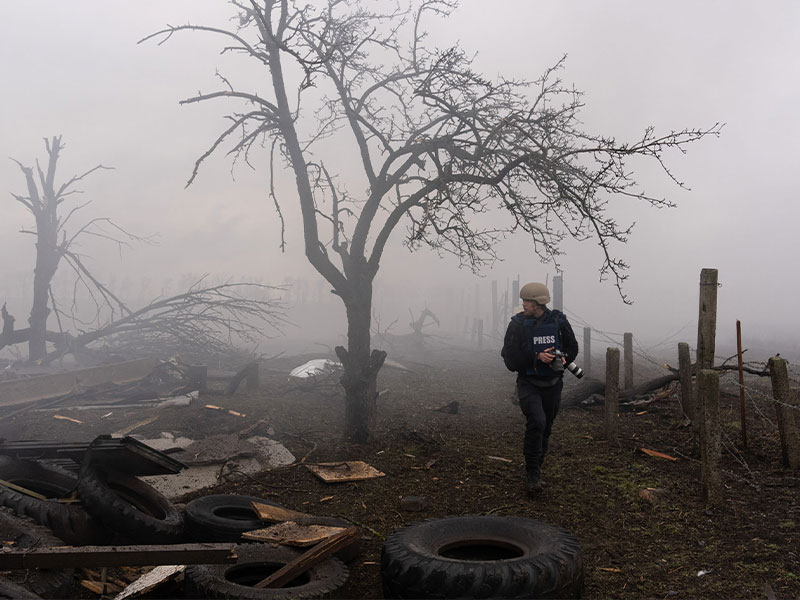
“20 Days in Mariupol”
20 Days in MariupolEvgeniy Maloletka appears in “20 Days in Mariupol” by Mstyslav Chernov (Sundance Film Festival/Mstyslav Chernov)
Ripped from the headlines, this topical documentary traces the invasion of Ukraine from the perspective of several international journalists who were on the ground as it happened. It is sure to feature some remarkable footage — not just of what was happening to the citizens of Ukraine under siege — but also how journalists fare while reporting from a war zone. 
02
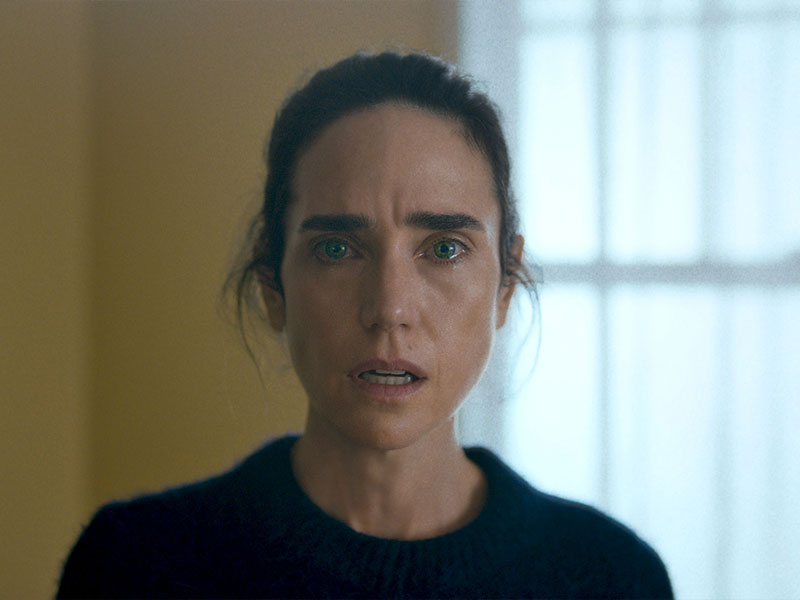
“Bad Behaviour”
Bad BehaviourJennifer Connelly appears in “Bad Behaviour” by Alice Englert. (Sundance Film Festival)
In writer/director Alice Englert’s black comedy-drama, Lucy (Oscar winner Jennifer Connelly) is a privileged woman who connects with a guru (Ben Whishaw), while also trying to manage her relationship with her stuntwoman daughter (Englert).
 
The title suggests this is one of those flinty films in which a headstrong character makes a series of increasingly bad decisions. Connelly is best when she is being tart, and Whishaw is always a pleasure to watch. This is Englert’s feature directorial debut. 
03
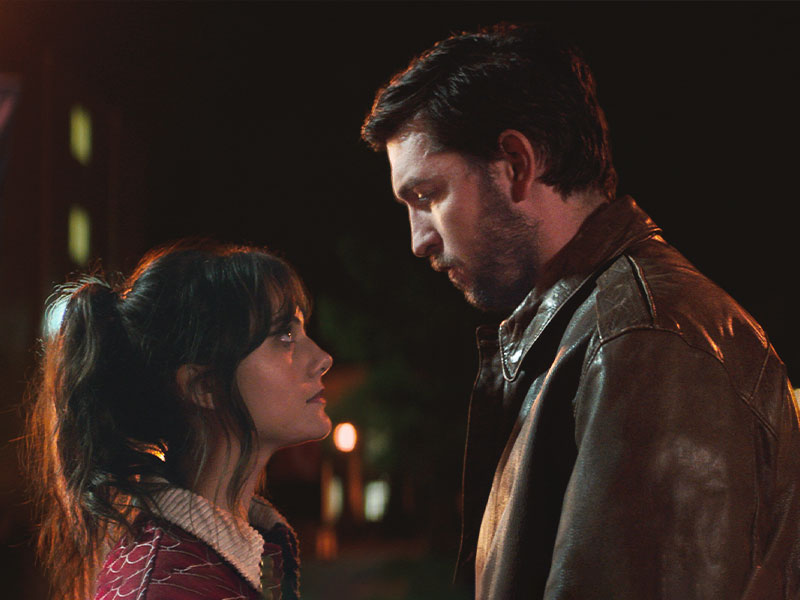
“Cat Person”
Cat PersonEmilia Jones and Nicholas Braun appear in “Cat Person” by Susanna Fogel. (Sundance Film Festival)

Susanna Fogel, who cowrote “Booksmart,” directs this psychological thriller about Margot (Emilia Jones), a college sophomore, who meets Robert (Nicholas Braun of “Succession“) in the movie theater where she works. Their relationship takes an unusual, possibly sinister, turn.
 
Indie stalwarts Hope Davis and Fred Melamed, as well as Isabella Rossellini, co-star in this dark and unsettling film, which is based on a popular New Yorker short story.
04
“The Eight Mountains”
The Eight Mountains“The Eight Mountains” by Felix van Groeningen and Charlotte Vandermeersch. (Sundance Film Festival)

Winner of the Cannes Jury Prize last year, this epic tale has two Italian men (Luca Marinelli and Alessandro Borghi) who become friends as preteens and connect on and off over the years. This gorgeously filmed drama about finding one’s place in the world really deserves to be seen on as big a screen as possible, but for those who cannot wait for its release this spring, this is the chance to check it out in the warmth and comfort of home.
05
“Fancy Dance”
Fancy Dance“Fancy Dance” by Erica Tremblay (Sundance Film Festival)

This hotly anticipated drama, the directorial debut of Erica Tremblay, is set on the Seneca-Cayuga Reservation in Oklahoma. Jax (Lily Gladstone) takes her niece Roki (Isabel Deroy-Olson) along with her as she searches for her missing sister.
 
This sounds like a cousin to the excellent “Catch the Fair One” from last year, and Gladstone is always a pleasure to watch, so expectations are high.
06
“Fremont”
FremontAnaita Wali Zada appears in “Fremont” by Babak Jalali. (Sundance Film Festival/Laura Valladao)

This is the kind of low-key film that is best discovered at festivals. It is shot in black and white, and chronicles Donya (Anaita Wali Zada), a lonely Afghan immigrant, eking out a life in Fremont, California, who finds new opportunities emerging when she gets a new job. Jeremy Allen White (of “The Bear”) costars.
07
“Jamojaya”
JamojayaRich Brian and Yayu A.W. Unru appear in “Jamojaya” by Justin Chon. (Sundance Film Festival/Ante Cheng)
Justin Chon has been making a name for himself, directing films such as “Blue Bayou” and the Apple TV+ series, “Pachinko.” His latest feature, “Jamojaya,” tells the father/son story of James (Indonesian musician Brian “Rich Brian” Imanuel), a rising rap star at odds with his father (Yayu A. W. Unru) who is trying to manage his career as a way of staying close to his only remaining son. But James wants to go in another direction. Imanuel wrote original songs for the film, which looks intense. 
08
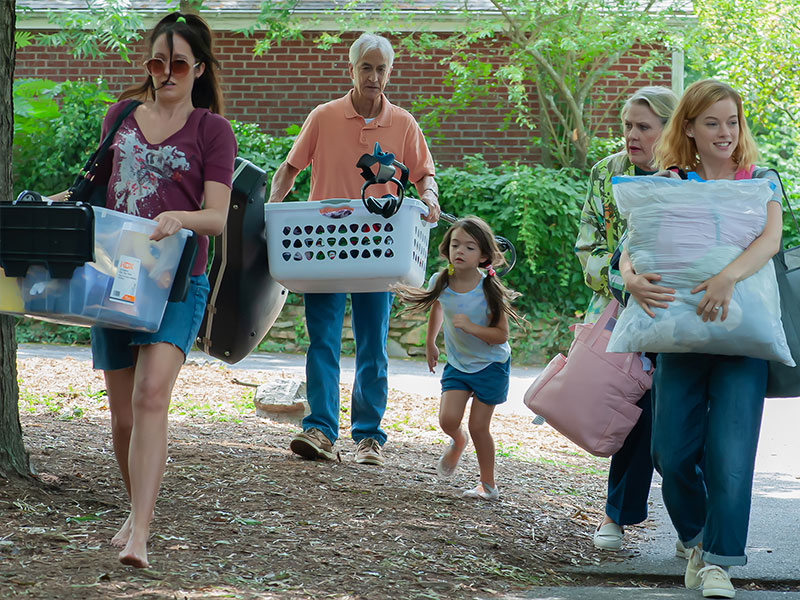
“A Little Prayer”
A Little PrayerAnna Camp, David Strathairn, Billie Roy, Celia Weston and Jane Levy appear in “A Little Prayer” by Angus MacLachlan. (Sundance Film Festival/Diana Greene)
Angus MacLaughlan, who wrote the Sundance hit, “Junebug,” and directed the indie drama, “Abundant Acreage Available,” returns to the fest with what appears to be a chamber film about a man (David Strathairn) who faces a moral conundrum when he suspects that his son (Will Pullen) is being unfaithful.
09
Little Richard: I Am Everything”
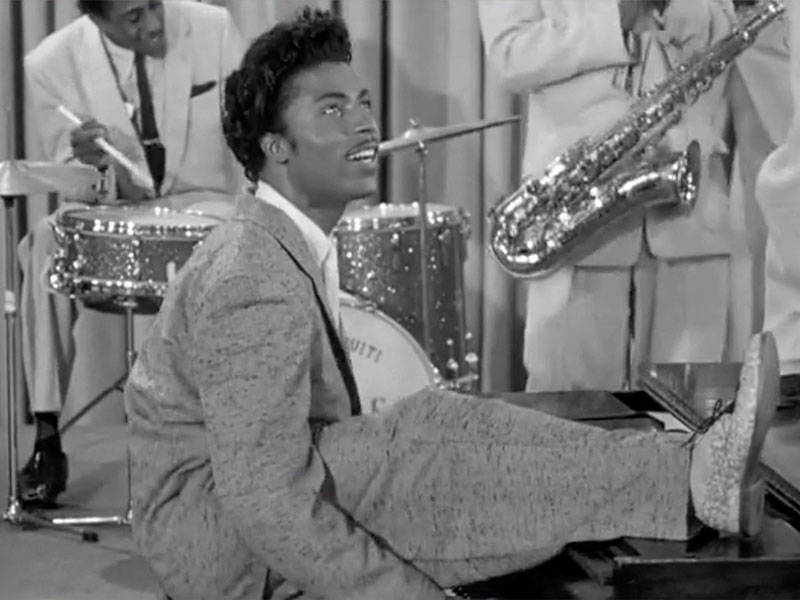
Little Richard: I Am EverythingLittle Richard appears in “Little Richard: I Am Everything” by Lisa Cortes. (Sundance Film Festival)
It is about time someone made a documentary about this rock ‘n’ roll legend. Director Lisa Cortés traces the influence of Little Richard’s career as he broke boundaries and melded genres (blues, gospel, rock, etc.), making everyone dance and sing along as he turned out hit after hit. Cortés also addresses issues of Richards’ race and sexuality, a topic of some controversy with how he self-identified. While there should be some politics, this could also be the feel-good documentary of the fest.
10
“Sometimes I Think About Dying”
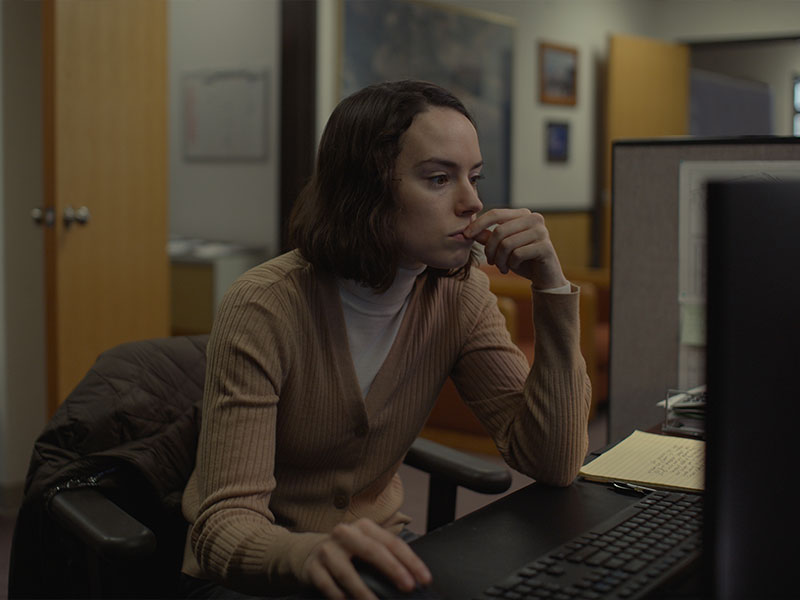
Sometimes I Think About DyingDaisy Ridley in “Sometimes I Think About Dying” by Rachel Lambert. (Sundance Film Festival/Dustin Lane)

True to the film’s title, Fran (Daisy Ridley) does think about dying. But then she meets Robert (Dave Merheje of “Ramy“) who distracts her. This romantic drama sounds as melancholic, but it gives Ridley a nice opportunity to show her indie cred. It could be a real sleeper.
11
“Squaring the Circle (The Story of Hipgnosis)”
Squaring the Circle (The Story of Hipgnosis)“Squaring the Circle (The Story of Hipgnosis)” by Anton Corbijn (Sundance Film Festival)

Director Anton Corbjin‘s fantastic film “Control,” about Joy Division’s Ian Curtis, showed he knew how to make a film about a musician. His new documentary, “Squaring the Circle,” looks at two unsung heroes in the music industry — Storm Thorgerson and Aubrey “Po” Powell of “Hipgnosis.” They designed Pink Floyd‘s “The Dark Side of the Moon” and created graphics for other famous musicians.
12
“Victim/Suspect”
Victim/Suspect“Victim/Suspect” by Nancy Schwartzman (Sundance Film Festival)
As difficult as it is for women to report being victims of sexual assault, it is far worse for them to be disbelieved and then charged with crimes that could incarcerate them. Nancy Schwartzman’s sure to be sobering documentary chronicles several of these women and their cases to shine a light on this doubly traumatizing experience.

Films from the Sundance Film Festival will be available for viewing online Jan. 24-30. For tickets and more information, visit the Sundance fest site.

“It makes him look very small”: GOP critics trash Ron DeSantis’ “anti-woke” crusade against the NHL

Some non-MAGA conservatives in the Republican Party have criticized Florida Gov. Ron DeSantis for using his position to bully Disney, including New Hampshire Gov. Chris Sununu and former Maryland Gov. Larry Hogan. But being a far-right culture warrior is a big part of DeSantis’ brand. DeSantis draws a lot of publicity in right-wing media by going after targets he considers “woke,” and the Florida governor regards a wide range of targets as “woke.”

DeSantis’ latest target is the National Hockey League (NHL). As he sees it, the NHL’s push for diversity is an example of “wokeness.” But some GOP strategists, according to Daily Beast reporter Jake Lahut, are questioning the wisdom of making the NHL a target of his “anti-woke” wrath.

Lahut, in an article published by the Beast on January 18, explains, “Florida Gov. Ron DeSantis is squaring off with an unlikely opponent: the NHL. In the latest battle of the culture wars, the NHL — where gloves-off fighting still brings just a five-minute penalty, where the player base is 93 percent white, and until the hiring of Mike Grier by the San Jose Sharks earlier this month, there had yet to be a Black general manager in the history of the sport — has somehow become the new epitome of woke culture gone awry.”

The DeSantis Administration, according to Lahut, “got the NHL to fold on a local hiring event aimed at diversifying the league’s workforce ahead of its annual All-Star Game.” In an official statement released on Friday, January 13, DeSantis spokesman Bryan Griffin said of the NHL, “Discrimination of any sort is not welcome in the state of Florida, and we do not abide by the woke notion that discrimination should be overlooked if applied in a politically popular manner or against a politically unpopular demographic.”

One of the Republican strategists interviewed by the Beast described DeSantis’ decision to challenge “wokeness” in the NHL as a way to “raise his profile as a fighter as well as raise money.” But veteran GOP strategist Stuart Stevens described DeSantis’ actions as potentially the type of “strategy that works until it doesn’t.”

Stevens told the Beast, “I’ve been in these rooms where political consultants get together, they try and say, ‘Well, what can we do to appeal to white voters without being just super-blatantly racist?’…. Republicans are losing culture wars at an exponential speed…. What the NHL is doing bothers absolutely nobody in America. A lot of politics is defining yourself by what you’re not for.”

Stevens, who worked on the presidential campaigns of President George W. Bush, now-Sen. Mitt Romney and the late Sen. John McCain, added, “There was a time with Ronald Reagan, ‘Mr. Gorbachev, tear down this wall.’ So, here’s Ron DeSantis standing in front of a hockey rink in Florida saying, what, exactly? I mean, it’s just ridiculous. It makes him look very small.”

Stevens made the same point about DeSantis and the NHL that Sununu and Hogan made about DeSantis and Disney: that it’s foolish to attack a business that brings money to his state.

Stevens told the Beast, “This is the kinda thing that if you were on a school board, you’d think is stupid. Like, c’mon, just let ’em play. Who cares? There’s a tone-deafness. You get the sense watching DeSantis that he’s somebody trying to dance by looking at his feet and wondering what the steps are…. DeSantis would be a Trotskyite if he thought it might get him elected president. There was a time Republicans believed in smaller government and not interfering, and he’s running after successful businesses that bring money to Florida?”

“Investment already paying off”: McCarthy assigns Big Oil favorites to key environment panel

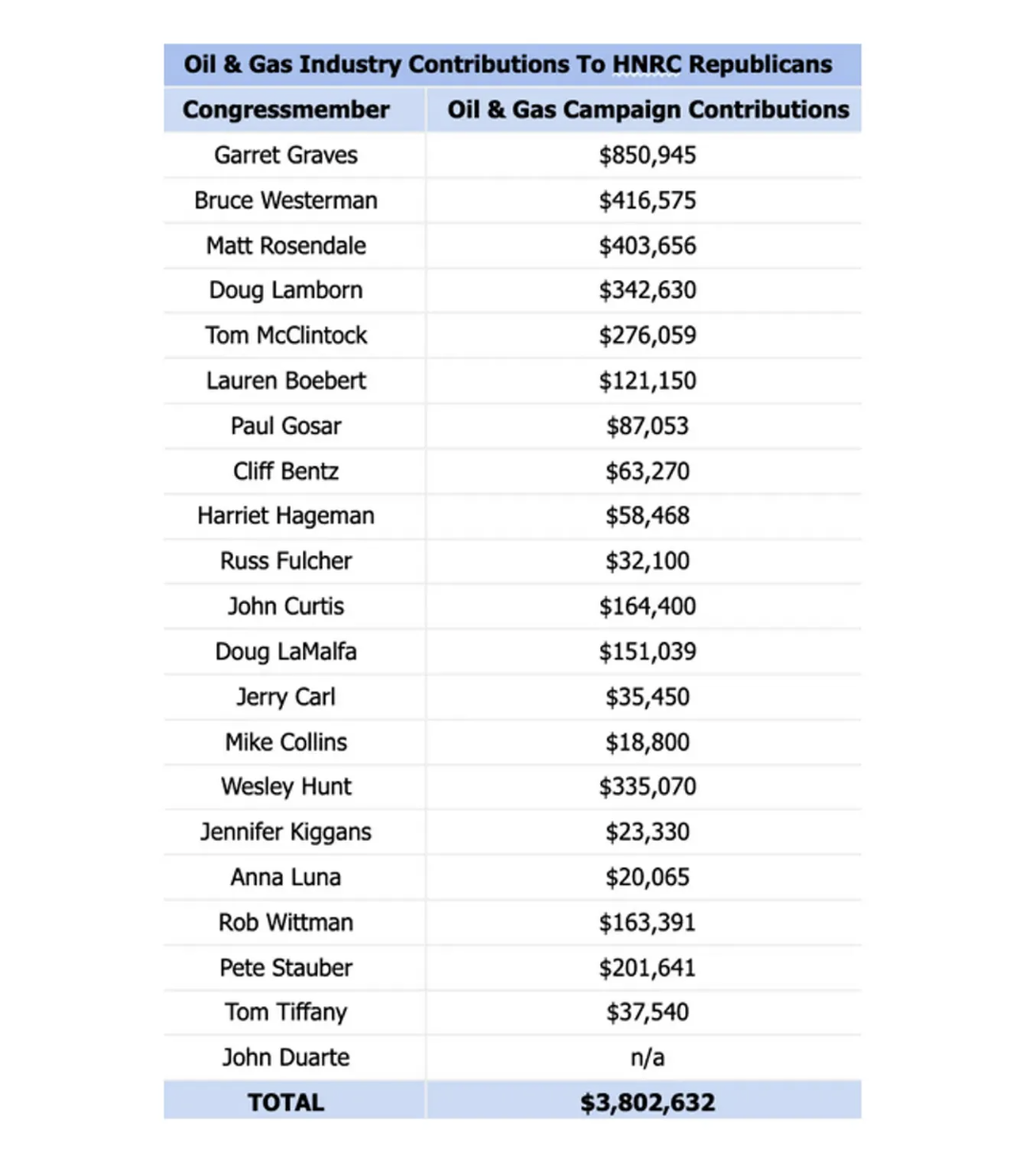
A leading government accountability watchdog on Tuesday called out leaders of the Republican-controlled U.S. House of Representatives while revealing that the 21 GOP members appointed by Speaker Kevin McCarthy to the Natural Resources Committee took a combined $3.8 million in campaign contributions from Big Oil.

Oil and gas industry contributions to the 21 right-wing lawmakers range from more than $850,000 for Rep. Garret Graves of Louisiana—the nation’s third-biggest fossil gas producer and a top-10 oil-producing state—to $18,800 for Rep. Mike Collins of Georgia, according to Accountable.US.

“The new MAGA-controlled House Natural Resources Committee aligns much closer with violent anti-public land extremists like the Bundys than they do with most Americans,” the group said in a statement, referring to former President Donald Trump’s “Make America Great Again” 2016 campaign slogan and the Nevada family that perpetrated an armed confrontation with the U.S. Bureau of Land Management over unpaid cattle grazing fees.

HNRC GOP donations (Accountable. US)

Accountable.US continued:

Of the Republicans on the committee, five outright oppose federal public lands, most have demonstrated support for election denial, and all have supported policies to expand industry-friendly federal leasing to Big Oil and other extractive sectors. While nearly all of the members have received donations from oil and gas companies, several have personal financial conflicts of interest in the form of either spousal employment or stock holdings.

“Big Oil’s investment is already paying off,” said Jordan Schreiber, director of energy and environment at Accountable.US. “McCarthy and his MAGA allies wasted no time delivering results for their wealthy industry donors, placing nine of the most extreme anti-conservation members on the House Natural Resources Committee.”

“Instead of holding Big Oil executives accountable for price gouging consumers at the pump, the committee will be dominated by the interests of extractive industries, enabling them to push bills that stymie cost controls, and clear the way for multibillion dollar corporations to exploit the American people’s land for private gain,” Schreiber added.

In addition to highlighting the money that the lawmakers have taken from the fossil fuel industry, the new report notes relevant actions and remarks, from Graves describing President Joe Biden’s climate plan as “ushering in a Soviet-style state” to Rep. Harriet Hageman of Wyoming comparing conservation efforts to dictators starving and killing people, claiming that “it’s about controlling people through controlling the food supply.”

Alec Baldwin to be charged with involuntary manslaughter

It seems that Alec Baldwin may have to face up to his part in the on-set death of a crew member.

The actor is to be charged with involuntary manslaughter for the shooting death of cinematographer Halyna Hutchins on the set of Baldwin’s film “Rust,” the Wall Street Journal and others report. “The film’s armorer overseeing weapons, Hannah Gutierrez-Reed, will also be charged with involuntary manslaughter in the incident,” the Wall Street Journal writes, with official charges “expected to be filed by the end of the month.”

On October 2021, during a rehearsal for the western film outside of Santa Fe, “Baldwin was pointing a pistol at Hutchins when the gun went off, killing her and wounding the director, Joel Souza,” according to The Guardian. It is yet unclear as to how and why the film set had live ammunition.

The forthcoming charges were announced in a statement by Mary Carmack-Altwies, the New Mexico First Judicial District Attorney. The DA’s office also said that David Halls, the first assistant director of “Rust,” will plead guilty to negligent use of a deadly weapon. 

A fourth-degree felony, involuntary manslaughter usually is punishable by up to 18 months’ imprisonment and a $5,000 fine. But, according to NBC News, “a firearm enhancement on the charges could make the crime punishable by a mandatory sentence of five years in jail.” NBC News quoted Carmack-Altwies’ statement: “After a thorough review of the evidence and the laws of the state of New Mexico, I have determined that there is sufficient evidence to file criminal charges against Alec Baldwin and other members of the ‘Rust’ film crew.” 


Want a daily wrap-up of all the news and commentary Salon has to offer? Subscribe to our morning newsletter, Crash Course.


Baldwin has yet to make a public statement about the charges, but in an interview with ABC News in December 2021, he first spoke publicly about the shooting incident, telling George Stephanopoulos, “I feel that someone is responsible for what happened, and I can’t say who that is. But I know it’s not me.”

Carmack-Altwies said in the statement from the DA’s office, “On my watch, no one is above the law, and everyone deserves justice.”

Ivanka and Jared plotted with Nikki Haley to backstab Mike Pence so she could be veep: Mike Pompeo

Former Secretary of State Mike Pompeo in his new memoir accused former UN Ambassador Nikki Haley of plotting with Jared Kushner and Ivanka Trump to be named vice president.

A copy of the book, “Never Give an Inch: Fighting for the America I Love,” obtained by The Guardian details an incident in which Haley secured a personal Oval Office meeting with Trump and both of his senior advisers: his daughter and her husband.

Pompeo wrote that Haley “played” Trump’s then-chief of staff, John Kelly, since she did not consult with him first about the meeting. 

“As best Kelly could tell,” Pompeo wrote, “they were presenting a possible ‘Haley for vice-president’ option. I can’t confirm this, but [Kelly] was certain he had been played, and he was not happy about it. Clearly, this visit did not reflect a team effort but undermined our work for America.”

Throughout his book, Pompeo continues to go after Haley and even criticizes her performance in her previous job as the ambassador to the United Nations,

“She has described her role as going toe-to-toe with tyrants,” Pompeo wrote. “If so, then why would she quit such an important job at such an important time?”

Haley resigned in October 2018, which Pompeo described as her abandoning Trump just as she had done to “the great people of South Carolina” by resigning as governor.

Pompeo is not the only potential Republican presidential candidate to release a book about his time in the Trump administration. 

Former Vice President Mike Pence released his memoir, “So Help Me God,” and Florida Gov. Ron DeSantis – who is viewed as a strong contender –  is set to publish his own memoir “The Courage to Be Free: Florida’s Blueprint for America’s Revival,” next month. 


Want a daily wrap-up of all the news and commentary Salon has to offer? Subscribe to our morning newsletter, Crash Course.


Pompeo’s book also provides insight into his relationship with Trump. 

When the secretary of state was at all critical about China at the start of the COVID-19 outbreak, Trump told him to “shut the hell up for a while” to avoid upsetting Chinese President Xi Jinping, Semafor reported.

In a March 26 call that took place between the two leaders, Xi told Trump that his Cabinet member was jeopardizing the “phase one” trade deal that the principals had agreed to, according to Semafor.

This happened a day after Pompeo had said that China had “repeatedly delayed” sharing information about the coronavirus and engaged in a “disinformation campaign.”

Pompeo believed that the Chinese president was trying to get Trump to fire him.

“My Mike, that fucking guy hates you!” Trump said after the call. 

A few days later, he informed Pompeo that he was “putting us all at risk” by angering Xi since the United States still needed protective health equipment from China.

“We needed health equipment and were at the CCP’s mercy for it,” Pompeo wrote. “I worked for the president, and would bide my time.”

Another interesting experience that Pompeo recalls in his memoir is a secret meeting he had with North Korean leader Kim Jung Un in 2018, which he said began with a “joke about assassination,” according to The Hill.

“This small, sweating, evil man tried to break the ice with all the charm you would expect from a mass murderer. ‘Mr. Director,’ he opened, ‘I didn’t think you’d show up. I know you’ve been trying to kill me,'” Pompeo wrote. 

He added that his meeting with Kim Jung Un was a “complete secret” and his goal was to “correct the failed efforts of the past that had not eliminated North Korea’s nuclear weapons of mass destruction.” 

Pompeo’s memoir is set to be released on Jan. 24 amid speculation that he could announce a 2024 presidential run.

ND GOPer wants school kids to “prove” their gender — and impose $1,500 fines for “wrong” pronouns

The North Dakota House of Representatives has introduced a bill that would strictly prohibit expanded use of pronouns outside of the gender that the person was born.

House Bill 2199 restricts the definition of gender to the person’s natural gender at birth and then requires that all pronoun use be reflective of that same gender. Any violation by anyone who works at an institution that receives state funding, including public schools would be subject to a $1,500 fine.

If gender is challenged, the bill puts the responsibility on the individual to prove their gender.

“Say, they’re a boy, but they come to school and say they’re a girl. As far as that school is concerned in this bill, that person is still a boy. If it becomes contested, the burden will be on the girl, the so-called girl, or the boy, to prove that he is a girl,” said North Dakota State Senator David Clemens while speaking in favor of the bill.

The bill’s sponsor was the only testimony given in support of the bill, as nearly 100 separate forms of testimony was provided against the bill. Even the state’s Senate Judiciary Committee voted to not pass the proposed bill.

“I see no way this law would pass any sort of legal challenge based on basic legal construction principles,” North Dakota Human Rights’ Christina Sambor said in an interview with KFYR-TV of Bismarck. “It is vague, fails to advance any legitimate state interests, and not only would cause impermissible, gender-based discrimination, its very purpose is gender-based discrimination.”

The bill now moves to the Senate floor.

George Santos denies report that he was a drag queen — despite his ex-friend releasing photos

Far-right Rep. George Santos, R-N.Y., reportedly performed as a drag queen in Brazilian beauty pageants under the pseudonym Kitara Ravache, according to statements and photos from the drag queens who say they knew him. Santos, an ally of former President Donald Trump and an openly gay Republican, has faced sharp criticism over his support of laws deemed antagonistic toward LGBTQ groups. 

Reporter and MSNBC columnist Marisa Kabas offered more details on Twitter Thursday. 

“I just spoke by phone with Eula Rochard, a Brazilian drag queen who was friends with George Santos when he lived near Rio. She said everyone knew him as Anthony (never George), or by his drag name, Kitara, and confirms this photo is from a 2008 drag show at Icaraí Beach,” she said in a Tweet.

Rochard’s additional photos included some that bear a striking similarity to Congress’ admitted resume-embellisher. 

“Eula saw a story about Santos on Brazilian news and was sure was it was him,” Kabas tweeted. “She shared the news with a group of friends and everyone doubted her. So she looked for an old picture to confirm, and she decided to post it to social media to prove to her friends that she was right.” 

A Reuters report Thursday independently cited two other former associates in Brazil who confirmed Rochard’s story. An unnamed acquaintance of Santos from the same Rio de Janeiro suburb of Niterói reportedly said Santos participated in drag queen beauty pageants and aspired to be Miss Gay Rio de Janeiro.” 

In the same report, Rochard told Reuters that Santos was a “poor” drag queen in 2005, but in 2008 “came back to Niteroi with a lot of money.” Rochard said Santos competed in — but lost — a drag beauty pageant that year using the drag name Kitara Ravache.

“He’s changed a lot, but he was always a liar. He was always such a dreamer,” Rochard said.


Want a daily wrap-up of all the news and commentary Salon has to offer? Subscribe to our morning newsletter, Crash Course.


Santos denied the allegations on Twitter. 

“The most recent obsession from the media claiming that I am a drag Queen or ‘performed’ as a drag Queen is categorically false. The media continues to make outrageous claims about my life while I am working to deliver results,” Santos said in a Thursday tweet. “I will not be distracted nor fazed by this.”

Santos, who campaigned on his identity as an openly gay Republican, has been criticized for supporting a series of controversial policies widely considered antagonistic by LGBTQ community advocates.  

The congressman, who is wanted in Brazil for a theft he has admitted to, was a vocal supporter of Florida’s Parental Rights in Education law — known by its critics as the”Don’t Say Gay” law, which bars elementary school teachers from in-class discussions of sex, sexuality, and academic theories on gender identity “in a manner that is not age appropriate.”   

The law’s proponents, including Santos, have noted that the law applies only to teachers of kindergarten through third grade, and requires schools to inform parents of any actions a school takes to intervene in the development of a child’s gender identity — such as administering undisclosed mental health counseling sessions. The law includes exceptions for cases where disclosing such information is would “result in abuse, abandonment, or neglect.” 

Critics of the measure and legal experts have argued, however, that the law’s broad language about age propriety may open the door to wider in-classroom restrictions and curriculum scrutiny more precisely geared toward silencing classroom discussions of LGBTQ topics. They note that the law allows school districts ban instruction of these topics beyond the third grade if the topics are not deemed age-appropriate by state standards. 

Santos is currently facing calls to resign from his own party, amid mounting ethics complaints and investigations into his potential misuse of campaign funds. 

“That ’90s Show” is here to remind Boomers, Gen X and Millennials that we’re all alright

In this era where little is truly new or original, remembering when should be its own genre. Many of 2022's zeitgeisty hits plug into things we loved in our youth, from Anne Rice to "Yellowjackets." To clarify, the "we" in this scenario is Generation X, the audience for which "That '90s Show" was designed.

Without a doubt its creators Bonnie and Terry Turner, joined this time by their daughter Lindsey, might take umbrage with that declaration of ownership. This is a broadly targeted family show in the same way that their Fox sitcom "That '70s Show," had mass appeal despite being attached to a decade once commonly thought of as tacky.

While never a massive hit, "That '70s Show" inspired broad viewer affection due to its multigenerational awareness. The teenagers are the focus, but they're also pubescent versions of the Boomers watching at home, enabling parents to make the case to their kids, and themselves, that they used to be edgy.

Everybody pilfers their elders' closets at some point; why shouldn't Netflix raid Fox's?

The sitcom's parents, whether that refers to Red and Kitty, or Donna's parents Bob and Midge, are stodgy, grizzled, intimidating or simply embarrassing. They're also loving, wise and supportive, the way we view(ed) our parents and grandparents.

A wide range of ages could claim some part of the Turners' comedy as their experience, which explains why the series lasted for eight seasons: It's the giggling baby resulting from an orgy involving a Disney Channel sitcom, "The Brady Bunch" and Richard Linklater's "Dazed and Confused." 

That '90s ShowThat '90s Show (Photo courtesy of Netflix)Hence, where others attempts to revisit old IP shuffle old casts into an updated version of their long-gone shows would earn dismissive sneers – "Fuller House," we're looking at you – "That '90s Show" makes the thought of sliding back into the good old Vista Cruiser alluring.
The first time we see Kitty she's dancing to the 1990 hit "Groove Is in the Heart" by Deee-Lite whose video made '70s-style bellbottoms and platform shoes chic again in the '90s, as they are in 2022. Everybody pilfers their elders' closets at some point; why shouldn't Netflix raid Fox's?

"That '70s Show" ran from 1998 to 2006, and that means those of us who were teenagers and 20-somethings in its heyday are likely parents and grandparents now. So as relatable as Eric Forman (Topher Grace), Donna Pinciotti (Laura Prepon), Michael Kelso (Ashton Kutcher), Jackie Burkhart (Mila Kunis), Fez (Wilmer Valderrama) and Hyde (Danny Masterson) were back then, "That '90s Show" forces us to realize that we have more in common with Red (Kurtwood Smith) and Kitty (Debra Jo Rupp) in 1995.

This is called out when Eric and Donna, now in their late 30s, are forced to suffer through a game of cards with Kitty and Red as the camera, placed on the kitchen table, veers from a tight shot of one person's face to another.

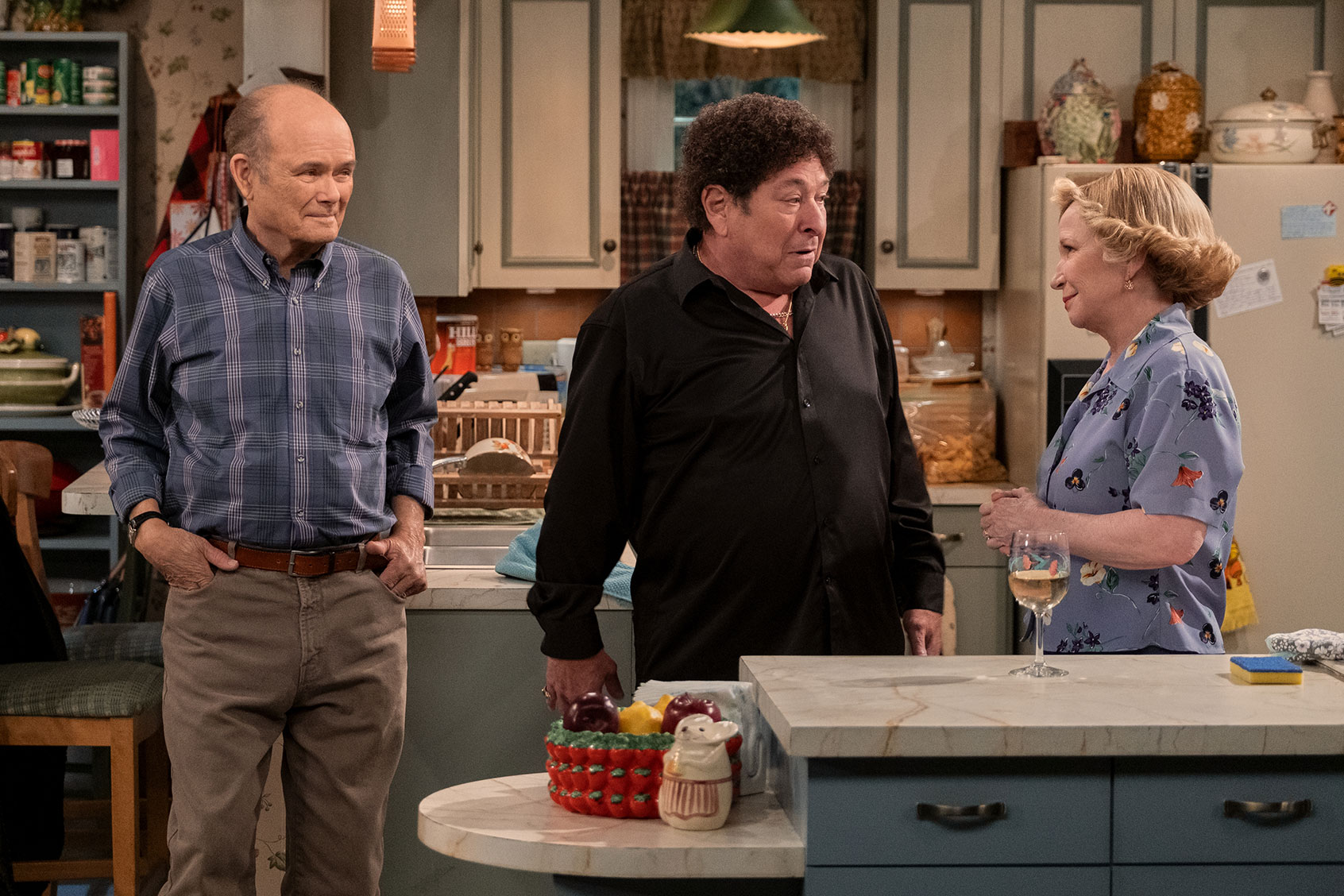
That '90s ShowKurtwood Smith as Red Forman, Don Stark as Bob Pinciotti and Debra Jo Rupp as Kitty Forman in "That '90s Show." (Patrick Wymore/Netflix)

"Enjoying yourselves, kids?" Red growls with sour mirth, adding, "You're upstaaaairs people now."

Then Donna makes the admission all of us do when we realize our youth is but a shrinking dot in the rearview mirror: "I knew it would happen. Just not this soon."

The surest sign that the Turners' formula still fits is that they and showrunner Gregg Mettler have believably evolved the old gang (minus Hyde who, for reasons, may as well have never existed) into late-30s versions we believe and still recognize while making their '90s progeny and their friends' reflections of the kids we were.

Eric and Donna's kid Leia (Callie Haverda) has both her parents' intelligence and a sensibility that might as well be a tug-of-war between Eric's awkwardness and Donna's chill. When they visit Red and Kitty in Point Place, Wisconsin, Leia campaigns to stay once she meets the new cool girl next door, Gwen Runck (Ashley Aufderheide), as she's rocking out to Alanis Morrisette.

That '90s ShowCallie Haverda as Leia Forman and Ashley Aufderheide as Gwen Runck in "That '90s Show." (Patrick Wymore/Netflix)
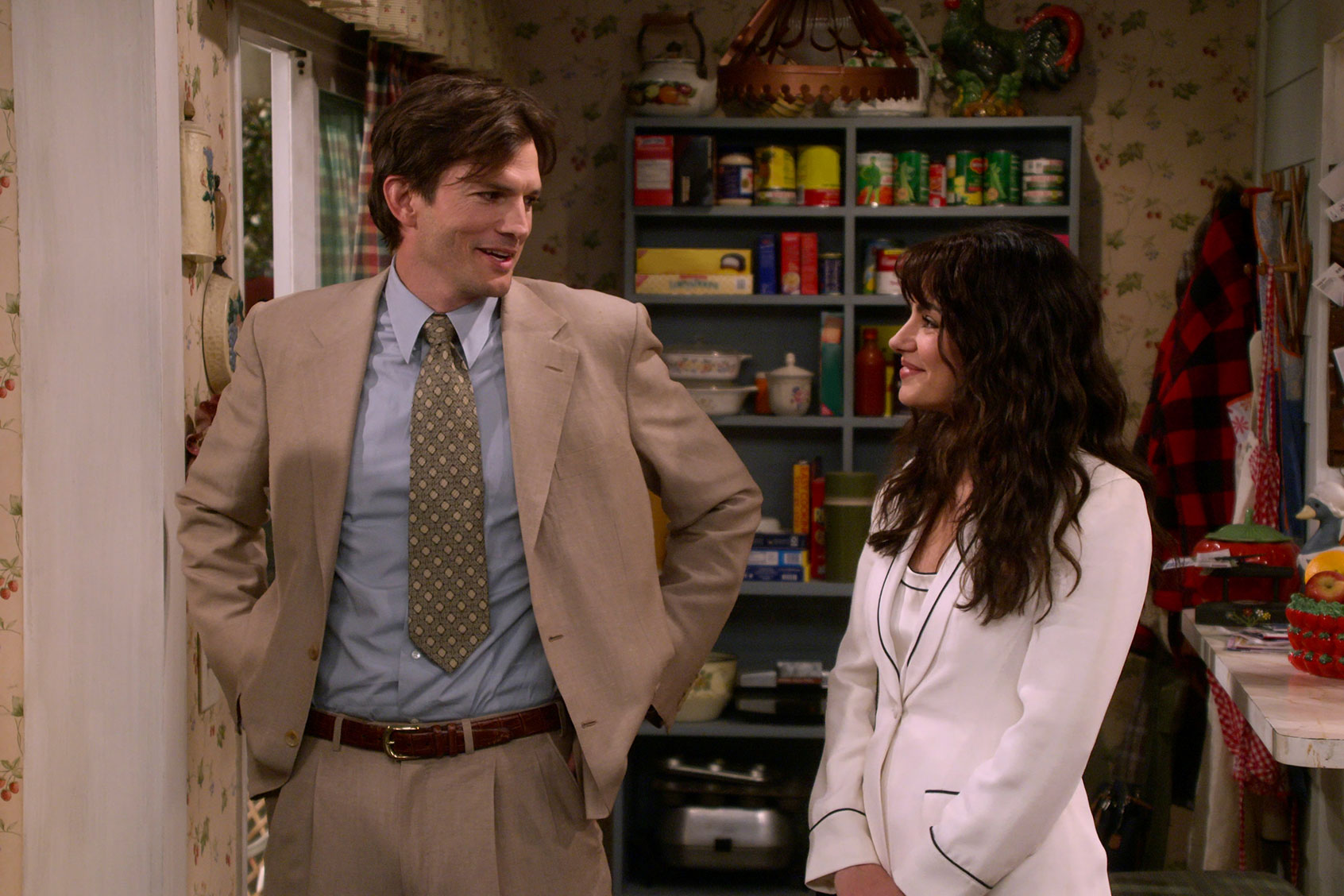
Once Gwen introduces Leia to the new basement squad, which includes Nikki (Sam Morelos) and her lunkhead boyfriend Nate (Maxwell Acee Donovan), Ozzie (Reyn Doi), and Jay (Mace Coronel), Leia campaigns to spend the summer with her new friends.

This was never a show that analyzed its era aside from thrifting a few jokes out of its cultural detritus bin.

Kitty is thrilled to relive the golden days of vicariously hanging out with her son's crew. Red, not so much. Soon enough the kids are finding forgotten stashes of "stuff" in crannies around the Formans' place. The camera is back to spinning around that old coffee table, capturing unfocused looks and nonsensical ramblings through the haze as Red sits in wait upstairs, threatening to put his foot up some wayward adolescent's ass.

"That '90s Show" is generational fan service, albeit one that tweaks its predecessor's flaws by, for example, featuring a culturally inclusive friend circle that eliminates the concept of any character being treated as the "other," and becoming a punchline generator. Perhaps the most overt example of that shift is Ozzie, who is gay. Before he says that out loud, Ozzie distinguishes himself as being the group's razor wit and anchor to sanity. But he's also very much a kid, demonstrated in a coming-out subplot that finds humor in his knack for overplanning above all else, and concludes by reminding us that Formans' place is a loving sanctuary above all.


Want a daily wrap-up of all the news and commentary Salon has to offer? Subscribe to our morning newsletter, Crash Course.


Then again, Valderrama's return as Fez places him in a pleasingly farcical power position in the town. It's a strange thing to glean joy from watching a character with so many cringe-worthy traits, although Valderrama plays up his reprise in a way that both acknowledges that Fez was problematic back then while lampooning it by making his adult version even more problematic.

On the other hand, his enthusiastic reprise of the character and the way the new class captures that feeling for themselves give a person little other choice but to relax into its goofiness. Grace and Prepon are tickled by this reunion, as are Kutcher and Kunis, with the former plainly thrilled to witness a new Kelso carrying his dum-dum humor forward; Coronel's Jay is Jackie and Michael's son.

That '90s ShowAshton Kutcher as Michael Kelso and Mila Kunis as Jackie Burkhart in "That '90s Show." (Courtesy of Netflix)
Mind you, this was never a sitcom that analyzed its era aside from thrifting a few jokes out of its cultural detritus bin, which the revival achieves with a Zima mention here and a Glamour Shots montage there. Rather, we enjoy it for the way it makes its period-specific throwbacks induce spit-takes through the writing. We all remember when the Internet speed was measured in baud and experienced via screeching phone lines. Kitty makes sense of it by deciding that "the Internet is just two demons who are yelling at each other."

She's right, and in ways that a grandmother in the 1990s couldn't have pictured. The Internet is in fact a place where devils scream back and forth, but there are millions of them now, enough to remind us of how salubrious it can be to take a break.

"That '90s Show," like "That '70s Show" before it, is a cake slice of a Midwestern idyll, an easy diversion asking very little of us beyond the opportunity to snort at simple jokes about the figment of simpler times.

"That '90s Show" debuts Thursday, Jan. 19 on Netflix.

Shorter height, lower salary: Height discrimination is real, and can be economically devastating

It pays to be tall — and not just metaphorically. 

A 2020 study in the scientific journal PLOS One analyzed economic data from over 3,500 Chinese adults and found that every additional centimeter of height was correlated with a 1.3% increase in a person’s annual income. In Imperial units, this would mean that a 5′ 6″ person making $50,000 every year would earn an additional $2,000 for each extra inch of height.

The 2020 study is one of many that sheds light on a little-discussed but very real example of discrimination. For hundreds of years, human culture has been methodically committed to the civil rights project of understanding and dismantling discrimination — and legislation worldwide has sought to undo such ills as they apply to gender, race, ability, weight, and sexuality. Height, and its astonishing implications for quality of life and prosperity, are far less discussed, despite numerous well-researched studies pointing it out.

 “Height discrimination does not fit the mental discrimination prototype that most of us hold. It is usually not intentional; its harm is not very perceptible and it has an unconventional form.”

Intriguingly, height discrimination seems to be inextricable from one’s gender: men, evidently, face more severe social and workplace penalties for being short compared to women. Meanwhile, there is a more self-evident connection between height and poverty. Understandably, those who are malnourished or hungry often as children are apt to be shorter anywhere in the world. The authors of the aforementioned PLOS One study found that genetic markers correlated with height were also linked to higher cognitive ability and a lack of depression, thereby revealing how a healthy early environment helps humans develop into their full potential in every way— including with their height. (Of course, this is not to say that being short is always due to the physical and emotional traumas caused by poverty and marginalization. Some people are, in fact, genetically destined to be short.)

Reading this far, you might be wondering how heightism exists in the real world. Probably few employers consciously pay short people less than tall people; and yet, a pay gap persists. So how is this not noticed?

“According to socio-psychological research, similar to the perception of objects (such as a table or a chair), we decide whether a certain behavior is discriminatory or not by using a mental template of discriminatory behavior,” Dr. Omer Kimhi, associate professor at University of Haifa’s Faculty of Law, wrote to Salon. “Our brain holds a kind of prototype of how discrimination should look like, and in order to determine whether a certain behavior/outcome is discriminatory, we compare the incoming information about the behavior to the mental discrimination prototype we have.”

Kimhi argues that, to address heightism, people need to start by “naming” the phenomenon — that is, “recognizing harmful experiences they suffer as related to height discrimination.” The challenge right now is that “height discrimination does not fit the mental discrimination prototype that most of us hold. It is usually not intentional; its harm is not very perceptible and it has an unconventional form both in terms of perpetrator/victim and in terms of the domain in which it takes place.”

To comprehend how heightism can be both demonstrable and elusive, one need only look at the history of the United States. If you examine the heights of the 45 men who have served as United States president, one fact becomes immediately apparent: They are usually taller than the average American. According to the Centers for Disease Control and Prevention (CDC), the average American man today is 5′ 9″ tall, and since the average male height has gradually risen over the past two centuries with improved living conditions, this means that some of the early tall presidents were actually even taller relative to the norms of their day. Overall 32 of the 45 American presidents were taller than 5′ 9″. The average presidential height is 5′ 11″. Only three presidents — Martin Van Buren, Benjamin Harrison and James Madison — were 5′ 6″ or shorter. By contrast, nearly half of America’s presidents (19) have been at least six feet tall, and all of the presidents who were shorter than 5′ 9″ were elected before the 20th century.

That last statistic perhaps speaks to the pernicious nature of height discrimination. Though not widely discussed in conversations about prejudice, it is telling that not a single American president has been elected in the television era unless he was at least 5′ 9″.

A massive body of scientific literature proves that when humans discriminate based on height, it is often because of a primal instinct which associates body size with leadership ability. The complicated answer involves a natural impulse within the brain. 

“I believe the origins of height discrimination are evolutionary,” Kimhi wrote. “The human species has lived in hunter-gatherer tribes of 5 to 150 people more than 99 percent of its existence. Within these tribes members had to fight with each other over scarce resources, the larger-sized males usually prevailed and were regarded as the leaders of the group.”

Just as animal groups tend to be dominated by the largest and strongest individuals within their herd, human beings seem to instinctively assume that bigger and stronger people (disproportionately male) are going to be intangibly “better” at everything they do. To understand how this happens, one must go back to 1992, when social psychology researchers Jim Sidanius, Erik Devereux, and Felicia Pratto coined the term “Social Dominance Theory” (SDT). SDT holds that societies tend to be organized as systems of intersecting group-based social hierarchies. Racism, sexism, classism, ableism, anti-LGBTQ prejudice and all other forms of systemic discrimination can ultimately be traced back to these tendencies. Individuals in the dominant groups wind up accruing “positive social value,” which ranges from wealth and political power to a luxurious lifestyle and the presumption of high social status.


Want more health and science stories in your inbox? Subscribe to Salon’s weekly newsletter The Vulgar Scientist.


Outgroups, on the other hand, receive “negative social value” and wind up with little power, little money and little social status, with all of the hardships and lack of pleasure that accompany such a lifestyle.

When you consider that being short is often caused by injustices like poverty and discrimination, the loss of income due to being short presents a profound social and political problem.

Indeed, the height-based bias on income is so quantifiable that at least one law scholar argues it should be considered illegal. To an extent, at least, it already is: The 1977 Supreme Court case Dothard v. Rawlinson ruled that height and weight requirements for an Alabama prison guard position were discriminatory because it could not be proved, for instance, that a guard had to be at least 5′ 2″ to do their job effectively. In a 2020 article for Connecticut Law Review, Kimhi pointed out that scientific research repeatedly demonstrates that humans “associate a host of positive qualities to those with above average height, and we belittle those born a few inches short. These implicit biases, in turn, lead to outright discrimination.”

When you consider that being short is often caused by injustices like poverty and discrimination, the loss of income due to being short presents a profound social and political problem. According to Dr. Anne C. Case, an economics and public affairs professor at Princeton University, “people (both men and women) who are well nourished and healthy in childhood are more likely to hit their physical potential (height) and are also more likely to hit their cognitive potential — wiring up of bodies and brains takes place starting in utero.” Although taller children will on average perform better on cognitive tests throughout childhood, “once one controls for cognitive test results from tests taken in childhood, the height premium in the labor market disappears.” In a 2008 study for the Journal of Political Economy that Case co-authored, she wrote that “so much happens in utero and childhood that we should do absolutely everything we can to make sure every child is given a healthy start.”

In addition to studies finding that height correlates to higher income, an increased likelihood of being promoted and generally being associated with strong leadership skills, there is also literature linking height discrimination to dating problems — as well as a huge number of anecdotes from singles. When a TikTok user shared a video in which she marked six feet on her door-frame in order to fact-check the heights of men whom she met online, her video aroused widespread anger among many users for being insensitive to the discrimination that might cause men to exaggerate their height. Researchers have found that height is associated with perceived masculinity and that men who said they were 6′ 3″ and 6′ 4″ received more responses on their dating apps than men who were described as 5′ 7″ and 5′ 8″. A 5′ 6″ South African TikToker named Alcidez Banda recalled how a woman told him that “if there’s any man that is shorter than me, he’s just looking for attention,” conflating shortness with poor character and intrinsic ugliness, even if the remark was intended humorously.

“In a way, it could also affect our sense of self-worth because it’s like, if you view short men as less compatible partners, why does that say about me if I only have short men rolling up in my DMs?” a female online dater named Rachael told BuzzFeed. “Does that mean that none of the top fine, muscular men are going to look [at] me?” Not surprisingly, this is why articles regularly pop up on the frustrations of dating while being a short man, with the advice ranging from the bleak to the hopeful. It may also explain why leg lengthening surgery, which involves a brutally painful process of breaking multiple leg bones, is increasingly popular among the super-rich who still struggle with being short.

Indeed, in discourse around dating, more than in any other online realm, the topic of height discrimination appears prominently. Though social media discussions around romance typically decay into toxicity and misogyny, the frequency with which the topic comes up may ultimately raise awareness around the more serious consequences of height discrimination — particularly, the wage gap, which actually can be socially and economically devastating. 

New book reveals Kushner’s “knock-down, drag-out screaming matches” with Trump over election claims

A new book is shedding light on the behind-the-scenes arguments that took place between former President Donald Trump and his son-in-law Jared Kushner during his time in the White House.

During the days leading up to the insurrection on the U.S. Capitol, Trump spent a substantial amount of time pushing baseless claims and conspiracy theories questioning the integrity of the presidential election he lost to President Joe Biden.

According to Mediaite, details about Trump and Kushner’s clashing are included in the new book, “The Fight of His Life: Inside Joe Biden’s White House,” written by author Chris Whipple.

Although many of Trump’s supporters and allies echoed his claims, Kushner, according to Whipple, was not in agreement with many of the former president’s attempts to overturn the election. Whipple even highlighted some of the “knock-down, drag-out screaming matches” Kushner actually had with Trump.

“With all due respect, I’m not going to like what you are doing, and you’re going to be screaming at me,” Kushner reportedly told the former president during a heated exchange about the claims of voter fraud.

According to Whipple, there was also a time when Kushner warned Trump of what his future might look like based on the conspiracy-driven path he was on.

“Look, when you’re out of here, a lot of people will scatter,” Kushner reportedly said, adding, “I’m with you until you hit the dirt — so you may want to listen to what I’m saying.”

Per the news outlet, The Forward’s Jacob Kornbluh also highlighted key takeaways from the book with a brief overview of what happened prior to Biden’s inauguration, which Trump did not attend.

“Since election day, Kushner and Ivanka Trump had kept telling themselves that Trump would eventually come around and accept his defeat, but ‘just needed to nurse his wounds,’ Whipple writes,” Kornbluh reported. “Even after supporters of Trump stormed the U.S. Capitol on Jan. 6, 2021, Kushner reportedly told friends he still hoped Trump would invite Biden to the White House on inauguration day. ‘That image of the two presidents together, he thought, was what America wanted to see,’ Whipple writes.”

“It just shows he’s got many different layers,” Kushner told Whipple.

The author’s book has garnered lots of attention and received praise from The New York Times’s John Gans, who described the piece as a “feat of a book.”

“Writing a book that quickly — and especially on these past two years — is no easy task,” Gans wrote, adding:

“The titular fight may be Biden’s, but Whipple must himself exhaustively cover President Donald Trump’s lame-duck struggle and accused sedition. At its best, Whipple’s comprehensive approach adds dimension to the news stream — for example, Biden’s discomfort with the Secret Service is both deeper and more dramatic than is widely understood. At its worst, the book’s iterative structure feels like scrolling a dated Twitter timeline in which the vaccination drive is defeating Covid-19, and Biden’s effort to curb climate change is doomed to failure.”

“Dangerous and deadly”: Ron DeSantis pushes permanent ban on COVID mitigation measures

Appearing at a press conference with two of his allies who have consistently spread Covid-19 misinformation, Florida Gov. Ron DeSantis on Tuesday unveiled a proposal to permanently ban masking requirements, vaccine mandates, and other pandemic mitigation measures in his state.

The Republican governor, who is widely expected to run for president in 2024 and was found to be neck-and-neck with former President Donald Trump in a University of Massachusetts Amherst poll last week regarding potential GOP candidates, announced his plan to make permanent several laws passed in Florida in November 2021, including one that would penalize companies that require workers to wear masks or be vaccinated against Covid-19.

Under the proposal, vaccine and mask requirements for people using public transit or entering schools or government buildings would be forbidden, and employers would be banned “from hiring or firing based on mRNA jabs,” said the governor.

A new ban pertaining to healthcare officials’ efforts to curtail public health misinformation was also included in DeSantis’s proposal, with the governor boasting that Florida could soon offer “landmark protections for free speech for medical practitioners.”

Those protections would come in the form of a ban on medical boards reprimanding medical providers for spreading Covid-19 misinformation, including on social media.

“When the world lost its mind, Florida was a refuge of sanity, serving strongly as freedom’s linchpin,” DeSantis said as he unveiled the proposal. “These measures will ensure Florida remains this way.”

Florida Surgeon General Joseph Ladapo joined DeSantis at his press conference Tuesday and repeated false claims about Covid-19 mitigation strategies, saying masks do not prevent the spread of the coronavirus and that vaccines are ineffective.

Ladapo’s colleagues at University of Florida College of Medicine published a report on Monday finding that the surgeon general used “careless, irregular, or contentious research practices” to reach his conclusions about Covid-19 inoculation.

DeSantis was also joined by dermatologist Dr. Jon Ward, who the governor praised as “one of the engines behind this movement” and who in 2021 urged parents to “train your child” to lie to school officials about previous Covid-19 infections in order to avoid having to quarantine after an exposure.

The governor suggested his proposed bans will help establish Florida as a bastion of freedom from public health requirements that have been found in several studies to reduce the risk of spreading Covid-19 and developing a severe, deadly case of the disease—but Rep. Fentrice Driskell (D-67), the state House Democratic leader, countered that DeSantis is promoting “backwards thinking.”

“Well, that was weird,” Driskell said at a press conference responding to DeSantis’s proposal. “The governor made the point that Florida is the only state in the nation giving this type of vaccine guidance. There is a reason for that.”

Driskell accused DeSantis of being “the No. 1 peddler of misinformation from the anti-vax establishment” and promoting “a fake ideology with real consequences.”

According to Statista, as of this month Florida has had the 13th highest rate of death from Covid-19 in the U.S., and the 8th highest case rate.

Mark Bittman’s bubbling “nachos in reverse” are a cheesy dinner dream

When it comes to meal planning, I’m firmly on the side of Oliver Putnam from “Only Murders in the Building.” Give me dips for dinner.

Give me hummus. Give me frijoles puercos. Give me elote. If I can drag a chip through it, it’s all I want to eat.

Why regulate the best food in the world to party snack status? Shouldn’t any night of the week be a dipping good time?

While there’s an abundance of terrific recipes and ideas in Mark Bittman’s newly revised “How to Cook Everything Fast,” I lost my heart first to his chile chicken and bubbling cheese. Because you know what’s even better than cheese? Bubbling cheese. And when a dish is described as “a little like nachos only in reverse,” the only thing to do is make it tonight.

In Bittman’s rendition, ground chicken gets sautéed with onions, chiles, garlic and chopped tomatoes, then bronzed under a thick layer of Oaxaca cheese for a dish you can scoop into chips or spoon into tortillas.

I’ve streamlined it a little with pre-shredded cheese and canned chiles, as well as substituted ground turkey because I think it’s more flavorful. And because good tomatoes are in short supply this time of year, I’ve used cherry tomatoes for a more winter-appropriate experience.


Hungry for more great food writing and recipes? Subscribe to Salon Food’s newsletter, The Bite.


You can, of course, add or swap out your own preferred ingredients here. All that matters is you’re going to wind up with a fast, flavorful dish that goes hard on the melted cheese factor.

I made this on a recent evening after a rough day of blood work at the doctor, and I felt comforted and fortified after only one bite. I can’t guarantee it will fortify you in the same way, but I do know there aren’t too many days that can’t be made better with cheese and chips for dinner.

* * *

Inspired by “How to Cook Everything Fast: Great Food in 30 Minutes or Less” by Mark Bittman

Cheesy Turkey “Reverse Nachos”
Yields
 4 servings
Prep Time
 10 minutes 
Cook Time
 15 minutes

Ingredients

  • 3 tablespoons vegetable oil
  • 1 pound ground turkey
  • 1 small yellow onion
  • 3 cloves garlic
  • 2 tablespoons (or more!) canned hot green chilies
  • 1 cup cherry tomatoes
  • 2 teaspoons cumin
  • 1 1/2 cups grated Mexican blend cheese
  • 1 lime, halved
  • Salt and pepper, to taste
  • Tortilla chips


Directions

  1. Preheat the oven to 450 degrees.
  2. In a large, oven-safe skillet, heat the oil over medium-high heat.
  3. Add the turkey to the skillet and season with salt and pepper.
  4. While the turkey cooks, slice the onion and add to the skillet. Give everything a stir now and then.
  5. Peel and thinly slice the garlic, then add to the skillet and stir.
  6. Add the tomatoes and chilies. Stir in the cumin. Stir a few more minutes, until the meat looks just browned and the tomatoes are wrinkled and softened.
  7. Take the skillet off the heat and cover generously with the cheese.
  8. Bake for 5-10 minutes, or until the cheese is browned and bubbling.
  9. Remove from the oven and top with a squirt of fresh lime. Serve straight from the pan, on a thick kitchen towel, with tortilla chips or warmed tortillas.

Cook’s Notes

I would make this meatless by substituting black beans for the ground turkey.

Salon Food writes about stuff we think you’ll like. While our editorial team independently selected these products, Salon has affiliate partnerships, so making a purchase through our links may earn us a commission.

George Santos claimed mom was in World Trade Center on 9/11. Records show she was 5,000 miles away

Embattled United States Congressman George Santos, R-N.Y., has on multiple occasions asserted that one or both of his parents were in the World Trade Center during the terrorist attacks of September 11th, 2001. Santos even said that his mother, Fatima Devolder, died fifteen years after being exposed to the carcinogenic dust that lingered in the downtown Manhattan air and poisoned scores of emergency responders.

In December, Rolling Stone spoke with organizations that support victims of 9/11, which declared that they have no documentation of Devolder either receiving medical care or seeking monetary damages for the harm that Santos has insisted befell her.

On Wednesday, an investigation published in The Forward further confirms that Santos was, in fact, lying. And not just about his mother’s death – but also about her supposed employment inside the doomed Twin Towers.

The Forward “reviewed more than 90 pages of Santos’ mother’s immigration paperwork, from 1988 to 2012. The records confirm previous news reports that the congressman lied about key aspects of his family history, and reveal new details about his story. The idea that his mother survived the 9/11 attacks is one of several instances in which Santos has falsely claimed connections to tragic events,” the report, based upon information compiled by Alex Calzareth, the Director of the JewishGen German Research Division, revealed.

“Immigration records dating back to the 1980s paint a different picture. Devolder came to the United States in 1985 at the age of 21, they show. Two decades later, she wrote on a form that she spoke ‘little English,'” it continued. “The records show that she wasn’t a bean counter, but a bean picker. As a young woman with a ninth-grade education, she came to the United States on a Seasonal Agricultural Workers visa and worked on a South Florida bean and squash farm for $2.50 an hour. Later, she moved to New York and worked as a home aide and housekeeper.”

Moreover, the immigration files provided by Calzareth “place Devolder in the Rio de Janeiro suburb of Niterói on Sept. 11, 2001.”

The Forward‘s article continues here.

Inflation bites: How rising food costs affect nutrition and health

Food for thought: Rising grocery prices affect food choices and nutrition, and ultimately health, and even the health care system.

As a result of inflation, the cost of food continues to soar, with data from Statistics Canada reporting the latest price changes of foods purchased from groceries stores and restaurants.

In September, Canada experienced its largest yearly increase in foods purchased from grocery stores or restaurants (10.3%). Prices for food rose slightly less in October (10%) but remain elevated, with November’s increase coming in at 6.8%.

Bar graph of food prices
Changes in food prices from September 2022 to October 2022. (Statistics Canada)

In response to this rapid inflation, many Canadians took to social media, particularly TikTok, to share how much grocery shopping is costing and what they are getting for their money.

Canada’s recent lettuce shortage has resulted in price hikes for romaine and iceberg lettuce, with many grocery stores posting signs about the shortage and imposing purchase quantity limits, while restaurants have modified their offerings and altered their menus.

Why are food prices so high?

The COVID-19 pandemic and other global events continue to have worldwide consequences for health and the economy, with food prices being no exception.

Prices are driven up in several ways, including supply chain issues (things like processing, packaging and transportation), changes in consumer spending patterns and previously mandated business closures forcing the redistribution of foods from restaurants to stores, as well as unfavorable growing weather conditions (things like heat waves, extreme rain/flooding, droughts and freezing).

As health behavior researchers, we believe that many Canadians will undoubtedly feel the additional financial pressure at the checkout line, and many will eat less nutritious and cheaper food options.

In Ottawa, the cost of eating nutritious food for a single person was estimated at $392 per month, based on data collected from May to June 2022. For a family of four, the cost jumps to $1,088 per month.

Undoubtedly, low-income and fixed-income households will feel the biggest pinch (especially in one-person or single-parent households), and the short- and long-term health impact could add to our crippling health care system.

How do rising food costs impact your health?

With the rising cost of food, many Canadians are experiencing insecure or limited access to food. This can have various effects on health, such as a decrease in mental health, increased risk of diabetes, higher rates of autoimmune and infectious diseases and injuries.

Research has shown that increased household food insecurity is strongly associated with greater strain on the health care system, with greater emergency room visits, longer hospital stays, more same-day surgeries, more reliance on physician services and home care services and higher prescription drug use.

Older adults may also have health conditions with specific dietary requirements. With the increase in food prices, meeting these specific dietary needs may not be possible and can lead to additional health complications.

Furthermore, the higher cost of food is putting strain on food banks and school food programs like the Ontario Student Nutrition Program. School food programs provide support to children by helping ensure their stomachs are full while promoting healthful eating practices.

School food programs have been shown to be beneficial for better academic outcomes and overall health in the short term, and food choices and behaviors in children are likely to continue into adulthood, making childhood an essential time to have access to healthy foods. Suboptimal nutrition during this stage also may interfere with optimal growth and development.

What can you do to save money?

One of the most expensive things about food is food waste. According to Second Harvest, Canada’s largest food rescue organization, the annual cost of avoidable food loss and waste in Canada was $1,766 per household.

Making a meal plan for the week, with a shopping list before you go to the grocery store, is a great way to buy only what you need and ensure you use up what you’ve purchased. If you are only going to use half the produce for one meal, make sure you have a second recipe for later in the week to use it up.

There are several online applications, such as Flipp or Reebee, that can also help you shop sales or use coupons. Many food outlets allow price matching with other stores. Using loyalty program points is another option that can help pay for groceries. If you are a student or older adult, your local grocery store or retail drug store may offer discounts for shopping on a specific day of the week.

Lastly, eating with other people is not only associated with better diet quality and psychosocial outcomes but may also reduce food costs, as families are only making one meal for all to enjoy.

Sarah Woodruff, Professor, Director of the Community Health, Enviornment, and Wellness Lab, University of Windsor; Paige Coyne, PhD Candidate, Department of Kinesiology, University of Windsor, and Sheldon Fetter, PhD Student, Department of Kinesiology, University of Windsor

This article is republished from The Conversation under a Creative Commons license.

Is Joe Biden in trouble? Not so much — but the rest of us definitely are

We are in trouble.

It’s not just that Marjorie Taylor Greene, a known supporter of the insurrection, is on the House Homeland Security Committee.

It isn’t just that Joe Biden is under investigation by the DOJ for having classified documents in his possession — some of them found in the same garage as his beloved vintage Corvette. 

It isn’t that Donald Trump has yet to be indicted for any of the many criminal activities he is believed to have orchestrated as president.

It isn’t that George Santos is a habitual liar and con artist who has been called on to resign by members of his own party — showing there’s even a depth to which some Republicans will not sink. 

It isn’t the fact that the U.S. continues to get drawn into a war in Ukraine that Russian despot Vladimir Putin wages with little care for life, liberty or the continued existence of the human race.

It’s the appearance that the voting public is more emotionally involved in the NFL playoffs rather than anything resembling news events which actually affect life on the planet.

The NFL fan world is filled with people more rabid than the Trumpers. This week they’ve ignored whatever else is going on in the world, thus making sure media is filled with stories that tell us Kirk Cousins is a choke artist, Aaron Rodgers is a humble, great leader who deserves better than the Green Bay Packers and Tom Brady is a demigod whose arms should be bronzed and his semen stored for distribution to fans and their daughters for eternity. 

Let the facts show that appearance is not reality. Cousins is a fine quarterback, Aaron Rodgers is a pompous, vaccine-denying has-been and Tom Brady is flat-out old. America can’t face those facts because they don’t fit the going narrative — the same as in politics. The bottom line is that most of America has lost its ability of critical thinking and for too many people appearance has become reality.

Thus, though Cousins played a great playoff game against the New York Giants, throwing for two touchdowns and running for one, fans think he choked by throwing to a checkdown receiver on the last play of the game. Facts will show that the Vikings have one of the worst defenses in pro football, and Cousins led his team to a record number of comeback victories, but the perception that he’s  a choke artist is a popular narrative (honed in Washington, no less, to make excuses for a number of losses with the team now known as the Commanders) and thus is promoted and believed.


Want a daily wrap-up of all the news and commentary Salon has to offer? Subscribe to our morning newsletter, Crash Course.


We do the same thing in politics: What appears at first glance to be true is what we believe. Why do you think magicians can make a living? As a wiser man than I once said, it is far easier to fool people than to convince them they’ve been fooled. Speaking of that, since fools dominate the GOP we find ourselves dealing with the appearance of political discourse that is anything but. Trump, Greene, Santos, Ron DeSantis, Jim Jordan and a host of other miscreants who probably have oversized shoes, a rubber nose and plenty of white greasepaint in their makeup kits try to appear as patriots. Facts would indicate otherwise, but even if the aforementioned ship of fools showed up in full clown makeup and screamed like banshees on the floor of the House, many of their supporters still could not grasp the difference between appearance and reality.

The same goes for some of President Biden’s supporters and the recent revelation that he too had classified documents in his possession after leaving the White House as vice president. On the face of it, this has a taint reminiscent of the recent scandal involving Donald Trump, who when confronted by the Justice Department at first denied having any such documents, then claimed the FBI had set him up before declaring that whatever was found “is mine.”

The Biden revelations about classified documents were exacerbated by the fact that some were found in that garage with his prized Corvette. That fact means little, but the appearance, at least for some, is that Biden is careless and perhaps senile. As usual, the Democrats have been ineffective in pointing out the difference between appearance and reality. Having succumbed to the Republican framework of events, they are reacting to what the GOP wants rather than to reality.

There are some — especially among my brethren in the press — who refuse to look beyond the surface similarities of the two cases in a brazen and crude attempt to be “even-handed.” Then there are those who refuse to look at either case objectively because they feel either Biden or Trump are above reproach. There are also those who are incapable of discerning the differences and those who benefit from refusing to recognize them. The press is filled with the same face paint, rubber noses and oversized shoes as the GOP. 

There are those so convoluted in their thinking — I speak of you, Rep. Jim Jordan — as to insist the DOJ investigation of Joe Biden’s documents is being conducted only to give the president cover.

All these viewpoints are based upon perception and appearance, not reality. There are those who believe it is horrible that Biden is being investigated by the DOJ. For them, it makes him look guilty, and they argue about why the DOJ picked up the Biden case so quickly when it took so long to investigate Trump, “and he’s the real criminal here.” Then there are those who have the mental acuity of a moth circling a light bulb, believing it’s circling the sun (I speak of reprobates like Jim Jordan), so convoluted in their thinking that they believe a DOJ investigation, should it exonerate Biden, will have been conducted merely to give the president cover. Appearance versus reality. 

Should Biden be investigated for having classified documents in his possession? Prudence dictates that he should. Is there much to worry about in his case? Of course not. Biden has his faults, but his wardrobe doesn’t consist of oversized shoes, rubber noses and white greasepaint.

Biden himself has said the country is “at an inflection point.” He’s said that about as often as press secretary Karine Jean-Pierre reminds us that she can’t say anything in the Brady briefing room that might violate the Hatch Act. Biden has said that more often than Donald Trump has claimed that everything he touches “Is mine.”

But Biden doesn’t go far enough. It’s not that the country is at an inflection point — the world is. 

One day spent on social media will make you want to shower, go postal or drink yourself into a Hunter S. Thompson-like stupor. Add a few hallucinogens, and if Hunter were still around, you could party with him. That would be a hell of an appearance and a frenzied reality.

Just stay away from whatever horrifying combination of meth, Peruvian marching powder and moonshine drew Marjorie Taylor Greene and Lauren Boebert into a fight in a Capitol bathroom recently. Greene apparently admonished Boebert for turning on Kevin McCarthy during the recent gutter fight for the House speaker ship, suggesting that McCarthy had given Boebert a sweaty wad of cash to buy her loyalty. Boebert ran away and tweeted, “Be kind. Don’t be ugly.” I’m sure she wanted to appear refined and professional, but the reality of her history of trash-talking tells us she’s just a hypocrite.

Finally there’s the appearance that Jean-Pierre, the White House press secretary, is getting beaten up daily over Biden’s classified documents. While the Biden White House can and should do a better job of explaining the case, it’s amusing to conclude that Jean-Pierre is getting “beat up” by the press or anybody else. Whether you believe she should be pummeled is a different issue. But to think that any of those who are questioning her in the briefing room have the necessary gravitas to understand the issue, let alone ask the proper questions, and thus are “beating her up” — well, that’s laugh-out-loud hilarious.

Joe Biden has said the country is at an “inflection point” even more often that Donald Trump has claimed all those classified documents “are mine.”

With the exception of a small handful of reporters with the experience to craft their own questions, the reality is that most reporters come to the briefing room with questions drafted in advance by a committee of editors or producers. The reality is that the White House staff knows what’s going on, and is more than prepared for whatever is thrown their way by the few chosen voices who ask questions from the front two rows.

It appears the honeymoon is over for Biden among the press — and he’s had an extended one, mostly because he hasn’t courted disaster, discord or disharmony with the press the way his predecessor did. But the reality is that press briefings today are nothing more than theater staged for our amusement, often without the knowledge of the participants in the press who think they’re playing the roles of stalwart, independent reporters.

That reality shows just how deeply troubled our world is.

It’s a world where everyone shouts their moral superiority over social media with no humility, and no real understanding of the realities we face.

We confuse entertainment with reality. We confuse ignorance with morality. We want to live in a binary world where there are only two choices  — and if you don’t make mine then you’re a devil. That’s not true for absolutely everyone, of course, but it’s true for enough of us that the world’s fate rests in the balance.

We need a dose of reality right quick, combined with a dash of critical thinking many people simply don’t possess, if we are to avoid an unending slide into a puddle of excrement that includes the House Republicans and all those who don’t appreciate the great play of Captain Kirk Cousins.

What the House speaker’s deal with ultraconservatives means for climate

Kevin McCarthy, U.S. representative from California and the leader of the House Republican Conference, has been one of the most powerful Republicans in Washington for more than a decade. But McCarthy spent the first week of the 118th Congress in a severely diminished state.  

Early on Saturday morning, McCarthy was elected speaker of the House after a grueling, historic, and humiliating 15 rounds of voting. For five days, a group of Republican hard-liners blocked his bid for House speaker. The Californian made a series of extraordinary concessions to win support from his ultraconservative colleagues. Matt Gaetz, a hard-right Republican from Florida and one of McCarthy’s toughest holdouts, said he finally gave in because “I ran out of things I could even imagine to ask for.” 

On Monday night, House Republicans voted 220-213 to enshrine some of the concessions into the chamber’s rules. The measure, which dictates how the 118th Congress operates, includes an addendum that enumerates other concessions that McCarthy agreed to. And House lawmakers told the New York Times they were worried that the speaker had agreed to even more handshake agreements that weren’t reflected in the written package. 

The compromises McCarthy made in exchange for the speaker’s gavel could reshape the way the lower chamber operates. Among other concessions, McCarthy agreed to let any member call for a vote to unseat the speaker at any time; to give members of the Freedom Caucus, the most conservative bloc within the House, seats on powerful committees; and to allow lawmakers to propose more amendments on the chamber floor. Some of McCarthy’s compromises may have ramifications, as well, for climate policy. 

“Kevin McCarthy has ceded his speakership and control of the House Republican agenda to the most extreme fringe faction of his party,” Josh Freed, the senior vice president for climate and energy at the Washington, D.C.-based think tank Third Way, told Grist. “There’s a real chance that Republicans are going to try to gut really important government investment on everything, including clean energy and climate.”  

Freed is referring to a plank of the deal McCarthy struck with his hard-right colleagues to put a cap on discretionary spending — money approved by Congress and the president every year through the annual appropriations process. Discretionary spending includes all federal expenditures that aren’t funded by their own law. About 30 percent of the government’s overall spending is discretionary, including funding for many climate and environmental programs. New limits on that funding could affect clean energy research overseen by the Department of Energy, limit the Interior Department’s conservation efforts, and restrict disaster recovery distributed by the Federal Emergency Management Administration, among other projects.

Other elements of the deal, such as putting members of the ultraconservative Freedom Caucus on the House Rules Committee, which plays a pivotal role in influencing how legislation moves through the House, could have an indirect impact on climate policy by affecting the legislation lawmakers even get to vote on. 

Prior to McCarthy’s capitulations to the most extreme wing of his party, there was a slight possibility that Democrats and Republicans could have found common ground on some key measures. McCarthy has his own climate agenda that he’s been honing for a handful of years — a response, in part, to the popularity of progressive Democrats’ Green New Deal. That plan, like other Republican climate policy proposals to date, fails to address the root causes of global warming or to slash emissions in line with scientists’ recommendations. Last summer, McCarthy unveiled a climate strategy that called for increasing domestic production of fossil fuels and exports of natural gas and speeding up the permitting process for big infrastructure projects. 

Streamlining permitting is something members of both parties have said they’ve wanted to accomplish for years. In the last Congress, Democratic Senator Joe Manchin tried to move a bipartisan permitting reform bill forward but wasn’t able to garner enough support. Such a bill would have helped realize the full potential of the Inflation Reduction Act, the landmark climate spending bill passed by Democrats last year, by making it easier to build transmission lines to carry renewable power to customers.

Permitting reform might have been something that was addressed again this Congress, but Freed said McCarthy’s compromises make that prospect even more remote by ceding middle ground to the hard right. “It puts the possibility of legislating on issues like permitting reform, where there otherwise could have been a bipartisan solution that was conceivable, at extreme risk,” he said. 

When it comes to passing climate policy, Representative Sean Casten, a Democrat from Illinois who has a background in clean energy development and just secured his third term in the House (and used to write for this publication), said it’s a foregone conclusion that a Republican House majority equals a lack of action on climate change. What McCarthy promised ultraconservatives doesn’t affect that equation much, in his view. Many Republican members of the House who are in powerful positions or sit on important committees represent fossil fuel producing regions and take hundreds of thousands of dollars from fossil fuel companies.

McCarthy himself hails from Bakersfield, California, a city so steeped in oil that its high-school football team, which McCarthy played on as a teenager, is called “the Drillers.” He received more money from oil and gas interests during the 2022 campaign than any other member of the House — more than $500,000. 

“They are, understandably, hostile to anything that would reduce demand for fossil fuels or reduce the price of fossil fuels,” Casten said. “Progress on climate isn’t going to happen with Republicans in the majority.”

Bleeding and in pain, a pregnant woman in Louisiana couldn’t get answers

BATON ROUGE, La. — When Kaitlyn Joshua found out she was pregnant in mid-August, she and her husband, Landon Joshua, were excited to have a second baby on the way. They have a 4-year-old daughter and thought that was just the right age to help with a younger sibling.

At about six weeks pregnant, Joshua, 30, called a physician group in Baton Rouge. She wanted to make her first prenatal appointment there for around the eight-week mark, as she had in her first pregnancy. But Joshua said the woman on the line told her she was going to have to wait over a month.

“They specifically said, ‘We now no longer see women until they’re at least 12 weeks,'” Joshua recalled. “And I said, ‘Oh, Lord. Is this because of what I think?’ And they said, ‘Yes.'”

Louisiana has a near-total abortion ban, which took effect Aug. 1, that has raised fears among physicians that they could be investigated for treating a miscarriage, since the same treatments are also used for abortion.

Joshua recalled the woman on the phone saying that since the U.S. Supreme Court decision overturned Roe v. Wade, there was what the woman called a gray area in Louisiana’s law. The medical practice was delaying the first prenatal appointment with patients.

Joshua remembered her saying that many women miscarry in the first 12 weeks of pregnancy, and they didn’t want to be liable for an investigation. For anyone convicted of providing an abortion, the law carries stiff penalties of 10 to 15 years in prison, up to $200,000 in fines and the loss of a physician’s license.

Since Louisiana’s ban took effect, some doctors have warned that the law’s language is vague, and that fear and confusion over the law would lead to delays in pregnancy care. And fear and confusion are precisely what Joshua and her husband experienced.

During those early weeks of pregnancy, Joshua felt symptoms she hadn’t dealt with in her first pregnancy: mild cramping and spotting. Without access to a doctor, though, Joshua felt she had nowhere to go for answers.

“How in the world can we have a viable health care system for women, especially women of color, when they won’t even see you for 12 weeks?” she said.

Joshua, who works as a community organizer, knew pregnancy can be dangerous, especially for Black women like herself. She also knew about Louisiana’s dismal maternal health statistics: The state has one of the highest maternal death rates in the country, and Black women are at higher risk than white women, according to reports from the state’s health department.

So Joshua booked an appointment weeks away with one of the few OB-GYNs she could find who was a woman of color. Then, when she was between 10 and 11 weeks pregnant, she started bleeding heavily, passing clots and tissue. She said the pain was worse than when she’d given birth.

Her husband was at work, so Joshua drove herself to the emergency room at Woman’s Hospital in Baton Rouge. There the staff gave her an ultrasound, which they said showed that her fetus had stopped growing, she recalled. It was measuring seven or eight weeks gestation, not 10 or 11 weeks. Her medical records show her pregnancy hormone levels were abnormally low.

She was told her fetus had only a faint heartbeat. Joshua understood she was miscarrying. But hospital staffers wouldn’t definitively confirm it and didn’t explain what treatment options she’d have if she was having a miscarriage.

Joshua said a nurse told her: “‘It appears that you could be having one. But we don’t want to say that’s what it is. So let’s just keep watching it. You can continue to come back. Of course, we’re praying for you.'”

Joshua is Christian. She spends Sunday mornings at church. But she said the comment felt like an insult. “Folks need answers, not prayers. And that’s exactly what I was looking for in that moment,” she said.

The next day, her bleeding and pain were worse. Landon, her husband, was afraid for her life.

By the evening, Joshua was pacing her bathroom floor, bleeding and cramping, when she felt more blood and tissue come out of her body.

“It literally felt like I had almost birthed a child,” she said. “And so I was like, ‘No, I have to go somewhere, like, now.'”

She didn’t want to return to the first ER, so she called her mother and husband and told them to meet her at Baton Rouge General in nearby Prairieville. There, a security guard put her in a wheelchair. Her jeans were soaked through with blood. Staffers gave her another ultrasound, and the technician told her she’d lost a lot of blood.

A doctor came in to talk about the ultrasound results. She told Joshua it looked like a cyst, not a pregnancy, and asked if she was positive she’d been pregnant — a question that made Joshua angry.

Joshua remembers the doctor then said that if she was indeed miscarrying, she should go back home and wait, then follow up with her OB-GYN in two or three days.

Joshua asked the doctor for treatment to alleviate her pain and speed up the process. There are two standard options for managing a confirmed miscarriage, other than letting it pass on its own: a procedure called dilation and curettage, to remove pregnancy tissue; or medication, which can help clear the uterus more quickly. Both of the latter treatments are also used for abortions.

The doctor told her, “‘We’re not going to do that,'” Joshua recalled. “I just remember her saying, ‘We’re not doing that now.'”

The doctor also said she wouldn’t refer Joshua somewhere else for miscarriage treatment, Joshua recalled, or give her discharge papers stating she was having a miscarriage, known in medical terminology as a spontaneous abortion.

“She stated that they’re not going to put anywhere ‘spontaneous abortion’ because that would then flag an investigation on them,” Joshua said.

Landon Joshua said he had the impression that the doctor was afraid to confirm his wife’s miscarriage.

“She would not look me in the eye to tell me what was happening,” Kaitlyn said.

Frustrated and scared, the Joshuas went home.

Both Woman’s Hospital and Baton Rouge General said in statements to NPR that their pregnancy care has not changed since Louisiana’s abortion ban passed. Baton Rouge General said its care of Kaitlyn Joshua was appropriate. NPR contacted the provider whom Joshua originally called for a prenatal appointment, and it denied that it had changed the timing of first appointments.

Both ERs Joshua visited deny that they have changed care because of Louisiana’s ban.

In a statement, Dr. R. Cliff Moore, the chief medical officer and a maternal-fetal medicine specialist at Woman’s Hospital — the first hospital Joshua visited — said bleeding during the first trimester is common and doesn’t necessarily mean a patient is miscarrying. He added that diagnosing a miscarriage “requires complex medical analysis” that can take days or weeks. “Our hearts go out” to those who’ve experienced miscarriages, he added.

Baton Rouge General, the second ER, said it has not changed the way it manages miscarriage or the options provided to patients. In a statement, Dr. Kathleen Varnes, an ER doctor, said that the hospital “sympathizes with the pain and anxiety” Joshua experienced but that it believes her care was “appropriate.” Every patient is different, she said, adding that “there are times when waiting and observing is the right approach, and other times when medication or a procedure may be necessary.”

According to Joshua’s discharge papers from Baton Rouge General, she was suffering from vaginal bleeding, which can, but doesn’t always, lead to miscarriage. But in her medical charts, which Joshua later obtained from the hospital, staff wrote “it appears that she is having a miscarriage,” and diagnosed her as having a “complete or unspecified spontaneous abortion without complication.” Her medical records also note that Joshua’s pregnancy hormone levels, called HCG, had declined from her previous ER visit, when they should have been increasing if her pregnancy was proceeding normally.

After Joshua signed forms allowing the hospital to comment on her care, Baton Rouge General said that because of Joshua’s symptoms, “her discharge papers and treatment plan provided instructions on how to manage bleeding and when to follow up with a physician.”

Other doctors and lawyers in the state are concerned that the abortion ban is affecting some health care decision-making. They point to the fact that even after a state court briefly blocked Louisiana’s ban last summer, Louisiana Attorney General Jeff Landry threatened the medical licenses of physicians, claiming they could still be prosecuted.

In September, at a Louisiana Department of Health meeting, Dr. Joey Biggio, the chair of maternal and fetal medicine with Ochsner Health, Louisiana’s largest health system, said some OB-GYN doctors were afraid to provide routine care.

“There has now been such a level of concern created from the attorney general’s office about the threat to them both criminally and civilly and professionally, that many people are not going to provide the care that is needed for patients, whether it’s ectopic pregnancies, miscarriages, ruptured membranes, you know, hemorrhage,” Biggio said. “And we need to figure out a way to be able to provide some clear, unequivocal guidance to providers, or we’re going to see some unintended consequences of all of this.”

The Policy Debate

The author of Louisiana’s abortion ban, Sen. Katrina Jackson, is a Democrat who opposes abortion. She maintains that the law is clear about miscarriages, saying in an emailed statement that “it does not prohibit medical treatment regarding miscarriages.”

Sarah Zagorski, communications director for Louisiana Right to Life, which helped draft the ban, said no part of Louisiana’s law requires a physician to delay prenatal care until 12 weeks of pregnancy. And she said the law specifically differentiates miscarriage care from abortion.

“It looks like the fault is not with the law, but with a misinterpretation of the law,” Zagorski said.

Ellie Schilling, a lawyer with Lift Louisiana, a reproductive justice organization that challenged Louisiana’s law in state court, said that while the law allows for miscarriages to be treated, it is written in legal language that doesn’t translate easily into medicine or necessarily line up with an individual patient’s set of circumstances. And this puts doctors in a very difficult situation.

“They’re trying to interpret specific language and pair it up to specific patients to do some sort of calculation about, you know, have we reached this threshold yet? Or have we not?” she said.

Doctors also must consider whether someone else might later disagree with their decision, she added. “How is somebody else going to interpret that later? How is law enforcement or a prosecutor potentially going to interpret that later?”

She argued that the law needs to be clarified. “It puts providers and patients in a really dangerous situation,” she said. “And to abdicate all responsibility for making the laws, before drafting the laws in a way that will work for physicians on the ground, is just irresponsible.”

The Patient’s Perspective

In the week after Joshua’s last ER visit, the heavy bleeding and piercing pains continued. While mourning the loss of what would have been her new baby, she remained worried about her own health. She feared getting worse and wondered how bad she would need to get to get treatment.

Joshua blames Louisiana’s anti-abortion law for the care she received. “For me to have to navigate so many different channels to get health care should not be happening,” she said. “This has to change. There needs to be clarity within the abortion ban” so that physicians are not confused or afraid to provide care and support.

It took weeks, but Joshua was able to pass the pregnancy at home. If she had been given a choice, she would have chosen care that made the experience faster, less painful, less scary, and less risky, especially as a Black woman.

“This experience has made me see how Black women die. Like, this is how Black women are dying,” she said.

It also has made Kaitlyn and Landon Joshua rethink their plans for more children.

“I love my kid. And so, she constantly makes me want another her. But in this moment, it’s just too dangerous to get pregnant in the state of Louisiana,” Kaitlyn said. “I don’t think it’s worth risking your life for a baby right now.”


This story was produced in partnership with WWNO and KHN. It was edited by Carrie Feibel, Jane Greenhalgh, Diane Webber, and Carmel Wroth. Meredith Rizzo and Max Posner handled art direction and design. Photographs by Claire Bangser.

KHN (Kaiser Health News) is a national newsroom that produces in-depth journalism about health issues. Together with Policy Analysis and Polling, KHN is one of the three major operating programs at KFF (Kaiser Family Foundation). KFF is an endowed nonprofit organization providing information on health issues to the nation.

Subscribe to KHN’s free Morning Briefing.

Lawyer rushes to correct Trump after he mistakes photo of accuser for ex-wife in deposition

Former President Donald Trump mistook a photo of rape accuser E. Jean Carroll for his ex-wife Marla Maples during a deposition in Carroll’s defamation lawsuit last year, according to an unsealed deposition transcript.

Carroll, a longtime magazine columnist, in 2019 accused Trump of raping her in the dressing room of a New York department store in the mid-90s. Trump responded by claiming that he didn’t “know anything about her” and claimed that she was “not my type,” prompting Carroll to file a defamation lawsuit.

During a deposition at Mar-a-Lago last year, Trump was shown a photo of Carroll from the 1990s.

“That’s Marla, yeah. That’s my wife,” Trump said according to a newly unsealed portion of the transcript first reported by The Washington Post.

Trump attorney Alina Habba rushed in to correct him.

“No, that’s Carroll,” she explained.

“Oh, I see,” Trump said.

Carroll’s attorney Roberta Kaplan pressed Trump during the deposition on his claim that Carroll was not his “type.”

“I saw her in a picture. I didn’t know what she looked like… and I say it with as much respect as I can, but she is not my type,” Trump said in the transcript, referring to a photo of him and Carroll that she released at the time of her allegation. “Physically she’s not my type, and now that I’ve gotten indirectly to hear things about her, she wouldn’t be my type in any way, shape, or form,” he added.

Trump in the 1990s was so captivated by Maples’ looks that he hoped their then-1-year-old daughter Tiffany would inherit her features.

“Well, I think that she’s got a lot of Marla, she’s a really beautiful baby, and she’s got Marla’s legs. We don’t know whether she’s got this part yet [gestures toward own chest], but time will tell,” Trump said in a 1994 clip unearthed by The Daily Show.

Carroll sued Trump for defamation and under the Adult Survivors Act, a New York law that allows alleged victims of sexual assault to sue their abusers even if the statute of limitations has expired.


Want a daily wrap-up of all the news and commentary Salon has to offer? Subscribe to our morning newsletter, Crash Course.


Trump during the deposition vowed to sue Carroll and her lawyer.

“I will sue her after this is over, and that’s the thing I really look forward to doing,” Trump said in the transcript. “And I’ll sue you too because this is — how many cases do you have? Many, many cases, and I know the statements that were made — that you made. ‘Keep Trump busy because this is the way you defeat him, to keep him busy with litigation.’ So I will be suing you also, but I’ll be suing her very strongly.”

“Are you done?” an attorney replied.

“Yeah,” Trump said.

Trump asked a federal judge to dismiss the lawsuit but the judge denied the request and ordered parts of the deposition to be released.

In other excerpts released last week, Trump repeatedly attacked Carroll, calling her a “nut job” and accusing her of making up the rape allegation to promote “a really crummy book.”

Trump also called Carroll “mentally sick” and falsely claimed she had talked about enjoying rape.

“She actually indicated that she loved it,” he said. “OK? She loved it until commercial break. In fact, I think she said it was sexy, didn’t she? She said it was very sexy to be raped. Didn’t she say that?”

Trump was referring to a 2019 CNN interview in which Carroll explained that she preferred not to use the word “rape” because some people think “rape is sexy.”

“It’s your testimony that E Jean Carroll said that she loved being sexually assaulted by you?” an attorney for Carroll asked.

“Well, based on her interview with Anderson Cooper, I believe that’s what took place,” Trump replied. “And we can define that … I think she said that rape was sexy – which it’s not, by the way.”

Switching to an electric car saves money. Unless you’re poor

The appeal of electric cars is straightforward: Owners get to save money by skipping trips to the gas station and feel good about doing their part to cut carbon emissions. That’s part of the reason why U.S. sales are currently soaring, with electric vehicles expected to make up 10 percent of the cars and light-duty trucks on roads in 2030. This is good news for the climate, since transportation is the single largest source of emissions in the country.

The decision to switch to an electric-powered vehicle benefits 9 out of 10 U.S. drivers, but the lowest income Americans get left behind, according to the results of a new study from the University of Michigan. 

A group of researchers at the school’s Center for Sustainable Systems analyzed data on income level, gas and electricity costs, and vehicle-specific greenhouse gas emissions for every census tract in the United States. They found that over 90 percent of vehicle-owning households would see reductions in both carbon emissions and the amount they spend on powering their car by switching to an electric vehicle. These benefits are especially pronounced on the West Coast, where some households could cut their annual transportation bills by $600 or more, and slash their annual carbon emissions by more than 4.1 metric tons, the study found.

The pattern does not hold true, however, for those with the lowest incomes, more than half of whom would continue to be burdened by high transportation costs — defined as more than 4 percent of their income — after trading in their gas-guzzler for an electric car. The study found that households that would receive little benefit are concentrated in Midwestern states with coal and natural gas-reliant energy grids, as well as in Alaska and Hawaii, the two states with the highest cost of electricity.

The study’s authors called these disparities a problem of “distributive justice,” a term used to describe the equal distribution of a policy’s benefits and burdens. They say their research is the first to consider how switching to an electric vehicle would impact both emissions and energy costs across different regions of the country. 

“Our results confirm the potential for widespread benefits from EV [electric vehicle] adoption,” said study author Joshua Newell, an urban geographer at the University of Michigan, in a press release. “However, EV ownership in the U.S. has thus far been dominated by households with higher incomes and education levels, leaving the most vulnerable populations behind.”

The potential for an electric vehicle to decrease its owner’s overall carbon footprint and energy expenses depends on many factors, including the car battery’s power source, driving and charging patterns, and local electricity rates. Rural and suburban households tend to spend more of their income on energy because of a lack of public transportation and the need to drive longer distances. 

Take an electric car-owner living in a suburban area of Indiana, where more than half of electricity comes from coal-fired plants. Even though the owner is not releasing greenhouse gasses while driving to work, they are using more power to charge their vehicle, and it’s dirty. Moreover, the average electric bill in Indiana is high relative to the rest of the country — $162 last October compared with the nationwide monthly average of $139 — so charging at home can get expensive. This driver might save some money they would have spent on gas by purchasing an electric car, but the difference might not be enough to convince them to make the switch.

Compare that to somebody buying an electric car in an urban part of California. Since more than 30 percent of the state’s grid is powered by renewables, this owner will be charging their vehicle with cleaner electricity, resulting in a net-decrease in their carbon emissions after ditching their gas-powered car. Electricity bills are right around the national average, but foregoing the costs of filling up the tank in California — where gas runs $4.40 a gallon — more than makes up the difference.

Factoring in income further complicates the picture. While households that make more than 30 to 80 percent of the average median income for a given area would pay a low or moderate amount to power their electric vehicle, those earning less than 30 percent of the average median income would still be stuck with moderate or high costs.  

Newell, the co-author of the study, told Grist that these findings raise all sorts of questions about the best way to get Americans to buy more electric cars. He cited a need to develop programs like California’s Enhanced Fleet Modernization Program, which provides funds for low-income residents to scrap their high-polluting vehicle for a cleaner one. 

The study didn’t account for the cost of buying an electric vehicle, because prices are expected to swing in the coming years. Beyond the cost of the actual car, Newell noted that a lack of public charging stations in rural and low-income areas remains a problem. California, for instance, has one charging station for every 2,848 residents, according to Choose Energy, whereas Alabama has one for every 20,000. One way of addressing that, he said, is to expand and subsidize them. But it all depends on what’s best for that town.  

Given the many variables at play, Newell said efforts to get more Americans to buy electric vehicles need to be crafted at a “regional level.” 

Rural seniors benefit from pandemic-driven remote fitness boom

MALMO, Minn. — Eight women, all 73 or older, paced the fellowship hall at Malmo Evangelical Free Church to a rendition of Daniel O’Donnell’s “Rivers of Babylon” as they warmed up for an hourlong fitness class.

The women, who live near or on the eastern shore of Mille Lacs Lake, had a variety of reasons for showing up despite fresh snow and slippery roads. One came to reduce the effects of osteoporosis; another, to maintain mobility after a stroke.

Most brought hand and ankle weights, which they would use in a later portion of the program focused on preventing falls, known as Stay Active and Independent for Life, or SAIL. The class meets twice a week in Malmo, a township of about 300 residents. It is run by Juniper, a statewide network of providers of health promotion classes.

A few years ago, older adults who were interested in taking an evidence-based class like SAIL — meaning a class proved by research to promote health — had only one option: attend in person, if one was offered nearby.

But then the covid-19 pandemic and physical distancing happened. Along with social isolation came the rapid introduction of remote access to everything from work to workouts.

After widespread lockdowns began in March 2020, agencies serving seniors across the U.S. reworked health classes to include virtual options. Isolation has long since ended, but virtual classes remain. For older adults in rural communities who have difficulty getting to exercise facilities, those virtual classes offer opportunities for supervised physical activity that were rare before the pandemic.

And advocates say online classes are here to stay.

“Virtually the whole field knows that offering in-person and remote programming — a full range of programming — is a great way to reach more older adults, to increase access and equity,” said Jennifer Tripken, associate director of the Center of Healthy Aging at the National Council on Aging. “This is where we need to move together.”

Since April 2020, the National Council on Aging has organized monthly conference calls for service providers to discuss how to improve virtual programs or begin offering them.

“We found that remote programming, particularly for rural areas, expanded the reach of programs, offering opportunities for those who have traditionally not participated in in-person programs to now have the ability to tune in, to leverage technology to participate and receive the benefits,” Tripken said.

In 2022, at least 1,547 seniors participated in an online fitness program through Juniper, part of a Minnesota Area Agency on Aging initiative. More than half were from rural areas.

Because of grant funding, participants pay little or nothing.

Juniper’s virtual classes have become a regular activity both for people who live far from class locations and others who because of medical needs can’t attend. Carmen Nomann, 73, frequented in-person exercise classes near her home in Rochester before the pandemic. After suffering a rare allergic reaction to a covid vaccine, she’s had to forgo boosters and limit in-person socializing.

Virtual classes have been “really a great lifeline for keeping me in condition and having interaction,” she said.

Since 2020, Nomann has participated in online tai chi and SAIL, at one point logging on four days a week.

“Now, we would never go away from our online classes,” said Julie Roles, Juniper’s vice president of communications. “We’ve learned from so many people, particularly rural people, that that allows them to participate on a regular basis — and they don’t have to drive 50 miles to get to a class.”

When seniors drive a long way to attend a class with people from outside their communities, “it’s harder to build that sense of ‘I’m supported right here at home,'” she said.

Roles said both virtual and in-person exercise programs address social isolation, which older adults in rural areas are prone to.

Dr. Yvonne Hanley has been teaching an online SAIL class for Juniper since 2021 from her home near Fergus Falls. She had recently retired from dentistry and was looking for a way to help people build strength and maintain their health.

At first, Hanley was skeptical that students in her class would bond, but over time, they did. “I say ‘Good morning’ to each person as they check in,” she said. “And then during class, I try to make it fun.”

AgeOptions, an Illinois agency serving seniors, has seen similar benefits since introducing virtual fitness programs. Officials at the agency said last year that their operations “may have changed forever” in favor of a hybrid model of virtual and in-person classes.

That model allows AgeOptions to maintain exercise programs through Illinois’ brutal winters. Organizers previously limited winter activities to keep older adults from traveling in snow and ice, but now AgeOptions leans on remote classes instead.

“If the pandemic didn’t happen, and we didn’t pivot these programs to virtual, we wouldn’t be able to do that,” said Kathryn Zahm, a manager at AgeOptions. “We would just potentially spend months limiting our programming or limiting the types of programming that we offered. So now we can still continue to offer fall-prevention programs throughout the year because we can offer it in a safe way.”

But the new approach has challenges.

AgeOptions has identified increasing access to technology as a funding priority for the next few years, to ensure seniors can sign on.

The agency found that for many “folks in rural communities it was a challenge not only for them to have the device but to have the bandwidth to be able to do video conference calls,” Zahm said.

Tripken said providers and participants need guidance and support to facilitate access to virtual classes.

“For older adults in particular, that includes ensuring those with vision loss, those with hearing loss, those with low English proficiency” can participate in virtual classes, she said.

Some programs have created accommodations to ease the technology barrier.

Participants in Bingocize — a fall-prevention program licensed by Western Kentucky University that combines exercise and health education with bingo — can use a printed copy of the game card mailed to them by AgeOptions if they lack the proficiency to play on the game’s app. Either way, they’re required to participate on video.

The mail option emerged after Bingocize fielded requests from many senior service organizations trying to figure out how to offer it remotely, said Jason Crandall, the creator and international director of Bingocize.

Crandall designed Bingocize as a face-to-face program and later added the online application to use during in-person classes. Then covid hit.

“All of a sudden, all of these Area Agencies on Aging are scrambling, and they were scrambling trying to figure out, ‘How do we do these evidence-based programs remotely?'” Crandall said.

He said Bingocize was one of the few programs at the time that could quickly pivot to strictly remote programming, though it had never done so before.

“From when the pandemic began to now, we’ve come light-years on how that is done,” he said, “and everybody’s getting more comfortable with it.”


KHN (Kaiser Health News) is a national newsroom that produces in-depth journalism about health issues. Together with Policy Analysis and Polling, KHN is one of the three major operating programs at KFF (Kaiser Family Foundation). KFF is an endowed nonprofit organization providing information on health issues to the nation.

Subscribe to KHN’s free Morning Briefing.