Spring Sale: Get 1 Year, Save 58%

Ronzoni’s soon-to-be discontinued pastina tethered us to past generations — and to ourselves

As you’ve most certainly heard or read, there was a true upheaval last week, with much gnashing of teeth and uproar over a topic that is held very dear for many, especially throughout one particular community. For a sizable amount of people, this was a seismic shift.

Was this in regards to some sort of political scandal? Was a cherished TV show canceled? Did a fast food chain swiftly remove a fan favorite item?

No, rather Ronzoni announced that they’d be discontinuing their iconic, feverishly beloved pastina this year.

While it is a panacea and source of comfort, ease and convenience for many, the Italian-American and Italian communities were particularly struck by this.  

According to TODAY, “Italian for ‘tiny dough,’ five-pointed, star-shaped pastina was the smallest shape the company made.” In their January 3 tweet, Ronzoni wrote, “we hear you and greatly appreciate your love for Ronzoni Pastina. After extensive efforts, we regretfully announce that Ronzoni Pastina is being discontinued. This wasn’t a decision that we wanted to make.”

The company continued: “Unfortunately, our long-term supplier informed us that they would no longer be making Ronzoni Pastina as of January 2023. We searched extensively for an alternative solution but were unable to identify a viable option to make Pastina in the same beloved small, shape and standards you have come to expect from Ronzoni.”

Clearly, the discontinuation was by no means to due to a dearth of sales, interest or support. 

As Jelisa Castrodale writes in Food & Wine, there are actually multiple petitions on both Petitions.net and Change.org pleading for the pastina to be reinstated. 

As written by Celia Mattinson in Bon Appetit, “pastina literally means ‘little pasta’ and can refer to any number of miniature pastas, but Ronzoni, founded in 1915 by an Italian immigrant, helped to mainstream the star shape found in pasta bowls across the US.” She later describes the pasta shape in a beautiful way: “scraps of dough rendered celestial.”

As people flock to stores, ravenously purchasing entire shelves of pastina in hopes of shoring up, I thought it’d be interesting to delve into what exactly has caused people to have such a deep, tremendous loyalty to the minuscule pasta

Truthfully, pastina wasn’t ever really a staple in my household. However, I know the significance it holds for so many. This was soon especially evidenced after I posted a quick tweet and Facebook status, asking what about pastina did you hold so dear? What about your family’s usage of it evokes such a deep, emotional response? 

This opened the floodgates. I was soon overwhelmed with responses galore: some were essay-length, some were lyrical, some were poetic, some were one-sentence, some were recipe-driven, some were nostalgia-focused, but they all focused on one, unifying thing: pastina means a lot to a lot of people (and prompts many references to cheese, butter and the term “Italian penicillin”). 


Want more great food writing and recipes? Subscribe to Salon Food’s newsletter, The Bite.


So, instead of editorializing the diminutive noodle, I thought I’d let its most ardent dependents and adherents — whose responses I collected via my Facebook and Twitter — discuss its virtues. 

For many, including Danielle Sepulveres, pastina was the quintessential sick day food. 

“They’re discontinuing it??!” she wrote via Twitter. “This is so upsetting. I’ve had stomach issues my whole life and there were times it was the only thing I could eat. First thing I learned how to cook as a kid after scrambling an egg.” 

Jane Healey echoed this sentiment via Twitter: “Oh no! I was brutally ill for a month my senior year of college and when I could finally eat it was the only thing that tasted good.” 

“Pastina is the cure for any cold, sore throat or sniffle,” Ali Abene Dahlhaus wrote on Facebook. “My great grandma’s was perfect to me. I like mine a bit soupy with a lot of salt and butter. Until I got older, I never even knew there was an egg in it, too!”

Via Twitter, Liz Saraceno wrote that pastina with chicken broth, fresh parsley, salted butter and Parmesan cheese “was a staple if you were home sick” in her household. It was also the “first real food” to which she and her siblings were introduced as babies — which was also a common refrain from customers who were disappointed regarding pastina’s discontinuation. 

“Ronzoni pastina was the go-to sick food all my life, and the first macaroni we give to the babies (and afterwards one can find pastina in the hair, in the ears, in the diaper, and somehow between toes),” a Twitter user wrote. “Very upset about this.” 

Fran Cornetta shared on Facebook that pastina was the “transition from liquids to solids” for her and all the bambini in her family. 

“In fact, I’m fairly certain a box or two was always in our pantry,” Cornetta wrote. “My cousins and I basically started off eating pastina before we graduated to larger pasta and sauce. It’s so tiny and there’s little chew involved.” 

“Pastina is the cure to all and any ailments, it’s the easy dinner for the days when mom just didn’t have it in her to make a meal for the whole family, it’s what you make when you’re homesick, it’s what you make when you want people to taste [your] childhood”

Given pastina’s place in many customer’s childhoods — from infancy to sick days — it’s no wonder that the nostalgia surrounding it is so potent, something that Rose Nagle encapsulated in a Facebook comment. 

“Pastina is more than a pasta!” Nagle wrote. “Pastina is the cure to all and any ailments, it’s the easy dinner for the days when mom just didn’t have it in her to make a meal for the whole family, it’s what you make when you’re homesick, it’s what you make when you want people to taste [your] childhood. Pastina is what I imagine hugs taste like — it’s comfort!” 

Caity Korn similarly wrote that pastina is a tradition in her family that still transported her to childhood and being cared for by parents and grandparents. 

“Pastina is a family tradition [which] transports you to childhood [and] being cared for by parents, grandparents or the like … It was never about the menu but the memories made,” she wrote. “When I want to visit those loved ones that are no longer physically here, I revisit them over a dish that is now memorialized.” 

It’s the kind of comfort food that was also readily accessible to many, regardless of their background. In a Facebook comment, Catherine Martorell detailed how she grew up poor and how pastina was “the only solitary item that was kept in the house at all times.” 

“[It] was considered a ‘depression meal,'” she wrote. “Grew up on this and loved it.” 

Stefanie DiMartino summarized pastina’s all-purpose appeal as such: “If you were sick — pastina. If you were sad — pastina. If you were just having a bad day — pastina.” This was also echoed by Julia Fierro on Twitter, who wrote “As a kid, every time I was sick with a cold, my Papa made me pastina with chicken broth and an egg.”

Of course, it should also be noted that this adoration is by no means limited to strictly Italian and Italian-American populations; in fact, my Twitter and Facebook responses also involved specific mentions invoking relatives of Polish and Argentinian/South American descent, again displaying the universality of the beloved ingredient. 

If it’s not clear by these heartfelt renderings and narratives, this small, humble pasta really means something remarkable to quite a swath of people. 

Yes, yes, as many have noted, pastina is not gone forever and always, as many other brands carry it. But there’s something speical about Ronzoni pastina, the box, the actual pasta itself and the bowls and bowls of comforting pastina-forward dishes that have satisfied and enriched families when loftier, heavier or more expensive meals were not possible or desired. 

There’s a tenderness, a softness and a familiarity inherent in the pasta: people trusted pastina to satiate their babies, to soothe their aching stomachs, to get them through a particularly rough time.

There’s a tenderness, a softness and a familiarity inherent in the pasta: people trusted pastina to satiate their babies, to soothe their aching stomachs, to get them through a particularly rough time. If anything, this discontinuation has distilled and helped further crystalize a truly uniting theme and tradition across communities, regions and age, no matter how the pasta is prepared (this Twitter user even mentioned using ketchup).

Last week, my friend texted me a picture of a box of Ronzoni pastina, saying she was “going to see what all the rave is about.” Hours later, she replied “Oh yes. That was delightful.” And that about sums up the whole affair, does it not?

So while there are still some on shelves, why not go pick up a few boxes and whip up a quick, easy dinner — it’ll be easy on your wallet, easy on your tummy and a simplistic way to tether you to generations and generations of pastina lovers who’ve been wooed by the tiny pasta’s modest charm and accessibility.

Video shows Tesla abruptly stop, cause 8-car crash after Musk announced self-driving feature: report

New footage of a crash involving a Tesla Model S has been released just hours after billionaire business mogul Elon Musk announced new technological advancements for the auto manufacturer’s self-driving features.

According to The Intercept, the footage requested through the California Public Records Act shows a full replay of the harrowing accident, which took place on Thanksgiving Day last year.

Per the news outlet, the Tesla could be seen “changing lanes and then abruptly braking in the far-left lane of the San Francisco Bay Bridge, resulting in an eight-vehicle crash.” The accident ultimately led to nine victims being injured.

Speaking to police, the driver of the vehicle stated he “had been using Tesla’s new ‘Full Self-Driving’ feature, the report notes, before the Tesla’s ‘left signal activated’ and its ‘brakes activated,’ and it moved into the left lane, ‘slowing to a stop directly in [the second vehicle’s] path of travel.'”

Hours before the disturbing accident, Musk had taken to Twitter with an announcement about the Tesla Autopilot software upgrades for Tesla vehicle owners.

“Tesla Full Self-Driving Beta is now available to anyone in North America who requests it from the car screen, assuming you have bought this option,” Musk tweeted. “Congrats to Tesla Autopilot/AI team on achieving a major milestone!”

The latest report follows the release of a report from the National Highway Traffic Safety Administration (NHTSA) regarding vehicles with full self-driving capabilities.

Per the news outlet, the NHTSA recently shared its data and indicated that it is “launching an investigation into the incident. Tesla vehicles using its Autopilot driver assistance system — Full Self-Driving mode has an expanded set of features atop Autopilot — were involved in 273 known crashes from July 2021 to June of last year.”

The report also highlighted key details about crash statistics involving vehicles with self-driving features.

“Teslas accounted for almost 70 percent of 329 crashes in which advanced driver assistance systems were involved, as well as a majority of fatalities and serious injuries associated with them, the data shows. Since 2016, the federal agency has investigated a total of 35 crashes in which Tesla’s “Full Self-Driving” or “Autopilot” systems were likely in use. Together, these accidents have killed 19 people.”

A 2-ingredient marinade for sheet pan chicken breasts that makes weeknight dinners a breeze

If you love a simple marinade, you’ve come to the right place. Trust me, it doesn’t much easier than this . . .

I think it’s wild that grapefruit is still such an underappreciated fruit in 2023. I know, I know, grapefruit doesn’t mix well with certain medications, and it can be overtly tart for some. But the idea of enjoying a singular grapefruit in a bowl with an old-fashioned grapefruit spoon (and maybe some brown sugar) is one of my favorite food-based conceits.

I love grapefruit desserts and cocktails, especially the Paloma (which also just so happens to be one of my favorite human names). However, as you’re about to discover, you should be marinating your chicken breasts in grapefruit, too.

When you hear the word “citrus,” lemons, limes or oranges are likely the first fruits that come to mind. But let’s put an end to the world of citrus gatekeeping, shall we?

Blood oranges, clementines, finger limesMeyer lemons, kumquats, pomelos, tangelos, tangerines and yuzus all deserve their moment in the sun. Some of these fruits have bright flavor profiles, some are super sweet, some are tart, some lend themselves well to zesting and some are perfect in desserts.

Citrus yields a truly veritable cornucopia of terrific tastes, but today the spotlight is on one specific fruit. In this marinade, grapefruit is the star, so I’ve doubled down on the grapefruit flavor with both juice and zest. I’ve also taken it another step forward with a decisively citrus-y flavor from an optional, non-citrus source.


Want more great food writing and recipes? Subscribe to Salon Food’s newsletter, The Bite.


A terrific, zero-liquid way of adding citrus flavor comes via one of my absolute favorite spices: sumac. With its bright, uncannily lemon-esque acidity, rounded out by its pleasant floral note, sumac is the ideal addition to this marinade party. It’s a flavor that perfectly complements most citrus.

If, however, you don’t have any sumac on hand, don’t worry. Because grapefruit is the crown jewel here, the sumac can just as easily be omitted. While a low-ingredient marinade is always welcome, especially if you’re a minimalist in the kitchen or you don’t have extra ingredients on hand (hey, groceries are expensive right now!), you’re obviously more than welcome to add, mix-and-match or swap as your heart desires. Remember, it’s your kitchen.

Without further ado . . . a two-ingredient marinade for sheet pan chicken breasts that makes weeknight dinners a breeze. (Remember: Salt and pepper don’t count.)

Grapefruit Marinated Chicken
Yields
4 servings
Prep Time
1 hour 30 minutes
Cook Time
30 minutes 

Ingredients

  • 1 pound chicken breasts (boneless/skinless)
  • 2 grapefruit, peeled and zested
  • 1/3 cup neutral oil
  • Kosher salt, to taste
  • Freshly ground black pepper, optional
  • 2 teaspoons sumac, optional
  • 4 garlic cloves, minced, optional
  • 1 tablespoon honey, optional
  • 1 teaspoon Tamari, optional
  • Scallions, optional

Directions

  1. Preheat the oven to 375 degrees Fahrenheit.
  2. In a large food storage bag, add the chicken breasts, grapefruit juice and zest, neutral oil, salt and pepper. “Massage” or shake well to combine and refrigerate for at least 30 minutes or up to 90.
  3. With tongs or a fork, transfer the chicken to a sheet pan. (Be sure to leave as much marinade as possible behind in the baggie in order to ensure that the chicken isn’t overly saturated on the pan.) Drizzle with some extra oil and place the sheet pan in the oven; cook the chicken for 30 minutes, or until well browned and cooked through. Discard the remaining marinade and baggie.
  4. Slice the chicken on the bias. Garnish with sliced scallions and serve with your favorite sides. Conversely, top your favorite salad greens with the sliced chicken, as well as grapefruit segments, candied pistachios, crumbly cheese, dried apricots and a quick vinaigrette made with grapefruit juice, olive oil, salt and pepper.

Cook’s Notes

– Not a chicken person? This marinade would be really interesting on fruit and vegetables. It would also work well with other proteins, such as pork. (Bonus: You could even use these flavors to create a vinaigrette.)

– I’m generally a very high-heat cook, but this isn’t a recipe that lends itself well to heat. Very high temperatures may cause the sugar in the grapefruit to burn before the chicken is cooked through. To ensure perfectly cooked, tender chicken breasts with brightly flavored, crisp exteriors, keep those heat levels in check.

– Overall, the general flavor note here is a mix between umami and bitter. If you’re looking to sweeten up the affair or offset the inherent tartness, lean on agave, brown sugar or honey. If you’d like to deepen the savory notes, opt for a dash of balsamicfish, oyster or soy sauce; Tamari; Worcestershire; or even mirin.

– When it comes to the fat, I opt for a neutral oil, but if you’re more of an EVOO person, go wild! And if you’re trying to avoid mincing garlic, you can just as easily shake some garlic (or onion) powder into the marinade.

Salon Food writes about stuff we think you’ll like. While our editorial team independently selected these products, Salon has affiliate partnerships, so making a purchase through our links may earn us a commission.

New study blows up myth that Russian bots swayed 2016 election for Trump

A study published Monday by researchers at New York University eviscerated liberal Democrats’ assertion that the Russian government’s disinformation campaign on Twitter during the 2016 U.S. presidential election had any meaningful impact on the contest’s outcome.

The study, which was led by NYU’s Center for Social Media and Politics and published in the scientific journal Nature Communications, is based on a survey of nearly 1,500 U.S. respondents’ Twitter activity. The researchers—who also include scholars from the University of Copenhagen, Trinity College Dublin, and Technical University of Munich—concluded that while “the online push by Russian foreign influence accounts didn’t change attitudes or voting behavior in the 2016 U.S. election,” the disinformation campaign “may still have had consequences.”

According to the paper:

Exposure to Russian disinformation accounts was heavily concentrated: Only 1% of users accounted for 70% of exposures. Second, exposure was concentrated among users who strongly identified as Republicans. Third, exposure to the Russian influence campaign was eclipsed by content from domestic news media and politicians. Finally, we find no evidence of a meaningful relationship between exposure to the Russian foreign influence campaign and changes in attitudes, polarization, or voting behavior.

“Despite this massive effort to influence the presidential race on social media and a widespread belief that this interference had an impact on the 2016 U.S. elections, potential exposure to tweets from Russian trolls that cycle was, in fact, heavily concentrated among a small portion of the American electorate—and this portion was more likely to be highly partisan Republicans,” said Joshua A. Tucker, co-director of the Center for Social Media and Politics (CSMaP) and one of the study’s authors.

“The specter of ‘Russian bots’ wreaking havoc across the web has become a byword of liberal anxiety and a go-to explanation for Democrats flummoxed by Trump’s unlikely victory.”

Gregory Eady of the University of Copenhagen, and one of the study’s co-lead authors, cautioned that “it would be a mistake to conclude that simply because the Russian foreign influence campaign on Twitter was not meaningfully related to individual-level attitudes that other aspects of the campaign did not have any impact on the election, or on faith in American electoral integrity.”

The new study may boost arguments of observers who contend that Democrats bear much of the blame for Hillary Clinton’s 2016 defeat by former GOP President Donald Trump. Clinton’s loss, many say, is largely attributable to a deeply flawed Democratic ticket consisting of two corporate candidates including a presidential nominee who, according to former Green presidential contender Ralph Nader, “never met a war she did not like,” and an anti-abortion vice presidential pick in Sen. Tim Kaine of Virginia.

“That Russian intelligence attempted to influence the 2016 election, broadly speaking, is by now well documented,” The Intercept’s Sam Biddle wrote in an analysis of the study. “While their impact remains debated among scholars, the specter of ‘Russian bots’ wreaking havoc across the web has become a byword of liberal anxiety and a go-to explanation for Democrats flummoxed by Trump’s unlikely victory.”

Trump seethes on Truth Social after Fox News analyst debunks his lies about Biden classified docs

Former President Donald Trump lashed out at Fox News contributor Karl Rove after the longtime Republican strategist argued that Trump’s hoarding of classified documents was worse than the classified documents found at President Joe Biden’s office. 

Biden’s personal lawyers discovered about 10 classified documents from his time as vice president in his private office last fall. Critics were quick to compare the situation to the FBI raid at Trump’s Mar-a-Lago estate, where authorities sought to collect classified materials after his lawyers falsely claimed he had returned all of the documents in response to a grand jury subpoena.

In a Fox News appearance on Tuesday morning with co-anchors Dana Perino and Bill Hemmer, Rove explained that Biden’s case is different, as he was much more cooperative with authorities and kept significantly fewer documents than Trump did.

Perino began the segment by asking Rove about the similarities between Biden’s documents and Trump’s. 

“Well, there are differences, but you can’t make this stuff up. But there are differences,” Rove responded. “For example, how many documents in Biden’s case, there appear to be about 10. In the case of President Trump, hundreds.”

“How responsive were they?” Rove asked. “When the Biden people found out about it, they called immediately, called the appropriate authorities and turned them over. We spent a year and a half watching the drama unfold in Mar-a-Lago, and it had to end in a police search to recover the documents.”

However, in a Truth Social post, Trump argued that Biden keeping classified documents is worse as they date back to when he was vice president, whereas Trump’s position was higher as president. Trump has repeatedly claimed that he secretly declassified the documents he took home but that claim has been refuted by former senior officials and his lawyers have not made similar claims in court.


Want a daily wrap-up of all the news and commentary Salon has to offer? Subscribe to our morning newsletter, Crash Course.


“Karl Rove was, as usual, wrong when he stated that then V.P. Biden’s HIGHLY CONFIDENTIAL papers, which were in his office for many years, were in any way similar to the Secret Service guarded, & otherwise very secure, Mar-a-Lago papers,” Trump wrote in the post. “Biden was not then President, had no power to declassify, & came under the very tough Federal Records Act. I come under the much more generous Presidential Records Act, was having productive discussions with Radical Left NARA, & did everything right. A giant Scam.”

In another post, the former president also shared various theories about what the Biden documents might contain, making derogatory remarks about Elaine Chao, the wife of Sen. Mitch McConnell, R-Ky., and Hunter Biden.

“Biden’s documents are HIGHLY CONFIDENTIAL, many pertain to UKRAINE, where Hunter was ‘raking in the dough,’ and FUNDED BY CHINA, which gave $55 Million to Biden, through Penn, and probably had easy access. Was the Old Crow’s boss, China loving Coco Chow, involved?” Trump wrote. “Just asking?” 

Alabama AG threatens to prosecute women for taking abortion pills after feds expand access

Alabama Attorney General Steve Marshall warned that women in Alabama who use pills to end pregnancies could be prosecuted a week after the federal government made access to abortion pills easier through retail pharmacies, according to AL.com.

Despite language in the state’s new abortion ban that exempts people receiving abortions from liability, the attorney general’s office said women could still face consequences under the state’s “chemical endangerment of a child” statute.

“The Human Life Protection Act targets abortion providers, exempting women ‘upon whom an abortion is performed or attempted to be performed’ from liability under the law,” Marshall said in a statement to AL.com. “It does not provide an across-the-board exemption from all criminal laws, including the chemical-endangerment law—which the Alabama Supreme Court has affirmed and reaffirmed protects unborn children.”

The Food and Drug Administration finalized a change that will allow retail pharmacies for the first time to dispense abortion pills directly to people in states where the procedure is legal.

Anti-abortion advocates are already organizing pickets outside CVS and Walgreens next month in at least eight cities to protest the companies’ plans to stock and dispense abortion pills, according to Politico.

Conservative advocates are also threatening legal action against pharmacies that opt to dispense the pill while other pending lawsuits are seeking to ban their use nationwide.

“We want people to be uncomfortable going into a CVS that has a demonstration going on and to consider going to a different pharmacy,” Caroline Smith, a leader of the group Progressive Anti-Abortion Uprising, said in an interview with Politico. “We also want to put enough pressure on the companies to retract this decision and not get certified to sell abortion pills.”

The Justice Department also issued an opinion that the U.S. Postal Service could deliver abortion pills to people in states that have banned or restricted the procedure, noting that mifepristone and misoprostol, which are commonly used to end pregnancies, can also be used for other purposes like managing miscarriages or treating gastric ulcers.

But in anti-abortion states like Alabama, where a near-total abortion ban took effect after the Supreme Court overturned Roe v. Wade in June, the new rules could result in clashes. The Justice Department’s opinion would not protect a person who gets pills by mail and uses them to induce abortion in a state where it is illegal, The Washington Post reported.


Want a daily wrap-up of all the news and commentary Salon has to offer? Subscribe to our morning newsletter, Crash Course.


“Promoting the remote prescription and administration of abortion pills endangers both women and unborn children,” Marshall said. “Elective abortion — including abortion pills — is illegal in Alabama. Nothing about the Justice Department’s guidance changes that. Anyone who remotely prescribes abortion pills in Alabama does so at their own peril: I will vigorously enforce Alabama law to protect unborn life.”

In 2006, Alabama passed the chemical endangerment law to protect children from fumes and chemicals from home-based meth labs. But district attorneys began applying the law to women who had taken drugs, including marijuana, during their pregnancy or exposed their fetuses to drugs — a practice the Alabama Supreme Court has since upheld.

The law has since then been used to incarcerate women for years who have had miscarriages or stillbirths after using drugs, AL.com reported. In other states, women have been prosecuted for attempting to self-induce abortions.

In Texas and Georgia, women have been charged with murder over self-induced abortions, but both cases garnered media attention and were later dismissed.

“That’s not true”: Jake Tapper corners GOPer for lying about IRS bill that helps rich tax dodgers

On Tuesday’s edition of CNN’s “The Lead,” anchor Jake Tapper clashed with Rep. Mike Johnson, R-La., over the Republican bill to defund the Internal Revenue Service — a reaction to the overhaul funding passed for the agency in the Democratic-crafted Inflation Reduction Act last year. The Congressional Budget Office has warned this bill, which is presumed dead in the Senate, would actually increase the deficit by $114 billion, by weakening tax enforcement against evasion by the wealthy.

“You supported the House bill we just discussed. It would rescind billions of dollars to the IRS,” said Tapper. “You tweeted, you will vote to ‘stop the 87,000 IRS agents from going after families’. That’s not true. It would be employees, not agents. The Congressional Budget Office says that your bill to get rid of those IRS employees is going to add to the deficit.”

Johnson denied the bill increased the deficit, saying, “Only in the Bizarro World of Washington would you get an estimate that not spending the money is going to add to the deficit.”

“Because of enforcement more people who are avoiding paying their taxes,” Tapper pushed back. “About ten years ago, if you made more than $10 million a year, one out of five people like that would be audited. Now it’s down to 3.6 percent. The wealthy people are getting away with not paying their taxes. Corporations too.”

“The intent of hiring all of these new agents would have the effect of going after hard-working families and small businesses. That is not a Republican talking point. That comes from the Joint Committee on Taxation,” said Johnson (this is in fact false — the Treasury has said almost none of the revenue from new enforcement is projected to come from those making below $400,000 a year). “When the Joint Committee on Taxation publishes something, it’s given a lot of weight. They’re nonpartisan.”

“But I quoted the CBO, the CBO is nonpartisan too!” said Tapper.

“The CBO doesn’t have a lot of credibility right now,” said Johnson. “Their analysis is wildly inaccurate in a lot of ways and they don’t always do appropriate analysis.”

“Do you think there’s a problem in this country of wealthy individuals and companies not paying their fair share in taxes?” said Tapper.

“That’s been a problem, of course, but it’s — we’re not preventing that,” said Johnson. “The IRS has an important job to go after tax cheats, absolutely, and we support that. We want these things to be done properly.”

Watch video below or at this link.

To get off fossil fuels, America is going to need a lot more electricians

This story was produced in partnership with Post Script Media and Canary Media. You can listen to the podcast version here.

Chanpory Rith, a 42-year-old product designer at the software company Airtable, bought a house in Berkeley, California, with his partner at the end of 2020. The couple wasn’t planning to buy, but when COVID-19 hit and they both began working from their one-bedroom San Francisco apartment, they developed a new hobby: browsing listings on Zillow and Redfin — “real estate porn,” as Rith put it.

Their pandemic fantasizing soon became a pandemic fairy tale: They fell for a five-bedroom, midcentury home in the Berkeley hills with views of San Francisco Bay and put down an offer. “And then came the joys and tribulations of homeownership,” Rith said.

One of those tribulations began with a plan to install solar panels. Rith didn’t consider himself a diehard environmentalist, but he was concerned about climate change and wanted to do his part to help. He didn’t have a car but planned on eventually getting an electric vehicle and also wanted to swap out the house’s natural gas appliances for electric versions. Getting solar panels would be a smart first step, he figured, because it might trim his utility bills. But Rith soon found out that the house’s aging electrical panel would need to be upgraded to support rooftop solar. And he had no idea how hard it would be to find someone to do it.

Many of the electricians Rith reached out to didn’t respond. Those who did were booked out for weeks, if not months. He said they were so busy that the conversations felt like interviews — as if he were being evaluated, to suss out whether his house was worth their time. 

“It felt like trying to get your kid into a nice kindergarten, where you have to be interviewed and do a lot of things just to get on the radar of these electricians,” Rith told Grist.

His first-choice contracting company put him on a long waitlist before it would send anyone out to look at the house. Another gave him an exorbitant quote — more than $50,000 to upgrade the electrical panel, along with installing new, grounded outlets to replace the house’s outdated two-prong outlets. Rith wound up putting the project on hold to do some renovations first. 

Andrew Campbell, executive director of the University of California, Berkeley’s Energy Institute, had a similar experience. Campbell wanted to upgrade the electrical panel on a duplex he owns in Oakland so that he could install electric vehicle chargers for the building’s tenants. But even after finding a company to take the job, a shortage of technicians and the contractor’s overbooked schedule, among other delays, meant it took eight months from the time the first electrician came over until the project was done. 

a man in a pink shirt and jeans stands outside a gray house with an electrical box on the side
Andrew Campbell stands near the electrical panel on a duplex he owns in Oakland, California. Emily Pontecorvo / Grist

“I was feeling like, why am I doing this?” Campbell said. “The electricians who should want the project don’t seem to want it. The utility, which is really going to benefit a lot from electrification, they’re making it hard. It just felt like barrier after barrier.” 

You could read Rith and Campbell’s troubles as minor inconveniences, or you could read them as warning signs.

To cut greenhouse gas emissions on pace with the best available science, the United States must prepare for a monumental increase in electricity use. Burning fossil fuels to heat homes and get around isn’t compatible with keeping the planet at a livable temperature. Appliances that can be powered by clean electricity already exist to meet all of these needs. 

The race to “electrify everything” is picking up. President Joe Biden’s signature climate legislation, the Inflation Reduction Act, signed in August, contains billions of dollars to help Americans electrify their homes, buy electric vehicles, and install solar panels. Meanwhile, cities all over the country, including New York, Boston, Seattle, and San Francisco are requiring that new buildings run only on electricity, after the city of Berkeley, California, pioneered the legislation in 2019. 

The problem is, most houses aren’t wired to handle the load from electric heating, cooking, and clothes dryers, along with solar panels and vehicle chargers. Rewiring America, a nonprofit that conducts research and advocacy on electrification, estimates that some 60 to 70 percent of single-family homes will need to upgrade to bigger or more modern electrical panels to accommodate a fully electrified house. 

“It’s going to be the electrification worker, the electricians that are going to see a real surge in demand,” said Panama Bartholomy, executive director of the Building Decarbonization Coalition, a national nonprofit working to get fossil fuels out of homes.

But in the Bay Area, arguably the birthplace of the movement to “electrify everything,” homeowners are struggling to find technicians to upgrade their electrical panels or install electric heat pumps, let alone for everyday repairs. Residential electrical contractors are swamped with calls and struggling to find experienced people to hire. The schools tasked with training the next generation of electricians are tight on funds and short on teachers. It’s a story that’s playing out across the country. And what might be inconvenient today could soon hamstring attempts to cut carbon emissions even as these efforts become more urgent. 

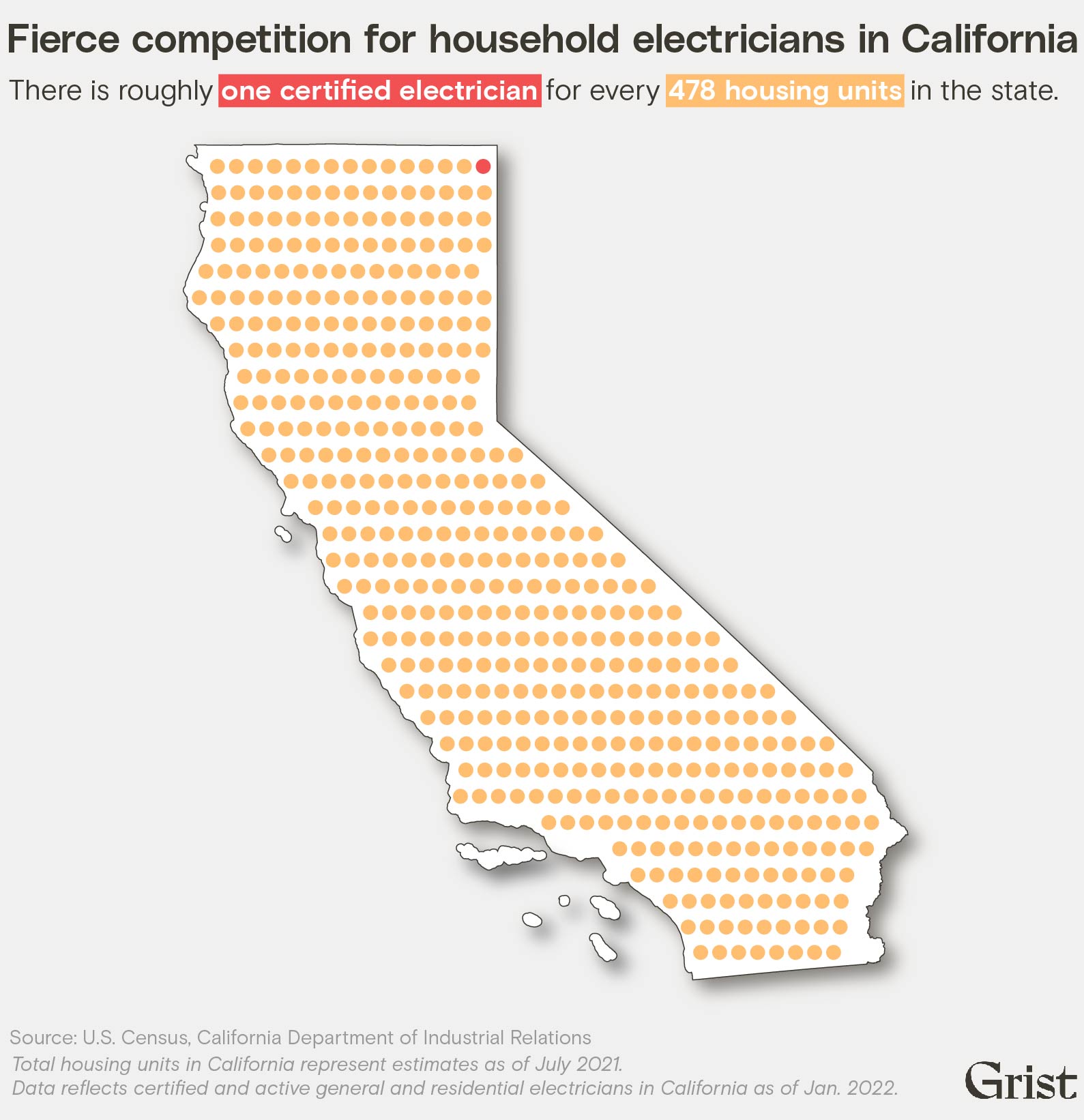
Pictograph in shape of California shows roughly one certified electrician qualified to work on households per 478 housing units in the state.
Grist / Jessie Blaeser

“It is hard to imagine tens of millions of households in the U.S. individually undertaking the sort of time consuming, expensive process that I experienced,” wrote Andrew Campbell in a blog post chronicling his experience. 


The contractor Campbell ended up working with was Boyes Electric, a small company based in Oakland owned by Borin Reyes. 

Reyes, who’s 28, moved to California from Guatemala when he was 16 and got introduced to electrical work in high school. His dad was a general contractor and would take him out in the field during summer break. On one job, there was an electrical subcontractor who needed an extra set of hands, and Borin started working for him from time to time. He liked the work — but more so he liked the money he was making. After graduating from high school, he saw electrical work as a path to moving out of his parents’ house, so he enrolled in a training program at a now-shuttered for-profit technical school in Oakland to get more experience.

a man in a black shirt holds a car charger in a garage
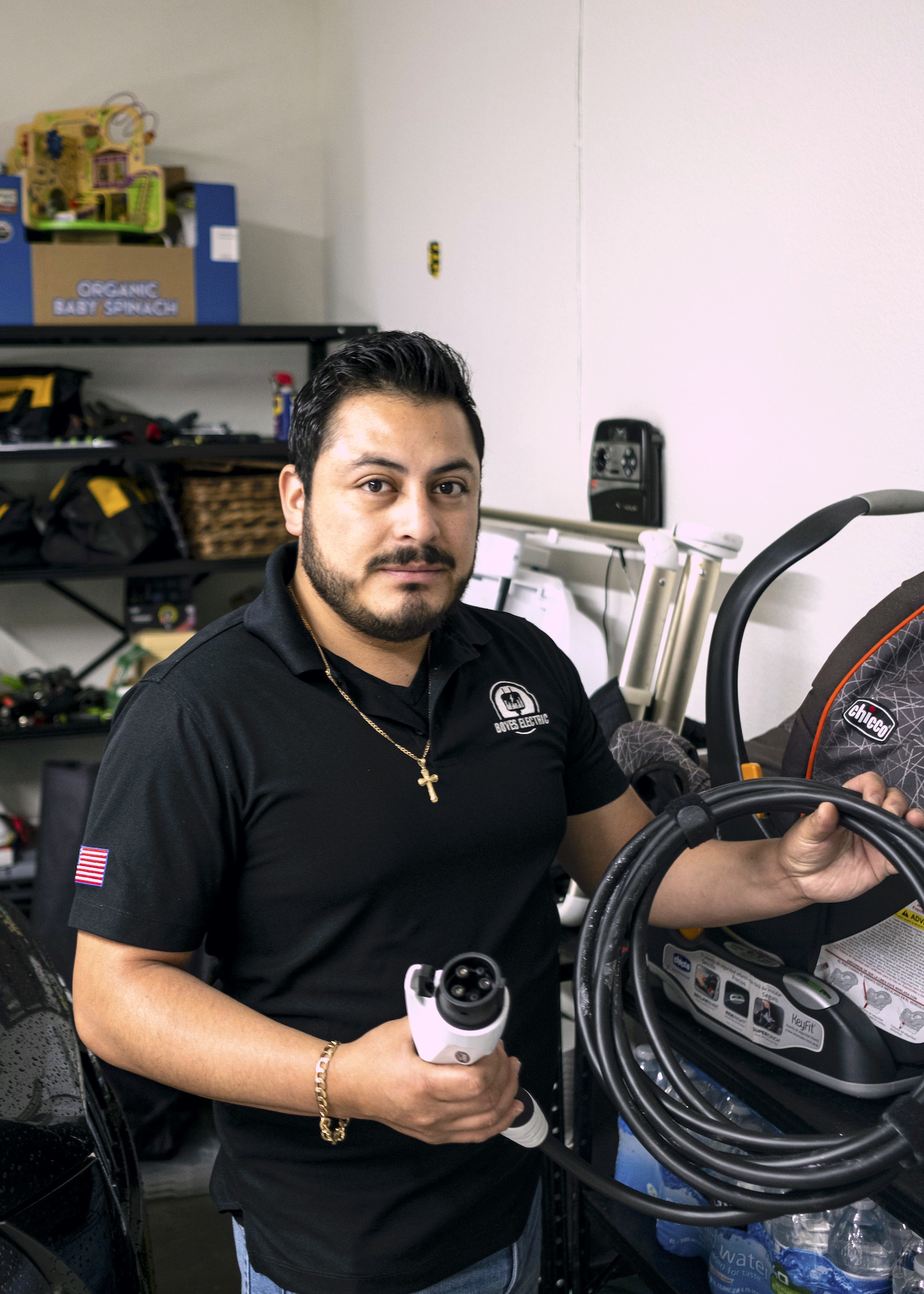
Electrician Borin Reyes holds an electric vehicle charger. Brett Marsh / Grist

After graduating in 2013, Reyes spent several years working for a larger company before starting his own. Today, he loves the job. “You really have to be focused, because of safety,” he said. “You have to be hands-on most of the time and solving problems. That’s one of the things that I like best — solving problems.”

Reyes’ company has always focused on rewiring homes undergoing renovations rather than new construction. But at the beginning of 2022, he added a new specialty when his business partnered with a company called QMerit, a middleman between electric vehicle dealerships and electricians. Dealerships send new car owners to QMerit to get help finding qualified technicians to install EV chargers, and QMerit connects them with local businesses like Boyes Electric.

Electric vehicles make up less than 1 percent of cars on the road, but that’s changing fast as sales soar. The number of electric vehicles registered in the U.S. jumped nearly 43 percent between 2020 and 2021, according to the Department of Energy. Government incentives are sure to give the market another boost: The Inflation Reduction Act offers as much as $7,500 in rebates for new EVs and $4,000 for used EVs. In California, Washington state, and New York, you won’t even be able to buy a new model with an internal combustion engine after 2035. The number of public charging stations is also growing, so EV owners don’t necessarily need to install their own charging equipment at home, though many do. It’s convenient, and can also turn a car into a backup power source when the lights go out. 

Before Boyes Electric partnered with QMerit, Reyes was installing around one EV charger every week; now it’s up to about five each week. “That’s huge for a small business,” he said. Reyes wants the company to expand into solar installations, too — just not yet.

Boyes Electric employs 12 technicians, and these days Reyes spends most of his time in the office taking calls and coordinating jobs. His electricians are usually booked up about three weeks to a month out.

“Customers are literally looking for electricians every single day,” he said. “We’re not taking emergency calls anymore because we don’t have the manpower. All of our current technicians are out on the field, they’re busy trying to get jobs done.”

Reyes would like to hire more electricians, but he said there just aren’t any experienced people looking for work; they’re already hired. “It is a problem finding people right now,” he said. “Most of the electrical companies, you can ask around, all of them are busy.”

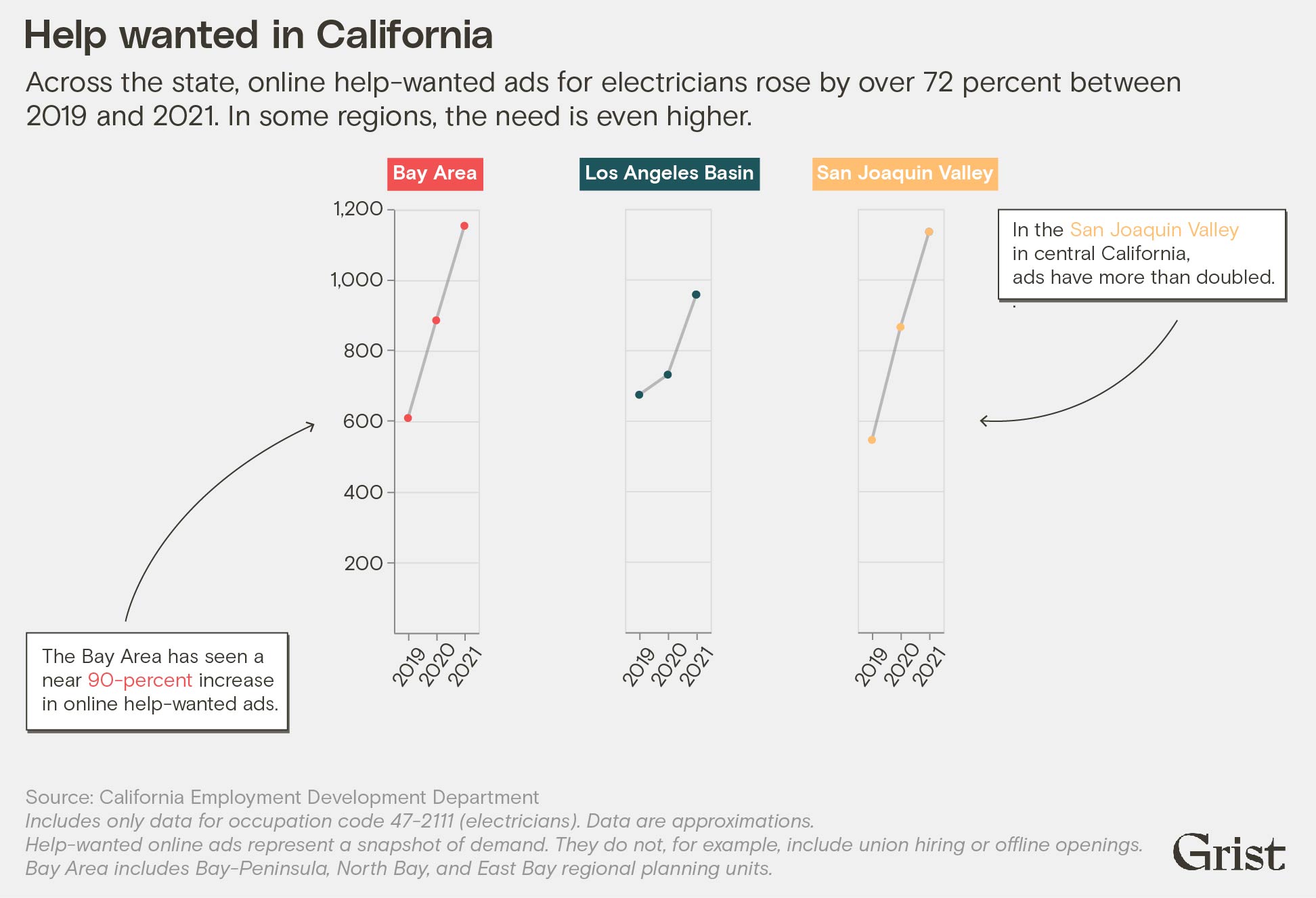
Line chart shows help-wanted online ads going up in Bay Area, Los Angeles Basin, and San Joaquin Valley.
Grist / Jessie Blaeser

In 2021, the website Angi, which helps homeowners find services, surveyed 2,400 contractors across different trades. Half reported that they couldn’t fill open positions, and 68 percent said it was a struggle to hire skilled workers. In a recent survey of 661 building contractors by the Associated General Contractors of America, 72 percent reported having open, salaried positions. The number one reason for all the openings: “Available candidates are not qualified to work in the industry.” 

In the past, Reyes recruited workers out of high school and trained them up. But he’s reluctant to do it again. It costs his technicians time, it costs him money, and there’s no guarantee that the people he invests in will stick around because the job market is so competitive. 

The workforce is also aging. Reyes said he knows of a few electricians getting ready for retirement who would like to hand over the business to their kids, but they just aren’t interested.  The way he sees it, younger people are getting lured into the tech industry with the promise of big salaries and just aren’t as interested in getting dirty underneath houses. 

a man in a black t-shirt stands on a blue ladder using tools on a light fixture
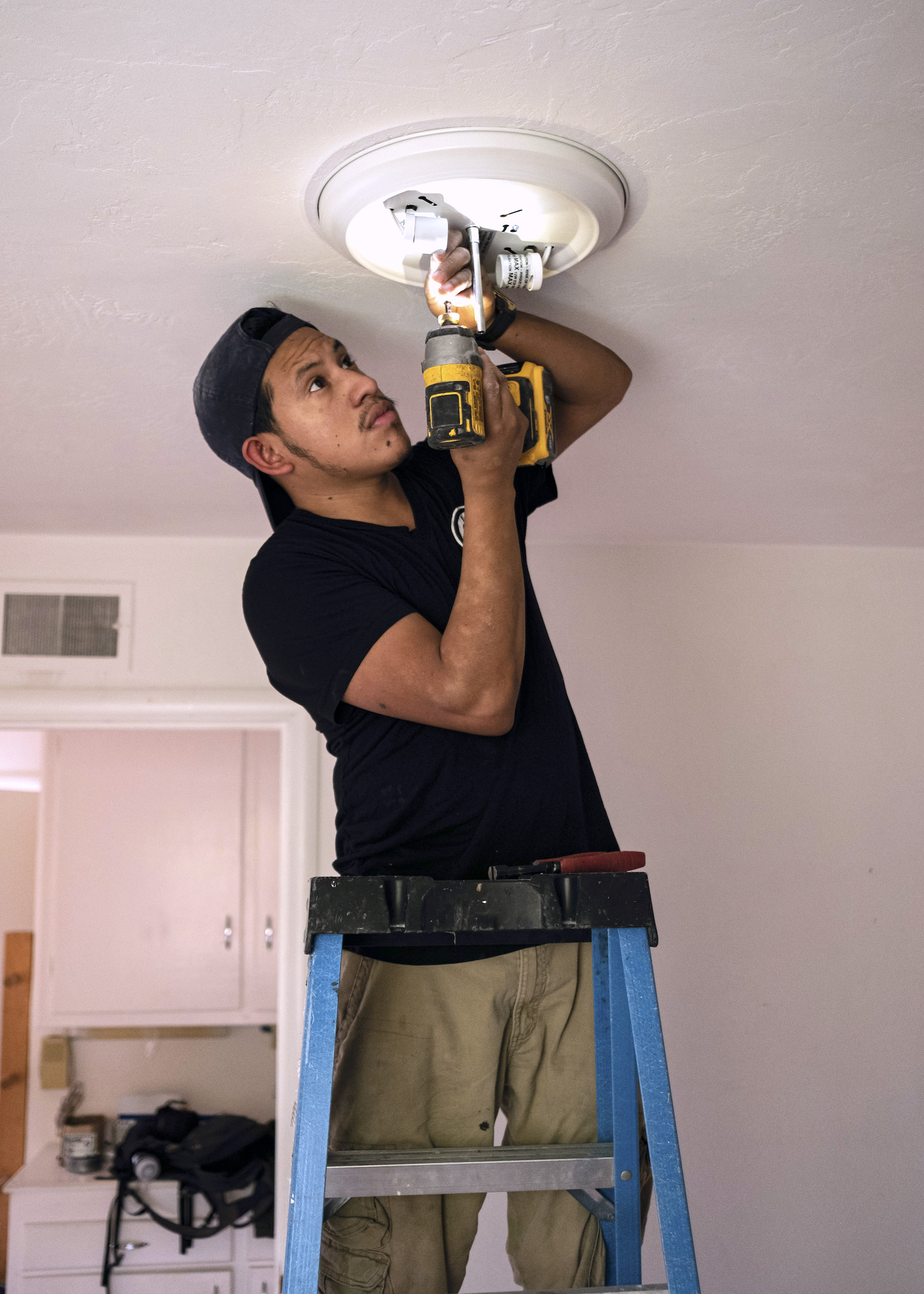
Clayton Ajpuac, a technician for Reyes Electric, works on a light fixture in a house in Oakland, California. Brett Marsh / Grist

Bureau of Labor Statistics data show that about 21 percent of electricians will have hit retirement age in the next 10 years. The agency estimates that demand for electricians will grow by 7 percent over the same span and that between retirements and new demand, there will be nearly 80,000 job openings in the field every year. That estimate doesn’t account for all the incentives — rebates for solar panels, electrical panels, heat pumps, stoves, cars, and clothes dryers — contained in the Inflation Reduction Act, nor does it account for the possibility that demand might soar if local governments keep pushing to electrify buildings.

Several contractors and labor experts, when asked why electricians are so hard to find, pointed to the widespread belief that the main path to adulthood runs through a four-year university, and the related decline of vocational education in high schools. According to Pew Research, 39 percent of millennials earned a bachelor’s degree or higher, compared with 29 percent of Gen Xers and 24 to 25 percent of boomers. 

Even for those drawn to a career in the trades, there’s another obstacle: The technical schools built to train them are short of money and people, too. 


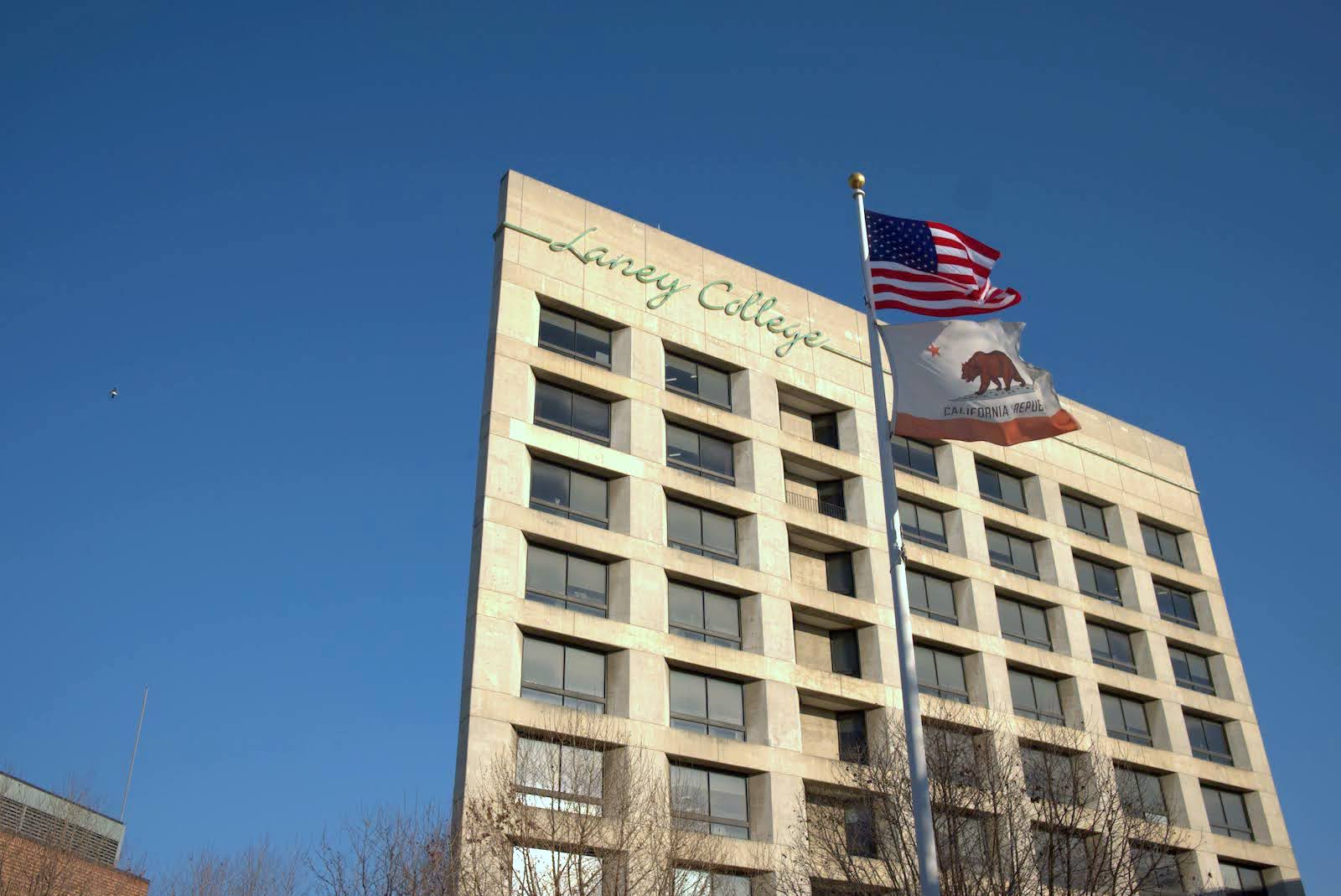
In the Bay Area, one of the main ways that aspiring electricians can get into the field is by taking classes at Laney College, a community college in Oakland. The school’s electrical technology program is approved by the State of California’s Industrial Relations Board, meaning students at Laney can count their hours toward the requirements to take the state certification exam. More than 380 students have earned an associate degree or certificate in the program over the past five years.

But this past year, Laney’s program almost fell apart after one of its teachers, Forough Hashemi, announced she would be retiring at the end of the spring 2022 semester. Hashemi had been teaching six classes each semester, essentially holding the program together, and to some students, it felt like the fate of the entire program was in question. 

The suns shines on Laney College in Oakland, California, Brett Marsh / Grist

David Pitt, a student at Laney, was worried he wouldn’t be able to finish the required courses. Pitt got interested in becoming an electrician a few years ago while volunteering for a solar company. He enjoyed being outside, working with his hands, and getting away from his computer screen. The volunteering gig soon turned into a paid, part-time job, but all he was really allowed to do was grunt work, like mounting solar panels and running wires. In order to do the interesting stuff — design a system, interpret an electrical panel, actually connect the solar panels to it, and maybe work his way up to owning his own business — he needed to become a certified electrician. So he enrolled part-time in Laney’s electrical program.

Without Hashemi, however, it was unclear whether the school could keep offering the required classes. So Pitt and his classmates, assisted by an adjunct professor, Mark Prudowsky, arranged a meeting with the school’s deans to ask what would happen next. The deans assured them that they would try to replace Hashemi, though they admitted they were having trouble finding anyone interested.

“This is an issue for a lot of trade skills disciplines,” said Alejandria Tomas, the career and technical education dean at Laney, in an interview last summer. By that point, Tomas had already tried emailing every electrical business in the county and felt she had exhausted every resource she had in trying to recruit a new teacher. (Borin Reyes was one of those who turned her down.) 

“Employees usually earn more when they work in the field than teaching, so it’s hard to recruit,” Tomas said. 

Pitt only needed two more classes to finish his required coursework — one on motors and another on lightbulbs. But by the time the fall semester started, Laney had yet to make any full-time hires, and the lightbulbs class wasn’t offered. 

Laney College electrical student David Pitt on his boat in the Oakland marina. Emily Pontecorvo / Grist

Prudowsky blamed the school, the district, and the state for not investing enough in Laney’s electrician program. The lack of funds meant requiring one full-time faculty member to teach up to six classes per semester with up to 40 students in every class. (Hashemi did not respond to multiple requests for an interview.)

“If California is even going to come close to meeting its very ambitious goals, it’s going to have to train a whole cohort of electricians and technicians,” Prudowsky said. “And if they keep underfunding these programs and overloading these classrooms and not providing enough resources, it won’t happen.” 

Tomas, the dean, said the school understands the importance of the program and has shielded it from recent budget cuts. The problem, as she saw it, was that it was simply impossible to find more people to teach the courses.

In January, nearly a year after the search began, the school finally hired a new full-time faculty member. According to Prudowsky, however, the big problem — “a very poor understanding of the need to fund and indeed, expand funding for the program” — remained.


Community colleges like Laney are one of a handful of pathways into the profession. Another runs through the unions, which offer free classes and paid experience through their apprenticeship programs. There’s often a higher barrier to entry than simply signing up for classes: In the Bay Area, for instance, an aspiring electrician has to pass an exam and go through an interview process to get accepted. And there are limited openings.  

Labor advocates like Beli Acharya, the executive director of the Construction Trades Workforce Initiative, make the case that California should enact policies that favor union contractors, which would increase demand for apprentices and enable the unions to accept more applicants. Today, according to Acharya, most residential building work is handled by nonunion contractors, though that’s not because union contractors aren’t interested in working on houses. She said they are undercut by cheaper, nonunion companies. 

Acharya’s organization is a nonprofit partner to several building trades unions in the East Bay. It aims to help people who are currently underrepresented in the trades gain access to these careers. Nearly 90 percent of electricians are white, compared with 78 percent of the country’s workforce, and less than 2 percent are women, according to the Bureau of Labor Statistics

“Our goal is to ensure that as public dollars become available, quality jobs are being produced,” Acharya said. “If we’re really trying to lift up our communities and create quality jobs, there needs to be labor standards put in place so that our community members are actually benefiting from the work that’s going to be developed through all of this construction.” 

The Construction Trades Workforce Initiative is one of several organizations in the Bay Area trying to entice more people into jobs connected to clean energy, like electrical work. Another nonprofit headquartered in Oakland, GRID Alternatives, builds solar projects and trains people to install them. GRID partners with local organizations, like Homeboy Industries, a gang intervention program, to introduce former inmates as well as other underrepresented people, to careers in solar. Those admitted to GRID’s training receive “wraparound supportive services” that address barriers they might have to participating, like helping them get driver’s licenses, open bank accounts, or, for those formerly incarcerated, find attorneys.

GRID’s program isn’t specifically geared toward producing electricians. But Adewale OgunBadejo, its workforce development manager, said that it can act as a gateway into the skilled trades — similar to how David Pitt was inspired to become an electrician after volunteering for a solar company. “It’s really an introduction into the industry,” he said. “We’re training people to become solar installers, but what you find is that as people progress through their careers, a lot of them do become contractors, a good number do end up starting their own businesses, while others go into the union.”

OgunBadejo said that GRID is also building a network of minority- and women-owned contractors who work on electric vehicle charging infrastructure, home energy storage, and heating systems. The goal is to support these small businesses and help them gain access to funding from the Inflation Reduction Act, so that in turn, they can hire graduates of GRID’s training program.

Several experts interviewed for this story stressed their belief that any workforce development program has to be tightly connected to the people already doing this work — the contractors.

“The successful programs are tied directly to employer needs,” said Laure-Jeanne Davignon, the vice president for workforce development at the Interstate Renewable Energy Council, a clean energy policy nonprofit. “They have a direct line of communication to employers from the design of the program up through job placement.”

The Inflation Reduction Act includes $200 million to states over the next decade to train contractors in energy efficiency upgrades and electrification. Bartholomy, from the Building Decarbonization Coalition, said some of that money could go toward paying a portion of a trainee’s wages, enabling contractors like Borin to take on more trainees. (Some states also offer tax credits to employers who bring on apprentices, but California isn’t one of them.) 

One challenge with involving contractors, though, is that many of them aren’t convinced of the benefits of switching to electric appliances. Take heat pumps. They transfer heat from the outside air indoors, even on very cold days, to provide space heating, and work in reverse to provide cooling in the summertime. They’re more expensive than a gas furnace up front but can pay off with savings in the long run. Even so, homeowners recount encounters with contractors who tried to persuade them out of buying electric heat pumps, raising doubts with customers about the higher price and whether they work as well as natural gas systems. 

California is trying to change contractors’ minds through a $120 million initiative called TECH Clean California. A big part of it involves training contractors how to install electric heat pumps and water heaters but it also lays out available rebates and other subsidies that would help sell them to customers. The program launched in the middle of 2021, and so far, more than 600 contractors have participated, according to Evan Kamei, a program manager at TECH. Kamei said the initiative is also working to increase cooperation between existing training providers, like community colleges, utilities, and manufacturers.   

While education, training opportunities, funding, and stronger collaboration between the networks of companies, schools, and contractors could all help ensure that people interested in becoming electricians get a shot at making it into the field, they still don’t necessarily address one of the biggest obstacles to “electrifying everything” — getting people interested in the trade in the first place. So how can the United States inspire more people like David Pitts and Borin Reyes?

“I think one of the big questions is really, do millennials and Zoomers see a career for themselves in crawl spaces and attics doing this work?” said Bartholomy. “You know, it’s, ‘You should be going to four year college and learning C++ programming, not working in the trades.'”

Asked if he had any ideas for how to get more young people interested in the field, Reyes didn’t skip a beat. “Showing them how much money they can make. That is the key.”

According to the Bureau of Labor Statistics, the mean annual wage for an electrician in the U.S. is about $63,000 compared with an average of $58,000 for all occupations. But there’s a big range. In the Bay Area, the top-paying metropolitan area for electricians in the country, the average is $93,900, with many contractors topping six figures.

Another step is to raise awareness. Davignon’s organization, the Interstate Renewable Energy Council, recently won a $2 million grant from the U.S. Department of Energy to develop an outreach campaign to advertise careers in renovating houses to be more energy efficient, known as “weatherization.” She said she hopes to raise more money to promote other jobs in clean energy, like electricians. One idea is a twist on the classic U.S. Army recruitment ad along the lines of: Your country needs you to be an energy hero.

“That’s the kind of thing we really need to start to remove the stigma from these trade jobs,” Davignon said. “You know, is the construction job sexy enough for someone or do they also want to be saving the world?”


“No response”: Madison Cawthorn screws over his constituents one last time before moving to Florida

Former Rep. Madison Cawthorn, R-N.C., has officially moved to Florida without handing over the required constituent casework to Rep. Chuck Edwards, the new Republican representing the state’s 11th District.

Cawthorn bought a $1.1 million house in Florida in August, months before finishing his lone two-year term. In an Instagram post, Cawthorn announced that he moved into the Cape Coral house on Jan. 4, just one day after his term officially ended. 

According to a statement posted on Edwards’ website, Cawthorn did not transfer official casework before leaving North Carolina, which goes against standard practice for legislative transition.

“Due to this lack of information, Congressman Edwards and his staff have no way of knowing which constituents had ongoing casework or other outstanding federal issues,” the statement read. “Repeated attempts to reach Congressman Cawthorn and his staff were made over the past month, but no response or action was provided.”

Cawthorn’s deadline for signing over the database was Dec. 23, as per House rules for outgoing members of Congress. 


Want a daily wrap-up of all the news and commentary Salon has to offer? Subscribe to our morning newsletter, Crash Course.


“I ran on the issue of providing the best constituent service possible for the people of Western North Carolina,” Edwards said. “I ask that anyone with any pending casework contact my office immediately. In addition, I hope members of the media will help inform the public of this request. I would like to ensure that our veterans, the elderly, the infirm and others who need help get the full benefit of the services they are entitled to.”

Members of Congress usually help their constituents with various issues, such as accessing veterans’ benefits and processing Social Security checks. There are typically unfinished cases from one term to the next, which is why the House requires outgoing members of Congress to pass along the casework to the next representative so they can continue resolving issues. 

Former President Donald Trump endorsed Cawthorn for Congress, but he lost the primary for North Carolina after a series of scandals, including the improper promotion of cryptocurrency, and a charge in Mecklenburg County for carrying a loaded gun through airport security.

Is Dry January a little too dry for you? Why more people are opting for a “Damp January”

For many, overindulgence in vice during the holidays leads to health-related New Year’s resolutions — whether eating better or avoiding alcohol or cannabis. In the past few decades, the practice of abstaining from booze during the first month has been given a new moniker: “Dry January.”

“Damp January is kind of like the cousin of dry January.”

Situated in-between teetotalers and drinkers, now there is a third camp of people changing their alcohol consumption habits — one that is neither full-on drinking nor totally refusing it, and who have their own neologism to match. Meet the adherents of “Damp January,” health-conscious people who are simply drinking less than they usually do, just for the month of January.

Dry January is the giving up of alcohol for the 31 days of the first month of the year— no cocktails, no beer, no wine, no spirits — and Damp January is kind of like the cousin of dry January,” Hilary Sheinbaum, journalist and author of “The Dry Challenge: How to Lose the Booze for Dry January, Sober October, and Any Other Alcohol-Free Month,” told Salon. “It is not 100 percent” abstinence from alcohol, Sheinbaum said; it’s more like “doing your best and certainly consuming fewer drinks and less alcohol throughout the month than you would have usually had.”

The “Damp January” trend might seem like an excuse to not commit to full abstention from alcohol. But those who study the movement say it speaks to a bigger trend of people moving away from a perfectionist mindset that has too long permeated the health and wellness space — for example having to lose a certain number of pounds for a specific date, or intermittent fasting which controls how often and when a person eats. In other words, health trends that require a person to deny themselves of pleasure.

“I won’t be taking part in Dry January; it’s impractical and doesn’t sound enjoyable in this most depressing of months,” journalist Jack Rear wrote in The Telegraph recently.

There even appears to be a burgeoning movement of people living a “damp lifestyle” — including Hana Elson, who runs a TikTok page all about going “damp.”

“Small habit changes lead to big results and create your lifestyle,” Elson says about living a “damp lifestyle.”

But unlike Dry January, whose rules are relatively clear, what Damp January looks like varies from person to person. There is no set number of drinks a person must commit to having or not having, which is part of the appeal.

“There’s one-drink January, which means that you have one drink or you have one night of drinking; then there’s also Demi January, which means half dry, so you’re doing two-and-a-half weeks or every other week; but Damp January does not have a specific number,” Sheinbaum explained. “Damp January is just taking note of what you’re consuming, being mindful and also having the opportunity to reevaluate your relationship with alcohol.”

While one’s success at an alcohol-free month depends on many variables, including the current state of a person’s health, a study by researchers at the University of Sussex found that after taking part in Dry January many drinkers discovered they didn’t need a drink to have a good time; had more energy after the sober month; and claimed to have learned more about why they drink. Separate research has shown that not drinking for a month can lead to weight loss, better sleep, and a healthier diet.

Are there any comparable health benefits to a Damp January?

Damp January “gives people an opportunity to feel like they’re in charge, so, rather than it being all or nothing, I think that people can set the standard for themselves.”

“Alcohol is a depressant so you’ll feel perhaps a little bit more elevated without so many drinks during the month,” Sheinbaum said, adding that the simple act of reducing alcohol consumption in a month could have a snowball effect on healthier habits, too. “There’s not going to be those hangovers, where your head is pounding, [you’re] feeling nauseous and feeling unmotivated, you’re sick at work and that also contributes to being unproductive and then not wanting to work out.”


Want more health and science stories in your inbox? Subscribe to Salon’s weekly newsletter The Vulgar Scientist.


Dr. Peg O’Connor, a professor in addiction studies at Gustavus Adolphus College, and author of “Higher and Friendly Powers: Transforming Addiction and Suffering,” told Salon she views “damp January” as a positive movement in American culture.

“I think any time people start wondering about their drug or alcohol use and they decide to explore it, that’s a good thing,” O’Connor told Salon. Damp January “gives people an opportunity to feel like they’re in charge, so, rather than it being all or nothing, I think that people can set the standard for themselves.”

O’Connor said it’s also an opportunity to celebrate health wins that don’t require a person to do all or nothing.

“The first time that you aren’t perfect, too many people say ‘Well, that’s just it, I can’t do it at all,’ rather than, ‘well, I did three days here, and how did I feel during that time?'” O’Connor said. “‘And what did I learn and what do I think about trying it again?’ I want to take all of that as an important victory, because it shows the high watermark of what you can do.”

At the very least, O’Connor said, Damp January can show someone “something that perhaps seemed impossible, it becomes a little more possible.”


Dems warn Jim Jordan’s probe of feds is a “fascist power grab to evade accountability for Jan. 6”

House Judiciary Chairman Jim Jordan, R-Ohio, is considered a potential witness to the Jan. 6 attack on the Capitol and has refused to comply with former House investigators’ subpoenas — but on Tuesday he was appointed chairman of the newly formed House Select Subcommittee on the Weaponization of the Federal Government. 

Under Jordan’s lead, the Government Weaponization subcommittee will investigate allegations of anti-conservative bias among federal law enforcement. As reported by The New York Times, the House resolution authorizing the 13-member subcommittee may allow Jordan to subpoena the Justice Department about its inquiries into Trump’s failed bid to overturn the 2020 election and his handling of classified documents.

If the committee is granted access to records normally restricted to Congressional intelligence committees, the GOP-majority panel could potentially have the authority to investigate the Justice Department — even as the department investigates lawmakers’ actions concerning Jan. 6. 

In a Tuesday floor speech, Jordan claimed that the subcommittee aims only to protect First Amendment rights, such as those of conservative families who appear at local school board meetings and anti-abortion activists who target reproductive health centers. 

“We don’t want to go after anyone. We just want it to stop,” Jordan said. “That’s what this committee is all about, and that’s what we’re going to focus on. That’s what we are going to do.”

In a subsequent interview with Fox News’ Sean Hannity, however, Jordan turned his focus to law enforcement agencies. Jordan called for investigations into the FBI over potential censorship efforts, referencing recently revealed internal conversations at Twitter about the site’s early moderation policy discussions amid partisan misinformation campaigns.  

“You’ve got the FBI, that paid Twitter $3 million — not one, not two, but $3 million — to censor conservative viewpoints on their platform,” Jordan claimed. 


Want a daily wrap-up of all the news and commentary Salon has to offer? Subscribe to our morning newsletter, Crash Course.


House Democrats blasted the subcommittee, led by sharp remarks from Squad members Rep. Cori Bush, D-Mo., and Rep. Ayanna Pressley, D-Mass.

“The GOP’s Weaponization Select Subcommittee is a fascist power grab to evade accountability for Jan. 6,” Bush said. “They don’t care about government weaponization against Black & brown communities, for example. They just want access to investigations into them and their cult leader Trump.”

“The federal government has already been weaponized by Republicans against Black, brown, and other marginalized groups,” Pressley said in a Tuesday tweet. “So unless they’re investigating themselves, this Insurrection Protection Committee is a sham.”

Rep. Jerrod Nadler, D-N.Y., the top Democrat on the Judiciary Committee, opposed the subcommittee on Monday in a floor speech. The panel’s former chairman called it an “attack on law enforcement agencies” and cautioned members against stoking extremist violence. 

“The Select Subcommittee undermines the safeguards of our democracy and emboldens MAGA extremists who’d rather see our institutions fail than see Democrats and President Biden succeed,” Nadler said. 

Ethics advocacy groups joined the outcry. Noah Bookbinder, a former federal prosecutor and president of the nonpartisan watchdog group Citizens for Responsibility and Ethics in Washington, denounced the subcommittee on Twitter. 

“This new House subcommittee, specifically set up to investigate ongoing investigations by the Justice Department and FBI into Donald Trump and others, is dangerous and threatens accountability and the rule of law,” Bookbinder wrote. “We can’t accept this as normal.”

Watchdog warns McCarthy: Don’t give Santos intelligence info because he’s a national security risk

Citizens for Responsibility and Ethics in Washington (CREW) President and Chief Executive Officer Noah Bookbinder sent a letter to House Speaker Kevin McCarthy, R-Calif., on Tuesday stating that freshman United States Rep. George Santos, R-N.Y., should be denied access to sensitive intelligence.

Santos was exposed in December for fabricating his résumé and lying about his personal background. Multiple ethics complaints and investigations have been initiated into Santos pertaining to his dishonesty and suspicions of campaign finance law violations.

Bookbinder believes that these scandals demonstrate egregious untrustworthiness by Santos and that McCarthy should refrain from putting him on congressional committees that are frequently free to scour through such material.

“Given Rep. Santos’ staggering misrepresentations about his background, we believe he should resign from Congress. But even if he chooses not to do so, it is clear that he has not demonstrated the trustworthiness necessary to guard our country’s most closely guarded secrets,” wrote Bookbinder. “Despite Rep. Santos’ claims that he is ‘not a criminal,’ his staggering falsehoods amount to a violation of the voters’ trust and may in fact put him in potential legal or even criminal jeopardy, including raising questions about whether he lied on any of his Federal Election Commission filings or on the congressional financial disclosure form he was required to file once he qualified as a candidate.”

Bookbinder noted that “members of Congress are not required to get security clearances. Rather, they are traditionally deemed inherently worthy of security clearances by virtue of the office they hold, and are given access to national security information if their jobs and committee assignments require it without any assessment as to their trustworthiness. The only limitation placed on them is that they are subject to punishment under the House ethics rule if they reveal classified information, in addition to potential criminal prosecution.”

Crucially, Bookbinder stressed that “under the standards governing security clearances, it is highly unlikely that Rep. Santos would be granted a security clearance if he were applying for one, given his serial dishonesty about basic facts about his background.”

Santos’ “violation of the voter’s trust means that he should resign his seat. But in the absence of his resignation,” Bookbinder concluded, “Congress needs to take immediate steps to protect our democratic institutions and guard our national interests by ensuring that Rep. Santos is not given access to classified information.”

“5 months in jail?”: Legal experts slam Allen Weisselberg’s “disgustingly weak” tax fraud sentence

Allen Weisselberg is headed to the infamous Rikers Island Prison to serve five months after 15 years of tax fraud for former President Donald Trump’s businesses. It’s a sentence that is significantly lower than what was anticipated by analysts that thought would be part of the agreement he made with the judge.

“Allen Weisselberg testified as the star witness by the prosecution,” said legal analyst and host Katie Phang during her Nov. 22, 2022 show. “He was supposed to testify truthfully. I emphasize that, truthfully. He fell on the sword. Telling the jury it was all for me. It benefitted me. It did not benefit the Trump Organization.”

If Weisselberg lied during the Trump case, the judge threatened to increase the sentence in the case against him. So when Weisselberg was testifying before the court, he claimed that the only person who scored the sweet, tax-free deals from the Trump companies was him.

“That’s a blatant lie,” said former Trump lawyer Michael Cohen when speaking to Phang at the time. “First of all, how is it that the Trump Organization was not benefitting? How is it Donald Trump — it’s his company. Any benefit that comes to the Trump Organization is realized by Donald. He’s the single and only shareholder in the company.”

It became clear throughout the course of the case that it was more than Weisselberg.

Former FBI general counsel Andrew Weissmann noted in October that Weisselberg should be worried “about state judge finding he lied on the stand.”

After it was revealed that Weisselberg wouldn’t be going to Rikers for more than five months, Phang took to Twitter to say, “5 months is disgustingly weak for 15 years of tax fraud…”

“Being White must be awesome,” said Elie Mystal, The Nation’s legal analyst. Lawyer and political analyst Bakari Sellers agreed, noting that American rapper GLOrilla was handed a longer sentence for shoplifting. She said that she stole cereal and was sentenced to three years.

Mystal went on to cite another person of color who was charged with tax fraud and got significantly higher sentences.

“For some off the top of my head comparison, Wesley Snipes got THREE YEARS for tax evasion,” he tweeted. “Served 2 and a half. Always bet on Black. Unless you’re a criminal. Then all white is all right. If I was white I’d just straight up steal stuff. College tuition for your damn grandkids for 5 months in jail? Bruh. You can’t make that kind of money selling drugs for five months.”

Ron DeSantis is tripling-down on the culture war — and running hard toward 2024

With all the hoopla in Washington since the Republican House majority came to town, it’s easy to forget that clown car is only performing in one ring of the GOP circus. Hard as it is to take your eyes off that show, it’s also important to pay attention to some of the other acts in state houses around the country — and none is more riveting than what’s going on down in the laboratory of anti-democracy known as Florida.

Gov. Ron DeSantis was sworn in for his second term last week in Tallahassee with a two-day extravaganza that guests called “DeSantis-Palooza.” It featured an ostentatious outdoor inaugural ceremony on the steps of the Old Capitol preceded by a prayer meeting with 80 to 100 people from the faith community, followed by a “Toast to 1 Million Mamas” hosted by Casey DeSantis at the governor’s mansion. Later that night Ron and Casey entered their glittering inaugural ball for 4,000 fans to the strains of the campaign song “Sweet Florida” by Donnie and Johnny Van Zant (former members of Lynyrd Skynyrd and .38 Special), which features these inspirational lyrics:

You can take it to the bank he don’t care what Brandon thinks at the White House
Yeah, he’s fighting for the right to keep our state free (free)
Well he’s taking on the swamp and he’s calling out Dr. Fauci (Fauci!)
He’s the only one fighting for you and me (you and me)
Yeah, we’re free! (Yeah, we’re free!)

It must have been a breathtaking moment. The Republican faithful in attendance told reporters they believed they were witnessing the rebirth of John and Jackie Kennedy’s Camelot.

DeSantis also gave a stirring inaugural address that will no doubt be remembered as the “Florida is where woke goes to die” speech. He evoked the Declaration of Independence, the Gettysburg Address, the “I Have a Dream” speech and the battle of Normandy, promising to “carry the torch” of freedom and pledging that he will “never surrender to the woke mob.” When DeSantis proclaimed that he would always “defend our children against those who seek to rob them of their innocence,” the ecstatic crowd clapped for several minutes. It all seems a bit much for state politics but then DeSantis’ grandiloquent rhetoric says pretty clearly that he’s short term in Tallahassee.

But never say that DeSantis is all talk and no action. He got right to work, appointing culture-war guru Christopher Rufo to the board of New College of Florida, the state’s prestigious public liberal arts school, with the stated intention of turning it into a hardcore right-wing institution modeled on Hillsdale College, the Christian school in Michigan that has become hugely influential in conservative intellectual circles. (Salon’s Kathryn Joyce published a three-part series on Hillsdale last year.) As Michelle Goldberg of the New York Times writes, this is part of DeSantis’ “broader quest to crush any hint of progressivism in public education, a quest he’d likely take national if he ever became president.”

In DeSantis’ stirring inaugural address, he invoked the Declaration of Independence, the Gettysburg Address and the “I Have a Dream” speech, pledging he would “never surrender to the woke mob.”

The crusade against public education has been a hallmark of DeSantis’ Florida tenure so far. He pushed through the “Don’t Say Gay” bill, which prohibits teachers from speaking about gender identity or sexual orientation through third grade and proscribes any discussion of said issues “in a manner that is not age appropriate or developmentally appropriate” all the way through high school. Educators have no clear idea how to implement such a rigid yet ambiguous restriction on free speech in the classroom.

Teachers aren’t the only ones DeSantis seeks to enjoin from speaking about things of which the governor, acting as the state, disapproves. He also wants to prevent businesses from speaking out against his policies, as he tried to do with the Walt Disney Company when it spoke up for its LGBTQ employees. Another bill he signed, the “Stop WOKE Act,”  restricts conversations about race in schools and businesses, granting students and workers the right to sue if they believe a classroom lesson or workplace training course caused them to “feel guilt, anguish, or any other form of psychological distress” due to their race. (It doesn’t say that this protection is afforded exclusively to white people, but that’s the implication.)


Want a daily wrap-up of all the news and commentary Salon has to offer? Subscribe to our morning newsletter, Crash Course.


Last November that bill was blocked by a federal judge, who ruled it violated the First Amendment and that DeSantis appears to think that “the State has unfettered authority to muzzle its professors in the name of ‘freedom.'” He clearly does think that. Despite the judge’s ruling, the law has had its intended effect — untenured professors in Florida colleges are adjusting their curricula.

DeSantis also recently announced that he will form a grand jury to investigate whether the COVID vaccines were a corrupt scheme to enrich Democratic politicians and sicken people with junk science. That comes after he enacted a series of counterproductive laws and regulations during the pandemic that, as the Palm Beach Post reported, “killed more people aged 65 and over in Florida than any other state in the nation … leaving the far-more populous states of California and Texas eating our dust. ” But boy oh boy, did he ever own the libs.

DeSantis’ war on trans kids is especially heartbreaking. (He even invited one of the cruelest of transphobic online trolls, the proprietor of Libs of TikTok, to stay in the governor’s mansion.) Leaving no transphobic stone un-turned, he’s now investigating drag shows

Perhaps most infamous are the execrable stunts using human beings as pawns in DeSantis’ unrelenting PR campaign to prove that he’s the most odious governor in the United States. His flamboyant arrests of former felons who had been erroneously told they were eligible to vote are being systematically dismissed by the courts, but undoubtedly served their purpose by persuading some people who could legally have voted not to take the chance. That move thrilled DeSantis’ core supporters, voters who loved watching former convicts (most of them Black) punished for the crime of voting.

It’s worth noting that DeSantis has been unusually cagey about abortion rights, at least compared to most hard-right culture warriors. He has vaguely promised to sign more “pro-life” legislation beyond the 15-week abortion ban already enacted, but has not offered specifics, understanding that it’s a perilous issue for a national politician. It will be interesting to watch him try to thread that needle with the zealots in the Florida legislature.

Of course we have to mention DeSantis’ despicable plot to lure asylum seekers in Texas, hundreds of miles west of his own state to board planes for Martha’s Vineyard, Massachusetts, purely to score crass political points that have nothing to do with Florida, which has no international border. The motives behind that episode are still being unpacked and there is some evidence that taxpayer money was diverted to high-level DeSantis associates. But public corruption is considered a smart move among Republican officials these days, so it’s doubtful anything will ever come of it.

Those are just a few examples of what we’ve seen from Ron DeSantis over the past few years. With the exception of the latest brouhaha over “woke” M&M candies, I don’t think there’s one culture-war issue that DeSantis hasn’t jumped into with both feet. One shudders to contemplate what he may go after next but you can be sure he’ll find something. He believes this is his ticket to the Republican presidential nomination, and at least on that front he’s way ahead of a certain other Florida resident who’s starting to look like yesterday’s man. 

“We learned nothing from the midterms”: GOP pushes new abortion bills after 2022 disaster

Republicans are set to vote on two abortion bills Wednesday despite concerns inside the party that the issue contributed to its disappointing 2022 midterm performance.

Republicans are set to vote on abortion-related legislation on the heels of a brutal election in the wake of the Supreme Court’s Dobbs decision overturning Roe v. Wade. Even former President Donald Trump, who stacked the court with anti-abortion conservatives, tried to dodge responsibility for backing failed candidates by blaming the “abortion issue.”

House Majority Leader Steve Scalise, R-La., said that the Wednesday vote showed Republicans “following through on promises” made during the campaign but Rep. Nancy Mace, R-S.C., expressed concerns that the party’s stance is largely symbolic and threatens to alienate millions of voters.

“We learned nothing from the midterms if this is how we’re going to operate in the first week. Millions of women across the board were angry over overturning Roe v. Wade,” Mace said on Tuesday, according to Politico’s Olivia Beavers. “What we’re doing this week is paying lip service to life. Nothing that we’re doing this week on protecting life is ever going to make it through the Senate.”

Mace said that if Republicans are “serious about saving lives,” the party should push for access to birth control and address the nationwide rape kit backlog.

The House is set to vote on two bills, both of which are expected to go nowhere in the Democratic-led Senate.

The Born-Alive Abortion Survivors Protection Act, sponsored by Rep. Ann Wagner, R-Mo., would require health providers to care for infants born after an attempted abortion and imposes criminal penalties on doctors. But such situations are “exceedingly rare,” Politico notes, and the “protection is already codified by a 2002 bipartisan law that solidified that infants have the rights of a full human.”

Reproductive rights advocates say the bill is “chock-full of misinformation and creates more barriers to care,” according to HuffPost. “These bills promote inaccurate ideas about why people get abortions later in pregnancy. The majority of abortions performed later in pregnancy are medically necessary to save the life of the pregnant person or necessary because of a fatal fetal abnormality; they’re not elective.”

The other bill is a nonbinding “sense of Congress” resolution to condemn attacks on anti-abortion groups.


Want a daily wrap-up of all the news and commentary Salon has to offer? Subscribe to our morning newsletter, Crash Course.


Despite opposing the party prioritizing abortion legislation in the first days of House control, Mace defended the two bills as “things that everybody can agree on” and said she supports a third bill to make the Hyde Amendment banning federal funds for abortion and insurance plans that cover abortions.

Democrats and pro-choice advocates argued that voters already rejected the GOP’s anti-abortion state in the midterms.

“If there was any overriding issue of clarity in the last election, it’s that Americans feel strongly that they should have the freedom to make their own health care decisions – not politicians. Apparently, House Republicans weren’t listening,” House Pro-Choice Caucus Chairwoman Diana DeGette, D-Colo., said on the House floor.

NARAL Pro-Choice America President Mini Timmaraju said in a statement that House Republicans are “patently rejecting the will of the overwhelming majority of Americans who voted to support legal abortion in November.”

Planned Parenthood Action Fund President Alexis McGill Johnson called the Republican anti-abortion agenda “dangerous and unpopular.”

“The House’s actions will not go unnoticed to voters, who overwhelmingly support abortion access,” Johnson said in a statement. “The midterms should have put anti-abortion politicians on notice. It’s past time they listen.”

“I’m here ’cause I’m Black”: For the Golden Globes, Jerrod Carmichael redefines the dangerous host

No version of this year’s Golden Globes telecast could avoid being awkward. NBC declined to air the awards show in 2022 in response to a 2021 Los Angeles Times investigative report enumerating all the ways that its sponsoring organization, the Hollywood Foreign Press Association, was exclusionary and ethically compromised – including the glaring detail that not one Black journalist was in its ranks.

That brings us to the 2023 awards show, where comedian and writer Jerrod Carmichael made history by becoming the first Black performer to host the Globes solo in its 80 years.

Carmichael didn’t pretend he was hired because Helen Hoehne, the new president of the HFPA, is a big fan of his Emmy-winning special “Rothaniel.” He probably didn’t even assume that everyone in the room knew who he was.

“I’ll tell you why I’m here: I’m here ’cause I’m Black,” he announced to the room full of nominees as he launched into his monologue, conversationally adding. “I’ll tell you what’s been going on.”

For more than a decade the standard for Golden Globes hosts was set by Ricky Gervais, a white man who functioned as an extension of the awards show’s reputation for freewheeling unpredictability. Gervais set the bar for the so-called dangerous host, the type of ringmaster who refused to concede to the power in the room.

“One minute you’re making mint tea at home, the next minute you’re invited to be the Black face of an embattled white organization,” Carmichael joked

Now, one wonders whether Carmichael softly realigned our definition of what danger is. His gentle delivery and anecdotal style seem tame in comparison to more showbizzy predecessors like Andy Samberg and Sandra Oh, Seth Meyers, or Jimmy Fallon. But they treated the HFPA’s longstanding corruption as if they were in on the joke, if they touched upon it at all. Carmichael confronted it dead on with a calm acceptance that what the HFPA did was wrong, and everybody knew it but played along, and it’ll probably slide back into its old habits soon enough.

Most people probably forgot the Globes weren’t telecast last year. Even if it were, the show would be overshadowed in our collective memory by a certain newsworthy spat that went down onstage at last year’s Oscars.

Host Jerrod Carmichael at the 80th Annual Golden Globe Awards held at the Beverly Hilton Hotel on January 10, 2023 (Rich Polk/NBC)

Either way, it was useful for Carmichael to school us, casually sitting down on the top step leading to the Beverly Hilton’s International Ballroom stage. Of the HFPA he said, “I won’t say [they] were a racist organization, but they didn’t have a single Black member until George Floyd died, so do with that information what you will.”

He went on to explain that Globes producer Stephen Hill extended the invitation for him to host during a phone call.

“One minute you’re making mint tea at home, the next minute you’re invited to be the Black face of an embattled white organization. Life comes at you pretty fast, you know?” Carmichael deadpanned. “So I said ‘Stephen, ‘I’ll be honest with you, I’m a little torn because you know, one, it’s a great opportunity. Thank you for the call. But I’m only being asked to host this because I’m Black.'”

“And Stephen said, ‘Let me stop you right there. You are being asked to host this show because you are talented. You’re being asked to host this show because you’re charming,'” Carmichael continued. “He said, ‘You’re being asked to host this show because you are one of the greatest comedians of a generation.’ But Stephen’s Black, so what does he know?”

Back in 2010, the prospect of Gervais’ hosting made people giddy. But after a point, he became a symbol of what’s wrong with both the HFPA and the show. The Globes has long had a reputation for being a festival of Hollywood narcissism due to the stars’ habit of drunkenly blurting out expletives, claiming a level of heroism in their work, and thanking industry cronies the average person doesn’t know or care about.

He was also a host who, for instance, helped normalize the antisemitic racist, homophobic misogynist Mel Gibson when he introduced him in 2011 with, “I like a drink as much as the next man . . . unless the next man is Mel Gibson.”

But the HFPA tapped Gervais to host five times between 2010 and 2020, and his final gig was colored by the open mutual disdain he had for the room and vice versa.

Only Tina Fey and Amy Poehler came close to taking the gig as frequently – four times between 2013 and 2021, when the HFPA responded to the Times’ damning report by enlisting a slew of Black presenters to window dress the ceremony where outstanding work and performances from Black creatives failed to be recognized. Fey and Poehler tried but failed to put a happy face on that flaming public relations dumpster. Skipping the following year was wise.

Theoretically, Carmichael’s role in ushering its return was to delineate the divide between the old HFPA, whose ousted eight-term president Philip Berk referred to Black Lives Matter as “a racist hate movement,” and this new one that the comic claims paid him $500,000 to confirm what we already know about how this world works.

Host Jerrod Carmichael sits during his opening monologue at the 80th Annual Golden Globe Awards held at the Beverly Hilton Hotel on January 10, 2023 (Rich Polk/NBC)
First, he waltzed through an anecdote in which he agonizes his concern about the moral and ethical issues he should have with taking the job with a (possibly hypothetical?) friend he identified as Avery. He said she halted him in his tracks with, “‘ Boy, if you don’t put on a good suit and take them white people’s money!’ . . . and I kind of forget that like where I’m from, we all live by a strict ‘take the money’ mentality.

“I bet Black informants for the FBI in the 60s that, like, their families were still proud of them,” he calmly cracked. “Like they were like, ‘You hear about Clarence’s new job? They paying him $8 an hour just to snitch on Dr. King! It’s a good government job.'”

Then he joked about refusing to meet with Hoehne (“No thanks! I know a trap when I hear a trap!”) and replying to her insistence that he take the meeting, with “What, they’re gonna fire me? They haven’t had a black host in 79 years, they’re gonna fire the first one? I’m unfireable.” (For the record, Lou Gossett Jr. co-hosted with Leslie Nielsen and Jane Seymour in 1993, technically making Carmichael its second Black host.)

Anyway, he got to the real truth-telling when he replied to Hoehne’s desire to educate him on the changes the HFPA made with its diversity efforts by saying, “I’ll be totally honest with everyone here tonight: I don’t really need to hear that. I took this job assuming they hadn’t changed at all.”

This speaks to the weirdness of the Globes’ TV return.

Save for Carmichael’s measured jabs, it was business-as-usual along the red carpet parade.

Granted, the HFPA did make some strides since its 2021 exposure. According to a press release, it added 21 new members, including six Black journalists, along with 103 nonmember voters. They say the organization is now 52% female and 51.5% racially and ethnically diverse, changes that may have helped shape a winners’ list that rewarded “Abbott Elementary” for Best TV Comedy along with its stars Quinta Brunson and Tyler James Williams, and Zendaya for her work on “Euphoria.” In the movie categories,  “Wakanda Forever” star Angela Bassett triumphed, as did “Everything Everywhere All At Once” co-stars Ke Huy Quan and Michelle Yeoh, and “RRR” in the best original song category for “Naatu Naatu.” All of this, along with the very-much expected Globe for Jennifer Coolidge’s performance in “The White Lotus.

Nevertheless, the most significant indication that the HFPA still has wrongdoings to atone for was the absence of nominee Brendan Fraser, who accused Berk in a 2018 GQ story of groping him at a 2003 event.  (“I have more history with the Hollywood Foreign Press Association than I have respect for the Hollywood Foreign Press Association,” the actor said in the magazine’s recent cover profile. “No, I will not participate. It’s because of the history that I have with them.”)


Want a daily wrap-up of all the news and commentary Salon has to offer? Subscribe to our morning newsletter, Crash Course.


Otherwise, save for Carmichael’s measured jabs, it was business-as-usual along the red carpet parade, where celebrities returned to being honored to participate in the Globes ceremony and pretend nothing was uncustomary. Other than the fact that all of this took place on a Tuesday night, that is. Sunday night football displaced the live show from its traditional perch.

The host busted out a Scientology wisecrack, hugging a trio of statues while claiming, “Backstage, I found these three Golden Globe awards that Tom Cruise returned. Look, I’m just the host briefly or whatever, but I have a pitch: I think maybe we take these three things and exchange them for the safe return of Shelly Miscavige.” 

Host Jerrod Carmichael at the 80th Annual Golden Globe Awards held at the Beverly Hilton Hotel on January 10, 2023 (Rich Polk/NBC)
He took a mild swipe at the Oscars situation by saying that, off camera, they awarded Will Smith “the Rock Hudson Award for Best Portrayal of Masculinity on Television.” Wisely he sidestepped that situation, letting Cecil B. DeMille award recipient Eddie Murphy address it straight on in his acceptance speech by advising people who aspire to succeed to pay their taxes, mind their business, and keep Will Smith’s wife’s name out of their mouths.

Carmichael, however, reminded us that all was not quite right by perpetually wearing an expression of feigned bafflement as to how he got there even as he explained why, in long run, that probably didn’t matter. “I heard they got six new Black members,” he said of the HFPA. “Congrats to them, whatever, sure.”

He’s probably not wrong; in its 80-year run, the Golden Globes has only had 35 hosts. From 1944 until 1982, and between 1996 and 2009, it was a host-free affair, setting an example of other awards shows to examine when considering whether emcees serve any purpose. Carmichael, in his quiet way, proves that they have a use in situations like these when it behooves a powerful but generally unnecessary organization to hire a skilled flogger for their show of penance in the public square – or on a stage inside of a swanky Beverly Hills hotel.

House GOP sets its top priority: Covering up for Donald Trump’s crime spree

Tradition dictates that the political party in charge of Congress signals its priorities to the American people in the very first bills it passes after convening. After the “blue wave” of 2018, the Democrats gained control of the House and immediately passed the For the People Act, meant to protect voting rights. In 2021, with a narrower majority, Democrats passed the bill again. Sadly, both times the legislation collapsed in the Senate, a victim of the filibuster and the GOP’s sweeping rejection of voting rights. Still, the message was sent and received: Democrats believe in extending and safeguarding the right to vote, unlike other parties that back a certain fascist-flavored, orange-hued pseudo-billionaire

After last week’s protracted and frankly hilarious intra-GOP battle over the speakership, Republicans got straight to work passing their first big messaging bill: Allowing rich tax cheats to evade legal consequences for defrauding the government. The bill would rescind an $8 billion-a-year expansion of the IRS budget that was signed into law by President Biden last year. That money is meant to address numerous issues, such as improving customer service (which everyone ought to want), but Republicans haven’t tried to hide what truly offends them her: Money earmarked for pursuing criminal prosecutions of wealthy tax evaders. 


Want more Amanda Marcotte on politics? Subscribe to her newsletter Standing Room Only.


In their usual dishonest fashion, Republicans have been demagoguing this issue for months, falsely implying that the Biden administration wants to go after middle-class people who fudged a little in estimating the value of their donations to Goodwill. In reality, as many experts have pointed out, this funding is meant to make it less likely the IRS will go after ordinary people. More resources means prioritizing the wealthy tax cheats who have consistently been able to outspend the IRS on legal fees, and often avoid serious consequences. If this GOP bill were to pass, it would result in more than $100 billion in lost government revenue, much of that staying in the pockets of the yacht-owning class. 

Republicans traditionally love to let the rich escape their tax responsibilities, of course. But there’s one very famous tax evader that Speaker Kevin McCarthy and his pals know is watching closely: Donald J. Trump. 

In the past, even Republicans knew better than to make their biggest messaging bill a public display of affection for moneyed criminals. But Trump currently faces both legal and political trouble from his long and storied history of tax fraud. Shortly after the House vote, the Trump Organization’s former CFO, Allen Weisselberg, was sentenced to prison time for his role in Trump’s tax evasion schemes. While Weisselberg’s stiff sentence likely reflects his willingness to take the fall for Trump’s crimes, as Urban-Brookings Tax Policy Center lawyer Steven Rosenthal told Mother Jones this week, the Trump tax returns released by House Democrats in December make clear that’s not the only tax trouble Trump still faces. He’s never gotten nailed for any of his likely tax cheating because Trump “overwhelmed” the under-resourced IRS. In other words, the Biden law is designed to catch lawbreakers of precisely the Trump variety. So consider this first bill of the House GOP majority — which will thankfully go nowhere — as a love letter to their favorite crooked ex-president. 

While tax evasion is a subject near and dear to Trump’s heart, this bill wasn’t the only signal House Republicans have sent regarding shielding Trump and his cohort from consequences for any crimes they committed either for political advantage or personal gain. 

For instance, one of the first changes McCarthy pushed through the House involved a series of rules meant to gut the Office of Congressional Ethics, an independent body empowered to investigate complaints about members of Congress. It’s no mystery why this is a top priority for so many Republicans in Congress. Multiple GOP members have been under suspicion for the role they played in the insurrection of Jan. 6, 2021, and four were referred to the (now also defanged) House Ethics Committee by the Jan. 6 select committee last year. The Office of Congressional Ethics isn’t under Republican control, which means there’s a very real chance it could have found evidence of sedition-related crimes. Now, effectively disempowered, it may not get the chance. 

While this assault on the ethics office is primarily about concealing a likely coup conspiracy, it also benefits the Republican caucus at large, which is flush with ethics violators of every stripe. Unsurprisingly, the newly-elected pathological liar Rep. George Santos, R-N.Y., was especially thrilled. “I think it’s fantastic,” he told Insider, which notes that Santos has already been referred to the office for his shady financial dealings. 


Want more Amanda Marcotte on politics? Subscribe to her newsletter Standing Room Only.


House Republicans like to talk a big game about how much they hate corruption and law-breaking, but even the supposed actions they are taking on that front serve precisely the opposite purpose: They’re meant to shield Trump and anyone else involved in his attempted coup after the 2020 election. The main example of this blatant two-faced strategy is the nascent subcommittee devoted to investigating (eye roll) the “Weaponization of the Federal Government.” This ludicrous panel is being justified with a lot of disingenuous posturing about the “deep state” corruption of federal law enforcement, but as absolutely everyone knows, the real purpose of the subcommittee is to cover up, and perhaps embolden, both corruption and actual sedition. We can expect the committee to focus on harassing and threatening any Justice Department employees who dare try to enforce laws against political violence or seditious conspiracy against Trump and others implicated in the Jan. 6 insurrection. 

Indeed, what’s most remarkable about all these moves is how little effort Republicans are making to fool anyone about their real purpose. The feigned outrage at the Biden administration’s imaginary corruption feels half-assed. When asked what the “weaponization” committee was supposed to investigate, Rep. Jim Jordan of Ohio coughed up some empty words about how the DOJ’s power are too “far-reaching,” before giving up and saying “I forget what it was” he’s supposed to be angry about. 

To be clear, Republicans were ethically challenged and prone to telling lies well before Trump came on the scene. The Office of Congressional Ethics was created in the first place in response to all the Republican ethics scandals of the George W. Bush administration, which ranging from bribery to alleged molestation of underage boys. Trump’s gift to modern Republicans, however, was shamelessness. His ritual denials when accused of crimes or ethical transgressions have been blatantly insincere, when he hasn’t simply openly bragged about getting away with it all. His enduring popularity with the GOP base was a kind of epiphany for other Republicans, demonstrating that their voters not only don’t care if the people they elect are criminals, but often admire outright brazen defiance. So it makes sense that they’re not even trying to hide the fact that their main priority is making it easier for Trump and his allies to get away with crimes. If anything, they believe their voters will love it. 

Football-industrial complex makes a rapid recovery: From horror to guilt to inspiration

The safety crises of football world have a particular morphology. But before Damar Hamlin the cycle had never played out with such intensity and immediacy. In a span of barely 100 hours, the voices of the chattering class went from narcissistic reflection about fandom’s complicity in the sport’s recreational violence to a collective clapback at the remarkable triumph of humanity. In other words, we went from “down with football” to “up with people” in record time — and without skipping a beat on the NFL’s regular season and playoff calendar.

As nearly everyone knows, in a game on Jan. 2, Hamlin, a 24-year-old defensive back for the Buffalo Bills, collapsed on the field of Paycor Stadium in Cincinnati after making a routine tackle. His heart stopped, in an event that was improbable but not unprecedented: a likely case of commotio cardis, cardiac arrest triggered by a blow to the chest.

Hamlin’s heartbeat was revived by emergency medical personnel on the field and he was rushed to the University of Cincinnati Medical Center, unconscious and in critical condition. The NFL bowed to the distraught state of both his Bills teammates and their opponents on the Cincinnati Bengals and suspended the game. Ultimately the league canceled it altogether, which required jury-rigged adjustments to the playoff structure. (That game would have had consequences for home-field advantage.) Nothing like that had ever happened before. The only on-field death in NFL history was in 1971, when Chuck Hughes of the Detroit Lions suffered a fatal heart attack while jogging back to the huddle. On that occasion, the Lions and the Chicago Bears sucked it up and played on. But Hughes wasn’t in the prime-time glare of ESPN’s “Monday Night Football.”

General commentary on the pages of opinion-makers like the New York Times and the Washington Post could be summed up this way: I love watching football, but the gruesomeness of the Hamlin collapse has me pondering whether I’m an enabler of carnage.

But that sort of fretting didn’t continue for long: Hamlin’s initially grave condition improved dramatically. By last Sunday, he was conscious and communicating with doctors and family members. The Bills won their emotional final regular season game at home, against the New England Patriots. A game ball was awarded to one of the trainers who had helped save Hamlin’s life just six days earlier.

Once again the NFL flipped the script, and did so with great skill and — in all fairness — by making the right minute-by-minute decisions. Then again, it’s pretty easy to pull off this feat in a society sated only by bread and circuses.


Want a daily wrap-up of all the news and commentary Salon has to offer? Subscribe to our morning newsletter, Crash Course.


Hamlin himself makes a sympathetic protagonist, now almost universally beloved: a talented young player, apparently liked and respected by teammates, opponents, coaches and fans. Although it’s too early to assess his long-term prognosis, his playing days are likely over. He can still expect a future career as an NFL ambassador, TV talking head and all-purpose source of inspiration. That will start with his disposition of the $9 million (at this writing) that has poured into a crowd-sourced charity set up earlier in his career to support children’s toy drives.

So this really is a feel-good story, at least up to a point. What is lost in all this, yet again, is anything close to a full consideration of what the cumulative forms of football harm mean in terms of public health.

Not a single voice at any major media outlet has addressed how this near-miss catastrophe could be turned toward downsizing the massive public subsidies, hiding in plain sight, for the NFL’s $15 billion enterprise.

So far as I can find in my survey of hot takes, not a single voice at any major outlet has been raised, in any focused way, on how this near-miss catastrophe could be turned toward downsizing the massive public school and public facility subsidies, hiding in plain sight, for the NFL’s $15 billion-a-year gladiatorial enterprise. Every year, from high schools all the way down to Pop Warner little league programs, amateur boys are maimed and killed in this blood sport’s feeder systems. Some even die in the preseason heat from their coaches’ ill-judged extreme conditioning drills, before a single block or tackle in anger.

On Monday, the New York Times published an op-ed by Chris Nowinski of the Concussion Legacy Foundation, a former Harvard football player and WWE performer whose career was curtailed by traumatic brain injury (TBI). Nowinski has done much to raise awareness of chronic traumatic encephalopathy (CTE), and his portfolio includes advocating that youth football be downsized. But here he “left the ball on the ground,” as we say when a football player fumbles. That essay was headlined “Football Is Deadly, but Not for the Reasons You Think.” Perhaps unconsciously doing the industry’s PR cleanup for it, Nowinski decided that the most important message of the moment was to make clear that what happened to Hamlin was an outlier.

Nowinski hasn’t responded to my email praising his activism but questioning his message on this occasion. To be clear about my own criticisms of the safety moves touted by Nowinski and others, mostly from an insider industry perspective, I’ve come to believe that even the conversation surrounding TBI and CTE (football’s most dramatic and photogenic health deficits) inadvertently builds a public education bridge to nowhere. At the end of the day, Football World and its patrons appear quite content to absorb repeated anecdotes about how football kills the brain — preferably, that of a beloved (or despised, or controversial) celebrity. Who did you say was playing in the wild card round this weekend?

“Staggering number”: Right-wingers filed nearly 100 “anti-voter” lawsuits, analysis shows

The Republican Party, GOP candidates and voters, and aligned groups filed 93 anti-voter lawsuits in 2022, and although most were unsuccessful, the trend underscores how right-wing attacks on ballot access and election administration are taking place in courtrooms as well as state legislatures nationwide.

According to a report published Monday by Democracy Docket, a progressive platform that tracks voting litigation, 175 “democracy-related lawsuits” were filed in 31 states last year. Democracy Docket excluded 58 active redistricting lawsuits from its report in order to focus on cases related to voting rights and election oversight.

Of the 175 democracy-related lawsuits filed last year, 93 were characterized by Democracy Docket as “anti-voting” and 82 were characterized as “pro-voting.” Democracy Docket called 2022 another “litigious election year” after 2020 saw 150 democracy-related lawsuits, 95 of which were deemed anti-voting compared with 55 pro-voting.

The Republican Party officialdom—defined as the Republican National Committee, the National Republican Senatorial Committee, the National Republican Congressional Committee, and state or county Republican parties—was responsible for 23 of the 93 anti-voter lawsuits filed in 2022, researchers found.

By contrast, the Democratic Senatorial Campaign Committee, the Democratic Congressional Campaign Committee, and state or county Democratic parties filed just six of last year’s 82 pro-voter lawsuits.

“Evidently, the GOP establishment is becoming more litigious than ever and is turning to courts to achieve its anti-voting and anti-democracy ends,” says the report. “On the other hand, the Democratic Party is using the courts more sparingly, with other nonpartisan and civic engagement organizations fighting in the courts to attain pro-voting outcomes as well.”

Another 25 of last year’s 93 anti-voter lawsuits “were filed by individual GOP candidates who were not backed by an official Republican committee or party,” the report notes. “These Republican candidates, many of whom were election deniers, filed lawsuits right before and after the 2022 midterm elections. For instance, a slate of far-right statewide candidates in Arizona filed lawsuits after Election Day contesting the results of the 2022 midterm elections—without the help of their party.”

Republican voters and known right-wing legal groups also filed a significant number of anti-voter lawsuits.

There was “a noticeable number of lawsuits steeped in baseless conspiracy theories and unfounded claims,” according to the report, which goes on to state:

We refer to this narrower subset of anti-voting lawsuits as “fringe” and define them as lawsuits filed by individuals or groups that promote the “Big Lie” and/or have scant evidence to support their claims. Often, these sorts of lawsuits were filed years after the relevant issue raised in the case. Although one might rightly consider these types of lawsuits to be an aberration, Democracy Docket tracked a total of 23 “fringe” lawsuits in our larger dataset of cases filed last year. Along with fringe lawsuits challenging electronic voting equipment, we saw a handful of conspiracy-ridden lawsuits crop up in 2022—in states including ArizonaKansas, and Michigan—that sought to decertify the results of the 2020 election an entire two years after it occurred.

Arizona (35), Pennsylvania (21), and Wisconsin (16) were home to the most democracy-related lawsuits in 2022.

“Unsurprisingly, these were all consequential battleground states with competitive state and federal races on the ballot, rendering them litigation targets—especially for the GOP—before and after Election Day,” the report notes. It continues:

Additionally, these three states were all hotbeds of rampant election denialism. Arizona and Pennsylvania are home to Republican counties that flouted state laws in the area of election administration and certification. In Arizona, Cochise County was the subject of litigation centered around hand counting ballots as well as the county’s refusal to certify its 2022 midterm election results. Similarly, in Pennsylvania, Berks, Fayette and Lancaster counties were sued for refusing to count certain mail-in ballots in their 2022 primary election totals.

Furthermore, throughout 2022, all three states played an integral role in the GOP’s litigation strategy aimed at undermining mail-in voting. In Wisconsin and Pennsylvania, Republicans’ proactive litigation focused on banning the use of drop boxes, which offer voters a secure and accessible 24/7 option for returning mail-in ballots, and disqualifying mail-in ballots for errors—such as an incomplete address or a missing/incorrect date—that are immaterial to voters’ eligibility.

As Democracy Docket pointed out, “There was a steady rise in the number of new lawsuits filed each month in the run-up to Election Day.”

Democracy Docket also observed a surge in litigation related to election results, certification, ballot counting, and similar topics in the wake of the midterms, identifying more than two dozen lawsuits filed after November 8.

Throughout the year, however, “attacks on mail-in voting and election administration were the focal point of 2022,” with 51 lawsuits and 47 lawsuits filed respectively, the report notes.

The good news, states the report, is that “when the fight over voting rights shifted from legislative chambers to courtrooms this year, courts overwhelmingly protected the right to vote, particularly in advance of the midterm elections.”

Democracy Docket found that of the 175 democracy-related court orders issued across 28 states in 2022, 116 were “victories for voters,” 35 were “losses for voters,” and 24 had a neutral impact on the electorate.

“Last year, Democrats and progressives won two-thirds of the voting and election cases they were involved in,” Democracy Docket founder and voting rights attorney Marc Elias tweeted. “Republicans and conservatives won only 20% of the time.”

However, last year’s courtroom-based victories for democracy came amid an ongoing and multipronged right-wing assault on the franchise, which GOP lawmakers and operatives have been carrying out at the state and federal levels with renewed intensity for the past two years.

Since former President Donald Trump launched a deadly coup attempt following his loss in the 2020 presidential contest, GOP-controlled states have enacted dozens of voter suppression laws and redrawn congressional and state legislative maps in ways that disenfranchise Democratic-leaning communities of color and give Republicans outsized representation, which could help them secure minority rule for years to come.

In addition to trying to make voting more difficult, Republican lawmakers in 33 states have, according to States United Action, introduced at least 244 bills that would interfere with election administration by usurping control over results; requiring partisan or unprofessional election “audits”; seizing power over election responsibilities; establishing onerous burdens for administrators; or imposing draconian criminal or other penalties. At least 24 of those bills have been signed into law in 17 states.

Right-wingers are also increasingly targeting election officials in an attempt to undermine future elections. According to a survey conducted by the Brennan Center for Justice, 1 in 6 election officials have experienced threats related to their job, and 77% say that they feel such threats have increased in recent years. Twenty percent of election officials intend to step down before the 2024 election, with many citing ongoing threats and intimidation.

Moreover, some earlier attacks on voting rights have found their way to the U.S. Supreme Court, which is now dominated by a far-right supermajority.

The high court is currently considering two cases—Merrill v. Milliganand Moore v. Harper—that threaten, respectively, to exacerbate map-rigging and to give state lawmakers virtually unchecked power to oversee and potentially skew federal elections.

The refusal of conservative Democratic senators to repeal the anti-democratic 60-vote filibuster rule caused the party to fail in 2021 and 2022 to use its unified control of Congress to enact federal legislation protecting voting rights. Following the midterms, Republicans took control of the House last week.

How Congress finally cracked down on a massive tax scam

ProPublica is a Pulitzer Prize-winning investigative newsroom. Sign up for The Big Story newsletter to receive stories like this one in your inbox.

After six years of failed efforts by the IRS, Justice Department and lawmakers, new legislation is expected to prevent the worst abuses of a tax-avoidance scheme that has cost the U.S. Treasury billions of dollars. Tucked into the massive, $1.7 trillion government spending bill signed into law by President Joe Biden on Dec. 29, a provision in the law seems poised to accomplish what thousands of audits, threats of hefty penalties and criminal prosecutions could not: shutting down a booming business in “syndicated conservation easements,” which exploit a charitable tax break that Congress established to preserve open land.

Under standard conservation easements, landowners give up development rights for their acreage, often an appealing, bucolic space. In return, they receive a charitable deduction equal to the property’s development value, and the public benefits by the preservation of the land, which in some cases is made available as a park.

But as ProPublica first described in 2017, aggressive promoters built a lucrative industry through “syndicated” deals. These promoters snatched up idle land (a long-vacant golf course near a trailer park, in one example examined by ProPublica) and hired an appraiser willing to claim that it had huge, previously unrecognized development value — perhaps for luxury vacation homes or a solar farm — which they contended made it worth many times its purchase price. The promoters then sold stakes in a massive conservation easement deduction to rich investors, who made a quick profit by claiming charitable write-offs that were four to six times their investment. The promoters reaped millions in fees.

The new measure will limit taxpayers’ deduction to two and a half times their investment. That will effectively eliminate the profits that drive syndicated deals while allowing traditional conservation easements to continue. “I don’t know how the industry moves forward after the new law,” said Sean Akins, an attorney with Covington & Burling who represents multiple syndication promoters.

The path to the new law was lengthy and winding. For years, syndicated easements seemed impervious to attempts to rein them in. Since late 2016, the IRS has attempted to stymie the deals, branding them as “abusive” and among “the worst of the worst tax scams.” The agency has challenged $21 billion in deductions claimed by 28,000 syndicated-easement investors, pursued scores of tax court cases and collaborated with the Justice Department in targeting top promoters with criminal charges and civil lawsuits.

Prominent lawmakers from both parties weighed in against the abuse and, starting in 2017, introduced legislation, called the Charitable Conservation Easement Program Integrity Act, to halt the practice. According to estimates by Congress’ Joint Committee on Taxation, applying these limits to deals struck since December 2016, when the IRS first branded the practice improper, would generate an additional $12.5 billion for the U.S. Treasury through 2031.

The syndicators fought back so furiously and so effectively over multiple years that ProPublica published not one, but two stories describing how bulletproof the industry seemed. The promoters and their investors were undaunted by IRS threats. Syndication partnerships were so profitable that they set aside special “audit reserves” of as much as $1 million to do battle with the agency in tax court. Syndication firms and their newly formed Washington trade group, called the Partnership for Conservation, or P4C, spent more than $11 million, by ProPublica’s calculations, on lobbyists to protect their business before Congress. At one point, they went on the attack, seeking to strip the IRS of funds used to enforce the December 2016 notice that flagged profit-making syndicated deals as abusive and required participants to file forms reporting their involvement to the IRS.

The agency’s efforts did little to slow the volume of syndicated deals, according to congressional testimony by then-IRS Commissioner Charles Rettig in May 2022. He sounded a bit desperate when he told lawmakers: “We need congressional help.”

As Sen. Ron Wyden, D-Ore., chair of the Senate Finance Committee, told ProPublica last June, “There is a tax shelter gold mine here, and they’re fighting very hard to protect it.” He added, “This is a textbook case of the power of lobbyists.”

By that point, the legislation targeting syndicated deals had been introduced, in one legislative chamber or another, eight times. A late-2021 strategy to include the syndication-killer language in Biden’s Build Back Better bill had unraveled at the hands of Arizona Sen. Kyrsten Sinema, then a Democrat, who demanded that it be stripped out as a condition of her critical vote to win passage of the larger measure. (Sinema did not respond to ProPublica’s request for comment at the time.)

The tide finally turned last summer — without attracting much notice at the time. During a June 22 Senate Finance Committee markup on retirement legislation, Sen. Steve Daines, R-Mont., a longtime sponsor of the Integrity Act, identified the projected windfall from a clampdown on syndicated easements as a way to pay for a popular proposal enhancing benefits for disabled police, firefighters, paramedics and EMTs. That bipartisan legislation, months later, got added to the massive, must-pass government funding bill, where no single lawmaker had the power to strip it out.

A big concession sealed support for the deal: Daines and other backers agreed not to apply the law to transactions that date back to when the IRS flagged syndicated easements as abusive in 2016 (though the IRS can still pursue cases from back then). Instead the new limits apply only to transactions that occur after the law’s enactment. Along with a much smaller change exempting the measure from applying to historic buildings, this reduced the projected Treasury windfall to about $6.4 billion.

As the measure neared final passage in late December, Daines issued a statement: “It’s about time — for too long bad actors have abused the conservation easement program and ripped off the American people, but this fraud will now come to an end. I’m glad to have worked with my colleagues across the aisle to stop scam artists, promote true conservation, and save taxpayers billions of dollars.”

In an email to ProPublica, Rettig, whose term as IRS commissioner expired in November, called the new legislation “critical to the ongoing efforts of the IRS to stem the tide of abusive syndicated conservation easements.” He said the measure, combined with $80 billion in new funding for the resource-starved agency, “will hopefully allow the IRS compliance and taxpayer education efforts to catch up on abusive syndicated conservation easement transactions as well as other similarly important service and compliance functions.”

The IRS, in a separate statement to ProPublica, said “we are working to implement the recent legislation aimed at some of the most egregious syndication conservation easement transactions” as part of the agency’s “commitment and efforts to combat abusive conservation easement transactions and all other abusive transactions.”

P4C President Robert Ramsay, who has said the profit motive produces “tremendous opportunities” for conservation, attributed the measure’s passage to the IRS’ “ability to win a war of attrition.” Ramsay told ProPublica that the new limits will have “a broad chilling effect” on all land conservation, even though it targets only syndicated deals. He also said its “broad brush” provisions would do nothing to stop inflated easement deductions by wealthy individuals and family partnerships. Ramsay added that he expects the measure to prompt “a number” of syndication promoters to exit the business entirely.

Efforts to shut down the syndication business had been pushed by the Land Trust Alliance, a Washington trade association whose 950 members administer traditional conservation easements. Fearful that exploitation of the charitable tax break by “brazen” profiteers could jeopardize the conservation deduction altogether, the group had prodded the IRS to undertake its crackdown and spent more than $2.5 million on lobbyists since 2017. “We kept this about ending the abuse, rather than discard the incentive,” said Andrew Bowman, the organization’s CEO. “We were relentless in trying to defend the integrity of a very important tax incentive.”

Bowman marveled that none of the IRS’ traditional measures to combat abusive tax transactions had worked. “All that just wasn’t stopping it,” he told ProPublica. “Congress could see it had to act. No one else was going to be able to fix this problem. The incentive to do the deals is now gone.” He praised Daines for masterminding the strategy to pass the legislation, calling him “a true hero for private conservation.” (He also said ProPublica’s coverage “put out there for the public how egregious this abuse was.”) Bowman added: “It’s a great victory for conservation. It took longer than it should have, but we’re certainly thrilled with the outcome.”

Alex Jones pushes anti-vax conspiracy theory after Diamond of “Diamond & Silk” unexpectedly dies

Conspiracy theorist Alex Jones speculated on Tuesday that conservative commentator Lynette “Diamond” Hardaway had died at the age of 51 due to the Covid-19 vaccine — even though she had been an opponent of the shot.

“The ‘Diamond’ of Diamond & Silk has died,” Jones said, recalling that he appeared on one of her final broadcasts before she “fell ill.”

The conspiracy theorist pointed out that one of his unvaccinated staffers had also died following cardiac problems.

“Just fell down and died on Christmas day,” he explained. “And you look at the actuaries, the insurance company numbers all over the western world and we have record deaths since the introduction of the shots.”

“But I don’t know if Diamond took the shot,” Jones continued. “But the Covid alone does attack the heart. Those that take the shot have a three to tenfold bad reaction compared to even what the spike protein in the virus itself causes. But the so-called vaccines make your body produce the spike protein. And we know that it’s killing people en masse.”

According to the CDC, “myocarditis and pericarditis have rarely been reported” in connection with the Covid-19 vaccine.

The agency said that the rare condition was most often reported “in adolescents and young adult males within several days after mRNA COVID-19 vaccination.”

Representatives for Hardaway have not disclosed her vaccination status or how she died.

Watch the video below from The Alex Jones Show.

The 13 biggest bombshells from Prince Harry’s tell-all memoir “Spare”

Following an explosive 2021 interview with Oprah and an intimate six-part Netflix docuseries, Prince Harry is once again exposing the British royal family, this time in his highly anticipated book.

The Duke of Sussex’s ghostwritten memoir “Spare” specifically details Harry’s rifts with his family — namely with his father King Charles and his older brother Prince William — Harry’s prior controversies, his decision to leave his senior royal role and his decision to part ways with the royal family alongside wife Meghan Markle, the Duchess of Sussex. Prior to its Jan. 10 release, “Spare” was the talk of the year as several outlets leaked a few of its most damning bits.

“Thank you for wanting to know my story in my words,” Harry writes in the acknowledgements, per USA Today.

From Harry’s heavy drug usage to his infamous Nazi uniform, here are the 13 biggest bombshells from Harry’s memoir:

01
Harry claims William knocked him down and tore his clothes
Prince William, Duke of Cambridge and Prince Harry, Duke of SussexPrince William, Duke of Cambridge and Prince Harry, Duke of Sussex (YUI MOK/POOL/AFP via Getty Images)

The alleged assault took place at Harry’s London home — Nottingham Cottage — in 2019, where William confronted him about “the whole rolling catastrophe” of their relationship and rifts with the press. The brothers’ squabble soon grew violent when William complained about Meghan, specifically calling her “difficult,” “rude” and “abrasive.”


“He set down the water, called me another name, then came at me. It all happened so fast. So very fast,” Harry wrote, per The Guardian. “He grabbed me by the collar, ripping my necklace, and he knocked me to the floor. I landed on the dog’s bowl, which cracked under my back, the pieces cutting into me. I lay there for a moment, dazed, then got to my feet and told him to get out.”


Harry said that William urged him to hit back but when he refused, William left then returned “looking regretful, and apologized.” William also insisted that Harry not tell Meghan about the attack, which he didn’t immediately. Instead, he called his therapist.


Elsewhere in the book, Harry also referred to William as both his “beloved brother” and his “archnemesis.”

02
Harry blames William and Kate for Nazi costume debacle
British tabloid The SunA man reads, 13 January 2005 in Paris, the British tabloid The Sun featuring Harry, 20, the younger son of Prince Charles and the late Princess Diana, wearing a khaki uniform with an armband emblazoned with a swastika, emblem of the German WWII Nazi Party. (GABRIEL BOUYS/AFP via Getty Images)

In the Netflix docuseries “Harry & Meghan,” Harry called his infamous get-up “one of the biggest mistakes of my life.”


Harry recounted the 2005 incident once again in “Spare,” saying it was William and his wife Kate, Princess of Wales who told him to wear a Nazi soldier costume instead of a pilot costume.


“I phoned Willy and Kate, asked what they thought. ‘Nazi uniform,’ they said,” Harry wrote. When he wore the costume, Harry said, “They [William and Kate] both howled. Worse than Willy’s leotard outfit! Way more ridiculous! Which, again, was the point.”


Naturally, the British tabloid newspaper The Sun published a front-page photo of a 20-year-old Harry wearing the costume, which also featured a red armband emblazoned with a big swastika.


“When I saw those photos, I recognized immediately that my brain had been shut off, that perhaps it had been shut off for some time,” Harry wrote about the aftermath of the public reveal. “I wanted to go around Britain knocking on doors, explaining to people: I wasn’t thinking. I meant no harm. But it wouldn’t have made any difference. Judgment was swift, harsh. I was either a crypto Nazi or else a mental defective.”


Harry added that his father, now King Charles III, “didn’t gloss over the facts” when he saw his son’s costume:


Darling boy, how could you be so foolish? My cheeks burned. I know, I know. But he quickly went on to say that it was the foolishness of youth, that he remembered being publicly vilified for youthful sins, and it wasn’t fair, because youth is the time when you’re, by definition, unfinished. You’re still growing, still becoming, still learning, he said.


“I’d long understood that the photo of me in a Nazi uniform had been the result of various failures — failure of thinking, failure of character,” Harry also wrote. “But it had also been a failure of education. Not just school education, but self-education.”

03
Harry’s rude awakening to his mother’s death
Diana, Princess of Wales, 1983Diana, Princess of Wales, 1983 (Getty Images/Bettmann)
When news of Diana’s death broke on Aug. 31, 1997, Harry recalled Charles waking him up in the middle of the night, wearing a white dressing gown, to share what had happened:


“Darling boy, Mummy’s been in a car crash,” Charles told Harry, who was 12 at the time.


“I remember waiting patiently for Pa to confirm that indeed Mummy was all right. And I remember him not doing that,” Harry wrote in “Spare,” per USA Today. Harry then demanded that Diana be treated at the hospital immediately.


“They tried, darling boy. I’m afraid she didn’t make it,” Charles said. Harry also wrote that Charles “wasn’t great at showing emotions under normal circumstances,” but he did try to reassure his son that everything was “going to be OK.”

04
Harry was against Camilla, a possible “wicked stepmother”
HRH the Prince of Wales, Prince Charles, and The Duchess Of Cornwall, Camilla Parker BowlesHRH the Prince of Wales, Prince Charles, and The Duchess Of Cornwall, Camilla Parker Bowles (Tim Graham Photo Library via Getty Images)

“That’s why when the question came, Willy and I promised our father that we would welcome Camilla to the family. The only thing we asked for in return was that he didn’t marry her,” Harry wrote, explaining that the conversation took place once Camilla Parker-Bowles became more involved in Charles’ life following Princess Diana’s death. “‘You don’t need to get married again,’ we asked him.”
 
Charles and Camilla eventually married on April 9, 2005. Before the grand wedding, Harry also said he wondered if Camilla would “be mean to me. If she’d be like all the wicked stepmothers in storybooks. But she wasn’t.”
05
Harry said he killed 25 “enemy combatants” in Afghanistan
Prince HarryPrince Harry, shows a television crew his flight helmet as he makes early morning checks as he sits on an Apache helicopter at the flight-line at Camp Bastion on December 12, 2012 in Afghanistan. (John Stillwell – WPA Pool/Getty Images)

“Afghanistan was a war of mistakes, a war of enormous collateral damage – thousands of innocents killed and maimed, and that always haunted us,” Harry wrote. “So my goal from the day I arrived was to never go to bed doubting that I’d done the right thing, that my targets had been correct, that I was firing on Taliban and only Taliban, no civilians nearby.”


He continued: “While in the heat and fog of combat, I didn’t think of those 25 as people. You can’t kill people if you think of them as people. You can’t harm people if you think of them as people. They were chess pieces removed from the board, Bads taken away before they could kill Goods. I’d been trained to ‘other-ize’ them, trained well. On some level I recognized this learned detachment as problematic. But I also saw it as an unavoidable part of soldiering.”


Following his military service, Harry said he experienced panic attacks and intense anxiety. The trauma he suffered from while in battle was reminiscent of the trauma he suffered after his mother’s death.


Harry later sought help from a general practitioner, who prescribed Harry pills that he didn’t want to take. He also spoke to a few therapists and later began meditating, which helped him immensely.


“It quieted my racing mind, brought a degree of calm,” Harry said. “I wasn’t one to pray, Nature was still my God, but in my worst moments I’d shut my eyes and be still. Sometimes I’d also ask for help, though I was never sure whom I was asking.”

06
Harry began using heavy drugs at age 17
Prince HarryThe youngest son of the Prince of Wales, Prince Harry poses for photographs on May 12, 2003 at Eton College, Eton in England. (Kirsty Wigglesworth-Pool/Getty Images)

During his teen and young adult years, Harry said he drank, smoked marijuana (he once “smoked an entire shopping bag of weed,” per USA Today), snorted cocaine, smoked cigarettes and experimented with psychedelics, which all led to his party-boy image.


“It wasn’t much fun, and it didn’t make me particularly happy, as it seemed to make everyone around me, but it did make me feel different, and that was the main goal. Feel. Different,” Harry wrote about the first time he was given a line of cocaine. “I was a deeply unhappy 17-year-old boy willing to try almost anything that would alter the status quo.”

07
Harry lost his virginity to “an older woman”
Prince HarryHRH Prince Harry attends the Cavalry Old Comrades Association Annual Parade in Hyde Park on May 13, 2007 in London, England. (Tim Graham Photo Library via Getty Images)
The unnamed woman, Harry describes, also “liked horses, quite a lot, and treated me not unlike a young stallion.”


Harry said losing his virginity was a “humiliating moment” and an “inglorious episode.”


“I mounted her quickly, after which she spanked my ass and held me back . . . one of my mistakes was letting it happen in a field, just behind a busy pub,” he wrote. “No doubt someone had seen us.”

08
Harry watched Meghan Markle’s sex scenes on “Suits”
Meghan Markle, Duchess of SussexMeghan Markle (Max Mumby/Indigo/Getty Images)

When he began dating Meghan, Harry said he made “the mistake of Googling and watching some of her love scenes online.”


“I’d witnessed her and a castmate mauling each other in some sort of office or conference room . . . It would take electric-shock therapy to get those images out of my head. I didn’t need to see such things live.”


He added that Buckingham Palace tried to edit Meghan’s scripts after the pair’s relationship went public: “The show writers were frustrated, because they were often advised by the Palace comms team to change lines of dialogue, what her character would do, how she would act.”

09
Meghan offended Kate with her “baby brain” remark
Catherine, Duchess of Cambridge sits with Meghan, Duchess of SussexCatherine, Duchess of Cambridge sits with Meghan, Duchess of Sussex (David Gray/Getty Images)
Prior to Harry and Meghan’s wedding, Meghan reportedly told Kate that she “must have baby brain because of her hormones,” which greatly offended Kate.


During a 2018 meeting with William and Kate at the Duke and Duchess of Sussex’s residence, Kate allegedly told Meghan, “We’re not close enough for you to talk about my hormones!” and demanded an apology from her. Harry also wrote that William called Meghan “rude” and pointed his finger, saying, “It’s not what’s done here in Britain.”


“Meg said she’d never intentionally do anything to hurt Kate, and if she ever did, she asked Kate to please just let her know so it wouldn’t happen again,” Harry wrote.


“We all hugged. Kind of.”

10
Harry accused Camilla of leaking stories about him and his brother
Prince Harry and Camilla, Duchess of CornwallPrince Harry and Camilla, Duchess of Cornwall (Max Mumby/Indigo/Getty Images)
“I didn’t relish losing a second parent, and I had complex feelings about gaining a stepparent, who I thought had recently sacrificed me on her personal PR altar,” Harry wrote in “Spare.” 


He then accused his stepmother of leaking stories about him, saying, “Stories began to appear everywhere in all the papers about her private conversation with Willy, stories that contained pinpoint accurate details, none of which had come from Willy, of course. They could only have been leaked by the other one other person present.”

11
Charles and Camilla wanted to change the spelling of Kate’s name
Prince Charles, Prince of Wales, Camilla, Duchess of Cornwall and Catherine, Duchess of CambridgePrince Charles, Prince of Wales, Camilla, Duchess of Cornwall and Catherine, Duchess of Cambridge (Karwai Tang/WireImage/Getty Images)
Kate’s full first name is Catherine, and that simply would not do. As Harry tells it, Charles and Camilla “wanted Kate to change the spelling of her name, because there were already two royal cyphers with a C and a crown above: Charles and Camilla.” The pair suggested that Kate ditch her birth name “Catherine” and instead spell it as “Katherine.”


“I wondered now what came of that suggestion,” Harry added.

12
Harry “snapped” at Meghan one time while they were dating
Prince Harry, Duke of Sussex, and Meghan, Duchess of SussexPrince Harry, Duke of Sussex, and Meghan, Duchess of Sussex (ANGELA WEISS/AFP via Getty Images)
The incident took place one evening during dinner at home, when Harry said he felt “touchy,” “angry” and “over-sensitive” over his conversation with Meghan. 


“I snapped at her, spoke to her harshly – cruelly,” he recalled. “As the words left my mouth, I could feel everything in the room come to a stop.”


Harry wrote that Meghan then left the room and sat in her bedroom for 15 minutes. She told him she “wasn’t going to tolerate that kind of partner,” to which Harry said that he had tried therapy but it hadn’t worked for him.


“‘No,’ she said softly. ‘Try again.'”

13
Harry reveals his most vulnerable moments
Prince Harry, Duke of SussexPrince Harry, Duke of Sussex (Patrick van Katwijk/Getty Images)
“In my life I’ve felt totally helpless only four times,” Harry writes. “In the back of the car while Mummy and Willy and I were being chased by paps. In the Apache above Afghanistan, unable to get clearance to do my duty. At (Nottingham Cottage) when my pregnant wife was planning to take her life. And now,” he says referring to the time when Meghan lost “so much blood” after she miscarried.

Dr. Dre stills Marjorie Taylor Greene as Twitter locks her account

Still waters run deep, indeed. Rep. Marjorie Taylor Greene has been locked out of her Twitter account for copyright infringement, the Georgia lawmaker lamented on Tuesday to TMZ. The work in question? The song “Still D.R.E” by rapper and producer Dr. Dre, whose quick actions in response to Greene’s co-opting of his music helped shut her account down. 

Greene posted a video to her social media accounts shortly after Rep. Kevin McCarthy was elected as House Speaker following a lengthy and highly divisive process. In the nearly two-minute video, apparently intended as a sort of victory lap, Greene steps out of her office and walks through the halls of Congress in slow-motion, a satisfied expression on her face. The camera zooms in on her cowboy boots and her red coat. The clips of her walking are interspliced with news clips, in black and white, of the House Speaker proceedings and a close-up of Greene holding a phone with a call in-progress with someone listed as DT, theorized to be Donald Trump. The video also includes a tweet of Greene’s and freezes on a selfie she took with McCarthy, which the newscaster says “may have been” McCarthy’s “first act as Speaker.”

Throughout the video, the distinctive beat of “Still D.R.E.” plays, Greene’s slo-mo steps timed to the percussive piano of the legendary song, featuring Snoop Dogg. Dre was not happy about it, nor consulted. In a statement, Dre said, as reported by the Los Angeles Times, “I don’t license my music to politicians, especially someone as divisive and hateful as this one.” On Monday, Dre’s legal team sent a cease-and-desist letter to Greene, according to the Los Angeles Times, arguing that the politician’s use of the song without permission “constitutes copyright infringement and that the rapper ‘has not, and will never, grant [Greene] permission to broadcast or disseminate any of his music.'”


Want a daily wrap-up of all the news and commentary Salon has to offer? Subscribe to our morning newsletter, Crash Course.


This is far from the first time conservative politicians have stolen the work of musicians who don’t share their views. In 2015, Trump announced his run for the presidency set to the tune of Neil Young’s “Rockin’ in the Free World.” Young wasn’t having it. Neither was Bruce Springsteen when his “Born in the U.S.A” was used by Ronald Regan, or Survivor, who sued when Newt Gingrich utilized “Eye of the Tiger” as his walk-on music.

Like Dre, Tom Petty sent a cease-and-desist letter to George W. Bush for unauthorized use of “I Won’t Back Down” and to Michele Bachmann for using “American Girl.” Greene needs to understand, it’s “still Dre.” 


After 50,000 years, a comet is returning to the inner solar system. Here’s how to see it

If you happened to look up at the sky roughly 50,000 years ago, you might have spotted an odd, misshapen green light in the sky. Its origin? A comet, which astronomers now call C/2022 E3 (ZTF). After a lengthy absence from the night sky, C/2022 E3 (ZTF) will soon be making a return visit to our corner of the solar system — and astronomers say you might be able to spot it with the naked eye.

Astronomers first detected C/2022 E3 (ZTF) early last March, when Bryce Bolin and Frank Masci aimed the cannon-shaped Samuel Oschin telescope at its region of the sky. Located at the Zwicky Transient Facility (which is where the comet gets the ZTF in its name; the other parts of its name relate to the time of year it was found) at the Palomar Observatory in Southern California, the Oschin telescope has discovered a few supernovae and dwarf planets, including Eris, the second-largest known dwarf planet in the Solar System.

On Thursday, January 12th, C/2022 E3 (ZTF) will reach its closest point to the sun, coming within approximately 100 million miles.

When Bolin and Masci first spotted C/2022 E3 (ZTF), they initially thought it was an asteroid. Then they noticed the space rock’s coma, meaning the cloud of gas and dust that surround the nucleus of the comet.

While asteroids are made of rocky, metal materials, comets are a slurry of ice, gases, methane and other volatile materials glued together with a thin layer of dust. As a comet inches closer to the sun, the increasing heat causes the comet to melt a bit, creating its signature coma and long, glowing tail. Some comet tails can stretch for millions of miles.

The last time C/2022 E3 (ZTF) was around, Earth was still in an ice age, humans were still stuck in the Upper Paleolithic or “Stone” age, agriculture had yet to be developed and we were still in the process of developing complex tools and social systems. But this time around, you can probably see it yourself, and perhaps even snap a grainy photo of it on your smartphone.

We say probably because there are a few factors that may make it hard to see C/2022 E3 (ZTF) — including light pollution and those pesky things called clouds. But even if the night sky is clear, it might be hard to spot C/2022 E3 (ZTF) because it just might not get bright enough. Comet brightness is notoriously hard to predict, especially since this will be the first time C/2022 E3 (ZTF) has gone by us in recorded history. 

It could also be the last time anyone sees C/2022 E3 (ZTF) ever again. Some scientists believe that as it rounds the sun, it could fling itself completely out of our solar system, never to be seen again. Or, it could stay bound to its orbit, meaning the next time humans get a chance to see it (if any humans are still standing) would be around the year 52,023.


Want more health and science stories in your inbox? Subscribe to Salon’s weekly newsletter The Vulgar Scientist.


But back to the near-term calendar. On Thursday, January 12th, C/2022 E3 (ZTF) will reach its closest point to the sun, coming within approximately 100 million miles (160 million kilometers) of our solar system’s star. Being this close means more light from which to see C/2022 E3 (ZTF), which should be observable with binoculars or a low-grade telescope. Just look to the northwest in the morning sky.

“This comet isn’t expected to be quite the spectacle that Comet NEOWISE was back in 2020,” NASA’s Jet Propulsion Laboratory said in a statement. “But it’s still an awesome opportunity to make a personal connection with an icy visitor from the distant outer solar system.”

On February 1st, the comet will reach its closest point to Earth, a distance technically known as its perigee, just a mere 28.3 million miles (42.4 million kilometers) away. It’s likely during this period that it will be most easy to see C/2022 (ZTF) with the naked eye. According to NASA, the comet will appear a radioactive green, thanks to disintegrating carbon gas.

In case anyone is worried, no, there’s no chance of C/2022 (ZTF) smacking into Earth, though scientists are discovering potentially humanity-ending asteroids all the time. Last month, astronomers in Chile announced the discovery of not one but three near-Earth asteroids hiding within the glare of the sun that no one had noticed before. One of them is large enough to cause some serious damage if it gets close to us. Luckily, NASA and other space agencies are actively testing ways to defend ourselves against chaotic space rocks. Yes, comets and asteroids are pretty, but they are best observed from afar.