Spring Sale: Get 1 Year, Save 58%

Chris Christie’s niece kicked off plane for calling Latino family “drug mules”

The niece of former New Jersey Gov. Chris Christie was reportedly kicked off of an airplane after she accused a Latino family of being “drug mules.”

The Times-Picayune reports that Christie’s niece, 25-year-old Shannon Epstein, confronted the family after boarding her flight going from New Orleans to New Jersey on Thanksgiving Day.

According to law enforcement officials, Epstein asked the family if they were “smuggling cocaine” and then became increasingly irate to the point where airline workers asked her to leave the plane.

Epstein refused, which led to the airline workers calling up Jefferson Parish sheriff’s deputies to have her removed.

At this point, reports the Times-Picayune, Epstein became physically violent.

“In the scuffle, she injured six deputies, biting one on the arm and breaking the skin, and kicking another in the groin,” the newspaper writes. “Seven deputies were needed to handcuff Epstein to a wheelchair, so that she could be moved to the airport security office… She continued to shout vulgarities and try to bite deputies.”

Epstein was subsequently arrested and charged with six counts of battery on a police officer, three counts of disturbing the peace, one count of resisting arrest by force, and one of remaining on an airplane after being ordered to depart.

An infusion of cash from Congress could keep the lights on in Puerto Rico

Puerto Rico could get $3 billion dollars for rooftop solar energy and battery storage if Congress approves a Biden administration request made earlier this week. The help is sorely needed. 

The archipelago has been repeatedly hit by blackouts after a series of devastating hurricanes that crippled the electricity grid. In 2017, Hurricane Irma, which narrowly missed the main island but caused widespread blackouts, was followed by another — Maria — which killed over 4,000 people. Maria’s damage to Puerto Rico’s grid was so great that it took 11 months for power to be fully restored to the main island.      

Both Puerto Rican activists and United States officials believe that investing in solar energy systems will help residents keep power on in their homes during what are certain to be more frequent and destructive storms in the Caribbean. Puerto Rico’s energy grid has been criticized for years for its unreliability under normal circumstances, even without the storm damage to power lines and generators.

While a growing number of Puerto Rican households are taking the initiative to install solar panels on their rooftops, the majority of households continue to rely on electricity through the mainstream power grid, or run diesel-powered generators. Generators, however, are expensive and pollute the air. 

But high costs and environmental considerations are only part of the picture. Electricity blackouts on Puerto Rico in the wake of tropical storms have exacerbated the already devastating public health and safety crises that followed. Researchers have estimated that in the three months after Hurricane Maria there was a 62 percent increase in mortality

Many deaths following the hurricane occurred in isolated and mountainous regions where residents were unable to access outside water or medical facilities. But the lack of electricity at home may have been the biggest factor in the high mortality, as residents were unable to boil water, refrigerate food and certain medicines, or run air-conditioning in their houses.

After Hurricane Fiona hit in September, residents who had installed solar panels on their homes were able to maintain their power even as the energy grid failed yet again. In spite of this, most households in Puerto Rico simply cannot afford to switch to solar without financial assistance offered by the federal government. The majority of census tracts in Puerto Rico are defined as disadvantaged, frequently due to high local energy costs coupled with low household incomes. Puerto Ricans as a whole pay some of the highest energy bills in the United States.

In San Juan, Puerto Rico’s capital, the average cost to install solar panels for a household is nearly $12,000. While that’s less than what the average household on the U.S. mainland would have to pay for home solar, the cost is too much for most Puerto Ricans; the territory’s median household income is around  $21,000. 

Before Hurricane Maria in 2017, household adoption of solar energy on Puerto Rico appeared to be more motivated by reducing electricity bills. Now, simply being able to turn the lights on has become just as strong a motivation. The archipelago is also considered a favorable location for widespread solar power adoption.

A preliminary study in 2021 from the National Lab of Renewable Energy concluded that transitioning to rooftop solar energy could produce up to four times the current energy needs of Puerto Rico. This potential is largely due to its high amount of exposure to sunlight throughout the year. 

While some Puerto Ricans may acknowledge the value of allocating financial resources to rooftop solar energy, others are not convinced that relying on federal funds will lead to any fundamental changes on the ground. 

“Since Maria, the U.S. government has made many allocations of funds that never arrive or their impacts are not seen in Puerto Rico,” said Arturo Massol Deyá, the executive director of Casa Pueblo, a Puerto Rican organization that supports community self-management projects.

Instead, Massol Deyá said, Casa Pueblo and other organizations are working to develop an independent electricity grid centered on solar energy projects that are run for and by local communities in Puerto Rico.  

“We’re working to break the dependency model,” he said. 

Meet the narcissistic inventor of the bulletproof vest who “endangered as many lives as he saved”

It is easy to see why director Ramin Bahrani was interested in Richard Davis, the subject of his fascinating documentary “2nd Chance.” Davis managed to create — and destroy — an incredibly lucrative business making bulletproof vests for the military and police. And this was after he had a gunfight with two robbers and lost his pizza business to a fire.

“He was a force of nature in way — and not always for good.”

Davis boasts about shooting himself in the chest nearly 200 times — and he has plenty of footage of this to prove it. He was a businessman who published “sex and violence” catalogs to hawk his products and dabbled in filmmaking, creating promotional videos recreating the experiences of cops whose lives were saved in the line of duty thanks to his vests. 

But Davis has also endangered as many lives as he has saved. As much as he was about protecting others, he was clearly protecting himself first and foremost, from trying to get a troubled youth to spin a story to take the blame for something Davis was responsible for to covering his ass when there were manufacturing issues with his vests made out of Zylon

Davis is happy to recount his life to Bahrani, peppering his anecdotes with corny jokes and wild comments or outright lies as well as deflecting some of the tougher questions. As Davis’ two very candid ex-wives and other folks who knew him introduce contradictions in Davis’ statements, “2nd Chance” reveals more about a man who becomes more questionable the more he talks. 

Salon chatted with Bahrani about his new documentary and its quirky subject.  

Let’s start with an icebreaker. Would — or did — you test the effectiveness of a bulletproof vest by shooting yourself in the chest with a gun? Why or why not? 

No. [Laughs.] Because I’d be afraid I would miss — which happened by the way. There was a moment where Richard was testing the vest and he wanted his son to shoot him. His son didn’t want to do it, so he wanted Aaron, the police officer [featured in the film] to do it. Aaron shot him, and it actually penetrated because Richard had not fastened the vest properly, so it ended up dinging off the side, and the vest flew off and it hit him. He had to go to the hospital, and he had to make up a whole story about how it happened. I completely forgot about this! He had to say he did it himself, because if he said Aaron shot him, they would open up a police report. This is a lie I can understand. 

How did you learn about Richard’s story and how much of it did you know before you started filming? 

I didn’t know anything about it. I was editing “The White Tiger” and the producers contacted me and presented me with the material as a concept for a fiction film. I spent a few days looking at the documents. The archival video convinced me to try it as a documentary and not a fictional film. There were certain themes that resonated with me. 

2nd Chance2nd Chance (Showtime)

What did you admire about Richard? What appealed to you about him — not as a subject, but as a person? 

He’s charming, and strange, and funny, and inventive, relentless, and always moving. He was a force of nature in way — and not always for good. What he did is kind of amazing. In his basement, as a broke, out-of-work pizza guy, he invented the modern-day bulletproof vest from his own ingenuity. He had only one year of college but studied in that field. That is something to admire.

“I met a man with a barrier of cognitive dissonance around him, and self-deception and mythology.”

But really, it was the fact that he put a gun to his chest and shot it to prove his device works. It reminded me of the Wright brothers who flew in their own plane, or when an engineer stands under their bridge and says, “Drive something over it, and I will be here, or I will be crushed if I have failed.” I give him a lot of credit for that. Richard saved thousands of lives. He also cooked us very good chili and mac and cheese and cookies. He didn’t do it to sway us. He has a folksy charm to him. He exaggerates it in his moviemaking and his myth-making. And he also did things that are amoral, and he has philosophies about life that I find repugnant. 

I liked how complex he was. Richard is “a narcissist” and “needs to be loved,” as some interviewees express in the film. Why do you think he wanted to be filmed, knowing that he had some difficulties that would come to light? 

I think you already said the answer. Some things he said were philosophically so vile and extreme I cut them out. 

You reveal contradictions and his dubious efforts to protect himself with information that he claims but cannot prove, or the outright lies he told. Do you think Richard has a difficulty understanding the difference between reality and fiction? Is he that much in denial?

This is one of the things that interested me the more I came to know Richard. When I first met him, I thought he was going to go deep into his soul and tell me about some of the mistakes he made, and the regrets he had. But he didn’t do that. He didn’t seem to think he had done anything.

So instead of meeting that man, I met a man with a barrier of cognitive dissonance around him, and self-deception and mythology. And I would go back to the hotel and think, “What am I going to do? There’s no movie. He doesn’t want to talk about those things.” Then I realized, that is the film. I just needed more characters to put around him to contrast him and complement him and tell a different version of what he says, to juxtapose his philosophical views, and comment on his emotional state. That is how the film was made.  

Yes, Richard’s corny humor is appealing, but I was angry when he asked Tim, a teenager, to take the blame for something Tim didn’t do because owning up to it would cost Richard money.  

It’s funny you mention that, because that [incident] bothers me more than the Zylon case. I can see the weight Richard was struggling under with Zylon — doing a recall, not doing a recall. But I understand how difficult it was for him. But that teenage kid, I find that terrible. Tim was very inspiring to talk to. I like how Tim talks about yin and yang; Richard was a bad influence in my life, but he was a good influence on thousands of other people. I was amazed that Tim had the empathy to say that when 10 minutes earlier in the interview, he was shaking from nerves from something that happened to him 20-30 years ago. 

I find there is this idea of economy in all your work. It is not just the economy of style you showed in early films like “Man Push Cart,” “Chop Shop,” or even “Goodbye Solo,” but ideas about economics as a subject matter in “At Any Price,” “99 Homes,” and “The White Tiger.” Can you talk about that theme in your work? “2nd Chance” certainly features both the economy of style and the subject of economics.

I’m interested in economics as a force in our life. It’s not something that’s tackled often enough in movies, but it’s what impacts the majority of our population on a day-to-day basis. They struggle to afford their daily needs, healthcare, a vacation, or have the ability to perhaps pursue their dreams. In films like “99 Homes” or “Chop Shop,” the struggles with identity and morality come out of economic necessity. Here what I find different and interesting is in “99 Homes,” it’s: “This system is rigged. I’m going to play by the games of a rigged system, so that I don’t get destroyed and instead I will succeed. And it seems like I’ll be rewarded for doing these illegal things because that’s the way the world is.” 

In this film, Richard does not seem to say that. He thinks that he has always done the right thing, and that he has never done wrong and that whatever he has created — the success the money, the incredible invention, the movies, the fake history of the past, his own mythological origin story, is all real and good. That cognitive dissonance, that self-deception to me, was something new that I had not thought about putting in any of my fictional films. And then it seemed to be a metaphor for our country, and the political state we’re in, and some of our leaders.  


Want a daily wrap-up of all the news and commentary Salon has to offer? Subscribe to our morning newsletter, Crash Course.


What observations do you have about gun culture? Have your thoughts changed after making this film?

I’ve shot guns. I don’t own a gun, hunt, nor am I a gun enthusiast. It is certainly a complicated subject, and what was very strange to me is that Richard lived in a cabin with a lot of guns. I mean a lot — not just pistols; all kinds of firearms, rifles, tracer bullets, and when he opens the door to his cabin and takes five steps, right there in his yard is a shooting range. That is incredible, and I found it personally disturbing.

Kathleen, who is Richard’s second ex-wife, said it so eloquently when she looked at the beautiful acres of nature they have there all around them. Richard and his buddies would show up with all their cannons, and machine guns, and ammo and their firebombs, and she said, “It was like, the profane had been plunked down into the center of sacred,” the sacred being nature. It was just so profound. I don’t think I could say it better than that.

“2nd Chance” opens in select theaters in NY & LA on Dec. 2, expanding to additional cities Dec. 9. It premieres later on Showtime.

In the age of megachurches, communion has become a big business

The lights dim in the five-story, 9,100-seat sanctuary of Southeast Christian Church as the sound of a synth keyboard begins to swell. On three jumbotron-sized screens suspended above the pulpit, the verse John 15:9 is displayed: “I have loved you even as the Father loved me. Remain in my love . . .”

One of the members of the worship team, a man in a white T-shirt and silky tan bomber jacket, brings the microphone up to his lips and launches into a heartfelt rendition of “Simple Kingdom,” a contemporary Christian song released in 2022 by the husband and wife duo Bryan and Katie Torwalt.

His voice is backed by light bass plucks, piano chords in the key of C and the crinkle of thousands of tiny plastic wrappers being peeled back. This is what communion sounds like in many churches across the U.S. today.

Southeast Christian Church, which has been operating in Louisville, Ky., since 1962, has been the country’s fourth-largest church since 2019, according to the bimonthly evangelical magazine Outreach, which annually lists the 100 largest and fastest-growing churches in America. Under the Southeast umbrella, there are nine campuses across Kentucky and Indiana with a cumulative weekly attendance of about 23,000 people, most of whom take part in weekly communion.

. . . the crinkle of thousands of tiny plastic wrappers being peeled back. This is what communion now sounds like in many churches across the U.S.

While the sacrament of communion or the Eucharist — which is present in many Christian denominations and involves consuming bread and wine in remembrance or exaltation of the body and blood of Jesus Christ — has shifted in presentation and delivery over the centuries, most contemporary churches have similar systems.

Parishioners may be called to the pulpit to receive bread or a wafer from a church leader and to drink from a common cup of wine or — in the case of some more conservative denominations — grape juice. Alternatively, deacons may pass around a tray of wafers or small hunks of bread, followed by small disposable cups of juice. This is a common enough approach that most religious goods stores carry specific communion trays with slots for 1-ounce cups.

However, in the age of megachurches — as well as that of a global pandemic, which caused many churches to reconsider the sharing of bread and use of a common cup — an alternative delivery system for the Eucharist has increased in popularity in recent years. And it’s something of a booming business.

These days, when attendees enter Southeast, they’re guided to a row of long tables filled with small, plastic two-packs of wafers and juice. These aren’t a new product, but they have been primarily used to deliver the sacrament to individuals who are hospitalized or otherwise infirm, or when worshiping outside the walls of a physical church. When indicated by leadership from the pulpit, worshipers serve themselves and eventually dispose of the cups and wrappers in the large recycling cans that are now stationed outside the sanctuary doors.

It’s arguably more efficient than more traditional deliveries of the sacrament, and it reduces close person-to-person contact in the time of COVID-19. However, it’s also more expensive.

While Southeast Christian Church didn’t respond as to which brand of communion packs it uses by press time — or how much the sacrament costs it on a week-to-week basis — several of the most popular companies that make them, such as TrueVine and Fellowship Cup, price their products similarly.

A box of 500 communion packs from TrueVine, for instance, costs just under $150. That means that serving 23,000 attendees, as in the case of Southeast Christian, would cost about $6,900 every week. Compare that to the cost of a box of 1,000 individual communion wafers from Broadman Church Supplies, which is available for $18.99 on Amazon.


Want more great food writing and recipes? Subscribe to Salon Food’s newsletter, The Bite.


This is a wildly different budgeting reality than those experienced by most small to midsize churches.

Episcopal priest Kira Schlesinger has led two churches, including a small church in Nashville with an average Sunday attendance of 75 people, as well as a midsize church in San Francisco with a weekly Sunday attendance of about 150.

“At my church in Nashville, we had a bread guild who made the communion bread every week, so our only costs were the wine,” Schlesinger wrote to Salon Food. “I don’t think it was broken out in the budget, but we’d buy large bottles of Taylor port [which cost about $15] whenever we needed them — maybe every two to three months. At my current church, we just returned to the common cup after doing wafers only since we regathered in person.”

Schlesinger’s current annual budget for the sacrament is $4,000, but that also includes purchases such as candles, linens and vestments. Within her denomination, specifically, using the popular plastic communion packs would be at odds with environmental concerns that she and her congregation hold.

However, as The Christian Chronicle reported in 2021, for many churches, the “rip and sip” communion cups may be the new normal.

“Before COVID-19, 21st Century Christian — a major source of communion supplies to Churches of Christ — sold the ‘rip and sip’ communion cups to only two congregations that used them weekly,” Cheryl Mann Bacon wrote for the outlet.

Others would order small boxes for hospital visitation or homebound members, according to Matthew McInteer, CEO of the company, based in Nashville, Tenn.

“We couldn’t get them from suppliers fast enough.”

“Come March 2020, we sold more in two weeks than the entire previous year — a 16-fold year-over-year increase,” McInteer told The Chronicle. “We couldn’t get them from suppliers fast enough.”

Surveys of church members conducted by both The Christian Chronicle and The Jenkins Institute, a ministry based in Nashville, found that many attendees were apathetic to the shift to “rip and sip” communion. It didn’t augment, nor did it distract from, the experience.

Meanwhile, McInteer said many of his customers have indicated that they may keep purchasing communion packs at current levels for the foreseeable future.

“We’ve definitely talked to a lot of customers who have said, ‘We may end up using these forever,'” he told The Chronicle. “But they are more expensive, and they don’t taste very good.”

Deadly heat waves engulfed the planet this year: Climate change is a national security crisis

This calendar year brought the United States its third hottest summer on record and Europe its hottest summer ever. And you can set aside hope it was just funny timing. Last year was the sixth hottest recorded year across the globe. The year before that, 2020, was the hottest ever recorded.

This isn’t a coincidence; it’s a trend. Carbon dioxide, methane and other greenhouse gas emissions — generated en masse by fossil fuel production and consumption — have warmed our planet for generations, and those chickens have come home to roost.

Climate change is now our greatest national security crisis.

This summer, cities, farms and forests across the globe were cooked by historic heat waves. July brought Europe a weeks-long heat wave that caused major droughts across the continent and killed thousands in its immediate wake. Now, France’s national statistics institute estimates 11,000 additional deaths in that nation alone. In September, a brutal heat wave ripped through the United States with particularly devastating consequences in California, where people fell ill, power grids buckled and wildfires raged.

Those were just two of the major global heat waves that hit us this summer.

We’ve seen our planet bend. We cannot allow it to break.

I’ve spent decades working in disaster relief, including hurricane response in my home state of Louisiana. I know firsthand the urgency of being prepared for natural disasters. I’ve also spent years working in environmental advocacy, and I’ve seen our planet poisoned by unnatural forces that enable unexpected, deadly heat waves and hurricanes to strike with only days’ notice.

Before all that, I served over 37 years in the U.S. Army, where I retired as a lieutenant general. In all my years serving this country, I never saw our leaders sit back and wait for a crisis to catch us off guard. We trained, prepared for all possible outcomes and, when we could, took steps to prevent crises before they arose. That’s the kind of thinking and planning we need now.


Want a daily wrap-up of all the news and commentary Salon has to offer? Subscribe to our morning newsletter, Crash Course.


It’s time we think about the climate and climate-related occurrences as we think about our national security, because that’s what’s at stake. That means:

  1. Creating a federal Department of Climate Security to oversee the government’s climate agenda, enforce climate standards and regulations, and lead international diplomatic efforts relating to climate change;
  2. Carving a meaningful amount of the U.S. government’s operating budget for a climate department and for advancing the administration’s climate objectives;
  3. Rebuilding America’s infrastructure and preparing vulnerable states for storm and heat resiliency before we are left picking up the pieces;
  4. Recommitting ourselves to international diplomacy and shared global climate goals, even with geopolitical competitors, because the stakes are too damn high;
  5. Acknowledging that climate drives many things — poverty, food shortages, famine, deadly weather, political instability — that precede actual armed conflict.

It also means divesting from the things we know are killing us.

We have all the evidence in the world that “natural” disasters, like the heat waves that ravaged Europe and the United States, are driven by unnatural forces — oil drilling, fracking, gas liquefaction and exportation. It’s time we move away from climate-killing industries and dependencies and move toward green, renewable energy.

We can start that work now. The gas industry is looking to develop a dozen more foreign gas export terminals, each of which would seek legal approval to emit millions of tons of methane and CO2 every year. More gas exported from the United States will fuel more deadly heat waves across the world.

Our future is at stake. Email President Biden and federal regulators right now. Tell them we cannot afford more heat waves, hurricanes, emissions or terminals. Our national security is at risk. Take action here.

Florida lawmakers considering revising a law that would help DeSantis in 2024

Florida lawmakers are reviewing a piece of legislation that would open the door for Florida Gov. Ron DeSantis’ (R) to run for president in 2024, according to a new report.

Although the Republican governor has remained mum about his political intentions, there is speculation that he will throw his hat in the presidential race for 2024. A change in law would likely make such a move easier for him to maneuver.

According to the Associate Press, “There is precedent for changes to the Florida law to help clear a path for potential candidates for higher office.”

The AP reports:

“A ‘resign to run’ law requires state officeholders to commit to leave their positions if they run for federal office. The measure, which has been on and off the books over the past several decades, was reinstated in 2018. But Republican leaders in the GOP-dominated Legislature have expressed openness to changing or rescinding the law when they gather again in March.”

 Jon McGowan, an attorney specializing in state government law, explained how this type of “resign-to-run” law might work. McGowan insists the purpose of the law would be “about not having endless elections.”

“What we’ll see is they will create a new section so that candidates for president or vice president do not have to resign to run, and just if they win,” he said.

The latest developments have sparked heated discussions among legal experts who have shared their opinions about the current law and the proposed changes.

Bob Jarvis, a Nova Southeastern University law school professor, argues that the current law speaks volumes. “There is no ambiguity, no debate, no dispute,” said Jarvis. “Under current law, DeSantis cannot run for president before first resigning as a governor.”

He also explained why he believes there is no argument to justify implementing this type of law.

“You can make the argument that there is no reason to have this law. The voters all knew that there was a chance that (DeSantis) would not complete his term as governor and that he was at the very least considering a presidential run,” Jarvis said. “No voter could say, ‘I was duped into voting for someone.'”

Pawpaws, America’s latest fruit craze, are being threatened by climate change

Every September for the last 25 years, thousands of people have descended on a field in southeast Ohio to celebrate North America’s largest edible native tree fruit: the pawpaw. With custard-yellow flesh that tastes like a cross between a mango and a banana, pawpaws are eaten raw, worked into sauces and chutneys, or brewed into beer at the Ohio Pawpaw Festival, a celebration of both the fruit’s flavor and its history in Appalachia. 

This year, more people than ever before came to learn about the plant, crowding around a cooking demonstration to watch local chefs craft a pawpaw salsa and even buying seedlings to plant in their backyards. A few dozen gathered under a white tent to hear Brian Koscho, an Ohio-based artist and creator of an Appalachian history podcast, talk about the Indigenous roots of the plant. Pawpaws, he said, have an “impact both here in this area, but also far, far beyond.”  

When the COVID-19 pandemic jammed up agricultural supply chains, interest in local foods skyrocketed and the pawpaw quickly emerged as a tasty symbol of a more resilient food system. Known in some circles as the “hipster banana,” the green, fist-sized fruit made its way to rooftop gardens in Brooklyn, cocktail lists in bars and national magazines, and amateur fruit growers in California, well outside its native range. The industry expanded from foragers and a handful of independent producers selling their fruit at farmers markets to a growing number of small farms in states from West Virginia to Massachusetts.  

But just as this fruit finds its place in the growing local-foods movement, it is being threatened by a changing climate and more extreme weather patterns. Plant biologists at the University of Georgia recently found that while rising global temperatures will open up new suitable areas for pawpaws to grow, these changes will likely take place too quickly for the wild plants to adapt. 

“It’s not just more warming — it’s more temperature extremes too,” said Sheri Crabtree, a pawpaw researcher at Kentucky State University, reflecting on the various challenges to the plant’s future. Pawpaws are flowering about two weeks earlier in the spring than they did several decades ago, but temperature fluctuations can lead to hard freezes after they flower, causing crop loss. 

Pawpaws currently grow across more than two dozen states, stretching from the eastern U.S. to parts of Nebraska, Kansas, and Texas. But their heartland is Appalachia, where they’ve been mentioned in songs and incorporated into regional recipes for generations; at least six states have named towns after the fruit. Before British colonization, Indigenous people in this region harvested pawpaw fruits and used the tree’s bark for building materials; tribes such as the Shawnee that were forced to move westward during the nineteenth century as Americans sought to settle on their lands have since planted pawpaws on reservations in Oklahoma, maintaining a connection to ancestral foodways. 

Plants have a wide range of strategies for adapting to climate change, from developing drought resistance to migrating to new areas, thanks to pollinators and animals that disperse their seeds. But these adaptations take time — and establishing new populations is especially difficult for the pawpaw, whose pollinators, like flies, beetles, opossums, foxes, and raccoons, don’t typically travel long distances. 

The University of Georgia researchers also found that because of low genetic diversity, it’s not clear whether the pawpaws that do manage to establish themselves elsewhere will have the same kind and quality of edible fruits as the ones we know today. A 2015 report from the U.S. Forest Service came to a similar conclusion. 

Pawpaws need a period of cold for their seeds to germinate in the spring; toward the southern end of their range, they likely won’t get that as temperatures rise. In most places, though, growers expect the plants to thaw, blossom, and ripen earlier in the year, requiring them to plan out their harvest times accordingly. Ron Powell, the former president of the North American Pawpaw Growers’ Association, or NAPGA, said he’s already noticed changes: His grove of about 500 trees are ripening weeks earlier than usual some years. And a drought that hit his area of southwestern Ohio in late July reduced his crop to about a third of its normal size. 

Foragers, who still make up a sizable chunk of harvesters, might be particularly vulnerable as shifting weather patterns affect where pawpaws are found in the wild, said Chris Chmiel, the founder of the Ohio Pawpaw Festival and a grower of the fruit. The plants prefer low elevations and the nutrient-rich, moist soils along creeks or rivers, a habitat that’s already been diminished by urbanization and large-scale agriculture in much of the Midwest and Appalachia. And climate change is expected to bring both more extreme droughts and heavy rains to the region — neither of which is good for pawpaws, Chmiel said. 

Harvests can of course vary from year to year, Chmiel said, but he’s also noticed changes recently, with a third of his trees dying. He says he’s not sure why it’s happened, but noted that heavy rains could have been a factor. He’s working with scientists at Ohio State University to figure it out. 

“We’ve had a lot of rain events [where] instead of getting two inches, we’re getting four or six inches,” Chmiel said. “And a couple of years ago, we had a spring where it rained nonstop for six weeks. And I look at that, and I think these pawpaw trees were really stressed out.” 

Still, growers like Powell aren’t too worried, at least in the short term. The core of the pawpaws’ range in Appalachia will most likely remain suitable for the next century, while strategies like irrigation can help stave off the impact of more frequent droughts. 

Researchers are also working on breeding new varieties of the plants that can better adapt to changing conditions, Crabtree said. Her lab at Kentucky State University is developing varieties that flower later, to avoid damage from late-spring frosts, and ripen earlier, to accommodate a shorter growing season in more northern climates. Both of these could help growers deal with the impacts of climate change on their crops. 

“I think they’re going to survive,” Powell said. “They’ll probably adapt better than we will to climate change.” 

Home for the holidays with an eating disorder

“I have to go meet some friends,” I lied to my mother one night in the middle of winter break during my freshman year of college. “Can I use the car?”

“Right now?” she asked. It was after 10 o’clock. The Hanukkah candles had already burned their way down.

“Yeah,” I said. “Now.”

Before she could say no, I slipped the keys off the hook next to the oven. I drove the red Honda down the street to the gas station where my high school group used to meet up on Saturday nights to decide if we wanted to go to Callahan State Park to drink wine coolers and smoke clove cigarettes or head to a party at someone’s house whose parents were away.

I asked for a key to the bathroom, which was tethered to a wooden mixing spoon. It was extra humiliating because I imagined the person behind the counter knew why I needed it, what I was planning to do.

I kneeled in front of the toilet and forced myself to keep my eyes open, to look at the filth. If you lost control the way I did, you deserved to be here, knees pressed into the rusty linoleum of a gas station bathroom floor. Then I stuck my finger down my throat. I did it again and again until I got rid of as much as I could.

It was extra humiliating because I imagined the person behind the counter knew why I needed it, what I was planning to do.

I had planned to eat just one cookie. My father was an elementary school principal and it seemed like every kid had given him a decorative tin of hand-made holiday treats. I picked one snowflake cookie with clear crystals on top. But it tasted so good, like a slice of butter coated in sugar. So I had another. This time a chocolatey ball rolled in nuts. That was fine, right? Normal people had two cookies after dinner. Maybe even three. So I had another. Chocolate chip, a classic. And another. Then the whole night was ruined so who cared? I took a cookie from every tin. Red and green and blue and white. Snowmen and Christmas trees and angels and circles and rectangles. It wasn’t even food anymore. Just shapes and colors.

Throwing up when I was sick terrified me. But doing it like this, when I was in control, wasn’t scary. It was necessary. I had made a mistake and it had to be corrected.

When I was done, throat raw and nose pricked with stomach acid, I felt so much better. Lighter. Cleaner. I stood up and looked in the dented bathroom mirror. I rinsed out my mouth with water. Put in a piece of spearmint gum. Sugar-free, five calories. My eyes were wet. It was only at these times, after getting rid of all the excess, did I ever think I appeared anything close to acceptable.

I returned the spoon key to the counter person, not meeting her gaze, pretending I was suddenly very interested in the display of 10-hour energy supplements. Then I went back to the car. As I was driving, I heard a persistent beeping behind me. I couldn’t figure out why until I realized I hadn’t turned on the headlights. It was a mistake, or maybe a request: Please don’t look at me. I’m not really here.

I drove around for a while, looping the streets so my story about a quick meet-up with friends might hold. It was a suburban Massachusetts neighborhood built in the 1960s, every sturdy ranch starter house the same, brick with three bedrooms. Practical dwellings for practical people. Many were strung with Christmas lights. Simple displays. I was in no rush to return home.

The holiday season had started with my father throwing a corkscrew across the dining room at my mother just before my favorite cousin arrived for Thanksgiving. It was my mother’s fault, of course. For asking him if we had a corkscrew.

If I didn’t help in the kitchen at family events, my father thought I was spoiled. If I didn’t socialize with my cousins, my mother thought I was unfriendly. They did not say these critiques out loud. The trick was to figure out what they wanted from me and deliver it. But since leaving for college I was more interested in what I wanted from myself. To lose weight.

The trick was to figure out what they wanted from me and deliver it. But since leaving for college I was more interested in what I wanted from myself. To lose weight.

I had lost five pounds in the first few weeks at Vassar, from all the excitement. New friends and new guys and a new life apart from my parents. It was 1992, I was wearing cutoff jean shorts and vintage men’s suit vests and Doc Martens with no socks. I had brought along the bathroom scale from home. This made me popular with the girls on my floor who came by to weigh in. I couldn’t believe how they did it, fully clothed, with me watching, in the middle of the day. It seemed obscene. I only weighed myself first thing in the morning, naked, after using the bathroom, with the edge of the scale perfectly aligned with the planks of the wood floor. Alone.

But soon, the five pounds I lost came back, with two more. Although at 5-foot-8, I was still below the average weight for my height, the number on the scale was completely unacceptable. Something had to be done. I decided to throw up everything I ate for seven days. No one gave me the idea. I was used to solving my own problems. But at the end of that week in September, I hadn’t lost any weight. So I couldn’t stop. A week turned into a month and then it was December.

On an earlier visit home, in October, my parents took me to a Chinese buffet. I had been picky as a child, tall and skinny. “Eats like a bird,” my mother pretended to complain to her friends. But I knew she was proud. With my cleft lip scar and uneven nose, everyone knew I wasn’t pretty. Thin was the next best thing. There were times we’d gone from restaurant to restaurant before finding one with something I would eat. That was all over now. At the buffet, I filled plate after plate. The tension at the table didn’t matter anymore, whether my father looked angry or my mother looked sad. Nothing mattered but what I’d eaten, and how bad it was, and how I was going to get rid of it all.

After that Chinese meal, I said I was going to take a shower, though I never bathed at night. That’s what I did at college — ran the shower as a cover — and no one had caught on. I turned on the water as hot as it would go. I dialed up the volume on the Wet Tunes radio to drown out the sound, 98.5 FM, all your favorite hits from yesterday and today. But our house was small. Smaller than a college dorm. It was hard to have a private phone conversation.

“Eats like a bird,” my mother pretended to complain to her friends. But I knew she was proud.

When I came out of the bathroom, my mother was in bed, one cat curled in a ball by her feet. My father was reading in the living room, the other cat purring on his lap. He looked up from his book when I came by in my bathrobe covered with colorful fish.

“Whatever you were doing in there, it stops right now,” he said. “Cut the crap. It’s upsetting your mother.”

I nodded. He went back to his book.

Throwing up was a secret I protected fiercely so no one would tell me to stop and a secret I fiercely wanted to be discovered so someone would tell me to stop. And here was my father, telling me to stop. But it was because my mother’s distress was his problem, not because my wellness was his priority.  

So I didn’t stop, not yet. Not until junior year, when I left college to go into treatment after I’d cured my bulimia with anorexia. Not until I realized I could have an eating disorder or I could have everything else. And I wanted everything else.

For those two years, I just became better at hiding it. During breaks from school, I made myself throw up at my cousin’s place while I was babysitting her kids, or in the house where I nannied for the summer, or in the gas station bathroom.

When I returned home that winter night, my mother was in the kitchen feeding the cats, their black tails snaking around her legs. The menorah had been put away, but the tins of cookies were stacked in a tower next to the sink, where I had left them. I realized then I had hoped they might be gone, that my mother might have seen how hard it was for me to have them there. All those cookies. All those ways to make a mistake. But she hadn’t.

“How were your friends?” she asked.

“They’re great,” I told her. Everyone was great. Everything was perfect.


Want a daily wrap-up of all the news and commentary Salon has to offer? Subscribe to our morning newsletter, Crash Course.


In defense of (sometimes) mixing soda and milk

I’ll admit it: Initially, I was a bit dismayed when I received a Dec. 1 press release from Pepsi that used both “dirty soda” and the term “Pilk” in the subject line. It encouraged customers to give the “naughty new twist” on holiday cookies and milk a chance.

“For those new to Pilk, it is the delicious and must-have drink that combines the crispness of Pepsi with the subtly sweet and creamy taste of milk, traditionally topped with creamer,” the release read. “And it pairs perfectly with cookies. Known in pop culture as a ‘dirty soda,’ this trending combination has grown over several decades and has recently gained viral fame on TikTok.”

An accompanying commercial was titled, “That Is One Dirty Soda, Santa.” It featured actress Lindsay Lohan — dressed, of course, in a variation on her “Mean Girls”-era Santa costume — drinking Pilk. The concoction was beautifully styled to look like a cold brew with a heavy pour of cream.

In a quote that may actually have been written by Lohan’s assistant’s assistant, the actress allegedly told Pepsi: “For people learning about Pilk for the first time, I won’t lie to you when I say I was a bit skeptical when I first heard of this pairing, but after my first sip I was amazed at how delicious it was, so I’m very excited for the rest of the world to try it.”

https://www.instagram.com/p/CloLakEp8Ls/?hl=en

So far, “skeptical” seems to be the best way to describe the general public’s response to the advent of Pilk. “Get your pilk (pepsi/milk) away from my family and i IMMEDIATELY,” one Twitter user wrote.

Another added: “[P]ilk is shock humor. pilk is not a consumable and marketable product. pilk is what you drink when you’ve hit rock bottom and you’re craving the desire to feel SOMETHING, even if that feeling is disgust.”

It’s worth noting, perhaps, that “Saturday Night Live” cast member Sarah Sherman — who, before joining the cast, was known around Chicago for her cult-favorite “gross-out” comedy shows — simply shared the commercial on Twitter with the ominous monosyllabic caption “pilk.”

It became apparent very quickly that the concept of mixing soda and milk (or dairy, in general) produces the same visceral response some experience at the thought of combining seafood and cheese.

Surveying the social media response at large, it became apparent very quickly that the concept of mixing soda and milk (or dairy, in general) produces the same visceral response some experience at the thought of combining seafood and cheese. As I wrote for Salon in 2021, I’m not outright opposed to the combination simply because it pops up across the cuisines of various cultures:

The best enchiladas del mar I ever had were stuffed with minced crab and shrimp, covered in a salsa verde and generously sprinkled with crumbly, briny cotija. In Greece, there’s shrimp saganaki, a flavorful mix of sautéed shrimp, tomatoes, olives and pan-fried cheese, typically feta. McDonald’s has the Filet-O-Fish, Maryland has crab dip, my local deli has a tuna melt, and — and I’m going to show my midwestern roots here — just writing this has me craving a hearty, cheddar-covered tuna noodle casserole.

And while Pilk definitely may seem like an attention-grab with the blockbuster rollout and brand-tied variations (make a cherry-flavored version with Pepsi Wild Cherry or go extra creamy with Nitro Pepsi Vanilla, the company suggests), mixing dairy and soda is more common than you may think.

As Brian Bushard pointed out in Forbes, “The drink, however, is far from new — with Laverne on ‘Laverne & Shirley’ drinking milk Coke as a comfort drink during the show’s run in the 1980s, and some restaurants and ice cream stands referring to the mix of Coke and vanilla ice cream as a ‘brown cow.'”

Or take, for instance, the classic egg cream. While the drink contains no actual eggs or cream, the cold beverage contains milk, flavored syrup — often chocolate — and soda water. There are several variations on the drink, including the “French soda.”

“The combination of fizzy water, flavored simple syrup and a splash of half-and-half over ice is exactly what you want in between your morning cold brew and your it’s-finally-late-enough-to-start-drinking rosé sangria,” Emma Wartzman wrote for Bon Appetit in 2018.


Want more great food writing and recipes? Subscribe to Salon Food’s newsletter, The Bite.


At the time, Wartzman interviewed Jeanie Janas, the general manager of Bellecour in Minneapolis. Janas said the bakery served various flavors of the drink, including rosemary-berry, cocoa nib-coriander, lavender-vanilla and — while it’s in season — a rhubarb-orange zest. Sounds a bit more chic than Pilk, right? 

“The best thing about these is that they are refreshing but satisfying at the same,” Janas explained. “You have the fizzy water which lightens the drink up, and then the cream which makes it richer and gives it a nice mouthfeel. Basically, it’s not heavy even though it has depth to it. It’s like a creamsicle.”

. . . And you don’t even have to chase down an ice cream truck to get one.

Expanding internationally, the mixture of milk and soda is even more common. Take Milkis, a Korean milk soda, for example, whose label proclaims “new feeling of soda beverage.” The drink is made by combining fruit-flavored sodas, ranging from lemon-flavored to muskmelon, and a splash of milk.

“You have the fizzy water which lightens the drink up, and then the cream which makes it richer and gives it a nice mouthfeel. Basically, it’s not heavy even though it has depth to it. It’s like a creamsicle.”

In India and Pakistan, you’ll come across Doodh soda. As Haneen J. Iqbal wrote in her 2021 essay, “My Iftar Table Isn’t Complete Without Doodh Soda,” the drink is made by mixing lemon-lime soda (like 7-Up or Sprite) with milk.

“I like to think of it as the naughtier Punjabi cousin to Persian doogh (which is made with yogurt and club soda),” Iqbal wrote. “I was four or five the first time I tried it, so I didn’t need any particular convincing. Milk? Good. 7-Up? Even better. Mix the two and now we’re talking.”

Back in the states, the “dirty soda” trend saw an uptick in national popularity with the advent of TikTok. Many, including writer Jeremy Pugh, consider the Mountain States as the region of origin of the beverage, which he describes as “an unwholesome co-mingling of flavors that were once deemed ‘suicides.'”

More practically, they’re “alcohol-free mocktails with optional flavor, cream and fruit add-ins.” They’re particularly popular in areas with large concentrations of Mormons. They can be made caffeine-free, as many observant Mormons don’t consume caffeine.

In fact, an entire dirty soda chain, fittingly called Swig, was established in 2010.

Elsewhere, the combination of soda and milk remains something of a gustatory challenge for large swaths of the world. In 2019, British comedy writer James Felton shared an extended bit on Twitter in which he called the combination of milk and Coke a Birmingham (England, not Alabama) delicacy. This led to folks all around the world filming themselves doing the “Milk Coke Challenge,” which involved simply drinking the beverage.

Results were mixed, but as one Twitter user wrote: “Tried my first milk coke after learning about it on Twitter earlier today. I expected it to be bad, but I have to say my expectations were completely right. It’s not good. I do not recommend mixing coke and milk.”

That said, when it comes to combining soda and dairy, go with your gut. I swear to you: It’s not bad all the time. In fact, I was messaging with Salon editor in chief Erin Keane about the trend, and we both agreed that a carbonation-spiked White Russian wouldn’t hurt our feelings. (As she pointed out, though, there are no beverages in the “Trader Vic’s Bartender Guide” that call for the blend of dairy and soda.)

There’s currently a can of Pepsi and a gallon of oat milk in my refrigerator. For now, I think I’m going to keep them isolated in their respective containers.

A version of this article first appeared in Salon Food’s newsletter, The Bite. Sign up here to receive exclusive food writing, recipes and more.

The key to Margie-Mom’s Southern brownies is the decadent chocolate frosting

Maybe it’s because I grew up on my mother’s cooking that I didn’t realize how special it was until I was grown. What she made was all I knew for a lot of years. And if it wasn’t my mother’s cooking I was eating, it was one of my grandmothers’, so I was extremely fortunate and spoiled on the food front as a child, and really the whole time I lived at home.

My nieces loved my mother’s cooking and didn’t take it for granted as I probably did growing up. My mom lived with them for a time, and so they, too, grew up on her cooking. My mom’s food is simple, Southern food, made with ordinary ingredients and no hard-to-source spices. It pleases everyone, young and old. Although my nieces enjoy a much more expansive variety of foods now that they are adults, they will both tell you there is nothing quite as satisfying as coming home to my mother’s chicken-fried steak, skillet potatoes and a pan of her brownies.

These brownies are a perfect example of what my mom did best: deliver something extraordinary from something most feel is pretty ordinary. Her food impresses the most sophisticated foodies while still pleasing all the children at the table, which is pretty artful in my book. She cooked and served the food she grew up eating, and I’m just happy she continued her family’s food traditions with us and ultimately passed these recipes down as she has.

The girls are the ones who began calling her brownies, “the brownies.”

When they would ask her to make them, they sounded so reverential, like it was some very serious business they were conducting. I won’t say it sounded like a drug deal, but it did sound like their young sugar-loving brains needed a fix when they made their solemn ask for “the brownies.” The tones of their voices implied that there was some secret ingredient involved, a secret something that made “the brownies” very valuable and radically different from any others they might score. I’m pretty sure Margie-Mom, as they called her, always acquiesced and made them whenever they wanted them, but they always acted like it was a big thrill for them anytime they got them. 

Every one of the girls’ friends had to have them too when they visited; and as my nieces got older, the brownies continued to be revered by all and were always made for celebrations. My mom made them for cast parties, graduation parties, birthdays and later even the girls’ bridal showers. There were also batches that got made for breakups with boyfriends, the loss of a beloved pet and for other sad times as well. Not only did these brownies add more joy to joyful times, but they were a pretty reliable cure for heartache. I have years and years of anecdotal evidence of this magical feat occurring.    

I once had a friend in high-school who became so obsessed with these brownies one night that she made herself sick by continually cutting and eating tiny little bite-size pieces straight from the pan. Thinking no one would notice if she cut little bits at a time, as opposed to cutting one large brownie, she ate almost the entire uncut sheet of them while we were all asleep. No one could believe they were nearly gone the next morning; she just could not resist taking that one more proverbial bite. 

Don’t say I didn’t warn you: be careful when you make these. They are rich and wield great power. They are impossible to ignore, and you will over-indulge. They will call out to you like Sirens, particularly in the night, beckoning you over to their foil covered pan with the promise of pure bliss. They deliver on that promise as you will see.        

The story goes that once my mother found Betty Crocker Supreme Brownie Mix, that’s all she used to make her brownies from that day forward. If I heard her tell one person, I heard her tell a hundred over the years that she preferred that mix to the homemade recipe she used prior. No one could believe her brownies were “box” brownies, but they most definitely were once she tried this particular one. But like I stated earlier, her frosting is the crowning glory to her brownies, and the frosting is her recipe (or her mother’s or her grandmother’s). 


Want more great food writing and recipes? Subscribe to Salon Food’s newsletter, The Bite.


Sadly, at some point, not terribly long ago, the Betty Crocker company changed the recipe of our beloved mix. Hopefully, they have changed it back by now since there was quite an uprising about it when it happened. I stopped using their mix once it changed because it no longer turned out the brownies we all loved so much. My mom is older now and no longer makes them, and I am happy with the recipe I use in place of the bygone Betty Crocker mix, but I am doubtful she would be. 

The brownie recipe I use now is included here, but if Betty Crocker’s Supreme Brownie Mix is back to its original formula (I need to check on that!), I would have to highly recommend it. I am certain it is what my mom would prefer in any blind taste test brought forth. 

These brownies have a long history in my family, and I bet they will go on to have one in your family too. So rich and delicious, they will make any chocolate lover’s dreams come true. The only addition my mother ever threw into these was chopped pecans. Personally, I like them best, but feel free to add them if you desire.  

Now that I am grown, I smile daily with each realization of how correct my mom was about most everything involving taste. From what literally tastes just right to what looks just right decoratively, she has always just known. The older I get, the more I replay in my mind all of her suggestions for both food and home, and I am so appreciative of all she taught me. Whether it was how to balance flavors in my cooking or how to balance color and art in my home, she had, and still has, great taste. These brownies make just one more thing she perfected over the years in her simple, natural, unassuming way, and I am happy to respectfully share the recipe with you here today.

“The brownies” 
Yields
2 8-by-8″ pans
Prep Time
20 minutes
Cook Time
30 hours minutes

Ingredients

Brownies
1 Box of Betty Crocker Supreme Brownie Mix

OR

1 cup butter
3/4 cup bittersweet dark or semisweet baking chocolate chips
2 1/2 teaspoons vanilla
1 1/4 cup flour
1 cup cocoa powder
1 1/4 teaspoon salt
1 1/2 cup sugar
3/4 cup light brown sugar
3 large eggs

The Frosting (Margie’s Frosting)
1 stick of butter (1/2 cup)
2/3 cup Hershey’s Cocoa – natural, unsweetened
3 cup powdered sugar
1/3 cup milk
1 teaspoon vanilla
Pinch of salt


Directions

  1. For brownies: Preheat oven to 350 degrees. Butter a long rectangular baking dish — either a 3-quart or 4-quart size —  or two 8-by-8’s will work as well.

  2. Melt butter in a small saucepan over very low heat, then add chocolate chips and melt them into the butter. Remove from heat, add vanilla, and set aside.

  3. In a bowl combine flour, cocoa, and salt and set aside.

  4. Beat sugar, brown sugar, and eggs with an electric mixer until pale and thick. 

  5. Add the chocolate mixture to the sugar mixture, then fold in the flour mixture. 

  6. The batter will be thick.

  7. Pour into prepared pan (or pans) and bake 25 to 30 minutes. The top should feel set and look shiny when it’s done.

  8. Cool completely, overnight if possible, before frosting.

  9. For frosting: While the brownies are baking, melt butter in a saucepan over very low heat. Alternate between adding powdered sugar and milk to the butter while stirring until it reaches a spreadable consistency. 

  10. Add more milk if needed but careful to not add too much. 

  11. Stir in vanilla and a pinch of salt. Once the brownies are slightly cooled, top with frosting. 


Salon Food writes about stuff we think you’ll like. While our editorial team independently selected these products, Salon has affiliate partnerships, so making a purchase through our links may earn us a commission. 

How baking angel food cake made me realize I’d fallen in love

I wasn’t used to the kind of date where you’d bake something together. I was used to being taken out to bars that smelled like hops and bleach and you had to yell to be heard over the music. I’d come of age at a college obsessed with fraternities and then moved to New York City just as Tinder exploded, both of which gave me the sense that dating happened exclusively at bars and parties. So when I moved to Virginia in my late twenties and a guy named Ben invited me out on a series of dates that felt too good to be true — a sunset walk, dinner at his house, and then, after those improbable first two dates, suggested we make a pumpkin angel food cake together — I assumed he must be joking.

Forget the fact that I thought dates should involve late nights and at least one kind of alcohol. I couldn’t understand why anyone would want to make an angel food cake. The ones I’d experienced came from a grocery bakery or a box mix. They were sticky and spongy, their texture a sweet cakey facsimile of a marshmallow.

Made with whipped egg whites held together with a bit of flour and sugar, angel food cake is naturally fat-free, which made it the holy grail of 90s health foods when we decided to hate fat and love added sugar.

And if it wasn’t just about dieting — it was about easy baking, too. I remembered watching Sandra Lee on Semi-Homemade Cooking take a store-bought angel food cake, fill the center with pie filling, ice the outside, and place it in the center of a table. To me, angel food cake was a dessert that was always about compromise — the appearance of homemade without the fuss, the pleasure of eating dessert without the “guilt”. I just didn’t get the appeal. But I said yes to the cake and yes to the date, the way you say yes when you’re getting to know someone.

For many people, an evening spent baking might sound calm and knowable. To me, this represented the utter wild. I’d gone on dates that took me to the tops of the aqueducts in Segovia, to parties hosted on Jackson Pollock’s old island property, to singing karaoke with strangers at two in the morning. I knew what to do in those situations. But sliding a butter knife across a cup of flour, talking while the cake baked, being quiet and still? That felt scary.

That night at Ben’s house, he showed me the recipe he’d printed out, and the can of Libby’s pumpkin puree he’d purchased. The idea of him making a plan and thinking of me while at the grocery store on a Sunday morning was almost too much. The way I was beginning to fit into his life, even when we weren’t together, felt big. We talked about the recipe and then we just got to talking and talking and talking. We didn’t make the cake that night, after all, but I filed away his love for angel food cake into the collection of things I was starting to remember about him.

Three months later, on a cold December day, we bought a tree together and decorated it with strands of popcorn and gumdrops. We spent hours talking on his carpeted living room floor. He made me salmon with crispy skin — a dish he’d been working on perfecting — and chicken patties with macaroni and cheese — something he’d survived on in college.

We were still newly dating and it felt difficult to get the balance of Christmas gifting right. Too much would feel like overkill; too little might imply I didn’t care. I decided something homemade would split the difference and that’s when it hit me: I should make him an angel food cake. It was one of the first times I’d really cooked something for someone else. I’d made pizzas with store-bought crusts or chopped vegetables as the sous chef to a boyfriend before, but I’d never taken the lead. I’d never wanted to nourish someone that way, give them my time and consideration. This was a new feeling. And a new recipe.

If I couldn’t quite figure out the feelings behind this idea, I knew I could figure out how to execute it, even if it was very out of season. I bought a tube pan and set about learning. I sifted flour and sugar and beat the eggs to exactly the right level of stiffness. I folded confectioners’ sugar into clouds of egg whites and macerated berries shipped in from Mexico while watching a video of Claire Saffitz baking her recipe in the heart of the summer.

While baking angel food cake isn’t difficult, it’s not exactly easy either. You have to make a glossy meringue, smooth out air bubbles before baking, let it cool upside down, and loosen the hollow neck of the tube from the middle of the cake without breaking it. After working at it for three hours, I turned the cake out onto a plate. I was proud of it, but it still looked like the cakes I’d grown up avoiding and I wasn’t too excited to eat it.

Later that day when we exchanged gifts, I left Ben in the living room while I went into the kitchen and cut us slices of cake. As I spooned the purple juice from the berries across the bright white cake, leaving a pile of blueberries and raspberries at one end, I prayed I’d done a good job. He took a bite and so did I. It wasn’t anything like what I remembered. It was airy, slightly springy, just sweet enough. The berries cut across everything with a sharpness that lurked below their sweetness. Sliding my knife through the slice met just a bit of resistance before gliding the rest of the way through. I could finally grasp why it had been his favorite.

“It’s the best angel food cake I’ve ever tasted,” he told me. The world felt shimmery and exciting. Two days later, I told him I loved him for the first time in his living room.

Since we never actually got to make the pumpkin angel food cake together on our early date, I created this recipe for him. I don’t know if it’s exactly like the one he’d imagined on that early date — the printout has been lost to time and a cross-country move. In my version, the cup of pumpkin purée makes the cake slightly moister than a traditional angel food cake in a way that I love. A salted maple glaze replaces out-of-season berries for a not-too-sweet, sticky topping, and chopped walnuts on top add crunch.

Recipe: Pumpkin Angel Food Cake with Salted Maple Glaze

Warwick Davis is the real hero of Gen X

An occupational hazard of working the culture desk? Rewatching beloved classics from childhood as an adult and finding them disappointing and problematic, often laced with homophobia and racism, the bad sex jokes that we somehow served up to children in the ’70s, ’80s and ’90s like school lunch. (Hello “Hocus Pocus.”) I’m happy to tell you, though, “Willow” does not disappoint.

The Ron Howard-directed 1988 fantasy film remains solid upon rewatching, just as funny, fast-paced and surprisingly exciting as I remembered. Its competency is likely helped along by the trio of main performers (along with some of the finest infant acting to ever grace a screen): Val Kilmer as rascal mercenary Madmartigan, Joanne Whalley as fiery princess warrior Sorsha and Warwick Davis as the title character. 

“Willow” has been given the streaming sequel treatment, with a new series airing on Disney+. Most people seem to love it, as they should. The new series continues the threads of the original, picking up with the main characters a few years after the events of the film. But importantly, the series centers young women, another through line from a movie where a baby girl was prophesied to bring about the downfall of an evil regime.

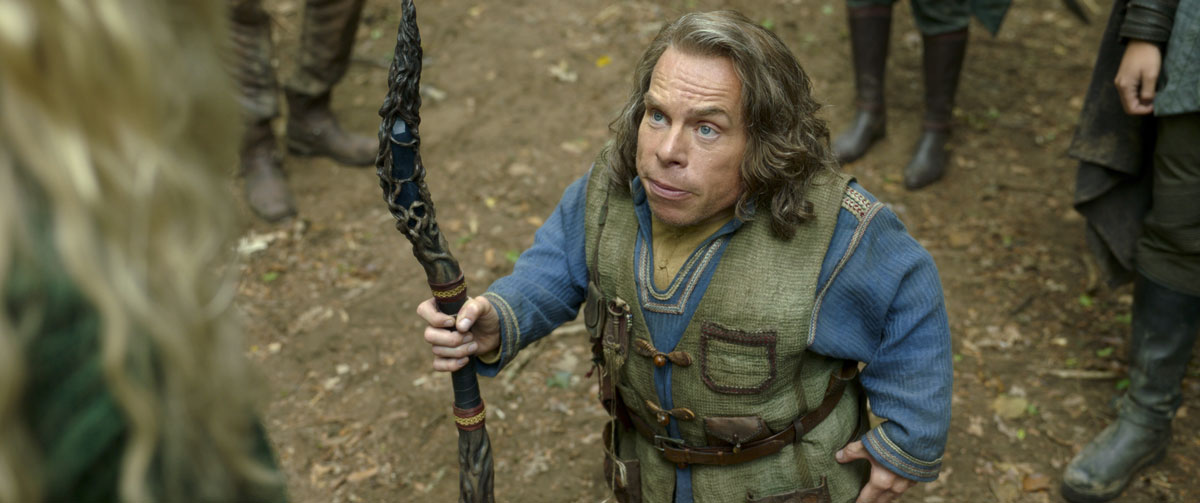
Also? Davis is back as Willow, the hero who never left our hearts, the humble farmer who led a quest and the actor who leads a generation still. Yes, even our cranky, disaffected group, Davis affected us. It’s a testament to his power as a performer that he can enchant — still — perhaps the most disenchanted generation of all: Gen X.

English actor Davis was only 11 years old when his grandmother heard a radio call for people under four feet tall to be in the film “Return of the Jedi.” A child of the ’70s, Davis was a huge “Star Wars” fan already and the child actor was cast as an extra in the film, as one of the Ewoks, a species of small creatures who live on the forest moon Endor. But when the actor playing the main Ewok fell ill, George Lucas handpicked Davis to be the character Wicket.

I didn’t pick up a Laurie Strode action figure (though I looked at one longingly in the glass case at my favorite comic book store) before interviewing Jamie Lee Curtis. So this may mark the first official time I’ve written about a performer whose doll I had. Not only had but loved, hugged so much his forest hoodie was lost. My sister and I used to fight over our Wicket doll. He was beloved because the character was beloved.

He had to learn how to act outside of a mask. Perhaps there is no better metaphor for growing up and becoming your truest self.

Davis as Wicket is funny, sharp and considered. It can’t be easy to act when your entire face is disguised, your body hidden by a fuzzy suit, but Davis made Wicket more than a gag (the character was voiced by multiple actors), revealing a gift for physical comedy and underscoring the ability of often small movements to speak volumes. Davis said he based his performance on his dog, relating in a Reddit chat that his pet “used to tilt his head from side to side when he heard a strange sound. I felt this would work quite well for the character.” In Wicket’s first appearance, he pokes a sleeping Leia (Carrie Fisher) with a spear, then later shares her food. 

Davis appeared in the goblin corps in “Labyrinth,” that most seminal of Gen X films, which gave an entire generation nightmares about babysitting or at least shifted our dating preferences toward the decidedly goblin kingly, but the young actor’s onscreen experience was limited. He described himself as “not seen” in “Return of the Jedi,” due to his costume. 

Then came “Willow.” 

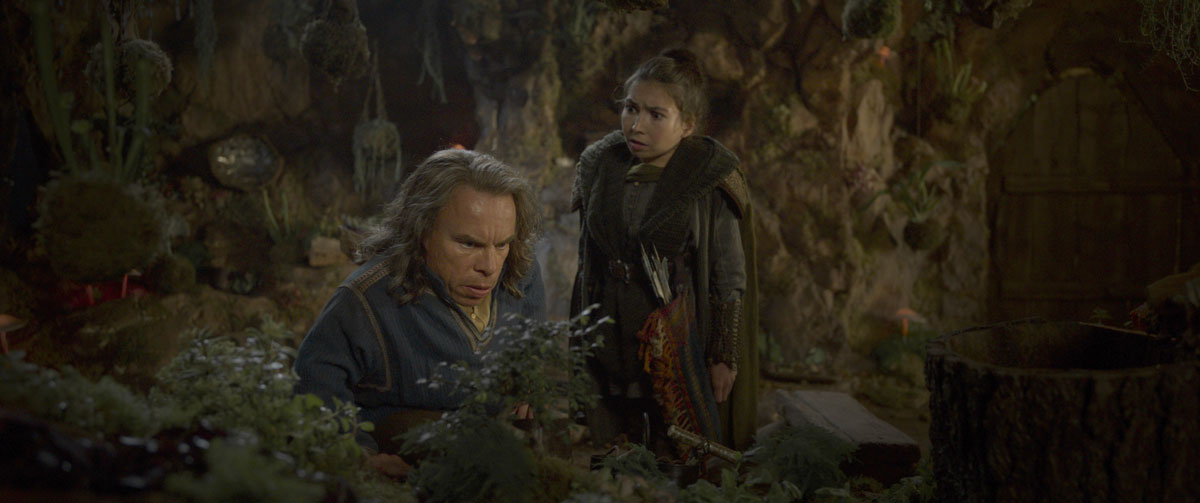
WillowDove (Ellie Bamber) and Willow Ufgood (Warwick Davis) in “Willow” (Disney/Lucasfilm Ltd.)Lucas made a “leap of faith by writing the story for me,” Davis said. He was only 17 years old at the time. Lucas first told Davis’ mom about the role. To be Willow, Davis “had to develop acting outside of a costume,” he told Sky News. He had to learn how to act outside of a mask. Perhaps there is no better metaphor for growing up and becoming your truest self.

A family man yearning for more is not new territory, but Davis treads it like it’s the moon. 

In “Willow,” Davis’ character is a young farmer, married, with two young children. The family leads a simple, rural life in a stream-side village with fellow Nelwyn, hobbit-like characters. But Willow dreams of more. He’s tried for years to be chosen as the apprentice for the town’s sorcerer, the High Aldwin (the fantastic Billy Barty, making a memorably loving appearance, as always). This year, once again, Willow doesn’t make the cut. A family man yearning for more is not new territory, but Davis treads it like it’s the moon. 

His Willow is devoted to his wife (Julie Peters), children and children in general. When a prophesied baby literally floats up to his shore, Moses-style, he assumes the burden of delivering her to safety. Can you be an action hero while carrying a baby in every scene? Davis can. In doing so, he showed us a new way to parent, an avenue to care for ourselves and our children in a way we hadn’t been parented. 

Steadfast, loving, Davis’ Willow is a nontoxic man before we realized there was such a thing, or that we needed it, an ally to all (except trolls). Madmartigan is supposed to be the love interest here, and he is – Kilmer’s undeniable chemistry and comedic gifts both radiating from the screen like heat-seeking missiles – but Willow has the love of the world. He’s not flashy, not shirtless or in drag like Kilmer. Willow is subtly powerful. While Madmartigan and Sorsha are swashbuckling or kissing or kissing/swashbuckling, Willow is in the corner, keeping everybody alive. That’s Gen X for you, in the corner too and forever and always overlooked (Gen what?).

WillowWillow Ufgood (Warwick Davis) and Mims (Annabelle Davis) in “Willow” (Disney/Lucasfilm Ltd.)He doesn’t need your help to get on a horse. But Willow also knows enough to call for assistance when it’s warranted. For example: trolls are on the bridge, which is also on fire, and there’s a two-headed moat monster. He’s not too proud to bring in the big, hired guns (Madmartigan).

The thing about being overlooked is that they never see you coming. Willow saves the day and he does it without magic. With simple sleight of hand. With smarts and with patient clarity. How is Willow Gen X? He does his own thing. He’s always been doing it. It makes complete sense that the Disney+ “Willow” series would find the character back in his village, living his life whether or not you know how extraordinary it has turned out to be.


Want a daily wrap-up of all the news and commentary Salon has to offer? Subscribe to our morning newsletter, Crash Course.


We think of Gen X as the blasé generation, the bitter and cynical one. The world hasn’t been wonderful for a while, for a lot of people, if we’re being honest. Wanting to turn away from it, even if only in sarcastic dismissal, is a natural response, a defensive one of self-preservation. But I think my generation has never turned away without looking over our shoulders, hoping someone might look back at us, wait for us, give us something to hope for and hope along with us. 

Davis is that Gen X-er who made it, and a made a path lined with the most loving of stories, fiction full of heart and hope. That a “Star Wars” fan could be in “Star Wars.” That a farmer could save the world. Do we still believe in magic? If Davis is there, then yes.

“Sex Lives” stars on how their characters are “more powerful” in their sexuality this year

School is officially back in session on “The Sex Lives of College Girls,” HBO Max’s lauded comedy-drama created by Mindy Kaling and Justin Noble. And as expected, our favorite quartet have their fair share of messes to mend in the show’s second season.

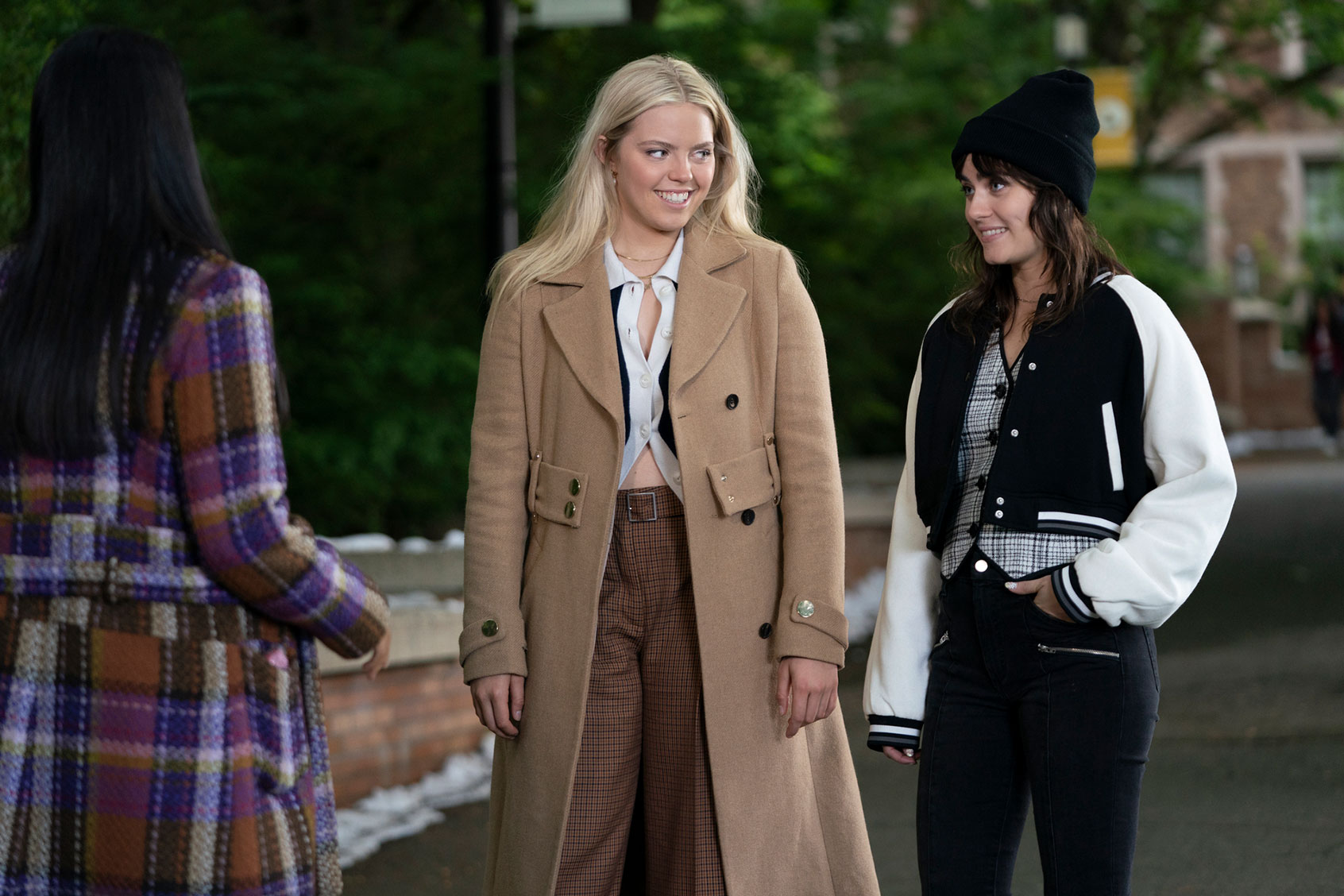
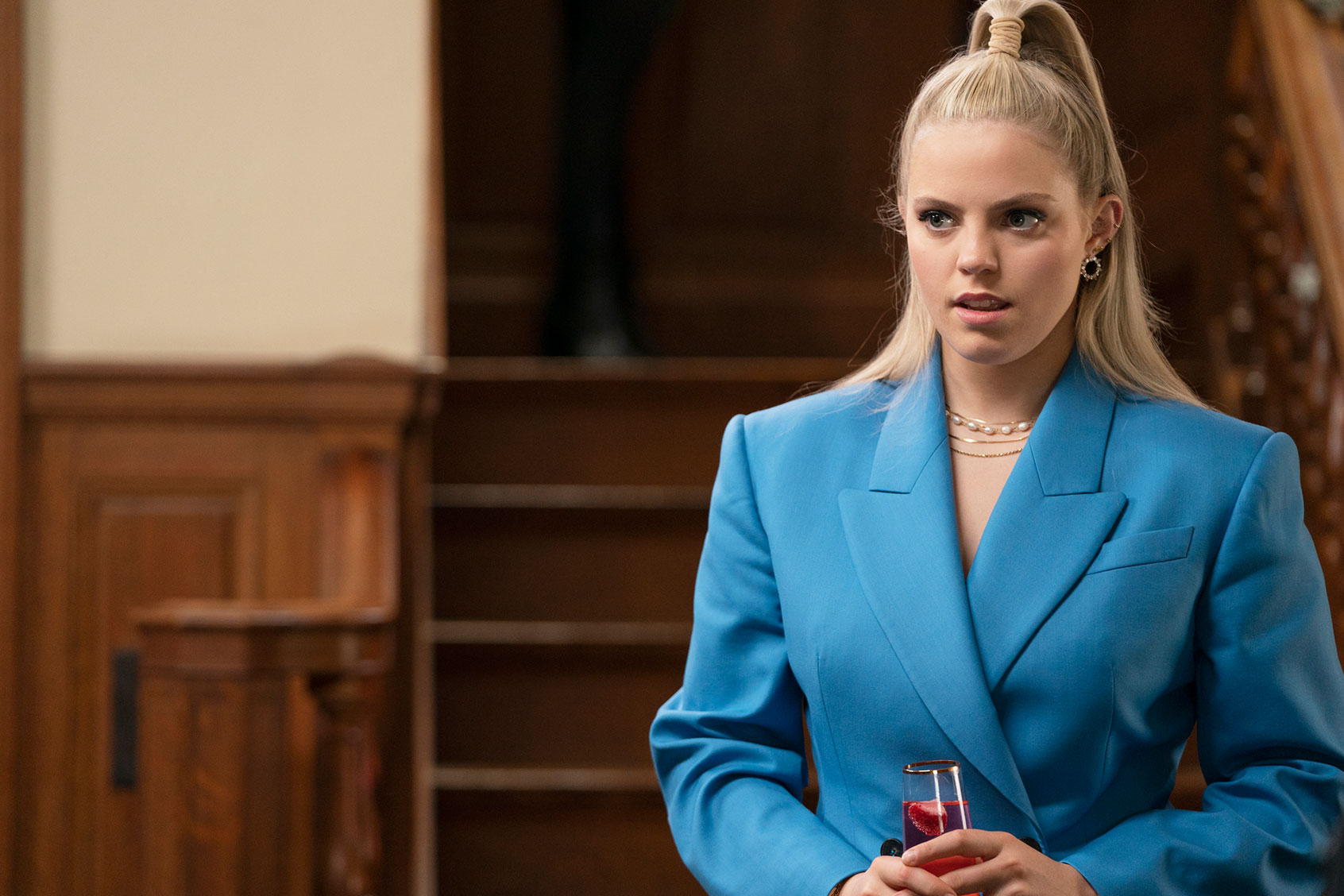
Upon their return to Essex College after Thanksgiving break, the four friends are navigating yet another horny and eventful semester on campus. And even though it’s only been a few months for them, we’re already starting to see growth, specifically with privileged Leighton Murray (Reneé Rapp) and jokester Bela Malhotra (Amrit Kaur).

“I was able to be a part of a coming-out scene that was accepting … It’s really f**king cool to have that be such a big part of my life.”

Leighton has officially come out to all of her roommates after previously telling Kimberly (Pauline Chalamet) that she’s gay. Now, she’s confident in her sexuality and identity: the new Leighton has her face in full view on her dating app profiles, pursues women she’s into and freely enjoys casual sex, even though she unknowingly lands herself in a sticky situation. She also develops a newfound crush on a tennis player named Tatum (Gracie Dzienny), who is basically a slightly older version of herself, and attempts to woo her on the court, albeit unsuccessfully. Nevertheless, the pair’s future seems promising after they exchange numbers at a party.

As for her relationship with her roomates-turned-besties, Leighton softens up to the girls and ditches her more ice queen-like persona to showcase her vulnerable side. There’s a handful of heartfelt moments where she’s seen comforting them, giving them well-meaning advice and stepping in to help them amid difficult situations.

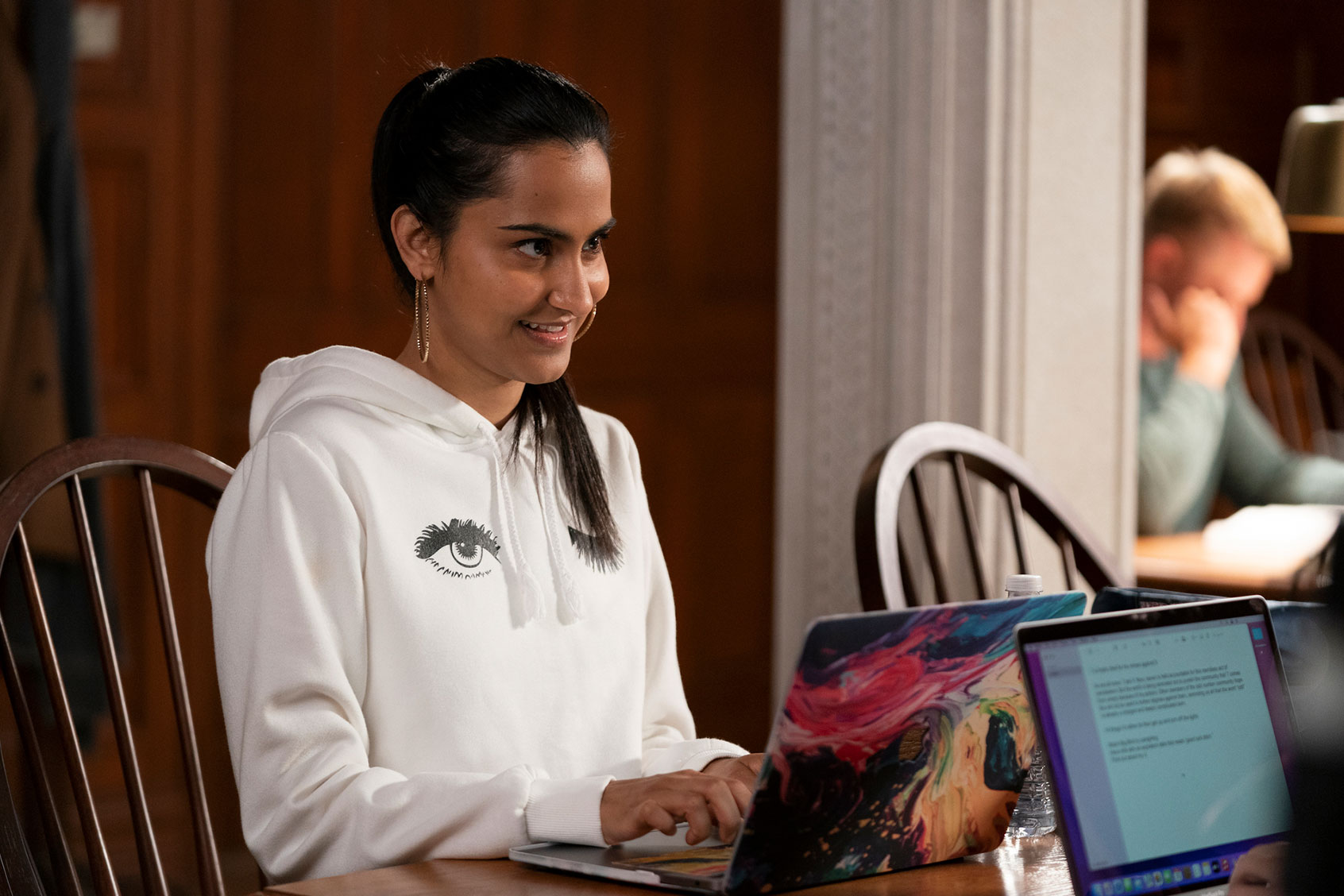
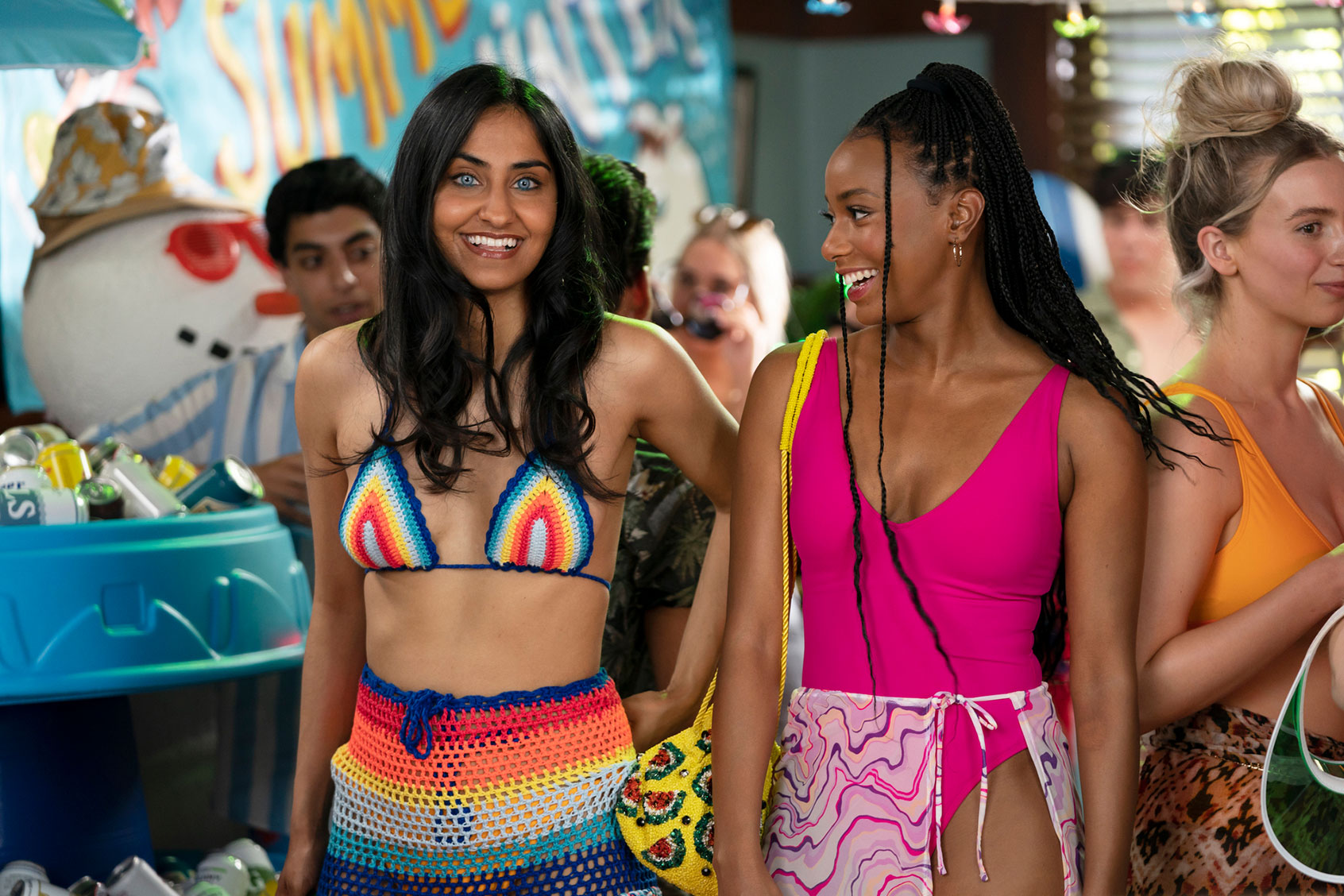
Meanwhile, Bela, the sex-positive, aspiring comedy writer is focused on advancing her career after leaving her position at “The Catullan” to launch her own female-only comedy magazine. Despite her strides, Bela is once again deemed insufficient and realizes just how difficult it is for her to break into such a male-dominated industry. She eventually works as a student liaison for a well-known comic named Dan O’Connell (John Reynolds of “Search Party”), who she tries to impress in order to land a gig on his show. But her chance at success is jeopardized after Eric (Mekki Leeper), her ex-editor and now boyfriend, hits it off with Dan at the aforementioned party. 

“At the end of Season 1, Bela deals with so much. She’s gone through sexual assault. She’s had so many people say terrible things about her, name-call her. She’s left ‘The Catullan.’ And she goes through Thanksgiving break, comes back and decides that she’s going to go into revenge mode — at least that’s the choice I made as an actor,” Kaur explained. “That she now is going to objectify men. She’s going to be more boyish. She’s going to be alpha. She’s going to be a boss. And in this ambition of not wanting to feel her pain, she unknowingly hurts a lot of people.”

Salon recently had the pleasure of virtually chatting with both Rapp and Kaur about how they prepared for their roles, what their characters mean to them and why it’s important to showcase female sexuality — specifically focused on queer and South Asian women — on screen.

This interview has been edited for length and clarity.

I’m curious, Amrit, if you’ve had any conversations with Mindy Kaling about being a woman in comedy to help prepare for season two. If so, what were those conversations like?

Amrit Kaur: We didn’t have any one-on-one discussions about that, but I did a lot of research into watching “The Mindy Project,” looking into her work in “The Office,” seeing what her mind was like and where she was coming from. A lot of the cast members who are in my comedy group actually were in the comedy magazines in their respective universities. So, there was a lot of research asking them. I did watch a lot of stand-up comedians do work. I went out and did some stand-up shows in between as a rookie, just to get into that mechanism of where Bela’s always trying to map out and create jokes. So, not a specific conversation with Mindy.

“Right now, we’re talking about the broad strokes of having a sexual character in Hollywood that’s South Asian American because we’re still behind.”

But if I look at all the things that are the deepest parts of me, as to why I behave certain ways, why I’m desperate for love, why I want to be funny, why Bela wants to be funny because she doesn’t feel as attractive. So, she thinks that being funny is going to make her hotter. All of these things, if I reveal in myself, then I’m sure I’m touching Mindy somewhere as well and revealing her in a way.

The Sex Lives of College GirlsAmrit Kaur in “The Sex Lives of College Girls” (Photo courtesy of HBO Max)

Reneé, I really appreciated Leighton’s coming-out scene. I’m curious how you interpreted that scene and also prepared for it?

Reneé Rapp: Something that is not lost on me is that I was able to be a part of a coming-out scene that was accepting. It was basically like me being able to come out all over again and really just be blindly accepted no matter what. Really the only thing that went into it was I just was like, “OK, I just really got to drop in and be vulnerable and be myself.” And we cried in so many of those takes because I’ve been out for so many years, but it’s still so emotional to me. It means a lot and it’s really f**king cool to have that be such a big part of my life. I’m very lucky.

The Sex Lives of College GirlsAmrit Kaur, Reneé Rapp and Alexia Loannides in “The Sex Lives of College Girls” (Photo courtesy of HBO Max)

This season, we see Leighton and Kimberly’s friendship develop as they spend more time together and grow closer. They share a series of intimate moments in the bathroom when Leighton helps Kimberly take her hormone injections. And Leighton even accompanies Kimberly to her surgery and comforts her beforehand. What was it like working with Pauline and how did you both work together to bring your characters’ dynamic to life?

“Holy s**t, how do I do this right and also get over my imposter syndrome?”

Rapp: I think the four of us all just gel so well together that it feels so good. And, you know what I was so excited about? I was so excited to come out to all three of them together. That was so cool to me. Because I shared such an intimate moment with Kimberly last season and it was this real pour-out of emotion and going through 10 things at once. And what was so special was that growth was made so quickly to be like, “No, I’m gonna come out to all of you, and I’m gonna actually feel good about it.” And so, it felt really great to be able to develop that relationship with all of the girls, especially after sharing such a personal moment with Kimberly last season. It really pushed Leighton forward in the fact that like, “OK I’m gonna do this.”

I really loved your characters’ growth, especially as they embrace and showcase their sexuality more. How important do you think it is to show and portray young women – whatever their identity or sexuality – who are unapologetically taking control of their sexuality?

Rapp: I think it’s wildly important, on levels that I probably can’t even put into words. I also think it’s important to note that Leighton’s experience and my queer experience is not the sole queer experience. I think a lot of times I get asked, “Do you think Hollywood is progressing in this way that we have queer characters on screen and things like that?” And though I completely agree, I’m always very timid to respond to that question with a lot of gusto without taking away from what we actually have accomplished. Because, again, this is not the sole queer experience. And there are thousands of other queer experiences that even Leighton could learn and take notes from a lot. So I feel very lucky to be a part of that for a lot of people. And I just hope that it doesn’t end there. It’s very comforting for a lot of people to see a queer character and a gay character out and about. It’s also really important that that’s not the only experience and that’s not the only story that is told in a digestible and palatable way. So I feel both ways about it. I feel very grateful and very excited and eager. And hopefully we have more.

“Bela has allowed me to be myself in many ways: explore my sexual self without labels, be the fashionista, be the comedian that I am and have the confidence that I have.”

Kaur: I think it’s so critical because South Asians are humans, like any other culture. And right now, I’m seeing more representation of South Asians in Hollywood. But there’s so many cultures within South Asia, let alone India. Every state has a language, a dance, a different expression. And eventually, you’d like to get to a place where the representation in North America is even more specific. But right now, we’re talking about the broad strokes of having a sexual character in Hollywood that’s South Asian American because we’re still behind. I would like to get to a place where that’s just normal. She’s a normal human and she is just like anybody else. And I just want to add as well that her exploration of sexuality is not akin to every South Asian American’s exploration of sexuality. And it’s because we don’t have that many right now. We look at these characters as excitement, but that’s just one approach and that’s great. But there’s so many other experiences and those all, one day, should also be brought to light.

Were there any specific challenges or difficulties that you came across while playing Leighton?

Rapp: Anxiety is a huge one, which is my own specific challenge, of course, but I feel like I want to do a really good job. Not only on myself as an actor, but I’m so grateful to everyone queer in my life. And my friends who are queer in any sort of identity have shaped who I am and changed who I am as I’ve gotten older and as I’ve continued to sort of deep dive into my identity. And so I think the biggest fear and the biggest tactic comes from, “Holy s**t, how do I do this right and also get over my imposter syndrome?” I’ve earned this space. I am OK to exist here. Because a lot of times I’m like, “Ah, no, no, no. I’ve done horrible things. I’m a bad person. I don’t need to be here. I can’t act.” I will just spiral, spiral. And so that was a big thing for me to overcome this season. And I don’t know that I’ve overcome it yet to be quite honest, but we’re getting there. I will let you know when I do.

The Sex Lives of College GirlsReneé Rapp in “The Sex Lives of College Girls” (Photo courtesy of HBO Max)

What does playing Leighton and Bela mean to you? Are there any specific things about them that you either like or dislike?

Rapp: It’s so funny that Leighton has become such a big part of my life because I never foresaw myself acting in this capacity, nor did I really see myself having a character become such an influential part of who I am. Being afforded the opportunity to come out so publicly and to have that scripted in such a way that is not only accepted, but even oftentimes, is praised by fans and the outside community — that’s the biggest “I am doing OK” boost ever. It is the coolest thing and it is not lost on me that that is a huge f**king blessing to be able to have that sort of acceptance literally written in and then also received by a community that I feel so close to and that I craved acceptance from as a kid. It’s such a crazy part of like, “Ah, somebody please tell me that I am in here and I’m accepted and you’re with me.” And now I’m so stupid lucky to have that from so many people and vice versa. So she’s become a huge part of my life. And I’m very grateful for the opportunity to play her. I’m very grateful that people even slightly give a f**k. That is so wild to me.

Kaur: God, I mean, Bela . . . what is it like being myself? It’s my goal in every character that I play, that I was able to be myself. Elia Kazan has this beautiful actor’s vow, “The thing I want most and need most is to be myself, and it’s an actor’s battle.” And Bela has allowed me to be myself in many ways: explore my sexual self without labels, be the fashionista, be the comedian that I am and have the confidence that I have. She’s introduced me to stand-up. So she’s allowed me to be myself because she’s been brave in being herself.

What do you hope viewers will take away from Bela’s storyline this season? 

Kaur: I think she’s more powerful in her sexuality this year. I think last year she was more flighty. And this year, we’re seeing a character — Indo-American character — who’s very grounded and very intelligent. And there are episodes where she fluctuates and goes back, but you can see that she’s becoming more intelligent. Kalinda Sharma in “The Good Wife” was one of the few South Asian American characters I saw that was very confident in her sexuality. So, I hope it will encourage not only South Asian Americans but a lot of children, who’ve been told culturally otherwise they can’t be, to be confident and to explore confidence in their sexuality.

The Sex Lives of College GirlsAmrit Kaur and Alyah Chanelle Scott in “The Sex Lives of College Girls” (Photo courtesy of HBO Max)

“The Sex Lives of College Girls” is streaming on HBO Max. Watch a trailer for the new season below, via YouTube:


30 easy soup recipes to slurp all winter long

simmering pot of soup brimming with chunky vegetables and warm spices is a hallmark of fall and winter cooking. Soup should be easy to make and comforting to consume. While many recipes require hours to make and a dozen or more ingredients, simple soups that take less than an hour and employ basic pantry staples have us feeling, well, thankful. For all of the following heavy hitters, if you have a pot, olive oil, a couple of vegetables, stock, and a few key herbs and spices, you’re good to go.

Here are 30 soup recipes that are stress-free and totally delicious. From hearty stews to tasty bisques, we hope you find one you love for this cozy season.

Our best soup recipes

1. Best French Onion Soup

French onion soup may just be the holy grail of hygge soup recipes. It’s an easy, impressive dish featuring just a few ingredients. (Don’t sleep on chef Chad Robertson’s tip to add a bit of duck fat into the bowl for an extra layer of flavor.)

2. Lasagna Soup with Ricotta-Parmesan Cream

You had us at “lasagna soup.” This deconstructed version of the classic pasta dish has fewer steps, and is a one-pot wonder for the table.

3. My Grandmother’s Tomato Bisque

Grandma’s cream of tomato soup recipe has three ingredients, and that’s it. It’s all about sautéing super-ripe tomatoes in butter, then mixing in cream like mad for a ripe, saucy finish. 

4. Chickpea, Pumpkin, and Sage Stew

Sweater-weather favorites chickpeas, pumpkin purée, and sage make cameos in this autumnal stunner. Adapt to your own pantry by swapping chickpeas for any canned bean, or pumpkin for butternut squash.

5. Leftover Turkey Soup

During the hectic holiday season, nearly any leftovers recipe is going to be an instant favorite, but this one is simple and relies upon pantry and crisper staples. It’s a go-to right after Thanksgiving.

6. 10-Minute Egg Drop Soup

This unconventional egg-drop soup replicates the Chinese classic using Western ingredients–the brainchild of a Chinese grandmother who migrated stateside. Replacing cornstarch with cream of chicken and adding canned corn lends it a hearty texture. Bonus: It’s ready in 10 minutes.

7. Cream of Mushroom Soup

Four ingredients plus salt and pepper–that’s it! This Big Little Recipe employs shiitake mushrooms, creminis, and heavy cream to achieve a silky, lush texture. Sauté, then blitz in a blender. Boom.

8. Best Butternut Squash Soup

Our best butternut squash soup is the one we keep in our back pockets during the really cold months. Cream-free, its earthy flavor comes from Parmesan, walnuts, and butternut squash two ways–roasted and boiled. Drizzled with yogurt, it’s a warm blanket of a soup.

9. Jamie Oliver’s Italian Bread and Cabbage Soup

Rustic Italian cabbage soup may not be in your repertoire yet, but Jamie Oliver’s version is a Genius Recipe for a reason. It’s also much heartier than it sounds, thanks to pancetta and butter-fried sage.

10. Joanne Chang’s Hot and Sour Soup

A prep time of 10 minutes? Sign us up. Flour, Too cookbook author Joanne Chang smartly swaps out sliced pork for ground for a ready-in-a-flash rendition of Chinese hot and sour soup–another Genius Recipe.

11. Butternut Squash and Cider Soup: 1993

Amanda Hesser loves this recipe for its simplicity and sweet, pure flavor. Ideal for the week after Thanksgiving, she writes, it’s a relief from the heft of the holiday–but still fantastic, and loaded with fall flavors.

12. Mushroom Barley Soup

Add this flavor-packed mushroom and barley number to your soup bucket list. Start by cooking pancetta over low heat with chopped carrots, celery, and onions, then build the broth with layers of aromatics like porcini mushrooms and dry sherry.

13. Roasted Carrot Soup

Use up that bunch of carrots staring you down from the fridge. Broiling them transforms them into sweet, almost caramelized veggies. Add ginger, thyme, and sweet onion, and it’s fabulous.

14. 3-Ingredient Potato Leek Soup

A riff on fancy vichyssoise, this three-ingredient potato leek soup is decidedly easier — but just as good. (Do be sure to clean those leeks very carefully!)

15. Apple and Fennel Soup

Apple and fennel, together, are a gift that keeps giving. We like tart apples such as Honeycrisp, Gravenstein, or Granny Smith here. Blitz with chicken stock, honey, lemon, watercress, and fennel, garnish with a fistful of fresh herbs, and love your life.

16. Marcella Hazan’s White Bean Soup with Garlic and Parsley

This Genius Recipe from actual culinary genius Marcella Hazan is ready in a mere 10 minutes. Weekday-friendly as can be, it’s a garlicky white bean soup best served over thick grilled slices of bread.

17. Souped-Up Tomato Soup

This straightforward, peperonata-inspired tomato soup calls for red bell peppers, a dollop of crème fraîche and a handful of fresh basil. It was born to be paired with a mouth-watering grilled cheese sandwich.

18. Crispy Cheesy Broccoli Soup

Jaw-droppingly simple for an ooey-gooey comfort food classic, this crispy cheese broccoli soup requires just four ingredients and salt. It condenses the typical, complicated ingredient list in favor of the savory basics — onions, tons of broccoli, cheddar cheese, and oil.

19. Winter Squash Soup with (Less) Red Chile and Mint

A full two pounds of winter squash comprise the base of this make-ahead soup. A riff on Deborah Madison’s winter squash soup, this version uses a little less chile than hers. We love the unexpected combo of cinnamon stick, coriander seeds, and mint.

20. Savory Wild Mushroom Soup

One of our one-pot wonders, this savory wild mushroom soup is soothing on a chilly day thanks to its woodsy, earthy notes. Topped with seasonal nuts, grated cheese, and a sprinkling of fresh parsley, it’s also light enough to serve as a first course.

21. Vegetable Soup with Roasted Tomato Pistou

Freezer-friendly, this two-part recipe takes advantage of seasonal summer vegetables like cherry tomatoes and green beans, so you can make a big batch and enjoy warm-weather flavor year-round.

22. Pasta and Bean Soup with Kale, Revisited

Merrill Stubbs concocted a soup for pasta-bean soup enthusiasts who want to get their greens, too. Six full cups of kale conjoin with (unexpected) pinto beans for a wonderfully robust bowl.

23. Rick Bayless’ Chicken Tortilla Soup with Shredded Chard

Smoky and delightful, this Rick Bayless tortilla soup–one of his many variations on the dish since the ’80s–is one of our Genius Recipes. Dried pasilla chiles keep it mild; two cups of Mexican Chihuahua cheese–you can sub in Monterey Jack–keep it hearty.

24. Pappa al Pomodoro (Tuscan Bread Soup with a Sage Oil Drizzle)

Be a good environmentalist and use up that stale bread rather than tossing it. This Tuscan recipe relies upon canned tomatoes, fresh basil, and not much more. Rustic and comforting, it gets a slight upgrade thanks to fried sage leaves.

25. Tuscan Onion Soup (Carabaccia)

Perhaps the Tuscan antecedent of French onion soup, this recipe involves sautéed onions, sage, plenty of Parmesan, and a fried egg. We’d be lying if we said we didn’t reach for it after a long night.

26. Cornish Game Hen Soup with Garlic, Ginger, and Fried Shallots

Anyone who hates making a separate pot of rice for a soup, listen up: Eric Kim stuffs a Cornish game hen with rice for this riff on samgyetang, the Korean soup fortified with ginger and ginseng with which he grew up. Garnished with fried shallots and cilantro, his variation is an absolute marvel.

27. Nigel Slater’s Miso Soup with Beef and Kale

Miso soup — with half a pound of sirloin steak? If anyone can pull it off, it’s Nigel Slater, and boy, does he. Ready in a flash, this bowl boasts kale, powdered bouillon, and white miso, too.

28. Slow-Cooker Chicken Soup with Ginger and Fennel

Set it and forget it: Rebecca Firkser’s recipe is an ode to ginger, fennel, and chicken broth, together–in a slow cooker. With a mercifully brief 10-minute prep time, it’s a wonderful addition to your weeknight dinner rotation.

29. Instant Pot Vegetable Beef Soup

Another Eric Kim hit–dubbed the one-pot wonder by our editors–this vegetable soup straddles chili and a stew. Toss your favorite vegetables in the Instant Pot, garnish with nutty Parmesan, and serve with crusty bread, and you’ve got dinner for four in 40 minutes.

30. Weeknight Chili

Chili is so marvelously Game Day-friendly, and this bean-and-beef number screams to be made in advance. Have pals over, let them garnish as they like with cilantro, grated cheese, hot sauce, and scallions, and enjoy how few dishes you have to do.

Trump calls for termination of Constitution to suit his needs

Former President Donald Trump on Saturday flat-out called for the “termination” of the United States Constitution so that he could be returned to the presidency.

Reacting to the news that Twitter in the runup to the 2020 election removed tweets that featured pornographic photos of Hunter Biden, Trump declared that the entire election had been stolen from him and demanded to be returned to the presidency.

“So, with the revelation of MASSIVE & WIDESPREAD FRAUD & DECEPTION in working closely with Big Tech Companies, the DNC, & the Democrat Party, do you throw the Presidential Election Results of 2020 OUT and declare the RIGHTFUL WINNER, or do you have a NEW ELECTION?” Trump wrote on his Truth Social platform. “A Massive Fraud of this type and magnitude allows for the termination of all rules, regulations, and articles, even those found in the Constitution. Our great ‘Founders’ did not want, and would not condone, False & Fraudulent Elections!”

This is not the first time Trump has called for his reinstatement as president, although this is the first time he has acknowledged that doing so would require the United States to shred its own Constitution on his behalf.

New York Times reporter Peter Baker wrote on Twitter that this seems like a dangerous new milestone for Trump.

“Needless to say, can’t think of a time in the United States when a former president (and would-be future president) has called for suspending the Constitution to let him seize power,” he wrote. “Even after all the shocks of the last few years, this one is remarkable.”

As Tuvalu succumbs to rising sea levels, the island nation wants to be the first virtual country

Tuvalu’s defining attribute on the global stage is the precarious nature of its existence — in less than a hundred years, it will disappear. But, in an effort to preserve Tuvalu’s maritime boundaries, culture and sovereignty in the face of stochastic events and rising sea levels, Tuvalu’s Prime Minister Kausea Natano announced he is leading Tuvalu into an online existence — Tuvalu will be the first “digital” country. 

In a speech to the leaders at COP27, Natano described the climatic threats facing Tuvalu, and told the world that he plans to bring Tuvalu into the metaverse in an effort to preserve the nation’s territory, culture and customs.

“Our digital nation will provide an online presence that can replace our physical presence and allow us to continue to function as a state,” Natano announced.

Tuvalu’s speech brought to the forefront a concept that many have never even heard of — the metaverse — an online world mirroring the physical one.

The sinking island

The world’s first country slated to become a virtual-only state has a small, nondescript existence. Tuvalu sits barely above sea level, spread across nine islands situated halfway between Australia and Hawaii. These Polynesian islands — a freckle, invisible on many maps — make up the world’s fourth smallest nation, population around 12,000 and a land size of ten square miles.

This past week at COP27, Natano called for more countries to support the Fossil Fuel Non-Proliferation Treaty, aimed at reducing, then eliminating fossil fuel production globally. 

Tuvalu and its plight has long been on the agenda at international summits and climate change consortiums. Tuvaluan officials have called upon the UN and spoken at multiple COP summits, pleading for a reduction in fossil fuel use and aid for the countries that bear the brunt of their effects. Yet, little has been done. 

For years, Tuvalu and droves of other small nations have called for the high-emitting nations such as the U.S., China and Russia to financially compensate the countries with little carbon expulsion — those who feel the effects of these emissions the most. 

At the conclusion of this year’s COP27, the implementation of a “loss and damages”  fund for small, low-emitting countries was approved, but a phase-out or even reduction in fossil fuel usage was vetoed, largely by the oil-producing nations. Yet, many countries count the agreement for major emitters to contribute to this fund as a major victory.

A virtual reality

Tuvalu isn’t the first nation to plan a plunge into digitalization. In 2014, Estonia began the process of digitization, even creating an e-Residency option to go hand in hand with Estonia’s online businesses and companies. They relied on the blockchain in this transition, the foundation of how modern cryptocurrency works.

While Estonia serves as a study in what an online existence (although partial) may entail, Tuvalu’s approach differs; it plans to construct itself entirely in the metaverse to retain sovereignty and create an archive for Tuvaluan culture.


Want more health and science stories in your inbox? Subscribe to Salon’s weekly newsletter The Vulgar Scientist.


Tuvalu’s digitalization plans create maritime legal questions that law of the sea scholars have been mulling over for decades. Laws regarding sovereignty usually rely on physical land, so legally, the answer isn’t clear cut. 

“It’s fascinating that when the law of the sea was negotiated, it never occurred to anyone that coastlines move,” political geography professor Philip Steinberg says, “and even potentially areas of land disappear.”

Fishing is also a major industry in Tuvalu, and is part of why Tuvalu seeks to retain its sovereignty. Tuvalu also leases out its website domain, ” .tv,” to companies like Twitch, which constitutes a fair share of the country’s gross national income.

“I don’t think [digitalization] will lead to a serious reconstitution,” says Steinberg. “It’s a cry for help: It’s a performance. It’s a way of pointing out how things cannot continue the way they are, which is what a lot of entities are doing at COP meetings… it’s part of that larger call to action.” 

Tuvalu may be just the first island country to begin the foray into a virtual, computerized existence — from reality in the midst of the Pacific into being sustained by electrical impulses, 1s and 0s. Some believe this announcement won’t set a precedent, but rather serves as a way to increase awareness. “[Tuvalu isn’t] saying we’re going digital in the sense that going digital means abandoning any sort of claims to specific spaces,” Steinberg tells Salon. “It’s going digital as a means of saying, ‘if we don’t have land, what else do we have?'”

World Cup 2022: Men’s soccer must stop silencing activism and allyship

There is a familiar adage reverberating in the stands at the 2022 men’s FIFA World Cup tournament suggesting that winning is really all that matters. But athlete activism and solidarity reflect a growing trend among athletes publicly displaying social responsibility both on and off the pitch.

FIFA, however, remains adamantly opposed to sport activism entering the field. The Danish men’s soccer team message of “Human Rights for All,” for example, is a political statement contravening FIFA regulations, according to the sporting body.

Similarly, hours before England’s opening match, it was announced that England captain Harry Kane and the seven other European teams would contravene FIFA regulations if they wore a “One Love” armband. FIFA stated that the players would be cautioned for any political statement.

These planned protests and the subsequent rowing back on them is indicative of a tension around social activism and allyship in men’s soccer — particularly in matters of sex, gender and sexuality.

Men’s sport and social activism

Sport has a long history of political activism. Tommie Smith and John Carlos raised their fists at the 1968 Olympics in support of civil rights movements in the U.S. and around the world. Fast forward to 2016 and Colin Kaepernick knelt during the U.S. national anthem protesting police brutality and racial inequality.

In men’s soccer, teams knelt in support of Black Lives Matter movements which grew following the murder of George Floyd in 2020. On matters of racial inequality, men’s sport and soccer have offered moments of symbolic support.

On matters of gender and sexual diversity, Stonewall’s Rainbow Laces Campaign has garnered some traction in the English Premier League. In Canada, the Pride Tape Campaign has also demonstrated the willingness of some hockey players to show support for inclusive sporting environments.

This World Cup, Canada competes on soccer’s biggest stage for the first time in 36 years. Canada Soccer has recently come under fire for a lack of action on issues of human rights. On the eve of the tournament, Canada Soccer announced a partnership with You Can Play — a group dedicated to tackling homophobia in sport.

Earl Cochrane, the secretary-general of Canada Soccer, said, “No matter your sexual orientation, gender identity, or who you choose to love, you have a place in this game.”

However, men’s soccer has had a problem with allyship long before Qatar was awarded this year’s World Cup. Punitive rulings against players and teams wanting to make a display of protest undermine the spirit of sport as a space for all.

Rather than de-politicizing sport, these actions by soccer’s governing bodies draw attention to the ways that sport is embroiled in political games for all to see. The silence and silencing of teams, players and organizations that results from these games is an example of a disturbing culture in FIFA and men’s soccer.

Soccer, masculinity and homophobia

Men’s sports have historically been masculinized spaces where boys become men and men prove their manhood. Through powerful acts of resistance, women and other marginalized groups have fought for their sporting spaces in the face of inequality. However, sport, particularly men’s sport, remains an exclusionary space.

The lack of openly gay or transgender professional male soccer players attests to this exclusion. Those players who are open about their sexuality are rightly praised for the courage. But the fact that such courage is required for LGBTIQ+ players only further confirms the entrenched norms in men’s soccer which marginalize men who do not live up to homophobic, transphobic and misogynistic expectations.

Research has shown the damage that homophobic, transphobic and misogynistic forms of masculinity have on men and boys. We have seen the cost of underexamined harmful masculinities in the sexual assaults and ensuing mismanagement of them by Hockey Canada. Conventional codes of manhood and boyhood have permeated sporting spaces, making them exclusionary and not spaces for all to play.

The consequences of silence

FIFA president Gianni Infantino, and FIFA secretary general, Fatma Samoura, responded to criticisms of Qatar’s human rights record, saying soccer should not “be dragged into every ideological or political battle that exists.” Clearly this is an impossibility. Not just because of the political manoeuvres, accusations of sportswashing and a FIFA corruption scandal that rocked soccer’s world governing body, but because the politics and ideology of men’s soccer has left the codes of masculinity within it unexamined.

Men’s soccer has its own questions to answer, not just around the World Cup, but around its lack of engagement with social activism and allyship with LGBTIQ+ people and women.

Sports, particularly one as popular as soccer, have the potential to be powerful symbols of inclusivity and acceptance for men and boys. When players and teams are silenced and disciplined for speaking out, it sends a strong message about the culture of sport as well as masculinity.

Moving beyond Qatar

There needs to be a shift in priorities in men’s soccer. For soccer’s governing bodies, money is the priority; for teams and players, it is winning. If that remains the case, social activism in men’s soccer will continue to be diminished. Allyship comes with risks. To do otherwise, however, makes not only FIFA, but players, organizations and sport complicit in a damaging culture of silence.

This World Cup will come and go — in four years, the World Cup comes to Canada, in partnership with the U.S. and Mexico. But the sport culture in men’s soccer needs to be challenged and changed for good starting now — and we should not be fooled that moving on from Qatar means moving on from these issues in men’s soccer.

Masculinity and the singular narrative of “we’re in it to win it” should not be allowed to silence athlete activism. Instead, sport should be a culture not only heralding winners, but one that showcases a spirit of competition rooted in inclusion, acceptance and activism.

Gabriel Knott-Fayle, Postdoctoral Scholar of Masculinities Studies in Education, University of Calgary and Michael Kehler, Werklund Research Professor, Masculinities Studies, University of Calgary

This article is republished from The Conversation under a Creative Commons license. Read the original article.

Yes, plenty of Republicans want to topple the king — but he won’t go easily

How many terrifying chapters remain in the Book of Donald Trump? The American people are in the process of finding out as they try to escape a seemingly endless story. 

Public opinion research shows that a large number of Americans — for various reasons, not all of them entirely noble or about saving “democracy” — are tired of the extremism, turmoil and chaos of Trumpism and the larger Republican fascist movement. In the recent midterm elections, millions of Americans voted to slow or stop the Republican Party’s “red tide” and in doing so won a brief reprieve in the struggle against authoritarian rule.

On a fundamental level, the midterms also represented a direct pushback against Donald Trump as most major candidates he personally endorsed, along with other banner-carriers for the Big Lie about the 2020 election, were rebuffed at the polls. Even Republican voters and previous Trump voters appear to be tiring of him.

Many such voters still support Trumpism and neofascism for various reasons — including racial grievance-mongering, political thuggery, moral panics over “culture war” issues and other anti-democratic behavior — but would prefer those things in a “friendlier” and less “toxic” package. Let’s not delude ourselves: Many if not most Trump and Republican and other right-wing voters want to end multiracial pluralistic democracy in America, but want to do it in a more “respectable” or “professional” fashion.

Republican elites and gatekeepers have clearly grown tired of what they now see as Donald Trump’s limitations in advancing their authoritarian agenda. In essence, the Trump movement was a successful proof of concept about how to undermine American democracy in the 21st century by breaking longstanding norms and institutions — up to and including the attempted coup that culminated on Jan. 6, 2021. As president, Trump also had enormous instrumental value for the “conservative” movement’s reactionary-revolutionary agenda, largely because he appointed three right-wing Supreme Court justices and reshaped the federal judiciary.

The mainstream media and its professional centrists are also growing tired of Trump and his movement and appear eager to anoint a new Republican leader who is more “mainstream” and “traditional,” supposedly heralding a return to “normal politics” and an end to the existential threat to American democracy. Such a conclusion is premature and based more on hope than evidence. Indeed, it represents a fundamental misunderstanding of political reality and the true danger of American neofascism.

Here is the basic problem: By and large, the American people and the political class are tired of Donald Trump. But he is not tired of the spotlight or ready to leave the public stage.


Want a daily wrap-up of all the news and commentary Salon has to offer? Subscribe to our morning newsletter, Crash Course.


That is unmistakably a dangerous situation. Trump is likely a sociopath, if not a psychopath. He is a cult leader who possesses tremendous allure and dark magnetism, and who still commands a following in the many tens of millions. He continues to threaten violence and chaos if he is indicted and prosecuted for his many obvious crimes, which include violating the Espionage Act and the coup attempt of January 2021. Recently Trump has embraced the most extreme figures in the white supremacist movement, which includes avowed neo-Nazis and other antisemitic hate-mongers.

For Trump’s followers, the destructive, antisocial energy he has unleashed is experienced as a powerful force of liberation, an opportunity for revenge against the elites they believe have oppressed them.

Several weeks ago, Trump finally announced that he will run for president again in 2024. Trump has suggested that if he returns to the White House he will seek revenge against his designated enemies — which would include putting journalists and by implication other people who criticize him in prison. Trump has also said he will pardon his followers who attacked the Capitol on Jan. 6.

Trump’s followers and cultists would welcome such a tyrannical reign, of course. They never want the story to end. For them, the chaotic, destructive and antisocial energy of Trumpism is experienced as a powerful force of liberation, an opportunity for revenge against “political correctness” and “the elites” they believe have oppressed and marginalized them. 

In a recent interview with the Guardian, Rick Wilson, Republican strategist, co-founder of the Lincoln Project and leading never-Trump conservative, issued a warning about the likely course of the 2024 presidential campaign. He noted that the conservatives who have turned against Trump in 2022 are the same people who, six or seven years ago, “were confidently asserting Donald Trump could never, ever under any circumstances win the Republican nomination, and there were never any circumstances where Donald Trump could beat Hillary Clinton”: 

“I know that the Republicans who right now are acting very bold and the donors who are acting very frisky — as Trump starts winning primaries, they will bend the knee, they will break, they will fall, they will all come back into line. …

“Right now they’re all talking so much shit: ‘I’m not going to get with Trump. I’m going to be with the hot new number, DeSantis.’ When DeSantis gets his ass handed to him, when he gets his clock cleaned in a debate or forum or just by Trump grinding away at him, eating him alive mentally for weeks on end, and suddenly Donald Trump’s numbers start posting up again, all the conservative thinkers who are right now like, ‘We will never vote for Trump again, we have integrity!’ will find themselves some excuse. ‘Well, you know, we don’t like Trump’s tweets, but otherwise it’s pure communism!’

“It’s all bullshit, it’s all a fucking game, and that game is going to play out in a way that does not result in the outcome that the donor class thinks they’re going to get.”

Wilson is highly skeptical that Florida Gov. Ron DeSantis, the mainstream media’s anointed Trump replacement, can actually beat Trump in a head-to-head matchup. “Has he actually faced up against a full campaign of the brutality and the cruelty that Donald Trump will level against him?” Wilson asks. “He has not”: 

“In a Republican primary against Trump, even Trump in a weakened state still has an innate feral sense of cruelty and cunning that Ron DeSantis does not have. …

“All of a sudden, all that donor money is going to go, ‘Oh, fuck,’ and then they’re going to call Ron’s people and go, ‘Hey, listen, we love Ron but we’re worried. We’re gonna have to sit this one out for a little while. Let’s see what it looks like in a month.’

“And then a month will pass and all of a sudden Donald Trump is the nominee. That’s how it’s going to go and I don’t say this out of any joy; I say this because I’ve just been to this fucking party too many times now.”

Donald Trump has multiple pathways to remaining in control of the Republican Party and continuing to menace the American people. At this point, he remains the leading Republican candidate for 2024. He has a firm base of support among older and more conservative voters, one that is far stronger and deeper than any of his rivals command. He has amassed a huge war chest for his 2024 campaign and associated super PACs.

Republican voters will choose Trump knowing that his return to power will bring renewed chaos and destruction. 

If Republican voters and right-leaning independents are offered the choice between Donald Trump and Joe Biden (or literally any other Democrat), nearly all of them will overcome whatever reluctance they feel and choose Trump. They will do this knowing that a second Trump term will bring renewed chaos and destruction. And of course, If Trump is somehow not the Republican Party’s presidential nominee in 2024, he will do everything in his power to destroy it in an act of spite and revenge.

Mainstream media, professional politics watchers and “respectable” conservatives have repeatedly assured us that the Republican Party and its voters are on the verge of abandoning Trump and returning to some semblance of political normalcy. It never happens. Ultimately, Trump understands the party and its voters — and the underlying cultural and societal sicknesses and troubles that spawned his neofascist movement — far better than conservative or media elites do. Until and unless the Republican leadership solve that riddle, they will remain in the thrall of Donald Trump and his followers no matter how much they wish they could escape.

No bones days are permanent now that we’ve lost Noodle the pug

For some time now, those dreary days when it seemed almost impossible to get out of bed were made considerably better with the help of Noodle the pug. Made known through a series of TikTok videos created by his human companion in New York, Jonathan Graziano, Noodle would tip us off as to whether any given day had the makings of a “bones” or “no bones day” based on his willingness to get out of his own little bed and get going. 

Sadly, on Saturday morning, Graziano delivered the heartbreaking news that we have entered into a state of permanent no bones days because Noodle has passed away at the age of 14.

“I’m so sorry to have to share this, but Noodle passed away yesterday,” Graziano said through tears in a video posted to TikTok on Saturday. “He was at home. He was in my arms. This is incredibly sad. It’s incredibly difficult. It’s a day I always knew was coming but never thought would arrive.”

Almost immediately after Graziano posted his video, fans of Noodle flooded social media with well-wishes and expressions of grief.


Want a daily wrap-up of all the news and commentary Salon has to offer? Subscribe to our morning newsletter, Crash Course.


“NOODLE THE PUG PASSED AWAY I WOKE UP TO THE NEWS I AM GOING TO CRAWL INTO A HOLE,” one fan posted to Twitter. 

“I just learned that Noodle the pug passed away and I don’t think I’ll recover from this news,” tech and podcast creator Jenna Ezarik said.

“RIP noodle the pug. Bones or no bones got so many through a very dark time. Run free at the bridge little dude,” said another Noodle fan.

In an interview with NPR in 2021, Graziano spoke on how Noodle came into his life, and how the idea for their TikTok videos was born.

“I adopted Noodle when he was seven and a half years old, and we learned very early on that when he doesn’t want to go on walkies, he will not go on walkies,” Graziano said. “And it’s just insane to be able to share this with you guys and see the response. So I really appreciate it.”

After gaining popularity starting in 2021, Noodle videos on TikTok and Instagram garnered likes in the 100 million range. In an interview with Today in 2021, Graziano gave insight into their popularity, and their ability to offer a simple form of self-care.

“A bones day is a day where you just have to go after your ambition or a task you were outing off. A no bones day is a day when you just permission to wear soft clothes, self-care, take a bath.”

RIP, Noodle. You will be missed.

“What’s wrong with being 57?”: Supermodel Paulina Porizkova questions the value of youth in beauty

Paulina Porizkova, one of the world’s most well-known faces and an early supermodel for many brands, joined me on “Salon Talks” to discuss her new collection of essays, “No Filter: The Good, the Bad, and the Beautiful.” The book, which Porizkova says is not exactly a memoir, but reads a bit like one, begins with a foreword by her publisher at Open Field, Maria Shriver. 

Porizkova says Shriver reached out to her about a collaboration during the first wave of COVID when she was stuck at home in the countryside. The model and writer was then determined to complete a full book in a very short period of time on topics she had spent years thinking about, particularly her experiences coming up in the height of ’80s and early ’90s supermodel popularity and the psychological and physical challenges that came with being objectified as a teenager.

In sometimes gritty detail, Porizkova shares her early experiences as a displaced child of war from Czechoslovakia, which included being separated from her parents and growing up in a rather fast fashion. Later, she met her future husband Ric Ocasek, front man for The Cars, with whom she raised two sons in spite of an obvious age difference. The 25-year relationship was not, however, without significant challenges fueled by fame and media scrutiny. Porizkova writes in candid and moving detail about the public fallout from Ocasek’s sudden death several years ago, including the shock of being cut out of his will. 

The author, who says her book was written without a ghostwriter, has penned many widely published essays and quite a few books over the years, but none were as emotionally challenging and freeing as this one. It was, she leads off with, the introspection and freedom that came with accepting her status as the “crying woman” on Instagram in 2021, that made her finally relatable to millions of followers who saw her as an aging beauty willing to stand up for real women and the experience of getting older and feeling discarded by society because of it. 

Porizkova shared with me that she hopes that women, and all readers, find some hope and light in her stories and see parts of themselves exposed and accepted for who they really are, without judgment and with kindred support. Though she and her late husband used to spend a lot of time judging others with cruel scrutiny, she says, Porizkova pivoted and completely changed her perspective once she became the subject of the same by others in her grief. Now, she spends her time shedding light on the negativity this breeds, hoping she can help “be the light.” Watch our “Salon Talks” interview here or read a transcript of it below.

The following interview has been lightly edited for clarity and length.

A good place to start is with Maria Shriver, whose imprint your book was published with, Open Field. Shriver said that you were “uniquely qualified to write in real time about the different challenges women face throughout life’s various phases — aging with honesty, coping with loss and identity, finding a renewed sense of mission and purpose, using your voice to inspire others as they deal with some of the same issues.” What was the impetus for “No Filter” and why now?

Maria’s the one who came to me. She actually just called me out of the blue and said, “Hey, I follow you on Instagram and I really love what you’re doing, and would you write me a book?” I had gotten a lot of offers for a tell-all memoir, obviously wanting to get the dirt on what happened in my life, which I was not willing to do. But when I spoke to Maria and she said to see it more like her own book that she had written, “I’ve Been Thinking,” which was more like devotionals. And I have no idea what a devotional is. I don’t even know what an essay is, quite frankly. I had to learn how to write them really quickly. But I thought, “Oh, that I can do, because that’s like when I write on my Instagram. I can just go more in depth and I can flesh it out and I can really sort of sink into a space where I can get it all out.” So it inspired me, and I thought, “Yeah, absolutely, I want to do this.” And then I went to the jungle, did a reality show, which completely messed me up.

Yes, I’ve seen your Instagram chiropractor pictures of you getting realigned after not eating and sleeping. 

Doing extreme physical challenges every day for four hours straight with no sleep and no food. I kind of messed up my hips a little, and when I came back I couldn’t walk. What better time to write a book in three months? So that’s how that came about. So many things in my life seem accidental. It feels like sometimes it gets thrown at me, but it all benefits me to learn more and be a better person and just become a bigger person, as all learning does. But so much of it seems not to make sense until it’s already long gone. I think that’s probably true for everybody. 

“I don’t have to push women off in order to be the only one standing.”

You mentioned that in the book and how you and your late husband were both very judgmental. It was a way of building yourself up, but now you have chosen to intentionally lead with love and to be open and accepting, regardless of how you may have felt before. Is that one of the biggest growth opportunities you’ve had?  

I think this is certainly a thing that has made me a much better person now than I was even probably 10 years ago. That was something that I was learning not because of his death and not because of all the stuff that happened subsequently. This was something I was learning when we started to separate and I started realizing that the way we had been living was extremely isolating and very lonely, and this high mountain that we had set our hut on was a really windy and lonely place.

It was a conscious choice when he was no longer my, well he was always my north star, but when I didn’t so fixate on him always being right and me always being wrong if I felt differently from him, where I thought, “Oh wait a minute, I don’t have to be judgmental. I don’t have to push women off in order to be the only one standing.” That’s not even a very nice way to live. It was obvious, I mean, it took me a while to discover that, but that was when we were separated, that was with just the understanding that how isolated we have made ourselves.

Speaking of the industry, you write a lot in your book about society’s expectations of girls being women and women looking like girls, particularly in the advertising and the editorial magazine business. As you got older and felt, as you wrote, more invisible, both at home, I think you described yourself as a coffee table. 

Yeah, something that you put things on. 

And outside, despite your continued beauty, how did you reconcile this for yourself? Because many women struggle with aging largely because of societal expectations, and certainly most of us are not some of the most famous models in the world.

That’s you assuming that I have reconciled it, and I don’t know that I have. This is something that I’m still working my way through. I’m half just really annoyed by the idea and the concept that our faces are somehow wrong for being their age. What’s wrong with my age? What’s wrong with being 57? What’s wrong with looking 57? Why is 20 superior to 57? I’d really like an answer to that. Why is youth so sought after and so treasured in our society? Because besides fertility for women, it doesn’t really do much else. That’s literally the only benefit of youth. Everything else comes with age.

I was told that I was in my prime 30 years ago, when I’m like, “Uh-uh, I’m in my prime now. As a human being, I’m in my prime now. The fact that you can’t see that I’m beautiful is not my problem, it’s yours.” Then the other half of me that’s going, “Oh my God, everybody my age looks better than me now.” We comparison shop all the time. I’m like, “Oh, well, she doesn’t have the bags under her eyes, and she doesn’t have the forehead wrinkles.” 

Then you have to pay for that, and not just financially.

But the rewards of it is that you get to stay at the table a little longer, you get to participate a little longer, you are not as quickly dismissed. Because if you are a 50-something-year-old woman who looks 39, you’re celebrated for aging well. So, yes, of course, what woman doesn’t want to be called attractive? I mean, so much of our lives growing up since we were little kids, we were told that our value, much of our value laid in how attractive we are. And then if you are lucky enough to be judged attractive, it’s got a limited time span and you get the pretty privilege that comes with it. Of course, it all happens when you’re a child, so you don’t really understand it. And then you age out of the privilege, and you go, “Wait, why? Why did I age out?” Because it’s still the same face technically with some life signs on it.

Paulina PorizkovaPaulina Porizkova modeling for Anne Klein Resort 1987-1988 Ready to Wear in 1987. (George Chinsee/WWD/Penske Media via Getty Images)

I saw some of your 2019 Sports Illustrated shoot, and of course I’m not a dude looking at a pinup magazine, but I really couldn’t see any sign of significant difference in how you look in those pictures versus when you were doing the covers. Sure, things settle a little, but to me, you still look great. You still look the same. How do those conversations go? Does your agent still call you and say, “Hey, do you want to do SI again?” Or are you fostering these relationships where you’re like, “You know what? I’m pissed that people are telling me on Instagram I shouldn’t take my clothes off anymore.” Is it you or is it them? 

Oh, it’s always them. You know that. You know you don’t have decision-making [power] in the fashion world. I can’t go to somebody and go, “I would like to do a shoot.” “People, I’m available. I am.” Doesn’t quite go like that. No. The Sports Illustrated came around again because of my Instagram, because I was posting bikini shots. And I guess MJ Day had thought, “Oh, OK, she still looks OK.” 

To that point, I have observed that an increasing number of brands are wisely trying to attract a larger advertising demographic and more dollars from women who don’t look like you. It is becoming more accepting, in certain silos, of more differently sized, differently able models.

You’re right. There’s so much more inclusivity in the fashion world now than when we were 15, where you kind of had to be a fairly specific kind of model. There’s body positivity and there’s all different shapes and sizes and far more inclusion for people of color, all great. I’m all for it. Represent all women, yes, please.

But who is still not super represented? My age. Your age. Women who are in their 50s, even late 40s who look like their age. That’s the little catch. It’s like if you are that age, but you look younger, you’re cool. You’re aging gracefully. JLo is not a day over 39. I mean, gorgeous, absolutely beautiful, and that’s how you’re supposed to look when you are 52.  That is the final frontier to me now. It’s like, “Oh, well, you’ve done body inclusivity, you’ve done inclusivity of people of color, even gender, more fluid with the genders and more allowance for all of that. Great. Now let’s expand it to us women who actually buy the product.” But I think this is where that little thing comes in, the little “but” is, but we have to buy it. 

I think women our age don’t necessarily want to buy from women their age. I think it’s the same reason that you will go have Botox and fillers and a little facelift. You want to look younger because in order not to be invisible, you have to look younger, so you will buy younger. You will buy a wrinkle cream from a 17-year-old and you will buy a Chanel suit from the 25-year-old, hoping that it’s going to do the same for you. Of course, until we stop buying into that, it’s not going to change because, of course, it’s where the money is. 

Having been in the fashion industry myself as a young teenager, like yourself, I know of what you write in the book, sadly, about the experiences that you had with men in particular, gay or straight. By the way, you note that the idealized vision of a woman is not necessarily impacted by sexuality. Has the business changed since then? We women were always called girls in the business — always sexualized, fetishized.

We’re still called girls. This freaks me out. Not to interrupt you, but I just did a shoot, I did a model shoot the other day last week or something. The stylist was just touching me up or something, and she said, “Oh, you older girls.” And I just went, “That’s right. We’re never called women, never. It’s always us girls.” And now I’m apparently an old girl.

That’s what they call cows and old horses, right? 

“Sexual harassment was, to me, compliments, until my late forties. I didn’t even realize that that’s how I had assembled it, cobbled it together.”

Uh-huh.

You’re an old girl. And you just stand there when this happens? Do you make conversation? Or are you just like, “It’s not worth it”? Because it’s so ingrained in the industry.

Well, for me it’s just like, yeah, it’s so ingrained, and it’s not meant in an offensive way. It’s just how people speak in the business. They still speak that way. It’s still “girls.” You’re still, when you’re on set and you’re a model, it doesn’t matter if you’re 100, then you’ll be the old girl. It’s just what people are used to. It’s the status quo. I wasn’t offended. I just thought, “Ooh, ooh, that’s so interesting. That fits, actually, that really fits in what I was saying in my essay, about we were always called girls, and apparently we still are.”

Has anything changed for the better?

That I do not have the authority to be able to say because when I model, it’s clearly that I’m an older woman. I’m modeling as an older woman, and I’m Paulina Porizkova. I’m not just some random model from Ohio now that they can treat any old way, so people are really, really nice to me. I do know that that’s not necessarily the case everywhere. It’s a special treatment that I’m getting, so I really can’t tell, and modeling has so much, it’s sort of pulled away so much from the model and into the land of the celebrities and the influencers and all that. You’re not going to mistreat a celebrity, and you’re not going to mistreat an influencer because they’re going to out you.

I do think that things must have changed because we actually now have a voice. We can reach an audience instantly, which we never could. The only way that we got an audience was being taken a picture of and then translated through a page. And that’s how you were shown to the world. You actually never even had a voice. You were a paper doll. And now, we all have social media, and we all have a voice. So I think a lot of things don’t fly anymore.

Coming to the fore of Me Too, you write pretty early in the book that a photographer walks up to you when you’re a young girl and takes out his penis and puts it on your shoulder when you’re sitting there in the makeup chair. And you don’t even know what it is for a minute. I had this moment where I was like, “We really do get PTSD from this industry.” I know very well the amount of, if not outright assault, then the kind of negative attention that is focused on young models and had quite a bit of that myself. And you said, “If you didn’t get that attention,” you wrote, “You felt less than.” You’re like, “Wait, why aren’t they harassing me? I must not be the A girl anymore.” So it’s so complicated. When people question why you became this crying woman on Instagram, I would make an educated guess that it was perhaps much more than just your personal life. Can you talk about how you’ve been affected for all time by your experiences that were negative and what you’ve done to try to reframe those?

Sexual harassment was, to me, compliments, until my late 40s. I didn’t even realize that that’s how I had assembled it, cobbled it together. I think I was watching an Oprah episode with my girlfriend, who was also a model, and it was about sexual harassment in the workplace. And at the end of the episode we looked at each other and we went, “Sexual harassment, that’s compliments.” And then we both went, “Oh, how F’d up is that, that we don’t know the difference?” 

“When I was in middle of my grief and my really dark days, I remember so desperately wanting to read a book that would sort of hold my hand.”

That’s because we were children. That’s how we were shaped. We were shaped into believing that this is the way the world is because it was the way it was for us. Look, it’s very hard for me to disentangle the specifics of the modeling and the fashion world and the things that I took away from that and the experiences of my childhood that brought me into the fashion world, that made me react a certain way in the fashion world and then take that away from my long marriage. It’s all intricately woven together, like I think lives are. There’s nothing very clear-cut about. And this is what happened here, it’s all integral and woven together.
Paulina Porizkova

Paulina Porizkova during a promotion for Estee Lauder in 1988. (Dick Loek/Toronto Star via Getty Images)

Starting really early, my parents abandoning me sort of primed me for this, to be this girl that needed to be validated by other people. In this world, when you’re finally told that you are beautiful and that you matter, and then consequently the celebrity that came with it, like, “Oh, everybody loves me. Everybody wants to know what I’m having for breakfast.” You confuse it with love because it’s the attention, the attention you’ve been wanting your whole life. All of a sudden it’s like attention is thrown at you from everywhere, and you feel important, and you feel loved, and you don’t understand that it has nothing to do with you, that it’s other people’s perceptions of you. It’s the way other people look at you. That conditioned me to fall for the one man who would love me with a kind of possessive and obsessive quality to make me feel like he really cared and I really mattered. And so I lost myself in the marriage. I mean, it’s all intertwined.

It is all intertwined. Well, I did mention the crying woman, and you write about that and how you realize that that’s what people were calling you. You’re in a bar, and somebody comes up to you is like, “Wait, you’re that crying woman.” And you touched on it a bit earlier how social media, particularly Instagram, had given you and a lot of us a voice where you didn’t have it. It no longer diminished you to a beautiful face or body. Can you talk a little bit more about that and what the space to speak, share, reach people and work through some of your own stuff really created for you?

I literally reached out on Instagram because my husband died. I had no money. I was stuck in a big old house out in the country with nobody, and it was COVID, and I was drowning. I was desperately needing some light, just somebody to hold my hand, and there was nobody available to hold my hand. My friends were all having their own problems, and you couldn’t see anybody. Throwing my vulnerabilities out there, I didn’t know who they were going to reach or that they were going to reach anybody. It was literally little “help me” messages in bottles that I just tossed out into the ocean.

The surprising part of it was that I wasn’t alone. I wasn’t alone. There were other women that felt like me. There were other men that felt like me. There were people who had great amounts of empathy and would hold your hand online on social media. One would tell you, “Things will get better.” Then lots of women that shared their own stories about their husband’s passing or divorces and connecting and metaphorically holding each other’s hands across the internet. So again, my throwing up a photo or a video of myself crying wasn’t with the intention of, “Oh, this is going to make a splash.”
Ric Ocasek; Paulina PorizkovaMusician Ric Ocasek and model Paulina Porizkova attending “CFDA Vogue 7th on Sale Fashion Benefit for AIDS” on November 29, 1990 at the Armory in New York. (Ron Galella/Ron Galella Collection via Getty Images)

No, I understand. You’re looking for a connection.

Yes, exactly.

Some time has passed, and thankfully it seems like quite obviously you’re doing better, and you’re feeling good. The tenor of your posts has changed, as I am thrilled to see. So what is Instagram offering you now? 

It’s kind of remarkable because I really do interact with my Instagram. Everything that I post is done by me. I don’t have an assistant that is putting stuff together and posting it. I read all the comments pretty much daily, and I respond to many, so I am intimately connected to these people. I’ve made friends from Instagram. I have a whole bunch of brand new friends because of Instagram. And there are people that come up over and over that I know have been with me for two years or three years. I know their names, and I know who they are.

It’s like a community. It’s like going to a community center. It’s connection. And it’s connection on a level of these people now sort of know who I am. They know that I am a human being. I’m not a paper doll. Oftentimes, just they’re being supportive as in, “Yay, go Paulina. I’m proud of you. You’re doing great. Your picture is beautiful. Can’t wait to buy your book.” All of that stuff. And then of course the inevitable trolls, and they’ll go on there and say something terrible, which I find mostly funny.

You’ve written a lot of essays over the years and a few books as well, so people may not know that you’re quite a prolific writer. 

I wouldn’t say prolific, but I am a writer. It’s funny because when I signed a deal with Maria, and it was put out that I’m writing a book from Maria Shriver, there was a lot of, and this was journalists, little quips about, “Paulina Porizkova is going to attempt to write a book for Maria Shriver.” 

“I was being told that I was in my prime 30 years ago, when I’m like, I’m in my prime now.”

Oh, that’s mean. 

How many people that have published a novel, a children’s book, op-ed pieces, and magazine pieces would you say are attempting to write?

Was this harder or easier than some of the other things that you’ve written? Because you really do have to go through the mental mill of, and I find as a writer, when you’re reliving a story, if you’re trying to capture it for other audiences other than your own brain and your therapist maybe, it’s really hard. It’s like reliving the trauma, and there’s some catharsis to that. On the other hand, that’s a good thing. And yet the process of, I’ve got done a book, it’s really hard, especially if you’re writing about your own experiences. I just wondered how this was for you.

Well, thank you for asking me as a writer to writer. It was actually really easy. It’s funny because my novel took five years. That was a lot of creating a world and thinking up characters and what character serves which part of the story and where is the story going and all of that sort of groundwork before it becomes something. This one, literally, it fell out of me because I had been experiencing and thinking about nothing else for the two years preceding me writing this book. This was all my brain contained. I didn’t have any other thoughts.

So when I sat down, it literally was that opening the vein at the typewriter, writing is easy, you just open the vein. It was that. I opened the vein, and I bled out all over the page, and that’s what it did. I wish it was, although it’s a little gory, there is a sort of letting go, putting it down, letting it out. And post writing the book, I think I feel more at ease. I feel more at peace because I feel like I got to say what was boiling inside.

What do you want people to take away from your essays? Because I think if you write with intention, personal or professional, there’s always a hope that it’ll reach someone.

I’ve been actually asked this question before, and I thought, “Oh, my intention, wait, what? Did I have an intention when I went into writing this besides can I do it in three months? This is a challenge. Can this be done?” I didn’t really go into it with a specific intent. Having written it though, I think because this was what was so heavy for me to carry at the time, at the moment, was for people to listen to other people, basically. It’s just be aware that your friends, people that you don’t know, people that you do know, might be suffering and just be a little kinder, hold their hand. Just because you assume people are doing well, doesn’t mean they are doing well.

I think a lot of it, now that the book’s out, now that I’ve gotten feedback from women, one of the most rewarding things have been when women come to me and they take out passages that meant something to them in the book. Out of 10 women, it was 10 different passages, which made me so happy because I thought, “Oh, I didn’t know anybody was going to pay attention to that. And I didn’t know anybody was going to pay attention to that.” It was so incredibly rewarding. But that’s not why I wrote the book. I think of just barely everything else in my life, I wrote a book because somebody challenged me to do it.

Much as you said, you found relationships on Instagram, where people found what you were saying resonated with them on a number of levels. 

When I was in middle of my grief and my really dark days, I remember so desperately wanting to read a book that would sort of hold my hand. A book that would help me navigate, a book of somebody that had written something that somehow resembled me, that mirrored my experiences. And I couldn’t find any. I read Joan Didion‘s, “The Year of Magical Thinking,” and there was a couple of grief counseling books. But there’s not a whole lot of literature out on that. 

Society, we’re so afraid of death, and we’re so afraid of grief, and we’re so afraid of vulnerability. I remembered how much I needed it when I was in that spot, and so I sort of wanted to do it. It’s kind of like my Instagram. I want to see women with my face, meaning I want to see women with their age plainly written on their face. And if I don’t find a lot of them, then well, I’ll put it out there then. I’ll do it. So this book, I suppose, was written in that way, with that intent. There you go. To be the candle for somebody else that I didn’t have.

Paul McCartney singles box set tells riveting story of a brilliant musician with something to prove

In our great age of box sets and commemorative editions, it is difficult to imagine anything new beyond deluxe packaging and previously unreleased tracks. But with the creation of “The 7″ Singles Box,” Paul McCartney’s camp may very well have done it.

The history of McCartney’s post-Beatles career will always be the story of a working hitmaker determined to make a name for himself outside of the Act You’ve Known for All These Years. It was a tall order — perhaps the tallest in the grand history of popular music — and McCartney delivered in fine style. The singles collection affords us with a glimpse into a musician with something to prove. The limited edition features 80 seven-inch vinyl records, including the recreation of 65 original singles and their attendant artwork, as well as 15 unreleased singles associated with promotional efforts, digital downloads and music videos.

While the entire collection offers a lavish representation of an unparalleled career, for my money, the 1970s singles tell the most riveting story of the lot. In one of his last interviews, John Lennon spoke of his admiration for the way in which McCartney remade himself in the wake of the Beatles’ demise, forming a new group, and, against all odds, finding superstardom in a new and very different decade.

With Wings and as a solo act, McCartney blazed new trails during the 1970s, scoring a king’s ransom of hits, while at the same time never shying away from taking chances. In the period before Lennon’s senseless murder, Paul landed eight chart-topping U.S. and/or UK singles, including “Uncle Albert/Admiral Halsey,” “My Love,” “Band on the Run,” “Listen to What the Man Said,” “Silly Love Songs,” “Mull of Kintyre,” With a Little Luck,” and “Coming Up (Live at Glasgow).” And let’s not forget that he scored two additional U.S. chart-toppers with his old band back in 1970 via “Let It Be” and “The Long and Winding Road.”

It’s a towering achievement — not only compared to the results enjoyed by the other former Beatles during this era, but also in terms of the steep level of competition in play during that period. Think about it: One of the Beatles’ most palpable legacies involved the singer-songwriter era and album rock. Across the 1970s, the figurative children of their 1960s achievements battled it out on the Western record charts, vying for attention and acclaim among a sea of talent.

During that same period, only the Bee Gees came closest to McCartney’s platinum touch, eclipsing his solo achievement with nine number-one hits (including three from “Saturday Night Fever”). Elton John came next, landing six chart-toppers ranging from “Crocodile Rock” to “Don’t Go Breaking My Heart.”


Love the Beatles? Listen to Ken’s podcast “Everything Fab Four.”


When it comes to box sets and compilations, it’s the music, of course, that matters. And with McCartney, it’s always been an embarrassment of riches. Take his aforementioned 1970s hits, for example. In and of themselves, they reveal an incredible range of styles and instrumentation. But they become even more interesting when you consider the near-misses that live among them — the would-be chart-toppers that came up just short. And it’s a frightening list to behold, including titles like “Another Day,” “Hi, Hi, Hi,” “Live and Let Die,” “Jet,” “Junior’s Farm,” “Let ‘Em In,” “Maybe I’m Amazed” and “Goodnight Tonight.”

The McCartney singles collection is a thing of beauty, to be sure — a celebration of pop music’s greatest songwriter. But it’s the music, as Lennon also reminded us during his last spate of interviews, that will survive us all. And Beatle Paul’s remarkable collection of pop gems will endure for eons.

Elon Musk’s Hunter Biden “Twitter files” roll-out is garnering criticism

Right-wing Twitter users are weighing in to express their disapproval of the so-called bombshell “Twitter files” Elon Musk promised to deliver on Friday, December 2.

According to The Daily Beast, Musk was set to address Twitter’s decision to implement a policy that would restrict headlines and reports about Hunter Biden’s laptop from circulating on the social media platform. However, the leak ended up being a failure for many right-wing experts.

Sebastian Gorka, a right-wing radio host who previously served under the Trump administration, offered a critical response to Musk’s release after journalist Matt Taibbi shared a full Twitter thread about the findings.

“So far, I’m deeply underwhelmed,” Gorka said, adding, “We know the Dems in DC collude with the Dems in Palo Alto [Califonia]. Big Whop.”

He went on to reiterate his arguments when grilled by his far-right followers who were convinced that Musk’s Twitter files were some kind of “smoking gun.”

Per the news outlet: “Responding to a user claiming the Twitter company emails were ‘a clear violation of the 1st Amendment,’ the radio host fired back: ‘Err no, it’s not the DNC asking a private company to censor has nothing to do with the First Amendment.'”

Speaking to Fox News’ Tucker Carlson, New York Post columnist Miranda Devine also disapproved of the release. “I feel that Elon Musk has held back some material,” she alleged. According to The Beast, Devine also claimed: “sinister forces were perhaps controlling Musk after the Twitter chief took a meeting with Apple CEO Tim Cook earlier in the week.”

She added, “In particular, there’s a tweet in which Matt Taibbi says he hasn’t seen any evidence that law enforcement specifically warned off Twitter from our story. But that’s just not correct.”

Free Beacon reporter Joe Simonson also echoed similar sentiments on Twitter. “Twitter files [are] underwhelming so far,” Simonson tweeted. “Just revealing what we already knew: Twitter was staffed by democrats who did the bidding of Democrats.”

Outdoor cats are an invasive species and a threat to themselves, scientists say

A free-roaming cat is not a happy cat. In fact, according to a new study in the journal Frontiers in Ecology and Evolution, free-roaming domesticated cats are a downright menace to local wildlife — and this is the case largely due to the irresponsibility of their human owners. The new research contributes to an ever-growing body of literature on how humanity’s love for cats is changing the natural world

“Cats are like using a grenade for hunting when a bullet would suffice. Cats kill everything they can. They don’t target specific species.”

This particular study was conducted by American and Canadian researchers, who used a camera trap survey to examine the interactions of free-roaming domesticated cats in the Washington, D.C. area over a period of three years.

The scientists also analyzed the interactions of eight native mammal species, five of which are commonly preyed upon by cats and three of which are notorious vectors of disease. They found that where there are more humans, there are more likely to be cats — and where there are more cats, there are more likely to be cat interactions with disease-carrying mammals like raccoons and red foxes. Additionally, where there are more cats, there are white-footed mice and eastern cottontails being preyed upon by ferocious felines.

“Our research was driven by a desire to inform more effective and humane population management practices for outdoor cats to protect cats and wildlife alike,” Daniel Joseph Herrera, a PhD student studying urban ecology at the University of Maryland–College Park, told Salon by email. Interestingly, the study also debunked certain myths about housecats, namely, the notion that they are nocturnal. Rather, researchers found that “instead of having peaks of activity at night (nocturnal) or day (diurnal), cats — as a species – maintained relatively constant activity throughout the 24-hour day. In other words, our analysis revealed that cats have no clear activity pattern and individual waking hours vary widely and overlap.”

This means that, if humans begin to populate a community and allow their cats to roam freely, the odds are high that the cats will interact with the wildlife in that area — all of it.


Want more health and science stories in your inbox? Subscribe to Salon’s weekly newsletter The Vulgar Scientist.


“From a management perspective, this means that opposing activity patterns cannot be relied upon to stop cat-wildlife conflict,” Herrera pointed out. “Taking measures to ensure cats and wildlife are not in the same space, such as keeping cats indoors, will prove more effective.”

Birders certainly are inclined to agree with Herrera’s point. Grant Sizemore is Director of Invasive Species Programs at the American Bird Conservancy, and was quick to denounce the misconception that cats need or deserve to roam outdoors in order to be happy and healthy.

“On the contrary, cats that roam outdoors are subjected to a variety of serious risks, including vehicle traffic, poisons, injury, and disease,” Sizemore explained by email. “Cats with outdoor access are nearly three times more likely to be infected with parasites,” Sizemore said, citing a 2019 study from Biology Letters. “The American Veterinary Medical Association, which acknowledges the reduced lifespan for cats roaming outdoors, advises that pet cats be kept indoors, in an outdoor enclosure, or on a leash. Cats that remain indoors can live long and happy lives.”

“If cats are dependent on humans, then any hunting they do is not ‘natural’ since humans have facilitated it… they are not fulfilling an ecological role but inflicting ecological damage.”

Sizemore also debunked the notion that cats do not have a significant impact on their local environment when they prey on local creatures.

‘”Not only are domestic cats not native to the United States and, thus, not a natural part of the environment, their predatory impacts can be substantial,” Sizemore observed. “Kays et al. (2020) identified that the impact of pet cats is actually 4-10 times greater than native predators, due in part to the incredibly high density of cats. Across the United States, outdoor cats are estimated to kill 2.4 billion birds every year.” As a result, “domestic cats have already contributed to the extinction of 63 species of birds, mammals, and reptiles, and domestic cats are the top source of direct, human-caused bird mortality in the United States.”

All of Sizemore’s points are based on older research — but the Frontiers in Ecology and Evolution study reinforces these points.

“Advocates of free-roaming cats often claim that cats are merely stepping into a vacated ecological role,” Herrera pointed out. “An interesting result from our study is that cats are positively associated with human development while wildlife tend to be negatively associated with dense human development. This finding implies that cats are dependent on humans for their survival, whereas wildlife are not.” As a result, one can conclude that cats depend on humans to survive at the densities that are common in urban areas. “If cats are dependent on humans, then any hunting they do is not ‘natural’ since humans have facilitated it.” Even worse, cats prey on wildlife at a much larger rate than native species, meaning “that they are not fulfilling an ecological role but inflicting ecological damage.”

They could also help bring about another pandemic.

“The human-cat relationship further complicates ecological interactions like the transmission of zoonotic disease,” Herrera noted. “While a human would never knowingly open their doors to a rabid raccoon, owners of indoor-outdoor cats routinely allow their cats to engage in activities where they might contract rabies, then welcome them back into their homes at the end of the day.” Notably, cats can harbor SARS-CoV-2, the virus that causes COVID-19. Epidemiologists know that the more inter-species crossover a virus has, the more opportunities it has to mutate. SARS-CoV-2 is believed to have originated in bats and pangolins before jumping to humans.

Stephen Vantassel, a Vertebrate Pest Specialist for the Montana Department of Agriculture, was more succinct in his analysis.

“People think ‘The cat just kills unwanted rodents. I need the cat to control vermin,'” Vantassel wrote to Salon. “Response: Cats are like using a grenade for hunting when a bullet would suffice. Cats kill everything they can. They don’t target specific species.”

As for the notion that a cat needs to go outdoors for its mental health? “No. Indoor cats can have toys and will play if you spend the time. Also their health will be better,” Vantassel said.

Voters won in Michigan this year — and fair maps made the difference

It’s been decades since we could say this. But in Michigan this November, voters, not politicians, were the real winners on Election Day.

That sounds pretty basic. Elections are supposed to be about determining the will of the people, and the side with the most support should win. Our elections for Congress and Michigan’s state legislature, however, have not worked that way for a long time. 

What changed this year? Fair maps made all the difference. In 2018, Michigan voters amended the state constitution and put an end to gerrymandering. And then Michiganders — and the entire nation — got to see what happens when district lines are drawn by an independent citizens commission, and not wired by politicians to select winners and losers before anyone casts a vote.

Here’s what happened: When 49.9 percent of Michigan voters backed Democrats for Congress, and 47.6 percent preferred Republicans, this year’s outcome turned out as fairly as possible. Democrats won seven seats and Republicans took six, exactly in line with each party’s share of the vote. Compare that to a decade ago, in 2012, when Democratic candidates won some 240,000 more votes, but Republicans controlled nine of the 14 seats.

The independent commission delivered a fair outcome for the state legislature as well. Democrats narrowly won more votes for both the state House and the state Senate and won narrow majorities in each — 20-18 in the Senate, 56-54 in the House. That connection between the popular will and political control had been severed over the last decade; Democrats, for example, won more votes for the state House in 2012, 2014, 2018 and 2020, but on tilted maps never managed to translate a majority of votes into a majority of seats.

But it’s not about which party won, of course. It’s about ensuring that the maps are responsive to voters rather than the politicians that draw them — and it’s about guaranteeing that in our representative democracy, a majority of citizens still have the power to select their leaders, and also to vote them out when they so desire. As simple as that sounds, we have not had that ability for years. Our elections were almost beside the point. Independent redistricting returned them to the people. Now the party that wins the most votes, whichever party that may be, is likely to win the most seats.

A shift in power ought to be a normal thing. It’s how voters hold politicians accountable. But in too many states where politicians draw their own lines and choose their own voters, the results were very different on Election Day. In nearby Wisconsin, for example, voters divided nearly equally between the two parties. Yet on maps gerrymandered to benefit the GOP, Republicans won near supermajorities in the state Assembly and state Senate, as well as six of eight seats in the U.S. House. A 50/50 outcome, on an unfair map, delivered nearly two-thirds of the state legislature and 75 percent of Congress for one side. 

That’s not how elections should work, and voters understand this intrinsically. They want elections to take place on a level playing field. Voters might lean red, blue or purple. But none of them want maps that lean in anyone’s favor. We know this because we saw it firsthand in Michigan when we built the nonpartisan grassroots movement that defeated gerrymandering here and re-empowered the people.


Want a daily wrap-up of all the news and commentary Salon has to offer? Subscribe to our morning newsletter, Crash Course.


Our road began in 2016 when a group of strangers, all of them political novices, organized online to make our votes count again. We didn’t know how we would do it, but we knew we had to take our political power back. Within weeks, hundreds of Michiganders stepped up and within months, we numbered in the thousands. We talked with voters across the state, who overwhelmingly told us what they wanted the solution to look like: A nonpartisan, truly independent commission where voters would draw district lines that can’t give one party an unfair advantage. We crafted a proposal, collected 428,000 signatures with all volunteers, and overcame political attacks and lawsuits from special interests to put a constitutional amendment to end gerrymandering on the 2018 ballot. And we won, with over 61% of the vote.

The road has not been easy, but in just six years we have transformed the political landscape of our state for generations. Our movement can now serve as a model for voters everywhere of how to put power back in the hands of voters. It’s been a remarkable transformation in a state where, for decades, elections were rigged by gerrymanders of historical proportions. 

Redistricting shouldn’t be about Republicans versus Democrats. It should be about ensuring that every vote counts the same, and that the candidate who wins is the candidate chosen by the voters, not the other way around. Michigan has proven that citizens can come together, make these important changes, and ensure that voters, not politicians, are in charge of our democracy.