Spring Sale: Get 1 Year, Save 58%

Cocoa, pecans and cinnamon: These Creole praline cookies are packed with dessert-worthy flavors

These cookies date back to when I was an undergrad in college working part-time as a runner in a large law firm. If you’re unfamiliar, a runner does some office tasks like copying and filing, but acts primarily as a courier, hand-delivering documents to other law offices, to the courthouse or to clients. I had only been at the job for a short time when the senior partners of the firm decided to hire a chef. They believed it would behoove them to have an in-house option for lunch meetings with clients and guests rather than motor out to the generally loud, often crowded, downtown local restaurants.

The woman they hired was a self-described Cajun named Brenda, who had just moved to town from Chalmette, Louisiana, about twenty miles east of New Orleans. She had a very pronounced New Orleans accent that she said was called “Yat,” explaining that the name came from the phrase, “Where are you at?” which got abbreviated to “Where y’at?” Her th sounds were more like d sounds, pronouncing the word “those” like “doze,” and if a word ended in –er, like “number,” she said, “num-bah.” Plump, red-haired and sassy, she and I immediately hit it off and at her request, I became her sous-chef of sorts. 

While prepping food, tasting and talking, she taught me how to make many of her dishes and I learned many of her Yat-isms in the process

As a very busy, very poor college student, I loved being with her in her slower-paced yet very efficient kitchen. While prepping food, tasting and talking, she taught me how to make many of her dishes and I learned many of her Yat-isms in the process. For example, when she sent me for groceries, she’d say I needed to make groceries. When I returned with the groceries, I was to save them, meaning to put them away. When she couldn’t think of the name of something, she’d say, “Give me dat quelque chose,” (pronounced kek-shawz, French for “something”). It was an education in more ways than one.

We talked about the history of New Orleans — about how different it was from other southern cities, about its French and Spanish heritage, and how Creole and Cajun are very distinct and different, referring to completely different people coming into Louisiana/New Orleans at completely different times. Because of her stories, I became even more interested in Louisiana history, understanding it to be closely aligned with the history of my own home town of Mobile, Alabama, since it too had once been part of Nouvelle France once upon a time. 

The first French settlement in America was in 1682 with New Orleans itself being established soon after in 1718. The capital of this vast, new French Colony, called Nouvelle France, was in Quebec and included the land from Newfoundland to the Rocky Mountains and from the Hudson Bay to the Gulf of Mexico. 

“Creole” was the name given to those born in the French colony rather than in Europe. While people of any race can and have identified as Louisiana Creoles, many were multiracial thanks to the confluence of Native Americans, Africans and European immigrants concentrated in the state. The resulting Creole cuisine came from these immigrants bringing their own styles of cooking while incorporating the ingredients of the colony. 

“Cajuns” and Cajun food came well after Britain won the French and Indian War in 1763. In fact, it wasn’t until the 1850s that they came as Acadian refugees from the west. Their cuisine was uniquely their own as well, a mix of Acadian “country food” with that of the existing people there, predominantly Native Americans (mostly Choctaw), Africans and Creoles. 

If you’ve never read about it, this time in American history is fascinating. New cultures and cuisines were born, particularly in busy port cities like New York City, Mobile and New Orleans where Spanish, French and other Europeans were making their way among those already there. New Orleans — like Mobile, Biloxi, Baton Rouge and other southern cities that began as part of Nouvelle France — developed very differently from the rest of the Anglo-Saxon cities and states comprising the American South.     

Brenda also fed me lunch most days because, you know, someone had to make sure everything tasted good before we served our afternoon guests, and I got to take home the day’s leftovers. It would have been a real gift for anyone, but as a struggling student, I was extra grateful. She was a second mother to me and I absolutely adored her.

She made these Praline Cookies most every week because one of the senior partners, whose sweet tooth never seemed to be sated, could not get enough of them. He preferred them to all her other delicious cookies, pastries and confections with his afternoon cup of Earl Grey. I suppose there is something gained through repetition as I began to crank out batch after batch of these each week. I have been making them ever since, and that was almost 35 years ago!

I suppose there is something gained through repetition as I began to crank out batch after batch of these each week. I have been making them ever since, and that was almost 35 years ago!

The name, Praline Cookie, is a bit misleading as they taste nothing like a praline. They look like a praline because of their color, the visible chopped pecans, and the way they spread out when they bake, but that’s pretty much where the similarity ends. And if you make them gluten-free, then there is no similarity at all. Not only will they not spread into a thin, praline-like shape, but they won’t have a praline-like color either. They will, however, still taste amazing (but you might want to rename them if you go gluten-free). 

These cookies have also been mistaken for chocolate chip cookies at first glance, and although not my favorite, chocolate chip might be this country’s most beloved cookie. I can tell you from experience that when a chocolate chip cookie lover thinks a fix is within arm’s reach, disappointment abounds when the grab doesn’t meet the expectation. That said, no one is ever disappointed with this cookie. I think that is quite the compliment as I was met with sheer rudeness once when someone mistook my oatmeal-raisin cookies for chocolate chip.

It is difficult to describe the flavor of these Praline Cookies. When you look at the ingredients, you might think you can imagine the taste of the final product, but you will be surprised. The cocoa adds depth but is undetectable as far as providing any real chocolate flavor. The cinnamon comes through, but is very mild. The raisins are a bit mysterious. They blend into the overall flavor and provide sweetness much like molasses in a gingersnap. I know plenty of folks who don’t care for raisins and still love these cookies. 

While writing about these cookies, I am reminded of my hustle when I was in college. I was working part-time, going to school full-time, involved in community theater and/or teaching dance classes most evenings. I certainly wouldn’t be able to keep up with my younger self today. I feel a bit like a proud parent when I look back on that time and of all I accomplished back then. 

These cookies have been with me through so much of my life, and I have never tired of them. I have shared them so often and with so many. I’m so happy to share them with you now.

Creole Praline Cookies 
Yields
36 cookies
Prep Time
20 minutes
Cook Time
12-15 minutes

Ingredients

  • 3 cups all-purpose flour
  • 1 teaspoon baking soda
  • 1 tablespoon cocoa powder
  • 1 tablespoon cinnamon
  • Pinch of salt
  • 1 cup butter, softened
  • 1 1/2 cups sugar
  • 3 eggs
  • 1 1/2 cups raisins
  • 2 cups pecans, chopped


Directions

  1. Preheat oven to 350
  2. In a medium bowl, stir together flour, soda, cocoa, cinnamon and salt.
  3. Cream butter and sugar with a mixer, then add eggs one at the time.
  4. Add flour mixture to butter, sugar, and egg mixture, combining well.
  5. Add raisins and pecans and stir in uniformly.
  6. Pinch off enough dough to form little balls about 1 1/2″ in diameter. Place on ungreased cookie sheet and lightly pat down the top of each, so they aren’t rounded at the top or bottom. 
  7. Bake only until golden. Remove cookies from the cookie sheet onto a cooling rack. They will firm up as they cool.

With “The Murdochs: Empire of Influence,” CNN gives us a family drama that rivals “Succession”

If you think Rupert Murdoch has only been pushing mainstream journalism rightward and for the worse since 9/11, Maury Povich will avuncularly disabuse you of that notion in “The Murdochs: Empire of Influence.” 

The one-time host of “A Current Affair” gleefully recalls flying to Germany to cover the fall of the Berlin Wall in 1989, to the bemusement of Dan Rather and Tom Brokaw – that era’s giants of TV journalism. “A Current Affair” was syndicated TV tabloid trash; what was it doing covering a world event? To answer that, Povich’s colleague Gordon Elliott ran to a local firehouse, procured a pickaxe and took a few theatrical digs at the great concrete symbol of communism.

Then a local asked Elliott, “Oh, can I have that for a while?” The tabloid newsman hands the guy the axe, and he starts swinging. One enterprising photographer’s click later and boom – there he was on the cover of Newsweek.

Compared to what Murdoch would wreak on the media, political discourse and democracy on the whole, this is a cheeky detail. But it makes Povich’s point: If something is lacking in the landscape – whether that refers to a frame of history or the full scope of it – he will not only fill that gap but use that device to alter the full picture.

Not only that, Povich adds, there’s no unplugging or overwriting what Murdoch’s done. “You can’t erase it,” he says at the top of the second episode. “It’s here to stay.” 

Out of the tens of journalists, biographers and political consultants serving as on-camera experts in CNN’s seven-part series along with whatever species Roger Stone is classified as these days, Povich stands out as the guy who gets the joke. Why wouldn’t he? Murdoch made Povich a famous man by bankrolling one of the trashiest shows on TV.

Even that was a stepping stone to bigger things. First, it was “A Current Affair,” then a broadcast network, Fox, then Fox News and . . . well. We’re living in the world Murdoch has wrought – something most of us would rather forget.

If something is lacking in the landscape, Murdoch will not only fill that gap but use that device to alter the full picture.

The producers know that, which is why they take a page from its subject in their shaping of it. Rupert Murdoch, like his henchman, the late Roger Ailes, made a fortune off of giving the audience what it wants. So although “The Murdochs” is based on the behemoth of a feature by New York Times journalists Jonathan Mahler and Jim Rutenberg, who serve as consulting producers and appear throughout, it looks, feels and struts along in the manner of “Succession.”

Jesse Armstrong doesn’t exactly make a secret of having patterned the Roys after the Murdochs, along with the Hearsts, the Mercers, the Redstones and others. But it takes seeing a biographical, extensively sourced look at the baron’s family to appreciate the accuracy of his portraiture.

The only detail Armstrong really fudges is the Roy children’s intelligence, but that’s on purpose. If Shiv, Kendall and Roman were as capable as Lachlan, James and Elisabeth, “Succession” wouldn’t be half as entertaining. It’s better for all of us that the Roy kids are mulling their place in a legacy that mirrors that of the Murdoch children, only with the brainpower of the Trumps.

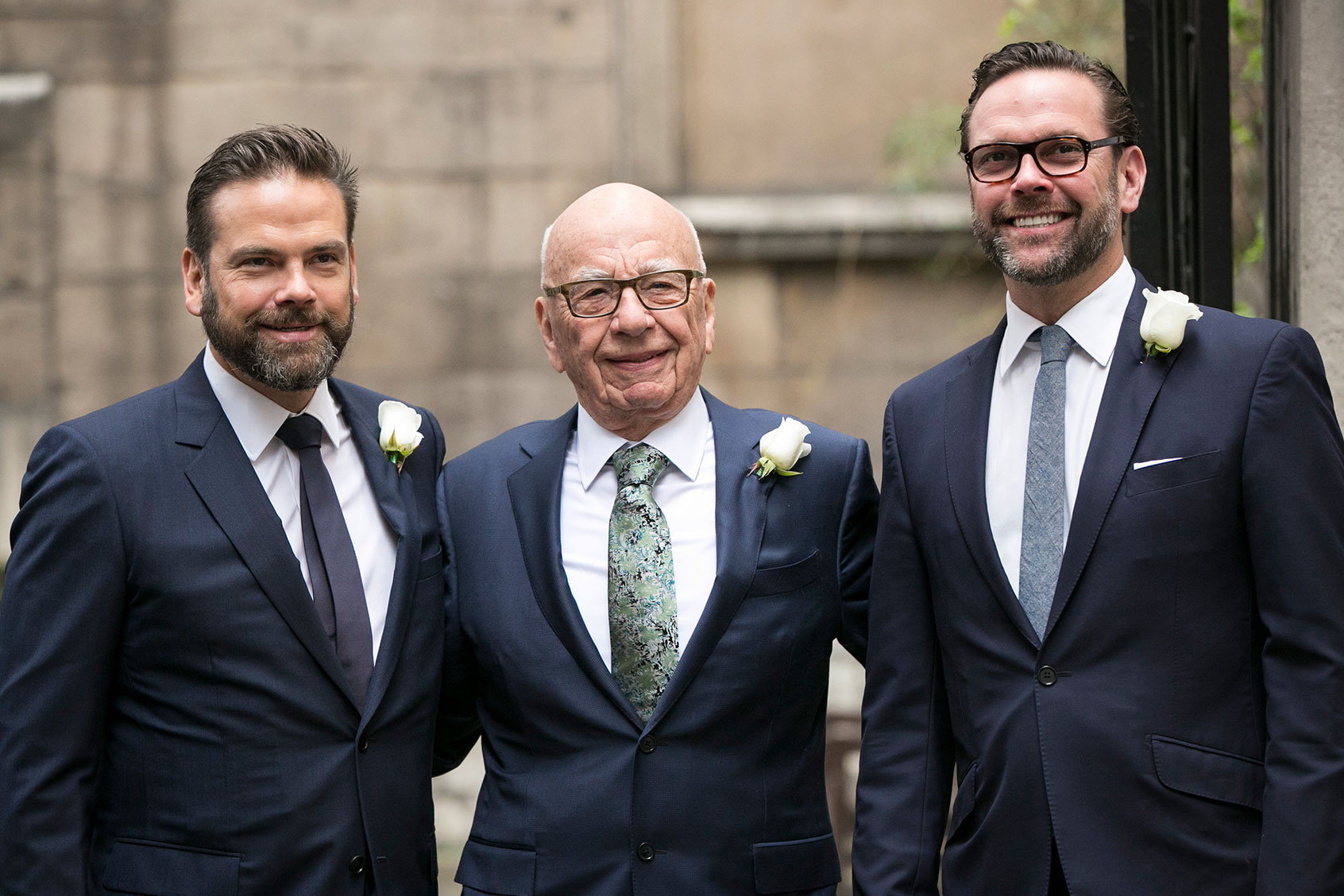
Rupert Murdoch; James Murdoch; Lachlan MurdochRupert Murdoch accompanied by his sons James (right) and Lachlan (left) on March 5, 2016 in London, England. (John Phillips/Getty Images)

“The Murdochs” is two stories presented in tandem, as Mahler explains. The first covers the rise and dominance of Rupert Murdoch, media mogul. The second is the story of Murdoch as a father.

It opens with the near-death incident in 2018 that kicks the question of who will inherit the kingdom into overdrive, before stepping back to examine Rupert’s misshapen youth as the privileged son of a distant father he could never please. When Rupert realizes his parents’ modest media kingdom will not pass to him, he makes it his life’s mission to overshadow what dad built.

Murdoch’s steady empire expansion is common knowledge to those who care to know about such things. But “The Murdochs” excels at filling in the story’s emotional and psychological blanks, which is where the juice is. For a family that willingly gives away very little about themselves to the public, there’s a lot to be read in the moves Lachlan, James and Elisabeth make – and their father’s regular efforts to play them off of one another as a sort of Darwinist test of fitness.

But the relationship between Rupert and his children is even stranger than that of their fictional counterparts because, by all accounts, he does seem to care about them. It’s just that he cares about his empire even more.

Such grace notes of universal acknowledgment allow the viewer to find some way of respecting the tenacity fueling Murdoch’s monstrous nature.

“The Murdochs” is even-handed in its examination, to the point that it enables a person to absorb insights from truly odious people with equanimity. Stone, for instance, has nothing but respect and admiration for Murdoch, of course. But that’s presented within a mix of folks who concede being impressed by the bold ruthless of Murdoch’s business acumen even if they disagree with or despise how he plays the game. That is to say, knowing what we know about Stone, if he admires the man, the show helps us to get why.

Such grace notes of universal acknowledgment allow the viewer to find some way of respecting the tenacity fueling Murdoch’s monstrous nature. The story of an early kidnapping gone awry that led to a woman’s death opens our eyes to the family’s vulnerability before their paterfamilias built the fortress around them; they are human, after all.

And yet, the head of this family also pushed thousands of journalists out of their jobs in one fell swoop to appease a prime minister, Margaret Thatcher, who was not friendly to unions or labor organizing. This is merely one of the many obscenities Murdoch is blamed for orchestrating. The later episodes cover the one we know best and are still struggling to shake off – which is Donald Trump’s kingmaking. 

“The Murdochs” stands on its own merits owing to its double-fisted servings of media insight on one hand and juicy biographical examination on the other. It is nimble and surefooted, illuminating, and above all, entertaining.

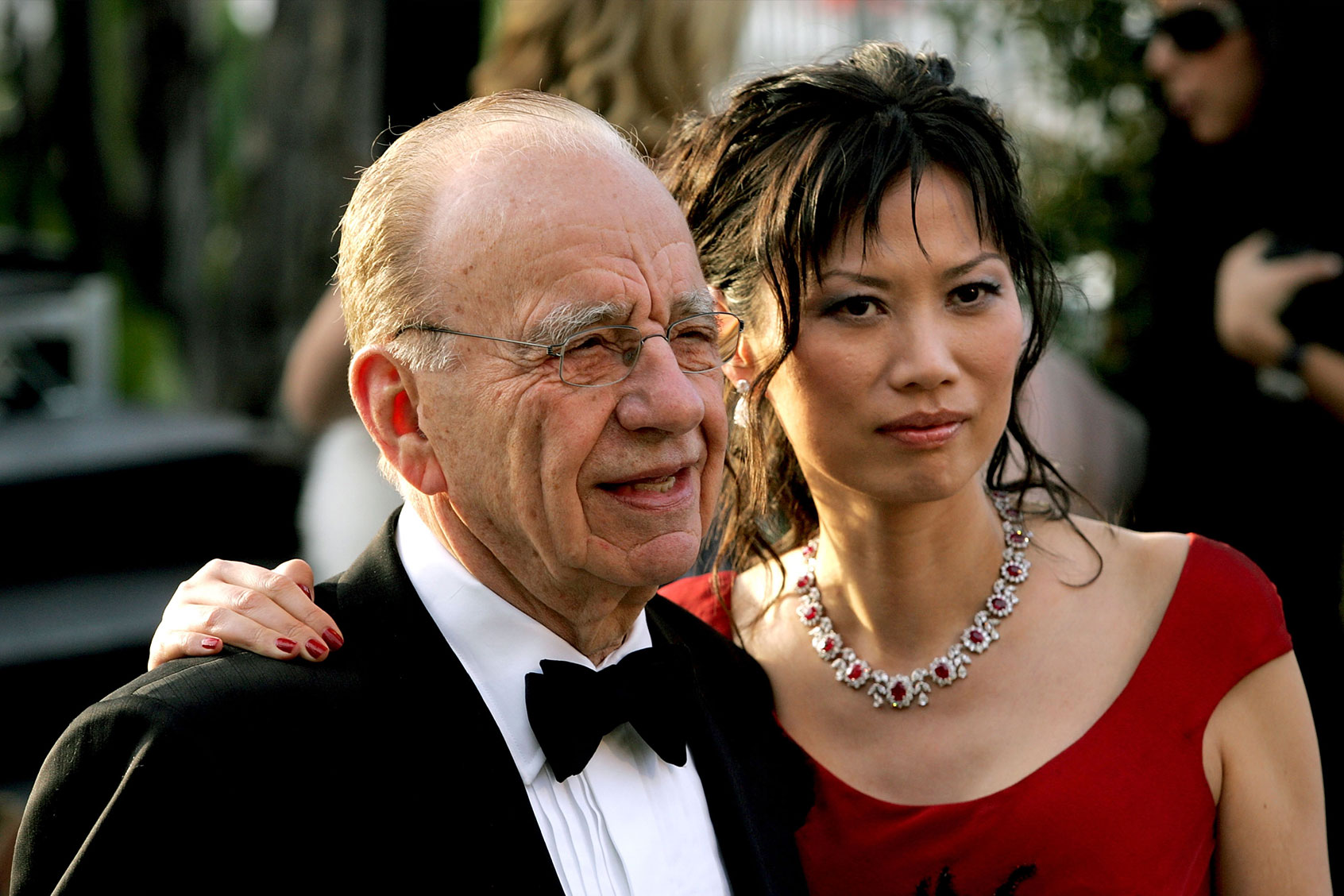
Rupert Murdoch and wife Wendy DengRupert Murdoch and wife Wendy Deng on February 27, 2005 in West Hollywood, California. (Mark Mainz/Getty Images)

Along with puzzling through what drives Lachlan, James and Elisabeth, we’re also invited to contemplate what Anna did for Murdoch’s ego – and why that well ran dry by the time he met Wendi Deng, whom he married in 1999. They divorced in 2013, only for Murdoch to marry Jerry Hall in 2016. And she finalized her divorce from him last month.

Nobody in the family agreed to participate in the making of the series, but the producers make an extensive effort to help us understand who Rupert Murdoch is and what spurs him onward. 

By extension, we also come to understand why entities like Fox News and Murdoch’s newspapers are so devoted to catering to the darkest side of the human impulse – stirring up our fears and our hatreds, and steering governments into division and ruin. It’s all in service of his empire’s bottom line and the interests of his constituency, which consists of . . . him.


Want a daily wrap-up of all the news and commentary Salon has to offer? Subscribe to our morning newsletter, Crash Course.


Most documentary filmmakers are quick to point out that whatever parallels the audience finds in their work and current events are coincidental. In most cases that’s true. Ken Burns’ recent effort, “The U.S. and the Holocaust” points directly at the similarities between the nativist atmosphere in America and Germany before World War II and the anxieties that have gripped us since Jan. 6, 2021. Even so, he says, he and his co-producers began working on that project in 2015.

Debuting “The Murdochs” six weeks out from the midterms, though, is a choice. It won’t impact the outcome of any races – nothing like that. But if CNN wants to make a vaguely admiring point about its rival as it lurches rightward to score some of its audience, this is a savvy way to do it.

“The Murdochs: Empire of Influence” launches with a special two-episode premiere at 9 p.m. and 10 p.m. Sunday, Sept. 25 on CNN. Subsequent episode air at 10 p.m. Sundays on CNN.

Back-to-school season brings sleep deprivation

With the school year underway around the U.S., parents and caregivers are once again faced with the age-old struggle of wrangling groggy kids out of bed in the morning. For parents of preteens and teenagers, it can be particularly challenging.

Sometimes this gets chalked up to laziness in teens. But the main reason why a healthy person is unable to naturally wake up without an alarm is that they are not getting the sleep their brain and body need.

That’s because studies show that adolescents need more than nine hours of daily sleep to be physically and mentally healthy.

But the likelihood that you know a teenager who gets enough sleep is rather slim. In the U.S., less than 30% of high school students — or those in grades 9 through 12 — sleep the recommended amount, according to the Centers for Disease Control and Prevention. Among middle schoolers in grades 6-8, nearly 60% do not get enough sleep at night.

Yet my laboratory’s research suggests that a much higher percentage of teens are getting too little sleep.

I am a professor of biology and have been studying sleep and circadian rhythms for more than 30 years. For the past seven years, my laboratory at the University of Washington has been doing research on sleep in Seattle-area teenagers. Our research has found that, just as in other areas of the U.S., high schoolers in Seattle are not getting the amount of sleep they need. Our study objectively measured sleep in 182 high school sophomores and seniors and found only two that slept at least nine hours at night during school days.

Our studies and those of others indicate that three important factors lie behind this lack-of-sleep epidemic: a physiological regulation of sleep that leads to a delayed sleep timing in teens and that is not aligned with early school start times, a lack of morning exposure to daylight and excessive exposure to bright electric light and screens late in the evening.

Teen sleep biology

The time people go to bed, fall asleep and wake up is governed by two main factors in the brain. The first is a so-called “wakefulness tracker,” a physiological timer that increases our need to sleep the longer we stay awake. This is in part the consequence of the accumulation of chemical signals released by neurons, such as adenosine.

Adenosine accumulates in the brain when we are awake, leading to increased sleepiness as the day wears on. If, for instance, a person wakes up at 7 a.m., these chemical signals will accumulate throughout the day until the levels are high enough that the person will fall asleep, typically in the late evening.

The second factor that drives the sleep/wake cycle is a 24-hour biological clock that tells our brain what times of the day we should be awake and what times we should be sleeping. This biological clock is located in an area of the brain called the hypothalamus. The clock is composed of neurons that coordinate the brain areas regulating sleep and wakefulness to a 24-hour sleep/wake cycle.

These two regulators operate with relative independence from each other. But under typical conditions, they are coordinated so that a person with access to electric-powered light would fall asleep in the late evening – between about 10 p.m. to 11 p.m., and wake up in the early morning, around 6 a.m. to 7 a.m.

So why do teenagers often want to go to bed later and wake up later than their parents?

It turns out that during adolescence, both the wakefulness tracker and the biological clock conspire to delay the timing of sleep. First, adolescents can be awake until later hours before their wakefulness tracker makes them feel sleepy enough to fall sleep.

Second, the biological clock of teenagers is delayed because in some cases it appears to run at a slower pace, and because it responds differently to light cues that reset the clock daily. This combination leads to a sleep cycle that operates a couple of hours later than in an older adult – if an older adult feels the signals to fall asleep around 10 p.m. or 11 p.m., this won’t happen until midnight or later in a teenager.

Sufficient sleep is key to teen health, but many things prevent adolescents from getting enough of it.

How school start times contribute

To help find more hours of sleep for teens, one measure that some school districts around the country have taken is to delay the school start time for middle schools and high schools. The American Academy of Pediatrics recommends that schools for this age group should not start before 8:30 a.m.. Yet the majority of high schools in the U.S start at 8 a.m. or earlier.

Based on the recommendation of sleep experts, the Seattle school district, beginning with the 2016-2017 school year, delayed middle school and high school start times by nearly an hour, from 7:50 a.m. to 8:45 a.m. In a study our team conducted after the district enacted the plan, we found that students gained 34 minutes of daily sleep — a huge gain by sleep medicine standards. In addition, student attendance and punctuality improved, and median grades went up by 4.5%.

Despite an abundance of research evidence and the advice from virtually all sleep experts in the country, most school districts are still stuck with school start times that promote chronic sleep deprivation in teenagers. The early school starts are further aggravated by daylight saving time — when clocks are set one hour ahead in the springtime. This time shift — one that could become permanent in the U.S. in 2023 — exposes teenagers to artificially dark mornings, which exacerbates their naturally delayed sleep timing.

Teaching healthy sleep habits to teens

School start times aside, kids also need to learn the importance of healthy habits that promote sufficient sleep.

Getting bright daylight exposure, particularly during the morning, pushes our biological clock to an earlier time. This, in turn, will promote an earlier bedtime and a natural early morning wake time.

In contrast, light in the evening — including the light emitted by screens — is highly stimulating to the brain. It inhibits the production of natural signals such as melatonin, a hormone that is produced by the brain’s pineal gland as the night arrives and in response to darkness. But when these cues are inhibited by artificial light in the evening, our biological clocks are delayed, promoting a later bedtime and a later morning wake time. And thus the cycle of having to roust a sleepy, yawning teenager from bed for school begins again.

Yet few schools teach the importance of good daily routines and sleep timing, and parents and teens also do not fully appreciate their importance. Chronic sleep deprivation disrupts every physiological process in the body and has been consistently linked to disease, including depression and anxiety, obesity and addictive behavior.

Conversely, sufficient sleep not only helps to reduce physical ailments and improve mental health, but it has also been shown to be fundamental for optimal physical and mental performance.


Horacio de la Iglesia, Professor of Biology, University of Washington

This article is republished from The Conversation under a Creative Commons license. Read the original article.

An animal tranquilizer poisoning the heroin supply has drug policy experts worried

A tranquilizer used for animals is appearing more frequently in street drugs across North America, alarming drug policy experts and harm reduction advocates alike. Xylazine may sound like the name of a “Star Trek” character, but it’s actually a muscle relaxer widely used in veterinary medicine – and it’s causing big problems across the continent.

Xylazine has found its way into what used to be the U.S. heroin supply but is now almost entirely illicit fentanyl, a powerful opioid that can be 100 times more potent than morphine. Xylazine is not an opioid, but it can knock a user out for longer than most opioids – about six to eight hours – thus playing a growing role in drug overdose deaths, according to experts.

When injected, the mixture of xylazine and fentanyl, sometimes called “tranq dope,” can also produce grisly injuries, such as lesions or open skin ulcers. Because they can be extremely painful, some individuals who use drugs will continue to inject into these open sores and wounds for relief. However, that can make things worse, causing the wounds to necrotize, or essentially rot on the body, often requiring amputation. Sometimes, it can even result in death.

Unfortunately, experts aren’t entirely sure why xylazine seems to be causing these injuries, which also has made them difficult to prevent. Worse, there aren’t good drugs for reversing a xylazine overdose. With fentanyl, it’s at least possible to stop a deadly overdose using naloxone, a drug that replaces any substances clogging opioid receptors in the brain. With xylazine, naloxone seems to have little effect, though it should still be administered as a precaution, experts advise.

“The harms of xylazine are compounded when it is used in combination with other central nervous system depressants like alcohol, benzodiazepines and opioids (like fentanyl or heroin), which can increase the risk of fatal overdose,” Dr. Nora Volkow, the director of the National Institute on Drug Abuse, told Salon in an email. “Xylazine is one component of the severe current overdose epidemic, and we must work to make treatment for substance use disorders cheaper and easier to obtain than illicit drugs.”

Xylazine is approved for use in animals — it’s particularly useful for getting cats to vomit — but because it can lower blood pressure and heart rate, the U.S. Food and Drug Administration hasn’t approved the drug for use in humans. This is the first time that Claire Zagorski, a licensed paramedic, program coordinator and harm reduction instructor for the PhARM Program at the University of Texas, has seen a veterinary drug diverted into human use in such a manner. 

“The lingering health effects are worse than any acute overdose effects,” Zagorski told Salon. “The really nasty wounds are truly the worst that I’ve seen. I’m getting a lot of reports of people that are having rhabdomyolysis, [which is] really bad kidney injury from muscle breakdown and nerve damage. I’ve had people that have lost a leg because they’re nodding out on a stoop or something, bent way over with their head in between their knees for like 20 hours. [Xylazine] also f**ks with blood sugar and causes anemia — and we don’t know why.”

“No one knows what this is,” she added. “There are no experts in xylazine use in humans. There isn’t a single goddamn one.”

Some people appear to like xylazine because of the way it interacts with opioids, potentiating the high. Unlike heroin, which has “legs,” fentanyl can be short-acting, requiring multiple doses throughout the day. While Xylazine can stretch out the high, many injection drug users aren’t seeking it out due to the risks. Instead, they’re accidentally ingesting it.


Want more health and science stories in your inbox? Subscribe to Salon’s weekly newsletter The Vulgar Scientist.


It’s not clear why it keeps appearing, but illicit xylazine use isn’t entirely new. As far as anyone can tell, the intentional use of xylazine first became widespread in Puerto Rico in the early 2000s, where it is known as “anestesia de caballo,” or horse anesthesia.

For many years, a program has existed called Air Bridge, in which some Puerto Ricans who use drugs are lured to Philadelphia under the false promise of addiction treatment. Instead of entering a posh rehab, these victims are often extorted by those running the programs designed to help them while being subjected to emotional and physical abuse.

“People who are basically sent here under this false promise of getting ‘help,’ and then stuck here with no resources,” Dr. Megan Reed, an assistant professor in the Department of Emergency Medicine at Thomas Jefferson University in Philadelphia, told Salon. “I think anytime you bring people over, culturally, people’s preferences are also going to be brought over.”

This crossover may explain why xylazine was detected in street drugs in Philadelphia before most other U.S. cities. Between 2010 and 2015, xylazine was detected in less than 2% of cases of fatal opioid overdoses in the Pennsylvania city. By 2019, that number had risen to 31%. Last year, when the Philadelphia Department of Public Health analyzed samples of fentanyl sold on the street, it found that 91% contained xylazine, making it the most common adulterant in the local drug supply.

But now xylazine is appearing in drugs in far more cities across North America, including regions in California, Colorado, Connecticut, Illinois, Massachusetts, New York, North Carolina and British Columbia, Canada.

“I see tons of xylazine, from all over the country,” Dr. Nabarun Dasgupta, a pharmaceutical scientist at the University of Carolina at Chapel Hill, told Salon.

Dasgupta’s work includes running a drug-checking service that uses analytical chemistry to detect the ingredients in street drugs. Samples are mailed to Dasgupta from across the country, which he and his team run through a gas chromatography-mass spectrometer, providing a window into the contaminates that individuals who use drugs unwittingly consume.

“The bottom line is the drug supply is so f**ked right now . . . It’s a really dangerous time to be doing unregulated drugs.”

“The bottom line is the drug supply is so f**ked right now,” Dasgupta said. “There’s no consistency, and things are changing. So, it’s a really dangerous time to be doing unregulated drugs.”

As part of her research into overdose prevention, Reed began interviewing a group of people who had overdosed on crack cocaine. She asked if they would be willing to use fentanyl test strips on their stimulants, which are tiny sticks of paper that can detect if the illicit opioid is present. The strips can help people who use drugs make informed, consensual decisions about their drug use. The individuals interviewed by Reed spontaneously started to ask about test strips for xylazine.

“The concern that they expressed most often was about the heavy sedating effect of xylazine and not liking it,” Reed said. “One thing that I haven’t really heard talked about is the risks for women who use drugs and being heavily sedated for a long period of time, who might be vulnerable to being victimized and robbed when they’re sedated.”

After being asked about xylazine test strips, Reed in turn began to ask more people if they would use them. While her sample size was only 13, all of the individuals were interested, according to her analysis, which was published this month in Drug and Alcohol Dependence Reports.

Another study published earlier this year in Clinical Toxicology that reviewed dozens of reports of xylazine poisoning concluded: “The development of a real-time detection test would greatly improve the prevention, diagnosis, management and/or outcomes of patients with accidental or intentional xylazine ingestion.”

But such a product doesn’t currently exist, and according to Volkow, it’s not clear if one is even being developed. There isn’t a way to tell if xylazine is contaminating illicit substances outside of services like those offered by Dasgupta, which aren’t widespread despite their utility in reducing overdose harms.

Part of the reason for xylazine’s growing presence could be that the drug isn’t scheduled under the Controlled Substances Act, meaning the tranquilizer is far less regulated than most pharmaceuticals. The U.S. Drug Enforcement Administration (DEA), which is responsible for scheduling substances under federal law, declined to comment for this story.

“Because xylazine is not a controlled substance, its regulation does not fall under the purview of DEA.”

“Because xylazine is not a controlled substance, its regulation does not fall under the purview of DEA,” a spokesperson said via email.

Aside from releasing a one-page factsheet in February 2021, the DEA doesn’t seem to have done much else to warn the public about xylazine. It has, however, sounded the alarm about “rainbow fentanyl” being marketed to children (though it has yet to produce hard evidence of such).

Of course, even if xylazine were to be scheduled, it’s far from guaranteed that it would disappear from the streets. After all, illicit cocaine, fentanyl and methamphetamine are all readily available, as indicated by the ever-rising tide of overdose deaths in the U.S.

“Frustratingly, there’s a whole class of drugs that are related to xylazine that could be pivoted to if xylazine gets a crackdown,” Zagorski said. “There’s a whole bunch that are all used as sedatives in the veterinary side. So, we’ll see what comes up next.”

In the meantime, experts are still trying to figure out the best way to respond to a growing crisis. There are a few ways people who use drugs can reduce the harms associated with xylazine.

“Because of the sedating effects of xylazine and drug mixtures containing xylazine, individuals should never use drugs alone and should start with small doses and use slowly,” Volkow said. “Always carry naloxone in case of overdose (opioids may knowingly or unknowingly be present in the drugs an individual is using). If available in your area, have your drugs tested for xylazine at a harm reduction organization.”

According to Volkow, the grisly injuries associated with xylazine can quickly become serious health problems.

“Monitor injection sites or other wounds and get prompt medical care for abscesses or skin ulcers,” she advised. “Many harm reduction programs offer wound care kits as well.”

If you suspect someone is overdosing on xylazine, giving them naloxone is recommended, as opioids are also likely to be present. Furthermore, there’s some evidence that naloxone can reverse a xylazine overdose, even though xylazine largely acts on different receptors in the body than opioids.

Naloxone can reverse a clonidine overdose, and xylazine is an analog of clonidine, meaning they share some of the same features. It seems, however, that higher doses of naloxone may be required to work on xylazine, which complicates matters. Naloxone is so powerful that using it can send someone with opioid dependence into immediate withdrawal, which can be deeply uncomfortable. 

A higher dose of naloxone may reverse a xylazine overdose, but that means greater withdrawal symptoms, which can encourage riskier drug use. “When they do wake up, they’re going to be in such severe withdrawal that they’re going to go use in a way that’s putting them at higher risk for overdosing again,” Reed explained.

“What we need is legislation passed to make it explicitly legal for people to do drug checking work, and we need the federal government to endorse overdose prevention sites,” Reed added. “Because if somebody is using xylazine in an overdose prevention site, then they have a safe place to be while they’re sedated. Like we always say, never use alone. If we had overdose prevention centers, that would at least be another option for somebody to go into.”

Reed also called for more research, as did Zagorski.

“We need people on labs sorting out why this is happening – and that takes years” Zagorski said. “By the time we have answers, xylazine probably won’t be an issue anymore. So, we’re just in a situation where the process of learning and discovery is too out of step with what is actually happening on the ground.”

Can the California plastics law solve our plastic problem?

“Approximately 40% of all plastics created right now are single-use plastic,” says Megan J. Wolff, Ph.D., M.P.H, Policy Director at Beyond Plastics. “They’re basically instant trash.”  The impacts of this are felt widely, polluting not just our streets, but our waterways and soils. Thanks to a law in California signed by Gov. Gavin Newsom this past June, there could be much less plastic waste in California within a decade, serving as a potential pilot for this legislation being enacted elsewhere.

The landmark legislation requires that all packaging in the state be compostable or recyclable by 2032, and sets guidelines for increasing the levels of recycling of plastic packaging in the state by the same year. By signing SB 54 into law, Newsom seeks to hold polluters responsible, shifting the burden of responsibility for plastic pollution from consumers to the plastics industry. This will be achieved by raising $5 billion from industry members over a 10-year period, funding efforts to cut plastic pollution and support the communities most affected by it. The Plastic Pollution Prevention and Packaging Producer Responsibility Act asks producers of covered material to form and join a Producer Responsibility Organization (PRO) by January 2024. These PROs will collect fees from the member producers, and will work to ensure compliance with the requirements. PRO participants are asked to reduce the amount of plastic packaging by 25% by 2032. This might be achieved by measures such as lightweighting or shifting to an alternative material.

Matt Prindiville, CEO of the nonprofit Upstream, has been working to promote this idea of Extended Producer Responsibility (EPR) for more than 20 years. Naturally, he’s pleased to see the focus on this in the California law, but he points out that increasing recycling rates won’t necessarily diminish the consumption of natural resources for some industries. For this reason, he is adamant that EPR needs to be a vehicle for creating a circular economy for packaging, and sees the California law as a step towards reusables. “It’s the first time in the United States that we have reuse targets enshrined in law,” he says. “There is a provision in the bill that requires a certain amount of the plastic substitution to be done through reusable packaging systems and reusable foodware systems. And so that’s super exciting.”

The problems with recycling

One problem that currently persists, Wolff says, is the flawed plastics recycling system. “It was never designed to work,” says Wolff. “It was designed to allay the fears of consumers.” Many of us tend to feel good about recycling, and the avoidance of plastic altogether could feel less urgent to us if we believe it’s being used again.

It’s not an accident that many of us feel responsible for plastic waste. Ad campaigns have long focused on shifting blame for plastic pollution to the public, instead of the companies that produce the plastic products that become waste. But as a consumer, it’s nearly impossible to avoid consuming any plastic, and no matter how diligently we attempt to dispose of our plastic waste, much of it will end up in landfill. Wolff points out that even plastics that are recyclable in theory are often too contaminated to be recycled, and that across the country, different facilities have their own rules about and capabilities for what can and cannot be recycled, which confuses well intentioned recyclers.

For these reasons, even items that we place in recycling bins could still ultimately end up in the trash. And given the fact that in many cases, it’s less expensive to manufacture brand new plastics than to recycle old plastics into new products, it’s hard to get companies onboard with displacing virgin production.

The EPR focus of the new law will be paramount in addressing this long-standing issue. But the legislation aimed at producers is not the only tactic at play to reduce plastic waste in California. For example, in LA County unincorporated areas, restaurants are being asked to reduce their plastic usage.

Shifting away from plastic

The LA County ordinance will take effect from May 2023 for eateries with permanent locations, and requires that single-use cutlery and containers be recyclable or compostable. It’s a move that reinforces the trend towards plastic reduction in the state, following bans of single-use plastic in Marin County and other Bay Area communities. It’s not just California that is making these moves. In the past decade there have been other legislative efforts to reduce plastic, such as in New York City, where establishments were prohibited from distributing single-use plastic straws unless specifically requested by the customer.

COVID-19 had the unfortunate consequence of slowing down the move away from single-use plastics. In some cases, single-use plastic bag bans were suspended due to COVID concerns, and when dining outside of food establishments became the norm because of lockdown measures, the use of plastic to-go containers surged. “We knew that the plastics industry was going to make hay with COVID, and they very much did,” Wolff says. She wanted to focus on finding ways to inspire restaurants in particular to play their part in tackling this issue, and she recently authored a guide aimed at the restaurant industry. It is focused on how establishments can cut back their use of plastic, and contains practical advice that helps restaurants explore strategies for reducing plastic waste, with tips on auditing, getting team members onboard with the initiative and honing messaging to customers.

Reducing the amount of plastic used in packaging or replacing plastic with more eco-friendly alternatives will be a huge improvement, but many of those products come with some of their own environmental problems and may still butt up against the limitations of our flawed recycling and composting systems. One popular avenue for replacing plastic takeout containers is using biodegradable cardboard ones instead. But as Wolff’s guide points out, containers that are compostable often can’t be composted in a backyard composter. Instead, they must be processed in an industrial facility, with a high enough temperature to break down the product. For communities that don’t have composters located locally, even compostable packaging could end up in landfill. Worse still, some so-called compostables have a greaseproof barrier containing PFAS. These ‘forever chemicals’ are responsible for preventing containers from becoming soggy from contact with moist and hot foods, but are linked to health problems, and have no place in a compost heap.

For these reasons and more, Wolff, like Prindiville, ultimately advocates for reusables over disposable alternatives to plastic.

Towards the reuse economy

Wolff points out that building systems to keep more of our materials in rotational use is what we need to do, if we truly want to solve the problem of plastic overproduction. In her guide, she highlights some companies that are focusing on providing reusable containers to restaurants. Once returned by the customer — either to the establishment where they purchased the food or placed in a designated drop container in the area — the container is collected by the provider, cleaned and then returned to the restaurant for reuse. Wolff claims that it could be far more cost-effective for restaurants in the long term. “The difficulty is for the individual restaurants to take on the risk of implementing that system,” she says, pointing out that for many eateries, it could feel like taking a big financial risk.

Prindiville calls it a chicken and egg problem: there are restaurants that want to do the right thing but can’t do it alone. While some restaurants and larger chains will be able to implement their own reusable serviceware schemes, many will be too small to shoulder the cost of the logistics. “In order for us to do reuse at scale, we have to have infrastructure,” Prindiville says.

The key to real change, according to Upstream, is remaking packaging as a service, instead of a product. In other words, instead of making the goal higher recycling rates, it should be to reduce the volume of resources we are taking from the planet in the first place. “We do that by prioritizing waste reduction and reuse ahead of recycling,” Prindiville says. He points out that even if plastic could be severely reduced or eliminated, production of alternatives still consumes excessive resources and harms the planet in many cases. “One out of every 10 trees that’s cut down in the world goes to make packaging,” Prindiville says. Plus, one fifth of aluminum mined and half of all glass produced goes primarily to make packaging for consumable products. “If we can start to reduce the demand and need for all of that single-use packaging through reuse, you’re going to start to see those numbers come down,” Prindiville adds.

For these reasons, while laws like California’s targeting plastic are a step in the right direction, these types of shifts will not be enough to tackle the problem of excessive consumption of our planet’s resources that has been going on for many years. Both Prindiville and Wolff emphasize the ultimate need to move towards finding ways to keep more of our materials in rotational use. “Plastic pollution is a symptom of a broken system,” says Prindiville. “It is not the heart of the problem.”

Jan. 6 “Truth Rally” failed to draw a crowd

Supporters of Donald Trump failed to draw a crowd for a Saturday rally seeking to rewrite Donald Trump’s coup attempt ahead of Wednesday’s hearing by the House Select Committee Investigating the Jan. 6 Attack on the U.S. Capitol.

Forbes used the headline, “Pro-Trump ‘Truth’ Rally Fizzles—Draws Nearly As Many Counter-Protesters.” The Daily Beast headline was “Jan. 6 ‘Truth’ Rally at Capitol Fails Spectacularly.”

“When the far-right blog The Gateway Pundit said a Jan. 6 Capitol rioter rally on Saturday afternoon would be the ‘biggest to date,’ crowds were expected. But instead of big crowds, the “Truth Rally” attracted around the same number of counter-protesters as rally attendees—a few dozen, at best,” Zachary Petrizzo reported for The Beast.

One counter-protester shouted, “Trump is a loser, a little baby loser.”

NBC News reporter Ben Collins also covered the rally.

He said the “loudest applause line today at this 1/6 Truth Rally was for a woman giving the URL for a site where you can buy ‘Abolish the FBI’ tee shirts.”

“Nobody at this January 6th Truth Rally has really settled on if the rioters are proud of it, if they didn’t do it, or if they did it and it was a setup. The theme is basically: There was no insurrection on January 6th, and we’d do it again,” Collins reported.

How to read the midterm campaign ads: Dystopian darkness vs. heartwarming biopic

Control of the House and Senate is in play in this year’s midterm elections, with many races too close to call. Stakes seem higher because, according to FiveThirtyEight, 60 percent of American voters will have an election denier on the ballot this fall. Campaign ads, in many cases, shape these races and may determine the outcomes: It’s estimated that $9 billion will go into the production and distribution of the 2022 midterm ads. 

Gaining a bird’s-eye view of all this political advertising can be difficult. Only a small proportion of campaign ads are posted on YouTube, and the sheer number of races makes it prohibitive to follow each candidate’s website and social media. The company Ad Impact, which records and quickly uploads all ads screened on television and streaming services, lent me access to their database, and I was also able to interview staff at advertising firms like Middle Seat, Authentic and Kantar. This article is meant to provide a way of thinking about the ads — about their generic traits and stylistic shifts, as well as a grounding in the clips that particularly stand out. 

My research focuses on audiovisual aesthetics in brief media, like music video, TikTok and post-classical film sequences. (You can find links to my books in the author blurb below.) I think of political ads as a sibling to those things. My ways of looking at ads are shaped by these other genres.  Over the years, music and image have become more closely intertwined — blockbuster cinema, commercials and music videos, among others, have played a role. Many politically-based clips are audio-visually intensified.

The 2022 campaign ads participate in several genres, but almost all fall into two larger bins. The first bin includes clips intended to induce anxiety and fear. Republicans deploy this aesthetic more than Democrats, and they do so to message about immigrationcrime and taxes. Neuroscientists have found that a proportion of the population is more respectful of hierarchy and more fearful of contagion, and that this population tends to correlate with conservative Republicans. 

These ads’ audiovisual aesthetics seek to persuade viewers through desaturated colors, especially wan blues and grays. Often the image has been textured to reduce information, and perhaps to resemble a television screen. These techniques, along with depictions of Democrats as dehumanized, grimacing cutouts, create greater distance between viewers and candidates. Fractured fonts suggest that dissolution has infiltrated everywhere. The text is usually alarmist — e.g., “chaos in the streets.” 

The second main bin is the biopic. The candidate, or the person speaking for her, might note that she was born and raised in the voter’s district. Her parents may have struggled making ends meet managing a hardware store while she waited tables at a local diner. She, a family member or friend may have experienced disability, serious illness or a death in the family. The candidate has known hardship and may directly claim that she understands you, and that you can count on her to create a better future. These biopics, as well as the fear-inducing ones, often end with a turn to more hopeful imagery: an open window or a door, factory lights turning on, or the candidate and constituent together outside in the sun.

Campaign Ads - GunsCampaign ads for Eric Greitens (T), Jerone Davison (L) and Cory Mills (R) (Salon/Twitter/@EricGreitens/@Jerone4Congress/YouTube/Cory Mills)

Overall, the Republican ads this cycle seem blunter and more forceful than Democratic ads. They often feature white men, occasionally women, and only rarely a person of color. The males are often assertive and beefed up, wielding guns and stand by their trucks or tractors. Hundreds of ads during this 2022 cycle featured guns. The points made are staccato and simple — pro-gun, pro-wall, pro-life, anti-establishment media, anti-inflation, anti-socialism. They target an “other” (immigrants, the “Squad,” alleged supporters of “critical race theory”). Images of civil unrest are almost always drawn from the Black Lives Matter protests of 2020 rather than the Capitol attack of Jan. 6, 2021, with no mention of the latter. 

Republican ads often star assertive and beefed-up white men, wielding guns and standing by their trucks or tractors. Hundreds of ads this year have featured guns.

By contrast, Democrats’ commercials may probe a single issue, like abortion or health care costs. Democratic claims seem easier to make nationally. Here’s an ad for Joe Biden’s Inflation Reduction Act.

Exactly what role is played by auxiliary media content surrounding the ads remains an unstudied subject: Think of Pennsylvania GOP candidate Dr. Mehmet Oz’s gaffe with “crudités,” the revelation of Georgia candidate Herschel Walker’s domestic violence issues or his uncertainty about how many biological children he has. Or Arizona Republican candidate Blake Masters, who dressed in faux-Native American face paint as a college student, while rapping that no one needs to care about his cultural appropriations.


Want a daily wrap-up of all the news and commentary Salon has to offer? Subscribe to our morning newsletter, Crash Course.


Campaign ads also make use of popular media like TikTok and classic Hollywood films to create a viral buzz that encourages campaign contributions nationally. (Pennsylvania Democrat John Fetterman has relentlessly tried to capitalize on Dr. Oz’s gaffe). Linda Paulson, a Republican state Senate candidate in Utah, is circulating a TikTok rap number. With similar aims, Florida Gov. Ron DeSantis produced a spoof on “Top Gun,” while defeated Arizona GOP House candidate Jerone Davison’s ad played on the history of “blaxploitation” films and D.W. Griffith’s notorious “Birth of a Nation.” An ad attacking Nevada Republican Senate candidate Adam Laxalt — whose grandfather was a famous political figure in the state — plays off the HBO series “Succession.”

A GOP state Senate candidate in Utah made a TikTok rap video. Ron DeSantis produced a “Top Gun” spoof, while defeated Arizona GOP candidate Jerone Davison played on “blaxploitation” films.

Several industry practitioners have noted that the camera doesn’t love all candidates equally; rapport with the camera can’t be faked. In this ad for Alabama GOP Senate nominee Katie Britt, her clothing, along with the foliage and landscape surrounding her are all a verdant green. She then mentions the wire grass of Alabama, to connect text and visuals. This, along with the photo of children seated side by side on a bench, seem to prepare for the image of Britt sitting in a church pew in church with her Bible (certainly a crucial set of signifiers in the South). She gestures effectively, underscoring several words in rhythmic fashion while warmly addressing the camera. Her Facebook page is similarly inviting.

Moving to the other side of the aisle, the images in this ad for Wisconsin Democratic Senate nominee Mandela Barnes are also lovely: the welcoming door, the calf, the young girl’s face. There’s little explicit political content in this ad, but viewers are clearly meant to believe that Barnes is a gentle, caring person.

In this cycle, many Republicans have presented a kind of toughness and even overt aggression. This includes prominent candidates such as Ron DeSantis, Brian Kemp, Kari Lake and Blake Masters, often taking a strong stance against gun restrictions. The Black Democrats, such as Georgia gubernatorial candidate Stacey Abrams, Kentucky U.S. Senate candidate Charles Booker and Sen. Raphael Warnock of Georgia, like Barnes, present themselves as calm, warm, centered and caring. Does this tell us something larger about America as a nation?

Campaign Ads - ContextCampaign ads by One Nation (L-R) and NRCC (T) (Salon/One Nation/NRCC/Lisa Scheller)

Many 2022 campaign ads might be described as thin. This ad attacking Warnock, the Democratic incumbent in Georgia, leaves out important context. As is common with major across-the-aisle legislation, the Inflation Reduction Act allocates funds for representatives to distribute to constituents within individual locales. The viewer’s district probably got some money too. Warnock is paired with a Nevada ski slope and a Florida resort, while Ohio Democratic Senate candidate Tim Ryan is linked to a Connecticut poet and a French opera performed in Washington, D.C. Might the latter have been funded by the National Endowment of the Arts, which takes up a minuscule amount of the government’s budget? Do these ads reflect racial biases? Why wasn’t Warnock paired with opera? This ad was a template created by the One Nation super PAC to be screened across six states for six different candidates.

Many Republican ads are clearly generated at the national level and adopt a cookie-cutter approach: Marching IRS agents who resemble Agent Smith of “The Matrix,” a tattooed immigrant, a gas pump’s rising digital numbers.

Here’s another: “Inflation is killing us, and it’s Joe Biden’s fault.” Anyone who’s carefully following the news would know that we’re still in a pandemic and there are still global supply-chain problems, as well as a war in Ukraine and worsening global climate change. Most people with some education in economics know that controlling inflation without causing recession is difficult. These economic shifts manifest slowly and can’t be quickly reset.

Ads today are sometimes required to back up their claims; evidence often appears on screen, in tiny print. Still, much can be taken out of context. At Middle Seat, which represents John Fetterman, a staff person noted that Oz’s team has accused Fetterman of being weak on crime, claiming that he was the only committee member to vote to release a murderer. But the ad fails to mention that the man in question was 70 years old, and had been incarcerated for many years. The risk that he would commit another violent crime was almost nonexistent. Fetterman’s rejoinder may be successful because it employs humor and is audiovisually intensified. The soundtrack alludes to Nine Inch Nails and other industrial bands. There’s a beguiling array of post-production devices, including polarization, grain, mats, blurs and wipes.

Viewers may assume the clips they watch are shaped for their local candidates, but many Republican ads appear to have been generated at the national level and adopt a cookie-cutter approach: Marching IRS agents who resemble Agent Smith of “The Matrix,” a tattooed immigrant, the gas pump’s rising digital numbers shot at an angle, the cutouts of threatening Democrats, clinking glasses of alcohol.

Negative ads can be highly effective, and almost certainly the right deploys them more, although since Labor Day there have been several more from Democrats. Such ads galvanize the base, but can also create blowback, angering voters who may wish a plague on both your houses and choose not to show up. Negative ads, in that sense, can become a form of voter suppression. Many ads that disparage candidates leave unclear exactly who is angry, perhaps to protect the message-senders (since entities like national Republican campaign groups or super PACs are literally faceless).

Campaign Ads - DystopiaCampaign ads for Jerone Davison (T), Kari Lake (L) and Blake Masters (R) (Salon/Twitter/@Jerone4Congress/YouTube/Blake Masters for Senate/Facebook/TheKariLake)

A few ads could be said to mirror a paranoid strain in America. These ads for far-right Arizona candidates Kari Lake (governor) and Blake Masters (U.S. Senate) feel dystopian, in part because of their audiovisual relations. In both, the music seems sour; it floats, while not quite attaching to image or text. This ad for losing House candidate Jerone Davison, which appropriates Hollywood cinema convention, keeps feelings and structure about race in place, but inverts the actors, rendering its relations hard to fathom.

Ads for Democrats often seem to come from behind, but they can be witty. Here’s a Lincoln Project ad that’s meant as a rejoinder to Kari Lake.

Let’s read some ads more closely.

An ad for New York Democrat Pat Ryan starts with a conservative feel: patriotic music, the American flag, images of the military. It’s a new kind of claim for the pro-choice position — and he won.

Many candidates showcase their backgrounds in the military, especially Republicans. This ad for New York Democrat Pat Ryan (who won a recent special election for a House seat) starts with a conservative feel: patriotic music, the American flag, and images of the military. Then Ryan turns sharply toward us as if he’s breaking the fourth wall — we’re now out of the box. Next, he strides toward us through a hospital lobby. He’s not a doctor, but his comportment and the setting give him authority. He turns to us again. The music pivots to something faster, more rhythmic and upbeat. Ryan’s ad, intended to reach undecided voters, draws on the campaign-ad convention of bifurcating a clip into two parts, with more positive material in the second half. Ryan’s play with genres enables him to make a new kind of claim for the pro-choice position.

Here are two ads critical of Arizona GOP candidate Blake Masters. I believe I’ve seen Masters’ original footage and it seems likely the makers reddened his face in post-production to make him look more foreboding. Masters seems outside the rhythm and flow of the music, even when he reaches out to us in a gesture of supplication. The music seems to seek something, pushing past him, finally finding itself among women whom we might guess possess greater wisdom. When Jackson Hyland-Lipski, the art director for Middle Seat, watched the clip with me, he said, “Yes, it’s a lovely ad, but it’s not going to change the minds of many voters. There isn’t much content.” 

Here’s Hyland-Lipski’s pro-choice ad for Beto O’Rourke, the Democrat running for governor in Texas. He designed the image, including the stylization of the fonts and the soundtrack. Neuroscience research has demonstrated that we don’t experience the world directly, but rather through expectations, known as Bayesian inferences. The brain’s attempt at multisensory integration is but a calculation. I actually misheard a crucial moment in the clip, both in content and in meaning (the moment the voiceover says, “It’s here.”). Only by listening closely a second time could I tell what was unfolding. Here’s a reason to engage with neuroscience and audiovisual aesthetics.

Ads can make a difference. Pat Ryan’s pro-choice ad likely helped him win an upstate New York district where Republicans thought they had the advantage, and now everyone is responding in kind. Ads often respond to cultural moments, as with the wave of pro-choice ads that followed the Supreme Court’s Dobbs decision. FiveThirtyEight recently reported that out of 552 total Republican nominees running for office, 201 denied the legitimacy of the 2020 election. Recently, some ads have appeared targeting individual candidates directly on this issue. Rejoinders to these haven’t appeared yet. 

Ben Taber at Ad Impact told me he expects ads to become increasingly strident in the final weeks before the midterm elections. In the final stretch of the last presidential election, the Trump campaign screened clips of intruders breaking into homes while 911 calls went unanswered. One Republican theme emerging over the past week has been the claim that Biden’s Inflation Reduction Act caused our current inflation, and that billions in new taxes will need to be paid out by the working and middle class, some of it going to incarcerated criminals like the Unabomber.

It’s important for us to watch attentively and think critically about political advertising. There are ways to create the sharing of more accurate and nuanced information. DeSantis’ “Top Gun” ad, for example, ends with a QR code. If those were ubiquitous, viewers could access more information on a topic or candidate. 

More “meta ads,” like those produced by the Lincoln Project, might also be useful. Such ads might explore questions like the government funding of education, particularly about history. Do we want to place our hopes in a progressive government? Do we believe that corporations are benign? How much responsibility must they have to shareholders, as opposed to workers and consumers? How much has the crime rate actually increased (or not) compared to the previous several decades?  How much has immigration changed and what does this mean for people living in the U.S.? Such ads might shape not just a specific election, but also how viewers perceive and understand democracy. We could all commit to better ways of understanding, responding to and talking about campaign ads.

What makes “The Rings of Power” different from the dragon show? Believing women

People don’t seem to like each other much in Westeros, not even those married to each other. Perhaps especially not those married to each other. HBO’s “House of the Dragon” has nearly as much shouting as “The Bear” but without the delicious food (except for a quick glimpse of a lemon cake that Rhaenyra doesn’t even eat, only steals the garnish from). There’s backstabbing, regular stabbing, treachery and misery.

Given the timing and both shows’ epic aims, it’s inevitable that the “Game of Thrones” prequel has been compared to Amazon Prime Video’s “The Rings of Power.” The shows premiered within days of each other, and both are steeped in fantasy. “The Rings of Power” lacks those dragons – but also, lacks the sexual violence that has come to define Westeros. And it has likewise failed to attract the huge viewership of HBO’s show, with demand for viewing “The Rings of Power” falling by 13% this week.

But the “Lord of the Rings” tale has some things “House of the Dragon” does not, including devoted friendships based on trust — and a foundational belief in female characters’ agency.

Set thousands of years before the beloved tales of J.R.R. Tolkien’s “The Hobbit” and “The Lord of the Rings,” the series introduces new characters in somewhat familiar settings. Middle-earth is here, though we’re seeing different sides of it – and we’re introduced to the Hobbits’ ancestors, the Harfoots. One of the three breeds of hobbits in Middle-earth, along with Stoors and Fallohides, the Harfoots are gatherers who move with the seasons and do a delightful job of matching the scenery with their camouflaged hats and mossy-roofed wagons. 

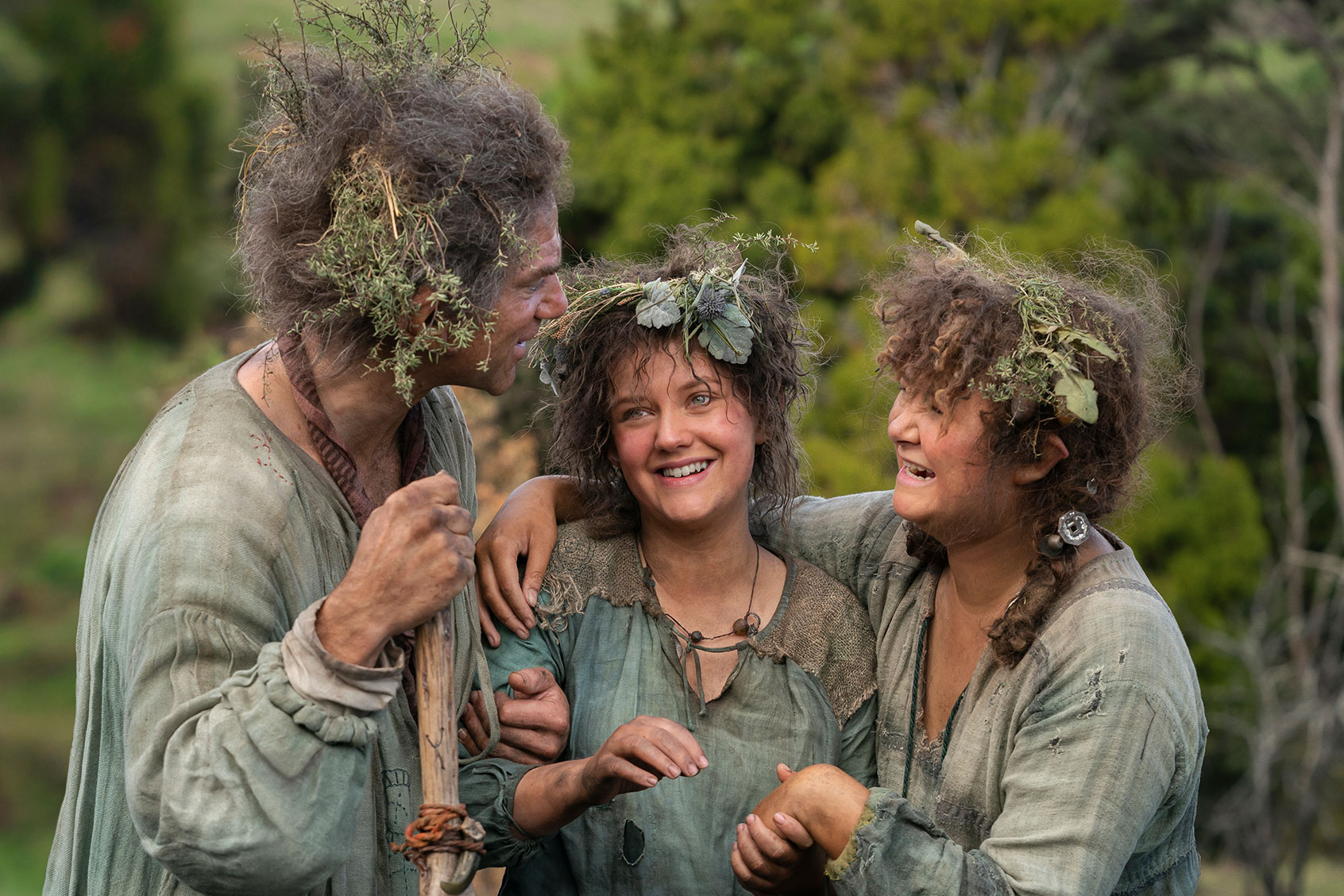
The Lord of the Rings: The Rings of PowerDylan Smith (Largo Brandyfoot), Markella Kavenagh (Elanor ‘Nori’ Brandyfoot) and Megan Richards (Poppy Proudfellow) in “The Lord of the Rings: The Rings of Power” (Ben Rothstein/Prime Video)Community is essential to the Harfoots’ way of life — “Nobody goes off trail and nobody walks alone” is their oft-repeated motto, though their hardened actions don’t always follow it —  but the foragers are far from the only characters who need a little help to get by. One of the beauties of “The Rings of Power” is that it contains many lands, conveyed in aching detail, from the vast island kingdom of Númenor to the elves’ city Lindon, which looks like the perpetual yellow fall of pumpkin spice daydreams. Different stories play out in the different places, and in the various settings we have unlikely pairings.
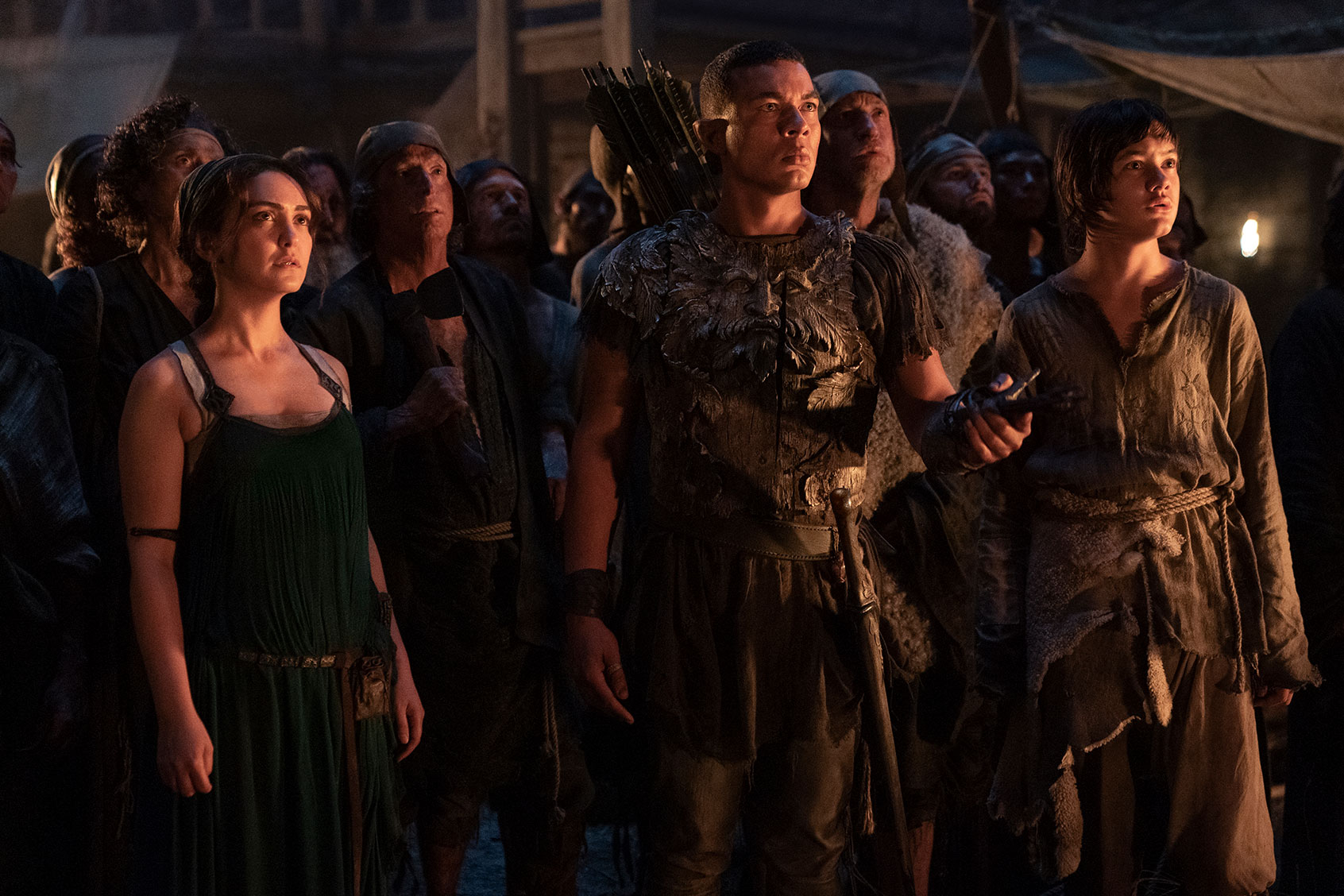
Although things don’t always go smoothly, “The Rings of Power” is to cooperating as “House of the Dragon” is to conniving.

Our main Harfoot, the likeable Markella Kavenagh as Nori, takes a mysterious stranger under her wing, a man (maybe) much too large to truly be under the small creature’s protection. Galadriel (Morfydd Clark), here a fierce warrior years before the elf we know from Tolkien, strikes up several unusual friendships including with Halbrand (Charlie Vickers), the mysterious man she’s thrown together with at sea, and Elendil (Lloyd Owen), the Númenor captain who brings her to land. Nazanin Boniadi as human healer and single mother Bronwyn and Ismael Cruz Córdova as Arondir, a stalwart elf, provide the romance in this fantasy, a burning and frowned-upon love that seems as fraught as Bronwyn’s Orc-tunneled village.

Meanwhile, in the dwarves’ underground mines, elf Elrond (Robert Aramayo) hangs with his old friend (once his buddy forgives him) the dwarf prince Durin (the charming Owain Arthur with a heavy beard). As Polygon puts it, “What’s better than this? Guys bein’ dwarves.” But Elrond is there not just for the drinking, rock-breaking, reminiscing and mole-tail stew. The elves need to build a forge in Eregion, and Elrond has convinced his friend to help. Although things don’t always go smoothly, “The Rings of Power” is to cooperating as “House of the Dragon” is to conniving.

The Lord of the Rings: The Rings of PowerNazanin Boniadi (Bronwyn), Ismael Cruz Córdova (Arondir) and Tyroe Muhafidin (Theo) in “The Lord of the Rings: The Rings of Power” (Ben Rothstein/Prime Video)Bronwyn’s village reacts suspiciously when she warns them of their destroyed neighbors, but once she brings the head of an Orc she’s killed in her house, they get in line, following her to the elves’ former watchtower. Half choose to stay with her to fight when the Orcs and their strange leader plan to attack. 

It’s a stirring moment, all the more powerful for its rarity: the female characters standing together, the men standing behind them. 

So far, “The Rings of Power” seems to believe women, making it distinct from its dragon rival and others. Galadriel is initially sent away from the kingdom where they’ve come to hate elves, but once the queen regent (Cynthia Addai-Robinson) gets a sign in the form of blossoms falling from a tree, she quickly turns around and pledges her island’s support behind the female elf. Not only that, but she says she will accompany Galadriel herself back to Middle-earth to investigate the evil the elf swears is spreading. It’s a stirring moment, all the more powerful for its rarity: the female characters standing together, the men, including quietly intense Elendil (whose name literally means “Elf-friend”), standing behind them. 

The Lord of the Rings: The Rings of PowerMorfydd Clark (Galadriel) and Lloyd Owen (Elendil) in “The Lord of the Rings: The Rings of Power” (Courtesy of Prime Video)And while her community’s first response is disbelief over the giant stranger (who looks a lot like Gandalf but may be someone else entirely), Nori’s friends and family, including orphan Poppy (the luminous Megan Richards) and her farther, the compelling Largo (Dylan Smith), rally behind her. And behind him. It’s a symbiotic relationship. Nori is teaching The Stranger (Daniel Weyman in an emotional, empathetic and mostly wordless performance) language and how to eat snails; the large, strong character returns the favor by pushing their wagon. They will only persevere by trusting each other. “He helps us and we help him,” Nori says.


Want a daily wrap-up of all the news and commentary Salon has to offer? Subscribe to our morning newsletter, Crash Course.


The Harfoots know that adventure is more fun with others and that you survive best in groups. That was a central tenet in Tolkien’s work (and in his life): the idea of friendship. It’s heartening to see it repeated it here with new adventures and new and different allies. As the Hobbit Merry says, “You can trust us to stick with you through thick and thin — to the bitter end.” That’s not always a luxury given to female characters. But so far all of us, even women, we’ve got a friend in “The Rings of Power.”


“If he is the nominee, I won’t be a Republican”: Liz Cheney wants Trump far away from 2024 ballots

Liz Cheney had Trump on the mind during The Texas Tribune Festival held in Austin on Saturday, making it very clear that she wants his name nowhere to be found come 2024. In fact, the Wyoming GOP Rep. feels so strongly about this that she’s willing to switch political sides if Trump becomes a presidential nominee.

“I’m going to do everything I can to make sure he is not the nominee,” Cheney said. “And if he is the nominee, I won’t be a Republican.”

When asked if she has plans to run for president herself, Cheney “dodged the question,” according to CNN‘s coverage of the festival.

“It’s not about me or making a decision about what I’m going to do,” Cheney said. “I certainly will do whatever it takes to make sure Donald Trump isn’t anywhere close to the Oval Office.”


Want a daily wrap-up of all the news and commentary Salon has to offer? Subscribe to our morning newsletter, Crash Course.


As far as action items that coincide with her goal of blocking Trump from running for president again in 2024, Cheney said “she will campaign for Democrats to ensure that Republican candidates who promote election lies do not get elected,” per CNN’s reporting.

“I’m going to do everything I can to make sure Kari Lake is not elected,” Cheney said, adding the Trump-endorsed candidate for Arizona Governor to her no-no list.

Although Cheney is willing to help Democrats in a joint effort to keep Trump off the ballot, and even lean Democrat herself, she pumps the breaks at the idea of Democrats keeping control of the House of Representatives after the midterms, believing there to be many “bad policies” coming from the Biden administration. 

“I think it’s really important though, as voters are going to vote, that they recognize and understand what the Republican Conference consists of in the House of Representatives today.”

Punishment, puppies, and science: Bringing dog training to heel

Three years ago, Valli Fraser-Celin adopted a blonde husky mix puppy, whom she named Husk. Fraser-Celin soon started looking for ways to curb Husk’s “totally wild” behavior, she said, like stealing food from the kitchen counter and barking incessantly at strangers. Based on the advice of a YouTube trainer, Fraser-Celin started using an electronic collar, or e-collar, that delivered a small shock when Husk misbehaved, but said she felt “yucky” about it.

Fraser-Celin rethought her approach after hearing about an animal trainer who taught a grizzly bear to cooperate with medical treatment using only positive reinforcement. If that hulking animal could learn with treats and praise, she thought, why were dog trainers using prong and shock collars? “That was the catalyst into my advocacy,” said Fraser-Celin, who studied African wild dogs for her Ph.D. and now works as a remote community liaison for the Winnipeg Humane Society and advocates independently for positive reinforcement training on Instagram. “I really think that there needs to be regulations that are put into place,” she said, “based on the science and the studies that have shown the best type of training for dogs.”

“There’s a big consumer protection piece here, that if you’re not adequately trained, or you don’t have adequate experience in the industry or in the content, then you shouldn’t be advising people on how to prevent dog bites.”

Fraser-Celin is not alone. Many researchers, trainers, and veterinary and training professional organizations are advocating for greater oversight for dog training, which is largely unregulated worldwide — though they sometimes disagree on the best path of action and choose to focus on the research that reinforces their preferred approach. “Right now, it’s the wild, wild West,” said Anamarie Johnson, a psychology Ph.D. student at Arizona State University with a background in animal behavior and dog training. She recently published a study that analyzed the websites of 100 highly-rated dog trainers across the U.S., which found that most gave no indication whether the trainer had relevant education or certification.

“Anyone can identify as a dog trainer — they can put up a social media page, they can offer services to the public, and there’s no expectations for their education, their continuing education, or their standards of practice,” said Bradley Phifer, the executive director of the Certification Council for Professional Dog Trainers, or CCPDT, an organization promoting science-based training standards. People with little or no education in animal behavior may be advising owners on handling aggression, he added. “There’s a big consumer protection piece here, that if you’re not adequately trained, or you don’t have adequate experience in the industry or in the content, then you shouldn’t be advising people on how to prevent dog bites.”

Some experts and organizations are pushing for greater regulation of the industry. Under an umbrella organization known as the Alliance for Professionalism in Dog Training, two major certification bodies — the CCPDT and the Association of Professional Dog Trainers, or APDT — have jointly proposed model legislation that they hope could be adopted on a state-by-state basis. The legislation would require trainer licensure by a state board, create accountability standards, and require trainers to engage in continued education. Phifer said he’s currently working with legislators in New Jersey, where regulations for dog trainers were first proposed in 2019, and that the joint effort is also making progress in California and Illinois.

Modern dog training is rooted in the mid-20th-century work of American psychologist B.F. Skinner, who suggested four categories for behavior modification: positive reinforcement, positive punishment, negative reinforcement, and negative punishment.

But the push for regulation has exposed a schism in the industry over using punishments versus rewards. Under the proposed legislation, certifying bodies would be required to uphold a policy that prioritizes positive reinforcement, though does not entirely rule out punishment — an approach generally backed by research on efficacy and welfare and increasingly popular among training professionals. While researchers and trainers largely agree that punishment-heavy approaches are harmful, they are at odds whether all-out bans on aversive tools are productive, since the approach may work in limited circumstances.

Without clearer rules, the broad gaps in dog training pose “a potentially very large safety risk to the public,” said Johnson, because dog owners are trusting trainers to modify the behavior of animals with “sharp, pointy teeth that live in our house.”


Modern dog training is rooted in the mid-20th-century work of American psychologist B.F. Skinner, who suggested four categories for behavior modification: positive reinforcement, positive punishment, negative reinforcement, and negative punishment. Here, positive and negative don’t necessarily mean good or bad. Positive reinforcement adds something a dog likes to reinforce a behavior, such as a treat or a toy for sitting on cue, while positive punishment adds something aversive, like a tug on a leash, to decrease a behavior. Negative reinforcement removes something the dog dislikes, such as stopping a shock collar when a dog obeys a command, while negative punishment removes something desirable, such as facing away from a dog that is jumping for attention.

Many trainers and animal behavior experts say that aversive methods, which include positive punishment and negative reinforcement, are overused. Two major professional organizations that represent trainers — the APDT and the International Association of Animal Behavior Consultants — now limit the use of tools like e-collars among their members.

In October last year, the American Veterinary Society of Animal Behavior, which includes both veterinarians and behaviorists with doctorate-level education in animal behavior, issued a statement: “There is no evidence that aversive training is necessary for dog training or behavior modification,” referencing 21 studies on the effectiveness of reward-based methods and risks of aversive methods. Alexandra Protopopova, an animal welfare researcher at The University of British Columbia, wrote in an email to Undark that the recent research cited by the statement reflected the “undeniable” risks of aversive techniques, adding: “Ultimately, recent research has also shown that aversive methods do not result in better trained dogs; thereby making traditional aversive dog training methods obsolete.”

The research has raised concerns about dog welfare. In one small study, dogs trained with rewards appeared to be more playful and better at learning a novel behavior than dogs whose owners reported using punishment. In another, dogs reportedly trained with aversive tools were, as the researchers put it, more “pessimistic” than dogs that were not, based on their hesitation in approaching a bowl of food. Some evidence also suggests that use of punishment in training can diminish the bond between a dog owner and their canine.

A 2017 literature review confirmed that, overall, there are welfare risks associated with positive punishment. But the review also noted limitations across the available research. One weakness: Many studies rely on surveys of owners to determine how dogs are treated, making it hard to objectively assess the effects of training methods. Surveyed owners might, for instance, vary in how they define punishment. Those studies are also largely correlational, connecting the self-reported treatment of dogs to their (also self-reported) behavior.

Not all studies share that limitation, including a government-sponsored study in England that directly compared two training approaches. Researchers at the University of Lincoln recruited two types of trainers: Those recommended by e-collar manufacturers and those who use positive reinforcement. The trainers worked with 93 dogs that had trouble responding to their owners when they were called, instead choosing to chase livestock, run after other dogs, or just simply ignore any plea to come.

At the end of the trial, owners of dogs from both groups were satisfied with the results — more than 90 percent reported to researchers they saw improvement in their dog’s recall. However, the researchers also noted more signs of stress in the e-collar group, including yawning and, in some dogs, yelping. In a second study reviewing videos made during the initial trial, the team found that the dogs trained using positive reinforcement had faster response times.

Some have critiqued the work, however. Rebecca Sargisson, a psychologist at the University of Waikato in New Zealand, published a commentary of the second study with a co-author that called into question its methods and conclusions. The recall tests, she noted, were mostly performed with dogs on a long leash, which didn’t necessarily show how they’d behave off-leash, and the researchers didn’t measure baseline performance. Sargisson also expressed concerns on total bans for e-collars. In New Zealand, for instance, the devices are successfully used to teach hunting dogs to stay away from Kiwis, the endangered, flightless national bird. But, she added, e-collars still shouldn’t be readily available online and in pet stores. 

Cooper said that in instances where endangered species are on the line, the critique makes a “fair point” and his research team published a detailed response to the commentary. Some positive reinforcement trainers note additional risks in using shock collars. Kat Camplin, a dog trainer based in Redding, California, said that she’s worked with dogs that had been through rattlesnake training — where dogs are shocked after sniffing a snake — that had also become terrified by things that aren’t snakes, like garden hoses.

Still, some dog trainers aren’t convinced by the growing body of research. Ralf Weber, a trainer based in Southern California who uses both e-collars and play-based rewards, is skeptical of the conclusions positive reinforcement supporters draw from the literature. He said that they are cherry-picking findings to support their position, adding that learning can be stressful for dogs regardless of the method (he pointed to one controversial study where a verbal cue indicating a dog didn’t perform as desired was associated with higher cortisol levels than an e-collar shock). While Weber acknowledges that e-collar misuse is rife — “I can go to YouTube and find hundreds of videos of people who shouldn’t be allowed to have these, abusing dogs left and right” — he argues that they are a valuable tool in certain cases, like stopping a dog from chasing wildlife. 

It’s hard to design a perfect study to test the two approaches, Johnson said. Researchers would need to recruit skilled trainers, ensure the training approaches were applied consistently, and control for differences in dog abilities and personalities — a massive undertaking.

“The key thing that I try to be mindful of with my scientific understanding is that I can recognize that punishment does work,” Johnson said. The issue, she added, is that by the time an owner applies that approach “it’s so convoluted and diluted,” it could ultimately harm the dog.


While researchers and trainers debate what to take away from the welfare studies, advocates continue to push for regulation. Phifer said that if one or two states adopt the Alliance for Professionalism in Dog Training’s model legislation, it will likely be easier for others to follow suit.

Still, even among professional organizations, there’s argument over what’s the best way to protect dogs and consumers. If you were to ask 100 dog trainers, you would “get 100 opinions on where the line should be,” said Benjamin Bennink, a dog trainer and vice chair of the Association of Professional Dog Trainers. But, he added, there should be some form of regulation: “You wouldn’t go to an unlicensed dentist, you wouldn’t even get an unlicensed plumber or electrician.”

Weber said that the dog training industry is currently “an unmitigated s**t-show.”

Some argue that going straight from no regulation to licensure requirements is too great a leap. Kathrine Christ, executive director of the International Association of Animal Behavior Consultants, said that starting with limited regulations that enhance accountability for trainers would be preferable to licensure requirements. “We’re not necessarily ready to take a step towards promoting licensure or promoting, you know, intrusive types of regulation, before we can tell you that A, it’s worth the money for the taxpayer or B, it’s worth the money and cost for the people and the profession,” she said. As evidence, she shared a Brookings Institution paper that found that occupational licensing in other professions provided little benefit in terms of service quality and safety.

Weber said that the dog training industry is currently “an unmitigated s**t-show” and he supports licensing, but worries about how to do it without creating a “bigger problem down the line.” Limits on tools like e-collars and prong collars, he added, have had unintended consequences in some countries. In Germany, for instance, a ban on a type of collar forced law enforcement to pull police dogs, which were trained to respond to the collars, off the streets, while dog sport trainers in Finland have turned to more severe punishment tools such as cattle prods. 

Instead of outright bans, Weber and Johnson both propose a different starting point: basic education for dog trainers. Weber said that Australia may be a good model, where a nationally-recognized certification requires trainers to take courses in behavior science.

As for bridging divides in the training community, Bennink said that organizations can put out all the data and position statements they want, but at the end of the day, trainers simply need to show what they can do. “If I’m literally showing you this dog can now do this,” he said of teaching a new behavior, “that’s going to convince more people than, unfortunately, any amount of scientific data.”


Ula Chrobak is a freelance science writer based in Nevada. You can find more of her work at her website: https://www.ulachrobak.com/

This article was originally published on Undark. Read the original article.

There were an estimated 17.7 million excess deaths due to COVID-19: report

A global report released today highlights massive global failures in the response to COVID-19.

The report, which was convened by The Lancet journal and to which we contributed, highlights widespread global failures of prevention and basic public health.

This resulted in an estimated 17.7 million excess deaths due to COVID-19 (including those not reported) to September 15.

The report also highlights that the pandemic has reversed progress made towards the United Nations Sustainable Development Goals in many countries further impacting on health and wellbeing.

The report, from The Lancet COVID-19 Commission, found most governments were ill-prepared, too slow to act, paid too little attention to the most vulnerable in their societies, and were hampered by low public trust and an epidemic of misinformation.

However, countries of the Western Pacific — including East Asia, Australia and New Zealand — adopted more successful control strategies than most.

This had resulted in an estimated 300 deaths per million in the region (around 558 per million in Australia and 382 per million in New Zealand to September 12). This is compared with more than 3,000 per million in the United States and the United Kingdom.

The report also sets out 11 key recommendations for ending the pandemic and preparing for the next one.

Co-operation lacking

The report is the result of two years’ work from global experts in public policy, health, economics, social sciences and finance. We contributed to the public health component.

One of the report’s major criticisms is the failure of global cooperation for the financing and distribution of vaccines, medicines and personal protective equipment for low-income countries.

This is not only inequitable but has raised the risk of more dangerous variants.

The report highlighted the critical role of strong and equitable public health systems. These need to have: strong relationships with local communities; investment in behavioural and social science research to develop more effective interventions and health communication strategies; and continuously updated evidence.

11 recommendations

The report made 11 recommendations to end the pandemic and prepare for future ones.

1. Vaccines plus other measures – establishing global and national “vaccination plus” strategies. This would combine mass immunisation in all countries, ensure availability of testing and treatment for new infections and long COVID, coupled with public health measures such as face masks, promotion of safe workplaces, and social and financial support for self-isolation.

2. Viral origins – an unbiased, independent and rigorous investigation is needed to investigate the origins of SARS-CoV-2, the virus that causes COVID-19, including from a natural spillover from animals or a possible laboratory-related spillover. This is needed to prevent future pandemics and strengthen public trust in science and public authorities.

3. Bolster the World Health Organization and maintain it as the lead organisation for responding to emerging infectious diseases. Give WHO new regulatory authority, more backing by national political leaders, more contact with the global scientific community and a larger core budget.

4. Establish a global pandemic agreement and strengthen international health regulations. New pandemic arrangements should include bolstering WHO’s authority, creating a global surveillance and monitoring system for infectious disease outbreaks. It would also include regulations for processing international travellers and freight under global pandemic conditions, and the publication of an annual WHO report on global pandemic preparedness and response.

5. Create a new WHO Global Health Board to support WHO decision-making especially on controversial matters. This would be composed of heads of government representing each of the six WHO regions and elected by the member states of those regions.

6. New regulations to prevent pandemics from natural spillovers and research-related activities and for investigating their origins. Prevention of natural spillovers would require better regulation of domestic and wild-animal trade and enhancement of surveillance systems for pathogens (disease-causing micro-organisms) in domestic animals and humans. The World Health Assembly should also adopt new global regulations on biosafety to regulate international research programs dealing with dangerous pathogens.

7. A ten-year global strategy by G20 (Group of Twenty) nations, with accompanying finance, to ensure all WHO regions, including the world’s poorer regions, can produce, distribute, research and develop vaccines, treatments and other critical pandemic control tools.

8. Strengthen national health systems based on the foundations of public health and universal health coverage and grounded in human rights and gender equality.

9. Adopt national pandemic preparedness plans, which include scaling up community-based public health systems, investment in a skilled workforce, investment in public health and scientific literacy to “immunise” the public against dis-information, investment in behavioural and social sciences research to develop more effective interventions, protection of vulnerable groups, establishment of safe schools and workplaces, and actions to improve coordinated surveillance and monitoring for new variants.

10. Establishment of a new Global Health Fund where — with the support of WHO — there is increased and effective investment for both pandemic preparedness and health systems in developing countries, with a focus on primary care.

11. Sustainable development and green recovery plans. The pandemic has been a setback for sustainable development so bolstering funding to meet sustainability goals is needed.

Unlock a new approach

To improve the world’s ability to respond to pandemics we need to unlock a new approach. The key component to any meaningful transformation is to collaborate and work towards a new era of multilateral cooperation.

Governments in Australia, Aotearoa New Zealand and elsewhere have talked about “building back better”. We need to take the lessons learnt from the failures of the past few years and build a stronger framework. This will not only help reduce the dangers of COVID-19 but also forestall the next pandemic and any future global crisis.

By reassessing and strengthening global institutions and co-operation, we can build and define a more resilient future.


Chris Bullen, Professor of Public Health, University of Auckland, co-authored this article and The Lancet COVID-19 Commission report on which it was based.

John Thwaites, Chair, Monash Sustainable Development Institute & ClimateWorks Australia, Monash University; Liam Smith, Director, BehaviourWorks, Monash Sustainable Development Institute, Monash University, and Margaret Hellard, Adjunct Professor, Monash University; Associate Director and Head, Centre for Population Health, Burnet Institute

This article is republished from The Conversation under a Creative Commons license. Read the original article.

Kate Bush’s bewitching “The Dreaming” turns 40

Heading into the release of her fourth album, “The Dreaming,” Kate Bush was in a comfortable place. Her previous full-length, 1980’s “Never For Ever” had become her first chart-topping album in the UK. In fact, it was the first LP ever by a British female solo artist to reach No. 1. “Never For Ever” ultimately produced three Top 20 singles, including the indelible foible “Babooshka.” In 1981, a standalone single called “Sat In Your Lap” had also been a success, reaching No. 11 on the charts.

The album is about giving yourself permission to be chaotic and imperfect.

But Bush was never content to duplicate herself or stay stagnant. When “The Dreaming” arrived in stores on September 13, 1982 — with a slightly different version of “Sat In Your Lap” right up front at track one — it was immediately apparent that she had entered a new and powerful phase of her career. The album is about giving yourself permission to be chaotic and imperfect, to stop suppressing messy thoughts and emotions. Rage, anguish, sadness, grief, alienation — “The Dreaming” lets them bubble up to the surface and boil over.

Always a caretaker of her creative work, Bush produced “The Dreaming” herself, a move that gave her the freedom to fulfill her intended vision. “I could actually do what I really wanted to for the first time,” she said in 1985. “And there were a lot of things that we wanted to experiment with, and I particularly to play around with my voices because there are a lot of different backing vocals and things like that.”

These additional vocals function as an inner monologue of sorts threading throughout the album. The voices in the background of “Pull Out the Pin” feel like hoarse primal screams, while what sound like banshee screams swirl through “Get Out Of My House” and the title track boasts a call-and-response format that resembles a group of warriors in battle. However, Bush also experiments with different lead vocal treatments, manipulating her voice into a distorted spirit form on “Leave It Open” and leaping between upper and lower ranges on “Sat In Your Lap.”

“The different textures were important to me,” she added in the same 1985 interview. “I wanted to try and create pictures with the sounds by using effects.”

On “The Dreaming,” her songs combined organic and digital approaches, creating delightful contrasts that reflected the changing musical times.

The songs on “The Dreaming” can feel like mini movies, with songs featuring bumbling robbers (“There Goes a Tenner”), a tortured relationship with a smuggler (“Night of the Swallow”) and connecting with a loved one who’s crossed into the great beyond (“Houdini”). But other songs tackle familiar topics as previous Bush albums — ghosts, death, despair — and serve as pointed critiques of humanity.

“Sat In Your Lap” is about “a search for knowledge,” Bush told MTV in 1985. “And about the kind of people who really want to have knowledge but can’t be bothered to do the things that they should in order to get it.” That’s a similar theme of “Suspended in Gaffa,” as she relayed to NME in 1982: “It’s about seeing something that you want — on any level — and not being able to get that thing unless you work hard and in the right way towards it. When I do that, I become aware of so many obstacles, and then I want the thing without the work.” 

Bush was and is always putting in the work. And on “The Dreaming,” her songs combined organic and digital approaches, creating delightful contrasts that reflected the changing musical times. Opening track “Sat In Your Lap” featured then-Buggles member Geoff Downes contributing robotic horns via the Fairlight, while “Night of the Swallow” boasts Uilleann Pipes and a penny whistle. The solemn “All the Love” features a relatively straightforward guitar-bass-drums combo, while Bush’s piano work throughout is full of verve and bounce — a jaunty waltz here, matching an oompah band there — but restrained where needed.

However, “The Dreaming” is distinctive due to Bush’s embrace of technology. A cutting-edge digital synthesizer called the Fairlight CMI, which Bush had started experimenting with on “Never For Ever,” became a dominant canvas. This translated to unique soundscapes that often feel lacquered but jarring, like jagged obsidian. Viscous rhythms lurch and splatter, creating herky-jerky grooves, and noise bursts splatter here and there. Perhaps the best example is “Get Out Of My House,” which pairs clattering rhythms with discordant backup vocals, staccato piano, dark post-punk guitars and Bush’s acrobatic, vibrato-heavy lead. 

The combination of gothic antiquity and unsettled digital detours ensured “The Dreaming” was Bush’s poorest-performing album to date. The LP debuted at No. 3 on the UK album charts but spent only 10 weeks there before falling out of the top 100. (In contrast, Bush’s debut album, “The Kick Inside,” spent 66 weeks on the chart across 1978 and 1979.) The album’s lone official single, the title track, also only reached No. 48 on the singles charts.


Want a daily wrap-up of all the news and commentary Salon has to offer? Subscribe to our morning newsletter, Crash Course.


Bush bounced back, of course, as she returned in 1985 with the well-regarded “Hounds of Love,” which has found new life in 2022 thanks to “Running Up That Hill.”  And “The Dreaming” has found its audience: The LP’s genius is now recognized, including because it’s an obvious touchstone for any number of artists; to name a few, Bjork, Tori Amos, Zola Jesus, and Tune-Yards. But “The Dreaming” is also important for what it represents: a visionary woman stretching herself musically and artistically, and laying the groundwork for even more stunning work in the future. 

Mitch McConnell’s biggest challenge: Is the “Grim Reaper” nearing the final curtain?

Discovery comes most often not from finding something unknown or long hidden but from seeing afresh what has been on the table all along. — David McCullough

After all this time, is it still possible to underestimate Mitch McConnell’s political skill and his destructive impact on our country?

The question came to mind most recently after reading a Washington Post article about the difficulties that Senate Republican candidates and the National Republican Senate Committee (NRSC) were having in fundraising. The article understandably buoyed the spirits of Democrats. But its closing paragraphs report that McConnell’s Senate Leadership Fund was flush with cash, with more than $100 million as of June, and that McConnell had transferred $28 million to the struggling campaign of Ohio Senate candidate J.D. Vance, while earmarking other large sums for the races anticipated to be most closely contested. More recently, a senior Republican operative with knowledge of GOP fundraising put the McConnell war chest at closer to $500 million.

At 80 years old, McConnell is finishing his 16th year as a Senate leader, tying the record of the great Mike Mansfield for longest tenure. No Senate leader — not even Lyndon B. Johnson, Robert A. Caro’s legendary “master of the Senate” — has had more impact on the country’s politics and history. McConnell began Barack Obama’s presidency by opposing the economic stimulus legislation needed to prevent a second Great Depression, and waged a scorched-earth war against the Affordable Care Act. In Obama’s last year, when Justice Antonin Scalia died, McConnell famously took the unprecedented step of refusing to allow the Senate to consider the nomination of Judge Merrick Garland to the Supreme Court. As the election approached, McConnell blocked a proposal for congressional leaders to make a bipartisan condemnation of Russian interference in the election.

When Donald Trump became president, McConnell the partisan obstructionist became McConnell the partisan battering ram. He orchestrated the massive Trump tax cut for the wealthiest Americans and came within one vote of repealing the Affordable Care Act without hearings, committee action or consultation with any affected interest groups. He focused all his experience and energy on his highest priority: putting an extreme, right-wing majority on the Supreme Court, through a corrupted confirmation process. If not for McConnell’s iron will and laser focus, Garland would be on the court today, while Brett Kavanaugh and Amy Coney Barrett would not. As McConnell said proudly: “A lot of what we have done over the last four years will be undone sooner or later by the next election. They won’t be able to do much about this for a long time to come.” The constitutional right of women to choose an abortion and the power of states to regulate guns were quickly eviscerated, for openers.

At the end of Trump’s presidency, McConnell denounced him forcefully: First on the morning of Jan. 6, 2021, for spreading the big lie that the election had been stolen, and then a few weeks later on Feb. 13, when he gave a speech that any Democrat or Liz Cheney would have admired, a scorching attack on the former president for inciting the insurrection — even as he voted to acquit Trump on the lame grounds that a former president could not be impeached. Although Nancy Pelosi and others blasted him for his hypocrisy, McConnell’s political calculation was clear enough. He wanted nothing more than to be rid of Trump, but the time was not right: Trump remained too strong. Better to wait until Trump withered away naturally, his hold on the Republican Party diminished from a damaging barrage of state and federal investigations.

Now, 19 months later, McConnell faces his toughest challenge. McConnell specializes in the politics of off-year elections; he counted on Biden, like Obama in 2010 and 2014, taking severe losses in the midterms, when a dissatisfied electorate is likely to turn on the president. But Biden’s recent legislative victories and a fierce reaction to the Supreme Court’s abortion decision have given the Democrats new momentum, presenting the possibility of an exception to the historical pattern. Trump’s hold on the GOP base seems as strong as ever, particularly since the FBI search of his Mar-a-Lago home inflamed his loyal supporters, and he remains furious at McConnell. Trump-endorsed candidates have won a string of contested primaries, handing McConnell what he most detests: extremist or arguably unqualified nominees in Pennsylvania, Georgia, Arizona and Ohio, who will have difficulty winning a statewide general election.  


Want a daily wrap-up of all the news and commentary Salon has to offer? Subscribe to our morning newsletter, Crash Course.


McConnell’s greatest strength — his enduring hold over his Senate Republican colleagues — comes from his mastery of the obscene dark-money system of unlimited contributions that he and the Supreme Court decision in Citizens United have created. The Republican donor base of wealthy individuals and corporations, including the banking and securities industry, fossil fuel companies and the NRA and gun manufacturers, deliver the money, and McConnell’s leadership PAC and its 501(c)(4) affiliate, One Nation — both run by his former chief of staff Steven Law — spreads the money around to Republican candidates, while McConnell delivers the legislative and regulatory outcomes and judicial appointments that suit the donors’  purposes.

McConnell remains a master of the obscene dark-money system — but he lost the battle for the soul of the Republican Party. Unlike Liz Cheney, he went down without a fight.

McConnell is not a MAGA Republican, and he is working hard to remind the Republican donor base that he is their best bet to combat the purported liberal excesses of Biden and the Democrats. He has been on good behavior, breaking with his pattern of obstruction to help deliver bipartisan accomplishments such as infrastructure legislation, the CHIPS Act, the first modest but important gun safety legislation in decades, support for Ukraine and adding Finland and Sweden to NATO. Having captured the Supreme Court, McConnell may be trying to airbrush his legacy by being marginally constructive on other issues. More likely, McConnell has calculated that going to the voters with a record of total obstruction was not the best plan for the Senate GOP.

McConnell’s problem is that he lost the battle for the soul of the Republican Party, and unlike Liz Cheney and Adam Kinzinger, he went down without a fight. With a position of extraordinary power in the party and the country, McConnell failed to convict Trump after his impeachments, failed to stop the big lie from spreading in the weeks after the election and has been conspicuously silent as Trump and his MAGA supporters have embraced full-scale election denial and advocated violence. McConnell seriously underestimated Trump’s depravity and overestimated his own ability to control the situation. By now, he may have learned the wisdom of George Ball, the Kennedy administration diplomat who opposed the escalation of the Vietnam War: “He who rides the tiger cannot choose where he dismounts.”

We should be crystal clear about one other point. If McConnell’s fondest hope had been realized — Trump withering away into irrelevance — this year’s Senate elections would still pose a crucial test. The principle of Occam’s razor, which holds that the simplest explanation for any phenomenon is most likely the right one, applies here. Our politics were poisonous and our government was gridlocked well before Donald Trump became president. The accelerating downward spiral of the Senate and our government correlates 100% with McConnell’s tenure as Republican leader. For Democrats, independents and disillusioned Republicans, every bad road leads to and from Mitch McConnell, an architect of division, a champion of inequality and the self-proclaimed “grim reaper” of progressive legislation. The 2022 Senate elections present the first opportunity for voters to pass judgment not only on Donald Trump and MAGA extremism, but also on McConnell and his Republican Senate colleagues, who consciously failed to protect our democracy from Trump’s assault but gave us a radical Supreme Court majority prepared to take away our freedoms and erode our right to govern ourselves. Nothing would change American politics more profoundly and rapidly than a huge turnout that produces an expanded Democratic majority.

Historians call DeSantis’ views on American slavery “ignorance”

Multiple historians have accused Florida Gov. Ron DeSantis (R) of misconstruing facts due to his recent controversial remarks about early American history.

According to a new analysis from Newsweek, DeSantis’ seemingly controversial remarks were made on Tuesday, September 20. At the time, he argued that it was the “American revolution that caused people to question slavery.”

He added, “Nobody had questioned it before we decided as Americans that we are endowered by our creator with inalienable rights and that we are all created equal. Then that birthed abolition movements.”

After making his speech, DeSantis posted a portion of it via Twitter and it quickly surpassed 900,000 views. However, it also attracted criticism. Speaking to Newsweek, historians weighed in with critical assessments of the Florida governor’s remarks.

Professor Karin Wulf, who focuses on the study of eighteenth-century British American history at Brown University, said, “On at least three levels this is wrong. The idea of natural rights didn’t originate with the American revolutionaries; they were reflecting ideas that were widespread among political thinkers, perhaps most obviously the 17th-century English political philosopher John Locke.

She added, The United States as a government did not act against slavery in any form until 1807 (prohibition of the Atlantic slave trade) and acted in key ways to protect it right up to the Civil War (the fugitive slave act).

“Most egregiously, the idea that ‘no one’ questioned slavery erases enslaved people themselves who were active in resisting slavery both as individuals and collectively and in refusing the logic and legality of their enslavement.”

Seth Rockman, who also works at Brown University as an associate professor conducting writing and research on slavery economics, suggested that DeSantis’ actions Black Americans are part of a greater agenda stemming from white nationalism.

“DeSantis clearly has not done the reading for class, but his error here goes beyond ignorance of the last several decades of research on anti-slavery thinking and organizing over the seventeenth and eighteenth centuries,” Rockman said. “What DeSantis does here is more pernicious because it places Black people outside the category of ‘we’ and ‘Americans’— a move that can only be understood as part of DeSantis’s strategy to ride white nationalism to higher office.

“This statement is yet another deliberate DeSantis move to ‘trigger’ or ‘own the libs,’ but let’s think about the implications of DeSantis’s statement here: When DeSantis says ‘no one’ he pretends that enslaved African and African-descended people aren’t worth taking seriously as people whose opinions about slavery might matter, then or now.

“The slaves who staged massive revolts in New York, South Carolina, and other mainland colonies throughout the colonial era, were they not questioning slavery?”

Professor Sarah Pearsall also explained why she disagrees with DeSantis’ claims. “The claim by DeSantis is completely incorrect. Plenty of people had questioned slavery before the American Revolution. Of course enslaved people had resisted the system since its inception, but there were also tracts by colonists, such as Samuel Sewell’s The Selling of Joseph, published in Boston in 1700, which argued that the institution was unacceptable.

“Early abolitionists on both sides of the Atlantic included Quakers; their efforts in some cases predated the outbreak of the American Revolution. Since DeSantis also states of history that ‘It’s gotta be accurate,’ he might want to practice what he preaches.”

Insider urges DOJ to further explore who phoned Jan. 6 rioter from White House

The bombshell “60 Minutes” report that the White House switchboard connected a call to a Jan. 6 rioter during the attack on the Capitol should be easy to track down, according to a former top Trump administration official.

The report, set to air in full on Sunday, features former Rep. Denver Riggleman (R-VA). The former National Security Agency contractor served as a staffer for the House Select Committee Investigating the Jan. 6 Attack on the U.S. Capitol.

“I only know one end of that call,” Riggleman said. “I don’t know the White House end, which I believe is more important. But the thing is the American people need to know that there are link connections that need to be explored more.”

The former congressman said, “from my perspective…being in counterterrorism. If the White House, even if it’s a short call, and it’s a connected call, who is actually making that phone call?”

Olivia Troye, a national security expert who worked at the Department of Homeland Security and for Vice President Mike Pence, offered her thoughts on Twitter.

“Infuriating that the lives of our country’s leadership were at risk on Jan 6…law enforcement officers were fighting for their lives and meanwhile, someone inside the Trump White House was apparently directly communicating with the rioters while it was happening,” Troye wrote.

She also explained how she would investigate further.

“They should look up the record of all the extensions in the White House and what desk it belonged to — it would at least lead to narrowing down where in the [White House] the call was placed from…then one could review the camera footage for that area and bingo!” Troye wrote. “That’s where I would start.”

Watch below:

Why the capital of India Is flush with mosquitoes

As the sun began to set on Delhi, 45-year-old Rani hiked up her salwar pants, squatted next to the iron pan just outside her home, and lit a match. The plastic grocery bags were the first items to catch fire. Soon the cow-dung cakes ignited, their chocolate-brown edges glowing in the dusk. Rani coughed as smoke rose from the pan.

All around, Rani’s neighbors performed a similar drill. Some substituted egg trays for cow dung, or omitted the plastic bags, but no matter the kindling, the goal was the same: to repel mosquitoes by means of smoke and other toxic fumes. Indians have long employed this do-it-yourself approach to insect control, but over the past couple of years, as the city’s mosquito population has exploded, the burning has become a nightly ritual in low-income housing developments across this city of more than 30 million people.

According to a recent survey conducted by the South Delhi Municipal Corporation, Delhi’s mosquito density was almost nine times higher than normal this past March and April, a 50 percent increase over the previous year. Yet local authorities did not mount a vigorous response because the insects belonged to the Culex genus, which is not known to transmit the well-known diseases — malaria, dengue, chikungunya — that are at the forefront of India’s public health initiatives.

When it comes to malaria in particular, India has achieved success in reducing disease. But even as malaria deaths are on the decline, the sheer number of mosquitoes, particularly in urban areas, has shot up. This is partly due to climate change, said Ramesh C Dhiman, an expert in malaria epidemiology who spent three decades as a government researcher at the Indian Council of Medical Research before becoming an independent consultant. Mosquito populations are on the rise in other countries, too, fueled not just by climate change, but by increased urbanization and the decay of residual DDT in the environment.

A spokesperson for Delhi’s municipal government, Amit Kumar, told Undark that the local government has taken a number of actions to combat the problem, including spraying insecticides on public drains and other water bodies, which serve as breeding grounds for mosquitoes.

These measures were temporary and did not address the severity of the issue, said a Delhi public health official, who asked not to be named for fear of retribution from his employer.

The mosquitoes in Rani’s neighborhood are so insufferable that children and adults struggle to sleep through the night. While not yet much of a problem in Delhi, residents could also face some risk of diseases that are transmitted by Culex mosquitoes, including West Nile and Japanese encephalitis. According to experts, this risk may increase as mosquitoes evolve in response to changing climatic conditions. For the moment, low-cost do-it-yourself remedies like smoke and insecticides offer some measure of relief. But researchers note that these approaches pose a risk to human health and fail to address the underlying problems that allowed the mosquitoes to flourish in the first place.

Delhi’s surge of Culex mosquitoes comes at a time when public health officials are declaring notable victories against other kinds of mosquitoes, including the Anopheles genus that transmits malaria. While those gains have saved lives, the situation, mosquito experts say, is complicated: The very changes that have reduced Anopheles’ numbers may be allowing other species to thrive. And amid a changing climate, mosquitoes have found new niches to exploit, especially in urban areas.

Over the last few decades, malaria’s global footprints have diminished, thanks in part to interventions such as mosquito nets and insecticides used to target Anopheles. In India, such interventions have been implemented with the help of a government agency called the National Center for Vector Borne Diseases Control. The program’s efforts helped dramatically reduce malaria deaths in recent years.

A retired government official who worked in northeast India at the ICMR for nearly three decades, Vas Dev, said deforestation likely contributed to declining malaria rates in India, but it came at a cost. Increased urbanization creates more habitat for mosquitoes that prefer urban and suburban landscapes, including Culex and Aedes, the mosquito genus that transmits dengue, Zika, and chikungunya. Since 1970, dengue has spread dramatically in poor countries, killing thousands of people each year, mostly children.

Scientists are working to better understand how changing landscapes and climate will affect mosquito populations in the future. In Delhi, climate change has already extended the breeding season by bringing higher temperatures to months that were formerly too cool for reproduction. Untimely rains have also fueled the mosquito population by increasing humidity levels and contributing to standing water in the environment. As a result, said Dhiman, areas that might have once experienced a one-month mosquito season are now experiencing seasons that stretch for six to eight months.

The insects are known to adapt quickly to changes in their local environment. Anopheles mosquitoes provide an interesting example, said ‪Karthikeyan Chandrasegaran, a postdoctoral researcher at Virginia Tech who has expertise in evolutionary ecology and mosquito biology. The malaria-transmitting insect is known to bite between dusk and dawn, so public health organizations working in sub-Saharan Africa invested in bed nets for the local residents there. Initially, these interventions proved effective, but within less than a decade, cases spiked. It turned out the mosquitoes were feeding in the early morning — after people had gotten out of bed. Mosquitoes can also evolve resistance against commonly used insecticides.

City-dwellers are likely to experience the brunt of any problems, said Chandrasegaran. Poor waste management, lack of sanitation, and irrigation all create opportunities for the insects to thrive. Some cities like Delhi are also contending with water shortages, a situation that has led residents to hoard scarce supplies in buckets that can become breeding sites. These conditions are less acute in rural areas, which also harbor greater numbers of mosquito predators, including certain fish and frogs.

But rural areas have challenges, too, including poor health care infrastructure and poor awareness of vector-borne diseases. “So, you’ll have to probably tailor your solution differently to urban areas, tailor your solution differently to suburban areas, rural areas, forested areas,” said Chandrasegaran. “If you do not identify the pain points exactly, you are going to spend a lot of time and effort and money trying to implement one scheme across the entire country, which is going to waste a lot of things.”

Rani, who like many Indians goes by one name, sat outside with her children on a high cot not far from the iron pan and its steady smoke. They chatted about the day, and one of Rani’s daughters, Meenakshi, mentioned how her teacher had asked the class to participate in a mindfulness activity. The children were to keep their eyes closed and their bodies calm. Unlike her wiggly classmates, Meenakshi excelled at the task. In reality, she told her mother, she had fallen asleep.

Rani took this news in stride. The previous night, the mosquitoes made it hard to sleep, she explained. Many children skipped school because they were exhausted in the morning — a common occurrence that keeps low-income children out of classrooms. Adults struggle to sleep during mosquito season, too. One woman told Undark that her blood pressure rises when the mosquitoes get really dense. Other residents reported sleeping on busses, rickshaws, and trains while commuting to and from work.

Some families leave their pans burning all night, but when Rani is ready for bed, she douses hers with water so she won’t feel suffocated by smoke as she tries to sleep. Rani and her children do use mosquito netting, but they rarely spend the whole night behind its protective shield. Sometimes the children need to get up to use the toilet or get a drink of water, she said, or they get too hot inside. And even a small opening in the netting allows the mosquitoes to enter.

Research indicates that mosquito nets can protect the individual user while also reducing disease transmission within the wider community. Despite this, many individuals who own nets do not use them consistently. A small study conducted in homes in Asia and Africa found that the nets decrease airflow, and researchers have hypothesized that this could explain the spotty uptake. In homes like Rani’s, which lack regular electricity for fans or air conditioning, the reduced airflow can make it even harder to sleep at night.

But the DIY remedies that have become popular across various parts of India bring their own set of problems. Palak Balyan, a scientist in New Delhi who works for the U.S.-based nonprofit Health Effects Institute, said that burning of any kind of material produces the tiny particles known as PM2.5, a type of air pollution that is responsible for millions of premature deaths each year. Research suggests that emissions of PM2.5 have shortened the average Delhi resident’s lifespan by up to 10 years. While the biggest source of this pollution in Delhi is transportation, experts worry that DIY mosquito control is worsening the problem.

In addition to burning cow dung and plastic, Delhi residents also use coils, liquids, and incense sticks to repel insects with odor and fumes. The repellants’ effects on human health have not been well-documented, but the available research suggests that caution may be warranted. One study found that burning a coil releases the same amount of PM2.5 as burning 75 to 137 cigarettes. Another study found heavy metals like zinc, cadmium, and lead in popular coil brands. “Carcinogenic risk is there for 350 people per million population,” said the study’s lead author, S.N. Tripathy, a professor at the Indian Institute of Technology Kanpur.

On its website, the National Center for Vector Borne Diseases Control lists the use of these mosquito repellents as one of several strategies for vector control. But the Delhi public health official characterized the repellants as a short-term strategy of dubious effectiveness. In India, they are part of a 50-billion-rupee business — over half a billion dollars — but they are not a solution. For one thing, the repellants don’t even kill the mosquitoes; they merely prompt the insects to go elsewhere. The mosquitoes, the official said, “just move from one place to another but they do not die.”

The Delhi public health official and other experts interviewed by Undark said they were unaware of the extent of the outdoor burning in Rani’s neighborhood and beyond. The city’s low-income neighborhoods tend to be isolated, overlooked by the city, and looked down upon by other Delhi residents.

Several researchers said that municipalities need to step up and address mosquitoes so the burden doesn’t fall on individuals. This means better insect surveillance, as well as improvements to sanitation and drainage systems. In Rani’s neighborhood, for example, the homes do not have indoor plumbing, so wastewater flows directly into the streets, creating a breeding habitat for mosquitoes. The city’s biggest drain, which carries sewage into a local river, passes about 10 feet from Rani’s one-room house.

Housing quality is important, too. Mosquitoes love the dark, humid, and unventilated spaces so often inhabited by India’s poorest residents, said Dhiman. Rani’s house has just one window, often open so that air can circulate. Even so, moisture lingers on the mud floors and cement walls. A small light bulb hangs from a wire in the ceiling, providing minimal lighting.

Outside that house, as the evening wears on, Meenakshi turns to her homework. She’s still sitting on the cot, her hands kept busy, turning book pages, fanning the air to scatter smoke. She swats mosquitoes, scratches the bites. Rani is thinking of buying a topical repellant, but the ointment is expensive and who knows if it will work. Perhaps tonight Rani will leave the pan burning, just to see if it helps her fall asleep.


Monika Mondal is an independent journalist based in New Delhi, India. Her work focuses on the environment, agriculture, and sustainability.

This article was originally published on Undark. Read the original article.

The white, conservative Southern women who asked me to keep their abortions secret

The day one of my closest childhood friends got married, she asked me to keep two secrets: The first was her high school abortion. “It was so long ago,” she said in a terrified whisper, “I can’t tell him; it doesn’t even matter anymore.” She was peeking down the hall, where everything was draped in rented white satin—a traditional, Southern wedding, officiated by an odious Calvinist preacher. She frowned at her family, who were busy decorating. “Nobody except you understood.”

She was desperate not to be overheard, so I squeezed her hand to tell her wordlessly, We buried that memory together a long time ago. (Even now as I write this, I can’t bring myself to type her name.) Her body relaxed, and she took a breath. As I opened her makeup kit, she added abruptly, “And don’t you dare say a word about last summer, either.”

A few months prior, my friend had had a second abortion—this one the result of an affair.

“You’re the liberal, not me,” she snapped. “That was just a one-off.”

Too stunned to speak, I drew my fingers across my lips in a zipper motion and grabbed the mascara.

* * *

I was born in the Bible Belt, nine months after Roe v. Wade was decided. My life has been defined by this landmark 1973 ruling and the freedoms it afforded me: bodily autonomy, personhood, empowerment. I heard that message loud and clear, despite growing up in the conservative, religious South. Knowing I would never have to pump out unwanted babies was a lifeline, and the reason I never breathed a word of my friend’s abortion — or anyone else’s. My peers and I understood that when it came to our bodies, the Roe decision meant we could and must always support each other’s reproductive choices. And when anyone’s choice needed to be covered up (which was often), we did so unfailingly, certain we were abetting a righteous lie. Now, almost 50 years later, abortion rights are all but gone, and I find myself in shock like many Americans, but also in profound doubt, concerned that perhaps I got the message of Roe wrong.

Most of the Southern girls I grew up with never got far from home, where their evangelical parents force-fed them toxic nonsense.

My parents were proud, old-school, pro-union leftists. In our house, there was no question that feminism is a good thing. Because of my father’s military service, we moved around a lot; I went to six different schools in one state alone, and we also spent part of my childhood in Europe. I was lucky. Most of the Southern girls I grew up with never got far from home, where their evangelical parents force-fed them toxic nonsense: They must be “sweet,” they should look forward to motherhood as their ultimate (and only) accomplishment, men know best, and gender is absolutely binary. The pressure on them was immense, and they lived in a state of disillusionment which I pitied as I watched many of them eventually surrender to patriarchal norms. As a child, my close friend was a tomboy who despised her family’s views, often skipping Sunday school to read “radical” books. By the day of her wedding, she had become a prim churchgoer and Republican. Her tone with me in adulthood was harsh, as if she resented or feared me for not following the same path. Shortly after she married we lost touch and never spoke again.

My Black and LGBTQ+ friends in the Bible Belt got different, darker messages of course, not just about reproductive choices, but also their entire identities. The systemic racism that targets mothers of color starts early and has disturbing results. And for young LGBTQ+ Southerners in the days before legalized marriage, sex and pregnancy could be incredibly dangerous experiences thanks to their neighbor’s toxic religious extremism. I feared for them, for everyone. This isn’t right, I always thought. We don’t have to put up with being put down; it’s not legal.

As I grew up, I stayed lucky. In adulthood, I was able to surround myself with like-minded feminists who understood my personal choices around pregnancy and marriage. I found heroines like Jamie Miller, a West Virginia activist who has fought doggedly for abortion access despite being repeatedly harassed and threatened. This past summer, I checked in with Jamie repeatedly as the Supreme Court released its Dobbs decision, and she reminded me that we are not anomalies; the South is incredibly diverse, and not everyone in our region falls prey to toxic evangelical messaging. “My whole family is religious,” says Jamie, but “when I started speaking up [on abortion], they accepted it.” Jamie’s children have also been staunchly supportive of her work, and when she puts out a call for protestors, a noisy crowd always shows up. In many cases, it is only due to gerrymandering and voter suppression that red staters suffer under minority conservative rule. There are far more progressives in my hometown than outsiders realize, and advocates like Jamie have always fought to make certain everyone here has access to reproductive care.

The women in my own life who I witnessed most frequently seek elective abortions have also been the women who present themselves as “good” conservative Christians.

The crux of my newfound doubt about Roe is the “everyone” part. Because that story about my friend’s wedding is just one of many. Jamie, me, every left-leaning Southern woman I know—we have all been put in the same position many times, often while being insulted by the very person asking us for help. What I am wrestling with in the wake of abortion rights being overturned is the fundamental tension between Southerners like me, and conservative white women like my childhood friend, who quietly take advantage of abortion rights while helping abolish them.

Put simply, there’s a lot of hypocrisy down here, and I no longer know how to feel about it. It dawned on me this summer that in my experience, anti-choice women access abortion care at the same rates as everyone else I know. Indeed, the women in my own life who I witnessed most frequently seek elective abortions have also been the women who present themselves as “good” conservative Christians. Who, I now wonder, have I really been keeping abortion secret for all this time?

Statistics are hard to come by on this issue, but what we do know about abortion access proves my experiences are likely representative of a broad trend. To determine how often anti-choice women are accessing the care they claim to revile, we have only to look at some hard facts and (I hope) familiar numbers: worldwide, 1 in 4 women have had an abortion. Almost a third of pregnancies miscarry, and eight percent have complications that can threaten the life of the parent or child. As for sexual violence, that happens in the U.S. literally once every minute, totaling half a million victims per year. Statistically, there is no way these overwhelming numbers don’t reach into conservative families.

More to the point, there is also proof that religious white women have a lot of elective abortions. According to one 2014 study, 62% of Americans who visit abortion clinics self-identify as religious, with 42% specifically identifying as practicing evangelical or Catholic—the two faiths most affiliated with the anti-choice movement. Many conservative news outlets concur, reporting that up to 70% of women seeking abortions are Christian.

Ask any honest Southerner, and she’ll confirm these numbers with stories of her own. The majority of the women I know who’ve had abortions have been white and conservative, and I’ve lost count of how many asked me to help hide the details. They ask me specifically because I am pro-choice and believe in their right to privacy. My childhood friend, for example, implored me not to tell her fiancé about her abortions because I was the only one who knew about them in the first place.

* * *

In my late twenties, I had a boss who asked me for help scheduling an elective abortion. She had married into her husband’s family business, and apart from the Mexican workers she refused to speak to, I was the only female-identifying employee who didn’t go to her church or share her last name. She was deeply anxious, so I asked as few questions as possible, called a clinic just over the state line, then covered for her at the office. A few weeks later I made a comment about a local political race, and she shot back, “I’m not voting for anybody who’s pro-Muslim or pro-choice.” I gave her a hard look. “That didn’t count,” she said, waving me off. “I’m not a slut.”

“That didn’t count,” she said, waving me off. “I’m not a slut.”

Such dismissals are rooted in shame and indoctrination. During my years as a professor at a university in Madison Cawthorn’s congressional district, I kept pamphlets in my office for the local Planned Parenthood clinic and offered advice to my evangelical students more often than any other demographic. Few of them changed their views on abortion afterwards. Even the relief of being freed from an unwanted pregnancy couldn’t break through their cognitive dissonance. The women who think I’m a “baby killer” may have more abortions than my pro-choice friends, but they still refuse to hear the lesson of compassion we always offer in their time of need. They can also be unspeakably cruel to others who make the same choice. (When one dear friend of mine terminated a high-risk pregnancy, for example, her OB-GYN nurse whispered in her ear “You’ll go to hell for this” right before wheeling her into surgery.)

I must pause here to clarify that I am not talking about people in abusive families or insurmountable circumstances. Obviously, many abortion patients need to be secretive for safety reasons. I am also not talking about rural communities, where clinics have been systematically stripped away and replaced with unethical crisis pregnancy centers. My specific beef, the doubt I am struggling with, regards my peers: middle-class suburban white women who have the means and education to access reproductive care easily, and do so on the sly.

Recently I posted a tweet about my observation that white conservatives frequently use abortion for birth control. The tweet went viral, with thousands of corroborating replies and anecdotes. The overwhelming consensus was that these hypocrites expect us to cover for them, but never vice versa.

Now that Roe has ended, I have half a mind to out every last one of them.

* * *

In her famous article “The Only Moral Abortion is My Abortion,” Canadian activist Joyce Arthur documents abortion providers’ experience with anti-choicers seeking abortion care. The abuse these patients heap on healthcare workers is both appalling and illuminating. They believe they are special, an exception to the rule, and more entitled than other pregnant people, whom they believe to be beneath them.

Such entitlement is of course the flip side of their unique brand of oppression. In order to fully internalize the misogyny keeping them down, conservative women have to buy into the white supremacist practice of placing them on a pedestal. What else is the right-wing agenda for? The “pro-family” cause crumbles unless my childhood friend—or my former boss, or any of my old students—accepts that her cage is a gilded one, and willingly enters it, locking the door behind her. There is tremendous psychic comfort in submitting to tyranny, and doing so allows white evangelicals to elevate and separate themselves from people like me.

My struggle, then, is what to make of this new post-Roe message. For the first 49 years of my life, I vehemently followed the unwritten Code of Southern Girls: If anyone says she’s a virgin but you know damn well she’s not, keep your mouth shut. If she has a date, cover for her; tell her parents she slept at your house. And if anyone needs an abortion, even the pastor’s daughter (or wife!), help sneak her into the clinic.

I want to crash all the Sunday church services and tattle from the pulpit.

The betrayal I feel in losing Roe manifests in part as a bitter desire to break this code. I want to shout from the hilltops all the names of my conservative friends who have had abortions. I want to crash all the Sunday church services and tattle from the pulpit. And I now question whether covering for these people was a righteous lie after all. Perhaps it makes me no better than them, a hypocrite on a pedestal.

The history of the “pro-life” movement is appalling, and its future will be even more toxic. Their newest lie is a delicate semantic one: the word “abortion” now only applies to pregnancies resulting from consensual (read: sinful) sex. Forced birth proponents are testifying to Congress that ending a risky pregnancy is not technically an “abortion,” when there is no medical difference between the two. It is the same sinister lie my old boss told me: some abortions don’t “count.” Such misinformation will get worse, more legally confusing, and people will die as a result. And the ease with which Roe was overturned means evangelicals are now targeting other fundamental rights.

Of course, I would never publicly expose anyone who has had an abortion. Though white female privilege and the evangelical agenda are major barriers to social justice in this country, privileged people deserve privacy, too. But my newfound doubts have made me reach out to friends to ask what we should do now, and how we should interact with those who betrayed us.

Jamie Miller, my activist friend in West Virginia, offered the best answer I can find. “I don’t think it’s possible to chip away at white women’s entitlement,” Jamie told me on a recent Saturday after she’d spent a rain-soaked afternoon marching outside the state capitol. Last year while working as a clinic escort, Jamie helped an 11-year-old girl through a mob of demonstrators. The crowd berated and insulted the girl, who was wearing kids’ pajamas.

The path forward, says Jamie, is to stop sugarcoating. Up to now, we’ve allowed politicians to be too coy with their language. “No more equivocating,” Jamie says; we must take control of the messaging. While we cannot out individuals, we can and must spread the collective truth.

Jamie shares my concern that we have all been complicit in the erosion of Roe, and worries that arguments about “special” exceptions only further alienate Americans from the reality that elective abortion is a universal fact of life, even for people who claim they’ve never had one. “Misinformation, the media, centrist Democrats,” Jamie says, “everyone has failed… abortion has been made into a source of shame, into a lie… and we enable the lie by not speaking of it.” In other words, by enabling white evangelical denial about their own abortions, we have helped them destroy everyone’s right to get one.  

Oh, the stories Jamie and I could tell; if only the walls of abortion clinics could shout instead of whisper. I still sometimes wish I could out some of my evangelical friends with public proclamations about their secret, salacious abortions. But what I must do instead is tell anti-choicers, tell you, tell everyone that the lie itself exists. Only by owning the secrets we have kept for each other, by calling out the lie and speaking truth to its power, does our right to privacy have any hope of being returned to us.

What using up my end-of-summer-tomatoes taught me about cooking

If you’ve been cooking for a while, a certain hierarchy starts to develop in your kitchen — or at least it has in mine. I have my “everyday olive oil,” and then there’s my “nice olive oil” (the kind of fancy, imported stuff that I’ll break out to serve with homemade focaccia or drizzle sparingly over a platter of caprese).

In my pantry, I have two grinders filled with black peppercorns. One has the basic supermarket peppercorns, while the other has Zanzibar Black Peppercorns from Burlap and Barrel, which are pungent and fruity. I’ve taken to treating the latter like little orbs of black gold. 

Heck, I even have two kinds of carrots in my crisper drawer right now. There are the Bugs Bunny-esque orange guys, which I’ve grated into a variety of weeknight dishes like brothy beans, fried rice and a quick ragù

But there are also the special, farmer’s market-fresh rainbow carrots that deserve to be slow-roasted — and which I’ll likely serve drizzled with the nice olive oil and seasoned with the good pepper. 

I think it’s natural for home cooks to make these kinds of distinctions, especially if you’re operating on any kind of a budget (and who isn’t these days, right?). For the longest time, I recoiled at the idea of splurging on a gorgeous roll of salted Amish butter just to turn around and use it to make, say, a box of Kraft macaroni and cheese. 

You see, I’ve always suffered a bit from what the New Yorker’s Helen Rosner coined “paralysis of wonder.” 

“When I become the custodian of something truly marvelous, notably beautiful or a little bit rare,” Rosner wrote, “I worry so much about using it for a sufficiently special purpose that, more often than not, I fail ever to use it at all.” 

Next to my beautiful peppercorns, for instance, there’s a box of Cascatelli, the cult-favorite pasta shape invented by Dan Pashman of “The Sporkful,” that I managed to score. I’ve resisted boiling it because I haven’t found a dish “special” enough to justify doing so. In my refrigerator, there’s an unopened little jar of apple butter that my boyfriend bought at a now-closed general store in a touristy town where he spent many summers as a kid. It sits next to an also-unopened jar of homemade chili crisp made for me by a dear friend. 

All of these are just waiting in the wings — like a distinctive, charismatic actor who has somehow unfairly been cast as an understudy — for their moment in the spotlight as I, night after night, reach for the old standbys.

All of these are just waiting in the wings — like a distinctive, charismatic actor who has somehow unfairly been cast as an understudy — for their moment in the spotlight as I, night after night, reach for the old standbys. However, I recently have been shifted out of this pattern, thanks in large part to the closing of this summer’s tomato season. 

While I’ve never had the almost-religious reverence for summer tomatoes that some other “food folks” do, I’d try to snag at least a couple before the weather snaps cold. Typically, I’d eat them the way I learned to while living in Kentucky for a decade: sliced, lightly salted and wedged between white bread smeared with Duke’s mayonnaise. Though not revelatory, it was a ritual I cherished. 

But a few weeks ago, while at my local farmer’s market, my eyes locked on these plump, fire engine-red tomatoes. Their skin was glossy, and they were firm to the touch. Under them was a sign that read: “Last of the Season!!!” When I tell you they were perfect specimens, I mean it. If you looked in the dictionary for the word “tomato,” these would appear in an accompanying photograph as the platonic ideal. 

I bought the last eight tomatoes the vendor had and on the train ride home began jotting down ideas for how to prepare them: super herby bruschetta; creamy tomato soup flecked with feta and a little dill; this stunning pasta dish with buttery brie from Maggie Hennessy; and, of course, a classic tomato sandwich


Want more great food writing and recipes? Subscribe to Salon Food’s newsletter, The Bite. 


Since I was on a clock to eat these perfect tomatoes  — a tomato’s shelf life is about a week on the counter and two weeks in the fridge — I didn’t have the luxury of waiting for the perfect moment to use them. Sure, I used some of them to make really special meals, but I also incorporated chunks, slices and wedges of tomato in everything from homemade breakfast tacos to grilled cheese sandwiches and hand-tossed pizza

I realized that the kitchen hierarchy I had developed possibly needed to be disrupted just a little bit, as these special ingredients can elevate the mundane into something memorable. Maybe I should consider making boxed macaroni and cheese with fancy butter, after all?

Either way, here are five of our favorite ways to use up end-of-season tomatoes

This was the summer I became unexpectedly passionate about tomato jam — a thick, sweet and acidic alternative to plain ol’ ketchup. To make it, all you need are four ingredients and some patience. Then use it anywhere you’d use ketchup — on burgers or sandwiches — and in many places where you wouldn’t, such as a slice of toasted brioche that has been topped with whipped ricotta


The amount of times I’ve made this dish, which was developed by Maggie Hennessy, is a little embarrassing, but it really does have all the right things going for it. The buttery, creamy and slightly funky brie helps cut the acidity of the tomatoes. Together, they meld into a simple sauce that coats every strand of pasta. Bonus: If it’s still warm in your neck of the woods, this comes together in a snap with minimal time on the stove. 
Who doesn’t love a fried green tomato? I can close my eyes and conjure the sensation of eating a plateful on the South Carolina coast — my teeth breaking through the shatteringly crisp exterior to reveal the punchy, almost pickle-y interior. However, they were never something I made at home until coming across Mary Elizabeth Williams’ recipe. They take only 10 minutes to make — and you won’t totally wreck your kitchen in the process. 
One of my favorite pieces from this summer’s “Tomato Week” over at Salon Food was this detailed primer from staff writer Joy Saha about how tomatoes can actually be a welcome inclusion in desserts, from cakes to refreshing granitas.
 
“The soft and fleshy texture of tomatoes incorporates well with cream, juices and alcohol when whipping up gelato, granita and cocktails, like a classic Bloody Mary,” Saha wrote. “The fruit’s firm exterior is also akin to that of crisp apples, making them great additions in pies, tarts and spiced cakes. To top it all off, tomato’s signature saltiness beautifully compliments saccharine ingredients.” 
This recipe is the hot-weather answer to Marcella Hazan’s iconic tomato sauceLike other no-cook sauces, it relies on fresh-cut, juicy tomatoes to do the bulk of the work. This recipe, however, gives a nod to Hazan by incorporating grated, iced-cold butter into the mix. When combined with warm pasta, and more importantly, starchy pasta water, the butter melts over the tomatoes and their juices, which gives the sauce a richness that is sometimes tough to achieve without ample time over heat.

St. Elmo’s, curry goat and duck bowling: A travel writer’s guide to eating and playing in Indy

Just a three-hour drive from Chicago, the city of Indianapolis isn’t the first destination most people think of when they are planning a vacation. But, I’d humbly ask them to reconsider. Indianapolis is a beautiful city of just under a million residents, and an up-and-coming foodie scene that rivals many in the Midwest

Morgan and I got married in Indianapolis, in the backyard of an Airbnb that butted right up to the White River. We were engaged when COVID hit and hadn’t really started planning a wedding, but it seemed important to make the legal commitment sooner rather than later. When I heard that Indianapolis is the “elopement capital of the Midwest” (which was potentially initially just a cute slogan, but after my wedding was featured in over a dozen publications, including the New York Times, it’s official), we decided on the city for our virtual nuptials, which were eventually dubbed “the Biggest Queerest Wedding of the Year.”

When I was invited back to attend the Indianapolis 500, it was a no brainer. Travel writing is my passion, but most people know me as an automotive educator who has spent my adult life working in the automotive industry before starting Mechanic Shop Femme. This was an opportunity to combine my passions for a trip of a lifetime. And Indianapolis was just as I remembered it — full of vibrant, kind people, and so much to do and enjoy.

Here are some of my favorite things to do and places to eat in the Elopement Capital of the Midwest.

Tie Dye Lab

Tie dye wasn’t part of my childhood experience, but when I came across the Tie Dye Lab outside the city of Indianapolis, I knew I just had to try ite And yes, while this is an activity you can do with your kids, adults can totally do it too and have an amazing time, like my wife and I did. If you’ve been a reader of this column or watch my Tiktoks, you already know that hand-on workshops are my jam, and this was no exception. 

The Tie Dye Lab is set up perfectly, with clothing and other items displayed on the wall, laminated instructions and fabulous folks to walk you through the whole process. They have plus-size t-shirts that go up to a 5X and other items like hats, aprons, and beach towels. We were pressed for time, but despite rushing, managed to each get two unique tie dye pieces completed. 

Squish Factor: The tables are bar-height, so the chairs are the tall metal types that aren’t great for bigger folks. I stood the whole time, and since there was a lot of moving around, it worked great. 

River Tubing

River tubing is so much fun! If you’ve never been, essentially you float down-river in a giant tube. It’s surprisingly comfortable and really relaxing. We drove down to the White River Canoe Company in Noblesville, where we rented the tubes, links and a small tube for a cooler before getting on a shuttle bus to the river. From there, it was a simple walk to get down to the river. Be sure to bring a charged-up waterproof speaker, some snacks and water!

Duckpin bowling

If you’re a fan of bowling (and honestly, even if you aren’t), you’re in for a real treat at the fully restored, 1930-style Action Duckpin Bowling alley in the Fountain Square Theater building. Duckpin bowling is said to have originated in Baltimore, Maryland, and is a bowling-like game with a small ball and small pins. 

I love bowling, but my long nails have made it difficult. Duckpin bowling, on the other hand, is perfect! The ball fits perfectly into your hand. But don’t get the idea that this game is easy because it’s actually really challenging. The bowling alley recommends you make a reservation because they do tend to fill up.

The Indianapolis 500

If you end up in Indianapolis on Memorial Day weekend, the Indy 500 is something you should definitely not sleep on, even if you aren’t a car person. As Morgan Snyder, the director of public relations at Visit Indy summed it up, the race is “500 miles, 200 laps and a cold bottle of milk.” 

325,000 people attended the race this year, with good reason. Indycar speeds exceed 200 miles an hour as they fly around the track. The fans are loud and excited; you can feel the energy in the massive Speedway. The Indy 500 serves food and drinks to so many people that they simply can’t keep up, so to cover the gap, you are allowed to bring a cooler full of alcohol and food into the Speedway. 

If you’re not in town during the Indy500, be sure to visit the Indianapolis Motor Speedway museum for a look into the sport’s history — it’s a lot more interesting than you’d think. If you enjoy the upstairs tour, consider buying a ticket for the VIP basement tour, where “a repository of rare, priceless, and one-of-a-kind racing and automotive artifacts and vehicles” can be found. 


Want more great food writing and recipes? Subscribe to Salon Food’s newsletter.


Squish factor: It wasn’t as hot as was expected, but the day at the race still drained all the energy from me. The lines for food and drinks are miles long, so it’s critical that you bring water with you.

The Trap

I was honored to meet Chef Oya, who was named the Indianapolis “Queen of Seafood” by the Indy A-List, during my most recent trip to Indianapolis. In a hut attached to a liquor store, Chef Oya serves up a seafood boil at her restaurant, The Trap. “TRAP” is an acronym for her mission: “Toward Restoring food Access to the People.” Chef Oya has a policy of feeding everyone, no questions asked, even if they can’t afford their meal. 

Chef Oya spoke to Forbes last year and said: “We’re in one of the worst neighborhoods in the city. It’s the worst for crime, and literacy rates are low. People don’t come here unless they have to do it. This is in the middle of a food desert. I also have a special tray that’s not advertised, which I’ve been doing since I opened. If people are hungry, they can come to us and get it for free. No questions asked. My duty is to feed people. This is my love language.” 

If you don’t make it out to the restaurant, look for her popular Trap Buttahs in Indianapolis souvenir shops and markets.

St. Elmo Steak House

Getting a shrimp cocktail at the St. Elmo’s Steakhouse is practically a requirement for visiting Indianapolis. The steakhouse is the 23rd highest-grossing independently owned restaurant in the United States, and its shrimp cocktail is truly iconic. The cocktail sauce is made of horseradish, clearing out your sinuses with one small taste. Other than the shrimp cocktail, St Elmo’s is a traditional old-school steakhouse, popular with celebrities, race car drivers and Indianapolis residents looking for a place to celebrate milestones. I had their blue cheese-crusted ribeye, which was fantastic. Make a reservation well in advance, or be disappointed! 

Doctor Who Museum

My wife, who travels with me, shoots my photos and videos and puts up with my shenanigans, is a “Doctor Who” superfan.

Located just outside Indianapolis is the world’s only “Doctor Who” museum, Who North America, so we just had to go. Who North America is a fan’s dream. Half of the space is full of artifacts, rare items and “Doctor Who” memorabilia. The other half is a souvenir shop featuring all the Doctor Who-inspired goodies you can possibly dream up. Morgan was like a kid in a candy store. If you are a “Doctor Who” fan or if you love one, clear an hour of your day to visit. 

Jamaican Reggae Grill

To surprise my wife on our wedding day, I placed a massive order for Jamaican food from the Jamaican Reggae Grill. They prepared curry goat, rice and peas, cabbage and rum cake that easily rivaled the fancy wedding dinner we enjoyed after tying the knot. If you’re looking for an amazing meal, stop by their location in Monon Square Shopping. 

Jane Austen’s early Chinese translators were stumped by the oddities of 19th-century British cuisine

Jane Austen’s works are globally renowned, but they were unknown in China until 1935 when two different translations of “Pride and Prejudice” were published. Today, her novels are increasingly popular and have been translated into Chinese many times – notably there have been 60 different retranslations of “Pride and Prejudice.”

Translators face the creative balancing act of remaining faithful to the source text while also ensuring that the translation is a smooth, informative read. One intriguing task for translators of Austen has been how to describe the 19th-century British food featured in the many convivial sequences that shed light on characters through their social interaction.

How do you get an early Chinese reader of Austen’s work in the 1930s to understand what rout-cakes are and why Mrs. Elton in Austen’s Emma considers poor versions of these a sign of a bad host? The world was not as globalized as it is now and information not so accessible.

We found this fascinating and so analyzed a body of Chinese translations of Austen’s work from 1935 onwards to assess the effectiveness of the translations of food culture during Austen’s era. The results were decidedly mixed.

Elusive equivalents

In “Pride and Prejudice,” Mrs. Bennett contrasts her girls’ upbringing with that of their neighbor, Charlotte Lucas, who assists in cooking “the mince pies.” The notion of a pastry dish containing fruit, meat or vegetables is difficult to convey in Chinese as there are only limited similarities with Chinese “bĭng” which are wheat flour-based items resembling flatbreads, biscuits or pancakes.

Although early mince pies contained meat, they became sweeter and more fruit-based in the 18th century as sugar imports increased. However, Chinese translators conveyed “mince pies” in different ways, including “steak,” “steamed bun” and “meat pie,” revealing translation errors or strategies such as the use of Chinese equivalents.

The two wartime translations, made during Japan’s invasion of China from 1937 to 1945, of “mince pie” were “steak” and “steamed bun,” but in mitigating circumstances, the translators probably had limited access to dictionaries during this period.

Christmas is frequently mentioned in Persuasion. Austen described early 19th-century Christmas meals as occasions when there were “brawn and cold pies, where riotous boys were holding high revel.” Brawn is a cold-cut terrine or meat jelly made from a pig’s head and bones, spiced, boiled, then cooled.

Again, through the decades, Chinese translators struggled to convey this notion. One took the catch-all option of “a variety of Christmas cakes and other food,” others fell short with “pork”/”salted pork,” while one unfortunate translated it as “the color brown.”

China’s increasing familiarity with western food over the years has encouraged more globalized approaches to food translation.

Cakes exemplify this point, being referenced in Emma with regard to Mr. Woodhouse whose “own stomach could bear nothing rich.” However, China’s distinctive varieties of cake are markedly different, ranging from “yuè bĭng” (“mooncakes” — pastry cakes with fillings such as lotus seed paste) to “xĭ bĭng” (“happiness pancakes”). The latter was used as a domesticated translation to render Austen’s references to wedding cakes into Chinese.

“Happiness pancakes” are small, round and made of flour, sesame seed and white sugar. They display a motif signifying happiness and are decorated with red silk. They have been a wedding delicacy for 2,000 years, whereas western-style wedding cakes are relatively new to China. Nevertheless, the newly coined, cosmopolitan concept of “jiéhūn dàngāo” (“wedding cake”) has materialized in recent translations.

Different diets

The diets of British and Chinese people are differentiated by foods such as cheese. Austen periodically mentions cheese, for example in Emma when Mr. Elton describes a party with “the Stilton cheese, the north Wiltshire, the butter, the celery, the beet-root and all the dessert.” Such references are problematic for Chinese translators because of cultural differences.

Whereas Britain produces 700 varieties of cheese, the product is less widespread in China due to lactose intolerance. Here, loss of meaning and misinterpretation undermined the translators’ work. Stilton was referred to as a “county” in some translations.

Although several translators attempted to evoke Stilton’s characteristics (such as its “dry” texture) and used transliteration to convey something of original place names (“North Wiltshire” becoming “North Wēněrtè,” for example), most Chinese readers would have been none the wiser compared with a British reader’s understanding of the original text.

While translators deserve credit for giving Chinese readerships a glimpse into Britain’s former socio-cultural mores, their strategies sometimes failed to connect food culture in Austen’s era to contemporary Chinese culture. Although Chinese translators worked during challenging socio-political times, the future of translation – and of mutual understanding in all fields – lies in cross-cultural partnerships between individuals.

In an epoch that is again tending towards global geopolitical isolationism, it is to be hoped that cultural collaboration will remain an important channel of transnational cooperation.

Saihong Li, Senior lecturer, University of Stirling and William HopeUniversity of Salford

This article is republished from The Conversation under a Creative Commons license. Read the original article.

Michael Moore talks midterms on “Real Time With Bill Maher”

On Friday’s episode of “Real Time With Bill Maher,” documentary filmmaker Michael Moore expressed his hopes in relation to the upcoming midterm elections in November. 

“We’ve talked about the midterms many times here,” said Maher at the top of the segment. “I think there’s sort of a bright spot there in the fact that the country is on the brink of disaster which, for the first time I can remember, the midterms are sexy. This is the one we usually have trouble getting people to go out and vote for, but now there’s very high enthusiasm for a midterm election. What do you think is gonna happen?”

“Everybody needs to show up,” said Moore. “And you need to bring 5 to ten people with you. Bring beer, make it a fun thing, have a party afterwards, whatever.”

Being a self-proclaimed pessimist, Moore states emphatically that he’s “never felt this optimistic.”

“I was on your show six years ago when I said that Trump was gonna win, and the audience booed me . . . I think I had a pretty good sense of what was gonna happen. I think the opposite is gonna happen this time.”

“I think that there is going to be such a landslide against the traitors, especially the 147 Republicans who just, hours after the insurrection, voted to not certify the elected president of the United States, Joe Biden. I think there are going to be so many people coming out to vote. I wanna thank the Supreme Court for reminding women they are in fact second-class citizens, and taking their rights away like this . . . I think there’s gonna be such a massive turnout of women.”

“There are so many signs of this,” Moore continues, “I honestly think if we all do our work . . . we have a chance to do something.”


Want a daily wrap-up of all the news and commentary Salon has to offer? Subscribe to our morning newsletter, Crash Course.


Moore’s appearance on the show coincides with the 20-year anniversary of his documentary, “Bowling for Columbine,” which shed a light not only on the tragic shooting that took place at Columbine High School on April 20, 1999, but on the inherent problems experienced in the country as a result of lax gun laws and regulations.

Watch here:

“The Woman King” poses the conundrum of making a great action movie about exceptional killers

Every action movie worth contemplating after you leave the theater asks the audience to think but not overthink, to appreciate the hero’s righteousness without questioning the troublesome parts of the story that may get in the way of cheering them on. We’re reminded that these are power fantasies, even the ones based on actual events – histories that are chosen by producers and studios for their potential as inspiring spectacles.

Even taking all of this into account, “The Woman King” was never destined for an easy welcome free of controversy. Though director Gina Prince-Bythewood (“The Old Guard”) drew inspiration from “Gladiator” and “Braveheart” (influences that play to incredible effect in the movie’s massive, fast-paced battle sequences), it’s an epic set in a period and place about which most Americans know little – the19th-century West African kingdom of the Dahomey.

Viola Davis’ Nanisca leads a unit of women warriors known as the Agojie, flanked in battle by her trusted officers Izogie (Lashana Lynch) and Amenza (Sheila Atim). Nanisca and her fighters are so fearsome that civilians in the kingdom she serves are forbidden to look at them directly when they march by. And the king she serves, Ghezo (John Boyega), places her counsel on the same level as that of his male advisors – only one of the many ways the movie demonstrates Ghezo’s enlightened view of governance.

Ghezo has many wives, but he also venerates Nanisca and the Agojie, women who pledge loyalty to each other along with taking a vow of celibacy in exchange for training to become expert killers in the name of protecting their people.

The way history tells it, the Dahomey weren’t so much in need of protection from outside threats as it was the other way around. They built their kingdom’s massive wealth by capturing and selling other human beings long after the British declared the slave trade to be illegal.

“The Woman King” does not hide the Dahomey’s role in fueling chattel slavery, as many critics and fans have explained. It rearranges and polishes the truth to allay our doubts about its protagonists’ heroism.

The Woman KingViola Davis and Thuso Mbedu star in “The Woman King” (Sony Pictures/Ilze Kitshoff)

Nanisca, Izogie and Amenza urge Ghezo to stop selling prisoners to the Portuguese slaves who trade with them – even the people they capture from their (sexist, leering) rivals, the Oyo. Having seen the cost of war and contributed to that suffering, she believes that the Dahomey can sustain their wealth by cultivating and trading palm oil to surrounding territories.

Also in the movie, Nanisca and her sisters have principles on the battlefield. While raiding a village they suspect has taken some of their people as prisoners, they slice through most of the men they find. When they come across a house full of cowering girls and women, however, they allow them to live. Those they take captive are given the option to join them or die. Wait, no . . . that’s probably what would have happened in reality. In “The Woman King,” they’re allowed to leave in peace, unmolested.

If you’re a student writing a term paper about the Dahomey, copying the plot of Dana Stevens’ screenplay should net you a failing grade.

I could go on, but honestly, what’s spelled out above is enough to make my point: If you’re a student writing a term paper about the Dahomey, copying the plot of Dana Stevens’ screenplay (written from a story by actor Maria Bello, who pitched the idea) should net you a failing grade.

But if you’re someone who loves action movies that use “true events” as an entry to a deeper narrative about surviving trauma, defying misogyny and overcoming personal torment, along with all the ass-kicking, then “The Woman King” is a masterpiece.

Critics love it. Audiences polled by CinemaScore gave it an A+, making it one of only two movies to achieve that rating so far in 2022. The other is “Top Gun: Maverick.”

But that record-shattering paean to the military – and Tom Cruise – didn’t leave me in awe of its performances. Davis did, along with Thuso Mbedu’s journey as Nawi, a dismissed young woman who joins the Agojie after her parents throw her to the king’s mercy. Nawi is the stand-in for every woman who’s been told she’s difficult or called unruly; her mother and father deliver her to the palace because she refuses to marry. (But then, the man her parents have matched for her is old, arrogant and slaps her moments after they meet. What’s not to hate?)

The Woman KingViola Davis and John Boyega star in “The Woman King” (Sony Pictures/Ilze Kitshoff)These are subplots that make “The Woman King” stand apart from most action brainlessness, drowned out in all the focus on the revamp of fact. A shame, since they’re also the reason moviegoers like me will make repeat pilgrimages to theaters to support it.

Even if the Dahomey were, in historic fact, “the blade of freedom” Nanisca proclaims her people to be in a rousing pre-battle speech, the radical sight of women beating men senseless in battle is enough reason for racist, sexist right-wingers and misogynistic men of color to team up to slander everyone involved.

Now consider that “The Woman King” features dark-skinned Black women in the respected role of elite warriors, an image not seen onscreen en masse in . . . ever.

Consider that “The Woman King” features dark-skinned Black women in the respected role of elite warriors, an image not seen onscreen en masse in . . . ever.

And yet, the significance of “The Woman King” rewrite differs from that of other historic epics. “300,” for example, makes the Spartans into defenders of liberty while portraying the Persians as monstrous hulks. It also conveniently leaves out the part about the Spartan coming-of-age ritual that involves killing a human slave.

Pretty much every Mel Gibson movie that purports to be based in history would make experts scream. None of those movies feature historic figures or cultures that have a direct link to a societal plague that millions want to pretend never existed, wasn’t as bad as it was or has no bearing on America’s structural inequity.

And that’s the key concern Nikole Hannah-Jones, creator of “The 1619 Project,” voiced in an August tweet. “It will be interesting to see how a movie that seems to glorify the all-female military unit of Dahomey deals with the fact that this kingdom derived its wealth from capturing Africans for the Trans-Atlantic slave trade,” Hannah-Jones wrote. 


Want a daily wrap-up of all the news and commentary Salon has to offer? Subscribe to our morning newsletter, Crash Course.


That history shouldn’t negate what Prince-Bythewood, Davis and the cast have achieved here. “The Woman King” proves that adapting the underexplored histories of African culture for the big screen can be a money maker. (The film exceeded its modest opening weekend box office expectations by earning $19 million.) And if Hollywood wants epic histories to adapt, the continent has plenty to offer.

The industry already knows this: After all, the Agojie inspired the Dora Milaje, T’Challa’s royal guard in “Black Panther,” but only concerning their battle prowess. (In fact, the box-office success of “Black Panther” in 2018 led to Sony’s TriStar Pictures greenlighting “The Woman King.”) Now, most people don’t bother to look up the history behind the artistic inspiration, but those who do are still going to discover . . .  history, in all its controversy and mess.

So the question becomes whether it’s possible to enjoy a fiction “based on true events” featuring figures cleaned up to be better symbols than they were in reality – and whether we can hold the brutal truth of who these people were alongside the wish-fulfillment of who we want them to symbolize. I believe we can do both, appreciating the doors that the success of “The Woman King” may open to give future filmmakers a chance to tell other stories like it and do it even better.

An introduction to the stories and British history that inspired the beasts of “House of the Dragon”

Dragons have inspired awe and wonder since the beginning of human imagination. Most recently, these fire-spitting flying creatures — in modern western culture at least — have come alive in “Game of Thrones” and its new spinoff, “House of the Dragon.”

These winged beasts are particularly important in the new series. Set 200 years before “Game of Thrones,” the series follows the Targaryen family who rules Westeros with the help of their dragons.

In the medieval west, dragons feature both in literature and in political history and prophecy. They reached their heyday in Arthurian stories, most notably in Merlin’s legendary prophecies of two dragons fighting for the sovereignty of two warring peoples. This story was later used and reused for centuries for political gain by real historical people.

The beasts of Westeros, the fictional land in which these series are set, owe a debt to these tales. So, for those who want to stand out from the crowd in online debates about the new series, here is an introduction to the dragons of Westeros that takes in Arthurian legend, a handful of battles and wars, the Tudors and the story of a contested heir.

Dragons in western literature

The dragon’s roots in medieval lore go back to their image as menacing animals, such as the dragon at the end of the Germanic story of Beowulf. In this epic poem, Beowulf, a Scandinavian hero defeats Grendel, an outcast creature of gigantic stature in order to defend the Geats. After years of peace, Beowulf dies in combat against a new enemy, a dragon that holds power and a hoard of precious treasures — possibly in an act that symbolizes the faults of a bad king in early culture.

Early Christian authors gave dragons human characteristics such as greed and in literature, dragons signaled the sin of avarice — they were creatures to fear and defeat. In later medieval Europe, however, red and white dragons featured in the pre-history of the legendary King Arthur of the Pendragon dynasty.

According to Geoffrey of Monmouth’s “Historia Regum Britanniae” (“History of the Kings of Britain”), first written in the 12th century, Arthur’s father, Uther Pendragon, gets his surname from witnessing a comet in the sky (the “pen” in his name meaning “head”) that resembles a fire-spitting dragon.

Prior to Uther’s reign, it is Vortigern, a Celtic leader (said to have invited the Saxons into Britain) who finds that his building of a tower at Dynas Emrys in North Wales is prevented by the underground struggle between a white and red dragon. The red dragon symbolizes the Welsh and the white the Saxons. This Arthurian prophecy of these battling beasts was used to tell of a time when a leader would come to liberate the Welsh. This prophecy endured for centuries.

Dragons and prophecy

By the time Arthur was written into medieval history books, however, his Welsh ancestry had all but been forgotten, and he had been assimilated into English culture. This erasure led generations of English kings to claim descent from Arthur, if tenuously. This was particularly so during the Wars of the Roses (1455-87) when the white rose and red rose, representing the houses of York and Lancaster, clashed in a dynastic war that decimated the aristocracy. When it came to an end, with Henry Tudor bringing together in his descent the two dynasties and the Welsh line, the fighting white and red dragon could be said to have gone to rest.

Shakespeare’s dramatic rendering of the infamous Machiavellian-style politics during the Wars of the Roses in his series of history plays gave “Game of Thrones’s” creator, George R.R. Martin, a powerful source of inspiration for his books. Dynastic wars dominate “Game of Thrones” but the presence of dragons and their political significance comes to the fore in “House of the Dragon.”

In the second episode of “House of the Dragon,” King Viserys reveals to his heir, Princess Rhaenyra, that the Targaryen dynasty has only really held its position thanks to controlling the power dragons yield. The political power struggle that unravels is reminiscent of the period of English history known as The Anarchy (c. 1138-53), when the only male heir of King Henry I of England died and Matilda, the king’s daughter, was designated heir — the first female in England.

Stephen of Blois, the king’s nephew, contested Matilda’s claim and bitter struggles ensued. It can easily be seen that a period like this brought much anxiety and concern about the future. At this time, Geoffrey’s works, the “Historia” and also his “Prophecies of Merlin,” steeped in Arthurian legend as they were, were used to build hope in prophecy as a tool to read the future of politics while the prospect of peace was nowhere in sight.

The Anarchy in England preceded the Wars of the Roses by almost as many years as the action depicted in “House of the Dragon” precedes the events of “Game of Thrones.” It is easy to see how these periods and their myths inspired Martin. In both of these historical periods of turmoil, and in Martin’s series of novels, human control over prophecy is as difficult as their control over dragons.

Prophetic texts were used to infuse politics with hope for a charismatic leader and dragons could only enhance the enticing aura of mystery around such a future. It is here that Martin’s use of dragons moves to a more modern taste for fantastical power.

Interestingly, dragons of yore had to be dominated or defeated; their occasional use in heraldry and art was meant to impress and inspire awe. The dragons of Westeros, however, are most powerful when led, in both TV series, by young female characters who nurture rather than destroy or dominate these creatures. In the prequel, we are just getting a look at this relationship. We should expect a lot more legend and violence, but also more inspiring female-dominated politics and more dragon action.

Raluca Radulescu, Professor of Medieval Literature and English Literature, Bangor University

This article is republished from The Conversation under a Creative Commons license. Read the original article.

Arizona judge approves near-total abortion ban

Planned Parenthood Arizona on Friday night vowed that its fight to protect reproductive healthcare in the state was “far from over” after a judge lifted a decades-old injunction which had blocked an anti-abortion rights law dating back to 1864—before Arizona was even established as a state—and allowed the ban to be enforced.

Pima County Superior Court Judge Kellie Johnson said in her ruling that Roe v. Wade, the 1973 U.S. Supreme Court ruling which affirmed the constitutional right to abortion care, had been the basis for barring the 1864 law from being enforced. Since Roe was overturned in June, she said, the injunction should be annulled.

Johnson’s decision will “unleash [a] near-total abortion ban in Arizona,” said Planned Parenthood Arizona, with the law including no exceptions for people whose pregnancies result from rape or incest. Under the law, which was first passed by Arizona’s territorial legislature and then updated and codifed in 1901, anyone who helps a pregnant person obtain abortion care can be sentenced to up to five years in prison.

The law does include an exception for “a medical emergency,” according to The New York Times, but as Common Dreams has reported, such an exception in practice has already resulted in a Texas woman being forced to carry a nonviable pregnancy until her health was deemed sufficiently in danger before a doctor provided care.

Democratic gubernatorial candidate and Secretary of State Katie Hobbs told the Times that “medical professionals will now be forced to think twice and call their lawyer before providing patients with oftentimes necessary, lifesaving care.”

In a statement on Twitter, Hobbs vowed to “do everything in my power to protect” abortion rights in Arizona, “starting by using my veto pen to block any legislation that compromises the right to choose” if she becomes governor.

“No archaic law should dictate our reproductive freedom,” Brittany Fonteno, the president and chief executive of Planned Parenthood Arizona, said in a statement. “I cannot overstate how cruel this decision is.”

The ruling was handed down a day before the state’s 15-week abortion ban, which was signed by Republican Gov. Doug Ducey in March, was set to go into effect. Although abortion care had remained legal in Arizona after Roe was overturned on June 24, it has been largely unavailable as medical providers waited to see whether Republican Attorney General Mark Brnovich’s motion to lift the injunction on the 1864 law would succeed.

Johnson’s ruling made Arizona the 14th state to ban nearly all abortions following the overturning of Roe. Earlier this month, Sen. Lindsey Graham (R-S.C.) announced his proposal to pass a nationwide forced-pregnancy bill that would ban abortion care at 15 weeks of pregnancy.

White House Press Secretary Karine Jean-Pierre on Saturday called the ruling “catastrophic, dangerous, and unacceptable.”

“Make no mistake: this backwards decision exemplifies the disturbing trend across the country of Republican officials at the local and national level dead-set on stripping women of their rights,” she said.

Planned Parenthood Arizona, which had argued in court that medical professionals in the state should be permitted to continue providing abortions under the 15-week ban, said its “lawyers are evaluating next steps in the case.”