Spring Sale: Get 1 Year, Save 58%

An enamel butter warmer is the not-so-frivolous luxury I want for fall

When I moved out on my own, I spent the first few years living in a string of rented studio apartments with shoebox-sized galley kitchens. Cooking in places with minimal counter and storage space (and one particularly wonky oven) taught me a lot about the craft and provided me with some best practices I still regard as true: When cooking for a crowd, don’t make a menu in which everything has to cook using the same appliance; vertical storage is a kitchen’s best friend; and rolling bar carts are good for more than just booze.

One belief that I’ve slowly dropped, however, was my long-held conviction that cooking utensils should, largely, be completely utilitarian.

Perhaps it was growing up hearing Alton Brown warn against pesky “unitaskers” or the real-world realization that my kitchen was not set up to house both a bread machine and pasta maker, but I eventually built a roster of essential cookware.

There’s my cherry-red Dutch oven — a beloved birthday gift from my mom — which is pretty enough to live permanently on my stovetop. There’s also my dusty rose-colored Always Pan, which I eyed on Instagram for months before finally clicking “order.” It quickly became my most-used pan.

When my boyfriend and I moved in together and had to consolidate our respective kitchens, he brought the good stuff: some stunning nesting mixing bowls, a black Kitchen-Aid mixer, an immersion blender and the only whisk I’ve ever enjoyed using. It was like the capsule wardrobe equivalent of cookware — practical, timeless, even elegant, in a way. But every outfit needs a good frivolous accessory or two, and if I had to choose one for my kitchen, it would have to be a butter warmer.

I regard butter, and all dairy, really, with an almost scholarly enthusiasm.

Some important backstory: I regard butter, and all dairy, really, with an almost scholarly enthusiasm. It’s what inspired me to get my first cheese mongering certification (I’m now studying for my second!) and the reason why I’ve polled experts for their own tips on how to buy better butter and the best way to store it. For that reason, I tend to get served up recommended advertisements that pertain to my searches, such as a pair of earrings that look like dangling hunks of roquefort and so many butter dishes.

A few weeks back, I saw an online ad for a butter warmer, a tiny enamel pot that would be perfect for melting down a few knobs of butter.

Initially, I waved off such a thing as a frivolous waste of counter space, much in the way some rolled their eyes at Alice Waters’ hand-forged $250 egg spoon — which she first showcased to the world in a 2009 episode of “60 Minutes” — dismissing it as more than a little bit twee. As Kim Severson wrote for the New York Times almost a decade later, some “viewed cooking an egg over a fire as the embodiment of food elitism and all that is annoying about the Slow Food movement.”

However, Waters, who is known in some circles as the “Godmother of the Slow Food Movement” itself, had a different take.

“I liked that feeling of watching it and holding it,” Waters told the Times. “It’s not like cooking it in a pan. You just feel like you’re really in charge of it. It’s so elemental.”

And I had a feeling that I would like the feeling of warming butter — for baked potatoes, to spread on toast, to drizzle over seafood — in one of these tiny pots. So, I reached out to Taylor Renn, the retail buyer for East Fork Pottery, which carried the exact model I wanted. (It turns out I wasn’t the only one, as it had recently sold out by the time we spoke. The company’s Kaico Enamelware Milk Pan is a tremendous dupe, though.)


Want more great food writing and recipes? Subscribe to Salon Food’s newsletter, The Bite. 


“The Japanese Enamelware Butterwarmer hails from Tokyo, from a company called Noda Horo that has been making professional kitchen goods since 1934,” Renn said. “With everything we curate at East Fork, we want to ensure it has a use, a distinctive purpose in your home.”

She continued, “This lil’ pot is endlessly useful, minimal in design and made from quality enameled steel. There is nothing more annoying than having to lug out your medium-sized saucepan for a tiny cooking job, so this piece appeals to cooks who crave efficiency in the kitchen.”

Despite its name, the butter warmer is not at all a unitasker, according to Renn.

“[It] can also be used to warm maple syrup, make a single cup of hot cocoa, reheat pasta sauce or soup, heat up milk for your coffee, make a quick, warm vinaigrette or whisk together a yummy chocolate sauce for ice cream,” she said.

If an egg spoon or a bespoke butter pot is the thing that brings joy to the daily slog, so be it. I’m sure we can all clear a little extra counter space for that. 

Epicurious’ Emily Johnson noted the same in her 2021 article “4 Reasons You Should Have a Butter Warmer,” in which she sang the praises of Dansk’s version of the petite cookware. From reheating a cup of coffee to toasting spices, the butter warmer had a distinct place in Johnson’s kitchen.

Beyond the pot’s utility, it has some real aesthetic appeal, too. As Renn said, “Everyone loves tiny cute things.”

Johnson concurred in her article.

“Like most of the decisions I make in life, the choice to buy the mini pot was not rooted in any sort of practicality,” she wrote. “It was about the cuteness factor.”

And perhaps that is motivation enough to expand one’s cookware collection beyond the wholly utilitarian. The world around us is bleak as it is, and let’s be honest, we all found out during the pandemic just how monotonous cooking can be. If an egg spoon or a bespoke butter pot is the thing that brings joy to the daily slog, so be it. I’m sure we can all clear a little extra counter space for that.

Salon Food writes about stuff we think you’ll like. While our editorial team independently selected these products, Salon has affiliate partnerships, so making a purchase through our links may earn us a commission.

Seaweed is high in vitamins and minerals — but that’s not the only reason westerners should eat more

Edible seaweeds and algae — or sea vegetables — are a group of aquatic plants that are found in the ocean. Kelp, dulse, wakame and sea grapes are all types of seaweeds that are used in seaweed-based dishes.

Though eating seaweed is mostly common in Asian countries, today seaweeds are widely growing in popularity as an ingredient in a range of food and beverages. This notably includes sushi, where nori seaweed is used as an edible wrap for vegetable, fish, and rice-based fillings.

Our research suggests that people in the UK, like consumers in other western countries, are less familiar with seaweed as an ingredient. This is important because food neophobia (wanting to avoid novel foods) may prevent consumers from trying new products.

And for seaweeds in particular, first impressions may be less appealing when associated with the plant washed up on our beaches. For example, many participants in our research imagined seaweed to be “smelly”, “salty”, and “slimy” when asked.

Despite this, many European countries have a history of consuming seaweeds. This includes laverbread, a savoury puree made from laver seaweed, which is eaten alongside other seafood as part of Welsh cuisine. A sweet alternative is carrageen pudding, a jelly-like dessert made from carrageen seaweed (otherwise known as Irish moss).

However, this traditional consumption of seaweed remains somewhat niche today. And with the exception of sushi, seaweed consumption is relatively low in most western countries.

In a recent study, we explored how consumers rate seaweeds and potential food products (that could be supplemented with seaweed) when thinking about eating them. We found that people expected seaweed food products (such as seaweed burgers) to be more appealing than seaweed as a general food source.

Notably, as participants already expected seaweed products to be healthy and sustainable, these attributes were less important to their acceptance of seaweed. Taste and familiarity were the two factors that had the greatest influence on participants’ willingness to try and buy seaweed-based foods.

This is useful because seaweeds are a highly versatile and nutritious food source that can benefit our diet. Seaweeds are often rich in fibre and high in vitamins and minerals. This includes iodine and vitamin B12, which can be lacking in vegetarian and vegan diets.

And seaweeds can be added to a range of products for their taste as well as how they can be used to thicken soups or stabilise the texture of ice cream. As seaweeds have a umami flavour, many chefs also favour seaweeds as a way to enhance the depth of flavour in their dishes.

Climate-friendly food

Thinking about what we eat has become an important environment-related talking point. As more of us try to eat less meat and dairy, we have seen a rise in the consumption of plant-based products (including burger patties, nuggets, and sausages), plant-based milk (soya, almond, rice, and oat milk), and other dairy alternatives (such as dairy-free yoghurt and cheese).


Kelp recipes.

In the current market, plant-based “meat” is typically made from soya, with other plant-based proteins including peas, mushrooms, and wheat.

Importantly, seaweeds and algae could be worthy additions to this list. Though the protein content of seaweed differs between species (particularly as it goes through the production process), protein can account for up to 25% of the dry weight for green seaweeds, and 47% for red seaweeds.

This means that seaweeds could be used to supplement the nutritional content of protein alternatives. In particular, seaweeds are often low in sodium. As the salt content of plant-based meat products can be higher than similar products, seaweeds could be used as an alternative seasoning to salt, helping to improve the healthiness of these items while enhancing taste.

Seaweeds also have the potential for sustainable farming along the UK coastline. When compared to other plant-based alternatives, this means they stand out for their ability to grow without freshwater or fertilisers and do not compete for land space.

Our research also suggests that including more taste-focused language on packaging (delicious, warm, rich) and providing recipe ideas to consumers (serve seaweed as a side dish) may be an important marketing strategy if future seaweed products are to find new audiences.

There are some additional barriers that we need to consider. For example, like other plant-based alternative foods, seaweed can be more expensive, and high street availability is limited compared to online. Also, as the nutrients in seaweeds are affected by the waters they grow in, eating too much or consuming seaweeds from unregulated sources can affect food safety.

Overall, however, there are plenty of reasons why seaweed is a great food for the future.

Rochelle Embling, PhD Researcher in Psychology, Swansea University and Laura Wilkinson, Senior Lecturer in Psychology, Swansea University

This article is republished from The Conversation under a Creative Commons license. Read the original article.

The horrifying lesson of “Barbarian”: No good deed goes unpunished

Characters in horror movies spend the majority of their screen time doing inadvisable things, which is a genre formula designed primarily for the designated “good guys” in the scenarios playing out before us.

Fans of horror usually have no problem watching maniacs slice and dice co-eds, or dance through fields wearing a face mask made out of human skin while waving a chainsaw in the air with all the joy of Christmas day. These characters are doing what they’re supposed to be doing — what we want them to do in order to sufficiently rattle us. Bad guys get off easy in the court of viewer opinion, It’s the protagonists that bear the brunt of our scrutiny as we mentally berate them with thoughts like, “Why the hell did they go in there?” Or, “She should have driven away when she had the chance!”

In Zach Cregger’s box-office topping “Barbarian,” Tess Marshall (Georgina Campbell) checks into a double-booked Airbnb in a sketchy part of Detroit and then willfully goes against what would seem like common sense by, time and time again, returning to situations that are life threatening with the hope of doing a kindness for someone else. And while it’s easy to come away thinking you would have done something different, thereby saving yourself from the horrors encountered had you been in her shoes, what would a horror movie be without characters like Tess? If a bad guy is hiding in a closet and no one makes the mistake of opening the door, that would make for a pretty short movie. No good deed goes unpunished in “Barbarian,” but, as we see in the film’s last big gross-out scene, the alternative of being a huge selfish dick presents a far more gruesome, and way less honorable outcome. Horror movies may put their good guys through hell, but even the devil hates a coward.

Georgina Campbell as Tess in 20th Century Studios’ “Barbarian” (Courtesy of 20th Century Studios)Anyone who has seen “Barbarian” will tell you that it’s best experienced by going in blind. While I’d be doing a disservice to anyone who hasn’t already added themselves to the film’s massive ticket sales since opening in the U.S. on Sept. 9 by providing too many spoilers, It’s easy enough to describe without giving away too many of the surprises that make it so special.

In a recent interview with The Hollywood Reporter, writer and director Zach Cregger — who makes his directorial  debut with this film — says an accumulation of his own experiences both as a short-term rental host, and a user of popular rental apps like Airbnb and Vrbo, may have had a subconscious influence on his writing of the script. 

“I went to a wedding one time, and I booked an Airbnb. And when I got there really late at night, it was a really bad neighborhood, and the lockbox code didn’t work. So it was really scary, and I was out there on the street for half an hour. It was just sketchy as hell,” Cregger says to THR.

He goes on to describe that in this experience he flagged down a nearby cop car and told the officer inside that he was going to try and break in, but assured him that he was supposed to be there. When the officer was like “don’t do that,” Cregger found lodging elsewhere. In “Barbarian” the character Tess does not follow her creator’s lead, much to the shock and delight of viewers.

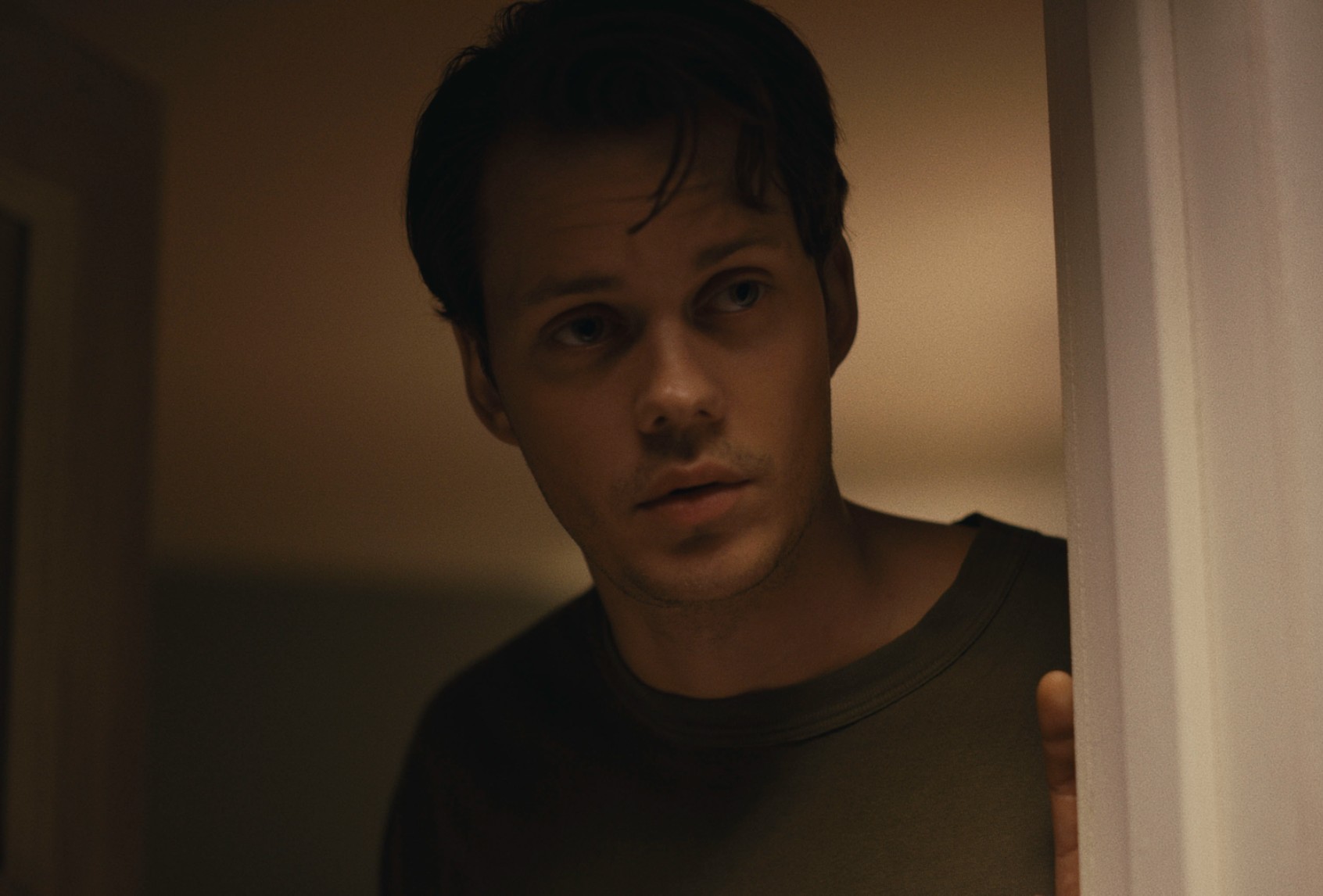
When Tess arrives at her rental in the middle of the night, she tries to access the key inside the lockbox out front, but it’s nowhere to be found. Already stressed out by the snag in her plan to rest up before heading out to a big job interview early the next morning, she’s further alarmed when a light turns on inside and the door is opened from the interior by a young man named Keith (Bill Skarsgård). The mere sight of Skarsgård in this role, and in this setting, sets off an alert in viewer’s minds that this must surely be the bad guy, since he’s best known as the notorious Pennywise the clown from the 2017 “It” remake. But where “Barbarian” goes from here could not (unless the movie had already been spoiled for you elsewhere) be anticipated.

Bill Skarsgård as Keith in 20th Century Studios’ “Barbarian” (Courtesy of 20th Century Studios)

After Keith convinces Tess to come in “where it’s safe” so she can try to get ahold of someone at the booking agency, or use the WiFi to locate somewhere else to sleep that night, we’re just bracing for what’s coming next. We don’t know what’s about to happen, but we know it won’t be anything good. 

Unable to get in touch with anyone who could help clear up the rental’s double booking, Tess goes online to try to book a hotel in the area, but nothing shakes out. Keith says it’s probably because there’s a convention in the area, and offers to let her sleep in the bedroom while he takes the couch for the night. “Yeah right,” we’re thinking. “Yeah right” is right!

Through all this tense anticipation, Skarsgård does a fantastic job of invoking his Pennywise eyes to keep viewers on the edge of their seats. He offers tea, which Tess doesn’t drink; and then he offers to open up a bottle of wine right in front of her so she knows he didn’t put anything in it. At first Tess keeps a safe distance, but before too long she lets her guard down enough to take him up on that wine. Several red herrings are thrown out during the early interactions between Tess and Keith but, somehow, seeing her wake up safe and sound the next morning is even more chilling than anything we’d already been shown. If Keith isn’t gonna try to kill her, then who, or what, will be popping up next? Well, turns out it’s not what’s in the house that Tess should be worried about, it’s what’s under it.


Want a daily wrap-up of all the news and commentary Salon has to offer? Subscribe to our morning newsletter, Crash Course.


Tess made a huge mistake by going into that house in the first place, but she makes the first of many larger ones when she successfully leaves to go on her interview and then COMES BACK. During a series of scenes wherein she continuously teeters on the edge of danger, retreats to safety, and then comes back to teeter some more before finally falling in completely, she’s maddening for her inability to choose saving herself over trying to help others. 

While rooting around for toilet paper, Tess gets locked in the basement and discovers a hidden room containing the most ominously sparse furnishings you could imagine: a bloody mattress, a video camera and a bucket. When Keith returns, having gone off to run an errand or something, she yells for him from a small window in the basement and then squeezes a key through so he can let himself in. Hearing her frantic recounting of what she discovered doesn’t register to Keith as being as big of a concern as it very much is, so he makes his one and only mistake by going down to check for himself. Does he make it back out? *Insert shrug emoji*

Through this whole film I found myself grappling with the concept of villains, and what makes a true villain. Is it someone who is Inherently bad — born and bred in evil, going on to inflict more evil upon the world? Or is a villain someone who knows how to be good, but chooses not to be?

Halfway through “Barbarian” a new character is introduced as the story takes a sharp turn. In Cregger’s previously mentioned interview with The Hollywood Reporter he said that this choice was one that caused many doors to be slammed in his face while trying to get the movie green-lit.

“It took me two years to get anyone interested in this,” Cregger says. “I just kept hearing the same things: ‘You can’t introduce a character on page 50.'”

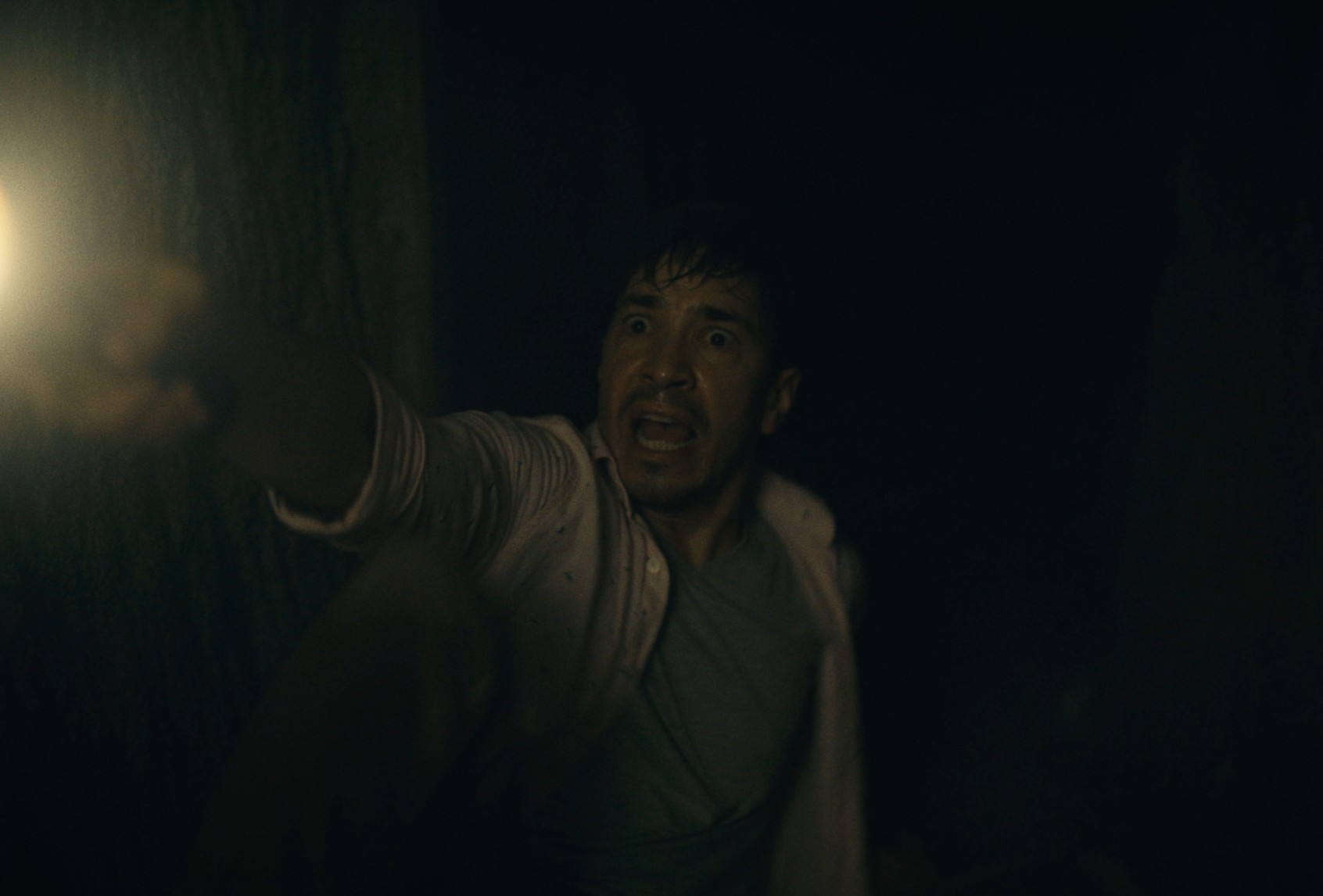
The character he’s talking about here is a morally devoid show business turd named AJ Gilbride (Justin Long) who is being black-listed in the industry after being exposed as a rapist. Current owner of the rental home, AJ is less concerned with the bloody mattress in the basement than he is calculating the exact square footage of the place so he can flip it. This character, more than what lays beneath the home in the film, is the true villain. But Tess risks her life, multiple times, to save him. Was it the best decision? Probably not, but I’d venture to say that it was the right one. Being a good samaritan can get you killed, sure, but you should try to be one anyway. Once a person starts weighing the value of another person’s life over their own the already fuzzy line between villain and hero blurs even more. 

The fact that the audience knows that AJ is a rapist but Tess does not leaves us with an interesting moralistic question to ponder. Would she, as someone presented as “good,” still have tried to save him if she’d known? And if we’d been in her shoes, knowing what we did know, would we have?

Justin Long as AJ Gilbride in 20th Century Studios’ “Barbarian” (courtesy of 20th Century Studios)

While watching “Barbarian,” which is one of the only horror films I’ve ever seen to make me audibly exclaim “What. The. F**k,” right out in front of God and everyone, I was, oddly enough, reminded of the two-part series finale of “Seinfeld.” In that finale the long-running comedy show is put to rest by the key characters; Jerry, George, Elaine and Kramer being sentenced to a year in prison for not being good samaritans. 

If you haven’t seen this episode, it starts off with Jerry getting a call from NBC saying they’re finally interested in moving forward on the long-shelved show about nothing he wrote with George. While courting Jerry on this project, NBC offers the use of their private jet so he, and whoever he wants to bring, can take a trip wherever he wants. The group decides on Paris but a mishap mid-flight causes them to do an emergency landing in Latham, Massachusetts. While wandering around the town they witness a man being carjacked and, rather than help, stand around making jokes about his weight. Kramer even whips out a now very vintage-seeming video camera to tape the event. Thinking they’ll just move on to find someplace to eat lunch, they’re surprised when a cop swoops in to arrest them all for violating the newly installed good samaritan law. In a trial that takes up the second half of the finale, a parade of characters from throughout the whole series testify that, yes, these are all horrible people, and they’re sentenced to jail.

What “Barbarian” offers, in addition to a full runtime of unexpectedly horrifying imagery mixed with surprising twists, is the chance for all of us to reflect on who could potentially show up as anti-character witnesses at our own good samaritan trials. Personally, I do appreciate my own safety, but I place far more value on working towards being a person whose gruesome death doesn’t get cheered in my final act.

The future tense of joy: “Deadwood” creator David Milch recaptures memory in “Life’s Work”

Television auteur David Milch, who wrote “NYPD Blue,” “Deadwood,” “John From Cincinnati,” and many other shows, wrote all of those shows orally. That is to say, he didn’t ever touch a keyboard or put pen to paper. Instead, he lay on the ground, surrounded by several other writers and interns, and inhabited his characters, reciting their dialogue, which someone else transcribed. 

If you’ve ever heard Milch talk, this method makes sense. He gave a series of talks during the screenwriters strike of 2007 as a sort of ersatz course on screenwriting, which is fascinating, seemingly random and yet deeply structured, like many of Milch’s shows. In these talks, Milch mixes jokes, anecdotes from his own life, lessons he learned from his teacher Robert Penn Warren, and dicta such as “Don’t think about writing when you’re not writing.”  

But fundamentally, the lectures hold a worldview, a religious sense of writing as an act of “going forth in grace.” As part of this, Milch told a story that has haunted me for years. It’s a doubled story of brothers and of fathers and sons. Now, in his book “Life’s Work: A Memoir,” released this week by Penguin/ Random House, Milch puts this story, in many ways the central drama of his life, into print, in what is surely, the final act of his life’s tale. 

The tragic news that Milch was suffering from Alzheimer’s came out in 2019, just before HBO finally aired the long-promised movie that was supposed to allow Milch to complete the arc of the 2004-2006 western “Deadwood,” which the cable network unceremoniously canceled after three seasons. 

With “Deadwood,” Milch was at the height of his powers at the moment that television writing had entered a so-called “golden age.”  In film, the director was the creative force behind a work of art. But with long-form streaming television, writers were given the title “showrunner” — at that time it seemed like it was mostly white men named David — and the control over the artistic vision of a series, which could develop in depth and complexity over dozens of hours of television. 
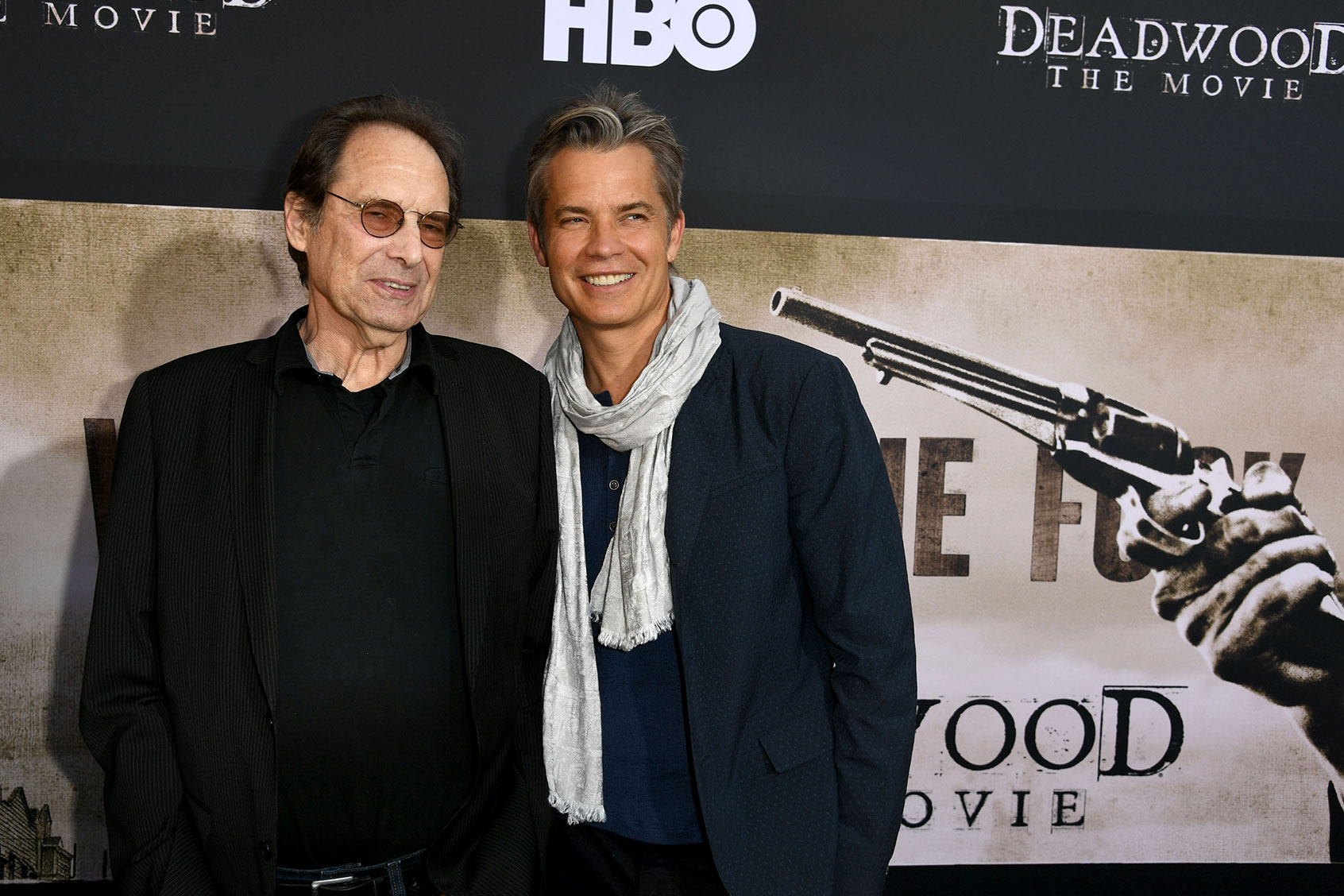
David Milch and Timothy OlyphantDavid Milch (L) and Timothy Olyphant arrive at the premiere of HBO’s “Deadwood” at The Cinerama Dome on May 14, 2019 in Los Angeles, California. (Kevin Winter/Getty Images)

In many ways, Milch was the precursor of this late golden age, bringing a previously unseen depth and realism to the police procedural with “NYPD Blue,” which ran on ABC from 1993-2005. Andy Sipowicz (Dennis Franz), a racist and violent detective, anchored the show in the way that other morally despicable antiheroes would hold down the greatest shows of the streaming era, from Tony Soprano through Fleabag

“Deadwood” would do to the Western what “NYPD Blue” did for the police procedural — and then some. Milch and his team had persistently pushed the network censors. But with the freedom — and Medici-esque budgets — of HBO on demand, Milch was able to craft a universe with a fierce and filthy aesthetic that at once created a new realism and made questions of verisimilitude moot.  

In one of the show’s first scenes, Ellsworth, a miner, delivers a speech that feels both Shakespearian and naturalistic. 

“I’ll tell you what. I may’ve fucked my life up flatter than hammered shit, but I stand here before you today beholden to no human cocksucker,” he says. “And workin’ a payin’ fuckin’ gold claim.”
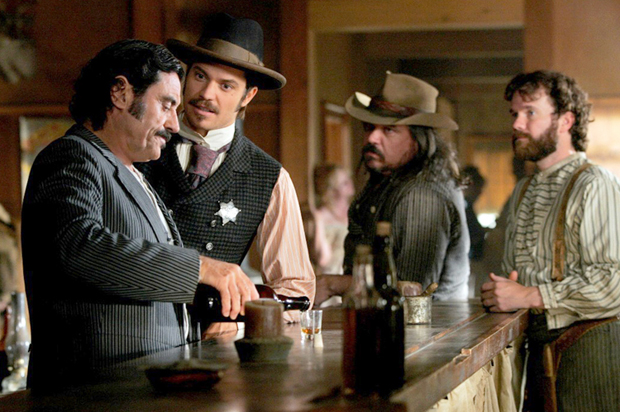
Deadwood“Deadwood” (HBO)Al Swearingen (Ian McShane), the pimp who runs the Gem Saloon, and through it, much of the political system of “Deadwood” is Sipowicz’s heir and the heart of the show, whose premise is that, in the Deadwood gold rush of 1876, the denizens need to create some kind of order to survive, without resulting to law — because they have no real legal claim on the Native land they are hoping to eventually steal. The show investigated the way that all order and all value is ultimately “a lie agreed upon.” 

As the crew wrapped the third season, HBO canceled “Deadwood,” but promised a double-header of feature films to wrap up the story and greenlit Milch for a much cheaper show with the novelist Kem Nunn about a family of surfers and assorted dirtbags who end up involved in mystical hijinks surrounding the titular “John from Cincinatti,” who may be God — or the internet or something like that. 

It was beautiful and weird — and got swiftly canceled after a truncated season. The “Deadwood” movies never materialized, and Milch’s last HBO show “Luck,” with director Michael Mann was canceled after a horse died in the filming. 

So, under any circumstances, for Milch fans, the ultimate release of the “Deadwood” movie would necessarily have a bittersweet quality. The film is set ten years after the series ended, so that the time that had elapsed in the universe of Deadwood was roughly the same as that which had passed in the real world. Like the characters and the actors, we, the audience, had also grown older and the gold rush of the “golden age” of television was starting to go bust. Knowing that Milch, whose singular vision created the style and tone of language for every character, was losing his memory, made it even more heartbreaking.

“It’s a kind of relentless series of adjustments to what you can do, in particular the way you can’t think any longer,” Milch told the New Yorker‘s Mark Singer in 2019, of his diagnosis.  

Even before the diagnosis was public, Milch and his family had been using the recordings of various talks he gave, either in public or as part of his process in the writer’s room of his shows, to put together a memoir “Life’s Work,” both to help Milch recover what he can of his life — and to pass on the hard-won wisdom of his hard-lived live and tell some of his great stories. But it is a fraught prospect from the start.  

“I’m intimidated and concerned about the limitations my health will impose on writing this book, an ongoing process of discovery,” he writes in the preface. 

David Milch and Bruce GreenwoodExecutive producer David Milch (L) and actor Bruce Greenwood pose together at the after-party for the LA premiere of the HBO original series “John from Cincinnati” at the Paramount Theater on May 31, 2007 in Los Angeles, California. (Kevin Winter/Getty Images)

As the book makes clear, Alzheimer’s is hardly the first time in his colorful career that Milch has worked through conditions that others would find debilitating. He manufactured acid and was addicted to heroin while he worked with Robert Penn Warren and R.W. B. Lewis on an anthology of American literature. In 1982, after writing a script for “Hill Street Blues,” he got a staff job on the show, from which he would fly to Las Vegas, where he’d gamble all night, and fly back in the morning for work. The gambling obsession stuck with him through most of his life, resulting in his wife Rita’s discovery in 2017 that Milch had racked up $24 million in gambling and tax debt. 

It was his half-hearted and yet acclaimed academic career that brought Milch into television. Milch and Lewis, whom he refers to as Dick, were working together on a project about the family of William and Henry James, the psychologist and novelist, with Lewis writing the book and Milch writing the scripts for a series. 

“You could see all of America in them and they were such full people and it could have been a great show,” Milch writes. “In 1979, we were down at the National Endowment getting dough, and Dick was called out of the room while we were pitching.” 

After the pitch, Lewis told Milch, “Listen, when I was called out of the room, they were telling me that your father had died, taken his life, and his instructions were that you were not to be told until after the pitch was finished.” 

Milch’s father, Elmer, was a renowned surgeon, but he was also a narcotics addict and alcoholic with ties to the underworld. Throughout “Life’s Work,” Milch shows how these two parts of his father were inherited by his two sons, David, who saw himself as a degenerate, and Robert, a surgeon who embodied all of Elmer’s respectable side. 

But, when Robert had to take over care of Elmer, who had stomach cancer, and “because his sense of self was so associated with his professional identity as a physician, he became convinced that since my brother had become the caregiver in my family, my brother was having sexual relations with my mother.” 

Milch’s father “took his life in front of them,” Milch writes, “to punish them for that and then his final words were ‘Don’t tell David until he’s done with his pitch.'” 

It’s a horrendous, sad story, but about 75 pages later, Milch returns to it. “If you end the story at my dad’s death, it’s not the whole story,” he writes. There is, in fact, an amazing, binge-worthy payoff to this crucial scene. But in the book version, Milch, uncharacteristically, botches the timing of the rest of the story, rushing through this pivotal moment after its reintroduction. But in the lectures, Milch masterfully ties this traumatic biographical event to his overall aesthetic theory in a way that is as moving as the finale of any season of any show he wrote. 

Television producer David Milch was honored with a star on the Hollywood Walk of FameTelevision producer David Milch was honored with a star on the Hollywood Walk of Fame during the ceremony on June 8, 2006 in front of the El Capitan Theatre in Hollywood, California. (Vince Bucci/Getty Images)

Immediately after the story of his father’s suicide, Milch refers the audience of the fourth day of lectures back to one of his touchstones, Robert Penn Warren’s poem “I Am Dreaming of  a White Christmas,” which ends with the lines:

All items listed above . . . are parts of the original dream which
I am now trying to discover the logic of. This
Is the process whereby pain of the past in its pastness
May be converted into the future tense.
Of Joy.

Milch always refers to Warren as “Mr. Warren” or “my teacher Mr. Warren,” heightening the effect of each citation by making him into a recurring character in the story. 

Milch says that sharing — discussion, art, the kind of conversation they were engaged in at that moment — is one of the ways that the pain of the past in its pastness is converted to the future tense of joy. That is what he has tried to do with art. But then he returns to his brother, the other storyline. 

“In my brother’s goodness after my father’s death, he retrained himself, he resigned his position as a surgeon and retrained himself as a hospice physician in order to better care for the dying,” Milch says. “And that process too is the process whereby the pain of the past in its pastness is converted to the future tense of joy.”

The future, Milch says, “continually reinterprets the meaning of the past.” That is the principle that guides a great show, when a plot event makes you reinterpret something you had previously seen. 

“If one stopped the story at the moment of my dad’s passing, that story would have a completely different meaning and it’s the business of art to sink its roots deep and identify how the fanciful interpretation of experience which would have us understand it as a despairing and isolating experience,” Milch says. “If the fanciful associations are removed, it becomes the imaginative experience, which is joy.”  

David MilchDavid Milch of “John From Cincinnati” (Jeff Kravitz/FilmMagic for HBO Films/Getty Images)

It is the ability to see beyond oneself that makes a writer and this is, perhaps, especially true of the writer of the modern television series like “Deadwood,” where one must have the ability to see the unity of the world of the show rather than the viewpoint of a single character. Milch, in the quasi-mystical mood of his lectures, likens this view, this ability to see the mining camp of Deadwood as a whole, rather than through the eyes of a single character, to St. Paul’s declaration that we are all one in the body of Christ. 

Milch’s memoir has some brilliant moments, but it fails in this regard. Perhaps because it is the work of a man trying to piece together his life for himself, with the help of his family, it is necessarily stuck to its own vantage point, which is itself painfully pieced together from fragments, gathered and recorded over the years.. 

As he speaks in old videos, Milch is always doing different voices, almost acting out his stories — essentially turning narrative into dialogue, at which he is a master. When he’s talking you can hear Swearingen or Sipowicz, both of whom, he has said, share characteristics with both himself and his father. 

Dialogue is what Milch is best at and it is what “Life’s Work” lacks. Some of Milch’s distinctive voice is maintained, but as a whole, most of the stories are better told verbally. On the page, the tales lose some punch. 


Want a daily wrap-up of all the news and commentary Salon has to offer? Subscribe to our morning newsletter, Crash Course.


On the other hand, if you like Milch’s shows and don’t know anything about the person who made them, this book is a great introduction and a wild ride. It is a story of drug abuse, sexual abuse, privilege, rebellion, luck, both good and bad, and finally grace. But most of all, it should serve as a spur to go back and watch Milch’s best work, “Deadwood,” “John from Cincinnati,” and even the pilot episode of a show about state surveillance called “The Big Apple,” which referred not only to the surveillance state in New York City but also to the Garden of Eden. 

Near the end of the book, Milch exhorts us to keep going. “Let me say from my heart: Don’t give up on mass culture. Contribute to it. Break your heart in trying to make it better. Our species is in the fight for its life and nobody says the decision is going to go in one way or another. Put your bodies and your spirits up.” 

That’s the big game David Milch was after in his writing: finding the universal in the specific, the imaginative in the fanciful and the writer at the farthest reaches. And, as in his life, Milch often failed in his writing. But in that failure, David Milch is, in many ways, at his most beautiful. 

Markey calls for federal probe of DeSantis’ Martha’s Vineyard maneuver

U.S. Sen. Ed Markey led six fellow Massachusetts Democrats in the House Friday in calling on the Treasury Department to investigate GOP Florida Gov. Ron DeSantis’ apparent abuse of federal Covid-19 relief funds to send two flights of migrants to Martha’s Vineyard this week.

Markey and Reps. Jake Auchincloss, Bill Keating, Jim McGovern, Seth Moulton, Ayanna Pressley, and Lori Trahan sent a letter to the department’s Office of Inspector General (OIG) given the governor’s use of the Coronavirus State and Local Fiscal Recovery Fund (SLFRF) “to cruelly relocate vulnerable immigrants from Florida to other states across the country.”

The lawmakers suggested the state’s “inhumane program” violates federal law and urged the OIG to not only investigate but also “take all necessary action—including potentially rescinding any misused funds—to stop this abuse of coronavirus relief programs.”

Reportedly lured in by the false promise of jobs, one migrant from Peru and 49 from Venezuela—including children—were flown to the Massachusetts island community on Wednesday. While residents welcomed them and rushed to provide food, clothing, and shelter, DeSantis has faced intense criticism for what the lawmakers and others have denounced as a “political stunt.”

To pull it off, the lawmakers’ letter explains, “DeSantis tapped a $12 million program that the Florida Legislature created earlier this year to allow the Florida Department of Transportation (FDOT) to ‘facilitate the transport of unauthorized aliens out of Florida.'”

The letter highlights that “the $12 million was funded through ‘the interest earnings associated with the federal Coronavirus State and Local Fiscal Recovery Fund,’ effectively using Covid-19 relief to score political points by exploiting vulnerable immigrants.”

This conflicts with Congress’ intent for the SLFRF, which was established with the American Rescue Plan Act, the letter argues:

As explained in the Treasury Department’s final rule implementing the Fund, the SLFRF was intended to “fight the pandemic and support families and businesses struggling with its public health and economic impacts; maintain vital public services, even amid declines in revenue resulting from the crisis; and build a strong, resilient, and equitable recovery by making investments that support long-term growth and opportunity.” That rule further identified a limited set of uses for SLFRF funds, including replacement of lost public sector revenue, responding to the far-reaching public health and economic impact of the pandemic, providing premium pay for essential workers, and investing in water, sewer, and broadband infrastructure.

While the rule was designed to provide flexibility to state and local governments, Congress neither intended to allow, or authorized, state governments to use the SLFRF funds for immigration enforcement. Nothing in the American Rescue Plan Act or Treasury’s final rule appears to allow states to use SLFRF funds to remove or relocate immigrants. Florida therefore appears to be illegally using taxpayer money for theatrics intended to criminalize and stigmatize immigrants in search of a better life in the United States.

The seven Massachusetts Democrats aren’t the only high-profile figures calling for a probe.

DeSantis’ Democratic challenger for governor, Charlie Crist, and California Gov. Gavin Newsom, also a Democrat, have both openly supported involvement by the U.S. Department of Justice, with the latter suggesting in a letter to Attorney General Merrick Garland that the Florida Republican’s actions could qualify for kidnapping charges.

White House Press Secretary Karine Jean-Pierre on Friday compared DeSantis and GOP Texas Gov. Greg Abbott relocating asylum-seekers to actions of human smugglers.

“These vulnerable migrants were reportedly misled about where they were headed—told they would be headed to Boston, misled about what they would be provided when they arrived, promised shelter, refuge, benefits, and more,” Jean-Pierre said. “These are the kinds of tactics we see from smugglers in places like Mexico and Guatemala. And for what? A photo-op.”

Axios reported that flight records indicate the planes chartered by DeSantis flew from San Antonio, Texas to Florida’s panhandle before landing in Massachusetts. After spending two nights at a Martha’s Vineyard church, the migrants on Friday were offered temporary housing on Joint Base Cape Cod.

“We are grateful to the providers, volunteers, and local officials that stepped up on Martha’s Vineyard over the past few days to provide immediate services to these individuals,” said Massachusetts Gov. Charlie Baker, a Republican. “Our administration has been working across state government to develop a plan to ensure these individuals will have access to the services they need going forward, and Joint Base Cape Cod is well-equipped to serve these needs.”

Meanwhile, in Florida, faith and immigrant leaders came together Friday to call out DeSantis.

“Why does this feel so wrong?” Florida Immigrant Coalition (FLIC) spokesperson Stephanie Wall asked of the governor’s stunt just weeks away from his election. “Because it is wrong. Gov. DeSantis, this is anti-family, anti-freedom, anti-faith, and anti-opportunity.”

HOPE CommUnity Center founder Sister Ann Kendrick said that “I think Jesus would be crying” and thanked the “good, hard-working people of Martha’s Vineyard… for stepping up and helping those immigrants who were lied to.”

Americans are less happy than ever. What are we doing wrong?

There’s a brief, telling scene in Evan S. Connell’s underrated classic “Mrs. Bridge” in which the title character, on holiday in Europe, meets an expat who tells her that he lives in Paris because he’s “happier” there. This puzzles Mrs. Bridge, because to her eyes, “He did not look happy; at least he seldom smiled.”


Want more health and science stories in your inbox? Subscribe to Salon’s weekly newsletter The Vulgar Scientist.


We like to presume that happiness and smiling are interchangeable. Yet one glance at the annual World Happiness Report reveals a far less outwardly ebullient visage. Relying on the variables of “real Gross Domestic Product per capita, social support, healthy life expectancy, freedom to make life choices, generosity and perceptions of corruption,” the United Nations’ Sustainable Development Solutions Network ranks the current happiest countries on earth as Finland, Denmark, Switzerland, Iceland, the Netherlands, Norway, and Sweden. You know, places whose chief exports include practical furniture, violent tasting licorice and psychological thrillers. The U.S. barely cracks the top 20. Maybe we don’t know what real happiness is.

“The intense motivation to pursue happiness has been very robustly linked to worse well-being in the U.S.”

Americans are fixated on our happiness. We built its pursuit into our founding documents and we incorporate it into our corporate branding strategies. We have turned “self-care” into a multi-trillion dollar industry and we describe our premier theme park to be the “happiest place on earth.” And yet we have never been more miserable. A recent Gallup poll found only about one third of us say we’re satisfied with our lives — an all time low. The National Institute for Mental Health estimates that in the past year, “21.0 million adults in the United States had at least one major depressive episode.” Our zeal may be part of the problem. As Brett Ford, one of the authors of a 2015 University of California, Berkeley study on cultural happiness has said, “The intense motivation to pursue happiness has been very robustly linked to worse well-being in the U.S.” It’s a lot of pressure.

I am currently spending a few weeks in the Netherlands, in a beautiful university city where church bells tell me the hour and a canal flows right outside my window. It’s spectacular. Yet much like Mrs. Bridge, I confess my immediate superficial impression here was not that this is a country with a surplus of joy. The cuisine is sensible; the transactions are polite. There’s definitely not a lot of the constant propulsion toward fun — big, loud, just got a hug from Mickey Mouse fun — that I associate with the American character. “I think it’s the Calvinism,” a Dutch colleague ventured when I inquired about the enigmatic reserve of her countrymen. “You’re not supposed to call attention to yourself.”

To be happy is not always a grand whoop of an experience. “One of the most hopeful ways of thinking about happiness is in different flavors,” says Dr. Robert Waldinger, Director of the Harvard Study of Adult Development and co-author of the forthcoming “The Good Life: Lessons from the the World’s Longest Scientific Study on Happiness.” “There’s no single way that happiness looks. I do lifespan adult developmental research, studying thousands of lives. And the one, that you learn when you do that is one size never fits all.”

“‘Am I having interesting experiences?’ That might not be fun all the time, but it’s engaging.” 

He explains, “One [type] is the hedonic wellbeing, as in, ‘Am I having a good time now?’ It’s it’s a feeling of pleasure.” We Americans excel at this. A 2012 study in the International Journal of Wellbeing found in the West, we tend to associate happiness with “a high arousal state such as excitement and a sense of personal achievement.”

But Waldinger notes there are other kinds of happy. “Another form,” he says, “is called eudaimonic happiness, from the Greek word to describe is a larger sense of meaning and purpose that brings us well being. Say you’re a parent, and you’re just exhausted, and you’re reading ‘Goodnight, Moon’ to your child before bed and she asks you to read it for the eighth time. Are you having fun? No. But is the most meaningful thing you could imagine doing? Absolutely. It’s that distinction.” He adds, “There’s a third flavor people have begun to think about, which is called a psychologically rich life, meaning, ‘Am I having interesting experiences?’ That might not be fun all the time, but it’s stimulating, engaging.”

Of course, happiness is a highly individualized experience as well as a cultural one, and if we Americans lean toward a flashier vision of happiness, that doesn’t automatically make us wrong. John Sommers-Flanagan, a clinical psychologist and professor of counseling at the University of Montana whose work focuses on happiness, explains, “When cultures emphasize hedonic happiness (aka materialism), happiness ratings tend to fluctuate depending on the acquisition of material belongings. Hedonic adaptation speaks to the fact that new things may briefly elevate mood, but over time (and sometimes a short time period), the new things get stale and happiness plummets back down. When cultures emphasize eudaimonic happiness,” he continues, “there tends to be less fluctuation in how people describe their happiness states of mind. Meaning and purpose-oriented living tends to stabilize mood.” But, he says, “People seem to need some of both forms of happiness. Fun is fun and good for short-term mood-boosting. But focusing too much on short-term mood-boosting activities seems to be a recipe for eventual discontent.”

It no doubt says a lot about our Western presumptions that the World Happiness Report skews aggressively European. Does that mean that the people of Costa Rica or Nepal are inherently unhappier than their Scandinavian brethren? That sounds like a simplistic proposition that we need to approach with a measure of skepticism. Yet the report’s baseline metrics, like generosity and social support, offer an intriguingly universal imperative a gentler joy.

“While we tend to assume that happiness is a day-to-day and extremely individual phenomenon, there are variables that have been shown to contribute to the overall sense of happiness and wellbeing of not just individuals, but society at large.” notes Ellen Wong, ND, a happiness coach and founder of The Joy Avenue. “Five of the top ten spots in the world’s happiest countries are occupied by Nordic countries. In these countries, not only is the GDP favorable, there is also a strong sense of community and trust in the government. Healthcare, education and environmental sustainability are top priorities.” There’s no getting around it — plain old stability makes people happy.

Pleasure is great and I want as much of it as humanly possible, but it is also comes and goes. And while contentment may sound like a much more modest ideal, I can’t ignore the appeal of the restrained happiness that other countries seem to have a better handle on. “The expectation that we’re going to feel happy all the time is complete garbage,” says Robert Waldinger. “The human organism does not feel happy all the time. Positive emotion isn’t there all the time. It’s up and down. That’s one of the myths that’s the most helpful to debunk.” Happiness isn’t a constant. And it doesn’t require a smile.

Dry your own herbs and you’ll never have to buy bottled ones again

Can You Dig It is a monthly series by Kristin Guy in which a real-life garden DIY is tackled with style. Whether you’ve got an expansive outdoor plot or just a few houseplants, Kristin will inspire you to grow even more with easy-to-accomplish projects and horticultural know-how.


When you think about preserving summer produce, pickling and canning are typically what comes to mind. Drying tends to be an afterthought, but it can be just as powerful for saving summertime flavors! There’s something calming about the drying process, too — you quite literally have to slow down and be patient — and you can easily create your own drying tools to make this ritual even more special.

Throughout the summer, I’m consistently harvesting and drying herbs to stock up my kitchen for year-round use. It’s easy to do, especially since herbs are easy to grow, and it saves you a ton of money in the spice aisle. You don’t need a fancy dehydrator, either. With just a few supplies, you can make your own DIY herb dryers that can easily be customized to suit your space and style.

As you decide which of these two projects to make, keep in mind the types of plants you want to dry and be sure to leave enough space for them in your design. While herbs are easy for beginners to dry, these designs can be used for flower stems, peppers, tea leaves, and more.

How to make a hanging herb dryer

This hanging herb dryer is extremely easy to make, and it can be expanded with multiple tiers to accommodate more herbs. For a multi-level dryer, you’ll want to buy several hoops in staggered sizes.

Materials:

How to make it:


Photo by Kristin Guy

Attach the basket chain or cord to your hoop — three attachment points will give you the best balance. Tie together the cords at the top, if needed, and hang as many hooks as you’d like from the hoop. If you’re making a multi-tier hanger, start with the smallest ring at the top and hang larger hoops beneath it to create a cone-like shape. You can make the dryer as big or little as you want, so feel free to customize to your heart’s desire.


Photo by Kristin Guy

Once your dryer is complete, wrap bundles of fresh herbs together with twine. Use the string to make a loop that can hang over each hook. For best results, hang the herbs upside down in a cool, dark place, as extreme heat and/or light can take away from the flavor.

Once completely dry — and I do mean completely dry, or else they may get moldy — store your herbs in an airtight container. You can keep them on the stem or save just the leaves for easy use when cooking.

How to make a stackable drying screen

These drying screens can be made using old picture frames — upcycling at its finest — and you can stack several on top of each other to dry all your herbs in one place.

Materials:


Photo by Kristin Guy

How to make it:

Measure the interior of the frame — the screen will sit on the inner lip where the glass usually goes — then cut the screen so it will fit inside. Lay the mesh inside the frame, and secure it in place using your staple gun.


Photo by Kristin Guy

Use hot glue to attach the half beads to the back side of the frame, with one in each of the four corners. If you’re planning to stack several screens, you’ll want to make sure the feet are tall enough to provide space for herbs (and air circulation) between the panels.

For best results when using this style of dryer, arrange fresh herbs without overlapping to allow for maximum airflow. Leave them in a cool, dry place for several weeks, and turn them over periodically to make sure that they are completely dried out before storing them in an airtight container.

“Susie Searches”: A cautionary tale of a podcaster who finds a missing student & “insta-celebrity”

There is more than meets the eye with “Susie Searches,” director Sophie Kargman’s darkly comic thriller that received its world premiere at the Toronto Film Festival this week. Expanded from the director’s short, this sly film has the titular true-crime podcaster (Kiersey Clemons) skyrocketing to fame when she finds her kidnapped classmate, Jesse (Alex Wolff), before the local Sheriff (Jim Gaffigan) does. But even as Jesse and Susie bond over this rescue, one big question remains: whodunit

“I like the collective nature of podcasts . . . and that collective experience makes us feel less alone.”

Kargman’s film is not so much about the who as it is about the why, and as the story takes twists and turns, as bodies pile up, viewers will appreciate puzzling out the clues and red herrings. 

Clemons proves to be a feisty heroine whose invisibility in the eyes of others may be her secret weapon. As she investigates and reaps the rewards of being such a good sleuth, she gains the attention she desires. How she handles her new-found success, however, is at the heart of Kargman’s film. 

The director chatted during the festival about the appeal of true crime podcasts, our toxic social media culture and making “Susie Searches.”

Susie has a very special talent, solving mysteries. What is your special talent?

I would say my special talent is my persistence. My production company is called Relentless Escargot. I think it’s a talent to be able to not take obstacles as true obstacles, or nos as nos. This industry is built on rejection and certainly not for the weak of spirit or heart. People say if there’s any other job to have — do that. The only way to be in the industry is if you really love it. My ability to persevere in the face of obstacles or adversity is something I’m proud of. I’ve always seen rejection or the word “No” as just a word. If it’s not for this person, it will be for someone else. You have to be able to pivot, and if something isn’t immediately presenting itself, then you go in another direction and find another road.  

Your film joins “Only Murders in the Building” and the recent film “Vengeance” in that it features amateur sleuths who host true-crime podcasts. What is the appeal of this genre? Why are we so fascinated by crime stories and listening or making podcasts about them?

“It’s more interesting knowing that there is a bomb.”

Truth is always stranger than fiction You hear these stories, and think, Whoa! There’s some zeitgeist-y idea that it could happen to us. I like the collective nature of podcasts and that there are a number of them available at our fingertips for any specific interest to anyone. It’s exciting, and that collective experience makes us feel less alone. When you are making entertainment, you want to make something that taps into something universal. I think podcasts do that. True crime is really topical. 

What podcasts do you listen to?

When we were writing it, “S-Town” was my favorite true-crime podcast of the most recent years. But as of late, I’m only listening to the “Team Deakins” podcast, which is on filmmaking. Roger Deakins does it with his wife. It changed my life.

The film has a very interesting tone. It’s deadpan funny in parts but there is also tension when Susie investigates. How did you approach the material? 

Tonally, I think it’s in the vein of “Election” or “To Die For.” I love dark comedic thrillers or mysteries. It’s a unique and tricky tone that isn’t done that often. That was always the intention. Some people when we were sending it asked, Is it a dark comedy or a thriller? Pick a lane. Why do I have to pick a lane? It’s both. You can have a dark comedy thriller. It’s a unique genre. “I, Tonya” is also in the same vein. I wanted to make a movie that made you laugh and nervous and scared and nervous and scared to laugh. I love all types of film, but for “Susie Searches” I wanted to make something that was an elevated genre film that was both commercial and a detailed character study about our society’s fixation on the need for love and validation. 

Without giving anything away, you reveal the kidnapper early on. Can you discuss why you decided to do that?

It was like Hitchcock’s discussion of suspense and surprise when two people are having a conversation and there is a bomb under the table. It’s more interesting knowing that there is a bomb. You look for those small nuances of a glint of an eye or intake of breath and watching their movement in a different way. If you don’t know until the end, you miss that. There’s something that brings you in. 

In the short film, the reveal happens at the end. When Will, my cocreator and writer, and I were crafting the beats of the feature, we didn’t want to prolong hiding the identity of the kidnapper.

That is what folks might expect. The goal is to find out what is going to happen. I like films that open up a world or feature complicated characters I don’t understand and teach me something or make me more empathetic. I make movies to make people more compassionate

What are you saying, directly or indirectly, about our need to be seen all the time? You celebrate and satirize our social media culture in “Susie Searches.”

“Susie” is a cautionary tale about the toxicity and need for insta-celebrity. If we are not careful, we can become this. 

The film features a young Black woman, who is often seen as invisible and treated poorly, especially by the local police. “Susie Searches” never addresses issues of race, but the microaggressions are implied. Your short featured a white Susie. Can you talk about the issue of race in the film, or the lack of a discussion about race? 

It’s more a question for Kiersey. For me, when I was casting, I was looking at everyone. I played the role in the short. I wanted the best actress for the role in the feature and Kiersey was that. She had emotional dexterity. I didn’t have an idea of what this character looked like. It was much more important for me to find the right actress.


Want a daily wrap-up of all the news and commentary Salon has to offer? Subscribe to our morning newsletter, Crash Course.


One of the characters says that people wear masks, hiding who they really are. In this respect, “Susie Searches” is about identity, and how well we know folks. This is also a topic in your short “Query.” How are you commenting on this idea in your films?

If there is one underlining theme in all of my work, it is taking one thing and flipping it on its head. That’s a commonality between “Susie” and “Query.” Humans can be multiple things all at once, and that idea of challenging preconceived notions is exciting. That’s allows for complicated storytelling and interesting, textural, complicated people. I pride myself on making characters who are multifaceted. Even the small characters feel rich, they have their own arcs.

This is your first feature film after two shorts and working as an actress for a decade. What thoughts do you have about your career and are you going to pursue this kind of work in the future?

Once I started directing, I found the place I want to be. That isn’t to say I won’t act any more but directing is really my purpose. 

A short history of fake history: Why fighting for the truth is critical

It is often said that history is a story told by the winners. It might be more accurate to say that those who tell their story as history and get others to believe it thereby make themselves the winners. That happened on a grand scale in the United States from the late 19th century into the 1960s. That fact is essential for us to understand as right-wing extremists again seek to dictate that a fraudulent version of the American past be taught in schools.

Within a few decades after the Civil War, it came to be the losers’ stories of “a land of Cavaliers and cotton fields,” moonlight and magnolias, kindly masters and happy slaves, a glorious “Lost Cause” and a horrible period of “Black Reconstruction” that were widely accepted as accurate history. In the late 19th and early 20th centuries, the nation was reunited on the basis of a tacit armistice in which the South accepted that the Union was indissoluble and white Americans outside the South accepted the Southern doctrine that people of African ancestry were innately inferior. That acceptance was facilitated by the popularity of the pseudoscience of social Darwinism and a fabricated story that Reconstruction had been a monstrous time of rule by ignorant black people, rather than the largely successful period of progressive and democratic reform that it actually was.

This inverted history had an enormous impact on the lives of at least three generations of Americans that, though diminished, continues down to the present. The most consequential telling of it is found in D.W. Griffith’s 1915 film, “Birth of a Nation,” a landmark work both of cinema and white supremacist propaganda. The movie represents enslavers as benevolent caretakers for a lower life form. Enslaved people are shown singing and dancing during the “two-hour interval given for dinner.” Reconstruction is painted as a time in which the “natural order” of white superiority was turned upside down. Griffith presents a frightening picture of “crazed negroes,” with the necessary restraints of slavery removed, making “helpless whites” their “victims.” One of the title cards in the silent movie depicts the restoring of white man’s rule as a glorious event and describes it as “the former enemies of North and South are united again in common defence of their Aryan birthright.”

The view that Reconstruction was a period of terrifying “black domination,” and Restoration the rightful reaffirmation of the United States as “a white man’s country,” was prevalent throughout the nation from the 1890s into the early 1960s. Pushed by followers of early 20th-century Columbia University historian William Dunning, this interpretation was routinely taught in schools. It was also reflected in popular culture, notably in Margaret Mitchell’s hugely successful 1936 novel “Gone With the Wind” and its 1939 film adaptation.

*  *  *

The 1950s — the time when Republicans today say America was “great” — lasted well into the early 1960s. Though it is often referred to as an “age of innocence,” in fact it was an age of ignorance of guilt. Restoring that ignorance is a major component of the authoritarians’ plan to “Take America Back.”

The view that Reconstruction was a period of terrifying “black domination,” and Restoration the rightful reaffirmation of the United States as “a white man’s country,” was prevalent from the 1890s into the early 1960s.

In 1964, songwriter and folk singer Tom Paxton recorded “What Did You Learn in School Today?” It is a biting satirical attack on the misinformation that was still being taught about the American past. The son in the song responds to his father’s question by saying he learned that everyone in the United States is free, our country is always right and just, the police are always our friends, the wars America fights are always good and so on. Paxton’s lyrics again seem tailor-made for the “guilt-free” mythology that Republicans today are seeking to impose on school curricula while calling it history.

It was in 1964 that the dam holding back the truth about the American past cracked. “A Shadow Stretched Across Our History for a Hundred Years,” read a New York Times Book Review headline on Sept. 13, 1964. That shadow, cast by the acceptance of the losers’ false history, which continued its pernicious effects through the Jim Crow era of segregation, was finally being lifted. Newer scholarship — and some older but largely ignored works, notably W.E.B. Du Bois’ 1936 “Black Reconstruction in America — that presented a very different view of Reconstruction was brought to a wider public attention.

Even more important in overturning the whitewashed history that had held sway for so long was the impact of the civil rights movement in awakening many Americans, particularly the young, to the fact that they had been spoon-fed a distorted version of the nation’s past.


Want a daily wrap-up of all the news and commentary Salon has to offer? Subscribe to our morning newsletter, Crash Course.


Particularly significant in that regard were the Freedom Schools set up during the 1964 Mississippi Freedom Summer Project. “Education in Mississippi is an institution which must be reconstructed from the bottom up,” said Charles Cobb, the Student Nonviolent Coordinating Committee field secretary who pushed the idea of Freedom Schools. The prospectus that was sent to volunteers who would teach in the schools, “Notes on Teaching in Mississippi,” explained that Black students “have been denied free expression and free thought. Most of all … they have been denied the right to question.” Students were encouraged to bring their own experiences with the institutions and practices of Mississippi into the discussion.

Among the innovations of the Freedom Schools was the teaching of African American history. It was a revelation to many of the students that people like them had a history. The rise of Black history, as well as other areas of ethnic history and women’s history, as the ’60s blossomed was in part the result of what began in the Mississippi Freedom Schools in the summer of 1964.

*  *  *

Today’s right-wing extremists seek to “Take Back America” in two senses: back from those who are not white or not male and back to the time when straight white males were in charge. An essential part of their overall quest to effect a second “Restoration” of white man’s rule is an attempt to restore the ignorance of American history that had prevailed before 1964.

States under right-wing control have been passing laws restricting what may be taught in their schools, especially about racism. The Republican-controlled Texas state legislature enacted a law in 2021 specifying what should — and should not — be taught to students about their nation’s and state’s past. Excluded were the 15th Amendment, which prohibits the federal government and states from denying or abridging the right to vote “on account of race, color, or previous condition of servitude,” the 1965 Voting Rights Act, “the history of Native Americans” and documents on the separation of church and state and the women’s, Chicano and labor movements. Existing standards calling for teaching about the ways in which white supremacy, slavery, eugenics and the Ku Klux Klan are “morally wrong” were removed. The law is unmistakably a formula for again making Texas, where non-Hispanic whites are already a minority, what it was before 1964: a white man’s state.

At its state convention in June of this year, the Texas Republican Party adopted a platform requiring that lies be taught as history and insisting that the traitors who led the Enslavers’ Rebellion (aka the Civil War) be venerated.

Not to be outdone in the Orwellian project of reconstructing the past to promote nefarious objectives in the present, Florida Gov. Ron DeSantis had the state Department of Education hold training sessions for teachers this summer, as part of a “civics excellence” program. Teachers who attended reported that they were instructed to teach students that American slavery wasn’t really that bad, that the Founders didn’t want the separation of church and state, that the United States was founded as a Christian nation, and other flat-out lies.

*  *  *

Mississippi racists in 1964 feared that knowing the truth would set people free. Across red-state America in 2022, zealous right-wingers who share that fear are conducting search-and-destroy missions against books and teachers that dare to tell the truth about the nation’s past.

At the Freedom School in Canton, Mississippi, a small city just north of Jackson, an incident in July 1964 perfectly symbolized the views and purposes of opponents of truth and freedom, both then and now. Local white people broke into the building housing the school and its small library collection and urinated on the books.

Directives to Florida teachers ordering that books about LGBTQ people be put “in the closet” speaks volumes about where the red-state suppression of truth and free inquiry is going.

Freedom Schools were the antidote to unfree schools in 1964. In 2022, making schools and history unfree is intended to reinstate the ignorance of the past that prevailed six decades ago. A July story in the Washington Post reported on directives to schools and teachers in Florida to take all books on a list of those not “in compliance” with state laws and hide them “in a classroom closet” or elsewhere where students cannot see them. That’s a step above urinating on books, but still outrageous. (Some of the books on the no-read lists are about LGBTQ+ people;  ordering them put “in the closet” speaks volumes about where red-state suppression of truth and free inquiry is going.)

There is much about the history of the United States in which we can rightly take pride.  But to pretend that there are not also dark and difficult truths in our past constitutes a Big Lie that serves the interests only of those who want to destroy the American experiment.

Among the reasons why the times they were a-changin’ in 1964 and “the losers now will be later to win,” as Bob Dylan said in a song released that January, was the displacement of a whitewashed version of the American past with a more truthful one. The authoritarians who seek to undermine democracy and freedom today understand that their success depends not only on disseminating fake news, but also on sowing “fake olds.” The rest of us must understand that, too.

Man charged with sexually assaulting women while in line to view queen’s coffin

A man has been charged with sexual assault for crimes against women while in line to view Queen Elizabeth II’s coffin in London’s Westminster Hall.

According to a statement from the Crown Prosecution Service obtained from CNN, the assault took place on Wednesday at Victoria Tower Gardens when the man — now identified as 19-year-old Adio Adeshine — allegedly exposed himself to at least two women and then proceeded to lewdly bump into them from behind. 

An additional report from Independent details that when the man’s actions were made known he attempted to evade arrest by jumping into the River Thames. He’s since been taken into custody and has been charged with two counts of breaching a sexual harm prevention order and two counts of sexual assault.

In a statement issued by The Metropolitan Police’s Deputy Assistant Commissioner Stuart Cundy he says “officers were on hand to immediately respond and arrest the man . . . There has been very little crime or other incidents where officers have had to intervene. I continue to ask all members of the public to remain vigilant and if you see something that doesn’t look right, please report it to an officer or steward.”

According to Independent, one of the women allegedly attacked by Adeshine stated that he caught her eye because, although she’d been standing in line for hours, she hadn’t seen the man before. She states that after turning around she noticed that he was exposing himself. 


Want a daily wrap-up of all the news and commentary Salon has to offer? Subscribe to our morning newsletter, Crash Course.


During his court appearance, Adeshine plead innocent to the charges against him but the deputy chief magistrate refused bail and he will remain in custody until his next court appearance in October. 

Betty Gilpin on battling “implanted patriarchy” and the exhaustion of women “cycling through selves”

Sisterhood may be powerful, but it sounds like Betty Gilpin‘s latest TV role is taking that phrase to violent extremes. When I catch her to discuss her book  “All the Women in My Brain: And Other Concerns,” she deadpans that her recent days have been spent running around in a nun’s habit, sobbing her eyes out. Compared to that, chatting about her publishing debut sounds like vacation.

Gilpin is used to running herself into the red, a point that arises time and again in a collection of essays that contemplate her upbringing and road down which she’s steamed, one that earned her an Emmy nomination along with notoriety for roles in such acclaimed dramas series as “Masters of Sex,” “Nurse Jackie” and “GLOW,” the gone-too-soon story of women wrestlers in the 1980s. The nun role she references in passing, “Mrs. Davis,” is an upcoming drama from Damon Lindelof and Tara Hernandez that’s set to air on Peacock.

These are roles others have written for her. The identities explained through the book’s title are parts she came up with herself, and long ago, who help her navigate the world. We all have those characters, after all. In explaining their purpose Gilpin makes the reader feel better about their relationship with those inner voices, alongside ruminations about feminism, self-image, mental health, the Hollywood industry machine and a host of other, as she calls them, concerns.

The fact that she cranked it out during the pandemic lockdown and after having a baby should earn her extra respect, considering the average person was struggling to simply sit upright every day. But she’s also very humble about that, and the cleverness of book’s lyrical tone. “I don’t know, I just processed what was happening through a silly winky metaphor,” she told Salon, adding, “That’s how I process things in general.”

In this “Salon Talks,” Gilpin discusses the way we create characters for ourselves to help us cope with the world, along with her own efforts to balance a crazed work schedule and her own health.

The following interview has been edited for length and clarity.

How long did it take you to write the book?

I would say I wrote it in a month and then edited it over the course of maybe two months. I had just had a baby and was in the throes of the kind of hormones where you feel like you’re on MDMA in a meadow all the time before the other hormones come, which feel like the opposite. And I had always wanted to write this book, but I think that I was just . . . I don’t know. When I used to be a big stoner, I smoked weed all day, but was never a good joint roller because I was like, “Why not only let the best joint roller in the room roll the joint?” And I felt that way about writing a book. I was like, “Well, I’m not Joan Didion, so why not let Joan Didion roll the joint?” But I think that it took quarantine and post-baby MDMA hormones to be like, “Just sit down on your living room floor and write it.”

Throughout this entire book, your facility with metaphor is wonderful. Let’s talk about that: Can you explain the origin story behind the book’s title?

Well, that was from an essay that I wrote a couple years ago for Lenny Letter. There’s maybe two essays in the book that had been published previously, and I wrote about this weird physical thing that happened to me where in a time of basically intense stress and life events intersecting. I had this crazy full body muscle spasm that felt like a lie, and a joke, and a dramatic exaggeration, and lasted for six days. It was a really confusing convergence of what was happening emotionally in my physical body basically. And the only way that I could make sense of it was I thought about the women in my brain, the metaphorical different characters in my brain that take turns at the wheel. And basically I felt like I had lived my life as a beta person suddenly living an alpha life and it felt opposite of my identity.

I wonder if a lot of women can relate to that concept. But I also wonder, do you think it’s something that’s unique to women or do you think that it’s universal, that everybody feels that way?

“My job is to cycle through selves to give whoever is in front of me the girl they want. And I think that probably a female lawyer in Ohio feels that way.”

I’m sure it’s not unique to women. I think that I tried to write in general about things that I feel as a woman, as a person that for a long time I had felt was my weird curse alone. And then the more I would say them out loud to my friends, or therapists. or different women really, I realized, oh, a lot of people feel this way. And I think even though different brain women are maybe different brain women, but that there’s probably a sameness there, that feeling in general.

That was a great way of putting it. It’s like, “Oh, I’m not crazy.” I think there’s a reason that we have these coping mechanisms that if we’re in unfamiliar situations, the way I had it put to me was to “step into your hero” in any given situation. But the “brain women” thing makes a lot of sense.

And that’s what I also tried to write about. I didn’t want it to be a typical actor memoir because, A, there are so many billion actresses nowadays that I don’t expect anyone to know who I am or care. I just think that, weirdly, being an actress is the perfect allegory for what we’re talking about. My job is to cycle through selves to give whoever is in front of me the girl they want. And I think that probably a female lawyer in Ohio feels that way. You don’t necessarily have to care about the entertainment business to relate to that feeling. And it’s been a strange gift and romp and sometimes heartbreak to have that feeling be the way that I pay my bills. And I try to make fun of it all and laugh at it all and roll my eyes at it and also be honest about the fact that I’m very passionate about it, but I think I’ve commodified cycling through the brain women in a strange way.

I think we all do. I think anybody who has to leave their house and be anything other than the person that lets their hair down and takes their bra off in the world, you have to.

Totally. And I also try to talk about the difference and vacillation between presented self and authentic self [using] yet another metaphor: Salem versus Barbie. And I think that basically Salem being the churning id within us, your basic most authentic self, and then the Barbie self is the learned presented self that you filter that id through. And typically as women, there’s just more of the latter to slather on before you present yourself to the world. And my job as an actor, I get to do a lot of the churning id stuff, but only after I go through two hours of the patriarchy car wash of hair and makeup. So it’s like I have to check the Barbie boxes in order to do the Salem stuff, and, again, for a job that is mostly silly and wonderful.

Well, let’s get into that part of it. . . . You talk about that idea of running yourself ragged that in order for you to be successful, and for actors to be successful you have to keep booking until these things start hitting and there’s awards and all these jobs. How has writing this book changed the way that you’ve looked at making a career for yourself?

In the book, I try to talk about how probably in any industry it can feel like this, where your childhood dream and passion and feeling of, “Oh, I have this specific thing buried in me that, maybe, wouldn’t it be so incredible if I got the opportunity one day for that to float out of me into the world in whatever capacity, if I did the thing that I’ve always wanted to do?”

“Being an actress and a woman now, it feels like we are trying to sell the merch of a feminist victory before having the victory itself.”

And then a different thing is societal success and claps in the town square. And it’s very easy to confuse those two things of basically your childhood dream and public validation. They’re not the same thing. And when I did off-off-Broadway theater for 10 years, there was no confusing the two. It was very obvious that I was just doing the childhood dream thing and that society slash the town square didn’t really care.

But as I started to get a little more success as an actor, that had more to do with public validation or trying for the Internet’s approval, it was easier to muddy the two things . . . I try to talk about all of that comedically, but I think a lot of the lessons that I learn in the book is about checking my own ego through the various successes and failures, and realizing your own actualization is always going to be more powerful but quieter than society telling you you’re the prettiest princess at the dance. Even though that feels good, it’s going to go away in a second. So maybe enjoy the actualization and look at the horizon and have a glass of water.

I would love for you to talk about your experience of looking, finding the proper treatment for you in Los Angeles and how time consuming and expensive that was. And I’m wondering after that experience, what did that teach you about how our health care system falls short when it comes to taking care of women’s mental health?

Well, I think that for me, my mental health converged at a time where I was doing three jobs at once, I was filming “GLOW” and “Masters of Sex” and . . . the other job was my wedding. I was in on the West Coast planning my East Coast wedding and flying back and forth every weekend. And it felt like this panic of, “I have to do all of this right now because time is running out and I’ve been unemployed and waiting for the phone to ring for so long that I’d be an idiot to stop and take a deep breath right now because it’s all going to go away,” a fear mindset of “I have to seize this opportunity.” And I think it’s strange because my depression and anxiety and the darker parts of me connect me to the parts of acting that I like.

. . . It was like I had almost monetized a part of me that was hurting me and now I wasn’t letting it have a deep breath at all, because I was just go, go, go, go, go. And I think that we’re just so result-based and I think our health care system is like that too. Where it’s like, “OK, here’s the Band-Aid, go, go, go. You’re out the door, you’re ready.” It took me finding basically a witch in a dirty apartment to be like, “We’re just going to do some weirdo, scarfy, deep breath, shaking you, some very not western medicine stuff.” And it just calmed my nervous system down, but I’m also in normal people therapy, which I recommend.


Want a daily wrap-up of all the news and commentary Salon has to offer? Subscribe to our morning newsletter, Crash Course.


I think this is a good time to talk the the chapter called “Options or Paralysis.” And that’s a concept I first read about in [terms of] explaining the millennial brain, but the way that you talk about it is that it really comes into play when it comes to how we live our feminism. You wrote, “We’re living in a time where women are refurbishing shackles as novelty earrings. We take things built to control us and treat them as option pieces of flair.” Can you talk about what you mean by that?

I try to talk about how being an actress and a woman now, it feels like we are trying to sell the merch of a feminist victory before having the victory itself. We’re so quick to be like, “Everything’s ticked, everything’s fine.” And it’s not. We’re not there yet, obviously. And particularly being an actress in the public eye to whatever degree that I am or am not, it feels like it’s this mash-up of pretending we’re in 2053 and also being in 1953 still, that as we also get some producer credits and fart jokes so rise the smoke and mirrors demands of the way you’re supposed to look and be.

[In] “Options or Paralysis,” I try to talk about how it’s like, OK, if we’re the generation that is supposed to live with a perfect feminist scorecard, there’s only so many hours in the day and days in your life. Do you spend it finding the perfect career or finding your own actualization as a sexual independent being? Or can you find a partner in a family in a way that still checks all the woke boxes? Or can you do all three at once? Which is, I think, what I’m trying to do. And it sometimes feels impossible.

There are so many parts of this book that I think every woman can relate to. I also got the impression, and I’d love for you to confirm this, but I wonder if this is almost like a life manual for your daughter. Was that what you were thinking about when you wrote it?

Yeah. Something I talk about in the book is that I think one of the many ways that they’ve implanted patriarchy calls coming from inside the brain house still is that we are quick to judge other women and assign an identity to them if we feel threatened first or something and roll our eyes at each other.

It’s easy to be a blanket feminist, but then roll your eyes at the women sitting right next to you, which I totally do all the time. And I don’t want to do that to my own daughter, especially because she has no presented self yet. She’s only pure s****ing-in-her-diaper, laughing-at-the-sky id right now. And I think it’s easy to honestly feel threatened by that. And I guess, yes, part of the reason being for this book is to give her a manual to my insanity and say, “This is all of me and I want all of you.”

But I wrote it in a book for claps in the town square, so how much progress have I really made? I don’t know.

“See” recap: Manure, rain and still no war

It’s hard to know what to make of “See.” The show is unrelentingly dark, both in story, theme and visuals, with many scenes so dim, it’s difficult not to feel like it’s all supposed to be a metaphor. The Apple TV+ series is about a future where a deadly virus has resulted in most people in the world being blind. Those very few born with sight are considered, alternatively, as witches or as saviors to disabled people.

As The A.V. Club writes, “That vision would be considered a super power to blind people, who have managed to restore civilization without it — smacks of ableism, but that isn’t ‘See’s’ only trouble.” It has a blindness consultant. (And disability consulting is unfortunately some of the lowest-paid work in television and film.) The show also boasts of a large blind cast and actors who are low vision, though none of them appear to be in leading or major roles, which are played by seeing actors with eyes digitally altered by special effects.  

It’s somewhat depressing that this is considered a huge step for disability in Hollywood, but here we are with Jason Momoa as Baba Voss, the leader of a dystopian, blind tribe and adopted father of young adult twins who can see. Their mother, Maghra (Hera Hilmar) was pregnant by the mysterious Jerlamarel (Joshua Henry), a kind of seeing prophet with not the greatest intentions, when she first stumbled into the tribe’s encampment. Last season, Jerlamarel was killed as was beloved elder Paris (the great Alfre Woodard), and this season started with the characters, once a tight family unit, scattered.

“See” is on its third and final season and we’re headed for an ending as seemingly dark as its beginning. Episode 4 both sets characters off on their own journeys and by the end, brings some back together.

Sibeth (Sylvia Hoeks) formerly known as the queen, escapes and covers herself in animal manure to get past guard dogs. It’s not pleasant, but neither has most of her reign been. With dramatic piano chords benefitting “The Phantom of the Opera,” she wanders in the woods. 

The show is best when it’s groups of people bantering in the woods, as opposed to wallowing in damp industrial buildings.

Momoa’s Baba Voss is really great at two things: fighting people and being a good dad. Now he’s a great grandad to “a boy named Wolffe and a dog named No.” He leaves his dog, at first reluctant to have the companion all but now beloved and proven, guarding his grandson whose reluctant father is Kofun (Archie Madekwe). Kofun of course was seduced by the former queen Sibeth, who is both older, creepy and happens to be his aunt. How “House of the Dragon” of them. Kofun feels guilty for helping Sibeth to hide before her escape.

SeeArchie Madekwe and Nesta Cooper in “See” (Apple TV+)
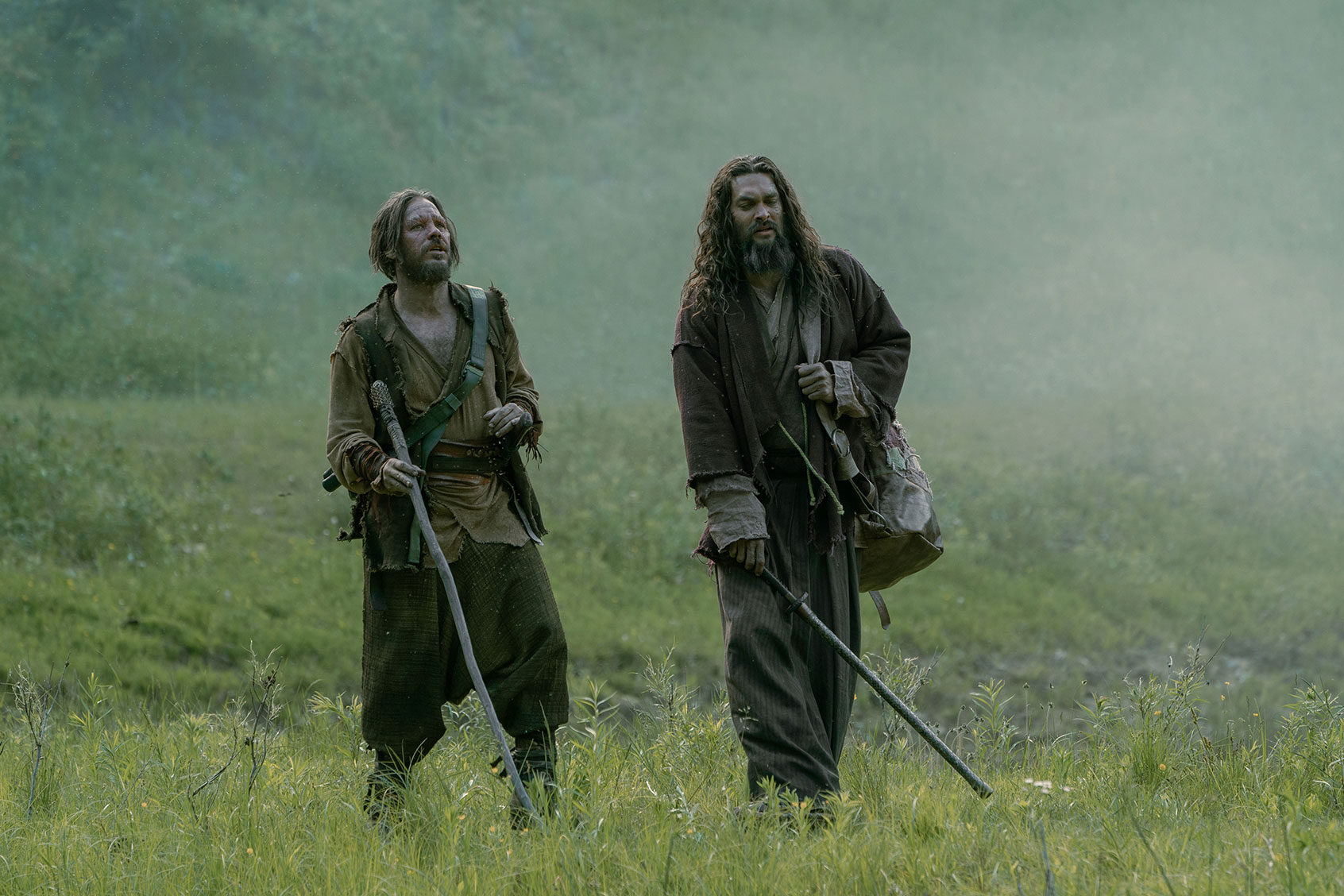
Baba Voss, Kofun, Haniwa (Nesta Cooper), the likable Wren (Eden Epstein) and the hilarious Charlotte (Olivia Cheng) set off to rescue Jerlamarel’s kids. The show is best when it’s groups of people bantering in the woods, as opposed to wallowing in damp industrial buildings, so it’s nice to see the band head off on a merry side quest. Time in the woods allows Baba Voss and Kofun to have a heart to heart. Baba Voss is good at those too. “Stay alive, my boy,” he advises before slapping him on his wound.

Animal manure is a recurring theme this episode.

Meanwhile, Ambassador Trovere (Trieste Kelly Dunn) and Lord Harlan (Tom Mison) are off on their own, flirting. Oops, Harlan has fallen in love with the woman he was forced to marry, new queen Maghra. He breaks off from the ambassador and heads with “some associates” to sneak into the city.

Baba Voss takes his group to the site of Bow Lion’s death. The sighted kids examine the damage made by new-fangled explosions and Baba Voss convinces Ranger to join their cause by invoking the name of Tormada, the scientist who created the bombs that killed so many already.

SeeMichael Raymond-James and Jason Momoa in “See” (Apple TV+)

Animal manure is a recurring theme this episode as Harlan sneaks into Trovere’s city whilst hiding in a rattling wagon of livestock. “Did it have to be chickens?” he asks, like someone from another century who knows of “Indiana Jones. “

Sibeth struggles to make it alone in the wilderness, doing an admirable job of smacking her lips after eating insects off a log while Harlan in his storyline delivers news of the advanced weapons headed the city’s way. Sibeth’s not actually alone either as there are wolves in these here woods. Mad scientist Tormada makes his case for explosions in front of the council. A demonstration is apparently in order. Harlan won’t stop talking long enough to escape. I mean, he just wants the details.

Harlan makes it but much of the council do not, and the lord realizes that the sexy ambassador was in on it the whole time, though she swears she didn’t have a choice. She gives Harlan a choice, though, to “live at the top of the new order.”  But Harlan is nothing if not stubborn. 

SeeSylvia Hoeks in “See” (Apple TV+)

It rains on Sibeth, the show perhaps finally deciding that her character is more camp than anything else. And there’s more than one “Indiana Jones” nod in this episode, with Indy’s least favorite reptile finding our least favorite royal. Sibeth’s more Rasputin than queen, as she apparently lives to be annoying another day.  


Want a daily wrap-up of all the news and commentary Salon has to offer? Subscribe to our morning newsletter, Crash Course.


We get an insight into the bomb factory where some of Jerlamarel’s children are forced to work. Time for Baba Voss to work his magic and the women too, who rescue the children. Maghra fights in her administrative way, which is asking for a vote to finally begin an official battle. 

“See” keeps threatening war and perhaps like the downpour on Sibeth (and Maghra, who’s waiting vainly for her lost sister outside, and on Baba Voss in his own storyline), the bombs mean it finally will rain firepower upon the fractured kingdoms. 

“See” releases new episodes Fridays on Apple TV+.


Decades before John F. Kennedy, another president’s death was shrouded in mystery

In the decades immediately after his death in 1923, President Warren G. Harding experienced what may be called the opposite of an image rehabilitation. For most presidents, death brings with it a certain eulogizing tendency to gloss over their flaws, at least initially. In the case of Harding's untimely death, the public instead became fixated on his scandals. Suddenly, the two-and-a-half years of his presidency faded into the background, even though these included historic events like keeping America out of the League of Nations, imposing stringent new anti-immigration policies and granting clemency to the imprisoned anti-war socialist Eugene Debs.

Regardless of one's political stance, these accomplishments are probably more relevant to Harding's legacy than the fact that he cheated on his wife. Yet it is that last detail — along with a series of corruption scandals involving members of Harding's cabinet, but in which Harding was not involved (and to which he never had time in his own life to respond) — that wound up shaping the man's reputation after his untimely death of a heart attack at the age of 57.

From a strictly legal standpoint, only the cabinet and sub-cabinet level corruption actually counted as "scandalous": Harding's Secretary of the Interior Albert Fall accepted bribes in the so-called Teapot Dome scandal, which emerged two months after Harding's death (Fall was later the first presidential cabinet member to ever go to jail); Veterans' Bureau director Charles R. Forbes was later convicted of defrauding the federal government; and Attorney General Harry Daugherty likewise enriched himself to an unseemly degree while in office, although he managed to avoid any convictions. While most historians agree that Harding was probably guilty of little more than poor judgment in character in these situations, his death always left lingering questions about the extent of what he actually knew.

During his presidency, he became so fond of one mistress's vagina that he informally named her genitals "Mrs. Pouterson."

For obvious reasons, Harding does not receive that benefit of the doubt when it comes to awareness of his marital infidelities.

Indeed, Harding had so many affairs that it is likely we will never know the true extent of his philandering. It was known as far back as the 1920 election, when Harding's campaign managers secretly bribed a mistress of a decade-and-a-half and her husband (both longtime Harding friends) to retain their silence. During his presidency, he became so fond of one mistress's vagina that he informally named her genitals "Mrs. Pouterson." Even more memorably, both prior to and after entering the White House, Harding regularly had sex with a secretary in her 20s named Nan Britton — including frequent trysts in a White House closet. That last relationship eventually produced an illegitimate child and the first ever kiss-and-tell book about a president, which Britton published in 1927.


Want more health and science stories in your inbox? Subscribe to Salon's weekly newsletter The Vulgar Scientist.


It is here that the conspiracy theories about Harding's death take center stage. The deceased president's wife, First Lady Florence Harding, famously refused to allow an autopsy, fueling speculation that she had murdered him out of revenge. Misogyny played a major role in that rumor mill: Florence Harding was a well-educated and affluent woman whom even Harding referred to as "boss" because of her ambition and work ethic. Florence Harding also took unpopular stands considered "radical" at the time (such as supporting animal rights and opposing the patronage appointment of a white supremacist), which further alienated much of the public. Between this unfavorable public image and the public's natural tendency to vilify powerful women, much of the public held that Harding must have played a role in her husband's death.

The whispers became roars in 1930 when a former FBI agent named Gaston Means wrote a book in which alleged that Florence Harding had poisoned the president to protect his reputation from disclosure of his affairs. Means' ghostwriter quickly came forward and admitted that Means had lied about his account for sales, but the public's love for salacious hearsay outweighed any sense of propriety to Harding's loved ones. Until another president, John F. Kennedy, was assassinated in 1963, few presidential deaths inspired as much public speculation and outright misinformation as Harding's death. 

Nothing in Florence Harding's life or character indicated that she was violent, and none of the other details surrounding the case would naturally lead someone to the conclusion that Harding was murdered.

This story is espeically notable because, unlike other mysterious political deaths, Harding's had a pretty routine explanation.

Despite his relatively young age, Harding had a long history of heart-related problems, with doctors diagnosing him with an enlarged heart well before he took office. (This, like his affairs, was kept secret from the public.) Even though no qualified doctor in the 1920s would have encouraged strenuous activity to a man with Harding's medical history, the president went on a political tour of the western states in the summer of 1923 — including the first ever presidential trip to Alaska. On July 27, he began to complain of pain in his upper abdomen, but refused to do anything about it until July 29 after suffering a relapse. His doctors quickly realized that the problem was with his heart, and exacerbated by pneumonia, and urged him to rest. Initially this seemed to work, and Harding's health seemed to have improved on August 2nd when he was listening to a pro-Harding article from the "Saturday Evening Post" as read to him by the First Lady. Enjoying the piece, Harding urged Florence to continue — his final words: "That's good. Go on, read some more." — and a few moments later fell back on his bed while convulsing. He died shortly thereafter.

If there is any "mystery" here, it is that his doctors initially attributed his death to a cerebral hemorrhage, even though his symptoms are clearly consistent with those of a cardiac arrest. Then again, doctors in the 1920s were not as familiar with cardiac arrest symptoms as they are today; by contemporary standards, Harding's cause of death would be an open-and-shut case.

To the extent that anything can be learned from this story, it's that people often prefer more sensational narratives to anodyne realities. This is true of many death conspiracies surrounding celebrities and politicians, including Elvis Presley, Paul McCartney (who is not dead), and Haitian President Jovenel Moïse. Not to say that spooks aren't out there committing assassinations; just that they are not the norm for celebrity or political deaths. Indeed, even before doctors could reasonably conclude that Harding had died of a heart attack, there was still no sound basis for attributing his death to murder. Nothing in Florence Harding's life or character indicated that she was violent, and none of the other details surrounding the case would naturally lead someone to the conclusion that Harding was murdered.

Beyond the need for prudence, perhaps the real lesson here is to avoid strenuous activity if you have an enlarged heart.

They have him surrounded: Trump now faces legal troubles in three states, plus D.C.

If you just count the number of cellphones seized over the past few months from Trump cronies, you would have to conclude he’s in deep doo-doo. Trump is known for eschewing emails and texts — and fuhgeddaboudit when it comes to putting his name on actual sheets of paper, unless they’re executive orders banning Muslims and ripping immigrant children from the arms of their mothers. 

Trump is a phone guy, and his favorite thing to do as president was to get on the phone and swap gossip and plot with his close associates. One of them was My Pillow Guy Mike Lindell, a frequent visitor to the Trump White House and a longtime supporter. Lindell’s cellphone was seized by the FBI on Wednesday. Lindell appeared at Trump’s Jan. 6, 2021, rally on the Ellipse and has been used regularly this year to warm up crowds at Trump rallies in Illinois, Florida, Arizona and other states. Lindell’s phone was taken as part of a DOJ probe into the theft of voting data and voting machines in several states, including Michigan, Georgia and Colorado. Lindell published private voter data stolen from a voting machine in Colorado on his website, Frank Speech.

Another cellphone seized by the FBI as part of its criminal investigation into Trump belonged to former law school professor John Eastman, the author of the infamous memo planning the submission of slates of fake electors to Congress from battleground states lost by Trump. The FBI also took possession of the cellphone of Scott Perry, the Republican congressman from Pennsylvania who introduced Jeffrey Clark to Trump. Clark was an acting assistant attorney general whom Trump considered appointing to the top post as part of his plan to overturn the election results in Georgia. Just this week, the FBI took the cellphones of Boris Epshteyn, a former White House aide who now serves as an in-house counsel coordinating the handling of Trump’s various legal woes, and Mike Roman, who was the Trump campaign’s director of Election Day operations and is now an  aide to the former president. Both Epshteyn and Roman are suspected of being part of the scheme to name fake electors from states Trump lost in 2020.

The DOJ has also served subpoenas on what Politico called “a slew of false electors, including at least three state Republican Party chairs,” and the FBI searched the home of the aforementioned Jeffrey Clark.

All of this happened before this week, when 40 subpoenas were issued to a brand new slew of Trump associates as part of the DOJ’s investigation into attempts to overturn the election of 2020, and their connections to the assault on the Capitol on Jan. 6, 2021. Politico reported that the cellphones of two more people were also seized. “Every day feels like something else is piling on,” one former Trump official told Politico. Some people close to Trump told Politico that the total number of subpoenas issued by the DOJ may be higher, between 50 and 75. At least some of the subpoenas have been gone to people who have knowledge about Trump’s mishandling of classified documents he took from the White House and stored at Mar-a-Lago.

The subpoenas served by the FBI require appearances before one of the  two grand juries currently sitting in Washington. One of them is looking into attempts to overturn the 2020 election and the possible conspiracy leading up the events of Jan. 6. The other is focusing on Trump’s mishandling of the classified and other government documents that he had stored all over the place at Mar-a-Lago. 

A third investigation has been opened by the DOJ into the Save America PAC, a Trump-affiliated entity that has raised more than $115 million and distributed it across several political committees. Three million dollars of the Save America money was reportedly paid this week to Trump’s latest save-me-please attorney, Chris Kise, whose name has appeared on all the recent court filings in Florida regarding the appointment of a special master to review the documents seized by the FBI from Mar-a-Lago. Kise reportedly demanded to be paid up front for his legal work, including a proviso that he can bill additional hours if need be, because Trump has a long record of refusing to pay his bills, including attorney’s fees.

It is not known which of the two Washington grand juries issued the subpoenas concerning the Trump super PAC, but sources told the AP that some of the subpoenas and search warrants issued recently sought information about Trump’s fund-raising activities.

So in Washington alone Trump is under investigation for the assault on the Capitol on Jan. 6, for his mishandling of classified and other government records, for his involvement in the fake elector scheme and for his fund-raising with the Save America PAC.

There’s a lot of criminal exposure for a lot of people in the Georgia case, including Rudy Giuliani, Lindsey Graham, the 16 fake electors — and Trump himself.

As if that weren’t enough, there is the ongoing criminal investigation in Georgia into Trump’s attempts to overturn the 2020 election results in that state, including his infamous phone call with Brad Raffensberger in December 2020, during which Trump asked the Georgia secretary of state to “find 11,780 votes,” the number Trump believed he needed to be declared the winner. 

Fulton County District Attorney Fani Willis has convened a grand jury to look into “attempts to disrupt the lawful administration of the 2020 election in the State of Georgia.” Her investigation reportedly includes the Trump campaign’s attempts to appoint a slate of fake electors from Georgia. The 16 people who signed fake documents certifying that they were official Georgia electors are targets of the investigation, as are Trump campaign officials and other associates who coordinated the fake elector scheme. One such person is former Trump attorney Rudy Giuliani, who has been informed that he’s a target. Another Trump crony subpoenaed to appear before the grand jury is Sen. Lindsey Graham of South Carolina, who placed calls to Raffensperger trying to get him to reexamine absentee ballots cast in the 2020 election, citing the possibility that a new count would overturn the Georgia results. Georgia law makes it a crime to “tamper with electors list, voter’s certificate, numbered list of voters, ballot box, voting machine, direct recording electronic (DRE) equipment, or tabulating machine,” or to conspire “with intent that another person engage in conduct constituting a felony,” or to engage in “criminal solicitation to commit election fraud.”

That’s a lot of exposure for a lot of people in the state of Georgia, including Trump himself, chiefly because of the conversation with Raffensberger (which was recorded by an aide), but also because of his association with people known to be involved with attempting to overthrow election results, including Giuliani.


Want a daily wrap-up of all the news and commentary Salon has to offer? Subscribe to our morning newsletter, Crash Course.


And there’s more! There are two investigations of the Trump Organization, the former president’s business incorporated in New York, which is wholly owned by him. State Attorney General Letitia James has been conducting a civil investigation into Trump’s company for its inflation of real estate values on property it owns for insurance reasons, and its underestimation of those values for tax purposes. Trump was deposed as part of that investigation and reportedly invoked the Fifth Amendment more than 500 times during a six-hour interview. 

James’ civil lawsuit closely tracks with the criminal investigation of Trump’s company being conducted by Manhattan District Attorney Alvin Bragg, who recently convicted the Trump Organization’s chief financial officer, Allen Weisselberg, on tax fraud and other charges. Weisselberg has agreed to testify in the ongoing criminal investigation of the Trump Organization but not against Trump himself. Either New York investigation of the Trump Organization could result in the “corporate death penalty,” whereby a court would be asked to dissolve the entire company and outlaw it from doing further business in the state.

Trump can’t keep paying his lawyers out of the Save America PAC if he announces he’s running for president — which goes a long way toward explaining why he hasn’t done so yet.

It is not known how many lawyers Trump has working for him on all these legal troubles, but he won’t be able to continue paying them with funds from the Save America PAC if and when he announces he is running for president, which probably goes a long way toward explaining why he hasn’t done so yet. Trump doesn’t give a damn about any Republican other than himself, but he does care a whole lot about money. The prospect of paying his attorneys in Washington, Florida, New York and Georgia out of his own pocket just might put him off announcing for several more months at least. After the midterm elections on Nov. 8, the DOJ will no longer be constrained by its self-imposed “60-day rule” of not initiating criminal proceedings in advance of elections. All bets are off after that, and maybe the DOJ will stop issuing subpoenas and executing search warrants and start making arrests. 

If the DOJ follows the methods it has used in previous investigations, it’s likely to start small, which means that a lot of little Trumpies had better start jockeying to hire the best lawyers they can find now, rather than later.

As for Trump himself, well, your guess is as good as mine. But right now, he’s looking a lot like Custer at Little Bighorn – surrounded on all sides with no way out. He’s been there before when he faced two impeachments, but many of the people who defended him then, including his former White House counsel, Pat Cipollone, have already testified before grand juries investigating Trump and cannot be counted on to have his back this time.

I don’t know about you, but if I were waking up every morning and writing checks to lawyers — even super PAC checks — I wouldn’t be a happy camper. At this point, I’m thinking that maybe what they call a global plea deal made by Trump, to wrap up  all his federal and state criminal investigations in return for not running for president, might be his best bet. Right now it looks like if he doesn’t make such a deal, he might lose his golf, his money and his freedom. 

Oil companies say they’re going green, but their investments tell another story

The biggest oil companies remain mired in the business of selling fossil fuels, but their marketing is all about going green.

Well over half of Big Oil’s advertisements promote the message that they have embraced clean energy and emissions reductions, and other such “green claims,” according to a new report from InfluenceMap, a think tank based in London. Researchers found that BP, Chevron, ExxonMobil, Shell, and TotalEnergies spent an estimated $750 million last year to promote a climate-friendly image — and the report calls that “a conservative estimate.”

Yet at the same time, the report found that all five companies were on track to increase oil production by 2026. Together, these companies spend only about a tenth of their investments on pursuits they consider “low-carbon.” Shell had the widest gap between its words and actions: While the company touted its carbon-cutting efforts 70 percent of the time, it only put 10 percent of capital expenditures toward low-carbon investments. The companies have also recently lobbied governments to weaken renewable energy policies and further the production of fossil fuels. 

To understand what message oil companies were sending to the public, InfluenceMap’s researchers analyzed more than 3,400 social media posts, press releases, blog posts, and other communications from oil companies last year. They found that 60 percent contained environmentally-friendly messages, while only 23 percent promoted oil and gas. The most popular message was about adopting clean energy, followed by publicizing their efforts to reduce emissions. Many oil companies have a plan to zero out their emissions by 2050 — though their plans often fail to account for the emissions from the fossil fuels they’re selling.

The evidence shows these companies are making a real effort to distance themselves from oil, their key product, in their marketing. Consider BP’s “Who we are” webpage, which touts a  goal of “reimagining energy for people and our planet” and helping “the world reach new zero.” You have to scroll to the bottom of the page to find any mention of “oil” at all, and even then, it’s in a section about how the company is moving away from the fossil fuel. 

“It’s really clear,” said Faye Holder, a co-author of the new report. “They are trying to get across the message to people that they’re not an oil company — they are part of the solution on climate change.” Shell’s “About us” webpage doesn’t mention oil and gas at all; neither does Chevron’s, “the human energy company.”

The findings support previous research that revealed a major disconnect between Big Oil’s words and actions. Oil companies have been emphasizing their green credentials to cover up environmentally destructive practices for decades, a marketing tradition called “greenwashing.” And people buy it. Research has demonstrated that public relations agencies have shaped the public debate over climate change for 30 years, popularizing phrases like “carbon footprint” and “clean coal” to emphasize personal responsibility and deflect blame from fossil fuels. Greenwashing has become so widespread that the word was recently added to the Merriam-Webster dictionary.

One way to tell if companies are greenwashing is to see how they’re spending their money. Overall, 12 percent of Big Oil’s capital expenditures for 2022 are expected to go toward “low-carbon” activities, based on information disclosed by the companies. And that category is generous: Both Total and Shell appear to have put natural gas investments in this “low-carbon” bucket, according to the InfluenceMap report, which jibes with advertisements that promote the fossil fuel as “green.” 

Then there’s political lobbying. The new research found that four of the five companies, barring the French giant Total, have directly lobbied for policies to encourage further oil and gas development since the beginning of 2021. In testimony to Congress in April, for instance, Shell’s CEO Gretchen Watkins advocated for permitting new oil and gas projects in the Gulf of Mexico. 

Additionally, the new report found that all the companies except Chevron have recently lobbied to weaken renewable energy policies by encouraging the long-term use of natural gas. Last December, Exxon ran advertisements opposing proposed legislation that would ban gas in new buildings in New York City, falsely warning homeowners that they could be forced to pay thousands of dollars to switch to electric appliances. BP, Chevron, Exxon, and Shell are members of the American Petroleum Institute, an industry association that actively opposes climate policies.

The report found that CEOs are leading the way in promoting a green image for their companies. “Companies that are carbon intensive today — but have an ambition to decarbonise and get to net zero like @bp_plc does — are needed by the world every bit as much as green companies,” Bernard Looney, BP’s CEO, posted on Instagram last April. 

LinkedIn is one of their favorite places to do it. The CEOs of Chevron, Shell, BP, and Total make green claims about their business in 72 percent or more of their posts there. “It really indicates this effort is being led from the front, and that it’s being pushed by the leaders of these companies,” Holder said.

What would be an acceptable peace in Ukraine? We asked Ukrainians, and they told us

Ukraine’s recent counteroffensive success against Russian troops in the Kharkiv region has raised hopes that a larger rollback of occupying troops is at hand. But this remains a daunting task: Russia continues to occupy roughly one-fifth of the territory of Ukraine, including Crimea, which it unilaterally incorporated into the Russian Federation in 2014.

Victory, not peace, is the priority for Ukraine’s leadership, with President Volodymyr Zelenskyy declaring Ukraine will not give up any of its territories to end the war. But a time will come when peace will have to be made. And any agreement will need to be accepted not only by the leaders but by the Ukrainian people if it is to hold. As such, it is important to know what terms of settlement are acceptable — and perhaps more importantly, unacceptable — to ordinary Ukrainians, especially those living in front-line areas or displaced by Russia’s invasion.

To understand what an acceptable peace looks like to significantly war-affected Ukrainians, we organized a face-to-face survey of over 1,800 Ukrainians. The Kyiv International Institute of Sociology administered the survey for us in July 2022. Around half of respondents were local residents in three Ukrainian-controlled towns close to active front-line fighting: Dnipro, Zaporizhzhia and Poltava. The other half comprised people internally displaced by the war who were sheltering in these towns.

Here are three key takeaways from the survey:

1. Having a strong state that can defend territory is a top priority

Our survey asked respondents an open question about what their goals were for Ukraine after the war, with the responses organized by the Kyiv International Institute of Sociology into categories unseen by respondents.

More than half indicated that creating a peaceful and prosperous state was a top priority. Many saw the means to achieve this through military strength, with a third stating that having Ukraine emerge as a strong state with a large military that could defend its territory was their postwar aspiration for their country.

Slightly fewer mentioned Ukraine being a sovereign state able to make its own independent decisions as important, while 28.3% included Ukraine having full control over all its territories among their responses. More than a quarter mentioned having a state free of corruption as an important goal.

Existing government policy aspirations attracted some support. Around one in five mentioned Ukraine becoming a member of the European Union, though only 13.1% mentioned NATO membership.

Even Ukraine being a democratic state fell lower down as a priority, with just 14.1% mentioning it as a top goal.

Our survey suggests that peace, state strength and territorial integrity rather than geopolitical status or democracy are on the minds of front-line Ukrainians today.

2. Ukrainians reject concessions on self-determination, territory

We also presented a series of potential war outcomes to respondents and asked them whether they found these acceptable if it meant peace. Most of these scenarios generated strong feelings, with the category “absolutely not acceptable” the most frequently used.

The scenario most vehemently rejected by respondents is one in which Ukraine loses its right to determine its future in return for an end of hostilities. Yet opinion is less emphatic when it comes to the hypothetical ending of Ukraine’s aspirations of joining Western organizations. An outcome where Ukraine ends its quest for NATO membership in return for peace is absolutely unacceptable to 46% of respondents. The figure for giving up on European Union membership is 55.9%. These figures are still high, of course.

And while we found solid majorities rejecting territorial concessions in return for peace, the front-line Ukrainians we surveyed were less vehement when it came to concessions over Crimea than the Donbas, with 58.4% and 67% of respondents finding it “absolutely unacceptable” to concede the regions, respectively.


Want a daily wrap-up of all the news and commentary Salon has to offer? Subscribe to our morning newsletter, Crash Course.


When presented with hypothetical deals in which Russia offers financial compensation or a formal apology but keeps seized Ukrainian lands, more than 80% of respondents said that such an outcome was “absolutely unacceptable.”

In a different question, respondents overwhelmingly agreed that most Ukrainians see their national territory as sacred.

3. When it comes to negotiations, the messenger matters

As well as asking front-line Ukrainians what is acceptable or not acceptable in any peace settlement, we also wanted to see if their support for negotiations would be affected by who was advocating it.

So we ran an experiment to test the power of different potential endorsers of negotiations toward a complete ceasefire in the war.

The survey participants were randomly assigned to three groups. The first group was simply asked, “How much do you support negotiations with Russia on a complete ceasefire in this war?”

Support from Zelenskyy and Ukrainian leaders for a potential ceasefire will be crucial. But Western leaders pushing for negotiations could backfire.

The second group was asked the same, but also exposed to a made-up statement in which Zelenskyy stressed the importance of negotiations to prevent further soldier and civilian deaths. A third group was shown a similar endorsement, but this time it came from the leaders of the EU and the U.S.

The group not shown any endorsement backed negotiations by 46%. This jumped to 54% support among respondents who were shown the fictional endorsement by Zelenskyy. Interestingly, there was a small decrease in the support of ceasefire negotiations — down to 42% — when the messengers were leaders of the EU and the U.S.

The results suggest that the support of the Ukrainian leadership for a ceasefire negotiation is much more important than international pressure. Indeed, our survey indicates that Western leaders publicly pushing negotiations might induce a backfire effect.

Taking on the voice of front-line Ukrainians

Although not nationally representative — our survey focused on those displaced by war and close to active front lines — the views presented by respondents provide insight into what is important and currently unacceptable to war-afflicted Ukrainians. Those more distant from the front lines and without direct experience of displacement may have even more emphatic views.

Ukraine’s leadership is in no mood to talk peace with Russia at the moment. But negotiations will be needed at some point. Paying close attention to the views of ordinary Ukrainians is vital, for any proposed peace settlement requires their general consent to have a chance of taking hold and enduring.The Conversation

Gerard Toal, Professor of Government and International Affairs, Virginia Tech and Karina Korostelina, Professor and Director of the Program on Prevention of Mass Violence, George Mason University

This article is republished from The Conversation under a Creative Commons license. Read the original article.

Is it the beginning of the end for Putin?

A new analysis is explaining how this time period may suggest the end is near for Russian President Vladamir Putin.

According to Newsweek’s William M. Arkin, the authoritarian president may be running out of options as he fights to maintain his grasp on the country.

To support his arguments, Arkin included assessments from army and intelligence officials familiar with all of the events transpiring in Russia.

“Putin’s options for the future are bleak, particularly as he increasingly feels the heat of domestic opposition,” the first intelligence official said. Per Arkin, the official also noted “the impact of 60,000-plus Russian casualties and as well as the bite of sanctions and the controls on travel as challenges to Putin.”

Another official also weighed in with what they are witnessing.

“We’re seeing more and more blaming of Western weapons,” says the second official, “as if it is an excuse for why Russia is losing. It’s ironic, given that Putin-and-company normally argues that it can defeat NATO. Now it’s, ‘we couldn’t have won because of Western intervention’ that is seeking to deflect responsibility from Moscow.”

So, how is Putin maintaining? Former World Champion chess player Garry Kasparov recently weighed in with an assessment of Putin’s leadership and how he may be holding his position.

Speaking to the Kyiv Post, Kasparov said, “Putin has never dealt with situations like this one.” He also noted that Putin has “been lucky that he has always been able to escape.”

“Continuing the war is the only way for Putin to stay in power,” Kasparov said in the interview.”

He wants to create extra chaos in the free world hoping that a new window will open for him. It’s really just a protracted agony. It is cynical and stupid, but Putin is willing to put thousands of civilians into graves in the months to come before the whole of Ukraine is liberated, if that will allow him to maintain power.”

An army officer also shared his prediction of what’s to come as he also pondered the limited long-term options Putin has.

“I’m not so sure I agree with the ‘long war’ predictions,” the Army officer said as he suggested that Putin is running out of options for a viable conversion. “Everyone’s talking about Putin’s hold over Europe with his control of gas, that this is his ace in the hole. But if the heat intensifies back home, Putin may have to shift his attention to a winter disaster of his own making.”

MAGA rioter attempts to recruit extremists while incarcerated

On Friday, Law & Crime reported that federal prosecutors are warning in a sentencing recommendation that Timothy Hale-Cusanelli, a convicted Capitol rioter with a history of cosplaying Hitler and extremist neo-Nazi ideology, is trying to organize extremists behind bars.

“‘It is well established in the record at this point that Hale-Cusanelli subscribes to White-Supremacist and Nazi-Sympathizer ideologies that drive his enthusiasm for another civil war and formed the basis of this Court’s pretrial determination that Hale-Cusanelli was a danger to the community,’ Justice Department attorney Kathryn E. Fifield observed in the memo,” said the report.

“‘Sources inside the jail also reported that Hale-Cusanelli has used the power of a fundraising organization spearheaded by his adoptive aunt to organize inmates and curry favor,’ the sentencing memo states. ‘One inmate said the situation was like ‘the movie Mean Girls, but with racist, antisemitic extremists.””

Hale-Cusanelli was convicted in May on felony obstruction and four misdemeanors — and prosecutors are recommending six and a half years in prison.

“A former Army reservist and a security contract, Hale-Cusanelli held a ‘secret’ clearance, and his access to classified information alarmed money after his ideology became apparent,” reported Adam Klasfeld. “Court papers showed him with a Hitler mustache and hairdo, aping the dictator’s overwrought expressions in faux-stern selfies with his hand over his heart. It was more than World War II-era cosplay. People who knew Hale-Cusanelli told federal investigators that the former reservist expressed support for killing Jews and ‘babies born with any deformities or disabilities,’ and said that ‘Hitler should have finished the job.'”

According to earlier reports, Hale-Cusanelli bragged to his former Black roommate about beating a police officer with a flagpole while in the crowd attacking the Capitol on January 6. He has also fantasized about a “f**king civil war” and said that if he were made king of the U.S., he would give all Jews “24 hours to leave the country” — including Jewish members of Congress.

At trial, he tried to defend himself by telling jurors that he never intended to obstruct Congress, and didn’t actually know the Capitol building was where Congress gathered to do business, adding, “I know this sounds idiotic, but I’m from New Jersey. I feel like an idiot, it sounds idiotic, and it is.”

Patagonia founder donates entire company to fight against climate change

Yvon Chouinard, founder of the popular outdoorsy clothing and accessories brand, Patagonia, has announced that he’s donating his entire company to help fight against climate change.

Launched over 50 years ago, the company is now worth upwards of $3 billion and will be transferred over to a collective that will oversee that all non reinvested profits will be put to use as Chouinard intends.

In a statement published on the Patagonia website on Wednesday, Choiunard says:

“While we’re doing our best to address the environmental crisis, it’s not enough. We needed to find a way to put more money into fighting the crisis while keeping the company’s values intact. One option was to sell Patagonia and donate all the money. But we couldn’t be sure a new owner would maintain our values or keep our team of people around the world employed.

Another path was to take the company public. What a disaster that would have been. Even public companies with good intentions are under too much pressure to create short-term gain at the expense of long-term vitality and responsibility.

Truth be told, there were no good options available. So, we created our own.”


Grifter Anna Delvey writes letter from correctional facility calling immigration system “broken”

Anna Delvey, whose crimes of grand larceny and theft of services were dramatized in the Netflix miniseries, “Inventing Anna,”(staring Julia Garner) wrote a letter from the NY correctional facility she’s held in to rail against the US immigration system.

Born in Russia, Delvey (real last name Sorokin) opens her letter saying “I am used to being in places I want to get out of. Metaphorically and literally. This cell where I have spent 18 months foundering in the sinkhole of America’s immigration system checks off both of those boxes.”

In her original 2019 trial, Delvey was sentenced to four to 12 years in prison for a long run of bounced checks, fake wire transfers and unpaid stays at lavish hotels around the world. In February 2021, she was paroled from the Albion Correctional Facility in NY after only serving three years but was arrested by immigration the following month for overstaying her visa. Presently, she is being held at the Orange County Correctional Facility in upstate New York as she awaits deportation to Germany, where she holds citizenship.

The bulk of Delvey’s letter, published in full by Daily Mail, condemns the US immigration system for profiting off of detainees and robbing them of their basic rights.

“In the Orange County, N.Y. jail where I await my fate, female detainees are tossed in with the general criminal population, often without ever appearing before a judge,” Delvey writes. “Pundits call the unchecked commingling of civil immigration policy and criminal law ‘crimmigration,’ but there’s no clever term for the consequences behind the bars where a Honduran mother frantic to contact her family is locked up with a convicted murderer who starved her seven-year-old to death. We’re all the same.”


Want a daily wrap-up of all the news and commentary Salon has to offer? Subscribe to our morning newsletter, Crash Course.


Read the full letter here:

I am used to being in places I want to get out of. Metaphorically and literally. This cell where I have spent 18 months foundering in the sinkhole of America’s immigration system checks off both of those boxes.

But the real tragedy here isn’t my story: It’s what I’ve seen and heard happening – and more pointedly, not happening – to people whose greatest offense is an expired visa and a desperate desire to escape violence and persecution in their home countries.

In the Orange County, N.Y. jail where I await my fate, female detainees are tossed in with the general criminal population, often without ever appearing before a judge. Pundits call the unchecked commingling of civil immigration policy and criminal law ‘crimmigration,’ but there’s no clever term for the consequences behind the bars where a Honduran mother frantic to contact her family is locked up with a convicted murderer who starved her seven-year-old to death. 

We’re all the same.

As of July, there were some 1.86 million pending immigration cases in the United States, with only 50 immigration courts to handle the backlog. A vast majority of these people – myself included – were picked up for overstaying visas, not illegally crossing any border.

Once you’re in ICE custody, what happens next is left entirely to ICE. Disturbingly arbitrary nature of the civil immigration detention system allows for immigrants to be held indefinitely without ever having a judge review whether bond or electronic monitoring was an appropriate alternative to detention.

Any prior contact with the criminal justice system –whether a serial killer or shoplifter – is grounds for ‘mandatory detention’ as a perceived threat to national security or public safety. The justification will likely fall under broadly defined ‘aggravated felonies’ or wildly subjective ‘crimes of moral turpitude.’ 

ICE has the discretion to release detainees on bond (with or without electronic monitoring) or lock them up while an order for deportation is processed. That takes an average of three years, according to data tracked by Syracuse University.

Despite their low risk to public safety, over 2/3 of the immigrants apprehended by ICE each day are incarcerated, according to the non-profit Detention Watch Network. Yet, by ICE’s own account, those released and monitored either electronically or otherwise have a 96% success rate of complying with ICE directives, abiding by U.S. laws and reporting for all court dates.

Imprisonment simply makes no sense.

But it does make billions of dollars.

With an annual budget of $2.8 billion from the federal government to house detainees, ICE pays private companies like GEO group and Core-Civic to lock thousands up in vast detention centers, while county or regional jails are paid to take smaller numbers. There’s no such thing in ICE as the United States Constitutional right to legal representation. No one will be appointed if you can’t afford a lawyer.

Another way these companies then maximize their gains is by denying basic medical care. Unless it’s an obviously life-threatening emergency, an inmate wanting care is told to drop a medical request slip inside a ‘sick call’ box and then wait up to three months before being seen.

The jail I’m housed at is famous for its understaffing issue. To help alleviate that issue, in the last few weeks alone, 61 immigrants were removed from this facility without notice and transferred to a facility in Mississippi, where ICE can detain them at a lesser cost. 

Now those detainees are far from their local support systems of friends or loved ones, and those who were lucky enough to have lawyers have been stripped of the ability to communicate with them readily and in person. Hearings held remotely are not opportune for defendants to consult with their attorneys during the proceeding.

My conviction – still under appeal – was for larceny and theft of services, but ICE deems me a community threat and a flight risk. I never inflicted physical harm, and my chances of disappearing under an assumed identity are zero given that my face and voice consistently remained in the news and headlines over the past years.

I spent more than two years in prison and paid restitution in full, and the New York State Parole Board determined that I was not a flight risk or a threat to anyone and released me eight months early for good behavior. 

After I was released, ICE placed me on supervised release and commenced my deportation case. I checked in with an ICE officer regularly.

Inexplicably, six weeks after my release, without any violations or any change in my case status, ICE re-arrested me and held me without even allowing me a bond hearing before an immigration judge. It was only after my attorneys filed a lawsuit in federal court that a cursory bond hearing was granted.

Eighteen months later, continuing being a ward of the world’s largest immigration detention system and trying to navigate a confusing and sometimes contradictory process to secure the right to stay in the U.S. is frustrating, but I know I’m one of the lucky few: I’m a white European woman with the education and resources to hire lawyers and advocate for myself when needed; I have a support network of loved ones who know where I am and are able to reach me because they can pay for the texts and collect calls permitted on our jail-issued tablets.

I’m fluent in English, which spares me the cruel indifference those with language barriers endure all the time from ICE officers who turn their backs when they hear foreign languages.

My language proficiencies overcome those barriers and I have tried to help people who have no idea what to do once they land here. However bad I think my situation is, I know others have it far worse.

There’s a poster on the wall by the phones here, offering inmates a long list of help hotlines. Sometimes people ask me to call for them and translate.

The numbers that still work are always answered by recordings, though: Offices only staffed one day a week between 2 and 4 p.m., one is closed indefinitely due to Covid, another represents only non-detained immigrants. Leave a message and no one ever gets back to you.

I checked just the other day to see if anything had changed recently. First, the City Bar Justice Center advised me to ‘press 1’ if I was a minor, ‘2’ for abused woman or crime survivor and ‘3’ if had a fear of returning to my country of origin. I tried ‘3’ and was told no one was available to take my call.

The Legal Aid Society, the American Bar Association and Catholic Charities yielded no actual human being or ability to record messages.

Discouraged, I made one last try, figuring if anything would work, it would be the listing under Human Rights.

‘Thank you for calling Human Rights,’ I heard. ‘We’re not available to take your call.’ I was instructed to leave my name and number, with the promise of a return call. I waited for the beep but instead heard yet another disembodied voice.

‘This message box is full,’ Human Rights said. ‘Good-bye.’

If my life until now is to have the meaning I would like for it to have, the mistakes of the past and lessons learned will help guide me to being a better person and having a consequential impact. My experiences, along with my determination, can play a part in calling attention to and, perhaps, repairing a broken system that so many of our ‘leaders’ have simply failed to do.

In “Goodnight Mommy,” Naomi Watts is drawn to her character’s “terrifying and confusing” behavior

In the slick psychological thriller, “Goodnight Mommy,” twin sons, Elias (Cameron Crovetti) and Lukas (Nicholas Crovetti) arrive home where their mother (Naomi Watts) is convalescing having undergone a procedure. Her face is covered in a mask for healing. She insists not only on silence, but also that her sons don’t go in the barn, her bedroom or her study. 

“She has hints and tinges of narcissism.”

This is all pretty strange for the boys, but when mom doesn’t sing them their goodnight song, they begin to suspect that this mom is not their mom. As such, a war between mother and sons breaks out, and various abuses occur. Ultimately, a dark truth emerges. 

“Goodnight Mommy” is a clever remake of the 2014 Austrian film, and the role gives Watts the opportunity to be expressive often with just her eyes and her voice during the first half of the film, when her head is mostly covered. But Watts also uses her body, dancing suggestively in the mirror in one scene, or when she is tied to a bed in another.
The film provides another fabulous showcase for the actress, who has played very caring mothers on screen in films as diverse as “The Desperate Hour” (aka “Lakewood”), “The Book of Henry,” and her Oscar-nominated turn in “The Impossible.”

Watts and director Matt Sobel (“Take Me to the River”) spoke with Salon about making “Goodnight Mommy.”

The mother in “Goodnight Mommy” goes from killing her sons with kindness one minute to being someone the twins want to kill the next. How did you each envision her character? 

Matt Sobel: Kyle [the screenwriter] and I had always imagined the mother as a woman who is trying to hide her true self and what is really going on with her from her children. That leads to these two polarities. She is trying to [process] her feelings she has towards her children, and the method she is using to do it is killing them with kindness. Because it is not natural to her, because there is a darker reality riding under everything, she will bounce back and forth, sometimes quite violently, between these two polarities.

Naomi Watts: I found her to be thoroughly compelling because of this dichotomy and conflict in all of these emotions she was carrying. Things feel different for both her and the children. The communication is not going well, so everything is spiraling, and escalating into a hysterical state. But at the same time, everyone is trying to manage it. As an actor, I’m always drawn to things that are hard to understand, or challenging emotionally, or physically. Maybe I’m a masochist of some kind [laughs]. I was definitely confused by this woman’s behavior when I read it, and that’s fascinating to me. It would be interesting to play someone I don’t understand. When anything is terrifying and confusing to me, I’m somehow drawn to it. You want to be engaged and have something to grab on to.

Goodnight MommyNaomi Watts in “Goodnight Mommy” (Prime Video)
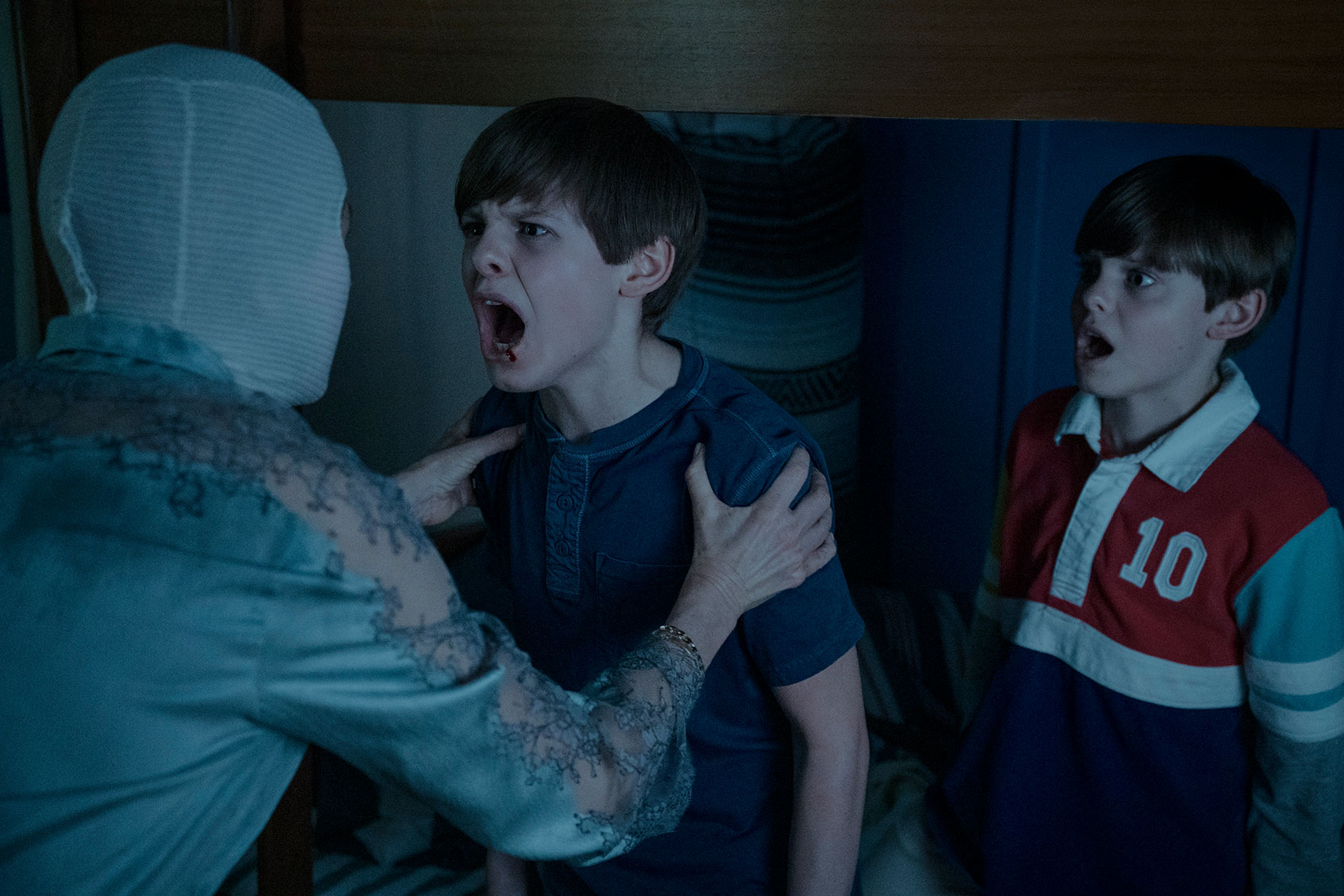
What about how you pitched the performance and that fabulous scene of Naomi dancing in the mirror that Elias spies? It is almost completely out of character — or is it? We don’t know much about mother in the film. We have only one past image of her. 

Sobel: Much of what we’re watching is from Elias’ mind. He believes he is in a dark sort of fantasy. So, moments of slightly heightened tone, that is where that comes from. From his perspective, his mother dancing in the mirror is completely out of character — and it should be — because the person he has known has been a very curated mother. But mother is much more than that. But what is not in Elias’ mind is that this is very much a part of mother, and she savors these moments alone where she feels she can be the person she can’t be in front of her children. At that moment, we are meant to feel it’s a left turn and not a part of her character. 

“Actors are trained with masks early on.”

Watts: I would add that who you are out there in the world and who you are in private moments are different for everyone. But it is extreme for mother. She has hints and tinges of narcissism. Matt and I talked about that. There were degrees of that tone. It was something she needed to do to express herself because of the confinement, control and precision. She wanted to feel herself and be in her body. I hated the confinement of this, and needed it to hide. She is just battling with all kinds of demons, and that was a release.

Sobel: Everything sprung from the question: What kind of person would react to the events [that are revealed] by deciding to get a face lift? It’s a very strange decision for someone to make, but not completely unintelligible.

Naomi, can you talk about your expressions and working not just with your head bandaged for half of the film but your body language, which is restricted?

Watts: Sometime with limitations, comes freedom, because we know the rules. You have to really get specific and home in on what you can and cannot use and do. When there is a close-up, my eyes are the most powerful tool, and the moment has to be told in that specific, one place. In a wider shot you have your whole body. Actors are trained with masks early on, so you become aware of what you can use to elevate the story and help people along. I remembered my learnings from that time. I had to be very still at times, which is quite difficult for me. My hands are constantly flapping about, and I have to remind myself to sit on my hands. [Laughs] Knowing the rules and the structure and those limitations in place, I had to be mindful on what I could use and how I could use them became really important.

Matt, you frequently shoot Naomi’s character in fragmented way, cutting her off in the frame when the twins are spying on her in the kitchen. 

Sobel: That is not a challenge at all, It’s actually very natural. I would look for ways to find scenes where someone is hiding what they are actually feeling, or the frame is hiding something that we want to see. There is a really famous shot in “Rosemary’s Baby” where the neighbor is taking a phone call, and Rosemary is leaning over and can’t quite see her full body and hear the phone call and everyone watching it leans over because they wanted to look around the corner. I would seek out those moments like that. 

Goodnight MommyNaomi Watts with Cameron and Nicholas Crovetti in “Goodnight Mommy” (Prime Video)
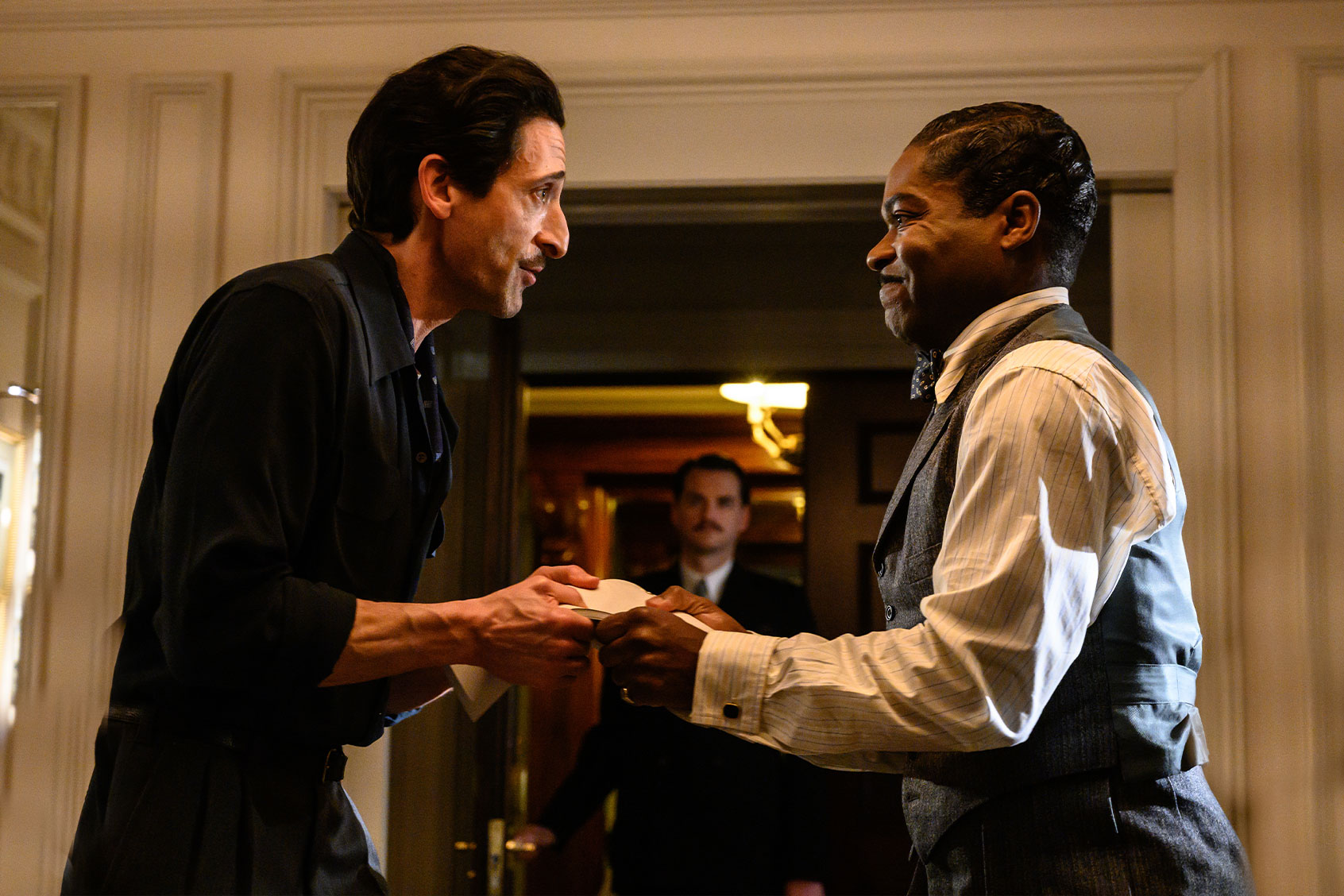
There are some harsh scenes of abuse in the film. The mother slaps her son Elias and tortures him with water. She gets a not dissimilar treatment in return, later. Can you talk about these moments, which are startling?

Watts: It was very hard to play. When I’m playing a mother, I’m always very aware of who that kid is that you are playing opposite, whatever the scene is. When it is emotional or physically abusive, it can be terrifying for the kid, I’m very careful in speaking to the mother, the director, and making sure it’s well planned so there are no surprises. In between filming I am turning to something lighter, hoping to distract then. The water scene was particularly difficult for me. We had to do it too many times because I was afraid of hurting him or him suffering in any way. 

Sobel: I think I had to spray him in the face one time.

Watts: I kept asking, “Are you OK? Are you sure this is OK? You can tell us this is too much.” 


Want a daily wrap-up of all the news and commentary Salon has to offer? Subscribe to our morning newsletter, Crash Course.


Naomi what can you say about playing desperate mothers, which you’ve done in several films now? 

Watts: I also played a parent before I had children in films like “21 Grams” and I hope the work was still as imaginative as it is as a real mother. But I’m definitely more informed now as a mother of two. It puts you in the hot seat very quickly. You know all of the experiences of being a mom, and it raises the stakes instantly. It is a big part of my identity, and it’s a piece of storytelling people can tap into, and I try to bring as much authenticity as I can to it.

Sobel: Naomi had several thoughts and comments about the script and questions about what a mother would actually do that were insightful and I included. I was grateful to have a real mother ask those questions.

“Goodnight Mommy” is now streaming on Prime Video. Watch a trailer via YouTube.

7 Aldi fall finds that are brand new this year

Whether you like it or not, the Starbucks pumpkin spice latte has made its triumphant return to stores, marking the unofficial arrival of fall and all things basic. This ceremonious event greenlights other companies to follow suit in debuting their own seasonal food and drink items.

Along with Northeast mini-chain Stew Leonard’s, which boasts hayrides and Halloween “drive-through Spooktaculars,” Aldi goes all-out for autumn. The store flaunts an abundance — or cornucopia, if you will — of pumpkin- and apple-flavored items fit for the flannel-clad shopper who is already thinking about conquering a corn maze or jumping into a pile of freshly raked leaves.

Check out these seven scrumptious (and affordable) offerings, all brand-new to stores this September. And be sure to check them out quickly, as they’re limited-edition, and likely to sell out within the next few weeks. Once they’re gone, they’re gone forever…or, at least, until 2023. (And don’t worry, we’ve also collected the fall favorites that — thank the Great Pumpkin! — are back for you to demolish yet again.)

New to us (and you)

1. Benton’s Apple Cider Donut Crème Cookies

A trip to the pumpkin patch isn’t complete unless you walk away with an apple cider donut (or six). But if a trek to a farm isn’t in the cards this month, opt for these sandwich crèmes, which capture the seasonal flavors of cinnamon-sugar in cookie form. Dunk them in a pumpkin spice latte as you sport your UGG® boots and a Burberry scarf for peak fall vibes.

2. Salted Caramel Apple Spread

Apple butter doesn’t stand a chance against Aldi’s salted caramel apple spread, which you can use to top ice cream, toast, or even — if you’re feeling extra-saucy before a busy day — oatmeal. You can also eat the condiment straight from the jar, all the better to prepare yourself for months of hibernation.

3. Simply Nature Apple Cinnamon Coconut Clusters

Coconut may not be the first ingredient you consider when it comes to fall, but it complements the sweetly spicy taste of apple and cinnamon together, resulting in a genius snack for foliage road trips and haunted hayrides. It also adds the perfect crunch to your morning yogurt. Add pumpkin seeds and pumpkin butter for an autumnal parfait.

4. Wicked Grove Caramel Apple Hard Cider

Cider is a cool-weather must for the buzz-seeking imbiber who doesn’t want to knock back heavy pumpkin beers or sweet wines. You can also use this caramel-apple number as a base for a bevy of bevvies, such as Bourbon smashes, punches, hot toddies, and apple pie martinis.

5. Three Mills Pumpkin Spice Mulled Wine

Along with hot chocolate, mulled wine is a wonderfully warm drink to cozy up with by the fireplace (with a good book and a fluffy pet, of course). In fact, mulled wine, like beans, may actually be good for your heart. And you know what they say: the more you drink, the more you…enjoy the sights and sounds of fall.

6. Pacific Fruit Vineyards Sweet Cranberry Wine

If you’ve already got Thanksgiving on the brain but aren’t ready to bust out that can of cranberry jelly, a tart and sweet cranberry wine is a great alternative. And at only $3.99 a bottle, it makes an ideal base for a holiday sangria with actual cranberries tossed in.

7. Huntington Home Sherpa Pumpkin Pillow

OK, yes, it’s neither edible nor potable, but consider this your seasonal reminder that Aldi also sells home goods, like a sherpa-lined pumpkin pillow that would look very cute on your couch with a matching throw. (Project never-leave-the-couch has commenced, and we are in complete support.)

Oldies but goodies

Returning champions include Belmont Mini Bundt Cakes (in maple brown sugar or pumpkin pecan), Specially Selected Pumpkin Maple or Creamy Carrot Coconut Bisque, Season’s Choice Pumpkin or Butternut Squash Risotto, Priano Butternut Squash or Pumpkin Ravioli, Pacific Fruit Vineyards Sweet Apple Wine, Barissimo Pumpkin Spice Almond Milk Creamer, and Southern Grove Pumpkin Spice Trail Mix. (Take that, PSL!)

Baked goods will include a fall cheesecake sampler, apple pie, pumpkin cake roll, pumpkin sliced loaf cake, apple cider donuts, pecan pie, and pumpkin spice sliced brioche.

Not nearly enough seasonal stuff for you? Not to worry: Aldi will have its epic variety of autumnal decor, such as cinnamon latte candles, ceramic pumpkins, witty box signs, and gnomes, which have become somewhat of a collector’s item in recent years.

And if you’re still on the hunt for more, then oh-my-gourd, you are certifiably the aficionado of fall, the Hallow-queen, the pumpkin prince, and you’ll be tickled to hear that more products will be hitting shelves in the coming months.

“See How They Run” is a comic whodunit that falls flat except for the dead guy

“See How They Run,” starts out as a fleet comic mystery, but it quickly loses it fizz and turns into flat champagne. Set in London 1953, this film, directed by Tom George from a script by Mark Chappell, opens with a hard-boiled voiceover by Leo Köpernick (Adrien Brody) a Hollywood filmmaker who deconstructs the whodunit. Leo is considering making a screen version of a whodunit, “The Mousetrap,” Agatha Christie‘s hit play that has just staged its 100th performance.

The film comes to life whenever the dead guy is on screen.

And it is at the celebratory party, where Leo meets with the business end of actor Dickie Attenborough’s (Harris Dickinson) fists and lands in the cake Dame Agatha sent. Changing his clothes in the theater’s costume room, Leo meets with a ski in the face, and then, as Constable Stalker (Saoirse Ronan) observes, “It’s all downhill from there.” 

Alas, so too with this listless film, and it’s not even 10 minutes in. But there is a dead body — with his tongue cut out, no less — and a large cast of suspects, which is the hallmark of any good whodunit, as Leo has explained. 

The setup is fine, and Brody, who is later seen in flashbacks, gives a loose, assured performance that manages to make his unlikeable character charming. The film comes to life whenever the dead guy is on screen. 

However, much of “See How They Run” features Inspector Stoppard (Sam Rockwell), a jaded cop who has little patience for Constable Stalker, a chatty newbie. In one scene, during a stakeout, Stoppard makes an excuse about having a dentist appointment to get a drink and get away from his partner. Viewers may be tempted to step out themselves. The film practically grinds to a halt at moments like this. 

Stoppard and Stalker investigate the murder by interviewing some of the theatrical suspects. These include the overrated, er, sorry, celebrated playwright Mervyn Cocker-Norris (David Oyelowo), who had a contretemps with the deceased and did in fact utter words that quantify as a death threat. And there is the producer, John Woolf (Reece Shearsmith), who was footing Leo’s hotel bill to avoid the filmmaker blackmailing him. Even the esteemed actor, Dickie Attenborough, gets a chat with the police, but is more interested in offering them tickets to see “The Mousetrap” than details about his fight with Leo at the party.

The film pays homage to “The Mousetrap,” mimicking the play, or incorporating [Agatha] Christie into the action.

“See How They Run” is not bad because it follows the typical whodunit trajectory. It is bad because the characters make self-referential comments about the whodunit that is as tiresome as the hoary formula being mocked. That said, when Leo storyboards the end of his planned film version of “The Mousetrap” —  a wonderful sequence  —  it also provides obvious foreshadowing for the film’s denouement, a word Mervyn huffily explains means ending not shoot-em-up.

Director Tom George also occasionally employs split screens for no real reason other than to provide two simultaneous points of view, but they fail to add much to the storytelling. The tension throughout the film is mild, even during a low-key “chase” sequence. The most imaginative bit is a surreal dream that Stoppard has, and it involves him not wearing pants. 

See How They RunAdrien Brody and David Oyelowo in the film “See How They Run” (Photo by Parisa Taghizadeh/20th Century Studios)

But even when “See How They Run” folds in on itself, “because the play’s the thing,” as Stoppard surmises, and the film pays homage to “The Mousetrap,” mimicking the play, or incorporating Christie into the action (Shirley Henderson plays the writer in one key scene), it feels hollow. The film is not really about anything despite containing motives like greed, adultery, and revenge. 

The characters hardly register as people, making it tough to get invested in the whodunit. Mostly, the suspects are types, and their idiosyncrasies — Mervyn’s cousin Gio (Jacob Fortune-Lloyd) is an amateur taxidermist — are neither interesting nor amusing; they just try too hard to be both. 

The slapstick in the film is also as unfunny as it is uninspired. When Stoppard is caught in the rain, Stalker warns him about catching a chill, leading to him doubling over sneezing the next day. There are other would-be comic moments like that just fall flat. 

The banter between Stoppard and Stalker creates much of the film’s dead space because these scenes fail to move the thin plot forward nor do they develop the characters. The performances by both Rockwell and Ronan are mannered, and while that works in her favor — Ronan has various nice moments, like her reaction to nettle tea that Mervyn serves her — Rockwell is miscast, as if, like his character, he wants to be anywhere else. (Brody seems like he could have done something magical with the role if they had swapped parts.) 


Want a daily wrap-up of all the news and commentary Salon has to offer? Subscribe to our morning newsletter, Crash Course.


The large supporting cast are largely forgettable, save the aforementioned Brody and the fabulous Oyelowo, because they get the best dialogue and deliver it smoothly, like silver-tongued salesmen. 

“See How They Run” certainly appreciates the very genre it is sending up, but like the eager Constable Stalker, it needs to deliver something more than enthusiasm.

“See How They Run” is in theaters Friday, Sept. 16. Watch a trailer via YouTube.


“Terrible timing, terrible tactics”: Fox News host scolds Graham for hurting GOP with abortion bill

Fox News host Jesse Watters criticized Senator Lindsey Graham, R-S.C., for the “terrible timing” of his federal abortion ban bill on Tuesday. 

If passed, the Protecting Pain-Capable Unborn Children from Late-Term Abortions Act would federally ban abortion after 15 weeks of pregnancy, extending abortion restrictions to blue states.  

Unveiled less than 60 days before the midterm elections, Republican leaders are infuriated that they may lose their polling advantage because of the bill. However, Graham told Watters he had an obligation to announce on Tuesday.

“I wasn’t gonna sit on the sidelines and let America become that kinda nation,” Graham said, referencing legislation in countries like North Korea and China. 

“No one’s saying you need to sit on the sidelines but yesterday wasn’t the day to do that,” Watters said in the heated interview. “Yesterday was the day they [Democrats] lost all momentum when this inflation thing punched them right in the face and you gave them an out.”

The conservative commentator went on to say that Graham should have delayed the press conference.

Graham replied that he doesn’t think “there’s a bad day to stand up for the unborn.”

“America needs to have a policy that makes us a civilized nation,” he argued, adding that “at 15 weeks when the baby can feel pain, you provide anesthesia to save its life. If you operate on it, it should be protected from being dismembered by an abortionist.” 

It’s with these measures that Graham claims the U.S. will be in line with France, Germany, and Great Britain. “They all have abortion bans below 15 weeks,” he stated in the interview. 

However, experts say that the gestational limits outlined in abortion laws internationally are not comparable to Graham’s proposed ban. Furthermore, sex education and universal health care — including public assistance for abortion — are all provided to the citizens of the countries Graham mentioned.

Despite the fact that 61% of Americans are pro-choice according to a Pew Research Study, Graham defended his bill fiercely. “I’m not gonna ever apologize for standing up for the unborn,” he said. “You know what, we need to go on the offensive here.”

“But you gotta talk tactics, senator,” Watters contended. “This is terrible timing, terrible tactics. We coulda shoved this down their throats on the day the Americans got hammered with this inflation number and the market crashing.”

The Fox News host claimed that the media has now run with a false narrative that will harm Republican chances in the upcoming midterm elections.

“And now all the media and the Democrats are talking about? Federal abortion ban. Federal abortion ban,” he said. “You know that’s not smart politics, right?”


Want a daily wrap-up of all the news and commentary Salon has to offer? Subscribe to our morning newsletter, Crash Course.


Other conservative talk show hosts have accused Graham of purposefully hurting the Republican Party with the timing of the announcement.

“This is sabotage. It’s the only way to explain it,” said far-right Daily Wire host Matt Walsh on his podcast. “When has [Graham] ever shown that he gives a damn about the pro-life cause? It’s almost like he wants Republicans to lose. That’s the conspiracy theory that I would actually subscribe to here.” 

In another viral clip, Charlie Kirk, founder of pro-Trump youth organization Turning Point USA, questioned the senator’s tactics.

“Why is Lindsey Graham, 25 days out from ballots going out, galloping in and saying we need a federal abortion ban?” Kirk, who also said he would “love a total abortion ban” because “15 weeks is not enough” claimed that the bill announcement “feels like election interference.”

Watch Watters’ interview with Graham below.