Spring Sale: Get 1 Year, Save 58%

Heavily armed pastor presses Beto O’Rourke on abortion and “great men” who are “the product of rape”

A Texas man who identified himself as a preacher, armed with a semiautomatic assault rifle and pistol, confronted gubernatorial candidate Beto O’Rourke during a Saturday campaign event and demanded that the Democrat answer whether he “believed in a woman’s right to choose,” claiming that there are “great” men who are the “product of rape.”

The man, a self-proclaimed “minister of the gospel,” approached O’Rourke in the middle of a town hall in Hemphill, where the preacher berated the candidate with a barrage of questions about abortion and religion. 

“How do we deal with the murder of the unborn for anything other than to save a woman’s life?” the man asked, adding that there are “great men of god who are the product of rape.” 

O’Rourke responded by thanking the man for making the inquiry “in good faith” and argued that they weren’t  “going to change each other’s minds on some of these very basic definitions.”

“This decision is best made by the woman, who understands better than anyone else the nature of her pregnancy, the complications it might endure, any other issue that is unique and personal and private as her,” O’Rourke said, noting that “more rapes committed in this state than any other state of the union.”

RELATED: “You are doing nothing”: Republicans erupt after Beto O’Rourke interrupts Texas Gov. Greg Abbott


Want a daily wrap-up of all the news and commentary Salon has to offer? Subscribe to our morning newsletter, Crash Course.


At one point, the armed preacher also asked O’Rourke if he’s been “born again” and whether he accepts Jesus as his “lord and savior.”

After the incident, Shannon Watts, founder of gun reform group Moms Demand Action, posted a video of the confrontation, and tweeted that a “‘preacher’ armed with a semiautomatic rifle showed up at Beto O’Rourke’s town hall in Hemphill, Texas, to challenge O’Rourke’s position on … abortion, calling it murder.”

“While armed to the teeth, he gets laughs for saying he’s not there to talk about guns, but abortion,” she added. “This is the radical right wing’s ideology: use guns to intimidate and control conversations and curtail women’s rights.”

The exchange comes just a month after an 18-year-old shooter armed with a semi-automatic assault rifle stormed the Robb Elementary School in Uvalde, where he gunned down nineteen children and two teachers. 

RELATED: Greg Abbott’s lead over Beto O’Rourke shrinks in new poll as unfavorability rating hits record high

John Eastman sought to overturn Georgia Senate elections to boost Big Lie after Biden’s inauguration

Even after President Joe Biden was inaugurated, coup-memo John Eastman was still attempting to overturn the election in fealty to former President Donald Trump according to a bombshell new report.

“John Eastman, the conservative lawyer whose plan to block congressional certification of the 2020 election failed in spectacular fashion on Jan. 6, 2021, sent an email two weeks later arguing that pro-Trump forces should sue to keep searching for the supposed election fraud he acknowledged they had failed to find,” The New York Times reported. “On Jan. 20, 2021, hours after President Biden’s inauguration, Mr. Eastman emailed Rudolph W. Giuliani, former President Donald J. Trump’s personal lawyer, proposing that they challenge the outcome of the runoff elections in Georgia for two Senate seats that had been won on Jan. 5 by Democrats.”

The newspaper says it authenticated the previously undisclosed email by people who were on the Trump campaign at the time.

“A lot of us have now staked our reputations on the claims of election fraud, and this would be a way to gather proof,” Eastman wrote. “If we get proof of fraud on Jan. 5, it will likely also demonstrate the fraud on Nov. 3, thereby vindicating President Trump’s claims and serving as a strong bulwark against Senate impeachment trial.”

A lawyer for Eastman did not respond to the newspaper’s request for comment.

“Mr. Eastman’s message also underscored that he had not taken on the work of keeping Mr. Trump in office just out of conviction: He asked for Mr. Giuliani’s help in collecting on a $270,000 invoice he had sent the Trump campaign the previous day for his legal services,” The Times reported. “The charges included $10,000 a day for eight days of work in January 2021, including the two days before Jan. 6 when Mr. Eastman and Mr. Trump, during meetings in the Oval Office, sought unsuccessfully to pressure Vice President Mike Pence to go along with the plan to block congressional certification of the Electoral College results on Jan. 6.”

The newspaper could find no evidence Eastman was ever paid.

Read the full report.

“Now they’re coming for doctors”: GOP blocks Senate bill to protect abortion providers

Republican Sen. Mike Braun of Indiana blocked Democrats’ attempt Wednesday to pass legislation that would protect doctors who provide legal abortion care from right-wing threats and attacks.

The effort to pass the bill by unanimous consent came as GOP officials in Indiana continue to target a physician in the state for providing abortion services to a 10-year-old rape victim who traveled from Ohio, where abortion is prohibited after six weeks of pregnancy.

Sen. Patty Murray, D-Wash., the lead sponsor of the Let Doctors Provide Reproductive Health Care Act, specifically mentioned the case of Dr. Caitlin Bernard in a floor speech on Wednesday, calling it “chilling.” Bernard is currently being investigated by Indiana’s attorney general.

“While Dr. Bernard’s story may be in headlines across the country, she is not the only doctor facing threats, and she will not be the last,” Murray warned. “At this very moment, Republican state lawmakers are drafting legislation that would make it a crime to provide abortion care to a resident even in another state where it’s legal. From talking with doctors back home, I can tell you they are following this closely, and they are worried.”

According to a summary released by Murray’s office, the Let Doctors Provide Reproductive Health Care Act would:

  • Protect healthcare providers in states where abortion is legal from being subject to laws that try to prevent them from providing reproductive health care services or make them liable for providing those services to patients from any other state. These protections could be enforced by a federal lawsuit from the Department of Justice, a patient, or a provider, ensuring a future Department of Justice could not turn a blind eye to state laws that violate these protections;
  • Prohibit any federal funds from being used to pursue legal cases against individuals who access legal reproductive healthcare services or against healthcare providers in states where abortion is legal;
  • Create a new grant program at the Department of Justice to fund legal assistance or legal education for reproductive healthcare service providers;
  • Create a new grant program at the Department of Health and Human Services to support reproductive health care service providers in obtaining physical, cyber, or data privacy security upgrades necessary to protect their practice and patients; and
  • Protect reproductive health care providers from being denied professional liability insurance coverage because of legal services offered to patients.

Planned Parenthood Action said the bill poses a “very simple” question to lawmakers: “Should doctors be allowed to provide healthcare?”

While the answer should be obvious, the group said, Braun showed that the Republican Party’s opposition to reproductive care runs deep.

“No provider should face prosecution for providing basic, time-sensitive, essential, legal healthcare, including abortion,” the group said.

After Braun objected to Murray’s request for unanimous consent to pass the bill, the Washington senator vowed that Democrats will continue to “fight for the right to an abortion” and for “doctors who are doing their jobs and doing what is best for their patients.”

“We’re going to make sure everyone knows, and no one forgets, exactly who’s standing in the way, exactly where Republicans stand in this fight,” added Murray, who last month attempted to swiftly pass legislation protecting the right of pregnant people to travel across state lines for abortion care.

Sen. James Lankford, R-Okla., blocked the bill.

“Corporate shill”: Sinema demands to save tax break for wealthy donors after meeting with lobbyists

Sen. Kyrsten Sinema, D-Ariz., wants Democrats to drop a measure addressing a tax loophole used by hedge fund managers and private equity executives from Sen. Joe Manchin’s, D-W.Va., climate and health care deal.

Sinema is the only Senate Democrat who has not committed to voting for the Inflation Reduction Act, a $740 billion deal cut by Manchin and Senate Majority Leader Chuck Schumer, D-N.Y., to provide $369 billion in climate and energy funding, lower prescription drug costs and crack down on tax avoidance. After days of silence, Axios reported on Wednesday that Sinema has “concerns” about a tax measure that makes up less than 2% of the bill’s revenue.

Sinema wants to “nix language” narrowing the so-called carried interest loophole, according to Politico. The loophole allows hedge fund managers and private equity execs to have their income taxed at the 15% capital gains tax instead of the standard, much higher income tax rate.

Closing the loophole would require wealthy investors to instead pay a 37% income tax rate but Manchin’s proposal doesn’t even do that. The current legislation would require managers to hold on to investments for five years instead of the current three years to qualify for the tax break, and imposes stricter requirements on those investments, according to HuffPost.

While a proposal to close the loophole from Senate Finance Chairman Ron Wyden, D-Ore., and Sen. Sheldon Whitehouse, D-R.I., would have raised about $70 billion in new revenue, Manchin’s deal with Schumer is projected to raise just $14 billion over the next 10 years.

Manchin previously told reporters that “the only thing I was adamant about” in negotiations was including the provision in the bill, arguing that “you can’t justify” keeping the loophole.

“On the carried interest — for the wealthiest one-tenth of 1% of Americans to take advantage of a tax break for them, that they have no risk at all and they get to take the lowest tax rate?” he said in a radio interview on Tuesday. “So we get rid of that.”

Manchin appeared frustrated by Sinema’s opposition to the measure.

“I just want someone to explain. I can’t understand it,” he told Fox News. “I’m sure [Sinema] has a reason, and I want to hear more about it.”


Want a daily wrap-up of all the news and commentary Salon has to offer? Subscribe to our morning newsletter, Crash Course.


Sinema has raised more than $2.2 million from the securities and investment sector since 2017, according to OpenSecrets. Last year alone, she netted more than $144,000 in donations from industry groups that lobbied against closing the carried interest loophole, according to HuffPost.

“Wall Street has donated over $2 million to Sinema since she took office in 2017,” tweeted former Labor Secretary Robert Reich. “Looks like they are getting a huge return on their investment.”

Sinema previously successfully fought to preserve virtually all of the Trump tax cuts during negotiations over President Joe Biden’s Build Back Better proposal despite claiming to oppose Trump’s lone legislative accomplishment. She has also fought Democratic efforts to crack down on abuse of a conservation easement tax deduction and this week introduced legislation to provide a tax break to cryptocurrency investors.

Sinema on Tuesday held a virtual call with Arizona business interests to discuss their “concerns” about the reconciliation bill, according to Danny Seiden, who heads the Arizona Chamber of Commerce. He praised Sinema for her “willingness to listen to AZ job creators.” The Chamber of Commerce has long opposed efforts to address the tax loophole.

Sinema during the call also discussed the bill’s proposed 15% corporate minimum tax aimed at reining in tax avoidance by corporations that make over $1 billion per year. Sinema last year called the proposal a “common sense” step to ensure that “highly profitable corporations” pay their share.

“Is this written in a way that’s bad?” Sinema asked the group, Seiden told CNN. “It gave me hope that she’s willing to open this up and maybe make it better,” he said.

“She is somebody who errs on the side of caution when it comes to changing tax policies. …  obviously, I think [their input] shaped where she is on the economic parts of this bill,” former Sinema spokesman John LaBombard told Axios.

Republicans, who have donated heavily to Sinema amid her effort to stonewall Biden’s agenda, and right-wing groups like the Koch-aligned Americans for Prosperity, have also lobbied heavily to convince Sinema to block the reconciliation bill. Sinema previously came under fire for meeting with donor groups that opposed Biden’s BBB proposal while stonewalling negotiations.

“We can only assume that she’s been motivated by the money they’re donating to her campaigns,” a former Sinema staffer told HuffPost. “I knew she was always trying to be an atypical Democrat. She wants to be Arizona’s new maverick. I never thought she would just toe the party line. But throwing away campaign promises you made and snubbing your nose at the people who got you elected, that makes you the opposite of a maverick. It makes you a corporate shill.”

Sinema is also seeking to add about $5 billion in drought resiliency funding to the climate deal, according to Politico.

“One for the donors,” tweeted Bloomberg reporter Ryan Teague Beckwith, “one for the constituents.”

After Kansas smackdown, anti-abortion right in denial: Either it didn’t happen or it doesn’t matter

Amid the array of primary election results on Tuesday night and Wednesday morning, one stood out in boldface type: Nearly 60% of voters in Kansas, typically a deep-red state that Donald Trump easily carried two years ago, rejected a ballot referendum that would have amended the state constitution to remove the right to abortion.

The amendment, artfully entitled “Value Them Both,” represented the first ballot initiative on abortion since Roe v. Wade was overturned in June. Abortion opponents described it as a corrective to a 2019 state Supreme Court ruling which found that the Kansas constitution protects abortion rights, while pro-choice groups warned it would swiftly allow Republican lawmakers to enact a total abortion ban. 

Republicans never exactly admitted that, repeatedly casting pro-choice warnings about a potential ban as lies and disinformation, even after the Kansas Reflector obtained audio recordings in mid-July of a Value Them Both Coalition staffer telling Republican officials they had abortion-ban legislation waiting in the wings once the amendment passed. 

The ballot initiative seemed designed to disadvantage abortion rights supporters from the get-go. It was scheduled for a vote not in the general election in November but in the August primary, which in Kansas traditionally draws few Democrats (since many Democratic candidates run unopposed) or unaffiliated voters, who cannot vote in either party’s primaries. Pro-choice advocates also charged that the ballot initiative’s language was intentionally misleading, designed to confuse voters about what a “yes” or “no” vote meant and including irrelevant provisions, such as public funding for abortion, that don’t actually exist in the state. 

On Monday, the eve of Election Day, Kansas voters received an anonymous mass text message that transparently seemed to double down on that tactic, falsely suggesting that a “yes” vote would protect “choice.” The message, which the Washington Post discovered was sent on behalf of a PAC led by former Rep. Tim Huelskamp, a Republican, read, “Women in KS are losing their choice on reproductive rights. Voting YES on the Amendment will give women a choice. Vote YES to protect women’s health.” 

In the face of all these obstacles, Tuesday’s vote amounted to a stunning defeat of the initiative, and an ominous sign for Republicans that their attacks on abortion access are deeply unpopular outside their base, even in one of the nation’s most conservative states. Early observations indicate that Kansas voter turnout greatly exceeded typical primary participation — it was more similar to the 2018 midterms or even the 2008 presidential election — and that a large wave of voters seem to have gone to the polls exclusively to vote against the referendum. What’s more, “blue” counties that went for Joe Biden in 2020 voted by even larger margins against the amendment, while “red” counties registered far fewer votes in support of the amendment than had gone to Donald Trump. As the New York Times observed, “From the bluest counties to the reddest ones, abortion rights performed better than Mr. Biden, and opposition to abortion performed worse than Mr. Trump.” 

Faced with these facts, conservatives and anti-abortion advocates rationalized the outcome in various ways, from claiming that they were the real victims of disinformation campaigns to downplaying the significance of the results to suggesting that the initiative failed because it didn’t go far enough. 


Want a daily wrap-up of all the news and commentary Salon has to offer? Subscribe to our morning newsletter, Crash Course.


In the first category, the Value Them Both Coalition led the way, writing in a statement, “Over the last six months, Kansans endured an onslaught of misinformation from radical left organizations that spent millions of out-of-state dollars to spread lies about the Value Them Both Amendment. Sadly, the mainstream media propelled the left’s false narrative, contributing to the confusion that misled Kansans about the amendment.” The coalition went on to warn that Kansas was about to become an “abortion destination,” and, channeling the Terminator, vowed that despite this “temporary setback,” “We will be back.” 

Susan B. Anthony Pro-Life America, which sent student canvassers to knock on some 250,000 doors in the Sunflower State, made similar charges: “The abortion lobby’s message to voters was rife with lies that ultimately drowned out the truth.” And Kristan Hawkins, president of Students for Life Action, lamented, “We are disappointed Kansans couldn’t see past the big money that flooded the state, confusing voters about an abortion-neutral amendment that would give them the freedom to vote on abortion policy.”

Lila Rose, founder of the anti-abortion group Live Action, similarly tweeted, “Pro-aborts poured millions into a massive disinformation campaign in Kansas. Pro-abort media pulled heavily for them,” while Live Action itself wrote, “Kansas is now an abortion destination like New York and California,” adding a broken heart emoji. 

Although the New York Times reports that the more than $12 million spent on the initiative was “split about evenly” between its anti-abortion supporters and pro-choice opponents — including $1.4 million from SBA Pro-Life America and around $4 million from Catholic organizations — conservatives also claimed, without evidence, that abortion rights advocates had far outspent them. 

Mollie Hemingway, editor-in-chief of The Federalist, emphasized that point on Fox News Tuesday night, saying, “I do think that pro-lifers should understand that so much money was spent by hardcore abortion supporters to make sure that amendment failed.” Hemingway went on to suggest that “there was a lot that was packaged” in the amendment and that it might have been more successful had the proposed constitutional change been more “incremental.” 

At the National Review, editor Ramesh Ponnuru concurred, suggesting that abortion opponents “come back in a few years with another ballot initiative, this one establishing a gestational limit on abortion: at fifteen weeks, for example.” Ed Whelan, a fellow at the right-wing think tank Ethics and Public Policy Center, similarly argued on Twitter that, “One possible lesson from the Kansas shellacking” was that “Voters facing what they see as a choice between two imperfect options — one too restrictive, one too permissive — will go with the one that is too permissive.” In order to “meet the voters where they are,” he continued, “Pro-lifers need to pursue principled incrementalism.” 

Matt Schlapp of CPAC claimed, entirely without evidence, that the amendment failed because it was too weak for Kansas pro-lifers and a “ban would have won.”

By contrast, Matt Schlapp, chair of the Conservative Political Action Conference, or CPAC, which is meeting in Texas this week, sought to make the case — again completely unsupported by evidence — that the amendment failed not because of overreach, but because it was too weak for avid Kansas pro-lifers. In a series of posts on Twitter, Schlapp argued, “Kansas is a strongly pro life state that does not want to take timid steps as [the Value Them Both amendment] was” and that an actual abortion “ban would have won.” The biggest problem with the amendment, he wrote, “was it was too timid for many pro life voters. It was not a heartbeat bill it was a late term ban along w other basic regulations. With a pro life governor look for much stronger pro life victories soon. A blip.”

As conservatives grappled with the loss Tuesday night and Wednesday morning, there wasn’t one uniform narrative. Speaking on Newsmax Tuesday night, former Pennsylvania Sen. Rick Santorum argued that the anti-abortion movement had become overconfident. “I hear all the pro-lifers I know say that people aren’t volunteering as much now, they’re not giving as much money. They feel like they’ve won,” Santorum said. “And Kansas, from the early returns, is going to show that we haven’t won much. This is just the beginning of the battle.” Santorum went on to predict that referendum battles such as this one would become an annual occurrence in Kansas. “This is going to be a persistent thing that we’re going to have to continue to fight.” 

Right-wing commentator Erick Erickson suggested that anti-abortion voters might have misunderstood the ballot initiative’s language: “How many Kansans who are generally pro-life but not plugged in went to the polls, read the ballot language, and thought, ‘Shit, I don’t want to let the legislature pass abortion laws. I’m pro-life.'” 

Other right-wing voices decried the result as morally equivalent to historical atrocities. Dan McLaughlin, a senior writer at the National Review, tweeted, “Best night for cruelty in Kansas since the Lecompton Constitution” — a reference to an alternative Kansas constitution proposed before the Civil War that would have excluded free Black citizens from the state’s bill of rights. 

Faced with the unavoidable takeaway that the Kansas vote proves that the Supreme Court’s recent decision overturning Roe is massively unpopular, other conservatives claimed to see no connection — as in Notre Dame law professor Rick Garnett’s baffling claim that the vote “had nothing to do with Roe” — or seemed to ignore the news altogether, with numerous leading conservative media outlets failing to discuss the result Tuesday night. 

The vote also seemed to lead to a confusing welter of claims related to the longstanding conservative argument that abortion should be decided at the state level. In a separate tweet, Erickson struck a let’s-move-on tone, tweeting, “The whole point of ending Roe is so states like Kansas can decide abortion for themselves. The media excitement just kinda makes the Dobbs case’s argument for itself. Exactly the point — decide this democratically at the state level.” 

A Notre Dame law professor concluded, bafflingly, that the Kansas vote “had nothing to do with Roe,” while a Blaze TV host, for some reason, invoked the Lincoln-Douglas debates.

By contrast, Blaze TV host Steve Deace compared the outcome to pre-Civil War debates over slavery, and proposals to allow U.S. territories such as Kansas to decide for themselves whether to permit the ownership of human chattel. “What Kansas will show,” Deace tweeted, “is that America wants abortion severely restricted, but not completely abolished. America is Stephen Douglas, not Abraham Lincoln. Douglas lost that argument.” 

For some Democrats, that sort of argument presaged a new threat, now that the prospect of red-state voters eagerly embracing abortion bans has been cast in doubt. As Sen. Chris Murphy of Connecticut warned on Twitter, “Mark my words, the anti-choice movement is going to look at the Kansas result and decide that their best path to criminalize abortion is a federal ban. It’s coming, and that’s what’s on the ballot this November.”

Is Andrew Yang finally ready for his closeup? His likely-to-fail third party depends on it

The dark side of human nature is live-streaming in Technicolor, playing on every wide-screen TV and on full display in theaters across the United States this summer. It may be a Gothic horror show, but the only thing worse than being on this dark thrill ride is not being on it. 

Hunter S. Thompson, a fellow Kentuckian who understood the appeal of Wild Turkey 101, as well as truly bizarre and rare hallucinogens, understood the allure of dark rides. He’d be right at home with the political darkness we’ve endured the last five years or so.

“No sympathy for the devil; keep that in mind,” Thompson told us in “Fear and Loathing in Las Vegas.” “Buy the ticket, take the ride . ..and if it occasionally gets a little heavier than what you had in mind, well … maybe chalk it up to forced consciousness expansion: Tune in, freak out, get beaten.”

Politics today is all about being beaten — at the polls, metaphorically and occasionally . . . physically. Some admit it. Some deny it. All suffer the beatings.

So without further ado, ambling up to the stage and ready to take a beating is Andrew Yang, with his new political party, “Forward.” He’s not left! He’s not right! He’s Forward. Of course Yang is trying to step on a political stage largely dominated by Donald Trump who remains busy publicly relieving himself while his rabid minions proclaim his ascension to a throne in the divine kingdom. The rest of us see it as a descent into hell, but hey, it’s all a matter of perception. The funny thing is, Trump isn’t even the main attraction any more. Sitting center stage is President Joe Biden, who it seems can never catch a break. He’s the most famous person ever to get “Rebound COVID” – which sounds like some weird NBA charity group.

Biden has had quite a bit of success as president already, compared to Trump. Yes, I said that with a straight face — or tried to. Having more success than Trump isn’t a rigorous task, admittedly. But it is also a tale worth telling after four years of unbridled narcissistic anti-democratic demonic war cries, bellowed from the shallowest soul ever to befoul the spirit and history of the United States as our president.  

Biden’s harshest critics — including Fox News and its proprietor, Rupert Murdoch — seem to have recently grown tired of Trump’s aging circus act.  On occasion they’ve even given Biden some positive press. From Nancy Pelosi’s trip to Taiwan to the long-forgotten infrastructure bill, those who rarely sing Biden’s praises have occasionally, and surprisingly, done so. And he’s racked up some notable victories on a variety of fronts. The landslide vote in Kansas for abortion rights this week is just another indication that Biden’s policies are far more in the mainstream than those of the Republicans, who philosophically seem stuck somewhere between Genghis Khan and a European medieval warlord.

There remains hope in this country, that maybe, just maybe, we’ve passed Donald Trump through our political digestive system and are depositing him on the sidewalk, like my dog does with his meals on an extended walk. It’s there. It’s in the public eye, but it’s just public excrement. That’s Trump.

So, why in God’s name is Andrew Yang launching a third party now? Some think he did it to get the jump on a probable Democratic loss of the House majority in the upcoming midterm elections. If the Democrats lose big, then Yang can wave his sign, smile and say, “Sign up here!” 

Of course, should the Democrats retain control of the House and increase their margin in the Senate — a distinct and growing possibility, Democrats remind us, especially after the vote in Kansas — then Yang would once again demonstrate how out of step he is with a majority of American voters. But Yang has a bit of the gambler in him too, and he’s playing the odds. A third party created from the crusty remains of the former Republican Party is somewhat believable, but getting a lot of moderate Democrats? You’d have to down huge amounts of rancid hallucinogens that Thompson would never touch to believe such a fiction.


Want a daily wrap-up of all the news and commentary Salon has to offer? Subscribe to our morning newsletter, Crash Course.


Here’s the truth; Yang is trying desperately to get to center stage by announcing a third party dedicated to democracy. That’s the big idea. A safe space. As for his party’s stance on major issues — who knows? He’s just building a big tent where everyone in the middle can meet, have a few beers, smile and pull the lever in his favor. He’s about democracy. Well, thank God. 

I mean, I guess this needs to be said if your new party mostly comprises old white Republican men, but the rest of us understand the concept of democracy — even if some of us only do so on the crudest level. Yang’s Forward Party also sounds like a weird NBA charity (for power forwards), but it has bigger problems than its name going Forward. 

James Carville called Yang’s idea “really stupid,” while White House press secretary Karine Jean-Pierre just gave a wide smile when I asked her on Wednesday how the president reacted to a former Democrat forming a new political party. Mind you, backstage Democrats are doing more than grinning. They’re laughing. Yang is considered a lightweight opportunist by many high-ranking Democrats, when he’s considered at all. One thing he has never been considered is an actual Democrat. He’s an aisle-surfer who momentarily found more of what appealed to him on the left side — nothing more.

Yang is considered a lightweight opportunist by high-ranking Democrats, when he’s considered at all. And he’s the new party’s star attraction — at least so far.

While his new political party has been able to attract some money, so far it lacks star power. Yang was a failed presidential candidate, and then a failed mayoral candidate in New York. Now he’s hoping his third time trying to get on the political stage is the charm. And that’s this party’s star attraction. He merged his party with the Renew America Movement (consisting of former Trump Republicans) and the Serve America Movement (a handful of moderate Democrats, independents and Republicans, founded by former GOP Rep. David Jolly of Florida). 

Can Yang make a go of it where no one has before? I predict that if and when the Forward Party dissolves into a puddle-like morass consisting of its own mediocre, fetid ideas, almost no one will notice.

The press loves a Hollywood ending though, and if the Forward Party at some point becomes a major force in American politics, we’ll write about the overnight sensation that was actually the bastard offspring of many failed third parties that have littered the American political landscape since the beginning of the republic. 

Otherwise we won’t go Forward until someone goes backward and produces a “Remember the Forward Party?” package for an end-of-year network special — or a retrospective on the 2020s, produced in 2030.

There are many reasons to bet against Yang’s effort — and the biggest one is Yang himself. He wasn’t the most charismatic or the most accessible candidate on the presidential campaign trail and he was never seriously in the running — except maybe in his own head, or the collective heads of his young, impressionable staff. Some say he has the arrogance of Trump, while others say he is loved like a rock. 

Some close to Yang pleaded with him to announce he wasn’t running for president before launching his new party. Others wanted to wait until after the midterms. “It’s premature political ejaculation,” one insider told me.

There are reports that those closest to Yang say they pleaded with him to declare he wasn’t running for president in 2024 before he announced the formation of the new party. Others didn’t want to announce the party’s formation until after the midterm elections. Others begged him not to announce the new party until someone else with a high profile joined up. “It’s premature political ejaculation,” one insider told me, tongue firmly planted in cheek. 

Whatever Yang’s venture turns out to be, for the moment it must be seriously considered and not dismissed. Insiders say one thing the Forward Party understands is building from the ground up. That means winning local and state-level races before ever making a run at a national office. If that’s how Yang goes forward, he’ll have charted the right path and those efforts could be consequential.

A third party that looks 10 to 15 years down the road could be something to take seriously — particularly if there is serious money behind the effort and the voting public understands the plan. There is a natural, romantic charm about it. Americans love an underdog. Yo, Adrian, remember Rocky? Anyone? 

A viable third party in this country needs several key players, but two are most important, and the first of those is an organizer with links to politicians and money. The second has to be the public face — and if it’s faintly possible Yang is the former, very few think he’s the latter. There are those who think he’s neither.

In short, a Yang party not led by Yang would have a better chance. Or as one prospective party member described it, “Yang needs to yank himself out of the way.”

This all may be useless criticism anyway — conventional wisdom says a third party is doomed to fail no matter who sits at the top, while the Vegas gamblers among us, like Yang, figure the potential payoff is worth the investment. That’s the dark thrill ride — a gamble that keeps serious adrenaline junkies on edge, grinding their teeth and ready to take a big chance on the slimmest of margins, envisioning a payday that will enable a life of retirement, travel and all the edibles you can consume.

Contributing to the New Hope of the Forward Party is the growing disenfranchisement and general distaste the American voting public feels toward those they’ve actually placed in office. Sure, we’ve met the enemy and he is us, but we increasingly want out of the toxic cloud, and fewer and fewer of us who vote believe that either party has the needed answers to get us to higher ground. 

If Yang should fail, others will try, I suppose. They may succeed or, more likely, may not, however noble their efforts. 

What then for the United States? Here’s Hunter Thompson, champion of dark rides: “Maybe the best we can hope for is this: There’s a lot of things wrong with this country, but one of the few things still right with it is that a man can steer clear of the organized bullshit if he really wants to. It’s a goddamned luxury, and if I were you, I’d take advantage of it while you can.” 

Let’s hope we still can.

UN head says Big Oil’s “grotesque” greed is wrecking the planet, calls for new taxes

UN Secretary-General António Guterres unveiled a new report Wednesday about the global effects of Russia’s invasion of Ukraine and took aim at the fossil fuel sector, which has been widely accused of war profiteering.

“Household budgets everywhere are feeling the pinch from high food, transport and energy prices, fueled by climate breakdown and war,” Guterres said at UN headquarters in New York. “This threatens a starvation crisis for the poorest households, and severe cutbacks for those on average incomes.”

“Many developing countries — drowning in debt, without access to finance, and struggling to recover from the COVID-19 pandemic — could go over the brink,” he warned. “We are already seeing the warning signs of a wave of economic, social and political upheaval that would leave no country untouched.”

Guterres outlined key takeaways from the third brief of the Global Crisis Response Group on Food, Energy, and Finance — which first met in March, about a month after the Russian invasion.

“First, it is immoral for oil and gas companies to be making record profits from this energy crisis on the backs of the poorest people and communities, at a massive cost to the climate,” he declared. “The combined profits of the largest energy companies in the first quarter of this year are close to $100 billion.”

The UN chief added, “I urge all governments to tax these excessive profits, and use the funds to support the most vulnerable people through these difficult times. And I urge people everywhere to send a clear message to the fossil fuel industry and their financiers: This grotesque greed is punishing the poorest and most vulnerable people, while destroying our only home.”

Along with blasting the fossil fuel industry, Guterres called out rich countries for refusing to do their part to help the global South transition to clean energy.

“Developing countries don’t lack reasons to invest in renewables. Many of them are living with the severe impacts of the climate crisis including storms, wildfires, floods, and droughts. What they lack are concrete, workable options,” he said. “Meanwhile, developed countries are urging them to invest in renewables, without providing enough social, technical, or financial support.”

“All countries — and especially developed countries — must manage energy demand. Conserving energy, promoting public transport, and nature-based solutions are essential,” he stressed. “We need to accelerate the transition to renewables, which in most cases are cheaper than fossil fuels.”


Want a daily wrap-up of all the news and commentary Salon has to offer? Subscribe to our morning newsletter, Crash Course.


Guterres added that “private and multilateral finance for the green energy transition must be scaled up,” citing an estimate from the International Energy Agency that “renewable energy investments need to increase by factor of seven to meet the net-zero goal.”

The new UN report, which follows briefs released in April and June, “aims to achieve the energy equivalent of the Black Sea Grain Initiative, by managing this energy crisis while safeguarding the Paris agreement and our climate goals,” Guterres explained.

The Black Sea Grain Initiative is an agreement between Russia and Ukraine, negotiated with Turkish and UN leaders, to help address global food shortages by safely transporting grain from Ukrainian ports. The first involved ship left Odesa on Monday and, after an inspection, was allowed to proceed to Lebanon on Wednesday.

While welcoming the Monday departure as “an enormous collective achievement,” the UN leader also called for an end to the war, a message he reiterated in his Wednesday remarks.

“The war in Ukraine continues to have a devastating impact on the people of that country,” he said. “Civilians are dying in the most tragic circumstances every day. Millions of lives have been destroyed, or put on hold.”

“This war is senseless,” Guterres added, “and we must all do everything in our power to bring it to an end through a negotiated solution in line with the UN Charter.”

Rudy Giuliani upset that Fox News never invites him on as a guest

On Steve Bannon’s “War Room” on Wednesday, during a segment in which Bannon was criticizing Fox News for giving so much coverage to former Vice President Mike Pence instead of former President Donald Trump, Rudy Giuliani complained bitterly about how Fox News doesn’t invite him on as a guest anymore — and in particular how they didn’t invite him on for the most recent anniversary of the September 11 attacks.

“Would Roger Ailes have tolerated — the other day, Donald Trump returns to Washington, D.C. for the first time since he left, to give a keynote address on law and order and anarchy in our major cities. Mike Pence gives a seventeen minute bromides for a high school kid, cut and paste, absolutely ridiculous, they cover seventeen minutes and they blow a commercial break, which is like a mortal sin over at Fox, right? They blow a commercial break to cover all of it. Why do they have a thumb on the scale for a loser and a coward like Mike Pence, and they’re up against, trying to defeat again, Donald J. Trump?”

“Well, I mean, they were doing it back then back before they realized Trump was going to win and they wanted to go with the winner,” said Giuliani. “That whole thing with Roger was a setup because, they thought they were going to have to move to the left, so that’s where they are now. I mean, how could they not have me on on September 11th? They went through September 11 as if I never existed. I mean, it’s amazing. They’re part of the make-up-history-the way-they-want-it-to-be-network.

Giuliani was famously mayor of New York City during 9/11 and earned adoration from the media for being on scene and speaking to the affected during the crisis. Since then, he has also famously tried to leverage 9/11 for his political career repeatedly, even running for president in 2007 and asking supporters for $9.11 in a fundraiser.

Fox News quietly stopped inviting Giuliani onto the network after he became closely entangled in the plot to overturn the 2020 presidential election — at a time when Fox itself started coming under defamation suits for falsely claiming various people and companies were involved in rigging votes. Giuliani has repeatedly attacked the network for this decision.

Bannon, who has also been under investigation for his role in the plot and the January 6 attack on the U.S. Capitol, was recently convicted on two counts of contempt of Congress for his refusal to cooperate with House investigators.

Watch below:

Alex Jones rails against defamation trial judge

InfoWars founder and conspiracy theorist Alex Jones continued his maligning of presiding Travis County, Texas District Court Judge Maya Guerra Gamble on Wednesday night not long after his defamation trial adjourned.

The drama between Jones and the families of Sandy Hook Elementary School massacre victims ballooned earlier in the afternoon when the plaintiff’s lawyer Kyle Farrar revealed that Jones’ defense attorney Federico Reynal had accidentally sent him the contents of Jones’ phone. That mishap immediately raised suspicions that Jones had perjured himself in prior testimony.

Gamble even accused Jones of violating his oath to tell the truth. By the evening, Jones had become incensed.

“And she said, ‘I’m gonna instruct the jury that you’re a liar tomorrow.’ I mean, it’s unprecedented. This – you ordered my lawyer to violate attorney-client privilege and tell her about our private conversations, which is just unprecedented. I mean, this is like a tour-de-force of how to violate people’s rights,” Jones said in a phone call. “It’s unbelievable and I just feel sorry for everybody, including these whackjob leftists and lawyers and the judge and they are all just over the deep end and have no idea what they’re doing. She also made this really weird statement where she said, ‘you believe everything you say is the truth.'”

Listen below:

Nichelle Nichols completed her “Star Trek” mission so that I’d never know a world without Lt. Uhura

Let me be the first to say that I took Nichelle Nichols, and her groundbreaking role as Lt. Uhura on “Star Trek,” for granted.

Never did I lack appreciation for Nichols’ historic significance or that of her role as the U.S.S. Enterprise’s communications officer. Let’s be clear about that. What I’m referring to is the realization that thanks to early imprinting on my brain, I have never lived in a time where Lt. Nyota Uhura didn’t exist, let alone one where I didn’t think it was possible to follow her path through the cosmos.

Uhura is central to the Enterprise’s operations, whether as the person reaching into the unknown or maintaining a connection between a mission’s landing party and the ship.

Only when I was much older and looking at the world through a more critical lens did I notice Uhura’s and Nichols’ elegant exceptionality in the TV universe. That she was there at all matters greatly, along with the fact that during the 18 years that transpired between the end of the original series and “Star Trek: The Next Generation,” she stood alone.

Nichols died on Saturday, July 30. She was 89 years old. In the hours after her death was announced, versions of the often-recounted story of her exchange with Martin Luther King, Jr. at an NAACP event circulated. As the story goes, near the end of the first season of “Star Trek,” she was offered a role in a Broadway-bound stage production. “I was a singer on stage long before I was an actress, and Broadway was always a dream to me,” Nichols’ explained in an archived Reddit thread where she answered fans’ questions. “I was ready to leave ‘Star Trek’ and pursue what I’d always wanted to do.”

At the encouragement of “Star Trek” creator Gene Roddenberry, Nichols took the weekend to think about her decision to quit. That same weekend she met King, who informed the actor that he was a Trekker and that “Star Trek” was the only show he allowed his children to stay up and watch.

When she mentioned she was set to leave the show, Nichols recalls King’s face growing solemn. “You cannot. You cannot,” he insisted, according to her recollection of their interaction. “. . .’Don’t you understand what this man has achieved? . . . For the first time on television, we will be seen as we should be seen every day: As intelligent, quality, beautiful people who can sing, dance, but who can go to space. Who can be lawyers, who can be teachers, who can be professors – who are, in this day, and yet you don’t see it on television until now.”

There’s a tendency to share portions of Dr. King’s quotes that affirm his legacy as a dreamer, and in the context of Nichols’ death, that proved true yet again.

And while Nichols has told various versions of that story over the years, her retelling of the part that came after King’s hopeful, uplifting encouragement, which she shared in an interview for the Archive of American Television, is equally as important. This is where King the realist assigned Nichols’ purpose to her.

“Gene Roddenberry has opened a door for the world to see us,” Nichols remembers King saying. “If you leave, that door can be closed. Because, you see, your role is not a Black role. And it’s not a female role. He can fill it with anything. Including an alien.”

“And at that moment, the world tilted for me,” Nichols finished, “and I knew that I was something else, that the world was not the same.”

I assumed women like Uhura – women who looked like me – had always been on the bridge of starships.

Being a child of the ’80s, my first interactions with “Star Trek” were through syndicated reruns. Episodes aired on my city’s local unaffiliated station, usually following after-school cartoons or on weekends between old movies and game shows, which makes sense. The appeal of “Star Trek” bridges generations, making it perfect transitional programming between kids’ shows and whatever their parents want to watch while powering down from work.

That positioning also means I assumed women like Uhura – women who looked like me – had always been on the bridge of starships. In that respect, Nichols certainly succeeded. Although “The Original Series” ended in 1969, Nichols and Uhura reappeared with the rest of Captain Kirk’s crew in 1979’s “Star Trek: The Motion Picture” and all of its sequels.
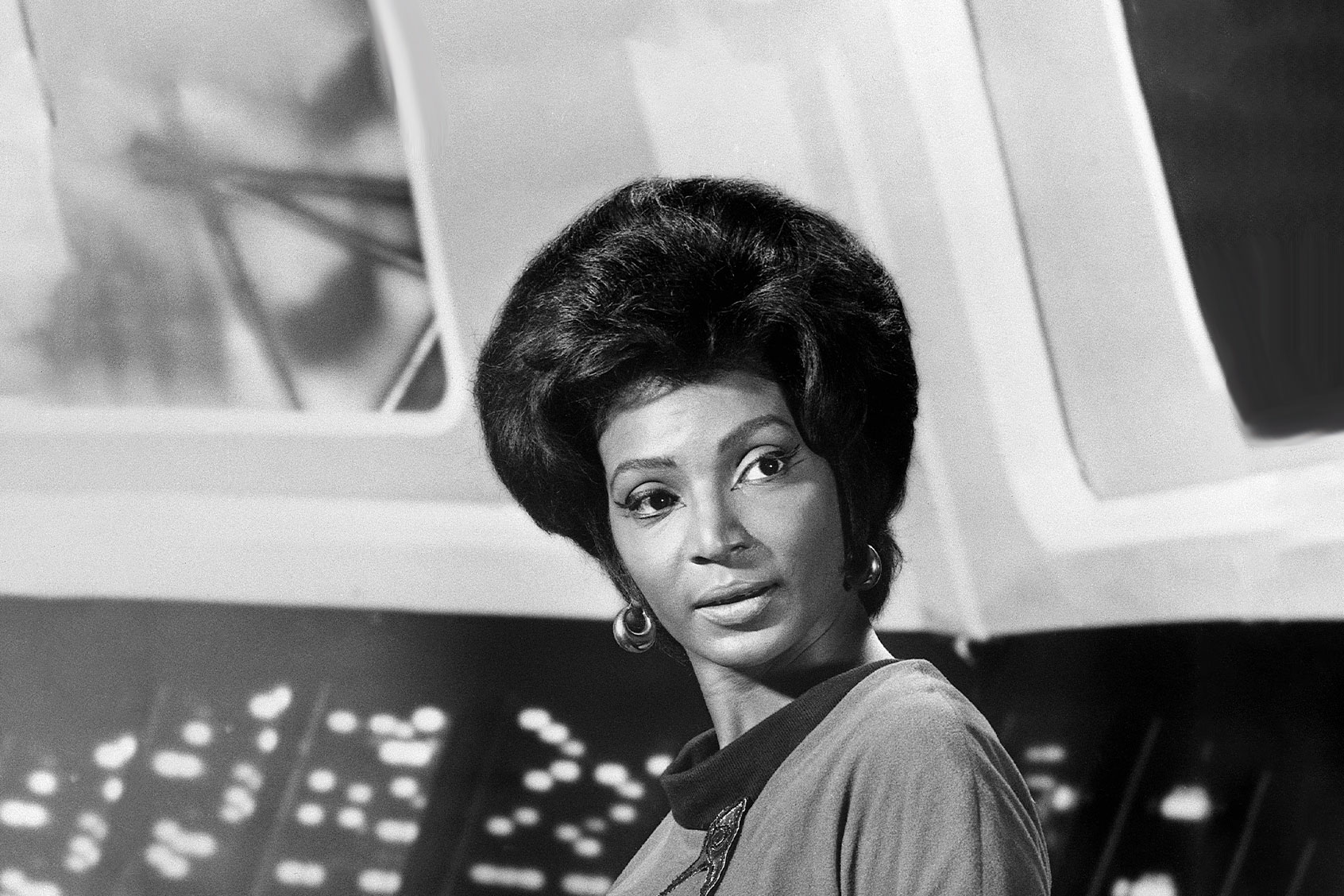
Nichelle Nichols; Star TrekNichelle Nichols in her role as communications officer Lt. Uhura on the TV series Star Trek. (Getty Images/Bettmann/Contributor)

This forgets that for a time “Star Trek” took a backseat to “Star Wars” in the popular imagination. (And I say this with a keen awareness of each fandom’s irritation whenever people hint at crossing those completely unrelated streams.)

But if “Star Trek” culturally innovated the intergalactic travel genre on TV, “Star Wars” made space adventure operatic, challenging primetime TV producers to hook into that appeal by way of “Battlestar Galactica” in 1978 and “Buck Rogers in the 25th Century” in 1979, both created by Glen A. Larson.

But none of those titles – not “Star Wars,” “Galactica” or “Buck Rogers” – concerned themselves with creating inclusive worlds or portraying a future where humanity overcame such an illogical concept as racism.

There was no need to reassure its young fans that Black people would be alive and thriving in the 23rd century since its humans came from entirely different places. Besides, they all featured Black men in prominent roles – which should suffice, right?

Roddenberry and King knew better, and so did Nichols. “Star Trek” debuted in 1966, the same year as the Black Panther Party’s founding. Uhura, through Nichols, showed children (including eventual guest star Whoopi Goldberg) that Black women were capable of roles beyond that of domestic or caregiver.

And where the roles for Black men in “Battlestar” and “Star Wars” were versions of combatants, whether soldiers or Billy Dee Williams’ smuggler, Uhura’s presence held a place in the “Star Trek” universe for Black explorers and diplomacy-driven leaders. People like LeVar Burton’s chief engineer Geordi La Forge on “Star Trek: The Next Generation” and Avery Brooks’ space station commander Benjamin Sisko on “Deep Space Nine” owe her a debt.

Even casting for non-human roles in “Star Trek” series became more diverse, including Tim Russ as the Vulcan second officer Tuvok on “Voyager” and Michael Dorn as Worf on both “TNG” and “DS9.” Of course, many have cited Golberg’s Guinan as an extension of Uhura’s impact, along with pointing out that without her, it may have taken us a lot longer to get Captain Janeway to the “Voyager” helm. For that matter, who knows if Sonequa Martin-Green’s Michael Burnham of “Star Trek: Discovery” would have been tasked with her vital duty if Nichols hadn’t remained with the Enterprise crew decades ago?

Obit Leonard NimoyFILE – This undated In this undated file photo released by Paramount Pictures, DeForest Kelley, left, Leonard Nimoy, second left, Nichelle Nichols, second right and William Shatner, right, appear in a scene from the TV series “Star Trek.” Nimoy, famous for playing officer Mr. Spock in “Star Trek” died Friday, Feb. 27, 2015 in Los Angeles of end-stage chronic obstructive pulmonary disease. He was 83. (AP Photo/Paramount Pictures, File) (AP)

My accounting doesn’t include the long list of Black women following in Nichols’ path who never left Earth, yet fulfilled King’s vision of showing Black women on TV working as lawyers, professors, and scientists, and who are intelligent, and beautiful, and thriving.

Nor does it mention Nichols’ influence on real people such as Mae Jemison, the first Black woman to travel into space aboard the Space Shuttle Endeavour. Seeing Uhura on “Star Trek” when she was young let Jemison know her dream to become an astronaut was attainable.

It shouldn’t escape your notice that I’ve listed people whose careers lived on, some even soaring, thanks to the trail Nichols cleared for them. The bulk of Nichols’ career that wasn’t directly related to “Star Trek” involved voice-over work, recurring roles in TV shows, or cameos. This is not to say she didn’t make her mark in these appearances; as my colleague Mary Elizabeth Williams reminded me, there’s an episode of the gone-too-soon comedy “Downward Dog” titled “Old” where she pops up to croon a song, and she’s utterly sublime.

However, my confession that I took Uhura for granted comes from a place of realizing how much my connection with female heroes in speculative fiction is possible because she showed me that I had a place there. But Hollywood never rewarded Nichols and Uhura in the same way that it sold heroines like Carrie Fisher’s Princess Leia to the masses. (Yes, we’re crossing streams again.)

Some of that is a matter of marketing – a lot more of us had at least one of Fisher’s likenesses, courtesy of Kenner toys, than ever scored a Uhura doll. But much of it is a matter of the way the entertainment machine works.

No remembrance of Nichols can be complete without citing her part in what was long thought to be the first interracial kiss on U.S. television, which took place in the 1968 “Star Trek” episode “Plato’s Stepchildren.” Many qualifiers to that kiss Uhura shared with William Shatner’s Captain Kirk have arisen since then, starting with the fact that it was coerced.

A more lasting legacy than these scenes as Uhura lives through her tireless work to recruit minorities and women to work with NASA’s space program. Among those she’s credited with bringing into the Space Program’s fold, besides Jemison, are Sally Ride, Lori Carver, and the first African-American astronaut, United States Air Force Colonel Guion Bluford.

“I probably wouldn’t have a career without Nichelle’s devotion to making room for strong-willed, intelligent, opinionated, graceful Black women in entertainment,” says Celia Rose Gooding.

Of course, Nichols’ legacy also lives on through the millions of people she’s inspired, including the two actors who stepped into her role in the modern age: Zoe Saldana, who played Uhura in J.J. Abrams’ “Star Trek” films, and Celia Rose Gooding, who portrays a younger Uhura in Paramount+’s “Star Trek: Strange New Worlds.”

“To say that I would not be playing Cadet Uhura if it weren’t for Nichols’ brilliant portrayal of the lieutenant my young cadet would become is, quite literally, the truth,” Gooding says in an Aug. 2 column she wrote for The Hollywood Reporter. “It would fail to encapsulate how I probably wouldn’t have a career without Nichelle’s devotion to making room for strong-willed, intelligent, opinionated, graceful Black women in entertainment.”

That lends new understanding to an admission she makes in the archival clip I cited, that King’s demand that she stay with “Star Trek” made her angry. “. . . Why me? Why should I have to?” she recalled, knowing the weight of the obligation to which King alluded.  

Nichols pushed to be featured similarly to her male “Star Trek” co-stars; despite all of Roddenberry’s groundbreaking through Uhura, for example, she was rarely included in landing parties. “Strange New Worlds” brings Uhura into an away mission early in the first season, one that the crew would not have survived without her genius and expertise.


Want a daily wrap-up of all the news and commentary Salon has to offer? Subscribe to our morning newsletter, Crash Course.


Credit the writers for this development; the first year’s room includes three Black writers, two of whom are women, with Jenny Lumet serving as an executive producer. But if not for Nichols’ insistence on representing her officer in a way that honored her station, Gooding’s cadet might not have gotten her chance to shine brightly so early in the show.

Nichols’ greatest desire was to sing and dance in the bright lights of the Broadway stage, and she knew staying with “Star Trek” meant putting that dream on hold. Perhaps permanently. She did it anyway, she says, for the sake of a future that was much bigger than any single person, albeit a future visibly impacted by her bold decision.

“I’m so honored to have been able to have a role in your life,” Nichols told her fans on Reddit seven years ago, before explaining that her heroes were Lena Horne and Marian Anderson. “I have heroes, and I felt it was a duty of mine to be a hero to others. If I was going to be in front of others, I wanted to be a hero I’d be proud to have.”

She can rest knowing she succeeded in that mission.

Elisabeth Hasselbeck uses decorative towel to demonstrate abortion opinion in return to “The View”

Former co-host Elisabeth Hasselbeck made a return to “The View” on Wednesday, where she clashed with fellow-host Whoopi Goldberg on matters of abortion. During the segment in which the exchange took place, Goldberg referenced the Bible to make a case for freedom of choice, and a person’s God-given ability to know what’s right for them when it comes to giving birth; which lead Hasselbeck to break out a prop to demonstrate her own views on the matter.

“I will say this, life has a plan and a purpose designed by God. I don’t believe there’s any circumstance where we should give the death penalty to an innocent life, and that’s why I brought this towel.”

From here, Hasselbeck produces a white hand towel with the words “I’d agree with you, but then we would both be wrong” written on it.

“Elisabeth Hasselbeck literally threw in the towel during her return to The View,” writes People on Twitter, along with a photo of Hasselbeck and her prop.

“I believe our creator assigns value to life, and that those lives have plan and purpose over them as designed by God that are not limited to the circumstances of conception, nor the situations they’re born into,” Hasselbeck said at the top of the segment dealing with abortion. “But I do think there are options out there. There are thousands of agencies that wrap around women that might not be able to care for the baby once born that will come around at no cost.”

Lightening the mood, Goldberg later thanked Hasselbeck for being “her first conservative” to have such conversations with, to which Hasselbeck jokingly replied “I was your first?” She then closed out the conversation on a more serious tone saying “Hold your issue in one hand and hold the hand of your friend in another. If we can’t do that as a society, we’re really teaching our kids the wrong way to talk about hard things.”

Watch here:

On “Reservation Dogs,” the raddest soundtrack on TV “breaks expectations” for Native storytelling

In a memorable moment from the first season of “Reservation Dogs,” tribal police officer Big takes teenage Cheese on a reluctant ride-along in a cruiser with a busted tape deck and introduces him to the funk band Redbone by warbling their 1974 hit “Come and Get Your Love.” 

“All-Indian band,” Big, played by Zahn McClarnon, insists. “You should know it, boy. Part of your culture.” Cheese (Lane Factor) looks skeptical. 

As with the rest of the show, the music doesn’t pander to assumed white audiences.

The FX dramedy, created by Sterlin Harjo with Taika Waititi, returns for its second season Aug. 3 on Hulu. Since its debut in 2021, the award-winning show has been lauded for its distinctive vision and for its total centering of Indigenous experience in rural Oklahoma. The production features a Native cast (up-and-comers like D’Pharaoh Woon-A-Tai as Bear and Paulina Alexis as Willie Jack, and established players like Gary Farmer and Wes Studi), but also television’s first all-Native writers’ room and all-Native directorial crew. 

“Rez Dogs” also has the raddest soundtrack on television, the result of Harjo’s eclectic taste and his penchant for upending expectations. The geographic and cultural specificity is reflected not only in the show’s immersive tone and idiosyncratic humor, but also, critically, in the way “Rez Dogs” integrates music into the storytelling. From Sturgill Simpson to Canned Heat, from classic hip-hop to traditional Native hymns, the soundtrack is more than background ambiance: It actively develops these multi-generational characters. And, as with the rest of the show, the music doesn’t pander to assumed white audiences. Harjo reaches for a truer depiction of contemporary life in Muscogee Nation

The show toes the line of accurate, modern representation by weaving together the teen characters’ omnivorous, streaming-age musical references with Indigenous hymns and slang. The varied soundtrack speaks to the insider-outsider identity that these kids occupy in their lives and in the contemporary U.S. 

“It’s really fun to break expectations of what a Native show – or any show – will sound like,” Harjo says. 

Harjo’s musical selections reflect his wide-ranging individual taste, drawing from punk, indie rock, Americana, hip-hop, funk and traditional, from the classic to the obscure. Music is a practical part of Harjo’s creative storytelling process. He always listens to music while writing, and he had made a giant playlist for “Rez Dogs” before it even existed. When the show had the green light, he sent the playlist to the entire production crew. 

Reservation DogsLane Factor, Paulina Alexis, D’Pharaoh Woon-A-Tai and Devery Jacobs in “Reservation Dogs” (Shane Brown/FX)One of the recipients of that playlist was Tiffany Anders, who Harjo recruited as music supervisor. Anders is an indie musician who has been music-supervising in film and television for 12 years, on shows like “PEN15,” “The Chair,” and forthcoming Netflix comedy-drama “Beef.” Introduced to Harjo through her mother, filmmaker Allison Anders, they bonded over a shared love for ’90s indie rock, Lee Hazlewood, and Native rock icons Link Wray and Jesse Ed Davis. Though the first season reflects Harjo’s vision, Anders helped to problem-solve and make suggestions for inclusion, such as a compilation of First Nations artists from Light in the Attic, the independent record label known for its reissues. 

“The music [of ‘Rez Dogs’] paints a world that is unexpected, that people might not think for this group of teenagers and this town and this landscape,” Anders says. “It’s not generalized, on-the-radio music.”

Ironically, the series does open with a radio broadcast: a Muscogee deejay introducing The Stooges‘ “I Wanna Be Your Dog,” which soundtracks the gang’s theft of a chip-delivery truck. The music blasts in scene until Elora (Devery Jacobs) shuts off the dial. This musical cue simultaneously establishes the show’s tone and style (Harjo says he wanted the tone to be “immediate and relentless”), and indicates the song is happening in the sonic landscape of the story, dropping the audience into the characters’ perspective. 

“Harjo’s choices can be unpredictable. Most showrunners’ inclination is to make everything very realistic,” Anders says. “‘An art gallery should sound like this . . .’ People have these preconceptions about what different spaces should sound like, and the great thing about working with Sterlin is that he throws that out the window.”

“Hip-hop is thought of as music of the streets, but that’s why Native audiences connect to it.”

Throughout the series, music provides texture that is realistic and hyper-realistic, integrated into both the present action and the characters’ memories and fantasies. According to Harjo, music cues “help to tell the story and help the audience to know a character.” For example, when viewers meet Rita (Sarah Podemski), Bear’s single mom, she is applying makeup in the bathroom mirror while humming TLC’s “Waterfalls.” This cue signals Rita’s generation while demonstrating that “she’s feeling herself,” as Harjo says. The lyrics – “Lonely mother . . . staring at her son that she just can’t touch” – stands in contrast to Bear sneaking his own stolen cash into his mom’s purse, in a twist on the caretaking dynamic.

Several characters get small musical signatures. Bear, for example, favors listening to “Stone Cold Lover” by Mato (who also composed the score). Multiple teenage characters wear Wu-Tang Clan T-shirts, and “Protect Your Neck” plays in the first episode. Harjo says he’s sure all the kids are into Wu-Tang. As the music “budget babysitter,” Anders says when she joined the project, she had to joke with Harjo, “We can’t have Wu-Tang in every episode.”

“We use hip-hop and punk rock, which are connected,” Harjo says. “Hip-hop is thought of as music of the streets, but that’s why Native audiences connect to it.”

The soundtrack features Indigenous hip-hop acts like Halluci Nation (formerly A Tribe Called Red), and the duo Lil Mike and FunnyBone are recurring characters Mose and Mekko. 

Reservation DogsFunnybone as Mekko and Lil Mike as Mose on “Reservation Dogs” (Shane Brown/FX

Though the use of hip-hop is not reductive, the guest appearance of rapper Sten Joddi as Bear’s unreliable father, Punkin Lusty, sparked accusations of anti-Blackness. Screenshots surfaced of Joddi’s 2014 social media posts using the N-Word, to which FX “condemned” in a statement and for which Joddi issued an apology. Joddi doesn’t return in Season 2

The track “Greasy Frybread” is full of inside references like the Harjo-penned lines, “Sofkee on the burner/ Hokte hokte head-turner.” 

In an interview with Salon last year, Harjo explained the Native teenagers’ connection to hip-hop: “[The characters] gravitate towards ideas that aren’t necessarily their experience. But there are things that they identify with in those experiences.”

The show’s original music often functions as extensions of its humor: specific and culturally affectionate without dipping into stereotype. The track “Greasy Frybread” is full of inside references like the Harjo-penned lines, “Sofkee on the burner/ Hokte hokte head-turner.” 

Harjo recruited Mato, a young producer and multidisciplinary artist who draws on a range of influences including hip-hop, to compose the score because he had the “DIY vibe” he was looking for.

“Early on, a music editor suggested to the composer, ‘Do you want to add more drums and flutes here?'” Anders recalls. “And Sterlin said, ‘No. No drums, no flutes.’ That’s not what we’re doing here.”

Coming to this project “as a California white girl” unfamiliar with Native Oklahoma, Anders says she had much to learn. Harjo hipped her to many indie Oklahoma artists who are featured in the show, including Broncho, Samantha Crain, and Jacob Tovar, who performs on screen in a honky-tonk scene. Tovar sings “Cleveland Summer Nights,” written by Oklahoma artist Wink Burcham, as Elora watches Daniel unravel on the last night of his life. 

“That song sounds how it feels to live in a small town and wonder, ‘What’s beyond this place?'” Harjo says.  

Harjo credits northeastern Oklahoma’s geographic centrality with the diverse mash-up of its musical influences and output. A surprising array of music is in the air, from the mainstream to the most experimental niches. In the “Come and Get Your Love” episode, for example, a character wears a Tulsa Noise Fest T-shirt, which director Blackhorse Lowe describes as a kind of Easter egg, a nod to those in that community. 

“We tried to incorporate some Southwest punk-metal,” Lowe says. “I was glad we were able to put in some Oklahoma noise and represent that scene a bit.” (“If I let Blackhorse choose all the music, it would be the heaviest, wildest death metal you’ve ever heard,” Harjo says.)

Reservation DogsPaulina Alexis as Willie Jack, Lane Factor as Cheese, D’Pharaoh Woon-A-Tai as Bear, Devery Jacobs as Elora Danan on “Reservation Dogs” (Shane Brown/FX)In compiling the music for “Rez Dogs'” second season, Harjo and Anders say to expect more of the unexpected. The show has received numerous submissions from lesser-known Indigenous artists, and Harjo with his ever-expanding playlist still shapes the sound. (One musical moment he’s looking forward to: two characters singing a Tom Petty track together.)  
Harjo says he doesn’t feel pressure about the show’s success. “I’ve created a bubble of people around me that I want to work with, that I feel safe working with, and doing it in Oklahoma. It keeps you humble,” Harjo says. “And with Season 1, I had nothing to lose. I knew what I wanted, and if I ever got the chance and the budget to do it, I had to put blinders up to the pressure. I had to be fearless.”


Want a daily wrap-up of all the news and commentary Salon has to offer? Subscribe to our morning newsletter, Crash Course.


There’s inherent tension in the music of “Rez Dogs,” enacting the characters’ entrenchment in their community and their momentum toward independence – perhaps in California or some other great beyond. The friends’ young grief over Daniel’s death serves as the push-pull between these poles. Teenagers’ impulse to separate from their guardians and childhood homes is common territory for coming-of-age narratives, but the culturally and sonically specific landscape makes this story about much more. “Rez Dogs” carries an abiding sense of loss throughout. The main characters have access to shards of knowledge and cultural ephemera, including music, but the throughline from previous generations is scattered or disdained. Their guardians – from their parents and cousin-uncles to Officer Big – are searching, too. 

For a story centered on four teenagers, the portals for growth and revelation occur during imperfect generational transmissions, which brings us back to Redbone’s “Come and Get Your Love.” By the end of the episode, Big has resolved a case of mysterious copper figurines and Cheese has improbably fixed the cruiser’s tape deck. When the song comes on, Cheese insists through a polite grin, “I still don’t know it,” but ends up singing along. Under the closing credits, footage of the real band plays. 

“That song is ubiquitous, but people don’t know it’s by a Native band,” Harjo says. “I wanted that moment to be a reclamation of that song. And in that reclaiming, what we find gets to be so surprising. And rich.”

“Reservation Dogs” premieres Wednesday, Aug. 3 on Hulu. Watch a trailer via YouTube.


This juicy steak with a toasted baguette, lots of butter and spicy-tangy giardiniera is chef’s kiss

Grilling is the perfect way to cook steak. Kissed by the flames, crusted with salt and pepper. Now I’m gonna be honest here — I never really get a chance to grill, so when I do, I like to make it special. This dish is that for me. Juicy steak with a toasted baguette, lots of butter, and a spicy-tangy giardiniera — chef’s kiss. If you’re not familiar with giardiniera, let me tell you: It is a must. It’s an Italian relish of chopped veggies (usually cauliflower, celery, bell pepper, and onion) pickled in olive oil and vinegar, plus spices. The giardiniera adds acid and crunch to this dish and is so good next to something rich, like steak, which doesn’t need more than just oil, salt, and pepper. Keep things simple with a crunchy toasted baguette and some wine. And if you don’t have a grill, you can just pan-sear the steak. — Romel Bruno

Watch this recipe


Grilled Steak with Spicy Giardiniera
Yields
3-4, plus leftover giardiniera
Prep Time
24 hours 30 minutes
Cook Time
40 minutes

Ingredients

Giardiniera:

  • 1/2 large (12 ounces) cauliflower, chopped into small florets
  • 1/4 bunches (4 ounces) asparagus (or 4 ounces carrots or radishes), cut into 1-inch pieces
  • 1 large bell pepper, diced into 1-inch pieces
  • 2 large celery stalks, sliced thickly
  • 2 large serrano chiles, sliced into thin rounds
  • 2 cups white wine vinegar
  • 2 tablespoons extra-virgin olive oil
  • 1 tablespoon kosher salt
  • 2 dried bay leaves
  • 1 tablespoon fennel seeds
  • 1 tablespoon granulated sugar
  • 2 teaspoons dried oregano
  • 1 teaspoon red pepper flakes
  • 1 teaspoon sweet paprika

Steak 

  • 2 (12-ounce) boneless ribeyes
  • 1 tablespoon neutral oil, like canola
  • Kosher salt and freshly ground black pepper
  • Baguette and salted butter, for serving

Directions

  1. Giardiniera: In a large bowl, mix together all of the vegetables, then transfer to a large mason jar.
  2. In a saucepan, combine the vinegar with 2 cups of water, the olive oil, salt, bay leaves, fennel seeds, sugar, oregano, pepper flakes, and paprika. Set over medium-high heat and bring to a boil, stirring until the sugar and salt dissolve, 4 to 5 minutes.
  3. Pour the hot liquid over the vegetables, pushing down on them as needed to make sure they’re submerged. Close the jar. Let sit at room temperature until no longer hot, then place in the fridge. Refrigerate for 1 to 2 days before using. This will keep in the fridge for up to 2 weeks.
  4. Steak: Remove the steaks from the fridge while you heat the grill to around 450°F. Rub the steaks with oil and season all over with salt and pepper.
  5. Place the steaks on the grill, diagonal to the grates, and cook, undisturbed, for 2 minutes. Now rotate the steaks to the opposite angle, so you’re creating a cross-hatch pattern. Keep cooking for 2 minutes, then flip. Repeat the cross-hatch technique on the other side and keep cooking until the steak reaches your desired internal temperature (say, 130°F to 140°F for medium-rare). Remove from the grill and let rest for at least 5 minutes.
  6. Halve the baguette crosswise, then halve each piece lengthwise (for four pieces total). Drizzle with olive oil, then lightly toast on the grill. Spread the toasted baguette pieces with butter. Slice the steak against the grain and serve with the giardiniera and the buttered bread.

How to make a small living room work extra, extra hard

No Space Too Small is a column by Laura Fenton that celebrates the idea that you can live well in a small home. Each month, Laura will share her practical findings from years of observing how people live in tight spaces, and her own everyday experiences of living small — from the hunt for the perfect tiny desk to how to manage everyday clutter.


I’ve lived in eight different apartments since I arrived in New York City more than 20 years ago, and they’ve all been variations of small, tiny, miniscule, or petite. In one studio, my bedroom, living room, dining space, and kitchen were all crammed into less than 200 square feet. Through it all, I’ve learned how to make small living spaces serve multiple functions — without feeling cramped.

In my current home, our living room serves as our living area, a home office, and a dining room (plus, an occasional playroom and home workout zone). The key to making it all work lies in both the layout and the choice of furnishings. Here are my best tips to make a small living room work extra hard:

Create zones

When a room serves many purposes, it helps to have distinct zones within your living space. Create groupings within the room to define, say an office area from the rest of the main living area. There are many ways to define a space within a space, but an area rug is a classic decorator trick. Using a small area rug in the “living room” part of our space helps to separate it from the “office” and the “dining room.”

Think about flow

Yes, “flow” sounds a little woo-woo, but what I mean is: It’s important to think about how people will move through the space. Is there enough room for someone to comfortably extend their chair out of the dining table? To walk between the couch and the hallway? The negative space is just as important as the placement of the furnishings. If you’re confident sketching, drawing out a rough floor plan can help you plot out your room.

Lean into mobile furnishings

Furniture in a multi-use space gets moved around a lot. For example, our coffee table pushes aside for home workouts and our chairs shuffle around when we host. The best mobile furnishings are sturdy yet relatively lightweight. In a long-ago studio apartment, I had to move my coffee table each night to pull down the Murphy bed, so I mounted the table on little casters to make it even more mobile. Home52 content lead Arati Menon wrote about her quest for the perfect coffee table earlier this year, and the one she settled on is relatively small and lightweight, so it’s easy to move.

The case for a small couch

In a small home, a loveseat or settee is often a better choice than a full-size sofa. The smaller sofa will fit better in your diminutive digs, but it will also be a piece that you can use later if you graduate to more space. Likewise, I had to hunt for a side chair that was small enough to sit in the narrow path between the entryway and the “office” because so many upholstered side chairs are large.

And the argument for a bigger one

When I moved out of my studio and finally had enough room, I invested in a real, full-size sofa. One of my requirements was that the couch could comfortably sleep a tall adult — since we don’t have a guest room, our couch would need to do double-duty as a sleeping spot. If a couch is likely to be pushed into a corner, an L-shape design may make better use of your space than a sofa and a chair.

Include flexible seating

If you don’t have room for even the smallest arm chair, consider stacking stools or floor cushions for when you host. My friend Vanessa lived for years in a teeny-tiny one bedroom, and when she hosted our book club, half of us would sit on the floor cushions for a super cozy hang. My pal Alison Mazurek, who blogs at 600 Sq Ft and a Baby is a fan of the uber-slim Pocket folding chairs from Resource Furniture, which can easily be stashed in a closet.

Think clearly

Make some of your furnishings visually disappear by choosing see-through furnishings. Glass, lucite, and acrylic pieces open up the look of a cramped space; I especially like waterfall-style lucite coffee tables and consoles for their simplicity. 

Bonus: Clear furniture looks great with almost any style of decor.

Gather ’round

There are many dining table options for a small space, including special tables that fold away when not in use, and those that expand with the addition of a leaf. However, I believe the most versatile solution is a simple, round pedestal table. Tellingly, six out of the 12 homes featured in my book about small spaces had some variation on a tulip-style table. Round tables take up less floor space than their rectangular counterparts while offering just as much seating, and a pedestal design beats one with multiple legs because you can squeeze in extra diners.

Seek out comfortable dining chairs

If you’re going to make your dining table do double-duty as a sometimes-home office, you need a seriously comfortable dining chair. I ended up selling our beloved caned bentwood chairs because they just weren’t comfortable to sit in for a long time. The more solid spindle-back solid wood chairs we replaced them with are almost comfortable enough for a full day of WFH. Plus, if your dining chairs are more comfy, they’ll be better suited to becoming sitting chairs when you entertain in your small space.

Take advantage of corners

We turned an unused corner into an office with the help of a vintage corner desk, but we could have just as easily used a corner as a dining nook with benches against the wall, or as a library corner. I’m a big fan of furniture designed specifically to fit into corners, to take the best advantage of this space.

Zoom out for the big picture

If things just don’t feel right no matter what you do, try taking photos of your space. Sometimes seeing a room in 2D can help you spot what’s not working. One trick I’ve learned from designers is to strive for symmetry. In a photo it’ll be more clear if a table needs to shift a few inches or if your mismatched side tables are making the room feel lopsided.

Attorneys in Alex Jones’ Sandy Hook defamation trial “mistakenly” give damning info to opposition

In the continuation of the defamation trial of InfoWars host, Alex Jones, attorney Mark Bankston — who represents the parents of a six-year-old boy shot and killed in the 2012 Sandy Hook shooting — revealed that Jones’ own attorneys “mistakenly” provided him with years worth of damning texts from Jones’ cell phone.

Throughout the trial, which seeks damages caused by Jones making repeated statements to the effect that the Sandy Hook shooting was “a huge hoax,” he has maintained that there was nothing included in the text messages on his cell phone pertaining to the shooting, or his thoughts on the shooting, which his attorneys have now proven to be false.

Bringing up a thread of texts on a screen within the court room, Bankston questioned Jones on the information gleaned from them, while reminding him of statements made during previous questionings.

“Do you know where I got this?” Bankston asked Jones. “Your attorneys messed up and sent me a digital copy of your entire cellphone, with every text message you’ve sent for the past two years.” From here, Bankston informed Jones that his attorneys did nothing to mark the texts as privileged, leaving them open for use in the trial.

“This is your ‘Perry Mason’ moment,” Jones said, while visibly taken aback. 

“You know what perjury is, right?” Bankston asked Jones after questioning him on the texts. “I just want to make sure before we go further.”

“This clip of the Alex Jones trial of Sandy Hook learning his lawyer accidentally leaked his phone contents to the opposing team belongs in a museum. This is an Emmy worthy reveal,” one person commented on Twitter, along with footage from the trial.


Want a daily wrap-up of all the news and commentary Salon has to offer? Subscribe to our morning newsletter, Crash Course.


 In addition to previously withheld texts regarding Sandy Hook, Bankston was also made privy to information contradicting Jones’ claims that he was struggling financially. Jones had previously claimed that he “lost millions because of deplatforming,” according to The Washington Post, but texts within the newly delivered bounty revealed that InfoWars revenue was on track to bring in $300 million a year.

“I mean I hate Alex Jones but not as much as Alex Jones’ lawyer hates Alex Jones,” political commentator Brian Tyler Cohen said on Twitter in response to the damning texts. 

“Only Murders in the Building” star on the collaborative creation of Theo, the show’s conscience

When I first learned there was a deaf character on “Only Murders in the Building,” I felt apprehensive, as other deaf or disabled viewers may have as well: here we go again. Another minor character, written by non-disabled people, who doesn’t add much to the story or to a realistic understanding of disability. But nobody puts Theo in a corner.

The character of Theo Dimas is essential to the Hulu show, which follows the adventures of an unlikely trio of neighbors, played by Selena Gomez, Steve Martin and Martin Short, who stumble onto a murder (and then another one) and decide to start a true-crime podcast in order to solve it, possibly become famous (again) and/or generate some cash. Theo is the grown son of another neighbor, Teddy (Nathan Lane), a deli tycoon who sponsors the podcast and commits crimes of his own (not murder, though — at least not yet that we know about).

Theo is also deaf. So is the actor who portrays him, James Caverly, who prefers the term Deaf for himself, the capital “D” relating to identity. And his role in “Only Murders” is anything but minor. It’s also a role he had a part in creating.  

IndieWire calls Theo the “Unsung MVP of the Series.” He’s certainly its conscience. Despite the show revolving around true crime, it can sometimes feel removed from the realities of violence. Theo brings it back, his character embodying the complexities of an aftermath of violence: guilt and remorse. He was there when the woman he loved, Zoe, died in a tragic and confusing accident for which he is unintentionally at fault. He helped his father break the law. Theo feels bad about all of it.   

Emotional and complicated, in the episode “Flipping the Pieces,” he’s angry at his dad. Anger is not an emotion that disabled people are always allowed to show; we’re supposed to be happy with what we have and how we are treated and not make a fuss about pesky things like accommodations and discrimination. That Theo explodes at his dad in a real way is part of the authenticity of his character.

Only Murders In The BuildingTheo (James Caverly) in “Only Murders In The Building” (Craig Blankenhorn/Hulu)So is the fact that Theo has a love and sex life. Zoe is attracted to him. He’s desirable, which is not something that disabled characters are always allowed to be or to express. He’s also really funny. So many portrayals of disability still either fall into inspirational porn or sympathy. As series co-creator John Hoffman told Salon, in creating the deaf character, it was essential that the complex role “not be heavy, be light . . . I wanted all of those dimensions.”

Theo is a true collaborative effort between the creators and myself to bring the character to life.”

In an interview with Salon, conducted over email, Caverly wrote: “Sadly, there are one too many creators who write disabled characters as two-dimensional: fixating on their disability without room for growth.” Theo is different in large part because Caverly helped create him. He had multiple conversations with Hoffman and director Cherien Dabis “to figure out how to portray Theo authentically without feeling like a gimmick. Aside from the dialogue changes, we talked about how a Deaf person views the world,” describing Theo as “a true collaborative effort between the creators and myself to bring the character to life.”

Hoffman told Salon it was important for Theo to “[show] that perspective of community and a deaf person’s experience living in a building like this in New York City . . .  We learned so much from James Caverly, particularly when he walked on set. Before he walked on set, we learned so much from Douglas Ridloff, who was our ASL expert and captain on the show. We learned both how to adjust our story to fit what made sense after talking with them and to realize the dimensions of Theo.”    

Only Murders In The BuildingTheo (James Caverly) in “Only Murders In The Building” (Craig Blankenhorn/Hulu)
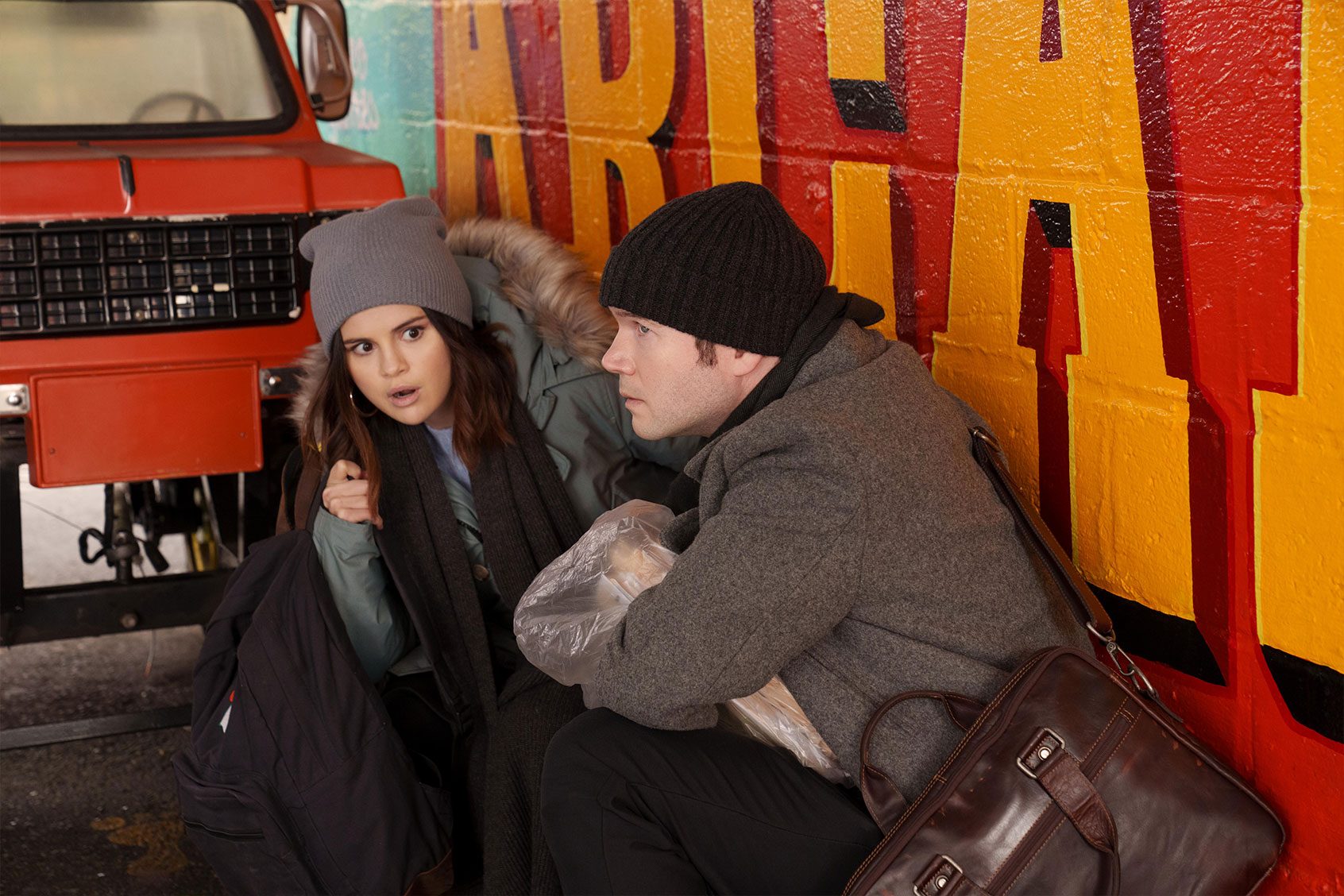
Theo signs, in one of his trademark deadpan quips that made me scream with the truth of it all: “Yeah, well, deaf people don’t get to write a lot of movies.” 

“That guy cutting through the expectations [and] keeping alive the reality is always the bottom line — and the reality is not always noble and oftentimes very complicated,” Hoffman said. Caverly discussed the challenges of playing Theo specifically, a character who is going through a lot: “With Theo, I had to isolate myself from the world and create a level of paranoia and guilt that felt appropriate. Doing that for months of shooting is fatiguing.” 

Isolation and loneliness can be a common part of a disabled person’s experience, especially with the communication barriers that often arise when trying to interact with an often-resistant, ableist world. “Flipping the Pieces” acknowledges these barriers: Mabel, who doesn’t know sign language, keeps trying to talk to Theo, who has to repeatedly remind her that he can’t hear her. She doesn’t understand why he can’t simply lip-read everything: “It always seems like people can lip-read more in the movies.”

Theo signs, in one of his trademark deadpan quips that made me scream with the truth of it all: “Yeah, well, deaf people don’t get to write a lot of movies.” 

Only Murders In The BuildingMabel (Selena Gomez) and Theo (James Caverly) in “Only Murders In The Building” (Craig Blankenhorn/Hulu)With knowing asides like these, often meta comments on the action, Theo functions as a kind of insider for the audience, even though his character is more alone and isolated. As Caverly told IndieWire: “It felt pretty easy for me to tap into the feeling of being isolated from the outside world — possibly due to what I’ve experienced as a Deaf person.”

I want to see what makes a character flawed that doesn’t necessarily revolve around their disability. I want to be in ‘Star Wars.'”

Caverly was born into a hearing family and has a Deaf sister. As one of four children, he told Salon: “I’ve had a knack of knowing how to get attention when I felt ignored.” He would re-enact scenes from television shows and make up stories for his friends on school bus rides (Caverly is also a playwright and screenwriter). “I was always in trouble for horsing around . . .  acting came second nature to me.”   

He got his professional start in theater, appearing in such productions as Broadway’s “Children of a Lesser God,” a medium he still loves and works in frequently. At the time of our interview, Caverly was just ending a run as Harold Hill in “The Music Man” at Olney Theatre Center. In July, he starred in an ASL performance of Stephen Sondheim’s “Sweeney Todd” at Lincoln Center. Caverly also directs stage productions and translates scripts for interpreted performances in New York.

Only Murders In The BuildingTheo (James Caverly) and Mabel (Selena Gomez) in “Only Murders In The Building” (Craig Blankenhorn/Hulu)But the transition to the screen was a deliberate one: “I always knew that TV and film would reach a much wider audience so I made the decision a few years ago to get into the film industry because the impact would be far-reaching.”

And the response from the Deaf community to Theo? “Overwhelmingly positive. I still get messages from people about how wonderful it is to see Theo be played by a Deaf person and to have sign language portrayed on screen. Even more so when they saw Teddy, played by Nathan Lane, using sign language to communicate with his son.”

Lane is a longtime idol of Caverly’s. Alongside that, the image of a hearing family member signing with a deaf child is one that is both refreshing and unfortunately, atypical. Less than 10% of hearing parents learn sign language. Between 90-95% of deaf and hard of hearing children are born to hearing families, but the majority of those families never learn to sign to communicate with their children. Though Teddy is deeply flawed, he’s also a dad actually trying.  


Want a daily wrap-up of all the news and commentary Salon has to offer? Subscribe to our morning newsletter, Crash Course.


When it came to Theo returning this season, Hoffman said, “We talked a lot about continuing that storyline, opening it up even further and opening up the ways in which we’re representing.” What’s next for Theo Dimas? Caverly hopes his character makes an appearance in the newly announced Season 3.

But Caverly acknowledges that all roles offered to deaf and disabled actors aren’t as multi-faceted as Theo. Caverly told Salon, “I always like to play complex characters . . . I want to see what makes a character flawed that doesn’t necessarily revolve around their disability. I want to be in ‘Star Wars,’ playing a Sith Lord angry at the world before finding peace as a Jedi Master. I’ll ride a makeshift ATV in ‘Mad Max,’ protecting those I love . . . The possibilities are endless!” 

We just need creators to realize it. And oh yeah, stop presenting lip-reading as easy. 


Is monkeypox officially a pandemic? Here’s what experts say

This week, California and Illinois joined New York state in declaring a public health emergency in light of the increasing number of monkeypox cases. Mere weeks ago, the World Health Organization declared a “global health emergency” for the virus, which is related to smallpox, and causes pustules to emerge on one’s body along with other fever symptoms.

The three states’ move comes as 48 US states record 5,811 cases of monkeypox, as of August 1, 2022; the three aforementioned states that have declared a state of emergency have the highest number of cases in the country, making up nearly 47 percent of total cases. But nearly two months ago, there were only 19 confirmed cases in 10 states. (The first case emerged in May.) Back in 2003, when a mini-outbreak occurred in the United States, 47 people in six states had confirmed or probable cases of monkeypox, but it was quickly contained.

The rapid rise in the number of cases is eerily reminiscent of the early days of the COVID-19 pandemic, when the number of cases went from single to quadruple-digits in a matter of months. Now, as monkeypox cases continue to rise, some are wondering: is the country on the brink of yet another pandemic?

“To me, a pandemic is going to be something that is an infectious disease that becomes very widespread and causes societal disruption,” Adalja said. “And it’s something that permeates throughout the entire population.”

That depends on how you define pandemic, experts tell Salon; but overall, the rise in cases will likely make it harder to contain at this point. The measures that will be taken by public health officials in the coming days and weeks will influence how bad the spread might be. However, there are some key differences between monkeypox and ​​SARS-CoV-2 that will make these two public health events pan out differently.

An epidemiology dictionary defines a pandemic as one step above an epidemic; specifically, a pandemic is “an epidemic occurring worldwide, or over a very wide area, crossing international boundaries and usually affecting a large number of people” But as Dr. Amesh Adalja, a senior scholar at the Johns Hopkins Center who co-authored a paper on the characteristics of pandemic pathogens, explained to Salon, there are no official markers to definitively say when a pandemic is underway.

“There’s no person who snaps their fingers and says ‘this is a pandemic’ — but to me, a pandemic is going to be something that is an infectious disease that becomes very widespread and causes societal disruption,” Adalja said. “And it’s something that permeates throughout the entire population.”

Dr. Stephen Morse, a professor of epidemiology at Columbia University’s Mailman School of Public Health, agreed.

“In the sense of [monkeypox] being the next pandemic the way SARS-CoV-2 was, I don’t think that’s likely,” Morse said. “In the technical sense, it already is a pandemic because it’s already in many countries all over the world, mostly within certain communities and it’s spread widely, and we obviously did not expect that.”

Both Adalja and Morse agree that due to the way monkeypox transmits, it won’t spread with the same rapidity as COVID-19 spread around the world; hence, there is still an opportunity to contain it.

The monkeypox virus originated in wild animals in the jungles of west and central Africa; on occasion, it has made the jump to humans. The first known human case of monkeypox was found in 1970 in a 9-year-old boy in a remote part of Congo. However, it was first identified by scientists in 1958, when there were two outbreaks of pox-like diseases in monkeys used in research laboratories.


Want more health and science stories in your inbox? Subscribe to Salon’s weekly newsletter The Vulgar Scientist.


According to the CDC, monkeypox can cause symptoms like painful rashes that can appear all over a person’s body. The other symptoms are similar to influenza, and include swollen lymph nodes, muscle aches, backaches, headaches, fever, fatigue and chills. Eventually, lesions form and progress through a number of stages before falling off. The descriptions of the pustules are uncomfortable.

“The lesions in my sensitive areas and underwear zone became really painful to the point where I couldn’t sleep,” 30-year-old Matt Ford explained to Self magazine. “I’d describe the sensation as a dull, chronic pain that became jolts of intense pain if I moved the wrong way; I am not sure I’ve experienced anything quite like it.”

Current data from this strain suggests a 3.6% fatality rate, according to the European Centre for Disease Prevention and Control. Notably, that is higher than COVID-19, which now has a global fatality rate of 1.1%. Most monkeypox victims will recover within two to four weeks after developing symptoms. Unlike COVID-19, which is arguably the most contagious viruses ever discovered, transmission of monkeypox is more difficult. Gay and bisexual men are the highest risk of infection right now, public health officials say.

Adalja said that respiratory transmission is a cause for concern, and could be a characteristic of a pathogen that can cause a COVID-19-like pandemic. Another two characteristics for a pandemic-like pathogen, Adalja said, are incubation period and population immunity.

“When it comes down to transmission mechanisms, it really has to be respiratory” in order to resemble a pandemic-like pathogen, Adalja said.

According to the CDC, monkeypox spreads through direct contact with body fluids or sores on the body of someone who has monkeypox. It can also spread through materials that have touched body fluids or sores that have been in contact with someone who’s infected — for example, clothing or bedsheets. It can also spread through respiratory droplets when people have close face-to-face contact. However, that latter is not its main mode of transmission, Adalja said, commenting on how there’s been a rise in misinformation about monkeypox.

“I don’t think we’ve missed our opportunity to contain monkeypox in the US. What we do over the next few weeks will be very important.”

“The first aspect to recognize is just because something has the capacity to spread through one route doesn’t mean that’s what’s driving transmission,” Adalja said. “Monkeypox can be biologically transmitted through respiratory droplets, but is that what’s driving the spread? Or is it a minor mode of transmission or is that a major mode of transmission?”

When a virus is transmitted via airborne droplets, Adalja said, the household attack rate — meaning the secondary infections that occur after one person is initially infected — is 100 percent. The household attack rate for monkeypox appears to vary from 10 percent to 50 percent in one study. Unlike COVID-19, there are readily available vaccines for monkeypox, too. As Salon previously reported, the U.S. has released the Jynneos vaccine against monkeypox from the Strategic National Stockpile. Meanwhile, those who received the smallpox vaccine before it stopped being given in the 1970s will likely have protection against monkeypox.

Still, what happens next — and how states and the federal government react to the threat — will affect how far monkeypox spreads.

“I don’t think we’ve missed our opportunity to contain monkeypox in the U.S.,” Melanie Chitwood, a doctoral student in epidemiology of microbial diseases at Yale School of Public Health who recently co-authored a modeling study that has yet to be peer-reviewed. “What we do over the next few weeks will be very important.”

By email, Chitwood said the most critical response right now is to vaccinate high-risk people as soon as possible. It would help slow the spread, too, if it were easier to get tested and to quarantine when one tests positive.

“We need to provide financial and social support to help infected individuals recover in isolation,” Chitwood said. “Our analysis suggests that contact tracing is also an important piece of the response, but contact tracing can be difficult to implement; people don’t always remember who they had contact with or how to get in touch with their contacts.”

To date, Chitwood said what has been done so far has “not been sufficient.”

“We’ve given the virus a pretty good head start, and the sooner we strengthen the public health response, the better,” Chitwood said.

“My concern is that if we fail to contain monkeypox now, we’ll be dealing with outbreaks for years to come,” Chitwood said. “Monkeypox can spread in congregant settings, so I’m particularly worried about students returning to college campuses in the next few weeks.”

A travel writer’s guide to eating your way through Croatia

Did you know that many scenes in “Game of Thrones” were filmed in Dubrovnik? Me neither! In fact, since I’ve never watched the show and didn’t know a whole lot about Croatia in general, I was surprised at how insistent my sister — who recently accompanied me on a 19-day tour of Europe — was to visit the country. 

Ultimately, I’m so glad she pushed us in that direction. 

The country wound up being the highlight of our European adventure. It led me to enjoying the most beautiful sunset I’ve ever seen, swimming in a string bikini in a salt lake off of a monastery on St. Mary’s Island, and enjoying the beauty of the Adriatic Sea. After leaving budget-friendly Lisbon, the prices for an Uber in Dubrovnik were a bit of a shock, but the view on the way to our hotel, or anywhere else for that matter, made it feel like we were on a private tour of one of the most beautiful places I’ve ever been. Don’t forget to pack your sunscreen, you’ll certainly need it in Croatia!

The view from the author's Sail Croatia cruiseThe view from the author’s Sail Croatia cruise (Photo courtesy of Soreh Milchtein)

Dubrovnik

Where to stay:

Sun Gardens Dubrovnik Hotel — For a comfortable hotel with excellent service and a jaw-droppingly beautiful view, you’ll want to stay at the Sun Gardens Hotel, about a 30 minutes drive from the airport. Our room was bright and airy, with a balcony overlooking the Adriatic sea. The wall of the shower facing the room was made of glass which allows you to have a view and can be quite sexy if you’re traveling with a partner. If you’d rather have some privacy, you can draw the curtain. The hotel boasts three pools, including one that’s for adults only, a pebble beach and its own marina. You can even get a massage on the beach! Be sure to get breakfast on the rooftop terrace while you’re there, it was top-notch. Sun Gardens also has an onsite travel agency that, while pricey, can make you last-minute reservations for excursions, water transfers, and tours. 

Where to eat:

Gradska Kavana Arsenal — The Gradska Kavana Arsenal restaurant boasts a large open-air covered terrace overlooking the old marina, the perfect setting for exquisite and fresh Mediterranean cuisine. And boy, was the food good. Hands down the best meal we enjoyed in Croatia. Seafood is king in Croatia, and this restaurant is no exception. We started with mussels and a seafood trio, both delicious. Our main course was a whole fish, carved tableside, and served with grilled vegetables. It was a simple dish that was just magical. Save room for coffee and dessert, you’ll want to soak up every second and enjoy the crisp air and the view. 

The whole fish at Gradska Kavana ArsenalThe whole fish at Gradska Kavana Arsenal (Photo courtesy of Soreh Milchtein)

Bowa Restaurant — The popular Bowa Restaurant is only accessible by boat. You can book a ticket on the water taxi, or book a private boat tour that stops there for lunch. We did the latter and made it just in time for our reservations. Riding up to the restaurant provides a spectacular view, as it looks like it was built right into the natural landscape. Only open for lunch, your reservation allows you to make a day of it, enjoy a meal, and visit the private pebble beach with bar service. The menu is full of fish and seafood. We really enjoyed the freshly-made bread with Croatian olive oil and swordfish sashimi. But it’s not the food that would bring me back. It’s the view, the peaceful sound of the waves and the resident cat. 

Squish factor: The chairs all had arms on them and were uncomfortably small. However, the cabanas have bench seating, though they need to be booked by the day with a minimum spend.

Swordfish sashimi at Bowa restaurantSwordfish sashimi at Bowa restaurant (Photo courtesy of Soreh Milchtein)

What to do:

Snooky Tours — Dubrovnik is beautiful, but you won’t have the full experience if you don’t experience the joy of speeding through the Adriatic Sea with the wind in your hair and sun on your skin. To do that, Snooky Tours is the boat company for you. Not only did they arrange a last-minute private boat tour the night before I needed it, but our driver picked us up from the hotel’s marina. He carefully showed me how to get on the boat comfortably, which I appreciated. We had an hour before our lunch, which was well spent enjoying the sea and exploring a nearby island before speeding our way to lunch. After lunch, we were off to the caves. My sister jumped off the boat and swam, getting to look into one of the caves. It was such a good day, and worth every single penny. 

Squish factor: I was able to get on the boat by sitting on the edge of the pier, but I wasn’t able to swim in the sea. At least not without taking a significant risk of not being able to climb back into the boat on the tiny ladder. 

 Soreh and Chaya MilchteinSoreh and Chaya Milchtein (Photo courtesy of Soreh Milchtein)

Sail Croatia

When you think of a cruise ship, you probably think of a massive ship with a casino and thousands of people on board. Sail Croatia is nothing like that — it’s like the polar opposite of it. With a capacity of just 38 people and the crew, the vibe is intimate, perfect for a solo traveler or a multiple-generational family without young kids. Sail Croatia offers different styles of cruises, catering to different age groups and travel styles from hikers to partiers, and everything in between. 

My sister and I joined an explorer cruise for two nights which was headed from Dubrovnik to Split, but also offers a route from Split back to Dubrovnik. The route is seven nights long, with stops at islands like Mljet and Korcula. Breakfast and lunch are served on the ship, and the boat docks and remains docked all night, so you can enjoy dinner at a local restaurant at each stop. This is quite different from the large cruise ships, which tend to dock during the day and then sail away from the port. You can leave the boat, explore the island, eat, drink and enjoy the beautiful beaches and sunsets. 

Don’t skip the lunches on board, as they were simply superb! Freshly-made, featuring local dishes made of local ingredients

Sleeping quarters on board are small, but they feel a little more spacious than they should given they’re on a boat. The beds are twin size but some cabins can be combined for a couple. Since the sleeping quarters are located on the bottom floor, you’ll need to climb the stairs to get to the floor where meals are served and where the patio is. The top floor of the boat has a sun deck, lounge area, and hot tub. We had a great time getting to know our shipmates and enjoying the views as we sailed.

At each port, the cruise offers a number of excursions. In Mijet, most folks went biking in the national park, but my sister and I instead took a ferry to St Mary’s Island, changed into our swimsuits, and jumped into the salty lake. In Korcula, I was very excited for the buggy tour and wine tasting excursion — but after getting to the buggies, I discovered that the seatbelt was way too small, forcing me to return to the ship alone. If I would take the cruise again, I’d take the time to research each stop and put together a list of things to do on each island.

Squish factor: As mentioned, the buggies that I was so excited to enjoy were far too small for me, with no seatbelt extender available. I skipped the bike tour figuring that it wouldn’t be accessible. There are three levels on the boat, and you’ll need to climb the stairs to access almost everything. The bathroom was small but spacious enough to be comfortably used. The ports we stopped at required some walking to get to restaurants, parks, etc, with minimal transportation available.

Travel tip: If you want to leave Dubrovnik and explore some of the islands off the coast of Croatia, but you don’t have seven days to take a cruise, the ferry system is excellent! 

Meghan McCain melts down after Kari Lake, GOP extremists come out on top in Arizona elections

Meghan McCain on Wednesday dialed back her excitement around the Arizona’s GOP gubernatorial primary after pro-Trump Kari Lake, one of McCain’s political enemies, made an overnight comeback in the polls. 

On Tuesday, early results showed Karrin Taylor Robson, the Arizona Board of Regents member running against Lake, ahead by 8 percentage points. As a result, McCain, a critic of Trump, took to Twitter to celebrate.

“Wow…Lake is getting crushed so far!!! Incredible!” she wrote in a since-deleted tweet. “Everybody better tune in to primetime if this lunatic loses cause she’s gonna go absolute insane on live tv. Like one for the books, makes Trump look normal insane.”

By Wednesday morning, however, Lake’s chances of victory had seemingly rebounded, and the former Fox News pundit was pulling ahead by 12,000 votes, with 81% of the tally counted. In response, McCain quickly backtracked, claiming that “my initial predictions were right despite the initial excitement of Robson pulling ahead.” 

“Congratulations to my home state for full making the transition to full blown MAGA/conspiracy theory/fraudster,” she wrote in a tweet. “The voters have spoken – be careful what you wish for…”

Arizona’s primary election marks one of the latest proxy wars between Donald Trump’s base and establishment Republicans, whom the former president had repeatedly disparaged as “RINOS,” or Republicans in name only. 


Want a daily wrap-up of all the news and commentary Salon has to offer? Subscribe to our morning newsletter, Crash Course.


Trump, for his part, has also had a long-running beef with the McCain family, which spans back to the 2016 presidential race, during which the former president leveled vicious attacks at McCain’s father, the late Sen. John McCain, R-Ariz. At the time, Trump provoked outrage after saying that he likes “people who weren’t captured,” suggesting that John McCain, a former prisoner of war, was a lesser candidate for his time spent imprisoned. 

In any case, much of the McCain-Trump conflict now appears to have spilled over into the Arizona primary. 

Last month, Lake, a diehard MAGA hopeful, suggested that Meghan McCain’s mother, Cindy, is running a clandestine scheme with billionaire George Soros to destroy America by promoting a “globalist agenda.”

“This is the Cindy McCain branch of the Republican Party,” said of the establishment GOP on a podcast. “They’re not Republicans. They’re globalists and they want – I think they want an end to America.”

Months earlier, Lake suggested in a campaign video that the party needs to “replace that disgusting, dirty McCain Swamp with, maybe, I don’t know … a Lake? You need somebody who is going to represent ‘we the people.’ “

“What trash this woman is,” McCain responded to the video at the time.

Lake shot back: “Thanks for sharing our video, Meg!”

“Self-Serving Multimillionaire”: Ron Johnson pushes to dismantle Social Security and Medicare

Democratic challenger Mandela Barnes slammed Sen. Ron Johnson as a “self-serving, multimillionaire” on Tuesday after the sitting Republican from Wisconsin called for making both Social Security and Medicare discretionary programs—a reform that would pave the way for the GOP to realize its half-century-long dream of dismantling two of the nation’s most essential and popular social programs.

Speaking on a right-wing radio show earlier in the day, Johnson criticized the “mandatory” spending demanded by Social Security and Medicare, guaranteed benefit programs available to all Americans and overwhelmingly popular.

“What we ought to be doing is we ought to turn everything into discretionary spending so that it’s all evaluated so that we can fix problems or fix programs that are broken,” said Johnson on the Regular Joe Show.

In his response, Barnes said the Trump-supporting Republican incumbent “wants to strip working people of the Social Security and Medicare they’ve earned. Wisconsinites pay into Social Security through a lifetime of hard work, and they’re counting on this program and Medicare—but Ron Johnson just doesn’t care.”

Barnes, who currently serves as Wisconsin’s Lt. Governor, was far from the only critic to pounce on Johnson’s remarks.

“Johnson wants to END the Social Security and Medicare guarantee,” said the advocacy group Social Security Works on social media. “This would be a disaster for seniors and people with disabilities in Wisconsin and across the country.”

It’s not the first time Johnson has attacked Social Security. Just last year, he called the program a “Ponzi scheme” and has variously supported legislation that would raise the retirement age for seniors and backed other GOP proposals to increase out-of-pocket spending by Medicare beneficiaries.

In a statement, Philip Shulman, a spokesperson for the Wisconsin Democratic Party, said, “Ron Johnson has made clear he would cut Social Security and Medicare despite the devastating impact it would have on older Wisconsinites. During his years in D.C., Johnson has lost touch with Wisconsinites and voters will hold him accountable in November.”

Pat Cipollone hit with Jan. 6 grand jury subpoena: “Dramatic escalation in DOJ’s investigation”

Former Trump White House counsel Pat Cipollone was subpoenaed by a federal grand jury investigating the efforts of Donald Trump supporters to overturn the 2020 presidential election, ABC News reported on Tuesday.

“The sources told ABC News that attorneys for Cipollone — like they did with the House select committee investigating the Jan. 6 attack on the Capitol — are expected to engage in negotiations around any appearance, while weighing concerns regarding potential claims of executive privilege,” ABC News reported. “The move to subpoena Cipollone signals an even more dramatic escalation in the Justice Department’s investigation of the Jan. 6 attack than previously known, following appearances by senior members of former Vice President Mike Pence’s staff before the grand jury two weeks ago.”

In July, the House Select Committee Investigating the Jan. 6 Attack on the U.S. Capitol played testimony from Cipollone’s deposition.

Attorney Tristen Snell, who prosecuted Trump University for the New York attorney general’s office, said the subpoena was a sign that the Department of Justice “is almost caught up with the January 6 committee.”

Cipollone’s lawyers told ABC News they plan to engage in “negotiations” over following the subpoena.

Read the full report.

Trump-backed election-denier ousts Republican incumbent. Democrats get blamed

A Trump-backed congressional candidate from Michigan ousted U.S. Rep. Peter Meijer, R-Mich., who voted to impeach the former president, in the state’s general election on GOP primary on Tuesday. 

John Gibbs, a little-known but ardent election-denier, beat out Meijer to represent Michigan’s 3rd Congressional District, with the incumbent officially conceding around 2 a.m. on Wednesday, according to The Detroit Free Press. With 88% of the votes tallied by Wednesday morning, Gibbs was leading 52% to 48%, solidifying the former president’s sway over the future of the Republican Party.

“This was a hard-fought primary campaign and I want to thank everyone in west Michigan for their support,” Meijer said in his concession speech. “I also want to congratulate my opponent, John Gibbs, on his victory tonight.” 

Gibbs, a Trump-appointed former official at the Department of Housing and Urban Development, received the former president’s imprimatur last November, just days after declaring his congressional bid. He has a history of making outlandish remarks. 

Back in 2016, he baselessly accused John Podesta, the chairman of Hillary Clinton’s 2016 presidential campaign, of participating in a “Satanic ritual.” He has also said that the Democratic Party is the party of “Islam, gender-bending, anti-police.” More recently, in July, Gibbs called the 2020 election results, for which there is no evidence of widespread voter fraud, “mathematically impossible.”

Shortly after Meijer’s defeat, the Republican lawmaker blasted the Democratic Congressional Campaign Committee (DCCC) for releasing ads that attempted to paint the lawmaker as being “too conservative for West Michigan.”


Want a daily wrap-up of all the news and commentary Salon has to offer? Subscribe to our morning newsletter, Crash Course.


“You would think that the Democrats would look at John Gibbs and see the embodiment of what they say they most fear,” Meijer wrote in an op-ed this week. “That as patriots they would use every tool at their disposal to defeat him and similar candidates that they’ve said are an existential threat. Instead they are funding Gibbs.”

RELATED: Democrats are boosting extremists in GOP primaries to get easier matchups — but it could backfire

Meijer’s comments are in reference to reporting that Democrats are deliberately boosting the prospects of far-right MAGA candidates in the primaries to get easier matchups in the general – a strategy that was lampooned by numerous politicians and pundits for its potential to backfire. 

According to POLITICO, the DCCC poured roughly $425,000 into their failed anti-Gibbs ad blitz. 

Meijer’s loss came just after the electoral defeat of Rusty Bowers, the Arizona House Speaker who testified to the select committee about Trump’s failed coup attempt, lost his bid for state Senate, CNN reported

Also on this week’s chopping block are Reps. Jaime Herrera Beutler, R-Wa., and Dan Newhouse, R-Wa., both of whom were two of ten Republicans to back Trump’s impeachment after the Capitol riot. As of Wednesday morning, both Beutler and Newhouse’s races were too close to call, according to the Associated Press. Both face a crowded field of competitors. However, unlike Meijer, they will benefit from a nonpartisan primary that allows the two top vote-getters to proceed to the general election.

“Profoundly wrong”: Pro-Israel AIPAC funneled millions to defeat Jewish progressive Andy Levin

The American Israel Public Affairs Committee’s sizable investments in Michigan’s 11th Congressional District paid off Tuesday when Rep. Haley Stevens defeated fellow Democratic Rep. Andy Levin, a Jewish progressive who has criticized Israel’s illegal and brutal occupation of Palestinian territory.

Stevens and Levin were forced into a primary contest by Michigan’s redistricting process, which provided an opportunity for AIPAC’s super PAC and other special interest groups to pour millions into the race to oust Levin, who has been described as the most progressive Jewish member of the House.

Stevens ultimately prevailed with 60% of the vote, a win that AIPAC celebrated as “major and consequential.”

AIPAC’s intervention in the contest through the United Democracy Project—a super PAC funded by Republican billionaires—drew outrage from progressives and liberal Jewish organizations such as J Street, which lamented Levin’s defeat in a statement late Tuesday.

“It is alarming that this race, like many other Democratic primaries this cycle, was heavily impacted by the aggressive outside spending of AIPAC and its super PAC, the United Democracy Project,” J Street said. “They spent nearly $5 million to target and defeat Levin, far more than was spent by any other group.”

J Street went on to highlight AIPAC’s endorsement and funding of “109 Republicans who voted to overturn the 2020 election on January 6th, promoters of the Big Lie like Jim Jordan, Scott Perry, and more—while attacking candidates like Andy Levin… as extremists.”

“Democratic Party leaders should make absolutely clear just how harmful and unwelcome AIPAC’s interventions in its primary contests are,” the group added. “Candidates in future primaries should disavow and decline the support of AIPAC and its super PAC—which have come as a surprise to at least some of them.”

Levin was just the latest progressive Democrat to lose a race in which AIPAC took a heavy interest. Last month, the United Democracy Project helped corporate attorney Glenn Ivey defeat former U.S. Rep. Donna Edwards in the Democratic primary for Maryland’s 4th Congressional District.

In a statement congratulating Stevens and conceding the race, Levin said he was “the target of a largely Republican-funded campaign set on defeating the movement I represent no matter where I ran.”

“I will continue to speak out against the corrosive influence of dark money on our democracy,” Levin added. “Onward.”

Michele Weindling, electoral director of the youth-led Sunrise Movement, said Tuesday that the Democratic leadership is to blame for allowing “millions to pour into MI-11 to silence our generation” at a moment when “Americans, and young people especially, are doubting our democracy.”

“Rep. Andy Levin was one of the few representatives who have actually stood up for young and working people, and Congress is in a worse place without him,” said Weindling. “We are grateful for his leadership and for the young people who poured so much into this race.”

At a rally ahead of Tuesday’s primary, Sen. Bernie Sanders, I-Vt.,—who endorsed Levin—said that AIPAC’s efforts in Michigan’s 11th Congressional District had “nothing to do—in my view—with Israel.”

“It is simply trying to defeat candidates and members of Congress who stand for working families and are prepared to demand that the wealthy and large corporations pay their fair share of taxes,” argued the Vermont senator, who has called on the Democratic National Committee to institute a ban on super PAC money in the party’s primary races.

“There is something profoundly wrong in our political system when a handful of billionaires, through super PACs that spend millions of dollars, try to defeat progressive candidates for Congress,” Sanders said over the weekend. “That is not what democracy is about. That is what oligarchy is about.”

Kansas abortion win is a wake-up call: Americans do not want GOP bans

Polls show it consistently, over and over again: Most Americans do not want abortion banned. Sure, they will tell pollsters they “morally oppose” abortion or that they’re “pro-life,” but that’s more a reflection of lingering American puritanism and a tendency to moralize about other people’s sex lives. When asked bluntly about the right to have an abortion, however, the polling is clear: People do not want it taken away. People may think others are slutty sluts who have too much sex, but they believe that they personally are having the right amount of the right kind of sex, thank you very much, and want to retain the right to deal with any unwanted pregnancies that may result. So it shouldn’t have been a surprise that voters in Kansas on Tuesday affirmed the right to abortion, blocking efforts by the GOP-controlled government to join the other red states rushing to ban abortion in the wake of Roe v. Wade being overturned.

The overwhelming defeat of the anti-choice referendum came despite a very heavy Republican thumb on the scale going into Election Day. Republicans scheduled the vote at an odd time of year when way more Republicans would turn out than Democrats. The language of the ballot initiative was confusing, clearly meant to trick people who wanted to protect abortion into voting the wrong way. Advocates of the ballot initiative lied about the initiative, blasting voters with texts that falsely claimed a “yes” vote supported “choice,” when in reality, a “yes” vote was to ban abortion. They ran ads with the misleading claim that a “yes” vote does not ban abortion. Due to all of that misinformation, polls as recently as a couple of weeks ago suggested this would be a nail-biter.

It wasn’t even close. 

Six out of 10 voters who showed up voted against the abortion amendment. It probably would have been more, if not for all the misleading ads and the election timing heavily favoring Republican voters. People may say they’re “personally” against abortion or parrot ugly stereotypes about women who get abortions. Americans love to judge the sex lives of strangers. But when it comes to their own sex lives and those of their friends, they tend to be more forgiving — and therefore interested in keeping the option to abort unwanted pregnancies on the table. 

As Lindsay Beyerstein recently noted in the New Republic, “More than 40 percent of those morally opposed to abortion say they would help make practical arrangements for someone they care about to terminate a pregnancy, and more than 20 percent of morally opposed respondents said they would even help pay for abortion-related expenses.” As any abortion clinic employee could tell you, you will even get people who protest abortion clinics showing up in their waiting room, asking for the very abortions they would deny to others.  

Abortion is being banned despite a strong majority of Americans wanting to keep it legal. That makes the issue a leading indicator of how much democratic collapse this country has already endured.

This is hardly the only moral issue where such contradictions show up.

Nearly a quarter of Americans say premarital sex is wrong, but nearly all who say that have had premarital sex. There’s also significant overlap between people who view porn and people who say watching porn is wrong. Prior to the overturn of Roe v. Wade in June, the media tended to cover abortion as if it were a contentious issue splitting Americans, usually by focusing on these moralistic polls and ignoring the ones focused on laws and access. In reality, it’s an issue where there’s a small-but-fanatical group of Christian ideologues who want to ban abortion. Everyone else generally thinks it should be legal, even if some still believe sexist and sex-negative myths about other people who get abortions. 


Want more Amanda Marcotte on politics? Subscribe to her newsletter Standing Room Only.


Despite all the media hype about Kansas’ vote being the “first” test of American support for abortion rights, the reality is this script has been played out twice before in the 21st century.

In 2006, the GOP-controlled legislature in South Dakota passed an abortion ban, hoping to pressure the Supreme Court into overturning Roe v. Wade. Pro-choice activists returned with a ballot initiative to overturn the ban by popular vote. Even though South Dakota is a deep red state, the ban was thrown out with a healthy 10-point margin. The same story happened again in Mississippi, where a draconian abortion ban was put on the ballot in 2011, only to see the same 6-in-10 support for keeping abortion legal.  

Polls consistently show that a big chunk of Republican voters prefers Democratic policies, but they vote Republican because their propaganda and the community around them tell them that voting for Democrats makes you an evil America-hater.

This may seem confusing, because a healthy chunk of the people who vote against abortion bans turn around and vote for Republican politicians, but this comports with mountains of political science research that shows that identity influences partisan affiliation more than policy preferences. Polls consistently show that a big chunk of Republican voters prefers Democratic policies, but they vote Republican because their propaganda and the community around them tell them that voting for Democrats makes you an evil America-hater.

We’ve all encountered people who say things like, “I’m financially conservative but socially liberal.” In truth, they’re probably liberal on both counts, as Democratic policies like taxing the rich and raising the minimum wage tend to go over well, even in red states. It’s just that voters need a talking point that sounds “smart” to explain why they can’t bring themselves to vote for Democrats, despite agreeing with them on most issues. This discrepancy on abortion between Republican voters and politicians shows up in polls, which show that about a quarter of Republican voters disapproves of the Roe overturn.

Certainly, this has been my personal experience, as someone from Texas whose family is mostly Republican-voting. In my recent trip back to visit family, I listened to multiple Republicans explain to me that they opposed banning abortion. They felt this personal disagreement with their party exonerated them from choosing to vote for the same politicians who ban abortion. 

While there were probably quite a few Republicans who voted against the amendment, as Amber Phillips of the Washington Post reports, “Democratic turnout was up more than 60 percent, compared with turnout in 2018.” It’s not because people were motivated by the gubernatorial Democratic primary, which was basically uncontested with the winner, Laura Kelly, getting 94% of the vote. They turned out specifically to vote against the abortion amendment, which, as Phillips notes, shows “abortion can help motivate left-leaning voters to show up at the polls.”


Want more Amanda Marcotte on politics? Subscribe to her newsletter Standing Room Only.


As I’ve written about before, Democrats couldn’t pick a better wedge issue — that is, an issue that unites your base while dividing your opposition — than abortion. Democrats would be wise to throw everything they’ve got at this issue.

In Michigan, pro-choice activists have been pushing to get abortion rights onto the ballot in November, which would not only protect the right to choose but likely boost Democrats in this swing state. It’s also heartening to see President Joe Biden go toe-to-toe with states like Idaho and Texas over draconian abortion bans that prevent miscarrying patients from getting medical care. The more voters are reminded that Republicans would literally let women get sick and die, rather than let doctors hasten the end of an already failed pregnancy, the better. 

Ultimately, the main takeaway is this: Abortion is being banned despite a strong majority of Americans wanting to keep it legal. That makes the issue a leading indicator of how much democratic collapse this country has already endured. Radical right-wing Republicans manage to hang onto power despite the fact that Democrats — and especially Democratic policies — are way more popular. Even in situations, like this Kansas abortion fight, where Republicans are cheating as much as they can, voters will protect abortion rights. This is why Republicans are working so hard at making sure that voter opinions never matter in American politics again. 

CORRECTION: An earlier version of this story characterized the Kansas constitutional amendment as an abortion ban. The proposed amendment, which was defeated, would have said there was no right to abortion in the state.