Spring Sale: Get 1 Year, Save 58%

“Nudity is not indecent”: “Naked Gardens” directors on baring all, even themselves, for documentary

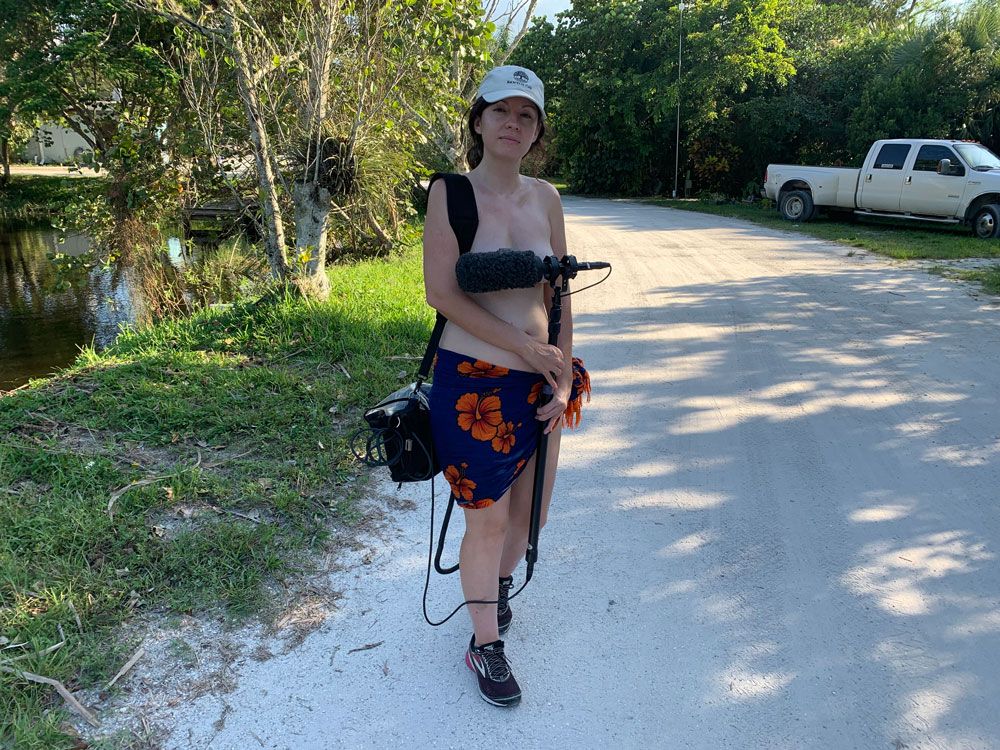
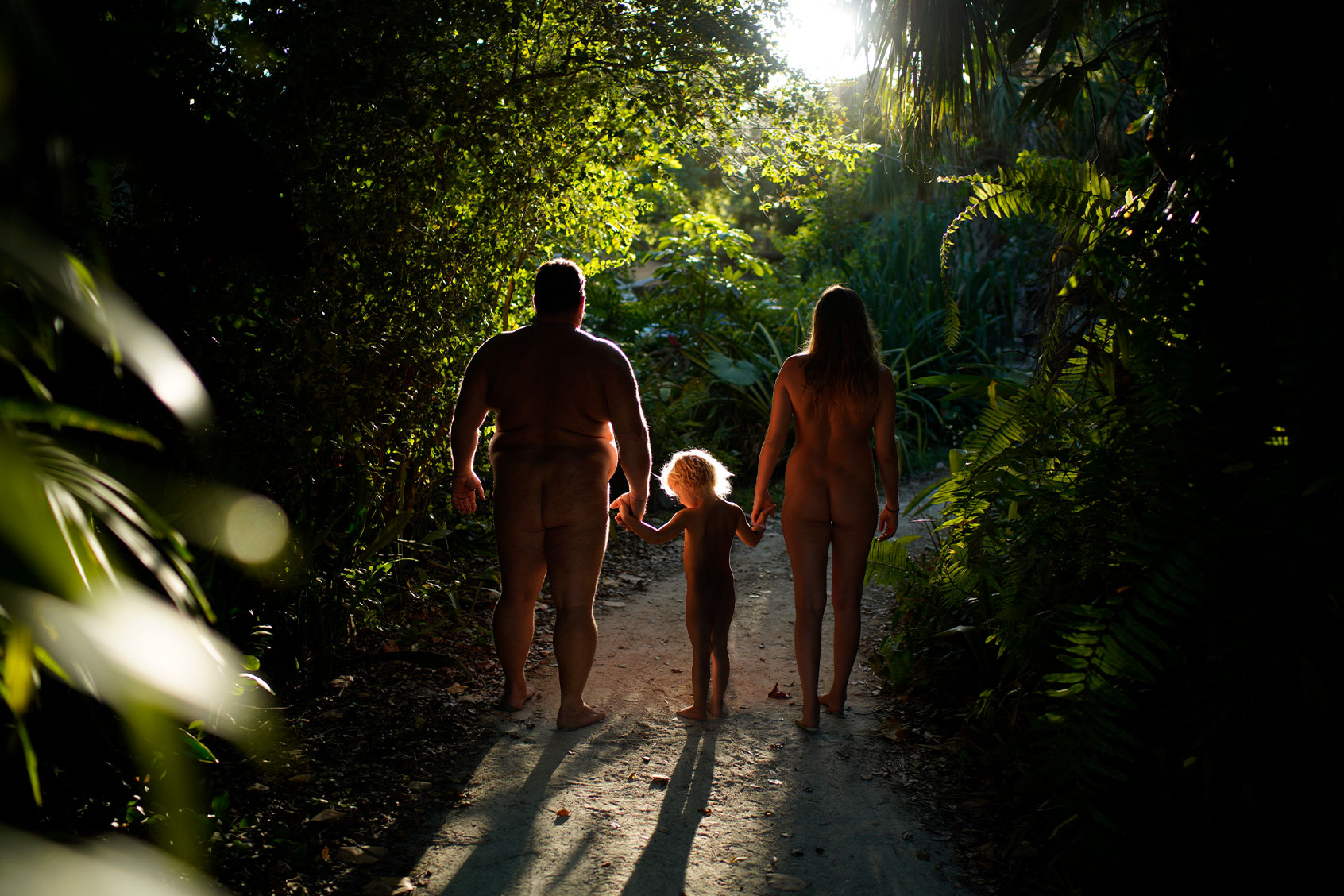
“Naked Gardens,” which is having its world premiere at the Tribeca Film Festival, is Patrick Bresnan and Ivete Lucas’ immersive, observational documentary about Sunsport Gardens, a Florida naturist community. The filmmakers, who shot the film in the nude themselves, depict the quotidian life of the residents. Men and women of different ages and races are seen cleaning a motorcycle, playing tennis or basketball, and — gasp! — even cooking and using power tools. 

The film eavesdrops on board meetings and attends parties. (In one of the more memorable shots, resort owner Morley sits naked on Santa’s lap.) But “Naked Gardens” is never exploitative; it presents life in this so-called “paradise” without judgment. The film culminates in a Midwinter Naturist Festival that captures the residents and guests participating in various activities that people often do in the nude, such as swimming and meditation.  

Bresnan and Lucas immerse viewers in the safe space of this community, and conversations address issues of body shame, and the issues that some residents have about having to wear clothes. But “Naked Gardens” is not skin deep; the film reveals underlying concerns about the housing crisis, education, and economic inequity, among other topics.

RELATED: Paris museum welcomes nudists for a day

The filmmakers spoke to Salon about their modest, absorbing documentary.

How did you come to learn about this community and decide to make a film about it?

Patrick Bresnan: I had seen Sunsport pop up on the cover of the “Palm Beach Post” for years. There was a very particular headline I saw where Morley was naked on the cover of the “Palm Beach Post” and it said: “Nudist Resort Tries to Get Back to Normal after Stabbing.” I just thought, that was so wild, like something you’d see in a tabloid. I became interested in Sunsport, and was thinking of shooting a short film there to learn more about it. Then, when we were shooting “Pahokee” and I was in a Costco parking lot and this woman in her late 60s came up to me and said, “There is a drum circle and a big bonfire at the nudist resort, and you don’t have to pay an entrance fee! You should really come!” I just thought that was so wild. But it was also really beautiful, because she was kind of a hippie and she thought I was a likeminded person. What we came to learn is that they really tried to recruit younger people. They don’t want this way of life to die off; they want to hand it off to the next generation, so there is a campaign to recruit young naturists. Once I was propositioned in the parking lot of Costco, I thought: We have to make a film here!

Can you talk about your own thoughts on nudism or naturalism, and the appeal of this topic? Why are we all so fascinated with nudity?

Ivete Lucas: I think mainly because we are covered all the time. [Laughs] When Patrick told me about the place and we went there the first time, I was interested in making a film because the portrayal of nudity I’ve seen in the media has always been very sexy or sensualized, and very aspirational in terms of bodies. It was really amazing to see these body types walking freely. I liked the opportunity to capture it in a way that was not sexualized or sensationalized, just matter of fact. We cover ourselves so much that we don’t know what real bodies looks like. We see models or guys with six packs and almost never penises. It was an interesting challenge to show the naked body non-stop. All naked, all the time!
Naked GardensNaked Gardens (Patrick Bresnan)

What was it like to shoot the film in the nude? 

Bresnan: Ivete and I are very counterculture people and not mainstream documentary filmmakers. This was an exciting topic for us because it’s not a topic for “traditional” documentary — find an athlete, a musician or a politician, and follow them and sell it to a streamer. We are trying to go against that methodology. What was so exciting was that it was a film that required an enormous challenge for us, which is to bare ourselves to the community. A lot of filmmakers can hide behind camera or come and go. But here, the community wasn’t going to let anyone into their interpersonal lives if they had clothes on. 

Lucas: There was a level of trust that has to happen to be naked in front of each other, so if we were wearing clothes, we were breaking that [trust]. It was important for us not to be wearing clothes. We make experiential films, and it takes months of living with the community. We wanted to get naked and see what that was like. Why is nudity so appealing to us? There is still this childish thing of taking your clothes off and laughing. This resort is such an extreme lifestyle that they are often the laughingstock, so for us to break through that layer of “we’re all naked, let’s giggle,” we had to really embody that and make a film that was much deeper.

What decisions did you make in telling the residents’ stories?

Bresnan: What was so appealing upon our first tour of the resort was that it wasn’t a retirement resort; it was an attempt at an alternative, socialist community, but also a community where there were Republicans, people who were not nudists, and a community that was trying to address the housing crisis. It’s the cheapest place to live in southern Florida. People were trying to make it work. Sometimes it doesn’t work very well. If you are a retiree from Quebec, and you have a $200,000 camper home, you are living side by side with people who are on government assistance. It is an interesting and complex world. We explore a lot of that visually.

Lucas: They talk about themselves as a “family naturist resort,” and you see retirees. We wanted to know more about what this family nudism and naturism meant, and who were the families that were living there year-round. We are not asking for the backstories; we want audiences to be active participants. There are clues that make you understand why they are there, and that was the way we followed them — to understand why they were there, and what did it mean to make this choice with their family. When we were filming, I was pregnant and nude. Because I was pregnant, I was interested in the mothers living there with their children, and what that life was like.


Want a daily wrap-up of all the news and commentary Salon has to offer? Subscribe to our morning newsletter, Crash Course.


You are not very invasive in your approach. I like that you often keep a distance and just present lives without defending or condemning these people. Are you advocating this lifestyle? 

Lucas: What we tried to do is not simplify things. In documentary, especially, people are told how to morally think about what they are about to see or try to simplify it as all good or all bad, but the reality of human existence is that there are good and bad and difficult things. The meaning of the film is in the journey you go through watching the film. There will be different journeys for each viewer and a questioning of your preconceived notions. The people in the film talk about judgment. It’s natural for us to judge, so you are confronting that within yourself. 

Having done it, I was scared being a woman. I have always felt sheltered in being covered. It is an extreme thing to do to vow to be naked all the time. We had to use a lot of sunblock and bug spray because we are in Florida. We got to appreciate a lot of functional things about wearing clothes, such as clothes catch your sweat, and they have pockets. If you ask me, I’m not a nudist, but I like to have the freedom to take my clothes off and not feel ashamed about my body. 

Bresnan: I do think we are advocating for the people you see in the film. They are living behind a wall in a gated community. In the world outside that wall are a lot of churches. There are people in our film when they said where they lived, they were shunned from their church. The film advocates that these are valuable people who have complex lives and situations that have led them to this lifestyle. They are very decent people who commune in the nude. 

I am curious about cooking and using power tools in the nude . . .

Bresnan: There is a lot of performance in all of cinema and documentary. For people opening their bodies up for a film like this, it is fun to show off cooking or building a deck or cutting wood. 

Lucas: I think there are people who are more extreme about their beliefs and how much nudity they need to live. Jeremy, one of the participants, will not put on clothes. It could be super cold, and he would not get dressed. People who garden do wear pants. It’s that debate about nudism vs. naturalist. The younger generation wants to be naked when they want. The more extreme, pure nudists believe you have to be nude all the time. 

Do you think that being in a nudist colony creates a greater sense of self-worth as several participants suggest? 

Bresnan: There is a tribalism. Some of our main protagonists are castaways from their previous lives. Gretchen had just lost her spouse and barely receives visitors from the outside world. The idea of coming together and connecting while naked is something that we, who are at our computers or in the world all day long, lose.

Lucas: When we cracked the surface of just seeing naked bodies and started getting to know people, we understood most of them had trauma they are trying to get over. Whether it was sexual trauma or having different bodies — the owner [Morley] had polio as a child. Coming together for something deeper than just being naked together — to heal together and empower each other and care for each other. It does provide a sense of community that is very strong.
Naked GardensNaked Gardens (Patrick Bresnan)

I need to ask about the child nudity in the film. Child nudity been controversial in the photographs by Sally Mann. Can you discuss filming the young children, or scenes like Serenity’s birthday party, where she is clothed but surrounded by older, naked men?

Bresnan:  What we are recording is very much life as the way it is there. They did allow us to film — we weren’t censored unless someone didn’t want to be recorded. What you are seeing at Serenity’s birthday and other scenes in the film is everyday life there. I think they are hard scenes to watch, for sure. 

Lucas: We are not used to that. But we set out to make this film about a family naturist resort. We were filming everyday family life, and that included children who were naked, or surrounded by naked men and women. It is part of our obligation to include scenes that could be controversial or scary for some who are not used to seeing that. 

If you didn’t show it, viewers would wonder about it.

Lucas: It would be as if we were almost hiding it. Mann was posing the children. We are capturing what was unfolding. We did make a rule not to have full-frontal nudity of children, so it wasn’t misused, and we talked to the parents about that; we were all in agreement. That’s how we could show the reality without being intrusive. We [show] that these lives are being led in this way.

Bresnan: Having been the cinematographer of the film, I didn’t have an inspiration from Sally Mann. It was more the work of Diane Arbus and Dorothea Lange, who was photographing very poor families on the margins in the dustbowl. All of the frames were chest to head. We were extremely sensitive when filming around families. We were never alone with children. There were never crew members alone at the resort. We always had a minimum of two people together at all times. There were rules and protections for the community. We also thought about Frederick Wiseman’s “Titicut Follies” because there are scenes where we see fully nude incarcerated mentally ill adults. Those scenes are incredibly hard to watch. Wiseman laid a foundation on how to make a film like this. We have to portray these scenes so that judgments can be made as to whether this is something that needs to be looked at further. 

What can you explain about the nature of the culture? I was concerned about the lack of education for the youth, and there is a discussion that some residents were living in Sunsport Gardens because it was cheap. 

Lucas: We wanted to limit to what happened inside the resort and in a way that is effective. Once people say, “I’m going to be nude,” then you can’t be nude the way you want in every environment in society, because social nudity is not accepted outside the walls of the resort. The more that you spend time there, the more you find ways to continue your lifestyle to be as nude as much as possible. People get employment in the resort. Jeremy works there. Some do have to go outside [the resort] and get dressed to make a living, but they try to find ways to make a living without having to wear clothes. In terms of education, a lot of kids are homeschooled. That is an American reality, too. They are protecting themselves from the outside world. When the kids would go to school and people found out they lived in the nudist resort, they were bullied

The scene of 11-year-old Serenity struggling with simple math was very painful to watch. 

Bresnan: The backstory with Serenity is very complex. They were living in a car in Miami. They needed a place to live and fell in love with a camper for sale at Sunsport resort for a few hundred dollars. The needed a place to live and the rent was so cheap, they stayed. Serenity’s education was on hold before they arrived at the resort. The scene is very hard, but we have to face the fact that children living in poverty and on fringes of society are not getting the education they need. We have a great deal of sympathy for her. It is very important scene; we need to think about kids like her who are not getting a proper education.

Lucas: It’s obviously not representative of the nudist lifestyle. It’s a cheap place to live when you can’t afford to live somewhere else. 

There are discussions of social nudity, nudism, and naturalism. People talk about their issues with wearing clothes. What do you want viewers to consider as they watch your film?

Brosnan: We have a whole system that classifies films as NC-17 or X that has vilified nudity and the human body when it is exposed in a non-sexual manner. What we are hoping people take away is that the human body is not something offensive, that we should hide away, and there are many beautiful forms of the nude body regardless of weight or size, or physical appearance. 

What is very profound is that many people at the resort had extreme trauma because they had genitals that were considered imperfect, and by exposing themselves in a healthy, non-sexual manner, they were finding acceptance from people in this community and healing from pain sadness and shame. I think that those are just some things that I took away that I hope some of the audience can gather.

Lucas: Nudity is not indecent. It is what we do with our naked bodies that could be. If we could take away that fear of the naked body . . . As a woman who grew up around a lot of women who are extremely traumatized by the imperfections of the human bodies, I would say that if I had seen more naked bodies growing up, my friends and I would have saved ourselves some eating disorders. After having this experience, when I had my baby, I was not afraid of breastfeeding in public anymore. I always thought when we walked into resort, that it would be this image of everybody naked, but after being there and walking out in the “textile world,” as the residents would say, I would look at everyone dressed and question it. I saw what we do with our clothes to show each other who we are, or what our social status is. What are the contexts where we can be dressed and can’t be dressed? It’s questioning our perceptions of nudity. 

Brosnan: There is a real sense of freedom they are trying to achieve — and achieving. Hopefully, some people will see the film and get the courage to explore, even if it is something as simple as being comfortable at the gym taking a shower. We all suffer some form of shame over our bodies. We hope it is inspiring to see people who are really taking action.

More stories to read:
There’s no more music in the air — “Twin Peaks” mourns the loss of Julee Cruise

If “Twin Peaks” is the sound of sawing wood, then Julee Cruise is the sound of a breaking heart.

Working alongside David Lynch and Angelo Badalamenti for many years to help create the signature sound and overall tone of the original series that debuted in 1990, as well as the prequel film that followed in 1992, “Fire Walk with Me,” and the cinematic return to “Twin Peaks” on Showtime in 2017, Cruise’s voice is just as imperative of an ingredient as the owls and the sycamores themselves. When it was announced that she took her own life on June 9 after a long battle with depression and painful symptoms of lupus, fans of “Twin Peaks” and creators like Lynch who’ve known Cruise as the rare talent she was mourned her loss profoundly. If the town the show is set in were real and not just a mishmash of locations in and around Snoqualmie, Washington, the news of Cruise’s passing would have shut down the Packard Sawmill. Hell, Catherine Martell might have pulled the lever herself; quieting the churning of the gears, stilling the saws, until the only sound left was a distant chirp from a bird outside, and the melody of a song that now only exists as a recording, or a memory.

“I just found out that the great Julee Cruise passed away,” David Lynch said in a YouTube memorial. “Very sad news. Might be a good time to appreciate all the good music she made, and remember her as being a great musician, great singer, a great human being.”

RELATED: Scoring “Twin Peaks” in real time: “Laura Palmer’s Theme”

Lynch first met Cruise in the mid-80s and had her sing on a song called “Mysteries of Love” that he and longtime friend and composer Badalamenti wrote for the film “Blue Velvet.” The trio would go on to collaborate on many other projects over the years and while Lynch always held Cruise in high favor, their relationship was not without its hills and valleys. While working with Lynch on “Twin Peaks: The Return” in 2017, Cruise felt that she’d been mistreated, and expressed heated disappointment that her contribution to the third season of the show only amounted to a small performance at the closing of “Part 17,” in which she performed the “Twin Peaks” classic “The World Spins.”

“I’m done, and I could care Less about TP,” Cruise said in a post to Facebook. “My subconscious never lies……I have my answer now of what I will do with the rest of my life!”

In the resulting comments of her post, fans reached out to ask why Lynch had only given her such a short amount of screen time, and why it ran under the credits, to which Cruise replied “He did it to slap me in the face.” The singer went on to say she felt as though she’d been “treated like trash” during the taping of the episode she appeared in, closing with the comment “Now I can finally get off the grid, listen to music, dance with my dogs, make my home our home, and dreams like this now in my life are wonderful. Really. I don’t feel up to it. I don’t like how I’m treated.”


Want a daily wrap-up of all the news and commentary Salon has to offer? Subscribe to our morning newsletter, Crash Course.


As a life-long lover of music himself, Lynch knows that film and television land flat without a proper soundscape.

Regardless of what went down between Cruise and Lynch, it’s obvious he valued her creative output enough to use it as often as he did in the projects he is best known for. As a life-long lover of music himself, Lynch knows that film and television land flat without a proper soundscape.

When I interviewed Lynch for NY Post in 2013 prior to the release of his album “The Big Dream,” he spoke in detail about the importance of music in a visual medium like TV and film.

“It’s important to listen to many, many different types of music,” Lynch said. “You never know what’s gonna come out. A character can come out of music, a mood, a way that things look with the light, a whole scene can flow out.” 

The story of “Twin Peaks” centers on Laura Palmer, a troubled high schooler played by Sheryl Lee. Getting to know Laura Palmer through the eyes of Lynch and “Twin Peaks” co-creator Mark Frost, we walk with her through her sexual awakening, the guarded handling of her relationship with her best friend Donna Hayward, played by Lara Flynn Boyle in the show and Moira Kelly in “Fire Walk with Me,” and the sexual abuse and murder at the hands of her father, Leland Palmer, played by the amazing Ray Wise. And all through highest of highs and the darkest disparity of her lows, there is music. Badalamenti may have given Laura her theme, but Cruise lit the fire inside of her with “Falling,” and then snuffed it out with “Questions in a World of Blue.” 

“When this kind of fire starts, it is very hard to put out. The tender boughs of innocence burn first, and the wind rises, and then all goodness is in jeopardy,” the Log Lady, played by the late great Catherine E. Coulson, said to Laura in a pivotal scene in “Fire Walk with Me.” As she spoke these words, Cruise is heard singing in the background, pushing the emotions of the scene past melancholy and into sorrowful.

When I learned of the death of Cruise, the news was delivered late in the night. The first thing I wanted to do when I awoke the next morning was listen to her music. I brought up my favorite clip from “Twin Peaks,” which plays during a scene at The Roadhouse (and a pox on you if you call this place the Bang Bang Bar). James (James Marshall) and Donna are at a table together. Dale Cooper (Kyle MacLachlan), Sheriff Truman (Michael Ontkean) and The Log lady sit behind them. There’s danger in the air and sadness. And on stage, as she often was during moments like these, Julee Cruise sings:

Tell your heart, you make me cry
Tell your heart, don’t let me die
I want you
Rockin’ back inside my heart

Listening to this song the other day I felt myself grabbing on to each note as though holding on to one end of a rope that was burning from the other. We won’t get any more from Cruise like this, but we’ll always have what we have, and that’s such a pretty song.

Read more:

Why school lockdown drills can do more harm than good

In 2019, news broke of a very disturbing lockdown drill — colloquially referred to as an “active shooter drill” — at an elementary school in Indiana.

A member of the sheriff office’s SWAT team played the role of a gunman during the drill. Teachers were reportedly left bruised, cut, and traumatized, after being shot with airsoft guns during the drill conducted by the sheriff’s department.

“The teachers displayed obvious signs of anguish and physical pain, but were humiliated to find the law enforcement officers joking and laughing at them,” a complaint later read. “The terrifying and inexplicable experience left the teachers with lasting physical and emotional injuries.”

RELATED: Gun violence is the health care crisis we’re ignoring

Such drills are purportedly designed to try to stave off violent shootings like the one that occurred on May 24, 2022, when 19 children and two adults were killed in a shooting at Robb Elementary School in Uvalde, Texas. It was the deadliest school shooting since 2012, when a gunman killed 26 people as young as 6 years old at Sandy Hook Elementary School. The horrific tragedy in Uvalde marked the 27th school shooting in 2022.

As debates ensue about how to better protect children in schools, the role of lockdown drills — which are designed to prepare teachers and students on how to react if such a situation occurs — are at the forefront of the discussion. As a policy solution to the ongoing crises precipitated by school shootings, lockdown drills are marginally less politically charged than more obvious solutions like, say, laws regulating guns. Yet there is a body of literature that suggests that these drills can have unintended psychological consequences on children and teachers, and cause more stress, anxiety, fear and trauma.

“The ones that involve making realistic sounds —  they’re aggressive, or predatory acting, or deception — those types of events we think have far greater impact on children in terms of emotional distress, particularly among children who are anxious or have been through traumatic experiences in their past,”  Dr. David Schonfeld, a developmental behavioral pediatrician and director of the National Center for School Crisis and Bereavement at Children’s Hospital in Los Angeles, told Salon. “If you’re talking about a drill where there is no deception, the child knows it’s a drill ahead of time, and they are supported through the activity by adults who are sensitive, this can be difficult — but most of the evidence suggests that it is not overwhelming to most students.”


Want more health and science stories in your inbox? Subscribe to Salon’s weekly newsletter The Vulgar Scientist.


The caveat, Schonfeld said, being “most students.”

“For some students who have had personal experiences or have underlying anxiety, trauma and loss, even those activities can be challenging for them,” Schonfeld said.

Lockdown drills, which aren’t always specifically designed around the possibility of an active shooter, are estimated to be used in over 95 percent of American K–12 schools today. While they started to become a more common practice after the Columbine High school massacre in 1999, they have become much more prevalent since the 2015–2016 school year. Despite their prevalence, little federal guidance exists on best practices for these drills.

Lockdown drills were associated with increases in depression, stress, anxiety, and physiological health problems for students, teachers, and parents.

Indeed, drills like the one in Indiana have spurred concerns that they are negatively affecting children’s — or even teachers’ — mental health. In 2021, Everytown for Gun Safety and Georgia Tech researchers published a study analyzing social media posts before and after these drills occurred in 114 schools across 33 states. They found that the lockdown drills were associated with increases in depression, stress, anxiety, and physiological health problems for students, teachers, and parents.

“We provide the first empirical evidence that school shooter drills—in their current, unregulated state-negatively impact the psychological well-being of entire school communities, indicating that those who are affected are in need of continued support to process their aftermath, and that school systems need to rethink the design and utility of these approaches, against alternative gun violence prevention measures,” the authors concluded.

“During one recent live exercise in which high school students were deceived to believe it was a real event, children sobbed hysterically, vomited, or fainted, and some children sent farewell notes to parents.”

Indeed, in extreme cases, the American Academy of Pediatrics (AAP) has raised concerns that such unregulated drills can be traumatizing.

“During one recent live exercise in which high school students were deceived to believe it was a real event, children sobbed hysterically, vomited, or fainted, and some children sent farewell notes to parents,” the AAP wrote in its policy statement. “Children risked physical harm when a stampede ensued, and students jumped over fences to escape; in one situation, staff were intentionally shot at close range with pellets as part of the training.”

Jaclyn Schildkraut, associate professor in the department of criminal justice at the State University of New York at Oswego whose research focuses on school and mass shootings, told Salon these are extreme cases, and disagreed with the idea that most of these drills were harmful. 

“Certainly there are potential consequences related to social emotional health — students could develop anxiety or depression or other trauma related symptomatology — but the reality of our research doesn’t show any of that,” Schildkraut said. “Oftentimes the conversation about the psychological impact of these drills comes as a result of cases where they’ve made the news, or frankly, they’ve been done horribly; we don’t set a school on fire to practice a fire drill, we don’t need to simulate an active shooter to practice a lockdown drill.”

Schildkraut said best practice for these drills is not to make them “surprise” drills, or spring them on students suddenly. “Absolutely call it a drill,” Schildkraut said, emphasizing that children should never think it’s real. Likewise, Schildkraut said, schools don’t need to simulate a shooting or shooter.

Schildkraut said it’s also important for teachers to model calm behavior, and for there to be the opportunity for the people conducting the drill to give feedback in the moment — like remembering to turn off the lights — and for there to be a “debrief” period. Schildkraut emphasized that the research she and her colleagues have done have suggested that lockdown drills done this way can have positive outcomes and make students feel more “empowered.”

“They have reported being less fearful of harm, perceiving a lower risk of the possibility of a shooter, they report lower anxiety after the drill than before, greater wellbeing,” Schildkraut said. “We’ve looked at a lot of different sorts of outcomes, and all of them point to the same thing which is when you’re incorporating best practices into what you’re doing, it’s not actually harmful.”

Schonfeld added there are concerns around if such drills can create a false sense of comfort.

“I do worry that if we’re encouraging children to believe that there are things that they can do that will be appropriate and effective in a real shooting situation and they use those strategies or approaches and it doesn’t work, that it may actually lead to problems afterwards,” Schonfeld said. “It may leave them feeling ineffective, guilty or ashamed.”

More Salon coverage of gun violence: 

Big boys playing dress-up: Proud Boys and Oath Keepers are dangerous — and deeply embarrassing

The hearings of the House Jan. 6 committee that began on Thursday night presented plenty of evidence of plain old-fashioned wrongdoing, infantile fantasizing by people old enough to know better, and hundreds of instances of people committing overt criminally indictable offenses at the behest of a president of the United States. But the evidence showed something else, too: an entire political party that has lost the capacity to be embarrassed.

There is so much evidence of behavior and attitudes that are embarrassing that you hardly know where to begin: with the whiny look on Jared Kushner’s face and his whiny tone of voice as he described the White House counsel’s threats to resign as “whiny”? The aw-shucks shrug of the shoulders given by former Attorney General William Barr, who was the highest law enforcement official in the land, as he explained — if that is even the word — resigning his office because he had finally had enough of what he called  “bullshit”? Committee vice-chair Liz Cheney’s lengthy recitation of all the phone calls Donald Trump didn’t make and orders he refused to issue while a violent attempt was made to overthrow the government of which he was in charge?

See what I mean?

RELATED: Jan. 6 committee puts Proud Boys at center of Trump’s plot to overthrow the election

To me, however, the most embarrassing thing of all is the fact that nine veterans of service in the United States military have been indicted for seditious conspiracy to overthrow the government for their roles in the violent assault on the Capitol. Not only that, but they dressed up and play-acted their parts as veterans. Some of them, specifically the Oath Keepers, wore military-style camo outfits complete with bulletproof vests and Kevlar helmets, and used a military-style “stack” formation to lead the breach of the Capitol building. Others, the Proud Boys, gave orders to their membership not to wear military-style gear and remain incognito: “come as a patriot” and “do not wear colors!” (referring to their yellow and black Proud Boy uniforms) and “be decentralized and use good judgement” because “we are trying to avoid getting into any shit.” 

Reading the indictment of five Proud Boys — four of them veterans — that was handed down by a Washington grand jury last Monday is like reading a script for a remake of “Rambo.” Using an encrypted social media chat app, the Proud Boys talked about their “Ministry of Self Defense” or MOSD, their “Leaders Group,” their “Operations Council” and their “Marketing Council.” They even formed a “MOSD Prospect Group” to recruit new members for their paramilitary operations at the Capitol on Jan. 6. (Note: All that excited capitalization is from the texts cited verbatim in the indictment.)

The Proud Boys established something called the “Boots on the Ground Group,” and exchanged text messages asking, “Are we going to do a commander’s briefing before 10 a.m.?” 

“Standby,” came the response in primo-mil-speak.


Want a daily wrap-up of all the news and commentary Salon has to offer? Subscribe to our morning newsletter, Crash Course.


All of the above was in preparation for the assault launched by the Proud Boys on the Capitol. Many of the texts were exchanged before the rally on the Ellipse had even begun. 

The indictment of the Proud Boys lays out their childish pseudo-military behavior in excruciating detail: “We stormed the f**king Capitol. That was so much fun.”

At 12:53 p.m. on Jan. 6, during the time Donald Trump was speaking on the Ellipse, the Proud Boys effected the first breach of the protective barriers established by police around the Capitol, pushing one of the police officers to the ground. Her head struck the pavement hard enough for her to lose consciousness and suffer severe trauma. Moments later, a Proud Boy text announced, “We have just taken the Capitol,” as if the seat of the government of the United States was a military objective. At 1:00 p.m., a member of the so-called “MOSD Leader’s Group” texted, “They deploy the mace yet?” One of the Proud Boys, who turned out to be an unindicted co-conspirator because of his cooperation with the Department of Justice, replied: “We are trying.” 

The indictment lays out this embarrassing behavior by military veterans in excruciating, painful detail. It describes the childish delight they took in each other and the pride in the crimes they were committing by citing the selfies they took, to which they attached such grand comments as, “So we stormed the fucking Capitol. Took the motherfucking place back. That was so much fun.” Another Proud Boy added, “January 6 will be a day in infamy.”

The Proud Boys used the Washington Monument as a rallying point before they began their attack on the Capitol. From the little hill where the Washington Monument stands, the following memorials to other veterans are visible: The Vietnam Veterans Memorial, the Korean Veterans Memorial, the World War II Memorial. Constitution Gardens is also visible, and so is the Signers Memorial, commemorating the men who signed the Declaration of Independence.

The Proud Boys used “1776” as a private code for what they called their revolution throughout their text messages to each other. The year of the signing of the Declaration of Independence has also become a key part of the rhetoric of many of Trump’s defenders, as if by invoking the founding of the country they can excuse its destruction. 

Wearing military garb after you’ve left the service isn’t indictable, neither is using military slang, and neither is singlemindedness to the point of being blind to what you’re really doing. But it is embarrassing, in ways none of them will ever understand. 

Read more on the Jan. 6 committee and its explosive revelations:

Aviation can meet Paris targets — if it makes massive changes

For those hoping to slow the halt of climate change, aviation often seems like a near-intractable problem. Roughly 115,000 flights take off and land around the world every day, accounting for 3 percent of global carbon dioxide emissions. A single passenger flying from San Francisco to London is responsible for around 1 metric ton of carbon dioxide spewed into the atmosphere – about half the emissions that a citizen of India, on average, releases in a whole year. 

But, according to a new report from the International Council on Clean Transportation, or ICCT, it is possible to reduce aviation emissions enough to keep global warming below 2 degrees Celsius. It will just take enormous amounts of money, effort, and — perhaps most importantly — sustainable fuel. 

“Everybody needs to push for as low as they can go,” said Brandon Graver, a senior researcher for ICCT’s aviation program and the lead author of the report. “It’s going to cost a lot of money, but we have to make plans now. We can’t wait until 2030 or 2040.” 

Other studies and roadmaps have examined possible pathways to net-zero carbon emissions for aviation, but the report from the Washington, D.C.-based nonprofit is the first to analyze which pathways can align with global climate goals set out in the 2015 Paris Agreement. The authors sketched out four possible futures: a baseline, or business-as-usual scenario, and several increasingly ambitious scenarios for improving aircraft efficiency and building out the supply of sustainable fuels. 

In the scenario with the most aggressive carbon-cutting measures, known as the “breakthrough” scenario, the authors found that aviation emissions could be decreased in line with a 1.75-degrees C temperature goal. That is somewhat in line with the Paris Agreement, which promised to keep global warming “well below” 2 degrees C above pre-industrial temperatures. It’s still not in line, however, with calls to reach the more ambitious 1.5 degrees C.

Graver said that if the industry hopes to cut emissions, the bulk of it must come from a transition to sustainable aviation fuels, or fuels made from products such as wood chips, corn, cooking oils and greases, and municipal solid waste. Sustainable aviation fuels are available now — but only in small quantities, enough to cover less than 0.1 percent of total jet fuel use globally. At the moment, they also cost at least twice as much as jet fuel. In the best-case scenario laid out in ICCT’s report, sustainable fuels would need to cover 17 percent of aviation fuel use by 2030, and 100 percent by 2050. 

For that to happen, the supply of aviation biofuels would need to grow substantially in the next five to 10 years. By 2030, in the “breakthrough” scenario, 46 million metric tons would need to be available on the global market. By 2050, that number would have to jump to 100 million tons. 

Other technologies and policy changes could also contribute to cutting emissions. The ICCT report estimates that electric and hydrogen planes could start taking over a small share of the global aviation market by the 2030s; meanwhile, improvements to air traffic control and aircraft efficiency could also reduce fuel usage. Shifts in demand away from aviation toward other forms of transportation — like trains where available — could also help. 

The biggest problem, however, is who is going to pay for it all. According to a report from the International Civil Aviation Organization, or ICAO, a U.N. agency that sets standards for international aviation, reaching net-zero emissions would cost around $4 trillion through the year 2050. And while many airlines have made plans and promises to cut their carbon emissions, governments are going to need to help covering the costs. 

ICAO is planning to meet in the fall to establish a long term goal for aviation emissions; thus far, the agency has not committed to net-zero. But Graver believes that the agency will try to set new, ambitious goals.

“I have to be optimistic,” he said, even while acknowledging the huge challenge of decarbonizing a fossil fuel-burning industry. “I would like my kids to have the same opportunities to travel and see the world that I’ve had.”

This piece has been updated to reflect the role of ICAO in setting standards for international aviation.

Joe Biden wants to jump-start solar energy — a great idea, in theory. But will it work?

Whatever you make of Joe Biden as a man, a public figure or a chief executive, his presidency has been unlike any other in modern American history. He has quite likely faced more simultaneous crises than any president since Franklin D. Roosevelt, and one illustration of that fact is that Biden has already invoked the Defense Production Act (DPA) — a Cold War law that grants the executive branch broad authority to mass-produce resources necessary to mitigate domestic emergencies — at least six times. 

Last year, the Biden administration drew on the DPA twice to boost the production of COVID vaccines and supplies, and later did the same to prepare for the Western wildfire season last fall. Between March and May of this year, the president again invoked the law to expand production of baby formula as well as critical minerals for electric vehicle production.

Regardless of their individual merits, these executive actions passed through the news cycle with little to no pushback from conservative pundits and Republican politicians, who are generally eager to criticize Biden’s every move. That emphatically changed this week following the president’s sixth DPA authorization, which left Democrats and Republicans bickering over whether Biden was extending his presidential powers outside their acceptable range. 

RELATED: A major player in solar energy leaves some customers seething

On Monday, the administration authorized the use of the DPA to bolster the domestic production of solar power and other green energy sources with loans and grants, according to Reuters. At the same time, the president also invoked an obscure section of the Smoot-Hawley Tariff Act, a once-controversial protectionist trade policy enacted in 1930, to exempt tariffs on solar panels imported from Cambodia, Malaysia, Thailand and Vietnam for the next 24 months.

This was all part of necessary “advance planning” meant “to ensure electric resource adequacy,” the White House said in a press release. “Electricity produced through solar energy is also critical to reducing our dependence on electricity produced by the burning of fossil fuels, which drives climate change.”

Sounds like a relatively uncontroversial statement, right? Not these days. Biden’s waiver has sparked the ire of many Republicans (and even some liberals) by effectively freezing a federal investigation into whether China’s solar industry has been diverting production to Southeast Asia in order to circumvent heightened duties.


Want a daily wrap-up of all the news and commentary Salon has to offer? Subscribe to our morning newsletter, Crash Course.


Sen. Rob Portman, R-Ohio, a longtime beneficiary of the fossil fuel industry, argued this week that Biden’s move to loosen rules on solar imports was “the wrong policy at the wrong time.” Using an abbreviation for the Chinese Communist Party, a noted trigger-phrase on the right, Portman wrote on Twitter: “This rewards the CCP for their unfair trade practices, doesn’t hold them accountable for their human rights abuses, and will not spur economic growth.”

RELATED: U.S.-China trade deal: 3 fundamental issues remain unresolved

Sen. Josh Hawley, R-Mo., likewise accused Biden of being in China’s pocket, saying that the president “wants Americans paying $6 a gallon for gas and American energy workers jobless — but he will break the law to allow Chinese solar panel imports.”

“Joe Biden sold out American solar panel manufacturers to China,” echoed Sen. Tom Cotton, R-Ark, a known foe of renewables. “This weakness is dangerous.” (It may be worth noting that both Cotton and Hawley are clearly considering presidential campaigns in 2024, especially if Donald Trump decides not to run.)

Biden’s invocation of the DPA and the Smoot-Hawley Tariff Act are two separate prongs of a broader effort to shore up green energy. Most liberals and progressives have praised that effort as a necessary step in America’s urgently necessary transition toward renewables. But that sentiment isn’t universal, with some voices on the left arguing that Biden’s tariff suspension flouts statutory law and could lead to a medley of unintended consequences.

Matt Stoller, director of research at the American Economic Liberties Project, a nonprofit focused on corporate accountability, called Biden’s move “wildly illegal,” saying that “there is no legal authority to create an exemption to the duties levied on solar tariffs.”

“Let’s be clear about what is happening,” Stoller tweeted. “The White House is administratively gutting key pieces of trade law to enable Chinese solar producers possibly using slave labor and coal-fired power to move their products duty-free through Malaysia, Cambodia, Vietnam, and Thailand.”

RELATED: Cleaner air and a climate solution, are now within reach — if we have the political will

David Dayen, executive editor of the American Prospect, largely echoed Stoller’s concerns, arguing that Biden’s tariff policy “will likely allow China to dump cheap solar products in the U.S. by disguising them as coming from [Southeast Asia], and furthers the delay of the buildout of a U.S.-based solar industry.”

“More broadly,” he added, “any small company wanting to challenge trade practices that harm its business can now be stymied by a government that doesn’t agree, or a large lobbying campaign that forces the government into doing so. The precedent set by this action goes beyond solar panels, and could infringe on the government’s ability to conduct trade enforcement and industrial policy.”

Both Stoller and Dayen’s arguments are to some degree based on a close reading of a provision in the Smoot-Hawley Tariff Act that allows the president, after declaring an emergency, to “permit … the importation free of duty of food, clothing, and medical, surgical, and other supplies for use in emergency relief work.” It’s a massive stretch, they point out, to claim that solar panel production qualifies as “emergency relief work,” and that part of the law was clearly intended to address natural disasters or foreign invasions. 

One could certainly argue that America’s inability to wean its economy off fossil fuels has created an emergency, but Biden’s critics would argue that twisting the language in a 90-year-old tariff law is not much of a solution.  

“If you look at things [Biden] could do but isn’t doing that are squarely within a president’s powers, it makes you wonder why he picked solar panels and the DPA,” Erik Gordon, a business professor at the University of Michigan, told Salon by email. “It wasn’t a national emergency last month or the month before. Higher gas prices doesn’t make it a national emergency.”

It’s true that there are various policies Biden could enforce at the executive level that would at least begin to address the long-term impact of climate change. He could prohibit oil drilling on federal land and invoke the National Environmental Policy Act and Clean Water Act to halt carbon-intensive infrastructure projects that are currently in development. 

RELATED: The battle for cheap solar power heads to the sunny South – but utilities are fighting back

But those kinds of broad-strokes policy changes are politically risky for a president with a narrow majority facing a midterm election. Far more important, they don’t address global warming at its root cause (i.e., continuing or accelerating carbon emissions). Arguably, there’s something of a vicious circle in action: Climate-induced weather patterns are increasing the risk of power outages, and a drilling ban on federal land, while desirable on its own terms, might make the looming “reliability crisis” predicted by the Federal Energy Regulatory Commission even worse.

It’s not clear whether Biden’s imaginative tariff suspension will pass legal muster. But even if it does, critics say, it may not do much to meet the nation’s solar needs, especially when domestic solar production is constrained by the DPA’s current bank balance.

“There’s not enough money authorized for this fiscal year, and probably the next, to really stimulate the creation of a domestic solar manufacturing industry,” Tyler Priest, an associate professor of energy policy at the University of Iowa, told Salon in an interview. “It’s just a jumpstart, or a signal that the Biden administration supports the growth of this industry.”

According to Bloomberg, the federal allocation for the DPA has dwindled to less than $500 million, much of which has already been allocated to finance drone and baby food production. Solar manufacturers told the outlet that what was left would only fund the construction of a few solar manufacturing plants.

“Even if they spent all of that on solar panels, it’s a pittance,” Nick Iacovella, a spokesman for the pro-manufacturing Coalition for a Prosperous America, told Bloomberg. 

RELATED: Why Biden’s climate agenda might be very, very “quiet”

Leah Stokes, an associate professor of environmental science and management at the University of California, Santa Barbara, painted a more positive picture, arguing that the DPA’s benefits could be felt across a variety of green technologies. 

“Beyond solar, funds will flow to heat pump technology, building insulation, clean hydrogen and critical grid components,” she told Salon by email. “In particular, expanding onshore heat pump manufacturing is an exciting opportunity to meet rising U.S. demand.”

Stokes pointed to statistics released by Rewiring America, a pro-electrification nonprofit, which found that actions like Biden’s could lead to the creation of up to 462,000 jobs in the clean heating sector and solar sectors — jobs that cannot be automated or offshored, an important point as the coal, oil, and gas industries continue to shrink year after year. 

But Biden’s DPA invocation “is just a first step,” Stokes noted. “The DPA can’t bring about the clean energy transition on its own — it is, unfortunately, a small amount of money compared to the investments we need,” she argued. The potential solution lies, Stokes said, in Biden’s stalled legislative agenda, specifically “the comprehensive $555 billion in climate and clean energy investments” that the Democratic-led House passed last year as part of the president’s Build Back Better package, but has lain dormant in the Senate. “We need Congress to act,” she said. With less than five months to go before the midterm elections, that seems like wishful thinking.

RELATED: Solar panels are starting to die. What will we do with the megatons of toxic trash?

Trump’s plan to repaint Air Force One gets nixed

The Biden administration has ditched former President Donald Trump’s scheme to paint Air Force One red, white, and blue after determining that the new colors would overheat certain components of the plane, Politico reports.

Trump had announced plans to repaint the next model of the presidential aircraft in 2018.

“Red, white and blue,” Trump told CBS News of his plan. “Air Force One is going to be incredible.”

“It’s going to be the top of the line, the top in the world,” he said. “And it’s going to be red, white and blue, which I think is appropriate.”

Boeing is to supply the next presidential jetliner.

“Boeing gave us a good deal,” Trump told CBS in 2018. “And we were able to take that.

“But I said, ‘I wonder if we should use the same baby blue colors?’ And we’re not.”

But the new paint scheme, which called for dark blue paint covering the plane’s underbelly and engines, would have required additional modifications to cool some of the components, making the project more expensive, according to Politico.

“The Trump paint scheme is not being considered because it could drive additional engineering, time and cost,” a Biden administration official told the publication.

Air Force One has featured the blue-and-white color scheme since the administration of president John F. Kennedy.

New versions of the presidential plane, which are set to debut in 2026, will retain the classic color scheme.

Ted Cruz compares AOC and Elizabeth Warren to “Girls Gone Wild”

Sen. Ted Cruz (R-Texas) has taken his condemnation of Democratic and Progressive lawmakers a step further with his latest podcast segment titled, “Libs Gone Wild.”

On Thursday, June 9, the Republican lawmaker and his co-host Michael Knowles discussed Democratic lawmakers and how they believe they may be deterring longtime constituents by placing an emphasis on radicalized initiatives, per Mediaite. According to Knowles, the agendas they appear to be focused on do not align with the desires of the Democratic base.

“The Democrats who are in power seem to be completely misreading the situation,” Knowles said. “They got a lot of blunders, but as I can see it three really big prominent blunders they’re making right now on the economic front. Not only have they made a lot of poor economic decisions that have hurt the country and certainly their political position, but they’re not backing away from them.”

Knowles accused Democrats of putting energy into what he suggests are frivolous initiatives such as “cultural social issues” and LGBTQ rights.

He continued, “They’re doubling down when it comes to energy. They’re doubling down when it comes to so many aspects of the economy — on the cultural social issues, they’re defending drag queens jiggling for kids, actual little tiny children in bars, 21 plus bars in Texas of all places, they’re defending it.”

Then, Cruz chimed in to agree with Knowles. However, he took things a step further likening the lawmakers to Girls Gone Wild while changing the phrase to Liberals Gone Wild.

“You know, Michael, it reminds me of, do you remember those videos that would come out every spring break, Girls Gone Wild and it would have lots of college women in bikinis or not bikinis?” Cruz said.

“It reminds me of much the same thing. This is Liberals Gone Wild. This is the crazy left that — this is AOC and Elizabeth Warren, thank God, not in bikinis, Um, but embracing their socialist nuttiness,” the Texas lawmaker continued. “I mean, it’s literally like someone sat down at a bar and said, how much crazy crap can we do?”

Cruz went on to suggest Democrats are doing everything in their power to “drive away” constituents.

He added, “Like how far can we go to drive away, not just the conservatives. That’s a given, not even just the moderates, not even just the independents, but what can we do to drive away good old-fashioned liberals who are not nuts.”

Then, Knowles chimed in to commend Cruz for his seemingly baseless remarks as he raised questions about what the future holds for the upcoming midterm elections.

“I do wanna clarify, Senator, just on the Girls Gone Wild point. I only ever watched that for the articles,” Knowles said, adding, “I think the analogy is very good that they’ve gone to extremes and followed their own wildest impulses. So what is going to happen to them in these elections that are really coming up right before us?”

Without any facts to back his projection, Cruz believes Democrats will suffer defeat in November as he believes voters will decide to vote Republican due to presumed frustration with the Democratic Party.

“I know what they’re gonna do in November,” Cruz replied. “They’re gonna get obliterated in November. It is going to be a historic election. It’s — every issue is so extreme. Look, there are people, Bill Maher. Bill Maher is an old-school liberal, who they are driving away. Elon Musk, Elon Musk has been a Democrat his whole life. They are driving him away, where he said, ‘Okay, I’m voting Republican now, cuz these guys are nuts!'”

“Ms. Marvel” and the dawn of the strict TV supermom

“Ms. Marvel” opens by presenting the world as the superhero-obsessed Kamala Khan (Iman Vellani) sees it – a place overflowing with infinite possibility. Graffiti dances on the walls of buildings around her and emojis float through the air, taking shape in the stars or neon lights.

Kamala is an artist who transforms her doodles into vlogs, where she illustrates her visions of superhero exploits starring her role model Captain Marvel. She thrills at knowing a woman single-handedly took down Thanos’ invading alien fleet, proving that girl power is real.

“Ms. Marvel” may be directly connected to the larger Marvel Cinematic Universe, but if it feels like it’s in a class by itself, credit its unique means of giving life to Kamala’s unfettered imagination. The premiere directed by Adil El Arbi and Bilall Fallah (credited as Adil and Bilall) sets the tone for the show’s punchy, chromatic visual style, a reflection of Vellani’s irrepressible incandescence. Where most heroes brood or snark, she makes Kamala a beacon of genuine happiness and measured confidence.

RELATED: Who is Kamala Khan, aka “Ms. Marvel”?

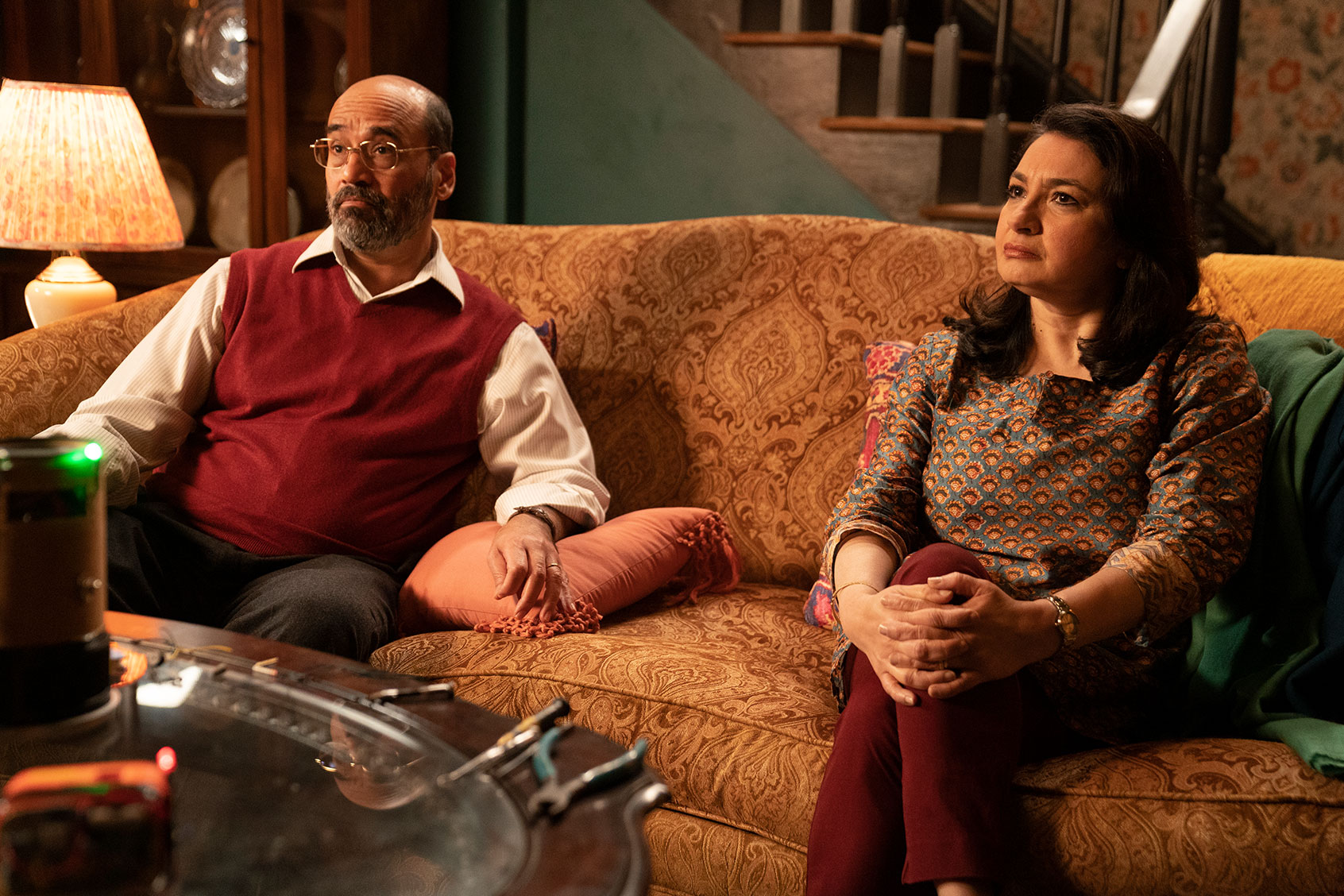
But if you were to catch her in a candid moment, Kamala might say that the main thing in her way is her doting but strict mother Muneeba (Zenobia Shroff), who bemoans her daughter’s wild imagination.

Ms. MarvelZenobia Shroff as Muneeba and Mohan Kapur as Yusuf in Marvel Studios’ “Ms. Marvel” (Daniel McFadden/Marvel Studios/Disney+)

“This is my fault. This is all my fault. These are my genetics,” Muneeba mutters as she and Kamala’s father Yusuf (Mohan Kapur) chauffeur their daughter home from failing her driver’s license exam. “I mean, I come from a long line of fantasizing, unrealistic daydreamers. My mother was one.”

Ever heard the adage/complaint about mothers loving their sons and raising their daughters?

Every superhero is only as powerful as their greatest allies and their most challenging obstacles. Since the woman raising her serves as both, that means Kamala Khan is already on her way to becoming one of the Earth’s mightiest heroes. But as tough as she is, Muneeba isn’t meanspirited or undermining.

She cares deeply for her daughter, which translates to constant worry. She also lets Kamala’s brother Aamir (Saagar Shaikh) get away with anything since he’s both an adult and the eldest male child. Ever heard the adage/complaint about mothers loving their sons and raising their daughters? This show puts that saying in action while (somewhat) redeeming it.

Often on TV, where the ideal mother is often gentle, permissive, and only truly angry for a few moments when their child’s misbehavior comes to light, stern moms get a bad rap. “Ms. Marvel” lead writer Bisha K. Ali doesn’t intentionally write against that type in creating Muneeba, drawing instead on what I’ll surmise is experience.

Being a daughter of such a mother makes it easy to relate to Kamala’s frustrations. Many of us know a mother like Muneeba. Many of us have or had a parent or guardian like her.

This is also why Kamala’s Muslim identity, while central to her life and naturally celebrated in the series, is simply one part of who she is, and is far from the most interesting thing about her.  Nor is “Ms. Marvel” simply an all-ages-appropriate show about a young hero discovering her superpowers. In the main, this is the story of a 16-year-old girl trying very hard to embrace her unique gifts without disappointing her mother or break her father’s heart.

Kamala does both in the first episode, where her wild imagination runs her all the way to AvengerCon with her technologically gifted best friend Bruno (Matt Lintz). She only wants to show off among fellow geeks and be cool for once. But Muneeba has an imagination, too. She pictures AvengerCon as a party full of leering boys and drinking. “There will be a lot of haram going on there,” she warns Kamala before ultimately forbidding her from attending.  It doesn’t stick, of course, and predictably Kamala’s “genius” plan to sneak out without her parents busting her doesn’t work.

Ms. MarvelIman Vellani as Ms. Marvel / Kamala Khan and Matt Lintz as Bruno in Marvel Studios’ “Ms. Marvel” (Daniel McFadden/Marvel Studios/Disney+)“I’m not recognizing you,” Muneeba says when she catches Kamala sneaking after 11 p.m., speaking of activities that qualify as haram. “Who is this rebellious girl sneaking out, lying to Abbu and me?”
“I’m not trying to be rebellious,” Kamala whispers.

“And I’m trying to protect you from yourself!” Muneeba replies – and if you’re an adult who has lived some version of that exchange, it may land like a body blow. That also speaks to its veracity, since in that same scene, and in life, we eventually get that such conflicts are the product of misunderstanding.

Kamala is at a time in her life when she’s sure that everyone else is having more fun than she is. Muneeba is one of those mothers who constantly frets about where the road through too much fun can lead. As teenagers, we’re encouraged to dare and dream bigger; parents like Muneeba are the stalwart anchors tethering us to Earth while frequently misinterpreted as holding us back.

“I wish that you would just focus on you,” a frustrated Muneeba explains to Kamala, elaborating what a mother like her believes a teenager like Kamala should be obsessed with: “Your grades. Your family. Your story. I mean, who do you want to be in this world, huh? Do you want to be good, like we raised you to be? Or do you want to be, you some, you, this cosmic head-in-the-clouds person?”

When “Ms. Marvel” premiered, many celebrated the title character’s status as the first major Marvel superhero who is Muslim and Pakistani-American, and certainly, those are points of pride. Vellani has said in interviews that she gravitated towards the comics years ago out of excitement over seeing a brown girl who looks like he who behaves like a teenager, and who happens to wield preternatural forces.

But another extraordinary quality about Kamala that mustn’t be discounted is the fact that her mythology is intricately connected to a positive, honest relationship with caring parents, including a watchful mother.

This isn’t unusual in the Disney universe, which made mother-daughter conflict and bonding the backbone of stories such as “Brave” and the recent movie “Turning Red.”

As teenagers, we’re encouraged to dare and dream bigger; parents like Muneeba are the stalwart anchors tethering us to Earth

Few female Avengers in the theatrical side of MCU are shown interacting with their mothers as meaningfully, though. There’s Evangeline Lilly’s Hope van Dyne, who reconnects with her mother in “Ant-Man and The Wasp.” This only happens after Hope fulfills the unspoken rule that heroes are born of trauma, since her mother disappeared during a mission when Hope was very young. Wanda Maximoff, the Scarlet Witch, lost both of her parents in a war. Natasha Romanoff, as far as we know, has no recollection of her birth mother, and in the false family assigned to her by Russian intelligence, she’s emotionally closer to her fake father.

Shuri in “Black Panther” is an exception, but everything about T’Challa’s family is ideal. They’re an extension of Wakanda’s utopia, after all. Closer to the real world is the relationship “Hawkeye” dead-eye archer Kate Bishop (Hailee Steinfeld) has with her mother, who worries her heroic exploits will bring her harm. Kate’s also a college student who owns an apartment in New York City and is fabulously wealthy.


Want a daily wrap-up of all the news and commentary Salon has to offer? Subscribe to our morning newsletter, Crash Course.


Kamala is a brown girl living in Jersey City. She’s also a dreamer, and while American culture encourages bold dreamers, moms like Muneeba – especially brown and Black moms, and immigrants – know this country puts up walls between their children and their dreams.

Raising her daughter to be the best version of her that she can imagine, then, become her superpower. And if you are or were fortunate enough to have a mom like that you’re bound to find that much more affection for this refreshing and wondrous origin story.

The premiere of “Ms. Marvel” is streaming on Disney+. New episode debut on Wednesdays.

More stories like this:

There’s a nationwide tampon shortage and, for some reason, people are blaming Amy Schumer

Inflation has led to a 10% increase in the cost of tampons over the past year and now there’s a full-on nationwide shortage. But what does this have to do with Amy Schumer?

In 2020, a series of Tampax ads featuring Schumer debuted and a spokesperson for Procter & Gamble credits them with causing a significant increase in sales, telling a reporter for Time that “retail sales growth has exploded.”

In response to the claim, Schumer posted a screenshot of an article on the shortage that used an image of her ad and commented “Whoa I don’t even have a uterus.”

RELATED: The discomfort of “Expecting Amy” continues the evolution of Schumer’s unvarnished shtick

https://www.instagram.com/p/CeljBG-ORnI/?utm_source=ig_web_copy_link

“What’s been going on for a couple months is that organizations call us up and say, ‘we need tampons,’ and we go to our warehouse and there’s nothing there,” Dana Marlowe, the founder of I Support the Girls said in a quote to Time. 

“To put it bluntly, tampons are next to impossible to find. … I would say it’s been like this for a solid six months,” says Michelle Wolfe, a radio host in Bozeman, Montana.


Want a daily wrap-up of all the news and commentary Salon has to offer? Subscribe to our morning newsletter, Crash Course.


While Procter & Gamble recognizes the shortage, their claim that Schumer’s ad is the cause of it presents a further batch of questions that they don’t have a clear answer for beyond statements that efforts are being made to fix it.

“The Tampax team is producing tampons 24/7 to meet the increased demand for our products,” the company said in a statement to NBC. “We are working with our retail partners to maximize availability.”

“In terms of the speed of the increase, it’s the sharpest I’ve ever seen,” Pricie Hanna, a raw materials consulting expert, said in a quote to Bloomberg. “At this point, people are scratching their heads and saying, ‘This is something new.” 

Read more:

Move over, Colin Firth – our favorite new Darcy is on “Fire Island”

I shocked my young niece recently when she asked about my favorite character in the “Harry Potter” franchise and I answered honestly: Severus Snape. Dark-haired, glowering, bookish and faithful, there’s just something about a Snape. A Mr. Rochester (or Heathcliff). A Kylo Ren. A Darcy.

Though Elizabeth Bennet is a noble, engaging and unique heroine, it’s Mr. Fitzwilliam Darcy Esquire we continue to talk about, more than a century after Jane Austen’s “Pride and Prejudice” was first published. In the 1813 Regency story, Darcy is a wealthy young man, in charge of a large estate, who tags along with his friend, the hapless Charles Bingley, and meets Elizabeth at a ball. He’s brash. He’s brilliant. He hates Elizabeth until of course, rather quickly, he loves her.

And in “Fire Island,” Hulu’s new film about a group of friends vacationing on New York’s Fire Island, we have the best Mr. Darcy yet. 

RELATED: How “Fire Island” puts the Pride in “Pride & Prejudice”

Watch the Darcy charm work, its slow unfurl like a corpse flower.

Fire Island” takes as its inspiration Austen’s classic tale. The Elizabeth character here is Noah (Joel Kim Booster, who also wrote the Andrew Ahn-directed film), a nurse from Brooklyn who, like Elizabeth, is bookish, self-assured and uninterested in love. He’s not even interested in sex until his best friend Howie (Bowen Yang) finds someone, at least for the summer.

But nobody counts on a Darcy. 

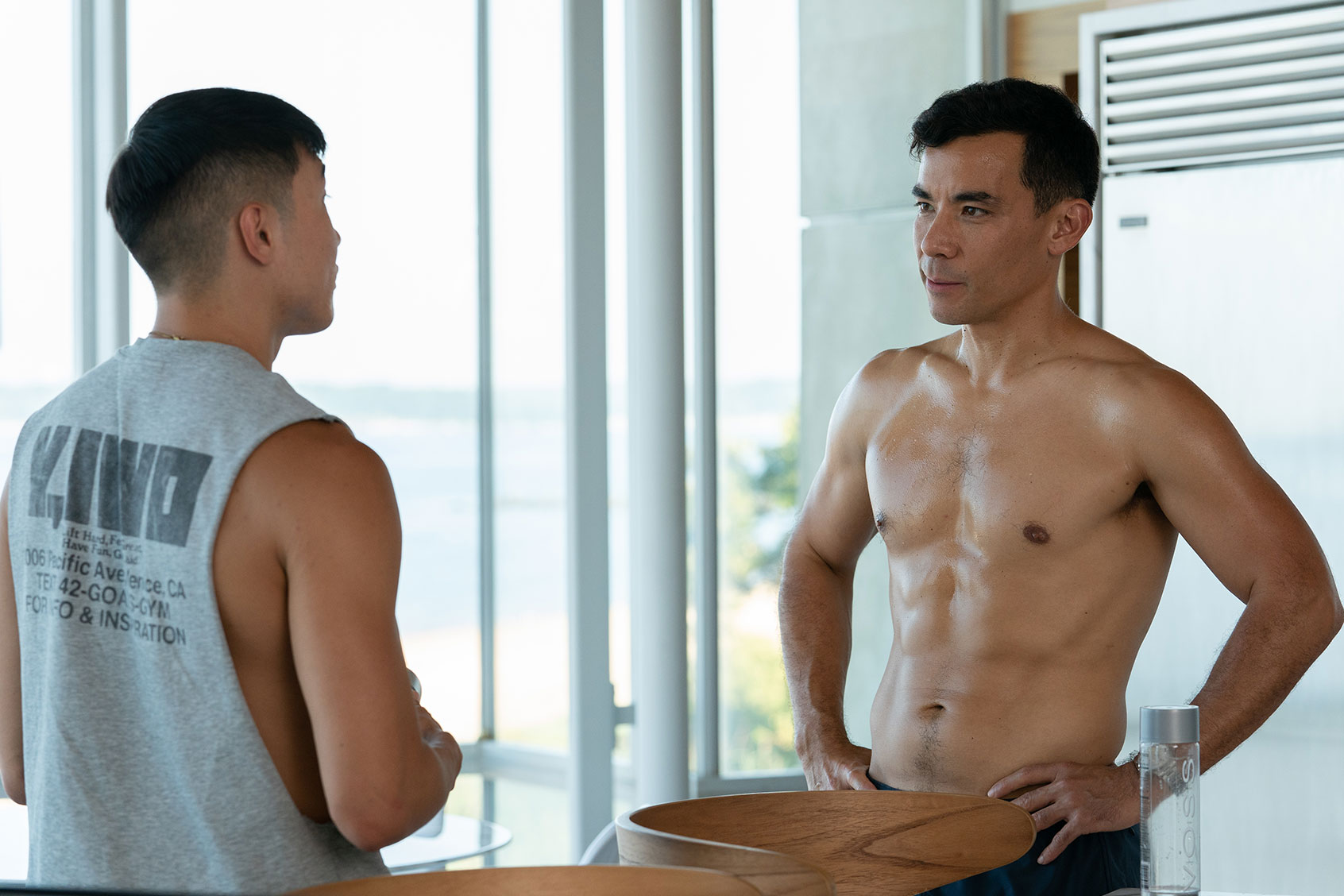
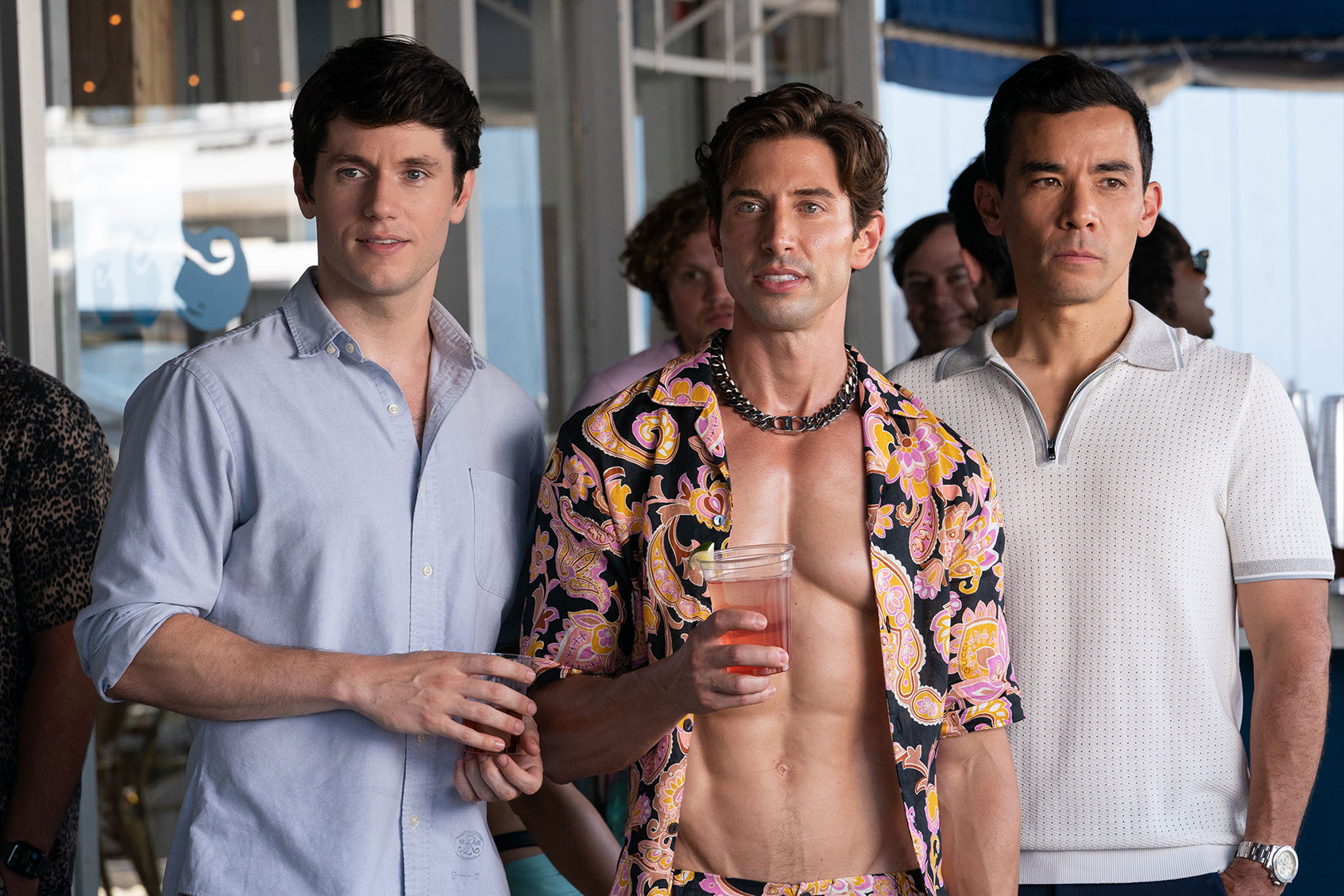
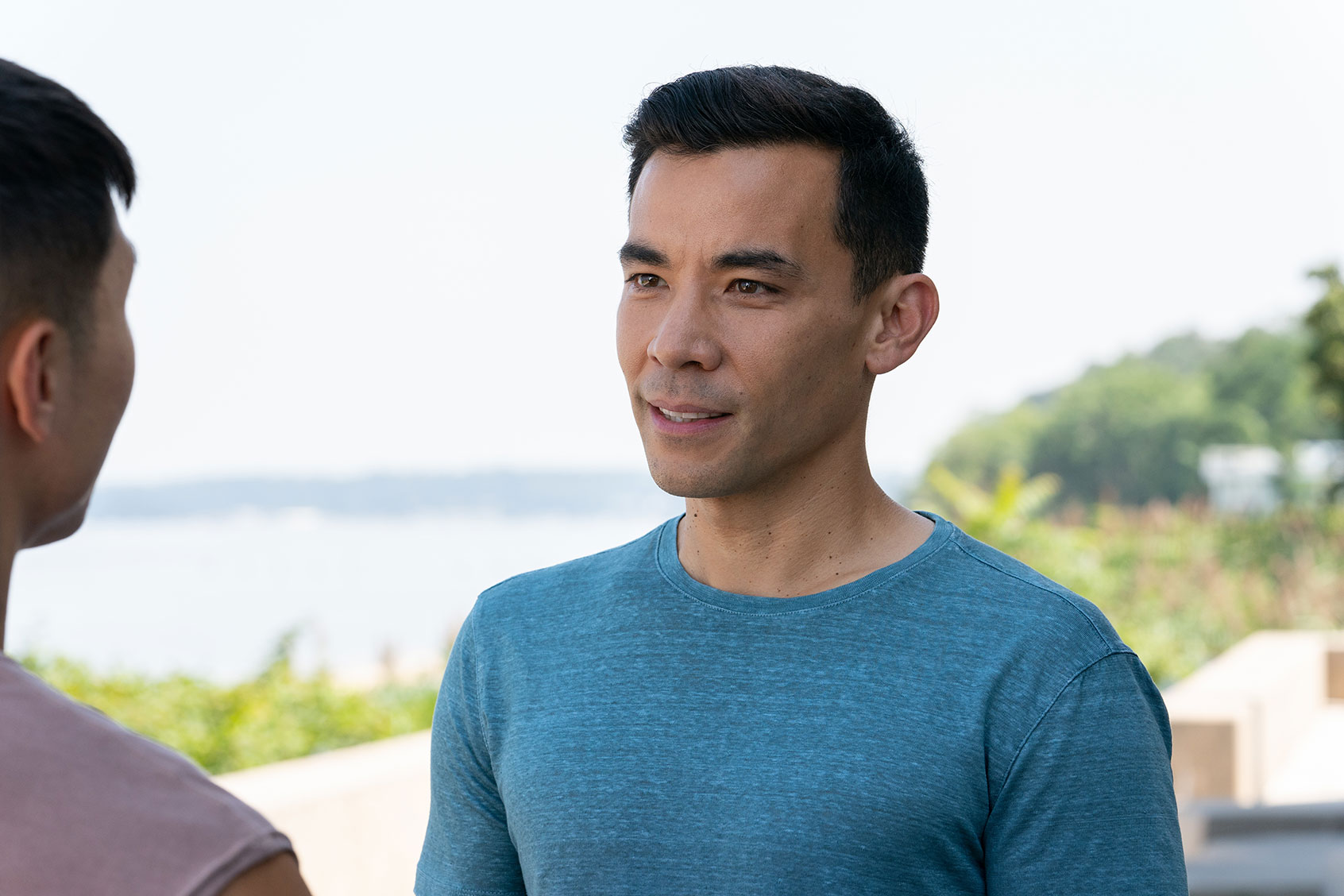
Fire IslandFire Island (Searchlight Pictures)From his first appearance onscreen, the Darcy of “Fire Island,” Will (Conrad Ricamora, “How to Get Away with Murder”) is fussy and annoyed. It is possible to look as stiff and uncomfortable in breathable summer fabrics as it is in Darcy’s usual cravat, at least in Ricamora’s fantastic portrayal. Noah tries to rope the stranger into pretending to be his boyfriend, to get out of being hit on, but Will does not play along. From Will’s first line: “I’m sorry. I’m not sure I understand what’s going on,” and Ricamora’s deadpan, mumblecore delivery, we know this is a Darcy for the ages.

Watch the Darcy charm work, its slow unfurl like a corpse flower. Back with his friends, Noah describes Will as “kind of a dud,” shouting loud enough across the dance floor that Will might hear him. Noah is perhaps the most like Elizabeth in this moment, allowing his temper to flare up and ignoring what’s right in front of him: an attractive, interested, slightly older man who happens to be a wealthy lawyer. He’ll be Noah’s enemy. Until he isn’t. 

“It is a truth universally acknowledged that a single woman, married woman, man, anyone really, in possession of a pulse, must be in want of Colin Firth in a lake.”

In the 1995 BBC “Pride and Prejudice” adaptation, described as “the origin of sexy Darcy,” the character, played famously by Colin Firth, emerges wet-shirted from a lake (sounds more like a Brontë love interest to me). The shirt in question is white, see-through and as bulbous as the infamous Seinfeld “puffy shirt.” Firth’s dark hair waves nearly down to his mutton chops. It’s Romantic with that capital “R,” to the point of ridiculousness, but the reaction was instant popularity.

Despite the lack of much of a physical description of Darcy in Austen’s source material, Firth’s portrayal became what people thought of when they considered the character. The definite Darcy, for years. The Guardian wrote: “It is a truth universally acknowledged that a single woman, married woman, man, anyone really, in possession of a pulse, must be in want of Colin Firth in a lake.”

These are difficult shoes (no doubt fussy and tight dress shoes) to fill.

His version was so popular, Firth complained later of being typecast. He had trouble finding work (how many Darcy-esque parts are there? Well, a few). Other notable Darcys in the years before and since the BBC series include Laurence Olivier and “The Americans” master of disguise Matthew Rhys, whose version leaned heavily into the mutton chops.

In Joe Wright’s 2005 adaptation starring Kierra Knightly as Elizabeth, Matthew Macfadyen (“Succession”) played Darcy, as he said Firth had before him, as “a grumpy adolescent, probably because I felt quite grumpy because I was scared.” But Macfadyen’s version attracted nearly as much attention as Firth’s (the two later starred together in Netflix’s “Operation Mincemeat”: dueling Darcys). Macfadyen’s Darcy seems more innocent, younger and perhaps with that trademark Darcy’s sullenness because of shyness more than a sense of superiority. His Darcy exudes social anxiety, rather than smugness.  

Fire IslandFire Island (Searchlight Pictures)It’s a classic character trajectory but not the easiest for an actor: to make the audience hate you, then love you over the course of about two hours. Enemies to lovers, but do it in a story of manners. The smoldering, slightly bitter heart of “Pride and Prejudice” is Darcy, the unlikely love interest that launched a thousand Firths. These are difficult shoes (no doubt fussy and tight dress shoes) to fill.

His position of being the only man of color in his friend group does not go unnoticed.

What makes the Darcy of “Fire Island” different? For one thing, he’s queer. Ricamora, who is openly queer himself, as is all of the cast, told Gay Times: “We need movies that focus on our trauma. Then, we need movies that show us going to the grocery store, show us hanging out with friends, going to the beach, going on vacation.”

For another thing, he’s Asian. In the film, it’s mentioned only briefly that Will is Filipino-American, an identity Ricamora also shares, but his position of being the only man of color in his friend group does not go unnoticed by “Fire Island.” Possibly this only-ness could be the source of some of this Darcy’s shyness. He hangs back as his white, wealthy friends do yet more foolishness that Will might not be able to get away with, not so easily. Will never gets drunk. He never loses control, which may also be why it takes time for the romance to heat up with Noah. Will is careful.  

Fire IslandFire Island (Searchlight Pictures)He’s also direct. He’s introverted, but he’s not playing games here. He doesn’t pretend to be something he’s not. He tells Noah firmly and repeatedly he doesn’t think monogamy is for him. Whatever flaws this Darcy may have, lying or manipulating is not one of them.

Socially awkward, he really can’t fake it, even to get by. As Decider, who calls him a “taciturn lawyer,” writes, when Noah comes across Will after they’ve fought, and Will is eating ice cream on the boardwalk like a mere mortal: “[Will’s] response? To physically throw the ice cream cone away from himIt’s ridiculously charming — this man is afraid of vulnerability to the point where he refuses to look even a little bit foolish for the sake of a frozen dairy treat.”


Want a daily wrap-up of all the news and commentary Salon has to offer? Subscribe to our morning newsletter, Crash Course.


For a “Pride and Prejudice” story to work, it needs a powerful Darcy. Will is that. Ricamora, talented star of such stage musicals as “Little Shop of Horrors” and “Here Lies Love” and winner of a Theatre World Award, has a commanding presence, a velvety rich voice, and always looks as suave as George Clooney — but he makes Will’s awkwardness seem real too. He’s an outsider in a world he would like to pass through unnoticed, like a (party) boat in the night. Until Noah comes along to shake him up, Will would prefer to just be in the background. Please don’t make a fuss. Please don’t make a scene. OK fine, I’ll dance.

More stories like this 

My ex introduced me to arepas. They’re now my favorite comfort food

The word “arepa” did not exist to me until three years ago. My knowledge of Latin American cuisine was limited to the Mexican food of my California hometown. We’re known for the La Victoria Taquerias and their special orange sauce, but to me, the best Mexican place is a cash-only stand with picnic table seating serving classics like massive burritos, tacos, and quesadillas stuffed so full that they might as well be burritos. Growing up, I’d be hard-pressed to list foods from anywhere further south of the border.

Now, my partner and I pan-fry white cornmeal dough into little crispy disks and stuff them with salty, crumbly queso fresco and sautéed bell peppers at least twice a month for a Colombian/Venezuelan-inspired dinner.

Oddly enough, this staple meal of ours is a relic of my previous relationship. My ex’s Colombian-born mother used to make arepas for breakfast, and I discovered that the little corn pancakes happened to be just the right size for reheating in the toaster. They became an instant favorite and to this day, remain my number one comfort food.

For someone whose eating and mental health have always been inextricably linked, comfort foods are a necessity for me. It’s a point of pride to just be able to say I find certain foods comforting, a notion that has not always come easy for me. I’ve been relearning how to enjoy eating since I was eleven years old, when a mission to “eat healthy” took a dark turn and sent me to the hospital with complications related to anorexia.

In eating disorder recovery, “safe foods” are the foods that remain after you’ve villainized all the others. When you can’t bring yourself to eat anything else, these select foods will be there. As I’ve recovered, “safe” foods have evolved into comfort foods, like peanut butter and banana smoothies, cereal, and scrambled eggs for dinner. They’re for days of emptiness, days when I feel overwhelmed and anxious. They are my go-to when the world won’t stop spinning long enough for me to grasp the concept of filling my stomach with anything more complex. And now, that list includes arepas.

When my ex and I first moved in together, we both found that we were eating more consistently than we ever had. Mmonths into living together, I found myself unmotivated and apathetic. Anxiety attacks pounced on me and took over without reason or warning.

We didn’t always understand what the other needed in those days, but my partner was dependable when it came to making dinner on the days when depression left my mind blank. “Hot corn disk?” he’d ask (that’s what I had taken to calling them). “Hot corn disk,” I would reply, and we’d share a knowing smile.

Three ingredients were all we needed for the savory pancake dinner: pre-cooked white cornmeal, water, and salt. For the longest time, I wasn’t exactly sure how to recreate the arepas on my own because he made them from memory. There were no measurements. He would simply heat a small bowl of water in the microwave, mix it into a larger bowl full of cornmeal, and sprinkle in a dash of salt. After stirring it all together until it resembled the creamiest Thanksgiving mashed potatoes that were nearly liquid, he kneaded the dough and left it to rest for a few minutes. The final step was frying them until their yellowish color turned golden brown. To me, they smelled like gourmet movie theater popcorn — one of the many scents of nostalgia. Sometimes we slathered the arepas with my favorite vegan butter and fried some eggs alongside them for a more well-rounded dinner.

But no amount of comfort food, not even arepas, could fix things.

The grief that followed our seemingly inevitable breakup left no room for food in my stomach. Some days I hardly ate at all. My family feared I was relapsing, no matter how much I tried to explain that the depression made eating irrelevant at best and impossible at worst. When I did start eating again, it was purely emotional. I’d get home from my all-day partial hospitalization program and swallow the sadness down with a parade of Hershey’s dark chocolate kisses.

Two months after leaving the hospital program, I rejoined Bumble and reached out to a girl I had ghosted months before. It turned out she was in eating disorder recovery, too. We’ve been dating for a year now, and making arepas together for almost just as long.

At first, I felt awkward telling her about my comfort food. She’d had arepas in the farmers’ markets of Los Angeles, but never knew how easy they were to make at home. Of course, she was curious as to how I, a white woman with Italian and Swedish heritage, came to make this Colombian dish a part of my greatest hits list of recipes. Starting any sentence with “My ex . . .” early on in any relationship is a bold and potentially stupid move.

When you go through a breakup, there are songs you have to ban from your playlists and places you can’t pass without feeling a lump catch in your throat. We attach so many things to the memory of someone.

But when I make arepas now, the loss doesn’t hit me in the same way. Arepas are my thing as much as they are my ex’s. He merely provided the introduction. I didn’t even have to call and ask for the recipe; it’s conveniently listed on the back of the cornmeal bag.

In my previous relationship, I wanted to be anyone but myself, because to me, that was the only way I would ever be enough. When it ended, I felt I had not only lost myself, but everything. But now, I’ve reclaimed the things that are me and mine.

The silver lining was warm, round, and delicious.

Don’t throw out those shrimp shells. Use them to make this perfect pasta

Big Little Recipe has the smallest-possible ingredient list and big everything else: flavor, creativity, wow factor. That means five ingredients or fewer — not including water, salt, black pepper, and certain fats (like oil and butter), since we’re guessing you have those covered. Inspired by the column, the Big Little Recipes cookbook is available now.

Between you and me, when I started this column just over four years ago, I was worried I would run out of ideas. How many dishes could we possibly make with five or fewer ingredients?

But it turned out: hundreds. We made the garlickiest, butteriest pasta. We made marinated chicken that wouldn’t dare dry out. We made peanut butter cookies without any measuring cups or spoons.

And this week, we’re making spicy, tomatoey shrimp spaghetti, which will be my last Big Little Recipe (but don’t worry — we’re bringing back some of our greatest hits right after this). Fittingly, it includes a handful of the tips and tricks I’ve learned to love, so before I get all mushy, let’s break it down:

It uses shrimp two ways. Because why pay more to get less? First, make sure your shrimp still have the shells and tails on them when you buy them, and then peel them at home. Takes a few minutes, sure, but turn on a podcast. Toss the shells in a pot, add water, and let that simmer into a briny, savory stock. This is where the pasta will cook, then that liquid gold will bolster our sauce.

It lets your kitchen lead the way. Only you can tell me what’s in your pantry. I like long noodles here, like spaghetti or bucatini, but if all you have is rigatoni, great. When it comes to chile paste, I tried — and adored — crushed Calabrian, gochujang, and harissa in my tests. What’s in your fridge door?

It skips a lot of ingredients that you might be tempted to add. But don’t. Don’t add Parmesan or lemon or garlic or onion or whatever it is you’re about to suggest. Instead, lean on the chile paste for breadth (the harissa in my fridge, from NY Shuk, has preserved lemon, garlic, and warm spices).

It doesn’t need a side dish. Jammy tomatoes plus a windowsill’s worth of basil offer all the vegetal elements I crave, especially on a weeknight. Which means you can plop this on the table and call it a day. It doesn’t need plates either. I like to eat this straight out of the skillet, hunched over the table.

I hope you’ll keep making Big Little Recipes, both the ones from the column and the ones from the cookbook. But also the ones we don’t think of as “recipes,” even though we look forward to them every day.

The warm English muffin, smeared with salted butter, that you rush-thawed in the microwave, half-burnt in the toaster, then ate in 3 minutes, standing over the kitchen sink, watching the coffee drip, drip, drip.

This? This old thing? It’s been right in front of us the whole time.

Recipe: Shrimp Pasta with Tomatoes, Basil, and Chile Butter

“Lost Illusions” is a sumptuous period piece on the allure of fame, followers and fake news

Ah, to be a critic! In this media-snarky world, it is reassuring that “Lost Illusions,” the great 19th Century European realist novel by Honoré de Balzac, was exceedingly prescient to our current age of social media — and how reputations can be won and lost, or bought and sold. 

Xavier Giannoli’s sumptuous adaptation, which was nominated for 14 César Awards (French Oscars) and won seven, is, all about, “ink, paper, and the love of beauty.” The film charts the rise and subsequent fall of Lucien (Benjamin Voisin), a 20-year-old poet from Angoulême. He writes poems for Louise de Bargeton (Cécile de France), whom he loves, but her husband’s influence (read: threat) forces Lucien to leave for Paris. It is in the city, where he is out of his depths, that his life truly begins. 

Giannoli effortlessly guides the viewer through Parisian society and its players as eloquently as the narrator recounts Lucien’s story of ambition gone wrong. Lucien gets off on the wrong foot when makes a bad impression at the theater with Louise and her prominent relation, the Marquise d’Espard (Jeanne Baibar). He is also rude to Nathan d’Anastazio (filmmaker Xavier Dolan), a writer and dandy who soon becomes Lucien’s frenemy.

RELATED: In the PBS doc “Storm Lake,” a tiny Iowa paper fights for the future of high-quality local news

Lucien’s initial failure in society prompts him to meet two other influential people of lower class: Etienne Lousteau (Vincent Lacoste) a newspaper writer who helps him get a job, and Coralie (Salomé Dewaels), a working-class actress who becomes Lucien’s lover.

Lost IllusionsLost Illusions (Music Box Films)

“Lost Illusions” shows how Lucien navigates this insular world with an arrogance and impudence. Voisin, who has the mother-of-pearl skin that Balzac writes about, is perfectly cast as the naïve young poet who generates pity when he is foppish and humiliated at the theater. And viewers will cringe whenever Lucien thinks he has the upper hand, but is really being played for a fool. Even if the undesirable outcomes of Lucien’s escapades are telegraphed, Giannoli still generates emotion with every setback. Lucien deserves most of his comeuppances, but he remains sympathetic because Voisin captures his insouciance as a striver and social climber. 


Want a daily wrap-up of all the news and commentary Salon has to offer? Subscribe to our morning newsletter, Crash Course.


A key episode that unfolds at the offices of Dauriat (Gérard Depardieu), a publisher, who asks Lousteau what he thought of Nathan’s new book. Lousteau, who hasn’t read it, does not let that stop him from offering an opinion. And when Lucien is asked for his review, his trolling Nathan is akin to a Twitter war, only the insults are spoken face to face. Huzzah! Lucien’s career as a critic is born — and it is lucrative. His ego grows as exponentially as his wallet. (Alas, today, criticism does not pay as well, especially when social media makes everyone a critic.) 

One of the film’s best sequences shows how money drives everything. (“Avarice begins when poverty ends,” writes Balzac, shrewdly, in his novel.) Giannoli deftly illustrates how writers/critics are the brokers between the artists and public, and everyone and everything has its price. The newspapermen are paid to review a book or a show, and men like Singali (Jean-François Stévenin), sells “boos” or applause at the theater to the highest bidder. The bribery and corruption extend to advertisers who sell the public what it wants (but doesn’t need), and of course, politicians are guilty of this chicanery as well. There is even a discussion of “Fake News,” and how it benefits from denial. Surely, a trumped-up rivalry between author and critic is good for sales? 

“Lost Illusions” amplifies its messages about conscience and integrity as Lucien leverages his newly minted reputation to gain the thing that he most desires — to regain the title of his name. (He goes by Lucien de Rubempré, his mother’s name; he is really Chardon, after his father). But will Lucien sell his soul to the highest bidder? He gains success writing satires and is asked by the Royalists (Lousteau’s rivals) to pen smear campaigns against influential folks to sway public opinion. Likewise, when he is assigned a review of Nathan’s new novel, Lucien feels compromised because it is an astonishing book and Lousteau wants a hatchet piece. What is a critic to do?

Lucien’s professional mind may be clouded by doubt, but his ambivalence extends to his personal relationships as well. He uses his power to help Coralie secure a part in a revival of “Macbeth,” but as they become destitute, her performance and the play must be a success. When Louise sends word through Nathan to Lucien that she wants to see him, he wonders if his former lover plans to rekindle their affair. In a terrific scene, Louise and Coralie meet without Lucien’s knowledge; it reveals much about their characters.  

“Lost Illusions” makes all this drama captivating for its entire 150 minutes, which speed by nimbly. Giannoli pauses briefly as Lucien’s disillusionment takes over and he cannot tell his allies from his enemies, but viewers won’t need a scorecard. The film is so impeccably made — the cinematography, costumes, and art direction are all fabulous — that only Lucien cannot see the “cold, inhumane smiles” of his detractors to know he has blundered in his efforts to get ahead. 

Lost IllusionsLost Illusions (Music Box Films)

If Lousteau were to encourage negativity towards this accomplished film, it would be easy to accuse Giannoli for capturing only the spirit, and not the letter, of the novel. A celebratory scene features Lucien being baptized and floating along in a rarified air of gold confetti like a rock star is the film’s sole over-the-top moment. The filmmaker also downplays the romantic passions of the characters. The way Nathan eyes Lucien conveys a delicious, unspoken attraction that has more heat in it than Lucien’s brief, sweaty trysts with either Louise or Coralie. 

But these are minor flaws in a film that is otherwise exceptional. “Lost Illusions” ends with a closeup on Lucien’s resigned face that reveals everything and perhaps nothing. It would be suitable for posting on Instagram — if Lucien were to still have any followers.

“Lost Illusions” which opens in theaters on June 10. Watch a trailer below, via YouTube.

More stories to check out:

NASA is assembling a team to figure out what UFOs are

Back in September 2019 (during what some might call “the before times,”), half a million people joined a half-serious Facebook group called “Storm Area 51, They Can’t Stop All of Us.” The group’s name was self-explanatory: These people had heard the notorious conspiracy theory that the American government possesses evidence of extraterrestrial life at the Area 51 facility near Groom Lake in southern Nevada. With varying degrees of sincerity, they insisted that the government had a responsibility to disclose what it knows about the possibility that UFOs have visited Earth.

Three years later, we may not know much more about the secretive Area 51 military installation, but NASA is creating an investigative team animated by the same curious spirit as that Facebook group. In NASA’s own words, when this team gets started in the autumn, it will “examine unidentified aerial phenomena (UAPs) – that is, observations of events in the sky that cannot be identified as aircraft or known natural phenomena – from a scientific perspective.”

RELATED: Scientists are studying whether Cold War-era photos of the night sky contain clues of alien life

The US space agency is not claiming that extraterrestrial life exists, they note. Their stated mission is instead to protect national security; make sure that UFOs don’t endanger aircraft; and otherwise serve practical needs. Over a period of nine months, experts in aeronautics, data analytics and a range of relevant scientific disciplines will analyze information about UAPs from a comprehensive spectrum of sources.

“Given the paucity of observations, our first task is simply to gather the most robust set of data that we can,” astrophysicist David Spergel, who is leading the independent study team, said in the official NASA statement. “We will be identifying what data – from civilians, government, non-profits, companies – exists, what else we should try to collect, and how to best analyze it.”


Want more health and science stories in your inbox? Subscribe to Salon’s weekly newsletter The Vulgar Scientist.


Daniel Evans, the assistant deputy associate administrator for research at NASA’s Science Mission Directorate, also claimed in the statement that the team’s findings would be open to the public.

“Consistent with NASA’s principles of openness, transparency, and scientific integrity, this report will be shared publicly,” Evans explained. “All of NASA’s data is available to the public – we take that obligation seriously – and we make it easily accessible for anyone to see or study.”

Until relatively recently, mainstream scientists largely refused to accept that reports of UFO sightings should be taken seriously. NASA’s science mission chief, Thomas Zurbuchen, acknowledged during a webcast to the National Academy of Sciences that some establishment scientists may view NASA as “kind of selling out” by launching this study. Zurbuchen made it clear that NASA is not doing this to pander to public interest but because there are sound scientific reasons for inquiry.

“We are not shying away from reputational risk,” Zurbuchen explained. “Our strong belief is that the biggest challenge of these phenomena is that it’s a data-poor field.” Both in their official written statement and during a call with reporters, NASA characterized this program as in the same spirit as their other ongoing astrobiology and outer space exploratory projects.

“Over the decades, NASA has answered the call to tackle some of the most perplexing mysteries we know of, and this is no different,” Evans told reporters during the call.

The recent shift in public attitudes toward UFOs were prompted by a number of different prominent news items. Five years ago, scientists discovered an elongated interstellar object passing through the solar system called ‘Oumuamua, which had properties that were so unusual that some experts like Harvard physicist Avi Loeb believe it had all the signs of being an extraterrestrial spacecraft. In 2018 Luis Elizondo, who had been the program director of a group called AATIP (Advanced Aerospace Threat Identification Program), revealed that he had resigned and released videos of fast-moving, unidentified aircraft observed by the government. A 2019 Pentagon report acknowledged that five Navy pilots had seen UFOs while engaged in training maneuvers off the aircraft carrier Theodore Roosevelt in 2014 and 2015. 

In April, more than 1,500 pages of AATIP documents were declassified, revealing that people who claimed to have interacted with UFOs reported similar symptoms such as heart ailments, sleep disturbances, and injuries consistent with exposure to electromagnetic radiation (such as burns). The documents also disclosed that former Sen. Harry Reid, a Nevada Democrat who served as Senate Majority Leader from 2007 to 2015, repeatedly tried without success to learn more about UFO technology, which he believed had been acquired by government contractors and was being concealed from the public. One document, for instance, shows Reid asking for a “restricted special access program” for work being performed by BLASS (Bigelow Aerospace Advanced Space Studies), which had been awarded a $12 million contract to study “advanced aerospace weapon threats from the present out to 40 years in the future.” Although BLASS claimed to have found “several highly sensitive, unconventional aerospace technologies” which needed “extraordinary protection,” Reid was not allowed to investigate at the level he felt was necessary. He also suspected that Lockheed Martin, the American aerospace firm, had recovered fragments from a UFO that had crashed in the United States.

“I was told for decades that Lockheed had some of these retrieved materials,” he told The New Yorker prior to his death in 2020. “And I tried to get, as I recall, a classified approval by the Pentagon to have me go look at the stuff. They would not approve that. I don’t know what all the numbers were, what kind of classification it was, but they would not give that to me.”

For more Salon articles on UFOs:

Sotomayor: SCOTUS just “immunized” feds from liability “no matter how egregious the misconduct”

A ruling by the right-wing majority on the U.S. Supreme Court Wednesday “will have far-reaching consequences” for people who accuse federal agents of violating their constitutional rights, the ACLU warned after the court ruled against a man who wanted to sue a U.S. Border Patrol agent who entered his property without a warrant and used excessive force.

The court ruled 6-3 in Egbert v. Boule that Congress must decide whether the plaintiff can sue the government over the alleged violation of his rights—a decision which Justice Sonia Sotomayor wrote in her dissenting opinion threatens to block nearly all civil suits against federal agents.

“The court’s decision today ignores our repeated recognition of the importance of Bivens actions, particularly in the Fourth Amendment search-and-seizure context, and closes the door to Bivens suits by many who will suffer serious constitutional violations at the hands of federal agents,” Sotomayor wrote, referring to Bivens v. Six Unknown Named Agents of Federal Bureau of Narcotics, the 1971 ruling in which the court found federal agents can be sued in some cases even if Congress has not explicitly authorized the challenge.

Wednesday’s ruling pertained to a case stemming from Washington state innkeeper Robert Boule’s attempt to sue border agent Erik Egbert.

In 2014, Egbert entered Boule’s property without a warrant to investigate a guest from Turkey. Boule accused the agent of pushing him to the ground and later retaliating when Boule reported the incident to Egbert’s supervisors.

Journalist Mark Joseph Stern of Slate said the court’s conservative majority knows legislation that would allow an individual to sue federal agents for constitutional rights violations is unlikely and is thus effectively “slamming the door on accountability for federal law enforcement.”

The court did not overrule Bivens, but further restricted people’s ability to seek redress when they accuse federal agents of violating their rights. In 2020, the court ruled that the family of a Mexican teenager fatally shot by the Border Patrol agent could not sue over their child’s killing, and in 2017 it ruled that government officials are not liable for the alleged mistreatment of noncitizens who are detained by the United States.

Justice Neil Gorsuch suggested in his opinion that while Bivens has not been overruled, future claims against federal agents may not be viable.

Thousands of Border Patrol agents have now been “absolutely immunized from liability,” said Sotomayor, “no matter how egregious the misconduct or resultant injury.”

Lawyers for Egbert had argued that allowing Boule’s claim to proceed would undermine the ability of Border Patrol agents to conduct searches as part of immigration enforcement, while Sotomayor noted that the case “does not remotely implicate national security.”

The ACLU warned that the ruling will leave the country’s largest federal agency—U.S. Customs and Border Protection—even less accountable to the public.

“This precedent endangers us all,” the group said.


May Pang opens up about John Lennon’s “Lost Weekend” in her “love story” documentary

For time immemorial, history books will no doubt couch John Lennon’s story within the context of tragedy. His unfinished life, coming to a sudden and inexplicable end when he was scarcely 40 years old, necessitates that perspective.

Fortunately, we have been gifted with the new documentary “The Lost Weekend: A Love Story,” which affords us with a window into 18 months of Lennon’s life writ large on the public stage. The former Beatle’s “Lost Weekend,” a coinage that he drew from the 1945 film noir of the same name, marked an era of intense change, uncertainty and rootlessness for him. But as he told journalist Larry Kane, that period was also one of his “happiest,” when he fell in love with a woman and made some of his finest music.

RELATED: John Lennon at 39, in self-imposed exile

That woman was May Pang, Lennon and wife Yoko Ono’s 22-year-old personal assistant. Co-produced and directed by Eve Brandstein, Richard Kaufman and Stuart Samuels, “The Lost Weekend,” which premiered at the 2022 Tribeca Film Festival, finds a pocket of bright light in Lennon’s unfinished story, an era when he mined the simple joys out of living with Pang and reconnecting with his estranged 10-year-old son Julian, as well as with the other former Beatles.

Naturally, Pang narrates her own story, weaving together tales about her early years growing up in Spanish Harlem and her first brush with the music business in the offices of notorious New York City businessman Allen Klein. We witness 13-year-old May falling in love with the four lads from Liverpool and, later, her incredible good fortune in landing a plum job with John and Yoko in the early 1970s. And we observe Pang’s obvious bewilderment when Ono suggests that the young woman take up with her husband as the famous couple’s marriage fissures out of control.

To the filmmakers’ extraordinary credit, no voices are left silent. Yoko is there, front and center, sharing her memories about the Lost Weekend and its inception. Members of the Lennons’ inner circle are there, too, including Elton John, photographer Bob Gruen, and Apple Records’ Tony King, among a host of others. In perhaps the documentary’s most moving scenes, Julian speaks wistfully about life with May and his father during the Lost Weekend.

RELATED: What critics got wrong about John Lennon and Yoko Ono’s “Double Fantasy

In Brandstein, Kaufman and Samuels’ capable hands, the documentary maintains a laser-like focus on love — “the word known to all men,” in the phraseology of James Joyce, one of Lennon’s literary idols. The poets tell us that love is a many splendored thing, that the heart wants what the heart wants. When John returned to Yoko in February 1975, their reunion didn’t signal the end of Lennon and Pang’s love story. An assassin’s bullets destroyed all of John’s possible worlds in 1980 — and all of his loved ones’, too.

The great triumph inherent in “The Lost Weekend,” and in Pang’s steadfast curation of John’s memory over the years, involves the celebration of Lennon’s enduring spirit. “While there’s life, there’s hope,” he once said. And John’s music, which will outlive us all, is full of hope.

“The Lost Weekend: A Love Story” opens in theaters on April 13, 2023. 


Love the Beatles? Listen to Ken’s podcast “Everything Fab Four.”


More stories about John Lennon by Kenneth Womack:

Jan. 6 committee puts Proud Boys at center of Trump’s plot to overthrow the election

Most of the media coverage of this year’s first major public hearing by the House Jan. 6 committee focused on the visceral horrors of the day, and the committee’s firm conviction that this was what Donald Trump wanted to happen. Certainly, the newly released video footage was wrenching, and especially when Capitol Police Officer Caroline Edwards sat quietly through footage of her own assault at the hands of rioters. The committee also laid out the case that Trump was gleeful about the insurrection and, as Rep. Liz Cheney, R-Wyo., said, told aides and associates that the rioters “were doing what they should be doing.”

That case was presented in a compelling fashion, but for most people who have been following the reporting about what happened — and particularly Trump’s role in it — very little of it was new. What was likely the biggest revelation of the night, however, was the central role played by the Proud Boys in the committee’s narrative of the events of Jan. 6. Using footage and testimony from documentary filmmaker Nick Quested, the committee presented the case that the right-wing men’s group, along with the similarly organized Oath Keepers, functioned as a vanguard that led the way for the rest of the mob, incited by Trump himself, that would storm the Capitol. 

RELATED: Liz Cheney to GOP and America: Trump did it, and we’re coming for him

“The attack on our Capitol was not a spontaneous riot,” Cheney explained. Over the two-hour hearing, the committee laid out evidence strongly suggesting not just that these far-right groups had coordinated the attack on the Capitol, but had anticipated that Trump would send them reinforcements, in the form of the “Stop the Steal” rally-goers he implored to march on the Capitol that day. 

The crux of the case comes from Quested’s testimony. He had been embedded with the Proud Boys before and during the events of Jan. 6, and had witnessed them communicating with members of the Oath Keepers. Perhaps most important, Quested’s experiences showed that the Proud Boys weren’t primarily in Washington for the rally itself. As Quested explained, the Proud Boys didn’t seem particularly interested in Trump’s speech and, rather than listening to it, went to the Capitol to do “recon” — in other words, to find weak spots in the building’s security. 


Want more Amanda Marcotte on politics? Subscribe to her newsletter Standing Room Only.


There were only a couple of hundred Proud Boys present that day, a crucial point that committee members made sure to emphasize. That’s not enough people to take the Capitol by force, especially as very few were carrying firearms. Previous reporting on Oath Keeper text messages suggests that many of the alleged conspirators were worried that carrying guns into the District of Columbia, which is illegal, could lead to their arrest before they could spark a riot. The plot to take the Capitol wouldn’t have made much sense with just the manpower those two groups could marshal on their own.

But of course, they weren’t on their own. They had the large crowd of people attending Trump’s rally, who followed along enthusiastically and provided exactly the overwhelming numbers the Proud Boys needed to pull it off. Most of those people were clearly not in on the plan to storm the Capitol, and many of them probably hadn’t even considered doing so until they were caught up in the riot.

RELATED: Ivanka tells Jan. 6 committee she trusted Bill Barr over her dad on “bullsh*t” fraud claims

That’s why Trump’s speech matters so much. The president of the United States told his followers to march on the Capitol and promised, falsely, that he would join them. Indeed, recent reporting shows that Trump may have even vaguely wanted to do so, and had floated the idea for a couple of weeks until the Secret Service said no. Who knows what the mass of people who marched on the Capitol thought was going to happen when they started moving in that direction? But by the time they got there, the Proud Boys were leading the way, breeching the barriers and setting a tone of violence and mayhem that many other people in that crowd emulated. 

“What you witnessed was what a coordinated plan effort would look like,” explained committee chair Bennie Thompson, D-Miss.

The implication here is hard to miss and — astonishing: The Proud Boys needed people to pull off an audacious scheme they could never have managed on their own. Trump provided those people. It’s possible, although not proven, that the Proud Boys knew what Trump was going to say during the rally. It’s possible they planned their actions assuming they would be joined by a crowd and angry crowd that they might be able to whip up into a violent mob. It’s possible that the reason Trump was so focused on “marching” to the rally in the days leading up to Jan. 6 was because he shared this understanding. 

After the hearing, Thompson appeared on CNN, where Jake Tapper asked him explicitly if we would hear from “witnesses that describe actual conversations between these extremist groups and anyone in Trump’s orbit?”

“Yes,” Thompson replied, though he did not elaborate on what those conversations were about. 


Want more Amanda Marcotte on politics? Subscribe to her newsletter Standing Room Only.


As Peter Baker of the New York Times wrote, the committee is arguing that Trump “intentionally summoned a mob to stop the transfer of power” to Joe Biden. There’s a lengthy record of public communications in which Trump makes winking references to his desire to see that happen, and at least some of his followers took that as a directive. Perhaps the most dramatic of those public communications was the Dec. 19, 2020, tweet urging supporters to come to the Jan. 6 protest, declaring it “will be wild!” As Cheney noted, Trump’s adviser Steve Bannon released a podcast on Jan. 5 in which he said that “all hell is going to break loose tomorrow.” 

As provocative as those statements were, however, it’s remains within the realm of plausibility that Trump and Bannon were hyping a more or less peaceful protest rather than deliberately inciting a riot. But if there’s real evidence of coordination with the Proud Boys and the Oath Keepers, that’s a very different story. The existing public evidence shows that these groups kicked off the riot deliberately, and that the rest of the crowd got swept up in the moment and joined in. What remains to be asked and answered is the question of whether that was the plan all along — and whether Donald Trump was in on it and his speech was part of the plan. In the coming weeks, we’ll see how much solid evidence the committee has, and how much of this is mere implication. 

“Parental rights” fan DeSantis threatens to sic child services on parents taking kids to drag shows

Florida Gov. Ron DeSantis, a Republican who has sought to brand himself as a champion of “parental rights,” on Wednesday floated the notion that he might order the state’s child protective services to investigate parents who take their kids to drag shows. 

The governor’s outlandish comments came during a recent news conference, where he was asked whether he’d aim to hold parents who take their children to such performances criminally liable. 

“We have child protective statutes on the books,” the governor said. “We have laws against child endangerment.”

“It used to be kids would be off-limits. Used to be everybody agreed with that,” DeSantis added. “Now it just seems like there’s a concerted effort to be exposing kids more and more to things that are not age-appropriate.”

RELATED: Republicans hijack Pride month: A celebration turns to harassing, abusing, and trolling LGBTQ people

This week, Republican Florida state Rep. Anthony Sabatini proposed a bill that would formally ban parents from taking their kids to such events, charging wrongdoers with felonies and terminating their parental rights. 

The debate around drag shows was originally sparked shortly after videos of children attending a Saturday drag show in Dallas surfaced online. The event, dubbed “Drag the Kids to Pride Drag Show,” was reportedly billed as a “family-friendly spin-off.” It featured a number of drag performers who were reportedly tipped by kids with cash.


Want a daily wrap-up of all the news and commentary Salon has to offer? Subscribe to our morning newsletter, Crash Course.


State Republicans in Florida have widely condemned the performance, calling specific attention to a sign on the bar’s wall that read: “IT’S NOT GONNA LICK ITSELF.”

State Rep. Bryan Slaton called the performance “horrifying” and said it shows a “disturbing trend in which perverted adults are obsessed with sexualizing young children.” 

Since the footage appeared, the Dallas bar, Mr. Misster, has defended the event, saying that “everyone should have a space to be able to celebrate who they are.” 

RELATED: Florida Republicans revive deadly “queers recruit” myth with passage of “don’t say gay” bill

The Republican reaction to the event falls in line with the Florida GOP’s broader legislative effort to undermine LGBTQ+ rights and across the state. Back in March, the state legislature passed a Republican-led bill, dubbed by critics as the “don’t say gay” bill, which puts vague restrictions on the discussion of gender and sex in the classroom. Florida Republicans have also sought to attack Disney over its opposition to the bill, stripping the company of its special tax status. 

Uvalde police chief defends 77-minute delay in interview — but experts stunned by his explanation

Editor’s note: This story contains explicit language.

Only a locked classroom door stood between Pete Arredondo and a chance to bring down the gunman. It was sturdily built with a steel jamb, impossible to kick in.

He wanted a key. One goddamn key and he could get through that door to the kids and the teachers. The killer was armed with an AR-15. Arredondo thought he could shoot the gunman himself or at least draw fire while another officer shot back. Without body armor, he assumed he might die.

“The only thing that was important to me at this time was to save as many teachers and children as possible,” Arredondo said.

The chief of police for the Uvalde school district spent more than an hour in the hallway of Robb Elementary School. He called for tactical gear, a sniper and keys to get inside, holding back from the doors for 40 minutes to avoid provoking sprays of gunfire. When keys arrived, he tried dozens of them, but one by one they failed to work.

“Each time I tried a key I was just praying,” Arredondo said. Finally, 77 minutes after the massacre began, officers were able to unlock the door and fatally shoot the gunman.

In his first extended comments since the May 24 massacre, the deadliest school shooting in Texas history, Arredondo gave The Texas Tribune an account of what he did inside the school during the attack. He answered questions via a phone interview and in statements provided through his lawyer, George E. Hyde.

Aside from the Texas Department of Public Safety, which did not respond to requests for comment for this article, Arredondo is the only other law enforcement official to publicly tell his account of the police response to the shooting.

Arredondo, 50, insists he took the steps he thought would best protect lives at his hometown school, one he had attended himself as a boy.

“My mind was to get there as fast as possible, eliminate any threats, and protect the students and staff,” Arredondo said. He noted that some 500 students from the school were safely evacuated during the crisis.

Arredondo’s decisions — like those of other law enforcement agencies that responded to the massacre that left 21 dead — are under intense scrutiny as federal and state officials try to decide what went wrong and what might be learned.

Whether the inability of police to quickly enter the classroom prevented the 21 victims — 19 students and two educators — from getting life-saving care is not known, and may never be. There’s evidence, including the fact that a teacher died while being transported to the hospital, that suggests taking down the shooter faster might have made a difference. On the other hand, many of the victims likely died instantly. A pediatrician who attended to the victims described small bodies “pulverized” and “decapitated.” Some children were identifiable only by their clothes and shoes.

In the maelstrom of anguish, outrage and second-guessing that immediately followed the second deadliest school shooting in American history, the time Arredondo and other officers spent outside that door — more than an hour — have become emblems of failure.

As head of the six-member police force responsible for keeping Uvalde schools safe, Arredondo has been singled out for much of the blame, particularly by state officials. They criticized him for failing to take control of the police response and said he made the “wrong decision” that delayed officers from entering the classroom.

Arredondo has faced death threats. News crews have camped outside his home, forcing him to go into hiding. He’s been called cowardly and incompetent.

Neither accusation is true or fair, he says.

“Not a single responding officer ever hesitated, even for a moment, to put themselves at risk to save the children,” Arredondo said. “We responded to the information that we had and had to adjust to whatever we faced. Our objective was to save as many lives as we could, and the extraction of the students from the classrooms by all that were involved saved over 500 of our Uvalde students and teachers before we gained access to the shooter and eliminated the threat.”

Arredondo’s explanations don’t fully address all the questions that have been raised. The Tribune spoke to seven law enforcement experts about Arredondo’s description of the police response. All but one said that serious lapses in judgment occurred.

Most strikingly, they said, by running into the school with no key and no radios and failing to take charge of the situation, the chief appears to have contributed to a chaotic approach in which officers deployed inappropriate tactics, adopted a defensive posture, failed to coordinate their actions, and wasted precious time as students and teachers remained trapped in two classrooms with a gunman who continued to fire his rifle.

Hyde, Arredondo’s lawyer, said those criticisms don’t reflect the realities police face when they’re under fire and trying to save lives. Uvalde is a small working-class city of about 15,000 west of San Antonio. Its small band of school police officers doesn’t have the staffing, equipment, training, or experience with mass violence that larger cities might.

His client ran straight toward danger armed with 29 years of law enforcement experience and a Glock 22 handgun. With no body armor and no second thoughts, the chief committed to stop the shooter or die trying.

77 minutes

One of Arredondo’s most consequential decisions was immediate. Within seconds of arriving at the northeast entrance of Robb Elementary around 11:35 a.m., he left his police and campus radios outside the school.

To Arredondo, the choice was logical. An armed killer was loose on the campus of the elementary school. Every second mattered. He wanted both hands free to hold his gun, ready to aim and fire quickly and accurately if he encountered the gunman.

Arredondo provided the following account of how the incident unfolded in a phone interview, in written answers, and in explanations passed through his lawyer.

He said he didn’t speak out sooner because he didn’t want to compound the community’s grief or cast blame at others.

Thinking he was the first officer to arrive and wanting to waste no time, Arredondo believed that carrying the radios would slow him down. One had a whiplike antenna that would hit him as he ran. The other had a clip that Arredondo knew would cause it to fall off his tactical belt during a long run.

Arredondo said he knew from experience that the radios did not work in some school buildings.

But that decision also meant that for the rest of the ordeal, he was not in radio contact with the scores of other officers from at least five agencies that swarmed the scene.

Almost immediately, Arredondo teamed up with a Uvalde police officer and began checking classrooms, looking for the gunman.

As they moved to the west side of the campus, a teacher pointed them to the wing the gunman had entered. As Arredondo and the Uvalde police officer ran toward it, they heard a “great deal of rounds” fired off inside. Arredondo believes that was the moment the gunman first entered adjoining classrooms 111 and 112 and started firing on the children with an AR-15 rifle.

Arredondo and the Uvalde officer entered the building’s south side and saw another group of Uvalde police officers entering from the north.

Arredondo checked to see if the door on the right, room 111, would open. Another officer tried room 112. Both doors were locked.

Arredondo remembers the gunman fired a burst of shots from inside the classroom, grazing the police officers approaching from the north. Some of the bullets pierced the classroom door, and others went through the classroom wall and lodged in the wall adjacent to the hallway, where there were other classrooms. The officers on the north end of the hallway retreated after being shot, but they weren’t seriously injured and returned shortly after to try to contain the gunman.

Because the gunman was already inside the locked classroom, some of the measures meant to protect teachers and students in mass shooting situations worked against police trying to gain entry.

Arredondo described the classroom door as reinforced with a hefty steel jamb, designed to keep an attacker on the outside from forcing their way in. But with the gunman inside the room, that took away officers’ ability to immediately kick in the door and confront the shooter.

Arredondo believed the situation had changed from that of an active shooter, to a gunman who had barricaded himself in a classroom with potential other victims.

Texas Department of Public Safety officials and news outlets have reported that the shooter fired his gun at least two more times as police waited in the hallway outside the classrooms for more than an hour. And DPS officials have said dispatchers were relaying information about 911 calls coming from children and teachers in the classrooms, begging the police for help.

Arredondo said he was not aware of the 911 calls because he did not have his radio and no one in the hallway relayed that information to him. Arredondo and the other officers in the hallway took great pains to remain quiet. Arredondo said they had no radio communications — and even if they’d had radios, his lawyer said, they would have turned them off in the hallway to avoid giving away their location. Instead, they passed information in whispers for fear of drawing another round of gunfire if the shooter heard them.

Finding no way to enter the room, Arredondo called police dispatch from his cellphone and asked for a SWAT team, snipers and extrication tools, like a fire hook, to open the door.

Arredondo remained in the hallway for the rest of the ordeal, waiting for a way to get into the room, and prepared to shoot the gunman if he tried to exit the classroom.

Arredondo assumed that some other officer or official had taken control of the larger response. He took on the role of a front-line responder.

He said he never considered himself the scene’s incident commander and did not give any instruction that police should not attempt to breach the building. DPS officials have described Arredondo as the incident commander and said Arredondo made the call to stand down and treat the incident as a “barricaded suspect,” which halted the attempt to enter the room and take down the shooter. “I didn’t issue any orders,” Arredondo said. “I called for assistance and asked for an extraction tool to open the door.”

Officers in the hallway had few options. At some point, Arredondo tried to talk to the gunman through the walls in an effort to establish a rapport, but the gunman did not respond.

With the gunman still firing sporadically, Arredondo realized that children and teachers in adjacent rooms remained in danger if the gunman started shooting through the walls.

“The ammunition was penetrating the walls at that point,” Arredondo said. “We’ve got him cornered, we’re unable to get to him. You realize you need to evacuate those classrooms while we figured out a way to get in.”

Lights in the classrooms had also been turned off, another routine lockdown measure that worked against the police. With little visibility into the classroom, they were unable to pinpoint the gunman’s location or to determine whether the children and teachers were alive.

Arredondo told officers to start breaking windows from outside other classrooms and evacuating those children and teachers. He wanted to avoid having students coming into the hallway, where he feared too much noise would attract the gunman’s attention.

While other officers outside the school evacuated children, Arredondo and the officers in the hallway held their position and waited for the tools to open the classroom and confront the gunman.

At one point, a Uvalde police officer noticed Arredondo was not wearing body armor. Worried for the chief’s safety, the Uvalde officer offered to cover for Arredondo while he ran out of the building to get it.

“I’ll be very frank. He said, ‘Fuck you. I’m not leaving this hallway,'” Hyde recounted. “He wasn’t going to leave without those kids.”

Without any way to get into the classroom, officers in the hallway waited desperately for a way to secure entry and did the best they could to otherwise advance their goal of saving lives.

“It’s not that someone said stand down,” Hyde said. “It was ‘Right now, we can’t get in until we get the tools. So we’re going to do what we can do to save lives.’ And what was that? It was to evacuate the students and the parents and the teachers out of the rooms.”

Tools that might have been useful in breaking through the door never materialized, but Arredondo had also asked for keys that could open the door. Unlike some other school district police departments, Uvalde CISD officers don’t carry master keys to the schools they visit. Instead, they request them from an available staff member when they’re needed.

Robb Elementary did not have a modern system of locks and access control. “You’re talking about a key ring that’s got to weigh 10 pounds,” Hyde said.

Eventually, a janitor provided six keys. Arredondo tried each on a door adjacent to the room where the gunman was, but it didn’t open.

Later, another key ring with between 20 and 30 keys was brought to Arredondo.

“I was praying one of them was going to open up the door each time I tried a key,” Arredondo said in an interview.

None did.

Eventually, the officers on the north side of the hallway called Arredondo’s cellphone and told him they had gotten a key that could open the door.

The officers on the north side of the hallway formed a group of mixed law enforcement agencies, including U.S. Border Patrol, to enter the classroom and take down the shooter, Arredondo said.

Ten days after the shooting, The New York Times reported that a group of U.S. Border Patrol agents ignored a directive spoken into their earpieces not to enter the room. The Times has since reported that Arredondo did not object when the team entered the room.

Hyde said if a directive delaying entry was issued, it did not come from Arredondo, but the Times reported that someone was issuing orders at the scene. Hyde said he did not know who that person was. The Border Patrol declined to comment.

At 12:50 p.m., as the officers entered the classroom, Arredondo held his position near the south classroom door in the hallway, in case the gunman tried to run out that door.

At last, the shooter, Salvador Ramos, 18, was brought down. A harrowing standoff rapidly became an effort to find the wounded and count the dead.

Once the officers cleared the room, Border Patrol agents trained to render emergency medical service assessed the wounded. Arredondo and other officers formed a line to help pass the injured children out of the hallway and to emergency medical care.

Expert analysis

A police officer intentionally ditching his radio while answering a call? “I’ve never heard anything like that in my life,” said Steve Ijames, a police tactics expert and former assistant police chief of Springfield, Missouri.

The discarded radio, the missing key and the apparent lack of an incident commander are some of questions raised by experts about the response of Arredondo and the various agencies involved.

Officers are trained never to abandon their radios, their primary communication tool during an emergency, said Ijames. That Arredondo did so the moment he arrived on scene is inexplicable, he said.

Ijames added that it is “inconceivable” that Arredondo’s officers did not have a plan to access any room or building on campus at any moment, given that the school district makes up the entirety of the tiny force’s jurisdiction.

The experts, which included active-shooting researchers and retired law enforcement personnel, homed in on the moment officers entered the school and found the doors to rooms 111 and 112 locked. Three said this moment afforded Arredondo a chance to step back, regroup and work with other officers to devise a new strategy.

“It takes having someone who has the wherewithal to come up with a quick, tactical plan and executing it,” said former Seguin police Chief Terry Nichols. “It may not be the best plan, but a plan executed vigorously is better than the best unexecuted plan in the world.”

Nichols, who teaches classes on active-shooter responses, said he understands the instinct for command staff to want to confront a gunman themselves. But he said commanders must not lose focus of their role in an emergency.

“We have to — as leaders, especially as a chief of police — step back and allow our men and women to go do what they do, and use our training and experience where they’re needed, to command and control a chaotic situation,” Nichols said.

Active-shooter protocols developed after the 1999 shooting at Columbine High School, where a slow police response delayed medical care that could have saved several victims, train police to confront shooters immediately, without waiting for backup and without regard for their personal safety. An active-shooting training that Uvalde school district police attended in March stressed these tactics, warning that responders likely would be required to place themselves in harm’s way.

“The training that police officers have received for more than a decade mandates that when shots are fired in an active-shooter situation, officers or an officer needs to continue through whatever obstacles they face to get to the shooter, period,” said Katherine Schweit, a retired FBI agent who co-wrote the bureau’s foundational research on mass shootings. “If that means they go through walls, or go around the back through windows, or through an adjoining classroom, they do that.”

Bruce Ure, a former Victoria police chief, said drawing conclusions about police conduct during the shooting is premature since the authorities have not completed their investigations. He said he believes Arredondo acted reasonably given the circumstances he faced.

Ure disagreed that Arredondo should have retreated into a command role once other officers arrived, since most active-shooter events last mere minutes. He argued that no amount of ad-hoc planning outside would have changed the outcome of the massacre once the shooter got inside the classrooms.

He said attempting to breach windows or open classroom doors by force were unrealistic options that would have exposed police and children to potentially fatal gunfire with little chance of success. Officers’ only choice, he said, was to wait to find a key, which he agreed should not have taken so long.

Hyde said attempting to enter through windows would have “guaranteed all the children in the rooms would be killed” along with several officers. He said this “reckless and ineffective” action, when police could not see where the shooter was, would have made officers easy targets to be picked off at will.

Ure, who as an attendee was wounded in the hand during the 2017 Las Vegas concert shooting that killed 60 people, acknowledged the post-Columbine wisdom that immediately confronting shooters is paramount. But he said the scene inside Robb Elementary presented a “perfect storm” of an active shooter barricaded with hostages.

“There’s no manual for this type of scenario,” Ure said. “If people need to be held appropriately accountable, then so be it. But I think the lynch-mob mentality right now isn’t serving any purpose, and it’s borderline reckless.”

Questions over command

The day after the shooting, Arredondo and other local officials stood behind Gov. Greg Abbott and DPS Director Steve McCraw as they held their first major news conference to address the slaughter.

Abbott lauded law enforcement agencies for their “amazing courage” and said the actions of police officers were the reason the shooting was “not worse.” McCraw said a school resource officer had “engaged” the shooter outside the building but was unable to stop him from entering.

To Arredondo, that information did not ring true. Arredondo turned to a DPS official, whom he declined to identify, and asked why state officials had been given inaccurate information.

In a stunning reversal at a news conference the next day, the DPS regional director for the area, Victor Escalon, retracted McCraw’s initial claim and said the gunman “was not confronted by anybody” before entering the school.

At a third news conference the following afternoon, Abbott said he was “livid” about being “misled” about the police response to the shooting. He said his incorrect remarks were merely a recitation of what officers had told him.

Hyde said the inaccurate information did not come from Arredondo, who had briefed state and law enforcement officials about the shooting before the first press conference. Abbott on Wednesday declined to identify who had misled him, saying only that the bad information had come from “public officials.”

McCraw also told reporters that Arredondo, whom he identified by his position rather than his name, treated the gunman as a “barricaded suspect” rather than an active shooter, which McCraw deemed a mistake. In the news conference, McCraw referred to Arredondo as the shooting’s “incident commander.”

Hyde said Arredondo did not issue any orders to other law enforcement agencies and had no knowledge that they considered him the incident commander.

The National Incident Management System, which guides all levels of government on how to respond to mass emergency events, says that the first person on scene is the incident commander. That incident commander remains in that charge until they relinquish it or are incapacitated.

Hyde acknowledged those guidelines but said Arredondo’s initial response to the shooting was not that of an incident commander, but of a first responder.

“Once he became engaged, intimately involved on the front line of this case, he is one of those that is in the best position to continue to resolve the incident at that time,” Hyde said. “So while it’s easy to identify him as the incident commander because of that NIMS process, in practicality, you see here he was not in the capacity to be able to run this entire organization.”

With no radio and no way to receive up-to-date information about what was happening outside of the hallway, Hyde said, another one of the local, state and federal agencies that arrived at the scene should have taken over command.

Nichols, the former Seguin police chief, dismissed the idea that another officer would seamlessly adopt the incident commander role simply because Arredondo never did. He said decisive commanders are especially important when multiple agencies respond to an incident and are unsure how to work together.

“You know the facility. You’re the most intimately knowledgeable about this,” Nichols said of Arredondo. “Take command and set what your priorities need to be, right now.”

On May 31, officials with DPS, which is investigating the Uvalde shooting, told news outlets that Arredondo was no longer cooperating with the agency. The agency’s investigative unit, the Texas Rangers, wanted to continue talking with the police chief, but he had not responded to the agency’s request for two days, DPS officials said.

Hyde said Arredondo participated in multiple interviews with DPS in the days following the shooting, including a law enforcement debriefing the day of the attack and a videotaped debriefing with DPS analysts and the FBI the day after.

He’d also briefed the governor and other state officials and had multiple follow-up calls with DPS for its investigation.

But after McCraw said at a press conference on May 27 that Arredondo made the “wrong decision,” the police chief “no longer participated in the investigation to avoid media interference,” Hyde said.

The Rangers had asked Arredondo to come in for another interview, but he told investigators he could not do it on the day they asked because he was covering shifts for his officers, Hyde said.

“At no time did he communicate his unwillingness to cooperate with the investigation,” Hyde said. “His phone was flooded with calls and messages from numbers he didn’t recognize, and it’s possible he missed calls from DPS but still maintained daily interaction by phone with DPS assisting with logistics as requested.”

Hyde said Arredondo is open to cooperating with the Rangers investigation but would like to see a transcript of his previous comments.

“That’s a fair thing to ask for before he has to then discuss it again because, as time goes by, all the information that he hears, it’s hard to keep straight,” Hyde said.

“They loved those kids”

When the gunman was dead, police had another grim task: moving the tiny bodies of injured children out of the room and getting them emergency medical care as soon as possible.

A line was formed to gently but quickly move them out. Each child passed through Arredondo’s arms.

Later that night, Arredondo went to the Uvalde civic center, where families waited desperately for news that their loved ones had survived, or had at worst been taken to the hospital for treatment.

For Arredondo, his lawyer said, telling families that “no additional kids were coming out of the school alive was the toughest part of his career.”

The chaotic law enforcement response to the shooting by local, state and federal agencies is under investigation by the U.S. Department of Justice and the Texas Department of Public Safety. It is the subject of an investigative committee of the Texas Legislature and will be the source of months of scrutiny by public officials, survivors and the families of the deceased. Survivors and the families of victims have started contacting lawyers for potential legal action.

Arredondo’s role will be central to all of those probes.

For now, he is avoiding the public eye, having left his home temporarily because it is under constant watch by news reporters.

But he’s also been unable to mourn with his community.

Arredondo grew up in the community and attended Robb Elementary as a boy. He started his career at the Uvalde Police Department and spent 16 years there before moving to Laredo for work.

He returned to his hometown in 2020 to head up the school district’s police department. He and his police officers loved high-fiving the schoolchildren on his visits to the schools, Hyde said.

“It was the highlight of his days,” Hyde said. “They loved those kids.”

Arredondo’s ties to the shooting are also familial. One of the teachers killed by the gunman, Irma Garcia, was married to Arredondo’s second cousin, Joe Garcia. Garcia died suddenly two days after his wife’s death.

Arredondo grew up with Joe Garcia and went to school with him. But when the funeral services started, Arredondo said he opted against attending because he didn’t want his presence to distract from the Garcias’ grieving loved ones.

His small police department is also suffering.

Eva Mireles, another teacher killed by the gunman, was married to Uvalde Consolidated Independent School District police officer Ruben Ruiz.

“They lost a person that they consider family,” Hyde said.

To relieve his grieving officers, Arredondo has picked up extra shifts at the police department.

And he’s received death threats and negative messages from people he does not know.

“Those are people who just don’t know the whole story that are making their assumptions on what they’re hearing or reading. That’s been difficult,” he said. “The police in Uvalde, we’re like your family, your brothers and sisters. We help each other out at any cost, and we’re used to helping out the community, period, because that’s what most public servants are about.”

Arredondo said he remains proud of his response and that of his other officers that day. He believes they saved lives. He also believes that fate brought him back home for a reason.

“No one in my profession wants to ever be in anything like this,” Arredondo said. “But being raised here in Uvalde, I was proud to be here when this happened. I feel like I came back home for a reason, and this might possibly be one of the main reasons why I came back home. We’re going to keep on protecting our community at whatever cost.”

Disclosure: The New York Times has been a financial supporter of The Texas Tribune, a nonprofit, nonpartisan news organization that is funded in part by donations from members, foundations and corporate sponsors. Financial supporters play no role in the Tribune’s journalism. Find a complete list of them here.

This article originally appeared in The Texas Tribune at https://www.texastribune.org/2022/06/09/uvalde-chief-pete-arredondo-interview/.

The Texas Tribune is a member-supported, nonpartisan newsroom informing and engaging Texans on state politics and policy. Learn more at texastribune.org.

Ex-Fox News editor who blamed network for Capitol riot to testify at Jan. 6 committee hearing

The former Fox News editor who correctly called Arizona’s election for Joe Biden has been called to testify by the House select committee.

Chris Stirewalt, who was fired in January 2021 as politics editor for the conservative network, has agreed to testify Monday at the Select Committee’s second public hearing, according to his NewsNation colleague Kellie Meyer.

The former digital politics editor has spoken out against his former network and its hosts, some of whom sent text messages to Trump as the violence raged at the U.S. Capitol on Jan. 6, 2021, and he accused Fox News and its employees of pushing conspiracy theories about the 2020 election that fueled the attack.

“Stirewalt has previously discussed text messages that ‘several prominent Fox News hosts sent on January 6. In those messages, they urged Trump’s then-chief of staff Mark Meadows to call on the then-president to do more to stop the violence,'” Meyer wrote. “Could be what he is called in for.”


Jan. 6 hearing bombshell: Pence — not Trump — called in Guard troops as White House tried to stop it

Members of the commission investigating the attack on the U.S. Capitol on Jan. 6, 2021, on Thursday asserted that President Donald Trump made no efforts to stop rioters even as Vice President Mike Pence attempted to order National Guard troops to quell the violence.

“Not only did President Trump refuse to tell the mob to leave the Capitol, he placed no call to any element of the United States government to instruct that the Capitol be defended,” said Rep. Liz Cheney, R-Wyo., during the panel’s wide-ranging Thursday night hearing on the event.

“He did not call his secretary of defense on Jan. 6. He did not talk to his Attorney General. He did not talk to the Department of Homeland Security,” Cheney added. “President Trump gave no order to deploy the National Guard that day. And he made no effort to work with the Department of Justice to coordinate and deploy law enforcement assets.”

The statements were backed up with testimony from Joint Chiefs Chairman Gen. Mark Milley, who said that Pence told Pentagon leaders to “get the Guard down here, put down this situation.”

In contrast, Milley said, Trump Chief of Staff Mark Meadows told Milley that military officials needed to “kill the narrative that the Vice President is making all the decisions” and worked against sending personnel to help with the escalating situation.

Questions over the reason behind delays in the deployment of National Guard troops to the Capitol complex have been a key point of contention in accounts of Jan. 6. Hundreds of pro-Trump supporters breached the Capitol building that day in an attempt to block certification of the 2020 U.S. presidential election results.

Five people died during the riot, and three Capitol Police officers died in the days following the attack.

Trump administration officials have blamed Democratic lawmakers for the delay in deploying military members on Jan. 6, saying requests for help didn’t come until hours into the violence.

Thursday’s hearing — the first in a series of primetime events designed to offer “a comprehensive account” of the attack — also featured testimony from several of those officers. They countered Trump’s repeated assertions that the crowd that pushed past police lines that day were “peaceful” and lawful.

“There were officers on the ground. They were bleeding. They were throwing up,” said Caroline Edwards, an officer working security that day.

“I saw friends with blood all over their faces. I was slipping in people’s blood … I just remember that moment of stepping behind the line and just seeing the absolute war zone that the west front had become.”

Thousands of National Guard troops were eventually deployed to Capitol Hill to clear out and secure the area, but not until hours after the rioters had pushed inside the Capitol building and ransacked multiple offices.

The assault forced both the House and Senate to suspend their certification proceedings and scramble to secure areas.

Officials have said Pence narrowly avoided direct confrontation with the crowd members, many of whom were chanting that he was a traitor for not overturning the election results — a move that most legal experts have said was unconstitutional and impossible.

Milley described Pence as “very animated, very direct, very firm” in the need for Guard troops to help with crowd control as soon as possible. But he said other White House officials did not share the same opinion.

Committee members also noted other accounts of potential military misuse by the Trump administration, including a plan discussed weeks before the Capitol assault for military forces to seize voting machines and declare state elections invalid by executive decree.

“Jan. 6 was the culmination of an attempted coup, a brazen attempt to overthrow the government,” said committee chairman Bennie Thompson, D-Miss. “The violence was no accident. It represented Trump’s last stand, a most desperate chance to halt the transfer of power.”

The committee has two more hearings planned for next week to delve further into the instigation and response to the riots. Republican leadership in the House and Senate have refused to take part in the proceedings, labeling them politically motivated theater.

Betsy DeVos tries to paint herself as Jan. 6 hero — but she helped bankroll Trump’s Big Lie

Betsy DeVos, Donald Trump’s former education secretary, said she resigned because then-Vice President Mike Pence refused to oust Trump from office in the wake of the Capitol riot. 

The startling revelation came this week in DeVos’ first public interview since leaving office. 

“I spoke with the vice president and just let him know I was there to do whatever he wanted and needed me to do or help with, and he made it very clear that he was not going to go in that direction or that path,” DeVos told USA Today. “I spoke with colleagues. I wanted to get a better understanding of the law itself and see if it was applicable in this case. There were more than a few people who had those conversations internally.”

RELATED: Why the 25th Amendment is no match for a madman and his party of sycophants

DeVos’ remarks back up previous reports that members of Trump’s cabinet at one point considered invoking the 25th Amendment, which allows the vice president to usurp the presidency if a majority of the cabinet approves. Ultimately, DeVos and her fellow cabinet members discarded the plan. 

DeVos’ comments come weeks ahead of her forthcoming release of “Hostages No More: The Fight for Education Freedom and the Future of the American Child,” an apparent tell-all recounting her experience helming the Department of Education under Trump.

In the book, USA Today reported, DeVos writes of the Capitol riot that “there was a line in the sand. It wasn’t about the election results. It was about the values and image of the United States. It was about public service rising above self. The president had lost sight of that.” 


Want a daily wrap-up of all the news and commentary Salon has to offer? Subscribe to our morning newsletter, Crash Course.


DeVos was one of the first Trump officials to step down in the aftermath of the insurrection. 

“I went to Washington to do a job on behalf of the American people and particularly for students, and a lot of what happened after the [2020] election sort of put roadblocks in the way of doing any major additional work, so I really felt that everything I could accomplish in office had been accomplished based on that reality and that dynamic,” DeVos told the outlet. “And then when I saw what was happening on Jan. 6 and didn’t see the president step in and do what he could have done to turn it back or slow it down or really address the situation, it was just obvious to me that I couldn’t continue.”

RELATED: Last call for the 25th Amendment? Trump’s Cabinet won’t depose him — but they should

But while DeVos objected to the riot, she was at least in part responsible for bankrolling a broad political campaign to undermine the 2020 election. 

According to Rolling Stone, DeVos and her husband, Dick, in 2020 committed at least $620,000 to the Claremont Institute, a right-wing think tank that fanned the flames of Trump’s election conspiracies. To boot, Claremont still employs the conservative attorney John Eastman, who devised a legally dubious roadmap to have Congress overturn the election.

DeVos spokesman Nick Wasmiller told the outlet the donations had nothing to do with its support for election fraud lies.

“Claremont does work in many areas,” he said. “It would be baseless to assert the Foundation’s support has any connection to the one item you cite.”

But watchdog groups aren’t buying the explanation.

“Were it not for the patronage of billionaire conservatives and their family foundations,” Kyle Herrig, president of the watchdog group Accountable.US, told Rolling Stone, “the Claremont Institute would likely be relegated to screaming about its anti-government agenda on the street corner.” 

Trump just threw Ivanka under the bus over her Jan. 6 committee testimony

Former President Donald Trump had a social media meltdown on Friday after the January 6 select committee revealed footage of Ivanka Trump, his own daughter, casting doubt over his baseless claims of widespread voter fraud in the 2020 election. 

“Ivanka Trump was not involved in looking at, or studying, Election results,” Trump posted on Truth Social, his social media platform. “She had long since checked out and was, in my opinion, only trying to be respectful to Bill Barr and his position as Attorney General (he sucked!).”  

On Thursday, during its first Capitol riot hearing, the House committee played footage of its interview with former Attorney General Bill Barr, who called Trump’s election conspiracy “bullshit,” saying that he didn’t want to be “a part of it”.

RELATED: Ivanka tells Jan. 6 committee she trusted Bill Barr over her dad on “bullsh*t” fraud claims

“I observed, I think it was December 1, you know, he can’t live in a world where the incumbent administration stays in power based on its view, unsupported by specific evidence that there was fraud in the election,” Barr said in the clip.

The committee also revealed during Thursday’s hearing a separate interview with Ivanka Trump, who claimed that she believed Barr over her father. 

“It affected my perspective,” she told the panel of Barr’s statement that the Justice Department found no evidence of fraud. “I respect Attorney General Barr so I accepted what he said.”

On Truth Social, Trump castigated Barr as a “weak and frightened Attorney General who was always being ‘played’ and threatened by the Democrats and was scared stiff of being impeached.”

RELATED: Fox News refuses to air Jan. 6 violence while trashing hearing as “boring” and “propaganda”


Want a daily wrap-up of all the news and commentary Salon has to offer? Subscribe to our morning newsletter, Crash Course.


“The Democrats hit pay dirt with Barr, he was stupid, ridiculously said there was no problem with the election, and they left him alone. It worked for him, but not for our Country!” the former president added, calling Barr a “coward who would not let his US Attorney in Philadelphia, where election fraud was rampant, to even think about looking at it.”

In a separate post, Trump threw shade directly at the January 6 committee. 

“So the Unselect Committee of political HACKS refuses to play any of the many positive witnesses and statements, refuses to talk of the Election Fraud and Irregularities that took place on a massive scale, and decided to use a documentary maker from Fake News ABC to spin only negative footage,” Trump said. “Our Country is in such trouble!”

The former president also continued to fan the flames of his bogus election claims. 

“It was about an Election that was Rigged and Stolen, and a country that was about to go to HELL…& look at our Country now!” he wrote. 

Thus far, no evidence of widespread voter fraud in the 2020 election has emerged.