Spring Sale: Get 1 Year, Save 58%

This man lives in the paranoid alternate universe of Fox News — so you don’t have to

In the upside-down world alternate universe created by Fox News, “real Americans” are under siege in “their own country” from nonwhite, non-English-speaking immigrants, Black and brown people more generally, and street violence orchestrated by antifa, the Black Lives Matter movement and other bogeymen

America’s suburbs are being overrun by criminals (understood by default to be Black or brown), and patriotic Americans face relentless censorship and discrimination from the forces of “wokeness.” Teachers and activists are spreading “critical race theory” in public schools, devoted to brainwashing white children into self-hatred.

“Socialism” is running amok and destroying America. Gay men and lesbians have ruined the institution of marriage, and trans people are sexual deviants who loiter in public bathrooms seeking to molest children — or, more to the point, seduce  true American heterosexual manly men.

“Political correctness” is taking away (white) people’s freedoms and oppressing them. Christmas is being destroyed. America’s “Christian values” and origins are being disrespected. The country’s pristine history as a “Christian nation” and the shining city on the hill are being “canceled” by leftist scolds, the 1619 Project and other America-haters. “Western civilization” (meaning some imaginary version of what used to be called Christendom) faces existential danger.

RELATED: ‘Tis the season, once again: Evangelicals must save Christmas from an imaginary enemy

Social scientists and other researchers have repeatedly documented that Fox News viewers know less about empirical reality and current events than people who do not consume any news at all.

In the Age of Trump and America’s crisis of democracy, matters have grown even more dire: Those who live in the Fox News universe (and that of the larger right-wing media) are also much more likely to believe in the Big Lie that Donald Trump “won” the 2020 election, that Joe Biden is a usurper, that the terrorists who attempted to overthrow democracy on Jan. 6 are patriots, and that violence in defense of “traditional American values” is legitimate and necessary.  

Fox News takes the sociopathic values and policies of the Trump-ruled Republican Party, and the even darker currents below those, and seeks to whitewash them into normal and even idealistic political positions. As such, Fox News can legitimately be considered a public menace and a danger to America’s collective safety and sanity.

In a recent conversation with Salon, documentary filmmaker and author Jen Senko discussed how Fox News is destroying families and other personal relationships:

A woman recently shared with me how her husband was a good, sweet guy and a really quiet person. Right before Trump ran for office and became president, he started watching Fox News and his personality completely changed. He would yell at her and their child more. He would criticize her, his wife, because she was a Democrat, yell at her, yell at her kid, start criticizing her. The husband was becoming emotionally abusive.

The woman who reached out to me was afraid that it was going to traumatize her child and that she might have to leave her husband. She was really sad about it because she had once been very much in love with him.

Another person who contacted me lost several members of her family to COVID. Her father still wouldn’t get the vaccine. He got COVID, and still wouldn’t get the vaccine — or said he wouldn’t — and he died because Tucker Carlson and other people on Fox News were telling people like him not to get vaccinated….

I think they’re in a trance. They are definitely not awake. They’re almost on autopilot. They are going to accept anything they are told by Fox.  

RELATED: Jen Senko on how Fox News brainwashed her dad — and is prepping its audience for fascism

It hardly needs saying that there is no real “news” seen on Fox News — although some in America’s political and media classes still pretend otherwise, for a range of  personal and professional reasons. Chris Wallace’s recent announcement that he is leaving Fox News after 18 years will be greeted by the mainstream media as another sign that “respectable Republicans” are turning against the fascist insurgency and that a “civil war” is raging on the right. In fact, Wallace and other “old school” reporters at Fox News have largely served as beards, lending cover and legitimacy to the channel’s propaganda operation..

Many outsiders to Fox News, who still live in normal society, cannot navigate or decipher the power that Fox News holds over its public and the larger right-wing political cult. For that we have Andrew Lawrence, a senior researcher at Media Matters and a professional guide to the Fox News universe, who told me that he watches the channel so others don’t have to. 

In our recent conversation, Lawrence explained how Fox News functions in the Republican anti-democracy movement, and how its programs use fear, repetition and lies to condition its viewers into compliance, submission and a constant state of anxiety. He also discussed the role of white supremacy and white victimology in the Fox News universe, and in particular specifically the larger narrative being offered by Tucker Carlson and other highly-rated Fox news prime-time hosts. 

Toward the end of this conversation, Lawrence offers his advice on how media consumers can lead healthier and more balanced lives in this time of 24/7 news coverage, an escalating democracy crisis and what feels like a never-ending torrent of existential danger.

This conversation has been edited for clarity and length.

Given American’s escalating democracy crisis, how are you feeling? How do you make sense of this constant deluge of events?

There’s been so much and there continues to be so much happening. It is day after day after day. It can be overwhelming. The whole situation can be depressing. I watch Fox News so that other people don’t have to.

There are little blips of good news here and there. It’s not all doom and gloom, but watching the things that we watch every single night at Media Matters is hard. We don’t just look at Fox News — we go into the worst parts of the internet and keep tabs on extremist groups as well.      

The right-wing attacks on democracy, to me, are entirely predictable. To cite one obvious example, the Jan. 6 coup attempt and attack on the Capitol was announced publicly in advance. There was no surprise, yet there is an entire media class that pretends to be shocked by the obvious. As someone who tracks right-wing media for a living, how do you make sense of this pattern?

I was recently thinking about the El Paso Walmart shooting. It was inspired by all this Fox News right-wing talk about an “invasion” along the Southern border from Latin and South America. The El Paso shooter put out a manifesto. Here at Media Matters we went back and looked at how many times Fox News had mentioned an “invasion.”

RELATED: El Paso is the best of America. No wonder a white nationalist terrorist attacked it

Another example is how you can go all the way back to George Tiller, an abortion doctor who was murdered, and how Bill O’Reilly was labeling him “George Tiller the Baby Killer.” This happened right up until his killing. There was a shooting at Planned Parenthood in Colorado, when Fox News was reporting that they were selling baby parts.

You have the invasion rhetoric. You have Tree of Life Synagogue [in Pittsburgh], where the shooter was a guy who thought George Soros was funding migrant “caravans,” which was another main talking point on Fox News. There is inspiration for these events coming from right-wing media talking points, over and over and over again. It leads to serious acts of violence.

Jan. 6 is another example where there was a mob of people swarming the Capitol and Fox News hosts were treating it like a college football game in how they were hyping it up beforehand.

You said you watch Fox News so other people don’t have to. Why are their viewers so dedicated?

What Fox News is doing is capitalizing on fear, more than anything. That is the formula for keeping their viewers enraged and engaged. Using the COVID vaccine as an example, Fox News understands that their audience has a distrust in the government and some type of “they” who, in their minds, hold power and are controlling things. Fox News leverages that more than anything else. What I have realized, especially over the last six months, is that Fox News is just a grift.

They’re just grifting their viewers and they’re going to say anything that they have to in order to keep eyeballs on their station for as long as they can. Fox News will say whatever they need to in the exact moment necessary to tell their audience what it needs to hear to keep watching

What are the long-term themes that Fox News is emphasizing in the Age of Trump?

The main theme on Fox News right now is that the only racism that exists is racism against white people. “They” are coming for white people. It’s a constant theme throughout the network. I would say Tucker Carlson is a little bit more upfront about it. He’ll do segments on supposed anti-white policies.


Want a daily wrap-up of all the news and commentary Salon has to offer? Subscribe to our morning newsletter, Crash Course.


You can see this common thread right now running through nearly every segment that Fox News does, which is that white people are in danger and that they are coming for you. I would say that is the main theme, more than anything. That’s what keeps the viewers’ eyeballs on the network all day, every day.

I focus on the prime-time Fox News shows and personalities. Tucker Carlson and Laura Ingraham and Sean Hannity in particular, they’ll say things you won’t hear on any other network. Why? Because what they are saying is not true.

For example, they claim that the COVID vaccine has killed tens of thousands of people. Fox News is the only place where you are going to hear such a thing. Fox News viewers then start to think, “If I’m not watching this show every single night, then I could die. It’s life or death, if I watch this show or not, because they’re the only ones who are going to tell me that the vaccine is killing people.” Or Fox News is the only one that’s going to claim that major cities are in complete ruins right now, and if I go there I might die. Fox News and their hosts are the only ones telling me that Cory Booker is coming for the suburbs. Those kinds of stories are what keeps the majority of Fox News viewers plugged in every single night.

What is the world like, according to Fox News and its viewers?

The world that they’re living in is just constant fear. It is a constant theme of “They are coming for you.” Black Lives Matter protesters are coming to your suburbs. They’re going to be marching down your street. They’re coming for your history. They’re coming for your Confederate statues.

On a recent show, Tucker Carlson said that the government may force conservatives to take psychotropic drugs because they don’t like their ideas. What is happening is supposedly a civilizational battle. It is always a battle for what they describe as “Western civilization.” It’s always just teetering on the razor’s edge. “They” are about to win. They’re going to take everything that’s American from you and civilization, as we know it, is going to end.

Apocalypse is a constant theme on Fox News, all the time. I believed that, eventually, when the apocalypse didn’t come, when Joe Biden didn’t round people up and put them into FEMA camps, Fox News would stop with that story and would lose viewers from a lack of interest. That did not happen. The viewers just need more of it.

Tucker Carlson and Fox News recently featured a three-part series about Jan. 6 and the aftermath called “Patriot Purge.” It was a masterful and dangerous example of fascist propaganda. Joseph Goebbels would have approved. What was your reaction?

It was sickening. Watching Tucker’s series, it felt like something from a fictional movie, a dystopian movie where fascism has taken over the United States. Much of that “Patriot Purge” series was meant to whitewash white supremacy.

One of Tucker’s biggest themes is that white supremacy doesn’t exist. There’s no such thing. When there is any criticism of white supremacy, Tucker tells his audience that is a criticism of all Republicans and all conservatives.

There is no connection between the truth and Tucker’s Patriot Purge series. He features some of the most extreme actors tied to Jan. 6 and introduces them to the audience as though they are sympathetic characters, which in turn is getting the viewers fired up.

Fox News is the center of a much larger right-wing propaganda machine and echo chamber. How does it work?

Let’s focus on “critical race theory” as an example. That came up out of nowhere. Nobody was talking about critical race theory before Fox News and Tucker Carlson and the right-wing political activists and strategists started talking about it.

They begin by saying that critical race theory is a huge problem. They say that people are pissed off about it. Fox News viewers are enraged, so they start going to school board meetings and yelling about their version of something called critical race theory — which is not being taught in these schools. But they’re very upset about it. Fox News starts interviewing these people and calls them parents, even though the majority of them are Republican operatives.

RELATED: “Critical race theory” is a fairytale — but America’s monsters are real

It is all one big circle and feedback loop. Now you’re sitting there as a viewer and you’re saying, “Wow, these parents, they have kids in these schools. They’re furious.” And it just goes round and round and round again like that.

As for the right-wing media echo system and the bubble that they are in, there is nothing like it on the left. Fox News did some 1,900 segments on critical race theory. That goes out to other right-wing websites and personalities on social media who will take the message and make it go viral. They will hammer on a topic for months at a time if they need to.

These people are just making so much money off this stuff. There is just so much money to be made in conservative media right now. There is no equivalent on the left.

Another aspect of this echo chamber and loop is how they all just talk amongst themselves. Then the message starts to get out. There are people who do not watch the news, but they see it on television in the gym and that’s how they get their information. Then what they see on Fox News is a huge problem and a crisis. Or they just see a Facebook post from one of their friends who heard something. That is how these “controversies” start to break out of the right-wing bubble and into the mainstream.

There are supposed liberals and progressives who will appear on Fox News. Their logic is that they will somehow win over or convince Fox News viewers to an alternative point of view by providing the truth. What are your thoughts?

All that liberals are doing when they go on the channel is to give the Fox News PR team a talking point: “We’re reasonable. We’ll bring on anybody.” I think it’s extremely damaging. I think it gives Fox News people a credibility that they don’t deserve. During the 2020 campaign, Bernie Sanders did a town hall on Fox News and he got a standing ovation for his comments about Medicare for All. It was a big deal at the time and got lots of attention. The narrative was, “Oh, wow. Look at what he accomplished. Look at what he exposed all these Fox News viewers to.” That was true in that exact moment. But then what Fox News focused on from the town hall was how Bernie Sanders made some comment about raising taxes.

Fox News trapped him: All they talked about was Bernie Sanders wanting to raise taxes. They didn’t bring up the Medicare for All again. But that was one instance, for one moment. He didn’t convince any Fox News viewers to support Medicare for All because after that, Fox News hosts and all their other guests — Ted Cruz and everybody else they bring on — is just hammering how universal health care is really socialism, and somehow that is going to be the end of America.

It’s impossible to convince Fox News viewers to change their beliefs. Fox News has spent 25 years telling their audience, “We are the only ones that you can trust. Literally, everyone else is lying to you. We’re the only ones you can trust.” That has paid huge dividends.

What is the role of Fox News in America’s democracy crisis?

They are the leaders. They’re not just leading it, they’re pushing for it. They want this type of division because they know it’s good for ratings, because they know it keeps eyeballs on their network.

You watch Fox News for a living and take on all that stress and misery. What advice do you have for those Americans who are exhausted by the right-wing assault and by this never-ending torrent of bad news and the resulting feelings of doom? How do you stay level?

I’m very lucky. I’m very privileged. I grew up in a middle-class family. I’m white and straight. For me, I try to completely disassociate when I can and when it makes sense. I’m not saying don’t stay involved, but if this is all you’re doing and all you’re thinking about is politics and current events 24/7, you’re going to be miserable because there’s so much awfulness out there. At some point you have to realize that you’re just one person and you’re doing everything you can. I try to embrace what is good out there as much as I possibly can when I’m not working, and when I’m not sitting there furious at my television.

6 ways to overturn an election, according to Team Trump memos

This past year, the House panel charged with investigating the Capitol riot has been diligently working to lay bare Donald Trump’s failed election coup, subpoenaing his allies, interviewing agency officials, and requesting confidential documents. So far, the evidence suggests that Trump and his allies coordinated a far-reaching campaign of lies – spanning multiple agencies and branches – to cast doubt over the results of President Biden’s win. Still, for many, the committee’s body of evidence is amorphous and confusing. After all, it’s a hodgepodge of damning memos, missives, messages, thus making it important to distinguish each one from the rest. 

The Eastman memo

First unearthed by The Washington Post back in October, the two-page document, produced by conservative lawyer John C. Eastman, who was working with Trump’s legal team immediately following the former president’s defeat, outlined a step-by-step scheme aimed at undermining the 2020 election via various questionable legal pathways.

Central to Eastman’s scheme was former vice president Mike Pence, who, according to the memo, would be required to throw out electors from seven key states that Trump lost. In doing this, the document erroneously alleges, Pence would be able to replace these electors with Trump-friendly substitutes, leaving no candidate with at least 270 electoral votes – a result that endows the House of Representatives with the final vote. 

“The main thing here is that Pence should do this without asking for permission – either from a vote of the joint session or from the Court,” the memo instructed. “The fact is that the Constitution assigns this power to the Vice President as the ultimate arbiter. We should take all of our actions with that in mind.”

RELATED: Trump’s coup memo: Lawyers call for probe into author John Eastman

Both Republican Sens. Lindsey Graham of South Carolina and Mike Lee of Utah reportedly rejected the Eastman memos of the time of their proposal. And Pence, for his part, refused to go along with the plot.

While the Eastman memos were drawn up after the election, there’s also evidence that Trump’s allies concocted similar plots in anticipation of his loss.


Want a daily wrap-up of all the news and commentary Salon has to offer? Subscribe to our morning newsletter, Crash Course.


 Jenna Ellis’ memos (2)

In the days leading up to the 2020 election, Politico reported, Trump campaign lawyer Jenna Ellis also wrote a memo broadly echoing Eastman’s proposal. Claiming that a provision of the Electoral Count Act contains a provision that violates the Constitution, Ellis argued that Pence had the right to nullify the votes of certain electors by refusing to open their envelopes during the election electoral vote count. After Pence did this, Ellis continued in her plan, he would claim that the federal government failed to meet its own legal threshold for certifying its electors, “requiring a final ascertainment of electors to be completed before continuing.”

“The states,” she added, “would therefore have to act.”

Ellis’ plan, Politico notes, did not go quite as far as Eastman’s. After all, Eastman had argued that Pence could secure Trump’s victory simply by throwing out certain electors. Ellis’ proposal would have simply required a state-by-state review of the “validity” of certain electors, which could have theoretically ended in then-candidate Joe Biden’s victory.

One day before the Jan.6 attack on the Capitol, Ellis wrote another memo, Politico reported, arguing that Pence should stop the certification process once the count reaches Arizona. 

Despite their wild ambitions, Ellis and Eastman were not the only Trump sycophants to draft election coup manuals lacking in constitutional substance. 

The McEntee memo

Last month, The Atlantic reported on a memo drawn up by Johnny McEntee, Trump’s director of the White House Presidential Personnel Office, who after the election made a series of bogus claims about how Trump could retake the throne. The memo, drafted by “rogue legal advisors,” alluded to the likes of Thomas Jefferson, who presided over his own election certification as vice president, securing a victory against John Adams in 1801. At the time of the historical dispute, the memo notes, Georgia’s ballots had been declared defective. According to McEntee, Jefferson simply ignored this issue and “announced himself the winner.”

“This proves that the VP has, at a minimum, a substantial discretion to address issues with the electoral process,” McEntee claimed. But in reality, The Atlantic notes, “Jefferson didn’t discard electoral votes, as Trump wanted Pence to do. He accepted electoral votes from a state that nobody had questioned he had won.”

Eastman, Ellis, and McEntee’s memos were for the most part consigned only to those within Trump’s allies. However, other missives breached Trump’s inner circle and went beyond making technical claims. 

The Clark memo 

According to a report released by the Senate Judiciary Committee in October, Trump also attempted to weaponize the Justice Department following his election defeat, enlisting the help of sympathetic officials to cast doubt over Biden’s win. Key to this scheme was Jeffrey Clark, the then-head of the Justice Department’s civil division, who sent a letter to the Georgia legislature, vastly overstating the agency’s concern around the state’s election results. 

“The Department will update you as we are able on investigatory progress, but at this time we have identified significant concerns that may have impacted the outcome of the election in multiple States, including the State of Georgia,” Clark wrote at the time, even though the department found no evidence of election-altering fraud.  

RELATED: Top Senate Democrat calls for probe into DOJ lawyer following report on Trump’s pressure campaign

Clark’s letter, however, needed an official go-ahead from then-acting attorney general Jeffrey Rosen and Richard Donoghue, then the Justice Department’s second-in-command. And both men quickly shut the effort down. 

Eye-opening as it was, Clark’s letter appears tame compared to the most recently unearthed artifact of Trump’s failed election coup. 

Meadows memo 

This week, former White House Chief of Staff Mark Meadows, on track to be charged in contempt for flouting a congressional subpoena, turned over a PowerPoint presentation detailing a number of outlandish conspiracy theories and executive actions Trump could have allegedly taken to undermine the 2020 election.

RELATED: Inside the 38-page PowerPoint TrumpWorld circulated to justify election subversion

The presentation, titled “Election Fraud, Foreign Interference & Options for 6 JAN,” instructed Trump to “declare a national emergency, declare all electronic voting invalid, and ask Congress to agree on a constitutionally acceptable remedy,” according to The Guardian. In order to establish a precedent for such radical actions, the PowerPoint suggested spreading a baseless conspiracy theory that “the Chinese systematically gained control over our election system.” Under the scheme, Pence was also given four options to abuse his ceremonial role in the certification process – none of which ultimately panned out. 

Does Israel want war? It’s determined to sabotage a new nuclear deal with Iran

After a five-month hiatus, indirect negotiations between the U.S. and Iran resumed recently in Vienna in an attempt to revise the 2015 Iran nuclear deal, formally known as the Joint Comprehensive Plan of Action, or JCPOA. The outlook isn’t good. 

Less than a week into negotiations, Britain, France and Germany accused Iran of “walking back almost all of the difficult compromises” achieved during the first round of negotiations before Iran’s new president, Ebrahim Raisi, was sworn into office. While such actions by Iran certainly aren’t helping the negotiations succeed, there is another country — one not even a party to the agreement that was ripped up in 2018 by Donald Trump — whose hardline position is creating obstacles to successful negotiations: Israel.

On Sunday, amid reports that the talks might collapse, Israeli Prime Minister Naftali Bennett called on the countries in Vienna to “take a strong line” against Iran. According to Channel 12 news in Israel, Israeli officials are urging the U.S. to take military action against Iran, either by striking Iran directly or by hitting an Iranian base in Yemen. Regardless of the outcome of the negotiations, Israel says it reserves the right to take military action against Iran. 

RELATED: Biden’s foreign policy dithering helped elect a hard-liner in Iran. What happens now?

Israeli threats aren’t just bluster. Between 2010 and 2012, four Iranian nuclear scientists were assassinated, presumably by Israel. In July 2020, a fire, attributed to an Israeli bomb, caused significant damage to Iran’s Natanz nuclear site. In November 2020, shortly after Joe Biden won the presidential election, Israeli operatives used remote control machine guns to assassinate Iran’s top nuclear scientist. Had Iran retaliated proportionately, the U.S. might have backed up Israel, with the conflict spiraling into a full-blown Middle East war. 

In April 2021, as diplomatic efforts were underway between the Biden administration and Iran, sabotage attributed to Israel caused a blackout at the Natanz facility. Iran described the action as “nuclear terrorism.” 

In what has been ironically described as Iran’s Build Back Better plan, after each Israeli sabotage actions the Iranians have quickly gotten their nuclear facilities back online, even installing newer equipment to more rapidly enrich uranium. As a result, U.S. officials recently warned their Israeli counterparts that the attacks on Iranian nuclear facilities are counterproductive. But Israel replied that it has no intention of letting up. 


Want a daily wrap-up of all the news and commentary Salon has to offer? Subscribe to our morning newsletter, Crash Course.


As the clock runs out to reseal the JCPOA, Israel is sending its top-level officials out to make its case. Israeli Foreign Minister Yair Lapid was in London and Paris not long ago, asking the British and French governments not to support the stated U.S. intention to return to the deal. Last week, Israeli Defense Minister Benny Gantz and Mossad chief David Barnea were in Washington for meetings with Defense Secretary Lloyd Austin, Secretary of State Antony Blinken and CIA officials. According to the Israeli Yedioth Ahronoth newspaper, Barnea brought “updated intelligence on Tehran’s efforts” to become a nuclear power.

Along with verbal appeals, Israel is preparing militarily. Its government has reportedly allocated $1.5 billion for a potential strike against Iran. Throughout October and November, Israel conducted large-scale military exercises in preparation for strikes against Iran and this spring the Israeli military plans to hold one of its largest strike simulation drills ever, using dozens of aircraft, including Lockheed Martin’s F-35 fighter jet.

The U.S. is also readying for the possibility of violence. A week prior to the negotiations resuming in Vienna, the top U.S. commander in the Middle East, Marine Gen. Kenneth McKenzie, announced that his forces were on standby for potential military actions should the negotiations collapse. Last week, it was reported that Gantz’s meeting with Austin in Washington would include discussing possible joint U.S.-Israeli military drills simulating the destruction of Iran’s nuclear facilities. 

Stakes are high for the Vienna talks to succeed. The International Atomic Energy Agency (IAEA) confirmed this month that Iran is now enriching uranium up to 20% purity at its underground facility at Fordo, a site where the JCPOA forbids enrichment. According to the IAEA, since Trump pulled the U.S. out of the deal, Iran has furthered its uranium enrichment to 60% purity (compared with 3.67% under the deal), steadily moving closer to the 90% needed to build a nuclear weapon. In September, the Institute for Science and International Security reported that, under what it described as the “worst-case breakout estimate,” within a month Iran could produce enough fissile material for a nuclear weapon. 

The U.S. exit from the JCPOA has not only led to the nightmarish prospect of another Middle East country becoming a nuclear state (Israel reportedly has between 80 and 400 nuclear weapons, although their existence officially remains secret), but has already inflicted enormous damage on the Iranian people. The “maximum pressure” sanctions campaign — originally Trump’s but now under the ownership of Joe Biden — has plagued Iranians with runaway inflation, skyrocketing food, rent, and medicine prices and a crippled health care sector. Even before the COVID-19 pandemic hit, U.S. sanctions were preventing Iran from importing necessary medicines to treat such illnesses as leukemia and epilepsy. In January 2021, the UN released a report stating that U.S. sanctions on Iran were contributing to an “inadequate and opaque” response to COVID-19. With more than 130,000 officially registered deaths so far, Iran has the highest number of recorded coronavirus deaths in the Middle East — and the real numbers, according to observers, are likely even higher. 

If the U.S. and Iran are not able to reach an agreement, the worst-case scenario will be a new U.S. war in the Middle East. Reflecting on the abject failures and destruction wreaked by the Iraq and Afghanistan wars, a war with Iran would be catastrophic. One would think that Israel, which receives $3.8 billion annually from the U.S., would feel obligated not to drag the American people, or their own, into such a disaster. But that doesn’t seem to be the case. 

Though teetering on the brink of collapse, talks resumed again last week. Iran, now under a hard-line government that U.S. sanctions helped bring into power, has shown that it will not be an acquiescent negotiator, and Israel is hell-bent on sabotaging the talks. That means it will take bold diplomacy and a willingness to compromise from the Biden administration to get the deal resealed. Let’s hope Biden and his negotiators have the will and courage to do exactly that. 

More on Joe Biden’s foreign policy and the Iran nuclear deal:

The swarming secrets of “Yellowjackets”

The reason I got a “B” in Senior English was “Lord of the Flies.” I wrote my term paper about why “Lord of the Flies” would have been a different story had it been a cast of girls and not simply boys in the book. That was not the “compare and contrast two characters” assignment my high school teacher wanted — and I promptly failed the paper. This one’s for you, Mrs. Ruth.

Yellowjackets,” airing on Showtime, borrows heavily from William Golding’s 1954 novel about school boys who descend into sadism after their plane crashes on a deserted island, though last Sunday’s episode of the Showtime show goes to a place the stoic British novel wouldn’t dare: menstruation.  

In “Yellowjackets,” as in my ill-fated English paper, it’s a girls’ soccer team on a small, doomed plane. It was a rugby team on the real-life plane that crashed in the snowy Andes Mountains in 1972. The survivors of that crash eventually resorted to cannibalizing deceased passengers, as documented in the 1974 book “Alive: The Story of the Andes Survivors,” and the subsequent 1993 movie “Alive.” And girls were on the deserted-island-crashing plane in “The Wilds,” an underrated 2020 Amazon Prime series. Then, of course, there’s “Lost,” the ABC plane-crash-weird-island series to which “Yellowjackets” is most often compared.

RELATED: “Yellowjackets” is a fantastic, terrifying plummet into the darkness of female desire and rage

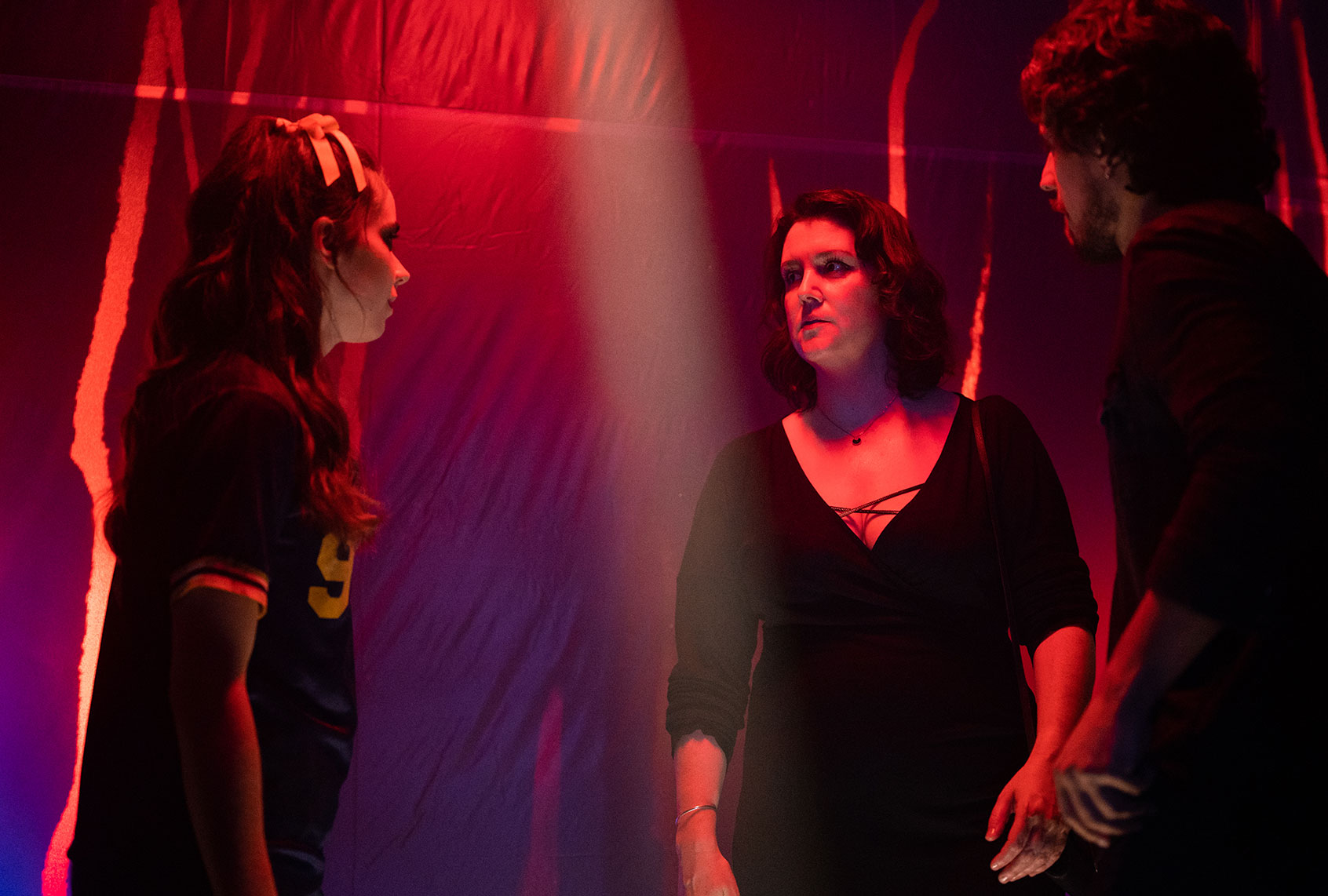
But “Lost” seems timid in comparison to “Yellowjackets,” which reveals the cannibalism at its core early. The very first scene features a barefoot girl being pursued through the snow. Animal sounds decidedly not made by animals ricochet through the trees as she falls into a pit, rigged with stakes. A girl — looking younger than a teen — in animal pelts, a makeshift mask, stained pink sneakers and a ravaged soccer shirt leans over her. It’s an uncomfortable and bloody start.

This is not a new idea, though, even the cannibalism aspect, and at times, “Yellowjackets” can feel like a mishmash, a collage of influences that doesn’t work quite as well as the intense title sequence promises. With its thrashing tune “No Return” by ’90s veterans Anna Waronker and Craig Wedren, it feels like a yearbook on fire.

But one of the surprising strengths of “Yellowjackets” is that it has a double cast, and the story switches often quickly and seamlessly from the past to the present, where the few surviving Yellowjackets are not doing well, not at all. Shauna (Melanie Lynskey) the center of the series, is an overlooked, stay-at-home mom, numbing herself with a new affair. Taissa (Tawny Cypress) has launched a run for public office — going against how the survivors swore they would stay out of the public eye — and struggles to manage her career, her relationship, and the increasingly troubling behavior of her son, played by Aiden Stoxx. Natalie (Juliette Lewis) has gone a typical trauma path as understood by Hollywood: substance abuse, while the creepy Misty (Christina Ricci) abuses elders in a nursing home, and may be blackmailing her former classmates.

Somebody is, as the survivors receive postcards with a mysterious symbol on them, the evocative image of a sort of stick figure in a dress with a line drawn through it and a hook or curved knife below.

YellowjacketsA mysterious stick figure symbol in “Yellowjackets” (Kailey Schwerman/SHOWTIME)
Like CROATOAN carved on the trees around the lost colony of Roanoke, we see this symbol in the past on a tree near where the Yellowjackets find an abandoned cabin and take up residence. We see the symbol etched repeatedly into the floor of the attic where the skeleton of the cabin’s former resident, a dead hunter with a shotgun and missing fingers, is discovered.

In “Lord of the Flies,” it was the body of a crashed airman in the trees who took on a god-like quality for the struggling boys, who thought he was “the beast.” In “Yellowjackets,” it’s the dead hunter, and the girls attribute the eeriness of the setting to him.

Before he died, was the hunter keeping watch from his perch, hunting, or being hunted? The girls decide to do a séance to find out, and uncover little except that Lottie (Courtney Eaton) can apparently speak French now, possibly while under the influence of a ghost. “Hungry . . . You must spill blood or else,” she cries.

Is the stick figure a sign meant to ward off evil, or to draw it, or to mark prey? And will the cannibalism of “Yellowjackets” be supernatural in origin, physical survival, or a coping mechanism, a ritualized way to make order in the spiraling, unknown world? A lot of the tension of “Yellowjackets” comes from the mystery of where other survivors are in the present day, and how much longer they last in the past. Will eight die in the wilderness, as predicted by the attic séance? Are the girls even alone in the woods?

Some viewers have questioned where exactly a whole soccer team could be lost in North America for 19 months. In Canada, apparently. If the symbol is a nod to Roanoke, perhaps the girls, like one theory goes about the disappearance of the colonizers, will join forces with others in what could be another violent homage to settlements like Jamestown.


Want a daily wrap-up of all the news and commentary Salon has to offer? Subscribe to our morning newsletter, Crash Course.


But with the exception of Coach Ben (Steven Krueger) all the survivors are still just teens in the past, and in the “Blood Hive” episode, two romances start in the woods, against a backdrop of blood. Survival is a bloody business. The girls are on their periods, and hunted animal carcasses, hanging above buckets of blood, are ever-present in the show, which won’t let us forget the coming violence.

YellowjacketsSarah Desjardins as Callie Sadecki, Melanie Lynskey as Shauna and Peter Gadiot as Adam in “Yellowjackets” (Kailey Schwerman/SHOWTIME)

“Yellowjackets” loves an extended metaphor, and in the present scenes, there is a can of paint styled like blood, the blood-red word “SPILL” graffitied on Taissa’s house. Natalie and Misty, trying to find out more about survivor Travis’ alleged suicide, meet a contact in a red-tinted restaurant (I’d really love a whole series of “Lewis” as the shotgun-wielding Natalie just solving crimes, by the way) while Shauna confronts her daughter Callie (Sarah Desjardins) at a Halloween party with red curtains, a strange blood-like light dripping off the walls.

Callie has taken drugs and gone into the city, against her mom’s wishes, and tearfully confesses that she feels sorry for all Shauna has been through. Shauna, in typical emotionless fashion, dismisses it: “Bad things happen in life. I’m fine.” But her daughter knows better. “You’re not. You’re so not fine.”

It’s unclear exactly how much the outside world knows about how the girls survived, but one of the most interesting parts of “Yellowjackets” is how it handles ambiguity and duality. Shauna thinks she sees the ghost of her beloved Yellowjacket friend Jackie at the Halloween party — but it’s actually Shauna’s daughter, who dresses in the soccer uniform Jackie’s parents gave Shauna; Callie didn’t know it was the real thing. Taissa does seem to be hallucinating a person with blood coming out of their eye sockets and a wolf, however, and her son keeps speaking of “The bad one . . . the lady in the tree.” He’s papered the windows of his room with drawings to try and hide from her — but is she real? Is any of it?

The disadvantage of unrolling a mystery this way is that it strings out the story thinly. You gotta have a gimmick, but you gotta have more than that too. Will the payoff be worth it? Or is trauma the real and only story?

With “Yellowjackets,” we know the end at the beginning. The trick is how we get there, how long we can be strung along, and if the bite lives up to its buzz, buzz, buzz. 

More stories like this:

Rand Paul ripped for hypocrisy on natural disaster aid after requesting federal funds for Kentucky

After a series of deadly tornadoes hit the midwest, Sen. Rand Paul, R-Ky., requested federal aid for his home state of Kentucky. Twitter users then quickly criticized Paul for his previous opposition to disaster relief. 

In a letter to President Biden, Paul wrote., “The Governor of the Commonwealth has requested federal assistance this morning, and certainly further requests will be coming as the situation is assessed. I fully support those requests and ask that you move expeditiously to approve the appropriate resources.” 

Kentucky’s congressional delegation wrote another letter requesting “much-needed assistance.” This morning, Senate Minority Leader Mitch McConnell, R-Ky., thanked Biden in a tweet for “the Administration’s quick work to speed resources to help deal with this crisis.”

However, users on Twitter uncovered several instances where Paul criticized other politicians for requesting disaster relief and even voting against disaster relief bills. 

When former Gov. Chris Christie of New Jersey requested federal aid for Hurricane Sandy in 2012, Paul criticized Christie for having a “gimme, gimme, gimme,” attitude. 

In 2017, the Senate passed a disaster relief bill for Hurricanes Harvey, Irma, and Maria, with Paul being one of 17 senators — all Republicans — who voted No. Paul, speaking against the bill, said “People here will say they have great compassion and they want to help the people of Puerto Rico, the people of Texas, and the people of Florida. But notice they have great compassion with somebody else’s money.” 

Aaron Rupar, former journalist at Vox, wrote on Twitter, “Turns out, @RandPaul, that people can’t bootstrap their way out of a storm destroying their house.” 

Rep. Ilhan Omar, D-Minn., reacting to Paul’s letter, wrote, “Glad he is finally realizing states needing federal assistance after a disaster isn’t gritty, wasteful or being “compassionate with someone else’s money”.

Rep. Eric Swawell, D-Calif., echoed similar sentiments, saying “We should do all we can to help our Kentucky neighbors. God be with them — they are hurting. But do not for one second forget that @RandPaul has voted against helping most Americans most times they’re in need.” 

Jemele Hill, contributing writer for The Atlantic, pointed out how Paul’s hypocrisy can be used against him, tweeting,  “We know @RandPaul is a heartless hypocrite. The people in Kentucky deserve the relief regardless of their buffoonish leadership, but if the Dems don’t use this against him and his party in the future, it is a missed opportunity.” 

Helen Kennedey, former reporter at the New York Daily News, said “Kentuckians might want to have a think about who they choose to represent them.”

With federal COVID sick leave gone, workers feel pressure to show up at work

Economists and public health experts alike say paid sick leave is an essential tool — like testing, masks and vaccines — in the effort to prevent COVID-19 infection and keep workplaces safe.

Yet the U.S. is in the midst of another COVID holiday season, and federal laws that offered COVID-related paid sick leave to workers have expired. Colorado, Los Angeles and Pittsburgh are among a small number of places that have put in place their own COVID protections, but many sick workers across the country must wrestle with difficult financial and ethical questions when deciding whether to stay home.

“Millions of workers don’t have access to paid sick leave, and we’re still in a pandemic,” said Nicolas Ziebarth, a labor economist at Cornell University.

The U.S. is one of only a few industrialized nations that have no national paid sick leave policy. By contrast, Germany, Ziebarth’s homeland, has had one for nearly 140 years.

The coronavirus pandemic led to short-term change. The Families First Coronavirus Response Act mandated paid sick leave nationally, a first in U.S. history, according to Ziebarth. The law included about two weeks of full pay for employees who were quarantined or seeking medical attention for COVID-like symptoms and additional weeks at partial pay to care for a child stuck at home because of COVID.

But the paid sick leave mandate consistently applied only to employers with 50 to 499 employees and lasted just nine months, expiring at the end of 2020. After that, employers could decide whether they wanted to continue offering paid sick leave in return for tax credits, though those expired at the end of September.

About 5% of U.S. employees used the federal COVID sick leave protection, Ziebarth and his colleagues wrote in the journal PNAS, and it appears to have helped flatten the curve of the pandemic initially. But it wasn’t enough. The number of people who were sick with any kind of illness but couldn’t take time off went from about 5 million per month before the pandemic to 15 million in late 2020 — even with the federal leave in place.

People with the lowest incomes are the least likely to be covered by paid sick leave, said Dr. Rita Hamad, a social epidemiologist and family physician at the University of California-San Francisco. “We’re just left with whatever patchwork of employer and state policies that existed before, which leave the most vulnerable people least covered,” she said.

The Build Back Better Act, which is up for a vote in the Senate after passing the House on Nov. 19, may grant some paid medical and family leave so workers can deal with longer-term illnesses or caregiving, but it does not include time off for recovering from short-term illness.

Jared Make, vice president of A Better Balance, a national legal nonprofit advocating for worker rights, has been pushing federal, state and local lawmakers for years to expand paid sick leave and has drafted model legislation. He said 16 states, Washington, D.C., and about 20 localities have permanent paid sick time laws. One of the most generous, New Mexico’s, will take effect in July. Colorado, Massachusetts, Nevada, New York and the District of Columbia provide covid-specific emergency sick leave, as do Pittsburgh and a few cities in California, such as Los Angeles, Oakland and Long Beach.

In some places, employers are taking the initiative to address the problem. A recent KFF survey of about 1,700 employers from across the nation found that 37% of workers work in a place that expanded or started paid leave, either to recover from an illness or to help a relative recover from one. Meanwhile, 1% of workers had their paid sick leave reduced or eliminated.

Still, calls to A Better Balance’s free legal help line have skyrocketed since the pandemic began, Make said. “Many workers are either risking their job, or they have no choice but to go to work when they’re sick, and it’s a real public health concern.”

In August, local public health departments in California asked state leaders to extend paid sick leave to all workers, saying that failing to do so discouraged people from getting a COVID vaccine and disproportionately affected disadvantaged communities.

Many people who have avoided vaccination are afraid they’ll suffer side effects that will force them to miss work for a day or two, which they can’t afford, Hamad said.

But without federal funds to reimburse employers, California and other states would have to find money to pay for sick leave — and there’s little enthusiasm among lawmakers for passing the costs on to businesses.

“It is a glaring gap, in our opinion, that the federal government hasn’t continued some form of even COVID-19 emergency sick leave,” Make said. “It’s obviously a huge shortcoming given where we are in the pandemic.”

Colorado, which is experiencing a COVID surge, passed last year what Denver-based Make considers the strongest COVID sick leave protections of any state. The law, which allows any employee to earn up to six days of paid sick leave per year and takes effect fully in January, says that when local, state or federal officials declare a public health emergency, employers must supplement workers’ accrued leave so an employee can take up to two weeks of paid sick leave for, in this case, COVID-related reasons. The emergency leave provision won’t expire until at least February.

However, some employers aren’t complying. As of early November, Colorado’s Division of Labor Standards and Statistics was looking into complaints related to the sick leave law that were filed against 71 employers, according to outreach manager Eric Yohe. That represented about 8% of all its wage complaints under investigation. Yohe said his division had already restored paid time off for “a good number” of employees under the new law.

Colorado’s leave law still has limitations. Workers don’t get “refills” of COVID leave if they get sick again or a relative gets sick — just 80 hours total from January 2021 until the public health emergency ends. And the law allows some workplaces to force employees to use their paid time off instead, as long as they notify employees in advance and offer at least two weeks of PTO to full-time employees.

Jamie Bradt, a special-education teacher at a high school in Mead, Colorado, found herself in that situation this month after testing positive for COVID. Bradt, who is fully vaccinated, thought she could tap into state-sanctioned COVID sick leave. But her employer, St. Vrain Valley Schools, told her she would have to use her PTO, which she had been saving up for about decade.

“It is so frustrating that I’m being punished for accruing my leave,” said Bradt, who was isolating at home. The district did not respond to questions.

Policies that push employees to work when they’re sick are counterproductive, said Barbara Holland, an adviser at the Society for Human Resource Management, a national trade group. “It’s a communicable disease,” she said. “You don’t want them showing up in the workplace.”

Since the federal provisions expired, Cristina Cuevas and her colleagues at a Minnesota school have been required to use their accrued sick and vacation time if they come down with COVID.

Recently, a co-worker of Cuevas’ went to work sick, assuming it was a cold. “She actually had COVID the whole time,” Cuevas said. The school had to shut down briefly, Cuevas said, and several students got sick.

California Healthline correspondent Rachel Bluth contributed to this story.

Subscribe to KHN’s free Morning Briefing.

CPAP nation: Why millions of Americans willingly go to sleep with a hose strapped to their face

The only way I can fall asleep is if I look and sound like Darth Vader, at least in my mind — and my doctor supports that.

This is not some strange cosplay fantasy. I'm merely one among millions of Americans who needs to use a machine known as the CPAP (short for Continuous Positive Airway Pressure) in order to sleep. After being diagnosed with obstructive sleep apnea — a condition in which your trachea collapses when you try to breathe while lying down, making it impossible to attain quality sleep — my doctor explained that a CPAP could keep my throat open. Naturally I was excited at the prospect of not feeling exhausted all day, but that joy quickly turned to dread once I strapped on my CPAP mask.

CPAPs work by forcing a constant level of air pressure greater than atmospheric pressure into your upper airway. The machine includes a small device roughly the same size as a radio alarm clock, albeit with a water chamber on one side (to limit daytime feelings of dryness). The main device is attached to a hose and that, in turn, is connected to a mask which is strapped to your head. There are different types of masks to cover your nose, mouth or some combination of the two; patients are encouraged to choose whichever one feels most comfortable. I went with a nasal mask, but for the first few nights I couldn't resist the urge to rip it off of my face. Other CPAP users had complained to me of feeling constricted and unable to toss and turn while attached to the machine; or having dry mouth when waking up; or hating the feeling of the straps against their skin. For me the problem was visceral: That nasal mask triggered an instinctive fear of suffocation.

"There are two common complaints I hear from people that have recently been prescribed a CPAP machine," Bruce D. Forman, PhD, a psychologist practicing in Weston, Fla. who specializes in treating insomnia, told Salon by email. "The first is that the mask itself feels uncomfortable. The second is the sense of being suffocated."

Despite these concerns, Forman and other doctors urge patients who were prescribed a CPAP after a sleep study to not give up on them. Obstructive sleep apnea is more than an inconvenience; sufferers are at a high risk of elevated blood pressure, heart disease, strokes, diabetes, Alzheimer's disease and a number of mental illnesses. While some people can correct their apnea with lifestyle changes like weight loss or surgery (one method, an "Inspire" implant that moves the obstructions out of the way, is garnering increased attention), most will be prescribed a CPAP because the machines improve health outcomes despite their drawbacks. This puts many patients in the difficult position of struggling to sleep while feeling physically and psychologically uncomfortable with their appliance.

For patients who dislike the "tactile sensations" of feeling the straps or mask against their face, Forman suggests that patients practice wearing their mask so they can grow accustomed and be desensitized. (He also has found meditation and relaxation can increase their sense of comfort.) Sometimes patients need to switch their masks; each nose and mouth has a distinct shape and size, so your discomfort may simply mean you haven't found the right fit. Similarly, if a patient feels they are suffocating, it could mean their machine is not ramping up the air pressure quickly enough, and that can be corrected by adjusting the CPAP machine. (Forman noted that he hasn't heard complaints about being suffocated for a while, which he attributes to how "the older CPAP machines had to have pressure set based on sleep study results.  The newer machines are self-regulating.")


Want more health and science stories in your inbox? Subscribe to Salon's weekly newsletter The Vulgar Scientist.


Patience also helps. Thomas Fasham, a 63-year-old male and retired government worker, told Salon in writing that he has had his share of troubles with his CPAP. At first he struggled to get used to it and learn to breathe correctly while wearing it. Traveling is still a problem, as they take up space in luggage and "TSA agents give them a long look." Obviously they are rendered ineffectual on nights when Fasham loses power.

Yet after about a month, Fasham was able to make the necessary adjustments to his breathing, meaning that least the CPAP has been able to do its main job. Now he has been using it for 10 years and describes himself as "addicted." He doesn't fall asleep during the day and gets restorative rest at night.

Forman, who also uses a CPAP, found that he struggles with the feeling of the straps on his face. To acquire the mentality that he would have to use to beat this, he applied his knowledge of horses to his own predicament.

"Part of breaking horses involves putting a bridle on the horse and leaving it there till the horse is comfortable with it," Forman explained. "At first, it drives the horse kind of nuts, but in time [it] gets accustomed to it being there and eventually it's not even noticeable."

Michelle Strauser, a 61-year-old woman in Westerville, Ohio, told Salon by email that she probably owes her life to the fact that she was able to overcome her initial difficulties and get used to a CPAP. Before she started her therapy in 2011, she felt constantly exhausted and would try to nap whenever possible. After waking up in the morning, she had terrible headaches. No amount of sleep ever helped her feel rested. Yet that does not mean she immediately embraced the CPAP.

"I will admit that using a standard CPAP machine for the first two years was a nightmare," Strauser explained. "I'd wake up to find that I'd taken the mask off in my sleep. Have you ever blown (gently) in a baby's face? I felt like that – like it was stealing my breath and I'd start to panic. I couldn't use it spring or fall during allergy season at all, due to my congestion. It was awful and I really struggled with wanting to just give up."

Strauser said that things turned around when started using an auto-CPAP, which automatically adjusts to a person's breathing needs as it changes throughout the night, and became more adept at changing the settings of her machine. Now she is done with the raccoon eyes that used to beset her, and morning headaches and weekend fatigue are rare. That does not mean she loves the CPAP, though.

"I can't say that I 'love' my CPAP therapy – who really wants to sleep wearing a mask, with air blowing in your face all night long?" Strauser wrote. "Struggling with the placement of the hose every time you roll over, and dealing with the leaks because changing your position changes how the mask sits on your face? Blech."

Not everyone has to make those adjustments. The first patient to ever use a CPAP — a man who did so because the alternative was a tracheotomy, in which doctors would have punched a hole in his throat — was overjoyed after his maiden voyage. There are also people like Steve Ogden, a 66-year-old male who works as a financial advisor in a small town.

"I was very lucky, no issues at all," Ogden wrote to Salon, adding that he only experienced "a little discomfort" in the beginning and hasn't missed using his CPAP in over a year. "While it took a while (a few weeks, not months) to sleep through the night, the 45 events per hour going away was more than a good trade off." He described how he used to feel so lethargic that he would require naps throughout the day. After a sleep study revealed that he had been deprived of restorative sleep for at least a couple decades, Ogden found that the CPAP "changed my life. Today, I wake with energy, feel more motivated and alive, and don't need the naps as I used to. My productivity has improved dramatically and so has my mental health. Now, instead of struggling to get through the days, I enjoy working again. It's truly amazing."

Since I was closer to Fasham, Forman and Strauser than Ogden in my CPAP experience, I did have to learn to get past the psychological angst of wearing the mask. My trick? I channeled my inner "Star Wars" nerd. If you listen carefully while breathing with a CPAP, it almost sounds like Darth Vader's iconic inhales and exhales. By concentrating on seeing if I could match my breathing to the sounds of the character, I distracted myself from my CPAP anxiety and managed to drift off to sleep. Now it has became a routine.

Since it works, my doctor has no complaints.

More stories on sleep and sleep apnea: 

Jan. 5 email from Mark Meadows: National Guard ready to “protect pro Trump people”

Mark Meadows, Donald Trump’s White House Chief of Staff, reportedly sent an email suggesting that the National Guard would “protect pro Trump people” during the January 6 Capitol riot. 

The revelation is just one of many in a Sunday report released by the House committee charged with investigating the insurrection. 

“Mr. Meadows sent an email to an individual about the events on January 6 and said that the National Guard would be present to ‘protect pro Trump people’ and that many more would be available on standby,” the report alleges. The email’s recipient, however, was not disclosed. The report also notes that Meadows was “in contact with at least some of the private individuals who planned and organized a January 6 rally” ahead of the riot. 

Meadows’ email appears to align with Trump’s previous comments to former Defense Secretary Christopher Miller. Back in May, Miller testified that the former president told him to “do whatever was necessary to protect the demonstrators that were executing their constitutionally protected rights.”

This week, Meadows reportedly turned over a 38-page PowerPoint presentation entitled “Election Fraud, Foreign Interference & Options for 6 JAN” that was circulated on Capitol Hill in the days leading up to the insurrection. The presentation outlined a plan to declare a national emergency in an effort to delay the certification of the 2020 election. It also entailed the promulgation of the baseless conspiracy that Venezuela had compromised U.S. voting machines in a number of battleground states. 

RELATED: Inside the 38-page PowerPoint TrumpWorld circulated to justify election subversion

According to the House’s committee Sunday report, Meadows “received text messages and emails regarding apparent efforts to encourage Republican legislators in certain States to send alternate slates of electors to Congress.” Speaking of the plan, Meadows reportedly wrote in a text message: “I love it.”


Want a daily wrap-up of all the news and commentary Salon has to offer? Subscribe to our morning newsletter, Crash Course.


According to POLITICO, Meadows’ newly-unearthed email is “of high interest” to committee investigators because they are working to ascertain why the National Guard’s response was delayed during the riot. 

Back in March, initial reports suggested that the Defense Department placed heightened restrictions on the Guard’s deployment, prolonging it by three hours even though the troops were on standby. The Defense Department has since pushed back on these claims, alleging that guard members were not prepared for deployment. Last week, an ex-D.C. National Guard official accused two top Army officials of lying to Congress about the military’s slow response on January 6, criticizing the branch’s inspector general for releasing a report replete with “inaccuracies, false or misleading statements, or examples of faulty analysis.” 

RELATED: Leaked memo: Ex-D.C. guardsman says Michael Flynn’s brother lied about Jan. 6

This week’s House report recommends that Meadows, who was subpoenaed by the January 6 panel in September, should be held in contempt of Congress. Meadows has insisted that he is protected by executive privilege, but the House committee has pushed back on this claim, saying in a report that it is “confident that there is no conceivable immunity or executive privilege claim that could bar all of the Select Committee’s requests or justify Mr. Meadows’s blanket refusal to appear for the required deposition.”

When SCOTUS guts Roe: The covert plan to provide abortion pills on demand – and avoid prosecution

This past Friday, the Supreme Court upheld Texas’ near-absolute abortion ban and gave their blessing to the novel enforcement mechanism, a Stasi-reminiscent system that depends on private citizens surveilling their neighbors and claiming bounties on anyone caught “aiding and abetting” an abortion. Despite some misleading headlines caused by a confusing decision, the bottom line is, in Texas, bounty hunters can still stalk people seeking abortion and legally harass and bankrupt anyone who helps them. 

The decision was surprising because the court is also widely expected to overturn Roe v. Wade outright in June. Soon over two dozen states — including Texas — are expected to have laws that allow police officers to simply arrest people for abortion. Friday’s decision not only creates a mess of legal headaches in managing the bounty hunters, it opens the door for blue states to use similar systems as a back door ban on guns, something California is already moving to do.

So why did the Supreme Court not just leave it to the cops, which is how abortion bans were enforced in the pre-Roe era? The answer may lie in the one enormous technological advance that happened in the near five decades of legal abortion: The abortion pill.

RELATED: I’m a doctor in Texas. Unscientific laws are preventing me from providing the best abortion care

Unlike in the pre-Roe days, when getting a safe abortion meant finding someone who could physically perform it, now pills can be used in the privacy of one’s own home. As Dr. Daniel Grossman of the University of California at San Francisco told Salon, “online sites that are making the pills available” with “accurate information” and “good quality medication” allow for self-managed abortion to “be very safe and effective.” Past images of the coathanger or the back alley abortionist could very well be replaced in the near future with pictures of a brown paper package purchased discreetly online — either from overseas pharmacies or, possibly, states where abortion will still be legal. This goes a long way to explain the right’s interest in creating an army of snitches who will turn in their neighbors and friends for a $10,000 reward. 

But some activists are betting on the pills as a way for abortion to not just be physically safe, but safe from law enforcement. 


Want more Amanda Marcotte on politics? Subscribe to her newsletter Standing Room Only.


“We’re having abortions. We’re helping each other have abortions. You will never, ever stop us,” Amelia Bonow of Shout Your Abortion told Salon. Her group, which started as an abortion storytelling project, responded to both the Texas abortion ban and to Dobbs vs. Jackson Women’s Health — the case the Supreme Court is expected to use to overturn Roe this term — by focusing their advocacy on the pill.

During Supreme Court arguments over Dobbs earlier this month, Bonow and other activists stood on the Supreme Court steps and swallowed mifepristone, the first of the two-pill regimen to end an unwanted pregnancy. (Bonow reports she had minor but inconsequential bleeding afterward.) They put up art installations around the country and created a social media campaign, to highlight that the pills are “widely available online via telemedicine or by mail in all 50 states.” They also set up a website directing users to sites that help patients find pills and use them safely. Some, like Aid Access, even have helpful videos explaining how to use the pills — and are hosted overseas, outside of the reach of U.S. law enforcement. 

Bonow promised more actions to come to make the pills easier to get and use. She is inspired not just by those pre-Roe underground abortion providers like the Jane Collective, but also ACT-UP, who challenged the medical gatekeeping that kept HIV drugs out of the hands of people who needed them in the 80s. 

RELATED: Are women people? Why the Supreme Court just signed off on a Texas law that denies women’s humanity

Experts in the history of illegal abortion, however, have their concerns. The pills themselves are “very, very safe,” explained Dr. Carole Joffe, a UCSF colleague of Dr. Grossman’s who wrote “Doctors of Conscience: The Struggle to Provide Abortion Before and After Roe V. Wade.” Indeed, as she noted, there’s extensive evidence that women are already doing at-home abortions this way. One major study shows that 7% of women 18 to 49 have attempted self-abortion

However, “the huge difference between then and now is the legal surveillance,” Joffe said. In the pre-Roe era, there simply wasn’t “the extraordinarily well organized anti-abortion movement we have now, so people could take chances that I think will be much harder to take now.”

Leslie Reagan, a University of Illinois at Urbana-Champaign professor and author of “When Abortion Was a Crime: Women, Medicine, and Law in the United States, 1867-1973” concurred. She notes that abortionists mostly got caught pre-Roe if a patient was injured and “interrogated by doctors and nurse and police” at the hospital. Now, however, “the potential for surveillance is so much higher with the internet and our phones.” She also argued that the Texas law, which applies to anyone who “aids and abets” an abortion, could have a chilling effect on information-sharing about how to get safe pills.

Slate legal expert Dahlia Lithwick also believes the future will be worse, legally speaking, than the pre-Roe era because the religious right is far more interested in “punishment for women who endanger their pregnancies” than law enforcement was before 1973.


Want more Amanda Marcotte on politics? Subscribe to her newsletter Standing Room Only.


This isn’t just conjecture. Women are already going to prison, after being accused of doing something to cause miscarriage or stillbirth. National Advocates for Pregnant Women has documented at least 1,254 cases of women being arrested or detained under such accusations. In one famous Indiana case, a woman named Purvi Patel was convicted of “feticide,” with prosecutors using her text messages mentioning abortion drugs purchased online. Her conviction was later overturned because abortion is, at the moment, still legal. But if Roe is overturned, such convictions may very well stand, especially as states expand their anti-abortion laws. 

Bonow is well aware of the legal dangers, especially for “the most marginalized among us,” such as low-income and young women, women of color, and LGBTQ people. But that is why her group isn’t just focused on sharing information on physical safety, but on “ways that people can mitigate their legal risk,” such as using tech services that make online activity harder to trace. 

RELATED: Republicans’ anti-abortion crusade won’t stop — even if the Supreme Court overturns Roe v. Wade

“We need to talk about it because a whole lot of people are going to need to have illegal abortions,” Bonow noted. Indeed, all prevailing evidence shows that banning abortion does little to actually stop it. On the contrary, countries that ban abortion tend to have higher abortion rates than countries where it is legal. Her hope is that activists can fight “to make sure that you get what you need and evade criminalization in the process.” 

Doctors have a role to play in this. On Twitter, Dr. Grossman floated the idea of doctors providing advance provision of pills, in response to sex advice columnist Dan Savage suggesting stockpiling. “Advance provision of abortion pills before you need them makes a lot of sense,” he wrote. “Mifepristone has a shelf life of about 5 years, and misoprostol has a shelf life of about 2 years.”

As Grossman explained to Salon, some doctors already do this for patients who are traveling overseas for a long time, especially in places where the law or lack of resources makes the pills hard to get in a pinch. California has already moved to enhance patient confidentiality protections in anticipation of patients who obtain pills in their state for use in one where abortion is banned. 

Dr. Grossman also suggested that doctors themselves need to be educated on how to better protect patients. Once abortion is banned, he notes, “some of this is going to fall on emergency department clinicians,” because patients who show up with rare complications — or, in some cases, are just worried — after taking abortion pills at home. 

“We need to get better about really figuring out what questions we need to ask and what we need to document in the medical record,” he noted, because he worries that “the medical record could be used against the patient to potentially prosecute them.”


Want more Amanda Marcotte on politics? Subscribe to her newsletter Standing Room Only.


Safety is, of course, the main impetus for these discussions on evading abortion bans. As long as people enjoy having sex — which will be forever — there will be a need for abortion, and the only real question is whether they are safe or not. But there is a political angle, as well.

Bonow sees the “visible culture of defiance and of rejection of these laws” as a way to build more political will, which is the only hope of ever overturning abortion bans. As Reagan noted, the “visible social movement and visible law breaking” of activists like the Jane Collective and Pat Maginnis, who would deliberately get arrested for passing out information on safe abortion in the 60s, helped build the momentum that led to Roe v. Wade in the first place. This could also help answer the question that has been plaguing progressive activists for the past year: How to defeat the growing sense of helplessness on the left.

The four pillars of activism that are always offered to people who want to help — vote, donate, legal protest, and calling your representatives — have done little to stem the rising tide of authoritarianism. Voting rights and democracy are still imperiled. Abortion is about to be banned across huge chunks of the country. Activists are going to have to get more creative about actions people can take if they want to shake folks out of their malaise. Perhaps campaigns like the Shout Your Abortion pill campaign can generate new ideas about how to resist, and restore hope that actions you take can still have a real impact on the world. 

The no-explosion way to open champagne

I don’t believe that you need an excuse to open champagne, but when you have a bottle of really good bubbly, you might want to save it for a special occasion. Say, an anniversary, date night, or New Year’s Eve, or a Thursday. But opening a bottle can be intimidating. There’s no electric corkscrew or fancy wine preservation system to help you out. It’s just you, the cork, the wire cage, and a kitchen towel. Whether you have a pricy vintage champagne or an inexpensive bottle of sparkling wine, the last thing you want is a cork flying across the kitchen and bubbles bursting out of the bottle and onto your kitchen countertops. And cabinets. And the floor. And that new velvet dress that you bought just for tonight.

How to open champagne

When learning how to open a bottle of champagne, who else would I turn to than Veuve Clicquot for instructions? My fiancé and I enjoy a bottle of the iconic yellow label champagne for every special occasion in our lives — birthdays, anniversaries, new jobs, new apartments, and holidays. No one does champagne like the French.

Didier Mariotti, cellar master for Veuve Clicquot, walked me through how to open a bottle of champagne:

Step One

First, remove the foil carefully. There should be a small lip on the neck of the bottle that allows you to remove the foil easily. “If there isn’t a tab, use the knife on a wine key to help get you started, and remove the foil so that the cage is exposed,” adds Elise Cordell, National Ambassador for Perrier-Jouët Champagne (another equally worthy French champagne house, IMO).

Step Two

Loosen the wire cage and untwist, but be absolutely sure to leave the cage on the bottle. “Many people make the mistake of removing the cage, but leaving it on will ensure the pressure stays within the bottle,” says Mariotti.

Step Three

Place your thumb tightly on top of the cage and twist the bottle with one hand. “It is a common belief that you should be twisting the cork, but it is actually the opposite,” he says.

From there, the cork should naturally pop! Remove the cork with your dominant hand and tilt the bottle to a 45-degree angle.

Step Four

Voila! Your champagne bottle has been popped. Chill it in an ice bucket or pour immediately into a coupe or flute glass.

Tips for opening champagne

Now that we’ve covered the basics, there are a few things you can do to advance your bottle opening technique. First make sure your bottle of champagne is well-chilled. “I recommend letting it spend at least two hours in the refrigerator, but if you’re short on time, you can submerge the bottle in a 50/50 mix of ice and water and it will chill down in around 15-20 minutes,” says Cordell.

While popping a bottle of champagne is always cause for celebration, keep the noise to a minimum — at least when it comes to the bubbly. “We all love that ‘champagne pop,’ but the truth is, the more quietly you’re able to open the bottle, the more bubbles you’ll enjoy in your glass and reduce the risk of the bottle bubbling over,” says Cordell.

How to saber champagne

We’ve all seen the viral videos of a well-dressed lad or lady (or maybe just some tipsy college students on the porch of their frat house) attempting to saber a bottle of champagne. But it can be dangerous, to say the least. Fail to saber correctly and you’ll find that your porch will be covered in a million tiny shards of glass. “While visually exciting, sabering a bottle can come with some risks. I suggest using gloves if you have them, and protective eyewear,” says Cordell.

To start, remove the foil from a (very cold, well-chilled) bottle of champagne. Keeping pressure on the cork and cage, carefully loosen the cage and remove it from the bottom lip of the bottle neck, and re-secure it to the top lip. Hold the bottle securely from the bottom, with your thumb at the indentation at the bottom of the bottle and aim away from the crowd. Find the seam of the glass and hold your saber firmly along that line; Cordell says to think of this line as your runway.

Now you may be getting nervous and feel your heart rate increasing. You want to put on a show and everyone is watching! But having a slow, fluid action versus a fast, forceful one will allow you to saber like a pro. Position your saber flat against the bottle, and run it down the seam of the glass toward the lip. On the count of three, your fluid strike should separate the bottom of the neck of the glass and cork from the bottle itself . . . and possibly a little bit of wine. You did it (I hope)!

Everyone will be anxious to try the newly sabered bottle, but it’s important to hold the bottle with caution as it now has a sharp edge to it.

Jan. 6 PowerPoint reveals many more Republicans were in on Trump’s coup plot

Last week a federal court agreed to schedule Steve Bannon’s contempt of Congress criminal trial for July of next year — just as the fall campaigns go into full swing. He must be very pleased. Bannon would like nothing more than to have a big show trial at that moment and be carted off to jail where he can write his Great Replacement manifesto.

With the news that there was a PowerPoint presentation called “Election Fraud, Foreign Interference & Options for JAN 6”, reported here by Brett Bachman, Bannon’s revolutionary proclamations on his Jan. 5th podcast have become clearer. Recall what he said:

“Mitch McConnell’s got to start taking care and focusing on these senators — because this is going to be very controversial. We are going into uncharted waters. We’re going into something that’s never happened before in American history. Tomorrow it’s going — we’re pulling the trigger on something that’s going to be, it’s going to be minute by minute, hour by hour, what happens. The stakes couldn’t be higher right now.”

“It’s not going to happen like you think it’s going to happen …Okay, it’s going to be quite extraordinarily different. All I can say is, strap in. … You made this happen and tomorrow it’s game day. So strap in. Let’s get ready…It’s all converging, and now we’re on the point of attack tomorrow.”

It’s understandable that people would suspect that he was talking about the violence that took place when Trump incited his crowd to converge on the Capitol and he may very well have been. He and the others who were plotting at the Willard Hotel in the days before the insurrection were very close to groups like the Proud Boys and Oath Keepers, who had an outsized role in the attack.

But it’s clear now that Bannon was also talking about the plans laid out in that PowerPoint presentation which included some of what we knew but also reveals some rather chilling recommendations that add more detail to what was undeniably a coup attempt. When he said, “We are going into uncharted waters. We’re going into something that’s never happened before in American history,” he wasn’t kidding.


Want a daily wrap-up of all the news and commentary Salon has to offer? Subscribe to our morning newsletter, Crash Course.


The presentation indicated that Mike Pence had more than one way to overturn the election. As vice president, he could seat alternate Republican electors (which Rudy Giuliani and the boys were working feverishly to round up), he could reject the electoral votes of the states Donald Trump was disputing (with no evidence) or he could delay by refusing to certify until there was a recount of all paper ballots. That last coincidentally tracks with the fatuous proposal by Senator Ted Cruz, R-Tx, and 11 other senators who planned to delay the count in order to conduct an “emergency audit” in the states Donald Trump was disputing in order to “restore trust in the electoral system.” Finally, Pence could just throw up his hands and say there was no way to ever know the real outcome and throw it to the House of Representatives which would vote as if it were a tie and Trump would win under the rules that each state delegation has one vote.

None of those recommendations were remotely constitutional.

Meanwhile, the PowerPoint also recommended that Trump brief Congress on alleged foreign interference in the election, deem all electronic voting in the states invalid, declare a National Security Emergency and put the National Guard on standby. (Politico reported that Chief of Staff Mark Meadows did order the guard to be available to “protect pro-Trump people.”) Here’s a little flavor of what they had in mind:

twitter.com/BetsyStover/status/1470250917668605956

The PowerPoint also features some of the looniest conspiracy theories hatched in the wake of the election. One slide states that a “key Issue” is that “critical infrastructure control was utilized as part of ongoing globalist/socialist operation to subvert the will of United States Voters and install a China ally leading to another one advising the president to say the Chinese government interfered in the election as a pretext to declaring all the electronic votes invalid.


Want a daily wrap-up of all the news and commentary Salon has to offer? Subscribe to our morning newsletter, Crash Course.


This presentation was released by the January 6th Commission because it turned up in former Chief of Staff Mark Meadows’ documents which he voluntarily turned over the committee. It took a day or so before the person who circulated it was identified — a former Army Colonel by the name of Phil Waldron, who told the Washington Post that he worked with Trump’s lawyers to put it together. Waldron said he contributed the stuff about foreign interference and he claims that he met with Meadows 8-10 times and helped to brief members of Congress before January 6th on what they had in mind, telling the Post that the presentation’s recommendations were “constitutional, legal, feasible, acceptable and suitable courses of action.” And he’s right — if you are plotting a coup in a banana republic.

Not one of the people who read this disgraceful betrayal of American democracy blew the whistle. Well, except for Lara Logan, the Fox News personality who recently compared Dr. Anthony Fauci to infamous Nazi doctor Joseph Mengele. She tweeted out a version of the PowerPoint on January 5th but nobody paid any attention because she has no credibility. And yes, it was reported in Bob Woodward and Robert Costa’s book “Peril” that Senators Mike Lee of Utah and Lindsey Graham of South Carolina “vetted” the fraud claims and determined that it wouldn’t be prudent to overturn the election. I’m sure others clutched their pearls in the Senate cloak room, worrying about how risky the whole thing was as well. Not that they said anything publicly, of course.

RELATED: Trump lashes out at GOP senators, blames Lindsey Graham and Mike Lee for his failed coup attempt

We knew that Trump had many different plans to overturn the election. The memos prepared by right-wing lawyer John Eastman, Trump telling Acting Attorney General Jeffrey Rosen “just say that the election was corrupt and leave the rest to me and the Republican Congressmen” and threatening to replace him with a toady, Jeffrey Clark, if he refused were just a few examples. All of this was grossly unethical.

But this PowerPoint emphasizes just how desperate they were.

They threw everything at the wall in the hope that something would stick, that enough Republicans in Congress would grab on to one of the rationales they offered and agree to at least delay the certification or overturn it outright. When Vice President Mike Pence refused to go along, Trump tried one last gambit. He sent the angry mob he’d just whipped up to march to the Capitol to give the “weak” reluctant Republicans the “pride and boldness” they needed to stop the certification. It’s why he sat on his hands for hours as his supporters stormed the Capitol.

In the “Succession” season 3 finale, Roy sibling unity is no match for Daddy

The “Succession” opening credits sequence is a mashup of Roy family home movies. A more accurate assessment would call them evidential videos that the children of Logan Roy (Brian Cox) were at one point allowed to be children. Sort of.

As Nicholas Britell’s piano theme jingle-jangles in its ominous minor key, we take in sepia-filtered frames of the kids in an estate’s garden — not playing in the grass but standing, unsmiling, radiating all the joy of the condemned before a firing squad.

But their father is always elsewhere, whether walking away, passing by and generally maintaining a vast emotional distance between him and his heirs. That leaves the youngsters we presume to be Connor (Alan Ruck), Kendall (Jeremy Strong), Shiv (Sarah Snook) and Roman (Kieran Culkin) with a permanent view of their father’s back.

Every episode of the show reminds us that from a young age, Logan’s kids have always been several steps behind him, if not on an entirely different continent. That makes the possibility at the climax of the third season’s finale — that Kendall, Shiv and Roman could put aside their differences and work together to enact a full coup — so enthralling.

Jesse Armstrong, who wrote the episode directed by Mark Mylod, was never going to let the Roy scions pull off a regicide so cleanly.

RELATED: On “Succession” every dog has his day

But the fact that he had us believing even for a second that they could succeed proves how electric Strong, Snook and Culkin can be when they come together.  When they face down Cox, as Logan, and he annihilates his children, their hollowed-out expressions end the season exactly where it should.

Every “Succession” episode teems with searing lines, but Logan’s face-melting speech kills the concept of fatherly love dead in the Roy bloodline for all time. The single lesson Shiv, Kendall and Roman can’t seem to wrap their heads around is that Logan always wins, both for and against his family. When they’re beaten bloody at his feet, Roman can only bleat, “Dad … please.”  

Logan asks what he has to offer him as a counterweight to a deal sealing their fates. Here Armstrong falls back to “King Lear” and Cordelia. “What I have got?” Roman lamely replies. “I dunno … f**kin’ love?”

“You come for me with love?” Logan growls cynically. “You bust in here, guns in hand, and now you find they’ve turned to f**king sausages … you talk about love? You should have trusted me.”

“Dad, why?” Roman whispers.

“Because it works,” Logan hisses. “I … f**kin’ win.”

Roman can’t even call on Gerri to help him, and why would she? “I’m focused on whatever outcome best serves the financial interests of the shareholders of the company,” she says to Roman on his knees in front of her, asking for help. “But it doesn’t serve my interests. How does it serve my interests?”

RELATED: Gerri & Roman: A one-way “Succession” lust story

Armstrong’s writing brings out the best in every moment of this episode, and every member of this cast, as ever. 

While Strong rockets between despair and quiet, determined vengeance, Snook works her angry queen energy and Culkin writhes and withers between his siblings and his father, Cox shreds the scenes where Logan flexes his might, as he must. He’s eyeing either ignominious obsolescence or acquisition at a point in Waystar Royco’s timeline when it still has value and Logan himself has power.

The third season finale episode’s title, “All the Bells Say” references another line from the John Berryman poem “Dream Song 29,” from which the second season ender “This Is Not For Tears ” draws its title. Here, Armstrong creates a flawless bookend to the previous season’s closer.

“All the Bells Say” comes at the end of a season in which Logan turned Shiv and Roman against Kendall after he went rogue trying to assume a social justice warrior’s mantle without knowing what the term means. Logan reels in Roman with the empty assurance of power in exchange for loyalty, and ices out Shiv at every turn as payback for any number of slights.

Mainly, though, Shiv’s gender ensures that Daddy will never let her hold power. When Logan decides to jump on a private jet to seal a deal to merge Waystar Royco with the tech media conglomerate GoJo, he taps Roman to interface with GoJo’s head Lukas Matsson (Alexander Skarsgård) instead of his dear Pinky.

RELATED: “Succession” presents the “Chiantishire” dog show, starring the well-bred Roys

This is after Logan’s youngest son sends him a d**k pic meant for his general counsel Gerri (J. Smith-Cameron). Logan would rather put his trust in his lecherous sexual harasser of a son, not his daughter.  

A more grievous insult comes Shiv’s way later as her husband Tom (Matthew Macfadyen) makes a Faustian bargain to move him and Cousin Greg (Nicholas Braun) “away from the endless middle and towards the bottom of the top. “

“Do you want a deal with the Devil?” Tom asks Greg. When he says it, we don’t know which Devil he’s actually dancing with.


Want a daily wrap-up of all the news and commentary Salon has to offer? Subscribe to our morning newsletter, Crash Course.


As is ever the case with “Succession,” the business deals are far less important than what they tell us about how little Logan thinks of his children. In this finale, he’s determined to break every single one of them, not just Kendall. But the bludgeoning he delivers is Olympian in power and cruelty, fitting for a man who believes himself to be a god.

The main action takes place at the Tuscany-set wedding reception for their mother Caroline (Harriet Walter), a fitting setting for the Roy children to be reminded in so many ways, and by so many traitors, that they are unloved in a world that’s not inclined to shed a tear for them.

The episode begins with Connor, Shiv, Roman, Tom, Cousin Greg and Willa (Justine Lupe) playing Monopoly as they wait for Kendall to return from the hospital after his PR assistant Comfry (Dasha Nekrasova) finds him unconscious in the pool and fishes him out.

Shiv and Roman fall into their natural mode of making jokes at Kendall’s expense — “the Kurt Cobain of the floaties,” Roman quips — and when Kendall mumbles vacuous threats about a mounting a smear campaign via a profile in Vanity Fair, no one is moved. Comfry quietly admits that they’re the one pitching the magazine, not the other way around … and there you have it.

By the middle of the episode, Connor is screaming “I am the eldest son!” to anyone who will hear it, sliding to such an emotional low that when Willa accepts his marriage proposal, days after he makes it, with, “F**k it. C’mon, how bad can it be, right? Why not?” that counts as an emotional win for him.

Kendall also hits rock bottom, again, finally spelling out to Shiv and Roman the circumstances of the mysterious murder that’s been eating at his soul, revealing it to be on par with the Ted Kennedy Chappaquiddick incident. (Under the influence, Kendall drove into a lake with a server at Shiv’s wedding reception and swam away, leaving the young man to drown.)

This time Roman and Shiv reach out their hands and pull him to his feet, entirely out of a sense of self-preservation through solidarity. For by this point, Connor has discovered a plug of maca root in Daddy’s pantry, alerting him that Logan is trying to “fire up the siege engines” and perhaps have another baby … with his assistant Kerry (Zoë Winters)? Could be.

The womb’s identity matters less than what this implies to Connor. “I guess he really doesn’t rate you guys,” he tells Shiv and Roman. Moments later they find out through texts and other subterranean channels that Logan is moving forward with the GoJo deal without their input, closing the door to any chance of them taking over.

Formally, “Succession” is a story of corporate power and the emotional cost the people who chase it pay to keep as much of it to themselves as they can. But in episodes like this and the second season finale, Armstrong foregrounds the true point of the struggle between Logan’s heirs. Each is dying to prove Father loves them not only more than the others, but also enough to hand over the keys to the kingdom.

But when it looks likely that Matsson’s going to be the one to score the kiss from daddy that’s eluded Shiv, Roman and Kendall all their lives, that’s enough to make these lifelong enemies into allies. During the brief moments when they’re together, the Roy children realize that while none of them can run the company, each of them knows enough about their power as shareholders to gang up.

“I do think that, even though this literally makes me want to vomit and I want to kill you both every day, and it’s all going to end horribly,” Roman admits, “I do think that we — puuuuke — could make a pretty great team.”

They do! Or at least, they look the part. Shiv struts assertively in the lead position as they enter the lion’s den as a united front for once. But Daddy Roy is always many steps ahead, and puts Caroline on the line to deliver the cruelest cut. She and Logan have renegotiated their divorce agreement to change the terms of Kendall’s, Shiv’s and Roman’s shares in the company, slitting their throats.

So it’s not just their father who doesn’t love them. Caroline, their mother, abandons all her impulses to protect her children as well. The final twist of the knife comes in the form of a warm pat on the shoulder Tom receives from Logan as he strides away from his defeated children, hinting that all this time Shiv has been sleeping with the enemy.

Matthew Macfadyen in “Succesion” (Graeme Hunter/HBO)

We should have known: “My hunch,” Tom tells Kendall in episode six, “is that you’re going to get f**ked. Because I’ve seen you get f**ked a lot. And I’ve never seen Logan get f**ked once.” In “Chiantishire,” Shiv tries to pass off her disgust with Tom as dirty talk (“You’re not good enough for me. I’m way out of your f**king league. But that’s why you want me,” she says) and never stops to think he might take her insults as a challenge to outmaneuver her. He doesn’t quite do that, but he arms the man who can and does. Sometimes being at the bottom of the top is enough.

All this leaves “Succession” at a staggering juncture, with Logan still on top, subduing his children again, perhaps for all time, by revealing their mother chose money over her love for them. Shiv knows that Tom loves what Logan can do for him more than his own wife.

Such is the fate for a group of people who spend their lives pursuing a father who doesn’t want to be caught.

“Dream Song 29” is not a widely known poem, but those who may have looked it up might have predicted the events surrounding Caroline’s destination wedding wasn’t going to end well for the Roy children based on the line from which the episode’s name comes. “All the bells say: too late.”

That makes the title, like the episode itself, poetic perfection.

All episodes of “Succession” are streaming on HBO Max.

More stories like this:

16 recipes that use up leftover egg yolks

You made a lofty meringue-topped pie, or a batch of chocolate-dipped meringues for the cookie plate, or a big egg white omelet for breakfast and now you have dozens of egg yolks to use up fast.

Luckily, there are lots of rich, silky recipes that need egg yolks and only egg yolks to become their sultry selves. Crème brûlée or pot de crème are always crowd-pleasers, as is chocolate mousse! Try your hand at homemade eggnog, which gets its name from — you guessed it — eggs — or make homemade pasta for an extra-special holiday dinner that will make your guests say “wowza.”

Whip egg yolks into a batch of mayonnaise or aioli or add a few leftover yolks to a frittata, strata, or big batch of scrambled eggs. Looking for more ideas, or are wondering, “okay Kelly, but how do I make aioli, I’ve got you covered with 16 leftover egg yolk recipes.

How to use up egg yolks

1. Master Pasta Dough, Two Ways

Make fresh pasta! At its base, it’s just flour and eggs. Meryl Feinstein of Pasta Social Club says that an all-yolk pasta dough is silky and luxurious, yes, but doesn’t necessarily have the strength to be rolled and rolled and rolled for intricate pastas. So instead, she uses a combination of whole eggs and egg yolks.

2. Grand (Desk) Aïoli

If you have just one or two leftover egg yolks, use it to make aioli, which you can then serve alongside French friessteamed vegetables, or spread on crusty bread in place of mayonnaise. And it’ll make you feel so ~chic~ eating it.

3. Simplest Bread Pudding with Salted Brown Sugar Sauce

Leave it to Emma Laperruque, Food52’s Food Editor and author of Big Little Recipes, to develop a bread pudding recipe that has the shortest ingredient list we’ve ever seen but with the biggest, boldest flavor.

4. Salted Egg Yolk Pound Cake

This is no ordinary pound cake. It takes days of planning to prepare the salted egg yolks, a widely used ingredient in Asian cuisine. The result not only will help clear out your fridge, but make for a complex cake with a sturdy crumb.

5. Pistachio and Honey Crème Brûlée

You’ve always wanted to try your hand at baking crème brûlée and now you finally have enough leftover egg yolks to try it out. This one uses four of them, but their richness is offset by the lightness of the honey and pistachio-infused cream.

6. Custard Strudel

“Filled with a thick cream cheese filling and drowned in sweet custard, I refer to it as custard strudel,” says Food52’s Resident Baking BFF Erin Jeanne McDowell. It uses a lot of eggs, including two egg yolks, and the brown sugar strudel flows through the citrus cream cheese filling like a sweet edible lazy river.

7. Lemon Curd

Lemon curd is rich in egg yolks and perfect for a DIY holiday food gift for friends, co-workers, or that special someone who insists that they absolutely don’t want or need any presents.

8. Just-the-Best Vanilla Ice Cream

Recipe developer Coral Lee found that the ideal number of egg yolks for a classic vanilla ice cream is three. This number will add richness and protect against iciness, without being too rich or too dense that they’re the only thing you taste.

9. Honey Lemon (or Lime) Curd

This tangy, tart curd can be whatever you want it to be (at least when it comes to the citrus flavor) but we promise that it will be easy to prepare and endlessly versatile.

10. Alice’s Vanilla Ice Cream 2.0

Many ice cream recipes call for egg yolks, which make the custard base creamy and thick — and it’s never too cold for ice cream. You can also dollop your ice cream with zabaglione, an egg-based custard sauce.

12. Hollandaise Sauce

Leftover egg yolks are not a problem — in fact, they’re a good excuse to make Eggs Benedict. Egg yolks plus butter make a dreamy hollandaise sauce to drizzle over poached eggs, Canadian bacon, and craggy English muffins.

13. Coconuttiest Coconut Cream Pie

There are so many ways to make a delicious coconut cream pie, but this one is, as the name implies, the coconuttiest. For starters, it’s not made with any old pie crust. This recipe calls for a coconut shortbread crust. But we’re just getting started. The filling is made with coconut milk, coconut cream, and coconut oil, and the only thing is topped with coconut chips.

14. Frozen Custard

Frozen custard is not unlike ice cream, but really deserves a gleaming pedestal of its own. It’s made entirely of eight egg yolks (okay and heavy cream, whole milk, sugar, etc. etc.) and the result is one very underrated sweet treat.

15. Crème Brûlée Pie

I’ve already talked about how crème brûlée is a great way to use up extra egg yolks. But I got distracted by so many other brilliant uses that I forgot about possibly the greatest recipe on Food52’s website: this 2-in-1 brûléed vanilla custard pie.

16. Spaghetti Carbonara

When you’re craving spaghetti carbonara, in all its fatty, salty, eggy glory, this is the only recipe you need.

Michigan high school massacre: Another tragic example of how white privilege kills white people

There is no area of American life that has not been impacted by the color line in a society where white people are granted unearned advantages over nonwhite people. This is not an opinion, but an empirical fact. American society is literally structured by racism and white supremacy.

That is not to say that racism, white supremacy and white privilege benefit all people deemed “white” in the same way or to the same extent. Likewise, those same societal forces do not impact all people deemed “Black” or “brown” or otherwise not white in the same way either.

In the United States, racism and white supremacy constitute a power relationship that both actively and passively causes harm to Black and brown people because of the color of their skin and the value Western societies have assigned to it.

But they are not the only ones damaged. However counterintuitive this fact may be for some people, racism and white supremacy often hurt white people too.

Let’s examine one recent example. On Nov. 30, a 15-year-old high school student named Ethan Crumbley allegedly went on a shooting rampage at his high school in Oxford, Michigan, killing four of his fellow students and injuring seven other people. Crumbley surrendered to law enforcement — which is somewhat unusual in mass shootings of this kind — and has been charged with terrorism and first-degree murder, among other crimes.

His alleged rampage was not a total surprise, but part of a much larger pattern of behavior. There had been indications for weeks (including posts on social media) that Crumbley appeared to be mentally unwell and a danger to himself and others.

Teachers and school administrators met with the young man and his parents about his behavior, which included violent drawings and verbal threats, and also spoke with him separately on several occasions. One meeting with Ethan Crumbley and his parents took place only hours before the shootings. Law enforcement could have been included in the meetings by school officials but were not, and the young man’s backpack was not searched on the day of the shooting. If it had been, presumably school officials would have found his gun.

A teacher had also alerted school authorities that Ethan Crumbley was searching the internet on his phone for information about various types of ammunition. Instead of punishing him or seeking help, his mother, Jennifer Crumbley, sent him a text that read, “LOL, I’m not mad at you. You have to learn not to get caught.”


Want a daily wrap-up of all the news and commentary Salon has to offer? Subscribe to our morning newsletter, Crash Course.


With that behavior, Jennifer Crumbley showed herself to be exactly the kind of mother that Rep. Madison Cawthorn, the far-right North Carolina Republican, has publicly encouraged to raise their sons as “monsters.”

Ethan Crumbley was allowed to return to class after his meetings with school officials, including on the day of the massacre. He allegedly used a 9mm semiautomatic pistol that his father, James Crumbley, gave him as a gift four days before the killings. 

After their son was arrested for his alleged crimes, James and Jennifer Crumbley fled the area. They were eventually found hiding in a partly abandoned industrial building in Detroit, about 45 miles south of their hometown. If these fugitive suspects had been Black, brown or Muslim it is entirely likely that they would have been killed by law enforcement. Instead, they were arrested unharmed. Their son was afforded the same type of privilege after allegedly committing mass murder.

Crumbley’s parents have been charged with involuntary manslaughter and other crimes. They have also been given the option of going free on bail before their trial — even after they already violated the law by (apparently) attempting to escape to Canada. Again, if the Crumbleys were not white, bail would either not be granted or imposed at an extortionate level. 

How many lives might have been spared in Oxford, Michigan, if not for the power of racism, white supremacy and white privilege?

Because gun violence is not generally treated as a public health emergency, and because white privilege tends to erase the role of whiteness and white masculinity in gun violence,  this society-wide problem has not been properly addressed — except for the ritual stupidity of “thoughts and prayers.”

The vast majority of school mass shootings are committed by white boys and white young men. As a result, they are seen as individual, anomalous events, rather than as a societal problem demanding intervention and resolution.

When it comes to Black and brown young people accused or suspected of even minor criminal activity, white supremacy punishes them — all too often in extreme ways. Through what has been called “adultification,” Black and brown children, even when extremely young, are perceived as inherently dangerous, and not permitted the presumed innocence, vulnerability and need for care, concern and love that society typically grants white children and other young people.

As a result, Ethan Crumbley was presumed to be innocent and incapable of hurting others. By comparison, Tamir Rice, who was 12 years old and playing with a toy gun in a park in Cleveland, was shot and killed by police only seconds after their arrival. Trayvon Martin, 17 years old, was stalked and killed by a street vigilante who was later acquitted of murder. 

Black and brown boys and girls are punished much more severely in American schools, compared to white students, for the same offenses. 

Ethan Crumbley and his parents are the product of an American gun culture rooted in a centuries-long history where guns were used to commit genocide against the continent’s indigenous peoples and also to dominate and control Black people, whether enslaved and free. Guns were also central to a larger project of empire and expansion that involved the subjugation of nonwhite people in many different parts of the world. White America’s relationship to guns and violence as an exclusive element of “white freedom” is also central to the Republican fascist project.

Quite predictably, Ethan Crumbley’s mother is a member of Donald Trump’s political cult, a movement fueled by white supremacy, misogyny, sadism, anti-intellectualism and other antisocial tendencies. In a letter to Trump, Jennifer Crumbley wrote:

Mr. Trump, I actually love that you are a bad public speaker because that showed sincerity, and humility. You changed your mind, and you said “so what.” You made the famous “grab them in the pussy” comment, did it offend me? No. I say things all the time that people take the wrong way, do I mean them, not always. Do I agree that you should of shown your tax returns? No. I don’t care what you do or maybe don’t pay in taxes, I think those are personal and if the Gov’t can lock someone up over $10,000 of unpaid taxes and you slipped on by, then that shows the corruption. I like that you have failed. I love it even more that those failures taught lessons and made you one of the most successful Business Men in my history.

I love that you are not from the political spotlight, maybe you are the hope that can really uncover the politicians for what I believe they really are. I have high hopes you will shut down Big Pharma, make health care affordable for me and my MIDDLE CLASS family again. I hope you uncover the cure for cancer, because there is one, we all know it, but you are the one to prove it. I’m not scared of your big personality and quick temper….

My parents teach at a school where their kids come from illegal immigrant parents. Most of their parents are locked up. They don’t care about learning and threaten to kill my mom for caring about their grades. Do you realize Mr. Trump that they get free tutors, free tablets from our Government so they can succeed. Why cant my son get those things, do we as hard working Americans not deserve that too?…

I believe YOU are the President who will make these things happen. I have NEVER had this much belief in one person, and you are it.

If this blog even makes it to your eyes…thank you. From the bottom of my heart.

Yours Truly,

A hard working Middle Class Law Abiding Citizen who is sick of getting fucked in the ass and would rather be grabbed by the pussy.

Moreover, discussions of the Crumbley family in mainstream news media offer an example of how even the lethal and criminal behavior of individual white people is never presented as representative of white people as a group or whiteness as a social identity. If the Crumbleys were Black or brown or Muslim, or members of some other marginalized community, the dominant narrative would focus in on their “bad” or “neglectful” parenting with questions about “the family” and “fathers and male role models,” “irresponsible mothers” and “the values of the larger community.” Fox News and the larger right-wing echo chamber would have turned them into horrifying bogeymen, and focused on them for weeks. 

RELATED: Scholar Jonathan Metzl: White supremacy is literally killing white people

In his book “Dying of Whiteness,” public health expert Jonathan Metzl explains the connections between whiteness, white identity politics, masculinity, guns, violence and death:

The allure of this notion of armed white male power makes sense in many ways. Who wouldn’t be tempted by a platform that claimed to increase one’s privilege, power, safety, and authority? However, again, the math and the graphs suggest the dangerous, mortal underside of linking privilege so closely to instruments of warfare and of then supporting politicians and policies that all allow these instruments to be ever-more easily allowed into people’s everyday lives and intimate spaces. The data overwhelmingly suggests that more guns mean more deaths, and particularly so for those very people whose privileges and potencies Man Cards and pro-guns policies claim to restore….

As this process plays out, the peril to white men comes not just from the instrument, the impulse, or even the legislation. Rather, privilege itself becomes a liability. White men themselves become the biggest threats to … themselves. Danger emerges from who they are and from what they wish to be.

American’s public discourse does not create space for the kind of language that would be necessary to persuade white people that racism, white supremacy and white privilege are hurting them too. Indeed, as we see in the tragic gun massacre at Oxford High School and far too many similar incidents, white privilege is literally killing white people. For too many white people, this has become impossible to see: They value the psychological and material wages of whiteness — which are not dispensed equally among all white people — more than they value their own lives and those of their children, their families and their communities.

More on the rebranded white supremacy movement of the 2020s:

It’s time for Democrats to reclaim FDR’s brand as the “Freedom Party”

There was a time when Democrats called their party “the Party of Freedom.”

Largely because of the horrors of the Republican Great Depression, Americans realized that, as Franklin D. Roosevelt said in his 1944 State of the Union address, “Necessitous men are not free men.”

You can’t disentangle economics from liberty. Which is why Democrats have proclaimed since the 1930s that:

  • If you’re hungry and don’t have access to food, you’re not free. 
  • If you can’t afford decent housing and therefore don’t have a safe place to live, you’re not free. 
  • If you’re out of work and can’t support yourself or your family, you’re not free.  
  • If you’re sick and can’t afford medical treatment, you’re not free. 
  • If you live in fear of right-wing terrorism because of your religion or the color of your skin, you’re not free.
  • And if you have the inherent capability to be a scientist or union electrician but can’t afford college or trade school to reach your potential, you’re not free.

Instead, as FDR said in the next sentence of that speech:

“People who are hungry, people who are out of a job are the stuff of which dictatorships are made.”

It’s time for the Democratic Party to begin messaging like FDR did.

The debates today around infrastructure, Build Back Better, voting rights and ending the filibuster are not separate things: They all represent Democratic efforts to expand freedom that has been eroded by 40 years of “conservative” policies.

RELATED: Why Americans hate and fear the poor: Joanne Samuel Goldblum on the price of inequality

Indeed, historians tie Reagan’s gutting of union rights and impoverishing the American middle class directly to the upsurge of today’s hateful white supremacist movement. For two generations now, Republican politicians have promoted the lie that working white people weren’t getting poorer because of Reagan’s tax-cuts-for-the-rich and “free trade” policies, but because of the “Great Replacement Theory” Tucker Carlson promotes, which claims Jews are helping “Black immigrants and illegals” take white people’s best jobs.

For most of our history conservatives have promoted the interests of slaveholders, big property owners, big business and big money, while progressives have promoted the interests of freedom for average working people. 

With the 1920 election, Warren Harding won the presidency on a platform of tax cuts for the rich (from 90% down to 25%), deregulation of business and privatization of government functions. All of which led directly to the Crash of 1929 and the Republican Great Depression.

Thus, when FDR took the White House in the GOP’s economic wreckage in 1933, he positioned the Democratic Party solidly in the progressive camp and proclaimed a new era of freedom in America. 

Virtually every program of the New Deal from labor rights to Social Security was, Roosevelt said, designed to protect and expand American freedoms.

By 1936, FDR had succeeded in completely rebranding the Democratic Party as the “Party of Freedom.” When he accepted the Party’s nomination for a second term in Philadelphia, he laid it out clearly.

“That very word freedom,” he thundered to the giant hall, “in itself and of necessity, suggests freedom from some restraining power.

“[I]t was to win freedom from the tyranny of political autocracy that the American Revolution was fought.”

But, FDR pointed out, with the Industrial Revolution came a massive accumulation of wealth and political power in the hands of a very, very few. And that meant the freedom of average working people was now under attack by a new type of American tyranny.

“Since that struggle, however, man’s inventive genius released new forces in our land which reordered the lives of our people. The age of machinery, of railroads; of steam and electricity; the telegraph and the radio; mass production, mass distribution — all of these combined to bring forward a new civilization and with it a new problem for those who sought to remain free.”

The rise of big business — he called them “economic royalists” — and their alliance with the Republican Party was, FDR said, a challenge that required a frontal assault on behalf of freedom for working-class Americans.

“For out of this modern civilization economic royalists carved new dynasties. New kingdoms were built upon concentration of control over material things. Through new uses of corporations, banks and securities, new machinery of industry and agriculture, of labor and capital — all undreamed of by the Fathers — the whole structure of modern life was impressed into this royal service. …

“Throughout the nation, opportunity was limited by monopoly. Individual initiative was crushed in the cogs of a great machine. The field open for free business was more and more restricted. Private enterprise, indeed, became too private. It became privileged enterprise, not free enterprise.”

While fascism was rising in Europe, another type of tyranny was overtaking America, driven by bankers and industrialists who controlled vast wealth and political power.

If you lived under the thumb of an employer who refused decent pay and benefits, and you lacked the legal political power to join a union, you were not free.


Want a daily wrap-up of all the news and commentary Salon has to offer? Subscribe to our morning newsletter, Crash Course.


“Liberty requires opportunity to make a living — a living decent according to the standard of the time, a living which gives man not only enough to live by, but something to live for.

“For too many of us the political equality we once had won was meaningless in the face of economic inequality. A small group had concentrated into their own hands an almost complete control over other people’s property, other people’s money, other people’s labor — other people’s lives. For too many of us life was no longer free; liberty no longer real; men could no longer follow the pursuit of happiness.”

Which is where most Americans found themselves under the ravages of raw, unregulated capitalism. We had lost our freedom, and the Democratic Party was taking an explicit stand to restore it.

“Today we stand committed to the proposition that freedom is no half-and-half affair,” FDR said, calling out the morbidly rich oligarchs of his day and the Republican politicians who sucked up to them.

Like Nikki Haley calling Democrats “socialists” on Twitter this weekend in a pathetic effort to ingratiate herself with right-wing billionaires, Republican politicians in the 1930s and 1940s called FDR everything from a socialist and a communist to an all-out tyrant. 

But he threw it right back into their faces. His agenda, he said, was freedom.

“These economic royalists complain that we seek to overthrow the institutions of America. What they really complain of is that we seek to take away their power. Our allegiance to American institutions requires the overthrow of this kind of power.

“In vain they seek to hide behind the flag and the Constitution. In their blindness they forget what the flag and the Constitution stand for. Now, as always, they stand for democracy, not tyranny; for freedom, not subjection; and against a dictatorship by mob rule and the over-privileged alike.”

When the GOP accused Roosevelt of being that day’s equivalent of a “bleeding heart liberal,” he proudly wore that badge.  After all, in the finest American tradition, he and his Democratic Party were fighting for the freedom of all Americans:

“We do not see faith, hope and charity as unattainable ideals, but we use them as stout supports of a nation fighting the fight for freedom in a modern civilization.”

It was under the banner of “freedom” that FDR accomplished so much of his agenda.  Democrats today must do the same. 

  • Build Back Better enhances the freedom of working-class Americans by providing a floor through which they won’t fall as they strive for economic success. 
  • Ending or changing the filibuster to put voting rights into place ensures democracy — the essential bulwark of freedom — to citizens of every state, even those that Republicans are trying to turn into right-wing oligarchies.
  • Canceling student debt and providing low-cost health care to all Americans frees young people from crushing financial burdens that are not experienced by the citizens of any other developed democracy in the world.
  • Vaccine and mask mandates slow or even (when fully implemented) stop the spread of this COVID pandemic, and thus are an explicit part of a “freedom agenda”: the freedom to take your kid to school, go to a restaurant or theater, or shop for groceries without fear of death and disease.

There are, of course, elected Democrats who oppose many of these things. Given the stakes of today, it’s not hyperbole to call them traitors to the Democratic Party specifically and the cause of freedom in America more generally.

In 1940, a faction that today we’d call “corporate problem-solver Democrats” tried to hijack the party and force FDR to repudiate progressive Henry Wallace for a more “moderate” vice president in the election that year. He was having no part of it.

“In the century in which we live,” FDR wrote, “the Democratic Party has received the support of the electorate only when the party, with absolute clarity, has been the champion of progressive and liberal policies and principles of government.”

After all, if they were the party of freedom then how could they possibly sell out to the “economic royalists” who were making common cause with the GOP?  

You’re either a progressive party, FDR said, or you’re not: You can’t be both, and when you try to straddle that fence you will lose elections more often than not.

“The party has failed consistently,” he wrote to his party’s leaders, “when through political trading and chicanery it has fallen into the control of those interests, personal and financial, which think in terms of dollars instead of in terms of human values.”

If the Democratic Party is not all about freedom, he said, it can’t be distinguished from the GOP, which actively fights against freedom for all but the wealthy, and will fail.   

“Until the Democratic Party through this convention makes overwhelmingly clear its stand in favor of social progress and liberalism, and shakes off all the shackles of control fastened upon it by the forces of conservatism, reaction and appeasement, it will not continue its march of victory.”

Summarizing, FDR wrote to his party leaders: “It is best not to straddle ideals. … It is best for America to have the fight out here and now. … The party must go wholly one way or wholly the other. It cannot face in both directions at the same time.”

In the name of triangulation, political strategy and big-tent-ism, the modern Democratic Party has seen itself repeatedly sabotaged from within.

First it was Bill Clinton’s embrace of Reagan’s corporate “free trade” and his proclaiming “an end to welfare as we know it” while killing off the Aid to Families with Dependent Children program put in place by FDR in 1936. 

Then came Joe Lieberman’s taking over a million dollars from the insurance industry to gut the public option from Obamacare during the single 74-day window Barack Obama had a filibuster-proof Senate in his entire presidency. 

And of course there’s today’s crisis, with Joe Manchin and Kyrsten Sinema blocking filibuster reform and the “corporate problem solvers” caucus in both the House and Senate working like termites to undermine or co-opt any successful progressive legislation. 

If the Democratic Party is to once again be the party of freedom, its leadership must take a stand like FDR did in 1940 when he defied the power brokers and wealth-toadies in his own party. 

Its members must sign onto the freedom crusade, and the party must actively work, through the upcoming primaries, to purge itself of those who are only in office to get rich or enjoy their moment of fame.   

And, most important, the Democratic Party must reclaim “freedom” as its banner. For Americans, freedom is not only a sacred right and duty, but it’s also the ultimate political marketing tool … and it’s past time for Democrats to take it back and claim it as their own.

More on economic inequality and its role in American history:

I’m a doctor in Texas. Unscientific laws are preventing me from providing the best abortion care

After training as a family medicine physician across the country, I returned to my home state of Texas in 2015 because I believed that Texans need and deserve access to abortion care amid what were, at the time, some of the most extreme attacks on reproductive rights in the United States. More than six years later, the situation is much worse. A Supreme Court with three Trump appointees has empowered Texas politicians to ban abortion before many people even know they’re pregnant. Under the new law known as S.B. 8 — which went into effect statewide on September 1 — private citizens are encouraged to sue doctors like me to collect cash bounties.

Still, I am fighting for my patients — my fellow Texans and neighbors — to ensure that neither the State of Texas nor the Supreme Court has the power to force people to stay pregnant against their will. As we fight this latest battle, I believe we must go beyond playing defense, and work to advance and expand access to abortion, especially medication abortion care.

Of course, abortion providers are used to playing defense. Despite our expertise, compassion, and commitment to the people we serve, we are constantly under attack. Our expertise is questioned by politicians with no medical training who continue to push forward legislation that is not rooted in science or medical evidence. We are forced to give our patients medically inaccurate information intended to dissuade them from continuing care. And some of these attacks are literal — shootings, clinic bombings, and other violence against providers has been on the rise for years.

Despite all this, providers maintain a deep dedication to our work, which includes keeping up with the latest medical advancements and best practices — such as expanding and improving access to medication abortion care. Medication abortion care is an FDA-approved, safe option for ending an early pregnancy, with a 20-plus year track record of being used safely and effectively in the United States. Today, medication abortion care accounts for about 40 percent of all abortions; my patients have told me that they appreciate the privacy and sense of control that comes with being able to decide more flexibly when, with whom, and under what circumstances to end their pregnancies.

Unfortunately, providers’ ability to prescribe medication abortion care has not kept up with what we know about the safety and efficacy of the medication. Because of the pandemic, the FDA temporarily lifted some medically unnecessary restrictions on medication abortion care, such as requirements that force people to pick up the medication in person from a clinician, rather than by mail to their home — with remote support from providers. This way, patients can obtain their medication in a manner that meets their needs, and health care providers like me can support our patients throughout the process, be available to answer questions, and on call to offer advice. The FDA is considering making these changes permanent, and they absolutely should.

But there are still other barriers. In 19 states, including Texas, using telehealth for any part of the process of providing medication abortion care is prohibited. In addition to SB 8, the Texas Legislature also recently passed a bill that limits when medication abortion care can be used and bans the medication from being mailed to patients. If this wasn’t the case, we would still need to solve for the reality that many communities do not have access to broadband or language support that makes telehealth possible. As a provider, I care deeply about my patients having a safe and dignified health care experience, however they choose to get care. 

In short, barriers to abortion prevent me from providing the best care possible to my patients and prevent people from having equal access to safe abortion.

With Texas essentially banning abortion and other states — such as Florida — rushing to do the same, we must expand options for abortion access in this country. Because of its two-decade track record of safety and effectiveness, medication abortion care is a commonsense place to start.

More and more, people are meeting with their providers by video or phone, and feel good about getting remote support from health center staff. Accessing abortion care should be no different — for my patients in Texas, who deserve better than to have their bodies turned into political battlefields, and for everyone across the country. 


Want more health and science stories in your inbox? Subscribe to Salon’s weekly newsletter The Vulgar Scientist.


Little-known Trump donor who helped fund Capitol riots is now facing federal probe

A little-known Trump supporter and billionaire heiress of Publix is facing a federal investigation for her alleged role in financing the coordinated efforts to storm the U.S. Capitol.

According to The Washington Post, Rep. Bennie G. Thompson (D-Miss.), the chairman of the House Select Committee investigating the Capitol riots has indicated that an investigative probe is being focused on Julie Fancelli —the 72-year-old daughter of Publix grocery store chain founder, George W. Jenkins— and her financial influence which contributed to the Capitol riots coming to fruition.


Want a daily wrap-up of all the news and commentary Salon has to offer? Subscribe to our morning newsletter, Crash Course.


Fancelli, who reportedly lives a relatively quiet life in Florida, is said to have quietly donated a total of $650,000 to three different right-wing organizations that participated in the Jan. 6 insurrection. Initially, investigators calculated approximately $300,000 that Fancelli allegedly wired to the organizations. But, now that suspected amount has more than doubled. The timeline of her donations has also been revealed:

  • December 29, 2020 – Women for America First, a non-profit that helped organize the “Stop the Steal” rally, received $300,000 from Fancelli.
  • On the same day, she allegedly sent $150,000 to the Republican Attorneys General Association, an organization that covered the cost of a robocall encouraging Trump supporters to “call on Congress to stop the steal.”
  • The State Tea Party Express also received $200,000 that day, according to tax filings from the group that day, per a report published by Citizens for Responsibility & Ethics in Washington.

During the time leading up to the “Stop the Steal” rally and the insurrection, Fancelli reportedly shared reports from conspiracy theorist Alex Jones with her friends and family members. One day before Fancelli’s donations were wired out, Jones discussed the baseless claims of election fraud during one of his Infowars segments.

RELATED: Reclusive Publix heiress became obsessed with Alex Jones — and wound up funding Jan. 6

“I don’t want Trump to step down,” Jones said during a segment of his online platform Infowars platform on Dec. 28. “Either by overturning the election and showing it’s a fraud and getting Congress to act on Jan. 6 to not certify for Biden, or whether we end up impeaching Joe Biden or getting him arrested as a Chi-Com agent, one way or another, he will be removed.”

In wake of the reports of Fancelli’s donations, Publix has released a statement to The Washington Post addressing the situation. “We are deeply troubled by Ms. Fancelli’s involvement in the events that led to the tragic attack on the Capitol on January 6,” Publix said.

Rising inflation yet another reason for Biden to extend student loan payment pause, advocates say

New data out Friday showing that U.S. inflation reached a nearly 40-year high last month was cited as yet another reason that President Joe Biden should—at the very least—extend the federal student loan payment pause that’s set to end in just 52 days.

“Today’s economic data make the strongest case imaginable for a change of course as the Biden administration rushes headlong into a hasty and poorly timed restart of the entire student loan system,” Mike Pierce, executive director of the Student Borrower Protection Center, said in a statement.

“American families today are being forced to pay more to meet their basic needs, as rent, food, and energy prices skyrocket,” Pierce continued. “Adding the burden of a student loan bill will stretch millions of families’ finances to the breaking point. Washington does not need this money; American families do.”

The Labor Department said Friday that the consumer price index—which tracks the amount people pay for goods and services—rose 6.8% in November compared with a year earlier, the fastest pace since 1982.


Want a daily wrap-up of all the news and commentary Salon has to offer? Subscribe to our morning newsletter, Crash Course.


“The November increases were driven by broad-based price hikes in most of the categories tracked, similar to October inflation,” The Washington Postreported. “Indexes for gasoline, shelter, food, used cars and trucks, and new vehicles were among the larger contributors… Friday’s inflation report showed rent was up 0.4% in November compared with the month before, and 3% compared to last year.”

Analysts have blamed a number of factors for recent price jumps, from coronavirus pandemic-induced supply chain disruptions to outright corporate greed.

But whatever the cause, advocacy groups said Friday that it should be out of the question for the Biden administration to pile resumed student loan payments on top of rising consumer prices, particularly as the newly detected Omicron variant threatens additional economic disruption. According to the Student Borrower Protection Center, resumption of payments would send a nearly $400 monthly bill to tens of millions of people across the U.S.

“With costs to families rising, does President Joe Biden want to be responsible for adding financial burdens on American families?” Remington A. Gregg, counsel for civil justice and consumer rights at Public Citizen, asked in a statement. “If not, he should immediately extend the student loan payment pause to give families certainty that they won’t have to choose between paying for food and onerous student loans.”

RELATED: 10 bold moves Biden can make without Congress

“Payments are set to resume in less than 60 days, even as another strain of the coronavirus hinders people’s ability to get back to work and return to normalcy,” Gregg added. “The choice couldn’t be clearer.”

If Biden doesn’t act, federal student loan payments will resume and interest will begin accruing again on February 1, 2022. An analysis released earlier this week by the Roosevelt Institute warned that “if the Biden administration chooses to resume collection on student loan payments, approximately $7.12 billion a month and $85.48 billion annually will be stripped from 18,125,800 student loan borrowers’ budgets.”

Senate Majority Leader Chuck Schumer (D-N.Y.), Sen. Elizabeth Warren (D-Mass.), and Rep. Ayanna Pressley (D-Mass.) referenced the Roosevelt Institute figures in a Wednesday letter imploring Biden to use his executive authority to cancel at least $50,000 in federal student loan debt per borrower.

“The pause on federal student loan payments, interest, and collections has improved borrowers’ economic security, allowing them to invest in their families, save for emergencies, and pay down other debt,” the lawmakers wrote. “Restarting payments without canceling student debt will undermine these families’ economic progress.”

17 of the most unusual heists in history

From infamous art thefts and a string of high-dollar cheese robberies to unusual disguises and disappearing buildings, we’re highlighting off-the-wall historical heists in this list, adapted from an episode of The List Show on YouTube.

1. THE NUTELLA AND KINDER CHOCOLATE EGG HEIST // 2017

In August 2017, thieves in the town of Neustadt, Germany, stole a refrigerated truck filled with up to 20 tons of Nutella and Kinder chocolate eggs. The sugary haul had an estimated worth of around $80,000, leading law enforcement in Germany to warn citizens with some sage advice you should probably always follow: “Anyone offered large quantities [of chocolate] via unconventional channels should report it to the police immediately.” Mysteriously, a separate trailer filled with 30 tons of fruit juice was stolen that same weekend in the town of Wittenberg, around 260 miles northeast of the missing hazelnut spread.

2. THE CLAY COUNTY SAVINGS ASSOCIATION ROBBERY // 1866

Jesse James is one of the most notorious criminals in American history. And though he was never officially linked to the crime, it’s believed that James — or at least members of his gang — perpetrated what’s believed to be the country’s first-ever documented peace-time daylight bank robbery on February 13, 1866, at the Clay County Savings Association in Liberty, Missouri. That day, a group of 10 to 13 men dressed as Union officials held the bank up for $60,000 in bonds, cash, and gold. The illicit operation had all the trappings of an old-timey stick-up, complete with petrified tellers and wheat sacks full of money. If James was involved, it would have been the first of an estimated 19 robberies he took part in.

3. THE ADAIR, IOWA, TRAIN ROBBERY // 1873

In the years after the Civil War, the U.S.’s expanding train system brought heists to the rails, and James again was an early adopter, staging one of his most infamous train robberies on July 21, 1873, outside of Adair, Iowa. Though the robbery made headlines and added to the famed criminal’s mystique, the actual haul was far less than the crew had hoped: The $75,000 worth of gold bullion they were after wound up on another train, forcing the gang to settle for just $2,000 in a safe and $1,000 from the passengers themselves.

4. THE MANHATTAN SAVINGS INSTITUTION HEIST // 1878

There was another criminal out there who was even more prolific than James — but chances are, you’ve never heard of him. His name was George Leslie, an architect-turned-criminal. Police estimated his gang was responsible for 80 percent of the bank robberies in the U.S. from 1869 to 1878. His jobs included a $786,000 heist from Ocean National Bank in 1869 and a $1.6 million haul from Northampton Bank in Massachusetts in 1876. Those would pale in comparison to the famous robbery of the Manhattan Savings Institution in October 1878. This was a crime that Leslie planned for more than three years, meticulously studying the building and drawing his own blueprints to ensure a foolproof plan.

Unfortunately, he wouldn’t be around to pull it off. Though never confirmed, it’s believed Leslie was killed before the robbery by one of his own men, Tom Draper, after the man discovered Leslie was having an affair with his wife. Even with the brains of the operation dead, the crime went off without a hitch, and the robbers made off with around $2.7 million — a record at the time.

5. THE PIERRE HOTEL HEIST // 1972

Banks and trains are typical heist targets — but hotels can be just as attractive for thieves. On January 2, 1972, a team including professional crooks Bobby Comfort and Sammy Nalo — disguised with fake beards and glasses — took the staff of the Pierre Hotel in Manhattan hostage and rifled through the building’s safe deposit boxes, making off with around $3 million worth of stolen jewelry and cash. It wasn’t all bad news for the hotel workers, though; as the thieves departed, they gave each of the hostages $20.

6. “THE LAST JUDGMENT HEIST” // 1473

Outlaws and mobsters may get the celebrity treatment in America, but heists have been going down all over the globe for centuries. In 1473, the first known art heist occurred when pirates seized Hans Memling’s “The Last Judgment” as it was traveling from Belgium to Florence. Today, the triptych still resides in Gdansk, Poland.

7. THE GREAT GOLD ROBBERY // 1855

One of the biggest heists in European history came in May 1855, when thieves made off with 200 pounds of gold that was headed for Paris. Based on gold’s value at the time, but adjusting the dollar amount for inflation, that’s equivalent to a roughly $1.5 million score. The crooks avoided suspicion by swapping the gold in the safes for lead. Eventually, though, the crew was betrayed by one of their own, a man named Edward Agar. After he was arrested for an unrelated crime, Agar told a woman named Fanny Kay that she and her child would be well taken care of, but then, it seems, one of the co-conspirators from the robbery took the money for himself. Kay and Agar went on to inform authorities what had happened.

8. THE BAKER STREET ROBBERY // 1971

European heists only got more brazen in the 20th century, and one of the most fascinating has to be the Baker Street Robbery, which occurred in September 1971. A four-man gang lifted 268 safety deposit boxes at Lloyds Bank in London, worth around $9 million today.

You don’t get a haul like this by walking through the bank’s front door — this robbery was the result of an inside job. In the weeks leading up to the crime, the gang rented a leather shop located two doors down from the bank. Then, over the course of three weekends, they tunneled from the store to the underbelly of the bank vault and blew their way through the floor. Numerous conspiracy theories continue to muddy the details of this heist — including one that claims the thieves were actually hired by the U.K.’s MI5 to retrieve scandalous photos of Princess Margaret that were hidden in one of the safe-deposit boxes.

9. THE HARRY WINSTON JEWELRY STORE ROBBERY // 2008

France is no stranger to the occasional ostentatious crime, either. In December 2008, a group of gunmen raided the Harry Winston jewelry store in Paris, making off with $90 million worth of jewels. The men pulled off the entire heist while decked out in women’s wigs and high heels, with one of them waving around the ultimate fashion accessory statement piece: a hand grenade. In 2011, $20 million worth of the jewels were found in a drain in a Paris suburb, and in 2015, eight men involved in this theft and an earlier Harry Winston robbery were convicted.

10. THE HATTON GARDEN SAFE DEPOSIT COMPANY HEIST // 2015

In April 2015, London was again the site of a heist for the history books — this time, the target was the Hatton Garden Safe Deposit Company, where an estimated £13.7 million — or around $21 million — in cash and jewels was looted, making it “the largest burglary in English legal history,” according to the court. But this was no group of young, savvy crooks — most of the men were career criminals well into their sixties and seventies. The ringleader was then-76-year-old Brian Reader — who, while it was never proven, was heavily rumored to be part of the aforementioned Baker Street Robbery.

11. THE STRÄNGNÄS CATHEDRAL HEIST // 2018

In 2018, thieves in Sweden smashed the displays of royal jewels at Strängnäs Cathedral, west of Stockholm, in broad daylight. They got away with two crowns and a golden orb that date back to Swedish monarchs Karl IX and Queen Kristina from the 17th century. With their loot in hand, the crew made their way to a waiting speedboat and escaped. Luckily, this case had a happy ending: In February 2019, the jewels, valued at more than $7 million, were recovered on top of a garbage can outside of Stockholm.

12. THE THEFT OF AN ENTIRE CHURCH // 2008

High heels and speedboats definitely make for strange heists, but those are far from the weirdest robbery the world has seen. In 2008, villagers from Komarovo, Russia, stole a whole church. It was abandoned at the time, so the villagers decided to take part in a unique side hustle by selling the house of worship to a businessman to the tune of one ruble per brick. It doesn’t appear the plan involved rebuilding the entire church in a new location, although that would make for a more fun story. Instead, it seems likely that the bricks were to be reused for other building projects.

13. THE WISCONSIN CHEESE HEISTS // 2016

Stealing an entire church is the highest form of blasphemy for some — for others, this next crime is nothing short of sacrilege. In 2016, Wisconsin was hit with three high-profile cheese heists, ranging from $46,000 to $90,000 worth of stolen fromage. That $90,000 haul was composed entirely of Parmesan, for the record. No matter how you slice it, that’s a whole lot of cheddar.

14. THE BLACK TRUFFLE HEIST // 2019

Selling food on the black market doesn’t stop at back-alley cheese — one of the most decadent targets for culinary-minded criminals is truffles. In 2005, $100,000 worth of black truffles were stolen from a warehouse in Provence, France, in the dead of night. It was a sophisticated operation, and not just because their target was an ingredient that can be found in Michelin-starred restaurants: the crooks traveled by rooftop, using rope ladders and night-vision goggles to slink into the warehouse and access the refrigerator where the truffles were kept.

15. THE PHILADELPHIA INSECTARIUM AND BUTTERFLY PAVILION HEIST // 2018

Food thieves are definitely thinking outside the box, but there was an even more audacious theft in August 2018. This one involved more than $40,000 worth of insects and lizards that were taken from the Philadelphia Insectarium and Butterfly Pavilion. It’s estimated that 7,000 animals were taken in the robbery, including warty glowspot roaches, tarantulas, and leopard geckos, all of which were likely heading to the resale market. When police arrived at the scene, electric-blue staff uniforms were found hanging from a wall, held in place by knives. This rather strange piece of evidence signaled to police that the theft may have been an inside job.

16. THE BEE HIVE HEIST // 2017

Bees can command quite a bit of criminal attention, too. In January 2017, hundreds of hives were stolen from a beekeeper just north of Sacramento, California. This is an area flush with almond trees which need to be pollinated, and anyone with a bunch of bees can charge top dollar for that service. Eventually, this case led police to a suspect named Pavel Tveretinov, who was in possession of 2,500 allegedly stolen hives taken from throughout the area, worth an estimated $875,000.

17. THE GREAT BEANIE BABY HEIST // 1997

Then, there was the great Beanie Baby heist of the ’90s. Well, one of the great Beanie Baby heists, anyway. The colorful stuffed animals were the subject of countless robberies over the years, as people began believing rumors that they could pay off their student loans by selling them on the second-hand market. And in 1997, 77-year-old Ben Perri of Glendale Heights, Illinois, thought he had struck plush gold . . . until he was caught with 1,247 Beanies that were thought to be part of a lot of 60,000 that went missing from manufacturer Ty’s warehouse. The haul was estimated at $300,000, but when Perri went to court, he was found not guilty — there was no proof that he knowingly possessed stolen property, and for his part, he claimed he bought them all at a flea market.

Grammy winner explains why Adele is right – album tracks should not be shuffled

For as long as albums have existed, they have offered listeners wonder, hope, truth and reality concerning the state of the human condition.

This is achieved through a group effort. Artists, producers, songwriters, engineers, artwork designers and liner note writers carefully curate and present a structured soundtrack, with tracks sequenced in such a way to take listeners on a journey. It can provide a brief bit of order to listeners’ often chaotic lives.

But what happens if we listen to songs from an artist’s album randomly rather than in their intended order?

This wasn’t much of an issue when the listener had to fast-forward tape to just the right spot, or jump a needle to the appropriate groove. But the advent of streaming services meant that mixing up the order of album tracks was just a click away, or sometimes even it is the default setting.

On Nov. 19, 2021, Adele released her fourth album, “30,” and successfully convinced audio streaming service Spotify to change its default setting so it doesn’t randomize her new album’s tracks.

I have every sympathy with Adele’s position.

As a Latin Grammy Award-winning composer and Emmy Award-winning musician who has produced more than 90 albums, as well as someone who teaches music business and entrepreneurship, I know from experience the importance of album sequencing – that is, the art of curating album tracks to convey its themes.

The creative process

Producers such as myself take into consideration that, as I put it, art is humanity expressed. As such, we try to create albums that reflect personal life experiences.

And just as storylines make sense only when you have the context of the beginning and the end, listeners need to understand the impetus for why the album was even made.

Producers also take into consideration the various stages taken to create an album. Music education philosopher John Kratus set out the four stages involved in his study of the creative musical processes:

Stage one involves an exploration of an album’s concept. It is here that the themes of the album are discussed and established.

Stage two is the improvisational processes. This is when musicians work together to create song structures, grooves and lyrics to convey the themes.

Then comes stage three: the composition or documentation of the album. This is achieved in the recording studio with audio engineers and producers, who determine the final versions of the songs that will be put on the album.

Finally, stage four is the creative performance or delivery of an album. This takes place post-recording and involves the marketing and communications strategy to promote the album through concerts, music videos and interviews. The creative team decides which mediums and platforms the album will appear on.

The above process is almost perfectly demonstrated in Peter Jackson’s newly released Beatles’s documentary, “The Beatles: Get Back.”

The footage reveals the four members of arguably the most influential band going through the creative process.

First they discuss the rationale for a song – the exploration. Then they create the song’s structure of melody, harmony and rhythm through – improvisation. They then record the album’s repertoire – composition. Finally, they rehearse the songs to be performed within a specific order for future concerts – delivery.

A rubric for success

Another important variable is ordering of songs on an album in such a way as to cater to a number of different requirements.

For example, it is ordered to help balance palatability and appreciation. If the album has too many intense songs at the beginning – for example, songs that are fast tempo, loud and busy in musical interaction – the listener might assume that the artist has no regard for pacing the “storyline” and energy levels of the album as a whole.

A producer also wants to avoid sonic fatigue, which can happen when a listener gets exhausted by an album that has too much musical intensity at the beginning. To achieve this, producers make sure that the songs vary in instrumentation, harmonic progression and dynamic levels when placed next to one another.

The order of tracks can also influence listeners’ empathy and relatability with the artist’s vision for the album by mirroring the songs’ themes or the artist’s life stories to the order in which they manifested in real life. For example, a musician might be telling an autobiographical story through the songs that mirror their chronology in real life.

Bruce Springsteen discussed in his 2016 autobiography the very purposeful way he ordered the songs on his album “Born to Run,” to give listeners the impression of a day passing from early morning to late at night. Meanwhile, multi-Grammy Award-winning saxophonist Michael Brecker ordered his last album, “Pilgrimage,” to mirror the final stages of his life as he battled cancer.

Different artists and genres approach albums in different ways. But there are certain rubrics by which albums can be ordered. One standard example I suggest of how a 12-track album may be ordered is as follows:

  • Track 1: An anthem song with high energy, vibrancy and intensity, with rich instrumental textures.
  • Track 2: A medium tempo track with fewer instrumental textures, lyrics. The idea is to express more vulnerability.
  • Track 3: A high-energy number with completely different instrumental textures. For example, if track 1 uses lots of acoustic instruments, then track 3 will be more digital in attribute.
  • Track 4: A strong ballad.
  • Track 5: The second-most powerful song on the album, generally in a different tempo and time signature – for example, it could be a waltz or a swing-style song.
  • Tracks 6 to 11, which would traditionally have been on the “b” side of vinyl albums, tend to be more relaxed and less concerned about commercial appeal. They focus on conveying more philosophical and poetic nuances.
  • The last track of the album, track 12 in this example, is generally either nostalgic or doesn’t entirely resolve itself either lyrically or musically. The aim is often to inspire the listener to purchase the next album.

This structure isn’t set in stone, but if readers pick up their favorite album, there is a chance that some of the above rules will apply.

An album’s social message

Album sequencing is typically one of the final stages and takes place during what is called a “spotting session.”

[Get the best of The Conversation, every weekend. Sign up for our weekly newsletter.]

During this stage, the artists, producers, artists’ management and publicists engage in album sequencing to ensure the themes of the album are communicated fluidly and the artist’s vision can be understood when listening to the album from beginning and end.

Reflecting on all that goes into sequencing an album’s tracks can give music lovers a better understanding for why Adele’s non-randomization request was supported by so many musicians. By clicking on random, listeners might be missing the message as well as the audio journey that has been carefully created.

Jose V Ruiz-Resto, Assistant Professor of Music, University of Florida

This article is republished from The Conversation under a Creative Commons license. Read the original article.

The dangers of overtaxing your prefrontal cortex

Reading Dr. Mark Rego’s provocative, intense “Frontal Fatigue: The Impact of Modern Life and Technology on Mental Illness,” I found myself thinking of David Foster Wallace’s “This Is Water.”  In it, the late author observes the need to be aware of “what is so real and essential, so hidden in plain sight all around us.” 

Today, we live in a culture that is often corrosive to our mental and physical health, but it’s water in which we swim. The water of an incessant blare of notifications and breaking news; the water of, as Rego explains, that “something about modernity that acts as fertilizer for mental disorders.”

There’s already plenty of literature about our contemporary mental health crisis. But Rego, who has practiced psychiatry for three decades, takes the unique approach of examining with specificity the impact of 21st century life on our magnificent, misunderstood prefrontal cortexes. He offers no sweeping generalizations, or finger pointing. Instead he takes the reader deep into the science of how the region of our brains that controls executive function evolved, how it operates — and what the unbelievable demands we put on it every day are doing to it. It’s a fascinating window into what makes us human, and an urgent call to “build our lives as best we can.”

Salon spoke to Rego recently via Zoom about why we’re all feeling the effects of frontal fatigue, and what we can do to shake it off.

This conversation has been edited and condensed for clarity.

Thank you for writing this fascinating, unsettling book. What inspired you to take on this immense topic?

This has been an interest of mine for a long time. It’s always been my habit to read a lot of journals and try to compare my experience to what research is saying. I found that when I looked in bibliographies, I was running across words like “phenomenology” and “hermeneutics” and things I didn’t quite understand why they were there. So I got interested in philosophy. I was always looking for another way to pry open mental illness. In 2004, I went to a meeting of philosophers and psychiatrists. The theme of the meeting was technology and psychiatry, which sounds odd but technology has a fairly long provenance in philosophy, starting with Heidegger at least. There’s been the idea: are we controlling technology or is it ordering us in our lives?

I thought I could use technology as a proxy for modernity, because that was my real interest. When I researched, it became clearer that I didn’t need to use it as only a proxy. It seemed to me that the very nature of modern life was in a sense technologic. It has infiltrated our lives that much so where tradition and culture once ordered our lives, I think technology now does. That was the paper that I presented and got accepted. I’ve always thought that I could do more with that paper, so I wrote the book.


Want more health and science stories in your inbox? Subscribe to Salon’s weekly newsletter The Vulgar Scientist.


You start it with this very provocative statement that is also hard to dispute — that we have “the failure to recognize” the pervasiveness of mental illness. We don’t know what life was like for our grandparents. We don’t know what “normal” was for them. We certainly couldn’t say necessarily their lives were better, but what are we not recognizing now — and what is really going on?

With this book, I first had a go round with a large agency in New York. We parted ways, but I had an editor and she kept saying “You really shouldn’t say that, Mark.” But after reading some of the content, she said “I thought I knew about mental illness but well, I guess I don’t.” She was very educated and knew as much as any non-professional person might know, but I really think that much more than stigma, the problem is ignorance. The way we know what a tumor is versus an infection versus a broken bone, the categories that people know and the signs that you recognize which category a problem is in, I don’t think people have any idea how that works for mental illness.

Even a lot of practitioners I think don’t understand psychopathology. As the book talks about and most epidemiologists agree, whatever this situation with our ancestors was, things seem to be getting worse. At least that’s what the data says. I think we’re in a culture where physically things are getting better. We’re obviously living longer or not as ill, physically. But I do think mental illness is becoming much more common. It’s just there. It’s something that happens to almost everybody at some point in their lives and if you talk to any educated person, I don’t think they would feel that’s the way things are.

If you’re living in this world right now, you may have depression. You have anxiety, you have PTSD, you have OCD, you have ADHD, all the things that you talk about and identify in this book. Generationally, it is so scary because it does seem to be accelerating. We can identify the causes or the contributing factors, but you can tell me more about what makes this moment in our time so different?

I didn’t want to talk about childhood illnesses too much because I’m not a child psychiatrist. But I had to talk about ADHD, because that’s just becoming so much more prevalent even after you try to correct for the problems with the data. I think there are two major things. I don’t, by the way, think it’s because our world is particularly dangerous or stressful. Most people would say, “Look at the world today. Of course everyone’s depressed.” If you looked at the world of our grandparents, great grandparents, probably for you and I, the world was burning at any particular time. There was no food. Women died in childbirth routinely. It was a pretty dangerous place.

I think the thing now is the way we are stressed by putting these excessive demands on our very powerful prefrontal cortexes, which I think is more of what makes us human than language. Most people in humanities and in science would say language is what makes us human. I think it’s the prefrontal cortex. It’s even a big discussion about what could have been the evolutionary pressure for language. It appears so fast in evolution, and socially, I think the prefrontal cortex is the pressure. We suddenly had something to say — “You go that way and I’ll go this way and we’ll catch that woolly mammoth.”

So the problem I’m describing in the book creates a background condition of vulnerability. A new level of stress creates a new problem neurologically for us and neuro psychologically, such that our level of vulnerability is increased across the board. Secondly, our social disengagement does fit into the frontal fatigue problem. You can put it under the same tent, although it needs to be mentioned as a separate thing. We’re not just rational beings. We’re rational, emotional, social beings.

The third thing I was going to talk about in the book but it’s too speculative is related to frontal fatigue. I think it’s the sense that we no longer live in a world that’s guided by culture and tradition. The prefrontal cortex has more extensions into the rest of the brain than any other area and also receives more extensions than any other area. I would speculate that tradition and culture provide a lot of things like sensory input. Being in very sensory rich environments provides a lot of input to the prefrontal cortex to do what it does, which is give us the picture of reality that we experience as consciousness.

Without that input I think the prefrontal cortex then is cut off, disinhibited, and does just some things that it knows how to do like get depressed. It goes into these default settings that it has without guidance. It’s not supposed to create the world for us out of nothing, but it’s being asked to do that. 

RELATED: Even “low-level” noise is unhealthy: A neuroscientist explains how sound and health are connected

In the book, you start with the mind and then you move into the body before you get us to the prefrontal cortex. You take this time to say that there’s a physical aspect to the way we feel mentally. There’s a physical aspect to the reasons we are seeing these particular manifestations our mental state that has to do with getting outside, moving our bodies, preparing food. We’re not meant to sit and stare at screens.

There are obviously other explanations that people have offered and they all have, like most things, a seed of truth. I just thought the book would be incomplete without saying look, there are all these other aspects of our lives people have pointed out. There’s issues with sunlight, with sleep, with nutrition. There’s very interesting work of two psychologists where they looked at kinds of pictures that calm people down. It was more with greenery and with places you could go to explore. It just seemed people felt better looking at those pictures. So I wanted to complete the picture of the problem. I really wanted the book to not just talk about frontal fatigue, but talk about the problem of increasing mental illness and what is going on in modern life that we find ourselves in these situations.

This is not a self-help book. It’s a case for why we have reached the point that we have reached. But you do say there are things that we can do. Talk to me a little bit about what some of those things are, because we still have to live in the 21st century. We’re being interrupted and flooded with images constantly. What realistically can we do to take back a little bit of that space in our brains, and then what happens when we practice that?

I see these things all the time like, “Here’s a five minute thing you can do to increase mindfulness during your day,” or “Here’s a two minute exercise you could do.” We’re not going to change our lives with those things. I’m interested in meditation and I’ve always been a meditator, but my question has always been, how do I increase the mindfulness in my life? Not just sitting down for half an hour a day. How do we change our lives as opposed to just trimming around the edges?

I love Jenny Odell’s “How to Do Nothing,” because she talks about how our culture has now created this idea of mindfulness as a means towards higher productivity. That you are going to be mindful so that you can be a better worker, as opposed to no, I need to figure out how to reclaim this space in my brain. I need to reclaim this time for my mental health and my physical health and for the wellbeing of those around me.

The whole point of mindfulness comes out of the Vipassana tradition and Buddhism. It is to increase insight. It’s not to increase productivity. I give a two pronged approach in the book. On the one prong, I think you need to have a little toolbox or find things that appeal to you. One thing is to lead with your hands not with your mind. Whatever you do, let your hands do it. Have greater sensory richness in your life. I do think we’re starved for common beauty.

And social connections.

Yes. Those things are all about getting out of your PFC (prefrontal cortex). Part of it is knowing when your PFC is getting strained but getting out of it. That has to be part of your life. They’re not quick, they’re not hacks. They are tests to be part of your life. And then the other part, which seems opposite, is getting into your head but in a way that you are more mindful about the level of stress you’re carrying. I talk about mindfulness as the way that in the middle of the 20th century, suddenly we had to watch our weight and exercise when no one in the history of humanity ever had to do that. I think now we have to all learn a way to watch our minds.

I want to know how the pandemic changed things. We went into a time unprecedented in modern history of deprivation, of high anxiety, of a lot of us experiencing profound loss and fear and illness while balancing everything else, and also doing it in often relative isolation.

I wrote a blog post in Psychology Today about why I thought young people were doing worse with just about everything, whether it’s suicidality, depression, et cetera. All are worse in teens and children and I think the reason, at least a big part of the reason, is that their lives have become intensified versions of modern life. They are more isolated, they are more chained to technology. I talked about Facebook. They are using virtual substitutes of real life for now everything, school, social things.

So they have an intensified version of frontal fatigue because they have an intensified version of modern life. They don’t even have — this is a paradoxical — the problems of worrying about a job and family, some things that keep adults out there somewhere working on something. They’re here, in this [virtual] space, whether to socialize or go to school. Now it’s a world without a world, in that it’s not just a meaningless world, it’s a nothing world.

Just to give you a pessimistic example, a woman who I talked to at Columbia who’s a very well known psychiatric epidemiologist just to say, “Am I really correct in saying that you guys all think that mental illness is getting more common or worse?” And she said, “Yes, that’s what we think.” She noted that a cohort of young people that she identified in the nineties as being more depressed as teenagers are now killing themselves in record numbers as people in their forties. So she said, here’s what happens to them.

I have to keep hope as a parent. I have to believe in better outcomes, and I hope that this younger generation is seeing some of the pain of the people who are just a little bit ahead of them and saying, we need to figure out alternatives. We need to reclaim some of our life and our space. 

I feel the same way. I am hopeful that they will think of something. 

More Salon brain science stories: 

How to cook Native American cuisine at home with chef Freddie Bitsoie

Native American chefs and their use of traditional Indigenous foods in modern restaurant settings are becoming increasingly more visible — and now easier to learn about and make at home with the addition of Freddie Bitsoie’s “New Native Kitchen.” Bitsoie, a Navajo citizen who grew up in New Mexico, is the former executive chef of the Mitsitam Native Foods Café at the Smithsonian’s National Museum of the American Indian. He partnered up with James Beard Award–winning author James O. Fraioli to write the collections of recipes.

Bitsoie joined me on “Salon Talks” last month right before Thanksgiving to share how his curiosity for the kitchen thrusted him into a formal culinary education and how his ancestral recipes pulled him back into wanting to educate and share modern takes on the cuisine he grew up with. Bitsoie experimented with cooking as a child when his parents were out of the house. 

“Eventually, I got sick of eating the cold sandwiches,” he remembered. “I started seeing cooking shows on PBS. That’s when we only had four channels. I started playing around with the food in the kitchen.”


Want more great food writing and recipes? Subscribe to “The Bite,” Salon Food’s newsletter.


One time, Bitsoie decided to roast a whole chicken for himself, but no one told him that you had to thaw the bird before you put it in the oven. Bitsoie threw the burned mess in his neighbor’s trash can because he didn’t want his mom to see it. His mom never figured out what happened to the chicken she swore was in the freezer. 

Later, as an anthropology major at college, Bitsoie’s interest in food and cooking continued. Food Network was becoming popular, and after a class about ancient Puebloan society and their foodways, he was encouraged to combine his essays into a thesis. Bitsoie dropped out of college as a senior and enrolled in culinary school. There, he developed a culinary foundation, but it was when he saw a flyer for a Native American cooking class at a local museum that something clicked.

In writing “New Native Kitchen,” Bitsoie explored the greater, modern evolution of Native foods from all over Indian Country — what Native American people call America — because “I appreciate and admire all my Native chef colleagues out there, but we’re too busy thinking about how food was done in the past.” Instead, Bitsoie wanted chefs to look at Indigenous foods in new ways, which is why his new recipes are referred to as “interpretations” of cultural dishes. “Native food is growing, and it has a future.”

Watch my “Salon Talks” with Freddie Bitsoie here, or read a Q&A of our conversation below to learn more about how you can start cooking Indigenous foods in your kitchen.

The following interview has been lightly edited for clarity and length.

I’m really excited to see a Native person front and center in food media and our ancient recipes being appreciated and modernized by an Indigenous chef. Tell me a little bit about young Freddie growing up and when you knew you wanted to become a chef.

I think every most Native American families can under understand this story. There’s always that prize-winning athlete in high school — and I wasn’t that one. It was my older brother. He was a great cross country runner, and he was scouted as a freshman for universities and everybody wanted him to be on their team. Every Saturday during the fall, my parents would leave me home alone when it was legal to do that.

Free range.

Yes, and my mom always stocked the kitchen with cold cuts, chips, just things that I could make by myself. I was probably in about the sixth grade at that time. Eventually, I just really got sick of eating the cold sandwiches, and I started seeing cooking shows on PBS. That’s when we only had four channels. I started playing around with the food in the kitchen, and there was this one great time when I decided to roast a whole chicken for myself. But nobody told me that you had to thaw the chicken before you put it in the oven, so I burned it and I ruined it. And I remember putting it in a paper bag and then inside another plastic bag, and I threw it in the neighbor’s trash can because I didn’t want my mom to see it in our trash can. A few days later, I was in my bedroom, and I heard my mom tell my father, “I swear we had a chicken in the freezer.” And I just kind of just sat there, like I don’t know what happened to the chicken.

When I was in college, I majored in anthropology. I took a class about ancient Pueblo society. That’s the region in Northwestern, New Mexico spanning from the Cortez area all the way down south to Crownpoint, New Mexico and even into Utah. I started writing about a lot of their food ways. My anthropology instructor, one night we were just having a little conversation and he goes, “It’s really interesting that everything that you’re talking about and writing about, it’s all consistent.” He goes, “I could get all your essays, and we could have a thesis for something.” And he goes, “And I think that’s really interesting.” He brought up this suggestion that he didn’t like the way food historians and the way people were talking about Native American food. He said, “We need a better way to explain it.” And he goes, “Why don’t you go to culinary school and learn the ways of how people cook today, the food culture.”

When I got my first culinary job at the JW Marriott, everyone just started speaking Spanish to me. And it was really strange because when I would say that I don’t speak Spanish, that I’m Native American, I felt like I was putting down Spanish speaking people. But at the same time, it really did enlighten a lot for me, especially coming from an anthropology background and understanding how the kitchen system works. So there was a plus to moving into the kitchen.

And then all of a sudden I found myself at Heard Museum in Phoenix. And there was a poster that said, Native American cuisine demonstration. I didn’t attend a demonstration, but I just saw the sign and it kept itching on me. I kept thinking from the studies that I’ve done, I said, just Native American cuisine, it doesn’t make sense. It just doesn’t make any sense to me. My grandmother didn’t eat salmon, so how can she identify with food from the Pacific Northwest? How can she identify food from Maine? How can she identify with food from Florida? So we can’t call it Native American cuisine, because in order to identify oneself, you have to identify yourself and others. So for me, it needed a little bit more definition. And that’s when I started my work with Native food and becoming what I became now. This was about 15 years ago.

As you demonstrate in the book, and as we as Native people know, foods that are native to here now didn’t always start here. What are some of those agricultural practices or Indigenous cooking pieces that still inform the food and farming industry today?

As a Navajo and as a Native person, the Three Sisters to me is such a romantic childish story, but it also makes a lot of sense. And I always tell it because you have nitrogen and beans. And the beans, the nitrogen is a natural fertilizer and the squash leaves, which are planted around the corn have very tiny glochids. And glochids is just a fancy word for tiny thorn. And you have your beans, your corn stock where you can wrap your beans around. So you have all those three entities helping each other grow, because if it wasn’t for the squash leaves, the rabbits and the other little critters, they don’t like those little glochids touching their nose. They leave the corn alone. I always jokingly say, these are probably the only three sisters that I know that help each other.

So and other agricultural practices is one there’s a tepary bean recipe in the book. And tepary bean has to be grown in the wild. You cannot domesticate tepary beans, because its struggle for survival in the Sonoran Desert is what allows that to have so much nutrient and so much gain. That if you domesticate a tepary bean and you plant it in the farm, it’s not going to be as healthy as it is if it’s grown in the wild. So and the cholla bud as well. Cholla bud is harvested in around April. And it’s not domesticated either, but from what I understand, a tablespoon of cholla bud is equivalent to the same amount of calcium that you would find in eight ounces of milk. So the agricultural practices, I think allow things to grow into wild, but if they’re domesticated and they have to have human care, that’s what The Three Sisters represent. A lot of the foods that are in the book, both are domesticated and wild. And I think that’s pretty much the practice when it comes to natural and Native American foods.

My family’s from the Eastern shore of Long Island, so our ancestral foods were very ocean based. And some of your ingredients felt like home to me, such as the Quogue clam, then later it comes wampum, the first money. Our people historically ate a lot of seafood, some grains, corn legumes and some root vegetables. But your tribe was from a different part of the country — New Mexico, right? As a Navajo chef, which foods were important to family and culture growing up, and which do you still use predominantly in your cooking a lot today?

I would have to say squash. Squash was always, always abundant during the fall, especially during the harvest. And then gourd squash as well, because the really cool thing about gourd squash is you can harvest it in October and it’ll stay completely fine until the spring. As long as you don’t cut it, a pumpkin will still be good to eat a few months later down the road. It’s not going to mold or it’s not going to turn bad. My family always had varieties of yellow squash, zucchini, and gourd squash. And so that’s why I cook with a lot of squash. And people will say, “Gee, there’s a lot of squash recipes in this book.” And it’s just one of those staples that my family always had. And on top of that, ewe product is huge in the Southwest.

Ewe meaning sheep, sheep, or lamb. We rarely ate goat, but in the Southwest, you have Navajo, Hopi, Acoma and Zuni, which have lamb as part of their diet. I don’t eat mutten, because it’s too strong, but the lamb I think has a good flavor.

We see a lot of different elemental foods in the book and then some very cool ingredient overlays for spice and flavor. Take us through some of your favorite recipes in the book or one standout — they all sound wonderful — like this chocolate bison chili, for example.

The one thing that I appreciate about Native cuisine is the reason why there’s a lot of soups and stews is because it’s a very communal dish. If you make a soup and stew, you don’t need a whole lot of ingredients. And I don’t know how you grew up, but with my family every Sunday, people from a house a mile down the road or half a mile down the road would all come to grandma’s house, and everybody would eat together. And to make enough food for people, you would have to make a soup, because grilling a steak for everyone would be number one, really expensive, but also a lot of work. When everyone came together and ate, generally, there was always a stew on a table, plus other ingredients.

My favorite dish that’s in the book is the sumac roasted lamb with onion sauce, only because my mom used to tell me stories about her father and he died when she was 13. I never met him. And she would always tell me that he loved to cook. He was a rancher. And he worked for a ranch owner up in the Colorado mountains. And she said he loved to cook. And he always had a Dutch oven that was put on top of the fire. And he used to chop an onion up and he just put it in water and he just let the boiling pulverize the onion.

When he would grill a steak or cook any type of meat, he would put the onion sauce over the meat. And since there’s really no classical Native American dish, even though we have popular Native dishes throughout the country, I thought this is how the recipe would be, and I can imagine how it tastes. I put juniper berry in it because he used to be up in the mountains. So it kind of gives it that foresty flavor and foresty smell. That’s really how the recipes were created and written. Just by assuming how things would taste, assuming how things were made.

When I speak to a lot of Native people throughout the country about recipes, they always say, “Well, that was my grandma’s and I can’t share it.” And so if I taste it, I have to de deconstruct it and then make it my own. But I’ll always acknowledge where it came from. Right? And so, I think that’s kind of, it’s really a book about all the dishes that I have tasted from other tribes and people that I’ve met throughout my cooking career.

That attribution is so important, right? Not just for a sense of place, but also the ingredients — where they come from. “I’m not giving you the recipe.” I hear that a lot in my community, too — but everyone wants to go and eat.

And at the same time, it’s not just with Native communities. I’ve heard stories where Italian grandmothers will give their recipe, but they’ll leave an ingredient out. I always tell people, this is my true recipe, but I can guarantee you if you make it compared to how I make it, mine will always taste better. It really does have that sense of family ownership. That it’s just kind of an offset of just being Native American, where whatevers in your family, stays in your family. And I, on the other hand, believe that we have to share these recipes. Otherwise, if we don’t share grandma’s recipe, it’s going to be lost one of these days if the lineage ends, but we don’t anticipate that to happen. We think we own it. And I really feel that if the recipes should be shared, and again, the book really does reflect on the stories and the recipes that I’ve been given from other families and other people throughout the country and Canada.

You touch on the overlap of modern cooking methods that you went to school to learn and include in the book, mixed with the old ways. Can you talk a little bit about how you integrated both, plus which you’ve used the most in your own cooking?

When I first started working at the National Museum of the American Indian, I wrote the new menu. And there’s a dish in the book that I gave one of my cooks and she’s from Mexico, but she also has Indigenous blood in her. I gave her the squash and corn recipe and she cooked it for me. So when I ate it, she cooked the squash as Europeans like vegetables with a bite, called al dente. And I said, “No, you got to cook the squash more.” I said, “Cook it all the way, really wilt it.” And she goes, “But you’re cooking it wrong.” And I go, “No.” And she goes, “That’s how I cook it at home.” And I go, “So you’re cooking wrong at your home?” She goes, “No, that’s how we eat it.” And she goes, “But the gringos like it with a bite.” I go, “No, no, no, no.” I said, “This is the Native American restaurant. So we have to cook it the way we do it.”

It made me think, this is crazy that the French cooks, the French culinary culture still made people believe the at Native American ways of cooking is wrong. And that’s how the flavors come about. And every time I cook this dish for people, they’re so amazed and surprised by how simple it is. It’s just squash, corn, little bit of onion, salt, and pepper. And they think, oh my gosh, what’s in here? It’s so the delicious. But the one technique that a lot of Native American food has, is extracting as much sugar from the vegetables as possible. And that’s one of the techniques that French cooking doesn’t really do. So for example, for the onion sauce, you cook that to where all the sugars are cooked out and it makes the sauce really sweet, but it also gives it a savory aspect, and the squash and corn, the same thing. But the two techniques that are very popular that makes it different from European cooking would be, even though I’m using French terms, it would be sauté and steam.

If you probably went to grandma’s and they cooked potatoes or any type of vegetable in the pan and then they sauté just a little, and then they put a lid on it, that’s not done in French cooking. French cooking does not have that technique. And then also there’s the steeping method where for example, like with Navajo lamb soup, you put all the ingredients in together and then you fill it with the water or stock, and then you just let it simmer for about a good two, three hours. Whereas in French soup building, you would brown the meat and then you would remove it and then you’d add the onion, and then you’d sweat that with your aromatics. And then you’d put the meat back in and then you’d put the vegetables in and you cover it with water. And there’s a systematic way of building these soups. But those two methods I think are probably the most popular in Native cooking is the sauté and steam and the steeping of soups.

I wonder how much of this is just genetically institutionalized for us. It’s so interesting. I never thought of that. Now I feel validated a little bit.

When I first went to culinary school, I took my soups lesson for, it was like a week on soups. And I came home and I had my shoulders out and I told my mom, I was like, “I’m going to make the mutton soup.” Right? So we bought all the ingredients and I built it the way the French do it. And my mom and my grandmother, they hated it. They said, “This tastes horrible.”

When I built it the French way, it has a totally different flavor than how my grandmother, my mom, make their soup. And really does validate. Just because, for example, French food wasn’t written down or became a discipline until the 1920s. If we look at the academic world, that means there was really no formal cuisine before that, because to have anything that’s defined as a discipline has to be written down and defined, and other people learn and teach. Everything has to be consistent. So what a restaurant does in DC is the same thing that a restaurant does in Salt Lake or in Seattle, or in Phoenix. All the methods are the same. So it really wasn’t done until the 1920s. This whole idea about what cuisine is, is a new idea that we have to kind of define what Native American food is. And the only way that I can define it is the fact that it’s regional and it’s very family based.

And it’s something that I think it’s almost impossible to even write a disciplinary book about what Native cuisine is, because everyone does things differently and it’s regional, so the foods are different. And I think that’s one thing that sadly, I think it can’t be done. And it’s one of those cuisines that is growing. And with all the different Native chefs that I admired and that I worked with in the past, we have a long haul on what we’re trying to do as far as promote the cuisine. I don’t like to say make it relevant because it is relevant, because I make it and everyone makes it. But just have that accessibility to it, if that’s a good way of putting it.

What do you want aspiring chefs and foodies and weekend culinary warriors to take away from the cuisine? It comes from everywhere, but you’ve tried to unify and make it your own from listening and appreciating and sharing.

The good thing is every recipe in the book is accessible. So whether you live in a high rise in Manhattan, you go to down downstairs to the Whole Foods, or if you live in Minnesota and you have access to your local supermarket, most likely all of these ingredients will be available in that location. If not, you can order online and they’ll be delivered and you can try the cholla bud salad two days after you order it.

The same for acorns and juniper berries? Those are accessible, too?

The really interesting thing is, with the acorn flour, most likely you will find it in a Korean food store. I don’t know how, but when I go to California and I do my demos and I need the acorn flour, I just go straight to the Korean grocery store. And the variety of acorn might be a little different then what the Korean people use in Southern California. But the point is that you can at least have a taste of what the flavors could possibly be. And if you want to dive in a little bit more and get specific.

It’s really interesting that every recipe in the book is something that I like that I really, really enjoy to eat. And I noticed that there’s no, when we sent the final manuscript, I was asked, “How come there’s fry bread recipe in this book?” Because not that I don’t like fry bread, it’s just that my mom own makes it like twice a year, and I don’t think about it.

Fry bread is one of the few foods that outsiders associate just with blanket Native folks. And it’s fine, but you can’t be eating that every day, or you’d have a heart attack.

It’s the most controversial Native American dish out there. People have their own opinions about it. In moderation, it’s great. When I was at the museum, people would always talk about the fry bread. And I would say, “I’m not talking about the fry bread.” And I would just walk away. And even though I was the chef and because everyone has their own opinion about it. And I think it was more of a blessing that it stayed out of the book in my opinion.

31 recipes to cook during the busy holiday season

With all the recipe planning, grocery shopping, and hosting, the holidays can begin to wear on even the most avid of holiday enthusiasts.

In these times, we turn to our tried and true back-pocket recipes — and by recipes, we mean ones that require just some know-how to throw together and are adaptable to whatever you have on hand. These are the not-quite-holiday foods that will save your soundness come dinner. They offer freedom, a respite from all that incessant planning (even if it’s just for one meal).

Here are 31 weeknight-friendly, make-ahead dishes to prepare in between the turkey buying and pie crust making and gift wrapping.

1. Simplest Chicken Noodle Soup

During the holiday season, you’re short on time, you’re short on patience, and you’re short on fridge space. That’s where this two-ingredient (OK four, if you count salt and water too) chicken noodle soup is perfect.

2. Weeknight Chili

Chili is notorious for taking hours to cook, but this beef and bean version only takes an hour, which is ideal for dinner in the middle of the holiday season. Plus, it simmers for a good 40 minutes, which gives you plenty of time to tackle the rest of your to-do list.

3. My Favorite Bolognese

Pro tip: Make a big batch of bolognese sauce over the weekend and use it for lunches and dinners throughout the week. Mix it with cooked rice for an instant stuffed pepper filling, swirl it into fresh pasta noodles, or serve it over polenta.

4. Stovetop Mac and Cheese with Garlic Powder and White Pepper

This quick and easy mac and cheese recipe will appeal to your entire family for a weeknight or weekend dinner, and it won’t take you any time at all to prepare.

5. Lentil and Sausage Soup

“This hearty one-dish-supper soup is in my regular fall-winter rotation, and has been a family favorite for quite a long time. That means three things: it tastes great, it’s not complicated, and I usually have on hand everything needed to make it,” writes recipe developer Antonia James. In our book, that is a recipe for the ideal holiday season meal.

6. Baked Ziti

The beauty of baked ziti is that you can make it ahead, it’s guaranteed to warm you up on a cold winter’s night, and it feeds a crowd, which is perfect for when your in-laws show up a week early for a holiday surprise.

7. 3-Ingredient Veggie Burgers

These veggie burgers are easy, and we mean really easy, to make. All it takes is chickpeas, sun-dried tomatoes, and marinated artichokes for a more flavorful vegan patty.

8. Miso Soup

On a cold winter day, nothing quite hits the spot like miso soup. This recipe serves one, which is perfect for a lunch at home, but you can also make a big batch and reheat it anytime a craving strikes.

9. Barbara Kafka’s Simplest Roast Chicken

We’re all for roast chicken for dinner year-round, but especially during the holidays. It’s apt for an impromptu dinner party with family or friends, but we also recommend roasting it on Sunday and repurposing it for chicken noodle soup, pot pie, and an easy salad topping throughout the busy work week.

10. Roasted Vegetable Enchiladas

Enchiladas may seem like a labor of love to make, but these veggie-packed tortillas are quite simple. The payoff is a flavorful combination of bell peppers, zucchini, yellow squash, onions, and jalapeno peppers in a family-friendly cozy casserole dish.

11. Butternut Squash and Roasted Garlic Galette

You can make this cheesy butternut squash galette in two parts. Make the pastry dough in advance then store it in the refrigerator for a day or two. When you’re ready to use it, roll it out, top it with roasted squash, roasted garlic, and ricotta and fontina cheeses.

12. The Tiniest Meatballs

Make a big batch of these petite meatballs, then keep them on hand for speedy sandwiches and simple pasta dishes. What they lack in size, they more than make up for in flavor, tenderness, and ease in cooking.

13. Crispy Cheesy Broccoli Soup

There’s no way that a three-ingredient recipe for broccoli cheese soup that takes less than an hour to come together is good, right? Wrong! Food Editor Emma Laperruque made a game plan that highlights broccoli, grated cheddar cheese, and yellow onions in a way that you’ll have to taste to believe.

14. Olive-Brined Chicken with Garlicky Croutons and Parsley

For a more flavorful roast chicken than you can deliver any night of the week, marinate bone-in, skin-on chicken thighs in olive brine a day in advance.

15. Nancy’s Chopped Salad

A chopped salad is equally good for lunch as it is for dinner, and is nourishing enough to keep you going for hours on end. This recipe calls for pepperoncini, Genoa salami, chickpeas, cherry tomatoes, radicchio, iceberg lettuce, and red onions.

16. Vegan Slow-Cooker Tomatillo Stew

The slow-cooker always delivers big time flavor for a crowd in a low-fuss cooking method.

17. Speedy Shrimp with Horseradish Butter

“A simple, scampi-inspired dinner that needs neither a lot of time, nor a lot of ingredients,” writes Food Editor Emma Laperruque. All it takes is a cooking extra-large shrimp with lemons, butter, prepared horseradish, and fresh dill.

18. Lazy Ratatouille with Pork Chops

Lazy doesn’t mean lackluster when it comes to the flavor found in this ratatouille recipe. Roast a bounty of veggies together, add some dried herbs, and bone-in pork loin chops for a dinner that will make everyone say, “how do they do it?”

19. Instant Pot (or Not) Soy-Ginger Pork with Noodles and Greens

We love cooking with the Instant Pot because in just one hour, you can do what would otherwise take hours on the stovetop or in the oven. In this case, we’re talking about tender pork that’s cooked in an umami-rich, satisfying combination of soy sauce, rice vinegar, fish sauce, and chile-garlic sauce.

20. Overstuffed Chicken and Broccoli Quesadillas

“Give me a quesadilla with height and weight over a delicate wedge any day. These are jammed with a medley of vegetables and a generous amount of shredded chicken, and then it’s all bound together with a pile of cheese,” writes recipe developer Katie Workman.

21. Ruth Reichl’s Diva of a Grilled Cheese

Some nights, especially chilly ones where you’re feeling mentally drained, all you want to eat is a grilled cheese sandwich. I know I do. Make this sturdy, savory, spectacular version with sourdough bread and sharp cheese.

22. Pesto Brown Rice Bowl with Quick-Pickled Radishes

“A grain bowl is the perfect meal solution, giving you a little bit of everything (salty and creamy and crunchy and acidic) all in one dish. The recipe is easy to customize by adding extra protein or swapping in toppings you have on hand,” writes recipe developer Posie (Harwood) Brian.

23. Slow-Cooker Pasta e Fagioli

We’re all about slow-cooker recipes during the busy holiday season because of their “set it and forget it” ethics. This creamy, tomato-heavy soup cooks for five hours, which gives you plenty of time to tackle your to-do list.

24. Tangy Baked Salmon with Calabrian Chile

“This 10-minute baked salmon recipe is fall-apart tender (thanks to a bath in olive oil — don’t we all wish we could take one!), tangy (thanks to white wine vinegar), garlicky (thanks to, well, garlic), and, if you like, just the right amount of spicy (thanks to fiery Calabrian chile paste),” writes Assigning Editor Rebecca Firkser.

25. Chicken Salad

For a hearty, nurturing lunch, look no further than this perfect chicken salad. Our test kitchen team meticulously tested the best type of chicken, the right ratio of celery to herbs to lemon juice, and the right amount of mayonnaise and mustard. The result is a well-balanced, flavorful mixture for a sandwich or salad.

26. J. Kenji López-Alt’s 15-Minute Creamy (Vegan) Tomato Soup

Yes, you can make homemade soup, yes you can do it in less than fifteen minutes, and yes it can be vegan too!

27. Cream Cheese Omelet with Everything Seasoning

Breakfast for dinner is often the move, especially when I’m craving something comforting and fast. An omelet hits the spot again and again, but to make it feel a little extra special, I’ll fold in cream cheese and sprinkle everything seasoning on top, just as Emma Laperruque has done here.

28. Pasta with Basil Cashew Cream

Could you believe that this vegan creamy pesto pasta is made with only three ingredients? Could you believe that it comes together in just 35 minutes? Could you believe that you don’t need any fussy equipment or hard-to-find ingredients? If you can believe it, then you’ll fall in love with this recipe.

29. Bacon Ramen with Egg

At the end of a cold, stressful day (which, let’s face it, is most days during the holiday season), turn to this easy homemade ramen that uses store-bought or premade chicken broth, ramen noodles, bacon, eggs, and a few buzzy aromatics.

30. Ranch Chicken Cutlets

Instead of salad dressing, repurpose Ranch — or in this case, a homemade herby buttermilk brine — as a marinade for chicken breasts. Marinate the chicken the night before so that for a speedy dinner the next night, all you have to do is bread ’em and fry ’em.

31. Instant Pot Risotto

The Instant Pot is a lifesaver during the height of the busy holiday season. It cooks food fast and doesn’t require you to use the oven or stovetop, so you can do double duty in the kitchen (and bake a few pies while you’re at it).

Upgrade your chicken soup with pillowy Italian gnocchi for extra comfort when it’s cold outside

I’m not quite sure when it happened, but suddenly we’ve reached that height of soup season again. All I want to eat is light soup for lunch, hearty soup for dinner, leftover soup for breakfast. Then the cycle starts again, perhaps with some variation. 

But sometimes my desire to eat soup outpaces my desire to actually make soup, and that’s where this doctored-up chicken number comes in handy. Instead of going the typical noodle or rice route (both of which I adore), this recipe leans on pre-packaged gnocchi, which are pillowy, Italian potato dumplings that take only a few minutes to become tender. 

Since it’s paired with shredded supermarket rotisserie chicken, the bulk of the “cooking” being done here is sweating down the onion, garlic and carrots to create a more flavorful stock. To keep things feeling fresh — which is sometimes hard to do with winter meals — this soup is finished with a healthy amount of lemon zest and some fresh parsley. 

***

Recipe: Chicken and Gnocchi Soup 

Serves 4 to 6

Ingredients:

  • 2 cups of rotisseries chicken meat, shredded or chopped 
  • Olive oil 
  • Salt and pepper
  • 1/2 cup of chopped white onion
  • 2 to 3 cloves of garlic, minced 
  • 1 cup of chopped carrots 
  • 1 packet (16 to 17 ounces) of store-bought gnocchi
  • 8 cups of chicken stock 
  • Zest of one lemon 
  • Handful of chopped parsley 

Directions:

1. In a large stock pot, add a glug of olive oil, along with the white onion and garlic. Cook on medium-low heat until both have softened and begin to get fragrant. Add the carrots and more olive oil, if needed, and season with salt and pepper. Cook on medium-low heat until they begin to soften, about four minutes. 

2. Add the chicken stock to the pot, followed by the rotisserie chicken meat. Allow the soup base to simmer for at least 10 minutes so the flavors can meld.

3. Add the gnocchi to the soup, cover the pot with a lid and remove it from heat. Allow the gnocchi to “steam” for 4 minutes. (They will rise to the top of the soup when they are done.) Season with salt and pepper to taste, followed by the lemon zest and parsley. Stir to fully combine and serve. 


Want more great food writing and recipes? Subscribe to “The Bite,” Salon Food’s newsletter.


Our favorite recipes that start with rotisserie chicken: