Spring Sale: Get 1 Year, Save 58%

Whose lives really matter? How racism colors coverage of the crisis in Ukraine

The global color line endures, well into the 21st century, and white supremacy remains a global political and social project.

This is true both in times of war and peace. But it is during times of war and other disruption that these divides of race and other forms of social inequality are laid bare in the extreme.

War is a crucible for society; it reveals the deep character of a nation and people, the good and the bad, those attributes and traits more easily concealed during other more normal times.

Russia’s invasion of Ukraine has focused the world’s attention. Reports suggest that at least 1,000 civilians have been killed in Ukraine, and millions displaced. Immense damage, into the billions of dollars, have been done to the country and its infrastructure.

RELATED: Ukraine and the dark lessons of war: What does it mean to “take” a country or a city?

To this point, the Ukrainian military is performing better against the Russian assault than most observers expected. The Russian military has yet to capture Ukraine’s major cities, and has reportedly suffered heavy casualties. 

In terms of conventional warfare, Russia will almost certainly prevail — but it may, in the end, be defeated by what national security experts predict could be a 10- or 20-year insurgency and resistance campaign. Russia appears to lack either the will or the military power to occupy and pacify the entire country of Ukraine for an extended period.

Ultimately, the Ukraine war is a security crisis in the heart of Eurasia, whose consequences will impact that region, and the entire world, for many years to come.

The global color line intersects all these events and possible outcomes. Questions of identity and national belonging are central to the Ukraine crisis.

Reflecting that dynamic, much of the coverage of the war in Ukraine by the mainstream news media is advancing a narrative which implies that the lives of white people (especially when they are Christian and European) are more important than those of nonwhite people and Muslims.


Want a daily wrap-up of all the news and commentary Salon has to offer? Subscribe to our morning newsletter, Crash Course.


In his new essay recently published at Salon, Chris Hedges summarizes this:

Rulers divide the world into worthy and unworthy victims, those we are allowed to pity, such as Ukrainians enduring the hell of modern warfare, and those whose suffering is minimized, dismissed or ignored….

It is not that worthy victims do not suffer, nor that they are not deserving of our support and compassion, it is that worthy victims alone are rendered human, people like us, and unworthy victims are not. It helps, of course, when, as in Ukraine, they are white.

In a recent essay for MintPress News headlined “It’s Different, They’re White,” Alan MacLeod explains:

For many, this disparity is simply about racism. “Ukraine is not the worst act of war since World War II. It’s not even the worst war going on right now,” wrote Sri Lanka-based journalist Indi Samarajiva, referring to Syria and Yemen; “It’s just the worst to happen to white people.”

Certainly, there has been a shocking amount of casually racist commentary on corporate media. “This isn’t a place, with all due respect, like Iraq or Afghanistan that has seen conflict raging for decades. This is a relatively civilized, relatively European city where you wouldn’t expect that or hope that it’s going to happen,” said CBS News foreign correspondent Charlie D’Agata from Kiev.

Al-Jazeera English presenter Peter Dobbie made similarly Orientalist remarks, expressing his concern for wealthy Ukrainian refugees fleeing, while also demonstrating his contempt for poor non-white people in the same circumstances, stating:

“What is compelling is that just looking at them, the way they’re dressed. These are prosperous, middle-class people, these are not obviously refugees trying to get away from areas in the Middle East that are still in a big state of war. These are not people trying to get away from areas in North Africa; they look like any European family that you would live next door to.”

Others made similar remarks. “It’s very emotional for me because I see European people with blue eyes and blonde hair being killed,” said Ukraine’s former Deputy Chief Prosecutor, David Sakvarelidze, while talking to the BBC, which did not challenge him on the statement. “The unthinkable has happened… This is not a developing, third-world nation; this is Europe!” exclaimed ITV News reporter Lucy Watson in a tearful explanation as to why we need to help the refugees. “They seem so like us. That is what makes it so shocking,” wrote former Member of the European Parliament Daniel Hannan in The Daily Telegraph. “War is no longer something visited upon impoverished and remote populations. It can happen to anyone,” he added.

D’Agata later apologized for his comments. Frankly, why should he? He was simply sharing his deeply held beliefs — common to many white people in the West — about the comparative value of Black and brown people’s lives.

MSNBC host Joy Reid also addressed the way questions of race are influencing news coverage in the American and European media:

As the world watches the devastation unfold in Ukraine, nearly 4,000 miles away, another crisis is deepening that we don’t hear much about in the U.S., and that is the war in Yemen….

The coverage of Ukraine has revealed a pretty radical disparity in how human Ukrainians look and feel to Western media compared to their browner and Blacker counterparts, with some reporters using very telling comparisons in their analyses of the war…

Let’s face it, the world is paying attention because this is happening in Europe. If this was happening anywhere else, would we see the same outpouring of support and compassion?….

We don’t need to ask ourselves if the international response would be the same if Russia unleashed their horror on a country that wasn’t white and largely Christian, because Russia has already done it. In Syria,

This is a teachable moment for us in the media. We aren’t afraid to call out our own industry. There is a lot of soul-searching that we need to do in Western media about why some wars and lives seem to matter more than others.

On the ground, race and the color line are a matter of life and death in Ukraine. It has been reported that Black African immigrants in Ukraine (including students) are not being given the same priority as white Ukrainians for evacuation and permission to enter neighboring countries such as Poland.

Race as a modern concept was an invention of roughly the 15th century, at the outset of the European global project of colonialism and imperialism, which included the Transalantic Slave Trade and acts of genocide against Black, brown and indigenous peoples around the world. Biologically, the concept of race is meaningless: All human beings are 99.9% the same genetically. But race is real because it is a social fact, one that has shaped entire societies for centuries.

For example, in practice this means that race is made real (and can be unmade) by societies and individuals. There were no “white” people in Europe prior to the invention of the race concept. Other identities of religion, class, region, language, clan, birth, “people,” “country” and “nation” were primary.  

For most of its existence what is now known as Europe has not been united by a common identity. For centuries that continent and region featured savage warfare and other conflict between people we would now consider “white,” even without considering the obvious examples of the two world wars in the 20th century. 

Despite the racist fantasies that Europe was once a “pure” and exclusively “white” civilization that was somehow homogeneous, actual history tells a different story. Mongols, Arabs, Africans, Turks and other “non-white” people(s) have played influential roles in the history of Europe from antiquity to the present. This is especially true in the vast landmass of contemporary Russia, much of which is actually in Asia. 

RELATED: Trumpism is rooted in twisted visions of medieval Europe 

One reason why race endures as a category of power and societal meaning is because it shifts and changes over time in response to the political and social questions of the moment. Russians and other Eastern European or Slavic peoples were not viewed as entirely or decisively “white” by American and European elites until well into the 20th century. (The same can also be said of many people from southern Europe, including Italians and Greeks.) For example, Hitler and the Nazis clearly viewed Slavic peoples as inferior, as compared to Anglo-Saxon, Scandinavian, Teutonic and other “prime” European “stock.”

The centuries-old racial logic that places white Europeans at the top and all other so-called races in descending order of “civilization,” “intelligence,” “beauty” and overall desirability — with Black people on the lowest level — still holds influence in contemporary Western and global society. Much of this racist pseudoscience is based on the concept of the “Great Chain of Being,” which posited that God was at the top of the natural order, closely followed by white Europeans and then descending downward to “the negro,” apes and gorillas.

As sociologist Lisa Wade wrote in 2012: 

The theorization of the great chain of being was not just for “science” or “fun.” It was a central tool in justifying efforts to colonize, enslave, and even exterminate people. If it could be established that certain kinds of people were indeed less than, even less than human, then it was acceptable to treat them as such.

This is a “generalizable tactic of oppression,” by the way. During the period of intense anti-Irish sentiment in the U.S. and Britain, the Irish were routinely compared to apes as well.

Madison Grant, a “race scientist” of the late 19th and early 20th century, made this influential pronouncement in his book “The Passing of the Great Race”:

The United States of America must be regarded racially as a European colony, and owing to current ignorance of the physical bases of race, one often hears the statement made that native Americans of Colonial ancestry are of mixed ethnic origin. This is not true. At the time of the Revolutionary War the settlers in the thirteen Colonies were not only purely Nordic, but also purely Teutonic, a very large majority being Anglo-Saxon in the most limited meaning of that term. The New England settlers in particular came from those counties of England where the blood was almost purely Saxon, Anglian, and Dane….

The prosperity that followed the war attracted hordes of newcomers who were welcomed by the native Americans to operate factories, build railroads, and fill up the waste spaces — “developing the country” it was called.

These new immigrants were no longer exclusively members of the Nordic race as were the earlier ones who came of their own impulse to improve their social conditions. The transportation lines advertised America as a land flowing with milk and honey, and the European governments took the opportunity to unload upon careless, wealthy, and hospitable America the sweepings of their jails and asylums. The result was that the new immigration, while it still included many strong elements from the north of Europe, contained a large and increasing number of the weak, the broken, and the mentally crippled of all races drawn from the lowest stratum of the Mediterranean basin and the Balkans, together with hordes of the wretched, submerged populations of the Polish Ghettos….

As to what the future mixture will be it is evident that in large sections of the country the native American will entirely disappear. He will not intermarry with inferior races, and he cannot compete in the sweat shop and in the street trench with the newcomers. Large cities from the days of Rome, Alexandria, and Byzantium have always been gathering points of diverse races, but New York is becoming a cloaca gentium which will produce many amazing racial hybrids and some ethnic horrors that will be beyond the powers of future anthropologists to unravel.

In a widely-discussed 2009 essay for the New York Times, Brent Staples explored the relationship between white supremacy and the dehumanization of Black people in American society:  

Hitler found quite a bit to admire about this country during its apartheid period. Writing in the early 1930s, he attributed white domination of North America to the fact that the “Germanic” peoples here had resisted intermarriage with and held themselves apart from “inferior” peoples, including the Negroes, whom he described as “half-apes.”

He was not alone in these sentiments. The effort to dehumanize Black people by characterizing them as apes is central to our national history. Thomas Jefferson made the connection in his notorious book “Notes on the State of Virginia,” in which he asserted fantastically that male orangutans were sexually drawn to Negro women.

By defining Negroes not as human beings but as beasts, the nation rationalized subjugation and cruelty and justified laws that stripped them of basic human rights. The case for segregation itself rested heavily on the assertion that animal origins made Negroes feebleminded, smelly and intolerably offensive to white sensibilities.

From before the founding through to the present, America remains a society structured by race and racial inequality. Social scientists and other experts have repeatedly shown that Black and brown people’s life opportunities are disadvantaged across almost every area of American society, when compared to white people as a group.

In all, the assumption that white people’s lives are more valuable to society is like a kind of cultural oxygen. To challenge it with the assertion that “Black lives matter” is to invoke a rage and backlash so extreme that tens of millions of white Americans are willing to destroy their own democracy and society in a racist temper tantrum embodied by Trumpism and neofascism. 

RELATED: There is no “Putin wing” of the GOP: Why almost no Republican backs Ukraine over Russia

The news media and others with a public voice have a responsibility to make the world and its complex events more legible for the public at large. In a time of global democracy crisis, that responsibility is even more essential, and especially so when global stability is under threat by a war in Europe. To refuse to see race and the color line, and their impact on such events, is simply to deny reality.

In a recent essay for CNN, Peniel Joseph explored this global context:

The global crisis of racism, inequity and anti-immigrant xenophobia might seem secondary to the violence of the conflict in Ukraine but in truth, they are inextricable concerns. Russia’s assault on Ukraine’s sovereignty reflects the growing strength of autocratic leaders, such as Brazil’s Jair Bolsonaro. Similarly, the treatment of African refugees in Ukraine in the context of war illustrates the xenophobia and racial intolerance that has fueled Brexit and aspects of the anti-globalization and nationalist movements that have flourished over the past decade.

One of the most important lessons of Russia’s war against Ukraine is that the whole world continues to watch, respond to and take cues from not only American and Western power, but more tellingly, the power of our example. No single ethnic, racial or religious group has a greater capacity for civilization, personal dignity or citizenship than others. Now is the time to stand with all Ukrainians, immigrants and refugees seeking refuge from the storm of war.

The Ukraine conflict has complicated origins. But it is also clear that Vladimir Putin is a hero of the global right, which includes the various neofascists, white supremacists, racial chauvinists and allied forces who dream of creating a new “white Christian empire.” Resisting and defeating Putin will weaken those forces as well, and strengthen both American and global democracy. That is a struggle that people of conscience on both sides of the color line should unite behind.

Read more on the Ukraine conflict and how we got here:
Connecticut GOP candidate, former bank CFO, brags about assets linked to human rights abuses

Bob Stefanowski, a Republican candidate for governor in Connecticut, has bragged about his former role at the financial giant UBS, but two reports from a watchdog group found that his bank managed assets that were linked to human rights and environmental abuses while he played a central role there.

Stefanowski, who served as chief financial officer of UBS between 2011 and 2014, makes scant mention of his time at the Swiss-based investment bank on his current website. But his previous failed gubernatorial campaign  distributed mailers boasting that he “managed $500 billion in assets” while at the company. Two reports from the German-based nonprofit watchdog group Facing Finance found that some assets that Stefanowski managed were linked to companies with a “disregard for the environment and human rights.”

The watchdog group found in 2013 that “UBS continues to finance controversial companies.” That report noted the company’s “financial ties” to Nestle, which had “several cases of child labor” in its cocoa supply chain, and to “other companies with tainted human rights records.” The 2014 report by Facing Finance found that despite the company’s new environmental and human rights policies, the bank “has been repeatedly accused of involvement in investments violating human rights” and that the “investment portfolio of UBS contains other companies associated with human rights violations.”

RELATED: Ohio candidate J.D. Vance calls out Walmart for “slave labor” — and heavily invests in its stock

Stefanowski, who also served as an executive at General Electric and payday lender DFC Global, frequently touts his business experience on the campaign trail, where he has sought to cast himself as a financial leader and “turnaround expert.” Stefanowski, who pledged to spend $10 million of his own money on his campaign, lost to Democratic Gov. Ned Lamont by just three points in 2018 and the Republican Governors Association has targeted the Connecticut race as a top pickup opportunity in 2022.

The watchdog group’s reports also show that Stefanowski’s business career included managing investments “associated with killings, forced evictions, violent protests, and severe environmental pollution.”

UBS provided loans and underwriting services to the mining corporations Glencore and Barrick Gold, which continued to face allegations of brutal human rights abuses years later, according to the 2014 report. The company’s investment portfolio also included companies accused of “human rights abuses and controversial business practices.”

According to Finding Finance, the pattern of UBS investments show that the bank’s “business operations lack a definition of binding environmental, social and governance (ESG) assessment criteria.” Although UBS published an “environmental and social risk framework” that marks “an important step towards improving transparency,” the report continues, it still needs “to define minimum standards for ESG risks and publish internal sector guidelines for risk in the assessments of controversial sectors.”

The group’s 2013 report, which focused on the financial ties of companies facing repeated human rights abuse allegations, found that UBS continued to “finance controversial companies.”

UBS “has financial ties to 24 of the 26 companies highlighted in this report,” the group said, describing the companies mentioned as controversial “because of their disregard for the environment and human rights.”


Want a daily wrap-up of all the news and commentary Salon has to offer? Subscribe to our morning newsletter, Crash Course.


The report noted that UBS had “more financial ties to Nestle than any other company” it examined, and cited multiple cases of child labor violations in Nestle’s supply chain. UBS also had financial connections with to “other companies with tainted human rights records,” including the mining companies AngloGold, Ashanti, Barrick Gold, Jindal and Vale.

UBS in 2013 managed or owned an investment worth roughly $73 million in Barrick Gold, which has been linked to killings, beatings and gang rapes, as well as dangerous environmental pollution, according to human rights groups. While UBS continued to work with the company, at least 10 other financial institutions excluded Barrick Gold from their investment portfolios “due to the company’s long history of security, environmental, and human rights-related abuses,” according to Facing Finance.

UBS also had hundreds of millions in financial ties to Anglo American, including $151 million in loans, $242 million in underwritten shares and bonds, and $48.5 million in managed shares and bonds. The mining company faced international protests in 2013 after it was accused of jeopardizing the health of 13,000 people who lived or worked near its mine in Colombia. Miners who worked for Anglo American claimed it had destroyed over 12,000 hectares of tropical forest, displaced five nearby villages and moved rivers to expand its coal mining operation. Many of the villages were home to the Wayuu people, The Guardian reported at the time, an indigenous group who lived in the area well before the Spanish conquest, as well as people of African descent who had fled slavery on the Colombian coast. The company’s security forces had also been accused of firing rubber bullets at employees at a mine in South Africa, injuring nine workers, according to Facing Finance.

UBS also provided $53 million in loans to AngloGold Ashanti, another mining company accused of “using highly toxic chemicals, polluting water sources, intensifying deforestation, and expelling local populations from their land,” according to Facing Finance. Local news reports at the time said that Tanzanian farmers had been displaced by one of the company’s gold mines, one of the largest in the country, with no compensation and forced to “live like refugees” in camps resembling those in war-torn Darfur.

Stefanowski’s campaign did not respond to a request for comment.

“Bob Stefanowski was either too ignorant and uninformed to know the money he controlled was going to human rights abuses, or he simply didn’t care,” Alexandra De Luca, a spokesperson for the Democratic PAC American Bridge 21st Century, said in a statement to Salon. “The latter seems more likely, but in either case, it’s clear he is unfit to lead Connecticut.”

Read more:

From Ukraine to the War on Terror: For nations who start wars, the refugees disappear

A March 6 New York Times article entitled “Ukrainians Find That Relatives in Russia Don’t Believe It’s a War” provides accounts of Ukrainians — distressed and in the midst of evacuations — calling their Russian relatives. They find out that their relatives tend to deny that bombs are raining on Ukraine, and revert to Russian propaganda on the need of Russia to liberate the country from a gang of drugged-up Nazis.

The surrealism and callousness of these Russian reactions are extreme, but the underlying mechanisms are more common than one might think. For populations within states that undertake massive military aggression, the victims of this aggression often become invisible.

RELATED: Ukraine and the dark lessons of war: What does it mean to “take” a country or a city?

In Ukraine, the imperial aggressor is Russia. In the many tangled theateRs of the War on Terror, the common belligerent is the United States. To the U.S. population — as well as the citizen of Western countries that have provided armaments, infrastructure and diplomatic support for these wars — the people displaced in the context of the War on Terror, for example in Yemen and even Iraq, have been all but invisible, even though the number of the displaced is staggering, even historically unprecedented: As leading researchers of the Brown University’s Costs of War project calculated, the war on terror displaced at least 37 million people, and perhaps as many as 59 million. This number exceeds the number of displaced people in every war since 1900, with the exception of the displacement generated by World War II. 

The calculations to arrive at the number of these displaced people, which has been ignored by the global media, are based on a robust methodology. The researchers admit that the events leading to displacement involve a multitude of actors and causes. But they have been at pains to ensure that the displacement that they identified is caused by fighting that involves the U.S.: In Syria, for instance, the researchers only counted the displaced from five provinces where U.S. forces have carried out military campaigns since 2014. 

The experience of displacement is characterized by trauma, bereavement and fear, no matter who caused it. However, the types of processes that render displacement and suffering invisible differ in the west and Russia. In Russia, a top-down propaganda system steered by the Kremlin squashes all dissenting information. There is reporting on the abuses of the War on Terror in the West, but it is often decontextualized and criticism tends to identify specific abuses, depicting them as aberrations that don’t diminish the generally benign intentions of the West — the overall pattern of massive displacement unleashed by the War on Terror notwithstanding. Our system of manufacturing consent is less crude, but very effective. 


Want a daily wrap-up of all the news and commentary Salon has to offer? Subscribe to our morning newsletter, Crash Course.


Our responsibilities towards the displaced are often unmet: As the continuous defunding of the UNHCR — the UN agency for bringing relief to the world’s displaced — shows, the people displaced by Washington’s counterinsurgency strategists and proxy warlords the world over live in a state of humanitarian austerity, with minimal educational, sanitary and health care services as well as protection in these pandemic times. Funding UNHCR would only require a fraction of the funding of military budgets that are skyrocketing across the West. 

Looking in the mirror as we are confronted by images of the horrors of war and displacement in Ukraine, and calling out our responsibilities as taxpayers and citizens in war economies, should not always be derided as acts of whataboutism. But it’s a fine balance: As we think about the parallels and difference between Russian and American aggression, we need to repudiate Kremlin attempts to gaslight people shocked by the suffering of Ukrainians. We owe solidarity to the victims of Russian aggression and escalations — as well as to the victims of the violence that our own societies unleashed.

Read more on the Ukraine conflict and how we got here:

Trump wants his fans to pay for new “Trump Force One” plane after emergency landing

Donald Trump’s PAC sent a fundraising email touting the construction of a new private jet, dubbed “Trump Force One,” hours after Trump’s plane was forced to make an emergency landing over the weekend, according to Insider.

A plane carrying Trump made an unscheduled landing last Saturday, while the former president was returning from a Republican National Committee donor event in New Orleans to his Mar-a-Lago resort in Palm Beach, according to Politico. The plane, which belongs to a donor who loaned it to Trump for the event, suffered engine failure 75 miles after taking off from New Orleans and had to turn back, according to the Washington Post. Trump ultimately returned home on the plane of another Republican donor, Craig Estey, the chairman of Nevada Restaurant Services.

Hours after the incident was reported, the Trump Save America PAC sent a fundraising email about a “very important update on his plane,” according to Insider.

“Do you want to see the new Trump Force One?” the email asked, with a link to a site that asks for monthly recurring donations of up to $2,500.

RELATED: Trump’s plane made an emergency landing leaving New Orleans

“I have a very important update on my plane, but I need to trust that you won’t share it with anyone,” said the email, which was signed by Trump (and presumably sent to many thousands of actual or possible donors). “My team is building a BRAND NEW Trump Force One.”

“The construction of this plane has been under wraps,” the email said, “not even the fake news media knows about it — and I can’t wait to unveil it for everyone to see.”

Critics called out the self-proclaimed billionaire for bilking his supporters of money to pay for a new private jet.

“These folks are grifters,” tweeted journalist Roland Martin.

“If your billionaire savior needs you to pay for his jet maybe he’s not being honest about his wealth,” wrote Fox News contributor Chris Hahn.

“Trump is entering televangelist territory at this point,” said Derek Martin of the government watchdog group Accountable.US. “I thought this guy was ultra-wealthy?”


Want a daily wrap-up of all the news and commentary Salon has to offer? Subscribe to our morning newsletter, Crash Course.


The old “Trump Force One,” a Boeing 757 that Trump bought in 2011 and used frequently on the campaign trail in 2016, has been sitting unused and in disrepair at an airport in Newburgh, New York, about 60 miles north of Manhattan, CNN reported last year. One of the plane’s engines is missing parts while the other is shrink-wrapped in plastic, according to the report. Instead, Trump has been using a smaller 1997 Cessna that “isn’t his favorite,” a Trump confidant told CNN, because it “doesn’t have his name on the outside.”

Aviation experts expressed surprise that Trump left his favored plane outside in the elements but a former senior Trump adviser told CNN that “flying that thing was so expensive” that “just to get it up in the air and make one stop was literally tens of thousands of dollars.”

It’s unclear whether Trump is actually buying a new jet or simply using donor funds to repair his old jet. Trump said last May that the original “Trump Force One” was being “fully restored and updated and will be put back into service.” He added that the plane would get new engines and a new paint job and will be “again used at upcoming rallies.”

It’s unclear whether Trump’s PAC is raising money that will go directly towards the plane.

“PACs are often used as slush funds,” Paul S. Ryan, a campaign finance expert at the good government nonprofit Common Cause, told CNN. “Campaign finance law doesn’t require PAC money to be used for political purposes, leaving open the possibility that Trump could use PAC funds to pay for private plane repairs.”

Read more:

Students hold mock “slave auction” at North Carolina school

A school district in Chatham County, North Carolina has found itself embroiled in controversy after a mother claimed that her son was sold by classmates at a mock “slave auction,” according to The Daily Beast.

“In a March 4 Facebook post, parent Ashley Palmer said her son had ‘experienced a slave auction by his classmates’ at J.S. Waters School in Goldston, North Carolina, in which another student served as ‘slavemaster’ and her son ‘went for $350.’ She went on to claim that she had a video of students ‘harmonizing the N word,'” reported Emily Shugerman. “‘Since when were children so blatantly racist? Why is this culture acceptable?’ she wrote in the post, which was first reported by the Raleigh News and Observer.”

“Parents teach your kids that this behavior isn’t ok,” her post concluded. “Teach them also that SILENCE IS COMPLICITY! Laughter is even worse!”

According to the report, Superintendent Dr. Anthony Jackson vowed that “those who are acting outside of our expectations will be held accountable,” and the students who held the slave auction were suspended. However, according to Palmer, the school has not responded to the racist video, and the “slavemaster” classmate “hit her child with a baseball after his return to school.”

In recent years, a number of schools have come under controversy for racially insensitive incidents; a similar mock slave auction that put prices on Black classmates led to several students being suspended at a high school in Aledo, Texas last year.

“It helps to be born rich”: “View” co-hosts criticize Kim Kardashian’s “tone deaf” advice for women

“The View” co-hosts on Thursday excoriated Kim Kardashian‘s new advice for women, calling the billionaire “elitist,” “privileged” and “tone deaf.”

In a viral interview with Variety, Kardashian shared what she considered to be “the best advice for women in business.”

“Get your f**king ass up and work,” she volunteered. “It seems like nobody wants to work these days.”

The reaction to Kardashian’s remarks was succinctly summed up by Whoopi Goldberg, who noted that they “caused people to lose their minds.” The “View” moderator added that critics said Kardashian “had a big head start compared to most people.” 

Goldberg’s fellow co-host Joy Behar brought up the names of Felicity Huffman and Lori Loughlin, two of the famous faces of the national college admissions scandal

Behar then talked about her experiences growing up in a working-class family and attending a city school. She praised her mom, who worked “so hard all her life” as a sewing machine operator.

“It helps to be born rich,” co-host Sunny Hostin chimed in to say. Hostin noted that Kardashian’s dad, who was an attorney and businessman, was “wealthy.” 

RELATED: Kim Kardashian becomes latest “girlboss” sued by workers

“It just came off as being very privileged. It came off as being very elitist,” Hostin added. “And let’s remember: Her mother got her a gig and the entire family in 2007 on ‘Keeping up with the Kardashians.'”

The net worth of Kardashian is now estimated to be $1.8 billion by Forbes.

Guest co-host Stephanie Grisham, who served as White House press secretary under President Donald Trump, disagreed with the other women at the table, calling Kardashian inspiring as she referenced her work in criminal justice reform.

“Well, there’s more than one side to the story, so you just presented another aspect,” Behar said. “But that does not dismiss the fact that she sounded tone deaf in that comment.”


Want a daily wrap-up of all the news and commentary Salon has to offer? Subscribe to our morning newsletter, Crash Course.


Beyond the table at “The View,” actor Jameela Jamil bluntly tweeted that “nobody needs to hear” Kardashian’s thoughts about success. 

“I think if you grew up in Beverly Hills with super successful parents in what was simply a smaller mansion… nobody needs to hear your thoughts on success/work ethic,” Jamil wrote. “This same 24 hours in the day sh*t is a nightmare. 99.9% of the world grew up with a VERY different 24 hours.”

Beauty critic Jessica DeFino, whose LinkedIn profile lists work launching “all 5 Kardashian Official Apps,” shared her story of her time on the job. 

“I was an editor on the Kardashian apps in 2015 in LA, worked days nights & weekends, could only afford groceries from the 99 Cents Only Store, called out ‘sick’ more than once bc I couldn’t put gas in my car to get to the office, & was reprimanded for freelancing on the side,” DeFino claimed.

More stories you might like:

As the last of the Entenmann brothers dies, nostalgia for the brand’s baked goods remains strong

As journalist Lauren J. Mapp was growing up in Massachusetts, visits from family members were intertwined with Entenmann’s treats like coffee cake, chocolate-enrobed doughnuts and raspberry Danish twists. If enough folks were in town or “seriously” craving sweets, the spread would sometimes include all three.

“Almost every time my Uncle Ron would come to visit from Vermont, he would bring one of those chocolate fudge iced cakes,” Mapp recalled. “After a while, we had built up a strong association between him and the cakes, so we wrote a song about it — and by ‘we,’ I am pretty sure it was just my uncle who had written it — and we just sang it whenever he’d come over.” 

The song lyrics were simply a continuous loop of “Uncle Ronnie’s great / He brings us chocolate cake!” At some point, Uncle Ronnie hoped to make the transition to “He makes us chocolate cake.” 

RELATED: Depression cake is the all-star chocolate cake you can make with pantry staples

“But he literally never ever actually baked a cake,” Mapp said. “Just picked up the Entenmann’s cake every time.” 

When Uncle Ronnie’s wife, Donna, passed away, Mapp wasn’t able to travel across the country for the funeral. So, she sent her mom some money and had her bring Uncle Ronnie one of those chocolate Entenmann’s cakes. 

There’s something about the Entenmann’s brand of sweets that evokes comfort and nostalgia among Americans like Mapp. The bakery behind the nationally beloved brand began in 1898 in Brooklyn. The founder, William Entenmann, was a German immigrant whose initial home delivery routes (of which Frank Sinatra was a customer in the 1950s, getting a weekly coffee cake) expanded into prime grocery store placement across the country. 


Want more great food writing and recipes? Subscribe to Salon Food’s newsletter.


Charles Entenmann, William’s grandson and the last of the three brothers who were involved in the family business, died Tuesday at the age of 92. In a 1976 interview with The New York Times, he said the family business outlasted the competition because “we stuck to quality and devised ways to control quality.” 

He added, “The two-millionth piece of cake must not only be good — it must be as good as the first.” 

That consistency enabled Entenmann’s baked goods, of which there are more than 100 varieties ranging from cakes to doughnuts, to become an established part of family traditions. Some of the baked goods were, to borrow a line from comedian Sebastian Maniscalco’s 2012 stand-up special “What’s Wrong with People?”, reserved for company. However, others were cornerstones of childhood snacks and celebrations. 

Kurt Suchman, who lives in Seattle, remembers how the marble loaf cake featuring a swirl of moist chocolate and yellow cake was in constant supply in their house growing up. 

“I associate Entenmann’s with my childhood, mostly, and growing up,” they said. “It was such a treat to go to the Entenmann’s outlet near my house and seeing rows of baked goods.” 

Sarah Morgan of Cincinnati similarly associates Entenmann’s with growing up. 

“On every birthday growing up, my parents would put the candles in the chocolate-covered yellow cake doughnuts for my brother and I,” she said. “By the time we got over 18, it was a huge fire hazard and we had to make stacks and get creative. But it’s a tradition I plan on doing for my kids in the future.”

For New Yorker Seth Friederman, the taste of chocolate-frosted Entenmann’s doughnuts is a reminder of his dad moving back in with him and his brother. From the age of nine until Friederman moved out at 18, there was a box of those doughnuts in the fridge. 

“Then when I would visit him, there was often a box of cheese Danish or the donuts,” Friederman said. “He was the only person I know who kept those doughnuts in the fridge. It made their texture more solid and the chocolate not at all messy even on a hot day.”

Friederman suspects that his dad’s parents also ate those doughnuts in the 1930s and 1940s at their home in Garfield, N.J.

“They meant something special to him,” Friederman said. “He had them with coffee — and always a little smile.” 

After more than a century of being in business, the brand William Entenmann started is still being incorporated into the fabric of the American family. Writer Sarah Walker Cannon remembers spending summers in Connecticut, where she and her family would try all of the coffee cake varieties, one by one, on weekends. 

“These days, I’m the adult in the house,” she said, “and Entenmann’s products are still a thing for my family.”

Before you eat cake, check out these some super simple weeknight recipes: 

Bob Chapek finally condemns “Don’t Say Gay” bill, but Disney employees say it’s not enough

Disney CEO Bob Chapek has officially spoken out against Florida’s so-called “Don’t Say Gay” bill after choosing to stay mum about the injurious legislation and receiving backlash from employees, Deadline reported.

During the company’s annual shareholders meeting on Wednesday, Chapek said that Disney was “opposed to the bill from the outset” but took an unbiased stance in order to work with Republican supporters “behind the scenes” and convince them to not pass the legislation.  

“I know that many are upset that we did not speak out against the bill,” the CEO said in an audio recording from the event. “Now, we were opposed to the bill from the outset, but we chose not to take a public position on it because we thought we could be more effective working behind the scenes, engaging directly with lawmakers on both sides of the aisle. And we were hopeful that our longstanding relationships with those lawmakers would enable us to achieve a better outcome. But despite weeks of effort, we were ultimately unsuccessful.”

Chapek added that he called Florida Governor Ron DeSantis to discuss the repercussions of the bill with LGBTQ+ members of Disney’s senior team.

“The governor heard our concerns and agreed to meet,” Chapek confirmed. The CEO also said the governor assured him that the law would not “unduly harm or target” the LGBTQ+ community despite its harmful amendments and motives. 

RELATED: Florida students are staging walkouts and getting suspended for handing out pride flags in protest 

A representative for DeSantis released a written statement later Wednesday, stating that the governor did speak with Chapek but is still set on passing the bill.

“This is the first time we have heard from Disney regarding HB 1557,” the statement outlined. “The governor did take the call from Mr. Chapek. The governor’s position has not changed.”

The statement also accused media outlets of pushing false narratives about the bill and presenting the legislation as more harmful than it actually is:

“Governor DeSantis has always been open to hearing from Floridians and having conversations about legislation — as long as those discussions are grounded in facts, not false media narratives. Anyone who has questions or concerns about the Parental Rights in Education bill is encouraged to read the bill, rather than distorted coverage in mainstream media, which regurgitates false partisan talking points.”

The “Don’t Say Gay” bill was passed by the Florida Senate on Tuesday and is currently waiting to be signed into law by DeSantis. The legislation previously included an amendment requiring teachers to disclose their students’ sexual orientation to parents. Now, the revised bill prohibits “classroom discussion about sexual orientation or gender identity” in schools. 

According to the accountability news site Popular Information, Disney “has donated $249,126 to members of the Florida legislature that voted for the ‘Don’t Say Gay’ legislation and $50,000 to Florida Governor Ron DeSantis (R)” in the last two years. The company also funded Florida Republican Dennis Baxley and his past political campaigns. Baxley, who is a key sponsor of the bill and a notorious supporter of similar anti-gay legislation, previously said he “simply can’t affirm homosexuality” in a 2015 radio interview.

Chapek also pledged to donate $5 million to the Human Rights Campaign (HRC) and other LGBTQ+ rights organizations, according to Variety. The advocacy group, however, refused the donation, urging Disney to take more “meaningful action” against the bill and its supporters.  

“The Human Rights Campaign will not accept this money from Disney until we see them build on their public commitment and work with LGBTQ+ advocates to ensure that dangerous proposals, like Florida’s ‘Don’t Say Gay or Trans’ bill, don’t become dangerous laws,” HRC interim president Joni Madison said in a statement on Wednesday evening. “While Disney took a regrettable stance by choosing to stay silent amid political attacks against LGBTQ+ families in Florida — including hardworking families employed by Disney — today they took a step in the right direction. But it was merely the first step.”

RELATED: “What a complete fool”: Disney CEO criticized for refusing to publicly oppose “Don’t Say Gay” bill

In light of Chapek’s recent comments, Disney’s employees continued to condemn the company, now alleging in a letter that corporate executives censored queer affection and relationships in Pixar films.  

“We at Pixar have personally witnessed beautiful stories, full of diverse characters, come back from Disney corporate reviews shaved down to crumbs of what they once were,” the letter stated. “Even if creating LGBTQIA+ content was the answer to fixing the discriminatory legislation in the world, we are being barred from creating it.”

The letter also addressed the shareholder’s meeting and criticized Disney for actively choosing to “not take a hard stance in support of the LGBTQIA+ community.”

“They [Disney] instead attempted to placate ‘both sides’ — and did not condemn hateful messages shared during the question-and-answer portion of the meeting,” the letter continued.


Want a daily wrap-up of all the news and commentary Salon has to offer? Subscribe to our morning newsletter, Crash Course.


Disney’s writers, animators and creators have all used their platforms to speak out against the company, vocally expressing their hurt and anger. Dana Terrace, an animator, writer and creator of the Disney Channel animated series “The Owl House,” took to Twitter to criticize her employer’s recent actions and affiliations.

“It’s honestly hard to talk about this stuff,” Terrace said in a video post. “I’m someone who had a hard time coming to terms with my queerness until my mid-twenties because of stuff like this, because I thought I shouldn’t exist, because no one even told me I had the option of existing.”

“And, man, I know I got bills to pay but working for this company has made me so distraught,” she continued. “I hate having moral quandaries about how I feed myself and how I support my loved ones.”

Terrace added that she and her fellow creatives will organize a charity livestream on March 13.

“Sorry for the lack of captions! In summary: Disney’s still going to send money to the sponsors of the discriminatory Don’t Say Gay bill & in response me, & a few other rad artists, are holding a charity event for LGBTQ+ orgs,” she wrote. “Let’s have fun & do some good.”

On Monday, Disney CEO Bob Chapek sent an internal memo to the company’s staff in lieu of a personal, public statement denouncing the bill and its supporters. Chapek offered a few words of support to the LGBTQ+ community and shared that the company will encourage change with “inspiring content.” At that time, Chapek questioned corporate advocacy, asserting that public statements “do very little to change outcomes or minds.”

More stories you might like:

Jussie Smollett sentenced to 150 days for hate crime hoax

On Thursday evening a Chicago court sentenced “Empire” actor Jussie Smollett to 30 months felony probation with the first 150 days to be spent in jail, starting immediately. In addition he received a $25,000 fine and an order to pay restitution to the city of Chicago in the amount of $120,106. Upon hearing his sentence Smollett made an emotional statement to the judge saying he’s “not suicidal,” and that if anything happens to him in jail, it’s not because of anything he did to himself. 

During the sentencing trial Judge James Linn heard statements from a variety of people in Smollett’s life including his grandmother, 92-year-old Molly Smollett, who said “I ask you, judge, not to send him to prison … “If you do, send me along with him, OK?”

In December 2021 a jury in Cook County, Illinois found Smollett guilty of five out of six charges of felony disorderly conduct for making allegedly fabricated police reports claiming he’d been the victim of a racist and homophobic hate crime. Smollett had claimed that two men attacked him in Chicago late one night in January 2019 calling him racial slurs while placing a noose around his neck and then pouring bleach on him. In 2021 it was ruled that this event was likely orchestrated by Smollett himself. 

RelatedJussie Smollett, former “Empire” star, found guilty of lying to police about hate crime

In March 2019 Smollett was initially indicted on 16 counts of felony disorderly conduct but Cook County State’s Attorney Kim Foxx’s office dropped all charges a few weeks later stating the actor was no danger to the community, had already done community service, and would forfeit his $10,000 bond, according to CNN. Rumors of special treatment began to circulate after this, leading to the case being taken to a second grand jury, which went on to indict Smollett on six felony charges in February 2020. 


Want a daily wrap-up of all the news and commentary Salon has to offer? Subscribe to our morning newsletter, Crash Course.


This was all put into motion when Chicago police tracked down two brothers, Abimbola and Olabinjo Osundairo, and gathered evidence and testimony leading them to believe that Smollett had paid them $3,500 to stage the attack on the night of January 29, 2019 with the instructions to not to hit him “too hard.” Smollett had met the men while working together on “Empire,” according to AP News who also reported that Chicago Police Superintendent Eddie Johnson claimed “Smollett staged the attack because he was unhappy with his salary and wanted publicity.” 

Throughout the preceding trial, Smollett has maintained his innocence. 

Watch video of Thursday’s sentencing trial here:

Update: On Wednesday, March 16 an Illinois appeals court ordered Smollett’s release pending an appeal, according to The Hill. The actor, who was also made to pay $150,000 bond, has made statements via his lawyers expressing that he’s felt physical danger since his brief time in Cook County jail. 

Read more:

Is the real monster in “Pieces of Her” the mother-artist?

When confronted by a man murdering women in a restaurant, the protagonist of “Pieces of Her” does something unexpected. Stabbed by the killer as she tries to intervene, to protect her grown daughter, Andy (Bella Heathcote), the woman, Laura (Toni Collette), does not freeze. Nor does she flee when faced with danger. Or break down in fear as she’s horribly injured by the killer. In a move that goes viral, thanks to a recording phone, Laura turns her hand around, knife still poking out of it, and slices the killer’s neck, ending his rampage. 

With a move like that, you’re apt to make the nightly news. Laura’s heroic action seems destined to disrupt her life, perhaps bringing unwanted attention, or drawing her old life back in, as happens to the character of Tom Stall in David Cronenberg’s stunner “A History of Violence.” 

And with knife skills such as those, one would imagine Laura to have been a killer in her past, a criminal, maybe an assassin? But in the new Netflix show, Laura is something more dangerous. Laura is an artist.

Related: Manic pixie death girl: “Killing Eve” and the adorable assassin

“Pieces of Her” is based on a 2018 crime novel by Karin Slaughter. Despite the dramatic start, the show flounders for a few episodes, presenting a lot of information that when strung together may not be enough to hold a story—or viewers’ attention. It’s around the fourth episode when things start getting clearer and more compelling. If you haven’t watched until then, hang in there (and perhaps watch and come back, as this piece contains spoilers).

But well before the fog of the story clears, Laura is nervous after the attack and the media attention it brings. She sends her daughter away. The experience of the violence has rattled her even more than it should. 

As for grown daughter Andy? It really pisses her off. She has no idea what’s going on (although we don’t either, until at least that fourth episode). But somehow worse in Andy’s mind: She has no idea who her mother is. The woman who nags at her. The woman whose nice guest house she lives in, even though Andy is 30. The woman who apparently has secret knife skills. Who is this lady?

When Laura’s cryptic instructions send Andy on the road for a long, boring time, finally leading her to a storage shed where Andy finds a car — which contains an old suitcase with fake IDs, a photo of her mom as a young woman with bloody wounds, and a lot of money — she has even more questions. Her mother had a past. A violent one, the evidence suggests. And one she was anticipating would come back.

In 2018, novelist Edan Lepucki started a popular Instagram feed called “Mothers Before,” which turned into the book “Mothers Before: Stories and Portraits of our Mothers as We Never Saw Them.” Women sent in vintage pictures of their moms before they were moms, when they had big hair, bell bottoms or bikinis; when they sang in bands, studied shorthand, went to Pink Floyd concerts, played softball. As Lepucki said in an interview with the Today show, the vintage photos remind daughters, “you’re not the only thing on this timeline.”

In my favorite photos of my mother before me, she has long black hair down to her waist, dark tan legs in shorts. She cut off her hair right before I was born, never to grow it long again.

Andy’s mother, Laura, is more unknowable than most. Because Laura, it turns out, is in the witness protection program, hiding from a man in her past who may be a monster. Andy has been under protection too, nearly her whole life without realizing it. One of Andy’s first shocking discoveries about her mother’s actual life? Laura was an artist.

Specifically, a classical pianist. When Andy is shown videos of her mother playing the piano as a young woman (Jessica Barden), she weeps, both at the beauty of the music and at the loss of her mother’s life. “If you could do that, why would you stop? Why would you ever do anything else?” she says. It’s not just the loss of her mother’s career, but who she is as a person. 

Unlike Laura’s brothers — whom we meet in flashbacks of “Pieces of Her” that feel more vivid than the contemporary scenes — we don’t hear about Laura in school. We don’t see her having friends or any life at all as a young woman. We only see her playing, gorgeously and intensely. All she has is music. 

And giving that up — when she agrees to go into protection, she’s told she can never even touch a piano again, because her talent would identify her — is a huge loss, worse than giving up her family (who, in this case, seem terrible) and giving up her wealth, which she doesn’t seem to care for.

Motherhood is always a loss of self, and the tension between being an artist while being a mother is much more taut (and fraught) than being an artist while being a father. As Rufi Thorpe says in her stunning essay “Mother, Writer, Monster, Maid“: “The conflict is between the selfishness of the artist and the selflessness of a mother,” an absolute devotion and sacrifice to childrearing that men still are not expected to make. For evidence: see the pandemic. How many mothers have left work or been forced to leave because men’s work is seen as more important and women as the default caregivers? How many books will never be written because of this? How many songs? 

The witness protection program is probably the best metaphor for motherhood I never thought of before. You have to take a new name (around 70% of women in the US still do after marriage). You have to give up your job and career path. You lose your friends. You must hide yourself away. “When my mother gave birth to me, she told me she felt lost to the stars,” Olivia Clare Friedman writes in her just-released debut novel “Here Lies.” You might as well be in space.

And Laura is doubly adrift: Forced to start over with no way back, not even time. For the present-day scenes, her daughter is very much an adult but has still not lost the selfishness of children who refuse to see their female parent as a whole person. “It is my job to be invisible,” Thorpe writes of parenting young children, describing them as “a hinge that only bends one way.” 

But because even adult Andy has no idea of her mother’s musical past, she lashes out when Laura tries to warn her realistically about going to art school: “It is harder than you think … Having talent is only part of it. Being an artist takes drive. And focus.”

“What the f*** would you know about being an artist?” Andy interrupts her. “When have you ever, ever tried to actually express yourself?”

Laura doesn’t break the character established for her by the program and doesn’t tell her. Protecting her daughter takes precedence above all else, even being herself. “I locked that old self away. I told myself it was my choice,” Laura says later. 

But the choice wasn’t really a choice at all, and the consequence is the dissolving of her happiness, which echoes through Andy’s life too. You can’t be a mother if you feel you are not even a person anymore. 


Want a daily wrap-up of all the news and commentary Salon has to offer? Subscribe to our morning newsletter, Crash Course.


The message mothers still get is that you can’t be more than one thing. Motherhood is too encompassing. It demands too much, with not enough — or any — help. And you certainly can’t also be an artist, to feed that other demanding, all-consuming creature which robs your life of time and attention. 

My work got better when my son went to kindergarten, when I was finally able to publish my first novel, when I finally had time. If I had not become a mother, I likely would have published one much sooner. But I don’t think the story would have been as true. 

Motherhood doesn’t dull the artistic drive or any drive. It sharpens it, like a knife—and the scene near the end of “Pieces of Her” when Laura finally finds her way back to a piano, her aged and wounded hands shaking on the keys but finding the right notes, finding her home, is the most moving part of the whole series.

“Pieces of Her” is a show in pieces. But once the mystery finally reveals itself, the story gets really interesting. Perhaps motherhood works the same way. It’s one potential aspect of being a person—and what does art do, if not reflect and challenge what we know of being alive?

More stories like this:

Don’t fear the giant, venomous spider: Scientists say the invasive Jorō spider is getting a bad rap

They’re venomous, they’re as big the palm of your hand, and they’re spreading fast in the United States. 

They are called Jorō spiders, and they’re the latest invasive species to hit American shores. Granted, the Jorō spider is indeed an impressive, even frightening specimen: they have a striped exoskeleton that takes on a number of hues — bright yellows, pitch blacks, softer grays, with blue patches on their spindly legs — and their webs, in the sunlight, can appear like shimmering gold because of the thread coloring. They are indigenous to southeast Asian countries like Japan and Taiwan, but through unknown means have entered the southeastern United States as an invasive species.

You might think that, like fellow invasive species spotted lanternfly, a brightly-colored bug from another continent should be feared and destroyed. That’s certainly what the headlines are implying, at least; one typical example, from Axios, reads “Giant spiders expected to drop from sky across the East Coast this spring,” which conjures up visions of paratrooper arachnids. USA Today actually used the verb “invade” in their headline describing the situation.

Yet scientists and science journalists agree that these new spiders are not merely harmless, they are fascinating — and shouldn’t be feared, nor immediately smushed.

“Everyone calm down about the spiders — Axios is doing a bunch of bulls**t scare-mongering for clicks,” freelance science journalist Erin Biba tweeted.

Dr. Benjamin Frick, coauthor of a study of the Jorō spider species published in the journal Physiological Entomology, told CNN that because the spiders are neither dangerous to humans nor damaging to the environment, it would not be right to harm them.


Want more health and science stories in your inbox? Subscribe to Salon’s weekly newsletter The Vulgar Scientist.


“In light of this, people should not embark on spider genocide — all this would achieve is the needless killing of a beautiful animal,” Frick explained.

Dr. Andy Davis, a research scientist in the Odum School of Ecology and the other coauthor of the study, told NPR that “people should try to learn to live with them.” Although they kill their prey with venomous spider bites, Davis pointed out that Jorō spiders’ fangs are rarely sharp enough to pierce the skin of humans or their pets. Indeed, the spiders might actually provide an alternate food source to local predators like birds.

“If they’re literally in your way, I can see taking a web down and moving them to the side, but they’re just going to be back next year,” Davis explained.

In the study co-authored by Frick and Davis, the two scientists described how the spiders have been in the southeastern United States for nearly a decade, where they have survived due to the hospitable climate. They assessed whether the spider would remain confined to that region or could spread to colder areas of the United States. They found that the spider can complete its entire life cycle in a narrow period of time, has a high metabolism and in general can better withstand cold weather. This makes it entirely plausible that they could make a home for itself in the northeastern United States.

At the same time, the most common reported issue with these spiders is that their webs are so large, and three-dimensional to boot, that it is easy to accidentally walk into them. This makes them a nuisance, but little more.

RELATED: Scientists say spider silk could teach us how to replace plastic

“The webs are a real mess,” Dr. Will Hudson, an entomologist at the University of Georgia, told NBC News last year when describing his predicament of having the spiders take residence on his front porch. He has had to kill 300 of them just to keep his property tidy. “Nobody wants to come out of the door in the morning, walk down the steps and get a face full of spider web,” he said.

Like dandelions, the Jorō spider appears to fall under the category of “nice” invasive species, that do not seem to muck up the existing ecosystem too much. This is in contrast to the aforementioned spotted lanternfly, which has been making headlines as an example of the kind of insect that truly does pose a threat to humans. By consuming vital crops like grapes and Christmas trees, spotted lanternflies have hurt local industries.

“It has killed grapevines, which of course has direct negative economic impacts for growers,” Dr. Julie Urban, an associate research professor of entomology at Penn State University, told Salon last year. “However, it also has caused growers to increase the number of insecticide applications they make to try to control [spotted lanternfly] (which still is not sufficient to allow them to overcome the damage caused by waves of [spotted lanternfly] coming into vineyards, particularly in mid-September), and more insecticide sprays cost more money.”

For more Salon articles on arachnids and insects:

McDonald’s, Starbucks and other major food brands cut ties with Russia

By now, it’s nearly impossible to avoid the constant deluge of statements from the myriad of corporations severing ties with Russia following its unprovoked invasion of Ukraine. From Coca-Cola and Nestlé to McDonald’s and Starbucks, the corporate exodus from Russia is growing by the day as outrage mounts over increasing civilian carnage.

Starbucks CEO Kevin Johnson expressed sympathy for Ukrainians affected by the “horrific attacks” in a Tuesday letter to partners that announced the multibillion dollar corporation’s decision to “suspend all business activity in Russia,” including store operations and retail shipments of Starbucks-branded products.

“Our licensed partner has agreed to immediately pause store operations and will provide support to the nearly 2,000 partners in Russia who depend on Starbucks for their livelihood,” Johnson added. 

Related: The mystery behind McDonald’s consistently broken ice cream machines

McDonald’s is also continuing to support employees even as it pauses business operations. CEO Chris Kempczinski revealed in an email to employees and franchisees that while the Golden Arches would temporarily shut down in Russia and Ukraine, it would continue to pay workers in both countries salaries, as well as donate $5 million to its Employee Assistance Fund.

Other giants in their respective sectors like retail (Amazon) and streaming (Netflix) have already pulled the plug in what has become one of the largest collective political statements in memory, as well as added to the mounting difficulties faced by everyday Russians.

After two weeks of armed conflict, the U.N. estimates that approximately 2 million Ukrainians have been displaced, a number likely to grow without a resolution from the Kremlin. This week, President Joe Biden announced a ban on Russian oil, natural gas, and coal imports that could raise already record prices for everyday goods. Average consumers have little choice but to sit back and watch as this conflict continues to impact life on a global scale. 

Read more: 

This swoon-worthy chocolate dessert begins with a box of cake mix — the rest is culinary magic

I don’t know what the official name is for the genre of dessert I refer to as “wet cake.” What I do know is I’ve never met a piece of rum caketiramisu or tres leches I didn’t like.

When I first saw the enticingly named recipe for “Sicilian love cake” in “Enough Already: Learning to Love the Way I Am Today” by Valerie Bertinelli, I had no idea what a moist, magical chocolate creation I had come across. I just knew it began with a box mix, which is always a fine place to start.

Like the hot fudge cake or the St. Louis gooey cake, the Sicilian love cake is a little bit of culinary magic. A cheesecake-ish filling is spooned atop a regular old chocolate cake mix batter. The filling sinks as the cake bakes, transforming the entire dessert into something new and amazing. What’s more, it gets topped with a chocolate pudding frosting. The end result is a sheet cake guaranteed to make any crowd swoon. 

Bertinelli makes her Sicilian love cake with mascarpone. Though mascarpone is one of the most delicious foods on Earth, I chose to omit it in my “Quick & Dirty” version. It would have added another ingredient to my shopping list — and $12 to the cost of my cake. If you’re feeling flush, feel free to follow Bertinelli’s original equation.

RELATED: “I bought into the whole diet industry”: Valerie Bertinelli on loving herself, food and Betty White

I used the same bowl for all three separate elements of my cake, but you have permission to dirty up as many bowls as you like. If you’re serving a smaller group, simply leave half the cake unfrosted and freeze it for later. You won’t regret having extra Sicilian love cake in your freezer on a rainy day.

***

Recipe: Sicilian Love Cake
Inspired by Valerie Bertinelli’s “Enough Already: Learning to Love the Way I Am Today”

Yields
12 servings
Prep Time
15 minutes
Cook Time
40 minutes

Ingredients

Cake:

  • 1 box chocolate cake mix, plus the ingredients in the directions
  • Additional oil, for greasing the pan

Filling:

  • 1 32-ounce tub ricotta cheese
  • 3 large eggs 
  • 3/4 cup sugar 
  • 1/8 teaspoon sea salt

Frosting:

  • 2 cups whole milk 
  • 1 box instant chocolate pudding mix

Directions

  1. Preheat the oven according to the directions on the box of cake mix. Coat a 9-by-13-inch pan with oil. In a large bowl, prepare the cake batter (per the directions), pour it into the pan and set the pan aside.
  2. Combine the ricotta, eggs, sugar and salt in the same bowl and mix until smooth.
  3. Pour the filling onto the cake pan over the chocolate batter.
  4. Bake until the cake is firm and the chocolate layer has risen to the top, about 40 minutes. Let the cake cool completely.
  5. In a bowl, blend the pudding mix and milk until smooth, then frost the cake. Serve it straight out of the pan.


Cook’s Notes

The box of chocolate cake mix that I used calls for 3 eggs and 1/3 cup of oil. 

The Sicilian love cake is so good that you can skip the frosting altogether and serve it with just a dusting of confectioner’s sugar.

If you’re feeling festive, you can also stamp out single portions with cookie cutters and frost them individually.


Want more great food writing and recipes? Subscribe to Salon Food’s newsletter.


More easy dessert recipes that make us swoon:

Salon Food writes about stuff we think you’ll like. Salon has affiliate partnerships, so we may get a share of the revenue from your purchase.

Conservatives duped by Russia disinformation campaign, claim U.S. is holding bioweapons in Ukraine

Right-wing personalities are spreading baseless notion that the U.S. is producing bioweapons in Ukraine, a Kremlin-backed conspiracy theory apparently used to justify Russia’s devastating invasion of Ukraine. 

The theory, reported by Media Matters, was publicly presented during a Tuesday Senate Foreign Relations Committee hearing in which Sen. Marco Rubio, R-Fla., asked Under Secretary of State for Political Affairs Victoria Nuland whether Ukraine has access to “chemical or biological weapons.”

Nuance responded that Ukraine has “biological research facilities” that the State Department is concerned might fall into Russian hands. 

RELATED: Vladimir Putin is losing the war — at least on social media. Here’s why that matters

Later, Rubio noted that “Russian propaganda groups” are spreading “information about how they have uncovered a plot by the Ukrainians to unleash biological weapons in the country.”

To that point, Nuance acknowledged that “it is a classic Russian technique to blame the other guy for what they are planning to do themselves.”

While U.S. intelligence officials have repeatedly denied possessing bioweapons in Ukraine, members of QAnon have spread the theory near and far – and now, it’s getting validation from mainstream conservatives with massive followings. 

On Wednesday, Fox News host Tucker Carlson suggested that Nuland, who suggested that Russia might be using disinformation tactics, was in fact the one waging a propaganda campaign against Russia. 

RELATED: Too much reality: Putin’s Ukraine invasion summons Europe’s dark past


Want a daily wrap-up of all the news and commentary Salon has to offer? Subscribe to our morning newsletter, Crash Course.


“So what you are saying, Victoria Nuland, if, for example, you were funding secret bio-labs in Ukraine but wanted to hide that fact from the people who were paying for it in whose name you are doing it, then you might lie about it by claiming the Russians were lying about it,” Carlson ranted. “In other words, you might mount a disinformation campaign by claiming the other guy was mounting a disinformation campaign. Is that what you are saying, Victoria Nuland?”

Ex-Trump advisor Steve Bannon echoed a similarly meandering line of thinking that same day, instructing Florida residents to ask Rubio whether the CIA and Defense Department gave him specific questions to stick to in the hearing. 

“What are they creating?” Bannon asked of the agencies. “Are we involved in any way? Have we financed it? Are we partners? Do we actually know what’s going on?”

Trump national security adviser Mike Flynn was even more to the point, declaring that the U.S. had somehow admitted to developing bioweapons in Ukraine. 

“I was told that biolabs in Ukraine was a conspiracy theory yet here we are,” Flynn wrote over Telegram. “They are now admitting it openly.”

While it is true that the U.S. has biolabs in Ukraine, there is no evidence that the U.S. is building bioweapons with them. In fact, the U.S. operation of these labs stems from a 2005 agreement between Ukraine and the U.S. to secure old Soviet-era weapons that were left behind in the aftermath of the Soviet Union’s disintegration, CNN noted

“The US Department of Defense’s Biological Threat Reduction Program works with the Ukrainian government to consolidate and secure pathogens and toxins of security concern in Ukrainian government facilities, while allowing for peaceful research and vaccine development,” the U.S. embassy explained back in 2020. 

According to CNN, the theory that the U.S. is holding bioweapons in Ukraine typically flares up during times in which Russia is under intense international scrutiny. Kremlin agents have been known to plant pro-Russia stories in fringe media outlets, which results in conspiracy theories percolating to more mainstream personalities with larger audiences

Zac Efron is worth his weight in “Gold,” a harrowing thriller about greed and survival

At the end of Erich von Stroheim’s classic 1924 silent film, “Greed,” two men are stuck in Death Valley with money they both want just out of reach. It is easy to think that Anthony Hayes had this film (and this scene) in mind when he cowrote and directed “Gold,” a rugged new thriller about two men, the desert, the title element, and, of course, greed. 

The film is set “some time, some place, not far from now.” Man 1 (Zac Efron) is first seen riding in a boxcar. He is a good man, as illustrated by his giving food to a crying baby. As he arrives at a station, he is in search of Man 2 (Hayes), who will take him to “The Compound,” which is a long car ride away. Man 1 walks with a limp and has a vacant look in his eyes. He keeps an air of mystery about himself — refusing to explain the scar on his weathered face — but he does reveal that he is going to The Compound after seeing a flyer that reads, “In four months, you’ll be a changed man.” Man 2 questions this decision, telling him that he will work hard, for long hours, and be a target. 

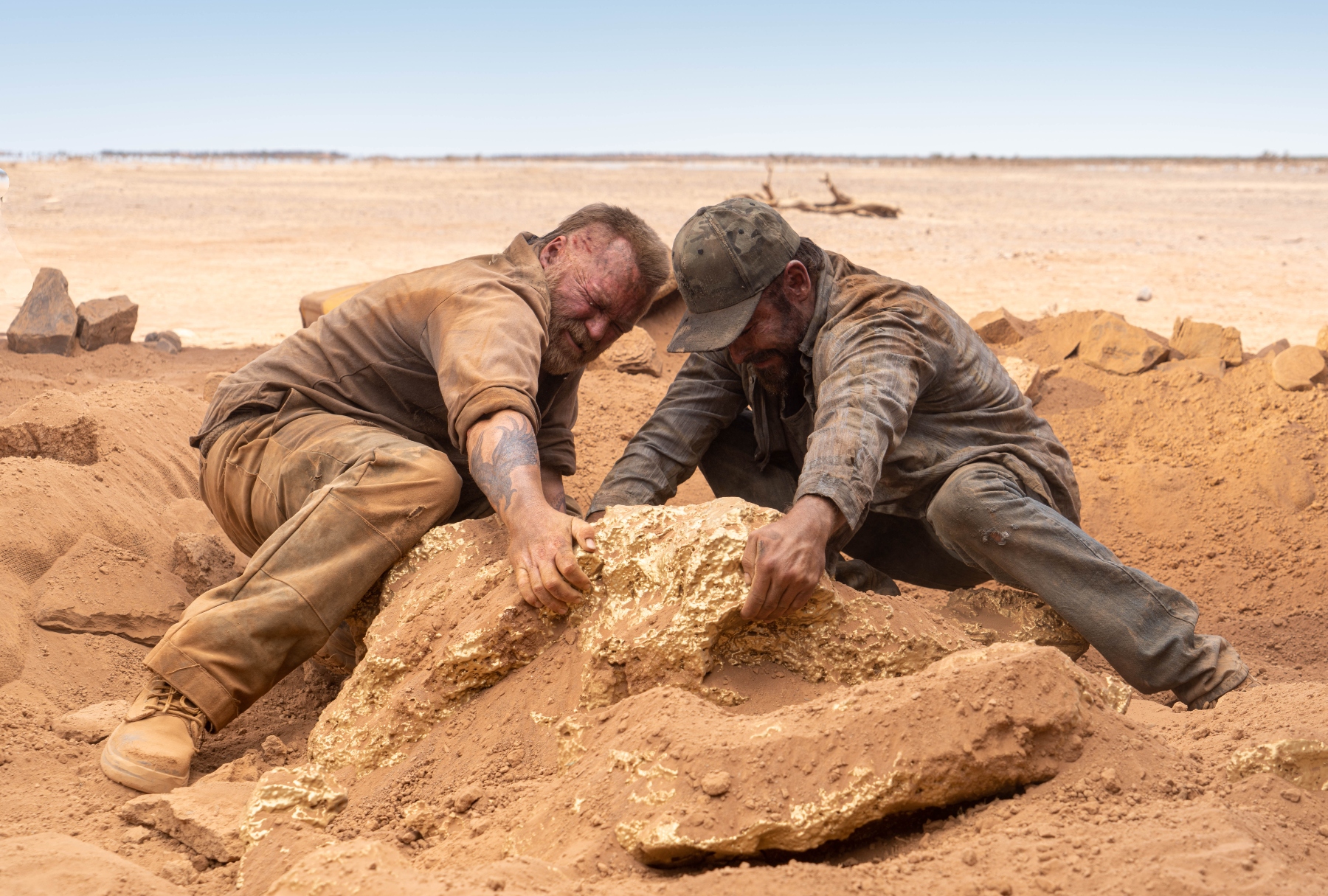
“Gold” establishes an uneasy dynamic between these two strangers in this first act by their unspoken game of one-upmanship. (Man 1 insists he can change a flat tire by himself.) But when their car overheats in the middle of nowhere — because Man 1 didn’t listen to Man 2 about the air conditioning — Man 1 spies something shiny in the dirt. As Man 2 verifies, it is gold! And as these strangers dig the nugget out, they come to discover that it is quite massive and will require the assistance of an excavator. The question becomes: who will go fetch the excavator, a four to five-day job, and who will stay and protect the gold?

Anthony Hayes and Zac Efron in “Gold” (Screen Media)Man 1 decides to stay, despite Man 2’s reasoning for him not to. And the film’s second act provides Efron with a one-man showcase of him against the elements. (“Down to Earth” this is not; more like “All Is Lost” on very parched land.)

RELATED: The Gold Rush returns to California

“Gold” follows the very predictable survivalist narrative, with Man 1 creating some shade, gathering kindling for fire (to keep the howling dogs away), and safekeeping his precious resources (water, a satellite phone.) He encounters dangers such as a scorpion and a snake, but also finds a downed airplane that helps him create shelter to protect him from the unforgiving heat

It is all compelling because Efron has a real screen presence even as his skin blisters and cracks on his hands and face. (The makeup by Jennifer Lamphee is convincing.) He doesn’t shoo the flies that crawl on his face, creating a sense of realism. Efron also does not have many lines of dialogue in the second act, mostly uttering the F-word, as when he accidentally wastes some water. (It was bound to happen.) Every so often, his action is interrupted by calls from Man 2 recounting a delay. It only makes his situation grimmer. 

Hayes’ film is very atmospheric, especially during these desert scenes. The sense of isolation and the heat are palpable. Hayes and cinematographer Ross Giardina utilize the barren environment — played, obviously, and excellently, by the Australian outback — imbuing the images with a monochromatic tone. It makes a sequence of Man 1 in the dark, illuminated only by fire stand out. There is also an impressive dust storm sequence.

“Gold” may have Man 1 wait out the seemingly endless days alone, but the film never feels dull, which is to its credit. At some point, Man 1 gets some unexpected company in the form of The Stranger (Susie Porter) who has questions about how he arrived, does he want food and water, and what is he hiding. Their interaction sets up the film’s third act, and of course, it involves a different kind of survival. 


Want a daily wrap-up of all the news and commentary Salon has to offer? Subscribe to our morning newsletter, Crash Course.


As good as “Gold” is, however, in setting up its scenario about greed and morality, Hayes’ film feels a bit shallow. Man 1 does not have much of an existential crisis alone in the desert even when he is faced with critical life-or-death situations. And when the possibility that Man 1 is hallucinating is floated, it feels perfunctory.   

Hayes also fails to generate much suspense as the story builds to its dramatic conclusion. He wisely does not show Man 2 after he leaves Man 1 alone, but of course one can expect that he is returning to dispatch Man 1 (if he is even still alive) to keep the gold for himself. 

Nevertheless, Efron delivers an engaging performance and rises to the occasion of being in every scene, and alone for about half of the film. His expressions and tempered body language convey Man 1’s determination, and it is easy to see why the part appealed to him; this is not a vanity project. Efron is displaying his acting talents not his good looks. He does not even take his shirt off during the film, but he does raise it up to tend to a wound he suffers. Alas, there is a glaring continuity error as the projectile shifts from the right side of his body and back to left over several scenes, which is distracting. 

Even with its flaws, this “Gold” is worth discovering.  

“Gold” is in theaters March 11. Watch a trailer for it below, via YouTube:

More stories to read: 

GOP Rep. Madison Cawthorn blasts Ukraine for “pushing woke ideologies,” calls Zelenskyy a “thug”

Rep. Madison Cawthorn, R-N.C., called Ukrainian President Volodymyr Zelenskyy a “thug” last Saturday, arguing that the Ukrainian government, now under siege by the Russian military, is “incredibly corrupt” and “incredibly evil.”

“Remember that Zelenskky is a thug,” Cawthorn said during a town hall in his home state last week. “Remember that the Ukrainian government is incredibly corrupt and is incredibly evil and has been pushing woke ideologies.”

The comment, reported by longtime Republican operative Karl Rove in The Wall Street Journal on Wednesday, is even harsher than the rhetoric of most of his right-wing colleagues, who, over the past several weeks, have slowly praised Zelenskyy as they hesitantly condemn Putin. 

On Wednesday, House Minority Leader Kevin McCarthy, R-Calif., pushing back against Donald Trump’s supportive comments, said that he doesn’t “think anything’s savvy or genius about Putin.””I think Putin is evil,” the lawmaker said during a press conference. “He’s a dictator. And I think he’s murdering people right now.”

Senate Minority Leader Mitch McConnell has likewise called Putin a “ruthless thug.”

Even Trump, who has long praised Putin and initially called his incursion “genius,” has finally called Russia’s invasion of Ukraine “appalling.” 

RELATED: Trump’s former military advisers scold him for praising Putin’s invasion as “genius”

It remains unclear what Cawthorn’s line of reasoning was last Saturday. But a spokesperson for the lawmaker told Insider Cawthorn “supports Ukraine and the Ukrainian President’s efforts to defend their country against Russian aggression, but does not want America drawn into another conflict through emotional manipulation.”

“The Congressman was expressing his displeasure at how foreign leaders, including Zelensky, had recently used false propaganda to entice America into becoming involved in an overseas conflict,” the spokesperson added.


Want a daily wrap-up of all the news and commentary Salon has to offer? Subscribe to our morning newsletter, Crash Course.


On Thursday, Cawthorn appeared to follow-up his remarks by claiming that while “Putin’s actions of Putin and Russia are disgusting,” Zelenskyy is also attempting to entice the U.S. into waging a military intervention with a concerted propaganda campaign.

“Leaders, including Zelenskyy, should NOT push misinformation on America,” he tweeted. “Pray also we are not drawn into conflict based on foreign leaders pushing misinformation.

https://twitter.com/RepCawthorn/status/1501969764377411586

RELATED: There is no “Putin wing” of the GOP: Why almost no Republican backs Ukraine over Russia

According to The New York Times, Ukrainian officials have spread dubious videos and made unverified claims about the war. But by and large, the outlet reported, that propaganda “is largely focused on its heroes and martyrs, characters who help dramatize tales of Ukrainian fortitude and Russian aggression.” 

“If Ukraine had no messages of the righteousness of its cause, the popularity of its cause, the valor of its heroes, the suffering of its populace, then it would lose,” said Peter W. Singer, a strategist and senior fellow at New America, told the Times. “Not just the information war, but it would lose the overall war.

Marvel to change name of “King Conan” character following backlash from Indigenous community

Following outrage over its “backwards” portrayal, Marvel is changing the name and look of an Indigenous character who made an appearance in the third and latest issue of “King Conan.”

The character, formerly named Princess Matoaka, was depicted as a scantily dressed femme fatale who attempted to seduce the series’ titular character, Conan the Barbarian, on the undead island on which they were both trapped. Per CNN:

The princess, as it turns out, has a dark past: She hails from “a land far to the west,” and once fell in love with a man who tried to colonize her people. When the man ransacked her home, she killed him, but her father nonetheless exiled her to the island, where she’s now cursed to lure other would-be colonizers away from her native land.

Critics were quick to point out that Matoaka’s name and story greatly resemble the real-life Pocahontas. The tale of Pocahontas saving colonist John Smith from execution has long been romanticized and exaggerated in pop culture, especially in the animated Disney film “Pocahontas.” In reality, Pocahontas was only a child when the European settlers arrived in her native Powhatan. 

RELATED: A transgender character is joining the MCU, which hasn’t had the best record for LGBTQ portrayals

“The real Matoaka was a pre-teen girl who suffered at the hands of her English captors,” Kickapoo comic book artist Arigon Starr wrote to CNN. “What’s even more shocking is that most of this information is online; a quick search would have informed the writer, artist, editor and publisher that it was a poor choice to give this character the name of a famous victim of violence.”

Among the Indigenous creatives who demanded for Marvel to pull the character was writer Kelly Lynne D’Angelo, who called out the comic book publisher on Twitter in all-caps for its “DISRESPECT.”

“@Marvel – i HIGHLY RECOMMEND you pull this from your canon. you create something amazing like echo, then pull this crap out? for SHAME. stan lee would be rolling in his grave…” D’Angelo tweeted.

“this is active violence against us and our community. the sexualization of a real young girl that was r*ped and killed young affects our murdered & missing indigenous women TODAY,” she added. “you are backwards, sick, and should donate every penny you earned creating this to #MMIW”


Want a daily wrap-up of all the news and commentary Salon has to offer? Subscribe to our morning newsletter, Crash Course.


Other Twitter users echoed D’Angelo’s sentiments, wondering how the story was greenlit in the first place. 

“What the f**k is this @Marvel? Who greenlit this??!” one user asked in a quote tweet.

“Marvel is so two-faced. promoting their poc content creators and stories while simultaneously showing pocahontas like this in their comics,” another user wrote.

In response to the criticisms, “King Conan” writer Jason Aaron issued a statement calling his decision to give a character the name Matoaka “ill-considered.” He went on to say the following: 

This new character is a supernatural, thousand-year-old princess of a cursed island within a world of pastiche and dark fantasy and was never intended to be based on anyone from history. I should have better understood the name’s true meaning and resonance and recognized it wasn’t appropriate to use it. I understand the outrage expressed by those who hold the true Matoaka’s legacy dear, and for all of this and the distress it’s caused, I apologize. As part of that apology, I’ve already taken what I was paid for the issue and donated it to the National Indigenous Women’s Resource Center. The character’s name and appearance will be adjusted for the rest of this mini-series and in all digital and collected editions.”

Read more:

Pediatricians on Florida’s recommendation against vaccinating children: “Don’t listen to it”

This week, news broke that Florida’s Department of Health will recommend against healthy children getting vaccinated against COVID-19, defying federal guidance from the Centers for Disease Control and Prevention (CDC) and numerous other scientists and public health experts.

“The Florida Department of Health is going to be the first state to officially recommend against the COVID-19 vaccines for healthy children,” Florida Surgeon General Joseph Ladapo said during a Monday roundtable with experts. As it stands, a formal policy around the agency’s soon-to-be guidance remains unclear, as does what will be included in the designation “healthy children.” But Ladapo noted Florida was the first state to issue such a recommendation — and it is one that many infectious disease doctors and pediatricians are forcibly pushing back against.

Indeed, Florida’s announcement has stunned health officials, who characterized it as a concerning trajectory for children in the Sunshine State. Doctors whom Salon spoke with were disturbed by a public health official making a recommendation with no basis in science, concerned about how this will be perceived by parents who can more easily get caught up in the throes of misinformation, and — most importantly — fearful for the health and safety of children.

“It has never been more important to look at the source of recommendations, and whether the recommendations are coming from a specific political agenda and conspiracy theories, or from mainstream scientific data,” Dean Blumberg, chief of pediatric infectious diseases and associate professor in the Department of Pediatrics at the University of California, Davis, told Salon. “The American Academy of Pediatrics (AAP), the Pediatric Infectious Disease Society, and a host of mainstream respected professional medical organizations wholeheartedly recommend Covid vaccines for children.”

RELATED: Experts say vaccine effectiveness isn’t waning for children

Indeed, AAP President Moira Szilagyi released a statement confirming that the agency — which represents 67​,000 pediatricians across the country — will still recommend vaccines to eligible children.

“The American Academy of Pediatrics continues to recommend the COVID-19 vaccine as the best way to protect every eligible child from COVID-19. Children can get sick from Covid, and some get very sick,” Szilagyi said. “Children make up a significant part of our population, and vaccinating children must be part of our strategy to control this virus so it cannot continue to spread.”

While children are at a much lower risk from COVID-19 than adults, they still can get the disease and face severe outcomes. According to the AAP’s most recent report, over 12.7 million children have tested positive for COVID-19 in the United States since the beginning of the pandemic as of March 3, 2022. The omicron variant led to a huge spike in pediatric cases— over 4.8 million since the beginning of January. Since not all states report children’s hospitalizations and deaths from COVID-19, there isn’t a precise number for hospitalizations; however, AAP estimates that between 1.3 percent to 4.7 percent of infected children have been hospitalized. The AAP also estimates that up 0.01 percent of children who have been infected with COVID-19 have died from it, according to the data from the states that are reporting pediatric mortalities. 


Want more health and science stories in your inbox? Subscribe to Salon’s weekly newsletter The Vulgar Scientist.


There’s also the risk of long Covid, which can affect children even after a mild infection. Data is limited on how frequent and common this is among young children and adolescents, but the symptoms can be debilitating. One study suggested as high as 10 percent of children afflicted with COVID-19 will develop long Covid.

Yet there is plenty of data that shows that the COVID-19 vaccines are safe for children — and that they reduce the risk of infection, hospitalization, ICU admission, and multisystem inflammatory syndrome in children (MIS-C), which can be serious and is associated with COVID-19. During the omicron surge, hospitals saw a surge in hospitalizations among children under the age of 5 — the cohort that still remains ineligible for vaccination. Yet only 26 percent of children aged five to 11 are vaccinated in the U.S., and 57 percent of adolescents aged 12-17 are fully vaccinated. In Florida, an estimated 68.9% of the overall population is vaccinated.

Amesh Adalja, an infectious disease and critical care medicine doctor, told Salon “there is no basis for a blanket recommendation against COVID vaccination for children.”

“While it is true that children are spared the severe consequences of COVID-19 for the most part, the vaccine is safe and something that does offer a benefit to the individual child,” Adalja said.

Experts say the responsibility will be on pediatricians in Florida to accurately inform parents about the effectiveness and importance of COVID-19 vaccines for kids. After Ladapo’s comments, the Florida Chapter of the American Academy of Pediatrics (FCAAP) released a statement in support of the vaccines for kids, too.

“The COVID-19 vaccine is our best hope for ending the pandemic,” said FCAAP President Lisa Gwynn, adding that Ladapo’s comments “misrepresent the benefits of the vaccine, which has been proven to prevent serious illness, hospitalizations and long-term symptoms from COVID-19 in children and adolescents, including those who are otherwise healthy.”

Gwynn added: “There is widespread consensus among medical and public health experts about the life-saving benefits of this vaccine.”

Andrew Pavia, MD, chief of pediatric infectious diseases at the University of Utah, told Salon the announcement is certainly “confusing to parents and harmful to children.”

“They are not based, as far as anyone can tell, on careful balancing of the obvious benefits and very limited risks. It does not appear to be based on any reliable research,” Pavia said. “Parents should get their advice from their pediatrician and from vaccine experts like those advising CDC and FDA, not from politicians and their appointees.”

Read more on COVID-19 and children:

There is no “Putin wing” of the GOP: Why almost no Republican backs Ukraine over Russia

Over the weekend, Rep. Liz Cheney, R-Wyo., threw out an enticing coinage for some of the most flagrant supporters of Russian President Vladimir Putin in the Republican Party: The “Putin wing.”

Cheney was specifically reacting to Douglas MacGregor, who was appointed to be a senior advisor to the Secretary of Defense by Donald Trump, and on Fox Business said that Russian forces invading Ukraine were being “too gentle.” Most folks, however, took Cheney’s new term to be much broader than that to encompass Donald Trump, Tucker Carlson of Fox News, and any Republicans who were praising Putin before it became suddenly unfashionable to do so approximately two weeks ago. Most of those folks are, reluctantly, claiming disapproval of the invasion of Ukraine, but are likely biding their time until outrage subsides and they can start pushing a pro-Putin line again. Indeed, Carlson has already started to test the waters by accusing the U.S. of victimizing Russia with a “disinformation campaign”.

So the problem with Cheney’s formulation is that to talk about a “Putin wing” of the GOP implies there is a substantive wing of the GOP that is anti-Putin. But outside of a few Republicans like herself that have turned their backs completely on Trump, that’s simply not the case.

Oh, sure, there are lots of Republicans who talk a big game about how they support Ukraine and oppose the Russian dictator. House Minority Leader Kevin McCarthy even made a big show of declaring, “I do not think anything’s savvy or genius about Putin,” a direct refutation of Trump’s repeated application of both words to the Russian leader he clearly has a crush on. McCarthy is known for his shameless boot-licking of Trump, so he was no doubt aware that this would result in “man bites dog” coverage that would make him appear anti-Putin without him having to make any changes to GOP actions that are, in reality, supportive of Putin’s hostility to Ukraine and to democracy in general. 

RELATED: Lt. Col. Alex Vindman: How Trump’s coup attempt encouraged Putin’s Ukraine invasion  

When we look away from the pretty words to those actual actions, the picture looks bleak indeed.

At best, Republicans will side with Putin’s interests if doing so will undermine President Joe Biden and the Democratic party. Look no further than the bad faith GOP campaign over gas prices. As Dana Milbank of the Washington Post explained Wednesday, “For days, Republicans called for a ban on imports of Russian oil,” but the second that Biden heeded their demands, they pivoted to “blaming his energy policies for spiking gas prices.” 

In one sense, this is standard GOP sabotage. We saw it under Barack Obama, where Republicans undermined the passage of a more robust economic bailout package, and then campaigned against Obama by blaming him for the sluggish recovery they caused. We saw an even darker version of this in the past year, with Republicans sabotaging Biden’s attempts to end the pandemic by convincing their followers not to vaccinate, all so they can run against Biden’s “failure” to end the pandemic. Pressuring Biden to pass a policy that everyone knows will raise gas prices, and then campaigning against him on those rising gas prices is standard operating procedure for the GOP. 


Want more Amanda Marcotte on politics? Subscribe to her newsletter Standing Room Only.


But, in doing so, they are giving a huge assist to Putin, by letting him off the hook for the economic fallout his invasion of Ukraine is causing.

McCarthy in particular has been eager to carry Putin’s water on this front, declaring bluntly that these “aren’t Putin prices,” but are instead “President Biden’s prices.” This isn’t just a lie. This is a lie that, Milbank explains, is “sowing division at home and giving a rhetorical boost to the enemy at a perilous moment when national unity and sacrifice will be needed to prevail against Russia.” Given a choice between backing Putin’s play and scoring points on Biden, Republicans picked the former. It’s all the more reason to view surface-level anti-Putin rhetoric from Republicans as glib bad faith that will likely, in due time, give way to accommodating Trump’s obvious preference, which is a robust pro-Russia and anti-democracy stance.

We’ve been down this road so many times before, where Republicans initially resist Trump’s horrible views but eventually come around. We saw it with Covid-19, where an initial Republican willingness to embrace pandemic mitigation swiftly turned into the rejection of even the most basic measures, all because then-president Trump thought acknowledging the reality of the pandemic would hurt his re-election chances. We saw it again with Trump’s January 6 insurrection. Initially, most Republicans were freaked out and angry about it, but in short order, they were covering up Trump’s crimes by voting against his impeachment and trying to shut down any House investigation into the attack

RELATED: Ignore the GOP’s sudden pivot, Republicans have long worked to undermine Ukraine

We’ve even been down this road with Putin and his aggression towards Ukraine before. Republicans were initially willing to take seriously the strong signs that the Trump campaign was colluding with the Russian government to spread disinformation about Hillary Clinton during the 2016 election. They even went so far as to appoint a special counsel Robert Mueller to investigate the claims. But by the time Mueller’s report was ready to come out, Republicans were in full cover-up mode, backing then-attorney general Bill Barr’s strategy of burying the report’s findings through delays and spin. 

And when Trump tried to blackmail Ukrainian President Volodymyr Zelenskyy by threatening to withhold military aid unless Zelenskyy falsified evidence to smear Biden with, Republicans had Trump’s back, voting against impeachment and undermining the process of holding him accountable at every turn. Instead, both Fox News and GOP leadership started to float Russian-generated conspiracy theories incoherently accusing Ukraine’s government of “interfering” with elections, all to keep the heat off both Putin and Trump. As Heather “Digby” Parton notes, “Putin even joked at one point that he was glad the world was finally blaming Ukraine instead of him.”


Want more Amanda Marcotte on politics? Subscribe to her newsletter Standing Room Only.


And as Donie O’Sullivan at CNN reports, now some conservatives are embracing a Russia-generated conspiracy theory claiming “the United States is developing bioweapons in Ukraine and Vladimir Putin has stepped in to save the day and destroy the weapons.” The conspiracy theory bubbled up in the world of QAnon, but like most of these far-right conspiracy theories, it’s making its way to the mainstream GOP rapidly. Carlson’s show Wednesday night was largely dedicated to pushing this conspiracy theory that paints Ukraine as villains in cahoots with the Biden administration, and Putin as the hero. Even more troublingly, he used a clip of Florida’s Republican Sen. Marco Rubio questioning Victoria Nuland, Biden’s Under Secretary of State for Political Affairs, to hype this conspiracy theory. In the clip, Rubio’s line of questioning seems about debunking the conspiracy theory. He even explicitly uses the term “Russian propaganda.” Nonetheless, the clip went viral in pro-Russia circles, because Rubio opened the line of questioning by asking, “does Ukraine have chemical or biological weapons,” prompting Nuland to say, “Ukraine has biological research facilities” and the U.S. is “working with the Ukrainians on how they can prevent any of those research materials from falling into the hands of Russian forces.” The clip is now being spread around, including by Carlson, as evidence that the Ukrainians are the bad guys and the U.S. is covering up this supposed nefarious biological weapons development scheme.

RELATED: Trump’s Ukraine call was referred to DOJ as possible crime. Barr’s team shut it down

Perhaps Rubio was unaware that this clip would be used this way. If so, it’s the second time this week that Rubio had an “oopsie” when it comes to Ukraine and Russia. Over the weekend, Rubio tweeted out a photo of a Zoom meeting Congress had with Zelenskyy, even though they were explicitly asked not to, in order to protect the Ukrainian president from what appears to be a relentless campaign by Russian forces to kill him. The photo is likely not a direct threat to Zelenskyy any longer, but Rubio still doesn’t have the decency to take it down as a show of good faith. 

Whatever Rubio’s intentions, the pattern is hard to ignore: Republicans are careless at best when it comes to Ukraine, and when it comes to propagandists like Carlson — who always seem to end up setting the party’s agenda — it’s more like open sabotage of the embattled democracy. 

Even the GOP’s anti-vaccine strategy is coming back to hurt the Ukrainian cause. A Navy ship the U.S. wishes to deploy, likely to support NATO defenses in European waters, is being stalled because a Republican judge won’t let the Biden administration remove the commanding officer. The officer lost the trust of the government and his crew by being an anti-vaccine conspiracy theorist. “Anti-vaxx nut” is apparently a protected class to Republicans now, so they’re willing to tank national security in order to perpetuate this conspiracy theory.

Republicans are making their priorities clear. Sure, they say they believe in Ukraine’s fight for democracy and sovereignty, but they’re not willing to do much to stand up for that cause, especially if doing so means playing nice with Biden or, at the very least, not giving wild-eyed Putin lovers grist for their mills. It’s the same problem we’ve seen with Republicans and Trump for years. Sure, some of them will criticize him or, however briefly, push back against some of his nuttier ideas. But when push comes to shove, Republicans will always stand by Trump’s side, even though he literally attempted to overthrow American democracy. So why shouldn’t they have the same approach to Putin’s attempts to overthrow Ukrainian democracy? 

Why has Madison Cawthorn been repeatedly charged for driving with a revoked license?

Right-wing U.S. Representative Madison Cawthorn apparently can’t quit driving — despite holding a revoked driver’s license.

During a traffic stop on March 3, the North Carolina State Highway Patrol charged the Republican with a Class 3 misdemeanor, an infraction that could cost Cawthorn a $200 fine or 20 days in jail. His court date is set for May 6. According to a state trooper, Cawthorn was behind the wheel of a wobbly 2019 Toyota drifting “left of center” around 10:26 p.m.

“During the course of the investigation, it was determined that the driver’s license was in a state of revocation and he was subsequently charged with driving while license revoked,” the agency said of Cawthorn’s charge. 

Cawthorn was previously charged for driving on a revoked license back in 2017, but that charge was later dismissed. Patrol spokesman Chris Knox told local reporters that he cannot comment on why Cawthorn’s license was suspended because the information is protected under the Driver’s Privacy Protection Act. 

What is known, however, is that Cawthorn also faces two additional speeding charges.

In October, a trooper found the representative allegedly traveling 89mph in a 65mph zone. And in January, Cawthorn was reportedly back at it, accused in North Carolina of traveling 87mph in a 70mph zone. Those charges are both still pending. 

“Our office expects the traffic matters to be resolved quickly and we remain focused on serving the constituents of NC-11,” Cawthorn’s office said in a statement. 

In 2014, a driving accident left Cawthorn partially paralyzed and wheelchair-reliant.

Driving was also at the center of an explosive report by The Washington Post, in which several of Cawthorn’s former college classmates described frightening incidents of sexual misconduct after  Cawthorn drove them to deserted parts of town (classified as “fun drives”) and initiated sexual activity.

“I definitely would classify it as sexual assault because he knew I said no,” Cawthorn’s former classmate Katrina Kulikas told The Post. 

Florida’s first-of-its kind election police will report directly to Ron DeSantis

The Florida legislature on Wednesday approved the creation of a standalone election police force, rubber-stamping a similar proposal floated two months ago by Republican Gov. Ron DeSantis, who has pushed for the idea under the guise of “election integrity.” 

DeSantis had originally called for a budget of $6 million and a staff of 52 workers to establish a law enforcement body for the state’s election administration, according to The Washington Post. Ultimately, Florida lawmakers allotted $2 million to the unit, calling it the Office of Election Crimes and Security.

“We’re very excited and thank the legislature for delivering on Governor DeSantis’ election security initiative. The legislature carried out our goal of making it easier to vote and harder to cheat,” Taryn Fenske, a spokesperson for DeSantis, told Politico. 

RELATED: Ron DeSantis announces election police force

No other state has an election crimes unit, making the Office of Election Crimes and Security the first of its kind throughout the nation. The office will operate as part of the Department of State and will report directly to DeSantis. 

On top of assembling an election police force, Wednesday’s bill also outlines a number of election crimes that would fall under the office’s purview. 

Chief among them is “ballot harvesting,” a practice in which third-party election officials or volunteers gather and submit ballots on behalf of voters who may not be able to do so themselves. While Florida’s restrictive voting law last year made that practice a misdemeanor, Wednesday’s measure would make it felony, punishable with a $50,000 maximum fine and up to and five years in prison. 


Want a daily wrap-up of all the news and commentary Salon has to offer? Subscribe to our morning newsletter, Crash Course.


The bill, passed in a landslide by both the state House and Senate, has met with vigorous pushback from Democrats and voting rights advocates, who argue that it imposes an undue burden on Floridians to solve a problem that doesn’t even exist. 

RELATED: GOP’s new voter suppression tactic is also an old one: “Election police”

Genesis Robinson, political director of Equal Ground, a voting rights advocacy group, said that Florida Republicans are “criminalizing certain acts around the elections process that most folks, particularly in the Black community, have long held as a way to assist those in need.”

“To spend time in jail for simply trying to be a good neighbor, that’s a problem,” he told the Post.

Daniel Griffith, policy director at Secure Democracy USA, echoed similar concerns, telling CNN that the law could “deter people from participation in the democratic process.”

“We don’t know exactly what they are investigating,” Griffith said. “Are they investigating election officials? Are they investigating voters?”

Florida state Rep. Joe Geller meanwhile suggested that the measure is completely unnecessary because “Election fraud is a unicorn.”

“It’s not real except in very sparse isolated incidents,” Geller told Politico. “Should we be spending millions on a problem that doesn’t exist?”

DeSantis has indicated that he will sign that measure, calling it a “gold standard” that should be used by other states. 

The massive disconnect between Big Oil’s words and actions

Big oil companies love to talk about a cleaner future — and how they’re going to make it happen. Over the last two years, Shell, BP, Chevron, and ExxonMobil have pledged to zero out their carbon emissions by 2050. Watching Exxon’s algae-heavy advertisements, you’d think the company is swapping oil barrels for biofuel farms. Shell’s website is sprinkled with pictures of solar panels and claims that it’s taking action to create “a more sustainable, renewable, energy-rich, lower carbon future.”

At a closer look, however, all this starts to seem hollow. According to a recent study published in the peer-reviewed journal PLOS One, there’s a big disconnect between oil companies’ words and behavior when it comes to climate change. Researchers in Japan analyzed how those four big oil companies, accounting for 10 percent of global carbon emissions since 1965, talked about climate change in their annual reports from 2009 to 2020. Then they scrutinized whether the companies had taken concrete measures to cut down on fossil fuel production and to shift their business to clean energy production. 

What they found is that these oil companies have increased fossil fuel production and expanded exploration while making only surface-level investments in clean energy. 

“There’s a lot of talk now, and there was a lot of talk in the past, but especially in the long period that we looked at, there’s been very, very little action,” said Gregory Trencher, a coauthor of the study and an environmental studies professor at Kyoto University in Japan. His team’s research provides the most comprehensive analysis to date on whether oil companies are actually moving away from fossil fuels.

In the last decade, oil companies have begun talking about the climate more than ever before — a trend reflected in their annual reports. Shell’s use of the phrase “low-carbon energy,” for instance, increased more than eightfold from 2009 to 2020. Over the same period, BP’s rhetoric related to making a clean-energy transition rose a similar amount. But that has yet to translate into concrete action: Fossil fuel production has remained relatively steady over the last decade, and from 2015 until the pandemic in 2020, most of the oil majors actually increased fossil fuel production. Shell, for instance, went from producing around 1,358,000 barrels of oil a day to 1,752,000.

Grist / Clayton Aldern

Environmental advocates have long accused oil companies of “greenwashing” — putting a climate-friendly face in front of the public while continuing to drill for more oil behind the scenes. The recent study provides solid evidence for those accusations, concluding that “no [oil] major is currently on the way to a clean energy transition.”

Chevron and Exxon’s spending on clean energy was so insignificant it was “almost absent,” said Trencher, with Chevron spending a mere 0.23 percent and Exxon 0.22 percent of their total capital expenditures — the money a company uses to buy and maintain its physical assets — on developing low-carbon energy from 2010 to 2018. As for Exxon’s algae efforts, it turns out the company has spent more money on corporate advertising ($500 million between 2009 and 2015) than on its research into the biofuel ($300 million since 2009). Only BP and Shell met the researchers’ conservative benchmark of spending 1 percent of their capital expenditures on clean energy efforts.

In terms of electricity generated from clean energy sources, BP has made the most progress of any of the oil companies — but even then, its global renewables capacity only adds up to 2,000 megawatts, the equivalent of about two gas-fired power plants.

If oil companies were truly trying to switch to clean energy, Trencher said, you’d expect to see a shrinking emphasis on fossil fuels in their everyday business — such as a slowdown in searching for new oil and gas reserves. The study didn’t find convincing evidence that this was happening. BP and Shell have promised to reduce their investments in new fossil fuel extraction, but at the same time, they’ve expanded the territory where they explore for oil. In 2020, Shell’s undeveloped exploration territory went up by almost 15,000 square miles from the year before. The company’s target of reducing exploration by 2025, Trencher said, may have “triggered a rush before the deadline for them.” 

Mei Li, a co-author of the report, suggested that the ability to continue profiting from fossil fuels was the chief reason that oil companies haven’t lived up to their climate promises. Wall Street is more likely to reward quarterly profits than moves to overhaul a business over the long-term. “They do not have the incentives to force them to make a clean energy transition,” Li said.

In response to the report, oil companies pointed to their climate promises but offered little in the way of proof. Exxon said that it planned to play “a leading role in the energy transition,” Chevron noted that it aimed to spend $10 billion on lower-carbon investments by 2028, and Shell pointed to its goal of becoming a “net zero emissions energy business by 2050.” BP said the study didn’t take its full progress into account since most of the data the researchers analyzed only ran through 2020, when the company first laid out its strategy to cancel out emissions. 

Trencher said he wasn’t aware of any new pledges that would significantly change their findings and pointed to historical trends as reason to take oil companies’ promises with a grain of salt. “These companies have not been anywhere near as serious about climate change and decarbonization as their words have been,” he said.

The study follows previous research that has shown that oil companies spread misinformation about climate science, tried to shift the blame for climate change from fossil fuels to individuals, and tried to stop governments from taking action to curb carbon emissions. In the three years following the 2016 Paris Agreement, for example, the five largest oil companies spent more than $1 billion on lobbying against climate legislation and on rebranding themselves as climate-conscious combined, according to data from the think tank InfluenceMap.

As these things often do, the explanation for this contradictory behavior mostly comes down to money. “It’s sort of difficult for a company to have a justification to destroy its own business model,” Trencher said. “If we want to force these companies to abandon a fossil fuel-based business model, then that obviously has to be done through policies.”

Vladimir Putin is losing the war — at least on social media. Here’s why that matters

In the end, future historians may well label this the first “social media war,” just as Vietnam was the first televised war and the Gulf War of 1991 was the first cable news war.

And as Vladimir Putin’s “chosen war” against Ukraine enters its third week, fear and outrage continue to spread across the globe like gangrene. It’s increasingly apparent that social media is driving the coverage and providing key information.

Some in the United States, including many members of the Republican Party, are trying hard to make this war about President Biden — and in doing so to spread more fear. They want to blame him for the invasion, blame him for rising gas costs and blame him for the deaths in Ukraine. These include the fact-deniers, the delusional dilettantes of destruction and devout worshippers of “alternate facts” who dwell in a shadowy world of misery, misinformation and malignancy. They’re using social media to do so.

RELATED: Ignore the GOP’s sudden pivot, Republicans have long worked to undermine Ukraine

The value of Biden’s efforts to solve the most complicated international crisis since the end of World War II is unrecognizable to those who support the arrogant, obnoxious efforts of Putin-wannabes who thrive in the dark cesspool of American politics. These are the devotees of spreading disinformation who declare they defend democracy while cheering the insurrectionists of Jan. 6. 

Biden has been crystal clear about his intentions: He means to economically strangle Putin into submission, avoid a wider conflict and strengthen our European democratic allies — leaving Russia weaker. His experience on the international stage during a lengthy career in public office has provided him with a unique perspective, and the skills to get this done. 

There are many in this country who decry experience, or say it doesn’t matter. Biden’s experience is proving otherwise, although the amount of bile that passes for political straight talk makes it next to impossible for the average uninformed American to understand the nuances of our current international crisis. 

Putin has weaved a web of lies to defend his invasion of Ukraine and all of them have been unraveled by social media and American intelligence, and plainly presented to the world by Biden from the White House. This has even led to protests in Russia. Putin has tried to scare the rest of the world into giving him Ukraine by threatening nuclear war and trying to make it look like a showdown between the U.S. and Russia. He has failed. He has also failed in trying to disarm and destroy NATO — though he had a valuable ally in that effort, former President Donald Trump, before Biden entered the Oval Office. 

Biden has ignored Putin’s threats and refused to let the U.S. become directly involved in the conflict. Some of the very same people who support a “no fly zone” over Ukraine are those who say they most fear a nuclear confrontation based on a war with Russia. Putting American pilots in a position to shoot down Russian jets would not only play into Putin’s attempts to widen the conflict, but place us even closer to a conflagration whose outcome plays out to the tune of R.E.M’s “It’s the End of the World as We Know It.” But in reality, nobody will feel fine when nuclear winter descends.

Some in the press see this through a different lens. Joy Reid of MSNBC, focusing on the refugee issues, said: “There is a lot of soul-searching we need to do in Western media about why some wars, and lives, seem to matter more than others, and why some refugees get the welcome mat, while others get the wall.”


Want a daily wrap-up of all the news and commentary Salon has to offer? Subscribe to our morning newsletter, Crash Course.


True. I’ve seen refugees on our southern border treated as some would treat cattle. The empathy we show European refugees is far more than we show African or Latin American refugees. But this war waged by Putin supersedes those concerns because it is far more drastic in its potential. We cannot lose sight of the fact, for one second, that Putin’s march into Ukraine brings with it the seeds of global destruction.

Some in the mainstream media don’t understand this — especially in the White House press corps. Some of us there, especially those sitting in the first two rows of the Brady Briefing Room, are so self-absorbed that they believe a press briefing is an opportunity to engage the Biden White House in a one-on-one discourse while the rest of us sit or stand and watch in quiet respect for the stolid questioner. That blew up on Monday, when the 40 or 50 people in the room who don’t normally get to ask press secretary Jen Psaki a question rebelled after the AP’s Josh Boak pulled the plug after only 39 minutes. Steve Nelson of the New York Post criticized the front two rows for monopolizing the time, and said there were more questions from the back of the room. Others agreed. Finally White House Correspondents Association president Steve Portnoy had to stand up in the middle of the briefing room and moderate. His was an example of statesmanship many politicians could learn from.

Nelson was right, of course — and some of the stupidest questions I’ve ever heard have come out of the press corps since Biden took over. 

RELATED: Putin’s threat to the world grows — and much of our news media is not up to the challenge

It has been social media, which routinely engages in such lunacy that you have to wonder if you’re watching an SNL skit, that has risen to the occasion — showing the world the scenes of destruction inside maternity hospitals and neighborhoods, and highlighting potential Russian war crimes. 

Darnella Frazier, the teenager who recorded a comprehensive video of the killing of George Floyd, was recognized last year by the Pulitzer Prize board. She was 17 and awarded a special citation for “a video that spurred protests against police brutality around the world, highlighting the crucial role of citizens in journalists’ quest for truth and justice.”

Much the same thing is going on in Ukraine as those suffering from Putin’s chosen war are recording it, posting it on social media and, like Joe Biden, exposing Russian propaganda for what it is. That has helped raise awareness and led to worldwide condemnation of the war.

Some mainstream media reporters, like former White House reporter Trey Yingst, last seen walking with fleeing refugees in Kyiv while telling the stories of tragedy and Russian hegemony, are doing the same thing. That’s what covering a war is about. Show. Don’t tell.

Watching this war on social media has naturally led to more stress in the world, just as we emerge from two years of stress imposed by a worldwide pandemic. All this has affected our mental health. People across the world are rightfully frightened. You can hear it in restaurant chatter, PTA meetings and social gatherings. “Is this the beginning of World War III — and how do we prevent it?”

Headlines on how to volunteer to fight in Ukraine and how to survive a nuclear war were in my news feed Saturday. Oh, and Aaron Rodgers was in the news again, getting the attention only an NFL diva can garner. 

A source inside the Ukraine government told me Wednesday that more than 1.8 million people have fled the country, but also said resistance to Putin has continued to harden — and that each day “gives us all hope that the aggressor will ultimately fail.”

This is where you have to give some credit to Biden. With his depth of foreign knowledge and experience, he has thus far outplayed Putin on the international chessboard. Putin has failed to widen the scope of the conflict. He has not been able to cast this as a U.S. versus Russia battle — and it has been social media that has effectively underpinned the arguments made by NATO and Biden. The scenes of destruction and the shots of President Zelenskyy broadcasting from a cell phone have galvanized the world — not the words and images of the mainstream media.

It is social media, at this point, that is making the difference. How do you keep a nuclear power from successfully invading a non-nuclear country? How do you curb a dictator’s enthusiasm for greed, avarice and power? The altruists and the most naïve among us have often said, gosh, if we just stood up and held hands and refused to accept aggression, it could end today.

But it will be through the camera phones of ordinary people struggling against a violent, unprovoked invasion that we may come to understand how much we all have in common — and how much we all have to gain by standing up to aging autocrats whose only desires are greed, avarice and power. Not to mention how little their desires have to do with life, and how detrimental it is to the survival of the species.

In short, the camera phone is revolutionizing resistance by cutting through the clutter of propaganda and showing that Putin and his efforts are a “tale told by an idiot full of sound and fury, signifying nothing,” with apologies to Shakespeare.

Joe Biden is demonstrating how to lead this fight without thumping his chest and contributing to that sound and fury.

Read more on the conflict in Ukraine:

Are there really neo-Nazis fighting for Ukraine? Well, yes — but it’s a long story

Russian President Vladimir Putin has claimed that he ordered the invasion of Ukraine to “denazify” its government, while Western officials, such as former U.S. ambassador to Moscow Michael McFaul, have called this pure propaganda, insisting, “There are no Nazis in Ukraine.”

In the context of the Russian invasion, the post-2014 Ukrainian government’s problematic relations with extreme right-wing groups and neo-Nazi parties has become an incendiary element on both sides of the propaganda war, with Russia exaggerating it as a pretext for war and the West trying to sweep it under the carpet. 

The reality behind the propaganda is that the West and its Ukrainian allies have opportunistically exploited and empowered the extreme right in Ukraine, first to pull off the 2014 coup and then by redirecting it to fight separatists in eastern Ukraine. And far from “denazifying” Ukraine, the Russian invasion is likely to further empower Ukrainian and international neo-Nazis, as it attracts fighters from around the world and provides them with weapons, military training and the combat experience that many of them are hungry for.  

RELATED: The Ukraine catastrophe and how we got here: Chronicle of a war foretold

Ukraine’s neo-Nazi Svoboda Party and its founders, Oleh Tyahnybok and Andriy Parubiy, played leading roles in the U.S-backed coup in February 2014. Assistant Secretary of State Victoria Nuland and U.S. ambassador Geoffrey Pyatt mentioned Tyahnybok as one of the leaders they were working with in their infamous leaked phone call before the coup, even as they tried to exclude him from an official position in the post-coup government. 

As formerly peaceful protests in Kyiv gave way to pitched battles with police and violent, armed marches to try to break through police barricades and reach the Parliament building, Svoboda members and the newly-formed Right Sector militia, led by Dmytro Yarosh, battled police, spearheaded marches and raided a police armory for weapons. By mid-February 2014, these men with guns were the de facto leaders of the Maidan movement.

We will never know what kind of political transition peaceful protests alone might have produced in Ukraine, or how different the new government would have been if a peaceful political process had been allowed to take its course without interference by the U.S. or violent right-wing extremists. 

But it was Yarosh who took to the stage in the Maidan and rejected the Feb. 21, 2014 agreement negotiated by the French, German and Polish foreign ministers, under which President Viktor Yanukovych and opposition political leaders agreed to hold new elections later that year. Instead, Yarosh and Right Sector refused to disarm and led the climactic march on Parliament that overthrew the government.

Since 1991, Ukrainian elections had swung back and forth between leaders like Yanukovych, who was from Donetsk and had close ties with Russia, and Western-backed leaders like President Viktor Yushchenko, who was elected in 2005 after the “Orange Revolution” that followed a disputed election. Ukraine’s endemic corruption tainted every government, and rapid public disillusionment with whichever leader and party won power led to a seesaw between Western- and Russian-aligned factions.


Want a daily wrap-up of all the news and commentary Salon has to offer? Subscribe to our morning newsletter, Crash Course.


In 2014, Nuland and the State Department got their favorite, Arseniy Yatsenyuk, installed as prime minister of the post-coup government. He lasted two years until he, too, lost his job due to endless corruption scandals. Petro Poroshenko, the post-coup president, lasted a bit longer, until 2019, even after his personal tax evasion schemes were exposed in the 2016 Panama Papers and 2017 Paradise Papers.

When Yatsenyuk became prime minister, he rewarded Svoboda’s role in the coup with three cabinet positions, including Oleksander Sych as deputy prime minister, and governorships of three of Ukraine’s 25 provinces. Svoboda’s Andriy Parubiy was appointed chairman (or speaker) of Parliament, a post he held for the next five years. Tyahnybok ran for president in 2014, but only got 1.2% of the votes, and was not re-elected to Parliament.

Ukrainian voters turned their backs on the extreme right in the 2014 post-coup elections, reducing Svoboda’s 10.4% share of the national vote in 2012 to 4.7%. Svoboda lost support in areas where it held control of local governments but had failed to live up to its promises, and its support was split now that it was no longer the only party running on explicitly anti-Russian slogans and rhetoric.

After the coup, Right Sector helped to consolidate the new order by attacking and breaking up anti-coup protests, in what their leader Yarosh described to Newsweek as a “war” to “cleanse the country” of pro-Russian protesters. This campaign climaxed on May 2 with the massacre of 42 anti-coup protesters in a fiery inferno, after they took shelter from Right Sector attackers in the Trades Unions House in Odessa.

After anti-coup protests evolved into declarations of independence in Donetsk and Luhansk, the extreme right in Ukraine shifted gear to full-scale armed combat. The Ukrainian military had little enthusiasm for fighting its own people, so the government formed new National Guard units to do so. 

Right Sector formed a battalion, and neo-Nazis also dominated the Azov Battalion, which was founded by Andriy Biletsky, an avowed white supremacist who claimed that Ukraine’s national purpose was to rid the country of Jews and other inferior races. It was the Azov battalion that led the post-coup government’s assault on the self-declared republics and retook the city of Mariupol from separatist forces. 

The Minsk II agreement in 2015 ended the worst fighting and set up a buffer zone around the breakaway republics, but a low-intensity civil war continued. An estimated 14,000 people have been killed since 2014. Rep. Ro Khanna, D-Calif., and other progressive members of Congress tried for several years to end U.S. military aid to the Azov Battalion. They finally did so in the fiscal 2018 Defense Appropriation Bill, but Azov reportedly continued to receive U.S. arms and training despite the ban.

In 2019, the Soufan Center, which tracks terrorist and extremist groups around the world, warned: “The Azov Battalion is emerging as a critical node in the transnational right-wing violent extremist network. … [Its] aggressive approach to networking serves one of the Azov Battalion’s overarching objectives, to transform areas under its control in Ukraine into the primary hub for transnational white supremacy.” 

The Soufan Center described how the Azov Battalion’s “aggressive networking” reaches around the world to recruit fighters and spread its white supremacist ideology. Foreign fighters who train and fight with the Azov Battalion then return to their own countries to apply what they have learned and recruit others. 

Violent foreign extremists with links to Azov have included Brenton Tarrant, who massacred 51 worshippers at two mosques in Christchurch, New Zealand, in 2019, and several members of the U.S. Rise Above Movement who were prosecuted for attacking counter-protesters at the “Unite the Right” rally in Charlottesville in August 2017. Other Azov veterans have returned to Australia, Brazil, Germany, Italy, Norway, Sweden, the U.K. and other countries.   

Despite Svoboda’s declining success in national elections, neo-Nazi and extreme nationalist groups, increasingly linked to the Azov Battalion, have maintained power on the street in Ukraine, and in local politics in the Ukrainian nationalist heartland around Lviv in western Ukraine.

After President Volodymyr Zelenskyy’s election in 2019, the extreme right threatened him with removal from office, or even death, if he negotiated with separatist leaders from Donbas and followed through on the Minsk Protocol. Zelenskyy had run for election as a “peace candidate,” but under threat from the right, he refused to even talk to Donbas leaders, whom he dismissed as terrorists.

During Trump’s presidency, the U.S. reversed Obama’s ban on weapons sales to Ukraine, and Zelenskyy’s aggressive rhetoric raised new fears in Donbas and Russia that he was building up Ukraine’s forces for a new offensive to retake Donetsk and Luhansk by force.  

The civil war has combined with the government’s neoliberal economic policies to create fertile ground for the extreme right. The post-coup government imposed more of the same “shock therapy” that was imposed throughout Eastern Europe in the 1990s. Ukraine received a $40 billion International Monetary Fund bailout and, as part of the deal, privatized 342 state-owned enterprises; reduced public sector employment by 20%, along with salary and pension cuts; privatized health care and disinvested in public education, closing 60% of its universities. 

Coupled with Ukraine’s endemic corruption, these policies led to the looting of state assets by the corrupt ruling class, and to falling living standards and austerity measures for everybody else. The post-coup government upheld Poland as its model, but the reality was closer to Boris Yeltsin’s Russia of the 1990s. After a nearly 25% fall in GDP between 2012 and 2016, Ukraine is still the poorest country in Europe.

As elsewhere, the failures of neoliberalism have fueled the rise of right-wing extremism and racism, and now the war with Russia promises to provide thousands of alienated young men from around the world with military training and combat experience, which they can then take home to terrorize their own countries.

The Soufan Center has compared the Azov Battalion’s international networking strategy to that of al-Qaida and ISIS. U.S. and NATO support for the Azov Battalion poses similar risks as their support for al-Qaida-linked groups in Syria 10 years ago. Those chickens quickly came home to roost when they spawned ISIS and turned decisively against their Western backers. 

Right now, Ukrainians are united in their resistance to Russia’s invasion, but we should not be surprised when the U.S. alliance with neo-Nazi proxy forces in Ukraine, including the infusion of billions of dollars in sophisticated weapons, results in similarly violent and destructive blowback.

Read more on the Ukraine conflict and how we got here: