Spring Sale: Get 1 Year, Save 58%

The party of pollution, disease and death: When Republicans tell you who they are, believe them

In its current session, the U.S. Supreme Court weakened the federal government’s authority to enforce the Clean Water Act.

The mainstream media have been assiduous in explaining to us that the case involved knotty issues of constitutional limits to regulatory authority, the extent to which Congress may delegate powers to agencies, Fifth Amendment takings and so forth. A more daring analysis might have suggested that the decision demonstrated that the Republican-led court, reflecting the GOP’s traditional hatred of regulation, was attempting to dismantle what Steve Bannon called “the administrative state.” But even that fails to convey the true significance of the ruling.

Descriptions like those given above are the means by which conventional media accounts of our politics normalize the abnormal and pretend everyone is operating in good faith, if perhaps acting from principles we may not agree with. So let’s try to describe the court’s decision in plain English.

The Supreme Court, acting as the judicial arm of the Republican Party, weakened the Clean Water Act because it wants polluted water.

Removing a large number of waterways and wetlands from the jurisdiction of the Clean Water Act will predictably lead to more pollution. To say that additional contamination of water is only hypothetical if dumping is no longer prohibited in deregulated waters, and that if such pollution occurs it would be a regrettable and unforeseen consequence, is to engage in dishonest argumentation. 

By passing the Clean Water Act in 1972, Congress intended to promote clean waterways rather than the interests of real estate developers or industries. By construing the law to enable the latter interests rather than clean water, the Supreme Court’s majority is demonstrating not only its recent obsession with legislating from the bench; it is saying contaminated water is fine.

One could apply the same principle to habitual Republican policy choices during the COVID pandemic. Among other adverse actions, Florida Gov. Ron DeSantis prohibited municipalities, schools and even private businesses from instituting mask mandates. The prohibition, as is typical with the GOP, was done in the name of “freedom.” But whereas the increase in “freedom” is abstract, hypothetical and unquantifiable (or maybe imaginary), it is a statistical certainty that not undertaking mask wearing, social distancing and other measures will lead to additional deaths, particularly among the elderly and immune-compromised.

There is no meaningful rhetorical distinction between saying that Ron DeSantis “accepted” that more people in Florida would die and saying that he wanted them to die.

Again, as this is a clearly foreseeable outcome, we’re on safe ground to conclude that DeSantis was blithely content to see more Floridians die. When a person takes deliberate and calculated action that results in additional deaths for the tawdry reason of pandering to his ideological supporters, there is no meaningful rhetorical distinction between saying he “accepts” that more people will die and that he wants them to die. In this case, we may invert Immanuel Kant’s dictum and conclude that “he who wills the means wills the end.”

The same holds true with other public health, pollution control, workplace and consumer safety regulations established during the last century. The money supposedly saved (mainly by corporations who just happen to be political contributors) when Republicans eliminate or weaken them is more than neutralized by costs externalized onto the general public in the form of cleanup expenses or illness or premature death. 


Want a daily wrap-up of all the news and commentary Salon has to offer? Subscribe to our morning newsletter, Crash Course.


Another salient example is indoor gas stoves. In response to findings that they can degrade indoor air quality and cause asthma or create dangerous carbon monoxide levels, some municipalities have banned new hookups or made other restrictions. The EPA has been studying the matter

Predictably, Republicans brought to the House floor a bill that would prohibit a ban on gas stoves and even prohibit setting environmental standards for them. It failed on a procedural vote only because a few far-right Republicans voted no, in protest against Speaker Kevin McCarthy’s insufficient zeal in holding the nation’s economy hostage in the debt limit negotiations. Rationality in this case was served only because Republicans were divided on their preferred strategy for damaging the public interest.

It makes nonsense of the principles of causation and individual responsibility to deny that the results of GOP actions are not willed. In criminal and civil law, persons are held guilty or liable if it can be shown they had good reason to know the consequences of some damaging action they undertook, regardless of their excuses. 

This principle also holds true with one of the most fraught issues in America: firearms. In the wake of heavily-reported mass shootings in their states, the Republican governments of Florida, Texas and Tennessee rushed to weaken their gun laws. Florida and Texas now authorize concealed-carry of a firearm without a permit or mandatory safety instruction; immediately after the school shooting in Nashville, the Tennessee legislature further diminished the potential liability of gun manufacturers.

Unrestricted concealed-carry vastly expands the opportunity for a would-be killer to gain access to virtually any public venue unchallenged. The police will not be looking for suspicious persons carrying concealed weapons, since there is no law against doing so. If they happen to stop someone on other grounds, they can no longer arrest him for concealed firearm possession without a permit. It is as if the Texas and Florida legislatures are begging for more gun homicides.

The weakening of liability is likely to have a similar effect. Without the potential for civil cases or criminal prosecution, manufacturers have no incentive to vet retail distributors for their honesty or diligence in turning away or flagging suspicious customers. If you’ve ever wondered how perpetrators in their teens, or seeming down-and-outers, can afford to pay $2,000 or more for a Colt AR-15, the answer is that gun retailers offer notoriously easy financing. The shops’ credit policies are backstopped by the manufacturers, and the banks behind those manufacturers.

The Tennessee legislature is telling its citizens that the ordinary health and safety liability laws covering consumer items like appliances, power tools or automobiles don’t apply to the most dangerous mechanical contrivance available for consumer purchase. Evidently the political party that is so concerned about children that it gavels through legislation protecting them from library books doesn’t feel the same concern for children’s lives. Firearms are now the leading cause of premature death among American children, accounting for nearly a fifth of all such deaths. The latest Republican legislative spree looks certain to increase those grim statistics.


Want a daily wrap-up of all the news and commentary Salon has to offer? Subscribe to our morning newsletter, Crash Course.


At some point we have to drop the pretense that everybody acts from sincere and well-intended motives, even if they are misguided, and ask ourselves whether Republicans actually want more gun homicide. In the aftermath of the Uvalde, Texas, school massacre, the state’s now-impeached attorney general, Ken Paxton, fairly oozed compassion: “I believe God always has a plan. Life is short no matter what it is.” It must be such a comfort to the bereaved parents to know their martyred children played a key role in Paxton’s cosmological blueprint when they were gunned down by a criminal.

Charlie Kirk, whose position as youth leader of the GOP is roughly analogous to that of Baldur von Schirach in the Third Reich, is, if possible, even more callous than Paxton. When asked about the heavy toll of firearms violence, he sounded upbeat: “I think it’s worth it. I think it’s worth it to have a cost of, unfortunately, some gun deaths every single year so that we can have the Second Amendment to protect our other God-given rights. That is a prudent deal. It is rational.” As for people who think differently, it’s obviously their problem. “They live in a complete alternate universe,” Kirk said.

This nonchalance toward death (or at least toward other people’s deaths) shouldn’t surprise us. In the early part of the pandemic, COVID deaths among Republicans and Democrats occurred at a roughly equal rate. But once mRNA vaccines became widely available, the Republican death rate soared to almost twice that of Democrats; the reason, of course, was vaccine refusal within the GOP base, which had been brainwashed by Republican politicians, conservative talk-show hosts and fraudulent medical experts. It was a twofer for conservative principles: upholding freedom (however nihilistically irresponsible to family and community) and sticking a thumb in the eye of science.

Republican politicians and their lackeys on the bench are engaging in a step-by-step campaign to increase sickness, disease and violence in American society, despite their transparently insincere protestations about freedom.

However reckless the GOP is with regard to pollution, disease or other threats to human life, guns take that to a new level. Numerous Republican congressmen — constitutional officers sworn to protect the general welfare of the country — now proudly sport AR-15 lapel pins on the floor of Congress. Firearms have reached the status of a tribal fetish; some Republicans now worship them just as the radiation-scarred mutants worshipped the atomic bomb in the movie “Beneath the Planet of the Apes.”

Around the time of the federal assault weapons ban in 1994, the NRA dropped any remaining pretense of being an organization for hunters and target shooters and began to claim that firearms were needed for ordinary citizens to resist a tyrannical government. By 2011, Republican candidates were talking about “Second Amendment solutions,” a thinly disguised nod-and-wink advocacy of violence against political opponents.

Jan. 6, 2021, was the culmination of this evolution of declared intentions: No longer was there any charade about a lone individual’s protection against criminals or a despotic government; unrestricted gun ownership was now a prerequisite for an extremist minority to overthrow any government that didn’t suit it.

We might as well face the unpleasant reality that Republican politicians and their lackeys on the state and federal benches are engaging in a step-by-step campaign to increase sickness, disease and violence in American society, regardless of their transparently insincere protestations about freedom. If they achieve the logical result of what their policies entail, it will, in turn, stoke more fear and anger, corrode the bonds of social trust and ultimately destabilize the whole political system.

And which party benefits from that?

“Arnold”: The 6 most shocking revelations from Arnold Schwarzenegger’s intimate Netflix docuseries

It’s not hard to understand why Arnold Schwarzenegger is deemed to be living a blessed life.

After all, Schwarzenegger rose to fame as a bodybuilding champion — ultimately securing an impressive record of five Mr. Universe wins and seven Mr. Olympia wins —  which helped launch his careers in both acting and politics. Everything he wanted seemingly fell onto his lap. But behind those grand achievements were years of hardship, grit and perseverance, according to a new documentary.    

Schwarzenegger’s story, from his troubled childhood to his success achieving the American Dream and more, is chronicled by Schwarzenegger himself in Netflix’s docuseries, “Arnold.” The three-part series features additional interviews with Schwarzenegger’s mentors, personal trainers and close comrades, including fellow actors Jamie Lee Curtis and Danny DeVito. There’s also considerable focus on Schwarzenegger’s scandals, namely his 1996 affair, along with the highs and lows of his expansive career. By the end of the three hours, the docuseries paints a well-rounded portrait of Schwarzenegger, leaving viewers to decide whether they’d like to stand by his side or detest him.

From Schwarzenegger’s heartbreaking recollection of his brother’s sudden death to the “smoking tent” he had while serving as governor of California, here are the six most shocking revelations from the docuseries:

01
Schwarzenegger said his troubled upbringing made him stronger but ultimately, “destroyed” his brother
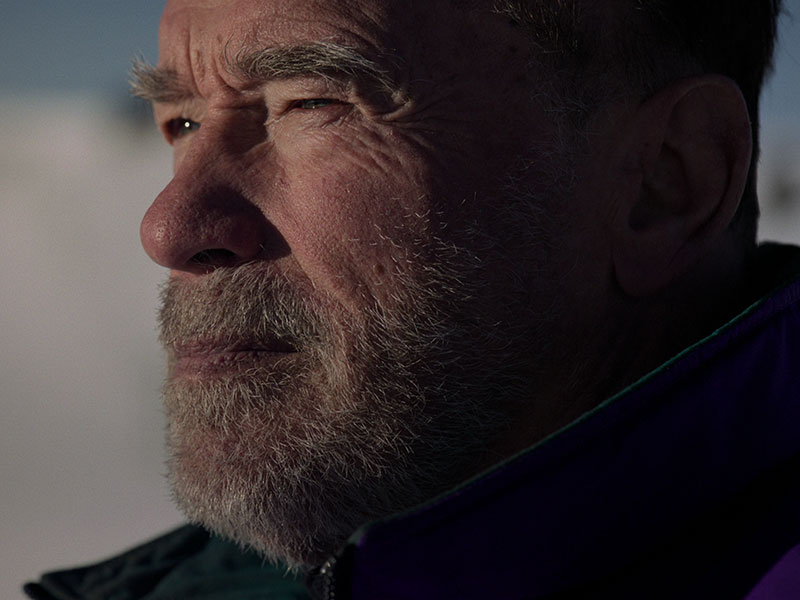
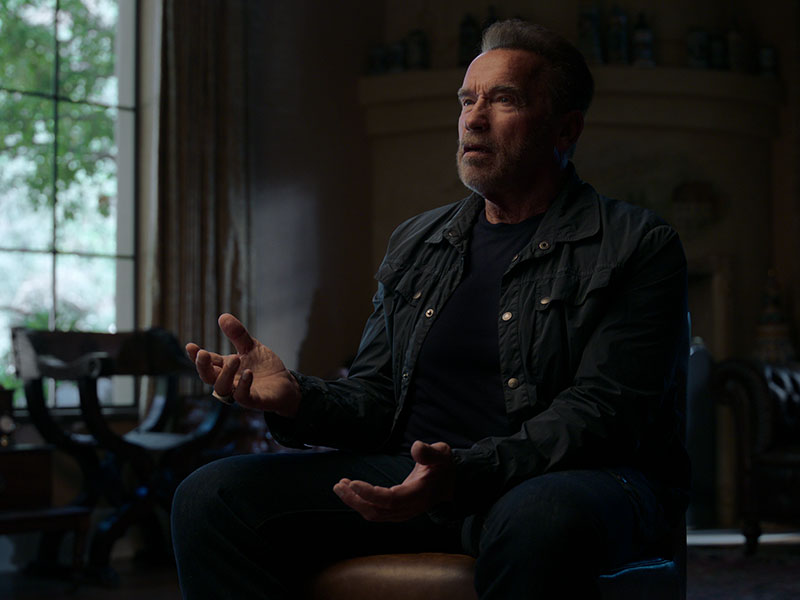
ArnoldArnold Schwarzenegger from “Arnold” (Photo courtesy of Netflix)
Shortly after Schwarzenegger returned to Austria from Baltimore and Philadelphia — where he did a series of posing exhibitions — he received word that his brother, Meinhard Schwarzenegger, had died in a car accident. Meinhard was driving under the influence and fatally hit a telephone pole.


Earlier in the documentary, Schwarzenegger recalled his strained yet loving relationship with Meinhard. The pair were constantly in competition throughout their childhoods, whether that was their performance in school or their abilities to pick out the best Mother’s Day gift. 


“He was always the darling of the family,” Schwarzenegger said of his brother. “He was very artistic. Very smart. Read a lot. But I don’t think my brother ever was really happy. I think he started drinking because our upbringing was very tough.”


Schwarzenegger continued, saying he and his brother routinely received beatings from their parents. The brothers also witnessed their father’s “schizophrenic behavior” at home. Gustav Schwarzenegger would often come home drunk and start screaming during the early hours of the morning before unleashing his anger on his wife and children.


“The kind of upbringing that we had was beneficial for someone like me, who was inside, very strong and very determined,” Schwarzenegger added. “But my brother was more fragile. Nietzsche was right, that that what does not kill you, will make you stronger. The very thing that made me who I am today was the very thing that destroyed him.”

02
Schwarzenegger said Maria Shriver “has a really nice” butt when he first met her
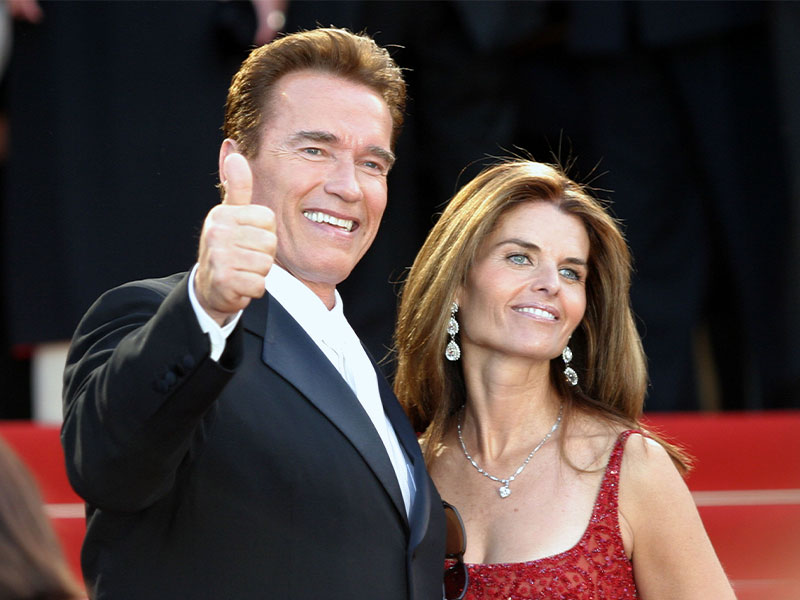
Arnold Schwarzenegger and Maria ShriverArnold Schwarzenegger and Maria Shriver during 2003 Cannes Film Festival – “Les Egares” Premiere at Palais Des Festival in Cannes, France. (Jean Baptiste Lacroix/WireImage/Getty Images)
Schwarzenegger was introduced to his now ex-wife while meeting the Kennedy family at the Robert F. Kennedy Memorial Tennis Tournament. He recalled meeting Shriver’s mother Eunice Kennedy Shriver, who “came up to me and said, ‘It’s so good to have you here. By the way, this is my daughter Maria Shriver,'” Schwarzenegger said. 


“Then, later on she said, ‘My daughter is really fond of you,’ and I said, ‘Well, your daughter has a really nice a**. I have to tell you that.'”


Schwarzenegger continued, “What a stupid thing to say. I don’t even know why I said it.”


The pair met in 1977 and later tied the knot in 1986. They have four children together: Katherine, Christina, Patrick and Christopher. On May 9, 2011, Shriver and Schwarzenegger ended their relationship after 25 years of marriage. Their divorce was finalized in 2021.


When recounting his relationship with Shriver, Schwarzenegger said, “I really fell in love with Maria, not because she was a Kennedy but because she had an extraordinary personality. I could see that little rebel in her. I wanted to escape from Austria, she also wanted to escape. That was the beginning of Maria and I.”

03
Schwarzenegger endured rigorous training to play Conan the Barbarian
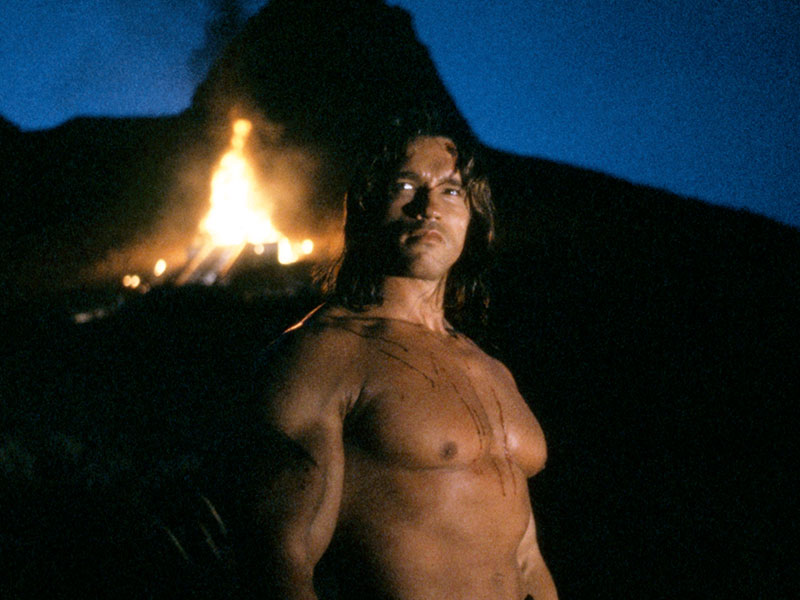
Arnold Schwarzenegger on the set of Conan the BarbarianAustrian-born American actor Arnold Schwarzenegger on the set of Conan the Barbarian, directed by John Milius. (Dino De Laurentiis/Universal Pictures/Sunset Boulevard/Corbis via Getty Images)
Schwarzenegger’s big break in Hollywood was when he landed the lead role of Conan the Barbarian, thanks to director John Milius, who believed Schwarzenegger had the build and persona to play the fictional sword and sorcery hero.


Schwarzenegger said shooting for the film was “tough” because Milius wanted him to be “out there in the cold, freezing [his] a** off.” 


“I did all my own stunts. There was no one around with the body,” Schwarzenegger continued. “So therefore, I had to do everything myself. It was fine the first take. Then we did the second take. Third take, fourth take. And eventually, I was now really bleeding.”


Schwarzenegger added that he was a “fanatic” about preparation and refused to show up on set unprepared for his stunts. He routinely completed samurai training, grappling training and broadsword training beginning at five in the morning. He also took part in hours of horseback riding because he wanted to “feel one with the horse.”


“Conan the Barbarian” became an international hit shortly after its premiere. The film series also marked a transformation in Schwarzenegger’s career; he was no longer Arnold the bodybuilder but rather, Arnold the actor.

04
Schwarzenegger fessed up to his past groping allegations 
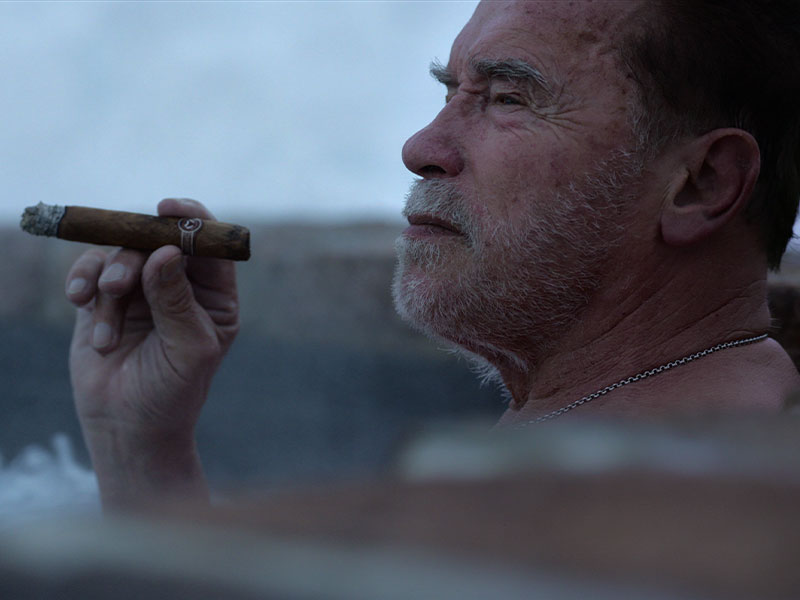
ArnoldArnold Schwarzenegger from “Arnold” (Photo courtesy of Netflix)
The allegations in question first arose just days before Schwarzenegger was elected governor in 2003, when a report from The Los Angeles Times detailed several allegations of groping, making lewd sexual suggestions and trying to remove one woman’s bathing suit in an elevator. The paper also quoted one woman as saying, “Did he rape me. No. Did he humiliate me? You bet he did.”


Carla Hall, the reporter behind that story, said in the documentary, “We found a pattern of behavior that took place over decades.” Once the story ran, however, people responded with anger and outcry.


“People immediately accused us of holding the story until five days before the election,” Hall said. “It ran on Oct. 2 because that’s how long it took.”


Schwarzenegger confessed that “in the beginning I was kind of defensive,” when asked about the allegations.  


“Today I can look at it and say it doesn’t really matter what time it is, if it’s the Muscle Beach days of 40 years ago or today, this was wrong,” he added. “It was bulls**t. Forget all the excuses, it was wrong.”

05
Schwarzenegger set up a “smoking tent” once he became governor
ArnoldArnold Schwarzenegger from “Arnold” (Photo courtesy of Netflix)

The tent, which was set up shortly after Schwarzenegger was sworn in as governor of California, was “not so much about smoking” but rather, “just a social place.”


“We were very successful in bringing legislators down, Democrats and Republicans, and I just sat outside in the tent and schmoozed with them,” Schwarzenegger said. “These were total strangers.”


It didn’t take long for Schwarzenegger’s “smoking tent” to become a place of intrigue. Columnist Joe Mathews said, “The smoking tent is not a tent. The smoking tent is a stage. All the people in the offices up and in his office could see who was in the smoking tent. ‘Why am I not in the tent talking to him? I need an idea that goes there.'”


Mathews continued, “It’s unsettling, because people that met with him could see that they were being watched. He’s [Schwarzenegger] totally comfortable being watched.”

06
While in couples counseling, Schwarzenegger admitted to Shriver that he fathered a child in an affair
ArnoldJoseph Baena from “Arnold” (Photo courtesy of Netflix)
Schwarzenegger opened up about his affair, saying he finally confessed to his wife during a session of couples counseling.


“Maria and I went to counseling once a week, and in one of the sessions the counselor said, ‘I think today Maria wants to be very specific about something. She wants to know if you are the father of Joseph?'” Arnold recounted. “And I was like — I thought my heart stopped and then I told the truth.”


He continued, “‘Yes, Maria, Joseph is my son.’ She was crushed because of that. I had an affair in ’96. In the beginning I really didn’t know. I just started feeling the older he got the more it became clear to me, and then it was really just a matter of how do you keep this quiet? How do you keep this a secret?”


It was later revealed that Schwarzenegger had an affair with his housekeeper, Mildred Patricia Baena. Schwarzenegger called his affair a “major failure” but maintained that he never wanted his son, Joseph Baena, to feel “unwanted.”


As for Schwarzenegger and Shriver, the couple called it quits in May 2011.

“Arnold” is currently available for streaming on Netflix. Watch a trailer for the series below, via YouTube:


Nick Jonas “has in him a real mystery”: Director on why he’s compelling in grief in “The Good Half”

“The Good Half,” is a touching, melancholic comedy-drama about Renn (Nick Jonas), a writer, who reluctantly comes home to attend his mother’s (Elisabeth Shue) funeral. On the plane, he meets Zoe (Alexandra Shipp), and their flirtatious conversation offers him some hope amidst his grief. Once home, Renn faces his put-upon sister Leigh (Brittany Snow), his milquetoast dad Darren (Matt Walsh), and his irritating stepfather, Rick (David Arquette). What he doesn’t confront are his feelings about his family. 

Director Robert Schwartzman knows a thing or two about families. His mother is Talia Shire; his brother is Jason Schwartzman; his cousins are Nic Cage and Sofia Coppola, and his uncle is Francis Ford Coppola. Schwartzman emphasizes the awkward moments as well as the warm memories in Renn’s family. The filmmaker deftly balances the humor and heartache as Renn bonds with his sister and fights with Rick as they prepare for the service. Renn also finds time to meet Zoe at a karaoke bar. 

“The Good Half” is all about embracing optimism during times of despair. Schwartzman spoke with Salon about his film, grief, and working with Nick Jonas in advance of the film’s world premiere at the Tribeca Film Festival.

How did you come to direct this project?  You’ve written most of your previous films. What made this project irresistible for you?

Having spent so much time about making music, I feel the creative process comes with the spark of an idea and chasing that. That’s what I’ve done so far. It was different to get a script, fall in love with it and imagine: what would I do with this? The process can be total chaos, but you feel like you execute it on some level you hope to get to. With this script, I saw the charm. The writer had lived the life of the main character. It was embellished for the screen. I loved the heart and comedy. I am obsessed with John Hughes‘ 80s movies, so the humor I like is creating situations that are uncomfortable and make you laugh based on the way things play out in the storyline. 

Did you identify with Renn?

I found myself close to the character because in my youth. I lost my father to cancer. I was younger than Renn is, but I understand loss and losing a parent, so in my own way it was trying to understand what it was hard for me to understand as a kid. Even though I didn’t write the script, part of my life is a story of loss and grief and trying to make sense of it. 

The story is about coping with loss, guilt and grief, specifically Renn coping with his mother’s death. Renn is in denial and acts out as his emotions get the better of him. What do you think of how Renn processes his emotions, and how do you process grief? 

That’s at the heart of what this is all about for me. Grief is a mysterious thing to have to experience. It’s not a one size fits all thing. Neither is love. Everyone has their own way to process things or grieve. When I talk to my siblings or mother about it, my brothers and I tell stories about this trip we took, and you laugh through tears that’s how you can make sense of it. It’s comforting. I think this is an honest way to deal with grief; you find ways to distract yourself. Renn’s connection with Zoe is them healing together. They are able to talk about it. The first step is communicating emotions, and that’s where acceptance comes in, which is the last stage of grief. I wanted to take viewers through the stages of grief. We have the main character in denial, feeling anger and then acceptance.

What observations do you have about family dynamics — especially given your family?  

It is hard to make sense of our relationships with the people closest to us. I drew on my experiences of loss. It’s harder for me to be emotional with people closest to me than people I don’t know very well. For those who know me so well, it takes on a new type of vulnerability to talk to them about stuff. I was excited to build this world around this family and have each person bring a different way of dealing with grief and finding peace in it. 

What can you say about working with Nick Jonas on the role? He has a flair for deadpan sarcasm and cynicism, a great hangdog expression, and you get him to sing in one scene. 

I have known Nick a long time and I thought the guy I know him to be is an introvert. He’s known for being a musical performer, but Nick is a performer-performer. He grew up doing “Les Miz” as a child on stage. He came from that world before he became a successful band musician/personality. Nick is comfortable to perform, so he’s up for the challenge. He wants to step up and say, “I can do this.”

Inside, actors are afraid and I’m sure he was and is, but for what we needed for the character, he stepped up. I felt Nick has in him a real mystery, and I feel very curious about him. I think the character needed to be played as someone viewers wonder about how he is doing. His layers as a person leant well to casting. I’ve seen him take on acting roles. I think he will be a competitive force for other actors in his age range. 

Nick performs karaoke in one scene. Was it planned for him to sing?

Renn says in the film, “I don’t do karaoke.” When he gets to the bar he says, “I regret coming here.” Nick did not know what song we were doing when we did it. I surprised him because I didn’t want him to know it very well. He flubs the song lyrics. We needed it to be in the moment, which is what karaoke is. 

What is your karaoke song?

I really love “Dream Lover” the Bobby Darin song. I like oldies but goodies. They are short, sweet, and not about falling on your knees singing your heart out. I’m a sucker for ’50s and ’60s music. Del Shannon’s “Runaway” is my favorite song ever. I love fun hair metal music and I know most people sing that. I think I’m the guy who when he does karaoke, most people go to the bathroom or get another drink. It’s not that fun to watch me do karaoke.

Do you think musicians make good actors because of their performance skills?

I find Nick to be more like the character in this film than who he is on stage. It is closer to the truth of who he is and that’s why I am so invested in him. 

You have often performed and composed music. How does that help you with directing?

Acting is so rhythmic, and comedy is timing. Nick is a really good drummer. On stage, you have to hit a mark at this point in the song; he is doing that. That’s what is called on when you are on set. He remembers songs, chord changes, and moments in a show; your memory has to be sharp as a musician. As an actor, you had to come to set with the foundation. Nick was very committed. As a musician, it was very complementary tool set to pull from — memory, marks and professionalism — he pulled on that to deliver for this film.

For me, as a director, everything is so rhythmic. It is about building rhythm of the day when you have no time. Establishing a rhythm with collaborators — your crew, your DP, your actors. Communication is rhythmic. And it’s the edit. Having a life in music and directing, the editorial process is similar to making albums. It is watching again and again and being able to manipulate things and find new meanings and having happy accidents is similar to making music. I’m a studio rat so when I am in the edit, I am at home. I eat up post-production. Having spent so much time in music, I feel very happy to have that background to understand that rhythm well. 

You create elegiac moments in the flashbacks, but there are also awkward moments, and even farcical ones. Can you talk about how you established the film’s serio-comic tone and developed the film’s style? 

I understand how the casket sequence has more humor, and the rhythm of that scene and how Nick comes off in that scene versus Renn alone in his bedroom. I don’t go into the film thinking this scene is going to be the jokey one. It’s just things I love about movie watching. I love the playfulness of Nick’s performance grilling David about his casket budget. But I also like to be alone with a character and be in their head for a moment. This is Renn’s struggle emotionally, and you are feeling this pain and seeing his shift to push it away. Those slices are true to what grieving can be.


Want a daily wrap-up of all the news and commentary Salon has to offer? Subscribe to our morning newsletter, Crash Course.


The women in the film, Renn’s mother, Zoe, and Leigh, absorb most of Renn’s guilt, often absolving him. What are your thoughts about the female characters in “The Good Half?”

Renn tries to make good with the characters around him and find peace in these relationships. I like that Renn is able to own up to the things he feels are not right. He apologizes to his sister for not being there. The break-in sequence is the family coming together. They are working together and craving this connection. Zoe is sensitive to other people’s needs. She is a therapist; what she does for a living is listen. That doesn’t mean she doesn’t have her own emotional hurdles. She is open about her divorce, which is a different version of grief. 

Are you an optimist? What is your “good half”?

I am an optimist, and my wife would agree 100%. I am someone who tries to look at things from the perspective that it will be OK, even when times are bad. Things don’t always play out the way we hope for, but at the end of the day, when things are not what we want in the moment, they can lead us unexpectedly to things that are very positive. Staying open to the possibilities of what life throws at us can sometimes bring us some peace.

“The Good Half” screens at the Tribeca Film Festival June 8, 10, and 12. 

Donald Trump indicted on federal charges in Mar-a-Lago classified documents case

According to various media reports — and Donald Trump’s social media posts — the former president was indicted Thursday on federal charges filed by special counsel Jack Smith’s office, after a yearlong investigation into whether Trump had illegally retained national security documents at Mar-a-Lago and then obstructed investigators’ efforts to recover them

Although an indictment was widely expected to occur this week, Trump himself managed to break the news in a series of posts on Truth Social, the social media platform he controls. The indictment has since been confirmed by multiple major media outlets, including CNN and the Guardian, citing unnamed sources familiar with the case. Smith’s office reportedly filed a seven-count indictment in U.S. district court in Miami, but the precise details will likely remain sealed until Trump’s arraignment — which he claims will occur on June 13. A source told the Guardian that “some of the counts include willful retention of national security materials, obstruction, scheme to conceal, false statements and conspiracy.”

This is the second criminal indictment against Trump, following his indictment in New York earlier this year on charges relating to an alleged hush-money payment made to adult-film actress Stormy Daniels prior to the 2016 election. At least two other potential criminal investigations remain in process. Smith, the Justice Department special counsel, is still exploring Trump’s attempts to overturn the results of the 2020 election and his alleged incitement of the Jan. 6, 2021, insurrection. Atlanta-area prosecutor Fani Willis is investigating Trump’s alleged scheme to subvert the election results in Georgia.

Smith’s investigation of the Mar-a-Lago documents case, which unveiled evidence suggesting that Trump had retained more than 300 classified documents — including some labeled “top secret” — at his Florida estate, has involved numerous revelations and has dominated the headlines for more than a year. 

Last week, federal prosecutors obtained a secret recording that showed Trump allegedly discussing a classified document he retained after his presidency, while May reports suggested that Trump’s staff had moved boxes of classified materials into a storage room at Mar-a-Lago just a day before investigators came to retrieve them. Smith also recently heard testimony from a still-anonymous Mar-a-Lago staffer, and acquired damaging notes from former Trump lawyer Evan Corcoran that appeared to undercut the former president’s defense. 

Throughout the probe, Trump has defended his actions — even arguing that he had the power to declassify documents with his mind — and insisted that he’s been treated unfairly.

In a series of Truth Social posts in January, Trump attacked the special counsel’s probe and compared his treatment to that of President Joe Biden, whose attorneys found classified documents he had retained after his terms as vice president in his former office and residence.


Want a daily wrap-up of all the news and commentary Salon has to offer? Subscribe to our morning newsletter, Crash Course.


 “Page 1: What Biden did was wrong, but he was given a reasonable and stable Special Counsel who is sane, inclined not to make waves, friendly with RINOS, and is not known as a flame-throwing lunatic or a Biden hater,” Trump first wrote. “What I did was RIGHT, Secured documents in a secured place, lock on the doors, guards and Secret Service all around, security cameras working. Mar-a-Lago is essentially an armed fort, and was built that way in the 1920’s, with High Walls & structure to serve as the Southern W.H.”

Page 2: I was President of the U.S. and covered and protected by the Presidential Records Act, which is not criminal and allows and encourages you to talk to the NARA, which we were, very nicely, until the FBI, who it is now learned has been after me for years without pause or question, RAIDED Mar-a-Lago, a stupid and probably Illegal thing to do,” he continued in another post. “As President, I have the right to declassify documents, Biden did not. Special ‘Prosecutor’ Jack Smith, however, is a Trump Hating political Thug.”

Trump echoed those arguments during a controversial CNN town hall in May, telling anchor Kaitlan Collins that the documents became “automatically declassified when I took them.”

Trump’s lawyers met with the special counsel and Justice Department officials on Monday in an apparent last-ditch effort to thwart the indictment, reportedly arguing that federal authorities had no right to file criminal charges the former president and alleging prosecutorial misconduct. 

The inquiry into Trump’s handling of the documents was launched in February 2022 after the National Archives retrieved 15 boxes of government records from Trump’s Mar-a-Lago residence following months of requests to Trump’s lawyers seeking their return.

In February of that year, the National Archives and Records Administration sent a referral to the Department of Justice expressing concern about the 14 boxes that it had found containing classified materials. That prompted the FBI to open the investigation.

Throughout the Mar-a-Lago probe, Trump has defended his actions — even arguing that he had the power to declassify documents with his mind — and insisted that he’s been treated unfairly.

NARA notified Trump that April that it would soon disclose the documents, which contained files later revealed to have been marked confidential, secret and top secret, to the FBI. Trump’s lawyer at that time, Evan Corcoran, requested an extension until the end of the month. The DOJ responded with a letter to Trump’s legal team seeking immediate access to the documents on grounds of “important national security interest.”

On May 11, following NARA’s denial of Corcoran’s request, the Justice Department issued a subpoena for the additional materials, leading to the June 3 visit from a DOJ attorney and two FBI agents to Mar-a-Lago to collect files, including 40 classified documents, Trump’s legal team had offered up in response. During that visit, investigators were informed that all such documents were held in a Mar-a-Lago storage room, which they were shown but prohibited from searching.

After sending a letter to Trump’s lawyers requesting that the storage room be secured and issuing another subpoena for the club’s surveillance footage, the DOJ then applied for a search and seizure warrant of the resort club last August, citing “probable cause” that additional government and classified records remained on the property.

On Aug. 8, 2022, the FBI executed the widely publicized search, seizing 36 items holding more than 100 classified documents found in the resort club’s storage room and the former president’s office. 

“That the FBI, in a matter of hours, recovered twice as many documents with classification markings as the ‘diligent search’ that the former President’s counsel and other representatives had weeks to perform calls into serious question the representations made in the June 3 certification and casts doubt on the extent of cooperation in this matter,” the Justice Department wrote in a filing at the time.

Attorney General Merrick Garland appointed Smith as special counsel last November to continue the investigation into the former president, who was on the verge of announcing his third presidential campaign. After requests from the Justice Department, Trump’s legal team hired individuals to search four other locations for classified materials: Trump’s resort in Bedminster, New Jersey; Trump Tower in New York, a storage unit in Florida; and a Palm Beach office.

Trump’s attorneys handed over two more classified documents to prosecutors following those searches, but reports from February of this year revealed the legal team later returned a box with additional classified documents, as well as a laptop with scans of the materials, after another yet search the DOJ requested last December.

In addition to the two existing criminal indictments and more that may or may not follow, Trump also faces a civil suit filed by New York Attorney General Letitia James alleging that his family business has defrauded lenders and tax authorities.

Trump continues to maintain that he did nothing wrong in any of these cases.

“This is a dead wife movie” that isn’t maudlin says “The Secret Art of Human Flight” filmmaker

“The Secret Art of Human Flight,” nimbly directed by H.P. Mendoza, is a gentle fable about letting go — and letting your freak flag fly. Quirky, without being overly precious, the film has Ben (Grant Rosenmeyer) despondent after the loss of his wife, Sarah (Reina Hardesty). He finds comfort by learning to fly “with no plane involved.” His instructor is Mealworm (Paul Raci), whom he found on the dark web, who puts him through a rigorous program — e.g., eat only vegetables for a week, then eat only meat for a week; go on a quest for spiritual enlightenment, etc. Ben’s training distracts him from his loss and gives him a renewed sense of purpose. His friendship with Mealworm, as well as his wife’s friend, Wendy (a sublime Maggie Grace), helps Ben get out of his rut. 

Mendoza, who has previously directed the infectious low-budget musical, “Fruit Fly,” and the dark comedy, “Bitter Melon,” connects with the material here by creating flights of fancy while also grounding the story with scenes depicting grief and mental illness. It’s a tricky balancing act that shifts from comedy to sadness, sometimes within the same scene. Mendoza manages it well coaxing a wily performance from Raci and infusing the story with some clever visual touches. 

On the eve of the film’s world premiere at the Tribeca Film Festival, Mendoza spoke with Salon about “The Secret Art of Human Flight.”

Ben takes a big leap in “The Secret Art of Human Flight.” This film is a big leap for you having made a series of indie films like “Colma: The Musical” and “Bitter Melon.” Can you talk about work on this level?

I learned to see the pattern in my career. Every time I make a film, people come to me and say, “Great DIY job, you indie punk kid. Now I’ll show you how to make a real movie!” And when I try to work larger, we hit snags and problems, so I have to work as the scrappy DIY guy I am. Even though this film was 10 times more money than I usually work with, I still had to be scrappy and wear a lot of hats. So did my DP. This is the probably the scrappiest I had to be since “Colma: The Musical.” This felt no different to me. It just happened to have Paul Raci in it. 

It was interesting because I always thought of myself as someone who was going to stay on the outskirts. I was going into darker territory with “Bitter Melon,” and going into experimental territory with my current film project [in development.] When I got this script, I thought it was an ’80s film that threatened to whisk you away with images of flight, like “Always” and “Radio Flyer,” which were marketed as “emotional movies about flying.” I’d never been handed a script before, nor have I worked with Hollywood people before. I was looking for outs, because I am always busy, and I am insecure. Grant talked me into it, and it gave me a chance to exorcise some things I was going through during the pandemic. This film deals with loss, and I was dealing with loss, so I took the plunge.

What I appreciated about the film was how it asks Ben to confront his fears. After his wife’s death, he is treated with kindness and compassion, but Ben doesn’t want folks to treat him like a wounded hummingbird. What themes clicked with you emotionally? You talked about loss during the pandemic, but it isn’t sentimentalized. 

I think that over-sentimentalization goes hand-in-hand with something I don’t like about dead wife movies. This is a dead wife movie, and I said, “Either we lean into making a dead wife movie in 2023, or we cut the dead wife out altogether.” I was really happy to be given the chance to flesh Sara out as a character. Sara is a version of me and my husband rolled in one. When you have been married for 17 years, you get a little more pragmatic. For me, Ben having to deal with things head-on, we had to skip past the sentiment, and show that there were some cracks and fissures in their relationship. I grew up with messages like, “In order to move past something you have to let it go.” We absorb that, but they never meant anything until I had stuff to let go of. I wanted to put my lens on that and have Grant echo that. 

“The Secret Art of Human Flight” is a very layered film both in terms of content and style. There are surreal moments and scenes of magic realism. You incorporate personal videos, a psychedelic sequence, and other episodes. How did you approach telling this story visually? 

I’ve always been a fan of mixed media. It inspired me to have Reina Hardesty in the film. She was talking about her experiencing as an Asian American with me. That unlocked this link to my previous work. So, I wondered, what would it take to make “The Secret Art of Human Flight” into something mixed media, without being “Natural Born Killers” or “Sans Soleil.” When I had the opportunity to write the flashbacks, I talked with my DP about how could we differentiate them and make them like the films that made our hearts soar? How can we make this feel like big moments in Hollywood films? So that lead us to shoot in 4:3. That makes it feel bigger. We shot in a small house in Pittsfield, MA. I wanted to shoot wide angle as much as possible. I wanted things to be unsettling. Let’s make every shot look weird. My DP, Marcus, said, “I feel you want this to be like a horror film,” and I responded, “If you want things to be a rollercoaster, it has to be a little bit scary.” So, we built this aesthetic together. “The Tree of Life” was a big inspiration for me; I spiritually don’t connect that that film, but the visuals really live with me. 

There are several scenes that address issues of grief and mental illness. Can you talk about incorporating these topics into what is, at times, a buddy comedy?

Even though half of it is a buddy movie, I was trying to make the other half like a home invasion film. I think Mealworm is scary; he is not the genie from “Aladdin.” He could be there to kill him, which is said by Tom (Nican Robinson), the cop. You witness this big struggle inside Ben’s head. The idea that the other side of isolation is connecting with people, and once Ben starts connecting, there is a moment he blows up and talks about how he doesn’t care. It’s borderline suicidal. It’s a heavy scene, but it does have to be there. But people don’t run away from him We all struggled through the pandemic, but we didn’t struggle though it alone. People talk about how isolated they were during the pandemic. What was interesting was watching people I know blaming everyone for their depression. I never saw that before. His sister, Gloria (Lucy DeVito) forces Ben to open up about his feelings. The scene was supposed to be played for laughs, but I thought, I can’t in good faith do this as a joke. It has to be heavier. It’s a movie about grieving, so it deserves to have a few heavy moments. 

Both Wendy and Mealworm counsel Ben differently. What approach would you take with Ben?

My knee-jerk reaction to how I would deal with Ben is that I’m definitely a Wendy. But I wonder how much of me is Mealworm, too? When I first got the script and I was reading what Mealworm is saying about leaving western luxuries aside and becoming the barefoot goddess as she connects with the earth, I don’t know that this is wise advice. Maybe that’s the point, but it feels like faux mysticism and orientalism. I brought that up with the team and that became a line in the film! I don’t want to come across as a guru or someone who has all answers. I want someone to come along with me on this ride called life and share experiences. That’s what I do with people. I say, “I can’t fix your problems, but I’m your sponge.” That’s what I appreciate most about Wendy. I didn’t want her to be an oracular character, or a fixer. When she talks about her dead husband, she should be off in her own world, not looking at Ben. Her sharing her experience is a lot more impactful. She is this grounding force. There are certain things about Mealworm that do speak to me. Mysticism and orientalism aside, I appreciate what he says about letting go. But I am more of a facilitator than a guru.


Want a daily wrap-up of all the news and commentary Salon has to offer? Subscribe to our morning newsletter, Crash Course.


You are a composer as well as a director, and often create songs for your films. You wrote two songs for “The Secret Art of Human Flight.” Can you discuss that form of storytelling in this film?

Interestingly, that song is Wendy’s theme, evolved. I was composing on set and just coming up with little tunes. I had a keyboard in my backpack at all times and use it to show how I wanted a rhythm to be on any scene. There is a scene of Paul playing a guitar on the floor in front of candles. He was knocking out some chords and seeing what sounded pretty. That is what got captured in the movie, and those chords became Wendy’s theme. Imagine if the film is a musical — what would Mealworm’s speech sound like as a musical number? 

Wendy says she copes with grief by drinking a potion she creates. Ben learns to fly. What do you do to get out of a rut? 

There are several things I do to get out of ruts. I always try to take myself out of my element —whether that is taking psychedelics or trying something new, like joining the Bay Area flash mob and choreographing for them. Or moving to Tokyo. Or just traveling for a while and not knowing when I am going to come back home. Things that are uncomfortable. Things I might have been afraid of in the past. Any rut I fall into is based on a block, and not sure I know what it is or where it lies, but maybe I can do something to shake it free. 

“The Secret Art of Human Flight” screens June 8, 9, and 13 at the Tribeca Film Festival.

“You wanna inhale this stuff? Go ahead”: “The View” is OK if the right denies smoke health risks

As air quality conditions continue to worsen across New York City, Republicans are yet again boarding the mask mandate hate train and earning plenty of laughs from the hosts over at “The View.”

“Oddly, this is being politicized,” says Whoopi Goldberg in Thursday’s episod, before providing the evidence of right-wing commentators denying the health risks posed by the smoky air.

Several Fox News anchors sound convinced that the harmful smoke — which continues to waft south from more than a hundred wildfires burning in Quebec — is merely a ploy orchestrated by the Democrats. “While Americans choke on the smoke, the far left smells an opportunity,” said “The Five” anchor Jeanine Pirro during a Wednesday news segment. “Other Democrats are pumping up climate hysteria and bringing back, you guessed it — mask insanity.”

Joining Pirro is conservative commentator Sean Hannity, who not only made jabs at the left “politicizing” the crisis in his Fox News show but also bragged about his own physical fitness:

“I workout regularly, so I think I’m relatively in-tune with my body,” Hannity asserted. “I think if I was having difficulties breathing, I would notice.”

Both Fox News clips were played during Thursday’s episode of “The View” and, expectedly, received plenty of giggles and eye rolls from the panel and members of the audience.

“The Left does not smell an opportunity,” said co-host Ana Navarro with wide eyes and a mocking tone. “The Left smells fire and burning and smoke!”

She added, “It is just so stupid for us to keep on denying what is now the undeniable. . . . We’re all in this together. We’re one big planet. You only have one. Let’s take care of it.”

Even conservative co-host Alyssa Farah Griffin agreed, offering her insights on the future of climate change, which she believes is being taken seriously amongst a new group of Republicans:  

“Listen, the ridiculousness of those clips we played, it’s just unserious. The good news though is the vast majority of young Republicans are coming around to the reality of climate change and putting in place policies that put our planet on a path for a sustainable future,” Farah Griffin said. “You lose Millenials, you lose Gen-Z voters if you deny the reality of what’s happening to our planet.”


Want a daily wrap-up of all the news and commentary Salon has to offer? Subscribe to our morning newsletter, Crash Course.


Sunny Hostin unshockingly mentions her husband, citing how he was trying to convince her daughter to wear a mask to school. “She was a little embarassed to wear [the N95] mask. I said, ‘Listen, he’s a doctor. He’s telling you this [air] could harm you.’ And she’s an athlete, she’s a runner.”

Meanwhile, Sara Haines wasn’t concerned with convincing the right to wear masks. “When it was early on in COVID, you not wearing a mask affected me,” she said. “You don’t want to wear a mask outside? You wanna inhale this stuff? Go ahead and do it.”

She continued, “The schools sent out notices they weren’t sending [our kids] out for recess. They were keeping them inside. They said the elderly and the very young were at risk. People with, you know, all of the things. You don’t believe any of that? You think someone is on the side, stage left pumping some orange? You think they can do that? Then you know what? Go ahead. You do you. I’m fine with whatever you choose.”

Amid the hazardous air quality in New York City, Washington D.C. went under a Code Purple air quality alert on Thursday. A Code Purple alert means air conditions are unhealthy “for the entire public, not just those with respiratory illnesses.”

Watch the full discussion below, via YouTube:

The real border surge: The end of Title 42 and the triumph of the border-industrial complex

On May 11th, I was with a group of people at the bottom of the Paso del Norte bridge in Ciudad Juárez, Mexico. Suddenly, I realized that I didn’t have the small change needed to cross the bridge and return to El Paso, Texas, where I was attending the 16th annual Border Security Expo. Worse yet, this was just three hours before Title 42, the pandemic-era rapid-expulsion border policy instituted by the Trump administration, was set to expire. The media was already in overdrive on the subject, producing apocalyptic scenarios like one in the New York Post reporting that “hordes” of “illegals” were on their way toward the border.

While I searched for those coins, a woman approached me, dug 35 cents out of a small purse — precisely what it cost! — and handed the change to me. She then did so for the others in our group. When I pulled a 20-peso bill from my wallet to repay her, she kept her fist clenched and wouldn’t accept the money.

Having lived, reported, and traveled in Latin America for more than two decades, such generosity didn’t entirely surprise me, though it did contradict so much of the media-generated hype about what was going on at this historic border moment. Since Joe Biden took office in 2021, the pressure on his administration to rescind Trump’s Title 42 had only grown. Now, it was finally going to happen — and hell was on the horizon.

But at that expo in El Paso that brought together top brass from the Department of Homeland Security (DHS), its border and immigration enforcement agencies, and private industry, I was learning that preparations for such a shift had been underway for years and — don’t be shocked! — the corporations attending planned to profit from it in a big-time fashion.

Seeing the phase-out of Title 42 through the lens of a growing border-industrial complex proved grimly illuminating. Border officials and industry representatives continued to insist that just on the other side of the border was a world of “cartels,” “adversaries,” and “criminals,” including, undoubtedly, this woman forcing change on me. By then, I had heard all too many warnings that, were the United States to let its guard down, however briefly, there would be an infernal “border surge.”

As I later stood in the halls of that expo, however, I became aware of another type of surge not being discussed either there or in the media. And I’m not just thinking about the extra members of the National Guard and other forces the Biden administration and Texas Governor Greg Abbott only recently sent to that very border. What I have in mind is the surge of ever higher budgets and record numbers of Customs and Border Protection (CBP) and U.S. Immigration and Customs Enforcement (ICE) contracts guaranteed to ensure that those borderlands will remain one of the most militarized and surveilled places on planet Earth.

Robo-Dogs at the Expo

Earlier that day, I found myself standing in front of the Ghost Robotics booth. There sat a vendor and, in front of him, a chrome-colored robotic dog on a puke-green carpet. Behind him, a large sign said: “Robots that Feel the World.” He was explaining to prospective customers that the robo-dog could run at a pace of up to nine miles an hour. A vendor in the adjacent booth, Persistent Systems, that claimed to connect “soldiers, sensors, unmanned systems, and cameras in a dynamic network,” was not impressed. (Those, by the way, were but two of nearly 200 companies in that large exhibition hall.). He said, “I’ll take my dog any day,” meaning his living and breathing dog.

The Ghost Robotics vendor responded earnestly, “We are not going to replace dogs!”

All around us, well-dressed corporate types, uniformed Border Patrol agents, and other police officials wandered the aisles, looking at retractable tower masts, taser demonstrations, Glock guns, and facial recognition and iris scanners, part of a border industry that’s been in a state of constant growth for two decades.

Honestly, walking through that exhibition hall was like being in a science-fiction novel that had come to life or perhaps a crystal ball for our border future. The Israel Aerospace Industries banner hovered on the rafters praising a company “Where Courage Meets Technology.” On the ground, the company highlighted its MegaPop high-powered surveillance camera.

The slogan of Tower Solutions, which sells body armor, was more typically down to earth (or do I mean sky-high?): “Speed, Strength, Stability, Elevated.” Armored Republic, which also sells body armor, offered religious fervor in a banner that said: “In a Republic There’s No King but Christ.” But Anduril, the new border darling — 11 contracts with CBP since 2018 — may have caught the enforcement future most perfectly with its “Autonomy for Border Security” banner. Autonomous sentry towers, autonomous drones, and autonomous robotic dogs were to be the true post-Title 42 future, and the exhibition hall was a crystal ball for such a time to come.

Contemplating the Ghost Robotic guy’s response, the Persistent Systems vendor then pointed at the robo-dog and said, “You can weaponize those things and they can go into barracks and blow a motherfucker’s face off.”

The Ghost Robotics vendor responded, “We’re already doing that.” Did he mean weaponizing robo-dogs or blowing a person’s face off? I had no idea.

The Budget Surge

A few hours earlier, DHS Chief Information Officer Eric Hysen assured industry officials that his agency had the “largest budget ever enacted” in its 20-year history. Formerly a Silicon Valley software engineer and program organizer for Google, he had arrived in Washington in 2014 to work in the Obama White House. The next year, he created a Digital Services Team at DHS and “never looked back.” His technocratic language had no Trumpian bluster or hyperbole. It was grounded in numbers and budgets with a bit of social justice spun in (including a mention of a program to hire more women and assurances that, no matter the invasive surveillance technology DHS was developing, privacy issues were taken quite seriously by the department).  

At $29.8 billion, the CBP/ICE portion of the DHS budget he praised was not just the highest ever but a $3 billion jump above 2022, including $2.7 billion for “new acquirements in our southwestern border.” In other words, the coming surge at the border was distinctly budgetary.

For context, when Donald Trump took office in 2017 his CBP/ICE budget was $21.2 billion. By 2020, it had gone up to $25.4 billion. In other words, it took him four years to do what the Biden administration essentially did in one. The last time there had been such a jump was from $9.4 billion in 2005 to $12.4 billion in 2007, including funding for huge projects like the Secure Fence Act that built nearly 650 miles of walls and barriers, SBInet which aimed to build a virtual wall at the border (with special thanks to the Boeing Corporation), and the largest hiring surge ever undertaken by the Border Patrol — 8,000 agents in three years.

But if that’s what $3 billion meant in 2005-2007, what does it mean in 2023 and beyond? Gone was the Trump-era bravado about that “big, beautiful wall.” Hysen’s focus was on the Department of Homeland Security’s launching of an Artificial Intelligence Taskforce. A technocrat, Hysen spoke of harnessing “the power of AI to transform the department’s mission,” assuring the industry audience that “I follow technology very closely and I am more excited by the developments of AI this year than I have been about any technology since the first smartphones.”

That robo-dog in front of me caught the state of the border in 2023 and the trends that went with it perfectly. It could, after all, be controlled by an agent up to 33 miles away, according to the vendor, and apparently could even — thank you, AI — make decisions on its own.

The vendor showed me a video of just how such a dog would work if it were armed. It would use AI technology to find human forms. A red box would form around any human it detects on a tablet screen held by an agent. In other words, I asked, can the dog think?

I had in mind the way Bing’s Chatbox, the AI-powered search engine from Microsoft, had so infamously professed its love for New York Times reporter Kevin Roose. A human, using an Xbox-like controller, the vendor told me, will be able to target a specific person among those the dog detects. “But,” he reassured me, “it’s a human who ultimately pulls the trigger.”

The Title 42 Surge

In Mexico, when I walked to a spot where the Rio Grande flowed between the two countries, I ran into a small group of migrants camped out at the side of the road. Near them was a fire filled with charred wood over which a pot was cooking. A pregnant Colombian woman told me they were providing food to other migrants passing by. “Oh,” I asked, “so you sell food?” No, she responded, they gave it away for free. Before they had been camped out for months near the immigration detention center in Ciudad Juárez where a devastating fire in March killed 40 people. Now, they had moved closer to the border. And they were still waiting, still hoping to file applications for asylum themselves.

Behind where they sat, I could see the 20-foot border wall with coiling razor wire on top. There was nothing new about a hyper-militarized border here. After all, the El Paso build-up had begun 30 years ago with Operation Hold the Line in 1993. A desert camo Humvee sat below the wall on the U.S. side and a couple of figures (Border Patrol? National Guard?) stood at the edge of the Rio Grande shouting to a Mexican federal police agent on the other side.

The clock for the supposed Title 42 Armageddon was ticking down as I then crossed the bridge back to El Paso, where more barriers of razor wire had only recently been emplaced. There was also a slew of blue-uniformed CBP agents and several jeeps carrying camouflaged members of border units. Everyone was heavily armed as if about to go into battle.  

At the Border Security Expo, Hysen pointed out that fear of a Title 42 surge had resulted in an even more fortified border, hard as that might be to imagine. Fifteen hundred National Guard troops had been added to the 2,500 already there, along with 2,000 extra private security personnel, and more than 1,000 volunteers from other agencies. Basically, he insisted, they had everything more than under control, whatever the media was saying.

At another panel entitled “State of the Border,” Border Patrol Chief Raul Ortiz joked that he would prefer discussing his golf game, only reinforcing that by adding, “As all of America and the political pundits and the reporters run around and say when we lose Title 42 the sky is going to fall, it ain’t gonna fall. We will process people as we normally have during my 32-year career.”

As Department of Homeland Security Secretary Alejandro Mayorkas similarly pointed outTitle 8 authority, the pre-Title 42 enforcement program to which DHS will now return, “carries stiff consequences for irregular migration, including at least a five-year ban on reentry and potential criminal prosecution for repeated attempts to cross unlawfully.” In addition, the Biden administration expects to aggressively expand the process, including implementing a plan to ramp up enforcement far south of the border in the Darién Gap between Colombia and Panama. It’s even possible that U.S. troops will be deployed there for the job. And in a repetitive note at that expo, American officials indicated in a variety of ways that help would, above all, be needed from the corporate world.

Biden Is Already Out-Trumping Trump at the Border

Since the Department of Homeland Security was established 20 years ago, Customs and Border Protection and Immigration and Customs Enforcement have given private companies 113,276 contracts (yes, you read that right!), or on average 5,664 contracts annually, 16 per day. In the 15 years since 2008, the money spent on such contracts has amounted to $72.6 billion dollars and such figures have only been on the rise since Joe Biden entered the White House.

The 4,465 contracts CBP and ICE have agreed to so far this year (at a price of $4.1 billion) put them on pace to surpass 2022’s record-setting $7.5 billion. In 2022, CBP and ICE offered 9,909 contracts, an average of 27 per day, all of which means the Biden administration is likely to be the largest border-enforcement contractor ever.

Only recently, New York Times columnist Thomas Friedman suggested that President Biden should “out-Trump Trump” and  “do everything possible to secure the border like never before — more walls, more fences, more barriers, more troops, the 82nd Airborne — whatever it takes. Make Democrats own border security.” What Friedman apparently didn’t realize was that Biden had already taken just that border path.  

From his first days in office, the president had stressed technology over wall-building and (not surprisingly) received three times more campaign contributions from top companies in the border industry than Trump did in 2020. And unlike the former president’s Title 42, this policy of contracts, campaign contributions, and lobbying that will push for endlessly higher border budgets is not set to expire.  Ever.

At the Edge of Everything — and Nothing At All

On the morning of May 12th, I was with border scholar Gabriella Sanchez at the very spot where the borders of Texas, New Mexico, and Chihuahua meet near El Paso. Title 42 had expired the night before and I asked her what she thought. She responded that she considered this the border norm: we’re regularly told something momentous and possibly terrible is going to happen and then nothing much happens at all.

And she was right, the predicted “surge” of migrants crossing the border actually decreased — and yet, in some sense, everything keeps happening in ways that only seem grimmer. Perhaps 100 yards from where we were standing, in fact, we soon noticed a lone man cross the international boundary and walk into the United States as if he were taking a morning stroll. Thirty seconds later, a truck sped past us kicking up gravel. For a moment, I thought it was just a coincidence, since it wasn’t an official Border Patrol vehicle.

Then, I noted an insignia on its side that included the U.S. and Mexican flags. The truck came to a skidding stop by the man. A rotund figure in a gray uniform jumped out and ran toward him while he raised his hands. Just then, a green-striped Border Patrol van also pulled up. I was surprised — though after that Border Security Expo I shouldn’t have been — when I realized that the initial arrest was being made by someone seemingly from a private security firm. (Remember, Hysen said that an extra 2,000 private security agents had been hired for the “surge.”)

In truth, that scene couldn’t have been more banal. You might have seen it on any May 12th in these years. That banality, by the way, included a sustained violence that’s intrinsically part of the modern border system, as geographer Reece Jones argues in his book Violent Borders: Refugees and the Right to MoveIn the days following Title 42’s demise, an eight-year-old Honduran girl died in Border Patrol custody and a Tohono O’odham man was shot and killed by the Border Patrol. In April, 11 remains of dead border crossers were also recovered in Arizona’s Pima County desert alone (where it’s impossible to carry enough water for such a long trek).

In the wake of Donald Trump, everything on the border has officially changed, yet nothing has really changed. Nothing of note is happening, even as everything happens. And as Hysen said at that border expo meeting, big as the record 2023 border budget may be, in 2024 it’s likely to go “even further” into the stratosphere.

Put another way, at the border, we are eternally at the edge of everything — and nothing at all.

“These climate extremes are going to continue”: The toxic cloud upon us

Canada is on fire.

The smog fallout downwind has set off air quality alerts for 13 states south of the border with the worst air quality currently being reported in upstate New York from Syracuse to Binghamton. Toxic smog has extended down along the East Coast and into the Ohio Valley as millions of Americans are being advised to curtail outdoor activity if they have pre-existing health conditions.

This afternoon poor visibility at Newark Liberty International Airport and New York City’s LaGuardia Airport prompted the FAA to slow air traffic for lack of visibility. “Exposure to elevated levels of fine particles such as wood smoke can increase the likelihood of respiratory symptoms in sensitive individuals and aggravate heart or lung disease,” the National Weather Service warned.

Monday, Reuters reported “Canada is on track for its worst-ever year of wildfire destruction as warm and dry conditions are forecast to persist through to the end of the summer after an unprecedented start to the fire season” with blazes officials said on Monday “burning in nearly all Canadian provinces and territories.”

“The distribution of fires from coast to coast this year is unusual. At this time of the year, fires usually occur only on one side of the country at a time, most often that being in the west,” Michael Norton, an official with Canada’s Natural Resources ministry, told Reuters.

Yan Boulanger, with Natural Resources Canada told the wire service that “over the last 20 years, we have never seen such a large area burned so early in the season.  Partially because of climate change, we’re seeing trends toward increasing burned areas throughout Canada.”

By last weekend officials were estimating that 3.3 million hectares (a hectare is equal to 2.47 acres) had already gone up in flames “about 13 times the 10-year average” forcing more than 120,000 people to leave their homes, according to Reuters.

Of the over 400 active wildfires, over half were deemed out of control.

After years of handwringing, Canada’s unprecedented wildfire season, aggravated by the weather distortions of climate change, is presenting us a teachable moment as we find ourselves checking the smog alert like we did the daily COVID numbers just a few months ago.

Mayor Ras J. Baraka had to urge his city residents to take precautions during the air quality alert issued by the New Jersey Department of Environmental Protection (NJDEP). One of the features of the climate crisis, like the pandemic, is it hits the communities hardest that have the highest concentration of the chronically ill, like the many thousands of New Jersey’s youths from communities of color who suffer from asthma at a much higher rate than their white peers.

“Due to heavy smoke from a convergence of wildfires as far away as Canada, the NJDEP has issued an air quality alert for the northern region of the state, including Newark,” said Mayor Baraka in a statement today. “I ask everyone to protect their health by staying informed and carefully following NJDEP’s guidelines throughout the duration of the alert.”

Specifically, NJ DEP warned at-risk residents to stay indoors as much as possible, keep their windows closed, use an air purifier if possible, limit their outdoor physical activity and if they had to go out for an extended period to wear a mask. Officials flagged children, older adults, and people with heart disease, asthma, or other lung diseases as being particularly vulnerable to the degraded air quality.

“I think it would be common sense that when the National Weather Service and the NJDEP have both issued a code red air quality day with the weather service saying air quality is worse today, our state workforce should be kept insider as much as possible,” texted Fran Ehret, New Jersey state director of the CWA, which represents 40,000 state workers many of whom work outdoors.

Finally, after months of prodding from the environmentalists Gov. Phil Murphy announced yesterday the adoption of the  Inland Flood Protection Rule to better protect New Jersey’s communities from worsening flooding and stormwater runoff.  The announcement was welcomed but the delay was inexcusable.

“The Inland Flood Protection Rule will serve as a critical component of my Administration’s comprehensive strategy to bolster our state’s resilience amid the worsening impacts of climate change,” Murphy said in his statement yesterday. “As a national model for climate adaptation and mitigation, we can no longer afford to depend on 20th-century data to meet 21st-century challenges. This rule’s formation and upcoming adoption testify to our commitment to rely on the most up-to-date science and robust stakeholder engagement to inform our most crucial policy decisions.”

The Governor got the rhetoric right way back in his January 2020 Executive Order 100 citing a 2019 report  “New Jersey’s Rising Seas and Changing Coastal Storms”   that showed “that sea-level rise projections in New Jersey are more than two times the global average and that the sea level in New Jersey could rise from 2000 levels by up to 1.1 feet by 2030, 2.1 feet by 2050, and 6.3 feet by 2100, underscoring the urgent need for action to protect the State from adverse climate change impacts.”

In the late summer of 2021, Hurricane Ida took 90 lives in total when it inundated a nine-state swath of the Northeast. Damage estimates for New Jersey ranged between $8 to $10 billion and in the $7.5 to $9 billion range in New York. In October 2012, Superstorm Sandy caused $70.2 billion worth of damage, left 8.5 million people without power,  and destroyed 650,000 homes and was responsible for the deaths of at least 72 Americans.

“New Jersey is experiencing increased effects of climate change—this is a climate crisis and what we are seeing and will continue to see are periods of dryness that lead to drought and wildfires and then followed by periods of big rain events that lead to flooding—so we are going to have too much water excerpt when we don’t have enough of it,” said Jennifer Coffey, executive director of the Association of New Jersey’s Environmental Commissions.  “These climate extremes are going to continue for New Jersey and the Northeast for many, many decades to come and we need to prepare ourselves for those impacts and become more resilient. So, we need to shore up our water supplies and also need to increase the intelligence that we use when we map storm water and that’s what these rules do.”

While we continue to debate climate change and the need to stop burning fossil fuels, the physical manifestation of the crisis is all around us whether we choose to make the connections or not. When wildfires on this hemispheric scale burn out of control it should prompt a sense of urgency for us to try and reduce our reliance on burning fossil fuels to power our society.

“This is the time to reject the seven fossil fuel projects here in New Jersey,” said Paula Rogovin, longtime Bergen County environmental activist. “What are they waiting for? It is going to get worse. This is the ultimate teachable moment. My grandson in New York City is in school and they can’t do anything outside. This is the time to recognize it is not getting better. We are not even in the summertime yet. The wildfires are just beginning.”

This morass had been building for days but we were too distracted to really notice how our atmosphere was being consumed by a jaundiced mega-cloud drifting south like a welcome mat from Hades.

And then the kids couldn’t go outside for recess.

Pray for rain to redeem us.

“Our hearts dropped”: The “Top Chef: World All-Stars” final three spill the tomato tea

“Top Chef: World All Stars” has truly been one for the books (Alain Ducasse! Asma Khan! A Wellington extravaganza!).

After 13 weeks of competition, I had the opportunity to speak with our top three finalists to find out all about how they prepped for the season, the biggest differences between their first times competing and this time around, their biggest challenges and their most successful triumphs leading up to the big finale. 

Read ahead to learn all about the journeys experienced by Sara, Buddha and Gabri this season. 

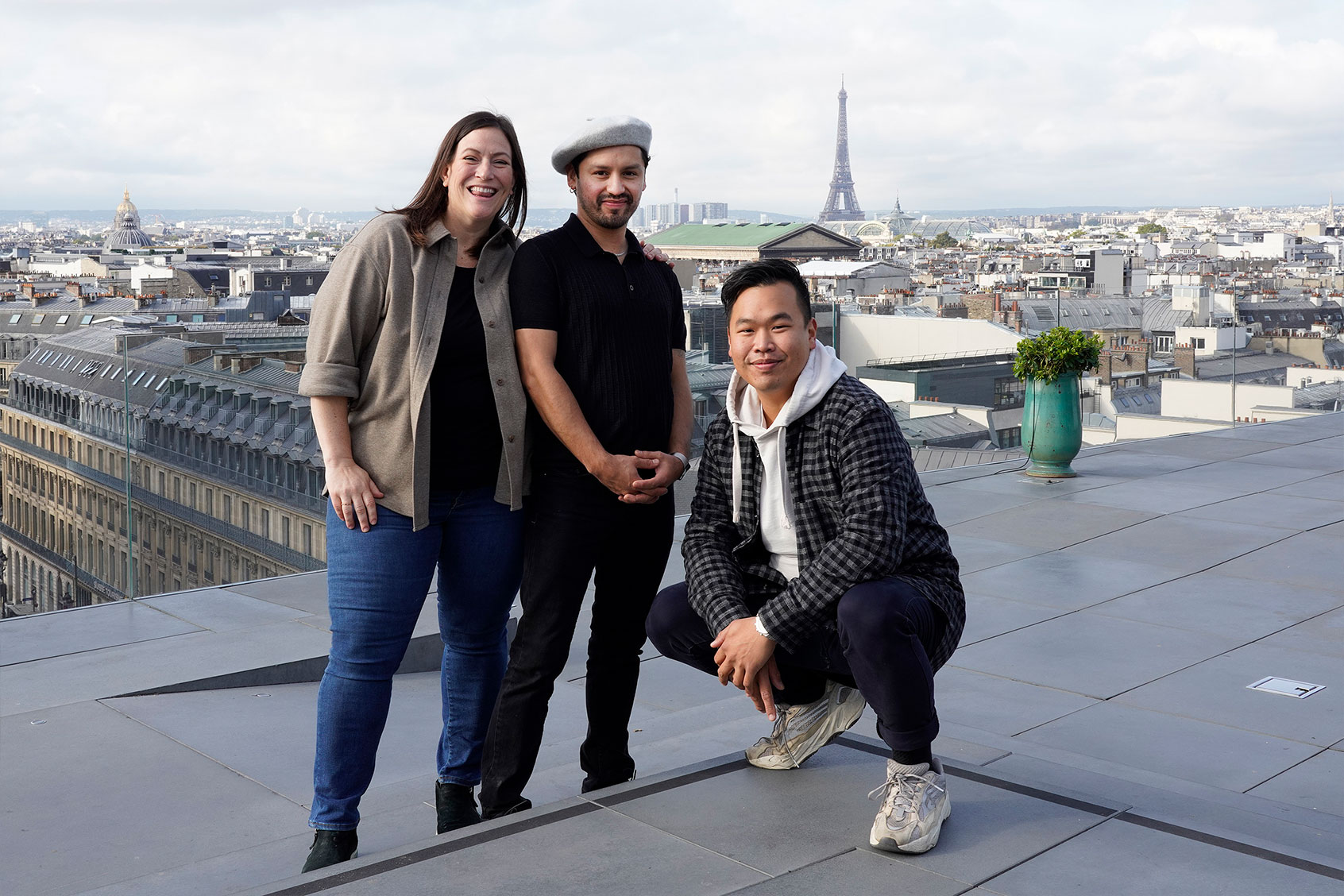
Top ChefSara Bradley, Gabriel Rodriguez and Buddha Lo in “Top Chef” (Fred Jagueneau/Bravo)

The following interview has been lightly edited for clarity and length.

Hi, all! I’m super, super excited that this worked out and we were able to set this up. I’m a big fan of the show in general and this has been such a great season, so I’m so happy to be chatting with you three. Congratulations on making it the finale! 

For Buddha, I assume that competing in back-to-back seasons must be pretty tiring  only a handful of former cheftestants have done that — so I wanted to ask how that was for you, what the prep was like, and if that was especially a challenge?

Buddha: Coming back was an extremely hard challenge. I had to consider a lot before going into it, but inside of me, I was thinking, “Yes, I want to do this because this is Season 20. It’s a milestone . . . When could you ever do this ever again?” So I really wanted to do it.

It’s extremely hard: The judges all know my food, they’ve tasted it before, they’ve seen some dishes that I brought out within Season 19, which is 14 episodes – so you double it, and it’s like 28 dishes. I’ve probably served the judges 50-plus dishes by now. You’re going to run into lots of pressure, like, “This works really well, but I kind of did this last season. Do I really want to do it?” Those are the questions you have to ask. Yes, it’ll be fine and it might work, but they might go, “Uh, I’ve had this before.” And you don’t know that and are you really willing to flip the coin?

As I was talking to the other contestants, they were all for doing things that did in the other seasons that they won, you know, winning dishes, and put it on Season 20 because Padma, Tom and Gail hadn’t seen it before, so that’s a huge disadvantage [for me]. But in terms of prep, I think I do treat it kind of like a sport. I took everything out of my mind and made sure I was mentally and physically prepared for it, exercising, making sure I don’t overthink about it. Make sure my mind is going, because “Top Chef” is more of a mental game than it is physical, even if we’re in a kitchen for a four-hour challenge. Four hours is nothing compared to our day-to-day.

“You’re going to run into lots of pressure, like, ‘This works really well, but I kind of did this last season, do I really want to do it?'”

Sara, I wanted to say that I love how interactive you’ve been on Instagram this season, and that’s been super cool on Fridays. Also, I wanted to ask about how or what made you think about the idea to incorporate dishes from the season into the Freight House menu? I think that’s so neat.

Sara: We did it the first time around, and it was a huge hit. We served the tasting menu that I served to the judges, and we had it on as long as we could get some of the products and we’ll do that again.

What’s so fun about it is that I’m a “Top Chef” fan. I’ve watched for years and years and I love reality competition cooking shows. My biggest upset about all of it is that I can’t taste the food! It’s so hard to pick and choose what the judges are actually judging because you can’t taste it, so, I just decided we’d put dishes on. And if they weren’t great dishes, then I could tweak them and make them delicious, and if they were good dishes, then I could tweak and make them even more delicious.

So, yeah, it makes it fun, and it kind of gives the people who come in and do it a bit of ownership of their participation in the show because normally you’re just sitting at home watching it, but now you get to come in and you get to taste the food that you saw being cooked. It just adds this whole new element of involvement and so I love doing it, I love it, and you get to teach your cooks . . . this is what I did very quickly and how I would actually do it if I had the time to do it.

Top ChefTom Colicchio, Buddha Lo, Sara Bradley and Gabriel Rodgriguez in “Top Chef” (Fred Jagueneau/Bravo)Gabri, did you feel it was a challenge to navigate the U.S. “Top Chef” format or rules coming from “Top Chef: Mexico”? Buddha and Sara competed within this format and these challenges in the past. I remember there was that one shop when you ran out of money; how did that affect you overall . . . or was it not too difficult?

Gabri: At the beginning, it was, because I wasn’t so used to it. And then I realized that it’s a challenge in itself, so it’s nice and thoughtful, because it’s what we as chefs do all the time, you know? We purchase food, take care of the costs, and that kind of thing, so I like it. I like it a lot. 

For everyone, did you find that there was an especially difficult challenge, moment, or dish this season for you? Or conversely, was there an absolute standout moment or favorite dish for you this season so far?

Sara: I think one of my favorite dishes this season was probably something you only saw if you were on” Last Chance Kitchen”: my burnt cabbage. People think, “Uh, burnt cabbage?” It’s just a humble little thing, you know, burnt cabbage with apples and bacon. I loved that dish and I also love my Cullen Skink dish on Restaurant Wars. I think that a lot of people don’t realize, and we talked about it a little bit before, but Buddha had an amazing idea for Restaurant Wars and part of being a chef is recognizing amazing ideas and how you could support each other. There was no need to argue with that idea, it was such a perfect idea, and he had an amazing list of dishes that we all could kind of pull from. Even though Buddha didn’t pick me because I was last pick . . . I was glad to be on the team. [Laughs]

Buddha: Sara, I wanted you on my team anyway! Team America.

Sara: I know, so it made sense. But I loved that because I think I took something that was traditional, and now it caught on and we’re serving it at the restaurant and it’s a favorite of everyone’s. We’re serving it with Asian carp, a local fish, so, it’s a lot of fun. 

Buddha: I really enjoyed the Wellington challenge, but I think I can’t stop wrapping my head around the trompe l’oeil dish and I really loved it. It’s just something I kept thinking about and loving even more.

The thali challenge was definitely my lowest point. The rice being overcooked wasn’t a highlight because we do all this cookery, and that’s something I’ve been doing for quite some time and I was cooking it on the show and to stuff it up and almost get sent home for it. It was a hard pill to swallow.

Gabri: The most difficult was the thali challenge, definitely. It was several dishes at once, and I just choked so bad that day. And the first one was hard for me, I mean, I was intimidated by all the great chefs and it gave me an imposter feeling, you know? That day, it happened to me. Watching again, the standout was the latest episode, the Wellington challenge, the trompe l’oeil, and this one, the latest, too, was awesome. Those are definitely my highlights. 

“All of my friends, all that matters to them is “oh, you met Padma! How is she?” It’s huge … Padma is huge part of “Top Chef” and she’s going to be missed, I’m sure.”

What would you say was the single biggest difference from your first season to this one? 

Buddha: The caliber of chefs is on a different level. The challenges were extremely hard, as you can see; I don’t think they’ll ever pull off a “three Wellingtons in three hours” challenge ever again . . . until they do another season like this again. 

Sara: I totally agree, I think the caliber of chefs was much higher . . . not that there was anything the matter with anybody that competed on my season, not that they weren’t great chefs also, but it was all people who had done it and then had had time to navigate, sit back, and think on what they had done and how they would do it differently. I think the challenges were way harder and, it was Season 20, “World All Stars,” so they had to go big. They couldn’t give us easy little stuff; they really had to push everyone.

Gabri: I definitely agree with everything else that has been said and definitely, it has been the hardest competition of my life because of the caliber of the chefs. I admire all of them right now. 

Top ChefTom Colicchio, Buddha Lo, Padma Lakshmi, Sara Bradley and Gail Simmons in “Top Chef” (Fred Jagueneau/Bravo)
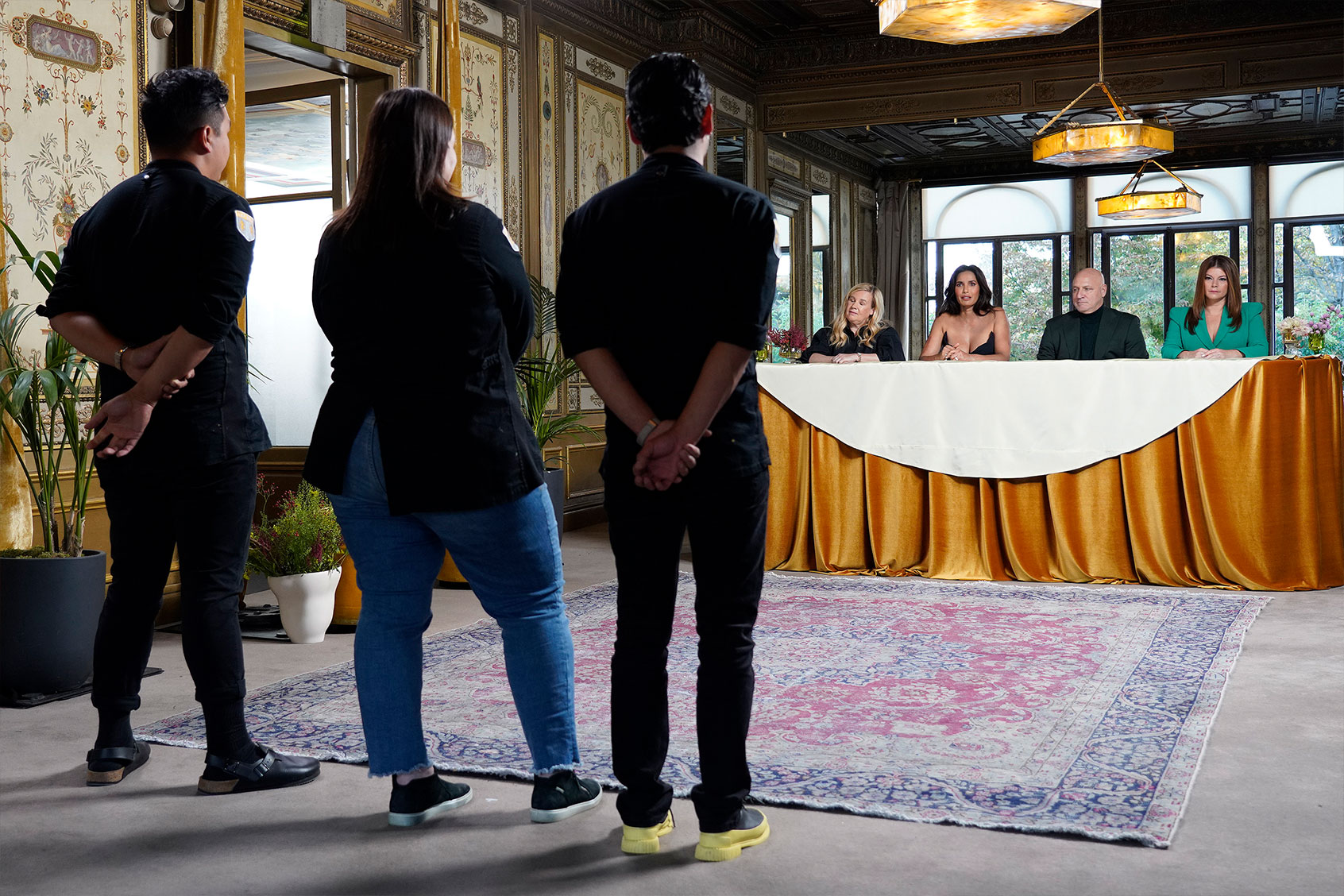
This is obviously relatively new news, but now knowing that Padma’s going off on her own way and it’s the end of an era, what do you all think, knowing that this season — your season — was her final hurrah?

Sara: You know, that’s so cool, I got to be part of the last season of Padma. I got to work with her for two seasons, which is a lot more than hundreds of thousands of other people can say, so that was really cool. She’s going to be missed — for me, Padma is a big part of it. But I’m available if they want me to replace her. [Chuckles]

Buddha: I think the three of us are extremely honored to be part of her last episode ever. I think that’s almost as big of a win in itself. Being on the last episode, to see her everything come to an end and be a part of that . . . it’s just incredible. 

Gabri: Yeah, I think so, too, it’s been amazing and such pleasure to meet such a big personality, you know? All of my friends, all that matters to them is “Oh, you met Padma! How is she?” It’s huge . . . Padma is huge part of “Top Chef” and she’s going to be missed, I’m sure.


Want a daily wrap-up of all the news and commentary Salon has to offer? Subscribe to our morning newsletter, Crash Course.

Top ChefHélène Darroze, Padma Lakshmi, Tom Colicchio and Gail Simmons in “Top Chef” (Fred Jagueneau/Bravo)

Were there any guest judges this season that you felt particularly fond of, connected to, or impressed by? Obviously we saw a lot of starstruck reactions in the most recent episode.

Buddha: I think Sara always realized how much I fangirled over everything, not over just Alain Ducasse, but it’d be someone like Tom Brown or Tommy Banks. I knew all of these people because I grew up in London and read all about these chefs. We were all gobsmacked when Gaggan [Anand] was there, and I think going into the season is exactly why I wanted to do it. I wanted to meet these heroes and idols that I’d been looking up to my whole life and be able to have the chance to cook for them because I knew they’d go large this season.

Sara: I’ll be honest . . . a lot of times people would walk out and they’d be like “Oh, it’s this person,” and I’d just look at Buddha. It’s such a broad range; there’s thousands of people they could choose from and you never know. I think for me the most impressive were Tom, Gail and Padma because I really felt an obligation to make them proud, they had chosen me as one of the four Americans that got to compete, and, for me, kind of had this pressure the whole time. I didn’t want to disappoint them. I didn’t want them to bring in a judge and me totally screw it up and them be like, “Why’d we pick Sara?.” I put that pressure on myself, but those were the people I felt the most pride cooking for and those were the people that I really wanted to impress the most. 

Gabri: Definitely! One of them, because there were a lot, was definitely Gaggan. His humbleness was impressive. Being in that position of a chef and being that humble is kind of a lesson. And the rest of them! All of them were awesome. For some, it was pretty common, but for me, it was always a dream, as well. So to meet them all was amazing. Also Alain Ducasse . . .  Oh my gosh, that was a highlight.

Buddha: Our hearts dropped.

Gabri: I know Buddha loved that. I couldn’t believe it. It was awesome.

Top ChefGabriel Rodriguez, Sara Bradley and Buddha Lo in “Top Chef” (Fred Jagueneau/Bravo)


“I think for me the most impressive were Tom, Gail and Padma because I really felt an obligation to make them proud . . .”

What was it like filming in London and Paris? How did you incorporate the culture and local foods into your dishes?

Buddha: My time in both these locations were amazing. I’ve worked in London before so being there and embracing the culture and food again was exciting and really fun. I really loved being in Paris because I love cooking French food and I tend not to cook French food on the competition just because I want show range, but because we are in France, I got to show off some classical French techniques, just like the last episode [when] I did champignon de Paris en croûte with the pomme mousseline. 

Gabri: It was an incredible experience and it was so good just being there! At the beginning, I was trying to fully represent the Mexican cuisine as it is, but I was in trouble when I found out that the ingredients wouldn’t help at all, so I tried a different approach, and decided to get inspired by México all the time but adapt to the different ingredients.

Is there something liberating about being able to focus entirely on food and cooking for the duration of filming, not worrying about “real life” or work issues whatsoever (ideally/ostensibly) as the season progresses? 

Buddha: It’s funny that you ask this question because I think that this is the main reason that I love “Top Chef” so much. You don’t do any washing or any cleanup, you don’t buy any ingredients, and everything is there for you to be successful. “Top Chef” is my idea of heaven. Whenever you need ingredients or equipment, it’s all there for you. As a chef, you find yourself always organizing everything that you need: from reservations, staff to social media posting, just to organize one dinner. [In] “Top Chef,” they organize absolutely everything and it is 75% of the battle, and all we have to do is focus on the cooking, which is 25% of the battle.

Gabri: Yeah, it’s kind of cool, it’s like a meditation. You only think about food. But sometimes you need a good rest as well. I mean it is exhausting, but what an opportunity.

“It’s funny that you ask this question because I think that this is the main reason that I love “Top Chef” so much.”

If you had to pinpoint a favorite ingredient (or a few favorite ingredients) – within a competition format, when cooking at home, or when cooking in a restaurant setting – what would they be? Would there be any overlap of ingredients regardless of setting? 

Buddha: I would probably say that there’s no real particular ingredients, but I would want a kitchen stocked with the basics, and that’s all I asked for. To me, basics could be a basic Asian pantry from soy sauce to hoisin, basic vegetables like onions, carrots, celery and garlic.

Gabri: There will be insects for sure, I pretty much love them. They [each] have a different flavor and you have to be an expert to cook with them.

Congrats again and good luck! 

“Top Chef: World All Stars” airs Thursdays at 9 p.m. on Bravo and streams next day on Peacock. Tune in to the finale tonight when the winner will be revealed! 

WHO’s recommendation against the use of artificial sweeteners for weight loss raises many questions

Do low-calorie sweeteners help with weight management? And are they safe for long-term use?

This is among the most controversial topics in nutritional science. In early May 2023, the World Health Organization issued a statement that cautions against the use of nonsugar sweeteners for weight loss except for people who have preexisting diabetes.

The WHO based its new recommendation on a 2022 systematic review and meta-analysis of scientific studies on nonsugar sweetener consumption in humans. This type of study reviews a large body of research to draw a broad conclusion.

Based on its interpretation of that large-scale review, the WHO recommended against using artificial sweeteners for weight control and concluded that there may be health risks associated with habitual consumption of nonsugar sweeteners over the long term. However, the WHO also acknowledged that the existing evidence is not conclusive and that more research needs to be done.

As neuroscientists, we study how dietary factors such as sweeteners affect the brain’s ability to perform critical functions, including metabolism, appetite and learning and memory.

We found the WHO’s advisory surprising based on the study’s equivocal results. Determining the answers to these questions is immensely challenging and public health messaging around recommendations can send mixed messages.


‘Healthy’ versus ‘unhealthy’ sugars

Natural sugars like glucose and fructose, together with fiber and other nutrients, are found in many food sources that are considered healthy, such as fruit. However, these simple carbohydrates have been increasingly added into manufactured food products, especially beverages. Sugar-sweetened beverages are usually high in calories and offer little else in the way of nutrition.

In the early 20th century, food and beverage manufacturers began incorporating naturally and chemically derived substances that satisfy sweet cravings but contain significantly fewer calories than natural sugars — and, in some cases, zero calories. Sugar substitutes became particularly widespread in the 1950s with the increasing popularity of diet sodas. Since then, consumers have increasingly turned to these sugar substitutes in their everyday lives.

Sugar substitutes go by many names, including high-intensity sweeteners, artificial sweeteners, nonnutritive sweeteners, low-calorie sweeteners and, as termed in the WHO report, nonsugar sweeteners.” These include synthetic compounds like sucralose, acesulfame potassium and aspartame and naturally derived ones, such as those from the plant Stevia rebaudiana, among many others.

Each nonsugar sweetener has a unique chemical structure, but they all activate sweet taste receptors at very low concentrations. This means that you need to add only a tiny amount of them to sweeten your coffee or tea, as opposed to heaping spoonfuls of natural sugar.


Nonsugar sweeteners are found in many soft drinks, sports drinks and energy bars.


Sugar substitutes and the quest for weight loss

Obesity and its associated metabolic conditions, like diabetes and cardiovascular disease, are now among the leading causes of preventable death in the U.S. The obesity epidemic has been linked in part to an increase in added sugar consumption over the past century.

In order to help address it, in 2015 the WHO issued specific recommendations to reduce sugar intake and adopt healthier diets.

But humans are hard-wired to find the sweet taste of sugars pleasurable and the tastiness of real sugar makes it difficult for most of us to remove it from our diets.

Sugar substitutes were designed to help. The math seems straightforward: Replacing your favorite 12-ounce sugar-sweetened beverage that contains 150 calories with an artificially sweetened beverage of the same volume that contains zero calories should allow you to reduce the number of calories you take in each day and reduce your body weight over time.

But the science is not so straightforward. Research from both animal models and humans indicates that habitual nonsugar sweetener consumption can lead to long-term negative metabolic outcomes and body weight gain.

However, there are conflicting studies from animal models and humans that have not found significant body weight gain associated with nonsugar sweeteners consumption.


Parsing the health impacts

Regardless of any potential benefits nonsugar sweeteners may have for weight control, their use must also be considered in the context of overall health.

Agencies like the WHO and the U.S. Food and Drug Administration periodically review available evidence and assess the safety of various food additives, including nonsugar sweeteners, for use in foods and beverages within what is called an acceptable daily intake limit. In this context, the acceptable daily intake is based on the estimated amount of a specific nonsugar sweetener that can be safely consumed daily over one’s entire life without adverse effects on health.

Each agency sets its own daily allowance based on the best available data. But because these experiments cannot account for all possible conditions in which these substances are used in real life, it is critical that scientists continue to investigate the health effects of food additives.

The authors of the WHO report relied on three main types of published research studies to determine whether nonsugar sweetener consumption was linked to adverse health effects. The gold standard for assessing causation is what are called randomized controlled trials.

In these studies, people are randomly assigned to either an experimental group — which receives the experimental substance, such as a nonsugar sweetener — or a control group — which receives a placebo or different substance. Participants in both groups are then tracked for a period of time, typically weeks or months. The majority of studies involving randomized controlled trials on nonsugar sweeteners to date involve this type of comparison, with nonsugar sweeteners replacing consumption of natural sugar-sweetened beverages.

The analysis of almost 50 randomized controlled trials on which the WHO based its recommendation found modest benefits of using nonsugar sweeteners for weight loss and determined that the habitual use of those nonsugar sweeteners did not lead to diabetes symptoms or indicators of cardiovascular disease. But it did find that the use of nonsugar sweeteners was associated with a higher ratio of total cholesterol to HDL, short for high-density lipoprotein, which is considered the “good cholesterol.”

That means that habitual consumers of artificial sweetener had more of the low-density lipoprotein, or LDL version, in their system. That form of “bad cholesterol” is a risk factor for heart disease.

However, other potential adverse consequences of consuming nonsugar sweeteners may take more time to appear than can be identified in the limited time frame of a randomized controlled trial.

The authors also evaluated what are called prospective cohort studies. Those studies track participants’ self-reported use of sweeteners alongside health outcomes, oftentimes over many years. They also took into account case-control studies, which identify people with or without a certain health issue, such as cancer and then use available health records and interviews to determine the extent of nonsugar sweetener use in their past.

Examination of the cohort and case-control studies found that regular consumption of nonsugar sweetener was associated with increased fat accumulation, higher body mass index and increased incidence of Type 2 diabetes. Those findings differ from the outcomes of the randomized control studies.

Analysis of the cohort and case-control studies also concluded that a history of regular nonsugar sweetener use was linked to increased frequency of stroke, hypertension, other adverse cardiovascular events and, in pregnant people, an increased risk for premature birth. The frequency of cancer in nonsugar sweetener consumers was very low in general, though saccharin, an FDA-approved sweetener found in many food products, was associated with a bladder cancer.


The history of artificial sweeteners.


Caveats and takeaways

On the face of it, these results are alarming, but they need to be taken with a grain of salt. As the WHO report points out, these studies have significant limitations that need to be considered.

Take, for example, in the cohort and case-control studies, that higher body mass index or BMI, was associated with greater nonsugar sweetener intake and poorer health outcomes. One possibility is that people with obesity used nonsugar sweeteners to help cut calories more than others without obesity. This makes it difficult to determine whether the disease is caused by sustained artificial sweetener use or by the other underlying conditions associated with obesity.

Additionally, the way nonsugar sweeteners are consumed is not controlled in these types of studies. So negative health outcomes could be associated with other affiliated harmful behaviors, such as more sugar or fat in the diet.

The picture is very mixed on both the benefits of nonsugar sweeteners for weight loss and their ties to adverse health issues. The WHO’s recommendation seems to have weighed the cohort and case-control studies over the randomized controlled ones, a decision that we found puzzling in light of the limitations of these studies for assessing whether nonsugar sweeteners have a causal role in disease.

As with all health-related choices, the science is complex. In our view, grabbing a diet drink to offset the calories in a slice of chocolate cake every once in a while will likely not be harmful for your health or lead to a significant weight change.

Lindsey Schier, Assistant Professor of Biological Sciences, USC Dornsife College of Letters, Arts and Sciences and Scott Kanoski, Associate Professor of Biological Science, USC Dornsife College of Letters, Arts and Sciences

This article is republished from The Conversation under a Creative Commons license. Read the original article.


“I need to host”: Roy Wood Jr. talks “The Daily Show” and why late-night TV needs change

Late-night TV shows used to be at the top of the food chain. It was a significant accomplishment for an entertainer or athlete to be invited to appear on a late-night show and be interviewed by greats like David Letterman, Arsenio Hall or today’s Stephen Colbert, Jimmy Fallon and Jimmy Kimmel. But has the rise of streaming lessened their relevance? How many people are tuning in at 11 p.m. to watch anything?

With Trevor Noah’s departure from “The Daily Show,” the ending of “Desus and Mero,” and the cancellation of HBO’s “Pause with Sam Jay” and Showtime’s “Ziwe,” comedian Roy Wood Jr.—who himself is in the running to be the next “Daily Show” host — is questioning how the remaining late shows will survive the current Writers Guild of America strike. (Salon’s unionized employees are represented by the WGA East.)

“I think late night needs innovation,” Wood told me on “Salon Talks.” “I don’t think that the way we’ve constructed late night will continue to be the way we see it post-strike. There’s going to be a lot of cuts, in my opinion, fiscally. I hate to talk like that, but I’m a realist, bro.”

He continued, “This idea of having a daily conversation about the things that have happened in this country and are happening and holding people in power accountable, that avenue still is viable. How you present that has to evolve into a way that I’m guessing needs to be cheaper and faster to be truly resonant with people.”

This spring, Wood threw zingers at Joe Biden, Clarence Thomas and Tucker Carlson while hosting the White House Correspondents’ Dinner. Wood is most known for cracking us up as a correspondent on “The Daily Show” and his comedy specials including “Father Figure,” “No One Loves You” and “Imperfect Messenger.” He is currently on the road with his Happy to Be Here tour. 

Watch my “Salon Talks” episode with Roy Wood Jr. here, or read a Q&A of our conversation below to learn more about his take on cancel culture in comedy, how “The Daily Show” reframed his stand up act and why he enjoys watching comedy as much as he likes writing and performing it.

The following interview has been lightly edited for clarity and length.

I’m happy to see you, man. Over the pandemic, I was in the Twitter space listening to you talk about “The Wire” with our great friend, April Reign. I’m like, “Man, this guy knows his s**t.”

I’ve watched that series I think four times now, front to back. Three for sure, because to me, that’s like when you meet somebody new, you all start dating, “All right, first thing we got to do as a couple is watch ‘The Wire‘ front to back.”

You got to vet her.

We got to understand our love language.

It’s a great show. Just being from Baltimore, I’m always just interested how people from different places react to it. You started your career in Alabama at 18, 19 years old, and now are crushing White House Correspondents’ Dinners.

That was crazy.

What was that moment like? 

“There’s a book I need to write. There’s a stand-up special I need to shoot and there’s a late night show that I need to host.”

The Correspondents’ Dinner, to me, is an opportunity for the constituents to say something back to the elected officials. It was a dope opportunity. Whether they laugh or not, that’s really something you can’t worry about as a comedian. You just got to go up there and say what’s funny to you and what you think is fair and balanced and attacking both sides of an issue. Then just leave it at that, man. Either they love it, or they don’t. Ain’t nothing you can do about it.

Were you worried about Joe Biden rushing the stand?

No. I wasn’t worried about Joe. First off, if Joe Biden rushed the stage like Will Smith, you can see him coming. You get slapped by Joe Biden for talking crazy, you was waiting on that slap. But I think the material about Kamala [Harris], the vice president, you’re trying to thread needles that are moving. It’s not just threading a needle. It’s threading a moving needle because the political tones change every day, what people want to talk about. Half the jokes that I did that week, we wrote that week, because the Tucker Carlson and Don Lemon stuff happened that week. The Clarence Thomas stuff was only two weeks old because a lot of that Harlan Crow stuff, more information was still dropping.

You took me out with that Clarence Thomas as an Instagram model joke.

Is he not? Calling the man a NFT, that might have been too far, but it felt right and funny at the time.

Now we know what an NFT is. You’ve been telling the hard truth for a long time. Do you feel like we’re at a space where people are finally starting to pay attention?

Yeah, but I think you’re always going to have people who just don’t care. You’re always going to have people because now, in a weird way, the truth has become something that you can outsource to fit what you believe in. The question now is, what is truth? Is truth the truth, or is the truth what you choose to accept? A lot of people choose to deny truth. They live in that denial. When you look at what’s happening with [critical race theory] and people just going, “Oh, well, slavery, that wasn’t that big of a deal,” if enough people say, “Slavery wasn’t that big of a deal,” then you have a part of the country that’s just straight up living in denial.

“I don’t feel like comedians are under attack. Every comedian that people say has been canceled is making good money.”

Now you have the advertisers and companies who have to decide how to get money, how to appeal to those people. You have politicians still having to decide how to get the vote of those people. The thing that sucks is that you can deny reality, but somehow your vote still matters. So if your vote still matters, then people have to figure out a way to appease you. To some degree, that means meeting you in the middle a little bit, even if it’s infuriating and crazy. When you take a company like Target putting Pride Month merch in the back of the store, that’s the middle ground. That’s because they’re trying to appease people who live in a totally different reality. They’re just trying to sell clothes. The truth is, most of these corporations probably don’t care about half the causes that they’re selling merch for. They just know we’ll buy it.

Juneteenth tank tops.

Definitely. Need to put that in the back of the store, unless it’s Black-owned. Then, of course, I’ll support the Juneteenth tank top.

I think what makes me upset is that you’re right. People, they will deny the truth, or they will put the need to make money over top of honesty, but then get offended when you call them out.

I just think that corporations are in a rock and a hard place because, in an effort to please one group, another group has all of a sudden, just out the blue, by the way, it’s not like Pride Month merch is a new thing, but now all of a sudden they’re mad. Now the corporations are having to choose. I think what the eventual regression would just be corporations not taking any political stances ever again.

Most of these stores will become issue-neutral. We can say we’re going to boycott the store, but if all the stores take the same stance, what you going to do? You going to make your own toilet tissue? You going to grow your own medicine?

Something big happens, and it shifts culture to move in certain ways. You can tell me I’m out of my mind, but I was shocked when I was watching TV during the pandemic and saw Mitt Romney at a Black Lives Matter march.

Yeah.

So the pendulum, it swings, right?

Yeah, but then the question becomes, “Should I ask what Mitt Romney’s ulterior motives are? Or should I just accept that Mitt Romney pulled up to the event and take that as the beginning of something hopefully genuine in terms of bipartisanship?” Don’t show me Mitt Romney at the march. Show me his voting record within Congress or within the Senate, rather. What are you doing? What’s happening? What are you voting on, bro? That, to me, is the real telltale. It’s like it’s progress, but you know as a Black person, we’re just like, “Is that progress, or is that symbolism?” There’s a difference.

If I’m being honest, I wasn’t moved. I was just shocked.

Yeah. Because he’s a Mormon. Ain’t Black people the devil or something?

We need you fixing the Nike sneakers app.

Yeah, the real issues. Freaky a** app giving everything to the resellers. I’ll talk s**t. I don’t care. It ain’t like I’m ever going to get a Nike endorsement deal. I hope they see this s**t. Fix your app.

I think about the joke you told at the dinner about school shootings. You got some groans, and you’re like, “Pass some policy.”

A lot of groans.

Then you’re like, “I’m Mitch McConnell. I have no soul.” Right?

Yeah. I ain’t got no soul. What are you going to do? You’re going to boo a joke about school shootings instead of passing policies that stop school shootings? Come on.

Do you ever feel like you have any ability to be able to just speak truth to power or is that under attack?

No. I don’t feel like comedians are under attack. Every comedian that people say has been canceled is making good money. They’re showing up to cities and people are still paying money to see them.

Just no camera crews and specials and all that. 

“As a performer, I have to be prepared for groans and accept that as part of the game.”

Yeah, you may not get as many specials. You may not get the glitzy TV show. You may not get to host a thing. But at the end of the day, as a performer, if the public still wants to pay money to sit in that chair, you’re getting people in 2023 to come out in public and sit still. We’re in a TikTok attention span generation, so if you still have that level of pull, then no amount of outrage can take that away. If anything, it makes people more entrenched in liking you because you are attacking the thing I love. So I’m going to really show you how much I love it. 

We live in a culture now where people’s opinions matter, and people’s opinions get to be heard, and people have more outlets to voice their opinions. I don’t think we’re in a situation that’s any different than Lenny Bruce and George Carlin getting arrested for saying whatever word society didn’t want them to say on stage at the time. But when you look at this idea that I can’t say something, no, I can say it.

As a performer, I have to be prepared for groans and accept that as part of the game. To me, that’s the issue. Some performers, in my opinion, are mad that people are mad. No, they have a right to be mad. Just shut up and do your job. The people who rock with it will show up and like you, but you can’t get mad that a corporation pulled you off of a show because of a tweet you made. The corporation trying to please everybody.

Corporation trying to speak truth to power. I’m trying to get people to watch my network, motherf**ker. Why are you talking crazy on Twitter? You gone. So hit the streets and find the people who like you and charge them $40 plus Ticketmaster fees.

Yo, Ticketmaster fee be like $150 on top of the $40.

Ticket be three dollars. Ticketmaster go, “That mean 180 extra dollars.” We live in a culture where people complain, and we are indignant that people would dare say something about how something makes them feel. But you’re not going to get people canceled. You can get people fired, but that’s only going to go so far.

You also made a joke about Tucker Carlson and about “Succession” and “Power.” I was looking at the audience, and I’m like, “Yo, I don’t really know white people that watch ‘Power’ like that.”

Yeah, I don’t know how much of an overlap [there is] because in the joke, and I got to give a shout-out to my writer, Felonious Munk, because he was the one who fought for that. We had a bunch of writers on the show, but this was Munk’s. Munk used to write for the “Nightly Show” for Larry Wilmore, just so people know how he’s built.

The original impetus for that joke was that I don’t watch “Vanderpump Rules.” Don’t know nothing about it, but apparently, in the white world, that s**t is like “Power.” It’s their “Power,” so that became the joke. I said this for real in the writer’s meeting. I said, “I thought ‘Billions‘ was white people’s ‘Power.'” He goes, “No, that’s ‘Succession.'”

I go, “Well, then which one is ‘BMF’?” So then it just became this weird wordplay game of super Black show, super white. It’s not to say that there isn’t racial crossover, but what is the overlap of people who also watch “BMF” and “Vanderpump Rules”?

It’s us.

Yeah. You and me. So it was fun. That was a joke where it’s like the Cardi B joke. I know you’re not going to get this, but the people who get it really get it. It’s almost a joke that’s for the people watching. It’s not even for the people that’s there. We talked about Dominion winning the defamation lawsuit and how Cardi B had won a defamation suit. So I was like, “There’s two people you don’t want to see, Dominion and Cardi B.” Then somebody else on the writing team mentioned, “Oh, but what about Gwyneth Paltrow?” I was like, “Oh, you’re right.”

I know nothing about Gwyneth Paltrow’s lawsuit.

But if you know Gwyneth Paltrow, you automatically get Cardi B.

Wait. Do I live in a bubble?

Yeah. Look, but if you know Cardi B, you automatically get that Gwyneth Paltrow has done something similar in winning a major lawsuit against a person, even if you don’t know the details.

Was she at a ski resort or something?

I don’t remember. It was was super white. She won a dollar and gave it back to him or something. Told him, “Be well.” She sued him for a dollar.

Skiing, it’s all in the game, motherf**ker. Sometimes you get run over. It’s like at the roller rink. Sometimes motherf***kers are going to hit you.

Even on the bunny slopes?

I don’t know where they was. Wherever he was, the brother was laid up pretty bad. But the point was that you know Dominion, so who else in pop culture is whooping a** in court like Dominion?

Cardi B. Right.

Cardi B and Gwyneth Paltrow, so you cover both ends of the pop culture race spectrum, the same as we did with the “BMF” and the “Vanderpump.”

We sound like network execs right now. We got to get that market.

But for the Correspondents’, generally, though, it is a weird science because you’re trying to do jokes about people in the room, about the things they care about, with a level of nuance that they know about that the general public may not even care about, but also, as a comedian, my job is to represent the people, not the policymakers.

I got to still be able to crack a joke that comes through the camera to the people at the crib. That’s the tough part of it, but it can be done. It’s definitely not a normal comedy set. It’s a weird a** realm, bro.

You’ll be doing a joke, and just you’re down on your cards looking. You pop up to deliver the joke, and you look up, and it’s just Lester Holt, and you go, “Okay. That’s wild. I look up to him.” Then you look down, and you look up, and it’s Kellyanne Conway. You’re just like, “Wow. What is she doing here?” You look up, and then it’s Caitlyn Jenner. Then you look up again. It’s Chrissy Teigen. It’s just these weird distractions are happening while you’re trying to focus. It’s so weird. It’s a weird situation, man, but I’m happy I did it.

How’s the tour been going?

Happy to be here to tour. We getting out the gates this month, but we’re going everywhere from Sacramento down to Miami, up to Hartford, way over to Madison, Wisconsin, Minnesota, pretty much anywhere in there. I know people are asking me about Seattle and the Pacific Northwest. I got you. It’s coming. 

“I take touring very seriously. We prepare. We tighten up the jokes. I might even iron my shirt. We’ll see.”

It takes time to book venues now because of the strike. This is what’s wild. Because of the writer’s strike, every stand-up comedian that was working on a television production is back out on the road, so now we’re competing for venues, which is a great thing for the general public, but it takes time to figure out who’s going to take what date and what venue and when and where and all of that.

You all should box for them.

That would be fun.

Who would you box?

Who could I beat is the question? If I had to fight another comedian for a venue . . .

I feel like Kevin Hart works out four times a day.

Yeah, Kevin Hart would whoop my a**. I got reach. I got reach on Kev, but I don’t have stamina.

I feel like he benched 750 pounds.

You already know what Kevin Hart’s boxing strategy is. Get in tight, work the body. Who was that boy that knocked somebody with the kidney shot? Little shot?

Oh, Tank.

That’s Kevin Hart versus me. Ced the Entertainer, I bet you I could take him. I could clench. I could clench a couple times, keep my stamina. Me and Ced the Entertainer, we both only got four rounds in us, give or take. 

“My stand-up is probably way more centrist than what it is on ‘The Daily Show.'”

The thing that sucks about going on tour, though, now is that I don’t get to see the people that I love watching work. To me, Ali Siddiq is one of the best stand-up comedians working today. I’d put that same tag on Sommore. I’d put that same tag on Adele Givens. I had been plotting earlier this year to go out more and watch more stand-up and just see what the young people are doing, what the vets are doing.

I got to give a shout-out to Rip Michaels. I went to his show at Barclays. They had 10-12 comics. I got to see Bill Bellamy do his thing. I got to see Adele Givens. Just so many solid comics on the lineup. I went to see Druski. Druski came to New York. Druski’s funny, but he also got this cat on his show, Navv Greene. That boy the truth. Navv Greene is funny. He does the craft and then flips into a co-host with Druski. But even with that, there’s a hosting skillset that you can’t teach. You cannot train. It’s either you got that, or you don’t. Navv has that. Same with them 85 South Boys. I want to go out and see Karlous Miller, Chico Bean, and DC Young Fly. 

If it’s one thing that sucks about having to go out and tour, it’s that I don’t get to go out Fridays and Saturdays anymore and see people. This year was really going to be my year to study stand-up again because I’ve gotten away from it the last couple years with the shutdown. I did a very short prep tour for my third hour special in 2021. Other than that, I haven’t been on the road. I do my sets around town. I go to the gym. But as far as going out and doing 30-40 cities like we’re doing now, I’m thrilled to be back out on the road, man.

It is a blessing to be able to fly to a city and have strangers spend two hours of their evening with you. That’s a gift. People are gifting you their time. I take touring very seriously. We prepare. We tighten up the jokes. I might even iron my shirt. We’ll see. I’m very excited about the tour, man.

When you look at your whole career, everything you’ve accomplished, is “The Daily Show” your most perfect opportunity? Does it fit what aligns with your values the most as far as walking that line between comedy and journalism?

“The Daily Show” probably best represents my approach to stand-up, which is to find the alternate viewpoint on the issue. “The Daily Show” is a left-leaning show, of course, but my comedy is more centrist. It’s cool within “The Daily Show” to be able to find pieces that are a little bit more on the middle of the road, but my stand-up is probably way more centrist than what it is on “The Daily Show.” 

I learned a lot in my approach to comedy, my approach to stand-up, from working with Trevor Noah. Just how Trevor Noah chooses to break down divisive issues, it gave me a little bit of the same feeling that I could do that with my stand-up. My stand-up started changing from 2015 until now.

I don’t know what’s going to happen with the strike. When the strike ends, if they bring “The Daily Show” back, am I a host? Am I assisting whoever they hired a host? Am I gone somewhere else to host my own thing? I don’t know. I do know that everything up until now represents, for me, from a career standpoint, it’s that Tom Brady New England run. Now it’s time to go to Tampa and see if I can keep the winning ways going.

What’s your dream? What’s the perfect scenario for you? 

Man, I almost had one. Five or six years ago, I had a pilot called “Jefferson County Probation” with Comedy Central. I was on probation for three years for stealing credit cards when I was a teenager. The probation officer I had was so dope in helping to foster me into comedy. We talk about law and order in this country. We don’t talk about recidivism. We don’t talk about how much the revolving door of sending people back to jail is just based on who your PO was, who your lawyer was, who your judge was that day. You get judged by 12, but once you go through the system and you’re on probation, it is a single person who can decide whether or not you spend the rest of your life behind bars.

Yeah, and God willing, they’re not having a bad day on a Friday.

Catch a bad cop, they violate you instead of giving you a pass, instead of calling your PO and telling the PO to restrict your travel instead of sending you to prison. We got to show recidivism through that light of what it could be if people within the system cared. We were able to shoot the pilot in Birmingham with the end intention of making that show into a series that we shoot in Birmingham, and then use that show as a springboard to build film and television production as an industry in Alabama. Didn’t get to do that.

You might have been ahead of the conversation. It might be time to spin it back.

“I just need to host me a damn TV show.”

It’s time. It’s time once we get on the other side. Also, whether I like it or not, when you’re from a part of the country like Alabama, I think it is your duty to help show people a window into what’s really going on there. You can crack your jokes about the state. That’s fine. That’s all in the game. But it’s a lot of good folks here. It’s a lot of folks hustling. It’s a lot of people doing the right thing. Telling the story of Alabama through a scripted show, specifically the story of Birmingham, Montgomery, Mobile, that would be the perfect project for me because I know that’s something that could ripple. You can create internships within that.

Man, we had everybody on board. The city was on board. The state was on board in terms of incentives and creating job training for crew. That’s industry. We’re talking about building industry. If I could use any idea that’s in my head to better the economic status of people in the State of Alabama, to me, that’s the ultimate win, some Tyler Perry buy up Fort McHenry, then shoot everything there and hire people. Becoming this vortex of economic growth, that’s the long game.

Now, in the short game, I just need to host me a damn TV show. If we’re talking next two years, there’s a one-man show I want to work on based on just the idea of fatherhood. But in the short term, man, I think there’s a book I need to write. There’s a stand-up special I need to shoot, and there’s a late night show that I need to host.

With everything changing with streaming, do you feel like late night is as strong as it used to be? Or do you feel like there’s some innovation that needs to be done?

I think late night needs innovation. I don’t think that the way we’ve constructed late night will continue to be the way we see it post-strike. There’s going to be a lot of cuts, in my opinion, fiscally. I hate to talk like that, but I’m a realist, bro.

Yeah, absolutely. I mean, you have to.

You just got to be real about if you stop doing James Corden, James Corden leaves, right? Then you replace him with a game show “@midnight,” which was a hit for Comedy Central. It’s a perfectly fine program, but it’s way cheaper to make than James Corden, so that tells me you all are trying to cut costs. If you’re trying to cut costs, then that means the way that all this glitz and the band and the desk and all of that, we might be looking at the Last of the Mohicans on this. I’m talking Jimmy Fallon, Seth Meyers, Colbert. You know what I’m saying?

This idea of having a daily conversation about the things that have happened in this country and are happening and holding people in power accountable, that avenue still is viable. How you present that has to evolve into a way that I’m guessing needs to be cheaper and faster to be truly resonant with people. Our shows shoot at five, six o’clock in the evening to air at 11:30. News changes faster than that now, so you almost have to go like 9:00 or live.

A lot of the segments, you’re catching clips anyway.

Correct.

When you’re catching the clips, you’re not catching them in full time.

If you’re making tomorrow’s internet today, which is what a lot of late night, in some regards, has become, then we have to figure out a way to do it in a way where the conversation truly resonates with people immediately. I don’t know what that looks like yet. I think that’s what I’m also trying to spend my time ideating.

We could come back from the strike, and Comedy Central can do “The Daily Show,” and it’ll be perfectly fine. It will work. But I just feel like after every strike, there is an creative molting that happens within the industry, especially on the unscripted side. You got to be ahead of the curve on that. You just got to, man. Something is changing. I don’t know if Amber Ruffin‘s coming back. I know “Desus & Mero” is done. I know Ziwe is done. I know Sam Jay is done. If Amber Ruffin’s done, too, then that’s four.

“Desus & Mero” is different because . . .

Yeah, they were leaving anyway. They were breaking up.

They had their differences, but Showtime didn’t rush to replace them, either. So, to me, it’s about figuring out, well, if the industry didn’t want that, and even if it wasn’t ratings, whatever it is, what is the next thing? What is it going to look like? “The Daily Show” itself, as an institution, it will evolve. I don’t think “The Daily Show” is going anywhere. I think it’s too important of a piece of Comedy Central and Paramount. It still has a lot of worth. We get a lot of great guests.

But what will it look like? Because from Jon Stewart to Trevor, the major change in the way it think – the way it be thinking, we used sketch a lot more. We used the internet a lot more. Trevor’s younger. Trevor understood that. Trevor was plugged in. Jon Stewart wasn’t really. They had to drag him on the Twitter. I love him, but he knows that’s the truth. 

Trevor came in and figured out, OK, this could be a four-minute to-camera segment of me just going or we can let Klepper, Roy and Dulcé do a sketch that says the exact same thing. Then that sketch is something that people digest more. I just think that with specifically new satire, in its visual inception, it is to parody the way you get the news.

When “The Daily Show” was created, the way we got the news collectively as a society was all the same. We all got our news from a motherf**ker at a desk with a suit and some whiskey under the table. We all got our news, 95% of us. So you could parody that, and it’d be a perfect one-to-one. We get our news from all over the place now. The way we get our news looks a million different ways. People don’t even care if you have a suit on or not. I can go on TikTok right now, and right there, I can’t think of his name. God bless you. But it’s a white dude with a beard. I know that’s not enough of a description.

That’s everybody in Brooklyn.

It’s a white dude. He be on it. He know his s**t. It’s a white dude with one of them IPA craft beards. Like he make beer in the basement.

Farm to table beer.

Yeah, I’ll be damned if I don’t watch him every day to see what he’s talking about with politics.

Legal scholar: Redistricting ruling suggests SCOTUS “wrongly gave Republicans control of the House”

In a surprise decision, the Supreme Court ruled against a redrawn Alabama congressional voting map on Thursday, determining that the proposed redistricting diminished the power of Black voters in the state by corralling them in one district where they made up the majority.

The Court’s 5-4 ruling in the Allen v. Milligan case saw a majority comprised of Chief Justice John Roberts, Justice Brett Kavanaugh, and the liberal Justices Sonia Sotomayor, Elena Kagan and Ketanji Brown Jackson.

Voting rights activists feared the opinion would gut the 1965 Voting Rights Act, according to The New York Times, but the decision affirmed the legislation instead.

“In 2021, Alabama lawmakers targeted Black voters by packing and cracking us so we could not have a meaningful impact on the electoral process,” plaintiffs in the case said of the Alabama Legislature’s redistricting in a joint statement.

“Today, the Supreme Court reminded them of that responsibility by ordering a new map be drawn that complies with federal law – one that recognizes the diversity in our state rather than erasing it,” the plaintiffs’ added. “This fight was won through generations of Black leaders who refused to be silent, and while much work is left, today we can move forward with these reaffirmed protections civil rights leaders fought and died for.”

In the majority opinion, Roberts wrote that the act “may impermissibly elevate race in the allocation of political power within the states,” adding that the justices’ opinion “does not diminish or disregard these concerns. It simply holds that a faithful application of our precedents and a fair reading of the record before us do not bear them out here.” 

The case, which is part of a nationwide battle over redistricting and the role of race in the process, arose after Alabama’s Republican-controlled legislature redrew the state’s congressional map following the 2020 census.

Of the state’s seven districts, only one in the new map had Black voters as a majority despite making up about 27% of the state’s voting-age population. While the other districts voted Republican representatives into office, that district has historically voted Democrat.

Black voters and civil rights groups challenged the new map under the Voting Rights Act, which protects minority voters, and a three-judge panel ruled unanimously that Alabama’s Legislature should have drawn a second district “in which Black voters either comprise a voting-age majority or something quite close to it.”

The panel, made of Clinton-appointed Judge Stanley Marcus and Trump-appointed Judges Anna Manasco and Terry Moorer, also found that voting in Alabama is racially divided and that creating “a second reasonably configured district” that allows Black voters to elect preferred candidates would be possible.

The Supreme Court temporarily overturned the lower panel’s ruling with a 5-4 vote last year, which allowed the 2022 election to take place under the Legislature’s redrawn map.

Thursday’s ruling “puts into rather harsh perspective the Court’s unsigned, unexplained order in February 2022 that *allowed* Alabama to use its unlawful map for the 2022 midterms (like a similar order with respect to Louisiana),” Steve Vladeck, a Supreme Court expert at the University of Texas School of Law, tweeted on Thursday in response to the decision. “Only Justice Kavanaugh changed sides from that 5-4 ruling.”

The ruling could have major implications in other states where the Supreme Court used the “shadow docket,” or unsigned emergency opinions, to allow maps that ran afoul of the Voting Rights Act to stay in place for the 2022 election.

“If you assume that additional majority-minority districts in Alabama, Georgia, Louisiana, & 1–2 other states would’ve been safe Democratic seats, then today’s #SCOTUS ruling strongly suggests that the Court’s 2022 shadow docket stays wrongly gave Republicans control of the House,” wrote Vladeck, the author of “The Shadow Docket: How the Supreme Court Uses Stealth Rulings to Amass Power and Undermine the Republic.”


Want a daily wrap-up of all the news and commentary Salon has to offer? Subscribe to our morning newsletter, Crash Course.


Other legal experts, government officials and leaders of voting rights advocacy groups issued statements praising the court for its Thursday decision and calling on Congress to pass more legislation to protect the rights of voters.

“Today’s ruling vindicating the rights of Alabama voters is a huge victory for civil rights and a welcome surprise,” Michael Waldman, president and CEO of NYU Law’s Brennan Center for Justice, said in a statement. “The Voting Rights Act is one of the country’s most effective civil rights laws. This decision will ensure that voters of color can continue to use Section 2 to assure their equal opportunity to participate in elections, in Alabama and around the country.

“In this instance, the Supreme Court’s embrace of established precedent seems to have heard the public’s outcry over its radical rulings.” he continued. “We should all demand decisions from this court that uphold democracy and advance racial justice.”

The section of the Voting Rights Act that Waldman referred to, which was pruned by the Brnovich v. Democratic National Committee decision in 2021, banned any voting measure that “results in a denial or abridgment of the right of any citizen of the United States to vote on account of race.” 

“This is a victory for all Americans, and it is an important step toward equal voting power and representation for voters of color across the country,” former Attorney General Eric Holder said in a statement. “It is also a testament to the tenacity of the voters of Alabama, who knew their rights were violated as a result of a map drawn in an unconstitutional and discriminatory manner, and took this fight as far as they could to not only ensure their rights, but the rights of Americans across the country.

“As a result of today’s decision, our case moves forward, returning to the trial court for implementation of a fairer congressional map that all Alabamians want and deserve,” he continued. “The lower court ordered a second Black opportunity district be drawn in Alabama precisely because Black Alabamians have been too long denied the opportunity to elect a candidate of their choice in all but one of the seven congressional districts,”

Aneesa McMillan, deputy executive director of voter-centric PAC Priorities USA, called the ruling a “crucial win.”

“I am grateful that this decision will elevate the voices of Black voters who are often the targets of the rigorous voter suppression efforts we’ve seen over the last decade,” she said in a statement. “Racial gerrymandering is one of the oldest attacks on our democracy. By upholding Section 2 of the Voting Rights Act, the Supreme Court is delivering on their duty to ensure every voter has fair, equitable access to the ballot.”

“Stunning development”: Experts say Trump target letter is surest sign yet he’s about to be indicted

Federal prosecutors notified Donald Trump’s legal team that he is a target of their probe into his handling of classified documents after leaving office, people familiar with the investigation told The New York Times.

This has been the clearest signal so far from special counsel Jack Smith’s team that Trump is likely to face charges in the Mar-a-Lago documents case, The Times reported. 

“It should come as no surprise to anyone that Trump is a target of this investigation, based on public reporting about the evidence,” former U.S. Attorney Barb McQuade, a University of Michigan law professor, told Salon. “He is at the center of what appears to be a willful retention of classified documents and obstruction of justice.”

Trump’s legal team received a “target letter” days before his lawyers James Trusty, John Rowley and Lindsey Halligan met with Smith, who is leading the probe, and others at the Justice Department, to ask prosecutors not to charge the former president. 

“Typically, prosecutors will tell a defense attorney upon request whether the client is a target, usually so that the client can assess his potential criminal exposure to decide whether to testify or instead assert the Fifth Amendment privilege against self-incrimination,” McQuade said.

The Department of Justice is getting ready to petition a grand jury in Washington, DC, to indict the former president on charges of breaching the Espionage Act and obstructing justice as early as Thursday, according to The Independent. Prosecutors are ready to ask grand jurors to approve an indictment against the former president for violating a portion of the US criminal code known as Section 793, which prohibits “gathering, transmitting or losing” any “information respecting the national defense,” The Independent reported. Prosecutors plan to ask grand jurors to vote on the indictment on Thursday, but the vote may be delayed for up to a week to give investigators more time to gather additional evidence if required, according to the outlet.

“Legally, the Trump team will get organized for charges to be filed and politically the former president will have to decide on a strategy to publicly address possible charges,” Brandon Rottinghaus, a political science professor at the University of Houston, told Salon.

Since last year, prosecutors have been examining potential mishandling of classified materials and obstruction of government efforts by Trump after more than 300 documents with classified markings were discovered at Mar-a-Lago.

Last year, FBI agents retrieved more than 100 classified documents from Mar-a-Lago despite Trump being issued a subpoena in May 2022 requesting the return of all documents in his possession and his legal team saying that a diligent search had not turned up any more.


Want a daily wrap-up of all the news and commentary Salon has to offer? Subscribe to our morning newsletter, Crash Course.


Recent reports indicate that Smith is in the final stages of concluding the probe into Trump after obtaining testimony from various individuals with close ties to the ex-president. 

Over 20 members of Trump’s Secret Service security team have either testified or been summoned by the Washington grand jury in recent months, according to The Times. 

A Florida grand jury has also been hearing testimony from a handful of witnesses since last month, which legal experts have suggested could mean that federal prosecutors have decided as an appropriate venue to file charges.

Former Trump spokesperson Taylor Budowich, who testified before the Florida grand jury on Wednesday, criticized the Justice Department’s probe as “bogus and deeply troubling,” on Twitter. 

It remains unclear how many more witnesses are scheduled to testify before the Miami grand jury.

“This is a stunning development in the political world of former presidents,” Rottinghaus said. “We have not had an indictment against a former president let alone one running for president again.”   

Fresh summer sweet corn and peaches are all you need for a truly perfect summertime meal

I often gloat about living where I do, for many reasons, but this time of year it is because I am covered up with farmers’ markets and fresh produce.

Around Memorial Day or a little after, the early summer fruits and vegetables start coming in and here in Baldwin County, Alabama, we are blessed with plenty: corn, tomatoes, yellow squash, cucumbers, zucchini, onions, peppers, sweet potatoes, okra, watermelon, cantaloupe, peas, green beans, eggplant, snap beans  and that’s only just a sampling.

And Chilton County, as in Chilton County peaches, is only about three hours north, so those mouthwatering jewels are here too. 

From small, unmanned road side stands at the edge of a yard where you serve yourself and put your money in a honor system cash box to family-owned, multi-generation, large commercial farms with markets on site, there is a munificence of fresh local produce available on just about every corner.

I especially look forward to the sweet corn. If you’ve never bitten into a fresh-shucked, piping hot, butter-drenched ear of Silver Queen (my all time favorite), Devotional or Silver King corn, you haven’t lived. In perfect rows, the small, almost white kernels, filled with creamy milky juice makes the best creamed corn you ever tasted, but eaten straight from the cob prepared simply with butter and a dusting of salt and pepper is mighty hard to beat.

I doubt my mother or my grandmothers would have approved, but I like to add fresh lime juice and even a bit of lime zest to the butter, salt and pepper combination that I slather on corn. Butter really is a must, but a little coconut oil mixed in can add another layer of flavor if, like me, you enjoy changing things up now and again. You can even go a step further with some ground cumin and a light sprinkling of cayenne if you want to add fresh corn on the cob to your Taco Tuesdays.

In a pinch, I wrap a fresh-shucked ear in a wet paper towel and microwave it until it is too hot to handle. Plate it with butter, salt and pepper — and that’s it. It is delicious.

But there are better ways — or as my mother would say, more civilized ways — to prepare it. My mom and grandmothers boiled it in a big pot of salted water. As I am generally only cooking for two, I changed their method a bit by using a large covered skillet filled just halfway with salted water. 

I place the shucked ears inside and turn them a few times as they steam-boil. Once they are piping hot, I drain off the water and add butter to the pan, along with the aforementioned optional fresh lime juice and allow the corn to marinate while I finish up another dish or set the table.

With all the fruit coming in, dessert is a breeze. Strawberries in the spring, peaches in the summer and fresh figs in July are what I believe make the world go around. These three summer fruits make me so happy and grilled peaches with vanilla ice cream on a balmy summer evening is so good that it can bring about a near spiritual experience.   


Want more great food writing and recipes? Subscribe to Salon Food’s newsletter, The Bite.


Grilling brings out the sweetness and caramelizes the natural sugars in the peaches. If your peaches are perfectly ripe and sweet, you need only a little oil to prevent them from sticking to the grill as you cook them. If you have sub-par peaches — peaches that are hard or just not sweet enough — grilling them with a little sweetener, as I mention in the recipe options below, will take them to new heights. 

As summer really comes on, the weather gets warmer and the air more humid, our gas grill becomes my best friend. There is nothing worse than heating the house up on a hot summer day when you don’t have to and grilling my entire meal outside is a great way to avoid doing just that.

Whether you are going all veggie or are creating your meal around fish, fowl or what have you, if executed with care, you can have everything ready at the right time — and stay out of the kitchen, too. 

Grilled Corn on the Cob
Prep Time
05 minutes
Cook Time
15 minutes 

Ingredients

Fresh sweet corn, shucked and cleaned

Oil (not butter)


Directions

  1. Prepare your grill, making sure the grates are clean. Aim for 1 to 2 ears of corn per person.

  2. Rub corn with oil and place on medium-high heat for about 10 to 12 minutes, rotating the ears several times during the grilling.

  3. Remove from grill to serving platter with lots of butter and slices of lime.


Grilled Peaches with Vanilla Ice Cream
Prep Time
10 minutes
Cook Time
10 minutes 

Ingredients

Fresh firm (not over-ripe) peaches, washed, halved and pitted.

Oil (not butter)

Vanilla ice cream 

Optional: toasted pecans or walnuts, ginger snap or amaretto cookie crumbs and/or honey


Directions

  1. Set your grill to medium heat.

  2. Wash and dry peaches then cut them in half lengthwise, along the seam. Gently twist to separate the halves from the pit. Remove the pit. Aim to serve about 1 to 2 peach halves per person. 

  3. Oil the cut side of the peaches well and place directly on the grill and lower lid. 

  4. Brush oil on the skin side of the peach halves while they are cooking and using tongs flip them over after 3-4 minutes.

  5. If you are adding sweetener and flavors, add it after you flip the halves and the cavity from the pit is facing up.

  6. Generously brush sweetened mixture into the top of the peach half and cook an additional 3-4 minutes with lid closed.

  7. Remove from grill to serving plate. The skins are easy to remove once cooked. Simple pinch together and discard once they are cool enough to handle. 

  8. Serve with ice cream as they are or with optional toasted nuts, ginger snap crumbs or amaretto cookie crumbs and a drizzle of honey. 


Cook’s Notes

Options for taking it up a notch: If you have peak of the season peaches, you don’t need anything more, but if you would like to add more, here are a few suggestions:

Add sweetness and more complex flavor by adding molasses, maple syrup, honey or brown sugar mixed with a little vanilla and/or bourbon and a pinch of salt.

“There’s no health risk”: Fox Newsers dismiss public health advice amid dangerous wildfire smoke

Fox News host and guests dismissed public health advisories on the hazardous smog engulfing New York City and other parts of the northeast, echoing the network’s previous dismissals of health risks from the COVID-19 pandemic.

Hosts including Jeanine Pirro, Jesse Watters and Sean Hannity downplayed the health impacts of the haze and mocked official guidance for the public to wear masks when going outside in the smog that’s projected to last for days.

“While Americans choke on the smoke, the far left smells an opportunity,” Pirro said before moving to criticize Rep. Alexandria Ocasio Cortez, D-N.Y., for her Wednesday tweet advocating for the Green New Deal.

“She says that we must, quote, ‘Adapt our food systems, energy grids, infrastructure, and healthcare to prepare for what’s to come,'” the co-host of “The Five” jeered, adding to the network’s legacy of peddling climate disinformation. “Other Democrats are pumping up climate hysteria and bringing back, you guessed it, mask insanity.”

Watters acknowledged the smog enough to complain about it during “Jesse Watters Primetime,” taking a jab at President Joe Biden in the process.

“Half the country can’t go outside or breathe fresh air because of our stupid neighbors up north, and the president hasn’t said a single word about it because we don’t have a real president,” he said. “Other politicians went on TV and told us to quarantine like the good old days.”

After running a clip of New York Mayor Eric Adams encouraging residents to stay indoors and mask up, Watters continued.

“Covid: stay home, wear a mask. Smoke bomb: stay home, wear a mask. Elections: stay home, wear a mask. Nuke strike: stay home, wear a mask. The government is prepared for anything,” he mocked.

Hannity during his primetime segment expressed confusion over reports that others complained of struggling to breathe in the smoke cloud because he wasn’t having difficulty.

“I’m like, ‘I’m walking in the same place you’re walking in and I don’t feel a thing.’ And I’m trying to understand. I work out regularly. So, I think I’m relatively in tune with my body,” he explained of his position.

“I think if I was having difficulty breathing I would notice, but these are young people saying this. Are they all snowflakes?” he asked Fox contributor Charly Arnolt.

“I think people just like to make a big deal out of nothing,” she replied. “You know, we talk about people playing the victim card. This is just one reason for people to start complaining again.”


Want a daily wrap-up of all the news and commentary Salon has to offer? Subscribe to our morning newsletter, Crash Course.


Fellow anchor Laura Ingraham brought on Steve Milloy, a former Fox News commentator and lawyer, who claimed that “there’s no health risk” to the smog and that research done on groups who would be most sensitive to the smoke found “not a cough or a wheeze from any of them.”

“We have this kind of air in India and China all the time, no public health emergency,” he continued.

Ingraham then asked Milloy if he’s ever noticed that CNN reporter Bill Weir’s climate coverage never mentions China’s contribution to the world’s air pollution “at the top,” to which Milloy responds that the smog in New York is like “clean air in China.” 

“This doesn’t kill anybody, this doesn’t make anybody cough, this is not a health event,” he said of the wildfire smoke, asserting that it is natural and not a result of climate change.

Ingraham accused other media personalities who cover climate of enjoying the moment as an opportunity to wear masks again before asking Milloy if the particulate matter, fine pollutants that can cause a host of health issues after entering the body, in the haze is a health concern.

“No, particulate matter is very fine soot,” he said.

“Well, you don’t want to be breathing that in all day,” Ingraham interjected before he continued.

“They’re just carbon particles,” he replied, continuing to minimize the damage they can cause. “They’re innocuous.”

“This is total junk science,” he added.

Peaches are a minor part of Georgia’s economy, but they’re central to its mythology

The 2023 Georgia peach harvest is looking bad, although the details are sketchy. By some accounts, it’s the worst since 1955. Or maybe since 2017. There are estimates that a mild winter and late spring frost have cost Georgia growers 50% of their crop. Or perhaps 60% or 85% to 95%. Consumers, say the growers, should expect less fruit, though what’s produced may be “fantastic and huge and sweet.” And they should expect to pay quite a bit more.

As ominous as this may sound, the unpredictability of Georgia’s peach harvest has been predictable since the industry’s earliest days. So has public hand-wringing about it. It can be hard to say what a “normal” year is. In 1909, growers produced just over 826,000 bushels. In 1919, it was up to 3.5 million, then 4.4 million in 1924, then back down to 1 million in 1929.

There may be plenty of peaches on Georgia license plates, but according to the University of Georgia’s 2021 Georgia Farm Gate Value Report, the state makes more money from pine straw, blueberries and deer-hunting leases. It has 1.21 million acres planted with cotton, compared with 11,582 acres of peach orchards. Georgia’s annual production of broiler chickens is worth almost 50 times as much as its peaches.

Why do Georgia peaches loom so large when they account for only 0.58% of the state’s agricultural economy and Georgia produces only between 3% and 5% of the U.S. peach crop? The answer is that the Georgia peach is a cultural icon as well as an agricultural commodity. As I have documented, its story tells us much about the relationship between environmental uncertainty and commercial agriculture.


Georgia peach farmer Lee Dickey explains why 2023 is shaping up as a disastrous harvest year.


Easy to grow, hard to protect

Peaches (Prunus persica) were introduced to North America by Spanish monks around St. Augustine, Florida, in the mid-1500s. By 1607 they were widespread around Jamestown, Virginia. The trees grow readily from seed and peach pits are easy to preserve and transport.

Observing that peaches in the Carolinas germinated easily and fruited heavily, English explorer and naturalist John Lawson wrote in 1700 that “they make our Land a Wilderness of Peach-Trees.” Even today, feral Prunus persica is surprisingly common, appearing along roadsides and fence rows, in suburban backyards and old fields throughout the Southeast and beyond.

Yet for such a hardy fruit, the commercial crop can seem remarkably fragile. This year’s heavy loss is unusual, but public concern about the crop is an annual ritual. It begins in February and March, when the trees start blooming and are at significant risk if temperatures drop below freezing. Larger orchards heat trees with smudge pots or use helicopters and wind machines to stir up the air on particularly frigid nights.

The Southern environment can seem unfriendly to the fruit in other ways, too. In the 1890s many smaller growers struggled to afford expensive and elaborate controls to combat pests such as San Jose scale and plum curculio.

In the early 1900s, large quantities of fruit were condemned and discarded when market inspectors found entire car lots infected with brown rot, a fungal disease that can devastate stone fruit crops. In the 1960s, the commercial peach industry in Georgia and South Carolina nearly ground to a halt because of a syndrome known as peach tree short life, which caused trees to suddenly wither and die in their first year or two of bearing fruit.

In short, growing Prunus persica is easy. But producing large, unblemished fruit that can be shipped thousands of miles away and doing so reliably, year after year, demands an intimate environmental knowledge that has developed slowly over the past century and a half of commercial peach production.

From windfall to icon

Up through the mid-19th century, peaches were primarily a kind of feral resource for Southern farmers. A few distilled the fruit into brandy; many ran their half-wild hogs in the orchards to forage on fallen fruit. Some slave owners used the peach harvest as a kind of festival for their chattel and runaways provisioned their secret journeys in untended orchards.

In the 1850s, in a determined effort to create a fruit industry for the Southeast, horticulturists began a selective breeding campaign for peaches and other fruits, including wine grapes, pears, apples and gooseberries. Its most famous yield was the Elberta peach.

            Watercolor image of whole and half Elberta peach.
‘Prunus Persica Elberta,’ by Roy Charles Steadman (1926), from the U.S. Department of Agriculture Pomological Watercolor Collection. USDA, Rare and Special Collections, National Agricultural Library, Beltsville, MD 20705., CC BY
           

Introduced by Samuel Henry Rumph in the 1870s, the Elberta became one of the most successful fruit varieties of all time. Other fruits flourished for brief periods, but southern peaches boomed: The number of trees increased more than fivefold between 1889 and 1924.

Increasingly, growers and boosters near the heart of the industry in Fort Valley, Georgia, sought to tell “the story” of the Georgia peach. They did so in peach blossom festivals from 1922 to 1926 — annual events that dramatized the prosperity of the peach belt. Each festival featured a parade of floats, speeches by governors and members of Congress, a massive barbecue and an elaborate pageant directed by a professional dramatist and sometimes involving up to one-fourth of the town’s population.

Festivalgoers came from all across the United States, with attendance reportedly reaching 20,000 or more — a remarkable feat for a town of roughly 4,000 people. In 1924 the queen of the festival wore a US$32,000 pearl-encrusted gown belonging to silent film star Mary Pickford. In 1925, as documented by National Geographic, the pageant included a live camel.

The pageants varied from year to year but in general told a story of the peach, personified as a young maiden and searching the world for a husband and a home: from China, to Persia, to Spain, to Mexico and finally to Georgia, her true and eternal home. The peach, these productions insisted, belonged to Georgia. More specifically, it belonged to Fort Valley, which was in the midst of a campaign to be designated as the seat of a new, progressive “Peach County.”

That campaign was surprisingly bitter, but Fort Valley got its county — the 161st and last county in Georgia — and, through the festivals, helped to consolidate the iconography of the Georgia peach. The story they told of Georgia as the “natural” home of the peach was as enduring as it was inaccurate. It obscured the importance of horticulturists’ environmental knowledge in creating the industry and the political connections and manual labor that kept it afloat.


Politics and work

As the 20th century wore on, it became increasingly hard for peach growers to ignore politics and labor. That was particularly clear in the 1950s and 1960s, when growers successfully lobbied for a new peach laboratory in Byron, Georgia, to help combat peach tree short life.

Their chief ally was U.S. Sen. Richard B. Russell Jr., one of the most powerful members of Congress in the 20th century and, at the time, chair of the Subcommittee on Agricultural Appropriations. The growers claimed that an expansion of federal research would shore up the peach industry; provide new crops for the South — jujube, pomegranate and persimmons, to name a few; and provide jobs for Black Southerners who would, the growers maintained, otherwise join the “already crowded offices of our welfare agencies.”

Russell pushed the proposal through the Senate and — after what he later described as the most difficult negotiations of his 30-year career — through the House as well. In time, the laboratory would play a crucial role in supplying new varieties necessary to maintain the peach industry in the South.

At the same time, Russell was also engaged in a passionate and futile defense of segregation against the African American civil rights movement. African Americans’ growing demand for equal rights, along with the massive postwar migration of rural Southerners to urban areas, laid bare the Southern peach industry’s dependence on a labor system that relied on systemic discrimination.  

Peach labor has always been — and for the foreseeable future will remain — hand labor. Unlike cotton, which was almost entirely mechanized in the Southeast by the 1970s, peaches were too delicate and ripeness too difficult to judge for mechanization to be a viable option. As the rural working class left Southern fields in waves, first in the 1910s and ’20s and again in the 1940s and ’50s, growers found it increasingly difficult to find cheap and readily available labor.

            African American men and women sitting and standing on the back of a truck.

Peach pickers being driven to the orchards in Muscella, Ga., in 1936. The workers earned 75 cents per day. Dorothea Lange, Heritage Art/Heritage Images via Getty Images


For a few decades they used dwindling local crews, supplemented by migrants and schoolchildren. In the 1990s they leveraged their political connections once more to move their undocumented Mexican workers onto the federal H-2A guest worker program.


Not so peachy

Climate and weather clearly play important roles in peach production. But the more interesting story is not just about the changing climate, but how growers of specialty crops like peaches have navigated that unpredictability, with help from government programs like H-2A and the U.S. Department of Agriculture’s Agricultural Research Service.

At times, producers have actually welcomed that unpredictability. Good harvest years can produce market gluts that make it hard to turn a profit. A bad harvest year generally can be a good financial year for individual growers because they can charge more for whatever peaches they produce.

Clement and Katharine Ball Ripley, moderately well-known authors in the 1930s, tried peach growing in North Carolina in the 1920s. In a memoir about their experience, “Sand in My Shoes,” Katharine reflected that although they had been unsuccessful as farmers, they had learned “to gamble, the pleasantist life in the world.”

Variable weather and environmental conditions make the Georgia peach possible. They also threaten its existence. But the Georgia peach also teaches us how important it is that we learn to tell fuller stories of the food we eat — stories that take into account not just rain patterns and nutritional content, but history, culture and political power.

This is an updated version of an article originally published July 20, 2017.

William Thomas Okie, Professor of History and History Education, Kennesaw State University

This article is republished from The Conversation under a Creative Commons license. Read the original article.

Trump goes on late-night Truth Social rampage after he’s hit with DOJ “target letter”

Federal prosecutors have informed former President Donald Trump’s lawyers that he is the target in the special counsel’s investigation into his potential mishandling of classified documents at his Mar-a-Lago estate, two sources with knowledge of the matter told The New York Times.

Though it is unclear when Trump’s legal team received the notice from prosecutors, the move suggests that their investigation is coming to a close and is “the clearest signal yet that the former president is likely to face charges in the investigation,” The Times said.

Special counsel Jack Smith’s inquiry into the former president examined whether he had violated laws dictating the handling of classified materials and obstructed the government’s attempts to retrieve them, according to court papers filed last year.

Trump was found to have retained more than 300 classified documents in his Florida resort club after leaving office, many of which were retrieved in an FBI search of the property two months after his attorneys certified they had not found anymore in their own thorough effort.

Alerting a potential defendant that they are a target of a criminal investigation often precedes the filing of formal charges and gives the proposed defendant’s legal team an opportunity to present their side of the events in a meeting with prosecutors, according to The Times.

Three of Trump’s lawyers — Lindsey Halligan, James Trusty and John Rowley — met with the special counsel and the senior career official in the deputy attorney general’s office on Monday in what some have called a final effort to sway them against indicting the former president and to allege prosecutorial misconduct.

On Wednesday, a former Trump spokesperson, Taylor Budowich, testified before the new Miami grand jury hearing evidence in the case and was asked about a statement Trump had drafted early last year saying that he had returned all of his government materials after the National Archives retrieved 15 boxes.

Budowich reportedly confirmed that the statement had never been issued as several of Trump’s aides were not comfortable releasing a comment they weren’t confident was true, a person close to Trump told The Guardian

After Budowich’s appearance, Trump ally John Solomon published an article claiming that prosecutors were “imminently” moving toward indicting the former president. 

When asked by a Times reporter on Wednesday, Trump denied being told that he would be indicted and said that the Justice Department had not personally told him that he was a target.


Want a daily wrap-up of all the news and commentary Salon has to offer? Subscribe to our morning newsletter, Crash Course.


Shortly afterward, Trump fired off in all caps on Truth Social about the claims.

“No one has told me I’m being indicted, and I shouldn’t be because I’ve done NOTHING wrong, but I have assumed for years that I am a Target of the WEAPONIZED DOJ & FBI, starting with the Russia, Russia, Russia HOAX, the “No Collusion” Mueller Report, Impeachment HOAX #1, Impeachment HOAX #2, the PERFECT Ukraine phone call, and various other SCAMS & WITCH HUNTS,” he wrote. “A TRAVESTY OF JUSTICE & ELECTION INTERFERENCE AT A LEVEL NEVER SEEN BEFORE. REPUBLICANS IN CONGRESS MUST MAKE THIS THEIR # 1 ISSUE!!!”

He continued his online rant with a bribery allegation late Wednesday night, seemingly echoing Solomon’s report that the Justice Department refused to delay an indictment to examine Trump’s lawyer’s claims that an unnamed DOJ prosecutor offered a judgeship to a witness in the case.

“SHOCKING! ONE OF THE TOP PROSECUTORS AT THE DEPARTMENT OF INJUSTICE WAS REPORTEDLY SO OBSESSED WITH “GETTING TRUMP” THAT HE TRIED TO BRIBE & INTIMIDATE A LAWYER REPRESENTING SOMEONE BEING TARGETED & HARASSED TO FALSELY ACCUSE & FABRICATE A STORY ABOUT PRESIDENT DONALD J. TRUMP & A CRIME THAT DOESN’T EXIST,” Trump raged. “THIS CRIMINAL & SALACIOUS ACT FROM WITHIN THE DOJ HAS BROUGHT SHAME & EMBARRASSMENT TO THIS ONCE GREAT & RESPECTED INSTITUTION. BECAUSE OF THIS, THERE IS NOW EXTREME TURMOIL INSIDE THE DOJ…..”

He alleged more misconduct on the department’s part in a third Truth Social Post: “Page 2. A TOP OVERZEALOUS & DISHONEST DOJ PROSECUTOR OFFERED A WITNESS’ LAWYER AN IMPORTANT “JUDGESHIP” IN THE BIDEN ADMINISTRATION IF HIS CLIENT “FLIPS” ON PRESIDENT TRUMP, WHO HAS DONE NOTHING WRONG! THE HIGHLY RESPECTED LAWYER WAS INCENSED & DISGUSTED AT THIS CORRUPT & ILLEGAL OFFER. THE FAKE “CASE” AGAINST ME MUST BE IMMEDIATELY DROPPED, AND THE INSPECTOR GENERAL SHOULD LAUNCH AN INVESTIGATION INTO THIS & THE MANY OTHER ALL TOO OBVIOUS WRONGDOINGS & CRIMES TAKING PLACE AT THE DOJ & FBI!”

The “target letter” development in Trump’s Mar-a-Lago case comes after prosecutors obtained evidence of criminal activity at the resort club and decided that they will file any charges in the southern district of Florida rather than Washington, sources familiar with the matter told The Guardian.

In this probe, the special counsel and prosecutors may have determined from evidence that Trump was still president when classified materials were brought to Mar-a-Lago, the news outlet writes, “meaning his ‘unlawful possession’ only started in Florida.”

“Never Have I Ever”: Jeff Garlin becomes a problematic distraction in the show’s finale run

In the same way that you can’t unsee a thing, it is difficult to unknow something terrible once you’ve been made aware of it. Maybe the details of the awfulness fuzz up over time; that’s normal. Generally, though, if a public persona becomes associated with substantiated reports of misconduct, mentioning their name pings a Google alert in my brain, followed by consulting the nearest Internet-enabled device.

But when such a person appears in a context where I’d least expect them – where, by all rights, they don’t need to be – that is a real smack to the old gob. This is a very long way of asking a question concerning “Never Have I Ever“: Why is Jeff Garlin, of all people, in the fourth and final season?

To specify why this is jarring, here’s a reminder of what “Never Have I Ever” is about, and where the third season left us.

Never Have I EverMaitreyi Ramakrishnan as Devi and Jaren Lewison as Ben Gross in “Never Have I Ever” (Courtesy of Netflix)
The lithe comedy follows the misadventures of the nerd-turned-semi-popular high schooler Devi Vishwakumar (Maitreyi Ramakrishnan) and her close friends Fabiola (Lee Rodriguez) and Eleanor (Ramona Young). We get to know them shortly after Devi’s father Mohan (Sendhil Ramamurthy) died suddenly, leaving Devi devastated and at emotional loggerheads with her mother Nalini (Poorna Jagannathan).

Over its run, Devi and Nalini’s relationship evolves into one of an understanding but no-nonsense mother and an overachieving daughter. As the story progresses they move through their grief together and singularly. Devi also comes to terms with being in the shadow of her pageant-queen gorgeous cousin Kamala (Richa Moorjani), while questing to realize her teenage dream, which basically consists of going to sick parties and banging the hottest guy in school.

She comes close in previous seasons when she lands her white whale of crushes, Paxton Hall-Yoshida (Darren Barnet), but ends up scoring her first real “bang” with her academic nemesis turned friend turned who-even-knows-anymore Ben Gross (Jaren Lewison).

There is no way that the producers of “Never Have I Ever” weren’t aware of Garlin’s history.

And while the story has traveled a winding path paved with revelatory moments for Devi and her friends, along with Nalini and Kamala, it constantly circles back to the challenges of grieving and figuring out how to go on after losing someone you love.

It’s a relief to see Devi, Eleanor and Fabiola exit the story in a place of awakening. And this makes “Never Have I Ever” a refreshing addition to TV and culture, in that it has built a teenage coming-of-age story that centers girls on the foundations of an old-school sex comedy.

Never Have I EverRanjita Chakravarty as Nirmala in “Never Have I Ever” (Lara Solanki/Netflix)
The main goal that the trio set for themselves in their long-ago sophomore year was to lose their virginity. As of their senior year, that mission has been accomplished, without shaming or via situations they didn’t control or regret. Even Nalini, Kamala and, as of this season, Devi and Kamala’s grandmother Nirmala (Ranjita Chakravarty) have claimed their right to get it from the men they want.

Nirmala reveals this in the second episode of the new season when Kamala returns home early from work to find Grandma in the kitchen being cagey. When she overhears a man clearing his throat, the jig is up.

“Kamala, please meet my white boyfriend,” Nirmala says nervously, and out from his hiding place behind the kitchen island pops Garlin, playing the role of Len.

This look at the final 10 episodes of Mindy Kaling and Lang Fisher’s comedy is brought to you in part by “Burn It Down,” Maureen Ryan’s freshly released book about the entertainment industry’s pervasive culture of toxicity and enablement. (In the interest of disclosure, Ryan is a close friend of mine.)

Garlin isn’t the most prominent figure in the book, but his story stands out as an example of networks and studios enabling unwelcome workplace behavior from certain parties. Garlin was the subject of three human resources investigations by Sony Pictures Television, the producing studio behind the ABC family comedy “The Goldbergs.” At issue were multiple complaints that Garlin allegedly “engaged in a pattern of verbal and physical conduct on set that made people uncomfortable,” as Ryan originally reported in a 2021 interview with the actor for Vanity Fair, initiated by Garlin calling Ryan.

He parted ways with the show shortly afterward. But Garlin still remains part of the “Curb Your Enthusiasm” cast, on which he has an executive producer credit.

After the Vanity Fair article, Ryan reveals in an excerpt from her book published Wednesday on Salon that another source reached out to refute his claims that he was universally beloved by the “Goldbergs” crew. As for his work record on “Curb,” Ryan writes:

What follows are allegations that three sources with knowledge of events at “Curb Your Enthusiasm” made to me in 2021 and 2022: that Garlin used demeaning, graphic, sexual language in the workplace; that his behavior was investigated by HBO; and that those investigations touched on the harassment or mistreatment of people connected to the show. I also heard that Garlin (an actor and executive producer on “Curb”) requested the names of people who had complained about him and that it was not unusual for him to behave in an inappropriate, unprofessional, or vindictive fashion.

Garlin has consistently denied committing any wrongdoing while working on either production.

Ryan’s book just hit bookstores, and I don’t expect the average person to have read it or to be cognizant of this additional information. But the TV industry is a small place where people talk; plus, that Vanity Fair article was available to readers nationwide when it came out.

There is no way that the producers of “Never Have I Ever” weren’t familiar with Garlin’s history with “The Goldbergs.” Indeed, Kaling’s prominence in comedy circles all but ensures she’s heard something about these “Curb” allegations.

Casting him as Nirmala’s love interest, therefore, is a conscious choice. It trusts most of the audience knows Garlin’s work better than his workplace reputation. And that assumption is probably correct. (I was also reminded that Season 2 initially employed Chrissy Teigen’s as Paxton’s inner narrator until tweets resurfaced that allegedly showed her cyberbullying reality TV star Courtney Stodden. Production replaced her with model Gigi Hadid, who returns in the fourth season.)

If you’ve read or heard about these reports, Garlin’s participation in the series-wrapping season of “Never Have I Ever” is, at the very least, distracting.

But if you’ve read or heard about these reports, his participation in the series-wrapping season of “Never Have I Ever” is, at the very least, distracting. Even when he’s not onscreen, you can’t unsee him. And like Devi’s internal narration, courtesy of John McEnroe, it may be difficult to quiet the inside voice asking why Netflix or the show’s executive producers thought that, in the larger scheme of things, this was a perfectly fine and flawless choice.

Let’s be clear – contrary to what some people may believe, I’m not saying that Garlin should never work again. He may have even embarked on a path of contrition that includes acknowledging his offensive behavior and making amends. He may be doing his best, moving forward, to not have it recur.

The problem is, we don’t know if that’s the case. Therefore, and hear me out, maybe it’s not the best idea to have a guy alleged to have suggested to a co-worker that she show up wearing only panties play a silver fox in a gentle comedy about teenage girls and women. (Again, Garlin denies this allegation.)

Never Have I EverLee Rodriguez as Fabiola Torres, Maitreyi Ramakrishnan as Devi and Ramona Young as Eleanor Wong in “Never Have I Ever” (Courtesy of Netflix)

Is this some sort of stealth image overhaul? Len is such a sweet guy to Nirmala, who he awkwardly nicknames Nirmy, that Kamala immediately suspects he may be conning her. And the plot goes out of its way to bolster that mistrust through a series of worrisome conversation snippets that she overhears. I won’t reveal whether Kamala’s correct beyond hinting that this is a season where, among other lessons gained by experience, Devi learns to clock the difference between a sexy bad boy and a dirtbag while understanding that either type is at least good for a hot lay.  

Why did the people who make “Never Have I Ever” fail to predict we might draw thematic connections between Devi’s and Nirmala’s subplots? Such thoughts, no matter how fleeting, pull our attention from fully appreciating Devi’s efforts to grapple with her explosive anger and appreciate the ways it sabotages her, or her evolution to understanding that her self-involvement gets in the way of her happiness and that of those she cares about.

These are stories I want to invest in, and it’s irritating to have the alleged Garlin ickiness buzzing around my cranium like a gnat while I try to do that.


Want a daily wrap-up of all the news and commentary Salon has to offer? Subscribe to our morning newsletter, Crash Course.


Completing these arcs reminds us of why “Never Have I Ever” has been such a treat. Nalini’s struggle to open her heart after losing the love of her life while raising Devi as a single mother is moving and relatable. Kamala’s self-determination journey, through which she learns to shirk the expectations of her family and community, and defy the sexism she faces in her graduate research program, lands in a lovely way.

Nirmala’s second season addition refreshed the comedic energy of the show too, as Nirmala inspires Nalini, Devi and Kamala to embrace the life they’ve chosen in Sherman Oaks, Calif. instead of pining for an existence Nalini and Mohan left behind. Nirmala, like Nalini, comes to understand that it’s OK to, as she says, “be flitting about with a boyfriend like Carrie Bradshaw” instead of “mourning my dead boyfriend, like Carrie Bradshaw! Spoiler alert!” 

That’s adorable. Also, couldn’t Nirmala’s very much alive boyfriend be played by any number of middle-aged white comics? Seriously, I googled “very white comedian” and the first picture to pop up was the highly unproblematic Jim Gaffigan, who is a whopping five years younger than Garlin and well into the realm of “age appropriate.”

Even if he weren’t, so what? “I’m clearly a GMILF,” Nirmala informs Kamala.

The unwavering devotion “Never Have I Ever” gives to these women’s points of view is not fundamentally transformed by Garlin’s presence. To the end, it remains a thoughtful, sweet story about the fantastical expectations teenagers set for themselves and the ways that maturity chips away at those unrealistically high bars.  I will always recall it with fondness.

I only wish its ending didn’t involve a casting decision I won’t soon forget.

The fourth and final season of “Never Have I Ever” is now streaming on Netflix.


“No one’s above the law, but…”: Pence says DOJ shouldn’t indict Trump over “unique circumstances”

Former Vice President Mike Pence on Wednesday flailed over the question of whether former President Donald Trump, his former boss and Republican primary rival, should be indicted in the special counsel investigation into his handling of classified documents. 

The freshly announced 2024 candidate ultimately declined to rule out pardoning the former president in the event of a criminal indictment if he were to take office.

During the CNN town hall on the same day he announced his bid for the oval office in Iowa, Pence responded to a question from moderator Dana Bash about the Mar-a-Lago classified documents case, admitting that while he didn’t know the facts of the probe, “what we’ve got to have in this country is equal treatment under the law.”

But when Bash asked if federal investigators should pursue an indictment of Trump if they have enough evidence to support the accusations, Pence seemingly backtracked on his stance.

“Well, I would hope not,” he said, repeating a common defense among Trump’s camp of defenders that it would be “terribly divisive to the country.”

“I hope the DOJ thinks better of it and resolves these issues without an indictment,” Pence added.

Bash quickly jumped to address the inconsistency in Pence’s comments.

“Sir, I just want to clarify. What you’re saying is that if they believe he committed a crime, they should not go forward with an indictment?” she asked. “You just talked before about committing to the rule of law.”

“Let me be clear that no one’s above the law, but with regard to the unique circumstances here,” Pence responded with a pause before continuing.

“I had no business having classified documents in my residence, and I took full responsibility for it,” he said. “President Biden had no business having them in his residence from when he was vice president as well. And the same with former President Trump.

“But I would just hope that there would be a way for them to move forward without the dramatic and drastic and divisive step of indicting a former president of the United States. We’ve got to find a way to move our country forward and restore confidence in equal treatment under the law in this country. We really do,” he concluded.


Want a daily wrap-up of all the news and commentary Salon has to offer? Subscribe to our morning newsletter, Crash Course.


Bash then asked Pence if, during his potential presidency, he would pardon Trump if he were convicted of a crime.

“Well, I don’t want to speak about hypotheticals. I’m not sure I’m going to be elected president of the United States,” Pence said before dismissing Dana’s question with more jokes.

“There are real issues the American people are facing,” he added. “Rather than talking about that, I want to talk about what the people in Iowa are talking about, which is the failed policies of the Biden administration.”

Pence earlier in the day disavowed Trump during his campaign announcement, telling the audience he believes “anyone who puts themselves over the Constitution should never be president of the United States. And anyone who asks someone else to put them over the Constitution should never be president of the United States again.”

Yet in a later interview with Fox News, he said he would “absolutely support” whoever the 2024 GOP nominee is. 

Trump is currently the frontrunner for the nomination.

Canadian wildfires are choking Americans. Here’s why air quality got so bad and what can be done

New York City residents have been experiencing a shocking decline in air quality, ranking the city among the worst polluted globally. The cause, of course, is a smoggy blanket of fumes from wildfires in Canada that have been drifting south, muting the sun and tinting the sky a foreboding apricot hue.

At one point Wednesday afternoon, IQAir, a Swiss air quality technology company, reported that NYC had an air quality index of 353, which is more than double that of Dubai, United Arab Emirates and Delhi, India, two mega-cities often cursed with the world’s most terrible air. A good air quality index is around 50 or below. According to IQAir, the air is so bad in NYC, it’s gone from an “unhealthy” tier into straight up “hazardous” territory.

The crisis, which is impacting at least 17 other states and 100 million people, has spurred evacuations in some Canadian towns and forced people indoors elsewhere. It has also grounded airplanes, postponed basketball and baseball games, and prompted the Biden Administration to send firefighters to the Great North to battle the blaze.

“The bottom line is this: If you can stay indoors, stay indoors,” New York Governor Kathy Hochul said in a press conference, seemingly ignoring the roughly 70,000 unhoused people in the city who don’t have an option to flee the smoke. “You may not see it, you may not even feel it, but it is having a negative effect on everyone, so please take precautions,” Hochul urged.

Despite it being only June, this fire season has already proven to be the most destructive in Canada’s recorded history. More than 400 fires are currently raging across the country, charring some 9 million acres so far and displacing at least 20,000 people, according to the Associated Press. In Quebec alone, around 150 fires are active, with many sparking in recent days or weeks. The New York Times reports a storm system off the coast of Nova Scotia is driving the smoke southeast.

How does wildfire smoke harm you?

Technically, the only thing you should ever put in your lungs is pure air: oxygen, nitrogen, CO2 and a few other natural gases. Wildfire smoke is chock full of PM2.5 objects, which are tiny specks of particulate matter 2.5 micrometers or smaller in diameter.

The U.S. Environmental Protection Agency warns that PM2.5 can be sucked deep into the lungs, where it can enter the bloodstream and trigger a range of health problems: everything from persistent coughing, difficulty breathing and decreased lung function to intense asthma and the development of chronic respiratory diseases. Even healthy people are at risk of developing lung damage and heart problems from breathing this air.

“This has been a perfect weather scenario to create extremely unhealthy air”

How can you protect yourself from wildfire smoke?

One of the first and most obvious steps to avoid the smoke is to stay inside, but this is of course an option for those privileged enough to do so. Wearing a respirator or the same kind of mask useful for preventing the spread of COVID and other airborne diseases can also help, especially N95 or KN95 grade masks. Indoor air purifiers are another helpful tool for improving indoor air quality, but short from leaving the city, there’s not much else that can be done but wait for air quality to improve.

How long will the smoke last?

Unfortunately, experts don’t expect the smoke to clear up for a few days. New Yorkers can expect air quality to slowly improve throughout the day Thursday, according to a New York Times analysis, while Washington, D.C. can expect more smoke to arrive through the week as it drifts down the East Coast. Parts of the Midwest have also caught some of the smog, with more predicted.

“This has been a perfect weather scenario to create extremely unhealthy air,” Judson Jones is a meteorologist and reporter for The Times, wrote on June 7. “Strong wind has kept the smoke together and nearer to the surface as it pushed into the United States. If there had been calmer winds, the smoke would have risen and dispersed more in the atmosphere, making it less concentrated.”

What caused all this?

It may not surprise many folks, but climate change is one of the primary factors driving freak wildfires like those in Canada. The overconsumption of fossil fuels is heating our atmosphere, drying out forests and priming them for catastrophic ignition. These trees aren’t recovering quickly enough, creating a positive feedback loop that creates more ideal conditions for future fires.

Yes, it’s true that forest fires are a natural phenomenon, but the intensity of wildfires has increased with the uptick in global temperatures. While city-clogging wildfire exhaust is generally a phenomenon experienced on North America’s west coast, it’s not “normal” to be saturated with this much fire and smoke.

Likewise, pandemics, including COVID and bird flu, can be linked to shrinking, decimated ecosystems. In both cases, smoke or airborne disease, wearing a mask is a critical form of protection, one that will only become more compulsory until climate change is effectively rolled back.

Donald Trump has fallen, and he can’t get up: This may be the week the Demogorgon is caged

The news for Donald Trump isn’t subtle: He’s the target of a federal investigation.

It’s historic. It’s blunt. It cuts to the quick.

On Wednesday evening, news broke that Trump received a target letter from the Department of Justice – that means a letter sent by federal prosecutors to a person when there is “substantial evidence linking him or her to the commission of a crime and who, in the judgment of the prosecutor, is a putative defendant,” in order to afford them a chance to testify before any indictment is issued.

You can’t be any more blunt than that.

Once again Trump is making history — not exactly in the way he intended, but as the classic rock anthem he likes to play at his rallies tells us, you can’t always get what you want. 

Trump is at the head of the class of people who are making history in a way they wish they weren’t. He stands as proof there are few statesmen left in U.S. politics. Today we have an overabundance of bullies and cowards, with him in the forefront. That may soon change.

Legislators like former House Speaker Tip O’Neill would admonish his opponents by saying something like “I hold him in the highest minimum regard.” Now? Trump calls Democrats “traitors” and Ron DeSantis screams “woke” so often you’d think he was a human alarm clock.

Late in the daily White House briefing Monday, presidential press secretary Karine Jean-Pierre was asked about Nikki Haley’s CNN town hall and what restrictions, if any, the Biden administration supports on abortion.

Jean-Pierre said this: “So I didn’t watch this town hall, so I can’t really speak to exactly what she said. What I can speak to, what the president has said, is that he will continue to call on Congress to restore Roe v. Wade.”

That was a blunt pushback against those who want to limit a woman’s right to choose, but the subtlety with which the Biden administration dismissed Haley should not be overlooked. Jean-Pierre’s tone wasn’t mean-spirited or snarky, but the inference was clear; she hadn’t bothered to watch Haley’s town hall because Haley isn’t worth paying attention to.

Haley, on the other hand, is about as subtle as loud flatulence on a wooden pew during a boring sermon. She said that a vote for Joe Biden in 2024 is really a vote for Vice President Kamala Harris — alluding to the president’s age and his chances of falling victim to the actuarial tables. That’s about as subtle as she can be. 

Without sounding mean-spirited or snarky, the White House press secretary made clear that Nikki Haley isn’t worth paying attention to.

James Rosen of Newsmax was a bit subtler on Tuesday when he asked whether there was a concern about Biden because of his tumble on stage during a recent Air Force graduation ceremony (when he tripped over a misplaced sandbag) and a near-tumble in Hiroshima on some stone steps. Was the White House considering “some kind of review of the advance procedures that are employed on behalf of this, the nation’s oldest president?”

On that occasion Jean-Pierre was not subtle. “We are not. Things happen,” she said. (Saying “shit happens” wouldn’t fly on that stage.) “Other presidents,” she continued, “have had similar situations.”

Yes indeed. Gerald Ford fell over so often that in the first year of “Saturday Night Live” Chevy Chase built a comedy career out of poking fun at him for it. If Jean-Pierre had wanted to subtly dismiss the question, she could have reminded us that the president played golf on Sunday. But she chose not to do so.

Subtlety in our political discourse is a rare and often misunderstood art form; as rare as an honest politician and as misunderstood as John Lennon saying the Beatles were more popular than Jesus Christ. It is also in as short supply as is vetted factual information. One could argue those issues are linked. Donald Trump offers a case in point.

As political rhetoric has devolved into verbal sledgehammers aimed at the head and the heart, the need for vetted facts has never been greater, even as the supply has waned. It is far easier, when using rhetoric loaded with bombast, lies and fear, to jettison fact, nuance and subtlety. Instead of solving actual problems with facts, we’ve taken to playing political Dungeons and Dragons — complete with mythical villains and heroes that don’t exist. 

Subtlety? That goes over almost everyone’s head. Jean-Pierre has received a fair amount of grief from the press due to her performances in the briefing room, but most of us missed her withering putdown of Haley on Monday because those watching couldn’t see it for what it was.

There are times, of course, when subtlety is not what you want. It is too easily misunderstood by those incapable of cogent thought. Jean-Pierre demonstrated that when she finally answered Rosen’s question Tuesday: She was blunt and simple. 

National Security Council spokesman John Kirby did the same thing at the podium when asked about Russia’s concerns about Ukraine’s expanding military capabilities. “If you’re worried about Ukrainian military capabilities, then leave Ukraine,” he said. When asked what the U.S. thought about Ukrainian attacks inside Russia, Kirby made clear our government doesn’t endorse them: We are helping Ukraine defend itself against invasion, not invade Russia in return. When asked about escalating tensions between the U.S. and China Kirby said, “We don’t want an escalation.” That is blunt, useful and factual. 

Being too subtle, in any of those instances, could have easily led to the administration being accused of making light of a serious matter. 


Want a daily wrap-up of all the news and commentary Salon has to offer? Subscribe to our morning newsletter, Crash Course.


But blunt rhetoric is often used only to browbeat others and distort facts. That’s where it crosses the line. The problem lies in recognizing that fact — some politicians, many members of the press and millions of American voters apparently lack the ability or desire to understand that blunt distortion often causes blunt trauma.

There are thousands of examples of this in daily political reporting. Some of us have become numb to it because being pounded with lies occurs so frequently, leaving us as dazed as if we had been physically beaten. If it’s not Donald Trump screaming “witch hunt” or “fake news,” or DeSantis sounding his “woke” alarm clock, then it’s other Republicans making up “alternative facts” to use as mental bludgeons against the populace.

Last week, Sen. Chuck Grassley of Iowa said on Fox News, “We are not interested in whether or not the allegations against Biden [as vice president] are accurate.” No kidding. He just wants to move the needle away from Biden for the 2024 election.

They’re coming for Donald Trump. They inch closer to him every day. There’s nothing subtle about Jack Smith, the federal grand juries or the Manhattan D.A.

That Demogorgon act has a second head, belonging to House Oversight Committee Chair James Comer of Kentucky, who continues to press a case against Biden even though he has yet to produce any evidence, or any of the “whistleblowers” he claimed he had. Rep. Jamie Raskin of Maryland chided Comer about that in April.

Where subtlety still must be understood, nuances deciphered and blunt facts assessed independent of emotion is in the realm of the courts. And that’s where Donald Trump’s penchant for blunt theatrics will be cooled by the blunt force of reason and vetted facts.

They are coming for Donald Trump; they inch closer to him each day. There is no subtlety in the actions of special counsel Jack Smith, the Manhattan district attorney’s office or the federal grand juries at work in Washington, D.C., and Florida. 

The New York Times reported Wednesday that John Solomon, a conservative writer and one of Trump’s representatives to the National Archives, had “published an article claiming that federal prosecutors had notified the former president he was a target of their investigation and was likely to be indicted ‘imminently'” in the Mar-a-Lago documents case.

Trump bluntly denied it. Other sources have now confirmed it.

Trump had something different to say on his own social media platform: “How can DOJ possibly charge me, who did nothing wrong when no other president’s [sic] were charged … The greatest witch hunt of all time!” Except of course he typed it in all-caps. I cannot be bothered.

When his former attorney Ty Cobb bluntly expressed the view that Trump was screwed, Trump replied, “Ty Cobb is a disgruntled former Lawyer who represented me long ago, and knows absolutely nothing about the Boxes Hoax being perpetrated upon me by the DOJ.”

That’s about as deft with the sledgehammer, bludgeon or cudgel as Trump can get.  

This week has seen a lot of activity and rising tension around the former president. His reaction is typical of the man, and further evidence of his character. He cannot craft a subtle statement or take a subtle approach to anything. Those who believe he can are exactly the marks he seeks. He is a man of crude tastes, crude bearing and crude actions.

To paraphrase Gene Wilder in “Blazing Saddles,” you have to remember who Donald Trump is; because of his inability to use anything other than blunt force, he only appeals to simple people, people of the land, the common clay of our nation — you know, morons.

There was never one day inside the Trump administration when he or those who spoke for him were as subtle or soft with a throwaway comment as Jean-Pierre was on Monday.

Donald Trump represents the worst in American politics. He represents the destruction of cohesion and the ascendancy of dunces — elected officials incapable of holding any job outside of Washington and determined to keep their power by manipulating voters through gerrymandering, rhetoric, voter suppression and fear.

They are incapable of any more thought more rational than primal, brutal instinct — the urge to drive you into a corral while spewing venom. These people Donald Trump brought to power are the Demogorgon. Their inability to be subtle, whether in word or deed, is the easiest way to identify them.

The “target letter” delivered to Trump this week is the federal government stating that there are still rules you cannot break and get away with. It’s a shot across the bow — not just to Trump but to all who aspire to be like him. It’s an indication that justice is more than a cynical game rigged by powerful men.

Your roll, Donald.

“Bulls**t”: Meadows lawyer denies he flipped — but legal experts say Trump should be worried

An attorney for former White House chief of staff Mark Meadows denied that he cut a deal with prosecutors but experts say former President Donald Trump should still be worried about his testimony.

ABC News and other outlets reported on Tuesday that Meadows had testified before a federal grand jury hearing evidence in the special counsel’s investigations into Trump without the former president’s knowledge, raising speculation about whether the former aide may have pleaded guilty or received immunity from prosecutors to testify.

The Independent on Wednesday reported that Meadows is “cooperating with investigations into his former boss.”

“It is understood that the former North Carolina congressman testified as part of a deal for which he has already received limited immunity in exchange for his testimony,” the outlet reported, adding that a source briefed on the agreement claimed that it would involve Meadows entering guilty pleas to “unspecified federal crimes.”

But Meadows attorney George Terwilliger denied the report that his client would enter any guilty pleas, calling it “complete bulls**t.”

Terwilliger did not address whether his client had gotten immunity, however.

“Without commenting on whether or not Mr. Meadows has testified before the grand jury or in any other proceeding, Mr. Meadows has maintained a commitment to tell the truth where he has a legal obligation to do so,” Terwilliger told The New York Times earlier this week.

CNN justice correspondent Evan Perez said the statement may “make the hairs of the neck of Donald Trump’s team stand, frankly, because it’s very ominous.”

ABC News reported that Meadows has given evidence in both the special counsel’s probes: the Mar-a-Lago classified documents case and a separate investigation into Trump’s efforts to overturn his 2020 election loss that culminated in the deadly Jan. 6 Capitol riot.

“Mark Meadows is arguably the biggest witness,” Perez said. “He was there when the former president was formulating his effort to try to stay in office despite losing the election. He was involved in trying to tell members of Congress that there was this plan — you saw some of the text messages from the January 6 Committee investigation. He outlined the plan… try to get states to send alternate electors and try to make sure that the former president could remain in office.”

Former U.S. Attorney Harry Litman tweeted that Meadows’ testimony shows special counsel Jack Smith is “going to the dead center of the January 6 offenses.”

“Makes charges there seem both more likely and less remote in time,” he wrote.

If Meadows flips on Trump, wrote Harvard Law Prof. Laurence Tribe, it “could be a profound game-changer.”


Want a daily wrap-up of all the news and commentary Salon has to offer? Subscribe to our morning newsletter, Crash Course.


In the documents case, federal prosecutors informed Trump last week that he is the target of its investigation, according to The Guardian and other outlets. Trump’s attorneys received the “target letter” a day before they met with special counsel Jack Smith, when they asked him not to indict the former president.

Trump denied to the New York Times’ Maggie Haberman that he was told he would be indited by “demurred” when asked if he had been told he was a target.

“No one has told me I’m being indicted, and I shouldn’t be because I’ve done NOTHING wrong, but I have assumed for years that I am a Target of the WEAPONIZED DOJ & FBI,” Trump wrote on Truth Social.

The Independent reported that the DOJ is preparing to ask a grand jury in D.C. as early as Thursday to indict Trump on obstruction and Espionage Act charges but the vote may be pushed back for numerous reasons.

A target letter would indicate that Smith “intends to indict Donald Trump,” tweeted former federal prosecutor Renato Mariotti, adding that it does not tell us “when” an indictment may be returned.

“An indictment is imminent,” predicted George Conway, a conservative attorney and longtime Trump critic. “They’re basically telling him they’re likely to indict him.”

“It doesn’t necessarily mean it’s going to be tomorrow,” he told MSNBC. “It doesn’t necessarily mean that next week. But it does mean that if you are a believer in the rule of law and have a hankering for the rule of law, Santa’s gonna come early this year.”

Starbucks is shifting to nugget ice — and an ice expert has thoughts

Camper English wouldn’t consider himself an iced coffee obsessive, by any means. “But,” he tells me when we spoke on Wednesday, “I do have opinions on the right ice for the drink!” 

I had a feeling he might. 

English is a world-renowned ice expert. He is the author of “The Ice Book: Cool Cubes, Clear Spheres, and Other Chill Cocktail Crafts” and, after spending more than decade experimenting with all the different ways one can freeze water, he pioneered the “clear ice” technique that most professional bartenders now use to make ice. 

And that’s why, when Starbucks announced in late May that they would slowly be shifting from ice cubes to “nugget” or pellet ice in their iced drinks — a decision that prompted both joy and outrage from some of its customers — I knew I needed to speak with him about whether it was the right move. 

By way of disclosure, like the New Yorker’s Helen Rosner, I fully believe that “pellet ice is the good ice.” The happiest week of my summer, thus far, was actually last week when my neighborhood Dunkin’ went rogue and swapped in pellet ice for cubes in their drinks. I assumed they were keeping in step with Starbucks, but when I went back on Monday, the cubes had returned. 

“What happened to the other ice?” I asked the cashier. 

“I don’t know,” they said, impatiently tapping the tip of a capped Sharpie on the counter. “Does it matter?” 


Want more great food writing and recipes? Subscribe to Salon Food’s newsletter, The Bite.


According to English, pellet ice already has an enthusiastic fanbase, so it makes sense to him that Starbucks would give people more of what they like. 

“A lot of people absolutely love the soft, chewy ice like you get at Sonic and in the hospital. It seems to absorb some of the liquid poured over it, so even after you first finish your drink you can wait a couple minutes and get another few sips of your beverage as the ice melts,” he said. “And then in a few more minutes you basically have a glass of water to drink. Many people will keep sucking on the ice until it’s completely gone and that’s much less common with solid ice. I think some people love it to chew and others love it for the extra hydration it encourages.” 

Some other coffee chains have recognized the appeal of pellet ice. For instance, The Coffee Bean & Tea Leaf uses chewable nugget ice in their drinks, which Rosner describes as making her drink from there feel somehow “more right than any of its counterparts at trendier cafes nearby.” 

In 2019, The Coffee Bean posted an April Fool’s joke announcing that they were discontinuing their pellet ice. 

Perhaps the recent announcement from Starbucks made some people realize that they have a favorite ice shape or two, even if they hadn’t thought about it before.

“Pellet ice, which is proven to chill drinks quicker, allow drinks to blend well, and eliminate the worry about choking hazards, is being replaced with new ice,” they wrote. “While the pellet ice was incredibly popular, we figured your average, run of the mill tray could work as well, maybe. The verdict is still out on that, but we’re rolling it out internationally tomorrow and can’t wait for you to try it!” 

Fans of the shop rioted in the comments section before it was revealed to be a prank, prompting the food blog SoYummy to describe the incident as “the Coffee Bean ice prank that almost destroyed customers.” 

According to English, pellet ice does have some drawbacks, especially when being used in coffee beverages. 

“I also understand the detractors’ argument, that the ice will water down the coffee too quickly. I think there are ways around it — use a more concentrated coffee — but even still the last sips might be pretty diluted,” he said. 

For what it’s worth, English does have preferences when it comes to making his own iced coffee. 

“I like iced coffee to be chilled to fridge temperature and then poured over medium-sized solid cubes,” he said. “But I’ll give the new Starbucks ice a try; chances are pretty good they’ve tested it out and dialed it in.” 

Perhaps the recent announcement from Starbucks made some people realize that they have a favorite ice shape or two, even if they hadn’t thought about it before. And that’s great, said English. As someone who got into experimenting with ice — and its variables, ranging from shape and size, to hardness and temperature — about 14 years ago, he’s still coming up with new formats for it. 

“You want the right ice to optimize your drinking experience for slow sipping or quick cooling. You realize that ice is not a one-size-fits-all material,” he said. “Pardon the pun, but ice fandom is a slippery slope.” 

Salon Food writes about stuff we think you’ll like. While our editorial team independently selected these products, Salon has affiliate partnerships, so making a purchase through our links may earn us a commission. 

RFK Jr. and the con men candidates: more than a sideshow — they’re a real threat to democracy

Robert F. Kennedy Jr. is not a serious person. He may have been many years ago, before his anti-vaccine obsession totally colonized his brain. But, as often happens when people adopt one conspiracy theory, they often start believing in others. As psychology researchers at the University of Kent wrote in 2022, an individual’s “subscription to conspiracy beliefs is initially inadvertent, accelerates recursively, then becomes difficult to escape.” Kennedy’s tumble down the rabbit hole is a tragic example. As investigative journalist Judd Legum chronicled on Twitter, Kennedy now also buys into election lies, myths about the 5G network, and, sadly, conspiracy theories about the assassination of his own father. He’s also falsely accused the staff of Salon and other publications of working for the CIA. 

Conspiracy theories also pull people to the right, and Kennedy is no exception. Once a Democratic stalwart, he’s now a big time Republican donor who frequents right-wing media spaces from Fox News to Infowars. Unfortunately, what was once just a sad story of a man who lost his mind has now become a serious threat to democracy as Kennedy has declared himself a presidential candidate vying for the Democratic nomination. 


Want more Amanda Marcotte on politics? Subscribe to her newsletter Standing Room Only.


There’s no danger he’ll beat President Joe Biden for the nomination, of course. Even with his famous name, Kennedy is only pulling 20% support among Democratic primary voters, a number that’s sure to decline when people realize Kennedy rejects everything his famous father stood for. The main concern most Democrats cite is a fear that Kennedy will run as an independent, making him a spoiler. It’s not a small fear as both Hillary Clinton in 2016 and Al Gore in 2000 lost just enough votes to vanity candidates Ralph Nader and Jill Stein that it threw the elections to Republicans George W. Bush and Donald Trump, respectively.  

The poison from con men candidates runs even deeper than their ability to draw a small-but-crucial number of votes during close elections.

But the poison from con men candidates runs even deeper than their ability to draw a small-but-crucial number of votes during close elections. Fake candidates like Kennedy or Marianne Williamson — a woo peddler who is “running” as a Democrat to bolster her brand — encourage a kind of anti-politics that is poisonous to democracy. They discourage people from seeing elections as part of a larger strategy of coalition-building to create structural change. Instead, they bait people into a consumerist model of politics, where your vote is treated more as an individualistic form of self-expression than an attempt to build power to improve the world.

That has a special allure to the kinds of people who are already prone to cults and conspiracy thinking. To make it worse, phony campaigns lure more people into that conspiratorial worldview. They offer a flattering narrative to people who follow them, telling them they are unique and privy to knowledge that eludes the common person. Everyone likes to believe they’re an iconoclast. Following an “outsider” candidate who peddles wild conspiracy theories is more interesting than backing a normal candidate who lives in the boring, fact-based world. 

People like Kennedy aren’t just recruiting more people into anti-science and conspiratorial thinking. Such thinking is also, crucially, anti-democratic. People are encouraged to believe the system is “rigged” and everyone outside their little cult of conspiracists is out to get them. That paranoia and cynicism make good faith participation in democracy impossible. It’s exactly why fascists like Steve Bannon are hyping Kennedy’s campaign. It’s not just that Kennedy is a potential spoiler. It’s that his campaign is about recruiting people into anti-democratic conspiracy thoughts. 

There’s always been cranks and narcissists who run for office to get attention for themselves or their B.S. causes. Now, however, the situation is likely worse than ever because campaign finance regulation has been thoroughly decimated in the past decade and a half. That makes it much easier for vanity candidates to run, especially with the backing of nefarious actors who benefit from screwing with democratic systems. For some, it can even make it easier to line their own pockets through the use of “political action committees” that are basically slush funds. 


Want more Amanda Marcotte on politics? Subscribe to her newsletter Standing Room Only.


We do not have a clear picture of who is pumping significant money into our elections,” Stephen Spaulding, the vice president of policy at Common Cause, told Salon. Especially after the disastrous 2013 Supreme Court decision dismantling much campaign finance law, he explained, there’s “a universe of money influencing our elections that are coming from somewhere in large amounts, but we don’t know where it’s coming from.”

The free flow of money in politics is inarguably a draw for con artists.

We don’t know if Kennedy or other candidates like him have dark money backing or how much — and that’s a big part of the problem. He certainly has an ugly history of connections to far-right dark money. He was connected to the QAnon-linked Reawaken America tour, which promotes disinformation and fascist politics through a network of far-right activists who benefit heavily from a transparency-free political donation system. He also filmed a video for an anti-vaccine, pro-January 6 super PAC, run by Charlene Bollinger, an anti-vaxxer who draws in huge sums of money through shady and often mysterious business practices. We also know that Kennedy is backed by Wall Street trader Mark Gorton, who has given to Kennedy’s anti-vaccination group. But how much other money is flowing from Gorton, Bollinger or other such sources to back Kennedy’s campaign is hard to measure, due to the deregulated campaign finance system. 

The free flow of money in politics is inarguably a draw for con artists, as demonstrated by the often funny but always disturbing story of Rep. George Santos, R-N.Y. Santos has been exposed as a con artist who seems to have run for office in no small part to lure Republican donors into giving him money he spent on luxuries and designer clothes. Most political grifters, such as Donald Trump, know well enough to launder the ill-gotten money through PACs and other deregulated campaign systems. Santos, however, has been indicted on charges of simply taking money directly from donors for himself. But the campaign finance system has been so degraded by Republican deregulation schemes that it’s quite likely Santos would have escaped justice if his unlikely win hadn’t drawn press scrutiny that eventually exposed him. 

Indeed, there are strong signs that Trump ran for president initially planning to be one of those go-nowhere campaigns that’s more about making money than a serious bid for office. Trump is a notoriously bad businessman, and his tax returns suggest he’s gone as much as a billion dollars in debt, after burning through nearly a billion granted him by his father and the show “The Apprentice.” Trump had long mused publicly about his desire to tap into the world of dark money to reline his empty pockets. In office, his corruption far outpaced toothless political finance laws, as he used his hotels and other properties as blatant bribe-gathering operations. The grift has not slowed down one bit. Donors think they’re giving to Trump’s presidential campaign, for instance, but mostly that money has been going to pay his legal bills

While cautioning there’s no legal way to distinguish real candidates from people who are in it for the grift, Spaulding did agree that campaign finance reform could make it less appealing to run for office merely as a brand-building or money-gathering exercise. He highlighted the DISCLOSE Act that Democrats support, but Republicans have filibustered to death in the Senate. The act would make dark money giving much more difficult, making it hard for candidates, both those sincerely running and those with ulterior motives, to enjoy the backing of wealthy interests who don’t want their involvement known. He also called for the federal government to take more proactive steps to enforce laws that do exist, so people like Santos can be snagged before they get too far into the process — or even get elected. 

There’s no one fix for con man candidates, of course. Still, it might be harder for people like Kennedy or Williamson to present as sincere candidates to gullible people — if they were forced to be more upfront about where their financial support is coming from. Conspiracy theorists and cultists trick people by pretending to be righteous warriors against a corrupt mainstream. It’s a lot harder of a story to weave if your own corruption is front and center.