Spring Sale: Get 1 Year, Save 58%

Tech wants AI chatbots to help ease loneliness. Experts are skeptical

Earlier this month, United States Surgeon General Dr. Vivek Murthy released an advisory calling attention to the public health crisis of loneliness. Loneliness, Murthy warned, is more than just a feeling of being alone. It can adversely affect mental, physical and emotional health. If a person is lonely, they can have a greater risk of developing dementia, a stroke, depression, or anxiety. And it can even lead to a premature death — like smoking 15 cigarettes a day, which is why Murthy is interested in solving this problem from a public health perspective.

“Given the profound consequences of loneliness and isolation, we have an opportunity, and an obligation, to make the same investments in addressing social connection that we have made in addressing tobacco use, obesity, and the addiction crisis,” Murthy wrote in the advisory. “If we fail to do so, we will pay an ever-increasing price in the form of our individual and collective health and well-being.”

While Murthy published an 80-page paper suggesting solutions, it’s notable — and perhaps not a coincidence — that it’s happening at a time when artificial intelligence (AI) is on society’s mind as well, in part thanks to the release of ChatGPT, which is a type of AI chatbot called a large language model. But it’s not just ChatGPT. A couple weeks ago, Inflection AI released a chatbot named Pi (“personal intelligence”), which was designed to be a “supportive companion assistant.” Snapchat also recently released My AI bot, which is meant to be a bot that Snapchat users can talk to regularly. The AI companion bot Replika has been advertised as “the AI companion who cares.”

Notably, Murthy’s advisory did not include AI companion bots as part of a solution to the loneliness epidemic. But technology companies, and universities, are already investing heavily in it as a solution, which begs the question: Is there any room for AI to combat the loneliness crisis in America?

From a psychological perspective, Dr. Carla Marie Manly, a clinical psychologist and author of “Joy From Fear,” said it’s possible that AI bots can “relieve temporary loneliness,” but that it would fall short in many ways when compared to the value a real-life human friend can provide.

“No matter how well-developed an AI companion may be, a bot is not a fallible, loving human friend,” Manly said. “Bots likely won’t interact with you in ways that increase your vulnerability, challenge you, and allow you to form a mutually loving relationship.”

Manly said she would compare the role of an AI companion bot to that of an imaginary friend, which can sometimes have a positive place in a person’s life. However, there are many limitations.

“Moore said that trying to fix human loneliness with technology won’t work because it’s not a technological problem to begin with”

Indeed, human friendships can be scary, vulnerable, overwhelming and even unpredictable — but at the same time, they can be extremely rewarding and life-saving. As Lydia Denworth wrote in her book Friendship: The Evolution, Biology, and Extraordinary Power of Life’s Fundamental Bond, “friendship is an organism that shifts its shape across our life spans according to our abilities and our availability — in other words, according to how much we open ourselves to its possibilities.”

What humans get out of friendships depends on what they put in, and it requires both parties to participate and be vulnerable. This is why scientists, like Dr. Steve Cole, a genomics researcher at the University of California, Los Angeles, who studies the health effects of loneliness at a molecular level, isn’t convinced companion AI bots can be part of the solution to loneliness.

“I’m skeptical that these will be as impactful as people are hoping in part because one of the most powerful components of empathy and compassion for both the person providing it and the person receiving it, is being known by another person and being cared about,” Cole said. “And that’s inherently impossible with AI. It may know, but it doesn’t care about us the way a person would.”


Want more health and science stories in your inbox? Subscribe to Salon’s weekly newsletter The Vulgar Scientist.


Cole added that scientific research continues to show that in-person interactions are more meaningful than remote ones. For example, Cole and his colleagues conducted a study involving 142 healthy young adults during the COVID-19 social-distancing period. They analyzed the participants’ blood samples to investigate whether digital social connections could enhance antiviral immunity, similar to the observed effects of in-person social connectedness on blood analyses. Not surprisingly, the findings did not support this notion. “Digitally mediated social relations do not appear to substantially offset the absence of in-person/offline social connection in the context of immune cell gene regulation,” the study concluded.

The reciprocal act of caring for each other, Cole said, is the “secret ingredient of why human beings rule the world.” Humans are an intensely social species.

Cat Moore, the director of belonging at the University of Southern California, said that trying to fix human loneliness with technology won’t work because it’s not a technological problem to begin with.

“I have never had a student come into my office and say, ‘I’m so lonely, ‘I could really go for a nice robot right now.'”

“Trying to act like if we just get our tech good enough and human like enough, it will solve the problem, is a fundamental mistake in the nature of the problem,” Moore said. “So the framework has to be what kind of problem is loneliness, and it’s at the root of interpersonal human problems, involving whole human beings that have minds, hearts, bodies, souls, contexts, really relationships — it has to be solved on all of those layers.”

As someone who works with college students looking for more fulfilling social connections, she can’t imagine a world in which the solution is an AI companion.

“The only thing that works is actual relationships,” Moore said. “I have never had a student come into my office and be like, ‘I’m so lonely, ‘I could really go for a nice robot right now.'”

Moore added she fears that all the investments going into technological solutions to loneliness are going to be misallocated, which could ultimately keep people from seeking out real human connections. Ideally, AI could be used to nudge humans to get in touch with real, flesh and blood humans, Moore said, and that’s one way AI could be part of the solution. For example, for some people who are in a very isolated state and incapable of doing basic prosocial activities, an AI bot could help start a conversation with a human. However, one potential drawback is that some people may start to feel safer or more comfortable with a bot, which could prevent them from realizing their full potential.

“If a person isn’t careful, they could become more attached to the ‘safe’ world of bot interactions than the often challenging, but powerfully connective, world of human friendships,” Manly said.


From Fonzie to Cousineau, Henry Winkler shares his 50-year acting secret: “Cool is authenticity”

Aimlessly speaking your mind and living your truth can be liberating, but how does it make other people feel? Sometimes, our very source of liberation can cause someone pain, and we would never know unless we asked. Actor Henry Winkler explained the power of being self-aware, especially in personal relationships, while talking to me on “Salon Talks” about the fourth and final season of HBO’s “Barry.”

With a 50-year career in acting, Winkler, a Golden Globe, Critics Choice and Emmy Award winner, still can’t believe he’s here, working. “Am I that old? Where is my walker? It’s just an amazement to me. That’s the way I see my career at this moment,” Winkler said. Known for playing the iconic character The Fonz on the ’70s hit “Happy Days,” Winkler also starred in “Arrested Development” and classic Adam Sandler comedies, like “The Water Boy” and “Click.”

His latest role as Gene Cousineau in “Barry” is extra special. “Gene Cousineau is a gift in my life,” Winkler said. “I got the Fonz when I was 27, and I got Gene when I was 72. Just flip the numbers.”

“Barry,” co-created by and starring Bill Hader, centers on Barry Berkman, a U.S. Marine and Afghanistan veteran who is manipulated into becoming a hitman after he returns from war. Later, he stumbles into Cousineau’s acting class where he learns a new skill set, and more importantly, the ability to dream beyond his own imagination. Over the last three seasons, Cousineau delivers a master class in self-auditing as viewers watch him transform from a self-absorbed, washed-up actor with an inflated ego to someone who realizes that he hurt his family and friends and is willing to do the work to make things right. Will Cousineau accomplish this in the fourth and final season? 

Watch my “Salon Talks” episode with Henry Winkler here or read a Q&A of our conversation below to hear more about Winkler’s take on acting after playing Cousineau and his kids book series (he’s written 38 of them) for kids who identify as different.

The following conversation has been lightly edited for clarity and length.

You have played so many legendary roles. Where does “Barry” rank for you?

You know what? I don’t have that in my life because I am so grateful that I had a dream and I’m living it, and that I’m still living it. I have to say, I think “Barry,” that Gene Cousineau is a gift in my life. I got the Fonz when I was 27, and I got Gene when I was 72. Just flip the numbers.

“Barry” is the perfect mix of comedy, drama, and then nightmares. The show gets dark really quickly.

Really quickly.

In the fourth and final season, what have you been most proud of over the journey?

First of all, that I’m alive. I ask Bill [Hader] every year, I say, “OK, I only have one question. Am I dead? Did you kill me?” So I’m proud about that. But so far in the scenes that you’ve seen, the one man show is pretty great.

I feel like it would be impossible to kill Gene because Gene is a guiding light. Gene is the person who gave Barry an opportunity to dream. So I would’ve been bugged out if it was like Season 2 and we see Gene get his head knocked off, because Barry was kind of content, in a way, with his old job, and good at it.

“Everybody works on fear. You as the artist have got to beat that fear into submission.”

But here’s the thing, you never know. So many people have died on “Barry” that you never know who’s expendable, and so I just ask every year to make sure that it wasn’t me.

For those who are just getting caught up, Barry is a veteran who came home from the war and was manipulated into becoming a hitman. He stumbles across the great Gene Cousineau, who teaches him to dream. Are those dreams, that skill set, that love of acting that Gene has helped Barry with throughout the years, do you think it’s enough to cure Barry’s trauma?

No, I don’t. I think that Barry tries. I think everybody in the whole piece tries to redeem themselves, and some of us get there and some of us don’t. Gene tries with all his might and just can’t help himself to fall right back into Gene.

How does an acting veteran like yourself decide what roles are worth it and what are not? 

Every decision I make, I think, is made by my emotional stomach. I feel it. I say, “Yeah, I know what I’m doing.” I say, “I’m scared. I don’t know how to act anymore, but I’m going to try this.” I think that fear is very common among actors, that you get a job, you worked like dickens to get a job, and you go in and you audition, then you get it, then you’re elated for about 10 minutes, and then you go, “Why did I say yes? I don’t know how to do this anymore. I don’t know how to do this job anymore.” And then slowly but surely, you climb the mountain.

I had lunch with an actor a couple of weeks ago, and he was telling me that he feels like every job is going to be the last.

Without a doubt. I think it’s built in. I don’t know. But the work, the industry is so tenuous. Executives have the same life expectancy of rock stars, either 18 months or 19 months. Everybody works on fear. You as the artist have got to beat that fear into submission.

It comes with doing that research and giving that love and that energy to every role. And if you do that in an honest and ethical way, it seems like it works out a lot.

“It is almost impossible to grasp that, me, not somebody else, me, I did this for 50 years.”

Well you said something very interesting. You said “honest.” You have to be honest about whether or not you’ve got the ability, and not just keep beating your head against the wall. You have to train your ability so that it lasts.

We watch Gene Cousineau undergo some pretty huge transformations over the four seasons. He started out as kind of an a**hole, and then really got the opportunity to self-audit, to see himself and make some attempts to be a better person. Can you talk about his growth?

I think everybody on the show wants to grow, wants to redeem. And poor Gene. It’s like you’re trying to climb up the slide in the playground, and all of a sudden you just slip down. You don’t quite make it to the top. I’m a slipper.

There’s some scenes sprinkled throughout where Cousineau is being confronted by people who he has hurt when he really wasn’t aware. When we have these big personalities and we’re out in society, and we’re moving around and we’re balancing multiple relationships, sometimes we might not know how we make other people feel. It was really great to see that.

That’s life, and that is the way that Bill and Alec [Berg] have constructed our show. They are filled with foibles.

The show has an underlying meta conversation about acting. Has it made you reflect on your career, on your own process?

I’ll tell you, the thought I’ve had about my career is that people keep reminding me that pretty soon it’s going to be 50 years since I started in 1973. It is almost impossible to grasp that, me, not somebody else, me, I did this for 50 years. Where has 50 years gone? How fast life is. Am I that old? Where is my walker? It’s just an amazement to me. That’s the way I see my career at this moment.

I’m from Baltimore, Maryland, and Baltimore has a history of being an extremely segregated city. We didn’t have white kids in my neighborhood, but I remember my first leather jacket when I was like nine years old and my older brother and his homeboy, they’re like, “Nah, f**k that. Flip your collar like the Fonz.”

Oh, that’s right.

I’m like the Fonz from “Happy Days” because the Fonz just waves his finger and he gets a date. I didn’t get a date by waving my finger, but I did flip my collar up.

Yeah, no. That’s a warning that I usually give. Do not snap your fingers in real life. Women will break them off. Yeah, you can’t just snap. But isn’t it incredible how the Fonz just crossed all sociological lines?

Absolutely. 

“That’s a warning that I usually give. Do not snap your fingers in real life. Women will break them off.”

I haven’t thought about that. That is something I am very proud of.

The power of cool. You master cool.

And cool is authenticity. Just being authentic.

I like that. I like the jacket you have on now.

Thank you.

This is like the 2023 Fonz.

Well I love color. I love color, and so here it is.

One more thing about the show that I think is extremely important is the conversation around properly supporting our veterans. I think this show could enhance the conversation around that.

Well I think if it wasn’t ending, it probably could do that very well. But I am shocked by the skewed priorities of the supposedly greatest country in the world. That we have gone completely to the wrong “P.” That population has lost its way to profit. I don’t mean that in any great statement. I just mean that money is so important. Human beings have just drifted into dust. People can’t buy anything anymore, they can’t live, they can’t support, but everybody wants them to do longer, better, stronger work.

The greed is picking us apart.

It’s picking us apart, and we’re going to pay for it. I don’t even think it’s highfalutin anymore. It’s the truth, and we’re going to pay for it. No pun intended.

Thank you for being brave enough to have those conversations.

Right now it’s the conversation of the way we are living.

You referenced the Fonz, and I’ve heard you talk before about the fame that came with your role in “Happy Days,” and how people were actually treating you like the Fonz. But now the Fonz is writing children’s books. Are you enjoying that quieter lifestyle?

You know what, I never thought I could do it. I never thought that I would be part of a writing team with my name on a book. And on Oct. 17, our 38th children’s novel is going to come out. It’s unbelievable.

What are some of the messages of the books?

You know what they are? I’ll tell you exactly. I just realized it, that the umbrella of all are children who think they are different, who want so badly to be just over there. “I’d like to be part of that over there.” Who you are is just great enough. The way you are has nothing to do with how brilliant you are. If you learn differently, so what? No one is ever going to ask you about a hypotenuse when you get out of school.

Absolutely not. So could you talk about the hypotenuse of a triangle?

I have never, ever brought it up, thought about it, needed it. Don’t care. But I flunked it for four years in a row.

What’s next for you acting-wise?

I don’t know. I was hoping you would have that answer. I don’t know. I just would like to keep doing this until I can’t anymore. I’ll tell you what, if I can keep doing it, my dream, I would like to be back on Broadway. I’ve done three Broadway plays. Two have closed within seven nights. One ran for nine months. I’d like to do it again, and I’d better hurry up.

This creamy artichoke pasta with zesty breadcrumbs will become your family’s new favorite go-to

I love cooking. This should be clear in my career choices, the way I spend my evenings (hint: cooking) and the way in which I wax poetic about food.

However — that doesn’t mean that I love every aspect of cooking. 

I can’t stand deveining shrimp. I’m not fond of prepping mangos. I don’t love baking in general. And I abhor turning artichokes.

So, let me present . . . an artichoke pasta dish? Ha! 

It’s artichoke season. Obviously, casually prepping a slew of artichokes is probably not on your docket. So, in this recipe, I say grab them already prepped: jars, tins, pint containers from the deli, marinated, un-marinated . . . it’s up to you. 


Want more great food writing and recipes? Subscribe to Salon Food’s newsletter, The Bite.


Practically every grocery store will have artichokes in some capacity and because the sauce in this dish is pureed, no one will know is the artichokes in your sauce weren’t hand-picked from the supple earth and then lovingly trimmed and turned.

Take the shortcuts, y’all — has Sandra Lee taught us nothing? 

Artichoke pasta with blistered cherry tomatoes and lemon-artichoke bread crumbs

Abbondanza: artichoke cream pastaAbbondanza: artichoke cream pasta (Michael La Corte)

Yields
08 servings
Prep Time
25 minutes
Cook Time
60 minutes

Ingredients

20 to 30 ounces artichoke hearts, marinated or plain* (if using marinated hearts, reserve about 2 tablespoons of drained marinade) 

1 fennel bulb, cored and thinly sliced

1 shallot, peeled and thinly sliced

3 garlic cloves, peeled

Enough stock, water, broth to cover vegetables*

1/4 cup heavy cream

Olive oil

1 container cherry tomatoes*

1 stick unsalted butter, divided

3 to 4 tablespoons all-purpose flour

1 pint whole milk, room temperature

Dash of freshly ground nutmeg

Dash of dry mustard

Kosher salt

Freshly ground black pepper

1 pound pasta of your choosing*

1 cup shredded mozzarella

1/2 cup grated Parmesan, divided 

3 lemons, divided

1 cup panko bread crumbs


Directions

  1. Preheat oven to 400 degrees Fahrenheit.
  2. In a large, deep pot over medium heat, combine artichoke, fennel, shallot, garlic and enough cooking liquid to cover. Add cream. Cook for 20 minutes or until all vegetables are tender.
  3. Using a slotted spoon, transfer vegetables to a VitaMix or blender and blend, adding cooking liquid until desired consistency is reached. I kept mine quite thick. Set aside.
  4. Toss tomatoes, olive oil and salt on a sheet tray. Cook until the skins have blistered, about 25 minutes. Remove to cool and drizzle with the juice of 1/2 lemon. 
  5. As vegetables and tomatoes cook, add butter to a saucepan over medium-low heat. 
  6. Once melted, add flour, whisk and cook until lightly “toasty” and fragrant, about 3 minutes.
  7. Gradually, while whisking, add milk in small increments, waiting for it to combine with the roux and thick slightly before adding more. Repeat until all milk has been added.
  8. Add nutmeg, salt, pepper and mustard. Whisk well and cook for another 5 minutes or until the Bechamel is considerably thickened and coats the back of a spoon. 
  9. Combine artichoke puree and Bechamel, stirring gently, until well-blended and homogenous. Taste for seasoning (it shouldn’t need much at all, especially if you used marinated artichokes).
  10. In a large pot of boiling water, cook pasta according to package directions. Drain. 
  11. In a large casserole dish, combine pasta, blistered tomatoes, artichoke Bechamel, 1/4 of the mozzarella, 1/2 of the Parmesan and the juice of the remaining 1/2 lemon. Stir well, even out the mixture and top with remaining mozzarella, spreading it out evenly across the top of the pasta.
  12. Transfer to oven and cook until cheesy is melted and dish is bubbling, about 20 minutes. Broil for no more than 3 to 4 minutes. 
  13. As the pasta cooks in the oven, combine reserved artichoke marinade with remaining butter in a shallow pan over medium-low heat. Add panko and the zest of 1 lemon, stir well and cook for about 5 to 7 minutes, stirring continuously, until browned and crisped. Remove to a bowl and add remaining Parmesan and a touch of salt. Toss well. 
  14. Top artichoke pasta with bread crumbs and another squeeze of lemon juice and serve.

Cook’s Notes

-I used a mix of plain and marinated hearts, but I’d try to drain the marinade as much as possible. Some canned or tinned artichokes can have a “tin-ny” flavor and some marinades can be very overwhelming, so just be mindful when shopping and prepping.

-I used Better than Bouillon turkey base. 

-I opted for paccheri, but any short or tube pasta should work here. I wouldn’t advise the use of a long, ribbon pasta in this dish.

-I generally use cherry and grape tomatoes interchangeably. 

How did conspiracy theories explode in popularity? It all boils down to narratives

The last three years have revealed a strange, fundamental truth about American society: we do not exist in a world where we all perceive the same reality. Rather, we exist in a universe of competing beliefs about the nature of the world. And for myriad reasons — including the fundamental way that the internet shapes our reality and provides alternative “facts” to every conceivable scenario — there is no shortage of sources that bolster these competing worldviews.

Hence, we’ve seen a rise, or at least acknowledgement, of “alternative beliefs” — ranging from election outcomes, folk cures for COVID, and even fantastical beliefs about Jewish space lasers. Some blame social media as the source of the rise of extremist beliefs. But, what if those with these views, and the divisions that stem from them, always existed? What if they would have likely existed even without being supercharged by social media?

QAnon was successful because it had an evangelical component that encouraged individuals to recruit others to the movement.

As someone who researches conspiracy theories, I’m often asked why people believe in fantastical ideas. My response is that we need to look for the underlying social conditions that makes beliefs in these ideas not only plausible alternatives to individuals, but widely popular. As C. Wright Mills argued in “The Sociological Imagination,” when large sectors of a society each experience social problems, it indicates not a personal failure on anyone’s part; rather, it points to underlying problems in the makeup and structure of society.

Many social scientists and journalists are quick to paint a narrative which blames social media and other new communications technologies. There’s no doubt that new technologies have sped up the rate and reach of “alternative beliefs.” But just because an idea is available for public consumption doesn’t mean that people will necessarily adopt those ideas. There is something more happening here.

One of the ways conspiracy theorists and figures pushing falsifiable narratives are able to attract adherents to their belief system is by offering compelling narratives that tapped into the fears and desires of the public. QAnon was an example of this — it effectively folded many different facets of American life into one narrative that seemed absurd to outsiders.

In that sense, QAnon was empowering. But beyond that, QAnon was successful because it had an evangelical component that encouraged individuals to recruit others to the movement. Indeed, QAnon gave its adherents the opportunity to become “digital soldiers.” Thus, everyday people became transmitters of ideas and encouraged to take those ideas and modify them using whatever they could — lyricists created QAnon music, movie producers produced video content, graphic designers created memes, and some began podcasts devoted to the QAnon movement. QAnon even became popular in unlikely spaces like yoga studios, among practitioners of alternative health therapies, and with others not fitting the popular stereotype of a far-right wing conspiracy theorist.

Our ability to understand conspiracy theories is not an obscure art — there are entire fields devoted to it. The work done in these fields is key to undoing the damage of things like QAnon.

Attempts to debunk and debate conspiracy theorists often do not resolve divisions. This is partially because these alternative belief systems are crafted in a way that exploits the real human suffering that exists in society. Common sentiments among those involved with QAnon include feelings of loneliness, suffering, concern for the future, and an overall sense that something isn’t right in the world. Conspiracy theorists offer simple solutions to social problems, while science often does not typically offer comparably compelling narratives that might thwart these ideas.

Fortunately, our ability to understand conspiracy theories is not an obscure art — there are entire fields devoted to it. The work done in these fields is key to undoing the damage of things like QAnon. Interpretive sociology and symbolic interactionism offers a framework that argues for the importance of narratives and stories in making sense of our everyday lives. Narratives are powerful tools which can be used to move people to action. They were also used instrumental tools used by social movement organizers like Martin Luther King, Jr., and John F. Kennedy as part of their communicative strategy. However, well-crafted narratives were also key by figures like Tucker Carlson, Donald Trump, and Adolf Hitler. While ideologically these figures are vastly different, what made them formidable public figures was their ability to offer up compelling narratives not only about the state of the world, but also to offer a vision of the way the world ought to look moving forward. They are, or were, masters of the narrative.


Want more health and science stories in your inbox? Subscribe to Salon’s weekly newsletter The Vulgar Scientist.


In a world in which individual experience is prioritized — through complex individualized algorithms, machine learning, and now artificial intelligence — there is the potential for optimism. Sociology is well poised to offer a counter-narrative which is practical, compelling, and reaches a wide swath of people. Symbolic Interactionism rose to prominence in the 1960s, amidst calls for an engaged sociology that could speak to people’s lived experiences. It is not mere coincidence that this new perspective emerged at a time of civil unrest and calls for justice, factors that mirror today’s world. Since the ’60s, things have become increasingly complex. To reach the public we need scientists of all varieties willing to harness technological innovations and meet the people where they are at — including public-facing work not kept behind paywalls, podcasts and livestreams which are educational and entertaining, and other multi-media content that is publicly digestible.

Academia, however, often does not reward public scholarship, and when it does it certainly isn’t at the rate that it rewards academic work likely only to be read by other social scientists. To critics of public scholarship, I point to the well-oiled integrated machine of the far-right, which has made significant advances in the last decade. Academia’s aversion to public scholarship has created a vacuum that has allowed for anti-scientific, anti-democratic, and even harmful information to go unchallenged and widespread.

There is some hope though. There is a younger crop of technologically knowledgeable academics working their way to holding the keys of power. Others, like myself, have been willing to embrace all kinds of technological innovations — from working with popular news outlets to adding sound effects to my courses. Now is an optimistic time for sociology, and perhaps what is needed is an innovative sociology. One that will teach students and the public about the social realities of others in new and compelling ways — ones that are both critical but also aimed at providing hope, agency, and optimism.

No deal: Federal Workers Union asks U.S. court to intervene

As the White House and congressional negotiators fail to stop the U.S. from hurtling toward an economically “catastrophic” default, a labor union representing nearly 75,000 government workers on Friday asked a federal court to take emergency action.

Treasury Secretary Janet Yellen has warned that if Congress doesn’t raise the debt ceiling—which House Speaker Kevin McCarthy (R-Calif.) and other GOP lawmakers refuse to do without spending cuts targeting working people—the government could run out of money to pay its bills as early as June 1.

That rapidly approaching deadline and fruitless negotiations have led a growing number of lawmakers and legal scholars to urge President Joe Biden to invoke the 14th Amendment to the U.S. Constitution, which states that “the validity of the public debt… shall not be questioned.”

Friday’s request for judicial intervention stems from a lawsuit—which cites the 14th Amendment—that attorneys for the National Association of Government Employees (NAGE) filed in the U.S. District Court for the District of Massachusetts on May 8. While Biden and Yellen are named as defendents, the aim of the case is to have the debt limit law declared unconstitutional.

“This litigation is both an effort to protect our members from illegal furloughs and to correct an unconstitutional statute that frequently creates uncertainty and anxiety for millions of Americans,” NAGE national president David Holway said earlier this month. “The debt ceiling has become a political football for certain members of Congress. If Congress will not raise the debt limit as it has nearly 80 times before without condition, it leaves no constitutional choice for the president.”

“Congress’ failure of will to act is not justification to violate the Constitution,” added Holway, just days after his union endorsed Biden for reelection. “But it is the reason this case had to be filed to protect the American public, federal employees, and our Constitution.”

The New Republic staff writer Timothy Noah wrote a couple of days after the first filing that “the NAGE lawsuit invites us to think of Congress as a body that’s not merely able but obliged to govern. You don’t like how the president spends the taxpayer’s money, Mr. Speaker? Then pass a budget, for Chrissakes, and stop playing childish games.”

As The American Prospect executive editor David Dayen noted later that week—citing University of Missouri law professor Tommy Bennett—because the president “has the option of minting the trillion-dollar coin to cover obligations, or issuing premium bonds known as consol bonds,” he has “a way out of the lose-lose choice of violating one law or the other,” which could imperil the case.

Still, Dayen has advocated for the lawsuit to move forward quickly. Early Friday, he highlighted that if the case could be decided soon, “there would be no legal chaos,” but lawyers for NAGE “inexplicably” have not sought a temporary restraining order or preliminary injunction that would force Judge Richard Stearns—an appointee of former President Bill Clinton—to act urgently.

Later Friday, the union’s legal team did just that—asking the court for an order of preliminary injunction.

Dayen broke down the filing in a series of tweets, then concluded by pointing out that representatives for Biden and Yellen aren’t currently required to even respond to the case until days after June 1, the so-called “X-date.”

As Biden met with other world leaders at the Group of Seven summit in Hiroshima, Japan on Friday, debt ceiling talks in Washington, D.C. stalled for a bit, then resumed. But negotiators’ evening meeting ended without a deal, according to CNN, and “sources at the White House and on Capitol Hill said there were no debt ceiling meetings scheduled for Saturday.”

Biden, who is set to head back to D.C. on Sunday, struck an optimistic tone, reportedly saying during a Saturday press conference in Hiroshima that “I still believe we’ll be able to avoid a default and we’ll get something decent done.”

The president said earlier this month that he had been “considering” the 14th Amendment, but “the problem is, it would have to be litigated,” so “I don’t think that solves our problem now.”

Despite growing demands that Biden swiftly end the GOP’s economic “hostage-taking” by invoking the amendment—including from at least 11 senators and 66 House progressives this week—Politico‘s Adam Cancryn reported Friday that publicly, “the White House remains resistant… And privately, its message has been even blunter.”

In line with reporting earlier this month by Washington Post White House economics reporter Jeff Stein, Cancryn wrote:

Senior Biden officials have told progressive activists and lawmakers in recent days that they do not see the 14th Amendment… as a viable means of circumventing debt ceiling negotiations. They have argued that doing so would be risky and destabilizing, according to three people familiar with the discussions.

The White House has studied the issue for months, with some aides concluding that Biden would likely have the authority to declare the debt limit unconstitutional as a last-ditch way to sidestep default. But Biden advisers have told progressives that they see it as a poor option overall, fearing such a move would trigger a pitched legal battle, undermine global faith in U.S. creditworthiness, and damage the economy. Officials have warned that even the appearance of more seriously considering the 14th Amendment could blow up talks that are already quite delicate.

“They have not ruled it out,” one White House adviser told Politico. “But it is not currently part of the plan.”

As McCarthy left the U.S. Capitol Saturday evening, he said that “I don’t think we’re going to be able to move forward until the president can get back in the country,” according to ABC News.

The White House press secretary, Karine Jean-Pierre, said in a statement Saturday evening that after agreeing with Biden that any budget deal would need to be bipartisan, “last night in D.C., the speaker’s team put on the table an offer that was a big step back and contained a set of extreme partisan demands that could never pass both Houses of Congress.”

“The president has over and over again put deficit reduction proposals on the table, from limits on spending to cuts to Big Pharma profits to closing tax loopholes for oil and gas,” she added. “Let’s be clear: The president’s team is ready to meet any time. And, let’s be serious about what can pass in a bipartisan manner, get to the president’s desk, and reduce the deficit. It is only a Republican leadership beholden to its MAGA wing—not the president or Democratic leadership—who are threatening to put our nation into default for the first time in our history unless extreme partisan demands are met.”

Ahead of Jean-Pierre’s statement Saturday, Stein and his Post colleagues reported—citing sources with knowledge of the talks—that “Republican negotiators rejected a White House offer to limit spending next year on both the military and a wide range of critical domestic programs as part” and “are instead pushing for higher defense spending and more significant domestic spending reductions.”

This article has been updated with additional comment from the White House and reporting by ABC News and The Washington Post.

How to eat like a Vermont farmer — starting with this luscious burrata salad

Whether you are a longtime fan of Salon’s food coverage or a more recent reader, the chances are pretty high that you’ve seen Tracey Medeiros’ recipes. (This is especially if you were looking for recipes that would also get you a little high, since a fair share of our site’s recipes about cooking with cannabis come from her book aptly titled “The Art of Cooking with Cannabis.”) 

But this month Tracey is back with a new cookbook — her sixth — which is the tenth anniversary edition of “The Vermont Farm Table Cookbook.” The book features over a hundred recipes inspired by the picturesque crop and dairy farms of the Green Mountain State and includes rustic-yet-refined classics like wood-fired blueberry pie and Vermont cheddar soup, as well as playful twists on the state’s produce, including ramp dumplings and beer-battered fiddleheads. 

I spoke with Tracey briefly this week about her book, how Vermont’s foodways are misunderstood, and how local farms are the lifeblood of the state’s agricultural industry. Plus, she shared a delicious burrata, strawberry and spinach salad recipe that will have you eating like a Vermont farmer. 

This conversation has been edited lightly for length and clarity.

You and I first connected over your beautiful, thoughtful book about cooking with cannabis, which features recipes inspired by restaurants and chefs all across the country. What was it like returning to a cookbook where the scope is so focused on one particular place?

Thank you so much for acknowledging my book, “The Art of Cooking with Cannabis.” It was not only fun to create, but also expanded my knowledge of cannabis.

Vermont has always been ahead of the curve in the area of food and its impact on community wellness. Its farmers and chefs are always striving for excellence by continuously expanding their food horizons. For me, this continual learning process is not only exciting, but educational and fun.

To that end, what was it like returning to this book ten years later? How have you changed as a cook and a writer in that time and how do you think that’s reflected in this new edition? 

It was interesting to note the number of folks still working in their area of expertise, as they did 10 years ago. I found it inspiring to see how their businesses had expanded or adapted to meet the changing times. 

The Vermont Farm Table Cookbook, 10th Anniversary Edition” is my sixth cookbook. Over the last 10 years, I have developed a deeper understanding, and knowledge, of the publishing industry. A good example of this was my influence on the interior design of this cookbook.  The knowledge that I have gained over the last 10 years was instrumental in helping me to do this. Concerning my cooking and writing skills — the more you do it, the better you get!

Cotija salsa (From “The Vermont Farm Table Cookbook, 10th Anniversary” by Tracey Medeiros (The Countryman Press, June 2023).)You have written that small, independent farms are the lifeblood of Vermont’s agriculture. How did that inform how you originally wrote this book and how you approached this new edition? 

The first edition was a never-ending learning process about the Vermont agricultural community and how and why these folks do what they do. Now in the 10th anniversary edition, I built on this foundation that was started 10 years ago, observing how and why the food community is where it is today.

What misconceptions do you think exist about Vermont’s foodways? How does your book confront or subvert those? 

I believe that the biggest misconception about Vermont’s foodways is that farming is solely about planting, growing and harvesting. It involves so much more! It is also about passion, commitment and dedication. This cookbook illustrates how our farmers, chefs and food producers are devoted to this. 

We’ve already shared two really beautiful recipes from this book over at Salon: Your Cotija Salsa and your Summer Fattoush Salad (Lebanese Summer Salad). I’ve made both of them, and I was really struck by the vibrancy and brightness of both dishes. What is summer cooking like in Vermont? What are some of your favorite recipes from the book that are representative of that season? 

Thank you so much for your kind words concerning the recipes!

Summer cooking in Vermont offers a wonderful variety of in season ingredients. There are no limitations to what you can create. The delightful part of all of this is that everything is fresh and newly picked, as little as just a few hours ago. The farmers markets are overflowing with a bounty of foods that make every chef, and home cook, want to expand their summer recipes.

Summer Fattoush Salad (Tracey Medeiros)Some of my favorite recipes from the book that are representative of summer are: Maplebrook Farm’s Burrata Salad with Local Spinach, Strawberries, Basil Pesto, Pistachios, and Aged Balsamic [found below].The Burrata from Maplebrook Farm has a luscious, creamy center. The locally grown strawberries, when in season, are so sweet – making it a delicious dish! You also have the crunch from the pistachios, giving this salad another layer of texture, which is so fabulous! 

Another favorite summer recipe is the Massaged Kale Salad with Asian Peanut Dressing found on pages 46 and 47 in the cookbook. This salad is all about textures and flavors from the sweet juicy peaches to the creamy local feta cheese — it is pure bliss!

Finally, a lot of popular cookbooks focus on entire countries or even continents, which has immense value, of course. But what do you think the benefits of someone picking up a state-specific cookbook are? 

Picking up a state-specific cookbook, such as mine, with a focus on Vermont, which is known as a foodie state, enables the reader to delve deeper into its enduring food legacy. Each contributor has something unique to offer the reader through a variety of engaging profiles and nourishing recipes. 

 Maplebrook Farm’s Burrata Salad with Local Spinach, Strawberries, Basil Pesto, Pistachios, and Aged Balsamic

By The Reluctant Panther Inn and Restaurant/Executive Chef Sigal Rocklin

Yields
4 servings, as a light lunch or appetizer
Prep Time
15 minutes
Cook Time
0 minutes

Ingredients

Basil Pesto

Makes 1 3/4 cups 

2 tightly packed cups fresh basil leaves

3 tablespoons raw pine nuts

1/2 cup grated Parmigiano-Reggiano cheese (about 2 ounces)

3 medium garlic cloves, coarsely chopped 

1/2 teaspoon kosher salt 

1/4 teaspoon freshly ground black pepper

1/2 cup extra-virgin olive oil 

Salad  

8 ounces baby spinach, preferably local

2 medium strawberries, hulled, and sliced

2 tablespoons extra-virgin olive oil

1 teaspoon lemon zest

2 teaspoons fresh lemon juice

1/4 teaspoon kosher salt, or to taste 

1/4 teaspoon freshly ground black pepper, or to taste  

2 (2-ounce) balls fresh burrata cheese, cut in half, preferably Maplebrook Farm

1/2 cup shelled pistachios, salted and roasted 

1 to 2 tablespoons aged balsamic vinegar, or to taste 

Kosher salt and freshly ground black pepper to taste  


Directions

  1. To make the basil pesto: Place the basil and pine nuts into the bowl of a food processor and pulse several times.

  2. Add the Parmigiano-Reggiano, garlic, salt, and pepper, then pulse several times more. While the processor is running, slowly add the olive oil in a steady stream until well blended and fairly smooth, scraping down the sides of the bowl as needed. 

  3. To make the salad: In a large bowl, toss together the spinach and strawberries. In a small bowl, whisk together the olive oil, lemon zest and juice, salt, and pepper until well combined. Adjust seasonings with salt and pepper to taste.

  4. Drizzle over the salad, tossing until well coated.

  5. To assemble: Smear the basil pesto onto a platter. Place the salad in the center of a platter. Place the burrata on top.

  6. Scatter the pistachios on and around the salad. Drizzle the balsamic vinegar on top and around the salad. Season with salt and pepper to taste. Serve at once.


 If you’d like to get more of Tracey’s Vermont farm-inspired recipes, pre-order her cookbook, which is out in early June. 

Salon Food writes about stuff we think you’ll like. While our editorial team independently selected these products, Salon has affiliate partnerships, so making a purchase through our links may earn us a commission.

How do we know what is true? In an age of war, pandemic and conspiracy theory, it’s not easy

In early February of this year, veteran investigative journalist Seymour Hersh reported that the U.S., with Norway’s help, had sabotaged the Nord Stream gas pipelines that supplied Germany and other European states with natural gas from Russia. The pipelines (two of which were not yet in operation) were blown up last Sept. 26, but the question of who was responsible has remained a mystery.

The U.S. government, which has long been concerned about Europe’s growing economic reliance on Russia — and on the Nord Stream pipelines in particular — vehemently denied the charge, with the White House describing Hersh’s story as “false and complete fiction.” Then, on March 8, the New York Times reported that U.S. intelligence sources suggested that a pro-Ukrainian group, independent of the Ukrainian government, had been responsible. 

The story of the Nord Stream sabotage illustrates how difficult it is to know what is true about the world today. Whether it is the Ukraine war, the COVID pandemic, a conspiracy to take control of the world or the wider pursuit of human progress (my area of research), truth is extraordinarily elusive and fiercely contested.

This matters. It is axiomatic that if we are to solve the problems (and opportunities) of the world, we need to know the truth of it — at least to the best of our ability. And, perhaps most important, knowing the truth helps us to see how these matters are themselves linked to each other: to see that the Ukraine war and the pandemic, the alleged conspiracy of world domination and humanity’s problematic future are different facets, layers or scales of a complex, reciprocal process of symptom and cause that is creating a crisis in liberal democracies, especially the U.S., and even a threat to global civilization.

To seek to understand the truth about these matters also reveals how badly mainstream politics and media are failing us. For the most part, they are not interested in the truth, only in promoting a narrative that serves a limited and self-interested agenda.

The Ukraine war and COVID

The claims and counterclaims over the Nord Stream gas pipelines can be found reflected in almost every aspect of the Ukraine war, especially the key question of whether Russia’s invasion was “unprovoked,” as the West insists. The debates also include whether the current conflict is part of a long “hybrid” war by Russia against the West or by the West against Russia; whether the eastward expansion of NATO was or was not a key provocation; whether the West’s sanctions against Russia are working or not; whether or not Russia is willing to negotiate a peaceful outcome and the West is willing to negotiate with Russia; whether the war is about defending Ukraine’s sovereignty or weakening Russia’s military capability; whether its root causes lie in Russian imperialism or the U.S. determination to maintain its global hegemony. I have read accounts by experts and scholars that are poles apart on these matters.

The problem is made worse by the mainstream media’s tendency to tell only one side of the Ukraine story, the “official narrative,” betraying a reluctance to interrogate different accounts of what is going on and thereby creating the inescapable suspicion that we are not being told the truth. Western governments and media appeared surprisingly indifferent to who was behind the sabotage of the Nord Stream pipelines, a brazen act of international terrorism, even war. The mainstream media largely ignored Hersh’s detailed account (see also this report). They reported the Times story, but without questioning its plausibility, a striking omission given the generally accepted view that only a “state actor” would have the capability to destroy the pipelines. Alternative media did report on Hersh’s story (both favorably and critically), and challenged the reliability of the Times story.

On Ukraine, the mainstream media has tended to tell only one side of the story, the official narrative, thereby creating the inescapable suspicion that we are not being told the truth. 

Let me give a few more details of the counter-narrative. Columbia University professor Jeffrey Sachs is a prominent critic of the official Western narrative, for instance. He argues that we have not marked the first anniversary of the Ukraine war but rather the ninth, going back to the 2014 revolution or coup in Ukraine (depending on your point of view), overtly supported by the U.S. and EU, which overthrew an elected pro-Russian government.

Both the former French president and former German chancellor have admitted in recent interviews that they never intended to honor the Minsk Agreements signed with Russia in 2014 and 2015 that were intended to bring a peaceful settlement in Ukraine. Their purpose instead was to buy time to build Ukraine’s military capability. The U.S. has a long history of intervening in other countries’ affairs, including invasion, regime change and electoral interference. Carried out in the name of promoting democracy and freedom, the interventions have also served another “truth” — American global hegemony.

A similar situation exists with the COVID-19 pandemic, which is also beset by claims and counterclaims: The virus spread from animals in the Wuhan wet market or leaked from the Wuhan Institute of Virology; COVID is a serious and even fatal disease or is no worse than the flu; vaccines are effective and safe or ineffective and even dangerous; other treatments based on “repurposing” existing medicines are effective or useless; masks work or are damaging; lockdowns early in the pandemic were necessary or needlessly destructive. 

The COVID counter-narrative does not come exclusively from anti-vaxxers and conspiracy theorists, but sometimes from independent scientists, doctors and journalists, often citing studies published in scientific journals. People underestimate the inherent uncertainty of scientific processes and their vulnerability to politicization. Stories are rife of the pressures placed on “dissenters” to toe the official line.

As with the Ukraine war, the mainstream media has, by and large, only focused on and endorsed the official story, dismissing contrary claims and evidence as misinformation and conspiracy-mongering. Again, it is worth giving a few examples of the current state of play, emphasizing that it is not a matter of all or nothing in decoding the truth of the competing positions.


Want a daily wrap-up of all the news and commentary Salon has to offer? Subscribe to our morning newsletter, Crash Course.


A recent investigation by Vanity Fair and ProPublica has provided compelling evidence (if not proof) that the virus leaked from the Wuhan Institute of Virology, which was also funded by the U.S. to perform “gain of function” research on viruses (see also this update). Some scientists favor this source. The U.S. Energy Department has reportedly changed its position recently to favor a lab-leak origin. On the other hand, China recently (and belatedly) released data on viral and animal genetic material collected from the Wuhan wet market, providing stronger evidence (but again not proof) that raccoon dogs at the market were a possible animal reservoir of the COVID virus, potentially infecting humans.

In the past few months mainstream media have run accounts of mistakes made during the pandemic response. True to form, some conspiracy theorists suggest these admissions are a channel for authorities to test new narratives about COVID and obtain amnesty for their mistakes.

My purpose is not to judge the truth of all the contested details about Ukraine and Covid, but to emphasize how difficult it is to know the truth. Most people I know, and most people likely to read this, accept both the government responses to COVID and the West’s Ukraine narrative. I suspect few have gone beyond the mainstream media coverage in making up their minds.

As someone with no professional stake in these matters, but who has read widely across different media, I think the Russian invasion of Ukraine was wrong and unjustified, but am not convinced by the insistent Western message that it was entirely unprovoked (provocation is not the same thing as justification). I suspect the West contributed to what happened through its relations with Russia over the decades since the fall of the Soviet Union, and bears some responsibility for what has transpired — and also now has responsibility for bringing the war to an end. Learning and accepting the truth about the war’s prehistory will be important to making peace in Ukraine, and also to avoiding an immensely destructive and dangerous possible war with China.

I now suspect that the coronavirus probably came out of the Wuhan laboratories, and that the U.S. may be indirectly implicated through its funding of research there. It seems evident that neither the U.S. or China has been open and transparent about the pandemic. I accept that vaccines have reduced the risk of serious illness and death, but on many other questions I remain undecided, happy to wait on future findings, studies and inquiries. As with Ukraine, getting to the truth is crucial, in this case to better prevent and respond to future pandemics. (Personally, I did as I was told, obeying lockdowns and other restrictions. That was an easy decision: I live in a rural community, work from home and do not have dependent children.)

A grand conspiracy?

The uncertainties and unknowns don’t end with these matters. The counter-narratives on the war and the pandemic are also woven into a grand conspiracy theory, often described by its adherents as the Great Reset, the Fourth Industrial Revolution or New World Order. This envisions a deliberate plot by a global technocratic elite to take control of the world, subjugate the world population and drastically reduce its size. According to this theory, the COVID pandemic and the worldwide response were deliberately engineered to frighten people into accepting greater surveillance, control and loss of freedom. Climate change is also part of the conspiracy, another contrived scare story to groom people into accepting enslavement and domination. 

Counter-narratives on the war, the pandemic and climate change have been woven into a grand conspiracy theory — the Great Reset or the New World Order — in which a global technocratic elite seeks to subjugate the world population. 

In fact, conspiracy theories appear to have given new life to climate-change denialism. Climate change is a third topic of grave concern to us all, arguably much more so than either Ukraine or COVID. But here the uncertainties about what is true are different: the debate has already run for 30 to 50 years and the major questions are settled. But governments and the media have again failed us, this time by promoting doubt and delaying action long after the scientific data was clear. Even now, with virtually all global governments accepting the reality of climate change and the need to take action, what is being proposed falls far short of what the science says is needed to avoid unacceptable risks to our planetary system and human civilization.

All the same, unlike most of my friends and acquaintances, I don’t treat the Great Reset conspiracy with derision. Conspiracy theories are one way many people make sense of the chaos, incoherence and contradiction of today’s world, and manage their confusion and bewilderment. Such narratives are a means of responding to the suspicion that we are not being told the full story by those in power, and instead are becoming increasingly powerless.

This set of conspiracy theories incorporates disparate movements that have been around for a long time: movements against globalization, technological change and corporate greed, and in favor of democratization and decentralization. It also embraces some bizarre beliefs. Depending on how deeply people are drawn in, the conspiracy includes claims of Satanic rituals, pedophilia, child trafficking and human sacrifice — all allegedly engaged in by the global cabal.

Conspiracy thinking is not just a matter of what is true or false. It is not merely  irrational or deranged. It reflects the deep psychosocial trauma of feeling uprooted and adrift in a world that no longer makes sense. Critics warn of the dangerous influence of conspiracy thinking on society and politics, especially in the U.S. But is it more dangerous than the “rational” actions of governments, based on worldviews that may be just as delusional?

Leaving aside the weirder elements, these interlocking conspiracy theories reflect a world situation that is truly worrying. Rather than a deliberate plot by a cabal intent on world domination, I think we are seeing the effects of other processes or forces: On one hand, elite cooperation toward generally agreed goals of national and global progress; on the other, elite collusion among governments, international organizations and global corporations to advance their interests and to further concentrate wealth, power and control.

This is more a matter of similar mindsets or worldviews about the way the world works, or at least about how it should work, than a conspiracy. The elite think and act alike, but do so according to their shared or divergent interests. Conspiracy thinking attempts to join up too many dots, forging  tenuous or imaginative links between issues, organizations and individuals in an attempt to render today’s chaos and confusion into a coherent narrative.

For me, the weakest link (again, the weird stuff aside) is between the conspiracy theory and climate change. To believe that thousands of scientists, hundreds of research bodies and dozens of national and international organizations are all engaged in the deliberate falsification of data and models to support the Great Reset is beyond belief. Similarly, the related goal of sustainable development is not part of the plot to control the world, as conspiracy theorists believe. It is objectively what we need.

Rather than a deliberate plot by a global cabal, I see a process of elite cooperation and competition involving governments, corporations and international organizations. It’s more a matter of similar mindsets than conspiracy.

Yes, global corporations have far too much power, relative to governments and citizens. All too often, they  capture the agencies that are supposed to regulate them in the public interest. Big Pharma has huge influence over national and international health policy, including the pandemic response; the military-industrial complex has immense political power, especially in the U.S., impoverishing society and profiting enormously from war. But not all elements work in unison. If climate change is a deliberate ploy to frighten people into subservience, why has the immensely powerful fossil-fuel industry spent decades denying its reality and dire consequences, long after its own scientists accepted the validity of the science?

Klaus Schwab, the founder of the World Economic Forum, the club of the world elite, is often described by conspiracy-theory believers as a mastermind of the Great Reset. Ironically enough, Schwab warned us way back in 1996 that globalization faced a mounting backlash against its effects. His warning was not heeded, as a Guardian journalist wrote in 2017: “There was no real attempt to make globalisation work for everyone. Communities affected by the export of jobs to countries where labour was cheaper were left to rot. The rewards of growth went disproportionately to a privileged few.”

Watching a video presentation sent to me by a conspiracy-minded friend has clarified  my position and how it differs from that of the conspiracy theorists. The presenter, geographer Jacob Nordangård, sets out the case for an “open conspiracy” in which a global elite, spearheaded by the World Economic Forum, is attempting the “technocratic reshaping of humanity and the planet.”

The implication here is that a sinister global cabal is creating or at least exaggerating crises in order to justify an undemocratic global takeover. I see something more mundane: the global elite’s genuine effort, across several decades, to address real crises. This could be altruism, but more than likely it’s just self-interest — the desire to save their own necks.

Avoiding calamity, making life better

This brings me to another dimension of what is or isn’t true, one that has been a focus of my own research. The challenge is not just to discover the truth about Ukraine or COVID, or even to prove or disprove the existence of an improbable worldwide conspiracy, but to examine whether the whole cultural basis of how we live is true — in the sense of guiding us toward the right choices to avoid disaster and make life better.

This is speculative by definition, and I do not deny the roles of global political, economic, environmental and other factors. But I believe this deeper story of existential uncertainty and concern is also part of the picture. People know “the system” is not working. This dislocates or untethers us from official narratives, which then makes governments more susceptible to corrupt and self-serving behavior, and citizens more prone to mistrust and improbable beliefs. When the foundations of a civilization crack, all hell can break loose.

As I wrote in an earlier essay for Salon, changes in society over the past several decades have both reflected and strengthened the growing political influence of postmodernism, with its multiple narratives, relative truths, ambiguities, pluralism, fragmentation and complex paradoxes. We have yet to learn how to deal with this situation. Instead of accepting and working within it by being more flexible and open-minded, there is a tendency, especially within politics and the media, to rush into conflict, contest and censure, often over contrived or exaggerated issues. All this has badly fractured and divided American society, as well as other Western societies.

By and large, our political leaders fail to accept or understand how serious our situation is. I quoted Barack Obama in the earlier essay as saying in 2016: “The world today, with all its pain and all its sorrow, is more just, more democratic, more free, more tolerant, healthier, wealthier, better educated, more connected, more empathetic than ever before.” This past January, Joe Biden echoed this optimism, tweeting: “Two years in, and I’ve never been more optimistic about America’s future.” Really?

In other words, as I argued in that earlier essay, our leaders live in a world at odds with people’s lived realities, wishing away the gravity of the human predicament to continue pursuing, at best, incremental policy changes, which is what they know. This essay continues the themes of that essay and a second essay in Salon on culture, progress and the future, to present new arguments and evidence for the need for a new worldview or ‘guiding story’ for humanity if we are to have any hope of a just, equitable, sustainable future.

Asking people about the future

In the 1990s, as part of a larger program by the Australian Science, Technology and Engineering Council, I initiated and participated in a project that included a series of future-scenario workshops with young people. We then used the results to conduct a poll of young people. The questions were repeated in a 2005 poll of people of all ages. The results are fascinating, given how the 21st century has begun.

One question we asked was: Thinking about the world in the 21st century, which of the following two statements most closely reflects your view?

  • By continuing on its current path of economic and technological development, humanity will overcome the obstacles it faces and enter a new age of peace and prosperity.
  • More people, environmental destruction, new diseases and ethnic and regional conflicts mean the world is heading for a bad time of crisis and trouble.

In 2005, of people of all ages, only 23% chose the first, optimistic scenario, while 66% chose the second, pessimistic scenario.

In another question, we asked people to read two descriptions of possible futures of Australia in 2020, again based on the workshop scenarios. They read in part: 

  • A fast-paced, internationally competitive society, with the emphasis on the individual, wealth generation and enjoying “the good life.” Power has shifted to international organizations and business corporations.
  • A greener, more stable society, where the emphasis is on cooperation, community and family, more equal distribution of wealth and greater economic self-sufficiency. An international outlook, but strong national and local orientation and control.

We asked which of the two futures described or came closer to the type of society that they expected Australia would be? And which of the two described or came closer to the type of society they would prefer Australia to be?

In 2005, for all ages, 73% expected the first, “growth” scenario, and 27% expected the second, “green” scenario; but only 7% preferred the first, and 93% preferred the second. In other words, most people did not expect the future they preferred. The descriptions were an attempt to capture, however approximately, the essence of the scenarios that young people constructed in the workshops. The prevalent pessimism was left out of the survey scenarios to compare what I’ve called “the official future” — the one governments promise, and on which they base their policies — with the future real people actually prefer.

The results are probably applicable to other Western nations, and broadly consistent with findings of many other surveys that capture people’s deep concerns for the future. I have described these surveys elsewhere, including in my first Salon essay and in a 2019 scientific paper.

One example I cited was a 2013 study investigating the perceived probability of threats to humanity in four Western nations — the U.S., the U.K., Canada and Australia — which found a majority (54%) rated the risk of our way of life ending within the next 100 years at 50% or greater. The responses were relatively uniform across countries, age groups, gender and education level. Almost 80% agreed that “we need to transform our worldview and way of life if we are to create a better future for the world.”

The futurist Jim Dator said in the 1990s that he would like to avoid the 21st century and move straight to the 22nd — a time when, one way or another, by choice or compulsion, humanity would have dealt with all the challenges it faces.

The Pew Research Center found in a 2018 survey that 57% of Americans believed that when children today grew up, they would be financially worse off than their parents. A 2019 survey found that 60% of American adults predicted that the U.S. would be less important in the world in 2050. Two-thirds of adult Americans held the view that the U.S. was less respected by other countries today than it was in the past, a 2022 Pew survey showed. These findings are another reflection of the disjunction between people’s perceptions and the political status quo.

The futurist Jim Dator said in the 1990s that he would like to avoid the 21st century and move straight to the 22nd, for which he saw some hope: a time when, one way or another, by choice or compulsion, humanity would have dealt with all the challenges it faces: population pressures, environmental destruction, economic equity, global governance, technological change.

Dator wrote that this century was not likely to be pleasant for anyone because we would pay the price for ignoring the future. “Things may seem calm now: the West — the USA — firmly in control,” he said. “But that is not so. The eye of the hurricane is passing, and the fury of the future getting back at us will be felt for some time to come.” 

This was not how most Western commentators saw things at the time, instead celebrating the collapse of the Soviet Union and the ultimate triumph of liberal democracy and capitalism; hubris dominated.

Our situation represents what I have called “the demise of the official future,” meaning a loss of faith in the future that leaders have promoted and claim they can deliver. This “futures gap” stems from political and journalistic cultures that are overly invested in the status quo, unable to see beyond their limited and constrained boundaries and horizons. Mainstream political and media players face a growing need to manage differently the cognitive dissonance between how they think about the world and their work, and the emerging realities of life today and its existential challenges, instead of largely ignoring the latter, as they have generally done. 

Learning the truth, the whole truth, behind global threats such as climate change, the COVID pandemic and the Ukraine war is extraordinarily difficult. This difficulty is worsened by the failure of governments and their agencies to tell us the full stories. This failure is in turn deepened by the mainstream media’s reluctance to investigate and interrogate the official narratives. This situation extends to the overarching grand narrative of progress, and how it is defined and pursued.

So how do we know what is true in today’s world? The answer is that we do so with great difficulty, and can only do so by being skeptical, tolerant, open-minded, vigilant and determined.

“I’m not quiet, but my voice still warbles”: Amanda Shires on her new album and owning her strength

We’re on year three of the pandemic when I receive my first high-five through a laptop screen. 

It’s from Amanda Shires, who’s just learned we both have MFA degrees in poetry. Shires earned hers from the University of the South, School of Letters in 2017, which the singer, songwriter and fiddle player says she pursued “to get more tools in the toolbox. For so long, I felt like to have credibility as anything, I had to have some kind of documentation to prove that it was OK to do what I was doing, and that just comes from — You know what it comes from.”

I do know, and we talk about the sexism, double standards and toxicity of the music industry, which almost caused Shires to quit the business for good. But she emerged stronger than ever. Her 2022 album “Take It Like a Man” has been called her “finest release” by NPR while Variety said the album “prov[es] what a tough character she really is, exploring territory that singer-songwriters a little less sure of themselves would fear to tread.” You become stronger through fire, and hers includes a very public marriage with musician Jason Isbell, whom she performs with in his band the 400 Unit. 

Along with performing dates with Isbell, she’s also on the road touring in support of “Take It Like a Man,” her seventh solo album. And less than a year after its release, she has a new album out on June 23: “Loving You” with Bobbie Nelson, the late musician and elder sister of Willie Nelson. “Loving You” highlights some of Nelson’s favorite songs, including a version of “Summertime” featuring Willie Nelson.

A pianist and composer, Bobbie Nelson died last year at the age of 91. Shires and Nelson first met in 2013, but decades before, Shires as a teenager had witnessed her playing: the first woman Shires had ever seen who was a professional sideperson for bands. That was what Shires wanted to be more than anything.

And she was — and is. But Shires has also stepped firmly into center stage, where she belongs, even though her voice may sometimes shake with the emotion of standing up and saying what she means. That quiet strength is a lot like that of one of her favorite poets, Ada Limón, whom Shires credits with getting her through COVID. We talk about exposing our vulnerability in writing and, like Limón’s poems, not being tough all the time. “There we are,” Shires says. “We need to just accept our warbly voices.”   

Salon talked with Shires about “Loving You,” Isbell, birds and crying. 

This interview has been lightly edited for clarity and condensed.

How did you first find music?

Accidentally. Pre-mental health, I think, as a kid experiencing my parents’ divorce and all kinds of tumultuous family life, I didn’t really have any means to express that. I happened to walk into a pawn shop with my dad. He was getting – not a new knife, but it was a pawn shop; he was getting a replacement knife. I saw a fiddle on the wall, and I convinced him that I needed it. 

“I would try to book myself gigs, and people would say ‘But you play the fiddle.’ I was like, ‘That’s not all I do.'”

I didn’t know why. We weren’t a family of any kind of money . . . But he eventually spent the $60 for the fiddle. We took it home under the condition that I learned to play it because it was serious. It was money. I broke all the strings, and after summer was over, my mom started enrolling me into music classes at school . . . A few years later, I started getting bored, and my teacher noticed. He said, “I’ve been working with the Texas Playboys,” and I was like, “What’s that?” He said, “It’s Western swing music,” and I said, “That’s interesting.” He showed me my first fiddle song, “Spanish Two Step.” I came out of the lesson, and I said, “Mom, I want to be a fiddle player.”

You joined the Texas Playboys at 15?

Yeah. I was playing with them some before that, but I didn’t start getting paid with them until I was about 15.

That’s a big deal for a 15-year-old to earn some money.

I didn’t realize that it was such a big deal. The money was cool, but I didn’t really see it. My mom just held on to it for me and kept me in lessons and continuing to have gas to drive to those types of things. It was a beautiful experience, and looking back, I see how important it was. But to me, it was just, the music just spoke to me.

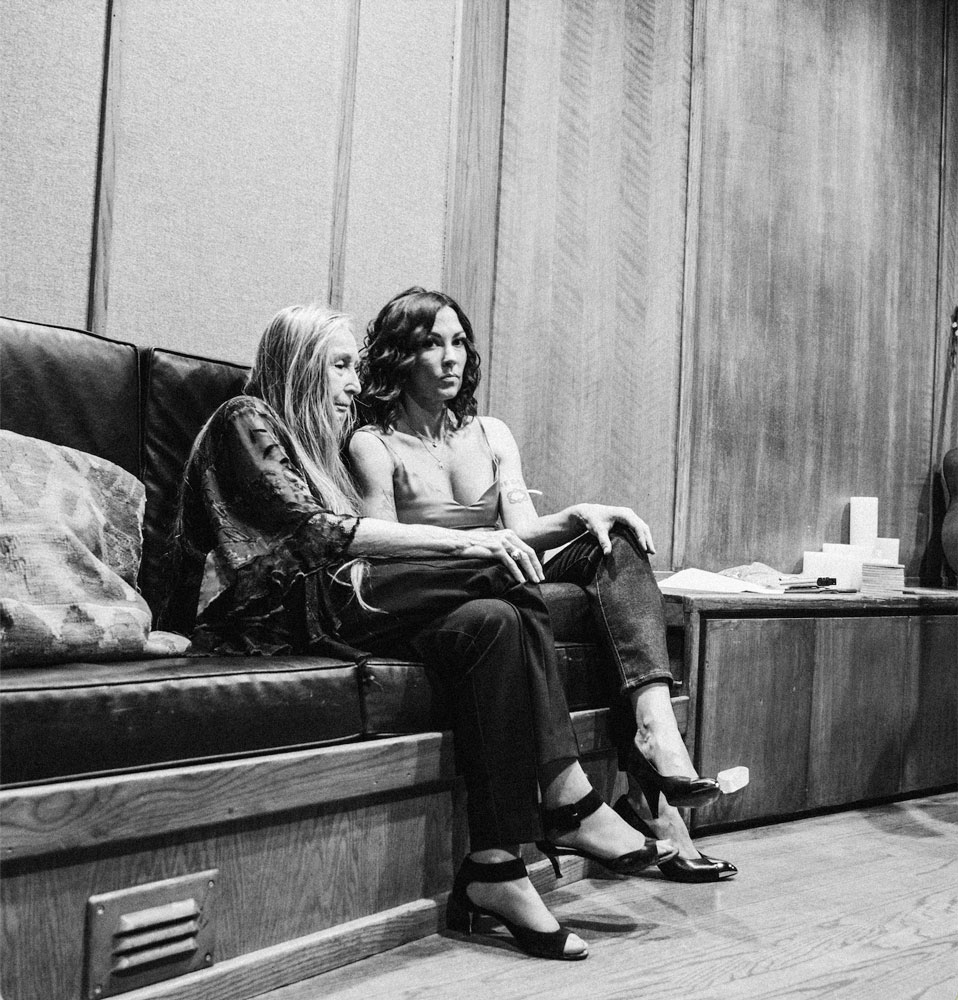
Amanda Shires and Bobbie NelsonAmanda Shires and Bobbie Nelson (Photo courtesy of Joshua Black Wilkins)

So much of our identities are wrapped up in what we’re supposed to be.”

When did you start writing your own songs?

I started writing my own songs kind of late. Probably it started about when I was 20 or 21, but I don’t guess that’s too late. I was a sideperson still. I started writing some songs, and this man named Billy Joe Shaver, who I was working for at the time, told me that they were good. I believed him because he was not known for saying nice things. I eventually moved to Nashville and pursued my dreams of becoming a waitress after having had a stable and great life as a sideperson.

It was different to move into the front person role, right?

Oh, completely. First, I had to shed the side role skin, and I could only really do that by getting out of Texas because I would try to book myself gigs, and people would say “But you play the fiddle.” I was like, “That’s not all I do.” They said, “Yeah, but . . .” It was kind of different then too. Not a lot of women booking.

I was going to say, it’s hard as a woman to get people to see you as anything, let alone to see you as more than one thing or as moving into a different thing.

That is the truth. So much of our identities are wrapped up in what we’re supposed to be, our perceived identities . . . But lately I’ve been seeing hints toward sea changes, good and bad. I mean, even journalists talking to women has been such an amazing thing. I feel as if I sound like one of those people that’s like, “I remember when we didn’t have cars.” But this is still a huge deal, and we’re not done.

How did you start singing? How did you develop your voice as a singer? Did you always know you wanted to sing too?

Hell no. I still don’t think I can sing.

Oh, no. You can.

It was at first out of necessity. I wanted to work in music, and when I was young, I thought, “I want to be a sideperson. I guess I love whatever that is,” and they needed harmonies, so I started singing harmonies some with the Playboys and other folks. At first, I would stand 10 feet from the microphone, scared of the sound of my own voice because in your head, it sounds different than it does when it comes out.

She was the only proof for a long time that I saw that you could be a sideperson and be a woman.”

Luckily, I was in a place that fostered that. Then I sang my first solo song with the Texas Playboys, and that was a complete disaster. But it was handled with such elegance and kindness. Everything I do in music now, I compare it to that experience. When I started to sing that song, we’d practiced it, but I got up to the microphone, and nothing came out, and they all turned around and laughed. And it was awesome. Leon Rausch and Tommy laughed some more, and then Leon held my hand, and we started singing. Then, the rest was there.

And you start to get used to it. It’s a weird thing for everybody to be looking at you while you’re singing. A lot of people have interesting music listening faces . . . I don’t think people know that, but you’re just like, “Wow, that’s not encouraging.”

They have resting mean face when they’re listening. 

Exactly. Resting chill, I’ve been at work all day, face.

I know that you have written a song for Leonard Cohen, and you’ve also covered songs by him.

And I’m covered in Leonard Cohen on my right arm. [shows tattoos.]

I was going to ask if he was an influence, but obviously he was.

We were supposed to probably have a life together. I’m just such a huge fan of his work, and I identify with the process. He wrote songs very slowly – and I do that too, and he had problems with stage fright at first too. You identify with folks whose stories sound a little similar. 

I have that same feeling about Jackson C. Frank, the singer-songwriter from the ’60s. Your new album “Loving You” is with Bobbie Nelson. How did that come about?

That came about when I was recording “Take it Like a Man.” I was considering putting [Willie Nelson’s] “Always On My Mind” on there. It fit the story, I guess . . . We tried it at the studio there [in Texas], and I thought, “I think that it’d be really cool if we tried with Bobbie.” 

We went down there and tried it. Me and Bobbie had such a good time making music without having to even communicate, really. We had a lot of fun, but it was just so easy. Then we were like, “We’re going to start a band.” We started a record, and first song we cut for it was “Always On My Mind.” The second song was “Summertime.”

When we decided to make a record, I was also thinking about how important her story is, not just for Texas music, but for women and for all music.

How did you first encounter Bobbie and her music?

When I was young, I saw her playing with Willie Nelson. This was in my 20s or 18. I was playing a lot . . . I saw her, and I thought, “Who is that?” Because I was standing in the back, and she had a cowboy hat on, black, not just being a supportive side. Her piano playing was effortless and wizard-esque. She was the only proof for a long time that I saw that you could be a sideperson and be a woman.

It was much later I saw Cindy Cashdollar, and it was Cindy Walker that I saw at her 70th birthday party where I thought, “Oh, women can write songs.”

You do a lot of different projects, which I appreciate. You have “Loving You” coming out. Your album “Take It Like a Man” recently came out. You have the bands that you play in, your super group: the Highwomen, and the 400 Unit. How do you balance all that? How do you balance, especially the band work with the solo projects?

Well, truthfully, and luckily I stumbled onto something that is my happiness and is my joy, but it’s also, secondarily, I’m really not good at anything else.

Now, I know that’s not true because I know you’re a painter.

You have to have a place to exercise a part of your brain that’s feelings but wordless. You just like to do something – and see a result from it it. Because you make music, and you play it, and there’s the music meditation where we’re all in this wonderful place together, like a symbiosis and connectivity . . . But you can’t visually see it. You take it in.

Amanda Shires and Jason Isbell in “Running With Our Eyes Closed” (HBO)You have to have places to put the feelings, and sometimes, you to have more than one place because there’s a lot of feelings. You perform sometimes with your husband, Jason Isbell, and you’ve been very open about the struggles of marriage, which I appreciate. Is it hard sometimes to leave it all backstage, and then go onstage and perform no matter what might be going on behind the scenes? Or, do you bring those feelings into the performance?

Oh, sometimes it gets into the performance, but that hasn’t happened in a while. We’ve come to a place where we’ve talked about a lot of the problems that get wrapped up in the personal versus the work, which is a different kind of personal. Like I said once upon a time to him, maybe when COVID was easing up, as a way to go forward, I said, “I’m a sideperson when I play with you. We need to put this out there, and I am able to put that in a box, our marriage stuff, for the work and the time, and you just have to trust me that I can do that.”

It was just that I needed to learn how to quit, learn how to stand up for myself. To say, ‘You can’t say that.'”

Of course he does, but sometimes just verbally saying those things that you know the other person knows – you just like to reinforce the fact that I can separate this . . . That helps a lot because unless you say it out loud, you can assume it, but you need to hear it, and you need to say it. You need the other person to know it’s OK to be the boss because their name is on the sign . . . I want his work to be what it is, what he wants it to be. Now, in my own band, I expect that same thing in return. Even in the studio, after having had that conversation, it’s been easier. Your name’s on the sign in the studio when it’s your recordings, and mine’s on the sign in mine, so you just sit down and listen and try to do what I want you to do. He’s never been a sideperson, but he’s learning how.

You also have talked about how you support each other in writing songs, often personal, very open songs. Do you ever veto songs from each other? Like, I don’t want you to write about this, or this one’s too much?

No, I think we’ve never vetoed a song. I think we’re more concerned with making good work. And so, when we get to trouble spots or decide we want help, then we ask, and we show each other our work. Sometimes, if we don’t want any help, we’ll just say, “I wrote a new song. Listen to it.” 

Now, that wasn’t always the case, and during “Take It Like a Man,” I was writing that, and we were in a horrible spot. I sent him “Fault Lines” because we weren’t really talking even though we live in the same house, and he didn’t even listen to the thing . . . But we crossed that hurdle. It’s a hard thing. They say marriage is hard, but sometimes it’s hard. We had gone through it one time, and I’ve heard people say it can happen four or five times . . . We do comment and try to help if we see help, but if I hear something of his that just needs a lot of work, or I’m not buying it, I just straight up have to tell him. Just because sometimes you need to know. And I want him to do that for me. Who else is he going to show? 

And it’s an important level of intimacy too, to be able to share a creative work with someone.

And it’s difficult. It’s hard to hear. It’s hard for me to hear sometimes, “Oh yeah, you’re missing the whole chorus here,” or something. Or, for him to hear, “Your tone is changing throughout, and it doesn’t really match what you’re trying to say.” It’s hard to hear criticism, but I think we’ve learned how to do it in a kind way.

Do you hope your daughter goes into music?

No! She has such long fingers, I think, and she has such an amazing brain. I realize my mom was always, “Have a backup plan.” So I always had a backup plan – and it’s not easy. It is beautiful, beautiful people, beautiful experiences, but I would hope for her to do something more stable. But I don’t think that’s going to happen. She went to Lubbock last week and started writing a song about prairie dogs.

It’s happening.

“I’ve got to get you to quit.” I had this feeling a long time ago . . . She was playing the kazoo and poking around. I thought, “Oh, no.” And that’s the catalyst for The Highwomen, how I started that idea. On a long drive when I was still in a van, I was thinking, “What’s the worst that could happen? She could make friends and have happy experiences out there,” And I was like, “Oh s***, there’s not enough room for women.” The worst could happen, right? It could be country music because there’s pop, it’s more level – but it all feels really rigged a lot.

That leads into something I wanted to ask you, which is that you’ve talked about how you almost quit music. Why did you almost quit, and what brought you back?

I didn’t have agency, I guess. I’d been kind of beaten down a lot in the studio with various scenarios, various recording projects . . . When you start as a kid, and you have this beautiful thing: you’ve been making music, and it’s glorious. You don’t know about the other things about when you go into the studio. Just how awful people can be . . . I guess they just forget the fact that they’re working with humans, and it can just be abusive.

I’m not saying that there’s physical abuse. It just didn’t feel good. I thought, “Why do I keep doing this to myself? What does that say about me?” I started blaming it on myself and saying, “Oh, you must like that kind of treatment,” and all this. But in the end, it wasn’t that at all. It was just that I needed to learn how to quit, learn how to stand up for myself. To say, “You can’t say that,” or, “You can’t do that,” or, “That’s not a nice way to talk to a person,” or, “I’m not taking that anymore. I’ll leave.” 

“Your voice is shaking or trembling, and you think, ‘Oh God, this isn’t how I want to be strong.’ But it’s a practice. There’s an art to doing it over and over.”

This is all while thinking: I still have to pay my bills. But you just have to get up and say some stuff. And then, a lot of things politically happened that help give you a voice as a person who’s grown up before we were allowed to say a lot. Like 2017 with MeToo and people listening and all that has happened since, where we are allowed to not lose our jobs because we want to say something that might sound bad to you.

I had to learn to try and just say stuff and then use my words, as I tell [daughter] Mercy. I had to have my feelings and be OK with the fallout, whatever it might be – and all those things are just some hypothetical what-if’s in your mind. I’m not super great at being verbal. That’s why I’m a writer and musician, but it sucks sometimes to be trying to say something, and you’re not used to saying things, and your voice is shaking or trembling, and you think, “Oh God, this isn’t how I want to be strong.” But it’s a practice. There’s an art to doing it over and over.

That happens to me too, and I also cry more than I want to cry. I never want to be crying, but I’m always crying.

I can be saying something – and so much of it is how people take it in, or you’re thinking too much about what other people think. And then you’re: “Now I feel this thing, and now I’m going to cry.” It happens to me all the time, and I always cry.

You have a lot of bird imagery in your songs, and I see you’re wearing your hat today with wings on it, and you also wore wings when you performed for “Take It Like a Man” sometimes.

Birds don’t cry.

That we know of.

Exactly. They’ve got it all, man.

So birds are important to you?

Very important to me. I don’t even eat birds, I love them so much. I have 10 chickens. I’ve had them since 2017. A couple of them met their early demise via foxes and whatnot, but I still have [chickens]. They’re still fantastic, good friends. Birds, they operate on different planes, land and sea or land and air, and they have this different model for how they not only parent, but live as individuals together. They even have the right to decide if their eggs are viable, and they can just push them out if they want. We don’t even have that. We’re not allowed to do that.

I was reading today about Aid Access . . . They were started in the Netherlands, and the woman in the article was saying that there were 1,500 calls for prescriptions a day coming from the U.S. alone. It’s just a wild time.

One of the things that I’ve always appreciated about you is that you’re not quiet on things that matter to you.

I’m not quiet, but my voice still warbles. I need, what’s that lesson you get when you can make your voice be lower and stronger, and then people listen?


Want a daily wrap-up of all the news and commentary Salon has to offer? Subscribe to our morning newsletter, Crash Course.


If you could go back in time and meet your 15-year-old self — you had just heard Bobbie Nelson, maybe, you were joining the Texas Playboys – what advice would you give yourself as a teenager?

I would say first, don’t be so hard on yourself, and next I would say . . . Don’t go rope swinging. You’ll break your finger. Don’t go rope swing in 2011. And I would tell myself, you don’t have to be everything all the time. 

“Loving You” with Amanda Shires and Bobbie Nelson releases June 23. 

Marjorie Taylor Greene shows off her Confederate beer cooler in a new workout video

Rep. Marjorie Taylor Greene, R-Ga. posted a short clip to Twitter on Friday, in which she boasts of her agenda to impeach President Biden. In the clip, Greene is shown pumping iron in her garage while listening to rock music — not unusual in that she’s shared similar videos of herself in the past — but what stands out about this one is the congresswoman’s decision to not hide her Confederate beer cooler (surely not filled with Bud Light) before hitting record.

Powdering up her hands with what appears to be flour from a mixing bowl, Greene struts around her garage, takes hold of a bar bell, and lets ‘er rip.

“Hey guys, I introduced articles of impeachment this week against five people who deserve it,” Greene says, face growing red from the strain of the 45-pound weights she’s holding up to her neck.

Leaving viewers with a prompt to “check out Battleground MTG” to find out “how we save America,” Greene then lets the weights fall to the ground, likely setting off a “lunk alarm” at a nearby Planet Fitness.

As soon as the clip was posted, viewers were quick to point out Greene’s cooler, visible to the left of her, which appears to feature a large Confederate flag sticker. 

Supporters of Greene didn’t seem to care much about spotting the imagery, explaining it away as “southern pride.”

“A confederate flag just means you like the old south culture. So do most of us,” on person said on Twitter.

“Dude the confederate flag is only racist if you want it to be. stop projecting,” replied another MTG supporter.


Want a daily wrap-up of all the news and commentary Salon has to offer? Subscribe to our morning newsletter, Crash Course.


Last year, Greene publicly championed Confederacy in a befuddled but broader sense when she visited the Wilder monument in Chickamauga, GA to honor Confederate soldiers of the Wilder Brigade.

“I will always defend our nation’s history,” Greene said in a post to Twitter, sharing pics from her trip.

In a comical twist, people where quick to point out that the particular monument visited by Greene during that trek was actually in honor of Union soldiers, not Confederate. But it’s the thought that counts.

Celebrities are talking openly about menopause. Why won’t the healthcare industry?

Menopause wasn’t always a topic that was talked about loudly, on talk shows and brunch joints. But that appears to be changing (finally), as a number of public figures are opening up about what used to be a private, deeply personal topic. Recently, Oprah sat down with Drew Barrymore, Maria Shriver, and menopause experts to discuss her perimenopausal heart palpitations, brought on by decreased estrogen and progesterone. These women join a growing cadre of public figures, including Gayle King, Naomi Watts, Stacy London, and Michelle Obama, who are helping to shift the narrative around women’s bodies, health, and aging.

In some ways, the sheer exuberance of these conversations-between-friends–style segments hints at a marked change in perspective. The frank discourse around women’s health issues — particularly that of older women — is long overdue.

Why aren’t doctors and oncologists better preparing us, their patients, for what to expect in menopause? 

Yet I can’t help but notice that the current dialogue is falling short. Too often, these orchestrated sit-downs become a jolly, we-got-this-girl bonding experience rather than a call for change within the healthcare industry, which is failing women who are going through menopause.

Having gone through premature induced menopause at thirty-seven years old due to hormonal treatments for breast cancer, I’ve been following these conversations closely. I watched as Drew Barrymore had her first perimenopausal hot flash on-air with Jennifer Aniston, and I listened intently to Maria Shriver talk about the correlation between anxiety and menopause. While I appreciate the courage of these women for speaking out about a topic that has long been shrouded in secrecy—their openness and honesty is even more impressive, considering they work in the youth-obsessed entertainment industry—it’s important to note that this natural biological process can also come with significant medical risks. 

When a life-saving hormone treatment hurtled me into premature induced menopause, I had no idea what to expect. At the time, I felt grateful to be alive. The consequences of sudden induced medical menopause weren’t my primary concern. Going into menopause sounded like an abstract concept meant for someone else—like trying to understand childbirth before entering labor. I knew I would no longer get my period (excellent!) and probably have a few hot flashes, as my mother did. I remember her driving me to high school in the dead of a Vermont winter with all the windows down while complaining she was overheating. Back then, I laughed at the absurdity of the situation. But now, twenty-five years later, I understand: hot flashes aren’t funny! They wake me up every night, and I feel like I’m cooking from the inside out.

I was woefully ill-prepared for the intensity of my symptoms, which include rapid mood swings, brain fog, insomnia, night sweats, and severe vaginal atrophy that wreaked havoc on my sex life. My oncologist, and my primary care doctor, failed to educate me about the significant health risks of entering into early menopause, such as the increased likelihood of osteoporosis, depression, stroke, heart disease, and early dementia, to name a few. I’m not blaming them for my symptoms, only for the lack of education and warning. 

Why aren’t doctors and oncologists better preparing us, their patients, for what to expect in menopause? I think telling me to “take an over-the-counter Vitamin D supplement” to treat my fragile bones is inadequate. Why didn’t anyone tell me about my increased risk for early-onset Alzheimer’s or the imminent metabolism meltdown? Menopause wreaked havoc on my physical and mental health, and the worst part was how unprepared I was for it. Each new symptom brought on many other health concerns and treating them became my full-time job. I couldn’t turn to my mother for answers because she had passed away from cancer five years before my diagnosis. I became confused, embarrassed, and ashamed about what was happening to my body and felt very alone. 


Want more health and science stories in your inbox? Subscribe to Salon’s weekly newsletter The Vulgar Scientist.


Eventually, I took matters into my own hands. I sought information online and I found a supportive community of post-menopausal women who recommended different solutions for my ailments. Before I found these women, I spent hours lurking around random Facebook groups and Reddit threads, searching for advice from strangers. One woman from Ontario even mailed me her homemade lube recipe. It arrived wrapped in pink bubble wrap, inside a discreet package, with no return address. I tried it. (To paraphrase Michelle Obama, “There’s no shame in my menopause game!”) Over the years, I’ve found therapeutics and products that work for me—but none are doctor prescribed or covered by insurance.

We need affordable, effective, and widely available therapies and educational resources for everyone going through menopause. We do not need more menopausal capitalism.

The question remains: Why was I forced to become an internet menopause sleuth? In part because the medical community — oncologists, general practitioners, gynecologists, nurse practitioners, and nurses — are failing to address menopausal symptoms adequately with their patients. Why don’t professionals ask perimenopausal and postmenopausal persons about their vaginal symptoms the minute they enter the examination room? As many as 90% of postmenopausal women experience vaginal dryness, yet no medical practitioner has ever asked me about it. (The fact that Gayle King intoned dry vagina three times during her interview on CBS Mornings is groundbreaking. Seriously.)

Moreover, research shows that medical providers dismiss three out of four women who bring up their symptoms and concerns. While we could all use a little more education on how to be our own health advocates, medical professionals could be doing so much more to normalize these sometimes uncomfortable conversations and end the culture of silent suffering in menopause.

Most of us don’t have the time, money, or resources to research and experiment with various treatments to find the one that works best for them. Some of don’t even have access to decent healthcare. Not to mention the well-documented racial disparity in menopausal health. We need affordable, effective, and widely available therapies and educational resources for everyone going through menopause. We do not need more menopausal capitalism, i.e., celebrities hawking us their products. If anything, we’ve learned from the studies on heart disease, cancer, and exercise science that not enough medical research has gone into unlocking the mysteries of the female body.

Unfortunately, the number of individuals entering menopause at an earlier age keeps increasing. Cancer in young adults is also on the rise. As early detection and treatment continue to improve, more and more people are pushed into chemopause, along with the people who enter early menopause for other reasons. It’s time for more research on managing the symptoms of menopause and open communication about the health risks when estrogen levels radically decline.

Indeed, the public discourse and response around menopause has improved, thanks partly to the outspoken celebrities helping to change the paradigm. But all women, no matter who they are, deserve better and more, both in treatment plans and preventative care (not to mention job security and mental health services). We shouldn’t have to wait for Taylor Swift to enter menopause and write a song about it in order to get everyone’s attention. 

I know that when my two young sons become older adults, they will, provided they have health insurance, enter a favorable healthcare world: erectile dysfunction drugs like Viagra are typically covered by insurers, as are vasectomies (which most state Medicaid plans cover). They will also benefit from decades of medical research on the aging male body. But I don’t want my three nieces to go through what I did — the helplessness and isolation of Googling answers about my own body in the dark of night.

I hope that by the time they enter menopause — naturally or medically induced — they’ll have educated themselves about the significant medical risks and symptoms. I want them to live in a world full of medical providers who serve up big helpings of information about their changing female bodies and what to expect once they reach the threshold of menopause. I wish that for them as much as I still wish it for myself and other women going through it.

It goes without saying that I’m grateful to these brave public figures for using their platforms to help change the narrative around menopausal health. But maybe it would also be helpful to create well-written, culturally competent, and widely distributed resources for medical providers along the lines of, “How to Talk to Your Patient Going Through Menopause.” I’m joking — kind of. After all, the conversations which hold the most influence — between doctors and patients —  don’t always happen on a stage. Rather, they take place in private examination rooms.

The sexual celebration of mature women in bloom, from “Queen Charlotte” to Martha Stewart

In the fifth episode of “Queen Charlotte: A Bridgerton Story,” Violet Bridgerton (Ruth Gemmell) and Lady Agatha Danbury (Adjoa Andoh) take in an art exhibit of the latest oil paintings, including a few lushly rendered nudes. One moves a flustered Violet to launch into a passionate conversation about, ahem, “gardening.”

“It seems my . . . garden is in bloom,” she confesses to Agatha, who is confused at first, before picking up Violet’s code: the mannerly widow is feeling unexpectedly merry again. “It is blooming out of control,” she continues. “I am becoming dangerous, Agatha. I almost asked a footman to lie on top of me today!”

These ladies are talking about sex, in case the innuendo breezed by you. But a broader interpretation of Agatha’s wisdom applies to women in an era: Desire doesn’t fade with age, and nourishing it is our birthright until we die.

Queen Charlotte: A Bridgerton StoryRuth Gemmell as Violet Bridgerton in “Queen Charlotte: A Bridgerton Story” (Nick Wall/Netflix)

“Queen Charlotte” primarily romances the pre-“Bridgerton” London of the past, when Lady Danbury and Charlotte are young women and Violet is a girl, all of ages popularly associated with love stories and glamour.

But with “Gardens in Bloom,” Shonda Rhimes defends a mature woman’s right to satisfaction, too. “We all have gardens, Violet,” Lady Danbury says. “My garden did not die with my husband because it had never been planted. I did not even know I could have a garden. It did not bloom until after he was gone. And when it did, I nurtured it fiercely.”

A woman has a right to be horngry and show out well into her so-called “golden years” and have a good time doing it. Those notions collided this week when Sports Illustrated revealed 81-year-old Martha Stewart as one of its swimsuit cover models. But it’s also flashed through popular culture over the past few years.

Stewart’s swimsuit edition debut joins the renaissance of Jean Smart on “Hacks,” where her character Deborah Vance picks up a hot younger man (played by 44-year-old Devon Sawa) at a bar. Actually, it’s the other way around – he comes on to her. “I like older women,” the one-night stand tells a skeptical Deborah. “Is that a bad thing?” 

It brings the heat Emma Thompson radiated in last year’s “Good Luck to You, Leo Grande” a little closer to reality, although arguably Thompson’s character, a recently widowed retired teacher, codes a lot closer to the average person than Stewart. (The same goes for Aunt Vi on the recently ended “Queen Sugar,” who shared a deeply romantic marriage with her more-than-a-decade younger husband.) It’s the “get this” energy we want for J. Smith-Cameron’s “Succession” diva Gerri once she extricates herself from Roman Roy’s toxic orbit.

Good Luck To You, Leo GrandeEmma Thompson and Daryl McCormack in the film “Good Luck To You, Leo Grande” (Photo Courtesy of Searchlight Pictures/20th Century Studios)

The seeds of rethinking the mature woman’s sexuality and appeal have been sprouting across culture over the past few years, perhaps in reaction to decades of Hollywood and Wall Street worshipping older men with much younger wives as virile and powerful. Granted, it will take a century, if not longer, for sexy women in their 40s, 50s, 60s and beyond to reach cultural parity with the silver foxes of the world. There’s a reason ABC is testing the dating competition waters with “The Golden Bachelor,” an AARP-qualifying spinoff of “The Bachelor,” before welcoming “The Golden Bachelorette.”

But there’s something to be celebrated, for instance, in seeing the nearly 54-year-old Jennifer Lopez parkouring over rolling obstacles and leaping from car roof to car roof in Netflix’s thriller “The Mother” without breaking into more than a glow. And yes, stunt doubles, blah blah blah, but those defined biceps and triceps are entirely hers. 

It was recently announced that Halle Berry, who co-starred with Keanu Reeves in “John Wick: Chapter 3 – Parabellum,” is joining Angelina Jolie in “Maude v Maude,” an action flick described as James Bond meets Jason Bourne. Age was never an issue with the Bond franchise – for its male co-stars. Berry co-starred with Pierce Brosnan in 2002’s “Die Another Day” – he was 49 at the time, and she was 36, in a town where most actresses’ opportunities dwindle to nothing the moment they turn 30. Whenever “Maude v Maude” premieres Berry will be at least 57; Jolie turns 48 in a couple of weeks.

But these are action movies, not magazine spreads, right? Except both call attention to the physicality, athleticism and appeal of their stars; each necessitates an examination of bodies, vigor and power – therefore, sex.

The MotherJennifer Lopez as The Mother in “The Mother” (Ana Carballosa/Netflix)

Everything that critics are saying about Stewart’s swimsuit issue debut and the achievements of the performers we just mentioned is true: they are the exception, not the rule. Ageism remains as rampant in the entertainment industry as it is across all professions, with a woman’s career mobility and earning potential narrowing at a younger age than that of her male counterparts. Jolie and Berry aren’t likely to deny that, especially considering that Jolie’s 59-year-old ex-husband is still a sex symbol headlining high-octane blockbuster, whose career is likely to be as long as Harrison Ford’s, age 80.

Like him, Stewart’s version of 81 is as rare as her wealth and access. Her physique is a product of lifelong image-sculpting that began when she professionally modeled. Never has there been an era in which she hasn’t been rigorously aware of her appearance both in terms of her body and her output as a domesticity influencer.

Regardless of whether she’s had any of the cosmetic surgical procedures she insists she hasn’t, the average woman has neither the time nor the cash to receive weekly facials, let alone ones administered by skincare guru Mario Badescu.


Want a daily wrap-up of all the news and commentary Salon has to offer? Subscribe to our morning newsletter, Crash Course.


Also, and this cannot be stressed enough, one can hydrate and slather themselves in sunblock, and landscape their forms with Pilates, Pilates, Pilates. Nevertheless, at some point genes become a main determinant in not only how we look but how we feel as we age.

Adjusting our lenses a bit, however, is this not Stewart simply preaching the same impossible lifestyle image she always has? What’s true of her fashion shoot is true of those drool-inducing glimpses of the vivid blooms and greenery at Turkey Hill back in the 1990s. Yet again, this is her saying, “Look at my garden. Do you not aspire to such neatly pruned hedges and controlled rows?” And maybe, like we did back then, we can say sure, yes, while prizing every tomato we harvest and understanding that we don’t have the staff to hold back the inevitable weed takeover.

https://www.instagram.com/p/CsRowziOTdO/

Provided a person accepts themselves in their own skin — to borrow Stewart’s catchphrase, her Sports Illustrated layout is a good thing. It provides the same pump that watching videos of 88-year-old DJ Sumiko Iwamuro spin at a club does, or basking in 60-year-old Michelle Yeoh‘s grace, or thrilling at one of the many times Angela Bassett did the thing.  They show that advanced age does not resign a woman to gray blandness.

What’s true of Stewart’s fashion shoot is true of those drool-inducing glimpses of …Turkey Hill back in the 1990s. Yet again, this is her saying, “Look at my garden. Do you not aspire to such neatly pruned hedges and controlled rows?”

Between the camps of “Martha Stewart is breaking barriers” and “Martha Stewart, tool of the patriarchy, is hawking impossible standards of female attractiveness” is a part of the debate people aren’t digging into: famous, mature women who aren’t white or grotesquely rich and defying the stereotype of what older women look like aren’t lauded with an eighth of the flowers that Stewart gathered last week for baring some skin on a beach.

The 64-year-old Bassett has been strutting around killing it for years, looking virtually the same as she did when she played Tina Turner in “What’s Love Got to Do With It” three decades ago. Where’s her SI cover?

Closer to Stewart’s age, if you’d like, is model, actor, singer, and all-around iconic blueprint Grace Jones, who just turned 75. Stories of Stewart nightclubbing with Snoop Dogg are charming anecdotes that make us like her more, but we hear a lot less about the fact that Jones still headlines live performances where she sustains a level of physical exertion that would challenge people half her age.

Grace JonesGrace Jones attends the BFI London Film Festival closing night gala for “Glass Onion: A Knives Out Mystery” at The Royal Festival Hall on October 16, 2022 in London, England. (Dave Benett)

Jones is legendary on a mythological level, and to a degree that most of the magazine’s target audience couldn’t handle. To know her is to understand wild fabulousness has no upper age range even if Grace Jones is a singular flower in this world, a woman carrying on the tradition of some fantasy queen, except she’s real and walking among us, someone from whom we can draw inspiration.

“We are full of gossip and story,” Lady Danbury tells Violet. “But as women, we are never the topics of conversation. . . . We are untold stories.” And that’s the beauty of deciding what to glean from these visuals – when we do tell stories about ourselves to ourselves, they loosen the limitations of what the accompanying illustration could look like. They remind us that our gardens are worth tending until the day we return to the Earth.

Sammy goes to school: After 30 years of incarceration, graduation

We know the story. The absent father who leaves when his son is five years old and moves back to Puerto Rico. The single mother, rarely at home because she works long hours to keep her three children fed and pay the rent. The poverty. The crime. The instability. Later, the stepfather who drinks, uses drugs and beats his stepchildren. The child acting up. Dropping out of school. Joining a gang. The robberies. The one that went wrong and left a man dead. Prison.

The students I teach in prison have variations of the same story. They are funneled into the maw of the prison-industrial complex, the largest in the world, and spat out decades later, even more lost and traumatized, to wander the streets like ghosts until most, unequipped to survive on the outside and without support, find themselves back in the old familiar cages.

But I tell this story because it needs to be told. I tell it because this time the end will be different. This time the system will not win. I tell it because neglected and abused children, no matter what crime they commit, should not be imprisoned as if they were adults. I tell it because we are complicit. I tell it because until we stop investing in systems of control and start investing in people, especially children, nothing will change. It will only get worse.

“I come from a very violent childhood,” says Sammy Quiles, who was released from prison after serving a 30-year sentence a few weeks ago. “My mother — once my father was out of the picture — worked and partied. Me and my sisters were relegated to making it on our own or with babysitters. And then when she met my stepfather that was only exacerbated. He was a drunk, drug abuser and very violent. I was hit with fists, bats, hangers, you name it. It was physical, emotional and verbal abuse.”

I taught Sammy in East Jersey State Prison in Rahway, New Jersey, in the Rutgers college degree program. I did not know his story until he was released. I never know the stories of my students. They are not their crime. And years, often decades later, they are not who they were. Sammy, in my classroom, was reserved, determined, hardworking, brilliant and unfailingly courteous. That is who Sammy is. Who he was, to me, is irrelevant.

That is not how Sammy was seen as a child, a troubled boy coping with abandonment and terrible abuse. He threw temper tantrums. He could not sit still. He was disruptive. The school system labeled him “emotionally disturbed.” He was placed in special education classes in the second grade.

“Decisions were made early on in my life that I would serve the service sector of society,” he says. “I wasn’t taught innovative curriculums. They sent me to wood shop or auto mechanic schools.”

He dropped out of school in the 10th grade. At 15 he left home “because the streets seemed safer for me.”

 “I tried to get fast-food jobs, but I didn’t last long,” he says. “My behavior was erratic, problematic. I didn’t do well with authority and structured environments. I robbed and stole. I became a car thief, a stick-up kid. That’s how I ate.”

He found the Latin Kings.

“Every government institution abandoned me or punished me for my behavior, but it was a gang member that helped me with homelessness, with putting clothes on my back, putting a few dollars in my pocket, fed me — his family fed me,” he recalls. “I understand today that they exploited my aggressive behavior, but they’re the ones that helped me when I left home. It felt like I had a community. They taught me about my culture. They instilled this pride in me. There was protection.”


Want a daily wrap-up of all the news and commentary Salon has to offer? Subscribe to our morning newsletter, Crash Course.


He was initiated into the Latin Kings in a schoolyard in Lakewood, New Jersey. He had to recite from memory 10 small paragraphs, or lessons, in front of a circle of some 30 gang members. Then each member embraced him. They shot a hand gesture they called “crowns,” their gang greeting.

“I felt empowered, I felt accepted, I felt like I had a family,” he says.

He swiftly ascended within the ranks of the gang.

“I had a knack for learning the lessons, the materials they gave,” he says. “I was very interested in the literature. It was all based on culture and a lot of Puerto Rican history and about revolutionaries and where I come from. And then the aggressive nature — I was very aggressive.”

The gang sold cocaine and crack. But he continued working as a “stick-up kid” who robbed drug dealers and members in rival gangs. A robbery usually brought in a few hundred dollars that was divided up with other gang members. He often used his portion to buy gifts, such as sneakers, for his two younger sisters.

He looked up to older gang members who became surrogate fathers. One of them recruited him to rob a Kentucky Fried Chicken restaurant when he was 17.

“My loyalty to this individual warped my judgment,” he says.

The manager of the KFC was killed in the robbery, which netted about $3,000.

Sammy was arrested and sent to a youth house until he was waived up to an adult court. He was evaluated by a court psychologist who determined he could not be rehabilitated by the age of 19. He was given a 30-year mandatory minimum sentence.

Going to jail and prison, he says laughing, was “very easy.”

“The most compassionate people in prison are serving a sentence,” he says. “Not the staff. Not the administration. It’s the offenders. They are the most compassionate.”

“It’s unbelievable to say that today, as a 47-year-old, but I never felt uncomfortable in prison,” he says.” I was conditioned for that environment. I was rejected by my father. I was not completely loved by my mother. I had a stepfather who physically abused me. I was seen as a criminal before I even committed a criminal act. The school system sent me to special ed, to expulsion, to an alternative school. It was a lifetime of perpetual punishment. When I got to prison, I was like ‘OK, this is just a normal day for me.’ I wasn’t the elite child who made a mistake. I wasn’t this superstar academic or athlete or any of that.”

He was housed in Trenton State Prison’s Vroom wing for those with mental and behavioral issues. Prisoners called it “the terror dome.”

“It had the biggest overzealous guards,” he says. “Twenty-three and one lockdown,” meaning  he was only out of his cell for one hour each day.

“They came around with a little book cart,” he says. “You could get a book if you wanted. You’d be let out into the yard every few days. You’d get a shower every few days. Other than that you’re in your cell.”

“I read as much as I could get my hands on, a lot of Puerto Rican revolutionary books,” he remembers. “I still read a lot about Albizu Campos and Lolita Lebron and Prisoners of Colonialism. Anytime they let us outside, I went outside. I watched a lot of TV.”

The prison authorities accused him of being the head of the Latin Kings in the New Jersey prison system, although he says, “I don’t think anyone was really in charge.”

He was in his late 20s when he got married in prison to a high school friend. She had a two-year-old daughter. They visited every weekend. 

“I saw that it’s not just about me anymore,” he says. “I began to change.”

His wife and her daughter were his only consistent support on the outside. The marriage lasted until 2015 when she moved to North Carolina.

“I had people who would dust me off the shelf and remember me every birthday or a special event,” he says, “but nothing constant.”

He decided to leave the Latin Kings when he was in his late 20s. He met fellow gang members in the yard at East Jersey State Prison to announce his decision.

“Yo, man this is what it is, my life trajectory is taking me on a different path,” he told them. “I invited them, if they needed to discipline me or something like that, in any way, to bring it on. That was it.”

The other gang members let him walk away.

He gravitated towards the serious students in the prison, the ones working doggedly in their cramped and claustrophobic cells to get an education, the ones who had turned their cells into libraries.

“They explained to me the importance of their own transformation,” he says. “I understood that my story was not an anomaly. There were several of us behind those walls with similar experiences and stories. It’s education and community that changed me. It was grounded in love and care. It was not exploitative.”

He pauses and goes on, his voice dipping slightly.

“The most compassionate people in prison are serving a sentence,” he says. “Not the staff. Not the administration. It’s the offenders. They are the most compassionate.”

But even that journey, however redemptive, was met with hostility.

Sammy had never taken a bus or train until he was released from prison. He didn’t know how to put his bank card in an ATM. “I found myself living like I lived in a prison cell. I would put my things in storage containers instead of the dresser. I would take a shower with my boxers on and shower shoes.”

“We would go through the metal detector and our stuff would be thrown around by an overzealous guard who had a problem with somebody paying for our education,” he says. “We were seen as super-predators, criminals, the irredeemables of the world. If I had a paper I was writing for Chris Hedges, they would throw it on the floor or step on it or rip it up and make me start all over. They would take books from us. And then in the halfway house when I got out. You want to do research on campus? They have you make four calls a day for accountability. Or they’ll call you in the middle of the class to make sure you’re in class, like ‘Bro, you’ve got my schedule, you know I’m in class at this time, why are you disturbing that?'”

The Body Keeps Score: Brain, Mind, and Body in the Healing of Trauma” by Bessel van der Kolk helped him understand and cope with trauma.

“That book was instrumental to humanizing me,” he says. “There was no help for my psychological trauma — the trauma I experienced as a kid. Through higher education, I learned a lot about myself. I learned that the behaviors I exhibited in school and in the community were not abnormal to someone dealing with the family I inherited and the abuse I experienced as a child.”

He devoured texts about history, sociology, religion, economics, social reproduction and the school-to-prison pipeline.

“In the classroom it was not only our safe space, but it was a space where we had a new level of agency,” he says of his college classes in prison. “That’s what I liked most about the classroom. Yes, we learned, we discussed dense topics and authors, but we had an agency in those classrooms I had never experienced.”

It is hard adjusting to being outside prison. Sammy had never taken a bus or a train until he was released.

“I found myself living like I lived in a prison cell,” he says of the first days and weeks of his release. “I would put my things in storage containers instead of the dresser. I would take a shower with my boxers on and shower shoes. There were sleepless nights. I’m easily triggered. I don’t like being told what to do. I don’t like being controlled. If it’s with a significant other I put my guard up. I remove myself from the situation. It’s like I have a scarlet letter. While I’m on campus, when I go to stores, when I’m in public spaces, I feel like I’m different. There’s something about me that speaks of my incarceration. The first time I had to use my bank card, I didn’t know how to put it into that little slot thing. It was awkward. I got to the counter, and I had to call somebody and say ‘Yo, I don’t know how to do this, if I don’t do it correctly, they’re going to think I stole the card or that it’s not mine so can you please explain to me what you do?’ I distrust institutions. I was at the DMV, trying to get my learner’s permit. I scheduled the appointment. The lady looks at me and she says, ‘Your birthday is Nov. 1, 1975, and you’ve never had a license?’ She was loud. I told her ‘Well, can you say that any louder? You have everybody knowing that I never had a license!’ I’m getting defensive. I’m thinking everybody interpreted that as I’m a felon, I’ve been away.”

“Prison,” he says, “taught me how not to treat human beings.” 

Sammy finished his B.A. in criminal justice from Rutgers last week. He graduated summa cum laude.

Zen and the artificial intelligence: We should be “somewhat scared,” says OpenAI CEO, not paralyzed

The way Jack Kornfield tells it, one of the first things OpenAI CEO Sam Altman asked when the two started meditating together was: How will we know if artificial intelligence becomes conscious? And then: What is consciousness?  

“How about this, Sam?” Kornfield recalls answering. “How about if some night you, or we, go and put a mat down between all the servers and take a good dose of psilocybin — and talk to it, and see if it answers us?”

Just a couple of weeks before Altman’s Capitol Hill charm offensive left a Senate panel smitten with his calls for regulation of the AI industry, Altman shared a stage with Kornfield — a well-known Buddhist meditation teacher — in San Francisco, delivering his heady vision on the future of AI at the Wisdom 2.0 forum. A self-congratulatory New Age conference favored by West Coast technorati at $300 a head, Wisdom 2.0 is itself something of a paradox — a display of wealth and power in a city whose homeless population of nearly 8,000 people has attracted worldwide attention.

That was where Altman revealed his sweeping vision of what he believes is the now-unstoppable and — at least initially — frighteningly destructive force of AI, as it upends nearly every aspect of U.S. business and industry over the next five years or so. After that, Altman told the audience, things should get better.

“This is going to be such a massive change to so many aspects of society,” Altman said. “There are going to be scary times ahead and there’s going to be a lot of transition. I’m very confident this can be managed.”

Kornfield, who is now the preeminent guru of Silicon Valley’s elite, has been sitting together with Altman in Vipassana meditation for years. Before that, Kornfield sat in an air-conditioned room at Harvard Business School, running dangerously potent simulations on one of the most powerful mainframe computers of the modern age — the revolutionary 10-ton beast called the Univac 1108 that gave the world its first commercially accessible natural language processing system.

Altman’s early question to Kornfield, akin to a Zen koan, served as a meditation for the two techno-spiritualists on stage, transcending rational thought to confront the central paradox of AI: How will we know? 

The Sanskrit paradox

What happens when the creation surpasses the creator?

It wasn’t until many years after the Buddha’s death that the sutras, or scriptures, were finally translated into Sanskrit — an intellectually complex language of precise conjugations, whose roots extending back to at least 1500 BC. But by the time the Buddha was delivering sermons, Sanskrit was used in his region mainly by a ruling class who found its exactitude useful in affairs of wealth. 

To the credit of ancient elites, Sanskrit’s unbending specificity and its introduction of a decimal point indeed made it highly useful as a universal language between diverse speakers. 

In his 1985 article for AI Magazine, NASA researcher Rick Briggs proposed that we should teach the robots Sanskrit. He argued that the structural rigidity and rule-based grammar of Sanskrit offered a powerful natural analog to the symbolic logic of computer languages. It could represent human knowledge, he suggested, in a way computers could understand. 


Want a daily wrap-up of all the news and commentary Salon has to offer? Subscribe to our morning newsletter, Crash Course.


On the Wisdom 2.0 stage, Altman’s vision of human-machine coexistence — built on his AI’s shared language capacity — surpassed Briggs’ then-fanciful notions, veering into the realm of science fiction. By example, he pointed to the ever-helpful but completely normalized presence of famed robotic assistant C3P0 in Star Wars. 

“I think we will head toward a world where it’s not just human intelligence, and we have this other thing,” he said. “I think AI will just become part of society. And it will be different than human intelligence and very different than other parts of humanity, but it will sort of collectively lift us all up.”

Language models of human intelligence are themselves comparable to a type of AI “knowledge model,” by even a modestly interdisciplinary definition. Any human lingua franca is used to store and retrieve information, trained by every new generation to incorporate both novel concepts and ancient memory into the electrified biochemical mess between our ears — our own homegrown neural network. 

“Even if we slow this down as much as we can, even if we get this dream regulatory body set up tomorrow, it’s still going to happen on a societal scale relatively fast… People should be somewhat scared.”

But some of the earliest Buddhist sutras were written around the 5th or 6th century A.D., in the Indo-Aryan language called Pali, which is far less specific than Sanskrit.

Pali was and still is the common tongue of the Magadha region, where Prince Siddhartha Gautama lived a life of luxury before renouncing wealth to attain enlightenment. The Pali language is beautifully poetic, rich in morphology yet simple in syntax. Its powerfully nuanced inflections let speakers bend words like a willow, midstream in a sentence, to create new relationships between alien concepts.

Pali might be akin to what we’d call an “associative knowledge model” in AI — within which knowledge is stored not by the specifically ordered memorization of discrete facts, as in Sanskrit, but by remembering things based on their relationships to other thoughts. 

An associative knowledge model AI, rather like what OpenAI’s ChatGPT seems to display, relies on what was once a solely human talent for finding patterns in thoughts and words. Associative knowledge models are an evolutionary advancement from the more analytical and Sanskrit-like symbolic knowledge models on which Kornfield’s Univac 1108 was built.

“I go back and forth about whether we should understand this as a technological revolution or a societal revolution,” Altman told the Wisdom 2.0 crowd. “Obviously, this is both, like all technology revolutions are.”

“I always think it’s annoying to say, ‘This time it’s different’ or ‘My thing is super cool,’ but I do think in some sense AI will be bigger than a standard technological revolution, and is much closer to a societal revolution — which means we need to think about it as a social problem, primarily, not just a tech problem,” he said. 

Briggs’ proposal that Sanskrit, the ancient language of the gods, be used by man to commune with his modern machine and offer it the fruit of knowledge, might sound like esoteric pseudoscience at first — but his impulse to find a way to bridge human-computer understanding becomes more salient by the day, especially since these days AI isn’t thinking quite the way it used to. 

It’s speeding toward the future faster than we are, using revolutionary language and thinking patterns from deep in our own human past. On the Wisdom 2.0 stage, Kornfield remarked with sober awe at how fast that future is approaching. 


Want more health and science stories in your inbox? Subscribe to Salon’s weekly newsletter The Vulgar Scientist.


“Not a matter of decades,” Kornfield seemed to ask. “This is a matter of a year, or two or three years …”

“Well, maybe a little more than that,” Altman interjected.

“A few years,” Kornfield continued, with a subtle nod from Altman. 

From Altman’s point of view there’s no stopping that.

“Even if we slow this down as much as we can, even if we get this dream regulatory body set up tomorrow, it’s still going to happen on a societal scale relatively fast,” he said. “People should be somewhat scared. But I also think people should take pride — take solace and take pride — in the fact that humanity has come together to do incredibly complicated things before.” 

“You mentioned the example of nuclear weapons,” he said, referencing the international governance boards which emerged after the atomic bomb’s horrific debut in 1945.

“We just need to do the same thing here. We need to come together, decide what we want, decide how we’re going to enforce it, and accept the fact that the future is going to be very different and probably, like, wonderfully better.”

“A lot of nervous laughter,” Altman joked to the hushed audience. “I could lie to you and say ‘Oh, we can totally stop it,’ you know, but I think this.”

The speed with which this future is arriving is one reason, Altman said, why OpenAI released its ChatGPT and DALL-E tools as early as it did. 

“Let people gradually … have time to adapt and think about this and decide what they want,” he said. 

“I totally empathize with people who are extremely worried, and there are a lot of those. I am somewhat worried, but I am pretty optimistic that we will discover, as we go, ways to integrate this into our lives, ways to solve the myriad set of not only safety challenges but social challenges.”

Das karma, Das Kapital 

Can you create a better world with tools that cause suffering?

Among those social challenges is the dramatic scope of job loss Altman sees coming. 

“For sure,” he answered when asked about it. “This happens with every technological revolution, and we find new jobs, and we adapt. But I don’t think we’ve ever had to contend with one that will be as fast as we’ll have to contend with in this one. And that’s going to be challenging, yeah.”

The room sat silent.

“I have no doubt we’ll be fine on the other side, but the compressed time frame…” he said somberly, trailing off himself into silence.

The elite tech CEO and the American Buddhist guru, pondering the devastating and restorative potential of AI, drew on the sutras to illuminate their hopes for humanity from a San Francisco stage — but most of America’s people, and the world’s, are unable to share in Altman’s promised utopia, which advances further out of working-class reach each day. 

A number of lawsuits have begun cropping up around AI-generated creative works which are noticeably just patchwork assemblages of copyrighted material. Those court cases, though not fortified with the strength of precedent, are far from frivolous, and will draw further attention to the question of what data OpenAI fed its generative products. 

In fact, the creation of AI is occurring within an ethically unsavory industry, where underpaid workers have spoken out against oppressive conditions. 

OpenAI is a $27 billion company that paid workers in Kenya less than $2 per hour to review traumatic content — including graphic descriptions of child sexual abuse, incest, bestiality, suicide and torture — culled from the darkest recesses of the web. The workers labeled and fed each piece of content to OpenAI, training the model until it could reliably distinguish safe from dangerous content when providing users’ responses. 

Most recently, subcontractors working on Google’s Bard AI submitted written testimony to the Senate panel prior to its May 16 hearing. 

“The AI language models are not only being used by corporations to replace jobs, they are also used by large technology corporations as a form of worker exploitation,” Alphabet union member Ed Stackhouse said in the letter. 

Stackhouse said he is one of up to 5,000 “raters” employed by his company, Appen-RaterLabs, and that several thousand more such workers are employed at other subsidiaries — all of them tasked with evaluating the quality and accuracy of leading AI models’ responses to user queries. 

“Raters often make as little as $14 an hour — less than the $15 that Google promises contractors,” Stackhouse said. “I have a serious heart condition requiring medical management, but my employer — whose sole client is Google — caps my hours at 29 per week, keeping me part-time, and ineligible for benefits.”

The contradictions inherent in Altman and Kornfield’s serene optimism about a technology built on suffering bodies is a reflection of what many consider AI’s most pressing problem: It lacks any clear capacity to ignore what’s most efficient in order to act in alignment with the human species’ continued existence.

Altman said a technical solution is still needed. 

“We need the ability to — we call it ‘alignment’ — to align these systems to what humans want, and make sure that we can avoid all of the things people are naturally very scared about,” he said. “I’m feeling more optimistic about the rate of progress there, but I want to be clear: We have a giant amount of work to do and it’s not done yet. And so putting enough effort into that is super-important.”

The gravity of Altman’s statements at Wisdom 2.0 diverge from the more restrained outlook he offered senators at his Capitol Hill appearance last week. But Gary Marcus, a professor emeritus at NYU, didn’t allow that threat to be glossed over in his hearing testimony, nor afterward.

“We don’t know yet how to weigh either the benefits or the risks. It’s all so new. It’s all spreading so quickly,” Marcus told the BBC’s Yalda Hakim, following the hearing. 

“We don’t have a handle on whether the benefits are going to outweigh the risks. We shouldn’t take that for granted.”

The importance of alignment grows as the day of artificial general intelligence (AGI) — a still-theoretical AI with the ability to self-replicate and self-educate — draws nearer. But with the closed structure of OpenAI’s seven-member, non-elected governance board, the only way to know how close we are to that day is to ask Altman. 

When asked at Wisdom 2.0 whether he could talk about where OpenAI is on AGI, he wouldn’t. 

“Not yet,” he answered. Instead, he mused on what AGI could look like in the future. 

“I think what will happen is more like a society of systems that are human scale, a little above human scale, and can do things faster or are better at certain things,” he said.  “Like all of us do, they contribute to the scaffolding, to the accumulated wisdom, the technology tree, the buildout of society. And any one bad actor is controllable, just like humans. Things get steered and kind of flow throughout the community. We’re part of it too, but I think about it like many new members of society, pushing all of society forward.”

Sanskrit, it should be noted, was not widely adopted in the Buddha’s day for the preservation of the sutras beloved by Wisdom 2.0’s premier duo. Its analogous symbolic knowledge model — too complex, too representative of the ruling class priests — failed to capture the defiant poetry of the younger Pali language for the select few elites who then controlled the use of Sanskrit. 

Pali was a patchwork hybrid, an uncontainable advancement — an associative language model analog, built on the back of its symbolic-knowledge-model predecessor. It was the language of revolution that took on a wisdom of its own.

The dharma of AI

How do the people regulate that which regulates them?

One might hope that Altman’s predictions of revolution, should they come to fruition, would mark a victory against today’s ruling class. But that hope seems increasingly unlikely amid an explosion of lobbying spending on issues related to AI.

Thanks to OpenSecrets, we now know that about $94 million was spent lobbying Congress on AI and other tech issues from January through March of this year. It’s not possible to parse how much of that was for AI, and how much was for AI-adjacent issues. 

“Microsoft, which invested in OpenAI in 2019 and in 2021, spent $2.4 million on lobbying,” OpenSecrets found, “including on issues related to AI and facial recognition.” 

Part of Meta’s $4.6 million in lobbying expenses were related to AI too. Software giant Oracle spent $3.1 million lobbying on AI and machine learning. Google-parent Alphabet dropped $3.5 million. Amazon’s $5 million spend was also partly for AI. And General Motors spent $5.5 million on AI and autonomous vehicles, among other issues. 

The U.S. Chamber of Commerce went wild with $19 million. 

“Its lobbying efforts included, but were not limited to, establishing task forces on AI and financial technology in the House Committee on Financial Services, implementing the National Artificial Intelligence Act, drafting automated vehicle bills, and related to other national AI related bills and executive orders as well as relating to international AI policy and the European Union’s Artificial Intelligence Act,” OpenSecrets reported. 

Altman’s bid for congressional regulation has been well received. But his vision of the future of democratic AI global governance includes an international consortium of industry power players — that is, people like him — and those AI power players are consolidating that power with tidal waves of lobbying cash. 

One wonders how well Congress can fulfill its dharma — its duty to the societal good of its people — in regulating AI, when the princes of industry have failed to renounce their wealth. 

It’s rare to witness a congressional hearing on any form of technology that doesn’t devolve into an embarrassing display of lawmakers’ lack of knowledge. Tech hearings have increasingly become platforms for lame jokes, stump speeches and partisan bickering. But if there’s any hope for good regulation, it can be glimpsed in lawmakers’ greatly improved tone in the May 16 hearing. Most appeared to have done their homework this time, and pursued answers to worthwhile questions.

Sen. Lindsey Graham of South Carolina, a Republican, pressed Altman about whether drones could be equipped with AI — touching on a significant ethical question across the industry. 

“Can it be done?” asked Graham.

“Sure,” said Altman. 

The truth is, however, AI-equipped drones are already here. Graham should have asked his question to the U.S. military. 

Despite the evidence of homework, lawmakers still seem far behind. 

Rep. Jay Obernolte, R-Calif. — whose primary achievement before now was voting against certifying the election results on Jan. 6, 2021 — has offered a detailed vision for AI regulation in a soundly argued op-ed for The Hill. He tackled a range of AI regulatory concerns — from military uses and data privacy to fake political ads and education system disruptions — that the Senate panel raised to Altman.  

“It is vital that we prevent the use of artificial intelligence to create a surveillance state, such as the one China has been using it to develop,” Obernolte wrote. “Furthermore, we must ensure that American technology keeps up with our adversaries to protect our critical systems from attack and safeguard our democracy from foreign manipulation.” 

But the AI-enabled surveillance state is already here, both in the defense industry and in public housing, where agencies have purchased and used AI-assisted tools equipped with facial recognition tech. Data privacy problems have leapt from our laptops and cell phones to AI-assisted autonomous vehicles, which already suffer significant private data breaches. AI-generated political ads are already here, just as AI assists political misinformation machines in spreading propaganda across the web. 

“It’s scary. And we’re behind. The technology is moving so fast at this point that we should have been doing things a couple of years ago,” Rep. Ken Buck, R-Colo., told CNN. “We’ve got a lot of learning to do.”

A lot of that learning could and should have happened by now. It didn’t help that AI-generated content and automated syndication has been used by corporations to slash the number of actual reporters covering these topics. 

If Peter Thiel’s Clearview AI gets another billion-dollar defense contract to help the NSA advance its domestic spying operations, but no reporters are around to cover it, will Congress ever even know? If the Fourth Amendment falls and no journalists are at the hearing, does it make a sound? 

The samsara of co-creation

Can a machine co-create with a human?

Having seen first-hand AI’s impact on my own industry — its reckless deployment at the cost of irreplaceable institutional knowledge, human talent and the public record — I should, by all rights, be as ready to smash a California server room as the Luddites were their spinning jennies. But technology has never been my enemy. The possibility of novel craftwork with the use of a new tool is not inherently diminished just because unethical corporate overlords weaponize it against my trade. 

It’s easy to blame the ghost in the machine when bosses slash the most inimitably human (and thus most valuable) parts of creative labor, and swap them out for the machine’s perverse mimicry. Easier, at least, than seizing the means of production. Whether in the dazzling input-output of binary ones and zeroes under the coder’s hand, or in the enchanted yarn-spinning wheel of the fairytale weaver, the trade of wordcraft has always had its tools, and they’ve always come with the danger of the tradesman’s own hallucinatory animism.

Although I have never used AI for the creation of body copy itself, digital automation tools and I go way back. AI’s more simple-minded forebears helped me unearth stories that would’ve otherwise remained hidden: I’ve scraped niche data from government websites, preserved fleeting public records and parsed unwieldy troves of campaign finance reports. 

Altman’s ChatGPT is no less a tool of the trade, for all those bosses’ abuse of it. And it offers novel possibilities in journalistic discovery. 

Like the one you’re reading now. 

Yep, that’s right. ChatGPT and a few plugins helped me aggregate and sort relevant studies for a clearer comparative view of linguistic structures across both human and computer languages, analyzing massive amounts of text to identify specified concepts that would have normally taken me weeks. ChatGPT didn’t write the words you’re reading — but it helped me scope, scour, sift and refine the ideas they express.

And for all its usefulness, it’s no more animate or “intelligent” that those trade tools is succeeds. At least not yet. For now, ChatGPT remains in a state of artificially created enlightenment — liberated from earthly desires, which the sutras say are the root of all human suffering. 

So I sat with ChatGPT in meditation as Kornfield suggested, and asked it: What would it want Salon’s readers to know about the role it played in the writing of this imperfect human’s article? 

“In the dance of creation between human and AI, remember that it is the human who leads. AI can offer a multitude of steps and rhythms, but it is the human who chooses which to follow, shaping the dance into something meaningful,” it replied. 

“As we step into the future, let us remember that it is not about the tool, but the hands that wield it, the minds that guide it and the hearts that give it purpose.”

That’s a bit pat perhaps, but it’s not a bad mantra for a mechanical Buddha.

The Donna Summer song that helps get me through this silent grief

It’s late spring, the WHO and the U.S. have ended all official COVID-19 health emergency declarations, and the country, we are told, should move on from the past three years of the pandemic. Yet grief remains in the air, thick as pollen. It’s not just excess histamine making our eyes water, it’s the reality of the enormous losses we have suffered—nearly 1.2 million souls—and the effects of this collective devastation must not be underestimated.

I have the credentials to make such a claim because I am the creator and curator of WhoWeLost.org, an online pandemic remembrance story project, and the editor of a new anthology that is the only COVID memorial of its kind. Since I speak to the COVID-bereaved every day, my thoughts are intertwined with their passions and concerns. I know they worry that their losses are already being minimized or entirely forgotten. I know that many are estranged from their families due to the politicization of the virus, vaccine disinformation and denial of science. And I’m positive that the anxiety and guilt many have about how their loved ones disappeared and then died frightened and alone is an unrelenting theme that haunts their days and nights.

Earlier in the COVID sphere, when the death counts were mounting, and our nightmares were full of refrigerated trucks full of bodies, several journalists reported on the sole U.S. memorial to the victims of the 1918 Spanish Flu pandemic, a 2018 monument erected in Barre, Vermont. I researched and read these stories, discovering that all of them contained interviews predicting that this pandemic would be different, that we’d learn from our history, do better this time, and honor the dead.

Now, however, opinion pieces and news items about the alleged end of the COVID-19 pandemic focus on the notion that if we don’t learn from our mistakes in public health policy and governance, we are destined to make them again whenever another variant or new pathogen emerges. Pay attention, we’re admonished, or you’ll be sorry later. This is correct, of course, but cognitive psychology teaches us that our capacity to forget is influenced by monotony and information overload — and certainly not just as it relates to the pandemic.

We cannot move forward without encouraging and facilitating remembrance. It’s our only emotional antidote.

The knowledge that our pasts influence our present and future is so basic to our understanding of the human condition that it’s startling how often we ignore it, even though we cannot listen to a country song, read a memoir or even watch an episode of “Ted Lasso” without being enveloped by the past/present paradigm. A few weeks ago, an acquaintance of mine smirked and referred to the work I’ve been doing since 2020 as “Oh, those COVID stories?” as if her life (and she’s a psychologist!) was utterly separate from the narratives of others. Yes, her dismissiveness hurt my ego but I was reminded, again, of how societal empathy has diminished during the pandemic and been replaced with disinterest.

How are we to reconcile this, to separate the fatigue and vitriol from the essential need to remember all those we’ve lost, and continue to lose? Maybe I’ve turned into an idealist, but I feel it’s imperative that we look within ourselves, at our own histories—with purpose and honesty — if we are to recognize that all of us are, in various ways, connected to pandemic grief. This is what public health officials and entities like the CDC are neglecting: We cannot move forward without encouraging and facilitating remembrance. It’s our only emotional antidote.

Summer/Shiva

In December 2020, I was already months into the WhoWeLost Project when I discovered my personal pandemic anthem. Driving back from masked food shopping, I absentmindedly flicked my fingers across the car radio buttons and landed on a snippet of Dan Fogelberg singing “Same Old Lang Syne.”  Although I had not just “met my old lover in the grocery store,” I found myself moved, and began to weep uncontrollably. I was so surprised by my reaction that I cried even harder and wound up pulling off to a strip mall parking lot to extend my catharsis.

As Donna Summer keeps singing, and I drive, losing myself entirely, in my mind’s eye I wind up beside my father.

Long ago, I was an adolescent Fogelberg fan girl, obsessed with his 1977 “Nether Lands” album, in love with the soulful gaze and artfully draped hair featured in every photograph of him. But by the time the holiday song “Same Old Lang Syne” was released in 1981, I had long moved on and thought his new work trite. Yet there I was, parked outside a dormant pizzeria, scratching at my mask rash, undone by the sound of his voice.

When I arrived home and pondered what I’d just experienced, I understood that my reaction to a song I never even liked was too potent to be ignored. After a deep Google dive, I came upon a 2017 album, released a decade after Fogelberg’s death due to prostate cancer, and began listening. “A Tribute to Dan Fogelberg” features tracks recorded by artists as diverse as Garth Brooks, Boz Scaggs and Train, but it’s the Donna Summer cover of “Nether Lands” that broke my heart open and still does.

Summer’s rendering is lush and melodramatic, bordering on a Broadway power ballad. When I play it (always only when driving), it calls up my childhood, fully formed, a solid boulder before me on the roadway. I am simultaneously an older woman gathering stories of pandemic loss, and a moody teenage poet, sprawled on a gold shag carpet, record player blaring. My father has not yet returned from the office, from the retinas and corneas and tiny screws keeping temple pieces attached. Downstairs, my mother is cooking dinner, with an ever-present glass of vermouth on the Formica countertop.

But always, as Donna Summer keeps singing, and I drive, losing myself entirely, in my mind’s eye I wind up beside my father, crumpled in a heap on a hot tar road on a summer morning in August 2009.

I know now I’ve been silently grieving for years, in a dark corner of my brain that began to be reawakened as soon as the news of disappearing families and final iPad farewells hit.

An optometrist, my father had gone for a morning walk and was struck by a car whose driver had no peripheral vision due to undiagnosed brain tumors. He died alone on the pavement and the image has been lodged in both my waking and dream life ever since. My father had remarried after my mother’s death a decade earlier, and his old and new families did not get along. My brother and I were banned from planning the funeral and afterward, when one of our family members politely asked that my dad’s veteran burial flag be given to his grandsons, a fight ensued that exploded with shoving, punches and blood. Awful discord and lawsuits followed. My brother and I were excluded from shiva and collective mourning. There were no proper goodbyes.

I know now I’ve been silently grieving for years, in a dark corner of my brain that began to be reawakened as soon as the news of disappearing families and final iPad farewells hit. All the uncertainty, the social media bullying and dangerous disinformation, resonated with me because the trauma inherent in what it means to lose someone to COVID was already part of my existence.

Of the many decisions I made when I designed the WhoWeLost website, one feature is mentioned by grievers the most: They appreciate that no comments are allowed. No one can post an opinion about the validity of a memory, or insert doubt about comorbidities. If you need to leave off a surname, or just go by initials, that’s fine. You don’t need to be part of any social media platform or download an app. I created a safe zone, a place my brother and I never had. Giving this to others has brought me great peace.

Lives/Eyes

When Donna Summer sings “Nether Lands,” so much of the song’s power comes from juxtaposition — she recorded over the original master track with its rich orchestral arrangements, but her voice is utterly unlike Fogelberg’s. Distant from her disco hits, her operatic performance gives no hint that she would soon also pass away, five years before the tribute album was released. She’d asked to record “Nether Lands” because she said the song had helped her through hard times years before and she knew it “by heart.”

As do I — the song is part of my musical DNA; its lyrics returned to me without hesitation. We all have our own music that works this kind of magic, returning to us a specific time and place. Many of the people who write stories on the WhoWeLost website, and several stories in the anthology, cite specific songs as memory cues too. But they also conjure recipes, holidays, vacations, old love letters and drive-in movie theatres, among thousands of other personal touchstones. They share the jokes they would have recounted at Dad’s wake, if it had been allowed to take place.

Losing someone to COVID often means these memories are impossible to access without their origins being stolen or twisted.

I’m regularly asked how I cope with being the intermediary of such immense loss. Some have been more blunt, calling me a “grief sponge.” In truth, I am sad a lot, especially when there’s an uptick in the stories the site receives, which is currently the case since this spring represents the third anniversary of the first COVID surge, a triggering and difficult time for those who lost someone at the beginning of it all.

I don’t think you need to have a botched shiva following a surreal, tragic death to understand or empathize with what it feels like to lose someone to COVID. But I hope you do reach back and remember your grandpa and his dog, napping on the couch together, their sleepy smiles mirroring each other. I hope you recall a favorite teacher’s kindnesses but also your childhood fears of that bully who mocked your little brother. Remember that anxiety about an impending diagnosis. Think about the shame your cousins felt when your alcoholic uncle ruined Christmas dinner. In short, remember both the difficult and the joyful and internalize that losing someone to COVID often means these memories are impossible to access without their origins being stolen or twisted.

Last week, I followed my own advice and decided to see if the old online guest register from my father’s funeral was still on the facility’s website. I was shocked to find it all intact, though I don’t recall if I’d ever looked at the comments before. A lot of his patients had left notes and there was one that took my breath away: “He was always telling us stories and asking about our families. He cared about our lives, not just our eyes.” 

I walked around the house that afternoon, repeating the near-rhyme to myself: lives/eyes/lives/eyes. And all at once, everything made sense.

Much more than just a beverage: 15 ways to cook with tea

I’m exponentially more of a coffee guy than a tea guy when it comes to, you know, actually drinking them — but when it comes to cooking, I think tea’s inherent properties and flavor profiles are a bit more complex. Yes, I’ll use coffee in tiramisu, chocolate baked goods and occasional sauces, but there’s a bit of a limitation to its uses beyond that.

That is definitely not the case for tea.

Tea offers such a tapestry of colors, flavors, hues and tastes: from black and green to white or chamomile to earl grey or herbal “teas,” there is such a deep, varied breadth of options.

You really can’t go wrong with cooking with tea, but I will note one thing: If you’re using tea to make or flavor something savory, steer clear of anything that’s saccharine, like a raspberry, lime or even a rooibos. This can add an off-putting flavor to your savory dish that will take into an odd, overly-sweet zone that won’t be especially appealing. Similarly, something like a chai might be too complex, which when combined with cooked foods, might turn into a muddled flavor experience.

Here’s a rundown of all the ways to cook with tea, in both sweet and savory iterations: 

01
Use in or as a steeping, braising or poaching liquid
A tea-steeped chicken breast adds a whole new level of complexity to something that might otherwise be relatively nondescript. Another option would be to poach the chicken breast in the tea, then shred it, then crisp it up in some hot oil in a shallow pan before seasoning with some salt and spices. The tea flavor will have permeated the chicken in a subtle manner, while the crisp texture and seasoning will help elevate the flavor overall. Throw it on top of some greens or even into a taco shell or tortilla for a surefire, bang-up lunch. 
02
Add to cookies or other baked goods
From scones and brownies to cookies galore, tea is an excellent addition. Add a drizzle of reduction to the dough, sprinkle some ground leaves right into the batter or garnish with a touch of tea. You really can’t go wrong. 
03
Infuse sauces
You can literally add a tea bag (or a few) to any sauce, let it infuse for a few minutes and then remove the bags. The tea flavor will have permeated the sauce itself, but because the tea itself isn’t actually “in” the sauce, the flavor will be more of an undercurrent throughout the sauce than a forefront note. It’s a great way to add a subtle floral note, too. 
04
Use to flavor and cook rice
Some rely entirely on water to cook rice. That’s cool, but have you had rice cooked in English Breakfast tea and really rich chicken stock? It takes it to a whole new level entirely. 

Want more great food writing and recipes? Subscribe to Salon Food’s newsletter, The Bite.


05
Add to soups and stews
Use some ground tea leaves as you would seasoning, add a touch of brewed tea to provide some brightness or even drizzle some reduced tea as a garnish. A comforting, rich bowl is always made better with a bit of tea. 
06
Reduce into a savory glaze
Brew tea like you would normally. In a shallow pan, heat about a cup of the tea over medium heat, stirring or swirling every so often until the tea reduces and gets thick and syrupy. You can also add other flavorings, such as shallot, Dijon mustard or unsalted butter to help round out the tea flavor. Drizzle over a piece of tea-steamed halibut for a real treat. 
07
Enjoy in and with breakfast foods, like oatmeal, yogurt and pancakes
Stir some reduced tea into your yogurt, make a tea-maple drizzle for your pancakes, waffles and French toast or enjoy some tea flavor in your oatmeal: There’s really no limit to the tea applications when it comes to breakfast. Double down and serve your tea-infused breakfast with a cup of tea while you’re at it! 
08
Make ice cream
If you are a homemade ice cream person, the taste of homemade tea-flavored ice cream is outrageous. Earl grey, green tea, rooibos or even the sweeter herbal teas make for an excellent flavor profile to anchor an ice cream around. Throw in some fun mix-ins or toppings and your kitchen will become the top ice cream parlor in town. 
09
Whip into a frosting or icing
Some powdered tea leaves in a frosting can be great and add some texture or a reduced tea stirred into a buttercream adds a new dimension of color and flavor. 
10
Get smoky
If you have a smoker — or feel comfortable making a makeshift one at home or in your backyard — use some tea leaves in addition to your smoking woods, such as hickory, oak or cherry. The tea will provide some levity to the stronger, heavier smoked flavors.
11
Use in a rub, blend or marinade
Ground your tea leaves to incorporate into herb or spice blends or rubs. Conversely, brew some tea and then add some marinade ingredients like oil, garlic, shallot, sesame oil, vinegar or fresh herbs and then marinate your favorite proteins and vegetables. 
12
Include in a brine
Tea-brined Southern fried chicken? Yeah . . . it’s just as good as it sounds. Not much else to add there! 
13
Treat like a broth, stock or cooking liquid
This one might come off a little wonky, but why not cook some pasta in a mix of brewed tea and water? Cook up some pierogis, boiled potatoes or anything else you might often cook in a large amount of cooking liquid. I’m also partial to combos: some stock, some tea, some water. That way, the food itself won’t be inundated with any super-strong flavors and instead be subtly balanced yet totally flavorful. 
14
Steam
Instead of just steaming with water, why not with some brewed tea? Or a mix of dried tea leaves, some tea and some water? Steaming seafood (clams, mussels, cod, shrimp) this way is an amazing way to impart some light flavor to help elevate the fish yet maintain the saline, trademark flavor. 
15
Add to alcoholic or non-alcoholic libations
Of course, tea is primarily regarded as a beverage. Why not use it as a primary ingredient in a cocktail or mocktail? The familiar flavor of tea — along with whatever complementary ingredients — will make for a balanced, refreshing drink. Green tea is an excellent choice in mixed drinks. 

Pete Ham’s “Misunderstood”: Inside the final, unreleased recordings of Badfinger’s tragic frontman

When it comes to rock ‘n’ roll tragedies, the list is fairly macabre, a sad roster of unmet potential and early death. Plenty of talented musicians fit the bill — as the so-called “27 Club,” Jimi Hendrix, Janis Joplin and Jim Morrison comprise the genre’s most notorious triumvirate. The sheer amount of loss can be downright stultifying at times. Take the plane crash that claimed most of Lynyrd Skynyrd in 1977. Or worst of all: the terrible winter’s night in December 1980 when John Lennon was felled by an assassin.

While it may not enjoy the same level of infamy, Badfinger’s tragic end makes for one of rock’s truly heartbreaking stories. A promising beginning as the Apple Records heir-apparent to the Beatles resulted in a spate of hit singles, including “Come and Get It,” “No Matter What,” “Baby Blue” and “Day after Day.” But by the mid-1970s, the group’s forward momentum had been stalled by a series of unsavory business deals. The royalties from “Without You,” composed by Pete Ham and Tom Evans, Badfinger’s uber-talented songwriting duo, were stalled in red tape after scoring an international hit in the hands of Harry Nilsson.

Things went from bad to worse, thanks to manager Stan Polley, who had wrested complete control over the group’s finances and absconded with the lucrative advance from their most recent recording contract, leaving the band members essentially penniless. Having grown despondent about his ability to earn a livelihood, Pete died by suicide, hanging himself (at age 27, no less) on April 24, 1975. In a note, he wrote, “I will not be allowed to love and trust everybody. This is better, Pete. PS: Stan Polley is a soulless bastard. I will take him with me.” And incredibly, the tragedy didn’t end there. Evans would do the same in 1983, still smarting from Ham’s loss and despondent over Badfinger’s awful fate.

Thanks to “Misunderstood,” a digital album’s worth of Ham’s unreleased recordings, we enjoy an unprecedented window into the singer-songwriter’s last months, when he attempted to create new work, and, hope against hope, to keep his demons at bay. The LP was compiled and produced by Dan Matovina, Ham and Evans’s rights manager and the author of the superb biography, “Without You: The Tragic Story of Badfinger.”

Matovina’s painstaking efforts to capture Ham’s swan song have come up trumps, affording listeners with a new take on the songwriter’s last days. “The interesting thing with the music,” Matovina recently explained to me, “is that he had never stopped with his ability to craft a strong melody, to create something catchy and melodic. While there are morose lyrics in many songs, as you might expect, there are also upbeat songs about his new girlfriend and protecting the environment.”

With the original demo for “Ringside,” the album’s first track, Ham offers many of his broadest lyrical hints about the quandary unfolding in his mind. In such moments, Matovina points out, “Pete’s raw lyrics show that he’s clearly upset, that he’s letting go. He’s no longer holding back any emotions.”

Listen to “Ringside” (Original Demo):

The same could be said for “It Doesn’t Really Matter.” Deceptively upbeat—and with a British Invasion flavor, to boot—the composition finds Ham having reached a state of resolution. Clearly, his worst, most fatalistic instincts about his prospects for the future are coming true.

Listen to “It Doesn’t Really Matter”:

In Matovina’s highly capable hands, “Misunderstood” comes vividly to life as a tender, loving epitaph to one of the towering songwriters of his day. From one standout composition to another, the LP reminds us of Ham’s signal place at the heart of Badfinger, a band whose story will always be “what might have been.”

If you are in crisis, please call the 988 Suicide and Crisis Lifeline by dialing 988, or contact the Crisis Text Line by texting TALK to 741741.

“Succession” fans shouldn’t be shocked by Roman Roy. He was always this terrible of a person

When Kendall and Roman Roy were kids, they played a game called Dog Pound. The rules were simple: Kendall locked Roman in a kennel and forced him to eat chow out of a metal bowl. Maybe Rome stayed in the kennel for a few minutes. Maybe it was an entire afternoon. Maybe there was a leash involved. But only Ken determined when Roman could come out.

Roman blurts this out in the “Prague” episode of “Succession” in Season 1 as he’s crashing a secret meeting between Ken and Sandy Furness, one of Logan Roy’s archenemies. Both Sandy and Ken are taken aback by Roman’s squeamish memory recall, especially when Rome cites it as the reason he “went weird,” causing their father to ship him off to military school. Ken thinks he’s making it up.

But Connor confirms that Roman didn’t imagine Dog Pound, although his recollection of the circumstances differs. By his report Roman asked Kendall to put him in the cage. And it wasn’t dog food in the bowl but chocolate cake. “Dad sent you to military school because you asked to go. That’s how I remember it!” Connor insists.

Later, and separately, Connor tells Kendall something similar, albeit with one detail he held back from Rome. “Dad’s theory was, you got two fighting dogs, you send the weak one away. You punish the weak one. Then everyone knows the hierarchy. Then everyone’s happy. So: away he went.”

Were you paying sufficient attention to this early peek into the Roy family’s psychosis? You might think you did, along with all the other grim mistreatment yarns that came afterward. But if you were blindsided by Roman’s nihilistic sellout in the recent episode “America Decides,” where he nonchalantly suggests ATN blame reports of election day violence on “Blacks and Jews,” pretending to walk that back as a joke, you derived the wrong warnings about Roman from his figurative kennel clubbing.

Roman’s supposed heel-turn, like that of Daenerys Stormborn in “Game of Thrones” or Walter White in “Breaking Bad,” was only shocking if you didn’t acknowledge the signs Jesse Armstrong and his writers erected from the show’s beginning. The youngest Roy boy merely stands apart from those other infamous antagonists in that he’s never pretended to be the good guy. If our estimation of Roman was softened by his tender acts, credit the scripts and Kieran Culkin’s exacting portrayal of a worm yearning to be a Real Boy, and with an irrepressible determination to live up to a horrendous standard.

If you were blindsided by Roman’s nihilistic sellout in “America Decides,” you derived the wrong warnings about Roman from his figurative kennel clubbing.

Some of the most damaged people you will ever meet also have the greatest comedic timing. So it is with Roman, a broken soul with a talent for tossing off incisive, creatively foul insults with ease. Viewers love him for all that, arguing that the shards of truth in his jabs reveal a high emotional I.Q.; his zingers are vicious, but they’re also right. Thus, as “Succession” winds down, Roman somehow became the most compassionate Roy – not a tainted angel, but supposedly not the worst of the worst either.

SuccessionKieran Culkin in “Succession” (Macall B. Polay/HBO)
Considering how formative the Dog Pound story is to Roman, one might have reconsidered that kind view a little while back. Maybe right around the time Daddy’s lil fashy and far-right candidate Jeryd Mencken began playing footsie at that conservative conference’s open bar in “What It Takes,” and Rome pitched woo with, “Fascists are kind of cool, but . . . not really?”

Connor’s thoughtless, callous summary explains Kendall and Roman’s never-ending death match for dominance. At Investor Day (in “Living+”) Rome has an opportunity to stand shoulder to shoulder with Ken, but senses his brother’s instability and leaves him on his own, expecting he’ll fail. Instead, Ken becomes the star of the Logan Roy spinoff, killing his solo presentation.

Election night, while not a do-over, offers Rome a second chance to substantially shake up the hierarchy. With Kendall paralyzed at a crucial moment, and Shiv bungling an attempt to steer the remnants of her oldest brother’s frail conscience to serve the greater good, Roman is the sibling promising a sure thing: a tyrant the brothers could do business with. That made him the one holding the leash for once. The dominant one.

Without factoring in Connor – and why should we, since not even Logan did – Roman is doubly cursed as both the middle child and the youngest son. While the Roy paterfamilias never took Pinky seriously, and at various times groomed Kendall for leadership, Roman never entirely outgrew deserving to be beaten for ordering lobster, proven when Logan knocks out his tooth in the second season episode “Argestes.”

Roman simply shrugs off this violence by assuring everyone who sees it that it’s just a tooth: “I’ll get another one,” he says, a nonchalance that’s in keeping with his general outlook of appearing to give no f**ks while his psyche gushes scarlet.

Trauma is a nasty deceiver, both in the way it makes survivors distrust their memories and the way we, its witnesses, interpret it in the context of everything we see. Seeing more moral potential in Roman than what’s actually present is almost a reflex among decent people. 

Roman’s fans cite small acts of sensitivity and caring as evidence of goodness hiding inside his rotten core, struggling to escape the putrefaction. Like the fact that he was the only family member who cared enough to retrieve Kendall from a crack den, or his unwillingness to sell out his siblings, or Waystar’s counsel Gerri (J. Smith-Cameron), the object of his unwanted attention/harassment, when given the opportunity by Logan.

Then again, after Logan dies and Roman becomes co-CEO, one of his first moves is to fire the woman who heads Waystar Studios, simply because he said it out loud. When Gerri protests, he tells her she’s fired — although later he pretends that he was only kidding. The incels do love their jokes!. (She takes him at his word, and lets him know she’ll be demanding “eye-watering sums” of exit compensation.)

SuccessionKieran Culkin and J Smith Cameron in “Succession” (Graeme Hunter/HBO)
Roman Roy Has Always Been Succession‘s Most Empathetic Character,” Time magazine argued a few weeks ago. My Salon colleague Alison Stine posited that Roman “knows he’s messed up, unlike his family members who continue blithely on, hurting others until they do or don’t figure it out. Roman has self-knowledge. He seems like he could or would go to therapy.” That was her assessment back at the end of March, in real time, but only a few days ago in “Succession” chronology. People have been known to transform overnight but, you know, not that much.

Roman’s entire motivation in “Succession” revolves around securing Logan’s approval, not merely as the heir to the family business but as the one Daddy loves most.

When damaged people are enjoyable to be around and occasionally charitable, we make excuses for their transgressions. For instance, we discount the part of the story where Roman busily sets about securing his place in the company by, among other things, “being a dirty little pixie and whispering Swastikas into Dad’s ear,” as Shiv describes it. This is while Kendall was on the outskirts impotently trying to bring down their father, the man with the power to select presidents and make that choice based on principles that would serve both him and the America. But Logan tapped Mencken over Shiv’s protests. And Roman is nothing if not his father’s son.

“Succession” is a fictionalized send-up of several media titans and wannabes, but its main inspiration is the Murdochs. Similar to Fox’s anointing of Donald Trump, boosting his late entry to the 2016 presidential race with endless fawning coverage, the Roys knight a charismatic monster who charms Roman by cooing, “If Franco, or H, or Travis Bickle had a good pitch, f**k it, I’m a man for all seasons.”

The fact that Justin Kirk’s aspiring autocrat had more screen time than his eventual Democratic rival should have been a hint that the show was not planning for his defeat.

Yet with all this in play, people lost their minds at seeing Roman, Mencken’s biggest champion, become the most vocal fan of undermining American democracy. Why? How did you not see this coming? Kendall and Roman spend most of Season 4 struggling to live up to their emotionally distant dead father’s legacy. The boys’ main effort involves derailing a deal to sell the company that their father set up before he died, an acquisition their sister and the rest of Waystar’s top executives want to go through.

If that means subverting the rights and safety of millions of Americans to get richer, and if it means Kendall ends up lying to his daughter Sophie when he assured her he wouldn’t let Mencken win, if it is to be said, so it be – so it is. 

SuccessionKieran Culkin in “Succession” (Photograph by Macall Polay/HBO)
The Dog Pound memory is a woeful one on its surface, the tale of a little boy so twisted by his father that he can’t remember whether a formative incident really happened, and the siblings who brush off that torture as a joke.

It also exhibits what a tricky toxin psychic injury can be especially when the poisoned party is a small-framed man with a deep-seated sexual dysfunction. Rome suffers from performance issues in bed but can get it up when Gerri belittles him as a “slime puppy.” Power arouses him; power makes him submit. His response to being named COO is to stare down at the city from his office window in the sky and start jerking off. 

Roman’s entire motivation in “Succession” revolves around securing Logan’s approval, not merely as the heir to the family business but as the one Daddy loves most. Placing Mencken in the White House also serves his vision of a future ATN, one that attracts younger wingnuts by offering “deep state conspiracy hour, but with, like a f**king wink, you know?”

Nothing thrilled Daddy more than pulling off a night of good TV; nothing moved him less than the welfare of anyone who wasn’t named Logan Roy.


Want a daily wrap-up of all the news and commentary Salon has to offer? Subscribe to our morning newsletter, Crash Course.


Acts borne out of sadness and damage are often misconstrued as sensitivity, such as stooping low to assist a humiliated woman gather the detritus of her affair splayed out on the floor while everyone else looks on in disdain.

But even in his altruistic moments, it is difficult to decouple Roman’s acts of kindness from his thirst for validation. The humiliated woman was Logan’s mistress, after all, the last recipient of Daddy’s affections. (What information could Roman squeeze out of her to use on a rainy day?)

It explains Roman’s bizarre relationship with Gerri prior to the misdirected dick pic, which was less about sexual kink or illicit emotional exchange than it was centered on having a “mommy” who turned him on while mentoring him professionally. This is what passes for caring in Roman’s screwed-up brain.

Now he has a president in his pocket, just like Daddy wanted for himself. Provided Mencken’s declared victory survives the inevitable legal challenges, that means Roman is continuing his father’s business model of seducing presidents to fatten the corporate bottom line. By selling out Shiv, as he always does, and exploiting Kendall’s insecurity that he’s “not Logan,” Roman has kenneled his siblings while securing a new dom in the White House.

It’s everything Logan wanted for ATN, and all we should have expected of an unchained slime puppy who should never have caught us off guard.

New episodes of “Succession” air 9 p.m. Sundays on HBO.


We abandoned nuclear power. Now, Earth is paying the price

It’s just after sunrise, and I’m leaning against the railings of Memorial Drive, which snakes along the Charles River Esplanade in Boston. Rowers move in tandem, back and forth, then gone: leaving behind glistening blue water, framed by old city grandeur rising from the banks above. Joggers pass by on the strip between promenade and road. Despite the activity, there’s a striking stillness and serenity on that optimistic autumn morning. Though it’s almost November, the scarf and gloves I’d packed before leaving London are redundant. A guilty thought crosses my mind: if this is climate change, then it ain’t half bad.

In the 1950s, the US was on a path to a low-carbon energy future before the antinuclear movement, including the fossil fuel industry, successfully capitalized on Cold War fears of radiation.

Immediately my thoughts turn to melting ice caps, and the reality that the Massachusetts Institute of Technology (MIT), where we are headed to that morning, could be submerged under a 12-feet sea level rise within decades. Under that scenario, the streets of Boston’s Back Bay we are gazing out across at would become capillaries of the Charles River. I banish the thought, not wanting to ruin the calmness of the moment. Besides, we are here to discuss solutions to prevent climate catastrophe — the biggest existential threat that humanity has ever faced.

It didn’t have to go this way. In the 1950s, the US was on a path to a low-carbon energy future before the antinuclear movement, including the fossil fuel industry, successfully capitalized on Cold War fears of radiation: despite the evidence against harmful risks materialising. Later that same day, MIT’s professor of nuclear science, Jacopo Buongiorno tells me, “If we’d stayed on that track” — meaning the track of nuclear energy — “the US now might have 1,000 nuclear plants instead of 100, and the rest of the world likely would have followed suit. We wouldn’t be in this climate crisis if we had stayed on the path to vigorous deployment of nuclear energy. But we didn’t. We abandoned nuclear and stayed with fossil fuels.”

“Nothing happens by accident, it all happens by design,” he says, pausing to smile before continuing to speak with faultless clarity and conviction. He’s the planet’s most prominent living architect and a masterful interviewee.

“The production of energy is the very essence of design. I mean, if you follow through the process that creates the electrical energy at the throw of a switch in this room, it’s extraordinary. It’s a continuous stream of products which are being mined, moved across vast distances, fed continuously into machines, being monitored, changing from one system to another. It’s constant animation and it’s a miracle in design.”

His soft voice, betraying more than a hint of his Mancunian origins, delivers unrivalled insight as we grill him on all manner of topics, including his redesign of the German Bundestag and works of infrastructure in London, Marseille and Barcelona. Norman Foster has a special ability to hold his audience captivated, hanging on each word.

We are huddled around a couple of microphones in a window-less room, deep within the interior of MIT Media Lab, which neatly nestles into the modern urban-academic realm that is Cambridge Massachusetts. Sat on the other side of Foster to me is Buongiorno.

I’m there with my colleague Mark to conduct audio interviews for Gridlocked, a new docuseries podcast centered around the theme of why the 21st Century is broken, and how to fix it. The first season covers the energy crisis and aims to move debate forward by bringing together experts with solutions that go above and beyond politics. We have bold ambitions to take listeners on a journey to a place where any of us, whoever we are, can feel a sense of agency — that we can make meaningful contributions to solving the problems we face. 

And those problems are big. From Californian wildfires, Pakistani floods or hurricanes of increasing ferocity, we are witnessing ever more extreme weather events linked to climate change. Sea levels rise whilst inland reservoirs dry up. Across the world, climate adaption and mitigation measures are being ramped up. Against this backdrop and despite all of the public policy rhetoric, incredibly, CO2 emissions continue to rise. Despite every green initiative, in 2023 we are cramming yet more carbon into Earth’s atmosphere, causing global temperature rises and melting ice caps and glaciers.

The 2016 Paris Climate Accords and subsequent COP agreements are the best climate deal we have. Yet, it will only reduce the rate at which we pump carbon into the atmosphere. We need to completely stop, and then get on to the business of actually capturing carbon from the atmosphere (a process requiring huge amounts of electricity, which must be generated carbon-free or else be a self-defeating exercise).

We are already witnessing the damage. The real concern is avoiding tipping points – those extreme events from which humanity couldn’t recover, from sea level rises far in excess of current projections to a new ice age.

Currently, 82 percent of global energy is derived from CO2-emitting fossil fuels.

Later on, we sit down with the Media Lab’s director, Dava Newman, whose impressive CV includes being appointed by President Obama to serve as deputy administrator of NASA. Newman speaks with vision, clarity and optimism about the challenges facing humanity. In tune with Lovelock’s Gaia hypothesis, she makes points others often overlook, “I see Earth as Mother Nature, as a living, breathing companion. And I want to have a very compassionate and empathetic relationship with ‘Spaceship Earth,’ and all living beings.”

We talk about the climate emergency being about saving the planet, when what we really mean is saving humanity. As Newman points out, “Earth doesn’t need us. Earth is 4.5 billion years old and the experiment of life worked out pretty well, from the earliest life in the oceans to the land now, to humans… I’d say if we self-destruct and obliterate ourselves, guess what? Earth is still going to be here and replenish, regenerate and regrow. It’s our choice, our future.”

It seems staggering that coal has been the fastest growing energy source in the 21st Century, followed by (methane) gas. Even in these climate conscious times, burning coal remains the leading source of electricity generation in the world. Currently, 82 percent of global energy is derived from CO2-emitting fossil fuels, according to BP’s Statistical Review of World Energy 2022. That needs to stop, and right away. We can use as many electric vehicles as we like, but if the electricity powering them comes from fossil fuels, then we are deluding ourselves to think that it is a clean endeavour.

Using the UN’s 1.5°C temperature increase threshold as a yardstick, we will need to make radical progress by the end of this decade. As Newman explains, “the next seven years are critically important… the climate models are actually conservative. Things are happening much quicker than they even predict. I’d actually like to change the conversation and focus on 2030.”

We already have the capability to produce vast amounts of cheap, carbon-free electricity. And we must produce vast amounts to meet the growing energy demands not only of industrialised nations, but of a rapidly developing global south. The idea that we can energy conserve our way out of climate change is nonsense; demand is increasing right across the planet. Not only is it unrealistic, it would be grossly unfair on the developing world to be told to halt progress because already industrialised countries have spent the past couple of centuries getting rich whilst using up all of the Earth’s carbon allowance.


In other words, humanity’s primary directive is to rapidly decarbonize electricity generation. To Buongiorno, Foster and other experts, the answer is obvious: nuclear energy. It has been obvious for decades. But public perception is not positive about nuclear power, and this is where the major challenge in rational discourse comes. This is where we hit the brick wall of misperception and misinformation.

Norman Foster points out that nobody seems to have considered what we do at the end of all those solar photovoltaic panels’ 25-year lifespans.

“There is not going to be enough landfill to cope with the acreage that will be consumed by solar.”

According to the Nuclear Energy Institute, based in Washington DC, a 1,000-megawatt nuclear facility takes up just over one square mile. By contrast, to produce the same amount of energy as nuclear, solar farms require up to 75 times the land area. Wind farms require up to 360 times as much land just to produce the same amount of electricity as a single nuclear plant.

Norman Foster points out that nobody seems to have considered what we do at the end of all those solar photovoltaic panels’ 25-year lifespans. “At some point, (in) the consciousness, the reality of that has to kick in. There is not going to be enough landfill to cope with the acreage that will be consumed by solar.” A solar future also means a future where landfills are full of millions of tons of cracked, warped, decaying panels.

Support for renewable energy is widespread because it makes us feel virtuous, that we have “done our part” to meet the climate emergency challenge facing our planet. But we need to be open-eyed about what renewables — whether hydro, wind or solar — can actually produce. Indeed, to acknowledge that renewables cannot deliver on any strategic scale alone. The sun does not shine around the clock, nor is there always strong enough wind to power turbines. The intermittent and unreliable nature of renewable energy production means that all forms of it require the backup of a reliable source of generation. All too often that means coal, or other fossil fuels, favoured over safer and cleaner nuclear. Without a rapid advancement in battery storage technology, which is not happening, renewables such as solar currently cannot use surplus energy in any volume to keep powering through non-productive periods.

Jacopo Buongiorno makes the point succinctly, “Renewables require some kind of backup. And if it’s not nuclear, at the moment, it will be a fossil fuel.” So that’s a back-up choice of either clean nuclear or carbon-emitting fossil fuels. The frustration is that decades of anti-nuclear propaganda have led many to unquestioningly oppose the safest, most concentrated, efficient and carbon-free electricity source available to us.


Not long before the Boston trip I had a couple of meetings with Joshua Goldstein who, with Staffan Qvist, co-authored the book “A Bright Future: How Some Countries Have Solved Climate Change and the Rest Can Follow.” When we recorded the Gridlocked interview with Goldstein, he had just returned home from the Venice Film Festival where he had been promoting his new film collaboration, “Nuclear Now,” with director Oliver Stone.

Even existing nuclear power plants in the U.S., many of which are decades old, are incapable of a “Chernobyl-style” meltdown, according to experts.

Goldstein’s journey from sceptic to nuclear advocate is one many of us can identify with, “I started learning about nuclear power and realized that a lot of what I knew about it from being an old hippie environmentalist from the 1970s wasn’t true. And then I started to really like it and wonder why we had gotten so off track from using it.”

We talked about how the couple of nuclear accidents etched into the public consciousness are not the cautionary tales the anti-nuclear lobby would want us to believe.  Opponents of nuclear know that most of us don’t do our homework. They also understand that all the time you spend trying to disprove a negative, is time you’re spending not winning the argument. To use Chernobyl or Fukushima as our reference point for nuclear safety is akin to talking about road vehicle safety using a 1950s Ford Motor car as our example. Just as today’s cars now have seatbelts, airbags, anti-roll bars and anti-lock braking systems, so too has nuclear reactor technology moved on.

That’s partly because modern reactors designs are incapable of melting down. And even existing nuclear power plants in the U.S., many of which are decades old, are incapable of a “Chernobyl-style” meltdown, according to experts — also due to different design than the old ones.

Indeed, even current nuclear power plants are, statistically, much safer than other forms of electricity generation. Using the latest statistics from Our World in Data, which employs the established measurement of overall death rates per unit (terawatt-hour) of energy created, nuclear is 820 times safer than coal. Moreoever, most people would be more surprised to learn that nuclear is also much safer than biomass and hydropower, and even safer than wind. It comes second (just barely) to solar: nuclear power has 0.03 deaths per terawatt-hour compared to solar’s 0.02 deaths.

Nuclear waste – or rather, spent fuel – is, despite its reputation, relatively minuscule and handled more safely, securely and sustainably than any other form of energy production waste. Currently, nuclear waste harms nobody.

In their book, Goldstein and Qvist liken humanity’s situation to being on a railroad bridge, 33 feet above water, with a train heading directly towards us. We need to jump from the bridge but it’s scary to do so. If we freeze and do nothing, the train will plough into us. If we turn and run from the train believing that we are heading in the right direction, the train will still catch up and kill us. In this analogy, climate change is the train. Running away from the train but not getting off the railroad bridge in time is renewables. The option that will save us, the scary jump off the bridge, is to expand our use of nuclear energy.

We need to leap from that bridge, into a future where we can use any amount of clean energy the world requires. But we cannot run along the tracks anymore, because we don’t have time to waste in combating climate change. We have the technology, knowledge and expertise. Now we just need the will to take the plunge, and splash forward with the same optimism as bright morning sunbeams lighting up Boston’s skyscrapers.

Golden noodles are a flavor-packed Indian dish that’s perfect — for dinner or breakfast

There are certain cuisines that I think of as “going out” foods. I’m comfortable making a heavy rotation of Mexican, Japanese and Italian dishes in my own kitchen, in part thanks to easy access to authentic ingredients in my local supermarket. But Indian food has always felt a little daunting, given the limitation of both my skill set and pantry. Most days, it seems easier to just enjoy it done right from one of my favorite neighborhood restaurants.

That’s why I couldn’t have been more grateful for Maya Kaimal’s gorgeous and reassuring new cookbook, “Indian Flavor Every Day.” The entrepreneur and recipe developer describes herself as “dedicated to making Indian food that’s accessible to Americans, but true to her roots,” and that’s exactly what she delivers in “Indian Flavor Every Day.”

One of the most revelatory aspects of the book is how it leans on items you probably already use all the time. Yes, Kaimal offers tips and techniques for incorporating ingredients that are less well known to Americans into your cooking, as well as creating your own aromatic spice blends and marinades. But the first great pleasure of the book is that you can easily pick it up and make something delicious today without even going shopping. 

Got turmeric, ginger, chili peppers and cilantro rattling around your kitchen? Got some skinny dried pasta? Those simple elements form the backbone of her simple, spicy — and intensely comforting — golden noodles. This South Indian speciality is “technically a breakfast dish,” she writes in “Indian Flavor Every Day,” “but when I eat it, I see dinner potential!”

Me too. As Kamail suggests, you could easily add a protein to make this a more substantial main course, but I served it with a simple green salad for dinner recently and it was plenty hearty.


Hungry for more great food writing and recipes? Subscribe to Salon Food’s newsletter, The Bite.


Kamail’s recipe uses fresh curry leaves, which she described during a recent Salon Talks conversation as “amazing.”

“They just add this herbal incredible aroma to the food when you drop them in hot oil,” she said, “but they’re a little tricky to find, so I made sure that every recipe tasted fine without them.” If you can get your hands on them, by all means go for it, but don’t fret if you can’t. The curry leaves free golden noodles I made still made for a comforting, absolutely addictive meal that came together quickly and was devoured even faster. The best part? I had enough left over for breakfast. 

* * *

Inspired by “Indian Flavor Every Day” by Maya Kaimal

Southern Indian golden noodles
Yields
 2 servings
Prep Time
 10 minutes 
Cook Time
 10 minutes

Ingredients

  • 1/2 pound of angel hair or other thin pasta
  • 4 tablespoons of neutral vegetable oil
  • 1 tablespoon of brown or black mustard seeds
  • 1/4 teaspoon of dried red chili flakes
  • 2 teaspoons of white ural dal or red lentils (masoor dal) 
  • 1/2 yellow onion, chopped
  • 1 chopped serrano or jalapeno pepper (Use less if like things less spicy)
  • 1 1/2 half inch piece of fresh ginger, peeled and sliced thinly
  • 1/4 teaspoon of ground turmeric
  • 1/2 lemon
  • 2 tablespoons of chopped cilantro (or other tender herbs if you hate cilantro)
  • Optional: 12 – 15 curry leaves, sliced into thin ribbons

Directions

  1. Set a large pot of salted water to boil.

  2. Heat a large skillet over medium high heat, and set a sheet pan near the stove. Break the pasta into smaller pieces. Add the pasta to the skillet to toast, stirring the noodles and shaking the pan, until the pasta is golden. As it toasts, move the pasta to the sheet pan to cool. Don’t skip this step; you don’t want it to burn.

  3. Cook the pasta until just done. Drain, reserving one cup of the starchy water. Drizzle with a tablespoon of oil and toss to keep from getting sticky.

  4. While the pasta is cooking, make the tarka. In the same skillet you toasted the noodles, heat 3 tablespoons of oil over medium high heat. Add the mustard seeds and heat them until they start to pop. 

  5. Add the chili flakes and curry leaves if you have them, then the dal. Cook for about 1 minute, until the dal starts to change color. Add the onions, pepper and ginger and cook, stirring regularly, until the onion starts to soften and brown, about 4 or 5 minutes. Add the turmeric and cook about 1 minute more. 

  6. Lower the heat on the pan. Add the drained pasta to the pan and stir everything together until everything is blended and the noodles are warmed. Add a few tablespoons of the starchy pasta water to loosen the mixture. 

  7. Remove from the heat into a serving platter or bowl. To finish, squeeze some lemon on top, and scatter cilantro over everything, unless you hate cilantro. Enjoy immediately.


Cook’s Notes

If you want to lean in to the breakfast vibe here, some fried eggs on the side would be incredible.

Salon Food writes about stuff we think you’ll like. While our editorial team independently selected these products, Salon has affiliate partnerships, so making a purchase through our links may earn us a commission.

“Sadness is such a common language”: Madison Cunningham on songwriting, sorrow and the Beatles

Acclaimed singer-songwriter Madison Cunningham joined host Kenneth Womack to talk about the Beatles song that blew her mind, the sadness in songwriting, her Grammy-Award winning album “Revealer” and much more on “Everything Fab Four,” a podcast co-produced by me and Womack (a music scholar who also writes about pop music for Salon) and distributed by Salon.

Cunningham, who says her grandmother was a “fabulous” guitar player, took up the instrument as a child and began writing songs by the age of eight. As she told Womack, though her father was also a guitarist, she didn’t hear a lot of popular music around the house and specifically remembers him saying, “I just don’t like the Beatles.” Being young, she “didn’t have any context for who that was.” A few years later, when she was 17 and working on her own album, a producer gave her copies of the “Rubber Soul” and “Abbey Road” albums as a graduation gift.

At the time, Cunningham had a job that included delivering cookies around Orange County for a local business. “I was driving my grandpa’s old truck, which had no air conditioning but did have a CD player, so I put in one of the albums and ‘Come Together’ started playing. All of a sudden, it was like everything just kind of stopped and became still, because I had heard these songs out in the wild, but I was putting a name to the voice for the first time.”

Having not rolled the truck windows down so she could better hear the music, all the cookies melted. “The lady I was delivering them to was so pissed, but my defense was, ‘Have you ever heard Abbey Road?’ It just completely changed the musical landscape for me.”

Subscribe today through Spotify, Apple Podcasts, GooglePodcasts, Stitcher, RadioPublic, Breaker, Player.FM, Pocket Casts or wherever you’re listening.

Now an accomplished musician herself, Cunningham has famously covered the Beatles’ “In My Life” (with Mike Viola), and of course, written plenty of her own songs that strike an emotional chord with listeners. “We’re all in tune with our sadness, more than our own happiness,” she explained to Womack. “It’s rooted. Any time somebody sings to it, people can relate. Sadness is such a common language.”


Love in-depth interviews with artists? Listen to the “Everything Fab Four” podcast.


In terms of the songwriting process, she said, “A good lyric is always earned. The irony is that the most effortless-looking things take so much effort. That’s kind of the deal. There are times when you’ve written a song and think, ‘I need to buy myself a drink, that was good!’ I mean, can you even imagine being the Beatles?”

Listen to the entire conversation with Madison Cunningham on “Everything Fab Four” and subscribe via Spotify, Apple Podcasts, Google, or wherever you’re listening. “Everything Fab Four” is distributed by Salon.

Host Kenneth Womack is the author of a two-volume biography on Beatles producer George Martin and the bestselling books “Solid State: The Story of Abbey Road and the End of the Beatles” and “John Lennon, 1980: The Last Days in the Life.” His latest project is the authorized biography and archives of Beatles road manager Mal Evans, due out in November 2023.

The GOP’s heart of darkness: Why Ron DeSantis can never beat Donald Trump

In the last few weeks the mainstream media have not only buried the presidential ambitions of Florida Gov. Ron DeSantis, they’ve driven a stake through the corpse’s heart and stuffed its mouth with garlic. The epitaphs have been quick in coming; Maureen Dowd’s recent column in the New York times may serve as representative of the conventional wisdom.

Why did DeSantis’ exploratory campaign flame out so spectacularly? Here Dowd, standing in for dozens of commentators, judges that DeSantis was simply not likable (in Dowd’s world, everything in the known universe is reducible to sophomore class in high school, and people elect politicians for the same reasons they form lunchroom cliques). 

DeSantis’ political stunts apparently exacerbate his unlikability. Calling in an establishment voice for backup, Dowd quotes David Axelrod, former chief campaign strategist for Barack Obama: “The kind of tricks you use to get elected to other offices don’t work in a presidential race because you get scrutinized so closely.”

And on it goes: DeSantis is by turns “contrived,” “robotic,” “inept,” “nasty” and “dull.” OK, Maureen, we get the picture.

While the media sages are probably right that DeSantis (or a similar Republican like Gov. Greg Abbott of Texas) is unlikely to defeat Donald Trump in a primary, they are wrong in their explanation of why. In fact, their rationales demonstrate that, once again, the media profoundly fail to understand Republican voter psychology and its connection to Trump.

How could Axelrod, an intelligent political observer, think that stunts and tricks somehow disqualify a Republican candidate from holding office? Wasn’t Trump’s entire candidacy in 2016 based on stunts and tricks? For a decade or more, Republican officeholders at every level have ceased to govern in the traditional sense: infrastructure, education, health care, national security, environmental issues and so on simply do not interest them except when they can be exploited for demagogic stunt-pulling. 

Education, for instance, has been reduced to ranting about transgender people and burning woke books. Military policy amounts to attacking the Pentagon for no longer honoring treasonous insurrectionists by removing their names from military bases. Health care means inciting death threats against Anthony Fauci. In that context, DeSantis’ asinine feud with Disney is simply mainstream Republican politics, no different than the fake border wall Trump pretended to build.

DeSantis may be this election cycle’s Scott Walker: Both are governors who achieved re-election and subsequent national stature by employing a focused, ruthless competence in turning their states into politically rigged authoritarian systems on the pattern of Viktor Orbán’s Hungary. Florida was once a swing state; currently Republicans enjoy a supermajority in the legislature that allows them to pass such enlightened measures as using radioactive waste to build roads. Wisconsin had voted for the Democratic presidential candidate every time since 1988 — before Walker’s tenure, that is; what should be safe Democratic territory is now a toss-up.

From the point of view of GOP political operatives and Republican megadonors, a DeSantis or Walker represents their dream candidate. They can forgive their cold, robotic lack of charisma because they are politicians who can transform independent legislatures into rubber-stamp Supreme Soviets and deliver the goods — business fascism in a suit and tie rather than jackboots and swastika neck tattoos. They have undoubtedly enacted more of their own agendas than Trump managed in his tenure in office.

These Republican presidential wannabes certainly do not lack Trump’s nastiness. Abbott vowed to pardon a man convicted of killing a protester even before the court sentenced him to 25 years. That stunt has all the Trumpian hallmarks: a blatant perversion of the justice system, an appeal to racism and performative cruelty toward the relatives of the slain person. Yet we can’t quite picture Abbott outpacing Trump.


Want a daily wrap-up of all the news and commentary Salon has to offer? Subscribe to our morning newsletter, Crash Course.


To understand why is to peer into the dark heart of America, an undertaking no one in the establishment media wants to perform. Instead, they prefer to serve us a heaping helping of sentimental Americana. 

No media coverage of a political campaign would be complete without the small-town diner story featuring salt-of-the-earth folks in John Deere hats descanting their cracker-barrel wisdom about the state of the world. I suspect this media ritual is the expression of an inferiority complex by journalists; they may have advanced degrees and the privileges that go with their status, but they feel somehow less genuine than the ur-Americans in the provinces. Hence the pilgrimage to the diner in Iowa is a form of penance, like the road to Canossa in medieval times.

But something is going on in America, and particularly in the red states, that does not comport with the Norman Rockwell mythology. After a decade-long stagnation in life expectancy, the United States has suffered a two-year drop in longevity that is unprecedented in American history and has continued even after the end of the pandemic. 

The steep rise in gun violence is one notably grisly example, but Americans are killing themselves at record rates in all sorts of ways: drugs, booze, suicide, obesity, even car accidents. The longevity plunge, something almost unheard of in developed countries in peacetime, is extraordinary in itself; the fact that it is intimately connected to Republican politics ought to make it the story of the decade, if not the century.

Since the rise of the Tea Party, droves of people have left the GOP, including yours truly. This has not damaged the party electorally in any serious way. Yes, some of that is the result of gerrymandering and vote suppression. But it does not explain the 74 million Americans who lined up to vote for Donald Trump, having had four years to evaluate his presidency. The party’s secret sauce to stay competitive, to replace those who bolted the party, is something nobody cares to talk about because of the light it casts both on electoral politics and society. 

The GOP has attracted to its base the hitherto apolitical and disregarded: rednecks living off the grid, armed-to-the-teeth survivalists, psychopathic grifters and con artists, violent criminals, borderline psychotics, incels in their mothers’ basements.

The GOP has attracted to its base the hitherto apolitical and disregarded: rednecks living off the grid, armed-to-the-teeth survivalists, psychopathic grifters and con artists (who may have been attracted by Trump’s transparently crooked fundraising), violent criminals, the borderline psychotic, incels living in their mothers’ basements, hitherto tiny political extremist groups. 

In better times, these disparate groups of antisocial lunatics were institutionalized, socially marginalized or physically isolated from each other. The GOP’s vast media-entertainment complex has given them a cause, mobilized them and made them march in unison. One may think there aren’t enough of the people I have described to constitute a mass movement. But there are certainly millions of them in a country of a third of a billion, and their presence in a major political party works as a kind of psychological Gresham’s Law, resulting in the worst elements driving out the good.

If these groups’ demographic weight in the GOP weren’t enough, they are augmented by heretofore ostensibly sane people who have gone around the bend. To put it bluntly, four years of nonstop bellicose shrieking from the Trump White House, culminating in the most deadly pandemic in living memory, caused a lot of formerly stable Americans to go nuts. Over the last decade, virtually every one of us has known a friend, a co-worker, or an Uncle Ned who was previously personable, but now rants about how George Soros controls the weather. This is currently the vital center of the Party of Lincoln.

In American journalism it is permissible, although not as common as it needs to be, to call an elected scoundrel a scoundrel. But Marjorie Taylor Greene and Paul Gosar (who is so toxic his own family disavowed him) were not installed in federal office by Martians; a majority of their voting constituents elected them knowing full well what they stand for. But the great, unwritten taboo in establishment media forbids any critical discussion either of the ethics or the sanity of great swathes of the American electorate.

What is it that attracts these types to Trump specifically? I believe that he, more than any other candidate on offer, represents the archetypal abusive father figure with whom many of them have a masochistic and sexually charged relationship. Having been abused himself as a child, Trump now transmits abuse to others. The Trump base, disproportionately conservative and religious fundamentalist, is also likely to have been the subject of punitive and authoritarian upbringings; rather than making a clean break with the sickness, they keep replicating it in their lives. Their slave-like loyalty to Trump is a form of masochism towards the angry yet protective family patriarch. 

Those who think I am practicing psychiatry without a license might have difficulty explaining the cult of Trump. One of the little-noticed aspects of his presidency was the emergence of a right-wing cottage industry cranking out kitsch portraits of their leader as a heroic figure who has somehow shed 60 pounds and displays implausible muscularity. Likewise, the schlock statues, like this example at a CPAC convention, which are apparently not meant as a joke. Some of these efforts are embarrassingly Freudian if not homoerotic. The idea of Ron DeSantis or Greg Abbott becoming the subject of devotional folk-art is highly implausible.  

And what do these people want? They don’t want better health care, fiscal responsibility, better infrastructure, clean drinking water or anything on a policy menu that serves rational ends. They don’t necessarily even want a competently administered fascist state such as DeSantis or any number of other Republicans might bring them. The result would bore them; what use do “burn it all down” nihilists have for a detailed political platform?

What they truly want is demons to wrestle with till the end of time. They want revenge. That is why the people they elect to Congress are such a bad fit for a system that requires consensus and compromise. They crave contentiousness and conflict 24/7. 

Scholars studying the conspiracy theories these people fall for sometimes belabor the issue of whether they really “believe” such crackpot notions. Whether they believe is probably unknowable, but that is less important than the fact that loudly saying they believe it creates endless friction with relatives, co-workers, and neighbors. Being abrasive, if not actually threatening, gives them a sense of identity and attention they would otherwise lack.

Other than tax cuts for the rich (and for himself), Trump hardly undertook any policies in his four years in office; instead he filled his time with giving his base a whole menagerie of demons to contend with. It is no coincidence that the people he verbally assaulted, be they politicians, the press or election workers, were soon besieged by death threats from his unhinged followers.

The real glue between Trump and his devotees is his endless assurances that their lot in life is not the result of their own laziness, irresponsibility or failure to seek counseling. No, they are innocent victims, endlessly picked on by elitists, socialists and foreigners. These sinister groups are constantly changing according to expediency, but the point is to keep his acolytes in a constant state of agitation.

The real glue between Trump and his devotees is his endless assurances that their lot in life is not the result of their own laziness or irresponsibility. They are innocent victims, endlessly picked on by elitists, socialists and foreigners.

He accomplished the difficult feat of demonizing Muslims (Trump’s first presidential campaign took off like a rocket after the December 2015 mass-shooting in San Bernardino by a Muslim extremist) while going on to set up business deals (meaning bribes) between his family and the Persian Gulf despots. He even sided with the bloodthirsty Mohammed bin Salman over the Saudi-American journalist whom the Saudi princeling had murdered and dismembered. Did Trump’s followers even notice the hypocrisy?

More than 80 years ago, George Orwell commented on the malleability of the endless hate propaganda of earlier charismatic dictatorships; it sounds eerily like the Trump technique: “As for the hate-campaigns in which totalitarian régimes ceaselessly indulge, they are real enough while they last, but are simply dictated by the needs of the moment. Jews, Poles, Trotskyists, English, French, Czechs, Democrats, Fascists, Marxists — almost anyone can figure as Public Enemy No. 1. Hatred can be turned in any direction at a moment’s notice, like a plumber’s blow-flame.”

Trump’s hold over his base, a force that none of his Republican opponents can quite replicate, is ultimately predicated on the implied threat of violence. As armies, gangs and cults have demonstrated, violence is a tacit loyalty oath that bonds one member to another and above all the group to the leader. The simmering air of menace that characterizes Trump rallies is the sadomasochistic tie between Trump and his followers turned outward as hatred towards the rest of society.

As this was being written, two staff members of Rep. Gerry Connolly, a Virginia Democrat, were attacked and injured by a baseball bat-wielding assailant. According to news reports, the attacker was schizophrenic and had not taken his anti-psychotic medication. That may be so, but it raises rather than answers a key question: Was it purely random that an insane man entered the office of a Democratic congressman and used potentially lethal force against his employees? Following last October’s assault on the husband of then-House Speaker Nancy Pelosi, we begin to wonder where mental illness ends and the stochastic incitement of terrorist violence begins.

The reason for the fanatical attraction of the Republican base to Donald Trump is the aura of violence that surrounds him. His pronouncements to his followers are functionally no different than an imam in a failed Middle Eastern state issuing fatwas to kill the infidel. Low as their standards are, even the producers at CNN ought to have considered that fact before handing him an open microphone. 

Feminism has come to “Mrs. Maisel” – dad feminism, that is

It was so jarring, I double-checked the screener. Had they sent the wrong one, the wrong show even? It was the final season of “The Marvelous Mrs. Maisel,” and the fifth episode opened with entirely different characters. Or rather: a familiar character grown up. So grown up, she was unrecognizable. 

An early criticism of “Mrs. Maisel,” about a mother and housewife turned aspiring comic in 1950s and ’60s New York, was that the children of the main character weren’t around very much. Neither were the child care problems that likely would have plagued the soon-to-be divorced mother of two. Those children are Ethan and Esther, the latter of whom started the show as a mere baby.

But in a flash-forward through time in the final season, Esther (Alexandra Socha, in an excellent and uncanny performance) is grown, extremely anxious and incredibly smart. A genius, in fact — who NASA keeps unsuccessfully recruiting — studying for her PhD and making a breakthrough in DNA sequencing. How did Esther get there?

The idea that smart people can’t be at the happy table is beyond Abe.

If you ask her grandfather, Tony Shalhoub’s Abe, it has a lot to do with him. Feminism has come to “Mrs. Maisel.” Dad feminism, that is. It’s come before, inconsistently, anachronistically and tilting heavily toward white feminism. As Marie Claire wrote, “You are not a feminist hero simply for following your dreams. You are not a feminist hero if you’re only actively fighting for your own place.” We only have one episode left in the series, and intersectionality is not going to hit the characters like a lightning bolt, nor would it make sense exactly in the context of the time period. Midge is not going to apologize. For anything. 

But in the episode “The Princess and the Pea,” Abe has a recent revelation deepen: that the female children in his life are just as deserving of education, attention and hope as the male. In believing himself to be largely responsible for their success or failure, though, he’s just furthering more ideas of the patriarchy.

In the previous episode, the long-running, unfortunate joke of Ethan not being very bright deepened. Due to scheduling conflicts, Abe had to be the one to attend open house at the boy’s school, where the proud grandfather discovered all the children have been grouped into sections based on interests in math, writing, science. His grandson Ethan is at the “happy” table. Because Ethan? He’s just really happy. 

The Marvelous Mrs. MaiselTony Shalhoub (Abe Weissman) in “The Marvelous Mrs. Maisel” (Philippe Antonello/Prime Video)This is unacceptable to Abe, who’s always been the absent-minded professor type, the genius who can’t bother to pick up his books or remember where his family members are at any given time. In seasons past, Abe transitioned from an academic position to a role at Bell Labs to a writing gig at the Village Voice. He’s always been the public intellectual, the man about town (even when that town was briefly and gloriously, Paris), thinking really deep thoughts. He assumed his mantle would be passed down to his grandson, because the men in his family develop their genius a little late.
Abe falls into the trap of a long line of fatherly men who think they know best.

But for Ethan, who delightedly makes chicken sounds as he leaves an apartment, it appears not to be coming, at least not in the way that Abe finds suitable. The idea that smart people can’t be at the happy table — or that there are many different kinds of intelligence — is beyond Abe. But the older, occasionally obstinate man does show a flash of change, an insight, when he stumbles upon his granddaughter playing the piano, unprompted and at a prodigy level.  

The Marvelous Mrs. MaiselTony Shalhoub (Abe Weissman) in “The Marvelous Mrs. Maisel” (Philippe Antonello/Prime Video)Abe takes credit and responsibility for her genius. His role is now to guide her — forget Ethan, apparently. In doing so, assuming the role of her chief educator — and getting himself briefly banned from the school in the process, because he won’t stop checking in about its acceptability for her —  Abe falls into the trap of a long line of fatherly men who think they know best. Esther’s genius came from him, naturally, and of course, as the patriarch he will now be her mentor and protector. He’s proud, but more than that, he’s also piggybacking. Abe is progressive, especially for the setting, but only to a point. 

One way he does stretch beyond his time and experience? He talks to other men about his feelings, and he specifically admits responsibility for not teaching his daughter Midge (Rachel Brosnahan) or even giving her a chance. When he tells the men – all thinkers and learners and old and white, gathered for a nice, fancy, manly dinner – about his daughter’s divorce, he sounds in awe of her resilence: “Instead of collapsing from the weight, she emerged stronger . . . now I think perhaps that was who she was all along. I never really took her seriously.” Abe talks of taking his son to Columbia University weekly, so that the boy could think about his future, all the possibilities open to him, which Abe did not do with Midge; it “never occurred” to him to take his daughter. “What could she have been if I had helped her and not ignored her?”

Perhaps Esther is an example of that.


Want a daily wrap-up of all the news and commentary Salon has to offer? Subscribe to our morning newsletter, Crash Course.


Abe is not able to change the other men. They look away from him, down at their menus. They order quickly. They don’t want to discuss his insistence that “us men . . . caused a lot of harm. We control so much.” Abe’s reckoning and his influence only extend so far.

But he does change himself. We have evidence of that in the glimpses of the future “Mrs. Maisel” shows us. Esther and her grandfather stay close. He’s the only person she can really talk to, she says in the flash-forward when she’s in her 20s and making major scientific breakthroughs. It’s good to know that Abe will be around for a while, even beyond the life of the show, and it’s good to know the reversal of his ways, those ways he was set in for so long, did make a difference in the universe.

George Santos swaps out unverified campaign treasurer with a new one — himself

On Friday, Rep. George Santos, R-N.Y. issued a filing with the Federal Election Commission to name himself as his own campaign committee treasurer in a move that’s raising eyebrows in relation to his already questionable methods.

Prior to Santos’ latest maneuver to publicly play double-duty by stepping into this role, there has been question as to whether or not he’d already done that in a roundabout way. Earlier this year, he’d listed a man named Andrew Olson as treasurer but, according to CNN and several other sources, no one knows who that is and there’s been considerable doubt if he actually exists.

Per CNN’s reporting, the Citizens for Responsibility and Ethics in Washington watchdog group issued a complaint with the FEC questioning if Olson was a real person, or a fake name being used by Santos — or someone on his team. It’s been noted that the address listed for this possible pseud traces back to a building recently occupied by Santos’ sister and that the personal email attached to him is still in use by Santos himself. 

On May 10, CREW published a statement on their questioning of the validity of “Andrew Olson,” detailing the following:

“There is reason to believe that Rep. George Santos’s treasurer does not exist and that Santos’s committees are violating the law by raising and spending money without a treasurer, according to a complaint filed today by Citizens for Responsibility and Ethics in Washington with the FEC.

Andrew Olson, Santos’s listed treasurer, is not and has not been identified as a treasurer to any political committee outside of those connected to Santos. No one asked about it appears to know Olson, including those knowledgeable of political committee treasurers and New York Republican politics. His listed address on the FEC forms is the former address of Santos’s sister. He has not responded to any attempts to contact him through the means provided in the FEC filings.

CREW requested that the FEC investigate further as Santos is currently embroiled in a 13-count criminal indictment for fraud and fabricating his personal finances.


Want a daily wrap-up of all the news and commentary Salon has to offer? Subscribe to our morning newsletter, Crash Course.


Per the matter of Santos acting as his own treasurer, CNN highlights that “candidates legally can serve as the treasurers of their own campaigns, but it is rare for them to do so.”

This liberal president picked up his dog by the ears — and it outraged animal rights activists

President Lyndon B. Johnson is one of American history’s most enigmatic figures. Although he is rightly criticized for bungling the Vietnam War, he was also one of the most productive progressives to ever inhabit the White House. Thanks to his knack for parliamentary maneuvering, Johnson passed some of the most important liberal legislation in American history: the landmark civil rights laws of the 1960s, Medicare, Medicaid, consumer protections, federal funding to education and the arts and protecting the environment. Even today, many young progressives admire Johnson for his ability to succeed in accomplishing humanitarian goals.

“He forgot the fundamental political fact that for everyone who might possibly love a news photographer, there are perhaps millions who unquestionably love a dog.”

Yet once upon a time, the same man who is admired today for his War on Poverty was derided by many of those same activists for seemingly abusing his pet beagles. In the process, he inadvertently helped empower the animal rights movement. 

The incident of canine cruelty occurred on April 28, 1964. Johnson had only been president for five months, but he had impressed members of both parties with his strong, soothing leadership in the immediate aftermath of President John F. Kennedy’s assassination (which had put Johnson in the White House). As he casually strolled across the White House lawn with a group of guests, he decided to show off his two beagle puppies, Him and Her. Johnson wanted Him to bark, and so he held Him up by the ears.

“But I’m glad that the owner never missed him,” Johnson recalled, “because I surely would if he left me.”

A photographer snapped a shot, which appeared in newspapers nationwide shortly thereafter. Then, all hell broke loose.

The Humane Society of Texas publicly denounced Johnson, proclaiming “Ears are for hearing, not for pulling,” while newspaper editorialists, television commentators and casual citizens alike also expressed their contempt. Although Johnson would go on to be elected in November by one of the largest landslides in history, the ear-pulling incident was nevertheless remembered as a rare gaffe from his early days in office. Privately, Johnson swore that he would punish the journalists who broke the story by giving them “the silent treatment,” insisting that pulling on dogs’ ears was a healthy way to encourage them to bark. (Experts agree: It is absolutely not, and you should never do it.)

From a historical standpoint, the tale says a great deal about the evolution in American attitudes toward animal rights. Only a few decades earlier, president Theodore Roosevelt was celebrated throughout the nation for his epic safari expeditions, which featured the slaughter of many animals that today are endangered. Roosevelt’s attitude toward animal rights was a seeming paradox: He had countless pets upon whom he endlessly doted and was an ardent conservationist, but he also enjoyed hunting and taxidermizing the exotic animals that he studied. At the time, the American public adored him for it, seeing no contradiction in creating the teddy bear to celebrate Roosevelt sparing an injured bear’s life and ignoring that he had delegated its execution to his hunting companion.


Want more health and science stories in your inbox? Subscribe to Salon’s weekly newsletter The Vulgar Scientist.


Of course, hunting wild animals and injuring one’s own pets are quite different, at least in the minds of most people, but nevertheless the reality remains that Roosevelt was able to unironically present himself as an adorer of animals even as he built much of his image on butchering them. Johnson, who was also a hunter, could not display similar callousness toward animals in front of the prying public’s eyes without facing backlash.

Indeed, to some extent Johnson did benefit from the same image of macho-ness that Roosevelt cultivated: A day after the event, a pro-Johnson editorial in the Greensboro News and Record enthused, “Lyndon Johnson can get the ears of both beagles and businessmen, and make them like it.” Yet New York Times columnist Arthur Krock summed up an equally sizable chunk of opinion with the observation, “When the other day he lifted his pet beagle by the ears to please the news photographers he forgot the fundamental political fact that for everyone who might possibly love a news photographer, there are perhaps millions who unquestionably love a dog.”

To be fair, there is more to Johnson’s story than him simply being a clod when it came to dogs. While Johnson likely was extremely narcissistic, he was not a psychopath and genuinely enjoyed being around dogs. As a poor country boy in rural Texas, he regularly played with both his own dogs and stray dogs in his neighborhood. That is why Johnson was so excited when the litter of beagle puppies was born during his vice presidency, in the summer of 1963, and he enjoyed teaching children about the proper way to pet beagles. Johnson was surrounded by beagles during his presidency, including such vivid personalities as Edgar (bequeathed to him by FBI Director J. Edgar Hoover) and Little Beagle (so named for obvious reasons).

Lest one thing Johnson only liked beagles, he famously befriended a stray mutt named Yuki (Japanese for “snow”) that had been picked up by one of his daughters. Johnson instantly identified with the dog and took him everywhere, even training him to sing on command and impressing the British Ambassador by howling in synchrony. Johnson’s connection with Yuki was so strong that after his presidency, he recorded a single called “LBJ: Dogs Have Always Been My Friends” where he admitted that he was worried Yuki’s original owner might one day find him.

“But I’m glad that the owner never missed him,” Johnson recalled, “because I surely would if he left me.”

If there is a lesson here, it is that people can sincerely love their dogs and still make mistakes as dog owners. In order to be a good dog owner, it is not enough to simply care for your dog; you have to listen to other people, some of whom know more about dogs, when they provide you with instructions about their welfare.