Spring Sale: Get 1 Year, Save 58%

Why parenting books can make you feel bad about yourself

If you’re about to become a new parent or have questions about whether you’re doing a good job, it’s probable that you’ve turned to a parenting book. The idea of an advice book for parents goes back hundreds of years; personally, I know few parents who haven’t read any guides on raising children at all.

But while many mothers and fathers find parenting books helpful, there can be a dark side to consuming parenting advice.

In 2017, a study by Amy Brown, an associate professor and maternal and infant health researcher at Swansea University, showed that reading parenting books can contribute to depressive symptoms in new mothers. While Brown specifically focused on guides that espoused strict routines for very young infants, parenting books often made parents feel worse instead of better.

Why would an advice book make us feel bad? The problem lies in the nature of the advice given. In fact, in the above-mentioned study, the mothers who already agreed with the advice did feel better, but the majority felt worse after having acquired it.


Want more education and parenting stories in your inbox? Subscribe to Salon’s weekly newsletter The Vulgar Scientist.


“Parenting books often give tips and guidance without including context, such as child temperament or how a parent is juggling much more in their world than caring for their children. Many well-intentioned parenting books do not include the grey areas of parenting, like how one strategy might work well with one of your children, but not for their sibling,” said Emily Edlynn, a clinical psychologist based in Oak Park, Illinois.

“When a book has a premise of how its approach will make your life better, and then the prescribed strategies don’t work, the reader feels like it’s their fault. They must be doing it wrong, or be a failure as a parent.”

In other words, many mothers and fathers felt like failures when the advice presented didn’t work for them.

“When a book has a premise of how its approach will make your life better, and then the prescribed strategies don’t work, the reader feels like it’s their fault. They must be doing it wrong, or be a failure as a parent, instead of finding flaws in the advice,” Edlynn added.

Even books that focused on building a better connection with your child can have this effect.

“Here’s a set of people trying to articulate a certain way of thinking about being a parent, and I think that’s a good thing. But it’s always in the context of here’s the prescription,” added Alison Gopnik, a developmental psychology professor at University of California, Berkley and the author of “The Gardener and the Carpenter.”

All this can have a negative effect on parents’ wellbeing.

“I don’t think anyone who really read those books then feels good about themselves,” said Margaret Quinlan, a Professor of Communication at the University of North Carolina at Charlotte, and the co-author of the book, “You’re Doing It Wrong! Mothering, Media, and Medical Expertise.”

RELATED: Why Emily Oster’s parenting wisdom is wildly popular with some and lambasted by others

She named loss of confidence and feelings of shame as the main issue she found with parenting advice. “It messes with your self-esteem, your self-image, how you see yourself as a parent,” she said. But shame could have a more pernicious effect on people in general, and parents in particular.

Among other things, it could shut down curiosity and the willingness to learn.

“My concern for parents feeling shame when reading a parenting book is that when they internalize that they are a failure if they do not achieve the life-changing effects promised by authors. This self-blame compounds stress to drive them even further from being the parent they want to be,” said Edlynn.

Moreover, scientific claims included in many parenting books weren’t always accurate. For example, the popular book “The Wonder Weeks” argues that babies have mental growth spurts at specific times in their development. But while it is true that babies develop in spurts, it does not happen by certain weeks. Instead, there is a lot of variability in how babies grow, both physically and mentally. 

Whether gathering information on childrearing practices, or just getting reassurance their baby will be fine, there are countless reasons why parents read how-to guides on raising children. And our isolation from extended family and losing the so-called “village” might be one way to explain the popularity of these guides.

But Alison Gopnik sees another reason. She pointed out that throughout history, humans learned to raise children through doing just that — or by watching mothers, grandmothers and aunts and other caregivers nurture babies, or caring for younger siblings themselves.

This changed when families became smaller and both men and women delayed having children. More people were able to get an education and hence learned that performing certain tasks in a certain way produced a certain outcome. “People had very good models for what to do when you’re going to school or you’re going to work, you produce certain kind of outcomes and get certain kinds of expertise and I think what happened was that people imported that model,” Gopnik explained.

Whether it’s inconsolable babies, defiant toddlers or moody teenagers, most parents look for parenting advice in times of crisis. “People want to be told what to do when feeling unsure, so I think parenting books fill this need with directives. The problem is that parenting is clearly a lot more nuanced and messier, it doesn’t have simple answers,” said Edlynn.

And even if it was possible for parents to shape their child a particular way, doing that would defeat the whole point of actually having children. “The point of having children from a scientific perspective is to introduce more variability, more change, more difference into the world. To have a generation that does things differently in unexpected ways, to adjust to new environments,” Gopnik said.

As a self-proclaimed book geek and a woman with a degree in literature, I can’t believe I’m saying this, but maybe it’s time to ditch the parenting how-to guides. There must be a better way.

Most current parenting books advise parents to develop empathy for their children. But we don’t need parenting books for that. It turns out, fiction can help us achieve the same goal, in a much better and more pleasurable way: all the empathy, none of the guilt. In other words, if you want to be a better parent, ignore all the advice and read a novel instead.

Nostalgic for Kudos? Here’s a copycat version of your long-gone lunchbox favorite

There’s an old commercial that used to make me cry. A little boy loses his toy boat while playing in the sands of Cape Cod. Decades later, he discovers it on eBay, and his face washes over in emotion. “What if nothing was ever forgotten?” the voiceover asks. “What if nothing was ever lost?”

The things that tie us to our small, innocent selves are truly never forgotten — but they do get lost. After all, even if you could find the old, metal-lidded pudding packs of your youth on eBay, what would you do with them? Lost toys can be found. Lost flavors are harder to come by.

If you Google the phrase “Kudos recipe,” you’ll get 7,400,000 results. I’ve perused at least half of them. Like pretty much every American over the age of 30, my nostalgia for the discontinued granola bars of yesteryear is profound.

My first love, however, was the Kudos predecessor known as the Carnation Breakfast Bar. Phased out in the early ’90s after a respectable 20-year run, the Carnation Breakfast Bar wasn’t in the least bit chewy. It wasn’t crunchy either, which distinguishes it to this day from the two dominant types of snack bars on the market. Rather, it was a nutty, oaty, perfectly crispy thing. Think Kit Kat, but cereal.

I can’t express my feelings for it any better than writer Todd Leopold, who lamented for My Recipes back in 2018 that “I miss them to my core, and I am not alone in this.” I recently attempted a knockoff recipe, and while it was quite good in its own right, it didn’t strike that Proustian chord of recognition in my heart.

But Kudos, I’m happy to report, aren’t too difficult to recreate. First released in 1986, Kudos were basically candy bars that you could convince your parents (or yourself) were a “healthier” choice to carry around than an actual Snickers. They were officially discontinued in 2017 — just long enough ago to create a real pang when you think about them. There’s still a hole in the bottom of my purse where at least one emergency bar used to rattle around.


Want more great food writing and recipes? Subscribe to “The Bite,” Salon Food’s newsletter.


I don’t think it’s just my own wistfulness that makes these recreations so darn good. The texture is delightful, and the alchemy of peanut butter and M&Ms is tough to beat. A homemade version, of course, lacks the convenience or flash of a lunchbox treat. It does, however, come pleasingly close in the flavor department.

To maximize the peanut butter filling and chocolate base effect, I’ve cobbled this recipe together from two different sources, along with Chrissy Teigen’s chocolate shell technique. Untraditionally, these bars have dark chocolate and big, regular-sized M&Ms because you file taxes now — and I think you deserve it.

See? There are, in fact, some advantages to growing up.

***

Inspired by Oh Sweet Basil and Salt N Sprinkles

Copycat Peanut Butter M&M Kudos
Yields
6-8 servings
Prep Time
10 minutes
Chill Time
1 hour

Ingredients

  • 4 tablespoons butter
  • 1/4 cup brown sugar
  • 1/4 cup corn syrup (or honey) 
  • 1/4 cup smooth peanut butter 
  • 1 cup Rice Krispies
  • 1/2 cup old-fashioned oats
  • 1/2 cup M&Ms
  • 1/2 cup chopped dark chocolate or chocolate chips
  • 6 tablespoons vegetable oil or coconut oil 
  • Pinch of sea salt


Directions

  1. Line a loaf pan with parchment paper.
  2. In a large saucepan over medium heat, melt together the butter, brown sugar, corn syrup and peanut butter until everything is smooth and well combined.

  3. Stir in the Rice Krispies and oats until everything is combined.

  4. Add the chocolate, oil and salt to a microwave-safe bowl and microwave for 30 seconds to melt. Stir well.

  5. Coat the bottom of the loaf pan with the chocolate mixture, reserving about 2 tablespoons for later. Spoon the Rice Krispies and oats mixture on top and firmly pack it down. Top with the M&M’s, pressing them into the mixture.

  6. Chill in the fridge for at least 1 hour. Remove from the pan, then drizzle the rest of the chocolate over the top. Slice into bars and enjoy while watching reruns of “Friends.”

Salon Food writes about stuff we think you’ll like. Salon has affiliate partnerships, so we may get a share of the revenue from your purchase.

Trader Joe’s 6 best frozen meals to add to your cart right now

One of the great joys of shopping at Trader Joe’s is walking down the vast frozen food aisle, which is generously stocked with an assortment of packaged meals that ring up at affordable prices. It seems like there’s always something new for shoppers to discover as they peruse the supermarket’s wide selection, which includes Indian, Italian, Mexican, Thai and more choices perfect for lunch or dinner.

Because TJ’s has so many options, it’s hard to decide what to add to your cart first. If you’re a newcomer to the cult-favorite grocery chain, or perhaps unfamiliar with its best offerings, here’s a helpful list of the top 6 frozen meals to add to your cart right now at Trader Joe’s, according to Reddit users who love everything the store has to offer. 

01

Paneer Tikka Masala with Spinach Basmati Rice

Paneer Tikka Masala with Spinach Basmati RicePaneer Tikka Masala with Spinach Basmati Rice (Photo courtesy of Hanh Nguyen)

This fan-favorite item is a classic rendition of Paneer tikka, an Indian dish made from hearty chunks of grilled paneer — also known as Indian cottage cheese — marinated with yogurt and spices like chaat masala, coriander powder and red chili powder.


Many Reddit users agree the Paneer Tikka Masala with Spinach Basmati Rice is the best Indian-inspired dish that Trader Joe’s has in its freezers. Their only complaint? The portion size of the paneer is never enough. 

02

Turkey Corn Dogs

Turkey Corn DogsTurkey Corn Dogs (Photo courtesy of Hanh Nguyen)

An underrated choice, TJ’s Turkey Corn Dogs are loved for their versatility — they work as a grab-and-go dinner on a busy night or summertime snack following a long day at the beach — and crispy, crunchy breading. 


“I got these for the first time this week,” writes one Reddit user, “and I’m obsessed with them! I just pop them in an air fryer.”


Another individual raves about the dogs’ delicious exterior, saying “the breading is the best I’ve had on a frozen corn dog,” plus “they get nice and crunchy!”


The corn dogs are best prepared in an air fryer, but you can also pop them in the oven and bake them.  

03

Bulgogi Beef Fried Rice with Kimchi 

Bulgogi Beef Fried Rice With KimchiBulgogi Beef Fried Rice with Kimchi (Photo courtesy of Hanh Nguyen)

Another hidden gem is TJ’s Korean-inspired dish, which contains thinly-sliced marinated beef, seasoned fried rice, chopped veggies and spicy kimchi. This option can be enjoyed either as a main course paired with a poached egg and piquant condiments or a side dish.  


“Obsessed with the bulgogi fried rice [to be honest],” one Redditor says. “I always add a splash of ponzu on top . . . yum.”


To finish off the savory meal, another user suggests adding scrambled eggs. To balance out the varieties of protein, you can also substitute the eggs for pan-fried tofu or stir-fried tempeh.

04

Steamed Chicken Soup Dumplings

ISteamed Chicken Soup DumplingsSteamed Chicken Soup Dumplings (Photo courtesy of Hanh Nguyen)

These soup-filled dumplings taste great on their own, as well as with chili oil and soy sauce on the side. If you’re looking to experiment with different flavors, consider topping them with something crunchy and spicy like chili onions or habaneros, one Redditor suggests. Or, try adding a drizzle of black vinegar, rice vinegar or Lao Gan Ma, a specific brand of chili sauces made in China.


“I recommend amino acid for dipping too! My friend and I tried it and we were both in love,” another individual suggests. 


The dumplings are quite small, making them a perfect choice for weekday lunches. They can also be incorporated into larger meals, like chicken noodle soup, or paired alongside fried rice (like TJ’s Bulgogi Beef Fried Rice) and noodles for a satisfying and comforting dinner. 

05

Gnocchi al Gorgonzola 

Gnocchi al GorgonzolaGnocchi al Gorgonzola (Photo courtesy of Hanh Nguyen)
The nice thing about this dish is that it can be enjoyed simply as is or dressed up with additional toppings for an exciting twist on an Italian classic. Per the suggestion of one Redditor, the Gnocchi al Gorgonzola pairs nicely with “a heaping spoonful” of TJ’s Crunchy Chili Onion — an amalgamation of chili oil and crunchy garlic bits — and diced pancetta. 


“Swap out the pancetta for the garlic chicken sausage & frozen peas or broccoli & that’s a weekly occurrence for us,” another individual recommends. 


“I like mine mixed with a boatload of chipotle hot sauce,” suggests a separate user, who likes their gnocchi simple but fun. “Like a weird spicy mac n cheese almost!”

06

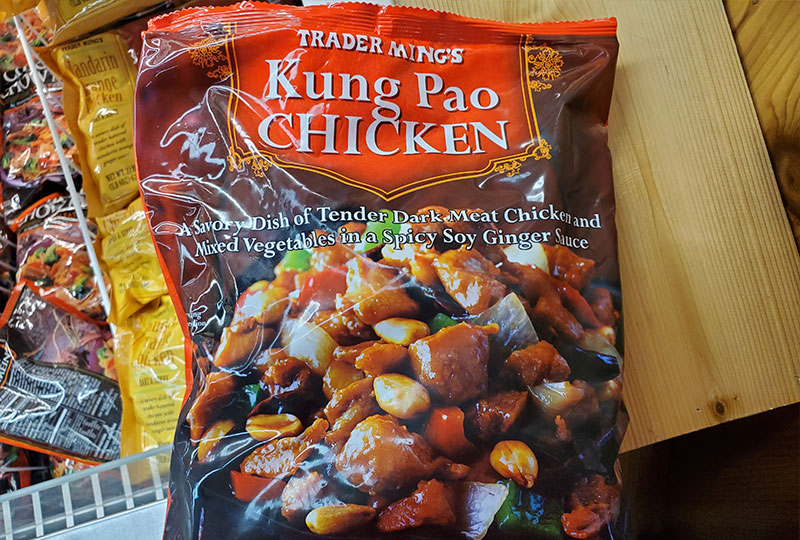
Kung Pao Chicken

Kung Pao ChickenKung Pao Chicken (Photo courtesy of Hanh Nguyen)

Fans of TJ’s Kung Pao Chicken say this entrée is easy to prepare and incredibly flavorful, making it a better option than Chinese takeout for some Redditors. The frozen dish comes packed with tender dark meat chicken, peanuts, veggies and two packets of spicy soy ginger sauce.


“Kung-pao chicken is our ride or die ‘Oh crap I do not have the energy or groceries to make dinner’ meal,” writes one user. “We add more frozen veggies to it to bulk it up.”


“Same for us too! Such an easy meal. We actually prefer this over ordering takeout just because it takes less time,” another user adds. “We do the kung Pao + veg fried rice and it is great.”

Salon Food writes about stuff we think you’ll like. Salon has affiliate partnerships, so we may get a share of the revenue from your purchase.

These homemade hot dogs are sure to be a hit at your next barbecue

I channeled my inner dad for this recipe. When I was growing up, my father didn’t eat pork, so whenever we had a BBQ, we’d always get all-beef hot dogs. Also a jar of onion sauce from the supermarket, like the one that’s served at hot dogs carts. The hot dog itself is really simple, made with freshly ground chuck and lots of spices. If you’ve never made sausage from scratch before, it’s one of those processes that’s a lot easier after you see it. I’ve got you covered — just watch the video below first. Sautéed in a tangy tomato sauce, with vinegar and red pepper flakes, the dirty onions remind me of ketchup. It’s my favorite thing to get on a hot dog. Plus mustard, which yeah, you can make yourself. It’s fun. — Romel Bruno

Watch this recipe

Beef Hot Dogs with Dirty Onions and Whole Grain Mustard
Yields
12-14 servings
Prep Time
4 hours
Cook Time
20 minutes

Ingredients

Hot Dogs

  • 4 feet sausage casing
  • 2 pounds beef chuck, cut into 1-inch pieces
  • 1 teaspoon marjoram
  • 1 teaspoon sweet paprika
  • 1 teaspoon onion powder
  • 1 teaspoon garlic powder
  • 1/8 teaspoon nutmeg
  • 1/2 teaspoon chili flakes
  • 1/2 teaspoon celery seed
  • 1 teaspoon coriander powder
  • 1 teaspoon cane sugar
  • 1/2 teaspoon freshly ground black pepper
  • 1 teaspoon kosher salt
  • 1 tablespoon cornstarch
  • 1/3 cup yellow mustard seeds
  • 1/3 cup brown mustard seeds
  • 1 cup apple cider vinegar
  • 2 tablespoons light or dark brown sugar
  • 1 tablespoon prepared horseradish
  • Kosher salt, to taste

Dirty Onions 

  • 3 tablespoons neutral oil, such as canola
  • 2 large onions, medium-diced
  • 2 tablespoons tomato paste
  • 1/2 cup red wine vinegar
  • 1/2 teaspoon red pepper flakes
  • 1 tablespoon granulated sugar or honey
  • 1 teaspoon onion powder
  • 1 teaspoon garlic powder
  • kosher salt, to taste
  • water

Directions

  1. Hot Dogs: In warm water, soak the casing for about 1 hour. Leave it in the water while you start the filling.
  2. Place the beef in the freezer until very cold and firm, but not totally frozen (this helps with grinding).
  3. Using the large grinding plate, grind the beef into the bowl of a stand mixer. Now grind it again using the medium grinding plate. Place in the fridge for about 15 minutes to chill.
  4. Fit the stand mixer with the paddle attachment. To the bowl with the beef, add the rest of the ingredients. Starting on low speed, mix until totally incorporated, 3 to 4 minutes. Slowly mix in 1/2 cup of cold water, until the mixture almost resembles pâté. Return the bowl to the fridge.
  5. Take the casing out of the water. Get out a large sheet pan. Attach the sausage-stuffing tube you’ll be using. Place the open end of the casing onto the tube, pushing until you almost reach the end of the tube. At the end of the casing, make a loose tie you can let some air out of later with ease. Turn on the machine and start feeding the meat mixture into the casing. As the casing fills, let the long sausage coil on on the sheet pan. When the filling is used up, remove the air from each end and tie the casing to close.
  6. Now it’s time for twisting: A nice size for a hot dog is about 6 inches so get about 6 inches of hot dog in hand and pinch/twist left or right until you get a nice seal on it. Remember whatever way you twist the hot dog you will have to twist the opposite way ( so if you twist clockwise twist the next link counterclockwise) Do that until the end.
  7. Bring a large pot of water to a simmer. Add the hot dog links and simmer until they reach an internal temperature of 140°F. Transfer to an ice bath. Once the links are cool, snip between each link to separate the hot dogs. You can reheat (say, on a grill or griddle) and eat them immediately, or wrap and refrigerate for up to 3 days or freeze for up to 3 months.
  8. To make the whole-grain mustard: In a glass jar, combine the mustard seeds and vinegar. Cover and refrigerate for 12 hours. To a blender, add the soaked seeds, vinegar, sugar, horseradish, and a big pinch of salt. Blend until smooth. Add in water, tablespoon by tablespoon, until you reach your desired consistency should be smooth and easily spreadable (figure up to ½ cup total). Adjust salt to taste.
  9. Dirty Onions: In a large saucepan, heat the oil over medium-high heat. Add the onions and let fry for about 5 minutes, stirring frequently, until they start to char. Add the tomato paste mix and cook for 2 minutes, stirring frequently. Add ⅓ cup of water, then stir in the rest of the ingredients. Simmer for about 5 minutes, until it thickens to a consistency similar to ketchup. Serve warm.

A cheesy omelet duvet with gochujang fried rice that oozes warmth and comfort

This recipe is brought to you from the mystic land of Japan where the word “omelet,” let’s face it, really needs a new definition. Among many other unique styles of omelet invented in Japan, this particular one which I call “omelet duvet,” is typically served on top of grilled eel rice bowl. A super fluffy, silky, almost fabric-like sheet of gently cooked eggs is folded up into a plushy square, yes, looking like a duvet. It’s not only airy in appearance, and warm comfy and inviting, but in taste as well, giving almost a mouthful of hug to whatever vehicle it is delivered on. Especially, did I mention, that it is filled with gooey melty cheeses. It is the perfect flavor, textural and emotional contrast to this salty, spicy, and assertive fried rice boosted with caramelized kimchi, anchovies, and seasoned with Korean chili paste. A hug and a spank all in one bite. —Mandy @ Lady and pups

Watch this recipe

Cheesy Omelet Duvet with Gochujang Fried Rice
Yields
2 servings
Prep Time
1 hour
Cook Time
30 minutes

Ingredients

Fried Rice

  • 1/3 pound ground beef or pork
  • 1 teaspoon fish sauce
  • 1 1/2 teaspoons cornstarch
  • 2 tablespoons canola oil
  • 1 tablespoon toasted sesame oil
  • 3 anchovy fillets
  • 4 garlic cloves, finely minced
  • 2 teaspoons chile flakes (optional)
  • 1/4 cup gochujang paste
  • 2 1/2 cups cooked short-grain sushi rice
  • 3 tablespoons mushroom powder (optional)
  • 3/4 teaspoon ground allspice
  • 1/2 teaspoon ground black pepper
  • 3 scallions, finely diced
  • 1/2 cup packed chopped kimchi (optional)

Cheesy Omelet 

  • 2 1/2 teaspoons cornstarch
  • 1 tablespoon whole milk
  • 3 large eggs
  • 1/4 teaspoon kosher salt
  • 3 tablespoons clarified butter, melted, divided
  • 65 grams The Laughing Cow spreadable cheese, room temperature
  • 2 slices Gouda cheese

Directions

  1. Fried Rice: If using, stir fry the chopped kimchi with 1 tbsp vegetable oil over high heat until moisture has evaporated and browned on the edges, about 5 minutes. Transfer to a bowl.
  2. Mix the ground beef, fish sauce, and cornstarch together until even. In a large skillet, heat the canola oil and sesame oil over medium-high heat. Add the ground beef and anchovy fillets, breaking them apart with a spatula, and cook until the beef is browned on the edges and the anchovies have dissolved into the oil. Add the minced garlic, chile flakes, and kimchi, if using, and cook for 30 seconds until fragrant. Add the gochujang and cook for another 30 seconds, until the oil has taken on a dark red color. Add the cooked rice, breaking it apart with the spatula, then add the mushroom powder (if using), allspice, and black pepper. Stir and cook until the grains are evenly coated. Turn off the heat and mix in the diced scallions.
  3. Transfer into a medium bowl and use your spatula to make a tall, rounded mound out of the fried rice. Set aside.
  4. Cheesy Omelet: In a bowl, whisk the cornstarch and milk together until no lumps are left. Add the eggs and salt and whisk until even and no streaks of egg whites are left. Add 2 tablespoons of the melted clarified butter and whisk until combined. Pour into a 12″ nonstick skillet and set over medium to medium-low heat. Continuously stir the eggs with a spatula to let the mixture warm up. Once the eggs start to curdle, swirl the skillet slowly to let the eggs run around the edges of the skillet. After about 1 minute, the eggs will thicken.
  5. Turn off the heat. Place a slice of Gouda in the middle, top with Laughing Cow cheese, and then top with another slice of Gouda. Use tongs to very gently lift up one edge of the omelet, just so you can slide your spatula underneath, and fold it over the cheese. Repeat with the opposite sides, then fold the other two sides over each other so the omelet looks like a folded duvet. Place the omelet seam side down on top of the mount of fried rice, then brush the rest of the melted clarified butter over the surface of the omelet. Serve immediately.


Iman Shumpert has an athlete’s mindset in acting: “I fell in love with that fight or flight feeling”

Outside of being an NBA champion, Iman Shumpert is a true Renaissance man. He won the 30th season of “Dancing With the Stars,” is about to drop a rap album, just launched a podcast for Uniterrupted with his brother Ahrri and has a reoccurring acting role on Showtimes’s “The Chi,” now in its fifth season.

Shumpert’s character, Rob, dabbles in the complexities of non-traditional relationships this season. When I talked to Shumpert on “Salon Talks” he spoke about how “The Chi” is full of real-life situations that lean into tough conversations, especially for young Black men. “It’s not always a focus on here’s the guy with the baby momma drama-type stuff,” Shumpert said about the show. “I like being able to create a vibe that makes a young man sit at home and reflect on what he can handle and can’t handle.”

Shumpert and I talked about our bond with our daughters and parenting styles, which he lovingly calls “winging it.” He also shared his approach to a multi-layered life in entertainment. “I try and do everything with grace,” Shumpert said. “I do everything with intention, intention to be successful.” Above all, basketball is still No. 1 for Shumpert. “Right now I’m just in more of an entertainment part of my life,” he said, adding that if he had it his way, he’d be back on the court. Watch my “Salon Talks” episode with Iman Shumpert here or read a Q&A of our conversation below.

The following interview has been lightly edited for clarity and length.

You are a renaissance man. You can ball out of control, you’re an amazing hip-hop artist and an actor too. Is one of those jobs more difficult for you, or do you feel like they just pull at different parts of who you are?

It just highlights different parts of me. I think we all have a bunch of layers to us. I fell in love with that fight or flight feeling, the “What if I fall on my face?” moment. I love that moment — the stomach drop where it’s either going to be really good or really bad. It’s worth it to me. 

On “Dancing With The Stars,” I ain’t know what I was doing, but we going to figure this out. It’s a challenge. I might mess up and everybody might laugh. Or Iman wins and he’s champion of “Dancing With The Stars.” That’s how I live my life. I take challenges as they come. I try and do everything with grace. I try and remain grounded at all times. And I do everything with intention, intention to be successful. But I don’t think one is harder than the other. I think it’s all just within my DNA, this is what I signed up for. This is the man that I am. This is what my parents instilled in me and that ain’t changing. So whether we playing basketball, or you got me working at an office, bro, you getting the same work ethic, you getting the same enjoyment of life. It’s just like, which layer are we peeling back first?

Do you have a preference, though?

I’ve always had basketball. I don’t think I could replace a joy like that. But it just is what it is. Basketball is one of the only things I could do by myself over, and over, and over, and I don’t trip. I could work out all summer by myself and it won’t bother me at all. It’s a confidence of knowing I’m prepared and you have no clue what’s coming.

I think basketball would always be my preference. But not to say that I won’t wear the other hat more at times. You know what I’m saying? I think right now I’m just in more of an entertainment part of my life. But that’s what’s working for me right now, and that’s cool, that’s what’s happening, people want to hear from me, that’s cool. But if it could go how I wanted in my head, them owners would have got this contract right and I’d have been hooping last year. 

When I really got into writing I felt like I was creating some of my best work. And now I’m six books in, I’ve written for television, all of these different things and the business part of it has stripped away some of the fun for me. Do you ever feel like that with ball?

Yeah, there’s business. There’s political. And you have these moments where you’re like, “Man, I don’t even love it no more.” And then you wake up the next morning and you look in the mirror and be like, “You goofy. Shut up and go to the gym.” 

“I do everything with intention—intention to be successful.”

I’ve had them moments where I’m like, “Oh, it’s so political, woo, woo, woo.” And then I’m walking past a park and I watch a little kid playing, and he got his coat on, and it’s cold outside, but he don’t care, he still hooping. And you realize, that’s why I love this.

If you saw me hoop, you would be like, “Maybe I don’t love the game as much.”

It’s crazy, though, the love of the game is contagious. I don’t think I could ever really step away from that love.

I love the dynamic of your character on “The Chi” because Emmet jumps out there with the open relationship thing, and it’s all fun and games until a dude that’s fly and rich pulls up, then it’s like, “Wait a second. She said she was coming back later. And now it’s like 10 business days.” What can we can expect from you this season on the show?

I think that Rob is just establishing a safe space for Tiff. It’s also a great example of the co-parenting situation that her and Emmet have on the show. You get to see that dynamic. You get to see a dynamic of Rob trying to play a little stepdaddy stuff. 

The writers keep incorporating so much real life into this show and showing us new situations that could start conversations we not used to having, whether uncomfortable or not. I think that “The Chi” has done an incredible job with just the topics that come up. We can have the conversation. 

You’re from the Chicago area. So just being on set and working on a show that’s Chicago-based, have you ever found yourself in situations where you’re thinking, “No, we wouldn’t do it like that.”

Oh yeah, myself and [Hannaha Hall], we find ourselves doing that the whole time. We like, “Would she say that? Well, she would say it like this if she from out South, but she from out West.” We go through that and build the character, but we’re just constantly trying to add to the character. I’ve been trying to make Rob act so much different than me. He’s so much more patient, and calm and very understanding. 

“The writers keep incorporating so much real life into this show.”

It is a testament to what [the writers] are pushing as far as a Black man that will be down with his responsibilities, that will be down to take on the challenge that somebody else gives. And it’s not always a focus on here’s the guy with the baby momma drama type stuff. You know what I’m saying? It’s a calming space for him to say, “There doesn’t have to be drama. It’s OK.” I like that grown man in him. I like being able to create a vibe that makes a young man sit at home and reflect on what he can handle and can’t handle.

Absolutely.

I think just about every parent on the earth, they ain’t going to tell you, but they are winging it. They have no clue what they’re doing, nobody does. We’re just figuring it out, we’re just making the decision every day. What you think?

Every kid is different. The big homie can’t tell you what to do because it’s a different generation. These kids, they not even wired the same.

Or they can tell you what to do, and you try it, and it could not work.

When my daughter was one years old she was on the iPad just banging out games as if she was born with instructions. And I’m like, “Yo, who told her how to do that?” It took her grandmother an hour to cut it on.

Yes, that’s my kids, telling my dad how to work they phone like, “Yaya, give me your phone, give me your phone. Grandpa, give me your phone.” They got TikTok on they phone now. They don’t use none of the apps she downloaded, but she got everything on all these people phones. She be ordering V-Bucks off my PlayStation. This lady is crazy. She gets the outfits for all the characters, don’t even play the game. Playing dress up. Don’t even play the game. 

But you know style runs in the family, man. 

Oh, my daughter is ready. 

Your whole family, y’all get them fits off, man.

Man, that be T, man. I can’t keep up no more, man. I think I’m fizzling out. I’m starting to like my looks that I like. I’m going to be Johnny Bravo after a while, brother. Let me get this same outfit every day. Y’all get used to it.

It’s been cool to watch Junie and Rue both inherit that love for fashion that me and T have. They love getting dressed, they love playing dress up. Rue is a shoe and bag girl, Junie is a shades, crop top girl. You can get Junie in anything else, but she got to have her crop tops, got to have her stuff. She’s very specific about her hair. Rue, easy going about that hair, she’s not playing about her shoes. She’s a shoe girl. 

How old is Rue?

Rue is about to be two, and Junie is about to be seven.

My daughter is two. And I wonder if it’s a phase.

She on shoes right now?

She into her shoes right now. So my favorite shoes is the Black Cement 3’s, right? But I bought her all of these different J’s, right, all of these special collaboration joints and all that. And she was wearing them. And then one day, I got a box of Crocs. Now she’s walking around like a little assistant nurse all day, like she won’t take the f**king Crocs off. And I’m like, “Yo, what about these? What about these? What about these?” And, “No, no, no.”

What happened to the bond with them Jordan’s? What happened, baby?

It’s done. You go on the road, come back home and the bond is gone. You a Croc lady now.

It’s like that, man. It’s amazing just watching their process, watching them figure it out, figuring out what they like. It’s a beautiful thing. I love that Rue loves shoes. She be trying her momma’s shoes on all day. She’s walking about in her heels. I’m like, dog, what one year old walks around in heels? How are you able to get around? It’s just crazy to watch them be a sponge immediately. It’s the most beautiful thing in the world for me. 

I feel like a lot of different characters on “The Chi” are really in a rhythm now. But it’s the last season, right? Do you feel like we needed maybe two more seasons?

I don’t know, man. I’m coming along on the tail end. But it’s a good show. I don’t want it to have to be over. I just got here. It’s definitely an honor to be a part of it. I do think I’m not a personal fan of shows overstaying their welcome. And knowing Lena [Waithe], she got so many things in her head, she probably want to close that sometime too. But I do know that there’s an incredible cast, and there’s an incredible fan base behind the show. 

I’m a hooper still. I don’t be knowing all the buzz and everything. I ain’t got the inside scoop for y’all, I wish I did. If I had the scoop, I’d spill it and say it was an accident, dog, but I ain’t got no scoop.

I think one of the most interesting things that people will remember about the show if they don’t bring it back, is just how they dealt with masculinity on every different level. Are there any type of cultural impacts you think it will have, you think people are going to look at maybe 10, 20 years from now and say, “Wow, ‘The Chi’ warned us.” Or, “‘The Chi’ told us”?

Yeah, I think the sex trafficking, the human trafficking. Shining a light on that and saying that there are young women being taken, especially young Black women are being grabbed up and used for this. It’s a harsh truth. It’s something that you don’t want to talk about, you don’t want to think about, you don’t want to see the visual. But hopefully that visual helps everybody to be a little bit more aware of this and to look out for somebody, to care, to understand that for every woman that gets taken, that’s somebody’s sister, that’s somebody aunt, somebody mom, somebody grandmother, that’s somebody’s somebody. You know what I’m saying?

Absolutely.

And treating it that way. We got a theme in the house right now to be church after church. They used to say that in my church, “Be church after church.” And nobody knew what that meant, and it’s just holding yourself accountable: Be church after church. You out on the street, help somebody, care about somebody, love somebody. And yeah, that’s all it is.

It’s so easy to not be church when you walk out the door. Soon as they get in the parking lot, you already arguing over who going to get out the lot first.

Ain’t it though? It’s crazy. But if you can be church after church, you going to be all right. If that’s really you, you going to be all right.

What can we expect from you after “The Chi?”

I’m dropping my podcast on Uninterrupted, “Iman Amongst Men.” I’m doing it alongside my big brother, Ahrii. And it’s probably the coolest space to sit down because my brother is also my barber. So naturally, me and him talk barbershop talk all the time. Being a barber, he’s so used to doing that. I originally thought about maybe doing it in a barbershop, but something about it just made me want to have him at the table now. 

There’s nothing better than sitting down and talking to him because I know that I can’t lie. He ain’t having it. I can’t give a politically correct answer that sneaks by. He told me, “If you doing that, I’m not doing this.” You know what I’m saying? And he’s one of them by law. He going to say it. Either we do it this way and we doing it real, organic and we going to actually push the work towards something, or we’re not doing it at all. So yeah, everybody should just buckle up.

And finally I get to put out my album. I got the sample cleared. Thank you to Dr. Dre, Scott Storch, all those involved with clearing “Let Me Blow Ya Mind.” I have to remember what they really call the song. It’s “Drop Your Glasses” to me. I don’t have the release date. I got to wait on Apple to tell me when it’s done uploading into the system and when we can actually put it up. But the day I got it, y’all will have it.


Federal judge blocks Biden’s directives to protect LGBTQ people from discrimination

Two new directives put into motion by Biden with the purpose of protecting LGBTQ people from being discriminated against at school and at work have been temporarily blocked by a federal judge. The block is in response to a lawsuit filed by several state attorneys general who view the directives as infringing upon states’ rights, according to The Washington Post

“Defendants’ guidance directly interferes with and threatens Plaintiff States’ ability to continue enforcing their state laws,” U.S. District Judge Charles Atchley Jr. of the Eastern District of Tennessee wrote in his ruling. “Their sovereign power to enforce their own legal code is hampered by the issuance of Defendants’ guidance and they face substantial pressure to change their state laws as a result.” 

The states included in the lawsuit that prompted the block are: Alabama, Alaska, Arizona, Arkansas, Georgia, Idaho, Indiana, Kansas, Kentucky, Louisiana, Mississippi, Missouri, Montana, Nebraska, Ohio, Oklahoma, South Carolina, South Dakota, Tennessee and West Virginia.

Representatives for the states listed above are operating on the belief that Biden’s directives, if allowed to take hold, would jeopardize their funding.


Want a daily wrap-up of all the news and commentary Salon has to offer? Subscribe to our morning newsletter, Crash Course.


The judge who ruled in favor of the block, U.S. District Judge Charles Atchley Jr., was appointed by former President Donald Trump in 2020.

“We are disappointed and outraged by this ruling from the Eastern District of Tennessee where, in yet another example of far-right judges legislating from the bench, the court blocked guidance affirming what the Supreme Court decided in Bostock v. Clayton County: that LGBTQ+ Americans are protected under existing civil rights law,” HRC Interim President Joni Madison said in a press release following Atchley’s ruling.

Republicans want climate solutions — just not from Biden

In late June, the Supreme Court handed down its long-awaited decision on West Virginia v. EPA, putting limits on the Environmental Protection Agency’s authority to regulate greenhouse gas emissions from power plants.

The result wasn’t in line with what most Americans want, according to a new survey from Pew Research Center released on Thursday. Seventy-two percent of people polled before the ruling approved of requiring power companies to use more energy from renewable sources like wind and solar. About half of Republicans hold views at odds with the conservative court’s decision. 

The poll suggests that there’s broad support for doing something to try to alleviate the climate crisis, though Republicans don’t appear to like what President Joe Biden has done so far. According to Pew, 90 percent of Americans are in favor of planting a trillion trees to absorb carbon emissions, and 79 percent support giving tax credits to businesses to encourage them to develop technology to capture carbon and store it — including a strong majority of Republicans. “You can still find common ground on ways to achieve some of these goals,” said Cary Funk, director of science and society research at Pew Research Center and a co-author of the new report.

Even with that consensus on what should be done, the partisan divide that pervades U.S. politics shows up in the survey, particularly when it comes to Biden, who assumed office at the start of 2021 promising to tackle climate change. Seventy-nine percent of Democrats said the administration’s climate policies were taking the country in the right direction; 82 percent of Republicans thought it was the wrong direction.

Despite this polarization, the Pew poll finds that people of all stripes are finally connecting the dots between climate change and the strange weather around them. Most Americans (71 percent) said that their community has experienced at least one form of extreme weather in the past year, including intense storms and floods, heat waves, droughts, major wildfires, or rising seas. Of those who said they’d lived through sweltering temperatures last year, a full 91 percent thought that climate change contributed at least a bit.

Extreme weather has become hard to ignore. Last September, a survey from the Yale Program on Climate Change Communication found substantial increases in the public’s awareness of climate change over the course of the year. For the first time, more than half of Americans said they’d personally experienced the effects of global warming, jumping 10 percentage points from six months earlier.

“That was really the biggest increase in all those measures that we’ve ever seen in the entire 15-year record,” said Anthony Leiserowitz, the director of Yale’s program. 

He attributes the change to a couple of factors: One, 2021 was a brutal year for extreme weather — remember the unprecedented 100-degree-plus heat wave that broiled the Pacific Northwest for days in late June? And two, more news articles are pointing to climate change as an explanation for these types of events. “Many people just are not going to automatically make that connection on their own,” Leiserowitz said. He thinks that seasonality is starting to affect polling, too: People may be worried about climate change when recent hot-weather disasters like heat waves, hurricanes, and wildfires are still top of mind.

The Pew survey suggests perceptions about the weather can be influenced by political affiliation, too. Democrats were 25 percentage points more likely than Republicans to say that their community experienced long periods of unusually hot weather, for example. This effect was less pronounced for drought and wildfires, which saw gaps of 7 and 5 percent, respectively.

“People’s perceptions of these events can reflect both kind of what’s happening in their communities as well as … their partisan lens,” Funk said. This is in line with previous research that suggests that climate change has become so politicized that it can actually affect how Democrats and Republicans experience the weather. So much for one of the few remaining realms of small talk.

Pressure mounts on New York City to come clean with 9/11 WTC files

NEW YORK, NY – In multiple interviews union leaders representing 9/11 World Trade Center (WTC) first responders and the survivor community urged Mayor Eric Adams to quickly comply with the request of Rep. Carolyn Maloney and Rep. Jerry Nadler to release any city documents pertaining to the air quality in an around lower Manhattan in the immediate aftermath of the attack, and during the several months of the clean-up that ended in May of 2002. 

According to Maloney’s office, Adams has committed to sitting down with the two House members who have championed the 9/11 World Trade Center Health Program as well as the 9/11 Victims Compensation Fund. More than 20 years later, more people have died from their exposure to the ambient toxics in the air than died on the day of the attack itself. 

Maloney chairs the powerful House Oversight Committee and Nadler heads the House Judiciary Committee. The pair will face off in a free-for-all primary next month. 

In 2003, the EPA Inspector General was harshly critical of how the EPA, under the leadership of former New Jersey Governor Christie Todd Whitman, downplayed and actually misrepresented the hazards in and around the World Trade Center site. 

‘SAFE TO BREATHE’

At the time, the Giuliani administration did not contradict the EPA’s pronouncements that the “air was safe to breathe.” For a number of years, into Mayor Bloomberg’s tenure, the city steadfastly dismissed the occupational health concerns expressed by the unions representing workers who were on the front lines of the response and clean-up that was competed in May of 2002.

“Release of these documents is long overdue. We need to know what the Giuliani Administration knew, and when they knew it, about the toxic air that permeated lower Manhattan for months after 9/11,” said Council Member Gale A. Brewer (D-Upper West Side). “I’m grateful that Mayor Adams, a 9/11 responder himself, has agreed to work with Reps. Maloney and Nadler to release these records. Over two decades later, we shouldn’t have to be arguing about this.”

John Samuelsen is the International President of the Transport Workers Union, which includes TWU Local 100, the union for the MTA that runs New York City’s buses and subways. Thousands of Local 100’s members played a largely unheralded role on the day of the attack and during the months of the clean-up when they used their specialized skills to clear debris and re-establish mass transit in what had been a war zone. As of last year’s 9/11 ceremony Local 100 has lost close to 200 members to WTC illnesses.

“Even after 20 years when we see press reports nearly every other day about a 9/11 responder or survivor who dies from their 9/11 condition, their families should know what the Giuliani administration knew about the health risks associated with the toxins at Ground Zero.”

“Whitman lied and when the final history is written she will have the blood of thousands staining her hands,” Samuelsen said in an email.  “Over 20 years have passed since the attack on NYC , and workers and their families deserve to see the proof of her treacherousness.”

“Even after 20 years when we see  press reports nearly every other day about a 9/11 responder or survivor who dies from their 9/11 condition, their families should know what the Giuliani administration knew about the health risks associated with the toxins at Ground Zero and when did they know it,” said Benjamin Chevat, the executive director of  911 Health Watch, a non-profit advocacy group.

Joseph Zadroga, is the retired chief of police of North Arlington, NJ. His son NYPD Detective James Zadroga, for whom the original 9/11 bill was named, died in 2006 from his World Trade Center-related health issues. 


Want more health stories in your inbox? Subscribe to Salon’s weekly newsletter The Vulgar Scientist.


“We didn’t get the acknowledgement people were getting sick until after he died,” Zadroga said. “Luckily, he died in New Jersey so when the Medical Examiner did the autopsy he put on the death certificate he died of all of the contaminants from 9/11 and that blew it all wide open. Prior to that, all the editors and producers — Senators — members of Congress — anybody you would talk to — they were told to leave the story alone.”

At a particular low point right after Zadroga’s death, Mayor Bloomberg went so far as to say that Zadroga was not a hero, but a drug addict. He subsequently apologized to the Zadroga family.

Currently, the federally-funded World Trade Center Health Program, which faces an uncertain financial future without additional appropriations, has 83,371 first responders and 32,724 civilian survivors who lived, worked or were going to school in lower Manhattan and portions of western Brooklyn. WTC Health Program participants suffer from dozens of cancers and chronic respiratory diseases, as well as psychological conditions.

‘AMERICA’S MAYOR’

The renewed Congressional request, first  made of then Mayor Bill de Blasio in September of 2021, comes as the debate about former Mayor Rudy Giuliani’s credibility intensifies surrounding his role in the events leading up to the January 6 Capitol Insurrection, President Trump’s efforts to allegedly bully Georgia’s election officials to award him unearned votes, and a more recent incident involving an alleged assault by a grocery worker in Staten Island. 

Efforts to reach Giuliani for comment through the public relations firm associated with WABC 770 Radio, his current broadcast outlet, were unsuccessful. 

Three days after the 9/11 attack, Christine Todd Whitman, then-head of the U.S. Environmental Protection Agency, told reporters that “the good news continues to be that air samples we have taken have all been at levels that cause us no concern” — an assessment not contradicted by City Hall at the time, which had prioritized a quick clean-up of what had been some of the city’s most valuable real estate because of its proximity to Wall Street. 

Two years later, an independent investigation by the EPA Inspector General found that the agency “did not have sufficient data and analyses to make such a blanket statement” when it did.

“Air-monitoring data was lacking for several pollutants of concern,” the Inspector General concluded. The report stated that President George W. Bush’s White House Council on Environmental Quality heavily edited the EPA press releases “to add reassuring statements and delete cautionary ones.”

The IG found the White House Council on Environmental Quality described the readings as just “slightly above” the limit, despite the fact samples taken indicated asbestos levels in lower Manhattan were double or even triple the EPA’s limit.

When the agency watchdog tried to determine who had written the reassuring press releases, investigators “were unable to identify any EPA official who claimed ownership,” because they were told by the EPA Chief of Staff there was “joint ownership between EPA and the White House,” which gave final approval.

DEATHS MOUNT

U.S. Reps. Maloney and Nadler cited those finding by the EPA IG in their original letter to de Blasio, writing, “This report outlined what the federal government knew about the extent of the problem and the clear health threat, after the EPA Administrator Christie Todd Whitman had repeatedly said that the ‘air was safe to breathe.’ However, we have yet to see a full accounting of what then-Mayor Giuliani and his administration knew at the time.”

In Congressional testimony in 2019, a leading World Trade Center medical expert testified there could be as many as 20,000 more cancers as a consequence of exposures to the contaminants that were released by the collapse of the Twin Towers and fires that burned for months after the 9/11 terrorist attacks.

At the time of that initial correspondence, the 9/11 Victim Compensation Fund had reported it had received 3,900 death claims related to WTC health conditions, and the U.S. Centers for Disease Control and Prevention stated 3,311 people enrolled in its WTC Health Program had died.

Three-hundred-forty-three members of the FDNY perished in the 9/11 attack. In the 20 years since, close to 300 more members have died from their WTC-linked illnesses. In Congressional testimony in 2019, a leading World Trade Center medical expert testified there could be as many as 20,000 more cancers as a consequence of exposures to the contaminants that were released by the collapse of the Twin Towers and fires that burned for months after the 9/11 terrorist attacks. She also said more than 50-percent of the Firefighters who logged time at the site have a “persistent respiratory condition.” 

Those disclosures were made by Dr. Jacqueline Moline, director of the Northwell Health Queens World Trade Center Health Program at the June 11, House committee hearing in Washington D.C. on reauthorizing the 9/11 Victims Compensation Fund. Dr. Moline told the House panel that the WTC Health Program had seen an exponential increase in numerous cancers and that “soon the day will come when there are more people that died of WTC-related diseases after 9/11 than perished that horrible day [2,973].”

Some of the most-common cancers documented include prostate, lung, breast [both female and male], and thyroid.

Responding to follow-up questions from Rep. Nadler, Dr. Moline said cancers were only part of the WTC health fallout. “We are going to see folks with lung diseases that require lung transplants,” she said. “There have already been a number of individuals in the World Trade Center Health Programs that have required lung transplants from the glass and the concrete and everything else that caused a reaction in the lungs.”

FDNY Lt. James McCarthy is president of the Uniformed Fire Officers Association, which represents the FDNY’s officers. He recalls how his members ate and drank in and around the toxic site for months under the assumption the air was safe to breathe.

“Our position would be that we need to have all the information that’s available out for the public to see. We already know because of the lung cancers and lung illnesses all of our members have experienced, that the exposure to that air and the toxics in the air caused them to get sick — that’s a direct correlation,” he said during a phone interview. “We just need the actual proof which exists because they tested the air and they had monitoring sites down there, but they just never gave us that information until they made the announcement the air was fine. And that was kind of an operational decision [rather] than a health issue.”

McCarthy continued to make the case for swift city transparency. “In order to treat people for the illnesses you need to find out how they got them and what caused it, so having an idea of what toxins were in the air could help you diagnose and treat people that get ill. If you don’t know what they were exposed to it makes it more difficult. You are treating the illness for what you saw at the time  instead of what caused it.”

The UFOA President said his concern extended beyond his rank and file and other first responders. 

“I am really coming from the point of we really need to treat everybody and make sure we provide the proper medical care that’s guaranteed under Zadroga that’s now losing out in the funding. We need to know what caused these illnesses — what exposure, what chemicals, what products that caused these diseases. It’s everybody who was there. The people that came down there on their own to help out are one category, and then there are those that lived  there and worked there. The best thing you can do for these illnesses is early detection and treatment for survivability and that’s what the  government owes its citizens of the country. We don’t limit this to just the people that pay dues.”

Uniformed Firefighters Association President Andy Ansbro agrees with McCarthy that there was no reason for any delay in fully disclosing what the Giuliani and Bloomberg administrations knew about the level of contamination in around the WTC site, and the risk to first responders and the broader community.

GIULIANI WAS WARNED

Ansbro’s father, Michael Ansbro was NYPD Transit Bureau Chief on 9/11, and according to the UFA leader was with Giuliani after the first WTC tower collapsed on Barclay Street. According to the UFA president, his father personally advised the mayor that based on his experience from the previous 1993 WTC bombing, asbestos would be in the air. “That’s when a porter went to the closet and found painter masks that he handed out and that’s how Giuliani ended up with the painter’s mask in the morning….something he wouldn’t be seen wearing at the site during the clean-up because it made him look weak. Kind of ironic when you consider the significance of our public officials wearing a mask during  COVID,” Ansbro said.

With the fate of the second tower very much in doubt, Ansbro says the Mayor and his entourage headed north out of the “fall path” of the remaining tower while “my father proceeded to the subway station at Chamber Street to assist in the evacuation when the second tower dropped while he was under Chamber Street but survived the second collapse.”

Ansbro’s father is now gravely ill with 9/11 WTC-related mesothelioma. 

For the younger Ansbro, then a probationary firefighter, 9/11 would be his first working fire. “My lung capacity went from 94-percent in December of 2000 to 68-percent in December of 2001, and I have been diagnosed with asthma, COPD and other 9/11-related diseases,” he said.

Ansbro recalled that even after 9/11, the union had to hire an independent environmental consultant attorney named Joel Kupferman who conducted independent testing of FDNY fire apparatus, as well as firehouses, and found troubling asbestos readings. “If you rode in one of those pieces of equipment up to a year after 9/11 you had an exposure,” he added. 

“The worst thing the city did was not clean the firehouses — that’s the indictment against the city and part of the story is the hard data that we did get that indicated contamination was totally at odds with what their websites were saying,” Kupferman said. “The city is equally culpable along with the EPA for mischaracterizing the contamination that was present and not acting on what we did.

Joe Colangelo, president of SEIU Local 246, represents the city’s auto mechanics, also argues for full transparency by the city. “What could be the possible justification for not disclosing this information?” Colangelo asked during a phone interview.

DEADLY WORK

His members were not in the WTC hot zone, but were exposed at the locations where they worked on the city’s fire engines, police cars, and street sweepers that were used in the hot zone and were heavily contaminated with WTC toxins as a result. “The mechanics were changing air filters — the air filters were being changed constantly — and the sweepers that they used to sweep the streets down there were being repaired at a Department of Sanitation garage that was just north of Canal Street and we said, wait a minute, we are being exposed to the same toxins.”

Colangelo added that some of the equipment like the fire apparatus that was covered with debris during the attack and collapse, went to private contractors to get cleaned, but his “members would open up the door panels to service the equipment and all that dust and debris was inside the panels of the equipment’s doors. That stuff went everywhere.”

Local 246 lost six members to 9/11 WTC illnesses. 

Lila Nordstrom was a senior at Stuyvesant High School, directly adjacent to the WTC on 9/11 and is now enrolled in the WTC Health Program. She wants the city to disclose what it knew and when. In the years since she founded StuyHealth, a non-profit advocacy group committed to informing the close to 19,000 K-12 students who were sent back into dozens of city schools located inside the WTC contamination zone about their potential health risks.

“I’m eager for anybody to finally get moving on this so I’m hopeful,” Nordstrom said. “This seems like it’s been getting back-burnered for a while, and I think that if we really want to learn lessons from the failings of our government after 9/11 [lessons that certainly have relevance to the mishandling of the COVID crises] we have to be fully transparent about how those policy failings after 9/11 happened in the first place and what activists need to look out for and ask for in the future.”

Micheal Barasch, a leading 9/11 attorney, said the city had a “moral obligation” as an employer to fully disclose what it knew and when it knew it about the conditions in and around lower Manhattan on 9/11 and in the months after the site was being remediated.

“If we learned that our city and other government agencies lied to us, why should we believe them next time unless they were to come out  and say we were wrong — we should have shared this information — It’s a trust issue,” Barasch said. “What the city can do now that would make a difference as one of the biggest employers in lower Manhattan for their transgressions two decades ago, by reaching out to their former employees and letting them know what benefits are available to them.”

COSTS FOR CARE MOUNT

“Its important we obtain all the 9/11 facts and information so we don’t repeat the mistakes that were made,” wrote Vincent Variale, president of DC 37 Local 3621, which represents the FDNY EMS. “It is equally or more important to provide the health and financial assistance to those still suffering from WTC illnesses.”

Without an additional appropriation from Congress, the 9/11 WTC Health Program will run out of money. Initially, the additional funding for the program was incorporated in President Joe Biden’s Build Back Better $1.8 trillion proposal which floundered in the U.S. Senate.

9/11 WTC advocates are now lobbying for passage of the bipartisan 9/11 Responder and Survivor Health Funding Correction Act.

According to a CDC fact sheet, the shortfall in the program was partly the result of a “significant” spike in the number of first-responders and survivors who have enrolled for the annual screening and health care. The program’s costs also substantially increased due to “the number of cancer cases it certifies and treats,” according to the CDC.

“Of the approximately 65,000 WTC Health Program members with at least one certification, almost 24,000 [more than 36-percent] have at least one cancer certification,” the agency disclosed. “The complexity of treating cancer, especially with other comorbidities, and an aging membership in general, has increased the Program’s health-care costs beyond what was previously estimated.”

How Elon Musk sees the future: His bizarre sci-fi vision should concern us all

The world has gone mad. — Elon Musk

What does Elon Musk want? What is his vision of the future? These questions are of enormous importance because the decisions that Elon Musk makes — unilaterally, undemocratically, inside the relatively small bubble of out-of-touch tech billionaires — will very likely have a profound impact on the world that you and I, our children and grandchildren, end up living in. Musk is currently the richest person on the planet and, if only by virtue of this fact, one of the most powerful human beings in all of history. What he wants the future to look like is, very likely, what the future for all of humanity will end up becoming.

This is why it’s crucial to unravel the underlying normative worldview that has shaped his actions and public statements, from founding SpaceX and Neuralink to complaining that we are in the midst of “a demographic disaster” because of under-population, to trying — but, alas, failing — to purchase Twitter,  the world’s most influential social media platform.

Musk has given us some hints about what he wants. For example, he says he hopes to “preserve the light of consciousness by becoming a spacefaring civilization & extending life to other planets,” although there are good reasons for believing that Martian colonies could result in catastrophic interplanetary wars that will probably destroy humanity, as the political theorist Daniel Deudney has convincingly argued in his book “Dark Skies.” Musk further states in a recent TED interview that his “worldview or motivating philosophy” aims

to understand what questions to ask about the answer that is the universe, and to the degree that we expand the scope and scale of consciousness, biological and digital, we would be better able to ask these questions, to frame these questions, and to understand why we’re here, how we got here, what the heck is going on. And so, that is my driving philosophy, to expand the scope and scale of consciousness that we may better understand the nature of the universe.

But more to the point, Elon Musk’s futurological vision has also been crucially influenced, it seems, by an ideology called “longtermism,” as I argued last April in an article for Salon. Although “longtermism” can take many forms, the version that Elon Musk appears most enamored with comes from Swedish philosopher Nick Bostrom, who runs the grandiosely named “Future of Humanity Institute,” which describes itself on its website as having a “multidisciplinary research team [that] includes several of the world’s most brilliant and famous minds working in this area.”

Musk appears concerned about under-population: He’s worried there won’t be enough people to colonize Mars, and that wealthy people aren’t procreating enough.

For example, consider again Elon Musk’s recent tweets about under-population. Not only is he worried about there not being enough people to colonize Mars — “If there aren’t enough people for Earth,” he writes, “then there definitely won’t be enough for Mars” —he’s also apparently concerned that wealthy people aren’t procreating enough. As he wrote in a May 24 tweet: “Contrary to what many think, the richer someone is, the fewer kids they have.” Musk himself has eight children, and thus proudly declared, “I’m doing my part haha.”

Although the fear that “less desirable people” might outbreed “more desirable people” (phrases that Musk himself has not used) can be traced back to the late 19th century, when Charles Darwin’s cousin Francis Galton published the first book on eugenics, the idea has more recently been foregrounded by people like Bostrom.

For example, in Bostrom’s 2002 paper “Existential Risks: Analyzing Human Extinction Scenarios and Related Hazards,” which is one of the founding papers of longtermism, he identified “dysgenic pressures” as one of many “existential risks” facing humanity, along with nuclear war, runaway climate change and our universe being a huge computer simulation that gets shut down — a possibility that Elon Musk seems to take very seriously. As Bostrom wrote:

It is possible that advanced civilized society is dependent on there being a sufficiently large fraction of intellectually talented individuals. Currently it seems that there is a negative correlation in some places between intellectual achievement and fertility. If such selection were to operate over a long period of time, we might evolve into a less brainy but more fertile species, homo philoprogenitus (lover of many offspring).

In other words, yes, we should worry about nuclear war and runaway climate change, but we should worry just as much about, to put it bluntly, less intelligent or less capable people outbreeding the smartest people. Fortunately, Bostrom continued, “genetic engineering is rapidly approaching the point where it will become possible to give parents the choice of endowing their offspring with genes that correlate with intellectual capacity, physical health, longevity, and other desirable traits.”

Hence, even if less intelligent people keep having more children than smart people, advanced genetic engineering technologies could rectify the problem by enabling future generations to create super-smart designer babies that are, as such, superior even to the greatest geniuses among us. This neo-eugenic idea is known as “transhumanism,” and Bostrom is probably the most prominent transhumanist of the 21st century thus far. Given that Musk hopes to “jump-start the next stage of human evolution” by, for example, putting electrodes in our brains, one is justified in concluding that Musk, too, is a transhumanist. (See Neuralink!)

More recently, on May 24 of this year, Elon Musk retweeted another paper by Bostrom that is also foundational to longtermism, perhaps even more so. Titled “Astronomical Waste,” the original tweet described it as “Likely the most important paper ever written,” which is about the highest praise possible.

Given Musk’s singular and profound influence on the shape of things to come, it behooves us all — the public, government officials and journalists alike — to understand exactly what the grandiose cosmic vision of Bostromian longtermism, as we might call it, actually is. My aim for the rest of this article is to explain this cosmic vision in all its bizarre and technocratic detail, as I have written about this topic many times before and once considered myself a convert to the quasi-religious worldview to which it corresponds.

The main thesis of “Astronomical Waste” draws its force from an ethical theory that philosophers call “total utilitarianism,” which I will refer to in abbreviated form as “utilitarianism” below.

Utilitarianism states that our sole moral obligation — the goal we should aim for whenever presented with a moral choice — is to maximize the total amount of value in the universe, where “value” is often identified as something like “pleasurable experiences.”

When our universe has finally sunk into a frozen pond of maximal entropy, the more value that has existed, the better that universe will have been. But how exactly do we maximize value?

So, whenever you enjoy a good TV show, have a fun night out with friends, gobble down a good meal or have sex, you are introducing value into the universe. When it’s all said and done, when the universe has finally sunk into a frozen pond of maximal entropy according to the second law of thermodynamics, the more value that has existed, the better our universe will have been. As moral beings — creatures capable of moral action, unlike chimpanzees, worms, and rocks — we are obliged to ensure that as much of this “value” exists in the universe as possible.

This leads to a question: How exactly can we maximize value? As intimated above, one way is to increase the total quantity of pleasurable experiences that each of us has. But utilitarianism points to another possibility: we could also increase the total number of people in the universe who have lives that, on the whole, create net-positive amounts of value. In other words, the greater the absolute number of people who experience pleasure, the better our universe will be, morally speaking. We should therefore create as many of these “happy people” as we possibly can.

Right now these people don’t exist. Our ultimate moral task is to bring them into existence.


Want a daily wrap-up of all the news and commentary Salon has to offer? Subscribe to our morning newsletter, Crash Course.


Underlying this idea is a very weird account of what people — you or me — actually are. For standard utilitarians, people are nothing more than the “containers” or “vessels” of value. We matter only as means to an end, as the objects that enable “value” to exist in the universe. People are value-containers and that’s it, as Bostrom himself suggests in several papers he’s written.

For example, he describes people in his “Astronomical Waste” paper as mere “value-structures,” where “structures” can be understood as “containers.” In another paper titled “Letter From Utopia,” Bostrom writes that by modifying our bodies and brains with technology, we can create a techno-utopian world full of endless pleasures, populated by superintelligent versions of ourselves that live forever in a paradise of our own making (no supernatural religion necessary!). Pretending to be a superintelligent, immortal “posthuman” writing to contemporary human beings, Bostrom proclaims that “if only I could share one second of my conscious life with you! But that is impossible. Your container could not hold even a small splash of my joy, it is that great” (emphasis added).

If you want to object at this point that you are not just a “container for value,” you wouldn’t be alone. Many philosophers find this account of what people are very alienating, impoverished and untenable. People — as I would argue, along with many others — should be seen as ends in themselves that as such are valuable for their own sake. We do not matter simply because we are the substrates capable of realizing “value,” understood as some impersonal property that must be maximized in the universe to the absolute physical limits. We are all unique, we matter as ends rather than just means, in contrast to the utilitarian view of fungible containers whose merely instrumental value is entirely derivative. (In that view, without us value cannot be maximized, and so for that reason alone it is important that we not only continue to exist, but “be fruitful and multiply,” to quote the Bible.)

The central argument of “Astronomical Waste” adopts this strange view of people and why they matter. Since the more value-containers — i.e., people like you and me — who exist in the universe with net-positive amounts of value the “morally better” the universe will become (in the utilitarian view), Bostrom sets out to calculate how many future people there could be if current or future generations were to colonize a part of the universe called the “Virgo Supercluster.” The Virgo Supercluster contains some 1,500 individual galaxies, including our own Milky Way galaxy, of which our solar system is one of a huge number — we don’t know the exact figure because we haven’t yet counted them all.

On Bostrom’s count, the Virgo Supercluster could contain 1023 biological humans per century, or a “1” followed by 23 zeros. Now think about that: if these biological humans — the containers of value — were to bring, on average, a net-positive amount of value into the universe, then the total amount of value that could exist in the future if we were to colonize this supercluster would be absolutely enormous. It would both literally and figuratively be “astronomical.” And from the utilitarian perspective, that would be extremely good, morally speaking.

But that’s only the tip of the iceberg. What if we were to simulate sentient beings in the future: digital consciousnesses living in simulated worlds of their own, running on computers made out of entire exoplanets and powered by the suns around which they revolve? If this were possible, if we could create digital beings capable of having pleasurable experiences in virtual reality worlds, there could potentially be far more value-containers (i.e., people) living in the Virgo Supercluster.

How many? According to Bostrom, the lower-bound number would rise to 1038 per century, or a 1 followed by 38 zeros. Let me write that out to underline just how huge a number it is: 100,000,000,000,000,000,000,000,000,000,000,000,000. By comparison, less than 8 billion people currently live on Earth, and an estimated 117 billion members of Homo sapiens have so far existed since our species emerged in the African savanna some 200,000 years ago. Written out, 117 billion is 177,000,000,000. Ten to the power of 38 is way, way bigger than that.

What does this all mean? Bostrom draws two conclusions: first, since entropy is increasing in accordance with the second law of thermodynamics, resources that we could use to simulate all of these future people (i.e., value-containers) are being wasted every second of the day. “As I write these words,” he says at the beginning of “Astronomical Waste,” “suns are illuminating and heating empty rooms, unused energy is being flushed down black holes, and our great common endowment of negentropy [or negative entropy, the stuff we can use to simulate people] is being irreversibly degraded into entropy on a cosmic scale.”

This means that we should try to colonize space as soon as possible. On his calculation, if 1038 value-containers (i.e., people) could exist in huge, solar-powered computer simulations within the Virgo Supercluster, then “about 1029 potential human lives” are lost every single second that we delay colonizing space. Since our sole moral obligation is to create as many of these people as possible, according to utilitarianism, it follows that we have a moral obligation to colonize space as soon as possible.

This of course fits with Elon Musk’s rush to build colonies on Mars, which is seen as the stepping stone to our descendants spreading to other regions of the Milky Way galaxy beyond our humble little solar system. As Musk recently tweeted, “Humanity will reach Mars in your lifetime.” In an interview from June of this year, he reiterated his aim of putting 1 million people on Mars by 2050.

The importance of this is that, as the longtermist Toby Ord — a colleague of Bostrom’s at the Future of Humanity Institute — implies in his recent book on the topic, flooding the universe with simulated people “requires only that [we] eventually travel to a nearby star and establish enough of a foothold to create a new flourishing society from which we could venture further.” Thus, by spreading “just six light years at a time,” our posthuman descendants could make “almost all the stars of our galaxy … reachable,” given that “each star system, including our own, would need to settle just the few nearest stars [for] the entire galaxy [to] eventually fill with life.”

In other words, the process could be exponential, resulting in more and more people (again, value-containers) in the Virgo Supercluster — and once more, from the utilitarian point of view, the more the better, so long as these people bring net-positive, rather than net-negative, amounts of “value” into the universe.

But the even more important conclusion that Bostrom draws from his calculations is that we must reduce “existential risks,” at term that refers, basically, to any event that would prevent us from maximizing the total amount of value in the universe.

It’s for this reason that “dysgenic pressures” is an existential risk: If less “intellectually talented individuals,” in Bostrom’s words, outbreed smarter people, then we might not be able to create the advanced technologies needed to colonize space and create unfathomably large populations of “happy” individuals in massive computer simulations.

That’s also why nuclear war and runaway climate change are existential risks: If we cause our own extinction, then of course there will be no one left to fulfill our moral obligation of maximizing value from now until the universe becomes uninhabitable in the very distant future. As Bostrom concludes, “for standard utilitarians, priority number one, two, three and four should consequently be to reduce existential risk. The utilitarian imperative ‘Maximize expected [value]!’ can be simplified to the maxim ‘Minimize existential risk!'”

Consistent with this, Musk has on numerous occasions mentioned the importance of avoiding an “existential risk,” often in connection with speculations about the creation of superintelligent machines. Indeed, the existential risk of superintelligent machines was discussed in detail by Bostrom in his 2014 bestseller “Superintelligence,” although most of the ideas in that book — along with Bostrom’s elitist attitude toward the problem — has come from other theorists. “Worth reading Superintelligence by Bostrom,” Musk tweeted out shortly after it was published, in what Bostrom has since used as a blurb to promote sales, as seen on his website.

In this worldview, nuclear war and climate catastrophe are “existential risks,” but poverty, racism and genocide are essentially no big deal.

While not all retweets should be seen as endorsements, Elon Musk’s retweet of Bostrom’s “Astronomical Waste” paper sure looks like just that. Not only does the original tweet claim that it might be the “most important” article ever published, but we know that Musk has read and been greatly influenced by at least some of Bostrom’s key contributions to the rapidly growing longtermist literature.

Musk wants to colonize space as quickly as we can, just like Bostrom. Musk wants to create brain implants to enhance our intelligence, just like Bostrom. Musk seems to be concerned about less “intellectually gifted” people having too many children, just like Bostrom. And Musk is worried about existential risks from superintelligent machines, just like Bostrom. As I previously argued, the decisions and actions of Elon Musk over the years make the most sense if one takes him to be a Bostromian longtermist. Outside of this fanatical, technocratic framework, they make much less sense.

All of this is worrisome for many reasons. As I argued last year, longtermism is “quite possibly the most dangerous secular belief system in the world today.” Why? Because, if avoiding an existential risk should be — for supposedly “moral” reasons — our top four global priorities as a species, where the fifth priority should be to colonize space ASAP, then all other problems facing humanity end up being demoted, minimized, pushed into the background.

By “all other problems,” I mean all problems that are “non-existential,” i.e., those that would not prevent us from, in the long run, spreading into the cosmos, simulating huge numbers of digital people and maximizing total value.

Racism? Sure, it’s bad, but it’s not an existential risk, and therefore fighting racism should not be one of our top global priorities. Climate change? Well, as long as it doesn’t directly cause an existential catastrophe, or indirectly increase the probability of other existential risks that much, we shouldn’t be all that concerned with it. Genocide? Terrible, but the erasure of an entire ethnic, racial, religious, etc., group almost certainly won’t threaten our long-term prospects in the universe over the coming trillion years.

To quote Bostrom’s own words, a genocide like the one unfolding in Ukraine right now might constitute “a giant massacre for man,” but from the longtermist perspective it is little more than “a small misstep for mankind.” Elsewhere he described things like World War I, World War II (which of course includes the Holocaust), the AIDS pandemic that has killed more than 36 million people, and the Chernobyl accident of 1986 like this: “Tragic as such events are to the people immediately affected, in the big picture of things … even the worst of these catastrophes are mere ripples on the surface of the great sea of life.” Mere ripples.

This is the ethical framework that Elon Musk seems to have endorsed in tweeting out Bostrom’s “Astronomical Waste” paper. The future could be so big — it could contain so many people — that nothing much matters right now, in the 21st century, other than avoiding existential risks and spreading into space as soon as we can.

Given that Elon Musk is one of the most powerful individuals in all of human history, we should be very concerned.

Not only do these considerations provide strong reason to take immediate steps that would make Musk less powerful — for example, by demanding that, at minimum, he pay his fair share in taxes — but it offers a more general argument against wealth inequality: No one should be in a position where they can unilaterally and undemocratically control in some significant way the future course of human development. Such control should be left to the demos, the people — we should be able to decide our own future for ourselves.

Right now, the future is controlled by a small group of extremely wealthy individuals who are almost entirely unaccountable. And some of those individuals espouse normative worldviews that should make us all very nervous indeed.


Baratunde Thurston is making America love the outdoors again: “There’s history in nature for us”

Long before Baratunde Thurston became a bestselling author, a producer for “The Daily Show with Trevor Noah” or created his first podcast, the host of “America Outdoors” was a kid who loved being in nature. He credits his mother for that, recalling that his earliest adventures happened on the back of her bicycle, riding around the streets of Washington, D.C..

Once his mom bought a car, the road opened for their family even more. “By the time I was 12, we had visited every state on the East Coast. We mapped them out very carefully,” he told Salon in a recent Zoom interview. “And almost as often as a hotel, we would camp.” They stayed at KOA campgrounds or in state and national parks camping areas, using borrowed gear from co-workers. 

“She was the parent on the block that took me and several of my friends camping, bike riding, and hiking when the other parents were like, ‘What are you doing? . . . OK, I’ll never do that. But thank you. Burn off that energy!'” he said.

Asked why, he answered, “They were Black. You know?”

I do. But many people don’t, so I asked him to clarify. “Sometimes,” Thurston said,” Black people have this complex relationship with the outdoors where it feels like slavery all over again. So we don’t want no part of it.”

In truth, many Americans have a complex relationship with nature. There are self-described nature lovers who deny the existence of climate change. There are city dwellers who ignore the natural splendor that exists in their backyards or down the street.  And many splendid, awe-inspiring places are off the radar of most travelers.

The first season of “America Outdoors” journeys through six such spots, including Death Valley, the North Carolina coast, and places deep within Idaho, Minnesota, and Appalachia. Each is a relatively unsung gem connecting us with the larger natural and cultural histories of their regions and America at large.

In case high gas prices have you feeling slightly less adventurous, Thurston also provides an encouraging example of destinations to which people can walk, bike or bus in the next episode, “Los Angeles: It’s a Vibe.”

Thurston’s enthusiasm about America’s landscapes is infectious, which is the point of the show. By journeying into corners of America that are relatively off the beaten path, not merely as a host but as a Black man living in 2022 edition America, he’s hoping to inspire folks to expand their horizons and reconnect to our nation’s natural spaces, wholeheartedly and honestly.

This interview has been edited for length and clarity.

Let’s talk a little bit the places that you choose to feature. For instance, for the Pacific Northwest, I think it’s wonderful that you choose Idaho because a lot of people would think you’d go someplace in Oregon or in Washington. In terms of cities, you talk about the nature within LA, which is spectacular. Can you talk about a little bit about the decision process, in terms of “We’re going to go to these spaces as opposed to places like –”

Grand Teton National Park, Big Sur, El Capitan Grand Canyon, Yosemite . . .

The Redwoods.

Yeah, yeah. So much of this show was about showcasing the non-obvious. And I think we did that along every plane – in terms of the literal plane, like what land we would feature and what people, and what activities. So you just shake it all up. You can kayak on a river in Los Angeles? That’s unique, that’s a remix. You can whitewater raft in West Virginia with a paralyzed man? What?

“The show, basically, is the biggest mirror possible of the country.”

You can harvest wild rice in Minnesota with the original inhabitants of the land. You can hike the Appalachian Trail with the woman who set the world record for speediest through-hike on the whole thing. And you can go surfing in LA with Black people.

We all were most excited to make an outdoor show that hadn’t been made before, and that featured people in places doing things that we don’t expect. The show, basically, is the biggest mirror possible of the country. I’ve commented that like I think of this as “America, comma, Outdoors,” in that it is showcasing the diversity of the people and the diversity of the land. And we can support each other in that and be stronger for that, which is a much different message than I get primarily through most of my screen-based activities. It was awesome. It was healthy. For me, it was a really healthy choice to make this show and break some of my own media consumption and even media creation patterns.

Were there any parts of this that you walked into with any kind of thoughts or, or even trepidation, that ended up surprising you?

Almost everywhere, from multiple angles. I’ll try to speed through a few examples. Starting right here at home in LA. I’m new to LA. I’m an East Coast person, I move fast. I expect density. I know what a river is. OK? I know what a river looks like. And when I came to LA and people started talking about the LA River. I’m like, “Y’all are as deluded as the fictional narratives you pump out of Hollywood. You need to chill.”  Until I met George Wolfe, who took me out on the LA River to kayak, and I met Lino Jubilado, who took me out into the LA River to fly fish. Already: assumptions blown wide open. It is a river, it’s proper, it’s navigable. There’s wildlife, there’s fish, there’s birds. And there are, you know, some shopping carts and a lot of underwear. But you know, wild things in wild spaces.

When I had my first fire summer here in 2020 – when everything was on fire across the country, but like, literally on fire here, I read these headlines about conscript prison labor being essential to surviving wildfire season. And the hourly wage, I’m pretty sure it was under $1. It was criminal wages for people we call criminals.

Well, I spent time in training with this brigade of formerly incarcerated, wildland firefighters and I ask them, basically, very loaded questions with militant voice inside my head: “My brother, what does it feel like to be exploited by [governor] Gavin Newsom?”

And each of them was like, “It was the best job I ever had in prison. We got to go outside, we got to leave the building. We got better food, we got to exercise like in the natural environment.” And yeah, of course they wanted to be paid more. But they took an asset-based view of their limited circumstance. I still think we should pay them more, but I’m not so presumptuous in my opinions anymore.

Flip over to Idaho as a state. I’m spending time with this guy, Martin Black, who’s a fifth-generation rancher. And he is super understated, very conservative – definitely, like, a Trump kind of guy – and so compassionate, and so generous with sharing his wisdom and his knowledge. Not just with me, because cameras are there, but he runs this intern program.

So my assumptions coming from a left angle, or a right angle, were all made more nuanced.


Want a daily wrap-up of all the news and commentary Salon has to offer? Subscribe to our morning newsletter, Crash Course.


Last one I’ll offer up as an example is national parks. I grew up exploiting these national parks, feeling born at a time when as a Black person, I could go and I was never made to feel unwelcome there. And I hadn’t recognized the land theft involved in that – the fact that these national parks were an even more recent disrespect, treaty-breaking, act of displacement, in the name of preservation.

“There’s history in nature for us. There’s healing.”

Meeting the people of Timbisha, which we call Death Valley, and really hearing firsthand from this 97-year-old elder, now 98, Pauline Esteves, about how the federal government forced these people out, tricked them into moving into these adobe houses where they migrated for the summer because it was mad hot. They then hosed them down with fire hoses – in my mind, the same fire hoses they hosed King and the Black Power movement, Black freedom struggle down with, and disappeared their homes. And then said, “Oh, you don’t live here anymore. Now it’s a national monument. Now it’s a national park. Sorry, not sorry.” This show just complicates all the stories that I’ve been told.

There’s also something about being with the land that softens all of us. It softens me, it softens the guests, the cameras disappear. And we start to have these more human moments.

In 2020, a lot of reporters were interrogating Blackness in America, and one of the things that was talked about was road trips and exploring natural spaces. Along with that were stories about, for example, a couple who went out to a KOA campground and was greeted by the keeper with a [gun], telling them they couldn’t go in.

What would you tell people who read those headlines and say, “Well, yes, but you know, Baratunde, you’re a star.” What would you tell people who might have trepidation about being in outdoor spaces?

We can be terrorized anywhere. That’s part of how terrorism works. We were terrorized en masse out of the South – six million of us, one of the largest migrations in humans in this hemisphere, pretty recently. And we’ve been murdered in our homes, by police, by people who look like us. We can get killed at school. We can get shot playing in a park. We can get shot up in a Walmart. We can be in a the most patriotic, America-loving event, a Fourth of July parade, and get mowed down from a rooftop.

So there is technically no place that we can’t be hurt. However, there are few places, I would say none, that compete with nature for the power to restore. And, you know, with respect to Walmart, the energy and the community and the connection that you can get from being with trees is much healthier for us than a place of commerce.

I’m very recently protected by cameras. But when I walk every day, ain’t no crew around, and nobody knows who I am. I’m just a Black dude walking in the hills. And as Mosi Smith told me in the first episode, “Death Valley,” I refuse to let the outside world dictate my joy. And there’s so much joy to be had. There’s so much healing to be had.

There’s history in nature for us. There’s healing. There are mental health benefits. There are emotional benefits. It’s pretty obvious there’s physical benefits.

So I get it’s not always safe. People might approach you with a shotgun. Somebody might shoot at you; I heard that story too. But again, that can happen in other places that are far more detrimental to our health on a day-to-day basis, and an average moment in time, than in nature. We owe it to ourselves to reclaim that connection.

“America Outdoors with Baratunde Thurston” airs at 9 p.m.Tuesdays on PBS and can be streamed on the PBS app. Check your local listings.


Humanity is on track to cause one million species to go extinct, according to UN report

Even as American politicians uselessly quibble over whether climate change is real (it is) and how humanity should address it, the natural world does not need humanity to humansplain to them that the Earth is becoming uninhabitable.

According to a recent report by the Intergovernmental Science-Policy Platform on Biodiversity and Ecosystem Services (IPBES), a United Nations body, one million animal and plant species face extinction — and their problem is, ultimately, going to be humanity’s problem. After all, as the authors of the report point out, “billions of people in all regions of the world rely on and benefit from the use of wild species for food, medicine, energy, income and many other purposes.”

Now, these humans’ way of life is in danger, all because “the sustainability of the use of wild species in the future is likely to be challenged by climate change, increasing demand and technological advances.”

RELATED: Humans are causing mass extinction at a rate not seen since the last major extinction event

Salon spoke by email with Dr. Marla R. Emery, co-chair of the IPBES Sustainable Use of Wild Species Assessment and a scientific advisor for the Norwegian Institute for Nature Research. While climate change is without question one of the biggest man-made environmental problems contributing to the dangerous loss of wildlife, Emery explained that there are other human-made affecting the natural world. These include loss of habitat as humans encroach on spaces previously reserved to wildlife and the introduction of invasive alien species.


Want more health and science stories in your inbox? Subscribe to Salon’s weekly newsletter The Vulgar Scientist.


“The sustainability of uses of wild species is context specific,” Emery said. Life on Earth is threatened in multiple ways, including fishing, gathering, hunting, harvesting, “economic demands,” and sometimes even by “the systems that are in place to regulate and govern their activities” — or the lack thereof. 

“I think we have to take the approach that there are major questions and we need to answer them. And it’s okay to say that ‘We don’t know’ but it’s not okay to sort of pass it off with grandstanding headlines. We need to quantify what we don’t know.”

In an interview with Salon, Emery went into considerable detail about specific species threatened by extinction. All of the existing species of pangolins and echidnas are threatened; the former are slaughtered for their scales (used in traditional Chinese medicine) and their meat, while the latter have been hunted for their fur and faced peril due to habitat loss. Then there are a variety of species of sharks, which are either slaughtered for their fins (which are eaten) or killed simply because they were bycatch; rays also get accidentally caught by fishermen but kept for their meat.

Gray Reef SharkThe endangered Gray Reef Shark. (Getty Images)

Within the world of plants, you have some cacti that are dying out because of poaching in the southwestern United States and Mexico; certain cycad species are threatened because they’re used for ornamentation; and orchids likewise face risk because they are used “for both ornamental and medicinal purposes. Cultivation of orchids has provided some supply but also resulted in higher market prices for wild orchid, which is regarded as of higher quality.”

Dudleya VerityiThe rare Dudleya Verityi succulent, which is a common target of poachers. (Wiki Commons)If there is one person who can sympathize with Emery’s concern about wild orchids, it is Dr. Stuart Pimm, the Doris Duke Professor of Conservation at the Nicholas School of the Environment at Duke University. Speaking to Salon, he mentioned how he was involved in a nonprofit that works with orchids; he noted how conservationists don’t reveal the precise locations of rare plants these days, in order to prevent poaching. 
“We have some spectacular new orchids and we absolutely are not going to tell the world exactly where to find them. Were we to do so, we would be overwhelmed with people who want to go and collect these rare orchids so that they have them in their orchid areas at home,” Pimm says.

Yet even though Pimm shares Emery’s concern about orchids, he has his criticisms of the IPBES report.

“In all fairness to the team of people, these are tough questions,” Pimm told Salon. “I have been unhappy with several of the IPBES reports because I think that it’s not sufficient to say, ‘You know, biodiversity is important because we use species.’ I think we have to take the approach that there are major questions and we need to answer them. And it’s okay to say that ‘We don’t know’ but it’s not okay to sort of pass it off with grandstanding headlines. We need to quantify what we don’t know.”

Dr. Alice C. Hughes of the University of Hong Kong’s School of Biological Sciences echoed many of Pimm’s observations, noting issues with who is nominated to serve on the IPBES board. 

“So 80 percent of experts need to be nominated by governments,” Hughes explained. “And some governments are going to nominate people who are convenient rather than the people who actually have a real understanding of what’s going on. And another problem is that, with some governments, they are only going to nominate people from their countries.” This sometimes means that the people selected are not necessarily the most knowledgeable or objective. “An example of that is China, which is never going to nominate someone who is not Chinese. And that means that you are missing out a lot of expertise from people who have real understanding of what’s going on. And it also gives space for vested interests.”

Read more Salon articles about conservation and wildlife:

As Big Pharma loses interest in new antibiotics, infections are only growing stronger

Forget COVID-19, monkeypox, and other viruses for the moment and consider another threat troubling infectious disease specialists: common urinary tract infections, or UTIs, that lead to emergency room visits and even hospitalizations because of the failure of oral antibiotics.

There’s no Operation Warp Speed charging to rescue us from the germs that cause these infections, which expanded their range during the first year of the pandemic, according to a new Centers for Disease Control and Prevention report. In the past year, the FDA declined to approve two promising oral drugs — sulopenem and tebipenem — to treat drug-resistant UTIs, saying it needed more evidence they work as well as current drugs.

In the meantime, some UTI patients “have to get admitted and get an IV treatment for a bladder infection that typically would be treated with oral antibiotics,” said Dr. Sarah Doernberg, an infectious disease specialist at the University of California-San Francisco Medical Center.

Rebecca Clausen, an office worker in Durham, North Carolina, was prescribed several courses of a cheap oral antibiotic for a persistent UTI earlier this year, but it “just seemed to keep coming back,” she said. Doctors considered a six-week treatment with an intravenous drug, ertapenem, that would have cost her about $2,000 out-of-pocket, but decided it probably wouldn’t help. For now, she’s simply hoping the infection won’t worsen.

While specialists say they are seeing more urinary tract infections that oral antibiotics can’t eliminate, the problem is still thought to be relatively rare (federal health officials don’t directly track the issue). However, it’s emblematic of a failure in the antibiotics industry that experts and even U.S. senators say can be fixed only with government intervention.

The CDC report, released July 12, showed that after mostly declining during the previous decade, the incidence rates of seven deadly antimicrobial-resistant organisms surged by an average 15% in hospitals in 2020 because of overuse in COVID patients. Some of the sharpest growth occurred in bugs that cause hard-to-treat UTIs.

Although nearly 50,000 Americans — and about 1.3 million people worldwide — die of resistant bacterial infections each year, the FDA has not approved a new antibiotic since 2019. Big Pharma has mostly abandoned antibiotics development, and seven of the 12 companies that successfully brought a drug to market in the past decade went bankrupt or left the antibiotics business because of poor sales.

That’s because of a central paradox: The more an antibiotic is administered, the quicker bacteria will mutate to get around it. So practitioners are aggressively curbing use of the drugs, with 90% of U.S. hospitals setting up stewardship programs to limit the use of antibiotics, including new ones. That, in turn, has caused investors to lose interest in the antibiotics industry.

A pipeline of new drugs is vital, given the implacable capacity of bacteria to mutate and adapt. But while resistance is an ever-present danger, some 90%-95% of fatal infections involve microbes that are not multidrug-resistant but difficult to treat for other reasons, such as the delicate condition of the patient, said Dr. Sameer Kadri, head of clinical epidemiology at the National Institutes of Health Clinical Center’s Critical Care Medicine Department.

“As bad as antibiotic resistance is, it’s bad against a minority of people,” said Jason Gallagher, a professor and infectious diseases pharmacist at Temple University Hospital in Philadelphia. Since clinicians usually can’t quickly determine a bug’s resistance level, they start with the old drug most of the time. “That makes anti-infectives a pretty tough investment from a drug company perspective,” he added. “You’re going to develop your drug and people are going to do their best to not use it.”

As antibiotics companies disappear, so does their scientific expertise, said Dr. David Shlaes, a retired pharmaceutical industry scientist. Should a particularly deadly pattern of resistance develop with no drug pipeline, it could cause destruction on a hair-raising scale, he said.

“Antibiotics are an essential part of civilization,” said Kevin Outterson, a Boston University law professor who leads a public-private fund that helps companies develop antimicrobials. “They must be renewed every generation or we will slip back into the pre-antibiotic era.”

The roadblocks to approval of the UTI drugs tebipenem and sulopenem illustrate the complexity and regulatory challenges of the antibiotics arena.

In a big clinical trial completed last year, Iterum Therapeutics’ sulopenem was far better than an older drug, ciprofloxacin, at reducing UTI symptoms, but it didn’t seem as adept at killing bacteria, which the FDA considered to be an equally important measure of success. At a June 3 workshop, FDA officials indicated they might be willing to change their standard in future trials.

Another company, Spero Therapeutics, published what looked like a successful trial for oral tebipenem in the New England Journal of Medicine in April. But FDA officials rejected Spero’s application for licensure because a species of bacteria included in the analysis was deemed irrelevant to the drug’s efficacy.

A Lifeline for Patients

Though new oral drugs against UTIs are sorely needed, IV drugs can still conquer most routine UTIs. But the broader threat of a future without new antibiotics is particularly frightening to patients with serious chronic diseases, who are permanently engaged in struggles with bacteria.

Two or three times a day, Molly Pam, a 33-year-old chef and patient advocate in San Francisco, inhales nebulized blasts of colistin or aztreonam. These are antibiotics that the typical person stays away from, but for the 30,000 U.S. cystic fibrosis patients like Pam, deadly bugs and powerful drugs are a fixture of life.

Several times a year, when fever or exhaustion signals that the bugs colonizing her damaged, mucus-clogged lungs are getting overly procreative, Pam heads to a clinic or hospital for IV treatment. In 2019, just as she was approaching resistance to all antibiotics, the drug Zerbaxa received FDA approval.

Pseudomonas and MRSA bacteria have colonized Pam’s lungs since she was a child, their mutations requiring frequent antibiotic updates. In 2018, she was struck down with a drug-resistant, tuberculosis-like bacteria that required a year of three-times-a-day IV drug treatments on top of her other drugs. Last year, she was airlifted to Stanford Medical Center after she began coughing up blood from a damaged lung.

Doctors test Pam’s sputum four times a year to determine which bugs she’s harboring and which antibiotics will work against them. She’s always only a few mutations from disaster.

“I absolutely depend on new drugs,” Pam said.

Steering Stewardship Programs

The development and testing of these new molecules is hardscrabble terrain, featuring frequent conflicts between the FDA and industry over how to measure an antibiotic’s effectiveness — is it patient survival? Symptom improvement? Bacteria count? And over how long a period?

Meanwhile, Congress has aided the industry with patent extensions, and federal agencies have poured in hundreds of millions in grants and partnerships. The World Health Organization and the drug industry in 2020 created a $1 billion venture capital fund to support worthy antibiotics companies.

Still, stewardship of antibiotics arguably has had the biggest influence in reducing the threat of resistance. A 2019 CDC report found an 18% reduction since 2013 in deaths caused by drug-resistant organisms, and a 21% decline in infections of MRSA, or methicillin-resistant Staphylococcus aureus, once a leading medical bogeyman.

But progress can make it harder to test new drugs. With highly resistant bacterial infections still relatively unusual, clinical trials for new drugs generally measure their effectiveness against all bacteria in the relevant class, rather than the most resistant bugs.

And since new drugs often gain approval simply by showing they are roughly as effective as existing drugs, infectious disease doctors generally shun them, at least initially, skeptical of their relatively high prices and questionable superiority.

“There aren’t that many people with antibiotic resistance,” said Dr. Emily Spivak, who leads stewardship programs at the University of Utah and VA Salt Lake City hospitals. “When people get these infections, it’s horrible. But there aren’t enough to make the kind of profits the companies want.”

For example, hospitalized patients with MRSA-related pneumonia often can be treated with vancomycin (starting at about $15 per day), said Spivak, who chairs the Infectious Diseases Society of America’s antimicrobial resistance committee. She sometimes turns to a newer alternative, ceftaroline ($400 a day), which can have fewer side effects. “But even so, we are not cranking through these drugs, and we never will, because luckily we can do other things to prevent MRSA, such as cleaning skin before surgery and keeping catheters clean.”

Time for ‘Warp Speed’?

In the early days of COVID, many hospitals desperately threw antimicrobials at the mysterious virus, and the pandemic crisis strained stewardship teams, Spivak said. The new CDC data showed that clinicians gave antibiotics to 80% of hospitalized COVID patients in the first eight months of the pandemic, although such drugs have no impact on COVID infection.

But the uptake of new antibiotics has been slow. A report on 17 new antibiotics marketed in the United States over the past five years showed only three with sales over $100 million per year. The 17 averaged sales of about $44 million for the 12 months ending in June 2020.

A few of the new drugs, such as a combination antibiotic marketed in the U.S. as Avycaz, have gradually replaced colistin, a highly toxic 1950s compound that was brought back in 2000 because of its efficacy against certain resistant bacteria.

Yet even that transition, recommended by infectious disease specialists, was gradual. That’s not surprising since colistin costs about $140 for a 10-day treatment, while a course of Avycaz might set a hospital back $14,000 to $28,000, noted Dominic Chan, chief of pharmacy services at Legacy Health in Oregon.

Medicare reimbursement for treating hospital infections is low, Chan said, “so there’s no incentive for the hospitals to invest that type of capital into bringing these agents in — other than doing the right thing.”

In most cases, hospitals do appear to be doing the right thing, however. Recent CDC data shows that 90% of U.S. hospitals have stopped using colistin, said agency spokesperson Martha Sharan.

Executives from the dwindling number of antibiotics makers complain that stewardship programs are too stingy, to the detriment of patients. In part, they blame Medicare programs that pay hospitals a lump sum for treatment of a given condition. A congressional bill filed in 2019 and resubmitted last year would require Medicare to pay for new antibiotics separately. Democrats blocked the bill, but antibiotics producers argue it would incentivize hospitals to use their drugs.

Holding back on the new antibiotics allows resistance to old drugs to grow worse, and “that makes it harder and harder for a new antibiotic to do its job,” said Ted Schroeder, CEO of antibiotics maker Nabriva and leader of an industry interest group.

But the bottom line is that most patients don’t need the newest drugs, Kadri said.

In a 2020 NIH study that the FDA helped fund, Kadri and his colleagues reviewed records from 134 hospitals from 2009 to 2015 to find examples of difficult-to-treat, highly resistant bacteria of the gram-negative type — a key area of concern. Of about 139,000 gram-negative infections, only 1,352 fell into the difficult-to-treat category — roughly 1%.

“There are just not enough cases” to create an adequate market for new antibiotics, Kadri said.

Extrapolating from the study, the market for new antibiotics against highly resistant gram-negative bacteria would range from $120 million to $430 million a year, compared with the average $1 billion needed to develop a single drug, wrote Drs. Neil Clancy and Minh-Hong Nguyen of the Veterans Affairs Pittsburgh Healthcare System.

In the absence of a viable market, infectious disease experts, drug companies, and patient groups have rallied behind the PASTEUR Act, introduced by Sens. Michael Bennet (D-Colo.) and Todd Young (R-Ind.) last year. The bill would create a fund of up to $11 billion over 10 years to award promising antimicrobials that were close to or had received FDA approval. The government would guarantee payments of up to $3 billion for each drug, removing the incentive for overuse.

PASTEUR has 40 co-sponsors in the Senate. Experts think its passage is crucial.

“Even though, on a population basis, the need for new drugs is small, you don’t want to be that patient” who might need them, Kadri said. “If you are, you want to have an array of drugs that are safe and effective.”

KHN (Kaiser Health News) is a national newsroom that produces in-depth journalism about health issues. Together with Policy Analysis and Polling, KHN is one of the three major operating programs at KFF (Kaiser Family Foundation). KFF is an endowed nonprofit organization providing information on health issues to the nation.

Subscribe to KHN’s free Morning Briefing.

“LOTR” stars reunite for “Moriarty,” in which Sherlock Holmes’ nemesis is “justified in everything”

Dominic Monaghan and Billy Boyd played best friends in “The Lord of the Rings.” Their easy rapport as hobbits Merry (Monaghan) and Pippin (Boyd) helped make the camaraderie of the film, a fantastical story grounded in friendship, real. We rooted for them, and continued to do so after the saga’s end as Monaghan and Boyd continued to stay close

Dragons, orcs and walking trees (to my great personal disappointment) aren’t real. But maybe kindness is. And maybe it can last. 

Boyd and Monaghan took their friendship on the air when they started a popular podcast “The Friendship Onion” dedicated to “peel[ing] back the layers of their friendship, both on screen and off.” Podcasting is a medium the two performers are both drawn to. As Boyd says, “I’ve always liked listening to stories, from growing up on the BBC, listening to Radio 4, growing up in Britain. I used to love that.”

And now they’re back together in the audio form as villains who aren’t really villainous, taking on a beloved hero who perhaps wasn’t so beloved after all. Monaghan stars as Moriarty and Boyd as Moran in a new scripted podcast from Audible: “Moriarty: The Devil’s Game.” 

The show takes a familiar setting — the Victorian London of Sherlock Holmes — and characters, those who orbited Holmes in a more dastardly fashion, and places them in a new story, the characters portrayed in a different light.

“Sherlock Holmes, I’m sure, if he were a real character would be very annoying.”

Moriarty (Monaghan), the longtime nemesis of Holmes in traditional tales, is the victim here. Maybe. A professor, he’s wanted for a terrible crime he swears he didn’t commit and has to solve the formula that’s been eluding him in order to prove it. Boyd’s Moran is the sympathetic Javert to Monaghan’s Jean Valjean. Moran’s instincts tell him something is not right with the case. Traditionally, Moran was a henchman of Moriarty’s, but this story breaks from tradition, and leans hard into a Holmes character that may be closer, in some way, to something his besieged creator (Sir Arthur Conan Doyle) desired.

Monaghan and Boyd are brilliantly cast, their rapport and friendship clearly emanating from the ear pods in this “Wicked” for the detective set. They talked with Salon about the show.

This interview has been edited for length and clarity. 

I wanted to start off by asking: why Sherlock Holmes? Were you a fan before? Had you read the stories?

Dominic Monaghan: I think the world of Sherlock Holmes is charming and beguiling. If you’re just taking that singular character in literary history, he’s highly intelligent, but deeply troubled and tortured. I think in the work of Sir Arthur Conan Doyle, he’s a drug addict. He struggles in love, he struggles with his addictions obviously, but [he’s] clearly a genius and the only person that can really best him or even contend with that level of intelligence is his archnemesis, Professor Moriarty. We thought, what if we look at that fascinating backdrop of the Sherlock Holmes here in London, but have a look at it through the guise of Moriarty thinking that he’s the hero and Sherlock Holmes is out to get him?

Moriarty GroupMoriarty Group (Courtesy of Audible)Billy Boyd: [Audible] came up with the great idea of taking well-known stories — and what if you twist that? Let’s look at it from another character’s point of view, a character maybe that you don’t get to delve too deeply into. And they came up with the idea of Sherlock Holmes and Moriarty, which I think was a fantastic idea, because not to say that it’s totally black and white in the books or in other tellings of Sherlock Holmes — but it’s understood that Moriarty is the bad guy, and that’s it. And there’s probably more layers to it than that, you know?

I appreciate that angle, because to be honest with you, Sherlock Holmes always rather annoyed me as a character. He’s just a little much. Being right all the time can be a little draining. 

Monaghan: Yeah, he’s a little bit like my dad. Just kidding of course. Always right and always keen to tell you when you’re wrong and always keen to be the smartest guy in the room. Sherlock Holmes, I’m sure, if he were a real character would be very annoying, but maybe in these situations where there is a right and wrong in terms of a crime having occurred, maybe you need someone with such a singular vision.

“They can’t live their life thinking they’re bad, they must live their life thinking that they’re justified in everything that they do.”

Boyd: Do you know the history of the writing of Sherlock Holmes is that the writer — he got sick of writing it? And people loved it so much. So, he was putting things into Sherlock Holmes to try and get people to not like him as much. The drug taking and all that was so that he could stop writing Sherlock Holmes and start writing something else. But people just loved it no matter what he did. They loved these stories.

I think the things that annoy you about Sherlock Holmes, they’ve probably just magnified that. So, he’s a know-it-all. But in this story, if he’s wrong about something or he feels strongly about something, it feels like there’s nothing he wouldn’t do to twist reality to make himself right or to make himself the most intelligent, the most interesting man in London. And we see him do stuff and think, “Oh, wait a minute, this isn’t the Sherlock Holmes that we know.”

Good. I do feel justified, I guess. Vindicated, by your podcast. So, describe the character you play.

Boyd: Moran is an ex-soldier who now finds himself in the criminal world. As Liam Neeson says, he has very particular skills, and that’s taken him to a darker part of London. And I think when he meets Moriarty, he sees someone who is still holding onto his morality and goodness, and I think Moran likes that, because I think Moran feels a little bit that he’s lost that, even though he hides it with jokes and bravado. But also, Moran sees a criminal mind in Moriarty, how he can think of things. He thinks like a criminal, but morally he still has this goodness. And I think Moran wants to have some of that, and he also wants to protect it. It’s an interesting layered relationship that they have.

Audible Original Moriarty: The Devil's GameAudible Original Moriarty: The Devil’s Game (Courtesy of Audible)Monaghan: I think the classic way of viewing Moriarty is that he is the thorn in Sherlock Holmes’ side. And that he is the villain, his behavior is incorrigible and that he is someone that should be behind bars and is viewed with suspicion . . . What I was interested in is that particular individual’s point of view when they think “I’m doing the right thing. My actions are justified. I’m correct in what I’m doing and damn everyone else.” 

“There’s something about this genre, this way to storytell, that’s really awakened my imagination again.”

And I think James Moriarty has that view. Obviously, a very serious crime takes place at the start of the show. I won’t ruin it too much for anyone that’s not listened to it yet. Moriarty is at the receiving end of that crime and then is accused . . . And he feels justified to work outside of the law. I was interested as an actor in exploring someone who historically we view as being “bad,” and the fact that they can’t live their life thinking they’re bad, they must live their life thinking that they’re justified in everything that they do.

“Moriarity” is structured like an old-fashioned radio play, and you also have the podcast “The Friendship Onion.” What do you like about podcasting as a medium, or what attracts you to it?

Boyd: You can play characters that you would never be allowed to play in TV, film. I can be a Russian giant. On an Audible Drama Original, I’d be able to say, “I’m 6-foot-5, and I weigh 300 pounds,” you know? And I can make that believable. For that alone is wonderful. 

And then if it’s done right, I think it can transport you in your imagination the way maybe no other medium can. If you get the right sounds, the right actors, the right music . . . There’s something about this genre, this way to storytell, that’s really awakened my imagination again.

“All acting comes from the same place, so where can I find in me a truth that then will affect another human being?”

It’s so evocative. I know it’s just sound, but it’s very sensory. You do feel in the world, with the music and the background sounds. It really does transport you, in a way.

Boyd: In “Moriarty,” just the sound of the London streets brings you there.

And our brain fills in the gaps. We don’t have the visuals, so there’s enough senses there that our brain can fill in the gaps, which is really neat.

Boyd: Then somehow you feel more part of it then. Sometimes we’re spoon-fed a little bit too much, and then it’s a passive experience. Whereas if you feel part of a story, like these Audible Originals, but also onstage, if you’re watching something onstage, and they don’t have a big set —  as Shakespeare says at the start of “Henry V,” I think, he says, “When you see a horse, imagine a thousand.” You have to think, “Oh, right.”

And with these [podcasts] again, you hear the clicking of the carriage wheels on cobblestones. And then you have to imagine that. There’s something beautiful about it. Then you’re more part of the story. You’re involved.

I love that. I mean, we’re talking all about the benefits of it, but are there certain challenges as an actor to doing a voice-only format?

Boyd: Absolutely. All acting comes from the same place, so where can I find in me a truth that then will affect another human being? But it’s done in totally different ways. In TV or even more so in film, you want to be able to just look at someone and see that truth, whereas in a [podcast], everything has to be in your voice. So, it’s not about making it bigger. It’s not enough just to think it and let somebody see you. You have to then articulate that in some way . . . it’s to get that truth into your voice. 

Back to Shakespeare again: In Shakespearian times, you didn’t go to watch a play, you went to listen to a play. So, the actors had to articulate the emotion in the story.

You were probably so far back in the theater that you couldn’t see very much.

Boyd: So, you had to go and listen to a play. Exactly. Exactly.

Dominic Monaghan Behind The MicDominic Monaghan Behind The Mic (Courtesy of Audible)Monaghan: I think that the challenges that I faced [were the same] as any actor, which is: how can I make this character feel real? How can I make this character feel like you have been transported back into that time in London? You could be sat in a carriage with him, or on a train with him, or be sat in a pub with him. What does he wear? How does he speak? How does he walk? What would he think if someone spilled a glass of wine on him, or if someone accidentally splashed him with a puddle?

“They need to rely on each other and they go through this adventure together.”

How does he react to things that are not necessarily in that script? These are all ways that I try and make a character real. Obviously, there are some limitations with the radio play, where the audience can’t see that person, but sometimes that can set an audience free . . . I was lucky enough to do all of my scenes with [Lindsay Whisler] and Billy Boyd in the studio. So as an actor, I was able to kind of bounce off those actors. 

The challenge for me is always: can I make people believe that this person existed or is existing actually now?

What’s it like to get to work with your friends?

Monaghan: It’s great. It’s always an opportunity that I try and take because those days are enjoyable. I’m not opposed to the getting to know you process. That’s a big thing about being an actor walking onto different sets. But that is another way to drain your energy. It’s that wonderful way of “What’s your name? Where are you from?”

I’ve known Billy now for almost 25 years and we don’t need that. I know how he takes his coffee. I know what time he is going to show up in the morning, I know how he’s going to show up in the morning. We have a shorthand and we’re also in business together in different ways. So, we know each other’s families, and it’s just easy.


Want a daily wrap-up of all the news and commentary Salon has to offer? Subscribe to our morning newsletter, Crash Course.


Boyd: We know each other. And it’s fun to see each other do different things. And then Audible did a great thing where they insisted that we were in the studio together because a lot of time in these things, they’ll record one person and then two weeks later record the other person. Whereas me and Dom arrived in the studio . . . and we worked on these scenes every day together, looking at each other, with a mic each. Otherwise, if he’d done it before me, I would’ve been calling him up: “Why did you do it like that? That’s rubbish.”

Monaghan: I think it’s helpful with Moriarty and Moran, where the characters themselves very quickly need to trust each other. They need to rely on each other and they go through this adventure together. And it’s helpful if you have someone in real life that you feel the same way over.

Season 1 of “Moriarty: The Devil’s Game” is now downloadable on Audible. 

New book exposes Steve Bannon’s Trump contradictions

Steve Bannon, a former White House advisor under the Trump administration, previously insisted that former President Donald Trump does not lie. However, one of his quotes included in Jonathan Lemire’s new book, “The Big Lie: Election Chaos, Political Opportunism, and the State of American Politics After 2020,” suggests otherwise.

According to The Guardian, the title of Lemire’s book is in reference to Trump’s dubious claims about the 2020 presidential election being stolen; claims Bannon and other Trump allies also supported and regurgitated. Those claims subsequently influenced the insurrection on the U.S. Capitol where Trump supporters stormed the federal building in hopes of stopping the certification of President Joe Biden’s victory.

Although The Washington Post previously published a document highlighting 30,573 times Trump lied while in office, Bannon made headlines back in 2018 when he argued that he did not lie.

During the interview, Bannon was told that the former president “has not always told the truth.” Bannon pushed back saying, “I don’t know that” as he dismissed the claims saying they were “another thing to demonize him.”

ABC News’ Chief Washington Correspondent Jonathan Karl asked Bannon, “The president’s never lied?” to which Bannon replied, “Not to my knowledge, no.”

However, Lemire wrote that “even for Bannon, Trump was something new. The chief strategist told me that Trump ‘was not looking to win a news cycle, he was looking to win a news moment, a news second.'”

“An at-times shell-shocked Bannon would relay to aides that ‘Trump would say anything, he would lie about anything to win that moment, to win whatever exchange he was having at that moment.’

“Entire campaign proposals had to be written on the fly, policy plans reverse engineered, teams of aides immediately mobilised to meet whatever floated through Trump’s head in that moment to defend his record, put down a reporter, or change a chyron on CNN.”

Lemire’s new book will be released on July 26.

Indiana abortion doctor threatened after Amy Coney Barrett shares her website

According to a report from the Guardian, the Indiana abortion doctor at the center of the shocking story about the 10-year-old Ohio girl who had to cross state lines for the procedure after she was raped, was previously warned by the FBI that they had a credible threat against her and her daughter after she was singled out on an anti-choice website once avidly promoted by now-Supreme Court Justice Amy Coney Barrett.

The report notes that Dr. Caitlin Bernard testified last year that she stopped giving abortions at a clinic in South Bend after Planned Parenthood passed on a message from the FBI of a kidnapping plot against her daughter.

According to the report, “The Guardian reported in January that the names of six abortion providers, as well as their educational backgrounds and places of work, were listed on the website of an extreme anti-abortion group called Right to Life Michiana, in a section of the website titled ‘Local Abortion Threat’. Bernard was among the list of doctors named on the extremist website.”

The report notes that the website had previously been lauded by Coney Barrett when she was a law professor at Notre Dame.

“Barrett, who voted to overturn Roe v Wade last month, signed a two-page advertisement published by the group in 2006, while she was working as a professor at Notre Dame. It stated that those who signed “oppose abortion on demand and defend the right to life from fertilization to natural death”. The second page of the ad called Roe v Wade, the landmark 1973 decision that legalized abortion, ‘barbaric’. The advertisement was published in the South Bend Tribune by St Joseph County Right to Life, which merged with Right to Life Michiana in 2020,” the report states.

According to the report, “Bernard is still listed on the Right to Life Michiana website,” with the Guardian’s Stephanie Kirchgaessner adding, “It is a common tactic employed by anti-abortion groups that supporters of abortion rights have said invites threats of violence and intimidation against abortion providers.”


Hospital-acquired pneumonia is killing patients, yet there is a simple way to stop it

Four years ago, when Karen Giuliano went to a Boston hospital for hip replacement surgery, she was given a pale-pink bucket of toiletries issued to patients in many hospitals. Inside were tissues, bar soap, deodorant, toothpaste, and, without a doubt, the worst toothbrush she’d ever seen.

“I couldn’t believe it. I got a toothbrush with no bristles,” she said. “It must have not gone through the bristle machine. It was just a stick.”

To most patients, a useless hospital toothbrush would be a mild inconvenience. But to Giuliano, a nursing professor at the University of Massachusetts Amherst, it was a reminder of a pervasive “blind spot” in U.S. hospitals: the stunning consequences of unbrushed teeth.

Hospital patients not getting their teeth brushed, or not brushing their teeth themselves, is believed to be a leading cause of hundreds of thousands of cases of pneumonia a year in patients who have not been put on a ventilator. Pneumonia is among the most common infections that occur in health care facilities, and a majority of cases are non-ventilator hospital-acquired pneumonia, or NVHAP, which kills up to 30% of those infected, Giuliano and other experts said.

But unlike many infections that strike within hospitals, the federal government doesn’t require hospitals to report cases of NVHAP. As a result, few hospitals understand the origin of the illness, track its occurrence, or actively work to prevent it, the experts said.

Many cases of NVHAP could be avoided if hospital staffers more dutifully brushed the teeth of bedridden patients, according to a growing body of peer-reviewed research papers. Instead, many hospitals often skip teeth brushing to prioritize other tasks and provide only cheap, ineffective toothbrushes, often unaware of the consequences, said Dian Baker, a Sacramento State nursing professor who has spent more than a decade studying NVHAP.

“I’ll tell you that today the vast majority of the tens of thousands of nurses in hospitals have no idea that pneumonia comes from germs in the mouth,” Baker said.

Pneumonia occurs when germs trigger an infection in the lungs. Although NVHAP accounts for most of the cases that occur in hospitals, it historically has not received the same attention as pneumonia tied to ventilators, which is easier to identify and study because it occurs among a narrow subset of patients.

NVHAP, a risk for virtually all hospital patients, is often caused by bacteria from the mouth that gathers in the scummy biofilm on unbrushed teeth and is aspirated into the lungs. Patients face a higher risk if they lie flat or remain immobile for long periods, so NVHAP can also be prevented by elevating their heads and getting them out of bed more often.

According to the National Organization for NV-HAP Prevention, which was founded in 2020, this pneumonia infects about 1 in every 100 hospital patients and kills 15% to 30% of them. For those who survive, the illness often extends their hospital stay by up to 15 days and makes it much more likely they will be readmitted within a month or transferred to an intensive care unit.

John McCleary, 83, of Millinocket, Maine, contracted a likely case of NVHAP in 2008 after he fractured his ankle in a fall and spent 12 days in rehabilitation at a hospital, said his daughter, Kathy Day, a retired nurse and advocate with the Patient Safety Action Network.

McCleary recovered from the fracture but not from pneumonia. Two days after he returned home, the infection in his lungs caused him to be rushed back to the hospital, where he went into sepsis and spent weeks in treatment before moving to an isolation unit in a nursing home.

He died weeks later, emaciated, largely deaf, unable to eat, and often “too weak to get water through a straw,” his daughter said. After contracting pneumonia, he never walked again.

“It was an astounding assault on his body, from him being here visiting me the week before his fall, to his death just a few months later,” Day said. “And the whole thing was avoidable.”

While experts describe NVHAP as a largely ignored threat, that appears to be changing.

Last year, a group of researchers — including Giuliano and Baker, plus officials from the Centers for Disease Control and Prevention, the Veterans Health Administration, and the Joint Commission — published a “call-to-action” research paper hoping to launch “a national healthcare conversation about NVHAP prevention.”

The Joint Commission, a nonprofit organization whose accreditation can make or break hospitals, is considering broadening the infection control standards to include more ailments, including NVHAP, said Sylvia Garcia-Houchins, its director of infection prevention and control.

Separately, ECRI, a nonprofit focused on health care safety, this year pinpointed NVHAP as one of its top patient safety concerns.

James Davis, an ECRI infection expert, said the prevalence of NVHAP, while already alarming, is likely “underestimated” and probably worsened as hospitals swelled with patients during the coronavirus pandemic.

“We only know what’s reported,” Davis said. “Could this be the tip of the iceberg? I would say, in my opinion, probably.”

To better measure the condition, some researchers call for a standardized surveillance definition of NVHAP, which could in time open the door for the federal government to mandate reporting of cases or incentivize prevention. With increasing urgency, researchers are pushing for hospitals not to wait for the federal government to act against NVHAP.

Baker said she has spoken with hundreds of hospitals about how to prevent NVHAP, but thousands more have yet to take up the cause.

“We are not asking for some big, $300,000 piece of equipment,” Baker said. “The two things that show the best evidence of preventing this harm are things that should be happening in standard care anyway ― brushing teeth and getting patients mobilized.”

That evidence comes from a smattering of studies that show those two strategies can lead to sharp reductions in infection rates.

In California, a study at 21 Kaiser Permanente hospitals used a reprioritization of oral care and getting patients out of bed to reduce rates of hospital-acquired pneumonia by around 70%. At Sutter Medical Center in Sacramento, better oral care reduced NVHAP cases by a yearly average of 35%.

At Orlando Regional Medical Center in Florida, a medical unit and a surgical unit where patients received enhanced oral care reduced NVHAP rates by 85% and 56%, respectively, when compared with similar units that received normal care. A similar study is underway at two hospitals in Illinois.

And the most compelling results come from a veterans’ hospital in Salem, Virginia, where a 2016 oral care pilot program reduced rates of NVHAP by 92% — saving an estimated 13 lives in just 19 months. The program, the HAPPEN Initiative, has been expanded across the Veterans Health Administration, and experts say it could serve as a model for all U.S. hospitals.

Michelle Lucatorto, a nursing official who leads HAPPEN, said the program trains nurses to most effectively brush patients’ teeth and educates patients and families on the link between oral care and preventing NVHAP. While teeth brushing may not seem to require training, Lucatorto made comparisons to how the coronavirus revealed many Americans were doing a lackluster job of another routine hygienic practice: washing their hands.

“Sometimes we are searching for the most complicated intervention,” she said. “We are always looking for that new bypass surgery, or some new technical equipment. And sometimes I think we fail to look at the simple things we can do in our practice to save people’s lives.”

KHN (Kaiser Health News) is a national newsroom that produces in-depth journalism about health issues. Together with Policy Analysis and Polling, KHN is one of the three major operating programs at KFF (Kaiser Family Foundation). KFF is an endowed nonprofit organization providing information on health issues to the nation.

My hot, rowdy Indian summers at Hindu youth camp

When my parents first told me I was going to Hindu camp, I was not happy. And, to be honest, I was more than a little scared. My parents claimed they knew what was best for me, vom. Most of my summer vacations were spent back in India with family, so it was almost a treat to be able to stay home for once. I’d miss swimming at Park N Pool, riding bikes to Dairy Queen and picnicking at Idlewild Park. Why would I want my perfect summer in the ‘burbs to be interrupted by some stupid camp where I wouldn’t know anyone? Would there be bears? And even more terrifying, would there be cute boys?

I pouted in the backseat while my dad drove our family up the 79, past the Grove City outlets, through Meadville and finally reaching Lake Erie. I was also bummed because the temple sent a list of things we should pack and a lehenga was one of them. As a tomboy who lived in jean shorts and T-shirts, a girly ‘fit wasn’t on my list of favorite things.

Wearing my best frown, I walked past squealing reunited campers and shuffled my way to the girls’ cabin. Its tragic emptiness was a perfect match for my pathetic, Eeyore state of mind. I wanted to run after my parents and beg them to take me home, but instead I tossed my bag on an unoccupied bunk and begrudgingly unpacked. Then, the cabin door sprang open and Mishti bounced in. She peppered me with a barrage of questions. Where was I from? What school did I go to? Was I any good at softball?

Mishti was a camp OG and introduced me to all her friends. We came from all Indian backgrounds growing up in the Pittsburgh tri-state region — Bengali, South Indian, Gujarati, Punjabi and more. My initial trepidation melted away. We drenched ourselves in Avon Skin-So-Soft, the #1 mosquito repellent according to Indian immigrant parents, and threw ourselves into normie camp life activities like hiking, arts and crafts and kickball. We started a NSFW prank war with the boys that would get us all cancelled today, pantsing them when they least expected it. I’d like to take this moment to apologize to all the boys I’ve pantsed before. 

The sexual tension, soundtracked by us singing the same bhajan, “Om jaya jaga dee shi ha ree,” was thicker than a campfire log.

At night, tucked in our bunks, we passed around Amar Chitra Katha comics, a brown kid’s Marvel or DC, where our violent AF gods came down to earth and taught humans some tough love-style life lessons. Shiva, the creator and destroyer god, and Ganesh, Shiva’s son and remover of all obstacles, played with blood, sacrifice and boons like they were freakin’ candy. These powerful gods literally gave zero fucks when it came to dealing with lowly earthlings.

We gathered for arti every day, which was go time for our tween hormones. During arti, you stood in front of the gods and offered them light, clutching a silver plate holding ghee-drenched cotton ball flames and marigolds. You waited for your turn to hold the plate with your homies and circled it a few times in front of the gods. The sexual tension, soundtracked by us singing the same bhajan, “Om jaya jaga dee shi ha ree,” was thicker than a campfire log. If you got to hold the plate with your crush, arms brushing against one another, C’MON! We were truly channeling some Bridgerton-level courting vibes.

I had no patience for patriarchal traditions, so I quashed them on sight. Our periods were seen as “unclean” and when Aunt Flow arrived, you couldn’t participate in arti and had to stand in the back of the room, marked by a scarlet letter. The girls in the back felt shamed for pretty much having to announce to everyone else they were on the rag. I said, “Hell to the NOPE,” and launched my own period protest and confronted the priest with Mishti by my side. I announced, “Priest Uncle, periods aren’t dirty, they’re a natural fact of life, and we’re gonna participate in arti whether you like it or not.” Priest Uncle (not my real Uncle, btw, we called everyone our parents’ age Aunts and Uncles) didn’t want to be anywhere near discussing periods or tampons with a bunch of feminist tweens, because he blurted out right away, “That’s fine.” No girl ever had to stand in the back of the room again. I was like the Susan B. Anthony of Hindu Temple camp, no bigs.

We looked up to our counselors. They seemed worldly, wiser, and way cooler than our pimply selves, even though they were actually just one or two years older. Our fearless leaders were everything you wanted to grow up to be. They taught us dances — dandia, garba, bhangra — that we’d perform for our parents on the last day of camp. On performance day, I double french-braided the hair of every girl in my group and my tomboy self wore that glittery lehenga loud and proud. As the sun dipped into the lake’s horizon, we held each other and our participation trophies tightly and vowed to return next summer — and someday, somehow, maybe even be a counselor. The counselors received their own bigger, shiny, golden trophies we admired from afar. 

I let my campers pick a fun Bollywood song to choreograph themselves. They loved it, and it freed up my schedule for utter nonsense.

We had a few summers of nurturing unrequited crushes, singing Kumbaya and bhajans around the fire, and surviving squirmy trust falls. And then the fateful summer arrived. I was no longer that moody tween in the back seat, pissed at my parents for sending me to some dumb summer camp. After my final year as a camper, I applied to be a counselor and got accepted. This was my Independence Day.

On the first day of camp, my fellow counselors and I quickly realized we were a rowdy, rebellious bunch and nowhere near your model minority. Nor did we resemble the picture-perfect, obedient counselors of our past. We were an eclectic, artistic group that allowed campers to thrive with little to no supervision. Helicopter counselors we were not, OK? Our first order of business was teaching our campers an upbeat Bollywood dance. I was only trained in Bharatnatyam, an Indian classical dance, which wasn’t considered as trendy as the other group Indian dances. I let my campers pick a fun Bollywood song to choreograph themselves. They loved it, and it freed up my schedule for utter nonsense.

Rumors spread quickly of a serial killer who had escaped from a prison nearby and was hiding out in the woods. Every single day, we swore up and down the murderer was spotted by the field, or near the cafeteria cabin, or watching us shower. Threats of a serial killer didn’t stop us girl counselors from sneaking out of our cabins every night to hang with the boy counselors. Our crushes as campers segued smoothly into the realm of counselor crushes. Arti was as sexually fraught as ever. I crushed on two boys with the same last name — Patel — who, in case you were wondering, were not related to each other. One was a stoner and the other was chill. My crushes never overlapped with Mishti’s crushes. She liked the pretty boys. I liked the funny ones with weird personalities.

The cafeteria had its own ecosystem. Meal times were one of the only times the entire camp was together in one place. Cook Auntie whipped up a flurry of never-ending vegan dishes like tadka daal, matar paneer and fresh-off-the-stovetop buttered rotis. Us North Indian kids vocally craved our passion for hamburgers, pepperoni pizzas and hot dogs under Cook Auntie’s thankless glare. Our camper groups sat together and the counselors flitted around, conspiring amongst themselves. At dinner, Chill Patel gave me his pakora and I literally DIED. I reached Nirvana, achieved moksha, united with Shiva, whatever idea of heaven you want to call it. Later that night, the girl counselors all agreed from our bunks that Chill Patel and I were destined to be soulmates.

The night before the last day of camp, thunderstorms rolled in. The timing was strange, like Shiva and Ganesh had gleefully plotted nefarious conditions to thwart our wayward plans. The girl counselors schemed with the boy counselors for our last rendezvous. The boys were going to sneak out and meet us at our cabin and then we’d all walk down to the beach. We waited in our carefully picked out PJs … and waited … and waited … but the boys never showed.

I reached Nirvana, achieved moksha, united with Shiva, whatever idea of heaven you want to call it.

The next morning, when the storm clouds made way for sunshine, gossip sparked like lightning bugs. After many games of telephone, we eventually found out the boys had been caught by Camp Director Uncle on their way to our cabin and we were all going to be punished. Parents were already driving in and the talent show would go on. Our innocent campers danced, lip-synced and acted their way joyfully through the talent show while we pasted smiles on our faces and awaited our fate. The show ended, parents clapped and participation trophies were handed out to the exuberant campers. 

The moment of truth had arrived. Then Camp Director Uncle called the girl counselors up by name to receive their counselor trophies. Mishti and I looked at each other hella confused and got up to accept our awards with the other girls. After our names were announced, Uncle paused with the kind of gravity only reserved for Mahatma Gandhi’s funeral. Uncle revealed the boy counselors had snuck out of their cabin and would not be called up to receive their trophies. We gasped. The boys hadn’t implicated us in the scandal, even though we were just as much to blame. Chill Patel looked up and smiled at me. My adolescent teen heart fluttered.

We never did spot an actual bear, catch the serial killer, or transcend anywhere close to Shiva’s level. But the courage of the bear, the freedom of the serial killer, the power of the gods; a little bit of each of them were inside all of us counselors that magical, special year. Sometimes, the thing you’re most uncomfortable with and scared of at first turns out to be the most memorable experience of your life. In the end, my parents actually did know best. I had plenty more lazy days with my ‘burb besties at Park N Pool, Dairy Queen, and Idlewild. But I’ll never forget that one hot Indian summer.

Read more

coming-of-age personal essays:

Doughnut debates and seafood scams: What happens when alleged “food fraud” reaches the courts

Allegations of fish fraud at Subway continue after a federal judge refused the fast-food chain’s request to dismiss a lawsuit claiming that its tuna sandwiches “partially or wholly” lack tuna. 

In January 2021, plaintiffs Karen Dhanowa and Nilima Amin filed several versions of a proposed class action lawsuit, accusing Subway of deceiving the public about the contents of its tuna, which is advertised as “100% tuna.” In a November 2021 version of the lawsuit, the plaintiffs alleged that lab testing showed a sample of the tuna contained animal proteins such as chicken and pork. 

At the time, Subway dismissed the lawsuit as “reckless and improper,” and it launched several advertising campaigns — including TV spots and a new webpage — in defense of its tuna. 

However, earlier this week, U.S. District Judge Jon Tigar ruled that Amin’s lawsuit should continue; the judge dismissed Dhanowa’s claims after she couldn’t confirm whether she had paid for a Subway tuna sandwich

While Subway has conceded that its tuna sandwich does include ingredients other than tuna, the chain claims they’re ingredients consumers would expect, such as eggs from the mayonnaise used to bind the tuna salad. But the central facts of the case have not been settled, according to Tigar, as the allegations “refer to ingredients that a reasonable consumer would not reasonably expect to find in a tuna product.”

Across American courtrooms, conflicts over discrepancies between products advertised by food companies and the actual ingredients in said products aren’t uncommon. 

For instance, in 2016, a California man named Jason Saidian sued Krispy Kreme because its maple bars didn’t contain actual maple syrup; its glazed blueberry cake doughnuts didn’t contain actual blueberries; and its chocolate iced, raspberry-filled doughnuts didn’t contain real raspberries. 

According to a 2017 court filing, Saidan alleged that he had purchased the products believing “they contained the ingredients referenced in the product name” and that “such belief was not unreasonable because [n]o ingredient list is provided or available to costumers [sic] in Krispy Kreme stores.” Saiadan further claimed that he would not have purchased the products, or would have paid significantly less for them, if he had known they didn’t contain the relevant “Premium Ingredient.” 

Saidan also claimed that other consumers may have purchased the doughnuts specifically for the blueberries, as berries “have the potential to limit the development and severity of certain cancers and vascular diseases . . . and neurodegenerative diseases of aging.” 

The court, however, didn’t seem to buy the idea that consumers were buying doughnuts en masse for their health benefits; the case was ultimately voluntarily dismissed with prejudice. 

That same year, a man named Alexander Forouzesh attempted to mount a class action suit alleging that customers ordering cold beverages from Starbucks had received less liquid than advertised, as ice may take up as much space as 10 fluid ounces. That case was quickly dismissed by U.S. District Judge Percy Anderson. 

“If children have figured out that including ice in a cold beverage decreases the amount of liquid they will receive, the court has no difficulty concluding that a reasonable consumer would not be deceived into thinking that when they order an iced tea,” Anderson wrote. “That the drink they receive will include both ice and tea and that for a given size cup, some portion of the drink will be ice rather than whatever liquid beverage the consumer ordered.” 

The decision in the Subway case won’t likely be so cut-and-dry. 

As Salon’s Matthew Rozsa reported in 2021, fish fraud is rampant — and Subway’s tuna scandal is just the tip of the iceberg. 

“In the United States, studies released since 2014 found the average fraud rate (weighted by sample size) to be 28%,” Rozsa wrote. “Worldwide, Asian catfish, hake and escolar were the fish most commonly substituted; more than half of the replacement fish (58%) were from species that could get certain consumers sick.” 

According to Kevin McCay, the chief operations officer of the sustainable seafood company Safe Catch, the waters get increasingly murky when looking at how fish is marketed.

“We hear confusion from consumers all the time about which fish are good to eat and which are not,” McCay said. “So, we are not very surprised that those same consumers would also be questioning the transparency of a large company like Subway.”

He continued, “Some companies may look for ways to reduce their costs, but it’s critical that this does not come at a cost to customers. Transparency in seafood is important for both customers and for the integrity of the industry. Food purity matters. Transparency matters.” 

For instance, it’s very common for consumers to buy or be served “light tuna,” which is actually a mixture of several smaller tuna species, such as skipjack, tongol and yellowtail. From the packaging, customers may believe they’re only eating one species of fish. Subway lists its tuna as being “flaked tuna in brine” and maintains that it’s FDA-regulated importers “use only 100% wild-caught tuna from whole round, twice cleaned, skipjack tuna loins.”

That doesn’t account for the other animal proteins — like pork and chicken — which the lawsuit alleges were found in the chain’s tuna salad. The U.S. District Court for the Northern District of California, however, dismissed the part of Amin’s suit claiming that “a tuna salad, sandwich or wrap contains 100% tuna and nothing else.” 

For now, what else such a tuna product may contain remains up to the court. Before the case moves to the next stage, Tigar gave Amin three weeks to respond to that portion of his ruling.

Salon reached out to Subway about the ongoing litigation but did not hear back by the time of publication. 

Believe it or not, the very best summer pasta sauce starts with yellow squash

I've never been a huge fan of yellow summer squash, dismissing it as dull with its tender skin and watery flesh. However, over the past week, I've worked on perfecting a pasta that uses caramelized yellow squash as the base of a rich, slightly sweet sauce

As I wrote in an essay about summer burn-out and summer squash, this recipe started as a throw-together meal. I had most of a sleeve of bucatini, a lone strip of bacon, half an onion and some shaved parmesan. I dug into the crisper drawer, pushing aside prep bags of cabbage and kale. There was my annual summer squash purchase — two yellow straight-necks, still fresh from my last supermarket trip. 

Surveying the spread of ingredients, I thought back to two pasta recipes I've enjoyed making: Ali Slagle's caramelized zucchini pasta and Alison Roman's caramelized shallot pasta. If zucchini can caramelize, why not yellow squash, especially if there are some onions in the pan to help it along the way? 

I put a few glugs of olive oil and a pat of butter in a skillet. While it melted, I grated the squash and roughly chopped the onions. Then I let the mixture cook over low heat, pushing it with the back of a wooden spoon around the skillet every 10 minutes or so. Within 20 minutes, the squash had transformed. Its pliable yellow and white shreds had deepened to a honey color, and what vegetal sweetness they have was notably deepened. 

Within 40 minutes, I was eating the caramelized squash out of the pan with my spoon. 

When mixed with bucatini (you can use any pasta you like, of course, but bucatini is a perennial favorite here at Salon Food) and some reserved pasta water, it's the ideal summer pasta sauce — especially when topped with chives, a little shaved parmesan and crispy crumbled bacon.

Caramelized Yellow Summer Squash Pasta with Bacon and Butter
Yields
4 servings
Prep Time
10 minutes
Cook Time
1 hour

Ingredients

  • 2 small yellow summer squashes, grated or roughly chopped
  • 1/2 small white onion, roughly chopped
  • 2 to 4 teaspoons red pepper flakes
  • 4 tablespoons butter, divided 
  • 2 tablespoons olive oil, plus extra if needed during caramelization
  • 12 ounces bucatini
  • 1/4 to 1/2 cup whole-milk Greek or plain yogurt 
  • Salt and pepper to taste 

Optional: Chives, shaved parmesan, crispy crumbled bacon 

Directions

  1. In a large skillet, melt 2 tablespoons of butter. Add 2 tablespoons of olive oil and red pepper flakes to taste, followed by the grated squashes and chopped onion. Sprinkle the mixture with salt, bring the heat down to medium-low and buckle up. Caramelizing is a long, slow business. Be prepared to pop on a movie or podcast while you wait. 
  2. Over the course of 40 minutes to an hour, stir the squash mixture every 10 minutes or so, making sure to scrape up any browned bits on the bottom of the pan. If the squash starts to look dry, add another splash of olive oil. Remove the mixture from the heat once the squash and onions are both jammy and sufficiently browned. 
  3. Meanwhile, cook the bucatini according to the package directions, making sure to reserve about 1 cup of pasta water. 
  4. Add the pasta to the skillet with the squash mixture, as well as the remaining butter, 1/4 cup of whole-milk yogurt and a splash of reserved pasta water. Bring the mixture up to medium-low heat and adjust the sauce to your desired consistency. For a thicker sauce, add more yogurt; for something a little thinner, add more pasta water. Until you're satisfied, adjust 1 tablespoon at a time, then season with salt and pepper
  5. To serve, feel free to eat as-is, or top with chives, shaved parmesan and crispy crumbled bacon. To veganize this dish, simply use plant-based butter and yogurt, then top your bowl with chives and crispy breadcrumbs.

Want more great food writing and recipes? Subscribe to Salon Food's newsletter.


This recipe originally appeared in Salon Food's weekly food newsletter, The Bite. Be sure to subscribe so you don't miss special recipes, how-to's and essays. 

Learn how to make a spicy celery margarita with this recipe from Lukas Volger

I don’t write cocktail recipes all that often, but I shared this one with readers of my newsletter a few years ago, and it became one of my most popular recipes. It’s easy to see why: It takes a perfect cocktail (a margarita) and makes it extra quenching by virtue of an underdog vegetable (celery). Celery is naturally quite salty, so that lends the drink a savory profile, but like cucumber, it contains loads of water, so it also adds a fresh, vibrant juiciness that fully infuses the drink. These margaritas are best made to order rather than scaled up and batched, because the lime juice will oxidize the celery, giving the drink a murky hue (it’ll still taste great, though). — Lukas Volger

Watch this recipe

Spicy Celery Margarita
Yields
1 serving
Prep Time
10 minutes

Ingredients

Spicy Celery Margarita

  • Lime wedge, for rimming the glass
  • Kosher salt, for rimming the glass
  • 1 1/2 ounces sweetened celery juice
  • 1 1/2 ounces blanco or reposado tequila
  • 1 ounce freshly squeezed lime juice
  • Celery sprig and lime wedge, for garnish

Sweetened Celery Juice

  • 4 long stalks celery, scrubbed and chopped into 1- to 2-inch segments
  • 1 serrano chili, seeded and coarsely chopped
  • 1/3 cup granulated sugar
  • 1/3 cup water

Directions

  1. Spicy Celery Margarita: Prepare the salted rim of your glass by rubbing a cut lime around it and dipping it into a plate of salt.
  2. In a shaker filled with ice (or anything roughly the same size as a shaker that you can seal), combine the celery juice, tequila, and lime juice. Shake for 15 seconds.
  3. Strain the drink over fresh ice into the prepared glass, garnish with the celery sprig and lime, and serve immediately.
  4. Sweetened Celery Juice: Combine the celery, chili, sugar, and water in your food processor or a blender and blend for 60 to 90 seconds, increasing the speed incrementally, until the mixture is thoroughly blitzed and the sugar is dissolved.
  5. Strain through a fine-mesh sieve (or cheesecloth-lined colander), pressing on the solids with a spatula or wooden spoon to extract as much juice as possible.


“What We Do in the Shadows” sinks its teeth into a trend of men playing surrogate dads

What We Do in the Shadows” resumes with the reminder that some people simply should not be parents. This is especially true of people who see infants not as gifts but responsibilities, not as a boon to their days, but a drain on their life force.

Society overwhelmingly judges those wise and lucky enough to know that about themselves for deciding not to have children. Nadja of Antipaxos (Natasia Demetriou) got over caring about what other people think of her hundreds of years ago. Her ambition keeps a spark alive in her undead heart, along with her lust for her husband Laszlo Cravensworth (Matt Berry). Still, when last we saw Nadja, she and Laszlo had parted ways, with her heading to London to accept a position with the Supreme Worldwide Vampiric Council.

In the fourth season premiere, she returns unexpectedly early to a house expectedly full, mainly of raccoons, trash, gaseous fumes, standing water . . . and the toddler that burst from the corpse of their late roomie Colin Robinson (Mark Proksch).

On another show, Nadja’s nurturing impulses might kick in, moving her to rise to the unexpected challenge of looking after whatever the heck this tiny creature can be called.

But Nadja’s driving instincts are tied to bloodlust, partying, and stacking dollar bills. She ignores the baby Not-Quite-Colin-Robinson and declares that the Staten Island coven is transforming their local Vampire Council headquarters into a nightclub.

What We Do In The ShadowsNatasia Demetriou as Nadja and Matt Berry as Laszlo in “What We Do In The Shadows” (Russ Martin/FX)
Instead, it’s Laszlo who has sacrificed his time and energy toward raising the unhappy accident his dead roommate foisted upon him, determined to prevent whatever “the lad” grows into from being an energy siphoning bore.

“What We Do in the Shadows” exists outside of time and the politics of any given moment despite being set in the modern age.

He’s committed to being the unholy child’s custodian, at least until Guillermo (Harvey Guillen) rejoins the house and notices the extent of Laszlo’s parental neglect. The running joke of Guillermo is that he’s a self-sacrificing martyr in a madhouse: “I just can leave that innocent kid in this death trap of a house with those lunatics,” he hisses, vowing to look after himself . . . after he plans a wedding for Nandor (Kayvan Novak) and makes sure the child doesn’t die.

“What We Do in the Shadows” exists outside of time and the politics of any given moment despite being set in the modern age. This is simply to confirm that nothing about the unexpected rebirth of Proksch’s deathly boring energy vampire is designed to comment on anything that happens to be going on in the world at the moment.

Besides, Colin Robinson’s slimy, mewling inner child made his debut last fall, long before the horror show of the post-Roe v. Wade era set about showing us just how heartless those who supposedly cherish life can be.

But if baby Colin’s presence right now serves any broader if coincidental purpose, perhaps it is to validate the realistic demands of childrearing, and the unsuitability of some people to undertake it. Instead of viewing parenthood through the sinister lens of biological and authoritarian imperative, Laszlo sees it as a duty, which is noble, and a science project, which is as far from altruistic as one gets.

Colin Spawn’s accelerated growth rate – he’s the size of a 3-year-old a year after popping out – has upended the coven. He interrupts Laszlo’s hunting, shoots nails into his body, and sticks metal hangers into electrical outlets. Nandor, having returned from his version of an “eat, pray, love” tour where he tagged along with a Wisconsin family, wants little to nothing to do with him, setting his sights on getting married to a spouse he hasn’t met yet.

Once Nandor transforms the place into a rundown version of “The Bachelor” mansion by resurrecting his 37 wives from his days as a conqueror, not a one desires the company of the littlest housemate. “Can you take this infant away from me?” one asks Guillermo. “He is exhausting me.”

What We Do In The ShadowsHarvey Guillén as Guillermo and Kayvan Novak as Nandor in “What We Do In The Shadows” (Russ Martin/FX)
By stepping up to play parental roles, Laszlo and Guillermo join a wave of surrogate father figures doing something similar throughout TV and film.

On “Obi-Wan Kenobi” the title character’s redemptive guardianship of Leia Organa is one example. Charles Haden-Savage’s bond with his ex-girlfiend’s daughter Lucy on “Only Murders in the Building” is another. We also saw it on “Hawkeye” via Clint Barton’s surrogate parenting of Hailee Steinfeld’s Kate Bishop, in addition to caring for his biological children. Then the magician-physician became protective of a portal-making teen in “Doctor Strange in the Multiverse of Madness”; and in “Thor: Love and Thunder” through the title character’s wholehearted acceptance of playing dad to a kid who sprang forth from a wish (played by Chris Hemsworth’s actual daughter India Rose).

“What We Do in the Shadows” has always provided a refuge in the worst of times in ways unlike any other series on TV. It could be interpreted as forward-thinking and heartening, given how reflexively pop culture assigns caretaking roles to female characters.

In each of these shows, the bond between these grown men and kids to which they’re biologically disconnected is wholesome and revitalizing, a sheer delight. And it’s heartening to see these varied, unrelated models of the ways that adults, and men specifically, can assist in raising the children in their midst without anyone viewing their contributions as emasculating or unseemly.

“Shadows,” however, acknowledges how taxing rearing a baby you didn’t plan for can be.

Our reality leaves no room for joking about the assault on reproductive choice and bodily autonomy, let’s be clear – especially after witnessing the first in what is sure to be a cascade of examples of the evil extremes to which anti-abortion architects are willing to go. But “What We Do in the Shadows” has always provided a refuge in the worst of times in ways unlike any other series on TV.


Want a daily wrap-up of all the news and commentary Salon has to offer? Subscribe to our morning newsletter, Crash Course.


At the start of the pandemic, it helped clear the fog of our collective anxiety. During this scary summer, it offers escapist visits to a gothic family of choice that does whatever they want, frequently attempts to make the right choice, and often screws up in the process. Colin Robinson’s pint-sized sequel could do much worse than having Guillermo keeping him from getting hurt, and counting on Laszlo’s affection to keep him going.

But this is one place where a woman isn’t being pushed into raising a kid she didn’t plan for because the men she lives with decide that’s what she was put on this Earth to do.

“What We Do in the Shadows” airs new episodes 10 p.m. Tuesdays on FX and the next day on Hulu.


“Flowers in the Attic: The Origin”: How to be Gothic, from creepy manors to severe housekeepers

Sometimes when the weather becomes unbearably warm because it’s summer and the planet is on fire, you want a story to transport you to misty, murky moors or a driveway lined with old trees overgrown with Spanish moss. You want to disappear into a huge, dark house and the darker, untold stories that lurk there. You want something Gothic

Classics like “Jane Eyre” and “The Tenant of Wildfell Hall” have been staples of my summers, but newer novels have taken up the Gothic mantle lately. If you like creepy literary hauntings, Chantal James’ “None But the Righteous” or Emma Seckel’s forthcoming “The Wild Hunt” are here for your every eerie desire.

Lifetime is here for you too. The network, with A+E, recently launched a limited series of the one Gothic to rule them all: the V.C. Andrews project “Flowers in the Attic: The Origin” – the prequel to “Flowers in the Attic.” 

RELATED: V.C. Andrews felt she had “prophetic powers”: Longtime ghostwriter on “Flowers in the Attic” author

Like a rambling manor home with multiple rooms, there is much to discuss in this limited series. What will the televised tale do with prolific ghostwriter Andrew Neiderman‘s prequel novel? What is up with Max Irons’ accent? And what are the most Gothic touches? That last one is going to be difficult to cap, but in a story where the melodrama is as natural as breathing, we have a few worthy contenders.

We also have high ceilings, curved oak staircases, disapproving oil paintings.

The literally dark Foxworth Hall

All good Gothic tales need an imposing house. It’s gotta be big. It’s gotta be old. And it’s gotta be somewhere remote — all the better for the heroine to not be able to run, my dear. Foxworth Hall reporting for duty! The grand, stately manor home has rather seen better days (haven’t we all?) but it sits on over a 100 humid acres in then-rural Virginia, has been the Foxworth family stronghold for generations and has sinister origins: it was a cotton plantation.

A big part of the “Flowers in the Attic” story hinges on secret rooms, so you know it has them. We also have high ceilings, curved oak staircases, disapproving oil paintings. Don’t forget the trophy room with dead animals, the echoey and disused ballroom, the hidden office, the library that isn’t really for our Belle-ish heroine and the rooms after rooms filled with stuffy antique furnishing. 

Flowers in the Attic: The OriginFlowers in the Attic: The Origin (A+E/Lifetime)

“Flowers in the Attic: The Origin” takes it one primly heeled step further: there’s no electricity in the house. Why? Well, patriarch Malcolm Foxworth (Irons) likes it that way, OK? And Daddy gets what Daddy wants. Greasy lamplights and candles flicker dangerously close to actors’ hair, and the lack of electricity understandably makes the story feel older, timeless or stuck forever in the oil painting past, crushed by its own weight. 

That swan bed

Like the Chupacabra, its eyes glow red, possibly when it’s about to feed.

One decorative aspect of the series deserves its own category: the swan bed. Devastatingly, no promotional photos of this bed have been released so you’re going to have to Google it. But Google it you must! (Or better yet, tune in.)

If you remember the swan boats in carnival tunnel of love rides or for rent in fancy city ponds, the swan bed is like that, but a bed. And its Malcolm’s mother’s bed, festooned in the place of honor in her preserved, teen dream of a bedroom: all pink and ruffles. If Foxworth Hall had electricity, surely there would be a princess phone in here.

The swan bed is not going to be the site of anything good. Like a sleigh bed but with a water fowl encircling the mattress, like a giant replica of Bjork’s greatest costume come to (furniture) life and holding a lumpy queen size, the head of the swan looks down, regarding the proceedings coolly. Like the Chupacabra, its eyes glow red, possibly when it’s about to feed.

The tyrant father

Flowers in the Attic: The OriginFlowers in the Attic: The Origin (A+E/Lifetime)

Is he southern? British? No matter! The manor is the most important thing, as is keeping up appearances and keeping everyone firmly in the haunted past.

Gothic stories tend to have what is known as a “burdened male protagonist.” Life is so hard when you’re rich and you’ve inherited a stately mansion! You’re dashing and suave and everything fell into your lap, but you’ve gotta mind your history, keep the residents (including your family and those pesky servants) in line and secure your legacy. 

The brooding Malcolm struggles under the weight of this, as Irons does with his accent. Is he southern? British? No matter! The manor is the most important thing, as is keeping up appearances and keeping everyone firmly in the haunted past.

This is her villain origin story. No surprise: it involves a man. 

Many Gothic tales have a ghost or monster, and while the servants will certainly start talking once they hear rustling in the attic, Malcolm is our only real demon here so far (our only ghost: the idea of his mother). He’s plenty demonic, turning into a raging tyrant shortly after his wedding. Abusers tend to do that, but Malcolm doesn’t even wait until after the honeymoon to show his true, rotted self (there will be no honeymoon). The littlest detail can send him off into a rage. Not wire hangers, but hydrangeas!

The incest

Flowers in the Attic: The OriginFlowers in the Attic: The Origin (A+E/Lifetime)We know it’s going to happen in this story. It’s not funny and it’s certainly everywhere in the “Flowers in the Attic” franchise. It seems impossible, but the series manages to make the story even more incestuous perhaps, slightly tweaking the relations to make them even more related, from the original text. The knowledge of the terrible events coming weigh heavy over the story, tinting everything in queasy expectation. 

The damsel in distress

All stories need a heroine, and in Gothic ones, she’s often in distress. Olivia (Jemima Rooper) doesn’t start out that way. She’s a little older. She’s super bright, practical and excellent at her job, working in business as her father’s partner, his equal. Her new husband will certainly put a stop to that.

Flowers in the Attic: The OriginMax Irons as Malcolm Foxworth and Jemima Rooper as Olivia Winfield Foxworth in “Flowers in the Attic: The Origin” (A+E/Lifetime)Nothing dims a bright heroine quite like disappointing life circumstances. But Olivia’s circumstances are that of animal in a steel trap that keeps closing tighter and tighter. Her distress is all the more distressing because of the way it happens: slowly, like the erosion of an ancient, unmaintained house. Her husband breaks her one weird rule (no makeup!), one surprising flare-up (not that dress, you hussy!) at a time.
This is her villain origin story. No surprise: it involves a man. 

The severe housekeeper 

Flowers in the Attic: The OriginFlowers in the Attic: The Origin (A+E/Lifetime)

Who greets Mary Lennox when she arrives, destitute, on the moors? No one else but “The Secret Garden’s” severe housekeeper, an essential element of Gothic tales. In Daphne du Maurier’s “Rebecca” we have Mrs. Danvers. Do they come standard with the isolated manor house, or . . .?

The severe housekeeper of Foxworth is Mrs. Steiner, played expertly by Kate Mulgrew (you may know her as Captain Kathryn Janeway on “Star Trek: Voyager”). Her hair’s in a bun, her apron’s tightly knotted around her spotless gray uniform, she has all the keys and a frown is etched on her face. She disapproves. She clucks. She knows. She knows this house. She knows this family. She tries to warn Olivia — or is she trying to sabotage her?

What good is a Gothic house in the middle of nowhere if it doesn’t imprison somebody? Or, lots of somebodies? 

“Flowers in the Attic: The Origins” has double the housekeeper joy with the lovely T’Shan Williams as Nella, the younger, kinder staff member who truly extends friendship to Olivia. Severe Mrs. Steiner’s not gonna like that. It’s her house, don’t you know?

Imprisonment

What good is a Gothic house in the middle of nowhere if it doesn’t imprison somebody? Or, lots of somebodies? In “Jane Eyre,” it was Bertha who rattled the attic. In “Flowers in the Attic: The Origin,” we know it’s eventually going to be flowers. And the flowers are young people, children (an idea that came to V.C. Andrews in a dream). 


Want a daily wrap-up of all the news and commentary Salon has to offer? Subscribe to our morning newsletter, Crash Course.


But even before that, we watch Olivia lose herself in a house, lose herself to the house, and the icky history entwined with it like ivy creeping up the brick sides. Evasive and everywhere, the past imprisons Olivia as good old Gothic stories tend to wrap their tentacles around and ensnare us.

And we’re all prisoners of the swan bed. Please don’t kill us, swan bed. 

“Flowers in the Attic: The Origin” continues with new episodes Saturdays at 8 p.m. on Lifetime.


New Orleans struggles to secure an abandoned Navy base that’s become a source of community danger

On Monday, New Orleans began its latest attempt to clear and secure the massive blighted Navy base that’s stood vacant in the Bywater area of the city for over a decade. 

The base dates back to 1919 and was, at one time, used as a supply depot for the U.S. Army, according to Nola.com. In 1966 it took on new use by the Navy and then fell under ownership of the city in 2013. Up until this week, the 25-acre property was home to hundreds of unhoused people, who city officials and volunteers are attempting to clear out, with varying results and no provided alternative as to where they should relocate to.

On Monday morning, Andrés Fuentes, a journalist for FOX 8 New Orleans, shared video footage of a SWAT team assisting with the first sweep of the base, with a parade of unhoused people carrying whatever they could as they left the area in search of their next home.

“Dozens of people have left the abandoned Navy base in the Bywater as a SWAT truck loads up to sweep more of the property,” Fuentes tweeted. “New Orleans leaders say they want to secure the area in order to make way for redevelopment.”

Officials from the Office of Economic Development are working with NOPD alongside Mayor LaToya Cantrell to clear and secure the base to make way for developer Joe Jaeger’s plan to renovate and repurpose the base into affordable housing apartments with attached retail properties, but locals have been hearing similar plans for years now, as the base falls further into blight.

On Friday, days after the first big sweep of the base, a fire broke out on one of the upper levels. It’s presumed that the fire was caused by someone trespassing on the property, but the NOLA fire department has not yet released details, according to Nola.com

“Wow, four days after the city of New Orleans declared the abandoned Navy base in the Bywater closed, firefighters battle a one-alarm fire at the complex. The base was supposed to be emptied and secured by 3 guards 24/7,” Paul Murphy, an eyewitness reporter for WWLTV tweeted along with NOFD photos of the interior of the Navy base after the fire was extinguished.


Want a daily wrap-up of all the news and commentary Salon has to offer? Subscribe to our morning newsletter, Crash Course.


The abandoned Navy base has, for years, been a none-too-proud tourist attraction for explorers, documentarians and brave lookie-loos. In 2018, the popular YouTube exploration channel called The Proper People posted a nearly 20-minute video of their tour of the base, which is something you’d have to see to believe. The hulk of the structure, in the state that it’s in, is nothing short of haunting.

Although locals are eager for the base to be secured in some way, and even more eager for it to be put to some good use, the fact that there is little to no assistance available for houseless, drug-addicted, or mentally ill inhabitants of the base, or the city in general, leaves the situation with more problems than solutions.

“There’s been dead bodies, there’ve been raves at the site,” Bywater Neighborhood Association President John Guarnieri said in a quote to WWLTV. “There’s no security. There are drug users there. There’s been drug paraphernalia all over the site.”   

“So where are they providing 100 free or affordable housing units to house the people who live here once they are displaced?” The Anti-Racist South Twitter account wrote after Monday’s first sweep of the base.  “What’s the plan? Just take people away from their only shelter and then… what?”