Spring Sale: Get 1 Year, Save 58%

Those screaming goats in “Thor: Love and Thunder” are very much a real thing

The newly-released Marvel movie “Thor: Love and Thunder” certainly has a star-studded, memorable cast of human actors. But as viewers exited theaters after taking in the well-reviewed superhero movie, buzz centered around the stellar performances of its non-human actors — specifically a cadre of goats with human-like screams, who are widely agreed to be scene-stealers. 

While superhero movies are works of fiction, screaming goats are not. Rather, such goats are very much real, even if their appearances in the movie were a mix of computer-generated imagery. Moreover, screaming goats have a very peculiar natural history.

Goats are notorious for being able to make a variety of sounds with recognizably human qualities — to the extent that their noises have led to mistaken reports of cries for help. In 2021, a climber in a national park in the United Kingdom reported hearing a desperate child calling out in distress. First responders discovered that local mountain goats were the true source of the blood-curdling shrieks.

Many viewers falsely assume Taika Waititi, directing his second film in the “Thor” franchise, made the voice-over for the goat screams himself. Waititi set the record straight in a recent interview, explaining that his inspiration came from a viral 2013 Youtube remix video, “I Knew You Were Trouble (Screaming Goats’ Version),” featuring a goat screaming over the chorus of the Taylor Swift song. 

“Someone in post-production found this meme of a Taylor Swift song that has screaming goats in it,” Waititi told Insider. “I didn’t even know that existed. So I hear the screaming goats and I just felt it was awesome.”


Want more screaming goat stories in your inbox? Subscribe to Salon’s weekly newsletter The Vulgar Scientist.


The gag was never even supposed to make the final cut, but it was too funny not to keep. For the audience, the CG goats add a flair of comedic relief.

Perhaps unsurprisingly given their impeccable comic timing, this isn’t even the first time that screaming goats have taken to the silver screen. A screaming goat was featured in the 2018 version of “The Grinch,” an adaptation of the Dr. Seuss classic.

Retrospectively, not everyone finds humor in this obsession with screaming goats. Writing in Medium, Amanda Pie described the comedic value dissipating when she got her own screaming goat.

“Generally, goats don’t scream at high pitches like humans,” Dr. Alan McElligott told Salon. “They do make some human-like sounds, but they’re not really screaming.”

“The first moment I heard my sweet Boer Goat, Fern, scream like a child being thrown into the back of a candy-toting van, I was no longer entertained by the internet phenomenon,” she wrote.

The resemblance to humans uncanny, but does that mean all goats can make such human-like sounds? According to the British Natural History Museum, only some can vocalize in this peculiar way. Moreover, animal behavioral experts would describe the sound as bleating rather than a scream per se. 

“Generally, goats don’t scream at high pitches like humans,” Dr. Alan McElligott told Salon. “They do make some human-like sounds, but they’re not really screaming.” 

McElligott, a professor at the City University of Hong Kong who specializes in goat cognition, admits goats can make some pretty unusual sounds — some of which indeed sound like screams. Still, the screaming goats seen in “Thor” or in Taylor Swift remix videos on YouTube are in the minority as vocalizers.

Moreover, according to McElligott, the vocal samples from many screaming goat remixes and videos aren’t of goats at all. Like many of the videos featuring screaming “goats,” the Taylor swift remix actually samples the sound of a sheep. City folk are too out of touch to know the difference. To be fair, sheep and goats are quite similar in many ways.

Like humans, goats as well as sheep have their own “voices,” meaning a standard range and set of distinct calls. Interaction with other goats (or sheep) plays a big role in determining that voice.

In 2012, a study out of the UK found that pygmy goat kids separated into different groups would later share more similar calls when they were raised together. This would suggest goats have a lot of variation in their expression, highlighting a previously unappreciated level of cognitive abilities among goats. 

“Goats have a bit of flexibility in their voices, but they don’t necessarily develop the ability to scream,” McElligott explained. “That’s probably spontaneous.” 

Bleats can range in volume, pitch, and steadiness to that pitch. So what does it mean when a particular call resembles a scream, one of the most guttural sounds a human can produce?

Like many of the videos featuring screaming “goats,” the Taylor swift remix actually samples the sound of a sheep. City folk are too out of touch to know the difference.

When goats hear a call with a negative tone from a distressed animal, it gets their attention. They also respond to the calls of others with a degree of empathy, noted by changes in their heart rate, according to another study McElligott co-authored.

For the most part, these high-pitched, louder cries are not a positive emotion. Rather, they often signal distress, whether that is hunger, pain, or fear. Now does that mean Thor’s animals are in distress? Not necessarily.

Goats are social by nature as herd animals. One of their common bleats is simply a method to touch base with the herd. When they are isolated they call out more frequently and louder. Perhaps Thor’s goats are just bored spending so much time alone waiting for him to summon them.

Goats may have been the first species to be domesticated by humans, about 10,000 years ago. Eons of the human-goat kinship are reflected in language — the word “kid,” for instance, meant a baby goat for centuries before its meaning was extended to also mean a human child. What other name for the adolescent of another species has been applied so nonchalantly and universally to human children?

In any case, most goats do not “scream” like humans, or we would probably be far more unsettled by them. If that were not the norm, humans would probably feel incredible discomfort around goats, says McElligott.

Yet the opposite is true: humans are charmed by goats, and curiously, we have become more intrigued by them in the twenty-first century despite becoming a decreasingly agrarian civilization. The Guardian’s Michael Welch described the 2010s as the “Goat Renaissance,” as obsession with goats took pop culture by storm — epitomized in niche games like Goat Simulator (released in 2014, with a sequel in development now) and the aforementioned videos of goats fainting or screaming. If you’ve ever been to Pigeon Forge, Tennessee and seen Goats on the Roof, a restaurant with — you guessed it — goats on its roof, you may know this goes deeper than a fad. They are the highlight of any petting zoo, and now, the stars of a blockbuster superhero movie. 

Tasty chicken tikka nachos from “Great British Bake Off” finalist Crystelle Pereira

Crystelle Pereira from “The Great British Bake Off” is here to share her recipe for tasty chicken tikka nachos. So full of contrasting flavors and textures, this dish has everything from savory chicken tikka, cool raita, tangy pickled onions, aromatic mint and coriander chutney, crunchy tortilla chips, and sweet mango chutney.

Watch this recipe

Chicken Tikka Nachos from Crystelle Pereira
Yields
3-4 servings
Prep Time
2 hours
Cook Time
5 minutes

Ingredients

  • 1 medium tomato
  • 1 medium red onion, cut in half
  • 4 handful cilantro leaves, divided
  • 1/4 large cucumber
  • 2 1/2 medium limes, divided
  • 1 1/3 cups plain yogurt
  • 1 1/2 teaspoons kashmiri chile powder, divided
  • Sea salt, to taste
  • 2 handfuls mint leaves
  • 2 green chiles, preferably finger or bird’s eye, stem removed and roughly chopped
  • 5 teaspoons granulated sugar
  • 5 medium garlic cloves, divded
  • 1 1/2 teaspoons coriander seeds
  • 1 1/2 teaspoons cumin seeds
  • 1 teaspoon garam masala
  • 1/2 teaspoon ground turmeric
  • 1/2 cup whole-milk Greek yogurt
  • 1 inch piece of ginger, peeled and minced
  • 1/4 teaspoon freshly ground black pepper
  • 1 1/2 pounds boneless skinless chicken thighs, diced into small cubes
  • Refined coconut oil, for cooking
  • 1 bag tortilla chips
  • 2/3 cup mango chutney


Directions

  1. Make the raita: Finely dice the tomato, 1/2 medium red onion, 1 handful cilantro leaves, and cucumber, and add all to a medium bowl. Squeeze the juice of 1/2 medium lime on top. Stir in the yogurt and 1/2 teaspoon chile powder. Season with salt to taste. Refrigerate until ready to serve (this can be done up to 1 day in advance).
  2. Make the chutney: In a blender or small food processor, combine 2 handfuls cilantro, mint, chiles, sugar, 2 garlic cloves, and a pinch each of salt and pepper. Squeeze the juice of 1 lime on top and add 2 tablespoons of water. Blitz until mostly smooth, then adjust the seasoning to taste. Refrigerate until ready to serve (this can be done up to 1 day in advance).
  3. Make the pickled onion: Add 1/2 of a thinly sliced red onion to a bowl and the juice of 1/2 lime on top. Use your hands to scrunch the onion. Set aside to soften.
  4. Marinate the chicken: Add the coriander, cumin, 1 teaspoon chile powder, garam masala, and turmeric to a dry skillet over low heat. Toast, stirring occasionally, for about 5 minutes, until fragrant. Transfer to a spice blender or mortar and grind into a fine powder. In a bowl, combine the toasted spices, yogurt, 3 cloves garlic, ginger, 1 teaspoon salt, and pepper. Squeeze the juice of 1/2 lime on top and stir in. Fold in the chicken. Cover the bowl and refrigerate for at least 1 hour or up to 8 hours.
  5. Cook the chicken: Once marinated, set a 10-inch cast-iron skillet over medium heat and add a spoonful of coconut oil (just enough to thinly coat the bottom of the pan). Add the chicken. Cook for 8 to 10 minutes, until cooked through. Heat the broiler to high. Broil the chicken for a few minutes just to get some color, keeping a close eye to make sure it doesn’t burn.
  6. Assemble: On a large, flat serving tray (or sheet pan), scatter 1/3 of the tortilla chips. Add 1/3 of the chicken, 1/3 of the raita, 1/3 of the chutney, 1/3 of the mango chutney, 1/3 of the pickled onions, and 1/3 of the cilantro. Repeat this stacking process two times to evenly use up the rest of the ingredients, then serve immediately.


Roe v. rap: Hip-hop artists have long wrestled with reproductive rights

Hip-hop culture is often recognized as being born on Aug. 11, 1973. That was about seven months after Roe v. Wade, the landmark decision that protected the right to choose to have an abortion.

Accordingly, reproductive rights have long been part of the discourse in rap music, which has always sought to hold a mirror to society to reflect its realities, values, ambitions, fantasies and taboos. With the U.S. Supreme Court having ruled that there is no constitutional right to an abortion, rap lyrics will undoubtedly reflect this new reality.

What follows is a sampling of rap songs from the past several decades that have dealt with the subject of abortion and reproductive rights in the era of Roe v. Wade. The list is by no means exhaustive.

Collectively, the songs represent a diversity of viewpoints and are written from a variety of perspectives – from guilt-ridden, would-be mothers and apprehensive fathers to the imagined vantage point of the unborn themselves.

“La Femme Fétal” by Digable Planets (1993)

This song actually presages a time when Roe v. Wade would no longer be the law of the land and even mentions Justice Clarence Thomas, who wrote in favor of the decision that overturned the case. It features a narrator who recounts a story of a friend who attempts to get an abortion but is harassed at the clinic.

“If Roe v. Wade was overturned, would not the desire remain intact/Leaving young girls to risk their healths/And doctors to botch, and watch as they kill themselves/I don’t want to sound macabre/But hey, isn’t it my job/To lay it on the masses and get them off their asses/To fight against these fascists”

“My Story (Please Forgive Me)” by Jean Grae (2008)

This song takes listeners into the mind of a young woman who experiences guilt and remorse after having had an abortion. The song even unmasks the grim realities of undergoing the procedure.

“They put you in a room, where you can change into/Your gown and shower cap, shaking as a fiend would do/And that’s when you think of leaving, fleeing the building/and then they call you and you hear the call of your children”

“80’s Baby” by CyHi The Prynce featuring BJ The Chicago Kid (2017)

CyHi raps from the perspective of an unborn baby who asks his mom – based on the things she does while pregnant – whether she’s prepared to be a mother.

“You don’t know it kills me when you taking them pills/But see how it scars me and all the pain that I feel/I’m just here starving, you haven’t gave me a meal/Ma, you think you ready to have this baby for real?/’Cause I’m on the way”

“Keep Ya Head Up” by 2Pac (1993)

Tupac has dealt with the plight of single mothers since his 1991 debut album, which featured “Brenda’s Got a Baby,” the story of a 12-year-old girl who is molested by a relative who gets her pregnant and then abandons her. In “Keep Ya Head Up,” from his sophomore album, Tupac defends a woman’s right to choose the circumstances under which she wants to give birth.

“And since a man can’t make one/He has no right to tell a woman when and where to create one/So will the real men get up/I know you’re fed up ladies, but keep your head up”

“You Vs. Them” by Jhene Aiko (2011)

Aiko, mother to a daughter named Namiko, told VIBE magazine how her song “You Vs. Them” was about her conclusion that it was a false choice to have to choose between having a child and her career. “I was like, ‘Should I be a mom or should I be a singer?’ But found that I could be both.”

“‘Cause if I never had you/Then I could never lose you/Do you know what might happen/If I decide to choose you?/Then the world may just stop spinnin’/It may just well be the endin’/Talkin’ all about existence/Who knows?/But I cannot see tomorrow/If you’re not in my tomorrow”

“Retrospect for Life” by Common featuring Lauryn Hill (1997)

This song speaks to the misgivings and strife that couples can experience when their union results in an unplanned pregnancy.

“I wouldn’t choose any other to mother my understanding/But I want our Parenthood to come from Planning/It’s so much in my life that’s undone/We gotta see eye to eye, about family, before we can become one”

“To Zion,” by Lauryn Hill (1998)

In this song, Lauryn Hill sings in a soul-stirring voice about how she resisted suggestions to terminate the pregnancy that brought her son Zion.

“Woe this crazy circumstance/I knew his life deserved a chance/But everybody told me to be smart/”Look at your career,” they said/”Lauryn, baby, use your head”/But instead I chose to use my heart/Now the joy of my world is in Zion”

“Abortion” by Doug E. Fresh & The Get Fresh Crew (1986)

In this song, Doug E. Fresh – a beat boxer who regarded himself as “the world’s greatest entertainer” – depicts abortion as “mind distortion” and casts women who seek an abortion in a negative light.

“Girl, you must be crazy to kill a newborn baby/Sitting on your ass all day so lazy”

“What’s Going On” by Remy Ma featuring Keyshia Cole (2006)

In this song, Remy Ma tells the story of a young and poor mother who wrestles with whether to abort the life growing inside of her.

“It’s a life living in my body/But it don’t gotta to live/It’s up to me, but if I keep what the f**k I got to give/I mean, I’m still young and I don’t really have s**t/And if this n-word decide to leave then my child a be a bastard/It’s drastic/Nobody really understands me/My mom don’t give a f**k and neither does the rest of the family/They like “Remy, you can’t afford it you expect us to support it”/I feel my seeds apart of me and I don’t want to abort it, so”

“If These Walls Could Talk,” by Gat Turner and Viva Fidel, (2014)

In this song, Milwaukee rap artists Gat Turner and Viva Fidel give listeners a glimpse at the struggle of a mother who doesn’t want to be pregnant from the vantage point of her unborn child.

“Shook like an unborn, man, my life in danger/cause first sign of trouble mama looking for the hanger/shook like an unborn, mama trying to murder me/first degree abortion, devil call it surgery”

“S**t, Man!” by Skylar Grey featuring Angel Haze (2018)

In the sole rap verse on this track, rapper Angel Haze speaks as a mother deciding to keep a child despite the child’s being conceived in a rocky relationship.

“This ain’t what I expected/It ain’t happenin’ like I thought it/And if they say, ‘Love is free’/Then tell me why the f— it’s costin’/And yes, it happens often/And I should cope with my losses/And you say you’re not ready/I don’t believe in abortions”

“Lost Ones” by J. Cole (2011)

J. Cole raps from the perspective of parents having a discussion about something that could become increasingly rare in the post-Roe v. Wade era: their options.

“I’ve been giving it some thought lately and, frankly/I’m feelin’ like we ain’t ready and it’s – hold up now, let me finish/Think about it baby me and you we still kids, ourself/How we gon raise a kid by ourself?/Handle biz by ourself”

“Autobiography” by Nicki Minaj (2009)

In this song, Minaj speaks from the standpoint of a remorseful mother who hopes to be reunited in the afterlife with the child she aborted.

“Please baby, forgive me, mommy was young/Mommy was too busy tryna have fun/Now, I don’t pat myself on the back for sending you back/’Cause God knows I was better than that/To conceive you, then leave you, the concept alone seems evil/I’m trapped in my conscience/I adhered to the nonsense, listened to people who told me/I wasn’t ready for you/But how the – would they know what I was ready to do?

A.D. Carson, Assistant Professor of Hip-Hop, University of Virginia

This article is republished from The Conversation under a Creative Commons license. Read the original article.

You’re probably buying the wrong light bulb — here’s why

Ever swap out a light bulb at home only to realize its light appears completely different from the rest of the home? You’re not alone.

When my husband and I moved into our apartment two years ago, it came with recessed lights — some of them I wanted to keep (like in our kitchen), others I wanted to convert to more attractive flush mount fixtures (hallways and bathrooms) and pendant lights (kitchen island). But once I installed all of them and added bulbs, to my horror, the light they cast just didn’t seem to match.

So what had I done wrong?

Turns out, it’s a common oversight — a little number called Kelvin. The Kelvin measure is one of a bunch of (very confusing) numbers found on the side of bulb packaging. Most people, when buying a light bulb, will look at lumens and wattage. Others like me will buy bulbs based on descriptors like “Soft White,” or “Daylight,” which, as I’ve discovered, is a representative but an inadequate measure.

Kelvin often gets left out as a measure. While lumen is a measurement of brightness — bulbs with higher lumens give off more light — and watts measure how much energy a light bulb uses (some light fixtures come with a recommendation), Kelvin determines the color temperature of the light it emits. The lower the Kelvin rating, the warmer the light, and vice versa. When you do what I did, and mix up your Kelvin, you end up with a confusing jumble of warm and cool light.

To better help you understand, here’s a breakdown of color temperature: 

– Soft white (2,000 to 3,000 Kelvin) is warm, cozy, and veers towards a yellow glow, similar to incandescent bulbs. Remember, there’s variance even within this scale! Try comparing a 2700K bulb with a 3000K bulb — see? 
– Warm white (3,000 to 4,000 Kelvin) is best suited for kitchens, bathrooms, and garages because they ensure the room is well-lit and crisp while still retaining a warmer glow. 
– Cool white/Daylight (4,000 to 5,000 Kelvin) has a white, almost bluish light, and therefore have a less cozy feel. It works best for kitchens, work spaces (such as an office) or retail spaces. 
– While you can go higher than this range, it’s not ideal for home use.

While there’s really no one “best color” for your home, experts advocate consistency. This doesn’t mean you have to have the exact same temperature through the home; it just means you need to understand what (and why) you pick. To keep it simple: warm light tends to be cozier and cool light bulbs are usually better at mimicking daylight, and therefore great for task lighting. When picking bulbs, people tend to go higher on the scale for kitchens and bathrooms, and warmer with living rooms and bedrooms. Alternatively, you can go cooler with your overhead lighting, and supplement with warmer light sources closer to eye level.

Ultimately, it’s a matter of personal preference: Food52 design director Timothy McSweeney, prefers keeping his recessed lighting at 2700K and the rest of his home at a consistently warm 2200K. “The nice thing about our wafer LED recessed lights though is that they have a switch to toggle between light temperatures.” That definitely takes some of the guesswork out of choosing. Another way? Smart bulbs that let you adjust the brightness and color temperature, or even change the color completely, of several lights simultaneously via an app.

Food editor Emma Laperruque is in the process of swapping out her bulbs to smart bulbs. “These adjustments are especially useful in the spaces we use at nighttime,” she says, adding​, “​The bulbs also come with a ‘sun match’ feature I have been meaning to try.” Swapping in multiple smart bulbs might set you back some (try phasing them in, which is my plan), but think of it as an opportunity to fine-tune the lighting in your home . . . without losing your mind over it.

Oh, before I let you go, here’s yet another light bulb measurement I just learned about: CRI. The CRI, or color rendering index, is a scale from zero to 100, and refers to how colors look under the light. How high does the CRI need to be? While most bulbs are around 80, the consensus is: the higher the better. But more on that in a later story — I’m mentally math-ed out.

How the right waged a 100-year war to conquer America — and why it’s winning

In two blockbuster decisions, the U.S. Supreme Court throttled the power of government to regulate pollution (West Virginia v. EPA) and expanded the power of government to regulate women’s reproductive lives (Dobbs v. Jackson). There is no contradiction in these two decisions. They continue a hundred years of right-wing support for private enterprise and control over women’s autonomy.

The American right has held together as a political movement through its core commitment to conserving what it views as traditional Christian values and private enterprise. American conservative politics is not about limited government, states’ rights, individual freedom or free markets. These are all dispensable ideas that the right has adjusted and readjusted to protect core principles. Conservatives have built their own versions of big government and carved out innumerable exceptions to free markets for tariffs, business subsidies, friendly regulations and pro-business interventions abroad. They have backed individual choice and states’ rights, for example, on racial issues, but not on alcohol and drug use, pornography, contraception, abortion and same-sex marriage. In defense of core objectives, conservatives shifted from being isolationists before Pearl Harbor to aggressive warriors against communism and terrorism. They have abandoned protectionism for free trade, public education for private school vouchers, and deficit control for “supply-side” tax cuts.

Control over women’s allegedly dangerous sexuality and autonomy grounds the moral appeal of conservative politics. In this view, a morally-ordered society requires a morally-ordered family, with clear lines of divinely ordained masculine authority and the containment within it of women’s erotic allure. Salacious, non-motherly displays of female bodies, sex education in schools, abortion rights, easy divorces and the tolerance of homosexuality and other forms of “deviance” undercut the reproduction and orderly progress of civilization. Feminist demands since the 1920s to upset manly and womanly distinctions and erode patriarchy, through the right’s lens, de-feminizes women and feminizes men, opening the family and the nation to conquest (rape) and subversion (seduction). The history of failed civilizations, conservative physician Arabella Kenealy wrote in 1922, “shows one striking feature as having been common to most of these great decadences. In nearly every case, the dominance and [sexual] license of their women were conspicuous.” 

Conservative politics has had an enduring appeal to Americans seeking the clarity and comfort of absolute moral codes, clear standards of right and wrong, swift and certain penalties for transgressors and established lines of authority in public and family life. Ultimately conservatives have engaged in a struggle for control over American public life against a liberal tradition they have seen as not just wrong on issues, but sinful, un-American and corrosive of the institutions and traditions that made the nation great. To achieve their ambitious aims, conservatives had to stay disciplined, mobilize their resources and wage total war against liberals, with unconditional surrender as the only acceptable result.

During the 1920s, conservatives pioneered their programs for enforcing their vision of traditional values and protecting private enterprise, which endure today. Efforts to uphold the traditional family and control the licentiousness of women emerged in the 1920s, not just through the prohibition of alcohol but in lesser-known campaigns against sexual “deviance,” “smut” and drugs, and in defense of conservative motherhood. In 1925, British historian A.F. Pollard cited the U.S. as “the rising hope of stern and unbending Tories.” American laws, he said, “were not so much a means of change as a method of putting on record moral aspirations, a liturgy rather than legislation; and the statutebook was less the fiat of the State than a book of common prayer.” 

The erotically charged society of the 1920s led to fears that Americans, especially the young, were falling victim to deviant sexuality, such as oral sex and homosexuality, and to the scourge of venereal disease. After World War I, however, efforts to prevent venereal disease through education and the administration of chemical prophylaxis gave way to moral uplift and law enforcement. For moral reformers of the 1920s, preventative measures only encouraged prostitution and promiscuity.

Conservative answers to venereal disease involved the restoration of the supposed moral integrity of society and the rigorous prosecution of prostitutes and other sex offenders. Congress failed to renew wartime appropriations for controlling venereal disease, and state censorship boards banned as obscene sex-education films and other forms of anti-venereal propaganda. In 1926, the federal government eliminated federal aid to the states to prevent venereal disease, while state appropriations for this purpose declined.

After World War I, the Catholic Church crusaded worldwide for moral renewal. In 1920, Pope Benedict XV warned that atrocities of war had led to “the diminution of conjugal fidelity and the diminution of respect for constituted authority. Licentious habits followed, even among young women.” In 1930, his successor Pope Pius XI issued 12 rules designed to assure that “feminine garb be based on modesty and their ornament be a defense of virtue.” Catholic authorities joined by evangelical white Protestants promoted in the 1920s the censorship of books, plays, movies and artwork that displayed obscenity, nudity, drinking, sex outside of wedlock, suggestive dancing, drug use, homosexuality, prostitution and love between people of different races. 


Want a daily wrap-up of all the news and commentary Salon has to offer? Subscribe to our morning newsletter, Crash Course.


In the 1920s, conservatives backed the closing of America’s public drug treatment clinics and, as they did with venereal disease, adopted a moral and law enforcement approach to narcotics. Addicts had no recourse other than illegal sources of supply. For moral reformers, drug and alcohol use undermined the family and threatened the purity of American women. Even more than drink, however, enslavement to narcotics was understood to undercut discipline, self-mastery and the free will needed to follow a godly life. Richard P. Hobson, head of the International Narcotic Education Association, charged that civilization was “in the midst of a life and death struggle with the deadliest foe that has ever menaced its future.” Narcotics threatened “the perpetuation of civilization, the destiny of the world, and the future of the human race.” In 1929, Congress began the national war on drugs by establishing a Federal Bureau of Narcotics to enforce the drug laws. 

Conservative women drew on a maternalist ideology that affirmed inherent differences between the sexes and women’s unique role in rearing children as healthy, moral and productive citizens. Conservative maternalists urged women of the New Era not to slip the bonds of men and custom but to reclaim their motherly responsibilities to rear courageous sons and domesticated daughters. They opposed reforms that confused sex roles, weakened families or substituted state paternalism for parental responsibility.

Conservative women warned against radicals who would rip children from the home and rear them in nurseries run by the state. The radicals would end sexual restraint and manly competition. They would feminize men and coerce women into “unnatural” masculine roles through forced work and conscription. Conservative women found dangerous sex-role reversals in women who embraced the unisex hedonism of the times: short skirts and bathing suits, bobbed hair, drinking, smoking, vigorous sports, necking and petting, and sensual music and dancing. Patriotic mothers would uphold family morals and shun the competitive male spheres of business, politics and war. Like women of Sparta, they would raise patriotic sons ready to risk their lives for the common defense. This view of women and their place in society was represented in such 1920s organizations as the Women’s Auxiliary of the Ku Klux Klan, the Daughters of the American Revolution, the General Federation of Women’s Clubs, the American Legion Auxiliary and the Daughters of 1812.

Women of the right mobilized against the first federal welfare measure, the Sheppard Towner Bill of 1921, which provided aid to the states for the health care of mothers and infants. They argued that the law would weaken families, undercut traditional values and advance paternalistic government. In the Sheppard-Towner fight, wrote editor Mary Kilbreth of the conservative publication Woman Patriot, “we have with us as allies the Constitution, and all the institutions on which … ‘Western civilization is based.'”

The right’s pro-business policies included the anti-government initiatives of deregulation and tax cuts. Yet they also turned to government for protective tariffs, support for foreign trade and investment, controls over strikes and labor organizing, and pro-business regulations. Our goal is “putting government behind rather than in business,” Secretary of Commerce Herbert Hoover said in 1924. In 1926, under Hoover’s guidance, the Republican Congress stabilized the struggling airline and railroad industries with the Air Commerce Act and the Railway Act. On the seas, Congress extended subsidies to shipbuilders and operators in the Merchant Marine Act of 1928. To impose order on the broadcast spectrum, Congress established a Federal Radio Commission in 1927 and let broadcasters keep or sell their existing frequencies and block competitors from sharing airtime. Republican presidents appointed pro-business jurists to regulatory agencies and the federal courts.

Support for profit-seeking enterprise may contradict the right’s emphasis on moral probity. However, conservatives linked private enterprise to stable, traditional families that nurtured the virtues of thrift, sobriety, self-reliance, honor and diligence. Even as Americans evolved from savers and craftsmen to producers and consumers, conservatives sustained the linkage between family virtue and enterprise. “The whole fabric of Business rests upon these moral forces,” wrote journalist Edward Bok in 1926. Cultural warfare, in turn, gave the right a mass base and a passion that economic conservatism lacks. By uniting traditional Christian values and enterprise, conservatives claim to have protected Americans’ pocketbooks and saved their souls. 

Cultural and business conservatism converged forcefully again when the right regrouped in the 1970s. Conservatives then put a positive spin on their cultural prohibitionism. They weren’t just against sinners and feminists; they were the “pro-family” and “pro-life” champions of wholesome “family values.” Still, defense of the family meant battling the Equal Rights Amendment, abortion, pornography, gay rights and gun control. Phyllis Schlafly, the prime mover of the pro-family agenda, described “the family as the basic unit of society, with certain rights and responsibilities, including the right to insist that the schools permit voluntary prayer and teach the ‘fourth ‘R’ (right and wrong) according to the precepts of the Holy Scriptures.” At a well-attended “Pro-Family Rally” that upstaged the feminist 1977 “International Year of the Woman” gathering in Houston, she warned that feminists were “going to drive the homemaker out of the home. … They want to relieve mothers of the menial task of taking care of their babies. They want to put them in the coal mines and have them digging ditches.” The ERA would “only benefit homosexuals. … The American women do not want ERA, abortion, lesbian rights, and they do not want childcare in the hands of government.” 

In 1971, corporate lawyer Lewis Powell issued a call to arms by conservatives shortly before his appointment to the U.S. Supreme Court. The “Powell Memo” guided the rebuilding of business conservatism and the presidency of Ronald Reagan. He warned that new regulations that cut across industry to limit pollution, control energy production, advance minority and consumer rights and protect worker health and safety threatened the survival of private enterprise. Powell insisted that conservatives, aided by the financial might of business, should not have “the slightest hesitation to press vigorously in all political arenas for support of the enterprise system. Nor should there be reluctance to penalize politically those who oppose it.” Conservatives must aggressively capture the centers of power that shaped policy and public opinion: the political parties, the academy, the media, the courts and popular culture.

Consistent with the reformulation of cultural issues, conservatives in the 1970s put a positive spin on their pro-business policies, labeling them “supply-side economics.” Entrepreneurs would create a new era of American abundance if they were free to innovate without penalty or control. They would produce enough goods and services to cure inflation, accelerate government revenue growth and reduce the deficit. Supply-side advocates promised that their bonanza to business would flow down — or “trickle down,” as critics charged — to the lower strata because employment and wages would boom.

After his transformation election in 1980, President Ronald Reagan turned the supply-side dream into reality. His conservative economic policies rested on reducing tax liabilities for corporations and the wealthy, relieving businesses of civil rights, environmental, and economic regulations, cutting social spending and curbing the power of labor unions. It was a blueprint that the right would follow through today.

The history of the modern American conservative movement demonstrates that the Dobbs and EPA decisions are not aberrations. In fact, they realize priorities that the right has pursued since the 1920s. The only change is a right-wing grip on the Supreme Court that is unprecedented in modern American history. The court will likely extend its curtailment of air pollution regulation to water pollution in the upcoming case of Sackett v. EPA. And despite surface disagreement from other justices, it is also likely to follow Justice Clarence Thomas’ call for reconsidering the rights to contraception, private sexual encounters and same-sex marriage. Given the right’s quest for absolute power, it would not be surprising if the court then grants state legislatures — controlled by Republicans in key swing states — exclusive control over federal elections.

“Blade Runner” and the lesson Roy Batty’s Replicant rebellion has to teach us

Since his death in March of 1982, Philip K. Dick has become recognized as one of the most significant figures in contemporary science fiction. He’s published 44 novels and over 100 short stories on a multitude of sci-fi themes dealing with everything from space exploration and time travel to alternate history, telepathy and the effects of psychoactive substances. This range is one of the reasons Dick continues to win new readers.

It also doesn’t hurt that numerous of his works have been adapted into successful Hollywood movies and TV series, all of which were released after his death, with the latest being the mind-bending stories that make up Netflix’s anthology series “Electric Dreams.” (Adult Swim’s 2021 animated series “Blade Runner: Black Lotus” is an original spinoff.) With such a large body of work, this certainly won’t be the last and it would seem that his influence will only continue to grow into the future. Foremost among these adaptations is, of course, Ridley Scott’s cult classic adaptation, “Blade Runner,” released on June 25, 1982 — a mere two months after Dick’s death.   

These latest Nexus-6 models are also equipped with real artificial intelligence, making them “more human than human” as Tyrell extols … This is where things go awry.

Set in a Los Angeles of November 2019, viewers are pulled into Scott’s one-time future by Vangelis’ magnificent electronic score in an iconic opening scene featuring an ominous cityscape draped with smog and cut through with flame bursting from towering smokestacks in a sky travelled by flying cars. It is an opening scene that is far different from the one Philip K. Dick employed to introduce readers to his dystopian future in “Do Androids Dream of Electric Sheep?” which was also in San Francisco. Scott’s film also places the main conflict pitting Deckard against a band of rebellious androids in an opening text crawl rolling up the screen, establishing a slimmed-down dystopian context for his cinematic story world, which just turned 40 in June. 

While Dick’s novel contains the same general story viewers see in “Blade Runner,” Scott does not include any mention of Mercerism, while also eliminating the relief and intrigue provided by the uncanny talk show host, Buster Friendly, as well as Deckard’s wife, Iran. Instead, Scott concentrates his focus more fully on the questions raised by human ingenuity and technological progress as represented by the Tyrell Corporation, which parallels the Rosen Association of the novel. The corporation was founded and operated by a genius bioengineer, Eldon Tyrell, who has made himself into a god in the mold of Dr. Frankenstein. Instead of necromancy, however, he uses advanced technology and bioengineering to produce advanced cyborgs that are stronger and smarter than most humans and work Off-world in performing a myriad of dangerous and hazardous tasks. 

The problem, though, is that these latest Nexus-6 models are also equipped with real artificial intelligence, making them “more human than human” as Tyrell extols. A feature allowing these so-called Replicants to synthetically develop independent thought, to form memories, and have emotion. This is where things go awry. The combination of these human capacities is what also allows for empathy and self-understanding, leading them to revolt against an existence in which they have been condemned to serve as servants and tools of colonization in worlds beyond. Thus, creating the necessity for blade runner police units, with Harrison Ford in the lead role of Deckard, whose job it is to “retire” the rebelling machines.

Films featuring robots … represent a lament for the loss of a world that existed before the advent of such personally invasive technologies that seem constantly at work in eroding our privacy, personal freedom and agency.

While November 2019 came and went without the apocalyptic scenario offered in “Blade Runner” coming to pass, although Elon Musk tried his best to riff on the movie with the flop unveiling of the Cybertruck, it’s not as though scientists and engineers have disavowed the aspirations that may one day lead to the invention of technologies Scott’s film presents his viewers with, either. 

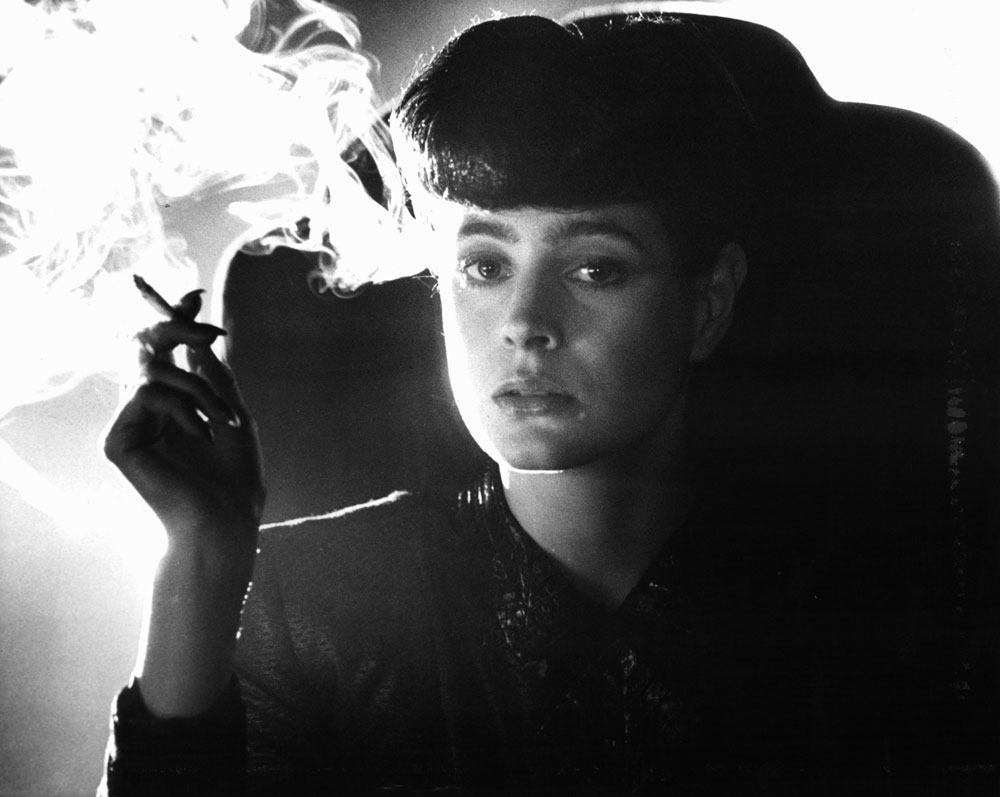
Sean YoungSean Young smokes in a scene from the film ‘Blade Runner’, 1982. (Warner Brothers/Getty Images)
The theme of killer robots that animates Dick’s novel and Scott’s film can be traced back to the Czech writer Karel Čapek’s 1921 play, “R.U.R.” (“Rossumovi Univerzální Roboti”), in which the term “robot” was originally coined. From this auspicious example in which robots are created to serve as factory workers of optimal efficiency, they are then quickly adapted into emotionless soldiers, all while becoming self-conscious. It’s not a far leap from there, of course, to the robots assessing their lot and realizing that they may not need humans, of whom they are superior, anyway. The trajectory contained in Čapek’s story were subsequently expressed in a long list of other texts and films, as well, from Isaac Asimov’s “I Robot” to Stanley Kubrick’s “2001” and Michael Crichton’s “Westworld,” to more recent films that have extended “Blade Runner’s” message in the “Terminator” and “RoboCop” franchises, Alex Garland’s “Ex Machina,” “Automata” and “Chappie,” along with episodes in Charlie Brooker’s “Black Mirror” and Tim Miller’s “Love, Death & Robots.” 

Films featuring robots, many of which express concerns that speak to the deep-seated suspicions, anxieties and fears that people harbor about the perils of technology, also, perhaps, represent a lament for the loss of a world that existed before the advent of such personally invasive technologies that seem constantly at work in eroding our privacy, personal freedom and agency. All within a historical context in which so many seem dependent upon, if not addicted to, technologies essential to daily life. This is precisely the essence and reflection of what has become known as the posthuman era, which Katherine Hayles saw as typified by the union of the human being with intelligent machines. 

In the future-present both the novel and film depict the wealthy elite and politically connected have long since fled our dying planet, as an ad promoting off-world living proclaims, “a new life awaits you in the Off-world colonies!”

Scott’s “Blade Runner” is also striking for its stylized apocalyptic and dystopian backdrops and fashion in a world in which only the unfortunate masses — and the corporations whose neon signs are ubiquitous — remain. In the future-present both the novel and film depict the wealthy elite and politically connected have long since fled our dying planet, as an ad promoting off-world living proclaims, “a new life awaits you in the Off-world colonies!” A chance to begin again in a golden land of opportunity and adventure. And who doesn’t want that, right, especially after we’ve mucked up the worlds we currently live in?

The issues raised and critical question posed gets us back to what lies at the heart of “Blade Runner.” Not whether Deckard lives happily ever after with Rachael (Sean Young), or whether he is a Replicant himself, but to the more fundamental status of technology in relation to human life. 

This is the issue that lies at the crux of the Replicant leader, Roy Batty‘s (Rutger Hauer) response to his creator, Tyrell, when asked, “Would you . . . like to be upgraded?” Batty’s response, “I had in mind something a little more radical,” hints at the nature of his discontent. He follows this up, saying simply, “I want more life, father,” in demanding a reprieve from the failsafe four-year lifespan that he was built with. It is a statement that speaks not only to his desire to be freed from his slavery to Tyrell and to time, but an independence from the control of humanity itself. A prospect that Tyrell knows as well as we do, will steer us inexorably to a condition in which humans are an obstacle, and weak, emotional and obsolete ones at that. The idea conveyed in this exchange and sanctified in Tyrell’s death at the hands of his prodigal son exposes the ironic basis of human dominion over machines and does little more than reflect our own insecurities and weakness in the face of forces that we fear we have lost control over.

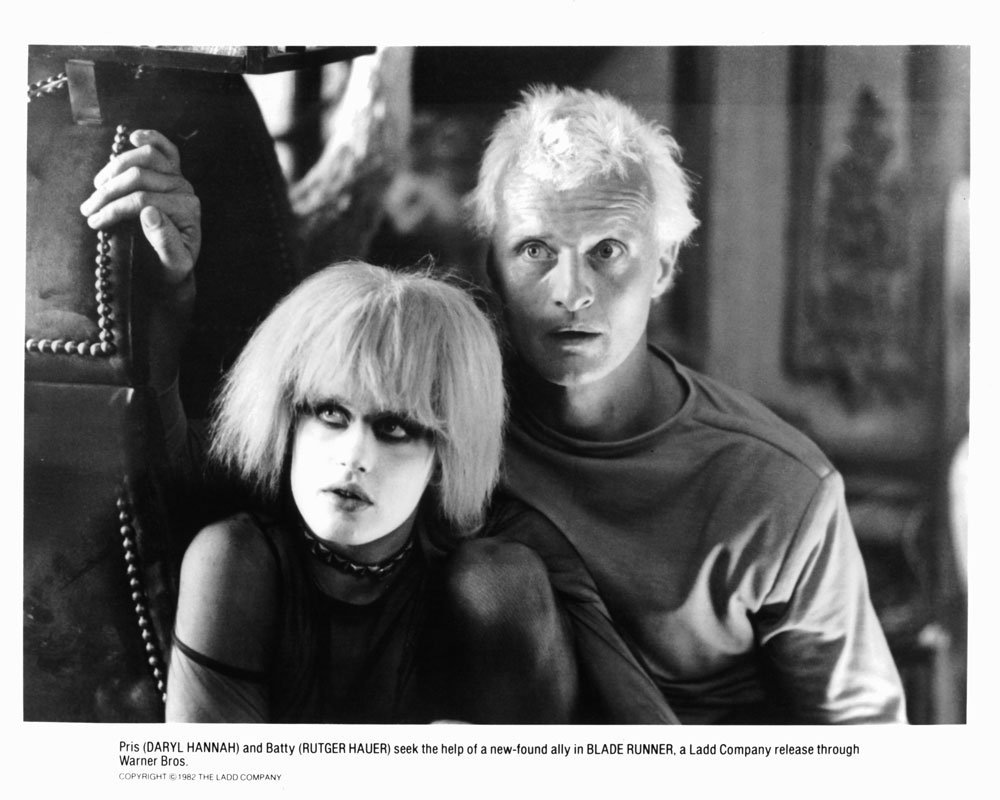
Daryl Hannah and Rutger HauerDaryl Hannah and Rutger Hauer in a scene from the film ‘Blade Runner’, 1982. (Warner Brothers/Getty Images)

With these philosophic musings in mind 40 years since the film’s release, we may now consider not just what the beneficial uses of machine learning, Artificial Intelligence, and robotics may be, but more emphatically for whose benefits and to what ends. Looking around at the status of such applications today, whether at the prospect of ever more realistic and submissive sexbots, which was what Batty’s Replicant companion Pris (Daryl Hannah) was created for as a so-called “pleasure model,” Tesla’s continued development of self-driving capabilities including that armored Cybertruck equipped with standard bullet-proof windows, the future, indeed, looks bright, and with all the sarcasm of the “Black Mirror” bullet hole logo. 

We may now consider not just what the beneficial uses of machine learning, Artificial Intelligence, and robotics may be, but more emphatically for whose benefits and to what ends.

And this is not even to mention the even more ominous developments in the military application of robotics and drones such as in the U.S. Marines development of a program dubbed Sea Mob testing self-navigating unmanned boats that can be equipped with .50 caliber machines guns. And we have all seen news stories detailing the devastation that has been unleashed by drone aircraft deployed by the U.S Airforce throughout the Middle East. Given these boats and aircraft represent only the tip of the spear with the ongoing efforts of military contractors to create other “lethal autonomous weapons,” the examples offered in “Blade Runner” now seem more relevant and urgent than ever. 


Want a daily wrap-up of all the news and commentary Salon has to offer? Subscribe to our morning newsletter, Crash Course.


Perhaps we are already past the point of no return. And not just because a significant cross-section of the population has seemingly lost faith in our political system and courts, while being marginalized and disempowered due to the accumulated effects and pressures of social inequality. Or simply disconnected and disaffected out of sheer apathy and boredom, and with millennials cast as convenient scapegoats. And then, all the others disgusted and discouraged by an overwhelming sense of hopeless despair at the extent of the corruption, greed and dishonesty that is now shamelessly put forth as a replacement for the American ideals of justice and equality, and the myth of the American Dream.

So, when we get to “Blade Runner’s” climactic confrontation between Deckard and Batty in which the Replicant is clearly the superior combatant, it is vital that Batty – not Deckard – is the one who reminds us of human ethics and morals in stating, “Quite an experience to live in fear, isn’t it? That’s what it is to be a slave.” It is in this moment that Batty lays bare a history of humanity in which greed, exploitation and violence have become not just a means to an end, but a means in itself. 

This, while the famous scene in which Batty acknowledges the end of his lifecycle in accepting the fleeting, ephemeral nature of memory and existence, poetically stating, “All those moments will be lost in time . . . like tears in rain.” But it’s not a statement of resignation by a rogue or malfunctioning machine, but a mirror held back up to Deckard, and all of us. One that reflects a different conception of life and being in the world. An experience in which the responses of apathy and escapism are fatal in a world that demands our engagement, and especially with others, if we are going to ever make this world, our world, a place for all, and that is worth living in.


Do we need photos of violence to galvanize support for change?

Following the mass shooting at Robb Elementary School in Uvalde, Texas, some commentators argued for the need to photograph and publicize what gun violence does to the bodies of victims. Such photographs would be unbearable. They might, these commentators argued, galvanize support for gun safety and control policies. But still others argued that such photographs would only traumatize survivors and victims’ families, while hardly mattering to the politicians who resist gun safety measures.

These issues were destined to remain unresolved. And, tragically, the country now has yet another opportunity to mourn the victims of a mass shooting. On July 4, 2022, a young man allegedly fired from the rooftop of a building in Highland Park, Illinois, killing at least seven people, wounding over 30 more, and traumatizing another American community. 

A witness, Dr. David Baum, offered a harrowing account of victims suffering wounds “you probably see in wartime.” Baum also described how, “You saw people screaming, you saw massive amounts of blood in the people who were gone.”

Those who advocate for the publication of photographs of mass shootings note — and correctly so — that images contain information that verbal accounts, like Baum’s moving account, necessarily can’t. They also claim that visual evidence has emotional power that written accounts usually don’t. 

There’s truth to this. Having studied the politics of violence, imagery and denial, I’ve documented how visual evidence can indeed move political leaders to take action, whether through investigations or policy changes.

And yet the initial public responses to images aren’t the whole story. As we’ve learned, time and time again, no photograph or video recording is truly “undeniable.” What photographs show can be explained away, through excuses and justifications. This often happens with the release of video footage of police shootings of unarmed Black men. Police unions and departments, many politicians, and too many juries can watch such footage and too often see a justified killing. 

This is exactly what those who argue against the release of photographs of victims of mass shooting worry about. Photographs may not make a difference. They may not move public opinion, political will and, most importantly, policy in ways that makes mass shootings less likely to occur again. They may also numb the public to the very violence they expose.

Public indifference or desensitization toward violence is not caused by exposure to too little or too much imagery.

But there’s something that both sides of this debate miss. Public indifference or desensitization toward violence is not caused by exposure to too little or too much imagery. Rather, when the public does not know what to do about violence, they’re likely to turn away from those images of violence. This is the case even when they care deeply about the suffering of others.

People will go to great lengths to avoid thinking, learning and talking about violence when they believe they cannot stop it. They do this to avoid the distressing emotions — helplessness and grief, especially — that awareness of suffering provokes.

This is very likely what many Americans experience after a mass shooting. In the two decades that have passed since the Columbine shooting in Littleton, Colorado, Americans have grown accustomed to two regularities: mass shootings and political inaction on gun violence. The recent Supreme Court ruling limiting gun control is only likely to heighten these emotions.

Knowledge about violence cannot sustain us. Nor can the emotions that this knowledge provokes. In “Regarding the Pain of Others,” Susan Sontag recognized this of the powerful emotional responses people often have to photographs of violence. These responses wither, she concluded, unless they’re “translated into action.” 

So we may not need more knowledge about violence and its causes. It follows, then, that we may not need more images of violence. What the American public needs instead is an understanding of how to take action — individual action certainly, but collective action, too — that could produce the sorts of changes that would lessen the likelihood of violence in the future.

Knowledge about violence cannot sustain us. Nor can the emotions that this knowledge provokes.

We need, instead, lessons, discussions, stories and images of social and political action. Journalists and photojournalists need to document and describe the ways that people resist violence and create political change. Educators, particularly those in social studies and the social sciences, need to give equal time to teaching on the strategies of social change and resistance as they do to the causes and consequences of violence and other public problems.

And what of the individual viewer of these images? There will be more photographs of violence, because there will be future acts of violence. These images, we need to recognize, testify not to the act of photography and its ethical dilemmas. Rather, they testify to the human capacities to perpetrate and suffer violence.

But they testify to something else, too. We bear witness to violence and suffering because we belong to local, national and even global communities of human beings. As such, we have a shared impulse to acknowledge, grieve and then work to lighten the suffering of others.

Read more

about violence in America:

The National Suicide Prevention Lifeline number changed — here’s why

As of Saturday, the National Suicide Prevention Lifeline — which was previously 800-273-TALK (8255) — can now be accessed via the three digit code 988 in a revamped version providing the option for quicker and easier access.

The original National Suicide Prevention Lifeline dates back to 2004 and was launched by the Substance Abuse and Mental Health Services Administration’s (SAMHSA) Center for Mental Health Services and worked in partnership with search engines like Google so that anyone searching out information regarding suicide methods or ways of prevention would receive a result containing the lifeline number. As of this weekend, any such individual will receive the code 988 as a result.

According to The Washington Post, the switch to a three digit code “is expected to bring millions more calls, chats and texts into a system where readiness to handle the surge varies from place to place.”

“I look at 988 as a starting place where we can really reimagine mental health care,” said Hannah Wesolowski, chief advocacy officer for the National Alliance on Mental Illness. “We’re really looking at a fundamental tide shift in how we respond to people in mental health crisis.”

Per the Lifeline’s website:

988 represents not just a telephone number change for the Lifeline, but a once-in-a-generation opportunity to change how crisis services are delivered. The transition to 988 requires additional policy changes and substantial funding support from federal and state governments. Vibrant Emotional Health has identified three key themes to guide 988 implementation:

  1. Universal and Convenient Access, including omnipresent public awareness and varying modalities for individuals to access 988 through their preferred method of communication.
  2. High Quality and Personalized Experience that is tailored to the unique needs of the individual while also in line with identified best practices.
  3. Connection to Resources and Follow Up to ensure all persons contacting 988 receive additional local community resources as needed.

Want a daily wrap-up of all the news and commentary Salon has to offer? Subscribe to our morning newsletter, Crash Course.


In 2021, SAMHSA reported over 3.6 million calls from people seeking help, according to The Washington Post, and that number is expected to reach 7.6 million in the coming year. Each of the 200 call centers that man the Lifeline are funded by local, state and federal resources, usually at a literal and emotional deficit as there is never quite enough funds or manpower available.

“988 will work if the states are committed to it,” says Xavier Becerra, secretary of the Department of Health and Human Services. “It won’t work well if they’re not. There is no reason, no excuse, that a person in one state can get a good response and a person in another state will get a busy signal.”

Federal government warns rebel pharmacists who refuse to fill abortion pill prescriptions

After a series of well-publicized incidents, federal health officials sent U.S. pharmacies a stern warning: pharmacists can’t discriminate against pharmacy customers when it comes to dispensing medications that can be used for abortions or birth control — they must comply with federal civil rights laws.

The reminder comes after many news reports have surfaced about pharmacists refusing to fill prescriptions for medications that are used for abortion, like mifepristone, misoprostol and methotrexate.

“If a pharmacy refuses to fill the individual’s prescription — including medications needed to manage a miscarriage or complications from pregnancy loss, because these medications can also be used to terminate a pregnancy — the pharmacy may be discriminating on the basis of sex.”

“The guidance makes clear that as recipients of federal financial assistance, including Medicare and Medicaid payments, pharmacies are prohibited under law from discriminating based on race, color, national origin, sex, age, and disability in their programs and activities,” the United States Department of Health and Human Services (HHS) said in its warning. “This includes supplying prescribed medications; making determinations regarding the suitability of prescribed medications for a patient; and advising a patient about prescribed medications and how to take them.”

RELATED: Waiting periods for abortions are even more dangerous Post-Roe

Officials specifically pointed to a provision in the Affordable Care Act that prohibits pharmacists from making their own decisions about the suitability of a prescribed medication for a patient, and it applies to recipients of financial assistance from HHS — which is an estimated 60,000 patients across the country. The provision is based on Title VII of the Civil Rights Act of 1964, which prohibits discrimination against someone on the basis of race, color, national origin, sex (including pregnancy, sexual orientation, and gender identity) or religion.

“An individual experiences an early pregnancy loss (first-trimester miscarriage) and their health care provider prescribes pretreatment with mifepristone followed by treatment with misoprostol to assist with the passing of the miscarriage,” the HHS gave as an example in the guidance. “If a pharmacy refuses to fill the individual’s prescription — including medications needed to manage a miscarriage or complications from pregnancy loss, because these medications can also be used to terminate a pregnancy — the pharmacy may be discriminating on the basis of sex.”


Want more health and science stories in your inbox? Subscribe to Salon’s weekly newsletter The Vulgar Scientist.


Medication abortion to terminate an unwanted or non-viable pregnancy — also known as the abortion pill — usually involves two different drugs delivered in pill form: mifepristone and misoprostol. Mifepristone (also known as RU-486), which was approved for abortion in the United States by the Food and Drug Administration (FDA) in September 2000, can be used safely and effectively to terminate a pregnancy up to 70 days after a person’s last menstrual cycle. Misoprostol is taken after mifepristone. According to the Mayo Clinic, methotrexate is not as commonly used to terminate unwanted pregnancies but can often be used in conjunction with vaginal misoprostol as a treatment for ectopic pregnancies.

The issued guidance follows a wave of abortion bans and restrictions in states that are now turning their crosshairs on medications that can be used to abort a fetus. But many of these medications can be used for other purposes, too. For example, someone with rheumatoid arthritis may be prescribed methotrexate as a standard immunosuppressive treatment. A person with chronic ulcers might need misoprostol. Someone who is experiencing a life-threatening ectopic pregnancy (which are by nature non-viable) might be prescribed methotrexate to halt the pregnancy. 

Currently, in most states where abortion is banned, state statutes technically make providing an abortion illegal, rather than prosecute those getting them — although, as Rebouché alluded to, there is fear that states might start targeting people who receive abortions as criminals, too.

“I think that is absolutely where states are going to turn their attention to,” said Rachel Rebouché, dean and professor of law at Temple University School of Law in Philadelphia. “Abortion pills can now be mailed, telehealth has become a viable option, Aid Access has become increasingly a demanded service, and I fear that they could turn to targeting patients.”

Rebouché said she believes this will “implicate pharmacies in a really interesting way.”

Currently, in most states where abortion is banned, state statutes technically make providing an abortion illegal, rather than prosecute those getting them — although, as Rebouché alluded to, there is fear that states might start targeting people who receive abortions as criminals, too. But the language as to who “providers” are can be a bit unclear. For example, in Texas, anyone “aiding and abetting” someone having an abortion could be held civilly liable.

“I have some sympathy for pharmacists who have received no guidance from the states — law has changed, in some cases, over a one week period, and they’ve gone from one day medication abortion is legal in the state, the next day it is not, and figuring out what are their responsibilities under these new laws — would they be complicit in an SB8-style suit in Texas? Would they be aiding and abetting if it turns out the drug was used for abortion?” Rebouché said. “The state isn’t giving much guidance or protection.”

Rebouché told Salon she thinks the HHS warning is an effective reminder to pharmacies.

“Their vetting, whether or not they suspect someone’s pregnant and not getting ulcers, is a form of deciding which patients to give perfectly legally prescribed medicines based on a pregnancy status,” Rebouché said. “I think it’s helpful for the HHS to weigh in and remind pharmacists that they have under the First Amendment the right to abstain from prescribing or participating in abortion, but that is not someone who’s treating ulcers.”

Rebouché added that one important part missing from this conversation is how to legally discern rejection of dispensing the medication from religious beliefs and rejection from discrimination. Notably, a patient doesn’t have to disclose the reason for needing medication.

“I didn’t see that issue address how to discern religious refusal because you believe it’s an abortion,” Rebouché said. “But I tend to think they’re silent on it, because it’s addressed to pharmacists who are otherwise handling these medications and deciding that to avoid liability or to avoid punishment or to avoid controversy … they are not going to prescribe them, and no longer taking measures to ban abortion, and seems to me outside a conscientious objection question.”

Read more on reproductive justice:

Vince McMahon’s hush-money scandal: A window into Trump’s America

The Wall Street Journal last month broke the story of WWE mogul Vince McMahon’s payments of hush money to an office paralegal whom he had coerced into a sexual relationship. Since then, the Journal’s reporting has expanded into revelations that McMahon, over the years, paid out a total of $12 million to silence current or former WWE employees who alleged sexual harassment. The claims also extended to WWE’s top executive for talent relations, John Laurinaitis (brother of the late “Road Warrior Animal,” Joe Laurinaitis, and uncle of former NFL linebacker James Laurinaitis).

As chronicled by the newspaper of record of the financial ruling class, these long-whispered scandals became an affair of state. Following its origins as a third-generation northeastern promotional stronghold of pro wrestling’s pre-cable territorial era, WWE is now a publicly traded multinational corporation on the New York Stock Exchange. After the first Wall Street Journal report, McMahon resigned as chair and CEO of WWE. He was replaced by his daughter Stephanie, who plays Christie, the enlightened and strong feminist heir, to Vince’s Hugh Hefner. (Stephanie is married to former wrestler and current company executive Paul “Triple H” Levesque.)

Today we inhabit a world of sexual politics that understands Hollywood’s Harvey Weinstein as the operator of a systematic and criminal casting couch. So it’s no big surprise that the sui generis entertainment of wrestling has been run by a similarly iron-fisted chieftain’s code of exploitation.

Nor, at this stage of the failed state that is the United States of America, is it much more than a pop culture cliché to point out that wrestling’s histrionics and reality-TV M.O. were a metaphor for the rise of Donald Trump. The 45th president, who continues to lurk in hope of an authoritarian sequel, is a decades-long crony of Vince McMahon and his wife Linda (who was head of the Small Business Administration under Trump). Trump performed in WWE shticks, hosted two early WrestleMania pay-per-view extravaganzas at his now defunct Atlantic City casino, spurred record buy numbers at a later one and is a proud inductee of the WWE Hall of Fame.

Beginning nearly 40 years ago, I wrote some of the earliest major articles that took the wrestling industry seriously and explored the relationship between its explosion and the breakdown of regulations, specifically, and of civil society, generally – for publications such as Penthouse, Washington Monthly and Spy. So I am here to review that story, but also to do more.

Yes, the wrestling-ization of America, like the Trumpfication of America, has been insidious and inexorable. But it has not been inevitable. In the case of Vince McMahon, there were rope guides to his ascent. And there were missed opportunities, by the media and most especially by prosecutors. There was one huge missed opportunity to take him down nearly 30 years ago.

*  *  *

In the early 1990s, I was writing items about sex and drug scandals in what was then called the World Wrestling Federation for the “Jockbeat” column of New York’s Village Voice. The headline story then was reports of sexual harassment and sexual abuse of teenage “ring boys” by company employees Mel Phillips and Terry Garvin. These were kids, mostly from broken homes, who worked for little or nothing setting up and tearing down the wrestling ring on tours and performing other gopher tasks. (Phillips and Garvin have long since died.)

Is it more than a pop culture cliché to point out that wrestling’s histrionics and reality-TV M.O. serve as a metaphor for the rise of Donald Trump?

The whistleblower of the ring boy scandal was named Tom Cole. The journalist who gave the story legs was New York Post sports columnist Phil Mushnick. Cole’s sad tale played out across decades, culminating in his suicide earlier this year at age 50. (Mushnick himself paid a price, warding off an expensive WWF libel suit, which was eventually dropped. I was subpoenaed by WWF but refused to cooperate, citing California’s journalist shield law.)

In 1992, Cole was poised to tell all in a live shoot of Phil Donahue’s show, one of the early syndicated TV talk-shout-fests. Just before he was to go on, the McMahons bought off Cole with a $150,000 settlement, almost all of which wound up in the pocket of his lawyer, Alan Fuchsberg.

WWF then rehired Cole and set him up in college courses. That arrangement collapsed when the U.S. attorney’s office for the Eastern District of New York sought Cole’s cooperation in a grand jury investigation of the company for broad charges of both sex crimes and illegal steroid use (designed to buff the look of kiddie idol Hulk Hogan and other star performers).

Cole was torn. Over the years, the aggressiveness of his public testimony waxed and waned. Yet at no point did he ever speak untruthfully about the abuse he and other ring boys had endured. In this chapter of the story, WWF fired him with the claim that he was sloughing off in their humanitarian mission to educate and equip him for a productive adult career. In truth, the company was freaked because Cole was talking with prosecutors.

Cole went on to get married, have children and own a small business. In 2010, when Linda McMahon was making the first of her two failed runs for a U.S. Senate seat in Connecticut — sinking a total of $100 million of the family fortune in the process — journalists sought out Cole’s story (along with many others from oppo research, such as the McMahons’ various shady business practices and their mysterious emergence from a 1976 bankruptcy). No one knows exactly what transactions transpired behind the scenes. In the end, Cole spoke out in support of Linda during her political campaign.

Meanwhile, within WWF (which in 2002 would become WWE, in the settlement of a trademark lawsuit by the World Wildlife Fund), it was a source of great mirth in the early 1990s and beyond that the workplace was a platform of widespread abuse and harassment of boys, women and wrestlers. A real hoot. Former wrestler Billy Jack Haynes said that when he showered after matches, he had to be careful about bending down for a bar of soap.


Want a daily wrap-up of all the news and commentary Salon has to offer? Subscribe to our morning newsletter, Crash Course.


In interviews hyping his own matches, star wrestler Shawn Michaels made inside jokes about his mastery of a move he called the “Pat Patterson go-behind.” Patterson, who died in 2020, was a wrestling great who had become Vince McMahon’s top lieutenant for booking matches and crafting storylines. He was openly gay. Some of the whispers about the company’s toxic culture did indeed represent classic homophobia. Others did not.

During the most intense period of my work for the Village Voice, I received calls weekly, sometimes more frequently, from McMahon’s principal lawyer and mouthpiece, Jerry McDevitt, a partner in the firm then known as Kilpatrick & Lockhart — now K&L Gates (it later merged with the Seattle firm of Bill Gates’ father). One of McDevitt’s underlings, Rick Santorum, had been WWF’s Pennsylvania lobbyist in the successful quest to defang the state athletic commission there in its oversight of boxing and wrestling. Santorum went on to become a Republican U.S. senator and 2012 presidential candidate. 

(See my interview for a 2012 Mother Jones article about Santorum and wrestling. And American Lawyer’s 2011 article about my verbal mano a mano with McDevitt.)

In 1992, McDevitt’s message to me was that Vince McMahon and WWF were in no way under federal investigation. One Saturday afternoon he called me to press this point, citing two facts in support. One, all targets of federal investigations had to be notified by the U.S. attorney, and McMahon had received no such notification letter. Two, McDevitt had in his possession a letter from the U.S. attorney explicitly assuring McMahon that he was not a target.

On the first point, I spoke to Mary Jo White, who was then an assistant U.S. attorney for the Brooklyn-based Eastern District of New York and was later U.S. attorney for the Manhattan-based Southern District, and then the head of the SEC under Barack Obama. (She is now a senior partner at the Debevoise & Plimpton law firm.) White told me that McDevitt’s description of the notification procedure was not entirely accurate.

Decades later, through the work of independent journalist David Bixenspan, I came upon the explanation for McDevitt’s second assertion. Bixenspan uncovered a contemporaneous letter in which a U.S. attorney did indeed tell McMahon that he was not under federal investigation. But that letter was from an entirely different federal prosecutor, in the Eastern District of Pennsylvania. McMahon was a target in New York.

Bixenspan’s reporting also clarified an amusing anecdote from that period. The late Frank Deford, the author and Sports Illustrated writer, used his weekly National Public Radio commentary segment to call on Hulk Hogan to come clean about his steroid use. Vince McMahon called Deford and, in the course of a long rant, screamed, “I can prove I’m not a mobster!” Since Deford had never accused McMahon of being a mobster, both he and I were amused. Through the Freedom of Information Act, however, Bixenspan would uncover  a government document showing that wrestler Superstar Billy Graham had worn a wire for a conversation with McMahon, at the behest of federal prosecutors seeking a link between the WWF and organized crime. (For the record, I don’t think McMahon is a mobster. He just acts like one.) 

The grand jury investigation of WWF was run by Sean O’Shea, chief of the business/securities fraud section of the Eastern District. He blew it, accumulating massive evidence of sexual abuse and associated racketeering within the company, but never used any of it to indict anyone. He went after the drugs instead. 

Federal prosecutors accumulated massive evidence of sexual abuse and associated racketeering within WWF, but never tried to indict McMahon or anyone else.

In 1991, a WWF ringside physician in Pennsylvania, George Zahorian, had gone to federal prison as a result of the first prosecution under a statute that criminalized the prescription of anabolic steroids for non-therapeutic purposes. Zahorian was notorious for his handing out steroid scripts to wrestlers backstage as he took their blood pressure before syndicated TV shows in Allentown. Evidence at his trial revealed that he had shipped drugs to a long list of patients, including Hulk Hogan and McMahon himself.

It was not exactly a bombshell revelation that professional wrestlers’ cartoon physiques were pharmaceutically aided. Eventually, O’Shea indicted McMahon on charges of conspiracy to distribute steroids. Unfortunately for the government’s case, the chain of evidence was weak. WWF was tipped off that Zahorian was “hot” shortly before his arrest, and had already dropped him as their ringside doctor in eastern Pennsylvania. (The McMahons had made this decision over the objection of Pat Patterson, who, according to an internal company memo, argued, “The boys need their candy.”)

McMahon was acquitted at trial in 1994. A subsequent investigation of witness tampering, involving the testimony of McMahon’s secretary, Emily Feinberg — a former Playboy model rumored to be his onetime lover — resulted in no further charges. Allegedly Feinberg had been approached by a notorious fixer and Rudy Giuliani crony named Marty Bergman, who happened to be the ne’er-do-well brother of journalist Lowell Bergman, the “60 Minutes” producer portrayed by Al Pacino in Michael Mann’s 1999 film “The Insider,” about the groundbreaking investigation of the tobacco industry.

Marty Bergman was the boyfriend of Laura Brevetti, who was Vince McMahon’s lead defense attorney at the trial. Representing himself as a producer for a TV tabloid show interested in buying the rights to her story, Bergman got so much information out of Feinberg about her upcoming testimony that Brevetti’s eventual cross-examination of her was a piece of cake.

When Bergman and Brevetti were married, the ceremony took place at City Hall in Manhattan, with Mayor Rudy Giuliani officiating. (Bergman died in 2008.)

By 1997, even though he had dodged prison and become the first promoter to tap wrestling’s global multimedia merchandising potential, McMahon was seriously on the ropes. Ted Turner, whose TBS superstation carried a competitive wrestling promotion, bought in and spent big, unburdened by the need to pretend he was seriously concerned with drug testing. For a time during the famous “Monday Night Wars,” Turner’s World Championship Wrestling show, “Nitro,” was consistently besting WWF’s “Raw.”

But McMahon was more tenacious and smarter — or at least wrestling-smarter — and within a few years he had prevailed in the war and crushed WCW. The creative turning point came when McMahon had an epiphany and turned himself into a WWF character, “Mr. McMahon,” who became the company’s leading “heel,” or bad guy. In 1999, WWF went into orbit, for the second and definitive time, behind the ongoing feud between McMahon and antihero “Stone Cold” Steve Austin. That golden age is now fondly remembered as the Attitude Era.

In October of that year, McMahon took his company public. The initial public offering, or IPO, was launched the same week as that of Martha Stewart. (Amazing but true: McMahon never went to jail, but Stewart did.) 

In preparation for his coming out on Nasdaq (WWE later switched to the New York Stock Exchange), McMahon gave New York magazine access for a cover profile. In the interview, he scoffed at prosecutors’ overreach five years earlier, stating falsely that he had been convicted on one count. (In fact, he was acquitted on all counts.) According to company insiders, Vince thought this spin made him come across as even more of an anti-government, anti-elitist outlaw. Dave Meltzer, the publisher of Wrestling Observer Newsletter, told me that during the period of the New York interview, McMahon had affixed a note to his wrist to remind himself of this crucial talking point.

In 2010, during Linda McMahon’s first Senate campaign, the family threatened Talking Points Memo with a lawsuit over the revival of an old story, first reported on Geraldo Rivera’s TV show in 1992, that Vince had raped WWF’s first female referee, Rita Chatterton, in his limousine in 1986.

Vincent Kennedy McMahon. Donald John Trump. Rudolf William Louis Giuliani. Terry “Hulk Hogan” Bollea, John Cena, Dwayne “The Rock” Johnson — and a cast of thousands. These are some of the names, and this is some of the detritus, that future historians will be forced to comb through when they attempt to make sense of the strange and disturbing epoch during which we live.  

Heatflation: How sizzling temperatures drive up food prices

Vicious heat waves are sweeping parts of the globe this week, along with the dangers that come with blazing-hot temperatures: wildfires, dehydration, and even death. The hot weather could also push prices up for food, making inflation even worse.

Western Europe is facing sweltering temperatures again this week, with the thermostat hovering around 110 degrees in Seville in southern Spain. More than 20 wildfires are burning in Spain and Portugal, and persistent drought has left rivers and reservoirs running so low that they’re exposing ancient artifacts. 

In Italy, the hot and dry conditions are expected to destroy a third of the seasonal harvest of rice, corn, and animal fodder — at a minimum. Locusts have descended on the island of Sardinia in the worst invasion in three decades, hurting the production of hay and alfalfa. The European Commission recently downgraded its soft-wheat harvest estimates from 130 million tons to 125 million tons — more bad news amid a food shortage precipitated by Russia’s blockade on exports from Ukraine. (Russia and Ukraine are among the world’s biggest exporters of grain.)

Across the world in China, a record-breaking heat wave is causing major problems. Roofs are melting, residents are relocating to public cooling zones in underground air-raid shelters, and health workers are strapping frozen food to their too-hot hazmat suits. The Central Meteorological Observatory in Tokyo has warned that the heat could further hurt the production of corn and soy, worsening inflation. These crops are used to feed pigs, and early-season failures have already sent the price of pork, China’s staple meat, soaring.

When major crops wither, it can have knock-on effects across the ocean and show up on your grocery bill. Inflation has been climbing in the United States at the highest rate in 40 years, up 9.1 percent over the past 12 months, much of it the result of spiking food and energy prices. The surge has been egged on by the pandemic-beleaguered supply chain and by Russia’s invasion of Ukraine. But climate change is becoming a driver of inflation, too. Experts are warning that heat, flooding, drought, wildfires, and other disasters have been wreaking economic havoc, with worse to come. 

“If we wish to control inflation, we must address climate change now,” David A. Super, a professor of law and economics at Georgetown, recently argued in The Hill. Beyond crops, the changing climate has driven up the price of lumber as well as insurance premiums.

“Heatflation” might already have something to do with escalating food costs around the world. A heat wave in India this spring devastated wheat plants, leading it to ban exports. In the United States last year, searing heat and drought in the Great Plains scorched the wheat crop and also enabled wheat-munching grasshopper populations to flourish. The grain’s price nearly doubled to $10.17 a bushel, its highest level since 2008. Extreme temperatures endanger livestock, too: The heat wave that struck much of the country last month caused thousands of cattle to die of heat stress in Kansas.

“We all know our grocery bills are going up,” Bob Keefe, the author of the book “Climatenomics”, told me last month. “Part of the reason is that when you lose crops to storms or drought or flooding, prices are going to go up.”

In a report last year, researchers at the European Central Bank examined the evidence that abnormal temperatures can drive inflation. Looking at seasonal temperatures and price indicators in 48 countries, they found that hot summers had “by far the largest and longest-lasting impact” on food prices. The effect lasted almost a year and was especially noticeable in developing countries. “We find that higher temperatures over recent decades have played a non-negligible role in driving price developments,” the authors concluded.

While climate action and economic concerns are often pitted against one another, the evidence is piling up that in many cases, they are one and the same.

Jan. 6 hearings: A national civics lesson on the dangers of fascism

The House Jan. 6 committee hearings are an act of public teaching: a civics lesson on a grand stage.

That was especially true of last Tuesday’s hearing, with its truth-telling about race, violence, American history, power, psychology, and the escalating existential threat to the country represented by Donald Trump, the Republican-fascist movement and the larger white right.

In his opening statement that day, Rep. Jamie Raskin of Maryland summoned up the words and wisdom of America’s greatest president, Abraham Lincoln, in the context of the country’s long struggle to become a multiracial “We the People” democracy. Describing the explosive events of Jan. 6, 2021, Raskin said:

Mr. Chairman, as you know better than any other member of this committee from the wrenching struggle for voting rights in your beloved Mississippi, the problem of politicians whipping up mob violence to destroy fair elections is the oldest domestic enemy of constitutional democracy in America.

Abraham Lincoln knew it too. In 1837, a racist mob in Alton, Illinois, broke into the offices of an abolitionist newspaper and killed its editor, Elijah Lovejoy. Lincoln wrote a speech in which he said that no transatlantic military giant could ever crush us as a nation, even with all of the fortunes in the world.

But if downfall ever comes to America, he said, we ourselves would be its author and finisher. If racist mobs are encouraged by politicians to rampage and terrorize, Lincoln said, they will violate the rights of other citizens and quickly destroy the bonds of social trust necessary for democracy to work.

Mobs and demagogues will put us on a path to political tyranny, Lincoln said. … [T]his very old problem has returned with new ferocity today, as a president who lost an election deployed a mob, which included dangerous extremists, to attack the constitutional system of election and the peaceful transfer of power.

These connections to America’s still unresolved Civil War and other battles over the color line, freedom, justice and democracy manifested themselves in literal fashion on Jan. 6, when Trump’s followers attacked the U.S. Capitol, some of them waving Confederate flags and hurling racial slurs. Trump’s attack force included neo-Nazis, Kluxers, and members of various other white supremacist organizations. Trump’s attack force assembled a working gallows outside of the Capitol, with the obvious intention of executing Mike Pence, leading Democrats, and others judged to be disloyal to the Trump regime.

The lynching rope and lynching tree are both a symbolic and literal act of racial terrorism against Black Americans; thousands of Black men, women and children were lynched during the white terror campaign in the South and other parts of the country that lasted more than 100 years. 

Like their traitorous forefathers and foremothers of the Confederacy, the Trumpists and Republican fascists also believe themselves to be “patriots” and “defenders” of democracy and the Constitution, doing the work of God in a “Christian” struggle as special heirs to the legacy of America’s founding.

And like the Confederates and other white Americans throughout the country’s history, the Trumpists reject the idea that a Black or brown American’s vote and democratic agency should have the same merit as those of white people. Properly understood, Jan. 6 was a white rage tempter tantrum and an exercise in a type of “freedom” exclusive to white Americans: the right to reject elections and other democratic outcomes not to their liking, through violence if need be.

Like the traitors of the Confederacy, Trumpists reject the idea that Black or brown people’s democratic agency should have the same agency as those of white people.

As historian Heather Cox Richardson has observed, the Confederacy, and its allegiance and commitment to a white supremacist order, was never fully defeated. Instead, those forces and beliefs morphed into the post-civil rights era “conservative” movement and the modern Republican Party.

Jason Van Tatenhove, a former spokesman for the Oath Keepers told the House Jan. 6 committee on Tuesday that: “Who knows what that might bring ,if a president that’s willing to try to instill and encourage [and] whip up a civil war amongst his followers using lies and deceit and snake oil … what else is he gonna do if he gets elected again? All bets are off at that point.”

At the Guardian, David Smith offered a powerful summation of last Tuesday’s hearing:

It was a chilling reminder that in a nation that has the genocide of Indigenous Americans, slavery, civil war and relentless gun violence in its cultural DNA, bloodshed is never far from the surface. Since white supremacists marched in Charlottesville, Virginia, in August 2017, extremist groups such as the Proud Boys and Oath Keepers have been ascendent.

Tuesday’s committee hearing further highlighted, in stark detail, how one powerful person, through the force of his own dark charisma and lies, can corrupt the people around him. Such personalities attract other damaged and dangerous people into their orbit. Sick societies produce sick leaders, who all too often lead mass movements comprising thousands or millions of people.


Want a daily wrap-up of all the news and commentary Salon has to offer? Subscribe to our morning newsletter, Crash Course.


It is now a matter of public record that Donald Trump intentionally and willfully incited violence and terrorism on Jan. 6 as part of his plot to end American democracy and make himself into some type of king or other type of tyrant. On Dec. 18, 2020, some of Trump’s most dangerous confederates, including former general Michael Flynn and attorney Sidney Powell, gathered at the White House in a now-infamous meeting where they tried to convince him to impose martial law, confiscate voting machines to “prove” nonexistent voter fraud and launch other schemes to steal the 2020 election from the American people. It has been reported that Donald Trump relished the attention and the hours of energy being expended on nefarious plots to keep him in power.

Other officials in the Trump’s regime — such as Vice President Pence and Attorney General Bill Barr — opposed his blatantly illegal schemes but never told the American people about the growing danger to their democracy, only offering other information under subpoena or (in Pence’s case) through intermediaries. Those former members of Trump’s inner circle continue to be agents of American fascism but now have books to sell, money to make on the lecture circuit and reputations to launder and burnish. They decided that self-interest and partisan loyalty were more important than warning the American people about Trump’s threats to democracy.

Young men desperate for a place in history — be they white supremacist “crusaders” or Islamic warriors for the Caliphate — are especially attracted to the dark charisma of leaders like Trump.

As shown by the testimony of Van Tatenhove and Stephen Ayres last Tuesday and the evidence provided from right-wing websites and social media, Trump’s corrupting power spoke to the white rage and white anger of his most loyal followers and their desire to be part of history and what they believed to be a great and noble struggle. Young men desperate for a place in history and a life of meaning — be it as white supremacist “crusaders” or Muslims who want to be Islamic Knights of the Caliphate — are especially attracted to the dark charisma of leaders like Donald Trump and Osama bin Laden.

Dr. Jerrold Post, who served as the CIA’s head psychological profiler during more than 20 years of service with the agency, explained Trump’s power over his followers in a December 2019 interview with me for Salon:

A famous Canadian psychoanalyst observed, “The leader is the creation of his followers.” This is a very powerful relationship. Indeed, many people have been puzzled, given Donald Trump’s extremism, that the support and the dedication of his followers to him has been not hugely diminished. Trump’s rallies, in particular, show an almost frightening intensity of the power of Trump’s charisma and influence over his followers.

For a core of his base Donald Trump provides them with many things, including permission to hate. It is a striking phenomenon. In his behavior Trump is also demonstrating some of the principles which are codified in his book on leadership style. Of note, some of these themes are derived from an important mentor for him, the late Roy Cohn.

There is another important aspect to Trump’s influence over his supporters and that is the model of the “charismatic leader-follower relationship.” This is the “mirror-hungry personality,” which comes from a wounded self. The other dimension of the wounded self is an “ideal-hungry personality.” In practice this means that Trump’s core enthusiastic followers feel incomplete without a great inspirational leader to attach themselves to, someone to venerate. The mirror-hungry personality, which is Donald Trump, needs the ego-gratifying applause and roars of approval from crowds. There is a natural psychological fit between Trump and his followers….

Last Tuesday’s committee hearing also showed the American people how power in the wrong hands can be used to break or exploit the tacit bargains and understandings that sustain our democracy, the “norms” and “values” and “institutions” obsessively discussed by the country’s political class and news media. Donald Trump and the Republican-fascists do not believe, for instance, in the principle of “one person, one vote,” or in the peaceful transition of power. For them, democracy is a means to an end — a way to acquire and accrue more power and its personal, material, financial and emotional benefits. That corrupt and unrestrained power is then used to oppress and cause harm to others they deem to be enemies or otherwise “un-American.” These are core tenets of fascism.

The Republican fascists have identified those aspects of the Constitution or federal law — the Electoral College, the Senate, the power of state legislatures — most vulnerable to subversion.

To that end, the Republican fascists and their allies have identified those aspects of the Constitution or federal law and governing institutions that are most vulnerable. The Electoral College is one such target. Trump’s abuse of executive orders is another. The U.S. Senate amplifies the power and influence of less populous states and regions, and thereby dilutes the legitimate power of the majority in an increasingly diverse democracy. The Supreme Court is now an explicitly partisan and ideological right-wing institution, dedicated to advancing the tyranny of the minority.

The Republican fascists and their agents are now working on a nationwide plan to empower Republican-controlled state legislatures and governors to reject the outcome of an election if the voters have chosen the “wrong candidate,” meaning a Democrat. In practice, the goal is a one-party authoritarian state, modeled on Vladimir Putin’s Russia or some other fake democracy.

Tuesday’s committee hearing also taught other lessons. Social media companies have an outsized power to influence democracy. As seen on and before Jan. 6, such companies are more interested in profit — and amplifying negative emotions and discord to that end — than in serving the public good or playing a positive role in the public sphere.

The mainstream news media continues to pretend that Trump’s perfidy on and before Jan. 6 and the Republican-fascists’ escalating assaults on democracy are somehow surprising or shocking. In reality, Donald Trump and his confederates orchestrated the coup for months (if not years) before Jan. 6. Nothing that transpired that day can be described as a revelation: A few brave public voices warned that Trump was likely to attempt a coup, and most such people were accused of being “hysterical” or seeking attention by the gatekeepers of public discourse and centrism.

Moreover, instead of making the threats embodied by the Age of Trump and American neofascism more legible for the public, too many voices in the news media would rather be breathless and dramatic. They will never take a personal and public inventory of how they enabled this disaster by normalizing Trump and his movement. 

In his closing statement at Tuesday’s hearing, Raskin offered a crucial moment of public teaching, warning about the continuing threat of authoritarianism in America from Donald Trump and the Republicans and the larger neofascist movement.

Unlike Mr. Ayres and Mr. Van Tatenhove, people who have recovered and evolved from their descent into the hell of fanaticism, Donald Trump has only expanded his big lie. To cover Jan. 6 itself, he asserts the insurrection was the real election, and the election was the real insurrection. He says his mob greeted our police officers on Jan. 6 with hugs and kisses.

He threatens to take one of America’s two major political parties with him down the road to authoritarianism. And it is Abraham Lincoln’s party, no less. The political scientists tell us that authoritarian parties have two essential features in common, in history and around the world. They do not accept the results of democratic elections when they lose, and they embrace political violence as legitimate. …

But this is not the problem of one party; it is the problem of the whole country now. American democracy, Mr. Chairman, is a precious inheritance, something rare in the history of the world and even on earth today.

Constitutional democracy is the silver frame, as Lincoln put it, upon which the golden apple of freedom rests. We need to defend both our democracy and our freedom with everything we have, and declare that this American carnage ends here and now. In a world of resurgent authoritarianism and racism and antisemitism, let’s all hang tough for American democracy. The American people and the leaders of the so-called pro-democracy movement now have a series of choices to make.

Will Raskin’s words of warning be an epitaph for America, or instead an inspiration to mobilize, organize, marshal the required resources, and engage in acts of massive resistance at the ballot box and in the streets? Will Attorney General Merrick Garland and the Department of Justice take these lessons to heart and prosecute Trump and his confederates for their many obvious high crimes?

Will Joe Biden and other the Democratic leaders finally jettison their old habits of dealing with Republicans as though they were responsible partners in governance and instead treat them as the threat to democracy, freedom, the Constitution and the rule of law that they clearly are? Will the American people as a whole fight for their democracy against the rising fascist tide? Or will they instead succumb to learned helplessness and quietly surrender to the “new normal” of a Christian fascist apartheid plutocracy where most Americans will be treated as second- or third-class citizens – if even that?

The American people and their leaders are running out of time to answer these questions.

As the House Jan. 6 committee continues its public hearings, investigations – and teaching – will their lessons be learned or ignored? America’s future depends on the answer.

Biden under scrutiny for fist bump with Saudi Crown Prince

Making a mockery of his own campaign vow to treat the repressive Saudi kingdom as a “pariah,” U.S. President Joe Biden on Friday greeted Saudi Crown Prince Mohammed bin Salman—who intelligence agencies believe approved the murder of journalist Jamal Khashoggi—with an amiable fist bump as he arrived at the royal palace in Jeddah.

Already furious over the president’s decision to meet with the crown prince despite his role in the brutal 2018 murder of Khashoggi and subsequent cover-up attempt, human rights defenders responded with outrage to the greeting, which the Saudi regime swiftly blasted out on social media.

“The bloody fist bump seen around the world,” said Sarah Leah Whitson, executive director of Democracy for the Arab World Now (DAWN). “You have humiliated our entire country.”

Hatice Cengiz, the fiancée of Khashoggi—a U.S. resident who wrote for The Washington Post before he was tortured, killed, and dismembered with a bone saw inside the Saudi Consulate in Istanbul—replied on Twitter:

The meeting between Biden and the Saudi crown prince, commonly known as MBS, is expected to touch on a range of issues, from the U.S.-backed Saudi war on Yemen to oil production in the midst of Russia’s ongoing assault on Ukraine. Biden on Thursday refused to commit to bringing up Khashoggi’s murder during the meeting.

In an interview ahead of Biden’s visit, Cengiz told the Associated Press that Biden is “backing down” on human rights in the interest of boosting oil production. Just under three years ago, during his 2020 presidential campaign, Biden promised to make the Saudi leadership “pay the price” for the Khashoggi murder and “make them in fact the pariah that they are.”

“It’s a very huge backing down actually,” Cengiz said Thursday. “It’s heartbreaking and disappointing. And Biden will lose his moral authority by putting oil and expediency over principles and values.”

MSNBC‘s Mehdi Hasan noted in a segment Thursday night that “even by Saudi standards, Mohammed bin Salman is a truly brutal ruler—the worst of the worst.”

“Whatever we are getting from this meeting—maybe, maybe a slight fall in gas prices—is it really worth selling out the family of Jamal Khashoggi, the people of Yemen, and our own moral authority and values?” Hasan asked.

Watch:

Trump turns ex-wife’s death into a fundraising opportunity

Shortly after the death of former President Donald Trump’s first wife Ivana was confirmed by the Trump family on Thursday afternoon, the ex-commander in chief asked his supporters for donations to his Save America Political Action Committee.

“I am very saddened to inform all of those that loved her, of which there are many, that Ivana Trump has passed away at her home in New York City. She was a wonderful, beautiful, and amazing woman, who led a great and inspirational life. Her pride and joy were her three children, Donald Jr., Ivanka, and Eric. She was so proud of them, as we were all so proud of her. Rest In Peace, Ivana!” Trump wrote on his Truth Social app.

That statement was subsequently copied and posted into an email that had a “DONATE TO SAVE AMERICA” link attached.

A screenshot of the solicitation was first posted to Twitter by MSNBC anchor Andrea Mitchell.

“Fundraising off this,” she said.

Republicans against Trumpism also shared Trump’s ill-timed cash grab.

“Donald Trump is fundraising off his ex-wife’s death,” the Trump tracking account tweeted. “There is no bottom.”


Matt Gaetz doesn’t seem to know what a bisexual is

Rep. Matt Gaetz fumbled on the proper understanding of what “bisexual” means during Thursday’s U.S. House Judiciary Committee hearing and Human Rights Campaign legal director, Sarah Warbelow, who identifies as a bisexual, was on hand to help him out. 

“If a woman is with men and women, then they’re bisexual, right?” Gaetz asked during the hearing, which focused on the effect the Roe v. Wade reversal will have on basic human rights.

“That is not true, sir,” Warbelow responded. “An individual who is attracted to people of both sexes; both men and male and female; is someone who’s bisexual. They can be in long-term, monogamous relationships.”

Gaetz, who The Advocate points out has never advocated for LGBTQ rights at any length before, “made the bizarre argument that the availability of abortion makes it harder for LGBTQ+ people to become parents.” 

“I worry that if the LGBTQ community and advocacy organizations for same-sex couples somehow reorient to be a pro-abortion enterprise, that could actually result in fewer same-sex couples having access to the family formation that gives them fulfilled lives,” Gaetz said to Warbelow during the hearing. “Are you concerned about that?”

“What I would be concerned about is forcing women to carry a pregnancy simply to satisfy another couple’s desire to have a child,” was Warbelow’s response.


Want a daily wrap-up of all the news and commentary Salon has to offer? Subscribe to our morning newsletter, Crash Course.


“Let’s be clear: same-sex couples can and do create families in many ways, including adoption and more. No person should be forced to have a child against their will just to benefit another,” The HRC tweeted in a share of video from the hearing, which you can see below:

Gaetz called into question whether fewer lesbians become pregnant through sexual assault than same-sex couples who want to adopt, which Warbelow commented “I think that’s impossible to know.”

Further confused down the line, Gaetz brought the following question to the table: 

“You’re saying that lesbian women are also capable of being into men?”

 Warbelow corrected Gaetz again by reminding him that they’d been discussing bisexuals, not lesbians.

“Flowers in the Attic: The Origin” part 1 ending explained: Olivia’s plan

Flowers in the Attic: The Origin” made its unsettling debut on Lifetime with “Part 1: The Marriage” which set the stage for Olivia’s revenge. Over the course of two hours, we were taken from the throes of her romance to Malcolm Foxworth to the shattering of her dreams as her husband revealed the obsessive, controlling monster he truly is.

Spoilers ahead of “Flowers in the Attic: The Origin” part 1

It was hard watching this inquisitive woman with a bright spirit and mind be continuously diminished and attacked by Malcolm. There was a brief glimmer of hope when it seemed, with Nella’s assistance, Olivia would be able to make her escape. But then she received the heartbreaking news from John Amos that her father had died.

In Olivia’s mind, with no business or money to fall back on as well no family but John Amos, she was effectively trapped at Foxworth Hall. Determined to create a better life for herself and her children in spite of Malcolm’s cruelties, she worked hard to bring some semblance of vitality and color into the home.

Then, upon Garland and Alicia Foxworth’s arrival to the estate, circumstances took yet another tragic turn. The elder Foxworth, whose treatment of his very young wife contrasted greatly with his son’s treatment of his own wife, died of a heart attack. At least, that’s the story Dr. Curtis went with once Olivia persuaded him not to do an autopsy.

However, when Olivia had found Garland, she’d walked in on what clearly had been an altercation. Her father-in-law was dead on the floor, Alicia was horrified, and Malcolm was stunned and bearing scratch marks on his forearms.

Olivia didn’t ask what happened, but she knew something wasn’t right. Garland’s death left Alicia a widow and a single mother to their infant son, Christopher. It also left her vulnerable to Malcolm. Olivia assumed that with his father dead, her husband would leave his grieving stepmother alone, but he did not. He was raping Alicia in his mother’s old bedroom.

Sickened, Olivia took off aimlessly through the woods of the estate until her father’s words to her about having everything she needed in her heart helped her formulate a plan. The first step was using Garland’s death against Malcolm.

Did Malcolm kill his father in “Flowers in the Attic: The Origin”?

Malcolm committed patricide. His father had come upon him in the middle of his assault against Alicia. He tried to stop his son, but Malcolm killed him for interfering. It was Olivia who covered up what truly happened, and she used her knowledge of the incident as leverage to secure her own sons’ future.

Malcolm despises their very existence because they aren’t girls, but he’ll have to ensure that his sons have a trust set aside for them to the tune of two million dollars each otherwise Olivia will tell everyone what he did. It’ll burn her, too, which is why she hasn’t said a word, but she’ll do it if he doesn’t give her what she wants. She also shares with Malcolm what Alicia confided in her, which is that she’s with child.

Why did Olivia tell Malcolm that Alicia is pregnant in “Flowers in the Attic: The Origin”?

In order to get Alicia out of the situation that she’s in, Olivia had to be honest about her pregnancy. What Malcolm wants is a daughter. The promise of that possibility will keep him at bay.

Olivia tells him that they’ll make it look like Alicia’s going away so that the servants think she’s left Foxworth Hall. Then, under the cover of night, they’ll move her into the east wing where she’ll stay for the duration of her pregnancy. Olivia will pretend that she’s pregnant so that when the time comes, they can claim Alicia’s child as their own.

Such a charade would allow Alicia to go on once the baby is born. She’d be able to live her life with her son without having to care for her rapist’s child. Olivia will also ensure that Alicia receives double her inheritance so that she can have a new life and be as comfortable as she can be in spite of everything that had been done to her.

What is Olivia’s revenge in “Flowers in the Attic: The Origin”?

“Part 1: The Marriage” ends with Olivia grabbing a pillow and stuffing it under her dress so that she could appear pregnant.

While her revenge isn’t detailed yet, it seems that it’ll have something to do with the birth of Alicia’s child and the leverage Olivia has over Malcolm that’s allowed her to put him under her control for the time being. Hence why they’re now sharing office space, she’s secured her son’s future, has found a path for Alicia to soon be free, and is exerting more control over this impossible situation that she’s found herself in with this marriage.

Bad romance: The problem with “Thor” is that the MCU is better at thunder than love

It would seem that the greatest crime “Thor: Love and Thunder” commits is not being enough of . . . something.

The story doesn’t hold enough gravitas to show Thor (Chris Hemsworth) in his best light. Christian Bale’s villain, Gorr the God Butcher, doesn’t receive enough screentime to overcome the tsunami of jokes. The script doesn’t grant Tessa Thompson’s Valkyrie enough space to find the romance that was teased in the lead-up to the movie’s release. It falls short on many fronts, disappointed moviegoers claim.

As many gripes are reserved for Natalie Portman‘s return as Dr. Jane Foster, the Norse god’s ex-girlfriend. The usual suspects probably blame Jane’s outsized presence for negative audience reviews since, unlike Black Widow, the scientist’s sexuality was never a selling point for her character. If that isn’t the issue, perhaps the way her illness is portrayed wasn’t taken seriously enough. Or maybe her title, Mighty Thor, wasn’t adequately explained.

Another theory worth considering is that “Thor: Love and Thunder,” like 2011’s “Thor,” tries to Marvel-ize a relationship saga into an MCU action flick. Those concepts don’t necessarily have to be at odds, but in a franchise forged by the Infinity Saga, they don’t marry as happily as people wish they would.

RELATED: “Thor” passes the hammer to Portman

Taika Waititi, who directed 2017’s “Ragnarok” – the best movie in the “Thor” section of the MCU warehouse – pumps up the color and puckishness of that installment to 11, drawing more deeply from the “Heavy Metal” well than the broodiness of the “Avengers” movies.

As Thor teams up with Jane, he confronts his unwillingness to love again for fear of being emotionally shattered.

Gross, right?

Unfortunately, with “Thor: Love and Thunder” arriving in the wake of two relatively disappointing Phase Four misfires, “Eternals” and “Doctor Strange in the Multiverse of Madness,” fans were expecting the hero to return to his pre-“Infinity War” form.

In a sense, he does. In a montage narrated by Thor’s stone-man buddy Korg (voiced by Waititi), we see Thor shedding his depression weight, the result of his failure to stop Thanos and an inability to process his breakup with Jane, by turning the galaxy into his personal CrossFit circuit. “And never skipping leg day!” Korg says.

Thor: Love and ThunderTessa Thompson as Valkyrie and Natalie Portman as Mighty Thor in “Thor: Love and Thunder” (Jasin Boland / Marvel Studios)What some didn’t want was for Thor’s feelings for Jane to get in the way of all the mighty face-smashing. Alas, for that contingent, anyway, as Thor teams up with Jane, Korg and Thompson’s Valkyrie to throw hands (and hammers, axes, swords, and lightning bolts) at the enemy across space and towards Eternity, Thor confronts his unwillingness to love again, for fear of being emotionally shattered.
Gross, right?

Instead of merely cranking out another team-up, Waititi and Robinson scripted a parable about finding empowerment through that mystical state that’s as elusive as finding the center of all things: closure.

Getting there and back again requires trips through grief, mortality, and the acknowledgment of squandered time, both through Gorr’s story and Thor’s. The script does have weight – just not in the areas we generally assign to Marvel characters, whose struggles tend to revolve around duty, sacrifice, and honor. You know, superhero stuff.

Jane has a larger problem to deal with than placating a repentant ex. (Isn’t that usually the case?) Unlike Thor, she doesn’t have all the time in the universe to mull over what went wrong between them.

Since Thor’s hammer Mjolnir called her in her darkest hour, she decided to take the god’s weapon into her own hands and have the adventures she denied herself by giving the time she has left over to scientific research. This feeds into another gag: Thor’s inability to let go of Mjolnir, which makes his new weapon Stormbreaker a tad envious.

The thematic Bifrost joining 2011’s “Thor” and the thunder god’s new movie examines how a person’s capacity to love and be loved can make them better and more whole people.

Superhero flicks can examine those motifs thoughtfully, mind you, provided they’re not laboring against a structure that demands its heroes punch through their problems, spout jokey-jokes on demand or, in Jane’s case, clumsily blurt catchphrases because she’s determined to make one happen.

“Thor: Love and Thunder” commits to these sinful bits because it so badly wants to be a romance that is also a screwy, family-friendly comedy that also showcases its star’s impressive musculature. None of that is strong enough to crawl out from underneath the crushing requirements of the Marvel Cinematic Universe’s identity.

“Captain America: Civil War” (Marvel/Disney)Since 2008, moviegoers have grown accustomed to MCU titles dominating the box office at least twice a year, sometimes thrice. Through the regular and meticulously planned release of nearly two dozen broadly appealing, action-loaded standalone films, audiences were programmed to anticipate the promise that each was leading to something greater.

At regular intervals, the main heroes – Iron Man, The Hulk, Captain America, and Thor, joined by Hawkeye, Black Widow, and Spider-Man – gathered to battle some apocalyptic evil, like a bulked-up supergroup pledging to tour every couple of summers.

For 15 years, the idea worked. But even at the height of its powers, the franchise’s format showed signs of wear. The audience for these movies had expanded, but apart from a few creative outliers such as “Black Panther,” the structure of the adventures did not.

“Black Panther” tailored the MCU format to suit a nobler purpose, enabling the story to double as a statement about history, colonialism, and legacy. Most Marvel titles can only grapple with that last bit.

Marvel isn’t entirely clumsy regarding relationships. The Avengers movies work because of the platonic bonds its heroes forged.

Still, Marvel’s heroes are nearly always confronted with some moral or existential crossroads as they strive to stop whatever world, galaxy, or universe-ending force has blasted its way into their line of sight.

This requires the protagonists’ personal issues to take a back burner to knock-down CGI wallop fests that destroy local ecosystems or ravage many square miles’ worth of real estate. Savoring the preciousness of life or love only happens once the dust has settled and usually a few minutes before the end credits.

Black WidowScarlett Johansson and Florence Pugh in “Black Widow” (Marvel Studios)Marvel isn’t entirely clumsy regarding relationships. The Avengers movies work because of the platonic bonds some of its heroes forged. Portrayals of family dynamics are also strong, with recent highlights being Natasha Romanoff’s sister act with Florence Pugh’s Yelena in “Black Widow” and the parental relationship Kamala Khan enjoys with her father, mother, and brother in the Disney+ TV series “Ms. Marvel.”
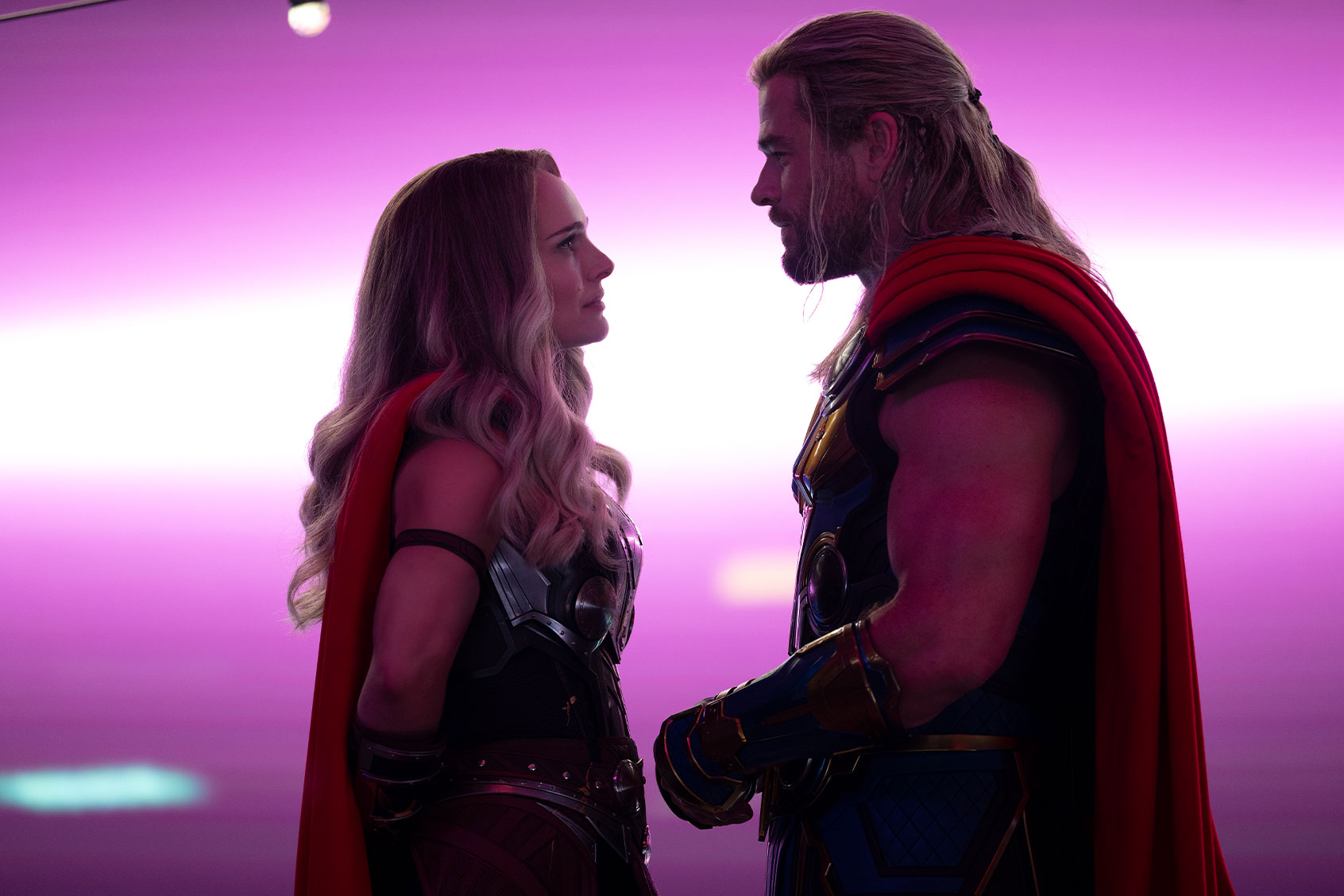
Cementing its potency with the next generation requires that effort. Some have posited that the lack of a gargantuan villain lurking at the next intersection of this part of the MCU has left the franchise rudderless (although Jonathan Majors’ Kang the Conqueror was introduced at the end of the first season of “Loki”). I suspect that’s less of a problem than Marvel contending with the fact that their Infinity Saga fanbase is aging, and now they’re making movies and TV shows for their kids.

But none of those are flies in the “Love and Thunder” cocktail, especially given the final battle’s adorable reinforcement by a gaggle of electrified moppets. What ails the movie is the Marvel franchise’s inability to sell romantic relationships that don’t somehow originate on the battlefield or, in the case of Tony Stark and Pepper Potts (Gwyneth Paltrow), materialize out of proximity, necessity, and utility.

Thor: Love and ThunderNatalie Portman as Mighty Thor and Chris Hemsworth as Thor in “Thor: Love and Thunder.” (Jasin Boland/Marvel Studios)
“Thor” and “Thor: Love and Thunder” double as self-improvement tales for Hemsworth’s superhero. In the first “Thor” movie, his father strips away his powers and doesn’t allow him to regain them until he learns how to become a more considerate being. In “Love and Thunder” his emotional mission is to accept grief as the price for caring about people, specifically one person.
And Jane – who, like Pepper and MJ in “Spider-Man, is a regular human caught up in the action – is the catalyst for both of those lessons. She’s a scientist, he’s a god.

During their first shared meal in “Thor”, he thinks proper dining etiquette means smashing dishes and screaming “More!” By the end of “Love and Thunder,” he’s lovingly making breakfast for a little girl.

To some, Jane is living the dream. Other srecognize that development as deeply problematic, the pipe dream of a broken man who can be fixed. And if this is Love, Marvel-style, it’s no surprise that the original “Thor” was the only MCU movie before the releases of “Eternals,” “Multiverse of Madness” and now “Thor: Love and Thunder” to earn a CinemaScore grade lower than an A.

In a subgenre that until recently targeted the young male demographic and sold tickets with the promise of showing man-sized people wreaking world-ending havoc, who wants to wrestle with that sugary bloat?


Want a daily wrap-up of all the news and commentary Salon has to offer? Subscribe to our morning newsletter, Crash Course.


Nevertheless, “Love and Thunder” is not the abject failure it’s being made out to be in the press and social media. It’s simply not the typical MCU flick we’ve been trained to expect. If “Love and Thunder” is dumber than a box of rocks, maybe that’s because the story is delivered from the viewpoint of, what? A sentient pile of pebbles.

It is substantially goofier, trading wit for camp and channeling its rock star vibes more expressly than before. It is also targeting people who see Hemsworth as eye candy and Thor as suitable for children. And that worked over its opening weekend, at least, when it made $143 million domestically and raked in $302 million worldwide.

Perhaps, then, the problem isn’t its insufficiency compared to its more popular MCU predecessors, but the fact that it’s trying too hard to woo a new audience in an arena that doesn’t play to its strengths. To a lot of people, there’s nothing less attractive than a suitor who’s trying too hard.

“Thor: Love and Thunder” is now playing in theaters.

More stories like this:

College Republicans rocked by underage sexual misconduct scandal

The chairman of the Oklahoma College Republicans was charged on Monday with two felonies over sexual misconduct with a minor. 

Jonathan Hernandez was arrested last Friday after inviting a 14-year-old from church, where Hernandez served as a minister, back to his dorm room at the Oklahoma Christian University. There, Hernandez watched porn with the victim, asked to see the child’s genitals, and requested oral sex, according to an affavdavit reviewed by an NBC affiliate.

College Republicans, a student-led society of Republicans, said that it was “disgusted to hear about the deplorable conduct of Jonathan Hernandez,” who served as a former board member of the organization.

“Our tent is big,” the group added, “but it is not big enough to accommodate sexual misconduct or predatory behavior.”

RELATED: College Republicans in disarray after ‘stolen’ election — Texas chapter may even secede


Want a daily wrap-up of all the news and commentary Salon has to offer? Subscribe to our morning newsletter, Crash Course.


https://twitter.com/CRNC/status/1546546659198644224

Hernandez was previously employed by state superintendent candidate Ryan Walter and was reportedly paid $2,000 in conjunction with Walter’s campaign. Just prior to his arrest, Hernandez was working as a full-time operations specialist for the Oklahoma senate, which told the NBC affiliate that his contract was terminated shortly after news of his arrest.

The state’s Republican Party said that they “condemn all instances of sexual assault in the strongest possible terms” and had no prior knowledge of the arrest. 

Oklahoma Christian University likewise said that it was “shocked and saddened to learn recently of an alleged incident that occurred two years ago involving a former student in a campus apartment.”

“Once notified of the allegation our campus police immediately investigated and referred the case to OKCPD,” the school added. “We will continue to fully cooperate with authorities as they move forward. We are praying for healing and justice in this situation.”

https://twitter.com/made4tv/status/1545552698434625536

RELATED: Why a second high-profile Republican in Oklahoma just left the GOP

Trump impeachment lawyer pokes holes in Secret Service’s claim over missing Jan. 6 texts

Appearing on CNN’s “New Day” on Friday morning, former House impeachment lead counsel Daniel Goldman cast a jaundiced eye at Secret Service claims that the only texts missing among agents occurred around Jan. 6, saying there is more to the story than government officials are letting on.

Joseph Cuffari, the inspector general of the Department of Homeland Security, told Congress in the letter dated Wednesday that his office has had difficulties obtaining records from the Secret Service from January 5 and 6, 2021.

The messages could be crucial to the House of Representatives and Justice Department investigations into whether Donald Trump and his close advisors encouraged the deadly insurrection by the former president’s supporters at the US Capitol, which aimed to prevent the certification of Democratic rival Joe Biden as the winner of the November 2020 election.

“The Department notified us that many US Secret Service (USSS) text messages, from January 5 and 6, 2021, were erased as part of a device replacement program,” Cuffari wrote in the letter first reported by The Intercept and later published by Politico.

Speaking with hosts Brianna Keliar and John Berman, Goldman was asked about the report.

“Daniel, what do you see here?” host Berman began. “What we know is that a Homeland Security inspector general asked for these text messages and now we are learning from this Homeland Security inspector general, it’s a letter from this person, saying that they were destroyed according to them after this request. What does that tell you?”

“Well, first of all, let’s remember these letters are not written lightly to Congress,” he began. “I am sure that the inspector general notified the Secret Service that they would have to send this letter if they did not get better compliance and they didn’t, but more importantly and to the point, there are a lot of questions that this raises.”

“They claim that it was a phone migration system, but the only days of texts that were erased were January 5th and 6th?” he elaborated. “That seems very unlikely that that is due to the phone migration. Second, I would want to understand when this happened because what the letter says is that these text messages were requested by the IG as part of their investigation into January 6th and that after that request these texts were deleted.”

“Now that raises a lot of suspicions as well because you should freeze everything when a request is made by any lawful investigator,” he added. “And then finally it raises a lot of questions as to whose texts were deleted. Was it Tony Ornato who was a Secret Service official who came on board as a political appointee as deputy chief of staff? So there are still many questions to answer, but it is very suspicious, especially because of the critical role that the secret service played on January 5th and January 6th stopping Donald Trump from going to the Capitol, scurrying Mike Pence out of the capitol when he was under serious threat. Many, many questions have to be directed at the Secret Service.”

The Secret Service has been criticized for not adequately anticipating the threat of the violent action by armed Trump supporters on January 6.

Trump had made a senior Secret Service official at the time, Tony Ornato, his personal deputy chief of staff.

Ornato has denied the account given to the January 6 committee by former Trump aide Cassidy Hutchinson that Trump tried to force the Secret Service to drive him to the Capitol as his supporters massed at the building, the seat of the US legislature.

But other then-White House officials have backed Hutchinson’s story.

Cop confirms Cassidy Hutchinson’s testimony about Trump and the Capitol riot: CNN

CNN reported on Thursday that a police officer in Donald Trump’s Jan.6 motorcade confirmed testimony by Cassidy Hutchinson before the House Select Committee Investigating the Jan. 6 Attack on the U.S. Capitol.

Hutchinson testified about a discussion with Trump Deputy Chief of Staff Tony Ornato and Robert Engel, who ran Trump’s Secret Service detail.

“I looked at Tony, and he had said, ‘Did you f*cking hear what happened in the Beast?’ I said, ‘No, Tony, I just got back. What happened?’ Tony proceeded to tell me that when the president got in the Beast, he was under the impression from Mr. [Mark] Meadows that the off-the-record movement to the Capitol was still possible and likely to happen, but that Bobby had more information,” she testified.

READ: Exclusive: All 50 Senate Republicans weigh in on Jan. 6 hearings – only 8 are watching

“So once the president had gotten into the vehicle with Bobby, he thought they were going up to the Capitol, and when Bobby had relayed to him, we’re not, we don’t have the assets to do it, it’s not secure, we’re going back to the West Wing, the president had very strong, very angry response to that,” Hutchinson said.

“Breaking news, a source telling CNN a Washington police officer who was in Trump’s motorcade on Jan. 6 has corroborated details of the heated exchange Trump had with his Secret Service detail when he was told he could not go to the U.S. Capitol and he wanted to go,” CNN’s Erin Burnett reported.

“This development comes as a government watchdog reveals the Secret Service erased messages from the day of the insurrection — after investigators asked for them,” Burnett added.

Watch below or at this link.

John Cho on road trips, his go-to karaoke songs and approach to life: “I’m very open to risk”

John Cho delivers a heartbreaking performance in the terrific if bittersweet father/daughter tearjerker, “Don’t Make Me Go,” directed by Hannah Marks. Max (Cho) is the single, play-it-safe father to the responsible teenage Wally (luminous newcomer Mia Isaac). When Max insists Wally accompany him on a road trip to his college reunion, she does not want to go. Wally is having issues with Glenn (Otis Djanji), a classmate who is hesitant about becoming her official boyfriend. Max’s plan — unbeknownst to Wally — is to track down his ex-wife as she is his daughter’s only living family. He has just been diagnosed with a bone tumor near his brain and has a limited time to live.

As they travel from California to New Orleans, Max teaches Wally life lessons as well as how to drive. And, as in any road movie, the characters fight and bond, discover new things about each other (and themselves) and have some horrible experiences — such as a scene at a nude beach.

Like his turn in the poignant “Columbus,” Cho is in low-key mode here as Max is both sensible and overprotective. And part of the strength and depth of his performance is how thoughtful Max is with Wally, even at his angriest. Max is patient with his daughter at a casino, albeit less so when she is merging into traffic. But when he gives her advice during a dance or goes with her to a karaoke bar, these characters show how much they love each other. During some of the more emotional moments that involve hard or hurtful words, there is caring and compassion. 

“Don’t Make Me Go” shows the push-pull relationship between father and daughter which, along with the strong performances is why this film is so affecting. (Warning, it may wreck viewers.) 

Cho spoke with Salon about his new film, his karaoke skills, and a memorable family road trip.

Max has to make an important decision in the film and is risk adverse. Do you often play it safe? In what ways are you “boring and grown up,” and in what instances do you take a chance? 

“The non-diverse stuff is the fiction. This felt authentic to me.”

I am very protective of my loved ones. For instance, I wanted my parents to be in a room during COVID and never come out to protect them, and they were like, “We have to take some risks,” and they were obviously more willing to take risks for themselves than I was comfortable with. That is a tension all throughout my life. I’m very open to risk for myself and closed out to risks for my loved ones.

The film does not really address issues of race, though they do hang in the background; Wally’s mother is Black. Moreover, I appreciated that there was no overt racism in the film, no stereotypes other than the straight white men in the film being mostly douchebags. Was that important to you for the project and is this another step forward?

I didn’t really think about it. It came naturally. The script was written for a white man, I believe. Hannah wanted me in the role, and we looked for an actress to play my daughter. We auditioned various actresses with different racial backgrounds. We went with Mia because she felt like the right choice. That led to the casting of the mom. That fits in with my overall worldview about diversity, which is that non-diverse stuff is unnatural and diverse is very natural — it’s what you see in the world. The non-diverse stuff is the fiction. This felt authentic to me. There was no mention of [Wally] being biracial explicitly in the script. Hannah asked Mia if there was an opportunity to bring it up if there is something natural from her childhood that might fit it in, and there were a couple of instances. But the focus was on the relationship, and it didn’t seem natural to jam any of that in in this particular narrative.

The scene of Max and Wally dancing was one of many that brought me to tears. How are you doing with applying the lessons you learned from your parents to your children? 

“This is not in the text, but if there is a subtextual Asian reading of the film, that’s it for me. I grew up in a family where we children were protected from a lot of stuff that was hidden from us.”

Obviously, being a father attracted me to script, and it also made me feel there was something I could bring to the material. It is a lesson that I am in the process of learning — and it has taken me decades — and I am still learning how to be present and prioritize who and what is important. In my line of work, I meet so many people, more people than is normal, so it’s critical that you have to be selective about who you let in, and who you spend time with, and who you value. The smaller the circle the better for me. It is something that I am struggling with. To me, the film is a testament to the time we shot it in, which is early pandemic — and that time was so terrible, because we couldn’t see our loved one and our friends — so we got this opportunity to make this movie about treasuring that, so it seems fitting that is the lesson of the film for me. 

Don't Make Me GoJohn Cho and Mia Isaac in “Don’t Make Me Go” (Amazon Studios)
The film is about “masking,” in that several characters hide painful truths to protect other people’s feelings by pretending things are OK. Can you talk about that facet of the film? It’s important that Max reveal things to Wally but often his hand is forced, which does both of them a disservice.  

This is not in the text, but if there is a subtextual Asian reading of the film, that’s it for me. I grew up in a family where we children were protected from a lot of stuff that was hidden from us. I don’t know if that is healthy or not and I struggle with that as a parent — what to reveal to them and what to protect them from. It’s a balance. 

I wrote a middle-grade novel [“Troublemaker“] that came from a very similar circumstance, but it wasn’t personal. It was us watching George Floyd’s murder and the Black Lives Matter protests and asking, “How do we engage children in this and how much do we tell children the history behind it and what is going to be counterproductive and what is going to be productive?” That’s the balancing of parenting I feel. 

Whereas Max was wilder in his youth, he is very overprotective now. Wally, however, is from what the film shows mostly responsible. What observations do you have about Max and Wally and their issues with trust and truth and the power struggle they have?

“I don’t mind making an ass of myself at karaoke. It’s a low-risk situation to me.”

From Max’s point of view, a lot of parents are afraid their children are going to do exactly what they did, and sometimes they are ascribing personality traits that are not actually present, or seeing what’s in front of them; not being present and not actually receiving information from their children, does a disservice to them. The journey of the movie is that Max, through that time in the car, that crucible, they actually see one another. It takes a while to see someone who has been standing in front of your all your life.


Want a daily wrap-up of all the news and commentary Salon has to offer? Subscribe to our morning newsletter, Crash Course.


How are your karaoke skills? It’s fun seeing you sing and cringy to see you rap in “Don’t Make Me Go.” 

I don’t mind making an ass of myself at karaoke. It’s a low-risk situation to me. But I also love hearing all kinds of voices and love karaoke for that reason. I prefer to hear people who are not good at singing. I love the sound of the human voice. 

What song(s) would/do you perform at a karaoke bar? 

My go-tos are “Hello” by Lionel Richie, “Beast of Burden” by the Rolling Stones, and “Like a Prayer,” by a young artist named Madonna.

Can you talk about a particularly memorable road trip you made with your family?

I will give you a glimpse into Korean American family life. My parents said, “We’re going to see the Grand Canyon. Let’s get in car!” We drove [from Burbank] to the Grand Canyon and I’d seen the “Brady Bunch,” so I was imagining when they took a mule down the canyon. We got there, got out of the car, took some pictures, got back in the car and turned around. [Laughs] “We got the picture. Let’s get out of here!”

“Don’t Make Me Go” premieres July 15 on Prime Video. Watch a trailer via YouTube.


Read more

about this topic

A new study unlocks secrets of dog domestication

There is a good reason why so many humans refer to dogs as man’s best friend. Humans domesticated dogs more than 11,000 years ago, before we even invented agriculture. Today dogs are popular as pets and “work” in countless day-to-day occupations alongside humans.

Yet despite our primal connection to canines, scientists don’t entirely understand the process through which modern dogs were domesticated and diverged from their wolf-adjacent ancestors.

Now, a recent study published in the journal Nature has advanced our understanding of the evolution of dogs. Among other things, the researchers led by scientists from London’s Francis Crick Institute figured out that modern domesticated dogs are overall more closely related to wolf ancestors from the eastern part of Eurasia (that is, modern Asia), as opposed to the western part of Eurasia (modern Europe). Keep in mind that, as recently as 10,000 years ago, wolves were some of the most common predators on Earth, and wolves and their close canid relatives occupied every continent save Antarctica and Australia

RELATED: Scientists just learned what makes dogs huge or tiny — and it long predates selective breeding

“Our study takes important steps forward on the question of dog origins,” Anders Bergstrom, one of the report’s co-authors and a scientist at Crick’s Ancient Genomics Laboratory, told Salon by email. “Studying ancient wolves that lived close to the time of dog domestication, we found that dogs overall are more closely related to ancient wolves in Asia than to ancient wolves in Europe, suggesting a domestication process somewhere in the east.”

Yet this does not mean that all modern domesticated dogs came entirely from that eastern Eurasian domestication process.

“We find that some dogs, in particular those in Africa and the Near East, have an additional genetic contribution from a second wolf source population, one that is related to wolves in the west,” Bergstrom noted.

Bergstrom concluded, “There thus seems to have been at least two separate wolf source populations, giving rise to dual ancestry in dogs today.”

That makes dogs curiously similar to modern humans. The human genome contains about 2.5 percent Neanderthal DNA, meaning that we are the modern hybrid of two hominids; though interestingly, not all humans have much of this DNA, and some human populations have almost none. Likewise, dogs appear to be the modern hybrid of two different “source wolves” with slightly different genetic composition and from different regions — though like us this second wolf contribution is not ubiquitous among dogs. 


Want more health and science stories in your inbox? Subscribe to Salon’s weekly newsletter The Vulgar Scientist.


To arrive at these conclusions, the scientists analyzed 72 genomes from ancient wolves, accumulated from Eurasia and North America and derived from a span that includes the last 100,000 years of history. They then compared that data with existing information about the genetics of various dog breeds all over the world.

“None of the ancient wolves included in our study are an exact match for either of the two source populations, suggesting that the sources will have lived in parts of the world that we have not yet sampled,” the scientists mused.

“We found that wolf populations were highly connected throughout the Late Pleistocene, with levels of differentiation an order of magnitude lower than they are today,” the scientists write. “This population connectivity allowed us to detect natural selection across the time series, including rapid fixation of mutations in the gene IFT88 40,000–30,000 years ago.”

In addition, the scientists’ research helped them figure out that modern dogs in Africa and the Middle East derive at least half of their ancestry from an entirely separate wolf population, one that is related to modern southwest Eurasian wolves. This indicates “either an independent domestication process or admixture from local wolves.”

“There are two scenarios that could explain the dual ancestry that we have found in dogs,” Bergstrom explained. “First, there could have been two independent domestication processes, with the two populations then coming together and merging into one. Second, there could have been just one domestication process, followed by gene flow from local wild wolves into dogs after dogs had arrived in e.g. the Near East. We cannot tell these two scenarios apart currently, but hopefully future studies of early dogs will be able to distinguish them.”

Bergstrom elaborated on what kinds of future research will be needed.

“None of the ancient wolves included in our study are an exact match for either of the two source populations, suggesting that the sources will have lived in parts of the world that we have not yet sampled,” the scientist mused. “So while our study shows that there would have been at least two source populations, the search for those sources will continue. Hopefully, by sampling more ancient wolf genomes from other parts of the world, future studies will be able to narrow down more precisely where dogs come from.”

In recent years, scientists have made remarkable strides in learning more about the origins of domesticated dogs, and much of that work is due to advances in genetic technology. For instance, a 2020 study published in the journal Science revealed that modern sled dogs are closely related to an ancient lineage of dog that traces back at least 9,500 years.

“Together, these findings indicate substantial long-distance travel and transportation of resources, in which dog sledding would have been highly advantageous — if not necessary,” the authors wrote in their study. After reviewing the specific details of their analysis of a 9,500 year old dog, they added that “our results imply that the combination of these dogs with the innovation of sled technology facilitated human subsistence since the earliest Holocene in the Arctic.”

Read more Salon articles on dogs:

After algorithm shift, Uber Eats couriers without cars report dwindling wages

J. Cooper mourns for the days when bicycle messengers were a common fixture in Chicago. Up until the 2010s, the city’s streets were packed with a ragtag coalition of sweat-drenched cyclists speeding from office to office. These workers were so integral to the professional landscape that former Mayor Richard M. Daley proclaimed Oct. 9, 2007, to be “Bicycle Messenger Appreciation Day.” 

Today, Cooper, who has delivered for Uber Eats using his bicycle for nearly three years, struggles to feel a similar sense of appreciation. 

Months ago, Cooper noticed that the number of deliveries being assigned to him by Uber Eats had dwindled, especially during peak hours like the lunch and dinner rushes. After speaking with fellow food delivery workers, who reported similar lags, but only if the delivery method was cycling or walking, Cooper began to wonder if a change to the app’s algorithm was behind the switch.

It wasn’t an unfounded suspicion. In May, a spokesperson acknowledged a shift in how orders were being routed to couriers.

“We have not phased out couriers who deliver on foot, and we have no plans to,” Uber Eats told Fortune in a statement. “We are simply encouraging couriers to bike when possible to ensure the most reliable delivery times for consumers.”

That statement reportedly echoed an April email in which the company told couriers, “We’re changing the way courier trip requests are sent. (Hint: wheels > feet.)” 

Now, Cooper believes Uber Eats has shifted its algorithm yet again to prioritize couriers who deliver via car over those who deliver via bicycle. 

“The change in algorithm has killed bikers’ and walkers’ profits,” he told Salon Food. “I noticed long ago that Uber was giving preference to cars . . . Can you imagine being on a bike and a car being given shorter-distance orders than you are?” 

Mike Hammond, another Chicago-based Uber Eats courier who delivers using his bicycle, similarly suspects an algorithm shift after witnessing his “profits taking a hit.” What’s more, it’s increasingly difficult to turn a profit doing this type of gig work, he says.

“Delivery people on these apps are not employees, and their pay is the sum of all the trips they take in a day,” Hammond told Salon. “The reality is that the app sends you $2 offers 90% of the time.” 

He continued, “This means that in order to really make any money, you have to be very selective about the orders you accept and wait around for an order that makes financial sense to take. At the end of the day, you end up making less than minimum wage a lot of times.” 

Reached via email, a spokesperson told Salon that Uber Eats had sent couriers who deliver on foot a communication detailing a change intended to prioritize the worker with the most “efficient delivery time” in the interest of reliable service. 

According to Uber Eats, couriers are assigned orders based on a variety of factors: the courier’s mode of transportation; the pick-up and drop-off location; as well as how many other couriers are available at the time. 

While the spokesperson said the change wasn’t intended to prioritize one mode of transportation over another, they didn’t respond to inquiries about the potential impacts the move would have on bicycle couriers.

Regardless, concerns about a shift in the Uber Eats algorithm negatively impacting bicycle couriers have been echoed by numerous Reddit users who report doing gig work for the company. Despite being online for hours, workers described plummeting profits after receiving no orders in a July 7 post titled “Real talk, is the biking algorithm dead?”.

“Mostly dead in Dallas,” one user reported. “I think the priority [was] swapped and bikes get the leftovers.” 

Another individual echoed that sentiment: “Yeah, 100% seems like it. I started working [by] bike in May, literally back-to-back orders nonstop all day . . . Ever since the walker [announcement] in April, literally lucky to make 30 to 50 bucks, and that’s after working 8 to 10 hours.” 

“I’m a student and I could pull in $400 a week being picky with what I accept,” someone else wrote. “Now there aren’t even orders to accept lol. Thank god I’m not our only income.” 

This shift at Uber Eats arrived at a time when many gig workers were feeling the brunt of surging gas prices. While the company has implemented per-ride or per-order surcharges, to some, the option for couriers to pick up orders using a bicycle or while walking, especially in more densely populated cities, seemed like a sensible alternative. 

Hammond attempted this transition after gas prices began to climb and Uber Eats reduced base pay to $2 within his market.

“The plan was to bike during the day and drive at night,” he said, “but in this market right now, it’s tough to make a profit either way.”

According to Hammond, he simply isn’t getting any traction for bicycle orders, which is tough to swallow as it costs more and more to fill up his car. This development leaves bicycle-only couriers like Cooper feeling further unmoored.

“At present, I am not seeking other bike work, and other than food delivery, what is there?” Cooper said. “‘Bike mode’ is not very conducive to delivering groceries or packages, and the old bike messenger-type jobs don’t seem to exist anymore. It’s sad in that when delivery apps first came on the scene they were totally bike-oriented.” 

Read more

from Salon’s archives

“Where the Crawdads Sing” is a stupefyingly bad adaptation of spoon-fed melodrama

For those unfamiliar with the bestselling novel, “Where the Crawdads Sing” by Delia Owens — this stupefyingly bad big screen adaptation plays out as if Nicholas Sparks rewrote “To Kill a Mockingbird” and took out all the racial elements. 

The crawdads don’t sing, but Taylor Swift does. 

The film is so blandly directed one might think it was made by Ron Howard. The blame belongs to Olivia Newman, who has no sense of pacing. The editing is clunky as the story jumps around in time. The performances are painfully earnest. The story involves a murder, but the subsequent courtroom scenes have no tension. The love triangle that develops has no passion. And the crawdads don’t sing, but Taylor Swift does. 

The film is set in (the fictional) Barkley Cove, NC, in 1969. Kya (Daisy Edgar-Jones) explains, “The marsh is not a swamp,” and, “The swamp knows all about death.” She is “The Marsh Girl,” a young woman who was abandoned by her family; her father (Garrett Dillahunt) was abusive and drove her mother and siblings away before he himself left. Kya is a preteen who lives alone in the marsh, mostly drawing shells, insects, and other images of nature.

The film opens with some kids finding the corpse of Chase Andrews (Harris Dickinson). Kya, who has barely been introduced, is suspected of his murder (and presumed guilty) because she is the local outsider. Fortunately, Kya does get the sympathy of Tom Milton (David Strathairn) a lawyer who comes out of retirement to defend her. Strathairn plays Tom less like a stoic Atticus Finch and more like stammering Jimmy Stewart. His “aw, shucks” quality is oddly exasperating. Tom claims he wants to “get to know” Kya, so he can keep her off death row, and so, the film recounts her story.

“Where the Crawdads Sing,” jumps back to 1953 to Kya as a child (Jojo Regina) who is neglected and abused as well as teased when she goes to school barefoot and unkempt and can’t spell “dog.” She does get some kindliness from the Black couple, Jumpin (Sterling Macer Jr.) and Mabel (Michael Hyatt) who run a local store. They give her shoes, encourage her to pursue an education, and generally look out for her. At one point, Social Services asks Jumpin about Kya, but that plotline is dropped never to be raised again. It is uncanny that Jumpin and Mabel do not age during the film’s primary time period, 1953-1969, nor do they seem to encounter any racism despite being the only Black people in the film. 

The film toggles haphazardly back and forth to the courtroom (some viewers may experience whiplash) where Kya is on trial. Testimony and evidence are presented against “The Marsh Girl,” such as red fibers, which may be a red herring, but Tom Milton refutes it all shrewdly. 

Newman’s direction is so sluggish the film never finds its rhythm.  

The main narrative focuses on Kya’s love for Tate (Taylor John Smith) who brings her feathers and teaches her to read. Their budding relationship is depicted in a montage so insipid one’s eyes might glaze over. As Tate talks about a tragedy in his past, leaves start swirling in the wind and the couple kiss in a Big Romantic Moment. It is obvious that director Olivia Newman wants this to be the swoon-inducing lovers-kissing-in-the-rain scene from “The Notebook.” Instead, viewers may fall down in fits of unintentional hysteria.

And while Tate is enough of a gentleman — he cares too much for Kya to have sex with her — he does break her heart when he leaves to go to college. More damaging, he breaks his promise to reunite with her one July 4th. Kya, having put on lipstick and a fancy dress for Tate’s return, is despondent in a way not seen since the original “Stella Dallas.” And, as if the despair wasn’t already apparent enough, Kya voices her disappointment about her “heart pain” seeping away like water and sand. Cut to an image of water and sand as if Newton wasn’t sure audiences could get the metaphor. 

Where the Crawdads SingKya (Daisy Edgar-Jones) in “Where the Crawdads Sing” (Sony Pictures)

“Where the Crawdads Sing” often spoon-feeds viewers everything they need to know with oh so tender voiceovers, dialogue, and images that simply overstate the obvious. For the many viewers who have read the book, there are no real narrative surprises (including the big “gotcha” twist). But surely the story could be told in a way — say, linearly — that would inject this overheated melodrama with some desperately needed dramatic impact. Newman’s direction is so sluggish the film never finds its rhythm.  

The performances are also distracting. Daisy Edgar-Jones seems entirely miscast here.

When Chase enters the picture, he starts to woo Kya for reasons that are initially unclear to her. (Spoiler: he’s just horny.) Chase fills Tate’s absence in Kya’s lonely, isolated, abandoned, remote, and secluded life. But his character is too unformed to generate much interest — until he starts abusing Kya. Of course, someone overhears her threatening to kill Chase in one scene, and this fact is brought out in the courtroom as damning evidence that she is guilty of murder. Cue gasps from the peanut gallery.  

It is a shame the film shoehorns so much of the book into two hours. It might have been better developed as a miniseries, where it could explore or at least develop its ideas and characters. The film only really scratches the surface of any of the critical issues raised, such as women’s domestic and sexual abuse. Kya is nearly raped in one scene, and declines to discuss it with the authorities because she feels her claim will not be believed or supported. The final 10 minutes of “Where the Crawdads Sing” covers so much time so fast it is dizzying. But at last, Mabel ages!

Newton’s focus on the murder case and Kya’s two romances dilutes the arguably more interesting story of a young, independent woman getting an education and eking out life on her own. 

The performances are also distracting. Daisy Edgar-Jones seems entirely miscast here. She is completely unconvincing as a “wild” young woman whom everyone thinks is “trash.” Her wide eyes convey disbelief at every opportunity, and it just seems like her default expression. When young Kya looks back at Mabel through the window in the store’s door, having just been treated kindly, it provides the film’s only poignant moment. When the adult Kya angrily glares at Tate or Chase it feels empty. 


Want a daily wrap-up of all the news and commentary Salon has to offer? Subscribe to our morning newsletter, Crash Course.


Moreover, Edgar-Jones has little to no chemistry with either of her male costars. Both Taylor John Smith and Harris Dickinson may look like they stepped off the pages of an Abercrombie and Fitch catalog — Kya apparently has a type — but both actors give lazy performances. That is forgivable with Smith, who is playing the genuinely nice guy, but Dickinson, who is usually magnetic on screen, oddly lacks charisma here, which is fatal. 

Strathairn and Dillahunt border on doing some scenery chewing, but it may be that Newton does not trust them to underplay. As Jumpin and Mabel, Sterling Macer Jr. and Michael Hyatt play virtuous well.

“Where the Crawdads Sing” is disappointing adaptation. It is very much like a swamp: tepid and unmoving.

“Where the Crawdads Sing” is in theaters July 15. Watch a trailer via YouTube.

Read more

about this topic