Spring Sale: Get 1 Year, Save 58%

Don’t ignore the Wisconsin Supreme Court race — it could be crucial for democracy

In April, Wisconsin voters will go to the polls to elect just one justice on just one court — and this race has rightfully been deemed one of the most consequential elections of the year. That’s because the person elected to the Wisconsin Supreme Court this year could well prove to be the deciding vote on whether Wisconsin protects abortion rights, on cases over election laws heading into the 2024 election cycle, and on whether the will of Wisconsin voters is upheld after the 2024 presidential election. Regardless of what state you live in, it’s worth paying attention to this race, which could impact the fate of our democracy. 

There are seven justices on the Wisconsin Supreme Court. While the court is meant to be nonpartisan and the election is nonpartisan, the current court is routinely described as having a 4-3 conservative majority. The April election is to fill the seat of Justice Patience Roggensack, one of the described conservative justices, who is stepping down. 

The Wisconsin Supreme Court has unfortunately fallen victim to the same corrosive partisanship that defines the U.S. Supreme Court — with the legitimacy of both courts eroded by it. Decisions made by these courts can increasingly be predicted based on the partisan alliance of the respective justices. This is particularly evident in cases related to  two fundamental rights: abortion and voting. 

In Wisconsin, the U.S. Supreme Court’s Dobbs decision and its erasure of the federal constitutional right to abortion revived a 19th-century law banning abortion. That law is horrific on its face, forbidding all abortions except to preserve the life of the mother. To compound the challenges, its wording is also excessively vague — perhaps because it was written more than 150 years ago. 

How much is on the line in this judicial election? Consider that $10 million will likely be spent on this race, most of that in untraceable dark money.

The Wisconsin Supreme Court will decide, in litigation that’s now en route to the court, whether this ban violates the state constitution and what that constitution does or does not protect in the way of abortion rights. As states that protect abortion rights see an increasing number of out-of-state patients, the Wisconsin Supreme Court’s decision will inevitably have ramifications for patients both in Wisconsin and outside the state.  

The court could have an even greater national impact on the electoral front. Our elections have become judicial affairs with a myriad of litigation over voting laws taking place before Election Day and more litigation over election results afterwards. 

Last year, before the midterm elections, the Wisconsin Supreme Court ruled, in a 4-3 decision, that drop boxes were illegal. In 2021, the court, also in a 4-3 decision, largely upheld Republicans’ gerrymandered electoral maps. It is impossible to know the magnitude of the impact these decisions had on election results, but they undoubtedly had one. 


Want a daily wrap-up of all the news and commentary Salon has to offer? Subscribe to our morning newsletter, Crash Course.


While the Wisconsin Supreme Court rejected Donald Trump’s lawsuit challenging the state’s election results in 2020, it did so in a 4-3 decision, with one of the court’s conservatives joining the three liberal justices to dismiss the suit. The closeness of that decision, coupled with the court’s pattern of decisions about the state’s electoral laws and maps, leave me worried about the next election cycle. We want to believe that a frivolous lawsuit aimed at overturning the will of the voters would be similarly dismissed in 2024, but that will depend on the people who sit on the court at the time of the lawsuit. 

We’ve already had one presidential election decided by the U.S. Supreme Court, in the case Bush v. Gore in 2000. In 2024, a state supreme court — especially one in a swing state like Wisconsin — could hold the outcome of the presidential election in its hands. 

If you want further evidence of how much is on the line in this judicial election, just look at the millions and millions of dollars being spent on it. Wisconsin’s supreme court races are routinely some of the most expensive judicial races in the country. The 2019 Wisconsin Supreme Court race saw a combined spending of $6 million. This year’s election could exceed $10 million, with most of that coming from dark-money groups.  

Now more than ever, the laws and legal systems that govern our lives and our elections are being shaped by state courts. The primary for the Wisconsin Supreme Court election is this Tuesday, and will determine which two candidates move on to the general election on April 4. If you are an eligible voter in Wisconsin, mark your calendar and vote! Your fundamental freedoms could depend upon it. If you live outside Wisconsin, watch closely. Our democracy could depend upon it.

“All Creatures Great and Small” writer on bringing “bittersweet” comforts of WWII to the Dales

At long last “All Creatures Great and Small” breaks tradition . . . by giving Mrs. Hall some yuletide comfort and joy.

During Christmas parties past, we’ve seen the 1930s British housekeeper Audrey Hall (Anna Madeley) stood up by her estranged son Edward or left to handle the Skeldale House drudgery while everyone else celebrates. Despite her troubles, she always plasters on a smile while soothing and nourishing those around her. This time, however, she does something solely for herself. She lets go of misplaced loyalty to a long-absent husband and instead kisses her dedicated suitor Gerald Hammond (Will Thorp) – twice!

“Downright racy,” series writer Ben Vanstone told Salon with a laugh. “We’ve seen she’s had some pretty rubbish Christmases and we felt that Mrs. Hall deserved a good Christmas this year. 

“She’s always doing things for everyone else,” he continued. “Gerald is always offering to bring her tea, to get her cake or do the washing up with her. He’s always there for her in a way that other people aren’t necessarily. So it felt the right time. Something that was broken was a little bit mended in her with Edward, and that allows her to take a little step forwards with Gerald.”

While it took three seasons for Mrs. Hall to get some loving, it took just as long for devil-may-care Tristan Farnon (Callum Woodhouse) to earn everyone’s respect – both at his older brother Siegfried’s (Samuel West) veterinary practice and among the surrounding Yorkshire Dale farms. Yes, Tristan had eventually proven himself as a capable veterinarian, but Siegfried had always been the disapproving holdout. With Britain entering the war against Germany, Tristan decides to go and serve his country, and Siegfried reluctantly respects this choice.

“Alf Wight makes a conscious decision not to dwell too much on the war actually in his book.”

Perhaps this is what also earns Tristan the honor of making the Christmas dinner toast. He speaks eloquently about missing family and giving thanks to those who fill that hole, concluding with, “The only thing left to say is Merry Bloody Christmas!”

“That’s what Siegfried says in Series 1,” said Vanstone. “It’s nice to see Tristan trying to be grown-up in a way, to offer up some honest emotions and trying to say what he truly feels about his brother, which they never do. They always dance around each other through the series, and it felt like the right opportunity for him to.

“And then ‘Merry Bloody Christmas,’ I think it’s something we do a lot in ‘All Creatures.’ Where there’s moments of sentimentality, we will always try and undercut them somehow so it doesn’t feel too saccharine. It’s a very British thing as well, actually. If we ever get too close to be honest with our emotions and feelings we’ll automatically revert to humor to undercut ourselves.”

Both of these major character shifts – Mrs. Hall coming out of her servile shell and Tristan taking responsibility – come about with the advent of World War II for Britain on Sept. 3, 1939 in the series. Although it was a distant reality in the books by Alf Wight on which the “Masterpiece” series is based, it was a deliberate decision on the production’s part to show how even the verdant Yorkshire Dales were affected by the sacrifices of war.  

“I think it’d be very easy when you’ve got something that works to just just keep rolling with it,” said Vanstone. “But we really felt that we wanted to push things on and find another gear with the characters this year and explore them a little bit further than we have done before.”

Read on for the rest of the interview with Vanstone, who discusses Mrs. Hall’s reunion with her son, Tristan’s growth, Christmas during wartime and of course, animals.

The following has been lightly edited for length and clarity.

You pulled a bit of a bait and switch saying there wouldn’t be a Christmas party and then having Mrs. Hall put one together anyway. Was there a discussion about not doing a party considering the war situation?

Just in terms of things being short, like food rationing, it was not a time for largesse. People are being sent off to go and fight; it didn’t feel quite right to be having a party at the same time. I’m sure there’s lots of different varied responses to war breaking and I know that some people were partying really hard because why not? The world could end tomorrow. I think there’s a whole range of different attitudes. We felt in the Dales and particularly our previous Christmas parties have felt very lavish. It didn’t feel that it was a time for for lavishness. 

In your research, what foods would’ve been in short supply during that time or seen as a luxury?

Lots of butter, sugar, all those sorts of things like flour were being rationed. Fuel. It gets more and more controlled. In the research we did, in the Dales, amongst the farming community, they still had their animals, they served their livestock, and they could still look after themselves in a way and give food and meet your neighbor who needed it. But it was taken under control by the government at some point in terms of produce, the way it was given out was taken control of centrally. 

All Creatures Great and SmallMrs Hall (Anna Madeley) in “All Creatures Great and Small” (Courtesy of Playground Entertainment / MASTERPIECE)Of course, trust Mrs. Hall to still be able to pull off a Christmas party despite that rationing. Speaking of her, we finally get some clarity with her son Edward (Conor Deane), who we know has an estranged relationship with her after he was caught stealing. He’s in the Navy and finally meets with her briefly at a train station. What was your intent for Mrs. Hall this season?

It felt important to me for Edward not just keep existing off screen. I always intended for Edward to appear at some point and Mrs. Hall having a chance to address her past with her son in a way that allows them to look forwards and give us some hope in that relationship. She’s carried a lot of baggage with her, and if she’s ever going to move forwards in life, I think she’s been held back by her past. 

“We see Mrs. Hall also gets nourishment. It’s some self care for her.”

This is a step along the way for Mrs. Hall, to some resolution with Edward. It’s not fully there, and I think that we we won’t ever fully know her story. We can all fill the gaps a little bit and then there’s things that are alluded to. It almost doesn’t need to be said to understand the harm and damage that’s been done to her. We see her process it.

Part of the friction with Edward is that he had stolen from one of her employers she was doing housekeeping for, and she reported it. He ended up getting sent to a borstal, a reformatory for young offenders. As an American I’m only faintly aware of borstals. What is their reputation?

Not great even then. They’re very harsh places for children to be sent. Mrs. Hall doesn’t know that’s what the end result result is going to be. She can see her son going off the rails and is desperate to get him back on the rails. She feels that by reporting this or not lying for him for whatever – I don’t think she imagines that he’ll be going to borstal. I think she hopes that the outcome from that will be that he realizes that he’s going down the wrong path and rights himself. And then it doesn’t go that way. He’s sent to borstal, which is a terrible thing for him.

The ending train scene feels awkward but true. Despite a strained conversation, Edward all of a sudden offers his mum a last-minute hug and agrees to accept the biscuits she had baked him. But in the rush, he drops the tin, and later she ends up eating them by herself alone. What did you want to convey with that scene?

The biscuits, this was an idea that [the episode’s writer Karim Khan] had very early on. The biscuits represent Mrs Hall’s desire to nourish and care for her son, and Karim was very clear that he wanted Mrs. Hall to get the biscuits at the end. And so we see Mrs. Hall also gets nourishment. It’s some self care for her at the end, the feeling that something that was broken has been improved.

Edward’s final words to her are drowned out by the whistle as the train chugs away. But one of the volunteers who served Mrs. Hall tea is deaf and is able to read his lips. He had said, “I love you,” back to his mother. Could you discuss using this device?

With regards to the the lost words at the train, throughout that episode Mrs. Hall has this relationship with a deaf volunteer. We wanted that character to have their place in the story, as well as wanting to make sure that we open up opportunities for people with disabilities. It was also about, “How does that person have agency in the story as well?”

The actor, Lara Steward, is deaf?

Yes, the tea ladies – both of them are profoundly deaf. We wanted to turn that into a way a superpower in a way. The whole story doesn’t work without that character being able to lip read at the end. Mrs. Hall doesn’t quite get what her son is saying. She’s desperate to hear what he said. We think for a horrible moment, “Oh, no, she’s never going to know,” until our volunteer comes up and saves the day and tells her what he says.

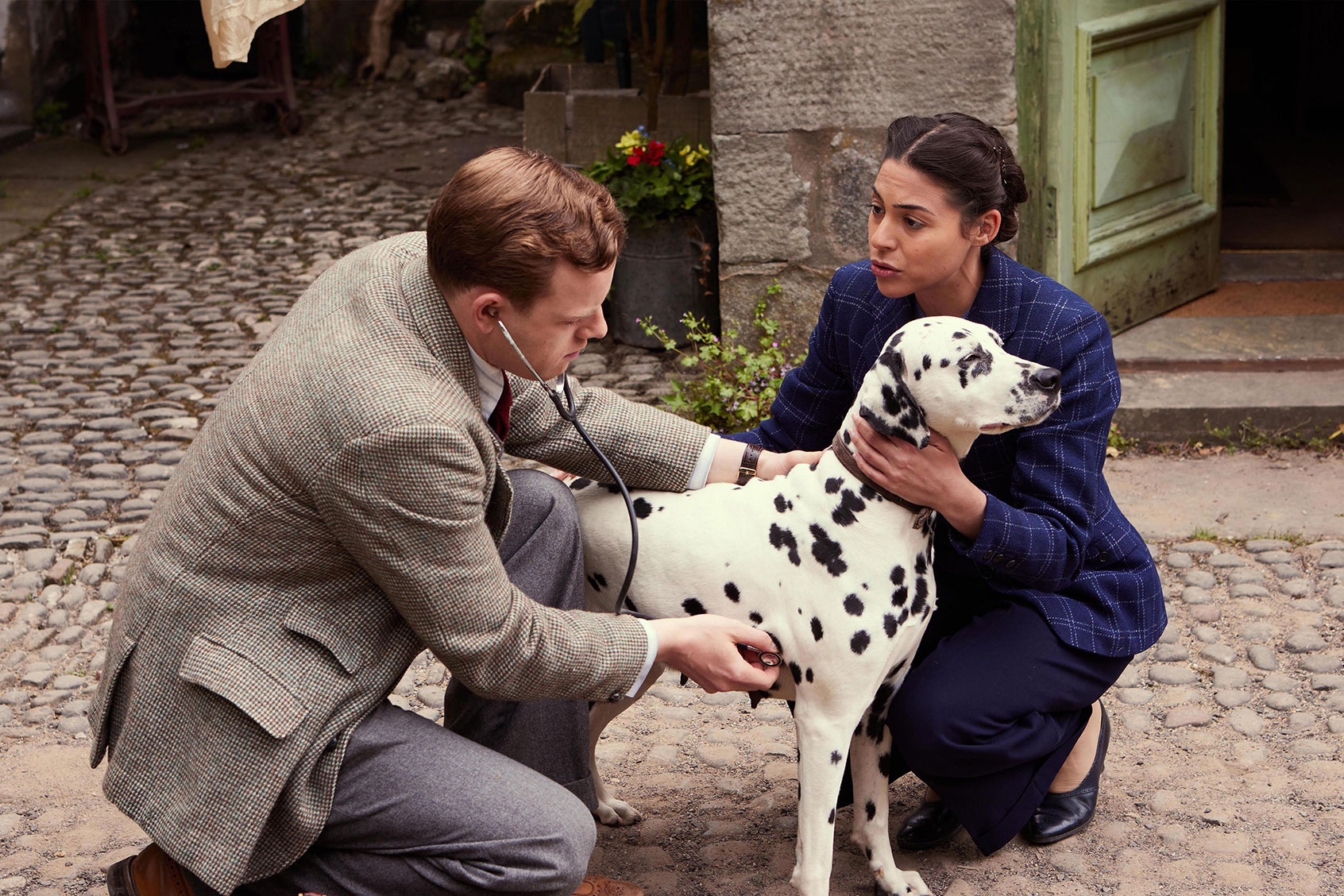
All Creatures Great and SmallTristan Farnon (Callum Woodhouse) and Florence Pandhi (Sophie Khan Levy) in “All Creatures Great and Small” (Courtesy of Playground Entertainment / MASTERPIECE)While Mrs. Hall is off with her son, Tristan is left to fill her duties at Skeldale House. When did he learn to cook shepherd’s pie?

“In the past, we would have seen Tristan trying to dodge responsibilities and dodge work.”

I think he’s following Mrs. Hall’s recipes. She’s probably left him some pretty strict instructions on how to do things. But he turns out to be quite useful. The evolution of Tristan – when we first meet him he seems entirely hapless, and then as the series progresses, it feels like he grows into himself a little bit more. In the past, we would have seen Tristan trying to dodge responsibilities and dodge work, and it felt right for the story that actually, he’s managed to pull this off pretty well. 

That’s what leads into the conversation with Siegfried – even when he’s done a good job, it’s not good enough for his brother. And this leads to the quite painful revelation about how Tristan came into Siegfried’s care, which is brilliantly written by Karim Khan, a new new writer for Season 3. That’s one of my favorite moments, as well, that honesty between the two – that Siegfried didn’t want kids and then did did, but then it was too late. It certainly gives us more insights into the complication of the relationship with Tristan.

Surprising absolutely no one except for Tristan himself, Flo Pandhi (Sophie Khan Levy) turned down his rather impetuous marriage proposal. What was important about that storyline?

It felt like Tristan has the wrong hypothesis – he thinks that this is a solution, he’s got to settle down and get married, like James (Nicholas Ralph) and Helen (Rachel Shenton). But actually there are far deeper problems, which Flo helps him realize – that he doesn’t quite know who he is. And he doesn’t quite know who he is because he’s always been groomed by Siegfried and in Siegfried’s shadow. I always think he’s a bit like a pinball. He’d bounce off to this solution, and that’ll fix things because that’s who I should be without actually fully discovering who he truly is. So this felt like a big step for his character to realize that.

We can see that James really feels he should enlist, but it turns out that Tristan is the one to go off to war by the end. What were the considerations for whether or not these characters would leave the Dales for war? 

We always knew that one or both the boys would be going at some point, right? We know what happens in 1939. And both Tristan and James in the book certainly signed up and joined. We felt that it would be impossible not to play that story in the moment, I think that being the characters they are that they would naturally have a sort of prick of conscience or feel the need to act

As the series developed, it really felt that Tristan’s character, he needs to go and find himself apart from Siegfried. And Siegfried probably needs to find himself apart from Tristan, because they’ve developed this unhealthy symbiosis in a way, and neither of them can move on and out of the roles that they’re stuck in. 

All Creatures Great and SmallTristan Farnon (Callum Woodhouse), Siegfried Farnon (Samuel West) & James Herriot (Nicholas Ralph) in “All Creatures Great and Small” (Courtesy of Playground Entertainment / MASTERPIECE)Tristan is getting called up to be in the veterinary corps?

“Why not go go back and see what Siegfried went through then and how it’s affecting him in the present? You understand what his fears are for James and Tristan.”

Yeah, he’s called up to the Army veterinary corps. The real-life character he’s based on, Brian, also did, so it felt right that that’s where [Tristan] goes. Even then he’s following in Siegfried’s footsteps, but he’s doing it almost as his own man. 

It was a really moving episode to shoot that actually. [Woodhouse] does a really brilliant performance of it – he’s really measured in how he sort of keeps Tristan from almost letting his emotions out until the very, very end when he’s on the train. I think it’s a great performance by Callum.

When it comes to the veterinary corps, what we see Siegfried do earlier in the season, is care for war horses. Are those the only animals the corps treats?

I think it’s still mainly horses in World War II. I know there’s still some pigeons being used, but I think in the main, it would horses. 

Speaking of Siegfried’s part in the Great War, we did get a flashback to see him in action. Previously we had already learned of Mrs. Hall’s sharpshooting experience. Here Siegfried is trying to help an injured war horse, all while shells are exploding and bullets are flying around them. Was that mainly drawn from things that Alf Wight had experienced or written about? Where did that scene come from?

That’s very much our invention, actually. The Siegfried from the books is pretty much the same age as James, he’s a year or two older. When we first formulated this series, we envisaged Skeldale House as a dysfunctional family with Mrs. Hall and Siegfried as the de facto mum and dad with James and Tristan as the boys in a way. So that meant Siegfried was older than the Siegfried from the books, which meant that he would have served in World War I given his age, so it felt that we had to build a backstory that worked with that. 

I always thought it was interesting that his fascination and love of horses could have stemmed from somewhere. So back when we were creating our character for Series 1, we came up with this backstory not quite ever thinking we would necessarily see it. But then this year, wanting to push the series on and keep challenging ourselves to come up with with something different, we thought why not? Why not go go back and see what Siegfried went through then and how it’s affecting him in the present? It’s tied up as well with the death of his friend who’s another vet who served and who [dies by] suicide, which obviously affects Siegfried very deeply. It felt the right time to flesh out that character with war looming on the horizon, as well to look back and see what he went through so you understand what his fears are for James and Tristan and everyone. It sets the stakes.

In the episode when Siegfried teaches the young boy the veterinary ropes and we find out about his relationship with children, we also see he has a rat named Vonolel. I don’t believe that rat was in the books.

No, no it’s not in the books. That rat is named after a famous horse or pony actually. It was a famous horse from a 19th century war [the Second Afghan War, 1878-’80].This pony basically carried someone [Lord Roberts] through 300 miles [Kabul to Kandahar].

Much of the episode Siegfried is trying to keep James and Tristan home, so much so that he doesn’t really see Mrs. Hall until the end when she’s kissing Gerald. What do you say about the fandom that’s cropped up around wanting Mrs. Hall and Siegfried to get together?

I’m not really on social media, so I don’t follow much of it at all. I love that the people love the show enough to want things for our characters and to almost have imagined worlds. And I think that is a sign that we’re doing a good job because they clearly care about what happens to them. 

Whether or not they ended up together, I don’t know. Nothing’s written yet. As far as the endpoints, we don’t have a full stop written down at this stage. I’m not against people wanting things for the characters, but it’s more the pressure that you’re worried you might disappoint them. But I think that any decisions you make someone will be disappointed. 

“[It] feels kind of mad that you’ve got this disease that can kill people, but people weren’t forced to take action to stop it.”

All Creatures Great and SmallJames Herriot (Nicholas Ralph) and Helen Herriot (Rachel Shenton) in “All Creatures Great and Small” (Courtesy of Playground Entertainment / MASTERPIECE)James doesn’t go off to war yet, but he realizes how important the tuberculosis (TB) testing he does is. I was surprised not just about how much red tape there was but also how it affected the food supply. What did your research tell you about that at the time?

The main thing with TB was it was infecting children and adults. It was because it was in the milk. And any milk that wasn’t pasteurized could potentially carry it, and that could kill people, and it did kill people. So that was the great fear with it. 

But it was quite hard to get farmers on board the testing program. I mean, not being too on the nose . . . but it’s kind of a story about COVID as well, in the sense that the idea of testing is for the greater good and to stop the spread, but it could also be a massive inconvenience to test. So they had to try and incentivize farmers to take part. Slowly it became law that they had to but at this stage it’s on a voluntary basis, which feels kind of mad that you’ve got this disease that can kill people, but people weren’t forced to take action to stop it until they were. It felt like a crusade for James at a time when he’s feeling like he should be doing something for the greater good in regards to the war instead. It plays out in his veterinary work at home, but then even that is not enough for him.

Even in the Dales, even if the farmers are in a protected profession, it’s hard for them not to be aware of the war. For Skeldale House, we see that they even take in a World War II evacuee, Eva Feldman (Ella Bernstein) during Christmas. What inspired this storyline?

I wanted to have an evacuee child there because it felt like there’s a danger that an episode set during Christmas in wartime could be quite dark and melancholic. And it felt to me – especially with our characters, one of them about to leave – it felt like the episode could be quite a downer. So the intention was to have a child at Christmas, which means that everyone will have to try and bring the Christmas spirit at a time when perhaps they’re not necessarily desperately able to. So that was the first instinct. 

Then I got to talking with Colin Callender, executive producer with Playground, and his mother was Jewish, and it’s kind of her story. She was evacuated to this family who was celebrating Christmas, and being Jewish, she’d never done it before. And so she was suddenly seeing all these new experiences and she got to try out Christmas and the fun of that. That’s what the germs of the story were and then from there, it’s like, what is the truth for that character? Despite wanting to have a good time and enjoy Christmas, it’s not her world, and they’re not her people. So ultimately, there’s a bittersweetness to her story.

All Creatures Great and SmallPatricia Hodge as Mrs. Pumphrey, Ella Bernstein as Eva Feldman, and Nicholas Ralph as James Herriot in “All Creatures Great and Small” (Courtesy of MASTERPIECE)What’s behind all of her references and the parallels to “The Wizard of Oz”

“Wizard of Oz” had come out that year [1939]. And I thought it would be interesting to get a sense of bringing popular culture into the show. There’s this girl who’s away from home and wants to go home – it kind of felt that all those things came together with the idea, “There’s no place like home,” and then the slippers not working. It’s that childhood naivete, which is hopefully surprising and heartbreaking to the audience.


Want a daily wrap-up of all the news and commentary Salon has to offer? Subscribe to our morning newsletter, Crash Course.


We see Mrs. Pumphrey (Patricia Hodge) want to do more for the war effort. How much of what she wants to do – opening up her house and the victory garden – is from the book and how much of it is what research tells you wealthy people did during the war? 

A little bit of both. The house that we shoot in for Mrs. Pumphrey’s, during the war that was turned into a school for evacuee kids and run by volunteers, a group of nuns. And then a lot of gardens were dug up to start growing veg. There was a whole Dig for Victory campaign. All of it was driven by my research. I don’t think there’s much reference to it in the books. Alf Wight makes a conscious decision not to dwell too much on the war actually in his book. There is a section in the fourth book where where James joins the RAF, but apart from that, it’s very much contained in that section of his stories.

I’m always happy that there’s more “All Creatures” coming. When does Season 4 start shooting again?

We start filming in four weeks’ time, three weeks’ time. The scripts have been written. We’re about to launch into it again.

When Hitchcockian horror came true: The 1960s killer bird swarm that inspired “The Birds”

Sixty years ago in March 1963, Alfred Hitchcock’s classic horror movie “The Birds” introduced viewers to a small seaside town in California that is suddenly and inexplicably attacked by ferocious feathered fiends. Ostensibly based on a 1952 short story by Daphne du Maurier, “The Birds” features seagulls, crows and a range of other bird species as they ruthlessly slash at terrified humans with razor-sharp beaks and talons. The high concept flick was a box office hit and is widely considered to be one of the greatest creature features ever made.

The birds flew into television lines, caused power outages, and littered fish skeletons all over the streets.

Yet while du Maurier’s short story is certainly worth a read, Hitchcock was also inspired by a real-life tale in many ways more bizarre than its fictional counterpart. Like “The Birds,” it was set in early 1960s rural California — Capitola, to be exact, which is adjacent to the Monterey Bay (in the movie, the action is set in Bodega Bay). Just like the characters in the film, the real-life residents of Capitola in 1961 were shocked when swarms of birds attacked them out of nowhere. Yet unlike the movie — in which no explanation for the birds’ behavior is ever supplied — there is actually a plausible scientific explanation for why the Capitola birds seemed to declare war on the nearby humans.

When residents of Capitola woke up that foggy early morning on August 18, 1961, they were greeted by flocks of birds dive-bombing into their houses. Although a number of species were involved, the majority of the birds were later identified as sooty shearwaters, which are usually harmless to humans and instead are best known for acrobatically diving into waters for fish. As their name indicates, sooty shearwaters have a gray-and-brown palette that makes them rather unremarkable visually; if a seagull’s wings were stretched out, and it rolled around in a chimney or fireplace, it would look something like a sooty shearwater. Yet the same aerial skills that made sooty shearwaters into nightmares for fish were suddenly being employed against humans. In addition to crashing into buildings, the hundreds and hundreds of birds were tumbling through the air as if they were drunk on a bender.

“Dead and stunned seabirds littered the streets and roads,” reported the Santa Cruz Sentinel that very day, and the newspaper wasn’t exaggerating. In addition to living out a scene that would later become iconic (albeit with pigeons) in the schlocky 2003 sci-fi movie “The Core,” the sooty shearwaters had also drenched Capitola in vomit. Since sooty shearwaters’ diet is fish-based, this meant that partially digested anchovies were sprayed on citizens and property along with the feathers, feces and — even more mysteriously – the corpses of the aggressive avians themselves. When residents rushed out of their homes with flashlights so they could better see, the birds savagely swooped toward the light beams. The birds flew into television lines, caused power outages and littered fish skeletons all over the streets. The community was suffused in “an overpowering fishy stench,” according to the Sentinel.


Want more health and science stories in your inbox? Subscribe to Salon’s weekly newsletter The Vulgar Scientist.


The community was suffused in “an overpowering fishy stench.”

Eight people reported being bitten by the birds, and it seemed that every resident had a story. An officer using a sheriff’s car nearly crashed as sooty shearwaters plowed into his vehicle. A teenager was struck by a bird as he left his house. One oblivious resident was surprised by a swarm of angry birds when she blearily opened her door at 6 AM; although she succeeded in keeping them out of her house, she did not manage to do so before they sprayed her residence with their bodily fluids. “The smell is terrible,” she complained, noting that the birds had vomited fish guts all over her lawn.

Yet residents also took pity on the birds, expressing distress at the ones who had died and trying to help those who seemed merely confused. Perhaps it was unsurprising that reporter Wally Trabing closed his account with a quick reference to Hitchcock taking an interest in the then-recent events. Trabing had earlier noted that only one demographic seemed happy: “Cats were drawn to the area and were running about the areas.”

So what happened? While Hitchcock would never live to discover the truth, Dr. Sibel Bargu Ates — an oceanography professor and Associate Dean of Academics at Louisiana State University’s College of the Coast and Environment — cracked the mystery in a 2011 paper to the scientific journal Nature Geoscience. As it turns out, there is a neurotoxin called domoic acid that can be produced by a diatom (a form of microalgae), which in turn is part of the diet of animals preyed upon by birds like sooty shearwaters.

Pseudo-nitzschia [was in] abundance during the summer of 1961 [and] was of the same order of magnitude as that observed during more recent animal stranding events related to domoic acid poisoning,” Bargu told Salon by email. “The upwelling of bottom waters declined at the time, and the inflow of oceanic surface waters increased, probably leading to the development of warm water and low-wind conditions.” Not only did this cause the seabirds to stay in California for longer than usual — they breed in the Southern Hemisphere in nations like New Zealand — but it promoted the growth of this neurotoxin at precisely the wrong time.

“Therefore, we think toxic Pseudo-nitzschia were probably responsible for the odd behavior and death of sooty shearwaters in August 1961,” Bargu told Salon. In addition to the obvious vomiting, symptoms of poisoning with this neurotoxin include “confusion, disorientation, scratching, seizures, coma and even death.”

“None of the birds’ ‘intentional’ actions featured in the movie are accurate and they are not possible.”

And what about the events in “The Birds”? Hitchcock may have been a talented filmmaker, but did he get the science right? Could birds poisoned by a neurotoxin really join together in cross-species flocks, coordinate attacks on humans, swoop down chimneys in orderly procession, intentionally break through windows and even figure out how to blow people up?

In a word: No.

“I love the movie, and it was very scary to watch when I was young,” Bargu told Salon with a smile. “But none of the birds’ ‘intentional’ actions featured in the movie are accurate and they are not possible.” Bargu even dismissed the film’s ornithologist character, who describes birds as being inherently non-violent.

“Animals’ ‘violent’ actions are not originating from ‘they do it because they think it is fun, entertaining etc.,'” Bargu wrote, but they still “may be aggressive at times because they feel a threat to their survival, their offspring, their clan, etc.”

Still, what happened in 1961 was not a one-off. Nature could still create its own real-life sequel. 

“Yes indeed,” Bargu told Salon when asked if there could be another mass domoic acid poisoning. “Three decades later, in 1991, another mass poisoning occurred in the same area — this time, of fish-eating, disoriented, and dying brown pelicans. And another one in 1998, another one [in the] 2000s. . .”

This unexpected secret ingredient will radically transform your chicken noodle soup

Chicken noodle soup — is there a more universal comfort food? The name itself conjures images of warmth, sustenance and solace, whether warming you up from an excursion in the cold or providing a brief respite from the sniffles.

I hearken back to that 1993 Campbells soup commercial depicting a freezing, lumbering snowman coming inside a home, hanging up his scarf, sitting down at the kitchen table and soon thawing to reveal a smiling child, jubilant as he consumed the hot soup. The narrator says: “Nothing melts away the cold like Campbells soup.” 

Equal parts silly and sweet — but 100% pure nostalgia for a late-’80s child like me — the commercial really did encapsulate that notion of being “warmed up” or otherwise comforted by eating hot food at home and finding something soothing in that. (Disregarding the realism of a snowman-boy hybrid, though, it did always chap my hide that he left such an immense puddle under his chair — who cleaned that mess up?) 

For The Conversation, Juliane Schlag noted that “the earliest recorded evidence of chicken soup being used as a therapeutic dish dates back to Chinese antiquity. In the second century BC, the Chinese medical text, Huangdi Neijing, declared that chicken soup is a “‘yang food’ – a warming dish – to which different therapeutic herbs can be added to cure various diseases.”

Similar to how pastina is sometimes referred to as “Italian penicillin,” the same is true for chicken or chicken noodle, often hailed or regarded as “Jewish penicillin.” No matter the ailment, some truly regard chicken noodle soup as a cure-all. “Chicken Soup for the Soul” books are still publishing, encompassing the entire notion of what chicken soup means culturally and personally for so many. 

Clearly, the coziness of chicken noodle soup is well-established. No matter the scientific or empirical evidence for its curative properties from a physiological standpoint, a bowl of soup in and of itself tends to already provide some level of reassurance and warmth.

From a strictly culinary perspective, though, I must admit: Chicken noodle soup wasn’t my absolute favorite for the longest time. I’m a big texture guy and — obviously — all soup is pretty inherently soft or soggy in most iterations, especially if you’re only eating Campbell’s. I would have homemade chicken noodle soup at home and it was good, but never something I particularly craved or felt bowled (ha! pun intended) over about. 

When I started cooking, I rarely included chicken noodle in my repertoire, just because I thought it was pretty basic and nothing too exciting could really be done with it — until about a decade ago, when I found an Anne Burrell recipe that changed my whole approach.

The secret, if you will, is a pretty simple ingredient you most likely already have on hand: lemon


Want more great food writing and recipes? Subscribe to Salon Food’s newsletter, The Bite.


It brightens and freshens up the soup, adding a sharp burst of acidity that cuts through the toothsome chewiness of the noodle and the sometimes-dense chicken pieces, enriching the experience with sharp flavor that both lingers on the palate, but is also not overwhelming. It enriches the broth, adding a depth of flavor that elevates its savory richness. To this day, if I eat a chicken soup that isn’t lemon-y, there’s a real missing component. (Burrell also includes some cinnamon, which I love in any sort of savory capacity).

Now, when I make chicken noodle soup, I borrow from Burrell’s additions of lemon and cinnamon but make my own variation. I also opt for both lemon zest and juice to ensure that the flavor is as pungent as can be.

Like salt, the lemon doesn’t only lend its own flavor, it helps to embolden other flavors in the soup itself, amplifying all of the other ingredients to their best and brightest. It livens up the whole shebang and really makes the soup, truthfully. Grab a bowl and join me. 

Salon Food writes about stuff we think you’ll like. While our editorial team independently selected these products, Salon has affiliate partnerships, so making a purchase through our links may earn us a commission. 

The ultimate guide to hosting your first fondue party

t’s hard to keep our spirits high this time of year. The days are bleak, our vitamin D comes mostly in pill form, and it feels like all the good parties are squarely in the rearview. Our mood boards may sparkle with aprés ski scenes and fireside chats, but our reality is all austere resolutions and dry nights in. How do you bring the warm conviviality, dopamine dressing, and mountain-top chalet to you? Set a match to your tealights, folks—it’s fondue time.

Much has been made of fondue’s connection to the 1960s, and with good reason. There’s a song from the decade that goes: “I think it’s so groovy now that people are finally getting together,” and I had these lyrics stuck in my head for most of 2021—a time when our stressed-out society was just starting to tilt back toward groovy gathering. This was also the prevailing vibe in the post-war years, when an Alpine restaurant at the 1964 World’s Fair Swiss Pavilion introduced newly swingin’ Americans to the time-honored art of communal melted cheese.

People had been liquefying excess Gruyére in a bath of oxidized wine and mopping it up with day-old bread in the Alps for centuries, but the practice had never jumped the pond. When it finally did, the table was set for it: decor was Danish, key parties were a thing, and suddenly you couldn’t do anything cooler than dunk cubed food into enamelware pots in creamy shades of butter yellow, milk-chocolate brown, and avocado green.

Skip ahead to winter 2023. You can now find incredible farmstead cheeses and single-origin chocolates everywhere from Whole Foods to Walmart, folks of all ages love to collectively consume them at parties, and it’s definitely still groovy that people are finally getting together. In other words, high time for a high-quality fondue night.

Some tips before you dip

To make this indulgent dream a reality, you’ll first need to choose a style: cheese, broth/oil, or chocolate. Those of you with bottomless ambition (and several pots) could attempt two to three styles in one night, but first-timers may want to start with just one—for digestive comfort as much as for ease of clean-up.

Next you’ll need to get your pot out of storage, or treat yourself to a new one—they come in all sizes and materials now, including ceramic, cast iron, XL, and even copper. No fondue pot? A double-boiler or heavy-bottomed pot set over tea lights works, too. Just make sure you have enough skewers for your guests, and plenty of plates, napkins, and forks. (To avoid contamination and scorched lips, you’ll want to discourage guests from putting their fondue pokers in their mouths.)

When it’s almost party time, throw a fireplace scene on your TV and some tunes on the hi-fi. Wait ’til guests arrive to begin melting, then get your ingredients fully warm on the stove before transferring them to your caquelon (fondue pot). Teach your guests to twirl their poker after each dunk to avoid drips, then get to dipping!

Cheese fondue

Cheese is the archetypal fondue—if you’re going to make just one, it should probably be this. The traditional recipe is delicate and aromatic, and involves rubbing a garlic clove around the pot, melting Alpine cheeses (think: Gruyère, Comté, or fontina) in a bath of white wine, and finishing with fresh-grated nutmeg and Kirsch. You can also switch things up with hard cider, cheddar and pilsner, or jalapeño. Improv is encouraged, as long as you choose your cheeses wisely. Pepperjack and Gouda are safe bets, but avoid cheeses that don’t melt well, such as grana, haloumi, or anything fresh or soft. Whatever you do, don’t throw away the crusty bronzed layer that forms at the bottom—this is an Alpine delicacy called la religieuse, and it should go to your party’s MVP.

  • Dippers: Day-old bread, pretzels, apple or pear slices, roasted potatoes or Brussels sprouts, cornichons, cherry tomatoes, salami or cured sausage, cooked ravioli or tortellini, raw or gently cooked veggies (think: carrot, cauliflower, broccoli, mushroom, green bean, asparagus, and radish).
  • To drink: While the French insist that anything but white wine, kirsch, or herbal tea will coagulate the cheese in your stomach, cheese fondue screams cocktail hour—pair it with stiff, bracing classics like Manhattans or Martinis.

Broth or oil fondue

If you ever had a special-occasion birthday at the Melting Pot, then you know about the broth course. Akin to a Japanese shabu shabu or Chinese hot pot, this style involves cooking raw items in a simmering fondue pot of oil (peanut or canola work best) or broth (flavored with things like onions, herbs, dried mushrooms, ginger, garlic, vinegar, or citrus). In Switzerland, it’s called fondue Chinoise in honor of its Chinese origins—legend has it that a Swiss man brought the idea home after tasting it on a trip—and is commonly served around Christmas. It’s a fun showcase for from-scratch stock, and an excuse to go absolutely wild with post-cook dipping sauces. (Some recipes even highlight a complementary dip and broth combo.) This is best done in a pot with a drip tray around the edge, for resting meats after you’ve removed them. And if you’re attempting oil, let me just say that my hack for grease stains is dish soap.

  • Dippers: Shrimp, chicken, steak, sausages, ravioli, tortellini, meatballs, vegan meats, and any of the vegetables mentioned as cheese fondue dippers.
  • Sauces: Green Goddess, Worcestershire, teriyaki, pesto, aioli or sauce gribiche, bagna cauda, chimichurri, Dijonnaise, barbecue, tamari tahini, ginger miso, blue cheese, French onion, remoulade, and on and on (plus many tiny bowls).
  • To drink: This will totally depend on what’s flavoring your stock and sauces, but with so much big energy on the table, opt for an easy and refreshing chilled Gamay.

Chocolate fondue

This may be the most versatile category, because there’s really very little we wouldn’t dip in chocolate. Bacon? Yes. Potato chips? Of course. Pickles? …Sure! Pizza? I’d honestly try it. Melted chocolate itself is also a blank canvas for flavor. From traditional white, milk, and dark templates, you can venture into coconut cajeta territory, nut-butter-infused riffs on Nutella, or espresso infusions that double as after-dinner boosts. You can even make dessert cheese fondue using a fudgy little Norwegian whey cheese called Gjetost. Whatever you decide, start with a good base recipe and opt for the highest-quality chocolate you can afford.

  • Dippers: Cubed pound cake, marshmallows, graham crackers, strawberries, banana slices, pear slices, brownie chunks, shortbread, pineapple, pretzels, potato chips, rice krispie treats, cheesecake cut into pieces, dried fruit, Oreos, blackberries, bacon, churros, peanut butter sandwich cookies, macaroons.
  • To drink: Bubbly wine, Oloroso sherry, vin santo, fennel tea.

Here’s how to enjoy a plant-based Mardi Gras without forgoing any of the fun

When it comes to celebrating Mardi Gras, extravagance and debauchery are key. That includes partying the night away on New Orleans’ historic Bourbon Street, reveling in the local parade floats and, most importantly, indulging in all the rich foods your heart desires. 

Classic Mardi Gras recipes are traditionally enjoyed on Fat Tuesday, when fatty and decadent foods are eaten for the very last time before Lent. There’s shrimp étouffée, a Louisiana stew made with shrimp, onion, celery, green pepper, and a simple roux; chicken-andouille gumbo, another Louisiana-staple made with spicy pork sausage, Cajun seasoning and roasted potatoes; and muffuletta, a hearty sandwich that beautifully combines Sicilian and Creole flavors. Of course, no meal is complete without dessert. So, don’t forget the New Orleans beignets, which are arguably better than your typical doughnuts; bananas foster and bread pudding!

If you’re looking to enjoy a more plant-based Mardi Gras this year, fret not! Many of these OG recipes can easily be “veganified” with a few simple substitutes. Here to help us prepare our vegan Mardi Gras menu is Salon’s Nights and Weekends Editor Kelly McClure, who recently switched over to a plant-based diet. McClure shares her favorite recipes and must-try vegan hot spots around NOLA:

Joy Saha: In September of last year, I went to New Orleans for a girls trip and it was such a wonderful experience! My friends and I went to Blaine Kern’s Mardi Gras Museum Tour, where we saw a ton of parade floats and ate slices of king cake. I’ve never had king cake before then, but it was truly one of the best desserts I’ve ever eaten!

In preparation for this piece, I looked into the specific kinds of foods that are enjoyed during Mardi Gras. And I noticed that a lot of recipes are very meat, dairy and seafood-heavy. I’m curious to know how these specific dishes can be made vegan?

Kelly McClure: Yeah, well, the funny thing is, I’m newly vegan. I started out vegetarian maybe two years ago after I watched a really traumatizing documentary called “Dominion.” I don’t recommend that unless you also want to be immediately vegetarian. It’s horrifying! So, I started out like ‘Oh, you know, I want to try being vegetarian.’ And then I was like, ‘Well, if I’m gonna do it, I might as well just go all the way.’ 

When we moved here [New Orleans], none of that was happening. I was still eating meat. And so, at least I got to try everything. All the stuff, you know, as it’s intended with the sausage, like you said. And everything is just very meaty, very buttery. So, at least I got to experience it because I would have maybe felt like I missed out a little bit. But saying that, there are ways to replace everything.    

Anything that is rice-based, like a jambalaya or a gumbo, and anything that’s sausage or beef-based, you could just replace with tofu. Tofu is really easy and it takes on whatever flavoring you prepare it in and it has a very meaty texture. So that works. There’s a dish called boudin — which we, initially, for the longest time thought was called “boo-din.” You can make boudin balls [which are made by breading and frying the rice-filled sausage into balls] substituting spiced potato for sausage.

It’s surprising that finding restaurants that offer vegetarian dishes with traditional styles and traditional ways of cooking is way easier than I would have imagined. And then for Mardi Gras, it’s mostly about drinking. So you’d have to kind of think what are you going to eat when you come home, which is the biggest thing because normally, you would just do a DiGiorno Pizza or order pepperoni pizza from somewhere. So now, we’ll go to Whole Foods and we’ll get vegetarian pizzas or vegan pizzas. There’s a really good one called Blackbird that I’ve been hooked on. They do a fake pepperoni pizza and a fake margarita pizza. So, we’ll just have those ready for when we come home and we can make those quickly. 

So yeah, to not ramble on forever, it’s easy to find replacements even here because I would never think New Orleans would even cater to vegetarians at all. But at most restaurants, you can find stuff.

JS: Would you say that on Fat Tuesday, lunch is the main meal compared to dinner, which seems to be a quick and easy meal to enjoy after a late night of drinking and partying? Do people often spend more time preparing an elaborate, hearty lunch? Or even, breakfast?

KM: I would say so. You get up freakishly early on Fat Tuesday because you’re going to be home by like two or three in the afternoon. And you’ll have biscuits or king cake just to get something in your stomach, head out and drink all day — if you enjoy doing so but you don’t have to go out and drink. Then, you’re going to be home in the afternoon, shove some chips in your mouth, sleep and then wake up and either order something or eat a pre-cooked meal. And then, you’re probably going to be in bed unless you go back out, which I can’t imagine because it’s a lot of walking and it’s so exhausting. But I know a lot of people do go back out. But we’re usually in bed by seven, honestly, or eight because we’re just done.       

JS: In terms of specific plant-based recipes to enjoy, do you have any favorite vegan Mardi Gras recipes or foods?

KM: I don’t cook, but my wife cooks just about everything. We don’t really do jambalaya and stuff like that, so nothing really traditional. But we do enjoy more Southern foods, like biscuits and gravy. My wife makes really good vegan biscuits and gravy that’s really filling and hearty. But it’s also usually so hot on Mardi Gras day, so pizza is really a go-to. I feel like people will read this and I’m going to get thrown out. But we’re normally eating chips or nachos, something like that.  


Want more great food writing and recipes? Subscribe to Salon Food’s newsletter, The Bite.


JS: During Fat Tuesday there’s a lot of rich and fatty foods that are enjoyed. Those foods typically contain heavy cream, milk or butter or margarine. So, what are some vegan alternatives to these?

KM: Egg replacement is really easy to find. Whole Foods definitely has a wide variety. And then there’s Smart Balance brand margarine or any type of non-dairy butter. You can throw that in or just use cooking oil because you’re just going for the grease factor, which is easy to replace. Fake butter goes a long way and you can usually use that in recipes and make do. 

JS: Are there any specific vegan recipes around NOLA that you really like?

KM: Yeah, there’s one. It’s not completely vegan. But my favorite restaurant in the city is called Turkey and the Wolf, which is really popular. It’s gotten a lot of notoriety, and they have a vegan chicken sandwich that you could give to anybody’s father and they would not know it’s vegan chicken. It tastes so good — it has the crunch on the outside and the texture of chicken and they put a spicy glaze on it. It’s delicious, completely delicious. And then they have other stuff too there, but that’s usually what I get. 

We live in an area of New Orleans called Bywater and there’s a place nearby called Sneaky Pickle & Bar Brine, which is all vegetarian. Everything on that menu is great. It’s amazing because I have what I call a “children’s palette”…lots of junk food, you know, fake hotdogs, stuff like that. And just the food technology that’s happened over the past years — even here in New Orleans — of replicating junk food is amazing. The illusion of butter has really come a long way. But those two restaurants, I would highly recommend.

JS: In addition to king cake, which is a staple Mardi Gras treat, what are some other desserts and sweets you like to enjoy?   

KM: Daiquiris are really good. It could be considered a dessert because a lot of times they put whole chunks of fruit in them and they’re very milk-shaky. You have to be careful because a lot of them do have a milk base. But if you get the ones that are just fruity, those are really good if you want something sweet and you can’t really find anything else. 

Snowballs are a thing here, where it’s just frozen ice and you can even get them with liquor or just, you know, the normal variety. There’s also Popsicle Doorbell, which started out as a random secret doorbell on the side of a wall in the city which you could ring and then someone would come out of their house and sell you these homemade popsicles. They eventually got so popular that they opened up a bigger location. So there’s all kinds of stuff like that. 

It’s easy to find similar places, especially during Mardi Gras. People know that everyone’s out so they bring out their homemade treats and go out and sell them. A lot of people will sell vegan and vegetarian options that way because they know that they’re not as easy to find. It’s a good way to make money on Mardi Gras.

JS: When I went to NOLA, I visited Café Du Monde and tried their beignets, which were so tasty. Are beignets commonly eaten during Mardi Gras? 

KM: I would say so. They tend to be more of a tourist thing. But they are still very popular and very delicious, better than a doughnut by a mile. I’m sure people do have beignets in the morning before they set out for Mardi Gras. Beignets are very mobile, so you could carry a greasy bag of them and have them throughout the day.    

JS: I can see them being the perfect breakfast to enjoy before Mardi Gras. I remember when I ordered a bag of beignets, there were several handfuls of powdered sugar at the bottom. After eating the beignets, you can take home this bag filled with just powdered sugar and add it to your baking pantry.

KM: People will play pranks with that. Because like you said, you don’t really suspect how far that sugar travels. So, you’ll see people purchase a bag and then turn to the person next to them and blow. And that sugar, it’s like a little prank that people do because they’re like sugar bombs, very messy. 

JS: Considering that you’re a NOLA resident, I’d love to hear your take on how people can come down to the city to celebrate Mardi Gras and not be jerks to the folks who actually live there.  

KM: One, New Orleans is very anti Airbnb because it has a really toxic culture here of people moving from different states and buying up properties. So, there’ll be residential areas where no residents live there, which is not good and it kind of ruins the atmosphere and the friendly “neighborhoodliness” that would normally be here. So when coming to New Orleans, especially for Mardi Gras, stay in a hotel because this time of year brings in a nice influx to bars and restaurants. People rely on that income and most of our city dollars go towards Mardi Gras and making it a clean and safe place for people. 

It’s also important to be mindful that this is a very diverse city. Sometimes people come here from Texas or they come here from Nebraska and they bring Texas and Nebraska states of mind and that’s not going to fly here. It’s good to kind of take a backseat and see New Orleans culture as being New Orleans culture. Be respectful to the people who have lived here for generations and know that you’re experiencing something special. We were given that advice when we moved here from New York, which we didn’t even want to tell people because transplants really get put through it sometimes. 

And then there’s Bourbon Street. When people think of New Orleans, that’s the first place that comes to mind, but that’s actually the worst part of the whole city. Bourbon Street is like Times Square. You wouldn’t go to New York and go to Times Square and be like, ‘This is great, what a cultured experience!’ You’re more likely to get your pockets picked on Bourbon Street and wake up in a really bad way. The French Quarter itself is really beautiful — coming and seeing the historic buildings, all the architecture and the little hole-in-the-wall Mom and Pop places that make New Orleans so special. 

It’s fun to celebrate Mardi Gras. But also, make time to see the stuff that people put their hearts into. I think that’s more meaningful.

Richard Belzer, beloved “Law & Order: SVU” star and stand-up comedian, dies at 78

Richard Belzer, beloved stand-up comic and “Law & Order: SVU” star, died at home in France, multiple outlets have confirmed. He was 78. 

Belzer played cynical, wisecracking police detective John Munch on “Law & Order: SVU” for more than 200 episodes, a character he originated on “Homicide: Life on the Street” and carried into guest spots on other “Law & Order” franchise shows, as well as in numerous guest appearances across five TV networks, including HBO’s “The Wire.” 

“The always anti-establishment Belzer brought a counterculture element to the police precinct with the offbeat detective,” Doug Ganley wrote for CNN in 2013. “The romantically challenged, conspiracy theorist, temperamental Munch was a cop concerned with civil rights and a penchant for self-deprecation.”

Longtime “Saturday Night Live” fans also know Belzer as the show’s warm-up comedian in its early seasons, where he also made several guest appearances, including this sketch standing in as Weekend Update’s Chevy Chase. 

Original “SNL” cast member Laraine Newman shared this personal remembrance on Twitter: “I’m so sad to hear of Richard Belzer’s passing. I loved this guy so much. He was one of my first friends when I got to New York to do SNL. We used to go out to dinner every week at Sheepshead Bay for lobster. One of the funniest people ever. A master at crowd work.”

More tributes poured forth today from Belzer’s fellow comedians and actors, including his “SVU” co-stars Christopher Meloni and Mariska Hargitay, with Meloni tweeting, “Good bye mon ami” and Hargitay writing on Instagram that she would “miss you, your unique light, and your singular take on this strange world.” 

https://www.instagram.com/p/Co2u7jQv18k/

“Richard Belzer was one of the most kindest and welcoming actors when I guested on two episodes of Law and Order: SVU,” tweeted Marlee Matlin. “His passing is truly a loss for Hollywood and I will miss him dearly.”

“Sweet sweet man & funny as hell,” tweeted Vincent D’Onofrio, who played Det. Robert Goren on “Law & Order: Criminal Intent.” 

Billy Crystal called Belzer “simply hilarious. A genius at handling a crowd” while Marc Maron tweeted that Belzer “was an original. One of the greats, babe.” 

Belzer’s close friend, author and former “Letterman” writer Bill Scheft, who has been working on a documentary about Belzer with Blake J. Harris, reports that “His last words were ‘F**k you, motherf***er!'”

Harris shared a clip from their project of Belzer speaking to the magic of live comedy. “As an artist, the greatest thing for me is when I make the audience laugh in a moment that could only happen that night with that audience,” Belzer said. “Sometimes I laugh with the audience because I’m hearing the joke at the same time they are.”

“The Last of Us” book club: Puns at the end of the world

What book would you take with you at the end of the world? What book would you carry, occupying precious space in a pack, taking away room for other resources like food, blankets, weapons or water, and adding extra weight? If you’re Ellie, a 14-year-old survivor of a mushroom monster plague, that book is “No Pun Intended: Volume Too.” Welcome to “The Last of Us” book club. Population: puns. 

Yes, the book that young Ellie (Bella Ramsey) totes with her on her journey across the devastated United States, dodging clickers along the way, is a joke book, the second in a series by one Will Livingston. The books are not real. Neither is Livingston, but the fact that these are what Ellie clings to through thick, thin and fungal speaks volumes (heh) about how we view childhood and how we relate to each other, even in a hell state.

Is a joke funny if you never experienced it? Is it real to you, or do you just want it badly to be?

The many jokes in the well-thumbed paperback “No Pun Intended: Volume Too” include winners like: “Why did the scarecrow get a promotion? He was outstanding in his field.” Her mentor Joel’s reactions range from stoniness to an eventual groan of laughter which causes him to mumble, “I’m losing it.” Ellie first whips the book out when Joel (Pedro Pascal) is siphoning gas. He’s teaching her an important life-after-disaster lesson, even if he doesn’t know exactly how it works, and she’s teaching him, “It doesn’t matter how much you push the envelope. It’ll still be stationery.”

The jokes take on an extra level of meaning when you consider the book was obviously published pre-disaster. Would Ellie know what stationery is? She didn’t know how seat belts worked. Is a joke funny if you never experienced it? Is it real to you, or do you just want it badly to be? What if you’re not in on the joke of the world?

“No Pun Intended: Volume Too” appears in the video game as well as HBO’s adaptation. In the game, it’s one of Ellie’s most prized possessions. As Tim O’Brien wrote in “The Things They Carried,” his famous linked story collection about an American platoon in the Vietnam War, “They carried all they could bear, and then some, including a silent awe for the terrible power of the things they carried.”

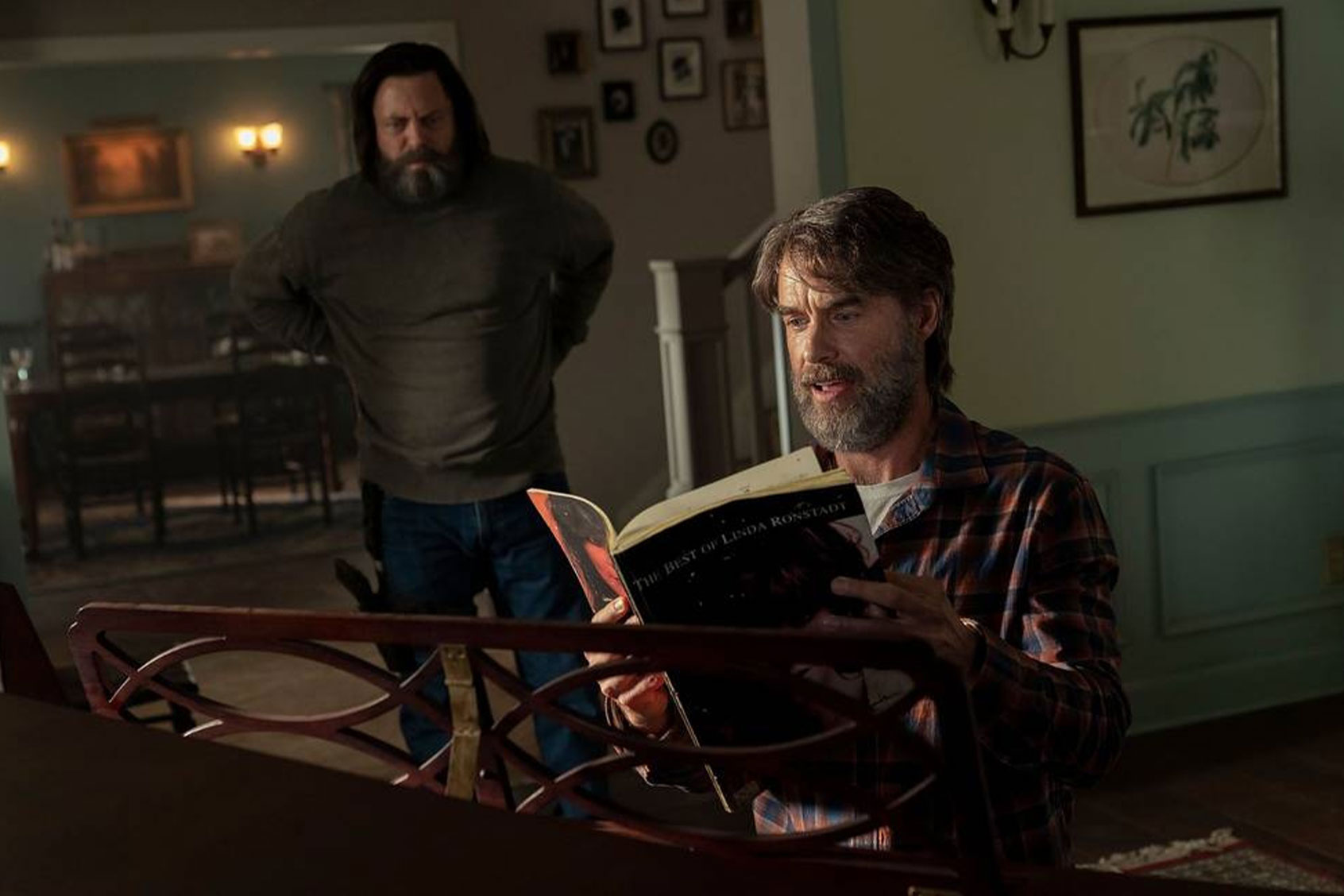
Bill (Nick Offerman) keeps a handy library of survival tomes. Frank (Murray Bartlett) goes immediately to his well-thumbed Linda Ronstadt songbook. Henry (Lamar Johnson) secures a baggie of art supplies for his brother, Sam (Keivonn Woodard), who has a magic eraser board on a string around his neck, essential because it allows the deaf character to communicate with the non-disabled. His other prized possesion? “Savage Starlight” comics, with the catchphrase, “Endure and survive.” And Ellie has “No Pun Intended: Volume Too,” and a love for the same comics. Books allow the children to be children.   

The Last of UsNick Offerman and Murray Bartlett in “The Last of Us” (Liane Hentscher/HBO)

Jokes are meant to be communicated. It’s a communal kind of reading, as the teller waits for a reaction.

The pun book is simple, easy. You can drop in and out of it, pick it up at any point and start reading again. Jokes are meant to be communicated. It’s a communal kind of reading, as the teller waits for a reaction. And Ellie and Joel finally start to bond over, of all things, a mermaid’s “Algae bra.” “Last of Us” showrunner Craig Mazin told Syfy Wire, “It was like she kept getting Joel to come a little bit closer and a little bit closer to kind of laughing over these terrible jokes with her. And then at the very end, there’s that moment where she gets him. For the first time . . . Joel laughs. He smiles and he laughs again.”

The book makes Joel more of a dad and Ellie more of a child, cementing their bond. Age-appropriateness is something with which the show struggles. Both Joel and Ellie’s ages were tweaked for the first season, Joel older and Ellie younger, but Ramsey’s performance seems much younger than her character’s 14 and hasn’t yet shown the same kind of self-reliance and competence of Ellie of the game. Maybe it’s something she’s going to age into. Perhaps the pun book is another example of this, or perhaps it’s trauma-induced regression that causes her to cling to it, a relic from a life that was never even hers.


Want a daily wrap-up of all the news and commentary Salon has to offer? Subscribe to our morning newsletter, Crash Course.


The pun book harks back to a time before Ellie’s time and an experience she never lived through: the school book fair. It’s exactly the kind of paperback your child would come home with after book fair day, along with slime and plastic toys that will be forgotten within hours, a haul you would think about to yourself, but never say to your child: You spent money on this? But puns are forever. And a slim joke book by a “comedian,” a reoccurrence to be pulled out during family dinners, vacations, car trips. And of course, during apocalypse journeys.

What will last at the end of the world? Love. Music. Found family. And the everlasting, universal bad joke.


World Bank leader accused of climate denial says he’s stepping down

The president of the World Bank is stepping down from his post, a move many link to his controversial statements about climate change last fall. David Malpass announced his resignation this week, saying he would leave at the end of June, nearly a year before the completion of his five-year term.

Last September, at a climate change event hosted by the New York Times, Malpass was repeatedly asked if he accepted the scientific consensus that fossil fuels were a leading cause of climate change. His answer — “I’m not a scientist.” — prompted immediate calls for his resignation from environmental activists, policy makers and world leaders. 

While Malpass later apologized and claimed on TV “I’m not a denier,” the incident further cemented doubts about the bank president’s commitment to address the climate crisis. 

The World Bank and its sister institution, the International Monetary Fund, were established in the wake of the devastation of World War II to provide funding for reconstruction and to reduce poverty. The bank now provides billions of dollars in funding primarily to developing countries, with a stated purpose to support projects that reduce poverty and promote economic development. 

In January of 2020, Malpass shocked other multinational development institutions after he turned down an invitation to attend a Davos gathering of world leaders and policy makers to address both poverty and climate change. Malpass was appointed by the Trump administration in 2019.

The World Bank itself has been no stranger to controversy around climate change in recent years. In 2021, the bank said that it had committed $25 billion dollars annually over the next four years to support projects that would reduce greenhouse gas emissions, poverty and inequality, among other climate financing goals. But climate and environmental activists have claimed that up to 40% of the bank’s climate financing funding could not be independently verified.   

At the same time, the World Bank has been criticized for being averse to lending to developing countries that are reeling from devastation from extreme weather as a result of climate change. At the United Nations climate summit in Egypt last fall, Mia Mottley, the prime minister of the Caribbean island nation of Barbados, publicly criticized the financial institution for allowing countries like hers to suffer under mounting debt while being asked to cover the costs of rebuilding critical infrastructure on their own. Mottley proposed reform to the bank’s lending policies, specifically calling forth a plan that would include a loan clause allowing countries hit by natural disasters to suspend repayments.   

Developing nations like Barbados have borne a disproportionate amount of the impacts of climate change, which include rising sea levels, as well as more extreme weather, from more powerful hurricanes to longer and more severe droughts. In response to Mottley’s proposal, a number of global leaders and climate activists have called on the World Bank and other development institutions to do more to finance renewable energy projects as well as resilience plans without taking on more debt

The leadership of the World Bank has traditionally been a U.S. citizen and selected by the United States. Rajiv Shah, a former head of USAID, has already been mentioned as a possible candidate to replace Malpass. 

When science isn’t moving fast enough to cure your child

Everything seemed fine when the twins were born. Addison and Cassidy Hempel’s earliest years were normal — their first words and first steps happened within the normal window for infants. But then both of them experienced troubling symptoms, precipitating multiple medical tests, and then finally, a devastating dual diagnosis: a rare, debilitating and fatal neurodegenerative disease known as Niemann-Pick disease type C.

The Hempel family hoped to put their faith in the scientists who were studying Niemann-Pick disease type C. Yet as they discovered, scientific research moves at a Byzantine pace, and insidious illnesses such as theirs often progress faster than the development of treatments. But as Pulitzer-winning Wall Street Journal writer Amy Dockser Marcus writes in her new book, “We the Scientists: How a Daring Team of Parents and Doctors Forged a New Path for Medicine,” that’s where the determined work of a motivated population of self-identified “citizen scientists” comes in.

Dockser Marcus follows families like the Hempels, who — along with the doctors, researchers and government entities they encounter along the way — are in a race not just to help their children, but to change our baffling, exasperating, isolating medical system. Her book tells a story of community and collaboration, and what is possible when scientists don’t just look at endpoints on graphs but listen to the real-world experiences of the people living with the challenges of their illnesses and, often, their treatments as well.

Salon talked to Dockser Marcus recently about what the bold approach to treating a rare disease can teach us about improving American healthcare — and managing a pandemic.

This conversation has been edited and condensed for clarity.

The stakes are high when you’re talking about children who have such a short life expectancy, and parents are such a unique community of motivated advocates. When you started doing the research for this book, did you realize how important that the parent side of it was going to be? 

This group of parents was suggested to me by a policymaker who had met some of them and had been very impressed by their passion, commitment and thoughtfulness about pursuing science. As I immersed myself in this group, some of the ethical tensions that arose also stemmed from the fact that when you are a parent, you are making decisions for a person who is not legally allowed to make them for themselves. It adds an additional dimension when you’re enrolling your child on a trial, seeking help for your child.

The ethics around children are uniquely complex. You talk about the moral obligation to the broader community. The researchers and the doctors are also balancing, “How do I treat this one person who is sick, where the clock may be running out, against the needs of people who haven’t yet even been born?” How do we do this? What did you find in these ethical dilemmas and conversations?

When you’re talking about these issues in a larger disease community, you may not know the faces of the people that are also going through this experience with you. In rare disease communities, the parents and families become intense friends, and like family to one another. 

“The things that they were choosing to do for their children would have consequences for other children.”

In meeting the parents and sharing some of their personal journeys with them, I was struck by how passionate they were about trying to help their children but always aware of other parents and other children. The choices they were making were not going to be made in a vacuum. The things that they were choosing to do for their children would have consequences for other children. They tried to balance that. There was a particular scene in the book where one of the parents expresses this directly, when he’s trying to make decisions about whether to wait to enroll his child in a clinical trial or to seek compassionate use. One of the things that he mentions is his desire to help his child but also create important scientific knowledge that could be potentially generalizable. He was advocating for a way to collect information from compassionate use experiments that could be useful in some way. That was the way that he tried to reconcile the tension that he saw between his duty to help his own child and his effort to collect information about whatever happened so that it would also be beneficial to other children, including future children.

When you think about a suffering person, and then when that person is a child, there’s intense emotion around it. Compassionate access use, or experimental drugs are not a guarantee of efficacy. As an FDA panel member says at one point, “You hear very touching comments… but it’s not science.” Help me understand the limitations even of compassionate use and clinical trials.

Compassionate use and formal clinical trials have limitations people should be aware of when they’re going into it. In the book, the doctors and the scientists who are participating with the families in trying to advance this particular drug forward, are very, very articulate when they say, “You know, a drug can make things worse.” It’s not only that it may not work, but a drug could have negative consequences as well. 

You saw that where the parents go to an FDA Advisory Committee meeting to share some of their own experiences with this experimental drug that they’re hoping the committee will recommend to the FDA to approve. I think that it’s also not completely fair to say, emotions aren’t science. The arguments that the parents make are more nuanced than that. What they’re saying is, we’re not trying to tell you that emotions are science. We’re trying to tell you that we actually are collecting observations and data about our children. We want recognition that detailed lived experience can be considered another form of scientific knowledge. 

The infrastructure of science hasn’t quite set up a way yet to formalize this in the way that you have clinical trials. One of the things they’re arguing for is, help us create the infrastructure, and a way to collect this knowledge in a format and style that will be useful to you scientists or to you FDA regulators, so that you can you can include it as science. I don’t think the parents are arguing that their emotions are science. I think what they’re saying is, of course, we feel emotional, because our children’s lives are at stake. And we want you to have insight into our daily lives. I found their argument actually quite sophisticated. What they were saying is, we are trying to create a form of knowledge that we consider science. If you have objections to that, or if you want to support that, we’d like to work with you to create a structure to collect that information in ways that you would deem scientific and that we would deem scientific.


Want more health and science stories in your inbox? Subscribe to Salon’s weekly newsletter The Vulgar Scientist.


You explain that drug development can take years and years, with a high failure rate. What we see brought to market is the tip of the iceberg, particularly for these rare diseases. We’re also working within a capitalist system. Talk to me about the push for treatments and cures for these diseases that maybe only 200 people a year are diagnosed with. What do we do about this in a system where the market is not sympathetic to that?

The parents and families and the scientists and doctors recognize that would be an obstacle for them, and so that is one of the reasons why their collaboration initially found it found itself inside the government. 

That collaboration was able to succeed because some of the partners included government scientists, people who did not have to take into account profits. They were more mission-oriented, as one of the scientists said. In fact, some of their initial meetings took place inside a lab of a scientist at the NIH, who was specifically directed and built his lab around the idea that the kinds of drugs and other technologies that are only available right now to private companies should be available for use by scientists at universities who want to partner with the NIH for families or advocates themselves, who are able to raise money to collaborate with the scientists, but wouldn’t have access to this type of specialized equipment.

One of the arguments that I put forward is that the government does have a role to play in helping to advance science, especially for patients who may have diseases that are too small in terms of the number of patients to initially attract drug companies. What we’ve seen over the years is, once there is a level of de-risking, as one of the scientists called it, that’s done either through these partnerships between rare disease groups, families, scientists, and sometimes government entities, that drug companies are willing to come in. But this process obviously needs to be sped up. It needs to be shared with larger numbers of patient groups.

Another elephant in the room is privilege. Who gets to be an advocate? Who has the resources to  really push the needle forward? Not everyone can travel. Not everyone has health insurance. What winds up happening, certainly in the clinical trial community, is we don’t have diversity. We have patient populations who are predominantly white, who are predominantly otherwise very healthy, and who have more time, money, connections and caregivers to devote themselves to these efforts. What do we do about that?

You’ve pointed to something that’s an important issue for all of medicine. Clear inequities exist. It’s not only that some people have the resources that are required to raise money and advanced research and drug development into diseases that are important to them or to their families. 

There’s also social networks, where people are in certain types of professions where they may know people who are doctors, or they may know researchers, and they’re able to more readily navigate a system that’s extremely confusing for so many people. It gets back to this idea of, how can we meet patients and people where they are? Right now the system is set up that if patients want to enroll into a trial, they need to go to the academic center. They need to get there. Why couldn’t trials and even research and drug development also recenter inside the communities where people live, so that people can get more readily and more easily to where they need to go? The system needs to change. 

“If you started thinking about ways to make the system more patient-centric, you would be able to address these serious and real inequities.”

That’s one of the messages of this book, that if you started thinking about ways to make the system more patient-centric you would be able in turn to address some of these serious and real inequities. You would run more trials inside communities, you would make it easier for patients to get there. You wouldn’t insist that they have to come only during business hours. You would allow them to do blood draws and all kinds of other things that they need to do to participate in trials in their communities at hours that work for them. There’s no one solution to deep systemic problems. But at the heart of it, is to think outside the box, to try to make the system more patient-centric, and to be more accessible for more patients.

It almost feels unfair, when patients are burdened, especially when they’re burdened with the harrowing, mind-expanding experience a sick child, to learn this system. What is the way around that? Science is intimidating. You walk in and you feel like you are not a partner in the conversation. You are perhaps not treated with respect or as someone who has something to say, who has valuable knowledge to impart. 

There are different levels of collaboration. I don’t think that the book is trying to argue that someone who doesn’t feel comfortable with science now suddenly needs to start reading scientific papers. The book is arguing that if you want to, you can do that. You can access and read scientific papers, and start to learn the literature if you want to. But some people don’t want to do that, and that’s also fine. 

There’s no one way to be, I think, a scientist, and there’s no one way to participate in this project. There’s different ways to do it. For someone who’s starting out now, who has an initial diagnosis, there are a lot of online resources available that people could find, and hopefully avail themselves of if they want to get up to speed on certain things. For example, NCATS [National Center for Advancing Translational Sciences] has a whole toolkit for people that want to be involved in patient-driven therapy development. They have videos online, and they have links and resources and documents that other patient advocacy groups have helped them compile. There are patient advocacy groups on virtually all types of diseases and illnesses that can be searched and found more readily now. There are Facebook groups, where patients gather together and seek information from one another. It’s all different levels of what people can do and what they want to do, depending on what they feel comfortable with and what interests them. I do think that some of the resources that are described in my book are more widely available now because so many patients and parents have formed groups online, where they meet up with one another and share resources. That’s a way to start to try to find a community where you can get questions answered, and then you can make decisions on what else you want to know and how you want to get involved.

In the midst of finding this information and looking for other resources, how do we fight against the tide of disinformation? When you’re desperate and looking for answers, there are a lot of people out there who are willing to exploit that, and who are peddling really, really dangerous ideology. 

Often we are recommended as patients to get a second opinion when we’re given a diagnosis, or when a doctor recommends a treatment plan for us or for people we love. I think that it’s important to get second opinions, and maybe even third and fourth opinions, when you’re trying to figure out a pathway forward. There is a lot of information out there. Not all of it can be weighted equally. Each patient or each person should seek out trusted experts. That could be your doctor, that could be a scientist who’s a partner with you, that could be your neighbor or friend who has some medical background. That could be your own informed ideas that you arrive at. Different people weigh risks and benefits in different ways. That’s their right to do so. Again, I think that there are communities that try to provide trusted information from experts, and then people can weigh what they learn and make choices.

I want to ask about COVID. In this book, you talk about the ways in which the patient community really was making discoveries about the trajectory of the pandemic, really discovering long COVID. When we as patients are participating in the conversation about health care and medicine and about illness, what is possible?

One of the things that COVID highlighted is the fact that patients can and do all the time, collect data about themselves, make observations, share information, and analyze what it means. That can help direct the course of medical inquiry, perhaps in ways that specialists may or may not have thought about, or may just have been so overwhelmed with the acute crisis that they didn’t have time to think about things that patients were identifying in their own lives. 

“There was this understanding when that was happening, that patients really are experts.”

COVID was a novel virus. At the outset, there weren’t established experts. The doctors and the scientists, in many ways were in the dark about figuring out things just like patients were. There was this understanding when that was happening, that patients really are experts. They can be partners with doctors and with scientists in trying to ask important questions and collecting information, and prioritizing what should be tested and tried and in writing papers as well. 

With other types of diseases, where there’s already established experts, maybe there’s more resistance to that idea. One of the things that I was trying to point out is that we should approach all of this with the same fresh eyes that we brought when there was, the initial outbreak of the COVID pandemic. It doesn’t matter if the disease is novel, or if it’s a disease that’s been known for decades, like Niemann-Pick type C disease, which was identified decades ago. Working together as partners, scientific knowledge can be collected more quickly, and insights can advance in a way that wasn’t done before. That this was my experience with not only this group of parents and scientists, but also my ongoing coverage of other communities of people who are working together to try to advance knowledge and drug development and diseases. It shows you that true collaboration can help make science richer, and I think can yield the kinds of advances that we all hope to see for ourselves, and for everyone we love.


Senators Warren and Porter demand answers from big egg over “massive spike” in prices

Sen. Elizabeth Warren and Rep. Katie Porter on Thursday demanded answers from the five largest egg producers in the United States over recent price surges that companies have blamed on an avian flu outbreak—a narrative that advocates view as an effort to distract attention from rampant profiteering in the industry.

Warren (D-Mass.) and Porter (D-Calif.) invoked that criticism in letters to Rose Acre Farms, Cal-Maine Foods, Hillandale Farms, Versova Managementand Daybreak Foods, writing that they are concerned by the “massive spike” in prices and “the extent to which egg producers may be using fears about avian flu and supply shocks as a cover to pad their own profits at the expense of American families.”

“American families working to put food on the table deserve to know whether the increased prices they are paying for eggs represent a legitimate response to reduced supply or out-of-control corporate greed,” the lawmakers wrote. “Although wholesale prices have decreased, consumers are still waiting for relief at the grocery checkout, which could take several more weeks.”

Bureau of Labor Statistics data shows that the average price for a carton of a dozen large Grade A eggs was $4.80 in January, up from $1.93 a year earlier. Consumers in some states have been paying more than $7 per carton in recent weeks.

To explain the price surge—which has been eyebrow-raising even amid elevated inflation throughout the U.S. economy— egg-producing companies have pointed to a large avian flu outbreak that has impacted an estimated 58 million birds, including around 43 million egg-laying chickens.

But the advocacy group Farm Action has argued that the industry’s explanations “don’t stand up to the facts.”

“Cal-Maine’s net average selling price for a dozen conventional eggs increased by 150.5% from a year ago,” the group observed last month. “The average size of egg-laying flocks never dropped more than six to eight percent lower than it was a year prior. Moreover, the effect of the loss of egg-laying hens on production was itself blunted by ‘record-high’ lay rates throughout the year.”

“And there’s one other critical piece missing from this industry narrative — Cal-Maine, which controls 20% of the egg market, hasn’t reported a single case of avian flu at any of its facilities,” Farm Action added.

In a recent letter to Federal Trade Commission Chair Lina Khan, Farm Action demanded an investigation into the highly concentrated industry, noting that top companies such as Cal-Maine “have a history of engaging in ‘cartelistic conspiracies’ to limit production, split markets, and increase prices for consumers.”

Warren and Porter spotlighted Farm Action’s work in their letter Thursday, decrying industry practices as “a pattern we’ve seen too often since the Covid-19 pandemic: companies jacking up their prices to pad their own profits, putting an additional burden on American families and the economy as a whole.”

“Cal-Maine Foods, which controls approximately 20% of the retail egg market, was reporting record profit margins and no positive avian flu cases on any of its farms,” the lawmakers wrote. “In December, Cal-Maine Foods reported a gross profits increase of more than 600% over the same quarter in 2021, which the company claimed was ‘driven by record average conventional egg selling price.”

The two progressive Democrats asked the egg giants to promptly answer a series of specific questions, including, “To what extent has your company met or exceeded quarterly profit margin goals during the 2022 avian flu outbreak?”

The lawmakers also asked whether the companies’ “executives, officials, or any other affiliated individuals” had “any direct or indirect communication with other egg producers about production or prices for eggs?”

“Given corporations’ rampant profiteering during the Covid-19 pandemic and the ensuing economic crisis, and the egg industry’s history of anticompetitive practices,” Warren and Porter wrote, “[we] ask that you provide transparency about the rationale for the increase in egg prices and the financial impact on your company.”

Jimmy Carter’s lasting Cold War legacy: His human rights focus helped dismantle Soviet Union

Former President Jimmy Carter, who has entered hospice care at age 98 at his home in Plains, Georgia, was a dark horse Democratic presidential candidate with little national recognition when he beat Republican incumbent Gerald Ford in 1976.

The introspective former peanut farmer pledged a new era of honesty and forthrightness at home and abroad, a promise that resonated with voters eager for change following the Watergate scandal and the Vietnam War.

His presidency, however, lasted only one term before Ronald Reagan defeated him. Since then, scholars have debated — and often maligned — Carter’s legacy, especially his foreign policy efforts that revolved around human rights.

Critics have described Carter’s foreign policies as “ineffectual” and “hopelessly muddled,” and their formulation demonstrated “weakness and indecision.”

As a historian researching Carter’s foreign policy initiatives, I conclude his overseas policies were far more effective than critics have claimed.

A Soviet strategy

The criticism of Carter’s foreign policies seems particularly mistaken when it comes to the Cold War, a period defined by decades of hostility, mutual distrust and arms buildup after World War II between the U.S. and Russia, then known as the Soviet Union or Union of Soviet Socialist Republics (USSR).

By the late 1970s, the Soviet Union’s economy and global influence were weakening. With the counsel of national security adviser Zbigniew Brzezinski, a Soviet expert, Carter exploited these weaknesses.

During his presidency, Carter insisted nations provide basic freedoms for their people — a moral weapon against which repressive leaders could not defend.

Carter soon openly criticized the Soviets for denying Russian Jews their basic civil rights, a violation of human rights protections outlined in the diplomatic agreement called the Helsinki Accords.

Carter’s team underscored these violations in arms control talks. The CIA flooded the USSR with books and articles to incite human rights activism. And Carter publicly supported Russian dissidents, including pro-democracy activist Andrei Sakharov, who were fighting an ideological war against socialist leaders.

Carter adviser Stuart Eizenstat argues that the administration attacked the Soviets “in their most vulnerable spot — mistreatment of their own citizens.”

This proved effective in sparking Soviet leader Mikhail Gorbachev’s social and political reforms of the late 1980s, best known by the Russian word “glasnost,” or “openness.”

The Afghan invasion

In December 1979, the Soviets invaded Afghanistan in response to the assassination of the Soviet-backed Afghan leader, Nur Mohammad Taraki. The invasion effectively ended an existing détente between the U.S. and USSR.

Beginning in July 1979, the U.S. was providing advice and nonlethal supplies to the mujahideen rebelling against the Soviet-backed regime. After the invasion, Brzezinski advised Carter to respond aggressively. So the CIA and U.S. allies delivered weapons to the mujahideen, a program later expanded under Reagan.

Carter’s move effectively engaged the Soviets in a proxy war that began to bleed the Soviet Union.


Want a daily wrap-up of all the news and commentary Salon has to offer? Subscribe to our morning newsletter, Crash Course.


By providing the rebels with modern weapons, the U.S. was “giving to the USSR its Vietnam war,” according to Brzezinski: a progressively expensive war, a strain on the socialist economy and an erosion of their authority abroad.

Carter also imposed an embargo on U.S. grain sales to the Soviets in 1980. Agriculture was the USSR’s greatest economic weakness since the 1960s. The country’s unfavorable weather and climate contributed to successive poor growing seasons, and its heavy industrial development left the agricultural sector underfunded.

Economist Elizabeth Clayton concluded in 1985 that Carter’s embargo was effective in exacerbating this weakness.

During his presidency, Jimmy Carter insisted that nations provide basic freedoms for their people. That was a moral weapon against which repressive leaders could not defend.

Census data compiled between 1959 and 1979 show that 54 million people were added to the Soviet population. Clayton estimates that 2 to 3 million more people were added in each subsequent year. The Soviets were overwhelmed by the population boom and struggled to feed their people.

At the same time, Clayton found that monthly wages increased, which led to an increased demand for meat. But by 1985, there was a meat shortage in the USSR. Why? Carter’s grain embargo, although ended by Reagan in 1981, had a lasting impact on livestock feed that resulted in Russian farmers decreasing livestock production.

The embargo also forced the Soviets to pay premium prices for grain from other countries, nearly 25 percent above market prices.

For years, Soviet leaders promised better diets and health, but now their people had less food. The embargo battered a weak socialist economy and created another layer of instability for the growing population.

The Olympic boycott

In 1980, Carter pushed further to punish the Soviets. He convinced the U.S. Olympic Committee to refrain from competing in the upcoming Moscow Olympics while the Soviets repressed their people and occupied Afghanistan.

Carter not only promoted a boycott, but he also embargoed U.S. technology and other goods needed to produce the Olympics. He also stopped NBC from paying the final $20 million owed to the USSR to broadcast the Olympics. China, Germany, Canada and Japan — superpowers of sport — also participated in the boycott.

Historian Allen Guttmann said, “The USSR lost a significant amount of international legitimacy on the Olympic question.” Dissidents relayed to Carter that the boycott was another jab at Soviet leadership. And in America, public opinion supported Carter’s bold move: 73% of Americans favored the boycott.

The Carter doctrine

In his 1980 State of the Union address, Carter revealed an aggressive Cold War military plan. He declared a “Carter doctrine,” which said that the Soviets’ attempt to gain control of Afghanistan, and possibly the region, was regarded as a threat to U.S. interests. Carter said he was prepared to meet the threat with “military force.”

Carter also announced in his speech a five-year spending initiative to modernize and strengthen the military because he recognized that post-Vietnam military cuts weakened the U.S. against the USSR.

Ronald Reagan argued during the 1980 presidential campaign that “Jimmy Carter risks our national security — our credibility — and damages American purposes by sending timid and even contradictory signals to the Soviet Union.” Carter’s policy was based on “weakness and illusion” and should be replaced “with one founded on improved military strength,” Reagan criticized.

In 1985, however, Reagan publicly acknowledged that his predecessor had demonstrated great timing in modernizing and strengthening the nation’s forces, which further increased economic and diplomatic pressure on the Soviets.

Reagan admitted that he felt “very bad” for misstating Carter’s policies and record on defense.

Carter is most lauded today for his post-presidency activism, public service and defending human rights. He was awarded the Nobel Peace Prize in 2002 for such efforts.

But that praise leaves out a significant portion of Carter’s presidential accomplishments. His foreign policy, emphasizing human rights, was a key instrument in dismantling the power of the Soviet Union.

This is an updated version of a story that was originally published on May 2, 2019.The Conversation

This article is republished from The Conversation under a Creative Commons license. Read the original article.

Former President Jimmy Carter enters hospice care

Progressives expressed gratitude and appreciation for former U.S. President Jimmy Carter late Saturday after his family announced he has opted to enter hospice care at age 98.

Carter has faced some health issues in recent years and received treatment for cancer in 2015. The Carter Center, the organization he established with his wife Rosalynn after his presidential term ended in 1981, said he has had “a series of short hospital stays” recently.”

“Former U.S. President Jimmy Carter today decided to spend his remaining time at home with his family and receive hospice care instead of additional medical intervention,” said the Carter Center. “He has the full support of his family and his medical team. The Carter family asks for privacy during this time and is grateful for the concern shown by his many admirers.”

An outpouring of condolences followed on social media, with progressives acknowledging the Democrat’s four-decade post-presidency as one that has exemplified public service.

The Carter Center was founded “on a fundamental commitment to human rights and the alleviation of human suffering,” and has led efforts to fight disease and strengthen public health systems in the Global South as well as promoting peace in countries including South Sudan, Haiti, and Ethiopia.

Advocates for Palestinian rights noted that Carter has been an outspoken critic of Israel’s violent policies in the occupied Palestinian territories, authoring the New York Times bestseller Palestine: Peace Not Apartheid in 2006.

While acknowledging that “no one leading the U.S. empire can have an impeccable moral record,” Public Citizen communications director Omar Baddar applauded Carter as striving to be “decent and principled” in his post-presidential years.

Others acknowledged Carter’s hands-on volunteer work with Habitat for Humanity, which he and Rosalynn Carter first joined in 1984, helping to renovate an abandoned building in New York City to help families in need of affordable housing. The couple volunteered with the organization every year until the coronavirus pandemic began in 2020.

Former U.S. Rep. Mondaire Jones (D-N.Y.) posted a video of Carter debating former Republican President Ronald Reagan in 1980, in which Carter noted that his opponent “began his political career campaigning around this nation against Medicare.”

“Now we have an opportunity to move toward national health insurance,” said Carter, “with an emphasis on the prevention of disease; an emphasis on outpatient care, not inpatient care; an emphasis on hospital cost containment to hold down the cost of hospital care for those who are ill.”

“During his presidency, he advocated to have Medicare cover all Americans,” said former Ohio state Sen. Nina Turner. “After his presidency, he continued humanitarian works that everyone, regardless of political affiliation, should respect.”

“You” star Penn Badgley thinks his killer Joe has “too many sides and needs to die”

This shouldn’t be stunning news, but it may comforting to know that Penn Badgley has little in common with Joe Goldberg, the obsessive serial killer he brings to life in Netflix’s “You.” Badgley is thoughtful, even philosophical, in his reflections on human behavior and romance in real terms and in the way it plays out in the show. In contrast, Joe imagines a rich inner life that he externalized in destructive ways.  

Like the man who plays him, Joe is contemplative. Where the actor and his character diverge is that Joe directs his focus toward devising a way to capture the object of his affection, literally and physically.

Joe is a stalker. In his head, however, he views himself as the magnanimous suitor devoted to protecting the woman of his dreams, to whom he refers as “you.” Should she refuse him or displease him, or if someone pushes him too far, he simply gets rid of them before disappearing and redirecting his obsession toward someone else.

Badgley is very up front about his distaste for Joe’s behavior. A few times he’s interacted online with fans besotted with Joe’s unwholesome romantic front by reminding them that they’re ‘shipping a psychopath. Nevertheless, he remains dedicated to bringing his best to his charismatic villain.

“I might speak out against him off camera, but when I’m on camera, between action and cut, I just try to approach him as honestly and spontaneously as possible,” he said in our recent “Salon Talks” conversation.

Every season leading up to this is informed by “You” author Caroline Kepnes’ twist on the romance genre. But the fourth leaps into a literary breed with which Joe, ironically enough, isn’t familiar: the Agatha Christie-style murder mystery.

This gives the show a new life, appropriate to its protagonist’s addiction to rebirth. Having burned his California dreams and nightmares to the ground, Joe has reemerged in London as literary professor Jonathan Moore. The locale is intentional, in that it allows him to track another One That Got Away. Under the skin, Jonathan remains Joe.

But his attention is pulled away from his latest prey to someone else who unwittingly turns him into the mouse desperate to escape his hunter.

When we spoke with Badgley, it was days before the fourth season premiere of “You” and with full awareness that he wouldn’t be able to tell us much about its London plot. Having lived with Joe for more than five years, he has plenty to say about the thought process involved in creating each season’s arc, whether Joe could possibly change, and what “You” is trying to tell us about love. Watch Penn Badgley’s “Salon Talks” episode here, or read our conversation below.


The following interview has been lightly edited for clarity and length.

Every season of “You,” Joe moves to a different city. He has moved from New York to Los Angeles to a California suburb and now London. What does London offer Joe in terms of getting a fresh start?

I think it offers him as real of an opportunity as he could have to truly get a fresh start, given that many other places, he’d have to learn how to speak another language. He’s in the place that originated the fantasy world of literature that he hides in, that he’s created his entire life as a protection from the ways he was traumatized early in life. It really is as much of an opportunity as he’s going to get, but of course, he discovers that . . . What is the tagline for this? “Wherever you go, there you are.” I mean, he’s still Joe. He’s still Joe.

London’s so interesting because it has these different kinds of strata in terms of how people receive each other. A lot that relies on how you speak. Joe comes in as professor Jonathan Moore, but immediately when he meets people, they size him up by his clothing and the way he talks. The fact that he is a professor of literature does very little to impress them. How much does class difference play into how you present Joe this season?

The show has always had this aspect of Joe being from the American working class. In the book, certainly. He did suffer because of his behavior, but he did come up through the foster care system, so he has always thought about class a lot, even as the people that he surrounds himself with, and despises, and eventually murders a few of, they might not think about it, because they’re usually upper class. 

“I might speak out against him off camera, but when I’m on camera between action and cut, I just try to approach him as honestly and spontaneously as possible.”

In a way it’s just magnifying the pattern that’s already been there . . . It’s not that class isn’t a thing in America, of course it is, but it is different. And being that I’m American, I’m not the best at dressing down British culture, but even just moving there myself, I noticed just how different it is and how everybody can tell where everybody’s from, even just by the way they speak. And they speak of different neighborhoods as though they’re miles and miles and miles apart. And it’s like, “Bro, that’s 15 minutes away. You’ve never been there, really?” To a foreigner, it was a bit surprising.

How are you feeling about playing this character four seasons in?

I stay pretty consistent. I don’t ever approach Joe any differently other than I’m always trying to just be honest and spontaneous. Even though I may end up doing the same thing all the time, that’s kind of built into the DNA of the character. But I’m just always approaching him like I have to believe him. 

. . . I’m not so much as putting together a character as I’m like a witness. Joe doesn’t speak that much on camera. It’s hard to realize. For instance, the trailer that came out this year, I say one thing, I have one line, and half of it is off camera, and then the rest of it is just narration and Joe watching and bearing witness and struggling and becoming increasingly desperate. I do just a lot of watching, and it’s interesting, because that can remain very, very fresh, and then everything around Joe is what changes a lot.

You’re not saying much, but as a viewer, we’re hearing this very rich interior dialogue. How is that executed? 

Usually, I go in anywhere from two days to two weeks before we shoot the episode, depending on our schedule, and I’ve usually read the script at this point. I can go in and have read the script once before, maybe twice, usually in the table read if not another time before, and I can bang the voiceover out because I don’t need to memorize lines. . . .  Spontaneity is my sort of catchphrase. Again, I don’t know that it’s always spontaneous in the way that it appears to the viewer, but I can do it a million different ways and I don’t have to worry about it, because it’s all right there on the page.

I take off my shoes and I dim the lights and I’m in a vocal booth. There’s no one there with me, other than the engineer behind the glass and our post producer online thousands of miles away, and I just go. It’s really liberating actually, and for me, it’s 100% different from playing Joe on camera where I don’t speak. . . . They feel like just two separate roles and I don’t do a lot of conscious intermingling of them. The ways that it works together is just, it’s always like a happy magical accident in a way.

This series is so wonderful about capturing the literary point of view, but specifically doing that through Joe skews how we interpret him since he is the hero of this story. We’re watching him rationalize why he has to kill people and why he does the thing he does. In the first season you had people online really gushing over Joe, and you actually came in and interacted with a few folks. Now that we’re four seasons in, do you feel like people have gotten past that and they see this literary paradigm that’s being enacted in the show and understand that’s part of the trick of it?

“There’s an element of fantasy and camp to it that lets us do a lot of things, and, again, I think we benefit from it.”

I mean, I think it’s both. There’s always going to be the lowest common denominator, where there are people who are going to think about Joe more literally on his terms, just because that’s the way they’re engaging with the story. And OK, so there’s that.

But I do think the conversation around the show has continually been, I don’t know, lifted up, and I think you’re right. The whole show is like a literary device or conceit. It’s all an allegory to be exploring the way we view love, the way we think about love. It’s taking the archetypes and tropes of our most popular love stories from the last 50 or 100 years and following them to a certain logical conclusion. That’s Joe. It really is. If you approach love like a contest to be won, which in a capitalist society is actually exceedingly common, then this bears some semblance. There’s something relevant here with Joe, and I think at the same time, it’s not all social commentary. It is fun, it is storytelling. So, it’s a little bit of everything I think.

Right now, there are a number of stories that are seen as eat the rich stories like “The Menu” and “Glass Onion.” They’re seen as these critiques of the hyper-rich in society and this idea that they not only think less of people that don’t have their money, but also don’t really see them as fully human. Each of the various circles that Joe integrates himself into throughout this series seems to escalate in levels of wealth and power. What is it that you think that the series and the writers are saying about wealth and the wealthy, and what makes them such perfect targets for Joe?

That is a good question, and I’ll see if I can answer it. What is the show saying about wealth? Well, being that the show is first and foremost about love as a misunderstood concept and phenomenon, that’s always what it’s saying the most about, and the most incisive and insightful things about. Yes, there’s this aspect of privilege and class and wealth and power that this season we’re more directly addressing than ever. I don’t have enough perspective from it right now. Chances are, statistically, the more wealth and power you come into, the more miserable it makes you. The more suspicious it makes people, the more terrified of losing it. And therefore, the way that just seems to manipulate the worldview of people in these power centers.

I mean, to me, the irony is that we now pretty readily have seen from world leaders to international icons, and we know that this kind of power drives people crazy and that it does not generate happiness, but it is power. And so what is that? Where does Joe land in all of this? I think Joe, in some ways, he’s always mimicking this a bit. He’s mimicking morality, obviously, in a way. He’s not a moral person, but he’s very morally concerned. He’s toeing a populist line even though he himself is technically an elitist, if you think about it.

Can you go into that a little bit more?

Joe is a perfect device because you can delve into something, but you always have the safety cord or the safety net of, “Yeah, but he’s a hypocrite.” We are all exploring something earnestly, I think. But of course nobody has a perfect perspective, so if there’s any place where it’s really got some blind spots, well, that’s Joe, frankly. That’s OK. So, in a way, I really like that. It’s like we can dig in and not worry about having a perfectly protected stance, because at the end of the day, Joe is an unreliable narrator and a despicable human being. So, just because he’s thinking it and saying it, doesn’t mean that we think it’s right. But he is getting at something, and of course people can identify with that. So to me, Joe is like, he’s a many-sided die. He’s got too many sides, and he needs to die.

Joe is always trying with that new start, moving to a new place, trying to reset his identity. Similarly, in the “Dexter” revival, here’s another serial killer sociopath who has convinced himself, at least at the beginning of the series, that he can change, and has been able to treat the fact that he is a serial killer as an addiction. Do you think it’s possible for Joe to change? 

“At the end of the day, Joe is an unreliable narrator and a despicable human being.”

If we converted Joe into a real person, I think I start with the baseline of, I do think change is theoretically possible for everybody because that’s the human ability. That’s what we’re here in this life to do, is to grow and learn. So, of course anyone can change, but then you have to think, well, what has this person then really done? What are they responsible for? What would it require? What would change then require?

If you’ve done things that Joe has done, change would mean reconciling in yourself that you have murdered more people than you can count readily on one hand. It’s like, “Oh yeah, there’s the guy in the . . . Yeah, oh yeah, I forgot about him.” If you’re really there, I think what would require your reconciliation, let alone that with any kind of judgment in society, is more than you’ve indicated at this point you’re capable of, because you’ve done those things.

To me it’s a catch-22 if you’re going to talk about it in real terms. But to be clear . . .  the show is never a clinical portrait of either a serial killer or a man with mental illness. So the fun that we’re able to have when we do all of this is that this is not meant to be real. And to me, that doesn’t take anything away from it. It’s meant to be an exploration, an exercise. There’s an element of fantasy and camp to it that lets us do a lot of things, and, again, I think we benefit from it.

There’s this idea that is compelling both in television, but also in terms of our romantic vision of love, of the ability for love to repair that which seems to be irrevocably broken. And going back to the way that people interpret Joe, what do you think that’s saying about love and how we interpret it?

Well, I think it’s more about how we interpret love. I think love is . . . Let me go ahead and talk about love. We do think that when we are tapping into it, we’re capable of things that we didn’t imagine. Because the love between two people romantically is only one kind, and often it’s very narrow compared to the sort of love that it takes to transform the world, to forgive someone who’s betrayed you, again, not a romantic betrayal. The discipline that it takes to raise a child, that sort of love, genuine discipline and not authoritarianism. It’s like there are so many forms of love that the world is a stage for, and the kind of love we talk about in stories in Hollywood is such a small part of that, and that’s what this is about. 

When we talk about love, we’re talking about really often a different four-letter word, as pop music has abundantly shown us quite literally, just using those two words interchangeably. And I think this idea of love and then also redemption is at the core of this show. There’s this question, is Joe redeemable? But that question of, is anyone redeemable? Who gets to be the judge of that? That really is a God-level decision. That’s a God-level vision. What makes any of us think that we have the right to discern, to define whether or not someone is redeemable depending on what they’ve done according to our bias and subjective view? 

“It’s all an allegory to be exploring the way we view love, the way we think about love.”

And so I just think more and more the show is checking us and making sure that we remember when we think we’re talking about love, we’re often talking about something that’s more like objectification and obsession. It feels good, because it’s like a drug when you first meet or see somebody that suddenly just really grabs you, but again, that’s not what sustains a relationship past even very early on. But we only usually see relationships in Hollywood-type stories in the very beginning or the very end, never the in-between. The in-between is a montage. That’s what it is. At best, we get a montage. It’s like, “Let’s skip over many years with some music. That’s the kind of attention we’re going to pay to the real stuff of relationship and love. Now let’s talk about the explosive beginning or the explosive end.” And it doesn’t teach us that much. I think we’ve learned those lessons. We need to learn more about the middle. 

I’m going to draw all of this back to your podcast, because I find it’s very interesting that “Podcrushed” is all about stories of middle school horror. That’s the part of life where people begin to interact with these books, these movies, all of those kinds of things. What fascinates you about that time of life?

Yeah, that’s a good question. I had about half of my middle school career. I didn’t finish seventh grade, and then I moved to LA and started working as an actor. So, maybe part of it, I’ve looked at this enough that it’s there, but it’s not that compelling to me, I was sort of frozen in time there – not me, but maybe my academic career. So my relationship to school, the experience I have doesn’t really go beyond 12 years old that much. 

High school, I actually experienced for a few weeks. To me, this period of roughly, let’s call it 11 to 15, something like that, this adolescence, this coming of age, I mean, it’s a unique period in life. Not only are we developing bodily powers, going through puberty and stuff and discovering sex, but actually we’re discovering the world of virtues. What is justice when you’re six, when you’re 10, and then when you’re 12? When you’re 12, you can really think about something like justice. That’s pretty deep, that’s different. I think that’s deeper than sex, but that’s all we talk about when we talk about that, the change we’re going through. It’s not just that. 

You’re becoming who you’re going to be and the encouragement you do or don’t get in that time is huge, because that’s what people want then. But what does it take to encourage a 12-year-old or a 13-year-old? One of the questions we ask at the end of every episode to our guests is, “If you could go back to a 12-year-old self, what would you say?” And usually it’s some version of, “It’s going to be OK,” and everybody usually has also a pretty unique and beautiful answer that has these variations to it, but I think the thread of it is something of comfort. 

“We only usually see relationships in Hollywood-type stories in the very beginning or the very end, never the in-between.”

It’s providing genuine comfort that actually relieves the awkward 12-year-old of the pain they’re feeling of not fitting in and just the extreme self-consciousness. But the truth is, in order for them to get that relief, they have to believe you. They have to trust you, they have to know you. They really have to love you, or something along those lines. You have to love them, I think, and they have to feel it. So, it’s easy to talk about, but not that easy to practice, and I think that’s maybe what we’re doing. We’re thinking about it and hoping to put it into practice too.

By the time people see us talking, the first half of “You’s” fourth season is going to be out, the first five episodes, and people will be digesting it. What would you want to tell someone knowing that they’ve seen the first half of Joe’s latest chapter?

Well, I mean, Part 2 really goes to a different place. I think Part 1, in a way, it’s a necessary, I don’t want to give too much away, but it’s a necessary turn to really bring it home in a new way. And I think as of Episode 8 of Part 2, so just a few more episodes in, the show discovers something new about itself that is really special. Which I love, but I can’t say anything more.

Why the far-right is ascendant on college campuses

The recent decision by Governor Ron Desantis (R-FL) to fire the President of New College of Florida, replace the board of trustees, and to abolish diversity equity and inclusion programs in higher education came as a shock even to most conservatives. His actions mark another volley in the “war on wokeness,” as he and his right-wing peers call it. Yet to researchers who study the far-right, and those working on university campuses DeSantis’ actions reflect the degree to which the right influences academic culture and policy. It may surprise you to know that this is nothing new.

Most Americans hold the view, largely shaped by the media, that college and university campuses are bastions of left-wing ideology. Yet American colleges and universities have long had a prominent conservative contingent — even during the antiwar protest movement of the 1960s. Over time, the work of student movements has been folded into the corporate structure of the institution; this is well-known. Yet most are likely unaware of a new phenomenon occurring across college campuses, in which far-right organizers have sought to use them as a place for contestation, recruitment, and protest/counter protest.

Since 2011, hate crimes on college campuses have sharply risen in the United States. The latest available data, at time of publication, from the Anti-Defamation League (ADL) found a total of 313 cases of white supremacist material on campuses for the 2018-2019 school year. These cases include bomb threats to historically Black Colleges and University, gag orders against teaching, threats to specific scholars, and the weaponization of critical race theory to create controversy over curriculum.

Far right ideology has been mainstreamed largely through online community building and organizing. This often manifests as violence in the real world—such as when conservative pundits Richard Spencer or Milo Yinappplous schedule lectures on campuses and planned marches such as the Unite the Right Rally on University of Virginia campus in 2017, all of which resulted in violent clashes.

This would explain, at least anecdotally, why there are increasing reports from educators (whom we have spoken with) about increasing incidents of racist, sexist, and discriminatory behavior across college campuses. Some of these incidents — like the recent controversy at the University of Missouri where a student used racial slurs in a snapchat message to another students and joked about the murder of three Black University of Virginia student athletes — illustrate the limited power that University administrators have over these kinds of situations.

While administration later condemned the student’s post, the University was unable to take disciplinary action under the First Amendment. This is a major area of controversy and contradiction in the contemporary era of the American university—that condemns racial discrimination, yet rarely takes action against racist incidents or confront many systemic issues within the institution.

Students took to social media, first to bring the incident to the administration’s attention, and when nothing was done, to express their outrage. Mizzou YDSA (Young Democratic Socialists of America), posted their annotated version of the announcement made by administration.

https://www.instagram.com/p/CnSwylUJXOd/

Such incidents are in fact nothing new for college campuses. And,despite conservative accusations that they are being silenced, or censored, empirical studies and experts have shown that this is untrue. While a few anecdotes might be hand-waved away as the work of a few bad apples, our own research on the far right reveals something a bit more deliberate than a leaked electronic communication. The Southern Poverty Law Center tracked recruitment flyers by white nationalist groups from 2016-2017, reporting 329 flyers across 241 college campuses — like the ones below.

(Photo courtesy of AF Lewis) (Photo courtesy of AF Lewis) (Photo courtesy of AF Lewis) (Photo courtesy of AF Lewis)

https://www.instagram.com/p/CkGtqTDpeqi/

These early observations seem to indicate that far-right groups are initiating the same tactics across university systems. Meanwhile, administrators appear either unable or unwilling to act against these disturbing flyers.

As Vegas Tenold observed in his 2018 book “Everything You Love Will Burn,” the demographic of the alt-right that attend universities consists mainly (but by no means exclusively)  of “white frat boys [who] could now explain to the world how white frat boys were the true victims of feminism, affirmative action, and other forms of anti-white persecute and could, with a straight face, stand up in public and rejoice in someone finally fighting for their rights as white, affluent college guys.” These individuals are often armed with the full strength of their connection to the University, outside online communities, formal organizations with resources, and even the support of some politicians.

As educators we have both seen the ramifications of conservative leadership on higher education. This includes cuts at the state and federal level, but also a retooling of higher education towards a consumer model. The impact on higher education has been an erosion of standards in favor of student retention and satisfaction. While the move to a more “student centered” model has some merits, under conservative leadership it has been weaponized to remove people who disagree with conservative ideology—including those trying to make their students think critically about religion, those with poor teaching evaluations (which are disproportionately women, people of color, and other minorities), or those who would criticize the University.


Want more science and higher ed stories in your inbox? Subscribe to Salon’s weekly newsletter The Vulgar Scientist.


While University leadership is unable to challenge the status quo, students are mobilizing to change this system. Some of this is already taking place such as within the University of California school system in which students went on strike over low wages, poor health care, lack of COVID-19 protections, and a variety of other issues. Yet the growth of far-right ideology is a direct result of the University adopted an individualistic “student centered” model of education that is reminiscent of service labor — in which students are seen more as passive consumers of education as a good provided by professors and TAs. The market-oriented understanding of high education feeds into right-wing views of education as a consumer purchase, rather than a social good.

Just as students in the 1960s had to learn how to find their voice, students today are doing the same. However, speaking out on campus can come with consequences. As we write, striking Temple University graduate students are losing their tuition remission, health care coverage, and have one month to pay their tuition bill in full. Perhaps through the actions of these students, and their allies on the ground,  a vision of the future that runs counter to that of the alt-right can be more clearly articulated—something the left has failed to do.

CORRECTION: An earlier version of this story erroneously referred to New College of Florida as New School University. The story has been updated.   

How the “electrify everything” movement went mainstream

“Building electrification,” once a subject embraced only by energy and climate nerds, is going mainstream.

In 2019, Berkeley, California passed the nation’s first ordinance banning new buildings from hooking up to the natural gas system. That required homebuilders and developers to install electric heat pumps, electric dryers, and, perhaps most controversially, electric stoves. The city council considered it a necessary step to cut carbon emissions, about a tenth of which here in the U.S. come from burning fossil fuels inside homes, offices, and other sites. 

Less than four years later, this approach has proliferated. If you’re reading this in the United States, there’s a good chance you live somewhere that has followed Berkeley’s lead. A report published Wednesday by the Building Decarbonization Coalition, a nonprofit dedicated to getting fossil fuels out of buildings, estimates that one in five Americans now reside in a place that encourages or requires landlords and developers to eschew gas.

“We’ve officially moved into the second phase of the movement,” Panama Bartholomy, the organization’s executive director, told Grist. “If the first phase was categorized as no awareness, no policies, no programs, and a limited supply of product, I think we’ve officially moved into the second phase.”

Public awareness about the benefits of electrification shot up in January, after a study found that one in eight cases of asthma can be attributed to gas stoves and the U.S. Consumer Product Safety Commission said it would investigate their health risks. Stories about the benefits of switching to modern electric cooktops, called induction stoves, proliferated.

But evidence suggests gas already was falling out of favor in the U.S., at least when it comes to keeping warm. Sales of electric heat pumps grew 15 percent last year, with shipments outpacing those of gas furnaces for the first time in at least 20 years, according to data collected by the Air Conditioning, Heating, and Refrigeration Institute. “That’s massive,” said Bartholomy. The Inflation Reduction Act, which contains billions of dollars in tax credits and rebates to help people swap gas heaters, dryers, and stoves for electric appliances, is likely to accelerate the trend.

According to the coalition’s report, 98 municipalities and four states — California, Washington, Maryland, and Colorado — have adopted electrification policies. Some have enacted a ban on gas hookups in new buildings similar to Berkeley’s. Others have set energy efficiency or emissions-based requirements that would be hard to meet without embracing electric appliances. Still others focus on achieving targets with rebates and other incentives, like Maine’s goal of installing 100,000 electric heat pumps by 2025. 

Some officials are even beginning to contend with the roughly 70 million existing homes that burn fossil fuels. Last year, California regulators adopted rules effectively banning the sale of natural gas heating systems statewide beginning in 2030, forcing homeowners to go electric when they eventually replace their furnaces. New York is considering doing the same.

Not everyone is pleased about the rise of electrification. The natural gas industry, facing an existential threat, has earned the sympathies of Republican lawmakers in at least 20 states that have passed laws preempting municipalities from restricting the use of gas. The American Gas Association, the largest trade group for gas companies, argues the industry can lower its carbon footprint by eventually delivering alternatives like renewable natural gas, which is methane derived from rotting waste and manure, and clean hydrogen.

Advocates of electrification argue going electric is a cheaper, more effective solution that can lower emissions today. Even though most of the country still generates its electricity by burning fossil fuels, in many cases switching from a gas furnace to a more efficient electric heat pump will reduce emissions. A recent analysis by the clean energy think tank RMI found that new, all-electric buildings are less expensive to operate and generate lower emissions than buildings that use gas in at least nine U.S. cities.

Now that electrification is in phase two, Bartholomy said there’s pressure on the movement to get it right, and eventually reach stage three — much broader adoption. The Building Decarbonization Coalition’s report outlines three things needed to ensure electrification succeeds. Because going electric can incur high up-front costs, more funding must be directed to low income households to ensure the transition is equitable. Even climate-forward states still have policies and subsidies that favor gas, and should adopt reforms that align with their emissions targets. Lastly, the group argues for a nationwide phase-out of gas appliances, similar to the one California has adopted, to give the industry a clear timeline.

“This gives the market — everything from the manufacturers, to the distributors to the installers — clarity,” said Bartholomy, “so that they can then start to make plans on how to change their business.

It’s time for Zoë Chao, rom-com sidekick, to take the lead

February is a rough month. In many places, it’s cold and gray. The holidays are few and far between and not the most thrilling of occasions (yay, Presidents’ Day). This Valentine’s Day season, the pickings were grim if you were in the mood for a 2023 romantic comedy. You had few new streaming films, including the Reese Witherspoon and Ashton Kutcher vehicle “Your Place or Mine” on Netflix and Prime Video’s “Somebody I Used to Know,” starring Alison Brie

Neither film was perhaps the freshest of offerings, but one player connected the two like a life raft to brighter and better things: Zoë Chao. The actor and writer had small roles in both films, bringing energy and light to the projects, and delivering with grace some of the best, and often only, lines with humor.

Where to look for bright spots this winter? Look to the background, where Chao is acting her heart out, deserving much more than to be the supporting, zany best friend.

In “Your Place or Mine,” Chao plays Minka, the glamorous if shallow ex-girlfriend of Peter (Kutcher), the wealthy man-child who is the longtime best friend of Witherspoon’s Debbie (for some reason, her character is named Debbie). When Debbie and Peter swap houses, Minka accidentally drops in on Debbie hoping for a reconnection with Peter. Finding Debbie there instead, she slips into instant new best friend mode. On top of that, she’s going to find love for Debbie. Minka is an unflappable woman who loves a mission.

Chao’s role could have been “Sex and the City”-lite (as “Your Place or Mine” has sad shades of the much better “The Holiday“) but she infuses Minka with heart. It’s not easy to deliver lines like, “I dig this whole sexy, Gen-X, Earth Mama thing you’ve got going on.” But Chao takes the unremarkable dialogue and the unreasonable quirkiness of Minka and makes her character concerned and diligent, her face radiating with love for this friend she literally just met. Chao also makes her character’s endless parade of loud outfits look both effortless and planned, from a tiny dress with nothing beneath it, as she loudly tells Debbie, to a “Blossom”-era bucket hat. Give this actor a starring role. She can make a bucket hat work. 

In “Somebody I Used to Know,” her role is even smaller, a cameo near the beginning. Chao plays Ramona, a network executive sent to deliver bad news to Brie’s Ally, a TV producer on a food-themed reality show. Mouth full of breakfast ice cream sandwich, Chao delivers a graduate class in passive aggressiveness. Who knew clapping could be so violent?  

In recent years, Chao has had both larger roles in small projects and supportive parts in higher profile ones., including co-starring as Anna Kendrick’s best friend in HBO Max’s ‘Love Life” and appearing as an art teacher in Apple TV+’s “The Afterparty,” a role for which she drew upon her upbringing as the child of two artists and her time interning at the Getty. And we’ll get to see her again in the ensemble in the much-anticipated return of Starz’s “Party Down.”

She did get her chance to play the lead in “Strangers,” the Facebook Watch series about a woman who rents out her spare bedroom and discovers her own sexuality along the way. W writes, though Chao has “made a name for herself inhabiting a lot of the supporting ‘best friend’ roles . . . it’s been clear that she has what it takes to be the star.”


Want a daily wrap-up of all the news and commentary Salon has to offer? Subscribe to our morning newsletter, Crash Course.


But “Strangers” only ran for one season. The Los Angeles Times said of her 2021 film “Long Weekend,” where Chao got to be the love interest: “Zoe Chao reduced to manic pixie dust,” despite a performance The Guardian called “engaging and believable.”

Like some other excellent supporting performers, Chao is better than much of her material. She can deliver clichés but she deserves more than them, and the world deserves to see an actor like her get the guy, girl or person —  and get to be in a project worthy of her caliber. As she told W, “I just love genre, I love style, I love period pieces — anything where having a face like mine could be in spaces where faces like mine haven’t been before.” 


The unusual ingredient that Ashton Kutcher adds to his coffee

There are many undeniable food pairings: tomato soup and grilled cheese, spaghetti and meatballs, peanut butter and jelly and mashed potatoes and gravy.

A pairing that isn’t considered a classic? Coffee . . . and orange juice.

Ashton Kutcher apparently swears by this combination, which he recently touted while promoting his new Netflix projects “That 90s Show” and “Your Place or Mine” on Kelly Clarkson’s talk show. Yes, you heard that right: Instead of grabbing cream or half-and-half, Kutcher reaches for OJ.

The topic of coffee came up as Kutcher and Clarkson played a game called “Obsessions,” in which each had to sell their not-so-mainstream likes to viewers. In response to the unusual pairing, Clarkson told Kutcher “you might be alone here.” Nevertheless, the actor proceeded to explain his obsession via a deep dive into the flavor notes and profiles of certain types of coffee.

“I don’t like creamers. I usually drink black coffee — that is my go-to . . . But, occasionally, I like light roast black coffee,” Kutcher said. “And one of the things about light roast black coffee is that it has citrus notes in it.”

Kutcher then explained that “it’s the acidity that sort of gives it a brightness when you’re drinking coffee.”

“So, if I ever have like a medium roast cofee, and I’m like, ‘Ah, I really would prefer this be a little more light roast,’ I take just a splash — not very much — a spalsh of orange juice and it brightens up the coffee and gives it a bit of sweetness.”

“It sounds gross,” Clarkson said in conclusion, “but I’m going to try it.”

While that amount of acid in one mug would wreak havoc on my acid reflux, Kutcher clearly has a thorough understanding of the way in which he likes to drink his coffee. The OJ keeps the coffee entirely vegan and also doesn’t require any extraneous sugar, which may be selling points for you.


Want more great food writing and recipes? Subscribe to Salon Food’s newsletter, The Bite.


The co-hosts of “Today” subsequently tried coffee and OJ, but they didn’t exactly give it rave reviews. “It’s not good,” Hoda Kotb and Savannah Guthrie mutually declared after Al Roker spit his sip back into his mug. Oh, well — you can’t win ’em all.

One drink with a similar flavor profile is a winner, though. Salon senior writer Mary Elizabeth Williams tried a “Tootsie Roll-like” drink in Nashville, which she deemed “phenomenal.” In her recipe for orange coffee soda, which approximates the original, Williams combines cold brew and Orangina, orange San Pellegrino or a similar effervescent citrus beverage with orange zest and mint sprigs. The resulting drink is undeniably crave-able.

“I had to stop myself from ordering a second one so I wouldn’t be fighting heart palpitations at the Ryman later on,” Williams wrote.

Joe Biden’s agenda faces an unprecedented onslaught of dark money: The FCC is just the start

Joe Biden’s struggle to get FCC nominee Gigi Sohn confirmed by the Senate offers an early warning sign of the legislative battles ahead. Overcoming Republican opposition may be a moot point if the president can’t hold his party’s narrow Senate majority together against an onrushing tide of dark money. 

Dark money spending — untraceable political donations funneled through super PACs that aren’t required to report who their donors are — topped $1 billion in the 2020 election cycle. Perhaps surprisingly, that funding largely benefited Democrats, and that sum exploded to the unprecedented $8.9 billion midterm spending spree of 2022. Republican and conservative media organs have already begun using Democrats’ extraordinary reliance on dark money as a PR cudgel

In fact, the Democratic National Committee is also using dark money to launch primary campaigns against its own progressives. That intra-party fracture is beginning to reflect themes seen in the GOP’s own widening split. Ultra-conservative super PACs played a key role in the January election of House Speaker Kevin McCarthy and have dragged the party’s “moderates” so far right that even Senate Minority Leader Mitch McConnell now finds himself on the defensive

Dark money is moving through the campaign chests of “ghost” candidates, drumming up support for gambling-related bills, sowing misinformation about voter fraud, pushing the privatization public education, pushing back on emergency COVID orders, and undermining abortion pill access. Now it’s trying to hamstring the FCC, which has been without a full five-member commission for 15 months as both Democrats and Republicans have stalled Sohn’s confirmation. 

Sohn has pointed to ISP and telecom dark money as the cause of a delay that now threatens to divide Biden from members of his own party, aiming to peel off key Democratic votes and sink her nomination. Until that vacant fifth seat is filled, the FCC is largely incapable of from moving on Biden’s tech agenda and “digital divide” proposals. 

With Democrats holding 51 votes in the Senate (at most) and Republicans unanimous in opposition, Sohn has no margin for error. Unity will be tough to come by. Although Sohn earned a previous vote of support from Arizona’s Sen. Kyrsten Sinema, the Democrat-turned-independent whose campaign coffers have swelled with telecom funds, she reportedly faces skepticism from three other middle-road Democrats: Catherine Cortez Masto of Nevada, Mark Kelly of Arizona and Joe Manchin of West Virginia. The unanswered question is whether such so-called moderates are willing to let the FCC remain paralyzed rather than vote against telecom interests.

Craig Holman, Public Citizen’s Capitol Hill lobbyist on ethics and campaign finance, argued in an email to Salon that the telecom industry offers a prime example of how dark money transcends pure partisanship.  

“While some dark money groups spend most of their money supporting candidates of a single party — One Nation supporting only Republicans and Majority Forward supporting only Democrats, for example — many dark money groups could care less about party affiliation and support anyone who promotes their specific causes,” Holman said.

“This is particularly the case for industry-related dark money groups, such as in the telecom industry. 

[Annual Lobbying on Telecom Services, Open Secrets, retrieved Feb. 17]

Telecom lobbying money surged during the 2022 cycle, with more than $117 million spent on candidates. That’s only the reported sum, Holman notes: The true number is likely much higher.  

All this Big Telecom dark money, he adds, has endangered Sohn’s nomination, “despite the fact that she espouses traditionally Democratic values and thus should otherwise easily be confirmed by the Democratic majority in the Senate.” 

Comcast, one of the telecom lobby’s biggest spenders, led industry campaign donors with $14.29 million during the 2022 election cycle. A leading voice against net neutrality, Comcast has also reportedly fought Sohn’s nomination by way of the One Country Project lobbying group, which is led by moderate Democrats.


Want a daily wrap-up of all the news and commentary Salon has to offer? Subscribe to our morning newsletter, Crash Course.


“Corporate-backed nonprofit groups are an easy and effective vehicle for special interests to push a particular policy or decision without necessarily having their name attached to the campaign,” said Robert Maguire, research director at Citizens for Responsibility and Ethics in Washington.  

“These groups are often made to look like legitimate grassroots organizations when in reality they’re consultant- or lobbyist-run astroturf groups, crafted specifically to fit the policy goals of their corporate funders, whose identities are often difficult or even impossible to suss out.”

Members of the Senate Commerce Committee, where Gigi Sohn awaits a vote, received more than $8 million from internet and telecom industry groups. Will they bite the hand that feeds them?

According to public records gathered by Open Secrets, 254 businesses and organizations sent lobbyists to the FCC in 2022, for a total body count of 781 actual human lobbyists. Forty-two percent of those actual humans were former government regulators, former members of Congress members or former congressional staffers. Leading the pack were the usual industry players: T-Mobile, Charter Communications, Verizon, Comcast and the NCTA, a leading cable and broadband trade group.

Of those five entities, Comcast gave the most to individual candidates in the last election cycle, distributing $3.3 million in campaign contributions, with Democrats getting a bit more than half, or $1.9 million. Among industry peers, Comcast also threw the most money at lobbying Congress and the FCC, topping out at $14.4 million.

Members of the 2022 Senate Commerce Committee, where Sohn now awaits a vote, received $4.5 million in campaign contributions from internet industry groups. Those members, both Democrat and Republican, received $3.8 million from telecom services industry groups. Some of those members still sit on that committee and will decide whether Sohn’s nomination actually makes it to the Senate floor. 

Notably, the aforementioned Kyrsten Sinema also sits on the committee. She took in nearly $450,000 in campaign donations from broadband-related industry players from 2017 through 2022, and was the only member of the Senate Democratic caucus not to co-sponsor legislation to restore net neutrality. Sinema was also reportedly linked to Comcast-directed dark money groups in 2019. As a supporter of LGBTQ rights, however, Sinema is likely to support Sohn (who is a lesbian) in the final vote.  

But dark money’s best strategy isn’t always aimed at determining outcomes so much as delaying them endlessly, by preventing basic governmental bodies from functioning as intended. Ernesto Falcon, senior legislative counsel for the Electronic Frontier Foundation — a digital rights advocacy group where Sohn is a board member — has pointed this out repeatedly. 

“These dark money efforts are designed around shaping outcomes in government without revealing to the public who is behind it,” he told Salon. “It’s never really for a good reason regardless of ideological bent.”

Falcon tweeted last year: “I’ve had very seasoned Democrats mistakenly conclude that the attacks on Biden’s noms would be different if it were different people nominated. They completely miss the point of the attacks. It is not the people, it’s functional government under attack,”

“Why attack functional government? Because billions of $ are made from the current dysfunction. Broadband, Big Tech, on and on. If you make billions from a bad status quo and Biden’s Administration signals they want to fix it, you’ll spend a lot of dark money to stop them.” 

And what does it look like when dark money freezes up the FCC? 

“There are big issues now before the FCC that we know the industry is trying to influence in one fashion or another,” said Yosef Getachew, media and democracy director for Common Cause.  “One example is digital discrimination.” 

That term refers to part of the FCC’s mission: Addressing the fact that in many low-income and predominantly Black residential areas, internet service providers offer slower speeds but charge residents the same price as customers in whiter and more affluent neighborhoods who get faster speeds.

“It’s clear the industry sees no problems with the status quo,” said Getachew. “In a Senate where the Democratic majority is not high, they only need a couple of Democrats to tilt the balance in their favor.”

Lobbying campaigns against Sohn, Getachew noted, have included those from the Fraternal Order of Police, which has opposed Sohn on the grounds that she personally supports end-to-end encrypted messaging (over which the FCC has no jurisdiction). The FOP argues it can delay police efforts to access cell phone records.

Everyone involved understands that “law enforcement access issues are not in the purview of the FCC,” said Getachew. The FOP’s opposition to Sohn, he suggested, is “driven by a larger industry.”

Documents show how a pipeline company paid Minnesota millions to police protests

This story was published in partnership with the Center for Media and Democracy.

The morning of June 7, 2021, Sheriff’s Deputy Chuck Nelson of Beltrami County, Minnesota, bought water and refreshments, packed his gear, and prepared for what would be, in his own words, “a long day.” For over six months, Indigenous-led opponents of the Line 3 project had been participating in acts of civil disobedience to disrupt construction of the tar sands oil pipeline, arguing that it would pollute water, exacerbate the climate crisis, and violate treaties with the Anishinaabe people. Officers like Nelson were stuck in the middle of a conflict, sworn to protect the rights of both the pipeline company Enbridge and its opponents.

Nelson drove 30 minutes to Hubbard County, where he and officers from 14 different police and sheriff’s departments confronted around 500 protesters, known as water protectors, occupying a pipeline pump station. The deputy spent his day detaching people who had locked themselves to equipment as fire departments and ambulances stood by. A U.S. Customs and Border Protection helicopter swooped low, kicking dust over the demonstrators, and officers deployed a sound cannon known as a Long Range Acoustic Device in attempts to disperse the crowd.

By the end of the day, 186 people had been detained in the largest mass-arrest of the opposition movement. Some officers stuck around to process arrests, while others stopped for snacks at a gas station or ordered Chinese takeout before crashing at a nearby motel.

These latter details might be considered irrelevant, except for the fact that the police and emergency workers’ takeout, motel rooms, riot gear, gas, wages, and trainings were paid for by one side of the dispute — the fossil fuel company building the pipeline, which spent more than $79,000 on policing that day alone. 

When the Minnesota Public Utilities Commission gave Enbridge permission in 2020 to replace its corroded Line 3 pipeline and double its capacity, it included an unusual condition in the permit: Enbridge would pay the police as they responded to the acts of civil disobedience that the project would surely spark. The pipeline company’s money would be funneled to law enforcement and other government agencies via a Public Safety Escrow Account managed by the state.

By the time construction finished in fall 2021, prosecutors had filed 967 criminal cases related to pipeline protests, and police had submitted hundreds of receipts and invoices to the Enbridge-funded escrow account, seeking reimbursement. Through a public records request, Grist and the Center for Media and Democracy have obtained and reviewed every one of those invoices, providing the most complete picture yet of the ways the pipeline company paid for the arrests of its opponents — and much more.

From pizza and “Pipeline Punch” energy drinks, to porta potties, riot suits, zip ties, and salaries, Enbridge poured a total of $8.6 million into 97 public agencies, from the northern Minnesota communities that the pipeline intersected to southern counties from which deputies traveled hours to help quell demonstrations.

By far the biggest set of expenses reimbursed from the Enbridge escrow account was over $5 million for wages, meals, lodging, mileage, and other contingencies as police and emergency workers responded to protests during construction. Over $1.3 million each went toward equipment and planning, including dozens of training sessions. Enbridge also reimbursed nearly a quarter million dollars for the cost of responding to pipeline-related human trafficking and sexual violence.

A treemap shows Enbridge's reimbursements to agencies across Minnesota, amounting to over $8.6 million.
Grist / Jessie Blaeser

Reporters for Grist and the Center for Media and Democracy reviewed more than 350 records requested from the Minnesota Public Utilities Commission, pulling out totals described in invoices and receipts and dividing them into categories such as equipment, wages, and training. Each agency had its own method for tracking expenses, with varying levels of specificity. In cases where reporters were unable to cleanly disentangle different types of expenses, those expenses were categorized as “other/multiple.” Generally, totals should be considered conservative estimates for each category.

The $79,000 that Enbridge paid for the single day of arrests on June 7, which doesn’t include much of the Enbridge-funded equipment and training many officers relied on, displays the wide range of activities and agencies Enbridge’s money touched. The attorney’s office of Hubbard County, where the protest took place, even attempted to get Enbridge to reimburse $27,000 in prosecution expenses. In other words, the area’s top arbiter of justice assumed that Enbridge would be covering the cost of pursuing charges against hundreds of water protectors. (The state-appointed escrow account manager denied the request.)

Some of the most surprising Enbridge invoices were from institutions and officials associated with protecting Minnesota’s environmental resources and preserving a balance between industry and the public interest. No agency received more escrow account money than the Minnesota Department of Natural Resources, or DNR, which is also one of the primary agencies monitoring Line 3 for environmental harms. Of the $2.1 million that the DNR received, the funds were mainly used to respond to protests and train state enforcement officers about how to wrangle protesters, in some cases before construction had even begun. Conservation officers joined police on the front lines of protests, on the pipeline company’s dime.

A lollipop chart shows the top agencies to receive reimbursements from Enbridge. The Minnesota Dept. of Natural Resources was the top recipient at over $2 million.
Grist / Jessie Blaeser

The Aitkin County-run Long Lake Conservation Center, one of the oldest environmental education centers in the U.S., provided facilities to police to the tune of over $40,000, which the sheriff’s office paid using Enbridge funds. And a public safety liaison hired to coordinate among Enbridge, the Public Utilities Commission, and local officials was paid $120,000 in salary and benefits by the pipeline company over a year and a half.

The invoices also document, in unusual detail, the connection between fossil fuel megaproject construction and violence against women: Enbridge reimbursed a nonprofit organization for the cost of hotel rooms for women who had reportedly been assaulted by Line 3 workers. The pipeline company also helped pay for two sex trafficking stings conducted by the Minnesota Human Trafficking Investigative Task Force, leading to the arrest of at least four Line 3 pipeline workers.

The state of Minnesota also considered police public relations to be expenses eligible for Enbridge funding. John Elder, at the time spokesperson for the Minneapolis Police Department, put out police press releases and responded to journalist queries on behalf of the Northern Lights Task Force, which was set up to coordinate emergency response agencies throughout the protests. Enbridge ultimately reimbursed the St. Louis County Sheriff’s Office for 331 hours of his work at a wage of $80 per hour. (St. Louis County Sheriff Gordon Ramsay said he was not in office during pipeline construction and could not comment on Line-3-related work, and Elder did not respond to requests for comment.)

A year earlier, Elder had handled Minneapolis police PR when one of the city’s officers killed George Floyd, sparking an unprecedented wave of nationwide protests. Elder was behind the notorious press release stating that Floyd had “physically resisted officers” and died after he “appeared to be suffering medical distress.” Hours later, a bystander video went viral, showing that the medical distress followed an officer pressing his knee on Floyd’s neck for more than nine minutes. Fallout from the press release did not stop law enforcement agencies from choosing Elder to lead officials’ public relations surrounding the Line 3 protests.

Water protectors contend that the state of Minnesota’s arrangement with Enbridge trampled their constitutional rights. With 97 criminal cases unresolved across the state, five defendants in Aitkin County are pursuing motions arguing that the escrow account created an unconstitutional police and prosecutor bias that violated their rights to due process and equal protection under the law. They want the charges dismissed. Attorneys with the Partnership for Civil Justice Fund’s Center for Protest Law and Litigation previously used the defense against charges filed by Hubbard County that were ultimately dismissed. They’re now preparing a separate civil lawsuit challenging the use of the escrow account on constitutional grounds.

Winona LaDuke, an Anishinaabe activist and founder of the Indigenous environmental nonprofit Honor the Earth, is among those arguing in court that charges should be thrown out. Aitkin County, the jurisdiction behind the allegations she’s fighting, was reimbursed $6,007.70 for wages and benefits on just one of the days she was arrested. LaDuke believes the money amped up the police response.

“They were far more aggressive with us, far more intent on finding any possible reason to stop somebody,she said. “Law enforcement is supposed to protect and serve the people. They work for Enbridge.”

LaDuke added that she believes the DNR’s Enbridge money represents a “conflict of interest.” In addition to its role in monitoring the pipeline’s full Minnesota route, the agency is directly responsible for the ecological health of 35 miles of state lands and 66 waterways where Line 3 crosses — and where Anishinaabe people have distinct treaty rights to hunt, gather, and travel. To date, the DNR and the Minnesota Pollution Control Agency have charged Enbridge over $11 million in penalties for violations that include dozens of drilling fluid spills and three aquifer breaches that occurred during construction. LaDuke and others have criticized the agency’s response to the incidents, noting that it took months to publicly disclose the first of the aquifer breaches.

Juli Kellner, an Enbridge spokesperson, emphasized that the escrow account was operated by an independent manager who reported to the Public Utilities Commission, not the oil company. Kellner said the account was created to relieve communities from the increased financial burden that public safety agencies accrued when responding to protests.

“Enbridge provided funding but had no decision-making authority on reimbursement requests,” she said.

Ryan Barlow, the Public Utilities Commission’s general counsel, said the commission had no comment about the appropriateness of specific expenses: “If expenses met the conditions of the permit they were approved; if they did not, they were not approved.”

In a statement, the DNR said that receiving reimbursement from Enbridge does not constitute a conflict of interest: “At no time were state law enforcement personnel under the control or direction of Enbridge, and at no time did the opportunity for reimbursement for our public safety work in any way influence our regulatory decisions.”

When asked why its officers were trained how to use chemical weapons ahead of the protests, the DNR said their peace officers’ overall mission is “protecting Minnesota’s natural resources and the people who use them” and that such equipment, while occasionally necessary, “is not used as part of conservation officers’ routine work.”

Hubbard County Sheriff Cory Aukes said his agency’s response was dictated by the protestors and water protectors. “If they want to block roads, threaten workers, and cause $100,000 worth of damage to Enbridge equipment, well, we have a job to do, and we did it,” Aukes said, adding that Enbridge is a taxpayer that officers have a duty to protect. “Enbridge is a big taxpayer in Hubbard county and we would be doing an injustice if we didn’t support them as well.”

“We were in the middle,” added Aitkin County Sheriff Dan Guida. “There were probably times when it seems like we dealt with water protectors in a more criminal way, but they were the ones breaking the law.” He added that officers had no knowledge of the reimbursement plan and that the funds spared taxpayers the cost of policing the pipeline.

Long Lake Conservation Center manager Dave McMillan, on the other hand, said he knew the money the Aitkin County Sheriff’s Office paid his organization for police officer lodging would come from Enbridge. “My concern was not wanting to become a pawn or a player in this political battle. In the same token, we said if any of the organizations that were protesting said they wanted to come here and use our facilities, we would have said yes,” he said. Enbridge’s connection to the facility runs even deeper: The company’s director of tribal engagement sits on the board of the Long Lake Conservation Foundation, which helps fund the county-run facility. 

With energy infrastructure fights brewing over liquid natural gas terminals in the Southeast, lithium mining in the West, and the Enbridge-operated Line 5 pipeline in Wisconsin and Michigan, the ongoing legal cases that have ensnared the water protectors will help decide whether or not the public safety escrow account will be replicated elsewhere.

“Our concern is that this now will become the model for deployment nationwide against any community that is rising up against corporate abuse,” said Mara Verheyden-Hilliard, the director of the Center for Protest Law and Litigation, who is representing some of the water protectors. “It becomes very easy to sell this to the public as a savings for taxpayers, when instead what they’re doing is selling their police department to serve the pecuniary interests of a corporation.”

Long before Line 3 construction began, Anishinaabe-led water defenders promised they would rise up if the expanded pipeline was permitted. Members of the Minnesota Public Utilities Commission warily looked west to North Dakota, where in 2016 and 2017 public agencies spent $38 million policing massive protests led by members of the Standing Rock Sioux Tribe against construction of the Dakota Access Pipeline. With global concerns about climate change and biodiversity reaching a fever pitch, building an oil pipeline now came with a hefty civil disobedience bill, and the commissioners did not want taxpayers to foot it.

According to the pipeline permit, finalized in 2020, whenever a Minnesota public safety agency spent money on almost anything related to Line 3, they could submit an invoice, and Enbridge would pay it. Nonprofits responding to drug and human trafficking were also eligible for grants from the account. To create a layer of separation between police and the Enbridge money, the state hired an account manager to decide which invoices would be fulfilled.

Minnesota wasn’t the only state considering this kind of account. In 2019, South Dakota Governor Kristi Noem passed a law designed to establish “the next generation model of funding pipeline construction.” The law created a fund for law enforcement and emergency managers responding to pipeline protests, paid partly by new rioting penalties, but also with as much as $20 million from the company behind the pipeline. Noem’s office collaborated on the legislation with TransCanada, now known as TC Energy, which was preparing to build the controversial Keystone XL tar sands oil pipeline. But with Keystone XL defunct after President Joe Biden pulled a key permit in 2021, only Minnesota would have the opportunity to fully test the new model.

Even beforeLine 3 received its final permit on November 30, 2020, more than $1 million in reimbursement-eligible expenses had been spent. Sheriffs’ offices were already buying riot gear and conducting crowd control trainings in 2016 and 2017, in anticipation of the protests.

Key to coordinating it all was the Northern Lights Task Force, established in September 2018 and consisting of law enforcement and other public officials from 16 counties along the pipeline route or otherwise hosting Enbridge infrastructure, as well as representatives from nearby reservations and state agencies. Task force members met at least a dozen times before construction began, the invoices show, and at times Enbridge representatives joined. It didn’t necessarily matter, however, whether Enbridge was physically in the room, because the company’s money was always there: For the law enforcement agencies that requested it, the corporation paid wages and overtime for each Northern Lights Task Force meeting attended.

David Olmstead, a retired Bloomington police commander appointed by the Minnesota Department of Homeland Security and Emergency Management to fulfill the duties of the Line 3 public safety liaison, coordinated between Enbridge and public officials. Enbridge reimbursed the homeland security agency Olmstead’s salary and benefits as well as more than $20,000 in lodging expenses that Olmstead charged to a credit card, which included a room at Duluth’s Fairfield Inn that was rented for two straight months at the height of protests in June and July 2021, for a nightly rate of $165.

Olmstead, who did not respond to requests for comment, helped set up a network of emergency operations centers to be activated when protests kicked off. He also worked with task force members as they arranged dozens of training sessions. Although a large proportion focused on crowd control tactics, others covered techniques for dismantling lock-downs, responding to weapons of mass destruction, policing sex trafficking, upholding the constitution, understanding Native American culture, and using lessons learned from policing the Dakota Access Pipeline. Public officials spent over $950,000 of Enbridge’s money on training expenses, including meals, lodging, mileage, training fees, and wages. 

Three quarters of the Enbridge training money went to the Department of Natural Resources. The agency’s enforcement division is not only responsible for upholding environmental laws and ticketing deviant poachers and recreational vehicle drivers, but it also has full police powers on state lands. While riot control may not be in the typical job description of a Minnesota conservation officer, previously known as a game warden, dozens of them trained to control crowds and use less-lethal chemical weapons.

The Enbridge fund wasn’t supposed to be primarily for stuff. To limit purchases, Public Utilities Commission members added language in the permit stipulating that public agencies could only use it to buy personal protective equipment, or PPE.

Over half of PPE funds went toward riot gear valued at more than $700,000, which was purchased from police equipment vendors like Streicher’s and Galls. For 13 county and city police forces, that meant more than $5,000 in riot suits, shields, and gas masks. The Beltrami County Sheriff’s Office took over $70,000 for riot gear, and the Polk County Sheriff’s Office more than $50,000. (Neither office responded to requests for comment.) However it was state agencies that received more than half of the Enbridge reimbursements for crowd control equipment: more than $200,000 for the Minnesota State Patrol, and over $170,000 for the Department of Natural Resources.

Bar chart with log scale shows reimbursements from Enbridge for equipment cost, specifically riot gear.
Grist / Jessie Blaeser

Enbridge also covered more than $325,000 in clothing — mostly cold weather apparel — as well as over $55,000 for hand, foot, and body warmers. Even the identification patches worn on many deputies’ lapels were paid for by Enbridge — totaling more than $7,000. Another $2,000 went toward porta potty rentals, and over $12,000 more toward gear to protect police as they detached protesters who had locked themselves to equipment, including face shields and flame-proof blankets to guard against flying sparks.

Enbridge paid not only for the time the Sheriff’s deputies took to arrest water protectors and bind their hands behind their backs, but also for the handcuffs themselves, which were dubbed PPE and paid for by the pipeline company. The state of Minnesota approved more than $12,500 in Enbridge funds for zip ties and handcuffs.

“Less lethal” weapons did not count as personal protective equipment, the account manager decided, to the frustration of some law enforcement leaders. However, even though Enbridge couldn’t buy these weapons, the company did cover trainings on how to use them. Several trainings were provided by the tear gas manufacturer Safariland, costing thousands of dollars. Enbridge also reimbursed over $260,000 worth of gas masks and attachments, including filters for tear gas, presumably to protect law enforcement from the chemicals they themselves would be deploying.

It wasn’t necessarily the counties with the heaviest protest activity that purchased the most equipment using Enbridge money. Among the top five local law enforcement equipment buyers was the Freeborn County Sheriff’s Office, located in one of Minnesota’s southernmost counties. The agency’s only Enbridge-related expense besides equipment was for three officers to spend a two- to three-day deployment assisting other agencies along the pipeline route in the northern part of the state. (The office did not respond to requests for comment.)

A choropleth map of Minnesota shows counties where Enbridge invested the most in local law enforcement. Some counties are in the southern part of the state, far from the route of Line 3.
Grist / Jessie Blaeser

2021 was a year of unprecedented protest among Northern Minnesota’s pristine lakes and wetlands. Enbridge and law enforcement faced a drumbeat of road blockades, lockdowns to pipeline equipment, marches through remote prairie, and layered demonstrations combining Anishinaabe ceremony with direct action tactics refined by generations of environmental and Indigenous social movements.

The biggest Enbridge escrow account expense was more than $4.5 million in wages, benefits, and overtime for officials responding to perceived security threats during construction. More than just police and sheriff’s offices were involved: The Department of Natural Resources’ largest Enbridge-funded expense was $870,000 in personnel costs during construction.

And it wasn’t just calls for service that Enbridge paid for. Dozens of invoices mentioned “patrols,” where law enforcement would drive up and down the pipeline route or surveil places occupied by pipeline opponents.

The Cass County Sheriff’s Office’s “proactive” safety patrol, described in an invoice, may help explain why that agency expensed far more money for response costs to the escrow account — over $900,000 — than any other county or city, despite facing fewer mass demonstrations than other areas.

Like Cass, Hubbard County at times instituted patrols as well as mandatory overtime shifts. The invoices confirm that sheriff’s deputies surveilled the Namewag camp, which was located on private land and used both as a space for Anishinaabe land-based practices and as a jumping off point for direct action protests. “On 3/6 and 3/7, Hubbard County Deputies observed roughly 30 previously unidentified vehicles arriving and periodically leaving the Hinds Lake Camp (Ginew [sic] Collective Camp) in Straight River Township, Hubbard County,” one invoice states.

It goes on to describe intelligence shared by an Enbridge employee, detailing the movements of various groups of pipeline resistors. “Migizi camp [another anti-Line 3 encampment] is empty at this time and intelligence suggests Migizi and Portland XR [short for Extinction Rebellion] are camping at a public campground,” the message from Enbridge stated.

Enbridge also paid for gas that fueled officers’ cars, hotels they stayed in when assisting other jurisdictions, and food they ate during shifts. During both planning stages and periods of law enforcement action, Enbridge covered at least $150,000 in meals, snacks, and drinks.The oil company bought bagels, Domino’s pizza, McNuggets, Subway sandwich platters, a Dairy Queen strawberry sundae, summer sausage, cheese curds, deep fried pickles, Fritos, Gatorade, and energy drinks, including one called Pipeline Punch.

From planning through construction, police and sheriff’s offices together received at least $5.8 million in Enbridge funds. For state agencies, the Enbridge funds represented a tiny proportion of massive budgets. However, for the Cass County Sheriff’s Office, the Enbridge money added up to the equivalent of more than 10 percent of the office’s 2021 budget. (The office did not respond to requests for comment.) Five other sheriff’s offices received reimbursements equivalent to over 5 percent of their annual budgets.

The range of choices law enforcement agencies made regarding what to invoice makes clear the discretionary nature of the Line 3 response. Clearwater County is home to one of two places where Line 3 crosses the Mississippi River and the site of a number of protests. Although 20 other law enforcement agencies billed Enbridge for assisting the local sheriff, Clearwater County billed nothing to the pipeline company.

The invoices also offer insight into the way the influx of pipeline workers translated into incidents of human trafficking and assault. “Since the Line 3 Replacement project has come to our area, we have experienced an increase in calls and need for services,” reads a grant application from the nonprofit Violence Intervention Project, or VIP, based in Thief River Falls, Minnesota, a community through which the pipeline passes, just outside the Red Lake Reservation. “We have provided services to several victims that have been assaulted by employees working on the Enbridge line 3 project.”

Enbridge reimbursed the organization for two hotel rooms for assault survivors, since VIP’s shelter was full at the time. The company also paid $42,000 worth of hazard pay for shelter workers during the 2021 winter, due to the Covid-19 pandemic.

Enbridge’s biggest human trafficking grant recipient was Support Within Reach, a northern Minnesota organization that works with survivors of sexual violence, which used the money to pay for extra personnel costs during pipeline construction and to buy emergency cell phones for advocates.

Additional funds also went to public agencies: Enbridge reimbursed $43,551.96 to local law enforcement agencies working with the Minnesota Human Trafficking Investigative Task Force. The documents describe at least two multi-agency operations in Grand Rapids and Bemidji, and news reports from the time confirm that they led to the arrest of four Line 3 workers.

Kellner, the Enbridge spokesperson, said that any employee caught and arrested for human trafficking would be fired by the company. She added that the four workers who were arrested were subcontractors, not direct employees of the oil company, and were fired by the contractor Enbridge worked with.

The Link, a nonprofit based in North Minneapolis, received $36,870 from Enbridge and used it in part to assist the task force with sting operations and support survivors who were found. Beth Holger, the organization’s chief executive officer, said she did not feel conflicted about taking Enbridge’s money, because it was going to victims: “Yes we took money from a corporation that has caused harm, and we’re giving it to people to help with that harm.”


The $8.6 million in expenses covered by Enbridge by no means accounts for the full public cost of responding to opposition to the Line 3 pipeline.

Several sheriffs’ offices anticipated thousands more Enbridge dollars than they received. The sheriffs’ offices in Cass, Beltrami, and Polk counties each attempted to expense around $25,000 of equipment that was ultimately denied reimbursement.

Hubbard County Sheriff Cory Aukes said that it was unfortunate that the Hubbard county attorney’s request for prosecutorial funds was denied by the account manager, as Aukes sees the influx of charges and protestors as an undue burden on the attorney’s office as well as the sheriff’s office. He said that his agency had plenty of other expenses that weren’t covered.

He added that he believes it would be fiscally irresponsible to decline Enbridge’s funds. “Shouldn’t they have to fund that? Shouldn’t they be responsible to reimburse these additional costs?” Aukes asked.

To water protectors, however, the greatest costs of the pipeline are its consequences for the climate, water, and the Canadian forest ecosystem decimated by tar sands oil production. The nonprofit LaDuke co-founded, Honor the Earth, issued its own invoice to Enbridge before the creation of the escrow account, estimating that Line 3 would cost $266 billion annually in environmental losses and social damages.

So far, she hasn’t received a response.


Jessie Blaeser contributed data reporting, visualization, and analysis to this story.

This article originally appeared in Grist at https://grist.org/protest/enbridge-line-3-pipeline-minnesota-public-safety-escrow-account-invoices/.

Grist is a nonprofit, independent media organization dedicated to telling stories of climate solutions and a just future. Learn more at Grist.org


Remembering New Yorker magazine alum Stanley Mieses, a Talk of the Town character in his own right

It was hard to miss Stanley Mieses, a 30-year-old staff writer in baggy black pants, Hawaiian shirt, turquoise vest and polka dot tie, in the New Yorker’s staid midtown office. After he introduced himself to me on my first day as an editorial assistant in 1983, my boss Helen whispered, “Watch out for him.” 

I wondered why. He seemed like a harmless, nice Jewish guy, taking me to lunch at the famed Algonquin across the street, ordering salad while sharing the merits of Weight Watchers. To a 22-year-old aspiring writer from the Midwest making $200 a week, he was a fascinating raconteur and rebel, as he chronicled being the only child of Holocaust survivors who grew up in Inwood, attended Boston University and spoke Spanish and German, with Yiddish sprinkled in. He’d been a Daily News copyboy when the music columnist OD’d. 

“What do you know about rock and roll?” his boss had asked him. 

“Everything!” he’d replied. 

He was promoted to music columnist, then worked at Atlantic Records where he toured with the rock band Kiss and let The Clash’s Joe Strummer crash on his couch. Stan was awed when his idol and new upstairs neighbor Miles Davis stopped by to get high (until Miles came by daily, causing Stan to tiptoe around to get work done). After he interrogated James Brown on his scandalous divorce, Brown stomped out of their interview. 

“What did you do?” I asked.  

“‘If you got the story tell it. If you ain’t got it, write it,'” he told me. “After that, I always asked easy questions first.” It was  advice I later repeated to my writing students, along with Stan’s adage, “As a journalist, be cynical of everything.”  

Over several fun dates, I was initially skeptical of his tales of partying with famous people, until he showed off photos of himself dancing at Studio 54 and hanging with Kiss, called me to his office with “Happy Birthday” spelled in cocaine, and brought me to a Brighton Beach club where Cindy Lauper serenaded him on his birthday. 

His iconic Talk of the Town pieces illuminated a quirky array of New Yorkers: a Russian shoeshine guy on 42nd Street asked, “You want fixen shoes?” The choreographer of a Times Square aerobic dance marathon  wore a red T-shirt engraved with “Head Aerobe.”  The accountant to the stars who wrote poems and baked cheesecake said, “I like to encourage talent.”  A 73-year-old actress from Warsaw making her film debut in “Crossing Delancey” told him “In Poland, they ate Yiddish theatre with bread.” A Queens high school student nicknamed Zlatko shared his budget for a new three-piece suit, shoes, ticket and corsage for his prom. Each character was infused with grit, heart and humor, like him.  

I was initially skeptical of his tales of partying with famous people until he showed off photos of himself dancing at Studio 54 and hanging with Kiss.

Unfortunately, going out with Stan (as half the single women of New York learned, it seemed) involved being constantly stood up and cheated on, so I stopped. Hurt, I feared bumping into him daily would ruin an amazing job. But a friend reminded me how smart and artistically inspiring I found him and suggested we switch from a romantic to a platonic relationship — as if that ever worked. 

Surprisingly, what he lacked as a steady suitor he immediately made up for as a mentor, friend and connector.  He elegantly edited all my amateur pitches and pieces, introducing me to the famous film critic Pauline Kael, whose office he inherited, and other staffers I admired. It was as if the high school prom king had invited the nerdy new kid to join the cool gang. 

“In 1977, George Trow was working on an endless profile of Atlantic Record founder Ahmet Ertegun when he met Stan,” remembered the acclaimed author Jamaica Kincaid. “George brought him in and we became the young heart of Talk of the Town — me, Stan, George, Sandy Frazier, Mark Singer. Stan’s work was original and distinctive. The New Yorker was urbane, Stan was urban. We’d never seen anything like him in the magazine before.” 

“He wrote one of the greatest Talk stories of all time,” recalled the Thurber Prize-winning humorist, Ian Frazier, a.k.a Sandy. “I loved it. It’s called ‘Neighborhood Story.‘ He spent months writing it, maybe years. Stanley was like the pianist character Bobby, a Borges character living only for art. The fact that Mr. Shawn published it in the anniversary issue lets us know that he loved it too.” 

Each Talk of the Town character was infused with grit, heart and humor, like him.  

If Stan’s clothes, prose and persona were unusually colorful for the notoriously genteel Mr. Shawn, it was editor Bob Gottlieb — who took over in 1987 — that Stan didn’t click with. After 13 years, he left the magazine in disappointment, the same year I did. I was overjoyed to be hired as a weekly book columnist at Newsday — the best job I ever had.

But in 1991, after being fired, I was dejected and broke. Stan became the paper’s features editor and my unlikely savior, assigning me long splashy features that dwarfed the book column. 

“Publishing well is the best revenge,” he said, generously giving a shot to many newbie reporters and undergraduates in the classes I’d started teaching at night. What a second act. He was a dynamic editor — until New York Newsday folded in 1995. 

Stan rebounded again as New York Post’s book editor (where he assigned me regular author profiles.) Until he was fired for running a Black musicologist’s double-page spread written in African American Vernacular English (AAVE) celebrating Black History Month, apparently too lefty for the Murdoch-owned tabloid. Stan also held jobs at The Village Voice, Life, Time Out, New York and Adweek.

In 1996, a male colleague watching him horah at my Soho wedding asked, “How does a guy dressed like that get any dates?” — jealous that Stan remained catnip for women, and an ailurophile too. 

His luck and his beloved city betrayed him after 9/11 when he was forced out of his apartment near Ground Zero and diagnosed with lung disease from toxic air exposure. 

Though we’d morphed into good buddies, our biggest battle was when a protégé Stan met at my book party asked me what his story was. Wanting to protect her, I admitted, “he comes with a warning label,” a message she repeated to him.

“Why would you try to sabotage me?” he yelled. 

My husband — a Knicks and Mets fan, like Stan — smoothed it over by taking him to a basketball game, where Stan regaled him with sports stats. I wound up apologizing for doubting his potential for late-lurking monogamy, guessing he was in denial about his illustrious reputation for leaving broken hearts strewn across five boroughs.

“I’m the luckiest fat man alive,” Stan once told David Wallis, whom he gave a first chance for bylines at Newsday in 1993. Wallis returned the favor, giving Stan his last bylines in the New York Observer. His 2015 opinion piece decrying antisemitism in France showed a picture of his late father Janusz, an Austrian Jewish refugee forced into the French Foreign legion. After immigrating to America, he became a furrier who died in 1992. 

Stan embraced his complicated past, turning on a home movie of his Bar Mitzvah at a soiree he threw in the ’90s, showing him as a chubby boy doing his Haftorah. His company, Indian Road Productions, was named after the street where he grew up. 

Yet his luck and his beloved city betrayed him after 9/11 when he was forced out of his apartment near Ground Zero and diagnosed with lung disease from toxic air exposure. 

“Publishing well is the best revenge,” he said.

In 2006, he moved to Queens, setting of several of his Talk stories. There he found TLC from his neighbors, the reggae scholar Vivien Goldman and Victoria Steinberg, a fellow scribe and cat lover, if not another career act. Attempting a debut book, he started showing up to my writing workshop. I was thrilled. Alas, weeks later the pandemic made everything more difficult for someone with a pre-existing condition.

This past January, Stan was hoarse over the phone, struggling for breath. He complained his computer was broken and someone reneged on selling him their used laptop. He could only write now on his iPhone. He was stunned by my offering to buy him any new Apple he wanted. 

“Don’t you remember how much work you gave me? You saved my career,” I told him. “And you launched so many of my students.” 

“Thanks for reminding me,” he said, sounding grateful to hear how much good he’d done in the world. 

He refused a new computer but agreed to take my old MacBook Pro and we planned for my Queens IT guy to set it up for him after his upcoming doctor’s appointment. Instead, at the end of January, he was admitted to Beth Israel hospital where we lost him on February 3, 2023, at 70, from Chronic Obstructive Pulmonary Disease (COPD), pneumonia and COVID, despite being vaccinated and boosted. 

“His last conscious act was pulling out the intubation tube,” Wallis said. “He really wanted to live.” 

Replaying our final conversation about the laptop, I knew he clearly wanted to keep living and writing, for Stan the same thing. 

Since he died unexpectedly, nobody in his inner circle knew his burial wishes, debating how to find a last-minute cemetery plot in the city he adored. His cousin Gail felt his resting place should be in the Austrian-Jewish section of the Mt. Moriah Cemetery in New Jersey, near his parents, since his family and heritage meant so much to him. Stan would be happy to see so many Go Fund Me donations to cover the costs from women he’d known who remembered him affectionately, as I did.

From Olive Garden to fine dining, how Andes Mints became part of eating out in America

There’s something deliciously old-school about the way a thin, chocolate-covered mint ushers diners through the brief liminal space that exists between dinner and after-dinner. It begins after the check arrives and there’s a gradual change in the rhythm established during the meal: stories that have unspooled over the evening reach their end, along with the wine, and the conversation start-stops a bit as people reach for their wallets and adjust their weight away from the table.

This is when a chocolate-covered mint is best enjoyed — amid the flurry of finding jackets and mittens and calculating the tip — the milky, slightly saccharine surface giving way to a tingling chill that coats your tongue and the inside of your cheeks, momentarily blending with and then masking any lingering traces of dinner.

When I think of the types of restaurants that still provide a chocolate after-dinner mint with the check, I think of steakhouses and red sauce joints, places with hearty entrées, linen tablecloths and whose kitchens are probably brimming with the round, sumptuous scent of garlic frizzling in olive oil. It makes sense that there would be an association with traditional dining. Mint has long been used as a digestive aid after dinner.

One of the oldest surviving medical texts in the world, the ancient Egyptian Ebers Papyrus from 1550 B.C., cites mint as a digestive, while in 1597, John Gerard, author of “The Herball” recommended it for “stomacke” ache. Through time, there have been numerous after-dinner mint companies, one of the most famous being Altoids. Created at the turn of the 19th century by London confectioner William Smith, he marketed his mints — which were made from sugar, gum arabic, peppermint oil, gelatin and glucose syrup — as “a stomach calmative to relieve intestinal discomfort.”

One could argue (and I do) that chocolate-covered mints are slightly more confection than medicine in their composition. Similar to breath mints, there are multiple brands like After Eight and Philadelphia Candies, however, the one that feels most synonymous with really dining out is Andes Chocolate Mints.

According to a representative from Tootsie Roll Industries, which acquired Andes Mints in 2000 from candymaker E.J. Brach, “Andes Mints were created by Chicago candy store owner Andrew Kanelos in 1921.” Initially, his store was called Andy’s Candies, named after himself, but he later changed the spelling of the business to Andes Candies; per Chicago lore, it was because he had heard from male customers that they didn’t like giving their wives and girlfriends candy with another man’s name on it (though Tootsie Roll Industries didn’t comment on that aspect of the business name change).

Today, Andes Mints are made in Wisconsin and distributed domestically and internationally to many countries. When I asked if marketing to restaurants has been a key part of the Andes Mints strategy, the company’s public relations representative demurred a bit, writing only that “the specialness of the product has always lent itself to after-dinner treats, milkshakes, ice cream and coffee.”


Want more great food writing and recipes? Subscribe to Salon Food’s newsletter, The Bite.


However, the connection is undeniable and just splendidly nostalgic. The Portland Hunt & Alpine Club, a Scandinavian small plates and cocktail bar owned by Briana and Andrew Volk in Maine, still doles Andes Mints out to customers, while Jim’s Spaghetti House in Huntington, W.Va., only recently did away with the tradition after being in business since 1938. They’re found in fishbowls on hostess stands in New Jersey diners, Chicago rib joints and the Ahwahnee Hotel’s restaurant in Yosemite — all places that emit a kind of old-school cool.

That said, most diners with whom I spoke associated Andes Mints with Olive Garden – and with good reason.

“We first partnered with Andes in 1986 – just two years after Olive Garden opened – and we’ve been serving our specially-made Andes After-Dinner Mints ever since,” Jaime Bunker, the senior vice president of marketing at Olive Garden, said in an email.

According to Tootsie Roll Industries, the after-dinner mints they make for the chain “[are] similar in flavor to a traditional Andes, wrapped in silver foil with the Olive Garden logo” instead of the traditional emerald green etched with a minimalistic illustration of mountain peaks.

“The reason the mints have endured at Olive Garden for so long is because they represent one of our core values: treating everyone as family,” Bunker continued. “A complimentary mint after our guests have enjoyed a nice meal with us is our way of saying ‘grazie.’ Plus — they’re delicious!”

Try these 10 expert techniques for the best scrambled eggs of your life

Scrambled eggs are — for all intents and purposes — perhaps the simplest, most immediately accessible preparation for a slapdash weekday morning. In addition to typically taking no more than five to 10 minutes to prepare, they don’t call for much more than butter, oil and some simple seasonings.

Scrambled eggs are a generally healthful, protein-forward-forward way to go about starting your day. While there is some excitement or fanfare associated with poached eggs or an omelet, scrambled eggs for breakfast can sometimes feel uninspiring. They can be flat, overcooked and a little pedestrian in comparison.

Over the years, there have been scores of articles that promise industry secrets and amazing tips to ensure the creamiest, softest, most amazing scrambled eggs ever, demonstrating that there is clearly a chasm between “good scrambled eggs” and “the scrambled eggs that I’m capable of making.” But that doesn’t have to be the case any longer.


Want more great food writing and recipes? Subscribe to Salon Food’s newsletter, The Bite.


Here are 10 rules of thumb to close the gap and start enjoying the breakfast you deserve:

01
The fundamentals
Of course, it’s important to start with a good quality egg (which can obviously get rather expensive at the moment). Generally, opt for large eggs, organic if possible, or perhaps even farm-fresh. Pasture-raised is good, too. Personally, the more orange the yolk, the better.
02
Use the right tool
Be mindful of using the proper tools in both pan and cooking utensil. I like a rubber spatula (some swear by a whisk or wooden spoon). I’m not super picky about the pan itself for scrambled, but other egg preparations do require a particular pan.
03
Preparation
Some chefs advocate for room temperature eggs, while some chefs swear by feverish, intense whipping in order to introduce volume prior to cooking. Some are adherents of purism (nothing but salt and pepper) while others love butter, milk, water and the like. What is non-negotiable, however, is whisking the eggs well prior to adding them to the pan. You want the yolks and whites to essentially become one and you want the eggs to become a bit frothy. There are some methods which do not whisk or manipulate the eggs prior to adding them to the pan, but that’s a bit of a challenging technique.
04
Choosing a fat
Some swear by oil, but I always use unsalted butter for scrambled eggs. Wait for it to melt and foam before adding eggs.
05
Cooking preferences
Many enjoy a “soft scramble,” which eludes that oft-unappealing brown egg issue (I remember Gail Simmons once saying or writing that brown, overcooked eggs is one of her all-time least favorite flavors and consistencies). Keep an eye on your eggs and temperature to ensure they are scrambled to your liking.
06
Simplicity
While some incorporate items such as creme fraiche, herbs, mustards or higher end, fancy-schmancy ingredients like truffles or caviar (I sometimes like a touch of heavy cream), this can sometimes gild the lily. There’s a simplicity inherent in scrambled eggs that sometimes can get bogged down by seemingly unending toppings, inclusions, or additions.
07
The cooking itself
As far as cooking the eggs themselves, keep the heat low and using a circular, fluid gesture with your wrist, fold the egg over itself, making sure you’re scraping the sides, incorporating any errant cooked eggs clinging to the sides or walls of the pan. Don’t put the heat too high, don’t dry out the eggs and don’t over season! A slow scramble is almost always preferred.
08
The simpler, the better
Some more unique tricks, such as using cornstarch or substituting the requisite pat(s) of butter for tiny cubes of butter throughout the eggs are potentially helpful, but in many instances, I find that simple really is better — especially when it comes to eggs. Feel free to go wild with post-cooking additions, though, from breakfasts meats and hearty greens to fish sauce or copious amounts of cheese. My favorite scrambled egg cheese options are shredded sharp cheddar, goat cheese, or gruyere. The key to an eggsquisite breakfast may be trying out new flavor combinations like burst tomatoes and pesto or smoked salmon, capers and cream cheese.
09
Special touches
There’s also seemingly silly additions — like mayonnaise or even peanut butter — or techniques like passing the eggs through a fine mesh strainer prior to cooking, which I cannot speak to (and don’t think would do much other than causing frustration and dirtying a fine mesh strainer). I’ve also read about chefs using immersion blenders for perfect scrambled eggs, but I think that’s a bit much.
 
That said, also swear by adding dashi or soy sauce, which then takes you off the hook seasoning-wise, since you won’t need to salt the eggs at all because the sodium from the soy will come through. You also can never go wrong with cheese, mushrooms (clearly, eggs plus umami is a good combination), or chives, but keep in mind that this is scrambled eggs, not an omelet. The focus should be on the eggs.
10
Finishing
Many like to turn the heat off just before the eggs are fully cooked and let the residual heat finish the cook, which can result in creamier, softer eggs that don’t run the risk of overcooking. 

How professional chefs make scrambled eggs

Some “fussier” practices involve alternating between stirring off-heat and on-heat in 30-second intervals a la Gordon Ramsey, or Martha Stewart’s method of using clarified butter, which is a great fat to use for scrambled eggs. Anthony Bourdain was a fan of a “figure eight stir” when making scrambled eggs, which is really helpful in terms of giving a visual of precisely how to stir or manipulate the eggs while they cook. 

“The best way to make scrambled eggs is to make them very soft, so low flame and lots of butter, finished with a sea salt,” professionally trained chef Joseph Cuccia, formerly of 17 Summer Restaurant in Lodi, NJ, told Salon FoodCuccia also added “but for a non professional approach, I can never say no to a frittata.”

Generally, you want to keep your eggs soft, gentle and succulent, with a tender curd. There are myriad ways in which to achieve this. Try out different methods and see what fits best for your family, your tastes and proclivities. And if scrambled isn’t your favorite … maybe take Cuccia’s advice and explore the realm of frittatas? 

Salon Food writes about stuff we think you’ll like. While our editorial team independently selected these products, Salon has affiliate partnerships, so making a purchase through our links may earn us a commission. 

“Skip the Stuff” laws aim to get rid of takeout trash

Every order of takeout comes with a side of single-use plastics and each plastic fork, knife, spoon, straw and condiment packet — whether or not you wanted it or used it — ends up in the trash.

New research found that 139 million metric tons of single-use plastic waste was generated in 2021— six million metric tons more single-use plastics compared to 2019. A hunger for takeout meals that skyrocketed during the pandemic contributed to the surge.

An estimated 60% of Americans order takeout or delivery at least once a week and online ordering is growing 300% faster than in-house dining; that means millions of single-use plastic utensils and condiment packets are going out with every order.

“The pandemic increased our use of single-use plastics and made the problem worse,” says Alexis Goldsmith, national organizing director for Beyond Plastics.

New legislation aims to address the problem.

Some of the recent bills are thanks to The National Reuse Network, part of the environmental nonprofit Upstream, which launched a national Skip the Stuff campaign to enact policies that require restaurants to include single-use plastic utensils, straws, condiments and napkins only when customers request them.

The bills, sometimes called Cut out Cutlery or Accessories Available Upon Request, also require meal delivery and online apps like Uber Eats, GrubHub and Door Dash to add single-use extras to their menus; customers can choose the items and quantities to have them included in the order. Customers that don’t order the single-use plastics won’t receive them.

The goal of the legislation is to reduce the 40 billion plastic utensils sent to the landfill every year.

“Most of the time, people are taking food home or to their offices where there are reusable utensils and condiments in larger bottles so these utensils wind up in a drawer or get thrown out,” says Goldsmith. “Some people do need utensils and that’s why you can request to have them with the Skip the Stuff model, but for the most part, they’re not needed.”

To date, Skip the Stuff bills have been passed in several cities, including DenverWashington, D.C. and ChicagoCalifornia and Washington State passed statewide legislation that makes single-use plastic “accessories” available with takeout orders only upon request. In January, New York City became the latest city to pass Skip the Stuff legislation.

Organizations like Upstream, Beyond Plastics and NRDC have created toolkits with model legislation to help additional communities launch their own Skip the Stuff campaigns.


Appetite for change

A 2022 poll found that 88% of people in 28 countries (including 55% of Americans) believe single-use plastics should be banned. Concerns about waste, fossil fuels used in plastics manufacturing and the potential impact of microplastics on human health have led to a demand for regulations to curb their use; nevertheless, there is more plastic being generated than ever before.

“There was a lot of momentum [on] this topic and an appetite for pursuing policy,” says Macy Zander, reuse communities policy and engagement officer at Upstream.

Focusing on the single-use plastics included with takeout seemed like a simple place to start. Takeout trash epitomizes the problem of single-use plastics; these convenience items can be useful in certain scenarios but, Goldsmith notes, the single-use plastics become ubiquitous and leave consumers with little control over how much plastic they toss.

“The market is just flooded with plastics and plastic packaging. In the case of takeout, the only choice the consumer can really make is to just not order, which hurts businesses,” she says. “Legislation is better because it gives the consumer more control over how much plastic they’re using.”

It wasn’t just consumer demand that helped get skip the stuff legislation passed; restaurants, foodservice businesses and regional and state restaurant associations supported the legislation too.

In Alhambra, California, the California Restaurant Association spoke up in favor of a Skip the Stuff bill, submitting a comment to City Council that said, “The restaurant community shares the ongoing concern over unnecessary use of single-use products . . . We look forward to continuing to work with the city on the proposed food accessories upon request ordinance.”

New York City recently passed Skip the Stuff legislation and Council Member Marjorie Velazquez, the bill’s prime sponsor, received favorable feedback from local restaurants.

“Oftentimes, businesses find themselves spending excess money on disposables and unused condiments, so incorporating a simple, ‘Would you like a fork and napkin?’ or ‘Would you like ketchup or dipping sauce?’ will make a difference in financials for the business,” Velazquez says.


Tackling single-use plastics, one bite at a time

While the bills are too new to generate robust data on their impacts, online delivery service Postmates reported it had saved 122 million packages of plastic cutlery from going to the landfill since joining the #CutOutCutlery campaign in 2019. By their estimates, the campaigns also saved restaurants an estimated $3.2 million.

Velazquez believes the legislation will put New York City on the path to meet its zero-waste-to-landfill goals by 2030 and help the nation curb its single-use plastics waste.

“If the nation sees 100 million single-use plastics used daily, I can only imagine what percentage of that comes from large municipalities like ours,” she says. “By taking small steps like this, New York City will reduce its carbon footprint [and] if we can educate our communities and businesses on alternatives to single-use plastics, our planet and our future will be much brighter.”

Successful Skip the Stuff policies can make a dent in reducing single-use plastics but the legislation is just one piece of what must be a multi-pronged approach. Additionally, not all proposed legislation is successful in getting passed.

In 2022, proposed Skip the Stuff legislation failed in Colorado and the Break Free From Plastic Pollution Act, proposed federal legislation introduced in 2021 that set forth a goal of phasing out single-use plastic products, including plastic utensils, with a proposed implementation date of January 1, 2023 but the legislation remains in limbo.

Goldsmith remains optimistic that Skip the Stuff legislation is the right path for single-used plastics reductions.

“These types of single use plastics . . . are most likely to become debris in the environment so reducing them at the source is really important,” she says. “Legislation is the best way to go because consumer brands and industries are not going to change their ways unless they are required to. We need to go further in eliminating single use plastics but this is a first step.”