Spring Sale: Get 1 Year, Save 58%

High-tech surveillance in post-Roe America: Chilling new report outlines possible future

Imagine, several months from now, a pregnant woman in Texas traveling to New York to obtain an abortion. When she’s about to fly back, a friend phones to warn her there’s an arrest warrant waiting for her, because police in her home state used a “keyword warrant” to monitor everyone in their area who’d searched a particular term online — say, “abortion clinics in New York” — and then obtained a “geofence warrant” to track her to a Planned Parenthood facility in Manhattan. The woman becomes part of a population the U.S. hasn’t seen in recent history: an internally-displaced person, unable to travel home under threat of arrest and prosecution.

Or imagine a woman in the Deep South, who in her last weeks of pregnancy, delivers a stillborn fetus at home, and, when she’s taken to the hospital, encounters a nurse who suspects she’d tried to end the pregnancy herself and calls the police. When prosecutors take on the case, they obtain not just her medical records — evidence of the outcome — but her online search history as well: what they cast as evidence of “intent.” Thanks to information handed over by internet providers — that the woman once searched for information about abortion medication and miscarriages — she is charged with second-degree murder, and faces 20 years to life in prison if convicted.

That latter scenario already happened, several years ago in Mississippi. The former, says civil rights attorney Albert Fox Cahn, is not just a potential threat but an imminent reality if the Supreme Court overturns Roe v. Wade in the coming weeks, as forecast in Justice Samuel Alito’s leaked draft majority opinion earlier this month.

RELATED: So what happens now, after the downfall of Roe? Not anything good

On Tuesday morning, Cahn’s organization, the nonprofit privacy organization Surveillance Technology Oversight Project (S.T.O.P.), released a new report, “The Handmaid’s Trail: Abortion Surveillance After Roe,” laying out in blunt terms how digital and other surveillance technologies could be employed if the coming SCOTUS ruling in Dobbs v. Jackson Women’s Health makes abortion immediately illegal in numerous states.  

Computers and smartphones of anyone who is seeking an abortion — or who even suffers a miscarriage — could become evidence for police, prosecutors and bounty-hunters.

“[R]epealing a half century of reproductive rights won’t transport Americans back to 1973,” Cahn and his co-author on the report, Eleni Manis, write. Rather, “it will take us to a far darker future, one where antiquated abortion laws are enforced with cutting edge technology.” What they envision is that the computers and smartphones of anyone who’s pregnant and seeking an abortion — or who suffers a miscarriage, ectopic pregnancy or stillbirth — could be turned into repositories of evidence for police, prosecutors and even individual bounty-hunters hoping to collect a cash reward for proving someone has had an illegal abortion. 

For years, pregnant patients have been subjected to a wide array of surveillance through both routine and novel means by government, corporate and private entities. Pregnant patients at hospitals face “suspicionless” drug testing when they go for prenatal checkups while patients of clinics that offer abortion services may encounter anti-abortion activists who photograph them and license plates. These days, they also face the prospect of anti-abortion geofencing: when activists pair cell phone location data with commercial advertising databanks to text them anti-abortion messages while they’re sitting in abortion clinic waiting rooms. If they seek out or stumble upon one of the anti-abortion pseudo-clinics known as crisis pregnancy centers, in person or online, chances are anything they say could be added to the massive databases some CPC networks maintain.

Outside of such medical (or “medical”) settings, commercial retailers and big tech companies have already fine-tuned their predictive capabilities so well that they can figure out an internet user is pregnant before they’ve even told their family. And while the goal of that sophisticated technology is financial — to target expectant parents just when they’re about to start spending a lot of money — Cahn and Manis warn that “such commercial lists now will become evidence for those individuals whose pregnancies don’t come to term.” 


Want a daily wrap-up of all the news and commentary Salon has to offer? Subscribe to our morning newsletter, Crash Course.


There’s already precedent for that. As civil rights attorney Cynthia Conti-Cook wrote in a 2020 article in the University of Baltimore Law Review, “Digital evidence fills a gap for prosecutors keen on prosecuting women for their pregnancy outcomes. When medical theories fail to explain why some outcomes happen, prosecutors can now sift through an accused person’s most personal thoughts, feelings, movements and medically-related purchases during their pregnancy, even if there is little evidence supporting the conclusion that their conduct caused the pregnancy to end.” 

But the re-criminalization of abortion, say Cahn and Manis, will lead to even wider use of digital technologies to prosecute both abortion seekers and those who help them.

Some of the technology is familiar: obtaining people’s search histories, shopping records, emails, chats or texts to prove they were discussing or seeking information about abortion, or even just that they were pregnant. “When purchasers pay with a credit card, an online account, or with an in-store loyalty card,” the report notes, “everyday purchases — medication, pregnancy tests, prenatal vitamins, menstrual products — can become circumstantial evidence.”  

Others are less well-known. Law enforcement can use “keyword warrants” that would “cast digital dragnets, identifying large numbers of potential abortion seekers” by requiring technology companies to turn over information about anyone in a geographic area who has searched online for particular terms. They can also obtain “geofence warrants” that require those same companies to give information about all people who were in a particular place at a particular time. Both types of warrants have already been used in other contexts.  

Law enforcement can seek “keyword warrants” that “cast digital dragnets,” or “geofence warrants” that identify who was in a particular place at a particular time.

“Geofence warrants were first introduced in 2018 and since then have expanded so dramatically that they are now the majority of all warrants that Google receives in the U.S.,” said Cahn. A 2021 advocacy campaign by a coalition of civil rights groups, including S.T.O.P., compelled Google to release information that shows that this type of inquiry accounted for more than 10,000 warrants the company responded to in 2020.

To date, keyword warrants are less common, but Cahn says they were used in one case where police demanded that Google identify everyone who had searched for a particular address, using that information as part of their investigation. 

Broadly speaking, these types of warrants, as well as technology like facial recognition software, says Cahn, have been justified as a necessity for addressing threats like terrorism. But their application has not been neutral. “We’ve found that facial recognition was used more to target Black Lives Matter protesters than to target those responsible for the insurrection on Jan. 6,” said Cahn. “There’s profound discrimination in how these tools are deployed.” 

What’s more, Cahn said, geofence warrants simply aren’t effective for most police work — they’re good at casting “broad digital dragnets” but bad at identifying whether someone actually is a likely suspect. However, he said, they could easily prove to be a “terrifying tool” that enable “authoritarian efforts to target health care, to target protest, to target houses of worship. It’s very easy to see the potential for abuse.” 

In light of that threat, S.T.O.P.’s report calls for a number of measures to address these issues, primarily in “rights-protective” states unlikely to outlaw abortion. Some states offer limited protections already. Massachusetts, for instance, bans geofencing near abortion clinics, but is the only state in the country to have done so. Illinois prohibits the sharing of some biometric data, although data related to abortion is not yet included in its provisions. 

But more, the report holds, is needed. First, from companies like Google or Apple, which may voice public support for abortion rights but nonetheless could be key to undermining those rights through their information collection and warehousing practices. 

“If a company doesn’t have individualized locations in a database that can be searched by a geofence, one can get all the warrants they want and you’re not going to give over any data,” said Cahn. “It’s a design choice whether Google wants to put their users at risk of this type of search.” 

Likewise, he said, states must act. “This is already happening. We already see electronic surveillance being used to target pregnant people. The only question is how quickly anti-abortion policing ramps up to these search tactics.” 

Two first-in-the-nation bills are currently under consideration in New York that could offer substantially more protection. One would ban both geofence and keyword warrants as well as prohibiting law enforcement from buying geolocation data from commercial companies. A second would prohibit police from creating fake social media accounts that allow them to pose as friends or medical providers in order to trick people seeking abortions into identifying or incriminating themselves. 

Law enforcement agencies must also reassess their participation in inter-agency information sharing agreements, Cahn said. Current data sharing agreements require local police to share information with their counterparts in other states, which could easily enable the tracking and prosecution of abortion seekers from red states who travel to other parts of the country to get an abortion.

Such agreements have always caused tension, Cahn said, “because it’s meant that so-called immigration sanctuary jurisdictions are actually giving information to ICE in some cases. But now, if you’re part of an inter-agency information sharing agreement, and you are honestly a pro-choice jurisdiction, you can’t in good faith remain when you know the people receiving that data are going to use it to arrest pregnant people.” 

For years, Cahn said, civil rights groups have fought the use of surveillance technologies like geofence warrants, arguing that certain types of information should be off-limits as policing tools. For just as long, he said, many lawmakers have been “comfortable enabling these types of abuses when different communities were being targeted.” 

“Now we know the targets will include pregnant people,” he said, and “we’ll see people who once felt very far removed from the threat of mass surveillance being intimately targeted.” 

“It is very much that incremental expansion of government authority,” he said. “We ignore it and we ignore it. And then suddenly, we and our families and those dearest to us are in the crosshairs.”

Read more on the likely fall of Roe v. Wade:
Sanders declares “war” on GOP-backing billionaire-funded group pouring dark money into Dem primaries

Sen. Bernie Sanders doubled down on his criticism of the American Israel Public Affairs Committee and its newly created super PAC on Friday, telling “The New York Times” that the powerful anti-Palestinian rights lobbying group’s foray into Democratic primary politics is threatening the future of the party and of U.S. democracy.

As “Common Dreams” reported last week, AIPAC’s super PAC, United Democracy Project (UDP), is spending heavily in several Democratic primary races to defeat progressives who support Palestinian rights and are critical of the billions of dollars in U.S. funding that goes to the Israeli military annually.

AIPAC’s spending in key races in North Carolina, Texas, Pennsylvania, and other states is in service of the group’s goal “to create a two-party system, Democrats and Republicans, in which both parties are responsive to the needs of corporate America and the billionaire class,” Sanders told the “Times”.

“This is a war for the future of the Democratic Party,” the Vermont independent senator added. “They are doing everything they can to destroy the progressive movement in this country.”

UDP has focused much of its spending this primary season on the race between progressive Pennsylvania state Rep. Summer Lee and former Republican attorney Steve Irwin—pouring $2.3 million into ad campaigns including one which accused Lee of being disloyal to the Democratic Party, only to have Lee narrowly defeat her opponent.

That attack ad garnered outrage from progressives including Sanders, who pointed out that the group has also donated to dozens of Republicans who objected to certifying the 2020 presidential election results.

“Why would an organization go around criticizing someone like Summer Lee for not being a strong enough Democrat when they themselves have endorsed extreme right-wing Republicans?” Sanders said to the “Times”.

UDP also spent $2 million helping North Carolina state Sen. Valerie Foushee defeat Nida Allam, a former organizer for Sanders, and is currently spending $1.8 million to help right-wing Democratic Rep. Henry Cuellar keep his seat in Texas’ 28th District.

Cuellar is the only Democrat in the House who supports forcing Americans to continue unwanted pregnancies and is a staunch opponent of the Green New Deal, while his challenger, immigration attorney Jessica Cisneros, supports abortion rights, climate action, and Palestinian rights.

At “The Nation” on Friday, Sunrise Movement organizer Ezra Oliff-Lieberman wrote that as UDP works to defeat progressive Democrats, “the damage to our democracy that they are willing to accept along the way is shameful—and revealing.”

“This isn’t just about Israel—everything is at stake in these elections,” wrote Oliff-Lieberman. “The future of our democracy, abortion rights, and our ability to avert climate catastrophe are all on the line this year.”

AIPAC and its allies are playing an “extremely dangerous game,” added historian Jacob Remes, by “using Republican money to buy Democratic primaries for candidates who oppose reproductive freedom, clean energy, and universal healthcare, all to ‘support Israel.'”

Remes added that critics like Sanders, who is Jewish, threaten AIPAC and other pro-Israel groups because they “actually represent the majority of U.S. Jews (especially U.S. Jewish Democrats), so they expose AIPAC as actually representing Republicans and Christian zionists.”

The Progressive Congressional Campaign Committee (PCCC) applauded Sanders for speaking out against AIPAC and UDP’s efforts to misinform voters about progressive candidates.

“It’s time for Democratic leadership to speak up and condemn this,” said the PCCC.

Robert Reich: Peter Thiel and GOP billionaires bankrolling “radically anti-democratic agenda”

Liberal economist Robert Reich examines a disturbing trend in an op-ed published by “The Guardian” on May 23: millionaires and billionaires funding Republican candidates who are overtly anti-democracy.

“Decades ago,” Reich writes, “America’s monied interests bankrolled a Republican establishment that believed in fiscal conservatism, anti-communism and constitutional democracy. Today’s billionaire class is pushing a radically anti-democratic agenda for America — backing Trump’s lie that the 2020 election was stolen, calling for restrictions on voting and even questioning the value of democracy.”

In an op-ed for the Cato Institute’s website back in 2009, Peter Thiel wrote, “I no longer believe that freedom and democracy are compatible.” Thiel has also written that the term “capitalist democracy” is an oxymoron. And such statements, according to Reich, speak volumes about his outlook.

“Thiel has donated at least $10m to the Arizona Republican primary race of Blake Masters, who also claims Trump won the 2020 election and admires Lee Kuan Yew, the authoritarian founder of modern Singapore,” Reich notes. “The former generation of wealthy conservatives backed candidates like Barry Goldwater, who wanted to conserve American institutions. Thiel and his fellow billionaires in the anti-democracy movement don’t want to conserve much of anything — at least not anything that occurred after the 1920s, which includes Social Security, civil rights, and even women’s right to vote.”

On May 19 and 20, the Conservative Political Action Conference (CPAC) held an event in Budapest, Hungary, where the keynote speaker was Hungarian Prime Minister Viktor Orbán. The fact that so many MAGA Republicans hold Orbán in high regard, according to Reich, speaks volumes about their authoritarian outlook.

“The Hungarian prime minister Viktor Orbán and his ruling Fidesz party have become a prominent source of inspiration for America’s anti-democracy movement,” Reich warns. “Steve Bannon, Trump’s former adviser, describes Orbán’s agenda as that of a ‘Trump before Trump’…. Orbán has used his opposition to immigration, LGBTQ+ rights, abortion and religions other than Christianity as cover for his move toward autocracy — rigging Hungary’s election laws so his party stays in power, capturing independent agencies, controlling the judiciary and muzzling the press…. Tucker Carlson — Fox News’ progenitor of White replacement theory — broadcast his show from Budapest.”

Reich wraps up his op-ed by stressing that Thiel’s agenda is a recipe for authoritarianism.

“Peter Thiel may define freedom as the capacity to amass extraordinary wealth without paying taxes on it, but most of us define it as living under the rule of law with rights against arbitrary authority and a voice in what is decided,” Reich writes. “If we want to guard what is left of our freedom, we will need to meet today’s anti-democracy movement with a bold pro-democracy movement that protects the institutions of self-government from authoritarian strongmen like Trump and his wannabes, and from big money like Peter Thiel’s.”

The hypnotherapist and failed politician who helped fuel never-ending hunt for election fraud

Jay Stone grew up in the rough-and-tumble world of Chicago ward politics, the son of a longtime city alderman. But his own forays into politics left him distrustful of Chicago Democrats.

When he ran for alderman in 2003, he was crushed at the polls after party leaders sent city workers out to campaign against him. Even his own father didn’t endorse him.

Then when Stone sought the mayor’s office in 2010, he only mustered a few hundred of the 12,500 signatures needed to qualify for the ballot. He filed a federal lawsuit over the requirement and lost.

His father, Bernard Stone, who held office for 38 years, once told the Chicago Tribune: “My son is very good at what he’s trained to do. And that’s not politics.”

Jay Stone’s training was in hypnotherapy, and he eventually walked away from Chicago politics, carving out a living using hypnosis to help people with anxiety, weight gain, nicotine addiction and other issues. Only in retirement, and after a move to Wisconsin, did he finally find his political niche.

In 2020, Stone played a crucial, if little-known, role in making Wisconsin a hotbed of conspiracy theories that Democrats stole the state’s 10 electoral votes from then-President Donald Trump. The outcry emanating from Wisconsin has cast Facebook founder Mark Zuckerberg as a force of untoward political influence and helped create a backlash against using private grants, including large donations from Zuckerberg, to assist election officials across the country.

In Wisconsin, Stone has finally been embraced politically, by activists and politicians who, like him, didn’t approve of the so-called “Zuckerbucks” or of big-city Democratic mayors. They, too, are unhappy with the way the 2020 presidential election was run in Wisconsin and how it turned out. And they, too, show no inclination of giving up, even when their claims have been rejected and other Republicans have told them it’s time to move on.

“The best part of getting involved in politics in Wisconsin is the wonderful people I’ve been meeting,” Stone said in an interview. “They’re just a great group of men and women that I admire and respect.”

The questioning of the legitimacy of President Joe Biden’s 20,000-vote victory in Wisconsin continues thanks to Stone and others who have emerged to take on outsize roles after the election. Among them: a retired travel industry executive who has alleged voter fraud at nursing homes. Ten alternate GOP electors who signed documents to try to subvert the certification of Biden’s election. And some state legislators who are still looking for ways to hand the state to Trump, a year and a half after the election.

Stone hasn’t garnered much public attention, but records indicate that in the summer of 2020 he was the first person to complain to state authorities about grant money accepted by local election officials. The funds were earmarked for face masks, shields and other safety supplies, as well as hazard pay, larger voting facilities, vote-by-mail processing, drop boxes and educational outreach about absentee voting.

Stone, however, saw the election funding, which came from a Chicago nonprofit, as a way to sway the election for Biden by helping bring more Democratic-leaning voters to the polls in Wisconsin’s five largest cities.

The Wisconsin Elections Commission rejected Stone’s claim last year, on the grounds that he didn’t live in any of the cities he mentioned and that the complaint did not allege any violations that the commission had the authority to investigate. A separate complaint Stone filed with the Federal Election Commission, in which he objects to the Zuckerberg money, has not been resolved.

Nonetheless, the idea that the election was somehow rigged lives on.

Chief among the election deniers is Michael Gableman, who served on the state Supreme Court for a decade. A Trump ally, Gableman was named as special counsel by the GOP-controlled State Assembly to investigate the legitimacy of Biden’s victory in Wisconsin. Not only did Gableman give Stone’s accusations a platform, he took them even further. In his review for the Assembly, Gableman labeled the grants a form of bribery.

Gableman expressed his admiration for Stone during a March interview on the “Tucker Carlson Today” show, which streams online.

It’s “a private citizen, a guy named Jay Stone, who really deserves a lot of credit,” Gableman said, referring to questions about the election grants.

“He saw all of this coming,” Gableman said. “And he’s not a lawyer. I don’t know what his particular training is — he’s trained in the medical field. He filed a complaint with the Wisconsin Elections Commission back in August of 2020, well before the election. And he foresaw all of this, he foresaw the partisan nature of all of the Zuckerberg money and all of the Zuckerberg people coming in to influence the election.”

Gableman, who has not responded to requests for an interview, had hired Stone as a paid consultant for his review by the time he appeared on Carlson’s show.

But that’s not the only thing keeping Stone from a quiet retirement in Pleasant Prairie, not far from the Illinois border, where he grows his own fruits and vegetables and heats his home only with firewood. Once again, he’s got his eyes on political office. This time he’s running for the Wisconsin State Senate.

The Chicago Connection

In the summer of 2020, cities across the U.S. were canceling Fourth of July firework celebrations. Public health departments were scrambling to put contact tracing measures in place to track the spread of COVID-19. Movie theaters remained shuttered. Vaccines were still undergoing testing.

Against this backdrop, the Center for Tech and Civic Life, a nonprofit based in Chicago, decided to get involved. Its stated mission is to ensure that elections across the country are “more professional, inclusive and secure.”

The group approached the mayors of Wisconsin’s five largest cities — Milwaukee, Madison, Green Bay, Kenosha and Racine — and encouraged them to draw up a “Safe Voting Plan” outlining how they would spend more than $6 million in grant money to make it easier for people to vote while also limiting their exposure to the highly contagious coronavirus.

Wisconsin’s April elections, including the presidential primary, had been a near-disaster. The state’s Democratic governor and GOP-controlled legislature bickered over whether to postpone the balloting. Election offices were deluged with requests for absentee ballots. National Guard troops stepped in to replace poll workers too scared to volunteer. Polling places closed or relocated. Some voters waited in long lines for hours.

The Safe Voting Plan envisioned a smoother election that November. The goals were to keep voters safe and educate them about how to cast a ballot properly, whether in person or by mail. The plan also expressed the desire to ensure the right to vote “in our dense and diverse communities.”

Green Bay, for example, proposed using $15,000 to partner with “churches, educational institutions, and organizations serving African immigrants, LatinX residents, and African Americans” to help new voters obtain documents needed to get a valid state ID that they could show at the polls or to get an absentee ballot.

The Center for Tech and Civic Life awarded the $6.3 million to Wisconsin’s five largest cities in early July 2020. That’s when a friend of Stone’s sent him a link to a newspaper article about the grants.

“Within 10 minutes, I knew this was a scam, because they were targeting the Democratic strongholds in the state of Wisconsin,” said Stone.

Stone recognized that the organization’s address on Chicago’s Magnificent Mile was in the same building that had once housed Barack Obama’s campaign headquarters, which he felt confirmed his instincts.

He took exception to the proposed outreach to communities that traditionally vote Democratic, saying such efforts are the responsibility of candidates and parties, not municipal election workers. On Aug. 28, 2020, he fired off a 27-page complaint to the Wisconsin Elections Commission, which included 167 exhibits.

The Center for Tech and Civic Life “exploited COVID-19” to help Democrats, Stone wrote. “All of CTCL’s $6.3 million expenditures will increase voter turnout in Wisconsin cities that are heavily Democratic and increase the likelihood that Democrat Joe Biden will win Wisconsin’s 10 electoral votes.”

Less than a week later, CTCL made a major announcement: It had received a $250 million donation from Zuckerberg and his wife, Priscilla Chan. The couple later added an additional $100 million. CTCL’s previous funding had come from a variety of foundations.

Ultimately, CTCL awarded grants to more than 2,500 elections offices across 49 states, including rural parts of Wisconsin. The sums included $5,000 to small communities such as Ralls County, Missouri, and $10 million each for the city of Philadelphia and for Fulton County, Georgia, which encompasses most of Atlanta.

In an interview, Stone said he wouldn’t have objected if the grants had been awarded to each of Wisconsin’s 72 counties — with every county getting an equal amount per registered voter.

According to a ProPublica analysis, the biggest municipalities in Wisconsin received the most money and had higher per capita grants than smaller places like Waukesha, Brookfield and Fond Du Lac, which all had a history of voting for Trump. For instance, the per capita figure for Milwaukee was more than 10 times that of nearby Waukesha.

An analysis by Ballotpedia, a nonprofit focusing on elections, found that Wisconsin, Pennsylvania, Georgia and Michigan — swing states that ended up in the Biden column — received some of the highest per capita grants from CTCL. However, it’s nearly impossible to discern what may have turned the tide in those states and whether turnout was affected by the grant money, a motivation to vote against Trump, or other factors.

CTCL was formed in 2014. One of its founders, Tiana Epps-Johnson, was named an Obama Foundation fellow in 2018, providing her with leadership training and other resources to help her in her work. She has described CTCL as nonpartisan, but Stone said the Obama Foundation connection suggests otherwise.

Epps-Johnson, who is CTCL’s executive director, did not respond to a voice message left on her direct line, but the group replied with a statement saying the grant money was available to all parts of the country. “Every eligible local election office that applied was awarded funds,” CTCL stated.

The center also defended its actions in a lawsuit the Trump campaign filed against the Wisconsin Elections Commission; the suit alleged, in part, that the state election commission had improperly supported the five cities’ plan to promote expanded mail-in voting.

In an amicus brief in that case, CTCL wrote: “Most of those funds were used to purchase personal protective equipment for voters and election workers, to recruit and train additional staff, to provide improved security, to establish in-person polling places, to process mail-in ballots, and to ensure emergency preparedness. CTCL’s program thus helped officials throughout the nation to run secure, lawful, and efficient elections for all Americans.”

A federal judge appointed by Trump found no merit in the former president’s case and dismissed it.

Zuckerberg also denies having hidden motives in funding nonprofits that targeted voting issues. His spokesperson Brian Baker said in an email to ProPublica that Zuckerberg and his wife stepped in when “our nation’s election infrastructure faced unprecedented challenges” and the federal government “failed to provide adequate funds.” The goal, Baker said, was to “ensure that residents could vote regardless of their party or preference.”

When Wisconsinites went to the polls in November 2020, there were far fewer issues with people having trouble casting a ballot or having to wait in long lines than there had been in the spring election.

Jay Stone’s Grievances

Stone’s skepticism was deeply rooted. His own family and his political failures were shaped by Chicago politics, giving him a close-up view of the unseemly tactics of loyalists associated with Democratic rule under Chicago Mayor Richard J. Daley and then, to a lesser extent, his son Richard M. Daley.

Running for 32nd Ward alderman on Chicago’s North Side in 2003, Stone preached good government, transparency and election reform. He lost. Testimony in a 2006 federal corruption trial involving top Daley administration officials described how party bosses ordered city workers to campaign for Stone’s opponent, the sitting alderman.

“They wanted a puppet they could control,” Stone said.

After his election defeat, Stone filed a claim against the Daley administration as part of a class-action suit seeking compensation for damages related to political patronage. A federal monitor awarded him $75,000 based on Stone’s claims about city workers forced to campaign against him. His efforts taking on the Daley machine earned him a description as a “passionate independent” from a reporter for the Chicago Reader, an alternative weekly.

Reflecting on the experience, Stone said that even his father was unwilling to endorse him for fear of political retribution. (Stone’s father died in 2014. Jay Stone said that despite their political differences, they remained close.)

Undeterred, in 2010 Stone made a bid for mayor, hoping to take on Richard M. Daley, but Daley announced he would not run for a record seventh term.

Stone didn’t obtain enough signatures to qualify for the ballot and sued the city’s Board of Election Commissioners, claiming the requirement was onerous and unconstitutional, designed to keep the machine in power. The courts disagreed, and the case failed.

Stone never won an election in Chicago, but he was able to build a professional life there as a hypnotherapist in private practice. Stone decided to enter the field after earning first an undergraduate philosophy degree and then an MBA. He received a doctorate in clinical hypnotherapy through remote learning from a now-shuttered California institute.

Hypnotherapists are not licensed in Illinois. But the treatment has gained acceptance. According to the National Institutes of Health, hypnosis has been shown to help people manage some painful conditions and deal with anxiety.

Stone sought to help clients visualize a better future, a goal he said he wanted to achieve in politics, too. In hypnosis, Stone said, some of his patients experienced flashbacks to past lives that helped them find peace and change their behavior for the better. He wrote a paper, posted on his website, on the potential to use DNA to prove the existence of past lives.

Science, he noted, always starts with a theory. “And then you have to be able to prove it,” he said.

His theories about elections tend to lump all Chicago Democrats together, so that Michelle and Barack Obama are considered just as capable of unsavory political tactics as the two Daleys who governed Chicago for decades.

Stone maintains that the Obamas have unduly influenced elections through a network of former White House staffers associated with nonprofits Stone believes are inappropriately registering and influencing voters. (He said he soured on Barack Obama long ago because he believed that Obama had failed to confront the Chicago Democratic machine as a U.S. senator.)

He is particularly opposed to the star-studded nonprofit When We All Vote, set up by Michelle Obama to register voters and help “close the race and age gap.” By the 2020 election, more than 500,000 people had started or completed their voter registration process through When We All Vote, according to the group.

“I believe Michelle Obama’s When We All Vote is the most powerful political organization or political machine in the country,” Stone said in a video he posted on Rumble, a video platform that’s popular among some conservatives. “When We All Vote is more powerful than the Democratic National Committee and Republican National Committee combined.”

When We All Vote told ProPublica in an email that it is nonpartisan and works with schools and educators to increase civic engagement and voter participation, saying its “initiatives comply with the letter and spirit of the law.”

Stone filed a complaint with the Wisconsin Elections Commission against the former first lady, alleging criminal violations for offering financial prizes to schools that registered the most voters and for enticing people to early voting sites with food and music. The commission, in a 5-1 vote in April, dismissed the matter “due to a lack of reasonable suspicion” and fined him $500 for filing a “frivolous” complaint. (Stone on Friday appealed that decision in Kenosha County Circuit Court.)

Stone saw the supposed Obama network’s fingerprints on the 2020 election grants offered by the Center for Tech and Civic Life.

And while he measures his words more carefully than Gableman and others who see the 2020 Wisconsin election results as tainted, he clearly is in that camp.

“There was so much, I don’t want to say ‘fraud,’ but there was so much deviation from the election laws and the election norms, it raises serious questions,” he said of Trump’s loss in Wisconsin.

“I don’t think the election was fair and just.”

Allies in Wisconsin

The CTCL money has become a central theme in complaints about Biden’s victory in Wisconsin — and in the review by Gableman. Under pressure from Trump, GOP Assembly Speaker Robin

Vos appointed Gableman to review whether the election was administered fairly and lawfully.

Gableman has fallen short of proving fraud, but did use an interim report and an appearance before the legislative oversight committee on March 1 to highlight the Zuckerberg money and call for disbanding the Wisconsin Elections Commission. He said the legislature should look into decertifying the 2020 election results, but even Republican officials balked at that.

​​Republican Assembly Majority Leader Jim Steineke tweeted that “handing authority to partisan politicians to determine if election fraud exists would be the end of our republic as we know it.”

Jay Stone sat in the front row behind Gableman during the meeting, where Gableman released a report of his findings thus far. It spanned 136 pages, half of which dealt with the CTCL grants, which he characterized as “election bribery.”

Stone helped in the review but won’t talk about what exactly he did in the ongoing investigation, which was budgeted by Vos to cost taxpayers $676,000. “I’m on a confidentiality agreement,” Stone said.

Stone billed Gableman $3,250 for 128 hours of work between Feb. 16 and March 1, according to an invoice obtained by the nonprofit group American Oversight, which has sued to get access to Gableman’s records.

Asked about Gableman’s bribery terminology, Stone sighed. “It’s not a typical case where somebody gives a politician money for, let’s say, a zoning change,” he said. “So, it’s not your typical bribery case, but certainly it’s worth looking into.”

Lawsuits in Wisconsin, Pennsylvania, Michigan and Minnesota about the CTCL grants have failed, as did Stone’s complaint to the Wisconsin Elections Commission.

Just last week in Madison, Dane County Circuit Court Judge Stephen Ehlke called the election bribery allegation “ridiculous,” saying he saw no evidence that CTCL offered anything to change anyone’s vote. “I mean, what proof is there in the record anywhere of an inducement of bribery? That whole thing just falls away. There’s nothing in the record. Is there?”

Minnesota lawyer Erick G. Kaardal, who continues to challenge the grants, replied that he reads state law to mean: “We don’t want Wisconsin public officials taking money to get people to go to the polls.”

The county case is an appeal of the elections commission’s rejection of a similar complaint Kaardal filed there about the grants. Ehlke has yet to rule.

Gableman’s work, meanwhile, has been widely discredited, cast by politicians, including some Republicans, and legal analysts as unprofessional and amateurish. Wisconsin’s Democratic governor called the investigation a “colossal waste of taxpayer dollars.”

“This effort has spread disinformation about our election processes, it has attacked the integrity of our clerks, election administrators, and poll workers, and it has emboldened individuals to harass and demean dedicated public servants,” Gov. Tony Evers said in a prepared statement.

The issue of using private grants in administering elections, however, remains alive.

Zuckerberg will not be making future donations to election offices, his spokesperson told ProPublica earlier this month, calling it “a one-time donation given the unprecedented nature of the crisis.”

More than a dozen states, meanwhile, have banned or restricted the use of private funds for election offices. The Wisconsin legislature passed a bill in 2021 prohibiting counties or municipalities from applying for or accepting any private donations for elections, but left room for the Wisconsin Elections Commission to take outside grants so long as the money is distributed statewide on a per capita basis. Evers vetoed it.

In southeastern Wisconsin, however, the Walworth County Board of Supervisors passed its own ban last month, prohibiting the county from accepting donations or grants for election administration from individuals or nongovernmental entities.

Now that he’s left a mark as a political activist in Wisconsin, Stone is back on the campaign trail.

At an event hall near Kenosha this month, Stone addressed about 100 people gathered at a regular meeting of the H.O.T. Government group, a right-leaning Wisconsin grassroots organization that adopted an acronym for the words “honest, open and transparent.” (Stone is the group’s vice president.) A stuffed effigy of a torso with a white foam head hung from the rafters, wearing a shirt labeled “Corrupt Officials.”

Standing before a large American flag, he politely asked people to sign his nominating forms. Republican State Rep. Janel Brandtjen, who chairs the elections committee overseeing Gableman’s investigation and supports the effort to overturn Biden’s Wisconsin victory, jumped up from her seat to lead the crowd in a chant: “Jay Stone! Jay Stone!”

“Jay is the one who filed the complaint in the very beginning,” she told the audience. “Jay is a real hero in what he’s done for Wisconsin.”

On “Better Call Saul,” two devils come knocking, but only one leaves

Read a chronologically ordered title list of the “Better Call Saul” Season 6 episodes that have aired so far, and you’ll notice a pattern of deteriorating choices. For example, the season begins with “Wine and Roses,” at a point in Jimmy and Kim’s relationship where life is going well. Jimmy (series star Bob Odenkirk) is flush with cash, relatively speaking, after proving himself to be a “friend of the Cartel.”

Kim (Rhea Seehorn) has left her job at a private law firm to do more soul-fulfilling work as a public defender. Both of them are riding a peak in their professional game.

Jimmy … is essentially a good man. Kim is a good person too, albeit one raised with a soft spot for grifters.

Generally speaking, wine and roses only enter a scene when somebody wants to screw somebody else. And over a dinner of Mexican food, Kim decides that person is going to be their shared nemesis and former boss Howard Hamlin, played by Patrick Fabian. Howard has been a thorn in Jimmy’s side since his brother Chuck (Michael McKean) was alive and was his law partner. Once Chuck died, Howard put a civil face on continuing to uphold the McGill family tradition of keeping Jimmy hemmed in.

RELATED: “Better Call Saul” and the chameleonic importance of being Lalo Salamanca: This evil travels

But Jimmy, for all of his small cons and efforts to bend the law to the breaking point, is essentially a good man. And Kim is a good person too, albeit one raised with a soft spot for grifters owing to her contorted relationship with her con artist mother (played by Beth Hoyt).

So when Kim comes up with a con in the season premiere, she sets clear parameters. The mission is to get the Sandpiper Crossing class-action lawsuit settled so that Jimmy can finally get the payout he deserves for finding the case, and that Howard snatched away from him. Part of that mission, she says, is to leave Howard and his reputation “bruised, but standing.”

Their methods, she says, don’t “have to stand up in court, but there has to be a reason for everything.” Nearly every step they take after that follows that directive. Most of Odenkirk and Seehorn’s scenes in this season have contained notes of comedy as they conspired to persuade Howard’s Sandpiper lawsuit partner Cliff Main (Ed Begley Jr.) that Howard’s a paranoid substance abuser who frequents sex workers.

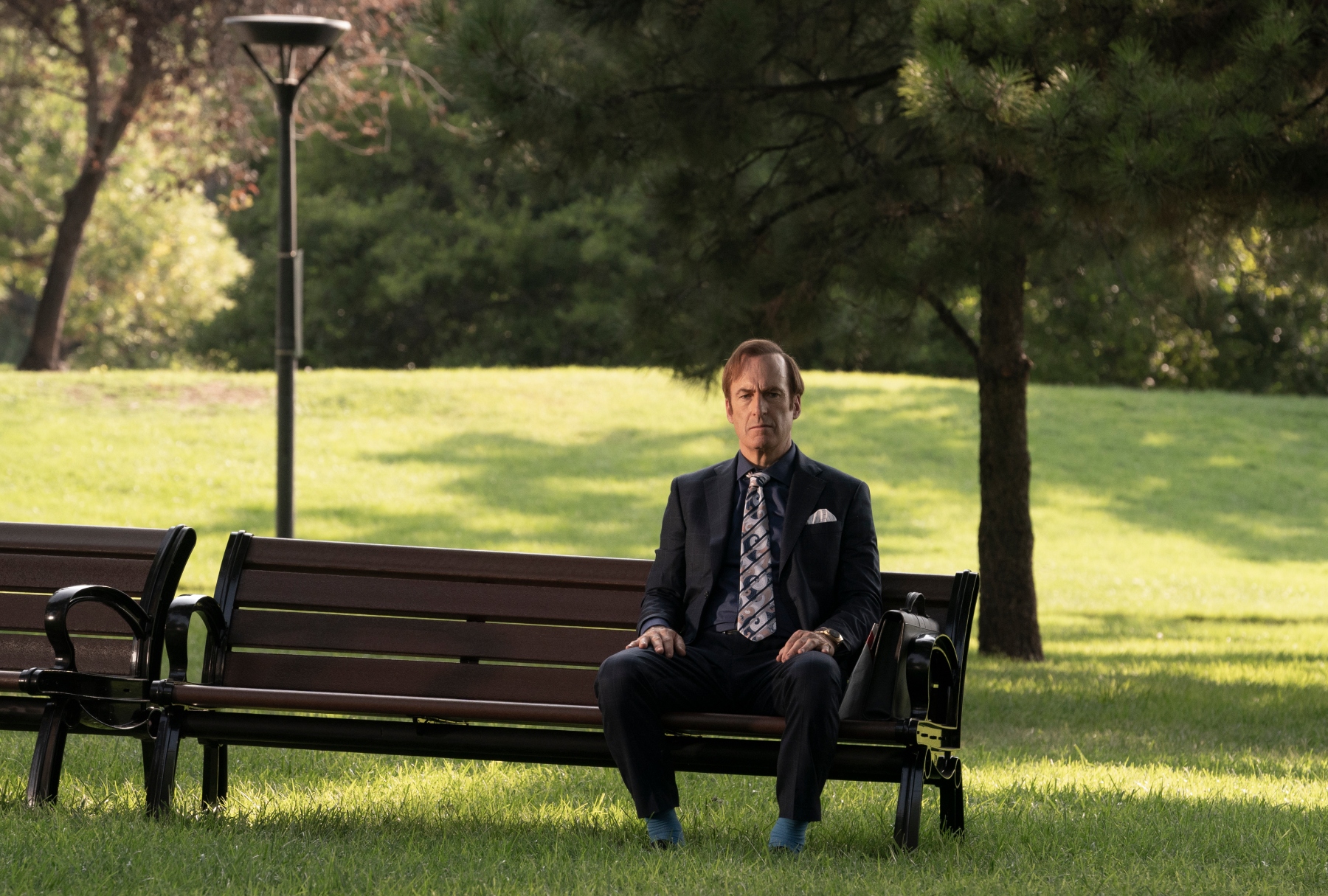
Bob Odenkirk as Saul Goodman in “Better Call Saul” (Greg Lewis/AMC/Sony Pictures Television)At the precise moment that it seems Howard is on to Jimmy and has him dead to rights, it turns out that Slippin’ Jimmy planned for that too. The private investigator Howard hires to get the goods on Chuck’s flim-flamming little brother is himself a con man, one who helps set up Howard so entirely in Cliff’s and his first mediation meeting with Sandpiper’s legal team that taking a settlement is the only choice they have.

The midseason finale is called “Plan and Execution,” and … the phrase is to be taken literally, both as one term and two discrete hints about what’s supposed to go down.

But don’t forget those other titles. “Wine and Roses” was followed by “Carrot and Stick,” implying half of a desirable option. From there the niceness disappears entirely: “Rock and Hard Place.” “Hit and Run.” “Black and Blue.” “Axe and Grind.”

Monday’s midseason finale is called “Plan and Execution,” and as anyone who’s been watching these last episodes may have expected, the phrase is to be taken literally, both as one term and two discrete hints about what’s supposed to go down. Kim and Jimmy have been constructing the plan’s roadwork all season long. As for that other word – well, aren’t we in the final run of a show about a criminal lawyer? A man who is enjoying a newfound reputation as the guy who got the area’s most notoriously violent drug kingpin out of lockup on bail?

Enter Lalo (Tony Dalton), the star of this finale season’s other main plot.

Lalo disappeared for the first four episodes only to reappear in Germany in an elegant suit and on a rampage. In “Plan and Execution” he returns to New Mexico from his European vacation by way of the sewers and methodically stakes out Gus’ massive laundry company front – which he’s found, at last, by torturing a man – and watching for a moment when he can enter and get the “proof” his uncle Hector needs. And also kill a lot of people.

Mark Margolis as Hector Salamanca in “Better Call Saul” (Greg Lewis/AMC/Sony Pictures Television)
The scene that the episode’s writer and director Tom Schnauz constructs to reveal the title’s secondary meeting is one of the darkest in the series.

When it becomes clear that Gus has taken steps to stay ahead of Lalo, the deposed-but-not-done kingpin must come up with his own contingency plan. Its path leads directly to Jimmy and Kim’s place . . . merely a few moments after a defeated Howard has dropped in unannounced to angrily shame the two of them for knocking him down.

And the scene that the episode’s writer and director Tom Schnauz constructs to reveal the title’s secondary meeting is one of the darkest in the series. It opens with a tight shot of a candle flame as Kim and Jimmy share a couple of glasses of wine and watch an old movie, unwinding after the completion of their long project. There are no roses, only that flame burning steadily until there’s a knock on the door. Its fire dances, momentarily, when Jimmy opens it to find Howard, who he invites in.

Howard has brought them a bottle of scotch, but you can tell he’s already indulged in a few slugs of his own. “What allows you to do this to me?” he asks. “Because this goes beyond throwing bowling balls on my car.” He marvels, angrily, at how long they plotted against him, just to “burn him to the ground.”

And he admits he’s worked his way through worse, including the end of his marriage. But Jimmy and Kim? “You two are soulless,” he says, continuing his rant with, “You’re perfect for each other. You have a piece missing. I thought you did it for the money but now, it’s so clear. Screw the money – you did it for fun. You get off on it.”

There are no accidental details in “Better Call Saul.”

He likens them to Leopold and Loeb, two University of Chicago student sociopaths who killed a 14-year-old boy in 1924 to prove they could get away with the perfect crime. Then Howard assures them he intends to dedicate his life to making sure everyone knows the truth of who they are. As Howard says this, the candle’s flame violently flickers again, as if a curse has just been sealed.

There are no accidental details in “Better Call Saul,” which makes these touches with the candle especially sinister. Everything has a symbolic meaning, including flames; according to a couple of mystical websites I checked, a dancing flame indicates that chaotic energy is present.

Except Lalo – the ghost Jimmy, Kim, Gus, and Mike were fearing would reappear all season long – did not knock. He simply found his way in, as evil spirits bedeviling corruptible men surely do. At that moment, viewers had to know we’d be saying goodbye to Howard.

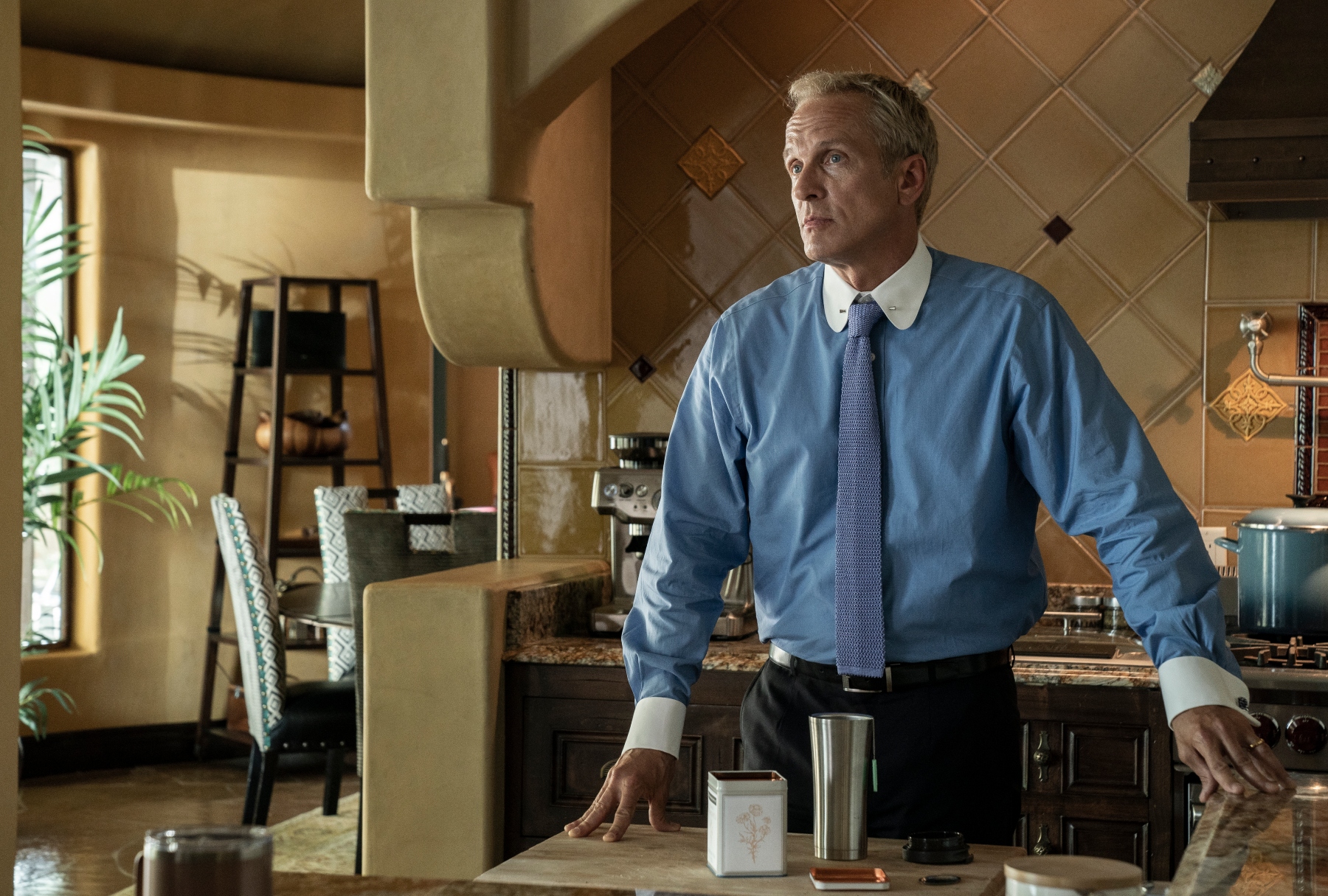
Patrick Fabian as Howard Hamlin in “Better Call Saul” (Greg Lewis/AMC/Sony Pictures Television)“Better Call Saul” and “Breaking Bad” are the stories of desperate men who might not have gone bad if fate hadn’t dealt them a losing hand before showing them a game they could win, as long as they’re OK with other people getting hurt.

Kim wanted to leave Howard bruised but still standing. Lalo is not that considerate.

And while “Plan and Execution” doesn’t rank on the same level of tragedy as an episode like “Ozymandias,” it instead shows the worst possible outcome of the best-laid plans – which is what happens when one doesn’t account for the things you don’t see coming.

Kim wanted to leave Howard bruised but still standing. Lalo is not that considerate, especially of someone he doesn’t know. Howard swaggers in his presence like the man with nothing to lose that he is. But there’s only one kind of predator more dangerous than a guy like that, and that’s a supposedly dead man.

Succeeding in his aims means Lalo may return to the land of the living; failure doesn’t matter, because the world was under the impression he was yesterday’s news anyway. He’s the type of man who can smile as he screws a silencer into the barrel of his gun before shooting Howard in the head, to let them know he means business. To Lalo, Howard is nothing. To Kim and Jimmy, he’s the guy they formed their waking lives around until this instant.

Better Call SaulTony Dalton as Lalo Salamanca in “Better Call Saul” (Greg Lewis/AMC/Sony Pictures Television)Nearly every series-ending run of episodes has a stink of death about it. Writer-director Tom Schnauz promised that from the beginning by enlisting characters we know will live to see the future to play out how they got there in a prequel. We already know that Jimmy makes it as Saul, along with Gus Fring (Giancarlo Esposito) and Mike Ehrmantraut (Jonathan Banks), and early in this season, we witnessed the end of Nacho (Michael Mando).
Not all of the worst deaths must be literal.

That significant death played out in “Rock and Hard Place,” the first of those episodes that cease any implication of a choice and begin describing the sensation of being trapped and squeezed or ground down to a nub. Because of that, many people wondered, or feared, whether the culmination of Jimmy and Kim’s long con would be her death.

But in “Plan and Execution,” Schnauz enacts the vision long-established by series creators Vince Gilligan and Peter Gould that not all of the worst deaths must be literal. Some of the most tragic murder the spirit – the result of a payment for a deal with the devil coming due, a terrible happenstance, or both.


Want a daily wrap-up of all the news and commentary Salon has to offer? Subscribe to our morning newsletter, Crash Course.


We have yet to see the colorless future that awaits Jimmy in this final season of “Better Call Saul,” where his past being Mr. Goodman has morphed into Gene Takavic, the paranoid Cinnabon manager hiding out in Nebraska.

He’s bound to show up again when the series returns for its final six-episode run in July, but after this episode, it’s obvious that it doesn’t matter where the man born as Jimmy McGill relocated or what he calls himself.  Now we know that wherever he goes and however far he rises or follows, Hell will find him . . . and we can only hope that Kim cons her way off its path.

The final season of “Better Call Saul” resumes in July on AMC.

More stories like this:


What trial? Johnny Depp is playing the role of a lifetime, pandering to fans outside the courtroom

Despite being booted from the sixth installment of “Pirates of the Caribbean,” Johnny Depp is still using his former role as the swashbuckling Captain Jack Sparrow to his advantage amid his defamation court case against ex-wife Amber Heard.

Last week — the ongoing trial’s fifth week — the actor entertained his supporters with a Jack Sparrow impersonation outside of Virginia’s Fairfax County Circuit Court, where the case is being heard. Per CNN, a fan yelled out “You’ll always be our Captain Jack Sparrow!” as Depp left the courthouse via an SUV.

“He’s still around somewhere,” Depp then responded in his character’s classic drunken voice. “I see him now and again. He shows up now and again.”

RELATED: Why Fox News is obsessed with Johnny Depp, its Manliness Under Siege mascot

Depp was officially dropped from the “Pirates of the Caribbean” franchise in December 2018, shortly after Heard’s Washington Post op-ed — in which she details personal accounts of abuse but refrains from naming Depp as her abuser — was published. Whether the actor will return to reprise his role or not still remains to be seen. Just a few days prior to the trial’s fifth week, the franchise’s producer Jerry Bruckheimer stated that Depp would not be playing Sparrow anytime soon and that his future with the franchise was still “yet to be decided.”

The sudden rift in Depp’s acting career was succeeded by another loss, when the actor was forced to bid farewell to the “Fantastic Beasts” movies after losing a libel case against the British tabloid The Sun. Throughout his testimony and cross-examination, Depp bemoaned both losses, stating that his string of legal battles affected both his profession and name. Regardless, Depp still remains a lauded A-lister within Hollywood — which can’t be said of Heard, who is younger and not as established in the industry. And although the blows have been impactful, they’ve also afforded Depp with both comfort and loyalty from his enduring fanbase.

If this six-week-long trial has proven anything, it’s that Depp’s fans absolutely adore and worship him. According to The New York Times, Depp fanatics have routinely lined up outside of the courthouse at the crack of dawn, bearing signs with endearing messages, wearing fan merch and — in one instance — walking a pair of Depp-loving alpacas. They also have nothing but selfless praise for the actor, seemingly conflating his onscreen characters with the real man.  

“We just want to support our captain,” one fan, who came dressed like an extra in “Pirates of the Caribbean” to film content for his YouTube channel, told the outlet. “If he goes down with the ship, we’re going down with him.”

“It’s fulfilling a childhood fantasy,” said another fan. “It’s the reason why everyone else is here.”


Want a daily wrap-up of all the news and commentary Salon has to offer? Subscribe to our morning newsletter, Crash Course.


It’s quite clear that Depp is well aware of his own popularity and has been using it to play up to his crowd of devotees. In addition to the Sparrow video, other online videos showcase the actor gleefully accepting gifts, blowing kisses, hugging and waving to his fans. If one were living under a rock, they’d probably think the viral clips were from a meet-and-greet rather than a key trial concerning mutual abuse.

Perhaps the most unsettling aspect of Depp’s treatment of the trial, alongside raging “stan culture,” is that it draws the focus away from the serious allegations made by Heard and further silences survivors of domestic and sexual violence and discredits their abuse allegations. Since its inception, the Heard-Depp trial has been regarded as entertainment on social media as countless TikTok users mocked Heard’s testimonies through exaggerated reenactments and dismissive commentaries. There’s already enough distractors within this whole hoopla and Depp’s moment under the spotlight is a tasteless tactic to absolve himself of guilt or crime. If anything, it’s taking away the seriousness and severity of the case at large.

An abuse case should not be utilized as an opportunity for good PR, period. It’s gross and offensive.

More stories you might like:

Humanity’s most distant spacecraft is sending back weird signals from beyond our solar system

On Sept. 5, 1977, NASA launched a space probe named Voyager 1 into the cosmos. Nearly 45 years later, much to the delighted astonishment of astronomers throughout the world, it is still humming along as it travels far past Pluto.

In fact, Voyager 1 has traveled so far that it has left the bounds of our solar system — and now it is giving off strange readings that scientists are struggling to understand.

The mystery likely has something to do with the fact that Voyager 1 is the farthest artificial object in space. At a distance of 14.5 billion miles away from Earth, Voyager 1 passed through the heliopause in 2012. The heliopause is the barrier separating the Sun’s solar winds from the interstellar medium, or all of the matter and radiation that exist in the space in-between various solar systems in the galaxy. This means that Voyager 1 is literally in the interstellar void of the Milky Way.


Want more health and science stories in your inbox? Subscribe to Salon’s weekly newsletter The Vulgar Scientist.


Perhaps that has something to do with why the Jimmy Carter-era machine is sending back signals that can best be described as strange.

“The interstellar explorer is operating normally, receiving and executing commands from Earth, along with gathering and returning science data,” NASA explained on its website. “But readouts from the probe’s attitude articulation and control system (AACS) don’t reflect what’s actually happening onboard.”

“We’re also in interstellar space – a high-radiation environment that no spacecraft have flown in before.”

More specifically, NASA explained, the AACS keeps the spacecraft’s antenna pointed at Earth so that it transmits data back to our planet. On the surface, the AACS appears to keep working, but all of the telemetry data that it has sent back is invalid, such as by appearing to be randomly generated or physically impossible. This raises questions.

“A mystery like this is sort of par for the course at this stage of the Voyager mission,” Suzanne Dodd, project manager for Voyager 1 and 2 at NASA’s Jet Propulsion Laboratory in Southern California, said in a statement. “The spacecraft are both almost 45 years old, which is far beyond what the mission planners anticipated.”

Dodd added, “We’re also in interstellar space – a high-radiation environment that no spacecraft have flown in before. So there are some big challenges for the engineering team. But I think if there’s a way to solve this issue with the AACS, our team will find it.”

RELATED: The Voyager 1 probe is now so far away that it can hear the background “hum” of interstellar space

This will not be a quick fix. A signal from Earth currently takes 20 hours and 33 minutes to reach Voyager 1, and vice-versa. Both Voyager 1 and its twin Voyager 2 are suffering from a dwindling power supply, forcing the engineers to turn off parts to save as much as they can. Some hope Voyager 1 will be able to continue to transmit data for as far into the future as 2025, after which point its radioisotope thermoelectric generators (RTGs) will no longer be able to summon enough energy to keep its equipment operative.

Even if Voyager 1 does prove to be on its last legs sooner than expected, it has still had a historic journey. As it flew by the gas giants of Jupiter and Saturn, as well as Saturn’s largest moon Titan, it obtained detailed images and unprecedented quantities of data. The Voyager probe famously contains a so-called “Golden Record” (actually two phonograph records) that preserve Earth’s culture to any extraterrestrial beings that may stumble upon and comprehend it. The gold-plated disks include everything from nature sounds to music by Wolfgang Amadeus Mozart and Chuck Berry.

Indeed, the Voyage 1 probe is now so deep into space that astronomers can literally hear the “hum” that our solar system produces as the spacecraft travels outside of it.

“It’s very faint and monotone, because it is in a narrow frequency bandwidth,” Stella Koch Ocker, a doctoral student in the Department of Astronomy and Cornell Center for Astrophysics and Planetary Science, told Salon at the time about the study of which she was lead author. “We’re detecting the faint, persistent hum of interstellar gas.”

A senior author — James Cordes, an astronomy professor at Cornell University —  told Salon that “the interstellar medium is like a quiet or gentle rain. In the case of a solar outburst, it’s like detecting a lightning burst in a thunderstorm and then it’s back to a gentle rain.”

Read more Salon articles on space exploration:

Hugh Bonneville on the enduring charm of “Downton Abbey” and why he was nervous to film “Paddington”

Within the surfeit of charms “Downton Abbey” shares with its devoted audience are many notes of wisdom concerning change.  Accepting change, says Lady Cora in the third season, “is quite as important as defending the past.” Two seasons later even the manor’s butler and stubborn traditionalist Carson (Jim Carter) had to agree: “The nature of life is not permanence, but flux,” he observes.

This is all very true . . . although, when pressed, the story’s devoted fans might claim that what keeps them coming back to their favorite fantasy Yorkshire estate is knowing that at their core the Crawleys remain the same genteel characters as ever. What they can’t change is time. When Julian Fellowes (“The Gilded Age,” “Belgravia“) first introduced Hugh Bonneville’s Robert Crawley, the Earl of Grantham, along with his wife Cora (Elizabeth McGovern) and mother Violet, the Dowager Countess (Maggie Smith), it was 1912.

Six seasons of television and two films hence, their latest chapter, “Downton Abbey: A New Era” picks up in 1928 and offers new paths for several of beloved characters, along with emotional developments both expected and entirely surprising. 

RELATED: “Downton Abbey” is entirely unnecessary, and essential viewing for super-fans

Bonneville knows quite a bit about that feel after spending more than a dozen years playing Robert, as well as stepping into the roles of Mr. Brown in “Paddington” and “Paddington 2” along with his recent turn as Roald Dahl in the biographical film “To Olivia.”

Salon Talks caught up with Bonneville recently to talk about the lasting legacy of “Downton Abbey” as well as his other recent work, and you can watch our entire conversation here or read our conversation below.

This transcript has been edited for length and clarity.

“Downton Abbey” is one of the most beloved shows of our time and it keeps on extending. First, we had the series on television, now we have two films. You have returned again as the Earl of Grantham in  “Downton Abbey: A New Era,” which starts in 1928, correct?

That’s right. We open in 1928. The story has moved on a little bit, as ever in “Downton.” It’s a glacial pace, so we don’t want to rush things too much. We’ve moved on a few months from the last one, and the roof is leaking at Downton. In order to plug the gaps, Lady Mary suggests that we should accept the idea of a film crew coming to film with the castle. Meanwhile, my mother, Lady Violet, has inherited a house, a villa in the south of France. And so some of us go off to find out why.

That must have been fabulous to be able to take that trip. Was it filmed on location or did you mock it up in post-production?

No. I’m delighted to say it wasn’t a green screen . . . because for a long period during pre-production and indeed during production itself, there was a danger that we wouldn’t be able to film in France because of the COVID restrictions. And so they had a plan Z, which was to film in a couple of properties in the UK that they could sort of stitch together and sort of make look a bit French. But it would’ve had the quintessentially gray skies of Britain overhead and that would’ve required a lot of CGI. So we were very fortunate that we were actually able to go to the south of France and film at Cote d’Azur.

Let’s go back a bit: You started playing Robert Crawley, what, back in 2010 at this point? Perhaps a little bit earlier [considering] pre-production. So it’s been quite a long time. What do you think it is about this series and this story that keeps it enduring more than a decade later?

It’s a question we’re always asked. It’s a question none of us have the answer to, and we always search around for it. And I always end up saying, I can only put some of it down to the experience I had when I first read the script, which was, I wanted to know what happened next. And . . .  I enjoyed spending time with the characters. Each of them popped in my imagination.

“A lot has changed, but ‘Downton’ remains the same.”

Also I think there was just a sense of escape, that where the world was when we started, just coming out of this painful financial hit, [people] wanted a piece of escapism really. Now, of course, it’s seven years since we finished the TV show. It was pre-Brexit, pre-, dare I say, pre- Mr. Trump, pre-pandemic. And it seems like a golden era. It seems like a kind of calmer time.

. . . So a lot has changed, but “Downton” remains the same.

Maybe by its third season, as people had seen it a little bit more, I recall reading a number of critiques talking about the idea of the class relationship between the Crawleys and their servants, and of course the people in the village. And how the show takes a very kindly view of how the noble classes might have treated the working classes.

It’s a fictional world. And it gives me a bit of a tickle, actually, that newspapers treat it like it’s a sort of documentary and get very angry. . . . There were some articles recently saying it should be pretty much canceled as it’s disgusting, that it perpetuates the class myth, that there was a sort of benign benevolence in certain estates. And that in fact, all land owners were ghastly people and that should have been put up against the wall. You don’t critique “Star Wars” or “Star Trek” in the same way. This is equally fictional.

. . . It’s not pretending to be a historical document . . .  any more than “The Waltons” is a true account of life in the early part of the 20th century in the U.S.

Do you think that reaction is angrier now? Because there’s more class inequity nowadays. And I just wanted to say – and I love “Downton,” I just want to establish that – but when you were saying we don’t critique “Star Wars” and Star “Trek,” I wonder if it’s the fact that it is a historical drama, that it does depict something that’s real and not on a spaceship, that might be part of the reason that sustains some of these critiques.

Yeah, yeah, yeah. No, I can understand because of course in the space genre, you are completely outside the reality, but whereas we have one foot in reality, as indeed many TV shows do, but I think to get exercised about a piece fiction, particularly in the UK, there’s a tall poppy syndrome. If something is successful, there must be a reason, there must be a way that we can put it down. And it’s part of the British psyche. Maybe it’s part of human psyche, I don’t know.

. . . But ultimately it is about family. And there must be a reason why it’s resonated around the world. I think one of those reasons is that it is about a recognizable set of human relationships that pertain worldwide, that are just universal, that pertain to human beings.

Julian Fellowes writes from a default position that people try to be good. They try, they get it wrong and they do bad things and wrong things, but they try ultimately to get by and look after those around them that they care about. And I suppose that may sound wishy-washy, but I think that is one of the, going back to the question, why does it work or why has it worked and why has it resonated? I think that’s, again, one of the factors. That there is a sort of underlying sense of compassion in these characters that they do try and care for each other.

I want to step back a little bit and talk a little bit about you, Hugh, because we have you playing Robert in “A New Era.”  People also know you from “Paddington,” as I’m sure you know, [“Paddington 2”] has now topped “Citizen Kane” in the U.S. is one of the most beloved movies on Rotten Tomatoes. And then you also are playing Roald Dahl in “To Olivia.” So we have these very different roles of fathers here. . . . Two of the men are very similar just in terms of they’re the kinds of people that we want in our lives. And then Roald Dahl is very complicated as people know. So what has been appealing for you to play these characters in recent years?

Well, I mean Mr. Brown was, I was nervous about doing the “Paddington” film because I grew up with Paddington and I didn’t want to see a childhood hero of mine being given the Hollywood treatment and made a complete mess of. But when I read the first page of Paul King’s script, I was laughing on page one and I thought, “We’re in safe hands here.” This guy understands Paddington and understands Michael Bond, more to the point, the creator of Paddington. Also, the Mr. Brown in the book is a fairly straightforward character. There’s not a lot of texture to him. He’s just Mr. Brown, who works in the city somewhere and is a dad. And that’s about it. Whereas with Paul . . . we spent quite a lot of time improvising and building up the sort of texture of their relationship and their characters. And the idea that Mr. Brown has been very risk averse.

“Julian Fellowes writes from a default position that people try to be good.”

And of course, the presence of the bear gradually unleashes his hinterland. And so playing a character who one can really genuinely flesh out from the bare bones of what Michael Bond had created was really fun, and it had Michael’s blessing. That was important to us.

And in Roald Dahl it was a very different thing. It was really the complexity of the matter that I found riveting. I mean, like millions of people, I knew, I’d read his books when I was younger, but I had no idea about the family challenges that he and Patricia Neil went through.

. . . And Roald is a very complicated man. There’s no question about that, and a controversial man, and you get into the whole world of, if you like, the whole world of cancel culture . . . It’s well documented in Patricia’s own autobiography and indeed books about the Dahls, about how Roald did or didn’t cope with the loss of his daughter. . . . So it’s an extraordinary time of charting this journey through grief for this man and this woman, charting their marriage and also charting their creative energies.


Want great food writing and recipes? Subscribe to Salon Food’s newsletter, The Bite.


Since you had “To Olivia” before “Downton,” did it feel like a relief to let Roald Dahl go and let that world go? You’re talking a lot about just the processing of grief that we see in the story. How was it to go from that to coming back to this role that you’ve known for such a long time?

Yeah. It’s obviously a very different tone, and was a relief. I mean, the Roald Dahl filming and the development of that story, which we’d been working on for several years actually, it was quite intense and it was a small budget film, but I think a very telling film. And so then to go to something that was more familiar, more relaxed, more lightweight, even though it’s got these little wave patterns of quite intense emotion within it. “Downton” is a much broader, more relaxed landscape in terms of I knew the territory, we all knew the territory much we’re much more familiar with it and weren’t trying to reinvent the wheel.

Then laterally, I did a movie that’s coming out soon called, “I Came By,” which is a movie by Babak Anvari, a British movie that’s being released by Netflix that is altogether a different experience and is neither Lord Grantham, Mr. Brown, nor Roald Dahl. So I’ve had a very enjoyable sort of, different textures to play with over the last couple of years.

So you’ve cycled back to Robert. Are going to cycle back to Mr. Brown again?

Oh, I hope so. I mean, there’s certainly talk of a third “Paddington” film, but the logistics of it at the moment are quite complicated. And so it won’t be for a while anyway.

With “Downton Abbey: A New Era,” just because it’s a new era that doesn’t mean necessarily that it’s ending. Do you foresee coming back to playing Robert Crawley again in the future?

I’d never say never. It’s entirely going to be down to the box office. . . . If the audience is still enjoying it, then it would be fun to think we could do one more.

“Downton Abbey: A New Era” is currently playing in theaters.

More stories like this:

How to make the perfect creamy pasta sauce at home, revealed

I have a soft spot for suburban strip mall red sauce joints. You know, the places decorated with vintage Campari posters and old Chianti bottles in woven baskets. At these restaurants, the offerings tend to veer decidedly toward the American part of Italian-American. (One of my longtime favorites brings out a basket of Texas toast garlic bread at the beginning of the meal, for example.)

Inevitably, there’s some kind of pasta with a cream-based tomato or roasted red pepper sauce on the menu. Though not strictly authentic, I tend to love these dishes. They’re cozy and decadent, and if you have a few cooking basics under your sleeve, they’re also easy to make at home. 

Related: The best garlic bread has a secret ingredient and takes 10 minutes

I say “a few cooking basics” because while these sauces are simple to make, they’re not as simple as adding a cup of cream to marinara sauce. That’s a surefire way to end up with a broken, clumpy sauce topped with curdled milk proteins — which is the opposite of the thick, comforting sauce you want to enjoy. 

Ready to get started? Here’s everything you need to know to make the perfect creamy pasta sauces at home: 

Watch your heat

Dairy and non-dairy products with higher fat percentages, such as heavy cream and coconut cream, are less likely to curdle over heat, to the point where you could boil both straight and they would likely simply thicken. 

However, there are still certain best practices to employ when bringing dairy to temperature in a pasta sauce. First of all, don’t just dump cold milk or cream into the pot. Instead, temper it by adding a few tablespoons of the warm pasta sauce to the cream first. Once warmed to room temperature, feel free to add it to the sauce. 

When you’re reheating the sauce, do so incrementally. Instead of immediately blasting your pot or pan with high heat, start gently with low heat and move up from there if needed. 

Be mindful of acids 

Cream and acid have something of a love-hate relationship, which can be tough to navigate since some of the most common pasta sauce ingredients — including tomatoes, wine and lemon juice — are acid-packed.

One common method to prevent your creamy ingredients from curdling is to stabilize the sauce by starting with a roux, which is a mixture of equal parts flour and fat (often butter). Heat the roux over low heat, stirring the mixture until it’s a little toasty in color, an indicator that it will no longer taste like just straight raw flour. Then add your cream to the roux, whisking consistently until the mixture takes on a beautiful, velvety texture. 


Want more great food writing and recipes? Subscribe to Salon Food’s newsletter.


This technique is the base for Alfredo and cheese sauces, but you can use it when making sauces that include an acidic ingredient, such as a creamy tomato-basil sauce or a creamy white wine and parmesan sauce. 

Whisking a few teaspoons of cornstarch in milk before adding it to your sauce can also serve as a roux stand-in, but the sauce won’t get as thick. 

A note on non-dairy cream sauces 

Certain non-dairy milks and creams react to heat better than others — as is on display whenever you add cold non-dairy milk to a hot cup of coffee. Soy milk tends to separate when introduced to high heat (which, fun fact, is actually how tofu is made), while some brands of almond milk can take on an almost metallic taste when warmed. 

Oat milk has a fantastic flavor, and it will thicken with a little coaxing. Coconut cream achieves the right texture right off the bat, but the taste may not be quite what you’re looking for in a pasta sauce. Silk’s dairy-free heavy whipping cream is a lifesaver. 

However, one of my favorite non-dairy hacks for getting a thick, creamy sauce is simply adding a tablespoon or two of dairy-free cream cheese to the sauce in its final minutes of cooking. It plays well with acid, doesn’t curdle and gives great flavor and texture. 

Don’t forget the garlic! Here are some of our favorite garlic-packed recipes: 

Not quite armageddon: A large asteroid is whizzing by Earth this week

It is the nightmare that launched a thousand disaster movies: What if a giant object from outer space, like an asteroid or comet, smashed into Earth and caused an extinction-level event?

Whenever a celestial contender emerges from the cosmos, humanity pays attention, as happened when an asteroid approached Earth during the 2020 election season (it was never a threat) or when one large enough to wipe out a country just missed us (that happened in March last year). Now an asteroid that is four times longer in diameter than the Empire State Building is approaching our planet. If it struck, calamity would ensue.

RELATED: Astronomers discover a pair of young “twin” asteroids, barely older than the United States

Though it is not expected to strike, its size — and the nearness with which it will pass Earth — means that astronomer and space agencies are keeping eyes on it. The barren behemoth is known as 1989 JA, or 7335, and is expected to miss us by roughly 10 times the average distance between Earth and the Moon, according to NASA’s Center for Near Earth Object Studies (CNEOS). That amounts to 2.5 million miles, more than enough to put at ease the minds of people who got nightmares over “Deep Impact” and “Armageddon.” Yet that comfort comes with a caveat: The NASA scientists acknowledge that because 1989 JA is so massive (it has a diameter of 1.1 miles) that they cannot responsibly wave it off. It is therefore being classified as “potentially hazardous”—  because with any unexpected change in its orbit, or if its orbit were miscalculated, it could suddenly become deadly.

When 1989 JA whirs past Earth later this week, it will do so at a speed that would make the most able Western gunslinger blush, barreling toward our planet at approximately 30,000 miles per hour.


Want more health and science stories in your inbox? Subscribe to Salon’s weekly newsletter The Vulgar Scientist.


“To provide some context, that is 17 times the speed of a bullet through the air. At this speed, the asteroid could travel around the planet Earth in 45 minutes,” Franck Marchis, chief scientific officer telescope company Unistellar and senior planetary astronomer at the SETI Institute, explained to USA Today.

As the asteroid approaches at this dizzying speed, astronomy fans will be able to view it live-streamed through telescopes in Chile and Australia.

If a worst-case scenario transpires and human beings need to protect themselves from a killer asteroid or comet, such as the one that is believed to have wiped out the dinosaurs, humanity would not be without hope. In November NASA launched a spacecraft called DART, or the Double Asteroid Redirection Test, to collide with a pair of harmless asteroids named Didymos (nearly 800 meters wide) and Dimorphos (roughly 160 meters wide). Using the “kinetic impact” approach to protecting people from asteroids, DART is designed to deflect parts of these asteroids away from Earth’s gravitational pull. The sections of the asteroid that remain should be small enough that they will burn up harmlessly in the planet’s atmosphere.

In a similar vein, a group called the B612 Foundation exists to keep tabs on all celestial objects that could pose an existential threat to life on Earth.

“Here is a problem that is a very solvable,” Danica Remy, President of B612 Foundation, told Salon. “When you think about big global problems a lot of them are not going to be as easy to solve, certainly from changing human behavior to the political agendas, but [asteroid impact] is smaller compared to famine or war or climate change.” The B612 Foundation is contracting out computational capabilities to help model asteroids’ future trajectories. As Remy explained: “when you’re talking about modeling let’s say 10,000 objects, and you have all of these different factors that our solar system factors in, you need that kind of computational capability to model those moving objects out over 10, 20, 40, 50, or 100 years.”

For more Salon articles on asteroids:

House investigating Cawthorn crypto scheme and whether he had “improper” relationship with staffer

The House Ethics Committee on Monday opened a far-reaching federal probe into Rep. Madison Cawthorn, R-N.C., over allegations that he committed insider trading and had a sexual relationship with his aide. 

The probe, which will be led by a subcommittee established on May 11, comes just days after the freshman firebrand lost his re-election bid amid a torrent of reports around his sexual proclivities. 

Earlier this month, The Daily Mail published a leaked video showing Cawthorn’s second cousin, Stephen Smith, who is also his scheduler, reach for the lawmaker’s crotch while the two spoke about suggestive topics in the car. Weeks later, the congressman was shown in a separate video, leaked by an anti-Cawthorn conservative PAC, nude in bed with another man. 

RELATED: Conservative group that helped take down Madison Cawthorn has a new target: Lauren Boebert

Cawthorn has alleged that both videos are part of a political “hit” job. 

“Years ago, in this video, I was being crass with a friend, trying to be funny,” he said. “We were acting foolish, and joking. That’s it.”

According to an ABC affiliate, Cawthorn has paid Smith $141,000 in taxpayer and campaign dollars since 2020. 

House filings show that Smith took in $32,744 between January 4, 2021, and August 22, 2021. Between August 1 and December 31 of that year, Smith received another $28,487 as an Americans with Disabilities Act aide. The scheduler has also reportedly collected more than $80,000 from Cawthorn’s campaign since January 2020. 

Apart from his relationship with Smith, House members are also scrutinizing a series of cryptocurrency transactions the North Carolina legislator made spanning into last year.

RELATED: Madison Cawthorn’s scandalous freshman term: 12 controversial moments since joining Congress


Want a daily wrap-up of all the news and commentary Salon has to offer? Subscribe to our morning newsletter, Crash Course.


According to The Washington Examiner, Cawthorn may have taken part in an alleged pump-and-dump scheme to boost the value of “Let’s Go Brandon” cryptocurrency, a crypto meme coin named after a minced oath that actually means “F*ck Joe Biden.”

Back in December, the lawmaker reportedly took to social media to promote the currency, which he has said he owned, just a day before NASCAR driver Brandon Brown announced that he would be the coin’s chief sponsor. Following Brown’s announcement, the coin immediately shot up by 75% in value. But just a month later, the coin’s value plummeted to $0 after a number of unknown insiders issued mass selloffs, spurring an April lawsuit that accused hedge fund manager James Koutoulas, who founded the coin, of a pump-and-dump scheme.

https://www.instagram.com/p/CYF24Q4rJ9B/?utm_source=ig_embed&ig_rid=bdf436b3-16af-4efa-aa4d-8249bd29ebe6

Multiple ethics watchdogs have come forward to express concerns that Cawthorn may have taken advantage of nonpublic knowledge to line his own pockets.

Dylan Hedtler-Gaudette, the government affairs manager for Project on Government Oversight, told the Examiner that Cawthorn’s involvement with the currency “looks really, really bad.”

“This does look like a classic case of you got some insider information and acting on that information,” he said. “And that’s illegal.”

“The View” gets “heebie-jeebies” after Ted Cruz obsesses over Pete Davidson dating “hot women”

Ted Cruz has his own podcast and on it, the Texas Senator spews his unwanted takes on a range of pressing issues, including actor Pete Davidson’s sex appeal and “hot women.”

“Pete Davidson . . . how come that dude gets all of these, like, hot women?” Cruz asked his co-host, Michael Knowles, in a Thursday episode of “Verdict with Ted Cruz.”

“Pete Davidson was dating Kate Beckinsale. I mean, you’re talking ‘Underworld.’ You’re talking, like, superhot vampire in a black leather trench coat,” the Cancun-fleeing politician continued, referencing Beckinsale’s 2003 role. “And you’re like, really? The ‘SNL’ dude? Like, wow.”

RELATED: “The View”: Ted Cruz is “despicable” for comparing Roe demonstrators to Jan. 6 insurrectionists

It’s still unclear where Cruz found the audacity to make such comments and why he felt the need to speak about “toxic femininity” and a woman’s own attractiveness. Regardless, the senator was quickly put in his rightful place by “The View” panel, who slams Cruz for assuming he knows anything about women.

“This gives me the heebie-jeebies, can I just tell you? It’s so creepy and so disgusting,” says co-host Ana Navarro during Monday’s segment of the show. “So he might want to say, ‘How come that dude on “SNL”—,’ I want to know, how come that dude is a U.S. senator and is doing a podcast and spends so much time trolling on Twitter? I mean, does he think that he’s gonna lead by being a social media influencer?”

She adds that Cruz’s unfiltered rhetoric is also blatantly “disrespectful” to both his wife, Heidi Cruz, and their two daughters.

“I don’t understand why he’s talking about a woman’s looks,” fellow co-host Sunny Hostin says, adding that Cruz once told Donald Trump that “real men don’t attack women” after the ex-President tweeted an unflattering photo of his spouse. “I don’t understand why he has a podcast, quite frankly, talking about this kind of stuff.”


Want a daily wrap-up of all the news and commentary Salon has to offer? Subscribe to our morning newsletter, Crash Course.


Joy Behar promptly jumps in to mock Cruz’s sadomasochistic fantasies with Beckinsale and sexy vampires. She also adds her two cents on why Davidson is deemed attractive while Cruz is seen as a fool.

“The reason that women like Pete Davidson is because he is funny, he’s funny,” she states. “Ted Cruz, you’re funny because people laugh at you. Pete Davidson, people are laughing with him.”

She adds, “By the way, Ted Cruz has long advocated for criminalizing abortion. I don’t think that that’s a turn-on to women, Teddy.”

Watch the full discussion below, via YouTube:

More stories you might like:

Jif peanut butter is recalled over salmonella concerns

Before you make that batch of 3-Ingredient Peanut Butter Cookies or No-Bake Peanut Butter Bars With Oreo Crust for dessert this week, check your pantry! Jif peanut butter products are being taken off shelves at retailers across the country due to a multi-state outbreak of salmonella. According to the Food and Drug Administration (FDA), the company has voluntarily recalled a whopping 49 peanut butter products including creamy and crunchy peanut butter in an assortment of sizes, no sugar added peanut butter, natural creamy and crunchy peanut butter, reduced-fat peanut butter, to-go cups of peanut butter, and more (the full list of recalled peanut butter products can be found here). The products were distributed nationwide and have lot code numbers between 1274425 through 2140425.

Jif is part of the J.M. Smucker Company, which also includes brands like Folgers, Meow Mix, Milk-Bone, Rachael Ray Nutrish, Smucker’s, and more.

So far, there have been 14 reported illnesses — including two hospitalizations — in 12 different states. The 12 states that have reported salmonella cases are Arkansas, Georgia, Illinois, Massachusetts, Missouri, Ohio, North Carolina, New York, South Carolina, Texas, Virginia, and Washington. Symptoms of salmonella include abdominal pain, diarrhea, fever, nausea, and vomiting in most healthy people. Young children or people with weakened immune systems may experience more severe symptoms such as arterial infections (i.e., infected aneurysms), endocarditis, and arthritis, according to the FDA.

If you happen to have any of the impacted Jif peanut butter products, dispose of them immediately or return them to the place of purchase for a full refund. Surfaces and utensils (like butter knives, spoons, or spatulas) that might have come in contact with the contaminated peanut butter should be washed and sanitized. Consumers who have questions may call 800-828-9980 for more information.

Laura Dern, Sam Neill and a “Jurassic” age difference that seems troubling now

When the trailer for the 2020 horror film “You Should Have Left” was released, many people were confused. Kevin Bacon and Amanda Seyfried were the leads – but what was their relationship, exactly? Was Seyfried the daughter of the nearly three decades-older Bacon? The babysitter, certainly. Nope, in the film they were together. Together-together. 

The movie at least made the wide age difference part of the storyline: a second marriage and later in life parenthood for Bacon’s character and distrust between the couple worsened by their generational divide.

It’s a tale as old as time, having old men play the love interest of women young enough to be their daughters. In some cases, granddaughters. In my family’s favorite “White Christmas,” Rosemary Clooney was 26 when she played opposite 51-year-old Bing Crosby. Fred Astaire was 30 years older than Audrey Hepburn in “Funny Face.”

And in “Jurassic Park,” Laura Dern was only 23 when she first played Ellie Sattler. Sam Neill as Alan Grant, the film’s hero and Ellie’s love interest, was 20 years older.   

RELATED: “A paleontologist explains why bringing back dinosaurs is a really bad idea

Dern and Neill brought up the age difference between their beloved characters in an interview with The Sunday Times. The two are returning to a world with dinosaurs in this summer’s “Jurassic World: Dominion.”

A yawning age difference usually wasn’t part of the storyline of these films. It just was, a fact of life.

In the first “Jurassic” film, Dern’s Ellie was a paleobotanist. This confused me, because even as a kid watching I knew she’d have to have serious schooling and she didn’t appear old enough to hold a PhD already. She must have been a grad student, I reasoned (perhaps as she was in Michael Crichton’s book) and Alan, a paleontologist who looks notably older than Ellie in the film, one of her professors or former professors. 

That was a dynamic that unfortunately made sense to me. After all, I’d seen it in everything from “The X-Files” to “Gilmore Girls.” In so many shows, the woman of a couple has youth, intelligence and beauty. The man has . . . well, age? And sometimes the power that can come along with that?

In the interview, Dern and Neill both question the age difference of their characters. “Laura was a tender age,” Neill said, but acknowledges he didn’t consider the ramifications of being paired with her romantically in “Jurassic Park” until he stumbled onto a magazine including their characters in an article headlined “Old geezers and gals.” (Jeff Goldblum, whose character Ian Malcolm also expresses interest in Ellie, wasn’t much younger than Neill.)

“Jurassic Park” (1993) actors Laura Dern, Ariana Richards and Sam Neill (Frank Trapper/Corbis via Getty Images)At the time, neither Dern nor Neill questioned it.

This was a time of films like “Entrapment” (1999) with a 39-year age difference between romantic leads Catherine Zeta-Jones and Sean Connery. Anne Heche was the 29-year-old love interest of 55-year-old Harrison Ford in 1998’s “Six Days, Seven Nights.” In “A Perfect Murder,” out that same year, Michael Douglas was nearly three decades older than his romantic interest, Gwyneth Paltrow.

A yawning age difference usually wasn’t part of the storyline of these films. It just was, a fact of life in the ’90sBritney Spears was vilified for existing, the tabloids made money off Tara Reid, and in films and on TV, men were old and women were young, because older women didn’t exist in Hollywood. 

People love who they love, but you cannot ignore the implications of power and inequality in a story pairing a senior citizen with a very young woman.

As The Washington Post wrote in an article examining gender imbalance and age among actors: “While male actors can enjoy rich careers that last well into their 40s and 50s, female actors are often treated like they have an expiration date… past age 40, men claim 80 percent of the leading roles, while women only get 20 percent.”

Though Ellie and Alan had obvious decades between them, that difference was not remarked upon, explained or accounted for in “Jurassic Park” As Dern said, “It felt completely appropriate to fall in love with Sam Neill.” She admitted: “It was only now, when we returned in a moment of cultural awareness about the patriarchy, that I was, like, ‘Wow! We’re not the same age?’ “

Dern is currently 55. Neill is 74.


Want a daily wrap-up of all the news and commentary Salon has to offer? Subscribe to our morning newsletter, Crash Course.


There’s a lot we didn’t used to question.

In 1997’s “As Good as It Gets,” Helen Hunt was 34 when she fell for 60-year-old Jack Nicholson’s cranky character. But by 2003’s “Lost in Translation,” then 17-year-old Scarlett Johansson falling for 51-year-old Billy Murray felt weird, at best. A friendship, certainly, bloomed between the two, an intense connection. But a romance with more than 30 years separating them? 

The generational divide between such mismatched characters, and all that encompasses, including power, cannot be denied. Of course, people love who they love, but you cannot ignore the implications of society, worth and inequality in a story pairing a senior citizen with a very young woman.

In promotion, “You Should Have Left” had to make it clear that the obvious age gap was part of the storyline (and part of the reason for the characters’ marital problems). One wonders if “Jurassic Park: Dominion” will look back in any reflective way on the characters’ romantic journeys (Ellie married someone else, after all) and try to explain what happened between Ellie and Grant, why it happened.

We won’t just accept anymore without comment that a woman is romantically paired with a man three decades her senior, and we shouldn’t. Not only does this ignore the wealth of female actors in their 40s and beyond, it fails to comment on an unequal and antiquated power structure that is showing its age.

More stories like this:

How to make sfogliatelle, the mesmerizing Italian pastry

Buckle up, guys — this pastry is definitely a project. But trust me, it’s a super fun, satisfying, and delicious one. There’s nothing like a batch of still-warm sfogliatelle (or if you’re just referring to one, sfogliatella), an especially beautiful Italian pastry. Multiple layers of gorgeously thin dough (rolled using a pasta machine) encase a creamy filling made with a base of semolina “pudding” and ricotta cheese. The pastry, sometimes referred to as “lobster claws” (not“lobster tails,” that’s something else) here in the States, bake up gorgeously golden and crisp. The result is a seriously impressive pastry that’s time-consuming, but totally doable at home, and worth it. Ahead, I’ll walk you through exactly how to make sfogliatelle at home using my go-to recipe and you’ll be folding and shaping dough in no time.

But first . . . How do you pronounce sfogliatelle?

Let me take a stab at this one — ss-fog-lee-uh-tell-ee.

The dough

Sfogliatelle dough is simple to make; it’s the handling that gets tricky. To make the dough, combine all-purpose flourfine sea salt, room temperature unsalted butter, and room temperature water in the bowl of an electric mixer fitted with the dough hook attachment. Mix on low speed for 3 minutes — the dough should start to come together, but will still look pretty rough. Raise to medium speed and mix for 3 minutes more; the dough may not look super smooth, but it should have formed a ball around the mixer attachment. A longer mixing time like this is what helps give the dough its structure, enabling it to undergo many, many manipulations to create the paper-thin layers of pastry that make this recipe so dang good.

Enlist some helping hands

What makes this pastry special is the paper-thin dough that creates layer after layer of flaky dough. To achieve this, the dough is rolled thin using a pasta machine. While there are multiple stages of rolling, at its longest, the dough will stretch to about 4 feet long. For this reason, it’s ideal to have a couple of sets of hands on deck to help handle the dough. It is also totally possible to do it alone, but you need a nice, long piece of kitchen counter (or a table) to make sure you have room to gently lay the pastry dough down as it comes out of the machine. Before you start rolling the dough, grab yourself a small bowl of flour, in case you ever need a dusting. This will help prevent the dough from sticking or tearing, which it’s especially at risk of because it will be so thin and delicate. Clear off as big of a space on your counter as possible, or opt for a table instead! The more room you have, the easier some of the more detailed steps will be.

First rolling

Right away, the dough needs to undergo some folds, so break out your pasta maker. It can be a hand-crank variety, but I’m a fan of the attachment for my electric mixer: it frees both of my hands for working with the dough. Divide the dough into two even pieces. Wrap one piece tightly in plastic wrap while you work with the other (always keep any dough that’s not in use wrapped up — it can dry out easily, especially as it starts to get rolled thinner).

This is how it gets paper-thin.This is how it gets paper-thin. (Photo by Ren Fuller)

You shouldn’t need to use much flour to work with this dough, only a light dusting, and only whenever it feels a little tacky to the touch. Roll out the first piece of dough into a rectangle of about 5×10 inches. Set your pasta machine or rollers to the widest setting. Run the dough through the pasta machine, then fold it in half to make a small rectangular package of dough. Repeat this process 4 more times (a total of 5), continuing to run the folded dough through at the widest setting. Unwrap the second piece of dough, and use the plastic wrap to tightly wrap up the first piece. The dough will dry out if exposed too long to air in these early stages and become harder to work with.

Fold it in half.
Fold it in half. (Photo by Ren Fuller)

Repeat this process with the second piece of dough. When it’s ready, unwrap the first piece of dough and place it on top of the second. Use a rolling pin to press the dough together, and roll it gently until it’s about 1/2-inch thick.

Run the dough through the pasta machine (still set to the widest setting), then fold it in half. Repeat a total of 10 times. After the final pass, fold the dough in half horizontally (from one long side to the other), then fold in half from one short side to the other.

Let's roll.
Let’s roll. (Photo by Ren Fuller)
Run through the machine, fold it in half, and do this 10 times.
Run through the machine, fold it in half, and do this 10 times. (Photo by Ren Fuller)
Fold in half horizontally.
Fold in half horizontally. (Photo by Ren Fuller)
And then fold the short side across.
And then fold the short side across. (Photo by Ren Fuller)

Rest time

This process of rolling starts to form the layers in the dough. After these stages of rolling, it’s important to let the dough rest and chill. Wrap the dough tightly in plastic wrap and refrigerate for at least 1 1/2 hours, and up to overnight.

Second rolling

Quarter the dough, and wrap all but one piece tightly in plastic wrap. On a lightly floured surface, roll out the dough into a rectangle about 4 x 7 inches. Set your pasta machine or rollers to the widest setting. Run the dough through the pasta machine. Flour the dough lightly, as needed (though I will note that I did not need to use flour at all for my dough). Continue passing the dough through the machine, making the setting smaller/narrower each time, until the dough is almost thin enough to see through; it will be about 4 feet long at this point.

Yes, your dough will be the height of a small child.
Yes, your dough will be the height of a small child. (Photo by Ren Fuller)

Forming the dough log

Gently lay the long strip of dough down on the counter. Working the length of the dough, gently stretch it to make it slightly wider and thinner. Don’t worry, it’s very sturdy, but if you get a small rip or two, you won’t be able to tell.

That's some elasticity.
That’s some elasticity. (Photo by Ren Fuller)

At this stage, soft butter is spread into a thin, even layer, all the way across the dough. Starting from one of the short ends, roll the dough up into a tight spiral, leaving about 1 inch of dough unrolled. Set aside, and cover loosely with plastic wrap. Repeat the rolling process with another piece of the remaining dough. When it’s rolled out, repeat the stretching and buttering processes.

Spread soft butter with an offset spatula.
Spread soft butter with an offset spatula. (Photo by Ren Fuller)
Don't forget to leave an inch.
Don’t forget to leave an inch. (Photo by Ren Fuller)

Unwrap the first dough spiral that you rolled, and place the excess 1 inch of dough at the end of the new piece of dough, overlapping by about 1/4 inch. Roll the spiral with the new dough, now making the log even thicker and larger by rolling the whole length of the second piece of dough. The log should be about 2 inches thick and about 8 inches long. Wrap the log tightly in plastic wrap and refrigerate until firm, at least 2 hours and up to overnight. Repeat the process with the two remaining pieces of dough to make a second dough log.

The filling

The traditional filling for sfogliatelle is a semolina-ricotta mixture. First, sugar and milk are brought to a simmer. Semolina flour (yes, like the kind used to make pasta) is added and whisked until it thickens, creating a thick sort of pudding. After it cools, the mixture is mixed in an electric mixer with the whip attachment. Egg yolks are added, and I also add vanilla for flavor. I personally like to add the zest of a lemon or orange and a pinch of ground cardamom, but both are optional. These are the most traditional flavors for sfogliatelle fillings, but have fun with different variations, like pistachio or fruit jam. Finally, the ricotta is whipped in. The final filling is smooth, creamy, and thick. Keep it covered and chilled until ready to use.

Shaping the pastries

When they’ve thoroughly chilled, remove the dough logs from the refrigerator and unwrap. Cut each log into 8 even pieces — each piece should be about 1-inch wide.

Home stretch—you got this.
Home stretch — you got this. (Photo by Ren Fuller)

Working with one piece at a time, use your fingers (pressing to flatten the dough between your fingers) to work your way around the edge of the dough, making it thinner. The idea is not to make the whole piece of dough thinner, but make it kind of cone shaped.

Soon to be filled with ricotta and semolina goodness.
Soon to be filled with ricotta and semolina goodness. (Photo by Ren Fuller)

I press the dough between my thumb on one side, and my first and middle finger on the other. As you work, you’ll start to feel it flattening out. What’s really happening is the butter between the layers of the dough makes it easy to sort of fan the layers out, creating a thinner look to the dough, though it’s all still one piece. Continue the same motion, but work inward toward the center of the round. Once you’ve achieved the conical shape, spoon about 2 tablespoons of filling into the center of the cone, fold it over so the ends meet, encasing the filling. Gently pinch the ends to seal.

Ah, there are the lobster claws.
Ah, there are the lobster claws. (Photo by Ren Fuller)

Transfer to a parchment-lined baking sheet, and repeat with the remaining pieces of dough.

Baking

OK, you’ve done it! All that’s left now is to brush the surface of each pastry with melted butter, and bake the pastries at 400° F until they are very golden brown and crisp (about 23-26 minutes). I like to rotate the trays front to back and between their racks halfway through baking, and brush them with butter again, for good measure! This also helps to ensure that the sfogliatelle cooks evenly in the oven, so that they come out golden brown all over.

Finishing

Once the pastries come out of the oven, transfer them to a cooling rack to cool for about 10 minutes. I like these best served still slightly warm (but of course even a room temperature Italian sfogliatelle will still be delicious). Just before serving, dust them generously with powdered sugar using a fine mesh sieve. Then, sit back and enjoy the fruits (erm . . . pastries) of your labor!

Recipe: Sfogliatelle

Other Italian pastries!

Homemade Cannoli

There’s no treat like a cannoli. Biting into the hard pastry shell and having the sweet ricotta filling ooze out is one of life’s simplest pleasures. Dust the cannolis with powdered sugar or dip the ends into chopped chocolate and pistachios.

Millefoglie (Italian Custard and Puff Pastry Cake)

This layered cake is a classic dessert for Tuscan celebrations, but it’s typically purchased from a bakery rather than made at home. That being said, it’s surprisingly easy to make yourself.

Bomboloncini (Italian Doughnut Holes)

This classic Tuscan treat is devoured as a snack, a breakfast, and sometimes even dessert. Emiko’s recipe calls for rolling the fresh bomboloncini in cinnamon sugar, but you can take things to the next level by filling each one with jelly or custard. Pro tip: “The bomboloni must be very hot for the sugar to stick to them evenly, so pop them straight into a bowl of sugar as soon as they come out of the hot oil from frying,” says Emiko.

“Totally false”: Knives out in Trumpworld over Kellyanne Conway’s controversial book claims

Donald Trump’s spokesperson, Liz Harrington, on Monday denied that the former president ever considered dropping out of the 2016 presidential race after the Access Hollywood tape was leaked, calling the accusation detailed in a forthcoming book by White House counselor Kellyanne Conway “totally false.”

Conway detailed an informal meeting she had with Trump outside of an elevator in Trump Tower just a day after the tapes were leaked to The Washington Post, according to an excerpt from her upcoming book “Here’s the Deal” that was published by The Daily Beast’s Zachary Petrizzo.

Concerned about reports that the Republicans Party might attempt to push him out of the race, Trump asked Conway, “Should I get out [of the race]?” 

RELATED: Spin class with Kellyanne Conway: How to BS your way out of anything

“I never, ever give up,” he added.

“You actually can’t,” she reportedly told him, “unless you want to forfeit and throw the whole damn thing to Hillary.”

“What do you mean, I can’t?” Trump shot back. 

Conway explained that early voting was already underway. “I know you don’t like to lose,” she added, “but I also know you don’t like to quit.”


Want a daily wrap-up of all the news and commentary Salon has to offer? Subscribe to our morning newsletter, Crash Course.


RELATED: How Kellyanne Conway spun Trump’s past to work for a right-wing evangelical audience

Conway also alleged that she tore into her former boss over his remarks, calling them “disgusting” and “reprehensible” to his face. 

At the time, several dozen Republicans called on Trump to bow out of the race over the tape, including former Utah Gov. Jon Huntsman Jr., Sen. Dan Sullivan, R-Alaska, and Sen. Cory Gardner, R-Colo. Likewise, numerous Republicans who endorsed the former president had also rescinded their imprimaturs over the tape. 

But while Conway might’ve found Trump’s taped remarks despicable, she continued to defend the president publicly, insisting that people “should stop using” the term “sexual assault” to describe what Trump had alluded to in the tapes, as the Beast noted. 

Asked why people should stop using the term, Conway told CNN’s Dana Bash, “Because I know him better, and I know better.”

In her tell-all, Conway reportedly goes easy on Trump for the most part, instead unloading on numerous former colleagues from her time in the administration. 

Conway reportedly describes Jared Kushner, Donald Trump’s son-in-law who served as one of Trump’s senior advisors, as “shrewd and calculating,” according to HuffPost.

“There was no subject he considered beyond his expertise. Criminal justice reform. Middle East peace. The southern and northern borders. Veterans and opioids. Big Tech and small business,” Conway wrote, according to the excerpt. “If Martian attacks had come across the radar, he would have happily added them to his ever-bulging portfolio. He’d have made sure you knew he’d exiled the Martians to Uranus and insisted he did not care who got credit for it. He misread the Constitution in one crucial respect, thinking that all power not given to the federal government was reserved to him.”

Her relationship with Kushner reportedly went awry after he accused her of leaking sensitive information to the media.

Conway also detailed the rift between her and her husband, George, a conservative political activist who repeatedly castigated Trump online his actions and rhetoric. 

“Like everything George did during this time,” Conway explained, “I found out about it after it happened or as it was happening. It was sneaky, almost sinister. Why not own it, share it, sneer in my face with a copy of tomorrow’s Washington Post op-ed or next week’s Lincoln Project ad?”

“I had two men in my life,” she added. “One was my husband. One was my boss, who happened to be president of the United States. One of those men was defending me. And it wasn’t George Conway. It was Donald Trump.”

During the schism, Kellyanne Conway was reportedly given advice by Trump’s daughter, Ivanka, who, according to Conway’s book, told her to get couples therapy.

At one point, Ivanka reportedly handed Conway a Post-It note with the names and contact information of two couple therapists in the area.

“I noticed she had avoided putting that in a text or an email. I appreciated the information and her thoughtfulness and wanted to pursue it,” Conway recalled, according to The Washington Post. “After I showed George the names, he rejected one and said a halfhearted ‘okay’ to the other while looking at his phone. We never went.”

Trump spokesman attacks “desperate” Mike Pence over report that he may challenge Trump in 2024

Donald Trump’s spokesperson, Taylor Budowich, lashed out at former Vice President Mike Pence for backing a number of non-MAGA Republicans in this year’s primaries ahead of a potential 2024 presidential bid, calling him “desperate to chase his lost relevance.”

“Mike Pence was set to lose a governor’s race in 2016 before he was plucked up and his political career was salvaged,” Budowich told The New York Times. “Now, desperate to chase his lost relevance, Pence is parachuting into races, hoping someone is paying attention. The reality is, President Trump is already 82-3 with his endorsements, and there’s nothing stopping him from saving America in 2022 and beyond.”

RELATED: Pence biographer: He “imagines he’s one day closer” to becoming president because it’s God’s plan

Budowich’s remarks come amid a growing rift between Trump and Pence, who the former president castigated back in January 2021 for not going along with a plan to overturn his 2020 election loss.

In recent months, that rift has grown wider in light of the former vice president’s support of Georgia Gov. Brian Kemp, who likewise resisted Trump’s pressure to reverse the last presidential election. Kemp is currently facing a gubernatorial primary challenge from the former Sen. David Perdue, R-Ga., who the former president recruited into the race. 

Earlier this month, outlets reported that Pence would campaign with Kemp, a joint effort that’s set to officially commence on Monday, according to the Times. 


Want a daily wrap-up of all the news and commentary Salon has to offer? Subscribe to our morning newsletter, Crash Course.


“Brian Kemp is one of the most successful conservative governors in America,” Pence said back in May. “Brian Kemp is my friend, a man dedicated to faith, family and the people of Georgia. I am proud to offer my full support for four more years of Brian Kemp as governor of the great state of Georgia!” 

RELATED: Mike Pence and top Republicans flock to Georgia to defeat Trump’s candidate in key primary

Pence’s name has also been floated in the national conversation about potential presidential contenders in 2024. On Monday, the former vice president left open the door to jumping into the race even if Trump runs as well. 

“We’ll go where we’re called,” Pence said, suggesting that he would act on God’s will. “That’s the way Karen and I have always approached these things.”

Pence also told the Times that people have expressed gratitude over his unwillingness to overturn the 2020 election. 

“I have been very moved traveling around the country how much people have made a point to express appreciation, it has been very humbling to me,” he said, adding that he spent “five years in a foxhole” while working for the Trump administration.

Most Americans believe that the former vice president had no right to alter the results of the election, according to a poll from February.

GOP voters who claim “antifa” did Jan. 6 stumped when asked “then why didn’t Trump stop it?”

MSNBC’s Elise Jordan stumped a focus group of Republican voters who blamed left-wing protesters for the violence on Jan. 6, 2021.

The “Morning Joe” contributor interviewed voters in Georgia, and the panel of Republicans parroted conspiracy theories to minimize the deadly riots and blamed anti-fascist factions for the violence, although all of the hundreds of individuals charged in connection with the insurrection appear to be Donald Trump supporters.

“There was a lot of bad stuff that happened that day, I agree,” said one focus group participant, a white man who appeared to be about 60 years old. “But I believe the portion of people that were troublemakers is very small. No. 2 how many of those troublemakers were actually Antifa or intentional troublemakers?”

That caught the attention of another participant, a white woman who twice signaled her agreement by saying, “Exactly.”

“There’s a whole series of questions that don’t add up,” the man continued, “and you have to go through this much boilerplate and crap to find the three nuggets of truth or hard fact or information that really matters. I’m frustrated by the entire thing, I want to forget about it, but I looked at every photograph in the [“Atlanta Journal-Constitution”], about 20 photos that day. All the ones smashing and bashing and crashing, 25, 28 years old, skinny jeans with the beards. I said to myself, ‘That’s not the normal Republican.’ I mean, look at us here. I mean, maybe he was paid to do that.”

“None of it makes any sense,” he added, throwing in debunked claims about a riot participant. “When you read about, you know, Ray Epps being at the one gate that fell first, when you read about the Molotov cocktails left at the DNC the night before with only a mechanical kitchen timer, not anything remotely triggered, so after 60 minutes, the timer can’t be activated. Kamala Harris went to the DNC. Bombs were found by her crew at 11:50, 12:50, within five minutes of Ray Epps giving the orders to crash the first barrier barrier. Then the riots started because the police had to withdraw from that area and investigate the molotov cocktails. There is so much going on when you bore down into the facts.”

Jordan then stumped the man and other panelists by asking about the former president’s response to the chaotic violence, which was carried out by individuals wearing MAGA hats and carrying Trump campaign banners.

“Let’s take a step [back],” Jordan said. “So if this was happening, and it was Antifa, then why didn’t President Trump whip into action and stop it? He didn’t tweet, he didn’t call off the dogs. Why was that?”

The man smiled weakly and nodded, and then simply shrugged.

Southern Baptist scandal: It’s no coincidence that anti-abortion churches protect sexual abusers

“Shocking.” That’s the word being bandied about in both news coverage and social media reactions to a nearly 300-page report released on Sunday that details both extensive sexual abuse within the Southern Baptist Convention (SBC) and a thorough effort to cover it up by the denomination’s leadership. As Christianity Today bluntly noted, the convention had “a secret list of more than 700 abusive pastors,” but “chose to protect the denomination from lawsuits” rather than the victims or potential future victims in the pews. Instead, protecting predators became the norm, and victims of abuse were frequently blamed. One victim, whose abuse started when she was 14, “was forced to apologize in front of the church,” but forbidden to name the pastor who had forcibly impregnated her. 

The situation is, indeed, horrific. It’s a minor miracle that this report even happened. Activists have been clamoring for it, but have faced a massive institutional resistance from the leadership of America’s largest single Protestant denomination. One cannot help but marvel at the nerve of some Southern Baptist leaders who engaged in the coverup. SBC general counsel Augie Boto, for instance, responded to victims and their allies by accusing them of being part of “a satanic scheme to completely distract us from evangelism.” Boto even appeared as a character witness for a Nashville gymnastics coach who was convicted on charges of molesting a 10-year-old girl. 

RELATED: Southern Baptists and #MeToo: Advocates for church sex abuse victims push for reform

But for feminists, none of this is shocking in the slightest. It lacks the element of surprise that the word implies. Not just because this whole situation is a retread of the sex scandals in the Roman Catholic Church, right down to the pattern of reassigning predatory pastors to new churches where they can begin abusing a fresh group of unsuspecting congregants. Like the Catholic Church, the SBC is one of the most virulently anti-choice religious groups in the country. Opposition to reproductive rights and tolerance for sexual abuse go together like peanut butter and jelly. 

The common thread linking the two, of course, is male supremacy, or, to use an old-fashioned feminist term, patriarchy. As Laurie Penny writes in her new book “Sexual Revolution: Modern Fascism and the Feminist Fightback,” it’s a culture that’s “comfortable letting men get away with sexual violence but determined not to let women get away with consensual sex.” Indeed, to say “comfortable” might be an understatement. Sexual violence and anti-choice ideology are rooted in the same tendency to see women (and often children) as objects to be used and discarded by men, who have no rights or autonomy of their own worth respecting. 


Want more Amanda Marcotte on politics? Subscribe to her newsletter Standing Room Only.


I call it the “grab ’em by the pussy” ethos, named after the most memorable line in Donald Trump’s infamous “Access Hollywood” tape, in which he bragged about routinely sexually assaulting women. Trump, of course, also appointed three of the Supreme Court justices who will likely be part of a majority vote to overturn Roe v. Wade sometime very soon. There’s a tendency in the mainstream media to treat the religious right’s support of Trump as being reluctant, as if they’d held their noses to back this compulsively promiscuous sexual predator, in exchange for these judicial appointments. In reality, polling shows that white evangelicals — many of them Southern Baptists — are by far Trump’s most enthusiastic supporters. One of his earliest champions was Jerry Falwell Jr., who may be disgraced now but during the 2016 campaign was probably the most famous Southern Baptist figure in the country. There’s nothing “transactional” about the relationship between Trump and evangelicals: It’s true love. 

Let’s stop pretending that the religious right’s support of Donald Trump was reluctant. Evangelicals are the most enthusiastic fans of a compulsively promiscuous sexual predator: It’s true love.

Of course, just as Liberty University was eventually forced to dump Falwell, Southern Baptists and the larger evangelical community must maintain the pretense of objecting to the sin of sexual abuse. Some, such as the female-led activists who pushed for this investigation, even mean it. But the enthusiasm for Trump, whose own bragging confession was backed by more than two dozen women attesting to his abusive ways, is part of this larger misogynist pattern. It’s not just the tendency to look the other way when men commit sexual violence. It’s about contempt toward women who dare to assert autonomy over their own bodies. Whether that means saying no to pregnancy or saying no to sex, in the eyes of a male-dominated church, the right to make the decision simply isn’t hers. 

RELATED: Extreme anti-abortion rhetoric and “grab ’em by the p***y”: The right’s ugly fantasies about women

In Boto’s diatribe accusing women who speak out against sexual violence of being in thrall to a “satanic scheme,” he also argues that the women “are not to blame,” because they are supposedly helpless in the clutches of the devil. (And clearly need strong male guidance to deliver them from Satan.) Adopting an attitude of pity or condescension toward women — who can’t even make decisions on their own, the poor things — is a favorite tactic of anti-choicers who want to evade accusations that they want to prosecuted or imprison women who have abortions. For instance, many defenders of the new Texas abortion ban claim they have no desire to punish women for abortion, using language that frames women as overgrown children, easily swayed by emotion, who don’t possess the maturity or intelligence to make their own decisions. 

This patronizing dismissal of women’s intellectual capacities, however, is mostly a cover story for a deep hatred of women who think they have a right to self-determination. That becomes evident in this 288-page report on the SBC, which is full of stories from sexual abuse survivors who say that when they spoke out about their abuse, they were the ones attacked and demonized. And while proponents of abortion bans may swear up and down they have no intention of arresting women for abortions, as soon as they think they can get away with it, the cuffs come out


Want more Amanda Marcotte on politics? Subscribe to her newsletter Standing Room Only.


There has been a lot of handwringing and promises of improvement from SBC leaders in response to this report. One would do well to be skeptical. After all, one of the top contenders to be the next SBC president is Tom Ascol, a right-wing preacher who has pledged to turn back the supposed “wokeness” plaguing the church. Ascol has described allegations of systemic sexual abuse within the church as a “nebulous” concept akin to believing in “the existence of an invisible leprechaun.” Instead, he argues, the answer for sexual abuse “is found in the seventh commandment, ‘You shall not commit adultery.'” Adultery is not even a criminal offense, let us note. 

Ascol is not quite so dismissive of the evils of abortion, of course. While sexual predators are just a flavor of adulterer in his book, a woman who gets an abortion has “contracted a murderer to murder,” he says, and should should face homicide charges. Unlike adultery, homicide is very much a crime. On one hand, it’s refreshing that Ascol doesn’t even pretend, like so many anti-choicers do, that he doesn’t want to prosecute the 800,000 or so people who get abortions every year. On the other hand, this demonstrates that the SBC is not likely to budge on its commitment to being a male supremacist organization. That likely also means more of the same refusal to take sexual abuse seriously, the same contempt for victims who speak out and the same focus on protecting men accused of abuse. One report, no matter how “shocked” we pretend to be, is not nearly enough to alter the misogynistic foundations the Southern Baptist Convention is built upon. 

Read more on sexual abuse and the religious right:

Michael Cohen’s last-minute testimony about Trump’s fear of pies could open door to perjury charges

On May 9, Michael Cohen — former President Donald Trump’s ex-personal attorney and “fixer” — testified during a closed-door meeting held as part of an anti-Trump lawsuit. During his testimony, according to “The Daily Beast’s” José Pagliery, Cohen revealed that his former boss had a bizarre quirk back in 2015: He was fearful of a pie being thrown in his face.

Pagliery, in an article published by the “Beast” on May 23, reports, “Former President Donald Trump’s fear of getting hit in the face with a pie was so severe that he repeatedly instructed security guards to savagely beat any hooligan who tries, his ex-attorney recently testified behind closed doors. The Daily Beast has exclusively reviewed a recent four-hour deposition of Michael Cohen, the former Trump Organization consigliere who famously took the fall for his boss’ porn star hush payment scheme and was ultimately imprisoned and disbarred. And Cohen said Trump lied about his role in a 2015 incident that left protesters bloody.”

In September 2015, protests were held outside of Trump Tower in New York City in response to some of Trump’s anti-immigrant comments. The lawsuit alleges that Trump ordered Keith Schiller, who headed his private security team, to go out of his way to be violent with protesters — which Trump has denied. But Cohen, on May 9, testified that Trump did, in fact, encourage violence against those protesters.

“The Trump Organization has been accused of hiding — for nearly seven years of the ongoing litigation — that Cohen was actually in the room when Trump spoke to his security chief, Keith Schiller, in the pivotal moments before the violent showdown outside the building on Fifth Avenue,” Pagliery explains. “Although Trump previously swore that he did not order his guards to do anything, Cohen testified to the complete opposite — opening up the possibility that his former boss lied under oath. No recording or transcript of Cohen’s deposition is publicly available, but The Daily Beast was able to review the entire questioning session.”

“The Beast” previously reported, in late April, that Trump had a fear of pineapples, tomatoes or bananas being thrown at him, but according to Pagliery, Cohen’s May 9 testimony “touches on another apparent Trump anxiety: pieing.”

“When being questioned,” Pagliery reports, “Cohen explained how his former boss, at one point, became obsessed over the way computer biz billionaire Bill Gates once got attacked with a pie to the face.”

Cohen testified, “For some reason, that upset Mr. Trump terribly. We were all instructed that if somebody was to ever throw anything at him, that if that person didn’t end up in the hospital, we’d all be fired.”

“The Beast” contacted Cohen to confirm that May 9 testimony. And the former attorney, according to Pagliery, “clarified that Trump, at times, seemed obsessed with pies.”

Cohen told the “Beast”, “It wasn’t just one time. It was an ongoing and regular thing. As he would go out to various different open venues, he would always remind Keith (Schiller) to keep his eyes open. He never would turn around and say, ‘If anyone throws a rock or a bottle….’ It’s always a pie. He always brought up that pie thing.”

Conservative group that helped take down Madison Cawthorn has a new target: Lauren Boebert

In an interview with the Daily Beast’s Matt Lewis, one of the members of the conservative group that pulled out all the stops to make sure that Rep. Madison Cawthorn, R-N.C., lost his primary last Tuesday claimed that they are focusing their energy on also making Rep. Lauren Boebert, R-Colo., a one-term House member.

According to the conservative Lewis, it is possible that Boebert will be “Cawthornized” with an onslaught of attacks about her scandals that could be more effective in her case because her district is not as solidly red as it was when she won in 2020.

As David Wheeler of the American Muckrakers PAC explained, his group would never go as far as releasing a nude video of Boebert like they did to Cawthorn in the primary campaign’s waning days, but said they would attempt to capitalize on her personal life which, like Cawthorn’s, seems to be “an absolute mess.”

With columnist Lewis going over Boebert — and her husband’s — well-documented brushes with the law, he added, “there will be no dearth of material to use against Boebert, including things that are yet to emerge (scandals are sort of like cockroaches—for every one you see, there are probably a hundred hiding).”

Speaking personally Lewis, wrote, “As a conservative, I’m certainly happy to trade toxic Republicans like Cawthorn and Boebert for more mainstream conservative Republicans,” before adding, “Obviously, we are talking about negative campaigning here. There’s something about that feels inherently dirty, even if these candidates are beyond the pale. I think part of the story, though, is that groups like American Muckrakers are fulfilling a niche that was once performed by political parties and local newspapers.”

“It won’t be easy, but it seems at least possible that Boebert will continue the trend that started last week with Cawthorn’s defeat. If that happens, it’s game on,” he added before suggesting, “Defeating flawed politicians like Cawthorn and Boebert after one term would serve as a sort of course correction and send a message to everyone else.”

“Not everyone is Harry Houdini. Not everyone is Donald Trump. Sometimes people are held accountable. Sometimes, the empire strikes back,” he concluded.

You can read more here.

Greene complains that people are picking on white supremacists: They “shouldn’t be the main target”

Rep. Marjorie Taylor Greene, R-Ga., complained over the weekend that white supremacists were under attack after a racist was accused of a mass shooting in a Black Buffalo neighborhood.

In a Saturday interview on Real America’s Voice, Greene argued that there should be more focus on minorities who carry out racist attacks.

“Jerry Nadler was on the House floor and he was talking about white supremacy,” she said. “And he was bringing up the terrible shooting that happened in [Buffalo] but totally ignoring the shooting that happened in California that I think involved an Asian man who was the shooter.”

Greene also pointed to two Black men who were accused of attacking white people.

“These people are all guilty of these crimes and it’s not about race,” she said. “It shouldn’t be about race. But they’re clearly racist as well.”

“So white supremacy shouldn’t be the main target,” the lawmaker added. “We should be more concerned about the illegal invasion at the border, the crime happening every single day on our streets, especially in cities like Chicago. We should go after criminals that break the law and not pursue people based on their skin color and how they vote. But that’s what the Democrats want to do.”

Watch the video below from Real America’s Voice.

Trump’s guys may lose in Georgia — but his Big Lie is going strong

The whole country has its eyes on Georgia this week in anticipation of the big Republican primary showdown between Gov. Brian Kemp and former President Donald Trump. Trump isn’t actually in the race, of course but he might as well be. He reportedly harangued former Sen. David Perdue to run in an effort to vanquish Trump’s hated enemy Kemp, who refused to help the then-president overturn the 2020 election.

Likewise, Trump has energetically endorsed Rep. Jody Hice to replace Brad Raffensperger, the Georgia secretary of state who famously released the recording of a phone call from Trump in which he asked Raffensperger to “find” the necessary votes to hand him the state’s electoral votes. The most recent polling has Raffensperger and Hice likely headed to a runoff — but Kemp is probably heading for a landslide victory. Trump’s former vice president, Mike Pence, is scheduled to show up at a rally for Kemp on Monday, in one of the biggest signs of a permanent Trump-Pence split. 

Trump is predicted to have at least one winner on the day: Former football star Herschel Walker will be the GOP nominee for the U.S. Senate seat currently held by Democrat Raphael Warnock. There are so many questions about Walker’s fitness that he is far from guaranteed to win in the fall. So Trump is looking at a possible 2022 shutout in the vital swing state of Georgia.

RELATED: Mike Pence and top Republicans flock to Georgia to defeat Trump’s candidate in key primary

But so what? All that means is that Trump’s followers may love him but they don’t think they have to follow his recommendations for other offices. If it’s supposed to signal that the rest of the party will then reject his anti-democratic agenda, there is no evidence they have any intention of doing that.

Let’s face facts: They don’t want to. It’s their best (and perhaps only) path to victory.

Apparently, early voting is very heavy for the Georgia primary, and many in the media see that as proof that concerns over the vote-suppression legislation enacted by Republicans was overblown.

Perhaps the voters of Georgia have accepted that they have to jump through ridiculous hoops to exercise their right to vote and are determined not to let it stop them. That certainly doesn’t make it right, especially since there was no reason to enact any of those restrictions in the first place. It’s important to note that laws against mail-in voting and ballot drop boxes are only a small part of the assault on democracy Republicans have been conducting for the past year and a half. Those things are unfair, of course, but voters can at least overcome them with effort. The even more serious problem is election subversion.

In April of 2021, the New York Times’ Nate Cohn sounded the alarm:

Beyond any provisions on voting itself, the new Georgia election law risks making election subversion easier. It creates new avenues for partisan interference in election administration. This includes allowing the state elections board, now newly controlled by appointees of the Republican State Legislature, to appoint a single person to take control of typically bipartisan county election boards, which have important power over vote counting and voter eligibility.

The law also gives the Legislature the authority to appoint the chair of the state election board and two more of its five voting members, allowing it to appoint a majority of the board. It strips the secretary of state of the chair and a vote. Even without this law, there would still be a risk of election subversion: Election officials and administrators all over the country possess important powers, including certification of election results, that could be abused in pursuit of partisan gain.

This has been happening all over the country, but the media has been strangely lackadaisical about reporting it. So it’s hard to grasp just how successful Republicans have been at putting these new laws in place, or where the greatest threat of the next coup will come from. This past weekend, the New York Times ran an important front-page story pulling together all the threads of this story from across the nation. It’s very sobering.


Want a daily wrap-up of all the news and commentary Salon has to offer? Subscribe to our morning newsletter, Crash Course.


Their report found that “at least 357 sitting Republican legislators in closely contested battleground states have used the power of their office to discredit or try to overturn the results of the 2020 presidential election,” which adds up to 44% of all elected Republicans in state houses across the nine states where the election was the closest. The damning statistics keep coming: about 23% of Republican legislators “took steps to delay the vote count or overturn the election,” 11% supported sending alternate slates of Trump electors, 7% were in favor of “decertification” of the election after the fact (which is not possible) and 24% voted for “audits” of election results, to be conducted by blatantly partisan outside firms.

The groundwork has been laid: In close elections, we’ll see Republicans spread confusion and chaos, seeking to overturn the will of the voters.

The Times notes that some Republicans have resisted all this, and that many of the craziest schemes have not been enacted. But their analysis concludes that in all the battleground states, groundwork has been laid for more robust interference with election results. It’s clear that this is now on the GOP agenda, and in close elections we will see Republicans seek the advantage through creating chaos and uncertainty, potentially creating circumstances that could invalidate or overturn the will of the voters:

In an interview with The Times, Mr. Trump acknowledged that in deciding whom to endorse in state legislative races, he is looking for candidates who want state legislatures to have a say in naming presidential electors — a position that could let politicians short-circuit the democratic process and override the popular vote.

Republicans in Pennsylvania just nominated a far-right extremist and 2020 election denier for governor, who promises that if elected he will make sure that the GOP-majority legislature has the final word on which candidate is certified as the winner of the state’s electoral votes. Unless the Congress gets off the dime and passes some reform to the Electoral Count Act, it seems more likely than not that some swing-state Republican governor is going to try this.

Back in 2000, Republicans first got a taste of how to use the levers of local political power, combined with a partisan Supreme Court majority, to declare themselves the winner in a close election. (The “independent state legislature doctrine” that underlies this plotting was first raised in Bush v. Gore by the conservative justices.) The GOP no longer has even the slightest concern about the legitimacy conferred by a popular-vote victory, since it’s only won one in the last 30 years.

Trump may have turbocharged the Republicans’ anti-democratic strategy with his Big Lie, but the party is smoothly adjusting itself to the idea that the norms and traditions that kept power-hungry politicians from exploiting the flaws in the system, for fear of the people losing faith in democracy, are no longer necessary. That stuff is for losers, and they simply don’t care about any of it anymore. 

Read more on Trump’s Big Lie and its corrosive effects:

“Smells so bad”: New report details how Kushner quickly cashed in after leaving Trump White House

Jared Kushner, Donald’s Trump son-in-law, and former Treasury Secretary Steve Mnuchin collectively raised $3.5 billion from the Middle East shortly after leaving the Trump administration, presenting potential conflicts of interest given that both men cultivated diplomatic relations with Middle Eastern leaders during their time in government.

According to The New York Times, Mnuchin collected $1.5 billion from the Emiratis, Kuwaitis and Qataris within three months of his exit from the Trump administration. Kushner, a former senior advisor to Trump, likewise raised $2 billion from the Saudi government during a six-month period after his tenure was complete.

The investments, which both men raised for their respective private investment firms, appear to stem from relationships developed while Kushner and Mnuchin were touring around the Middle East to finance the Abraham Fund, a $3 billion fund designed to promote economic cooperation and development between the U.S., the UAE, and Israel. The fund ultimately disintegrated, but shortly after Kushner and Mnuchin left office, “each quickly launched a private fund that in some ways picked up where the Abraham Fund had ended,” the Times reported. 

RELATED: Nobody cares about Jared: How long can Kushner get away with it?

A number of ethics experts have expressed concerns about the possibility that Kushner and Mnuchin were developing business relationships with Middle Eastern leaders in anticipation of their transition to the private sector. 

Kathleen Clark, a law professor at Washington University in St. Louis, told the Times that both men’s business ventures pose potential conflicts of interest. 

When it comes to Kushner, she said, “the reason this smells so bad is that there is all sorts of evidence he did not receive this on the merits.”

Back in April, the Times reported that Kushner’s was able to raise millions from the Saudi Public Investment Fund even though the fund’s panel members expressed doubt over the former Trump aide’s investment experience as well as his high fees. Others saw a significant “public relations” risk in light of Kushner’s relationship with Trump.


Want a daily wrap-up of all the news and commentary Salon has to offer? Subscribe to our morning newsletter, Crash Course.


According to the Times, Mnuchin made over eighteen visits to various Persian Gulf monarchies during his tenure as Treasury secretary, developing relationships with Yasir al-Rumayyan, chief of the Saudi fund; Mansoor bin Ibrahim al-Mahmoud; Mansoor bin Ibrahim al-Mahmoud, the head of the Qatar Investment Authority; Sheikh Mohammed bin Zayedm, president of the UAE, and Mohammed bin Salman, the Saudi crown prince.

RELATED: Kushner touts his ties to Saudi Arabia, Russia to sell Wall Street investors on new fund: report

Kushner, meanwhile, made at least ten trips to the Persian Gulf, reportedly fostering a close partnership with bin Salman, even after the government’s agents were accused of killing former Washington Post columnist Jamal Khashoggi. 

Both Kushner and Mnuchin have hired former aides, many of whom worked on the Abraham Accords, to work with them in the private sector.