Spring Sale: Get 1 Year, Save 58%

Will Smith’s new “Bel-Air” Aunt Viv on reboot fears: “I really didn’t want to let the culture down”

“Who wants chocolate chip cookies!” I yell, walking into the house after completing a 16-hour workday, “All you can eat!” 

My daughter runs straight toward me in pure joy. My wife, who works extremely hard as well, becomes instantly irritated for two reasons. The first is that my snacks go against the healthy-organic-green-vegetable diet she created for our daughter, and secondly, she loves snickerdoodles, and thinks that chocolate chip cookies are horrible. Now I don’t do this every day because I’m not a terrible person, however, I do have to catch myself, monitoring my actions to make sure that I don’t go against what she is trying to implement. More importantly, I make sure my 90-hour work week doesn’t overshadow her dreams, goals and ambitions.

This often happens after babies arrive. Too many times we see men, even in the healthiest relationships, remain silent while our patriarchal society minimizes their spouses down to two roles: wife and mother, as if that is all they are capable of. Women deserve careers, the ability to follow their dreams, and to work 90 hours a week if they want. Cassandra Freeman tackles this problem in Peacock’s hit “Bel-Air,” a imagining of the beloved sitcom “The Fresh Prince of Bel-Air” through a new, dramatic take on Will Smith‘s journey fom the streets of West Philadelphia to Bel-Air, California.

In “Bel-Air,” Freeman, known for her work on shows like “Luke Cage,” “Atlanta” and “The Last OG,” plays Aunt Viv – not the college professor and dancer like in the ’90s sitcom, but a talented visual artist who put her career on hold to raise her children and support her ambitious husband. Freeman joined me in New York on the set of “Salon Talks” recently to talk about why she initially hesitated at taking the role, the journey Aunt Viv goes on this season and how the show overall is challenging how different generations define Black excellence.

Watch my “Salon Talks” episode with Cassandra Freeman here or read a Q&A of our conversation below to hear more about how she stepped into the role of a modern-day Aunt Viv.

This conversation has been lightly edited for clarity and length.

How is Aunt Viv looking 20 with all her kids being 20?

Isn’t it funny how every generation’s 40 looks different? You know, this is 40 now.

Back of the day, the NBA players used to look like they were 65, had hairlines back here.

No, for real. You know people talk about Janet Hubert when she did this role, she was in her 30s when she did it. I’m like,”I’m older than Janet was y’all.” Go any older, you have to get a 60-year-old.

Speaking of Janet, you stepped into some really big shoes. There was drama in the original series when Janet departed the show. What was it like just walking into that?

Many people recreate roles over and over again

I think for those of us who grew up with “Fresh Prince of Bel-Air,” it’s like tattooed on our subconscious, right? To even think I would have to attempt to walk in her shoes or Daphne Maxwell’s shoes is just unreasonable really. The way I thought about it was, I’m from the theater world, and in the theater world many people recreate roles over and over again. That’s how I approached this, otherwise I would’ve been too shell shy.

Take us to that moment when you first realized you were going to get this role? Were you into the reboot, were you not into the reboot?

Well, originally when I first saw Morgan Cooper’s first original trailer that came out three years ago, I didn’t even want to watch it. I was like, why are you touching a classic? This thing is done. Why are we touching it? And then when I finally saw his version, I was like, oh, OK, I missed out on our opportunity. When it became an opportunity that actually came to my door, then I was like, but I ain’t Aunt Viv, like, what are we talking about? OK, I’m not Aunt Viv.

When finally offered me the role, I remember my manager calling me up and he was screaming. He’s

I really didn’t want to let the culture down

like “You’re the new Aunt Viv,” and I was like, “Did he say I’m Aunt Viv?” I would’ve started screaming, but instead it became like this daunting moment. The breath in was like excitement, and then the breath out was like, oh, because I really didn’t want to let the culture down.

I feel like it was a big opportunity, but with a lot of challenges connected to it. As soon as we started this process, Morgan Cooper said, “You’re not here to fit shoes. You’re here to create new shoes.” And then I was like, “OK, let’s go do it.”

I think that’s the main thing that fans and potential fans need to consider that these characters that you guys created are not the old characters. We’re reimagining the world through the eyes of a drama instead of a comedy.

I think so too. The way that they cast it, I feel like everyone brings an essence that’s familiar from the other world. Then there’s something very fresh about it all at the same time. I feel like we try to hold onto the legacy of these characters, but try to ground it in today’s reality.

Take us into this new world of Bel-Air.

How I like to talk about our show is, if you saw the original, then the original feels more like the cocktail dinner, the introduction to these characters and our show is more like the in-depth diary journals of who these people are. Some things have changed. Like Aunt Viv’s not a dancer now, she’s a visual artist, and Carlton, instead of him being like a 1990s sitcom happy Negro, in this, you start to see what is the cost of being surrounded by so many microaggressions and being the only Black kid in such a very white mainstream school that he went to. And then same thing, Uncle Phil, instead of seeing him scream at everyone, every time he gets angry, you get to see the warmth. I just feel like it’s a warm bath of entering into our new world of Bel Air.

Do you prefer working on comedies or does drama suit you more?

I always say comedy and tragedy are like next-door neighbors

Listen, I love both equally. I used to be a stand-up comedian too. So comedy comes very natural to me too, but drama’s great too. I think if you’re a comedian drama gets to go even deeper because hopefully you’re not so one-note because you understand all of the subtleties that’s within comedy and tragedy. I always say comedy and tragedy are like next-door neighbors. For there to be comedy, there’s tragedy and for there to be tragedy, there’s some comedy there. Think about Richard Pryor and Dave Chappelle. What they talk about is quite tragic, but they just do it with enough of a lilt that it feels light.

I think you have both in the show, like there’s definitely some laughable moments and I think it’s a really good balance, especially in comparison to the way a whole lot of Black stories have been told on television. You’ve got the super street stuff, but then you have this Bel-Air family who is the polar opposite of that.

I think it’s even deeper than that, whether you get micro or you pull out more, but I can speak for my character. I feel like with the original Aunt Vivs, they’re matriarchs and they’re strong and they’re smart Black women. Period. I really reject the notion that Black women can’t be vulnerable, fragile. We’re weak, we’re tender, we’re loving. And I love that Aunt Viv gets to have so much of the season.

She spends so much time giving to other people – who’s I actually watering her? I really appreciate, at

“This is Us,” with some hip-hop swag connected to it.

least in her storyline, you get to see this woman still becoming herself. In the first few episodes is her trying to be Michelle Obama basically, like the perfect campaign wife, but that’s not who she is. I’d hope people see her and see you can always begin again, but also excavate whatever else could be there. In general, the entire show is a show about family and it’s warmth and it’s loving. I say “This is Us,” with some hip-hop swag connected to it.

But isn’t that real? The whole idea of being a woman and feeling like your talent and your skills may be minimized to support your husband as an American tradition. I feel like the show does a great job of showing how Aunt Viv processes that. I think it is going to open up a bigger conversation about womanhood and what that means because she is a mom, because she does have her husband running for office. Does that mean she should never pick up a paintbrush again as an artist?

That’s exactly right. I love that whole episode when they’re in the hotel room and they have a deep conversation about the roles that they both acquired and also how he didn’t necessarily push her to continue being an artist. But she always pushed him to be who he was going to be. And she pushes all her kids to be who they’re going to be. But again, no one did that for Viv.

In general, the show is trying to show that there’s a warmth that exists in Black love and in Black excellence and when it comes to Black women, especially her storyline, Black female visual artists. We could cross out the visual artists, almost in every single discipline.

If you take care of Black women’s problems, you take care of everybody’s problem

Play a little game next time you’re in some rare air. Find the Black woman in the room and go talk to her. You’ll find that she has so many degrees, such a long resume, but where she is, is suppressed. And this is true for women across the board, but it’s really true for women of color, especially for Black women. I always say, if you take care of Black women’s problems, you take care of everybody’s problem — even the white men problems are taken care of.

Aunt Viv is someone who was thought to be as brilliant as Mica Lee, like some of the greatest artists of her time. But we don’t even take that in. Her husband doesn’t even hear that. She was compared to one of the greatest artists of her generation. And today those women are like legacy-makers today. Her husband doesn’t stop to say, “Don’t put down your paintbrush.” I think that’s really the bigger question that culture is not even talking about that. Some of the culture is because I look at Twitter, but in general, no one stops. If she were a man and it was the man who was the genius, and then he stopped, everyone would say, “Oh man, you got to come back. We miss you.” No one does that for her. It happens so rarely. And you see a moment of that in the show where someone says, “You did that mural.” And her husband is like, “Yeah, yeah. She used to be anyway.” That is what it is like to be in her body and to be in a lot of Black women’s bodies.

RELATED: Michelle Obama & Breonna Taylor portraitist on Black artists: “We’ve been here all along”

It gives us space as viewers to understand the relationships that she may develop. We’re not giving any of the show away, but when you said nobody waters her, I was like, maybe Michael Ealy is trying to water her a little bit.

Yeah, maybe a little. Just to think for 15 years no one’s come in to say how brilliant you are in something. And this man comes in “Yo, you better tend to your garden or somebody else will.” The part of the garden he’s watering is her artistic heart.
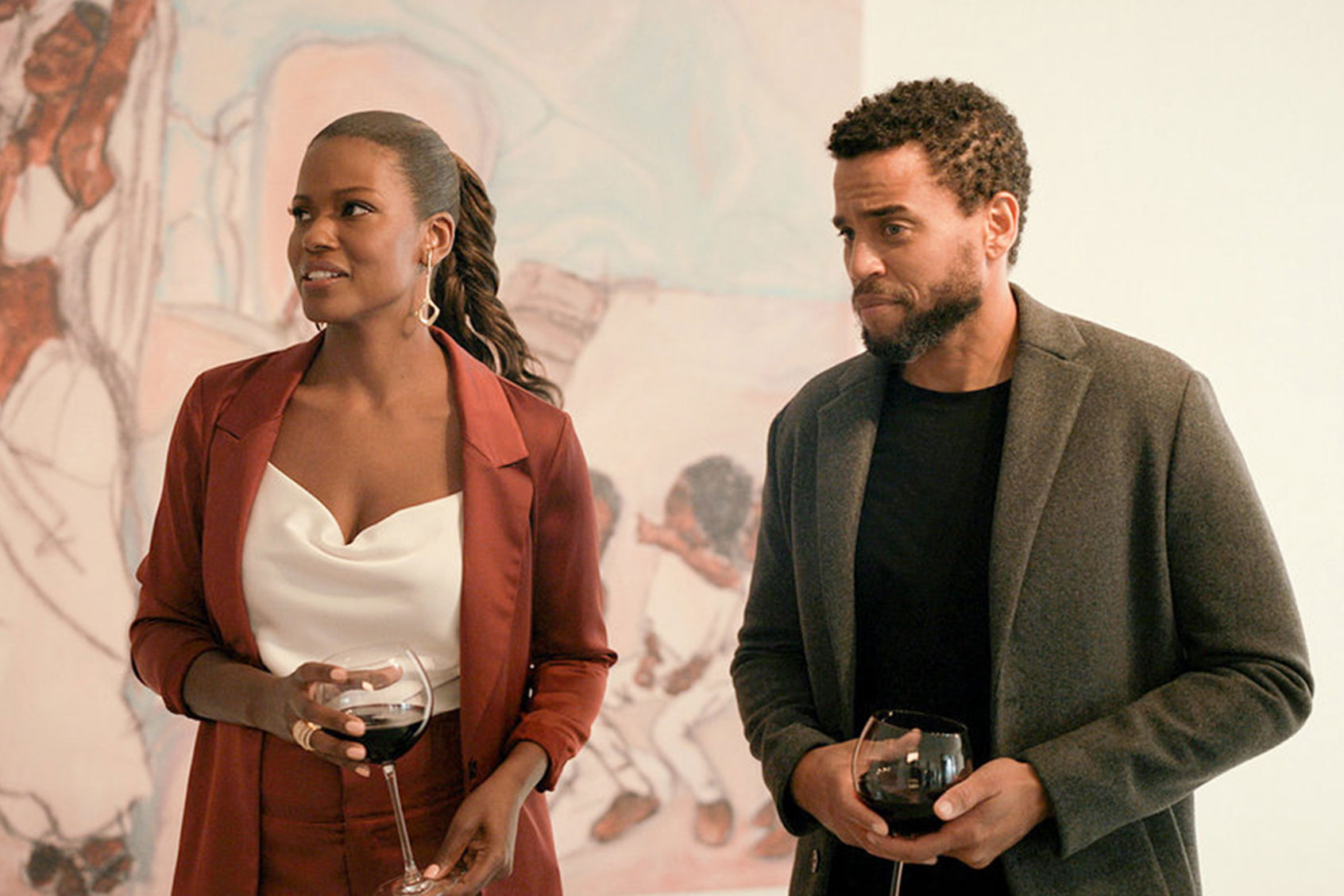
Bel-AirCassandra Freeman as Vivian Banks and Michael Ealy as Reed Broderick in “Bel-Air.” (Peacock)I think there’s another dynamic. In that conversation about womanhood and the sacrifices that women make for family all of the time. I would do everything in the world for my wife, but I’m not going to act like I don’t go and work a 20-hour day, and then I come in the house and my daughter’s like “Daddy, the superstar” and after Mom has been doing all of these astronomical things all day, figuring out how to make peas good and stuff that like that, I’m just going to be like, “You know what, eat the chocolate chip cookie and the earth will spin.” Right?

That is such a Dad response. Oh my God.

I know, I’m part of the problem. And the good thing is that I can admit it.

That’s a big step.

RELATED: I love being a Girl Dad: Who needs a son? I’ll take ten more daughters

The other dynamic here in the show is Hilary. She is coming into herself as a woman, and her ideas might not align with what her mom’s ideas are. Could you talk about that dynamic?

I love that storyline. I’m surprised there wasn’t more commotion that people weren’t upset that Viv was such a hard hand in Hilary’s life those first few episodes. But what that really, to me on another whole subtle level shows the differences that exist between two different generations. I mean my generation, I’m 42. I come from the same generation as people who are 50- and 60-year-old Black women, which is, you go to college, you get as many degrees as you can, you work your way up through the system, you assimilate as much as you can, you get along until you can finally create some space of change, right? This new generation is not here for that. They’re like, no, I need change today. I ain’t even going to go to the office today until change starts. Actually I’m going to blow up the whole company. It’s such a different way.

College takes too long.

There’s a whole other way to deal with the oppression that exists in this country for people who are minorities and for women. The way this generation is dealing with it is saying we’re going to call a thing, a thing. Now my generation, we don’t do that. My generation’s like, “Mmm they’re trying their best. Let’s go through this way.” So it’s a generational discussion that’s happening. Viv doesn’t really understand social media and the opportunities that exist in social media. So it’s a couple of conversations happening at once. 

And it’s almost the same thing, right? It’s like, Phil’s not making that extra effort to understand what needs to be done, what his wife can do in the art world. And then Viv is not really fully understanding how her daughter can really blow up this social media world and become one of those people that get paid $10,000 per post.

Yeah, but also, if you have Black excellence, do you want your daughter to be the one who blows up on Instagram? Does that sound like Black excellence? Black excellence, the definition for Viv is, go get a degree and go work your way up through a system, working your way up through social media doesn’t sound as elegant. How do you tell your friends that at a party?

Is there any space for Will Smith to pop into this alternate universe?

He’s the producer. He can pop in any way he wants to.

Will, as Viv’s long lost brother, ex . . .

Oh, poor, poor Uncle Phil. How do you deal with that? That’s . . .

It’s the ex, but the ex is actually Will Smith. So it’s like Will Smith playing the real Will Smith?

Oh my . . . You heard it here first people. Will Smith would come on as my long lost lover. Will’s like “y’all we ain’t doing that.” I would think Will would come in and he would act, he would actually come in and act, he wouldn’t be himself, but it would be simple for him to just show up as Will Smith. I think especially in the last episode, you start to see some familiar faces who live out here in the world of pop culture. So you never know.

Do you think there’s space to re-hash more shows? And if there is, what would you like to see?

Listen, I’m the wrong person ask. Like I said, when I first heard they were doing this show, I was like, “What, it don’t need to be touched!”

But now you see the success.

I’m sure this will create a whole new genre of reboots. I think what everyone is really feeling or attached to in ours is that, it’s not just that we rebooted the show, it’s the hands in which that reboot went into. I think that the hands that it went to just happened to be a young guy who was 27 when he came up with that first thesis trailer, like to give it to someone who is now into hip-hop at the level that hip-hop exists today. It’s very different than if you gave it to an executive, an old white man in his 60s, and he’s trying to do it, no shade, but guaranteed. The hands are really important. So I’d love for people to actually have the conversation. 

And why is it a success? The success exists because Will Smith was innovative enough to, and trusted Morgan Cooper enough to say, “No, the new generation has to take it over.” Who cares how much experience he has, because Will Smith didn’t have experience in TV and he made it work. And then they made sure the showrunners, the heads of departments, the writers, like everyone lives in the African American community in some way. And that’s a rare thing to happen in Hollywood on TV.

I think executives want to believe that nobody feels it. We always feel when something’s been whited out because someone didn’t understand or translate the culture. I think this show, we laid so many layers of the culture from Philly to LA, that you can feel from the music, from the way we walk and talk, and from our clothes . . .

It’s beautiful.

They’re not dumbing down Blackness

You’re just like, they’re not dumbing down Blackness. It’s just, yeah, that’s just Black folk.

Down to the artwork in the house. Ferrari Sheppard.

Listen, Ferrari Sheppard. Brilliant, brilliant. We have a lot of amazing artists in that house that you could just screenshot and stop. And every artist in that house, whether they’re from Philly, Florida, Virginia, Haiti, I mean, it’s a huge wash of people and photographers work that lives in that house.

We already know that Bel-Air is coming back for another season. What we also want is, what’s next for you?

I filmed this show six months – five or six months in Los Angeles, but I live here in Brooklyn, New York. I’m just happy to be home, and to be a mother. I have a 3-year-old I’m digging back into. That’s amazing. I’m developing a rom-com because I really want to do a comedy. There’s this great comedy from Goldie Hawn that I’m thinking about maybe rehashing.

Also, I have a tech startup that’s for the entertainment industry that’ll help us all collaborate and make our life so much easier.

More stories like this:

Universities are failing the next generation of scientists

The long-term job outlook for a freshly minted science Ph.D. can be pretty grim. After devoting more than a half decade to becoming an independent researcher in the field of their passion, after sacrificing opportunities for better pay and work-life balance, and after writing papers and presenting at who-knows-how-many conferences, graduate students may emerge from the ivory tower only to find that there are no jobs that allow them to do the thing they’ve been training to do.

In 2020, colleges and universities throughout the United States awarded more than 42,000 Ph.D. diplomas for scientists and engineers. In many respects, that’s fantastic news; it represents a giant leap from the fewer than 6,000 degrees awarded in 1958. We have more scientists and engineers than ever before. In a society that thrives on highly skilled workers and that celebrates and respects those workers, many young people are heeding the call to enter the science, technology, engineering, and math disciplines.

And then what happens?

Many universities and colleges do not publish data on the long-term career outcomes of graduate students the way they do for undergraduate students. Why are they ignoring their advanced students? Perhaps it is because if they were to print the realities on their brochures, fewer graduate students would enroll in their programs.

Nevertheless, we can track the progress of the nation’s Ph.D. holders via independent surveys. Around 30 percent of new science Ph.D. graduates who responded to the 2019 Survey of Earned Doctorates, administered by the National Center for Science and Engineering Statistics, did not immediately have a job or postdoctoral study lined up. Depending on the field, between 20 and 40 percent of respondents reported that they were continuing on the academic path — the vast majority in postdocs, short-term research positions typically lasting one to three years. Tracking the path from postdoc to professorship is difficult, but one 2015 paper noted that “less than 17 percent of new Ph.D.s in science, engineering, and health-related fields find tenure-track positions within three years” of graduating. Many of the rest will land outside of practicing science altogether: The NCSES survey indicated that nearly a third of doctoral scientists and engineers in the U.S. are not employed as scientists or engineers. If the goal of graduate programs is to create highly trained scientists, then these programs are oversupplying the workforce by the hundreds of thousands.

Many universities and colleges do not publish data on the long-term career outcomes of graduate students the way they do for undergraduate students. Why are they ignoring their advanced students? Perhaps it is because if they were to print the realities on their brochures, fewer graduate students would enroll in their programs.

Keep in mind that a graduate student’s life isn’t easy. In a 2019 survey of more than 6,000 graduate students, three-quarters of graduate students reported working more than 40 hours a week, one-third say they sought help for anxiety and depression due to their school experience, and nearly 40 percent reported dissatisfaction with their work-life balance. Still, more than half expressed interest in pursuing a long-term academic career. That’s a lot of blood, sweat, and tears devoted to a career that may not come to fruition.

All this raises the question: What exactly are science and engineering graduate programs for? Are they training grounds for future research scientists? Are they a fun way for students to develop highly valuable skills that they then translate to non-academic and non-science careers? Or are they research-generating factories where senior scientists can exploit cheap labor?

As an astrophysicist who has spent years communicating science and watching scores of young students get excited by the prospects of a career in science, I think we need to critically examine the way we approach science graduate education. Presumably, the goal of Ph.D. programs is to train independent scientists, but many of those students will not actually become scientists — either in academia or in industry.

First, we need to get those fresh Ph.D.s some jobs. Some departments and universities are beginning to build bridges into nonscience career paths by way of firms like the Erdos Institute, which partners with universities and corporations to help prepare Ph.D.s for private sector work and place them in jobs. These programs are a great start, but we need many more of them, and they should be woven into the very fabric of every doctoral program. Every faculty member and department head must recognize that many of their graduate students will not become academic researchers — and it serves no one to pretend they will.

Departments should be clear about the fact that many of their graduates won’t go on to pursue a lifelong career in academic research, or end up in science at all.

Graduate student advisers must stop looking at their mentees as future professors and start preparing them for a life outside academia. These advisers should engage with industry themselves, to build the connections and networks that can give their students the best chance at success. And department administrators should support faculty in these endeavors. Academic departments obsess over metrics like publication rate and grant awards as barometers of success. Here’s a new one: successful placement of students in jobs, whether in academia, in industry, or just … in a job.

Second, we need to address the imbalance of supply and demand in academic hiring. One option is to dramatically increase the number of tenured professorships and long-term research associate positions, to ensure that postdocs can find a secure home in academia. But another, seemingly harsher approach could be the tough medicine we need: Severely cut the number of available postdocs. Placing junior scientists in temporary positions that have poor odds of leading to a long-term career is unfair to them, especially when departments aren’t transparent about the fruits those labors will bear. If there’s going to be intense competition, it’s better to have it earlier, when people are better able to pivot into new directions. It’s one thing to produce scores of Ph.D.s for every one open position; it’s quite another to delay that cliff until scientists are in their mid-30s.

Lastly, we need honesty. Academic departments need to be frank with incoming students about their career prospects. Departments should be clear about the fact that many of their graduates won’t go on to pursue a lifelong career in academic research, or end up in science at all. Yes, this may impact graduate enrollment numbers, and, yes, that might force universities to find creative ways to continue producing research and teaching undergraduates. But maybe — I’m just putting this out there — the universities can create permanent research affiliate positions instead.

And students may well decide that non-academic careers are a worthy pursuit in their own right. Holders of science Ph.D.s who leave academia generally earn higher salaries, experience less workplace discrimination, and report greater job satisfaction than those who stay. Careers outside of academia — and even outside of science — can be rewarding, challenging, and fun. And that should be printed, in big, bold, glossy font, on the front of every graduate department’s brochure.


This article was originally published on Undark. Read the original article.

New SEC rule requires companies to publicly disclose climate risks

There’s growing awareness that climate change threatens the stability of financial markets and presents systemic risks to the U.S. economy. Right now, however, the hundreds of publicly-traded companies in the country are not required to disclose the various ways in which the consequences of a warming planet could threaten their bottom lines. Companies that address climate risks in their annual reports and other public filings choose to do so voluntarily. As a result, many policymakers argue that climate-related disclosures are unreliable, inconsistent, and incomparable across companies, which leaves investors in the dark about the true risks on a company’s books. 

Those policymakers are beginning to make progress. On Monday, the Securities and Exchange Commission, or SEC, took the first step toward requiring companies to publicly disclose various climate risks. The long-awaited rule requires companies to explain how climate risks may affect their revenues and profitability in public filings they’re required by law to submit to the SEC. The independent federal agency, which is intended to protect investors by regulating the stock offerings of public companies, has also proposed requiring that companies disclose any climate-related goals they’ve set (such as net-zero targets), how climate risks may affect the line items in their financial reports, and whether they’re taking action to minimize the effect of climate change on their activities. 

Most significantly, the proposed rule requires disclosure of the volume of carbon emissions stemming directly from a company’s operations, as well as emissions resulting from the production of electricity and other forms of energy that it relies on, which are referred to as scope 1 and 2 emissions, respectively. The rule also requires some disclosure of the more indirect scope 3 emissions, a category that includes emissions resulting from the use of products that companies sell. Businesses have between one and three years to comply with the rule, if it is adopted.

“Companies and investors alike would benefit from the clear rules of the road proposed in this release,” said SEC chairperson Gary Gensler. “I believe the SEC has a role to play when there’s this level of demand for consistent and comparable information that may affect financial performance. Today’s proposal thus is driven by the needs of investors and issuers.”

The U.S. is playing catchup on climate-related financial rules. The European Union has already mandated similar disclosures and is in the process of strengthening its climate risk rules. Over the last few years, there has been an increasing recognition of the ways in which climate-fueled disasters are wreaking havoc on businesses. The electricity provider PG&E is a prominent example of a publicly-traded company pushed to insolvency due to wildfires fueled by climate change. As a result of risks like these, investors and shareholders have lobbied company boards for more disclosure — and even staged internal revolts when their efforts have met resistance. The United Nations Principles for Responsible Investment, a group that promotes environmentally-friendly practices among investors, has more than 4,000 signatories.

The SEC has a mandate to protect investors by making sure public companies provide them with timely and accurate information about their business practices. The agency, which operates more independently than other federal departments that sit directly under the president’s purview, is tasked with maintaining “fair, orderly, and efficient markets” — and environmental activists argue that climate-related risks fall squarely into its wheelhouse.

Those opposed to the rule, however, say that the agency lacks the authority to issue rules on climate change, a topic they claim should be addressed by environmental agencies alone. Opponents include the American Petroleum Institute, the primary lobbying organization for fossil fuel interests, which has raised concerns about practical problems that could arise from standardizing disclosure, and state officials like the attorney general of West Virginia, who has claimed the rule would require “statements on political issues that drive a political agenda.” Litigation challenging the rule is all but certain.

Businesses have also been pushing the SEC to exclude scope 3 emissions from the rule. Because scope 3 emissions come from across the supply chain, including from purchased goods, smaller supplier companies, and from customers, they are often out of a company’s direct control. The proposed rule requires disclosure of these emissions if the company already has an explicit emissions-reduction goal that includes scope 3, or if such emissions could be considered “material” from the point of view of an investor — if, in other words, a typical shareholder would be likely to consider such emissions relevant to their financial interest in the company. Smaller companies are exempt from the requirement. 

Alyssa Rade, chief sustainability officer at Sustain.Life, a technology company that helps businesses track and report their emissions, said the new rule may create positive pressure for companies across supply chains to disclose their emissions. 

“While smaller supplier companies may not have already calculated their carbon footprint, increasing pressure from their largest customers compels them to take action,” she said in an email. “This is the exact kind of market pressure U.S. regulators are pursuing by including Scope 3 emissions accounting in the new disclosure ruling.”

The SEC is soliciting comments on the proposed rule for the next 60 days. Once the comment period closes, the agency is expected to consider and potentially revise the rule in response. 

On “Atlanta,” Van partied for every Black woman exhausted with being overlooked

Our “Atlanta”-sponsored European safari stops in London this week, where Earn takes Darius, Alfred and Van to a house party thrown by white guys with more money than Jesus or Ye.  These soiree-centered episodes produce some of the show’s most incisive comedy; “Juneteenth” set that bar in the first season by flambéing the Black bourgeoisie’s absurd class snobbery and assimilationist aspirations.

But “The Old Man and the Tree” is next level, in the way it recalls that previous installment while granting absolution to its greatest offenders. There’s garish suburban McMansion wealth, and then there’s the type that obscures its entrance with a decoy house, by requiring guests to traipse through a run-down horror to breach its inner sanctum.

Upon entering this .01 percenter’s hyper-modernist lair, Darius (LaKeith Stanfield), Alfred (Brian Tyree Henry) and Earn (Donald Glover) become their own capsule of wealthy white colonialist tension.

RELATED: This Juneteenth, “Atlanta” will give you all the insights you need on how America co-opts a holiday

Darius is ensnared into a white guilt melodrama resulting from a small misunderstanding with an Asian

Black guys love Asian women,” she blurts

woman at the party who mistakenly assumes he’s hitting on her, when what he actually wants is for her to pass a bottle of gin. She nervously apologizes, explaining she gets approached by Black men a lot. “Black guys love Asian women,” she blurts, and Darius sees no reason to take offense. A white savior idiot who overhears that remark disagrees, blowing up this miniature conversational faux pas between two people of color into an All Lives Matter war crime.

Alfred gets snagged by the reclusive host of this get-together, a guy called Fernando (Daniel Fathers). Alfred’s already convinced he’s found paradise – Fernando’s hideaway has its own Nando’s chicken joint, for crying out loud, and he’s not even that Nando! He’s a much wealthier Nando willing to pay for having its PERi-PERi sauce on demand, So when Fernando asks Alfred if he likes trees, Alfred thinks he’s being invited to smoke a joint. Why not? He’s Paper Boi, and this is heaven.

Instead, Fernando escorts his famous guest to the ancient tree around which he’s built his hedonistic castle. The evening only plummets from there.

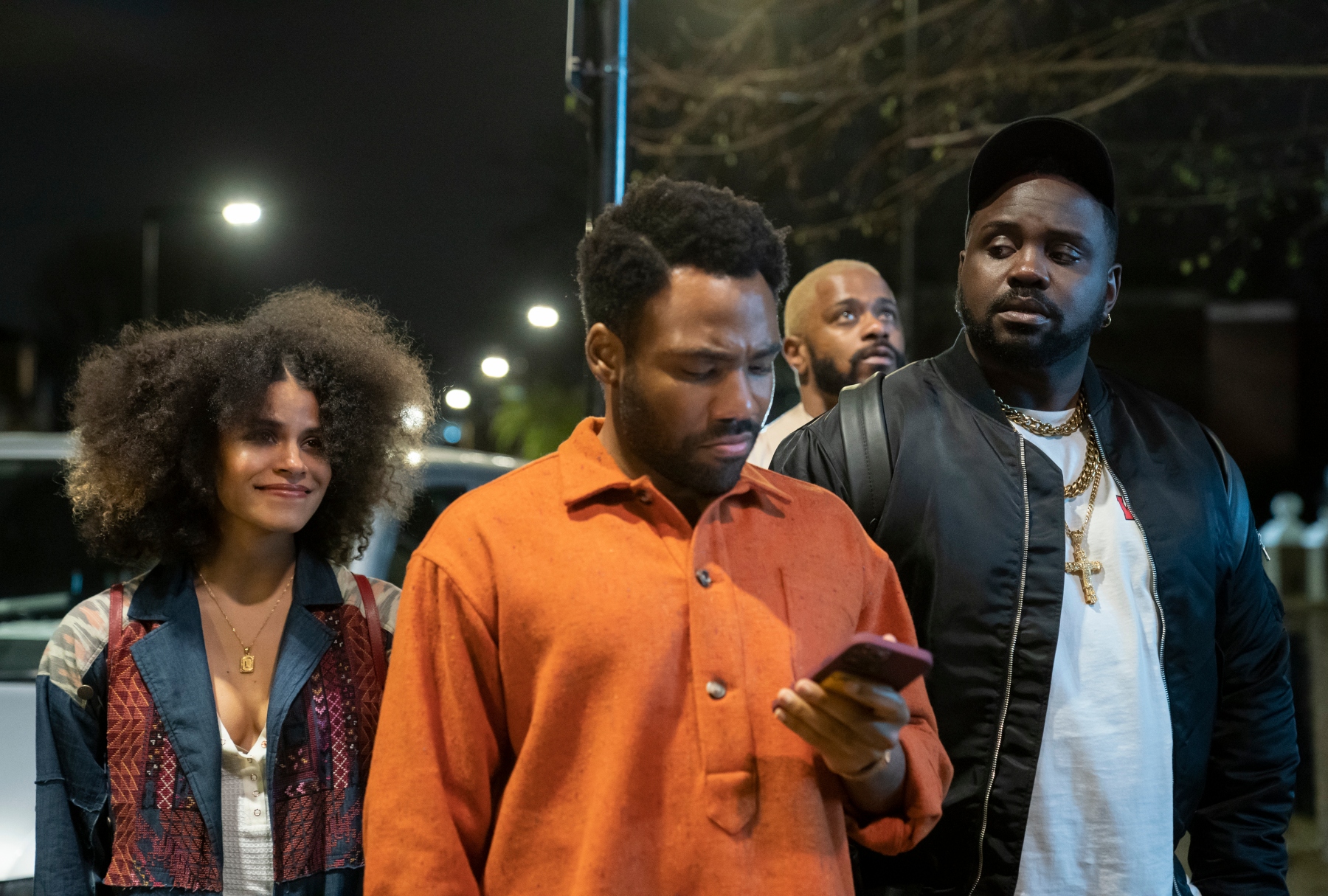
Zazie Beetz, Donald Glover, LaKeith Stanfield and Brian Tyree Henry in “Atlanta” (Oliver Upton/FX)Blissfully separate from this madness, thank goodness, is Van (Zazie Beetz). The latest “Atlanta” episodes find Van tagging along for Paper Boi’s European tour to take some time for herself and figure out her place in the world. Hence, while her gala partners are being drawn into slow-boiling disasters, Van passes the evening unperturbed.
Earn brought her, Darius and Alfred to the party to do business with Will (Patrick Kennedy), a middle-aged clout chaser who has taken in, and been taken in by, a talent-free Black British kid posing as an emerging hip-hop phenomenon.

Earn never formally introduces Van to Will, preferring to explain that she’s with them as a friend, not an artist. In plainer English, that means she’s not worth noticing.

Nobody’s looking out for Van – not the hosts or other guests or even her boys, who flee the scene without her when events perilously spin out. Instead of lamenting that, Van takes another route, making invisibility her superpower.

Viewed from a post-“Slap” perspective, however, Van’s part is the most liberating.

Taofik Kolade writes the absurd indignities Earn, Alfred and Darius endure in “The Old Man and the Tree” as the episode’s starring plots. Viewed from a post-“Slap” perspective, however, Van’s part is the most liberating. Beetz may have the fewest lines compared to her co-stars, frequently operating in the background, or captured in long shots. In a peak moment she’s nearly obscured in darkness, positioned at the far right of a dark wide framed take.

Still, she pulls our attention by wordlessly owning Van’s serenity in the thick this deranged bash.

While Earn agonizes over being loyal to his pal or allowing a young Black “self-taught multi-hyphenate” to continue conning free room and board out of rich white guys, Van simply and effortlessly just happens, observing chaos and creating it. She takes the glass of champagne offered to her on arrival, moseys over to a shelf full of small statues, each likely worth a small fortune, and indifferently pockets one. Later she wanders off to quietly contemplate her tycoon host’s captive natural wonder, swaying gently as she appreciates the tree that Alfred could not.  

When Earn finally catches up to her, she’s standing by a pool and laughing through a conversation with a guy dressed like a boring hedge fund manager. Once the man excuses himself, Van locks eyes with Earn, flashes a coy grin and, without breaking her gaze, pushes a nearby server into the water. She breaks into easy, effervescent laughter. Two white women swimming see the whole thing and laugh too. Even the server laughs as he walks away, soaked to the skin.

If you can’t appreciate the relief Van’s mischief provides, perhaps you haven’t been paying enough attention to her overall arc, or the overlooked perspectives behind last week’s cascade of thinkpieces produced in the Oscars’ aftershock. Although it might not seem like it, the scripted comedy and live tragedy have a few things in common.

As Earthlings everywhere anxiously worried about Will Smith’s and Chris Rock’s feelings, did you notice how few articles wondered how Jada Pinkett Smith is faring

. . . the story could not have been written without us

Mainly it’s been Black women expressing concern for Pinkett Smith or the emotional state of any of the women whose names Smith invoked on Oscar night. Nearly everyone else inquired about her alopecia and stopped there. That lack of empathetic curiosity reaffirms the same dusty, damaging cliché about Black women’s role in the Book of Life. Rich or poor, famous or invisible, we’re presumed to serve the world with all our strength and accept we’ll be forgotten in the acknowledgments section, even though the story could not have been written without us.


Want a daily wrap-up of all the news and commentary Salon has to offer? Subscribe to our morning newsletter, Crash Course.


Throughout “Atlanta,” this is what Van has meant to Earn, mainly as a matter of sharing the duty of raising their daughter Lottie. As a friend, Van has few peers. She has run herself ragged to bring home a paycheck while he pursued his dream to manage hip-hop artists. When he was broke, she showed up for him. When he’s gotten into trouble, she’s been there to bail him out.

They’ve even attended events on Van’s home turf where Earn is the stranger, only for her to be introduced as Lottie’s mom by her childhood friends.

Now that their circumstances are reversed in some ways, Earn still demonstrates a profound, genuine affection for Van that she recognizes without fully reciprocating. She’s lived through far too many disappointments with her child’s father, experienced too many times when he’s failed to come through or has simply come up short, to comfortably rely on him for anything.

Earn has enough cash and clout as Alfred’s manager to take care of Van. But he doesn’t do that in the way that counts at the party. Therefore she doesn’t take him seriously when he professes to be worried about her.

“I can’t have a vacation?” she says in response to his unease, and he agrees with her. He offers to pay for a place for her to stay, to give her money or to call her a car, and she declines. “I’m not Alfred,” she says. “I’m OK.” Then she rises from her seat to get another drink . . . and pushes another passer-by, this time a white female party guest, into the pool. Nobody laughs this second time around but, whatever. The Invisible Woman gets away with it, because who’s really looking?

We may come to find out that Van isn’t OK, that she has hit her psychological limit and is truly struggling. We’ve all been there. Finding that out would also make Earn, Darius and Alfred’s thoughtless abandonment of her in London especially infuriating.

But when we catch up with Van after the boys bolted, she is posted up in a late-night Indian joint and

Invisibility has its privileges

enjoying her own company, reading a magazine and long past caring. Her phone buzzes, and she turns it over to see who’s calling. Predictably it’s Earn, likely doing his very least to look out for her from a distance. She ignores his call, turning her device face down. Invisibility has its privileges.

New episodes of “Atlanta” air at 10 p.m. Thursdays on FX, streaming the next day on Hulu. Watch a trailer for the episode below, via YouTube.

More stories like this:

Why is the American right waging a stealth neocolonial assault on Somalia?

On March 14, the conservative Heritage Foundation played host to the president of Somaliland, a breakaway region of Somalia “whose self-declared independence … is not internationally recognized,” in the words of a Freedom House report. Three days later, three U.S. senators, Jim Risch, R-Idaho, Chris Van Hollen, D-Md., and Mike Rounds, R-S.D., introduced a bill titled the Somaliland Partnership Act. Their bill paints a rosy picture of Somaliland and calls for much closer U.S. engagement with it. This bill relies on a combination of faulty and incomplete information. (The Freedom House report cited above says that Somaliland “has seen a consistent erosion of political rights and civic space,” with minority clans subject to “political and economic marginalization” and a serious social problem of violence against women.) More concerning, however, is that if this bill is passed it will take Somalia, a poor country already mired in much turmoil, down an even more perilous path.

In a nutshell, a partnership with the U.S., as envisioned in this legislation, would provide Somaliland with the financial and military wherewithal it needs to make separation from Somalia a fait accompli. It would also lend Somaliland a mantle of legitimacy. The persistent claim by the leaders of Somaliland that it is a de facto country in full control of its “territory” is not true: The two communities through whose territory the presumed border of separation runs are staunchly against Somaliland’s secession. Without the consent of these two communities (the Warsengeli and Dhulbahante tribes), Somaliland’s secession cannot be a reality on the ground, as Risch’s bill claims it already is. And since no consent is forthcoming from these two communities, violence and conquest are Somaliland’s only option. Why would the U.S. involve itself in such a combustible mix?

The answer is given here: “Recognizing Somaliland’s independence would enable the U.S. to hedge against further deterioration of its position in Djibouti, which is under Chinese sway,” writes Joshua Meservey of the Heritage Foundation. Similarly, Risch’s rationale for his bill stresses the importance of Somaliland’s “geographic location in the Horn of Africa and next to the Gulf of Aden.” So the Heritage Foundation and several U.S. senators have decided to bypass Somalia’s legal authority and deal with a secessionist entity, without regard to what might follow, for what they perceive as America’s strategic interests.

RELATED: Africa and the Ukraine war: Cold War hangover is keeping many African nations neutral

To me, this seems a flashback to a series of decades-long events related to me, as a child, by my father and other elders of my family. I grew up in a house steeped in the history of the conflict with Britain as it barged into our land and ruled our people. I am a great-grandson of Sultan Muhammad Mahmud Ali (nicknamed Awl), the sultan of the Warsangeli tribe, who in 1886 entered into a “protection treaty” with the British government, one of six such treaties with Somali tribes that formed what was called the Somaliland British Protectorate, which existed until 1960.

In colonial days, foreign men drew lines on paper to divide the Somali people without their knowledge. Thanks to conservatives in Washington, today it’s happening again.

Back then, foreign men drew lines on paper to divide Somalis without their knowledge. Today, men in Washington — and they are once again almost all men — are working to decide the fate of Somalis as one aspect of global competition with China. Those like Risch and the Heritage Foundation are throwbacks to colonial times, hellbent on reordering Africa as they see fit. For them, Somalia is fair game, a guinea pig, something to be altered with the stroke of a pen. If their intentions were sincere, they would be interested in talking to all sides of this particular conflict and they would not have so smugly ignored the government of the Federal Republic of Somalia. It is no secret that government is frail and unstable, but that is not a good reason for undermining it still further. 

In American right-wingers eager to exert power in the Horn of Africa, President Muse Bihi Abdi of Somaliland has finally found dancing partners in his quest to open a wound that healed long ago. The border he wants to revive in order to secede from Somalia carries a history of humiliation and pain, not suffered by him or his tribe but rather by the tribes in the east of what he now likes to call Somaliland.


Want a daily wrap-up of all the news and commentary Salon has to offer? Subscribe to our morning newsletter, Crash Course.


When the original Somaliland protectorate voluntarily united with Somalia in 1960 and the colonial border between them was erased, it was a great moment. Communities torn apart for decades were finally free to move and mix in the vast land of our ancestors. It is that very border that Bihi and his allies now want to revive, with the comforting knowledge that neither they nor their tribesmen will feel the knife’s edge of separation if things go their way. Neither Risch nor the Heritage Foundation has ever spoken to those whose lives or families would once again be torn asunder. In the tradition of long-ago colonial administrators, they are scribbling words on paper in cozy offices thousands of miles away from the people whose fate they are deciding.

Somaliland’s narrative of independence is based on a deceptive mix of truths, half-truths and outright lies that it has been unable to sell to the Somali people, the African Union or anyone else in the world except — again, for political reasons — the would-be independent island of Taiwan. It’s no wonder that Bihi has found a receptive ear and a helping hand in the Heritage Foundation, known for climate-change denialism, efforts to suppress the votes of minorities in the U.S., and fueling the moral panic over “critical race theory.” It is deeply unfortunate to see the self-described leaders of Somaliland seeking validation from forces in the United States aligned with a racist and neocolonialist agenda. But there’s not much room for pity when the fate of so many poor Somalis hangs in the balance. There’s only room for good people to stand up and tell the American right: Hands off Somalia.

Read more on U.S. foreign policy and Africa:

Anti-vax activist claims COVID-19 vaccines cause AIDS

Right-wing anti-vax activist Dr. Sherri Tenpenny recently proclaimed that recipients of the COVID-19 vaccine will develop an AIDS-like illness sometime in 2022. Acquired Immunodeficiency Syndrome is the fatal late-stage complication from untreated Human Immunodeficiency Virus (HIV) infection, which attacks the immune system over time.

Tenpenny – who was banned from Twitter last summer for peddling vaccine misinformation – cited a debunked Exposé story that circulated earlier this year on Facebook which claimed that the German government had conducted a study that determined that coronavirus inoculations lead to AIDS. It did not.

This was not the first time that Tenpenny, a licensed osteopathic physician from Cleveland, Ohio, has promoted such a bizarre conspiracy theory. In January, Tenpenny asserted that coronavirus vaccines “are creating ‘quantum entanglement’ between those who take them and ‘the Google credit scores and the dematrix and all of those things.'”

She was also busted a year ago for teaching an online “COVID-19 conspiracy ‘boot camp'” on “how to target vaccine-hesitant” people as well as the “potential hacking of vaccine passports,” according to a Canadian Broadcasting Corporation report.

Nevertheless, there is no evidence that COVID-19 vaccines cause AIDS. But that has not stopped Tenpenny from promulgating the lie.

“The more shots you get, the more – the more you destroy your immune system and the faster that happens. And it’s anticipated, the German data says, that by the end of 2022, every fully vaccinated person over the age of 30 may have the equivalent of full-blown vaccine-induced immune-suppressed AIDS,” said Tenpenny, who in November admitted to traveling on airplanes while displaying COVID-19 symptoms.

Big Pharma pours drug industry money on Republican Senator Tim Scott

Sen. Tim Scott, a rising star in the Republican Party with broad popularity in his home state of South Carolina, is getting showered with drug industry money before facing voters this fall.

Scott was the top recipient of pharma campaign cash in Congress during the second half of 2021, receiving $99,000, KHN’s Pharma Cash to Congress database shows, emerging as a new favorite of the industry. Though Scott has been a perennial recipient since arriving in Congress in 2011, the latest amount is nearly twice as much as his previous highest haul.

Why Tim Scott? South Carolina’s junior senator is someone widely viewed as destined for greater things during his political career. And this is an existential moment for the American pharmaceutical industry when securing allies is critical.

Congress is under intense pressure to rein in the high prices of medicines in the U.S., which are often several times those in other developed countries. Roughly 1 in 4 adults report difficulty affording their prescription drugs, according to KFF polling. Further, 83% of Americans support the idea of Medicare negotiating with pharmaceutical firms to lower prices for both its beneficiaries as well those with private insurance — that’s 95% of Democrats, 82% of independents, and 71% of Republicans.

The industry needs people like Scott, who has introduced several health-related bills in recent years and maintains drug industry-friendly positions, in its corner. He opposes proposals introduced in legislation backed by most Democrats in Congress to let Medicare negotiate prices. In 2019, when the Senate Finance Committee considered a drug pricing bill crafted by Sen. Chuck Grassley (R-Iowa) and Sen. Ron Wyden (D-Ore.), Scott voted against a measure that would have amended the legislation to allow Medicare drug price negotiation. (Scott himself was absent but registered his opposition through a proxy vote.)

In September, as the top Republican on the Senate’s Special Committee on Aging, he released a report arguing that HR 3, a sweeping measure from House Democrats to tamp down prices, would result in “shattered innovation” and “bankrupt businesses,” echoing arguments made by pharma companies.

“Democrats propose the federal government should be in charge of deciding the price of treatments, instead of a competitive free marketplace sustained by companies driving innovation,” the report stated. The bill would have allowed the federal government to negotiate prices for certain costly medicines and penalize drug companies that don’t cooperate, among other provisions.

Scott has also been a member of the Senate Finance Committee since 2015, an assignment that gives him significant influence over legislation affecting the sector as well as a prominent perch for fundraising. In total, 27 drug and biotech companies or their powerful lobbying organizations in Washington contributed to his campaign accounts in the latter half of last year. Amgen, Vertex Pharmaceuticals, Merck & Co., AstraZeneca, BioMarin Pharmaceutical, and Genentech were his top donors, each giving between $5,000 and $10,500.

He also is a member of the Senate Health, Education, Labor, and Pensions Committee, which this year is set to consider an issue of great importance to pharma companies: reauthorization of user fees the industry pays to the FDA to help expedite the drug review and approval process. The law must be reauthorized by Congress every five years.

“I didn’t know until you told me,” Scott said when stopped by a KHN reporter in the Capitol and asked what the message was to his constituents as the member of Congress who has received the most money from pharmaceutical PACs in the last two quarters of 2021.

Stephen Billet, an expert on political action committees and associate professor at the Graduate School of Political Management at George Washington University, points to factors beyond his stances on pharma issues that contribute to his fundraising haul. Many of Scott’s positions are aligned with his fellow Republicans in Congress who shun greater government intervention in controlling costs. Instead, the contributions may reflect the industry’s bet that Scott has a promising political future.

He is a prolific fundraiser. Federal Election Commission records show that Scott has raised $38 million — the most of any GOP senator up for reelection in 2022 and the second highest among senators across both parties — and had $21.5 million in his campaign account at the end of 2021, fueling speculation about a future presidential run. “America, A Redemption Story,” Scott’s memoirs, is scheduled for release in August through Christian publisher Thomas Nelson.

Billet said pharmaceutical PACs will sit down at the beginning of a campaign cycle and take a close look at the upcoming races and what their budget is likely to be and then figure out who they want to help.

“So they’ll say, Tim Scott is up, he’s an up-and-comer, he’s been a pretty good guy,” Billet said. “It’s a good idea to get out front and put some money in his pocket.”

Pharmaceutical firms have a long tradition of strategic gift-giving to members to develop goodwill, the benefits of which typically emerge many years later.

Other Republican senators up for reelection didn’t get nearly as much money from drug companies during the same period, KHN’s analysis of Federal Election Commission data shows. For example, Sen. Michael Crapo (R-Idaho), the most senior Republican on the Senate Finance Committee, received $68,300. Fellow Finance panel member Sen. Todd Young (R-Ind.) took in $48,000. All three seats are considered safe for Republicans in November.

Scott has received money from drugmakers every year since coming to Congress as a member of the House in 2011, receiving $596,000 through the end of last year, according to the KHN analysis of FEC data. Scott joined the Senate in 2013 after then-Gov. Nikki Haley chose him to replace GOP senator Jim DeMint, who resigned from Congress to helm the conservative Heritage Foundation think tank. But this is his banner year; previously, the most he received was $54,000 during the second half of 2019.

The following year, Scott co-founded the congressional Personalized Medicine Caucus with a handful of other lawmakers, including fellow pharma darling Sen. Kyrsten Sinema (D-Ariz.). Personalized medicine — which is also referred to as precision medicine — promises to use genetics and other traits to develop individualized treatments for patients, often at a very steep price.

“We will take steps to nurture scientific advancements that may reverse the genetic and molecular causes of rare and common diseases, bringing new hope to American patients and lasting benefits to our health care system,” Scott’s prepared statement read at the time.

Scott’s press secretary, Caroline Anderegg, shared that the senator has long held an interest in sickle cell disease, which is the most commonly inherited blood disorder in the U.S. and disproportionately strikes Black people. The disease, which affects roughly 100,000 Americans, is one that could benefit from the development of gene-based therapies, a form of precision medicine, she said.

The caucus’s formation was hailed by the Personalized Medicine Coalition, a pharma-friendly group whose members consist of drugmakers donating to Scott — AbbVie, AstraZeneca, Eli Lilly, Genentech, Johnson & Johnson, and Merck, to name a few. The organization estimated that personalized medicines accounted for more than a quarter of new therapies the FDA had approved since 2015, underscoring the pharmaceutical industry’s widespread work in the field.

Since 2019, Scott has introduced 17 health-related bills or resolutions about everything from food allergens and sickle cell disease to health disparities among racial and ethnic minorities. Last year, he sponsored a bill that would create tax incentives for drug and medical device companies to manufacture more of their products in the U.S. The legislation’s framework loosely aligns with ideas from the Association for Accessible Medicines, which lobbies for generic drug companies.

Overall, from June to December, members of Congress received $3.5 million in their campaign coffers from pharmaceutical companies and their trade associations, according to the KHN analysis of industry contributions.

“There is kind of a cycle to giving and so the off year, 2021, is likely going to have less money than 2022, since it’s an election year,” said Paul Jorgensen, an associate professor at the University of Texas-Rio Grande Valley who studies campaign finance. “But there was a lot of money put into lobbying this cycle because of all of the initiatives that were being pushed in the House and with the Build Back Better plan, so in some ways your numbers just kind of mirror what one would expect.”

Other top recipients of drug industry money in the second half of 2021 include Rep. Cathy McMorris Rodgers (R-Wash.), who was second behind Scott in contributions, receiving $97,300. McMorris Rodgers is the top Republican on the House Energy & Commerce Committee, which has significant sway over pharmaceutical issues, and could become chair of the powerful panel should Republicans retake the House majority in November as expected. Over the entirety of 2021, she received the most money from the sector of any lawmaker.

The pharmaceutical PACs are cognizant of who is up for committee leadership roles, said Billet: “They are 100% aware of who the next person in line is, making McMorris Rodgers an obviously easy target.”

Sinema posted the third-highest haul — $74,800 despite not being up for reelection until 2024. It was a big gain over the first half of 2021, when she received $8,000. KHN reported in 2020 on Sinema’s connections to the pharmaceutical industry.

I was a hoarder until I became a parent. Here’s what I’m glad I kept

Every spring I watch “Hoarders” as a nod to the cleaning I don’t want to do. I lay on the couch as the camera pans over piles of old newspapers and soda cans and furniture. But the show is never about the stuff (no matter how shocking the mountains of junk may be). It’s about the person who collects it all — why they are the way they are and what’s “wrong” with them.

I’m fascinated with the show because I consider myself to be something of a hoarder, too. By my mid-twenties, I had packed every closet in my condo, filled my garage and ended up renting the biggest storage unit I could find, which I filled to the ceiling. In some ways, I could relate to the people on TV — but there’s nothing wrong with me, I thought. I just always wanted to be a mom.

Ever since I was little, I collected all the favorite toys, trinkets and clothes I’d outgrown, placing them neatly in boxes and hiding them under my bed. I didn’t want to donate my special things or, God forbid, trash them. But I also didn’t have younger siblings to take my treasured hand-me-downs. The next kid in the family, I realized, would probably be my own. It made sense to save my stuff for my child.

As I got older, the collecting didn’t stop. In high school, I saved band shirts from favorite concerts, notes from friends, and my cheer uniform. I packed a bin after every school year, after each summer at camp, and even one after starting my first job.

RELATED: I can’t stop buying N95 masks: As a hoarder, my instinct is to shop my way out of the pandemic

As I closed each box, I imagined opening it again with my future child, revisiting old dress-up clothes with my little girl or cracking open a high school box to prove to my angsty teenage boy that I used to be cool. I had so many stories and lessons hidden under lids: how to pick friends, how to choose a major, how to make the best chocolate chip cookies. It was important information I wanted to pass on.

I carried boxes from apartment to apartment, choosing complexes based on garage size and security. The safety of my memories was much higher on my must-have list than a balcony or a washer and dryer.

It wasn’t until I got married that all my stuff really became a problem.

But it wasn’t until I got married that all my stuff really became a problem. In 2018, my husband moved into my one-bedroom, and despite our two large closets, he didn’t have a spot to put his modest collection of clothes and books. He also pointed out that since we also had a two-car garage, he’d like to park inside, instead of on the street. I wanted to make room for him but I just didn’t know how.

RELATED: Thanks, Marie Kondo: How fear of disorder nearly ended my marriage

In fact, in those first months married, I only made the garage more crowded, adding boxes commemorating our wedding and our honeymoon in Australia. “Won’t it be fun to look through these same wedding magazines with our daughter when she’s engaged?” I asked my husband as we struggled to tape the top of yet another crowded box.

“No,” he said.

One night, a plumber had trouble reaching our water shut-off (which was hidden behind a mountain of boxes in the garage), resulting in a broken sink continuing to flood our kitchen. Finally, I decided enough was enough: it was time to rent a storage unit. If I couldn’t get rid of my collection, I reasoned, at least I could move it. While I was happy to move my things to a facility only a few miles away, it was odd seeing my garage finally empty. It was as if a big, messy roommate, who knew me better than anyone, suddenly moved out.

One year later, at 29, I had a baby girl. I had been preparing for this my whole life and now I finally had someone with whom I could share all my advice, my stories — and, of course, my stuff.

When my daughter was 6 months old, I brought two heavy bags of my old toys home from the storage unit and laid them out on the floor. There was a shaggy dog — my favorite all through elementary school, the Beanie Babies I was sure (even at 8) would be worth something someday, and even Happy Meal toys from my favorite ’90s movies. My daughter loved them, snuggling the stuffed animals I treasured growing up. I was so glad I kept every single one.

A few weeks later, I went to the unit to find more age-appropriate treasures for my infant. But when I opened the metal door, I was overcome by just how much was hidden behind it.

I couldn’t preserve all these items for decades, only to toss them before the next kid came along.

Sure, my daughter loved my old play things, but she’d have to wait years to appreciate my childhood jewelry box and my dress-up clothes. It would be even longer before she could sift through my boxes of cool camp treasures and my (surely very interesting) essays from college philosophy courses. It would be decades before a lot of this would even make it home. And even then, if we had another baby, I’d need to keep my old things even longer. After all, I couldn’t preserve all these items for decades, only to toss them before the next kid came along.

RELATED: I am a souvenir hoarder: I’m the guy who can’t throw café napkins and hotel stationery away

“Look, buddy,” I pictured myself saying to my second-born. “I carried mountains of my most important treasures from home to home all my life so I could share it with your sister, and your sister only.”

I realized I couldn’t keep all this stuff but I didn’t know what to do next. I locked the door to the unit and went home empty-handed.

A few months later, my family moved to a bigger place. I was excited to upgrade from our cramped one-bedroom, plus, I knew the move would be a good opportunity to go through my mementos.

Every day for months, I went to the storage unit to open boxes, organize their contents, and throw some things away. I read old notes, tried on jewelry, and texted pictures of blurry Polaroids to family and friends: “Remember this?”

I tried to go through a box a day. And while I usually put more in the “keep” pile than the “give away” pile, I made progress. A lot went into our new garage. But some of my most special things from my childhood, like a black and white photo that hung in my room as a kid, went straight to my daughter’s room. Some other important things, like letters from my grandparents, took a well-deserved spot in mine.

I was surprised to find that a good portion of my stored treasures was, indeed, just junk.

There was a lot I was glad I kept. But I was surprised to find that a good portion of my stored treasures was, indeed, just junk. I didn’t even remember owning some of it. Maybe there was some important memory attached to an old pair of Mary Janes, but I couldn’t remember it. Maybe the collection of seven woven friendship bracelets were important to me as a kid, but I couldn’t remember who gave them to me.


Want a daily wrap-up of all the news and commentary Salon has to offer? Subscribe to our morning newsletter, Crash Course.


After a few weeks I got tired — physically and emotionally — of sifting through these things. I ended up moving the last third of the boxes to our new house without even opening them. When I finished transporting my stuff  to the new garage, I was disappointed. I’d thrown away and donated so much, but my storage still seemed excessive. After all those hours of work and tough decisions, I felt like I was back to square one.

I’d worked so hard and my new garage still looked like a “before.”

I thought back to the episodes of “Hoarders” where the former pack rats got to show off tidy houses. I’d worked so hard and my new garage still looked like a “before.”

But I guess it’s OK for now. I’m proud of my progress and I’m thankful for the gifts from my past self. Every so often, I’ll open up a letter from a long-gone grandparent and I always smile when I see that black-and-white picture hanging in my daughter’s room.

Months have passed since the move, and in that time, my now-toddler has inherited a few more heirlooms. I love when she sits in my lap and I read books to her that my mom once read to me. I love having tea parties together with the plastic set I saved so many years ago. Still, looking around her room, I recognize most of her toys and clothes as new, with memories I connect only to her. I have to admit, I like it that way.

More personal essays about our relationship to stuff:

Flashcards, shoestring budgets and butter: How “The French Chef” came to be

Warming Up Julia Child: The Remarkable Figures who Shaped a Legend” is an upcoming book by author Helen Lefkowitz Horowitz, out April 5 from Pegasus Press. This excerpt from the book — which is packed with passages from letters between Child and those closest to her — details the lead up to the first episode of “The French Chef.” 

* * *

In late November, Julia had asked Bill [Koshland, responsible for administration at Knopf] to let her know the last six months’ sales figures for Mastering. These he didn’t yet have, but he did know that the total sales since publication had reached 16,110, and that orders at the Book of the Month Club were now roughly 6,400 and likely to rise to at least 12,000. All was not business, however. He and Julia had been planning a special meal at Le Pavillon for when the Childs were next in New York. Since reserving a good table required a prestigious name on the reservation, Bill wrote, “I think maybe I can manage to get Alfred to use his name.”54 Clearly both understood, though at different levels, Alfred Knopf’s importance in New York City.

The three early shows of The French Chef served as Julia’s audition, and over the next months she waited to learn if she had gotten the part. In late November 1962, word finally came. Julia received a call from WGBH that the station “would definitely go ahead with the half hour TV programs, starting in January.” She immediately wrote to Simca with the good news: “They are coming to do a color photo of me in the kitchen, which will be on the front page of the Boston Globe TV Sunday magazine—so I guess it is serious. Now, if we don’t get some good publicity for the book out of this, and sell a great many copies so we can spend a great deal more money, I shall be mad!”55

On December 18, she wrote Simca that she was awaiting “WGBH types” coming over in the afternoon to talk over the television programs. “They had originally intended to use the 3 programs we did this summer, but have now decided to do all new ones. 26. We shall do at least 2 a day, and perhaps 4 in two days—I don’t know how that would work!

Related: What Julia Child’s favorite soup recipe teaches us about the art of cooking

But Paul has bought a rowing machine, so I am gathering strength. Anyway, if we can get them all taped by April 1st, that will be wonderful.” 56

“Since both Julia and Paul Child are extremely fond of the original title I have capitulated. Let us call it: THE FRENCH CHEF now and forever!”

The show still lacked a name. A title under consideration in mid- December, “Looking at Cooking,” caused Julia to write a strong letter of protest to Robert Larsen. This proposed title and its variations were to her mind, “cheesy, little womanish, cute, amateurish.” She wanted what she had been informally calling the show since at least September: “THE FRENCH CHEF.” Julia argued that the word chef was as appli- cable to a woman as it was to a man, “is short, to the point, dignified, glamorous, and appeals to men as well as women.” 57 With that, Larsen relented, writing in a memo to Russ Morash, “After having racked our collective brains for weeks to find a good alternative title for the French Chef we have decided that a good alternative title does not seem to be available. And since both Julia and Paul Child are extremely fond of the original title I have capitulated. Let us call it: THE FRENCH CHEF now and forever!”58 Ruth Lockwood’s initials were on the list of those copied on the memo, signifying that she would continue working with Julia on the show.

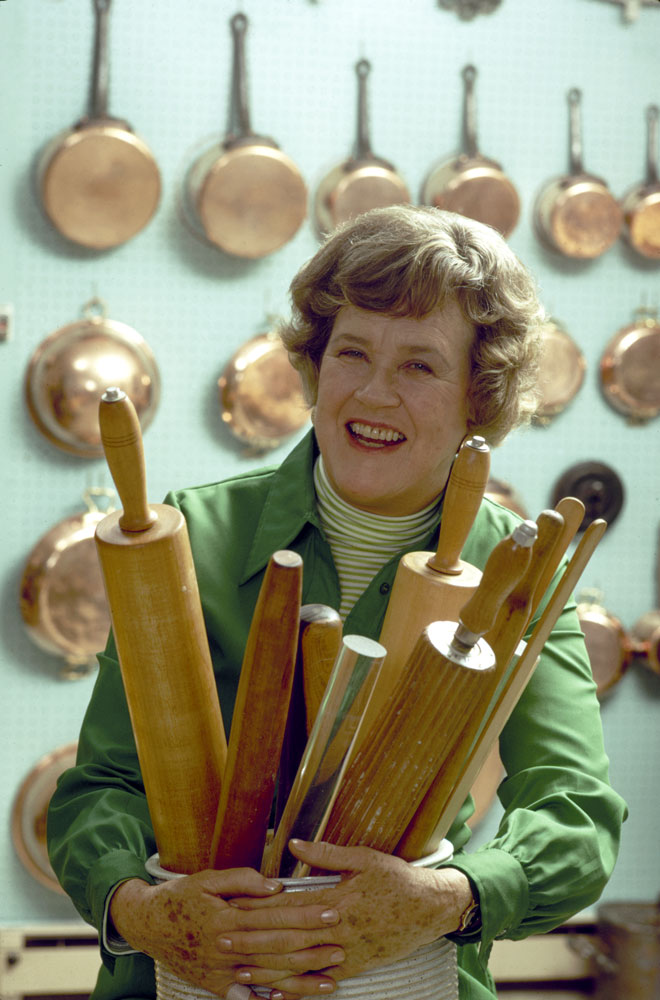
Julia ChildChef Julia Child posing w. assorted rolling pins. (Lee Lockwood/Getty Images)
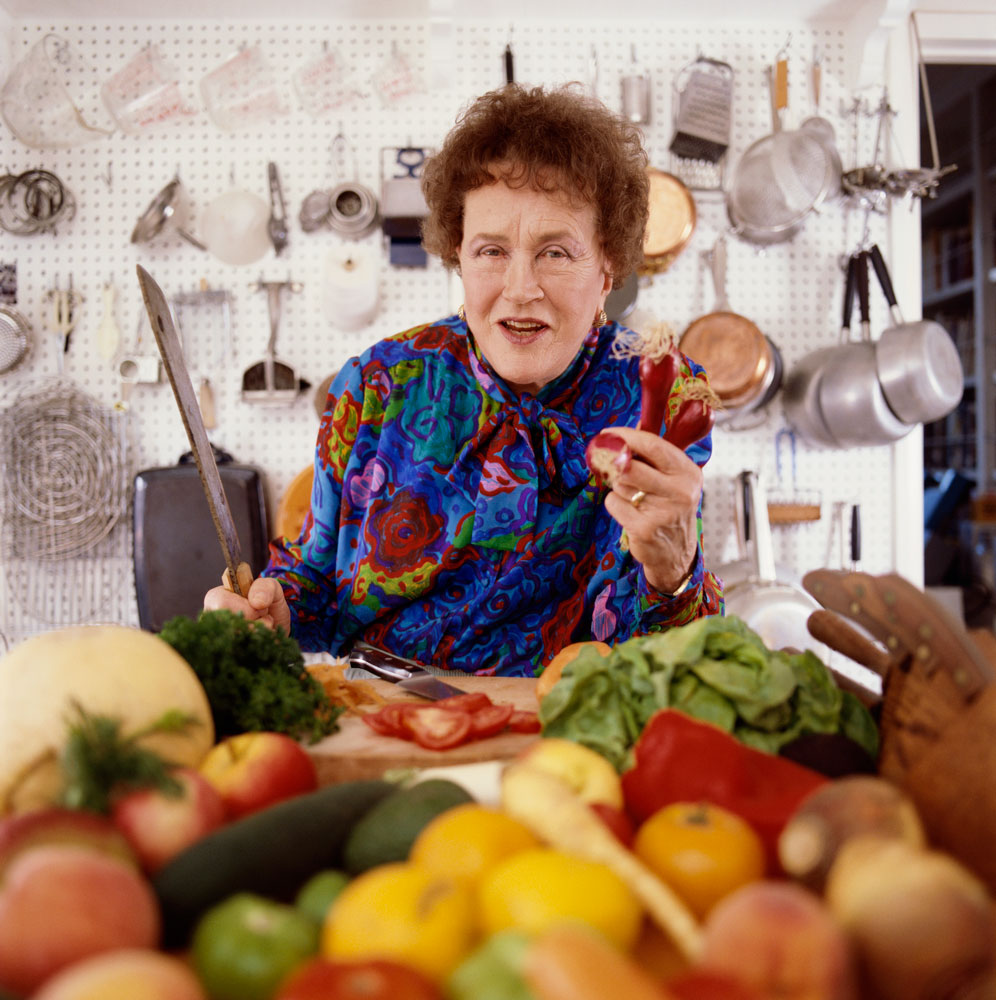
Once production was underway, Julia wrote Simca about Ruth: “There is a very nice girl, Ruth Lockwood, who is about my age, and is the asis- stant [sic] director. She and I work together all the time, and she rehearses with me. Is also very interested in cooking, and never moves without THE BOOK. She is just fine, and devoted to the series. How lucky! All is done on a shoestring, and there is no one to clean up but Ruth and me, and that dear Paul who comes for the afternoon taping and then remains to wash the dishes.” Ruth worked out a system of using flash cards, each giving the task and the time allotted. Julia gave an example: “BROWNING CHICKEN, 5 min” was held up for her to see by one of the crew. After that “the chap also has little cards saying 5, or 4, or 1 or 1/2 to show how many minutes there are left.”59

As the months went on, Julia kept Koshland in the loop. She and Paul had gone to California to spend the Christmas holidays with her sister, Dort. As 1963 began, Bill wrote, “How good it was hearing your voice in California and then to have a note from you to greet me upon my return to the office this morning.” Continuing, he revealed what Julia had related on her call, “I’m delighted with the details as to the TV cooking program and your fierce schedule of making the tapes. What channel is it in Boston? What station?” Koshland then said something that clearly pleased Julia: “Do give me much more by way of details so I can pass word along to the salespeople.”60

A little over a week later, he had good news to report. “Don’t look now, but the phone rang today and my friend Allan Ullman at the Book-of- the-Month Club called to say (are you sitting down?) that the total orders received thus far from the mail order campaign are somewhat in excess of 35,000 copies. I haven’t recovered yet! At the moment they are some 18,000 behind in unfilled orders and the end is not yet in sight. Three cheers for all of us, and a happy New Year to you.+ Paul & Avis.”61

Julia was thrilled: “Can it be true? After you have digested and confirmed it a bit more, tell me again.” She added, “Avis says she’s not surprised!” In his letter confirming the 35,000 copies, Bill wrote, “Well, it just couldn’t have happened to a group of nicer people is all I can say.” Julia had asked for a subscription to the club’s mailing list. She added a request by Avis, always on the alert for ways to publicize Mastering, that Bill push Book of the Month Club to give more publicity by mentioning the book in their monthly magazine.62 Julia’s request was easy to arrange; but Koshland was not able to honor the one by Avis. He wrote that there was nothing in the contract with BOM that justified it, adding, “There’s a mystique about these things   think we can leave that to the experts!” 63

As Julia prepared for the tapings of The French Chef to begin on January 23, her hope, clearly expressed to Bill Koshland, was that the show would become a major marketing tool for Mastering. With Book of the Month Club distributing it for their members, future sales were promising, but Julia was eager for Knopf to sell more books in bookstores, as the proceeds from BOM were a meager $.50 per copy.

“Julia clearly did not want The French Chef to be regarded as a program fit only for women who did not work outside the home. She had pushed WGBH to schedule it in the evening for the southern New England audience, and now New York needed prodding.”

Promoting this, Julia gave Bill the schedule of the show and followed with, “If any bookstores wanted to put THE BOOK in the window saying ‘This week’s recipe FROM THE FRENCH CHEF, “Beef Bourgui- gnon”.’ [sic] That would not be a bad idea, would it? (We’d send schedule and page numbers for the weekly change.)” She was also eager to promote the show in New York. Currently the plan was for Channel 13 to show it midafternoon on Wednesdays. Julia clearly did not want The French Chef to be regarded as a program fit only for women who did not work outside the home. She had pushed WGBH to schedule it in the evening for the southern New England audience, and now New York needed prodding. She suggested that if “2 dozen people wrote in and said WE WANT THE FRENCH CHEF, or that great French cooking program what’s-its-name, shown in the evening so we can see it—perhaps they might.”65

Julia ChildJulia Child in her kitchen (Aaron Rapoport/CORBIS OUTLINE/Corbis via Getty Images)

On January 26, 1963, Paul announced to Charlie, “Life is speeded up.” With this, he wrote of Ruth, gave her a title, and conveyed the nature of her work. He gave Julia’s program for rehearsals first at home. They were “with either Ruth Lockwood (Production Assistant for THE FRENCH CHEF) or me, holding the stop-watch.” Following this, “there are practice sessions, w/ just Julie & Ruth” at the studio’s kitchen in the electric building, “fol- lowed by dry-runs w/ the Producer and the lighting and the camera crews, during which certain parts are rehearsed several times, often changed as better action is invented.”

As Paul continued, he labeled the taping as “a blitz-type operation.” For- tunately, he and Julia could rely on their earlier experiences: “We have had to lead scheduled & disciplined lives for a long time in my Foreign Service life, so this is new only in respect to Julie’s proffesion [sic] dominating it rather than mine.” This was not for him a time of soul searching, for he had no desire to crawl out “from under the layers of illusion which separate me from THE FACTS. I rather enjoy it down under here at the moment & I don’t propose to let in any more light & air than I can deal with.” Little did he likely know how deeply he would become involved in the making of each episode.


Want more great food writing and recipes? Subscribe to Salon Food’s newsletter.


One pleasant connection linked Paul to his own past. He told Charlie that the prepared food at the end of the show was displayed for the camera on a well-set table with “the handsome” accessories furnished “courtesy of Design Research . . . A fresh table-setting for each of the 26 shows.” Above these words, he wrote, “Thompson [the store’s owner] turns out to be a former student of mine at Avon!”66

Once the tapings for the first full season began, Paul was fully engaged in Julia’s work. And fortunately for a historian, he left a rich record. In early February, after twelve tapings, he wrote to Charlie, “These evenings when other folk are at the movies, or the symphony, or lectures, find Julie & me in our kitchen—me w/ stop-watch in hand, and Julie at the stove—timing the various sections of the next two shows. Over and over and over, with critical comments, and with suggestions for new language or new demonstration methods. This all counts strongly in the final filming. The engineers & cameramen say they have never seen a show so thoroughly prepared before.” Paul described the diagram he had devised that the crew had found “particularly impressive.” It showed the stoves, shelves, and sink, “listing on them every single piece of equipment, and every bit of food, spice, flavors, liquids, spoons, dishes, oven-temperatures and so on.” 

Before the filming,Ruth Lockwood and Julia wrote specific labels for each program.

It was a good method, but it wasn’t foolproof. Offering a dramatic example, Paul wrote, “In the very mid-stream, w/ cameras turning, lights lit, every second being ticked off the other day, lo and behold! Julie reaches for the butter, supposed to be on Shelf #2, lefthand side, glass dish—only to find in the dish a piece of paper saying ‘BUTTER.’ It had been moved to the refrigerator because it had gotten too soft during the rehearsal.” Paul praised Julia’s improvisational skills, her “real pro’s imperturbability when the chips are down.”67 Julia described to Simca what she had actually done. Looking at the camera, she said, “Merde alors, forgot the butter, always forget something.” She went to the refrigerator on the set, pulled out the butter carton to find it had only a tiny amount. When a moment came when the camera was off her, she “was able to mouth an anguished ‘BUTTER’ to the floor manager, who snuck into the frig, with trembling fingers peeled paper of[f] a piece of butter, and snuck it into the work table, with no camera spotting him.”68 To Charlie, Paul put it this way, quoting what was likely said on the set, “we lose 10 years w/ every show.”69

The initial program was to air on February 11, 1963. Paul told Charlie that he and Julia were going to view it at Ruth Lockwood’s home and would be joined there by others from WGBH.70

To read more about Julia Child and the supporters and confidantes who made her the legend she is today, be sure to pick up a copy of “Warming Up Julia Child: The Remarkable Figures Who Shaped a Legend” when it is released on April 5. 

Read more stories about Julia Child:

Sarah Palin running for Congress in Alaska

Former Alaska Governor Sarah Palin has just thrown her hat into the ring to fill the seat and shoes of the late U.S. Congressman Don Young (R-AK) who died in March.

Palin “vows to fight against the left’s ‘socialist, big-government, America last agenda,'” her announcement reads.

“Public service is a calling, and I would be honored to represent the men and women of Alaska in Congress just as Rep. Young did for 49 years,” Palin’s statement, issued Friday evening, says. “I realize that I have very big shoes to fill, and I plan to honor Rep. Young’s legacy by offering myself up in the name of service to the state he loved and fought for, because I share that passion for Alaska and the United States of America.”

Her campaign website is already set up to accept donations, which include the highly-criticized opt-out automatic recurring donations the Trump campaign used and was forced to refund millions of dollars from. It offers no policies or promises, just the ability to donate money “immediately.

“America is at a tipping point,” says Palin, the failed GOP vice presidential nominee who lost to Barack Obama and Joe Biden in 2008.

“As I’ve watched the far left destroy the country, I knew I had to step up and join the fight. The people of the great State of Alaska, like others all over the country, are struggling with out-of-control inflation, empty shelves, and gas prices that are among the highest in the world,” her statement reads, all of which are false claims.

The primary is June 11 and the special election is August 16.

These 5-ingredient air fryer coconut shrimp will transport you to the beach

I admire my dad for a lot of reasons, but chief among them is how fully he commits to his concept of vacation. This is a man who is typically pretty buttoned up (he’s worked in finance for decades and one time referred to patterned socks as “flashy”), but the night before leaving for our annual beach trip, he’d start letting loose. Out with the tie and spreadsheets, in with the Tommy Bahama button downs and his multi-hour Jimmy Buffet playlist. 

Once arriving, he’s always cognizant of wanting to eat certain items our family doesn’t necessarily eat day-to-day at home: boozy slushies, specialty desserts and copious amounts of seafood. One of our shared favorites is coconut shrimp. 

Related: Travel south to the “Seafood Capital of Alabama” with these delectable, punchy pickled shrimp

For the uninitiated, it’s a simple dish: peeled and deveined shrimp coated with toasty breadcrumbs and shredded coconut, and then deep-fried. Often, it’s served as an appetizer with a sticky-sweet sauce, though I once had a coconut shrimp taco packed with avocado salsa and cabbage slaw and it was life-changing. 

However, the pandemic has obviously put a cramp in vacation planning for a few years now and I was recently feeling nostalgic: for travel, for routine and for, as my siblings and I put it, “Vacation Dad.” To feed those feelings, I began experimenting with this coconut shrimp recipe. 

It’s really simple: just five ingredients and 12 minutes of cook time. It’s amazing though how something so easy to put together is so transportative. One bite and I’m basically beachside. 

***

Recipe: Air fryer coconut shrimp 

Yields
4 servings
Prep Time
 05 minutes
Cook Time
14  minutes

Ingredients

1 pound shrimp raw, large, peeled and deveined with tails attached

¼ cup seasoned all-purpose flour (feel free to just season with salt and pepper, but additional opportunities like paprika, cayenne pepper, garlic or onion powder to tate would be delicious)

2 large eggs, whisked 

½  cup unsweetened shredded coconut

½ Panko bread crumbs


Directions

  1. Preheat your air fryer to 350 degrees.
  2. It’s time to set up an assembly line: Place the seasoned flour in one bowl, the whisked eggs in another bowl, and the shredded coconut and bread crumbs in a final bowl. Dredge the shrimp, one by one, in the flour, then the egg, then the coconut and bread crumb mixture.
  3. Place the prepared shrimp in the preheated air fryer, ensuring they aren’t overlapping too much in the basket. Proceed to air fry for 12 to 14 minutes, flipping halfway through. 


The definitive guide to making pulled pork

Each week this summer, Cara Nicoletti of The Meat Hook is helping us get to know our favorite cuts a little bit better — and introducing you to a few new ones, too. Read on, study up, then hightail it to your nearest butcher.

Today: We’re showing you how to make classic homemade pulled pork, no Southern smokepit required.   

Pork shoulder is no secret, especially to barbecue fanatics — so let’s talk about why you should cook it at home. While we will take shredded pork tossed in a sticky-sweet Kansas City-style barbecue sauce any day of the week (and we mean any day), it’s so easy to make in a CrockpotInstant Pot, or Dutch oven at home, so why would you not? But first, the basics:

If you want to make pulled pork at home, look for pork butt or pork shoulder in the grocery store. They’re nearly identical cuts of pork and both lend themselves quite well to pulled pork recipes. You’ll find boneless and bone-in cuts available, and there are pros and cons to each: boneless means faster cooking and a more seamless shredding experience, whereas bone-in pork will help prevent the pork from drying out.

Pork shoulder comes, obviously, from the pig’s shoulder muscles. This area of the animal works hard, which means the muscles get a lot of blood flow, and are therefore packed with flavor. However, this also means that, if not cooked properly, pork shoulder can be relatively tough — it’s a cut that benefits from a low, slow cook. So you can throw it on the grill or in the oven, forget about it for hours, then pull it out and wow all of your guests with pulled pork sandwiches, pulled pork macaroni and cheese, or pulled pork au naturale.

If great flavor and minimal fuss aren’t reason enough, pork shoulder is also significantly cheaper per pound than pork loin, and a big cut can easily feed a crowd (with enough for leftovers). On average, a four-pound cut of boneless pork shoulder should cost about $20 and will yield servings for at least half a dozen guests, which is why pulled pork is so often the main event for Super Bowl parties. Let’s learn a little more about one of barbecue’s favorite meats.

Pork shoulder is generally separated into two primal cuts: the picnic and the butt (also known as Boston butt). The latter’s name derives from the method of packing and shipping pork in pre-revolutionary New England, where lesser-prized cuts like the shoulder were packed into barrels called “butts.” The name stuck and now we’re all confused, but at least we don’t have to get our meat in barrels anymore. Cooks generally prefer the butt to the picnic, as it’s slightly meatier and more tender. In my opinion, both work beautifully for slow-cooking — try them out and see what you think.

When buying your pork shoulder in the market, see if you can get a cut that still has the skin and the bone attached. These, along with the thick layer of fat under the skin, help to keep the meat moist through long hours of cooking — and add extra flavor to boot. If you buy fresh, well-raised pork, you’ll only need to add a few ingredients to it before popping it in the oven or on the grill. I generally rub mine with a simple mixture of sugar and salt, let it hang out for a few days in the fridge, and then add on some black pepper before roasting. If you’re looking for that quintessential messy, dripping pulled pork, toss yours with homemade barbecue sauce once it’s pulled.

Here’s how to make tender pulled pork in your oven:

Using a sharp knife, cut the skin on your pork shoulder into a crosshatch pattern, leaving about an inch of space between the cuts. Be sure to slice through the layer of fat below the skin, but not into the meat itself. Whisk some sugar and salt together and rub the mixture all over the pork shoulder. Allow the meat to sit in the refrigerator, uncovered, for at least 24 hours, and up to 72. Before cooking, rub black pepper all over the pork shoulder and allow it to sit out at room temperature for one hour.

Cook the pork shoulder in a 275° F oven, or on the grill over indirect heat, until the internal temperature reaches 180° F to 190° F — about 6 hours. The meat should be very tender and easily pull away from the bone. Once the shoulder is cooked, crank up the heat on your oven to 500° F and cook the pork for about 15 minutes, until the skin is golden and crispy. Remove the pork shoulder and let it rest for 20 minutes, then shred the meat from the bone with two forks. If you’re feeling indulgent, remove the crackly skin, chop it roughly, and mix it with your pulled pork. Season the meat to taste, then pile it high on soft, sweet breadBarbecue sauce and coleslaw are optional, but encouraged. 

To make pulled pork in a slow-cooker, follow the same steps for scoring the fat cap and marinating the meat in a dry rub. But instead of cooking it in the oven, place it in a large slow cooker and cook on low for eight hours or high for four hours. I like to add about a cup of barbecue sauce (bottled or homemade) to the pot while the pork cooks, but you don’t need more than that, at least initially. By covering the slow-cooker with a lid, the pork will steam and create condensation, forming a looser sauce that will dilute a lot of barbecue sauce. So instead, toss the pork with the sauce after you shred the meat for the perfect sticky, saucy, sloppy mess.

Crispy Pulled Pork Shoulder

1 (5- to 6- pound) pork shoulder, bone-in and skin on
1/4 cup granulated sugar
1/4 cup kosher salt
1 tablespoon coarse black pepper
Barbecue Sauce (optional)

See the full recipe (and save it and print it) here

Academia is dark and full of terrors in “Master”

When I was a sophomore in college, my professor handed me a novel, written by a woman who had taught briefly at the college I was attending. She had moved on to teach elsewhere, common in the academic life, but the novel, according to my professor, fictionalized the campus and particularly the English department. It was a horror novel, with a murder, and I would recognize some of the suspects.

The academic novel has been a mainstay in bookstores for generations, from Willa Cather’s “The Professor’s House” to “Blue Angel” by Francine Prose. Many campus novels, like Richard Russo’s “Straight Man” are comedic. Some detective novels substitute the college campus for the quaint English country home as a setting for suspicious death — and some books, like “Academy Gothic” by James Tate Hill, do both: murder and comedy on campus.

Educational settings have always provided a good home for horror in film too, particularly slashers. Though many of these films are set in high schools or boarding schools, sororities seem to get terrorized often, from “Black Christmas” to “Sorority House Massacre.” 2014’s “Kristy” used a mostly deserted university campus over Thanksgiving break as the site of its scares.

It’s not simply a college campus, but a small liberal arts campus in New England that provides the setting for Mariama Diallo’s directional debut feature film, “Master,” which Diallo also wrote. Isolated, insular and rooted in oppressive structures, this is a very specific academic setting perfect for fear.

Related: Forget the final girl, “Texas Chainsaw Massacre.” We’re ready for the final woman

Set at the fictional campus of Ancaster, which sounds like every small liberal arts college you’ve ever heard of, “Master” centers on two women: Gail Bishop (Regina Hall) a tenured professor who has just become the first-ever Black woman Master, a position of authority at the college which comes with its own, musty living quarters; and Jasmine Moore (Zoe Renee), a first-year Black student assigned to a dorm room that is allegedly haunted. 

Jasmine’s room, which she shares with a wealthy, disaffected white girl, was once the room of Ancaster’s first Black undergraduate, who died by suicide in the room in the 1960s. 

Add into this mixture the story of a New England witch — or, a woman accused of and hanged for witchcraft — who allegedly haunts the campus, and a sect of strict, Amish-like folk who dress in colonial garb and live on its outskirts. There’s also a third woman at the film’s center, professor Liv Beckman (Amber Gray) who clashes with Jasmine to the point of a grade dispute, is going up for tenure and may be hiding a secret of her own.

It’s a lot, and some reviewers have criticized the film for “too many plot beats,” as The Washington Post wrote, or that it is “so full of ideas,” according to Vox. But I keep coming back to that setting, a college a lot like my own undergraduate institution. What is it about a small, liberal arts campus that makes it so ripe for horror?

As a kid from a farming family on scholarship, liberal arts college was a new, isolating world for me. I had never seen so many tennis courts, never heard of rugby or polo. And I had never met anyone who went to a private high school, let alone boarding school, as some of my new classmates had. Many were also legacies. I was a second-generation student, and certainly the first at a private college. 

RELATED: Through “The Chair,” Sandra Oh and Amanda Peet take an academic view of cancel culture

A Black student in an overwhelmingly white and wealthy private school, Jasmine tries to fit in with her roommate and the rich girl’s friends, who all knew each other before from boarding schools. It’s an uncomfortable, tense friendship tinged with microaggressions (and just plain aggression: Jasmine roommate eventually tells her straight out that she hates her). There are only a few other Black students on campus, and they don’t really each out to her until late in the film, something that has been criticized as unrealistic.   

Jasmine’s friendship with her roommate and her friends is also tinged with classism. In a painful moment, Jasmine brings pizza to the group and tries to ask them to pay their share. They don’t, of course. 

It’s painful because it’s real. The scariest parts of this film are not the witch Jasmine may or may not be seeing, and the infestation of pests Gail may be finding in her living quarters — but moments like when Gail discovers a racist figurine under the sink in her assigned faculty house. This is masterfully shot, focusing on Gail’s face. 

Both Gail’s and Jasmine’s living quarters are haunted. Who knows if it’s ghosts, but something terrible is lingering: the specter of the past that never really went away. The campus of Ancaster is old, and so is the world of academia the women try to walk in. Scenes of tenure review meetings are as difficult to sit through as the pizza scene, because again, they’re real beyond real. It’s a world that doesn’t really want to make room for Jasmine. Or for Gail.

Near the end of the film, Gail endures a faculty party where, having learned potentially terrible news, she seems to be seeing the ghosts of white men who taught at the college generations ago. Then again, the ghosts look exactly like the white men currently teaching at the college. Ancient portraits blur with present faces, laughing at her. 


Want a daily wrap-up of all the news and commentary Salon has to offer? Subscribe to our morning newsletter, Crash Course.


Some of the appeal of the small liberal arts college for a student was always its intimacy, small class sizes and the close relationship between professors and students. But what if your professors don’t really help or believe you, as Gail and Liv do not with Jasmine? What if there’s nowhere you can turn?

We weren’t allowed to have cars on campus until we were upperclassmen and in a pastoral, small town, there wasn’t any public transport. We were, in a real sense, trapped on campus. In the film, the Amish community represents isolation, but the students and faculty of the college are just as sequestered, most of their so-called liberal ideas just as “backward” in practice. Or, not practiced at all, simply academic. 

Jasmine’s roommate ends up leaving the school, possibly because of sexual violence. We don’t really know. But that’s real too. How a college closes ranks. How the ranks don’t include you. It protects its own, and Gail gets the message, no matter how hard she works, she will never be one of them. 

Maybe “Master” is not straight horror, or maybe it’s the most horrific of all. The witch isn’t scary. But academia is. 

“Master” is now streaming on Prime Video. Watch a trailer for it below, via YouTube.

More stories like this

11 surprising facts about Thomas Edison

Want to make a movie? You’ll need quality light fixtures, sound recording equipment, and a good motion picture camera. Thomas Alva Edison helped develop all three technologies. He was born in Milan, Ohio, on February 11, 1847, and had amassed 1093 patents by the time of his death in 1931. Here are 11 things you should know about the prolific inventor, manufacturer, and businessman.

1. Thomas Edison’s dad joined a failed revolution in Canada.

In 1837 and 1838, pro-democracy rebels in Canada began protesting the British Crown’s administration of its North American territory. Nova Scotia native Samuel Ogden Edison, Jr. was among them. During this brief but violent period, Edison marched on Toronto. Rather than face legal consequences for his actions, he later fled to the United States, where his son, Thomas, was born.

2. In his youth, Thomas Edison built a chemistry lab on a train.

The Edison family relocated from Ohio to Port Huron, Michigan, in 1854. When he was 12, Thomas Edison started selling candies and newspapers on the Grand Trunk Railroad, which carried passengers to and from Detroit. Not only did Edison set up a chemistry lab in the baggage car, but he also built a printing press for an original newspaper he created, “The Grand Trunk Herald.”

3. Thomas Edison’s first patented invention was a vote-counting device.

When Edison patented his Electrographic Vote-Recorder machine in 1869, he thought it would speed up the voting process in American legislatures. Instead of shouting “yea” or “nay” one by one, representatives could flip a switch and have their votes tallied electronically. However, politicians didn’t like the idea because, unlike the old system, it left no room for filibusters or last-minute deals. The device went unused.

4. Thomas Edison thought his poor hearing helped him concentrate.

As he grew older, Edison became completely deaf in one ear and partly deaf in the other. A childhood case of scarlet fever might have been the cause. “Earache came first, then deafness, and this deafness increased until at the theatre I could only hear a few words now and then,” Edison wrote.

Yet he felt that his hearing problems gave him a career advantage: They made it easier for the inventor to concentrate on his work without aural distractions. “My deafness has not been handicap, but a help to me,” he claimed.

5. Thomas Edison was not the sole inventor of the light bulb.

Electric lamps had been around since 1802. Warren De La Rue, a British inventor, created one of the earliest light bulbs in 1840. Yet the first bulbs were not commercially viable due to their brightness levels and short lifespans. (Expensive parts became another roadblock.)

On January 27, 1880, Edison was granted a patent for a cheap, long-lasting incandescent bulb that didn’t require much electricity to function. He then worked with his employees to develop light switches, electric meters, and a power system capable of running the whole show.

6. Thomas Edison gave his kids telegraph-inspired nicknames.

Edison got his start in the telegraph industry. As a nod to the Morse Code system, he called his two eldest children — Marion Edison and Thomas Edison, Jr. — Dot and Dash, respectively.

7. Nikola Tesla briefly worked for Thomas Edison.

Alternating current (AC) and direct current (DC) are two different ways to conduct and transmit electricity. Edison’s devices were reliant on DC power; he believed AC was unsafe.

Nikola Tesla disagreed. The Serbian-American engineer and inventor was hired by one of Edison’s companies on June 8, 1884, and, unlike his boss, Tesla saw the potential in AC. After parting ways with Edison, Tesla sold patents that relied on alternating current to industrialist George Westinghouse.

Tesla’s association with Westinghouse—and the eventual dominance of AC power — caused a rift between the two inventors, but historians say they weren’t the bitter rivals pop culture makes them out to be. Edison once offered Tesla a temporary workspace when the latter lost his lab to a fire in 1895. And at a lecture given to the American Institute of Electrical Engineers, Tesla made sure Edison received a standing ovation.

8. Thomas Edison made creepy talking dolls.

Capable of recording sounds and playing them back, the phonograph was one of Edison’s great achievements. His experiments with chatting toys were a lot less successful.

After the phonograph debuted, Edison began developing talking dolls with tiny phonographs in their bodies that played familiar nursery rhymes and songs. He hired actresses to recite “Twinkle, Twinkle Little Star” and other tunes for the dolls to “speak.” But critics complained that they couldn’t understand what the (rather expensive) playthings were saying and Edison sold just 500 dolls in total.

9. Thomas Edison made one of the world’s first cat videos.

The Black Maria, also called “the Dog House,” was the first movie studio ever constructed. Built in 1893 at Edison’s laboratories in West Orange, New Jersey, it produced a series of short films for the public —including an Annie Oakley sharpshooting demonstration, the oldest known footage of Native Americans, and a mini-movie about boxing cats. After years of experimentation, Edison patented a movie camera called the Kinetograph in 1897. It was just one of the many cinema-related patents he obtained.

10. Thomas Edison grilled potential employees in their job interviews.

Dissatisfied with some college grads he’d hired over the years, Edison created a rigorous job interview test in the 1920s. Applicants had to answer dozens of questions about everything from Italian operas (“Who composed ‘Il Trovatore’?”) to astronomy (“What is the distance between the Earth and the sun?”) to presidential trivia (“Where was Lincoln born?”). The pop quiz tended to stress people out. One job candidate later told The New York Times that “only a walking encyclopedia” could pass it.

11. A museum claims to own Thomas Edison’s dying breath.

Located in Dearborn, Michigan, the Henry Ford Museum houses a test tube that’s rumored to contain Thomas Edison’s last breath. Edison was a longtime friend of Henry Ford, who’s best remembered for his Model Ts and assembly lines (and antisemitism). According to legend, when Edison died, one of his sons trapped the inventor’s terminal breath in a test tube, sealed it, and sent the macabre memento to Ford.

Truthfully, it was one of many test tubes that were present in the bedroom where Thomas Edison expired on October 18, 1931. Ford was given the object as something to commemorate their friendship.

This story originally ran in 2021; it has been updated for 2022.

Body of missing hiker found in Griffith Park with dog by his side

Oscar Alejandro Hernandez, a 29-year-old resident of Los Angeles, was reported by family as having gone missing on March 16. Weeks later, on March 31, his body was discovered in a remote section of Griffith Park with his dog by his side.

According to the missing persons report, and flyers circulated by friends and family, Hernandez was last seen in the Griffith Park area at 2:30 a.m and his body was found “a good hike up from the park’s merry-go-round,” according to a firefighter who aided in the discovery. As of the time of this report officials have not released a cause of death.

Related: An unsent text gives insight into final moments of a California family’s annihilation

Found next to the body of Hernandez was the man’s elderly dog, King, who was said to be emaciated, but was removed from the scene alive. According to reports from NBC Los Angeles it appears as though the dog didn’t stray from the side of Hernandez until he was discovered.


Want a daily wrap-up of all the news and commentary Salon has to offer? Subscribe to our morning newsletter, Crash Course.


The details of how the body of Hernandez was found remain, as of now, just as much of a mystery as the man’s cause of death. According to Sgt. Ruben Arellano, a watch commander at the station in charge of Griffith Park who spoke with AP News, the family was present at the time of the man’s discovery following a call to the Los Angeles Fire Department personnel just after 7:10 p.m. on Thursday asking for an assist to park rangers at the scene in recovering the body.

“We’re waiting for the coroner’s office to confirm a cause of death,” a spokesperson at the Los Angeles Police Department’s Media Relations Division said in a quote used by Patch

Read more:

California’s water supplies are in trouble as climate change worsens natural dry spells 

Climate change expected to cause 400 toxic California sites to flood by 2100  

Having a dog or cat can slow cognitive decline in seniors, new study finds

Bees will self-isolate when they’re sick, and other lessons from the social lives of animals

Unlike some biologists, Professor Ashley Ward does not merely observe animals, but tries to figure out how — and if — they talk to each other. The renowned animal expert spends much of his professional time at exotic locales like the Great Barrier Reef and Narrabeen Lagoon, where he will observe schools of fish making instantaneous collective decisions, like simultaneously turning in a specific direction, and wonder about how fish can recognize each other. Over the years he has learned that fish use a number of overlapping systems to communicate, from their physiology to their environment.

Ward’s research is at the forefront of the study of how animals socialize. Humans have a tendency to project our own systems of recognition and communication onto the animal world — yet it turns out that animals are too far from us for the comparison to always work. Fish don’t smile and wave at strangers, and yaks don’t feel embarrassed at a stray piece of food stuck to their beard. The field of what animal “societies” look like is still burgeoning, it turns out. 

Ward, an animal expert, teaches at the University of Sydney. In 2016 Ward co-authored “Sociality: The Behaviour of Group-Living Animals” and four years later on his own wrote “Animal Societies: How Co-Operation Conquered the Natural World.” Now he is back with “The Social Lives of Animals,” a book that further delves into Ward’s obviously genuine passion for animal behavior. Rarely has a book delivered so forthrightly on its title: If learning about animals’ social lives is what you want, Ward’s book will provide.

This is not to say that all of those stories are heartwarming. For every anecdote about chimpanzees working together in ways that humans would be well-advised to emulate, there are devastating tales of elephants and wolves seeming to mourn or cockroaches experiencing loneliness. Like his earlier books, Ward strikes an important balance between letting readers into animals’ minds and making it clear that the approach has limitations. We can observe that vampire bats will regurgitate their meals for hungry roostmates, or that a school of fish will act in unison, but does the former prove empathy and the latter some degree of deliberate planning?


Want more health and science stories in your inbox? Subscribe to Salon’s weekly newsletter The Vulgar Scientist.


Ward is careful not to say, instead simply laying out the most up-to-date scientific information and trusting the readers to draw their own conclusions. Salon, as one of those readers, asked the following questions to Ward by email.

The interview below has been lightly edited for clarity and context.

Is there evidence that animals can feel empathy?

Interpreting an animal’s emotional state and what its feelings are towards others is tricky, to say the least. Nonetheless, there are plenty of instances in which animals appear to show empathy. I describe some of these in the book, such as the way that rats will lend assistance to those who are experiencing some degree of hardship, or the willingness of vampire bats to provide food to hungry roostmates. Do these examples qualify as empathy? Some say yes, while others remain unconvinced.

Yet there are more widely accepted instances, for example in elephants who support sick or injured herd members and appear to grieve for them when they die. Similarly, chimpanzees give every indication of empathy in some of their dealings with members of their communities, such as when they console one another following some trauma. Regardless of the challenges of determining any animal’s emotional state scientifically, it does seem unlikely that humans are the only animals capable of expressing empathy.

Even within our own species, the extent to which individuals show empathy varies enormously. Some people are happy to donate blood freely, while others have no qualms about attacking someone for the contents of their wallet.

What lessons can we draw from this? I’d suggest firstly that empathy promotes the expression of behaviors that strengthen social bonds and that, while the recipient of empathy obviously gains, we shouldn’t underestimate the payoff that’s gained by people who act in an empathetic manner. We’re wired in such a way that doing good makes us feel good, and the same may well be true of animals who provide support. Secondly, the more we understand the animals with whom we share the planet, the more likely we are to empathize with them and that can only be a good thing.

RELATED: Do octopuses have souls? “My Octopus Teacher” and the question of octopus consciousness

Are there other lessons from your book that could be applied to humans today?

I think that the overriding lesson is that we shouldn’t underestimate the power of sociality. Living and cooperating in groups is one of the most widespread behavioral strategies developed by animals to help them deal with the challenges that life provides. A huge number of species across an incredibly diverse range of animal groups have adopted a social way of life, and that should give some indication of just how important it is.

We might look in awe at a flock of birds twisting and turning in apparent synchrony, or at a school of fish seeming to act in unison, but underlying this choreography is a simple set of rules that individuals use to maintain their position in the group and to avoid collisions. These same rules, honed by evolution over millions of years, have been co-opted by the makers of self-driving cars, translating the spectacular self-organization of animal groups into safe and efficient traffic systems for the future. Or we might look at how animal groups arrive at decisions, such as when bees decide on a new nest site. Often, such groups collect a diverse range of information, harvested from a large proportion of group members, to arrive at the best decision. This so-called decentralized decision-making can yield better outcomes than relying on the expertise of a single individual.

Such an approach might recommend itself to politicians or CEOs, allowing them to harness the ‘wisdom of the crowd’. More generally however, we shouldn’t underestimate the value of the support that’s provided by being in a social group. We see this social buffering in many animals, and we know that in our own species too, having a rich and varied social life is one of the best predictors of longevity. Indeed, a strong social network is even more important in this respect than regular exercise.

Which examples of animals showing compassion, as mentioned in your book, moved you the most?

Again, we have to be wary of ascribing specific emotions or thoughts to animals, since we can’t know what’s going on inside their minds. Allowing for this, however, there are some incredible reports of humpback whales intervening in orca hunts. Detecting orca activity from miles away, humpbacks travel to place themselves at the epicentre of the orcas’ activity, sometimes going so far as to attack the orcas with their huge pectoral flukes. It seems that humpbacks do this regardless of whether the orcas are attacking another humpback or simply another mammal, such as a sealion. Is this compassion? We simply don’t know. It could be a matter of vengeance, since many humpbacks bear the scars of attacks made by orcas on them when they were calves, and perhaps the commotion of an orca hunt stirs up particular memories for them. Or perhaps they’re able to recall what it was like to be the focus of an orca attack and they identify with the victim.

In a similar way, sperm whales under attack from orcas have been observed to shield a weakened group member from further injury by placing themselves in harm’s way. Regardless of their motivations, or whether these examples qualify strictly as compassion, both are extraordinary — and potentially dangerous — responses that are carried out in order to aid another animal.

Do animals have “souls,” to use the metaphysical term for an entity that is self-aware?

The concept of a soul doesn’t have any currency in biology, but we do know that some animals are self-aware. There are a number of tests of this, one of which is the mirror self-recognition test. In this, experimenters place a small mark on an animal, at a place on the body that can’t be seen directly, and then present them with a mirror. If the animal responds to this by investigating the mark on its own body, this is usually taken to mean that it understands that the image it sees in the mirror is not another individual but itself. There’s a growing number of animals, including some mammals and birds, who pass this test, which implies that they are indeed self-aware.

Any investigation of animal self-awareness or consciousness is challenging — it’s hard enough to read the thoughts of another person, let alone an animal — but the evidence suggests that there’s more to animals that we give them credit for. We often fail to give them the benefit of the doubt in this respect. Take cattle, for example. We might regard these as lumbering, brainless creatures, which is a useful trick since it stops us empathizing with them and makes us feel less guilty about eating them. Yet we’re beginning to appreciate that cattle have a much more sophisticated emotional capability than we’ve given them credit for, they are capable of recognizing one another, build strong social bonds, and show every sign of suffering when these bonds are broken. Are they self-aware? Perhaps so, perhaps not, but the precautionary principle would suggest that we ought to treat them — and other animals — with the compassion and respect that they’re due.

Read more on animal psychology:

21 easy brunch recipes you can make half-asleep

Breakfast at home, especially on the weekdays, just isn’t always the best — a sad toaster pastry, a solitary egg on a slice of toast, or any other hallmark of a rushed weekday meal. Everyone’s working for the weekend, which means one thing: brunch! When you can’t get a table at the trendy spot in town, any one of these sweet or savory brunch recipes will please a crowd.

We love brunch!

1. Bell-Less, Whistle-Less, Damn Good French Toast

French toast does not, and should not, be over-the-top. A spiced custard and good bread (we like challah or brioche) is really all it takes to perfect this easy brunch recipe.

2. Smashed Potato and Ramp Frittata

When you’re looking for a quick and easy brunch recipe, skip the quiche and go straight for a frittata. This one-skillet egg dish is destined to be a part of your spring brunch spread and is vegetarian to boot.

3. Lady and Pups’s Magic 15-Second Creamy Scrambled Eggs

It doesn’t get easier or faster than these scrambled eggs, which cook in literally 15 seconds. A few beaten eggs are mixed with a slurry made from cornstarch and milk, which not only makes the eggs creamier, but also helps them to cook in the blink of an egg.

4. Buttermilk Waffles

Making waffle batter completely from scratch is just as easy as using a store-bought dry mix, I promise. This big-batch recipe will feed six to eight people, or a few very hungry houseguests on a Sunday morning.

5. Blender Hollandaise Sauce

If you were planning on making a smoothie for brunch, how would you feel if I told you that you could just as easily make Eggs Benedict? There’s no fussy bain marie or balloon whisk needed to make this hollandaise sauce — just a high-powered blender and a lot of butter.

6. Citrusy Fruit Salad in Ginger Lime Syrup

For a light and colorful brunch side dish, turn to this wintery fruit salad bursting with three kinds of citrus, two kinds of pears, persimmons, and pomegranate seeds.

7. Zucchini Frittata with Caramelized Red Onion and Goat Cheese

This frittata is even easier than the aforementioned potato and ramp frittata; pick your poison (and then try whichever recipe you didn’t go for next weekend).

8. Easy Apple Galette

I’ll be the first person to say that any fruit galette absolutely counts as breakfast or brunch. Aside from the pastry and appearance, it’s no different than the widely-accepted danish. So relax your shoulders, unclench your jaw, cast away any negative misconceptions that you shouldn’t have dessert for breakfast, and cut yourself a slice of this rustic Apple galette.

9. Breakfast Pasta

Carbonara was the breakfast pasta of all breakfast pastas (it’s literally bacon and eggs!) until everything spiced buttered noodles came along and claimed a spot on the table.

10. Avocado Toast

You can never, ever, ever go wrong with avocado toast. It’s nourishing, satisfying, and most importantly, delicious.

11. Salvadoran Breakfast Cake (aka Quesadillas)

“Think cheesy poundcake. Think party food. Think happy mornings, popping a few too many quesadillas in your mouth. In El Salvador they eat rich, buttery quesadillas in the morning with a big cup of coffee and I suggest you do the same. You’ll love the slight crunch of the sesame seeds in combination with the sweet/salty cake,” writes recipe developer Sasha from Global Table Adventure.

12. Our Best Classic Mimosa

Rhetorical question: is it really brunch if you’re not pouring mimosas for the crowd? Juice your own oranges for the best-tasting mimosa, or swap in any other fruit juice (pineapple, pomegranate, guava, passion fruit, watermelon juice) because why not?

13. Milk Toast

Two brunch staples — milk and toast — team up for this warm and homey meal. Think of it as a super low-maintenance bread pudding with all the cozy feels.

14. Sheet Pan American Breakfast with Bacon and Eggs

Bacon, eggs, and hash browns — what more could you ask for in an easy brunch recipe?

15. Go-To Vegan Pancakes

You won’t miss the eggs, butter, or cow milk in these dairy-free pancakes; a combination of apple cider vinegar, melted coconut oil, and non-dairy milk makes them flavorful and moist.

16. Mike’s Famous Fried Eggs

Kristen Miglore, Food52 Creative Director and Resident Genius, is sharing her husband’s recipe for fried eggs, which are delicious alongside hash browns, over toast or an English muffin, or savory porridge.

17. Spiced Pear Bellini

Give this classic brunch cocktail an autumnal spin with homemade spiced pear purée. To make it, combine fresh pears, the zest and juice of a lemon, maple syrup, a bunch of ground spices (cinnamon, nutmeg, cloves, and allspice), and vanilla bean paste. Cook everything in a saucepan until the pears break down, then purée it until super smooth and homogenous in a blender.

18. Virginia Willis’ Deviled Eggs

I’m pretty sure it’s illegal to host Easter or Mother’s Day brunch without serving deviled eggs and this recipe is as classic as it gets.

19. Game-Changing Muffin Mix

Want to know the secret to winning brunch? Make-ahead muffin mix, which you can bake on the fly with any add-ins that you want (think: blueberries, cranberries, or chocolate chips).

20. Popovers

There’s a lot to love about popovers, but most of all is their versatility. They can fill an upgraded bread basket or they can be the main event, especially if served with maple butter for a sweet iteration or filled with an egg scramble.

21. Sheet-Pan Eggs and Potatoes, Huevos Rotos-Style

The quickest and easiest way to feed a crowd for brunch is by making a big batch of huevos rotos-style eggs and vegetable sides on a sheet pan. Minimal prep work, minimal clean up.

After Hollywood thwarted Anna May Wong, the actress took matters into her own hands

The U.S. Mint will, over the next four years, issue quarters featuring the likenesses of American women who contributed to “the development and history of our country.”

The first batch of the American Women Quarters Program, announced in January 2022, includes astronaut Sally Ride and poet Maya Angelou.

One name on the list might be less familiar to some Americans: Chinese American actress Anna May Wong.

As someone who has written a biography on Wong, I was delighted to provide the U.S. Mint with Wong’s backstory.

The subject of renewed attention in recent years, Wong is often referred to as a Hollywood star — in fact, the U.S. Treasury describes her as “the first Chinese American film star in Hollywood.” And she certainly did dazzle in her roles.

But to me, this characterization diminishes her chief accomplishment: her capacity for reinvention. Hollywood continually stymied her ambitions. And yet out of the ashes of rejection, she persevered, becoming an Australian vaudeville chanteuse, a British theatrical luminary, a B-film pulp diva and an American television celebrity.

A star is born

Born just outside of Los Angeles’ Chinatown in 1905, Wong grew up witnessing movies being made all around her. She dreamed of one day becoming a leading lady.

Cutting classes in order to beg directors for roles, Wong began her career as an extra in Alla Nazimova’s 1919 classic film about China’s Boxer Rebellion, “The Red Lantern.” In 1922, at the age of 17, Wong landed her first starring role in “The Toll of the Sea,” playing a character based on Madame Butterfly. Her performance was well received, and she went on to be cast as the Mongol slave in the 1924 hit film “The Thief of Bagdad.”

However, she quickly hit a wall in an era when it was common to cast white actors in yellowface — having them tape their eyes, wear makeup and assume exaggerated accents and gestures — to play Asian characters. (This practice would continue for decades: In 1961, director Blake Edwards egregiously cast Mickey Rooney as Mr. Yunioshi in “Breakfast at Tiffany’s,” and as recently as 2015, Emma Stone was controversially cast as a part-Chinese, part-Hawaiian character in “Aloha.”) Wong would go on to land roles playing unnamed minor characters in the 1927 film “Old San Francisco” and “Across to Singapore,” which premiered a year later. But anything outside of typecast roles seemed out of reach.

In some ways, her career mirrored that of the great Japanese actor Sessue Hayakawa, who had forged a path for people of Asian Pacific descent in Hollywood. Hayakawa became a star through his headlining role in the 1915 Lasky-Famous Players film, “The Cheat.” However, as anti-Japanese sentiment increased in the U.S., his roles dried up. By 1922, he had left Hollywood.

European fame

Some actresses would have accepted their lot, grateful for the chance to simply appear in films.

Not Wong.

In 1928, fed up with a lack of opportunities in Hollywood, she packed her bags and sailed to Europe, where she became a global star.

From 1928 to 1934 she made a series of movies for Germany’s Universum-Film Aktiengeselleschaft, and found work with other leading studios such as France’s Gaumont and Associated Talking Pictures in the U.K. She impressed in her roles, attracting the attention of luminaries such as the German intellectual Walter Benjamin, British actor Laurence Olivier, German actress Marlene Dietrich and African American actor Paul Robeson. In Europe, Wong joined the ranks of African American artists such as Robeson, Josephine Baker and Langston Hughes, who, frustrated by segregation in the U.S., had left the country and found adulation in Europe.

When film work wasn’t forthcoming, Wong turned to vaudeville. In 1934, she embarked on a European tour, where she sang, danced and acted before enthralled audiences in cities large and small, from Madrid to Göteborg, Sweden.

Wong’s revue showcased her chameleonlike powers to transform herself. In Göteborg, for example, she performed eight numbers that included the Chinese folk song “Jasmine Flower” and the contemporary French hit “Parlez-moi d’Amour.” Inhabiting a variety of roles and races, she seamlessly shifted from speaking Chinese to French, from portraying a folk singer to appearing as a tuxedo-clad nightclub siren.

Wong decides to do it on her own

What I love about Wong is that even as Hollywood thwarted her time and again, she continued creating her own opportunities.

Though she spent years in Europe, Wong continued to audition for American roles.

In 1937, she tried out for the leading role in Metro-Goldwyn-Mayer’s “The Good Earth.” After she was rejected, she decided that if she couldn’t star in a movie, she would simply make one of her own.

She took her one and only trip to China, documenting the experience. Her charming short film showed numerous activities, including female impersonators teaching Wong how to enact Chinese female roles, a trip to the Western Hills, and a visit to the family’s ancestral village. At a time when the number of prominent female directors in Hollywood could be counted on one hand, it was a remarkable feat.

[Over 150,000 readers rely on The Conversation’s newsletters to understand the world. Sign up today.]

Two decades later, the film would air on ABC. By that time, Wong had established herself as a TV star by playing a gallery owner-cum-detective who traveled the globe solving crimes in “The Gallery of Madame Liu-Tsong.” It was the first television series to feature an Asian Pacific American lead.

By the time Wong died on February 3, 1961, she had left a legacy of more than 50 films, numerous Broadway and vaudeville shows, and a television series. Equally important is how she became a global celebrity despite being shut out from Hollywood’s A-list leading roles.

It’s a story of tenacity and determination that can inspire all who want to see images of people of color reflected back to them on screen.

Shirley J. Lim, Professor of History, Stony Brook University (The State University of New York)

This article is republished from The Conversation under a Creative Commons license. Read the original article.

Ted Cruz just handed Democrats a gift for the midterms — if they’re willing to use it

There was so much to say about Senator Ted Cruz after his bizarre line of questions at the Senate confirmation hearing for Supreme Court nominee Ketanji Brown Jackson last week. Many, for good reason, focused on how the episode showed that Cruz has transitioned from an “unctuous asshole” to an aggressively deranged demagogueAs Ed Kilgore pointed out in The Intelligencer, during the hearings Cruz outdid himself “with the most disgraceful display of thuggish senatorial behavior I’ve personally seen in my many years of watching the upper chamber.”

Cruz shouted, asked inane questions, seemed to search Twitter for himself, and even went after his fellow senators.  It was such a grotesque performance that it was hard not to want to comment on the spectacle. But after we finish being distracted by the confirmation hearing car wreck, Cruz’s behavior opens up a door to a far more significant takeaway — one that offers Democrats a strong strategy for midterm victory, if they pay attention.

To fully appreciate the gift Cruz handed his opposition, consider that the same week that Cruz was using his time to question Judge Jackson by ranting about children’s books, we also received a pivotal opinion from Federal Judge David Carter. Carter had been asked to rule on whether or not the House committee investigating the insurrection at the Capitol on Jan. 6, 2021, could obtain emails from Donald Trump’s lawyer and political advisor John Eastman. In his opinion, Carter remarked that Trump and Eastman “launched a campaign to overturn a democratic election, an action unprecedented in American history.” 

The anti-democratic nature and civics stupidity of the GOP has been gaining momentum.  

The evidence has been in plain sight for some time. From Mitch McConnell blocking Barack Obama’s Supreme Court nominee in 2016 to GOP efforts to suppress votes to a party base that hates Democrats more than they love their country, the anti-democratic nature and civics stupidity of the GOP has been gaining momentum.  

Thus far, Democrats have not capitalized on that fact and have instead tended to focus on the GOP’s racism, misogyny, xenophobia and extremism. Think of it this way: As debates have raged over the question of critical race theory (CRT) in K-12 education, Democrats have alternately pointed out that the GOP doesn’t understand CRT, that it isn’t taught in K-12 schools and that those critical of CRT are racist.

RELATED: The critics were right: “Critical race theory” panic is just a cover for silencing educators

All true. But it’s the wrong approach.

What Democrats should be doing is saying that it is a national embarrassment that our citizens have such low civics knowledge, with the latest poll from Annenberg Public Policy showing that only 56 percent of U.S. adults can correctly name all three branches of government—made more astonishing by the fact that that number is the highest the poll has recorded since 2006. Even worse, 61 percent of Americans incorrectly said that Facebook “is required to permit all Americans to express themselves freely on Facebook under the First Amendment.” We have a country that can’t tell the difference between freedom from government censorship and the operating policies of a private business.

“It is a sad commentary on the public’s civic literacy that half of the public considers an effort to disrupt the certification of an election an exercise of a First Amendment right.” 

This lack of knowledge becomes even more acute when Americans are asked about the Capitol riot. Half of those polled confused rioting with a constitutionally protected right to petition the government. According to Kathleen Hall Jamieson, director of the Annenberg Public Policy Center, “It is a sad commentary on the public’s civic literacy that half of the public considers an effort to disrupt the certification of an election an exercise of a First Amendment right.” 

For years it’s been clear that we are terrible at teaching our kids how our democracy works and that we have been reluctant to invest in a robust and effective civics education program, despite efforts to pass legislation to support it. Those kids grow up and vote. Yet, as we can see, they still don’t understand even the most basic civics concepts.

The problem isn’t just that average citizens don’t understand our democracy; it is that our elected officials and their advisors don’t either. Or, perhaps worse, they do understand it, but refuse to uphold it.

In this way Cruz, aided and abetted by the release of Eastman’s emails, handed Democrats the key strategy they need to win the 2022 midterms: Hammer home, again and again, that Republicans don’t understand democracy, won’t defend democracy and are woefully in need of a basic civics lesson.

When Cruz chose to barrage Judge Jackson with questions about a children’s book called “Antiracist Baby,” he offered the public a dress rehearsal for the sorts of arguments we can expect GOP candidates to make in the upcoming election. But Judge Jackson’s response also offered a clear counter-platform.

RELATED: Racist babies: Republicans reduced to white wailing at first Black woman nominated to Supreme Court

Recall that she consistently prefaced any reply to Cruz, by referring to him as “Senator” as if to remind him of his actual reason for being there. She then went on “I have not reviewed any of those books. They don’t come up in my work as a judge, which I’m, respectfully, here to address.” In one graceful line Judge Jackson schooled Cruz on how he was not fulfilling his duty as a senator and pointed out that he seemed to be confused about what a Supreme Court justice actually does. 

She was graceful and poised as befitted the moment.


Want a daily wrap-up of all the news and commentary Salon has to offer? Subscribe to our morning newsletter, Crash Course.


To win in November, though, Democrats need to come after the democratic failures and civics blind spots of the GOP relentlessly. Rather than deal with the GOP painting Democrats as the party of CRT, they need to turn the tables and paint the GOP as the party that doesn’t even understand the government they want to lead. Democrats need to portray GOP candidates as entirely unqualified to work in our government and whenever they get the chance they need to grill their opponents on basic facts related to the constitution, the branches of government and the core principles of a democracy. 

For too long it has been expected that the GOP will offer media spectacle in the form of a civics dumpster fire.

For too long Democrats have let the GOP set the terms of debate and have let them frame the political narrative, leaving Democrats in the unappealing position of always running political defense. For too long it has been expected that the GOP will offer media spectacle in the form of a civics dumpster fire. Yet, rather than focus on their horrendous failure to earn their paychecks, we have become too accustomed to covering the show.

But what would it look like if, rather than express outrage at the antics of the GOP, we just kept asking them to explain how our democracy works? That plan offers a positive counter-offense and would allow Democrats to set the terms of debate. Even better, rather than offer an endless platform for the GOP circus, the media would be forced to point out that these jokers have no idea what they are doing.

When Senators ask stupid questions like, “What is a woman?” or “Can I be Asian?” imagine what would happen if they were swiftly countered with, “What is a Supreme Court justice?” and “Can you be a senator?” 

More stories about Kentanji Brown Jackson’s Supreme Court confirmation hearings:

GOP Senate candidate Herschel Walker lied about his college achievements

For years now, GOP Senate candidate Herschel Walker has boasted about graduating in the top 1% of his class at the University of Georgia; but recent evidence has come to light indicating that he actually didn’t graduate at all. 

Walker, a retired football player and winner of the 1982 Heisman Trophy, officially filed paperwork to run for U.S. Senate In Georgia in the summer of 2021. As a longtime friend and supporter of former President Trump, he received his immediate sign-off and has appeared alongside him at rallies and functions, including the most recent “Save America Tour.” 

“He’s a great guy. He’s a patriot. And he’s a very loyal person, he’s a very strong person. They love him in Georgia, I’ll tell you,” Trump said of Walker during a segment of the Clay Travis and Buck Sexton Show. 

Related: 2022 Republican primaries: Who will take gold in the Misogyny Olympics?

A native of Georgia, Walker lived in Dallas after retiring from football but changed his voter registration to the address of a house in Atlanta owned by his wife in order to qualify for his candidacy, according to NPR. This is a flip/flop that placed both Walker, and wife Julie Blanchard, under scrutiny. Blanchard herself was investigated by the Georgia secretary of state’s office for potential illegal voting practices “after The Atlanta Journal-Constitution reported she voted in Georgia despite living in Texas,” per NPR’s coverage.

The discovery that Walker’s claim to have excelled in college was false also came to light via exposure by the Atlanta-Journal Constitution. In December of 2021 Walker admitted to the publication that his boast was a false one, yet it still pops up from time to time.

“I was majoring in Criminal Justice at UGA when I left to play in the USFL my junior year,” Walker said in a statement to AJC. “After playing with the New Jersey Generals, I returned to Athens to complete my degree, but life and football got in the way.”


Want a daily wrap-up of all the news and commentary Salon has to offer? Subscribe to our morning newsletter, Crash Course.


Although any mention of collegiate achievements has since been scrubbed from Walker’s campaign media sometime between December and January, it’s unclear why the claim was made in the first place, or why there have been instances as recent as 2017 when the claim has been made. 

“And all of sudden I started going to the library, getting books, standing in front of a mirror reading to myself,” Walker said in a 2017 motivational speech. “So that Herschel that all the kids said was retarded become valedictorian of his class. Graduated University of Georgia in the top 1% of his class.”

Read more:

Trump hosting fundraiser for Republican lawmakers at Mar-a-Lago estate

Federal judge puts Florida on 10-year probation after ruling voting law disenfranchises Black voters 

Republicans in chaos: Conflict with Trump endangers GOP Senate prospects
 

Eat eggs, do crime: John Waters on 50 years of “Pink Flamingos”

When "Pink Flamingos" premiered in theaters in 1972, audiences reacted to the film similarly to how they did when "The Exorcist" debuted the following year. They fainted. They puked. They fled theaters in terror. And John Waters loved every second of it. 

The film that divided audiences with its switchblade sharp dialogue and greasy-sleazy cast of visually threatening unknowns is in the midst of another resurgence in a cultural landscape that is, in many ways, more conservative than it was 50 years ago. The pressure of responsibility, both good and bad, amidst what some would call "cancel culture" and amongst the prevalence of trigger warnings would seem to put a thumb on a movie like "Pink Flamingos" and yet, it's even funnier now than before. Is it because poop jokes and chicken sex are a tie that binds?

Related: John Waters, cultural hero

"Eating s**t was just a pre-'Jackass' moment of anarchy that continues to startle and delight," Waters said when Salon asked about the film in today's context. "Is it politically incorrect to eat a dog turd? There's a woke debate for the future!"

"I understand what you mean about today's trigger-warning audiences," he added, "but I would argue

"I would argue 'Pink Flamingos' IS politically correct"

'Pink Flamingos' IS politically correct. The right people win; the judgmental and the jealous lose."

"Pink Flamingos" can be described in many ways but, in a nutshell, it's the story of Divine (played by Divine), a delightfully sinister woman hiding out in a trailer park in Maryland under the alias "Babs Johnson." Living with her in the trailer are her mentally anguished mother, Edie (Edith Massey), who spends her days in an extra large playpen feasting on hardboiled eggs; her deranged son Crackers (Danny Mills) and his along for the ride friend Cotton (Mary Vivian Pearce).

Pink FlamingosPink Flamingos (Photo courtesy and copyright Criterion Collection and Warner Bros. Home Entertainment)


Want a daily wrap-up of all the news and commentary Salon has to offer? Subscribe to our morning newsletter, Crash Course.


When a tabloid paper dubs Divine "the filthiest person alive," an entrepreneurial couple named Connie and Raymond Marble (Mink Stole and David Lochary) set out to steal her title. When not running their family business – which centers on kidnapping women and using their servant Channing to impregnate them so they can sell the resulting babies to lesbians – they hassle Divine by mailing turds to her trailer and, eventually, burning it down. In the end, Divine triumphs over the Marbles and convicts them of "assholism," sentencing them to death by first being tarred and feathered, and then shot in the head.

See? It's a family film!

Divine, Waters' muse, weaves her signature thread of hilarious berserker-mode through the whole film and then cranks up the insanity even further at the very end by, just for the hell of it, eating real (and fresh!) dog poop during the credits scene; an act that would henceforth be mentioned in every interview or article about Divine (born Harris Glenn Milstead) until the actor's death in 1988.

Waters wrote and directed "Pink Flamingos" using an ensemble cast of friends and local malcontents in his home town of Baltimore for $12,000, and 50 years later it's still largely regarded as the most iconic film out of the 17 movies and shorts he's released in his long reign as the only true "Prince of Puke." This June, the film that Roger Ebert compared to a carnival sideshow saying "it should be considered not as a film but as a fact, or perhaps as an object," and that Interview magazine called "the sickest movie ever made," will be gussied up all presentable-like for its very own Criterion edition.

Pink FlamingosPink Flamingos (Photo courtesy and copyright Criterion Collection and Warner Bros. Home Entertainment)It's thrilling to consider that in this current landscape of Karens clutching pearls a film like "Pink Flamingos" that packs drag queens, old ladies obsessed with eggs, public nudity via various lunch meats tied to real genitalia, and live chickens used as sex toys into its 108-minute runtime would be given such distinguished treatment. And no one is more pleasantly surprised than Waters himself.

"Well, an 'average' person never saw 'Pink Flamingos' in the early '70s, and I'm not so sure an 'average' person will see it today despite the film's bizarre new respectability," Waters said. 

"You can eat s**t, for all I care" walked so "Chaos reigns" could run.

Love it or hate it, "Pink Flamingos" has had an undeniable impact on not only film and filmmaking in general, but in also establishing a certain viral permission-giving to appreciate, and laugh at, what would otherwise just be viewed as disgustingly awful. By setting this film, and all his others, in the pissy back alleys and pube-encouraging dive bars of Baltimore, Waters launched the ship that other directors such as Todd Solondz, Lars von Trier, Jamie Babbit, and Ryan Murphy can now find asylum in. "You can eat s**t, for all I care" walked so "Chaos reigns" could run.

Waters' fans – spanning the globe as sleeper-cell filth soldiers – have stuck close to his career from film to film, book to book, speaking engagement to speaking engagement, and gather annually at a demented summer camp held in his honor. You couldn't shoot a snot-rocket without hitting someone perfectly capable of rattling off a monologue from one of his films. And some of these fans have gone on to have careers of their own, inspired by Waters' whole deal.

One such fan is Fred Armisen ("Portlandia," "Documentary Now!") who wrote to Waters as a teen expressing his adoration. And Waters wrote back! Here's a video put together by Criterion in which Armisen reads his letter, and Waters reads his response.

Even before "Pink Flamingos" was given the Criterion treatment, it entered true legitimacy, by industry standards, when the film was added into the National Film Registry by the U. S. Library of Congress in December 2021.

"I have seen that list every year and fantasized that they would pick Pink Flamingos," Waters said in a video statement sourced by Baltimore Fishbowl. "I think that that one had the best chance, weirdly, because you can dislike the movie but you can't say it didn't affect culture in any way, because I think Divine made all drag queens more fierce and more hip and funnier and crazier. And so I think it has had an effect so I'm just incredibly proud by it. It's very, very exciting to me, with no irony at all."

When "Pink Flamingos" was first released in 1972 it was born into a time when the vanguard of comedy was still found in the likes of "What's Up, Doc" starring Barbra Streisand and Ryan O'Neal, and "Butterflies Are Free" with Goldie Hawn. Those with a tried and true taste for slapstick hijinks with a hippie-dippy sensibility didn't see Waters' opus of trash coming from a mile away, and yet it still found a home, primarily in the midnight movie scene. Cult classics are cult classics for a reason; they break the mold and make it impossible to turn away, even if you have no frame of reference for what's playing out before your eyes. Especially so.

Flash forward 50 years to 2022, where "Jackass" has come, gone, and come again, fans of cinema

It gives weirdos a home

from all walks of life may feel like they've seen it all, but a mention of "Pink Flamingos" will still illicit a snicker and a guilty grin. To watch this film gives the feeling of participating in something naughty. Waters' brand of "slice of life" doesn't shoulder anyone out; it challenges viewers to come in, come closer, and be part of the freak-out experience. It gives weirdos a home. And that's exactly why it still has a home to this day, and likely always will.

The 4K digital restoration of the "Pink Flamingos" Criterion edition will be released June 28 with deleted scenes, new commentary, and tour of the film's Baltimore locations, led by Waters himself.

Read more:


Inside the “The Beatles: Get Back to Let It Be” exhibit, with Rock & Roll Hall of Fame historians

In a special episode of “Everything Fab Four,” host Kenneth Womack (a music scholar who writes about pop music for Salon) is joined by Greg Harris and Nwaka Onwusa from the Rock & Roll Hall of Fame to discuss the magic of the Hall’s new “The Beatles: Get Back to Let It Be” exhibit. “Everything Fab Four” is a podcast co-produced by me and Womack, and distributed by Salon. I personally had the pleasure of touring the new exhibit live in Cleveland, Ohio recently.

As Harris, who serves as president and CEO of the Hall, and Onwusa, chief curator and vice president of curatorial affairs, tell Womack, the exhibit had been in the works for a few years but really picked up steam with the release of Peter Jackson’s “Get Back” docuseries. “As an historian, I was really blown away by it,” says Harris. And as Onwusa adds, “The Beatles have always been a part of the Hall, but it’s very special to have this particular moment in time captured.”

RELATED: If “The Beatles: Get Back” has a villain, it might be Michael Lindsay-Hogg

The exhibit itself, designed to serve as a complement to the series, allows fans to experience the Beatles’ creative journey through original instruments, clothing, lyrics, high-definition film clips, audio and immersive custom projections, transporting them into January 1969. Multiple photos by Ethan Russell — who was a guest on season 2 of our show — and one by Linda McCartney are also on display.

LISTEN TO THE CONVERSATION:

Subscribe today through Spotify, Apple Podcasts, GooglePodcasts, Stitcher, RadioPublic, Breaker, Player.FMPocket Casts or wherever you’re listening.

For Onwusa, she says “the music, the images, the video — it all works together in concert,” but names the handwritten lyrics as her favorite of the artifacts.

Harris states that “anytime we have the opportunity to work with the Beatles, we’re excited. With a band like that, you’re sure to succeed.” And Onwusa says that they’re “a pillar when talking about rock and roll, and how it revolutionized our sonic being.” As both were introduced to the music of the Beatles as middle-school aged kids, they’ve said the docuseries and exhibit actually left them as even bigger fans.

As for me, an unabashed Ringo Starr superfan, the best part of touring the exhibit was seeing his “Rooftop Concert” drumkit on display, and being able to watch the actual concert footage in a screening area just feet away. It was breathtaking. To quote Greg Harris from the interview, “If I’m gushing, it’s because it deserves it.” He’s not wrong. And you really should experience it for yourself.

RELATED: An appreciation of Ringo Starr’s dynamic and joyful musical gifts – despite the naysayers

Listen to the entire conversation with Greg Harris and Nwaka Onwusa on “Everything Fab Four” and subscribe via SpotifyApple PodcastsGoogle or wherever you’re listening.

“Everything Fab Four” is distributed by Salon. Host Kenneth Womack is the author of a two-volume biography on Beatles producer George Martin, the bestselling book “Solid State: The Story of Abbey Road and the End of the Beatles” and “John Lennon, 1980: The Last Days in the Life.”


Want a daily wrap-up of all the news and commentary Salon has to offer? Subscribe to our morning newsletter, Crash Course.


More “Everything Fab Four” conversations: 

When does “life” begin? When it comes to abortion, it depends on what you mean by “life”

“When does life begin?”

Judge Ketanji Brown Jackson was asked this question on the second day of her confirmation hearings to the Supreme Court. This question is asked in nearly all public discussions of abortion.

Critics of abortion tend to think that the answer to this question — that “life” begins at conception, or soon after — is obvious, scientific, and shows that abortion is wrong, is indeed murder, and should be illegal.

Pro-choice advocates may accept this framing of the issue by agreeing that the question is important, but instead argue that “life” begins at birth, or the first breath, or far later in pregnancy after most abortions occur. (Or they argue that the question is irrelevant since, they claim, the right to one’s own body justifies abortion, regardless of whenever “life begins”).

To many, it seems like the debate of “when life begins” is irresolvable. This is unfortunate since this failure to make progress is largely a result of people not asking what the question means, or clarifying what is being asked, and listening carefully to try to understand the range of answers.


Want more philosophy and science stories in your inbox? Subscribe to Salon’s weekly newsletter The Vulgar Scientist.


As a philosophy professor who teaches logic and critical thinking, I suggest that asking the simple, but powerful, question, “What do you mean?” and seeking to understand different answers could help us move past this debate to more important, and challenging, ethical and legal questions about abortion.

Moving forward is of vital importance at this moment in history since the Supreme Court is expected to issue a ruling in the summer that could restrict or ban abortion across much of the United States. If members of the court are motivated by unsound ethical arguments against abortion based on their views on “when life begins,” perhaps there is still time for them to realize that and update, and improve, their understanding of the issues.

To begin, anti-abortion advocates are correct that the question, “When does life begin?” can have a scientific answer.

But these words can also be used to ask a type of question for which it is true that only personal, religious, and otherwise beliefs” can answer, as Judge Jackson described her own views on the matter.

To understand what can be asked by “When does life begin?” let’s consider the corresponding question, “When does life end?

A human being’s life usually ends with the death of their body: their heart stops beating and their lungs stop breathing.

People’s “stories” can end before the death of their bodies. A body can be “alive” in a biological sense, but there is no “life” in this biographical sense that many people find to be most significant for understanding who they are and how they should be treated.

Many people believe, however, that someone’s “life” can end even though their body remains alive. This is seen in cases of brain death, persistent vegetative states, and deep, irreversible comas where consciousness is completely lost, with no potential for return.

To vividly distinguish these two types of “life,” imagine a 30-year-old of sound mind and body is in a horrible accident that renders her brain dead. Suppose, however, her body is kept alive for 10 years, and then it dies.

When did she die? When did her life end? When did she or her existence end?

Many people would answer that she lived for 30 years: her life, the person she was, ended when her consciousness ended in the accident. Yes, her body was alive for 40 years, but only in a biological sense of being “alive” or “life.”

People who believe her “life” ended at 30 years aren’t thinking about biological life. They are thinking about what philosophers call “life” in a “biographical” or “narrative” sense. This meaning of someone’s “life” is about the “story” of that person: who they are and what their life, their existence as a person, is like.

People’s “stories” can end before the death of their bodies. A body can be “alive” in a biological sense, but there is no “life” in this biographical sense that many people find to be most significant for understanding who they are and how they should be treated.

If you were the individual in this terrible accident, what would you want to happen to your living body? Should it be allowed to die soon? Should it be kept alive? If so, how long? 

To use Judge Jackson’s words, these questions are “personal” and “religious.” Different people will reasonably give different answers.

Some people believe that keeping their body alive is very important. Many people, however, will likely appeal to the loss of the mind or even their soul in acknowledging that their body should eventually be allowed to die. They believe that, if this were to happen to them, they would be gone from their body: no person would be there anymore. That even suggests that the question, “If you were in this accident, what would you want to happen to you?” might be incoherent: if you were in this accident, you would be no more — there would only be a body, but you would no longer exist. At least many would see it that way.

“The question of when our lives end is not a scientific question. It is really a question about questions. In cases like these, does “life” mean life in a biological sense? Or is “life” what we value from our ethical, “personal, religious, and otherwise” perspectives, concerning the beginning and ending of our “stories” as persons and what we value?

It’s important to note that the question of when our lives end is not a scientific question. It is really a question about questions. In cases like these, does “life” mean life in a biological sense? Or is “life” what we value from our ethical, “personal, religious, and otherwise” perspectives, concerning the beginning and ending of our “stories” as persons and what we value?

Which question matters depends on where and why we are asking the question. If we are in a biology class, we are asking the biological question. But if we are seeking wise counsel about a hard life-and-death choice for a beloved relative, we are asking the ethical question. We know their body is biologically “alive” — that’s obvious. What’s not obvious is whether there still is a “life” in a sense that matters from our (ideally what was their) ethical or religious point of view.

My focus has been on the meanings of “life” that we see in end-of-life cases. These meanings, however, are just as relevant to when we begin to exist, when our “lives” begin, and what that means.

Embryos and beginning fetuses are, of course, biologically alive and biologically human: that’s obvious and scientific. The issue though is that, for many people, being merely biologically alive isn’t what matters: it’s having a story, a biography, a “life” in that sense.

In ways that matter morally, if our “lives” end when our consciousness or minds permanently end, then it’s plausible to also believe that “life” begins when consciousness begins: that is the start of us. We begin after our bodies begin: as embryos and beginning fetuses, our “stories” — what our lives are like, for us, from our point of view — haven’t begun.

RELATED: The Republican attack on Ketanji Brown Jackson

So an embryo or a beginning fetus is a living body, but is not a “someone.” This helps us understand (even if we don’t quite agree) with those who say that “life” begins at birth: this is when we definitely become part of our families and communities.

When does a fetus develop consciousness? That’s a scientific question. Earlier research suggested the third trimester; more recent discussions suggest perhaps the beginning of the second trimester. But around 9 of 10 of abortions occur before either of these estimates. So bans on abortion at 6 weeks affect fetuses that are, of course, biologically “alive,” but are far from being “alive” in a biographical, morally-significant sense.

Abortion foes will insist that biologically alive embryos and beginning fetuses have the moral right (and should have the legal right) to become biographically alive: it is wrong to prevent that from happening, they argue.

Recognizing that the question “When does life begin?” is ambiguous — since the term “life” is ambiguous, meaning it can refer to different things — does help undermine the common pro-life insistence that abortion is obviously and even “scientifically” wrong since “life begins at conception.”

Maybe, but why? To scholars who study the ethical arguments, there seems to be a broad consensus that anti-abortion arguments are not strong enough to determine policy and law for all: indeed, they can seem to be in the category of “personal, religious, and otherwise beliefs.” They are not arguments that all reasonable people must accept and their freedom and liberty be constrained by.

Abortion critics will also argue there’s a disanalogy between end-of-life cases and beginning-of-life cases since embryos and beginning fetuses are not brain dead: when and to the extent that they have brains, their brains are biologically alive. That’s true, of course, but their brains are not “alive” in the sense related to being conscious and having experiences: the lesser-known concepts of “brain birth” or being “brain alive” do not yet apply to them.

Recognizing that the question “When does life begin?” is ambiguous — since the term “life” is ambiguous, meaning it can refer to different things — does help undermine the common pro-life insistence that abortion is obviously and even “scientifically” wrong since “life begins at conception.”

This also “softens” and “humanizes” pro-choice appeals to bodily autonomy. Contrary to what some pro-choicers insist, people are sometimes morally obligated to help other people, even using their bodies to do so; the law doesn’t require that, but maybe sometimes it should

But are women obligated to use their bodies to support beings that are merely biologically alive, but not biographically alive? Should they be legally compelled, with threats, force, and punishment, to support something that’s not a someone, as laws banning abortion do? Put in these terms, the answers are easier than before.

Asking “What do you mean?” is important for many areas of life, since we often misunderstand other people, and even ourselves. This is especially true about complex ethical issues like abortion. Asking that question more often, and seeking to understand whatever answer we are given, is a key to making progress on these matters.

Do you know what I mean?

Read more from Nathan Nobis:

Ukraine has become a graveyard for Russians — and for modern weapons systems

The word “miscalculation” has been thrown around a lot to describe Vladimir Putin’s attempt to annex Ukraine, but perhaps his biggest miscalculation lay in thinking he could do it using tanks as his primary weapon. It’s clear as the sixth week of the war begins that his apparent plan was to send a column of tanks rumbling into Kyiv, blow up a few things, send Volodymyr Zelenskyy and his government scampering away in fear, declare victory, install a puppet president and go home. Evidence that his plan was a strategic, tactical and political failure is showing on your television screens around the clock. If there is one image that will symbolize forever this war, it will be a blown-up Russian tank, its treads sagging and its turret tilted, rusting by the side of the road in Ukraine.

Thirty years ago, this country used two armored cavalry regiments, a mechanized infantry division and a 400 helicopter-strong air assault to liberate Kuwait from Iraqi forces. Huge formations of tanks crossed the border from Saudi Arabia following massive airstrikes on Iraqi positions. During the assault, three epic tank battles were fought in the desert of Kuwait, one of which is thought to have been the largest tank battle in American history. In less than 100 hours of fighting, U.S. forces destroyed 1,350 Iraqi tanks and 1,224 armored personnel carriers (APCs). In all, some 5,000 Iraqi armored combat vehicles were destroyed, damaged or captured. The U.S. military lost a single Bradley fighting vehicle. What is now known as the first Gulf War was the most celebrated and successful use of armored weaponry in modern history. It seemed as Abrams tanks and Bradley fighting vehicles rolled to victory in Kuwait City that powerful armored vehicles had proved their worth as weapons of modern war. 

RELATED: Putin’s massive miscalculation: Echoes of George W. Bush — and a lesson for America’s elites

Putin’s attempt to take that lesson and apply it to Ukraine has failed abjectly, and it’s not just because the  deserts of a Kuwait winter are more amenable to tank battles than the muddy flatlands of an Eastern European spring. Yes, 30 years have passed, and Russia has not kept up with modern technology and tactics, but it’s more than that. The fierce determination of Ukraine’s fighters has played an outsized role throwing Russian forces into disarray, but size and money and ease of use have played large roles, too.

Russian tanks have met their match because of two Western-made rockets, the U.S.  Javelin and the British Next generation Light Anti-tank Weapon (NLAW). Both are lightweight, easily portable, deadly accurate, relatively inexpensive and designed to get around every attempt of modern armor design to defeat them. Lightly armored Russian personnel carriers, constructed mostly of aluminum, can be destroyed using Russia’s own RPG-7 rocket launcher, which was designed and deployed more than 60 years ago. 

Ukrainian forces have expertly used the Javelin and the NLAW to destroy Russian tanks as they have moved in convoys and deployed in combat to assault Ukrainian cities and towns. The weapons are carried by infantry soldiers on foot and can be fired from positions of cover and concealment. Both are “fire and forget” weapons, meaning that once they have been aimed at a target and tracked for a short period, they can be fired by the user, who is then able to drop the weapon and move away to safety. The NLAW is disposable. The weapon is meant to fire a single missile and then be discarded. The American Javelin can be reloaded and used to fire multiple missiles, but in an emergency can be discarded if the soldier using it has come under fire and must retreat from his or her position. Both weapons are designed to use high-tech location systems to hit the tops of tank turrets where they are lightly armored and highly vulnerable. 


Want a daily wrap-up of all the news and commentary Salon has to offer? Subscribe to our morning newsletter, Crash Course.


But here is the real deal: The NLAW disposable missile costs around $25,000, and the Javelin rocket launcher system costs about $180,000 and fires a missile that costs around $75,000. Both rocket launchers are being used in Ukraine to destroy tanks that cost upwards of $2 million each. The cost differential is obvious. It’s even better when you consider the RPG-7, which costs around $1,000 and fires missiles that can cost as little as $100 each. (Costs can go up to as much as $500 for RPG warheads when they use armor piercing or air-burst technology.) Their cost-effectiveness is amazing when you consider that they’re being used to knock out Russian APCs costing more than $1 million each. In Iraq, the same RPGs were used by insurgents to bring down American Apache and Blackhawk helicopters that cost between $6 million and $13 million each, depending on the model and year of manufacture.

Ukraine has also made use of armed drones against Russia’s heavy armor, such as the T-72 tank. The drones were acquired from Turkey and fire “smart” bombs that are much more expensive than Javelin rounds but have been extremely effective, especially when used to destroy tanks in convoys, where even one disabled tank becomes an obstacle to every vehicle behind it. The infamous 40-mile Russian convoy that moved slowly from the Belarus border to positions around Kyiv was stalled repeatedly by Ukrainian drones and anti-tank weapons fired by infantry. RPGs were also used to take out Russian ammunition and fuel trucks, making the units they were meant to serve less combat-effective.

The only thing the Russian military has been really good at in this war is standing back and shelling civilian areas — in other words, committing war crimes.

In fact, Russia’s use of armored weapons like tanks and APCs has been a bust. The only thing the Russian military has been effective at doing is standing back from Ukrainian cities and shelling civilian areas with artillery and rocket launchers, which is to say the one thing they’ve been really good at is committing war crimes. Russia has also been very reluctant to employ its helicopters for both air-mobile infantry and gunship use because the Ukrainian military has been supplied with Stinger and other anti-aircraft missiles, which have been used to take down Russian helicopters as well as fighter-bomber jet aircraft. The cost differential between the ground-based Stingers and expensive Russian air force jets is enormous, which is why Russia has failed to achieve air superiority despite its far better equipped air force and army helicopter units. They have been reluctant to put them in the air, knowing Ukrainians with Stingers are waiting for them on the ground.

The Pentagon has for several decades had a team of military officers from the three major services, along with civilian defense experts and scientists, whose task is to look 25 years ahead, constantly trying to predict what the warfare of the future will look like and prepare for it. Thirty years ago, when the U.S. drove Saddam’s army out of Kuwait, we didn’t face anti-tank weapons like the Javelin and NLAW. The technology of that time was the plain and simple LAW, a disposable anti-tank weapon that fired an inaccurate unguided warhead that wasn’t capable of penetrating American armor, much less the enemy armor of that time. 

The Pentagon doesn’t talk much about what its seers into warfare’s future are up to, but they must be studying what has happened to Russian armor faced with the much smaller and less well-equipped Ukrainian army. Russia has had major problems moving its armored units from their positions across the border before the war into Ukraine, even more problems supplying their tanks and APCs with fuel once they were underway, and problems after that resupplying and refueling tanks once they reached positions where they could be used in combat to invade Ukrainian cities and take territory. Tanks have historically been one of an army’s weapons of terror. Their fearsome appearance and firepower has had an understandably intimidating effect on both infantry soldiers and defenses in place. 

But tanks sitting still on a road, packed closely together, like those we saw in the infamous 40-mile convoy at the beginning of the war aren’t intimidating at all. They are targets, and now many of them are scrap heaps of twisted steel and limp tracks and crooked turrets, all because a foot soldier carrying a 25-pound missile launcher was able to sneak up close enough to fire a warhead that cost less than one percent of the cost of the tank. Those kinds of figures, as they say, are not sustainable. Nor is the tank as a weapon of modern war.  

Read more on Putin’s war: