Spring Sale: Get 1 Year, Save 58%

Gangster capitalists and corrupt Republicans have a message for us: Don’t look up!

My wife and I recently watched on Netflix the brilliant “Don’t Look Up,” starring Leonardo DiCaprio and Jennifer Lawrence, written and produced by Adam McKay and David Sirota.

It’s being lauded as a metaphor for how we’re dealing with climate change in the face of petrobillionaire- and corporate-funded disinformation campaigns, but it’s so much more than that:

“Conservatives” on the Supreme Court don’t want Americans to look up at how they legalized political bribery with their 1970s Buckley and Bellotti and 2010 Citizens United decisions that have turned politicians into shills for the same billionaires and giant industries that spent millions putting them on the court

RELATED: “Don’t Look Up,” sheeple! Adam McKay’s comedy about a planet-destroying comet fails to hit

“Small government” freaks don’t want you to look up at how trust in our government has fallen from over 80% in the 1960s to less than 30% today, or how that’s the direct result of Reagan’s “government is not the solution to your problems, it is the problem” hustle, which led to Trumpism and is today tearing America apart.

Republican governors don’t want their citizens to look up at how they continue to use racist tropes and dog-whistle appeals to frighten and thus hang onto a majority of the white vote.

Those governors and legislators don’t want you to look up at how they’re rewriting history and threatening teachers, passing laws that either outright ban teaching the actual history of race relations, slavery and the Civil War, or, as in Florida, empower parents to sue teachers who mention a word about race.

Giant monopolistic corporations don’t want you to look up and realize the average American family pays $5,000 a year, on average, more than Canadians or Europeans for everything from cell phone and internet service to airfare and drugs — all because Reagan stopped enforcing the antitrust laws in 1983 and no president since has brought them back.

Big Ag doesn’t want you to look up and see that you and your children are being poisoned by chemicals ranging from pesticides and herbicides to hormone-bending plasticizers used in food packaging, thousands of them outlawed in Europe.

Republicans don’t want Americans to look up at how they gifted a handful of billionaires and GOP-donor corporations $2 trillion in tax cuts in 2017, while at the same time America is the only country in the developed world where young people carry almost $2 trillion in student debt.

The NRA doesn’t want you to look up at how, over just the past two years, 17 million more people — including 5 million more children — now have easy access to guns in their own homes as the result of a Trump-driven explosion of weapons purchases. 

They don’t want you to look up at how, as a consequence, the U.S. homicide rate went from 6 per 100,000 to 7.8 per 100,000 during that same short period of time, in what CNN labeled “the highest increase recorded in modern history,” beating records going all the way back to 1904, when we started keeping them.


Want a daily wrap-up of all the news and commentary Salon has to offer? Subscribe to our morning newsletter, Crash Course.


Coal-baron legislators don’t want us to look up at the poverty across America as they drive their Maseratis and tell us that young West Virginia families will use the child tax credit to “buy crack.”

Big Pharma executives don’t want us to look up at how they rip us off, as Americans struggle to pay $500 for the same insulin that Canadians can buy for $25

The Sackler family of drug pushers don’t want us to look up at how they just walked away with billions and not a single person in the family went to jail over the death of 600,000 Americans from opioids.

Republican secretaries of state don’t want us to look up at how they’ve purged over 17 million people, more than 10 percent of America’s active voters, off the voting rolls just between 2016 and 2018.

North Carolina’s GOP doesn’t want you looking up at how, immediately after five “conservatives” on the Supreme Court gutted the Voting Rights Act, they permanently closed 158 polling places in the 40 counties with the most African American voters just before the 2016 election, producing a 16 percent drop in the Black vote in that state.

Trump and his Trump-humping toadies in Congress don’t want America to look up at the treason they incited their followers to commit last Jan. 6, invading the Capitol with Confederate flags and Christian fascist crosses while trying to assassinate Vice President Mike Pence and Speaker Nancy Pelosi.

Giant “health insurance” banksters don’t want seniors to look up at how they’ve already privatized over 40% of Medicare through the “Medicare Advantage” scam George W. Bush gifted them, increasing their profits by tens of billions.

Billionaires don’t want Americans to look up at how they’re paying less than 3% in income taxes while the rest of us foot the bill for the country.

Religious hustlers don’t want us to look up at their mansions and private jets as they run ads for “prayer lines” on TV and push parishioners to vote for politicians who will help them keep their rich lifestyles going as they break the law with no taxes or oversight.

And, of course, the fossil fuel industry doesn’t want us to look up at the remote but very real possibility that the global warming they are causing could free ancient methane trapped in permafrost and undersea clathrate beds and trigger a mass extinction event (as DiCaprio and I pointed out in this short video).

DiCaprio, Lawrence, McKay and Sirota’s “Don’t Look Up” movie is funny, entertaining and sure to provoke useful conversations with friends and family. 

It accomplishes this by cleverly satirizing a crisis turned into a disaster by the corrupt power of big money bribing government, amplified by the banality of the infotainment “news” culture Reagan gifted us when he destroyed the Fairness Doctrine as the Murdoch clan came to town. 

If ever there was a time when we all need to look up, it’s now! 

Read more the power of corporate money in politics:

Was Trump just the “warm-up act”? Canadian scholar warns of “right-wing dictatorship”

In a matter of years, the United States’ deeply flawed and increasingly fragile democratic system could collapse under the weight of a long-running reactionary onslaught and be replaced by a right-wing dictatorship — one for which former President Donald Trump was “just a warm-up act.”

Such was the stark warning that Thomas Homer-Dixon, executive director of the Cascade Institute at Royal Roads University and a scholar of violent conflict, delivered in an exhaustive op-ed published in the Canadian newspaper the Globe and Mail.

Homer-Dixon, the former head of a center on peace and conflict studies at the University of Toronto, warned that the “political and social landscape” of the U.S. — a profoundly unequal and ideologically polarized nation that also happens to be “armed to the teeth” — is “flashing with warning signals.”

“By 2025,” he wrote. “American democracy could collapse, causing extreme domestic political instability, including widespread civil violence. By 2030, if not sooner, the country could be governed by a right-wing dictatorship.”

RELATED: Can American democracy escape the doom loop? So far, the signs are not promising

Arguing that prominent reactionary figures such as the late right-wing radio host Rush Limbaugh and Trump — who awarded Limbaugh the Presidential Medal of Freedom in 2020 — “are as much symptoms” of U.S. political dysfunction as its causes, Homer-Dixon contended that the nation’s present crises have their roots in myriad historical phenomena:

Some can be traced to the country’s founding — to an abiding distrust in government baked into the country’s political culture during the Revolution, to slavery, to the political compromise of the Electoral College that slavery spawned, to the overrepresentation of rural voting power in the Senate, and to the failure of Reconstruction after the Civil War.

“But successful polities around the world,” he continued, “have overcome flaws just as fundamental.”

So why is U.S. democracy particularly vulnerable to full-scale collapse in the near future?

Homer-Dixon argued that “what seems to have pushed the United States to the brink of losing its democracy today is a multiplication effect between its underlying flaws and recent shifts in the society’s ‘material’ characteristics.”

These shifts include stagnating middle-class incomes, chronic economic insecurity, and rising inequality as the country’s economy — transformed by technological change and globalization — has transitioned from muscle power, heavy industry, and manufacturing as the main sources of its wealth to idea power, information technology, symbolic production, and finance. America’s economic, racial and social gaps have helped cause ideological polarization between the political right and left, and the worsening polarization has paralyzed government while aggravating the gaps.

Eager and well-positioned to exploit such divisions are Trump and his Republican loyalists, many of whom have endorsed the “Big Lie” that Trump won the 2020 presidential election but had it stolen from him by the Democratic Party.

That falsehood — which helped fuel the Jan. 6 Capitol insurrection and, according to one new survey, is embraced by two-thirds of GOP voters — is “potent anti-democratic poison,” Homer-Dixon wrote.


Want a daily wrap-up of all the news and commentary Salon has to offer? Subscribe to our morning newsletter, Crash Course.


“Willingness to publicly endorse the Big Lie has become a litmus test of Republican loyalty to Mr. Trump,” he observed. “This isn’t just an ideological move to promote Republican solidarity against Democrats. It puts its adherents one step away from the psychological dynamic of extreme dehumanization that has led to some of the worst violence in human history. And it has refashioned — into a moral crusade against evil — Republican efforts to gerrymander Congressional districts into pretzel-like shapes, to restrict voting rights, and to take control of state-level electoral apparatuses.”

As the Guardian reported Sunday, “Allies of Donald Trump and others who have spread baseless conspiracy theories about the election have launched campaigns” for key positions — from governor to secretary of state — that have significant influence over the post-election certification process”:

“Republicans who have embraced lies about the election are also running for secretary of state offices in Michigan, Georgia, Arizona, and Nevada. Overlooked for years, there is now a broader awareness of the enormous power these secretaries of state wield over how elections are run and ballots are counted. That power was on unprecedented display in 2020, when secretaries of state made decisions about things like how to establish ballot drop boxes and whether to automatically send out mail-in ballot applications to voters.

“Secretaries of state wield enormous unilateral power and, if they were elected, election deniers could do extensive damage in future elections,” the Guardian added.

While his worst-case predictions are dire, Homer-Dixon made clear that he’s far from the only scholar who feels U.S. democracy is teetering on the verge of total failure.

“This past November, more than 150 professors of politics, government, political economy, and international relations appealed to Congress to pass the Freedom to Vote Act, which would protect the integrity of U.S. elections but is now stalled in the Senate,” he noted. “This is a moment of ‘great peril and risk,’ they wrote. ‘Time is ticking away, and midnight is approaching.'”

Homer-Dixon also consulted experts who offered a range of possible outcomes — “none benign” — should Trump return to power in 2024:

They cited particular countries and political regimes to illustrate where he might take the U.S.: Viktor Orbán’s Hungary, with its coercive legal apparatus of “illiberal democracy”; Jair Bolsonaro’s Brazil, with its chronic social distemper and administrative dysfunction; or Vladimir Putin’s Russia, with its harsh one-man hyper-nationalist autocracy. All agreed that under a second Trump administration, liberalism will be marginalized and right-wing Christian groups super-empowered, while violence by vigilante, paramilitary groups will rise sharply.

Homer-Dixon went on to invoke “another political regime, a historical one, that may portend an even more dire future for the U.S.: the Weimar Republic.”

“As I read a history of the doomed republic this past summer, I tallied no fewer than five unnerving parallels with the current U.S. situation,” he wrote, including that “in both cases, a charismatic leader was able to unify right-wing extremists around a political program to seize the state.”

Another potential parallel between Weimar and the U.S. could be “democratic collapse followed by the consolidation of dictatorship.”

“Mr. Trump may be just a warm-up act — someone ideal to bring about the first stage, but not the second,” Homer-Dixon wrote. “Returning to office, he’ll be the wrecking ball that demolishes democracy, but the process will produce a political and social shambles. Still, through targeted harassment and dismissal, he’ll be able to thin the ranks of his movement’s opponents within the state. … Then the stage will be set for a more managerially competent ruler, after Mr. Trump, to bring order to the chaos he’s created.”

In October, Steve Bannon, former White House adviser to Trump, openly told audiences that GOP “shock troops” should be deployed inside the federal apparatus as soon as the next Republican president takes office in order to “reconfigure the government” from within.

Anticipating critics who might view his analysis of the state of U.S. democracy as alarmist, Homer-Dixon cautioned that “we mustn’t dismiss these possibilities just because they seem ludicrous or too horrible to imagine.”

“In 2014,” he pointed out, “the suggestion that Donald Trump would become president would also have struck nearly everyone as absurd. But today we live in a world where the absurd regularly becomes real and the horrible commonplace.”

As a Canadian, Homer-Dixon focused his call to action on his home country’s government, which he urged to “convene a standing, non-partisan Parliamentary committee” to prepare for the possibility of a democratic collapse to the south, an outcome that could have major implications for Canada.

“We need to start by fully recognizing the magnitude of the danger,” he warns. “If Mr. Trump is re-elected, even under the more-optimistic scenarios the economic and political risks to our country will be innumerable.”

In the U.S., advocacy groups are imploring Democrats currently in control of the U.S. Congress to do everything in their power — including taking a sledgehammer to entrenched Senate rules — to protect voting rights and democratic institutions from state-level Republicans, who are moving aggressively to restrict ballot access and “hijack elections” ahead of the pivotal 2022 midterms.

“End the filibuster,” the advocacy group Fix Our Senate urged Democrats in a recent tweet. “Pass voting rights legislation. Save our democracy.”

Read more on America’s all-too-real crisis of democracy:

Marjorie Taylor Greene berates fellow House Republican Dan Crenshaw

Rep. Marjorie Taylor Greene (R-GA) on Sunday accused fellow Republican Rep. Dan Crenshaw (TX) of hurting her conservative “brand.”

In a tweet, Greene linked to a Fox News interview in which Crenshaw called on President Joe Biden to use FEMA resources for increased Covid-19 testing capacity.

“So what the federal government should be doing, again, using their FEMA resources to bolster a lot of these testing sites, open up new testing sites,” Crenshaw said. “This is what we saw happen during the Trump administration.”

But Greene disagreed and argued that the idea damages conservatives.

“No FEMA should not set up testing sites to check for Omicron sneezes, coughs, and runny noses,” she wrote on Twitter. “And we don’t need FEMA in hospitals, they should hire back all the unvaccinated HCW they fired.”

“Stop calling yourself conservative, you’re hurting our brand,” Greene added.

Networks, do not air Trump’s Big Lie event

In the lead-up to the first anniversary of the January 6 attack on the U.S. Capitol later this week, media watchdogs are warning news networks and journalists against uncritical live coverage of Donald Trump’s planned press conference and the lies the disgraced former president is expected to spew.

“It is critical that news networks do the right thing—refuse to carry it live, so they do not uncritically promote the lies and disinformation that is generated from Trump’s speech in real time.”

“Donald Trump’s January 6 press event should be recognized for what it is: an opportunity for Trump to lie to downplay the violent insurrection at the U.S. Capitol and set up his 2024 presidential campaign,” said Angelo Carusone, president of watchdog Media Matters for America, in a Monday statement.

He stressed that “it is critical that news networks do the right thing—refuse to carry it live, so they do not uncritically promote the lies and disinformation that is generated from Trump’s speech in real time.”

“Trump has a well-established pattern of lying every time he opens his mouth,” Carusone noted. “He has also had ample opportunities to weigh in on the insurrection—including when Fox hosts begged Trump to take action in real time to stop the riot. To give Trump a platform to spread lies and misinformation on this tragic anniversary would be to repeat the very mistakes that helped foment the violent insurrection at the U.S. Capitol in the first place.”

Carusone echoed the recommendations of New York University journalism professor Jay Rosen, who writes and edits the blog PressThink.

In a Sunday tweet, Rosen urged against carrying Trump’s speech live or amplifying the former president’s go-to lies that have been debunked.

Asked by a Twitter user why journalists and news outlets struggle with practices that seem “so simple and so obvious,” Rosen responded: “Because the practice on view here—newsworthiness—is an incoherent grab bag of factors that doesn’t take into account the damage a demagogue can do to the public sphere, or the truth value of an event. And because this particular speaker can be ‘good’ at lurid spectacle.”

Some networks and journalists called out Trump’s lies while he served as president. CNN reporter Daniel Dale used to be at the Toronto Star, “where he was the first journalist to fact-check every false statement” from Trump—who tends to push back against any critical coverage with the term “fake news.”

Two days after the 2020 presidential election, before the race was widely called for President Joe Biden, multiple major U.S. networks cut away from a live speech in which Trump made several false claims, including that he had won reelection—lies that were repeated by his allies in Congress and beyond.

Trump also circulated his lies about the security and outcome of the election during a speech at a January 6 rally that occurred as Congress was in the process of certifying Biden’s win—and dozens of Republicans were baselessly contesting the results.

“Now, it is up to Congress to confront this egregious assault on our democracy. And after this, we’re going to walk down, and I’ll be there with you,” Trump told the crowd nearly a year ago. “We’re going to walk down to the Capitol, and we’re going to cheer on our brave senators and congressmen and women, and we’re probably not going to be cheering so much for some of them.”

Trump did not join his supporters in storming the Capitol, but lawmakers accused him of inciting the violence and his speech ultimately led to his historic second impeachment.

Despite his loss and two impeachments—along with facing civil and criminal investigations—75-year-old Trump is widely expected to run for president again in 2024, and political observers have long warned that his Big Lie about 2020 was just the beginning.

In a December 21 statement, Trump not only continued to lie about the election results but also blasted the House panel investigating the deadly Capitol attack, slammed so-called “Republicans in name only” (RINOs), and promoted his upcoming event. He said in part:

Why isn’t the Unselect Committee of highly partisan political hacks investigating the CAUSE of the January 6th protest, which was the rigged Presidential Election of 2020? …I will be having a news conference on January 6th at Mar-a-Lago to discuss all of these points, and more. Until then, remember, the insurrection took place on November 3rd, it was the completely unarmed protest of the rigged election that took place on January 6th.

As Newsweek reports, Trump’s plan to host a press conference on Thursday has even been criticized by Republicans, including a former White House aide from his administration.

Trump’s event is scheduled for 5:00 pm—a half-hour before a congressional prayer vigil at the U.S. Capitol is set to start, meaning the ex-president is expected to provide, in the words of Politico‘s David Siders, “a vivid split-screen moment.”

The January 6 anniversary comes amid rising concern about the state of U.S. democracy as well as outrage over failures by congressional Democrats and the Biden administration to take real action to protect it.

The results of an NPR/Ipsos poll released Monday show that a majority of Democrats, Independents, and Republicans believe that U.S. democracy—and the nation—are “in crisis and at risk of failing.”

While voters across the political spectrum are worried, the new survey found that unlike Democrats and Independents, less than half of Republicans accept the results of the 2020 presidential election, even though Trump’s own officials attested to its security.

Patton Oswalt hails Dave Chappelle as a genius though they “100% disagree about transgender rights”

Patton Oswalt‘s last hurrah of 2021 was an ill-received Instagram post, which received criticism from social media users. The post — a photo gallery accompanied by a sincere message — celebrated Oswalt’s longtime friendship with disgraced comedian Dave Chappelle, according to The Hollywood Reporter.

In his post, Oswalt explains the pair’s reunion and gleeful meetup. After the conclusion of a standup set at the Seattle Center, Oswalt received a text from Chappelle, who was performing at the arena next door, to come visit and perform a guest set.  

“I waved good-bye to this hell-year with a genius I started comedy with 34 years ago,” Oswalt wrote. “He works an arena like he’s talking to one person and charming their skin off. Anyway, I ended the year with a real friend and a deep laugh. Can’t ask for much more.”

RELATED: From Philip Roth to Dave Chappelle, how an artist’s “meta move” fuels an endless culture war

It didn’t take long for Oswalt to write a follow-up post after he was met with disapproval from those objecting to Chappelle’s recent controversy regarding the anti-trans jokes and “I’m team TERF” proclamations made on his latest Netflix special “The Closer.” Despite its blatant transphobic and homophobic sentiments, the show still ran on the streaming service and subsequently prompted a walkout and trans-rights protest from Netflix employees. 

“I support trans peoples’ rights — ANYONE’S rights — to live safely in the world as their fullest selves,” Oswalt wrote. “For all the things he’s helped ME evolve on, I’ll always disagree with where he stands NOW on transgender issues.

“But I also don’t believe a seeker like him is done evolving, learning,” Oswalt added. “You know someone that long, see the struggles and changes, it’s impossible to cut them off.”


Want a daily wrap-up of all the news and commentary Salon has to offer? Subscribe to our morning newsletter, Crash Course.


Before concluding his reflective post, Oswalt apologized for “naively” deleting many critical comments from LGBTQ writers and “shit-posts by TERF/anti-trans orcs looking for clicks & giggles.” 

“And I’m sorry, truly sorry, that I didn’t consider the hurt this would cause. Or the DEPTH of that hurt . . . I wanted a ‘nice comment thread’ about the pic with my friend. Ugh. So easy to think someone ELSE needs growth and miss the need in yourself. Gonna keep trying.”

More stories to read: 

Will we finally get justice for Janet Jackson? Artist tells her own story in new documentary trailer

Will we finally get justice for Janet? A new documentary promises we might.

The extended trailer for Janet Jackson‘s upcoming two-part documentary “Janet” chronicles the renowned musician’s intimate journey from childhood stardom to sisterhood and motherhood. 

Jackson, who is known for being private about her personal life, opens up about her late brother Michael Jackson and the aftermath of his child sexual abuse allegations. In accompanying moments, she revisits the infamous 2004 Super Bowl halftime show, which subsequently tarnished her career and cut her from that year’s Grammy Awards and more because of the so-called “wardrobe malfunction” for which she took the fall.
 
“They build you up,” Jackson says in the trailer. “And then once you get there, they’re so quick to tear you down.”

RELATED: The injustice done to Janet Jackson wasn’t only in the past

This isn’t the first time that the controversy has been explored. Just in November, The New York Times released “Malfunction: The Dressing Down of Janet Jackson,” which delved into the racism, misogyny and sexism that vilified Jackson’s public image for years. The newspaper’s FX series — which helped fuel nationwide outrage over Britney Spears’ binding conservatorship following the release of “Framing Britney Spears” and “Controlling Britney Spears” — failed to create the same impact for Jackson. Instead, the Times’ documentary left behind unanswered questions, which “Janet” will hopefully shed more light on.  


Want a daily wrap-up of all the news and commentary Salon has to offer? Subscribe to our morning newsletter, Crash Course.


“There’s a great deal of scrutiny that comes with having that last name,” Jackson confesses in one scene.

Mariah Carey, Samuel L. Jackson, Janelle Monáe, Whoopi Goldberg and Teyana Taylor are just a few celebrities who offer additional testimonials in “Janet.” The first part of the documentary is slated to premiere at the end of this month and on the 40th anniversary of Jackson’s self-titled debut album. 
 
When asked why she wanted to put out this documentary, Jackson’s answer was simple.

“It’s just something that needs to be done.”

“Janet” premieres on Friday, Jan. 28 at 8 p.m. on Lifetime and A&E. Watch the trailer for it below via YouTube.

More stories to read: 

Trump’s Texas “audit” falls apart: “Forensic” probe finds no substantial evidence of voter fraud

Texas Republicans have failed to find any substantial evidence of outcome-altering fraud in the 2020 presidential election after leading a months-long recount at Donald Trump’s behest. 

The findings, reported by the secretary of state’s office on New Year’s Eve, are part of the first phase of the audit, which targets the four largest counties in the Lone Star State: Collin, Dallas, Harris, and Tarrant. According to The Texas Tribune, the initial findings bore “few discrepancies between electronic and hand counts of ballots in a sample of voting precincts.” 

Specifically, the audit unearthed only 509 possible duplicate votes – less than 0.005% of the approximate 11.3 million ballots cast in the state. Further, only 67 votes were cast under the names of voters who were deceased. 

RELATED: Texas GOP set to pass voting restrictions after Democrats break ranks and return to state

Remi Garza, president of the Texas Association of Election Administrators, said that the results aren’t “too far out of the ordinary.” 


Want a daily wrap-up of all the news and commentary Salon has to offer? Subscribe to our morning newsletter, Crash Course.


“I hope nobody draws any strong conclusions one way or the other with respect to the information that’s been provided,” Garza told the Tribune. “I think it’s just very straightforward, very factual and will ultimately play a part in the final conclusions that are drawn once the second phase is completed.”

The secretary of state report found that several voting discrepancies could be explained by procedural errors. For instance, in Collin County, some voters were given the option to cast a curbside ballot, allowing them to vote from their cars. County officials said that this option did not produce a paper trail, leading to slight difference between the manual vote count and electronic one. 

The second phase of the recount is set to be conducted this Spring. According to an outline of the process provided by the state, phase two involves “a comprehensive election records examination” to “ensure election administration procedures were properly followed.” The process will, among other things, address signature verification, the provision of early voting materials, voting machine accuracy.

The “forensic audit” was originally launched back in September, hours after the former president pressured Republican Gov. Greg Abbott to investigate the state’s handling of the general election, even though Trump won handily in Texas. 

“Despite my big win in Texas, I hear Texans want an election audit!” Trump wrote in a letter to Abbott at the time. “You know your fellow Texans have big questions about the November 2020 Election.”

RELATED: Texas launches 2020 election “audit” demanded by Trump — as Arizona probe gives Biden a bigger win 

Since then, Trump and his allies have pushed for a number of audits in various battleground states, including Michigan, Wisconsin, Georgia, and Arizona. None of them have produced any evidence of widespread fraud. One of them in Arizona found that President Biden held an even larger margin of victory over Trump than was originally reported.   

Elizabeth Holmes found guilty: Jury rules against Theranos founder in fraud trial

Theranos founder Elizabeth Holmes has been found guilty of at least one conspiracy charge in the trial over alleged financial fraud that led to the downfall of her company, reports the New York Times.

In a verdict that was delivered on Monday evening, the jury found Holmes guilty of one count of conspiring to commit wire fraud against investors in Theranos between 2010 and 2015.

Holmes was also found guilty of three separate instances of wire fraud involving the transfer of millions of dollars that occurred in 2014.

However, the jury found Holmes not guilty of conspiring to commit wire fraud against patients who paid for Theranos’s blood testing services between 2013 and 2016.

Betty White on “The Golden Girls” taught me queer self-acceptance

I was sitting in the living room of a friend's trailer the first time I saw "The Golden Girls." I usually ended up there when I needed an escape from my family and her house was the closest. I was 14 or 15 at the time, so by then the show was on as reruns. My friend made dinner for her kids, and in the background, three older ladies stood in a jail cell while a short white-haired woman in glasses said, "I can't believe these dumb cops would think anyone would pay money to sleep with you." 

"What show is this?" I asked, but I already knew I wanted to watch more. Old women and humor — I was hooked.

My devotion to "The Golden Girls" began because the show was funny as hell. Dorothy's sarcasm and Sophia's one-liners were never-ending. The more I watched, the more I connected with them. Dorothy was an English teacher. Rose grew up in a rural, isolated place. Sophia was sassy and a hell of a cook. And Blanche, a southerner, had confidence a lot of women never achieve. They all embodied something I admired. I quickly became a super fan. 

RELATED: Remembering Betty White, America's grandmother and the first lady of television

I grew up in a small conservative county in eastern Kentucky. I went to church on Sundays, and my friends were either from church or children of my parents' friends. In some ways, I was a typical girl. My mother put me in dance and gymnastics, and I wore dresses and sported hot-rolled hair just like all the other little ballerinas. But I wasn't little. I was at least six inches taller and much heavier than the others. As I got older, my differences grew along with my body. I was a tomboy. I ditched the long hair for a pixie cut. I played sports, hated dresses, and didn't wear makeup. There's a laundry list of things that made me different, but there was one I tried to hide. I was gay.

By the time I was 17, I'd seen most of the show — often out of order. But I hadn't seen the season 7 episode "Home Again, Rose," where the golden girls crash a high school reunion. Just as their lie is about to be uncovered, Rose clutches her shoulder, calls out for Dorothy, and passes out. We learn she suffered a heart attack. I was in a hotel on a school trip. We were in our rooms for curfew, and a few of us were playing cards. "The Golden Girls" played in the background, but I was the only one paying it much attention. When the episode ended and it was unclear whether Rose would make it, I stopped the card game.

"Wait! Wait! Time out. We have to see what happens to Rose!" I sat on the end of the hotel bed and waited for the next episode. My friends laughed, but I needed to know the fabulous foursome wouldn't be broken up.

At 17, I tried hard to be more acceptable. I spent four months on a liquid diet to lose weight and I was active in youth group. I was devoutly religious. I wanted to be enough for someone, for something, so I threw myself into church and religion, but even when I was trying so hard to do the right things, love felt conditional. I moved back home after college and felt even more isolated. By then I knew I was gay, but I could not reconcile that part of me with my religious beliefs. I even worked at a Christian television station — how was I supposed to try to come out? Instead, I developed coping mechanisms and ways to escape. I read. I wrote. I watched a hell of a lot of television. And every morning with my coffee, I watched "The Golden Girls." I was unhappy. But beginning my day with those four women gave me as much of a start as the caffeine.

I grew up in a region, a religion, a town, a family where the rules were clear: it was Adam and Eve, not Steve. When oppression is not just an event but a climate, it can separate you from yourself. But through it all, I had my maternal grandmother. She was the closest thing I had to unconditional love. She helped raise me, and as she aged and her health declined, I cared for her. In some ways, she was similar to Rose. She grew up on a rural farm. She was deeply good and somewhat innocent, and she was there to listen when someone needed to talk. She was the one person who would just let me be. She loved me. But she was also so devout in her religion I never came out to her. The one time I came close, a mere few weeks before she passed, I stopped myself. She was in a care home and in poor health. She told me about her physical therapist who had just gotten married.

"Her dress was pretty, but she married a woman." 

I almost told her one day, I wanted to marry a woman. But her tone made me stop. I was afraid the truth would break her heart and then mine.

The Golden GirlsThe Golden Girls (Sony Entertainment Television)

Rose gave me a different coming out story. In the season 4 episode "Scared Straight," Blanche's brother Clayton comes out to Blanche. It's Rose who encourages Clayton to tell Blanche. She says to Clayton, "She'd be upset, but not for long, and just think how it would help you two in the long run." The moment that sticks out to me is the way Rose treats Clayton when he tells her he's gay. She doesn't act shocked or make a disgusted face or scoot away from him. She doesn't tell him he's going to hell. She encourages him to be himself, and says, wisely, that the relationship's future actually depends on his being honest about who he is.

In the second season episode "Isn't It Romantic?" Dorothy's friend Jean is a lesbian who falls for Rose during her visit. Dorothy and Sophia already know Jean is gay, and in true Golden Girls style, Blanche is only upset because she thinks Jean should be attracted to her. When Jeans tries to cut her visit short, Rose tells her, "You only said what you were feeling. [. . . ] I don't understand these kinds of feelings, but if I did understand, and if I were, you know, like you, I think I'd be very flattered that you thought of me that way." She validates the experience. She says what is true: another person's affections are always a gift to handle with care. 


Want a daily wrap-up of all the news and commentary Salon has to offer? Subscribe to our morning newsletter, Crash Course.


That episode originally aired in November 1986, during the height of the AIDS epidemic. I can't imagine what it might have felt like at the time to have been gay and see an older straight woman get it. Rose was old and from a rural place and had few qualms about being friends with a woman who was attracted to her. That mattered to me. I grew up hearing the church grannies whisper about lezzies, and I heard the men who made threats about what they'd do if a homo ever came near them. I had learned at a very young age that I was supposed to hate myself because I was a threat. But I found relief in the ways the women on the show tried to care for people as they were. And Rose was the best at it.

I loved Sophia, met Rue McClanahan once, and in my personality, I am a Dorothy, but Betty White was the person who captured my heart. White's prolific career began way before "The Golden Girls" and extended far beyond the reach of the show. In the years leading up to my coming out, I learned she volunteered during WWII driving military supplies in Hollywood. That she was passionate about animals and worked with multiple charities and zoos to raise money for animal welfare. She was also an open advocate for LGBTQ rights and racial equity. Early on in her career she included Arthur Duncan, a black tap dancer, regular airtime on "The Betty White Show." In fact, when pressured, she refused to reduce his airtime. I liked watching her in "Hot in Cleveland" and movies like "The Proposal" because it felt like more of White's personality and expansive sense of humor were allowed to shine in ways it couldn't in Rose. I celebrated White when she hosted "SNL" and appeared in a Superbowl Halftime commercial. I loved that at her wittiest and wisest, she could be progressive and still have this undertone of goodness. 

I had to permanently move away from my hometown in order to come out. It breaks something in you when you know the place that raised you doesn't want you. That first year after moving away, I worked hard to come to terms with who I was and what I'd been taught. And I looked for solace in many other things. I read Jeanette Winterson. I joined dating apps, then deleted them in a panic. I watched "The L Word" and "Queer as Folk." I felt both insecure and lost. But through all of it, I could turn on "The Golden Girls." I felt safe with them.

The day Betty White died, my wife and I were driving home. She was in the passenger seat, scrolling through Instagram and I heard her gasp. 

"Oh no, babe. It's Betty White."

"Did she die," I asked.

"I think she did. People are posting."

It felt a little ridiculous, but I couldn't stop my tears. I was almost 32 years old when I started coming out to people. It was not an easy process, and it has meant some of my friendships have dissipated or changed. But my life feels more honest now than it ever has. I'm happy. I wish my grandma could see me now. 

When we pulled into our driveway, I full-blown ugly cried for a 99-year-old woman I have never met. Even now, days later, I tear up, and it isn't just because I loved "The Golden Girls." It's because Betty White embodied kindness. She lived it. For me, her kindness was there when I needed it most, like the best kind of friend. 

More stories to read: 

Medical technologies have been central to US pandemic response – but social behaviors matter too

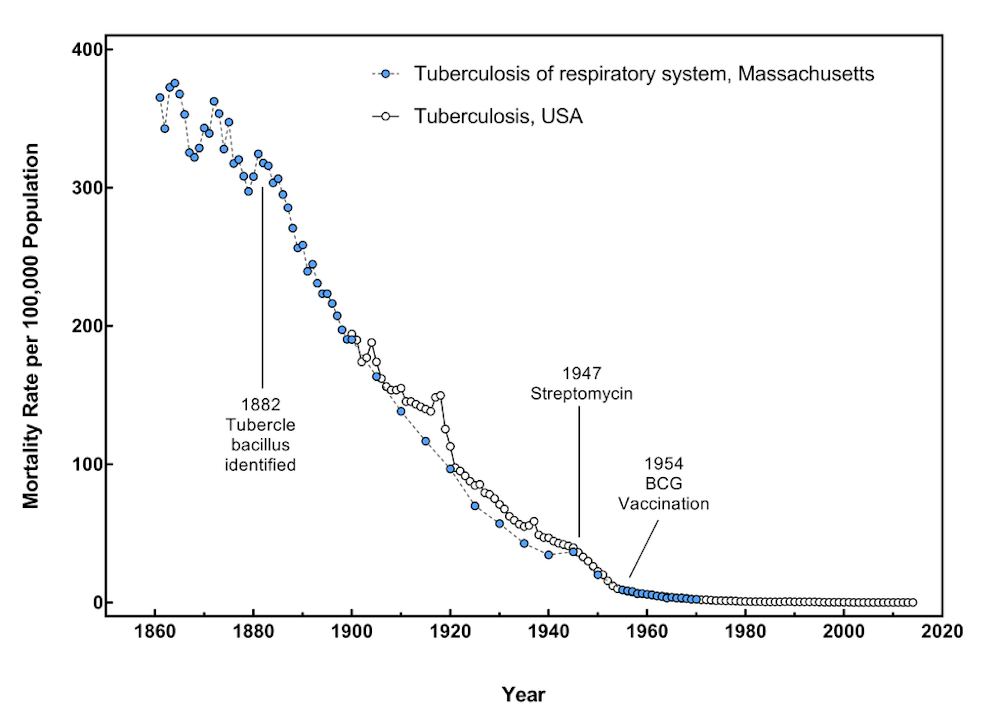
Before COVID-19, there was tuberculosis. Twentieth century British physician Thomas McKeown controversially proposed that the sharp declines in infectious disease death rates in the late 1900s were due to improved economic and social conditions – not medical and public health measures like antibiotics and improved sanitation.

Graph showing mortality rate of tuberculosis in Massachusetts from 1861-1970 and in the US overall from 1900-2014

This graph shows the tuberculosis death rate in Massachusetts from 1861-1970 and in the U.S. overall from 1900-2014, using merged data from the U.S. Census Bureau and the Centers for Disease Control and Prevention. While not the same graph that McKeown used, it shows a similar trend that highlights the steep decrease in death rates that occurred before antibiotics and vaccination became available. Ljstalpers/Wikimedia Commons, CC BY-SA

His theory was later partly discredited. But the central question behind it – whether medical interventions or social factors make the biggest impact on infectious diseases – remains relevant in the current pandemic.

When COVID-19 first arrived in the U.S., the only tool public health officials had to stop its spread was behavior change through lockdowns, social distancing and face masks. With vaccines, the tide seemed to turn. But with new variants, waning immunity and ongoing vaccine hesitancy, the pandemic is still far from over.

So which are more successful at driving down rates of disease and death – social behaviors or medical technologies?

As an infectious disease and social epidemiologist, I have been particularly interested in how new medical technologies affect existing health disparities. I believe that understanding the interplay between behavior and technology will be key to surviving the pandemic and emerging as a stronger society.

Do technologies help or make things worse?

Biomedicine has clearly played a critical role in mitigating COVID-19. Less than a year after discovering the virus that causes COVID-19, researchers were able to develop multiple vaccines that are highly effective in preventing severe infection and transmission from most variants. They’re also likely to reduce the risk of long COVID-19, the ongoing symptoms that can persist for months after initial recovery. COVID-19 vaccines are estimated to have saved almost 140,000 lives in the U.S. in the first five months of 2021.

There has also been remarkable medical progress in other arenas. Even though antivirals are notoriously difficult to manufacture, there are finally options for treating COVID-19. Merck’s molnupiravir cuts hospitalization risks for adults in half, and Pfizer’s paxlovid has 89% efficacy at preventing hospitalization and death. Additional treatments are expected in the coming months.

Researchers have also developed and scaled up a variety of innovative diagnostic technologies. These range from using PCR tests to predict the trajectory of the pandemic to implementing blood tests that can simultaneously measure antibody levels against COVID-19 and other pathogens for quicker diagnosis.

Collaboration across both public and private sectors has also been fairly unprecedented. Large-scale government funding has aided these efforts. The U.S. National Institutes of Health’s Rapid Acceleration of Diagnostics, or RADx, initiative, for example, has worked to contain outbreaks in schools by providing COVID-19 test kits across the country.

Social factors as drivers of health

Despite these technological advancements, the COVID-19 pandemic has illuminated long-standing health disparities. In 2020, Latino and Black people died from COVID-19 at a rate almost three times higher than white people.

Systemic structural and social inequities are some of the reasons behind these disparities in the U.S. For example, communities of color are disproportionately represented in essential occupations that are at the front lines of potential COVID-19 exposure. In addition, Black and Hispanic Americans have higher rates of obesity, hypertension and type 2 diabetes, known risk factors for severe COVID-19 complications. Children in communities of color also experienced the death of a primary caregiver at a rate up to 4.5 times higher than non-Hispanic white children.

Technologies intended to improve health care can themselves exacerbate health disparities. This results in a digital divide where certain populations continue to have poor health despite technological improvements. For example, the safety and convenience of remote videoconferencing is a privilege unavailable for those who need to go to public workspaces to access these technologies.

This divide extends to medical devices used in routine care. Oximeters that measure oxygen levels in the blood tend to produce inflated results for people with darker skin because they were calibrated in clinical trials with mostly white participants. This racial bias may result in denial of care if someone with darker skin gets a normal reading despite actually having dangerously low oxygen levels.

Health disparities persist despite technology

These inequities are often derived from ongoing historical biases and discrimination.

Socioeconomic status, occupation and economic mobility are primary drivers of unequal health outcomes. In 2020, 5.4 million laid-off workers became uninsured in just four months. In 2019, 55% of retail and food workers at large firms didn’t have access to paid sick leave. Many immigrants, whether undocumented or legal U.S. residents, are likely to avoid the health care system due to fear of deportation and limited insurance coverage and public assistance.

Difficulty parsing through health information is another factor. In addition to abundant misinformation about COVID-19, nearly 9 in 10 adults struggle with health literacy. A July 2020 study found that Black men were less likely to know about COVID-19 symptoms and how the virus spreads than white men. For some groups, limited English proficiency and cultural beliefs are barriers to health communication.

Even more critical is distrust in the medical system. Historical unethical experimentation and everyday racism have led to a lack of confidence in scientists and clinicians among vulnerable populations. Two-thirds of Black adults believe the government can rarely or never be trusted to look out for the interests of their community.

Conversely, that COVID-19 hospitalizations and deaths disproportionately affect lower-income populations and communities of color reinforces the need for greater diversity in clinical research participants. Over 80% of participants in the Pfizer-BioNTech COVID-19 vaccine trial identified as white. Having clinical trials that reflect the patients who will be treated ensures that the drug will work for all and encourages confidence among those communities.

The importance of social factors in health

While technology has greatly improved U.S. pandemic response, broader societal ills continue to impede the nation’s ability to control COVID-19.

The McKeown debate exposes a common misconception that improving health is a binary: a choice between improving social conditions or developing new technologies and medicines. But a growing body of research shows that social factors, or the conditions where people live, work and play, are key to health outcomes.

There are numerous strategies that can increase health equity in this time of crisis. These include tackling food insecurity, flexibility in work conditions, targeted vaccine initiatives and culturally competent health care. Engaging with communities as partners in health also advances the nation’s ability to cope during a crisis.

Nobel prize-winning economist Amartya Sen hypothesized that increases in life expectancy in the 20th century occurred in periods marked by a strong emphasis on social sharing and public provision of health care. To me, it’s clear that the time has come to invest not just in new technologies and medical treatments, but also in communities.


[Get the best of The Conversation’s politics, science or religion articles each week. Sign up today.]

Eyal Oren, Professor of Epidemiology, San Diego State University

This article is republished from The Conversation under a Creative Commons license. Read the original article.

Omicron’s lower mortality rate may be explained by how the variant spreads through the body

Although the omicron variant is spreading like wildfire through the United States, some scientists have cautiously expressed cautious hope that its emergence could still mark the beginning of the pandemic’s end. Perhaps it will mark the moment that COVID-19 becomes an endemic (as opposed to pandemic) virus like influenza; or, it could be auspicious that infected patients seem to get less sick than they would have from other strains.

As it turns out, that latter line of thinking may have some credibility. According to a new study by researchers at Hong Kong University, the omicron variant of SARS-CoV-2 has a more difficult time replicating in human lung tissue than either the delta strain or the original SARS-CoV-2 virus. Indeed, omicron was more than 10 times less efficient than the original virus in this regard.  

Medical researchers believe that this could explain why so many patients can withstand infections from omicron, and why in certain countries, such as South Africa, hospitalizations have been comparatively lower on a per capita basis. The hypothesis goes that COVID-19 becomes severe when it spreads from the respiratory system to the rest of the body; confining it to the upper airway (i.e., out of the lungs) therefore becomes essential in staving off severe symptoms.

If this finding is backed up in future studies, it could explain some of the mysteries surrounding omicron.

Since emerging as a prominent COVID-19 strain last month, omicron quickly changed the course of the pandemic. Last week it caused Europe to post record numbers coronavirus infections every single day, and the United States set new daily case records in what was certainly also an undercount. Its dominance could be seen in local statistics; in New York City, for instance, omicron has fueled a record level of COVID-19 hospitalizations.

Yet despite this bleak news, there have also been some more welcoming signs. Although the omicron strain has caused an inevitable surge in COVID-19 cases, there has been a far lower hospitalization rate in the United States linked to the omicron surge than existed with other mutant variant surges. A British report revealed that patients with omicron are half as likely to require hospitalization, and one-third as likely to need emergency case, as those who carry the delta variant. All of the studies found that patients who had been vaccinated were much less likely to develop serious illnesses if they became infected.


Want more health and science stories in your inbox? Subscribe to Salon’s weekly newsletter The Vulgar Scientist.


Perhaps the most revealing study was one that occurred in South Africa, near the omicron variant originated (it likely originated in neighboring Botswana). In examining omicron cases in Gauteng province, the authors found the percentage of people hospitalized during the omicron wave was roughly one-third of the number that needed to be hospitalized during the delta wave — a 10 percent drop, all the way down to 4.9 percent. People who were hospitalized stayed for roughly half the time (4 days instead of 7 or 8 days), a statistic no doubt linked to how less than 30 percent of omicron patients met the regional criteria for severe disease. That was half the number who did so for prior variants.

As the authors wrote in their study: “During the first four weeks of the Omicron-dominated fourth wave, the proportion of patients requiring hospital admission was substantially lower and those admitted had less severe illness, with fewer requiring oxygen, mechanical ventilation and intensive care compared to the first four weeks of the Beta- or Delta-dominated waves in Gauteng Province in South Africa.”

The authors of the Hong Kong University study cautioned observers against reading too much into their conclusion. For one thing, the paper has yet to be peer reviewed, and its conclusions need to be further tested for definitive confirmation. In addition, there are other mechanisms for severe COVID-19 infection besides passing through the lungs.

“It is important to note that the severity of disease in humans is not determined only by virus replication but also by the host immune response to the infection,” lead author Dr Michael Chan explained in a statement.

Omicron’s rise, explained:

Former Bernie Sanders campaign manager: Biden will face progressive challenger in 2024

Jeff Weaver, who ran Bernie Sanders’ 2016 presidential campaign and was a Sanders adviser in 2020, predicted that President Joe Biden will face a progressive primary challenger in 2024 amid growing disillusionment on the left over the Democratic agenda.

“Will there be a progressive challenger? Yes,” Weaver told Politico. He told the outlet that a challenge would not be a “repudiation” of Biden but rather the result of the party’s base moving further leftward. “Progressives are ultimately ascendant,” he said. “And if nothing else, a progressive running who gets a lot of support will demonstrate that the ideas that the progressive movement embraces are, in fact, popular.”

Despite Biden’s lifelong reputation as a moderate and pragmatic Democrat, progressives embraced Biden in the early months of his presidency, as he vowed to unite the party’s various factions to advance an ambitious agenda that encompassed many policy priorities Democrats have focused on for years. But after successfully pushing through a COVID relief bill last March, Biden’s first-year legislative accomplishments have largely been limited to a bipartisan infrastructure bill authored by centrist Democrats with some support from leading Republicans. Progressives remained united with Biden in the push to pass his $3.5 trillion Build Back Better proposal, and largely avoided criticizing the slimmed-down version (at about half that size) that was meant to appease conservative Democrats like Sen. Joe Manchin of West Virginia. But party leaders pushed progressives to support the bipartisan infrastructure vote before a Build Back Better deal was struck, costing the left its primary point of leverage even before Manchin blew up BBB negotiations last month.

Weaver’s interview reflects the fact that a growing number of progressives view Biden’s early presidency as a failure as the White House kicks off a new year with largely the same legislative agenda — and midterm elections just 11 months away.

“He’s deeply unpopular. He’s old as shit. He’s largely been ineffective, unless we’re counting judges or whatever the hell inside-baseball scorecard we’re using. And I think he’ll probably get demolished in the midterms,” Corbin Trent, co-founder of the progressive No Excuses PAC and former communications director for Rep. Alexandria Ocasio-Cortez, D-N.Y., told Politico, endorsing Weaver’s prediction. “People will smell opportunity, and D.C. is filled with people who want to be president.”

RELATED: Biden doesn’t need Manchin: 5 executive actions he can take right now to build back better

It’s unclear, however, what prominent figure on the left will step forward to run a potentially divisive 2024 campaign. Previous progressive presidential hopefuls like Sanders or Sen. Elizabeth Warren, D-Mass., both have prominent roles in the Senate and are exceedingly unlikely to challenge a Democratic incumbent. It also seems far-fetched that a prominent House progressive like Ocasio-Cortez would decide to run against Biden.

“Progressives in the House, in the Senate, in the Progressive Caucus are not talking about primarying Biden,” an aide to a senior House progressive told Politico.

With no top-tier elected officials likely to challenge Biden directly, some on the left are looking at lesser-known candidates who could push Biden to the left.

When asked whether Biden will face a primary challenge from the left, one unidentified prominent progressive said, “Yes,” Politico reported, adding that it would likely be “someone like Nina Turner or Marianne Williamson. Doubt anyone currently elected.”

Turner, a longtime Sanders ally and former Ohio state senator, unsuccessfully ran for Congress in a special election last year against now-Rep. Shontel Brown, D-Ohio, who was heavily backed by the Democratic establishment. Williamson, a self-help guru, ran a fringe campaign in the 2020 Democratic primaries before dropping out and endorsing Sanders.

“I think the president will definitely face a challenger in 2024,” Williamson told Politico. “The yearning to make government actually work for the people again is so intense now, and yes, absolutely, someone will emerge to make a stand for it.”

Talk of a progressive primary challenger before Biden has even completed his first year in office underscores the growing discontent from the party’s left, and it appears likely that additional names could emerge in the coming months and years.


Want a daily wrap-up of all the news and commentary Salon has to offer? Subscribe to our morning newsletter, Crash Course.


“I don’t think the country nor certainly not progressives in the party, who all tend to be younger, are going to sit on the sidelines,” former Sanders consultant Mark Longabaugh told Politico.

Primary challenge or not, Biden, whose approval rating has been underwater since the summer, has tried to shore up his left flank by acceding to progressive calls to extend the pandemic moratorium on student loan payments, and to support reform of the Senate filibuster in order to advance stalled voting rights legislation. The president has remained upbeat on the prospects of passing some form of his Build Back Better package, fulfilling his vow to invest in measures to combat climate change and expand the social safety net. Any potential BBB bill will require all 50 Democratic votes in the Senate — or at least one Republican vote, which seems even less likely.

There is also anxiety on the left that a failed challenge against Biden, who remains widely popular among Democrats in general, could damage the progressive cause.

“I think it’s pretty unlikely that a serious progressive challenger would emerge if Biden stays in the race,” Max Berger, a former top Warren campaign aide, told Politico. “It would so go against the sensibilities of rank-and-file Democrats that I don’t think it would necessarily be a great service to the progressive cause to have our ideas seem so marginal.”

Read more on the Biden administration’s first-year struggles:

Ivanka Trump and Don Jr. slapped with subpoenas, refuse to comply with fraud investigation

Donald Trump’s eldest children have been subpoenaed by New York Attorney General Letitia James as part of her civil investigation into the Trump Organization’s finances, asking both Donald Trump Jr. and Ivanka Trump to provide private testimony. 

The subpoena was originally issued on December 1, according to a document filed Monday. As The New York Times points out, that is when it was first revealed that the former president had been asked to sit down with James’ legal team. According to Monday’s court filing, both Don Jr. and Ivanka Trump appear to be challenging the move. The two will now be named as respondents in James’ ongoing inquiry.

RELATED: New York Attorney General eyeing early January deposition of Trump: report

Over the years, all three children have been extensively involved in the former president’s eponymous business. Ivanka Trump joined the Trump Organization as an executive vice president back in 2005 and resigned from her post in 2017. Donald Trump Jr. serves as a trustee for the company in addition to executive vice president. 

Before assuming the presidency, Donald Trump handed the keys to his two sons and Allen H. Weisselberg, the company’s longtime chief financial officer who stands accused of raking in $1.7 million worth of company perks during a 15-year tax avoidance scheme. 


Want a daily wrap-up of all the news and commentary Salon has to offer? Subscribe to our morning newsletter, Crash Course.


The state’s civil probe is aimed at gathering information into Trump’s alleged inflation and deflation of certain business assets for tax and lending purposes, including his Seven Springs estate in Westchester County and the Trump International Hotel & Tower in Chicago. 

James’ investigators are working in parallel with a criminal inquiry led by Manhattan District Attorney Cyrus Vance, who indicted Weisseberg back in September. Vance’s probe, which spans three years, was joined by James back in May. 

Throughout the years, Donald Trump and his allies have repeatedly sought to downplay and delegitimize both of the probes. In a lawsuit against James filed last Monday, the former president alleged that the attorney general is “guided solely by political animus and a desire to harass, intimidate, and retaliate against a private citizen who she views as a political opponent.” The suit cited numerous criticisms James leveled at Trump over social media during his time as president. 

“Neither Mr. Trump nor the Trump Organization get to dictate if and where they will answer for their actions,” James said in response.

RELATED: Trump sues to stop New York Attorney General investigating him for fraud

Neither Trump nor his family members have been formally charged with any criminal wrongdoing. Donald Trump’s son, Eric, who serves as the executive vice president of the Trump Organization, was questioned in the case back in October 2020. If the eldest Trump children do not comply with the attorney general’s subpoenas, James can take them to court and legally compel them to appear for an interview. 

Democrats need not despair: 6 reasons to be hopeful about the 2022 midterms

It’s hard not to feel depressed going into 2022. Headlines are dominated by the omicron variant of COVID-19, Donald Trump continues to walk free despite his attempted coup one year ago, and Republican efforts to steal the 2024 election for him are well underway after receiving no resistance from a Senate that is being held hostage by the two worst Democrats in the nation. Democratic voters are demoralized, as evidenced by the low turnout in November’s Virginia election. Republicans, meanwhile, are in a “let’s go Brandon” frenzy. 

And yet, there are tendrils of hope peeking out through the freeze of despair.

Omicron is spreading rapidly— but the hospitalization rates remain low, suggesting it’s morphing into a relatively minor cold for the vaccinated. Trump, for his part, may actually be facing real legal consequences in 2022. And, as hard as it may be to accept, there are genuine reasons to believe that the midterm elections may not be the democracy-ending bloodbath that so many of us have been fearing.

RELATED: It’s time for Democrats to remind Republicans: The GOP is very much in the minority 

The Republican push to consolidate power and usher in a new Trump-led authoritarian state might not be as effective as the GOP hopes — and everyone else fears. So that means it’s important to keep up the fight and resist the urge to simply give up. We can’t let the bad guys win. Here are six reasons to stay in the fight in 2022.  

1. GOP’s gerrymandering-pocalypse is a dud 

The press pays more attention to voter suppression techniques that make for good imagery, like denying food and water to people to people waiting in line, but actual election experts have been far more worried about the impact of aggressive gerrymandering this election cycle. Packing-and-cracking techniques have recently allowed Republicans to gain seats nationwide, despite their declining popularity. After the 2020 census, the fear was Republicans would be able to redistrict themselves into power that was untouchable by Democratic majorities. And yet, as Paul Waldman of the Washington Post reported last week, “informed redistricting experts now say it appears that this process will look more like a wash, or even that Democrats might gain a few seats.”

There are many reasons for this shift in GOP fortunes, including that Democrats are fighting back harder than expected. But a lot of it comes down to the fact that demographic changes have been so dramatic that Republicans, in many places, decided to “consolidate their current position rather than take a riskier path that might expand their seats.” In the end, Democrats should have a shot at far more seats than previously believed. 


Want more Amanda Marcotte on politics? Subscribe to her newsletter Standing Room Only.


2. Democratic governors — who may be what save us in 2024 —look strong in 2022

One of Trump’s strategies for stealing the 2020 election focused on voiding out electoral college votes from swing states that Joe Biden won. While Trump failed to get the momentum for his plan back then, the GOP-controlled state legislatures in places like Wisconsin and Pennsyvlania seem game to try again in 2024. They almost certainly, however, can’t succeed without the governor’s cooperation.

That is why it’s crucial for Democrats to win gubernatorial elections in 2022. And there is reason to be optimistic on that front. These statewide elections are out of the reach of the gerrymandering that has captured so many state legislatures for Republicans

Many of the states that Trump wants to steal are electing governors this year. Democrats have a strong chance of winning — if they put up a fight. They have a chance to retain seats in Pennsylvania, Michigan, and Wisconsin. Stacey Abrams is taking another shot at Georgia. And there’s a chance to flip the governor’s seats in Florida and Arizona.

3. The Senate map looks good for Democrats

If you’re sick of Sens. Joe Manchin and Kyrsten Sinema, I’ve got good news: If Democrats gain Senate seats in 2022, these two’s ability to stop all legislation of importance may disappear. Better yet, that may very well happen.

RELATED: Meet the scariest Republican candidates of 2022: It wasn’t easy to pick ’em

In Pennsylvania, Republican Sen. Pat Toomey is retiring, leaving his seat up for grabs by one of the many popular Democrats who are running. Both North Carolina and Wisconsin are two other swing states where there’s a chance Republicans can be replaced by Democrats. Even Missouri may be in range, if Republicans are foolish enough to nominate Eric Greitens, a repulsive specimen who was last seen being forced to give up his governor’s seat after being credibly accused, with photographic evidence, of kidnapping and sexual assault. 

4. Republicans are putting up a vomit-inducing set of candidates this cycle

As Igor Derysh reports, Greitens is actually looking like the Republican norm for candidate choice in today’s Trump-controlled GOP. In those crucial gubernatorial elections I mentioned, this could matter a lot. Abrams, for instance, is likely to run against the charisma-free David Perdue, who is an out-and-proud insurrectionist. In Arizona, there’s a strong chance the party goes with Kari Lake, a Trump pick who is associated with Mike Lindell and other nutty folks linked to the “vote audit” that Republican diehards love, but everyone else finds embarrassing. Most voters oppose the insurrection, so insurrectionist candidates are going to have a harder time at the polls. 

Republicans’ much-lauded 2021 win in the Virginia governor’s race came courtesy of Glenn Youngkin, a bland specimen who could convincingly fake being sane to middle-of-the-road voters. But in California, their choice of Larry Elder, a loudmouthed and misogynist radio talker, gave Democrat Gavin Newsom a much easier path to victory in their gubernatorial race. Republicans look poised to nominate more Elders and fewer Newsoms. Democrats have a real chance to take advantage. 


Want more Amanda Marcotte on politics? Subscribe to her newsletter Standing Room Only.


5. The pandemic may finally dissipate

Fox News and Republican leaders convinced their voters to reject vaccines and draw the pandemic out as long as possible to hurt Biden and the Democrats. By offering themselves up to the virus, Republicans kept case and death rates up at a steady clip, sowing malaise that led directly to Biden’s declining approval numbers

RELATED: Biden didn’t “fall short” of July 4 vaccination goal — he was sabotaged by Republican trolls

Then omicron started to wash over the country like a tidal wave, infecting hundreds of thousands of people a day. People are now getting infected at higher rates than they are getting their first vaccine. That sucks, but the silver lining is that all those unvaccinated Republicans are now getting their inoculations the hard way. Building immunity through infection ain’t ideal, but it still works. There’s a very real chance that the pandemic is mostly in the rearview mirror next fall, and Democrats reap the rewards of getting us through this crisis. 

6. The Supreme Court may awake a sleeping giant

People are going to be very angry if the Supreme Court overturns Roe v. Wade, as it is widely expected to do. Abortion rights are popular, and so the common wisdom has been that the Supreme Court will find some way to keep restricting access without actually creating the “Roe is overturned” headlines that could lead to an electoral backlash against Republicans. But the arguments before the court earlier this month in a Mississippi abortion case showed that 5 out of the 9 nine justices seem way too invested in ending reproductive rights to worry overmuch about the political impacts. Sure Chief Justice John Roberts still wants to preserve the court’s unearned reputation for prudence and moderation, but he’s simply outvoted by the slobbering misogynists on the bench. 

If there is, as expected, a national run to pass abortion bans — often enforced with bounty hunter systems — across states in the summer and fall, that will likely wake up a lot of people who have checked out of politics since Biden’s win. Nor is there any reason to strike a cynical pose of anger at Democrats for pressing a political advantage on this. If Democrats can secure a stronger majority in Congress in 2022, they can actually pass a bill that will overrule any Roe overturn the Supreme Court coughs up. Saving reproductive rights cannot be disentangled from saving either the Democratic Party or democracy itself. 

To be clear, much of this optimistic outlook is speculative or contingent. It could very well be that 2022 is an extension of 2021, where Democratic demoralization keeps snowballing, leading to Republican sweeps in the midterms. If that happens, we may be looking back on these days and seeing an inexorable path to fascism. 

But right now, hope is simply not lost.

There are a lot of levers that can be pulled to keep Republicans from crushing Democrats in 2022, and then voiding out any election protections that are needed to keep Trump from stealing the 2024 election. Saving the country means fighting for it. It’s hard for people to fight, unless they can retain some hope of prevailing. The good news is that there are lots of reasons to feel that hope. Pro-democracy forces have the numbers, and they can still be translated into power, at least for now. The next year will be a wild ride, but, in the end, we may be looking at a repeat of 2020, where hope bested nihilism. The moment for saving ourselves has not passed. We still have a chance — if we seize it. 

Everyone in Maine is obsessed with these chips

Growing up in rural Connecticut, Maine was always kind of a mystery to me. My family had spent ample time driving up and down the tree-lined highways in New England, visiting college towns like Northampton, Massachusetts, and Burlington, Vermont, and we’d been all over New Hampshire to ski. Maine was just too far away. So when my wife, daughter, and I moved here from Brooklyn during the pandemic, I worried we’d feel alienated despite being home in New England.

I quickly learned that Maine shared more in common with my childhood haunts — and less in common with the frenzy of New York City — than I ever could have imagined. Hell, you could find a dozen telltale New England things walking into a gas station: a 10-pack of mini Fireball bottles, Moxie soda, Red Snapper dogs, and my favorite: Humpty Dumpty All Dressed Potato Chips.

Everyone in Maine seems to adore these cult potato chips. The entire state of Maine is a cult, but only about these chips. Mainers know what they want: They take their Dunkin’ hot and light, their lobster with mayo and not butter, and always a bag of Humpty Dumpty All Dressed chips on the side. Oddly enough, Mainers may be the only people who get to enjoy these chips, as they literally cannot be found outside the state. Here’s why.

Humpty Dumpty operates as a subsidiary of a company called Old Dutch Foods, a snack manufacturer that mainly distributes chips and pretzels across the Midwest, New England, and Canada. The Humpty Dumpty Potato Chip Company was founded in 1947 in Scarborough, Maine, by George Robinson and Norman Cole, and specialized in flavors like ketchup and sour cream and clam chips. After being sold to a Canadian company in 2000, Old Dutch Foods bought Humpty Dumpty, rebranding some of its chips as “Old Dutch” while keeping the “Humpty Dumpty” label on others.

Regardless of how many hands have touched Humpty Dumpty, Mainers have loved these chips since they started showing up in gas stations more than 60 years ago.

“I’m not sure, I can ask,” said Eddie, a 22-year-old cashier at The Rusty Lantern in Topsham, Maine, when I called to ask about the chips. He asked a manager in another part of the store before getting back to me: “Based on her reaction it seems like they sell really well,” said Eddie. “I hadn’t had them before here, but I’ve had them now, and they’re really good.”

Like the residents of Vacationland, Humpty Dumpty chips hold a mysterious air about them that makes it hard to piece together their story. We know people love them, and we know it’s nearly impossible to find them anywhere outside the Pine Tree State. Famed “Simpsons” writer and “The Gordon Ramsay of Fast Food,” Bill Oakley, managed to get his hands on Humpty Dumpty All Dressed potato chips a few years back.

“All Dressed Humpty Dumpty potato chips are, in my opinion, the best potato chips I’ve ever eaten and possibly the best potato chips available anywhere,” said the snack-food lover and creator of fan-favorite Simpsons episode “Homer’s Enemy.” Oakley is a famously discerning snack critic. He refuses to use the term “junk food” and spent a lot of our phone call gushing over some of his favorite snacks from around the world, like Japanese chocolate-and-potato-chip-coated peanuts and rotisserie-chicken-flavored Lay’s potato chips from Canada. Oakley’s somewhat of a savant when it comes to snack foods, and he has always held a special place in his heart for the elusive Maine chips.

“Ruffles All Dressed — which are the Canadian gold standard of All Dressed — those are terrific,” continues Bill, “They have a more intense flavor in Canada than the ones they sell in America. Humpty Dumpty has a delicious flavor as well. Equally delicious, and I like the ruffling a little bit better. Humpty Dumpty’s ruffles are a little looser, and it gives the chip a little more lightness. In my opinion, just a little bit more enjoyable chip-wise and texture-wise than the Ruffles.”

I love these damn chips. They’re thicker than your run-of-the-mill potato chip, sending flavor shrapnel to every corner of your tongue with each crunch. They’ve got girth and body and soul. Despite the fact that Humpty Dumpty has put out so many unique flavors (most notably Dill Pickle, Au Gratin, and St-Hubert rotisserie chicken), All Dressed seems to be the de facto favorite among those who’ve eaten these iconic chips.

What is it about these chips that draws in Mainers? Maybe it’s the price: Most bags have a very unsubtle $2 sticker on the front. Or could it be the availability? You’ll find them in most gas stations and supermarkets in Maine. I think it’s because Mainers identify with All Dressed chips. Mainers are mysterious and hard to track down on a spiritual level. They’re hardworking but elusive. Cold but strangely open: When I first moved into my house, my mailman introduced himself as Dov, and told me if he had to write a book about his life it’d be titled “My F**ked-Up Life.” That’s a true story.

Bold like the tangy zip of All Dressed (usually a mixture of ketchup, barbecue sauce, and salt and vinegar), Mainers like to proverbially throw it all on the table for you to eat up. My landscaper, within minutes of meeting me, asked me why Bill and Melinda Gates were buying up “shit tons of farmland out west.” Maybe it’s because Maine is so close to Canada, where All Dressed flavor is more of a standard. Regardless of the reasoning, it’s a chip we Mainers love and can unconditionally call ours. Want some? Come and get ’em!

Pete Davidson is a chicken cutlet connoisseur

America has seen Pete Davidson every Saturday night on “Saturday Night Live” for the last seven years. More recently, we’ve seen him on the cover of tabloid magazines alongside Kim Kardashian and as the frequent subject of trending Twitter threads. I’ve personally dreamed of seeing Pete next to me on the sidewalk, holding my hand, making jokes about his lack of sleep, presidential elections, and his numerous high-profile relationships. The one place I never expected to find Pete was on Ruth Roger’s podcast “River Cafe Table,” where he joined the esteemed London-based chef to talk about everything from his special method for making Cup O’ Noodles and scrambled eggs to his mom’s homemade chicken cutlets. Once I saw that this very podcast episode did exist, I said to my real-life partner, “There’s no way Pete can cook . . . is there?”

“No way,” my partner replied. “He probably orders a ton of Postmates and I’m sure all of it hurts his stomach,” he said. Pete has spoken openly about living with Crohn’s Disease, a type of inflammatory bowel disease. It seemed likely that he had a limited list of foods he could eat without experiencing severe physical discomfort for hours after.

Pete grew up on Staten Island, which is known for its two-mile stretch that kicks off the New York City Marathon and its exhaustive list of Italian-American restaurants — the kind that serves you big loaves of thickly sliced white bread, maybe with olive oil, but more likely with continental butter chips. I assumed that he frequently dined at a number of old-school red sauce joints, but thought that there was no way he was proficient at rolling meatballs or making chicken parmesan.

And I was right. Pete Davidson has absolutely no idea how to cook.

“I put them in the pan and mush them around,” he said, describing his technique for making scrambled eggs.

“I can also add hot water to ramen noodles,” he said. But Pete, ever the comedian, shared his method with complete seriousness: “I don’t know how to boil water because I’m dumb so I go to the Keurig and hit the hot water button.” He lets the hot water flow from the Keurig onto the pre-made ramen noodles, which he purchases from Costco, and enjoys them from, I imagine, a humble but spacious balcony that overlooks the tip of Manhattan.

For the record, this was a teaching moment for both the host and guest. Rogers admitted that she had never heard of Cup O’ Noodles and wouldn’t have the faintest idea how to cook them. Nor was she familiar with the Keurig (though she did understand the comparison to its bougier relative, the Nespresso).

Pete’s cooking literacy isn’t so unusual. It’s along the lines of a student living alone in a college dorm room or apartment for the first time in their life; and this is, in some ways, Pete’s reality, as he just moved out of his mom’s basement during the pandemic (yet another common subject matter that he speaks about with a mixture of pride and self-mockery on “SNL”).

But he also appreciates thoughtful home cooking. For most of his life, his mother worked as an ER nurse, which meant irregular hours and lots of takeout for Pete and his sister. The one dish that she perfected, according to Pete, was chicken cutlets. “I have yet to have a better chicken cutlet anywhere else,” he told Rogers.

With a little coaxing, Rogers helped Pete walk listeners through his mom’s process for making chicken cutlets, which is most notable for its double coating of panko breadcrumbs. “I never really ate at the dinner table. I would walk by and take each chicken cutlet as soon as it was done being made . . . It was always a treat when my mom cooked,” he said.

Like most families, holidays became the epicenter of home cooking for the Davidsons. Thanksgiving was potluck-style: “My grandma would do the turkey and the stuffing, my mom would bring the sweet potatoes, someone else would bring mashed potatoes, asparagus, [and] dinner rolls.” Pete likely contributed his comedic timing anytime the dinner conversation inevitably, got a little awkward, and hopefully helped clean up the table with the skills he acquired working as a busboy at Nucci’s South, one of the aforementioned old-school red sauce Italian joints on Staten Island.

Despite Pete’s rise to fame, he comes across as relatable. He grew up in a working-class family in New York’s forgotten borough and continues to maintain a good relationship with his mom and sister. Chicken cutlets are an apt metaphor for Pete Davidson; they are both dependable and familiar. They are delightful dinner party company (I know this to be true of chicken cutlets and expect the same from Pete). Everyone loves them, even when they look a little too fried.

It’s time for Democrats to remind Republicans: The GOP is very much in the minority

This week marks the one-year anniversary of the January 6th insurrection. There will be some commemorations of the day in Washington and pro-democracy groups will hold vigils for democracy while pro-Trump groups will be holding vigils to support the insurrectionists. Donald Trump plans to hold a press conference on that day where he says he will discuss in-depth the “stolen election” of 2020, citing several states where “the numbers don’t work for them.” Feel the magic:

“Remember, the insurrection took place on November 3rd, it was the completely unarmed protest of the rigged election that took place on January 6th.” 

Over the holiday break, the Department of Justice released more shocking footage of the allegedly “completely unarmed protest” which showed three hours of bloody violence raining down upon the capitol police that day. Trump’s attempt to reframe January 6th as an unarmed peaceful protest may be his greatest act of chutzpah yet — and that’s saying something.

Several news organizations released polling this past weekend looking at the public’s attitude toward the 2020 election and January 6th one year later. The Washington Post-University of Maryland poll found that 68 percent say there was no evidence of fraud and that includes huge majorities of Democrats (88%) and Independents (78%). Republicans, however, are still living in denial. 62 percent of Republicans still believe that the election was riddled with fraud, a number virtually unchanged since this time last year. That adds up to a massive 30% of the nation that still believes the election was stolen from Donald Trump. 

An ABC-Ipsos poll found pretty much the same thing. They also asked if Americans believed that the people who stormed the Capitol that day were “threatening democracy” and 72% said “yes” while 25% say they were “protecting democracy.” That last number includes 52% of Republicans, which is stunning. I’m sure you will recall those ancient times when the GOP prided itself on being the party of “law and order.” 78% of Republicans now believe that Trump bears only a little or no responsibility for the attack, which is contradictory since they also profess to believe that the mob was protecting democracy. Surely they don’t think Trump was against that, do they?

A CBS Poll delved into public attitudes about political violence and it’s isn’t comforting. Two-thirds of Americans believe that the events of January 6th were a sign of increasing political violence and that American democracy is threatened. Most have not changed their minds about that violence in the ensuing 12 months. 87% disapproved then and 83% say they disapprove now. But lest you think that Republicans understand what happened that day, CBS reports that “the intensity with which Republicans disapprove softened over the summer and has stayed softer.”

RELATED: D.C. cop beaten on Jan. 6 calls out Trump supporters for “whitewashing” MAGA mob

They no longer strongly disapprove – they seem to have reconciled themselves to seeing it some kind of minor infraction. Four out of ten have persuaded themselves that it was actually leftists who committed the violence. Apparently, they think the Trump supporters were all standing outside sweetly singing “What a Friend We have In Jesus” as red-hatted Antifa members hit cops over the head with American flags.

Most disturbing in the CBS Poll was the question of whether there will be political violence from the losing side in the future. 62 percent of Americans believe there will be. And that’s not all:

We then followed up and asked, “If that’s your side that loses and there is in fact violence, would you be in favor of that or not?” It’s an abstraction right now, of course, and a mere 2% would favor it. But another quarter left it open, saying it depends on the circumstance — and in that, we start to see political differences, with 2020 Trump voters twice as likely as Biden voters to say that it depends

30 percent of Republicans are open to violence if their side loses.


Want a daily wrap-up of all the news and commentary Salon has to offer? Subscribe to our morning newsletter, Crash Course.


All of that indicates that the GOP is very dug in on The Big Lie and the ensuing insurrection. It’s unlikely they are going to change their minds. If there were decent leadership in the Republican Party and a moral compass among the right-wing media, all of whom know the truth but refuse to speak it, there might have been a chance to walk back from the precipice. But there is not and so we are facing the increasingly uncomfortable reality that tens of millions of our fellow Americans see violence as a reasonable response to losing elections. Because of that, two-thirds of Americans now see democracy as being threatened. And they are right.

All of this new data shows that the ideas expressed in a remarkably unvarnished, year-end New Yorks Times editorial speak for a large majority of Americans:

[T]he Republic faces an existential threat from a movement that is openly contemptuous of democracy and has shown that it is willing to use violence to achieve its ends. No self-governing society can survive such a threat by denying that it exists.

It exists.

It is clear that Republicans refuse to accept reality and they are primed to fight to preserve their delusions and the large majority who know otherwise are going to have to step up. The good news is that there seems to be many more of them. In all that polling about January 6th, the Big Lie and the willingness to use violence to obtain power, Democrats and independents are in lock step agreement, which is unusual. On this, the country isn’t polarized. A large majority of Americans are opposed to this anti-democratic impulse — the Republicans are very much in the minority.

That means that as we go into this election year (yes, I know, I’m sorry) it’s incumbent upon the Democrats to ensure that this issue is front and center. The Washington Post’s EJ Dionne made a good case for the Democrats to run on a democracy platform by quickly passing the democracy bills pending in the Senate, with the president himself taking the lead and championing democracy far more forcefully than he has until now, pushing legislation and using executive action wherever possible. Most importantly, he writes:

It also requires invoking the evidence from the House select committee’s Jan. 6 investigation to make clear that the threat to democracy comes not just from Trump but also from a Republican Party complicit in undermining democratic institutions, both overtly and through its silence.

It is not just Trump, far from it. The entire Republican Party is complicit in this ongoing assault on democracy: from the wealthy donors to the powerful Washington officials all the way down to the grassroots. Democrats must pull out all the stops to explain the stakes and activate the vast majority of Americans who want to save it. This could not be a worse time for complacency. 

Meet the scariest Republican candidates of 2022: It wasn’t easy to pick ’em

The Trump era saw a far-right takeover of the Republican Party. But the Big Lie and the fallout from the Capitol riot last January threaten to move the party even further into the extremist fringe after the 2022 midterms.

Republicans have long inched toward extremist positions on issues like immigration, women’s rights and gun rights but Donald Trump’s election helped mainstream racist, xenophobic and white nationalist forces. Senate Republican leader Mitch McConnell, R-Ky., arguably one of the most effective conservative political figures in recent history, has increasingly been cast as a RINO (“Republican in Name Only”) while the once-fringe House Freedom Caucus has grown massively to become a leading force in Washington. Longtime conservatives like former House Speaker Paul Ryan and former Sen. Bob Corker, R-Tenn., ran for the hills while conspiracy theorists like Reps. Marjorie Taylor Greene, R-Ga., and Lauren Boebert, R-Colo., became the faces of the new MAGA wing of the GOP.

Though the majority of the House Republican caucus voted to back Trump’s Big Lie and tried to block the certification of President Biden’s victory after the deadly Capitol riot, Trump and his allies wasted no time in launching a revenge tour, with the explicit aim of purging lawmakers seen as insufficiently loyal, while his supporters in state legislatures around the country seek to make it easier to overturn the next election. With Democrats facing a difficult if not impossible task of keeping the House despite plummeting approval ratings, the next wave of Republican freshmen could be the scariest yet – and may pose a true threat to democracy as we know it.

Kari Lake — Arizona governor

After failing to convince outgoing Arizona Gov. Doug Ducey to help him overturn his election loss, Trump is backing a largely unknown conspiracy theorist, who vowed she would not have certified Biden’s win, to replace Ducey. Lake, a longtime Arizona news anchor with no political experience, has even demanded that election officials “decertify” the election results, which is not legally possible. Lake, who is also backed by election conspiracists Mike Lindell and Michael Flynn and Capitol riot-linked Rep. Paul Gosar, R-Ariz., has called for Democratic Secretary of State Katie Hobbs (who is also a gubernatorial candidate this year), to be imprisoned for unspecified election crimes. Trump has also praised Lake for opposing COVID restrictions, “cancel culture,” and “woke” school curriculums, all issues likely to dominate the next cycle of Republican primaries and beyond. Trump’s endorsement catapulted Lake atop the race, where she leads former Rep. Matt Salmon, R-Ariz., by more than a two-to-one margin.

Eric Greitens — Missouri governor

Greitens, once a rising star and considered a potential presidential contender, resigned as Missouri governor in 2018 after a woman with whom he had an extramarital affair accused him of sexual assault and revenge porn. A St. Louis grand jury indicted him that year on felony invasion of privacy charges, and although prosecutors dropped the charges, a special committee in the Republican-led state legislature released a report in April 2018 deeming the woman’s allegations “credible.” The legislature moved to start impeachment proceedings against Greitens in May 2018, leading him to resign in exchange for prosecutors dropping an unrelated felony charge for using a veterans’ charity email list for his campaign.

RELATED: Trump’s MAGA movement suffered in 2021 — but has big comeback plans for 2022

There was a time when such scandals would end a political career but Greitens has rebranded himself as an election conspiracist in the wake of Trump’s loss, calling for “audits” of the election results nationwide and “decertification” of the 2020 results, and is back for a Senate bid. Republicans worried that Greitens could cost them the race have pleaded for Trump not to endorse Greitens, but Trump World appears to be rallying behind the disgraced former governor with endorsements from Donald Trump Jr., his girlfriend Kimberly Guilfoyle and former Trump lawyer Rudy Giuliani.

Greitens is just one of numerous Republican candidates accused of violence against women, a list that also includes Trump-backed Georgia Senate candidate Herschel Walker and Trump-endorsed Ohio House candidate Max Miller, who was accused of assault by Trump’s former press secretary Stephanie Grisham.

Joe Kent — Washington, 3rd congressional district

Kent is running to unseat Rep. Jamie Herrera Beutler, R-Wash., who voted to impeach Trump after the Capitol riot, and is the most prominent candidate backed by the “Insurrection Caucus,” meaning Trump allies like Greene, Boebert, Rep. Madison Cawthorn of North Carolina and Rep. Matt Gaetz of Florida. The Washington Post reported last week that the group has little appetite for direct battle with Democrats and instead aims to push House Republicans even further right.

Kent told the Post he wants to force the party to vote on articles of impeachment against Biden and a full congressional investigation into the 2020 election, which he has claimed (without evidence, of course) was stolen. “A lot of it will be shaming Republicans,” he told the Post. “It’s put up or shut up,” he said.

Trump critics are particularly alarmed about the extremist pro-Trump wing gaining power.

“We’re looking at a nihilistic Mad Max hellscape,” former Republican strategist Rick Wilson, who co-founded the anti-Trump Lincoln Project, told the Post. “It will be all about the show of 2024 to bring Donald Trump back into power. … They will impeach Biden, they will impeach Harris, they will kill everything.”

Mark Finchem — Arizona secretary of state

While most eyes will be on prominent gubernatorial and congressional races, the 2022 slate of secretary of state races may be the most consequential. Secretaries of state, who oversee elections, certified the election results in all the states Trump sought to contest, regardless of party affiliation. Next time may be different.

Finchem, a state lawmaker who attended the “Stop the Steal” rally ahead of the Capitol riot and spoke at a similar protest the previous day, has earned Trump’s endorsement — and has also espoused QAnon-linked conspiracy theories and been linked to extremist groups.

A Finchem win could prove consequential in a state that was decided in 2020 by fewer than 12,000 votes. But Trump is also backing Rep. Jody Hice, R-Ga., another election conspiracist, against Georgia Secretary of State Brad Raffensperger, who pushed back on Trump’s attempts to overturn his loss. The ex-president has also thrown his support behind Kristina Karamo, an election conspiracist who hopes to challenge Michigan Secretary of State Jocelyn Benson, a Democrat.

Democrats increasingly worry that prominent election conspirators may soon be in charge of overseeing the votes. “That is ‘code red’ for democracy,” Colorado Secretary of State Jena Griswold, chairwoman of the Democratic Association of Secretaries of State, told Reuters.

David Perdue — Georgia governor

At the start of the COVID pandemic, there appeared to be no governor closer allied with Trump than Georgia Gov. Brian Kemp. But Kemp’s refusal to help Trump try to block Biden’s win forever cost the governor Trump BFF status and put him squarely in the former president’s crosshairs. Trump has made it a point to back primary challenges to his perceived enemies, throwing his support behind former Sen. David Perdue, R-Ga. — who lost to Democrat Jon Ossoff in a January 2021 runoff — even as the state’s Republican lawmakers pleaded for him to stay out after many blamed him for costing the party both of its Georgia U.S. Senate seats.

Perdue was already out of the Senate last Jan. 6, but now says he would have voted to block Biden’s win. After landing Trump’s endorsement earlier this month, Perdue filed a dubious lawsuit calling for an investigation of absentee ballots in his Senate race over vote-rigging allegations against Democratic election officials, some 11 months after his defeat. He also said earlier this month that he would not have certified Biden’s victory if he had been governor.

Ron Watkins — Arizona, 1st congressional district

Watkins has long been a prominent QAnon conspiracy theorist and many believe he outed himself as the mythical “Q” in a recent HBO documentary. As former administrator of the far-right imageboard 8kun, for years he has pushed nonsensical conspiracy theories alleging that a cabal of liberal Satan-worshipping pedophiles are running a global child sex-trafficking ring and plotting against Trump. Earlier this year, he filed paperwork to run for Congress in Arizona — in a Phoenix-area seat now held by Rep. Tom O’Halleran, a Democrat — after moving back to the U.S. from the Philippines.


Want a daily wrap-up of all the news and commentary Salon has to offer? Subscribe to our morning newsletter, Crash Course.


But Watkins is just one of at least 49 federal candidates who have publicly expressed some support for the QAnon conspiracy theory, according to the watchdog group Media Matters.

Adam Laxalt — Nevada, U.S. Senate

While many Republicans cheered Trump’s bogus voter fraud lawsuits from the sidelines, Laxalt, Nevada’s former attorney general, filed multiple lawsuits contesting Biden’s victory in the state. Though all of the challenges were rejected by the court, Laxalt has continued to stoke voter fraud conspiracies, leading the Las Vegas Sun editorial board to label him the “Nevada version of Rudy Giuliani.” Laxalt, who is now running for the Senate seat held by Democrat Catherine Cortez Masto, vowed to file lawsuits to “tighten up the election” more than 14 months before a single vote is cast. Democrats in the state say Laxalt is using Trump’s “Big Lie playbook” for his campaign and seeking to “limit Nevadans’ voting rights and potentially overturn the election when he loses.”

Mellissa Carone — Michigan state House

Readers may remember Carone from her bizarre testimony to Michigan lawmakers alongside Giuliani last December or the subsequent mockery she received on “Saturday Night Live.” Carone, a former IT contractor for Dominion Voting Systems who has continued to espouse debunked claims of election rigging, is now running for the Michigan state House as a Republican and pushing white nationalist talking points about liberals seeking to “eliminate white people in America” with so-called critical race theory and transgender rights.

Carone is one of hundreds of pro-Trump diehards running in state legislature races in 2022, a trend that could have severe implications. Republican-led state legislatures this year pushed hundreds of voting restrictions, measures undercutting COVID regulations, legislation barring the teaching of certain history in school, and bills cracking down on LGBTQ rights.

J.D. Vance — Ohio, U.S. Senate

Vance, a longtime venture capitalist and the best-selling author of “Hillbilly Elegy,” is running for U.S. Senate in Ohio, where incumbent Republican Rob Portman is retiring. Vance and fellow Republican candidate Josh Mandel have desperately tried to rebrand themselves as Trump-style, anti-immigrant, anti-Big Tech zealots. Vance’s politics appear to be closer to that of Sen. Josh Hawley, R-Mo., than to the former president, but it’s his financial backers who have raised the most concern.

Vance is backed by the Mercer family, who funded Trump, Sen. Ted Cruz of Texas, Trump adviser Steve Bannon and many of the key players involved in stoking election lies and the subsequent Capitol riot.

Vance’s biggest benefactor is venture capitalist Peter Thiel, who has increasingly thrown big money at Trump and other far-right Republicans. Thiel, who has worked with Vance for years,  dropped $10 million to back his Senate bid and another $10 million to support his protégé Blake Masters’ Senate bid in Arizona, along with maximum donations to several House campaigns. Though Thiel largely keeps a low public profile, he is “in many ways further to the right than Trump,” author Max Chafkin, who profiled Thiel in a recent book, told Salon earlier this year, and “wants to be the patron of the Trump wing of the Republican Party.”

Noah Malgeri — Nevada, 3rd congressional district

Trump has frequently drawn condemnation for calling for “locking up” political opponents but some Republicans have gone even further, calling for actual violence against their adversaries.

William Braddock, a Republican running for a Florida House seat vacated by outgoing Rep. Charlie Crist, D-Fla. (who is running for governor), threatened to send a “hit squad” to make his Republican primary opponent “disappear.” His opponent was granted a restraining order.

Wyoming state Sen. Anthony Bouchard, who is running to unseat Rep. Liz Cheney, R-Wyo., earlier this year suggested executing White House chief medical adviser Dr. Anthony Fauci, which the state’s Democratic Party reported to the FBI.

Earlier this week, Noah Malgeri, who is running in the Republican primary to face Rep. Susie Lee, D-Nev., called for the execution of Gen. Mark Milley, chairman of the Joint Chiefs of Staff, who has been targeted by Republicans for a call he made to a Chinese general to reassure him that the United States was not planning to attack.

“We don’t need a congressional commission to investigate the crimes of Mark Milley, all the evidence is out there,” Malgeri said in a Facebook Live interview this week. “What did they used to do to traitors if they were convicted by a court? They would execute them,” he added. “That’s still the law in the United States of America. I think, you know, if he’s guilty of it by a court martial, they should hang him on CNN. I mean, they’re not going to do it on CNN. But on C-SPAN or something.”

Read more on the 2022 midterm elections:

It’s a new year — but time is broken in America. Can we recover from this?

Happy New Year. I hope you let loose your “Auld Lang Syne” and other songs for relief and distraction — and perhaps even lamentation.

As 2022 begins, we face ascendant fascism, global climate disaster, an unrelenting plague, extreme inequality and many other existential troubles.

Fascism remains the mind killer, the destroyer of facts and reality, seeking to remake them in its own image. In our current state of malignant reality, Joe Biden may be president, but Donald Trump’s maleficent influence endures. We need wisdom to guide us through this confounding and painful state of being. Here is literary critic Michiko Kakutani, in a 2018 essay for the Guardian:

There are no easy remedies, but it’s essential that citizens defy the cynicism and resignation that autocrats and power-hungry politicians depend on to subvert resistance. Without commonly agreed-on facts — not Republican facts and Democratic facts; not the alternative facts of today’s silo-world — there can be no rational debate over policies, no substantive means of evaluating candidates for political office, and no way to hold elected officials accountable to the people. Without truth, democracy is hobbled.

Hannah Arendt, in her essential work “The Origins of Totalitarianism,” wrote that before autocrats “seize the power to fit reality to their lies, their propaganda is marked by its extreme contempt for facts as such, for in their opinion fact depends entirely on the power of man who can fabricate it.” At a different point in the same work, Arendt issues this warning:

In an ever-changing, incomprehensible world the masses had reached the point where they would, at the same time, believe everything and nothing, think that everything was possible and that nothing was true. … [U]nder such conditions, one could make people believe the most fantastic statements one day, and trust that if the next day they were given irrefutable proof of their falsehood, they would take refuge in cynicism; instead of deserting the leaders who had lied to them, they would protest that they had known all along that the statement was a lie and would admire the leaders for their superior tactical cleverness.

She was writing in response to the regimes of Hitler and Stalin, but that wisdom still pertains, nearly 80 years later.

Fascism is an assault on reality, and in a sense an attempt to break time. Time is more than measurement in seconds, minutes, hours, days, months and years. It is also temporality: the meaning we assign to time and our perception of it.

RELATED: With fascism coming, America responds: LOL who cares? Let’s Netflix and chill

So much is happening now, yet there is a sense that nothing is changing; the doom loop is perpetual. With these ongoing crises — be they political, economic, environment, social, personal or existential — there is a collective sense that anything can happen at any moment.

For many people, a feeling of predictability has been lost. They feel unmoored in space and time. In many ways, the American people are collectively experiencing a waking dream. For some, indeed for many, it is a nightmare.

There is also the sense that America faces what the Italian Marxist Antonio Gramsci described as an “interregnum,” an in-between moment where “the old world is dying and the new world struggles to be born. Now is the time of monsters.”

“Such moments of crisis pose a fundamental challenge to the way individuals think about their role in society,” as I wrote in an earlier Salon essay:

When a society’s landmarks are erased and its lodestars or guiding lights are plucked from the sky, a collective confusion and disorientation — even madness — can take hold. Fundamental questions of personal identity come to the fore: Who am I in this moment? How do I make sense of it all? Will I even survive? Am I obsolete? Does my life have meaning?

To varying degrees and in different ways these kinds of questions are being asked by both America’s elites and everyday people. There are no easy answers but the stakes are very high: America’s choice between fascism and freedom.

Ultimately, something is deeply wrong in America. We have known that for a long time. Many of feel powerless because of that omnipresent. Such is the way of hegemonic power in a society under siege by neofascism and other anti-human and anti-social forces.


Want a daily wrap-up of all the news and commentary Salon has to offer? Subscribe to our morning newsletter, Crash Course.


In a post at Tor.com (a science-fiction site), Emmet Asher-Perrin channeled this energy in a critical essay on the new film “Matrix Resurrections”:

“Resurrections” finally tells us the story of what comes after the aftermath, and it does so with a frighteningly accurate measure of our weaknesses, both practically and existentially. How many people would actually take that red pill, if given the opportunity? How easy are we to manipulate, to coerce, to con into complacency even in the presence of facts? And why, despite all of that, do so many of us know that something is terribly wrong with the current state of things? …

It’s ironic also that Neo is told, in no uncertain terms, that he will have to fight for a right to his life this time around. And that he truthfully does have to fight — but not in the way that anyone is expecting. It’s a state of affairs that roughly mirrors where most of us are at in this point in time, if we’re the sort of people who acknowledge that we exist under circumstances that are unsustainable.

To sustain such a state of angst and learned helplessness, fascists like Donald Trump and his followers are using the political weapon known as “sadopopulism” to traumatize the public. Sadopopulism is part of a feedback loop where fascists and their agents create the pain for which they then promise to provide the cure. The cycle continues until the fascist movement is destroyed or it destroys the society that harbors it — or quite likely both.

Psychologists and other researchers have detailed how such societal feelings of pain and trauma distort the way individuals and groups perceive time and reality. Writing at Psychology Today, clinical psychologist Cynthia Baum-Baicker explained, in an article published last fall:

Our sense of time is off. It may seem dissolved even though the structure of minutes-hours-days has remained the same. Suspended as it moves, why does the present seem isolated from the continuity of time? The reasons go beyond the changes to our daily routines and structures that COVID-19 has wrought.

The invisible threat of COVID-19 and the upcoming presidential election are a one-two punch to our felt sense of security. We no longer have our illusory assumptions that the future is knowable and predictable. Who will get sick? What will happen to our democracy? Will there be a peaceful transition of power? Researchers have found that without illusions of a knowable future, we tend to live more in the present moment. And our present moment — the very thing that is filling the gap of the unknown future — is riddled with stress.

Altered time perception has been termed “temporal disintegration” or “temporal discontinuity,” and has been shown to be related to mood state. … Unlike hearing, seeing, or tasting, the sense of time is not mediated by a specific sense organ but rather is “embodied” in a more all-encompassing way. It has been shown to be encoded in body signals governed by the insula, a fragment of the cerebral cortex folded deep within each lobe of the brain. Time sense fully embraces us because it lives throughout our brain.

Unconscious psychological defenses, too, can contribute to our altered sense of time. In a state of overwhelm, the psychological defense of dissociation often unconsciously kicks in. Dissociation is a feeling of being here and not being here simultaneously. This unreal feeling of time is analogous to an electrical system that gets overheated when overloaded. In a functioning system, the overheating trips the circuit breaker before it gets too hot. Dissociation helps us in times of powerful stress — overload — to remain as functional as possible.

Given that we are living a collective trauma, is it any wonder so many of us are experiencing temporal discontinuity?

On New Year’s Eve, as I always do, I reflected on the year that is gone. I also offered up some hopes for the year to come. I went outside at midnight and howled and screamed at the moon, as I have done for many years. That was as much to say goodbye to the year now gone as to have some cathartic moment of relief for all our personal and collective frustration at the state of America and the world. Matters do not have to be as bad as they are. If a society lives this way, that’s because it has made a choice.

I told my friends and family that I love and appreciate them. As the saying goes, I believe in giving flowers to people while they are alive.

Like millions of other Americans, I watched the New Year’s Eve “Twilight Zone” marathon. During these last few years, I have asked myself, so many times, what would Rod Serling have done with this moment, given his genius, moral clarity and truth-telling about injustice, evil and the mysteries of the human condition?

I ended my New Year’s Eve by watching one of my favorite episodes of “Babylon 5,” J. Michael Straczynski’s classic science fiction series. At the end of the episode “Z’ha’dum.” Andreas Katsulas, who portrayed the character Gkar, offers the following monologue:

All around us … it was as if the universe were holding its breath. Waiting.

All of life can be broken down into moments of transition or moments … of revelation. This had the feeling of both … There is a greater darkness than the one we fight. It is the darkness of the soul that has lost its way.

The war we fight is not against powers and principalities. It is against chaos … and despair.

Greater than the death of flesh is the death of hope. The death of dreams. Against this peril we can never surrender.

The future is all around us. Waiting in moments of transition to be born in moments of revelation. No one knows the shape of that future or where it will take us. We know only that it is always born in pain.

The American people face a reckoning. They will have to make a decision about whether they will surrender to neofascism or purge it and the swamp from which it grew. There is a great challenge and paradox to be overcome in such a decision: We are running out of time — while having lost the full meaning of time during these last few years. 

This year may be one of the most important in America’s history, ranking with the Civil War, World War II and the turbulent years of the 1960s, which saw America’s third founding” in the triumphs of the civil rights movement and Black Freedom Struggle. Are the American people ready to endure the pain that will be required to find themselves again, after becoming so lost in time during these last years? Or have too many of them now accepted this lost and broken state as the new normal? 

The year 2022 will bring us answers, for better or worse.

Read more about America’ “fash” moment:

Robert Reich has the perfect answer to Trumpism

As I’ve considered the real lesson of January 6, I’ve been prompted to rewatch a movie that provides a hint of an answer — Frank Capra’s “It’s a Wonderful Life,” which was released 75 years ago this month.

When I first saw the movie in the late 1960s, I thought it pure hokum. America was coming apart over Vietnam and the assassinations of Martin Luther King, Jr. and Robert F. Kennedy, and I remember thinking the movie could have been produced by some propaganda bureau of the government that had been told to create a white-washed (and white) version of the United States.

But in more recent years I’ve come around. As America has moved closer to being an oligarchy — with staggering inequalities of income, wealth, and power not seen in over a century — and closer to Trumpian neofascism (the two moves are connected), “It’s a Wonderful Life” speaks to what’s gone wrong and what must be done to make it right.

As you probably know (and if you don’t, this weekend would be a good time to watch it), the movie’s central conflict is between Mr. Potter (played by Lionel Barrymore) and George Bailey (Jimmy Stewart). Potter is a greedy and cruel banker. George is the generous and honorable head of Bedford Fall’s building-and-loan — the one entity standing in the way of Potter’s total domination of the town. When George accidentally loses some deposits that fall into the hands of Potter, Potter sees an opportunity to ruin George. This brings George to the bridge where he contemplates suicide, thinking his life has been worthless — before a guardian angel’s counsel turns him homeward.

It’s two radically opposed versions of America. In Potter’s social-Darwinist view, people compete with one another for resources. Those who succeed deserve to win because they’ve outrun everyone else in that competitive race. After the death of George’s father, who founded the building-and-loan, Potter moves to dissolve it — claiming George’s father “was not a businessman. He was a man of high ideals, so-called, but ideals without common sense can ruin a town.” For Potter, common sense is not coddling the “discontented rabble.”


Want a daily wrap-up of all the news and commentary Salon has to offer? Subscribe to our morning newsletter, Crash Course.


In George’s view, Bedford Falls is a community whose members help each other. He tells Potter that the so-called “rabble … do most of the working and paying and living and dying in this community.” His father helped them build homes on credit so they could afford a decent life. “People were human beings to him,” George tells Potter, “but to you, they’re cattle.”

When George contemplates ending it all, his guardian angel shows him how bleak Bedford Falls would be had George never lived — poor, fearful, and dependent on Potter. The movie ends when everyone George has helped (virtually the entire town) pitch in to bail out George and his building-and-loan.

It’s a cartoon, of course — but a cartoon that’s fast becoming a reality in America. Do we join together or let the Potters of America own and run everything?

Soon after “It’s a Wonderful Life” was released, the FBI considered it evidence of Communist Party infiltration of the film industry. The FBI’s Los Angeles field office — using a report by an ad-hoc group that included Fountainhead writer and future Trump pin-up girl Ayn Rand — warned that the movie represented “rather obvious attempts to discredit bankers by casting Lionel Barrymore as a ‘scrooge-type’ so that he would be the most hated man in the picture.” The movie “deliberately maligned the upper class, attempting to show the people who had money were mean and despicable characters. This … is a common trick used by Communists.”

The FBI report compared “It’s a Wonderful Life” to a Soviet film, and alleged that Frank Capra was “associated with left-wing groups” and that screenwriters Frances Goodrich and Albert Hackett were “very close to known Communists.”

RELATED: The harmful messaging of “It’s a Wonderful Life”

This was all rubbish, of course — and a prelude to the Red Scare led by Republican Senator Joe McCarthy of Wisconsin, who launched a series of highly publicized probes into alleged Communist penetration of Hollywood, the State Department, and even the US Army.

The movie was also prelude to modern Republican ideology. Since Ronald Reagan, Republicans have used Potter-like social Darwinism to justify everything tax cuts for the wealthy, union-busting, and cutbacks in social safety nets. Rand herself became a hero to many in the Trump administration.

Above all, Reagan Republicans, CEOs, and Trumpers have used the strategy of “divide-and-conquer” to generate division among Americans (a kind of political social-Darwinism). That way, Americans stay angry and suspicious of one another, and don’t look upward to see where all the money and power have gone. And won’t join together to claim it back.

What would Republicans say about “It’s a Wonderful Life” if it were released today? They’d probably call it socialist rather than communist, but it would make them squirm all the same — especially given the eery similarity between Lionel Barrymore’s Mr. Potter and you know who.

The cruel failure of welfare reform in the Southwest

As the 1960s came to their tumultuous end, California Gov. Ronald Reagan convened a summit on the topic of welfare. He was hoping to try out one of his new ideas: that poor single mothers were, in the wake of the civil rights movement, increasingly living idly and defrauding government assistance programs.

George Miller, then the welfare director in neighboring Nevada, volunteered to do a dry run for Reagan, proposing to purge his smaller state’s welfare rolls of alleged welfare cheats. It would be the first effort of its kind in the nation, he said.

Miller cut Nevada’s aid program by close to 75%, stripping thousands of moms and kids of desperately needed survival assistance.

Ruby Duncan, a self-described “welfare mother” on Las Vegas’s Westside, was incensed.

Duncan had grown up in Tallulah, Louisiana, in the 1930s, chopping and picking cotton on a plantation. When her uncles joined the Great Migration out of the South and headed to Vegas to work on New Deal projects like the Hoover Dam, she followed, becoming a maid at still-segregated casino hotels and a house cleaner for wealthy entertainers at the height of the city’s Rat Pack glory days.


Want a daily wrap-up of all the news and commentary Salon has to offer? Subscribe to our morning newsletter, Crash Course.


She worked from sunup to sundown for decades, and only reluctantly received minimal government help after she literally broke her back on the job. (Duncan permanently injured her spine when she slipped while carrying overloaded trays of food to customers at the Sahara hotel.)

In March 1971, in response to Miller’s welfare cuts, Duncan organized a series of marches down the Las Vegas Strip, a protest movement dubbed “Operation Nevada.” Thousands of welfare mothers, children, priests and nuns, union members, students and well-known activists including Jane Fonda and Ralph Abernathy succeeded in blocking the way into Caesars Palace and other casinos, threatening the bottom line of the city’s wealthiest.

“It was very exciting,” Duncan said. “The fancy people were grabbing their furs and closing their cash registers.”

The marches received national news attention. Duncan followed them up with several “eat-ins,” in which she and her fellow organizers instructed dozens of children left hungry by the welfare cutbacks to walk into luxurious casino dining rooms, order steaks, and then walk out without paying, telling the restaurant managers to bill the state welfare department instead.

Within weeks, a federal judge ordered that the moms and kids whom Nevada had slashed from public assistance would have their benefits reinstated.

In the following years, Duncan expanded her political advocacy and won more victories, including getting Nevada to provide food stamps (it was the last state in the nation to do so) and helping to popularize the idea of a universal basic income, a guarantee of a survival level of income for all.

Other Black women nationwide had also started to do this work, connecting the words “welfare” and “rights” for the first time in American history as part of the National Welfare Rights Organization. It seemed like Reagan’s thesis was being defeated, and that the idea had taken hold that poor single mothers do work hard and strive, and are in many ways the backbone of this country.

RELATED: Conservatives and billionaires have a new dirty word: “Welfare”

Today, Duncan, months away from turning 90 and now largely unable to walk due to that workplace injury from so many decades ago, is less optimistic. She’s still living in West Las Vegas, and still occasionally getting to engage with young single mothers. (She adores young people.) And she’s still holding out some hope that President Joe Biden’s child tax credit will become law in the new year and create a better safety net for Nevada’s families, though it faces a tough road to passage in the U.S. Senate.

But Duncan has a long view on the history of cash assistance in the U.S., and she has been souring on its prospects ever since Reagan reached the White House and vaulted Nevada’s revanchist attitude toward the working poor into national politics. (Miller, the Nevada welfare director whom Duncan thought she had fought and defeated, joined Reagan’s presidential transition team.)

Then, President Bill Clinton took Reagan’s notions to their apotheosis in his 1996 welfare reform law, which Clinton said would fulfill his promise to “end welfare as we know it.”

In the 25 years since, welfare as we knew it did end, but not because the reform was lifting people out of poverty as promised. Federal welfare funding, which the law froze at 1996 levels, was soon decimated by inflation and demographic shifts — with rapidly growing Nevada faring worst of all, now less able to help poor children than ever. States were also given great discretion over how to spend the money, and many have since used it less to assist families than to backfill budget holes, in turn allowing them to maintain tax breaks for the wealthy.

In the process, welfare, which the new law renamed Temporary Assistance for Needy Families, or TANF, has gone from serving 4.4 million families in 1996 to just 1 million today, despite the U.S. population increasing by 60 million over the same period. Yet child poverty hasn’t budged: Just as was true when the legislation passed, today nearly one in five American children are living below the poverty line, twice the average rate in other developed countries.

“I know from young women talking to me that they’re facing practically the same thing that went on back when I first started,” said Duncan, who was so despondent and physically ailing by the time the Clinton bill was enacted that, she said, she had to go on bed rest. “Poor women throughout America,” she said, “we tried to make everything better for us, and we ended up with this.”

Welfare Reform’s Legacy in the Desert West

This year, the 25th anniversary of welfare reform, happened to coincide with a substantive debate in Congress over a new sort of welfare: the child tax credit, which has been providing low- and middle-income families nationwide with $250 to $300 per child per month during much of the pandemic, but is set to expire Friday. (Biden and most Democrats in the Senate have said they will try to get it extended permanently with a vote as soon as January.)

ProPublica has taken this moment to examine the present state of cash assistance in the U.S., focusing on the Southwest, where massive population growth and a surging cost of living for low-income parents have collided with the region’s libertarian attitude toward government help for the poor.

What ProPublica discovered is an abundance of overlooked stories of bizarre — and mean-spirited — practices on the part of state governments, which were handed near-complete responsibility for welfare under the 1996 law.

And at the root of them all was that same closefistedness toward poor Americans that Reagan conceived of 50 years ago in Nevada.

RELATED: White Americans support welfare programs — but only for themselves, says new research

In New Mexico and other states, single mothers applying for public assistance are forced to identify the father of their child (and his eye color, and his license plate number) and recall the exact date when they got pregnant. In Utah, families seeking aid are subtly pushed to the Church of Jesus Christ of Latter-day Saints, where they’re pressured to get baptized or perform other religious activities, like reading aloud from the Book of Mormon, in order to get help. And in Arizona, poor moms who could have benefited from welfare are instead investigated, at nationally unparalleled rates, by a child services agency funded by welfare dollars.

These practices exist primarily to save money for the states, and by extension their wealthiest taxpayers. The questions that mothers in New Mexico are forced to answer about their child’s father? Those are asked so that the state can go after the dads for child support — most of which the government then pockets. (In 2020, nationally, more than $1.7 billion in child support meant to go to kids instead was taken by federal and state governments.) Utah, meanwhile, has gotten out of spending more than $75 million on public assistance over the past decade by having a private agreement with the LDS Church saying that the state can “count” much of the church’s charitable work as the state’s own. And Arizona balances its budget by diverting more than $150 million annually in welfare funding intended for low-income families — a majority of the money that the state is provided for direct aid to the poor — to its Department of Child Safety, which then uses the dollars to surveil and sometimes separate many of those same families.

Finally, ProPublica revealed, states have hit upon yet another way to skimp on welfare: simply not spending large amounts of their welfare funding at all. Across the nation, more than $5.2 billion in federal funds that are supposed to be going toward fighting poverty are instead sitting unused in state bank accounts, while the women and children whom Duncan has fought for all her life continue to struggle.

Unlike George Miller’s sudden 75% cut to welfare in Nevada in the 1970s, which prompted such immediate, dramatic collective action from the community, what has happened over the past 25 years has been a relatively slow demise.

In other words, it is precisely welfare reform’s unhurried, creeping approach that, in the end, has made it so successful in dismantling cash assistance.

The Slow Smothering of Welfare in Nevada

These failures of welfare reform, ironically, have reached a kind of end stage in Las Vegas, the capital of capitalism and arguably the birthplace of Reagan’s efforts to relegate welfare to the ash heap of history.

That’s because the 1996 law also locked in the amount of federal welfare funding provided to states at ’90s levels, regardless of inflation, population changes or economic downturns. And Nevada, due both to immigration and an overwhelming influx of tech companies and other transplants from California, has transformed demographically more than any other state, with much of that change occurring in Clark County. (Ever the landing place for newcomers, the state is now home to more adults from California than native Nevadans.)

As a result, the per-person value of Nevada’s fixed “block grant” of welfare funds has declined more than anywhere else in the country.

Between 1997 and 2015, the Silver State’s population skyrocketed, by roughly two-thirds, and its housing prices and cost of living shot up as a consequence. In turn, the number of kids living in poverty here more than doubled, from 67,852 to 143,407. That translated to a percentage decline in the actual value of the state’s welfare dollars, per poor child, that was twice the national average.

Now, Nevada gets the smallest population-adjusted grant of federal money in the nation for addressing child poverty: $63 per child, according to 2019 statistics. By comparison, California receives $409.

Former Nevada Gov. Richard Bryan, who became a U.S. senator and was in Congress during welfare reform, said in an interview with ProPublica, “I liked the idea of a block grant because it gave governors flexibility” over how to spend the welfare fund. But, he said, “it didn’t take into account differences between Nevada and slow- or no-growth states.”

The drop in value of Nevada’s federal welfare dollars has been especially devastating because the state has no income tax, which means that despite all the glitzy wealth here, the state government has little ability to provide its own funding for public assistance. Instead, the Legislature relies largely on sales taxes, much of which come from the tourism industry. As a result, state revenue varies season to season and plummets every time there’s an economic crisis, exactly when welfare is most needed.

The Legislature did increase welfare benefits in 2018 — by $3 a month.

Danielle Frolander, of Minden, Nevada, has felt the decline of TANF in a personal, almost literal way. A dental assistant, she applied for help earlier this year after leaving an abusive relationship and struggling to support her kids on her own, she said. Her rent has ballooned amid an influx of Californians that she said has jammed the town’s two-lane roads with “L.A.-type traffic.”

At first, Frolander said, she was receiving over $200 a month from the program, but the amount quickly started decreasing, just like the value of Nevada’s welfare funding overall. (The reason is that the state has a complex formula for weaning families off cash aid over time.) Now she only gets $50, and soon it will be $0.

“It’s kind of silly, these amounts,” she said. “It goes into my gas tank to get to work, and that’s about all.”

Where Welfare Goes From Here

In the final congressional debate before the 1996 law was passed, then-Sen. Joe Biden said, “We should not fool ourselves: There will be people, many of them children, who will fall through the cracks because of this bill.” But he voted for the legislation anyway, citing a “culture of welfare” that was allegedly the cause of stagnation among America’s poor. (Biden has declined to say whether the vote was a mistake; a spokesperson for his presidential campaign in 2020 told NBC News that he tried to make the bill more progressive but faced a bipartisan coalition in favor of the overhaul.)

For years, the harshness and inefficiencies of TANF were not lost on Biden and other Democrats, according to a review of their past comments on the issue, but they sidelined the problem in part because the window of what seemed possible hadn’t shifted since the Reagan era. Even mentioning welfare, for most of the past 25 years, has been a political third rail.

But the tide began to turn, on the left, starting with social science research suggesting that direct cash aid to households with low incomes is the most effective way of alleviating poverty, as seems intuitive. Studies showed that the simple fact of a family having more money leads to kids eating more nutritious food, going to the doctor more often, experiencing lower household stress (which in turn improves their brain chemistry), scoring higher on academic achievement tests, being more likely to go to college, earning more as adults, avoiding crime and living longer.

Research also revealed that the old narrative that most women receiving welfare don’t want to work is, simply, false. These single moms are typically working multiple low-wage jobs, like Duncan was in the ’60s, that don’t pay them enough to support a family.

Duncan said she would prefer welfare be replaced with universal child care, as well as jobs in communities like hers that aren’t make-work and that provide wages that match what things cost, plus an education system that actually prepares people for those jobs. Only then, she said, would the slogan of the Clinton law, “welfare to work,” become more than hollow rhetoric.

But an improved cash assistance program, she said, “would be a start.”

Last year, amid mass layoffs caused by the pandemic, Democratic politicians and members of the media seemed to latch on to all of this. Presidential candidates, including Biden, won plaudits for talking up the idea of direct cash transfers to, or even a universal basic income for, low-income parents and children bearing the brunt of hard economic times.

That conversation led to the child tax credit in Biden’s proposed Build Back Better bill, which differs from welfare mainly by going out to parents and kids with no strings attached. TANF, on the other hand, requires single moms to fill out reams of paperwork attesting to all their assets in order to prove they are poor enough to qualify, and to sit through a host of seemingly extraneous programs, often including parenting workshops and seminars on healthy relationships with men.

Many women feel they spend so much time just managing their participation on TANF that they drop off the program, because it’s not worth it for the extremely minimal amount of aid offered.

Continuing the direct tax credit to these families “would be just such a better way to do it,” said Sheila Leslie, a former Nevada state legislator who focused on TANF issues while in office. “It would take away all the tracking of the supposed ‘worthiness’ of poor families, and the stigma of being ‘on welfare’ would be gone,” she said, in part because most middle-class families, not just the poorest of the poor, would be receiving the assistance too.

According to an analysis by the Urban Institute, a left-leaning think tank, child poverty in Nevada could be reduced by 41% if the credit were made permanent. That’s 44,000 kids potentially lifted out of poverty statewide.

Yet there is a strong chance that the child tax credit will die this year, due to the resistance of Republican and some Democratic lawmakers, including Senate Minority Leader Mitch McConnell and Sen. Joe Manchin of West Virginia.

Those two and several others have been explicitly saying that the plan would take the country backward to the days before welfare reform — when welfare checks, they say, fostered idleness and dependency and disincentivized poor families from striving for the American Dream.

“That’s the Real Welfare”

Duncan, a Black woman, a mother and a community organizer, isn’t exactly John Wayne, a hero on horseback, alone. Yet she is the embodiment of the community building and cooperation that actually won the West.

No one could have survived this brutal desert by going it alone. Native Americans certainly didn’t. And the early European settlers made it across the Rockies not on their own but by circling their wagons, and then they engaged in collective efforts to build dams and irrigation systems so that the region could continue to grow.

But the fairy tale of “rugged individualism” still has great influence over American public policy. This time it’s the Elon Musk type claiming to reach new frontiers not as part of a community but as an individual striver, on a rocket ship, alone. (Tesla recently moved to Nevada, lured by tax incentives.)

“The guys going to the moon, the tax cheaters, that’s the real welfare,” Duncan said. “Give it back so somebody else can climb, holy Jesus.”

Musk has responded to ProPublica’s reporting on his tax avoidance by saying he pays his fair share.

There is so much money in the U.S. and in Las Vegas specifically, Duncan argued, that surely there could be a system in which the people working such long hours in those casinos and other factories of wealth could share in that prosperity.

But Duncan has also borne witness to nearly a century’s worth of deteriorating ideas about public assistance in this country. “I sit here and look through the lens of my mind,” she said, “and there is just so much we could have done differently.

Mollie Simon contributed research.

12 secrets of dog groomers

Many a bad fur day has been averted by dog groomers. The people holding the shears at your local pet salon are experts in keeping pups looking neat, but beautification is just one part of the job. Dog groomers are also versed in handling difficult personalities — both from the four-legged clients and their owners. We spoke to three groomers working across the U.S. about the most challenging breeds to groom, their tricks for handling difficult customers, and other hairy aspects of the profession.

1. THERE ARE MANY ROUTES TO DOG GROOMING.

Technically, dog groomers don’t need any license or certification to operate in the U.S. Regardless of the law, most groomers complete training before they start working professionally. According to Page Petravich, a groomer at Ravenswoof in Chicago, there are many paths to take. “There’s no one place where you can get credentials to become a groomer,” he tells Mental Floss. “There are countless seminars and workshops that can provide certificates of education and things like that, but the main way people learn about grooming is through grooming academies.”

Grooming academy courses typically last six months to a year, and after completing the curriculum, graduates receive a certificate. Some groomers forgo formal classes altogether and learn through apprenticeships. Unless your groomer has a license or certificate displayed on their wall, the only way to know their credentials is to ask.

2. SMALL DOGS CAN BE THE MOST CHALLENGING TO GROOM.

Every groomer has a dog breed that makes them tense up when they see it come through the door. For Nicholas Vanet, a groomer at Island Pet Resort in Staten Island, New York, that breed is huskies. “Huskies are the ones that always cry for help,” he tells Mental Floss. “I could be washing the dog, and they’ll be screaming like I’m taking scissors and poking him.” Despite their quirks, he still has a soft spot for the vocal breed. “These dogs are probably the biggest drama queens I know, but they’re the best. I still love them.”

For Kimberly Ives, a groomer at Puff & Fluff in Phoenix, Arizona, terror comes in a smaller package. She tells Mental Floss, “You can never predict a Chihuahua. They could be the sweetest Chihuahua and they could be the most stubborn Chihuahua that will turn and bite your finger off.”

3. DOG GROOMERS ALSO HAVE TO DEAL WITH THE OCCASIONAL CAT.

Though dogs can be difficult customers, canine clients are rarely as misbehaved as felines. Cats don’t show up at the pet salon that often, but when they do, groomers are in for a challenge. “They’re not like dogs. Cats just want to be left alone,” Vanet says. “You must have two people to groom a cat, because if you are by yourself it is impossible.”

4. PEANUT BUTTER IS A DOG GROOMER’S BEST FRIEND.

When a dog would rather be anywhere other than getting a trim, groomers have a trick for boosting their mood. “If the dog doesn’t have allergies and it is OK-ed by the pet parent, a couple of people at my salon like to use peanut butter or a treat as a form of positive reinforcement for doing nails, or really doing anything [the dogs] don’t want to do,” Petravich says.

For Vanet, peanut butter comes in handy during bath time. “When I give them a bath and they’re trying to move around a lot, I actually take peanut butter and I put it on the wall,” he says. “[I use] a little toy type of thing that I keep against the wall, and they start licking it to distract them from moving.”

5. DOG GROOMERS DREAD SHAVING POODLES

Some breeds are difficult to groom because of the type of haircut required, not their temperament. A classic French poodle cut — with poofs of fur and a shaved face and legs — is a groomer’s worst nightmare. According to Petravich, “There are a lot of breed standard haircuts for poodles, like the one you see in dog shows which is called a Historically Correct Continental — it’s very difficult to execute.” That type of haircut is rarely asked for, but many poodle owners still want their dogs’ feet and faces shaved — which can be harrowing. “It takes a lot of patience and a lot of practice,” he says. “You have to be very careful going in between the toes.”

6. THE NUMBER OF DOGS THEY GROOM IN A DAY VARIES.

Because the size of a grooming job depends on the animal, many groomers don’t know how busy their day will be until they get to work. “When I come in I’ll review my schedule and just kind of see overall what my schedule looks like for the day,” Ives says. “I see whether I have big dogs, little dogs, and mentally prepare myself for what I’m going to be dealt with today.”

According to Petravich, scheduling a full day of grooming can be a complicated process. “If I have four large doodles come in, I’ll pretty much be only grooming those doodles all day, but if I have four smaller dogs like shih tzus or little schnauzers, I can usually do those plus some larger dogs,” he says. “So everything is dependent upon how big they are, how long the coat is, the kind of haircut that they want, the temperament of the dog, and really how much I can do in an eight-hour day.”

7. DOG GROOMERS GET SOME UNUSUAL STYLE REQUESTS.

Pet owners often come in requesting looks that aren’t always taught at grooming academies. “The mullet — that’s actually a popular trend right now,” Ives says. Petravich, meanwhile, has received “quite a few mohawk requests.”

Sometimes, the most bizarre jobs groomers are given are what they’re asked not to do. “A lot of people like to let the eyelashes grow on goldendoodles, which believe it or not can grow up to like 6 inches,” Petravich says. “It gets to a point where we have to cut them just a little shorter so they can eat without their eyelashes getting in their food.”

8. DOG GROOMERS HAVE STRATEGIES FOR SHORT-HAIRED PUPS, TOO.

Owners of naturally short-haired dogs may think they can skip the groomers, but these pets can still benefit from a professional haircut. When grooming Chihuahuas, labs, and pugs, groomers rely on a method called carding. Using a small comb, they brush out the dog’s undercoat so the smooth top coat lays flat. In addition to giving the dog a neater look, carding also removes the small hairs that dogs are more likely to shed.

9. SOMETIMES SHAVING A DOG IS A GROOMER’S ONLY OPTION.

If a pet groomer tells you they need to shave your pet, they want you to know they’re not taking the easy way out. Brushing out matted fur is more trouble than it’s worth — for both the groomer and the pet.

“Some pet parents request that we don’t shave out matting,” Petravich says. “A lot of people think that if we shave down dogs that have matting it’s the groomers being lazy, that we don’t want to brush the dogs out and do a long haircut. I think a lot of people think we’re lying to them about the severity of things, when in reality we’re just trying to do what’s best for the dog, what’s best for their health.”

According to Ives, matting can be prevented with proper maintenance at home, but many pet owners ignore the problem and leave it for the groomers to deal with. “Nine times out of 10, people do not comb their dogs properly. As groomers, we do try to educate our customers on how to properly care for their dogs at home in between groomings, but some people don’t take our advice. They don’t want their dogs shaved in other words, and sometimes that’s our only option to do that because of how severe the matting is.”

10. BEING A DOG GROOMER IS A HARD JOB — EVEN FOR ANIMAL LOVERS.

To animal lovers, getting to hang out with cute dogs all day may sound like a dream job. But professional pet groomers say the work is more strenuous than it appears, no matter how much they love their furry clients. “A lot of people always ask me, ‘Oh, your job must be so easy—honestly how hard can it be to groom a dog?'” Vanet says. “What people don’t notice is that this isn’t just a dog where it will sit still for you and you can groom them. They’re not like humans where you can ask them what they want and do it.”

The unpredictable and sometimes uncooperative nature of the clients means a day of pet grooming can be a workout. “[It’s] a very physically demanding job, even if you do dogs that are only under 20 pounds,” Petravich says, “You’re standing all day, you’re having to pick up this dog over and over to go from place to place. So it’s very physically demanding, and mentally draining as well when you’re trying to explain to the pet parents that the matting on your dogs hair we do have to remove because it is uncomfortable.”

11. DOG GROOMERS WANT PET OWNERS TO DO THEIR RESEARCH.

When choosing a breed, prospective pet parents often look at qualities like size, appearance, and personality. Pet groomers implore owners to consider the grooming needs of a dog as well before bringing one into their home. Different breeds require different levels of maintenance, and monthly trips to the groomer only take care of so much. “If you’re going for a specific breed that requires a lot of grooming and upkeep, just make sure you do your research, and find the groomer that works best for you, and overall just be educated on the breed,” Ives says. “Don’t just get a dog to get a dog.”

12. FIRST-TIME CLIENTS CAN BE THE MOST SATISFYING TO GROOM.

For all the challenging moments they face, dog groomers have plenty of experiences that remind them what attracted them to the job in the first place. The dramatic transformations that take place at the salon are the perfect example of the power of a good groom. According to Ives, “Taking a rescue dog, or anything like that, seeing them come in all matted scared, not knowing what’s going on, not even being accustomed to the grooming experience, and then you shave off those matting, you get that dog looking and feeling the best you could, and their little personality comes out. That’s definitely rewarding.”

For Pete’s sake — Who is Pete?

When it comes to devising ways to convey outrage or frustration without offending any delicate and/or pious ears, human creativity knows no bounds. There’s “30 Rock’s” “Blurgh,” “Castle’s” “Shut the front door,” and other fictional TV curses. There are also countless historical curses that we should definitely bring back, from “Bejabbers!” to “By St. Boogar and all the saints at the backside door of purgatory!”

Compared to those colorful examples, for Pete’s sake — a milder version of for God’s sake or for Christ’s sake that doesn’t violate any of the Ten Commandments — sounds a little dull. But it does carry a certain element of mystery: Who the heck is Pete?

According to the Oxford English Dictionary, the first written instance of for Pete’s sake is from 1903, with for the love of Pete appearing around the same time. By that point, as NPR’s Michigan Radio reportsfor the love of Mike had already been in the English lexicon for at least a couple of decades. Since Mike is thought to have been a nod to St. Michael — and the phrases clearly have a religious connection — some have suggested that the mononymous Pete is really St. Peter.

But without any actual evidence to support that conclusion, it’s also possible that Pete wasn’t a person at all. For pity’s sake has been around since the 17th century; and its predecessor, for pity, dates all the way back to the 15th century. As Michael Quinion pointed out on his World Wide Words blog, clever cursers may have just chosen Pete because it sounds a little like pity. Pete’s sake sounds even more like peace sake — a phrase that popped up sometime during the 19th century.

In short, we can’t be sure who Pete was, if he was anyone. So feel free to pick your favorite Pete and dedicate your curse to him.

Have you got a Big Question you’d like us to answer? If so, let us know by emailing us at bigquestions@mentalfloss.com.

The omicron variant came out of left field. Will there be more like it in the future?

There is a train of thought that posits that the omicron variant is a sort of grand finale, the last major strain of COVID-19 to sweep through the global population during this pandemic. Some scientists are even predicting that that will happen; they speculate that the highly transmissible strain could bring us closer to a future where this disease is endemic, meaning that it will always among us (like the flu), but we will have it largely under control.

That is one possibility. There is another prospect, one that is troublingly plausible when you consider that scientists know so little about omicron’s origins. Perhaps, rather than signaling the beginning of the end, the omicron variant might simply be the first of more mysterious mutant SARS-CoV-2 viruses to come. Scientists who spoke to Salon expressed precisely that concern — and laid much of the blame for omicron at the feet of those who refuse to follow and enforce basic public health guidelines.

First, though, experts emphasized the importance of the scientific context here. The public has to understand how strains like omicron are created in the first place.

“While it has been common to say that omicron arose ‘from nowhere,’ such a statement could be perceived as expressing both privilege (‘nowhere’ because it wasn’t ‘here’?) and forgetfulness (of the lessons we should have learned already),” Dr. Stuart C. Ray, from the Johns Hopkins University School of Medicine’s Division of Infectious Diseases, told Salon by email. “The conditions that give rise to such evolution persist in the makeup of the virus and our global community.”

As Ray pointed out, a number of COVID-19 variants popped up in late 2020 that had unexpected mutations — these included the alpha, beta and gamma variants — and scientists struggled to understand those adaptations. The delta variant, which quickly became the predominant strain in the United States, posed unique challenges because it did not arise from alpha, beta or gamma “but from something more ancestral.”

For all of these variants, however, “the number of changes in the genome was striking, as was the pattern of changes both in terms of shared and new features,” Ray said. It is, in addition, “perhaps unsurprising” that they arose in areas with lower vaccination rates because it is possible that sequence evolution in RNA viruses like SARS-CoV-2 is linked to how often they can replicate.

“In that context, omicron seems more of the same,” Ray explained.

Dr. Alfred Sommer, dean emeritus and professor of epidemiology at Johns Hopkins Bloomberg School of Public Health, told Salon that he believes we can expect more mutant coronaviruses — and that this will be driven by low vaccination rates.

“Yes, it is likely another SARS variant, or even more radically different COVID-related virus will emerge sometime in the future,” Sommer wrote to Salon. “‘Variants of the present COVID-19 strain will keep appearing as long as the virus is circulating in the population; especially in large, unvaccinated and previously unexposed populations that have little resistance to infection. These ‘variants’ will contain new mutations of the present COVID-19 strain that might make them more infectious, more deadly, or more resistant to immunologic responses to earlier infection.”

Sommer also identified another possible factor that could lead to more COVID infections. There could be a new COVID mutant that “jumps” from an animal host into a human, one that is distinct from COVID-19 but spreads just like that disease and the coronavirus behind the SARS pandemic of 2002 to 2004.
 
“That previous version was much more lethal, but much less infectious than COVID-19, which is the reason it was able to be ‘bottled up’ much more quickly and infected far fewer countries and populations,” Sommer told Salon.


Want more health and science stories in your inbox? Subscribe to Salon’s weekly newsletter The Vulgar Scientist.


That parallel between SARS and COVID-19 — and, more specifically, the fact that humanity’s ability to cope with each pandemic varied so wildly based on such minor factors in each virus’ makeup — underscores how little human beings really understand about viruses. This makes it far easier to be taken by surprise by a mutant. As explained by Dr. Russell Medford, Chairman of the Center for Global Health Innovation and Global Health Crisis Coordination Center, there is quite a lot that remains mysterious to scientists.

“Despite extraordinary and rapid scientific advances that have led to the development of effective COVID-19 vaccines and therapeutics, the rise of the omicron variant vividly illustrates that our understanding of the biology and epidemiology of SARS-CoV2 virus is very much a ‘work in progress,'” Medford wrote. “While there are rare examples of viral eradication of endemic viruses such as smallpox, SARS-CoV-2 (with omicron today and new variants in the future) is most likely to be with us for many years as a global, seasonal endemic virus akin to influenza.”

He added, “Fortunately, it is a question of when, not if, our growing knowledge enables us to effectively mitigate the impact this virus has on our health, our economies and our society.”

In addition to increasing our knowledge about virology, humans will also have to follow the public health guidelines that can contain the COVID-19 pandemic.

“We know that vaccination, ventilation, high-quality and well-fitted masking, and concerted public health measures can curb infection and spread (and, thereby, evolution), but these have been applied in disparate and inconsistent ways,” Ray wrote to Salon. “We also know that it’s possible that SARS-CoV-2 variation – included the type seen in variants of concern – may arise in people who have reduced immunity and persistent SARS-CoV-2 infection.”

Ray later added that there are a number of lessons people should learn, such as reducing vaccine inequality so that variants will not have the ability to arise merely because populations lack access to the medical resources needed to protect themselves.

“We don’t appear to have the tools or will to eliminate SARS-CoV-2, but we do need coherent and nonpartisan plans to limit evolution of new variants, protect the vulnerable, and reduce disruption of our critical support systems,” Ray explained.

After all, as Dr. William Haseltine told Salon, these COVID-19 variants are here to stay.

“It’s a certainty,” the biologist renowned for his work in confronting the HIV/AIDS epidemic, fighting anthrax and advancing knowledge of the human genome told Salon. “It’s not a fear. There will be more variants. It is as close to a certainty as you can get.”

Omicron’s rise: