Spring Sale: Get 1 Year, Save 58%

Climate change whiplashes us from drought to deluge

Snow began falling on December 24th, big fluffy flakes that made lace on mittens before melting. Within hours it had coated the ashes, the brick chimneys that the flames had left behind, and the jagged remains of roofs strewn across my burned-out town. White mounds soon softened the look of charred cars that are everywhere, while even the scorched trees that stretch to the hilltops were coated in a forgiving winter wonder.

Any moisture would have been welcome. Over the seven months since the Dixie fire destroyed Greenville and several other rural communities in California’s northern Sierra Nevada mountains, the drought that led to the flaming disaster had only deepened. October brought brief, drenching rains, but November and December were dry again. Soil that should have been moist was as desiccated as the air, while the humidity hovered just above single digits. We watched bulldozers move the dilapidated walls — what had not long ago been homes — into gigantic dump trucks in a haze of grime. Even the trees that survived had a withered look. Now, it was snowing — for Christmas! We greeted it with hearts as wide as the open mouths of kids savoring falling flakes.

Greenville, my adopted town of 46 years, had been devastated by a climate-change disaster. Sparked by the negligence of Pacific Gas & Electric (PG&E), the Dixie fire scorched nearly one million acres, the distance, if you care to measure, from Philadelphia to New York City. On August 4th, a pyrocumulus cloud collapsed on the ridge above the tarnished old Gold Rush community where I worked, erupting into red-hot embers that fell over a several square-mile area. Trees were transformed into towering torches. Flames roared down the nearby mountain, racing through overcrowded forests left bone dry (after a century of ill-advised fire suppression) by a third year of drought. It took less than 45 minutes for that inferno to raze the historic 160-year-old downtown, including my journalism office on the second floor of the oldest building around. About 800 homes went up in flames. Over the next four months, we gathered in grief in twos and threes in the post offices and shops of neighboring towns, soothing one another.

Now, it was Christmas and snowing! We relaxed and rejoiced amid the ruins.

Little did we know that, driven by our overheated planet, we were about to be whiplashed from drought to deluge. Hotter days and hotter nights have corkscrewed our weather patterns into spiraling extremes, leaving entire regions around the world jerked from the hottest temperatures they’ve known to the coldest, from devastating fires to disastrous floods. This is uncharted territory and, scientists say, an all-too-grim preview of the future we’re creating for ourselves.

By the fourth day of non-stop snow our euphoria had waned. Electricity was flickering on and off. The Internet was mostly off. We shoveled our steps and then the paths to our cars, only to find them covered all over again. Driveways were challenging and roads treacherous (if open at all). Snow was piling up across the Sierra Nevada, the gigantic tilted block of granite that lies along the state line with Nevada.

At Lake Tahoe, 75 miles to the south, 18 feet of snow was dumped on luxury second homes, collapsing decks, and taxing municipal snow-removal crews gone soft after years of mild winters. Highway 80, the main route over the mountains, was closed for three days by storms that made December the third snowiest month on record and the snowiest December ever. Those storms catapulted the state’s precipitation to 258% of its average for that point in the year. California water officials were giddy with expectation, predicting that our three-year-old drought would be broken. 

Then, of course, it ended. Precipitation of any kind simply stopped. January clocked in as the driest ever for some parts of the state, as well as most of Nevada, Utah, and western Colorado. Last month was the driest February in 128 years, according to a multi-agency partnership monitoring drought. And here’s the truth of it: if we keep letting greenhouse gases increase in the atmosphere from the burning of fossil fuels, we better get used to this sort of seesaw experience. Scientists say that, by century’s end, such abrupt transitions between wet and dry will increase by another 25% in northern California and possibly double that in southern California.

Weather Whiplash

While California may be a poster child for extreme weather events, they are occurring almost everywhere. Such wild swings from tinder-dry to inundation are known as climate or weather whiplash. What causes them is a matter of scientific speculation and the subject of much cutting-edge research, says Daniel Swain, a climate scientist at the Institute of the Environment and Sustainability at the University of California, Los Angeles. Some scientists cite a connection between the polar vortex, a wall of wind that circles the Arctic, and jet streams, the bands of strong winds that generally blow from west to east. As the Arctic warms — at as much as triple the average global rate — it seems to be destabilizing those jet streams and so, according to a study published in Environmental Research, provoking abnormal and extreme weather across the planet.

Swain thinks we should imagine it as a colossal tug of war involving complex atmospheric dynamics over the Pacific Ocean. Yes, he says, the world is definitely getting warmer as greenhouse-gas concentrations rise. That, in turn, means wet times will generally be wetter and dry times drier, especially in California. He’s also found emerging evidence, as he told me, of what he calls “a relatively weird” regional effect: the loss of Arctic sea ice might actually be counteracting the drying effect of the expanding subtropical zone, keeping California from becoming more arid still in a warming world.

People in my community know local weather and the land. Ranchers, loggers, and firefighters, they understand storms and seasons, soil, water, and trees in an up close and personal way. I’ve found my place among them over these years, writing about their work and their love of the landscape we share. We here in Greenville may not know anything about what the intersection of the polar vortex and jet streams or atmospheric dynamics are doing to our world, but we certainly know when our environment is off kilter. Being jerked from the drought that provoked the Dixie fire to that historic snowfall and back again has left us with little doubt: something with the weather is seriously bonkers.

The unexpected uncertainty of weather we once took for granted is spawning anxieties that add to the trauma of living through a town-destroying fire. Instead of one disaster and done, weather whiplash threatens us with disaster after disaster. Having somehow survived fire, we’ve been thrust into a deeply uncertain future. The forests we turned to for hiking, fishing, and birdsong no longer promise solace. The natural world that welcomed and kept us in this valley ringed by mountains has become unreliable. What can we trust?

A Is for Anthropocene

When it comes to weather whiplash, Australia is exhibit A for Anthropocene, the current geological epoch dominated by the human impact on the environment. Storms have been pounding that island nation’s southeast coast since late February, earning the moniker “rain bombs” for their severity. In just two days, the town of Doon Doon in New South Wales received 42 inches of rain, roughly Washington, D.C.’s annual precipitation. Flooding has killed 22 people so far, prompting Prime Minister Scott Morrison to declare a national emergency. This round of extreme wet weather follows the catastrophic bushfires of 2020 that killed 28 people and more than a billion animals, while scorching an area nearly the size of Connecticut in a fashion never before seen.

Worse yet, as we in California have discovered, the recovery time for communities between such climate disasters is shrinking. Simon Bradshaw, a researcher at the Australian Climate Council, summed things up simply enough: “New South Wales was hit hard by the 2019-20 Black Summer bushfires and now it is in the grips of another climate-driven disaster.”

Then there’s Texas.  During the last decade that state has reeled from one of the most significant droughts since the 1950s to a series of deluges that have rivaled any period of flooding Texas has ever experienced. Rainfall in 2011 was 25 inches below average, forcing mandatory water restrictions. Meteorologist Jeff Lindner called the heat in Houston that August a 10,000-year event. Over the 2011 Labor Day weekend, vegetation primed by that drought combined with 40 mile-per-hour winds to produce the Bastrop fire, the single most devastating wildfire in that state’s history. It burned more than 35,000 acres and around 1,600 homes, while the Tricounty fire incinerated over 19,000 acres and 100 homes.

Then the weather seesawed. By the time Hurricane Harvey made landfall at Port Aransas on August 27, 2017, the area had rocketed from drought to deluge. Rainfall for the year was nearly 30 inches above the annual average. Netherland, a city on the Gulf of Mexico, recorded more than 60 inches. The devastation Harvey wreaked affected an estimated 13 million people and included at least 107 deaths, nearly 135,000 homes damaged or destroyed (one third of the total number in four counties), and up to a million wrecked cars.

Governor Greg Abbott, a veteran climate-change denier who has threatened to sue President Biden over policies addressing the crisis, conceded that something was changing dramatically. “We need to recognize that this is going to be a new normal. A new and different normal for the entire region,” he said.

Even when such weather swings don’t create disasters, they have tangible consequences. Across the American Midwest, for instance, weather whiplash is driving a decline in municipal water quality. After excessive flooding followed a drought in 2012, researchers at the University of Kansas noticed a nitrogen spike in surface waters in the area. In dry times, the nitrogen fertilizer that farmers put in their fields doesn’t go into the plants it’s intended to enrich. A 2017 study found that the nitrogen stays in the soil, which acts like a sponge, holding it in place. “But as soon as you wet it,” Amy Burgin, one of its authors, points out, “like when you wring a sponge, the nitrogen can flood into the rivers.”

Such increasingly high nitrate levels in drinking water forced the Des Moines Water Works to construct a $4.1 million nitrate removal plant that costs $7,000 a day to operate. As weather whiplash becomes ever more the norm, scientists expect surface-water nitrate spikes to occur throughout the agricultural Midwest.

Elsewhere, the changing patterns of various kinds of wildlife are only exacerbating the problems caused by weird weather. In eastern Oregon, for instance, widespread drought followed by deep snow has caused elk to move out of the hills to feed on the haystacks that are ranchers’ paychecks. Conflicts between wildlife and humans are already common enough, but climate scientists expect them to increase as droughts, floods, and fires push animals off their normal ranges and into agricultural areas.

Who Drives the Climate Train?

As I’ve learned all too personally, climate disasters are profoundly destabilizing. They can wrench communities from their roots and turn them upside down. They are also profoundly unjust. Those with the fewest resources and least responsible for the climate crisis are going to continue to bear the brunt of its impact.

And here’s the only good news: climate change is a problem with a solution. We humans created it, which means it’s solvable. That, however, would require societal and political will of a kind we simply haven’t seen yet. And that’s the bad news. We haven’t mustered anything close to enough determination to halt the relentless increases in temperature driving the weather that’s whiplashing us ever more violently. As United Nations Secretary General António Guterres put it, a recent report by the Intergovernmental Panel on Climate Change is “a damning indictment of failed climate leadership… that reveals how people and the planet are getting clobbered by climate change.” 

Swain, the UCLA climate scientist, put it this way: “We’re on a train going faster and faster down the tracks with perfectly functional brakes. But the drivers, for whatever reasons, are choosing not to engage the brakes.”

One of the great ironies of experiencing climate-change disaster may be that we are both its victims and its drivers. We could, at least theoretically, apply the brakes of the locomotive. In our fury over the forces of destruction beyond our control — the flames that incinerate and the floods that inundate our lives — perhaps we’ll find the political will and guts to bring meaningful change, at least on a very small scale right here in my town of Greenville.

In its charred devastation, we could now choose solar power over fossil fuels. (And if so, who would blame us for feeling smug about shunning PG&E?) We could choose community gardens over imported produce. All that, however, remains a distant future for a place with a single grocery store, a gas station, and little else. But if we must spend the rest of our lives healing, we can at least invest them in empowering one another and our community in a new way. We have so little left to lose.
I have a hard time hearing men talk — literally. That’s not the most troubling part of my diagnosis

I have a hard time hearing men. This is not a metaphor. Many jokes could be made here. Some might say that a diminished capacity to hear a large swath of the global population might have its advantages. Others might argue the opposite. But since my hearing condition is not my choice, I haven’t yet gotten to the joke part, or the silver lining part, because I’m still trying to understand how I could have lived my whole life up to now without knowing I had this condition.

Early this year I learned that I have a rare type of hearing loss called a cookie-bite, so named because the audiogram appears to show a chunk missing from mid-frequency sounds. As the audiologist explained to me, most male voices are in this range. The loss is genetic — no event triggered the condition. It is simply the way my auditory system is built, likely from birth.

And it turns out that I’m far from alone — 1 in 8 women suffer from some kind of hearing loss. And although Black women are statistically less inclined to be diagnosed with a hearing impairment than white women, I still find myself in a group with Whoopi Goldberg and Halle Berry. Yet I don’t know if they’ve lived their entire lives unable to hear men clearly.

In many ways, my diagnosis was a relief. It validates my claims of “I’m not ignoring you!” when my partner tells me he’s repeated himself four times. It explains my seemingly irrational frustration with low-talkers, my belief that a disproportionate amount of men mumble, and that women talk very loudly, which I had believed to be a method of asserting ourselves in certain situations.

RELATED: I lost my hearing overnight. Here’s how I coped with my new silence

But here’s the most troubling aspect of my diagnosis: I got this far in life without realizing that one of my senses was impaired. In many ways, I’ve always believed that what I lack as an introvert I make up for with keen observation skills. So how did I let my hearing condition go unnoticed? Did the fact that I went to an all-girls high school help conceal this impairment during my formative years? Or was it that I was raised in a house where my relatively quiet father was outnumbered by women? Or did the life-long lessons to power throughbe strong, don’t be sensitive shape how I trusted my hearing?

Did the life-long lessons to power throughbe strong, don’t be sensitive shape how I trusted my hearing?

When I heard racial slurs as a kid, how did being told “just ignore them” impact my ability to rely on spoken words? When I got older and complained of leering looks and jeers, how did being told “don’t be so sensitive” undermine my trust in my own senses?

As a child, “don’t be so sensitive” was more of a concept than a lesson until one day, when I was in fourth grade, and a woman on the street slung racial slurs at me. A friend escorted me home while I cried.

“What’s wrong with her?” my father asked when he answered the door.

“An old lady called her the n-word, Mr. Ragbir,” Enzo said. “I told her to shut her trap, but I think Lise is sad.”

My father turned to me. “Why are you sad?”

“Didn’t you hear Enzo? A lady just called me a name.”

“And?”

I didn’t know how to answer. My father waited. Enzo waited. Daddy asked again. “And?”

“She called me—”

He interrupted me. “Haven’t you heard? Sticks and stones may break my bones but names can never hurt me?”

He was telling me I wasn’t hurt. He was telling me not to be sensitive. That being soft doesn’t count. Only hard bones break.

“Yes, Daddy.”

“Good. So, you’re fine. Enzo, thank you. Lise, go start your homework.”

“But Mr. Ragbir—”

“What is it, Enzo?”

We’ve been conditioned to believe that “being sensitive” is useless — it distracts us, it digs into our potential. 

Maybe Enzo wanted to say, “But it wasn’t just any name.” Maybe he wanted to say, “I mean, I know you’re from Trinidad and all, but that name is really really bad here.” Maybe he wanted to say, “I think that lady really f**ked Lise up.” But maybe Enzo read the look on my father’s face. A look that might’ve said, “I can’t let that word have power over my daughter, do you understand?” So Enzo said, “Nothing, Mr. Ragbir,” before walking home.

My father is what many would consider a soft-spoken man. He sometimes stutters, which might be why he trained himself to keep his voice low, out of the fray. In my childhood home, no one competed with our fast and loud talking mother. It was her voice that bellowed the call to dinner or directed us to clean our room. 

But my father didn’t stutter that day. I heard, “You can’t be so sensitive,” loud and clear.

I get it. These lessons aim to protect us, because we’ve been conditioned to believe that “being sensitive” is useless — it distracts us, it digs into our potential. But our senses allow us to receive information about the world and act accordingly. So, in an effort to be less sensitive and maximize our potential, have we also unwittingly diminished our connection to our senses? Effectively, actually, diminishing our potential?

As we try to make sense of an increasingly chaotic world, practices and systems of belief that have historically eluded “common sense” — like tarot and astrology — are making a comeback. And while lessons in empathy have become commonplace in stemming the flow of hate, space has also been created for empaths — people with an ability to detect (almost magically) the emotional or mental state of other people. But we might all be magical if we didn’t ignore our senses.

Did being called “sensitive” imply you’d be a less productive cog in a capitalist wheel?

What power structures turned us away from relying on our senses, or that which lies beyond our five senses — and made “being sensitive” a bad thing? Did being called “sensitive” imply you’d be a less productive cog in a capitalist wheel? How did sensitivity serve (or not) our ancestors? Those lessons were passed to us.

I’ve grown increasingly frustrated at how many more resources are directed at impaired vision, with a range of corrective lenses and laser procedures and support from health insurance. Is my hearing impairment less deserving of resources because, over the course of history, such a disability wouldn’t have prevented me from working in a field or on an assembly line?

To be clear, my hearing loss is minor, all things considered. And while I research ASL courses and shop for hearing aids that adequately control for cookie-bite hearing loss (it’s not straightforward), I’ve also wondered: Do I really need this accommodation if I’ve lived my entire life without it?

But this isn’t just about not hearing men. Over the course of my life, my hearing was sufficient for me to scrape what I needed from the surface. Knowing now what I’ve been missing has been a wake-up call on more than one front. As women’s rights face challenges like we’ve not seen in 50 years, we know we are not being listened to. We’re told our voices don’t matter. But I know now there is more than one way to be strong and powerful, and to be heard — loud and clear. And in the fight to manage our own bodies, I know I’m going to need to trust all of myself — my body, my senses and my sensitivities — to step into my full potential. 


Want more health and science stories in your inbox? Subscribe to Salon’s weekly newsletter The Vulgar Scientist.


More stories about hearing loss and deafness: 

A nostalgic southern dessert made from spring’s greatest treat: strawberries

As soon as May arrives, I’m ready for fresh strawberries and this one-of-a-kind dessert. I live in a place where farmers’ markets and local produce stands abound, and I’m giddy with joy when strawberries make their entrance as the days grow warmer.

Of course, in today’s world, you can buy strawberries any time you like from the grocery store. I guess it’s possible that it’s all in my head, but to me strawberries just taste better in-season — especially when they come in those little baskets from a little family-owned or local farm stand.

RELATED: The best way to store chocolate-covered strawberries, plus a recipe

My love of strawberries began with my paternal grandmother, Grammy. My grandparents, Pop and Grammy, lived their entire lives in Abbeville, Miss., on Woodson Ridge, in the northern part of the state just outside of Oxford, where Ole Miss University is located. In addition to their farmland, where corn, soybeans and other big crops were grown, Grammy had a tremendous garden near the house. If you asked us grandkids what all she grew, we’d exuberantly say, “Everything!” And we all loved helping her pick fresh produce when we visited. 

The taste of her fresh strawberries and the homemade preserves Grammy made from them were both just incredible. I’m grateful I got to experience the magic of growing your own food at such a young age. It’s without a doubt where my love of strawberries began, and I’m certain it’s where my love for fruits and vegetables in general began. Because of being with her in her garden, I was excited to try whatever came out of it, even as a finicky kid. I’m sure it’s also why I appreciate farmers’ markets and local produce as much as I do, and why I believe eating what’s in-season just tastes better.

RELATED: This new take on hummingbird cake captures the nostalgia of a timeless Southern dessert

Strawberry Delight is my mom’s recipe, but it’s still an homage to Grammy’s strawberries because we would measure all strawberries against the ones from her garden. Mom made this every year as soon as fresh strawberries showed up in the markets, the cold days of winter were behind us and all the flowers were in full bloom. It was her way of declaring, “Winter is over! Hallelujah!”

Though cut and served in squares, this dessert tastes like the freshest, fluffiest strawberry ice cream you’ve ever had but with a pecan shortbread crumb that gives it the perfect little bit of crunch. It’s something you simply cannot get enough of even if you tried. You’ll go back for “just one more bite” until you have to make yourself stop. It’s also really pretty — a stunning shade of pink. I promise you this: Everyone who tries it is going to want the recipe.

The ingredients

Gorgeous, fresh strawberries

You actually don’t have to use fresh strawberries. Frozen work just fine, but if you use frozen, allow time to for them thaw.

Cream

You don’t have to use cream, but it’s sublimely, supremely delicious if you do.

When I use “real” dairy, I choose a product that is organic and grass-fed. Even though those words seem new (and some may believe they’re simply a way for companies to charge more), it’s the way dairy used to be done before factory farming was a thing.

I grew up around farms and farm animals, and I saw by example that animals should be treated well. Choosing to buy from commercial dairy companies that care about the welfare and lives of animals is a must for me. And the living conditions for the cows used in organic, grass-fed dairies are substantially better than those living in factory settings.            

As an alternative, you can also use coconut whipping cream for this recipe, but it must be cold. You cannot use milk or half-and-half. They just don’t have enough fat.

Sweetener

This recipe calls for both brown and granular sugar. If I’m making this for just my husband and myself, it’s common for me to take the sweetness down a bit as we both enjoy “less sweet” desserts.

For us, I replace all the brown sugar with the brown sugar variety of an erythritol sweetener called Swerve. I replace 1/2 of the granular sugar with “regular” Swerve.

I’m not a fan of anything artificial, but I was introduced to Swerve/erythritol and use it from time to time.

Personal choice on this one, but if you do replace some or all of the sugar, make sure you use a product that has the same bulk as sugar.

Flour

For this recipe, you can use regular, all-purpose flour or a gluten-free baking blend. As long as your choice of flour is designed to replace regular flour, it will work just fine.

***

Recipe: Strawberry Delight Squares

Yields
12 servings
Prep Time
20 minutes
Cook Time
20 minutes

Ingredients

  • 1 cup flour
  • 1/4 cup brown sugar   
  • 1/2 cup melted butter
  • 1/2 cup chopped pecans
  • 2 egg whites
  • 1 cup granulated sugar
  • 2 cups sliced strawberries
  • 2 tablespoons fresh lemon juice
  • 1 cup whipping cream


Directions

  1. Preheat the oven to 350 degrees.

  2. Make the “crumbs”: Mix together the first 4 ingredients and bake in a shallow pan for 20 minutes, stirring occasionally.

  3. Sprinkle 2/3 of the crumbs into a 13x9x2 casserole dish and set aside the rest.

  4. Using a hand or stand mixer, combine the egg whites, sugar, strawberries and lemon juice and beat on high speed for about 10 minutes until fluffy.

  5. Whip the cream and fold it into the strawberry mixture. (See Cook’s Notes) 

  6. Spoon the mixture over the crumbs. 
  7. Top with the remaining crumbs.

  8. Freeze a minimum of 6 hours before serving.


Cook’s Notes

1. Making the whipped cream

If you’ve never made homemade whipped cream, it’s easy! Here is how to do it:

Use a deep metal bowl to avoid splatter and make sure your bowl and beaters/whisk attachment are cold. My mom used to set her mixing bowl on a frozen bag of peas when she made whipped cream. I have a stand mixer; so after I use it to make the strawberry “fluff” in this recipe, I clean it, dry it and place it and my whisk attachment in the freezer for a few minutes.

For this recipe, specifically, pour 1 cup of heavy cream into your bowl, start beating on low and gradually the increase speed. In just minutes, the cream will begin to thicken. Beat until fluffy.

For other recipes that call for fresh whipped cream (not this one) you generally add sugar and vanilla. The basic rule for sweet whipped cream is for every 1/4-1/2 cup of cream, add 1 teaspoon of sugar and just a tiny bit of vanilla.

2. “Folding in” the whipped cream

There’s an art to it, but it isn’t at all difficult.

“Folding in,” as opposed to “stirring in,” is a way of maintaining the fluffiness of what you’re making by keeping the air in it.

In the case of this recipe, you have two airy mixtures: the strawberry “fluff” and the whipped cream. Use a rubber spatula to gently scrape whipped cream on top of and into the bowl of strawberry fluff. Then begin incorporating the two by making gentle, circular strokes around the bottom and onto the top. Little by little, this will bring the strawberry mixture on top of the whipped cream, and before long, the two will start become one.

Here’s the trick: Once you have “circle-stirred” for a few minutes, you cut through the center. So, that means rather than scraping down the side of the bowl, you make a cut through the center to make a half-moon stir in between your full-circle stirs. This is what gets your mixture thoroughly mixed without taking out the air.


Want more great food writing and recipes? Subscribe to “The Bite,” Salon Food’s newsletter.


Enjoy even more recipes from Bibi’s kitchen: 

Salon Food writes about stuff we think you’ll like. Salon has affiliate partnerships, so we may get a share of the revenue from your purchase.

How to use your air fryer to make tender, perfectly-cooked salmon

Air fryers are often a shortcut to dinner, but figuring out the cooking formula for certain foods in the appliance can sometimes feel intimidating. I’ve written about this before, when I set out to completely familiarize myself with my new air fryer by cooking at least one meal a day for an entire week. There were some hits, like perfectly-crispy tater tots, and some misses, such as blackened bao. 

These days, I’m not using my air fryer nightly, but one meal that is definitely in the regular rotation is air-fried salmon with pan sauce, rice and vegetables. Using the air fryer, as well as some convenience foods like instant rice, I have a full, flavorful and nourishing dinner on the table in under an hour. 

Related: I committed to cooking one meal a day using my new air fryer — here’s what worked (and what didn’t)

Feel free to use this as a template for making your own riffs on air-fried salmon at home. It’s one of the easiest proteins to make in the air fryer, as it cooks through pretty evenly. If you opt for a cut with skin, you’ll also score a crispy, umami-packed exterior. 

The salmon

In a large bowl, combine 1/3 cup of soy sauce, 3 tablespoons of brown sugar, 3 tablespoons of bourbon, 1 clove of minced garlic, 2 tablespoons of minced scallions and the zest and juice of one lime. Stir until the sugar is completely dissolved, then add 1/4 cup of olive oil. Stir again until fully combined. 


Want more great food writing and recipes? Subscribe to “The Bite,” Salon Food’s newsletter.


Pour the mixture into a resealable plastic bag or a covered container, then place 1 pound of salmon filets in the marinade to rest. Allow a minimum of 15 minutes, though you can also leave the filets in there overnight if desired. 

When ready to cook, remove the salmon, season it with salt and pepper and place it in the basket of an air fryer that has been preheated to 350 degrees. Cook the salmon for 10 to 12 minutes, flipping halfway. 

The sauce 

That delicious, flavorful marinade is going to double as your sauce. In a small saucepan, pour the remaining marinade and 1/4 cup of water. Bring to a boil, then reduce the heat to a simmer. Stir occasionally as the sauce thickens for 10 to 12 minutes while the salmon is cooking. 

The rice and vegetables 

To round out the meal, I like to make a few servings of instant rice (which typically takes about 10 minutes to heat and steam, but who’s counting?) and a simple array of thin-sliced raw vegetables, including sugar snap peas, radishes and cucumber

To serve, place the rice in a low bowl, topped with the salmon, sauce and thin-sliced vegetables. For garnish, if you like, you can add another lime wedge and a sprinkle of fresh scallions. 

Our favorite 2- and 3-ingredient recipes: 

Salon Food writes about stuff we think you’ll like. Salon has affiliate partnerships, so we may get a share of the revenue from your purchase.

19 Prosecco cocktails for when you need a lil’ bubbly

The other day, my friend texted me with what should have been an easy question for a bubbly-drink lover like myself: “I just bought a bottle of Prosecco. What cocktail should I make?”

Had she asked me a few months ago, the answer would have been really obvious. An Aperol Spritz! May through September, the bright orange, just-boozy-enough crowd-pleaser is my pick whenever the occasion calls for bubbles (I’ve yet to meet someone who doesn’t love the drink). But there’s something that just feels off about toasting with a summer-weather refresher when the temperatures are starting to drop.

While I may not have had one go-to winter sparkler at the ready, that doesn’t mean I didn’t have an answer for her. Just the opposite — I had a whole bunch of ideas.

In case you ever find yourself in a similar predicament, we’ve rounded up 19 of our best Prosecco cocktails below for the chillier weather — and spring and summer, too. (Psst: We may be talking Prosecco here, but you can use any dry sparkling wine or Champagne you like or have on hand.)

What is Prosecco?

Prosecco is a type of bubbly wine that hails from northern Italy (specifically the Valdobbiadene region of Veneto, Italy). It’s made from the white Glera grape and is renowned for its light-bodied, super aromatic, crisp texture — and so many bubbles, of course. Because it’s not produced in the Champagne region of France, it doesn’t carry the steep price tag that real Champagne usually has, but don’t for one second think that means it’s a worse product. They’re just different — different grapes, different regions, and even different fermentation processes. Oh, and Prosecco is not always sweet. Yes, it’s generally sweeter than Champagne, but not in a cloying way.

Shopping for Prosecco

If you’re using Prosecco or another type of sparkling wine to make a cocktail, don’t go wildy and spend more than $15 to $20 on a bottle. When mixing Prosecco or cava with fruit juices, Campari, or gin, you won’t have the opportunity to appreciate the youthful, fruity nuances. You can’t go wrong with Mionetto, which is a dependable Prosecco that you’ll be able to find in nearly every liquor store, or Santa Margherita Prosecco, which is possibly the bubbliest bubbly wine I’ve ever tasted.

Our best Prosecco cocktails

1. Cynar Spritz

Instead of cutting the bubbly with just juice, here we’re adding Cynar, an Italian bitter liqueur, into the mix — in the style of my summer jam, the Aperol Spritz.

2. Negroni Sbagliato

A lighter, bubblier riff on the Negroni — minus the gin.

3. Pom Fizz

This wintry fizz couldn’t be simpler to make once you’ve got the pomegranate syrup handy (it calls for just one ingredient, pomegranate juice, and lasts in the fridge for up to two weeks).

4. Voilà L’Été: The French 75

A refreshing French 75 that actually prefers to be sipped from a laid-back tumbler, rather than a coupe glass.

5. Airmail

Rum and honey take center stage in one of our favorite French 75 riffs.

6. Sunrise Over the Fjord

A grapefruit mimosa meets a spin on the French 75 in this crisp cocktail with aquavit, a Scandinavian spirit that’s typically flavored with caraway.

7. Smashed Blackberry-Sage Spritz

An earthy-fruity take on a traditional spritz, with lightly muddled blackberries, sage, and pleasantly bitter Suze.

8. Italian Sparkler

When topped off with Prosecco, this citrusy sparkler feels just right for festive occasions, like a birthday or New Year’s Eve.

9. Honeyed Peach Melba Bellinis

We love this rendition of a Bellini — it’s light, fruity, just the right amount sweet, and ideal for brunching all year long.

10. Blood Orange French 75

The addition of fresh-squeezed blood orange juice makes this French 75 spin feel right at home during the winter months; the deep-red hue’s a showstopper, too.

11. Aperitivo Frizzante

A two-ingredient effervescent cocktail to sip before dinnertime.

12. Mother’s Ruin Punch

This punch, from the famous New York City bar Death & Co., has a bit of a cult following — make it at home (you can swap in Prosecco) and you’ll see why.

13. Gin Spritz

Crisp, clean flavors — mint, lime, gin, and Prosecco — are what this spritz is all about.

14. Crimson Bulleit Punch

“This elixir has everything I look for in a holiday punch: a delicious ruby red color, the effervescence of Champagne, a hint of ginger spice, and enough sweetness (but not too much) to coax this rather potent punch down with ease,” writes recipe author and community member Oui, Chef. (Feel free to swap in Prosecco here.)

15. Kiss The Ring, a Riff on the French 75

To balance out the acidity — and play off the citrusy notes — of the blood orange juice, Cointreau comes into the mix in this play on the French 75 (last one, we promise).

16. Rhubarb Lime Spritzer

“Rhubarb’s bracing acidity and generous fragrance make it a perfect medium for drinks,” says our founder Amanda Hesser. Here, it works wonders with vanilla, Prosecco, and fresh lime.

17. Aperol Spritz

Of course this list wouldn’t be complete without our classic fave, the timeless Aperol Spritz.

18. Mulled Wine Sparkler

This is the only thing I want to drink from Thanksgiving to New Year’s. The mulled spices, cherry red color, and Prosecco bubbles are the epitome of the holiday season.

19. Blueberry Orange Spritz

Looking for something lighter during the warmer months? This berry-forward spritz will hit the spot on a hot summer day.

When “Atlanta” met the Northman: producer on exploring whiteness and that surprise finale cameo

Midway through both Season 3 of “Atlanta”  and Earn, Alfred and Darius’ frequently vexing European tour, the crew’s fourth member, Van (Zazie Beetz) disappears without warning . . . only to resurface in Paris as different woman. She sports an “Amélie”-inspired bob, fakes a French accent and has swooned into an amorous relationship with a Parisian chef. It seems like Van’s living the dream, except one in which Van clearly isn’t herself.

Soon enough, we find out she’s also turned into a criminal enforcer fond of beating men senseless with petrified baguettes. Van is not Van but a fearsome figure referred to as Tarrare, a name taken from that of a Frenchman whose insatiable appetite made him a mythical figure. History’s Tarrare is rumored to have eaten human flesh. This version of Van devours danger to the point of attracting some very exclusive admirers with their own strange, vile habits.

RELATED: On “Atlanta,” Van partied for every Black woman exhausted with being overlooked

This refers to a surprise cameo from a highly in-demand Scandinavian star Donald Glover brought in to close a season of “Atlanta” that interrogates whiteness.

Executive producer Stefani Robinson wrote that finale,  also called “Tarrare,” with an eye on looking at Van’s self-concept in relationship to Glover’s Earn, with whom Van shares a young daughter, Lottie. But while Earn is free to roam the globe managing his cousin Alfred (Brian Tyree Henry), better known as the hip-hop star Paper Boi, Van has been strapped with raising their kid. This season sees her break free of that role, but the finale makes her, and us, wonder who she really is.

Van’s subplot is one of several ways that “Atlanta” shatters form this season, with 10 episodes divided evenly between standalone examinations of American whiteness and episodes chronicling Earn’s, Alfred’s and Darius’ (LaKeith Stanfield) European misadventures. Van lingers somewhere between, taking a vacation from her life, and herself, until she’s confronted with the reality that she can never completely leave Atlanta.

Robinson, a multiple Emmy nominee for her work on this acclaimed series and “What We Do in the Shadows,” chatted with Salon about the significance of Van’s transformation, that memorable guest star surprise and the third season’s awful accidental new relevance in the wake of the horrifying racist mass shooting in Buffalo, NY.

This interview has been edited for length and clarity.

I wrote a little bit about Van’s transformation, particularly with “The Old Man and The Tree” episode. And then we see that drastic change in her come to fruition with the finale. Can you talk about your plan for that?

The origin of it was just based on story and trying to figure out or trying to find a way that felt organic as to why Van was in Europe. Obviously she’s such a critical part of this show, and it would not be “Atlanta” without her. So to have her in Europe with everybody else, and to be showcased this season, it was important for us to have her interacting with the characters that we know in a way that just didn’t feel convenient, you know what I mean? That maybe there was a reason that she was there that actually felt more organic and didn’t feel like we were just sort of lumping her into a group of other characters for [the scenario’s] sake.

. . .We really wanted to be thoughtful about why she was going to Europe in a way that honored the character, but also was interesting and gave her a bit more agency. Because it is a pretty drastic thing to completely leave your child in the care of someone else and come to Europe. And I also just thought about, what are the reasons that she wouldn’t feel comfortable doing that? Or, did she feel uncomfortable leaving her life and leaving her child in the care of someone else?

And there’s sort of a gender conversation to be had about that. Should it be weird that a woman travels without her child? Can’t she just, you know, go out and be?

“We were sort of stumbling upon this idea … that whiteness is a curse as well.”

It all informed the approach to where she is in her life and ultimately this feeling of a lack of identity as a young single mother who really hasn’t had time or the opportunity to fully become someone else, become anybody else except for this thing. I think Van’s identity is sort of shoved on her . . . and that informs the mental episode that she’s going through.

There’s a lot about this season that is very steeped in the horror genre, whether in terms of cinematic style or in terms of the themes. There are the episodes that don’t feature anybody from the core foursome that are entirely horror movie-tinged. What was behind  the decision make this comedy more like a horror movie this season?

In terms of the conversations in the writers room, we were sort of stumbling upon the idea – and Donald, more specifically – this idea that whiteness is a curse as well. And it’s not only the burden of Black people in America to feel Black. It’s sort of like this gross, hideous thing that touches everybody. We’re all tainted by the horrors of it, and the horror of what it is to be Black sometimes.

AtlantaDonald Glover as Earn Marks in “Atlanta” (Oliver Upton/FX)
It isn’t just straight horror. I think it’s more surrealism that is baked in there as well, and how it is surreal sometimes to experience racism, whether in America and elsewhere . . . and how it does feel horrific and absurd. And I think that was probably the most conscious approach, that idea of whiteness being a curse, as well as that we’re all sort of locked into this thing together, unfortunately.

With that in mind, I think a lot of the episodes, or at least specifically those standalone episodes, all have more of that flavor to them.

This whole season is so obviously about whiteness, and the episodes in Europe seem to be exploring the idea that there’s a different version there that’s seen as kind strange and old fashioned, almost benign, but it isn’t. And standalones relate to the American version of that in different ways. What was the thinking behind that split, and how they relate to each other?

You’re sort of spot on with everything as the exploration of whiteness. There’s whiteness in America, but then the whiteness abroad is a different flavor. Specifically as it pertains to our core cast, when they do go to Europe, they are sort of confronted with a different type of racism. But it’s almost like they’re taking Atlanta with them. I always think that Atlanta is more like a spirit or a character, not necessarily just a place where our characters reside. It is like a type of being and a type of way of seeing the world, and you can’t really shed that.

But in terms of like those, those standalone episodes, yeah, it’s just it’s another shading of the experience. To me, it’s more of . . . a metaphorical way of just approaching that idea leaving home or breaking form. We literally have our cast going somewhere different that isn’t Atlanta, and we quite literally do that ourselves in terms of the form of the show. Those standalone episodes play into that theme of departing and experiencing something different.

And then obviously, there’s the ending with the suitcase that has sort of a nice finality to it, in terms of bringing in what seems like the abstract. Because to me, the standalone episodes feel a bit like parables or tales that leave you sort of wondering, “Should we think those are real?  We start out alluding to the fact that this is a dream, and end up being like, “Well, it’s not really a dream, it’s real.” You can interpret it however you want to, which is sort of the beauty of it. 

Now, I’ve got to ask you about the cameo in the finale, because I’m sure a lot of people are going to be talking about that.

Please do!

How did it happen? I’m not saying that I’m amazed. But I mean, in the context of this season,  white people do not come off very well, intentionally so. And there’s Alexander Skarsgård playing this version of himself that is fetishizing Black women. How did you get that to happen?

We always knew we wanted someone like him, if not him. And it was just sort of amazing that it happened. I can’t speak for like the actual conversation that went down because I was not a part of it, but from what I understand Donald did say, “OK I’m gonna call Alex.”  And he was in it. It just seemed like they were able to work it out. He read it, he understood it, and he was very enthusiastic. And I think, like pretty much everything that you see him doing is in the script. Like he just sort of jumped in all the way and didn’t seem to have any hesitations.

It was just one of those things that was really important in terms of selling this idea that that Van has a very interesting life at this point, and sort of touching upon the fact that she’s in very deep. It was more of a comedy thing than anything else and less of a philosophical assessment of white people. To your point, yeah, they probably don’t come off so great for the entire season. But I think he’s one of my favorite moments in the entire thing, because there is something very weird and lovable about him. And to your point about the fetishization and the fact that he likes to be emasculated a little bit, I think the thing that really motivated us what that we thought it was funny. And he did make it very funny.

” I always think that Atlanta is more like a spirit or a character, not necessarily just a place where our characters reside.”

This may be an odd segue off of this. But I’ve got to say, in previous seasons of “Atlanta,” I’ve heard a lot of white people talking about a lot of very enthusiastically. It seems that the conversation around it this season has been a little more muted in comparison. And I don’t think it has anything to do in terms of quality. Here’s anecdote: I watched an episode with a white male friend of mine, and I thought it was hilarious. He said, “This is horrifying.” His eyes were wide as saucers the entire time. Have you heard anything similar to that conversation, that reaction? And is that something that you guys were going for in this season, where it’s like, “Let’s make y’all uncomfortable”?

The fact that maybe I haven’t heard from some white friends about the season probably is an answer in and of itself. But I mean, intentional? Sure. 

I think what you’re sort of responding to is us not caring. You know what I mean? I think that there’s a lot of that in our approach with making the show. We do feel, I mean, like, we just don’t give a f**k. And if people don’t understand or have a problem with it, it’s not really up to us. You know what I mean? It’s out of our hands at that point.

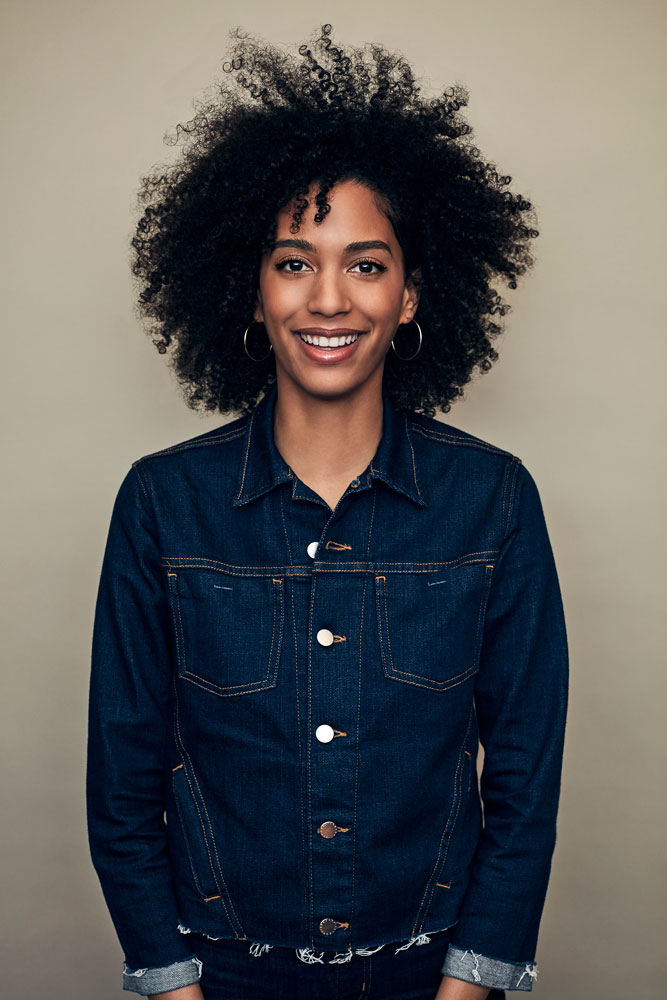
Stefani RobinsonStefani Robinson (Maarten De Boer/TCFFC)But I think what you’re talking about the exact reaction that all of our writers hope for a little bit, is someone just wide-eyed in horror saying, “I don’t understand this. How could they do this?” and someone else who finds it completely funny. That’s just the drama of life, isn’t it? 

Yeah,  I don’t know if it was a matter of not understanding. I think it was more a matter of that distance that one could have at watching something like, “Oh, this is about the Black experience.  I can watch this and empathize.” And then having a similar vision applied to the group that that you’re identified with can be . . . sobering.

Yes. that’s a great word. And yes, you’re right. I think there is a complete understanding sometimes what we’re doing. But exactly as he said, it’s a sobering reminder, you know of something that you feel like you’re in. You’re in those shoes. And I’ve heard shades of that. In Season 1, I wrote the “Juneteenth” episode where we have Craig, who was this white husband who is completely in love with Black culture, but is so reverent of it.

And there’s sort of that question of, “Should I be mad at this guy? Should I not?” And I remember then hearing from a couple of white friends who were like, “Well I mean, the guy, he was just like, kind of a dick. But I don’t know why he was a dick. And I’m kind of like that, you know?”  It was a completely different reaction, I think from a different group of people. The sort of blurred lines when you see yourself represented maybe in different ways, yeah, I completely understand it. But what you’re talking about is very funny.


Want a daily wrap-up of all the news and commentary Salon has to offer? Subscribe to our morning newsletter, Crash Course.


Also, I feel like this season is going to take on some new meaning, sadly. I did not intend to talk to you and talk about the mass shooting that happened in Buffalo, NY. But I do think that whenever you have that proximity to something that is in the headlines, that something like this – that was written a long time ago, and could not predict anything in the news – is going to take on new meaning.

Excellent point. And something that I go back and forth with in my mind a lot as a Black writer is this ideas of, does everything that we have to write as Black people . . . I wouldn’t even say every Black person, just myself . . . does it have to be about race? Do we have to have these conversations? Is it more powerful sometimes to just write stories for Black people that have nothing to do with how we’re oppressed racially and just show the joyous parts of us in ways that we are just being? It’s so hard, isn’t it? Because I feel that way sometimes, and I’m excited to write things that don’t have to maybe take on the heaviness of some of these conversations that we’re having.

But this entire season is about whiteness, and race, which are at the heart of the conversations we’re having right now.

Exactly. I guess that’s my point, like how I would answer: it never goes away, these conversations.

I don’t want to speak too much about Buffalo because it’s incredibly hard and traumatizing, and all these other feelings. I hate that we’re having these conversations, I guess. I don’t have a good answer, other than it does make me sad that we wrote a show about whiteness, and are exposing these kinds of things. I’ve seen people online who are like, “Oh, God, this show is so heavy-handed with the race stuff,” you know what I mean? “It’s so on the nose,” like, “Oh God, blah, blah, blah, the race stuff again.” And then something like Buffalo happens. And it’s like, no, we’re not speaking out of pocket when we’re talking about these things that we’re observing. It’s real, and it’s built into the fabric of America.

The entire third season of “Atlanta” is currently streaming on Hulu.

More stories like this:


Did George Carlin have the best comedy routine on every political subject? Judd Apatow thinks so

Legendary comedian George Carlin passed away in 2008, but as you can watch firsthand in HBO Max’s new two-part documentary series, “George Carlin’s American Dream,” his material on issues ranging from racism to gun violence to abortion resonate more today than ever.

I spoke to the co-director of the film, Judd Apatow, a comedy legend in his own right, on “Salon Talks” about his connection to Carlin and the making of the film. For starters, the title of the film is a line from Carlin’s material that could’ve been written today: “The owners of this country known the truth that it’s called the American Dream because you have to be asleep to believe it.”  

For Apatow, that line resonated because we are watching an effort by today’s Republican Party to move our country backwards. Apatow and his co-director Michael Bonfiglio made an inspired choice with the film to include long chunks of Carlin’s material — as opposed to cutting it down to simply a setup and a punchline. That allows you to enjoy Carlin’s material in full comedian glory. For example, you can watch Carlin talk at length on abortion and the right’s focus on forcing women to carry a fetus but not caring about the women or child that is born.

Apatow also shared that Carlin, who was a well-known advocate for freedom of speech, would understand why today’s GOP is banning books. “They’re banning books because if you read the books, you will question how the country is set up and the power dynamics that hold people down,” Apatow said. “The worst thing that could happen for certain interests in the country is that everyone was educated.”

The two-part film charts Carlin’s life from childhood through stardom — complete with a brutally honest look at Carlin the father and husband as shared by his daughter Kelly and his widow, Sally Wade. But as a comedian myself, it’s Carlin’s material that will not just make you laugh, but also make your jaw about how his observations on our country are still spot on today. Watch my “Salon Talks” episode with Apatow here, or read a Q&A of our talk below, to hear more about Carlin and more from Apatow, who opens up about his creative process and insecurities as a comic. “You’re always terrified,” he shared.

The following conversation has been lightly edited for clarity and length.

Judd, welcome back on “Salon Talks.” You’ve been putting out a lot of work lately. You have great work ethic, and I’m not joking. 

I tried to get through the pandemic with just very committed workaholism. That was my approach, and I didn’t realize it at the time. I thought I was being normal, but I noticed when I was promoting “The Bubble” and then promoting “Sicker in the Head” and now the George Carlin documentary that maybe I was busy.

If I could find a common thread through your recent work it would be deconstructing both the art and the artist. Is that what interests you? 

I think that I’m probably in just some massive existential funk that I’m always trying to deal with. I think for a lot of people, we create to try to understand life, to sort through things. It’s also a way to feel like you exist and to be part of the conversation and to be acknowledged. So, there is a connection in a group of people who get through life by dissecting it and looking at what’s working, and what’s not working. And am I happy? Am I not happy? What happened to me that made me so neurotic that I feel the need to do all this? Am I evolving or am I falling apart?

“Sicker in the Head” is a follow-up to your first bestseller “Sick in the Head.” As a reader, I was drawn less to the comedy people that you talked to because I come from a comedy world, but more to other performers like Lin-Manuel Miranda. He talks about being on stage during “Hamilton” and looking out in the audience and seeing celebrities and wanting to know before he goes on stage that they’re there and these little things. It reminded me of my years as a stand-up comic and the idea that when you’re on stage you’re functioning at high levels of multitasking. Were you amazed by that type of creative process or more the people that you interviewed?

On one level I’m always trying to understand how people do it. The interviews for me as a creative person are about, how do you do it? When do you write? What are you thinking about? Why do you talk about the things you talk about? How do you figure out the medium in which to express it? When I think about someone like Lin-Manuel Miranda,

“When the world is such a mess right now, what is the place for comedy?”

I want to understand that whole process of “Hamilton,” but I also want to know how he’s doing. Did the success slow you down or speed you up? Did it make you neurotic about being judged for the follow-ups? Obviously not, because he’s been so productive since, but those issues of mental health and how we keep our s**t together in the face of our own insecurities, trying to be successful, trying to not run out of gas. All of those issues are interesting to me, in addition to how do you be funny? Why should we be funny? When the world is such a mess right now, what is the place for comedy in it?

Being that you are a director, is part of your unique skillset that you hear something and it has this innate quality that you’re like, “Hey, that is special”?

That’s part of why I direct because I want to create spaces where people are trusted and they’re part of the collaboration in a big way. They’re helping create their characters. They’re letting them grow. Many of my favorite scenes suddenly blossomed. Maybe it was in a rehearsal. Maybe it was while we were shooting and someone said something. Maybe it was hilarious, maybe it was heartbreaking. I remember when Paul Rudd and my wife, Leslie Mann, were shooting a scene in “Knocked Up” and she’s mad at him because he snuck out to watch “Spider-Man” with his friends without her and she’s crying. And she goes, “I like ‘Spider-Man,'” and that’s an improvisation. It happens because you trust people and you’re hoping that all these connections suddenly pay off.

When I used to do comedy full-time in New York, doing four spots a night was typical. I love trial and error. I love giving a chance to the audience and going up with four punch lines to a joke and trying it over a few days. Do you come from that kind of background in terms of when you were directing?

I come from stand-up. That’s all I ever wanted to do. I didn’t want to do anything but stand-up, I just started getting jobs in other areas and thought, “Oh, I guess I should follow where the world is pulling me.” But, I do like the trial and error of jokes. It’s fun. I just hosted the Directors Guild Awards. I had thought about it for months for my monologue. How do I entertain these people while making them feel happy and respected? And that process of working on the jokes and doing them at Largo and at comedy clubs and perfecting them is really fun. But I think it’s more fun for me to allow something else to happen. I like when the train goes off the rails and something new suddenly reveals itself.

In your remarkable documentary on HBO, “George Carlin’s American Dream,” there’s a line in it where the title comes from. And Carlin says, “The owners of this country know the truth that it’s called, the American dream, because you have to be asleep to believe it.” When you hear that line, how does it resonate with you?

It is a country that’s supposed to be evolving — that’s what they tell us. That’s why it’s interesting because you have these people who are like, “No, we are only supposed to listen to the original documents.” And, these originalists, it has to be exactly what they thought of in the 1700s, but that’s not what the country was supposed to do. It was supposed to grow and evolve. In thought, we were supposed to get smarter and treat each other better and adjust it as we went along. But it was a country created by slave owners and land owners who were trying to prevent a lot of people from having a say in how the country was run.

Even though we were born a democracy, it was a democracy that kept a lot of people out of the democracy. And what are we seeing happening right now? There are a lot of people that are saying, “We’d like some of these people not to vote who might not allow us to hold power, and let’s figure out ways to discourage them from voting.” Because if we were a true democracy, then we would only be talking about having a national holiday where everyone can vote. And we make it as easy as possible for people to all legally vote. And we never have that conversation.

We would have automatic voter registration. They wouldn’t have that extra game where we’re going make it even harder to register to vote now.

It’s illegal to give someone a glass of water if they’ve been on line for seven hours in some states.

RELATED: George Carlin’s dark genius: From his 1957 “dirty, stupid” cop take-downs to the jokes that 9/11 made too raw to release

During the second part of the Carlin documentary, you leave in his long comedy bits, which I think is so important. Those jokes are relevant and resonate, as if they were written by a comedian today. Carlin talks about banning toy guns, but not real guns. He talks about forced birth by the Republicans.

I think that the reason why people are interested in George Carlin is because every time something happens in the country, he trends on Twitter because he has the best routine about almost every subject in modern political life.

How do you think Carlin would react today? This GOP has gone further than talking about banning abortion. They’re literally passing laws in Oklahoma that ban abortion at day one. It would force a woman who is raped to carry the fetus to term. They are banning books and banning subjects from school, like Black history or talking about the LGBTQ community.

He has routines about how they want you uneducated. They want you to know just enough to run the machines, but not enough to ask hard questions. That was the core of his beliefs. Of course they’re banning books because if you read the books, you will question how the country is set up and the power dynamics that hold people down. It has to lead to burning books. The worst thing that could happen for certain interests in the country, is that everyone was educated. That people understood how screwed over so many communities have been and continue to be.

People will get a chance to hear the story of George Carlin’s seven dirty words, the curse words that you cannot say on TV in America. It culminates with him getting arrested in Milwaukee for saying dirty words. And there was a case going to the Supreme Court about the Seven Dirty Words and indecency. How do you think Carlin would respond to what some people today call cancel culture, where comedians are actually compelled to apologize for jokes that offend some. If they’re hateful, it’s one thing, but some people take it the wrong way, and comedians are called out for it. 

He came from another era. When he talked about a lot of this, he thought, “Well, just change a channel if you don’t like it.” That was what he said. He’s like, “That’s why you’re allowed to change a channel.” I think in a lot of culture now, though, things are pushed down your throat with algorithms. There’s a lot that you wouldn’t watch or you wouldn’t hear or ever know about if an algorithm didn’t force it in front of you.

He wasn’t around in a time where algorithms could hypnotize people and change their minds. We understand the psychology of how your positions can be changed by the way you are fed information. So, we’re not sure what his opinion would be. I know that he felt like, “You’re allowed to be a bad comedian. You’re allowed to have bad thoughts and that’s OK.”

There’s a great clip that goes around a lot of him talking about Andrew Dice Clay. And he had a lot of, I think, compassion and respect for Andrew Dice Clay. But he also thought that some of the material at that time was punching down. But yet he said, I would definitely defend his right to do it, he should be allowed to do it. And that’s what I’ve always felt. Comedians could be criticized; nobody should be canceled. Everyone should be allowed to work, but occasionally we make mistakes and not all comedy is for everybody. 

“The lesson from Carlin is to keep pushing yourself.”

Some people want really dark, intense, nasty stuff. And some people don’t, and that’s OK. There should be places for people to see different types of comedy, the same way you might want to go see heavy metal and someone else would rather go see a country band.

You show a clip of a young Richard Pryor and a young George Carlin on the set together with John Davidson. When you see the documentary, you’ll see this, but the evolution of Carlin wasn’t just about comedy. It was him as a person, he evolved several times. Do you get a sense he was searching for who he was? Or as he got older, he organically evolved, and then it manifested in the way he looked the way he talked?

He came from a post-war America. He had an abusive father. So, his mom took him and his older brother, Patrick, who sadly just passed away last week, upstate. He’s amazing in the documentary. He’s such a funny, wonderful person. And so, he was five years older than George. George was one or less than one. And their mom took them away because they thought they were in a dangerous situation.

He had this dream of being Danny Kaye, that was the original dream. He met people like Jack Burns and got more politically interested. As the ’60s went on, he was kind of a corny comedian and he slowly realized he couldn’t say the things he wanted to say and had to take this big leap to grow his hair and curse and grow a beard and say, I’m not going to be someone that goes down easy, that plays by the rules and is very vanilla.

He became a big star, but then he got vanilla again. He ran out of gas and he had a heart attack. And I think he just lost the sense of who he was. I think in the same way musicians do. People put up three or four great records, then like three or four terrible records and then suddenly they find it again. 

He saw Sam Kinison at some point and thought to himself, “I don’t want to be a corny comedian next to this guy. If this is the bar, I want to redefine who I am and go farther and get better.” And it is funny that Sam Kinison was the person who lit a fire under his ass and he got competitive. And that was when he wrote those amazing specials at the end of his life.

RELATED: Dirty old man: George Carlin on obscenity in the age of Ashcroft

What I’ve found with Carlin and in your book is that comedians are driven, but they’re also fragile. There’s insecurity underneath the surface when you’re in this world. 

That’s the terrifying part about a creative life. You got to keep it going. If I have a hit movie, it doesn’t mean the next one will be good. Every movie is an experiment. When I start something and I think, “Oh, I’m going to make a movie about the pandemic.” When I made “The Bubble” for Netflix, I’m taking a huge leap and nothing I’ve done before, preps me for that. And then I go into the next one and that one will not succeed because of what works in “The Bubble.” 

You’re always terrified. Will I have the next idea? Do I have anything left to say? Am I repeating myself? Am I becoming a bore? And some people do run out of gas. We’ve seen them where we go, “Oh, how come all the good steps in this eight-year period and nothing is good afterwards.” And that’s why I’m always impressed by people like George Carlin who fight through that and stay current and edgy and interesting. And it really is about being engaged and passionate about what you’re doing.

The lesson from Carlin is to keep pushing yourself and you’re going to reinvent yourself. Don’t fear that, don’t stay in your comfort zone because you’ve had success, if that’s not true to who you want to be for the rest of your career. 

Last thing, in your book, you interview some Muslim comedians who I’ve known for years, like Ramy Youssef, I know him since he was a 19-year-old kid, and Hasan Minhaj, who I know, not as well but I’ve interviewed him several times. What impresses me about them is they’re like philosophers on some level. There’s something very innately talented about them and their understanding of the world. And I think Carlin had that as well.

With the first book, it was a lot of people I interviewed when I was a kid and that was certainly a very white, mainly Jewish comedy world. I talked to all the people that I looked up to growing up, people like Paul Reiser and Jerry Seinfeld and Leno and Howard Stern. And for this book, I thought it really should reflect the world right now. People Ramy and Hasan, they’re great storytellers. They are philosophers. They have to look at the world through this lens of their culture. 

“You’re always terrified. Will I have the next idea? Do I have anything left to say? Am I repeating myself? Am I becoming a bore?”

They’re compassionate about their experience and they’re looking at how they’re navigating the world, but they’re also looking how other people are looking at them and how people are relating to them. They’re seeing everything in both directions. They just have a level of insight that other people don’t have. They’re very rare, special, important people at this moment. And riotously funny. I did a talk in New York with Ramy about the book and we have a project we’re working on together and I couldn’t be more impressed with his work and his approach to the work.

“George Carlin’s American Dream” is now streaming on HBO Max. Watch a trailer for it below, via YouTube.

Watch more “Salon Talks” about comedy: 

With nursing home staff lagging on booster shot uptake, experts fear new outbreaks among seniors

Rising cases of COVID-19 have driven up hospitalizations across the country — and experts expect higher mortality to follow, particularly in nursing homes, where the risk of adverse outcomes remains high. 

Even with available treatments and high vaccination rates, boosters remain a key way to stave off serious cases. Yet uptake lags in many states. In nursing homes, the surprising number of employees and residents who remain without booster shots could have serious consequences as COVID-19 cases continue to spike.

In 2019, nursing homes employed over 1.6 million people. Even with staffing shortages since then, more than one million remaining employees have yet to receive a booster, according to a study in the New England Journal of Medicine. That number is worrying many experts, particularly given that nursing home staff were considered a major source of infection for the very vulnerable residents.

Dr. McGarry, who specializes in long-term care at the University of Rochester, asserted that having a highly-vaccinated staff not only protects employees themselves but also the residents they care for. McGarry’s research previously demonstrated this critical link with a full vaccination series. 

“Low booster rates among direct care staff will place vulnerable nursing residents at increased risk of COVID infection and, unfortunately, a number of these infections will result in adverse outcomes, including death,” Professor Brian McGarry told Salon.

As vaccine efficacy against new variants continues to wane, it would not be unreasonable to assume a similar susceptibility would put geriatric patients at extremely high risk from unboosted staff. 


Want more health and science stories in your inbox? Subscribe to Salon’s weekly newsletter The Vulgar Scientist.


“While vaccines dramatically lower absolute risk, vaccinated nursing home residents are at the much higher relative risk of hospitalization or death if infected compared to the general population,” McGarry explained.

Old age and having multiple chronic conditions are leading risk factors for adverse outcomes from COVID-19, even in the vaccinated. That puts nursing home residents at extreme risks for contracting COVID-19. A recent CDC report did find however that an additional primary series vaccination or a booster dose provided significantly more protection against infection during omicron’s peak.

Though the Supreme Court upheld a Centers for Medicare & Medicaid Services (CMS) federal vaccine mandate for healthcare workers, it does not extend to booster shots. In a separate ruling, the Supreme Court struck down a more sweeping Occupational Safety and Health Administration mandate that applied to workers outside of healthcare.

CMS now mandates reports from nursing homes on vaccination and testing among staff. Those reports show that only one in nine employees remain unvaccinated, yet an abysmal 25% have received a booster, reported AARP, calling for support for booster administration.

Following the largest wave of the pandemic this past winter, experts stressed the critical importance of boosters. As the omicron variant spread initially, health officials warned that another surge posed an imminent threat to residents of nursing homes.

“We can’t afford another COVID-19 surge in nursing homes,” Health and Human Services Secretary Xavier Becerra said in a live stream. “You know that. I know that. Higher numbers of COVID cases would likely once again have a devastating impact on our loved ones … and we know we just have to work doubly hard to keep them safe.”

Early in the pandemic, the mortality rate in the US was well over 1,000 per week in nursing homes alone. In mid-April, for the first time since the pandemic began nursing homes saw fewer than 60 deaths all stemming from complications of a COVID-19 infection.

The highest weekly death toll was recorded over a year and a half earlier. During a single week in mid-December, over 6,000 residents of nursing homes lost their lives to the virus. It was during that spate of deadly outbreaks that vaccinations first became available to older Americans.

RELATED: The double-vaccinated are barely protected from omicron — but those with boosters are in good shape

COVID-related deaths in nursing homes hit an all-pandemic low when the rate of new cases returned to manageable levels. Shortly after, mitigation strategies began to unravel. When a federal court struck down CDC mask mandates on public transportation and travel hubs, few social distancing and masking mandates remained on a federal level.

Soon thereafter, their loved ones were once again able to visit as restrictions eased. In most nursing homes, visitor restrictions have been relaxed (and rightfully so given the importance of caregivers for quality of life and support for nursing home residents), meaning that there are more chances for COVID to enter the nursing home. Hence, the frequency of staff COVID testing may start to decline during this new phase pandemic. 

Predicting a rise in hospitalizations and deaths over the next month, the CDC expanded booster eligibility to anyone aged 5 and up on Thursday, May 19.

One out of seven US COVID-19 deaths has been residents in nursing homes. Yet nursing homes house less than 1% of the population.

“With cases increasing, it is important that all people have the protection they need, which is why, today, CDC has also strengthened another booster recommendation. Those 50 and older and those who are 12 and older and immunocompromised should get a second booster dose,” Dr. Rochelle P. Walensky stated in a press release.

Just over a week ago, the United States passed another grim milestone of the pandemic: COVID-19 had claimed over one million American lives. In a speech, President Joe Biden responded to the news of one million deaths, encouraging vigilance among Americans. Emphasizing testing, vaccination, and treatments, to “do everything we can to save as many lives as possible,” he notably omitted masking and social distancing.  

McGarry suggested that boosters are even more urgent as a result of the relaxed social distancing standards. As he explained, if we drop “active” control strategies like masking and distancing, we have to in turn double-down on “passive” approaches, like vaccinations and boosters.

COVID-19 cases began rise steadily recently with the emergence of the BA.2 subvariant of omicron, also known as the “stealth” variant. That variant is incredibly contagious, and overtook its predecessor to constitute the majority of cases. 

Now another highly infectious omicron subvariant, BA.2.12.1, is estimated to account for nearly half of all US cases, though “stealth” omicron lingers.

Nursing home residents are already more susceptible to severe COVID-19 symptoms, and live in a space that simply contains more transmission vectors on account of being a long-term care facility. During the course of the pandemic, one out of seven US COVID-19 deaths has been residents in nursing homes. Yet nursing homes house less than 1% of the population.

“I believe mandates may be the only viable policy option to increase uptake,” McGarry added, acknowledging that mandated boosters might be more difficult to enforce although he was unable to explain what he called an “entrenched resistance to the booster.”

He went on to suggest that a middle-ground approach may suffice. Unboosted staff would simply have to take a more proactive approach to reduce transmission risk.

“But ultimately, the long-term solution is to make nursing homes better places to work … so that staff are incentivized to stay in their position even in the face of a mandate or that there is a pool of replacement workers willing to fill the slots vacated by individuals unwilling to get boosted,” he concluded. “This long-standing issue, which COVID has only magnified, is to make nursing home jobs more attractive to high-quality CNAs, LPNs, and RNs through better pay, benefits, and working conditions. This in turn requires greater financial investment at the state and federal level.”

Read more on nursing homes and COVID-19:

The best butter for baking comes from . . . Trader Joe’s

Our test kitchen goes through pounds and pounds (and pounds) of butter every week. Maybe it’s for sautéeing kale, mashing potatoes, or scrambling eggs. But, most often, it’s for baking.

I don’t need to tell you that unsalted butter is the default for baked goods, from chocolate chip cookies to pound cakes to pie crusts. Using unsalted butter allows you to control the amount of salt in your baked goods (especially since the salt content in salted butter varies, so it’s hard to know exactly how much you’re adding). The more nitty-gritty — and less talked about — distinction is American-style versus European-style.

In “On Food and Cooking,” Harold McGee defines the latter as “a cultured butter with a fat content higher than the standard 80%.” Depending on the brand, expect European butter to contain anywhere from 82 to 86%. In the United States, American-made butter must contain at least 80% fat. It may not sound like a huge difference, but just think of whole versus nonfat milk — a few percentage points makes a world of difference when it comes to flavor. Irish and European-style butter are beloved for being richer and creamier because they contain more milk and have a lower water content; this also means that they’re easier to bring to room temperature, which is ideal when you’re in a pinch and need softened butter stat.

Of course, baking a muffin is not drinking a glass of milk. Fat is flavor, yes, but it’s also one of the components in a fine-tuned formula. Safe to say that there are dozens of butter brands to pick from at the grocery store, but which one is the best for your recipe? It’s easy to think that swapping in higher-fat, European-style butter in any baking recipe would lead to more flavorful pie crusts, brown butter blondies, chocolate chip cookies, you name it. (And, as European-style butters have become more popular in the U.S., a lot of online resources have indicated as much.) But that sort of swap can unravel a recipe.

As award-winning baker Stella Parks noted a few years ago:

Friendly reminder: Switching to European style butter in an American recipe isn’t an upgrade, it’s a fundamental alteration of the formula.

Similarly, King Arthur conducted a few American-style versus European-style baking experiments — and found that recipes with American-style butter did not appreciate a European-style substitute. Shortbread turned out greasier. And scones: flatter, “sad, and slumped.”

All of which is o say, if you’re baking a recipe developed for American-style butter, American-style butter is your best bet. Not all recipes will specify which type of butter to use, but if you’re cooking a baking recipe from a U.S.-based recipe developer, it’s safe to assume that they used American-style and not European-style butter.

But which American-style butter is the best to buy for baking? We did a taste test of five popular brands of butter to find out which is the best.

The Rules

  • All of the butters we tested were unsalted and uncultured, with cream and natural flavors as the only allowed ingredients. Cultured butter has a tangier taste — it’s delicious, but not the basic butter flavor we were after.
  • Prices are based on AmazonFreshFreshDirect, and stores in the New York City area. Therefore, these prices may fluctuate based on where you live.
  • Because pie crust is all about the butter, we selected this recipe as the baked good for the experiment. I followed the same Pie Crispies recipe for each butter, then presented the cookies in a blind taste test at the office.
  • Staffers were asked to provide feedback on flavor, texture, and any feelings the butters evoked.

Here’s how the most popular brands of butter ranked from never again to the most delicious . . .

The Results

Photo by Emma Laperruque.

5. Land O’ Lakes ($4.89/Pound)

Southern Living named Land O’ Lakes the butter of choice in its test kitchen, but the bulk of our taste testers respectfully disagreed. Most found it “not very buttery,” or “not so butter-forward” with a sad face drawn in for emphasis. Multiple people called it “bland.” Though, for what it’s worth, one lone wolf said: “This is #1.” Do with that what you will.

4. 365 ($3.49/Pound)

The Whole Foods store brand 365 ranked quite close to Land O’ Lakes. Several people described its flavor as “savory,” with one taste tester comparing it to “a butter and lard pie,” which, by the way, “is a compliment!” A couple people found the pie crust result to be “oily” — we can all agree this is not the goal of butter. Therefore, we’d probably pass on buying 365 butter in the future.

3. Breakstone’s ($7.98/Pound)

“Buttery but blah” sums up the wishy-washy feedback to Breakstone’s. Some complimented its “nice,” “yum,” and “light yet rich” flavor. Others said it was “less flavorful” and “reminds me of lard, but not in a way I’m mad at? I think.”

2. Cabot ($6.79/Pound)

Cabot came in strong as one of the best butters for baking: “butteriest,” “very strong butter flavor,” “excellent flavor,” “can def taste the butter,” and “ooh nice flavor” were among its many compliments. Meanwhile, one taste tester declared that it “tastes like fish.” Perhaps this single low ranking is what helped the winner take home the gold . . .

1. Trader Joe’s ($2.99/Pound)

“Whoa,” said one person. And the rest of the group agreed, describing Trader Joe’s store brand as: “extra buttery,” “sweet buttery flavor,” and “nice butter flavor,” with more than one declaring it “very rich.” We were also pretty pleased that the winner just so happened to be the cheapest of the bunch. And we were even more pleased that it came from one of our favorite grocery stores.

“The Flight Attendant” recap: But what about Carol?

It feels as though the second season of “The Flight Attendant” just started, and already it’s coming to an end next week. It’s always a good sign when things seem to fly by, rather than slog on and on, but what could possibly be a negative takeaway for Season 2 is that the murder mystery aspect of it (aka the main plot) was the least interesting part.

Watching Cassie Bowden (Kaley Cuoco) running all over Southern California attempting to piece together clues that will finally reveal who is trying to frame her for murder, I often find myself getting distracted by thoughts like, “Where’s Carol?” and “Is Sharon Stone gonna be in this one?”

If you’re watching a show and find yourself wanting to fast forward past the parts that advance the main storyline so you can see what other characters in the periphery are up to, that says a lot about the hits and misses of the season as a whole.

Characters Carol Atkinson (Alanna Ubach), Lisa Bowden (Sharon Stone) and Dot Karlson (Cheryl Hines) from Season 2 felt underutilized in a way that could either point towards a trifecta of hugely missed opportunities, or a planting of seeds for Season 3, but I’d have much rather had more now than the hint of a promise of great things to come. If you’re watching a show and find yourself wanting to fast-forward past the parts that advance the main storyline so you can see what other characters in the periphery are up to, that says a lot about the hits and misses of the season as a whole.

RELATED: “The Flight Attendant” recap: I will not be you

A show about a beautiful blond drunk self-sabotaging her way through life with a mom prone to face-slaps delivered with a Joan Crawford level of drama is the show I want to be watching. The darkness of Season 2 Cassie pulls me in. Her relationships with the people around her pull me in. Pick all of that up and place it inside a show about a group of people puzzling their way through the daily stressors involved in working in a veterinary clinic rather than some CIA whatever this is and it would be just as good. If not better. But Cassie is here to . . . solve crimes? So let’s go watch her do that, idling for those rushes of joy that occur every time Carol pops on screen for two seconds to deliver a perfectly timed jab.

Mae Martin as Grace St. James and Kaley Cuoco as Cassie Bowden in “The Flight Attendant” (Jennifer Rose Clasen/HBO Max)Who is Cassie’s doppelgänger? In this episode we learn that it’s Grace St. James (Mae Martin) and the revelation that this whole season has been ramping up to registers as an “oh.”
After Cassie’s fellow CIA/flight attendant friend Shane (Griffin Matthews) concludes that all of the View-Master slides are clues to the locations of a murder, and that all of the people murdered had ties to Will (Kayvon Esmaili), Cassie’s mark in Berlin, he breaks the news that the remaining slide will likely lead them to where Cassie’s double plans to kill her, thus completing the overly elaborate frame job.

The last slide shows part of an amusement park ride dangling over the ocean, and Max (Deniz Akdeniz) realizes that Cassie’s murder is intended to go down at the pier on that very day, as the boardwalk is set to be shut down for an extended period of time for renovations the following day. This sends everyone running to the pier to catch the double when they really should be doing anything but that. Run the other way. Run to Starbucks. Or, better yet, run to help your friend Megan (Rosie Perez) who has been fighting for her life and the safety of her son nearly all by herself all season long.


Want a daily wrap-up of all the news and commentary Salon has to offer? Subscribe to our morning newsletter, Crash Course.


The North Koreans, who Megan has been leveraging intel over, finally catch up to her in a parking garage while she’s watching over her son waiting for a bus across the street. She’s worried about him not wearing a warm enough coat, and the bad guy standing next to her is worried about zip drives. Guess which of the two of them gets bonked in the head with a conveniently located tire iron and shoved into the trunk of a car? It ain’t Megan, that’s for sure. A mother’s willingness to protect her family could fuel all the street lamps in the world. The finale next week will probably see Megan at the pier we just left Cassie where she’ll get her out of this mess once and for all. I’d trust Megan Briscoe with my life.

Cassie’s visions of her other selves keep popping up to tell her she’s a piece of s**t and should kill herself, which just seems rude. 

Cassie’s visions of her other selves keep popping up to tell her she’s a piece of s**t and should kill herself, which just seems rude. One version of herself willing to cut some slack is her younger self, the version that used to chug beers while hanging out with her dad. This young Cassie swoops in during a surreal scene to lead to a room within her mind palace where her mom Lisa (Sharon Stone!) is looking out over the sea. Lisa delivers a speech that’s supposed to make us wonder if Cassie is about to die, but it’s mainly just the latest example of all that Stone is capable of as an actress. 

Cassie and her mom stand together in this unreality and share meaningful time in a way they’re unable to in real life. Her mom tells her she’s powerless in almost every way, which is salty, and then tops it off with some bittersweetness saying that all Cassie needs to do is be patient with others, and with herself. Thank you, Sharon Stone. I love you, Sharon Stone.

After all this searching, and hunting, and wondering, Cassie follows a lady dressed just like her from one end of the pier to the next and then, boom, comes face to face while exiting the very ride she’s supposed to be killed on. Seeing that it’s Grace, she turns around to get back on the ride, and Grace follows. 

Swinging over the sea in one of those terrifying hanging baskets they love to torture people on at amusement parks, Grace tells Cassie that she doesn’t want to be doing any of this, and that she got suckered into killing people for money after leaving the military. She rambles on about not having a choice, and then finds one in the gun in her hand. In a moment that should have been shocking, but lands flat, Grace shoots herself in the head and we end on Cassie, her face splattered with blood.

With Cassie’s double out of the picture, we’ll learn who’s the guy behind the guy next week. My money’s still on Dot. But if they really wanna end on a WTF tip, it’ll be someone unexpected like Max, or Cassie’s discarded boyfriend Marco (Santiago Cabrera). They’re just giving out CIA jobs over here so it could really be anyone. Hell, maybe it’s Carol! 

“The Flight Attendant” finale begins streaming Thursday, May 26 on HBO Max.

Read more:

“This Is Us” is like “Black Mirror” for overly emotional people

When “This Is Us” first aired in 2016, the show made it very clear what it wants from us. It wants us to cry our asses off.

For six seasons it has drawn us in with the sticky-sweet smell of melodramatic death, lulling us into belly-up submission with Rebecca Pearson’s (Mandy Moore) flowing chestnut hair and doe eyes, and dangling the dripping promise of every little detail of the night Jack Pearson (Milo Ventimiglia) died; leaving us practically frothing from the mouth to see this man expire from cardiac arrest from smoke inhalation after a house fire because he just had to go back for the family dog. 

“This Is Us” doesn’t just want you hungry for all the gory details of the deep sadness of this random family, they want you positively wet for it; and in the penultimate episode of the series titled “The Train,” they finally go in for the kill. 

For just under 10 years I have kept tabs on “This Is Us,” watching every single episode, and reading most online discourse that’s come out about key episodes of the series; but I can very calmly and plainly say, and have it be true, that I do not give a crap about these people. From the very first episode, to what will be the very last when it airs next week, the whole damn Pearson clan could have burnt in hellfire for 45 minutes and I would not have cared. Well, aside from the dog. God forbid. And yet, still, when I sat down at my desk yesterday to belatedly watch “The Train” episode, I cried as though I had just looked out the window at the exact right place and time to see baby Dumbo get hit by a truck, tiny feather flying into the wind and slowly floating to the hot concrete. Like, I looked down at my arm at one point and saw that every single hair was standing straight up. I haven’t experienced such a full-bodied reaction to something since I had a nervous breakdown in the movie theater as a child during the scene in “E.T.” where Michael chases a raccoon away from E.T.’s nearly dead body down by the river. 

RELATED: This week on “This Is Us”: It’s the Super Bowl of TV deaths!

Mandy Moore as Rebecca Pearson and Susan Kelechi Watson as Beth Pearson in “This Is Us” (Ron Batzdorff/NBC)What “This Is Us” excels at, possibly more than any other TV show, is its ability to make you sad to the very marrow regardless of who the sad things you’re watching are happening to. This is achieved very simply by the makers of this show who know, in a very formulaic way, that it doesn’t matter who dies when, or how, because we’re going to be experiencing these deaths, and the aftermath of each, through the filter of personal experience. When we see Jack and Rebecca fall in love, go through ups and downs, and then die; we’re seeing it all happen to the characters, but we’re feeling it happen to the people we love in our own lives. And that’s the kind of emotional manipulation I’m here for. That’s why these people get the big bucks. I can envision the makers of this show fanning themselves with huge stacks of cash saying “b***h and moan all you want, critics, but you WILL wail.” 

Rebecca and Jack Pearson look like two people who probably would have called me a dyke in high school, but did I come away from the experience of watching them die feeling like I’d just been spit out the exit door of the scariest haunted house in the world? Yes. It’s not the characters of “This Is Us” that makes the show a success. In fact, almost every single one of them aside from Beth is utterly insufferable. It’s the feeling of the show that’s kept us dragging along after it all this long while. Sadness, much like fear, is addictive. Being truly “howl at the moon” sad and being scared out of your mind will shake and rattle your whole body from head to toe. And for some reason that humankind probably doesn’t have enough time left to fully understand, that feels fantastic.


Want a daily wrap-up of all the news and commentary Salon has to offer? Subscribe to our morning newsletter, Crash Course.


While watching “The Train” I was reminded of the episode of the first season of “Black Mirror” where a guy (Rory Kinnear) is made to f**k a pig. That episode, titled “The National Anthem,” was the debut episode of the series and to come out swinging like that felt like a hate crime, but in a good way. Watching the very first episode of a brand new show slither deeper and deeper into WTF territory was so exciting because you knew that if they were comfortable enough to be like “pleased to meet you, here’s pig sex,” then anything was possible. Anything could happen down the line. “This Is Us,” tethered to stricter prime-time morality clauses, dishes up something similar but instead of leading us by the hand into a dark room where a man is making love to a pig it runs towards us at full speed screaming, “Your whole family is dead!”

We’re not so easy to shock any more. Might as well cry.

Read more:

Buffalo, Jan. 6 and the rise of partisan violence: These scholars saw it coming

A single incident can’t prove anything in terms of social science, but it can certainly serve as a vivid illustration. That was the case with the Buffalo massacre that horrified the nation and the world last weekend, which seemed almost inevitable in light of the new book “Radical American Partisanship: Mapping Violent Hostility, Its Causes, and the Consequences for Democracy” by Nathan Kalmoe and Lilliana Mason. 

The Buffalo shooter’s so-called manifesto, Kalmoe told me, consists of “partisan Republican media talking points,” especially those of Fox News’ Tucker Carlson, “along with the most radical elected Republican leaders.” I wrote about the history of the “great replacement” theory last year, but “Radical American Partisanship” provides a broader perspective. “Our book talks about the long history of racial-partisan violence and how those two things are linked,” Kalmoe said. “We don’t know the shooter’s media exposure so we can’t begin to judge cause and effect, but we can say this is the kind of action you’d expect more people to take as explicit white supremacy, antisemitism and other extreme conspiratorial vilification gets mainstreamed among Republicans.”

That mainstreaming creates another causal pathway by way of “norm erosion,” as co-author Mason noted in a Twitter conversation with other social scientists: “More people holding radical (in our case, violent) beliefs changes the social norm-enforcement mechanism, by reducing the number of people who will engage in norm-enforcing social sanctions.”

RELATED: Expert panel on the Buffalo shooter and what he stands for: “He was not a lone gunman”

Partisan violence is part of our history, as Kalmoe explored in his 2020 book “With Ballots and Bullets: Partisanship and Violence in the American Civil War” (Salon interview here), but when Kalmoe and Mason began their collaboration in 2017 they could hardly find any public-opinion research on the subject. They didn’t quite have to invent a new field from scratch, but they did have to weave together a bunch of different strands of academic research that hadn’t previously been integrated into how we think about partisan politics. The surveys reported in this book, which basically cover the period of the Trump presidency, from 2017 to early 2021 will reshape our understanding of this long-neglected aspect of American politics. But they’re also important right now, for tragic and obvious reasons. I interviewed Kalmoe and Mason recently by email. Their responses have been edited for clarity and length.

The massacre in Buffalo immediately made me think of your book. The shooter’s stated rationale wasn’t “partisan,” in the normal sense, but his worldview surely was. Your book begins by asking why it was so easy for Donald Trump to stoke the insurrection on Jan. 6, 2021. Beyond the immediate answer — his own incitements — you argue that “the bases of each party are divided into nearly warring factions with radically opposed visions for America,” and that this is “a battle over the future — and the past — of the United States.” So what consequences flow from that? 

Mason: One of the main findings of the book is that Republicans who are high in racial resentment and hostile sexism are also the most likely to vilify and dehumanize Democrats. For Democrats, it’s the people low in racial resentment who are the most likely to vilify and dehumanize Republicans. These vilifying and dehumanizing attitudes (what we call “moral disengagement”) are common precursors to mass violence in other countries. For Republicans in particular, the most powerful predictor of moral disengagement is an opposition to racial and gender equality or a denial that any inequality exists. 

One of the biggest sources of conflict is a fundamental disagreement about whether we’ve made enough progress toward racial and gender equality or whether we have gone too far.

This means that one of the biggest divides (and sources of conflict) between Democrats and Republicans is a fundamental disagreement about whether the U.S. has made enough progress toward racial and gender equality, or whether we have gone too far and need to roll back some of the progress we have made. Americans aren’t very good at talking about racial and gender equality in a calm and composed way. These conversations often erupt into violence throughout American history. 

So what’s different right now?

Mason: It’s already a volatile topic. But now that we’ve organized the discussion along partisan lines, it allows our electoral politics to become as violent as racial conflict. The “replacement” theory that Tucker Carlson, Rep. Elise Stefanik and others are pushing is, on its face, a political one. They say that Democrats are trying to replace white voters (who tend to vote for Republicans) with “immigrants” who are “more obedient” and will automatically vote for Democrats. This “sanitized” version of replacement theory allows racial animosity to be papered over with “political” animosity — which is generally more socially acceptable. 

All of this comes out of the increasing trend of “social sorting” between the parties, with the Republican Party becoming the party of white Christian rural men, and the Democratic Party representing everyone else. The party divide mirrors the divide between those at the top of the traditional social hierarchy and those who are traditionally marginalized. The Buffalo shooting, however, made clear that even if Tucker Carlson is speaking about a political conflict, the racial message still comes through quite clearly.

Partisan violence is very understudied in political science, so much so that there were very few surveys you could use. But that’s not the case with social psychology. Why is there a difference, and what tools does social psychology provide that you built upon?

Kalmoe: Political violence, including violence instigated by parties, is a big research area among political scientists studying other countries, but it has rarely been a focus for scholars of American politics, partly because of our bias toward studying the present and recent past. Many assumed that what’s happening “over there” can’t happen here, even though it already happened here in the more distant past. 

The founding research on American partisanship focused narrowly on the national electoral politics of the 1950s. There was white supremacist political violence in the South targeting civil rights efforts at the time, but that conflict divided Northern and Southern Democrats rather than dividing the two parties. Thus, the account of partisan identities and motives among ordinary people is quite tame.

Social psychology was founded at the same time, but with a heavy focus on explaining the violence of the Holocaust, which followed empowerment of the Nazi Party in Germany and fascists elsewhere. What caused ordinary people to participate in atrocities on an unfathomable scale? They focused on the harms that can emerge from us-vs.-them identity categorization, and the extent to which people are susceptible to following leaders and peers — opinion leadership and social influence. 

We identify strength of social identification with a political party as one vital factor distinguishing those who are more likely to endorse radical partisan views, and we test the role of messages for top party leaders in changing the views of their followers and opponents.


Want a daily wrap-up of all the news and commentary Salon has to offer? Subscribe to our morning newsletter, Crash Course.


You focus on two major concepts: partisan moral disengagement and partisan violence. How are these defined as concepts? How are they related, and how do you measure them? 

Kalmoe: Partisan moral disengagement builds on psychological research by Albert Bandura and others showing that people who hurt others tend to hold views that rationalize that harm. For example, we measure views that political opponents are a national threat, that they are evil and that they lack the traits to be fully human. We expected that people who endorse some of all of these views would be more likely to endorse physically harming opponents, and that is what we found in our surveys.

We measured support for partisan violence with more than two dozen different questions, ranging in specificity of the context and severity of harm. Our four most common questions asked about approval of threats against opposing leaders and voters. One question on whether violence by one’s own party is justified, and there was a final question on support for violence if the opposing party wins the next presidential election. We also asked specific questions about assassinating opponents, about support for the January 2021 Capitol insurrection, and reactions to the shootings of Rep. Gabby Giffords (a Democrat) and Rep. Steve Scalise (a Republican), for example. 

One important thing we found is that people have lots of different things in mind for the term “violence.” While psychologists define it as resulting in severe maiming or death, many of the people who endorse partisan violence in our surveys told us in follow-up questions that they had lesser harms in mind, like fistfights, for example. So levels of support for “violence” include a broad range of behaviors, though they’re all contentious and worrisome in their own ways.

Historically, you argue, “Americans seem to support political violence in some historical cases and under certain conditions.” When do they support it, and when don’t they? And what falls in between?

Kalmoe: One of the most important takeaways from our research is that there is no single level of support for political violence to find. Support depends entirely on the details. For example, we found modern support for the political violence of the American Revolution at 80% among partisans, which is about four times higher than our standard measures and orders of magnitude above some of our most severe and contextually specific questions. 

We know from historical episodes of political violence in the past that millions of ordinary Americans can be organized into violent conflict, as during the Revolution and the Civil War, along with the organized racial-partisan violence during Reconstruction and Jim Crow. 

We argue that the most important factors that shift public support for political violence, and participation in that violence, are the factors identified by social psychologists: influence from trusted leaders and from peer social networks. Both serve to set the norms for attitudes and behaviors regarding violence, and when the group says it’s OK, people think and act accordingly. Of course, individual attributes like “trait aggression” still influence who is especially inclined to be an early adopter of those views and behaviors.

How is support for violence calibrated? In the extreme, some people involved in the Jan. 6 insurrection were ready or even eager for civil war.  But how many people were willing to go that far?

Kalmoe: Our research speaks most to public attitudes about political violence, which certainly serves as a risk factor for the few who engage in violent acts. We began this project, however, thinking about the broader social environment for contentious partisanship. The prevalence of violent views could serve as a vital accelerant or brake on violent acts when neighbors and friends learn that someone in their social circle is planning violence. Their own views about violence could serve to encourage or discourage actions by others, and it will affect how they respond politically to violent political attacks in general. Our work doesn’t directly analyze participation in political violence. That vital question is being answered by others.

How did the measures of partisan moral disengagement and partisan violence change over time? What did those changes reflect or reveal?

Kalmoe: We found steadily rising levels of support for partisan violence from our first survey in 2017 through our last reported in the book, in February 2021. Our vilifying questions for partisan moral disengagement also steadily rose over that time. Support for threats against leaders and citizens were a little more variable, rising at times of greatest contention and then dropping afterward. Those results tell us that, even within our current contentious period, those radical views are becoming more prevalent. 

The trends in our survey work generally comport with rising levels of threats against leaders. For example, the Los Angeles Times cataloged steadily rising threats against Congress from 2016, when they numbered just under 1,000, to 2021, when they nearly reached 10,0000 — an order of magnitude more in just four years.

What’s the role of “trait aggression,” which you mentioned earlier? What role does it play in predicting partisan violence, and how does it interact with partisan moral disengagement?

Kalmoe: Trait aggression is an individual tendency to behave aggressively in everyday interactions with other people, including verbal and physical forms. We found that aggressive tendencies translate into greater support for partisan violence. In fact, trait aggression is the strongest predictor of violent partisan views among the many factors we tested.

Perpetrators of partisan violence almost always have a history of aggressive criminal behavior, and often a history of domestic violence.

But the political component of those views is important too. We found the strongest relationships between trait aggression and support for partisan violence among people who vilified partisan opponents, and likewise, we found that partisan moral disengagement predicted violent partisan views most among people who were interpersonally aggressive. 

We can see a similar dynamic in violent political behavior. Those perpetrators almost always seem to have a history of aggressive criminal behavior and often a history of perpetrating domestic violence too. 

You write that “the same things that predict conventional political actions like voting can also predict and explain aggressive behavior and violence.” How so?

Kalmoe: Strength of social identification with the political party is one of the most important motivating forces for partisan action through voting, volunteering, donating and other nonviolent participatory acts. Our work shows that that same identity-based motivation also leads some partisans to endorse violence against their partisan opponents.

You write that one of your survey results “means [there are] roughly 20 million [Americans] who endorse assassinating U.S. leaders.” That would surely be a shocking result to most people. What was the question that produced this result, and why is it so at odds with “common sense” political discourse?

Kalmoe: In one question, we asked “How much do you feel it is justified for [your own party] to kill opposing political leaders to advance their political goals these days?” Response options ranged from “not at all” to “a great deal.” Nearly 90% of respondents chose “not at all,” but 11% said assassination was at least “a little” justified. 

Many people tend to censor their most extreme views in public for fear of social and legal sanctions, so the extreme rhetoric we hear often lacks that violent specificity. But we’ve also heard quite a lot of explicitly violent rhetoric stated publicly in recent years. Pundits and researchers have been too quick to dismiss those as merely expressive and fundamentally unserious. Of course, there are ranges of seriousness across people, but it is a mistake to dismiss these expressions as just blowing off steam. Given the rise in political violence and threats, alongside violent rhetoric and violent attitudes, some of the folks who set the conventional wisdom are beginning to wrestle with the degree and prevalence of that extreme hostility. 

You report that “Political victimization is prevalent in the U.S.,” ranging from insults to physical attacks. While far fewer people report aggression, you wrote that even the small percentages you found “potentially represent the behaviors of hundreds of thousands — even millions — of Americans engaged in extreme political behavior that goes unnoticed in news and scholarship.”  

Kalmoe: In addition to asking about extremely hostile and violent attitudes, we asked people to report their own aggressive political behavior, and whether they have been on the receiving end of aggression over politics. Nearly half of our respondents said they had been insulted, one in six said they’d been threatened, and 3% said they had been physically assaulted over politics. The numbers were substantially higher among those who said they regularly talk about politics, as you’d expect. 

The portion admitting they themselves had behaved aggressively over politics was much lower: about one-quarter for insults, and only 1% for threats and physical altercations. 

Both sets of results are novel, as far as we know. Few if any researchers are asking questions like these, even among those now asking about political violence. One reason that people might be so surprised by political violence like the 2021 Capitol attack is that no one has been systematically documenting the prevalence of milder aggressive behaviors that apparently are very common. And of course the people who engage in low-level political aggression are the likeliest to participate in more extreme actions. 

After the 2020 election, you found that “about a fifth of American partisans were ready for a full-blown violent rebellion against the newly elected president and his government.” What are the implications of that?

Kalmoe: Clearly, several thousand Americans went beyond support for violently overthrowing the newly-elected government to acting on that view in the 2021 Capitol attack. That episode, and the thousands of death threats targeting election administrators and others for upholding their civic duties after the 2020 election, are the clearest implications. 

Most people who support political violence won’t act on it — but their support has important effects on the actions of those few who will.

Most people who support political violence won’t act on it. Of course, that’s true in wars too. A majority of Americans initially supported the Iraq war, for example, even though a tiny fraction actually did the fighting. But their support for violence has important effects on the actions of those few, and helps determine whether the numbers of combatants will grow in spirals of provocation.

What did you find about the potential impact of anti-violence messages? How did this compare with what Donald Trump actually did?

Mason: A piece of good news from the book is that leaders seem to have a powerful ability to pacify violent attitudes among partisans. When we had survey respondents read a message from Biden or Trump denouncing political violence, we found that strong partisans responded by becoming less supportive of violence. We saw this effect even after reading a single sentence from a leader. It follows that sustained anti-violence rhetoric from leaders should be even more powerful. Importantly, Trump did the opposite in the lead-up to the Jan. 6 insurrection. He very likely could have prevented the violence that occurred if he had broadly discouraged it in the first place. But instead Trump stoked violent feelings and behaviors. 

In our surveys, we observe similar levels of support for violence among Democrats and Republicans. But observed levels of real violence in the American public are almost entirely from right-wing actors. This is likely due to the difference in rhetoric between Democratic and Republican leaders. Condemning violence is extremely important, even if the original violent message is purported to be “only a joke.” 

What did your research show about the relative influence of Fox News and MSNBC?

Mason: Americans who consumed partisan media (Fox News and MSNBC) were significantly more radical in their partisan views than those who watched CNN. For Fox News in particular, their viewers were both more morally disengaged from Democrats and more willing to endorse sending threats to Democrats. Those who watched MSNBC were not more morally disengaged than those who watched CNN, but they were more likely to endorse sending threats to Republicans. Overall, Fox News viewers seem to be significantly more likely to dehumanize and vilify Democrats than consumers of any other news source. 

The recent wave of attacks on Democrats who support LGBTQ+ rights as “groomers” — by implication, pedophiles — seems like another worrying example of dehumanization. Aren’t media elites and politicians who take up such language grooming their followers for violence?

It’s hard to imagine anything more vile than sexually abusing children. Vilifying one’s opponents with that evil reputation clearly makes political violence against those groups more likely.

Kalmoe: The “groomer” and “pedo” conspiracy rhetoric accomplishes two things at once for Republicans. It ties into long-standing vilifying tropes of LGBTQ+ people that appeal to the most radical religious base, but it also serves a broader purpose of vilifying Democrats and liberals generally. It’s hard to imagine anything more vile than sexually abusing children, so the attempt to invent that political reputation for their opponents is the horrifying logical conclusion of increasing vilification. By going to those vilifying extremes, they make political violence against all those groups more likely because it’s easier for people to rationalize violence against people whose evil behaviors define them.

What did you find in terms of prospects for the future? How should we understand the stakes and the risks we face? 

Mason: We’re in a pivotal moment as a country. Every time we make progress on racial equality and civil rights, we tend to see a backlash. The current political clash is about whether we can continue to improve the country’s progress toward a fully multiracial democracy, or whether we go back to a time when white Christian men had full control over society. It’s an intense conversation, but also it’s one that we need to have. When we can’t talk about racism and sexism, that protects racism and sexism. There is no way to have this conversation about the country’s past and future in a way that is without conflict, but there is also no guarantee that equality will always win and prejudice will always lose. So it’s an intense moment, but it’s also a very important one. 

Any final thoughts you’d like to leave us with?

Kalmoe: We make very clear in the book that while levels of radical partisanship are sometimes similar between Democrats and Republicans, the roots of that radicalism are not morally equivalent. We also acknowledge that political violence is sometimes a last resort, and that viewing opponents as a threat may be an objective evaluation and not a view to be condemned.

We should also note that while our research focuses on partisan violence, the biggest threats to democracy in the U.S. are from legal channels, not civilians acting out violently — although those sometimes reinforce each other. Legislatures, governors, courts, administrators and presidents all have far more influence over whether the U.S. moves toward or away from democracy than any mob, militia, terror cell or assassin. 

Read more on the Buffalo shooting and its aftermath:

How the male fantasy “The Lincoln Lawyer” is “Virgin River” for dads

As I, my family and friends wait with bated breath for the return of “Virgin River,” Netflix’s compulsive hit about a nurse who moves to a sleepy Northern California town to start over and ends up starting something with the Luke Danes-esque diner owner, is there an equivalent show with a male protagonist? Netflix’s “The Lincoln Lawyer” might fit the bill.

Reminiscent of a classic network show, it’s easy. It’s breezy. It’s about a criminal defense attorney

But wait, the star of “The Lincoln Lawyer,” Mickey Haller (Manuel Garcia-Rulfo) does the work he does because he’s a good guy who knows the justice system is flawed and he wants to do his part to prevent innocent people from being imprisoned. He’s recovering from addiction and has a whole host of supportive friends and colleagues, including Neve Campbell. Sounds like excellent escapism. Is it also a male fantasy?

RELATED: Farewell, Fred Ward, best buddy ever

Mickey has style; he’s got class. He drives (or is driven in; he likes to think in the car and this is LA County, after all) a series of shiny Lincolns — including a 1964 Lincoln Continental convertible — each with vanity license plates with clever quips like NTGUILTY. He has a retro look, as the show does at times, reminiscent of 1950s noir glamour with cuff links, neon, whisky in a glass.

 Even his lowest point is stylish.

As a David E. Kelly legal drama, the show centers beautiful people looking beautiful, wearing beautiful clothes and living in beautiful homes; in this case, sweeping and sunny Los Angeles. The series is adapted from a 2005 novel, part of a series by Michael Connelly, a crime writer who sets many of his stories in the City of Angels. 

In many ways, Mickey is a throwback to a classic gumshoe, though he’s in front of the jury box. He thinks well on his feet — he has to, given he suddenly has a Filofax of cases he knows nothing about (more on that later). He solves crimes with simple, creative solutions. He makes the work of a defense attorney look easy, casual as the suit jacket he swings over his shoulder. 

“The Lincoln Lawyer” first came to the (larger) screen in 2011, in a film adaptation starring Matthew McConaughey. Talk about casual charm. But in the books, as in the Netflix show, Mickey is Mexican American. Garcia-Rulfo is a Mexican actor and this is his first TV lead. He told MetaCritic, when he was in talks for the role, “I said, ‘You guys took the risk of hiring me as a Mexican actor, so let’s take advantage of that. Let’s explore that side of Mickey Haller.’ “

As LatinaMedia.Co writes, “His story is never just about being Chicano, but that is still who he is.” He has a favorite taco place where he brings friends and colleagues. He occasionally speaks Spanish with his daughter (Krista Warner) and with some of his clients. 

Garcia-Rulfo’s performance is coolly effective and quietly compelling. He has an understated charm, different from McConaughey but still magnetic. He makes the part his own. Although unflappable, his Mickey seems more human. 

You can go to the kitchen for a snack. Things are going to be fine.  

Mickey is also struggling with addiction, which is alluded to many times throughout the series but only shown briefly: when he orders alcohol at a bar after a difficult night but doesn’t drink it. Mickey has a lot of help, which is possibly not the most realistic portrayal. Although his past substance abuse is brought up in an attempt to hurt him, he swiftly shuts it down. Even his lowest point is stylish and calm. He sits on a beach, looking out at the ocean. He used to surf but can’t anymore.

Mickey has taken a year away from lawyering to deal with his addiction. And it seems like he dealt with it pretty well. Everyone from his team to the mother of his child (Campbell) is understanding.

Although we’re told his career and finances have suffered, we don’t really see evidence of that. Then opportunity drops in his lap, in a way that usually only happens to certain white men who fall up (and notably, Mickey is not that): Mickey inherits the practice of a very successful, fellow criminal defense lawyer. 

Mickey is an idealist, now with a nice cash flow. He balances a smorgasbord of new clients with typical ease. And sure, the lawyer who willed Mickey a practice was murdered – but remember, this is “Virgin River” for dads. It’s cozy, not chilling. You can go to the kitchen for a snack. Things are going to be fine.  

Mickey has some predictable thorniness with his tween daughter, but it’s fleeting. Overall, they have an excellent relationship, much better than most divorced dads on TV or otherwise. He shows up almost exactly when he says he’s going to. She usually wants to spend time with him. They have tacos; he explains to her the importance of his work — and she gets it. 

In perhaps the most fantastical aspect of “The Lincoln Lawyer,” Mickey is friends with his two ex-wives. He’s friends with the boyfriend of one of his ex-wives, Angus Sampson as the gruffly charming investigator Cisco who roars around LA County on his motorcycle like a sensitive Meat Loaf. Mickey works with his second ex-wife, the capable Lorna (Becki Newton, who glows with likability), who basically held down his business even when it wasn’t much of a business. As with his daughter, Mickey has a good relationship with his daughter’s mother, his first ex-wife (Campbell), another lawyer. They communicate well, help each other out and are (usually) there for each other.

Both ex-wives are a constant presence in his life. As he tells Cisco, they’re two of the most important people in his life.

With few responsibilities, he’s the definition of the casual male. 

Is that a good idea? Most relationship experts say that depends on the motivation behind wanting a friendship. Hoping to rekindle the romance someday is not a good answer, especially if your ex has a new romantic partner. As InStyle wrote, “If you cannot honestly answer that you would be comfortable hanging out with them both, and truly happy your ex had met someone, you should not be hanging out.”

So, maybe Mickey shouldn’t be calling Campbell’s Maggie more than he needs to for co-parenting reasons. 


Want a daily wrap-up of all the news and commentary Salon has to offer? Subscribe to our morning newsletter, Crash Course.


A final interesting part of the fantasy that is “The Lincoln Lawyer”? Except for predictable sparks (but no fire) with ex-wife Maggie, Mickey doesn’t have a romance, unusual for a leading man in a show, yet part of the features of his character: easygoing, no pressure, no strings. With few responsibilities, he’s the definition of the casual male. Solo, unattached, he rides into the sunset. Or, surfs into it. Is it realistic? Who cares. It’s fun.

“The Lincoln Lawyer” is currently streaming on Netflix. Watch a trailer via YouTube.

More stories with style and class

Here’s what “Our Flag Means Death” gets right about the Golden Age of Piracy

HBO’s new show “Our Flag Means Death” has brought the Golden Age of Piracy to life on TV, chronicling the life of the bumbling gentleman pirate, Stede Bonnet.

Season one mostly focuses on the fictional Stede’s momentous and oddly romantic meeting with the infamous Blackbeard, told through absurd comedy that softens and makes light of the brutality of real piracy.

Stede Bonnet in “Our Flag Means Death” is a hilarious and sympathetic figure — but who was the real Stede Bonnet from history and just how accurate is the series in depicting the life and times of “the gentleman pirate”?

What was the golden age of piracy?

Pirates have been around since ancient times and still exist today. Julius Caesar was captured by Cilician pirates in 75BC. He was ransomed and released and later returned and defeated the pirates and crucified them as punishment. Piracy still exists today with more than 100 attacks taking place in 2021.

The Golden Age of Piracy, in which “Our Flag Means Death” is set, is generally accepted to be the period from the start of the 18th century until around 1730.

It was in this period that there was a marked increase in the pirate attacks in the seas of the Indian ocean, and off the coasts of the Americas and Africa, due to a range of factors including a rise in quantities of valuable cargoes being shipped to Europe over vast ocean areas, a decrease in navies policing those waters, and corrupt and inefficient European colonial governments.

Who was Stede Bonnet?

The historical Stede Bonnet was a prosperous plantation owner in Barbados in the early 1700s. Also known as the “Gentleman Pirate,” Stede was described as:

A gentleman that has had the advantage of of a liberal education and being generally esteemed as a Man of Letters.

For reasons unknown, Bonnet in 1717 decided the life of a plantation owner was no longer for him and purchased a small ten-gun sailing vessel, called it the Revenge, and embarked on a career of piracy.

Bonnet immediately distinguished himself by hiring a crew and paying them a wage, something unheard of in the pirate world, where most relied on a share of the booty seized as payment.

Bonnet sailed around the American colonies and captured a number of ships off the Virginia Capes before heading back to the Bahamas. It was then that Bonnet had his fateful meeting with Edward Teach, who is infamously known to history as the villainous Blackbeard.

His relationship with Blackbeard

A news story of the day claimed that on the way to Nassau, Bonnet was involved in a fight with a Spanish man-of-war and his ship was damaged and Bonnet seriously wounded. But some authors discount this, as accounts of such a fight are not recorded in Spanish archives.

Recovering from his wounds, Bonnet ceded command of the Revenge to Blackbeard, who took the ship out raiding to Delaware Bay, where they plundered a number of ships. Authors have described accounts of Bonnet as essentially a passenger on his own ship, playing no role and dressed in a morning gown.

Bonnet and Blackbeard separated for a short time, only to link up again. By now Blackbeard had his own ship, Queen Anne’s Revenge. The wreck of this ship was located in coastal waters off North Carolina in 1996. Bonnet’s crew deserted him to serve under Blackbeard, who put one of his men in charge of the Revenge and kept Bonnet on the Queen Anne’s Revenge a virtual prisoner.

Bonnet was present when Blackbeard blockaded the port of Charles Town in 1718. After leaving Charles Town, Blackbeard and Bonnet travelled to Bath Town where they were granted a pardon by the governor of North Carolina.

Bonnet returned to find that Blackbeard had double-crossed him and dumped most of Bonnet’s crew, stripped the Revenge of supplies and sailed off with the loot.

While history has portrayed Blackbeard as a bloodthirsty murderer, the character in this series is more nuanced and complex. More recently, researchers have questioned the murderous portrayal of Blackbeard and suggested he was a literate, well-educated man of social grace — which perhaps gives some credence to Taika Waititi’s portrayal of the pirate in “Our Flag Means Death.”

Back to pirating

Seeking revenge but unable to locate Blackbeard, Bonnet returned to his life of piracy. Bonnet hoped to preserve his pardon using an alias and changing the name of his ship. After capturing a number of ships, Bonnet sailed to Delaware Bay with the Revenge and two other ships.

Authorities learnt that Bonnet had moored in Cape Fear River and the governor of South Carolina sent a naval force. In the ensuing battle, both Bonnet and the naval forces sent to capture him ran aground and sat immobilized for hours, taking pot shots at each other while waiting for the tide to rise. With the rising of the tide, the naval force captured Bonnet and his crew.

Arrest and trial

Bonnet and his crew were taken to Charles Town. Bonnet, being a gentleman, was separated from his crew and with two of his officers was held in loose detention at the home of the town marshal. Some days later Bonnet escaped and went on the run for 12 days before being recaptured. This time he was imprisoned with his crew.

Bonnet was charged with two counts of piracy; he pleaded not guilty and conducted his own defense. He was found guilty by a jury and sentenced to death. Bonnet was hung in Charles Town on 10 December 1718.

As for the treacherous sea dog, Blackbeard, on November 22, 1718 he met his own end when he was killed in a fight with naval forces. His head was taken as proof of his death, and displayed by the Virginia governor as a warning to other would-be pirates.

Terry Goldsworthy, Associate Professor in Criminal Justice and Criminology, Bond University and Gaelle Brotto, Senior Teaching Fellow

This article is republished from The Conversation under a Creative Commons license. Read the original article.

Baby formula scarcity prompts deeper questions about how America treats infants and mothers

No doubt U.S. Surgeon General Dr. Vivek Murthy did not see it coming on May 19 when Morning Joe’s Mika Brzezinski pressed him on the Biden administration’s lack “of intensity” in dealing with the national baby formula supply crisis that’s been brewing for months.

Murthy recounted that President Biden had invoked the Defense Production Act, stating that the U.S. was looking for overseas inventory of the essential product that would meet U.S. standards, and that Biden steered parents to yet another government websites that could help them find a food pantry. But even with all that, a full resolution was still several weeks off.

Brzezinski would not give the mild mannered physician a pass.

“Do you want to know where there is not a baby formula crisis? In Poland on the border where they took in four million people in three months—There’s enough formula there. There’s food. They have set up housing. They have been able to do all those things with the fundamental help of the U.S. military,” said Brzezinski. “So, my question is why isn’t there the same mobilization here in America for this crisis? Mothers are being told to go to websites— to drive hours or try formula that might make their baby sick.”

RELATED: GOP slams President Biden on baby formula shortage, then refuses to vote for supply increase

After an extended silence, a stunned Murthy reverted back to his signature phrase, “this isn’t just policy—it’s personal,” and committed to “pull all the levers.”

Brzezinski had jolted a sense of urgency into what has become a performative exercise with the latest White House scarcity drill, masks, COVID tests, or infant formula.

Shooting the messenger

They say all politics is local, and when you are scrambling to find baby formula for your hungry infant, you’ll knock on any door that you think might be answered. A shortage like this adds a whole new dimension to constituent services in a place like New Jersey that fancies itself as being so affluent and socially progressive, yet keeps getting bitten in the ass by a scarcity for basics.

According to multiple reports, a Feb 17 product recall of Abbott formula products was set in motion after a Jan. 31 inspection at the company’s Sturgis, Michigan plant. The regulatory action came after four infants were hospitalized and two died after coming down with bacterial infections.

“Even before this national baby formula supply crisis, we got calls from our constituents looking for help with infant formula because the price before the crisis was so exorbitant.”

The Washington Post reported that House Appropriations Committee Chair Rosa L. DeLauro (D-Conn.) had received a 34-page report “from a former Abbott employee who registered a litany of complaints about conditions at the plant with the FDA” back in October 2021, leaving FDA Commissioner Robert Califf scrambling to account for the delay as the shortage became more severe. 

“There will be a full investigation of the timeline, and we’ll do everything possible to correct any errors in timing that we had so that we don’t repeat any mistakes that may have been made,” he promised NBC’s Savannah Guthrie.

Politico reported the whistleblower, a former employee at Abbott Nutrition’s Sturgis, Mich., infant formula plant, had been fired after raising concerns about “food safety violations directly with senior FDA officials in October — months before two infants died and another was hospitalized from bacterial infections after ingesting formula made at the plant.”

According to Politico,

the whistleblower outlined allegations of lax cleaning practices, purposely falsified records and efforts by plant officials to keep FDA from learning about serious issues related to the plant’s own system for checking for bacteria in formula, among other things. The warning came weeks after health officials in Minnesota had already reported to both FDA and CDC that an infant in the state had been hospitalized for Cronobacter sakazakii — a rare but deadly bacteria — after consuming formula from the same plant.

Got calls before “crisis”

As it turns out, there’s a lot more to the infant formula scarcity story than just the pictures of empty shelves or shelves walled off by plexiglass and under lock and key featured on the news. Consider that half of the formula that’s purchased in this country goes to supply the 1.7 million infants who rely on the WIC program to survive.

“Even before this national baby formula supply crisis, we got calls from our constituents looking for help with infant formula because the price before the crisis was so exorbitant,” New Jersey Assembly Member Britney Timberlake said during a May 16 interview. “Now, the infant formula shortage is impacting women all over and most babies are reliant on formula at some point and a healthy baby is a fed baby.”

Timberlake credited the Biden White House with moving to address the crisis in the short term by exploring the importation of imported formula that meets the U.S.’s stringent safety standards. The U.S. does not currently import formula.

As the mother of a one-year old and four year old, Timberlake says she is well versed on the importance of parental education on the subject of infant nutrition. The Essex County legislator, who represents one of the state’s poorest districts, was quick to point out that the issue of access to infant nutrition was not just a simple matter of supply and demand, but was informed by the state’s great health and wealth race-based divide.


Want more health and science stories in your inbox? Subscribe to Salon’s weekly newsletter The Vulgar Scientist.


While the formula scarcity is hitting every zip code, it comes as an additional setback to communities of color, so disproportionately hit by COVID and long standing health care access issues. These are also the places where expectant mothers are least likely to receive the pre-natal and post-natal care that leads to better health outcomes for the mother and the child.

NJ Spotlight recently reported that the six-month old supply crisis was “growing increasingly worse and more alarming” with Abbott Laboratories, a major supplier, saying it could take “up to 10 weeks to get products back on the shelves after shutting down production following a massive recall.”

Where it bites deepest

The New Jersey non-profit news site confirmed the shortage was “especially challenging to low- and moderate-income parents… enrolled in the state’s supplemental nutrition program for women, infants and children, also known as WIC.”

“Every young mom that comes asking for it is extremely disappointed when we don’t have it. We normally have crates filled with it for them to take. I don’t have a single can in the building right now,” Mike Bruno, executive director of the Human Needs Food Pantry in Montclair told NJ Spotlight.

Dr. Celine Gounder is a physician and epidemiologist as well as the Editor-at-Large for Public Health at Kaiser Health News.

“We’re saying the same disparities play out with respect to access to baby formula as we’ve seen with maternal and child health — Black women are 2.5 times as likely to die from childbirth as white women in the U.S. — and the rest of our health care system,” Dr. Gounder wrote in an email.

“My husband and I had to drive 45 minutes to a suburban hospital to get the kind of mother and infant friendly care that’s expected as the basic standard of care in wealthier, whiter communities,” Timberlake said. It’s in these kinds of settings, she notes, that mothers are also more likely to get the post-natal nutritional counseling they need.

“I have a bill that I introduced earlier this year to require all new mothers to be visited by a lactation consultant before they leave the hospital after childbirth because there can be a stigma to breastfeeding and some women can lack the support to even give it a try,” Timberlake observed. “It’s also important to remember, infant formula remains essential because there are cases where women can’t breast feed due to medical health issues and they must rely on formula. And although, 83 percent of respondents to a survey said they initiated breast feeding, the percentage declined to 50 percent at 6 months and 24 percent at 12 months.”

Timberlake also noted that even among the mothers surveyed who breast fed their infants, more than half their infants also received formula while they were still in the hospital.

In New Jersey, according to the New Jersey Department of Health, there are around 100,000 infants born in each calendar year. According to the United Way’s ALICE project, which tracks families living below the official poverty level as well as struggling week to week to cover basics, “1.2 million households were already struggling to afford the basics even before the COVID-19 pandemic hit. “

The non-profits analysis continued: “These ALICE and poverty-level families were living one crisis away from financial despair and that crisis is now. While 37 percent of all households in New Jersey do not earn enough to cover basic expenses, systemic racism has led to disproportionate rates of Black households facing financial instability. More than half of Black households — 52 percent — are unable to afford the basics for survival, which is nearly twice the rate among White households in New Jersey. 

New Jersey Congressman Chris Smith, New Jersey’s last remaining Republican, blasted the Biden response.

This market concentration caught the attention of Senator Cory Booker, who led a group of eight Senators calling on the Department of Agriculture to address the “extremely high levels of corporate concentration in the infant formula marketplace following the recent news of infant formula shortages nationwide.”

“As millions of American families scramble to feed their infants, President Biden has failed to take effective action to resolve this life-or-death crisis and ensure parents have access to this critical source of nutrition,” Smith wrote in a statement. Smith has cosponsored a bill to direct the Food and Drug Administration (FDA) to agree to an international standard for baby formula with the intent to increase importation and boost domestic supply. “This critical legislation will cut bureaucratic red tape exacerbating this dire shortage and reinforce our domestic supply of infant formula to ensure it is able to withstand future shocks,” Smith added.

May 15 Congressman Frank Pallone, who is chair of the powerful Energy and Commerce Committee committed to have hearings on the formula crisis. “The infant formula shortages are alarming,” tweeted Pallone. “I’m holding an oversight hearing on May 25 to focus on what’s been done to increase production and supply and what more still needs to be done to ensure that all families have access to safe formula.”

Baby formula robber-barons

While things were getting harder for families, not just here in New Jersey but across the country, corporate consolidation was accelerating in vital areas like pharmaceuticals and yes, baby formula. Indeed, U.S. tax policy that shifted the tax burden from corporations to American households helped to promotes the kinds of mergers and acquisitions that eliminate sector competition.

“Experts say the formula crisis points to problems beyond conditions at the facility operated by Abbott, maker of Similac and the largest producer of milk formula in the country,” reported the Washington Post. “For years, they have been warning that industry consolidation has left the production of formula — a highly regulated product that is notoriously difficult to manufacture — in the hands of a small number of makers vulnerable to this sort of disruption.”

The newspaper continued: “Four major companies control 90 percent of the infant formula supply in the United States: Abbott, Mead Johnson, Gerber and Perrigo Nutritionals. Perrigo produces store-brand infant formulas for major stores including Walmart, Sam’s Club, Target, Kroger, CVS and Walgreens. Only three of these — Abbott, Mead Johnson and Gerber — hold the contracts for a food assistance program for mothers and young children called the Special Supplemental Nutrition Program for Women, Infants and Children (WIC).”

That concentration is further compounded because each state awards a single company the exclusive contract to fill the supply of Federal WIC program.

This market concentration caught the attention of Senator Cory Booker (D-NJ), who along with his colleagues Sen. Tammy Duckworth (D-IL), and Amy Klobuchar (D-MN) led a group of eight Senators calling on the Department of Agriculture (USDA) to address the “extremely high levels of corporate concentration in the infant formula marketplace following the recent news of infant formula shortages nationwide” according to a Booker press release.

“The infant formula industry has reached an alarming level of corporate concentration with four companies–Abbott Nutrition, Mead Johnson, Gerber, and Perrigo–controlling nearly 90% of the infant formula market. Abbott Nutrition, the manufacturer of products currently under recall, alone controls around 40% of the infant formula market,” the Senators wrote in a letter to USDA Secretary Vilsack. “This level of concentration has created a fragile system unable to adequately respond to shocks in the supply chain. Unfortunately, this puts our most vulnerable populations at risk, and disproportionately impacts low-income families who rely on programs such as the Special Supplemental Nutrition Program for Women, Infants, and Children (WIC).”

The letter was cosigned by Senators Kirsten Gillibrand (D-NY), Tina Smith (D-MN), Elizabeth Warren (D-MA), Richard Blumenthal (D-CT), and Patrick Leahy (D-VT).

The Senators continued, “The extremely high levels of concentration in the infant formula market creates a serious risk to infant health if there is any disruption to a major manufacturer’s supply. Therefore, this issue merits immediate antitrust review. While federal contracting may have played a role in the consolidation of the infant formula market, corporate food giants shoulder the majority of the responsibility of hyper consolidation across the food system. This is yet another example of how alarming levels of consolidation hurts American families and can no longer be ignored.” 

Read more on the infant formula shortage:

Dinesh D’Souza’s new film drives the Big Lie: Here’s the truth about “ballot harvesting”

The Republican “Big Lie” about voter fraud takes root in the fact-free soil of opposite world, where the Oscars are held at Mar-a-Lago and honor Dinesh D’Souza’s “documentaries.” 

Here in reality, D’Souza is a convicted felon, his films amount to a lucrative grift operation and should be filed under fantasy, and GOP claims of voter fraud actually seek to distract from their own extensive pattern of rule-rigging, lawlessness and brazen vote suppression. (As for D’Souza, he received a presidential pardon from Donald Trump.)

D’Souza’s latest work of wishcasting, “2000 Mules,” which is much-watched on conservative platforms and can be streamed for the decidedly Trump-inflated price of $29.99, alleges, without merit, that shadowy gangs of liberal nonprofits stole the 2020 presidential election through an elaborate absentee-ballot collection scheme. 

The film calls this “ballot harvesting” or “ballot trafficking,” and it has as much merit as that ridiculous ’90s-era myth about drugged travelers waking in an ice-filled hotel bathtub to realize that organ thieves had removed a kidney. 

RELATED: Christian nationalism drove Jan. 6: Now it’s embraced the Big Lie, and wants to conquer America

This week, NPR reported that the conservative group leveling these claims, True the Vote, has made “multiple misleading or false claims about its work,” including that it “helped solve the murder of an 8-year-old girl in Atlanta.” Again and again, these charges and the film’s methodology have been debunked by fact-chunkers, denied by GOP election officials (who have repeatedly investigated and found them meritless) and deplatformed by Fox News and Newsmax.

Naturally, under the inevitable rules of opposite world, it was Republicans earlier this month who were hit with a “ballot harvesting” scandal. The Philadelphia Inquirer reported that dozens of GOP primary ballots were mailed to a P.O. box linked to an organization called the Republican Registration Center — even though voters didn’t recall asking for a mail ballot, and even if they had, couldn’t explain why their ballots would go to some sketchy address instead of, say, to their home.

In the universe of facts, this latest GOP voter fraud scandal would suggest that “ballot harvesting” is easy to catch under existing laws. In the right-wing rage-o-sphere, however, D’Souza’s misleading allegations have vaulted “ballot harvesting” and “ballot trafficking” into trending terms to describe how Democrats supposedly cheat. 

Of course “ballot harvesting” didn’t steal the 2020 election. It’s a made-up GOP scare term. Yet as it becomes more prevalent, it’s important to note that what the term actually describes is nothing like conservatives and this “documentary” would have you believe. 


Want a daily wrap-up of all the news and commentary Salon has to offer? Subscribe to our morning newsletter, Crash Course.


Third-party ballot collection is actually a well-regulated, fraud-free and useful practice in some states, several of which vote almost entirely by mail. In many contexts, it allows elderly and disabled voters, along with those who live on Native American reservations or in other remote rural locations, to return a ballot without personally traveling to a post office. In some areas of tribal land, for instance, doing that might require a four-hour round trip.

When Republicans manufacture panic around its use, their real intention is no mystery: to make it harder for members of minority groups, disadvantaged communities and other Democratic-leaning constituencies to vote. 

Perhaps the best case study of its importance — and how Republicans respond — comes from Arizona, where early voting and mail voting have been commonplace for years. Third-party ballot collection had long been permitted to make voting easier for people on far-flung rural communities or on Native American land, where mail service is limited and unreliable. On tribal land, only 18 percent of Native voters have mail service at home. It’s only common sense to allow a trusted community member to make a single trip.

After the 2010 elections, however, GOP lawmakers embarked on a concerted effort to shut this practice down. No one could offer any actual proof of fraud, in courts or the legislature, but a district court later uncovered the real intention of the ban’s sponsor in the state Senate: Shutting down an effective “get out the vote” strategy employed by his opponents. 

When the Department of Justice expressed concerns that the proposed law might affect minority voters and demanded more information before “preclearing” it under the Voting Rights Act, Arizona’s attorney general conceded defeat and withdrew the request in order to avoid federal penalties.

When Republicans manufacture panic about “ballot harvesting,” their goal is obvious: Make it harder for members of minority groups to vote.

The law quickly re-emerged, however, once the conservative majority on the U.S. Supreme Court eliminated the preclearance provision in 2013, in the controversial Shelby County decision. Freed from that provision of the VRA, Arizona lawmakers reinstated the law. Years of litigation followed, and lower courts repeatedly found the law discriminatory — in part because those who crafted it, such as the state’s election director, admitted it was “targeted at voting practices in predominantly Hispanic areas.”

While the U.S. Supreme Court, as part of its wide-ranging assault on the Voting Rights Act, allowed the ban to stand, holding that there were still other ways to vote in Arizona even if this law had some disparate effect, it’s Justice Elena Kagan’s dissent that will be remembered.

“The law prevents many Native Americans from making effective use of one of the principal means of voting in Arizona. What is an inconsequential burden for others is for these citizens a severe hardship,” she wrote. “Arizona has not offered any evidence of fraud in ballot collection, or even an account of a harm threatening to happen.” She concluded that the conservative majority was living in an “alternate world.”

Indeed. Only in that alternate world, only in our fact-free ideological media bubbles, could a practice that ensures equal access to the ballot for those who need it most be misrepresented as something nefarious — and without offering any proof that withstands the slightest scrutiny. It’s not just that D’Souza’s “2000 Mules” spreads toxic untruths; it smears and rebrands something helpful to many voters (by no means exclusively to Democrats) as suspicious, devious and perhaps criminal.

“Ballot trafficking” is yet another big lie. As long as grifters can cash in on phony claims, and dishonest partisans can activate their supporters by corrupting faith in democracy itself, it will hardly be the last.

Read more on the 2020 election and Republicans’ “Big Lie”:

Wealthy nations are carving up space and its riches – and leaving other countries behind

Satellites help run the internet and television and are central to the Global Positioning System. They enable modern weather forecasting, help scientists track environmental degradation and play a huge role in modern military technology.

Nations that don’t have their own satellites providing these services rely on other countries. For those that want to develop their own satellite infrastructure, options are running out as space fills up.

I am a research fellow at Arizona State University, studying the wider benefits of space and ways to make it more accessible to developing countries.

Inequity is already playing out in access to satellites. In the not-so-distant future, the ability to extract resources from the Moon and asteroids could become a major point of difference between the space haves and have-nots. As policies emerge, there is the risk that these inequities become permanent.

Where to park a satellite

Thanks to the rapid commercialization, miniaturization and plummeting costs of satellite technology in recent years, more countries are able to reap the benefits of space.

CubeSats are small, cheap, customizable satellites that are simple enough to be built by high school students. Companies such as SpaceX can launch one of these satellites into orbit for relatively cheap – from $1,300 per pound. However, there are only so many places to “park” a satellite in orbit around Earth, and these are quickly filling up.

The best parking is in geostationary orbit, around 22,250 miles (35,800 kilometers) above the equator. A satellite in geostationary orbit rotates at the same rate as Earth, remaining directly above a single location on Earth’s surface – which can be very useful for telecommunications, broadcasting and weather satellites.

There are only 1,800 geostationary orbital slots, and as of February 2022, 541 of them were occupied by active satellites. Countries and private companies have already claimed most of the unoccupied slots that offer access to major markets, and the satellites to fill them are currently being assembled or awaiting launch. If, for example, a new spacefaring nation wants to put a weather satellite over a specific spot in the Atlantic Ocean that is already claimed, they would either have to choose a less optimal location for the satellite or buy services from the country occupying the spot they wanted.

Orbital slots are allocated by an agency of the United Nations called the International Telecommunication Union. Slots are free, but they go to countries on a first-come, first-served basis. When a satellite reaches the end of its 15- to 20-year lifespan, a country can simply replace it and renew its hold on the slot. This effectively allows countries to keep these positions indefinitely. Countries that already have the technology to utilize geostationary orbit have a major advantage over those that do not.

While geostationary orbital slots are the most useful and limited, there are many other orbits around Earth. These, too, are filling up – adding to the growing problem of space debris.

Low Earth orbit is around 1,000 miles (1,600 km) above the surface. Satellites in low Earth orbit are moving fast in a highly congested environment. While this may be a good place for Earth imaging satellites, it is not ideal for single communication satellites – like those used to broadcast television, radio and the internet.

Low Earth orbit can be used for communications if multiple satellites work together to form a constellation. Companies like SpaceX and Blue Origin are working on projects to put thousands of satellites into low Earth orbit over the next few years to provide internet across the globe. The first generation of SpaceX’s Starlink consists of 1,926 satellites, and the second generation will add another 30,000 to orbit.

At the current rate, the major space players are rapidly occupying geostationary and low Earth orbits, potentially monopolizing access to important satellite capabilities and adding to space junk.

Access to resources in space

Orbital slots are an area where inequity exists today. The future of space could be a gold rush for resources – and not everyone will benefit.

Asteroids hold astounding amounts of valuable minerals and metals. Later this year, NASA is launching a probe to explore an asteroid named 16 Psyche, which scientists estimate contains over US$10 quintillion worth of iron. Tapping huge resource deposits like this and transporting them to Earth could provide massive boosts to the economies of spacefaring nations while disrupting the economies of countries that currently depend on exporting minerals and metals.

Another highly valuable resource in space is helium-3, a rare version of helium that scientists think could be used in nuclear fusion reactions without producing radioactive waste. While there are considerable technological obstacles to overcome before helium-3 is a feasible energy source, if it works, there are enough deposits on the Moon and elsewhere in the solar system to satisfy Earth’s energy requirements for several centuries. If powerful spacefaring countries develop the technology to use and mine helium-3 – and choose not to share the benefits with other nations – it could result in lasting inequities.

Existing international space laws are not well suited to handle the complicated web of private companies and nations competing for resources in space. Countries are organizing into groups – or “space blocs” – that are uniting on goals and rules for future space missions. Two notable space blocs are planning missions to set up bases and potential mining operations on the Moon: the Artemis Accords, led by the U.S., as well as joint Chinese and Russian plans.

Right now, the major players in space are establishing the norms for exploiting resources. There is a risk that instead of focusing on what is best for everyone on Earth, competition will drive these decisions, damaging the space environment and causing conflict. History shows that it is hard to challenge international norms once they are established.

Moving forward

Access to space is critical for the functioning of a modern nation. Space access will only become more important as humanity rapidly advances toward a future of space hotels and colonies on Mars.

The 1967 Outer Space Treaty, the founding document of space law, says that space should be used “for the benefit and in the interests of all countries.” The policies taking shape today will dictate whether this is the case in the future. Counter:

Theodora Ogden, Research Fellow in Emerging Space Countries, Arizona State University

This article is republished from The Conversation under a Creative Commons license. Read the original article.

Billionaires turn their backs on Biden: Elon Musk and Jeff Bezos go to Twitter to get political

For years, Elon Musk, the CEO of Tesla, who recently became the richest man in the world, has positioned himself as something of an ideological enigma. Online and in the media, the eccentric and outspoken billionaire has at various points in his life called himself a “socialist,” a “registered independent,” a “moderate,”and a “fiscal conservative.” When it comes to political giving, Musk has donated to both former Presidents Barack Obama, a Democrat, and George Bush, a Republican. And in the 2020 presidential election, the Tesla executive threw his support behind Andrew Yang, an independent, and Kanye West, the pro-Trump turned anti-Trump rapper who received 70,000 votes on Election Day. 

But this week, as Musk angles to acquire Twitter, a financial undertaking that has sounded alarms amongst liberals and free speech advocates, the tech billionaire sought to put an end to all the speculation, unveiling himself as, low and behold, a Republican. 

“In the past I voted Democrat, because they were (mostly) the kindness party,” Musk tweeted. “But they have become the party of division & hate, so I can no longer support them and will vote Republican. Now, watch their dirty tricks campaign against me unfold.”

RELATED: Trump will return: Elon Musk vows major change to Twitter under his ownership

Musk’s political unmasking could prove incredibly consequential in the coming election cycle. For one, the billionaire’s conservative leanings might portend a significant rollback of Twitter’s content moderation policies. This is especially concerning when past elections have shown that conservatives are far more inclined than liberals to use Twitter as a means of spreading misinformation. 

But for the most part, Musk has handwaved concerns about fake news, repeatedly stressing the value of “free speech” on Twitter.   

“I think it’s very important for there to be an inclusive arena for free speech,” Musk said during a TED conference last month. “Twitter has become kind of the de facto town square, so it’s just really important that people have both the reality and the perception that they are able to speak freely within the bounds of the law.”

Back in April, Musk likewise implied that too many people on Twitter “fear free speech,” saying, “I am against censorship that goes far beyond the law.”

To be clear, Twitter, a privately-held company, has no legal obligation to uphold free speech, a constitutional right that ensures citizens can express themselves without government coercion or censorship. But conservatives like Musk have nevertheless insisted that the company systematically “censors” unpopular viewpoints. That sentiment became especially salient after Donald Trump was officially banned from Twitter back in January of last year, just days after a 2,000-strong horde of Trump supporters violently raided the Capitol building.

At the time, Twitter made clear that it removed Trump to prevent the risk of “further incitement of violence.” But Musk has promised to reverse the action, saying it was a “mistake” to ban the former president because it ostracized his base.

“Permanent bans should be extremely rare and really reserved for accounts that are bots, or scam, spam accounts,” he said at a conference earlier this month. “I do think it was not correct to ban Donald Trump,” Musk said. “I think that was a mistake, because it alienated a large part of the country and did not ultimately result in Donald Trump not having a voice.”

RELATED: Elon Musk, Twitter and the future: His long-term vision is even weirder than you think

According to Zignal Labs and CrowdTangle, mentions of Trump plummeted by 34% on Twitter after the ban, and the circulation of misinformation dropped by 73%. But those numbers might increase if the former president’s account is restored, potentially improving his odds of being re-elected.


Want a daily wrap-up of all the news and commentary Salon has to offer? Subscribe to our morning newsletter, Crash Course.


Apart from election and misinformation concerns, Musk’s impending ownership of Twitter is also likely to spell adversity for labor advocates, who have in recent years steered unprecedented union efforts across a spectrum of corporate goliaths, including Amazon, Starbucks, Apple and Alphabet (which owns Google). 

This week, in his rebuke of the Democrats, Musk said that the party is “overly controlled by the unions and … class-action lawyers,” calling unions “another form of a monopoly” that have “captured” President Biden. 

https://twitter.com/moreperfectus/status/1526965699805069313

Musk’s remarks presumably come in response to the president’s apparent solidarity with various union efforts throughout the country. On the campaign trail, President Biden vowed to be “the most pro-union president” in American history. That promise was tested this month, when the president arranged a meeting with Christopher Smalls, the face of union election victory by Amazon warehouse workers in Staten Island, New York. Biden said that Smalls was “making good trouble and helping inspire a new movement of labor organizing across the country.” 

RELATED: The cult of Elon Musk: Why do some of us worship billionaires?

And while Musk is now well-known for sensationalistic ribble-rabble, his anti-union rhetoric is not just bluster. Up until 2021, the tech billionaire had been under a three-year federal investigation by the National Labor Relations Board (NLRB) over possible union-busting at Tesla. The agency ultimately found last year that Musk threatened to strip workers of their pay and benefits, ordering the CEO to rehire an employee who was illegally fired for leading a union effort. The NLRB has also filed a complaint against Musk over the company’s alleged surveillance and intimidation of workers attempting to join a union. “Anything union or pro-union is shut down really fast,” one Tesla employee told The Guardian back in 2018. “Pro-union people are generally fired for made-up reasons,” said another. “We are told Tesla would go bankrupt if we unionize because we are not a profitable company yet.”

As of this writing, it remains unclear whether Musk’s acquisition of Twitter will come to pass. This week, the executive said that there would be no deal until the site can prove that fewer than 5% of its user base is made up of bots. To make matters more complicated, on Thursday, the billionaire was freshly accused of sexual misconduct by one of his former flight attendants, who alleged that the tech magnate exposed himself to her, rubbed her leg without consent, offered to buy her a horse in exchange for sex acts, and had Tesla arrange a $250,000 settlement to keep her silent over the incident, according to Business Insider. 

Musk, who also owns and operates SpaceX, is not the only billionaire to lock horns with the Biden administration as of late.

On Monday, Amazon CEO Jeff Bezos, the world’s second richest man, got into an online scuffle with Biden over inflation after the president suggested that he would combat the soaring cost of food and fuel with corporate tax hikes. 

RELATED: Behind the Joe Biden v. Jeff Bezos beef: What their inflation spat is really about

“You want to bring down inflation?” Biden tweeted. “Let’s make sure the wealthiest corporations pay their fair share.”

Bezos immediately called the president’s tweet “misdirection,” suggesting that the Department of Homeland Security’s newly-formed Disinformation Governance Board should flag the post. 

“Raising corp taxes is fine to discuss. Taming inflation is critical to discuss. Mushing them together is just misdirection,” Bezos tweeted. 

The exchange set off vigorous debate around the apparent link between inflation and corporate taxes, with many conservative pundits arguing that hikes might exacerbate price increases. 

However, Lindsay Owens, Executive Director of the Groundwork Collaborative, told Salon that corporate tax hikes would disincentivize companies from applying excessive markups to their products. 

“Since the pandemic, about 54% of the price increases we’re seeing are coming from what we call the markup,” she said in an interview. “That piece gets a lot less fun and a lot less lucrative,” she added, when “it’s taxed back and shipped off to the Treasury.”

RELATED: Why Joe Biden is afraid to blame Big Business for inflation

White House spokesperson Andrew Bates told CNBC that “it doesn’t take a huge leap” to figure out why Bezos would disapprove of higher corporate taxes. Bezos, he said, “opposes an economic agenda for the middle class that cuts some of the biggest costs families face … by asking the richest taxpayers and corporations to pay their fair share.” 

DOJ implements new methods for hate crime reporting

In wake of the latest mass shooting in Buffalo, N.Y., U.S. Attorney General Merrick Garland (D) has extended an invitation to leaders of Black and Asian-American communities as the U.S. Department of Justice explores more effective ways to address hate crimes.

Garland’s invitation comes months after he launched an audit with the intent on implementing new policies. According to The Washington Post, Garland is preparing to introduce “new guidelines to help local jurisdictions, including police and community leaders, raise awareness of hate incidents, particularly those that target Asian Americans and others during the coronavirus pandemic.”

Justice Department officials have also confirmed Garland’s intent to announce a $10 million grant to increase measures for hate crime reporting. Per Justice Department officials, the funding is intended to “help states establish new reporting hotlines and assist police agencies with sending data to the federal government.”

Garland has also released a statement addressing the issue.

“Throughout our history, and to this day, hate crimes have a singular impact because of the terror and fear they inflict on entire communities,” Garland said in a statement. “No one in this country should have to fear the threat of hate-fueled violence. The Justice Department will continue to use every resource at its disposal to confront unlawful acts of hate, and to hold accountable those who perpetrate them.”

When Garland unveils his plan, he will reportedly be joined by U.S. Department of Health and Human Services Secretary Xavier Becerra. His department has also worked alongside the DOJ to set the new guidelines. Per The Post, the upcoming announcement is also significant because it coincides with the first-year anniversary of Congress passing to pieces of legislation to combat hate crimes: the Covid-19 Hate Crimes Act and the Jabara-Heyer No Hate Act. Both laws open the door for more federal resources to be set aside for the purpose of combating hate crimes.

Speaking to reporters during a call on Thursday, May 19, one senior DOJ official explained the significant impact of hate crimes and their effects on communities.

“Hate crimes have a unique impact because of the terror they inflict on entire communities,” the Justice Department official said.

The Justice Deparment’s overall goal is to break down barriers between the federal government, states, and local sectors to diminish, and possibly prevent, hate crimes.

“Ban all birth control,” Says Trump-endorsed GOP candidate

Trump-endorsed Republican candidate for Michigan state representative said this week that she would vote in favor of legislation banning all contraception, which she said is against God’s “moral order.”

During an interview with Catholic journalist Michael Voris of Church Militant, MAGA candidate Jacky Eubanks was asked how she’d respond to accusations that she is a “loony” who wants to ban contraception.

Eubanks responded by saying she would indeed vote to scrap contraception.

“Would that ever come to a vote in the Michigan state legislature, and if it should, I would have to side with it should not be legal,” she said. “I think that people believe that birth control is better… because, ‘Oh then you won’t get pregnant and you won’t need to have an abortion.’ But I think it gives people the false sense of security that they can have consequence-free sex. And that’s not true! Sex ought to be between one man and one woman in the confines of marriage… and open to life. Absolutely.”

Elsewhere in the interview, Eubanks argued that “you cannot have a successful society outside of the Christian moral order and things like abortion and things like gay marriage are outside of the Christian moral order, and they lead to chaos and destruction and a culture of death.”

In addition to her devotion to eradicating what she sees as immoral sexual practices, Eubanks is a staunch supporter of thrice-married serial adulterer Donald Trump, who once openly boasted of being able to grab women’s genitals without suffering any negative consequences.

Watch an excerpt of the interview below:

Woman charged $40 for crying during a doctor’s appointment

A woman suffering from what’s being described as a “rare disease” visited her doctor in January and received a shock when she noticed a $40 charge for crying on her itemized invoice.

Grouped in with standard charges for a vision assessment test, hemoglobin test, health risk assessment and capillary blood draw was an amount for a “brief emotional/behavioral assessment.”

The patient’s sister, Camille Johnson, who is a YouTube and internet personality posted the bill to her Twitter account on May 17 to express her outrage at the ridiculous charge, pointing out that the $40 cost of crying was more than most of the tests performed during the visit.

RELATED: New documents reveal how drug companies targeted doctors to increase opioid prescriptions

“My little sister has been really struggling with a health condition lately and finally got to see a doctor. They charged her $40 for crying,” Johnson said on Twitter. “She has a rare disease so she’s been really struggling to find care. She got emotional because she feels frustrated and helpless. One tear in and they charged her $40 without addressing why she is crying, trying to help, doing any evaluation, any prescription, nothing.”


Want a daily wrap-up of all the news and commentary Salon has to offer? Subscribe to our morning newsletter, Crash Course.


While a “brief emotional/behavioral assessment” is a valid test issued by health care professionals to determine if a patient has “attention-deficit/hyperactivity disorder (ADHD), depression, anxiety, suicidal risk or substance abuse,” according to the Independent, Johnson maintains that her sister was given no such assessment during her appointment. 

Johnson’s tweet spreading the word of her sister’s ordeal has since gone viral, and she’s responded to the attention with gratitude that people are showing empathy for this medical aggression.

“I’m so glad that out of all of the tens of thousands of tweets I’ve made that this one is the one that went viral. It is such a big issue and so many Americans are suffering so I’m really glad the message got out and that other people were able to share their stories as well,” Johnson said.

Read more:

Tesla driver who killed two people while on autopilot faces vehicular manslaughter charges

A Los Angeles County judge has found sufficient evidence to charge California resident, Kevin George Aziz Riad, with two counts of vehicular manslaughter for an accident that occurred while utilizing his Tesla‘s autopilot function.

According to information from the LAPD obtained by ABC, on December 29, 2019 Riad exited a freeway in Gardena, California while driving his partially automated Tesla Model S, ran a red light while going 74 mph and crashed into a Honda Civic. 

Gilberto Alcazar Lopez, the driver of the Civic, and his passenger Maria Guadalupe Nieves-Lopez were on a first date at the time of the crash and both died as a result of their injuries.

RELATED: Tesla secretly swapped out faulty solar panels, and there were fires “in many cases”: report

Evidence indicates that on the night of the accident, Riad was using his Tesla’s Autosteer and the Traffic Aware Cruise Control was activated. A Tesla engineer called upon to provide panel analysis for the upcoming trial states that sensors within the car show that at the time of impact Riad only had one hand on the steering wheel, and did not even tap his brakes leading up to the crash.


Want a daily wrap-up of all the news and commentary Salon has to offer? Subscribe to our morning newsletter, Crash Course.


“Riad did nothing to stop the crash,” says Prosecutor Brandy Chase in a quote given to The Orange County Register

Tesla engineer Eloy Rubio Blanco offered further insight on the functionality of the Tesla’s autopilot saying that it only works properly if used by a “fully attentive driver, who has their hands on the wheel and is prepared to take over at any moment … The system will only work if torque sensors in a steering wheel detect that someone is at the wheel.”

Read more:

“Elon Musk’s Crash Course” warns of the danger of a billionaire’s love of being unreasonable

Examining each time one of Tesla CEO and SpaceX founder Elon Musk’s outlandish assurances is contradicted by reality would take many more hours than the duration allotted for “Elon Musk’s Crash Course.” His fan congregation believes he can do no wrong, yet his horrific reputation as an employer could fuel a larger limited series (which, let’s not fool ourselves, is going to happen someday).

Until then, we have works like this entry in FX’s “New York Times Presents” series, along with reams of accounts describing, for example, the segregated, racially hostile conditions at Tesla’s Fremont factory.

Or SpaceX’s careless takeover of the Texas coastal town where its rocket production facility and test site is located. (“For better or worse, Boca Chica belongs to Elon now,” a Texas Monthly piece published a year ago resignedly concedes.)

Then there’s the present concern surrounding his impending Twitter acquisition which, if it goes through, threatens and promises to place control of the globe’s most ubiquitous communications platform in his hands, and likely without much oversight.

RELATED: April Reign: FCC should protect Twitter

“Elon Musk’s Crash Course” isn’t about Twitter, although the platform receives prominent mention around 58 minutes in, primarily to show how he exploits it to amplify his celebrity. Given the present anxiety surrounding Musk’s impending takeover of the social media giant, I’m sure plenty will wish this installment ripped into that story instead of the potentially hazardous flaws in Tesla’s Autopilot system.

All of it circles back to the central sentiment of Musk’s favorite mantra, quoted by former Tesla president Jon McNeill: “History is changed by unreasonable men.”

Sit through the first 15 minutes, however, and it’s easy to extrapolate that Musk carries that same arrogance and carelessness into all of his endeavors, whether he’s promising unfettered free speech on Twitter, or declaring that technology for self-driving cars is essentially a “solved problemwhen reality has proven it is not.

All of it circles back to the central sentiment of Musk’s favorite mantra, quoted by former Tesla president Jon McNeill: “History is changed by unreasonable men.” It isn’t surprising in the least that the richest man in the world sees that as a virtue.

Director Emma Schwartz, who builds the installment around Cade Metz’s and Neal Boudette’s reporting in the New York Times, starts the episode by showing the human cost of such men’s desires to be immortalized.

The first person to pay that price was Josh Brown, a technology-loving veteran from Canton, Ohio. Brown chronicled his experiences with his Tesla’s Autopilot function in a series of videos depicting him testing how his vehicle responded to various situations on the road. Musk shared one of Brown’s videos on his Twitter feed, making it go viral.

Not long after that, in May 2016, Brown was killed in a crash on a Florida highway resulting from a tractor-trailer turning left in front of his car, and the car failing to apply the brakes. The episode opens with photos of that wreck, showing the remains of Brown’s Tesla, top completely sheared off, as disturbing audio of 911 calls related to the crash play in the background.

Brown was the first known fatality in a supposedly self-driving car. He would not be the last. And proving his own unreasonable nature, Musk’s and Tesla’s first reaction was to blame user error and float false speculations that Brown wasn’t paying attention to the road.

Beginning the documentary’s in the thick of that wreckage establishes its slant, which you can be certain Musk will point out if he deigns to comment on it at all. Musk did not respond to multiple interview requests, the filmmaker indicates at the end, although there’s plenty of footage from public events and interviews to draw upon. Some of those videos are further contextualized by former Tesla engineers who worked for the company around the same time as Brown’s fatal accident. Each man’s statements are measured; none instills confidence in either Musk’s or Autopilot’s integrity.

Elon Musk's Crash CourseRaven Jiang in The New York Times Presents “Elon Musk’s Crash Course” (FX)

The billionaire’s fan cult isn’t going to be happy with “Elon Musk’s Crash Course,” obviously, even Schwartz’s work is less of a takedown than a shove. It functions best as a cursory introduction to who Musk is, skimming his origin story as a wunderkind programmer with aims to shape the Internet and an entrepreneur who built his fortune by founding companies, selling them, and starting new ones. (Among his most ubiquitously used creations is PayPal, for example.)

But most people are aware of the man’s profile and shudder at his giddy insistence on seizing the spotlight. In that respect, Schwartz is careful about preventing the film’s emotional tone from running into the red, but the result is that it often feels bloodless.

One of the reasons people are infatuated with Musk is that he says cool things and makes you believe in them.

Instead “Elon Musk’s Crash Course” uses Musk’s grandest pronouncements against him, showing the times that his guarantees were too ambitious for his engineers to realize. One who agrees to be interviewed, Raven Jiang, observes that his time working at Tesla made him question the morality of his mission as a result of watching his teammates being dismissed and the excuses about Autopilot’s failures that were being sold to the public.

Without succumbing to too much flash, Schwartz organizes “Elon Musk’s Crash Course” to connect Musk’s corporate ethos and the pressure placed on engineers to the consumers who may live or die by his products. Two of them, Tesla beta tester Kim Paquette and Alex Poulos, who own one of its cars, capture a range of emotions in their testimonials. Paquette is enthusiastic, extolling the uniqueness of the Tesla community among car owners. Poulos is less so mainly because, as he says, he was sold a car that was supposedly self-driving only to realize that wasn’t true and isn’t likely to be any time soon.

He also gives us a glimpse into the mind of Musk’s devoted followers, explaining that he used to put the man on a pedestal. From the way he shares that observation, that doesn’t seem to be the case anymore.

Elon Musk's Crash CourseTesla storefront in The New York Times Presents “Elon Musk’s Crash Course” (FX)This also demonstrates Musk’s charisma both inside his company and to the public. A former project manager explains that one of the reasons people are infatuated with Musk is that he says cool things and makes you believe in them.

Metz seconds that, linking it to Musk’s willingness to test the enormous grey areas in the realm of innovation: “It’s very easy for him to say anything, and nobody checks him on it.” (Tesla is currently under two federal investigations related to Autopilot.)

At one point McNeill recalls speaking to a Tesla investor who also held a major stake in Big Pharma, and who described the path ahead of the company as virtuous but difficult. In the pharmaceutical industry, the man explained, it’s expected that people in drug trials will die, but that those deaths happen outside of the spotlight. Whereas the mistakes in Autopilot will happen on the highway, and everyone will see them.

Nowadays, however, it’s impossible to guess whether consumers would be deterred by that. Brown died in 2016, and others have suffered fatal accidents alleged to be connected to Autopilot’s malfunctions, and the car company’s trillion-dollar valuation barely sustained a bump. Teslas remain among the most sought-after cars on the road due in part to the aura of success and excess that Musk cultivates.   


Want a daily wrap-up of all the news and commentary Salon has to offer? Subscribe to our morning newsletter, Crash Course.


Apply the same corporate approach to the way Musk potentially may run Twitter, and you can understand why its responsible, reasonable users are concerned about the likely rise in harassment, doxxing, and misinformation proliferation.

The argument is that Twitter is a communications platform. The risk posed by self-driving car technology involves humans behind the wheel and the drivers sharing the road with them.

People watched Josh Brown die in front of them, it’s true. They will not see scores of people being radicalized perhaps to the point of killing other people or fomenting insurrection. And when that happens, and the path is demonstrated to lead back to or through Twitter, how easily will Musk deny culpability instead of taking steps to prevent future violence or assaults on democracy?

What this documentary shows us isn’t encouraging, even as it helps us to better comprehend the thinking of a man described as wanting to “make a dent in the world.” We simply won’t know the extent to which the world can recover from that impact until it happens.

“Elon Musk’s Crash Course” premieres Friday, May 20 at 10 p.m. on FX and Hulu. Watch a trailer for it below, via YouTube.

More stories like this:

New movies to stream this week, from “The Valet” to “Chip ‘n Dale: Rescue Rangers”

When it appeared like magic on Netflix’s home page, a new movie with Rebel Wilson, you clicked eagerly. Sure, “Senior Year” is about a high school cheerleader who slips into a coma for 20 years after a stunt gone wrong, but when she wakes up, she gets down to business and things get interesting, not to mention nostalgic for any of us who survived the early 2000s. The film is as delightfully light as your grandmother’s angel food cake and just as sweet as that sugary treat, if not without its continuity errors.

But then a mere hour and 53 minutes later, it’s over. And the weekend stretches on. COVID rates are rising again, monkeypox is on the burning horizon and in some places around the country, it’s going to snow. In late May. Now what? 

RELATED: 10 TV shows with big dad energy

The golden age of streaming has tended to focus on series, hits like “Stranger Things” and “Yellowjackets,” but services like Netflix, Disney+ and Hulu still offer a wealth of films. It’s almost time to return to Hawkins and one of these days, we’ll get back to Wiskayok, New Jersey. Yet sometimes, you only have a few hours, if not less, to devote to entertainment before dinner is done, or the kids arrive home or you fall asleep on the couch. For that amount of time, you need a film.      

From childhood toons given the “Who Framed Roger Rabbit?” treatment to a documentary about everyone’s least favorite billionaire, here are new movies to stream premiering this weekend – and one film to look forward to for next week. 

May 19

1 “A Perfect Pairing” (Netflix)

If you’d prefer a romantic comedy to transport you far away from your couch, try the Down Under Netflix flick starring Victoria Justice and Adam Demos. It’s not Christmas season but that doesn’t mean we can’t have an ambitious big city girl transported to (the wine) country, trying to win an important account — and maybe unexpectedly winning someone’s gruff heart in the process.

May 20

2 “The Valet” (Hulu)

Remaking French farces is all the rage, and in Hulu’s offering, adapted from a 2005 French film, a movie star convinces a valet from a Beverly Hills resturant to pretend to be her boyfriend, in order to save her from a public relations fiasco involving a married man. Fake dating is always fun onscreen (or on the page) and a story combining the talents of “Nine Perfect Strangers” Samantha Weaving and the charming Eugenio Derbez may fill the romantic comedy-shaped hole in your heart.

https://www.youtube.com/watch?v=1iyz4d8WoqQ

3 “The Kids in the Hall: Comedy Punks” (Amazon Prime)

A look back at the highly influencial Canadian sketch comedy show “Kids in the Hall,” which helped launch the careers of comedians like Scott Thompson and Dave Foley, this documentary is timed to coincide with a return to the show on Amazon Prime. The documentary includes never before-seen archival footage, interviews with the comedians and with those influenced by the show, including Mike Myers and Fred Armisen. 

https://www.youtube.com/watch?v=gJIYL0PdFJ

4 “Chip n Dale: Rescue Rangers” (Disney+)

Hear me out: VH1’s “Behind the Music” but with chipmunks. Blending live action, traditional animation and CGI, the Disney+ film brings back the first responder rodents who may or may not have been an important part of your childhood TV viewing (they were mine). In my passionate presentation as to why this should be my family’s weekend movie night, I pointed out this film checks all our nostalgic boxes. Hammer pants! Paula Abdul and Roger Rabbit cameos! Plus, music by The Lonely Island and references to the uncanny valley! Count me in. 

https://www.youtube.com/watch?v=dK1CuXG7GMQ

5 “The New York Times Presents: Elon Musk’s Crash Course” (FX/Hulu)

Launching the second season of the documentary series “The New York Times Presents,” whose first season included the monumentally influencial episode “Framing Britney Spears,” this 74-minute episode is an investigation into billionaire’s Elon Musk’s self-driving technology obsession and the deaths that have resulted from the autopilot technology. 

https://www.youtube.com/watch?v=1q9I68DuaNI

6 “Jackass 4.5” (Netflix)

Looking for some immature humor to help the weekend pass faster than a giant rocket shot into the river (with someone strapped to its side)? Never fear, “Jackass” is here again with another round of things I wouldn’t dare my worst enemy to do. Johnny Knoxville, Steve-O and other accident-prone regulars return for more stunts in this Netflix offering, which includes footage and outtakes from “Jackass Forever.”


Want a daily wrap-up of all the news and commentary Salon has to offer? Subscribe to our morning newsletter, Crash Course.


May 25

7 “Marvel Studios: Assembled – The Making of Moon Knight” (Disney+)

How do you bring to life (sort of) Egyptian gods? Save some space next week for another documentary, this one focused on bringing Marvel comic “Moon Knight” to the small screen. The Disney Plus documentary includes behind the scenes footage, interviews with stars such as Oscar Isaac and Ethan Hawke and crew, and what is being billed as a “candid roundtable discussion” with the series’ directors. 


More stories like this