Spring Sale: Get 1 Year, Save 58%

Dearest “Bridgerton” viewer, loosen your corset because this season smolders to the very end

The first season of “Bridgerton” had a lot of sex. So much so that I sort of regretted recommending it to some older relatives. But the Netflix show from late 2020 offered frothy escapism right when many of us needed it, in the form of bare chests, heaving bosoms, opulent costumes (and cookies) and the misunderstandings common of your typical late Regency storyline, including enemies to lovers and a fake dating plot

It also presented a brand of alternative history where characters didn’t comment directly on race, yet the cast was more inclusive than London society was at the time. “Bridgerton” is a product of Shondaland, and Shonda Rhimes and showrunner Chris Van Dusen continue to advance shows forward from all-white casting, including the casting of period shows such as this one. 

Three major new roles in Season 2 are women of color: Simone Ashley playing Kate Sharma, Charithra Chandran playing her younger sister Edwina and Shelley Conn as the girls’ mother, Lady Mary Sharma. The women anchor the show and provide a storyline both more urgent and believable than the initial couple of “Bridgerton”: Daphne and Simon and their ruse to get people off their back about courting by pretending to court each other. We all knew how that was going to go.

But in Season 2 . . . we don’t, exactly. The new run of “Bridgerton” has less sex — but is sexier than the first season. It’s also more compelling in almost every way.

Related: From race to incels, the modern “Bridgerton” twists hold a mirror up to today’s shortcomings

“Bridgerton,” based on Julia Quinn’s series of books of the same name, focus on the wealthy Bridgerton family and their eight alphabetically monikered children. Led by widowed matriarch Lady Violet Bridgerton (the quietly powerful Ruth Gemmell), the family attempts to navigate upper class society, particularly when it comes to marriage. 

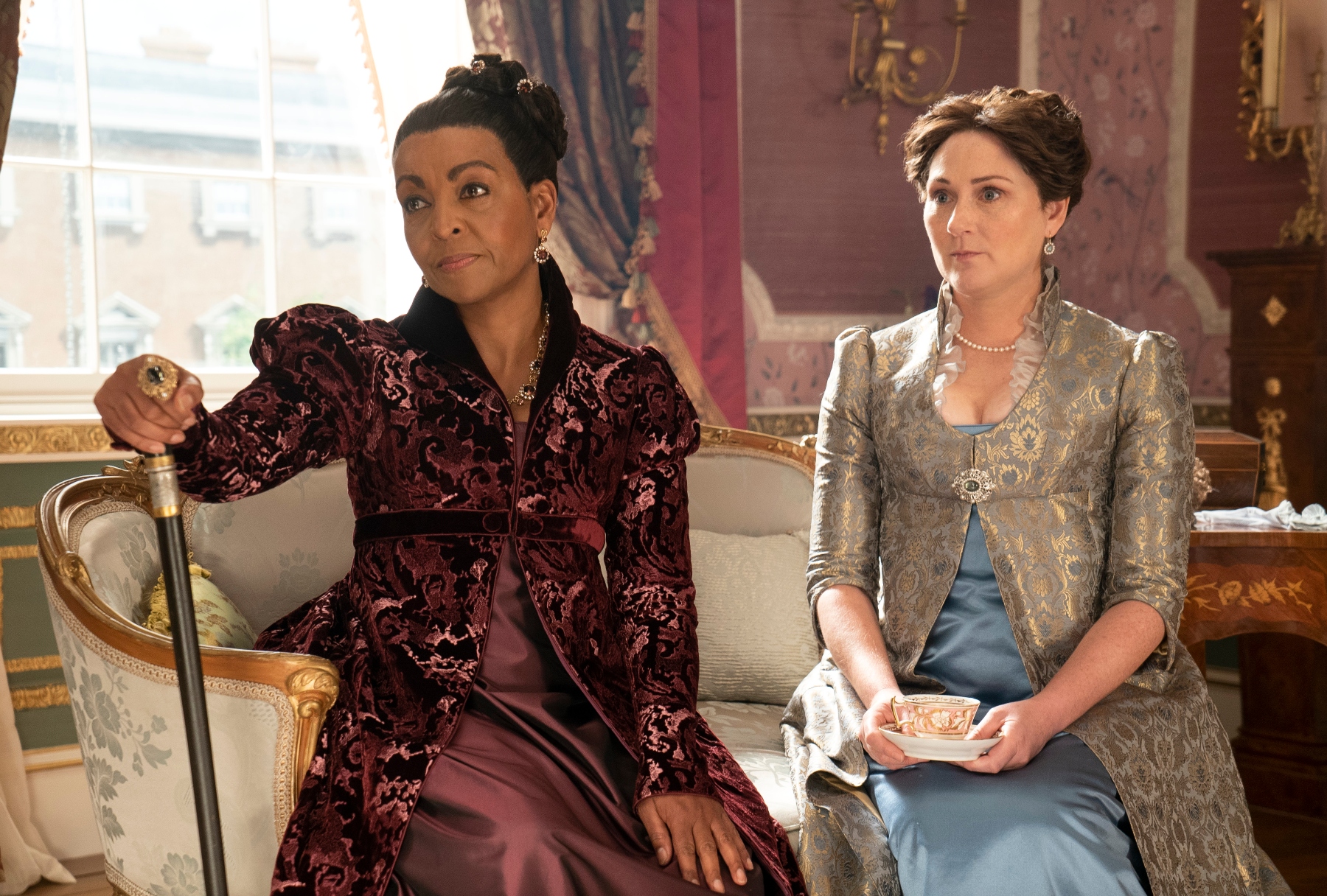
Adjoa Andoh and Ruth Gemmell in “Bridgerton” (Liam Daniel/Netflix)In their marital pursuits, the Bridgertons rub elbows with fellow members of high society, including their neighbors the redheaded Featheringtons, who can’t seem to escape scandal, and Lady Danbury (Adjoa Andoh) an important friend of Simon’s family and the person who will orchestrate Edwina’s entrance into society in the hope of marrying the young woman off well. 

The show continues to be narrated in its second season by Lady Whistledown (voiced majestically by Julie Andrews), the anonymous gossip writer who pens leaflets the whole community devours, hoping to see or not see themselves — a sort of Regency “Sex and the City” or “Gossip Girl.” No one reads Lady Whistledown more obsessively than the Queen (Golda Rosheuvel) who has made it her mission to unmask the anonymous writer. 

RELATED: 29 of the oldest actors to play teenagers on TV

Except she’s not anonymous for us anymore. Lady Whistedown’s identity was revealed at the close of the first season to be Penelope, the overlooked and earnest Featherington sister played by the wonderful Nicola Coughlan (“Derry Girls”). The “ton” still has no idea, however. Can the show keep the tension up now that we know, and now that it turns out sweet Penelope was responsible for some decidedly sour gossip, including words that altered her pregnant cousin’s life? Although Coughlan continues to shine, this subplot feels a little thin compared to the other treats of the season. 

Namely, the new couple at its center. 

The “Bridgerton” novels focus on a different sibling each book, and the Netflix show so far falls in line. This season’s stars are eldest Bridgerton brother Anthony (Jonathan Bailey), the man of the family since his father’s passing, stressed with all the responsibilities, and Kate: new to the “ton” from India. That this season acknowledges Kate, her sister and their mother’s country, heritage and traditions makes it already different from last season. 

It also acknowledges that life has been difficult for Lady Mary — and by extension, her daughters — because she married below her station, a situation another beloved character comes dangerously close to treading this season. Because of these difficulties, Kate has decided not to marry and to focus solely on her little sister’s happiness and future.

You can imagine how it goes when a character decides fervently she will never fall in love. 

Meanwhile, Anthony approaches marriage like an agenda item. Edwina is perfect on paper, and as played by Chandran, she is more than simply perfect, but a fully fleshed-out character with her own hopes, disappointments and a lot of responsibilities on her young shoulders.

But once Anthony sees Kate riding her horse wildly in a field — something she enjoys along with other cool girl traits like shooting and fishing her croquet ball out of the mud — it’s both all over and of course, just getting started. This is sweepingly romantic, and filmed with yawning meadows and misty woods like a Bronte novel, in a way that feels different from the first season. For one thing, the obstacles between the central couple make more sense. 

The first season of “Bridgerton” had an elaborate series of ruses contrived to keep the lovers apart for as long as possible, ranging from the accurate to the absurd. What keeps the lovers at bay this season is simpler and more timeless.

Ashley and Bailey also have a chemistry that burns through the screen. Ashley, who shined in “Sex Education,” does so much with a piercing look, while Bailey is the most frustratingly bad good man (or good bad man) since Mr. Darcy. Colin Firth, Bailey may be coming for your crown.

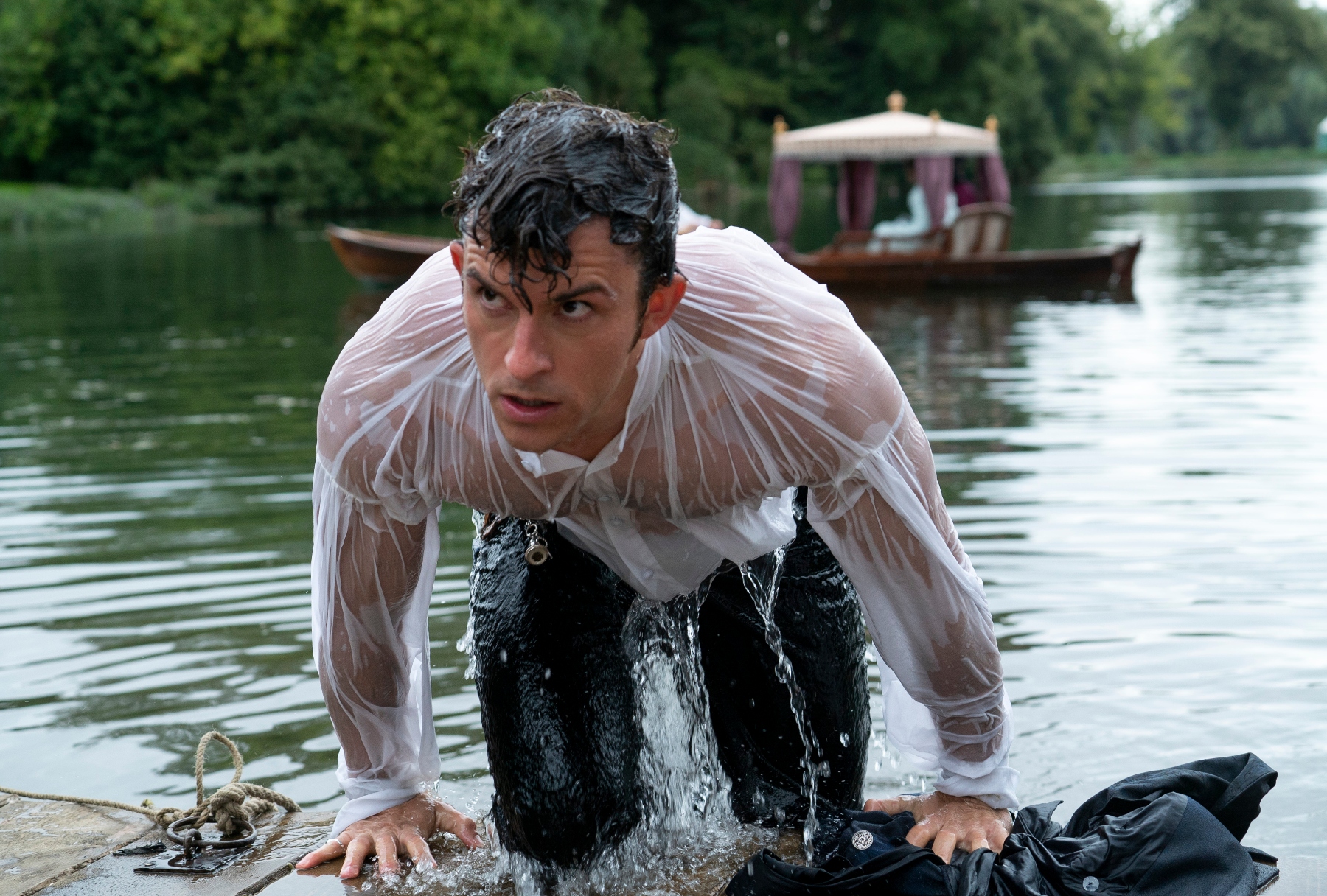
Jonathan Bailey as Anthony Bridgerton in “Bridgerton” (Liam Daniel/Netflix)A central scene in the book between the couple and a bee (yes, a bee — it’s a big deal) is wisely both scaled down and heightened in the show. In an intensely emotional moment, characters share palpable tension and a connection that goes beyond mere physical attraction into comfort. Even love.


Want a daily wrap-up of all the news and commentary Salon has to offer? Subscribe to our morning newsletter, Crash Course.


Though Kate and Anthony are the diamonds of our season, the storylines particularly of the older women characters also deepen. Both Lady Danbury and the Queen can come off as a bit brittle, but season 2 humanizes both of them more. 

Lady Bridgerton and Lady Danbury have a wonderful scene that gives a hint of their history as young women and acknowledges the ridiculousness of their society lives. Lady Featherington (Polly Walker) finally gets a crush-worthy storyline well, worthy of her. And more of the Queen’s life and past is sensitively dramatized, giving a chance for both Rosheuvel and Chandran to shine with quiet empathy.

Some romantics may not be completely pleased by season 2, which doesn’t wrap up neatly in a bow like the empire waist on a Cressida Cowper dress. But fans of love’s eternal hope will keep the “Bridgerton” candle burning. 

Season 2 of “Bridgerton” is now streaming on Netflix. Watch a trailer for it below, via YouTube.

More stories like this:


Sandra Bullock charms in “The Lost City,” which falls short of its screwball-comedy ambitions

As romance novelist Loretta Sage in “The Lost City,” Sandra Bullock gets to crack wise, do physical comedy (tied to a chair in one scene, getting into a hammock in another) and debate not just the colloquialism of “here” for “catch,” but also read logographics and spout Latin. And she does most of this wearing a body-hugging glittery purple onesie. In other words, in her genial new film, Bullock returns to the rom-com genre that helped make her a star. (This is not to say that she should only stick to comedy; she deserved the awards she received for “The Blind Side” and “Gravity,” even if she tried — and suffered — nobly in “The Unforgivable.”)

Bullock is paired here with Channing Tatum as Alan, a hunky cover model who provides visual inspiration for Loretta’s novel character Dash. Alan is a sweet, dim bulb who wants to be Dash, and Tatum’s entrance at a book event where he performs a “Magic Mike” routine is amusing. But to Loretta, Alan is annoying. While she is still recovering from losing her archaeologist husband and is blocked as a writer, she is even more dispirited that her fans show up to see Alan take his shirt off — or what is worse, to ask Loretta to take Alan’s shirt off. Moreover, her publisher, Beth (Da’Vine Joy Randolph), is unhappy that Loretta plans to kill off Dash and stop writing.

RELATED: Sandra Bullock says she’s still “embarrassed” by “Speed 2,” but is that really her worst film?

But then Loretta gets kidnapped by Abigail Fairfax (Daniel Radcliffe), a very rich man who wants Loretta to decipher the hieroglyphic symbols that should lead to the location of the prized Crown of Fire, a rumored treasure buried deep in the island with the active volcano he bought. Alan and Beth contact Jack Trainer (Brad Pitt), who can extract Loretta, and Alan, like an irritating younger brother, begs to tag along. (He can’t wait in the car because he locked himself out).

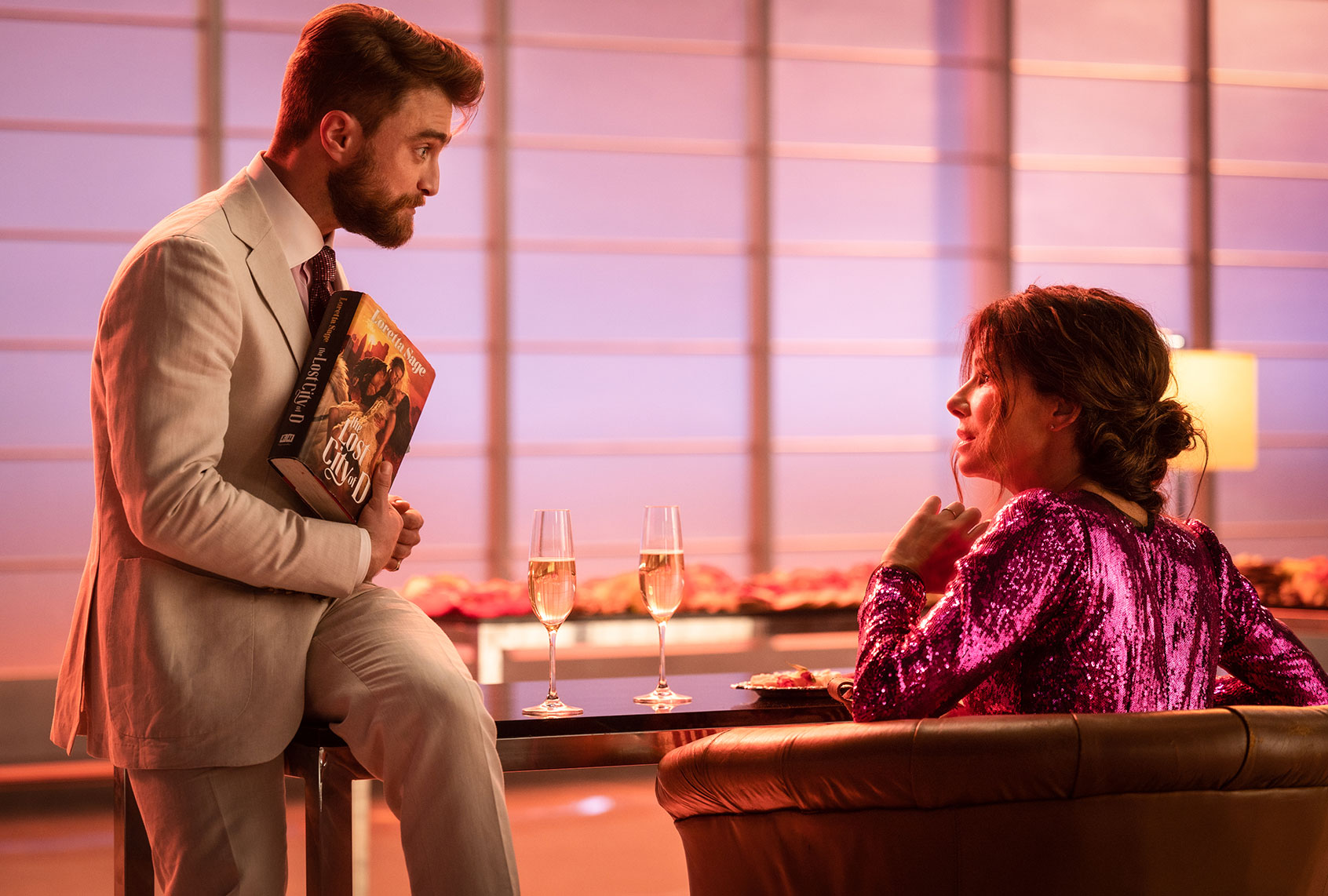
The Lost CityDaniel Radcliffe and Sandra Bullock in “The Lost City” (Paramount Pictures)

“The Lost City” has great fun with its setup. Bullock performs slapstick comedy while hanging out of a car and deadpans about why the body of water they are wading through is warm. It is all charming old-school humor, and it works. And Pitt is hilarious climbing across a tree to dispatch bad guys with noticeable aplomb. Tatum’s eager-to-please nature is both awkward and endearing, but he really hits his stride when Alan and Loretta find themselves trying to make their way through the jungle without a cell phone or a clue.


Want a daily wrap-up of all the news and commentary Salon has to offer? Subscribe to our morning newsletter, Crash Course.


Cue the scene where Loretta removes leeches from Alan’s nude caboose, or he helps her scale up a cliffside by putting his head between her legs and pushing as she complains that her skills are “sitting and thinking and eating,” not rock climbing. And there is some witty banter as the novelist soothes her cover model’s eczema and talks in purple prose about the ridges and contours of his body.

But as the action part of “The Lost City” ramps up, the film starts to drag. It is not that Abigail is a weak villain — he is — but give Radcliffe credit for playing him more gleeful than sinister, which is cute. But the film seems to stretch out the action for an unexciting chase scene and fight in and on top of a tank (that has a minibar)! It is fine to paint by numbers in a formulaic film and the leads are squarely in their goofy comfort zones, but the pleasure of the cinematic equivalent of a bag of potato chips is wanting more, and directors Aaron and Adam Nee serve up diminishing returns.

The Lost CityChanning Tatum and Sandra Bullock in “The Lost City” (Paramount Pictures)

A mediocre subplot has Beth trying to locate Loretta and Alan and experiencing all kinds of frustration. Randolph is terrific, but her encounter with a wacky pilot (Oscar Nuñez) who loves his goat, should be funnier. And while it is nice to see an inclusive supporting cast that including Patti Harrison as Beth’s social media manager, these players are not really given much to do — Radcliffe included — and not enough of it is funny.

“The Lost City” coasts on the charms and sex appeal of its attractive leads, but it is best when Loretta and Alan are dancing, and weakest when they have a get-to-know-you dialogue which includes a groan-inducing line about not judging a book by its cover (model). While it is nice that the Nees’ film is a throwback to everything from “Romancing the Stone” to “Raiders of the Lost Ark,” it rarely, truly enthralls. It is just a pleasant diversion with some funny moments. (Pitt easily gets the most laughs even though he has the fewest scenes.) 

Bullock and Tatum are game, and “The Lost City” is a crowd-pleaser, but it never quite delivers the classic screwball comedy it should (or wants to) be.

“The Lost City” is currently in theaters. Watch a trailer for it now, via YouTube.

More stories to read: 

UK Twitter fuming over Whoopi Goldberg asking royals to apologize for slavery involvement

On Wednesday’s episode of “The View,” co-host Whoopi Goldberg made a comment about the royal family that sent UK viewers straight to Twitter to sound off. In a segment in which the hosts were discussing the Duke and Duchess of Cambridge’s recent tour of Belize, Jamaica, and the Bahamas, Goldberg stated her belief that Prince William should apologize on behalf of the royal family for their generational involvement in slavery. 

“We cannot ignore the fact that Britain ran ramshod over India for years,” Goldberg said. “Let us not forget, when we talk about what needs to happen, all the folks that need to apologize.”

Video of the segment can be seen below. Goldberg’s comment comes in around the two-minute mark.

Related: “The View” hosts offended by humorous marriage book: “You don’t need to call people funny names”

Prince William, Duke of Cambridge gave a speech at a dinner in Kingston, Jamaica on Wednesday, just following a protest attended by over 350 people that took place outside the British High Commission. During the protest attendees called for the royals to issue an apology, aligned with what Goldberg herself stated on “The View.” Prince William made no such apology in his speech, according to BBC, but did go about it from an angle saying that slavery was “abhorrent,” and “forever stains our history.”

This particular tour, which was intended to be in celebration of Queen Elizabeth II’s jubilee, has been ripe with similar protests, so much so that the royals cancelled the first leg of their trip. 


Want a daily wrap-up of all the news and commentary Salon has to offer? Subscribe to our morning newsletter, Crash Course.


Although slavery was abolished in the UK in 1833, the British government made a grave error by doling out funds to compensate slave owners for their “losses” after the fact. The commonwealth, and most recently, Goldberg, are not quick to let them forget.

Although the basis behind Goldberg’s comment is sound, UK Twitter is up-in-arms none the less.

“Listen, this is not new,” Goldberg furthered during “The View” segment. “I suspect Charles, when he was in Barbados had some idea because he went on and apologized as he was releasing the hold that Britain has. So perhaps somebody is listening, and it’s the new group of folks – I don’t know if it’s Charles, William, but one of them is supposed to be the person.”

Read more:

“The View” hosts argue over GOP hypocrisy and ask: “How credible is Mike Pence?”

“It helps to be born rich”: “View” co-hosts criticize Kim Kardashian’s “tone deaf” advice for women 

Joy Behar’s plan to mask “indefinitely” triggers Marjorie Taylor Greene, Don Jr.: “Why not use duct tape”

Western embargoes of Russian gas offer a real shot at a post-carbon future

The Russian invasion of the Ukraine has morphed into a brutal, bitter slog of a ground war; yet as Russia refuses to engage in serious cease fire talks, prospects for a quick military outcome fade. 

In such a stalemate, economic weapons mobilized on both sides become decisive. Western economic sanctions, which have so far cost the ruble 90% of its value, are pitted against cut-offs of Russian oil and gas — a threat which has already raised gasoline above $6 in California and quadrupled the cost of heating in much of Europe. Both sides are hurting.

Putin’s gamble is that the West will need Russian oil and gas before Russia’s economy collapses from an inability import essential industrial products. The West needs to outwait Putin. That requires alternative sources of non-Russian energy to bring down the crippling prices of oil and gas. In other words, we must find accelerate substitute of renewable energy for oil and gas in transport, buildings and industry — but also, in the short term, increase our own oil and gas production.

The conventional energy analysts rejects all of the West’s options as “too little too late.” But high oil prices are not robust; they are fragile. Small changes move big dollar signs. Substituting clean energy for oil and gas is not only a short-term strategy, it is a permanent threat to the inflated crude oil prices that have support Putin’s regime. The more Putin pushes Brussels, Washington and Tokyo to accelerate the clean energy transition, the shorter his financial life line — and that of Russia’s OPEC allies — becomes. Add up all the small (yet also long term profitable) opportunities the US and Europe have, and market support for oil at $100 would evaporate, along with the margins those prices make for traders and oligarchs.

An aggressive strategy to reduce dependence on Russian fossil fuels would help the US and Europe – but would also lower energy prices and stimulate economic recovery in much of sub-Saharan Africa, India, China, many of which are not directly involved on either side of the Ukraine war.

And if we access the full suite of replacements fast enough, the price of energy will fall dramatically, and western sanctions will force Putin to concede defeat.


Want more climate stories in your inbox? Subscribe to Salon’s weekly newsletter The Vulgar Scientist.


But that requires a recognition that the US and NATO are in non-shooting war with Russia, and that energy and financial liquidity are weapons in that war. Our approach to sanctions has been serious, effective and war-worthy.  Our response on energy — the weapon Putin counts on to bring Europe to its knees — remains spasmodic and fractured. We need to fight and win the energy war.

It’s amazing how many complex questions are simplified if we ask the question, “Are we serious about winning this non-shooting war? Are we determined to outwait Putin?”

US oil companies have thousands of wells drilled but not yet producing, and thousands more with permits to drill; they are using their resources instead to increase profits to their Wall Street shareholders.  In a shooting war we wouldn’t beg industry to produce the oil our economy and our allies need; we would require them to do so.  State are erecting more barriers to replacing gas with roof-top solar, to protect local power monopolies. In wartime we should instead have “solar gardens,” à la victory gardens, on as many roofs as possible. Europe needs to replace gas furnaces with heat pumps and the US should help; regulatory red tape is getting in the way, even though every wasted therm of natural gas burned in Amsterdam means more blood shed in the Ukraine. 

Here’s one version of a wartime strategy, whose climate component aims to pump more US oil now on the supply side and less of everyone’s oil tomorrow on the demand side. It’s based on what I’ve seen work in energy supply crises in all the way back to the 1970’s.

1) The President should declare that replacement energy is the key resource democracies need today.  He should announce a constant flow of releases from the Strategic Petroleum Reserve, at a rate of about 30 million barrels a month.  Congress has already authorized much slower releases of 190 million barrels, but we need the oil now, and won’t need it in 2028. This by itself would provide relief for the oil market for the next six months.

2) To supplement, and eventually replenish, these Strategic Petroleum Reserve withdrawals, the federal government should offer three year contracts to purchase of oil from drilled or leased but currently idle properties. If not enough offers from idle properties are received, the President would use the Defense Production Act to require production from the 3000 drilled but not yet completed oil wells. He would tell, not ask, the oil industry to go on wartime footing.

3) If there are supply chain barriers to production from these wells, and there may well be, the President would pledge to use his authority in a national emergency to require production of whatever is in short supply.  If the industry is worried about price stability, the government should offer producers a choice:  three year contracts at either $70/barrel or at market prices, as they prefer. This will signal that the government is serious about cheaper oil, and about reducing the market power of Russia.

4) Simultaneously, Biden would put forward an ambitious set of policy steps to accelerate the short and long term replacement of oil and gas with clean energy.  Major acceleration of US production of heat pumps to help Europe get off Russian gas is a good an example.  The Administration must reject proposals from the oil industry  to increase exports permanently (which would raise US fuel prices)  or give the oil industry control of more US public land. Instead the President should demand increased short term production from already dedicated and leased properties.  More US oil now, but more clean energy now and later is the outcome the climate crisis and the war in the Ukraine demand.  (These already drilled or leased properties Biden would be bringing into production are already committed to production, just like the oil in the Strategic Petroleum Reserve.) 

In this long game, ironically, the EU, Japan, and the US are in the same camp as Putin’s current fellow travelers, China and India. All these countries are major oil importers who benefit from the cheaper prices that come from rapid deployment of clean energy in place of fossil fuels. Hence, if it is done well, a fiercely-fought oil and gas war could help Ukraine beat Putin and reunite the world community — leaving on the outside Russia, a rogue economy smaller than Italy’s and the Persian Gulf, and help substantially to save the climate along the way. 

Read more on the Ukraine war and its consequences:

“Congress must move to impeach”: Calls grow louder for Clarence Thomas to resign from Supreme Court

Calls for Supreme Court Justice Clarence Thomas to resign—or face impeachment proceedings—mounted late Thursday after text messages revealed that his wife urged former White House Chief of Staff Mark Meadows to aggressively pursue efforts to overturn the 2020 election results.

The Washington Post and CBS News obtained dozens of texts that Ginni Thomas, a long-time far-right activist who attended the January 6 rally that preceded the Capitol assault, sent to Meadows in the wake of Trump’s election loss, which she characterized as fraudulent while her husband was hearing election-related cases.

“Release the Kraken and save us from the left taking America down,” Thomas wrote in a November 19 message to Meadows, echoing a slogan that served as a rallying cry for pro-Trump groups.

All but one of the texts between Thomas and Meadows, most of which were written by Thomas, were sent between November 4 and November 24, 2020. One text was sent on January 10, 2021 in the wake of the Capitol insurrection.

Justice Thomas, who is currently hospitalized with an infection, has thus far declined to recuse himself from Supreme Court cases in which his wife’s right-wing activism could pose a conflict of interest.

Thomas was the only justice to publicly argue that the high court should have granted former President Donald Trump’s motion to block the National Archives from handing White House documents over to a congressional panel investigating the January 6 attack. The Supreme Court ultimately rejected Trump’s request.

Sarah Lipton-Lubet, executive director of the Take Back the Court Action Fund, said in a statement Thursday night that “if one thing is clear” from the newly revealed text messages, “it’s that there’s much more to the story of Ginni Thomas’ participation in the January 6 attack that the House Select Committee and the American public deserve to know.”

“Given that Justice Thomas has already made known he won’t recuse himself from cases related to his wife’s right-wing activism, and the damning evidence of his wife’s involvement in this attack on our democracy, Thomas is clearly unfit to serve on the nation’s highest court,” said Lipton-Lubet. “Clarence Thomas must immediately resign from his seat on the Supreme Court.”

“If he refuses, Congress must move to impeach him,” she added. “The integrity of the court, our judicial system, and our democracy as a whole depends on it.”

At least one member of Congress, Rep. Ilhan Omar (D-Minn.), echoed the call for Thomas’ impeachment. The House can impeach a Supreme Court justice with a simple-majority vote, but a two-thirds majority is required in the Senate for conviction and removal.

At the very least, the new revelations demonstrate why Thomas “must recuse from any Supreme Court cases or petitions related to the January 6 Committee or efforts to overturn the election,” argued Gabe Roth, executive director of the nonpartisan advocacy group Fix the Court.

“Ginni’s direct participation in this odious anti-democracy work, coupled with the new reporting that seems to indicate she may have spoken to Justice Thomas about it, leads to the conclusion that the justice’s continued participation in cases related to these efforts would only further tarnish the court’s already fading public reputation,” Roth said.

The New Yorker‘s Jane Mayer reported in January that Ginni Thomas has in recent years aligned herself “with many activists who have brought issues in front of” the Supreme Court.

“She has been one of the directors of CNP Action, a dark-money wing of the conservative pressure group the Council for National Policy,” Mayer noted. “CNP Action, behind closed doors, connects wealthy donors with some of the most radical right-wing figures in America. Ginni Thomas has also been on the advisory board of Turning Point USA, a pro-Trump student group, whose founder, Charlie Kirk, boasted of sending busloads of protesters to Washington on January 6th.”

Mayer also observed that Ginni Thomas received payments from the Center for Security Policy (CSP), a right-wing anti-Muslim think tank. Despite disclosure requirements, Justice Thomas failed to report his wife’s income from CSP in 2017 and 2018.

In an op-ed published before the text messages between Ginni Thomas and Meadows surfaced, MSNBC‘s Mehdi Hasan cited Mayer’s reporting to argue that “Democrats should be loudly drawing attention to the fact that the wife of a sitting Supreme Court justice supported Trump’s coup attempt.”

“There is a clear value in holding impeachment hearings to draw attention to Thomas and his wife and their inappropriate behavior, especially as an increasingly partisan, conservative-majority court guts voting and reproductive rights,” Hasan wrote. “What would Republicans be doing if they had held a House majority and, say, Justice Sonia Sotomayor’s spouse had supported attempts to block a duly elected GOP president from taking office and she refused to recuse herself from related cases?”

Former Cruz staffer explains why Ginni Thomas’ texts are relevant to the Supreme Court’s “integrity”

On Thursday, March 24, journalists Bob Woodward and Robert Costa reported that the Washington Post and CBS News had obtained copies of text messages from November 2020 in which far-right GOP activist Ginni Thomas — the wife of U.S. Supreme Court Justice Clarence Thomas — promoted the Big Lie and repeatedly urged then-White House Chief of Staff Mark Meadows to pursue efforts to overturn the 2020 presidential election results. Never Trump conservative Amanda Carpenter, in an article published by The Bulwark on March 25, lays out some reasons why the Thomas/Meadow texts are so disturbing.

“The breaking news is not that the long-time conservative activist Ginni Thomas, who is married to U.S. Supreme Court Justice Clarence Thomas, appears to be an unhinged 2020 election conspiracy nut,” Carpenter explains. “It’s that after the election, Mrs. Thomas had specific communications with White House officials about legal matters that get to the very heart of the events of January 6, 2021. And her husband, without any explanation or disclosure, made a ruling to shield those kinds of communications.”

According to Woodward — who is famous for his reporting on Watergate with Washington Post colleague Carl Bernstein during the 1970s — and Costa, “The messages, 29 in all, reveal an extraordinary pipeline between Virginia Thomas, who goes by Ginni, and President Donald Trump’s top aide during a period when Trump and his allies were vowing to go to the Supreme Court in an effort to negate the election results.”

Woodward and Costa reported that 21 of those November 2020 texts were sent by Ginni Thomas to Meadows, while eight were sent by Meadows to Thomas — who wanted far-right conspiracy theorist and Trump attorney Sidney Powell to become “the lead and the face” of Trump’s legal team. Powell has been sued by Dominion Voting Systems for making the false, totally debunked claim that its equipment was used to switch votes from Trump to now-President Joe Biden in the 2020 election.

Carpenter explains, “That would be Sidney ‘Release the Kraken’ Powell. At one point in late December 2020, Trump reportedly considered appointing Powell as special counsel to preside over a sham investigation of seized voting machines. These were the kinds of post-election challenges that led to Attorney General William Barr’s resignation and to a massive internal showdown inside the Department of Justice. They were major legal events. And Ginni Thomas was lobbying the president’s chief of staff to pursue an extremely dubious specific course of action that almost certainly would have ended up being argued before the Supreme Court.”

Carpenter goes on to pose the question: “Does this represent a conflict of interest for Justice Thomas that would have warranted his recusal from any January 6th-related case?”

“Last year,” Carpenter explains, “the House January 6th Committee sought from the National Archives records from the Trump White House related to January 6th — including not just the record of that day, but the events leading up to it and following it. Trump then filed suit against the committee and the National Archives, seeking to block the release of those

Carpenter continues, “This suit went all the way to the Supreme Court. On January 19, 2022, the Supreme Court refused Trump’s request. The ruling was 8-1. Only Justice Thomas indicated, in the filing, that he would have granted Trump’s request to withhold the documents. Why? He never said. He did not write an opinion.”

The “core question” that needs to be asked about Ginni Thomas and Justice Clarence Thomas at this point, according to Carpenter, is: “What knowledge did Justice Thomas have about his wife’s activities related to January 6th, particularly related to legal challenges to the election that were extremely likely to come before the Supreme Court?”

“At the end of the day,” Carpenter writes, “these questions aren’t just about the Thomases. They’re also about the Supreme Court as an institution — its integrity and the public perception of its integrity. And anyone who cares about protecting the Court’s credibility should be interested in finding out the answers.”

Ted Cruz’s troll of Judge Jackson backfires: Books he mocked now top of Amazon best-seller list

In an attempt to characterize Ketanji Brown Jackson as soft on crime and a supporter of critical race theory during her confirmation hearing, Texas Sen. Ted Cruz held up several books as if they were proof of the Supreme Court nominee’s beliefs. In doing so, the Republican vaulted at least two of the books to bestseller status, The Washington Post reports.

One of Cruz’s props during his attempt to torpedo Jackson’s nomination was “The End of Policing,” Alex S. Vitale’s 2017 book that analyzes modern policing and makes the case for defunding the police. As he held up a pristine copy of the book, Cruz said, “If you look at the Georgetown Day School’s curriculum, it is filled and overflowing with critical race theory,” referring to the intellectual movement that examines the way policies and laws perpetuate systemic racism. Jackson serves on the Washington, D.C. prep school’s board of trustees.

Much to the delight of Vitale, Cruz’s performance art shot the book to number one best-seller status on Amazon. “Thanks to Ted Cruz, The End of Policing is now the #1 Best Seller in Gov. Social Policy,” Vitale tweeted, including a screenshot of the Amazon ranking.

 https://twitter.com/avitale/status/1506469481043927046?s=20&t=kdP2bkFII4quTQ9celB_4Q

Other books highlighted by Cruz also have experienced dramatic sales increases since Cruz highlighted them. Ibram X. Kendi’s “How to be an Antiracist” is No. 2 in race relations, and his children’s book “Antiracist Baby,” to which Cruz gave considerable screen time, is the No. 1 children’s book and the No. 2 bestseller for all books sold on Amazon.

Texas AG Ken Paxton says Austin schools’ Pride Week is “immoral” and “illegal”

Texas Attorney General Ken Paxton on Tuesday accused the Austin Independent School District of violating state law for holding Pride Week activities, claiming that celebration constitutes “sex education.”

“Liberal school districts are aggressively pushing LGBTQ+ views on Texas Kids!” Paxton wrote on Tuesday night over Twitter, attaching his letter to the school district.

In his missive, penned on Tuesday, the attorney general claimed that “the Texas Legislature has made it clear that when it comes to sex education, parents – not school districts – are in charge.”

“By hosting ‘Pride week’, your district has, at best, undertaken a week-long instructional effort in human sexuality without parental consent,” Paxton continued. “Or, worse, your district is cynically pushing a week-long indoctrination of your students that not only fails to obtain parental consent, but subtly cuts parents out of the loop. Either way, you are breaking state law.”

RELATED: Texas Gov. Greg Abbott directs state agencies to investigate trans youth for child abuse

The district’s superintendent, Stephanie Elizalde, immediately defended the celebration, tweeting: “I want all our LGBTQIA+ students to know that we are proud of them and that we will protect them against political attacks.”


Want a daily wrap-up of all the news and commentary Salon has to offer? Subscribe to our morning newsletter, Crash Course.


District spokesperson Jason Stanford likewise told The Washington Post that the district would be “doubling down on making sure our kids feel safe and celebrating Pride.”

“This is not a parental rights issue,” Stanford explained. “This is a Ken Paxton trying to score political points issue.”

The back-and-forth comes amid heightened tensions as this year’s Pride Week in Austin approaches its final day, according to The Austin American-Statesman. This week, Doss Elementary School teachers received a wave of death threats over the celebrations, causing administrators to move the festivities indoors with police present. 

Paxton’s letter marks the second instance in recent weeks that state Republicans have targeted the state’s residents on LGBTQ+ issues. Last month, Texas Gov. Greg Abbot issued a policy that compelled state agencies to investigate gender-affirming as “child abuse,” a move that has since been temporarily blocked by a judge. 

Despite the controversial nature of the state’s LGBTQ+ agenda, Abbott’s administration has argued that it’s widely popular amongst the governor’s base. Earlier this month, a senior advisor to Abbott told the Post that Abbott’s policy on gender-affirming care “is a 75-80% winner.”

RELATED: At one Texas school, LGBTQ teens call onslaught of hostile laws “matter of life and death”

Still, 63% of Texans writ large believe that the state should not intervene in gender-affirming care, according to the Data for Progress.

Michigan Republican sentenced to probation for inappropriately touching nurse during COVID treatment

A Michigan state senator on Wednesday was put on probation for inappropriately touching a nurse practitioner while receiving COVID-19 treatment. 

State Sen. John Bizon, a Battle Creek Republican, was sentenced to a year on probation and will be forced to pay $1,130 in court costs and fines, undergo a mental health test, and comply with a no-contact policy, according to MLive. 

Bizon has pleaded guilty to battery, a misdemeanor. 

The incident took place last August while the state senator was seeking treatment at an After Hours Express, an urgent care center in Marshall, about an hour west of Ann Arbor. During his visit, Bizon, 70-year-old retired otolaryngologist, began questioning the guidance of his nurse in the exam room. 

According to her police report, Bizon grabbed onto her waist and pulled her closer while she was recommending over-the-counter drugs. The state senator later became angry when she refused to prescribe his preferred medication. 

RELATED: Republican senators are literally running away from women sharing their sexual assault stories

Bizon, for his part, has insisted that he behaved inappropriately due to his illness at the time, calling the incident “regrettable.” 


Want a daily wrap-up of all the news and commentary Salon has to offer? Subscribe to our morning newsletter, Crash Course.


“Right now, he blames COVID for what happened,” said the nurse’s attorney. “COVID does not make you grab women. That is not a side effect from COVID.”

During Bizon’s trial on Wednesday, the nurse said that the lawmaker “tried to bully, coerce and intimidate me to practice quack medicine because he believed in conspiracy theories.”

“Mr. Bizon, I forgive you, but I hope we both never forget,” she added. 

According to the nurse, Bizon also inappropriately touched a medical assistant when she was taking his vitals earlier during the appointment. 

Republican Senate Majority Leader Mike Shirkey has claimed that Bizon owned up to his impropriety, which means he will not face any disciplinary action from the legislature, according to MLive.

RELATED: 1 in 4 government officials accused of sexual misconduct in the #MeToo era is still in office today

But Michigan Democratic Party Chair Lavora Barnes has argued that Bizon should face penalties from his fellow legislators, saying they should “stop being quiet and start denouncing – and take action to stop – the persistent and abhorrent behavior from inside their ranks.”

The sentence comes just months after former Michigan House Speaker was accused of sexually assaulting his sister-in-law for years while she was an underage teen.

Can anyone stop Trump? The most promising criminal case against him fizzles out

I have written many pieces over the last few years about Donald Trump’s criminal culpability and I’ve always believed that if he’s never held accountable for any of it — either his shady business dealings or the numerous crimes against the Constitution that he committed while he was president — the nation may never recover. Trump’s corruption is so blatant that if he gets away with all of it, it’s impossible to see how there can be any more pretense of equal justice under the law.

Having said that, I’ve also written more than once that I’m just not optimistic.

Trump floods the zone with so much bizarre and unconventional behavior for a public figure that it becomes difficult to discern the difference between what is criminal, what is unethical and what is merely performance. In fact, his behavior is so extraordinary that I think it’s convinced many of his followers that he must not be guilty of doing anything nefarious simply because he is so open about it. It’s a neat trick.

I suspect this also spooks the legal system. He cultivated a combative public persona long before he entered politics. There was plenty of evidence that he was doing some extremely corrupt business deals, from running cons on unsuspecting marks to money laundering to doing backchannel deals with terrorist states for years. But there was a sense that nobody could be as ridiculously flamboyant as he was and still be a criminal. His clownishness was a form of shield.

As a politician, he’s exchanged that for something much more powerful: tens of millions of committed followers who have, in turn, cowed out the entire Republican establishment and allowed Trump to beat back two impeachments. And then he leveraged that power to incite a violent insurrection in which those followers stormed the Capitol to stop the peaceful transfer of power.

He has already threatened to use that leverage again. At a January rally in Texas he bemoaned the legal investigations that plague him:

If these radical, vicious, racist prosecutors do anything wrong or illegal, I hope we are going to have in this country the biggest protests we have ever had in Washington, D.C., in New York, in Atlanta and elsewhere, because our country and our elections are corrupt. They’re trying to put me in jail. These prosecutors are vicious, horrible people. They’re racists and they’re very sick. They’re mentally sick. They’re going after me without any protection of my rights by the Supreme Court or most other courts.

If you think it’s strange that he’s calling prosecutors who are investigating him, racists, it’s because he’s referring to the New York Attorney General Tish James, the Manhattan District Attorney Alvin Bragg and Georgia’s Fulton County DA Fani Wallace, all of whom are Black. He doesn’t use a dog whistle, he uses a bullhorn. He wants everyone to hear him, especially those prosecutors.

Related: Trump not faring well in Trump Organization civil fraud case

As far as we know, the civil case being pursued by James over Trump’s business dealings is ongoing as is the investigation into Trump’s pressure campaign to get officials to “find” enough votes in Georgia to overturn the election in 2020. But the criminal investigation in Manhattan, with which James’ office was cooperating, has apparently fizzled, causing the two prosecutors who had been leading the probe to quit last month.

That case was considered by many to be one of the most important because it was looking into some of the practices used by Trump to fraudulently obtain loans from banks by over-inflating his assets and then cheat on his taxes by underestimating them. Before he left office, the previous DA indicted Trump’s COO, Allen Weisselberg, and it had been anticipated that he would turn state’s evidence and testify against his boss. That has not happened, which has led many legal observers to assume that without him they couldn’t make the case that Trump knowingly committed fraud. Trump famously doesn’t write anything down and is known to speak in a Godfather-style code so without a first hand witness, it was believed they probably didn’t have the goods.

The New York Times released the resignation letter of one of the prosecutors Mark F. Pomerantz this week which throws some cold water on all those assumptions. We had learned from previous reports that when Bragg had assumed office after the last election that he had not been particularly interested in the case and had pretty much decided not to pursue it from the beginning. Pomerantz’s letter makes it clear that he thought otherwise — and that Trump committed “numerous felonies.”

RELATED: Former prosecutor claims Trump is guilty of “numerous” felonies

Pomerantz wrote, “The team that has been investigating Mr. Trump harbors no doubt about whether he committed crimes — he did,” and he said that he and Carey R. Dunne, the other senior prosecutor on the inquiry who resigned along with him, had planned to charge Trump with falsifying his financial statements which is a felony in New York. He said, “whatever the risks of bringing the case may be, I am convinced that a failure to prosecute will pose much greater risks in terms of public confidence in the fair administration of justice.”

According to the Times, Bragg didn’t believe they could prove that Trump “knowingly” inflated his assets, proof of yet another of his slick maneuvers to evade justice.


Want a daily wrap-up of all the news and commentary Salon has to offer? Subscribe to our morning newsletter, Crash Course.


Too many people believe that Trump is so eccentric that he probably believes all the lies he tells and has no idea when he’s behaving in a criminal manner. I’m sure there’s some truth to that, but I’m not sure why it should matter. The man had the most powerful job on earth. I think the law should expect him to know the difference between reality and fantasy.

Both Bragg and Pomerantz are the very best the American legal profession has to offer. Pomerantz is a specialist in white-collar crime with years of experience as a federal prosecutor. Bragg is equally qualified, with a similar background as an assistant US Attorney and Deputy NY Attorney General. There’s no reason to believe that either are corrupt.

But it’s easy to imagine that, despite the fact that it pertains to Trump’s private business dealings, Bragg looked at the risk of taking on what is inherently a political case, thought of the immense blowback from Republicans and figured it just wasn’t worth it for the crime of falsifying financial statements which is apparently common among the rich and shameless. And I’m sure it didn’t escape Bragg’s notice that over all the years Trump has been threatening to “lock up” Hillary Clinton, his opponents have been screaming that putting political rivals in jail is something that only banana republics do. Is there even the slightest chance that Trump and his minions wouldn’t be throwing that exact line right back at them without the slightest shame?

In my mind, none of that is any excuse, although I can understand the dilemma.

Trump is a corrupt politician, a criminal businessman and a danger to our democratic system. I think it’s outrageous that he keeps escaping serious consequences for any of that. But I’m afraid that even after all we witnessed and continue to learn about Trump’s assault on our democracy and the threat he poses, there still isn’t the will to stop him. It’s clear that a report from the January 6th Committee or a civil case that costs him some money and some time isn’t going to get the job done. Let’s hope somebody, somewhere has the guts to hold him legally accountable.

Republican congressman guilty of three felonies charges: jury

The Republican Caucus in the House of Representatives now includes a convicted felon.

“After just two hours of deliberation, a California jury found Congressman Jeff Fortenberry (R-NE) guilty on all three charges: one count of scheming to falsify or conceal material facts and two counts of making a false statement to a government agency,” KOLN-TV reported. “Fortenberry is out on bond until sentencing on June 28 in California. Fortenberry faces a maximum sentence of 15 years in prison.”

Assistant U.S. Attorney Susan Har had harsh words for Fortenberry during her closing arguments, Politico reported.

“The evidence has proven the defendant guilty and he can no longer avoid the consequences of his actions,” she said.

Fortenberry’s defense had said he did not lie, it was just a “failed memory test.”

“Fortenberry, 61, a nine-term Republican congressman facing reelection, has pleaded not guilty to charges he deliberately misled FBI agents and prosecutors who were investigating the 2016 donations. It is illegal for U.S. politicians to accept foreign funds,” Politico reported. “Prosecutors allege Fortenberry lied about what he knew during an interview at his Lincoln home in March 2019 and a follow-up meeting four months later in Washington. He allegedly didn’t properly disclose the contribution received at a Los Angeles fundraiser.”


For an ill-fated science cruise, a sea of allegations

The RV Thomas G. Thompson was in turmoil long before the arrival of the albatross. On Feb. 21, 2019, the University of Washington research vessel had embarked on a five-week-long cruise in the Indian Ocean to explore an undersea plateau called the Marion Rise, using a sophisticated gravity sensor, underwater drones, and old-fashioned dredges.

But shortly after setting sail from Durban, South Africa, with 32 scientists, 21 crew members, and three marine technicians, one scientist fell ill and needed an emergency medical evacuation back to land. The voyage — which was partially funded by the National Science Foundation and, like many U.S. research cruises, involved a university-operated ship and a scientific team from a number of institutions, coordinated by a national organization — lost four days before it had dropped a single dredge or drone. Its mission was further delayed due to disagreements between the geologists and crew on how to best dredge the ocean floor for rocks.

So, the omens weren’t good on the morning of March 11, when the cruise’s chief scientist, Henry Dick, ducked under safety tape on the deck to take photos of an albatross near the ship, which had finally begun its dredging 10 days before. After taking his snaps, Dick turned to encounter a female technician who “yelled at him disrespectfully to get off the deck,” according to two lawsuits he would later file — one against the University of Washington and another against his employer, the Woods Hole Oceanographic Institution, or WHOI, based on Cape Cod in Massachusetts. The suits followed disciplinary actions taken against Dick after complaints about his behavior were filed by members of the Thompson crew.

According to Dick’s Massachusetts lawsuit, the Thompson’s captain did not want unnecessary personnel on the aft deck while a dredge was being winched up from the sea floor more than a mile below — a process that could take an hour or more. Anyone working there was also required to wear a hard hat and life vest. But Dick, a geologist at WHOI and veteran of dozens of science cruises, argued that he believed himself safe without protective equipment because the ocean was calm and the massive dredge would not be hauled out for, he thought, at least another 15 minutes.

The female technician, who, like almost all the crew, worked for the University of Washington, then had a heated confrontation with Dick. In a statement provided to the university’s investigation, the technician says Dick berated her and used aggressive body language. “I just want a picture of the birds,” she reported his saying to her. Dick then threatened to give the cruise a poor evaluation with the coordinating body for marine science, according to the technician. In her words to a supervisor shortly after the incident, she said Dick planned to give the journey “a one-star Yelp review.”

On another occasion, according to the University of Washington investigation, a witness heard Dick refer to the same technician as “a rude bitch.” Accounts differ, but a male technician also reported to the investigation that Dick made a comment suggesting women were more difficult to work with. And the University of Washington report suggests that the female technician was made uncomfortable by gifts of chocolate that Dick occasionally left at her station.

In response to queries from Undark, Dick did not deny using the phrase “rude bitch,” though he argued that it wasn’t meant to be overheard. The chocolates, he points out, were given to both male and female colleagues. And his comments on gender to a male technician, Dick said in an email to Undark, were rather to suggest that “some women were hard to work with because they were overly sensitive.” These remarks were not directed specifically at the female technician, he added.

Still, the University of Washington eventually concluded that it would only consider hosting Dick on its vessels again provided he agreed to abide by WHOI’s harassment policies and watched videos on preventing sex discrimination and sexual harassment, as well as “fostering a respectful work environment.” A separate investigation by WHOI found that Dick had created “a harassing and hostile work environment” on the Marion Rise cruise, “through a mixture of inappropriate, unprofessional, and intimidating behaviors, comments, and actions.” WHOI ultimately docked Dick’s pay, forbade him from acting as chief scientist on future cruises, and required him to undergo anger management training, among other consequences.

As a result, Dick sued both WHOI and the University of Washington, as well as individuals involved with university logistics, and both human resources offices. (Undark made numerous attempts to interview multiple people who had been on the Marion Rise cruise or were named in the lawsuits. All either did not respond to requests for comments or declined.)

Below deck on the Thompson, mugs hang on the wall of the mess area. Visual: Mark Harris for Undark

While neither WHOI nor the University of Washington stated that Dick’s behavior aboard the Thompson was sexual in nature, his employer had dealt with complaints about him in the past, and had disciplined him for what it considered “sexually offensive conduct.” In 2017, a WHOI investigation concluded that, following multiple reports “regarding recent and ongoing unwanted conduct and comments you have made of a sexual nature,” it would put him on administrative probation for one year, banning him from interviewing candidates and taking on new students, or voting on new appointments.

For his part, Dick says the planning for the Marion Rise journey was bungled by the university, and he has vigorously and repeatedly maintained that the accusations against him are unfair, telling Undark in an email that sexual harassment and hostile workplace considerations “have been expanded to the point of absurdity” by human resource departments. They have become, he wrote, “literally whatever they want it to be.”

“If a man and a woman have an argument, then it must be sexual harassment, or at the very least the male creating a hostile environment,” he continued. “Tell an off-color joke, give advice on integrating career and family life, use language that was fine yesterday but today is deemed offensive by the left — your career is threatened.”

These competing perceptions — those of multiple members of the Thompson crew and the University of Washington and WHOI investigators, versus those held by Dick — would seem to be part of an ongoing social reckoning, both in society writ large, and in field science specifically. And the particularly contentious nature of the Marion Rise dustup underscores the stakes when conflicts arise.

To be sure, the personal accounts of individual female scientists, as well as an ever-growing body of research, make clear that many women still face persistent discrimination in scientific and academic disciplines, from lower pay and workplace bullying to a lack of recognition for their achievements. Marine science, which can place investigators at sea in isolated and sometimes tense conditions for weeks at a time, is no exception. A 2020 survey by the online community Women in Ocean Science (WOS) specifically identified a lingering “culture of silence around sexual harassment, gender bias, and discrimination against women” in the field. The most common location for harassment to occur, the survey found, was during fieldwork.

Often these incidents go unreported, and even when complaints are opened with institutions, the disputes are frequently settled out of court — sometimes with non-disclosure agreements that obscure the details. But for the incidents on the Thompson, the rough contours of the contentious cruise have been made public by Dick himself, who filed civil lawsuits in Massachusetts and Washington last year alleging that WHOI and the University of Washington discriminated against him on the basis of his gender, among other counts.

Most of the counts in the Massachusetts case have since been dismissed, and the case was settled with WHOI late last year. While the judge in the Washington case recommended dismissing most counts there, Dick remains keen to take that case to trial.

Although WHOI did respond to questions from Undark after the settlement was reached, the University of Washington declined to provide further details on its investigations, citing the ongoing litigation. Neither institution made individuals identified in Dick’s lawsuits available for interviews. As a result, in accordance with generally accepted ethical guidelines, Undark is not naming the subjects of Dick’s alleged behavior who have not publicly identified themselves.

To Dick, the complaints against him seem to represent an overcorrection in the culture — and one that threatens scientific careers. But for women who have been public about their own experiences in ocean science, the case suggests the field is still in need of reform.

“We did chase a lot of people out of this field because they had a horrible experience of it,” says Julia O’Hern, now operations manager for a marine mammal center, who detailed the discrimination and sexual assault she said she faced in her years as a female ocean scientist in an op-ed in The Washington Post in 2015. “They just didn’t feel comfortable going back out there to do that kind of work, and that makes it that much harder to retain women and anyone else from these underrepresented groups,” O’Hern told Undark. “It doesn’t seem to be getting better very fast.”

As it happens, a National Science Foundation policy now requires funding recipients to disclose, among other things, whether principal investigators — which would include expedition leaders like Dick — have previously violated any harassment policies. The rule applies to all funding awards and amendments made on or after Oct. 22, 2018.

The Marion Rise expedition received notice of its NSF award a month earlier.

Henry Dick has had a long and impressive career. After getting his Ph.D. from Yale in 1975, he went to work at WHOI and has been there ever since, achieving tenure, he says, after about 10 years. His work has focused on the relationship between the Earth’s mantle flow, melting, and tectonics in ocean ridges, research that requires deep-sea cruises to survey the ocean floor. Dick told Undark that he has been chief scientist or co-chief scientist on approximately 16 other cruises over the years.

In 2011, Dick was given an American Geophysical Union medal and, five years later, was named a fellow of the American Association for the Advancement of Science. But WHOI was already dealing with worrying reports of his behavior. The full details of the investigation that resulted in Dick’s receiving his administrative probation in 2017 have never been made public. However, the warning gave non-specific examples of Dick’s “conduct of a sexual nature deemed to be unsolicited and unwelcome.” These included “gender-based jokes and storytelling,” “sexual comments and innuendos,” “comments about the appearance of some women,” and advice about the impact of pregnancy on professional career.

WHOI noted in its official warning: “The Institution has on file a record of incidents from years past that are of a similar unwanted sexual nature. Such conduct is offensive and unacceptable.”

Dick admitted to Undark that he had told a single “off-color joke.” He also said that he offered advice on when female graduate students should have children, and that, after complimenting a female colleague on her clothing — and upon being asked to clarify what he meant — he “stumbled” through follow-up comments on the fit and color of the clothes. In a later email to Undark, he also characterized the 2017 investigation as “astoundingly one-sided.”

As well as the ban on hiring students and interviewing potential staff, WHOI required that Dick undergo sexual harassment training. According to an email from WHOI to Dick, “The trainer characterized your involvement in the training at that time as ‘lacking remorse, understanding, or responsibility for your actions.'”

The warning remained confidential within WHOI until Dick filed it as part of his lawsuit, likely meaning that many participants of the 2019 Marion Rise cruise were unaware of it.

The Marion Rise cruise would be Dick’s first as chief scientist on this type of dredging expedition in 18 years, according to the WHOI investigation. It had also been a long time in the making. In seven proposals over a 10-year period, Dick says he had asked various agencies to fund cruises to further his research, which he believed could revolutionize geology.

According to Dick, large areas of the Earth’s crust are missing at ocean ridges, where the mantle is spreading directly onto the sea floor. He is convinced that his work could reveal the cause and extent of the missing crust, which could lead to improved understanding of ocean chemistry, including its response to climate change. Oceans have absorbed more than 90 percent of the excess heat trapped in the Earth’s atmosphere due to greenhouse gas emissions.

“I’m in the middle of making really major changes to the way people think about the formation of the ocean crust, and the nature of the mantle beneath the oceans,” he told Undark. That work, he said, is “the sort of thing that commands enormous attention in journals like Nature or Science.”

In 2018, the National Science Foundation, together with Chinese and German institutions, wrote checks for the cruise. (While neither WHOI nor the university would provide financial data, Dick estimated the total cost was nearly $3.5 million.) As chief scientist, Dick would be in charge of deciding where the Thompson would go and the tasks his scientific personnel would undertake. As well as a team to operate WHOI’s Sentry underwater drone, there were oceanographers, geochemists, geologists, and other specialists from more than a dozen institutions in Europe, China, South Africa, and the U.S. The University of Washington would provide the Thompson with its captain, marine technicians, and most of its crew, and offer logistical support.

In the months leading up to the cruise, communication between Dick and the Thompson’s female port captain, responsible for shore-side logistics and planning (and one of the defendants in Dick’s Washington lawsuit), satisfied neither side. The WHOI investigation concluded that Dick did not effectively communicate during the pre-cruise phase and that he left the port captain with the perception that he was treating her differently than her male counterparts, although it “did not find these specific actions to be gender based.”

For his part, Dick’s lawsuits called the university “deficient and disorganized” and he told Undark that the “University of Washington had fouled up the planning process.” Among other things, Dick alleged in his complaint, the organizers of the expedition switched captains, notifying him only eight days prior to launch, and they failed to respond in timely ways to email messages. Things, he said, did not improve once the ship left port. The ship’s new captain, Eric Haroldson, and Dick disagreed about which dredging method to use for rock collection. Haroldson settled on a technique that he thought was safer for technicians and ship alike in the rough seas of the Indian Ocean, but that Dick believed would be inefficient. Some members of the Thompson’s crew, in internal University of Washington documents obtained by Undark via a public records request, maintained that Dick’s own indecision and lack of leadership caused delays.

In one lawsuit, Dick estimated that the combined delays cost approximately seven days of ship time — equivalent to more than half a million dollars wasted. The loss to science, he wrote in an email to a friend, was “incalculable.”

To add to the pressure, the Thompson’s first three dredges were not only delayed but disappointing. The first produced a handful of rocks, the second came up empty, and the third contained just three cobble-sized stones. The fourth dredge was scheduled for the early morning of March 4. The official cruise report shows the Thompson arrived at the dredging location early, with WHOI’s senior geophysicist noting that the team would wait an hour before preparing to dredge.

But before that hour was up, Dick arrived in the computer lab and began yelling at a female marine technician — the same one he would confront on deck a week later — for not starting the dredge already, according to the University of Washington investigation. A witness said he walked into the lab and saw Dick “red in the face screaming” with “his finger pointed square in her face in very close proximity.” Dick disputes this account in his suit against WHOI, claiming that he only raised his voice in defense after she had already done so.

On March 11, the albatross paid its visit. The female technician reportedly saw Dick step under the safety line without wearing protective equipment while a winching operation was under way. She called the bridge to tell them she was going to confront him. Normally the technician said she would have done this without making a call, but the University of Washington investigation noted that she was “uncomfortable not having anyone present because of how aggressive he has been in the past.”

During their heated argument, the technician claimed, Dick threatened to write a report “about you and this ship and how you all treat everything as an overblown safety issue.” However, about a week earlier, Dick himself had “reminded everyone on the importance of life vest and hard hats when scientists operate on the aft-deck,” according to the cruise’s official trip report, written by scientists on the cruise prior to the lawsuits.

The female technician was not the only person upset with Dick’s behavior. According to the University of Washington and WHOI investigations, other crew members had noted his disregard for safety, and a penchant for jokes in poor taste. WHOI’s investigators also talked with scientists who understood cruise protocols, and their report included some anonymous quotes from those who had been on board the Thompson. “Nothing even came close to this in my 10 years,” said one. “If you can’t control yourself and get angry, you shouldn’t be a chief scientist.”


A wall of monitors in the Thompson’s computer lab, which controls and records data from the scientific instruments. Visual: Mark Harris for Undark

“If you took away this element of poor leadership, I would have said it was a great cruise,” said another. “He made it a miserable place for a lot of people.” And a third: “What made me most upset was how he treated” the female technician.

Shortly after a male crew member heard Dick referring to her as “a rude bitch” (Dick told Undark that he had “mumbled” this comment to himself and that it was not meant to be overheard), the female technician requested that Captain Haroldson meet with Dick to discuss Dick’s treatment of her. The next day, after talking with the captain, Dick delivered what the female technician described to the University of Washington as a non-apology that did nothing to reduce her anxiety. Dick says the apology was genuine.

She later reported sending an email to her supervisor in Seattle that said: “I honestly feel like I’m going to vomit most times when Henry walks into the room.”

Dick’s lawsuits paint a very different picture of events. His complaint against WHOI states that he found Haroldson “difficult to approach,” that the technician “inappropriately yelled at Dr. Dick for being on the deck,” and that he felt mocked by another (male) technician who was imitating him. Soon after informing the female technician about his intent to give the cruise a poor review, the complaint states, “the crew of the RV Thompson and University of Washington employees put the wheels in motion to manufacture an unfounded negative assessment of Dr. Dick.”

“I was so frustrated,” Dick told Undark, referring to the albatross incident. “At this point, I could see that the dredging program was only going to get half of the material we needed and not enough to prove the hypothesis that I was trying to prove.”

There were still about two weeks left on the high seas. Amid an uneasy stalemate, dredging continued until the Thompson suffered engine trouble and began limping its way back to South Africa. On March 28, 2019, the Marion Rise cruise ended in Cape Town.

Although the sea voyage was over, the “post-cruise witch hunt of Dr. Dick,” in the words of his WHOI lawsuit, had only begun.

In early April 2019, Haroldson wrote a post-cruise assessment that rated the science party’s contribution as poor. Dick “had little to no regard for vessel or personal safety,” he wrote in an email to the University of Washington colleagues. “He claims to have been going to sea for 43 years, but he sure does not act as he has.” Haroldson also claimed crew members told him that Dick had tried to persuade the ship’s mates to use Dick’s preferred dredging method, in defiance of his authority, which Haroldson characterized as “a cheap, underhanded ploy.”

Dick’s WHOI lawsuit calls this claim “outrageous” and “a de facto charge against him of inciting mutiny.” Dick told Undark that Haroldson’s assessment was filled with false statements.

On April 10, Dick was told that WHOI had received reports of problems on the cruise. In his comments to Undark and in his Massachusetts lawsuit, Dick maintains that whatever acrimony unfolded between him and the technician on the expedition was not due to gender, but because he felt he was being treated disrespectfully. But the University of Washington investigation, completed that May, gathered nine first-hand accounts from crew members and concluded that “Dr. Dick created a hostile work environment through his verbal conduct and insistent behavior. Further, on more than one occasion he engaged in disrespectful behavior” directed at the female technician “that appeared to be based on her gender.” It did not include a statement from Dick himself, nor any of the scientists on board.

WHOI’s own investigation talked to three WHOI employees, along with one non-WHOI worker and four University of Washington employees who were on the cruise, or had first-hand knowledge of the events described in the complaint. WHOI also spent more than seven hours interviewing Dick himself. It largely agreed with the University of Washington’s conclusions, adding that nearly everyone WHOI interviewed “shared the unsolicited opinion that you were unprepared to be a chief scientist, that proper planning had not occurred, that you communicated poorly, and that you should not be a chief scientist going forward.”

It also claimed that in the course of its investigation, Dick had made “retaliatory” accusations to discredit the female technician, suggesting she had a graphic sexual image on her computer, and was colluding with a male technician. (WHOI’s investigation described the first charge as “unsubstantiated” and the second as “untrue.”) Dick claims in his Massachusetts lawsuit that WHOI investigators immediately assumed that his behavior was made in retaliation, whereas they trusted the female technician’s account — evidence, Dick says, of gender bias against him.

As well as decreasing his pay by 15 percent, barring him from leadership positions on its future cruises, and requiring him to undergo training, WHOI warned Dick that further violations would likely lead to the loss of his tenure.

Dick disputes many of the facts and opinions cited in the investigations, characterizing them to Undark as “biased,” “exaggerated,” and “fabricated.” He also claims that he was not allowed to see the complaint or read witness statements, and that WHOI “refused to interview any of the scientists who were in the room” when one of the incidents happened. “They had concluded their investigation and already made up their mind before they interviewed me,” he says.

So he sued. The Massachusetts lawsuit alleges, among other things, that WHOI had subjected Dick to an “unfair, procedurally deficient, and discriminatory investigation” into a false allegation of “engaging in sexually harassing behavior,” and to discipline that was disproportionate to the allegations, irreparably harming his “previously stellar” reputation. (In fact, neither the university nor the WHOI investigations into Dick’s behavior on board the Thompson state it was of a sexual nature.)

The complaint contains supportive references from some of the cruise’s scientists, characterizing Dick as acting professionally with the crew. Dick also sued the University of Washington and, he says, filed a complaint for waste of federal funds and retaliation with the NSF’s Office of Inspector General.

“It is not about whether I was guilty or innocent, it’s not about whether the University of Washington was lying,” says Dick. “It’s about the simple right to make a fair and reasonable defense when you’re accused. And without that, we cannot have a free society.”

The compressed timescales and limited windows for completing field science projects can heighten tensions, shorten tempers, and, experts suggest, sometimes breed abuse — even as such work remains vital to career advancement. “Most of us cannot get jobs without field experience,” said Robin Nelson, an associate professor at Arizona State University who has studied discrimination in academic fieldwork. “We don’t write our papers without field experience, and we can’t get letters of recommendation without field experience.”

In 2013, Nelson and colleagues surveyed nearly 700 researchers. They found that 64 percent reported personally experiencing sexual harassment, including “inappropriate or sexual remarks,” “comments about physical beauty,” and jokes, at research field sites. Women were 3.5 times more likely to experience it than men. Harassment towards women was primarily directed from senior scientists to those junior to them.

“We want to believe ourselves better than that in academe, and I think that has, in fact, allowed for the abuse to continue in ways and be hidden,” Nelson said, explaining later that countersuits can happen because some senior scientists are “absolutely baffled that their behavior is being called out.”

Dick thinks that issues “involving claimed sexual harassment and creating a hostile work environment” have been “weaponized to accomplish other ends,” he wrote in an email to Undark. “A common comment here is that this used to be a fun place to work,” says Dick of WHOI. “Now it’s awful. It’s a hostile environment where you don’t know when you can say anything, or who’s going to take offense, and when you’re going to get in trouble.”

In response to a request for comment, WHOI provided a statement from general counsel Christopher Land, which said, in part, that “The Institution conducted thorough and appropriate investigations into complaints that it received concerning conduct allegedly engaged in by Henry J.B. Dick, Ph.D. The Institution stands by those investigations, the manner in which they were conducted, and the conclusions reached, and sanctions imposed on the basis of those investigations. The Federal District Court’s recent dismissal of the complaint and those allegations support that position.”

University of Washington spokesperson Victor Balta wrote: “We understand the unique nature of working in close quarters on a research vessel and the UW is committed to providing a safe and secure environment for faculty, postdocs, staff, and students wherever they are.”

The National Science Foundation, which had no role in the University of Washington or WHOI investigations, told Undark via spokesperson Mike England that it “expects all funded research to be done in environments that ensure the safety and security of award personnel and the continued advancement of taxpayer-funded investments in science and scientists.”

Starting in late 2018, the NSF required awardee organizations to notify the agency if a principal investigator was determined to have harassed someone or violated other codes of conduct, or if they had sanctions imposed for harassment. The foundation then reviews the information and, if it deems necessary, removes the investigator, or reduces or suspends the award. However, the NSF award for Dick’s cruise was made a month before that policy took effect.

In late March 2019, following the Marion Rise fiasco, Doug Russell, the marine operations manager for the University of Washington at the time, wrote in an email to colleagues that he had spoken with Rose Dufour, program director for ship operations at the NSF, about the accusations against Dick. He later wrote to her in an email, obtained by Undark under a public records request: “Seems that some great science was accomplished — but at a high price due to the inappropriate manner it was managed.” Russell also wrote to colleagues: “It may be time for NSF to take action so that Henry is not funded for further at-sea scientific research. Rose and I did talk about that a bit.” (The NSF noted that Dufour has no involvement in science funding decisions.)

Two weeks later, Dick wrote a letter to the NSF in which he requested a second cruise to gather the dredge data he failed to get on the Thompson. He made a formal application to the NSF in May.

In July 2019, the NSF awarded WHOI nearly $300,000 for Dick to join and dredge aboard a German cruise to the Marion Rise instead, and once more as principal investigator. Dick’s lawsuit against WHOI claims: “The fact that the NSF so quickly approved his proposal for this supplemental cruise which, in Dr. Dick’s experience is extremely rare, demonstrates the legitimacy of his issues with the UW/RV Thompson crew’s actions.”

The NSF told Undark it was unable to comment on whether a particular individual was part of a discrimination or harassment investigation.

The curse of the albatross seems to have followed Dick’s work at sea. The supplemental cruise in early 2020 was cut short by the Covid-19 pandemic. When South Africa closed its ports, the ship had to make a month-long transit to Europe, with Dick on board. (The German chief scientist on that voyage described Dick as friendly and hardworking.)

Dick says he has personally spent over $150,000 on his legal actions so far, to little avail. The judge in the Massachusetts case dismissed most of his counts, while in Washington, Dick was told by the court to amend his legal complaint if he wants to proceed. An amendment could cost him thousands of dollars more, he says, with no guarantee of success.

“Academic freedom for a professor isn’t just whether he gets fired, it’s about the right to speak out,” says Dick. “It’s the right to a fair defense if he’s accused of things.”

In a long statement provided to the University of Washington investigation into the Marion Rise, the female technician underscored a different point. “For someone that is in a position of power and leadership that is supposed to foster the growth of upcoming young scientists, these sorts of interactions are deplorable to pass on to the next generation.” She added that Dick’s behavior during the cruise was precisely the sort of thing that major oceanographic and scientific organizations, including the NSF, “say they stand against.”

Late in 2021, Dick settled his case against WHOI by complying with its disciplinary measures, dropping his claims, and not appealing the court’s dismissal. In return, if he does not break the law or WHOI’s policies for a year, his salary will be re-instated. However, the prohibition on Dick serving as chief scientist or leader on any cruise while employed at WHOI will stand.

But Dick now has a big new project on dry land. In July 2021, the NSF awarded WHOI nearly $1 million for a three-year lab-based research program with Dick as principal investigator. The notification that WHOI would have been required to submit to the NSF this time did not affect that award, he told Undark. NSF declined to offer specific comments on the notification or its award decision.

It was Dick’s largest award in his 45-year history with the NSF. “I think it unusual,” he said, “for someone my age to receive one.”

This article was originally published on Undark. Read the original article.

How democracy dies: When it comes to Jan. 6, the American people can’t handle the truth

I am a believer in the meditative and healing power of walking. It is central to my spiritual life and overall health. If it’s nice outside, I will often just pick a direction and walk until my feet tell me to stop. Then I find a place to sit, eat a snack and read a comic book.

Given the state of the world, sometimes my legs and body feel so full of energy and anxiety that I am compelled to walk. In those moments, whatever the time of day may be, I walk until I am exhausted and my mind resets. When you walk and leave your mind open to the possibilities you can almost literally catch a great idea. Those moments are rare gifts of perfect clarity.

One of my best types of walks are the ones when I am energized, almost manic, and I need to talk with or yell aloud at the Fates. I call those my “Bobby D. Holy Ghost walks,” in tribute to my favorite actor, Robert Duvall, and his performance in “The Apostle.”

If it’s drizzling, cool and cloudy outside. I put on my waxed field coat, woolly pully sweater and a pair of brown leather boots. I have worn a hole through the sole of one of those boots, which I have patched with shoe goop. I walk in puddles to test the seal. For some reason that makes me smile. I don’t need to know why. We should always nurture our inner child.

There is a graveyard near where I live. I find great peace from walking there. As a child, I was afraid of zombies and ghosts, but as an adult I know better. The dead can’t hurt you. It is the living we must be wary of.  

RELATED: Is America the “world’s greatest democracy”? In 2022, we don’t even crack the top 50

During one of my graveyard walks some years ago, I happened upon the tombstone of one of my ancestors. I truly believe that he wanted me to find him. He was buried right next to one of the ruling sons of the Gilded Age. I laughed aloud. He was likely a Black man who “passed” for white, buried right next to a rich white man who believed himself a master of the universe. I wonder, who got the last laugh? 

During my graveyard walks I have been thinking a great deal about America and its democracy crisis, and the poisons of fascism and white supremacy that are literally killing this country. I keep visualizing a tombstone with an inscription warning passers-by that most Americans didn’t even fight for democracy while it was dying, but went on with life as usual. Those who tried to warn them about the impending disaster just got tired and gave up.

That is effectively happening right now, in real time. A recent article in the Washington Post issued a warning: “Jan. 6 committee faces a thorny challenge: Persuading the public to care.” Apparently the House committee investigating the Capitol attack of January 2021 “has tried to recruit high-profile journalists to write its report …  hoping to build a narrative thriller that compels audiences and is a departure from government reports of yore.” Committee staffers also hope “to put together blockbuster televised hearings that the public actually tunes into,” which is a troubling way to frame a historic congressional investigation.

RELATED: “Merrick Garland, are you listening?”: Jan. 6 committee says Trump may have violated multiple laws

The apparent challenge is to make the public care “about an event that happened more than a year ago, and that many Americans feel they already understand.” The committee wants to turn “hundreds of thousands of pages of depositions, records and other evidence into an accessible narrative” aimed at “hard-to-reach” and “deeply polarized” audiences. One unnamed committee member told the Post, “There’s one-third of the nation that will read it, one-third that might read it, and one-third that won’t even believe it.” More from the report: 

The committee is also competing for attention amid a flurry of current events that now includes the war in Ukraine, raising the stakes for the committee’s ability to hold the public’s attention as the insurrection moves further and further back from in public memory. Don Ritchie, historian emeritus of the Senate, said that the most important thing for any congressional committee is publicity.

“Investigators need a certain sense of showmanship — they really need to demonstrate and dramatize what’s happening because the public is distracted,” said Ritchie. “After getting the publicity, then it’s figuring out what you’re actually going to do about the problem.”

In all, this is a damning indictment of the current state of American democracy and political culture. Donald Trump’s regime and his coup cabal attempted to nullify the results of the 2020 presidential election, his followers launched a violent lethal assault on the Capitol and the Republican-fascists’ Jim Crow attacks on multiracial democracy are escalating. The United States faces the possibility of a low-level civil war or sustained right-wing insurgency. Yet the American people must be “entertained” with a spectacle in order to care.

As sociologist Neil Postman famously warned in the title of his best-known work, the American people have “amused themselves to death” through a culture of anti-intellectualism, and the superficial, immediate gratification of mass media. Collective narcissism is a major public health problem. So many people, because of loneliness, alienation, social atomization and a culture of hyper-individualism and self-centeredness, feel no sense of linked fate with other human beings outside their families and immediate social circles.   

America’s educational system has been gutted through decades of active neglect and right-wing malice. Courses that teach critical thinking and civics have been systematically removed from the curriculum of public education. As detailed by Lisa Duggan in her excellent book “The Twilight of Equality”, the social sciences and the arts and humanities are being targeted for evisceration by these same right-wing libertarian gangster capitalists at the college and university level as well.

Education is the best way, and perhaps only way, to create responsible, informed citizens who have the capacity and willingness to participate in a healthy democracy. The global right is trying to destroy high quality public (and private) education for that reason with the ultimate goal of creating passive citizens and corporate drones.

RELATED: How this tiny Christian college is driving the right’s nationwide war against public schools

Extreme income and wealth inequality and wage stagnation also undermine citizens’ ability to be active participants in a democratic society. When people have to work multiple jobs in order to scrape out a living, they are far less willing or able to find the energy to care about democracy, let alone to turn those feelings and concerns into action. 

More than half of all Americans read below a sixth-grade level, which means that they are not able to properly understand complex matters of politics and public policy.

Unions and other institutions of civil society (sometimes called the “laboratories of democracy) have been systematically weakened by the American right. Those are (or were) places where people learn the skills necessary to the practice of democracy. In this climate, it is no surprise that America’s governing institutions are experiencing a legitimacy crisis: The public largely views their elected officials and the organs of state as unresponsive to their needs and desires — and for good reason.

Public opinion research has repeatedly shown that elected officials at the federal level (that is, in Congress) are highly unresponsive to the policy demands of the average American and instead are beholden to the richest individuals and most powerful corporations. It is certainly true that Republicans are far worse in this regard, but Democrats are by no means immune, especially the self-styled “moderates” or “centrists.” 

By email I asked the cultural critic and education scholar Henry A. Giroux — the author of numerous books and a Salon contributor — for his thoughts on this problem: Why don’t Americans seem to care about their democracy? He offered a lengthy response, which I will quote in part. “Democracy is in exile in the United States and the political, social and educational breakdown is intensifying,” he began, observing that the “rise of neoliberal predatory capitalism” in the 1980s marked a key turning point:

Not only did the culture shift to a market-based language that undermined any sense of the common good, shared values and trust, but it embraced a language of privatization, deregulation and commodification that commercialized all social relations and retreated from any discourse that evoked matters of ethic, social responsibility and the obligations of citizenship.

In the current moment, the Republican Party and its allies among the financial elite, corrupt politicians, and right-wing movements hold democracy in contempt because it poses a threat to the unchecked accumulation of capital, white nationalism, white supremacy, and an emerging fascist politics. In an age when economic activity is divorced from social costs, and matters of truth, justice, and solidarity become the object of scorn, democracy and the formative educational culture that legitimates it withers along with the ideals and institutions that sustain it. At a time when all vestiges of critical thought are being purged from public schools, women’s reproductive rights are under attack, and tyranny translates into increasing levels of violence, the collapse of conscience, social responsibility, and justice proceeds at an alarming pace.

Faced with these “forces of conformity, anti-intellectualism and authoritarianism,” Giroux continued, ordinary people tend to “lose their capacity to think critically and act responsibly. … [C]ritical  modes of agency wither, opening a space for both oppressive forms of education and the tyrants that benefit from them. … [T]he public imagination succumbs to lies, conspiracy theories and the cult of the strongman. Under such circumstances, the commanding visions of democracy have not only disappeared, they have given way to the tyrannical nightmares of an authoritarian future. It is little wonder that a great many people no longer care or are willing to fight for a democratic society.

Giroux is not suggesting we need some perfect society of philosopher-kings to save American democracy from the fascist movement, but if the American people remain poorly informed and largely disengaged the real-life problems caused or exemplified by a failing democracy will become much worse, creating a toxic feedback loop. “There is no democracy without a knowledgeable public and no justice without a language critical of injustice,” Giroux wrote. “Democracy should be a way of thinking about civic culture and the development of a robust public imagination.”

RELATED: Right-wing authoritarianism is winning — but higher education is where we can fight back

How can we get there? Giroux writes of the “need to embrace a radical notion of democracy,” but America is a long way from any such vision at the moment. Partly this is a work of collective imagination: Giroux sees an “urgent need for more individuals, institutions and social movements to come together in the belief that the current regimes of tyranny can be resisted, that alternative futures are possible and that acting on these beliefs through collective resistance will make radical change happen. … The defense of democracy can no longer be viewed as longer simply a demand; it has become an urgent necessity.”

In 2014, social psychologists conducted a famous experiment designed to examine the relationship between the human mind, boredom, and cognition. College students were asked to sit in a room in silence for 15 minutes, alone with their own thoughts. Some were told to think about whatever they wanted, while others were given several specific prompts in advance. In one iteration of the experiment, participants could choose to give themselves electric shocks as a distraction. Science magazine reported the results:

In both the free-thinking and planned-prompt scenarios, about 50% of people did not like the experience, reporting an enjoyment level at or below the midpoint of the scale. … To see if a change of scenery would help, the team let participants do the studies in their own homes, but still found similar results. Overall, the subjects said they enjoyed activities like reading and listening to music about twice as much as just thinking.

The researchers then decided to take the experiment a step further. For 15 minutes, the team left participants alone in a lab room in which they could push a button and shock themselves if they wanted to. The results were startling: Even though all participants had previously stated that they would pay money to avoid being shocked with electricity, 67% of men and 25% of women chose to inflict it on themselves rather than just sit there quietly and think … “We went into this thinking it wouldn’t be that hard for people to entertain themselves,” Wilson says. “We have this huge brain and it’s stuffed full of pleasant memories, and we have the ability to construct fantasies and stories. We really thought this [thinking time] was something people would like.”

When I first heard about this research, I asked a friend who teaches at a small regional college if this resonated with her experiences in the classroom. She told me her students often complain that she makes them think “too much” during class about current events, which “hurts their brains.”

Unfortunately, these are not isolated examples. Most people in America do not want to think about the crisis of democracy and what they can do to stop it. Even more troubling and dangerous, many Americans are attracted to fascism and other anti-human philosophies and behavior precisely because they are so desperate for a life of meaning in a world that can often feel devoid of it.

America’s democracy crisis is a deep cultural phenomenon, which is admittedly difficult to confront directly. But denying it, ignoring it or simply pretending the crisis is not real will not save anyone. That will only lead us back to the words of lamentation that I imagine will be inscribed on American democracy’s tombstone.

MAGA purge: Jan. 6 organizer labels former ally Rep. Mo Brooks as “LOSER” and “piece of crap”

On Wednesday, shortly after news broke that Donald Trump had rescinded his endorsement of Alabama Rep. Mo Brooks, a right-wing Republican currently running for Senate, one of Brooks’ former allies denounced him forcefully across right-wing social media. In what amounted to a MAGA excommunication, Ali Alexander, the self-proclaimed founder of the 2020 “Stop the Steal” movement and a key planner of the Jan. 6, 2021, protests, celebrated the “de-endorsement” on multiple conservative social media sites, writing on Telegram, “MO BROOKS is a LOSER.”

“I haven’t told the story to anyone except the President’s team and my lawyers or how Mo Brooks and HIS STAFF betrayed our election integrity movement before he did so publicly,” Alexander continued. “With President Trump withdrawing his endorsement, I can finally be public about what a piece of crap Mo actually is. He’s no longer on the team. And his staff is worse and smells worse. I hope they didn’t lie under oath to the J6 Committee like they lied to Mo in private. Stay tuned!”

In another message on the site, Alexander wrote, “This is what Mo doesn’t get… the voters already left him. And keep leaving him. Trump is following what many of us in private and public have said. Mo Brooks has the dumbest staff on the hill and everyone knows it.”

RELATED: Rep. Mo Brooks tells Trump rally to “look forward” from 2020 election: This does not go well

On the competing right-wing social media site Gab, Alexander continued, writing, “I’m proud to announce that @realdonaldtrump has WITHDRAWN his endorsement of Mo Brooks. I can now go on the record about him and his office and their attempts to BETRAY the Election Integrity movement.” 

Alexander weighed in on Gettr as well, directing a message at Brooks: “Change your profile, @MoBrooks” (referring to Brooks’ profile banner touting Trump’s endorsement). “You betrayed our Election Integrity movement. We’re done here. You’ve been rejected by #StopTheSteal and now Trump. Tell your staff to never come for me again.”

Brooks certainly isn’t the first Republican to be cast out of Trump World as an apostate. But this represents a striking departure from the way Alexander used to talk about Brooks. 

At the Dec. 12, 2020, “Jericho March,” a pro-Trump religious rally to protest the election results, Alexander appeared on stage to tell the crowd about Stop the Steal and to urge them to return to the capital in January to “occupy D.C. full of patriots.” (Alexander, who was then in the process of converting to a right-wing version of Catholicism, promised the audience that they had “God’s favor,” and rallied them to fight “for God and country!”)

At that event, Alexander praised Mo Brooks specifically as the first Republican member of Congress to vow he would object to the certification of electoral votes on Jan. 6. “Thank God for Congressman Mo Brooks,” Alexander said. “He’s said he’ll object to the House certification on Jan. 6. We need some of his colleagues to join him. We expect them to join him — or we will throw them out of office.” 

He continued, “I want to tell the Republican Party that if one of these senators doesn’t join Mo Brooks, we will burn the Republican Party down. We will make something new.”

In a now-deleted Periscope video posted in December 2020, Alexander also claimed that Brooks was one of three members of Congress — along with Reps. Paul Gosar and Andy Biggs, both of Arizona — who had helped plan the activities of Jan. 6. In the notorious video, Alexander said, “We four schemed up putting maximum pressure on Congress while they were voting” in order to “change the hearts and minds of Republicans who were in that body, hearing our loud roar from outside.” 


Want a daily wrap-up of all the news and commentary Salon has to offer? Subscribe to our morning newsletter, Crash Course.


None of those three explicitly confirmed the claim at the time, and a spokesperson for Biggs later attempted to distance the congressman from Alexander. However, reports emerged of Alexander hugging Biggs’ wife at a rally, at which Alexander played a video message from Biggs, announcing that he would join Brooks on Jan. 6 in questioning the election certification. A video also emerged that showed him leading Gosar — whom Alexander had described as “the spirit animal of Stop the Steal” — through a crowd at a pro-Trump rally. In an April 2021 response to a House ethics complaint about his involvement with Jan. 6, Gosar defended Alexander as “a devout Catholic motivate[d] by an earnest search for the truth and love of his country.” 

At the pro-Trump rally on the morning of Jan. 6, Brooks delivered a vitriolic call to action, telling the crowd on the Washington Ellipse, “Today is the day American patriots start taking down names and kicking ass.” 

As a February 2022 report noted, Brooks’ speech that day also delved into Christian nationalist rhetoric. “Today, Republican senators and congressmen will either vote to turn America into a godless, amoral, dictatorial, oppressed, and socialist nation on the decline,” he said, “or they will join us, and they will fight and vote against voter fraud and election theft and vote for keeping America great.”

Brooks later protested that he was only trying to rouse the audience to keep track of Republicans who failed to support Trump’s efforts to overturn the election, and had no intention of promoting literal “ass-kicking.” But that claim seemed dubious in light of Brooks’ later statement that he had worn body armor on Jan. 6, after receiving warnings about potential violence. 

Last December, after facing subpoenas from the House Select Committee investigating the Jan. 6 attack on the Capitol, Alexander handed over some 1,500 text messages and other communications with Republican members of Congress and Trump White House aides. Among them were communications with Gosar and Brooks. 

In response, a spokesperson for Brooks released a statement claiming that Brooks’ interaction with Alexander had been limited to receiving one text from the Stop the Steal organizer in December 2020. The statement read, “The insinuation that this single text to Congressman Brooks from an unknown number by someone claiming to be ‘Ali Alexander’ somehow suggests Congressman Brooks in any way helped plan the Capitol attack is absurd, outrageous and defamatory.”

But according to a filing from Alexander’s legal representatives, Alexander told the Jan. 6 committee that he’d had phone conversations with Brooks’ staff. An October story in Rolling Stone further reported that two unnamed sources involved in planning Jan. 6 claimed that they’d had “dozens” of conversations with the offices of six members of Congress, including Brooks. 

At that time, Brooks told Alabama journalists that while he hadn’t helped plan the Jan. 6 rally, if his staff had, “Quite frankly, I’d be proud of them.” 

Despite Brooks’ stalwart support of Trump, his poor showing in polls — and the subsequent implication that Trump’s endorsements are losing their potency, even in a deep red Southern state — seemingly led the ex-president to announce on Wednesday that he was withdrawing his endorsement. Trump accused Brooks of going “woke” by failing to campaign on Trump’s stolen election narrative. 

In response, Brooks made the startling but entirely plausible claim that Trump had repeatedly asked him to “rescind the 2020 election, immediately remove Joe Biden from the White House, immediately put President Trump back in the White House, and hold a new special election for the presidency.” Brooks said he’d told Trump that Jan. 6, 2021, had represented the final chance to contest the election, and that “neither the U.S. Constitution nor the U.S. Code permit what President Trump asks.”

Read more on the long aftermath of the Jan. 6 attack:

Focus on race and crime in Jackson’s hearing recalls Thurgood Marshall’s — 55 years ago

Sen. James Eastland, D-Miss., posed a question to Supreme Court nominee Thurgood Marshall during his August 1967 confirmation hearings.

“Are you prejudiced against white people in the South?”

Eastland, a known white supremacist, could not be clearer in conveying his fears about Marshall and race.

Fifty-five years after Marshall’s hearings, Sen. Marsha Blackburn, R-Tenn., asked a similar question of Supreme Court nominee Ketanji Brown Jackson on March 22, during Jackson’s Judiciary Committee confirmation hearings.

“You have praised the 1619 Project, which argues the U.S. is a fundamentally racist country, and you have made clear that you believe judges must consider critical race theory when deciding how to sentence criminal defendants,” Blackburn said. “Is it your personal hidden agenda to incorporate critical race theory into the legal system?”

Blackburn’s questions, when fact-checked, proved to be as inaccurate as they were inflammatory.

However, Blackburn — and other Republican senators — injected race-baiting into Jackson’s confirmation hearings.

RELATED: Ted Cruz turns Ketanji Brown Jackson’s Supreme Court hearing into rehabilitation of Brett Kavanaugh

President Biden nominated Jackson on Feb. 25 to fill Justice Stephen Breyer’s seat, shortly after Breyer announced his retirement plans. Biden had publicly promised during his 2020 presidential campaign to nominate a Black woman to the high court.

Jackson’s confirmation hearings ended Thursday. The entire Senate, which is evenly split between Democrats and Republicans, is expected to confirm Jackson after the proceedings, with Vice President Kamala Harris likely serving as a tie-breaking vote. It’s also possible some Republicans could vote in Jackson’s favor.

As a constitutional law professor who focuses on the Supreme Court, I find it striking that race has surfaced in such a major way in these hearings, more than five decades after Marshall’s nomination. In some respects, there has been progress on racial equity in the U.S., but aspects of these hearings demonstrate that too much remains the same.

Some common ground

Marshall was the first African American man who served on the Supreme Court. If confirmed, Jackson will be the first African American woman on the court.

The full Senate’s final vote on Marshall reflected divisions based on racial desegregation and Marshall’s past as an NAACP lawyer, rather than a straight partisan split. President Lyndon B. Johnson, a Democrat, nominated Marshall.

But most Southern Democrats voted against him. Sixty-nine senators — 37 Democrats and 32 Republicans — voted to confirm Marshall. Eleven senators — 10 Democrats and one Republican — voted not to confirm, and 20 senators — 17 Democrats and three Republicans — dodged their senatorial voting responsibilities entirely and were recorded as “not voting.”

Widespread predictions of a final Senate vote along party lines bode well for Jackson.

Jackson is now a judge on the U.S. Court of Appeals for the D.C. Circuit. Breyer and other legal experts have routinely praised her intellect and legal experience. Jackson has also worked as a federal trial court judge, vice chair and commissioner on the U.S. Sentencing Commission, private law firm lawyer and federal public defender. She also served as a judicial clerk for Breyer.

The American Bar Association Standing Committee on the Federal Judiciary unanimously rated Jackson “well qualified,” its highest ranking.

Twenty-seven Republican senators have also previously voted to confirm Jackson for her federal court positions.

But Jackson has faced arduous and sometimes histrionic cross-examination during her hearing. Certainly, partisan hostility and political theater have marked every Supreme Court nomination for decades.

Jackson’s hearings, however, stand out. They have been drenched in questions about race, both obviously and not so obviously, most caustically from Blackburn, Sen. Ted Cruz of Texas, Sen. Josh Hawley of Missouri and Sen. John Cornyn of Texas.

On March 22, Cruz questioned Jackson about the teaching of “critical race theory” at Georgetown Day School, a private school where she serves on the board of trustees.

Jackson, like Marshall, fielded the charged questions in a straightforward manner.

“Senator, those ideas, they don’t come up in my work as a judge, which, respectfully, is what I’m here to discuss,” Jackson said.

A preoccupation with crime

In addition to the explicit interrogations of Jackson’s views on race, her hearings — like Marshall’s — have featured a preoccupation with the nominee’s views on crime.

Republican senators have repeatedly accused Jackson of being soft on crime — specifically, that she was lenient as a trial judge in sentencing child pornographers.

Fear-mongering about crime often carries a racialized connotation, whether blatant or unspoken. Media distortions and carceral inequities fuel the myth that Black and brown men are presumptively criminal.

Jackson’s actual sentencing record reveals no anomalies or disproportionate leniency when compared with that of other judges nominated by both Republican and Democratic presidents.

But Jackson’s hearing was a flashback to Marshall’s August 1967 confirmation hearing, when Sen. John McClellan questioned Marshall and suggested that he did not take crime seriously.

“First, I would ask you if you do not agree with me that the mounting incidence of crime in this country has reached a critical stage,” McClellan said. “How do you plan to deal with it? … Do you think it is reaching proportions where we will have a reign of lawlessness and chaos?”

Marshall answered the questions politely, never hinting at the offensiveness of the implication that he somehow supported crime and lawlessness.

Republicans’ treatment of Jackson

Republicans now sitting on the Senate Judiciary Committee have conflated legal representation of criminal defendants with a disregard for the rule of law and public safety.

Republican Sens. Blackburn, Lindsey Graham, Cruz, Hawley, Tom Cotton and Cornyn have gone far beyond insinuation to outright vilification of Jackson’s legal representation of criminal defendants.

Blackburn incorrectly said on March 21 that Jackson “consistently called for greater freedom for hardened criminals.”


Want a daily wrap-up of all the news and commentary Salon has to offer? Subscribe to our morning newsletter, Crash Course.


Cornyn incorrectly accused Jackson of using the phrase “war criminal” to describe former President George W. Bush and former Secretary of Defense Donald Rumsfeld during the course of her legal work for Guantánamo detainees.

Cotton incorrectly said she “twisted the law” as a judge in applying the law of compassionate release, in which inmates can be released if they are very sick or elderly, for example. Cotton also suggested that she was “sympathetic” to a “fentanyl drug kingpin.”

Transformative change is slow

Like the Dixiecrat senators — Democratic senators from the South who believed in white supremacy — who grilled Marshall about his views on crime, the present-day Judiciary Committee Republicans have repeatedly insinuated that Jackson is soft on crime for performing her job responsibilities as a defense lawyer and trial judge in a manner that has been shown to be well within the mainstream of these legal roles.

This racialized fear-mongering brings to mind the divisive political tactics of the Willie Horton advertisement during the 1988 presidential campaign. That advertisement linked crime with African American men, and then linked both to Democratic presidential candidate Michael Dukakis, who eventually lost the race to Republican George H.W. Bush.

Marshall’s confirmation was a giant step forward in Supreme Court and U.S. history, but along the way he faced Senate Judiciary Committee questions that were race-baiting, arrogant, irrelevant and picayune.

Jackson’s historic hearings have unfolded in a similar way. In all likelihood, Jackson will become the next justice of the U.S. Supreme Court, representing another momentous step forward for this country. But this is also another reminder that transformative change on race, while continuing to progress, happens slowly in the United States.

Margaret M. Russell, Associate Professor of Law, Santa Clara University

This article is republished from The Conversation under a Creative Commons license. Read the original article.

Read more on the Supreme Court and this historic nominee:

Rich countries are getting the new COVID vaccine first

A coronavirus vaccine hailed as a potential solution to unequal access in poor countries is actually making the crisis worse as its U.S.-based manufacturer sends millions of doses to rich countries first, angering public health campaigners who say vaccine shortages in the developing world are prolonging the deadly pandemic.

The Associated Press reported Thursday that Novavax, Inc.—a biotechnology company headquartered in Gaithersburg, Maryland—has “sent tens of millions of doses” of its two-dose coronavirus vaccine to wealthy nations such as Australia and the Netherlands “but provided none yet to the U.N.-backed effort to supply poorer countries.”

“COVAX had planned to make available 250 million doses from Novavax by March, but the U.N. agency in charge of deliveries says the first shipments now likely won’t be made until April or May,” AP noted. “It wasn’t supposed to be this way. CEPI, one of the organizations leading COVAX, gave Novavax $388 million to fast-track the vaccine’s development, aimed at making the shot available in poorer countries as the pandemic was exploding two years ago.”

“Countries including Zimbabwe, the Central African Republic, and Kiribati were among those in line to be offered Novavax doses by March from COVAX,” AP added.

The protein-based shot was seen as a potentially significant tool in the fight against persistent vaccine inequity after it gained emergency approval late last year from the World Health Organization (WHO), the European Commission, and regulators in a number of developing countries.

Unlike mRNA vaccines, protein-based jabs are relatively easy to store and transport, making them better candidates for low-income nations with less storage infrastructure.

“This new vaccine is part of the COVAX portfolio, and we hope that it will play an important role in achieving our global vaccination targets,” WHO Director-General Tedros Adhanom Ghebreyesus said of the Novavax shot in December.

But the U.S. biotech company—which has partnered with the Serum Institute of India and other manufacturers—has repeatedly missed its delivery targets.

As Reuters reported last month, Novavax “has delivered just a small fraction of the 2 billion Covid-19 shots it plans to send around the world in 2022 and has delayed first-quarter shipments in Europe and lower-income countries such as the Philippines.”

“The company has yet to deliver vaccine on its largest contract for 1.1 billion doses to COVAX—a global vaccine distribution program for poorer countries—which would make Novavax its third-largest supplier,” the outlet noted. “Novavax did not provide a timeline but told Reuters it expects to deliver around 80 million doses in the current quarter to COVAX, less than 10%.”

Unnamed officials told Reuters that some of the delays were caused by later-than-expected approval from regulatory agencies and earlier export limits imposed by the Serum Institute.

“Whatever the explanation is, it’s unsatisfactory,” Brook Baker, an access to medicines specialist at Northeastern University, said in response to AP‘s reporting Thursday. “The bottom line is that there are still a lot of unvaccinated people in poor countries and once again, they are at the back of the line.”

Zain Rizvi, a policy expert at the U.S.-based consumer advocacy group Public Citizen expressed a similar view, telling AP that “whatever the reason, a vaccine that was believed to be highly suitable for poor countries is now in large part going to rich countries.”

“It’s tragic that in year three of the pandemic, we still cannot get the resources, attention, and political will to solve vaccine inequity,” added Rizvi.

Throughout the deadly pandemic, rich countries have repeatedly jumped to the front of the line to snatch up available vaccines through secretive arrangements with pharmaceutical companies, resulting in badly insufficient access for low-income countries that have been forced to rely on charitable donations.

To date, according to the latest figures from Our World in Data, just 14.4% of people in low-income countries have received at least one coronavirus vaccine dose.

By contrast, “79% of people in high-income countries had received at least one dose of a Covid-19 vaccine” as of March 19, 2022, researchers note in an analysis of vaccine inequity published Thursday in the peer-reviewed journal The BMJ.

“Without a recommitment to global equity for vaccines and other Covid-19 countermeasures, coupled with stronger actions and accountability, many more people will die needlessly, and all countries will increase their own future health and economic risks,” the researchers write. “Prematurely ‘moving on’ from the pandemic, however attractive the short-term implications, would be a moral failure from which the world will not easily recover.”

Hillsong Church founder steps down amidst sex abuse scandal

The founder of Australian megachurch Hillsong, Brian Houston, has resigned after it was determined that he had breached the church’s code of conduct at least twice over the past decade by behaving inappropriately toward two women. The New York Times reports that the 67-year-old’s resignation came after an internal investigation by the church’s board.

In recent decades, Hillsong became a multimillion-dollar enterprise. At its peak two years ago, it had congregations on six continents, as well as an average weekly attendance of 150,000, according to the church. It counted among its congregants stars such as Justin Bieber, Kylie Jenner and Selena Gomez.

In the wake of the board investigation it has apologized “unreservedly” to two women who had accused Houston of inappropriate behavior. In a statement the board said, “We acknowledge that change is needed.”

Last week the board disclosed it had uncovered one instance in which Houston had sent “inappropriate text messages” to a member of the staff and had spent considerable time alone with another woman in her hotel room in Sydney, where she was attending a conference. That woman later filed a complaint.

In a video leaked to the Australian news media, the pastor who replaced Houston said, “The truth is we don’t know what happened next. The woman has not said there was any sexual activity. Brian has said there was no sexual activity, but he was in the room for 40 minutes.”

The church said that Houston paid the unnamed women an undisclosed amount of money. The staff member was given the equivalent of two months’ salary and he compensated the woman he had met in Sydney for her fee for attending the conference and for a donation she had made to the church.

Houston stepped away from his ministry duties in January, saying he needed to fight a criminal charge of concealing past child sexual abuse by his father, Frank Houston, also a pastor.

The Australian police charged the younger Houston in August 2021 with one count of concealing a serious indictable offense, alleging that he “knew information relating to the sexual abuse of a young male in the 1970s and failed to bring that information to the attention of police.” Houston has denied the accusation.

Tulsi Gabbard takes to Twitter to bash Supreme Court nominee Ketanji Brown Jackson

Former Democratic presidential candidate Tulsi Gabbard took to Twitter on Thursday to amplify right-wing attacks on Supreme Court nominee Ketanji Brown Jackson.

“In order to have a Supreme Court committed to protecting the rights of all Americans, including women, every justice needs to understand there is such a thing as a woman, as distinct from a man,” the former House representative from Hawaii tweeted. “Yet when asked to define the word ‘woman,’ Supreme court nominee Judge Ketanji Brown Jackson said, ‘I don’t know.’ The hypocrisy and absurdity of this is that she was nominated by President Biden in large part because she is a woman.”

The scene Gabbard is referring to took place during hour thirteen of Brown’s confirmation hearing when Senator Marsha Blackburn, R-Tenn., asked Brown to define the word “woman.”

RELATED: Republicans get the science behind sexual difference wrong during Supreme Court nominee hearing

The question is meant to inflame one of the recent social issues that have supposedly incensed Republicans – specifically playing off of transgender swimmer Lia Thomas’ recent collegiate championship win to the teaching of gender identity in schools.

 “Can I provide a definition?” Jackson replied. “No I can’t.”

“You can’t?” Blackburn responded.

“Not in this context,” Jackson said. “I’m not a biologist.”

Blackburn amplified her attack.

RELATED: Why the right is suddenly attacking Dr. Rachel Levine, the highest-ranking trans woman in government

“Well, the fact that you can’t give me a straight answer about something as fundamental as what a woman is underscores the dangers of the kind of progressive education that we are hearing about,” the senator said. 

Blackburn’s questioning was an attempt to corner Jackson on her connection with a left-leaning D.C. area private school. She paired her questions with misleading quotes taken out of context, blending together Ruth Bader Ginsburg’s 1996 decision in U.S. v. Virginia and the 1946 case Ballard v. U.S.

Tulsi Gabbard’s tweet only adds to the barrage of baseless criticisms Republicans have tossed at Jackson during the heated confirmation hearings.

Ted Cruz took a theatrical angle with his question, pointing to a children’s book and asking Jackson, “Do you agree with this book…that babies are racist?”

Jackson’s support base refuses to bend to the pressure. “What we saw today was an attempt to assail the character of Ketanji Brown Jackson, because her record is so wholly unassailable,” Janai Nelson, president and director-counsel of the NAACP Legal Defense and Educational Fund, said on MSNBC. “They are trying to find some way to make her look less qualified-and they failed miserably.”

READ MORE: 


Ted Cruz turns Ketanji Brown Jackson’s Supreme Court hearing into rehabilitation of Brett Kavanaugh

Republicans turn Ketanji Brown Jackson’s Supreme Court confirmation hearings into a QAnon circus

Benedict Cumberbatch: “Doctor Strange 2” will be as big as “No Way Home”

“Spider-Man: No Way Home” stomped out of the gate and became one of the most lucrative movies of all time, even during a global pandemic. The next big movie on Marvel’s agenda is the excellently named “Doctor Strange in the Multiverse of Madness.” Does it have a chance of standing toe to toe with Spidey’s big adventure? Lead actor Benedict Cumberbatch thinks so.

“It’s a big, big movie,” he told Empire. “It’s going to be an absolute riot. And if it brings off the level of ambition it’s got, we’re going to have a success on the level of ‘Spidey.’ There you go, I’ll put my flag in the sand.”

The movie follows right up on the events of “No Way Home,” so maybe he’s right. In that movie, Doctor Strange cast a spell that accidentally yoked together several different universes. The new movie will explore the consequences of that, which are dire.

“There’s a lot of reckoning,” Cumberbatch continued. “And a lot of self-discovery. Strange is almost a stranger to himself before this film unfolds and reveals what, essentially, is in his nature, that he then has to either confront or resist or fall into or become . . . There are some very bold ideas, and some extraordinary tests of Strange and encounters. There are some very unexpected conclusions.”

We’ll see how that all shakes down when the movie comes out in theaters on May 6.

Go behind the scenes of “Spider-Man: No Way Home”

And as long as we’re talking about “Spider-Man: No Way Home,” the movie is now available digitally on Vudu, where it comes with several extra features. You can watch one, about bringing Andrew Garfield and Tobey Maguire into the story, below:

You can also look behind the scenes at the moment three Spider-Men recreated the “two Spider-Men point at each other” meme:

These cameos were a huge part of the reason why No Way Home was so successful. Naturally, “Doctor Strange in the Multiverse of Madness” has this kind of thing too, although they’re being (marginally) kept under wraps for now.

Republicans get the science behind sexual difference wrong during Supreme Court nominee hearing

Judge Ketanji Brown Jackson’s ongoing Supreme Court confirmation hearing has frequently veered in unpredictable directions. In addition to the usual questions about jurisprudence, the Supreme Court nominee has fielded queries from senators about subjects ranging from “racist babies” children’s books to groundless implications that she is somehow sympathetic to child molesters. Amidst the broad spectrum of subjects, one line of Republican questioning against Jackson has gained attention — namely, when she was asked to define “woman.”

The series of questions began on Tuesday with Sen. Marsha Blackburn of Tennessee when she asked Jackson, “Can you provide a definition for the word ‘woman’?” When Jackson replied that she is not a biologist, Blackburn denounced her for not giving “a straight answer about something as fundamental as what a woman is,” blaming Jackson’s statement on “the kind of progressive education that we are hearing about” and decrying how “our taxpayer-funded institutions permitted a biological man to compete and be a biological woman in the N.C.A.A. swimming championships.”

Sen. Ted Cruz of Texas added to the pile-on by pointing out that he is a Hispanic man and asking if he decided to self-identify as Asian, “Would I have the ability to be an Asian man and challenge Harvard’s discrimination because I made that decision?” Like Blackburn, Cruz was arguing that defining sex is fundamental. 

As it turns out, though, Blackburn’s assertion that the definition of a woman is “fundamental” is inaccurate. If there is one thing that scientists agree on today, it is that the question of what defines a woman — or a man for that matter — is complicated by biology, which lacks such rigid definitions as Cruz and Blackburn seem to believe. Context is key.


Want more health and science stories in your inbox? Subscribe to Salon’s weekly newsletter The Vulgar Scientist.


The complexity is derived from the fact that, while people with a Y chromosome are genetically male and people without one are genetically female, sometimes other parts of the body do not match a person’s genes. A person’s sexual anatomy may differ from whether they have a Y chromosome or not. Some are born intersex or have differences or disorders of sexual development. In addition, as scientists are able to more precisely sequence individual human cells, it has become clear that everyone has cells which are so genetically distant from each other that their sex might not match the rest of the body. For patients with disorders of sexual development, scientists have identified genetic variations that influence a person’s sex.

“The main problem with a strong dichotomy is that there are intermediate cases that push the limits and ask us to figure out exactly where the dividing line is between males and females,” Arthur Arnold from the University of California, Los Angeles, who studies biological sex differences, told Scientific American. “And that’s often a very difficult problem, because sex can be defined a number of ways.”

Indeed, scientists who have observed Jackson’s hearing winced at the Republicans’ harping on her response to Sen. Blackburn’s loaded question. “I don’t want to see this question punted to biology as if science can offer a simple, definitive answer,” Rebecca Jordan-Young, a scientist and gender studies scholar at Barnard College, recently told USA Today. “The rest of her answer was more interesting and important. She said ‘as a judge, what I do is I address disputes. If there’s a dispute about a definition, people make arguments, and I look at the law, and I decide.’ In other words, she said context matters – which is true in both biology and society. I think that’s a pretty good answer for a judge.”

Eric Vilain, a clinician and the director of the Center for Gender-Based Biology at the University of California, Los Angeles, told Scientific American that instead of a simple genetic or anatomical definition for sex, scientists apply a “systems-biology view” that involves a number of overlapping anatomical, endocrinological and genetic factors.

“My feeling is that since there is not one biological parameter that takes over every other parameter, at the end of the day, gender identity seems to be the most reasonable parameter,” Vilain told Scientific American — meaning, in other words, that the safest bet is to simply allow people to decide for themselves what gender identity best fits them.

In a sense, the easiest way to imagine genetic identity is to conceive of two networks of genetic activity that compete with each other to determine an organism’s sexual biology. As molecules in those networks change, a body may develop in ways different from what their chromosomes seem to dictate. Similarly, if someone has a condition which impacts their sexual development — for instance complete androgen insensitivity syndrome, which causes a person’s cells to not respond to male sex hormones — they can have Y chromosomes and some male anatomical parts, but still have female genitalia and develop as female at puberty.

The complex science has not stopped right-wing trolls from trying to capitalize on the controversy over sex biology. Commentator Matt Walsh posted a Twitter thread edited to make it look like he embarrassed individuals who explain the complexity of gender and sex.

RELATED: What makes some people hold transphobic views?

“I talked to academics, doctors, sex change surgeons, therapists, psychiatrists, trans activists, and politicians,” Walsh tweeted. “I asked them simple questions and watched gender ideology crumble right in front of my eyes. You’ll see for yourself soon.”

Geoffrey Ingersoll of the Daily Caller tweeted, “It’s wild. KBJ is safe. Even if she said, ‘a woman is a human with female sex organs,’ she would STILL get appointed. Straight up fear forces her to bend the knee.”

Newsmax contributor Jenna Ellis, who helped former President Donald Trump in his attempted coup after he lost the 2020 election, tweeted that “KBJ is extreme in her positions about criminal law. So are some justices who have been former prosecutors. But, this bothers me less than her unwillingness to declare her judicial philosophy on things like sex and [critical race theory]. She should declare her views so the Senate can do its job.”

Read more on Ketanji Brown Jackson’s Supreme Court confirmation hearing:

A military fuel leak in Oahu that poisoned the water supply is the tipping point for Hawaiians

An unassuming mountain of iron-rich basalt, the vestige of ancient lava flows, conceals the single largest fuel repository in the world — but not for long. Seeping through the same volcanic rock, the only reliable freshwater source on the Hawaiian island of O’ahu, contamination of the Southern O’ahu Basal Aquifer was perhaps inevitable. In November 2021, it finally happened: an estimated 19,000 gallons of fuel and water burst from a fire suppression line and seeped underground, poisoning the aquifer.

Now, after an understandable uproar among hundreds of thousands of affected citizens, the United States will decommission the Red Hill Underground Fuel Storage Facility. For indigenous activists like the Kaʻohewai Coalition and the Oʻahu Water Protectors who have long fought to have the fuel storage facility decommissioned, the victory is bittersweet: It took jet fuel running from the tap for people to demand change, despite billions of dollars in economic activity at stake.

“Businesses and politicians are reticent to do anything that might reduce what they see as a military contribution to the economy,” Wayne Tanaka, Sierra Club of Hawai’i director, told Salon. Indeed, after tourism, defense is Hawaii’s largest economic sector.

“The Navy has done a pretty good job of pointing to a lot of very dense technical reports and documents to kind of try and convince people that they are able to plan for everything that could happen and prevent harm from befalling us,” Tanaka continued. “That’s been proven to be false over recent months and years. It’s really unfortunate that it was hundreds of thousands of people being poisoned that is what got people to wake up and see that the Navy’s assurances can’t be trusted.”

However, notions of dilapidated WWII-era equipment leading to water contamination this past year are categorically untrue. Human error sent 19,000 gallons into the aquifer, contaminating the Joint Base Pearl Harbor-Hickam, and leaving nearly 100,000 people without access to clean water. Months later, when the Hawaii Department of Health ordered the closure of the facility, the Navy refused and filed a law suit against the Hawaii Department of Health.

Having initially denied claims of fuel presence in drinking water, and illegally flushing contaminated water on streets, the Navy was reluctant to do anything substantive before the Department of Health’s tests confirmed what military personnel had told them for weeks. In a December press release, Secretary of the Navy Carlos Del Toro assured people that every possible action was being taken to remediate the issue. 

“We are aiming for a new normal: One where this never happens again,” Del Toro claimed. “The Department is determined and committed to making the necessary changes. We can and will take care of our people, while also preserving and protecting our national security interests in the Pacific and at home.”

RELATED: Nearly 2,000 gallons of jet fuel spilled from an Amazon aircraft in Kentucky 

Army Major Amanda Feindt described very different sentiments from Del Toro when she spoke briefly with him at Camp Smith, according to Hawaii News Now.

“Major Feindt, nothing in life is pure, so the water is not going to be completely clean, but the DOH [Department of Health] has set these standards and the Navy is well below those standards,” Del Toro reportedly told her.

Notably, Del Toro has also refused to call the water contamination a crisis, though petroleum hydrocarbons in the water reached levels 350 times the permissible limit and thousands of reports surfaced of individuals reporting becoming sick. The military eventually provided alternative housing for 3,000 families with ties to the base.

“We’re going to need to continue standing together to get us through this ongoing crisis,” Tanaka emphasized. “To hold their responsible parties accountable, because it’s going to cost millions of dollars and [take] years to deal with the current situation. To find a way to get safe access to the aquifer that’s currently being cut off to prevent this year’s long crisis from turning into a lifelong catastrophe.”

Over 400,000 residents depend on the aquifer, which rests just 100 feet beneath 20 fuel storage tanks with a 250 million gallon capacity for marine diesel and jet fuel. According to the Navy’s own risk assessment, continuous leakage is expected and large spills are nearly inevitable. Defueling remains a daunting task. Further contamination could occur without proper precautions, but it may bring a strange saga of blunders to a conclusion as the government pays for remediation.


Want more health and science stories in your inbox? Subscribe to Salon’s weekly newsletter The Vulgar Scientist.


“Our water commission was really promised that we’d never have a catastrophic leak, that they had the most thorough and robust systems in place to prevent any future spills.” Dr. Kamanamaikalani Beamer told WKYC. “We were promised that they would never allow their own servicemen and women to be poisoned because we all drank out of the same aquifer. However, none of those things were truthful.”

Just a few years ago, Congress was willing to accept that risk. Beamer was a member of the State Water Resource Management Commission when 27,000 gallons of jet fuel leaked from a single storage tank in 2014. Indeed, such leaks are part of a larger trend: since 1943, over 70 leaks have released at least 180,000 gallons of fuel.

On March 7, Secretary of Defense Lloyd J. Austin III announced the decision to permanently close what Congress has characterized as an irreplaceable “national strategic asset” in the Pacific theater. 

“If the facility were closed, the United States Armed Forces would be unable to support the National Military Strategy, including the goals of the United States Pacific Commander, and national security interests would be significantly undermined,” read the Red Hill Oversight and Environmental Protection Act of 2017.

Calling the United States military “good stewards” of land, Defense Secretary Austin offered an apology to service members, employees of the state, and their families in his remarks.

“Your health has been impacted, your lives and livelihoods have been disrupted, and in many cases, your very homes have been rendered unavailable to you,” he stated. “We owe you the very best health care we can provide, answers to your many questions, and clean, safe drinking water. Quite frankly, we owe you a return to normal. And you have my commitment to that end.”

Contrary to any notions that these incidents were isolated, when the Navy lost its exemption status from permits to operate in 2019 and had to undergo a hearing to receive a permit to operate, expert witnesses testified to the inability of the Navy to effectively manage the massive amounts of overhaul necessary to maintain a massive, aging facility and effectively monitor and respond to leaks. During this process, the Navy covered up a leak that occurred in the previous year.

Prior to an Administrative Order of Consent promising transparency from the Navy to the public after the 2014 leak, the historical record of inspections is almost nonexistent. What is clear is that major leaks occurred as early as 1948 when an earthquake caused the spill estimated to be around 48,000 gallons. The Navy was well aware of the impact of continued operations.

“We are grounded in cultural values about caring for each other, about caring for our home and the land and environment that provides a foundation of our way of life,” Tanaka added. “That mass mobilization up and down the political spectrum and across all walks of life effectively got us pretty far. We already have a concession now from the biggest, most powerful military, the biggest bureaucracy in the world.”

Both the Department of Health and, later, Congress, advocated for closure of the bulk fuel depot on Hawaii.

“On the one hand, [we’re] really feeling devastated that it’s come to this and really scared for what this means for the future of life on O’ahu,” Shelley Muneoka, a member of the O’ahu Water Protectors, told Waging Nonviolence. “On the other hand, [we’re] really having to dig deep to activate and motivate. All of a sudden, every day, tons of things are happening.”

Tanaka emphasized the challenges that investment in new storage facilities would present, highlighting that not all system breaches are the result of corrosion or some age related factor. Spills happen as a consequence of there being something to spill — and when what’s being stored is hazardous, that has dire consequence for human as well as ecosystem health.

“My hope is that the high-profile nature of the crisis that’s still occurring in Hawaii is going to contribute to larger conversation about the numerous communities not just in the continental United States, but in other areas where the US is occupying land who are dealing with the contamination of their water systems and water sources,” Tanaka said.

Read more on water and pollution:

Trump sues Hillary Clinton for tying him to Russia

Donald Trump filed a lawsuit on Thursday naming Hillary Clinton, the Democratic National Committee and dozens of others claiming they unfairly tied his name to Russia during his 2016 presidential race.

According to CNN, Trump’s lawsuit puts forth that a years-long “deep state” conspiracy was orchestrated against him by the parties named in which he was framed as a willing receiver of assistance from Putin and of the wider reaching help and support of Russia as a whole.

Related: Trump lawyer interrupts hearing on company’s finances to demand Hillary Clinton probe

“Under the guise of ‘opposition research,’ ‘data analytics,’ and other political stratagems, the Defendants nefariously sought to sway the public’s trust,” says the lawsuit, filed in federal court in Florida and reported on by CNN. “They worked together with a single, self-serving purpose: to vilify Donald J. Trump.”

The details of the lawsuit are said to span over 100 pages, and the ask at the end is that $24 million in costs and damages be paid to Trump.


Want a daily wrap-up of all the news and commentary Salon has to offer? Subscribe to our morning newsletter, Crash Course.


 “Acting in concert, the Defendants maliciously conspired to weave a false narrative that their Republican opponent, Donald Trump, was colluding with a hostile foreign sovereignty,” the lawsuit states. “The actions taken in furtherance of their scheme — falsifying evidence, deceiving law enforcement, and exploiting access to highly-sensitive data sources — are so outrageous, subversive and incendiary that even the events of Watergate pale in comparison.”

According to The Washington Post, Trump is claiming that he spent over $24 million defending himself against the allegations by Clinton and the others named. As CNBC and other outlets have pointed out, this lawsuit comes five years after Trump won the election the lawsuit is based around, and three years after Robert Mueller, a special counsel at the time, concluded that Trump was, in fact, “receptive” to assistance from Russia in 2016.

Read more:

The return of “Atlanta” is perfectly timed, delivering its sharp honesty when we need it most

For the first Season 3 episode of “Atlanta” – part of a two-episode premiere –  we briefly drop into the life of a boy named Laquarius (Christopher Farrar), a class clown whose mother and grandfather are sick of being called in to his principal’s office to answer for his disruptions.

The school’s well-meaning guidance counselor – a white lady – suggests that Laquarius’ class might be too challenging for him. His mother knows differently; he’s an idiot, she says, but he’s not dumb.

After demanding they simply give her child detention and hauling him in a nearby hallway, the mother disciplines Laquarius in a way Black folks understand to be necessary but, to many white parents, may look like something bordering on abuse. She berates him, forcing him to dance for her like he does to entertain his white classmates.

But what mostly horrifies the guidance counselor is Laquarius’ mother warning him, loudly and sternly, “If you don’t start using your common sense and acting right, these white people, they’re gonna kill you.” She leans in and repeats, emphasizing each word, “Kill. You.”

True to form, from that point onward the story proves that Mom is telling the truth.

RELATED: Our TV road to “Atlanta” is one long, strange trip into hyperreality

Every season of “Atlanta” opens with a scene from everyday life that transforms, in the space of a breath, into a life-or-death struggle. The latest season launches with a horror movie presented in three parts (hinted at in its title, “Three Slaps”), beginning with two men night fishing, ending in a luxurious Copenhagen hotel room and tagging along with Laquarius’ misadventures in between.

Each resembles a European fairy tale – not the Disneyfied versions, but the original stories where children are eaten and little mermaids dissolve into foam.

Here, the fable and boogeyman are one in the same: whiteness. Laquarius falls victim to the variety wielded by white women, starting with the guidance counselor who speaks over the Black principal and is ready to write off this little boy as stupid. Later, a pair of weaponized, granola-liberal Karens played by Laura Dreyfuss and Jamie Neumann (“Lovecraft Country“) torment him with terrible cooking and, ahem, forced gardening.

Before this, in the premiere’s first section, the white man tells his Black friend that the lake they’re floating on covers a town. It used to be populated by free Black folks who came “too close” to being white, so the local government flooded it, he explains.

That sounds made up, right? But that story is at least based on one of many true ones. The pair could be fishing Georgia’s Lake Lanier, created by the government’s flooding of Oscarville, a Black town wiped off the map first by racist violence and then by water.

“With enough blood and money, anyone can be white. It’s always been that way,” the white guy (Tobias Segal) tells his Black fishing partner (Tyrell Munn). “The thing about being white is, it blinds you. It’s easy to see the Black man as cursed because you’ve separated yourself from him. But you don’t know you’re enslaved, just like him. Cold whiteness. You’re hypothermic. You lose logic.”

Maybe you come to believe that everyone has a fair shot at Happily Ever After.

More than four years have passed between the second and third seasons of “Atlanta,” but life for Black folks hasn’t changed enough for its plot to depart from Donald Glover’s original thesis. “I always want people to be scared, because that’s how it kind of feels to be Black,” the show’s creator declared before the first season premiered.

AtlantaAtlanta (Coco Olakunle/FX)Every new round pushes that concept a little farther, injecting more surrealism but never enough to entirely depart from reality – as Black folks live it, I should clarify. Anyone else may determine that “Atlanta” is purely absurdist, which also means the show is creatively succeeding.  

“Atlanta” gorgeously merges comedy and art like few other shows on TV, a feat realized through Hiro Murai’s gauzy directing style and a shrewd writing team that delivers knowing winks to the subset of viewers who have lived the script’s punchlines. Together, they make this a comedy for folks who fall out laughing ahead of the next scene’s joke, because they have a good sense of what’s about to happen.

But it also carries enough “prestige” about it to win over people who would never deign to physically set foot in the places where Earn (Glover), Alfred (Brian Tyree Henry), Darius (LaKeith Stanfield) and Van (Zazie Beetz) live and spend their time.

These are the folks, I suspect, who will be concurrently wowed and made uncomfortable by this new season.

Most of the action takes place in Europe, the birthplace of whiteness.

A show devoted to exploring the sensation of Blackness must eventually examine that concept within such a context. This also make its latest excursions less of a window into Earn, Van, Alfred and Darius’ lives than a mirror reflecting the white gaze back on itself, like some endless portal created by placing one looking glass across from another.  

Granted, the four of them are still specific guides in journeys that feel universal. Their familial relationship remains the show’s best asset; their bonds may be tested but have managed to withstand all kinds of trials. Earn is still messy, enabling Alfred to play the part of a star whose demands have gotten ever more ludicrous; at one point he orders Earn to procure him an unspeakable amount of fried chicken. “All legs,” he specifies.

AtlantaAtlanta (Coco Olakunle/FX)Darius, ever the philosopher king, contentedly drifts along in life’s stream, curious to witness and explore the strange happenings on society’s outskirts. The second episode finds Van in a mood to drift too, leading to an adventure that lampoons white culture’s practice of co-opting brown spirituality that abruptly ends with a morbid, slapstick moment that rivals the best Monty Python sketches.

But their adventures do prove the lie of that fisherman’s declaration about money buying whiteness. Maybe for Jay-Z, but Paper Boi’s music has merely granted Alfred, Earn and the rest “big in Belgium” status – or, rather, Amsterdam. The Dutch cannabis mecca inserts “Atlanta” into a place and culture that’s very white and has a reputation for being friendly and welcoming, which it lives up to in some ways and fails in others.

“I’ve been roaming the streets. High since twilight. This city is my Jesus,” Darius serenely declares as he sits by a canal.

But he misses Holland’s holiday tradition revolving around a character called Zwarte Piet, or Black Pete, Santa’s so-called “helper” who gives its white citizens an excuse to cavort about in blackface. “It’s for the children. It’s a long tradition, passed down for many generations,” Earn and Alfred’s driver cheerily explains. “Actually, he’s black because he fell down the chimney. Helping, uh, Saint Nicholas.”

“I respect the rebrand,” Earn deadpans. The man, unaffected, simply smiles.


Want a daily wrap-up of all the news and commentary Salon has to offer? Subscribe to our morning newsletter, Crash Course.


Shows often indulge in special vacation episodes, but the way “Atlanta” uses its trip abroad is refreshingly unique, which isn’t surprising.

The show traveled past the point of cementing its assured artistry in its second season. When it announces it is upping the ante, we can trust it knows what it’s doing. These two episodes back up this assumption, both through the premiere’s side trip from the main storyline and the gang’s travels into an unknown place where they’re considered as both foreign and other.

AtlantaAtlanta (Coco Olakunle/FX)Looking closely at the smaller production details reveals an extra level of brilliance at work. Glover’s brother and fellow executive producer Stephen Glover wrote “Three Slaps,” and that speech the white guy delivers about whiteness, and the sunken, forgotten town. Both are utterly true, but might seem even less believable if the dialogue were placed in the mouth of the Black man.

Stephen Glover has plenty to say about that too via Laquarius’ odyssey, starting with his teacher’s risible announcement that, in observance of Black History Month, students would be taken to see a movie – about an entirely fictional superhuman. Putting all of this together with the Black Pete bit, used as a commentary on tradition and, eventually, a sight gag that gives Earn the upper hand for once, the show becomes a gift-wrapped palliative to present circumstances so many foolishly believed we’d never see.

At a time when the right-wing political apparatus is devoted to erasing Black and non-white history to protect whiteness, and in a week when its leadership is doing everything it can to smear the first Black woman nominated to serve on the U.S. Supreme Court, the show’s return is perfected timed.

For all of the truth it spits, “Atlanta” still reigns as one of TV’s smartest and more relieving comedies because its honesty travels well. “White is where you are, is when you are,” the man in the boat says. Regardless of the year, this show keeps on proving how true that is, beyond a drop of doubt.

The third season of “Atlanta” premieres with two episodes airing back-to-back starting at 10 p.m. Thursday, March 24, on FX and streaming on Hulu. Watch a trailer for it below, via YouTube.

More stories like this:


Sotomayor torches “unprecedented” Supreme Court ruling that could gut protections for Black voters

The Supreme Court on Wednesday sided with Wisconsin Republicans in a lawsuit over the number of Black-majority districts in the state, raising concerns that the court could gut Voting Rights Act protections.

In an unsigned ruling, the court rejected a challenge from congressional Republicans over a new congressional map adopted by the Wisconsin Supreme Court that had been proposed by Democratic Gov. Tony Evers. But the court issued a second unsigned ruling overturning the Wisconsin Supreme Court’s decision to also adopt a state legislative map proposed by Evers.

Last year, Evers rejected a legislative map drawn by the Republican-led legislature that maintained the GOP’s outsized advantage following the party’s aggressive 2011 gerrymander. The matter went to the state Supreme Court, where a bipartisan majority approved maps proposed by Evers. The governor’s maps still maintained a Republican advantage in the legislature but increased the number of Black-majority districts from six to seven. The Republican map aimed to shrink the number of Black-majority districts to five. Evers argued that the additional district was needed to comply with Section 2 of the Voting Rights Act, which protects against voting discrimination, while Republicans argued that it constituted an illegal “21st-century racial gerrymander.”

The state Supreme Court allowed the map to stand because it best complied with the court’s criteria for the new maps, including a requirement that they not depart too much from existing district maps. In the majority opinion, Republican Justice Brian Hagedorn wrote that the court was not “certain” that the additional district was “required” but said there were “good reasons” to believe it was. He added that reducing the number of Black-majority districts, as Republicans wanted, would illegally dilute the power of Black voters.

The U.S. Supreme Court’s Wednesday ruling sent the case back to the Wisconsin Supreme Court, ruling that the court did not consider carefully enough whether the Voting Rights Act’s protections for minority voting power required an additional Black-majority district. In its unsigned opinion, the court found that the state Supreme Court failed to consider “whether a race-neutral alternative that did not add a seventh majority-Black district would deny Black voters equal political opportunity.”

RELATED: Supreme Court could let GOP rule forever

The opinion drew a fiery rebuke from liberal Justice Sonia Sotomayor, who was joined in her dissent by Justice Elena Kagan, arguing that the Supreme Court faulted the Wisconsin Supreme Court for failing to undertake an analysis no one had asked for.

“The Court’s action today is unprecedented,” Sotomayor wrote. “In an emergency posture, the Court summarily overturns a Wisconsin Supreme Court decision resolving a conflict over the State’s redistricting, a decision rendered after a 5-month process involving all interested stakeholders. Despite the fact that summary reversals are generally reserved for decisions in violation of settled law, the Court today faults the State Supreme Court for its failure to comply with an obligation that, under existing precedent, is hazy at best.”

Sotomayor added that the Wisconsin court had chosen one map out of several proposals and did not draw the map itself, and that no parties involved disputed that the Voting Rights Act required some number of majority-Black districts.

“This Court’s intervention today is not only extraordinary but also unnecessary,” Sotomayor wrote, noting that the state Supreme Court opened the door to legal challenges against the map. “I would allow that process unfold, rather than further complicating these proceedings with legal confusion.”

Legal experts also called out the court for using the “shadow docket” to decide on the lawsuit. The shadow docket largely deals with emergency orders and summary decisions without standard oral arguments. Whereas cases typically go through a lengthy process and are argued before the justices, who then hand down a lengthy opinion, the court hands down expedited rulings in emergency cases that are typically short and unsigned. Though such cases were relatively rare in the past, the court’s use of the shadow docket exploded during the Trump era.

Wednesday’s ruling underscored the court’s growing willingness to use the shadow docket to rule on controversial political disputes.

“It reinforces how willing the conservative majority is to use emergency shadow docket orders based upon new — and deeply contestable — understandings of the Voting Rights Act,” Stephen Vladeck, a law professor at the University of Texas at Austin, told The Washington Post.


Want a daily wrap-up of all the news and commentary Salon has to offer? Subscribe to our morning newsletter, Crash Course.


The trend is particularly curious given that several Supreme Court justices have publicly sought to push back on criticism that the court is increasingly politicized.

“This is part of a pattern, we keep seeing more signs of a court that, rather than moderating its tone in response to those charges, is doubling down,” Vladeck said.

Rick Hasen, an election law expert at University of California, Irvine School of Law, agreed in a blog post that the “way this case was handled is quite bizarre and is another signal of a conservative supermajority of the Supreme Court showing increasing hostility to section 2 of the Voting Rights Act.”

The Supreme Court reached its decision following just a “skimpy briefing with no oral argument or a chance to fully consider the issues,” Hasen wrote. At the same time, the court’s ruling “even further narrows the scope of Section 2 of the VRA, making it harder for plaintiffs to win such cases.”

Michael Li, a redistricting expert at the Brennan Center for Justice, said he was “stunned” by the ruling, which he called “head-spinningly aggressive.” He noted that the Wisconsin Supreme Court was clear that adjudicating Voting Rights Act or Equal Protection clause issues would require a fuller briefing and arguments.

“In that instance, the burden of proof would be with the plaintiffs,” he wrote on Twitter. “Instead, SCOTUS… shifted the burden to the Wisconsin Supreme Court.”

The Supreme Court also agreed to hear a similar case about race-based voting districts in Alabama but allowed the map drawn by the Republican-led state legislature to stand for the upcoming elections. The reasoning was that it’s now too close to the start of voting to redraw the districts, even though a lower federal court had ruled that the map illegally diluted the power of Black voters. But the Supreme Court evidently had no such qualms about kicking the Wisconsin map back to the state Supreme Court ahead of the state’s August primaries.

After refusing to consider Voting Rights Act claims “in other states because ‘it’s too close to the election,’ the U.S. Supreme Court today violated its own precedent and any measure of common sense,” Sachin Chheda, director of the Fair Elections Project in Wisconsin, told The New York Times. “Never has it been clearer that the U.S. Supreme Court majority will do anything it can to advance Republican interests, rather than the law, the Constitution and the will of the people.”

Some leading Democrats warned that the Trump-packed Supreme Court “continues to put its legitimacy at risk.”

The court’s “ongoing willingness to act in an inconsistent manner and to ignore precedent raises real questions about its functioning,” said former Attorney General Eric Holder, the chairman of the National Democratic Redistricting Committee, noting that the court previously “wrongly” claimed that it was too close to the election to rule on the Alabama case.

“Today, the Court took a contrary position when it acted as close to the time of an election with the effect of harming black Wisconsin voters’ meaningful participation in the political process,” he said. “This unprecedented act and inconsistent application of judicial power are manifestly and sadly undemocratic.”

Read more: