Spring Sale: Get 1 Year, Save 58%

Finding comfort in food, a lesson from Nora Ephron’s “Heartburn”

“Food, I think, is my favorite thing,” Nora Ephron once said to Vogue’s food critic Jeffrey Steingarten, during an interview in her Upper East Side kitchen, “When I go somewhere, I have no desire whatsoever to see a famous Renaissance painting. I only want to go to the market and I only want to go to the restaurants. It’s all I care about.”

Nora Ephron always knew best, especially when it came to food. Her quips and one-liners have always been a source of comfort. On a bad day, there’s nothing a bowl of pasta — my carb of choice — and a Nora Ephron movie can’t salvage, or at least until the credits roll. As for Ephron, she’d turn to potatoes — her carb of choice — when life got sharp around the edges, and wallowed in a bowl of buttery mashed comfort. At least, that’s what she wrote in her 1983 autobiographical novel “Heartburn,” a book that is as much a lesson on hauling yourself out of heartache as it is on mastering the perfect vinaigrette. In “Heartburn,” she recounts the end to her second marriage. At seven months pregnant, she finds out her husband has taken a lover, leaving her with nothing but a baby on the way and her recipe for the perfect vinaigrette. And you’d be a fool to think she’d ever give that to her husband.

In “Heartburn,” she thinly fictionalized herself as a food writer, scattering recipes throughout the book. As to tip my hat to Ephron on the 10th anniversary of her death, I decided to spend my weekend cooking my way through the pivotal moments of “Heartburn,” starting with the heartache-soothing mashed potatoes, the “you just don’t bump into a vinaigrette that good” vinaigrette, and key lime pie, the latter of which is more than just a sweet ending to Ephron’s legacy. At the end of “Heartburn,” when her marriage was truly at the point of boiling over, a sliver of catharsis was found in a key lime pie, which she threw into her husband’s face with gusto during a dinner party.

This key lime pie really is incredibly easy to make and more importantly, it’s loaded with butter. Nora Ephron didn’t believe in God; she believed in butter. Since this is the woman who once uttered the words “All this stuff about butter is probably as close as I’ll ever get to religion,” I figured it would be rude to disregard her philosophy on the matter. So off I went, pouring a steady stream of melted butter into the graham cracker crust. While I poured a second full can of sweetened condensed milk into the mixing bowl as Harry Connick Jr. played in the background (it wouldn’t be an ode to Ephron without him), it crossed my mind that I had gone temporarily insane for doing this.

While the pie sat in the freezer to set, I tossed a few handfuls of arugula with the vinaigrette and went to town on the butter for the mashed potatoes. Mashed potatoes may be labor-intensive, but it’s a true labor of love. Although the recipe calls for a potato ricer, my kitchen built for pasta-over-potatoes is not equipped with one. This was not the time for disappointment, so with my old-fashioned potato masher, I grabbed however much butter was leftover from the key lime pie and, per instruction, added, “as much melted butter as you feel like” as well as a tablespoon of heavy cream. I grilled a filet of salmon to accompany the attack on my arteries in an effort to achieve something resembling balance.

So that night, while watching the opening credits of “When Harry Met Sally,” I was happy to forgo my usual bowl of pasta for buttery mashed potatoes, salad, and pie. The vinaigrette was thick, creamy and tangy, and the key lime pie was as rich and utterly delicious as it sounds. With each bite, I couldn’t help but think that if I ever were to vindictively throw an item of food in a lover’s face, this would be it. The custardy lime with the mountain of whipped cream really makes it the perfect mess for a job like this. Even at a dinner party. Especially at a dinner party.

I’m sorry to tell you that the key lime pie from “Heartburn” was a fictional story from Ephron. In reality, it was a bottle of red wine that widened the eyes of those around the dining table, the contents of which she poured over his head. The entire bottle, to the very last drop, streaming down his face, soaking his clothes and drenching the linoleum floor. So that night, while Meg Ryan and Billy Crystal sang Surrey with a Fringe on Top in front of Ira, I had to pour myself a glass of merlot.

In “Heartburn,” Nora Ephron calls the relationship with her best friends “a shrine to food”, but Nora Ephron’s entire life was a shrine to food. Even in the deepest throes of heartbreak, she knew just how to reach for the stovetop in a way that could melt away the sharpest edges of the pain, finding comfort in whichever mouthful would come next. Braving herself through the heartache, until she was ready to cook for someone new again.

“What I love about cooking,” she wrote, “is that after a hard day, there is something comforting about the fact that if you melt butter and add flour and then hot stock, it will get thick. It’s a sure thing! It’s a sure thing in a world where nothing is sure; it has a mathematical certainty in a world where those of us who long for some kind of certainty are forced to settle for crossword puzzles.”

And I, for one, will never settle for a crossword puzzle either.

“He could make you laugh. He could make you think”: How Biggie Smalls became a rap legend

At 24 years old I remember driving around with a suspended license, drinking too much alcohol, never eating vegetables, smacking a guy with a Hennessy bottle for a reason I can’t remember, and having my cell phone turned off every month because I always forgot to pay the bill. And I was considered to be the “responsible friend.” I was wild, reckless, and extremely content with making bad decisions every single day. I could not dream of the reality that I enjoy now almost 20 years later and remain extremely grateful that I got a chance to grow up. 

By 24, rapper Christopher Wallace better known by his stage name The Notorious B.I.G. was already one of the most talented rappers in the history of the art form – selling millions of records, touring the world, being nominated for multiple Grammys, winning a Billboard Music Award, Soul Train Music Awards, Source Awards and more. He had everything figured out, escaped poverty and was a master of his art from before his brain was fully developed – a true genius. Gun violence cut the rapper’s life short; as a result we will never know what he could have been. This year, the year Biggie would have turned 50, Justin Tinsley, sports and culture reporter for ESPN’s Andscape, formerly The Undefeated, takes a deep dive into the life of Christopher Wallace and the powerful legacy he created in such a short time in his book “It Was All a Dream: Biggie and the World That Made Him.” 

Tinsley – who is most known for beautifully crafted 1990s nostalgia-filled takes, ESPN’s “Around the Horn” appearances and his ESPN 30 for 30 Podcast, “The King of Crenshaw,” which explores the legacy of the late rapper and entrepreneur Nipsey Hussle’s brotherhood with some of the premiere players in the NBA – talked to me about his connection to Biggie Smalls and what this book will mean historically for the world of rap and culture. 

You can watch my “Salon Talks” episode with Justin Tinsley here or read a Q&A of our conversation below to hear more about the difficult but rewarding time he had compiling stories for the book. 

The following conversation has been lightly edited for length and clarity.

“It Was All a Dream” took me down memory lane. Why did you decide to put out a book on Biggie right now?

I always wanted to write a book. Everything I knew about the book publishing industry dictated that I come up with an idea and I pitch it and then the publisher decides whether they want to move forward or not. My experience was different. Around fall of 2019, I’m just going through my emails and I’m just deleting spam, and I come across one that says, “Biggie book?” I come to find out, it was a gentleman who eventually became my editor on the book, his name is Jamison Stoltz and he works at Abrams Books. He was like, “Yo, you come highly recommended from some people I know, and I’m looking to commission a biography of Biggie Smalls that’ll come out in May 2022 in conjunction with what would’ve been his 50th birthday.” The book was researched, reported, and largely written during quarantine. It gave me a lot of time. I couldn’t go anywhere. I was in the Google doc damn near 24 hours a day.

One of the things I was thinking about when I was reading the book was how so many younger people who are going to pick up this book may not have even heard of Biggie. Take us back to that era and the cultural relevance of Biggie.

When we talk about hip-hop, when you mentioned the ’90s, especially people who were around to live it and experience the music, you mention ’90s hip-hop and 9.9 times out of 10, you’re going to get a big smile that come across people’s faces. People will say like, “I was this age when this album came out. I’ll never forget where I was when Dr. Dre’s ‘The Chronic’ came out or Snoop Dog’s ‘Doggy Style,'” or whatever the case may be. The ’90s was the era where the critical artistic value of the genre ran parallel with the commercial explosion of it. 

It’s largely thought to be spearheaded by the West Coast and what Death Row [Records] was doing. They changed the game. Then shortly thereafter, Puffy created Bad Boy under Arista and he had Craig Mack. People forget, before Biggie became Biggie, the first superstar on Bad Boy was Craig Mack. You couldn’t go anywhere without hearing “Flavor in Ya Ear.” 

It was a great time, musically, but also you can’t talk about the highs without talking about the dark lows. And obviously, the two darkest moments of ’90s rap would be the murders of Biggie and Tupac. And of course, also losing Eazy-E in 1995, due to the AIDS virus. It was such a turbulent, traumatic in a lot of ways, but such an artistically beautiful era of music that really shaped a lot of people’s artistic palate for what they liked in rap, for what they grew up on, and how they still connect with the genre even now. We’re talking about Biggie Smalls, it’s been over a quarter century since he passed. It’s crazy, man.

I think the way that you cover culture, especially the 1990s, is brilliant. I always learn something new from your essays. I feel like you might be one of the only people I know to ever write about “Above the Rim.”

I’m glad you mentioned “Above the Rim” because running parallel with the music was the movies and the TV shows. We talk about “Martin.” We talk about “Fresh Prince.” So many classic shows were coming on during the ’90s that it

“You’re always going to be partial to the music that really defined the most impressionable parts of your life.”

created this ecosystem of Black culture that is really hard to duplicate. And I don’t think it has been duplicated in the 30-plus years since. 


When I was coming up, the older guys didn’t want to hear about Nas. They just wanted to talk about Rakim. Do you think we get biased about music because of the eras that we grow up in?

I always told myself I’m never going to be one of those “Get off my lawn”-type of dudes because I have little cousins and they tell me about the artists that they’re rocking with. And whether or not I really rock with their favorite artists or not, I always try to give them space and grace because I remember when people, older heads were telling me, like, “Oh, Jay-Z ain’t that nice. He’s cool, but he ain’t LL. He ain’t Rakim. Outkast ain’t Run DMC,” or something like that. 

You’re always going to be partial to the music that really defined the most impressionable parts of your life. We’re going to be the same way. I try to give space to the younger generations and give them their moment because at some point they’re going to be the old heads, too. And there’s going to be some other music out there, like “Lil Uzi Vert was my favorite artist.” I get it, man. 

I also think it’s very important, too, in hip-hop, as competitive as it naturally is, it’s important to have these times where we pay homage to these artists, like the Jay-Zs and the Bigs and the Nas-es, because without them, hip-hop wouldn’t be where it is right now. There’s a way to do that without knocking the current generation, but I’m still finding my footing on all that, as well.

Take us back to the first Biggie song you ever heard.

I love this question. So, I want to say the first song that I remember hearing is my older cousins were playing “Party & Bullshit.” I do remember that, but I didn’t really know who Big was at that point because at that point that was really the only song he had that was resonating outside of New York, and the Mary J. remix, of course. 

“There was a person in Christopher Wallace with hopes, dreams, insecurities and flaws.”

I remember hearing “Juicy” for the first time in the summer of ’94 and I just remember listening to it with my mom in the car. She didn’t really know what it was, but she recognized the sample. She’s like, “Oh, man. I know this song.” She was like, “Who is this?” I was like, “Mom, that’s Biggie Smalls.” And she was like, “Who is Biggie Smalls?” And obviously, she quickly came to know who he was. I would say “Juicy” would probably be the first time that I remember hearing it and I knew it was a special song. I was only nine or 10 years old at the time, so I couldn’t really understand the significance of what that song actually meant. I was calling myself ashy to classy, but I didn’t really know what it meant. You know what I mean? It sounded cool. So that would be my first one. 

My most hilarious memory with Big was when my uncle, who – God rest the dead; he passed in 1999 from colon cancer – but that dude is the reason, to this day, I love “Martin” so much. He watched every episode of “Martin.” I’ll never forget watching the episode of “Martin” where Big was on there. If I close my eyes, I can still see myself in the living room of my uncle’s studio apartment in DC, and he’s just like, “Oh, man. Biggie Smalls is on this episode.” He was like, “I like Big.” And he was like, “Biggie Smalls is so cool.” Keep in mind, my uncle is almost 20 years older than this dude at this point, like, “This is a cool young brother right here.” And I’m thinking, my uncle is the coolest guy in the world. So, if he thinks Big is the coolest guy in the world, then I got to love the guy.

It’s crazy because, even though Martin was in the industry in Hollywood, it felt like Biggie was bigger than the actual show. Did you feel that way?

In my research for the book, I read some backstories on that episode. Martin would always be super playful when they weren’t filming, always cracking jokes, making everybody feel comfortable, but people were like, “Yo, that time when Biggie came on, Martin was on his best behavior because he was like, ‘I want to make sure Big has a lot of fun doing this. I’m a big fan of him.'” And obviously, Big was a huge fan of Martin Lawrence, as well, so the admiration was mutual. But yeah, looking back on that show, and even when you watch it now in 2022, when he first says, “Still cracking jokes, ain’t you?” and then he walks out and you hear the crowd go crazy, you can see Martin’s face and he’s like, “Damn, I got Biggie Smalls on my show.” This is Biggie Smalls in 1995, the biggest rapper in the world. It did feel like he was bigger than the show at that point, which sounds crazy to say because we know how culturally relevant, historically relevant the show “Martin” is.

“The first album came out in September 1994.

He was gone by March of 1997.”

I was on the basketball court that was across the street from a bunch of houses. It had to be 30 or 40 of us on the basketball court. And my homie, Nate, he came to the window and he’s like, “Yo, Biggie got shot.” Then the whole basketball court is around this little TV, watching Kurt Loder on MTV or something like that. We’re watching it and everybody was just broke. That’s one of the moments that will stick with me for the rest of my life. What was you like when you got that news?

Just hearing you tell that story, man, I got goosebumps. That’s one of those life moments that you’ll never forget where you were, and you’ll never forget that feeling in the pit of your stomach. He got shot on an early Sunday morning. So, we were going to church the next day, my mom, my grandma, my brother and I. They were telling me, “Go to sleep early so you don’t fall asleep in church.” I did not go to sleep early. It was 3:30 in the morning because Big got shot shortly after midnight in LA, so it was 3:30 back over here. And I’m just watching MTV and, out of nowhere, it just says, “Breaking News, the Notorious B.I.G. shot and killed in a drive-by shooting in Los Angeles.” I’m like, “What?” The school year started off with Tupac getting killed and then, in March, Big was dead. I just remember thinking, this can’t be what it is. Even at that age, I was 11 years old, I’m like, “Yo, this can’t be what rap is. This can’t be the future of my favorite artists.”  

When they got shot, Pac and Big, I thought, that’s super tragic that they died. I’m very sad about that, but at least they got to life a long life. They got to be 25 and 24 years old. I’m thinking, “They lived a long life.” That ain’t nothing. In the research for the book, I was just talking with psychologists, as well, and they were like, “Your brain isn’t even fully formed until you’re 26 or 27 years old. You’re still learning things about yourself.” 

My mom was a single parent and she knew Big grew up with just his mom and she was like, “Yo, my heart goes out to his mother because I wouldn’t know what to do if my only child . . .” I just remember my mom was really sad. She didn’t really understand the complexities of everything going on at the time, but she didn’t need to. She just knew, somewhere out there, another mother was grieving the death of her son. And she knew Tupac’s mom had done that a couple of months earlier.

I remember going back to school that next Monday and everybody was just talking, like, “I don’t know what this is going to be,” and just talking with people within the industry at that point in time, like Danyel Smith and Elliot Wilson, two really good friends of mine now, they told me straight up, it was like, “Yo, this is it. Rap is over.” 

Many people had been predicting rap’s downfall, like, “Oh, this is a genre, it’s a trend. It’ll eventually die out, like disco did, and this is it.” And a lot of people felt like it. We just lost the two biggest names that we’ve ever had in this genre within six months of each other, like “This is it. It has to be it. I guess I got to find another career now.” Thankfully, that wasn’t the case, but those are moments that we’ll never forget. Especially if you’re deeply embedded in this culture and you grow up in it and you have a genuine love for it. We’ve moved on, but those are wounds that’ll never heal, never, never heal.

What are some things that you learned about Biggie while writing this book?

For one, when he was younger his favorite genre of music was country because his mother played it in the house all the time. And to his friends at elementary school, he would be like, “Yeah, I can’t go to sleep at night without my country music.” And all his friends were like, “Country music?” His mother was his first DJ, in a sense. She moved from Jamaica to New York and she loved country music growing up in Jamaica, so she brought that to Brooklyn with her. And obviously, her child was influenced by that. 

“Women wanted to be with him. Men wanted to be like him.”

Another thing, I always knew fatherhood was important to him, but I learned just how important it was. A lot of people don’t expect to hear suburban soccer dad when it comes to Biggie Smalls, but that was his dream in life. He wanted to make enough money in music to where he could just kick back and, “T’yanna want to do this. I want to take her there. CJ want to do this; I’m going to always be there. I’m going to be at the school plays. I’m going to be at the football or the basketball games. I’m going to be front [row] and center. I may have messed up in some of the romantic relationships in my life, but now that I have these two young people who depend on me and who need me, I want to be there because I didn’t have that growing up.” Up until the day that he passed, he was saying to friends, “I can’t wait to get back to New York so I can see T’yanna, so I can see CJ. I want to take them to the park. I just want to be in my kids’ lives.”

We hear about Biggie Smalls all the time, but there was a person in Christopher Wallace with hopes, and dreams, and insecurities, and flaws. That’s what I really wanted to do with this book. Obviously, we know about his musical career. We understand the high points of that, but I wanted to peel back the layers and show that he was still a young man trying to figure life out. He was 24 when he died. I know I ain’t have life figured out at 24.

You write about his death at the end of the book. What do you think justice looks like for him? Because we know all the parties involved. One person is dead, one person is locked up forever, and then there’s the other person who’s lingering.

I know there’s several conspiracy theories out there about what actually happened. I tend to subscribe to Greg Kading’s research and his investigation. I do believe it looks like what Greg Kading’s said. I won’t give away the entire quote, but the party that is still around, that is not dead or incarcerated, I believe that that person owes Ms. Wallace and that family, “This is my role, and this is what happened,” because again, you can’t bring him back. We understand that, but Ms. Wallace deserves that. His kids deserve that. There is power in accountability, even if it is a quarter century later. 

RELATED: What does being fly mean to Dapper Dan? Liberation

The ’90s are backc—cthe music, the fashion, the TV reboots. What do you think it was about Big that made him the god of that era?

For one, the music was fire. Of course, the music was dope, but the music was dope because it just basically played into who he was as a person. When you saw Big, if you didn’t know anything about Big, and he walked in the room, you would see this big, 6’3″ or 6’4″, 300-pound Black guy with shades. He looked imposing, he looked menacing, he looked like everything that you would think a stereotype about a person like him would be. But the moment he started engaging with somebody, he disengaged you from the moment. 

Women wanted to be with him. Men wanted to be like him. The music was fire, and his personality was so engaging and he could make you laugh, he could make you think. You wanted to hang around this guy for all those reasons. And then he dressed fly. He put Coogi on the map. You can’t say the word Coogi without thinking about Biggie. And then, of course, once he got his money up even more, he was wearing Versace. He was a style icon. 

“Heartthrob never, Black and ugly as ever,” he played on that. He was like, “Look, I know I don’t look like Tyson Beckford. I know I don’t look like Denzel, but dammit, I’m a sex symbol, too.” He had an unwavering type of confidence that you couldn’t shake. We talked about the “Martin” episode and there wasn’t really anything couldn’t do, from a creative and influential and impactful standpoint. There’s never been an artist in history, not just rap history, but I’m talking musical history, there’s never been an artist who accomplished so much in such a short period of time as Biggie Smalls did. If you think about it, the first album came out in September 1994. He was gone by March of 1997. That’s two and a half years, basically, two and a half years to do everything that he did. And here it is 2022, and we’re still talking about him. 

We’ve all seen this meme. One’s got to go: Tupac, Biggie, Jay-Z, or Nas. First, you must boot a person off, but after you boot the person off, you have to rank the other three with little to no explanation.

You’re going to get me killed for this. All right, I’ll play along. Tupac, Biggie, Jay, Nas. You might hang up on me when I say it. I’m going to kick off Nas. Then put Jay at one, then Big and then Pac. 

Watch more “Salon Talks” on hip-hop with D. Watkins

“Flowers in the Attic: The Origin” cast: Who’s in the Lifetime prequel series?

Flowers in the Attic: The Origin,” the prequel to the infamous book-turned-film, makes its debut on Saturday. The Lifetime project will follow Olivia Winfield and her whirlwind love affair with Malcolm Foxworth that brought her to Foxworth Hall. She’d been working closely with her father before the debonair Malcolm swept her off her feet.

What Olivia could never have imagined is that her dear husband could be an evil man or that his household could bear the fruit of rot, discord, and secrets. But, that’s exactly what she begins to comprehend the longer she knows him and the further she’s pulled into the Foxworths’ dysfunction. This prequel explains how Olivia could grow to become the same woman that is capable of locking her grandchildren in an attic. 

Brimming with a star-studded cast, the new addition to V.C. Andrews franchise brings to this collection of stories yet another chilling exploration of family and the sordid webs people weave using the past, the present, and the promise of the future. Here’s the full cast list.

“Flowers in the Attic: The Origin” cast

  • Jemima Rooper as Olivia Winfield Foxworth
  • Max Irons as Malcolm Foxworth
  • Kelsey Grammer as Garland Foxworth
  • Harry Hamlin as Mr. Winfield
  • Paul Wesley as John Amos
  • Kate Mulgrew as Mrs. Steiner
  • Alana Boden as Alicia Foxworth
  • Hannah Dodd as Corrine Foxworth
  • T’Shan Williams as Nella
  • Callum Kerr as Christopher Foxworth
  • Luke Fetherston as Joel Foxworth
  • Buck Braithwaite as Mal Foxworth
  • David Witts as Rockford Taylard
  • Jordan Peters as Harry
  • Evelyn Miller as Celia
  • Carla Woodcock as Helen
  • Peter Bramhill as Dr. Curtis
  • Rawdat Quadri
  • Emmanuel Ogunjinmi

“Flowers in the Attic: The Origin” premieres Saturday, July 9 at 8 p.m. ET on Lifetime.

Palau study reveals microplastics are infecting the most pristine corners of the world

Plastic pollution is so insidious that it has entered even the most sacred of places. In 2012, a seal washed ashore in Massachusetts because its stomach was inflamed by all the plastic it had swallowed; seven years later a submarine diving to the bottom of the ocean's deepest point, the Mariana Trench, discovered a plastic bag; and as recently as March a study revealed that three out of four people have microplastics in their blood.

RELATED: What is microplastic anyway? Inside the insidious pollution that is absolutely everywhere

Since microplastics are so small that they have entered our blood — plastic particles are by definition less than 5 millimeters in length — it stands to reason that they have contaminated the most pristine human locales on the planet. A new study published in the journal PLOS One confirms that this is indeed the case, as scientists from the Palau International Coral Reef Center studied the pristine reef area of the tiny, remote island republic, which lies east of the Philippines and north of New Guinea in the Atlantic Ocean. Mixed in with the beach sand, seawater and natural sediments, the scientists found a troubling number of microplastics (MPs) and nanoplastics (NPs), or plastic particles that are far tinier than 5 millimeters in length.

"Plastic is literally everywhere — it is not just in the streets and oceans; it is in the food that we eat, the water we drink, and the very air that we breathe."

"This study shows that plastic pollution must be considered in environmental studies even in the most pristine locations," the authors explain in their abstract. "It also shows that NPs pollution is related to the amount of MPs found at the sites. To understand the effects of this plastic pollution, it is necessary that the next toxicological studies take into account the effects of this fraction that makes up the NPs." In fact, the authors zeroed in on the threat posed by nanoplastics as one of the chief takeaways from their research.


Want more health and science stories in your inbox? Subscribe to Salon's weekly newsletter The Vulgar Scientist.


"They are more dangerous because of their size and concentration," Christine Ferrier-Pages from the Centre Scientifique de Monaco, and one of the co-authors of the study, told Salon by email. "It is estimated that NPs are 100 times more abundant than MPs and in addition, due to their small size, they can enter the cells and provoke quite a lot of damages."

Ferrier-Pages added, "Plastics, especially microplastics and even more nanoplastics, enter the marine food web at each level of the food web and accumulate in the higher trophic levels, i.e. fish and other commercial organisms. Nowadays, it has been shown that many commercial fish are contaminated, and by eating these fish, plastics are also transferred to humans. The problem with plastics is that there are hundreds of tons of plastics entering the sea each year, and for the moment, there is no good tool to get rid of these plastics."

John Hocevar, a marine biologist and director of Greenpeace's oceans campaign, echoed this chief concern when speaking to Salon by email — namely, that plastic pollution appears to last forever.

"Plastic doesn't go away, it just breaks down into smaller fragments and disperses," Hocevar explained. "In many ways, this means that plastic gets more dangerous over time. The throwaway packaging we use today adds to the plastic bottles and bags we used decades ago. Today, plastic particles pervade the atmosphere, raining down on even the most remote mountains and islands. Microplastics are also now saturating our oceans, where they are often eaten by marine life or washed ashore."

Hocevar praised the new study for reinforcing this point, since "much of the plastic washing up in Palau was produced, used, and discarded thousands of miles away."

Christopher Chin, Executive Director of The Center for Oceanic Awareness, Research, and Education (COARE), also praised the study, observing that it confirms "not only the ubiquity of plastic pollution, but also its inequity; ocean states [like Palau] and those in the global south face a  disproportionate impact from plastic pollution."

"The public should not only be more aware about microplastics and nanoplastics, we should all be alarmed," Chin told Salon. "Plastic is literally everywhere — it is not just in the streets and oceans; it is in the food that we eat, the water we drink, and the very air that we breathe." He drew attention to a study which found that humans typically eat roughly one credit card's worth of plastic every week.

Given how humans are chomping down plastic without even realizing it, perhaps it is hardly surprising that the reef organisms of Palau aren't doing much better.

"On the reef organisms, we have performed some studies on corals, which have been published previously in different journals," Ferrier-Pages explained. "We have shown for example that nanoplastics induce coral bleaching, the loss of the symbiotic algae by corals. As the symbionts provide corals with most of their food requirements, bleached corals enter into starvation. We have also demonstrated that microplastics can reduce coral calcification — the deposition of their hard skeleton."

For more Salon articles about plastic pollution:

How to grill the juiciest-ever chicken

We’ve reached the time of year when we’re making every excuse to spend time outside and away from hot kitchens. In my family, summer dinners often revolve around grilled chicken thighs marinated in a combination of herbs, lemon juice, and olive oil. Grilled chicken is a great way to feed family and friends something nourishing (and delicious!) without spending too much time hovering over a hot stove, which we’re all about.

Out with the bland chicken of your nightmares, and in with juicy, flavorful breasts and thighs. From the best cuts to buy for summer grilling to marinade recommendations to how to make sure your chicken is actually done, here are your best tips for grilling chicken.

How to shop for chicken

We alternate between grilling chicken breasts and chicken thighs. “Dark meat cuts are more forgiving,” says Kerri Allard of Formaggio Kitchen in Cambridge, Massachusetts, which means that thighs turn out more intensely flavorful and moist.

On the other hand, chicken breasts aren’t as fatty as other cuts, which means they tend to dry out quickly. If you have your heart set on serving chicken breasts, look for small cuts (under 10 ounces each); they’ll cook faster and thus retain more moisture than larger pieces.

As for grilling whole chickens, spatchcocking, or removing the chicken’s backbone so that it lays flat, will allow the chicken to rest flush with the grate, yielding a tender, juicy bird. (A butcher can spatchcock your chicken for you if you’d rather not do it yourself!) If you’re thinking about grilling a whole chicken without spatchcocking, think again; it’s difficult to cook evenly and not worth the inevitable frustration.

How to heat your grill 

“It’s important to have a hot area and a cooler area on the grill,” says Stephanie Lupaczyk, also of Formaggio Kitchen. Also known as a direct zone and an indirect zone, this setup enables you to cook meat properly; the direct zone is hot for searing and cooking things quickly, while the indirect area is cooler in order to cook large cuts of meat (like a whole spatchcocked bird) the rest of the way through — no scorching involved. If you’re working with charcoal, leave an area without coals on the grate, and if you’re working with gas, keep a burner turned off.

On a gas grill, preheating is as easy as pressing a button or turning a dial, then waiting 10 to 15 minutes. It’s a little more complicated on a charcoal grill; once you’ve arranged layers of newspaper and charcoal and lit them, it’ll take about 15 to 20 minutes for the grill to get nice and hot. Click here for more in-depth instructions on lighting a charcoal grill. Allard remarks that choosing between charcoal and gas depends on your preferences. “Gas grills are easier to get started, but charcoal grills add much more flavor,” she explains.

How to clean and season your grill

While the grill is heating up, use a damp grill brush to clean the grates thoroughly, ridding them of any food particles and bacteria. If you don’t have a grill brush, you can also use tongs to rub a crumpled ball of aluminum foil against the grates; the friction between the foil and grates will remove even the stickiest bits of food. It’s helpful to scrub the grates while the grill is preheating because the warm surface helps release grime.

Even if your grill looks slick, we’d recommend brushing it with high-heat cooking oil like vegetable oil or grapeseed oil to ensure that nothing sticks. The easiest way to do this is by spritzing the grill with oil so that it has a light, even coating. This step is especially important if you’re grilling skin-on chicken, as “chicken skin tends to stick to the grill if you’re not careful,” Lupaczyk notes.

Equipment

Get yourself some long, sturdy tongs, an instant-read thermometer, and a timer for grilling chicken this summer. Allard recommends ThermoPop by ThermoWorks.

Marinade recipes

While it’s not entirely necessary to marinate chicken, you absolutely should season it with salt up to 3 days in advance. Allard suggests using about 1 teaspoon of kosher salt per pound of meat (so 1 teaspoon of salt for a pound of chicken breasts or thighs, and about 5 teaspoons of salt for a whole 5-pound chicken). It may seem like a lot of salt, but trust us when we say it’ll pay off.

Not only will salt give the chicken plenty of flavor, but it’ll also tenderize the flesh. Furthermore, the salt helps you get that irresistible, crackly chicken skin you crave.

If you do want to marinate your chicken, try this saffron-yogurt marinade, an Alabama white barbecue sauce, or this tangy lime glaze.

How to grill chicken breasts and thighs

It’s tough to say exactly how long to cook chicken breasts and thighs, since it totally depends on their size, whether they have skin on or bones in, and the type of grill you’re using. Consider this a general rule of thumb, but tweak it based on the cuts of chicken and grilling equipment that you’re working with:

  1. Beginning with a clean, greased grill, sear seasoned chicken skin side down (if cooking skin-on chicken) over direct, high heat for about 3 minutes, or until it has developed a golden crust.
  2. Flip over and transfer the meat to the indirect area, and cook until an instant-read thermometer in the thickest part reads 165℉. Start checking for doneness after 10 to 15 minutes, depending on the size of the cut.
  3. Let rest for 10 minutes.

How to grill a whole chicken

Grill a spatchocked chicken for best results, and note that the timing will change depending on the size of the bird.

  1. Beginning with a clean, greased grill, sear the chicken skin side down over direct, high heat for about 5 minutes, or until it has developed a golden crust.
  2. Flip over and transfer to the indirect area, continuing until an instant-read thermometer inserted into the thickest part reads 165℉. This step will take around 45 minutes, depending on the size.
  3. Let rest for 15 minutes before carving.

How to tell when chicken is done

With time, you may learn to tell when chicken is done just by touch, but the safest way to check the doneness of any cut of meat is to use an instant-read thermometer. Chicken is done when the thickest part of the flesh reads 165℉. Resting the meat allows the juices to redistribute and settle. You’ll be rewarded for your patience, since resting yields a “much more tender bird,” insists Lupaczyk.

11 historically significant toilets

Civilizations have always sought to conduct themselves with dignity — hence the existence of fine apparel and salad forks. One major breakthrough in this realm was the toilet, which replaced such lesser solutions as chamber pots and garderobes to preserve one’s modesty.

In a way, all toilets are historically important — but only a few have made an impact in the lives of users or in world history. Take a look at 11 thrones that fit the bill.

1. The Queen’s Throne

No, it was not Thomas Crapper who invented the flush toilet, though his name certainly permits a strong assumption. The honor of having conceived a system in which water carries away human waste goes to Sir John Harington, who in 1596 constructed such a device for his godmother, Queen Elizabeth I. As the story goes, the Queen visited Harington — who had been exiled from the family court due to his habit of telling risqué jokes — and noticed he had built himself a throne that consisted of a pan with a leather valve that would let water in. The Queen asked if he would do the same for her, and so one was installed in Richmond Palace. (Peasants continued to use the chamber pot, often emptied from windows to the streets below.)

But Crapper does hold some renown in the toilet world. He invented the “ballcock,” which helps prevent toilets from overflowing; he also opened a toilet showroom in 1870. His championing of indoor toilets led to his brand becoming synonymous with what American GIs serving overseas in World War I dubbed “crappers,” a term they imported when the war ended.

2. The Patented Toilet

Although the Queen’s loo was a royal novelty, it took a few hundred years before the toilet became a practical notion. In 1775, Scottish inventor Alexander Cumming improved upon Harington’s idea by introducing a toilet with an S-trap. That meant that water would remain trapped in the pipe even after flushing, preventing noxious sewer gases from rising. It was Cumming, not Crapper, who made toilets not only viable, but tolerable.

3. The Disguised Toilet

Modesty has always been an elusive goal when it comes to toilets. The French thought they had found a solution circa 1750, when they devised of an oversized wooden seat. Folded up, it looked like a book. Unfolded, it surrounded a chamber pot. The title on the “spine”? “Histoire des Pays Bas,” or “History of the Netherlands.” Like nether regions.

4. The Demolished Toilet

The notion of a pay toilet seems reasonable: Charge the public some small change when they need to relieve themselves. But California State Assemblywoman March Fong Eu considered it a none-too-subtle form of sexism. She argued that because men could urinate standing up, they could do it for free practically anywhere; women, meanwhile, had to have access to a stall, which Eu claimed was unfair. To reinforce her point, Eu took a sledgehammer and bludgeoned a porcelain toilet on the steps of the California State Capitol in 1969.

In 1974, then-California governor Ronald Reagan signed legislation banning pay toilets. Nationally, general public sentiment over being charged to perform a basic human need eventually led to a decline and then almost total collapse of the pay toilet industry. The PR stunt was so successful it helped launch Eu into the role of Secretary of State — the first woman to hold the role in California.

5. An Improved Space Toilet

Astronauts have long struggled with the most practical way to evacuate in space, from using disposable bags to toilets that pulverized waste like the world’s most disgusting blender. But in 2020, NASA debuted the first galactic toilet on the International Space Station (ISS) to accommodate all astronauts. Dubbed the Universal Waste Management System, the commode allows for urine and solid waste capture — previous models were more male-friendly. Put simply and discreetly, the fixture allows astronauts of any gender to urinate while sitting down.

Unfortunately, they still have to drink their own recycled and processed urine. Or, as NASA put it in a press release: “Today’s coffee is tomorrow’s coffee!”

6. The First Underwater Toilet

In 1998, the remains of the Civil War ship U.S.S. Monitor were discovered, along with an intriguing feature: a flush toilet. Designed by Swedish inventor John Ericsson, the Monitor was an ironclad vessel, or one that had iron plating. It was deployed for the Union and featured a novel waste removal system that acted similarly to a torpedo tube. Once a sailor finished his business, the waste would be sealed under a valve while another one opened. Another action “flushed” the waste into the water. Considered to be the first toilet system to function under the water line, it wasn’t without its problems: If the actions were performed improperly, a jet stream of seawater could propel users off the seat.

7. The Interactive Art Toilet

Those with an urge for both evacuation and art appreciation could visit the Guggenheim in 2016 and partake in artist Maurizio Cattelan’s “America,” a solid gold, functional toilet on exhibition that purportedly poked fun at the excesses of the art world. Fortunately, it was located in a museum rest room, so anyone looking to interact with it could do so privately.

8. The Toilets That Saved Lives

Rare is the plane crash that ends on a happy note, and rarer still is an aerial accident that’s softened by portable toilets. But an exception occurred in 2009, when a Cessna 182 suffered engine failure shortly after taking off near Tacoma, Washington. Descending from a height of 150 feet, the pilot had the good fortune to crash into a line of portable toilet stalls in a storage yard. The toilets essentially cushioned the accident, and the pilot survived.

9. King Henry VIII’s Communal Pooping Toilet

It was good to be King Henry VIII, who had his every whim tended to — and most of his movements, too. A luxury padded chair bedecked in pewter and sheepskin was located above his chamber pot and a “Groom of the Stool” relocated his evacuations. But the King’s servants had lesser amenities. On his order, a giant toilet was constructed that functioned on two levels and could handle 28 users at a time. While it had a regal name — the Great House of Easement — it was no picnic: Those tasked with cleaning out the communal excreta bin sometimes saw waste piled over their heads.

10. The Toilet That Took Elvis

It might be pop culture’s most famous toilet: On August 16, 1977, Elvis Presley was found by girlfriend Ginger Alden on the floor of his second-floor bathroom in Graceland after falling off the seat. Presley reportedly died due to a heart condition preceded by excessive prescription drug use. Visitors to Graceland, however, aren’t able to peer at the toilet that hosted the King in his final movement: The bathroom and adjoining suite are off-limits.

11. Television’s First Toilet

Broadcast and community standards in the mid-20th century made it difficult for television to depict characters using the facilities. Famously, the brood in “The Brady Bunch” shared a bathroom that was missing a toilet.

In one 1957 episode of “Leave It to Beaver,” the Beav keeps a pet alligator inside the tank, which was the only toilet component producers were allowed to show. Still, it constitutes at least the first partially seen toilet on television. A flushing toilet was heard but not seen in a 1971 episode of All in the Family.”

Seven days in June: A coup more effective than Donald Trump’s

Some will rob you with a six-gun
And some with a fountain pen
— Woody Guthrie, “Ballad of Pretty Boy Floyd”

As Woody Guthrie indicated in his 1939 song quoted above, crimes need not be carried out through violence. That applies even to the grandest larceny: stealing the most precious possession of a people, self-government.

In February 1964, John Frankenheimer’s “Seven Days in May” premiered. The film depicts a conspiracy headed by a right-wing extremist general to stage a coup d’état aimed at ousting the president and installing a military junta to rule the nation.

As we learn ever more details of Donald Trump’s attempted coup to overthrow the American Republic — what might be titled “Six Days in January” — we realize just how close it came to succeeding. The evidence indicates that the then-president’s approach to staying in the presidency was similar to the “bold, persistent experimentation” to deal with the Great Depression that Franklin D. Roosevelt advocated when running for the office in 1932: “Take a method and try it. If it fails, admit it frankly and try another. But above all, try something.” Apart, of course, from the “admit it frankly” part, that appears to be exactly how the Trump plan to steal the election worked. If one method failed, the conspirators would move on to the next, with a violent insurrection being the final option if all else failed.

RELATED: Trump considered a military coup: Would he have gotten away with it?

It is now clear that there was another alternative, in the event that the attempt to end democracy through a violent attack on the Capitol failed: In Guthrie’s terminology, to rob Americans of democracy with a fountain pen instead of a six-gun.

Two days after Cassidy Hutchinson provided a riveting account of how the then-president was determined to overthrow the government by force, the three people he appointed to the Supreme Court showed how to overthrow the government by decree.

The week from June 24 through June 30 constituted the results of a coup much longer in the planning than Trump’s scheme — and far more effective.

The period from June 24 through June 30 constituted the results of a coup much longer in the planning than that of the former president and his accomplices. As Jane Mayer, Nancy MacLean and Kurt Andersen have detailed in their respective books, “Dark Money” (2016), “Democracy in Chains” (2017) and “Evil Geniuses” (2020), a stealth plan, overseen by radical right-wing billionaires determined to “liberate” themselves from all effective government limitations on their actions and accumulation of wealth, has been ongoing for nearly seven decades and in earnest for more than four decades.

Like the enslavers of old and their chief theoretician, John C. Calhoun of South Carolina, they believe that property rights are superior to people’s rights and that the sort of policies they favor can most readily be obtained and preserved by concentrating power at the state level.

Achieving their objectives, which are in the interests of only a tiny minority of the population, would be a challenge in a democracy, as was evident in 1964 when the radical right gained the Republican presidential nomination for Barry Goldwater but saw him crushed by Lyndon Johnson, the architect of the sort of for-the-people government that was anathema to them.


Want a daily wrap-up of all the news and commentary Salon has to offer? Subscribe to our morning newsletter, Crash Course.


The actual agenda of the radical rich had to be kept under wraps as they attracted needed allies by stoking racism, fear, hate and division. Though it is unlikely that many of them gave a hoot about abortion and most of the other “social issues” that animated the base of the movement the billionaires would steer toward their interests, they could use them to gain support for their hidden program.

Full democracy — which was first achieved in the United States in 1964-65 — is incompatible with promoting the interests of a small minority over those of a vast majority. The objectives of the greedy few might stand a better chance in the least democratic branch of the American Republic. In 1982, the Federalist Society was created to develop an alternative legal outlook to the then-dominant social and economic views in the profession. This long game has worked magnificently. All six of the Supreme Court justices who voted to overturn Roe v. Wade and to severely limit regulation of business in West Virginia v. EPA came out of the Federalist Society.

Those two bookends on the court’s final week nicely show that a price the forces of greed were willing to pay to assure America would have a new Gilded Age was to give us a Gilead Age.

The Supreme Court of the United States now in effect holds that corporations and zygotes are persons, but women are not.

But the court’s counterrevolution during June’s last week didn’t end with the EPA decision that could, in the words of historian Heather Cox Richardson, “signal the end of the federal government as we know it.” For bad measure, the court announced that it is taking up the case of Moore v. Harper, which is based on a fringe legal theory called the “independent state legislatures doctrine.” It will give the right-wing majority of the court the opportunity in its 2022-23 session to empower state legislatures to do legally exactly what Trump was trying to coerce them to do illegally: replace electors for the candidate who won the state with others who will vote for the loser. Such a ruling would write “The End” to the story of American democracy.

The “pens” of the right-wing extremists — please stop calling them “conservatives” — on the Supreme Court have nearly accomplished what the “swords” of the Jan. 6 insurrectionists failed to do.

The subtitle of Kurt Andersen’s book, “The Unmaking of America,” decades in the planning, was largely accomplished in a week. Call it “Seven Days in June.”

Read more (if you must) on Donald Trump’s attempted coup:

“Conjuring Kesha” is the perfect mix of humor and terror

When it comes to paranormal investigation shows, there's often a fine line between intentional humor, and unintentional humor. "Conjuring Kesha," which debuted on Discovery+ on Friday, triumphantly lands in the former category by allowing viewers to tag along to some of the most haunted locations in the U.S. alongside the show's host, pop singer Kesha, who enters each site with just the right amount of grave curiosity and "Buffy the Vampire Slayer" level witticisms. 

Over the six episodes of the show's first season, Kesha is joined by celebrity guests such as comedian Whitney Cummings, former tour mate Betty Who, and queen of bounce Big Freedia, who is featured on Beyoncé's latest single, "Break My Soul," off of her upcoming album, "act i RENAISSANCE." In the show's first episode, "Not Today, Satan," Kesha and Cummings explore the Brushy Mountain State Penitentiary located in Petros, Tennessee, which is said to be haunted by the trapped spirits of several of the violent criminals and mentally deranged murderers who were held in the facility many miserable years ago. 

"They say what happens in life can follow you into death," Kesha says before heading into Brushy Mountain State Penitentiary. "I am here to test that theory."

During the earlier part of the penitentiary exploration, Kesha reminds friend and co-explorer Cummings to drop the jokes and take what they're doing seriously when, as most people would in stressful situations like this, the comedian clutches on to humor as a way to endure the inner terror she feels roaming the grounds. But when a Catholic Demonologist named Michael Salerno, who they recruit to help them in their investigation, tells them that there's a demonic spirit on the premises, and that demons often try to lower the defenses of people in order to prime them for possession, things get serious real quick. 

"No jokes today, Whitney. Can you do it?" Kesha asks her friend before heading into day two of their Brushy Mountain exploration. On day one Cummings had her wrist painfully grabbed by an unseen force, a somewhat easy enough thing to laugh off. On day two, she felt herself growing compassionate towards a spirit who, via a form of question and answer conducted through ghost hunting gear, said it was a transwoman who had suffered in the prison amongst violent men. Hearing this, Salerno warned that the story may be a tall tale told by a demon looking to inhabit Cummings' body.


Want a daily wrap-up of all the news and commentary Salon has to offer? Subscribe to our morning newsletter, Crash Course.


"Once it gains your trust, it's got ya," Salerno says.

"I'm fully possessed by something," Cummings says, laughing nervously as she regroups with Kesha and Salerno. 

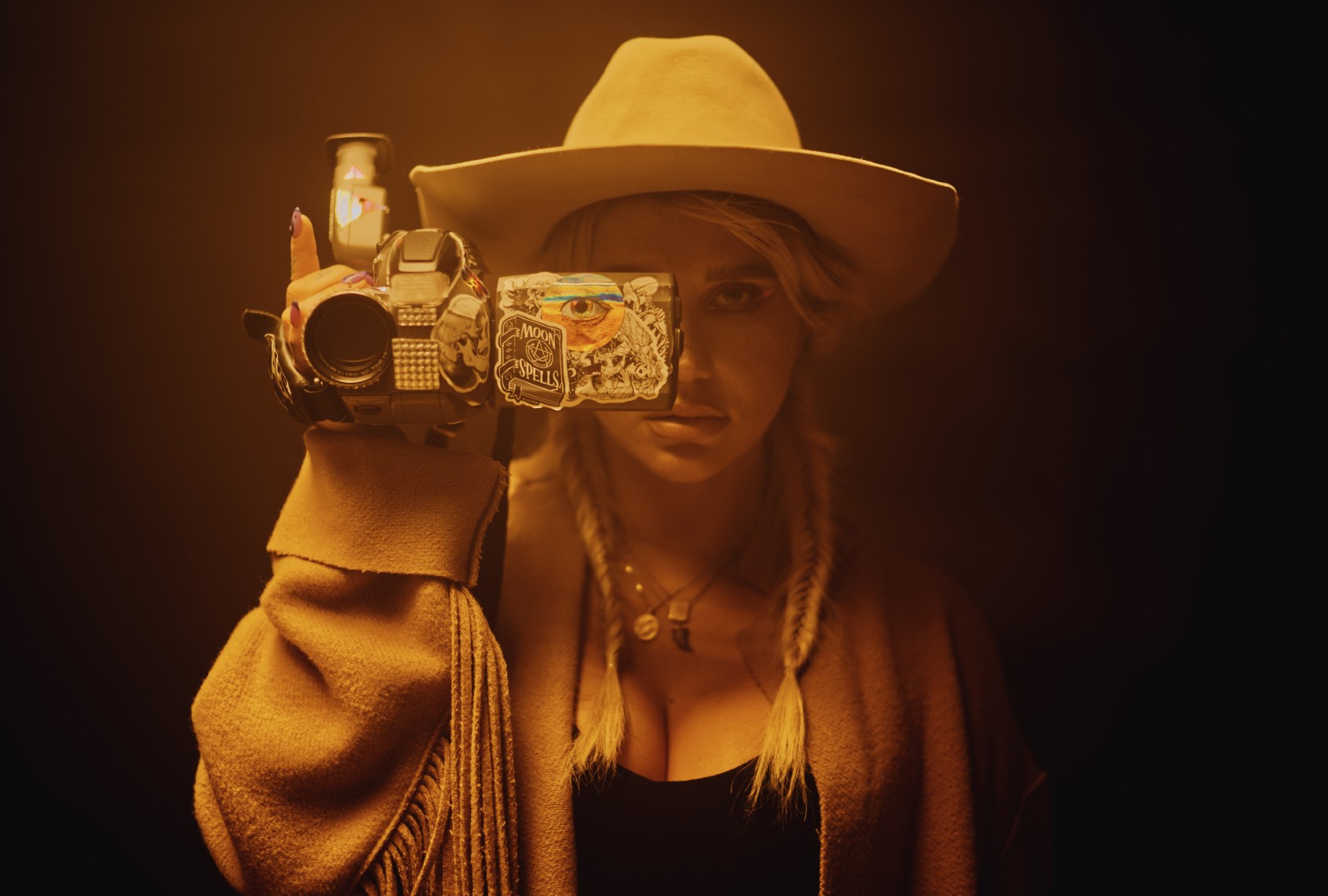
"I'm trying to not interact with demons tonight, in case anybody hasn't caught my drift," Kesha says, wearing a long fringe jacket and western hat, as one would while battling demonic forces in Tennessee.

Kesha in "Conjuring Kesha" (Discovery+)

While other popular paranormal investigation shows like Zak Bagans' "Ghost Adventures" and Nick Groff's "Paranormal Lockdown" unintentionally provide humor by taking the subject matter too seriously, desperately trying to squeeze out scares and moments of intensity, which comes off as Svengoolie pantomime; "Conjuring Kesha" works because the host and her guests take the frights as they come, rather than push for them, which feels more real. 

"To me, the supernatural comes naturally," Kesha says in a press release for the show. "It started with my insatiable curiosity, my eternal searching for something bigger than myself. This has motivated my art, informed my music and has given a purpose to my entire life. It's an eternal search for proof of God. But it's the adventures that I have with my friends that take these pilgrimages to the next level and make them a reality. I wanted to catch actual proof of the unexplainable. If we could catch these things on camera, then what else could be true?"

Watching Kesha and her friends explore haunted locations allows die-hard paranormal fans to get a look inside places that they wouldn't otherwise have access to, while also providing more scaredy-cat fans of the genre to join in on the fun in a more "glad it ain't me" sort of way. I personally have always been a fan of the paranormal, and have even visited a haunted location myself here and there, but am definitely way more content these days to sit back and hold Kesha's hat while she roams around with her flashlight in search of trapped spirits. Having recently gotten over COVID, I'm too busy searching my body for monkeypox on a daily basis to worry about demonic possession. A lot of fun to watch Kesha do it though!

Read more

about this topic

ABC’s Martin Fry on writing ’80s love songs as “an act of rebellion”

When considering iconic ’80s albums, the new wave cultural needle-movers include LPs such as the Human League‘s “Dare,” Duran Duran‘s “Rio” and Tears for Fears‘ “The Hurting.” However, ABC’s 1982 orchestrated studio album “The Lexicon of Love” easily ranks among these greats. Indebted to the glamour of Roxy Music, rhythm-heavy post-punk and sudsy symphonic pop, the album swoons with romance and heartbreak.

MTV rotation — and leader Martin Fry’s eye-popping suit jackets, like one in stunning gold lame — helped ABC’s cause. “The Lexicon of Love” spawned two Top 40 hits in the U.S. while topping the UK charts. The band would find even greater U.S. success later in the decade, with the sparkling pop single “Be Near Me” and Motown-influenced “When Smokey Sings.” 

“We would always experiment every time we got to make an album,” frontman and ABC leader Martin Fry tells Salon. “The band would evolve and radically alter, I suppose. We had an album called ‘How to Be a Zillionaire,’ and that was very electronic. We tried to portray ourselves as cartoon characters.” 

To celebrate “The Lexicon of Love” turning 40, ABC recently played shows in London and throughout the UK with a full orchestra, the Southbank Sinfonia, conducted by Anne Dudley. “She’s somebody I’ve worked with for many years, and she’s a brilliant conductor,” Fry says, while noting ABC’s current North American tour is a bit different. “It’s the band. We get up there and play the hits.”

The affable musician Zoomed in from a room full of bicycles with a Sex Pistols poster on the wall behind him. “This is the kind of room that started off as mine, but lots of other people live in this house. So, they’ve taken over,” he says dryly. “They just let me sit in this corner now by the bikes.” 

Fry discussed the differences between playing with an orchestra and a rock band, what he recalls about making “The Lexicon of Love,” the David Bowie advice ABC didn’t take, and the unexpected perk he received thanks to MTV. 

What are the biggest differences in presenting ABC’s music via an orchestra versus a band?

Well, with an orchestral show, there’s no room for error. Everything’s scored; the violinists have got their sheets, and even the guy with a little triangle at the back, he waits and he plays his triangle. It’s very structured. The hard thing to do there is to stay on the script. You can’t veer off for a couple of bars.

“What you’re trying to do is to do something totally original. So we set about writing songs that were very emotional, that were love songs … It was kind of an act of rebellion.”

But with the band, there’s a lot more freedom. And I have to say, as the years have rolled by, you learn the tricks of the trade. You learn how to set it on fire and how to cool it down again, on stage playing together. When you first start, it’s really exciting. But there’s still a great deal of excitement now because the musicianship improves in time, especially playing the songs over and over.

I play festivals. Sometimes you’ll play with a lot of other bands from the 1980s or when we started. But other times, if I play a festival, you’re playing with all sorts of different groups from different genres — young acts, old acts. And we’re sitting in there, and you have to win an audience over. It’s interesting playing to an audience that has no idea who you are. That’s where you kind of learn your chops, definitely. All of that’s going into the show.

Obviously, when we tour, it’s people who go, “Oh, I want to go and see ABC. I’ll come down and watch them.” In any audience, there’s a lot of people who’ve been dragged down by their boyfriends and their girlfriends — the mums and dads sometimes. And then you have to work that side of the audience too. Makes for a great show.

As a musician, that must be really interesting, because that keeps you on your toes. You can’t get complacent at all when you’re in a situation like that.

Many years ago with ABC, we opened up for Robbie Williams, who isn’t that popular in America, but he was very popular in the UK. This is maybe 20 years ago. And you used to look out into that audience. Sometimes it was like 60-70,000 people. It was kind of like fields of people. And you could work out where different sections of the audience were buzzing to certain things. The first couple of miles was people that had queued and waited. And then at the back there was other people, and then the side. You learn your stagecraft that way.

I’m happy you’re celebrating “The Lexicon of Love” turning 40. What are your most indelible memories of recording the album?

In Sheffield, where we were from, there were a lot of really experimental bands — bands like Cabaret Voltaire, early Human League. Def Leppard were playing. Very defined, very different bands.

And we realized what you’re trying to do is to do something totally original. So we set about writing songs that were very emotional, that were love songs, hate songs: “Poison Arrow,” “The Look of Love,” “All of My Heart.” Very different to the style of the predominant style of the bands in Sheffield. It was kind of an act of rebellion. You wanted to rebel.

We played small club dates. You’d play to an audience, maybe 200 people, but they were all in bands. That’s the toughest show you can ever play. They’re looking at you going, “Mm, yeah. I don’t like your shoes. Nice bass part, but his shoes aren’t right. You know what I mean?” [Laughs.] Kind of the most hypercritical audience you will ever play to in your whole career.

Anyway, “The Lexicon of Love,” memories of making it . . . Well, one beautiful thing happened when David Bowie came to the studio. We were working in the studio called Good Earth Studios. Tony Visconti owned it. He was Bowie’s producer. We’re doing the record with Trevor Horn, our producer, and we’re making the record, and Bowie came down. We were Bowie fans. It was terrifying and awe-inspiring at the same time.

Did he come in? Did he say anything?

“It was our first record, so all you want to do is sleep on the floor and get up and do the next day’s work. There’s nothing outside of the music.”

Yeah, he came in. He was interested, and he made a couple of suggestions. We were recording “The Look of Love.” There were two middle eights in it, because we never wanted a guitar solo in our records back then, and we didn’t want a sax solo. So he said, “You should have a section where Martin, the lead singer, kind of is putting messages on an answering machine and nobody’s replying.” It’s a great idea. We never pursued the idea, but that was a great memory of those sessions.

You know, every time you make a record, it’s different. We made most of it in a studio where they’d recorded Queen’s “Bohemian Rhapsody,” but it was a tiny, tiny studio underneath a wig shop on Brick Lane in the East End of London. Now that’s kind of a hipster place, a place you should go to if you ever come to London. It’s a really nice, cool place. But back then you took your life into your hands if you walked down the street outside. It was a rough old part of London.

It did mean that we just kind of stayed in the studio and worked, worked, worked. We were very focused. And it was our first record, so all you want to do is sleep on the floor and get up and do the next day’s work. There’s nothing outside of the music. Many, many good memories.

You only make your first record once, and there’s that excitement. 

The thing is though, everybody that goes into a studio . . . at the playback point, when you play it and go, you turn up those speakers play at high volume, everybody kind of has that moment where they think, “This could go to No. 1.” I love that idealism. I love that sort of dream that everybody has.

Doesn’t matter what the music is, everybody has that feeling. Which is what it’s all about, isn’t it? Of course, not everything gets to No. 1. But it’s kind of that sort of pursuit of your dreams, I suppose, when you make a record.

And you did! “The Lexicon of Love” went to No. 1 in the UK. That must have been so exciting, but also terrifying at the same time.

You gotta be careful what you dream of, what you wish for. I’ve never really thought about that, but yeah, it was kind of bizarre to go to No. 1.

Roxy Music were No. 1. I’d idolized them as a kid, and we were the No. 1 the following week. We edged them off the No. 1 spot. So, how does that work? But I mean, what you learn is somebody has to be there. I don’t know, really.

I did spend the whole of the 1980s thinking about whenever we had success, you were always thinking about the next thing. How do you follow it up? Say you get to No. 3 on the charts. You’re thinking, “Well, who’s No. 2, who’s No. 1?” That’s a terrible thing, if you think about it. And you’re encouraged to think that way by the labels. It’s nuts. And none of it really matters. It’s about the music.

And it’s true, because once you start getting that mindset and start thinking about that, then that’s when things can get a little askew. You should be focusing on the art, not that element of it, the other element.

Yeah. It’s good to step off that cavalcade and just get back to the ideas. The ideas and the kind of raw material and the art, the core of what you’re doing. Yeah, definitely.

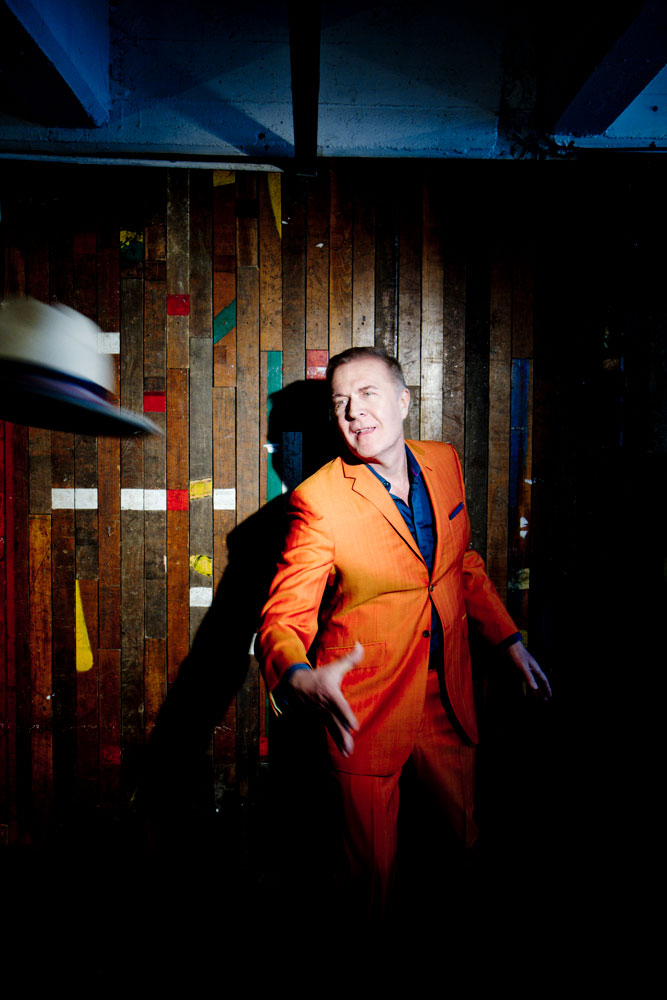
Martin Fry of ABCMartin Fry of ABC (Paradise Artists)

What was it like working with Trevor Horn? What did he bring the proceedings, and what did you learn from him?

“When you’re there, you should never compromise while you’re recording. If you want a clarinet player on your record, bring in a clarinet player. Don’t wait 30 years to learn to play the clarinet.” – Trevor Horn

Trevor Horn, he’d made Buggles’ “Video Killed the Radio Star,” but he’d made a record with Dollar we’d heard on the radio we thought was incredible. Incredible sound.

We approached him, and he seemed to understand innately what we were talking about. Because we were an arrogant young band. We were going to change the world of music. We’d sit in bars and restaurants and cafes telling the people, “This is how it was going to be.”

But of course, that is just a wish fulfillment. You throw your manifesto down. I think that’s the great thing about being in a band. I think you’ve got to have that crazy attitude, definitely. Trevor seemed to understand. He had a lot more experience than us, obviously, because he was starting to produce other acts, new acts outside of his own songs.

He did say to me – and he’s right because 40 years on, we’re talking about this record – but he said, “When you’re there, you should never compromise while you’re recording. If you want a clarinet player on your record, bring in a clarinet player. Don’t wait 30 years to learn to play the clarinet. Do everything in your power to make your record as complete as you possibly can, in whatever form of music.” He was very astute. He was great to work with, funny, great sense of humor.

That’s really good life advice, too, honestly. “Don’t wait. Do it now.”

But yeah, it was good. It was really good chemistry amongst the band, amongst Trevor, his whole team. It was great. 

Forty years later, do you think that you achieved what you wanted to achieve with the record?

In a rapid space of time with the success of the debut album, we achieved a lot of things that bands would take 10 years to achieve. It was kind of like living high density — so 15 seconds was like 15 minutes. It was like kind of bang. It took a while to kind of work out what to do next.

But subsequently, it was great to kind of move through the ’80s and experiment and make a lot of different records. To answer your question, yeah. Well, you know, you never have a list of things you want to achieve and think, oh, “Tick, tick, tick.” No. And at the time I remember saying to Trevor Horn, “Oh, I think we need some extra songs to go on this record.”

But as soon as something becomes public, the public decides whether or not they like it or not. They say, “Oh, that’s a classic album.” Well, I’ve got nothing to do with that. Do you know what I mean? I was just there at the beginning. It’s not my ego that makes it. It’s the public decides if they want to listen to something 40 years later, don’t they? You know what I mean? Because a lot of great music has come out from that 40 years, incredible music.


Want a daily wrap-up of all the news and commentary Salon has to offer? Subscribe to our morning newsletter, Crash Course.


MTV played ABC a lot early on. What was your sense of how the channel was helping the band in America at the time?

In Britain, in London, it was fiercely competitive, so every band would have its own video clip. If you look back and think about the groups that were existing then — the Eurythmics, Culture Club, Duran Duran, Spandau Ballet, Depeche Mode, Dexys Midnight Runners, Human League, ABC — they all had a very defined sort of look. And Soft Cell. It was a very influential time.

MTV was hungry for some quite creative clips. They didn’t really want to play the standard sort of rock ‘n’ roll stuff. They were very into the experimental clips. And a lot of the bands that came out of Britain were on that edge, I suppose. 

I never really thought about it, but there was one time I was in New York and I went in to buy a burger, and the guy says, “No, you don’t have to pay for it. Mr. Fry, you’re getting a free burger.” And I kind of thought, “Well, this is New York,” because he got MTV on somewhere in the background. He knew who I was. That was fame. 

Do you find that ABC is resonating with other generations? Because there are so many bands that started in the ’80s that do have these fan bases. What is sense?

The 1980s was a lot of things. In Britain, it was like Duran Duran and the whole New Romantic thing. And then it turned to dance rave culture. That had kind of burned out by the time the ’90s had arrived, whereas EDM kind of took off later, and grunge took off later in America. Things were moving at a different sort of pace, I guess.

But it’s funny because for a long time, I remember people would go, “Ah, it’s just synthesizers. It was a very inauthentic period.” But then there was a moment where it was like people aren’t saying, “Oh, what, you’re still here?” They’re saying, “Oh, you’re a bit of a legend, mate.” A younger audience seem to get into the flamboyance and the dayglow of the 1980s.

And now when I kind of listen to [Lady] Gaga and The Weeknd, I can see a lot of contemporary acts, musicians and artists, who’ve definitely gone to the school of 1980s to check it all out, definitely. As a piece of their influence, basically. It’s funny how it’s evolved. And now it’s revered in a funny kind of way. The interest in the 1980s has lasted much longer than 10 years, much longer than the decade itself. [Laughs.] So that’s good. 

I kind of think that it was televised. It was filmed. The ’70s, some of it was filmed, but all those clips we just talked about, they’re the archeological evidence of the 1980s pop scene. If you want to know about Pat Benatar or B-52s, you go check ’em out. You can see them on YouTube.

Read more

about this topic

How 19th-century literature spread the archetype of the “evil abortionist”

After the U.S. Supreme Court overturned Roe v. Wade, one aspect of the abortion debate stayed the same: lurid sensationalism.

GOP firebrand Rep. Marjorie Taylor Greene extolled the court for outlawing “mass genocide,” though anti-abortion activists nonetheless warn of Planned Parenthood already organizing an “illegal abortion enterprise.”

On one side are allusions to dead babies. On the other, dead mothers, dystopian images of state-regulated bodies, and the terrifying loss of power and control.

In my book about the literature of abortion, I trace this rhetoric to the 19th century, when popular media described female physicians as villainous, untrained abortionists who committed infanticide. It was an easy way for publishers of dime novels and tabloid newspapers to make a quick buck. Yet it seems that the discourse connecting abortion to murder and evil really hasn’t changed much since then.

“Murderesses” and “she-devils”

Women in the U.S. were barred from medical schools and the professional practice of medicine until the end of the 19th century, despite the fact that women had been practicing family medicine and gynecology as healers and midwives for centuries. Many women continued to practice without formal training in the 19th century by giving themselves the title of “woman physician.” The most notorious of these advertised abortive medicines and procedures in popular newspapers.

Largely because these women placed advertisements in cheap papers, the woman physician became associated with the idea of the smarmy, greedy and untrained abortionist. As archivist Martha R. Clevenger explains, in the 19th century, “the term ‘female physician’ was a derogatory epithet used to describe untrained female abortionists.” Historian Regina Morantz-Sanchez also notes that “by far” the most common accusation made against female physicians was that they performed illegal abortions for profit.

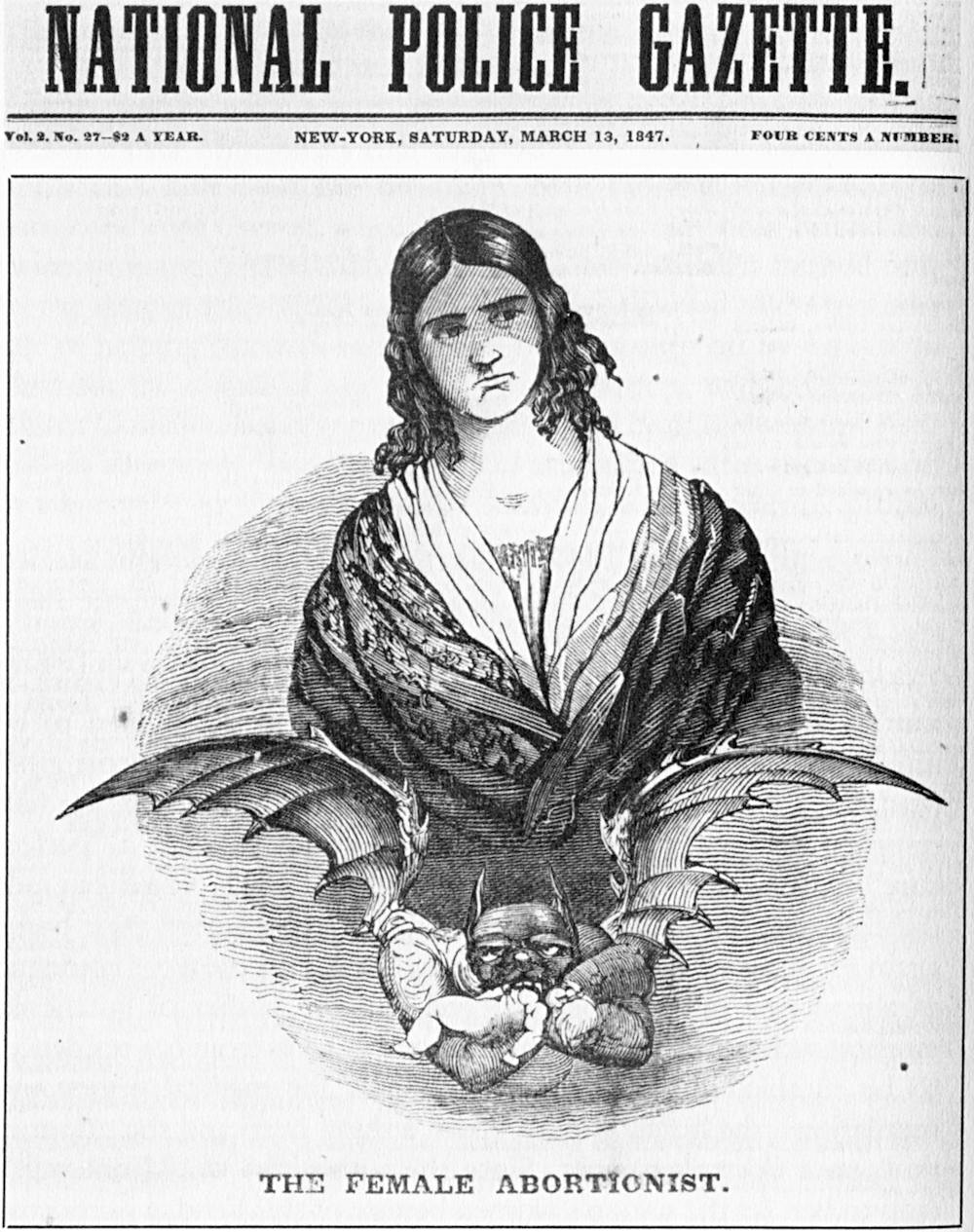
Woman looming over a winged demon eating a baby.

A drawing of abortionist Ann Lohman – also known as Madame Restell – in an 1847 edition of the National Police Gazette. Wikimedia Commons

Infamous 19th-century women with no official training who performed abortions like Madame Restell made national headlines because of unfounded accusations of infanticide, selling babies and killing women.

These headlines then became fodder for plots in popular dime novel fiction, further linking the image of an abortionist with a melodramatically drawn picture of “an atrocious woman.”

Because she was so sensationalized in the popular press, Restell became the figure on which fictional accounts of female abortionists were based.

For example, in his 1854 novel “New York: Its Upper Ten and Lower Million,” the popular 19th-century novelist and social reformer George Lippard creates a female abortionist character named Madame Resimer, who helps in a plot to murder an innocent woman.

Other 19th-century abortionist characters proliferated, variously characterized as “murderess,” “hag,” “she-devil” and “the instrument of the very vilest crime known in the annals of hell.”

Abortion as infanticide

Perhaps the most insidious link these sensational novels and press reports made was the one between abortion and infanticide.

Andrew Jackson Davis’ 1869 novel “Tale of a Physician,” for example, tells the story of an evil female physician abortionist named Madame La Stelle, who gives her “entire attention to obstetrical cases and infanticides.”

In a mid-19th-century novel by an anonymous author, the ironically named “Mother Higgins” is an untrained abortionist hired by wealthy men with pregnant mistresses to perform surgical abortions. She also commits infanticide after the children are born, and she helps the protagonist kidnap, rape and kill adult women.

Narratives like these exposed readers to the idea that if reproductive agency goes unregulated, greedy abortionists would even go so far as to callously murder newborns.

Today, greed is still commonly ascribed to abortion providers like Planned Parenthood. You’ll see anti-abortion activists like the Family Policy Alliance’s Stephanie Curry incorrectly claiming that Planned Parenthood has a long history of maliciously “exterminating” Black babies in America for profit.

Innocence shattered

While these sensational tales depict the abortionist as swarthy and ugly, the women they harm reflect 19th-century Anglo-American feminine ideals.

The pregnant women had usually been tricked into affairs by sex-obsessed men, who then forced them to go to a place like Mother Higgins’ lair. Sometimes these characters are killed by an abortionist – which is exactly what happens in a novel written by one of the 19th century’s most popular sensationalist writers, Ned Buntline.

Buntline fictionalized the true story of Mary Rogers, a noted beauty and “respectable” girl from Connecticut found dead near the Hudson River in 1841. She was rumored to be the victim of a botched abortion by an unnamed abortionist whom Buntline calls a “she-devil.”

American terror

Literature has a very long history of turning powerful women into monsters. Witches, sirens, shrews and masqueraders all depict female power as supernaturally given or surreptitiously used.

By the time abortion became illegal in every state in the late 19th century, the United States was embroiled in fears that women, including nonwhite women, would gain power and control through access to voting and jobs.

Female physicians embodied all of these terrors.

And so debates over abortion law in America have never been contained to disputes over medical procedures or questions of federal versus states’ rights. Instead, for over two centuries, narratives about abortion have been stitched to American anxieties concerning gender, class, race and religion.

Whether it is the drawing of Madame Restell with a devil eating a baby or the baseless accusations that Planned Parenthood abetted the sex trafficking of young girls, media and activists have long linked abortion to horrific imagery.

Sensationalism, it seems, is ingrained in any conversation about abortion because the issue can reflect the country’s deepest fears.

Can any animal recognize its reflection? New studies shake up old ideas

In 2021, Bunny, a TikTok-famous Sheepadoodle, stared at herself in a mirror and asked “who is this?” by tapping her paws on her augmentative and alternative communication (AAC) device’s buttons. The much-viewed video of her pondering herself in a mirror prompted jokes that she was having an existential crisis. Although it is unclear if Bunny was actually aware of her own identity in the mirror, the incident raises questions about animals’ self-awareness — and whether dogs can pass the “mirror test,” considered a defining test of animal intelligence that distinguishes some creatures’ cognitive abilities from others.

For the unfamiliar, the mirror test is used to determine whether an animal has the ability of visual self-recognition, which is considered a marker of intelligence in animals. Scientific evidence has previously suggested that dogs do not recognize themselves in the mirror, at least as far as previous mirror test experiments on canines found.

The test, which was developed by psychologist Gordon Gallup in 1970, involves placing a visual marker on an animal’s body. Scientists then observe what happens when the animal is placed in front of the mirror, watching the animal’s reaction both to their reflection with and without the visual marker on its body. If an animal passes the mirror test, they will usually adjust their body position in a way so they can get a better look at the marker on their body and pay more attention to that part of their body.

RELATED: Bunny the “talking” dog is reporting her dreams

“The mirror test is designed to provide information on whether it’s possible for an animal to recognize itself in the mirror,” Leo Trottier, cognitive scientist and founder of How.TheyCanTalk Research and developer of the FluentPet system Bunny uses, told Salon via email. “Intrinsic to how it works is that the animal needs to be ‘naive’ (needs to have no preparation that might in appropriately skew the result).”

Trottier added for this reason, the visual marker is usually added to the animal when they are unconscious.

“When the animal is again shown the mirror, the animal passes the test if they touch themselves at the location of the mark when they’re able to see that they’ve been marked in the mirror,” Trottier explained.

Currently, there are eight non-human species of animals that can innately pass the mirror test: chimpanzees, bonobos, gorillas, orangutans, bottlenose dolphins, Asian elephants, cleaner wrasse, and magpies. But is it possible that any animal can learn to pass the mirror test, as Bunny (possibly) seems to be inching towards doing? To answer that requires delving into bigger questions about how these experiments are conducted.

“‘You only need one talking pig,’ as the line goes — but does this also mean you only need one cat who recognizes themselves in the mirror?” Trottier said. “I’m not claiming that’s what’s going on here … but it really is quite compelling.”

“One big issue that confronts questions like these is that there are different and somewhat competing paradigms in how science is performed,” Trottier said. “In the conventional paradigm, the interest primarily lies in finding averages: people complete crossword puzzles in X seconds when drinking water, and Y seconds when drinking coffee.”


Want more health and science stories in your inbox? Subscribe to Salon’s weekly newsletter The Vulgar Scientist.


In this paradigm, Trottier said, exceptions don’t equate definitive answers. The problem lies partly in the fact that it is hard to use inductive reasoning to typify the behavior of all animals of a given species when you only test a sample.

“In the same vein, if we do the mirror test with 10 cats, and find that none of them pass it, then we conclude that ‘cats cannot pass the mirror test,'” Trottier continued. “There is an entirely other paradigm, though, which is interested in the exceptions.”

Trottier pointed to a YouTube video of a cat who appeared to recognize herself in the mirror.

“‘You only need one talking pig,’ as the line goes — but does this also mean you only need one cat who recognizes themselves in the mirror?” Trottier said. “I’m not claiming that’s what’s going on here … but it really is quite compelling.”

“While the mirror test may tell us something about the capacity for self-awareness in animals that pass it, it doesn’t mean that those animals that fail the mirror test don’t have self-awareness,” Plotnik said.

In 2018, questions swirled over which animals can pass the mirror test when a study published in PLOS Biology suggested that some fish have the capacity to pass the mirror test. While the study was criticized and deemed “controversial” by some, researchers ultimately concluded that the cleaner wrasse, a 10 centimeter-long fish that lives in reefs and lives up to 4 years, could pass the mirror test.

Joshua Plotnik, an assistant professor of psychology at Hunter College in New York, told Salon via email that when thinking about which animals can pass the mirror test, it is crucial to consider context of evolution.

“The mirror test is an experimental task used to investigate an animal’s capacity for self-recognition, and has only been used experimentally for [around] 50 years,” Plotnik said. “Evolution works far slower, so when we investigate the evolution of cognition, we usually do it by comparing related species that diverged millions of years ago.”

But more importantly, Plotnik questions if the mirror test is the best indicator of self-recognition and self-awareness.

“While the mirror test may tell us something about the capacity for self-awareness in animals that pass it, it doesn’t mean that those animals that fail the mirror test don’t have self-awareness,” Plotnik said. “Because the mirror test requires an animal to pay careful attention to the reflection of their own bodies, it may not be a good test for animals that don’t use vision as a primary sensory modality or that are not necessarily concerned about inspecting their bodies up-close.”

Plotnik added that different animals likely possess “different levels of self-awareness due to evolutionary processes.”

“And not all of these types of self-awareness are measurable with a mirror,” Plotnik said. “The mirror test is simply a tool we use to investigate one type of capacity for self-recognition / self-awareness.”

So, does that mean more animal species can pass the mirror test than we think?

“I’m not sure there are many more species that will pass the mirror test, but I don’t think that really matters,” Plotnik said. “The mirror test is just one tool we use in animal cognition to understand the animal’s perspective or understanding of self.”

Plotnik emphasized that scientists need to develop more tools to investigate self-awareness in animals.

Especially those tools that might allow us to better understand this capacity in less visual species,” Plotnik said.

Read more animal cognition stories: 

Trump ridiculed for Sarah Palin alliance

According to a report from the Guardian, Donald Trump is headed up to Alaska this weekend where he will headline a fundraiser for former half-term Gov. Sarah Palin (R) to boost her run for an open House seat.

As the Guardian’s David Smith wrote, it is extraordinary that the former president is traveling such a long distance for a GOP nominee he has endorsed, but there are indications that each has a need for each other as they try and re-launch their politcial careers.

As the report notes, Trump needs a guaranteed win in the midterm elections — which Palin could provide in conservative Alaska — to bolster his credibility as a kingmaker, and the former Alaska governor is trying to raise her national profile once again after being shunted off into the political wilderness.

According to Brown University political scientist Wendy Schiller, a Palin win would thrust her into the spotlight to the detriment of other far-right lawmakers.

“She’ll become literally the queen bee of the radical-right women in the party and she’ll get all the media attention. That’s not going to sit very well with people like [extremist congresswoman] Lauren Boebert,” Schiller explained.

According to the report, “Trump will also use the Alaska rally to throw his weight behind Kelly Tshibaka, a Republican challenger to the incumbent senator Lisa Murkowski, who voted to convict the former president at his second impeachment trial following the January 6 insurrection. But there is little doubt that Palin will grab the headlines,” before adding the former GOP campaign consultant Steve Schmidt — who plucked Palin from out of obscurity to be the late Sen. John McCains running mate in his presidential bid — is less than impressed with the partnership between the two headline-hogging former office holders.

Telling Smith, “It’s a rather tedious affair at this point,” he added, “The fulminations of two deranged people are newsworthy only in the sense that there’s an open question around whether citizens of a democratic republic are potentially apathetic enough to allow such people a return to political power when their previous associations with it ended in such profound disgrace.”

Cacophony of dunces: When the Supreme Court trashed the Constitution

Watching Justice Samuel Alito go spelunking in his Dobbs opinion through centuries of so-called history and tradition in search of legal justifications to overturn the right to abortion decided almost 50 years ago in Roe v. Wade was like watching a boy play in a pile of dirt. Where do I dig next, he seemed to be muttering to himself as he shoveled manure from a slave-era law in Virginia onto an 18th-century pile of garbage he quoted from some doofus who believed women were inferior beings. Clarence Thomas was right there behind him in his decision that New York can’t prevent people from carrying concealed weapons, plowing through statutes from jolly old England and the American frontier to show that Dodge City didn’t really mean it when they told cowboys they had to check their six-guns with the sheriff if they came into town. 

And then along came Chief Justice Roberts as clean-up man, swinging the club of something known as the “major questions doctrine” to deny the Environmental Protection Agency its statutory authority to — duh — protect the environment unless Congress spells out exactly how they should do it. According to Roberts, it is Congress, not the EPA, that has to write a rule telling corporations they can’t empty industrial waste directly into creeks, rivers or the ocean because it’s a “major question” if it costs corporations a lot of money, so let’s make it as hard as possible for the government to take a chunk out of our golf buddies’ bottom lines.

RELATED: Supreme Court’s legal terrorism: Appealing to “tradition” on abortion is obscene

Throughout the entire year of decisions by a court that for the first time included all three of the Supreme Court’s newest and most conservative members, the Republican majority decided to jettison the doctrine of stare decisis, which means to stand by things decided, and employ their own doctrine on how precedents should be treated: Stare quisquilias acervum or “stand by the trash heap,” where they proceeded to throw the court’s previous decisions and entire articles of the Constitution.

Throughout this entire year of decisions, the right-wing justices have thrown the court’s previous decisions and entire articles of the Constitution in the trash.

All of this in service to their favorite doctrine of all — rights granted by the Constitution must be “deeply rooted in the nation’s history and tradition” or they aren’t really rights at all. Legal scholars have been predicting that the court will use its new jewel of a doctrine to overturn Obergefell v. Hodges, not to mention other recent decisions recognizing rights under the privacy provision of the equal protection clause of the 14th Amendment … because we have no “history and tradition” of same-sex marriage or gay sex or rubbers or the pill, or anything else they simply don’t like.

To justify its abandonment of the court’s “history and tradition” of respecting and upholding its previous decisions, the Supreme Court called upon a favorite from an era they apparently revere, states’ rights. Speaking for the court’s conservative majority, Alito decided to “return” abortion to the control of the states, several of which promptly made performing abortions illegal and effectively established new rules — or re-established old ones — which dictated that women must carry to term babies resulting from rape or incest, and then give birth to them, relying, it would seem, on our deeply rooted history and tradition of slavery.

What can be done about the court’s prejudice masquerading as reason? Doesn’t the wrongheadedness of the “history and tradition” of the way women were treated at the time the 14th Amendment was written tell us something about all the anti-abortion laws of the past Alito quoted in the world’s longest footnote? Women weren’t allowed to vote, to sit on juries, to own property separate from husbands or male members of their families, and in some states they did not have the right to sign contracts. Oh, by the way, they weren’t allowed to have abortions, either.


Want a daily wrap-up of all the news and commentary Salon has to offer? Subscribe to our morning newsletter, Crash Course.


It took decades of fighting for women’s rights for us to get rid of some forms of prejudice against women. But “history and tradition” demands we go back to banning abortions, according to Alito.

Alito’s decision features a gigantic hole not even the dissenters pointed out: To have “history and tradition,” it has to start somewhere. Precedents become part of history only after they make history. If the court is going to require that all our rights must be grounded in history and tradition, that’s exactly what Obergefell and the other privacy rights decisions do. They establish a baseline of history that can be depended upon in the future rather than reaching back to 1868 in search of one.

I say if they’re not going to respect their own decisions, then neither should we, and neither should lower court federal judges and state judges and legislatures.  

Alito’s decision has a giant hole: “History and tradition” have to start somewhere. Precedents become part of history after they make history.

Legal scholars use the term “vertical stare decisis” to describe the principle that lower courts should follow and respect the decisions of the Supreme Court. But the law is not something handed down from a higher power or engraved on a tablet with a hammer and chisel. It is a living thing, and it has to breathe and move and eat and expel waste in order to stay alive, and some of the waste that must be expelled can be found in the court’s most recent decisions.

I’ll tell you how I know this.

When my friend and classmate David Vaught was going to NYU Law School in the early 1970s, I used to pick him up late at night from the law library, and we would drive home together in his old pickup truck to the barge where we were living on the Hudson River. One night as we passed through the Lincoln Tunnel on our way to where the dock where the barge was tied up in West New York, New Jersey, David almost exploded with happiness over a discovery he had made. 

He had been given a typical first-year law question to answer, and the way NYU taught its students to solve problems was to trace them to their source. He was being taught that laws came not only from legislatures but, over decades, from court cases and the decisions of judges. The lesson was that legal questions such as who is liable for damages in various situations are never resolved once and for all — the solutions change and even mutate over the years as lawyers argue cases and judges make decisions and new laws are born. 

“You can almost hear them arguing amongst themselves, like doctors over a patient,” he explained to me. “In one case, a judge will say, well, I think it’s the liver, so I’m going to fix it by administering this correction. And then, 10 years later, another judge will come along and say, no, it was the spleen, and it can’t be repaired. We must take it out.” My friend explained that the cases flow like blood through a body’s circulatory system. “The arguments are its nervous system. The courts are the place where the law learns. Judges’ decisions are its brain, its memories. Because the law is manmade, it has a human form, and it gets sick and can be made well. The law is happy and sad and stupid and smart just like we are. It’s alive.”

He was right. We are being forced to listen to a cacophony of dunces arguing over our Constitution right now. The New York Times last Sunday published an op-ed called “Is the Right to Same-Sex Marriage Next?

No. We are louder than they are, and we have all of our minds and ideas and votes in the songbook from which democracy sings. 

Read more on the Supreme Court’s historic recent term:

A post-‘Roe’ world in Georgia will mean more restrictions — and more political battles

ATLANTA — Jerisha Morton didn’t realize she was pregnant until about six weeks into her pregnancy. She soon started feeling waves of intense nausea.

“I can’t smell anything. You’re so weak that you have to lay down all the time. It’s rough,” Morton, 27, said recently as she sat in a Planned Parenthood clinic in Atlanta.

Morton was diagnosed with hyperemesis gravidarum, or severe nausea during pregnancy. She thought she couldn’t handle nine months of being sick, she said, so she chose to have an abortion.

At the clinic, as she picked up the pills for her medication abortion, Morton estimated she was eight weeks into her pregnancy. A Georgia law currently on hold — but likely to take effect soon — outlaws the procedure at about six weeks, with few exceptions.

“It’s making people not have a choice. It’s taking their choice away before they even find out,” Morton said.

Women in Georgia, like those in many other parts of the country, could soon have less access to abortion now that the U.S. Supreme Court has released its decision in Dobbs v. Jackson Women’s Health Organization. Like the draft ruling leaked in May, it strikes down the abortion protections laid out in the landmark 1973 Roe v. Wade case and gives states the authority to regulate the procedure.

Patients and providers will have to figure out how to navigate the new legal landscape. Changes to the laws in Georgia will be felt across the region, because the state has served as a destination for people seeking an abortion.

In 2019, more abortions were performed for out-of-state residents in Georgia than in any other Southern state — and in nearly every other state in the country, according to data from the Centers for Disease Control and Prevention. That year, 6,500 abortions performed in Georgia were obtained by people who didn’t live there.

Abortion access is already a campaign issue in Georgia. And it’s one of many states where the Dobbs decision will set in motion a cascade of legal and legislative action restricting abortion access, said Elizabeth Nash, a policy analyst with the Guttmacher Institute, a research organization that supports abortion rights.

The state’s conservative political leadership has made abortion a target. In 2019, Georgia legislators passed a bill that bans most abortions after embryonic or fetal cardiac activity can be detected in the womb, which can be as early as six weeks into a pregnancy. The law also includes so-called “personhood” language, which gives embryos legal status when cardiac activity can be detected. That language could have broad implications, Nash said, and could affect every part of Georgia’s legal code about a person’s rights.

“We don’t know how far states will go, but it’s clear that they’re not stopping with abortion,” said Nash.

A legal challenge has kept the law from taking effect. Late last year, a federal appeals court paused its review of the case while it waited for a ruling in Dobbs.

Some states have established protections for abortion rights. But, according to a Guttmacher analysis, in several states, such as Kentucky, abortion will be outlawed immediately, with few exceptions, as so-called trigger bans take effect. These measures, passed in advance of the Dobbs decision, severely limit access to abortion if Roe no longer applies. In other states, such as Tennessee, such bans will take effect after 30 days.

“A big problem is that patients may see a decision has been issued by the Supreme Court and automatically assume that abortion is banned,” said Nash.

Even though people seeking abortions may still have access, she said, they will likely have a hard time understanding what laws are in place. That could limit the number of procedures performed.

The decision could also motivate abortion opponents, Nash said, who plan to seek even further restrictions on the procedure and other kinds of reproductive care.

Abortion will come up in many races for statewide and local office, said Andra Gillespie, an associate professor of political science at Emory University.

Democrats are using the issue to mobilize their base voters, Gillespie said, to try to counteract some of the headwinds they face in the midterm elections, when the party in control of the White House generally experiences losses. Republicans, she said, may have to find new causes to motivate single-issue anti-abortion voters now that Roe has been overturned.

Georgia’s shifting politics and demographics raise questions about what voters will want abortion policy to look like.

A majority of Georgia voters support access to abortion, according to a January 2022 poll from the Atlanta Journal-Constitution and the University of Georgia’s School of Public and International Affairs. Roughly two-thirds of respondents said they did not want to see the U.S. Supreme Court overturn the abortion protections laid out in Roe.

Democratic gubernatorial candidate Stacey Abrams has said she plans to make abortion a leading issue in her campaign. Shortly after the Dobbs draft opinion was leaked, she asked potential donors to give money to reproductive rights groups, instead of her campaign. In a video posted to Twitter on Friday, Abrams said she was “appalled” by the Dobbs ruling. “As Georgia’s governor, I will work every day to ensure access to affordable and safe health care for all, including access to abortion,” she said.

Her opponent, incumbent Republican Brian Kemp, has continued to voice his support for Georgia’s current abortion law. In a statement on Twitter, he called Friday’s decision in Dobbs “a historic victory for life” and said he looks forward to its impact on the legal proceedings surrounding Georgia’s six-week ban. Passing the law was one of Kemp’s first legislative priorities after he took office in 2019.

With a ruling in Dobbs, the law could be in place within weeks or months, said Ron Carlson, an emeritus professor at the University of Georgia School of Law. The federal appeals court reviewing the measure could allow the law to take effect or send the case back to a lower court that would likely make the same decision, he said. “As legal time goes, it will be relatively short,” he said. “They’ll move in a fairly prompt manner.”

The Feminist Women’s Health Center, a clinic in Atlanta, wants to take advantage of what little time it may have to provide abortions, said executive director Kwajelyn Jackson.

Jackson said she has been in conversation with other clinics across the South in hopes of taking on their patients. “One reality that we are trying to prepare for is how we might be able to realistically and thoughtfully absorb some of the need from neighboring states,” Jackson said. Her clinic already serves patients from rural parts of Georgia, Jackson said, as well as those from Texas, Mississippi, Alabama, and Tennessee.

Distance is only one factor that influences where patients decide to seek care, said Lauren Frazier with Planned Parenthood Southeast, which runs clinics in Alabama, Georgia, and Mississippi. Price, appointment availability, and social networks also play roles, she said. “For folks who may have family support systems somewhere in New York or California, it will make more sense for them to go where they have the level of support that they need,” Frazier said.

Meanwhile, some anti-abortion activists see the decision as a chance to make accessing abortion harder for people in Georgia. “Our work really is just going to start,” said Zemmie Fleck, executive director of Georgia Right to Life.

Georgia’s abortion law doesn’t go far enough, Fleck said, because her group opposes abortion at any point, with no exceptions. She said she would like to see the “personhood” language in the law enshrined in the state constitution, effectively outlawing abortion.

Mike Griffin, a public affairs representative with the Georgia Baptist Mission Board, said his group, an organization of Baptist churches in the state, wants to restrict the distribution of abortion medication and require in-person consultations for people considering abortion.

Doctors, meanwhile, continue to weigh what care they’ll be able to give patients.

Dr. Joy Baker, an OB-GYN in LaGrange, Georgia, expressed concerns about the decision limiting the scope of her practice and ultimately cutting off more people from care — especially if doctors start to face legal consequences.

Baker pointed to the dozens of counties in Georgia that don’t have OB-GYNs, mirroring a national shortage.

“If they just decide to lock us all up, who’s going to take care of the patients?” Baker asked.

KHN (Kaiser Health News) is a national newsroom that produces in-depth journalism about health issues. Together with Policy Analysis and Polling, KHN is one of the three major operating programs at KFF (Kaiser Family Foundation). KFF is an endowed nonprofit organization providing information on health issues to the nation.

Subscribe to KHN’s free Morning Briefing.

The right’s enemies list: “Woke heat maps” target and track progressives for crack down

A right-wing group in Missouri has launched a “woke heat map” documenting instances of “wokeness” in an attempt to fight back against “critical race theory” and alleged “grooming” in schools across the state. 

The group, dubbed “Liberty Alliance,” says it is “committed to fighting back against the Woke agenda that is permeating all across Missouri.”

“The first step in fighting back is uncovering their crazy ideas – from Critical Race Theory to grooming toddlers with sexually explicit books,” the organization states on its website. “That is why we have officially launched the Woke Heat Map – an interactive tool designed to expose the insane actions of the radical Left. This map will alert Missourians of craziness happening in their own communities.”

As of this writing, the group has cataloged twelve individual instances of wokeness. One of the map’s “hotspots” links to an article about a pro-life display at Saint Louis University that was reportedly vandalized. Another directs users to a tweet by U.S. Senate candidate Eric Schmitt, who expressed concern over a school district in Arnold using a diagram of a “Genderbread Person” to break down the differences between gender identity, gender expression, biological sex, sexual attraction, and romantic attraction.

RELATED: Co-opting the message: How anti-trans activists hijacked a tool meant to help trans people

Liberty Alliance’s map isn’t the first of its kind. Over the years, numerous right-wing groups have created rankings, watchlists, and cluster maps to keep track of the left’s alleged influence in healthcare and education as well as Corporate America.


Want a daily wrap-up of all the news and commentary Salon has to offer? Subscribe to our morning newsletter, Crash Course.


Last October, Salon reported on a custom Google map created by trans activist Erin Reed that provides those seeking hormone replacement therapy with the names and locations of nearly 800 informed consent clinics throughout the country. By February of that year, Reed told Salon, her map was repurposed by anti-trans activist Alix Aharon as a resource for organizing protests against doctors who provide gender-affirming care. That new map, called “The Gender Mapper,” was quickly taken down over apparent copyright infringement. However, a new one has since appeared in its place, cataloging roughly 200 clinics in total. 

On its website, The Gender Mapper accuses “Big Gender” of testing “experimental medication” on “confused and vulnerable children.”

“GenderMapper volunteers work in secret, around the world to collate evidence and document what is occurring,” the site adds. “Gendermapper volunteers are unsung [sic] heros- and data is our truth.”

RELATED: What makes some people hold transphobic views?

Right-wing groups have also sought to crack down on left-wing “indoctrination” on college campuses. 

Notable among them is Turning Point USA, a conservative youth advocacy group, which runs a “Professor Watchlist” designed to keep right-wing students abreast of “college professors who discriminate against conservative students and advance leftist propaganda in the classroom.”

“The project,” its website says, “is comprised of published news stories detailing instances of bias, propaganda, or speech infringement on college campuses.”

The site allows users to submit tips and search for professors by name or university. Some professors on the list include activist Angela Davis, linguist Noam Chomsky, author Ibram X. Kendi, and former FBI Director James Comey. As of 2016, there were roughly 200 academics on the list. 

In the private sector, conservative are similarly hounding companies that engage in “woke” actions, arguing that Corporate America is prioritizing political correctness over profit.

RELATED: Republicans go after “woke” corporations — but want to keep massive corporate tax cut 

Alliance Defending Freedom has its “Viewpoint Diversity Score,” a 50-company index that “evaluates corporate policies, practices, and activities to determine whether companies respect their stakeholders’ freedom of expression and freedom of religion or belief as a standard part of doing business.” The list specifically breaks down each company’s support of free speech in the market, the workplace, and the public square, analyzing everything from political giving to DE&I (Diversity, Equity, and Inclusion) policies.  

On the index, companies like Facebook and Meta – which face baseless accusations of anti-conservative bias – have notably lower scores than most. None of the firms included on the list score higher than a 35 out of 100.   

“The results of our inaugural Business Index reveal that there is much work to be done. Company scores ranged between 2% and 35%, with the average overall score an abysmal 12%,” wrote Jeremy Tedesco, senior vice president of corporate engagement for ADF, in The Wall Street Journal. “The poor showing confirms that there is an alarming trend among major corporations to favor virtue-signaling even at the expense of fundamental American freedoms.”

Corporations have no legal obligation to promote free speech, a constitutional right designed to protect Americans from governorship censorship and coercion.

“Let him eat cake”: AOC responds to Kavanaugh’s run-in with protesters while dining out

Democratic Rep. Alexandria Ocasio-Cortez of New York ridiculed Supreme Court Justice Brett Kavanaugh for fleeing a D.C. steakhouse through the back door due to protesters seething with contempt for his role in overturning women’s constitutional right to abortion in America.

On Friday, Politico Playbook authors Ryan Lizza and Eugene Daniels reported, “‘THE RIGHT … TO EAT DINNER’— On Wednesday night, D.C. protesters targeting the conservative Supreme Court justices who signed onto the Dobbs decision overturning the constitutional right to abortion got a tip that Justice BRETT KAVANAUGH was dining at Morton’s downtown D.C. location. Protesters soon showed up out front, called the manager to tell him to kick Kavanaugh out and later tweeted that the justice was forced to exit through the rear of the restaurant. Daniel Lippman looked into the incident for us and confirmed that account.”

HuffPost senior editor Andy Campbell mocked Politico for how they framed the story.

“Politico clutching pearls today after a handful of ‘unruly’ protesters ‘targeted’ Brett Kavanaugh by standing outside during his steak dinner,” he wrote on Twitter.

“We have so vilified regular old protesters in this country that our institutions will bend over backward to defend fascist street gangs as protected demonstrators, but fill their diapers as soon as a crusty white politician feels uncomfortable (or in this case, his comms person?),” he added.

Rep. Ocasio-Cortez mocked Kavanaugh after seeing Campbell’s analysis of the situation.

“Poor guy,” she wrote. “He left before his soufflé because he decided half the country should risk death if they have an ectopic pregnancy within the wrong state lines. It’s all very unfair to him.”

“The least they could do is let him eat cake,” she said, adding a cake emoji.

“I will never understand the pearl clutching over these protests. Republicans send people to protest me all the time, sometimes drunk and belligerent. Nobody cares about it unless it’s a Republican in a restaurant. Can someone please explain the obsession because I don’t get it,” she said.

Elon Musk’s decision to back out of Twitter deal may lead to lawsuit

Elon Musk has been in talks with Twitter since April regarding his purchase of the social media platform but now, in a statement made on Friday, he’s changed his tune.

According to CNN Business, Musk stated in an official letter filed to Twitter’s lawyers that his decision to end the $44 billion deal is due to their signed agreement being “in material breach of multiple provisions.” 

“While Section 6.4 of the Merger Agreement requires Twitter to provide Mr. Musk and his advisors all data and information that Mr. Musk requests “for any reasonable business purpose related to the consummation of the transaction,” Twitter has not complied with its contractual obligations,” the filing details. 

“For nearly two months, Mr. Musk has sought the data and information necessary to “make an independent assessment of the prevalence of fake or spam accounts on Twitter’s platform” (our letter to you dated May 25, 2022 (the “May 25 Letter”)). This information is fundamental to Twitter’s business and financial performance and is necessary to consummate the transactions contemplated by the Merger Agreement because it is needed to ensure Twitter’s satisfaction of the conditions to closing, to facilitate Mr. Musk’s financing and financial planning for the transaction, and to engage in transition planning for the business. Twitter has failed or refused to provide this information. Sometimes Twitter has ignored Mr. Musk’s requests, sometimes it has rejected them for reasons that appear to be unjustified, and sometimes it has claimed to comply while giving Mr. Musk incomplete or unusable information,” the filing furthers.


Regardless of Musk pushing pause on his purchase plans, Twitter executives have made it clear that they are still interested in following through with their agreement.

“The Twitter Board is committed to closing the transaction on the price and terms agreed upon with Mr. Musk and plans to pursue legal action to enforce the merger agreement,” says Twitter’s chairman, Bret Taylor. “We are confident we will prevail in the Delaware Court of Chancery.”


Want a daily wrap-up of all the news and commentary Salon has to offer? Subscribe to our morning newsletter, Crash Course.


Although many Twitter users expressed distaste over Musk’s plans to buy the company when word first spread in April, shares in Twitter stock fell 6% after it was announced on Friday that the deal may no longer go through. 

Read more

about this topic

“Star Trek: Strange New Worlds” boldly takes us where we’ve been. Right now, that’s what we need

Star Trek: Strange New Worlds” ends its first season with a hard look at unforeseen consequences, mainly those linked to the terrible fate of Christopher Pike (Anson Mount), Captain of the U.S.S. Enterprise NCC-1701. Those who recall the original “Star Trek” episode “The Menagerie, Part 1” know that the Starfleet commander’s career is cut short by an accident that leaves him horrendously disfigured and on life support. He receives a glimpse at that destiny in a second season episode of “Discovery,” and throughout “Strange New Worlds” that vision weighs heavily on his psyche.

Pike is the Starship captain Trekkies have been missing, and “Strange New Worlds” is a welcome return to the “Star Trek” they know and love.

On the other hand, the very same dire disclosure makes him a better leader, and an even richer character. Whether by the writers’ design or through Mount’s performance, Captain Pike has quickly risen in the ranks of favorite “Star Trek” captains for his singular joie de vivre. He’s a stalwart officer, dedicated to its principle of service above all else. He’s also a charmer, a blend of James T. Kirk’s swagger and Jean-Luc Picard’s refinement, who knows that home-cooked gourmet meals are the most effective tactic to lower shields.

RELATED: Why Star Trek characters still cook

Picard loved his “Earl Grey, hot” and his orders to “Engage” when it was time for the Enterprise to get down to business. Pike, in comparison, is all about sophisticated flavors and making luxury meals out of leftover spaghetti. When he urges the ship’s helmsman Erica Ortegas (Melissa Navia) to launch with his signature “Hit it,” it punches the command deck like a heady dusting of spice.

“Strange New Worlds,” the fifth modern entry to the “Star Trek” TV universe, ends its first season in higher esteem among Trekkies than “Discovery”  and “Picard” for a galaxy of reasons besides the stellar charisma of the Enterprise’s captain – pre-Kirk, we should say. (Although rounding out the fan service aspect of this introductory season is an appearance by a younger Kirk in the finale, “A Quality of Mercy,” played by “Vampire Diaries” star Paul Wesley.)

But the fact that Mount’s Pike personifies the traits that make this “Star Trek” series particularly binge-able can’t be discounted. His Starfleet captain radiates empathy and a shimmering dedication to his crew. All that, and yes, it’s tough to take your eyes off him.

It’s not necessarily a matter of the actor’s physical attractiveness I’m talking about either, although the rippling silver waves topping Mount’s dome are as mesmerizing as any deep space nebula. Rather, it’s his representation of the whole package: Pike’s devotion to duty, his insistence on diplomacy, his assumption of the best in lifeforms than can be reasoned with, and creative outwitting of the ones that can’t.

He is the Starship captain Trekkies have been missing, and “Strange New Worlds” is a welcome return to the “Star Trek” they know and love – the version originated by Gene Roddenberry and resurrected in the 1990s and early aughts by Ron Moore, Rick Berman and Brannon Braga.

There are many reasons this is so, starting with the series’s unabashed embrace of the type of classic short-form storytelling for which TV was made, a notion lost in an age of auteur producers describing their prestige attempts as “10-hour movies.”

Through “Strange New Worlds,” executive producers Akiva Goldsman, Alex Kurtzman, and Jenny Lumet remind us of the worth and propulsive benefit of one-and-done adventures, whether they revolve around action or negotiation, pure relationship establishment, or fairytale fantasy, simply for the joy of it.

“A Quality of Mercy” culminates this difficult meld of optimism and realism in a flash-forward, and a callback to the “Star Trek” episode “Balance of Terror,” one among several this season: A future version of Pike, dressed in the red and white uniform of those 1980s “Star Trek” movies, visits his present self to warn him about altering the future, allowing him to leap forward in time to an event horizon that catapults the galaxy into war.

There, he finds out that his faith in the better angels of others is to blame.

The “others” in question are the Romulans, a culture about which, at this point in the timeline, little is known other than their deadly aggression. He trusts that this enemy wants to avoid war are much as the Federation does – after all, an endless war, by definition, can never be won.

But some beings know nothing else and press the fight, despite a decimating toll that resounds across generations. Finding out that making what he saw as the best, humane choice was the worst thing he could do in the face of killers moves Pike to reaffirm his journey toward the inevitable.

To those who wrote off “Discovery,” a series that divided “Trek” purists from the jump, “Strange New Worlds” validates their view that the TV formula that made “Star Trek” great and established “canon” is best not tinkered with too greatly.

“Strange New Worlds” still presents a future worth hoping for … albeit a fraught one.

While “Discovery” became more serialized and convoluted in later seasons, it also pushed the franchise in ways its fans weren’t accustomed to.  Similarly I don’t necessarily believe the overwhelming success of “Strange New Worlds” is indicative that this is the course the “Star Trek” universe should set for itself henceforth.

It is simply going boldly where we’ve already been, extending the pattern Gene Roddenberry established long ago, returning another enviable white guy to the captain’s chair. Later rounds of “Discovery” and the second season of “Picard” may not have been as successful or thrilling as their first seasons, but falling back to what works is not the way to achieve creative evolution.

Besides, dismissing “Discovery” entirely means discounting a solid second season that introduced Pike, along with Ethan Peck’s Spock and Pike’s devoted Number One, Una Chin-Riley (Rebecca Romijn).

Nevertheless, I’d posit “Strange New Worlds” is giving Trekkies what they need in 2022, updating Roddenberry’s meliorism with a bracing dose of realism, and serving it in a highly devourable form.  

This is said as someone who sat down with the series late in its run, watching most of it over two days instead of 10 weeks. I remain a proponent of weekly episode drops, let’s be clear. But “Strange New Worlds” is an exception to this opinion. No episodic cliffhangers yank you from one episode to the next, yet the characters’ season-long emotional arcs are engaging enough to make me want to see more of them, and more stories about them, immediately. I was glad that I didn’t have to wait a week until my next hit.

It still presents a future with hoping for, albeit a fraught one set around seven years before the events of the original “Star Trek.” Remember when we could picture a world in which mankind has evolved beyond racism, misogyny, and class warfare, dedicating itself to scientific exploration, cultural understanding, and the expansion of alliances instead of conquest? This inclusive Enterprise crew is still living that speculative future.

A major departure from previous depictions of the ship’s personnel is that his Enterprise crew is not emotionally hamstrung. Underneath Pike’s suave confidence hums a fear of what’s coming and the fact that his future coincides with the death of two young people in his charge. Uhura, introduced as a cadet (Celia Rose Gooding), is a linguistics prodigy bursting with wonder and curiosity, and hesitant to set down roots following the tragic deaths of her parents.

Peck’s Spock, forged as a creation specific to the actor while still honoring Leonard Nimoy’s original interpretation, allows his human side to roar forth as opposed to merely speaking about his inner conflict. And the crew’s security officer La’an Noonien-Singh (Christina Chong) constructs her battle-ready outlook atop a foundation of trauma very few people in the universe have survived and therefore understand.

The unintended consequence of processing and understanding all these feelings, as we see, is the Federation’s blind spot, created by a mistaken faith that the rest of the universe is on the same page when it comes to empathy. In some cases, that assumption is correct; Enterprise’s chief medical officer Joseph M’Benga (Babs Olusanmokun) spends most of the episode searching for a cure for his daughter’s terminal illness, only to discover a god-like consciousness who connects with her loneliness and offers her immortality.

This comes at the end of an episode reminiscent of holodeck adventures in “The Next Generation,” diversionary escapes that seem real, even dangerous, but always return the adventurer to duty without impacting the central mission. Not every lighthearted departure from the A-plot in “Strange New Worlds” is overtly fantastic, either. One of the season’s best character-developing escapades involves Number One and Noonien-Singh playing Enterprise Bingo, strictly out of curiosity.

This brings levity to the political and social strife made metaphor in various “Star Trek” excursions, although in prior series the Enterprise crew observe cultures and their schisms with some remove, calling upon its captains and first officers to play referee in conflicts.

“Discovery” is even more brazen, positioning its first season Klingons as thinly disguised versions of MAGA zealots. But this Enterprise’s crew reflects a strain of America’s wavering self-image, encountering several situations that poke holes in the Federation’s identity as a paragon of understanding and wisdom. An early-season encounter with a comet on a collision course with a planet puts the Enterprise in conflict with an alien race dedicated to preventing anyone from altering its path, creating a clash between a foreign faith and Pike’s view of moral rectitude.

The Enterprise makes what it deems to be the heroic choice only to discover how wrong they were in their assumptions about the situation. There are several such plots in this season, where Pike trusts his view of what’s right – and, from a protagonist-favoring point of view, takes the “correct” actions – only to realize too late the grave error of his supposition.


Want a daily wrap-up of all the news and commentary Salon has to offer? Subscribe to our morning newsletter, Crash Course.


“Causality is complex,” future Pike tells his present self in “A Quality of Mercy,” explaining that the only way for him to understand the ramifications of his actions is for him to live through them. This is a striking close to a season that kicks off with Pike calling up images of World War III which, he says, decimated Earth in the 21st century.

He shares that archival footage with a politically riven culture teetering on the verge of planetary war, and the episode hints that this provides enough warning to inspire them to negotiate their way toward peace. There’s something uplifting in that message and every one-off adventure that follows, alongside Pike’s own journey of acceptance.

“Strange New Worlds” landed in a real world whose timeline has turned regressive and hostile toward discovery, evolution, and science itself, and offers a reminder of a mission that is both noble and feels more distant than ever. “We seek out new life and new civilizations,” Pike tells his crew. “We boldly go where no one has gone before.”

That also means flying toward a terrible future – for Pike, and possibly for those of us watching him. But there’s a lesson in the Enterprise crew’s navigation of its purpose, episode by episode. Despite the roughness ahead, it still envisions brighter possibilities in the distance, along with many opportunities to live adventurously along the way.

All episode of “Star Trek: Strange New Worlds” are streaming on Paramount+.

More stories like this:

Dozens of cases of dog food are being recalled over Listeria concerns

Primal Pet Foods has voluntarily recalled a single lot of Raw Frozen Primal Patties for Dogs Beef Formula over Listeria concerns, according to an announcement posted by the U.S. Food and Drug Administration (FDA).

Sixty-six cases, or 396 total units, of the affected frozen beef patties were previously distributed to Georgia, Maryland, Texas and British Columbia. The impacted items have the lot code “#W10068709,” as well as a best-by date of May 22, 2023. They were sold in “flexible packaging” in the freezer sections of certain pet stores, which were not specified in the notice.

RELATED: What’s really in your dog’s food? You probably don’t want to know

A positive test result for Listeria monocytogenes, which was the result of routine FDA sampling, prompted the recall. While rare, Listeria monocytogenes, a species of disease-causing bacteria, may cause illness in dogs. Symptoms of a possible canine infection are milder and include vomiting and diarrhea.

Asymptomatic pets may still be carriers of the bacteria, and they run the risk of spreading it to humans. Symptoms of a possible human infection are more severe and include abdominal pain, confusion, convulsions, fever, headache, loss of balance, muscle aches, nausea and stiff neck. Particularly at risk are individuals who are pregnant or have compromised immune systems, as well as children and the elderly. 


Want more great food writing and recipes? Subscribe to “The Bite,” Salon Food’s newsletter.


No reports of illness in pets or humans who may have come in contact with or handled the raw beef patties had been received by Primal Pet Foods at the time of the announcement. 

If you’re a canine parent in possession of one of the impacted units of food, stop feeding it to your dog immediately and throw it away. If your dog consumed a recalled product, the FDA encourages you to reach out to your vet for a consultation. Additional information is available here

Read more: 

In “Misery,” James Caan made a writer a rock star

The movie starts with the unmistakable clatter of typewriter keys. Beside the desk, champagne on ice, and a single cigarette and match sit at the ready. And at the keyboard: James Caan as Paul Sheldon, a famous writer about to have the worst time of his life.    

Caan died on Wednesday at the age of 82. The Oscar-, Emmy- and Golden Globe-nominated actor was known for roles in “The Godfather,” “Brian’s Song,” “Thief,” and in more recent years, “Elf.” But to me he’ll always be Paul, the writer in Stephen King‘s bestselling novel turned Oscar-decorated 1990 film “Misery.” To a difficult, limited role, Caan brought his trademark ruggedness. As Paul, Caan was tough and tender. He also did the unthinkable: he made writers cool.    

RELATED: The art of the Caan

“Misery” centers on Paul, a highly successful novelist who’s just finished the first draft of his latest book, a noted departure from his bestselling and very commercial-sounding “Misery” series, and on Annie, his self-proclaimed “No. 1 fan” (Kathy Bates). Paul has gone to a resort in the mountains of Colorado to complete his book, the same place he always goes. Once the novel’s done and he celebrates briefly, he sets off in a blizzard to deliver it and return to his life. 

Here’s the thing about patterns: stalkers can take advantage. When Paul crashes his sports car in the snow, Annie conveniently finds him, rescues him and nurses him back to health at her remote farmhouse. But her nursing comes with a price: total devotion and a brand-new book.

These were the heady days of an author photo taking up the entire back cover of a book. Who needs a synopsis or blurbs when you have pulsing good looks? 

The role of Paul was turned down by a Who’s Who of notable actors, including William Hurt, Richard Dreyfuss, Robert De Niro, Al Pacino, Harrison Ford and Robert Redford. “Misery” director Rob Reiner alleged that the many movie stars who refused the role were “intimidated.” Warren Beatty was also tagged for the role, but Reiner said, “When it came to the point when we were ready to do it, (Beatty) was too nervous. And he left.”

It’s not easy to spend most of a nearly two-hour film acting prone from a bed (which translated into 15 weeks of filming while on one’s back). “Misery” also marked Caan’s, its eventual leading man, return to Hollywood after taking some time away to deal with addiction. It made the film all the more perfect for him; writer King said the whole story was a metaphor for his own struggles with drugs.

Physically, Caan appeared taller than he was, with broad shoulders, a barrel chest and an energy that jumped off of his performances like sparks. The Hollywood Reporter, in their obituary, described him as the “Macho Leading Man of Hollywood.” Keeping that man in a bed for weeks translated into a performance of barely contained frenzy.

James CaanActor James Caan in a scene from the movie ‘Misery’, 1990. (Stanley Bielecki Movie Collection/Getty Images)Caan had Redford’s matinee idol looks. His Paul is wealthy, successful. His books are profitable enough they have paid for two houses, his agent reminds him. 

The author photo on his books — which Annie has a framed version of in her living room shrine to the writer — looks like a glamour shot, more like an actor’s headshot than a novelist’s. These were the heady days of an author photo taking up the entire back cover of a book. Who needs a synopsis or blurbs when you have pulsing good looks?

https://www.instagram.com/p/2H-KF2LzXR/?utm_source=ig_embed&ig_rid=536d4134-0158-4c47-a809-ec89ab331e1e

A cool writer needs a cool agent. And that’s Lauren Bacall playing the most glamorous literary agent in the world with her smoky deep voice, shoulder-padded power suit with a gold brooch and feathered ’90s hair. They lunch in New York. She gives him tough love speeches. This is the dashing writer life!

Like any good artist, Paul wants more.

Paul drives a vintage Mustang, of course. And he drives the little sports car recklessly on the snowy Colorado mountain roads. That’s the confidence that Paul has, so self-assured that he’s going to finish his book that he has his celebratory rituals sitting in wait next to him. 

But like any good artist, Paul wants more. He has commercial acceptance, the kind most writers can only dream of, but he wants literary approval too. He wants prizes. He wants respect, not just money (in the way that only someone who has money can say). The same audacity that leads him to drive a sports car in a blizzard leads him to kill off the main character of his popular series: heroine Mercy, the moneymaker who provided those two houses — and floor seats for the Knicks.

Paul occupies that rare stratum in the book world: he’s really, really popular, but he’s also good. A good enough writer that the sheriff (Richard Farnsworth, who was always so heartbreakingly excellent) who picks up some of Paul’s books as research when the writer goes missing, presumed dead, can’t put them down. He reads them constantly. He underlines and remembers lines. 

His Paul is funny, clever but not cruel, even to Annie who is very, very cruel to him. He kills her. He hurts her before that. But he never mocks her.

Is this writer character a stand-in for King? Probably. King wrote writers into many of his books, including “The Shining” and in later years, “Bag of Bones” (which is my weird favorite), but the year “Misery” was released, we didn’t have any many examples of bards on screen. This was years before “Finding Forrester” or “Henry Fool;” before scribe Jughead was brooding in “Riverdale” — even before “Poetic Justice” or “Mrs. Parker and the Vicious Circle.”

Paul falls into certain tropes of the writer character. He’s neurotic and superstitious. He’s a man, white. “Misery” is not without its misogyny. But Caan elevates the role from the page. His Paul is funny, clever but not cruel. Not cruel, even to Annie who is very, very cruel to him. He kills her; he has to survive. He hurts her before that. But he never mocks her.

“Misery” was one of the first examples of toxic fan culture, a toxicity whose poisons we continue to reckon with in stronger doses today. In the forthcoming novel “Number One Fan,” Meg Elison spins this beautifully and chillingly into an updated “Misery” tale complete with sci-fi conventions, fan fiction and a woman writer kidnapped. How can you love something so much you want to hurt it, or keep it to yourself forever? If you can’t have it, no one can. 

We believe this writer has demons. We believe this writer will always have demons.

But as Annie, who as it turns out, has a history of homicides, holds a dark center, Paul has an edge about him too. At the end of “Misery,” as he’s having intrusive, PTSD flashbacks, Paul admits to his glamorous agent, in a glamorous restaurant where he’s wearing a glamorous suit, that he needed Annie.

Caan’s inner darkness and energy sell this line. We believe this writer has demons. We believe this writer will always have demons, as he will always still have kindness (he was trying to get home for his daughter’s birthday when he first got in the car crash, after all).

He’s patient. He remains himself, despite his captivity and the horrible things done to him (you know the ones). He doesn’t pet Annie’s pet pig when the friendly porcine runs up to his bedside. Paul is too cool for that. He keeps his cool, as Caan somehow kept his energetic, kinetic self contained in Paul’s injured body for weeks.


Want a daily wrap-up of all the news and commentary Salon has to offer? Subscribe to our morning newsletter, Crash Course.


Caan kept the typewriter from the film too, as a souvenir. His co-star Bates, who won an Oscar for her work as Annie, said in a remembrance: “Working with him on ‘Misery’ was one of the most profound experiences of my career. When you watch his performance, his terror, it’s as though he’s watching a snake. Brilliant.” 

He kept the typewriter; she kept the sledgehammer. In an interview the two did together in 2015, Caan asked her: “You want to trade?”

More stories like this

Juliette Binoche is torn between two lovers in Claire Denis’ potent “Both Sides of the Blade”

Claire Denis opens her new film, “Both Sides of the Blade” (aka “Fire”) with a wordless sequence featuring Sara (Juliette Binoche) and Jean (Vincent Lindon) frolicking in the water during a getaway. When they return home to their tony Paris apartment, they have sex. The love between this couple — who have been together about a decade, it is later revealed — is still very strong. And over the course of this absorbing film, that love will be tested. 

“Both Sides of the Blade” spends much of its first half establishing the characters and their backstories. Sara hosts a radio program where she interviews a Lebanese woman about the country losing its lifeblood, or a West Indian man about “white thinking.” It is on her way to her job one day that Sara spies François (Grégoire Colin), her former lover and Jean’s friend, whom she left to be with Jean. She is struck by this unexpected sighting — François does not see her — and it causes Sara some anxiety.

As if to double down on her resolve not to reconnect with her ex, Sara tells Jean a story about how much she envied Jean’s wife when she first met him. (Sara was with François at the time). “It’s over between us,” Sara insists about her relationship with François. But things are complicated when Jean gets a call from François asking for help starting a new agency for rugby players. (Jean used to play rugby and has an eye for talent.) Sara encourages Jean to work with François, but he is hesitant. Jean eventually relents, and it slowly drives a wedge between the couple. 

“Both Sides of the Blade” shows how these three adults negotiate their emotions and desires ultimately asking: Can someone live without the person they love? A love triangle develops with Sara at the center. She assures Jean that she loves him even as François tries to win her back. When she attends the opening of the agency, there are moments of erotic frisson that validate Jean’s fears. 

Both Sides of the BladeGregoire Colin as François and Juliette Binoche as Sara in Claire Denis’ “Both Sides of the Blade” (Courtesy of Curiosa Films. An IFC Films release)

Much of the dramatic tension in this slow-burn drama stems from how Sara plays the ends against the middle. When Jean berates Sara for kissing François on the mouth, she claims she pulled away from him. But she also tells herself, upon reconnecting with her ex, that “love, fear, sleepless nights, the phone by the bed, getting we . . . ” will all resurface after a decade of being dormant. 

Binoche’s performance, which is wonderfully impassioned, makes Sara’s conflict feel real even if it is troubling. Her character is slippery. Is she lying to Jean? Is she contriving an affair with François? (She agrees to answer his texts). When she and François do meet up privately, she tells him, “No” when he tries to have his way with her. And as he goes off and sulks at being denied, she coaxes him back. Binoche plays out Sara’s head vs. heart debate well, and she is silently expressive when she returns home to Jean after this encounter. Leaning against a wall, her eyes reveal how she processes what has happened and figures out how to move forward. 

Both Binoche and Lindon convey the passion Sara and Jean have — holding hands after making love or looking at each other with deep longing. But their fights are even more revealing. When he asks to borrow her credit card, a mild spat develops. It hints at the percolating tensions between the couple. Later arguments, over the past coming back to hurt them, or the future of their relationship, are more intense and revealing. The strength of “Both Sides of the Blade” is that Denis allows viewers to understand both Jean’s and Sara’s positions in their fights and feel empathy. 

Jean is a complex character, and Lindon, with his hangdog expression, carries the weight of a man who has struggled in life and being happy. (He seems most content doing the food shopping or buying gas). Jean has been to prison for an unspecified crime, and there is a suggestion François was involved but escaped a jail term. Jean’s mother, Nelly (Bulle Ogier), has custody of Jean’s son Marcus (Issa Perica), from his former marriage, and Jean is having trouble with Marcus, who is restless and hopes to quit school. Jean is plagued by his son’s behavior and lectures him at length in one scene about trade school, and his possible future. It illustrates how much control Jean tries to exert over other people — a nice parallel for his relationship with Sara. 


Want a daily wrap-up of all the news and commentary Salon has to offer? Subscribe to our morning newsletter, Crash Course.


“Both Sides of the Blade” is all about control and freedom. Can these people control their emotions? Are they free to behave as they want? As the film builds to its climax, Denis keeps viewers rapt as they become deeply invested in Sara and Jean as they hurt each other and take a good hard look at their relationship. When Sara asks Jean if he believes her or François when it comes to the truth of what may (or may not) have transpired is devastating. How things play out provides the power of Denis’ potent and well-acted film.

“Both Sides of the Blade” opens in theaters July 8 and VOD Aug. 23. Watch a trailer via YouTube.

Read more

about this topic

Email: Biden planned to nominate Clarence Thomas-style anti-abortion judge on day Roe was overturned

Deep concerns are looming about President Joe Biden’s potential pick for a lifetime federal judgeship in Kentucky. A new report published by the Louisville Courier-Journal offered insight into the belief systems of anti-abortion lawyer Chad Meredith, who is said to be Biden’s pick for a U.S. District Court seat that will be vacant in the near future.

The news outlet cited a 2018 letter written by Stephen Pitt, a general counsel to former Kentucky Gov. Matt Bevin (R), who said Meredith “would be a strong and dependable conservative asset to the federal judiciary for decades.” The letter also boasted about Meredith’s experience and served as a recommendation for another federal court vacancy that had come available that year.

Meredith, who served as the deputy general counsel to Bevin at the time, would “adhere to the textualist and originalist viewpoint followed by the late Justice Scalia and by other justices, such as Justice Thomas and Justice [Neil] Gorsuch,” Pitt wrote in his letter to then-Senate Majority Leader Mitch McConnell, R-Ky. “In sum, it is my opinion that the qualities I believe you think are most important in a federal judge are the same as I hold to. Based upon that belief, I can recommend Chad Meredith without reservation.”

Although Meredith had not been selected to fill the vacancy because former President Donald Trump had chosen another conservative candidate, calls are now intensifying for Biden to also make a different selection.

Per HuffPost:

“The comparisons between Meredith and Justices Thomas and Scalia are likely to intensify calls on Biden to abandon his plans to nominate him. Not only would such a pick run counter to Biden’s much-touted record of putting forward diverse and progressive judicial nominees, but it would come on the heels of the Supreme Court gutting Roe v. Wade, a decision that breaks from 50 years of precedent and strips away the constitutional right to an abortion.”

Former Kentucky state Rep. Charles Booker also had a scathing opinion of Meredith, describing Biden’s intent on nominating him as “a deal with the devil.” He said, “The president is making a deal with the devil and once again, the people of Kentucky are crushed in the process.”

The latest report on Meredith comes just days after the White House notified Kentucky Gov. Andy Beshear’s (D) plan to move forward with the nomination. In an email, White House aide Kathleen M. Marshall said, “To be nominated tomorrow: … Stephen Chad Meredith: candidate for the United States District Court for the Eastern District of Kentucky.”

White House press secretary Karine Jean-Pierre was also asked about Meredith’s impending nomination but focused on the increase in diversity Biden has brought to the table with his nominations.

“I’m just not ― we just don’t comment on ― on vacancies, whether executive branch or judicial, in situations where we have not made a nomination. We just have not made a nomination on this yet,” Jean-Pierre said Wednesday while traveling to Ohio.

“I do want to add and reiterate that the president is proud that we’ve confirmed more federal judges than during the last three presidents, presidencies, at the equivalent time in their administrations,” she said. “That includes so many history-making firsts to help our judiciary represent the diversity of America, including [a] groundbreaking new Supreme Court justice. And that is something that we’re going to continue to do, and we won’t stop there.”

However, concerns still loom. HuffPost reported: “Meredith certainly fits the mold of Trump’s court picks. He’s a member of the Federalist Society, the conservative legal organization that funneled anti-abortion, anti-LGBTQ and anti-voting rights judicial nominees to Trump’s White House for years. All six of the Supreme Court justices who voted to overturn Roe v. Wade are Federalist Society members, as were dozens of Trump’s nominees to U.S. appeals courts.”

Multiple abortion rights groups have also appealed to the president to reconsider his nomination of Meredith.

“Chad Meredith should not be nominated to a lifetime judgeship,” the groups told the Courier-Journal. “This is unacceptable at any time, but especially on the heels of six Supreme Court justices taking away a fundamental right from millions of people.”

Rubio’s “cruel” paid leave plan forces families to pay back benefits after parent’s premature death

Progressive policy analyst Matt Bruenig on Thursday pointed to a little-noticed detail in Sen. Marco Rubio’s so-called “pro-family framework,” which the Florida Republican released late last month to expand on the GOP’s vision for the country as millions of people are forced to continue unwanted pregnancies following the overturning of Roe v. Wade.

A key element of the plan is Rubio’s proposal for “paid” family leave, which he developed in 2018 with former presidential adviser Ivanka Trump.

As Common Dreams reported at the time, Rubio’s plan would offer employees eight to 12 weeks off of work to take care of their families, but those weeks would be paid for by the workers themselves by dipping into their Social Security accounts.

The proposal was panned when it was released in 2018, with the Urban Institute noting it would cut retirement benefits by 3% to 10% over the course of Americans’ later years.

Bruenig, founder of the progressive think tank People’s Policy Project, noted an even more “cruel” provision in the plan which would affect parents who die after using the benefit and before they reach old age.

“In order for Rubio’s proposal to truly be budget-neutral, he needs the Social Security Administration (SSA) to be able to recover all of the parental leave benefits it pays out,” Bruenig explained. “For people who live long enough to claim Social Security, this is easy enough: The SSA recovers the leave benefits by docking their Social Security checks.”

For people who die before they are able to collect Social Security benefits, however, “all of the parental benefits they received during their life are deemed overpayments and the SSA makes their estate pay them back.”

“So when mom or dad tragically dies a few years after having their third kid, the surviving spouse will have to send a big fat check to the SSA,” Bruenig wrote.

Ryan Cooper of The American Prospect marveled at “the level of casual malevolence you need” to concoct such a funding mechanism, while political scientist Kevin Elliott wrote that for the Republican Party, “literally anything is thinkable except raising taxes on rich people.”

Patrick T. Brown of the Ethics and Public Policy Center suggested that future versions of Rubio’s proposal, like one proposed by Sen. Bill Cassidy, R-La., and Kyrsten Sinema, D-Ariz., might amend the provision regarding premature death, but Bruenig wrote that their plan “would have the same problem assuming they actually tried to stick to the cost-neutral commitment.”

“Cassidy and Rubio are really just proposing parental leave loans,” said Bruenig. “It’s all unworkable in various ways.”

The Republicans’ insistence on requiring parents to pay for their leave through their Social Security “is bizarre for a lot of reasons,” Bruenig added, noting that an actual paid leave program “would cost very little and could almost certainly be funded by increasing the payroll tax by 0.1 to 0.2 percentage points.”

Bruenig also took aim at Rubio’s plan for the Child Tax Credit (CTC), the expansion of which helped millions of families afford groceries and other essentials last year before the monthly payments were cut due to right-wing opposition.

Under Rubio’s plan, the full CTC benefit would only be offered to parents who earn more than $29,412 per year, and parents with no earnings—those who are likely to be most in need of financial support—would be eligible for no benefits.

“It is hard to understand how creating a child benefit that excludes the most desperate families is meant to be a ‘pro-life benefit’ aimed at helping people who, post-Dobbs, are unable to receive abortion services,” wrote Bruenig. “Abortion is most prevalent among young women with very low or no earnings, including many young women who are still in education.”

What is prosopagnosia and who gets it? Brad Pitt opens up about his struggle with “face blindness”

Esteemed actor Brad Pitt, who won an Academy Award for his performance in “Once Upon a Time in… Hollywood,” revealed in a recent interview that he may suffer from the neurological disorder known as prosopagnosia.

Pitt hasn’t received an official diagnosis for prosopagnosia, but he told GQ that he has long struggled to recognize the faces of other individuals. The actor expressed shame over his grapples with “face blindness,” including fears that it prompts others to form negative impressions of him.  

“So many people hate me because they think I’m disrespecting them,” Pitt previously told Esquire in 2013. “You get this thing, like, ‘You’re being egotistical. You’re being conceited.’ But it’s a mystery to me, man. I can’t grasp a face and yet I come from such a design/aesthetic point of view.”

RELATED: What is aphasia and who gets it? Inside the condition that led Bruce Willis to retire from acting

While only medical professionals who specialize in neurological diseases would be able to officially determine if Pitt indeed has prosopagnosia, the symptoms that the actor describes appear to be consistent with face blindness. That said, Pitt’s interview has drawn attention to a condition that many doctors believe is more common than currently assumed.

In order to help raise awareness about prosopagnosia, doctors created a self-report questionnaire called the Twenty Item Prosopagnosia Index (PI20) that helps individuals test themselves for the condition. (If you’re curious to test yourself, a printable version of the questionnaire is available online here.) Initially there was debate about whether the benefits of such a study (raising prosopagnosia awareness) was worth the potential risk of people inaccurately self-diagnosing, but a 2021 study published in the journal Royal Society Open Science concluded that the self-test was able to accurately intuit the supposedly rare disability.

In an essay on his condition that he wrote for The New Yorker in 2010, Sacks described being unable to recognize his own reflection in a glass pane at a restaurant.

Yet prosopagnosia may not actually be that rare. Indeed, a 2008 study by Penn State University researchers found that there is a congenital version of prosopagnosia that exists among as many as one out of every 40 people. Notably, the researchers determined that people who inherit prosopagnosia will have “a characteristic set of clinical symptoms” no less definite or upsetting than those endured by people who develop the condition through injury. After all, as the researchers noted, all victims of prosopagnosia suffer from the same medical problems through the “highly interconnected neural structures between different temporal, occipital, and frontal brain areas with several feedback loops.”


Want more health and science stories in your inbox? Subscribe to Salon’s weekly newsletter The Vulgar Scientist.


“Depending upon the degree of impairment, some people with prosopagnosia may only have difficulty recognizing a familiar face; others will be unable to discriminate between unknown faces, while still others may not even be able to distinguish a face as being different from an object,” the National Institute of Neurological Disorders and Stroke explains. “Some people with the disorder are unable to recognize their own face.” 

Among them: British neurologist Oliver Sacks, author of many popular books on neuroscience including the bestselling “The Man Who Mistook His Wife for a Hat.” In an essay on his condition that he wrote for The New Yorker in 2010, Sacks described being unable to recognize his own reflection in a glass pane at a restaurant. “Sitting at a sidewalk table, I turned toward the restaurant window and began grooming my beard, as I often do. I then realized that what I had taken to be my reflection was not grooming himself but looking at me oddly,” Sacks wrote.

Scientists believe that prosopagnosia is caused by a malfunctioning in a part of the brain known as the fusiform gyrus, which is part of both the occipital lobe and the temporal lobe. This is the section of the brain that specifically exists to recognize faces; think of it as the neurological equivalent of a security system that exists for the purpose of helping humans identify other humans. If that security system is not working properly, the brain is not without alternatives — but they tend to be less effective. In the case of prosopagnosia, individuals will often train themselves to look for unique details like a person’s hair color, eye color, gait, voice or other distinguishing features.

It’s unclear how many individuals are born with prosopagnosia, as well as how many people develop the condition later in life, including after suffering from a stroke. It appears to have a genetic component: both Sacks and his brother had the condition. But it is not purely genetic, as one can also develop prosopagnosia after having Alzheimer’s disease or suffering any kind of traumatic brain injury that results in lesions.

“Acquired prosopagnosia results from damage to the network, whereas developmental prosopagnosia is caused by atypical development of the network,” the Prosopagnosia Research Center writes. “Given that many areas, as well as connections between areas, contribute to face processing, there are many ways for the network to malfunction and so it is likely that many types of prosopagnosia occur. Understanding these different subtypes of prosopagnosia is one of the major research aims of our laboratory.”

Pitt is not the only high-profile celebrity to raise awareness of neurological conditions in recent months. In March, it was revealed that actor Bruce Willis had been diagnosed with aphasia, a broad term that refers to conditions which damage portions of the brain related to language. Patients with aphasia often struggle with basic skills including speaking, writing and reading. Since most people perform these tasks using the left side of their brain, aphasia victims usually suffer either a stroke or head injury that impacts that region. However, aphasia can also be caused by progressive neurological diseases and tumors.

Last month, pop star Justin Bieber announced that he was diagnosed with Ramsay Hunt syndrome, a rare neurological disorder in which a virus attacks the nerves in the ear and face. Bieber explained that the disorder had caused his face “to have paralysis.” Currently, he cannot blink his right eye nor smile on that side of his face. 

Read more: