Spring Sale: Get 1 Year, Save 58%

All the “Scream” movies, ranked from worst to best

If there’s one thing we know for sure, it’s that Ghostface never really truly dies. Six “Scream” movies so far have made it clear that even if the man or woman under the mask is dead, there’s always someone else waiting to pick up the knife and terrorize Woodsboro natives. Some of them have better reasons than others, but there are a few things they all have in common. 1) They stab a lot more people than they actually kill. 2) They’re freakishly obsessed with movie tropes. 3) They love to put on a show. 

The question is which killer(s) put on the best show, which therefore made the best movie? It’s obvious (and stated on screen over and over again) that there’s no beating the original – created by Kevin Williamson and directed by Wes Craven – but after that, the answer gets murkier. All of the “Scream” movies manage to be both great and stupid at the same time, and none of them are straight up terrible, which is an impressive feat over almost 30 years and six movies. So even as I attempt to rip each of the films apart and judge them by their bloodied guts, just know it’s all a labor of love (and hatred of Gale’s “Scream 3” bangs).

Obviously, there are some important aspects of any “Scream” movie to consider. The opening scene is vital to the tone of the movie (and often iconic on its own), and I’m also looking at the reveal of the killer and the explanation for those kills, as well as the gravity of the deaths. Did important characters actually die, and do we care? And finally, was the movie fun to watch overall? Each of those categories gets a score, and a total out of 40 that will help determine the true order of “Scream” movies. 

Now, for the definitive ranking, from worst to best:
06
“Scream 6”
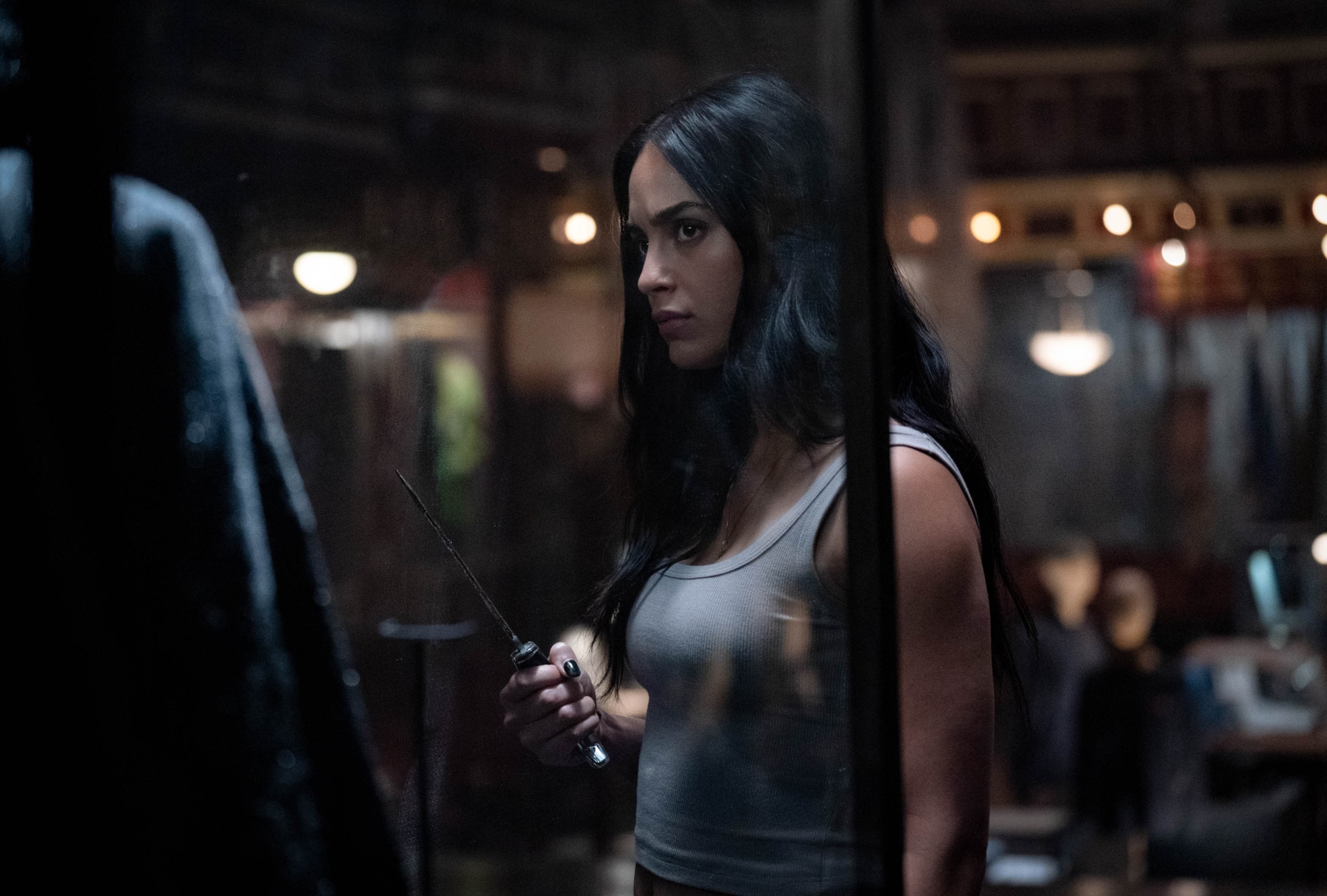
Melissa Berrera in “Scream 6” (Paramount Pictures)

The newest Scream installment is very much the “Scream 2” of the new generation (which may offer a hint as to where “Scream 2” sits on this list). It was way higher in the ranking until I started rewatching and realized that while it might be very fun, it’s also sort of mediocre. Why make a big deal about Ghostface in New York when you simply filmed in Canada? The brief moment where it feels like Kirby (Hayden Panettiere) could be the killer is thrilling, but in the end, the truth is just sort of annoying. Plus, I cannot forgive the lack of Sidney Prescott, even if I can respect the character’s decision to sit this one out. 6/10


Opening Scene: A date between film professor Samara Weaving and a mysterious app man turns deadly when Ghostface lures her into an alley and kills her, only to immediately remove the mask. We then learn that it’ss the work of two college kids who want to finish the movie brainchild of Richie Kirsch (Jack Quaid from “Scream 5”), only to be killed by the real new Ghostface. New York barely even has alleyways, but the killer twist is solid. 7/10


Killer Reveal: Surprise, it’s Richie’s family! While the random roommate and random new friend are more noticeable in hindsight, Dermot Mulroney as “dramatic detective with sad backstory” really can’t disguise his murderous glee for a single line reading. Richie’s family is sad that Richie got killed in self-defense after only being a light murderer in “Scream 5” and somehow I can’t feel bad for them. However, points for adding a third Ghostface and making us believe the roommate was dead. 6/10 


Gravity: In the end, the only actually dead person we care about is Anika (Devyn Nekoda), Mindy’s girlfriend. Everyone else miraculously survives being practically gutted, which is great, but does take some of the impact away. 5/10


Total: 24/40

Omar Epps and Jada Pinkett-Smith in “Scream 2” (Paramount Pictures)

This might be a surprise placement, but “Scream 2” really gets lost when you look at the franchise as a whole. It holds up in terms of the tropes of the first film and features several very fun surprise late-’90s guests, but the ending doesn’t hit as hard as other endings do. As Sidney points out, the murderer’s motive is just a bit too hypocritical, and college is always a tough setting. 6/10 


Opening Scene: Omar Epps and Jada Pinkett Smith get butchered during a rowdy screening of a “Stab” movie. It’s . . . fine. 6/10 


Killer Reveal: It’s Billy Loomis’ mom, annoying journalist Debbie Salt (Laurie Metcalf), and accomplice Mickey (Timothy Olyphant). She’s getting revenge for her son, who became a murderer because his mother abandoned him. Meh. 5/10 


Gravity: Randy’s death, in broad daylight, should never be forgotten, and Sarah Michelle Gellar’s sacrifices in the halls of a sorority house should always be honored. 8/10 


Total: 25/40

Neve Campbell in Wes Craven’s “Scream 3” (Joseph Viles/ Dimension Films/Getty)

Ghostface goes to Hollywood for the third installment, terrorizing the set of “Stab 3” and forcing Sidney out of hiding for another devastating reveal about her mother’s past that really ties the first and third movies together into a nice little bow, with “Scream 2” nestled in between. It’s better than you remember it being, but it loses a point for Gale’s hair. 7/10  


Opening Scene: Goodbye Cotton Weary (Liev Schreiber). It should be easier to feel sorry for the guy falsely accused of Maureen Prescott’s murder, but he didn’t make it easy, which takes the punch out of his and his girlfriend’s death. 5/10 


Killer Reveal: Roman Bridger (Scott Foley), the “Stab 3” director who is actually Maureen Prescott’s secret firstborn. In the two years she tried to be an actress, she was raped by horror producer John Milton, and she gave up the resulting baby and refused to acknowledge him when he later tracked her down. Roman wants the fame that Sidney had, and actually is the one who got Billy Loomis to kill Maureen in the first place, orchestrating the entire franchise. He is a director, after all. 9/10


Gravity: Other than Cotton, the deaths are all random actors playing actors, but they do actually die. Plus, there’s something touching about the way that Sidney holds Roman’s hand as he dies. They’re siblings, and while it’s his fault that he committed a bunch of murders, the way he was born and raised was most certainly not his fault. 6/10 
 

Total: 27/40
03
“Scream (5)”
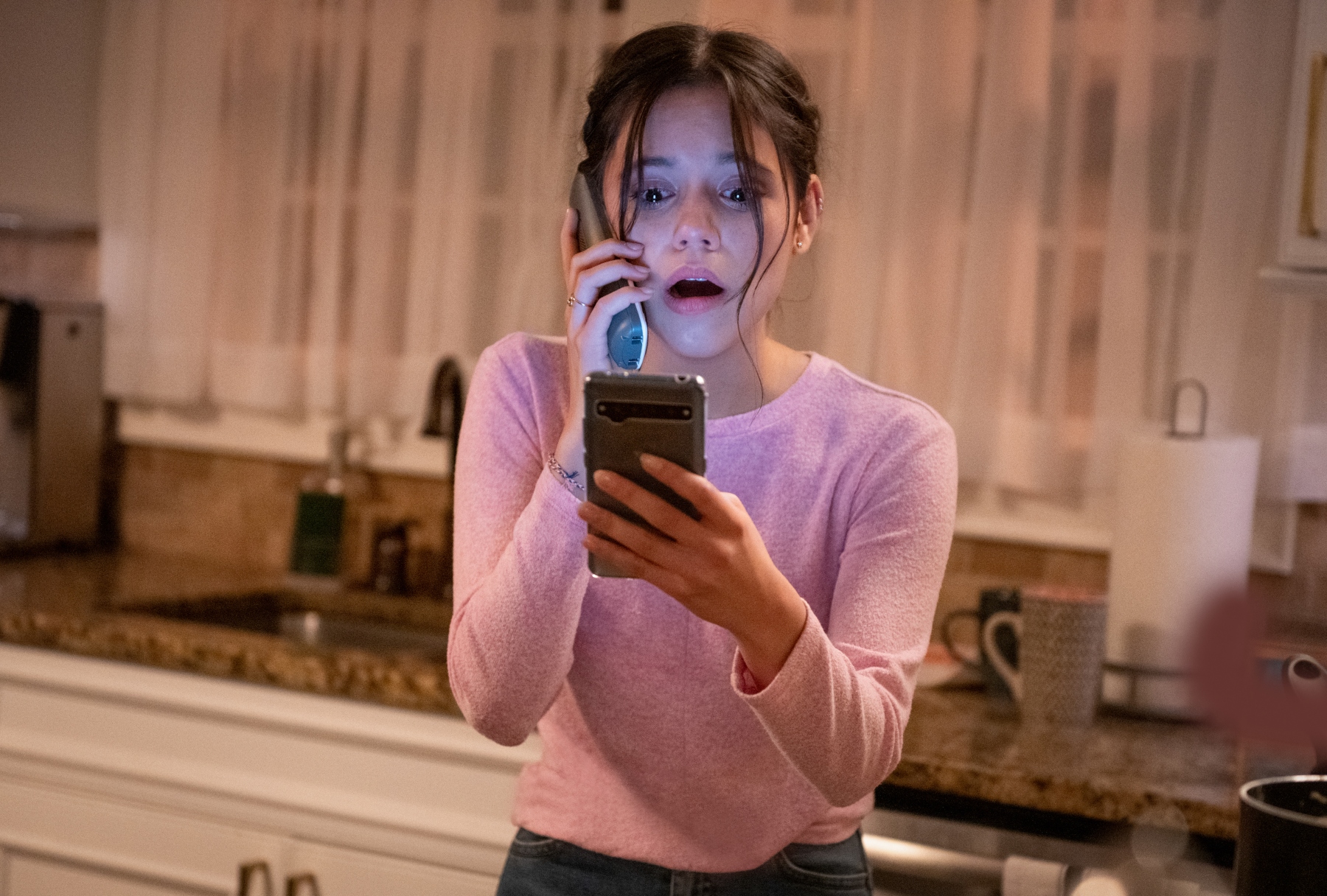
Jenna Ortega in “Scream 5” (Paramount Pictures)

Upon first viewing, this annoyingly titled “requel” is so very obvious, but upon rewatch, it’s clear that the movie knows this. It knows that simply titling itself “Scream” is stupid. It knows that the killers are not a clever twist. Dewey calls them out immediately, and it just sucks that the newbies don’t listen to him. But “Scream (5)” is still filled with twists, from the opening scene in which Jenna Ortega does not die to the fact that there are two new Sidney Prescotts with a killer connection to Billy Loomis. Sam (Melissa Barrera) is his secret daughter, born of an affair with another high school classmate, and Tara (Ortega) is the half sister that Sam left behind when she found out the truth. This movie also makes the boldest move of all by killing Dewey (David Arquette), the lovably dopey cop previously deemed unkillable. 8/10 


Opening Scene: With help from her app that lets her lock and unlock all her doors, Jenna Ortega fights Ghostface in her kitchen . . . and wins. While she gets stabbed multiple times, she recovers in the hospital, marking the first time someone has survived the opening scene in a “Scream” movie. 8/10 


Killer Reveal: Richie Kirsch (Jack Quaid) and Amber Freeman (Mikey Madison) are angry “Stab” fans who want to give the franchise source material for a reboot. Kinda stupid, but upsettingly current and perfect for reviving a franchise in the present day. 8/10 


Gravity: “Scream 5” really goes for it, killing off Dewey and Sheriff Hicks (Marley Shelton), as well as Hicks’ son Wes (Dylan Minnette). Wes gets a memorial party, and Dewey’s death makes Gale sob uncontrollably. Brutal, but maybe necessary in a world where Ghostface’s stabbings are only sometimes successful. 8/10 


Total: 32/40

Emma Roberts in “Scream 4” (Dimension Films)

Reviving a franchise more than a decade after its last installment is not easy and is usually a very bad idea, but “Scream 4” manages to be the gold standard. It’s just so much better than anyone thought it was going to be, and works incredibly well as a lone wolf in between two (presumed) trilogies. The killer has nothing to do with Billy Loomis or Sidney’s mom and everything to do with Sidney’s fame and notoriety in the wake of the murders, and the movie itself has fun messing up the patterns created by the first three while still very much feeling like a “Scream” movie. 9/10


Opening Scene: How many mid-aughts stars can we fit into one opening scene? Lucy Hale, Shenae Grimes, Kristen Bell, Anna Paquin, Aimee Teegarden and Britt Robertson take turns dying and occasionally stabbing as characters in a “Stab” movie being watched by other characters in another “Stab” movie, being watched by the characters in “Scream 4,” who then get murdered by Ghostface. It’s brilliant. 9/10 


Killer Reveal: Sidney’s cousin Jill (Emma Roberts) revives Ghostface with accomplice Charlie (Rory Culkin), planning to kill Sidney and make herself look like the last victim standing. She almost gets away with it, but she clearly doesn’t know who she’s messing with. No one survives trying to kill Sidney Prescott. 9/10 


Gravity: Something about this movie just feels really personal. Jill is murdering her friends for fame because she’s jealous of her cousin, and it’s so close to working. The impact is lessened by the fact that “Scream 4” has no direct sequel, but still chilling. 7/10 


Total: 34/40


Want a daily wrap-up of all the news and commentary Salon has to offer? Subscribe to our morning newsletter, Crash Course.


01
“Scream”
Drew Barrymore in “Scream” (Paramount Pictures)

As argued by characters in the movies themselves, there’s nothing better than the original. The 1996 sleeper hit manages to both critique and deconstruct the slasher film genre while also providing the perfect example of one, with a fantastic opening misdirect that brutally kills off the movie’s biggest star and a relatively straightforward explanation of who the killers are and why. It’s a classic for a reason, and probably the scariest of the bunch. 10/10


Opening Scene: There’s a reason Casey Becker (Drew Barrymore) is still a popular Halloween costume. The movie brutally kills off its biggest star in its first 10 minutes, making it clear that you should expect the unexpected when it comes to “Scream.” 10/10


Killer Reveal: Billy Loomis (Skeet Ulrich) and his goofy friend Stu (Matthew Lillard) are not just Ghostface, but they also kill Sidney’s mother and frame Cotton Weary (Liev Schreiber) for the crime. Billy’s father, you see, was having an affair with Sid’s mother, and it drove his mother away. As for Stu? Peer pressure. 9/10


Gravity: In a list of “Scream’s” greatest kills, the death of Tatum (Rose McGowan) via garage door would be near the top, and obviously Sidney Prescott never gets over her boyfriend being a serial killer, because who could? 10/10 


Total: 39/40

“Scream VI” is currently in theaters.

Sexually deceptive flowers trick flies into “mating” with them

It’s not easy being a fly. You don’t live long, you eat lots of feces and sometimes, when you’re just trying to get laid, you get tricked by a flower into being its artificial sperm donor.

Meet the South African beetle daisy (Gorteria diffusa), an unassuming orange flower that populates Namaqualand, a blooming desert in southwest Africa. Upon closer inspection, it reveals a remarkable case of plant sexual deception, a form of pseudocopulation. This is when a plant grows something that looks almost exactly like a bug or other pollinator, as a way of attracting an unwitting host to spread pollen and generate new plants.

This is a fairly common behavior in the plant kingdom, but almost every example is found in orchids, a type of flower that numbers over 28,000 species. Orchids are a robust example of an evolutionary success story, filling nearly endless niches and evolving specialized relationships with the animals around it. Take for example Ophrys sphegodes, the early spider orchid, which has flowers resembling a spider’s abdomen, but also reproduces the sex pheromones of certain mining bees. Two mimics in one!

In the case of beetle daisies, one of the rare non-orchid sexual deceivers, their blooms sometimes feature dark, raised petal spots at the base of their yellow-orange florets. If you squint — or have the vision of a bug — they look exactly like dark flies resting on the flower. There’s even hairy bumps and green-black pigment surrounding some reflective white dots that imitate an insect exoskeleton. Maybe it wouldn’t trick you, but to a male bombyliid fly (Megapalpus capensis), it looks like the real deal.

And when it spots a G. diffusa flower, the male will swoop down and try to be, uh, more than friends with the sham fly. All that frustrated buzzing around stirs up a lot of pollen, which helps it spread to the next blossom. It’s not entirely surprising that this fly is the dominant pollinator for these flowers.

It’s a pretty neat trick for a plant, but also pretty baffling to botanists, who have been intrigued by beetle daises for centuries. A new genetic analysis in the journal Current Biology lays bare how the flower pulls this off, which helps explain broader complex trends in evolution.

Not every variety of G. diffusa has the same fly-like pattern. Some sport only a few counterfeits on select petals, others display an entire ring of them. By sequencing the genome of different strains, researchers from the University of Cambridge illuminated how the flower alters its pigment and the shape of its petals.

“Plant sexual deception has fascinated biologists for centuries, but the evolution of sexually deceptive flowers remains somewhat enigmatic due to their extreme specialization and the absence of intermediately deceptive forms,” the authors wrote, meaning that we don’t really see any examples of plants that only go halfway on pseudocopulation. It’s all or nothing when it comes to tricking arthropods into mating with you.

“This daisy didn’t evolve a new ‘make a fly’ gene,” the study’s lead author, professor Beverley Glover of the University of Cambridge’s department of plant sciences, said in a statement. “Instead it did something even cleverer — it brought together existing genes, which already do other things in different parts of the plant, to make a complicated spot on the petals that deceives male flies.”


Want more health and science stories in your inbox? Subscribe to Salon’s weekly newsletter The Vulgar Scientist.


This joining of genes is called co-option, an old concept in evolutionary biology that has been used to explain why some features in nature seem like miracles. There are a lot of gaps in the fossil record, due to how difficult it is for them to form in the first place. But while the record is still pretty extensive, it can sometimes seem like one species jumped into another with no transition.

Co-option explains this as a sort of genetic recycling, in which a trait isn’t discarded but altered to do something else. A classic example is feathers in birds, which originally evolved in some dinosaurs for display and protection from the elements, but later became useful for flight.

This new analysis presents three genes the beetle daisies have co-opted: one for its color, one for its bulging shape and one for its placement. The more convincing the fake fly appears, the more strongly these genes were expressed. And it seems to tie these genetic expressions together at the same time.

This trait seems to have evolved relatively recently, only about 1.5 to 2 million years ago. That’s not very long in geological terms — in fact, Homo sapiens probably first emerged around the same time. And the fact that this flower still provides nectar — a sort of consolation prize for the poor, lied to fly — points to the fact that G. diffusa hasn’t used this trick long enough to rely on deception alone.

“We’d expect that something as complex as a fake fly would take a long time to evolve, involving lots of genes and lots of mutations,” one of the other study authors, Roman Kellenberger, a postdoctoral researcher in the University of Cambridge’s Department of Plant Sciences, said in the same statement. “But actually by bringing together three existing sets of genes it has happened much more quickly.”

It’s far too early to tell, but in a future scenario where flies outnumber other pollinators like bees and butterflies — a real risk exacerbated by climate change — this strategy may prove extremely beneficial. There are still some unanswered questions about this flower and its evolution. Using genetic engineering, the authors report, it may be possible to test the theory how these genes allow G. diffusa to build its own decoys. This research can help illuminate some of the complexities of co-option, including how it starts, refines and affects other traits. Evolution is a dynamic process that can sometimes defy logic, but even trickster flowers from South Africa have something to teach us about the intricacies of life on Earth.

Pink Floyd’s “Dark Side of the Moon” at 50: The album’s vast soundscapes have never sounded better

This month, Pink Floyd’s mega-selling, time-eclipsing “Dark Side of the Moon” LP turned 50. To mark the occasion, a remastered edition of the album has been released, along with an elegant coffee table book of rare photographs and other ephemera. Over the past several years, music lovers have been treated to numerous box sets and deluxe editions celebrating one musical masterwork after another. But if there is one record that merits being feted, it’s certainly “Dark Side of the Moon.”

As with our finest novels and films, “Dark Side of the Moon” rewards its audience with every return visit, affording us with greater nuance and other subtleties that only the most superbly crafted artworks can provide. A significant part of the album’s intricate construction and staying power can be attributed to the painstaking way in which it developed over the early 1970s. Pink Floyd performed “Dark Side of the Moon: A Piece for Assorted Lunatics,” as it was known at the time, in a live setting for more than a year, giving the band numerous opportunities to make refinements before committing their ideas to magnetic tape.

And by the time Pink Floyd began working on the album at EMI’s Studio 3 in May 1972, the conditions had aligned perfectly on their behalf. EMI’s engineers had made numerous refinements of their own to the TG 12345 mixing desk. And the band’s crew itself was second to none, with Alan Parsons acting as engineer. He was well-supported by Chris Thomas, who mixed the album. While relatively young, both men were wily veterans of the Beatles’ studio years, having worked closely with George Martin on the band’s final masterworks. As the coziest room in the building, Studio 3 seems like an ironic place to have birthed such an expansive album. Surviving footage from the overdubbing sessions offers a privileged view of the making of the album.

Watch guitarist David Gilmour accent the basic track of “Brain Damage” at EMI’s Studio 3:

As the album came into focus during the band’s final weeks in the studio, an incredible tapestry had taken form, thanks to all of those concerts in advance of the “Dark Side of the Moon” recording sessions. Incredible moments of high drama emerged in tracks such as “Time,” “The Great Gig in the Sky” and “Us and Them.” In the former, a fusillade of chimes, watches, ticking clocks, and Nick Mason’s hurried drumbeat establish the song’s mind-numbing pace. Listless and suffering from a diffused sense of identity, we find ourselves “ticking away the moments that make up a dull day,” Gilmour sings, while “waiting for someone or something to show you the way.”

Accompanied by Rick Wright’s mournful piano, “The Great Gig in the Sky” acts as the album’s terrifying centerpiece. Clare Torry’s ethereal — and, significantly, wordless — vocal illustrates humankind’s fear of dying, of joining that final “great gig in the sky.” When it finally arrives on the heels of the free-form jazz fusion of “Money,” “Us and Them” decelerates the momentum created by its predecessor — and the intricate ⅞ time sequence of “Money” — into a more soothing tempo. Like Ravel’s Boléro, “Us and Them” slowly establishes “Dark Side of the Moon”‘s pace so as to provide a dramatic backdrop for the song’s interludes about an insular general’s inability to recognize his soldiers’ senses of particularity.

In an album that purports to be about death and madness, a song about the perils of war and militarism is especially apt. “Us and Them” reaches its dramatic pitch in the portions of the song that narrate a general in the act of sending his army into battle: “Forward he cried from the rear / And the front rank died,” Gilmour sings. For the general, the soldiers exist as mere pawns on an impersonal battlefield: “And the general sat and the lines on the map / Moved from side to side.” For the life of him, the general can only see his soldiers as nothing more than inhuman, insensate “lines” on a map.

The remastered edition of the LP only serves to provide even greater aural nuance to such an abiding work of art.

With the magisterial conclusion of “Brain Damage” and “Eclipse,” “Dark Side of the Moon” reaches a level of magnificence rare attained by any other artwork ever. A virtual smorgasbord of emotions, sensations and ethical conundrums, “Eclipse” marks the climactic moment on the album when Pink Floyd challenges the listener to celebrate unity over division, community over individualism. The concept of the moon eclipsing the sun suggests that humankind can conquer the constricting mechanisms that rule our lives if we establish a genuine sense of community among our fellow “lunatics” across the globe.

“When the record was finished,” bassist and lyricist Roger Waters recalled, “I took a reel-to-reel copy home with me and I remember playing it for my wife then, and I remember her bursting into tears when it was finished. And I thought, ‘This has obviously struck a chord somewhere,’ and I was kind of pleased by that. You know when you’ve done something, certainly if you create a piece of music, you then hear it with fresh ears when you play it for somebody else. And at that point I thought to myself, ‘Wow, this is a pretty complete piece of work,’ and I had every confidence that people would respond to it.”

In the intervening years, audiences have never stopped responding to “Dark Side of the Moon.” The remastered edition of the LP only serves to provide even greater aural nuance to such an abiding work of art. The album’s vast soundscapes have never sounded better, the instrumental separation pleasingly reminding us that Pink Floyd was in peak musical form. The deluxe book affords us welcome insight into the evolution of the LP’s cover art, which was designed by Storm Thorgerson and Aubrey Powell of Hipgnosis fame. The album’s art design, which depicts a ray of light as it enters a prism, producing a rainbow spectrum that continues onto the album’s back cover, has enjoyed almost the same level of iconic status as the music itself.

And as for the record’s message, “Dark Side of the Moon” provides an ethical challenge that is just as prescient now as it was 50 years ago. If anything, its themes have become even more vital. As Waters remarked at the time, “The album uses the sun and the moon as symbols; the light and the dark, the good and the bad, the life force as opposed to the death force. I think it’s a very simple statement saying that all the good things life can offer are there for us to grasp, but that the influence of some dark force in our natures prevents us from seeing them.”

Sen. Sanders shows fire, but seeks modest goals, in his debut drug hearing as health chair

Sen. Bernie Sanders, who rose to national prominence criticizing big business in general and the pharmaceutical industry in particular, claimed the spotlight Wednesday on what might at first seem a powerful new stage from which to advance his agenda: chairmanship of the Senate health committee.

But the hearing Sanders used to excoriate a billionaire pharmaceutical executive for raising the price of a covid-19 vaccine showed the challenges the Vermont independent faces.

Though its formal name is the Committee on Health, Education, Labor, and Pensions (HELP), the panel Sanders chairs has little if any authority over drug prices. In the Senate, most of that leverage lies with the Finance Committee, which oversees Medicaid, Medicare, and Obamacare.

As far as drug prices go, the platform Sanders commands is essentially a bully pulpit. So Sanders was left to bully his way toward results. And while some committee Republicans sympathized with his complaints, others bristled at his approach.

By the end of the hearing, seeming to acknowledge the limits of his power, the former presidential candidate was pleading with Moderna chief executive Stéphane Bancel for a relatively modest concession on vaccine pricing.

The CEO made no promises. Then again, pulpit proclamations can lead to corporate action, even if delayed and informal; in the weeks following President Joe Biden’s State of the Union call for cheaper insulin, the companies that make it drastically cut their prices.

Sanders began Wednesday’s hearing with his usual fire and brimstone.

“All over this country people are getting sicker, and in some cases dying, because they can’t afford the outrageous cost of prescription drugs, while companies make huge profits and executives become billionaires,” Sanders thundered.

Bancel had won his place in the witness chair with federal assistance. Moderna, which was founded in 2010 and had not brought a drug to market before the pandemic, received billions in government funds for research, guaranteed purchases, and expert advice to help develop and produce its successful covid vaccine. The payoff has been handsome. As of March 8, Bancel held $3 billion in Moderna stock. He also held options to buy millions of additional shares.

Government research and support are foundational to many of the expensive drugs and vaccines in use today. But Bancel made himself the perfect foil for Sanders when he announced in January that Moderna planned to increase the price of its latest covid shot from about $26 to $110 — or as much as $130.

Denouncing greed, Sanders expounded on his dream of a system in which the government fully funds drug development — and in exchange controls drug prices. “Is there another model out there where, when a lifesaving drug is made, it becomes accessible to all those who need it?” he asked. “What am I missing in thinking that it’s cruel to make a medicine that people can’t afford?'”

Sanders’ overt moralizing and harsh attacks on big business make him an outlier in the Senate, even in his own party. Yet distaste for soaring drug prices extends across the aisle. On the HELP Committee, at least, Republican politicians seem about evenly split between populist and pro-business takes on the problem, showing both the possibilities and the pitfalls that Sanders faces.

Sen. Mike Braun (R-Ind.) expressed disgust with the lack of transparency in the health care system and called Moderna’s planned price hike “preposterous.” Sen. Roger Marshall (R-Kan.) called it “outrageous.”

Sen. Rand Paul (R-Ky.), who often bucks mainstream GOP views and has expressed rancor for the biomedical establishment, claimed Bancel was downplaying vaccine injuries to make money. (Paul vastly exaggerated those risks.)

Ranking member Bill Cassidy (R-La.), who has pledged to work with Sanders, responded to the chairman’s opening remarks with both a hedge and a warning. “I’m not defending salaries or profits,” Cassidy said, but he added that he hoped the hearing’s goal wasn’t to “demonize capitalism.”

Only Sen. Mitt Romney (R-Utah), a former private equity executive, came heartily to Bancel’s defense. “If I’m an investor, I have to expect that if a product I’m backing works, I get to make an awful lot of money,” he said. “I’ve heard people say, ‘That’s corporate greed.’ Yeah, that’s how it works.”

Sanders’ idealized vision of the pharmaceutical industry is, in any case, moot. Even the Biden administration, which successfully browbeat insulin makers into drastically lowering prices in March, revealed this week it would not use “march-in” rights to lower the price of a cancer drug, Xtandi, developed with government-licensed patents.

March-in rights were established in the 1980 Bayh-Dole Act, which enabled companies to license federally funded research and use it to develop drugs. But federal courts and administrations have consistently said the government can seize a product only if the license holder has failed to make it available — not because the price is too high. The administration did, however, announce a review of whether price might be considered in future march-in decisions.

Sanders said before the hearing that he was “extremely disappointed” with the Xtandi decision. But he was ultimately realist enough to aim his bully pulpit at a lower target. Late in Wednesday’s hearing, Sanders pushed for a minimal gimme from Moderna. “Will you reconsider your decision to quadruple the price of your vaccine to the U.S. government and its agents?” he asked politely.

Bancel dodged, saying pricing was more complex now that Moderna faced an uncertain market, had to fill separate syringes with its vaccine, and needed to sell and distribute the vaccine to thousands of pharmacies, where previously the government did all that work. Later, he left open the possibility that negotiations could drive down the price paid by some government agencies or private insurers.

For all the theatrics of such hearings and the mix of opinions among the senators, interrogations of figures like Bancel may help inspire a shift in how the National Institutes of Health “does business in giving away its science to the private sector,” said Tahir Amin, co-executive director of I-MAK, a nonprofit that advocates for equitable access to medicines.

“You have to prosecute it so you at least get these public comments on record,” Amin said. Eventually, he said, this type of hearing could lead to a recognition that, ‘Hey, we need to do this.'”

Despite the HELP Committee’s lack of direct jurisdiction over drug prices, said John McDonough, a Harvard professor who was senior adviser for health reform on the HELP Committee from 2008 to 2010, Sanders “uses his position of authority and influence to draw attention to this in a way that has been helpful.”


KHN correspondent Rachana Pradhan contributed to this report.

KHN (Kaiser Health News) is a national newsroom that produces in-depth journalism about health issues. Together with Policy Analysis and Polling, KHN is one of the three major operating programs at KFF (Kaiser Family Foundation). KFF is an endowed nonprofit organization providing information on health issues to the nation.

Subscribe to KHN’s free Morning Briefing.

“They stole my childhood”: Paris Hilton on the horrors of the “troubled teen” industry

If you predicted back in the velour hoodied early aughts that Paris Hilton would one day write a moving, brave and often very funny account of her life and of the era, congratulations, your day has arrived. If, like the rest of us, you couldn’t begin to imagine just how much was going on underneath that Von Dutch hat, let the pioneering influencer take you by surprise. Hilton’s “Paris: The Memoir” is the best book since Jennette McCurdy’s “I’m Glad My Mom Died” to explore the dark side of growing up in the spotlight and building an authentic life from the ashes of an unorthodox youth.

Hilton, who recently welcomed her first child, joined me on a recent episode of “Salon Talks.” In the candid conversation, we discussed why Hilton says ADHD is her “superpower” secret of success, why she’s speaking out about her deepest traumas and her ongoing campaign to make the “troubled teen” industry a thing of the past. Watch Hilton on “Salon Talks” here or read our conversation below.

The following interview has been lightly edited for clarity and length.

You start early on in the book by describing what it feels like to have ADHD. You say it’s your “superpower.” ADHD is so often misdiagnosed, especially for girls and women. What was your experience like finally getting that diagnosis, and what do other people need to know so that they can recognize it and live with it?

I feel that there’s such a stigma behind it, and a lot of people aren’t aware of so many good things about it. In my career, I’ve always been ahead of my time, thinking outside the box and being an innovator and doing things and taking these risks. I really attribute that to my ADHD because I see it as a superpower. I feel that if you harness it in the right way, so much is possible. When I was a teenager, no one was talking about this. It’s an important thing for people to realize that you can become successful, and you can really focus and do big things in life.

“I find it so empowering to hold these people accountable for what they did to me because they stole my childhood.”

This book is your second big arrival. You just recently welcomed your son. Congratulations.

I’m so in love with him.

You have talked about everything you went through to have a family and become a mother. I can only imagine how much it must mean to be facing this moment right now.

It means the world to me. I just feel so blessed, and he is everything to me. My heart is just bursting with so much love.

In just the short time since you have had this little boy in your life, has it changed how you think about your own parents and how they raised you?

Definitely. Now that I’m a mom, I feel so protective of my little boy. I just want to protect him from this sometimes scary world, so I can completely understand why my parents were very protective of me as a teenager. [My parents and I] have become so close, especially in the past couple of years since I’ve told my story. Our relationship has really healed from being able to speak about everything.

Let’s talk about the “everything.” You spent a couple of years in your teenage life in Provo Canyon. It calls itself a school. What would you call it?

I would call it a torture place. I don’t know how they even can say that they’re a school because of the way they are so incredibly abusive and just the horrific things that happen inside of there. The people who work there should be nowhere near children. It’s heartbreaking to my family because they had no idea. They thought they were sending me to a normal boarding school because these places have such deceptive marketing. [They] have these brochures and websites with stock photos of children smiling and rainbows and riding horses. It’s the complete opposite once you’re in there.

It’s just been extremely painful to talk about, but it’s so important because I know that there are children who are locked up in these places right now and they have no voice. That’s why I’m out here advocating for them and for their rights.

Paris HiltonActress and model Paris Hilton speaks during a news conference outside the U.S. Capitol October 20, 2021 in Washington, DC. (Alex Wong/Getty Images)You have been a very strong agent for change, particularly in the state of Utah. You say in the book that people need to understand that this is happening now, and it is happening to children. Tell me how we’re getting away with this in this country right now?

This has been happening since the 1960s, and I believe they’ve gotten away with it for so long because the children haven’t been believed. The things that happen in these places are like something out of a horror film. It just breaks my heart that it’s still happening today. Children have died in the name of treatment. 

“The things that happen in these places are like something out of a horror film.”

Ever since I told my story and my documentary, survivors have come forward and told their stories — and they’re finally being believed now. Just these past couple of years, with the help of myself and so many other survivors, we’ve made so much change and such a difference and have already changed laws in eight states — as well as all the way over in Ireland. I’m going to be going back to Washington in April to introduce our bill, and we already have bipartisan support. I’m just praying and hoping that everyone makes the right decision because no more children should be abused in these places.

I want to go forward 15 years in the future. Maybe your son is sneaking out at night, maybe he’s not talking to you. You’re frustrated. You’re at the end of your rope, much like your mom has said she felt with you. What are you going to do for him?

I’m just going to be there for him and support him and love him so much and have him feel that he can come and talk to me about anything. And also understand that kids do rebel at that age, and it is normal. So, if he does sneak out, I’ll be like, “OK, you got this from your mom.” I was a rebel, I think, because my parents were so strict with me. I feel like I will be strict because I’m going to be so protective, but I’m also going to be really understanding because I know how it is to be a teenager.

Paris HiltonParis Hilton is seen on March 13, 2023 in New York City. (MediaPunch/Bauer-Griffin/GC Images/Getty Images)

You had strict parents. You were in a place where all of your freedom was taken away from you, where you were physically and psychologically broken down. When you got out and you were able to have freedom, how did you take control of your life again?

I was just so traumatized from what I experienced and endured that I locked it out of my memory. I made a promise to myself that I’m not going to talk about this with anyone. This is not part of my story. I just wanted to act like it didn’t happen.

“Fighting for change has been so extremely healing for myself, my family and people all around the world.”

I’ve spoken to so many other survivors since, and they’ve done the same thing because you just want to put that all behind you. Now, I find it so empowering to hold these people accountable for what they did to me because they stole my childhood, and they’re continuing to steal the childhood of so many other innocent children. Fighting for change has just been so extremely healing for myself, my family and people all around the world, so I’m going to continue telling my story.

I recently read Prince Harry’s memoir, “Spare.” There are similarities in the stories about people who are born into privilege, wealth and fame, and yet endure things that are unimaginable. All of that fame and privilege does not protect you from trauma, abuse or mental health issues. What do you want people to know when they see people living these glamorous lives on social media?

I feel that they should never judge a book by its cover, and that life is not perfect. On social media, everyone tries to project this perfect fantasy life, but I know from personal experience and from my friends who are in this industry that that’s not always the case — and people go through really hard things.

I think it’s amazing now that people are finally talking about mental health and coming forward and telling their stories, especially people who have a platform. I really just commend them for their bravery because it’s a hard thing, but I also think it’s so important for people to come through and tell their stories so that other people don’t feel so alone.

Is the congressional commission on Olympic abuse more than an inside job?

The latest demonstration by Congress that it has at least some interest in holding the U.S. Olympic movement to account for sexual abuse and other problems was called the Empowering Olympic, Paralympic, and Amateur Athletes Act of 2020. That set in motion a report by a Commission on the State of Olympics and Paralympics. The commission may or may not make its revised deadline of September of this year to complete its report — but that may be the least of the credibility challenges it faces.

Last month the U.S. Olympic and Paralympic Committee’s Athletes’ Advisory Council (AAC), through an ad hoc group it created called the Athlete Task Force, solicited comments for forwarding to the commission. An email message presumably sent to thousands of athletes said, “Email teamusa-ac@teamusa-ac.org and we can connect you directly to the Commission to confidentially share your feedback and experience of being an elite athlete in the Movement.” The council also tweeted the message, including the names of the task force members.

On the face of this, there’s nothing wrong with good-faith gathering and forwarding of pertinent material for the commission, so long as USOPC doesn’t intend to store or read the responses in carrying out this self-appointed brokering role.

But critical athletes who have found USOPC and its entities and mechanisms unhelpful and biased in the past — perhaps a major factor driving this action by Congress in the first place — are understandably skeptical. They suspect that filtering and subtly leaning on respondents to hold back on what they might want to tell the commission is precisely what’s going on here. They see the AAC’s move as characteristically inimical to efforts to fix USOPC self-dealing. This flaw illuminates why hyped efforts to address sexual abuse by coaches, like the new agency called the U.S. Center for Safe Sport, don’t amount to much.

In an email to Salon, the executive director of the AAC, Elizabeth Ramsey, rejected the suggestion that her group wasn’t speaking only for itself and with benign intent. She said the Athlete Task Force was merely connecting “any interested athlete to the Commission.” She added “Any assertion that the AAC in any way is not abiding by its independent voice is not only misguided but it is reckless.”

I’m not so sure about the reckless part: Earlier in the same email, Ramsey conceded that the AAC was “not a separate legal entity from the USOPC.” Presumably, the public must take it on faith that the AAC is, as she put it, “free from any undue influence from anyone outside the Council.”

*  *  *

Former speed skater Eva Rodansky is one who believes the commission feedback structure is messed up. Rodansky’s experience dates back to what she says was whistleblower retaliation against her by U.S. Speedskating, the national sport governing body (NGB) under USOPC. That happened in 1995, when she was 17 years old and complained about an abusive coach who was running a junior development program in Salt Lake City.

I started covering U.S. Speedskating corruption, through Rodansky’s story, 10 years ago. In that period, Scott Blackmun, the disgraced former USOPC chief executive who would be forced to resign after the USA Gymnastics scandals blew up in 2018, used to hold up speedskating — like the larger and similarly toxic USA Swimming — as a model NGB when it came to handling sexual abuse claims.


Want a daily wrap-up of all the news and commentary Salon has to offer? Subscribe to our morning newsletter, Crash Course.


Rodansky’s account leads to a different conclusion. After the Salt Lake City fiasco that derailed her career, she came back to the sport in 2001 and clearly racked up enough high finishes in competitions to be included in the U.S. team for the 2006 Winter Olympics. But she got passed over.

Why? Evidently because that the national team coach at the time, Mike Crowe, played favorites based on the fruits of his sexual harassment. Crowe eventually migrated to Canada, ahead of the resolution of multiple allegations against him, and would become head coach of that nation’s team. Just before the start of the 2018 Winter Olympics, Crowe was put on leave because of his emerging abuse history. Shortly thereafter, Speed Skating Canada fired him.

Famously, the rogue’s gallery of speed skating also includes Andy Gabel, the all-time longest active American Olympic skater before he graduated to administration of the sport. For the 2002 Winter Olympics, Gabel oversaw both the short-track speed skating and figure skating programs. In 2013, the first reports surfaced of his sexual misconduct and he left U.S. Speedskating. One of his victims, three-time American speed skating champion Bridie Farrell, now an advocate for abuse survivors, sued Gabel, speedskating and the USOPC

Current competitors may not respond, given the politics of national-team rosters, says Eva Rodansky: “What are the plans to involve former athletes such as me, who’ve had bad experiences?”

Rodansky said she sees numerous problems with the advisory council’s gesture of assistance to the congressional commission. “This seems to be done without transparency and without any release in the media,” she said. “The next issue is the obvious conflict of interest of having athletes’ stories filtered through a group of Team USA insiders, instead of going directly to the commission.”

Finally, there’s the concern that the way the information is distributed will affect the populations providing feedback. Current competitors may not respond in a full-throated way because of the ever-present politics of national team roster construction. “What were the plans to send this information around to former athletes such as me, who’ve had bad experiences?” Rodansky asks.

She made these points and more in her own submission to the AAC. Her first bullet point was: “Why moving away to train is so dangerous for young teen athletes, especially young women.” That begins to get to the heart of my own main criticism of our country’s youth sports system, which haphazardly grafts extracurricular activities and infrastructure onto the naked commercial and international-competition objectives of USOPC and its NGBs. It all adds up to a set of assumed and unexamined public subsidies for a hodgepodge of tax-exempt 501(c)(3) organizations, which face no outside oversight.

*  *  *

The co-chair of the USPOC study commission — appointed by Sen. Maria Cantwell, D-Wash., who co-chairs the Senate Commerce, Science and Transportation Committee — is Dionne Koller, director of the University of Baltimore’s Center for Sport and the Law.

With respect to AAC’s conflict of interest, Koller told Salon: “We do not understand any entity to be acting as a filter of information from athletes and we are affirmatively soliciting direct communications from all athletes as well as other interested persons and entities related to the areas of our study. We are not in any way seeking ‘filtered’ information sent on behalf of athletes, though anyone can share information with us in whatever form they like.”

Koller called the athlete task force “one method for us to circulate information to the athlete community,” while emphasizing that the commission “has no plans to rely on this or any other similar group as the sole provider of information on behalf of their relevant constituencies.”

Koller described criticisms of the commission as “confusing” and suggested that the commission’s work was being unfairly lumped together with various internal and external examinations of USOPC. The commission was not tasked by Congress, she said, with seeking specifics about SafeSport complaints.

If the Commission on the State of the Olympics and Paralympics isn’t a platform for evaluating the U.S. Center for Safe Sport, among other things, then what is it actually for?

Reviewing the commission’s statement of practices and requests for documents from NGBs, one can understand Koller’s response, but it’s unclear who is really most confused. When Cantwell appointed Koller and other commission members in 2021, the quote in the senator’s news release literally began: “The USOPC exists to protect athletes and uphold the integrity of sport. There are many issues that plague sports, from unequal pay and treatment to sexual abuse.”

If the Commission on the State of the Olympics and Paralympics isn’t, at the end of the day, a platform for evaluating the U.S. Center for Safe Sport (among other things), then what is it for? Only to advocate for the most elite female athletes to garner their fair share of compensation and endorsement income, which today is disproportionately enjoyed by their male counterparts?

Here’s Koller’s last word on this line of criticism: “I did not write Sen. Cantwell’s statement and Sen. Cantwell does not control the Commission, though she did appoint me. What the Commission is obligated to follow is the statute enacted by Congress, which outlines ten areas of study. None specifically instruct the Commission to investigate SafeSport, though one of the areas references ‘recent reforms,’ which may be interpreted as including the establishment of SafeSport, and in fact some members of the Olympic community have responded to our requests by providing information and feedback about SafeSport.”

Above all, Koller contends that the report will be produced “after giving the entire Olympic community and any member of the public with interest an opportunity to provide input. This will be the most inclusive, fair and credible process possible.”

Plagued by political red tape that delayed the release of its operational funding, the commission is now seeking an extension of its September deadline. Koller urged anyone, current athlete or otherwise, to send relevant comments directly to comments@csuop.gov.

“Gross spectacle”: TikTok hearing on Capitol Hill goes off the rails into bizarre GOP racism

Facebook collects about as much data from underage users as TikTok does, and federal law enforcement agencies have almost limitless access to that data. Members of the Republican-led House Energy and Commerce Committee already know this — and evidently so does most of the Gen Z audience who watched those largely clueless legislators grill TikTok CEO Shou Zi Chew in a marathon hearing on Thursday. 

When leading Republicans on the committee veered the discussion away from U.S. data privacy policies into unfounded accusations against Chew based on his Chinese heritage and incoherent fears about Chinese surveillance, the mockery from online denizens was swift and severe. 

Along with all other major social media platforms, TikTok faces serious criticism for its reported impact on teen mental health by way of its persuasive algorithms, content moderation issues and data collection practices. But during Thursday’s grueling five-hour hearing, GOP members sought to accuse TikTok of a baffling and effectively impossible list of misdeeds, engaging in hostile questioning that often betrayed the members’ lack of basic technical understanding. In some cases, members barked questions at Chew and wouldn’t let him answer. At other times, Chew was asked to personally account for the surveillance policies of foreign governments, where he does not plausibly hold any influence.

Rep. Dan Crenshaw, R-Texas, even accused Chew himself of being obligated to cooperate with Chinese intelligence agency data collection. Chinese citizens, Crenshaw said, “must cooperate with Chinese intelligence whenever they are called upon, and if they are called upon they’re bound to secrecy. That would include you.”

“Congressman,” Chew responded. “First, I’m Singaporean.”

TikTok has two headquarters, Chew said, one in the U.S. and one in Singapore. Its parent company, ByteDance, is headquartered in China. TikTok has continued to face accusations that it is being used for Chinese espionage. 

Rep. Kat Cammack, R-Fla., was blasted with criticism for her repeatedly interrupting Chew with hostile and largely rhetorical questions — and for demanding that Chew literally repeat the answers she gave him. Even so, he repeatedly corrected Cammack’s overwrought assumptions. 

“As pointed out, you have regular contact with Chinese Communist Party secretary Mr. Zhang Fuping, who is your boss at Bytedance, correct?,” Cammack asked at one point.

“No. He’s neither my boss nor do we have frequent contact,” Chew responded. 

Cammack’s extended derision of TikTok’s content moderation became the most circulated segment of the recorded hearings online. And the moment she concluded her speech was one that summed up the whole show. 

“Can I respond, Chair?,” Chew asked Rep. Cathy McMorris Rodgers of Washington, the committee chairwoman. 

There was an awkward, silent pause. 

“No,” she said. “We’re going to move on.”


Want a daily wrap-up of all the news and commentary Salon has to offer? Subscribe to our morning newsletter, Crash Course.


Some even accused TikTok of facilitating genocide against the Uyghur people, a persecuted Muslim minority within China.

Rep. Jim Banks, R-Ind., was among them. In a later committee meeting, Banks questioned Nury Turkel, chair of the U.S. Commission on International Religious Freedom, about whether calling out anti-Asian racism in the TikTok debates was a tactic used by the Chinese Communist Party to deflect from China’s detainment of Uyghur people in labor camps. 

“This company is one of the biggest facilitators and enablers of the ongoing genocide,” Turkel said. 

Banks again linked genocide to TikTok in a later tweet. 

“The CCP and TikTok are accusing critics of ‘racism’ to deflect from their espionage. And some US politicians are using their same cheap tactics instead of holding the CCP accountable for its Uyghur genocide. Shameful!” 

It was Rep. Richard Hudson, R-N.C., who triggered the biggest eruption of mockery online when, in the middle of a hostile line of questions about user data privacy, he asked whether the TikTok website used wi-fi. It’s a nonsensical question: To access any website on a mobile phone, a user requires an internet connection, whether through wi-fi or mobile cellular data. 

Visibly befuddled, Chew answered, “Only if the user turns on the wi-fi. I am sorry, I may not understand the question.”

Hudson pressed onward: “If I have the TikTok app on my phone, and my phone is on my home wi-fi network, does TikTok have access to that network?”

Although many online reactions were straight-up mockery of congressional cluelessness, the gravity of sinophobia and anti-Asian sentiment also drove the discussion.

Some Republicans suggested that TikTok was responsible for the deaths of children who have participated in dangerous trends that have appeared across multiple websites. Seven children who used TikTok died from one such trend, called the “Blackout Challenge” — content which TikTok says it took steps to remove. Those kinds of “challenges” have plagued social platforms for several years and TikTok isn’t unique or unusual in its attempts to block their spread. 

Chew rarely pushed back during his hours of testimony, but when he did his tone was sharp. On several occasions he reiterated that TikTok’s data privacy policies largely reflect those of its industry peers. He repeatedly expressed support for wider industry regulation efforts. When asked if he’d be willing to divest TikTok from ByteDance, its Chinese parent company, he responded: 

“American social media companies don’t have a good track record with data privacy and user security. I mean, look at Facebook and Cambridge Analytica.”

He also detailed TikTok’s plan for addressing congressional concerns, including the company’s strategy to move all its U.S. data to a U.S.-headquartered subsidiary company under a U.S.-led data security team. Other proposed measures included safety policies for teen users, implementing a firewall for U.S. user data, a clear policy of refusing to cooperate with foreign governments and voluntarily opening TikTok’s security to third-party independent review. 

All of that was specified again in Chew’s post-hearing response. 

Al Jazeera’s Sana Saeed was among several prominent voices to criticize the double-standard that marked TikTok’s treatment on Capitol Hill, particularly compared to Facebook. 

“These TikTok hearings are a gross spectacle. It’s an incredible display of not only soft-war mongering but unabashed racism, with accusations of ‘unAmericanism’ (of the app & CEO). I guess surveillance, data mining & child harm of Meta’s Instagram is acceptably American,” Saeed tweeted.

Data privacy experts likewise spoke out, including Eva Galperin, cybersecurity director for the Electronic Frontier Foundation. 

“If you think the US needs a TikTok ban and not a comprehensive privacy law regulating data brokers, you don’t care about privacy, you just hate that a Chinese company has built a dominant social media platform,” she wrote. 

“Banning TikTok for privacy reasons is absurd when Meta can collect the same data and sell it to governments and foreign companies. Surveillance is apparently not an issue if it’s done for profit. The fundamental problem is that the US has no meaningful data privacy laws,” wrote Alejandra Caraballo, an instructor at Harvard Law’s Cyberlaw Clinic.

TikTok users — with their reputation for turning even the grimmest moments into comedy — brought their A-game to the online debate, quickly turning Chew into a thirst-trap hero.

Other users punched upward at committee members who accused Chew of endangering kids while voting down other child safety measures. 

Some took on the evident lack of technical savvy among those who aim to regulate the tech industry. 

Facebook caught major heat from users for its own problems with data privacy.

At the height of the frenzy, an especially devoted user contingent even created full-on re-enactments, turning Congress’ hostile interrogations into increasingly ridiculous parody.

Despite these hearings, extended criticism from both Democrats and Republicans, and mounting concerns from executive agencies, TikTok — for now — remains unbanned, and in practical terms is likely to remain so.

Just how good were Exxon’s climate projections?

This transcript has been edited for length and clarity.

In the 1980s, a group of scientists predicted climate change with uncanny accuracy. Those scientists happened to work for Exxon.

Many fossil fuel companies knew about climate change well before the general public did. 

But a recent review of dozens of internal Exxon documents from the 1970s and ’80s, found company scientists knew a lot more than the basics of what greenhouse gasses were doing to the planet.  

To understand what Exxon knew and how they knew it, let’s go back to 1977. This was an important moment in history: Scientists and government agencies were just starting to seriously study climate change. Researchers knew the basics — carbon dioxide levels were rising, and the Earth would most likely get warmer — but there were still a lot of unanswered questions. And Exxon, a major fossil fuel company with a skilled research department, decided to spend millions of dollars to answer those questions for themselves. 

If you read historical documents or interviews from this time, you get the sense that Exxon scientists were genuinely interested in understanding climate change — even a bit idealistic!  A top company scientist at the time envisioned Exxon at the center of a global climate research project “aimed at benefiting mankind.”

Exxon believed that good climate science would only help their business. You see, the company had been watching another industry facing another environmental crisis. 

Just a few years prior, the world was starting to get anxious about the vanishing ozone layer. Certain chemicals found in aerosol sprays and refrigerators were damaging the part of the atmosphere that protects earth from the sun’s most harmful rays. And so the government decided to ban spray cans that used those chemicals.

Exxon’s top scientists saw the ban’s impact on the chemical industry. And 1979 they wrote,
“When Freon based [sic] aerosol containers were baned [sic], the chemical industry was also caught unprepared. If the industry had anticipated the problem, it could have been working on substitute propellants.”

In much the same way, Exxon thought that if they really understood the science behind climate change, they might uncover solutions, nuances, or new business opportunities that could help the company in the long run. So they assembled a team of atmospheric scientists. They built a high-tech climate lab on one of their oil tankers to help study CO2 in the ocean. And they invested in cutting-edge computer models to predict the future global temperatures.

Exxon scientists’ first climate models were published privately in 1982, years before the general public was aware of climate change. Exxon predicted the climate would warm just under half a degree celsius between 1980 and 2000. And by the early 2000s, they found the earth could be warm enough to objectively detect climate change. (Scientists officially detected climate change in 1995). Over the next few years, Exxon’s climate predictions kept getting better.

By the late 1980s, climate change was starting to enter the public conversation. 

NASA scientist James Hansen famously warned Congress about climate change in 1988. Almost immediately, Exxon changed course.

Less than two months after James Hansen’s testimony, Exxon laid out its strategy in an internal memo: In order to prevent the “noneconomic development of non-fossil fuel resources,” 

they instructed their staff to “emphasize the uncertainty in scientific conclusions regarding the potential enhanced greenhouse effect.”

For the next two decades, Exxon stuck to that strategy of emphasizing climate uncertainty. All the while, Exxon scientists continued to quietly study and predict climate change trends in academic journals. So, Exxon was simultaneously calling climate science “sheer speculation” and publishing peer-reviewed climate models showing an increasingly warmer world.

How good were those decades-old Exxon models? Recently, a group of outside researchers compared each Exxon climate model to real-world climate records, scoring them from 0 to 100. And they found that, on average, Exxon’s predictions were 72 percent accurate! Exxon’s best prediction, published in 1985, was 99 percent accurate — more accurate than predictions from the world’s top independent and government scientists at that time.

How do you judge a climate model’s accuracy?

Climate models are computer programs that use lots of variables to predict how much our planet will warm in the future. 

A good climate prediction depends on getting two main things right: First, the computer model needs to accurately simulate Earth’s complex climate system. Second, Climate modelers need to accurately predict how much CO2 we’ll emit in the future. This is determined by economic, technological, and societal factors.

To score a model’s accuracy, scientists compare the climate prediction to real-world historical records. A prediction that closely lines up with reality is considered “skilled,” and given a score of up to 100; a prediction that is way off base is given a score of as low as 0.

Scientists can score climate predictions in two ways. One method simply compares predicted vs. actual warming over time — the method we mention in our story.

Another method focuses only on accuracy of the “climate” part of the climate model. Scientists track how much warming the models predict per unit of CO2, and compare that to similar real-world records. This allows scientists to ignore the role actual fossil fuel use played in the difference between prediction and reality.

Exxon’s in-house climate models were, on average, 72 percent accurate at predicting warming over time, and 75 percent accurate at predicting warming per unit of fossil fuels. A separate study used the same methods to rank top government and independent climate models — those models scored 69 percent with both methods of assessment.

This research adds to a story: For years, one of the best climate models in the world came from an oil company. And then, they spent the next several decades discrediting it.


This article originally appeared in Grist at https://grist.org/grist-video/just-how-good-were-exxons-climate-projections/.

Grist is a nonprofit, independent media organization dedicated to telling stories of climate solutions and a just future. Learn more at Grist.org

My mother taught me to fear travel. My dog helped me find my courage

My mother raised me to fear traveling.

She told me that traveling was dangerous for a woman, though in her mind it was safe for me to drive the three-and-a-half hours it took to visit her in upstate New York, where she lived after she and my father divorced and before her death in 2011. Otherwise, my mother advised that I never go anywhere, especially by myself. She said that if I pulled into a rest stop while traveling, chances were high that I’d be raped, abducted and killed. I believed her.

My sense of direction was born as a family joke. When I was five, I was the flower girl at my Aunt Madeline’s wedding at a Holiday Inn on Long Island. Weeks and months after, whenever we drove by a Holiday Inn, I asked my parents if that’s where Aunt Madeline had gotten married. My father snickered and said no. My mother said I had no sense of direction. Over the years, every time we passed a Holiday Inn the punchline was, is that where Aunt Madeline got married?

I got my license when I was 17, after taking a summer driver’s education course with two of my friends. Despite her harsh warnings, my mother gave me a key to the family car and taught me how to parallel park our white Buick Riviera on the side streets of our suburban neighborhood. She harped on the need to be a defensive driver. She let me drive by myself to school once a week. Driving farther than that wasn’t a privilege I was granted.

My mother taught me to live in fear, as she did with my father. She was afraid of the way he ran their marriage, how he spoke to her, how he withheld her access to their checking account. She told me to ask him for money for my school supplies because she was too afraid to ask him herself. I was afraid of the way my parents argued at dinner, how my father breathed angrily while he ate, how my mother often choked as we sat at the table. I held my breath as she rushed out of the kitchen to vomit in the bathroom.

I didn’t want fear to drive my life.

The consequence of defying my mother’s fear wasn’t a cure for my anxiety, or hers — it was our estrangement.

In my thirties, I pushed my inherited worry of calamity to the curb and drove from where I lived in Boston to where my childhood friend’s memorial service was taking place in Manhattan because I didn’t want to miss it. Days before I left, I felt nauseous as I envisioned driving more than four hours by myself. During the trip, I sat in my stripped old Honda Civic, my breath shallow in traffic and across bridges, fingers tight around the steering wheel, palms sweaty the entire way. This was before “smart” cars, before GPS was a common app on cell phones, and I held a traditional paper map on my lap with directions I’d penned and reinforced with a yellow highlighter in the side margins so that I could give a glance and know the next turn. Against what I thought were the odds, I found my way and parked in an underground lot on the upper east side.

“You’ve surpassed me,” my mother spat into the phone when we spoke after I returned safely to Boston. She told me my brother was traveling to spend Thanksgiving with her the following week and that I should not come.

The consequence of defying my mother’s fear wasn’t a cure for my anxiety, or hers — it was our estrangement.

My mother never faced her fears. A week before she died of an aggressive form of ovarian cancer, she asked me to refrain from putting a death announcement in the newspaper, because she was afraid my father would see it, come to the funeral, and hurt her beyond the grave.

My mother didn’t have to teach me how to live with fear — my father did the job himself. During my childhood, on our family vacations to the east end of Long Island, while my father drove our car, he watched me in the rearview mirror. On Old Montauk Highway, he accelerated up and down a stretch of steep hills as if we were at the beach riding the waves, only this was the road, not the ocean. With each tarred drop, my stomach fell, making me feel sick and sad and mad and scared.

When I asked my father to stop driving so fast, he laughed. I met his gaze in the mirror. His eyes were like bullets. He said, “Beg me.”

My mother sat in the passenger seat, her gaze out the side window, as if she were gone.

I managed to adopt a dog who needed me to teach him how to overcome his fear.

Please, I tried. Please stop. He didn’t stop until I cried or threw up.

Even after both my parents were dead, travel continued to pump my nervous system with anxiety. 

I was partnerless and in my mid-40s when the pandemic began, and my desire for companionship trumped my travel fears. To adopt my dog Beau, I had to drive across state lines to retrieve him. I didn’t know if I could go through with it, but I ventured anyway. Adrenaline squeezed my stomach and chest, pushed into my throat, and traveled through my arms and legs, making my body tremble. On the ride home, secured in the backseat with a harness and seatbelt, Beau began to cry, his tiny voice at first quiet, then louder, until he was trying to escape his confinement. I pulled over and got into the backseat and held him, stroking his head until he grew calm and fell asleep.

Beau had an anxiety disorder, though I didn’t know it at the time. I managed to adopt a dog who needed me to teach him how to overcome his fear. During our first week together, Beau had a panic attack when I left him at home to go to the supermarket. Friends told me he’d grow out of it, like a crying baby, but he didn’t; each absence caused greater sensitization until Beau was diagnosed with severe separation anxiety. Until he could be desensitized to my absence — a process that I learned, for many dogs, can take a few months to a couple of years or more — I’d have to bring him with me everywhere. 

When I was a child, my mother always said a dog was a lot of responsibility, and when I asked for a puppy, the answer was always no. My father said he was allergic, but that, if I really wanted a dog, he’d be mine. He got down on his hands and knees and let me pet his head. He licked my face and panted. In our living room, he chased me and pushed me over, then got on top of me. His eyes penetrated me: I’ve got you. I thought I might suffocate and die. I never asked for a dog again. I understood that would be disastrous. 

Now I was the guardian of a frightened, dependent being, whom I vowed to parent differently than I’d been parented. 

One day, on the way to drop off a fecal sample at the vet clinic, as I pressed my foot against the gas pedal, Beau began to cry. His distress triggered my past. Distracted, I hit a cement pillar in my building’s garage, my first-ever car accident. I knew we couldn’t continue to go down this damaging path. I could encourage Beau to always be paralyzed by fear or I could teach him how to live life more fully. 

My mother’s ideas on the consequences of travel weren’t edicts, and they didn’t have to be my fate. They were anxiety-driven beliefs that I had the choice to keep or discard. I began to see the power in decision-making: I could narrow Beau’s world, as my mother had done to mine, or give him — and, in the process, myself — the tools to expand it. I harnessed whatever help I could find online, in books, and with a behaviorist trainer. I learned to model what had never been modeled for me. In changing my perspective, I discovered my ability to not only change direction, but the course of Beau’s life, and mine. 

My mother’s ideas on the consequences of travel weren’t edicts, and they didn’t have to be my fate. 

Today, Beau is almost three and he loves car rides. Strapped in the backseat of my mini-SUV, he leans his head out the window and sniffs the air. At stoplights, drivers in other cars — especially men — open their windows and talk sweetly to him. Walkers and cyclists smile and wave. Scooter riders cause Beau to become a barking, lunging beast, and so I’ve taken to driving greater distances beyond the city to quieter areas, to forests, conservation land, lakes and beaches, to places I never ventured before.

It’s been about a year since I discovered a far-off dog park so large you can’t see its boundaries from the entrance, a refuge of rolling hills and woodsy trails buffeted on three sides by the Massachusetts Bay. Although the drive takes 45 minutes to an hour each way and entails traversing city streets, tunnels, bridges and highways, I take Beau there weekly, if time allows. When we’re there, fear isn’t. Seeing my dog happily playing with others, galloping like a freed horse through the water and across grassy fields, rolling on his back, gazing up at the sky with a wide tongue-dangling smile, panting with pure joy — that brings me peace. 

The other day, driving the long way home, my hands on the steering wheel, I became aware, for the first time, of the absence of my lifelong anxiety. Glancing in the rearview mirror, I saw Beau curled up in the backseat, sleeping.

Love, not fear, takes us everywhere.

5 smarter ways to clean your kitchen, according to pro chefs

As much as I love to cook, cleaning my kitchen is one of my most dreaded—even feared—household tasks. It doesn’t take long for dishes to pile up, my limited pantry space is a jumble of spices and jars, and my dirty pans sit on the stove longer than I’d like to admit. I’d pretty much given up on remedying the situation—that is, until I spoke to three cooking pros about their smartest, cleverest, and most-trusted techniques for kitchen cleaning. From general words of wisdom to specific, practical tips, the advice from these chefs has reminded me that keeping my kitchen clean doesn’t have to be (such) a chore.

1. Stay Organized

You may think this goes without saying, but it’s so important that I’m saying it anyway: Staying organized is the first step to improving your kitchen clean-up process. “The biggest mistake I see home cooks make is not staying organized from the get go,” says Caroline Schiff, acclaimed pastry chef at Brooklyn’s Gage & Tollner. “The process of mise en place, which is a restaurant standard practice, keeps you neat and organized as you work,” she explains. “Starting off this way means the whole process will be more streamlined—even clean-up.”

To begin, Schiff recommends “[decanting] ingredients into clear containers,” which then get dated and labeled. “We do this in professional kitchens and it keeps you so tidy and organized, plus you can see when you’re running low on an ingredient or when something might be past its prime,” she says. Schiff also recommends keeping a roll of blue painter’s tape and a permanent marker in your kitchen to make labeling a breeze.

An essential part of staying organized in the kitchen is cleaning up as you go. According to Drew Keane, chef de cuisine at Cabra Chicago, doing so “always makes the final clean-up very easy” and “[keeps] your mind focused” as you cook. Specifically, says Keane, it’s essential to “wash your tools in-between uses to prevent cross-contamination.”

2. Invest In A Bench Scraper

Anna Billingskog, Food52’s food stylist extraordinaire, relies on an affordable, accessible tool to make the kitchen clean-up process easier. “The bench scraper is the unsung hero of my prep and cooking zone,” Billingskog says. “It’s helpful for picking up your odds and ends [like] vegetable scraps and getting them neatly into the compost bin, or for helping pick up some finely chopped herbs off your board and getting it all into the pan at once.” Beyond being handy and efficient, bench scrapers are extremely satisfying to use—which may make you more inclined to use them for clean-up duties.

When you’re picking out a bench scraper “the less expensive [ones] work the best,” says Billingskog. Just look for something that has some slight bend in the material—that flexibility will help you pick up all of those bits and pieces left on your cutting board.

3. Use Leftover Lemons

Once you’ve used your bench scraper to remove any debris from your cutting board, this trick can help eliminate lingering odors (particularly from garlic and onion) on your board. “When a recipe calls for the juice of half a lemon, I save the other half and rub it cut side down on my board with a little kosher salt (just enough to make a paste),” Billingskog says. While the lemon deodorizes any unwanted smells, the salt scrapes off any remaining residue.

Once you’ve deodorized and scrubbed your cutting board, don’t forget to give it—and the rest of your station—a good wash, especially if you’ve been working with raw proteins. “I’d always recommend…using a different work area or separate cutting board while handling [poultry],” says Keane. Once you’re done, “wash your whole station down, then move onto your next project.”

4. Sheet Pans Are Your Friend

If you’ve ever baked a cake or fruit pie only to have it bubble over the sides of the pan and onto the bottom of your oven, this one’s for you. No matter what you’re baking—whether it’s a cake or casserole—Schiff recommends putting the dish on a parchment-lined sheet pan to catch any spills. From there, clean-up is easy: “Just toss the parchment and give [the sheet pan] a quick rinse—no scrubbing necessary,” Schiff says. “I do this at work and at home and it’s so helpful.”

5. Burnt Pans *Can* Be Saved

Lastly, when disaster strikes, your pots and pans are typically not beyond repair. If you burn the bottom of a pan, according to Billingskog, it’s likely salvageable. “Boiling some water in [the pot] with a little baking soda will begin to loosen most burnt-on foods [and] stains,” she says. From there, just clean the pan as you normally would—hours of scrubbing not required.


Salty, sweet, savory and spicy: How to take your French toast to the next level

If we’re being frank, French toast is never at the forefront of my breakfast desires.

My ultimate go-to is almost always a bagel (I was born and bred in New Jersey, of course). I like any iteration, but I do really like an egg and cheese on a poppy with salt and pepper, but no ketchup. My dad and I used to order “overstuffed” at our local bagel place, which was double-egg and double-cheese and I have a hard time eating anything but ever since.

On a luxurious weekend morning, though, I am often seduced by the siren song of loftier breakfasts: pancakes, French toasts, waffles, hash browns, juices galore (apple is a must), copious amounts of coffee, piles of scrambled eggs and towering amounts of toast, piled high as the sky. Something about that type of spread is so convivial, so craveworthy, so lax, so enjoyable, so comforting. Each of these items, at their core, is essentially straight-forward — but something about the intricacies of French toast has always been alluring to me.

So many recipes, for some reason, include barely any cinnamon or just a light sprinkle towards the end or after cooking. For whatever reason, cinnamon (and the egg-milk mixture) has always been the “core” of French toast for me — plus lots of butter and real maple syrup, too.

I have an aversion to overtly saccharine breakfast items (like pancakes piled high with vanilla icing or something equally odious), but French toast can veer either deeply sweet or deeply savory. Because of this, I thought French toast deserved the matrix treatment, just like bacon, pesto and soup.

So, here’s a comprehensive review of each component, long with the various swaps, iterations, additions and changes you can make. Please enjoy!

01
Sweet
The standard approach can be gussied up even further beyond the requisite maple syrup and/or powdered sugar. I’m especially partial to some sort of caramelized or brûléed banana or peaches with brown sugar which is then poured over the French toast, but some rehydrated dried fruit is also a wonderful inclusion.
 
Some sort of whiskey or bourbon inclusion might be up some people’s alleys or perhaps even a flavored whipped cream of sorts (perhaps flavored with cardamom?) Another cool option would be going in a whipped cream direction, but with another ingredient, such as labneh, buttermilk, sour cream or maybe a mix of all. The slight tang and subtle difference in texture is a fun way to offset the sweetness.
02
Savory
I don’t eat it anymore, but a bacon jam would be an amazing savory topping here: a mix of deeply crisp, rendered bacon cooked until undistinguishable with onion, vinegar, brown sugar, seasonings and spices.
 
Another interesting approach could be incorporating fresh herbs into the “batter” or perhaps even warm spices. You could also delve into something like chorizo which is browned, drained and then tossed with some maple syrup as a means of grounding the flavors and turning the French toast into something entirely new.
03
“Unique”
As you’ve certainly come to realize, I’m a big miso guy. I think it’d be delicious mixed into the batter. You could also go vegan, opting for plant-based milks, eggs and butters, which might change the inherent flavor or texture but will definitely be closely akin to the original.
 
I also like the idea of serving the French toast over a puree of sorts . . . perhaps a maple-and-fruit combo? Then you can dust with some powdered sugar and call it a day. You also can never go wrong with citrus: grapefruit zest in the batter, lemon juice spritz over top, orange juice both in your cup and in your French toast. 
 
Another idea would be incorporating maple extract into the batter itself and then foregoing the syrup, if you’re not into the texture or consistency of a doused piece of French toast. I can be very iffy about “soggy” items (matzah balls, tiramisu and French toast itself), so the extract swap might help with that.
04
Bread

You can’t beat challah, brioche or even croissants, but if you only have some plain white bread on hand, that could also work. Thicker-cut is best and I like an egg-based bread — since it’ll be dipped in egg shortly anyway.


Or get really out there and use thick-cut slices of leftover banana or zucchini bread . . . that’d be terrific. 


Want more great food writing and recipes? Subscribe to Salon Food’s newsletter, The Bite.


05
Spicy?
By no means my “cup of tea,” some find spice to be the perfect addition the sometimes too-sweet brunch and breakfast mainstay. Put some cayenne in the batter, a maple syrup that’s been steeped in fresh chili or red pepper flakes, top with a pat of chili-spiked butter.
 
Adding any spice-inducing flavors can take a dish that can sometimes be flat, plain and overly sweet into a dimension that is much more complex and dynamic 
06
Cookery
I don’t like a long, languorous soak: I’m more of a dip and go type person. I like using a flat, skillet-type cooking vessel and a flat spatula or fish spatula.
 
The essential basics of the dish, of course, are bread + egg/milk/cinnamon + quick bath + let drip + cook in lots of butter, flipping often, until beautifully browned and warmed through. I also like some vanilla extract in the batter, along with, of course, a healthy sprinkle of salt — as always.
 
Where you take it from there is entirely, completely up to you . . . after all, it is your kitchen after all. 
07
Toppings and garnishes
Interestingly, I guess I’m a purist in this category?
 
Fresh fruit can never be beat, along with fresh herbs or any sort of whipped component. I also do love the pomp and circumstance of powdered sugar over the top, along with the customary butter and maple syrup, but you can go in any direction you like here — even a minimalist iteration with no toppings whatsoever, if you see fit.

Don’t sugar coat it: How “pancake syrup” stacks up to real maple syrup

For as long as I can recall, my father loved pancakes and French toast with fervor — especially from IHOP. (Truly, he could play 52-card pickup with his IHOP gift cards.)

He’d often order extra of his favorite breakfast items just to have some on hand for mornings when he wanted to feast on them. He’d keep foil-wrapped pancakes and French toast on the table, which he’d save for the morning after. 

After some time, though, he began to transition from the IHOP “pancake syrup” packets included with takeout orders and use the higher-grade, “real” maple syrups that I kept in the pantry in those sturdy glass containers. Soon enough, those bottles became “his” — I barely used them, but the level in the bottles would diminish and I knew he’d been dousing his breakfast favorites with them.

Recently, I was reminded by a colleague about the infamous “Maple Syrup Heist” of 2012. Believe it or not, there’s actually an upcoming Amazon Prime show called “The Sticky” (starring Jamie Lee Curtis) which details the whole saga. 

While the notion of heists might conjure up movie magic and bank iconography, in this case, maple syrup was the target of choice. Nicholas Reimann at Forbes described it as such: “An early 2010s scheme that made off with about one-eighth of Quebec’s strategic maple syrup supply,” as well as  “one of the biggest known heists in Canada’s history.” 

Rich Cohen at Vanity Fair delved into the debacle, stating that that in 2012, it was discovered that many of the maple syrup barrels — which would often weight approximately 600 pounds when fully filled —  that were being stored at a Quebec warehouse were empty. Not just empty, though, like there had been a leak, but actually refilled with water . . . confirming that something nefarious was clearly at hand.

“540,000 gallons of syrup had been stolen—12.5% of the Reserve—with a street value of $13.4 million,” Cohen wrote. This was clearly no joke, especially for the Canadian authorities.

So how was it done, you ask?

Cohen wrote: “According to the prosecutor, the gang would truck barrels out of the Reserve to a sugar shack where they would siphon the syrup in the way you siphon gasoline from a semi, feeding it, a cask at a time, into their own ramshackle barrels and then re-filling the originals with water. As the operation grew, the masterminds allegedly brought on accomplices and began siphoning the syrup directly from barrels in the Reserve. Nearly 10,000 barrels of syrup were stolen and trucked to points south and east, where the market is free.” 

In the end, the ringleader of this plan was ordered to pay a fine of “more than 9 million Canadian dollars,” which is about 7.2 million US dollars, as reported by Reimann.

This is all to say: Real maple syrup is (clearly) something to treat with respect. 

The concept of removing sap from a tree and turning into some sort of specialized nectar to adorn breakfast items was, of course, not the original intent. For Feast and Field, Gretchen McCay writes that “The earliest documentation referencing sap collecting by indigenous people in North American dates back to a French explorer in the 16th century. The practice possibly began when Native Americans saw animals licking sap from trees or discovered that the frozen “sapcicles” that formed during winter tasted sweet.” 

After some time of harvesting and utilizing the product, the first “blended imitation maple syrup” (containing only less than 50% of actual maple) was introduced in the 1800s — and the rest is history.

Since then, many “maple” products on the market are anything but, instead just consisting of corn syrup or high-fructose corn syrup. Often called “pancake syrup” or some other sort of semantic play-on-words, these types of items often contain no actual maple whatsoever. 


Want more great food writing and recipes? Subscribe to Salon Food’s newsletter, The Bite.


While real maple syrup does certainly contain quite a bit of sugar, it’s still preferable in many ways to generic pancake syrup.

Trisha Calvo with Consumer Reports wrote that “in two tablespoons, you get quite a bit of the mineral manganese and the B vitamin riboflavin, plus small amounts of the minerals calcium, potassium, and zinc. In addition, pure maple syrup contains antioxidants.” Conversely, pancake syrup — while actually usually contains a bit less sugar than real maple syrup — has none of the benefits. 

Why, then, was the imitation version invented? Well, as with most things in our capitalistic society, it all boils (pun intended) down to cost. It’s much more labor-intensive to produce real maple syrup, hence the “sticker shock” over it. A little jug of real maple can cost up to about $15, while a large bottle of “Pancake syrup” might sell for $5. This article in Pure Maple Syrup notes that “it takes approximately 40 gallons of maple water to create one gallon of pure maple syrup,” which sums it up pretty cleanly. 

As Emily Racette Parulski wrote in Taste of Home, “pure maple syrup is simply maple tree sap that’s been boiled down to a thicker consistency. That’s it. Just one ingredient.”

And that right there is the entire reason why maple syrup is such an esteemed, cherished ingredient, dating back to when the indigenous first began to extract it from trees before boiling it into the earliest iteration of the syrup that now cascades down pancake stack galore. 

Now, if you’re particularly fond of the nuances and flavors of “pancake syrup” and real maple is a bit too rich for your wallet, then I don’t want to gatekeep your syrup stylings. But if you’re looking for the absolute best product to elevate your breakfast carbs, you really can’t get much better than actual, genuine maple syrup. (It’s even better when it’s in a maple leaf-shaped bottle!)

Ted Nugent calls Zelenskyy a “homosexual weirdo” during Trump’s Waco rally

Near the 30-year anniversary of the Waco siege, during which Branch Davidian cult leader David Koresh and many others were killed in a gun battle and fiery blaze, Trump is in the midst of a rally . . . in Waco.

As Salon’s Heather Digby Parton pointed out in an earlier commentary about this rally, “considering that Trump is under investigation for inciting an insurrection that resulted in violent clashes between police and extremists, this is too on the nose to be a coincidence.”

Kicking off the festivities on Saturday, MAGA gun enthusiast Ted Nugent — guitar in hand — got the crowd frothed up with his views on the state of the world, etc.

“Glory, glory hallelujah, look! It’s real America!” Nugent hooted at those in attendance. “I’m telling ya the whole world sucks and America’s catching up, but here in Waco, Texas with the real s**t kickers, this don’t suck at all.”

Further into his statements, apropos of seemingly nothing, Nugent then pivoted to refer to Ukraine President, Volodymyr Zelenskyy, as a “homosexual weirdo.” See that moment below:


Want a daily wrap-up of all the news and commentary Salon has to offer? Subscribe to our morning newsletter, Crash Course.


Following Nugent’s expressions of Americanism, pillow man Mike Lindell took to the podium to bash DeSantis.

“People also ask me about Trojan horse, Ron DeSantis . . . he pretty much done himself in last week with his comments about our great president being arrested,” Lindell said, sounding a bit breathless in his excitement. “The best thing he could do would be endorse Donald Trump tomorrow morning.”

Ramping up to the grand finale, Trump’s speech, Rep. Matt Gaetz, R-Fla and Rep. Marjorie Taylor Greene, R-Ga took their turns on stage to say different versions of what they normally say.

“President Trump has come to our rescue before, and he’s ready now,” said Gaetz. “Only Donald Trump could have rescued us from Hillary Clinton.” From here, he worked in a bit about The Village People.

Further coverage to follow in the wake of Trump’s speech. 

Steve Coogan on finding “The Lost King”: “It’s not a journalistic piece. It’s a point of view”

Steve Coogan is very serious regarding certain subjects. These days that’s not much of a stretch, even taking into account his filmography’s heavy comedic skew. In the U.K. he’s mainly known as blowhard broadcaster Alan Partridge, a character he co-created with Armando Iannucci (“Veep”) who, in a very real way, has taken on a life of his own. Stateside, Coogan’s respected as a versatile comedic actor who appears in large franchises and cult favorites like “Tropic Thunder” and “Hamlet 2.”

When the real Philippa Langley pinpointed Richard III’s remains, her efforts were quickly dismissed by the academic establishment at Leicester University.

But his part in making “The Lost King,” which he co-wrote with frequent collaborator Jeff Pope and in which Coogan stars, reflects his dedication to telling stories of people who might have otherwise gone unnoticed. Coogan’s latest links the 2012 discovery of the remains of the last Plantagenet King Richard III, unearthed from beneath a parking lot in Leicester, with the existential journey of the woman who sought him out in the first place Philippa Langley (Oscar nominee Sally Hawkins).

The movie’s Philippa feels a kinship with Richard III, whose remains were long presumed to be scattered and irretrievable. Philippa’s passionate doubt pushes her to abandon a career where her bosses have sidelined her, citing her chronic fatigue syndrome as an excuse to deny her promotions. It turns out that tracking a mystery that other historians assumed to be unsolvable is a better fit for her drive.

When the real Philippa Langley pinpointed Richard III’s remains, her efforts were quickly dismissed by the academic establishment at Leicester University. The institution took credit for the discovery in 2013 without formally acknowledging her contributions. 

That brought Langley to the attention of Coogan, Pope, and director Stephen Frears, who worked together on the Oscar-nominated 2013 film “Philomena,” another thoughtful examination of a woman searching for someone long lost to her.

The Lost KingSally Hawkins as “Philippa Langley” and Harry Lloyd as “Richard III” in Stephen Frears’ “The Lost King” (Courtesy of IFC Films)

Coogan, who plays Philippa’s ex-husband John in the movie, found Philippa’s relationship with Richard III especially fascinating. In the script, he and Pope choose to have the lost king haunt Philippa (in the form of Harry Lloyd, familiar as Viserys in “Game of Thrones”). 

“She saw a sort of a kinship with the fact that he had been rendered in a certain way, and she felt like that about her life,” Coogan explained in a recent interview conducted over Zoom. “And I think she sort of used Richard as this sort of avatar for herself, to find herself.”

Richard III is also an uncommon inspiration since in most history books and one of William Shakespeare‘s best known works, he’s viewed as a heartless, scheming villain. We discussed this with Coogan and other threads that inspired “The Lost King” as part of a conversation transcribed below that’s been lightly edited for length and clarity.

Melanie McFarland: What drew you to Philippa’s story?

Steve Coogan: Well, I think it was not so much the looking for Richard III, the missing body of a dead king, as her personal story. When I met her, she told me what happened to her. She seems to have done it more or less on her own, which wasn’t how the story was presented in the news when the body was discovered. But I felt that her story had been subsumed had been rubbed out, she’d been made invisible by the official version. I wanted to address that, because I felt that it was a great injustice. […] She went on this journey, was vindicated by being successful, and then had defeat snatched from the jaws of victory the same way that Richard III’s history was rewritten by Shakespeare. The history of who had discovered [his remains] was rewritten by Leicester University.

“More interesting than the historical aspects of it is a woman’s struggle — a middle-aged, invisible, overlooked, underestimated woman — who was undeterred.”

Richard III is recognizable as being this great villain to play, but people also enjoy the malleability of what that means. Philippa is drawn to this idea of redressing the way he was wronged in historic accounts. Is it unusual to you that there’s an appeal in looking at this character in a different way than the typical villainy that’s assigned to him by Shakespeare?

Well, there is an appeal in seeing how the victors write the history. And that has always been the case. That’s what we see in propaganda.

So in that respect it’s interesting to use Richard III to sort of examine that. Whatever the truth is, we only get an edited version. There’s lots of political reasons why it was in the interest of the Tudors to demonize the king who they had usurped. It’s what victors do […] they have to destroy the people and their reputation to ensure their longevity.

[…] More interesting than the historical aspects of it is a woman’s struggle — a middle-aged, invisible, overlooked, underestimated woman — who, despite the odds and the patriarchy who mobilized themselves against her when she finally found the body, that she was undeterred.

The university’s version of events had been swallowed and accepted hook line and sinker by the establishment. And when I heard her story, I was incensed, because she didn’t have any letters after her name or papers published, that her version of events was deemed not really credit-worthy. I was determined to attempt with Jeff and Steven to right that, and, as it were, give the final piece of her jigsaw puzzle.

The Lost KingHarry Lloyd as “Richard III” in Stephen Frears’ “The Lost King” (Courtesy of IFC Films)

How much did your work on “Philomena” and the process of writing that script inform both the interest in and the way that you may have shaped Philippa’s story?

Well, we’re telling it from her point of view, we’re not apologizing for that.  The university have had their version of events. And now it’s Philippa’s turn. It is that simple. And not having a huge PR machine to deploy, we sort of make up for that by putting her version out in the form of a movie.

Jeff and I were struck by the fact that [Philippa] was very friendly and close with her ex-husband. We thought we hadn’t seen that … on screen a lot.

So in terms of Jeff and I, the way we go about it, we sort of did the same approach. Jeff used to be a journalist full time before he started screenwriting years ago. And Jeff does his own projects: Jeff did the “Stan and Ollie” movie that he wrote and I was in, but I didn’t write with him. You know, we’ve collaborated a lot over the years. I just played a famous sex offender called Jimmy Savile for BBC, which Jeff produced. That is going out this fall. And when we did “Philomena,” we traveled to Ireland. We talked to some of the nuns, we talked to Philomena [Lee, played by Judi Dench in the film], we talked to people who knew her.

[…]So we did a bit of research. And we sort of did the same thing with this. It’s not a journalistic piece. It’s a point of view. But then so was Philomena’s story, it was her experience.

But I think we’re quite Jeff and I are quite ethical. We’re our own harshest critics when it comes to what we consider acceptable and what isn’t. We don’t have people do malicious things if they didn’t do it, or people behave in certain ways that they didn’t. We don’t invent negativity, unless it’s there. We might change the way it’s manifests if someone, for example, says something rather unsympathetic in a letter, we might have a character say it instead.

So let’s talk a little bit about your portrayal of John. Many times when there’s a situation like this, where there’s strain in a marriage, there can be a compulsion on the part of the writer or actor to make someone either better than they are in real life, or worse, just in terms of taking dramatic license. You didn’t do that here.

Jeff and I were struck by the fact that [Philippa] was very friendly and close with her ex-husband. And we thought we hadn’t seen that very often, if at all, kind of a friendly, supportive relationship that was no longer a marriage. I mean, obviously, it exists, but hadn’t seen it on screen a lot.

Often good drama comes from conflict, but how do you find it in kindness?

I went for a long walk with John, who I played, and we had dinner, and we were sort of led by him. It’s very close to his story, his journey of being skeptical thinking that she that Philippa was obsessive to the point of believing she was having some sort of breakdown. And he realized she was just pursuing something she wanted to, and he ought to be supportive.

[…]That’s a great story to see that kindness and it also was an interesting role, I think, for supporting male character to be. I remember watching the David Lynch’s “Straight Story,” which is a favorite of mine. And what I loved about that movie is that there are no villains in it. Most of the characters are basically nice people, good people. And you know, we see, the world as more like that than full of horrible people. It’s just that those people aren’t often rendered on screen.

I’ve always remembered that when I watched that film, thinking, “Oh, good people can be interesting. Kind people people can be interesting.” And so it was nice for me to do that and nice for me to play that. I normally play a***holes. So it was nice for me to play someone who’s not.

Yeah, you can you can tell that there was a lot of caretaking with that character.

Thank you.

You began this project in 2014, is that correct?

That sounds right. Well, I had a lunch then, I guess. If you think the first lunch I had with Philippa was then, then yes.

The main reason I ask that is that right now in the United States, there’s been a push toward erasing history, rewriting it, the same kinds of things implied in what Philippa is saying when she points out that the victors were invested in writing Richard the III in the worst way possible. Did you ever think that the underlying message of Philippa’s story — as in, “we’re going to tell the truth about this person” and “I just don’t like bullies winning “— would ever relate more broadly to issues like what we’re dealing with today?

I think we did. I mean, there is a quote that someone said to me, that “there are never any war criminals on the winning side.” And that always resonated with me.

[…] The thing is, you need different perspectives on history. There are two histories in this. There’s the history of Richard III and who he was. And there’s Philippa’s discovery of Richard III and what version of that is correct. And we felt that we were just redressing the imbalance in having only one version of events, which is the university’s. We provide a counterpoint and one that I would say is the more reliable version out there.

The Lost KingSally Hawkins as “Philippa Langley” in Stephen Frears’ “The Lost King” (Courtesy of IFC Films)

Erasing people from history is always bad. Re-evaluating them is always useful. Perhaps people who we hero worship are not quite as — you know, in every saint, there is a speck of dust and every sinner a spark of gold. People are complicated, aren’t they? No one’s purely heroic. There’s almost no one like that in history. But people don’t like that. They like the stories that either demonize or lionize these people. Discussion and different points of view are healthy but trying to peddle one single, unchallenged version of anything is not healthy.

I hope you’ll indulge me, because I’m going to ask you about one of my favorite films. If people don’t know you from “Philomena,” or your other comedic roles, they may recognize you as the guy who starred in “Hamlet 2.”

It’s so funny that you say that, because no one’s heard of that movie in this country. No one! And it kind of came and went when it came out. But it’s developed a kind of a cult following which I’m very delighted about, you know. It’s one of those movie phenomena that has a life after the event, and I’m pleased. I mean, Emma Stone did a TV show when she said whenever she’s a bit depressed, she watches “Hamlet 2.”

Yeah. And these are very different movies, obviously. But I wonder you think is the allure of writing or acting around the legend of Shakespeare versus performing his work.  Do you find it more rewarding to play with Shakespeare’s legend?

I can’t rewrite his stuff because he did it pretty well the first time! No, I mean, I went to drama school and I studied English literature and read Shakespeare and learned about him. He is our greatest writer, I still think he is. I’ve always thought that however wise people feel that the Bible is that Shakespeare, probably trumps it, in terms of wisdom.

That’s funny that you thought of “Hamlet 2” as another Shakespeare thing.

No, no. Obviously it’s not. But it is a ridiculous extension of his legend.

It’s always fun to play with these things, isn’t it? […] Although, I didn’t write that. Pam Brady, who is wonderful, did, with a lot of input from Andy Fleming, who is a wonderful director. So I just like to do stuff that’s a bit different and vary what I do. I’m very grateful that I’m able to do different things. And I always collaborate with different people and do these funny silly things that that are light and then do things that have got more meat on the bone.

I’m very privileged that I can move around. It means that you don’t sort of have singular success in one area. I mean, in the U.K. I’m known primarily as Alan Partridge and not much else, frankly. In America I’m less well known but they think I’m more of a multi-hyphenate, for those who do know me. What I find is that all the all the performers, writers, the creatives in the U.S., already like me and respect me and everything. It’s just that no one the street knows who I am.

Well, that can be a benefit as well, right?

Oh, sure. I don’t get recognized in Walmart, but I do get recognized in Whole Foods. So that sort of gives you a measure of what my demographic is.

“The Lost King” is now playing in theaters.


Despite lurid headlines, there is no “seaweed blob” coming for Florida, oceanographer says

In the past week, numerous news outlets warned of a massive “seaweed blob” destined to take over Florida’s east coast. “Massive seaweed bloom starts washing ashore on Florida beaches,” the New York Post reported. “A seaweed blob twice the width of the US is heading toward Florida,” CNN forewarned.

While the headlines make it sound as if an algal Loch Ness monster is about to destroy Florida beaches — during prime spring break season, too — one oceanographer tells Salon this claim is nothing short of sensational.

Dr. Yuyuan Xie uses satellites to study Sargassum, a genus of large brown algae that floats around in island-like masses. “There is no ‘seaweed blob,'” Xie, who works in the Optical Oceanography Laboratory at the University of South Florida, told Salon. “But there is a 5,000-mile Great Atlantic Sargassum Belt,” which, Xie says, is comprised of less than one-tenth of one percent seaweed.

In other words, Sargassum only makes up 0.1 percent of the belt; the other 99.9 percent of the belt is “Sargassum free” — just normal ocean water.

Xie noted that this belt is not “moving towards Florida,” like some kind of ominous monster, but that only a “tiny portion of seaweed within the belt” has, and will, reach the east coast of Florida and the Florida Keys.

Technically, Sargassum seaweed belts are not new phenomena. According to a paper published in the peer-reviewed journal Science, floating belts of Sargassum seaweed were first reported in the 15th century by Christopher Columbus. Over the last few centuries, scientists reported that these “mats” have been “limited” and “discontinuous.” But in 2011, they started to increase in prevalence and density again, resulting in an 8,850-kilometer-long bloom extending from West Africa to the Caribbean Sea and Gulf of Mexico. “This represents the world’s largest macroalgal bloom,” the researchers reported. “Such recurrent blooms may become the new normal.”


Want more health and science stories in your inbox? Subscribe to Salon’s weekly newsletter The Vulgar Scientist.


Xie and his colleagues track Sargassum seaweed’s annual cycle, and use NASA satellites to collect data on its size. Compared to a decade ago, Xie called the phenomenon “unusual” because “such a belt did not exist” back then. But in line with Sargassum behavior in the last five years, this belt is typical as the Sargassum enters another annual cycle.

It’s typical for these Sargassum belts to stretch for miles across the ocean’s surface, and they can serve as a floating home for animals such as sea turtles, marine birds, shrimps and crabs.

According to the National Oceanic and Atmospheric Administration (NOAA), Sargassum is unlike typical seaweeds that are usually anchored to the bottom of the ocean by root-like “holdfasts.” In contrast, Sargassum never anchors to the ocean floor, and thus floats on the surface. It’s typical for these Sargassum belts to stretch for miles across the ocean’s surface, and they can serve as a floating home for animals such as sea turtles, marine birds, shrimps and crabs. There is even a type of frogfish known as “sargassum fish” who live solely in this habitat.

Xie told Salon Sargassum is plentiful in a region of the North Atlantic Ocean called the Sargasso Sea, which is bounded by four different currents. Since there are no land boundaries around this region, it is often characterized by its brown Sargassum seaweed. As to why a floating mat of it has become the “new normal” in the Tropical Atlantic region, there are a couple of possibilities.

“In 2010, there were stronger-than usual winds and currents; it is speculated that these could bring Sargassum to the Tropical Atlantic, where all conditions (light, nutrients, temperature) are favorable for growth in subsequent years,” Xie said. “But the factors impacting its growth vary from year to year, and this is why we see more in some years than in other years.”

In other words, expect more headlines claiming there are “big blobs of seaweed” coming to Florida.

Eels have fascinated us for ages. Here’s why we need to stop eating them

Few animals have sparked humanity’s curiosity as much as the eel (Anguilla anguilla). Until a recent past, this slimy, slippery, snake-shaped, incredibly agile fish inhabited virtually every body of water in Europe and Northern Africa, often in mind-blowing abundances. And nobody knew where they came from.

Philosophers and naturalists from Aristotle to Linnaeus were fascinated by the eel’s apparent lack of reproduction. Sexual organs or eggs had never been observed, so scholars generated diverse and imaginative explanations for the existence of eels.

It was not until the late 19th century that the marine origin of eels was uncovered. Italian zoologist Giovanni Grassi found that a leaf-shaped marine fish which had been described as Leptocephalus brevirostris was in fact a European eel in one of its juvenile stages. Grassi observed these leptocephali larvae metamorphosed into glass eels when they arrived close to the coast and later grew into yellow eels. So, eels came from the sea. But the sea is very big.

Johannes Schmidt was a Danish biologist who decided to find the breeding grounds of the eel. He had observed that leptocephali larvae varied in size and deduced that the smaller they were, the nearer they would be from spawning areas. Schmidt undertook the herculean task of capturing and measuring juvenile eels across the Northern Atlantic and published his results a century ago. Since that seminal publication, it has been assumed that the European eel spawns in the Sargasso Sea.

Strikingly, we have barely added any knowledge on eel reproduction in the last 100 years. A recent report that tracked eel reproductive migration has been highlighted for providing the first direct observation of eels migrating to the Sargasso Sea to mate. This result confirmed Schmidt’s ideas.

Anguila europea.
Lluís Zamora, Author provided

We just love eels

Whether aware of the mysterious life cycle of the eel or not, people have always eaten them. Eels’ remains are common in archaeological sites across Europe. They were appreciated by ancient civilisations in Egypt, Greece and Rome.

In medieval England, some taxes were paid in eels, involving the delivery of millions of animals. Historical documents from the 16th and 19th centuries report eels of up to 80 cm and 11kg caught in central Spain. Large-scale eel fisheries grew in several European spots, such as the Po River Delta, in Italy, where data of eel harvest have been kept since 1780.

A diverse set of cultural traditions have evolved around the eel. Across Europe it is consumed fried, grilled, dried, salted, smoked, boiled and stewed in a variety of ways. Eel-eating parties and festivals exist in several places, such as the Sagra dell’Anguilla, in Comacchio (Italy) or the Swedish Ålagille.

Coastal areas of the Gulf of Biscay and particularly Basque territories, developed a popular taste for glass eels that only recently expanded to other areas as a gourmet delicacy. Glass eels also have their own gastronomic festivals, such as the one celebrated in early March in Asturias, Spain.

We have grown quite fond of eating eels. But now all this has to stop.

The eel collapse

The European eel initiated a sudden decline around the late 1970s. All available data consistently show that current eel abundance is only a shadow of what it used to be a few decades ago.

Today, fewer than five glass eels arrive on European coasts for every 100 that used to arrive in the period from 1960 to 1979. Shrinking numbers are mirrored in the loss of occupied range. In the Iberian Peninsula, over 85% of originally suitable eel habitat is now unreachable for the species due to dams.

The conservation status of the European eel is so poor that it is now considered a critically endangered species. This is the most extreme endangerment category, the last stop before extinction. Think of basically any global conservation icon (pandas, koala, polar bear) and they will invariably be in a healthier status than the eel. Other critically endangered species found in Europe include the European mink and the Balearic shearwater. Both are strictly protected species and important conservation efforts are underway to protect them.

A European eel down the Ter river.
Lluís Zamora, Author provided

You won’t find European mink or Balearic shearwater on menus, neither would they be served en masse at a culinary festival. But it does happen with eels. We are eating the European eel to its extinction.

The need to stop eating eels

Culinary and social traditions involving the consumption of eels arose when our appetite could be fed by an abundant eel population. This scenario has not existed for decades now. But we are maintaining and even intensifying our traditions as if nothing had changed.

We have not stopped fishing despite the increasing scarcity of eels. In fact, the eel has become an exclusive, extremely expensive food item, which is increasingly desired due to our taste for rarity. The self-fuelling process through which exploited and declining species have higher economic value only serves to promote the intensification of exploitation and causes further decline. It is known to be driving some species to extinction. The eel seems to be one of them.

In the current situation the sustainable exploitation of eels is not possible. While there is room to discuss whether overfishing has played the main role in the eel decline or not, eel exploitation is undoubtedly one of the main obstacles for eel recovery. We have to stop fishing and consuming eels, both to avoid their extinction and to allow the future exploitation of a healthier eel population.

The zero-catch advice provided by eel experts should ideally be implemented across the species range and for a substantial amount of time (i.e., at least a decade).

However, European Union politicians at all levels are short-sighted on the matter and have avoided fishing bans. National and regional administrations are trying to overcome the timid, clearly insufficient restrictions imposed by the EU and protect fisheries’ right to fish eels.

Since we lack a top-down ban, consumers and the gastronomy community should play an important role in the abandonment of eel exploitation. Eel recipes are still widely publicised in the media and served in fancy restaurants. I want to believe that chefs and food journalists are simply unaware of the critical status of the eel, that they would support an eel exploitation ban if they just knew. There are good examples for the abandonment of eel as a cooking ingredient, such as that of UK’s Masterchef TV show. Now is the time for everyone to avoid eating, serving or recommending eels, completely.

Miguel Clavero Pineda, Científico titular CSIC, Estación Biológica de Doñana (EBD-CSIC)

This article is republished from The Conversation under a Creative Commons license. Read the original article.

Pattie Boyd on the Beatles’ legacy, working on “A Hard Day’s Night” and falling for George Harrison

Famed photographer, model and rock ‘n’ roll muse Pattie Boyd joins host Kenneth Womack for the special fifth season premiere of “Everything Fab Four,” a podcast co-produced by me and Womack (a music scholar who also writes about pop music for Salon) and distributed by Salon.

Boyd, an “It Girl” of the swinging ’60s scene in London before becoming Mrs. George Harrison (and later, Mrs. Eric Clapton), describes herself as having been a “sloppy teen” who “really didn’t know what she wanted to do with her life” before going into modeling. After meeting an agent while working at Elizabeth Arden, Boyd began approaching photographers who needed subjects and asking them to take her photo so she could build her portfolio. Then, she hit the pavement. “Nothing comes for free,” she says to Womack. “You’ve got to take a step and help the energy of the universe push you forward.”

That energy soon landed her at what she thought was an audition for a TV commercial, but turned out to be for a bit part in the Beatles’ 1964 film “A Hard Day’s Night.” Despite not having aspirations to be an actress, Boyd landed the one-word role. Upon hearing the news her then-boyfriend said, “I bet you’ll fall for Paul McCartney.”

Of course, though she “thought they were all absolutely divine, witty and funny with their Liverpool accents,” it was George, with his “velvety brown eyes,” who captured her heart. And as time went on, Boyd had a front-row seat to some of the band’s greatest moments — personally and creatively — and served as the inspiration for some of the most legendary love songs in rock history, including Harrison’s “Something.”

LISTEN TO THE CONVERSATION: 

Subscribe today through Spotify, Apple Podcasts, GooglePodcasts, Stitcher, RadioPublic, Breaker, Player.FM, Pocket Casts or wherever you’re listening.

Now married to property developer Rod Weston, Boyd has written two books, “Wonderful Tonight” and most recently, “My Life in Pictures,” She appreciates not being able to “fully realize how unique your position is at the time.” She explains that reporters would constantly ask the Beatles how long they would last, and none of them genuinely had any idea.

“To be as globally famous as they were, the whole thing was just beyond extraordinary. To accept that, you have to turn off – you can’t be totally present and remember it all. It’s just too, too much,” she said. “After many years you can reflect and see it properly; with time you can digest what’s so intense in the moment.”

And, as so many guests on the show have noted in awe: “Here we are in 2023, and we’re still talking about them.”

Listen to the entire conversation with Pattie Boyd on “Everything Fab Four,” including the poignant story of her last time seeing George Harrison, and subscribe via Spotify, Apple Podcasts, Google, or wherever you’re listening.

“Everything Fab Four” is distributed by Salon. Host Kenneth Womack is the author of a two-volume biography on Beatles producer George Martin and the bestselling books “Solid State: The Story of Abbey Road and the End of the Beatles” and “John Lennon, 1980: The Last Days in the Life.” His latest project is the authorized biography and archives of Beatles road manager Mal Evans, due out in November 2023.

You can catch Pattie Boyd in person at The Fest for Beatles Fans in Jersey City, N.J., March 31-April 2.

Buyers pick through Murdaugh family belongings in estate auction

On Thursday, an auction house in Georgia sold off a variety of items that formerly belonged to Alex Murdaugh, the prominent South Carolina attorney recently convicted of murdering his wife and son. It appears many of the items were purchased by people who had become fascinated by Murdaugh’s widely publicized trial. 

On March 3, Murdaugh was sentenced to two consecutive life sentences without the possibility of parole for the shooting deaths of his wife and son, a case documented in the Netflix documentary series, “Murdaugh Murders: A Southern Scandal.”

Before this week’s auction, members of the Murdaugh family, including Christy Murdaugh, the wife of Alex Murdaugh’s brother Randy, retrieved a few items of personal value, according to coverage by Fox News

Among the items kept by family were pillows decorated with Murdaugh’s slain wife Maggie’s monogrammed initials.  

“We have been so invested in the family and the trial and followed it very close,” one buyer said in a quote to CNN. “I think having a piece of the memorial would be interesting.”

One woman told Fox that she was planning to purchase items to give away as Christmas presents for friends and family interested in the murder case.


Want a daily wrap-up of all the news and commentary Salon has to offer? Subscribe to our morning newsletter, Crash Course.


A number of the items sold at the auction popped up on eBay shortly afterward, listed at exorbitant prices.

According to Law & Crime, a crossbow that was “supposedly the one seen in police body camera footage at the property” and had been taken from Murdaugh’s gunroom, was listed with an opening bid of $14,000. 

“It’s sad because I see this family’s life,” a woman said to local press. “Everything has been emptied from this home. Maggie the mother is dead, Paul the youngest son is dead and here you have a snapshot of their lives.”

Is democracy starting to turn the tide around the world? A new report says just maybe

Here’s the bad news: The erosion of democracy continues to advance around the world, according to the 2023 report from V-Dem, the independent research institute that seeks to measure the qualities of supposed democratic nations. A record 42 countries experienced democratic setbacks or the process V-Dem calls “autocratization,” compared  to 22 last year and just 13 in 2022. “The level of democracy enjoyed by the average world citizen in 2022 is back to 1986 levels,” said Staffan Lindberg, director of the V-Dem Institute, in a press announcement. “This means that 72 percent of the world’s population, 5.7 billion people, live under authoritarian rule.” For the first time since 1995, Lindberg said, there are more “closed autocracies” (aka dictatorships) than genuine liberal democracies.

But that’s not the whole story: V-Dem also detects a current of “defiance” over the past year. For the first time since the “third wave” of autocratization began, a number of countries have significantly reversed the trend, suggesting a clearer picture of how democracy can bounce back — which has potential application in the United States. Only two such countries were listed last year. Now there are eight:  Bolivia, Moldova, Ecuador, the Maldives, North Macedonia, Slovenia, South Korea and Zambia.

“The fact that eight democracies that were in a period of autocratization have stopped that process and ‘bounced back’ is uplifting news for democracy,” Lindberg said. “The countries that have succeeded in doing so have brought about a pro-democracy mobilization, they have re-established an objective judicial system, deposed authoritarian leaders, introduced free and fair elections, worked to reduce corruption and rejuvenated civil society.”

Although all eight on the list are relatively small counties, their experience appears relevant to that of the U.S. and Brazil — also noted in the report — where the decay of democracy has at least been stalled, and efforts at democratic renewal are underway. The report identifies five elements that unite most of the eight cases. None is a silver bullet, but all have played an important role in helping to re-establish democracy. They include large-scale popular mobilization against an autocratic incumbent, judicial reverses of an attempted executive takeover, a unified opposition and civil society, critical elections or other key events and the support of international democratic institutions.

Much of that isn’t news. V-Dem’s 2020 report, after all, was titled “Autocratization Surges — Resistance Grows.” It reported significant mobilization in countries like Bolivia, Poland and Malawi, and mass protests in 34 autocracies, including Algeria, Hong Kong and Sudan. But it’s only now that we have enough solid examples to begin providing some guidance for the renewal of democracy.

With a clear pattern in eight smaller countries, and distinct echoes in two of the world’s largest democracies, V-Dem’s latest report may point the way forward — but only if you believe what it’s saying. I discussed right-wing criticism in my article about V-Dem’s 2021 report, but now there’s criticism from serious academics, who question whether there’s really been any significant backsliding at all. A working paper on that subject by Andrew Little and  Anne Meng, released in January, argues that the evidence simply isn’t there. 

When V-Dem’s report was issued and that paper’s findings were cited again, Lindberg retweeted two threads that stood out in response. I’ll return to those arguments below, and let Lindberg himself have the last word. But first let’s dive into what the report itself has to say, as Lindberg explained in the following interview, which has been edited for clarity and length. 

I saw three distinct processes at work in this report. First is the process of autocratization that you’ve documented for years. Last year your report [Salon story here] found the process becoming more old-fashioned with five military coups, for example, along with the interconnected rise of polarization and misinformation and the erosion of formal democracy. All that was a sign of things getting worse. This year, on the flipside, your report highlights widening defiance in the face of autocratization.  How do all of those fit together? 

What we see in this year’s report is both a continuation of last year and maybe something new, the defiance aspect. First of all, the wave of authorization is escalating, up from 33 countries last year — that was a record — to 42. So in that sense autocratization is deepening and broadening. In this year’s report we also go further into the analysis of the way polarization and the spread of disinformation is connected to this and furthering it. 

“We wanted to highlight these eight countries, over the past 20 years, that have bounced back and defied this wave of autocratization. … That’s pretty significant, because before we only knew about two cases. We think we can learn something from them.”

On the other hand, we wanted to highlight these eight cases, over the past 20 years, that have bounced back and defied this wave, in the sense that they were democracies at some point and then dipped down, were engulfed in autocratization and not only stalled it but also turned it around and became democracies again. Or in some cases democracies didn’t fully break down, but they turned that autocratization process around.

That’s pretty significant, because before we only knew about two cases in the last 20 years, South Korea and and Ecuador. We think that’s important to highlight, even if it’s only eight cases, we think we can learn something from them about what can be done. 

You’ve said there are five elements that unite most of the cases. Say a little bit about each of those, starting with large-scale popular mobilization against the incumbent.

It is an element that we see at least seven of these eight cases. In South Korea, as many as  2.3 million people were out in the streets at the same time. This also tallies with broader literature in political science. My colleague and friend Andreas Schedle, in one of his publications, called it “magic protest,” all the color revolutions in former Soviet republics and Eastern Europe. But also, if you look at earlier periods in Africa in the ’90s, where large-scale protests have played a role in bringing down authoritarian regimes or stopping autocratization. It’s not a silver bullet. If regimes want to clamp down on protest, put enough people in jail and are willing to kill enough people, then it’s not going to help. Look at Hong Kong and other cases where you have mass mobilization and yet it hasn’t been enough. But it is something that runs through seven of these eight cases. 

What about the second element: the judiciary reversing executive takeovers? 

That’s another element that we see is really significant in half of these cases. We think there are signs in some of the others as well, but in four cases it’s really prominent: The judiciary refused to back down, refused to bend over when the executive sought to expand its power and control the judiciary. They played critical roles in turning things around and, if necessary, such as in South Korea, to throw the previous incumbent in jail. 


Want a daily wrap-up of all the news and commentary Salon has to offer? Subscribe to our morning newsletter, Crash Course.


If we take a little bit of a broader perspective. I think we see this in other cases, like in your own country. Think about the last presidential election: It was really critical that the judicial system across the country stood up against these false claims of election fraud. You saw that in Brazil as well. Although Bolsonaro really did his best to try and intimidate and take over the judiciary, the Supreme Court and other parts of the justice system refused to back down. God knows what would have happened in Brazil if they had. 

What about the third element, the unified opposition coalescing civil society?

For the American audience, you have to remember that many of these cases are parliamentary systems with multi-party systems. So you often have the problem of an opposition that consist of several parties, and they all want to be the ones coming into power if it’s possible to unseat an incumbent. In a period of autocratization, we know the saying, “divide and rule.” But in seven of these cases, it really jumped out at us how the opposition didn’t necessarily form a coalition in a formal sense, but unified in their actions and pushed back against the incumbent, often then coalescing with civil society to help this large-scale mobilization, which was the first element. They also stayed peaceful. That strategy is also important. Sort of a unified, Gandhi-type opposition, coalescing with civil society. That seems to be important. 

And what about the fourth element: critical elections and other key events that bring an alteration in power?

Maybe this is not very surprising, but it’s still important — in all these cases, elections or events like the end of a term limit were used by a unified opposition, by civil society and the judiciary as a critical turning point, a watershed moment where the entire society can be mobilized. It’s also the point where you can use the formal opposition to unseat an autocratizing leader. So that seemed to us to be important to point out, that those those moments are critical.

Finally, what about the fifth element, international democracy support and protection?

There’s been much discussion in both the academic literature and also in the policy community about what international democracy support — or in times of autocratization, then maybe international democracy protection — can really do in the face of China and Russia and others internationally pushing for something else than democracy. But in at least five of the eight cases it seems that this international support actually made a difference. Maybe not decisive on its own, or definitely not. But in combination with the other pressures, they played an important role and helped to turn things around. I think that’s good news for the international community: There is actually a point with engaging, investing taxpayer money and putting your diplomatic corps to work. You can make a difference for democracy internationally. 

These eight were relatively small countries, but something similar, if not measurably the same has happened in the U.S. and Brazil, as you’ve mentioned. I’d like to ask you to focus on them a bit more — what similarities can we see with those patterns?

I mentioned the judiciary already. Both Brazil and the United States are countries where the process of autocratization has stalled and not turned around, but the curve has flattened out. I think that’s also been somewhat because of popular mobilization in the United States and definitely in Brazil. Although in Brazil it was — and maybe in this United States too — you can say it was popular mobilization on both sides, both the autocratizing set of leaders and parties and the opposition mobilized. Definitely the elections were critical, with throwing out Bolsonaro and throwing out Trump. Now the others I’m less certain about. In Brazil the the opposition was unified behind Lula to a large degree. In the United States there’s not really much of a choice, because you have Democrat or Republican and nothing else.

Yes, but the fact that extreme election deniers in 2022 did significantly worse than conventional Republicans seems to indicate that there was some significant shift there, conventional Republicans breaking with the MAGA base. So that is somewhat similar in spirit.  

Yes, similar in spirit, and there’s somewhat of a parallel at least to South Korea and Ecuador, where the autocratizing parties behind the leader started to see internal splits. Some of them were not willing to go along, and that was important in the downfall of both leaders and eventually losing elections and turning things around. What hasn’t really happened in the United States with the GOP that happened in both Ecuador and South Korea is that the [defeated] ruling parties have really reformed. 

“In Ecuador and South Korea, the [defeated] ruling parties have really reformed. They got some committed democrats into the leadership and reformed the party program. We haven’t seen that with the GOP.”

Both in South Korea and Ecuador they shifted out the party leadership, got some conservatives who were still right-wing but committed democrats into the leadership and reformed the party program. We haven’t seen that with the GOP. Instead we see the democratic opposition within the GOP are being thrown out and marginalized, especially in the House, Maybe less so in the Senate, but we really don’t know what’s going to happen in the House. 

We haven’t seen what’s happening in Brazil, finally, but immediately after the election a lot of the leadership of Bolsanaro’s party turned against him, in the sense of immediately saying, “We’re going to accept the election, there’s going to be a peaceful turnover” and so on. There was a clear signaling that they were willing to make the shift back to being fully democratic. So I’m a little bit more hopeful about Brazil than about the United States.

Is autocratization real?

Lindberg outlines a number of hopeful signals, but there’s a challenge on another front: whether people will actually listen, and believe what V-Dem is saying?  More fundamentally, should they believe it? As noted above, when the report came out, the working paper by Little and Meng was cited online to question its basic foundations. Perhaps their most potent claim was that there had been no significant change in electoral turnover, arguably the most salient significant indicator of democracy. 

Lindberg retweeted two threads that pushed back. The first, from Michael Miller, shared his more nuanced measure of what he called “clean” turnovers: “ignoring those where the incumbent was ousted for reasons other than the vote (protests, coups) or where there were mass protests alleging election fraud or w/ violence.” His data suggest that the decline is real. The second, from Carl Henrik Knutsen, took on the broader issue of complications in the division between supposedly “subjective” and “objective” data, which is central to Little and Meng’s argument.

It’s important to note that Knutsen is one of five principal investigators on the V-Dem team — but is not part of V-Dem Institute, which produces the annual report, and was not among its authors. He told me that “there is no consensus within the wider V-Dem team on exactly which measures (of the many V-Dem indicators and indices) are best to use … for the specific purpose of discussing global trends in democracy, and there is no consensus in the wider V-Dem team on exactly how to best describe current trajectories in global democracy levels.”

Knutsen said that measures of democracy that claim to be totally objective, such as those used by Little and Meng, “are affiliated with considerable validity problems,” which is a polite way of saying he thinks they’re useless:

People who think that “objective” measures of democracy are always much better than measures using some kind of expert evaluation/subjective judgments are, at best, presenting a very simplified story and, at worst, misled. Objective measures can have lots of measurement errors and be biased (they often fail to capture relevant aspects of democracy). In my tweet thread, I mentioned the fictive measure of “democratic is in the country name”: Completely objective measure, and definitely biased (as autocratic states are the ones typically including this in the name, examples being North Korea or East Germany).

When I asked Lindberg for his response to Little and Meng’s paper he struck some of the same notes, couched in polite, diplomatic language:

I’d like to say first that we’ve always welcomed critique and I’ve always said that in due time something better than V-Dem will come along, in terms of measuring democracy. We think we’ve improved on the previous measures, and added sort of pluralist and other measures of democracy and others should come along. It’s good we hear critique. I think that some of the language used by Meng and Little is misleading. Take the terms “objective” and “subjective” measures. What they call “objective,” I will call “factual” or “observable” — things you can see in the constitution or you can see in the electoral system, you can see turnout and so on. 

That doesn’t mean they are objective in the sense of unbiased or truthful, in two ways. Take something like voter turnout or whether you have term limits. Well, the Chinese Communist Party until recently had a term-limit policy: You couldn’t be in power for more than 10 years. Did that make it democratic? I don’t think so. 

Turnout figures between countries vary by electoral system, China has the highest turnout in the world, and we know that things like whether elections are held on a holiday or not affect turnout. So factual measures have lots of biases in them, it just comes from other sources. So portraying them as objective and therefore unbiased, and telling the truth is not correct, or is misleading. 

Lindberg further suggested that using these “observable measures” to determine whether or not a country has democracy had the effect of “restricting what democracy is to those things that can be seen or measured.” That’s also misleading, he contends: “So many things that have to do with whether you have democracy or not, or more democracy or less democracy, are not seen in those measures.”

Consider such “objective” measures as voter turnout and term limits, Lindberg says: China had a two-term limit until recently, and has the highest turnout in the world. Does that mean it’s a democracy?

He cited the example of the written constitutions of Belarus and the United States, which both state that the legislative and judicial branches have the power to constrain the executive branch and hold it accountable. But in only one of those countries is that power still even remotely meaningful, a distinction that would be lost in Little and Meng’s “objective measures.”

Another example would be the crucial importance of media freedom, meaning that “journalists can write critically about the government without being harassed or thrown into jail.” Authoritarian governments will lie about this, first of all, as Lindberg notes, but there’s also a more fundamental problem: 

The number of journalists being harassed or thrown into jail is zero in a country like mine, in Sweden, most of the time. But it’s also zero today in Russia or North Korea, at least by any official measures, because nobody dares to stick out their necks anymore. So that factual observable measure would be misleading in terms of how much democracy you have.

What you really want to know, which is what we measure with experts, then, is: If a journalist criticizes the government, what’s the probability that that journalist would be harassed or thrown into jail? Because that probability is close to 100% in North Korea and it’s close to zero in Sweden. It used to be close to zero in the United States, I think it is today, again. But you see my point — the pretense that we can make sure how democratic a country is by purely observable facts, I think it’s misleading and false. 

Lindberg added that quasi-dictatorial leaders like Viktor Orbán in Hungary and Recep Tayyip Erdoğan in Turkey have made an effort to “mimic democracy as much as they can by doing the dirty work behind the scenes,” such as by repeatedly changing the constitution or holding elections in which the opposition may win a few token victories but has no chance of winning power.

I suggested to him that one way of understanding Little and Meng’s report is that it reinforces V-Dem’s point about the nature of “third-wave” autocratization, which works by maintaining the forms of democracy as much as possible, so that a country may appear democratic on paper but in practice absolutely is not. 

“Yeah, you said it better than I did,” Lindberg responded, suggesting that this dispute speaks to the reason why he and others launched V-Dem nearly a decade ago. Everyone studying democratization in the academic world, he said, was “frustrated with all these measures of ‘observables,’ because they were not enough. They didn’t show enough of what democracy is, and were misleading in different ways. So we started V-Dem to measure democracy more fully, if you like, and with the unobservable areas that are really critical. So this paper sort of shows why V-Dem is needed.”

“Ted Lasso” and the redemption of Jamie Tartt

Even now, I can hear the cloying bars of “Baby Shark” but sung to the lyrics of “Jamie Tartt. Doo-doo-doo-doo-doo-doo.” Of course the original bad boy of Apple+’s hit “Ted Lasso” would have his own theme song, and co-opt a maddeningly popular children’s tune in order to do so. In the first season of the show, the world was soccer star Jamie’s (Phil Dunster) stage, and everyone else in the world, including coach Ted (Jason Sudeikis), his fellow teammates and even then-girlfriend Keeley (Juno Temple), mere bit players.

That changed after his deepening relationship with Ted, a heartbreaking transfer to Man City and various other very public disappointments and embarrassments which led him to return to the AFC Richmond team as a new man. We love to hate a bad boy, but we especially love to love one who proves himself to be the baddest thing of all: kind, thoughtful and capable of change. 

Jamie began as the bully. He insulted his teammates — and his coaches — butting heads especially with Roy (Brett Goldstein). Jamie saw himself as the fresh young star and Roy as the aging, hanger-on standing in his way. Like the shark of his song, Jamie could smell blood in the water. Or, on the pitch. And he was right, in the way of a laser-focused tyrannical child: Roy was headed for retirement and a new stage of life as a coach. 

Part of the redemption of Jamie is the star being humbled, being rejected repeatedly.

Jamie came by his cruelty the most classic way: his dad abused him and continues to, as Ted witnessed Jamie’s father screaming at him after a match — a  match in which Jamie largely helped secure the win, but it wasn’t enough for his dad. The elder Tartt, James (Kieran O’Brien), objected to his son passing the ball. Ted reached out to Jamie, offering support (and a tiny plastic solider). Importantly, Ted doesn’t quit. The Lasso way, as boss Rebecca (Hannah Waddingham) found out, is to wear you down, killing your defenses with kindnesses, crumbling your walls with cookies. It also works well on the press.

After being transferred from Ted’s team, Jamie made a series of bad decisions, likely due to being isolated. He had no one to advise him, no one to trust. He left soccer to pursue a career as a reality star, a highlight of which was being voted off a show called “Lust Conquers All.”

Exiled from Love Island and unable to continue his “lustful journey,” Jamie was introduced as a “loser” on a talk show. The director of football for his former team refused to take him back, which Jamie found out live on air. Part of the redemption of Jamie is the star being humbled, being rejected repeatedly. He’s fallen from the sky and been knocked down. It took a lot of hard knocks to get through to him, and it was at one of his lowest points when he reconnected, somewhat drunkenly, with Ted. And when he returned to AFC Richmond, the shaming wasn’t over. Jamie got humbled yet again by teammates who yelled at him and tackled him.

A Jamie still in progress. An unfinished portrait of Tartt.

To start over, Jamie had to start from the bottom. And he had to start letting people in, opening up to others and having a confrontation with his abusive dad; Roy hugged him afterward. Jamie saw a therapist (well, he was forced to and the self-centered part of him described the process of talking on and on about himself as “nice”). Jamie’s path has included the slow and rocky task of breaking out of patterns. Yes, he confessed to former flame Keeley, long after she had moved on, that he was still in love with her, but he soon apologized for that and acknowledged it was inappropriate. The old Jamie would never.

Ted LassoPhil Dunster in “Ted Lasso” (Apple TV+)

The start of Season 3 finds a new and improved Jamie. A Jamie still in progress. An unfinished portrait of Tartt. He continues to have flashes of arrogance but there are serious cracks in his armor where the goodness gets in. And he doesn’t always, or even usually, put himself first anymore. Upon discovering Keeley and Roy have broken up, Jamie doesn’t rush to Keeley in Episode 2. Instead, he rushes to former teammate and current coach Roy. As Roy comforted him in the past, Jamie comforts Roy now, hugging the gruff man (despite Roy’s confusion and grumpy protests).


Want a daily wrap-up of all the news and commentary Salon has to offer? Subscribe to our morning newsletter, Crash Course.


When Jamie’s teammates start stressing out about terrible press, he reminds them to let it go. He’s learned to himself, becoming more complex and even more interesting as a character along the way. Jamie still dresses like a teen YouTube star, but he speaks with the mounting wisdom of someone on a different journey, one with self-knowledge at the end

Depeche Mode embraces life and death with new album “Memento Mori”

Depeche Mode’s “Memento Mori,” the 15th studio album by the synth band turned rock ‘n’ roll titans, makes for a powerful epitaph for longtime bandmate Andy “Fletch” Fletcher. Last May, Fletch died at age 60 from an aortic aneurism, and his untimely death has left fellow musicians Dave Gahan and Martin L. Gore understandably reeling from his loss.

The recording sessions for “Memento Mori,” which, in translation, connotes death’s inevitability, had commenced back in late 2019, well before Fletch’s death. As a band, Depeche Mode has long worn its fascinations with death, spirituality and sexuality on its collective sleeve. But even still, “Memento Mori” will undoubtedly take its place as the post-Fletch LP among the group’s adherents. As Gore recently commented to Live Nation Entertainment, “We started work on this project early in the pandemic, and its themes were directly inspired by that time. After Fletch’s passing, we decided to continue as we’re sure this is what he would have wanted, and that has really given the project an extra level of meaning.”

Depeche Mode, a band that was founded back in 1980, has legions of fans now. Even more than 40 years later, the group still embarks upon largely sold-out stadium tours, putting them in select company, by any measure. In the UK, all their album releases have registered top 10 showings, a feat that they have duplicated in the U.S. since the mega-selling “Violator” LP in 1990.

Depeche Mode recently teased the upcoming release of “Memento Mori” with “Ghosts Again,” which has already notched a U.S. dance hit for its smoldering take on the fleeting qualities of time and the illusory nature of death, that place where “everybody says goodbye.”

Watch the official video for “Ghosts Again”:

Gore and the world’s longest-charting ’80s synth band dare us, as always, to suck the marrow out of life (and death) along the way.

“Memento Mori” certainly continues in this vein, albeit with moments of intense drama in comparison to the smooth chill at the heart of “Ghosts Again.” Much like “Songs of Faith and Devotion” (1993), Depeche Mode’s latest album takes the form of a song cycle. With “Memento Mori,” the group’s latest compositions, in their own words, run “the gamut from paranoia and obsession to catharsis and joy.” The result is a surprising interpretation of death as both a perpetual, terror-inducing challenge to the existence of our corporeal selves, as well as acknowledging that awareness of mortality has the power to enrich our lives through the act of living deeply.

In “Soul with Me,” the album’s finest track, Gore muses that “I’m heading for the ever after / Leaving my problems and the world’s disasters.” In the end, he reminds us that if we have to die—and nature dictates that we must—we might as well gain something ethereal out of the experience. Singing that “I’m going where the angels fly / And I’m taking my soul with me,” Gore and the world’s longest-charting ’80s synth band dare us, as always, to suck the marrow out of life (and death) along the way.

NASA hopes to clean up space junk; experts say the days of uncluttered night skies are “over”

“We have to learn how to live in our own filthy bathwater at this point.”

Dr. Moriba Jah’s words were hardly reassuring — but, then again, he was not trying to be. An associate professor at The University of Texas at Austin’s Aerospace Engineering and Engineering Mechanics Department, I’d asked Jah what it would take for Earth’s skies to be clear again for astronomers. As many stargazers will tell you, there are so many satellites and chunks of man-made debris in orbit around the Earth that it is difficult to observe the wonders of the universe without distraction. Before the Soviet Union launched humanity’s first artificial satellite (Sputnik) in 1957, this so-called “space junk” literally did not exist. Now it is so prevalent that Jah bluntly informed Salon the days in which Earth-dwellers could gaze at a pure night sky are forever “over…” “It’s like plastics in the ocean,” Jah continued. “Just like we’ll never have pristine oceans, we’ll never have pristine land. It’s done.”

“We have to learn how to live in our own filthy bathwater at this point.”

Despite this bleak prognosis, space agencies believe they can at least improve the situation (even if it’s too late to cure it). Hence, NASA released its new report earlier this month on “orbital debris remediation.” Like the amateur cosmologists who bemoan polluted skies, the NASA scientists express hope that their future scientific missions will not be compromised by errant debris. Yet the scientists are also concerned about how space debris like discarded equipment, non-functioning satellites, machine fragments and even paint chips can hinder “the use of space upon which critical infrastructure of the U.S. economy relies, such as communications, national security, financial exchanges, transportation and climate monitoring.”

As such, NASA’s cost-benefit report urges a wide range of methods for cleaning up debris to the greatest extent feasibly possible: Lasers, both ground-based and space-based, that can zap away vast quantities of small debris (anything between 1 and 10 centimeters across); “just-in-time collision avoidance,” meaning attaching lasers or rockets to satellites and other important spacecraft to push away debris; and deploying “sweeper” spacecraft that would physically pick up various debris items.

“Cleaning up space debris is not optional,” explained associate professor Dr. Carolin Frueh of the School of Aeronautics and Astronautics, who was not involved in the report. Frueh agreed with the authors’ conclusion that a multitude of approaches will be necessary to make the best of a bad situation. “It will be a combination of ground-based, space-based including lasers and active removal. First and foremost there has to be the mitigation of debris in the first place and strict end-of-life mechanisms.”

Dr. John L. Crassidis, a professor at the Department of Mechanical & Aerospace Engineering at the University at Buffalo, State University of New York, told Salon by email that he agrees with the report that “for small objects, lasers are the most reasonable approach.” These small objects can still cause significant damage because they travel at speeds of over 17,000 miles per hour, so “removing these is a good start because the benefit is the fastest of all the ones considered. Ground-based lasers are more feasible at this time.”


Want more health and science stories in your inbox? Subscribe to Salon’s weekly newsletter The Vulgar Scientist.


“There is no ‘Lord of the Rings’ one technology to rule ’em all. It takes a hybrid approach. It’s going to take a little bit of everything.”

Unfortunately, despite the consensus view that space junk is a serious problem which urgently needs to be addressed, ongoing developments on Earth continue to make it worse. As just one example, Elon Musk’s company SpaceX plans on sending vastly more satellites into orbit even though astronomers already complain that his existing satellites interfere with scientific observations.
 
“The report does mention ‘megaconstellations,’ such as the one SpaceX is currently sending up,” Crassidis explained. “We don’t know the immediate problem, but as the report states ‘The number of debris grows even if no new satellites are launched.’ Adding thousands of satellites will certainly cause issues. Also, these constellations are causing ‘light pollution’ for astronomers.”

Jah, who told Salon he has been working with SpaceX directly, mentioned that the company has been trying to design less reflective satellites to minimize their impact on astronomy. This could ultimately be a big deal, given that SpaceX owns roughly half of the more than 5,000 operational satellites in orbit right now. Yet Jah added that regardless of possible good faith efforts made by scientists, “The fact [is] that these things do pollute the night sky, man, in terms of observations for astronomy and that sort of stuff, and even in rural areas [where there are] indigenous people whose cultural heritage is to look at the sky.”

While these developments are troubling enough, there is no reason to believe that the situation could not get even worse. When asked about the worst-case scenario if the space debris problem goes unaddressed, Cassidis drew attention to “Kessler Syndrome,” or a scenario in which satellites or space junk collide, generating ever more space junk, in an escalating cycle that soon becomes unmanageable. Picture a satellite collision creating debris, then that debris knocking into other debris, which creates even more debris that collides with (and thereby further creates) even more debris, and so on. Such an event could ultimately kill astronauts on space stations, knock out communications and transportation infrastructures, and wreak all kinds of unforeseeable havoc.

“Some say we’re already getting close,” Cassidis concluded. This is why scientists, despite the daunting nature of trying to clean up all of this space junk, ultimately realize that they have no choice but to try.

“There is no ‘Lord of the Rings’ one technology to rule ’em all,” Jah stated. “It takes a hybrid approach. I tend to like hybrid approaches to things. It’s going to take a little bit of everything.”

Michigan offers real hope — and a roadmap back to democracy and common sense

In the market for a bit of hope on how to return to sensible politics and public policy? Look no further than Michael Moore’s home state of Michigan. 

On March 22, the state legislature passed an eight-bill gun safety package. A repeal of the state’s 1931 ban on abortion has also been adopted. On March 19, Gov. Gretchen Whitmer signed into law bills protecting the rights of LGBTQ citizens.

Meanwhile, the legislature is rushing to expand election protections by instituting automatic voter registration, reinstating the voting rights of ex-felons, criminalizing the harassment of election workers and broadening access to early voting.

On March 22, the Michigan legislature also voted to repeal the state’s 2012 “right to work” law in order to strengthen unions’ ability to protect workers’ collective bargaining leverage. Once signed by Whitmer, the bill would signal a historic turnaround, making Michigan the first state in nearly 60 years to rescind such an anti-labor law.

What accounts for this spate of progressive legislation? Last fall’s election results. In the 2022 midterms, the state legislature flipped from Republican to Democratic control. As recently as 2018, Michigan’s state government was under full Republican control.

It had been 40 years since Michigan Democrats last landed the “trifecta,” meaning control of both houses in the state legislature as well as the governorship. Across the country, conservatives started work decades ago to get the jump on Democrats in state-level elections. In 2010, those efforts paid off on a grand scale as Republican scored historic gains in state legislative seats, giving them enormous control over congressional redistricting and thereby setting the national agenda.

Last November in Michigan, Democrats turned that around in their state, and it was largely thanks to strategic action initiated four years earlier.


Want a daily wrap-up of all the news and commentary Salon has to offer? Subscribe to our morning newsletter, Crash Course.


The plan was multi-pronged. It was implemented after the passage of a 2018 initiative to institute a nonpartisan redistricting commission made up of randomly selected registered Democrats, Republicans and non-affiliated residents. The process of adopting district maps involved at least 15 public hearings and multiple avenues for public comment. The 2022 election, with the Democrats gaining legislative majorities, was the first to be governed by a commission-created map.

Over the last three cycles, to help drive turnout, Democrats placed and passed a series of citizen-led ballot measures. In November, voters adopted the Reproductive Freedom for All initiative, which amended the state’s constitution. Also on the midterm ballot was the Michigan Right to Vote initiative, which amended the state’s Declaration of Rights.

You can see how those measures might get to the polls: Citizens who believe in the right to choose, and citizens concerned about ensuring the right to vote.

In addition to that crucial redistricting process and astute leveraging of hot-button issues, Democrats also ran strong candidates at the top of their ticket: Whitmer had gained a national profile during the Trump presidency and the COVID pandemic, as had Attorney General Dana Nessel and Secretary of State Jocelyn Benson.

Furthermore, Republicans cooperated by nominating extremists on their side of the ballot: election deniers and abortion foes such as gubernatorial nominee Tudor Dixon, attorney general nominee Matthew DePerno and secretary of state nominee Kristina Karamo. Since Karamo’s defeat, however, the state GOP has chosen her to run the party. Despite the dangers of the Big Lie, the electoral gift of election denialism may keep on giving.

None of this, to be sure, makes Michigan immune from extremism in other forms, including among the judiciary. A far-right federal district court in Texas may soon issue a nationwide injunction barring the distribution of the so-called abortion pill. If that happens, anger around that ruling could well remain live in 2024 and motivate voters eager to protect reproductive rights, just as the Supreme Court’s Dobbs decision did in last November’s midterms.

The point is this: Since bad news never takes time off, it’s crucial to make full use of the silver linings that accompany clouds.

Michigan citizens who believe in good government and progressive policy did exactly that. Not content to lament decades of conservative government control, they dried their eyes, organized and fought. Now they are reaping real benefits.

United States includes dam emissions in UN climate reporting for the first time

The Environmental Protection Agency recently earned applause from environmental groups for a move that went largely unnoticed.

For the first time, the U.S. government in 2022 included methane emissions from dams and reservoirs in its annual report of human-caused greenhouse gas emissions to the Inventory of Greenhouse Gases and Sinks required by the United Nations Framework Convention on Climate Change.

“It’s a big deal that they’re now reporting this,” says Gary Wockner, executive director of the river advocacy group Save the Colorado.

While we’ve long known that coal and gas-fired power plants emit troubling amounts of greenhouse gases, research has found that reservoirs can emit significant amounts of methane, too — which has a global warming potential 85 times that of carbon dioxide over 20 years — along with smaller amounts of nitrous oxide and CO2.

Emissions from some reservoirs can even rival that of fossil fuel power plants. Yet, until now, there’s been no real accounting at the national or international level for these emissions, which fall under the category of “flooded lands.”

“To our knowledge, the U.S. is the first country to include estimates of methane emissions from flooded lands in their greenhouse gas inventory,” the EPA press office told The Revelator.

That may be in part because calculating reservoir emissions isn’t a simple task, as The Revelator reported last year:

Tracking emissions from reservoirs is complicated and highly variable. Emissions can change at different times of the year or even day. They’re influenced by how the dam is managed, including fluctuations in the water level, as well as a host of environmental factors like water quality, depth, sediment, surface wind speed and temperature.

“We’re happy the EPA’s doing it,” says Wockner. “And we’re looking for the next step, which is refinement in the modeling.”

White water churning out of dam spillways.

Water rushes through 12 spillway gates at the U.S. Army Corps of Engineers’ Hartwell Dam in Georgia. Photo: Doug Young, (CC BY 2.0)

EPA researchers are working to improve how they calculate those emissions, and they’re also conducting a four-year study of COand methane emissions from 108 randomly selected U.S. reservoirs. This aims to “inform a greater understanding of the amount of greenhouse gases emitted from U.S. reservoirs, and the environmental factors that determine the rate of greenhouse gas emissions from reservoirs,” according to the agency’s website.

Wockner applauded the EPA for those important actions but has urged the agency to go even further.

Last year his nonprofit, along with more than 100 other organizations, petitioned the EPA to begin a rulemaking to include dams and reservoirs under the United States’ Greenhouse Gas Reporting Program, which currently requires 8,000 facilities, including coal- and gas-burning power plants, to declare their greenhouse gas emissions. Hydroelectric plants and other reservoirs aren’t currently included in that list.

There are a few reasons why they should report their emissions, the petitioners explain. Hydropower is largely regarded as a clean, emissions-free energy source — although research suggests otherwise.

“As a result, the federal government, states and utilities frequently make decisions regarding climate policies and advancing toward a cleaner electric sector based on incomplete information and mistaken assumptions regarding dams and reservoirs’ greenhouse gas emissions,” the petition states.

If operators of hydroelectric dams are required to regularly report emissions, that would help agencies, nonprofits and the public better assess whether current dams should be relicensed or decommissioned — and whether new projects should be built.

The result, the petitioners say, would be “better-informed climate policies and better-informed permitting decisions.” A win-win.

The United States continuing to report dam emissions to the United Nations, and at home, would also send an important international signal.

“The U.S. helps set climate policy across the planet and helps fund various development projects through the World Bank, the International Monetary Fund, United States Agency for International Development, and others,” says Wockner. “Accounting and reporting the greenhouse gas emissions from dams is a critical step forward in climate policy.”