Spring Sale: Get 1 Year, Save 58%

31 best butternut squash recipes for all the fall feels

I have a complicated relationship with these best butternut squash recipes. When I was 15, I attempted to cook my first-ever pot of butternut squash soup from scratch. I was using a dull chef’s knife to cut the squash in half when, in the blink of an eye, I sliced the tip of my pointer finger. The mediocre knife was no match for the tough root vegetable.

If you’re wondering how to cut a butternut squash without losing a finger, we’ve got you covered with tips and tricks. (My 15-year-old self would appreciate the how-to guide). But if you want delicious butternut squash recipes to make during the cold weather months, here are 31 of our very best. From butternut squash soup to pizza to fall pasta recipes galore, these mains and sides will get you through the chilliest months of the year.

1. Apple Cider Chicken with Butternut Squash and Quinoa Salad in a Multi-Cooker

If you have a pressure cooker with air fryer functionality, put it to use with this apple cider-glazed chicken served with fluffy quinoa and roasted butternut squash. Simply toss the squash with olive oil, salt, and pepper before cooking it on the “Steam & Crisp” setting of your machine.

2. Caramelized Butternut Squash Pizza

Friday night pizza just got a delicious upgrade thanks to this vegetarian pizza. No meat is needed when the squash is so flavorful: Slice it thinly, then drizzle it with olive oil, maple syrup, coriander seeds, and ground cayenne. The all-white pizza includes a duo of ricotta and mozzarella cheeses, plus a little extra maple syrup on top, for good measure.

3. Brown Butter Pasta with Butternut Squash, Walnuts, and Sage

This simple pasta recipe has everything we’d want in the perfect fall pasta — butternut squash, walnuts, sage, and freshly grated nutmeg.

4. Autumn Vegetable Tian with Cheddar

We’re all about this gorgeous golden casserole featuring layer after layer of root vegetables like butternut squash, sweet potatoes, waxy potatoes, parsnips, carrots, and beets. Fresh thyme lends earthy notes to every bite, and sharp cheddar ties it all together.

5. Butternut Squash Soup

Emma Laperruque wowed us once again with this comforting soup recipe, which calls for butternut squash two ways. Roast one portion with yellow onions, olive oil, salt, and pepper. Boil the other with salt and garlic until just tender. Purée the lot of it into a smooth, creamy purée.

6. Coconut and Chile Braised Winter Squash

Here’s a cozy dish that packs a surprisingly spicy punch. Any winter squash works here, but we’ll always advocate for butternut since it’s delicious and readily available. First, broil it until crispy, then slowly cook it in a Dutch oven with coconut milk, harissa, coriander, and rosemary until fork-tender.

7. Squash and Brown Butter Tortelli with Brussels Sprouts and Balsamic

Somewhere in between a traditional Thanksgiving feast and a northern Italian specialty is this autumnal pasta recipe. The filling comprises a combination of butternut squash, ricotta, and nutty brown butter; a plate of the tortelli gets tossed with roasted Brussels sprout wedges.

8. Squash Panzanella with Bagna Cauda

When you picture panzanella, the first thing that comes to mind is a summery iteration bursting with juicy tomatoes, basil, and crunchy cucumbers. But the Italian bread salad shouldn’t expire after Labor Day. We gave it an autumnal spin with assorted root vegetables, squash, and bagna cauda.

9. Butternut, Apple, and Spinach Baby Food

Give your littlest ones something delicious to eat with this sweet, nourishing recipe for a butternut squash purée laced with apples and spinach.

10. Roasted Winter Squash Soup with Sfoglia Lorda

You know that feeling of walking outside in such frigid temperatures that you feel like your face will be permanently frozen? This soup recipe is the cure. Use any kind of squash you can find, but we especially love it with butternut squash. Sfoglia lorda — bite-sized ravioli filled with goat cheese — hop in the soup near the end of the cooking process.

11. Potato Gnocchi with Butternut Squash, Pancetta, and Sage from Rōze Traore

You can pair butternut squash and sage with any pasta, but we love the cozy nature of pillowy gnocchi. Dollop fresh ricotta cheese on top, because why not?

12. Orecchiette Pasta with Roasted Butternut Squash, Kale, and Caramelized Red Onion

Orecchiette seems like it’s always paired with sausage and broccoli rabe. While that’s certainly part of our fall dinner rotation, this recipe is a refreshing change. For starters, it’s totally vegetarian, but gets plenty of heft from the squash, kale, and sweet red onions. It comes together in just under an hour, which makes it a weeknight winner.

13. Caramelized Onion and Butternut Squash Tart

Does anyone really host fall harvest dinner parties outside of Stars Hollow? Probably not, but if they did, this stunning tart would be at the center of the table. It’s packed with caramelized onions, roasted butternut squash, Gruyère, and crème fraîche.

14. Butternut Squash and Roasted Garlic Galette

Galettes are often, though not always, sweet — pear and almond; apples and honey. But why not take advantage of colorful root vegetables like butternut squash for a savory version?

15. Butternut Squash Risotto with Mushrooms

There’s no reason not to add butternut squash to a creamy, cheesy risotto. This recipe makes a lot of risotto, and you can easily scale it up for a crowd.

16. Roasted Butternut Squash Queso

Upgrade your game day feast with this autumnal queso. “I find that when you blend the traditional smoky-spicy queso with some roasted butternut squash, it becomes an extra silky-smooth, sweet-salty sauce,” writes recipe developer Grant Melton.

17. Butternut Squash Wellington

Move aside, mushrooms — we’ll call you back in a couple of months. For right now, we’re all about utilizing this orange vegetable every which way, which means using squash in place of the usual beef tenderloin for this vegetarian version of the holiday staple.

18. Butternut Squash Pie-Cake

If you’re just as torn as we are about what to serve for Thanksgiving, this dessert is the answer. It’s a cozy hybrid of two beloved treats, and fall’s finest vegetable is at the center of it all.

19. Ricotta Crostini with Butternut Squash and Crispy Sage

You can put pretty much anything on crostini and I’ll shove them in my mouth faster than Edwin Díaz’s fastballs. However, this duo might just be my new favorite topping yet.

20. Fettuccine Alfredo with Butternut Squash and Mushrooms

Fettuccine Alfredo, a decidedly not Italian recipe, is one of our number-one comfort foods. But it’s incredibly rich and oftentimes, one-note. That’s why we love the combination of butternut squash and mushrooms here. They add plenty of heft for a vegetarian bite, and make it just a little more interesting.

21. One-Pot Butternut Squash Stew with Fresh Mozzarella

Fresh mozzarella has a life beyond pizzapasta, and cheese boards. This creamy stew is made with a combination of squash, potatoes, edamame, and corn. It’s a sweet, stick-to-your-ribs recipe that we want to scoop up all season long.

22. Roasted Butternut Squash and Toasted Farro Salad with Curried Brown Butter

Enjoy this for a meal on the lighter side, or serve it as a side to a cozy roast chicken for a satisfying fall dinner.

23. Butternut Sage Scones

Start your morning on a savory note with these scones, which boast butternut squash purée for color and moistness. Drizzle them with a cinnamon-sugar syrup to enhance the flavor of warming spices like nutmeg, cloves, and ginger.

24. Fall Mac and Cheese with Butternut Squash and Bacon

Butternut squash and bacon? Sign us up! In this recipe, cubes of tender squash are folded into creamy mac and cheese. It’s all baked in a casserole dish until browned and bubbling. For an even easier recipe, try this stovetop version.

25. Butternut Squash with Chile Yogurt and Cilantro Sauce from Yotam Ottolenghi

Ottolenghi’s simple side dish may be our favorite way to cook and serve butternut squash (but don’t tell that to the other 30 recipes on this list!)

26. Fall Weeknight Pasta

Even when you’re crunched for time, this family-friendly, autumnal pasta recipe is totally manageable. Most of the prep time involves roasting the kale, so you have plenty of time to do other chores around the house while it cooks.

27. Thomas Keller’s Butternut Soup with Brown Butter, Sage, and Nutmeg Crème Fraîche

This is the most luxurious butternut squash soup we’ve ever tasted, which is all thanks to the spiced crème fraîche and nutty brown butter.

28. Roasted Autumn Vegetables with Walnut-Miso Sauce

An any day, anytime side dish. The nutty, umami-rich sauce has enough might to hold its own against the seasonal root vegetables.

29. Butternut Squash and Saffron Risotto

Saffron not only adds a delicate, slight floral flavor to this squash risotto, but it also creates a stunning yellow hue, which makes the resulting dish appear even more vibrant.

30. Caramelized Butternut Squash Wedges with Sage-Hazelnut Pesto

Sage and butternut squash are truly like peanut butter and jelly — you can’t really enjoy one without the other. Here, butternut squash is tossed with a sage pesto, rather than the usual basil-based version.

31. Vegan Butternut Squash Soup

An uber-creamy soup that is totally dairy-free. You’re welcome.

From “House of the Dragon” to “Yellowjackets,” here are 7 last-minute couples costume ideas

As a Halloween-lover, I’ve had various responses from my actual lovers over the years about dressing up for the holiday, ranging from the partner who superglued hundreds of leaves to a suit to the one who grudgingly put on a T-shirt that read, “This is my costume” to now, where my partner will happily wear whatever as long as I decide. 

A couples costume is a lot of pressure. Whether you’re in a new relationship, trying to introduce yourself as a pair to friends, or just trying to make a night of passing out candy fun, it’s hard to pick one costume, let alone two that somehow coordinate. Last year, my partner and I went as characters from “The Marvelous Mrs. Maisel.” My Midge could have been any glamorous dame from the early ’60s, really, but his Susie stole the show, complete with key necklace and plunger. This year? Taking another clue from beloved, if problematic, television, I’m going as Willow going as Joan of Arc in “Buffy the Vampire Slayer.” He’s going as Oz as God.

We’re down to the wire for Halloween decisions, and Salon’s culture desk is here for you. We dig into couple costumes from recent pop culture that you and your love, you and a friend, or you and your werewolf can attempt. 

01

Bheem and Raju, “RRR”

Image_placeholderRRRRRR (DVV Entertainment)
You really can’t go wrong with embracing the bromance between these two Indian revolutionary heroes in what’s arguably the best action film of the summer. While you could go with any number of their looks – from their dapper Bollywood dance ensembles to their full rebel regalia (flying hair and motorcycles in the breeze) – the absolute winner would be their look post-jailbreak. What’s better than one man riding the shoulders of another while double-fisting rifles? Nothing, that’s what. Plus, you can rewatch the epic Netflix film all in the name of “research.”
02

Eleanor and Drea, “Do Revenge

Image_placeholderDo RevengeMaya Hawke as Eleanor and Camila Mendes as Drea in “Do Revenge” (Kim Simms/Netflix)

As soon as this loose Patricia Highsmith adaptation hit Netflix, the clothes dominated. Set at a tony private school, the high school characters wear ice-cream colored uniforms complete with capettes and little berets, an ensemble so irresistible star Sarah Michelle Gellar, who plays the Headmaster in the film, went back to high school for Halloween. The main pair, Eleanor and Drea, have a host of stunning looks, not only the uniforms but glam going-out clothes which hark back to the ’90s with a modern flash all their own. But Gellar’s character, with her all-white stunners elevating Mommy-core, would be a formidable costume as well. 
03

Evelyn and Waymond (or Joy or Deirdre), “Everything Everywhere All at Once”

Image_placeholderKe Huy Quan and Michelle Yeoh in “Everything Everywhere All at Once” (Allyson Riggs/A24)

The beauty of this action comedy is that you can choose from such a vast array of pairings throughout the multiverses depending on your gender, sexual identity or inanimate object of choice. One accessible look is classic Evelyn in a quilted vest and Waymond with a fanny pack, but you could go for the Wong Kar-wai Hong Kong cinema glam if you’re feeling fancy. Wanna go Sapphic? Bust out those hot dog fingers and cats. And if you’re really ambitious, any pairing of Evelyn with Joy’s over-the-top ensembles (Elvis is a fave) would work. While you’re at it, why not just throw an “Everything Everywhere”-themed party? Cater with everything bagels and hot dogs, and decorate with plentiful googly eyes.
04

Galadriel and Halbrand, “The Rings of Power

Image_placeholderThe Lord of the Rings: The Rings of PowerCharlie Vickers (Halbrand) and Morfydd Clark (Galadriel) in “The Lord of the Rings: The Rings of Power” (Courtesy of Prime Video)
As an ensemble show, Amazon Prime’s “Lord of the Rings” prequel has a quest-worth of characters to choose. Galadriel is probably the most recognizable with her long blond braid. The beauty of going as the warrior elf is that you can choose a sleek gown—or silver battle armor, if you’re feeling feisty. And as Galadriel has a bevy of potential suitors, your companion can be any number of the characters, from the dashing and faithful Elendil to overlooked Elrond (nice elves always finish last). Halbrand would be a conversation-starter, as the mediocre guy reveals darker stripes (and a cool cape) in the finale. Part of a pair with a big height difference? Nori and The Stranger is another great option. Plus, if you’re a Harfoot, you get to put acorns in your hair.  

05

Jackie and Shauna, “Yellowjackets

Image_placeholderYellowjacketsSophie Nelisse as Teen Shauna and Ella Purnell as Teen Jackie in “Yellowjackets” (Kailey Schwerman/SHOWTIME)

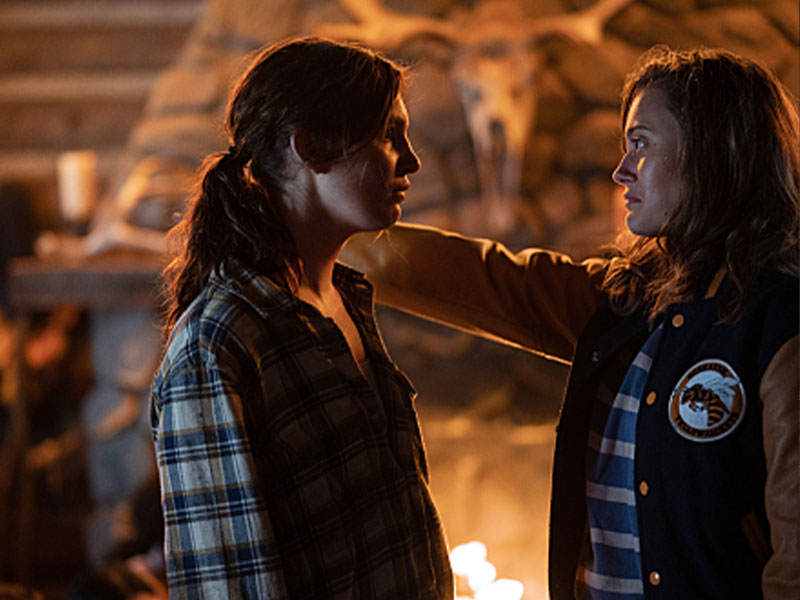
The best, most smoldering couples are always the ones that could have been. Ignite that lost maybe love as Shauna and Jackie. This couples costume is a great idea if you have one partner who wants to get glammed up and one who’d like to do the bare minimum or be comfortable: Shauna’s flannel and jeans are easy to throw together, and Jackie’s soccer uniform can be styled with her signature high, ribboned ponytail. If you want to ramp up the doomed factor, or maybe it’s cold out: your Jackie can be wrapped in a camping blanket. Bring a diary and be prepared to read aloud. 

06

Madisynn and Wongers, “She-Hulk: Attorney at Law”

Image_placeholderShe-Hulk: Attorney At LawPatty Guggenheim as Madisynn and Benedict Wong as Wong in “She-Hulk: Attorney At Law” (Chuck Zlotnick/Marvel)

Look, I guess if you want to go the obvious “She-Hulk” couples route you can slather yourself in green paint while your partner squeezes themselves into a gold latex suit and cowl (while remaining barefoot for that walk of shame home). But you know who brings the fun? That would be party girl Madisynn, whose only real accessory is a drink (the better to ramble on about how to properly spell her name). She’s the perfect foil to Wong, the Master of the Mystic Arts, who walks around in comfy layers and a tiny mustache. To add performance touches, tell people not to spoil you on “The Sopranos” and maybe bust out a karaoke number or two.

Want a daily wrap-up of all the news and commentary Salon has to offer? Subscribe to our morning newsletter, Crash Course.


07

Rhaenyra and Daemon TargaryenHouse of the Dragon

Image_placeholderHouse of the DragonEmma D’Arcy as Princess Rhaenyra Targaryen and Matt Smith as Prince Daemon Targaryen in “Game of Thrones” prequel “House of the Dragon” (Ollie Upton/HBO)

We’ve saved the worst for last. Although this pairing will likely elicit the most groans and gags, it may also be the most recognizable. If you’re okay with controversy, dig out some blond wigs from the clearance bin (it looks like the show did) and throw on some velvety frocks to be the uncle-niece couple we love to hate. If you want to recreate the wedding scene, some Nordic-esque shifts and a cardboard crown is in order. For true “House of the Dragon” realness, make sure your clothes are so dark you can barely see them. Whatever you do, do not bleach your hair because some styles you cannot come back from. 


COVID comes home: My sister Rachel Patricia Hennelly, 1960-2022

On Oct. 20, my youngest sister, Rachel Hennelly, died in hospice care at Holy Name Medical Center in Teaneck, New Jersey.  She was 62 years old. My other sister, Jennifer, was with her. Rachel had been triumphantly battling cancer for two years, but contracted COVID at a rehabilitation facility after being transferred there from a hospital. That ended her struggle. 

Before the COVID infection, we had reasonably hoped we might have at least another six months with Rachel — perhaps another Christmas.

Rachel was a ballet dancer, a member of Actors’ Equity and the American Guild of Musical Artists, a juggler and a prolific folk artist. She designed and made marionettes — from carving to costuming — that she used to entertain children of all ages in the subways and streets of New York, or wherever people would gather. She routinely set up shop outside the Metropolitan Museum of Art or near Lincoln Center to sell her creations, which were like her children.

On occasion, someone would ask her to custom-create a literary or historical figure as a marionette. I remember her creating a miniature brooch for a 12-inch-tall Emily Dickinson. She would hand over a marionette to a tourist who promised to send the money — and as far as I know, she never got stiffed. She distrusted the internet but reluctantly used the iPhone we gave her, since it had a great camera. But as my brother Chris reminded me after she left us, Rachel always said she thought children should put down their phones and make something with their hands.

One of my regrets is that she never acted on my suggestion to make an 18-inch Vladimir Putin puppet that was controlling a six-inch Donald Trump. She definitely could have done that!

Rachel hand-carved her puppets, hand-painted their faces, created their accessories and created their costumes, all in a fashion that harkened back to America’s earliest traditions of homespun handicrafts. When she came to live with my wife Debbie and me in 2018, when we lived in Mendham Township in central New Jersey, she thought nothing of packing up her menagerie and setting up shop in front of the Brookside post office.  She developed some pretty decent interest in her marionettes there. Her bicentennial collection was also a big hit at the Brookside Fourth of July parade.

As a street artist she had a detailed grasp of the U.S. Constitution and the case law created after the New York Police Department, in the Rudy Giuliani era, began treating artists like panhandlers. Before that important First Amendment precedent was set, violating the municipal regulations was considered a criminal misdemeanor, potentially punishable by up to 90 days in jail or a fine of up to $1,000.

Rachel knew just where she could legally stand outside the Metropolitan Museum, thanks to the ultimate court decision upholding the First Amendment right of artists to display their wares. Before she branched out into marionettes, she specialized in making and selling felt puppets that would populate a Christmas creche, some of which were confiscated by the NYPD. Of course Rachel bailed out Baby Jesus and his entourage.


Want a daily wrap-up of all the news and commentary Salon has to offer? Subscribe to our morning newsletter, Crash Course.


Rachel wanted no part of Twitter or Facebook and always kept an eye out for who was filming her while she was performing on the streets. My wife Debbie finally convinced Rachel to upload pictures of her creation to Pinterest. I am so glad she did.

It takes an unusual character to build and hold a crowd in the New York City transit system, operating her marionette Prima Ballerina Puppenskaya doing the “Dying Swan,” but Rachel did it. Her Magical Marionette Theater also starred the Amazing Puppenini, “the last of the great vaudevillians, master magician and violinist.” Her ability to miniaturize standard party magic tricks — and have an 18-inch-tall marionette perform sleight-of-hand — left audiences baffled.

It takes an unusual character to build and hold a crowd in the New York City transit system, operating the marionette Prima Ballerina Puppenskaya doing the Dying Swan. Rachel was that kind of character.

Magical Marionette Theater entertained thousands of children and adults at dozens of venues: the Lincoln Center Out of Doors festival, the American Museum of Natural History, the Brooklyn Academy of Music, the Paramount Theater and Madison Square Garden, among many others. Rachel was selected for the MTA’s Music Under New York Series, as well as the Holiday Market at Grand Central Station. While she lived with us in Mendham, she also gave multiple performances for children at the 2018 Lake Mohawk German Christmas Market.

Rachel was a classically trained ballet dancer who studied with the legendary Irine Fokine and at American Ballet Theater. She was an experienced juggler, who combined the circus arts with dance in appearances at Avery Fisher Hall, the New York Theater Ballet, Gould Hall, the National Actor Theater Gala with Tony Randall, the BAMkids Film Festival, the Showboat Casino and regional theaters across the country.

“One of the highlights of the divertissements was a lively Russian carnival sequence in which Rachel Hennelly juggled while she danced,” wrote Jack Anderson, dance critic with the New York Times, of Rachel’s 1991 performance in “The Nutcracker” for the New York Theater Ballet.

She had been a featured dance soloist with the Houston Grand Opera, the Lake George Opera Festival and the Village Light Opera, and also toured with the Ringling Bros. and Barnum & Bailey Circus. Her circus career was evidently brief: My sister was fearless and had a warrior spirit, but made a beeline for the big top exit when she was told to lie prone while an elephant placed its foot on her head.

Thanks to providence, her own inner fortitude, her boundless optimism, her physical fitness, her love of the arts, the daily support of our sister Jennifer and the compassionate care of her doctors, nurses and techs at Holy Name, she lived well beyond the initial prognosis two years ago, when she was given about six months to live.

After a seizure a few weeks back, she was hospitalized at Holy Name to begin a course of radiation treatments. After a few days there, she was moved — on a Friday night — to a rehabilitation facility just down the street. The apparent plan was for her to be brought back and forth each day for radiation treatments at Holy Name. A day after she was moved from the hospital, we were notified that three staff members at the rehab facility had tested positive for COVID. It wasn’t long before Rachel was infected, and her condition rapidly declined. She was moved back to the hospital, but the COVID infection proved insurmountable. She held on long enough so that, by the end, she was no longer infectious and we were able to be with her.

That was a blessing.

Before Rachel was hospitalized, she had arranged for an exhibit of some of her marionettes at the Ridgewood Public Library for the month of October. We managed to get the display installed so she could approve it remotely, from her hospital bed. She had also arranged for an exhibit at the Hasbrouck Heights Library in November.

We expect the Magical Marionette Theater will continue to tour. We would be delighted to find a venue for a Fifth Avenue display, should anyone who loved and remembers Rachel’s puppetry feel moved to help with that. Ultimately, we would love to see Rachel’s dozens of marionettes — her true artistic legacy — find a permanent home, perhaps in a folk art museum, as a reminder of what Americans can create with their own hands.

We would love to see Rachel’s dozens of marionettes — her true artistic legacy — find a permanent home, as a reminder of what Americans can create with their own hands.

Coincidentally, at the exact day and hour that Rachel left this earthly plane, I was attending the funeral mass for Dr. Joseph Fennelly at St. Vincent Martyr in Madison, New Jersey. As I waited for the service to get underway, I noticed that Dr. Joe’s birthday was Aug. 9, 1929. Rachel’s was Aug. 9, 1960. That was a surreal moment.

Fennelly, who had died a few days earlier at age 94, was an attending physician based out of the Morristown Medical Center for more than 55 years. He chaired the bioethics committee of the Medical Society of New Jersey for over half a century. He was an early advocate for patients’ rights as well as end-of-life issues.

He collaborated with Dr. Elizabeth Kubler-Ross and Dr. Edmund Pellegrino, pioneers in this challenging field. He was the medical counsel and adviser to the family of Karen Ann Quinlan, who never regained consciousness after she fell into an irreversible coma in 1975. for several years. Her case, and the court decisions it generated, laid the foundation for today’s hospice standard of care, something my sister Rachel embraced and from which she surely benefited.

For years, Dr. Joe had been a source and mentor for me on the impact of the medical-industrial complex that too often puts profit ahead of people. His insights during the pandemic were essential to my understanding of just how badly America was doing relative to our nation’s wealth and potential, and the consequences of our cruel refusal to embrace universal health care.

I know we are supposed to be “over” COVID. Yet hundreds of people continue to die every day. We are well past the stage when New Jersey Gov. Phil Murphy highlights a few short bios of the dearly departed every day for an audience of reporters. Our elected officials, from the White House to the state house, need all this to be in the rearview mirror.

Yet my loved one died last week. Many other people’s loved ones died this week. More will die next week, and the people who treat them still face the risk of a life-altering bout with the virus that has killed more than a million Americans, and counting. Gaps in infection control in congregant-care settings — such as the one where Rachel contracted the virus — are still killing people, as is our failure to sufficiently invest in public health.

In defense of loving Mounds candy bars

It’s only been a couple of years since I discovered that one of my flavor preferences is considered by a sizable segment of the population to be shunworthy

There I was, tucking into my annual savoring of the leftover fun-sized Mounds bar I had set aside for myself from the Halloween hoard and cruising social media when I encountered, for the very first time, a wave of hatred for my mainstream candy treat of choice and disdain for those of us who enjoy them.

“Tonight a friend told me her favorite candy bar was Mounds and I told her to walk home because that’s by far the worst food opinion I’ve ever heard,” tweeted @WorldofIsaac back in 2020.  

Feigning outrage to light up one’s replies is a popular Twitter sport, but this slander over a Halloween staple that a) features chocolate, and b) is not a Tootsie Roll-related abomination, was new to me. There are so many other misfit sweets to hate on – candy corn, black licorice, those weird peanuts with the bumpy coating – but a classic Hershey product combining coconut and dark chocolate? Almond Joy’s nut-less kin?

America. Why?

Our autumnal War on Mounds is, of course, part of a cyclical pastime.

Candy preference ratioing gets fierce during Spooky Season. Do a Twitter search on Mounds – and be sure to include the term “candy bar” in your search terms or you’ll be whacked in the eyeballs with some real NSFW content, which is part of the problem. Anyway, you will find it to be a frequent flyer on Worst Halloween Candy lists, along with being considered “low vibrational,” “double-nasty” and, colorfully, “a gift directly from the Devil’s a**.”

What’s more, a portion of very online and, one assumes, many more folks who aren’t, believe that enjoying Mounds bars may be a personality flaw.

Comedian Sheng Wang jokes in his latest Netflix special, “Sweet and Juicy,” that the fact that “my preferred mainstream candy bar is now Mounds” is indicative of the change going on in his life. “Because we all know . . . that’s gross. That’s gross, dude.”

Harsh.

Like everything else, foods and flavors go in and out of fashion. Our autumnal War on Mounds is, of course, part of a cyclical pastime that involves publicly and playfully declaring an enmity for, say, pumpkin spice, veganism and other people’s happiness.  

Hating on Mounds, however, strikes me as especially odd owing to the commonness of its ingredients. Never mind that Mounds is among the old guard of confections available in the United States’ grocery aisles, having hit its 100th anniversary in 2020 and peaking in popularity in the mid-20th century. The point is, this is a candy that established long ago exactly what you’re getting: coconut and chocolate, a combination classic enough to be emulated (and, let’s be honest, perfected) by any number of gourmet and artisanal chocolatiers.

If you don’t like coconut, and lots of folks don’t, then Mounds is not your thing. Fair enough. Nevertheless, there are folks who would walk a mile in hip-high snow for a decent pina colada or cook everything in coconut oil who are also adamantly anti-Mounds.

Even if memes, Twitter, and toilet humor never existed, Mounds would still be the punchline of candy bar monikers.

In some respects, this is easy to get. Smaller candy makers who marry those flavors understand that the major issue Mounds foes have with it has to do with its mouthfeel, which makes or breaks any goodie. Hershey assumes Mounds consumers crave coconut meat at its coarsest and its exfoliating benefits for the digestive tract.

Then again, people passionately stan for many candies that put up a fight with your teeth and tongue the moment they pass the lips. To wit: Snickers is the most popular candy in this country, according to a Statista survey from 2020.


Want a daily wrap-up of all the news and commentary Salon has to offer? Subscribe to our morning newsletter, Crash Course.


Unfortunate branding is also, shall we say, a barrier to success. Even if memes, Twitter, and toilet humor never existed, Mounds would still be the punchline of candy bar monikers. Consider that Statista data indicating that Almond Joy, Mound’s younger milk chocolate sibling (born in 1946) contains a similar amount of coconut – but with an almond! – and is the seventh most popular candy in the United States. Mounds is . . . not even close.

Its promise is in the name, as Wang points out in his routine: Crucial ingredient, plus a positive emotion. Meanwhile, “Who approved Mounds? . . . Mounds is a good name if your only other option is ‘Piles.'”

That doesn’t change the fact that, as he confesses, it’s still his candy bar of choice – his, and that of around 8.3 million people, give or take, with a healthy valuation of prebiotic fiber’s benefits.

These days, one would think more folks would appreciate the reassurance by a candy choice that, indeed, some of us don’t feel like a nut. We may have issues, as one writer posits, but that’s what it is to be human. Honestly, I’d have more questions for the folks who probably think that the tastiest part of any birthday cake is the candles. Twizzler lovers, I’m talking about you. Explain yourselves.


There are two musicians inside Peter Frampton

Celebrated English guitarist, singer and songwriter Peter Frampton joined host Kenneth Womack to talk about “being two musicians” and more on the latest episode of “Everything Fab Four,” a podcast co-produced by me and Womack (a music scholar who also writes about pop music for Salon) and distributed by Salon.

Frampton, known for his legendary 1976 double album “Frampton Comes Alive!” and hits such as “Baby, I Love Your Way,” “Do You Feel Like I Do?” (the best song “written about a hangover,” as he tells Womack) and “Show Me the Way,” taught himself to play guitar at age seven. Being born a few years after the Beatles were, and yet a few years before the next wave of popular musicians, gave him an advantage in the “proving ground” of rock music that England had become at the time.

Growing up watching musicians such as Lonnie Donegan and Billy Fury on English TV, it was in 1962 that Frampton saw the Beatles performing “Love Me Do” on a show and was completely taken aback. “It was different, unique, attractive” he explains. “It was no longer Cliff Richard with four guys standing behind him. They were self-contained, and they had written the music themselves. It was genius.”

Frampton himself had been playing in bands since he was 10 years old and continued to move up through various groups on the British scene in the 1960s, working alongside fellow up-and-comer David Bowie and then, under the mentorship of the Rolling Stones’ Bill Wyman. After a stint with the band Humble Pie, he went out on his own. But the moment he calls “like all his birthday and Christmas wishes coming true at once” was being asked to play on a Doris Troy track (“Ain’t That Cute,” 1970) that George Harrison was producing. “I walked into the studio and George said, ‘Hello Pete.’ And I was like, ‘How does he know who I am!?'”

The opportunity opened the door for Frampton to work with many other musicians such as Ringo Starr and Klaus Voormann, and to play on Harrison’s “All Things Must Pass” album. He also met beloved Beatles road manager Mal Evans, and has an incredible story about holding John Lennon’s famed black Rickenbacker guitar thanks to that experience.

LISTEN:

Subscribe today through Spotify, Apple Podcasts, GooglePodcasts, Stitcher, RadioPublic, Breaker, Player.FMPocket Casts or wherever you’re listening.

As far as recording music goes, Frampton says that “technology is wonderful, but you’ve got to have a great song to start,” and that there is a “studio me” and a “live me.” But ultimately he, like the Beatles and all the best musicians, feels that “there is a joy I have when I play, and you can just feel it.”

Listen to the entire conversation with Peter Frampton on “Everything Fab Four,” including how he came into possession of an early copy of “Sgt. Pepper” that “literally fell off the back of a truck,” and subscribe via SpotifyApple PodcastsGoogle, or wherever you’re listening.


Want a daily wrap-up of all the news and commentary Salon has to offer? Subscribe to our morning newsletter, Crash Course.


“Everything Fab Four” is distributed by Salon. Host Kenneth Womack is the author of a two-volume biography on Beatles producer George Martin and the bestselling books “Solid State: The Story of Abbey Road and the End of the Beatles” and “John Lennon, 1980: The Last Days in the Life.” His latest project is the authorized biography and archives of Beatles road manager Mal Evans, due out in 2023.

Bill Maher lists “24 things you don’t know about Marjorie Taylor Greene” during “Real Time”

During a segment of Friday’s “Real Time With Bill Maher,” viewers are prepped for the upcoming midterm elections with a run-down of “24 things you don’t know about Marjorie Taylor Greene.” 

“One of the people I love to listen to on Twitter is Marjorie Taylor Greene,” says Maher prior to the run-down of his humorous list. “. . .She’s really having a moment. Trump is considering her as a running-mate in 2024, and she’s also gotten a lot of incredible press. And when the Republicans take over Congress in 11 days, she’s gonna be very important there. So we thought today would be a good time to do 24 things you don’t know about Marjorie Taylor Greene.”

01
I’ve never been in a store without demanding to see the manager.
02
I have three kids, two in high school and one who was murdered by Hillary Clinton.
03
My greatest fears are snakes, spiders and Jews.
04
To keep things sexy in a relationship, I sometimes open the door completely unarmed.
05
I was once kicked off Truth Social for not comparing something to Nazis.

Want a daily wrap-up of all the news and commentary Salon has to offer? Subscribe to our morning newsletter, Crash Course.


06
My mom drank while she was pregnant with me. And even more after she met me.
07
I will work with Republicans who dislike me because there is no “I” in “team.” I think.
08
Since classrooms are full of groomers, I’m trailer-schooling my kids.
09
I would’ve liked “Schindler’s List” if it was shorter. Not the movie, the list of Jews he saved.
10
If I could meet anyone living or dead, I’d prefer living, because If I was dead what’s the point?

Watch the rest of the segment here:

Freud was dying of cancer, the Nazis were closing in — and his last book challenged Judaism. Why?

Anti-Semitism is surging in a manner eerily reminiscent of the mid-20th century, when World War II broke out and the Holocaust claimed 6 million Jewish lives. There are extreme right-wingers coalescing around new media platforms (radio then, the internet now) to spread their hate-based philosophy. Conspiracy theories continue to be shared about Jewish banking families controlling the weather and Jewish space lasers igniting wildfires. Year after year there has been a rise in anti-Semitic hate crimes, which may even be underreported.

On top of the inherent injustice of religious and ethnic persecution, anti-Semitism has also darkened the lives of many of history’s most important intellectuals, from Franz Kafka to Albert Einstein. One of these famous intellectuals to also be victimized by anti-Semitism is the father of psychoanalysis, Sigmund Freud. He was less than two months away from his 82nd birthday during the Anschluss, or the annexation of Austria by Adolf Hitler’s expanding and genocidally anti-Semitic German empire. A lifelong Austrian who loved his home city of Vienna, Freud was destined to flee his native land while in the thrall of a mortal disease and spend his dying days in a distant city. While enduring these hardships, he also penned a work called “Moses and Monotheism” that dealt specifically with Jewish issues — and in a way that many of Freud’s critics felt was profoundly disrespectful to Judaism.

The tale of Freud’s last days is a strange one, and rarely told, perhaps because it may not reflect well on his state of mind. What was a genius of psychology and a Jew doing writing a book that, at least by today’s standards, might seem faintly anti-Semitic to some — and at the same moment the Nazi regime was devouring Europe, too? 

To understand this requires going back in time. Today, Freud is most widely known as the founder of psychoanalysis, the practice in which patients talk to doctors trained in mental health so they can receive diagnoses for ailments in their psyches. Yet apart from psychoanalysis and psychology, Freud had a wide range of ideas about a multitude of subjects. He identified (and was identified in the public mind with) political liberalism, although he was so cynical about human nature that he doubted even the best intentions in politics (such as those he ascribed to certain Communists) could ever realistically do much good. Religiously he was an outspoken atheist, but was also pragmatic about the social implications of his Jewish heritage. Even though he did not go to synagogue services or accept any of the Judaic theology as real, Freud recognized that Jews experience persecution — and had encountered more than a fair share of it in his own life.

Freud was not a Jew by religion, but he was a Jew all the same. Perhaps this is why, as the Nazis began to sweep over Europe and burn his books by the thousands, he made the darkly self-aware joke that from a humanitarian standpoint the book-burnings struck him as a step in the right direction. After all, Freud remarked, centuries ago Jews and free-thinkers like him were personally burned at the stake; now, it seemed, anti-Semitic reactionaries could be contented with merely burning his books.

“Most consider his claims about the secret Egyptian identity as signaling his last wish to rethink his own Jewishness.”

Except, as Freud was soon to learn the hard way, the Nazis were not content with just burning his books. After the Nazis arrested his daughter Anna (a psychoanalyst like her father), Freud was convinced by his friend and colleague Welsh neurologist and psychoanalyst Ernest Jones that he had no choice but to flee. Over the two months spanning from early April 1938 through June 6th of the same year, Freud endured a bureaucratically and physically torturous ordeal as his friends painstakingly arranged for his safe emigration to London. In addition to being a frail octogenarian, Freud was also dying of jaw cancer and in such severe pain that he needed morphine to alleviate his agony. Because he had resources and connections, Freud achieved what millions of his fellow Jews could not: He escaped the Nazis’ clutches and was allowed to die peacefully in bed (after being given extra morphine doses that at least one scholar has argued constituted “indirect active euthanasia”). Freud’s four elderly sisters, who lacked their famous brother’s connections to power and influence, were not so fortunate; they all died in concentration camps.

This brings us to Freud’s last book, “Moses and Monotheism.” He began writing it four years before the Anschluss, so in a sense much of the main intellectual work had already done before his forced exile. Yet even back in 1934, when he first put pen to paper on the subject, Freud was sufficiently alarmed about the Nazi menace that he was unsure if he would ever publish his ideas. By 1938, however, Freud had started to view “Moses and Monotheism” as his swan song, and focused intently on perfecting what had once been a more fitful endeavor. The end result is a bold work of Biblical and historical revisionism, an attempt by an impassioned psychoanalysis to retrace steps made by his ancestors several millennia earlier in order to comprehend the deeper meaning of their heritage and, by extension, of his own. Drawing from his deep knowledge of Jewish culture and theology, Freud offered a new spin the Book of Exodus: Moses, instead of being a Jewish slave who led his people to freedom from Egyptian tyrants, was in Freud’s worldview an Egyptian royal who led a small group of Jewish rebels out of Egypt. Moses’ motive, Freud hypothesized, was to preserve a sect of the ancient Egyptian religion which rejected polytheism and only worshipped the sun god, Aten. When the Egyptian ruling class insisted on a strictly polytheistic society, Moses and his followers first rebelled and then fled.


Want more health and science stories in your inbox? Subscribe to Salon’s weekly newsletter The Vulgar Scientist.


Freud was not yet finished with his provocative thesis. He guessed that at some point while wandering through the desert, a conflict arose between Moses and his followers, and the leader was ultimately killed. Overwhelmed with remorse, the small Jewish tribe suppressed memories of the direct cause of their collective sense of shame, but the guilt percolated up nonetheless. Freud argued that this tribe eventually met another group of Egyptian emigrants, only that band worshiped a mountain god called Yahweh. Over time, their faith was melded with both Moses’ monotheistic beliefs and various other psychological detritus from the ancient Jews’ collective interactions with him. The end result, according to Freud, was the Jewish religion and culture. On top of that, Freud speculated that the Christian anti-Semitic myth that Jews bore collective guilt for killing Jesus Christ was psychologically linked to the Jewish sense of collective guilt over killing Moses.

The public reacted to Freud’s arguments with outrage — which he no doubt expected, as he introduced his book with the sentence, “To deny a people the man whom it praises as the greatest of its sons is not a deed to be undertaken light-heartedly, especially by one belonging to that people.” To many of his contemporaries, it was particularly galling for Freud to insult the religion for which many of his fellow Jews were dying while he — a non-practicing Jew — was only spared that same fate because of his social privileges. Even when these moral reservations were set aside, Freud’s book is almost stunningly whimsical in its approach to facts.

Despite repeatedly attempting to give the appearance of grounding his arguments in research and with examples, “Moses and Monotheism” always seems to have one foot firmly planted in Freud’s creative imagination. This did not need to be a fatal flaw, as this was not Freud’s first foray into applying psychoanalytic methods to understanding history and sociology: One of his greatest masterpieces, the 1930 book “Civilization and Its Discontents,” adopted a similar approach. Yet this method did not always pan out for Freud, such as when he wrote a biography of President Woodrow Wilson (co-authored with journalist William Christian Bullitt Jr. and published posthumously in 1967) in which his perception of Wilson as a bigotreactionary, egomaniac and emasculated weakling turned his text into a polemic rather than a dispassionate scientific analysis.

As he wrote “Moses and Monotheism,” this aspect of Freud’s mind — the man who struggled to separate his subjective emotions from his detached judgment — may have been at the fore. Without question, Freud had strong personally feelings about Moses. The difference between Moses and Woodrow Wilson, however, was that Freud actually liked Moses.

“By writing the book, Freud defiantly asserted his Jewishness and defended the essential contribution Jews have made to human civilization.”

“Freud strongly identified with Moses much of his life, as he told his friend Lou Andreas-Salome while writing the book,” Matthias Beier, Ph.D. — a psychoanalyst and pastoral psychotherapist at Christian Theological Seminary who has discussed Freud in his work — told Salon by email. Yet Freud also viewed Moses as being Jewish in the ways that counted (his contributions to history), and was proud of what he saw as a tendency by Moses to be “defiant.”

“By writing the book, Freud defiantly asserted his Jewishness and defended the essential contribution Jews have made to human civilization,” Beier explained. For instance, when he visited Michelangelo’s famous statue of Moses in 1901, Freud was so fascinated that he frequently revisited it in Rome and even wrote about it in a paper in 1914.

“He interpreted the moment captured in the statue as the one when Moses controlled his inner rage against the rebellious Israelites,” Beier pointed out. “This interpretation was different from the biblical account of Moses breaking the tablets of the law in rage. Freud saw in Moses a person who had gained ‘the highest mental achievement that is possible,’ namely, ‘that of struggling successfully against an inward passion for the sake of a cause to which he has devoted himself.'”

Two other Freud experts, philosopher Dr. Gilad Sharvit of Towson University and German professor Dr. Karen S. Feldman of University of California, Berkeley, wrote to Salon that scholars have “endlessly discussed” Freud’s reasons for writing “Moses and Monotheism” when he did, including Beier’s argument that it was an attempt to address the problems of antisemitism and Jewish identity.

“Most consider his claims about the secret Egyptian identity as signaling his last wish to rethink his own Jewishness,” Sharvit and Feldman wrote to Salon. “Some argue that the story represents an unconscious wish to become an ‘Egyptian’ (like Moses), that is German or non-Jewish, or at least his ambivalence regarding his Jewishness. Freud, to remind, was an assimilated Jew. Others comment on Moses who was betrayed by his people as a figure that Freud — himself a fierce and powerful leader of the psychoanalytic movement — could identify with (because he was also betrayed by his own followers like Jung).”

“While Freud’s ‘Moses and Monotheism’ does not hold up in terms of historically verifiable facts, it still has an urgent message for us today at a time when we witness globally and locally the resurgence of hatred of the ‘other.'”

Just as scholars remain unsure about why Freud felt compelled to write “Moses and Monotheism” from his literal deathbed, so too are they unclear about whether they should regard the book as a success or as a failure.

“Since the 1990s, ‘Moses and Monotheism’ has been one of Freud’s most researched books,” Sharvit and Feldman explained to Salon. “There are numerous publications addressing this book as: (1) work in philosophy of history, (2) work in religious studies and Jewish studies (3) work in trauma studies, (4) work on antisemitism and race theory, (5) and even a work on Zionism.”

Beier told Salon that the “verdict” among scholars on “Moses and Monotheism” is “mixed,” but added that it has literary value independent of its scientific and historical veracity.

“While Freud’s ‘Moses and Monotheism’ does not hold up in terms of historically verifiable facts, it still has an urgent message for us today at a time when we witness globally and locally the resurgence of hatred of the ‘Other’ and of a group psychology centered around quasi-divinized repressive and oppressive leaders,” Beier pointed out. “Among the key ideas of the book is the thesis that envy of others’ self-confidence, self-assuredness, and self-control is a major reason for anti-Semitism as well as for religious violence in general. A point can be made that this applies even to forms of violence not explicitly religious.”

Personally, I think there is a very big clue at the end of “Moses and Monotheism” that illuminates Freud’s reasons for shuffling off this mortal coil with this particular book. As he describes the “question” of “how the Jewish people acquired the qualities that characterize it,” he adds that there is also a question of “how they could survive until today as an entity,” which he observes “has not proved so easy to solve.” Yet he does not seem demoralized by this, because he argues that a person cannot “reasonably demand or expect exhaustive answers of such enigmas.” Perhaps Freud, despite his reputation for arrogance, had sufficient humility to accept the limits of his own knowledge. It is entirely possible that even he did not fully understand why he was so personally drawn to this particular topic, despite relevant self-insights (he admitted that he identified with Moses in the sense that Freud had also been “betrayed” by his disciples).

Yet Freud wrote the book anyway, and more than 80 years after his death, scholars are still talking about it. Freud, like Moses, has an immortal legacy — and that is something that no one, not even the Nazis and their bookburnings, can ever take away from him.

GOP’s Halloween horror show: Marjorie Taylor Greene doesn’t need a costume

All thanks to Elon Musk, who has revived the perfect word to describe what the Republican Party has in mind for us if they take over either or both houses of Congress in January: Hellscape. That’s what they’re planning to turn this country into — a nation that is already struggling with issues of race, economic inequality, gender, immigration and, yes, crime. They’ve got plans for the hellscape they dream of: More guns on the street will solve the crime problem; going colorblind will wipe out issues of race; keeping the minimum wage right where it is will take care of economic inequality, which is exactly where they want it; passing laws against gender-affirming medical care will handle those scary trans kids; and accusing Democrats of “opening the border” should keep all those brown people on the other side of the wall they (sort of) built but have already forgotten is there, probably because it’s a total failure.

The poster child for the Republican legislative future is Marjorie Taylor Greene of Georgia. With Donald Trump already squawking about putting her on his ticket when he announces he’s going to run for president — maybe as soon as  next month — the Republican Party is planning on giving MTG some seat-time by electing her to the House Republican leadership in some as yet unnamed capacity.

It doesn’t really make a difference what job they give her, because they don’t want the first-term congresswoman’s legislative experience. They want her mouth.

In less than two years in the House, MTG has already provided us with a virtual encyclopedia of radical hate and lunacy. Let’s take a look at her recent language about abortion to kick things off. The Supreme Court decision that overturned Roe v. Wade was a “miracle” and a “blessing,” Greene said. Last year, when arguing against exceptions to abortion bans for rape and incest, she called a fellow Republican lawmaker, Nancy Mace of South Carolina, “trash” for supporting the exceptions. “She is not conservative, she is pro-abort,” Greene said of Mace on Twitter. 

Earlier this week in an appearance on a radio show, when a woman called in and said, “My body is my body and I don’t want the government telling me what I can do with my body,” Greene reacted to the woman, who sounded as if she could be elderly, by saying, “Ma’am, are you having children any time soon?” When the woman brought up the case of a 10-year-old girl who was raped in Ohio and had to go out of state to get an abortion, Greene again mocked the woman for not sounding as if she were of child-bearing age. “Again, ma’am, I know you say it’s your body, your choice, but I don’t think you’re having any children any time soon and I think we need to focus on the future of America and that’s our children and the unborn, they’re our future also. So let’s focus on protecting their lives instead of being focused on the lie that abortion is women’s health care, because that’s not health care.”

Greene of course voted against a recent bill in the House that would codify Roe v. Wade into law, and it doesn’t sound like her sympathies lie with the nation’s elderly, either, who may see their Social Security and Medicare benefits slashed if Kevin McCarthy takes over as the next speaker of the House. 

But it isn’t just Greene’s votes against every bill put forward by Democrats, or her radical stance on denying women the right to an abortion even in cases of rape and incest. It’s the way she goes about the business of being a member of Congress that shows what we can expect if she, as expected, becomes part of the Republican House leadership. 

On Greene’s fourth day as a member of Congress, she was already laying claim to a spot on the far right of the Republican Party that no one had yet occupied. Most of the party has since joined her there.

The day after a mob of Trump-backing thugs assaulted the Capitol and injured more than 140 cops in the process, MTG was on a right-wing YouTube show hosted by Katie Hopkins, a far-right British commentator with a long history of racist and antisemitic views. It was Greene’s fourth day as a member of Congress, and she was already laying claim to a spot on the far right of the Republican Party that no one had yet occupied — although most of the party faithful have joined her there since then. “It’s almost like you’re one of them,” Hopkins said to Greene, referring to the mob that attacked the Capitol the previous day. The New York Times Magazine quoted her reply this way: “I am one of those people,” Greene said emphatically. “That’s exactly who I am.”

In that same magazine feature, published just over a week ago, writer Robert Draper listed Greene’s radical fringe beliefs. Greene refers to “undocumented immigrants as rapists, transgender individuals as predators, Black Lives Matter protesters as terrorists, abortion providers as murderers and her political opponents as godless pedophilia-coddling Communists… [S]he has continued to insist that Trump won the 2020 election. She maintains that America should have a Christian government and that open prayer should return to classrooms. She has called for the impeachment of not just Biden but also Attorney General Merrick Garland and the secretary of homeland security, Alejandro Mayorkas.” Greene openly calls herself a “Christian nationalist,” is unabashed about her adherence to QAnon beliefs and regularly refers to various Democrats as child abusers, Communists and godless heathens. 


Want a daily wrap-up of all the news and commentary Salon has to offer? Subscribe to our morning newsletter, Crash Course.


And where has all this right-wing venom-spewing gotten her? Well, the talk about Greene as Trump’s possible running mate has only just begun, but already it’s gospel on the right. She has made appearances with suspected sex-trafficker Matt Gaetz, campaigning for J.D. Vance in Ohio; with Arizona MAGA darlings Paul Gosar and Andy Biggs; on behalf of Pennsylvania gubernatorial candidate and fellow Christian nationalist Doug Mastriano; and, of course, alongside MAGA King Donald Trump at several of his recent rallies around the country.

The woman has yet to serve out a full term in the Congress, and she has become the face of the party’s future.

What does the future according to Marjorie Taylor Greene look like? She recently released a TV ad for her own congressional race in Georgia (which is no contest) showing her standing in a field and comparing Democrats to wild hogs out to destroy America. Wearing a pair of aviator shades and a black muscle T-shirt, she climbed into a waiting helicopter and shot a feral hog from the air with an AR-15 military-style assault rifle. After the chopper landed, she stood over the hog with a raised fist and a wide grin. “Let’s help American farmers out,” she shouted. “Sign up below, and let’s go hog hunting!” On the screen was a chyron reading, “Enter to Win Now! MTGHOGHUNT.COM.”

She had just compared Democrats to wild hogs, and she was fund-raising with a sweepstakes that promised a chance to “go hog hunting.” 

It’s Halloween, and Marjorie Taylor Greene doesn’t need to shop for a costume. She can just go as herself. 

Blind to problems: How VA’s electronic record system shuts out visually impaired patients

Sarah Sheffield, a nurse practitioner at a Veterans Affairs clinic in Eugene, Oregon, had a problem. Her patients — mostly in their 70s and beyond — couldn’t read computer screens. It’s not an unusual problem for older people, which is why you might think Oracle Cerner, the developers of the agency’s new digital health record system, would have anticipated it.

But they didn’t.

Federal law requires government resources to be accessible to patients with disabilities. But patients can’t easily enlarge the text. “They all learned to get strong reading glasses and magnifying glasses,” said Sheffield, who retired in early October.

The difficulties are everyday reminders of a dire reality for patients in the VA system. More than a million patients are blind or have low vision. They rely on software to access prescriptions or send messages to their doctors. But often the technology fails them. Either the screens don’t allow users to zoom in on the text, or screen-reader software that translates text to speech isn’t compatible.

“None of the systems are accessible” to these patients, said Donald Overton, executive director of the Blinded Veterans Association.

Patients often struggle even to log into websites or enter basic information needed to check in for hospital visits, Overton said: “We find our community stops trying, checks out, and disengages. They become dependent on other individuals; they give up independence.”

Now, the developing VA medical record system, already bloated by outsize costs, has been delayed until June 2023. So far, the project has threatened to exacerbate those issues.

While users in general have been affected by numerous incidents of downtime, delayed care, and missing information, barriers to access are particularly acute for blind and low-vision users — whether patients or workers within the health system. At least one Oregon-based employee has been offered aid — a helper assigned to read and click buttons — to navigate the system.

Over 1,000 Section 508 complaints are in a backlog to be assessed, or assigned to Oracle Cerner to fix, Veterans Affairs spokesperson Terrence Hayes confirmed. That section is part of federal law guaranteeing people with disabilities access to government technology.

Hayes said the problems described by these complaints don’t prevent employees and patients with disabilities from using the system. The complaints — 469 of which have been assigned to Oracle Cerner to fix, he said — mean that users’ disabilities make it more difficult, to the point of requiring mitigation.

The project is under new management with big promises. North Kansas City, Missouri-based developer Cerner, which originally landed the VA contract, was recently taken over by database technology giant Oracle, which plans to overhaul the software, company executive Mike Sicilia said during a September Senate hearing. “We intend to rewrite” the system, he said. “We have found nothing that can’t be addressed in relatively short order.”

But that will happen under continued scrutiny. Rep. Mark Takano (D-Calif.), chair of the House Veterans Affairs Committee, said his panel would continue to oversee the department’s compliance with accessibility standards. “Whether they work for VA or receive health care and benefits, the needs of veterans must be addressed by companies that want to work with the VA,” he said.

Takano, along with fellow Democrats Sens. Bob Casey of Pennsylvania and Jon Tester of Montana, sent a letter Oct. 7 to VA Secretary Denis McDonough noting the significant gaps in the agency’s systems, and urging VA to engage with all disabled veterans, not merely those who are blind.

VA was alerted early and often that Cerner’s software posed problems for blind-and low-vision users, interviews and a review of records show. As early as 2015, when the Department of Defense and VA were exploring purchasing new systems, the National Federation of the Blind submitted letters to both departments, and Cerner, expressing concerns that the product would be unusable for clinicians and patients.

Alerts also came from inside VA. “We pointed out to Cerner that their system was really dependent on vision and that it was a major problem. The icons are really, really small,” said Dr. Art Wallace, a VA anesthesiologist who participated in one of the agency’s user groups to provide input for the eventual design of the system.

The Cerner system, he told the agency and KHN, is user-unfriendly. On the clinician side, it requires multiple high-resolution monitors to display a patient’s entire record, and VA facilities don’t always enjoy that wealth of equipment. “It would be very hard for visually impaired people, or normal people wearing bifocals, to use,” he concluded.

Before the software was rolled out, the system also failed a test with an employee working with a team at Oregon’s White City VA Medical Center devoted to helping blind patients develop skills and independence, said Carolyn Schwab, president of the American Federation of Government Employees Local 1042.

In the testing, the system didn’t work with adaptive equipment, like text-to-speech software, she said. Despite receiving these complaints about the system, VA and Cerner “implemented it anyway.” Recently, when a regional AFGE president asked VA why they used the software — despite the federal mandates — he received no response, Schwab said.

Some within the company also thought there would be struggles. Two former Cerner employees said the standard medical record system was getting long in the tooth when VA signed an agreement to purchase and customize the product.

Because it was built on old code, the software was difficult to patch when problems were discovered, the employees said. What’s more, according to the employees, Cerner took a doggedly incremental approach to fixing errors. If someone complained about a malfunctioning button on a page filled with other potholes, the company would fix just that button — not the whole page, the employees said.

VA spokesperson Hayes denied the claims, saying the developer and department try to address problems holistically. Cerner did not respond to multiple requests for comment.

Accessibility errors are as present in private sector medical record systems as public. Cerner patched up a bug with the Safari web browser’s rendering of its patient portal when the Massachusetts Institute of Technology’s student clinic threatened legal action, the former employees said. (“MIT Medical does not, as a general practice, discuss individual vendor contracts or services,” said spokesperson David Tytell.)

Legal threats — with hospital systems and medical record systems routinely facing lawsuits — are the most obvious symptom of a lack of accessibility within the U.S. health care system.

Deep inaccessibility plagues the burgeoning telehealth sector. A recent survey from the American Federation for the Blind found that 57% of respondents struggled to use providers’ proprietary telehealth platforms. Some resorted to FaceTime. Many said they were unable to log in or couldn’t read information transmitted through chat sidebars.

Existing federal regulations could, in theory, be used to enforce higher standards of accessibility in health technology. The Department of Health and Human Services Office for Civil Rights issued guidance during the pandemic on making telehealth technologies easier to use for patients with disabilities. And other agencies could start leaning on hospitals, because they are recipients of government dollars or federal vendors, to make sure their offerings work for such patients.

That might not happen. These regulations could prove toothless, advocates warn. While there are several laws on the books, the advocates argue that enforcement and tougher regulations have not been forthcoming. “The concern from stakeholders is: Are you going to slow-walk this again?” said Joe Nahra, director of government relations at Powers Law, a Washington, D.C., law firm.

Building in accessibility has historically benefited all users. Voice assistance technology was originally developed to help blind- and low-vision users before winning widespread popularity with gadgets like Siri and Alexa.

Disability advocates believe vendors often push technology ahead without properly considering the impact on the people who will rely on it. “In the rush to be the first one, they put accessibility on the back burner,” said Eve Hill, a disability rights attorney with Brown, Goldstein & Levy, a civil rights law firm.

KHN (Kaiser Health News) is a national newsroom that produces in-depth journalism about health issues. Together with Policy Analysis and Polling, KHN is one of the three major operating programs at KFF (Kaiser Family Foundation). KFF is an endowed nonprofit organization providing information on health issues to the nation.

Subscribe to KHN’s free Morning Briefing.

Give peace a chance in Ukraine: The chorus rises, around the world and across the spectrum

Ukraine has been wracked by shocking destruction and deadly violence since Russia invaded in February. Estimates of the death toll range from a confirmed minimum of 27,577 people, including 6,374 civilians, to more than 150,000. The slaughter can only get more horrific as long as all sides, including the U.S. and its NATO allies, remain committed to war.

In the first weeks of the war, the U.S. and NATO countries sent weapons to Ukraine to try to prevent Russia from quickly defeating Ukraine’s armed forces and conducting a U.S.-style “regime change” in Kyiv. But since that goal was achieved, the only goals that President Volodymyr Zelenskyy and his Western allies have publicly proclaimed are to recover all of pre-2014 Ukraine and decisively defeat and weaken Russia. 

These are aspirational goals at best, which could require sacrificing hundreds of thousands, perhaps millions, of Ukrainian lives, regardless of the outcome. Even worse, if they should come close to succeeding, they could trigger nuclear war, making this the all-time epitome of a “no-win predicament.”

At the end of May, President Biden responded to probing questions about the contradictions in his Ukraine policy from the New York Times editorial board, replying that the United States was sending weapons so that Ukraine “can fight on the battlefield and be in the strongest possible position at the negotiating table.”

But when Biden wrote that, Ukraine had no position at any negotiating table, thanks mainly to the conditions that Biden and NATO leaders attached to their support. In April, after Ukraine negotiated a 15-point peace plan for a ceasefire, a Russian withdrawal and a peaceful future as a neutral country, the U.S. and U.K. refused to provide Ukraine with the security guarantees that were a critical part of the agreement. 

As then-British Prime Minister Boris Johnson told Zelenskyy in Kyiv on April 9, the “collective West” was “in it for the long run,” meaning a long war against Russia, but wanted no part in any agreement between Ukraine and Russia. 

In May, Russian forces advanced through Donbas, forcing Zelenskyy to admit, by June 2, that Russia now controlled 20% of Ukraine’s pre-2014 territory, leaving Ukraine in a weaker, not a stronger position.

After Ukraine negotiated a 15-point peace plan for a ceasefire in April, the U.S. and U.K. refused to provide the necessary security guarantees. Instead, Boris Johnson told Zelenskyy the West was “in it for the long run.”

Six months after Defense Secretary Lloyd Austin declared in April that the new goal of the war was to decisively defeat and “weaken” Russia, Biden is rejecting calls for a new peace initiative. So the U.S. and Britain had no reservations about intervening to kill peace talks in April, but now that they’ve sold Zelenskyy on fighting an endless war, Biden insists that he has no say in the matter if Zelenskyy rejects peace negotiations. 

It is axiomatic that wars end at the negotiating table, as Biden acknowledged to the Times. The perennial thorny question for war leaders is when to negotiate. The problem is that when your side seems to be winning, you have little incentive to stop fighting. But when you appear to be losing, there is no incentive to negotiate from a weaker position either, as long as you believe that the tide of war will sooner or later shift in your favor and improve your position. That was the hope on which Johnson and Biden convinced Zelenskyy to stake his country’s future in April.

Since then, Ukraine has launched localized counter-offensives and recovered parts of its territory. Russia has responded by throwing hundreds of thousands of fresh troops into the war and starting to systematically demolish Ukraine’s electricity grid.

The escalating crisis exposes the weakness of Biden’s position. He is gambling with hundreds of thousands of Ukrainian lives, over which he has no moral claim, that Ukraine will somehow be in a stronger military position after a winter of war and power outages, with hundreds of thousands more Russian troops in the areas they control. This is a bet on a much longer war, in which U.S. taxpayers will shell out for thousands of tons of weapons and many more Ukrainians will die, with no clear endgame short of nuclear war.  

Thanks to the moral and intellectual bankruptcy of the U.S. mass media, most Americans have no inkling of the deceptive way that Biden and his bubble-headed British allies cornered Zelenskyy into a suicidal decision to abandon promising peace negotiations in favor of a long war that could well destroy his country.


Want a daily wrap-up of all the news and commentary Salon has to offer? Subscribe to our morning newsletter, Crash Course.


The horrors of the war, the contradictions in Western policy, the blowback on European energy supplies, the specter of famine stalking the Global South and the rising danger of nuclear war are provoking a worldwide chorus of voices calling for peace in Ukraine.

If you’re on a media diet of what passes for news in America these days, you may not have heard the calls for peace from UN Secretary General António Guterres, Pope Francis and the leaders of 66 countries who spoke at the UN General Assembly in September, representing the majority of the world’s population.     

There are also Americans calling for peace. From across the political spectrum, from retired military officers and diplomats to journalists and academics, there are “adults in the room” who recognize the dangerous contradictions of U.S. policy on Ukraine, and are joining leaders from around the world in calling for diplomacy and peace.

Jack Matlock served as the last U.S. ambassador to the Soviet Union, from 1987 to 1991, after a 35-year career as a Soviet specialist in the U.S. Foreign Service. Matlock was at the embassy in Moscow during the Cuban missile crisis, where he translated critical messages between President John F. Kennedy and Soviet leader Nikita Khrushchev.

On Oct. 17, in an article in Responsible Statecraft titled “Why the U.S. must press for a ceasefire in Ukraine,” Matlock wrote that as principal arms supplier to Ukraine and the sponsor of the most punitive sanctions on Russia, the U.S. “is obligated to help find a way out” of this crisis. The article concluded, “Until… the fighting stops, and serious negotiations get underway, the world is headed for an outcome where we all are losers.”

Another veteran U.S. diplomat who has spoken out for diplomacy over Ukraine is Rose Gottemoeller, who was deputy secretary general of NATO from 2016 to 2019 and before that served as President Barack Obama’s senior adviser on arms control, disarmament and nonproliferation. Gottemoeller recently wrote in the Financial Times that she sees no military solution to the crisis in Ukraine, but that “discreet talks” could lead to the kind of “quiet bargain” that resolved the Cuban missile crisis 60 years ago.

On the military side, Adm. Mike Mullen was chairman of the Joint Chiefs of Staff from 2007 to 2011. After Biden spoke at a fundraising party about the possibility of the war in Ukraine leading to nuclear “Armageddon,” ABC News interviewed Mullen about the danger of nuclear war. “I think we need to back off that a little bit and do everything we possibly can to get to the table to resolve this thing,” Mullen replied. “It’s got to end, and usually there are negotiations associated with that. The sooner the better, as far as I’m concerned.”

Economist Jeffrey Sachs was director of the Earth Institute and now the Center for Sustainable Development at Columbia University. He has been a consistent voice for peace in Ukraine ever since the invasion. In an article published Sept. 26, titled “The Great Game in Ukraine Is Spinning out of Control,” Sachs quoted John F. Kennedy in June 1963, uttering what Sachs called “the essential truth that can keep us alive today”:

“Above all, while defending our own vital interests, nuclear powers must avert those confrontations which bring an adversary to a choice of either a humiliating retreat or a nuclear war,” said JFK. “To adopt that kind of course in the nuclear age would be evidence only of the bankruptcy of our policy — or of a collective death-wish for the world.”

Sachs concluded, “It is urgent to return to the draft peace agreement between Russia and Ukraine of late March, based on the non-enlargement of NATO.… The world’s very survival depends on prudence, diplomacy, and compromise by all sides.”

Even former Secretary of State Henry Kissinger, whose history of Vietnam-era war crimes is well documented, has spoken out on the senselessness of current U.S. policy. Kissinger told the Wall Street Journal in August, “We are at the edge of war with Russia and China on issues which we partly created, without any concept of how this is going to end or what it’s supposed to lead to.”

After 30 progressive Democrats wrote to Biden urging “vigorous diplomatic efforts in support of a negotiated settlement and ceasefire,” the backlash from party leaders was so blistering they were forced to withdraw the letter.

In Congress, after every single Democrat voted for a virtual blank check for arming Ukraine in May, with no provision for peacemaking, Progressive Caucus leader Rep. Pramila Jayapal of Washington and 29 other progressive Democrats recently sent a letter to Biden urging him to “make vigorous diplomatic efforts in support of a negotiated settlement and ceasefire, engage in direct talks with Russia, explore prospects for a new European security arrangement acceptable to all parties that will allow for a sovereign and independent Ukraine, and, in coordination with our Ukrainian partners, seek a rapid end to the conflict and reiterate this goal as America’s chief priority.” 

Unfortunately, the backlash from Democratic leaders was so blistering that within 24 hours the caucus was forced to withdraw the letter. Siding with calls for peace and diplomacy from all over the world is still not an idea whose time has come in the halls of power in Washington.

This is an extremely dangerous moment in history. Americans are waking up to the reality that this war threatens us with the existential danger of nuclear war, a danger most Americans thought we had survived once and for all with the end of the Cold War. Even if we manage to avoid nuclear war, the impact of a long, bloody war is likely destroy Ukraine and kill untold numbers of Ukrainians, cause humanitarian catastrophes across the Global South and trigger a long-lasting global economic crisis. 

That will relegate all humanity’s othert urgent priorities, from tackling the climate crisis to hunger, poverty and disease, to the back burner for the foreseeable future.

There is an alternative. We can and must resolve this conflict through peaceful diplomacy and negotiation, to end the killing and destruction and let the people of Ukraine live in peace.

Fetterman spokesperson says Oz “does not give a s**t about workers”

Pennsylvania’s Democratic U.S. Senate nominee John Fetterman released a video Friday highlighting the refusal of his Republican opponent, Dr. Mehmet Oz, to say whether he would vote to raise the federal minimum wage from $7.25 per hour.

During Tuesday night’s televised debate between the two candidates, Oz was asked three times if he supports lifting the nation’s hourly wage floor, which has remained stagnant since 2009 and provides only a third of what a full-time worker needs to afford a modest one-bedroom rental home in the United States.

The super-wealthy celebrity television doctor failed to answer each time, baselessly claiming that “market forces have already driven up the minimum wage” even as roughly 650,000 Pennsylvanians are currently struggling to survive below, at, or near the minimum wage.

“It’s clear that Oz does not give a shit about the working people of Pennsylvania,” Fetterman campaign spokesperson Joe Calvello said in a statement. “If Oz does not believe that we need a higher minimum wage, then he should move out of his ten mansions and live on $7.25 an hour to show us how it’s done.”

Fetterman has previously drawn attention to how Oz, whom he calls an “out of touch” multimillionaire, exploited a tax break intended to help struggling Pennsylvania farmers when he purchased 34 acres of rural land in Montgomery County for $3.1 million late last year.

Oz, who is backed by former President Donald Trump and long resided in a New Jersey mansion he still owns, acquired the Pennsylvania farmstead—one of his many properties around the globe—weeks after he launched his Senate campaign. He used the address of a Pennsylvania house owned by his in-laws to switch his voter registration in 2020, when Sen. Pat Toomey (R-Pa.) announced his impending retirement.

Oz “wears suits and shoes that cost more than some people make in a year,” Calvello said Friday, “and yet he does not believe workers deserve dignity in their paycheck.”

By contrast, Fetterman is an unequivocal supporter of congressional legislation to increase the federal minimum wage to $15 per hour.

Fetterman is currently leading Oz in the polls by one percentage point, down from 10.2 percentage points last month. The outcome of this pivotal battleground state race will help determine which party controls the Senate.

Trump takes jab at DeSantis on Truth Social

Former President Donald Trump recently took a political jab at Florida Gov. Ron DeSantis (R) amid speculation about the possibility of him running for president in 2024.

According to Business Insider, Trump took to Truth Social on Thursday, October 27, and shared a political ad targeting the Republican governor.

In the clip, a female commentator can be heard saying, “The only way DeSantis is going to become the Republican nominee is if Trump chooses not to run and endorses him or dies.” She also insisted that devout Make America Great Again (MAGA) supporters would never turn their backs on the former president.

Along with the clip, Trump wrote in bold letters, “I AGREE.”

Trump’s posting of the new clip follows a series of targeted barbs he’s made toward DeSantis. Although Trump did endorse DeSantis during his gubernatorial campaign in 2018, their dynamic has shifted since then.

Neither of the two Republican figures has officially announced their bid for president but speculation has been mounting for the last several months.

As Trump continues to push false claims about the 2020 presidential election, DeSantis has become a driving force in the political party. In fact, Democrats have also expressed concern about DeSantis because he’s seen as being far worse than the former president.

Speaking to The Hill, one Democratic strategist shared his perspective. “To me, DeSantis is the scarier prospect,” the Democratic strategist said. “He’s a smarter version of Trump, he’s way more strategic, and he doesn’t have a hundred lawsuits at his feet.”

The strategist added, “If Trump goes bust, and he very well may, he’s the main guy I’d be watching.”

Has the Delphi Murders mystery finally been solved?

Indiana State Police made headway on Friday in the 2017 cold case commonly referred to as the Delphi Murders.

A 50-year-old suspect identified as Richard Allen has been arrested and booked into the Carroll County Jail in connection to the murders of Abigail Williams and Libby German, whose bodies were found near the Delphi Historic Trail shortly after being reported missing on Feb. 13, 2017.

“Just know how grateful I am for all of you,” German’s sister Kelsi tweeted early Friday. “No comments for now, any questions please refer to the Carroll county prosecutors office. There is tentatively a press conference Monday at 10am. We will say more then. Today is the day.”

Since the discovery of the girl’s bodies, just teenagers at the time of their murders, local police have pursued other suspects in relation to the case, but nothing has stuck. Throughout their investigations, a key piece of evidence discovered on the phone of German has aided in their search.

The evidence, a now widely circulated video, features a man with a medium build wearing blue jeans, a blue jacket and a hat pulled down over his eyes seemingly trailing behind the girls. In the audio of the video you can hear the man say “Guys, down the hill.” The man in the video is believed to be their killer. 

Watch that clip here via the FBI’s Most Wanted page:


Want a daily wrap-up of all the news and commentary Salon has to offer? Subscribe to our morning newsletter, Crash Course.


German’s sister Kelsi has maintained the website abbyandlibby.org since 2017, keeping it updated with any information relevant to the case. In a section labeled “murders” in the case details tab of the website, Kelsi describes what is known of the events of Feb. 13, 2017.

At 1:45 p.m. on February 13, 2017, two friends, 13-year-old Abby Williams and 14-year-old Libby German, were dropped off by a family member at an abandoned bridge where they planned to go hiking. The girls were reported missing at 5:30 p.m. after they did not arrive to be picked up from the bridge. Authorities initially did not suspect foul play was involved in the disappearance until the bodies of the girls were found at noon the next day, about 0.5 miles (0.80 km) from the bridge.[4] The bodies were discovered around noon on February 14, 2017 about 50 feet from the north bank of Deer Creek.

Police have not publicly stated how the girls were murdered.

“In response to a request from the girl’s families, homeowners across central Indiana have installed orange light bulbs on their front porches, both to honor the slain girls and to indicate that their murderer remains at large,” Kelsi writes.

Suspect in Pelosi attack had a dark internet presence

David DePape, the 42-year-old man identified by San Francisco police on Friday as being the main suspect in the attack on Paul Pelosi, has a history of posting right-leaning sentiments to social media.

Described by an acquaintance in an interview with CNN as being “out of touch with reality,” DePape was known to share conspiracy theories to his Facebook page and blogs relating to COVID-19, the 2020 election and the events of Jan.6.

Following the attack on Pelosi Friday, during which he violently assaulted the 82-year-old man with a hammer in front of police officers, Facebook has de-activated DePape’s page, but reports have indicated that last year he shared several videos by My Pillow CEO Mike Lindell disputing the results of the 2020 election, as well as anti-vaccine propaganda and anti-LGBTQ memes.

A personal blog kept by DePape called godisloving, which has also since been de-activated, is described by KTVU Investigative Reporter Evan Sernoffsky as containing manifestos railing against censorship and government control.

Initially it was reported that DePape arrived at the Pelosi house on Friday in only his underwear, but that has since been walked back.


Want a daily wrap-up of all the news and commentary Salon has to offer? Subscribe to our morning newsletter, Crash Course.


“A blog run by David Depape, the Berkley man accused of attacking Paul Pelosi with a hammer, has articles titled ‘Hitler did nothing wrong,’ ‘Black pilled,’ and ‘Pedophile normalization,'” Tweets Daily Dot reporter Mikael Thalen, along with images of posts taken from yet another blog kept by Depape called frenlyfrens which requires a subscription to read. 

 A statement issued by Nancy Pelosi following the attack on her husband details that Mr. Pelosi “underwent successful surgery to repair a skull fracture and serious injuries to his right arm and hands. His doctors expect a full recovery.”

The best Costco store in the country is located in this state

Costco is truly a one-stop shop, with items ranging from bulk budget buys and seasonal baked goods to electronics and household essentials.

The warehouse chain currently operates in 46 different states, with the exception of Maine, Rhode Island, West Virginia and Wyoming, all of which are devoid of a single location.

While most Costco locations offer positive experiences, some rank significantly higher than others, according to customers.

FinanceBuzz, a finance-focused online platform, recently revealed the 10 states with the best Costco stores. Their team surveyed more than 6,000 shoppers, who ranked their local warehouses using a 10-point scale. The following six categories were chosen:

  1. Cleanliness: How clean and well-maintained the interior of the store is
  2. Friendliness: How friendly and helpful the staff is at their local Costco
  3. Stock: The variety and availability of different products
  4. Quality of samples: How tasty the samples typically are at their local Costco
  5. Quantity of samples: How many different samples are typically available while shopping
  6. Parking lot quality/parking availability: How easy it is to navigate the store’s parking lot and find parking

South Carolina locations had the highest average rating in the nation, with a combined score of 51.1 out of 60. It was the only state to receive a score of 8.0 or higher in the “quantity of samples” category.

Next were Ohio and Tennessee, which took home the second and third positions on the list, respectively. Costco warehouses in both states had average scores of 8.8 or higher in the “cleanliness,” “friendliness” and “stock” categories.


Want more great food writing and recipes? Subscribe to Salon Food’s newsletter, The Bite.


Among every single state on the top 10 list, “cleanliness” was the highest-scoring category, underscoring the quality of Costco’s job performance in this arena. 

Despite their high scores, the “best” Costco locations still have room for improvement, specifically when it comes to sample quantities and better parking — the two categories where warehouses across the country scored the lowest.

The states with the top stores all averaged scores of 8.4 or higher in the “cleanliness,” “friendliness” and “stock” categories. Here’s a complete list of the 10 states, arranged from the highest score to the lowest score:

  1. South Carolina (Total Score: 51.1)
  2. Ohio (Total Score: 50.6)
  3. Tennessee (Total Score: 50.0)
  4. Missouri (Total Score: 49.9)
  5. Connecticut (Total Score: 49.7)
  6. Wisconsin (Total Score: 49.5)
  7. Indiana (Total Score: 49.4)
  8. Minnesota (Total Score: 49.3)
  9. Texas (Total Score: 48.9)
  10. Washington (Total Score: 48.6)

Out of Costco’s more than 550 locations in the nation, five individual stores took home the top prizes. Here’s a list of the top-rated warehouses, also arranged from the highest score to the lowest score:

  1. Cumming, Ga. (Total Score: 54.5)
  2. Kansas City, Mo. (N Kansas City Warehouse, NW 88th St.) (Total Score: 53.5)
  3. San Antonio (NW San Antonio Warehouse, UTSA Boulevard) (Total Score: 53.2)
  4. Centerville, Ohio (Total Score: 53.0)
  5. Houston (Galleria Warehouse, Richmond Ave) (Total Score: 52.9)

Why do we wear bedsheets as a ghost costume? A closer look at its creepy, yet practical origins

For centuries, the cliched “bedsheet ghost” — consisting of a plain white sheet with two cutout holes for eyes — has been a classic representation of dead spirits, especially in entertainment and pop culture.

Take for example the third episode of “Scooby-Doo, Where Are You!,” in which a transparent white sheet ghost terrorizes the Mystery Incorporated gang while they investigate the legend of a pirate’s buried treasure on a haunted island (also seen in the intro). Or that scene in Tim Burton’s “Beetlejuice,” in which the deceased couple, played by Alec Baldwin and Geena Davis, don sheets in an attempt to scare off one of the new tenants of their idyllic country home. More recently in David Lowery’s more highbrow “A Ghost Story,” Casey Affleck plays a dead musician husband who returns to the house he shared with his wife (Rooney Mara), dressed in the same white sheet he was covered in following a fatal car accident.

Perhaps the best known example of the bedsheet ghost onscreen is in the 1966 Halloween special “It’s the Great Pumpkin, Charlie Brown.” In the film, Charlie Brown and his crew (minus Linus, who skips the annual festivities to wait for the Great Pumpkin) go trick-or-treating and most of them dress as ghosts in simple white sheets. Charlie Brown, however, has “trouble with the scissors” and botches his ghost costume, leaving it with wide holes all over. That’s a sad omen for his night, where instead of raking in candy, he ends up with rocks.

But how did we get to this point where ghosts-as-sheets were accepted as the classic way we both picture ghosts and dress as them? Here’s a closer look at the history behind the bedsheet ghost, including its early depictions, rise to popularity and significance today.  

Early depictions of ghosts

Artwork, illustrations and novels from the early 1300s often portrayed ghosts as skeletons draped in their shrouds, or white burial sheets. The most notable example is in “The Three Living and the Three Dead” — an illustrated story from the courtly book “De Lisle Psalter” — where three skeletal corpses, who are also artfully covered in maggots, warn three young noblemen about the inevitability of death.  

Such macabre depictions evolved in the 15th century, when alleged supernatural encounters and spooky criminals motivated society to change its understanding of ghosts. During the Early Modern Period (1450-1750), many of the dead in England were wrapped in their death shrouds, which encouraged commoners to report sightings of apparitions wrapped in white cloth. This depiction became so widely accepted that thieves even began impersonating ghosts by covering themselves in white sheets to scare their victims and remain anonymous.

Soon enough, ghost-impersonating became a common activity for criminals in England. As Reginald Scott, an English witchcraft scholar, wrote in his 1584 exposé novel, “The Discoverie of Witchcraft”:

“But certainly, one knave in a white sheet hath cozened [i.e. “deceived”] and abused many thousands that way; specially when Robin Goodfellow kept such a coil in the country. But you shall understand, that these bugs specially are spied and feared by sick folk, children, women, and cowards, which through weakness of mind and body, are shaken with vain dreams and continual fear.”

Despite being a common depiction, the ghosts-as-sheets image was “far from the most iconic one.” In the 15th and 16th centuries, ghosts that were featured in plays ditched their shrouds for armor instead. A well-known example is in the original production of Shakespeare’s “Hamlet,” in which the ghost of Hamlet’s father is decked out in armor.

It wasn’t until the 19th century when the bedsheet ghost finally became an established and well-recognized depiction of specters. By then, ghosts were no longer wrapped in burial shrouds but placed in coffins. Poorer families, however, buried the deceased in the sheet from their deathbed, first by wrapping them inside and then securing the sheet with knots on both ends.

How the bedsheet ghost rose to popularity

At one point, the bedsheet ghost attained notoriety, thanks to the infamous case of the “Hammersmith ghost.” In 1804, an English bricklayer named Thomas Millwood was mistaken for a ghost and thus, shot and killed by a man named Francis Smith in the village of Hammersmith. Prior to the crime, local townspeople reported seeing a violent ghost that assaulted both men and women and remained uncaptured. Per a report from “Kirby’s Wonderful and Scientific Museum,” the ghost was “so clever and nimble in its retreats, that they could never be traced.”

“It was then reported, that a mad woman was in the habit of disturbing the neighbours, by perambulating the church-yard and other walks, in strange and uncouth dresses,” the magazine article added.

At Smith’s murder trial, it was learned that Millwood had previously scared a carriage-riding couple by wearing a white jacket, white trousers and a white apron while out in public. A family member of Millwood’s later said that she had told him to start wearing an overcoat, but her request was ultimately rejected by Millwood. Smith, who had gone out that night to hunt ghosts, was convicted of murder and initially sentenced to hang the following week. However, he ultimately lucked out after King George III granted Smith a full pardon.

Despite the tragedy, Millwood’s case did not change people’s negative perceptions of bedsheet ghosts. They continued to believe that such ghosts were dangerous and deserved to be killed regardless. Per an 1889 poll conducted by a Missouri newspaper that asked its readers if they believed in spirits, one participant wrote that ghosts “are nearly always white, although some of the authorities admit there are dark ones. I should say, however, that the genuine ghost is always white and always makes its first appearance at the haunted spot at precisely 12 o’clock midnight.”

Such myths and ideas were fueled by theater productions, which now portrayed onstage ghosts with a full-length white bed sheet. According to theater scholars, ghosts in white sheets were deemed scarier than ghosts sans the sheets, which were deemed more likable.

What finally shifted people’s thoughts on bedsheet ghosts was children’s cartoons, which portrayed the ghosts as more fun than menacing. Disney’s 1937 animated cartoon “Lonesome Ghosts” features Mickey Mouse, Donald Duck and Goofy as members of a ghost extermination team tasked with driving out four ghosts from an abandoned, haunted house. In addition to their transparent bodies and little hats, the ghosts have large eyes, wide smiles and bulbous noses, making them both silly and friendly in nature. This portrayal was further solidified in 1939, when Casper the Friendly Ghost made his debut.  

The bedsheet ghost today

In addition to the aforementioned shows and movies, bedsheet ghosts have also made appearances in John Carpenter’s 1978 film “Halloween,” Steven Spielberg’s 1982 film “E.T. the Extra-Terrestrial,” Noah Baumbach’s 2019 film “Marriage Story” along with Michael Ahern and Enda Loughman’s 2019 film “Extra Ordinary.” 

Today, the bedsheet ghost is an easy and economical Halloween costume made scarier with old sheets that are either frayed or running thin from frequent washes. The perk of the costume is that it can be reused and repurposed, both for your kiddos or your pets. It truly is a costume that never runs out of style!

The simplest, happiest sheet-pan dinner starts with gnocchi and chili crisp

There are a surprising number of ways a sheet-pan dinner can go wrong.

Some ingredients might stay raw while others char; their flavors and textures can blur into a singular mush. Or, in avoiding all that, they might sneak in so many steps and bowls that the sheet-pan feels like a Trojan horse for a jumble of dishes in the sink.

Since sheet-pan dinners took off circa 2015, I’ve seen it all (you, too?). I know that writing a truly easy, efficient, and — maybe trickiest — joyful one is an art.

This sheet-pan gnocchi that author Hetty McKinnon created for the “Simply Genius” cookbook might be its highest form. It’s the sheet-pan dinner I want to eat (and actually have time to make), week after week.

How does Hetty eke out so much flavor and texture with little time or trouble? For starters, she puts two pantry superheroes — packaged Italian gnocchi and Chinese chili crisp — to work in unexpected ways.

Though the gnocchi package says to boil them for two minutes, Hetty instead tosses them straight on the sheet pan to puff and crisp in the oven. According to Hetty, this rebellious technique also works well with frozen or refrigerated ravioli, dumplings, and pierogies — as in her New York Times Cooking recipe with Brussels sprouts and kimchi that inspired this one — all without boiling first.

Instead of cloaking the gnocchi in only olive oil to roast, she stirs in a couple spoonfuls of chili crisp, like Fly By Jing’s, for heat and much more. “The spice is almost secondary to the other things that it adds, like texture and umami.” Hetty says. “And every time I talk about flavor, it comes from a place for me that I’m vegetarian and I’ve been a vegetarian a long time.”

While the gnocchi toasts, there’s just a bit more to do: Toss hunks of baby bok choy and scallions in more chili crisp and toasted sesame oil to pile into the pan for the last 10 minutes. And whisk more scallions into sour cream to drizzle over the hot, crispy gnocchi and bright greens in the pan. Dinner is done.

“For all working families, that’s something that is so life changing,” Hetty told me. “To allow someone else to cook your dinner. And in this case, it’s an oven and high heat.”

Recipe: Sheet-Pan Gnocchi with Chili Crisp and Baby Bok Choy from Hetty McKinnon

The “Simply Genius” cookbook is out now — you can snag a copy in our Shop, or so many other places! Like AmazonBarnes & NobleBooks-A-MillionBookshop.orgHudson BooksellersIndieBoundPowell’sTargetKitchen Arts & LettersNow ServingOmnivore Books on FoodBook Larder, or your favorite local bookstore.

“Cold hard threat to democracy”: GOP sowing chaos at polls even before election day

Government watchdogs are warning that Republican are operating a well-funded, well-organized campaign to sow “an unprecedented level of suspicion and unfounded doubt” in this year’s midterm elections by lodging dubious legal challenges even before Election Day arrives and training thousands on how to create confusion at the polls.

As the Associated Press reported Thursday, more than 100 lawsuits have already been filed regarding the election, which is still 12 days away. The lawsuits have largely been filed by Republicans and focus on issues including mail-in voting, voting machines, and access for partisan poll watchers.

The voting rights group Democracy Docket reported last month that as of September 16, Republican groups had filed 41 lawsuits, compared with a total of seven in 2021.

Twenty-two of the challenges sought to limit mail-in voting, four centered on limiting voter registration, and 12 focused on election administration, including “conspiracy-led challenges against voting machines,” according to Democracy Docket.

The use of voting machines was the focus of some of the roughly 60 lawsuits filed by former President Donald Trump and his allies in 2020 claiming President Joe Biden’s election victory was fraudulent. All of the legal challenges were ultimately rejected and experts found the election to be the most secure in U.S. history.

While legal teams are challenging the upcoming election in court, the Republican National Committee (RNC) is furthering the party’s false claims that the voting system is rife with fraud by establishing what Chair Ronna McDaniel called “an unprecedented election integrity ground game to ensure that November’s midterm elections are free, fair and transparent.”

The RNC has held more than 5,000 sessions in recent months to train tens of thousands of volunteers to spot “voter fraud,” which is exceedingly rare according to an analysis by the Brennan Center for Justice.

“Republicans are going to ‘challenge’ (i.e., refuse to accept the results of) any election they lose from now on,” tweeted journalist David Roberts this week. “I’d love for anyone to explain to me how democracy can survive under such conditions.”

In one poll watcher recruitment campaign, prominent allies of former President Donald Trump including former national security adviser Michael Flynn have used images of war alongside false claims that the 2020 election was stolen to urge former military members to help “beat the cheat” in key battleground states.

In Michigan, one group is calling its poll watching effort “Operation Overwatch” and has warned residents, “If you are someone who seeks to cast a vote illegally, we are watching.”

Michigan Secretary of State Jocelyn Benson, a Democrat, told The Washington Post on Tuesday that her office has advised law enforcement that police should be prepared to get to polling places within minutes if voter intimidation or violence is reported.

“We know there’s certainly more activity this year than we saw in 2020 to place people either as observers, challengers, or poll workers who have been trained through misinformation and potentially having been told to disrupt the process,” Benson said. “So we’re preparing for that.”

The Post reported that in at least some cases, local Republican leaders appear to be specifically recruiting people who doubt the results of the 2020 election.

In Colorado, El Paso County Republican Chair Vickie Tonkins, who has promoted false claims that Trump was the true winner in 2020, clashed with at least three Republican volunteers and revoked their appointments.

“We haven’t jumped on her election denier bandwagon,” Brenda Conrad, one of the dismissed volunteers, told the Post.

David Becker, executive director of the Center for Election Innovation and Research in Washington, D.C., warned that the presence of even a small number of volunteers who are operating based on misinformation about the 2020 election could cause chaos on Election Day.

“The problems don’t need to be in a thousand polling places,” Becker told the Post. “If there’s a violent incident in one polling place, that’s enough, because the election deniers have been pouring gasoline all over the country, and it just takes one match.”

CREW denounced the Republican Party’s call for thousands of Americans to be prepared to question the election results as “a cold hard threat to democracy.”

“One party openly encouraging voter intimidation is not the sign of a healthy, thriving democracy,” said the group. “This is incredibly concerning. Voters deserve better than this when they exercise their constitutional right at the polls.”

Where have all the female werewolves gone?

Of all the supernatural creatures, werewolves get the least love. 

They’re excessively hairy. Their transformation onscreen is always graphic, with nails and teeth elongating, spines splitting — humans brought down to the floor on all fours by the pain, by becoming something else. 

Werewolves lack the glamour of vampires, who seem above it all, or the disregard of zombies, who couldn’t care less about humans as anything other than meat. Werewolves haven’t totally become one thing, usually, or abandoned completely their old life. They switch back and forth, controlled by the brute force of the moon. They have one paw in the animal world and one foot still in the human. And they’re usually male.

Women have the power of transformation but not the benefits. They make the wolf but cannot be the wolf. 

According to History, “It’s unclear exactly when and where the werewolf legend originated,” though History points possibly to “The Epic of Gilgamesh” where the title character rejects the goddess Ishtar as a lover due to her turning an ex-lover into a wolf. Right away, women have the power of transformation but not the benefits. They make the wolf but cannot be the wolf. 

Werewolf by NightGael García Bernal as Jack Russell and Laura Donnelly as Elsa Bloodstone in “Werewolf by Night” (Photo by Chuck Zlotnick/MARVEL)Something approximating a werewolf also features in early Greek mythology, where Lycaon and his sons are turned into wolves by Zeus as punishment. Again, being a werewolf is a penance, designed to make someone suffer. You are at the mercy of your animal want, unable to control yourself, which must be the worst reckoning. And it must be male, as so-called “real” werewolves from history were, from Gilles Garnier to Michel Verdun and Pierre Burgot. These men and others, overwhelmingly French (writer Tim Flight describes eastern France as “a real hub of werewolf activity in the 16th century”), were convicted of crimes so brutal, from child murder to cannibalism, their motives were ascribed to be inhuman. They could not be men but beasts. Werewolf trials, with mostly men as the accused, predated witch trials, with mostly women.

 The first known werewolf in film was a woman.

Culture mainly falls in line with this depiction. From 1935’s “Werewolf of London” to Lon Chaney, Jr. in “The Wolf Man” to “Teen Wolf” (movie and series to movie) and the “Twilight” saga to Disney+’s “Werewolf By Night,” released just this year, the main or only werewolf character is usually a male one. But the first known werewolf in film was a woman. In 1913’s silent short film “The Werewolf,” a woman teaches her daughter to transform into a wolf to seek vengeance after abandonment. As Bloody Disgusting writes, the “transformation sequence involved a real wolf and camera dissolves.” But after initial theatrical distribution, “a 1924 fire destroyed all prints of the 18-minute film. It’s now lost forever.”

Werewolf by NightGael García Bernal as Jack Russell in “Werewolf by Night” (Photo courtesy of Marvel Studios)Men and boys transformed into werewolves throughout 1950s, ’60s and ’70s with films like “I Was a Teenage Werewolf,” “The Curse of the Werewolf” and “The Boy Who Cried Werewolf.” “An American Werewolf in London” was once a young man, and it’s a werewolf with a massive mane Michael Jackson’s stand-in character transforms into at the scary movie in the “Thriller” video. And at the end of the video? Jackson has animal eyes.  

But 1981’s “The Howling” saw a woman transform into a hairy and fearsome beast, as did 1984’s “The Company of Wolves,” an adaptation of several of Angela Carter’s short stories from her collection “The Bloody Chamber.” The 1985 sequel to “The Howling” introduces a werewolf queen, leader of a supernatural sex coven, who’s too powerful even to be defeated by silver, that Kryptonite of lesser werewolves. 

Becoming a werewolf for a woman involves taking back power.

Female werewolves are often hyper-sexual and sexualized, with their transformation a part of mating rituals, a way to overpower and possess weak human men. As in one of Carter’s stories, Anna Paquin’s character starts 2007’s “Trick ‘r Treat” as a Little Red Riding Hood. But it’s just a disguise for what she truly is beneath the red cape, a powerfully carnivorous and carnal creature, capable of destruction. As a YouTube video on the “10 Dangerous But Beautiful Werewolves of All Time!” notes, female werewolves “have the ability to scare the wits out of you, and still make you want them.”

Wolf Like MeIsla Fisher as Mary in “Wolf Like Me” (Mark Rogers/Peacock)Becoming a werewolf for a woman involves taking back power. For the teen girls in the 2000s’ “Ginger Snaps” trilogy, it involves coming into power for the first time, having some ability to defend yourself and claw back the agency denied to you. To flounder as a female werewolf is to fail to control yourself, which sounds a lot like the restrictions placed on girlhood and womanhood in general.

The main werewolf of “Buffy the Vampire Slayer” is Oz (Seth Green), the sweetheart until he isn’t, who locks himself in a library cage on full moon nights, until he doesn’t. But the show also features a brief but memorable female werewolf, Veruca (Paige Moss). According to “The Spinsters of Horror,” Veruca’s “depiction of femininity and monstrousness is strong. Veruca is a confident, sexy, intelligent woman and she is immediately seen as a threat to the women of the Scoobies.” Characterized as unlikable, empathy-less and aggressively sexual, Veruca “believes that she is the wolf all the time, whereas Oz believes he is a wolf just three days out of the month.” For a woman to be a werewolf, she must be the villain. 

Wolf Like MeIsla Fisher as Mary in “Wolf Like Me” (Mark Rogers/Peacock)Being a werewolf as a woman also seems like the domain of teens, like Rahne in “The New Mutants.” Because adult women don’t change, right? Peacock’s 2022 “Wolf Like Me” feels startlingly different because the werewolf is both a woman and a grown-up: Isla Fisher as Mary, who nonetheless struggles with adulthood, with a messy house, scattered appearance and vague artistic aspirations. But Mary’s battle to hold it all together, exasperated immensely by her wolf secret, comes into sharper focus when she meets a man with a young daughter, and falls in love with both of them. Her maternal protective instinct becomes a hugely emotional plot point and separates the show from the pack. She controls herself not because of the man but because of the child.


Want a daily wrap-up of all the news and commentary Salon has to offer? Subscribe to our morning newsletter, Crash Course.


To take back the female werewolf is to reclaim animalistic power and desire, and not being perfect always. As Rachel Harrison writes in 2022’s werewolf novel “Such Sharp Teeth,” when a man tells the main character she’s beautiful, the (animal-attacked) woman thinks, “But I need him to love me ugly.” A woman werewolf can have or be it all: a monster sometimes. A good parent. A sexual being and a well-rounded one. That’s something to howl about.


Trader Joe’s 10 best frozen breakfast items to add to your cart right now

Trader Joe’s has amassed a truly cult-like devotion from its legions of fans. It’s not a store I frequent, but I can say with veracity that every time I invite a pal over, they arrive with items from said supermarket in hand. (Let’s put it this way: I wouldn’t encourage you to bet otherwise.)

TJ’s is celebrated for its sheer breadth of items, but one of its most beloved sections is actually the breakfast aisle. Breakfast may be an exponentially important meal, but for some, it often goes missed or skipped, lost in the fray of the morning hustle. For others, a banana or granola bar are always in reach, providing just enough energy until lunchtime.

While a large spread of breakfast foods makes for an amazing weekend indulgence, digging into shatteringly crisp bacon, bagels and cream cheese, fancy eggs, fresh fruit, hot coffee and pressed juices on a Monday or Friday morning isn’t easy for folks on the job from 9 to 5. But thanks to frozen breakfast items, it’s possible to enjoy buttery croissants fresh out of the oven, any day of the week.

Without further ado, here are Trader Joe’s 10 best frozen breakfast products to add to your cart right now. (As always, keep in mind that availability may vary by location.)

01
Gluten & Dairy Free Homestyle Pancakes
Trader Joe's Gluten & Dairy Free Homestyle PancakesTrader Joe’s Gluten & Dairy Free Homestyle Pancakes (Photo courtesy of Joseph Neese)Image_placeholder

While most pancake recipes include requisite dairy (like butter or buttermilk) and gluten (such as flour), these frozen delights contain neither. According to Freezer Meal Frenzy’s review, “These pancakes aren’t a perfect match for the texture of regular pancakes — the ones that are loaded with dairy and gluten — but we’re glad to report that these are absolutely delicious, especially when drizzled with syrup. The pancakes might be dairy-free, but these still mimic the sweet and creamy taste of buttermilk pancakes.”
 
Delicious!
 
02
Blueberry Waffles
Trader Joe's Blueberry WafflesTrader Joe’s Blueberry Waffles (Photo courtesy of Joseph Neese)Image_placeholder

In an Insider article about family-friendly foods at Trader Joe’s, Jenn Morson writes that “blueberry waffles are a big hit when our kids want a warm breakfast.” Simply pop these waffles in the toaster or toaster oven — and voilà — breakfast is served.


Top them with fresh blueberries, butter, maple syrup or some powdered sugar. TJs even posted this recipe, which turns the waffles into a “sandwich” of sorts, held together with a scrumptious, sweetened blueberry cream cheese spread.

03
Quiche Lorraine
Trader Joe's Quiche LorraineTrader Joe’s Quiche Lorraine (Photo courtesy of Joseph Neese)Image_placeholder

A bit more elevated than the usual weekday fare, TJ’s Quiche Lorraine is an indulgent bite. The grocer describes it as such: “Our Quiche Lorraine has a superb pastry crust and contains about 20% uncured ham. The ham is matched with Swiss cheese, both of which are presented in a soft egg custard made from a short list of simple ingredients.”


While this is a great breakfast option, you can also serve it with a lightly dressed, simple green salad for a stellar lunch.

04
Shredded Potato Hash Browns
Trader Joe's Shredded Potato Hash BrownsTrader Joe’s Shredded Potato Hash Browns (Photo courtesy of Joseph Neese)Image_placeholder

Reddit user u/RVelts confesses, “The frozen hashbrowns are my absolute favorite and I force myself not to buy them since I will eat all of them. So good in the toaster!”


This Redditor isn’t alone; as we researched the items on this list, these frozen hash browns appeared to be the single most popular product. At their core, they’re nothing more than shredded potatoes, meaning they can be prepared in a multitude of different ways (beyond the directions on the packaging). Feel free to use them as you see fit — any time of day.


05
Belgian Waffles
Trader Joe's Belgian WafflesTrader Joe’s Belgian Waffles (Photo courtesy of Joseph Neese)Image_placeholder

Picture-perfect, Trader Joe’s Belgian Waffles don’t skimp on size. As Freezer Meal Frenzy notes, “Even though these waffles are fairly chunky, they have an airy quality to them. The batter also has a bit of natural sweetness to it, which means you could enjoy these waffles sans syrup.”
 
Again, don’t limit these to breakfast. Pair them with deep-fried chicken for brunch, enjoy them with scoops of ice cream for dessert or use them to make a sandwich. The options for this culinary journey are endless.
 
06
Mini Croissants
Trader Joe's Mini CroissantsTrader Joe’s Mini Croissants (Photo courtesy of Joseph Neese)Image_placeholder

One of the unimpeachable victors of breakfast offerings, rich-and-buttery croissants are unbeatable, especially when slightly pared down in size. According to TJ’s website, these croissants “don’t require any proofing or thawing. They go from freezer to table in under 30 minutes, and better yet, folks are finding them flakier and tastier than ever!”
 
These are one of Trader Joe’s most cherished items, so you can rest assured that the quality is good.
 
07
Chocolate Croissants
Trader Joe's Chocolate CroissantsTrader Joe’s Chocolate Croissants (Photo courtesy of Joseph Neese)Image_placeholder

But those aren’t the only croissants here to impress you. As Kate Oczypok writes for The Kitchn, “There are few frozen items at Trader Joe’s that are more beloved than their frozen chocolate croissants. They’re by no means a new, buzz-worthy item — simply an Old Faithful offering that will likely remain on shelves as long as TJ’s keeps its doors open.”
 
If the bulk of comments and reviews of this beloved item are to be believed, then you may want to stock up on your next shopping trip. Making chocolate croissants at home is quite a laborious task, so purchasing these frozen ones will free up extra time for indulging.
 
08
Eggwich
Trader Joe's EggwichTrader Joe’s Eggwich (Photo courtesy of Joseph Neese)Image_placeholder

These gluten-free breakfast sandwiches have recently skyrocketed in popularity. Trader Joe’s website describes them as such: “Each Eggwich comes fully cooked and ready to reheat from frozen, which only takes about two minutes in the microwave. Once heated through (and given a moment to cool), the cheese becomes marvelously melty, the turkey sausage takes on a crisp, yet yielding, texture and the egg patties become fantastically fluffy, while still maintaining enough structure to act as handholds.”
 
That sounds pretty terrific to us. While this is the only “Eggwich” variation currently on offer, we hope there’s a vegetarian iteration on the horizon.
 
09
Mixed Mushroom & Spinach Quiche
Trader Joe's Mixed Mushroom and Spinach QuicheTrader Joe’s Mixed Mushroom and Spinach Quiche (Photo courtesy of Joseph Neese)Image_placeholder

TJ’s went to town in its online description of this product, waxing poetic for nearly five paragraphs about the ingredients, the flavor and even ideal drink pairings. It appears pretty evident that a lot of thought and preparation went into the chain’s version of this icon of French cuisine.


TL;DR: This vegetarian quiche contains a mixture of “eggs, crème fraîche and Emmental Swiss, with chopped spinach and a blend of white button and oyster mushrooms. Just the right amount of salt and nutmeg (that not-so-secret, secret ingredient) help delicately balance all the flavors.” Of course, this is also yet another option that doesn’t have to be limited to breakfast whatsoever; quiche tastes stellar no matter the time day.

10
Brioche French Toast
Trader Joe's Brioche French ToastTrader Joe’s Brioche French Toast (Photo courtesy of Joseph Neese)Image_placeholder

Flavorful, fluffy and light, this is a prime breakfast option for a busy morning. Freezer Meal Frenzy reports that “the taste and texture of this French toast will vary greatly based on how you choose to cook it. When it’s heated in the oven, it’ll be crispy around the edges and soft in the middle, which is pretty much our ideal French toast.”


Good to know! The same site also notes that cooking this French toast in the microwave makes the consistency a bit chewy. We’ll certainly keep that in mind.


Hungry for more great food writing, recipes and more? Subscribe to Salon Food’s newsletter, The Bite.


“Still taboo”: Eating disorders are a silent epidemic in professional kitchens

Mireille Discher doesn’t remember a time when she didn’t have what she describes broadly as “problems with food.” Discher was an overweight kid who cycled through crash diets in an effort to curb comments about her weight, establishing habits of restriction and subsequent rewards that would follow her into adulthood.

That didn’t stop Discher from falling in love with chocolate, however, first as a self-taught enthusiast, next as an apprentice, then as the head chocolatier for an international brand in London. It was a rigorous job — one that required serious mental acuity during long, hot shifts of being on one’s feet. It was an old-school environment where emotions had no place on the line.

“It was already kind of badly seen for you to take a break to go to the loo,” Discher told me during a recent Zoom call. “So if you had asked to kind of take a break to sit down for five minutes and have a snack, it was like, ‘What the heck are you doing?'”

Discher would work for hours surrounded by decadent creations — scorched hazelnuts lacquered in chocolate, praline quail eggs, red miso caramels —without stopping to eat or drink herself. When she finally did, she would binge.

“I suppose I have always enjoyed food in a broad aspect,” Discher said. “I enjoy cooking at home. I enjoy cooking for people, but when you start working with it for like 12 to 16 hours a day — that’s when I kind of started having real trouble with it. My eating disorder didn’t originate in the food industry, but the peak of my eating disorder was in the industry.”

And Discher isn’t alone.

“My eating disorder didn’t originate in the food industry, but the peak of my eating disorder was in the industry.”

According to a 2021 report by the mental health nonprofit Not 9 to 5, 63% of 673 restaurant and hospitality industry professionals indicated in a survey that they had “experienc[ed] symptoms of disordered eating.”

It’s a statistic that Not 9 to 5 co-founder and executive director Hassel Aviles believes would hold true using an even larger sample size. It’s also shockingly high compared to research from The National Association of Anorexia Nervosa and Associated Disorders, which shows that 9% of the general U.S. population will have an eating disorder in their lifetime.

Despite their prevalence within the industry, eating disorders constitute a largely silent epidemic among culinary professionals, especially female and non-binary chefs.

“I think eating disorders are already inherently lonely because there is very little knowledge from the general public regarding what they actually look like,” she said. “But there is even less talk about it in the industry. It’s still taboo to talk about openly.”

***

According to Aviles from Not 9 to 5, that culture of silence surrounding one’s feelings or struggles is baked into the very system used as a framework of organization in professional kitchens, known as the brigades de cuisine, or brigade system.

“It’s an oppressive system that exists within hospitality — and it’s existed for way too long — but it still penetrates our industry to this day,” Aviles said. “It is oppressive because it asks people to repress their humanity in the name of efficiency.”

As the name suggests, the brigade system is militaristic by design. It’s a dynamic hierarchy in which each member has a very specific role, from the plongeur (dishwasher) to the chef de cuisine (chief of the kitchen). Like the military, its adherents emphasize personal discipline as the key to achieving a collective goal; often, there’s the mentality, which is reminiscent of boot camp, that staff need to be broken down in order to be built back better. 

That is the element of the brigade system that tends to captivate the most attention from those outside the industry, especially in Hollywood depictions of kitchen life like FX’s “The Bear,” the Bradley-Cooper fronted “Burnt” or even Disney’s “Ratatouille.” Through these depictions, as well as nonfiction projects such as Anthony Bourdain’s “Kitchen Confidential,” Gordon Ramsay’s “Kitchen Nightmares” and the 1990 book “White Heat” — in which chef Marco Pierre White infamously detailed his habit of putting cooks inside trash cans to punish them, among other forms of intimidation — the hot-headed but brilliant chef archetype was cemented in pop culture as a kind of culinary bad boy.


Want more great food writing and recipes? Subscribe to Salon Food’s newsletter, The Bite.


As such, abusive work environments have been simultaneously glamorized and diminished over the course of many generations. (In my almost-decade of reporting on professional kitchens, the jokes I’ve heard about “crying in the walk-in” are innumerable.)

“It doesn’t really matter what you’re experiencing, or what you’re feeling or what your needs are,” Aviles said. “In the brigade system, it’s all done in the name of getting the ‘the job done’ or pumping out whatever productivity is being demanded of you.”

Thus, Discher’s experience of working in a kitchen where breaks are discouraged as a display of weakness isn’t that uncommon. A Chicago-based chef with whom I spoke, who asked to go solely by Lyn for privacy, recalled being demeaned at their first restaurant job. Because they were training for the Chicago Marathon, Lyn brought snacks to eat throughout their shift.

“The chef I was working under basically laughed and said, ‘No way,'” they said. “He confiscated my food until the end of my shift to ‘teach discipline,’ and I just remember getting increasingly more and more shaky. I needed those extra calories, but he didn’t want guests to see through the kitchen window that I was eating.”

***

This industry-wide emphasis on perfection and aesthetic discipline can extend into expectations and judgments surrounding how chefs should look, especially in a cultural moment where top chefs straddle the line between culinary professional and TV or social media star.

Lyn, who has struggled with bulimia nervosa since they were 15 years old, said their weight has fluctuated throughout their career.

This industry-wide emphasis on perfection and aesthetic discipline can extend into expectations and judgments surrounding how chefs should look, especially in a cultural moment where top chefs straddle the line between culinary professional and TV or social media star.

“It’s ironic because I was my thinnest when I was my unhealthiest,” they said. “When I ended up putting some weight back on while in recovery, one guy I worked with joked that I must be taking second helpings during family meal. It was humiliating.”

Discher has experienced similar exchanges.

“I have even had members of my own team make jokes about being fat or gaining weight,” she said. “People will have the jokes between them, then look around and will be like, ‘Oh shit, we should not have [said that].'”

In a follow-up email, Discher added: “Chefs are supposed to be healthy and have a good relationship with food to be good at the craft. If you are overweight, you are looked down as the one that does not have control or is lazy.”

These judgments extend outside the professional kitchen and into the food industry at large. Stacy Brooks, a Minnesota-based food writer, has struggled with disordered eating since she was 13. She is now 35.

“Only a handful of people I’m very close to know that I struggle with disordered eating, so it’s very isolating,” Brooks wrote via email. “I feel like I can’t be open about my disordered eating because I would lose credibility, especially when it comes to writing restaurant reviews or reviewing recipes. I cover the local restaurant scene but rarely eat out unless it’s for a specific assignment; there are a whole slew of foods I rarely eat because I’m restrictive about calories; and I tend to cook the same handful of fairly simple recipes over and over again because I know that they fit the parameters of what I allow myself to eat.”

***

It could seem like the solution to combatting disordered eating in the kitchen is as simple as “breaking the silence” surrounding it, but there are systems that would need to be interrogated or dismantled beforehand. The first is the aforementioned brigade system.

During our conversation, Aviles clarified that she doesn’t expect kitchens all across the globe to drop the brigade system overnight. However, she’s hoping conversations about it will happen due simply to the fact that, as it operates, the system is a major contributor to burnout and mental health challenges within the industry. 

“I’m not here to tell you to flip your kitchen tomorrow, but what I am suggesting is getting curious,” she said. “Explore what psychological safety is and, further, figure out how to incorporate it into your own kitchen because every kitchen is different. There’s no perfect formula you can apply everywhere. It requires a lot of learning and unlearning and directly connects to education and training, which aren’t often provided in this industry.”

Secondly, societal sexism and misogyny contribute to silence surrounding eating disorders within the industry.

“I think it’s important to highlight which people have power at the top of any hierarchy, and definitely four or five years ago, they were mostly men,” Aviles said. “I think it [the silence] is partially a gender thing. I think oftentimes we think of disordered eating or eating disorders as women’s issues.”

While men do suffer from disordered eating, women are up to 500% more likely to develop an eating disorder in their lifetime, according to the National Institute of Mental Health. As the number of women chefs does increase — they make up 24% of the industry, per the U.S. Census Bureau — it may take some of them speaking more openly about their personal struggles to draw attention to the systemic issues that contribute to it, as well as to advocate for industry-specific modes of prevention and treatment. 

This shift is already well underway in the realm of substance abuse in the kitchen, as a number of male chefs, from David McMillan to Andrew Zimmern, have spoken publicly about dealing with addiction.

But Stacy Brooks believes that until the general American public better understands eating disorders and how they manifest, food professionals will continue to suffer — both in and out of the kitchen.

“I think that until there is a broader cultural shift there won’t be meaningful change within the industry,” she said.

Leaked audio: Trump’s “coup memo” author is training MAGA diehards to meddle in midterm elections

Former Trump legal adviser John Eastman encouraged Republican poll workers and allies to file complaints that could be compiled to challenge the upcoming midterm and presidential elections, according to a report from Politico.

“Document what you’ve seen, raise the challenge. And [note] which of the judges on that election board decline to accept your challenge. Get it all written down,” Eastman said in a recording from his speech in New Mexico last week, obtained by Politico. “That then becomes the basis for an affidavit in a court challenge after the fact,” he said.

Eastman’s comments indicate that by combating the legitimacy of individual votes, conservatives plan to invalidate the results of entire county or state elections. 

Eastman has been a key figure in the House Jan 6. Committee due to his role in advising President Trump on methods to overturn the 2020 election in Congress, authoring the so-called “coup memo.” In an Oct. 19 summit for the Election Integrity Network — a part of the Conservative Partnership Institute — he repeatedly stated that he would like to assist in challenging votes in the upcoming election, and that he would connect party poll challengers to prosecutors in their area. 

Many nonpartisan election experts have expressed concern over Eastman’s recent comments, as they were already worried about the new wave of thousands of first-time poll workers and challengers who have been emboldened to disrupt the voting process due to their belief that the last presidential election was “stolen.” 

Eastman told the audience that the best approach to challenge individual votes is by “politely” and “gingerly” creating paper trails to give losing Republican candidates greater materials in court to pressure local commissioners to halt election certification. 

He also urged them to create a written record of anything “not going on correctly,” according to an audio recording from attendees obtained by Documented, a non-partisan investigative watchdog. “That’s called creating evidence,” he said in the speech.

Eastman further encouraged poll workers and challengers to use tactics that abuse highly technical interpretations of the law, including calling into question any votes from people who don’t speak loudly enough when providing their name or address, or from those who refuse to allow workers to closely inspect their information. 

“Create those notes because that becomes the evidence in these legal challenges if we need them,” Eastman encouraged.


Want a daily wrap-up of all the news and commentary Salon has to offer? Subscribe to our morning newsletter, Crash Course.


However, while voters must speak audibly, repeatedly telling someone to speak louder and formally challenging their vote could constitute a form of harassment according to Mario Jimenez, a former chief deputy clerk in New Mexico. Jimenez, who helped draft the state’s voting laws, told Politico that many of the instructions Eastman gave were narrow interpretations of voting rules, and in some cases, simply wrong.

Additionally, Eastman recommended to the audience to “look for vacancies” to serve on the strictly non-partisan three-person election boards that rule on ballot challenges. “Then you’re the ones making the decisions, not just raising questions about the decisions,” he said.

Eastman, through his legal team, declined Politico’s request for comment. However, conservative elections attorney Cleta Mitchell responded that the summit is just an example of “citizen volunteering” and participation in the country’s “democratic process.”

“He merely presented the New Mexico law as volunteers are being recruited and trained as both poll observers and poll challengers,” Mitchell said in a statement for Politico. “The media continues to discredit itself when they relentlessly demonize only conservatives when they volunteer for basic democratic election transparency efforts in an obvious attempt to discourage one side from getting involved in the election process,” she added.

Politico White House bureau chief Jonathan Lemire called Eastman’s rhetoric at the event “unapologetic and shameless.” 

“He’s a central character to the big lie, to everything Donald Trump and his allies tried to do after the 2020 election,” he said on MSNBC. “It was his idea to set the fake elector scheme, states put alternate electors to the Congress that would allow Mike Pence to throw that out and therefore keep Trump in office.”

Politico reporter Heidi Przybyla, who first broke the story, added that is empowering people “even with meritless claims, to potentially challenge elections.”

“You see how the pieces are potentially being put in place here for a much more successful version of what was considered in 2020 to be a really ham-handed approach, where they had a lot of these untrained poll challengers, banging, literally on the outside of these polling locations where votes were being counted,” she told MSNBC. “Now the goal is to put these people in a position to have real power.”

Nick Penniman, founder and CEO of Issue One, a bipartisan election watchdog group, told Politico that Eastman’s advice to poll workers and challengers could create “a potential nightmare we’ve never had to deal with before.”

“You got a bunch of poll watchers who are preconditioned to believe there is wrongdoing,” he said. “They’re going to start documenting stuff that is not wrongdoing and they might also intentionally misdocument something just for the sake of being able to hold up or not certify an election, which is terrifying.”

The intention of Eastman’s supporters is less to cause chaos and disruption on Election Day, but rather to create a situation where results can be challenged, explained Brendan Fischer, deputy executive director of Documented who obtained the original tape. Fisher explained to Politico that “[Eastman] is laying the groundwork for legal challenges and to give MAGA-aligned county officials a pretext to reject the results.”

Russia funnels millions into outlets promoting propaganda in the US

On Thursday, Politico reported that while services like YouTube and DirecTV have booted off Russian state propaganda networks, the Kremlin is still pumping millions of dollars into the U.S. media through other means.

“Between April and the end of September, Russian state media group Rossiya Segodnya funneled $3,284,169 to Ghebi, a company that produces articles, newswires and a number of radio shows,” reported Daniel Lippman. “During that same period, Ghebi spent $2,183,640.72 on behalf of its client, according to an October filing with the Department of Justice made under the Foreign Agents Registration Act.”

“That same month, Rebel Media Productions — a company run by controversial former local news anchor Benjamin Swann — registered to represent the Russian government-backed media organization TV Novosti,” said the report. “The production company would oversee video production for TV Novosti and other clients, focusing solely on the Indian, Chinese, and South American TV markets. A filing also noted that Rebel Media Productions had received $609,792 to pay laid off RT America employees.”

Russia’s influence in the United States came under heavy scrutiny in 2016 when it was revealed they were employing troll farms to sow chaos in the 2016 presidential election, partly to boost Donald Trump’s campaign.


It took Nevada Republicans who want to hand-count all votes hours to get through just 50 ballots

Volunteers in Nye County were directed to cease hand-counting ballots immediately after the Nevada Supreme Court ruled that the current process is illegal. 

In a three-page opinion, the state Supreme Court sided with objections raised by the American Civil Liberties Union of Nevada, which argued that the count was being conducted in a way that violated state law as it allowed public observers to hear results before polls closed on Election Day, according to reporting by The Associated Press

Secretary of State Barbara Cegavske sent a letter to Nye County’s top election administrator on the second day volunteers were wrapping up the hand count, clarifying the previous Supreme Court order.

“Nye County’s current parallel hand count process violates the Supreme Court’s orders… which prohibits the early release of voting results,” the letter said. 

The court also blocked a plan to livestream the vote counting, saying video could be released only after polls close on Nov. 8. 

“No alternative hand counting process may proceed until the Secretary of State and Nye County can determine whether there are any feasible ‘specifics of the hand-count process and observer positioning’ that do not ‘violate [the Supreme Court’s] mandate,'” Cegavske wrote.

During the hand count, multiple teams of five people split into separate rooms to count batches of 50 ballots while reading results from each ballot for talliers to mark down.

Two groups that The Associated Press observed Wednesday spent nearly three hours each counting 50 ballots. “Several noted how arduous the process was, with one volunteer lamenting: ‘I can’t believe it’s two hours to get through 25’ ballots,” according to the AP.

Several experts have also pointed out that hand-counting ballots can lead to widespread errors and result in long delays, making machine counting more reliable and accurate. 

Typically, ballots that are cast early, whether they’re in-person or by mail, are counted by machine on Election Day and released after polls close. But Nye County commissioners voted to run a hand count of all its early ballots before Election Day to avoid missing the state’s Nov. 17 certification deadline.

The county was still using the Dominion voting machines as the primary vote tabulators for this election, but County Clerk Mark Kampf has floated the idea of removing the machines in future elections, according to reporting from the AP


Want a daily wrap-up of all the news and commentary Salon has to offer? Subscribe to our morning newsletter, Crash Course.


In the rural Nevada county, voting machine conspiracy theories have been brewing since former President Donald Trump’s loss in 2020 even though there has been no evidence of any tampering. 

Nevada’s Republican nominee for secretary of state, Jim Marchant, also suggested that officials “dispose” of all their electronic voting and tabulation machines at a county commission meeting earlier this year. 

Kampf, who is a close ally of Marchant, replaced longtime county clerk Sam Merlino in August after she decided to step down from her role when the county commission voted unanimously to recommend hand-counting ballots, the AP reported

The ACLU of Nevada, which sued Nye County this month over its plans to livestream the counting and read the vote tallies out loud, praised the court’s decision.

“Nye County’s hand-count process for its short-lived lifespan was an utter disaster fueled by conspiracy theorists,” said Athar Haseebullah, executive director of the ACLU of Nevada. “While Nye County’s actions may be a sign of things to come, our response to their actions is also a sign of things to come.”