Spring Sale: Get 1 Year, Save 58%

Sanders urges Democrats to not ignore economy before midterms

Just focusing on the GOP’s assault on abortion rights won’t be enough to win political races next month; for the midterms, “Democrats must stand with the working class of this country and expose the Republicans for the phonies that they are,” U.S. Sen. Bernie Sanders argued Monday.

Sanders—who was elected as an Independent from Vermont but serves as Senate Budget Committee chair as well as head of outreach for the chamber’s Democrats and twice sought the party’s presidential nomination—made that argument in an opinion piece for The Guardian.

While highlighting his “lifetime 100% pro-choice voting record” and his outrage over the U.S. Supreme Court’s recent reversal of Roe v. Wade, Sanders also wrote that leading up to the November 8 election, “I am alarmed to hear the advice that many Democratic candidates are getting from establishment consultants and directors of well-funded super PACs that the closing argument of Democrats should focus only on abortion.”

“I disagree,” the senator explained. “In my view, while the abortion issue must remain on the front burner, it would be political malpractice for Democrats to ignore the state of the economy and allow Republican lies and distortions to go unanswered.”

“This country has, for decades, faced structural economic crises that have caused the decline of the American middle class,” he continued. “Now is the time for Democrats to take the fight to the reactionary Republican Party and expose their anti-worker views on the most important issues facing ordinary Americans. That is both the right thing to do from a policy perspective and good politics.”

Sanders’ piece comes in the third year of the Covid-19 pandemic and as the Federal Reserve continues to hike interest rates—provoking accusations from some economists and progressive politicians that the U.S. central bank is pursuing a policy that harms poorer people while disregarding a key driver of inflation: corporate greed.

Some experts and progressives in Congress, including Sanders, have repeatedly called for implementing a windfall profits tax to go after industries and companies—especially food, fossil fuel, and pharmaceutical giants—that are taking advantage of the pandemic and Russia’s war on Ukraine to raise prices to pad the pockets of shareholders.

In a series of questions in his Guardian piece, Sanders pointed out the failings of Republicans working to regain control of Congress—including their plans to continue the tax priorities advanced under former President Donald Trump, who’s expected to run again in 2024:

  • Is there one Republican prepared to raise taxes on billionaires, or do they want to make a bad situation worse by extending Trump’s tax breaks for the rich and repealing the estate tax?
  • Is there one Republican in Congress who is prepared to raise the federal minimum wage to at least $15 an hour?
  • Is there one Republican prepared to allow Medicare to immediately begin negotiating prescription drug prices with the pharmaceutical industry and cut the cost of medicine by half?
  • Is there one Republican who believes that healthcare is a human right and supports universal coverage?
  • Is there one Republican who supports at least 12 weeks of paid family and medical leave?

“The list goes on: childcare, housing, home healthcare, college affordability,” Sanders wrote. “On every one of these enormously important issues the Republican Party has virtually nothing to say to address the desperate needs of low- and moderate-income Americans. And what they do propose will most often make a bad situation worse.”

“Nevertheless, in poll after poll Republicans are more trusted than Democrats to handle the economy—the issue of most importance to people,” he noted. “I believe that if Democrats do not fight back on economic issues and present a strong pro-worker agenda, they could well be in the minority in both the House and the Senate next year.”

Currently, Democrats have a narrow majority in the House and Vice President Kamala Harris breaks ties in the Senate—where the party’s priorities have been held up by a few right-wing members and the legislative filibuster. This cycle, Sanders has formally endorsed over a dozen progressive candidates across both chambers who won their primary races.

According to the senator, “If we close this critical midterm campaign with a clear, unified vision to meet the needs of working families, to take on corporate greed, and protect a woman’s right to choose, we will begin to rebuild the trust between Democrats in Washington and the working families of this country. And we’ll win the election.”

Prosecutor fired by Ron DeSantis sues

When Democratic Tampa-era prosecutor Andrew Warren declared he wouldn’t carry out any prosecutions having to do with either abortion or transgender care, Florida Gov. Ron DeSantis responded by suspending him. And Warren has filed a lawsuit against the far-right Republican governor.

Warren discussed his suspension and his decision to sue DeSantis’ office during an interview with the Daily Beast, stressing that he isn’t simply suing to get his job back but rather, because he believes DeSantis has crossed a dangerous line by suspending an elected official. The Hillsborough County prosecutor wasn’t appointed to that position by DeSantis, but rather, was chosen by voters.

Warren told the Beast, “Can a governor just overturn elections in the state of Florida? If the governor has the power to do so, then what’s left of democracy?…. There’s so much more at stake than my job. This is a fight to stop the erosion of our democracy. It’s to ensure our democracy has meaning, so we have elected officials and not a king — so no governor can steal the people’s vote and silence their voice. Regardless of what party you belong to, your vote matters.”

Daily Beast reporter Jose Pagliery notes that the judge assigned to Warren’s lawsuit is U.S. District Judge Robert L. Hinkle, who has “had some experience throwing a damp towel on DeSantis power grabs.”

“In 2021, DeSantis and MAGA Republicans tried to throw Trump and extreme right-wing conservatives a lifeline by passing a law forbidding any social media company from deplatforming a political candidate,” Pagliery explains. “Hinkle was the judge who blocked them, issuing a preliminary injunction that was eventually upheld on appeal and is currently awaiting input from the Supreme Court. In Warren’s case, the judge has already refused the DeSantis Administration’s request to dismiss the lawsuit. On September 29, he issued an order saying that Warren can continue claiming his First Amendment rights were violated when he was fired. And just last week, Hinkle again sided against DeSantis — and hinted at how this case might go. The judge issued an order reiterating how wrong the governor’s legal theory is, namely that public employees’ on-the-job statements aren’t protected by the First Amendment and can be subject to discipline by their employer.”

Warren is arguing that because he is not a DeSantis appointee, but rather, someone who was chosen by voters in his county, DeSantis has seriously overstepped his bounds by suspending him.

Warren told The Daily Beast, “The judge ruled, quite clearly, I’m not an employee of the governor, and I’m accountable to the people. If you believe in the principles of conservative government, local control, why is Tallahassee dictating to the voters in Hillsborough who their state attorney should be?”

Warren’s lawsuit against DeSantis comes at a time when he is busy campaigning for reelection. A Mason-Dixon poll released in late September found Democratic challenger Charlie Crist, a former Florida governor and ex-Republican, trailing DeSantis by 11 percent.

Study: Warming winters will thaw frozen manure, further polluting U.S. waters

As winters warm, pollution caused by chemicals common in industrial agriculture practices will increase dramatically across nearly half of the United States. That’s according to a new study that says nutrient pollution—chemicals from fertilizer and manure like nitrogen and phosphorus—pollutes lakes, rivers, and groundwater and has been linked to toxic algae blooms in waterways, contaminated drinking water, and mass die-offs of marine life. 

The study found that when winters are warmer, rain is more common, causing melt and subsequent runoff of soil packed with nutrients and chemicals. Researchers also found that at warmer winter temperatures, microbial activity occurs in the soil, prompting more nitrogen to develop and get into groundwater. Increased rain-on-snow events could increase nitrogen and phosphorus levels across 40 percent of the contiguous U.S.

“The idea of winter nutrient pollution is new, because it’s a relatively recent impact of climate change with the potential to cause significant problems for people and the environment,”  said Carol Adair, a University of Vermont researcher and co-author of the report, in a statement. “We are clearly seeing much larger amounts of cloudy water and sediment traveling through U.S. watersheds in winter.

In the past, these chemicals have been locked in frozen soils during wintertime, waiting to thaw in the spring. Now, regions from the Mountain West to the Upper Midwest are seeing their winters rapidly disappear

Nutrient pollution causes rapid increases in toxic algae blooms that drive up water bills and cleanup costs across the Great Lakes region, a place known for its agricultural land use and bitter winters. These blooms, in addition to being greenhouse gas emitters, are also killing life inside lakes and rivers, as phosphorus and nitrogen create hypoxic spots in water where oxygen is little to none. These areas, also known as “dead zones,” have been the cause of mass fish death across the country. This year, a large bloom threatening the San Francisco Bay is returning, with water experts saying these chemicals are at the root of one of the nations most nutrient-rich water bodies.

Researchers found that, in 2019, the snow-packed Mississippi River and its watersheds flooded after large-scale rain, causing a wave of nutrients and sediment to flow in the Gulf of Mexico contributing to one of the gulf’s largest fish and other aquatic life die-offs. The mass deaths disrupted aquatic food webs and caused harsh economic conditions for fisheries that rely on commercial quantities of shrimp and fish. 

Researchers of this first-of-its-kind study noted that precise data on how much nutrient pollution has occurred in the past when snowy states have large melts or thawing winters is not available, but point to a need to increase watershed and water quality research. 

Meteorologists forecast that winter will be warmer than usual this year, with a mild start to central and Midwest winters and end-of-the-year temperatures expected to be about 3 degrees Fahrenheit above normal across much of the country’s center. 

Aimee Classen is a University of Michigan researcher and study co-author. “If we care about our water quality, we can no longer ignore how climate change impacts winter precipitation,” she said.


Our memory records very little of our lives. So how does the brain reconcile our sense of self?

I am not myself lately. Then again, was I ever? I’m not the self I was a year ago, or the one I will be in five minutes. My sense of reality is ephemeral, and my circumstances are constantly rewriting the narrative. My brain wants to make sense of all that, though, so it keeps trying to find order and actualization. But what it keeps writing, as Emory University psychology professor Gregory Berns puts it, is its own “historical fiction.”

In his apt and timely new book, “The Self Delusion: The New Neuroscience of How We Invent — and Reinvent — Our Identities,” Berns, author of “How Dogs Love Us,” explores the neuroscience of self perception and the clever, confounding ways we attempt to tell the stories of our lives. 

Along the way, Berns explains the newest science of how memory, perception and influence play upon our pliable minds, and offers insights into better understanding who we are — and who can be.

Salon spoke to Berns recently about how our brains prime us to create stories — and superstitions, how COVID drove us into a “collective existential crisis” and the secret to shifting the tales we tell ourselves. 

This conversation has been edited and condensed for clarity.

I was a newcomer to the concept of computational neuroscience. For those who have not yet read the book, what is this discipline and why is it significant in our understanding of the brain?

Computational neuroscience has been around, in some form or another, probably for fifty years. It used to go by different names. It first started out as AI, artificial intelligence, back in the sixties, then went through various iterations. By the time I was in training in the nineties, it was equivalent to what then was called neural networks, which now underlie everything in AI.

AI has evolved from the fifties and sixties style of AI, where people were hopeful that computers could be trained to do things that humans do. It evolved into this area where neural nets were discovered. Originally, these neural nets were based on what we knew about the brain, but then they went off on their own. As we have them today, they underlie what we now know is AI. That’s everything from image recognition to self-driving cars.

Computational neuroscience is an umbrella term that covers all of these things, but with a little more emphasis on the neuroscience side, so understanding how the human brain does computations. Then all the AI people take that and put their twist on it and make computer algorithms.

We think of computers as operating like brains, but also our brains work like computers.

“The brain is fundamentally a prediction computer.”

That’s right. A computer’s obviously man made, but it’s an analogy. The brain is a type of computer. In particular, I think, along with a lot of neuroscientists, that it’s fundamentally a prediction computer or a prediction engine. That what brains evolve to do, which is try to make internal models of how the world works so the owner of that brain can survive and outwit competitors. Or if they’re prey, to avoid predators, always just staying one step ahead of things.

The better prediction that the brain does, the better the person or the animal will do. There’s been a strong evolutionary pressure to make brains very good at anticipating things that might happen in the future.

We now live in a world where anticipating things has bitten us in the butt, because we also live in this state of heightened anxiety. You open the book by talking about the self that is, at its simplest terms, our past self, our perceived current self and our future self.

What you just described is the beauty of what the brain does. I don’t think this is necessarily specific to humans, I think all animals do this to varying degree. It’s just that humans overlay it with a narrative on top so that we have a way of putting meaning on things, if you will.

The anticipation bit is not just about what’s going to happen. It’s the consideration of the world of things that might happen. And not only that. We also have the capacity to look back in time and imagine things that might have been, the what-if scenarios. These are all various forms of predictions that the brain has evolved to do, to help humans in particular flourish in this world.

It feels like the past few years, there has been a deeper understanding interest in this study of the self and self-perception.

Our anticipation is different from the experience, which is different from the memory. Why do we need to have that understanding of that truth and those subtleties of our perception?

“COVID has put everyone into a collective existential crisis.”

I think COVID has put everyone into a collective existential crisis. The last few years has been somewhat excessive navel-gazing about why we’re here. Each of us comes to that individually and we each have our own idiosyncratic ways of dealing with that, but the whole conundrum is the curse and the benefit of the human condition.

However it is that we ended up the way we are, we have the skill of conceptualizing ourselves in the past, present and future. It’s not clear that any other animal can do that, not in any substantial way. I look at my dogs, and they’re clearly conscious and sentient, but I am not sure that they have a conception like we do, that they existed yesterday and they’re going to exist tomorrow.

Most other animals don’t have the need for this. If you know that you existed in the past and you know that you’re going to exist tomorrow, how do you make sense of that? If you think about it, that is a pretty awesome understanding. It requires time shifting, it requires a huge cognitive apparatus to do that.


Want more health and science stories in your inbox? Subscribe to Salon’s weekly newsletter The Vulgar Scientist.


As I maintain in the book, you also have to contend with the fact that we physically change. Not so much day-to-day, but certainly over the years. If you look back at your childhood pictures, for all intents and purposes, those are different people. They’re not the same person you are today. Physically, there may be some resemblance, but the molecules have been rearranged so many times in your body and your brain that it’s just not the same person.

So, we have this realization that somehow that person was us at a different time, but they’re not us now, and we’re going to be different in a year or ten years. We have to construct some mechanism to link all these together. The way we do that is through narrative and storytelling. We have to, just for our own psychological health, construct something that links all these versions of ourselves together. Otherwise, the alternative is completely existential, that there is nothing unifying past, present and future, and the universe is random. Psychologically, we can’t handle that.

As you point out, while there are distinct cultural and individual differences, there are also some universal ground rules to the ways we construct these narratives. One we can all relate to is, for the most part, that episodic aspect of it. I don’t know any other way to really make sense of my life, but then COVID put us in a very nonlinear narrative.

The analogy I used was like being on a train, where you think of a train ride as a journey between stations, or stops, where not much happens in between. The way you encode it then is the stops, or as you say, episodic.

I think there’s a couple of reasons for that. Probably the most important is that our brains do not appear designed or evolved for continuous recording, or at least recalling things in kind of a continuous fashion. Our brains are not video recorders in the sense that a camera is. It seems as if the memories themselves are laid down in an episodic fashion and those episodes are defined by when things happen.

Most of the day, nothing happens. I don’t think it’s been calculated, but we go through the day, probably 90% of the day is pretty static, and then the other 10% is just stuff happening. That’s going to vary from day to day. When stuff happens, when something in the world changes or something changes in you, those are the things that we encode in memory and those are the things that get stored.

When you recall a memory, you can’t call up the exact recording of what happened. You have these sparse instances that you can call up. But you still have to fill in the gaps somehow, because they’re not just still images, they’re highlights. It’s the highlight reel of the day, or of your life.

The brain has to fill in those gaps. The thing I’ve become fascinated about is, how do you fill in those gaps? The best answer I have is that they’re built on what psychologists call schemas. Or if we want to be mathematical about it, I call them basis functions. These are the templates that get laid down early in life as children. These are the stories that we hear when we’re young, because those are the stories where the child doesn’t have many of their own experiences. Not much has happened. Those are the templates for understanding the world, when the parents tell their kids stories.

These are fairy tales and fables and simple stories, good versus evil. These are going to be culturally different depending on where you grew up, but there are some common themes. Importantly, those are the templates that stay with us throughout our lives and help us interpret these episodic events as they happen to us. They provide a ready framework for slotting things into as they come.

One of the things that is universal also is that fine line between superstition and myth-making and straight-up delusion. It’s a way of creating pattern more than anything else, looking for explanations and answers in things that might otherwise seem random. Is that another aspect of just our brains needing to create order?

It is. And that’s part of the prediction engine that’s baked into all animals’ brains. The brain is a prediction engine. It’s that way because there was, at some point in time, a survival advantage to that, and there still is.

If you think about the alternative, let’s say that life is just a series of random events that are completely unconnected to each other. If that were the case, then there really wouldn’t be any survival advantage to having a predictive brain, because if things were random, then there’s nothing to predict.

The fact that we can predict things is also a reflection of the world that we’ve evolved in, that there is some amount of order there, certainly not 100%, but there’s enough order that brains can extract it. That drives things, even when there is no predictability or causality. It’s not like you can turn off the prediction engine; it’s always going.

That’s where superstitions come from. It’s like if two events happen in close proximity to each other, then the brain’s naturally going to equate them in some causal way, even if they’re not. That’s how superstitions arise. Then you can consider superstitions the building blocks of storytelling or fables.

It doesn’t take much to spin up a superstition into something quite elaborate. Whether you call it a delusion or to talk about conspiracy theories, it doesn’t take much.

That leads us into groupthink and the double-edged sword of living in a social environment, because we need each other, we take our cues from each other. We are impacted in our morality by each other. Looking at this country today, do we seem more polarized, or are we actually more polarized? And what is that in our brains that we can learn from?

“We’re definitely polarized. The question then is why.”

We’re definitely polarized. I think the question then is why. It comes back to, okay, we humans have to ascribe meaning to events because that is the nature of being human. We tell stories. In this country, we’ve basically got a series of events have happened. Whether it’s COVID, climate change, politics, you can pick any one of those things.

Some things happen, and we can agree on specific events that happened probably because they’ve been recorded in various forms from the media. But the interpretation of them is vastly different. The thing that’s fascinating about all of this is, how can two people have completely diametrically opposite views of what happened? How does that come about? The answer is because they have different basis functions to interpret the events. They have different schemas.

You take January 6th. Perfect example. You’ve got a sizable portion of the country that looked at those events and interpret it in one narrative framework, one schema. Then you’ve got a whole bunch of other people who interpret it entirely different, and they’re operating on different schemes. They’re different narrative basis functions.

The book is called “The Self Delusion,” but you later more deeply describe it as the “self historical fiction.” What does that mean when you say that our concept of the self is historical fiction?

It means that the interpretation of our past. Self-identity comes from the story that you tell about your life, which is the historical part. But it is a story. I hope to convince the reader there isn’t just one story for anything. That story is one that you choose, and you have the capability of telling in different ways.

In that sense, it is fiction. The story you tell yourself is a sort of fiction. It’s almost a delusion. The story you tell about yourself to other people is probably a slightly different version, so that’s a different fiction. This goes on and on.

I hope to convey in the book that the stories you choose to tell, we have control over that to some degree. Actually, the best way to shift your storytelling, if that’s what you want to do, is by controlling what you consume. Because as we were just talking about, a lot of this is influenced by what other people say. Our brains are very good at mixing up things that happen to us versus things that happen to other people. The provenance of our memories gets all muddled.

And it’s harder to be that selective when the algorithm is constantly guiding us and pushing us. We are very vulnerable to influence.

That’s right, we are. And so, if you want to be a good curator, then you need to be careful about the types of things that you consume from other people, because that will heavily influence your own thought processes.

How has working in this field affected how you go about your day-to-day life, perceiving what you’re doing at any given moment? Do you have a different kind of selectivity as you experience a particular event, or recall something from your past?

For me, I don’t feel beholden to my past self, if that makes any sense. Some people have an ethos that they have a life purpose and then they have to carry on a legacy. And for some people, it can be very heavy. It might be passed down from generations.

I like to think that I’ve shed some of that; I’d be lying if I said I’ve done it completely. I think COVID in particular has made us all aware how short life really is. I’ve resolved to do what I want to do in however many years I may have left on this earth. I kind of allude to that in the epilogue that I’m a very different person now than even when I started writing the book.

A lunchbox lesson in letting go

The day I threw the breast-shaped ice pack into my daughter’s preschool lunchbox, I was longing for connection. It was a warm, early summer day, my son was three weeks old, and I was dizzily adrift in fatigue and bodily fluids. My husband and I were amiable but distant co-workers in a newly intensified household economy. While he wiped breakfast off the floor, I raced to assemble my daughter’s lunch, fretting about keeping the contents cool in the heat. My daughter clamored for someone to bring her the crayons, and the baby fussed in his bouncer. My husband watched me from across the room as I fumbled around the freezer for the usual ice pack, came up empty handed, and grabbed the one thing available — the perfectly round, purple-beaded disks I’d used to ease breast pain in those first few heavy, milky postpartum days.

“They’ll know!” he laughed.

“No way.” I replied.

Of course they’ll know, I thought.

In the months since my daughter started at her Montessori school, I’d become somewhat fixated on her lunchbox. When we enrolled, along with information about schedules and what to do in case of illness, the school sent us studiously healthy guidelines about what to pack for lunch: vegetables, fruit, whole grains, protein, and absolutely no packaged snack foods or sweets — in other words what many parents aspire to feed their kids, and what few toddlers actually like to eat. Reading through the list, I couldn’t help but think of Alice Waters’ descriptions from “The Art of Simple Food” of the elegant school lunches she made for her daughter: “Instead of sweets, I would send along fresh fruit, ripe and irresistible.” This was our California cultural inheritance.

Feeling at loose ends emotionally, I threw myself into preparing her food. While she ate breakfast, I stood heavily at the kitchen counter, peeling Tokyo turnips and slicing them into translucent, moon-like disks, thinking of Alice.

I love to cook. I was also overwhelmed with gratitude for the school and filled with an aspirational seriousness of purpose in keeping with their sincerity. Phoebe was born in the early days of the pandemic, and in the months before my son was born, I struggled to adjust to being apart from her for the first time. Feeling at loose ends emotionally, I threw myself into preparing her food. While she ate breakfast, I stood heavily at the kitchen counter, peeling Tokyo turnips and slicing them into translucent, moon-like disks, thinking of Alice. At drop offs I found myself eyeing the dino lunchbox hanging in a neighboring cubby and wondering what it held inside — hoping that I was getting this new thing right.

As we adjusted to our new routine, the lunchbox took on another significance. At our orientation, we were told not to expect much by way of day-to-day communication from the school — no news was good news. This wasn’t the sort of place that would be snapping photos for us and texting all day long. Intellectually, I admired their insistence on attending to my child rather than my feelings, but I couldn’t help but wish for an endless stream of updates. Occasionally, though, information did reach us via intriguing post-it notes that appeared seemingly at random amid the untouched turnips I unpacked from Phoebe’s lunchbox. They contained tantalizing fragments in her teacher’s curly shorthand — “Phoebe slept for an hour and ten minutes today,” or “congratulations on Phoebe’s first day of toileting!” They differed markedly from the more officious digital communications we periodically received. They were tender, interesting.

Phoebe’s teacher was a down-to-earth, effortlessly charming woman with slightly older kids. She exuded an alluring parental confidence. She now spent all day with my daughter. It seemed important to know her. The lunchbox communications were delightful, unpredictable, and suggestive of a world I could only orbit from the outside. The day I sent the breast ice pack, my longing to connect with Phoebe’s caregivers had reached a new height. Mid-morning, while rocking my fussy baby to sleep, I got an email from her teacher — I’d made her laugh. It was innately intimate to have someone else care for your child, and for a brief moment I felt the surge of connection that I’d been after. Postpartum was an entropic time; she got it. But a few minutes later, alone with my son and my own harried thoughts, I felt lost again in the chaos of hormones, trying to make sense of my new reality.

Reconciling my daughter and son was like day and night. Phoebe was born on a searing hot, bright day. It was a straightforward and, even in the hard moments, an unexpectedly euphoric experience. Tommy came in the middle of the night. The electric tealights my husband set out in solidarity precisely mirrored the stars I saw in my eyes from pain — we both came out of it bruised. Now I was pulled in opposite directions. I was prepared for the frenzy and hard work, but not for the sharpness of the loss I’d feel. I couldn’t observe either as closely as I’d once watched my daughter.

For the year and a half after Phoebe was born in June 2020, we were together so intensely that at times it felt like we were the only people on earth. For better and worse, my formative experience of parenthood was one of totally unbounded time. For hours a day I sat, often joyfully, sometimes listlessly, and watched my daughter at play. Now, in addition to school, was the new baby. Suddenly, there were other people in our lives. On the way to the playground after school, Phoebe would shake her head and say, halfway between a question and a command: “No friends, no children!” as in, “Mama, can you guarantee it will just be us?” I couldn’t anymore.

In the moments when I was still able to be alone with her, I expected an easy return to our usual rhythm. I insisted on bathing her every evening uninterrupted. But when I paused from washing paint out of her hair and looked into her eyes, she kept coming in and out of focus. I felt like I couldn’t see her. I pined for her — a more intense, more romantic longing than I could have imagined. We were like lovers estranged, searching for a lost idyll that couldn’t be reclaimed. Meanwhile, I wanted that unbounded time with my son, too. We were often alone together, but time had lost its expansive quality — hedged as it now was by double the laundry, school drop off and pick up, and a toddler tantruming at the precise moment I wanted to stare into his milk-drunk soul.


Want more great food writing and recipes? Subscribe to Salon Food’s newsletter.


On the day of the breast ice pack, I realized that in the thrill of connecting with her caregiver, it was my daughter that I was so desperate to reach. I’d once sat across from her for an entire hour at lunch time, watching her inhale piece after piece of peanut butter toast. Now, I was busy nursing a baby and unable to eat with her much of the time even when she was home. So, I tried to speak to her plainly, in the language of truly simple food. I forgot about Alice and I doubled down on packing what she loved. I bought the delicious sandwich loaves that cost too much from the bakery nearby. I sent fully deconstructed sandwiches, such was her preference. I buttered the bread too thickly, packed big hunks of cheese. Everyday, I sent the tart cherry tomatoes she loved. I gave up on Tokyo turnips. One day, not long after the ice pack incident, I got a note from her teacher asking where we bought our bread. But by then I was just glad Phoebe was devouring it.

In our love story, the thickly buttered bread was a tide over to get us through a rough patch.

Gradually, over the course of a few months, the careening quality of our days — and of my thoughts — subsided. In my perceptions of the world, things began to cohere around the edges again. I got more than two hours of sleep at a time, the baby could occasionally be set down, and once again I could share a meal with my daughter. In our love story, the thickly buttered bread was a tide over to get us through a rough patch.

If the acute sense of loss I’d felt was bound up with the wild emotional swings of the third and fourth trimesters, it was also bound up in the non-stop movement of a two year old. As before in parenthood, I’d made the mistake of fixing my gaze too closely on something that was constantly moving. If Phoebe didn’t seem in focus, it’s because she wasn’t, couldn’t possibly be. It was only in the true singularity of the early pandemic that my relationship with my daughter could be so utterly unmediated by the world. Her lunchbox was just our start.

How to make soft pretzels at home, according to Erin Jeanne McDowell

I love to make homemade pretzels, because they are at their absolute peak when they are warm and fresh from the oven. Classic pretzels are made with the help of food-grade lye, which is responsible for a pretzel’s characteristic chew and deeply brown exterior. But food grade lye is tricky to use — read: actually dangerous — if handled improperly. My friend Erin Clarkson of Cloudy Kitchen finally produced a beautiful pretzel without lye, and it inspired me to try, too. This combination of finishes emulates lye beautifully — a soak in baking soda water, which performs a similar reaction to the lye on the surface of the dough, and egg wash — and helps get the dough to the level of brown I think they deserve. — Erin Jeanne McDowell

Watch this recipe

Soft Pretzels
Yields
12 pretzels, 8 sandwich buns, or 90 pretzel nuggets
Prep Time
3 hours
Cook Time
40 minutes

Ingredients

Pretzel Dough

  • 660 grams / 5 1/2 cups bread flour
  • 25 grams / 2 tablespoons granulated sugar
  • 9 grams / 1 tablespoon instant dry yeast
  • 12 grams / 2 teaspoons kosher salt
  • 56 grams / 4 tablespoons unsalted butter, at room temperature
  • 340 grams / 1 1/2 cups warm water (around 110°F/45°C)

Finishing

  • 18 cups / 4.25 kg water
  • 160 grams / 2/3 cup baking soda
  • Egg wash, as needed for finishing
  • Coarse or flaky salt, for finishing


Directions

  1. In the bowl of an electric mixer fitted with the dough hook attachment, mix the flour, sugar, yeast and salt to combine, 30 seconds to 1 minute.
  2. Add the butter and water and mix on low speed until the dough comes together, 3 minutes. Raise the speed to medium and continue to mix until the dough is very smooth, 4 minutes more.
  3. Transfer the dough to a greased bowl and cover with plastic wrap. Let rise until noticeably puffy and nearly double in size, 1 to 1 1/2 hours.
  4. Divide the dough (keep any dough you’re not working with covered to prevent drying out). To make pretzels:Divide the dough into 12 even pieces (about 85g each). To make sandwich buns: Divide the dough into 8 even pieces (about 130g each). To make pretzel nuggets: Divide the dough into 6 even pieces (about 175g each — each piece will get rolled into a log and you’ll cut the bite-size nuggets from there).
  5. Shape the dough. Line one baking sheet (rolls) or two baking sheets (pretzels/nuggets) with parchment paper as each piece is shaped, transfer to the prepared baking sheet. To shape pretzels: Working with one piece of dough at a time, press into a slightly oblong in shape, just by pushing it flat with your fingers. Starting at the top of the dough (the edge farthest away from you), fold one-third of the piece of dough over onto itself. Press firmly with your fingertips or with the heel of your hand to “seal.” Continue to fold the dough over and press to seal until it has formed a log shape. Starting with very light pressure in the center of the dough, roll the dough between your hands and the work surface, elongating the log. Roll until the dough into a log, about 20 in/50 cm long. To shape the pretzel, hold the two ends in your hands. Twist the strands around each other once (still holding the ends), then again, to make two twists in the dough. At this point, lift the rounded part of the dough at the top and bring it down below the two twists. Bring the ends through the round and press down with your fingers to seal the pretzel. To shape sandwich buns: Working with one piece of dough at a time, cup your hand over a piece of dough and roll it in a circular motion on the work surface to form it into a tight round. To shape pretzel nuggets: Working with one piece of dough at a time, roll the dough into a log about 1 inch in diameter (about 15 in/38 cm long). Cut the dough into 1-inch-long (2 1/2 cm) pieces, and set aside on your work surface, covered with plastic wrap or a clean kitchen towel.
  6. Cover the shaped pretzels with greased plastic wrap and let rise until noticeably puffy, 30 to 45 minutes.
  7. Make the soaking mixture: Bring the water to a simmer in a large pot over medium-high heat. Once it comes to a boil, stir in the baking soda. Reduce heat to low. Working in batches, add the shaped pretzels to the water and let soak for about 1 minute, using a slotted spoon or spider to gently flip the dough halfway through soaking.
  8. Remove the soaked pretzels and return to the parchment-lined baking sheet, leaving at least 1/2 in/1 cm all around each piece. Heat the oven to 425°F/220°C with racks in the upper and lower thirds of the oven.
  9. Egg wash the pretzels and sprinkle with coarse or flaky salt. Bake, rotating the pans half way through baking, until deeply golden brown and the interior temperature is at least 195°F/90°C in the thickest part. Cool at least 10 minutes before serving. For pretzels:12-15 minutes. For sandwich buns: 18-22 minutes. For nuggets: 10-12 minutes.
  10. Variation: Pretzel Wrapped Dog or Sausage — In step 4, divide the dough into 10 even pieces (about 105 g each). To shape, work with one piece of dough at a time. Press into a slightly oblong in shape, just by pushing it flat with your fingers. Starting at the top of the dough (the edge farthest away from you), fold one third of the piece of dough over onto itself. Press firmly with your fingertips or with the heel of your hand to “seal.” Place a hot dog or fully cooked, cooled sausage on top of the seal you just made, then fold the remaining dough over the meat, pressing firmly to seal. Transfer to a baking sheet with the seam side down. Proceed as directed in step 6-8 to proof, soak, and egg wash. Bake for 17-20 minutes. Cinnamon Sugar Pretzel — Shape as classic pretzels (I still like to use a little salt, but use a significantly less). In a medium bowl, mix together 198 g / 1 cup granulated sugar and 13 g / 1 1/2 tablespoons ground cinnamon. After soaking and egg washing, lightly sprinkle each pretzel with cinnamon sugar (you should have plenty left over). Bake as classic pretzels. While the pretzels bake, melt 170 g / 12 tablespoons unsalted butter. While they are still warm, brush each generously with melted butter  and toss in the cinnamon sugar to coat. Serve warm. Everything Pretzels — Shape as classic pretzels. After dipping and brushing with egg wash in step 9, top each generously with Everything Topping before baking.
  11. Make ahead and storage: Pretzels are best in the first 24 hours after baking. Store leftover rolls tightly wrapped at room temperature for up to 2 days, or freeze for up to 3 months. 
  12. LEVEL UP: Stuffed Pretzels: Prepare the pretzels as if you’re making sandwich buns, but after you shape the round, punch the dough down to flatten it and make it larger. Proof, soak, egg wash, and salt as directed in steps 6-8, then transfer to parchment lined baking sheets with at least 2 inch/5 cm between each pretzel. If the center of the pretzel is too puffy at this stage, use the greased base of a 1/4 cup measuring cup to press down the center and make room for the filling. Pile about 2-4 tablespoons of your favorite toppings in the center, and top each pretzel with about 25 g / 1/4 packed cup, shredded cheese of your choice. Bake until the cheese is melted and browned and the pretzel is deeply golden brown, 22-25 minutes. The possibilities are endless, but here’s some ideas to get you started: Caramelized Onion Pretzel — Spread 10 g / 2 teaspoons whole grain mustard around the center of the pretzel, then top with 36 g / 3 tablespoons caramelized onions and 25 g / 1/4 packed cup shredded Gruyere cheese. Pepperoni Pizza Pretzel — Spread 15 g / 1 tablespoon tomato sauce around the center of the pretzel, then top with 12-17 g/ 6-8 slices of pepperoni, and 25 g / 1/4 packed cup shredded mozzarella cheese.PB S’mores Pretzel — Spread 18 g / 1 tablespoon peanut butter over the center of the pretzel. Place 28 g / 1 ounce of coarsely chopped dark or milk chocolate into the center on the pretzel. Use scissors to cut 20 g / 2 jumbo marshmallows in half, and place on top. Finish with 7 g / 1 tablespoon coarse graham cracker crumbs.


Will the Farm Bill be the next big climate package? It depends on the midterm elections

This year’s midterm elections will decide the direction of a massive legislative package meant to tackle the nation’s agricultural problems. Republican Senate and House members are already vowing they won’t pack it with climate “buzzwords.”

Roughly every five years, lawmakers pass The Farm Bill, a spending bill that addresses the agriculture industry, food systems, nutrition programs, and more. This legislation is up for reauthorization next year. The political fighting comes on the heels of both the recently passed Inflation Reduction Act and Bipartisan Infrastructure Law including billions of dollars for climate provisions.

John Boozman, a Republican Senator from Arkansas who is a high-ranking member of the Senate Committee on Agriculture, Nutrition, and Forestry, is among a growing number of Republicans who have said they will not allow additional climate provisions into the upcoming Farm Bill. If Republicans win back the House this November, which is still a possible outcome despite tightening Democratic races across the country, GOP members will be in control of drafting next year’s Farm Bill. 

“In their zeal to pass their reckless tax-and-spend agenda, they (Democrats) have undermined one of the last successful bipartisan processes in the Senate,” said Boozman in a Senate floor hearing this past August. Boozman said the passage of the Inflation Reduction Act without bipartisan support threatens the future of the Farm Bill, a generally bipartisan omnibus bill. The next bill needs to be authorized before September 2023.

Over a dozen members of the House Agriculture Committee, which steers the Farm Bill draft process, are up for reelection this November. For example, Abigail Spanberger, a Virginia Congresswoman whose district is near the nation’s capital, and a committee member and subcommittee chair, currently faces a contested election in her state, with inflation’s impact on farming communities a key point in the race. Glenn Thompson, a Congressman who represents a western Pennsylvania district, is slated to be the Chair of the House Agriculture Committee if Republicans win the House. After the passage of the historic climate bill this August, the Pennsylvania Republican said the Inflation Reduction Act “only complicates the pathway to a Farm Bill and creates even greater uncertainty for farmers, ranchers, and rural communities.”

Thompson has expressed interest in conservation efforts in the past, but in a September hearing, he said he won’t allow unnecessary climate items into next year’s bill.

“I will not sit idly by as we let decades of real bipartisan progress be turned on its head to satisfy people that at their core think agriculture is a blight on the landscape,” Thompson said in the hearing. “I have been leaning into the climate discussion, but I will not have us suddenly incorporate buzzwords like regenerative agriculture into the Farm Bill or overemphasize climate.”

Ahead of the November elections, House Republicans have already released insight into their priorities for this upcoming legislation. The Republican Study Committee, whose members make up 80 percent of all Republican members of Congress, released its draft budget in July. This draft document outlines a plan that completely defunds federal programs that support conservation efforts, as well as slashes federal food stamp and crop insurance programs. The draft document heralds the preliminary budget as ” undeniably pro-farmer.”

As Farm Bill debates continue, a group of over 150 progressive, agriculture, and environmental groups, from the nation’s largest federation of labor unions to the Sierra Club environmental group, have urged President Joe Biden to add climate reforms in the upcoming legislative package. In a letter to Biden, organizations urged the President to pass a Farm Bill that would help mend economic and racial divides in the industry, increase access to nutrition, support fair labor conditions in farming communities labor conditions, as well as tackle the climate crisis with a focus on agriculture. 

Sarah Carden, policy advocate for Farm Action, a progressive agriculture advocacy nonprofit that signed the letter, said that no farmer will deny the industry has been plagued by increased extreme weather events and the Farm Bill needs to address climate change as much as it does other problems in the industry. She said the organization has urged federal agencies to push more funding into programs that help conservation efforts, promote soil health, and mandate the use of climate-smart solutions, instead of contributing to a band-aid funding cycle.

“Farmers who are receiving federal support in the wake of increased extreme weather events and disasters should be practicing practices that contribute to resiliency,” Carden told Grist.

Carden said that the United States Department of Agriculture, or USDA, has created more climate-focused solutions in recent years, such as the recently announced Partnerships for Climate-Smart Commodities which directs $3 billion to small growers into the supply chain, but it’s important that sustainable solutions are written into the Farm Bill this upcoming cycle as administration changes could upend individual agency efforts.

Since its creation in the 1930s, the Farm Bill has provided direct, federal funding to farmers to address the evolving agricultural industry, from land management to economic development. What was created as a way to infuse cash into an industry decimated by the Great Depression and the Dust Bowl, by 1973 the farm bill turned into a massive set of legislation that addresses everything from soil erosion to federal food stamp programs.

Farmers and growers need to address the changing climate, said Margaret Krome, the policy program director for Wisconsin and Midwest agriculture nonprofit research group Michael Fields Agricultural Institute. Krome said the industry is running out of time to address ongoing problems. “We have got climate change at our doorstep,” she said.

Krome, who works with state and federal officials on legislation about agriculture, said the Farm Bill has always been a way to have farmers focus on their current needs. As discussions and draft legislation begin, she said three issues are likely to be at the top of the debates; climate change, the future of farming and addressing historic racial injustices in the industry, and the intersection of nutrition and agriculture. 

With increasing polarization in politics and the upcoming midterm elections, she said it is important for those working on the bill to remember that farming touches everyone in the country and should, hopefully, remain bipartisan. Despite political differences at the state level across the country, a nonpartisan coalition of state agriculture department officials recently issued a letter declaring their desire for the Farm Bill to include increased disaster relief, nutrition programs, and subsidies for regional food production.

As farming adapts to warming crops and increased droughts, federal agencies are increasing funding and focusing on addressing the industry’s role in spurring a warming world. According to the USDA, the nation’s agriculture sector accounted for 11 percent of the country’s carbon emissions in 2020. 

The Farm Bill already includes language outlining two top USDA environmentally focused programs, the Environmental Quality Incentives Program, or EQIP, and the Conservation Stewardship Program. Both of these programs are normally funded through the Farm Bill, but the Inflation Reduction Act added billions of funding to them, with $8.45 billion for EQIP and $3.25 billion for the conservation program. The infusion was praised by environmental groups and Democrats who hope the increased funding will help farmers implement climate-smart solutions like cover crops to help to increase crop resiliency or create wildlife habitats on farmland.

Key agricultural leaders on Capitol Hill also predict that, alongside the addition of climate provisions, fights over Supplemental Nutrition Assistance Program, or SNAP, will stall next year’s Farm Bill. In both 2014 and 2018, efforts from House GOP members to cut SNAP funding slowed the bill’s passage. Earlier this year, Georgia Democratic Congressman David Scott, who is currently seeking re-election and is the Chair of the House Committee on Agriculture and represents a district just outside of Atlanta, warned that fights over SNAP could derail Farm Bill conservations. Given the Biden administration’s recent announcement of plans to end hunger by 2030, debates over nutrition funding are likely to flare up.  

The fight will boil down to the program’s funding as from 2024 to 2028, SNAP is estimated to cost roughly $531 billion, an increase caused by droves of new users coming to the program due to the COVID-19 pandemic. In comparison, all nutritional programs, not just SNAP, were estimated to cost $326 billion in the 2018 Farm Bill.

Recently passed landmark climate legislation may also interfere with what makes it into the Farm Bill, as Conservative House and Senate members have said funding from the Inflation Reduction Act could decrease the budget for climate proposals inside the Farm Bill.

9 Trader Joe’s apple products to pick up this fall

Autumn is officially here, which means it’s time for one of the most wonderful activities of the year: apple picking. Before you plan a trip to your local orchard, don’t forget to brush up on our handy explainer for how to pick the best apples this fall

If apple picking isn’t your journey, a trip to your neighborhood supermarket may be all you need to live apple-y ever after. Alongside maple, pumpkin spice and salted caramel, apple is a simple yet classic fall flavor that is touted in a slew of grocery items — both edible and non-edible.

First, there are apple cider doughnuts, apple pie and apple tarts. Then there are apple-scented body butters, candles and lotions. And the list goes on . . .

As sweater weather heats up, Trader Joe’s has been busy rolling out its line of new and returning apple-licious products. From frozen apple blossoms to apple cider hand soap, here are 9 apple products that you can pick up this season. 

This list adds to Salon Food’s growing library of supermarket guides. If you’re craving a seasonal, ready-to-eat sweet treat, check out the 6 fall bakery items to try from Trader Joe’s this year.

01
Apple Cider Donuts
Trader Joe's Apple Cider DonutsTrader Joe’s Apple Cider Donuts (Photo by Joseph Neese)

Unlike most store-bought apple cider doughnuts, the boxes on TJ’s store shelves are specially made by a family-owned bakery in Western Massachusetts. They’re baked with ample amounts of love and — most importantly — apple cider, which makes them airy and slightly tangy in taste. To add to that goodness, each doughnut is hand-rolled and generously coated in cinnamon and sugar once they come out of the fryer.


Enjoy TJ’s Apple Cider Donuts straight out of the box or warmed up in the air fryer. They pair exceptionally well with a hot cup of joe, tea or TJ’s Spiced Cider. If you’re looking to sweeten things up, try a scoop (or two) of vanilla ice cream and a drizzle of Salon Food’s salted butter caramel sauce.

02
Rustic Apple Tarte
Trader Joe's Rustic Apple TarteTrader Joe’s Rustic Apple Tarte (Photo courtesy of Joseph Neese)

This frozen dessert flaunts a sweet and syrupy apple filling that is encased in a buttery crust. Simply pop a frozen tarte in the oven, bake it for 20 to 25 minutes and voilà — dessert is ready! TJ’s Rustic Apple Tarte pairs exceptionally well with a sprinkle of pearl sugar and a scoop of vanilla ice cream, salted maple ice cream or fresh whipped cream.


Per fans on Reddit, the tarte is both “delicious” and “so so so good.” “I bake a lot at home so I have high standards for baked goods but was really pleasantly surprised by this tarte! The filling was not too sweet, with a good amount of apple pieces and apple goo,” wrote user u/btrd_toast. “Sometimes a French-style apple tarte can be kind of dry, which this was not. The apple flavor is good, like they didn’t use the absolute cheapest apples. The crust tastes of real butter.”

03
Apple Blossoms
Trader Joe's Apple BlossomsTrader Joe’s Apple Blossoms (Photo courtesy of Joseph Neese)

According to TJ’s, its Apple Blossoms “have been a customer favorite in our frozen foods section for nearly 20 years.” Made from folded pie crust “petals,” the pastries are stuffed with apple filling and sprinkled with cinnamon streusel. To add to the goodness, TJ’s Apple Blossoms are prepared fresh by a family-owned supplier whose orchard is located in Canada’s Niagara Fruit Belt.


If you’re curious about how the sweets are made, check out this short video from Trader Joe’s. The Apple Blossoms come in packages of two, which you can pick up in the freezer section for $2.29.

04
Spiced Cider
Trader Joe's Spiced CiderTrader Joe’s Spiced Cider (Photo by Joseph Neese)
TJ’s Spiced Cider, a seasonal specialty, ramps up traditional apple cider with spices such as allspice, cinnamon and cloves. This cider can be enjoyed straight out of the bottle and warmed . . . or with a shot of liquor if you imbibe. 


Per the grocer, the cider pairs nicely with bourbon and citrus to make a TJ’s Spiked Spiced Cider. Simply warm the Spiced Cider in a small saucepan over medium heat and slowly stir in a shot of TJ’s Sour Mash Tennessee Bourbon Whiskey (or the bottle already on hand in your kitchen) and the juice of a mandarin orange. Garnish with mandarin slices and a cinnamon stick.

05
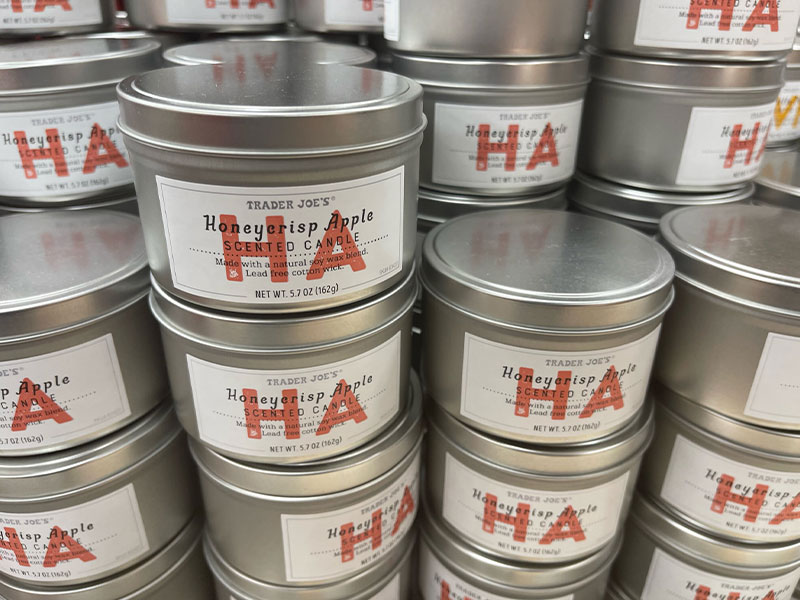
Honeycrisp Apple Scented Candle
Trader Joe's Honeycrisp Apple Scented CandleTrader Joe’s Honeycrisp Apple Scented Candle (Photo courtesy of Joseph Neese)

Warm up your home and surround yourself in fall’s signature aroma with TJ’s Honeycrisp Apple Scented Candle. Each candle is made from a neutral soy wax blend that is infused with a sweet honeycrisp apple scent. According to TJ’s website, the candles are also “paraben-free and made with a lead-free cotton wick that burns cleanly and consistently for approximately 20 hours of fall coziness.”


These candles come in lidded tins, which make them travel-safe . . . and the perfect gift for a friend, loved one or yourself!

06
Apple Cinnamon Oatmeal Bites
Trader Joe's Apple Cinnamon Oatmeal BitesTrader Joe’s Apple Cinnamon Oatmeal Bites (Photo courtesy of Joseph Neese)

These cheerful breakfast bites are made from steel-cut oats that are soaked in butter, cinnamon, milk, sugar and dried apples (specifically Fuji, Gala, Golden Delicious, Granny Smith and Pink Lady). Then they’re rolled into miniature balls and lightly coated with breadcrumbs.


The best place to prepare TJ’s Apple Cinnamon Oatmeal Bites is in the air fryer, but they can also be heated up in the oven or microwave. If you’re enjoying the bites for breakfast, serve them alongside a cup of hot coffee, warm tea or your favorite fruit juice. If you’re craving the bites for dessert, enjoy them with a dollop of nut butter, a scoop of ice cream or a drizzle of caramel sauce.

07
Apple Cider Scent Foaming Hand Soap
Trader Joe's Apple Cider Scent Foaming Hand SoapTrader Joe’s Apple Cider Scent Foaming Hand Soap (Photo courtesy of Joseph Neese)

TJ’s one-of-a-kind soap is guaranteed to not only leave your hands feeling soft and clean, but also smelling like fresh apple cider. This seasonal foaming hand soap is made with a list of luxurious ingredients, including coconut-derived surfactants and apple, chamomile and pear extracts.


Per instructions courtesy of TJ’s, “To release the soap’s cozy, Apple Cider Scent, simply wet your hands, work the foam into a rich lather, sing ‘Happy Birthday’ twice, and rinse.”

08
Organic Cranberry Apple Juice
Trader Joe's Cranberry Apple JuiceTrader Joe’s Organic Cranberry Apple Juice (Photo courtesy of Joseph Neese)

Made with a blend of cranberry and apple juices, TJ’s Cranberry Apple Juice is a slightly tart and deliciously sweet beverage that is perfect for fall. This juice can be enjoyed on its own or warmed up and mixed with apple cider, brown sugar and cinnamon schnapps or spiced rum to make a hot cranberry-apple cider. For a more refreshing option, reach for ginger beer and vodka to make this apple cranberry Moscow Mule recipe.
09
Sparkling Apple Cider
Trader Joe's Sparkling Apple CiderTrader Joe’s Sparkling Apple Cider (Photo by Joseph Neese)
Made from ripe and fresh whole apples, TJ’s Sparkling Apple Cider is a delicious, non-alcoholic alternative that is perfect for fall dinner parties. The Sparkling Apple Cider pairs exceptionally well with both sweet and savory meals, from apple pies and pumpkin pancakes to squash soups and oven-roasted root veggies.

From groundbreaking to nearly in the ground: The CW’s days of defying expectations are over

Since its formation in 2006 as a joint venture between then-corporate owners CBS and Warner Bros., The CW has been regarded as the little brother of broadcast TV, always chasing the likes of CBS, ABC, NBC, and even Fox in not only the ratings but often in terms of quality, too. But under the guiding hand of President-turned-CEO Mark Pedowitz, who dared to defy all preconceived notions of what the network could or should be during his tenure from 2011 until his departure in October 2022, The CW was transformed from a network aimed primarily at teens and young women into a destination for sometimes risky, often groundbreaking TV that appealed to all audiences. 

The truth is, it’s been slowly fading in relevancy for a few years.

From long-running genre series like “Supernatural” and “Arrow” to award-winning comedies like “Jane the Virgin” and “Crazy Ex-Girlfriend,” The CW has been home to several shows with real, lasting cultural impact. With the news that Pedowitz is leaving the network he helped transform upon Nexstar Media Group acquiring a controlling interest in it, the future of The CW is, at best, uncertain. But the truth is, it’s been slowly fading in relevancy for a few years, in part due to a recent sense of complacency, but also because of the changing nature of the streaming landscape that once propped it up.

When The WB – the home of iconic teen dramas like “Buffy the Vampire Slayer” and “Dawson’s Creek”  – and UPN, the network behind fan-favorite series like “Veronica Mars” and “Girlfriends,” merged to form The CW, there wasn’t a clear path forward. The schedules those first few years were pieced together from the former networks’ existing programming slates, with beloved shows like “Gilmore Girls,” “Smallville,”  “One Tree Hill” and “Everybody Hates Chris” serving as the foundation.

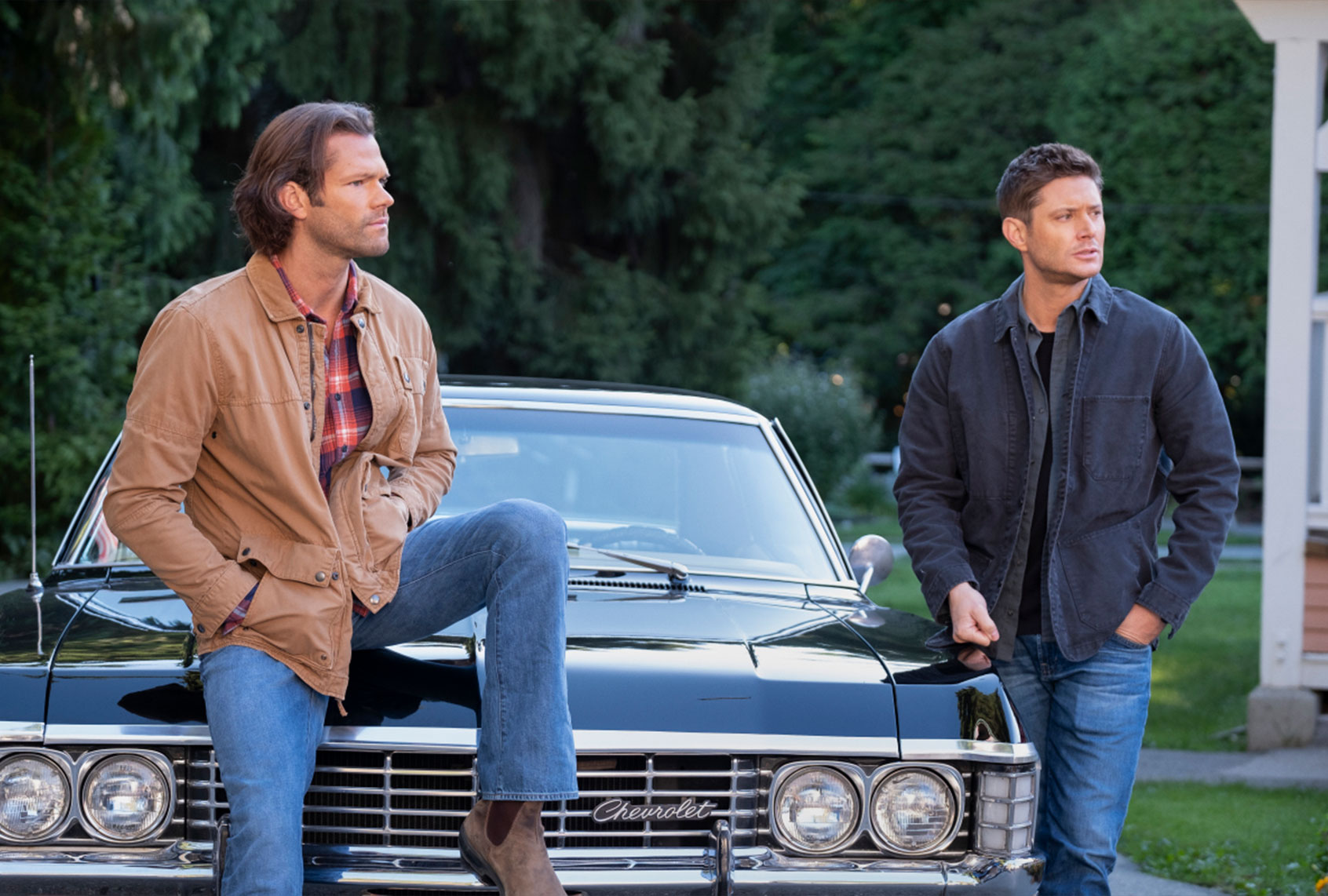
SupernaturalSupernatural (CW)

The CW was more than capable of punching above its weight.

At the time of the network’s creation, few likely saw “Supernatural,” then a fledging supernatural-horror series starring a floppy-haired former love interest from “Gilmore Girls” and a devilishly handsome one-time villain from “Smallville,” as anything more than a seat warmer. That it would skirt cancellation at every turn  and run for 15 seasons to become TV’s longest-running live-action fantasy series still feels a bit surreal, especially in light of the realization that, for a time, the show was airing alongside more light-hearted or melodramatic series like “Gossip Girl” (2007), “90210,” (2008), and “Privileged” (2009). Of course, that didn’t last long.

In 2009, Kevin Williamson and Julie Plec’s supernatural drama “The Vampire Diaries” debuted, kicking off a period of transition for the network. Although some viewed it as merely The CW’s attempt to capitalize on the popularity of “Twilight,” the show was revealed to be deeper and have a richer narrative. With a two-pronged approach to storytelling — mixing slow-burning character arcs with fast-paced, life-or-death drama — the series blew through plot faster than any show in recent memory, proving The CW was more than capable of punching above its weight. Simultaneously emotionally devastating and decidedly romantic, it slowly started altering the public’s impression of the network. And yet, it really wasn’t until 2012, under the guidance of Pedowitz — who had taken over from original President of Entertainment Dawn Ostroff in 2011 — that the DC Comics series “Arrow” would join the schedule and truly begin to change the trajectory and reputation of the network, eventually drawing a more balanced audience and proving that there was more to The CW than most assumed.

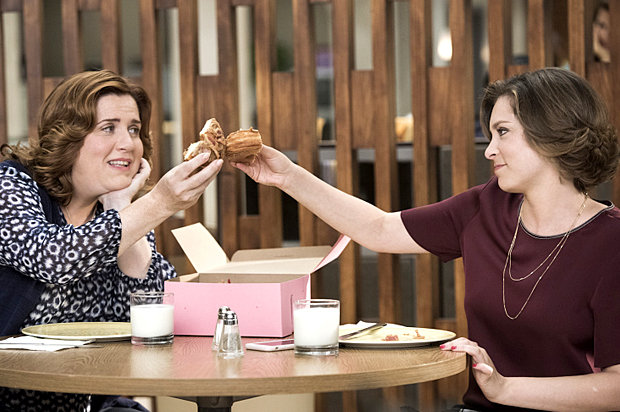
I'm Going on a Date With Josh's Friend!Crazy Ex-Girlfriend (CW/Eddy Chen)

With several original musical numbers featured in each episode and powerhouse performances from every member of the cast, [“Crazy Ex-Girlfriend”] was like little else on TV, before or since. 

With Pedowitz at the helm, the network became known not just for the comic book-inspired Arrowverse — an extended universe not unlike the one Kevin Feige had developed and produced on the big screen for Marvel beginning in 2008 — but for taking risks on programs other networks wouldn’t. The brilliant and hilarious musical comedy “Crazy Ex-Girlfriend,” co-created by star Rachel Bloom and Aline Brosh McKenna in 2015, was developed for Showtime before ending up on the broadcast network (both were owned by what was then CBS Corporation), where it was low-rated but critically beloved for the way it used comedy and musical theater to speak to the importance of prioritizing mental health, all through its antiheroine’s nuanced personal journey. With several original musical numbers featured in each episode and powerhouse performances from every member of the cast, the series was like little else on TV, before or since. 

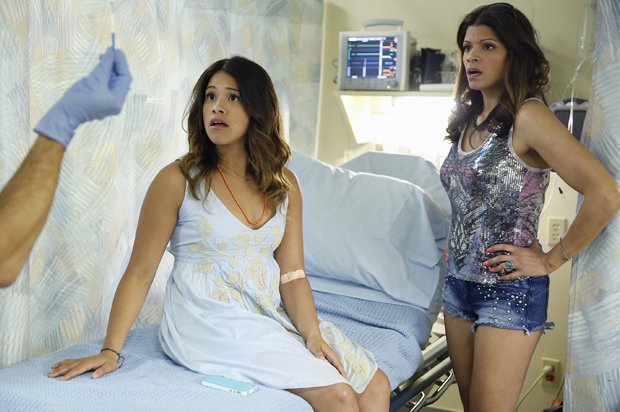
Along with “Jane the Virgin,” which debuted in 2014 and starred Gina Rodriguez in her breakout role as a virgin who’s accidentally artificially inseminated, “Crazy Ex-Girlfriend” is one of two CW shows to earn significant accolades. The latter is an Emmy winner for Outstanding Music and Lyrics, while Bloom and Rodriguez snagged Golden Globes for their respective performances. As much as we must question the Globes and motives of the Hollywood Foreign Press Association now, these awards meant a great deal to The CW, as they validated its efforts to find new talent and tell unique, meaningful stories. But recognition came elsewhere, too. Following its first season, “Jane” took home a prestigious Peabody Award for embracing its telenovela roots and telling not just swoon-worthy love stories or soapy melodramatic tales of murder and mystery, but also moving contemplations on motherhood, family, and second chances. It also refused to shy away from more difficult-to-talk-about topics like religion, class and immigration. Rarely has a show done so much in 42 minutes.

Gina Rodriguez and Andrea Navedo in “Jane the Virgin” (The CW Network/Greg Gayne)The risks weren’t limited to the network’s hourlong dramedies, though. The sci-fi series “The 100,” which followed a group of teens sent to the Earth’s surface to determine habitability many years after a nuclear apocalypse, overcame a shaky, almost laughable start to ultimately become a heartbreaking drama that pulled no punches. Regularly challenging its heroine (Eliza Taylor) — and viewers by extension — the show embraced the darkness in a world painted in shades of gray. A far cry from the network’s early days of risqué high school drama, it grabbed viewers’ attention. Despite the cracks that would eventually show throughout its seven-season run (most notably, the misguided and harmful decision to kill off a major LGBTQ+ character), the early seasons were the portrait of a show daring to take risks that other shows wouldn’t. 

But even when the network returned to basics, like with charming female-driven series like “Hart of Dixie” or the ’80s-set “Sex and the City” prequel “The Carrie Diaries,” there was a warmth that drew viewers in and made them want to stay. The former series, a fish-out-of-water story about a New York doctor (Rachel Bilson) moving to small-town Alabama, was a comforting celebration of small-town life that promoted an appreciation for what one has versus what one thinks one needs or should be. Often dismissed by outsiders, the romantic comedy was a hidden gem whose goofiness only added to its charm. Those who tuned in week after week were given front-row seats to a whimsical world, one that involved a pet alligator named Burt Reynolds, a heroine with an unwavering devotion to formal shorts, and, lucky for us, Wilson Bethel’s sad face. 

The CW realized there was a genuine interest in live-action superheroics on the small screen.

“The Carrie Diaries,” meanwhile, balanced the emotional toll of losing a loved one with the youthful exuberance of being a teen and having one’s whole life ahead of them. Led by a fantastic AnnaSophia Robb as Carrie Bradshaw, then just a Connecticut teen with a big dream, and Austin Butler as her deeper-than-he-looks love interest Sebastian Kydd, the heartwarming series carved a path beyond the shadow of its predecessor, standing on its own as Carrie chased her dreams of becoming a journalist in Manhattan. 

SupergirlMelissa Benoist in “Supergirl” (CBS)But if the first half of the 2010s saw The CW find and nurture its identity under Pedowitz, the second half of the decade became a harsh lesson in the dangers of relying too much on a single vision or visionary (see also: FX and Ryan Murphy). Following the success of “Arrow” and its first spin-off “The Flash,” which debuted in 2014, The CW realized there was a genuine interest in live-action superheroics on the small screen. Although the shows were initially keys to success, the network came to rely too heavily on their interconnected world to draw and maintain viewer interest over a long period. While eventizing TV with a once-a-season crossover featuring characters from “Arrow,” “The Flash,” “Supergirl,” “Legends of Tomorrow,” “Black Lightning,” and “Batwoman” briefly drew interest, the shine eventually started to wear off toward the end of the 2010s. The shows remained some of the network’s highest-rated programs, but like nearly every series will, they too experienced ratings declines as they aged and viewers grew tired of yet more of the same. 

For those whose interests lay outside comic books and superheroes, it sometimes felt like The CW had abandoned them. Sure, “The Vampire Diaries” had run until 2017 and launched its own successful spin-offs in “The Originals” and “Legacies,” but over time they would end, just like “Jane the Virgin,” “Crazy Ex-Girlfriend,” “iZombie” and all the others. Even “Supernatural,” which thwarted death countless times and once appeared ready to outlive us all, signed off the air for good at the end of 2020. In their place were shows that failed to capture the zeitgeist, that barely made a blip on the cultural radar. It seemed the network that had once dared to defy all expectations — a theme so built into its operation that the network eventually adopted it as its slogan — had forgotten to do just that. It stopped taking risks.

But relying too much on more of the same and becoming complacent is not the only reason The CW has been slowly fading. For years the network renewed the vast majority of its programming slate, which created a picture of stability to fans while giving some level of job security to the talent behind and in front of the camera. But the network itself was not profitable — it relied on selling international rights and a massive $1 billion streaming deal with Netflix to operate. Once CBS launched (and put effort into) its in-house streaming service Paramount+ (originally known as CBS All Access) and what was then known as Warner Media debuted HBO Max, the days of lucrative Netflix deals were numbered as the rights to new shows were to remain with the in-house streaming services. For a network that repeatedly touted the digital success of shows like “Riverdale” on streaming, it’s ironic that streaming would end up playing a role in its slow demise

Of course, The CW isn’t dead yet; new shows ordered last season are still debuting this fall. It’s not totally disappearing either, as Nexstar has plans of its own, wanting to make the network profitable by 2025 by offering shows with broader appeal. The company has already installed a new president, Dennis Miller, who has since replaced a few other key executives who will take their marching orders without hesitation. Like the Cylons, they have a plan. But this changing of the guard gives the unfortunate but likely fair impression that the few remaining shreds of The CW that we know and cherish — like supernatural mystery “Nancy Drew” or sports drama “All American” — aren’t long for this world. In turn, this knowledge makes it increasingly difficult to muster excitement for the new shows debuting this year, like the “Supernatural” spin-off “The Winchesters” or the “Walker” spin-off “Walker: Independence.” It seems unlikely that they’ll be renewed come May.


Want a daily wrap-up of all the news and commentary Salon has to offer? Subscribe to our morning newsletter, Crash Course.


In effect, The CW as we once knew it is gone. In its place is a programming slate that will be crafted for mass appeal and likely consist of news, Canadian imports, and more non-fiction programming. But for a time in the 2010s, The CW was great. It defied expectations. It took creative risks. It proved that even the little brother of broadcast could produce award-winning shows that left lasting cultural impacts. Much of that was because of Pedowitz and his genuine interest in the shows on The CW — one could tell he cared, and that translated to an increase in quality. But much of that was also because viewers were able to see what was happening and tuned in to watch. That era has now ended, and more’s the pity.

The political purgatory of the COVID dead

“It’s not a joke. I don’t know what more or how much more I could express… Please do not put your families at risk… Put your masks on. Don’t go out if you don’t have to.”

These were the words that a 43-year old mother of three shared on a video clip she posted to Facebook shortly before her death from COVID-19 in August of 2020. Messages like hers are not hard to find; Google-searching for phrases like “coronavirus last words video” will uncover plenty of them, often packaged in the form of quick, somber segments from local news channels. One such story from October of 2021 recounted a vaccinated woman’s last words before being hooked up to a ventilator and then passing away. She had placed a phone call to a local TV news channel from her hospital bed to tell them that “I just want people to know that even though I took all the [precautions]… we still cannot be too careful. It might not have helped me, but I hope it helps somebody else.” These last words are still floating around the internet, months and years now after their authors have passed away. What does it mean that such warnings typically go unheeded?  

The shock of such COVID deaths seems to have waned in the time since both of these women lost their lives. At least 1,050,000 other Americans just like them have died of COVID since the beginning of the pandemic. Indeed, Americans continue dying from it despite the prevailing mood among our nation’s public health experts-turned-pundits and, now, the President himself, that the country has moved on. President Biden went on 60 Minutes two weeks ago and declared that “the pandemic is over.” The next day, over 55,000 Americans contracted COVID-19 and 421 died from it. What advice would they have for us? Would we care to listen?

The cultural anthropologist Ernest Becker published his germinal text “The Denial of Death” in 1973. He argued that fear of death was a universal facet of human experience, but that such fear “must be properly repressed to keep us living with any modicum of comfort.” One fundamental problem of modern life, then, was that we found unhealthy ways to repress such fears of our own mortality, and that the denial of death often took the form of a kind of false heroism associated with the “viciously destructive heroics of Hitler’s Germany or the plain debasing and silly heroics of the acquisition and display of consumer goods.” Academics across a variety of fields have since tested, affirmed, and sometimes rebutted Becker’s claims that the denial of death in Western societies can lead to maladaptive behaviors.

Telling them that they died because the health of the economy required it would have been very little consolation.

But how can we situate the massive shrug evinced by proponents of today’s “COVID is over” sentiments within this framework? Are they denying the deaths of hundreds per day, thousands every week? Or are they embracing death, acknowledging a new comfort level with mass mortality? And what considerations do the dead themselves deserve as we move away from older ways of perceiving the pandemic?

Certainly the enormity of the loss from this virus has made a full reckoning difficult, at least within established memorial vernaculars. It takes around three hours to read the names of the 2,983 American victims of the September 11th attacks on that anniversary. Those names have also been engraved in black marble around the footprints of the World Trade Center buildings, in a style mimicking Maya Lin’s Vietnam Veterans Memorial, itself containing 53,518 names of American soldiers who died in the Vietnam War. But with over a million names and counting, adequate COVID memorialization has been difficult to even envision, much less accomplish.


Want more health and science stories in your inbox? Subscribe to Salon’s weekly newsletter The Vulgar Scientist.


In print, the New York Times’ famous “Portraits of Grief” series brought the biographies of September 11th victims to life, a task the paper began to mimic in the early days of the coronavirus with a recurring section called “Those We’ve Lost to the Coronavirus.” But this too has been harder to maintain as COVID’s list of victims has grown. On May 24, 2020, the Times declared 100,000 deaths an “incalculable loss” and listed 1,000 of the names of those victims on its front page with a small biographical detail devoted to each. By the time America’s death toll reached a million, the Times told the story of “How America Lost One Million People” with demographic characteristics taking the leading role: age, race and class were the defining characteristics of an otherwise undifferentiated mass. One other Times story entitled “One Million Deaths, 13 Last Messages” shared the last text messages of 13 different COVID victims as part of a timeline of total COVID deaths. One victim whose final message was quoted in the story was a 64-year-old man who appeared to be getting better and had been moved to a rehabilitation center. In an optimistic mood, he texted “Yes I’d like to stick around a while.” He died six days later.

Beyond simple pleas to get vaccinated or mask up, what do these final messages tell us? What can we learn from the COVID dead? An obvious but nonetheless fundamental point, exemplified by the message above, is that they would have preferred not to have died. And, no doubt, telling them that they died because the health of the economy required it would have been very little consolation. Nor would the vast majority of COVID dead care whether the kind of increased COVID protections that might have saved their lives polled well or not for whatever political party was in power at the time they passed away.

Of course, the dead are always political: victims of the 9/11 attacks; the drowned and abandoned during Hurricane Katrina; children killed in school shootings; soldiers and civilians dying in foreign wars. Political factions will always argue over the meanings of the dead and how to properly respond to whatever global or local ills they supposedly represent. But even as their words fade from collective memory, the bodies of the COVID dead are now being propped up to pantomime support for the return to our most brutal forms of neo-liberalism. Ashish Jha, the White House COVID coordinator, recently spoke excitedly about an impending “commercialization” of treatment, tests, and vaccines — meaning no more free vaccines after this last bivalent booster, and who knows what will happen to the market for other COVID-related products. We’ve already seen the end of the free test program run through the post office, which was only ever begrudgingly put into place after a gaffe from then-White House press secretary Jen Psaki. And funding for the development of next-generation pan-coronavirus vaccines that might actually put an end to the pandemic is also drying up. In being asked to return to normal, to get over COVID, we are being asked to return to the worst, most blindly individualistic elements of American society, and to forget about the glimmers of solidarity and common decency that we saw in the pandemic’s earliest days.

So our COVID dead occupy a kind of purgatory. They can be neither properly remembered nor fully forgotten. 

Rebecca Solnit’s book “A Paradise Built in Hell” describes the forms of community and solidarity that emerge in places that are struck by disasters. As she put it, “In each disaster there is suffering, there are psychic scars that will be felt most when the emergency is over, there are deaths and losses. Satisfactions, newborn social bonds, and liberations are often also profound.” We got a sense of these newborn social bonds in the earliest days of the pandemic. People masked up to “flatten the curve” for themselves and the employees of our beleaguered health care systems. They cheered for doctors and nurses and praised the essential workers keeping the country running in grocery stores and factories alike. And, almost unbelievably now, a bipartisan group of legislators passed a series of economic relief and stimulus measures that ultimately decreased the number of Americans in poverty by 8 million and reduced the amount of children in poverty by 30 percent. Of course, corporations too benefitted from a massive infusion of cash into the stock market, and large and medium-sized businesses benefitted from $800 billion of PPP loans, over 10 million of which were fully or partially forgiven. But there was at least a sense of shared sacrifice, a tiny, fleeting idea that we were in this together. A better world was possible, and for a minute we all saw it. In being asked to get over COVID, we are being asked to forget those possibilities as well.

 “If you are even 70% sure that you want the vaccine, go get it. Don’t wait. Go get it because hopefully if you get it, then you won’t end up in the hospital like me, OK?” A 31 year-old, unvaccinated woman posted these words to her TikTok account on August 15, 2021, nine days before dying of COVID. Not only do the pandemic dead not want to have died — they want us to take care of ourselves, to be safe, safer than they were.

But such well-meaning advice won’t matter much to the uninsured in this country once vaccines are no longer free, or to those whose uptake would depend on a robust government outreach effort which no longer exists, or to the many who will contract COVID and even die from it despite being vaccinated. As our country gives up on masking, and on improving indoor ventilation, and instead adopts an absurd “you do you” approach to the virus that will, in fact, allow it to continue to mutate into new, more immune-evasive forms, we are being pushed to ignore the million who have already died, and the untold numbers who surely will continue to be infected, sickened, disabled, and killed thanks to government inaction and public fatigue.

So our COVID dead occupy a kind of purgatory. They can be neither properly remembered nor fully forgotten. But their words and stories are, collectively, a testament to failure, to a national shame which was not their fault, but for which they nonetheless serve as stubborn, inconvenient, haunting evidence. And there it seems they will remain, at least until we can change the course we are currently on. Unless we can care more fully for ourselves and others, and do what really needs to be done to end the pandemic regardless of its economic costs or personal inconveniences, they will have died in vain.

Did Trump admit guilt during his rally in Arizona?

While at a rally in Mesa, Arizona, former President Donald Trump effectively admitted to his own criminal behavior by stealing government documents.

“I had a small number of boxes in storage,” Trump told the audience. “There is no crime. They should give me immediately back everything they have taken from me because it’s mine.”

In fact, it is a crime, which is why the Justice Department, the FBI, a federal judge and the 11th Circuit Court of Appeals have gotten involved in the issue.

Watching the video of Trump, legal experts noted that Trump’s comments are an admission of guilt that will likely be used in trial.

“This is what we call a summation exhibit,” said former FBI general counsel Andrew Weissmann, who also served as a prosecutor under special counsel Robert Mueller’s team. “Proof from the defendant’s own mouth. And on video.”

“There is more than ample evidence to indict Trump for crimes listed in the FBI search warrant,” explained former special counsel Ryan Goodman. “The question will come down to aggravating factors for Garland DOJ to consider. Outrageous, open defiance of the law —like this — must surely rank high among those factors.”

Teri Kanefield, a former appellate defender, noted in Trump’s comment that he’d been saying over and over that the documents were his. But from his own lawyers replying to the special master, the ex-president said: “There is no question and, indeed there is broad agreement, that the matters before this Court center around the possession, by a President, of his own Presidential records.”

Watch below:

“Prima donna in pigtails”: how Julie Andrews the child star embodied the hopes of post-war Britain

In June, the American Film Institute presented its 48th Life Achievement Award, the highest honor in American cinema, to the beloved stage-and-screen star Julie Andrews.

On conferring the award, the AFI praised Andrews as “a legendary actress” who “has enchanted and delighted audiences around the world with her uplifting and inspiring body of work”.

As anyone who has seen “Mary Poppins” (1964) or “The Sound of Music” (1965) can attest, “uplift” is central to the Julie Andrews screen persona.

It is a sweetness-and-light image that is easy to lampoon. Andrews herself is alleged to have quipped “sometimes I’m so sweet even I can’t stand it.” But it’s an element of feel-good edification that fuels much of the star’s iconic appeal.

The idea of Julie Andrews as a figure of uplift has a long history.

Decades before she attained global film stardom in Hollywood, Andrews enjoyed an early career as a child performer.

Billed as “Britain’s youngest singing star,” she performed widely on the postwar concert and variety circuit with forays into radio, gramophone recording and even early television.

Possessing a precociously mature soprano voice, Andrews was widely promoted in the era as a child prodigy. A 1945 BBC talent report filed when the young singer was just nine years old enthused over “this wonderful child discovery” whose “breath control, diction, and range is quite extraordinary for so young a child.”

“Infant prodigy of trills”

Andrews made her professional West End debut in 1947 where she dazzled audiences with a coloratura performance of the Polonaise from Mignon. Newspapers were ablaze with stories about the “12-year-old singing prodigy with the phenomenal voice”.

Reports claimed the pint-sized singer had a vocal range of over four octaves, a fully formed adult larynx and an upper whistle register so high dogs would be beckoned whenever she sang.

On the back of such stories, Andrews was given a slew of lionising monikers: “prima donna in pigtails,” “infant prodigy of trills,” “the miracle voice” and “Britain’s juvenile coloratura.”

While much of it was PR hype, the representation of Andrews as an extraordinary musical prodigy resonated deeply with postwar British audiences. The devastation of the war cast a long shadow, and there was a keen sense a collective social rejuvenation was needed to reestablish national wellbeing.

The figure of the child was pivotal to the rhetoric of postwar British reconstruction. From political calls for expanded child welfare to the era’s booming family-oriented consumerism, images of children saturated the cultural landscape, serving as a lightning rod for both social anxieties and hopes.

A popular myth even traced her prodigious talent to the very heart of the Blitz. Like a scene from a morale-boosting melodrama, the story claimed the young Andrews was huddled one night with family and friends in a Beckenham air raid shelter. In the middle of a communal singalong, a powerful voice suddenly materialised out of her tiny frame, astonishing all into silent delight.

“Our Julie”

One of the most pointed alignments of Andrews’ juvenile stardom with a discourse of postwar British nationalism came with her appearance at the 1948 Royal Command Variety Performance.

Appearing just two weeks after her 13th birthday, Andrews was the youngest artist ever to participate in the annual event. It generated considerable media coverage and yet another grand nickname: “command singer in pigtails”.

Andrews performed a solo set at the event, and was also charged with leading the national anthem at the close.

Much of her early repertoire was markedly British, drawn from the English classical canon and rounded out by traditional folk songs.

Press reports emphasiaed, for all her remarkable talent, “our Julie” was still a typical English girl thoroughly unspoiled by fame. In accompanying images she would appear in idyllic scenarios of classic English childhood: playing with dolls, riding her bicycle, doing her homework.

Elsewhere, commentary was rife with speculations about Andrews’ prospects as “the next Adelina Patti” or “future Lily Pons.” The mix of nostalgia and hope helped make the young Andrews a reassuring figure in the anxious landscape of postwar Britain.

All grown up

Little prodigies can’t remain little forever. There lies the troubled rub for many child stars, doomed by biology to lose their principal claim to fame.

In Andrews’ case, she was able to make the successful transition to adult stardom – and even greater fame – by moving country and professional register into the American stage and screen musical.

Still, the themes of therapeutic uplift that defined her early child stardom would follow Julie Andrews as she graduated to become the world’s favourite singing nanny.

Brett Farmer, Lecturer in Film, Media and Communication, Deakin University

This article is republished from The Conversation under a Creative Commons license.

“We are the original stewards of this land”: “Spirit Rangers” boss on imagining Native park rangers

With a series premiering on Indigenous Peoples’ Day, Karissa Valencia is part of an important team, what she calls the “Native Avengers of Hollywood.” Valencia is the creator, showrunner and executive producer of “Spirit Rangers,” a new animated show on Netflix.  

“Spirit Rangers” follows siblings Kodi (Wačíŋyeya Iwáš’aka Yracheta), Summer (Isis Celilo Rogers) and Eddy Skycedar (Talon Proc Alford) whose parents (Kimberly Guerrero as Mom and John Timothy as Dad) are both park rangers at a fictional national park in California. Promoted by their parents to Junior Rangers, the kids also have a secret: they can transform into spirits with super powers in order to protect the park and help the creatures who call it home. Kodi’s Spirit Ranger is a grizzly bear cub, sister Summer’s is a red-tailed hawk and the baby of the family, Eddy, transforms into a turtle.

All the animals have meaning for Valencia, who is a Santa Ynez Chumash tribal member and the first California Native American showrunner. Not only does “Spirit Rangers” have an all-Native writers’ room, the show’s actors, artists, composers, choreographers, sound designers and more are Indigenous. 

Valencia got her start as an intern with Nickelodeon (what the network calls “NICKterns”). Her first job in Hollywood? “Helping my boss send out all the rejection letters of these people who entered the writing program . . . It was three months of work folding and stuffing those envelopes, telling everybody they didn’t get in. But despite seeing how hard this was going to be for me to chase this dream, I still just had the burning desire to be a writer.”

“Spirit Rangers” is the culmination of that dream, showcasing multiple tribal stories, languages and imagery, with the permission and collaboration of the Chumash and Cowlitz communities. Salon talked to Valencia about her childhood, national parks and the importance of Native storytelling.

This interview has been ledited for length and clarity.

What are the Spirit Rangers? How would you describe them to people?

Our Spirit Rangers have the special ability to transform into their own spirit and enter Spirit Park, which is like the Indigenous filter over a national park. So, when they’re in Spirit Park, they get to see that all the trees are alive. They get to see that a thunderstorm is actually a family of Thunderbirds. They really get to connect with their culture this way. But also, they get to connect with the environment this way too and see that we are all alive and connected and deserve respect. And if there’s a reason for a flood or you’re going to squish that spider, you have to think twice about it.

What inspired the show?

It was inspired by my time growing up on the reservation in Santa Ynez. I heard all sorts of stories of our animals and land, how the condor got its black feathers or how the sun got in the sky, very “Grimms’ Fairy Tales“-esque, which is perfect for the preschool space with those universal lessons of friendship and community.

All clicked when I was at my tribe’s bear ceremony one year and saw one of our bear dancers wearing the skin and dancing. It’s just so beautiful and just felt magical . . . I was thinking, “What if a little kid found that bear skin and they could turn into a bear?” Not all tribes believe in the transformation aspect, but mine does. We do. We have bear doctors who had been led to believe that they can transform into bears. So that was Kodi. That was the first one that came. And I’m a big fan of the superhero genre kind of stuff, so I wanted to have a trio of siblings and pick those animals based on land, air and water.

Spirit RangersWačíŋyeya Iwáš’aka Yracheta as Kodi Skycedar, Talon Proc Alford as Eddy Skycedar and Isis Celilo Rogers as Summer Skycedar in “Spirit Rangers” (Courtesy of Netflix)I knew I had Kodi and then Summer for air as a red-tailed hawk and then Eddy turtle for our water animal, so they could each have their own unique powers.

I was going to ask you about how you chose the different animals.

I wanted those animals because they were California specific, but also as a story narrative. How can we differentiate them and make sure we’re highlighting all the different areas? Land, air and water.

Eddy the turtle was my favorite. There’s a line where he says something like, “I’m just a kid, and a turtle.” Were there specific stories from your childhood that ended up finding their way into the story?

“From just hearing it as a kid growing up to now it exists somewhere and we get to tell it to all kinds of families, not just Indigenous ones.”

Yes, there’s been a few, which is really, really special. The second episode, right out the gate: a snoozing sun. Condors are really important to the Chumash. We have a story of the condor getting his black feathers and it’s a little bit more gruesome, very “Grimm’s Fairy Tales”-esque again where we have to adapt it for the modern kid today, but still show how he got his black feathers getting too close to the sun. So, that was a really fun task for me to adapt the story into a modern space while still celebrating my culture. Things like that make me so, so happy to see it — from just hearing it as a kid growing up to now it exists somewhere and we get to tell it to all kinds of families, not just Indigenous ones.

What inspired the national park in the show? I love that it’s there and that the parents are park rangers. Were parks meaningful to you growing up as well?

They were. I feel so lucky to have been growing up in California and have been to all of our national parks. I’m such a fan. They are snapshots of the world or of our state pre-colonization and they’re just so beautiful . . . My dad would take us fishing and hiking and he could name every tree, every flower, spot a track in the mud. He knows the land like the back of his hand because we are the original stewards of this land. 

Spirit RangersKimberly Guerrero as Mom, Talon Proc Alford as Eddy Skycedar, Isis Celilo Rogers as Summer Skycedar and Wačíŋyeya Iwáš’aka Yracheta as Kodi Skycedar in “Spirit Rangers” (Courtesy of Netflix)And when I was thinking about “Spirit Rangers,” I had realized that I had never met an Indigenous park ranger. That is crazy to me because we have this traditional ecological knowledge that dates back so far. So, in my dream world, there is a family of park rangers taking care of this California national park. And it was a cool way to show a Native family in the modern space and using technology, wearing hiking boots and taking care of our animals — but also for kids, what a great entry point to have a little uniform and all the gadgets that go with being a Junior Park Ranger. As soon as that piece clicked, I thought, “Oh, there’s the show.” 
It’s also a very beautiful show. It’s bright, it’s colorful. Were you involved in the aesthetics at all or was it important for you to have that brightness to it?

I remember pitching what I wanted Spirit Park to look like. I really wanted to see the human world look more realistic because I just wanted to see Native families in a more modern sense. Not as stylized or anything like that. But when we got to Spirit Park, that was where I wanted it to go psychedelic, all the colors. Every spirit, their tribal prints are from whatever region they’re from. So, coyote and lizard have all this rock art on them because they’re California natives. I wanted to have all that detail in this series . . . Our art director, Marie Delmas, was ready for the challenge. She took all of this and somehow, because I feel like all those colors can get tough on the eyes and it might not look good, but she found a beautiful balance where it just looks cinematic and special and doesn’t just feel like rainbow garbage for a lack of better word. But she has really brought all the colors to life. 

Spirit RangersShaun Taylor-Corbett as Coyote and Cree Summer as Lizard in “Spirit Rangers” (Courtesy of Netflix)Was it important for you to take back the transformation? That’s something that white people appropriate and misuse all the time still. Is that something that you were thinking about?
Yes, absolutely. And thank you for asking this question. When Netflix bought “Spirit Rangers,” I remember they did a slate announcement just like, ‘What’s coming up?’ We had nothing. It was a 30-second, This is what “Spirit Rangers” is. And I had folks at Netflix, who I had never met before, reach out to me and just say they were so concerned that I was being racist towards the Indigenous community. Which was crazy to me because my first question was, “Well, are you Indigenous?” And no, they are not.

“Just because Hollywood has portrayed it in such a way, that doesn’t mean that we still can’t tell our own stories.”

I think just because Hollywood has portrayed it in such a way, that doesn’t mean that we still can’t tell our own stories.  Because our magic is awesome, our stories are cool. Hollywood has long been fascinated by them. And it’s like for the first time we get to finally tell those stories ourselves. So, while people might get a little prickly seeing the transformation of it all, when they learn that it’s steeped in such Indigenous lore and collaboration directly with tribes, it feels different. This transformation and what they’re experiencing when they get to Spirit Park is not what we’ve seen before. Because it’s based in our traditional stories.

Condor in “Spirit Rangers” (Netflix)

What was your writers’ room like, working with all-Native writers?

Our writers’ room means a lot to me. The writers’ room is the heart of any TV show, really. It’s a space where I’m really happy we had an all-Native writing staff because all of our experiences are so different while we’re so similar and didn’t have to stop and explain anything to anybody. That was very nice. We all got to just learn from each other. My writing staff was from all corners of the country. I’m just really grateful that they felt that we were in a space where they could be vulnerable and share those stories of what it was like being a Native kid. What were the hard days? What were the joys of being Native? And putting that all together to create the most colorful, modern Indigenous family. I think that’s what makes it so special. Because I’m just one person and I’m not queen Native. I definitely wanted to have multiple perspectives, learning from everyone’s experience and bringing it to the show.


Want a daily wrap-up of all the news and commentary Salon has to offer? Subscribe to our morning newsletter, Crash Course.


Is there a favorite story that you’ve told in “Spirit Rangers” or have yet to tell?

Honestly, that second episode: snoozing sun and the condor means a lot. That’s the one that I grew up with as a kid. I also love hearing the Samala language in the series. Our language is so fragile, [in danger] of being lost. And just to know that it’ll exist in a show like “Spirit Rangers,” hearing it in the underscore, hearing our kids say ‘Haku.’ That stuff really warms my heart.

“Spirit Rangers” is now streaming on Netflix. View the trailer via YouTube below:


Inspired by Indian desserts, this quick version of funnel cake is spiced with fennel and saffron

“These are so light and beautiful. Quite nice after a really heavy meal, and they look really impressive, as if we’ve spent loads of time making it — but clearly, we haven’t.

“You can top [the funnel cakes] with all sorts of fresh cream, some berries . . . ice cream, some chocolate sauce, some caramel sauce — I can go on and on. The options are endless.” — Chetna Makan

Watch this recipe

Fennel and Saffron Funnel Cake
Yields
4 funnel cakes
Prep Time
15 minutes
Cook Time
10 minutes

Ingredients

  • 1/3 cup (76 grams) whole milk
  • 1 pinch saffron threads
  • 1 tablespoon fennel seeds
  • 3/4 cup (90 grams) all-purpose flour
  • 1 large egg
  • 1 1/2 tablespoons confectioners’ sugar, plus more for serving
  • 3/4 teaspoon baking powder
  • 1 pinch table salt
  • Vegetable oil, for frying


Directions

  1. Place the milk in a medium saucepan over low heat until warm to the touch, then remove from the heat. Add the saffron threads and let it sit for 10 minutes to infuse. 
  2. In a dry skillet over medium heat, toast the fennel seeds until fragrant. Roughly crush the seeds in a pestle and mortar or spice grinder. Whisk the crushed fennel, flour, egg, confectioners’ sugar, baking powder, and salt into the infused milk until smooth. Transfer the batter to a piping bag and cut a ½-inch-wide opening.
  3. Fill a large, heavy-bottom pot, such as a Dutch oven, with vegetable oil until it reaches a 1-inch depth. Heat the oil over medium until it reaches 340°F.
  4. Line a large plate or sheet pan with paper towels. Pipe about one-quarter of the batter into the hot oil, starting from the center of the pot and swirling toward the outside (the batter floats up condenses a bit), into a fritter that’s about 4 inches wide. Cook for a minute before turning it over with metal tongs or chopsticks and cooking for another minute until golden. Use a slotted spoon or tongs to remove the funnel cake onto the paper towel-lined plate to absorb some of the excess oil. If you’d like, dust with more confectioners’ sugar and serve immediately, then repeat with the rest of the funnel cake batter. Alternatively, fry all the funnel cakes first, then dust with confectioners’ sugar and serve together.


Sorry, fellow Italian-Americans: Columbus was a thug. But the church was the big problem

Despite my Italian heritage, I don’t understand the adulation that some Italian-Americans continue to bestow on Christopher Columbus, who, as history demonstrates, was less a hero than a thug, exploiting and enslaving indigenous peoples.

But the real culprit behind the subjugation of non-European peoples across the globe wasn’t an individual, or even a monarch. It was the Roman Catholic Church. It’s time the church owned that grievous mistake.

 As early as the 15th century, as European nations were making voyages of discovery, Catholic popes gave them permission to subjugate and steal. The most significant of these papal permission slips was the Doctrine of Discovery. A decree Issued in 1493 by Pope Alexander VI, it essentially told Catholic countries that any lands they “discovered” were theirs to keep and exploit, provided the inhabitants were not Christians but heathens ripe for conversion. 

Popes issue lots of decrees, but this one stuck. The Doctrine of Discovery proved to be very popular with monarchs across Europe, Catholic and Protestant alike. Its impact has been felt in Africa, Asia, Australia, New Zealand and the Americas. The idea was simple and attractive: Plant a flag and a cross on a land not claimed by any other Christian ruler, and it’s yours. 

The doctrine also served to legitimize the seizure of lands by white American settlers. In considering an Illinois property dispute that came before the Supreme Court in 1823, Chief Justice John Marshall referred to the discovery doctrine to rule that Native Americans couldn’t sell their lands — since they hadn’t “owned” them in the first place.

“All the nations of Europe, who have acquired territory on this continent, have asserted in themselves, and have recognised [sic] in others, the exclusive right of the discoverer to appropriate the lands occupied by the Indians,” Marshall wrote. When the U.S. became independent from Britain, he concluded, it inherited all the land the British crown had claimed. 

Even the sainted Ruth Bader Ginsburg invoked the 15th-century Doctrine of Discovery in a 2005 ruling against the Oneida tribe of New York, holding that honoring its land claims would be “disruptive.”

In 2005, even the sainted Justice Ruth Bader Ginsburg ruled against the Oneida tribe, which had repurchased some of its tribal lands from the city of Sherrill, New York, and then argued that these properties should be exempt from city taxes. The Oneidas once held six million acres in New York, but agreed to a treaty ceding nearly all their land to the state.

Writing for the court’s 8-1 decision, Ginsburg concluded that siding with the Oneida tribe in the 21st century would be too “disruptive,” given the town’s “distinctly non-Indian character.” Her decision cites the Doctrine of Discovery, essentially conceding that longstanding oppression can acquire the status of legal precedence. 

But stolen lands don’t tell the whole story. The idea that indigenous peoples were less fully human than white settlers clearly informed how the Canadian and U.S. governments treated Native American children. As we have learned in recent years, thousands of Native children were ripped from their families and forced to “assimilate” to white society in a system of cruel and sadistic boarding schools. More than 400 such schools existed, from 1819 until the last were closed in 1969, and about 150 of those were run by either the Catholic church or various Protestant denominations. Some victims of this abusive system have spoken out, but the true extent of the harms done to Native children in this country have yet to be fully investigated. 

Canada’s church-run “residential schools,” which operated well into the 20th century, were hotbeds of emotional, physical and sexual abuse. Canada’s Truth and Reconciliation Commission concluded that the 150,000 children who were forcibly taken from their parents and effectively imprisoned in these schools were victims of “cultural genocide.” More than 4,000 children went missing, and are now presumed to have died. Since 2021, hundreds of children have been found in unmarked graves on the grounds of some of these schools.

The evidence of abuse was so compelling that Pope Francis was forced to make an apology tour of Canada this summer. While there, the pope was repeatedly asked to repeal the Doctrine of Discovery. So far he has demurred. 


Want a daily wrap-up of all the news and commentary Salon has to offer? Subscribe to our morning newsletter, Crash Course.


The church is an institution whose brand is infallibility, so it’s rare for it to own up to errors. The Vatican contends that later papal decrees and teachings have effectively revoked the Doctrine of Discovery. But it’s clear its existence still has power

Revoking the Doctrine would “absolutely make a difference,” said Elsie Boudreau, a member of Alaska’s Yup’ik people. 

The Doctrine of Discovery, she said, was an effective tool “to justify the actions of people in power” who “erased our native culture” and identity as “a spiritual people interconnected with the land.”

The presumption that Alaska Native peoples were “less than human” and “simple-minded” also made it easy for Alaskan villages to become “a dumping ground” for predatory priests, Boudreau charged, an accusation that appears to be borne out by media accounts. One of those priests began abusing her, she said, when she was 10 years old. The fact that the Doctrine of Discovery has never officially been revoked, she said, “is absolutely not OK.” 

Boudreau is not alone. In 2014, the Leadership Conference of Women Religious, which represents most Catholic nuns in the U.S., asked Pope Francis to formally repudiate the doctrine and to urge “settler nations” (which would include the U.S. and Canada) to revise any laws they have enacted over the centuries that relied on the doctrine’s legitimacy. 

Pope Francis has a historic opportunity to move the world’s largest Christian denomination into the future. It’s obvious that admitting that previous generations of popes and cardinals were wrong is not easy. But papering over past sins with more enlightened pronouncements and apologies clearly isn’t enough. It’s long past time for the church to face the painful truth and undo this hateful doctrine that has caused so much pain. 

How we can use gaming to support positive aging (and support our relationships with our pets, too)

Margaret, 63, loves playing online Scrabble everyday with her sister who lives interstate. The online game allows a playful way to keep in constant contact when geographically distant.

Tom, 70, discovered the joy of Wordle and sharing his daily outcomes with friends. Penelope, 67, gets online to play Roblox games with her grandchildren who are living interstate.

These are just a few examples of the many ways older adults are gaming across Australia.

During the pandemic lockdowns, games were not only spaces for everyday creativity and informal literacy, but a way to socialize and keep fit — both mentally and physically. So much so that, in 2020, the World Health Organization acknowledged the communicative and social power of games for wellbeing.

Even though the typical gamer is middle-aged woman, ageist stereotypes about gamers continue to circulate, reflecting broader inherent ageism embedded within Australian culture.

Maybe we could turn this problem on its head. Perhaps we could use games to empower aging and aging well, creating bridges between the generations — and even improve our relationships with animals while we’re at it.

Aging well

Older adults are one of the most divergent cohort of technology users, from “silver surfer” innovators to those who have little experience or confidence.

Victoria’s Ageing Well Report lists eight attributes to ageing well: positivity, purpose, respect, socially connection, keeping up in a changing world, financial/personal security, health autonomy and mobility.

Many of these attributes can be addressed through games and play.

In our study into mobile game practices in Australian homes, we found numerous ways in which games offer intergenerational ways for socializing, connection and creativity.

Word games like Scrabble and Wordle have been deployed to add playful, social dimensions to people’s lives: older adult siblings playing online everyday, or grandparents playing with grandchildren interstate.

Game apps like Pokémon Go have been used to motivate older adults to exercise and socialize.

In countries as varied as Japan and Spain, the power of Pokémon Go has enhanced various dimensions of everyday life — from getting mobile and discovering local neighborhoods to playing together cooperatively to win tournaments.

Game genres such as “social justice” and “games for change” have been deployed to address complex issues such as elder abuse in new ways by providing safe spaces to enhance empathy and reshape perceptions.

In our research, we accompanied and interviewed older adult players in Badalona, Spain about their use of Pokémon Go.

On the streets of Badalona, chasing Pokémons was clearly about intergenerational play and sociality. The game was such a success in older adult rehabilitation by making exercise fun and social that social workers started to prescribe it as part of their health plans.

There is a growing body of research into games for intergenerational connection. But the role of games to enhance our relationships with animals has been overlooked — despite the fact animals play an essential role in our contemporary relationships.

Our best friend

Australians love their animals: one in three prefer animals to humans.

Despite this reality, animal companions are not acknowledged in Australia’s aged care plans. This means many older adults can be disenfranchised by the system.

For many older adults, animal companions are crucial to their social and physical wellbeing.

Digital games like Stray see the player take on the role of a stray cat. These types of games can enhance our empathy for animals, but there is a missed opportunity in relation to the human-animal bonds for aging well.

The human-animal kinship is a space ready for gameplay which could enrich the possibility of aging well.

During the pandemic lockdowns, Melbourne’s Cherished Pet Foundation trialed different techniques to support their community — including the use of games.

Pet Playing for Placemaking (co-designed by Jacob Sheahan) invited older pet owners and local community members to partner up and compete in treasure-hunt style gameplay.

Older pet owners, limited in mobility and vulnerable to the virus, completed digital puzzles which reveal locations where their play partner (typically a volunteer or neighbor) can walk their pet and discover more challenges that lead to other places.

Participants reported they found the game a fun way to connect with their neighborhood and their community — and it kept their pets happy, too.

The beauty of game play

Aging well is about positive and empowering pathways for aging across emotional, physical and mental domains.

This can take many forms: social connection, respectful relationships, regular exercise and mobility.

Games can play an active role in empowering aging, enriching social and intergenerational connection, mobility and health.

While the pandemic has laid bare barriers to aging well, it has also created opportunities. Maybe we all need to play more with aging well?The Conversation

Larissa Hjorth, Professor of Mobile Media and Games., RMIT University

This article is republished from The Conversation under a Creative Commons license. Read the original article.

Don’t be afraid of the impending butter shortage; just make your own

I, too, read the news about the butter shortage with concern. As the Wall Street Journal  reported earlier this month, the amount of butter in cold storage has plummeted, sending the cost of the precious gold soaring nearly 25% in the last year. As someone who lists “butter” as the number one reason she could never hack it as a full time vegan, a person who thinks browned butter is the solution to everything, I have of late been strategizing exactly how all of this will affect both my most ambitious baking plans and my day to day toast topping.

But I do not share the opinion of one nervous recent headline, fretting that the shortage “could ruin” the holiday baking season. First, the only thing that can “ruin” a baking season is my own culinary ineptitude. Second, there are plenty of fantastic things to bake without butter. And most importantly, because it’s absurdly easy to just make your own.

The logic is pretty simple — butter is made from cream. If you have cream, you can have butter. And if your idea of making the stuff involves a wooden churn and perhaps a bonnet, I can happily disabuse you of that notion right now. All you really need is the cream, a mixer, a big bowl and about ten minutes of your life. You’ve got those things, right? You just go on as if you’re making whipped cream and … keep going until it’s separated into fresh butter and — bonus — some buttermilk you can use to brine or bake with.


Want more great food writing and recipes? Subscribe to Salon Food’s newsletter.


I’ve been making homemade butter regularly for years, because it’s fun to customize and very, very good. When I use the heavenly cream for the farmer’s market, I truly put it among my favorite Irish and Breton butters any day.

More ambitious butter makers add yogurt to the cream and let it sit overnight before proceeding, but I’m impatient and don’t. I like to add a generous pinch of Maldon smoked salt, a delicacy I could gladly eat straight out of the box, for flavor. Experiment with your own flavorings and twists.

I can’t help you with the fact that, as you might have already guessed, the price of cream is also going up. Making your own butter likely won’t save you much if any money. What it will do, however, is give you superlative butter without resorting to panic-buying all the Land O’Lakes in town. And your toast will thank you for dressing it up so beautifully.

* * *

Inspired by French Cooking Academy

Homemade butter with smoked salt
Yields
 8 servings
Prep Time
 5 minutes
Active Time
 15  minutes

Ingredients

1 pint of your favorite heavy (whipping) cream 

Optional: Generous pinch of flaky smoked salt


Directions

  1. Pour the cream into the bowl of your stand mixer or into a deep bowl. This is going to get splashy.
  2. If using, add the salt — I like to put it in first because it incorporates better and draws out more moisture. You can always add a little more for texture at the end.
  3. Beat the cream on medium speed, scraping down the bowl every so often as needed. It will become whipped cream, and then begin to form curds. You’re almost there.
  4. When the butter has completely separated, use a fine mesh strainer to drain the buttermilk. Reserve the buttermilk for another use, or freeze it. Make sure to scrape out any remaining butter from the beaters and the bowl.
  5. With wooden paddles or your hands, squeeze all your butter together into a solid ball to get out the last of the buttermilk. Rinse under very cold water. 
  6. With a clean tea towel or paper towel, pat the butter to absorb any remaining water. Add in any additional flavorings you like here, such as garlic, herbs, or spices.
  7. Shape into a square or log, and store and enjoy as you normally would your butter. 

Cook’s Notes

Some clever cooks make their butter in a blender or food processor. I have never had success in doing anything but jamming the motor, but perhaps you will have butter luck.

Salon Food writes about stuff we think you’ll like. While our editorial team independently selected these products, Salon has affiliate partnerships, so making a purchase through our links may earn us a commission.

Michael Moore predicts Democrats will win big in the midterms. Could he be right again?

Remember when everyone thought Hillary Clinton would win the 2016 election? No, I don’t just mean win the popular vote: Win it all and win big. FiveThirtyEight, Nate Silver’s political projection site, had Clinton’s chances of winning at 71.4 percentFrank Luntz tweeted on Nov. 8, 2016, “Hillary Clinton will be the next President of the United States.” One GOP insider declared that for Trump to win, “it would take video evidence of a smiling Hillary drowning a litter of puppies while terrorists surrounded her with chants of ‘Death to America.'” Pundit after pundit, on the left and the right, joined the chorus of mainstream news outlets to declare that the election was Clinton’s.

There was, however, one lone voice of dissent: Michael Moore. In July 2016, Moore wrote “Five Reasons Trump Will Be President.” That article mostly went unnoticed by mainstream media after the election, when everyone finally realized Moore was right but it was way too late to make a difference.

Fast forward to the 2022 midterms and we find ourselves in a similar scenario, but turned upside down. Now the media is basically repeating again and again that Democrats will lose in November, while Moore is suggesting the opposite. Moore isn’t just echoing the widespread notion that Democrats could hold the Senate while losing the House. He is suggesting that voters “are going to descend upon the polls en masse — a literal overwhelming, unprecedented tsunami of voters — and nonviolently, legally, and without mercy remove every last stinking traitor to our Democracy.”

That prediction is likely to cause hyperventilation at all points of the political spectrum. Could he really be right?

To make his point, Moore is going beyond armchair punditry and sending out what he is calling a “tsunami of truth,” where each day leading up to the election he offers one specific factual reason why he is right and why it makes sense to be optimistic.

If an 18-year-old high school student can beat a Republican incumbent in Boise, Idaho, Moore argues, something is happening that the media can’t see.

In his second installment, he covered the story of the recent election for the Boise Board of Education, in which Republican Steve Schmidt, an incumbent, was up for re-election. Considering that Trump won Idaho’s capital city with 73 percent of the vote, it made sense to assume Schmidt would win again. But as Moore explains, Schmidt had been endorsed by a far-right extremist group, the Idaho Liberty Dogs, that led a campaign against the local library, calling their LGBTQ+ and sex ed materials “smut-filled pornography.” According to Moore, they even showed up at local Extinction Rebellion climate strikes brandishing AR-15 assault rifles.

So in a surprising turn of events, the Idaho Statesman, Boise’s daily news paper, chose not to endorse Schmidt because he refused to denounce the Idaho Liberty Dogs. Instead, the paper endorsed his opponent, an 18-year-old high school senior and progressive activist, Shiva Rajbhandari, who was also co-founder of the Boise chapter of Extinction Rebellion.

Rajbhandari won. A teenager beat a Republican incumbent in a traditionally red city in one of the reddest states. Moore’s point is that if these kinds of seismic shifts are happening at the polls in Boise, there’s reason to think that this election won’t follow traditional patterns. Voters, he believes, have had enough of the power of right-wing extremists and the threat they pose to democratic values.

In his next “tsunami of truth,” Moore reminded readers that despite all the ways that the media tends to make the American right seem massively powerful, they’re really just a big bunch of losers. Republicans have lost the popular vote in seven of the eight last elections. As Moore explains it, “Only because of the slave states’ demand for the Electoral College — and the Republicans’ #1 job of gerrymandering and voter suppression — do we even have to still deal with their misogyny, their destruction of Planet Earth, their love of guns and greed, and their laser-focused mission to bury our Democracy.”

That leads to the next installment: Republicans will lose because this time around they are “running the biggest batch of nutters nationwide in American electoral history.”  He then promises to offer a list of the top 10 “biggest whackadoodles on the Republican side of the ballot.”

No. 10 on Moore’s list is Mathew DePerno, Republican candidate for attorney general in Michigan. Like nine other candidates in the 30 state attorney general races this fall, DePerno is an election denier. But he’s not just a common, garden-variety election denier; he was allegedly personally involved in a voting system breach. That’s right: the Republican candidate who hopes to become Michigan’s top law enforcement official is under investigation by the current attorney general for “unauthorized access to voting equipment.”

But that isn’t the half of it. DePerno also thinks that the Plan B birth control pill is a “form of murder.” Moore explains that DePerno “believes that ‘life’ doesn’t begin at conception — he insists it begins BEFORE conception and it should be against the law for anyone to interrupt a sperm on its way to do its ‘job.'” As if that weren’t enough to categorize DePerno as batshit extreme, he has attacked his opponent with memes that include the white supremacist symbol of Pepe the Frog while comparing his campaign to delivering Michiganders a “really big red pill.” Not a Plan B pill, which he likens to fentanyl.

Confirming Moore’s view that DePerno’s extremism will only going to appeal to a narrow Trumper base, the twitter replies to DePerno are uniformly critical and sarcastic. Like this: “I did nazi that coming. (actually, I did.).” Or this: “I want what you are smoking.” Or this post, from @NeverTrumpTexan, “You could just say you were Nazi. It is much easier than what ever that is.” Surveying the 50 most recent replies to his tweet, among which include one from Keith Olbermann, every single one is critical and sarcastic.

Moore’s 45-day “tsunami of truth” is a clever way to tap into the energy he has described as “Roevember.” Moore coined the term back in August, when a funny thing happened in Kansas. Six weeks after the Supreme Court overturned Roe v. Wade, Kansas held an election, which included proposed amendment to the state constitution that could have allowed the legislature to ban abortion. In a surprising shift from typical voting demographics, turnout for the vote was massive, 60 percent higher than in 2018 — and Kansans overwhelmingly voted to reject the anti-abortion amendment.

And that was Kansas, another consistently red state in recent years.


Want a daily wrap-up of all the news and commentary Salon has to offer? Subscribe to our morning newsletter, Crash Course.


So if we’re seeing a swing away from Trump-style Republicans in Kansas and Idaho, there is reason to believe that the combination of Trump fascist nutters on the ballot, the revelations from the Jan. 6 committee hearings, the various investigations into Trump and, last but definitely not least, the fact that the Supreme Court put abortion back on the ballot could lead to the type of voting tsunami Moore is predicting.

Which leads us to wonder why the media isn’t covering that story, but is still offering the same stale script about Biden’s low favorability and Republican chances of taking back both the House and the Senate. Even Jen Psaki, Biden’s former White House press secretary turned MSNBC commentator, offered the downer view that the president wasn’t helping his party win.

Media coverage matters. And the fact that the media is largely sticking to pre-established coverage patterns doesn’t just mean that it’s missing the story, as Moore claims, it also means it’s likely influencing the outcome of the election — and not in a good way.

Scholars of media effects know that when news coverage focuses primarily on negative personality coverage, i.e., the “horse race,” turnout is depressed. When media focuses on policy, however, including contentious issues like abortion, turnout improves. So all the attention to Biden’s supposed unpopularity is not helping.

Further, if the news media tells you the results are a foregone conclusion, that also depresses turnout. I mean, if you are told over and over again that you are going to lose no matter what you do, why bother voting? Even more important, research shows that if the media suggests an election will be close, turnout increases. Some scholars have speculated that the fact that right-wing news outlets reported that the election was close in 2016 elevated the Trump vote, while smug reporting from more liberal outlets, assuming Clinton would win easily, depressed her vote.

Yet almost all news media in the weeks before a major election focuses on predicting the outcome, rather than debating the issues. What’s more, the flurry of attention paid to polling, and all the hand-wringing over whether the polling is accurate, only exacerbate the problem. Obsessing over whether or not a given candidate or party will win does almost nothing to help energize voter turnout and engage citizens.

Moore suggests the media is “either too overworked or too lazy or too white and too male to open their eyes and see the liberal/ left/progressive/working class and female uprising that is right now underway.”

But there’s more. For decades, media scholars have described what they call the “protest paradigm.” These are the predictable patterns journalists follow when covering protests. They include, for example, a habit of focusing on “small, inappropriate samples of individual protesters,” which leads the audience to misunderstand the true nature of the larger movement. The protest paradigm also refers to the news media’s habit of allowing elites to frame the story, which misses the positions of average citizens. Even worse, Indiana University professor Danielle Brown explains that this type of coverage “favors spectacle, conflict, disruption and official narratives over the substance of movements that challenge the status quo.”

We can observe many of the same habits when the press covers elections. And given that this election in particular could be understood as a protest vote — protesting the assault on women’s rights, LGBTQ rights, immigrants’ rights, democratic rights, etc. — it makes sense to think of this election more in terms of a mass movement than as an example of democracy as usual.

Framing the upcoming vote as a mass uprising of nonviolent civil resistance is exactly Moore’s plan. As he explains, his goal isn’t just to offer the public another version of the truth; it is also to call out the problems with media coverage. “Much of what many in the media are telling you is patently false and just plain wrong,” he writes. “They are simply regurgitating old narratives and stale scripts. They are either too overworked or too lazy or too white and too male to open their eyes and see the liberal/ left/progressive/working class and female uprising that is right now underway.”  

Moore has a long history of questioning the status quo and bucking conventional thought patterns. Whether getting booed off the Academy Awards stage for opposing the war in Iraq or being the lone voice predicting that Trump would win, Moore has never shied away from disagreeing with the pundit class and political elites. But he doesn’t just do it for shock value; he does it because he’s paying attention to the political climate in ways the mainstream media tends not to. 

Is Moore right that there will be a tsunami of voters determined to defeat the enemies of democracy? The only way to learn the answer is to stop trying to read the tea leaves and focus on making it happen.

Activists who saved piglets from a factory farm have been acquitted

Opponents of factory farms and animal cruelty celebrated Saturday night when jurors acquitted two activists who were each facing up to five-and-a-half years in prison on felony burglary and theft charges stemming from the 2017 removal of a pair of sick piglets from a Smithfield Foods factory farm in Utah.

The not-guilty verdict—a landmark decision establishing the legal “right to rescue” distressed animals in need of care—is “the culmination of a more than five-year pursuit that multiple agencies, including the FBI and the Utah attorney general’s office,” The Intercept‘s Marina Bolotnikova reported.

As Bolotnikova noted, the case “began after the activists published undercover footage revealing gruesome conditions at Smithfield, the nation’s largest pork producer,” in violation of Utah’s 2012 ag-gag law criminalizing the collection of evidence of animal abuse and other illegal activities on factory farms.

Wayne Hsiung and Paul Picklesimer, members of the animal rights group Direct Action Everywhere (DxE), rescued two dangerously underweight piglets, whom they named Lily and Lizzie, from Circle Four Farms in Beaver County in March 2017. The men took the piglets to receive emergency veterinary care and then transported them to an animal sanctuary in Colorado.

Cheers erupted in the courtroom on Saturday when Judge Jeffrey Wilcox announced the jury’s unanimous decision to acquit both defendants following more than seven hours of deliberation. The trial had to be moved from Beaver County to neighboring Washington County after activists endured threats of violence and intimidation from local authorities, prompting a civil rights lawsuit.

“They just let a guy who walked into a factory farm and took two piglets out without the consent of Smithfield walk out of the courtroom free,” Hsiung, who co-founded DxE in 2013, told reporters outside the courthouse in St. George, Utah. “If it can happen in southern Utah, it can happen anywhere.”

During his closing remarks to jurors, Hsiung, a former Northwestern Law visiting professor who represented himself at trial, said: “I don’t actually want you to acquit us on a legal technicality. I want you to acquit us as a matter of conscience. There’s a big difference between stealing and rescue.”

If you help establish the “right to rescue,” Hsiung told the jury, “companies will be a little more compassionate to creatures under their stewardship. Governments will be a little more open to animal cruelty complaints. And maybe just maybe, a baby pig like Lily won’t have to starve to death on the floor of a factory farm.”

“We all have a duty to be kind,” said Hsiung. “And your decision today, if you make a good one, will make the world a little bit of a kinder place, even for a baby pig of a factory farm.”

As DxE pointed out in a statement:

A most unlikely character witness, Rick Pitman, testified in support of the defendants Friday. Pitman is the owner of Norbest, a turkey farming company in Utah, which Hsiung and Picklesimer previously investigated and were charged for, before striking up a friendship and annual Thanksgiving turkey rescue tradition.

During cross-examination, Assistant Utah Attorney General Janise Macanas asked Pitman if Hsiung’s actions had caused him financial harm. Pitman replied, “There’s a difference between stealing a turkey and rescuing a turkey who is suffering.”

The case had been criticized by legal scholars as unconstitutional and politically motivated, given Utah Attorney General Sean Reyes’ possible financial ties to Smithfield.

“State and federal authorities have consistently shielded factory farms from transparency and accountability,” said Matthew Strugar, an attorney who has been involved in every successful effort to overturn “ag-gag” statutes in the United States. “In nearly two decades of legal work, this case is one of the most egregious I’ve seen, in terms of denying defendants’ constitutional right to a rigorous defense.”

Although Hsiung and Picklesimer “documented dead and dying piglets in piles of feces and blood and claim the two piglets they removed were injured, sick, and starving,” DxE noted, Wilcox ruled in February that “video of the rescue—and any evidence of the condition of the animals—is barred because it might arouse ‘horror’ in the jury.”

As Bolotnikova explained Saturday, citing previous reporting by The Intercept, the FBI in August 2017 “chased the piglets across state lines and raided the sanctuary where they were living, bringing with them veterinarians who sliced off a piece of Lizzie’s ear to perform a DNA test and confirm that she was the property of Smithfield Foods. (The animals were not removed from the sanctuary, and still live there to this day.)”

“Prosecutors alleged that the baby pigs, who were barely a week old when the activists removed them, were worth $42.20 each, or $84.40 in total, to Smithfield,” Bolotnikova reported. “The U.S.-based pork producer is a wholly-owned subsidiary of the Hong Kong-based pork company WH Group, which reported $24 billion of revenue in 2019.”

Hadar Aviram, a professor at UC Hastings Law who testified in favor of the activists, told The Intercept that “Smithfield has an enormous amount of financial interests that are wrapped up in this.”

“They have an enormous amount to lose if this trial becomes public, and they cannot afford, or maybe they think they cannot afford, to give an inch to these people,” said Aviram.

The pig rescue occurred during a DxE investigation to uncover whether Smithfield had followed through on its pledge to stop using two-foot by seven-foot gestation crates that make it impossible for pregnant pigs to turn around.

Hsiung, Picklesimer, and three others who pleaded out of the case discovered rows of pregnant pigs confined to such cages despite the company’s promise to swear off of them. Evidence from the probe has been used in a lawsuit against Smithfield for misleading consumers, and it sparked nationwide protests against Costco, one of Smithfield’s major buyers.

The animal rights activists also found “a facility packed with farrowing crates—similar to gestation crates, but with just enough additional room to fit nursing piglets—where female pigs are moved when they’re ready to give birth,” The Intercept noted. “The group found dead and rotting piglets inside the facility, as well as visibly ill and injured ones like Lily and Lizzie.”

“A key part of the defense’s case was that the piglets were on the verge of death when Hsiung and Picklesimer took them, and Smithfield routinely throws sick or dead animals away,” the news outlet noted. “Had the animals remained in the company’s possession, the defense argued, they would have been worthless.”

By setting a “right to rescue” precedent, the activists’ major victory against a multi-billion dollar industry could have far-reaching implications.

“This is huge. On many levels,” Bolotnikova tweeted. “And it shows a hell of a lot about how out-of-touch red-state prosecutors and politicians are from the people they represent.”

The U.S. Supreme Court, she added, will soon hear arguments over California’s ban on gestation crates, which “were on trial in this case even though the judge didn’t want them to be.”

Proud Boys founder Gavin McInnes apparently still holds leadership over divided group

According to a report from the Daily Beast, the founder of the Proud Boys, who has been keeping his distance from the right-wing group, headed to Las Vegas weeks ago for a meet-up of members and attempted to put down a civil war in the organization that is reportedly coming apart at the seams after revelations that one key leader was an FBI informant.

With Gavin McInnes later describing it as the “weirdest experience of my life,” the report by Will Sommer states the group is still “bitterly divided” into two camps (the “Nationals” and “Standard”) with McInnes himself noting on his radio show: “Both sides say that the other side is racist and tolerates pedophiles.”

According to the report, the Proud Boys are reeling after criminal indictments and finger-pointing in what McInnes labeled a “massive civil war” between members.

Sommer wrote, “The split between the Proud Boys factions dates back to the post-Jan. 6 revelations that Enrique Tarrio, the group’s ‘chairman,’ worked as a federal informant on cases that predated the Proud Boys’ existence. Tarrio’s home chapter in south Florida split into two rival chapters, dubbed ‘Villain City’ and ‘Vice City,’ and clashed online over Tarrio’s reputation. Elsewhere in the country, furious members who felt Tarrio had betrayed the club or led them into disaster at the Capitol dubbed him ‘Fedrique,’ and several chapters announced that they would no longer recognize the authority of national-level leaders like Tarrio.”

The report goes on to note that McInnes has attempted to quell the internal fighting — declaring two controversial members have been ousted and any state chapter that welcomes them would be banned too — but the internal divisions continue leading McInnes to declare, “You’ve got a massive civil war. Now it’s just two chapters versus everyone else.”

Writing, “McInnes’ move to issue expulsions suggests that he still holds leadership power over the Proud Boys, despite his claims to the contrary. McInnes didn’t respond to requests for comment,” Sommer added, “Despite McInnes’ efforts, the Proud Boys legal woes have only gotten worse. On Thursday, a prominent Proud Boy named Jeremy Bertino, who operated under the alias ‘Noble Beard’ while in the organization, pleaded guilty to seditious conspiracy for his role in the planning of the Proud Boys’ actions at the Capitol riot. Bertino is cooperating with federal prosecutors as they investigate the Proud Boys.”


Hayao Miyazaki’s “Spirited Away” continues to delight fans 20 years after its U.S. premiere

When Hayao Miyazaki’s animated feature “Spirited Away” premiered in the U.S. 20 years ago, most viewers hadn’t seen anything like it.

Disney distributed the film. But as one critic pointed out, “Seeing just 10 minutes of this English version . . . will quickly disabuse any discerning viewer of the notion that it is a Disney creation.”

It tells the story of a 10-year-old girl named Chihiro who, when traveling with her parents, stumbles across what appears to be an abandoned theme park. As they explore, the parents are transformed into giant pigs, and Chihiro soon realizes that the park is occupied by strange, supernatural spirits. She ends up working at a bathhouse as she tries to figure out a way to free herself and her parents so they can return home.

The film went on to win an Oscar for Best Animated Feature. Twenty years later, it’s frequently listed as one of the best animated films of all time.

Yet as a scholar of manga and anime studies, I’m often struck by how popular the film became – and how fondly viewers remember it – given that so many of its elements would have been alien to American audiences.

The manga revolution

Many of the first anime films were inspired by manga, or Japanese comics.

Some of the hallmarks of modern manga, such as characters with big eyes, streaks to signal movement and different-sized panels to convey action, character and emotion more effectively, can be traced to the work of Osamu Tezuka, the so-called “God of Manga.”

Tezuka was influenced by his childhood and Japanese culture, but he was also inspired by American movies, television and comics.

When Tezuka was a child, he attended the performances of Takarazuka, an all-female theater group in Tokyo whose actresses tended to have well-lit, expressive eyes. His father also showed him American animation on a Pathe projector, and he was drawn to wide-eyed characters like Betty Boop and Bambi. Together, they inspired the big, expressive eyes that would become characteristic of Tezuka’s work.

Tezuka’s debut manga, titled “New Treasure Island,” was published in 1947 and became a hit with Japanese youth. Soon an entire manga industry sprang up, churning out vibrantly creative and emotionally relatable comics in a wide range of genres.

Miyazaki was 21 years old when Tezuka’s popular manga “Astro Boy” appeared on TV in Japan in 1963. NBC soon picked it up, airing 102 episodes in the U.S. and exposing millions of Americans to Japanese anime for the first time.

Over the ensuing decades, Americans enthusiastically embraced a range of manga and anime series through franchises like “Dragon Ball,” “Naruto” and “Demon Slayer.”

Doing anime differently

Miyazaki began his career in 1963 as an entry-level animator for Toei animation. He went on to work on a number of animated TV shows and films before founding his own production company, Studio Ghibli, with his longtime friend and collaborator, Takahata Isao, in 1985.

Anime is often based on successful manga series, and it involves creating a vibrant character kingdom and the construction of a world that often lends itself to spinoffs like movies, television shows, musicals, toys and massive merchandising opportunities.

In this sense, many of the films that came out of Studio Ghibli were not really traditional anime. Most lack the merchandizing tie-ins that have become ubiquitous in franchises like “Pokemon” and “Yu-Gi-Oh.” And while some of Ghibli’s films originated as manga, many of them did not. Miyazaki and his team also broke from industry norms by hiring artists as full-time staffers, rather than as underpaid freelancers.

As Miyazaki once said, “Animation has the potential to be far more than just about business, or merchandising, or selling character goods; it can have its own ambitions.”

When the line between good and evil blurs

When “Spirited Away” was released, the only feature-length Japanese animated film most Americans would have likely been exposed to in theaters was “Akira,” which had a limited run in 1990. The Academy of Motion Picture Arts and Sciences didn’t even award an Oscar for Best Animated Feature until 2001, because Disney and Pixar so thoroughly dominated the genre.

Compared with traditional Western animation, manga and anime tend to reflect a more adult and complicated view of morality, rather than the “good versus evil” paradigm common in children’s media.

“Spirited Away” centers on a spirit world that, while present in various other manga and anime films, challenges non-Japanese audiences. It is unclear whether the spirits will harm or help the protagonist. Miyazaki, New York Times film critic Elvis Mitchell wrote, captures “that fascinating and frightening aspect of having something that seems to represent good become evil.”

The world appears to be inspired by a class of spirits known as “kami” that are venerated in the religion of Shinto, although Miyazaki has noted that he invented his own spirits, rather than use previously known kami. “Demon Slayer,” a 2020 anime film that was a hit in the U.S., also contained characters from the spirit world.

As kami expert Matt Alt told me, “Only a place with countless shrines, each venerating their own locations and local deities, could have dreamed up something like ‘Spirited Away.'”

Yet thanks to the beauty of the film’s visuals – as well as the fact that, deep down, it contains universal storytelling tropes – Miyazaki can get viewers to buy into his world. No matter how strange a shape-shifting sludge spirit might appear to audiences, they can still relate to the spunky, and sometimes sullen, Chihiro.

As Miyazaki explained in an interview, the film’s idiosyncrasies ultimately enhance its universality: “No one waves weapons about or has showdowns using superpowers, but it’s still an adventure story. And while an adventure story, a confrontation between good and evil is not the main theme either. This is supposed to be the story of a young girl who is thrown into another world, where good people and bad are all mixed up and coexisting.”

“In this world,” he continues, “she undergoes rigorous training, learns about friendship and self-sacrifice and, using her own basic smarts, somehow not only survives but manages to return to our world.”

A lasting imprint

While Walt Disney and other American creators made a huge impression on Tezuka, the influences of anime can be seen in countless American films and TV shows.

This sort of cultural cross-pollination, which I detail in my book “Manga and Anime Go to Hollywood,” has been going on for decades.

Miyazaki’s films also have made a unique imprint on the imaginations of a generation of Western animators.

John Lasseter, the former chief creative officer of Pixar, has said that whenever he and his team got stuck for ideas, they would screen a Miyazaki film for inspiration. Domee Shi, the director for Pixar’s “Turning Red,” specifically cited “Spirited Away” as a huge influence. And a 2014 episode of “The Simpsons” even contained a tribute to Miyazaki.

Tezuka once said that a story was like a tree, which is only as strong as its roots.

To me, Miyazaki and his team achieved the highest level of filmmaking by not only creating gorgeous visuals, but by also crafting relatable lead characters, a compelling supporting cast and rich, enthralling worlds. Engaging viewers with a creative story arc, he always found a way to land with an timeless message.

Miyazaki noted that Chihiro ultimately returns to her ordinary world “not by vanquishing evil, but as a result of having learned a new way to live.”

This article has been updated to correct the class of Japanese spirits that those in “Spirited Away” evoke. It is “kami,” not “yokai.”

Northrop Davis, Professor of Media Arts, University of South Carolina

This article is republished from The Conversation under a Creative Commons license. Read the original article.

How Chinese celebrities are pushing “One China” messages to millions of fans online

The Chinese government has a new ally when it comes to pushing its official line on Taiwan: celebrities.

Tension over the status of the island, which is claimed by Beijing as part of its “One China” principle, have been exacerbated by a series of recent incidents, including a high-profile visit to the island by U.S. House speaker Nancy Pelosi and comments by President Joe Biden suggesting the U.S. would be prepared to defend Taiwan “militarily.”

It has led to an angry response from officials in Beijing, who have accused the U.S. of violating its long-standing commitment to abide by its One China policy. But it has also seen a renewed propaganda push aimed at getting the message of unification to the Chinese and Taiwanese public.

As experts in Chinese cultural politics, we have noted how the highly contentious series of events not only reshaped the regional dynamics around Taiwan but also permeated into popular culture in China – with celebrities being utilized to circulate One China messaging to fans and social media followers.

It forms part of a wider trend that we have researched and forms the basis of a forthcoming article published in China Quarterly on Chinese celebrities’ political signaling. By our analysis, 85% of the top 218 celebrities in China reposted official government messages on their social media account at least once over a six-month period we observed in the second half of 2021.

The power of Weibo

This phenomena has continued into 2022 and was seen during and after the Pelosi visit. On Aug. 2, the day that the House speaker landed in Taiwan, the state media outlet China Central Television, or CCTV, sent out a post on Weibo, a Chinese-owned Twitter-like social media platform, with the message “there is only one China in the World.”

Within hours, Chinese celebrities started to repost this message to their extensive networks of followers. Those doing so included Xie Na, a 41-year-old popular TV host and actress with 128 million followers on Weibo, and Jackson Yee, a 22-year-old singer, dancer and actor ranked the No.1 celebrity in Forbes’ 2021 Chinese Celebrity List. Likewise, Taiwan celebrities such as Chen Qiaoen and Wu Qilong also retweeted this message, though about a day later.

Taiwan celebrities who reposted the message were lauded by Chinese media and fans for taking a clear political stance. An article in the Chinese tabloid Global Times quoted an online fan’s praise for Taiwan celebrities who reposted the One China message: “Well done! Daring to show support at this moment must be sincere.”

One celebrity news outlet went as far to post an article that listed more than 20 Taiwan celebrities who reposted “One China” and praised them for “fulfilling the responsibility to voice political support.”

The article also listed 11 Taiwan celebrities who did not retweet the One China message, suggesting that fans will judge them accordingly.

Indeed, celebrities who did not repost the message were called out for their silence, with fans demanding that they show support for the government. Hebe Tien, a well-known Taiwan singer with 13 million followers on Weibo, was among those targeted by angry Chinese fans and media for not reposting the One China message.

Posts get political

Chinese celebrities haven’t always been so politically active on social media when it comes to issues like Taiwan.

Actors, singers and TV personalities use Weibo, which came into existence in 2009 and has close to 600 million active monthly users, to share snippets about their personal lives, promote work, endorse commercial products and connect with fans. But until the mid-2010s, they rarely engaged in politics.

But since the start of Chinese President Xi Jinping’s second term in 2017, more and more celebrities have used their accounts to repost official state messages.

This is especially true on important political anniversaries, such as the founding of the Chinese Communist Party and the People’s Republic of China. For instance, on July 1, 2021, Yang Mi, an actress with 112 million followers on Weibo, reposted CCTV’s quotation from Xi marking the centennial of the founding of the Chinese Communist Party: “When a people have ideals, their country will have strength, and their nation will have a bright future.”

These celebrity reposts often receive hundreds of thousands of user engagements, including reposts, comments and likes.

This effectively promotes official messages to an exponentially larger social media network. CCTV’s Weibo account, which sent out the One China message to coincide with Pelosi’s visit, has 130 million followers. Xie Na, a leading pro-Beijing celebrity, alone has 128 million followers – and she is one of many who reposted the message.

As we argue in our forthcoming article “Chinese Celebrities’ Political Signaling on Weibo,” Chinese celebrities started to repost official messages when it became important for their career prospects to do so.

As the entertainment industry rapidly grew in the 2000s, the Chinese government began to develop explicit policies to regulate and control celebrities, their cultural products, media platforms, fan groups and professional associations.

Calling out “tainted artists”

In 2014, the State Administration of Press, Publication, Radio, Film and Television issued a notice to require all broadcasting platforms to block “tainted artists” – celebrities who engage in illegal behavior or actions deemed by the government to be problematic, such as drug use, prostitution, tax evasion, extramarital affairs and political incorrectness. This last category includes supporting Hong Kong or Taiwan independence.

Since then, the phrase “tainted artists” has entered public discourse and is used by people online to criticize celebrities.

Under tightening political control, Chinese celebrities have fostered what scholars Jian Xu and Ling Yang have described as “a neoliberal subjectivity with Chinese characteristics.” In other words, Chinese celebrities see pleasing the state as an effective way to reach a market.

Celebrities endorsed by the state are offered rare opportunities to perform on state television, star in state-sponsored films and TV dramas, serve ambassadorial roles for government agencies and attend important national conferences.

As such, celebrities have strong incentives to satisfy state demands in pursuit of career, fame and wealth. It is important to acknowledge also that some celebrities may sincerely support the government and want to promote its policies.

Either way, the majority of celebrities on Weibo are echoing government positions such as the One China message. Our analysis found that just 15% of the top 218 celebrities – a list we compiled by reviewing both the Forbes China Celebrities Annual List from 2004 to 2020 and the size of online following – failed to repost any official government message in the six months we analyzed from June to November 2021.

Among those who reposted, the frequency of reposts varied from just one to 33 times during the six months.

Our analysis found that younger celebrities with more followers tend to repost official messages more. This finding challenges the conventional wisdom that young people tend to be more politically critical and rebellious. It also chimes with a recent study of Chinese public opinion that found that the Xi generation – those who came of age in the past decade – are more oriented toward authoritarianism than preceding generations.

Legitimizing state positions

The reposting of official state messages by celebrities could have far-reaching ramifications.

When politically sensitive events occur, Chinese citizens often go to celebrities’ Weibo accounts to discern their stance. On the issue of Taiwan, the heightened nationalist sentiments seemingly prompted users to monitor celebrities and expect them to express support for the Chinese government.

Moreover, the reposting of official messages by celebrities serves to transform popular culture into a key instrument by which the Chinese government can legitimize its position on sensitive issues.

Dan Chen, Assistant Professor of Political Science, University of Richmond and Gengsong Gao, Associate Professor of Chinese Studies, University of Richmond

This article is republished from The Conversation under a Creative Commons license. Read the original article.

This delicious recipe for lo mai gai is from the kitchen of Lucas Sin

From the kitchen of Lucas Sin, this recipe for lo mai gai is delicious and well worth the effort. Lucas swears by using a rice cooker but if you don’t have one, we found the perfect solution: an Instant Pot. To make sticky rice using an Instant Pot, place a steamer basket in the pot with 1 cup of water and rice. Cook the rice for 12 minutes, then let it release pressure naturally for 12 minutes. Remove the lid, put a clean towel between the lid and the pot, and let the rice sit for 15 minutes. — Food52

Watch this recipe

Lo Mai Gai (Sticky Rice in Lotus Leaf) from Lucas Sin
Yields
6 servings
Prep Time
2 hours
Cook Time
2 hours

Ingredients

Rice

  • 2 cups sticky rice (sweet rice), soaked for at least 2 hours up to overnight
  • 1 tablespoon sweet soy sauce
  • 1/2 teaspoon kosher salt

Chicken

  • 1 large boneless skinless chicken thigh, cut into 1/2″ chunks
  • 1/2 tablespoon light soy sauce
  • 1/2 tablespoon oyster sauce
  • 1/2 tablespoon Shaoxing wine
  • 1 pinch ground white pepper
  • 1/2″ knob (1 Tbsp) fresh ginger, peeled and very finely chopped

Sauce

  • 1 tablespoon oyster sauce
  • 1 tablespoon light soy sauce
  • 1 teaspoon kosher salt
  • 1 teaspoon granulated sugar
  • 1/2 cup water

Filling

  • 1 teaspoon neutral oil, such as canola
  • 1/4 pound pork belly, diced small
  • 2 medium (1/2 cup) shallots, chopped
  • 12 shiitake mushrooms, soaked for at least 1 hour, up to overnight; half sliced thinly, half left whole or cut in large thumb-sized pieces
  • 1 tablespoon dried shrimp, soaked for at least 30 minutes
  • 1 Chinese sausage, remove casing and sliced on a bias
  • 1 tablespoon potato starch, mixed with 1 tablespoon water

Wrapping

  • 6 pieces lotus leaves, soaked for at least 2 hours or up to overnight
  • 1 salted egg yolk
  • Thinly sliced scallions, for serving

Directions

  1. Drain soaked rice. First, cook the sticky rice. The easiest way to do this is in a rice cooker on the white rice setting with 1 1/2 cup water. Let the cooked rice sit for 15 minutes. Season with sweetened soy sauce and salt, folding carefully with a spatula to combine and not breaking up the rice too much. Set aside.
  2. Marinate the diced chicken with soy sauce, white pepper, oyster sauce, Shaoxing wine, and ginger, working and squeezing the aromatics into the meat. Chill in the refrigerator for at least 30 minutes.
  3. Make the filling: In a small bowl, whisk together oyster sauce, light soy sauce, salt, sugar, and water until salt and sugar dissolve. Over high heat, add 1 tablespoon oil to a wok or 10″ cast-iron skillet. When the wok is smoking slightly, add the pork belly. Stir-fry until it begins to brown and the fat begins to render out, 3-4 minutes. Add shallots, ginger, sliced mushrooms, dried shrimp, and half the Chinese sausage. Cook until aromatic, 1-2 minutes. Push pork mixture to one side of the wok. Add chicken and marinade to the other side of the wok or skillet and cook until browned, 3-4 minutes. Add the seasoning sauce and cook until chicken is barely tender, about 2 minutes. Thicken with potato starch slurry until the sauce clings to the meat, about 30 seconds. Set aside.
  4. Prepare the lotus leaves after they’re soaked by cutting off the stiff end and cutting each lotus leaf into 4 equal pieces. In a clean sink, pour boiling water over them to quickly “blanch” and wilt the leaves. 
  5. To wrap, place two triangles of leaves together with the wider ends of the triangle overlapping vertically; pat dry with a paper towel. Place 1/4 cup of rice in the center of the leaves in a small rectangle. Spoon 2 tablespoons of filling into the center. Add 1 slice of Chinese sausage and 1/2 mushroom. Cover with another layer of sticky rice, about 1/4 cup. Wrap by bringing the sides together tightly and rolling.
  6. Arrange the lo mai gai in single layers in a bamboo steamer. Steam the wrapped lo mai gai for 20 minutes and serve warm, optionally with grated salted egg yolk and scallions.

Physicist Avi Loeb: UFOs over Ukraine are not as otherwordly as they seem

Over the past two weeks I was bombarded by a dozen requests to read a new report by astronomers on Unidentified Aerial Phenomena (UAP) in Ukraine. My response to all of these messages was the same: “I am not sure what to make of the report. Ukraine is in a military conflict with a lot of human-made activity in the sky. This must introduce a lot of noise for any search for objects that are not human-made. In science we aim to maximize the signal-to-noise ratio, and so Ukraine would be the last place on Earth where I would initiate UAP studies.”

But last evening I received a special request from a high-level official in the US government to summarize my thoughts on observable signatures of UAP. And so, this morning I checked the UAP report from Ukraine and wrote a paper about it a few hours later.

The Ukranian paper reports about two types of objects: luminous and dark. The dark objects with no visible emission were labeled as “Phantoms.” They were characterized by a size of three to 12 meters and speeds up to 15 kilometers per second at a distance of up to 10 to 12 kilometers. If real, such objects exceed the capabilities of human-made aircrafts or rockets. I quickly realized that the distance of these dark objects must have been incorrectly overestimated by an order of magnitude, or else their bow shock in the Earth’s atmosphere would have generated a bright fireball with an easily detectable optical luminosity.

The interest in UAPs stems from their potential non-human origin. Extraterrestrial equipment could arrive in two forms: space trash, similar to the way our own interstellar probes (Voyager 1 & 2, Pioneer 10 & 11 and New Horizons) will appear in a billion years, or functional equipment, such as autonomous devices equipped with Artificial Intelligence (AI). The latter would be an ideal choice for crossing the tens of thousands of light years that span the scale of the Milky Way galaxy and could survive even if the senders are not able to communicate.

It is likely that any functional devices embedded in the Earth’s atmosphere are not carrying biological entities because these would not survive the long journey through interstellar space and its harsh conditions, including bombardment by energetic cosmic-rays, X-rays and gamma-rays. Interstellar gas and dust particles deposit a kinetic energy per unit mass that exceeds the output of chemical explosives at the speed of tens of kilometers per second characterizing rockets.  However, technological gadgets with AI can be shielded to withstand the hazards of space, repair themselves mechanically, or even reproduce given the resources of a habitable planet like Earth. With Machine Learning capabilities, they can adapt to new circumstances and pursue the goals of their senders without any need for external guidance.

The reported speeds and sizes of the “phantom” objects would have generated fireballs of detectable optical luminosity at their suggested distances, and so these objects could not have appeared dark (as they did).

As argued by John von Neumann in 1939, the number of such devices could increase exponentially with time if they self-replicate, a quality enabled by 3D printing and AI technologies. Physical artifacts might also carry messages, as envisioned by Ronald Bracewell in 1960.

In principle, the fastest gadgets could be launched by lightsails, pushed by powerful light beams up to the speed of light. Natural processes, such as stellar explosions or gravitational slingshot near black hole pairs, could launch objects to similar speeds. However, it would be difficult for relativistic payloads to slow down below the escape speed of Earth, smaller by 4.5 orders of magnitude than the speed of light, without having around the same facilities that generated their high initial speeds.

A better suited propulsion technique that was used in all space missions from Earth is chemical rockets. Since rockets carry their fuel, they can navigate to a desired planet and slow down near it.

The tyranny of the rocket equation, requiring that the fuel mass must increase exponentially with increasing terminal speed, explains why all human-made spacecraft reached a speed limit of tens of kilometers per second — four orders of magnitude below the speed of light. Interestingly, this speed is comparable to the escape speed from the Earth’s orbit around the Sun, 42 kilometers per second, making it possible for humanity to launch probes to interstellar space by taking advantage of the motion of the Earth around the Sun at 30 kilometers per second. Chemical propulsion may not be sufficient for probes to escape from the habitable zone around dwarf stars, like the nearest star, Proxima Centauri.


Want more health and science stories in your inbox? Subscribe to Salon’s weekly newsletter The Vulgar Scientist.


In summary, chemical propulsion allows escape from the habitable zone of Sun-like stars and enables slowing down near a destination. The Ukranian report suggests objects with comparable speeds of up to 15 kilometers per second.

Devices which need to refuel would favor a habitable planet where liquid water or combustible organic fuel are available. Planets can be identified from a distance as they transit their star or through direct imaging. Once an Earth-like planet is targeted, an interstellar device can plunge into its atmosphere. In principle, a multitude of tiny devices can be released from a mothership that passes near Earth.

At a final speed of 30 kilometers per second, a probe would cross twice the distance of the Sun from the Milky-Way center within a time of half a billion years. The fraction of all Sun-like stars that host Earth-like planets in their habitable zone is in the range of three to 100%.  This implies that self-replicating probes could reach ten billion habitable planets around Sun-like stars in less than a billion years.

Since most stars formed more than a billion years before the Sun, it is possible that other technological civilizations predated ours by the amount of time needed for their devices to reach Earth. My paper points out that any supersonic motion of such devices through the Earth’s atmosphere would inevitably be accompanied by optical emission.

I showed that an object with a frontal cross-sectional area of 10 square meters, moving at a supersonic speed of 10 kilometers per second must create a bow shock in the Earth’s atmosphere and dissipate a mechanical power of 1.5 terrawatts at an elevation of 10 kilometers. Data on meteors implies that about a tenth of the kinetic power which is radiated away in the optical band implying that the reported properties of the phantom objects above Ukraine would result in fireball of visible luminosity above 150 gigawatts. For a path length 10 kilometers, the emission would last at least a second and cannot be missed.

My paper provides a quantitative scientific calculation, implying that the dark objects identified as “phantoms” by a team of Ukrainian astronomers… are likely artillery shells.

I conclude that the reported speeds and sizes of the “phantom” objects would have generated fireballs of detectable optical luminosity at their suggested distances, and so these objects could not have appeared dark (as they did). However, if the phantom objects are ten times closer than suggested, then their angular motion on the sky corresponds to a physical velocity that is ten times smaller, 1.5 kilometers per second and their inferred transverse size would be 0.3-1.2 meters, both characteristic of artillery shells.

The inferred fireball luminosity scales with distance to the 5th power, and is reduced to a modest level of a few megawatts if the distance is shorter by a factor of ten than suggested by the Ukranian astronomers. If the artillery shells have a frontal diameter of only 10 cm, then the inferred fireball luminosity is merely 10 kilowatts, which at a kilometer distance would appear extremely faint — like a 100 watt light bulb at a distance of 100 meters.

In other words: After correcting the factor of ten overestimated in distance, everything falls into place with the parameters of artillery shells.

As the Nobel Laureate physicist Richard Feynman noted in the title of his book: there is a great pleasure in finding things out. There is no way out of the above-mentioned arguments because the Ukranian astronomers saw the objects as dark, meaning that they block the background light from the sky. The required electromagnetic cross-section for interaction with light implies that the phantom objects must also interact with air molecules.

The Ukrainian astronomers also identified a luminous and variable object at an altitude of 1,170 kilometers, which was detected through two-site observations above Ukraine. This object is likely a satellite.

In other words, “down to Earth” explanations can account for the reported unidentified objects above Ukraine. But in salute to my colleagues in Ukraine, let me conclude with a quote from Oscar Wilde: “We are all in the gutter, but some of us are looking at the stars.”

* * *

If the government finds evidence for an extraterrestrial technological origin of Unidentified Aerial Phenomena (UAP), the President will be the first to know about it. But such an event will be no different from the President being the first to know that the most abundant element in the Universe is hydrogen. It makes little sense for scientific knowledge of reality to adhere to national borders. Science should be done in an open and a transparent way, so that all of humanity will benefit from it. To make a contemporary analogy: In the case of COVID-19, many lives would have been saved if the detailed scientific information about the outbreak in Wuhan, China, would have been immediately shared throughout the world.

My paper provides a quantitative scientific calculation, implying that the dark objects identified as “phantoms” by a team of Ukrainian astronomers led by Boris Zhilayev, are likely artillery shells. The objects were characterized by the astronomers as having sizes of three to twelve meters and speeds of up to 15 kilometers per second at a distance of up to ten to twelve kilometers. I showed that these characteristics would result in huge fireballs around the objects as a result of their unavoidable friction with air. The power of the fireball scales as the inferred distance to the fifth power. If the distances are overestimated by a factor of ten, the size and speed of the dark objects would match those of artillery shells.

The reporter Matthew Gault from VICE sent me the response from the aforementioned Ukrainian astronomer Boris Zhilayev:

“Avi Loeb is a theorist. We are experimenters. We observe, process, and determine the characteristics of objects. Our publication contains just such data. We are not in the business of interpretation. Avi Loeb is trying to interpret our data. The work contains a discovery. Bright and dark objects. Our work can be repeated and verified. Although this is a challenging experiment. Our characteristics of the objects are very similar to those of US military pilots and Canadian civilian pilots.”

I wrote back to Matthew:

“Being an experimentalist or a theorist is not relevant. All scientists, whether they are experimentalists or theorists, must use logic. Here is how my argument cannot be refuted by anyone who uses logic. The Ukrainian astronomers saw the phantom objects as dark. This means that the objects blocked background light from the sky. The required electromagnetic interaction with light implies that the phantom objects must also interact with air molecules. There is no logical way for the phantom objects to block light but not air molecules, because the cross-section for electromagnetic interaction of air molecules with matter is larger than for light with matter. If we accept this premise, then the parameters inferred by the experimentalists would create fireballs of several terawatt brightness that illuminate the sky. This is comparable to the entire electric power consumption on Earth coming from one of these objects. But the experimentalists claim the object are darker than the sky. This violates logic and means that the distances of the phantom objects were overestimated by a factor of ten, as I show in my paper.”

Immediately afterwards, I received an email from the so-called “UAP debunker,” Mick West. He argued that the dark objects are most likely insects, because they change their speed in the sky unlike artillery shells. Consider, for example, Figure 13 from the Zhilayev et al. paper. It shows snapshots of a dark object, at three different moments, separated by a constant interval of 0.02 seconds. West argued that the separation between the top and middle positions on the sky is larger than between the middle and bottom positions — hence, the object must change its speed very rapidly, unlike artillery shells.

I explained to Mick that this data is fully consistent with an object moving at a constant speed. Imagine filming an artillery shell that is approaching or receding from us at a nearly constant speed. The angle on the sky that is traversed by the object per unit time will be inversely proportional to distance. At a larger distance the object will traverse a small angle per time period and at a closer distance it will traverse a large angle for the same period.

We see this phenomenon routinely when a train approaches us from a distance and moves much more rapidly across our field of view when it passes by. The object should also get bigger when approaching us, but the observed angular size of the dark object in the images may be blurred by resolution, atmospheric turbulence or its motion.

It is often said that when caught in the crossfire between two sides, one should simply duck down and let the bullets cross and reach both sides. This is a wise strategy unless science provides a bulletproof shield. 

On October 6, 2022, Rakéta, a Hungarian magazine, wrote this on the situation:

The relevant Kyiv observatory (Main Astronomical Observatory of the National Academy of Sciences of Ukraine/MAO NASU) issued a statement that confirms Loeb’s conclusion. Accordingly, the sightings were made in the observatory’s test mode during a planned meteor observation, and the results were not discussed or reviewed with the observatory. Due to the media uproar, the observatory convened a seminar on the case on September 15, at which the following important conclusions were reached:

“The observations of Zhilyaev and his colleagues are original, but the processing and interpretation of the results was done at an inadequate scientific level and with significant errors in determining the distance of the observed objects. Also, the dates of the sightings are missing from the article; the authors do not indicate which events were observed from two locations simultaneously; the authors do not provide arguments that the observed UAPs may include natural phenomena or artificial objects of terrestrial origin (meteors; objects carried by the wind over long distances; space debris, etc.). Instead of a critical analysis of the observations (possible errors, the adequacy of the models, the accuracy of the post-processing), the authors postulate unjustified conclusions about the characteristics of the observed objects as UAPs. The MAO Academic Council of NASU believes that the above-mentioned B.E. Zhilyaev’s conclusion was hasty and did not meet the professional requirements for publishing the results of scientific research.”


A previous version of this story originally appeared on Avi Loeb’s personal blog