Spring Sale: Get 1 Year, Save 58%

Did your health plan rip off Medicare?

Today, KHN has released details of 90 previously secret government audits that reveal millions of dollars in overpayments to Medicare Advantage health plans for seniors.

The audits, which cover billings from 2011 through 2013, are the most recent financial reviews available, even though enrollment in the health plans has exploded over the past decade to over 30 million and is expected to grow further.

KHN has published the audit spreadsheets as the industry girds for a final regulation that could order health plans to return hundreds of millions, if not billions, of dollars or more in overcharges to the Treasury Department — payments dating back a decade or more. The decision by the Centers for Medicare & Medicaid Services is expected by Feb 1.

KHN obtained the long-hidden audit summaries through a three-year Freedom of Information Act lawsuit against CMS, which was settled in late September.

In November, KHN reported that the audits uncovered about $12 million in net overpayments for the care of 18,090 patients sampled. In all, 71 of the 90 audits uncovered net overpayments, which topped $1,000 per patient on average in 23 audits. CMS paid the remaining plans too little on average, anywhere from $8 to $773 per patient.

The audit spreadsheets released today identify each health plan and summarize the findings. Medicare Advantage, a fast-growing alternative to original Medicare, is run primarily by major insurance companies. Contract numbers for the plans indicate where the insurers were based at the time.

Since 2018, CMS officials have said they would recoup an estimated $650 million in overpayments from the 90 audits, but the final amount is far from certain.

Spencer Perlman, an analyst with Veda Partners in Bethesda, Maryland, said he believes the data released by KHN indicates the government’s clawbacks for potential overpayments could reach as high as $3 billion.

“I don’t see government forgoing those dollars,” he said.

For nearly two decades, Medicare has paid the health plans using a billing formula that pays higher monthly rates for sicker patients and less for the healthiest ones.

Yet on the rare occasions that auditors examined medical files, they often could not confirm that patients had the listed diseases, or that the conditions were as serious as the health plans claimed.

Since 2010, CMS has argued that overpayments found while sampling patient records at each health plan should be extrapolated across the membership, a practice commonly used in government audits. Doing so can multiply the overpayment demand from a few thousand dollars to hundreds of millions for a large health plan.

But the industry has managed to fend off this regulation despite dozens of audits, investigations, and whistleblower lawsuits alleging widespread billing fraud and abuse in the program that costs taxpayers billions every year.

CMS is expected to clarify what it will do with the upcoming regulation, both for collecting on past audits and those to come. CMS is currently conducting audits for 2014 and 2015.

UnitedHealthcare and Humana, the two biggest Medicare Advantage insurers, accounted for 26 of the 90 contract audits over the three years.

Humana, one of the largest Medicare Advantage sponsors, had overpayments exceeding the $1,000 average in 10 of 11 audits, according to the records.

That could spell trouble for the Louisville, Kentucky-based insurer, which relies heavily on Medicare Advantage, according to Perlman. He said Humana’s liability could exceed $900 million.

Mark Taylor, Humana’s director of corporate and financial communications, had no comment on the overpayment estimates.

Commenting on the upcoming CMS rule, he said in an emailed statement: “Our primary focus will remain on our members and the potential impact any changes could have on their benefits. … We hope CMS will join us in protecting the integrity of Medicare Advantage.”

Eight audits of UnitedHealthcare plans found overpayments, while seven others found the government had underpaid.

In a conference call with reporters this week, Tim Noel, who leads UnitedHealthcare’s Medicare team, said the company wants CMS to make changes in the regulation but remains “very comfortable” with what the 2011-13 audit results will show.

“Like all government programs, taxpayers and beneficiaries need to know that the Medicare Advantage program is well managed,” he said.

He said the company supports annual auditing of Medicare Advantage plans.

But Perlman said the sheer size of the program makes annual audits “completely impractical.”

These audits are “incredibly time-consuming and labor-intensive” to conduct,” he said.


KHN (Kaiser Health News) is a national newsroom that produces in-depth journalism about health issues. Together with Policy Analysis and Polling, KHN is one of the three major operating programs at KFF (Kaiser Family Foundation). KFF is an endowed nonprofit organization providing information on health issues to the nation.

Subscribe to KHN’s free Morning Briefing.

This genius trick will change how you make oatmeal

I’m not a big countertop appliance guy. I’d rather use a stove, oven or grill to cook versus the slow cooker, microwave or air fryer. However, I do love a rice cooker.

Rice can be such a finicky food to make, but a rice cooker eliminates the guesswork. And it yields really delicious rice, every single time.

Do you know what else it can do? It makes ridiculously good oatmeal.

My dad adored those Quaker Instant Oatmeal single-serving packets, especially the maple brown sugar flavor, which was a staple in our house for as long as I can remember. (I also recall some college pals living entirely on an “oatmeal diet” for a week or more, but that’s a conversation for another day.)

When it comes to actual oats, I’d sometimes throw them into chocolate chip cookie dough, but I’d rarely ever make oatmeal from scratch on the stove. It felt like a bit more of an undertaking, especially on a frenzied morning.

Everything changed when I started to use the rice cooker, which is almost entirely hands-off.


Want more great food writing and recipes? Subscribe to Salon Food’s newsletter, The Bite.


To make oatmeal using a rice cooker, you definitely want to reach for old-fashioned, rolled or steel-cut oats. Instant or quick-cooking oats aren’t ideal in this case, as they’d probably become very overcooked and gummy in a rice cooker.

Also be mindful that the liquid (milkcreamoat milk, water, etc.) amounts will range considerably based on the oats you choose, your specific rice cooker and your individual oatmeal preferences i.e. loose and runny, thick and rich or somewhere in between. You can also opt to make them vegan, vegetarian or entirely carnivorous — the journey is entirely up to you.

Rice Cooker Oatmeal
Yields
2 servings
Prep Time
2 minutes
Cook Time
15 minutes

Ingredients

  • 1 cup oats (preferably old-fashioned, rolled or steel-cut)
  • 1 1/2 to 2 1/2 cups liquid of choice (milk, cream, oat milk, water, etc.)
  • Kosher salt
  • Vanilla and/or maple extract, optional
  • Toppings of choice


Directions

  1. Plug rice cooker cord into outlet.
  2. Add oats, liquid, salt and extract(s), if using. Turn rice cooker on, or turn to “porridge” setting if your rice cooker has that option.
  3. You should have perfect, thick oatmeal within 15 minutes. Some rice cookers will automatically turn off after detecting that the food has been cooked or the liquid has been absorbed; if you’d like it cooked a bit more, the “warm” setting should do the job.
  4. Transfer to a bowl and finish with your ideal toppings.

Cook’s Notes

– Oatmeal toppings are such a varied wonderland of textures, flavors, temperatures and consistencies. Go with the standard and top with ground cinnamon and a glug of maple syrup. Conversely, add raisins or currants, honey, banana, granola, strawberries, toasted nuts, berries, pumpkin seeds, dried fruit, jam, applesauce, chocolate chips and nut butter. The combinations are endless.

– I also like warm spices in oatmeal; think cinnamon, but take it up a notch with cardamom, cloves, ground ginger, mace and similar flavors.

– Go in the savory oatmeal direction, which is a vastly under-appreciated oeuvre. Top with crispy bacon, other breakfast meats, eggs, avocadofresh herbs, vegetables, roasted tomatoes or anything you wish.

– If you like, feel free to spritz some cooking spray to ensure that the oatmeal doesn’t stick.

Salon Food writes about stuff we think you’ll like. While our editorial team independently selected these products, Salon has affiliate partnerships, so making a purchase through our links may earn us a commission.

Six simple ways to improve your “sleep hygiene,” according to experts

Sleep, that elusive specter. You’re supposed to get eight hours of it every day, but a lot of us don’t. So we take drugs like caffeine to keep us perked up throughout the day. But then coffee and energy drinks can give us insomnia, so we take melatonin or Ambien to knock us out. We’re always somewhere between active and exhausted. What gives?

If this more or less describes you, sleep experts say that it could be that you’re sleeping “dirty.” It may be weird to think of something as cerebral as sleep in terms of cleanliness, but sleep hygiene is a real thing recommended by neurologists and slumber experts. It can include everything from darkening the room to avoiding caffeine. And just like brushing your teeth or exfoliating your skin, maintaining good sleep hygiene can extend to other areas of health and well-being.

“Sleep is one of the foundations for overall health,” Dr. Jade Wu, a sleep psychologist, researcher and author of the upcoming book “Hello Sleep,” told Salon in an email. “You may not notice problems right away when you sacrifice sleep, but if that happens often, it makes you more prone to health problems and to not being able to fully enjoy life.”

For pretty much any disease or illness that humans can get, poor sleep will make everything worse. In fact, sleeping badly seems to be a significant predictor of death from any cause.

“Sleep hygiene is usually the first approach to improve one’s sleep because it’s practical, it’s easy, and it’s free,” Dr. Rui Pereira, a postdoctoral research fellow at the University of Birmingham, told Salon. “Adopting some very mild and very simple behavioral measures before going into the more extreme, like pharmacological options in terms of dealing with your sleep, is probably preferable. Explore the simpler options first, it may be easier and quicker as well. And probably cheaper.”

Despite being a sleep psychologist, even Pereira admits that he struggles to get enough rest.  He is currently studying the links between sleep deprivation and social functioning, having previously researched sleep in professional athletes. All that travel, competition and training makes sports stars prone to sleep issues. He says that good sleep hygiene is undervalued by most people, but it’s relatively simple to start a few good sleep hygiene habits now.

The great thing about improving your sleep hygiene is that most people can do it without the assistance of a doctor and you don’t have to buy anything. Forget white noise machines and melatonin supplements (unless they’re working for you), here are a few practical tips that can clean up the quality of your sleep.

01
Create routines around sleep

Going to bed at the same time every night helps your body and mind settle into a rhythm. At a certain time, usually as the sun starts to set, your body starts to release a chemical called melatonin. This hormone regulates our sleep-wake cycle and is the same stuff sold in supplements at pharmacies. When it enters the brain, it signals to the body to start shutting down. As morning approaches, melatonin levels drop, signaling that it’s time to wake.


Of course, life happens and sometimes a good night’s sleep can be elusive. “It may be a struggle when you’ve had a rough night,” Pereira said. “But that’s exactly where you should stick to it. Regardless of your sleep quality overnight, stick to your sleep-wake schedule, make it the same without too much fluctuation over weekends. And this routine will pay off in the end.”


Balance is critical, Wu emphasized. “It’s good to have healthy habits, but we don’t need to become a monk to have good sleep,” Wu said. “There needs to be some flexibility (yes, you can go out late and have some cocktails sometimes!) for your generally good sleep habits to be sustainable.”

02
Get enough sunlight and exercise
Humans aren’t plants, but we need sunshine just the same. Soaking up some rays every day is helpful for the circadian rhythms — the sleep-wake cycle that is modulated by melatonin — and much research points to morning sun being critical for sleeping well. Exercise too helps keep the body in rhythm and can reduce levels of cortisol, epinephrine, and norepinephrine, which are hormones that play a crucial role in stress response. So getting outside and moving around can really help later when head meets pillow.


“Listen to your body,” Wu said. “Not everybody needs the same amount of sleep or to sleep at the same time. Working with, instead of against your body, is best for your long-term sleep health.”

03
Keep the bedroom dark and limit electronics

You may have heard that you should limit electronics after a certain hour. Staring at bright screens can mess up sleep patterns, which is why so many people are into blue-light blockers and “dark mode” on their favorite apps.


But this is a misconception Wu explained. “Actually, it’s fine to look at screens in the evening, as long as you get plenty of light exposure during the day,” Wu said.


While you are actually sleeping, however, it’s best to keep the room as dark as possible. Even a small amount of light from a clock or a TV can elevate heart rate or knock blood sugar out of a normal spectrum. But making a room pitch black is easier said than done if you live in a big city flooded with sodium-tinted luminosity. Street lights can cause all kinds of problems with sleep, so investing in blackout curtains or an eyemask might help, just make sure you’re letting in enough daylight, like in tip 2.


Want more health and science stories in your inbox? Subscribe to Salon’s weekly newsletter The Vulgar Scientist.


04
Turn your bed into a dream temple

Your bed should really only be used for sleeping (and perhaps love-making), nothing more, Pereira said. Pre-sleep activities like reading a book before bed are fine, but doubling your bed as an office or dinner table can make it hard for your brain and body to associate your bed with sleep.


“Don’t use your bed as a workspace or as a meal space,” Pereira said. “Otherwise, you will start associating, even subconsciously, your bed with a wide array of activities that it should not be associated with. Keep your bed strictly for sleeping, or other activities that should only be done in bed. So anything else that can be done outside of bed i.e. working, eating, even watching a movie, try to avoid doing it in bed.”


Instead, think of your bed as a temple for dreaming. Of course, like much of the advice on this list, it depends on your circumstances. Some people are lucky enough to have a bed, let alone the space to devote entirely to it. Your mileage may vary here.


When traveling, it may help to bring something from home that reminds you of your bed, such as a pillow or blanket. “Make this new room as familiar as possible,” Periera said. “This may sound a bit ridiculous considering we’re talking about adults, but bringing the pillow, duvet, blanket or something that will help make that room feel more familiar will help you relax. It will help you be less anxious about sleeping in this odd room that you’ve never seen before and that will help you getting sleep.”

05
Practice relaxation

The great irony of forcing yourself to relax is the harder you try, the more difficult it can be. It can take practice getting into sleep mode. Simple relaxation techniques like meditation, progressive muscle relaxation techniques, yoga or reading a book can all help the body and mind calm down and enter drowsy mode.


“Never try to go to sleep. Falling asleep is a natural, automatic process,” Periera said. “If you focus really hard on the need to fall asleep, you will most likely impair the automatic nature of sleep and you will not be able to. That’s kind of the irony of sleep. If you try really hard to fall asleep and all those strategies like counting sheep and things like that, most likely you will struggle a lot. So don’t try.”


But if these tactics don’­­t work — nothing is more annoying than being told to meditate when your brain is wired or anxious — it can be supremely frustrating. It takes practice and like any skill, you may fail at it. And the lack of rest can create irritability, a sort of self-fulfilling cycle. Think of it as a skill to cultivate over time, not something you have to be good at instantly. And if improving sleep hygiene isn’t helping, there may be something else at play.

06
Don’t expect miracles

Sleep hygiene is important but it can only go so far. If any of these techniques fail to work, it could be a sign or a serious sleep disorder like narcolepsy or restless leg syndrome.


“A common misconception is that people with sleep problems will benefit from working harder on sleep hygiene. This is not always the case,” Wu said. “Often, sleep hygiene practices are not nearly enough. For example, for those with sleep disorders like obstructive sleep apnea.”


This is when a person’s breathing is repeatedly interrupted during sleep. The most common cause of obstructive sleep apnea is a partial or complete blockage of the airway, usually caused by the collapse of the soft tissue in the back of the throat. This blockage can occur multiple times during the night, triggering frequent awakenings and a lack of restful sleep. This condition can be serious and requires proper diagnosis from a physician. Sorry, but blackout curtains and a meditation video on YouTube won’t help here!


“Sometimes working harder on sleep hygiene can even backfire, for example, for many people with insomnia,” Wu said. “So if you have significant sleep problems that affect your functioning during the day or make you concerned, consult with a sleep specialist to see what treatment is most effective for you. “

Bonus Tip
Avoid caffeine after 4pm

Almost everyone loves getting high from caffeine. An estimated 80 percent of American adults consume this drug every day. While it kicks in fast, it can take 10 hours or more to excrete, meaning most people reading this right now are under the influence of this lovely stimulant. Of course, dose and individual metabolism differences also play a role in how caffeine affects us, but this substance is so ubiquitous we hardly notice its day-to-day influence on our consciousness. That makes it easy to overlook in the equation of sleep hygiene.


Caffeine works by getting in the way of a chemical the body makes called adenosine. Adenosine accumulates in the brain throughout the day and is responsible for making us feel tired. As adenosine levels increase, so does the feeling of fatigue. But the more caffeine you consume, the more adenosine the body produces. This can make it hard to quit, because once you do, a flood of adenosine will give many people headaches or make them extra tired.


“Sleep literature is quite consensual in recommending you stay away from [caffeine] after 4pm, yet this is hard for many people when struggling with their sleep,” Pereira said, admitting he doesn’t consume caffeine at all. But caffeine can create dependency almost like addiction, so it can be hard to quit. “I would recommend you take it slow and do not engage in too extreme changes in your routine suddenly. Start by reducing your caffeine intake after 9pm. Then move it to 6pm after one week. Then after 4pm in a month. Much like any change (e.g., New Year Resolutions) the trick is to make it realistic and therefore achievable.”


Eggs are expensive right now — will this last forever?

Eggs, the fourth most purchased grocery item in the United States, have become expensive and difficult to find — and now occasionally smuggled across international borders.

According to the U.S. Bureau of Labor Statistics, the average price of a dozen eggs in the United States increased 137% in December 2022, compared to the previous year. The drastic rise in cost and simultaneous scarcity is happening for two reasons: a historic avian flu outbreak within the United States as well as globally occurring cost increases for animal feed and fuel.

This aforementioned avian flu outbreak is the worst in United States history. First detected in February 2022, over 57 million birds across 47 different states have been affected by avian flu, and more than 44 million egg-laying hens have died. The death and illness brought on by this flu has led to a 7.5% decrease in total egg supply, according to The New York Times.

But there is some good news: Over the last few weeks, reported cases of avian flu have decreased significantly at commercial egg-laying facilities. So far this year, the Department of Agriculture reported that less than 350,000 birds have been affected, a sharp decrease from the reported 5 million birds affected last December. The ongoing lull in the virus should enable farms to restock production and egg prices to slightly drop in the near future.

With the cautious optimism of flu decline comes a hedging warning from experts according to a statement from the United Egg Producers, the trade group that represents the greatest number of commercial egg farmers in the U.S. The organization has predicted that when bird migration resumes in the spring, avian flu cases could spike again.

Separate from the flu, chicken feed and the fuel necessary for egg production remain relatively expensive because of ongoing supply chain disruptions brought on by Russia’s invasion of Ukraine and the post-COVID global economy recovery. These increased production costs are expected to persist for the foreseeable future, likely leading to relatively heightened egg prices, independent of an avian flu recovery.

In the eyes of the internet, restricted supply, steady demand, and increased prices for eggs have transformed the breakfast staple into a sign of opulence. What was once breakfast food has now become internet fodder for egg-wealth memes, TikToks, and tweets.

In the meantime, if you’re not rich in Omega-3s and would like to save a few bucks, there are plenty of suitable egg replacements. Aquafaba (the liquid found in a can of chickpeas) can replace egg whites in many baking applications. Flaxseed flour mixed with water works in similar situations. Vegan egg alternatives, like JUST Egg, work for scrambles, omelets, and breakfast sandwiches.

Democracy and fascism: Empty words on the edge of the abyss

We are not, in fact, in the middle of a decisive or apocalyptic battle between democracy and fascism. I mean it — we’re not. Let’s start there. 

Those words are at best rough approximations or terms of art, used to describe amorphous sets of phenomena that cannot easily be crammed into two opposing buckets. At worst — and given the political and cultural tendencies of the 21st century to this point, we should always go with “at worst” — they are dangerous oversimplifications, desperate attempts to make a murky situation where no one and nothing is what it seems to be fit into some borrowed or invented template from World War II or the Cold War or the American Revolution or God knows what else.

I’ve made a version of this argument before, on the basis that those words give both sides too much credit for internal coherence — “in both cases, what it says on the box is not exactly what’s inside” — and also that their definitions have been stretched to the point of meaninglessness. 

When we try to describe the intensely polarized partisan conflict in the United States and the renaissance of the authoritarian far right in Europe and the war in Ukraine as all being aspects of a global “democracy versus fascism” smackdown, I’m afraid we reveal that we don’t know what the words mean, and that in fact they may not mean anything. 

Consider, for instance, that almost everyone presents themselves as standing up for “democracy,” as they claim to perceive it. Republicans who want to rig elections, nullify the popular vote or limit the franchise to people like them certainly do, and if we look at the troubled history of so-called democracy in America, we may be compelled to admit that they have a point. 

In the recent midterm elections, it was rhetorically useful (and somewhat surprisingly so) for Democrats to define themselves as defending democracy against the kinda-sorta-fascists who seek to destroy it. To be clear, I’m at least partly sympathetic to this argument, but as is customary with the Democratic Party, it’s an entirely negative case: Vote for us because we’re not the mean, crazy Nazi bigots! We promise we will do something about worsening inequality and widespread corruption sometime very soon! But right now we need to hand-wave you on to the next election and the one after that, which will decide the future of our country!

Vladimir Putin and Xi Jinping have sometimes used the word “democracy” to describe their semi-shared agenda, for heaven’s sake, while making clear that what they mean by that is something quite different from the decadent, corrupt and declining “liberal democracy” of the West. If that sounds categorically preposterous to right-thinking people like you and me, it’s nonetheless a highly effective troll, aimed directly at the uncomfortable fact that we don’t know what the word means and have never been able to fulfill its hypothetical promises. The truth of the matter is painful: Our “system” unquestionably has more of the external markings of democracy than theirs does, but its internal functions are severely compromised.


Want a daily wrap-up of all the news and commentary Salon has to offer? Subscribe to our morning newsletter, Crash Course.


On the other side of the ledger, pretty much no one wants to be called a fascist these days, with the possible exception of internet edgelords like Nick Fuentes, whose apparent function in the political economy is to make extreme-right Republicans like Paul Gosar and Marjorie Taylor Greene seem almost normal by comparison. I’m not suggesting that Fuentes and his ilk aren’t potentially or actually dangerous — Gosar and Greene certainly are — only that in the current global and American context overt neo-Nazis serve as chaos agents who cloud our perceptions, not as points of illumination.

Consider, for instance, that Putin has repeatedly justified the Russian invasion as a campaign to “denazify” Ukraine, a patently insincere claim that contains just enough granules of deep-down plausibility to be a little bit troubling. Of course the government of Volodymyr Zelenskyy, who is Jewish by ancestry, is not a “Nazi” regime, and the role played by far-right paramilitary groups in Ukraine’s defense is relatively minor. But Ukraine is also a hilariously dreadful example of “democracy,” plagued by profound institutional corruption and moving decisively backward on political freedoms, civil liberties and all the indicators of social democracy.

My own sense is that while there may be good reasons for people and governments in the West to support Ukraine against Russia — the conception of a nation-state, and the right of its people to autonomy and self-determination, are modern inventions, but ones for which most of us feel instinctive sympathy — it’s distinctly unhelpful to call it a grand conflict between democracy and fascism, or to pretend that clarifies anything.

In a fascinating essay for New Left Review, Ukrainian sociologist Volodymyr Ishchenko unpacks the “decolonization” of his country in the aftermath of a “deficient revolution” that overthrew the previous pro-Putin authoritarian regime but could “neither achieve the consolidation of liberal democracy nor eradicate corruption,” while worsening “crime rates, social inequality and ethnic tensions.”

“Paradoxically, despite the objective imperatives of the war,” he writes, Zelenskyy’s government has pushed through a wide range of neoliberal reforms, “proceeding with privatizations, lowering taxes, scrapping protective labour legislation and favouring ‘transparent’ international corporations over ‘corrupt’ domestic firms.” The plans for “post-war reconstruction” offered at a conference in Switzerland last summer, Ishchenko continues, “did not read like a programme for building a stronger sovereign state but like a pitch to foreign investors for a start-up.” 

That article, it seems to me, offers crucial guidance in understanding the true nature of the increasingly perilous U.S. proxy war in Ukraine, which may, unhappily, be more about defending a particular set of global economic interests than about anything as grand and vague as “democracy.” It also may lead us toward a recognition that the left-wing and right-wing critics of that war — an unwieldy “Halloween coalition” of peace advocates and America First isolationists — make a number of important points that should not be ignored, even as that lures too many of them (as I see it) into an unacceptable moral compromise with tyranny.

But that might be too much to chew on this weekend. I’ll return for now to the premise I began with: The overloaded blimps labeled as “democracy” and “fascism,” which float above our flattened cultural landscape unmoored to anything real, are meant to be reassuring (at least to those of us who say we’re in favor of the former) but in fact are precisely the opposite. We project our hopes, dreams, fears and fantasies onto them, but more than anything our anxieties. We don’t know what they mean, we don’t know which one is “winning” and, somewhere deep down, we’re not quite sure which one we really want.

The superpower of NYT reporter drama “She Said” is also its undoing: Motherhood

The reporters take urgent calls, pacing down hallways. They’re awake long into the night, poring over documents, missing dinner at home that their romantic partners have prepared patiently. They show up late. They jet off to various locales, including abroad, trying to track down sources who may or may not talk. They’re followed at night by dark cars.

These could be scenes from any number of journalism movies – like “All The President’s Men,” or more recently, “Spotlight” – films as hard-hitting and dramatic as the investigations their leads try to crack. But “She Said,” the new film based on the 2019 book by Jodi Kantor and Megan Twohey, digs deep not into political intrigue or espionage, but abuse and sexual misconduct. And the hardworking, veteran journalists who break the case are not men. They’re women and they’re moms. That gives the film its strength – and also likely spelled its doom.

Directed by Maria Schrader and written by Rebecca Lenkiewicz, “She Said” is based on The New York Times investigation that reporters Kantor and Twohey conducted and wrote about in their book, the investigation that exposed the many crimes of Harvey Weinstein, now serving a 23-year prison sentence in New York. Both Kantor and Twohey are characters in the film, played by Zoe Kazan and Carey Mulligan, respectively. 

The story starts when Jodi receives a tip that actor Rose McGowan was sexually assaulted by producer Weinstein. McGowan won’t comment on the record but does relate a horrific story to Jodi, who later talks with actors Gwyneth Paltrow and Ashley Judd about their own experiences with Weinstein. Jodi recruits Megan to help untangle the story, which is becoming bigger and bigger. The two track down former assistants of Weinstein, deal with NDAs and lawyers – and with the angry man himself. 

Something else that may have punished the movie? It’s not only the story of women, it’s the story of mothers specifically

The film was released at a typical time for such issue-driven Oscar bait: at the tail end of 2022, just in time to be eligible for awards consideration but not, it seems, able to break through the glass ceiling of Oscar noms, which skewed heavily white and male this year, as if overcorrecting for the last two years, when women won Best Director Oscars. No women were nominated at all for Best Director this year, and only seven women have been nominated for directing in the 95-year history of the Academy Awards. 

The omission of nominations for “She Said” seems shocking, given the subject matter  –  the Oscars love to award weighty and timely dramas – the strong performances by critical powerhouses like Mulligan, and compelling, creative direction by Schrader, which features interesting meta twists like Judd playing herself in the film. But “She Said” is also critical of Hollywood, and those who aided and enabled one of its nastiest predators while silencing the women who suffered at his hands.

Most of the decorated films of 2022 tell stories of men, and “She Said” is not simply about women but survivors of sexual violence. Men feature very little in the film; they’re in supporting roles only. It’s one of the most refreshing things about the film; even its male villain is given much less screentime than his victims. But something else that may have punished the movie? It’s not only the story of women, it’s the story of mothers specifically. 

She SaidHywel (Wesley Holloway), Laura Madden (Jennifer Ehle) and Iris (Justine Colan) in “She Said” (Universal Pictures)Jodi and Megan are both parents, and the parents of daughters. Early in the film, Jodi struggles to get out the door to work, her youngest hanging on her. Her older daughter takes the girl, and Jodi calls the child her “hero.” Megan is just back from maternity leave. The Weinstein story is her first assignment since returning to work, which is significant. 
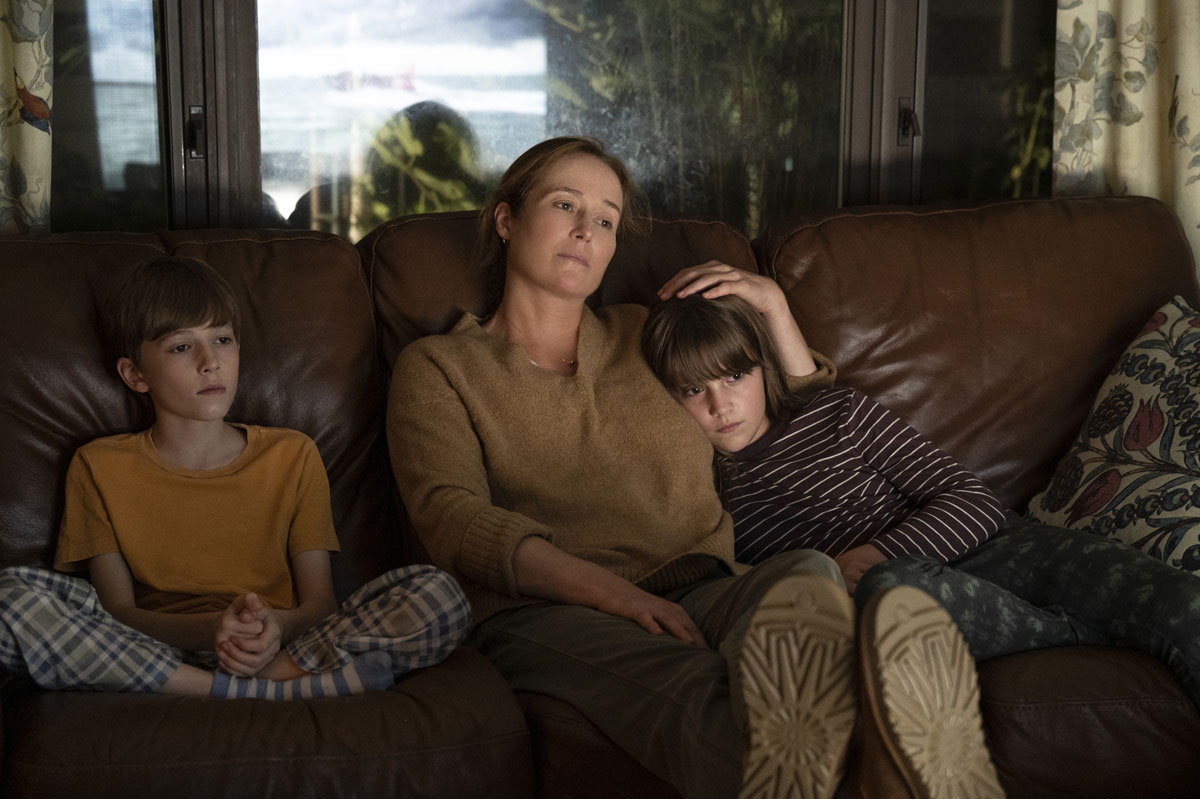
“She Said” touches on the postpartum depression that Megan and millions of others go through. One of them was Mulligan, who dealt with postpartum depression after the birth of her first child. She told People, she “felt very alone, and very scared, and also very confused by the whole experience.” Another one is Megan herself, who allowed her real-life struggle with postpartum to be part of the movie (it isn’t in the book). She described launching into the Weinstein investigation at the same time she was dealing with postpartum to People as “one of the most vulnerable periods in my life.”

Sometimes the biggest protection of all is to tell the truth.

It adds another dimension to the character, a real one. “She Said” doesn’t have men thwarting the female leads, all too common in films with so-called strong female characters; importantly, it doesn’t have other women standing as roadblocks to their continued success either. As editor Rebecca Corbett, Patricia Clarkson recognizes the difficulty Megan is having and quietly asks her what will help. It’s work that will assist her, and Megan launches herself into it.

Postpartum depression is a subtle thread but a powerful one, rendered realistically in the film, which treats motherhood not as hindrance but a strength. Several of the victims of Weinstein are mothers. For one of the first ones to agree to go on record (Jennifer Ehle as Laura Madden), it’s the deciding factor in breaking her silence. She doesn’t want her children to think she did nothing, that she could have helped others. In another small but massively important moment, Jodi’s young daughter reveals on a Zoom call she knows the word “rape,” that kids — boys — say it casually at school, and Jodi must walk the line both between protecting her daughter and not shaming her or lying to her. Sometimes the biggest protection of all is to tell the truth.


Want a daily wrap-up of all the news and commentary Salon has to offer? Subscribe to our morning newsletter, Crash Course.


Being a mom isn’t just about caring for someone. It’s about keeping them safe in a world that often wants both them — and you — dead. 

We think of one of the defining characteristics of motherhood as nurturing. But being a mom isn’t just about caring for someone. It’s about keeping them safe in a world that often wants both them — and you — dead. Motherhood is about fierceness, grittiness, dogged persistence. It’s about never giving up, as somehow holding onto yourself while the demands of the unpaid and unappreciated job, and the expectations of our society, try to tear you apart, to erase you. 

“She Said” is that very rare film that recognizes the work of mothers: at home and in the office, in the field where being mothers gives the reporters not just an air of empathy to their subjects, but an armor of steel. It’s not that they broke this story despite being moms. It’s they broke this story because they were moms. 

“She Said” is available on Peacock and on demand.

Trump targets “cult of gender ideology” during campaign event in South Carolina

On Saturday, Donald Trump made stops in New Hampshire and South Carolina for the first major campaign events in his 2024 presidential bid, finding opportunities to make remarks against main competitor, Florida Gov. Ron DeSantis (R), even before exiting his aircraft and making way to the podium.

In an interview with reporters aboard his plane to South Carolina on Saturday, Trump said “Ron would have not been governor if it wasn’t for me, and that’s okay . . . then when I hear he might run, I consider that very disloyal.”

During the speech he would go on to give in South Carolina, Trump took up a popular talking point among Republicans, protecting children from “perverts” and steering the country away from “woke” gender and sexuality politics.

“We’re going to stop the left wing radical racists and perverts who are trying to indoctrinate our youth, and we’re going to get their Marxist hands off of our children” Trump said. “We’re going to defeat the cult of gender ideology and reaffirm that god created two genders called men and women.”   

Responding to the applause that erupted after those statements, Trump then doubled-down, going into the topic of “men playing in women’s sports,” and how he plans to put an end to it.

“We’re not going to allow men to play in women’s sports, and by so doing, you know what happens, we’re going to save the dignity of women, and we’re going to save women’s sports itself,” Trump said, calling such a thing “ridiculous.”


Want a daily wrap-up of all the news and commentary Salon has to offer? Subscribe to our morning newsletter, Crash Course.


Trump has already laid groundwork for this plan, announcing this week that he will be pushing to “cut federal funding for any school pushing far-left sexual or political content on our children.”

Why this year’s COVID is different, according to experts

It came for us one by one, like a calculating antagonist in an Agatha Christie novel. I came home from a morning supermarket trip to find my spouse hunched at the dinner table, clutching a piece of plastic with two clear pink lines on it. “I have some not great news,” he said.

That’s how it started. But I had never had COVID, so I’d foolishly assumed I never would get it. Then I woke up in the middle of the night with a fever and a hacking cough. It hit my kids, home for winter break, next. First the younger one and then her big sister. One afternoon in the midst of it, I woke up sweat-soaked from a long nap to find one daughter sprawled in fitful sleep on the couch, her father similarly splayed facedown on the floor. In those early hours, our apartment didn’t resemble a sick house so much as a crime scene. A few days later, I was so wracked with chest pains and shortness of breath that I had to get x-rays and lab work to rule out pneumonia or a blood clot. Now, weeks later, I’m still coughing. And after three years of living inside of a pandemic, after all the vaccines and boosters I’ve had and all the hand washing and mask-wearing I’ve done, I have learned firsthand this winter how much abrupt havoc COVID can still wreak, and why this year’s version is unique.


Want more health and science stories in your inbox? Subscribe to Salon’s weekly newsletter The Vulgar Scientist.


“The omicron subvariant XBB1.5 is by far the most contagious strain we’ve seen thus far,” says Alice Benjamin, a clinical nurse specialist and the Chief Nursing Officer for Nurse.org. “It is quickly displacing the other omicron variant cousins BQ.1 and BQ.1.1, which dominated a wave of infections over the fall. Omicron variants and sub-variants have acquired both the ability to evade antibodies and an enhanced ability to infect human respiratory cells, making them more adept at spreading from person to person,” she explains. Even people who managed to avoid getting sick until now. 

“I had COVID for the first time in December, and flu as a bonus,” my colleague Patricia told me recently, noting, “It kicked my butt for three-plus weeks, even with Paxlovid.” And shortly after missing a get-together with a visiting friend because I had been too sick, she emailed me to say, “About COVID… I have it! Tested positive first day back from the trip. First time. I’ve managed to duck it for three years,” she observed wryly, “but I guess it comes for all of us eventually.” That doesn’t make the fact that this far in, it’s still coming for all of us any less hard to take. 

“Unfortunately, we’re still seeing lots and lots and lots of cases.”

“It appears to me that the entire country has just moved on,” says Dr. Shoshana Ungerleider, a San Francisco internal medicine physician and the founder of the end of life organization End Well. “Unfortunately, we’re still seeing lots and lots and lots of cases.” 

On the day I tested positive, 756 people in the U.S. died of COVID, and there were 158,000 new cases reported. That number is likely only a small portion of the true count.

“We’ve stopped doing the necessary level of intake of information at the state level, certainly at the federal level to know just what’s going on,” says Dr. Ungerleider. My experience bears that out — my daughters hadn’t needed medical attention, so 50% of our own household’s COVID cases went uncounted. 

For many, getting COVID isn’t a matter of if but when — or when again. A December study in Morbidity and Mortality Weekly Report estimates that 42% of adults in America have already had the virus — a figure that’s only going to increase over time. Given its prevalence, caution can feel like a Sisyphean endeavor. In the most miserable depths of my recent illness, I wondered whether the time I’d spent going for walks with friends instead of coming over for dinner, and the endless expense and effort of hand sanitizer spraying and counter wiping, had just been a futile attempt to outrun something that was always going to catch up with me anyway. I felt, frankly, pretty cheated. 

In almost-hindsight, though, I know it could have been much worse. Last summer (before the emergence of the latest variant) the Mayo Clinic advised, “Fully vaccinated people with a breakthrough infection are less likely to have serious illness with COVID-19 than those who are unvaccinated. Even when vaccinated people develop symptoms, they tend to be less severe than those experienced by unvaccinated people.” Maybe if I’d never been vaccinated and hadn’t kept up with my boosters and flu shots I would have become exactly as horrendously sick as I truly was. I’m extremely relieved, however, that I didn’t have to find out. I’m glad the rest of my family was sick for only a short span of time. 

“It’s really, really important to get updated boosters.”

As long as this thing keeps spreading and evolving, continued common sense still remains the wisest option for protecting ourselves and our vulnerable loved ones from getting COVID or becoming seriously ill from it. First and foremost, “It’s really, really important to get updated boosters,” says Dr. Ungerleider. While 80% of Americans have been vaccinated against COVID, only 34% of us are fully boosted. 

“Immunity wanes over time over the course of months, and these new sub-variants actually have a different genetic makeup than the previous variants,” says Dr. Ungerleider. “Just because you had COVID, whether it was back in 2020, 2021, or 2022, it doesn’t mean you can’t get it again. I think people get relaxed, thinking, ‘I got COVID before, so I am good.’ It’s just not that’s not the case, unfortunately.” She adds, “There’s still a lot we don’t understand about the long COVID picture. Who gets it? Why do they get it? Why does it affect certain people differently than others? How do we treat it? We don’t know.” 

Beyond staying up to date with vaccinations, you probably know what else to do. “To have a safer season we need to stay diligent about washing our hands,” says Alice Benjamin, “wearing a mask in crowded indoor spaces, practicing cough hygiene, testing for COVID, staying home if positive, and staying in good health overall.” 

And if you can, keep the clean air flowing. “To decrease the chances of a superspreader event in your home when entertaining a group, add a portable air filter to the space,” says infectious disease epidemiologist and Infectious Economics founder and CEO Dr. Blythe Adamson. She says. “There are many reasonably priced portable HEPA filters available on Amazon with prices ranging from $50-150. The size or number needed depends on the square footage of your room.” 

While I am as fed up with COVID as anybody can be, I also gratefully recognize that vaccines and treatments like Paxlovid mean that we are nowhere near the level of chaos and risk of  those dark early days of the pandemic three years ago. “Despite the enhanced transmission rate, XBB1.5 is not causing an alarming increase in the overall number of hospitalizations or deaths,” says immunology and virology expert Kirsten Hokeness, Ph.D., Director of Bryant University’s School of Health & Behavioral Sciences. “While the numbers infected are high, the impact still appears to be manageable. This is likely due to cross reactivity of immune systems that combine from natural infections of a variety of strains as well as the vaccines and updated boosters.  A large proportion of the population has some degree of protection, which can help fight the infection faster, and limit severity despite the individual variant’s immune evasiveness.” 

So I’ll take an experience that was bad over one that could potentially have been catastrophic. I’ll keep washing my hands and wearing a mask on the subway.  And I’ll assume my last case of COVID was really just my first case of COVID.

“As much as we’re tired of talking about it, thinking about it, having to plan around it,” says Alice Benjamin, “this virus is not done with us.”

Utilities use customer dollars to pay for their lobbying. Here’s how lawmakers can stop it

Electric and gas utilities have used money collected from customers to lobby lawmakers, butter up regulators, and slow the shift to clean energy. Beyond being occasionally illegal, the practice has stuck consumers with higher bills and led to higher carbon dioxide emissions, industry watchdogs say.

In one particularly egregious example, the FBI arrested Larry Householder, who was the Republican leader of the Ohio House of Representatives in 2020 at the time of his arrest. It alleged that the Ohio utility FirstEnergy had given the lawmaker $60 million in exchange for passing legislation bailing out its coal and nuclear power plants. His corruption trial began this week in Cincinnati.

It’s one of a handful of utility scandals over the last decade that advocates for reform say have resulted in higher energy bills and more carbon emissions. But there are simple steps lawmakers could take to avoid these problems, according to a report the nonprofit utility watchdog Energy and Policy Institute published Thursday.

The analysis, aimed at Congress, state legislators, and federal and state regulatory agencies, suggests passing tighter, clearer rules barring utilities from using ratepayer money for political activities. Policymakers also could require regular, mandatory disclosures of utilities’ political spending. To ensure compliance, utilities could face hefty fees for breaking the rules.

Technically, federal and state regulations prohibit utilities from passing lobbying costs along to customers. But these laws are often vague, outdated, and “riddled with loopholes,” according to David Pomerantz, executive director of the Energy and Policy Institute and the report’s author. Much of utilities’ political spending moves through the shadowy world of trade associations, activity that isn’t strictly “lobbying” under the IRS definition of the practice. 

Working with trade groups like the Edison Electric Institute and the American Gas Association, utilities have blocked policies that would promote rooftop solar and electrify buildings. At the same time, they’ve kept the country hooked on fossil fuels by, for example, paying Instagram influencers to defend gas stoves. Nearly half of the 25 largest investor-owned electric utilities in the United States are working to delay climate action, a report from the think tank InfluenceMap found last year.

While all kinds of companies engage in politics, the Energy and Policy Institute argues that utilities present a unique situation. For one, they have monopolies — people are generally forced to accept whatever company supplies their area. By raising rates, utilities can essentially compel customers to fund their political activity, “effectively turning them into a conscripted army of millions of small-dollar donors,” the report says. Utilities are almost always among the top three political spenders in the states where they’re based, Pomerantz said. 

Brian Reil, a spokesperson for the Edison Electric Institute, said that it “reports all lobbying as required and in those reports utilizes the broadest definition of lobbying that exists in federal law.” Reil said the new report was a “disingenuous attempt by the Energy and Policy Institute to negate the clean energy progress” that electric utilities have made, pointing to the institute’s support for the Inflation Reduction Act that President Biden signed last year. The American Gas Association did not respond to Grist’s requests for comment in time for publication.

Some states have enacted stricter laws to protect consumers from rate hikes to fund political spending. In 2021, New York passed a law prohibiting utilities from charging ratepayers for the membership costs associated with trade groups that engage in lobbying, for example. Minnesota bars utilities from charging customers for advertising designed to influence public opinion or improve a utility’s image.

Even for utilities that have begun to shift to wind and solar power generation, stricter rules are needed to prevent more scandals and guard people’s pocketbooks, the report says. “If utilities are going to be at the center of our transition from fossil fuels to clean electricity,” the report states, “customers need to be able to trust that they are not corrupt.”

“I don’t toot glitter”: Kristin Chenoweth on embracing her failure, anger and questions for God

Kristin Chenoweth is a show business rarity — a Broadway icon and LGBTQ advocate who’s also a devoted Christian. “Being a person of faith and saying it in this industry, I always felt like I was being judged. Why was I being judged? It’s a huge part of the journey so far,” she told me on “Salon Talks.” 

The actor, singer and author is best known for originating the character Glinda in the iconic musical “Wicked,” and multiple screen successes in “Pushing Daisies,” “Glee,” “Schmigadoon!” and other indelible roles. In her new book, “I’m No Philosopher, But I Got Thoughts: Mini Meditations for Saints, Sinners, and the Rest of Us,” Chenoweth explores the complicated, seemingly contradictory sides of her life from starting out as a Oklahoma girl who just wanted to sing, dance and act to a now Tony, Drama Desk, and Emmy winner with many stories to tell. 

Watch our candid “Salon Talks” conversation about faith, forgiveness and failure, and why in real life, she promises that “I don’t toot glitter.” Also, read a Q&A of the episode below.

The following conversation has been lightly edited for clarity and length.

You’ve written a memoir and a children’s book, but this is different. This is a workbook, a conversation with your bestie when you’re feeling a little depleted and you need a pep talk. Tell me what you wanted this book to be and who you want it to be for.

I want it to speak to everyone. At first I thought, this is geared towards women, but at my book signing the other night, I found it was half and half men and women, which I loved. When I first was approached about writing another book, I thought, “No way, this constant book report due, I can’t do it.” It was at the height of the pandemic before vaccines, before we really knew what was going on. My agent said, “Well, what else are you going to do? You’re not going anywhere.” I was like, he has a point. I just needed it to be authentic and come from the heart and figure out what it was going to be.

I’m a big journaler. I’m also a big reader. Left to my own devices, I can stay up all night writing, and I do that in my journals. I took the time to start going back and reading some of my journals. I thought, I wonder if there’s a book that I could write about some of these entries, or at least have chapters that are topics that come up again and again in my journal. That’s how it started. Then it just snowballed into philosophies and quotes I love, and then some of my own quotes as well that I crack myself up on. I don’t know if they’re funny or not, but [it’s] anything that I could give encouragement by what I’ve learned. I show in the book a lot of the good, but I also show a little bit of the dark. It’s not something I’m comfortable normally doing, but it was important to do so.

I love when I see a book that has a bright pink cover that is so whimsical and cute, but also does go into these dark places. You talk about real challenges that you’ve had, depression and anxiety and death and grief and forgiveness. A big part of that is your spirituality. Talk to me about that side of it, putting the spirituality into this very mainstream book for audiences who may have very different views.

When I first started this career, I was just a very normal Oklahoma girl who wanted to sing and dance and act. I didn’t know when I moved to New York that people don’t really talk about Jesus or God. I mean you can, but it’s not like being from the South. I learned here there was way more of a diverse community of people that I was meeting. And I loved it. I loved it because just because I believe a certain way doesn’t mean it’s the right way. It just means it’s right for me and it’s what works for me. 

“This is why I write books because I love to hear from people what moved them, what made them think a different way on something.”

Thoughts on judgment come up a lot in the book because being a person of faith and saying it in this industry, I always felt like I was being judged. I don’t really lead my life with judging others. Why was I being judged? So of course it’s going to be in my book. It’s a huge part of the journey so far. No, not everybody agrees. That’s OK too. I have friends that are nothing like me, and on paper we should not be friends, but we’re besties because they challenge me. They make me think a different way. Hopefully I do the same for them. That’s what makes relationships fun and interesting. I believe can really stand the test of time. Also frankly, it’s a relief to have a friend group where everybody can bring their perspective to something. That’s what else I was trying to do with the book too. This is my perspective and this is what I think. How do you view this situation, that quote, your life in a pie chart? That’s why there’s stuff to do inside the book, a working book, so to speak.

This book is very playful, but also challenges the reader in unexpected ways to be curious, to be forgiving and to be open. You start with talking about doubt, which I think a lot of people on the other side of the conversation about Christianity don’t think is part of the discussion about faith.

First of all, there’s been a time in my life where I had to really look and see, is this what you believe? This is what you grew up with, this is what you were ingrained with, but is it truly your belief? I came to the conclusion that yes, it was. I did have some questions though. In my first book, the memoir, I had a postscript. I called it Questions for God, with things like, “Why do people hate gay people so much, God? And what happened to JonBenét, God?” I didn’t know that so many people would be interested in that and love that section, so I did “Questions for God, Part Two.”

I don’t question God’s love for me, but I have questions for him because why wouldn’t I? After Cain and Abel, was there a first woman? I want to know, because I have questions for God, and when I get to heaven, I believe that all will be revealed. Some of it will be revealed through life lessons here on Earth. I love that you brought that section up because doubt is part of having faith to question and go, “Why that?” Okay, I’m going to take the meat that serves me well, but I’m not going to choke on a bone, which is in the book and said by my grandmother. I love that she said that to me, because I’ve taken it throughout my life and used it.

You talk about your advocacy in the LGBTQ community and what a big part of your life and your service that is. Have you ever had people come up to you from the Christian community and say, “You really got me thinking about my own perspective and you’ve really challenged my beliefs in a way that have made it a little more expansive now”?

Yes, I have. If I could tell you just one conversation, I had with a woman many years ago. I was at a book signing and she said, “When did you start being the gay rights advocate? Because of Broadway?” I said, “No, it was in the third grade when one of my friends started getting taunted, and I started my quest of understanding it then.” She said, “Well, my daughter has come out as trans, and I can’t accept that.” She goes, “Because of my faith and our faith.” She goes, “I love everything about you, but I just have a little problem here because you seem to cherry pick what you want to take and then the rest. That’s not how our faith is.”

I said, “You’re absolutely right to have your opinion. I’m going to ask you something. Is it worth kicking your daughter out the house, telling her she’s going to hell and damnation because of how God put her together? Is it worth it to you? What if she’s wrong, OK? What if you’re right and she’s wrong? She’ll find that out later when she goes to heaven. She’ll find it out. It’ll be revealed to her. But what if she isn’t, and you’re wrong? Is it worth it to you to put her to the side, disconnect from her?” She goes, “It’s breaking my heart. I can’t get well, I’m sick all the time.” I go, “OK, there’s your answer. You’re making your own self sick because of your, pardon me, bigotry, about a certain aspect of your daughter’s life when you have unconditional love.”

“I didn’t take action and take care of myself out of fear and worry and anxiety that my career would end.”

I said, “Do you feel that you have unconditional love for her?” She said, “I do.” I go, “You don’t.” She started to get upset and I gave her a big hug and I said, “It’s OK. I’m not judging, I’m just saying. I’m not even a therapist. I just know that is not worth it. I’m sure that I have done things in my life that have embarrassed my parents. Not everything I say do they agree with, but they would never toss me aside because I’m their daughter. That’s like our heavenly Lord. He does the same thing. He can be frustrated and he can almost feel like, are they not listening? This is for your own good, or I set this example so you would learn not to do that, whether it’s a parable or not.”

I said, “Our Bible is a great guide and our faith is great. All I keep my focus on is how God’s going to work in my life. But listen, do not let her go over that.” And she just cried and cried and cried. She said, I’m hearing you, “I’m hearing you.” I always wondered what happened there. These moments are why you write books. This is why I write books, because I love to hear from people what moved them, what made them think a different way on something. That was one of the more powerful stories that I came into contact with.

You talk about forgiveness in this book, and about what that really looks like. Part of forgiveness sometimes means getting angry. You talk in this book about an accident that you had in 2012 on a set of a television show. I wonder if part of what you’ve learned along the way has to do with people’s perceptions of you being this tiny good witch, and what you’ve learned about speaking up for yourself and owning forgiveness, but also owning anger.

I love this question, Mary Elizabeth, because what I came to understand about my own self is that I had a lot of anger. Not only did it trigger anxiety and depression out of the blue, but I had a lot of anger. And why? Because I do a cheer that I made up that I think a lot of Southerners can relate to. It’s called “Push it down, push it down, way down, push it down, push it down, way down.” I was the queen of it. There’s a problem? Let’s push it down. You have injury and pain? Push it down. Someone harmed you, you know what? Push it down. It comes up in a lot of ways. It was expressed to me from people I worked with that maybe it wouldn’t be a good idea for me to take action, because then I would never work again.

“I have failed big time in my life. Do I like it? No, but I’m human.”

I didn’t take action and take care of myself out of fear and worry and anxiety that my career would end. Would it have? It’d be an interesting experiment to go back in time. One thing I would say is that now it feels like it’d be easier to do that for me. [It’s] not just my age, just about because of where we are in this life, about how I learned things from the younger generation. Hopefully I can impart what I know to them as well. I learned, no, that’s not right. If you notice the younger generation, it’s like, “No, I need 15 minutes of me time. I’ve got to have a mental health day. I was supposed to work out. I can’t go to this fancy thing.” I’m like, “This is your career.” Now I’m like, “No, take a little page from them, just a little one, and listen.”

Now, I probably would have not been afraid and I would have shouted it from the mountaintops, but then I was scared and it caused a lot of undue problems for me. I learned a huge lesson. By speaking about it in the book, in such detail, finally, it feels like some of the anger is being released, just to be able to say it. 

I remember one of the people that used to work with me said, “Well, it wasn’t that bad though, right?” It was from a woman. I said, “I had a seven-inch skull fracture, cracked nose, teeth, ribs, and a neck problem, and a concussion. I’m lucky to be here.” When it happens to you, first of all, you gain empathy for others’ pain. I see others who have pain and I go, “I see you, and I’m sorry.” It’s been an interesting time dealing with it. That was all those years ago. But yeah, I still deal with it.

You talk about the fear that you felt back then of reprisal. You talk in the book about courage. I’m curious now, what scares you now? What if anything, are you afraid of today, Kristin?

I would be completely inauthentic if I told you I wasn’t afraid of anything. But I am more open to things that scare me. If I do a project that scares me, I know it’s probably the one to do. Also, I’m open. I don’t like the idea of it, but I’m open to the idea of letting the world see, oh, that was a hashtag fail. I think normalizing failure helps our youth.

Not everything is perfect rainbows and unicorns, and I don’t toot glitter. I have failed big time in my life, and I’ve worked very hard at letting the public see only part of it. Now I’m not so afraid of that. Do I like it? No, but I’m human.

The film version of “Wicked” is coming out, the introduction of this book by your friend Ariana Grande. Did you know “Wicked” was going to be what it has become? What do you think it is that makes this story so special and so meaningful to so many people?

I remember telling Idina [Menzel], after our opening night, because we got kind of mediocre reviews, “It doesn’t matter because you defy gravity, girl, at the end of Act One, against all odds.” And we have a huge duet about forgiveness with friendship and love, which is the real theme of the show that I think works. I knew after our opening night on Broadway, I was in a massive hit. Did I know it would become a juggernaut? No. I didn’t know. I had prayed before the show happened. I said, “Dear Lord, I really want my Les Mis, Phantom, I want one of those.” I believe when we pray we’re allowed to pray specifically. Sometimes it’s in God’s will. I feel blessed that God’s timing and mine landed at the same spot. 

“Not everything is perfect rainbows and unicorns, and I don’t toot glitter.”

I always tease myself. I say, Every time you plan, God laughs, Kristin. Stop it. But the theme overall for the show, I think makes truckers come up to me as well as little girls, as well as gay couples, as well as my friends, all of us. It’s the same thing. There’s two women that are the love story of the show. By love story, I don’t mean the typical, I just mean that’s the heart. We see two women who are unlikely best friends, showing each other different perspectives. Both of them are a little bit evil, a little bit wicked, and a little bit good. Both of them. “Wicked” doesn’t mean one girl. 

Glinda doesn’t start out so nice. It’s the journey she has to make her actually become Glinda the good. It’s the journey that Elphaba has to make her become wicked. I love to hear when two people say, We met at the show, or we met because of the show and now we’re best friends. I see tattoos of “For Good.” I think Stephen Schwartz was such a genius. When music theater works at its highest level, it propels the plot. Yes, it’s a beautiful song, but when those lyrics are sung and it’s about forgiveness with the person that you love the most and a goodbye in a way, and love, it’s deep. It’s deep. And we did it eight times a week.

I went a couple of years ago to see the show, just because I wanted to see it. I hadn’t really ever seen it. And I thought, oh, there it is. That’s why it’s still going. There’s those three things that I wanted: friendship, love and forgiveness. It’s still there. So that’s why it lives on.

The laptop from hell and other stories: Your guide to 2023 congressional investigations

With control of Congress split between Senate Democrats and House Republicans, near-total legislative gridlock is almost certain to halt movement on the keystone issues of both parties. Indeed, battles over bills will likely be just the background to a tide of aggressive investigations led by House Republicans into the Justice Department and key figures in Joe Biden’s administration. Exactly what the political fallout of these investigations will be — and who will benefit most — are key questions as high-profile hearings will command media attention ahead of the 2024 election.

The Biden administration has been gearing up for the GOP’s promised investigations at least since May, when presumed GOP targets like the Department of Homeland Security began a process that might be described as legal waterproofing. After recruiting a slate of veteran white-collar lawyers and former political advisers, Biden officials built the administration’s response strategy last summer in a series of meetings. 

Democrats will meet this investigative onslaught with essentially the same playbook Republicans used to defend Donald Trump and his coterie, ironically enough — along with a battery of legal defenses meant to guard against overly broad demands for Justice Department intelligence. Democrats also know first-hand how hard it is to turn investigative findings into a pair of handcuffs. That experience, some argue, may offer Democrats the advantage in landing a balance of public favor.  

Recent pundit chatter suggests Democrats are hoping that GOP investigative overreach will be a publicity boon. They’re betting that voters grow impatient while watching a fractured GOP with a razor-thin House majority flounder to fulfill any of its legislative stump promises. Some White House aides and allies have suggested that the far-right flavor of House investigative committees is a “political gift.”

But it seems at least as likely that House Republicans can score more political points wielding the gavel than Democrats can in defending themselves from it. The Biden administration is already on the back foot, seeking to fend off what it views as unnecessary requests for overly sensitive information, with a flood of congressional requests and subpoenas certain to follow.

GOP committee chairs hope to yank the leashes of executive branch officials before the cameras, delighting the most extreme members of their base with a spectacle of Democratic humiliation. Government science and health officials will likely be compelled to appear on Capitol Hill to address a range of unsubstantiated conspiracy theories on COVID and other hot topics. 

Congressional investigations — replete with camera-savvy grandstanding antics — are the hallmark of divided government, as well as a time-tested ax for chipping away at presidential approval ratings. Republicans are betting their stagecraft will outweigh the fact that their investigations will almost certainly have no legal effect. 

Republicans’ investigative wish list is sprawling, but may grow narrower as their committees stretch themselves thin. Here’s a full breakdown of the House’s new investigative powers and committees, along with a list of current and proposed investigations where the GOP hopes to  flex its authority for the cameras.  

New rules: What’s different in the GOP House  

Passage of the new House Rules for the 118th Congress, in a 220-213 vote, marked Speaker Kevin McCarthy’s first legislative victory. The rules are expected to encourage protracted and performative committee hearings, while increasing the chances of partisan budget standoffs in both chambers. They increase House committees’ investigative authority at the expense of minority-party members and the integrity of ongoing criminal cases, and expand bill-markup privileges, allowing members to target individual political opponents and federal programs. 

Republicans are betting that TV stagecraft will carry more political weight than the fact that their so-called investigations are pointless and ineffectual.

New rules laid out in the 55-page document grant the chamber greater control over spending and tax bills, while giving the House GOP a new potential cudgel against the agencies and programs they investigate. The most high-profile rule change dramatically weakens the speakership by allowing any single member to call a motion to “vacate the chair” (previously, five members were required). 

The long-standing “Gephardt Rule” was struck down, which could force a direct vote on lifting the debt ceiling — setting the stage for a potential 2011-esque standoff with Senate Democrats. Brinkmanship chances may increase the most thanks to  new rules aimed at slowing down budget approval for bills that are normally hand-waved through — like those used to keep Social Security functioning. Bills reauthorizing such mandatory spending increases are blocked in the new rules, as is any spending bill that would lay out more than $2.5 billion within four years. However, spending cuts can now be bundled together and voted on as a package

Short-term spending items in a budget must be voted on individually before their funding is increased. Income tax increases now require a three-fifths vote to pass the House, and any bill that has a big impact on the economy has to include an inflation-impact estimate. One bipartisan “good government” rule requires bills to be posted at least 72 hours before the chamber takes a vote on them. 

While the House expanded committee investigative privilege, any committees seeking to enforce subpoenas or compel criminal investigations will still face Democratic pushback in the Senate and White House.

The most prominent threat to the executive branch and Biden administration comes with the revival of the Holman Rule, which allows  Congress to vote on cutting specific employees’ salaries or positions within a federal agency. Another rule gives more authority to the already powerful House Oversight and Accountability Committee. All committees tasked with overseeing a federal program’s budget will now be required to provide the Oversight Committee with a formidable stack of paperwork on its programs — and the threshold for recommending a program’s termination has been lowered. 

House committees — especially select committees — already have the authority to exercise a range of investigative powers, but newly reintroduced rules tighten the majority party’s grip on the committees and restrict the minority party involvement. (It’s entirely possible Republicans will live to regret these rules two years hence.) Reinforced by the threat of a potentially disastrous government shutdown or a possible default on government debt, this is what House committees’ investigative powers now look like. 

How will the House rules impact investigations?

Getting it on the record — Unlike congressional subpoena powers, House rules on committee interview and information requests are largely unchanged in 2023. Before it issues a subpoena, a House committee can try two less aggressive routes to gather evidence. Any member can issue a request for information to an individual, whose response is voluntary. Then a House committee can request an interview, with response again voluntary, although perceived political interest often compels witnesses to comply. Interviews are less formal than a full deposition, and are usually held in private — and committees can still allow staff to lead witness interviews either remotely or in person. 

No more seven-member rule — Previously, any seven members of the Oversight Committee, regardless of party, could issue a subpoena to compel witness depositions or other evidence. Now, the committee’s chair must be included among those seven members. In the current Congress, this obviously restrains Democrats’ power.


Want a daily wrap-up of all the news and commentary Salon has to offer? Subscribe to our morning newsletter, Crash Course.


Staff deposition powers, limited attendance — Republicans will keep a previous Democratic rule that allowed congressional staff to take depositions without a committee member present. The rule also now limits persons who can attend depositions to members, committee staffers, an official reporter, the witness and no more than two attorneys. 

Higher-profile hearings — More in-person testimony is expected during congressional hearings, as a new rule restricts the circumstances under which committee chairs can allow witnesses to testify remotely. This rule seems to apply only to non-governmental witnesses. The GOP has also kept a Democratic rule that allows the committee to overrule objections made by a witness’ lawyer and compel a witness to answer or be charged with contempt. Committee members can still appeal this move.

Executive branch referral — Congress can still refer its investigatory findings to the executive branch for criminal prosecution through the Justice Department. But the executive branch still has the power to decide whether to prosecute or not.

What happens if you ignore a congressional subpoena? 

If a person fails to comply with a congressional  subpoena, they could face contempt charges, although the consequences are rarely serious. Those come in three varieties.  

Inherent contempt — If a person ignores a subpoena from a House committee, the House can pass a resolution holding that person in contempt and then conduct a full trial, along with a debate. If the person is found guilty, Congress can impose its own punishment — including having the chamber’s sergeant-at-arms find the person and arrest them.

Civil contempt — Formally known as civil enforcement, this option allows the House to enforce a subpoena by either having the House general counsel file a suit in federal court, or asking a federal judge to order the witness to comply.

Criminal contempt — Failure to comply with a subpoena is a misdemeanor that can result in imprisonment or fines, although such outcomes are rare. The House can approve a contempt citation and refer it to the attorney general for possible prosecution. With the DOJ currently overloaded with hundreds of Jan. 6 cases and the discovery of classified documents at Mar-a-Lago, the odds don’t favor the additional use of resources for congressional investigations. Notably, criminal contempt charges — like those on which former White House adviser Steve Bannon was convicted — take a notoriously long time to yield results. 

What are the House’s investigative committees? 

There are eight key committees to watch so far. Among those, the three new investigative bodies worth keeping an eye on are the Select Subcommittee on the Weaponization of the Federal Government, the Select Subcommittee on the Coronavirus Pandemic, and the Select Committee on the Strategic Competition Between the United States and the Chinese Communist Party. But shake-ups in five other standing committees foreshadow more House brawls ahead. 

Judiciary Committee — Chairman Jim Jordan, R-Ohio, has already pledged that his committee will investigate the Justice Department as he dives into a slate of Biden administration affairs. His requests to the DOJ have already begun with the first indications of the department’s response coming late last week.

  • Select Subcommittee on the Weaponization of the Federal Government — Jordan will also chair this new and highly-publicized panel, which has been authorized to “investigate the investigators,” especially the ongoing criminal probes of Donald Trump and his inner circle. Critically, the subcommittee is allowed to receive potentially sensitive information from the House Intelligence Committee — whose members have special security clearances —and its members do not have to serve on the actual Judiciary committee. Federal agencies are expected to push back on information requests made by the panel. Committee member Rep. Byron Donalds, R-Fla., has also said he wants the committee to investigate the White House’s interactions with Twitter.

Oversight and Accountability Committee — Chairman James Comer, R-Ky., will be able to issue subpoenas unilaterally in his role over this powerful committee. The first hint of its new aggressive posture came with a name change (it was previously the Oversight and Reform Committee). Comer has repeatedly promised to go after the Biden administration and its federal agencies with what he calls an “all-star lineup.” And indeed, the committee’s GOP members include such MAGA bold-face names ass Arizona Rep. Andy Biggs, Colorado Rep. Lauren Boebert, Georgia Rep. Marjorie Taylor Greene and Pennsylvania Rep. Scott Perry.

  • Select Subcommittee on the Coronavirus Pandemic — Chaired by Brad Wenstrup of Ohio, the new panel is likely to dive into pandemic relief fund fraud but may also reinvestigate the origins of COVID-19. (Why that’s important to Congress at this late date is not clear.) Although this select committee is technically under the Oversight and Accountability Committee, the speaker chooses its membership, as with the Government Weaponization panel. Members will be able to ask questions for more than the usual five minutes, and staff will be able to question witnesses in hearings. Its final report is due by Jan. 2, 2025 (the last day of this Congress). 

The new subcommittee on the Weaponization of the Federal Government appears to be calibrated to siphon sensitive information away from the Intelligence Committee, whose members have special security clearances.

Select Committee on the Strategic Competition Between the United States and the Chinese Communist Party — Chaired by Wisconsin Rep. Mike Gallagher, the new panel with an unwieldy out-of-the-past name was created in the rules package and in its own separate resolution. Gallagher is noted for his bipartisan efforts to establish the committee in the previous Congress under then-Speaker Nancy Pelosi, who will herself sit on this new committee along with Democratic Rep. Jim McGovern of Massachusetts and House Minority Leader Hakeem Jeffries of New York. McGovern’s position as chair of the Congressional-Executive Commission on China is expected to add sobriety to the committee’s approach. 

Foreign Affairs Committee — Chairing this already powerful committee, Rep. Michael McCaul of Texas will have the authority to oversee the Department of State and any investigations from other committees the involve foreign policy. That could include having influence over the Select Committee on China. Rep. Scott Perry, the Freedom Caucus chair, also sits on this committee.

Homeland Security Committee — Freedom Caucus member Mark Green, R-Tenn., is likely to step into a high-profile role as he takes on the chairmanship of this committee. Migration issues at the southern border are prompting a suite of early bills in the House. Far-right members want to depose Homeland Security head Alejandro Mayorkas, with resolutions demanding his impeachment already filed in the House.  ]

Ethics Committee — Rep. Michael Guest, R-Miss., will chair the committee. While not new, recent rule changes order the Ethics Committee to begin taking complaints directly from the public. The move may offer lawmakers a potential end-run around the Office of Congressional Ethics (which vets and refers ethics complaints to the Ethics Committee). As the OCE faces calls to investigate Congress members over the Jan. 6 attack on the Capitol, its eight-member board has been largely gutted by a new rule imposing term-limit caps that would immediately force out three Democrats — and another new rule requiring four OCE board members to approve the new appointee. 

What are the current House GOP investigations?  

The GOP is expected to investigate a host of topics in short order: Biden’s border policies, the U.S. withdrawal from Afghanistan, the origins of COVID-19, cryptocurrency scams and diversity recruiting efforts in the military. Currently, three investigations have commenced in earnest, with chairmen publicly discussing early plans on collection of evidence.

The Justice Department and FBI — Jordan has previously signaled that the Government Weaponization panel plans to go after the FBI and DOJ in what Democrats believe will be an effort to see what cards the agencies hold in their own criminal investigations into Trump. Jordan released a roadmap of the committee’s agenda (spanning more than 1,000 pages) but said in recent days that the committee will first investigate what he believes was the FBI’s attempt to target parents who criticized school board members.

Rep. Jim Comer says there are no plans to subpoena Joe Biden “right now,” perhaps because the entire point of the Hunter Biden probe is to torment him.

Hunter Biden — Comer’s Oversight and Accountability Committee will take on a whole range of topics around Hunter Biden, which Comer told CNN would start immediately. Comer said there are no plans “right now” to subpoena the president himself, but that the committee would bring in witnesses for interviews and request bank records from the president’s long-troubled son. Hunter Biden is facing a federal investigation over tax violations but hasn’t been charged with a crime. Comer’s panel will also be investigate any links between the president and his son, and is clearly eager to pursue the rumors that Joe Biden somehow profited from or meddled in his son’s overseas business deals. 

Biden’s classified documents — On Jan. 13, Justice Committee chair Jordan  announced the panel would investigate  Joe Biden’s handling of classified documents, sending a letter to Attorney General Merrick Garland requesting files related to the DOJ’s findings on the president. The committee also asked for documents related to Garland’s appointment of special counsel Richard Hur. Under the authority of the Oversight and Accountability Committee, Comer sent his own request to the DOJ, asking for more details on what the documents contain. 

Trump thinks parents should be allowed to “elect” their children’s school principals

Former President Donald Trump has launched a new attack on education with his proposed plan of action to revise how public school administrators and faculty members are put in place.

In a new presidential campaign ad, Trump expressed a need for more “patriotic teachers” as he called for the termination of school faculty members he described as “radicals.” According to Trump, there should also be a “direct election” process for school principals. Under that election system, students’ parents would have the right to appoint principals.

Trump is also pushing for the defunding of schools that follow a curriculum that includes “critical race theory, gender ideology or other inappropriate racial, sexual or political content.”

“Our public schools have been taken over by the radical left maniacs,” Trump said in the clip, as he went on to share his proposed plan.

“Here is my plan to save American education restore power to American parents,” he began. “First, we will cut federal funding for any school or program pushing critical race theory, gender ideology, or other inappropriate racial, sexual, or political critical content onto our children. We’re not going to allow it to happen. Next, I will direct the Department of Justice and Education to open civil rights investigations into any school district that has engaged in race-based discrimination.”

He continued, “That includes discrimination against Asian Americans. The Marxism being preached in our schools is also totally hostile to Judeo-Christian teachings, and in many ways it’s resembling an established new religion. Can’t let that happen. For this reason, my administration will aggressively pursue potential violations of the Establishment Clause and the Free Exercise Clause of the Constitution. That’s very simple.”

Although Trump has expressed concern about discrimination, he has actually made repeated discriminatory remarks, namely anti-Asian slurs that have been leveled at Sen. Mitch McConnell’s (R-Ky.) wife, Elaine Chao, who also served as former U.S. secretary of transportation under his administration.

Trump is now facing backlash for the campaign ad as Twitter users are also highlighting the irony in his remarks.

“Anyone can’t possibly wonder now why he loves Russia, China and North Korea education systems and Governments and above all Dictators,” one Twitter user said.

“The nightmare that never ends,” another user added.

Watch the video below:

Florida church enforces “anti-gay pledge” for members

The anti-LGBTQ sentiment from religious conservatives has reached a new high with a Jacksonville, Florida Baptist Church making members sign an oath of confirmation in anti-LGBTQ relationships as part of church membership.

First Baptist Church in Jacksonville’s Senior Pastor Heath Lambert has been an outspoken proponent of ‘traditional’ family values and now the church has given members until March 19 to sign the ‘Biblical Sexuality Agreement’ oath or to immediately resign their membership. Lambert says he doesn’t care what members do, and that real Christians do not have a problem with it.

According to Lambert, he did not make the decision on his own — that the entire congregation wanted to move forward with the agreement.

The First Baptist Church ‘Biblical Sexuality Agreement’ states:

“As a member of First Baptist Church, I believe that God creates people in his image as either male or female, and that this creation is a fixed matter of human biology, not individual choice,” the Agreement continues. “I believe marriage is instituted by God, not government, is between one man and one woman, and is the only context for sexual desire and expression.”

The Agreement cites the Book of Genesis along with Corinthians, Matthew and Romans.

“It means to rule out all sorts of sexual sins,” Lambert said in an interview with WJXX. “It means to rule out pornography and polygamy and fornication and adultery and homosexuality.”

A decade ago the First Baptist Church made news in Jacksonville by publicly opposing a newly proposed city ordinance that protected the citizens of Jacksonville from being fired solely based on their sexual identity. The ordinance ended up passing years later.

The church sent shuttles of members to speak against the ordinance.

The best way to save forests? Legally recognize Indigenous lands

Recognizing and demarcating Indigenous lands leads to reduced deforestation and increased reforestation. That’s according to a new study that looked at more than 100 Indigenous territories in Brazil’s Atlantic Forest and found that legal recognition of those lands can have real, and measurable, impacts on centuries of deforestation.

“Our study contributes to an emerging body of evidence suggesting that rights-based policy for Indigenous lands can improve environmental outcomes,” said Marcelo Rauber, a co-author of the paper and researcher at the National Museum of the Federal University of Rio de Janeiro. “Known in Brazil as demarcação, the legal recognition of Indigenous Peoples’ land rights provides Indigenous Peoples with territorial autonomy, which support efforts to address longstanding human rights violations, land grabs, biodiversity loss and climate change.”

The Atlantic Forest stretches along Brazil’s Atlantic coast into Paraguay, Uruguay, and Argentina and once covered over 1 million square kilometers. Due to hundreds of years of deforestation, the Atlantic Forest has been reduced to less-than a tenth of its original size – a fragmented collection of forest spread across nearly 200 Indigenous territories, most of which do not have legal recognition, and urban areas, including Rio de Janeiro. 

The SOS Mata Atlântica Foundation, an organization working to restore the forest, says what remains of the Atlantic is home to more than 20,000 species – 6,000 of which do not live anywhere else in the world – and contains nearly 25 percent of all threatened species in Brazil. It is also a key source of water for cities and communities nearby but has been deforested at a much higher rate than the Amazon.

Researchers found that formalized land tenure and territorial recognition was necessary for improved forest outcomes, however, most Indigenous land in Brazil lacks that legal status. Since 2012, only one territory in the Atlantic Forest’s study sample has been granted demarcation status, and while many communities have begun the process, official recognition has been slow. According to the study, that has a real impact on forest health.

For years, researchers and activists have been alarmed by former president Jair Bolsonaro’s policies, which led to a steep deterioration of environmental and Indigenous rights. Bolsonaro, who pledged not to demarcate any Indigenous land, removed environmental protections and encouraged agribusiness development that led to both murders of Indigenous land defenders and high deforestation rates. In 2020, for example, deforestation in the Atlantic Forest increased by 30 percent. “Demarcation is important, because it is not only a social issue, but also a spiritual, traditional and cultural issue,” said Jurandir Karai Djekupe, a Guarani Mbya leader from the north of São Paulo. “It’s something that encompasses everything.”

For generations, Indigenous communities in the Atlantic Forest have sought territorial rights to fight extractive industries and land grabbers. Now, under Brazil’s new President, Luiz Inácio Lula da Silva, Indigenous communities say they may finally gain access to the legal tools necessary to protect their land, rights, and the environment. Since taking office, President Lula’s administration has begun reversing many of Bolsonaro’s policies

Rayna Benzeev, the study’s lead author, says the government must now ensure that the government agency responsible for Indigenous land, FUNAI, has the resources and political support to demarcate and protect Indigenous land throughout the country. “The new administration has an opportunity to turn this trend around by upholding the Brazilian constitution and granting Indigenous peoples with territorial autonomy and self-determination rights,” Benzeev said. 

However, Jerá Poty Miriam, who is a Guarani Mbya leader from the Tenondé Porã territory, says while Indigenous communities are hopeful the new administration will keep its promises, they are committed to holding President Lula accountable.

“Protecting our territory means protecting our own life because we depend on it,” said Jerá Poty Mirim. “The demarcation guarantees the continuity of those cultures that respect and protect nature.”

Adventures at the Clown Palace: Stand-up comedy helped me confront my depression and cultural taboos

“We wanted to see development, we wanted to see growth, and we just weren’t seeing it.” My boss, the showrunner of the cop series, sat across from me in my barely furnished writers office. His face was impassive.

“But I was doing good work, wasn’t I? Even Aaron said I had a good outline.” My voice went up an octave, squeaky in its terror.

The showrunner didn’t respond to me at first. Then, finally, he spoke. “You can take your stuff out of this office tonight. You can use my parking space if you want.”

His eyes weren’t even angry, just unemotional. My boss went back to his managerial duties. Perhaps he was going to look over an edit of Episode 108. Perhaps he was going to write the new season’s arc. I didn’t know. But my firing was just a quick part of his day, a checklist to finish before he moved on to other work. I took my “Empire Strikes Back” poster and some sundry supplies out of the office. My days as a professional screenwriter were done.

Driving home, my belongings in the backseat, I talked to myself. “There’s been tons of famous people who were fired, right?” I repeated, a desperate mantra. “Francis Ford Coppola. Didn’t he get fired from ‘The Godfather’? Or was it ‘Apocalypse Now’? Hmm. Spielberg. He got fired, too. What was his movie? ‘Jaws’? Can’t remember, but he definitely got fired from something.”

If somebody was watching me on the 405 Freeway, they would have seen a lone driver, sweating obscenely, mumbling to himself like a madman. People do indeed get fired in Hollywood every day; it’s not some world-altering event. But for me, on a high from my first television writing job, being fired so quickly plummeted me flat on my ass. Already the owner of an anxious and depressed nervous system, I was truly and devastatingly rocked. A wave of negative wouldn’t stop ricocheting in my head. “You’re a failure. You never had any talent in the first place. You didn’t deserve it. This is proof.”

A normal person might have been able to brush off the loss. But I had inherited my father’s depressed DNA, and like him, I couldn’t recover.

* * * 

The next day, I called my manager Paul, a kindly man in his late fifties, with frizzy hair and a gregarious manner. We met at a writing convention in Burbank a few years back. He liked a couple of my movie pitches and we developed a friendship, and from there, a working relationship.

“I need to talk to you, it’s important. Can we get together?” My voice on the phone was anxious.

On a high from my first television writing job, being fired so quickly plummeted me flat on my ass.

He quickly agreed. My office belongings still packed up in my car, I drove to Canter’s Deli on Fairfax. Paul and I sat across from each other, a bowl of matzo ball soup in front of each of us.

“I got fired yesterday.”

“I’m sorry, Kuang.” He looked at me kindly. “I could tell by the sound of your voice.”

“Thanks for being here.” I looked down at my matzo ball soup. It looked like a beached whale.

“It’s fine, buddy. This happens all the time. You write a new script, we get back right at it,” he said.

After that, we ate our food in mostly silence. As we left the deli, Paul handed me a ticket with a clown face on it. “What’s this?” I asked.

“It’s a stand-up comedy class. Comp ticket. I forgot to give it to you last time we met.”

“Um. Sure.” I shoved the ticket into my pocket, my shoulders slumped. Paul gave some more encouraging words about getting back to writing and a hug, and we parted ways.

The next morning, a dull dread enveloped me. I listened to a voicemail from my mother. “Kuang. Your father wants to talk to you. Can you call us back?” Talking to my Baba was the last thing I wanted to do. But I didn’t have a job to go to, and after wallowing in my own sweat for what seemed like hours, I pulled Paul’s crumbled comedy class ticket out of my jacket pocket.

I drove over to downtown Los Angeles’ Garment District, a neighborhood that wasn’t unsafe per se, but one I’d never visit if I didn’t have to. I looked up at my destination: a building with a bizarre extra-large clown head hung over its awning, with a sign, The Clown Palace, written in giant Comic Sans. My thoughts went into overdrive. This class, a gift from Paul, was supposed to just be a lark. I was supposed to squeeze this in between my Emmy Award party and a flight to Vancouver to oversee my season finale episode. It was supposed to be a cherry on top of my huge crest of success.

I walked inside a large studio filled with bizarre clown paraphernalia, and saw a group of aspiring stand-ups, old and young, of all races and body types, staring at a tallish man in cowboy boots standing beside a microphone stand on stage riser. That man turned to me.

“Kuammmggg right? Hey, have a seat!” A native Texan, the teacher, Cash, was a handsome man with craggy lines on his face, stamping down his shit-kicker boots onto the stained floor as he spoke. He looked at me with wide-open eyes, waiting for me to respond.

“Yeah. Kuang. That’s me,” I murmured.

“Sit over here. We’re clearing now.”

“Clearing?”

“Just sit, Kuanmmg.” He raised his voice, his hoarse Texas accent growing stronger. I went and sat in the back of the class, wary of the eyes of the other would-be comics surrounding me.

A bald middle-aged man stood up, “I’ve had sexual thoughts about my aunt. And my grandmother. And my kitten. All at the same time.” I squirmed in my seat.

One woman got up and simply shouted hoarsely into the mic for a minute, with no actual jokes. Or words. There were some funny folks who got up onstage, but Cash shouted out to them, “You don’t need to be funny! This is just clearing!”

There were some funny folks who got up onstage, but Cash shouted out to them, “You don’t need to be funny! This is just clearing!”

For the next couple of hours, I got to understand what “clearing” was. It was getting onstage and just getting shit off of your chest. As the class cleared, I witnessed the greatest assortment of weirdos I’ve ever encountered. Hollywood burnouts, fringe folks, individuals with serious mental health problems. They were all here at the Clown Palace.

Then Cash himself went up to clear. He told us about how he self-destructed a promising comedy career to end up here, teaching comedy at the Clown Palace. “Here, I’m among my people, my fellow clowns.” Cash smiled wildly, pointing to the eerie jester statues and paintings throughout his studio. “There’s Jack, Devon, and Ulysses. They’re way better company than club promoters or industry people. They don’t talk!”

I wanted to get out of there. This wasn’t my tribe. I came from a good upbringing. I had Hollywood options. But here was the truth. Mental health struggles? Check. Hollywood reject? Check. Unemployed? Check.

“Kuannngggm? Do you want to go up and clear?” Cash again looked straight at me.

I looked away. “I’m sorry. No, I need to head home.”

He put up his hands, “It’s gonna be good for you, man, trust me.”

I grabbed my car keys and phone. “Sorry. Gotta go.” I rushed out of there. I quickly looked behind me, where the comedy weirdos watched me leave.

The next morning, my body and mind railed against me. I had nowhere to be, no real purpose. That realization expanded into an existential uselessness throughout the day. It only subsided in the late afternoon. The medication that my psychiatrist recommended? It wasn’t kicking in yet.

Glum, I listened to another voicemail from my mother. “You haven’t called in a few days. What’s going on?” I texted instead of calling her back. I wrote that I was fine. That it was just a work thing. She texted back immediately. “Did something happen with your job?” I ignored that text, but another one came quickly from her. “Kuang, your father wants to talk to you. Can you call us back?”

This wasn’t the first time my mother called on me on my father’s behalf. But that time, it was Baba’s depression she was concerned about, not mine.

* * * 

One evening, when I was a sophomore English major at UCLA, my mother called me at my dorm room, when I was about to go out to the apartment parties near campus. I was ready to drink cheap Keystone beer and meet girls.

“I think you need to come home for a few weeks”, she told me.

“Why?” I was looking out my dorm room window. The night beckoned. I could already hear the sounds of the Friday night partying, the tinkling laughter, the clinking of glasses. My friends had told me to meet them up at the party on the corner of Gayley and Westwood. Annie said she actually had some mushrooms tonight.

My mother’s voice knocked me out of my wishful thinking. “Your father’s having some problems.”

“What kind of problems?”

“Problems with his nao tze.” That was the Chinese word for brain. Looking back at it now, almost 25 years later, it’s significant that she didn’t actually say the word depression. That was typical of our family, and actually the entire Chinese culture: keeping a stoic face during a severe mental health crisis.

“Problems with his brain? Um. Can you give me a little more context?”

“Just come home. Tomorrow!” My mother’s brisk voice rattled into my landline phone. She had lost her patience with me. Click.

I came back home from UCLA, back to my suburban home in Agoura Hills to help take care of my father, because Baba’s depression (or problems with his nao tze), made him incapable of self-care. That was the first time I had heard of these words, this kind of mental health condition, and my mother tried her best not to talk about it while I was at home.

* * * 

After the Clown Palace encounter, I met with my own psychiatrist. Dr. Wong was a Chinese-American man in his sixties who rocked John Lennon glasses, his office featuring pretentious South American and African furniture.

“I got that particular piece in the early ’80s, during my travels to Brazil.” He swelled in pride while talking about his precious items.

Meanwhile, I was in a full-blown mental health crisis. “Can we talk about my situation, Dr. Wong?” I finally whispered, unable to continue our conversation about from which boutique art dealer he got his finely carved Brazilian table. At a steal.

He scratched his beard, looking at me as if I was a puzzle he was trying to solve. “How is the Lexapro doing?”

“Like I said, it hasn’t kicked in yet.”

“You still have the anxiety and depression symptoms?”

“You have depression in your family, your father in particular. I’d classify you as a depressive. It’s in your best interests to continue on the medication.”

“Yeah. Dread in the morning. Anxiety and depression throughout the day. Sometimes I wonder if even worse when my parents try to help me — ”

“You can talk to your therapist about that.” Dr. Wong quickly cut me off. I guess that wasn’t his responsibility.

“Noted.” I tapped my foot, anxious.

“You should start feeling the medication soon. The anxiety and depression should level off shortly.” A pause, then Dr. Wong continued, “What are your plans after that?”

“What do you mean, what are my plans? Once I get through this, I’m going to stop taking the Lexapro and get back to my life.”

He looked at me again, a gaze that made me feel like I was a butterfly on a pin. “I’d advise staying on it.”

“Um. For how long?”

“You have depression in your family, your father in particular. I’d classify you as a depressive. It’s in your best interests to continue on the medication.”

“Forever?”

“If that’s the way you see it.”

“I’m not sure I want to do that.” I shifted in my seat.

“Like I said, you are a depressive. I’ll see you next time.”  He stared at his furniture, the signal for me to get the hell out. I was furious.

“You know, your furniture sucks. It’s pretentious and looks like a middle school kid could’ve carved it.”

I didn’t say that, of course, but I wish I had.

On the drive back to my apartment, I heard a voicemail from Cash. “Hey, Kuannnggmmm. I hope you come back for another class, buddy.” I suppressed the urge to click Delete and finished listening. I could hear the sound of cats, meowing in the background. He continued, “You should at least clear. It’ll be good for you.”

* * * 

The first few days I was back at home from college, I tried my best to help my mother. I’d go grocery shopping for her, and tried to help Baba with what he needed. He was prone to sleeping past noon in those days, the anti-depression drugs making him hazy, tired. One afternoon, while my mom was in the kitchen, getting lunch ready, I approached her.

“What happened to Baba that made him like this?”

She looked at me, blinked a couple of times. “When your Baba was teaching in Taiwan last semester, some burglars snuck into his University apartment and stole money.”

“Oh. Wow. How much?”

“About two thousand dollars.”

That was a lot of money, I thought, but it wasn’t that much money. How did he become a shadow of himself because of just two thousand dollars? He wasn’t physically hurt; he still had his family.

“That doesn’t seem to be enough to cause this to happen,” I said.

“It’s not just that. It’s something that’s physical. A disease of the mind.”

“Disease?”

“It’s part of our family. His mother. Your Nai Nai, she had this too. Depression.” There. She had finally said it. The word that she hid away from for so long. Depression. The word itself made me feel very uncomfortable. A sense of shame bubbled inside me. We didn’t talk about this subject in the family. Why was my mother talking so openly about it now?

“If you feel yourself going through this, Lexapro is the drug that worked for your Baba and your Nai Nai. He’s taking it now.”

“I’m not going to need it.”

“You should just have the information. It’s good for you to know.”

* * * 

My mother came over to my apartment after my visit to Dr. Wong. It started to rain, hard drops onto the Los Angeles cement. She brought over some food from Sam Woo restaurant, setting plates of hot noodles and duck on my kitchen table.

“Did you see your psychiatrist?”

“Yes, I did. His furniture sucks.”

“What?” My mother narrowed her eyebrows.

“Just a joke,” I said. “I’m taking the medicine he prescribed. The same one Baba took.”

The word itself made me feel very uncomfortable. A sense of shame bubbled inside me. We didn’t talk about this subject in the family.

My mother smiled slightly, then closed the lids of the takeout, placed them in my refrigerator and gently closed the door.

“How is Baba?” I asked.

“He’s fine. He’s worried about you.”

I pushed my plate away. “I think I’m going through what Baba did when I was in college.”

“I know.” My mother responded, her eyes kind.

Later that night, I got an email from my father, telling me he was thinking of me, just like my mother mentioned. He wrote that he hoped I felt better soon. He told me about the medication that was making his new depression go into remission. Then he quickly got back to telling me about his newest Physics textbook. “It’s my best yet.”

I turned off the computer and went over to my balcony, overlooking the starry Echo Park night. The rain had stopped, and the streets had a lovely glistening texture. Neighborhood folks strolled outside, ready for a night out at the local bars.

I thought of my father. I took solace in the fact that my father had this problem as well. I wasn’t alone. Perhaps I was wrong to keep it all bottled up.

“Thank you for the message,” I replied. “I appreciate it.”

* * * 

I went back to the Clown Palace. It was just Cash inside the studio that day. He was sitting on the stage, on a weathered stool.

“Hey Kuannggmm.”

“It’s Kuang.”

“Sorry about that.” His face became less exaggerated, more open. “What would you like to do today, buddy?”

“I want to work on some material.”

“That’s great. Do you want to do some clearing first? It looks like you have a lot on your mind.” Cash looked at me with empathy. It was a huge change from the cartoon comedian from last week. “You get on this stage, and it doesn’t have to be funny. You just get some shit off your chest.”

A pause from him. “I think you might need it.”

“You’re probably right.” I stepped on the stage and Cash took a seat. The stage was just a platform a few feet off the floor, but I felt high up on a ledge, as if I could fall down thousands of feet.

“I’ve been having some really bad thoughts lately.” The microphone made my voice expand, the volume filling the room.

“Talk to me, brother!” Adam hooted and hollered, as if I was Chris Rock at Madison Square Garden.

I spoke a little louder. “I had some suicidal thoughts, but I didn’t do anything about it. I guess I was never that good at follow-through.”

More barking laughter from Cash. He looked at me. But this wasn’t like Dr. Wong’s clinical look — this was supportive, generous.

“Which is weird,” I continued, “Because I’m Asian. We’re overachievers. I would’ve thought I would have gotten that right.”

“Better than us white hicks from Texas for sure!” More peanut gallery antics from Cash followed, but I was loving it. I was feeling heard.

“I’ve never really been that amazing at anything, if I’m being honest. I’ve always been an average Asian.”

More laughter from Cash. “The ‘Average Asian!’ I love it!”

That afternoon, we worked on some jokes. But really, we worked on my sanity.

* * * 

The journey back to feeling myself again wasn’t straightforward. It was full of twists and turns, from doing therapy to pushing my body to its limits with a marathon. But my self-healing began that day with Cash at the Clown Palace, with a commitment to being honest with myself.

This irony isn’t lost on me. Our Chinese culture is full of stoicism and saving face. Letting it all hang out on a grimy comedy stage was the furthest thing from that. When sadness and despair take hold, we often turn to shame and hide our emotions. This silence only worsens our mental state and deteriorates our self-worth. Although clearing was awkward, weird and sometimes not even very funny, it forced me to be truthful.

Just like my mother took a brave step and opened up about our family’s depression to me, I took her baton, and let it rip on the Clown Palace stage. And that made all the difference.

If you are in crisis, please call the 988 Suicide and Crisis Lifeline by dialing 988, or contact the Crisis Text Line by texting TALK to 741741.

When did play kitchens become so chic?

As a food scholar and recipe developer, K.C. Hysmith was fully entrenched in the world of fake food before her first child was born. Ahead of her due date, Hysmith purchased a little vintage Italian aluminum tea set, one of those “millennial-marketed” Fisher-Price French press coffee sets and so much more.

There was one item, however, that she “begrudgingly” waited to purchase. Hysmith’s partner had reminded her that because they were currently living in a small Boston apartment, it didn’t necessarily make sense to make room for a play kitchen — something their daughter wouldn’t be able to actually use for at least a year.

“I begrudgingly waited until her first Christmas to have one shipped from Ikea,” Hysmith told me via email. “I’m fairly certain they haven’t changed their design over the years, and it is very Ikea-esque, minimalist and practical, leaving plenty of room for customization​.

Hysmith bought a roll of very trendy Rifle Paper Co. wrapping paper to make a backsplash. She found a few matching crates for storage on top, as well as a little white cupboard to attach to the wall next to the kitchen to serve as a little fridge. (Like most real kitchens, Hysmith noted, the Ikea play kitchen definitely lacked adequate storage.)

“Pleased, but not fully satisfied, I dove headfirst into Pinterest for Ikea-kitchen reno hacks but quickly found myself in over my head,” Hysmith said.

There, she found tutorials for augmenting the play set with stick-on-tile backsplashes, which made her wrapping paper look a little sad in comparison. There were versions with spray-painted hardware and real water-pump systems in place of the included plastic “sink.” Play kitchens are no longer the brightly-colored, rounded-edge plastic toys of yesterday; they are now, thanks to companies like Ikea and undeniably chic miniatures of decidedly adult kitchens, complete with faux-subway tile and little fake gas burners.

Play kitchens are no longer the brightly-colored, rounded-edge plastic toys of yesterday; they are now, thanks to companies like Ikea and undeniably chic miniatures of decidedly adult kitchens, complete with faux-subway tile and little fake gas burners.

These shifting aesthetics can tell us a lot about our culture’s changing relationship with domestic performance — and the increasing pressure to have a “trophy kitchen,” even if only a plastic one.

“Imitative play is one of the most foundational kinds of human behavior,” said Dr. Meredith Bak, PhD, an associate professor of childhood studies at Rutgers whose work specifically explores historical and contemporary children’s toys, film and media.

She continued: “Though it’s only been in the past couple of hundred years that toys have been commercially manufactured and sold to large segments of the population that more explicitly invite kids to replicate domestic tasks — toy kitchens, cleaning supplies, and on another scale, dollhouses — as a form of play.”

Bak pointed out that it’s important to remember kids often play with toys in numerous unintended ways. For example, the knobs of a stove could become the console of a space station, while a toy sink could become an ocean for a Lego boat. However, “in different historical moments, these toys’ benefits might be framed in relation to bigger social anxieties . . . such as nutrition issues, where the thought is that kids playing with toy versions of ‘healthy’ foods might model eating a ‘balanced’ diet.”

Those anxieties are, of course, largely held by the parents rather than the child. Because many parents select toys for their kids (at least until they’re a certain age), they’re typically in control of the aesthetics of those toys.

“Kitchens are available in so many different styles, which reflect everything from their intended uses to buyers’ stylistic preferences,” Bak said. “For instance, bulbous plastic kitchens with chunky accessories can be marketed to kids under three, given the tighter restrictions around toy qualities, choking hazards, etcetera . . . But there’s also an uptick in play kitchens that reflect higher-end sensibilities: more subdued color schemes, cleaner, modern lines. Some companies, like Brio and Ikea, have been producing this kind of kitchen for a while, but now there are lots of brands that make kitchens that reflect the aesthetics of urban luxury apartments [and] large, suburban homes with updated kitchens.”

Take, for instance, the $150 Little Chef Berlin Modern Play Kitchen by Teamson Kids, a striking blue number with faux-gold accents and a subway tile. The product description reads:

This modern blue play kitchen is designed with white brick backsplash and gold hardware, making it great for both boys and girls, and completes any home, classroom or playroom. The interactive design features openable oven and microwave doors, a turning oven knob, two burner knobs, two stove burners, two shelves, sink with gold faucet, washing machine, laundry dial and an under-sink cabinet to enhance your little ones play time. With six included accessories: a cordless phone, spatula, pot, pan, lid and cutting board this toddler kitchen encourages role play and lights up your little chef’s imagination and creativity.

Then there’s the very professional-looking $499 Large Wooden Kids Kitchen Playset from Crate & Barrel:

Order up! This modern play kitchen is designed to look like the real deal, that kind of kitchen that’s well-built but newly remodeled. From menu-planning to task-sharing, this set lets aspiring chefs express their creativity and explore new ways to play. A chalkboard at the top lets them write out and/or doodle today’s specials, and a pretend clock keeps things moving on track (we all know how busy the lunch rush can get). 

Looking at these models, and the many, many examples like them, I found myself personally torn between wanting these kitchens for a future child — and wanting them for myself. (Well, the adult-sized versions.) My current kitchen is clean and utilitarian, but it isn’t exactly Pinterest-worthy.

As someone who works in food, and who often has to find creative workarounds for creating culinary content from my home, I understand the pressure associated with wanting to have what author and academic Emily Contois would categorize as a “trophy kitchen.” In her paper “Not Just for Cooking Anymore: Exploring the 21st Century Trophy Kitchen,” which was published by the Graduate Association for Food Stories, Contois wrote that, more than ever before, the American kitchen is center stage.

“With a deluge of television networks, TV shows, magazines and websites, images of the dream kitchens used by famous chefs, owned by celebrities and purchased by aspiring homebuyers bombard American viewers,” she wrote. “The near constant barrage of ideal kitchen images has contributed to the redefinition of the kitchen, explaining in part its ascent within the home and the American consciousness.”

Kitchens, even among those who aren’t ardent home cooks, are now cultural status symbols. This is seen very clearly when watching HGTV, where the phrases “restaurant-quality kitchen” and “kitchen for entertaining” are applied in seemingly equal measure, both on programs that chronicle home improvement projects and those that simply showcase aspirational homes.

Kitchens, even among those who aren’t ardent home cooks, are now cultural status symbols. This is seen very clearly when watching HGTV, where the phrases “restaurant-quality kitchen” and “kitchen for entertaining” are applied in seemingly equal measure, both on programs that chronicle home improvement projects and those that simply showcase aspirational homes.

As Contois wrote, French sociologist Pierre Bourdieu has posited that members of “the petite bourgeoisie are marked by the desire
 to follow the taste of the bourgeoisie,” or that members of the middle-class are influenced to follow trends set by the wealthy.

“The cycle 
of kitchen remodeling demonstrates this trend, as kitchen renewal is popular among the middle-class as well as the more privileged,” Contois wrote. “Notably, however, participation in trophy kitchen consumption and access to the status it provides are largely limited to those with the capital to purchase their own home as opposed to those who rent.”

As Bak stated, toys that are made and marketed during particular points in time may reflect larger anxieties held by society. Thus, the shift in the aesthetics of play kitchens may, at least in part, point to the growing pressure some homemakers feel to turn their own kitchens into a trophy of domestic achievement.

“For many parents in the millennial age bracket, myself included, creating a practical — let alone an Instagrammable one — isn’t financially viable, but perhaps we can live vicariously through our kids instead,” Hysmith said. “We can purchase or create bits of currently trending kitchen-related material culture (the brass fixtures, ratan finishes, etcetera) for a fraction of what the real versions cost and participate in a form of conspicuous consumption that would otherwise be largely aspirational to our current demographic.”


Want more great food writing and recipes? Subscribe to Salon Food’s newsletter, The Bite.


That said, Bak pointed to a potential positive that comes from these increasingly chic play kitchens. “The trend toward more ‘realistic’ color schemes helps to code the associated play as more gender neutral, as opposed to feminized kitchens with pink accents,” she noted.

And while, as a food scholar, some of the gendered implications of the “Instagrammy aesthetics” of certain play kitchen upgrades are hard for Hysmith to ignore (especially given the long history of the kitchen as a traditionally feminine space of domestic labor), her child isn’t thinking about that yet.

“So far, though, the biggest parallel between my kitchen and my kids’ play one is that they’ve learned to let the dirty dishes pile up in the sink,” she said.

Salon Food writes about stuff we think you’ll like. While our editorial team independently selected these products, Salon has affiliate partnerships, so making a purchase through our links may earn us a commission.

Among millennials, this is the most popular grocery chain

Step back Trader Joe’s, Whole Foods and Costco — it’s Aldi’s time to shine!

The German multinational discount supermarket chain, which has almost 2,300 locations across the United States, was named America’s most popular grocery store by YouGov, a market research and data analytics firm. Per a survey administered across the final three months of 2022, Aldi received a 65% popularity rating and a 91% fame rating. The survey specifically defines popularity as “the % of people who have a positive opinion of a grocery store.”

Trailing behind Aldi is Trader Joe’s and Kroger, which secured the second and third spots respectively. Popular convenience store chain 7-Eleven came in fourth place, with a 60% popularity rating, while upscale grocery chain Whole Foods came in fifth place, with a 57% popularity rating. Circle K and Safeway took home the sixth and seventh spots. Winn-Dixie, Albertsons and Publix were awarded the final spots in the top ten, finishing in eighth, ninth and tenth.

Although Aldi reigned superior amongst all adults in the survey, the grocery store is a top choice for Millennials, the demographic cohort born between 1981 and 1996. Amongst Generation X (those born between 1965 and 1981) and Baby Boomers (those born between 1946 and 1964), Trader Joe’s and Kroger are the top picks, with Aldi coming in third place.

Aldi is also a top choice for women, receiving a 67% popularity rating and a 93% fame rating. Trader Joe’s and Kroger also made it to the top three, with a 63% popularity rating and a 62% popularity rating. The rankings, however, differ for men, who picked Trader Joe’s as their top choice. Aldi was their second pick, with a 63% popularity rating.


Want more great food writing and recipes? Subscribe to Salon Food’s newsletter, The Bite.


While Aldi, Trader Joe’s and Kroger all secured top three spots for various demographics, 7-Eleven consistently came in fourth place for Millennials, Gen-Xers and Baby Boomers. The convenience store chain received a 63% popularity rating amongst Millennials, a 59% popularity rating amongst Gen-Xers and a 57% popularity rating amongst Baby Boomers. 7-Eleven also came in fourth place for both men and women, with popularity ratings of 60%.

For a complete list of all the rankings and data, check out the full survey here.

6 cocktail trends we’re thirsty for in 2023

As we approach the end of Dry (or ‘damp’, if you will) January, we’re looking toward the drinks that we plan on making serious eye contact with from across the bar. From the continued revival of the ever-present spritz to a surprising fungal twist to a super spy favorite, these are the cocktails some of our staff plan on imbibing in 2023.


1. Half-Proof Cocktails

Low-ABV cocktails are ideal for the sober curious, or those in search of something ever-refreshing without a boozy punch. John Debary’s Radler — made with beer, a non-alcoholic aperitif, and lots of seasonal citrus — is the perfect example of this style of drink. Half-proof cocktails have also been on the circuit for quite some time without us being truly aware. They’re some of the most popular drinks of the last few years: the Aperol Spritz, the Shandy, the Negroni Sbagliato (thanks to the dilution from sparkling wine . . . ahem, with prosecco), and the Kir Royale (depending on whether or not you’re an “Emily in Paris” fan). Half-proof is the moment, and we’re just living in (and for) it.

“Half-proof sips are perfect for when I want to feel fancy, but I also want to be able to have more than one cocktail on a weeknight. They’re the best of both worlds,” says Assistant Editor Madison Trapkin.

Recipe: Blood Orange Radler

2. Gin Martini

Asking for another “new” twist on a martini in 2023 is like a splinter; painful. Sorry to all espresso martini lovers, but it’s time to come back to the classics. The gin martini offers a touch more flavor profile than vodka (thanks to infused aromatics), and those herbal elements pair really well with olive brine.

“The gin martini is a classic drink that has countless fans and I am one of them. It’s my go-to drink to accompany any dinner, happy hour, or bowl of fries. I order mine dirty (what can I say, I love olive juice) and the brine of the olive juice blends perfectly with the herbal flavor of the gin, making it a simple order that very rarely disappoints,” says Commerce Editor Julia Gómez Kramer.

Recipe: Gin Martini

3. Mushroom Cocktails

Mushrooms have been a main character lately. As an easy swap for meat (thanks to their sumptuous texture and endless varieties), there’s truly something for everyone with mushrooms. And as savory drinks become more mainstream, it’s time to let the mushroom shine in a brand new capacity: the cocktail. I know I just said “no more new twists on the martini,” but this pickled beech mushroom martini with garlic olive oil? Stunning.

https://www.instagram.com/p/CSw3C5mnrTB/

4. The Spritz

The spritz has been high on the popularity list for some time, thanks in part to the low-ABV (as mentioned above). Wine, digestive bitters, and some splashy soda water is truly all you need to cobble together this refreshing drink. If a spritz were a dog, it would be a golden doodle: reliable, recognizable, loyal, and sweet.

Brand Pantry Manager Sebastian Sardo says, “The Spritz feels like a special moment. It transforms a simple Friday after work or Sunday afternoon into a chic and sophisticated moment, especially when paired with a spontaneous ‘what do I have in my fridge’ cheese board.”

Recipe: Evergreen Spritz

5. Pickleback

It’s really just a 90’s hit with fresh packaging (and we’re not mad about it). As antioxidant-packed beverages have become standard fare, we ask, why not bring it to the bar? Because it’s a ferment, pickle juice is chock-full of probiotics, and the salt helps you stay hydrated. The most common pickleback pairing — whiskey — creates a rich, umami finish.

“If you’re taking a shot, have a pickleback instead. Savory, briny drinks are having a moment, and what could be more savory or briny than pickle juice? Plus, they’re a great way to use up extra brine from that jar in the back of your fridge,” says Editorial Assistant Anabelle Doliner.

Recipe: Picklebacks

6. The New York Sour

The “New York” part of this cocktail is a bit of a misnomer; the beverage was first created in Chicago under the name Continental Sour and was also known under the aliases Brunswick Sour and Claret Snap. A cousin to the Whiskey Sour, its special element comes from a drizzle of red wine that’s topped off at the end, not shaken with the rest of the ingredients.

“It’s wildly good,” says Erin Alexander, Managing Editor.

Recipe: New York Sour

Beneath M&M’s candy-coated image switcheroo is a dark chocolatey, ethically broke business

In a future where drastic climate change has made the cultivation of cocoa trees impossible, and ragged elders make their children drool with their garbage fireside fables of the mythical treats known as M&M’s, people may look back at Mars, Incorporated’s 2023 banishment of its “spokescandies” after nearly 30 years of service as a strange irony.

Although our forebears didn’t realize it at the time, those wise ones might say, here was an example of violently oppositional partisan forces agreeing on something.

It’s true, the supposed ousting of M&M’s mascots is the latest example of how stupid our society has become. But it’s also a rare instance of enemies finding common ground. Nobody – not liberals, not moderates, definitely not Fox News viewers – appreciated Mars’ widely promoted demonstrations of corporate pandering.

But we failed to recognize that because Tucker Carlson’s shoe fetish distracted us. In our defense, the pundit’s indignance over Green M&M swapping her go-go boots for sneakers is the type of hilarity the Internet lives for.

“I bet you didn’t think M&M’s were pushing intolerance, but they were!” he fumed when the company announced the “female” animated character’s wardrobe update a year ago as part of a general personality overhaul for the candy’s avatars. “Why the change? Well, according to M&M’s, ‘We all win when we see more women in leading roles.’ Because leading women do not wear sexy boots, leading women wear frumpy shoes, the frumpier the better. That’s the rule.”

Carlson continued his rant by pointing out that Brown M&M’s stilettos were replaced with lower block-style heels. A couple of weeks ago he harrumphed over the recent introduction of the Purple peanut M&M, which he deems to be “plus-sized” and “obese” as opposed to “with nut,” as Stephen Colbert pointed out in a recent episode of “The Late Show.”

“M&M’s will not be satisfied until every last cartoon character is deeply unappealing and totally androgynous!” mourned Carlson. “Until the moment you wouldn’t want to have a drink with any one of them! That’s the goal. When you’re totally turned off, we’ve achieved equity.”

Generally, the only drinks people want to have with these button-sized morsels are milk, soda, maybe a moderately priced red, but whatever. Carlson can now officially untuck, because Mars Wrigley has dismissed its generally beloved CGI spheres for a new human spokesperson, the as-yet controversy-free, former “Seventh Generation” pitchperson Maya Rudolph.

By the way, I’m only appending that “as-yet” qualifier to account for Fox News’ endless hunger to spin controversy out of anything and everything. If Rudolph sneezes wrong, the conservative media ecosystem will be more than happy to blame her for, say, the stock market plummeting.

We’ve learned a lot about Carlson through his peculiar crusade to cancel sarcastic Red, anxious Orange, dopey Yellow, whatever Blue is supposed to be, girl boss Brown, self-accepting Purple and Green, the crew’s oversexed thot. Putting the Fox News host’s candy kink aside for a moment, the M&M’s mascots’ exile does provide a decent lesson about virtue signaling.   

The M&M’s mascots’ exile provides a decent lesson about virtue signaling.   

In January 2022 Mars, Inc. announced its intent to reflect a “more dynamic, progressive world” by updating their candy characters’ personalities. That was their first mistake. Instead of quietly making a few tweaks and going about their business, they alerted the media that Orange would “embrace his true self, worries and all” mainly by tying his shoes.

Green and Brown, meanwhile, would be a “force supporting women” and rededicate themselves to “throwing shine and not shade,” the company declared. Green would no longer devote herself to trying to make Red, Yellow, or Blue pop their Snickers but, instead, bills her purpose as “being a hypewoman for my friends.”

Women really appreciated that support, especially a few months later when the overturning of Roe V. Wade and escalating attacks on the rights of LGBTQ+ people sent millions of us into stress-eating mode. Once again, though, Mars came through by introducing Purple, the first new color in a decade, at the end of September 2022.

Purple, you see, is a singer who favors combat boots and has a single called “I’m Just Gonna Be Me,” which has been streamed on Spotify alone an incredible 3,568 times.

“[O]ur new character reminds us to celebrate what makes us unique,” enthused Mars Wrigley global vice president Jane Hwang in a statement, touting the relatability of Purple, “including her willingness to embrace her true self.”

There are few moves marginalized folks and their allies appreciate less than a corporation co-opting their struggle to move units without doing anything to fundamentally make a difference in their lives. Even the notion that people would look at their snacks and think to themselves, “Here I go, eating my feelings – but also, thanks to what I know about Brown M&M’s, digesting my empowerment!” is ludicrous.

Mind you, amplifying the various M&M’s character’s individuality doesn’t approach the egregious tastelessness of that Pepsi fever dream showing Kendall Jenner solving police violence by offering a can of soda to cops at a protest. That was placing chewing gum on a bullet wound, whereas the M&M’s spillover into identity politics amounts to empty calories.

M&M’s has, in a minor way, backed up its declared progressiveness with minor monetary contributions to causes most conservatives would consider to be left-leaning. Earlier this month it launched a limited-edition package in recognition of International Women’s Day, each featuring Green, Brown, and Purple upside down – wow! – in a show of “supporting women flipping the status quo.

The first-ever all-female limited edition packs featuring M&M’s three female characters – Purple, Brown and Green – upside down to illustrate the candy’s “Supporting Women: Flipping the Status Quo” messaging (Mars, Incorporated)A dollar from every pack sold supported partnerships with She Is The Music and We Are Moving the Needle, according to a company press release, but only up to $500,000. A cool $300,000 in additional donations were made to Female Founder Collective, the Geena Davis Institute On Gender In Media, and “women who are flipping the status quo, as part of the overall program.”

Terrific, until you consider that the Mars family, which owns Mars Inc., is estimated to be worth upwards of $94 billion, which certainly makes those heralded contributions look like a pile of Purple’s innards.

Regardless of that, such shows of charity explain why the fictional M&M’s representatives made such convenient targets, along with knowing that, according to OpenSecrets.org, more than 90% of Mars, Inc.’s political donations in 2018, 2020 and 2022 went to Democratic candidates.

Despite all of the mileage Carlson and every other Fox News host have gotten out of calling the company “woke” – and Mars, Inc.’s declared intent in January 2022 “to use the power of fun to include everyone, with a goal of increasing the sense of belonging for 10 million people around the world by 2025” – not so fast.

In February 2021, eight citizens of Mali who alleged they were used as slave laborers on Ivory Coast cocoa plantations when they were children brought a lawsuit against several companies, including Mars, through International Rights Advocates. It marked the first time that a class action suit of this type was filed against the cocoa industry in a United States court. 

This followed the expansive Washington Post report published in June 2019 that followed several child laborers into the fields, where reporters chronicled the squalor they’re forced to live in as they work without pay or the liberty to receive an education.

The story states that around two-thirds of the world’s cocoa supply comes from West Africa and, according to a 2015 U.S. Labor Department report, more than 2 million children were engaged in dangerous labor there.

“The world’s chocolate companies have missed deadlines to uproot child labor from their cocoa supply chains in 2005, 2008, and 2010. Next year, they face another target date and, industry officials indicate, they probably will miss that, too,” the article states. Later, it adds, “When asked this spring, representatives of some of the biggest and best-known brands — Hershey, Mars and Nestlé — could not guarantee that any of their chocolates were produced without child labor.”

Little of this is reflected in the Mars Wrigley report titled “Respecting Human Rights in the Cocoa Supply Chain” which, on its third page, shows Mars Wrigley’s global president Andrew Clarke smiling broadly while holding a cacao pod.

“In September 2019, I was privileged to visit Côte d’Ivoire, the world’s largest producer of cocoa, where I had a unique opportunity to meet farmers and their families and see first-hand how life in their villages and communities revolves around cocoa,” Clarke says in his introductory letter. “This incredible experience reminded me how important thriving cocoa farmers are to our Mars Wrigley chocolate brands, and how critical it is that we continue to live our Purpose: Better Moments Make the World Smile.”

As part of creating “Better Moments and More Smiles,” the report says that in that year, the company introduced “a set of expectations of our suppliers, which include having robust systems in place designed to monitor, identify, and remediate any human rights issues.”

“We will seek to ensure 100% of at-risk families in our cocoa supply chains are covered by Robust Child labor and Forced Labor Monitoring and Remediation Systems by 2025,” the report indicates.

In June 2021, the United States Supreme Court ruled eight-to-one to dismiss the Mali mens’ claim against Mars Inc. and the other defendants, brought under the Alien Tort Statute, which allows non-U.S. citizens seek damages in American courts in certain instances.  A second suit brought under the federal Trafficking Victims Protection Reauthorization Act was dismissed by a federal judge in June 2022. (Better moments, more smiles!)


Want a daily wrap-up of all the news and commentary Salon has to offer? Subscribe to our morning newsletter, Crash Course.


Once Fox News dials back on celebrating its cancellation of a band of cartoons that have been around since 1994, guess what? People will keep on inhaling M&M’s with the same vigor as they have for most of the 81 years of the confection’s existence. It remains one of the most popular candies in the United States according to multiple sources.

Rudolph’s reign as M&M’s “chief of fun and spokesperson” and “Lady Awesome” has already resulted in a temporary promotional name change to “Ma&Ya’s” – get it? Her hire is not a reaction to Carlson’s latest vexation, but rather a precursor to a new ad campaign premiering during Super Bowl LVII on Sunday, Feb.12.

If she can’t help “create a world where everyone feels they belong,” as a company spokesperson assured Today.com that Rudolph will, then no living being is up to the task. In that scenario, M&Ms might as well revive the spokescandies, recalling that for a little while, they were proven unifiers.


Consumers often can’t detect fake reviews – and underestimate how many negative reviews can be fake

The Research Brief is a short take about interesting academic work

The big idea

Consumers who have a personality that scores high in terms of openness – such as being open to new adventures and intellectually curious – have better success at spotting fake reviews than other personality types, according to our recently published research. Extroverted people, on the other hand, tend to have a harder time identifying a fake review.

To reach these conclusions, we compiled reviews from a unique data set of 1,600 Chicago hotel reviews, marked as either fake or real, that was compiled by artificial intelligence engineer and researcher Myle Ott and his team for peer-reviewed research they published in 2011 and 2013.

Ott and colleagues mined real reviews from travel review websites such as Tripadvisor, Hotels.com and Expedia, which have a reasonably small deception rate. They gathered fake reviews by using Amazon Mechanical Turk to recruit people to write fake hotel reviews that sounded truthful.

We then used Amazon Mechanical Turk to recruit 400 participants and asked them to imagine they needed to choose a hotel for a planned trip to Chicago. Each participant was assigned a hotel, read eight reviews about it, guessed at which ones were fake and explained why they seemed fake or real. The eight reviews were a balanced set of two positive fake, two positive real, two negative fake and two negative real, shown in a randomized order.

Participants then answered questions that allowed us to assess where they rank in terms of the big five personality types: extroversion, agreeableness, openness, conscientiousness and neuroticism.

Overall, we found that consumers generally trust negative reviews more than positive ones. In evaluating whether an online review is genuine, consumers frequently underestimate the number of negative reviews that can be fake, while assuming that some positive reviews might be fake.

When we asked our participants why they thought a negative review was trustworthy, we found that they didn’t fully take into account that the writer might be motivated to post the review out of a desire to harm the business – for example, hostile competitors or angry customers.

We also found that readability, length and content affected perceptions of the review. Study participants were more likely to trust positive reviews when the sentences were short, and more likely to trust negative reviews when the sentences were long.

Shorter negative reviews with less emotional content were also more believable.

And in terms of personality type, while participants scoring high on openness were best at spotting fake reviews, and those with more extroversion did the worst, it was only for positive reviews. All personality types did pretty poorly at weeding out fake negative reviews.

Why it matters

Consumers consider online reviews to be among the most important sources of information for making buying decisions. However, according to a 2019 report by Which?, the U.K.’s consumer champion organization, many of these reviews on popular websites such as Amazon are fakes.

But consumers are consistently bad at detecting fake reviews in their buying decisions.

Our research could help consumers become more aware of how they respond to reviews, especially negative ones.

What still isn’t known

Our research has identified certain features in the length, wording and structure of online reviews, as well as consumer personality types, that lead consumers to trust online reviews. We still don’t know why these features convey trustworthiness to consumers or why they differ for positive versus negative reviews.

Shabnam Azimi, Assistant Professor, Loyola University Chicago

This article is republished from The Conversation under a Creative Commons license. Read the original article.

This medieval English king died from eating too much of this horrific, parasitic fish

The life of King Henry I of England could be mistaken for a subplot in “Game of Thrones”: He acquired the throne after bloody wars with his brothers, was as well-educated and cunning as he was harsh and ruthless, and ultimately died in a rather undignified manner: gorging himself on a quite disgusting eel-like fish that resembles nothing more than a teethed funnel with a tail. 

“There is a quaint tradition that the city of Gloucester sends the Monarch a pie made out of lampreys that goes back to the Middle Ages.”

Meet the lamprey, an elongated creature with an ancient lineage as noble as that of any monarch. Unlike the eels that they so closely resemble, lampreys do not have jaws or even bony skeletons; like sharks, their bodies are instead supported by an infrastructure of cartilege. Lampreys have existed as far back as the age of the dinosaurs, and this may be because in the words of one government agency, “Sea lampreys are like swimming noses.” Indeed, their appearance — especially with mouth agape — looks like something out of a Guillermo Del Toro movie. At every stage in a lamprey’s life cycle, they make life-or-death decisions based primarily on their sense of odor, from finding breeding grounds to navigating through large bodies of water. Lampreys generally survive by gorging off the blood of other fish species. In other words they are not, by today’s standards, an appealing food source.

Yet according to medieval historians, King Henry I did not just occasionally indulge in lampreys. He enjoyed their beef-like flavor so much that he ate them regularly — to the point where, according to historians, he ate a “surfeit of lampreys” and it literally killed him.

“One chronicler (Henry of Huntingdon) wrote about Henry I’s last meal of lampreys, which he was said to have eaten against medical advice,” Dr. Judith A. Green, Professor of Medieval History at the University of Edinburgh, told Salon by email. She added that there is no any other written record of the king’s culinary preferences — although when it comes to her own, she says: “I have never tried lampreys myself, but I taught at Queen’s Belfast for many years, and lampreys were caught in Lough Neagh.”

Sea LampreySea Lamprey (Getty Images/Jramosmi)

Dr. Edmund King, Professor Emeritus of Medieval History at the University of Sheffield, described Henry of Huntingdon as someone who “liked a good story” and noted that “there may be something in the lampreys story, since it comes from close to the time, and the chronicler was well connected.” If nothing else, because King Henry I’s body was eviscerated so his entrails could be buried in Rouen, it is plausible that chroniclers examined the contents of his stomach and noted the presence of lamprey parts.

“That the king was fond of lampreys is perfectly likely,” King wrote to Salon. “Whether they killed him is another matter. A lot of fish was consumed in the middle ages, in part because of the prohibition of the eating of meat by the church at certain times.”


Want more health and science stories in your inbox? Subscribe to Salon’s weekly newsletter The Vulgar Scientist.


Dr. Marc Gaden, Deputy Executive Secretary of the Great Lakes Fishery Commission and an expert on lampreys, told Salon that they were very popular as a food in medieval Europe. He also pointed out that lampreys are still somewhat popular, such as in France where they are considered a delicacy. Gaden explained that, despite their horrific appearance, there is nothing inherently harmful or dangerous about eating lamprey meat, and that if King Henry I did expire from eating too many lampreys, it was likely due to food poisoning related to how the lampreys were prepared rather than because of the lamprey flesh itself.

Ironically, though, there is a strong case to be made that lampreys should not be eaten in the modern era.

“Though you might have a taste for lamprey in Europe or in England, you can’t get them. They’re protected.”

“It’s an issue in Europe because lamprey are on the ropes there due habitat loss and dams, and all the things that block lamprey from reaching their spawning grounds,” Gaden told Salon. “This has taken a huge toll on these native species. That is why, though you might have a taste for lamprey in Europe or in England or something, you can’t get them. They’re protected.”

Indeed, the need to protect lampreys is so great that it has even caused an alteration of a venerable English tradition. When Queen Elizabeth II was due a lamprey pie to celebrate her jubilee, the restrictions compelled England to use eels instead.

“There is a quaint tradition that the city of Gloucester sends the Monarch a pie made out of lampreys that goes back to the Middle Ages,” Gaden pointed out, noting ruefully that the tradition could not be safely continued with English lampreys.

Ironically, the North American Great Lakes region has the opposite problem with lampreys; there, they are an invasive species, killing off local fish populations that the nearby regions rely upon to survive. Even worse, many lampreys have been rendered unsafe to eat as a result of human environmental irresponsibility. There have been high concentrations of mercury found in lampreys from the Pacific to Lake Superior and Lake Huron. Regardless of whether King Henry I truly died from eating a surfeit of lampreys in 1135, it is likely stuffing his stomach with them would get him quite sick today.

That said, it would be unfair to King Henry I to let this article end with his unseemly demise. As Green pointed out, he also “reunited England and Normandy under one ruler, brought northern England more securely under the English crown’s rule, was remembered for his strong rule over England, [and] had more acknowledged illegitimate children than any other English king.” Diet aside, no one could accuse Henry of being uninteresting.

16 affordable Aldi products to snag right now

A new year means new obsessions with Aldi products that are making their grand debut on shelves this month. The discount grocery chain is no stranger to rolling out trendy foods and drinks that quickly develop cult-like followings, but January 2023 may feature its most impressive lineup yet.

From snacks and frozen entrées to chocolates and side dishes, there is truly something to satisfy any palate. Check out 16 of our favorites below, many of which you can already buy now (and are likely selling out as you read this).

1. Earth Grown Vegetable Pot Stickers

Frankly, it’s hard to top Trader Joe’srange of drool-worthy dumpling options, but Aldi may just have a winner with its Earth Grown vegetable variety that is chock-full of cabbage, onions, carrots, and shiitake mushrooms. They also come with a ginger and garlic-forward soy dipping sauce that provides a welcome salty finish.

2. Specially Selected Belgian Cocoa Dusted Truffles

Chocolate is where the German-based store really shines, so it’s no surprise that these Belgian delicacies immediately made their way into our shopping cart. They’re extremely rich and melt in your mouth slowly, so they make an ideal late-night treat if you’re craving something sweet but small.

3. Clancy’s Dill Pickle Popcorn

This is what happens when you take two beloved snacks and combine them into one. The bag is borderline addictive and all-too-easy to devour in one sitting while watching TV on a cold night in. Don’t say we didn’t warn you.

4. Clancy’s Fried Pickle Ranch Wavy Potato Chips

Not to be outshined, Clancy’s wavy potato chips are also getting the dill pickle treatment, but with the addition of creamy ranch to balance the cukes’ signature tang. Dip these in French onion dip and top them with dill pickle seasoning to go full meta.

5. Season’s Choice Elote-Style Corn

Corn may have dominated headlines in 2022 (thanks to Tariq, the adorable “Corn Kid”), but Aldi is keeping the trend alive with a frozen elote-style side dish that honors the Mexican culinary tradition. And we’re sure Tariq would wholeheartedly approve.

6. Breakfast Best Double Chocolate Belgian Waffles

The only thing better than breakfast in bed is breakfast in bed with chocolaty Belgian waffles. Have your sweetie pop a couple in the toaster and smother them with whipped cream and maple syrup to start what will undoubtedly be a great day.

7. Priano Vegetable Lasagna

A long work week can lead to a lack of inspiration in the kitchen. And when this happens, we sometimes rely on a good ol’ frozen entree to bring us the sustenance we need. Enter the Pirano Vegetable Lasagna. It’s a pretty no-frills tray, but we love how many greens — broccoli, spinach, and even kale — are stuffed into every layer.

8. Specially Selected Dark Chocolate Covered Espresso Beans

If that morning cup of joe doesn’t satisfy your daily hankering for coffee, this is the sweet treat for you. These espresso beans crunch like a nut while providing a pop of bold flavor guaranteed to wake you up before any important event or meeting.

9. LiveGfree Gluten Free Egg Rolls

Gluten free? No problem! The liveGfree line has you covered with an extensive number of snacks, apps, and main dishes. These egg rolls are a standout thanks to their crunchy exterior and sticky-sweet dipping sauce. They may not be exclusive to Aldi, but we’re happy the store has now chosen to carry them.

10. Simply Nature Organic Tomato, Basil & Mozzarella Chicken Sausage

Simply Nature has already perfected the pre-cooked chicken sausage for quick, easy meals, and this caprese-inspired flavor is one of the more exciting of the bunch. We love to slice them up, throw them in a pot, then cook them up with a jar of tomato sauce, chopped garlic, and oregano. Pour the creation over a bowl of pasta and mangia!

11. Benton’s Shortbread Hearts

Valentine’s Day is just around the corner, and while heart-shaped anything is predictable, there is practically nobody in the world who would turn down one made out of shortbread and filled with chocolate. (And if that person happens to be your significant other, it may be time to give them the boot.)

12. Clancy’s Bacon Habanero Pretzel Slims

This is a flavor combination we can get behind. Smoky bacon with a touch of spice is already a double win, but when you put it in pretzel form? You’ve got the perfect snack. The only thing missing is some type of creamy, ranch-like dip to balance out the habanero. (But really, that’s just for those who can’t handle a bit of heat.)

13. Nature’s Nectar Sparkling Pomegranate Juice

Though the holidays are but a distant memory, Aldi is keeping the celebration going with a sparkling pomegranate juice that makes the perfect mixer for any soirée. Sip it on its own, mix it with vodka, or throw in a lime for a refreshing take on the ultra-bubbly bev.

14. Clancy’s Roasted Garlic Bagel Chips

We love ourselves a bagel chip. They’re crunchy, well-seasoned, and, most importantly, can stand up to the thickest of dips (looking at you, hummus). And while this sturdy snack is likely a pantry staple, Aldi has upped the ante with a roasted garlic iteration worthy of a spot during Netflix and chill time.

15. Sundae Shoppe Brownie Batter Keto Ice Cream

You don’t have to be keto to enjoy this creamy concoction of brownie bits and batter that will inevitably find a permanent spot in your freezer. As an added bonus, this ice cream will satisfy that oh-too-common desire to eat brownie batter straight from the bowl.

16. Clancy’s Onion Snack Rings

These onion snack rings are not only a perfect afternoon pick-me-up, but they also make a great substitute for breadcrumbs when baking chicken for dinner. Smash them into tiny bits, coat a cutlet or two, and voila! Juicy, crispy chicken with the subtle sharpness of an onion.

No surprise when the pope says being gay “isn’t a crime” – a Catholic theologian explains why

Once again, Pope Francis has called on Catholics to welcome and accept LGBTQ people.

“Being homosexual isn’t a crime,” the pope said in an interview with The Associated Press on Jan. 24, 2023, adding, “let’s distinguish between a sin and a crime.” He also called for the relaxation of laws around the world that target LGBTQ people.

Francis’ long history of making similar comments in support of LGBTQ people’s dignity, despite the church’s rejection of homosexuality, has provoked plenty of criticism from some Catholics. But I am a public theologian, and part of what interests me about this debate is that Francis’ inclusiveness is not actually radical. His remarks generally correspond to what the church teaches and calls on Catholics to do.

“Who am I to judge?”

During the first year of Francis’ papacy, when asked about LGBTQ people, he famously replied, “If someone is gay and he searches for the Lord and has good will, who am I to judge?” – setting the tone for what has become a pattern of inclusiveness.

He has given public support more than once to James Martin, a Jesuit priest whose efforts to build bridges between LGBTQ people and the Catholic Church have been a lightning rod for criticism. In remarks captured for a 2020 documentary, Francis expressed support for the legal protections that civil unions can provide for LGBTQ people.

And now come the newest remarks. In his recent interview, the pope said the church should oppose laws that criminalize homosexuality. “We are all children of God, and God loves us as we are and for the strength that each of us fights for our dignity,” he said, though he differentiated between “crimes” and actions that go against church teachings.

Compassion, not doctrinal change

The pope’s support for LGBTQ people’s civil rights does not change Catholic doctrine about marriage or sexuality. The church still teaches – and will certainly go on teaching – that any sexual relationship outside a marriage is wrong, and that marriage is between a man and a woman. It would be a mistake to conclude that Francis is suggesting any change in doctrine.

Rather, the pattern of his comments has been a way to express what the Catholic Church says about human dignity in response to rapidly changing attitudes toward the LGBTQ community across the past two decades. Francis is calling on Catholics to take note that they should be concerned about justice for all people.

The Catholic Church has condemned discrimination against LGBTQ people for many years, even while it describes homosexual acts as “intrinsically disordered” in its catechism. Nevertheless, some bishops around the world support laws that criminalize homosexuality – which Francis acknowledged, saying they “have to have a process of conversion.”

The “law of love embraces the entire human family and knows no limits,” the Vatican office concerned with social issues said in a 2005 compilation of the church’s social thought.

In 2006, the U.S. Conference of Catholic Bishops recognized that LGBTQ people “have been, and often continue to be, objects of scorn, hatred, and even violence.” And expressing care for other human persons – “especially those who are poor or in any way afflicted” by the indifference or oppression of others – represents obligations for all Catholics to embrace.

As the Francis papacy now nears the end of its 10th year, it is becoming more and more common to hear Catholic leaders attempting to make LGBTQ people feel included in the church. Chicago’s Cardinal Blase Cupich has called on pastors to “redouble our efforts to be creative and resilient in finding ways to welcome and encourage all LGBTQ people.” New York’s Cardinal Timothy Dolan has welcomed LGBTQ groups in the St. Patrick’s Day parade, against the wishes of many New York Catholics.

In this most recent interview, Francis emphasized that being LGBTQ is “a human condition,” calling Catholics to see other people less through the eyes of doctrine and more through the eyes of mercy.

A new “political reality”

The rapid change that has happened in prevailing social attitudes about the LGBTQ community in recent decades has been difficult to process for a church that has never reacted quickly. This is especially because the questions those developments raise touch on a gray area where moral teaching intersects with social realities outside the church.

For decades, church leaders have been working to reconcile the church with the modern world, and Francis is stepping in places where other Catholic bishops have already trodden.

In 2018, for example, German bishops reacting to the legalization of gay marriage acknowledged that acceptance of LGBTQ relationships is a new “political reality.”

There are signs that parts of the church are moving even more quickly. Catholics in Germany, in particular, have called for changes to church teaching, including permission for priests to bless same-sex couples and the ordination of married men.

The next chapter

But those actions are outliers. Francis has criticized the German calls for reform as “elitist” and ideological. When it comes to the civil rights of LGBTQ people, the pope is not changing church teaching, but describing it.

I believe the challenge the Vatican faces is to imagine the space that the church can occupy in this new reality, as it has had to do in the face of numerous social and political changes across centuries. But the imperative, as Francis suggests, is to serve justice and to seek justice for all people with mercy above all.

Catholics – including bishops, and even the pope – can think, and are thinking, imaginatively about that challenge.

Portions of this article originally appeared in a previous article published on Oct. 22, 2020.

Steven P. Millies, Professor of Public Theology and Director of The Bernardin Center, Catholic Theological Union

This article is republished from The Conversation under a Creative Commons license. Read the original article.

How the Capitol Police enabled the Jan. 6 attack: A story no one wants to touch

The news media’s continuing failure to explore why the U.S. Capitol was so scantily defended against an angry horde of white Trump supporters on Jan. 6, 2021, has now been compounded by the House select committee’s refusal to connect the most obvious dots or ask the most vital questions.

It’s true that there were countless law enforcement failures that day — indeed, far too many to be a coincidence.

But the singular point of failure — the one thing that could have prevented all of it from happening — was that Capitol Police leaders brushed off ample warnings that an armed mob was headed their way.

They lied to everyone about their level of preparedness beforehand. Then they sent a less-than-full contingent of hapless, unarmored officers out to defend a perimeter defined by bike racks, without less-than-lethal weaponry and without a semblance of a plan.

Even the insurrectionists who actively intended to stop the vote could never have expected that breaching the Capitol would be so easy.

Exploring why Capitol Police leaders chose not to prepare for combat, despite mounds of intelligence pointing directly toward such a scenario, should have been a key goal of the Jan. 6 committee.

That Capitol Police leaders — like so many others in law enforcement — were unable to imagine white Trump supporters as a clear and present danger remains one of the most tragically under-addressed elements of that day’s legacy, leaving crucially important lessons entirely unlearned.

The committee was instead focused on one thing and one thing only: Donald Trump. To that end, its report actively made excuses for law enforcement leaders, calling their failures essentially irrelevant. The “best defense,” the report concluded — should another president ever incite an attack on his own government — “will not come from law enforcement, but from an informed and active citizenry.”

What hooey.

Yes, Trump was the instigator. But going forward, the law enforcement community’s blindness to the threat of white nationalism is a more immediate danger.

Learning the lessons of Jan. 6 requires understanding the role of racism, both conscious or unconscious, in law enforcement. It requires understanding whether individual law enforcement leaders flinched for political reasons. And it requires an adjustment in the law enforcement community’s skewed perception of the danger from white nationalists as compared to people of color.

The committee’s members and investigators, however, didn’t ask witnesses anything remotely along those lines.

Then-Capitol Police Chief Steven Sund was the single person most responsible for the failure to protect the Capitol. But no one even asked him (or anyone else) to address how and why the lackadaisical preparations for Jan. 6 compared to the overenthusiastic deployments for Black Lives Matter protests that never posed any danger to the Capitol, and that weren’t even on the Capitol grounds.

Nobody asked any law enforcement officials if they viewed the Jan. 6 insurrectionists sympathetically, or if they were under political pressure not to upset Trump, or if they feared for their jobs.

And certainly nobody asked Sund or anyone else to consider whether the white privilege they shared with the Jan. 6 mob had made it seem unthreatening to them.

It’s no secret why none of these issues were brought up. Committee vice chair Liz Cheney is why.

No one ever asked Capitol Police Chief Steven Sund to address how the lackadaisical preparations for Jan. 6 compared to the overenthusiastic deployments for Black Lives Matter protests that posed no danger to the Capitol.

As multiple committee staffers have told the Washington Post, Cheney’s leadership on the committee came with strings attached. She insisted that the focus of the hearings and the committee’s final report be exclusively on Trump, rather than on any other lessons learned — especially those that might not reflect well on law enforcement.

Asked about the committee’s plans in November, a month before the report was released, Cheney made her goals very clear at a University of Chicago event: “There’s one thing we will not do, and that is we will not blame the Capitol Police,” she said. “We will not blame law enforcement for Donald Trump’s mob, armed, that he sent to the Capitol to stop the electoral count.”

And unlike the excellent media coverage of Jan. 6 overall, reporting on the failure to protect the Capitol has been uniquely lacking every step of the way. I’ve literally been begging reporters since one week after the insurrection to explore how it was allowed to happen, to no avail. (This Jan. 13, 2021, analysis by USA Today was a rare exception.)

To the contrary, press reports. particularly by the otherwise accomplished Washington Post reporter Carol Leonnig, have repeatedly cast Sund as a martyr and truth-teller when he is neither.

The lack of any public exploration as to why these white Trump supporters got as far as they did leaves us with a statement by Rep. Cori Bush, D-Mo., only hours after the Jan. 6 attack, as the most insightful analysis of the day’s events.

“Had it been people who look like me,” she said that very night, “had it been the same amount of people, but had they been Black and brown, we wouldn’t have made it up those steps … we would have been shot, we would have been tear-gassed.”

What committee investigators heard

An examination of the committee reports, the accompanying depositions and supporting documents leads to the following conclusion:

  • The failure was not due to lack of intelligence. There was plenty. “I don’t think it was a failure of intelligence. I think it was a failure to operationalize the intelligence,” Julie Farnam, assistant director of the Capitol Police intelligence unit, told committee investigators. “They should have been ready for war, and they weren’t.”
  • The lag in mobilization of the National Guard is a red herring. No one at the Capitol requested their presence until after police lines had been breached. To the extent that it was discussed beforehand, it was in order to have the Guard help direct traffic on surrounding streets.
  • The Capitol Police were vastly unprepared. Despite Sund’s insistence that he was getting “all hands on deck,” he didn’t even cancel officers’ days off.
  • The perimeter was defined with bike racks, which are good only for protests where most people are law-abiding. They do nothing to stop a horde. In fact, they get turned into weapons to use against the police.
  • The Capitol Police had no backup plan in case multiple protesters posed a threat. Even as police lines had already collapsed, clueless police leaders were trying to deploy more bike racks.
  • Incredibly, Chief Sund ordered the removal of some bike racks late on Jan. 5, for reasons that some of his colleagues considered suspect.
  • Actual calls for help were only made after it was too late. Justice Department officials said that even after they saw TV footage of insurrectionists parading through the Capitol Rotunda, Capitol Police officials told them they had things under control.
  • Police leadership simply could not conceive of white Trump supporters as the enemy. Time and again, law enforcement leaders were presented with intelligence showing that desperate Trump supporters were targeting the Capitol, but didn’t take it seriously.
  • Anti-scale fencing — the kind erected around the White House during the Black Lives Matter protests — would have stopped any of this from happening. It was never even considered.

The depths of the failure

The most damning assessment of the Capitol Police is not in the committee’s final report. It’s in the transcript of the deposition of Richard Donoghue, who on Jan. 6 was serving as acting deputy attorney general.

Donoghue was no hero that day, nor on any day during the Trump administration. But he was one of the few people not to mince words about what he saw.

A committee investigator asked him:

What’s the single most — what do you attribute as the single most — biggest failure of that day in terms of securing the Capitol? Who do you attribute that to? What do you attribute that to?

Donoghue replied:

The Capitol Police failure to maintain the perimeter. I mean, there were certainly heroic acts by the Capitol Police that day. I would never undercut what those individual officers did, but there was a complete failure of planning and leadership.

There’s no reason they should have gotten in that building. The Capitol Police had more than enough manpower. They were the agency that was best equipped and best positioned to defend the Capitol. Everyone knew that the Capitol was at risk.

Everyone knew that there were going to be thousands of angry protesters showing up at the Capitol. Certainly, no one anticipated this type of breach, but you plan for the worst, and the Capitol Police should have planned for the worst, and they should have been prepared to defend that perimeter.

And, to this day, I’m completely shocked that they were unable to do so, because they had the manpower to do it. Why they failed to do so, I don’t know. And, again, that doesn’t take away in any way, shape or form from the heroic acts of those individual officers, but there’s a leadership failure there. And it doesn’t shift blame off the individuals who committed crimes to get into that building; that’s entirely on them, and that’s disgraceful criminal conduct. But they should’ve been able to hold that perimeter. I don’t know why it didn’t happen.

Donoghue said plenty of intelligence was widely shared among law enforcement agencies. He added:

But you didn’t need an intelligence report to know that thousands of angry people were going to be showing up at the Capitol that day who were upset about the election and who wanted to disrupt the congressional proceedings that day. And Capitol Police should’ve been prepared to handle that. I think they had the personnel. I think they had the intelligence. I’m not sure why it went the way it did.

There is no analysis of the law enforcement failures that day in the main part of Jan. 6 committee’s final report. That was relegated to a short appendix intended to summarize the work of the “blue team” — one of the committee’s five color-coded investigative teams – titled “Government Agency Preparation for and Response to January 6th.”

Its penultimate paragraph, sandwiched in between excuses, summarized the actual evidence they collected:

Federal and local law enforcement authorities were in possession of multiple streams of intelligence predicting violence directed at the Capitol prior to January 6th. Although some of that intelligence was fragmentary, it should have been sufficient to warrant far more vigorous preparations for the security of the joint session. The failure to sufficiently share and act upon that intelligence jeopardized the lives of the police officers defending the Capitol and everyone in it. [Emphasis added.]

So much intelligence

The most jaw-dropping proof that the Capitol Police was amply warned of what was coming is a Jan. 3, 2021, memo that we’ve known about since a few days after the insurrection. It came from the Capitol Police’s own intelligence division, and it starkly concluded:

Due to the tense political environment following the 2020 election, the threat of disruptive actions or violence cannot be ruled out. Supporters of the current president see January 6, 2021, as the last opportunity to overturn the results of the presidential election. This sense of desperation and disappointment may lead to more of an incentive to become violent. Unlike previous post-election protests, the targets of the pro-Trump supporters are not necessarily the counter-protesters as they were previously, but rather Congress itself is the target on the 6th. As outlined above, there has been a worrisome call for protesters to come to these events armed and there is the possibility that protesters may be inclined to become violent. Further, unlike the events on November 14, 2020, and December 12, 2020, there are several more protests scheduled on January 6, 2021, and the majority of them will be on Capitol grounds. The two protests expected to be the largest of the day — the Women for America First protest at the Ellipse and the Stop the Steal protest in Areas 8 and 9 — may draw thousands of participants and both have been promoted by President Trump himself. The Stop the Steal protest in particular does not have a permit, but several high profile speakers, including Members of Congress are expected to speak at the event. This combined with Stop the Steal’s propensity to attract white supremacists, militia members, and others who actively promote violence, may lead to a significantly dangerous situation for law enforcement and the general public alike.

The following day, Jack Donohue, the head of the Capitol Police intelligence unit, and his assistant director, Julie Farnam, briefed Capitol Police leadership.

Farnam told committee investigators how she ended her presentation:

And then I said: Supporters see this as the last opportunity to overturn the election. There was disappointment and desperation amongst the protesters, and this could be an incentive to become violent, because they have nothing left to lose. The targets are not the counter-protesters; the target is Congress. The protests are heavily publicized. Stop the Steal has a propensity for attracting white supremacists, militia groups, groups like the Proud Boys. There are multiple social media posts saying that people are going to be coming armed, and it’s potentially a very dangerous situation.

A congressional investigator asked what the response was on the call. Farnam replied: “I did not receive any questions.”

The danger was obvious — to anyone paying attention

The media frenzy in the days after Jan. 6 to find out who had or had not sent or seen which memos was ludicrous. There was no “one memo” needed.

The facts were already in evidence. The danger was obvious to anyone who wasn’t willfully blind to the destructive potential of angry white election deniers. And the Capitol Police leadership kept on insisting they had everything under control.


Want a daily wrap-up of all the news and commentary Salon has to offer? Subscribe to our morning newsletter, Crash Course.


Gen. Mark Milley, the chairman of the Joint Chiefs of Staff, told committee investigators about a number of intergovernmental calls involving key federal agencies and the Pentagon, as well as the Capitol Police, culminating in one on Jan. 4:

Everyone knew. I can’t imagine anybody in those calls that didn’t realize that on the 6th was going to be the certification of an intensely contested election, and there were large crowds coming into town, and they were coming in to protest. And everybody knew there was a probability, more than a possibility, a probability of violence.

In fact, one official, then-Deputy Defense Secretary David Norquist, saw precisely what was coming, Milley said:

So during these calls — I only remember it in hindsight because he was almost like clairvoyant — Norquist says during one of these calls: The greatest threat is a direct assault on the Capitol. I’ll never forget it.

Why, then, did no one act?

“The Capitol Police actually were very emphatic about [how] they could defend the Capitol,” Milley told investigators.

Capitol Police resisted scrutiny before Jan. 6

Washington, D.C., Mayor Muriel Bowser held a press briefing on Jan. 4. She told committee investigators:

On Monday, I had just my regular press briefing, and I invited the Capitol Police, the Metro Police, MPD, our police, and the Park Service Police. And they all came. And then the Capitol Police person who was there to speak got pulled out of the press conference. And I just — that should have been like a trigger to me. Like these people, they don’t want to answer questions about their preparation. We had like a little pre-meet, and I asked them something like, you know, where does your perimeter start? He gets up out of the room, calls somebody. And the next thing I know he can’t participate in the press conference. So that, like, it just kind of should have been a trigger that they just approached it differently.

D.C. Homeland Security and Emergency Management Agency director Christopher Rodriguez also couldn’t get anywhere. “We had had issues understanding, getting the full picture of U.S. Capitol Police’s operational posture and what their planning was,” he told investigators.

That wasn’t unusual, he said, explaining that there had been “a lot of challenges getting the operational and tactical plans from the U.S. Capitol Police … for years.”

D.C.’s director of homeland security said there were “issues” with understanding Capitol Police “operational posture” and planning — and that had been true “for years.”

In stark contrast to the Capitol Police, D.C.’s police department (MPD) canceled previously scheduled days off after a Dec. 30 intelligence briefing, truly putting “all hands on deck.”

The committee appendix states that then-House Speaker Nancy Pelosi’s chief of staff, Terri McCullough, spoke to Sund and was given a readout of the briefing Sund had given to another member of Congress. “So I believed and the Speaker believed the security professionals were in charge of the security and they were prepared. We were told that there was a plan,”McCullough said.

There was no plan — at least no Plan B

The Capitol Police’s plan, to the extent that there even was one, envisioned only scattered violence, with maybe a handful of people trying to breach the perimeter. There was no Plan B.

Robert Glover, head of the MPD’s Special Operations Division, told investigators what he saw when he arrived, just after the violence had begun:

On January 6th specifically, upon my arrival, I noted that there was very few uniforms of the United States Capitol Police visible on the grass area, the West Front, or around the two circles, Peace and Grant Circle. I noticed the officers that I encountered on my walk up toward the West Front seemed to be very hectic and scattered, with no clear direction. They weren’t running toward the problem, and it almost seemed like they didn’t really have an assignment at that point. And when I did get onto the West Front plaza, the officers that were there were fighting for every inch on the line. The pepper ball team that I saw above me seemed paralyzed. They weren’t being given good direction. They had the capability, but they weren’t using it. I saw the deputy chief out there, but didn’t see a whole lot of command and control.

Then word got out that the police were abandoning the perimeter. Glover said:

The decision to pull back into the building was done in a blind and without consultation or understanding of the impact. There was no discussion about why they were pulling back in…. I had been told, to come up to help. And it kind of became the MPD direction at that point.

Committee investigators asked Sund to respond to the lack of a plan — or of any leadership, for that matter — citing the testimony of two deputy chiefs:

One of the things that they told us was, in hindsight, they did not feel like there was a lot of internal coordination amongst all these moving parts, that sort of — people were sort of moving in different silos of excellence, you know, doing the best they can, but there wasn’t any sort of cross-discussion or sort of unified plan going into the 6th. And I was just wondering what your reaction was to that.

Sund said he found it “a little disheartening that they feel there wasn’t a lot of discussions,” and vaguely blamed his deputies for letting him down.

Bike racks are a joke

Bike racks are useful to signal to law-abiding citizens where they’re not supposed to go. When someone jumps or pushes past a bike rack, that’s an easy way to tell that they’re trespassing. When it’s a lone actor or two, police can then arrest them.

But bike racks don’t actually keep anybody out.

“It’s considered just temporary perimeter security,” Valerie Hasberry, the head of security for the Architect of the Capitol, told committee investigators. “You use it to channel crowds. It is a demarcation on where they can go and where they can’t.”

Everyone knows this.

Yet bike racks were the Capitol Police’s main line of defense.

It’s hard to explain just how over reliant the Capitol Police was on bike racks. But consider that at about 1:30 p.m. on Jan. 6, as police were under assault, Capitol Police leadership asked Hasberry to send more.

In her deposition, Hasberry said a senior Capitol Police official, Robert Ford, called her to say, “We need you to get bike racks to the East Front. They’re being overrun.” In fact, by that time, members of the mob were actually using the bike racks to attack police.

Hearing this, a committee staffer was stunned. The following exchange ensued:

Q. And is it fair to say, you know, in addition to the fact that they could be used as weapons, I mean, did it appear to be too little too late at that point? I mean, what additional — at the point that people are breaching the perimeter, what would laying down additional bike racks do if they are not, you know, obeying the limits of what the bike rack is meant to contain?

A. My personal opinion is it would not have made a difference and that is — again, I did ask something similar when I got the request, because you could see on TV that the bike rack wasn’t connected and to try to put down additional bike rack in the middle of a mob, they just would have taken the bike rack probably off of the truck and started using it.…

I did ask the question verbally to Robert Ford when I talked to him, “Do you really want us to deliver more bike rack since they’re using the bike rack to assault the Capitol Police officers?” I was told yes.

Did Sund clear the path for insurrection?

The faith that Capitol Police had in bike racks makes one of Sund’s last-minute decisions even more puzzling, and arguably even suspicious.

This is not even mentioned in the committee report, but on Jan. 5 at 9:10 p.m., Hasberry reported getting a late request from Capitol Police “to remove approximately 500 bike racks along First Street, Northeast/Southeast and along the south curb of Constitution Avenue between the north barricade and First Street Northeast.” That’s exactly where Ford, the next day, asked for them to be delivered in the middle of a melee.

Hasberry said she was told there was a concern about demonstrators being trapped in the two egg-shaped grassy areas just east of the Capitol. But she said that “did not track with past setups” and “didn’t make sense from a security perspective.” She explained:

My concern, as I noted, was, again, expecting this to be a larger event, potentially more violent event and we’re in essence not using the same setup, not that bike rack again is a security measure, but it was so different than what we would normally do.

Hasberry suggested that “there may be other factors driving the change,” namely Sund’s desire not to appear to be responding more aggressively to these protests than to the Black Lives Matter protests over the summer. She explained:

My personal opinion was the original response was based on the volume of people expected and the potential that decisions to remove it may have been based on “you didn’t have this during the social justice demonstrations, why do you have it for this demonstration?”

So, the investigators asked, was it ideological? Was there political pressure involved?

I’m not aware of political pressure. But, again, my personal opinion is that that may have played a part in why there was bike rack removed prior to January 6th.

The National Guard: A red herring

In the days and weeks after Jan. 6, Sund used the media — in particular, the Washington Post — to deflect blame onto those who he said stymied his efforts to summon the National Guard.

“If we would have had the National Guard we could have held them at bay longer, until more officers from our partner agencies could arrive,” he told the Post, three days after the insurrection.

Why did Chief Sund order the removal of 500 bike racks on the night of Jan. 5? One official thinks political pressure “may have played a part.”

Even two years later, Leonnig reported without any pushback that Sund “blames cascading government failures for allowing the brutal melee.” And that “In the aftermath of the Jan. 6 attack, Sund struggled to make sense of the military’s inaction that day, something he considered a dereliction of duty.”

But the National Guard angle was all misdirection, based on a lie.

Neither Sund nor anyone else requested the Guard’s presence until after the Capitol had been breached. Their presence shouldn’t have been needed. And it might not have helped.

Sund did vaguely raise the idea of getting help from the D.C. National Guard on Jan. 3, in conversations with House Sergeant-at-Arms Paul Irving and Senate Sergeant-at-Arms Michael Stenger, who would have had to sign off on the request. But according to the committee’s report, Sund told Irving and Stenger “that the National Guard would be utilized in similar fashion to the assistance provided to the D.C. police, namely, staffing intersections, and for traffic control to free up officers… although he acknowledged that the Capitol campus does not have many intersections in need of staffing.”

According to the committee:

The Capitol Police Board, including Chief Sund, later agreed that a request for the DC National Guard would not be necessary, particularly if the USCP was in an “all hands on deck” posture. Chief Sund agreed with Stenger and Irving that the intelligence did not support a request for DC National Guard assistance. According to Irving, Chief Sund did not believe the National Guard would add much to the USCP security plan for January 6th.

And according to Gen. James McConville, the Army chief of staff, a last-minute request for the National Guard without any advance planning might not have done much good. He told committee investigators:

If you’re bringing National Guard in — and, you know, you all work around the Capitol. Imagine if you’ve never been there … and just go to the Capitol. Well, where do you want me to go? What do you want me to do?

“Command centers” were useless

There were command posts set up all over Washington in the days before Jan. 6, including two for the FBI alone. One was hastily set up at FBI headquarters on Jan. 5, even as another one was already operating at the FBI’s Washington Field Office, a few blocks away.

What happened — or rather, what didn’t happen — makes a complete mockery of all the self-congratulatory rhetoric you constantly hear from law enforcement about cooperation and coordination and joint task forces and multi-agency command centers.

When Push came to shove, the command centers compounded the law-enforcement failures of Jan. 6, rather than identifying and fixing them. Both command centers had open lines of communication with the Capitol Police. But no one sounded any alarms.

Richard Donoghue told investigators about this shocking exchange with then-acting Attorney General Jeffrey Rosen:

Sometime in the early afternoon, I walked into [Rosen’s] office. He had his television on. You could see that people were in the rotunda of the Capitol.

And he said to me, “Do you see this? Do you see what’s going on? Can you believe this?” And that was the first that I learned that the Capitol had been breached.

And he said, “You know, I’m trying to get ahold of FBI. I’m trying to find out what’s going on. I can’t believe this is happening. I can’t believe people got in there.” Something to that effect.

If Donoghue’s recollection is correct, that would make it around 2:30 p.m., more than half an hour after MPD commander Glover yelled into his radio: “1349 hours. Declaring it a riot.”

Donoghue told Rosen he’d find out what was going on and report back. He headed over the command center at FBI headquarters.

They didn’t have a lot of information. They had the screens showing people marching through the rotunda as well, but they didn’t have a lot of information as to exactly what was going on at the Capitol.

They did tell him one thing:

I do recall someone saying that Capitol Police say they don’t need help at this point, they’ve got it covered.

He then went to the other command center, at the FBI’s Washington Field Office, but nobody seemed to know what was going on there, either. At that point there was no FBI or Department of Justice presence at the Capitol at all.

He and the FBI’s deputy director eventually headed over to the Capitol to see the bedlam for themselves and start marshaling federal resources.

Don’t discount sheer incompetence

To whatever extent racism, empathy for Trump supporters and political pressure were factors in the Capitol Police’s failure, sheer incompetence undoubtedly played a role, too.

The Capitol Police are the Keystone Kops of D.C., secretive, massively overfunded and excelling at removing petite Code Pink protesters from congressional hearings, but not much else.

As Amelia Strauss and Daniel Schuman wrote for the Washington Monthly:

The U.S. Capitol Police is the security-force/police-department hybrid tasked with keeping Congress safe and open for business. The little-known department has a budget that exceeds $515 million for FY 2021 — constituting almost 10% of Legislative branch funding — and nearly 2,450 employees, around 2,000 of whom are sworn officers. The size of the Capitol Police’s budget can compete with major municipal police forces such as San Antonio’s, which is responsible for a population of 1.5 million, and USCP’s workforce size eclipses that of major city departments like New Orleans and Miami. Notably, their extended jurisdiction covers less than 2 square miles, and there are many other police and security forces in Washington, D.C.

The department’s internal politics appeared to be utterly dysfunctional, with different groups working at cross purposes. The Intelligence and lnteragency Coordination Division (IICD) was notoriously plagued by structural and interpersonal issues.

“Is it fair to say IICD was considered a joke within the department?” one committee investigator asked John Donohue, who had been hired as its director only two months before Jan. 6.

“I wouldn’t have taken a job if it was a joke,” Donohue replied. “What I would say is that it had its challenges and they were significant, given the people, the technology, the lack of training and the mindset within IICD. I can say that I heard other people refer to it as a joke.”

What they needed was simple

What did committee witnesses think the Capitol Police should have done differently? Several said it was obvious: They should have put up fences.

As Army Chief of Staff McConville explained, if the Army had been in charge of a similar situation, there would have been a fence.

You know, it’s not, like, a bicycle rack. It’s actually a fence that would take some effort to get over. And then there was another fence. And then you can start to array your law enforcement in a way that would make it very, very challenging to get to the Capitol. So there’s things you can do.

With a fence, the difference between exercising your First Amendment rights and trespassing is clear, McConville said.

You cross this fence, now you’ve trespassed, OK? Now you’re starting to get into a situation. Now there’s another fence. Now you’re getting to the point where you’re starting to, you know, be in a situation where, you know, what are you doing here? And by setting it up that way, you start to give depth, and you don’t necessarily have to have as many people, and you can respond to different situations, and you kind of spread it out. And, that way, you start to see what maybe people’s intents are when it comes to our security situation.

D.C. Mayor Bowser told investigators:

The biggest thing — and I haven’t, like, thought through every aspect of this, but there would have been a fence around that Capitol. Period. Like, you may have had — we may have had a bigger problem on the streets, but you would not have had people take over the Capitol.

Even former Capitol Police deputy chief Sean Gallagher told investigators:

I think we needed not only additional officers onsite, outside of Capitol Police, but I think we needed a fence. And even if we had a fence, I think that fence would have toppled. But it still would have gave us time, distance and stuff like that.

Investigators asked several witnesses if a fence had ever been considered, or even mentioned, as a possibility by the Capitol Police or anyone else. The answer was no.

An unmerited exoneration

In the absurdly short 18-page appendix about “government agency preparation for and response,” the committee takes a firm “nobody could have known” approach to the events of the day:

Few in law enforcement predicted the full extent of the violence at the Capitol, or that the President of the United States would incite a mob attack on the Capitol, that he would send them to stop the joint session knowing they were armed and dangerous, that he would further incite them against his own Vice President while the attack was underway, or that he would do nothing to stop the assault for hours.

The appendix nevertheless acknowledges that “there are additional steps that should have been taken to address the potential for violence on that day.”

There are no specifics, however, and no finger-pointing. Every missed opportunity the committee describes is accompanied by an excuse, blaming not law enforcement but Trump and his cronies. For instance:

To keep these exchanges in perspective, we note again that we are aware of no evidence that these individuals were privy to President Trump’s plans to instruct tens of thousands of his supporters to walk down Pennsylvania Avenue to the Capitol to help “take back” their country. Nor were they aware of how President Trump would suggest to his followers that Vice President Pence had the authority to change the outcome of the election, or how President Trump would behave in the hours that followed.

And the appendix’s concluding paragraph lets law enforcement off the hook entirely:

While the danger to the Capitol posed by an armed and angry crowd was foreseeable, the fact that the President of the United States would be the catalyst of their fury and facilitate the attack was unprecedented in American history. If we lacked the imagination to suppose that a President would incite an attack on his own Government, urging his supporters to “fight like hell,” we lack that insight no more. And the best defense against that danger will not come from law enforcement, but from an informed and active citizenry.

So even the tiny section on law enforcement failure appended to the end of the report was a whitewash.

What lessons should have been learned?

A Jan. 6 committee truly committed to making sure something like that never happens again would not have focused exclusively on Trump.

It would have grilled law-enforcement leaders about why they failed across the board — and particularly within the Capitol Police.

It would have made some obvious, yet desperately needed, recommendations for law enforcement agencies going forward, including:

  • Don’t discount the threat posed by white people.
  • Don’t assume that right-wingers are law-abiding.
  • Don’t let political pressure affect your decisions.
  • Do become acutely aware of the enormous threat posed to the rule of law, its institutions and the general public by violence from supporters of right-wing extremism, Christian nationalism and white supremacy.

The way forward

Supporting documents posted at GovInfo, including depositions and other committee documents, are an incredible resource for reporters who don’t think the only lesson to be learned from Jan. 6 is that Trump was responsible.

For instance, one of the committee investigators, Jacob Glick, co-authored an article for Just Security earlier this month, calling attention to material about ongoing threat posed by far-right extremists.

Information that didn’t make it into the final report — but is included in the committee’s supporting documents — “has given the public the chance to better understand extremist paramilitaries and the perils they continue to pose, with or without Trump in the Oval Office,” he wrote.

In a Tech Policy Press podcast, Glick explained:

There is a lot of material about our extremism investigation that didn’t fit into this narrative that all nine members could agree on to make public in an unprecedented way. And the same thing goes for things about law enforcement failures, and fundraising, and social media investigations as well.

I asked Glick what his takeaways were related to law enforcement. Although he wasn’t on the blue team, he suggested that law enforcement in general has failed to come to terms with the threat posed by organized groups of right-wing domestic extremists.

“I think overall that Jan. 6 was indicative of a much more intractable struggle against an authoritarian far right that our government and society doesn’t know what to do with — like, at all,” Glick said.

Realistically, the committee wasn’t likely to spend a lot of time rehashing the age-old law enforcement reflexes that lead officials to see danger from communities of color and not from white nationalists.

“Jan. 6 was indicative of a much more intractable struggle against an authoritarian far right that our government and society doesn’t know what to do with — like, at all.”

But a more expansive investigation and report could have called for an urgent realignment of law-enforcement threat assessment, to make sure it acknowledges the danger from organized right-wing extremists as well as the threat from abroad or from domestic lone actors.

In their depositions, law enforcement leaders including Sund repeatedly cited the lack of “specific and credible threats” from individual actors as their excuse for inaction.

“The desire to put these incidents into previously conceived buckets doesn’t take into account a sustained desire by groups on the far-right to undermine democracy,” Glick said.

The Jan. 6 insurrectionists essentially stormed right through a gigantic law enforcement blind spot. An intelligence and law enforcement community that devotes untold resources to entrapping and prosecuting individuals they think are supportive of international terrorist organizations has no clue how to protect the nation from an overwhelming number of “unspecific” threats from hordes of angry white people.

The committee’s averted gaze — and the media’s

Donell Harvin, a homeland security expert, wrote in Politico on the second anniversary of the attack:

“Prior to Jan. 6, it was unimaginable” that a violent mob would attack the Capitol at the behest of the president, the report states. This premise is the critical flaw in the committee’s logic. The events of Jan. 6 represented the most telegraphed and predictable attack on the homeland in history.

Harvin wrote that the report should have included an “analysis of what should have occurred and who was responsible for the massive security failure of that day.”

Committee member Rep. Jamie Raskin, D-Md., was asked in December about the failure to hold anyone in law enforcement accountable. Michael Isikoff, the co-host of Yahoo News’s now-defunct “Skullduggery” podcast, scolded Raskin for the committee’s failure to say more “about the performance of federal, state and local law enforcement agencies in the events related to Jan. 6.”

Raskin responded:

I’m not averse to doing what you’re talking about. You know, we — you know, if we want to engage in a completely different investigation, we can go further into detail on all of that. But we laid out all the facts that we got. We spent a lot of time doing interviews on it.

And it seemed like the kind of thing to me where there was no coherent theory of how to deal with this and nobody took responsibility for being in charge. And ultimately, it was because the president of the United States had no interest in anybody being in charge. And he played on the fact that he just left everybody to their own devices, and some of them may have been trying to intuit what Donald Trump wanted them to do. It’s just — it’s very hard to know.

He concluded:

Where is your profession? Have the journalists figured out who was the person who dropped the ball? I don’t know. But we have not been able to figure that out.

That is, indeed, the only question going forward. The committee is gone. But journalists remain. It’s on us now.

After more than two years, we still don’t know, and haven’t really asked, what toxic brew of retrograde thinking was responsible for this epic failure. So why should we believe it won’t happen again?