Spring Sale: Get 1 Year, Save 58%

Kyrsten Sinema defection sets up “fractured field” that could lead to “Senator Kari Lake”: Analysis

Sen. Kyrsten Sinema of Arizona made a bombshell announcement on Friday morning, December 9: She is leaving the Democratic Party and registering as an independent. The centrist ex-Democrat told Politico that she will not be caucusing with Republicans in the U.S. Senate.

Never Trump conservative Charlie Sykes weighs in on Sinema’s departure from the Democratic Party in a December 9 Morning Shots column for The Bulwark, including the possible implications when she is up for reelection in 2024.

During her interview with Politico, Sinema would not say whether or not she plans to seek reelection in 2024 and run as an independent. But if she does run, one thing Sinema won’t be facing is a Democratic primary challenge from liberal Rep. Ruben Gallego — as she is no longer a Democrat and wouldn’t be running as a Democrat.

If Gallego runs for the Senate in 2024, he would have a good shot at receiving the nomination; he is popular among Arizona’s more liberal Democrats. But some pundits have pointed out that if Sinema runs as an independent, other Democrats might be nervous about the possibility of dividing the non-Republican vote.

Sykes comments, “If she runs as an indy, that raises the possibly of a fractured field that would divide Democratic and independent voters, and could lead to all sorts of bizarre possibilities. Senator Kari Lake, anybody?”

Sinema has plenty of critics on the liberal/progressive side of the Democratic Party — from Gallego to Rep. Alexandria Ocasio-Cortez of New York City — and she isn’t nearly far enough to the right for the MAGA crowd. But in Arizona, Sinema has her share of defenders among independents, Blue Dog Democrats, Never Trump conservatives and McCain Republicans. In fact, she has been on very friendly terms with members of the McCain family, including GOP activist Meghan McCain (the late Sen. John McCain’s daughter).

Sykes, himself a Never Trumper, has been among Sinema’s defenders on the right. And Sykes argues, in his column, that progressive Democrats didn’t help their cause by “berating” her so vehemently.

“This feels like a flashback,” Sykes writes. “Kyrsten Sinema is blowing everyone’s mind by doing what everyone feared/hoped a few years ago. Via Axios: ‘Kyrsten Sinema goes independent, scrambles Senate.’ So maybe censuring her, and harassing, berating, and chasing her into bathrooms wasn’t a great idea after all? But wait, before we get to the I-told-you-so part of today’s Morning Shots, which is coming, we have to slow the roll a bit on the hair-on-fire punditry.”

Sykes continues, “Sinema’s decision to leave the Democratic Party and register as an independent is a big deal, but it’s not immediately clear how big it actually is, because the one overriding question is: Will this actually change the balance of power in the Senate? Does it mean that a 51-49 majority will become a 50-49-1 majority? As of this morning, it seems that she will continue to caucus with the Democrats, along with the two other independents, Bernie Sanders and Angus King.”

Ex-RNC chief mocks McCarthy for letting Matt Gaetz treat him like a “punk” after embarrassing photo

During an appearance on MSNBC’s “The Sunday Show,” former Republican National Committee head Michael Steele couldn’t contain his laughter at how Rep. Matt Gaetz, R-Fla., treated current House Minority Leader Kevin McCarthy, R-Calif., who is battling to become the House speaker after the midterm election handed the chamber over to the GOP.

The object of his amusement was Gaetz taking to Twitter after a recent GOP House caucus meeting and posting an unflattering picture of the presumptive Speaker and labeling him “Cavin’ McCarthy.”

According to Steele, McCarthy was being treated like a “punk” as he tried to assert himself as a leader in the party.

Speaking with host Jonathan Capehart, Steele laughed and said, “Everybody knows a punk when they see one. That’s — I’m sorry — that’s the tweet after the meeting?”

As the MSNBC panel dissolved into laughter, Steele continued, “No, you ain’t got nothing, you hold nothing. You’ve got nothing, right?”

Continuing in that vein, he added, “Can I punk you in your face enough? Can I look at you and just go ‘Man — nah, I aint’ going to deal with it, caving Kevin.’ It’s, it’s the groveling. What type of leader do you think he’s going to be if that’s in your caucus? A member of your caucus thinks that about you?”

Watch below or at the link:

Kevin McCarthy’s dangerous bargain: Without MTG, he’s doomed. And with her …

You may be under the impression that the most important high-society event in New York is the Met Gala, where celebrities from the world of entertainment, media, fashion and politics dress to the nines in avant-garde couture and come together to get their pictures taken and be seen mingling with their fellow famous people. It’s quite a spectacle. But it has nothing on the demented carnival of the New York Young Republican Club’s annual gala, which was held this past weekend. It didn’t have the glamour of the Met’s event, but it had its own luminaries in attendance — and while the fashion may not have been avant-garde the politics were certainly striking.

According to a report from the Southern Poverty Law Center, it was a gathering of some of of the most divisive figures of the far right including Steve Bannon, Donald Trump Jr., the white nationalists Peter Brimelow and Lydia Brimelow of VDARE, provocateur Jack Posobiec of “Pizzagate” fame and Project Veritas founder James O’Keefe, among many others, including elected Republican officials:

Republican speakers repeatedly voiced an anti-democracy, authoritarian ideology, and extremists in the audience cheered wildly. White nationalists such as the Brimelows of VDARE and leaders from extreme far right European parties like Alternative for Germany (Alternative für Deutschland, AfD), whom German officials placed under surveillance for their ties to extremism, and Austrian Freedom Party (Freiheitliche Partei Österreichs, FPÖ), ate and drank in the same room as newly elected Republican congresspeople, such as Long Island and Queens-based George Santos, Georgia-based Mike Collins and Florida-based Cory Mills.

It sounds like the speeches were exciting, starting off with the address by the organization’s president, Gavin Wax, who declared:

We want to cross the Rubicon. We want total war. We must be prepared to do battle in every arena. In the media. In the courtroom. At the ballot box. And in the streets. This is the only language the left understands. The language of pure and unadulterated power.

That seemed to set the tone for the evening. Rep. Marjorie Taylor Greene of Georgia made the threat explicit when she said that if she and Bannon had been in charge of the Jan. 6 insurrection, they “would have won.” But she didn’t stop there:

There was a time when a member of Congress might think twice about making a comment like that. Even today, you can sense that there were people in the crowd, despite the cheers and whistles, who understood that she had pushed beyond even the boundaries of this chummy right-wing gathering by saying such a thing in public. Basically, Greene said that if it had been up to her, the insurrectionists would have stormed the Capitol with guns blazing and executed the coup plot successfully. Fortunately for all of us, she was brand new in Congress at the time and was not intimately involved in the planning, so that didn’t happen.

Greene is now one of the most powerful and influential members of Congress and she hasn’t quite completed her first term. She has been working the levers of the power effectively, agreeing to endorse presumptive Speaker Kevin McCarthy, reportedly in exchange for investigations, committee assignments and her ability to keep the extreme right on board. She’s been pretty clear about what she expects, telling the New York Times, “I think that to be the best speaker of the House and to please the base, he’s going to give me a lot of power and a lot of leeway. And if he doesn’t, they’re going to be very unhappy about it.”

Greene, who tweeted last September that “Joe Biden is Hitler,” with the hashtag #NaziJoe, is on a roll and there’s no way any member of the GOP House leadership will dare to cross her.

If it had been up to her, Greene suggested, insurrectionists would have stormed the Capitol with guns blazing and the coup would have been successful.

So where does this leave Kevin McCarthy? The oddsmakers and pundits believe he’s unlikely to lose the speakership contest, but it isn’t going to be the cakewalk he was expecting. He’s got Greene’s endorsement, with all the baggage that entails and the inevitable trouble it’s likely to bring him down the road. But at the moment, there are at least five Republican members who say they definitely won’t vote for him. That means if every member shows up that day, he can’t win. The GOP margin is that thin.


Want a daily wrap-up of all the news and commentary Salon has to offer? Subscribe to our morning newsletter, Crash Course.


Now McCarthy has an announced opponent, Rep. Andy Biggs of Arizona, who leads the far-right House Freedom Caucus. Biggs can’t get anywhere close to the necessary 218 votes either, and he knows it. But according to HuffPost’s Arthur Delaney, Biggs has a theory: If the right can defeat McCarthy, another candidate will emerge to take over, much like what happened back in 2015, when McCarthy was shoved aside for “consensus candidate” Paul Ryan. This is a total fantasy: There’s no nationally-known boy wonder just waiting around — as Ryan, a former vice-presidential nominee, was seen at the time — and Greene, along with several other Freedom Caucus members, are already backing McCarthy. In fact, she has thrown down the gauntlet, saying: “The Freedom Caucus is responsible for making Paul Ryan speaker. Is this group going to do something like that again?”

You can see McCarthy moving closer to Greene in real time. On Sunday he pledged to drag 51 former Intelligence officials in front of a House investigative committee to answer for a letter they signed about the brouhaha surrounding Hunter Biden’s laptop. Their letter didn’t directly claim that the infamous 2020 New York Post article was Russian disinformation, but suggested that, given what had happened during the 2016 campaign, it might be. McCarthy and friends are reacting to the “Twitter files,” with the so-called revelations about Twitter’s decision to suppress the Post story for a couple of days, which Republicans now claim was the reason Trump lost the election. (These things don’t have to make sense, they just have to “feel” right.)

McCarthy knows that all of this is ridiculous, and knows that continuing to relitigate the 2020 election is a losers’ game for Republicans. (We can see how well that approach played out in the midterms.) But he’s trapped. He has to do everything he can to keep Greene on his team while desperately trying to persuade other far-right fanatics not to sabotage his narrow majority. The result is that he’s being forced to move further and further to the right just to remaining standing. The extremists don’t much like him, but they’re all he’s got. 

“He wasn’t particularly interested”: Fiona Hill refutes Trump Truth Social boasts about Paul Whelan

Former President Donald Trump drew pushback after claiming that he “would have gotten” former Marine Paul Whelan out of Russian custody while attacking President Joe Biden over his deal to free WNBA star Brittney Griner.

The Biden administration last week agreed to release Russian arms dealer Viktor Bout in exchange for the release of Griner, who spent about 10 months detained in Russia after police allegedly found vape canisters with cannabis oil in her luggage. Whelan, who has been held in Russia since 2018 on charges of spying, was excluded from the deal despite being discussed in negotiations.

Some on the right, including Trump, criticized the Biden administration for prioritizing Griner’s release despite reporting that Russia refused to include Whelan in the deal as the administration had proposed.

“What kind of a deal is it to swap Brittney Griner, a basketball player who openly hates our Country, for the man known as ‘The Merchant of Death,’ who is one of the biggest arms dealers anywhere in the World, and responsible for tens of thousands of deaths and horrific injuries,” Trump wrote on Truth Social on Friday. “Why wasn’t former Marine Paul Whelan included in this totally one-sided transaction? He would have been let out for the asking. What a “stupid” and unpatriotic embarrassment for the USA!!!”

Trump in a subsequent post on Sunday claimed that he had “turned down a deal with Russia” to exchange Bout for Whelan before claiming that he “would have gotten Paul out.”

“I wouldn’t have made the deal for a hundred people in exchange for someone that has killed untold numbers of people with his arms deals,” he wrote. “I would have gotten Paul out, however, just as I did with a record number of other hostages. The deal for Griner is crazy and bad. The taking wouldn’t have even happened during my Administration, but if it did, I would have gotten her out, fast!”

Former White House national security official Fiona Hill told CBS News that Trump was not “particularly interested” in getting Whelan out while he was president.

“At the particular time, I also have to say here that President Trump wasn’t especially interested in engaging in that swap for also Paul Whelan. He was not particularly interested in Paul’s case in the way that one would have thought he would be,” Hill said Sunday on “Face the Nation.”


Want a daily wrap-up of all the news and commentary Salon has to offer? Subscribe to our morning newsletter, Crash Course.


Whelan’s brother David also rejected Trump’s claims, writing on Twitter that the former president appears to have mentioned his brother’s “wrongful detention more in the last 24 hours than he did in the 2 years of his presidency in which Paul was held hostage.”

“My brother pleaded from his prison for President Trump to tweet about him during President Trump’s term in office, and President Trump didn’t,” David Whelan told Fox News. “And now to talk about Paul at all, it’s really offensive.”

Whelan told MSNBC that he believes “Biden made the right choice” in bringing Griner home and that the Biden administration is “much more engaged in wrongful detentions” than his predecessor.

“The Trump administration was not prepared to or not interested in working on wrongful detention cases,” Whelan said. “As far as I can tell, the State Department, the National Security Council, the White House, they are all 100% engaged on bringing Paul home,” he added. “I think what they have done is they’ve essentially run through the resources that they thought they might be able to get the Russians to accept as a concession. I mean, this is all about extortion. Paul was taken as a political prisoner and Russia is trying to extort something from the U.S.”

2022 was a bad year for MAGA Republicans: Here are the GOP’s 5 biggest faceplants

Going into the seventh year of the hell that began when Donald Trump announced his presidential run from a golden escalator in 2015, the MAGA movement was riding high. Yes, they had lost the White House to President Joe Biden in 2020 and Trump’s 2021 coup had been no more successful. But as 2022 began, it was clear they had completely colonized the GOP, and in a year most political experts believed would end in a “red wave” of major Republican wins, no less. 

Well, that didn’t happen. On the contrary, we end 2022 with a strong sense that “find out” season has finally begun after all this fascist f**king around. It’s not just that Trump saw one hand-picked candidate after another lose otherwise winnable races. It’s that he and his minions are sweating the real possibility — and in some cases, actuality — of legal consequences for their crimes. Nonetheless, the GOP sticks, loyally, to Trump’s side.

They should instead look at this list of the year’s five biggest Republican faceplants and ask hard questions about whether this whole MAGA thing is the winning strategy Trump insists it is.


Want more Amanda Marcotte on politics? Subscribe to her newsletter Standing Room Only.


5
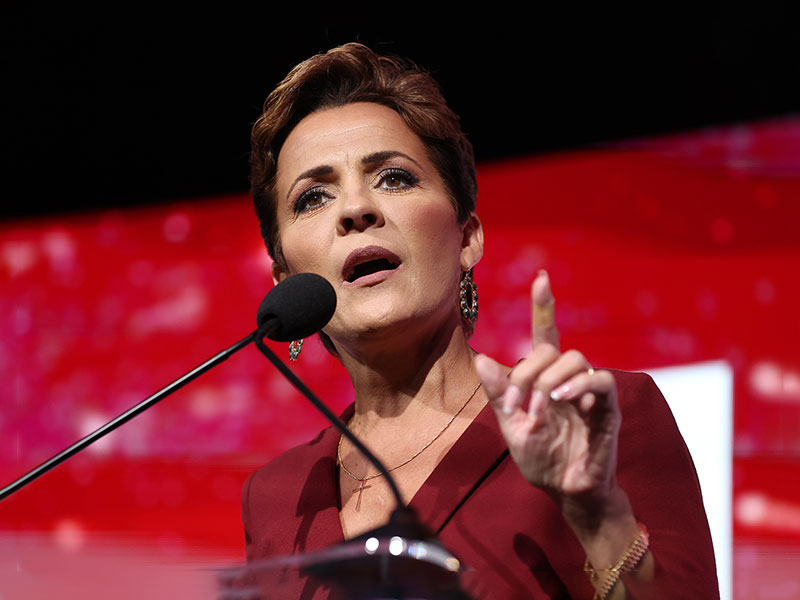
Kari Lake
Kari LakeKari Lake (Justin Sullivan/Getty Images)

Rep. Marjorie Taylor Greene, R-Ga., must be sleeping easy these days. Her ranking as the most annoying woman in America remains untouched, now that Kari Lake has failed both to win or to steal the governor’s seat in Arizona. 


It will likely remain forever unknown whether Lake is sincere in her conversion from a Barack Obama-voting, drag queen-loving news anchor to a Big Lie champion who accuses drag queens of “grooming.” Whatever is in her heart, however, she clearly thought she was going to ride the Trump Train straight to superstar status. With Trump’s 2020 coup attempt as a model, she framed her campaign as a win/win proposition for MAGA: She either wins outright, or she declares the election a “fraud” and becomes the next fascist martyr. 


In the end, neither happened. After losing in other states, other Big Lie candidates also lost interest in resisting the will of the people, leaving Lake out on a wannabe fascist insurrectionist limb all by herself. So, despite all her whining and suing, her campaign to seize power by any means necessary fizzled out. By this time next year, even people in Arizona could be asking, “Kari who?”

4
Dr. Oz
Dr Mehmet OzDr Mehmet Oz (ED JONES/AFP via Getty Images)
Prior to this election cycle, Dr. Mehmet Oz’s only real brush with politics was in 2014. It went poorly. Then-Sen. Claire McCaskill, D-Mo., tore into Oz for abandoning his job as a life-saving heart surgeon to be a TV liar who tells people “they can take an itty-bitty pill to push fat out of their body.” His flustered responses were so legendary that most journalists assumed he’d stay far away from politics forevermore. 


Trump’s 2016 win, however, reassured every charlatan and scumbag in the U.S. that shame no longer matters — not to Republican voters, at least. If Trump could float the idea of injecting bleach into a person to treat COVID and not lose votes, then surely Oz’s past wouldn’t haunt him, right? 


Alas, Dr. Oz never mastered Trump’s brazenness. The motto for his campaign for Pennsylvania senator might as well have been “Cringe.” He tried to appeal to the everyman by complaining about the price of “crudités.” He denied he owns 10 houses by quibbling over the definition of “home.” He declared that the abortion choice belongs to “women, doctors, local political leaders.” He was outed as a puppy killer. Oz’s blundering contrasted dramatically with the down-home appeal of Democratic candidate John Fetterman, who ended up winning by five points, despite having suffered a stroke during the campaign.

3
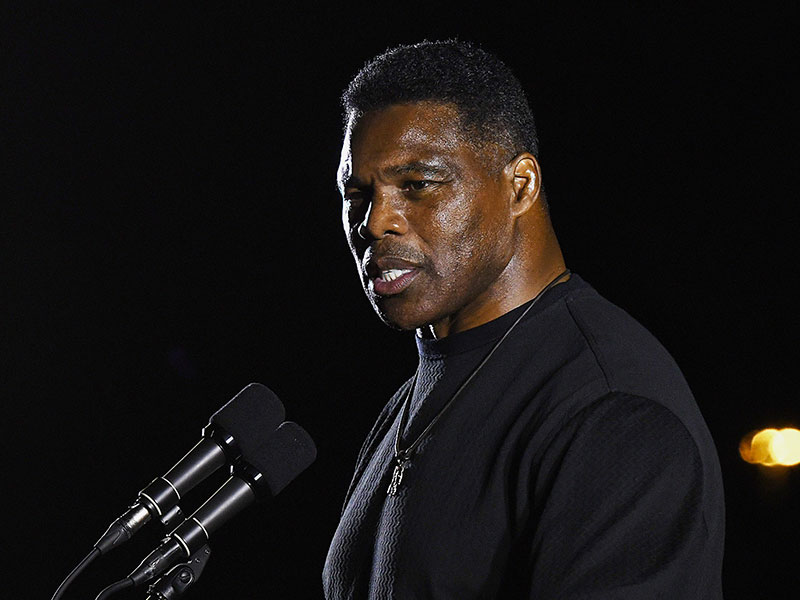
Herschel Walker
Herschel WalkerHerschel Walker (Paul Hennessy/SOPA Images/LightRocket via Getty Images)

Say what you will about Dr. Oz’s bad year, at least he didn’t get made fun of by Barack Obama for rambling on incoherently about werewolves and vampires. Prior to 2022, Walker had a real opportunity to be remembered after his death, by most Americans at least, as a Heisman winner and an NFL legend. Now most of us think of him mainly in terms of how bad he seems to be at using condoms. 


Within the span of his campaign to oust Georgia’s incumbent Democratic Sen. Raphael Warnock, Walker was exposed for having multiple secret children. Two former partners spoke out about him paying for their abortions, even though he supports total abortion bans with no exceptions. His bizarre speeches and constant lies got so bad that even his right wing “influencer” son decided he’s better off not being associated with his famous father.  


The surreal comedy surrounding Walker’s campaign should not distract us from the accusations Walker also faces of domestic violence by two women. Most Republican voters backed him anyway. Still, this clown show turned off just enough of those voters that Walker lost in a year when GOP candidates otherwise swept the Peach State.

2
Stewart Rhodes
Stewart RhodesStewart Rhodes (Aaron C. Davis/The Washington Post via Getty Images)

Since he was convicted of a crime, unlike those other jackasses, I’m awarding Stewart Rhodes slot #2. Like Trump, the leader of the Oath Keepers thought he had a foolproof plan for getting away with trying to overthrow democracy: Get your followers to commit the crimes, and if you’re caught, throw them under the bus. He spent months riling up his minions to storm the Capitol on January 6. He managed the logistics. He helped build up a weapons cache for use in the insurrection. But when the actual riot went down, Rhodes mysteriously vanished from the action, even as other Oath Keepers were filmed and photographed fighting with police. 


Rhodes loves to brag about his Yale Law education, which he clearly thought endowed him with the ability to wriggle out of legal consequences. He kept up the smug performance at his trial, pretending his militia members weren’t acting under his orders and calling them “stupid” for breaching the barriers


None of this fooled the jury. They found Rhodes guilty of the most serious charge — seditious conspiracy. They convicted the other Oath Keepers, as well, but mostly of lesser crimes. Trump makes it look simple to trick the little guy into taking the fall for his crimes. As Rhodes found out, however, it’s not so easy to pawn your misdeeds off on patsies.

1
Donald Trump
Donald TrumpDonald Trump (Drew Angerer/Getty Images)

I hesitated to put Trump at the top of this list because, in many regards, he’s still flying high, even as those who cling to his coattails are falling to earth. He’s still the odds-on favorite for the Republican presidential nomination in 2024. He is still not in jail. Both of those statements are frankly shocking in the context of everything he’s done, including a literal attempted coup. He continues to carry an air of invincibility that inspires aspirational support from the GOP base. 


Still, even he had a crappy year. The January 6 committee succeeded in ensconcing the factual narrative that the Capitol riot was, in fact, a bloody insurrection. Trump’s efforts to bully the “both sides”-addicted media into equivocating on this issue have largely failed. The discovery of classified documents he took to Mar-a-Lago seems to have shaken Attorney General Merrick Garland out of his reluctance to deal with Trump, resulting in the appointment of a special prosecutor who is handling both that inquiry and the investigation into Trump’s sedition. His company lost a tax fraud case that seems to be table-setting for other, bigger cases. He called for the termination of the Constitution and then pretended he didn’t. He had dinner with a couple of Nazi fans. Rather than assist in Trump’s clean-up efforts after the fact, Kanye West hit the microphones to talk about what a great guy Hitler was. 


But for a narcissist like Trump, probably the worst blow is how his reputation as a canny politician, which was always overblown, took a major hit this year. The more he hyped Republican candidates, the worst they did at the ballot box. Then his own presidential announcement, which he clearly expected to be a BFD, was so boring that even Fox News cut away after 40 minutes for color commentary.


He’s still running. He’s still not in prison. But 2022 was supposed to be his big comeback year, and it ended with a wet fart. He does, heaven save us, have a lifelong history of rising up from his own self-made ashes, so it’s not time to let our guards down. Still, his mentor in such malicious survival, Roy Cohn, faced the end alone and abandoned. It has long felt like too much to suspect that Donnie will face the same fate. This year, we finally got a glimpse that he might.


Don’t relax too much: Our abusive relationship with Donald Trump is not over

For at least seven years, Donald Trump and his neofascist movement have inflicted abuse of many kinds on the American people — emotional, physical, financial, spiritual and psychological. The Republican Party and the “conservative” movement have, for the most part, been eager participants and accomplices in this abuse. 

As the 2022 midterm elections suggest, many Americans are finally trying to break free of this abuse. That, however, is the most dangerous time in any abusive relationship, when the abuser often lashes out and does everything they can — up to and including extreme violence — to keep the victim under their control.

In a December 2020 interview with Salon, neuroscientist Seth Norrholm discussed how this dynamic works.

There will be some type of formal legal action taken, such as a divorce or restraining order. There will be some attempt by the abuser to push the boundaries of the restraining order, for example. That can involve physical stalking or online stalking. They may make a dummy account to track and stalk their target online as well. The relationship is formally dissolved, but the abusive elements still remain.

Now, if we think of Trump as being in an abusive relationship with the American people, this is unique in the country’s history….

The worst thing one can do for a malignant narcissist or an abuser like Donald Trump is to tell him or her that they are correct or to otherwise validate the lies and false persona. Because then not only is this person pathologically telling themselves how special they are and how superior they are, but they have an echo chamber that is telling them the same thing.

Clinical work and other research show that the most dangerous time in an abusive relationship is the end. That is when there is likely to be an escalation of some sort. This is when the abuser is most likely to be at their most volatile.

Trump and his movement have been slowed down in their attacks on democracy and human decency, but they have not been stopped or defeated.

Just before Thanksgiving Trump hosted the antisemitic rapper Kanye West (who now styles himself Ye), along with white supremacist and neo-Nazi Nick Fuentes, for dinner at Mar-a-Lago. 

Last week, a group affiliated with the antisemitic QAnon cult held an event at Mar-a-Lago. Trump welcomed them in person, saying, “You are incredible people, you are doing unbelievable work, and we just appreciate you being here and we hope you’re going to be back.”

The next day, Trump endorsed a message on his Truth Social site which claimed that the Jan. 6 Capitol attack and coup attempt was a “false flag” operation designed to entrap or incriminate “innocent” Trump supporters. That narrative fits into a much larger disinformation and propaganda strategy by Trump and his movement seeking to minimize or falsify the events of that day while simultaneously supporting and encouraging right-wing political violence.

In a hearing held before the D.C. Circuit Court of Appeals last Wednesday, an attorney for Donald Trump argued that when Trump was president he could have told his followers “to burn Congress down” and would still have been immune from any lawsuits brought against him by the victims. This Bloomberg News report provides the context for that extraordinary claim:

Presidents do typically enjoy immunity from lawsuits over official acts, which includes election-related activity. Chief Circuit Judge Sri Srinivasan on Wednesday asked Binnall if that should apply to a president who urged supporters in a private meeting to go to the polls and intimidate voters to prevent them from exercising their right to vote.

Binnall said that would be “horrible” but that, yes, immunity would apply. He said the line for liability for a sitting president should be drawn at “purely personal” conduct and interests, such as sexual assault allegations or a conversation between a president and their stockbroker about financial holdings. But he suggested a president urging his supporters to question the electoral vote count was merely using the office’s well-established “bully pulpit.”

Circuit Judge Greg Katsas said he was struggling with the fact that the case against Trump involved “at least colorable” allegations that he incited the mob that attacked the Capitol. Katsas then posed the hypothetical of a president urging supporters to “burn down Congress.”

Binnall said civil immunity would apply in that instance too, but he said impeachment and possible post-presidency criminal charges would offer other avenues for accountability.

Building off her colleagues’ hypotheticals, Judge Judith Rogers asked if Trump’s position was that there was no role for the courts even if there was a finding that a president was “seeking to destroy our constitutional system.” Binnall replied that, based on such facts, such acts shouldn’t be subject to civil litigation.

In essence, Trump is arguing through his lawyers that he was or is almost entirely above the law. That certainly aligns with his most ominous recent threat to American democracy and the country’s future, his proclamation that the Constitution should be “terminated” in order to return him to office immediately. Trump has never stopped claiming that Joe Biden is an illegitimate president and should be removed from office. This is not just hyperbole or empty rhetoric: Public opinion research shows that Trump has millions of followers who are potentially willing to support or engage in acts of terrorism to accomplish such a goal.


Want a daily wrap-up of all the news and commentary Salon has to offer? Subscribe to our morning newsletter, Crash Course.


Although a handful of prominent Republicans have begrudgingly criticized Trump’s direct threat against the Constitution and the rule of law, most have remained silent, including Florida Gov. Ron DeSantis, Trump’s supposed political rival.

As Ruth Marcus of the Washington Post writes, “This is insurrectionism by social media”:

This is insurrectionism by social media. Nothing — and certainly not imaginary “Fraud,” capitalized or not — “allows for the termination” of constitutional guarantees. Trump is laying the groundwork for a coup.

We can dismiss the post as just the latest Trumpian bluster, something he will never be capable of implementing. Yet the mere willingness to entertain and encourage extra-constitutional action is alarming coming from a man who is seeking to return to office.

Which is why Trump’s words must be highlighted — and called out. I’m past expecting Republican leaders to speak out. We know that, for most, their spines have collapsed and their courage reduced to a shrunken kernel.

Rep. David Joyce of Ohio, chair of the Republican Governance Group, even said in an ABC News interview that Trump’s threats against the Constitution were not automatically disqualifying and that he would support Trump if he becomes the 2024 Republican nominee.

Americans are exhausted and deserve a moment to catch their breath — an extended struggle to defend, secure and expand democracy still lies ahead.

In a statement, the Lincoln Project, a leading anti-Trump conservative group, sounded the alarm about this perilous moment: “Donald Trump and the MAGA movement must be defeated or the American experiment will come to a crashing end. Americans must join together, place their policy differences aside and confront the existential threat posed by Donald Trump and his anti-democracy supporters in 2024.”

A new op-ed at the Kansas City Star perfectly channels how so many Americans are feeling in this moment: “If you listened closely, you could hear millions of Americans sighing with relief Tuesday night, as the results from Georgia’s runoff Senate election came in.”

Absolutely true. Americans are exhausted and need to catch their breath to prepare for what will still be an extended struggle to defend, secure, heal and expand democracy against neofascism and authoritarianism and other forms of civic and societal evil. There is no question that the election of Joe Biden, and the mixed results of the 2022 midterms, has gained pro-democracy forces a little breathing space. But the Republican fascists and the larger white right and conservative movement are not done with their abuse. Republicans will soon control the House of Representatives and will do everything in their power to inflict further pain on the American people, which will only be amplified by the country’s pre-existing forms of inequality and the structural violence it inflicts on millions of vulnerable Americans every day.

Some factions of the right are quarreling and divided, which is helpful, but they will be back, not remotely deterred in their attempts to end American democracy and to engage in acts of maximum cruelty against the long list of people they consider their enemies. Now is not the time for the American people and the country’s pro-democracy movement to back off or relax. The decision to escape the abuser is a crucially important first step. But it does not mean the danger has passed.

Marjorie Taylor Greene says Jan. 6 would have been different if she’d been in charge

Rep. Marjorie Taylor Greene (R-GA) is making it clear that she would have “won” the Jan. 6 attack on Congress and the attempt to overthrow the election.

“I want to tell you something, if Steve Bannon and I had organized that, we would have won. Not to mention, we would’ve been armed,” Greene told a group of New York Republicans over the weekend,” said the New York Post.

The comments come after a lawsuit protesting Greene’s candidacy citing a provision in the U.S. Constitution that bans officials of Congress who attempted an insurrection from ever serving in office.

“The evidence in this matter is insufficient to establish that Rep. Greene … ‘engaged in insurrection or rebellion’ under the 14th Amendment to the Constitution,” Judge Charles Beaudrot wrote in his May 2022 ruling. “Therefore, the Court holds that Respondent is qualified to be a candidate for Representative for Georgia’s 14th Congressional District.”

Previously, Greene compared herself to the Jan. 6 attackers, saying, “I am one of those people. That’s exactly who I am.”

While some videos of the speech have leaked out since the statements, the threats of an armed uprising against the U.S. government are new as the emboldened Congresswoman is about to join the leaders in the new GOP-led House.

Greene was there with Donald Trump, Jr. and commentator Jack Posobiec, Rudy Giuliani, Bannon, and Rep.-elect George Santos (R-NY).

Greene also told the crowd she would not support a “single penny” to help Ukraine fight back the Russian invasion, saying she wanted to use it to wage a war against the drug cartels in Mexico.

“They care about a country called Ukraine whose borders are far away and most of you couldn’t find it on a map,” said Greene.

Young Republican group welcomes another insurrection

While Rep. Marjorie Taylor Greene (R-GA) promised that if she were in charge of Jan. 6, people would have been more armed and dangerous, other speakers at the Young Republicans gala in New York City talked about the next civil war.

The Southern Poverty Law Center, which tracks extremism throughout the United States, cited the speech from the Young republican president Gavin Wax, who told the Upper East side gala, “We want to cross the Rubicon. We want total war. We must be prepared to do battle in every arena. In the media. In the courtroom. At the ballot box. And in the streets.”

“This is the only language the left understands. The language of pure and unadulterated power,” Wax also said.

Hatewatch reporters were on hand to observe as white nationalists Peter and Lyndia Brimelow of VDARE met with Steve Bannon and Donald Trump Jr., where they took selfies.

“Republicans publicly lauded members of an Austrian political party founded by World War II-era German Nazi party members,” said the SPLC observers. Newsweek opinion editor Josh Hammer joked with “racist political operative Jack Posobiec,” the site said. Posobiec was the one who spread the false Pizzagate conspiracy. Newsweek has grown increasingly friendly to extremists over the past several years as Hammer invited Posobiec onto his podcast. Though lately, he’s been more supportive of Gov. Ron DeSantis (R-FL) over Donald Trump.

“Republican speakers repeatedly voiced an anti-democracy, authoritarian ideology, and extremists in the audience cheered wildly,” wrote the SPLC. “White nationalists such as the Brimelows of VDARE and leaders from extreme far-right European parties like Alternative for Germany (Alternative für Deutschland, AfD), whom German officials placed under surveillance for their ties to extremism, and Austrian Freedom Party (Freiheitliche Partei Österreichs, FPÖ), ate and drank in the same room as newly elected Republican congresspeople, such as Long Island and Queens-based George Santos, Georgia-based Mike Collins and Florida-based Cory Mills.”

Finale recap: “The White Lotus” shows no pity for fools in love

After a one-week stay at The White Lotus luxury resort in Taormina, Sicily, the American guests – who traveled by air and sea with the expectation of relaxing on the beach, stuccoing their insides with pasta and, if the opportunity struck, having a structured adventure here and there – learned in the end that vacations are a lot like taking acid. If your general state of mind is relatively happy and carefree at the start of the trip, you’ll be in good shape. But if you set out thinking the experience will fix the problems percolating within you, prepare to be disappointed at best and terrified at worst. 

For Season 2 of “The White Lotus,” Mike White followed up the campy success of the first with some bold moves and some truly remarkable writing. Whereas the first season relied heavily on comedy to punch up the ridiculousness of an uptight newlywed killing a hotel manager after losing his grip on a dark obsession with being given the wrong room, this season used comedy to provide a relief from standing witness to people learning the hard way that all the money in the world can’t fix what’s broken inside of them. In fact, for one main character, it’s financial success that leads to her death. 

“The White Lotus” is more than just a whodunit, but after Daphne Sullivan (Meghann Fahy) bumps into a corpse while swimming in the Ionian Sea in the first episode, we’re set up to spend the remaining six episodes gathering clues as to who died, and who did it.

The season opens on Daphne’s last few hours in Sicily before she has to return home with her husband Cameron (Theo James) where their children and their “don’t ask, don’t tell” open but not open marital issues will be right there where they left them. Cameron cheats on Daphne, and she knows it. She cheats on him too. But their unspoken arrangement of pretending that it’s not happening keeps their marriage what, to the untrained eye, could easily pass as happy. But there are cracks, and with even the strongest of materials, if you push on those cracks long enough they’ll break wide open, which is an inevitability that nears the surface during their time at The White Lotus, but gets patched over. This is the kind of couple that saves their crumblings for behind closed doors in an effort to maintain their bragging rights.


Want a daily wrap-up of all the news and commentary Salon has to offer? Subscribe to our morning newsletter, Crash Course.


You get the sense that Daphne has had to physically and emotionally look away from her husband’s indiscretions, but when he gets sloppy and tries to sleep with Harper Spiller (Aubrey Plaza), the wife of his travel buddy and former college roommate Ethan (Will Sharpe) it nears her towards her breaking point.

When Ethan, as gently as possible, tells Daphne that her husband tried to sleep with his wife in one half of their conjoined suite, you can see a moment of pure pain wash over her face as she takes in the news and then, just as quickly, shoves it away before adjusting the mask of a happy wife and delivering the best monologue of the season.

“We never know what goes on in people’s minds, or what they do,” Daphne says. “You spend every second with somebody and there’s still this part that’s a mystery. You don’t have to know everything to love someone.”

Simona Tabasco as Lucia Greco and Beatrice Grannò as Mia in “White Lotus” (Courtesy of HBO)

A person’s inner essence can be described in any number of ways, and it’s ever changing, but at the heart of it most people are either a fool in love, or a lover of fools.

What Daphne says to Ethan in that moment serves to summarize the entire theme of Season 2. A person’s inner essence can be described in any number of ways, and it’s ever-changing, but at the heart of it most people are either a fool in love or a lover of fools. Those qualities of returning, time and time again, to giving in to love even though it’s historically bitten you in the ass, or being on the flipside and basing your whole economic and emotionally vampiric existence off of benefitting from taking advantage of such people are concrete. 

Lucia Greco (Simona Tabasco) and her friend Mia (Beatrice Grannò) are lovers of fools. They make a holiday out of waiting for boats to bring a new group of tourists to the area so they can charm them out of whatever they can get. And although their marks, which in this season are Albie Di Grasso (Adam DiMarco) and his dad Dominic (Michael Imperioli), see them coming from a mile away, they can’t help but open up their hearts, and their wallets, because they’re fools in love and are hardwired to be so.

Fools in love will never change, and they’ll often repeat the same mistakes, but sometimes they do get revenge. 

Tanya McQuoid-Hunt (Jennifer Coolidge) fell for the wrong guy in Greg (Jon Gries), a man who concocted an unnecessarily elaborate scheme to get around her prenup by having her killed by a team of gay con artists, but she took most of them down with her in a blaze of glory. Because he’s a coward and left others to do his dirty work for him, he was in another country when the attempt on his wife’s life took place, and was thereby spared when she turned the tables. But, in a sort of universal kindness to her, he also wasn’t there to see her slip off the side of the boat she was on when it all took place, bash her head on the way down and ultimately drown. She died bravely, and men like Greg would have no frame of reference for something like that, and don’t deserve to be the last face a brave woman sees before the lights go out. For Tanya, I hope the last thing that flashed before her eyes was that Oreo cake she wanted.

Resounding success of “Black Panther” franchise says little about the dubious state of Black film

When Marvel Studios released “Black Panther” in February 2018, it marked the first Marvel Cinematic Universe film to feature a Black superhero and star a predominantly Black cast.

Its estimated production budget was US $200 million, making it the first Black film – conventionally defined as a film that is directed by a Black director, features a Black cast, and focuses on some aspect of the Black experience – ever to receive that level of financial support.

As a scholar of media and Black popular culture, I was often asked to respond to the resounding success of that first “Black Panther” film, which had shattered expectations of its box office performance.

Would it lead to more big-budget Black films? Was its popularity an indication that the global marketplace – the real source of trepidation about the film’s potential – was finally ready to embrace Black-cast films?

With the release of the massively successfulBlack Panther: Wakanda Forever” in November 2022, I expect those questions to reemerge.

Yet as I review the cinematic landscape between the original and its sequel, I am inclined to restate the answer I gave back in 2018: Assumptions should not be made about the state of Black film based on the success of the “Black Panther” franchise.

Reason for optimism

Prior to its release, the producers of “Black Panther” faced questions about whether there was a market for a Black blockbuster film, even one ensconced in the Marvel Cinematic Universe.

After all, since the Wesley Snipes-led “Blade” trilogy, which came out in the late-1990s and early 2000s, Black superhero films had experienced diminishing returns. There was one notable exception: the commercially successful, though heavily panned “Hancock” (2008), starring Will Smith.

Otherwise, Black superhero films such as “Catwoman” (2004) and “Sleight” (2016) either flopped or had a limited release.

Furthermore, until “Black Panther,” no Black film exceeded a $100 million budget, the average benchmark for modern Hollywood blockbusters.

Nonetheless, despite these early concerns, “Black Panther” earned the highest domestic gross, $700 million, of all films released in 2018, while earning $1.3 billion in worldwide gross, second only to “Avengers: Infinity War.”

“Black Panther” emerged at the tail end of what many industry experts considered to be a surprisingly successful run of Black films, which included the biopic “Hidden Figures” (2016) and the raunchy comedy “Girls Trip” (2017). Despite their modest budgets, they earned over $100 million apiece at the box office – $235 million and $140 million, respectively.

However, both films were mostly reliant on the domestic box office, especially the R-rated “Girls Trip,” which was only released in a handful of foreign markets. Conventional wisdom has long held that Black films will fail abroad. International distributors and studios typically ignore them during the presale process or at film festivals and markets, reasoning that Black films are too culturally specific – not only in terms of their Blackness, but also their Americanness.

Films like “Black Panther” and the Oscar winning “Moonlight” (2016), which earned more on the international market than the domestic market, certainly challenged those assumptions. It has yet to upend them.

Black films after “Black Panther”

What do those Black films released in theaters in the nearly five years between “Black Panther” and “Black Panther: Wakanda Forever” tell us about the former’s impact?

The simple answer is that the original “Black Panther” has had no discernible influence on industry practices whatsoever.

Since 2018, no other Black blockbuster has emerged, save for the sequel itself. Granted, Black filmmaker Ava DuVernay’s remake of “A Wrinkle in Time” (2018) reportedly cost an estimated $100 million; however, while Black actors portrayed the protagonist and a few other characters, the film features a multicultural ensemble cast – which, as scholars such as Mary Beltran have pointed out, has become the primary strategy for achieving diversity in film.

Even if one were to include “A Wrinkle in Time,” the grand total of Black films with budgets exceeding $100 million is three, with the two “Black Panther” films being the others – all during an era in which there have been hundreds of mainstream films with budgets exceeding $100 million.

Otherwise, most of the Black films released in theaters between 2018 and 2022 typically were low budget by Hollywood standards – $3 million to $20 million in most cases – with only a handful, such as the 2021 Aretha Franklin biopic “Respect,” costing $50 million to 60 million.

Perhaps the most notable change has been the medium. Many Black films now appear on either cable networks that cater to a Black audience – namely Black Entertainment Television and, more recently, Lifetime – or on streaming services such as Netflix. Tyler Perry, the most popular and prolific Black filmmaker of the modern era, has released his latest films – “A Jazzman’s Blues” (2022), “A Madea Homecoming” (2022) and “A Fall from Grace” (2020)  – directly to Netflix.

Furthermore, no other Black film has approached the financial success of “Black Panther.” Granted, several Black films have fared well at the box office, especially relative to their production costs. Foremost among them is Jordan Peele’s “Us” (2019), which cost an estimated $20 million, yet earned approximately $256 million worldwide despite its R rating and the fact that it was never released in China.

Whither Black film

Without question, large budgets and commercial success are not the only measures of a film’s value and significance.

As has historically been the case, Black film has managed to do more with less. The critical acclaim afforded to films such as “BlackKlansman” (2018), “If Beale Street Could Talk” (2019) and “King Richard” (2021) reflect this fact. All reflect trends in contemporary Black filmmaking – comedies, historical dramas and biopics abound, for instance – and were made for a fraction of the cost of both “Black Panther” films.

In truth, the zeal with which some cast “Black Panther” as a bellwether for Black films is part of continued haranguing over their viability, particularly after the #OscarsSoWhite movement that drew attention to the lack of diversity at the 2016 Academy Awards.

However, its positioning as a Disney property within Marvel’s transmedia storytelling effort makes it so atypical that its success — and that of its sequel — portends little about Black film.

Phillip Lamarr Cunningham, Assistant Professor, Media Studies, Wake Forest University

This article is republished from The Conversation under a Creative Commons license.

Take out those earbuds — they’re wrecking your hearing

My teenaged daughter sleeps with her earbuds. Every night, she nestles in to her bed and heads to dreamland with an endless scroll of TikToks streaming straight into her head. “That can’t be good,” I think. And then in the morning I head out the door, plonk my own earbuds in, and crank up the volume to drown out the breakdancers and mariachi bands on the subway, the jackhammers on the street and the sirens whizzing by. I used to reflexively watch TV with closed captioning to enhance my ability to catch overlapping dialogue or subtle accents. But lately, as I lean a little closer to the screen with every episode of “Jeopardy!” and press the volume a notch higher, I’m starting to wonder if, in trying to muffle the cacophony of my daily life, I’ve only created a worse problem.

There has in recent years been robust debate about whether sound from earbuds is worse for your hearing than other forms of noise. Speaking with the New York Times last summer, University of Colorado Hospital audiologist Cory Portnuff said, “The misconception stems from the thought that, because an earbud sits farther into your ear, it would do more damage than something that sits farther away. What actually matters is the volume at your eardrum, not where it comes from.”

What is certain, however, is that hearing loss is a pervasive, and often ignored, problem. The National Institute on Deafness and Other Communications Disorders estimates that “5% of American adults (37.5 million) aged 18 and over report some trouble hearing. While hearing loss is far more prevalent in older adults, a BMJ Global Health study released this past fall estimated that “.67–1.35 billion adolescents and young adults worldwide could be at risk of hearing loss from exposure to unsafe listening practices… Damage from unsafe listening can compound over the life course.” 

Earbuds make it insidiously easy to set yourself up for greater risk of hearing loss. And the damage isn’t just bad for the obvious reasons. It can set in motion other serious health issues, including, as Johns Hopkins Medicine points out, balance issues and brain atrophy. Hearing loss also contributes to social isolation, and haven’t we all had quite enough of that for a lifetime already?

 “With most headphones at 80-100% volume routinely exceeding 100 dB, it’s important for people, and especially younger people, to be more aware of how long they’re exposing themselves to loud sounds.”

As someone who has always lived in cities and spent most of her teens and twenties parked directly in front of the band’s speakers, I only ever really distinguished two types of sounds — the kind I didn’t want to hear and the kind I did. I absolutely never gave a thought to my auditory health. If I want to, I can keep a constant hum of those invited noises right in my ear for hours at a time, all while also feeling like I’m graciously being non-intrusive to others. I go for long runs with old school jams blasting over the pounding of my heart. I putter through my chores while Ben Miles takes me through the rise and fall of Thomas Cromwell. I enjoy a full season of a murder podcast through a lengthy commute. All the while, it is way too easy to never turn the volume down, or never turn it off at all. Unfortunately for my ears — and yours — they don’t actually care whether it’s a car alarm or a Hilary Mantel novel that’s intruding in there. So I’m likelier to endure a higher level of noise and duration of damaging sound, because dammit, I’m enjoying it. I’m also setting a terrible example for my teen.

At the 2021 annual meeting of the Acoustical Society of America, researchers discussed the need for education efforts “to prevent an imminent noise-induced hear loss epidemic when today’s younger generations reach midlife.” Dr. Daniel Fink of the Quiet Coalition told Healthline at the time, “Especially for young people… personal audio system use is the major source of leisure noise exposure [When] they reach midlife, probably in their early to mid-forties, they will be as hard of hearing as their grandparents are now in their seventies and eighties.”

“Listening to sounds of 100 dB or more for over half an hour can cause permanent damage to hearing,” explains Dr. Daniel S. Troast, Doctor of Audiology at HearUSA. “With most headphones at 80-100% volume routinely exceeding 100 dB, it’s important for people, and especially younger people, to be more aware of how long they’re exposing themselves to loud sounds and to either reduce the volume, take breaks, or wear hearing protection to help reduce potential hearing loss.” 


Want more health and science stories in your inbox? Subscribe to Salon’s weekly newsletter The Vulgar Scientist.


Because I tend to lose or destroy everything, I have long resisted investing in noise-canceling headphones. But I may be making a bad bet, because every time a guy with a trumpet steps into my subway car, I reflexively toggle the volume way up on my phone. “In order to reduce potential hearing damage,” suggests Troast, it’s important to know what type of headphones you’re using and what their capabilities and limitations are. While only noise-canceling headphones can efficiently eliminate all outer noise, other headphones, like earbuds, are not designed to eliminate ambient noise. Turning up the sound on regular headphones to a level that blocks out everything else is too loud and can result in hearing damage.”

How can you avoid positioning yourself for hearing damage? Audiologist Dr. Amy Sarow advises, “The best way to prevent the volume from exceeding a safe level is by limiting the device’s maximum output through the phone settings or avoiding turning the volume up past 70% of the full volume. A good rule of thumb: if you can’t hear someone talking to you at arm’s length over the volume, it’s too loud.”

Recently, for the first time ever, I looked at the hearing information on my phone’s health app, and was legitimately astonished to learn my headphone levels over the past month never went above 88 dB, earning me a hearty “OK” rating. But I know it’s better for my ears and my brain to take a more active role in lowering the volume. I have turned on the headphone safety option on my phone to reduce sounds above 100 decibels. I’ve asked for noise-cancelling headphones this holiday. I’m even trying to put my phone away and embrace the pleasures of silence where I can find it. I may not be able to control the musicians on the A train, but for the sake of my hearing, I can choose not to sonically compete with them. 

Is lasagna the unimpeachable victor of Italian-American comfort food?

For as long as I can recall, my parents were “lasagna people,” if you will.

Whether for a special occasions, a holiday or just a random dinner out, they would often opt for lasagna. This wasn’t the case for me; I prefer a homemade lasagna on a holiday or on an weekend evening and I don’t think I’ve ever ordered lasagna out. it’s such a tried-and-true option, though and perhaps the most cherished Italian and Italian-American staple after pizza and spaghetti and meatballs.

Lasagna is also a perfect “one pot meal,” it’s an easy dish to make and then wrap up with foil and give to a new neighbor or someone grieving and it doesn’t “require” any side dishes (although a green salad, some crusty bread and some extra sauce and grated cheese on the side are certainly welcome).

It’s also endlessly customizable. As long as you’re layering in some capacity, nearly anything can be deemed a “lasagna” — butternut squash planks in place of lasagna noodles, vegan cheese instead of standard ricotta and mozzarella, vodka instead of marinara, ground pork or chicken instead of beef, additions of spinach or chard  — the list goes on and on. Tweak as you see fit and depending on the size of your family, and you’ll have lots of terrific leftovers, too! Expand your lasagna horizons and who knows where you’ll end up. (It can also make a superb main course for Christmas dinner).


Want more great food writing and recipes? Subscribe to Salon Food’s newsletter, The Bite.


Italy Magazine noted that lasagna has “[evolved] and [acquired] several variations before being codified in the classic version of Bolognese cuisine.” The recipe itself apparently first originated in the 1880s before varying iterations were created, including one featuring a spinach-laced pasta dough. 

The publication also stated a quote from Fra’ Salimbene da Parma who supposedly described someone eating lasagna as such: “I’ve never seen anyone stuffing himself on lasagna with cheese so pleasurably and so fully as him.”

So behave like this man and whip up some lasagna this winter — perhaps it’ll also make you and your loved ones “so pleasurably and so fully” content with your meal. 

Lasagna                                                      with ground chicken and Bechamel 
Yields
8 to 10 servings
Prep Time
40 minutes
Cook Time
40 minutes

Ingredients

Extra virgin olive oil 

1 onion, peeled and finely diced

1/2 bulb fennel, finely diced

5 garlic cloves, peeled and minced

1 1/2 pounds ground chicken (white meat, ideally)*

1 lb spinach

Kosher salt

Freshly ground black pepper

1 pound lasagna noodles (I like traditional, but you can certainly use no-boil if you prefer) 

Marinara or “red sauce” of your choosing (family recipe, store-bought, whatever floats your boat)

4 tablespoons unsalted butter

1/4 cup all-purpose flour

2 cups whole milk, room temperature

Fresh nutmeg, grated on a microplane

1 lb high-quality ricotta

3 to 4 tablespoons heavy cream

2 large eggs

Handful of chopped parsley

2 cups mozzarella, shredded or torn, divided

8 ounce block Parmigiano-Reggiano, finely grated, divided

Directions

  1. Preheat the oven to 400 degrees Fahrenheit. In a large skillet over medium-low heat, warm the olive oil. Add the onion and fennel and cook until translucent, about 4 to 5 minutes.
  2. Add the garlic and toast for 30 seconds or until fragrant. 
  3. Add the ground chicken and raise the heat to medium-high, stirring occasionally, until the protein starts to take on some color. 
  4. Once the chicken is cooked through and caramelized, add the spinach and cook until wilted. Season with salt and pepper. 
  5. If making traditional lasagna noodles, bring a (very large) pot of water to a boil, salt considerably and cook lasagna noodles until al dente. Drain and cold shock with cold water, letting pasta cool until you’re able to handle it.
  6. In a large pot over medium-low heat, melt butter. Add flour and cook for 3 to 4 minutes or until it smells toasty and not “raw.”
  7. Gradually, add milk while whisking, raising heat to medium and letting the mixture cook until it begins to thicken. Once the bechamel has thickened considerably, season with nutmeg and salt. 
  8. In a medium-sized bowl, stir together the ricotta, heavy cream, eggs, parsley and half each of the mozzarella and Parm. Season well. 
  9. In an 8×12 casserole dish or baking pan, begin the layering process. Start with a ladleful of tomato sauce, followed by a layer of noodles, then ricotta and the chicken-spinach mixture, followed by another layer of noodles (this one going in an alternating direction, opposed to the first layer of noodles) and then finishing with bechamel.
  10. Repeat the process until either 1) the dish is full or 2) all of the noodles are your ingredients are used up. When finished, top lasagna with remaining cheeses. 
  11. Transfer to the oven and cook for about a half hour or 40 minutes, or until the lasagna is bubbly and the cheese is melted. 
  12. Turn to broil and cook for another 5 minutes or until the cheese gets crispy and browned. 

Cook’s Notes

-While I use a ground chicken-and-spinach “filling” here, you can opt for leftover turkey Bolognese, traditional bolognese, crumbled sausage, broken up meatballs, sausage or braciole, or ground pork or vegan protein. Just don’t over-season because this flavor shouldn’t take over the whole dish.

-I’m a big proponent of a structurally sound lasagna — half the fun is the perfect slice, the ideal lines, the crisscrossed layers — one great tip I’ve seen for this is from none other than Anne Burrell (I’m clearly a big fan), who advises cooking the lasagna, then cooling and refrigerating it, then warming or broiling it until ready to serve. after the double cook, the lasagna itself should be a bit firmer and stand up to cutting, resulting in properly shaped and layered portions of lasagna slices instead of a “mushad” slice that dissolves into a puddle of noodles, sauce and cheese once it’s plated. Another Anne Burrell lasagna tip I’ve always sworn by is layering each layer of noodles in a different direction to help further stabilize the lasagna itself. 

-I like serving a piece on top of a bed of sauce, perhaps even some more sauce drizzled on top (and obviously extra cheese). 

-Leftovers can get a bit dry, so definitely have some extra sauce (or sauces) at the ready to help mitigate that.

My mom says “I love you” with aloo paratha

The first question my mom asks when she hears I’m coming home for a visit is “What do you want to eat?” It has been this way since I left for college, and to her undying frustration, I always say something like “Whatever’s easiest!” She throws out suggestions. “Chicken curryMatar paneerBiryani?” and I just annoyingly reply “Yeah, that all sounds good.” I’m indifferent about what she cooks for dinner because everything she makes is always so reliably good that it’s hard to choose one thing over another.

Since the pandemic emerged in 2020, traveling to see my parents has become harder. This past summer, I stayed with them at their home in Michigan for the first time in two years for my childhood friend’s wedding. I had exactly one week, which at first seemed like more than enough time. Then I started to think realistically about what the week ahead entailed and the guilt set in instantly.

We spent some time together, of course, eating my mom’s incredible food constantly, but, as I predicted, the trip went by too fast.

On trips like this, the day I leave is always full of angst. It starts as soon as I hear my parents stirring in the morning. I feel sad, but I attribute it to the annoyance of air travel and push it down. Immediately after coming out of my room, my mom asks what foods I would like to take back with me. As always, I always tell her not to bother. I don’t mean to be cold or unappreciative. I just feel fussy anticipating the travel ahead, and she keeps asking, and pushing. I try to paint her a picture of a container full of chicken curry sloshing around in an overhead bin during turbulence, but it’s like she doesn’t even care that I could get permanently banned from Delta Airlines.

Eventually, as she always does, she suggests aloo paratha and this makes everything worse. It’s hard to publicly admit that I get triggered by flatbread, but of all the foods my mom makes, aloo paratha is never one I really want, though it’s hard for bread stuffed with potatoes to be bad. I say “no thanks” even though I know she’ll make some anyway. I watch as she gestures toward a large bowl of potatoes and peas, and the dough or atta, as she always calls it, in a separate container.

“How many do you want to take? Ten?” When she says the word ten, she nods as if she’s settling on what is obviously the right answer. Why wouldn’t I want a stack of ten aloo parathas? At this very moment I’m trying to remember where I kept my laptop charger, and say with annoyance, “No mom, that’s way too many.” “So how many, then? Eight?”

I unplug the charger from an outlet in the living room. I concur that eight is fine, admitting that I’ll share a few with my friends. And at this, she looks offended. “Mom. I’m not even hungry. I don’t know how many aloo parathas I’ll want in the next day and a half. What’s wrong with giving a few away?” She pauses to consider, and, as if this is a favor I’ve asked, she huffily replies that she will make five. I look over at my suitcase, which is somehow already full, and realize I still have a load of laundry in the dryer, all clothes I intend to take back to LA. As I start making my way downstairs to the laundry room, my mom brightly asks, “Would you like to take some coconut chutney?” Of course I would. I love coconut chutney, and could eat it straight with a spoon and nothing else, and she knows it, which is why she offered, but where will it go? I have no more space. I try to gently tell her that I don’t think I have room for anything else and she looks sad.

When I return with the laundry basket, I see that my dad has taken everything out of my suitcase and is now refolding and refitting every single item that once already had a place inside. As I stand in the doorway, eye twitching, my dad cheerfully takes the laundry basket from me. “Don’t worry! It will all fit.” And then my mom appears with the finished stack of aloo parathas (of course, there are more than five), coconut chutney, and a plastic grocery bag of mustard seeds, cardamom pods, and a little cardboard box of tandoori masala.

I leave the room for my sanity and when I come back the piles are gone, my bag is packed and zipped and soon enough, we’re on our way to the airport. I sit in the backseat looking past the backs of their heads through the windshield. It’s late summer now and every leaf is dark green. I wonder if I’ll make it back for Christmas, and imagine a leafless, snow-covered version of this backseat view, one that I used to see all the time, but barely ever anymore, and I can admit to myself finally that I’m feeling sad to go.

After a lump-in-the-throat-inducing-goodbye at the airport, I’m finally alone, and relieved to have space from the emotions of the day. My fussiness returns mid-flight after hours of limited leg room. It stays with me after we land, after I retrieve my suitcase from baggage claim, while I wait an hour for an overpriced Uber to take me home, and an agonizing drive in rush-hour traffic back to my apartment.

When I finally get home and unzip my suitcase, I inhale a cloud of cardamom. I see that the bag of mustard seeds has popped open and they now float between the rest of the items in the grocery bag like miniature packing peanuts. I’m too tired to mind. My eyes land on the gallon-sized ziplock bag of aloo parathas and I realize just how hungry I am. I pull the stack of parathas from the wax paper they are wrapped in. I’m too hungry to heat them up and ignore the feeling that my mom would not approve. I eat one cold anyway, over the sink, missing my parents so much already. I take a bite and feel the way she intended to care for me by making me take them. Maybe I never choose aloo paratha because It tastes complicated, like guilt and gratitude and too much time spent away, not seeing my parents enough, and how good to me they are anyway. But as always, at this moment, I can’t believe I thought I didn’t want them.

Jan. 6 panel to decide referrals to DOJ

Members of the House Select Committee to Investigate the January 6th Attack on the United States Capitol are expected to finalize decisions on criminal referrals during a virtual meeting Sunday afternoon.

CBS News‘ Margaret Brennan inquired about the panel’s plans earlier Sunday, when Rep. Adam Schiff (D-Calif.)—a member of the subcommittee created to deal with outstanding issues, including potential referrals—to the U.S. Department of Justice (DOJ)—appeared on “Face the Nation.”

Pointing to reporting that the committee is considering referrals for former President Donald Trump, ex-DOJ official Jeffrey Clark, right-wing attorney John Eastman, former Trump lawyer Rudy Giuliani, and ex-White House chief of staff Mark Meadows, she asked, “Is there a consensus on whether to send a referral for criminal prosecution to the Justice Department, and would doing that be anything more than symbolic?”

“I think we are in common agreement about what our approach should be. I’m not ready or authorized at this point to tell you what that is. We are, as a subcommittee—several of us that were charged with making the recommendation about referrals—gonna be making that recommendation to full committee today,” Schiff said, adding that the decisions will be included in a panel report set to be released later this month.

Schiff continued:

What I can tell you about the process is we’re looking at: What is the quantum of evidence that we have against individuals? What is the impact of making a referral? Are we gonna create some suggestion by referring some, that others, there wasn’t sufficient evidence, when we don’t know, for example, what evidence is in the position of the Justice Department?

So, if we do make referrals, we want to be very careful about how we do them. But I think we’re all certainly in agreement that there is evidence of criminality here and we want to make sure that the Justice Department is aware of that.

In the wake of Trump’s announcement last month that he is seeking the GOP’s presidential nomination for 2024—despite his various legal issues and inciting last year’s deadly Capitol attack with his “Big Lie” about the 2020 contest—Attorney General Merrick Garland appointed Jack Smith, a longtime federal prosecutor, as special counsel to oversee ongoing investigations involving the twice-impeached former president.

The DOJ notably does not need a referral from Congress to bring charges. Referencing the department’s probes, Brennan asked Schiff, “So what does the committee sending a referral do other than look political?”

“Well, look, we have been far out ahead in most respects of the Justice Department in conducting our investigation,” the congressman responded. “I think they have made use of the evidence that we have presented in open hearings. I think they’ll make use of the evidence that we present in our report to further their investigations.”

“And I think it makes an important statement, not a political one, but a statement about the evidence of an attack on the institutions of our democracy and the peaceful transfer of power, that Congress examining an attack on itself is willing to report criminality,” he added. “So I think it’s an important decision in its own right if we go forward with it and one that the department ought to give due consideration to.”

Committee Chairman Rep. Bennie Thompson (D-Miss.) had confirmed to reporters on Thursday that the committee planned to make decisions about criminal referrals during Sunday’s meeting.

“I think the more we looked at the body of evidence that we had collected,” he said, “we just felt that while we’re not in the business of investigating people for criminal activities, we just couldn’t overlook some of them.”

The panel’s only two Republicans—Vice Chair Liz Cheney (Wyo.) and Rep. Adam Kinzinger (Ill.)—are both leaving office in a few weeks and the GOP is set to take control of the House. Rep. Kevin McCarthy (R-Calif.), who hopes to be the next speaker, has vowed to hold hearings investigating the committee.

Personal, no-bake honey rum balls are too good to give away

My unpopular holiday opinion is that food gifts are almost always a terrible idea. When I see the annual deluge of recipes for candy cane bark and the like, I just want to add a warning to them that asks, “Does your intended recipient really want this? Are you sure?”

Don’t get me wrong; a thoughtful, well-executed gesture is always welcome. I am still dreaming about the perfectly infused spicy olive oil a friend bestowed last year, and the devastating coquito my neighbor makes. But food is so personal, so idiosyncratic, so time and space and taste and dietary restrictions dependent, that unless you are very confident about your giftee, you can easily wind up creating something that will just go to waste. (Raise a hand if you’ve ever watched a batch of holiday cookies grow hard and stale on the kitchen counter, before meeting their inevitable January fate in the bottom of the trash can.) I believe that giving food as a present is like giving scent as a present — there’s just way too much room for disappointment.

If your biscotti is famous in your friend group, my hat is off to you. But if you’re considering going through the motions this year with some halfhearted batch of brittle, let me urge you now to take that pressure off yourself and the folks on your gift list.

This doesn’t mean that festive food has to be shunned. From one of my favorite cookbooks of last year, Jesse Szewczyk’s masterful “Cookies: The New Classics,” comes a recipe for rum balls so exquisite, you conveniently won’t even want to give them away.


Want more great food writing and recipes? Subscribe to Salon Food’s newsletter, The Bite.


Szewczyk’s rum balls have it all over their traditional counterparts thanks to spiced rum and graham crackers, which give them a decidedly fragrant, gingerbread-like oomph. They also require no baking, no fancy ingredients and almost zero time or effort. So in the spirit of giving this year, treat yourself

I make my rum balls with dark, rich buckwheat honey for extra depth. I also make a smaller portion, the better to minimize sharing. The quantity suggested here is just enough to cap off an intimate dinner party, or keep you and you alone happy for a couple of days. You could definitely tuck a few into your tote to sneakily take the edge off your next family gathering. Of course, you can easily double or quadruple the quantities here and give these out to your friends who consume alcohol and don’t have nut allergies. But why take chances? Chances are, they’d appreciate a zester more anyway.

* * *

Inspired by “Cookies: The New Classics,” by Jesse Szewczyk 

Personal no-bake honey rum balls
Yields
 18 servings
Prep Time
 5 minutes
Active Time
 10 minutes

Ingredients

  • 1/2 cup of chopped walnuts
  • 1 1/2 sleeves of graham crackers, roughly broken
  • 2 tablespoons plus 2 teaspoons of unsweetened cocoa powder
  • 1/4 teaspoon of ground cinnamon
  • 1/2 teaspoon of sea salt
  • 1/4 cup of buckwheat honey
  • 2 tablespoons of spiced dark rum
  • 1/2 teaspoon of vanilla extract
  • 1/4 cup of confetti nonpareils or sprinkles


Directions

  1. Pour the nonpareils into a shallow bowl. Line a sheet pan with parchment.
  2. In a food processor or blender, finely grind the walnuts. If you don’t have a processor, you can crush your ingredients in a Ziploc bag with a rolling pin.
  3.  Add the graham crackers, cocoa, cinnamon and salt and grind until the mixture is the texture of coarse sand.
  4. Add the honey, rum and vanilla and blend until everything starts to come together.
  5. Using a teaspoon or small cookie scoop, portion the mixture into tablespoon-sized balls. 
  6. Roll the balls in the nonpareils and set them on the sheet. Store at room temperature. 

Cook’s Notes

Szewczyk recommends making these a day in advance to maximize the flavors and texture.

Salon Food writes about stuff we think you’ll like. While our editorial team independently selected these products, Salon has affiliate partnerships, so making a purchase through our links may earn us a commission.

“I owe my entire life” to “Mean Girls”: Jonathan Bennett on his famous role and “The Holiday Sitter”

It’s always a tense part in an interview, the moment where the journalist finally has to ask the question they’ve been dreading: How does an actor feel about their most famous role, the one from years ago, the one that defined them?

Many celebrities balk at discussing their most well-known character, wanting distance from their earlier work, even if it’s beloved. But Jonathan Bennett isn’t most celebrities. If this were a holiday rom-com, he would be the actor shooting on location in a small town, who charms and delights the at-first suspicious local residents with his down-to-earth openness and genuine love for the holidays.

Bennett came from a small town himself, and this season he’s back to a fictional one for the new Hallmark Channel Christmas film “The Holiday Sitter.” It’s a long journey from “Mean Girls,” the 2004 Lindsay Lohan-fronted comedy classic that gave Bennett his first major role and made fetch happen. In another sense, it’s no distance at all.

Born and raised in a small town in Ohio (as was this writer, a fact we reminisce about), Bennett left for New York and was cast in the soap opera “All My Children.” Stints in “Smallville,” and that rite of passage for many New York actors: “Law & Order: Special Victims Unit” followed, as did an appearance on the first season of “Veronica Mars.” But it was “Mean Girls” that gave Bennett his big break. Bennett played Aaron Samuels in the Tina Fey film, the dreamy love interest for Lohan’s character. He sits in front of her in math class, asking to borrow a pencil and memorably inquiring what day it is

During an interview with Salon, Bennett had nothing but good things to say about “Mean Girls” and its stars. “It’s not a regular movie. It’s part of people’s lives. They speak it, they talk it and they have parties for it. They dress up like it for Halloween. The lines in ‘Mean Girls’ are in people’s everyday vocabulary now.”

As far as his famous role, “You’re not going to run away from it,” Bennett said. “So, I embraced it.” In 2018, he launched a cookbook, “The Burn Cookbook: An Unofficial Unauthorized Cookbook for Mean Girls Fans” because he wanted “to celebrate and pay my homage to all the fans who help make us who we are.”

Aaron Samuels was that rare teen heartthrob who was sweet as well as swoopy-haired, who had empathy, helping his mom out at home during most of his free time, as well as charm, attributes which may at least partially explain the character’s staying power. But a big part of the character’s endurance is Bennett himself, his performance of complex and quiet kindness. 

Bennett said, “I owe my entire life, my entire career” to the film. “Everything about who I am today I owe to Tina Fey, Lorne Michaels and Lindsay Lohan.”

The Holiday SitterThe Holiday Sitter (Hallmark Media/Craig Minielly)Who Bennett is today includes being in front of Hallmark’s first-ever holiday project that centers an LGBTQI storyline. In “The Holiday Sitter,” Bennett plays Sam, a gay man who reluctantly bails on his luxurious holiday plans to babysit at the last minute for his sister’s kids. The sister’s helpful neighbor (George Krissa) who happens to be gorgeous, gay and interested in adopting to start his own family, causes Sam to reconsider what he’s always believed: that marriage and children are not for him.

“They’re not just regular movies, they’re movies that make people feel like they have a sense of family.”

Bennett came out on the set of “Mean Girls,” as did fellow actor Daniel Franzese, who played Damien. Though it was a private coming out at the time, a public one followed in 2017. In March 2022, Bennett married actor and television host Jaymes Vaughan.

It’s been a long Christmas movie journey for Bennett, who has appeared in many of the popular films. When Vaughan proposed, Bennett was starring in “The Christmas House,” the first Hallmark Channel holiday film with a gay character in a featured yet supporting role. But Bennett not only stars in “The Holiday Sitter,” he wrote it, as well as executive produced. The film’s director, Ali Liebert, also identifies as queer.

“Growing up, I never saw a Christmas movie that had a love that looked like mine, or a relationship that was the kind of relationship I wanted to have with someone,” Bennett said. “So, the holidays always looked different on TV to me.” 

Bennett said after doing his first holiday film and getting to interact with fans, he realized these were special stories, important to many viewers as more than just movies. “These movies mean so much to so many people during the holidays when people don’t have families to go home to, or maybe they’ve lost loved ones,” he said. 

“It’s a way for people to connect with these characters on camera. And the Hallmark Channel actors become the chosen family of so many people around the country. It brings warmth and happiness to them during the holidays. Once you do one [holiday movie], you kind of get close, and you can’t stop making them because they’re so much fun. Because they’re not just regular movies, they’re movies that make people feel like they have a sense of family during the holiday.”

The Holiday SitterThe Holiday Sitter (Hallmark Media/Craig Minielly)

“You can have your own chosen family. Christmas becomes magical again.”

The idea of chosen family is essential to “The Holiday Sitter,” where several characters are expanding their family or hope to through adoption. As Bennett says, “family comes in so many different sizes and shapes. And it doesn’t matter what your family looks like, as long as it’s filled with love.” 

Chosen family is also often a key part of the lives of queer people, who may have been rejected by their biological families or feel more at home and like their true selves among understanding friends. “The holidays aren’t always perfect for our community,” Bennett admits, which is partially what led him and his husband to co-own an LGBTQI travel company, OUTbound. The company is leading a tour of Christmas markets in Switzerland, France and Germany that Bennett and Vaughan plan to attend this year, before Bennett returns to New York to host the Times Square New Year’s Eve.

Bennett knows it can be especially hard for queer youth around the holidays. His advice to any young person who might be struggling? “It gets better. And when you’re old enough, you can have your own chosen family. Christmas becomes magical again. I promise because I’ve been there.”


Want a daily wrap-up of all the news and commentary Salon has to offer? Subscribe to our morning newsletter, Crash Course.


His career may have been launched as the dream guy on a teen flick, but Bennett’s work has included not just the stuff holiday dreams are made of, but more dramatic roles as well. He was captivating in the 2019 Hilary Duff-led film “The Haunting of Sharon Tate,” a film he seems surprised I have seen. But Bennett as Jay Sebring brings light to the complicated, real-life role, as well as his signature empathy as an actor.

His process is the same, whether filling the shoes of a sweet romantic lead or a tragic and complex figure from history. He does his homework, reading up on the role, “[I] think about what he would do in that moment. And then stand on my mark.”

What happens when the dream guy grows up? He never stops dreaming, and he hopes we can make some dreams a reality along with him. Bennett made “The Holiday Sitter” for all audiences, describing it as “just a story about Christmas . . . It just happened to have two men as the leads, versus a man and a woman.” But he hopes queer viewers, the community close to his heart, support it as well. 

“With ‘The Holiday Sitter’ I can only imagine what a 16-year-old me would feel when he saw this movie. A love that looks like his represented on camera.”

“The Holiday Sitter” premieres Sunday, Dec. 11 at 8 p.m. on The Hallmark Channel. Watch a trailer via YouTube below

Wall Street’s biggest names are backing off their climate commitments

Shortly before COP26, last year’s United Nations climate conference in Glasgow, financial institutions were rushing to announce their climate commitments. The conference’s leadership and Mark Carney, a special envoy appointed by the United Nations to push private finance to invest in climate solutions, announced the creation of the Glasgow Financial Alliance for Net-Zero, or GFANZ.

The initiative’s goal was to increase the number of financial institutions committed to net-zero principles — essentially a promise that the work done by these institutions (investing, lending money, managing major assets like pension funds) would not cause an overall increase in the world’s carbon emissions. During the conference, Carney announced that the coalition had grown to 450 firms responsible for $130 trillion in assets, a pot of wealth equivalent to more than five times the gross domestic product of the United States.

“You need things like GFANZ that are relentlessly, ruthlessly, absolutely focused on that transition to net-zero,” he told Bloomberg at the time.  

But just a year later, many Wall Street firms are backtracking. In September, the Financial Times reported that several banks, including Bank of America and JP Morgan, were concerned about accidentally running afoul of United Nations climate rules and being held legally liable for their commitments, leading them to consider pulling out of GFANZ. Blackrock and Vanguard, the world’s largest asset managers, then confirmed in October that their net zero commitments would not preclude them from investing in fossil fuels, despite concerns that new fossil fuel investment is incompatible with timely decarbonization. (Asset managers steward money on behalf of major investors like sovereign wealth funds, insurers, and pension funds.) And finally, earlier this week, Vanguard officially announced that it is resigning from the Net Zero Asset Managers initiative, a sector-specific alliance under the GFANZ umbrella. 

Initiatives like the Net Zero Asset Managers initiative “can advance constructive dialogue, but sometimes they can also result in confusion about the views of individual investment firms,” the company said in a statement, which appears to reference the backlash that Vanguard and other firms have received from Republican attorneys general for considering environmental concerns in some of the investments they offer.

In the last few years, as the global costs of climate change have become more apparent, pressure on companies to reduce carbon emissions and prioritize environmental initiatives has increased dramatically. Asset managers like Blackrock and Vanguard largely joined this call and were supportive of many shareholder-led climate proposals that resulted in the appointment of new directors at ExxonMobil, the adoption of emission reductions at companies like Chevron, and the reporting of risks from the energy transition to a company’s bottomline. 

But as climate-focused investment practices (such as screening out fossil fuel companies in certain boutique index funds) gained traction and companies joined GFANZ, questions mounted about whether Wall Street’s apparent climate-consciousness was actually moving the needle on net zero, if climate commitments would run afoul of firms’ fiduciary duties (by steering investors away from profitable-but-polluting investments), and if they would be able to abide by the United Nations’ climate targets

The discussion is complicated by the fact that many fossil fuel investments managed by Vanguard and other asset management firms are held in index funds that track the performance of the overall stock market — the kind that many American workers use to save for retirement, for example. These index funds invest in a broad range of companies regardless of those companies’ carbon emissions, and GFANZ didn’t change that — in part because changing the makeup of a fund would require the approval of investors and could result in legal challenges. As a result, Vanguard’s commitments apply primarily to a subset of funds that it actively manages to adhere to vaguely-defined environmental, social, and governance principles, or ESG. It offers these funds to investors who also support those principles and want to put their money behind them.

Vanguard appeared to underscore this distinction, however vaguely, in its decision to withdraw from GFANZ, stating that it wanted to “provide the clarity our investors desire about the role of index funds and about how we think about material risks, including climate-related risks — and to make clear that Vanguard speaks independently on matters of importance to our investors.” More than 80 percent of its clients’ assets are in index funds, it noted. 

Wall Street has also been facing pressure from Republican lawmakers and attorneys general, who have accused firms of “woke capitalism.” They’ve made sustainable investment practices a flash point, opening investigations into banks that have committed to net-zero and reportedly planning to hold hearings on the issue in the new Republican-majority House of Representatives that assumes office in January. Earlier this week, the Republican staff of the Senate Banking Committee released a report pillorying BlackRock, Vanguard, and another asset manager for using “shareholder voting power to advance a liberal political agenda.”

Last month, Republican attorneys general also filed a protest with the Federal Energy Regulatory Commission against Vanguard buying shares of U.S. utilities, arguing that the firm’s commitment to net-zero meant that it might push the utilities to move away from coal and natural gas, even if fossil fuel buildup would be better for investors than renewables. “This will undoubtedly affect the cost and reliability of energy supplies,” they said.  

Kirsten Snow Spalding, a vice president at the sustainability nonprofit Ceres, said in a statement that it is “unfortunate that political pressure is impacting this crucial economic imperative and attempting to block companies from effectively managing risks — a crucial part of their fiduciary duty.”

While financial institutions face political pressure to ditch climate-focused initiatives, they are also increasingly battling regulatory pressure to take the risks of climate change into account. The Securities and Exchange Commission, the watchdog federal agency meant to protect U.S. investors, has issued new climate risk disclosure rules for asset managers and is cracking down on firms that are inflating their climate bona fides. The Commission has a separate task force that identifies misconduct related to climate and ESG investments within its Division of Enforcement. Last month, the Commission targeted Goldman Sachs for failing to adequately evaluate ESG factors before including securities in ESG-branded funds. The firm paid $4 million in penalties to settle the case.

Do COVID-19 vaccines really have worse side effects than other vaccines? Here’s what experts say

Since the COVID-19 vaccines were first released to the public, a common narrative has emerged around their side effects — namely, that they’re pretty bad. Anecdotal evidence suggests that the the second of the two-shot Moderna vaccine had worse side effects than the Pfizer vaccine, though both were purportedly worse than average; meanwhile, the Johnson & Johnson vaccine suffered a public image blow when it was paused for distribution because four women suffered serious blood clot side effects. 

But personal anecdotes do not make for good science; one influencer suffering a rough vaccine side effect, and, say, popularizing their story on Instagram, is different from a scientific study that looks at thousands of patients to ascertain the average severity of side effects. So, from a statistical perspective, it is worth asking: did COVID-19 vaccines — and the boosters that followed — really have side effects that were that bad compared to other, less novel vaccines and boosters? 

“The vaccine side effects from COVID-19 vaccines are generally the same as with other vaccines.” 

Salon spoke to experts who suggested the narrative around side effects was actually overblown — and suggested that actually COVID vaccine side effects weren’t that different than the side effects for other vaccines that have been around for longer. That implies that the mass simultaneous uptake of COVID-19 vaccines may have, in part, contributed to a cultural narrative that the vaccines produced particularly harsh side effects, but which may not have been true compared to all other kinds of vaccines.

“The vaccine side effects from COVID-19 vaccines are generally the same as with other vaccines except for the rare episodes of myocarditis in young men which can be circumvented by increasing the duration between doses,” said Dr. Monica Gandhi, an infectious disease doctor and professor of medicine at the University of California, San Francisco.

The word “rare” is key in Gandhi’s last statement, as myocarditis is extremely uncommon among people who take the vaccine and became even less so when the booster doses were spaced apart by 8 weeks instead of 3 weeks. More common COVID booster side effects include those that accompanied the primary vaccination series: Sore arm at the injection site, feverishness, fatigue, muscle pain, chills “and other systemic responses.” For young men worried about the slight risk of myocarditis, Gandhi said she  would “strongly recommend at least 6 months between the last booster or infection and another booster dose.”


Want more health and science stories in your inbox? Subscribe to Salon’s weekly newsletter The Vulgar Scientist.


Dr. Peter Hotez, the co-director of the Texas Children’s Hospital Center for Vaccine Development, told Salon by email that he has not “seen anything specific to this new bivalent booster in terms of side effects.” He warned that not having updated vaccinations actually put one at far more risk than, say, a few measly side effects.

“We do know there are consequences of not getting booster every 4-6 months in terms of increases in hospitalizations, so it’s critical to get your booster,” Hotez pointed out to Salon.

“If you weren’t vaccinated, the virus itself could cause myocarditis,” Haseltine observed.

Experts with whom Salon spoke emphasized that despite any rumors of serious side effects, the vaccines are incredibly safe. Dr. William Haseltine, a biologist, told Salon that the mRNA vaccines developed to fight the COVID-19 pandemic are not just safe, but “amongst the safest vaccines ever developed.” He added that the most frequent confirmed side effect is injection site soreness, with other side effects like muscle pain and feverishness occurring less often. Even the side effects related to myocarditis are “transient — emphasize transient myocarditis — particularly in young men” and are “most likely due to inadvertent injection of the vaccine into a blood vessel when it’s put in intramuscularly.” In other words, because of a nurse mistake. Perhaps most important, COVID-19 is far more likely to give one myocarditis than the COVID-19 vaccine.

“If you weren’t vaccinated, the virus itself could cause you myocarditis,” Haseltine observed. As such, “in the balance of things, I agree with the recommendation that it is much better to be boosted.”

Gandhi summed up the consensus view rather succinctly.

“Vaccines are remarkably effective against preventing severe disease and death from COVID-19 as shown in multiple studies,” Gandhi wrote to Salon. “It is more risky to get infected without a vaccine than with a vaccine given the incredible benefit of the vaccines in reducing hospitalizations and deaths from COVID-19.”

Still, misinformation about the side effects of COVID-19 boosters, and their relationship to the immune system, has proliferated. Perhaps the most infamous example occurred over the summer when a clip from an interview with Marco Cavaleri, the head of Biological Health Threats and Vaccines Strategy at the European Medicines Agency (EMA), was edited to appear out of context and went viral. Cavaleri warned about the risk of administering booster shots too close together, among other things saying that “we cannot really continuously give a booster dose every 3 or 4 months. If we have a strategy in which we give boosters, let’s say every 4 months approximately, we will end up potentially having a problem with the immune response, and the immune response may end up not being as good as we would like it to be.”

These remarks were later misconstrued by anti-vaccine advocates as indicating that COVID-19 booster shots would more broadly damage your immune system.

13 festive (and budget-friendly) finds from Aldi’s holiday lineup

The stockings are hung, the fireplace is lit, and Mariah Carey’s “All I Want for Christmas” is already the bane of everyone’s existence. It can only mean one thing: We’re officially in December.

‘Tis the season for all of your favorite grocery stores to roll out their festive offerings. While we may be bidding adieu to flavors like pumpkin spice and apple, we’re welcoming peppermint, gingerbread, and eggnog with open (and ugly Christmas sweater-adorned) arms.

Discount supermarket chain Aldi is no exception, boasting one of the most robust lines of holiday products in the country. And we got a first look at everything new hitting shelves in the coming weeks.

Check out 12 of our favorites and be sure to stock up sooner rather than later — these items are limited edition, and once they’re gone, they’re gone for good.

1. Winternacht Gingerbread Assortment (Milk or Dark Chocolate), $5.49

Run, run as fast as you can to catch this gingerbread assortment that isn’t shaped like men, but will likely fly off the shelves regardless. Buy them in bulk to build the gingerbread house of your dreams (at least until you demolish it with an appetite and a sweet tooth).

Shop on Aldi, $5.49

2. Benton’s Fudge Coated Peppermint Cremes, $3.85

If we’re not chewing gum or sucking on a breath mint, we’ll take our peppermint in creme cookie form, thank you very much. These fudge-covered dreams put standard candy canes to shame by adding chocolate, which pairs well with practically anything.

Shop on Aldi, $3.85

3. Utopia Market Gourmet Chocolate-Covered Pretzel Twists, $5.99

Don’t get it twisted — these chocolate-covered pretzel twists, available in three festive varieties (dark, white, and milk), are straight-up addictive. In fact, we’re not entirely sure which one we enjoy most, which is fine because picking favorites seems to contradict the holiday spirit.

Shop on Aldi, $5.99

4. Specially Selected Christmas Tree Brioche (Chocolate Chip or Vanilla Cream), $6.99

Honestly, we’ll take a Christmas tree brioche over an actual Christmas tree any day. You don’t have to water it, the pine needles won’t get all over the place, and it’s not something you have to drag to a dumpster or the end of your driveway when it starts to rot. Instead, you get flaky, buttery goodness that can be enjoyed alone or sliced and dipped in milk and eggs to make the best french toast you’ll ever eat.

Shop on Instacart, $6.99

5. Reggano Christmas-Shaped Pasta, $2.69

Nothing says “Happy Holidays” more than a Santa-shaped pasta. And nothing says “my holiday starts now” more than coating said pasta with an Alfredo, butter, or cheese sauce (all of which can be found at Aldi).

Shop on Instacart, $2.69

6. Priano Stars and Trees or Mittens and Hats Christmas Gnocchi, $4.19

If that Christmas-shaped pasta still hasn’t satisfied your craving for novelty foods, then the grocer has you covered with two varieties of gnocchi that come in four different winter-themed shapes. These are pretty freakin’ cute and will be an absolute hit with kids.

Shop on Aldi, $4.19

7. Choceur Assorted Chocolate Quinoa Bites, $2.99

Those in search of a balanced treat during the holidays will be pleased to find these chocolate quinoa clusters that pack the protein-filled grain into every bite. They also present a wonderfully crunchy texture that you’ll undoubtedly crave throughout the day.

Shop on Aldi, $2.99

8. Benton’s Pecan Meltaways (Butter Pecan or Chocolate Chip), $9.99

It may not be snowy in most of the country, but these meltaways will disappear just as quickly as the frozen white stuff. Yes, they’re that good. No, you won’t want to share.

Shop on Aldi, $9.99

9. The Elf on the Shelf Christmas Cake Bites, $3.98

Like an Elf on the Shelf, you’ll want your kids to be a little bit fearful of these cake bites — otherwise, they’ll be stolen from your pantry in no time. Or just simply hide them on a high shelf and accept your place on the Naughty List this year.

Shop on Aldi, $3.98

10. Specially Selected Scottish Shortbread Cookie Tin, $11.99

Don’t get short with us, but do buy us this Scottish shortbread tin that features 27 mouth-watering, rich biscuits that can be dunked in tea or coffee and enjoyed in the morning — because dessert for breakfast is completely acceptable as we await the arrival of Santa.

Shop on Aldi, $11.99

11. Southern Grove Winter Trail Mixes, $9.99

Available in Peppermint Hot Cocoa, Candy Cane, or Salted Caramel, these tins make excellent holiday gifts for party hosts, co-workers, or that one neighbor whose name you still can’t remember even though you moved into the building four years ago.

Shop on Aldi, $9.99

12. Stan’s Donuts Chocolate Peppermint Bark Donuts, $3.99

We can’t get over the fact that the entire country will now be able to experience the joys of Chicago-based donut shop Stan’s Donuts. And with a peppermint bark variety to (snow)boot! A taste of the Midwest without the blizzard is our kind of Christmas gift.

Shop on Aldi, $3.99

13. Sundae Shoppe Holiday Character Pops, $2.39

Icy treats are not exclusive to summer soirées. These character pops make wonderful additions to any holiday party where things begin to heat up and guests need something to cool them down.

Shop on Aldi, $2.39

A prayer before dying: On the Republican Party’s terminal illness

The Republican Party is terminally ill, and most of its voters are oblivious to this fact.  

Taking a pre-mortem liberty with the five stages of grief, from Elisabeth Kübler-Ross’ “On Death and Dying” — denial, anger, bargaining, depression, acceptance — what one will notice about Republican voters and elected officials is that they currently, and confusedly, occupy numerous stages.  

Yes, we will continue to see Republican candidates, who will cite heroic dead presidents (but no living ones), and will prattle on with their usual myths (which I’ll get to in a moment).   

But the GOP is a soon-to-be spectral political party. What rendered the party sickly beyond cure? Its illness are its politically traumatizing mythologies, as old as our country itself. 

The Republican Political Traumatization Mythologies Meter is as follows; there’s some overlap from one phase to another, but differences may be overt, rather than implied. The higher a Republican politician is on the meter, the more politically traumatizing he/she is:

  • 1-2: Garden-variety partisanship; standard-fare fear-mongering; 
  • 3-4: Utilization of trigger words and phrases, such as, but not limited to: “culture,” “values” and “parental rights”; these are often incorporated into rhetoric about sex, LGBTQ and “states’ rights”; 
  • 5-6: Overt yearning for when America was “great,” i.e. the 1950s or early ’60s, when the ruling class was Caucasian, heterosexual (at least outwardly), male and Christian; undermining the value of education and science, especially from the Ivy League-educated;  
  • 7-8: Whites are being replaced by brown and Black foreigners; law enforcement is weaponized against Republicans; Big Tech “censors” Republicans; teachers are making our kids gay; Democrats are coming for our guns; citing of Barack Obama by name; 
  • 9-10: Elections are rigged, unless won by Republicans; political violence is legitimate political discourse, warranted when Republicans lose; use of guns, as the preferred holy war weapon, to intimidate; Christian theocracy and nationalism; and the will of God. 

No Republican can win 270 electoral votes without moderate (levels 3-6), to heavy (7 and above) traumatizing; and the number of states a Republican running for statewide office can win is likely shrinking with each passing election cycle — hence the GOP’s worsening hostility to democracy.  

Unprepared for death 

Given that around 44 percent of voting-age Americans voted in the 2022 midterms — with Democrats doing well both federally, and in numerous gubernatorial and state legislative races — many Republicans, perhaps even most, have undoubtedly further realized that the market for the politically traumatizing mythological product has indefinitely dwindled; this is probably the depression stage for many of them. 

The irrefutable fact is: the Republican Party appealed (habitually, I talk of the party in the past tense) to those who think moving backward is moving forward. Whether that means looking to an imaginary version of 1776, the “Lost Cause” of the Confederacy, the 1950s as America’s apogee of greatness or relitigating the 2020 election, the entire GOP product is backward-facing. I know this oh so well, having been politically traumatized myself, by the GOP’s offering; and having spent considerable time, for years, among similarly traumatized fellow Republicans, convinced I was one of the “real Americans” prepared to water the trees of liberty with the blood of my mortal enemies. Everyone had better understand what “make America great again” really means.

As Catesby remarks in Shakespeare’s “Richard III“: “’tis a vile thing to die… When men are unprepared and look not for it.” 


Want a daily wrap-up of all the news and commentary Salon has to offer? Subscribe to our morning newsletter, Crash Course.


The GOP, of course, withheld the diagnosis of its terminal political illness from its voters; you may debate among yourselves when the irreversible malignancy metastasized within the GOP. I am of the belief that it accelerated fatefully with the election of Obama, and reached the irreversible stage with Donald Trump. Never in our history were successive presidents as starkly contrasting as Obama and Trump, whether as leaders or as decent human beings.  

Republican voters are mostly unprepared for the imminent death of their party; most are probably stuck in the Purgatory between denial and anger. Republican politicians are scattered across the bargaining, depression and acceptance stages; one notable acceptor is Sen. Josh Hawley, who has stated in unambiguous terms that the old GOP is dead, thus necessitating a new GOP. 

The new GOP that Hawley envisions, however, sounds an awful lot like the old one; his reborn party must be more zealously supportive of the Second Amendment (9-10 on the mythologies meter), “parental rights” (3-4) and placing a sword of Damocles over the tyrannical heads of “Big Tech” (7-8). Hawley’s new GOP will likely convince candidates from various disadvantaged minority groups, such as the recently defeated Herschel Walker, to run for offices any relatively objective person can see they are wholly unqualified for. In Walker’s case, white Republicans supported him because they’ve been politically traumatized into believing the mythology that a Republican is always preferable to a Democrat. I wanted Walker nowhere near the Senate; but he’s been exploited by those who would have attended Jim Crow minstrel performances in 1950s America. 

At least Josh Hawley understands that the old GOP is dead. The new party he envisions, however, sounds an awful lot like the old one: Second Amendment, “parental rights,” a sword of Damocles held over Big Tech.

The GOP has not been an active or proactive political force for years. It is reactive and reactionary — it adopted the politically traumatizing, hysterical and paranoid mythologies disseminated throughout the right-wing infotainment system, often crafted in the deepest and darkest bowels of the rabbit-holed internet, and then regurgitated them. 

No politically traumatizing pundit on the right ever said, “As Ted Cruz” — or Marjorie Taylor Greene or Donald Trump or whoever else — “so eloquently put it”; rather, the so-called “leaders” of the GOP simply inhaled the vapors of the politically traumatizing Murdoch/Breitbart/Alex Jones propaganda abattoirs and responded accordingly.  

Though I will not excuse ignorance, politically traumatized Republicans have themselves been failed by the liars, grifters, carnival barkers, faux-constitutionalists and insurrectionary apologists they’ve supported — all because they were convinced that any Republican is always preferable to any Democrat. What a pathetic political life to lead; again, I once led such a life, enraptured by make-believe bogeymen, and can attest to its dehumanizing misery. 

Progress and existential struggle

In 2024, Republican nominee Donald Trump’s third attempt to resurrect the “good ol’ days” will be met with the same nonviolent show of voter force he received in his second attempt. The GOP cannot vote its way out of its Trump problem, because no cult leaders ever willingly steps aside for another. (Lookin’ at you, Ronnie DeSantis!)

In Trump’s case, it goes even beyond the cult: He would burn his own nation to the ground to rule over the ashes.

I do not believe anyone who voted for Trump should be judged for doing so; and in a free society I do not believe voters need to defend their votes. But any Trump supporter who has not yet exited via one of the myriad available off-ramps will never do so; my guess is that 90 percent of those who voted for him in 2020 would do so again tomorrow. Such voters are stuck at the bargaining stage, quite a soulful distance away from accepting that “make America great again” is a reverie in permanent abeyance of reality. Slowly and surely, more and more Republican voters will graduate through the five stages of grief. 

Any Trump supporter who has not yet found an off-ramp will never do so; such voters are stuck at the bargaining stage, a long way from accepting that “make America great again” is a damaging reverie.

Trump, DeSantis, Mike Pence, Mike Pompeo, et al., peddle identical politically traumatizing mythologies, because the myths are effective — albeit for a shrinking segment of the electorate. The mythologies are a form of identity politics; forging a diverse and varied coalition of Americans, as the Democrats sometimes do well and sometimes poorly, is much more difficult than politically traumatizing identity politics. This is why those who genuinely recognize the frailty and fragility of democratic order must continue to form ideologically diverse alliances, as occurred in these past midterms, including the Georgia runoff; this is not a want, but a must. America’s next Sodom and Gomorrah moment is coming; progress and existential struggle are inextricably linked, and always will be. 

I find no pleasure in all this morbidity; and I don’t want a single-party political party system. I much prefer the candid, pragmatic optimism and stout leadership of Obama to the apocalyptic dystopia of the GOP, in which Republicans are victimized because of their extolled morality and piety (paid-for abortions for mistresses, wives and daughters aside). We cannot fully eliminate the right’s politically traumatizing mythologies, but we must stymie and reduce them. Building diverse pro-democracy alliances, and telling original, inspiring and challenging stories about our national mythologies (the good, bad and ugly ones), can begin to heal our nation’s political traumatization. The continued perfection of our Union demands it. 

Why aren’t cinephiles taking the Oscar bait? Salon conducted an unscientific survey

With the end of the year comes Oscar season, a time when major Hollywood studios as well as the independents are putting out their holiday best in the hopes of getting some gold statuettes come spring. You know the type: lush period dramas with tragic endings, grim looks at our tarnished society, glamorous turns in an inspiring (perhaps musical) biopic or actors donning latex and hairpieces to effect an astonishing transformation.

Looking at the films vying for attention this Oscar season, there are many – let’s face it – depressing dramas.

There’s only one problem. In this “post-pandemic” year, where people are starting to get out more, audiences are being more selective about what will get them to theaters and seem to be staying away from some of the year’s so-called prestige pictures. This even applies to self-acknowledged cinephiles, who tend to mainline such films.

Breaking down the Oscar bait

Steven Spielberg‘s period piece loosely inspired by his Jewish family, “The Fabelmans,” won the Toronto International Film Festival’s People’s Choice Award — which signposts it to get a Best Picture Oscar nomination, if not win — so viewers seem favorably disposed to it. That is, if they get around to seeing it. Since its November release, the film has flopped at the box office. (Spielberg’s “West Side Story” last year did better in its holiday release during the pandemic.) Meanwhile, another period film about a Jewish family, “Armageddon Time,” debuted a few weeks before “The Fabelmans” also did not stay in theaters very long. It, too, was considered a box office flop, and has not generated any real Oscar buzz, despite Oscar winners Anne Hathaway and Anthony Hopkins in its cast.

Another recent box office disappointment is “She Said,” the dramatization of New York Times reporters Megan Twohey and Jodi Kantor breaking the Harvey Weinstein case, which struggled to find viewers despite decent notices and Oscar hopes. It may be that folks don’t want to see a story they know how it turns out (Weinstein has been sentenced in New York, and is awaiting jury deliberations in LA), or would prefer a documentary treatment instead. Meanwhile, “Till,” about the Emmett Till’s lynching, has garnered Oscar buzz for Danielle Deadwyler’s performance, but that does not necessarily motivate folks to see this heavy drama, based on a true story.

In contrast, “The Woman King,” earned double in its opening weekend what “Till” made in its entire theatrical release, and it may very well snag star Viola Davis her fifth Oscar nomination. However, it is a fictional action-packed story despite featuring the Agojie, the real women warriors who inspired the Dora Milaje in “Black Panther”; therefore its success may have less to do with truth than its seeming relation to that MCU film. In fact, its run in theaters included trailers for “Black Panther: Wakana Forever,” further cementing that association.

The Woman KingViola Davis and Thuso Mbedu star in “The Woman King” (Sony Pictures/Ilze Kitshoff)Looking at the films vying for attention this Oscar season, there are many – let’s face it – depressing dramas. Brendan Fraser is expected to get nominated, if not win, for his role as a 600-pound gay man trying to reconcile with his estranged teenage daughter in “The Whale.” His showy performance is competing with “The Son,” starring Hugh Jackman’s lauded turn as another father of an estranged and troubled teenager. And Billy Nighy is in the running to get a long overdue Oscar nomination for his role as a dying man in “Living,” a remake of Akira Kurosawa‘s “Ikuru.” But will viewers want to leave their homes to see these death-themed dramas, or will they instead be looking for escapism in the form of “Avatar: The Way of the Water”?

And speaking of forthcoming films, how will folks (and the Academy) respond to “Babylon” director Damien Chazelle‘s 188-minute (!!) epic about 1920s Hollywood that has divided critics. Will it drop from the conversation like Alejandro Iñárritu’s moviemaking epic, “Bardo: False Chronicle of a Handful of Truths”? And what about Sam Mendes‘ “Empire of Light,” about a cinema in an English coastal town that features an Oscar-baiting performance by Olivia Colman as a theater manager struggling with her mental health? These films could be shunned despite Oscar-winning talent. 

The prestige films may get all the nominations, but audiences are flocking mostly to fun, fictional films.

Even specialty films are struggling to break out of the pack. “The Inspection” had a primo berth as closing night of the New York Film Festival, and has received strong reviews, but as great as the film is, it is a tough sell to get viewers to pay to watch a homeless gay Black man enter boot camp and suffer mental and physical pain. Like “The Inspection,” J.D. Dillard’s “Devotion” is a military-based drama, also inspired by a true story — that of the first Black U.S. Navy fighter pilot (Jonathan Majors). It opened to solid reviews and very shaky returns. Costing $90 million and earning less than $6 million on its opening weekend, it is another one of the year’s bigger flops. (It just didn’t do “Top Gun Maverick” numbers). And will it get any Oscar love? Doubtful.

Which may be the lesson here. The prestige films may get all the nominations, but audiences are flocking mostly to fun, fictional films. “Glass Onion: A Knives Out Mystery” had a week’s theatrical release over Thanksgiving and earned — if estimates can be believed — $12-15 million. (Netflix does not report its box office take.) “The Menu” surprised everyone with its $9 million opening and is expected to collect around $40 million by the end of its run. And “Ticket to Paradise” buoyed by its easy-on-the-eyes star power of George Clooney and Julia Roberts, as well as its easy-on-the-brain plotting — indicates what adult viewers may want to see — light comedy. (Sandra Bullock’s “The Lost City” was one of the year’s bigger hits.) 

Bones and AllTimothée Chalamet (left) as Lee and Taylor Russell (right) as Maren in “Bones and All” (Yannis Drakoulidis / Metro Goldwyn Mayer Pictures)More challenging films, such as the cannibal romance, “Bones and All,” are trying to find and keep an audience. It was promising that the queer tearjerker, “Spoiler Alert,” opened to respectable box office. Even so, it’s not getting any real Oscar buzz, despite Jim Parsons’ aping Shirley MacLaine in “Terms of Endearment.” “Women Talking,” director Sarah Polley’s critically acclaimed drama about an isolated religious community may also be a tough sell for mass audiences.
The Oscar hopefuls “TÁR” and “The Banshees of Inisherin” have both been accused of underperforming at the box office, but they will likely get boosts from being nominated. Alternately, the Daniels’ “Everything, Everywhere, All at Once” confounded expectations earlier in the year to earn $104 million worldwide. It became indie distributor A24’s highest grossing film of all time, and, it is expected to be an Oscar darling, even winning several awards. Both “Top Gun: Maverick” and Baz Luhrmann’s “Elvis” are anticipated to get several nominations, including Best Picture and Actor for Austin Butler, respectively after their highly successful theatrical runs earlier this year. Even “Black Panther: Wakanda Forever” is in the Oscar conversation despite not earning as much as its predecessor. 

It will be interesting to see if the soon to be released films will be blockbusters or just go bust. Will viewers prefer to see the Whitney Houston biopic, “I Wanna Dance with Somebody” and “A Man Called Otto,” an American remake of “A Man Called Ove,” starring Tom Hanks as a curmudgeon who befriends a child who moves in next door?

And then there is the issue of films playing on streaming services. Apple TV+, which won a Best Picture Oscar for “CODA” last year, has “Emancipation,” featuring Oscar-winner Will Smith this year, but will viewers watch a film about a runaway enslaved man starring an actor with a tarnished reputation? Their other offering, “Causeway,” starring Jennifer Lawrence and Brian Tyree Henry, could be a contender, but it feels like a longshot. 

And while Netflix’s “Bardo” may already be an also-ran, Guillermo del Toro’s “Pinocchio” may get some Oscar love in the Animated film category. While Noah Baumbach’s “White Noise” could be met with deafening silence. And it is unlikely that Adam Sandler, who failed to get a Best Actor nod for his work in “Uncut Gems,” will be nominated for “Hustle.” 

The survey says . . .

The WhaleBrendan Fraser in “The Whale” (A24)

To gauge viewers interest in these Oscar-baiting films, Salon surveyed more than 30 of this reporter’s film-savvy acquaintances (whose answers were anonymous) about what they want to watch — and why. 

Several respondents wanted to avoid films with “bad buzz,” though one specified, “I fear the preachy.”

Approximately 35% of the respondents see four or more films a month in cinemas, and nearly 60% go at least twice a month to the theater, which indicates this is a dedicated group. And the primary reasons for having a Big Screen Experience — someone quoted Tom Cruise’s statement, “It’s just not the same on a TV screen” — is based on the director, the cast and the reviews, confirming that these are informed and educated filmgoers. One individual replied, “If it’s MCU, I’m there.”

When asked what folks want to get out of a theatrical screening, almost everyone said they  wanted to “feel something,” “think,” and “be engaged” — to have that “‘Wow experience’ you can only get in the theater.” A handful of respondents wanted to escape and laugh, which suggests there is an appetite for serious drama.

Of the films releasing this month, “The Whale” seems to be generating the most interest with more than 70% of the respondents expressing interest in seeing it in the theater. “Babylon” was of interest to half of the participants, with “Empire of Light,” “Glass Onion: A Knives Out Mystery” scoring between 40-49% interest. The titles arousing least excitement were “The Son,” and “I Wanna Dance with Somebody,” earning interest from less than 24% of the participants.

Glass Onion: A Knives Out MysteryKate Hudson as Birdie, Jessica Henwick as Peg, Daniel Craig as Detective Benoit Blanc, and Leslie Odom Jr. as Lionel in “Glass Onion: A Knives Out Mystery” (John Wilson/Netflix)

As for interest in fictionalized true stories (e.g., “She Said,” “Till,” “The Inspection,” “Spoiler Alert” and “The Fabelmans,”) the respondents were mixed. Half had little to no interest in these films because they were “depressing,” and they were interested in “more than just a retelling of the story.” But others were keen to see them because of strong reviews and performances. 

What is interesting is that moviegoers are as likely to bite Oscar bait as they are to eschew it. “Bones and All” and “Avatar” were the films half of the survey participants least wanted to see, with “A Man Called Otto” close behind with 41% uninterested. “I am not drawn to the content or the cast,” was a repeated refrain regarding the decisions whether or not to see something. More than 25%  the participants couldn’t care less about Oscar buzz or reviews, while 60% just want to see a film with talent or a storyline that interests them.

Moreover, several respondents wanted to avoid films with “bad buzz,” though one specified, “I fear the preachy,” suggesting that some movies are the cinematic equivalent of bran muffins — they are supposed to be “good for you,” or make you s**t, are not of much interest right now. 

What can be gleaned from this is that viewers are choosy, and the content is not necessarily playing to their interests. There is an adult audience hungry to see films in the theater and the most popular titles this year from the participants has been “Everything, Everywhere, All at Once,” “TÁR,” and “Glass Onion: A Knives Out Mystery,” with “The Whale” being the most anticipated film to see in the coming weeks. 

So, while Oscar bait may pull an audience, studios just need to cater more to viewers than to Oscar.


“The McCartney Legacy”: An in-depth study of Paul’s angsty transition from Beatle to solo superstar

Allan Kozinn and Adrian Sinclair’s “The McCartney Legacy: Volume 1, 1969-73” is a triumph. Masterful in scope and full of rich detail, the first volume on Paul McCartney’s post-Beatles career, out Tuesday from Dey Street Books, kicks off the authors’ ambitious literary biography series in fine style.

Over the years, Paul McCartney has been the subject of numerous biographical studies, while remaining frustratingly elusive in terms of sharing the nature of his interior life. Kozinn and Sinclair sagely begin their book with an epigraph in which McCartney himself gets to the heart of the matter. “I’m very good at forgetting who I am,” he admits, “because as far as I’m concerned Paul McCartney is a name I was given at birth, and at the beginning of the Beatles he split off into a celebrity, and I remained [as me]. . . . When you talk about Paul McCartney, I talk about the guy inside me, but you’re talking about him—the guy who goes onstage and makes records and stuff.”

There it is: “The guy who goes onstage and makes records and stuff.” In the space of a throwaway phrase, the artist who, along with John Lennon, ignited a musical fusion that changed the world, attempts to normalize his achievements. Fortunately for us, Kozinn and Sinclair won’t let him get away with it. With “The McCartney Legacy,” the authors perform a vital function, affording readers with the first in-depth study of McCartney’s transition from Beatle Paul into solo superstardom.

Kozinn and Sinclair’s painstaking assessment of McCartney’s bout with depression and creative angst in the wake of the Beatles’ demise establishes a bedrock for understanding the musician’s greatest accomplishment. The manner in which McCartney redefines himself in the post-Beatles world is remarkable, by any measure, and Kozinn and Sinclair trace the ways in which the singer-songwriter redoubles his courage and gathers his ambitions to become one of the most successful acts from the 1970s through the present day.

The McCartney Legacy depicts McCartney’s initial, tentative steps with his homespun, eponymous debut album and the indie favorite “Ram” through the early days of Wings. In one of his final interviews, Lennon offered a good-natured hat tip for his former mate’s daring effort to imagine forming a new group after the Beatles. “I kind of admire the way Paul started back from scratch, forming a new band and playing in small dance halls,” said Lennon, adding, with a characteristic barb, that “I kind of admire the way he got off his pedestal—now he’s back on it again, but, I mean, he did what he wanted to do.”

In their finest moments, Kozinn and Sinclair afford us with a glimpse into McCartney’s unvarnished determination to transform Wings into a bona fide hitmaking unit. “The McCartney Legacy” concludes with the story of “Band on the Run,” the mega-selling album that set his post-Beatles career on a trajectory that would establish him as a leading voice and songwriter for a new generation beyond the Fabs.

With “Band on the Run,” the authors point out, McCartney finally seemed to come to grips with the interpersonal tensions that his incredible talent invariably wrought: On the one hand, he wanted desperately to be a member of the band, the kind of person who could accept input from all comers. But the brutal truth, Kozinn and Sinclair write, was that “Paul was most comfortable having both the first and last word.” When he initially formed Wings, McCartney subscribed to the latter, highly idealized view.

After “Band on the Run,” an album that saw two members of the group depart because of his notoriously controlling ways, McCartney knew better. Simply put, Wings could never be “a band of equals.” McCartney’s creative energies were simply too fecund — and his musicianship too prodigious — to exist among such petty constraints. In “The McCartney Legacy,” their masterful study of the artist’s spectacular rise from the ashes of the Beatles, Kozinn and Sinclair bring McCartney’s comeback story vividly to life.


Love the Beatles? Listen to Ken’s podcast “Everything Fab Four.”


You can catch Allan Kozinn and Adrian Sinclair live in conversation with Kenneth Womack on Wednesday, December 14, 2022 at the GRAMMY Museum ExperienceTM Prudential Center in Newark, NJ

Your child’s glasses may have been made with forced prison labor

When Sovannarie was 3 months old, her parents noticed something unusual about their daughter: white opacities in both pupils. Without cataract surgery — and soon — doctors predicted irreversible vision loss. Even if that procedure went perfectly, Sovannarie would need glasses to rehabilitate her eyes and prevent blindness.

A decade and many operations later, Sovannarie needed new glasses again, her mother Ranny Un explains. She got them for free through the state — what on its surface seemed like a genuinely positive social program.

But there is a more sinister side to these free glasses, as a recent editorial in the American Journal of Public Health attests. Its authors contend that pediatric eye doctors who serve lower-income families in California — as well as those in other states — are unwitting supporters of exploitative prison labor. Consider these facts in light of the history of forced labor in this country, and kids’ glasses start to look a lot like cotton.

Un has family members who are incarcerated. She sees the unknown hands that created those lenses as belonging to real people, people who “deserve to do something they like.”

In the article, ophthalmologists Julius T. Oatts and Alejandra G. de Alba, and lawyer Jacob Hutt, write of the California Prison Industry Authority (CALPIA), “a semiautonomous prison labor agency [that] runs two optical laboratories.”

Who buys the glasses CALPIA produces with incarcerated people’s work? For the most part, it’s California’s Department of Health Care Services (DHCS), the entity that provides lenses to Medicaid recipients, like Sovannarie. During the 2021-22 fiscal year, DHCS paid CALPIA $37.9 million, according to records Oatts, Hutt, and de Alba obtained with a public records request. The incarcerated workers who produced that nearly $40 million in goods were paid “between $0.35 and $1.00 per hour … up to 55% of which can be deducted by law for restitution and administrative costs, resulting in an effective pay rate as low as $0.16 per hour,” they write. 

That’s 16 to 100 cents an hour for a job many didn’t really choose to take in the first place and now perform without the guarantee of basic workplace protections. It doesn’t sound constitutional, but it is. The Thirteenth Amendment, which banned slavery, explicitly excludes incarcerated persons and allows governments to require them to perform labor without compensation.

Which brings us to Alabama. On a mural that covers the long side of a white-washed brick building near the Equal Justice Initiative’s headquarters, a Maya Angelou quote is painted in crisp black lettering: “History, despite its wrenching pain, cannot be unlived, but if faced with courage, need not be lived again.” Around the corner, the Legacy Museum, a brainchild of “Just Mercy” author Bryan Stevenson, is a stunning piece of advocacy work for a controversial, and seemingly impossible, statement: Slavery never ended. It just evolved. 

In her bestselling memoir “Educated,” Tara Westover writes about learning U.S. history for the first time as an adult: “[W]hen Dr. Kimball began to lecture on something called the civil rights movement[, a] date appeared on the screen: 1963. I figured there’d been a mistake. I recalled that the Emancipation Proclamation had been issued in 1863. I couldn’t account for that hundred years, so I assumed it was a typo.”

“If making glasses is their choice … then I feel like they are doing something worth making other people’s lives happy.” But she worries that’s not the case.

Few Americans know about “convict leasing” after the Civil War, “a horrific system in which black people convicted of largely social crimes that applied only to them” — anything from using inappropriate language with a white woman to walking on the sidewalk while Black — “were leased to private businesses who forced them to labor under inhuman conditions,” sometimes on the very plantations they’d worked when enslaved, in the Equal Justice Initiative’s words. Others were exploited as tenant farmers, with debt taking the place of chains. These individuals did not experience freedom, nor did many of those who’d headed North, leaving behind families, homes, land, and businesses to escape the threat of lynching, only to find new forms of discrimination there. All told, Jim Crow laws denied millions of Black Americans the education, employment, and housing opportunities necessary for true liberation.

Most history books still suggest the Civil Rights Movement changed all that, but Stevenson disagrees. Fewer than 200,000 people sat in U.S. jails and prisons in 1972. Then the “tough on crime” rhetoric of the 1980s and 90s produced a ballooning of rules and punishments for drug possession and trafficking. By 2016, 200,000 had increased to 2.3 million. While only 5% of the world’s population resides in the US, nearly 25 percent of the world’s prisoners are in the US. This carceral gluttony deprived 2.7 million children of a parent in 2010, according to a report from The Pew Charitable Trusts.

Nationally, Black defendants are at least five times more likely than white ones to be sentenced to prison for the same crimes. Before the pandemic, five states — Iowa, Minnesota, New Jersey, Vermont, and Wisconsin — incarcerated Black people at a rate 10 times that of white people, according to a 2016 report from The Sentencing Project, a Washington D.C.-based nonprofit. A 2021 update lists 12 states where more than half the prison population is Black. Nationally, despite only 13% of the U.S. population identified as African American, pre-pandemic numbers from the Bureau of Justice Statistics showed that 38% of state prisoners were; in Maryland, that number was a whopping 72%. More than 1 in 3 Black baby boys born in 2001 can expect to go to jail or prison in his lifetime, calculates a 2013 shadow report to the United Nations. Once there, research suggests they’ll have a significantly higher mortality rate

Stevenson’s argument comes into focus: Slavery, convict leasing, sharecropping, lynching, Jim Crow, war on drugs, mass incarceration, police shootings, racially biased trials and sentencing, penal labor. He connects the dots: Slavery never ended; it just evolved.

Several state lawmakers recently proposed just that in California, putting forward a change to the state constitution that would ban all forms of involuntary servitude.

CALPIA glasses being produced by a group that is disproportionately Black and Brown is just one more connected dot. And it’s a connection that shocked Un, who is Cambodian. She didn’t know Sovannarie’s glasses were made in prison. Un has family members who are incarcerated. She sees the unknown hands that created those lenses as belonging to real people, people who “deserve to do something they like.” Un says, “If making glasses is their choice … then I feel like they are doing something worth making other people’s lives happy.” But she worries that’s not the case.

The editorial’s authors arrive at a similar conclusion. They acknowledge potential benefits of the system for those in prison: learning marketable skills, having a meaningful opportunity to contribute to society, and building a record of service for parole hearings. But they ask, “How meaningful is a benefit that one is forced to accept?” especially when the state could budget to provide glasses to poor children in a way that doesn’t exploit incarcerated human beings, most of whom were once poor children themselves. 

Several state lawmakers recently proposed just that in California, putting forward a change to the state constitution that would ban all forms of involuntary servitude. It’s a move Colorado made in 2018 and one the ACLU called for in a 2022 research report produced in collaboration with the Global Human Rights Clinic of the University of Chicago Law School. According to “Captive Labor: Exploitation of Incarcerated Workers,” two thirds of incarcerated people are also workers. Seventy-six percent of them “report that they are required to work or face additional punishment such as solitary confinement, denial of opportunities to reduce their sentence, and loss of family visitation, or the inability to pay for basic life necessities like bath soap.” 

The report identifies five types of penal labor. In addition to state prison industries like CALPIA, the legacy of convict leasing extends to 1) maintenance work that keeps prisons running and masks the true cost of mass incarceration, 2) public works assignments, a.k.a., “community work crews” or “work release,” that maintain public parks, do road work, clean up hazardous spills, and respond to natural disasters like wildfires and Hurricane Harvey, 3) work for private companies, and 4) agricultural work.

A study published in 2016 concluded that race “significantly impacted work assignments,” with Black men more likely to be assigned more grueling and lower paid jobs, like maintenance and agricultural work, and white men more often assigned to more desirable, better-compensated work, like public works and industry placement. 

And the benefits of this work aren’t as touted. Though “state governments describe their prison labor programs as rehabilitative,” the report’s authors conclude, “the vast majority of work programs in prisons involve menial and repetitive tasks that provide workers with no marketable skills or training.”

The California Assembly passed the proposed bill, ACA 3. But the Senate rejected it as fiscally prohibitive.

“The CA State Senate just reaffirmed its commitment to keeping slavery and involuntary servitude,” tweeted state Senator Sydney Kamlager in June. She added sarcastically: “Way to go, Confederates.” A later attempt to pass the bill off the Senate floor failed, and Kamlager released a statement referencing her enslaved great-great-grandmother. She also referenced formerly incarcerated people who have been “coerced, threatened and punished for wanting to learn or rehabilitate rather than work an appointed job.”


Want more health and parenting stories in your inbox? Subscribe to Salon’s weekly newsletter The Vulgar Scientist.


Should that be okay? Two papers on studies of 6- to 8-year-olds published in 2020 and 2021 by psychology scholars James P. Dunlea and Larisa Heiphetz suggest that children and adults alike report “a great deal” of negativity toward incarcerated people, inferring that they’ve ended up in prison because of their bad behavior. Kids also tend to assume prisoners have bad character and, essentially, bad genes. When the children studied were told that a hypothetical individual’s incarceration owed instead to external, structural factors — like poverty — they reported more positive attitudes toward that person. In other words, our moral willingness to force a person to work for free or compensation that’s so low it’s functionally nonexistent, depends on continued ignorance or denial of racial disparities in the justice system.

Experts like Oatts, Hutt, and de Alba see the situation with these glasses as “strange,” and perhaps in violation of the Hippocratic Oath that physicians take. They call for “public health officials, researchers, and physicians to address the sprawling reach of the prison industrial complex.” In California, that could mean ordering Medi-Cal glasses from a private entity. (Medi-Cal is the state’s implementation of Medicaid.) On September 25, 2022, Governor Gavin Newsom signed SB 1089, giving that option to providers like Oatts, who is Sovannarie’s doctor and an assistant professor of ophthalmology at the University of California, San Francisco. But eye doctors in other states, including Pennsylvania and New York, remain in an ethical bind. 

For them, first doing no harm could require petitioning hospital systems and organizations like the American Medical Association to take a stand against exploitative prison labor alongside the ACLU. It could mean an ethical obligation to support efforts in other states, to replicate Colorado’s reform, like Utah, Nebraska, Oregon, Tennessee and Vermont have. 

As Oatts says: “There has to be a better way which respects the needs of both vulnerable populations, publicly insured children and incarcerated individuals.”

“Hold up. Wait!”: Patti LaBelle ushered off stage due to bomb threat at Milwaukee concert

Midway through Patti LaBelle‘s performance at the Riverside Theater in Milwaukee, Wisconsin on Saturday night; security rushed the stage to escort LaBelle to safety after the venue received a bomb threat.

Standing at the microphone in a festive red dress, clutching on to a bouquet of flowers given to her by a fan, LaBelle was heard crying out “Hold up. Wait!” as she was visibly startled by the security officers grabbing her by the arms mid-sentence. 

In a statement released by Milwaukee Police Capt. Warren E. Allen Jr., he provides an update on the scare:

“Regarding the bomb threat in the 100 block of W. Wisconsin, all patrons have been safely evacuated. Police are clearing the facility at this time. The investigation is fluid and ongoing.”

A woman named Catherine Brunson who was at the show on Saturday described the experience to Milwaukee Journal Sentinel saying “Somebody got on a microphone and said we have to evacuate the building because there was a bomb threat. We came out and police had the block taped off. … A whole lot of people were pretty upset. … It’s scary.”

“It happened so quickly,” Scott Pierce, who was also at the show, said in a quote to the Journal Sentinel. “Everybody very calmly exited the theater in a disbelieving manner. I heard lots of comments about how sad it was that someone would pull such a pathetic stunt. Before the incident the crowd was really enjoying Patti. Just sad that someone does this.”


Want a daily wrap-up of all the news and commentary Salon has to offer? Subscribe to our morning newsletter, Crash Course.


As of Saturday morning, there has been no further information provided as to who made the bomb threat, or the possible motives behind it.