Spring Sale: Get 1 Year, Save 58%

The lasting consequences of school shootings on the students who survive them

As the U.S. reels from another school shooting, much of the public discussion has centered on the lives lost: 19 children and two adults. Indeed, the massacre at Robb Elementary School in Uvalde, Texas is the second deadliest such incident on record, after the shooting at Sandy Hook Elementary School in 2012.

Since the Columbine massacre in 1999 in which two teenagers killed a dozen students and one teacher, at least 185 children, educators and others have been killed by gun violence at American schools, according to figures compiled by The Washington Post.

But this death toll captures only one part of the immense cost of gun violence in American schools. We have studied the long-term effects of school shootings on the health, education and economic futures of those who survive such incidents. Our research shows that despite often escaping without physical harm, the hundreds of thousands of children and educators who survive these tragedies carry scars that affect their lives for many years to come.

Deterioration in mental health

In a 2020 study, we analyzed 44 school shootings that took place in the U.S. between 2008 and 2013 to assess the impact the incidents had on students’ mental health. Using a unique data set documenting antidepressant prescriptions in the surrounding areas, we found that antidepressant use among youth near schools that experienced shootings increased by over 20% following the event.

This increased usage of antidepressants persisted for over three years after the shooting, indicating that the deterioration in mental health among local adolescents was not temporary.

The effects were more pronounced when the school shootings included fatalities, suggesting that events like the massacre in Uvalde are likely to result in long-lasting health effects on survivors that extend beyond the physical injuries some have received.

Educational and economic trajectories

But the mental health impacts of mass school shootings tell only part of the story. While deadly massacres like the one in Uvalde receive widespread media and public attention, many more acts of gun violence at schools are less fatal and less highly publicized. Indeed, figures from the Center for Homeland Defense and Security show that in 2021 alone there were 240 incidents in which a gun was either brandished or used in a school.

Of all shootings that took place at U.S. schools in 2018 and 2019, nearly three-quarters had no fatalities. But that doesn’t mean they don’t have an impact.

To assess their effects, we studied fatal and non-fatal school shootings in Texas – taking a wider lens and considering acts of gun violence that frequently take place at schools but are unlikely to make national news.

Between 1995 and 2016, 33 Texas public schools experienced a shooting on school grounds during school hours – some schools had more than one.

Using detailed educational and labor market data, we compared the trajectories of students at schools that experienced shootings with those of students at schools that were similar in terms of institutional and student characteristics, such as demographic makeup and percentage of students from low-income backgrounds. But the comparison group of schools did not have a shooting over our study period.

We found that students who had been exposed to a shooting at school were more likely to be chronically absent and to be held back a grade in the two years after the event.

They were also significantly less likely to graduate high school, go to or graduate from college. The impacts extended into their early adult life. In theirs mid 20s, they were less likely to be employed and had lower earnings than their peers who had not been exposed to a shooting at school.

Eighteen of the 33 shootings we included in the study resulted in no fatalities, and no shootings resulted in more than one death. Yet, the negative impacts on people’s lives were profound. Our results reveal that each student exposed to a shooting could expect to earn US$115,550 less over the course of their lifetime.

Living with the consequences

The tragedy of the lives lost to gun violence in America’s schools cannot be overstated. But the data indicate that even those who escape these horrific events alive and without physical injuries are also victims.

These adverse impacts are observed in students exposed to mass shootings, but also the more routine acts of gun violence in schools that rarely make the news. With an average of nearly 50,000 American students experiencing an act of gun violence at their school annually in recent years, our findings suggest that the aggregate costs of school gun violence in terms of lost lifetime earnings is nearly $5.8 billion. The full costs in terms of detriment to the mental health of tens of thousands of young people is harder to quantify.

So as we mourn the 21 lives lost in Uvalde, we must not forget about the hundreds of other students who were at the school that day. These students will be forced to live with the consequences of what happened for decades to come.

Maya Rossin-Slater, Associate Professor of Health Policy, Stanford University; Bokyung Kim, PhD candidate in economics, The University of Texas at Austin College of Liberal Arts; Hannes Schwandt, Assistant Professor of Human Development and Social Policy, Northwestern University; Marika Cabral, Associate Professor of Economics, The University of Texas at Austin College of Liberal Arts, and Molly Schnell, Assistant Professor of Economics, Northwestern University

This article is republished from The Conversation under a Creative Commons license. Read the original article.

New “steps in the right direction” with agreement on gun safety legislation

President Biden‘s promise to increase gun control measures took shape today with the announcement from a bipartisan group of senators that an agreement was reached on new gun safety legislation. This agreement is said to focus on much needed mental health resources, improvements on school safety and support for students, and strengthened steps to ensure “dangerous criminals and those who are adjudicated as mentally ill can’t purchase weapons,” according to a statement reported on by CNN.  Additionally, support will be given to state intervention orders, school safety resource coffers, and an “enhanced” review process will be put forth to penalize those who purchase weapons under the required age limitation, and/or by other illegal means.

Ten Republican senators gave their support of the new safety legislation, which provides adequate support to thwart the Senate filibuster.

RELATED: “Why are we willing to live with this carnage?” Biden asks in speech on gun control

In response to the announcement of the agreement, Biden said that it “does not do everything that I think is needed, but it reflects important steps in the right direction.” If passed, Biden furthers the agreement will be “the most significant gun safety legislation to pass Congress in decades … with bipartisan support, there are no excuses for delay, and no reason why it should not quickly move through the Senate and the House.”


Want a daily wrap-up of all the news and commentary Salon has to offer? Subscribe to our morning newsletter, Crash Course.


“Each day that passes, more children are killed in this country: the sooner it comes to my desk, the sooner I can sign it, and the sooner we can use these measures to save lives,” President Biden said in response to today’s agreement.

“The principles they announced today show the value of dialogue and cooperation,” Senate Minority Leader Mitch McConnell of Kentucky said in a statement. “I continue to hope their discussions yield a bipartisan product that makes significant headway on key issues like mental health and school safety, respects the Second Amendment, earns broad support in the Senate, and makes a difference for our country.”

Read more:

The immune system runs on a schedule — and vaccines may work better if you get them at certain times

There are certain fixed rules that apply to all humans when it comes to how we sleep. We need our tracheas to stay open while we recline, lest we suffer apneas and struggle to breath during slumber. If we wake up to an annoying sound (such as those produced by certain alarm clocks), we’ll be cranky during the day. And although it is possible to take catnaps during the daytime, our inclination is to want to sleep when it is night.

That last rule exists because we operate according to something known as a circadian rhythm, an internal clock that keeps most of our physiological processes operating along what amounts to a 24-hour cycle. This is why experts advise people against using electronic gadgets like cell phones before sleeping, as they produce light that convinces your brain it should be awake. Proper sleep hygiene and following your internal clock’s circadian rhythms is essential to overall health — especially, as a recent paper in Science magazine underscores, when it comes to your immune system.

RELATED: Would permanent daylight saving time actually improve our sleep? Here’s what experts say

It all comes down to understanding the concept of the “immune rhythm.” The basic idea behind the immune rhythm is that your immune system runs on a clock, akin to your circadian rhythm. And that can have health implications depending on what your immune system is expected to do at different times of day, as the paper explains.

Researchers found that patients who were vaccinated earlier in the day tended to have a better immune response than those vaccinated in the afternoon or evening. 

“Immune rhythms were first found in the innate immune system in 1960, and 10 years later, components of the adaptive immune system were shown to be similarly time-of-day dependent,” the authors write. “More than half a century later, we now know that immune cellularity, migration, and function are all regulated by the circadian clock.”

In the study, researchers found that patients who were vaccinated earlier in the day tended to have a better immune response than those vaccinated in the afternoon or evening. Specifically, patients that received influenza vaccinations between 9 AM and 11 AM had a higher antibody response than those who received the same shots between 3 PM and 5 PM. In the case of SARS-CoV-2 vaccinations, patients who received their shots at earlier hours had higher levels of neutralizing antibodies, and higher percentages of other types of important immune system cells For patients who received tuberculosis (Bacillus Calmette–Guérin) vaccinations, those who got their shots at 8 AM instead of 6 PM had strong nonspecific trained immunity and high cytokine secretions. Cytokines refer to the group of substances that are released by immune system cells.


Want more health and science stories in your inbox? Subscribe to Salon’s weekly newsletter The Vulgar Scientist.


Most interestingly, the paper highlights the peculiar interplay between one’s internal clock and gut immunity — a topic that has recently been probed more deeply.

“There is a significant amount of evidence connecting circadian rhythms to the function of the digestive system, gut microbiota, and intestinal immunity,” the authors write. Thus, the choices that a person makes in terms of when they eat exerts “a strong influence on peripheral clocks and causes fluctuations in microbiota, gut cell motility, and nutrient absorption.” In other words, the gut and immune system are, too, intimately connected. 

The researchers also pointed out that there are many questions which remain unanswered, and that those answers will have important implications for human health.

“One question is the relevance for circadian rhythmicity in vaccination responses,” the scientists write. They also noted that doctors do not understand well how the immune system, once it adapts to a pathogen after encountering it, manages to maintain the same level of immune response for many months.

Read more on sleep and health:

A 1930s whipping cream cake is the internet’s latest favorite recipe

Every few weeks, people on the internet obsess over a recipe, and it spreads like wildfire. The source is often social media, frequently Instagram and TikTok, but more and more, Reddit seems to be the source. For most, Reddit is a never-ending list of community-driven forums on everything from news and hobbies to fandom and Bitcoin advice. But it’s also an increasingly popular platform for recipe discovery, especially in the subreddit channel /Old_Recipes. This page, with more than 250,000 followers, has come to be a full-blown digital archive of everything from generations-old heirloom recipes to magazine clippings from decades past. It’s quickly grown to be one of the more exciting cooking resources on the internet, with an engaged community breathing new life into each recipe. Some recipes remain one-hit wonders, while others gain traction and only pick up speed from there. Recipes spanning from Murder Cookies to Armenian Perok Cake to Nana’s Devil’s Food Cake have all gone viral, well beyond Reddit. Not only do these get their 15 minutes of fame on the wider internet, they’re frequently shared on the /Old_Recipes forum months after they were originally shared. The latest recipe to go viral, a dense buttery Bundt called Whipping Cream Cake, is no exception. What is it about such a recipe that peaks the internet’s interest, rocketing many to fame, while others stay stuck in the past?

The sweet stuff

The Whipping Cream Cake first appeared on the forum in a post by user Jamie_of_house_m, who wrote that it is her go-to birthday cake. It hails from her husband’s grandmother’s cookbook, a relic from an Iowan town’s centennial anniversary in 1979. (Similar recipes date back even earlier: the YouTube channel Glen And Friends Cooking shared a video making a whipped cream cake from a North Dakota county’s community cookbook from 1936.) This cake is the epitome of the Reddit forum’s mission: uncovering the most obscure recipes that have stood the test of time, wedging their ways into our traditions, one tattered, scribbled-on notecard as a time.

Dessert certainly has something to do with the phenomenon. According to Reddit, the top five most discussed recipes in /Old_Recipes in 2020 were all sweets. A coincidence? I think not. Desserts provide comfort and joy, and signal a reason, however small, to celebrate. (Certainly feelings we all tried to find in any way we could last year.)

Simple is best

Jessie Sheehan, author of “The Vintage Baker” and general dessert enthusiast, posits that the easier the recipe, the more likely it is to gain traction. “In general, older recipes tended to have fewer ingredients (and certainly none that required a trip to a specialized grocery store), and fewer instructions (partly because the assumption was that the baker knew what she was doing, but also because stand mixers and food processors weren’t commonplace),” she adds.

This is certainly true of the Whipping Cream Cake, which calls for just six ingredients and features very few steps, but includes one brilliant technique that seems like a mistake at first: starting the cake in a cold oven. However, since this cake is meant to be dense, baking from cold and warming up only to a relatively low heat (325°F) ensures the cake can slowly cook all the way through, before the outside browns or burns. The bake is simple, but relies on tried-and-true techniques, resulting in a high success rate for those who make it. One emphatic review on Reddit read, “I CANNOT BAKE AND THIS TURNED OUT OK!”

https://www.instagram.com/p/CPYocEJjkCA/

What’s in a name?

Sheehan has one more theory on why some cakes go viral: “the whimsical recipe names.” In the case of a recipe like Nana’s Devil’s Food Cake, the relationship implies a level of trustworthiness and experience some cooks find missing in other recipes published online. “If you dig old-fashioned recipes, then you know those from ‘Nana’s’ kitchen are likely legit (and delish),” Sheehan says. At the end of the day, it also has to be delicious. Gaby Scelzo, the co-author of my recipe newsletter, tested the cake for a post, and found this to be the case as well. “It’s dense but bouncy; a buttery, tight-crumbed pound cake with an almost gooey bottom and a crispy, crackly exterior. This may be the best cake I’ve ever had.”

Looking for more vintage recipe inspiration? Give these oldie-but-goodies a try:

Black-Bottom Banana Dream Bars Take it from the vintage baker herself and bake up Jessie Sheehan’s delightfully gooey and delicious dream bars (think of the seven-layer bar’s modern cousin). A perfectly balanced treat, with more salt and cocoa than its retro predecessors, to counter all the sweetness.

Demon Cake The perfect spooky pairing for Murder Cookies! Just kidding. Unless you’re planning a Halloween menu, embrace this cake on its own to appreciate all its dense, spicy goodness. Beware: The intense spicing and dark molasses are not for the faint of heart (or gingerbread haters).

Grape Jelly Meatballs While its name might signal these meatballs were intended for a cocktail party in the 1960s, they are just as delicious now as they were decades ago. Grape jelly only seems weird until you consider all the other sweet sauces we love pairing with ground meat: barbecue sauce, ketchup, and teriyaki sauce, to name a few.

Trumpism without Trump: Maybe he’s beginning to fade — but the danger to democracy isn’t

Donald Trump’s recent endorsement struggles (most notably in Georgia) in the weeks leading up to House Jan. 6 hearings have led to renewed speculation that the former president is losing his grip on the Republican Party. In fact, recent reporting suggests that several prominent Republicans are likely to run for president in 2024, whether or not Trump himself launches a third campaign. But let’s put that in the proper context: Trump’s oft-repeated Big Lie about the stolen 2020 election has been called the new “Lost Cause” (in literally hundreds of articles) but it’s only one facet of a broader mindset that has moved to the center of GOP politics — and none of that is going away, regardless of what happens to Trump as a person or a political figure.

That mindset is rooted in Trump’s claim that the system is specifically and maliciously rigged against his base — meaning white Christian conservatives, especially men, who are wholesome, innocent victims of malevolent outside forces, sinister elites and dangerous minorities. This echoes the Lost Cause reframing of the Civil War to cast white Southerners as the noble and innocent victims of similar malevolent forces. Freedom, not slavery, was the cause the South fought for, according to the Lost Cause story goes — “freedom” defined as “states’ rights,” but only for certain states and on certain issues, of course. Their soldiers, led by General Robert E. Lee, — were depicted as the greatest and most noble warriors of history. That’s the heart of the big lie that Trump’s big lie echoes, as attested by the Confederate flags carried into the Capitol during Trump’s failed coup  attempt, and echoed in his repeated defense of Confederate monuments that wildly misrepresent history.

The “great replacement” theory echoes the same basic claim of victimhood, as do a number of other Trump-era big lies: the “fake news” deflection of all damaging revelations, the QAnon conspiracy theory, the “critical race theory” panic and the related anti-“woke” crusade. (It also underlies Fox News’ decision not to air the Jan. 6 hearings — a point I’ll return to below.)  With all these victimhood narratives in place, it’s ludicrous to expect the return of a “strong, responsible” GOP that Nancy Pelosi, Joe Biden and the never-Trump Republicans yearn for. 

RELATED: To indict Donald Trump, prosecutors will need to prove intent. Well, here it is

Two days after the Jan. 6 insurrection, historian Karen L. Cox drew striking parallels, in a New York Times op-ed, between Trump’s wholesale mendacity and the “Lost Cause” of the Confederacy, whose central hero was Robert E. Lee. “Mr. Trump’s lost cause mirrors that of Lee’s,” she wrote. “His dedicated followers do not see him as having failed them, but as a man who was failed by others. Mr. Trump best represents their values — even those of white supremacy — and the cause he represents is their cause, too.”

But in both cases, the myths were bigger than the men, Cox continued:

The Lost Cause did not belong to Lee; Lee belonged to the Lost Cause — a cultural phenomenon whose momentum could not be stopped.

Even if Mr. Trump were to remove himself from public life in the coming years, his lost cause and the myths he’s helped create about elections, voter fraud and fake news will likely continue, a cultural and political phenomenon that shows no sign of ending.

Cox is hardly alone in making this point.  Five years earlier political scientist Angie Maxwell, co-author of “The Long Southern Strategy” (Salon interview here), identified Trump’s candidacy with the Lost Cause. “Southern white support for Trump is not just about losing the Civil War. It’s about losing, period,” she wrote. Nor was it limited to the South, even if that was where he ran strongest. “Trump’s Southern strategy turns out to be less about geography and more about identity. And many want to go back to an America in which people like them run the show,” Maxwell wrote. While race was clearly a fundamental ingredient, the defensive logic goes much farther:

Southern whiteness expands beyond racial identity and supremacy, encapsulating rigid stances on religion, education, the role of government, the view of art, an opposition to science and expertise and immigrants and feminism, and any other topic that comes under attack. This ideological web of inseparable strands envelops a community and covers everything, and it is easily (and intentionally by Donald Trump) snagged.

All this was in place before Trump ran in 2016, but it wasn’t center stage in American conservative politics. Now it is. And even if Trump leaves the stage, the play will go on. Evidence to that effect is overwhelming. As noted above, the same basic victimhood mindset underlies the Fox News decision not to air the Jan. 6 hearings, catering to the whole spectrum of reality-denying narratives about Trump’s effort to overturn the 2020 election. “There is a kind of perverse public service standard there. Fox is protecting its public from the news,” NYU journalism professor Jay Rosen tweeted. “It has made the call that the committed audience won’t stand for having the hearings ‘shoved down our throats.'” This may not qualify as new information, but Fox News is in the identity-protection business, not the “news” business. That quasi-cult identity has been reshaped by Trump over the past seven years, even as he previously reshaped himself as someone capable of doing that.  

Republicans like Georgia Gov. Brian Kemp and Secretary of State Brad Raffensperger successfully defied Trump’s efforts to steal the 2020 election, and then defeated Trump-endorsed candidates. But it’s important to understand that they’re committed to project of potentially stealing future elections, by repeating, amplifying and acting on a subset of election lies that they’re personally most comfortable with — which of course could always shift again in the future. 

That’s precisely what happened with the original Lost Cause, as historian Adam Domby explores in “The False Cause: Fraud, Fabrication, and White Supremacy in Confederate Memory,” which focuses on the unique political culture and history of North Carolina. “The construction of a coherent Lost Cause narrative was not always a deliberate process,” Domby writes. “At times, it was an organic one built on minor exaggerations and fabrications woven into daily life. Some stories were created to serve a specific purpose for an individual, often for monetary gain; others, to garner social capital; and others still to aid in political mobilization.” A similar narrative mishmash was used by many so-called conservatives, first to justify supporting Trump in 2016, then to explain away his 2020 election loss, and now to justify or explain away the Jan. 6 insurrection. In every case, a supposedly conservative, no-nonsense, traditionally-minded population engaged in fanciful, inventive storytelling in order to create a new comfort zone and then inhabit it.


Want a daily wrap-up of all the news and commentary Salon has to offer? Subscribe to our morning newsletter, Crash Course.


As noted above, the core of the Lost Cause lay in denial about the central cause of the Civil War and in portraying the Confederacy as engaged in an heroic struggle for freedom, not slavery: “freedom” defined as states’ rights to self-determination, thus turning the North into a tyrannical bogeyman. “This allowed Confederates to be recalled not as traitors but as noble patriots fighting to defend a set of principles that survived the war despite defeat on the battlefield,” Domby notes. “In addition to a new gallant cause, this narrative required a legacy of valiant military deeds. The Lost Cause presented Confederate soldiers as the greatest in human history, warriors who only lost the war due to the overwhelming resources of the North.” 

These key elements shaped others, such as the disappearance from historical accounts of any white Southern opposition to slavery or secession and the historical fabrication of “Black Confederates,” along with the disappearance of mass Black resistance.

Confederate mythmakers excised the memory of southern dissenters, Unionists, deserters, draft dodgers, and even ambivalent southerners from their retelling of the war,” Domby writes. “Neither black nor white North Carolinians of the Civil War generation believed there had been black Confederate troops during the conflict,” but the long-belated creation of “Class B” pensions for formerly enslaved people “reinforced white supremacy by perpetuating a myth of widespread loyal slaves,” even though the arguments made for such pensions around the turn of the century “made clear that the loyalty being rewarded was to white slave owners rather than the Confederate state.” Only in the last two decades has the existence of these pensions been trotted out to argue that enslaved people fought for the Confederacy in any meaningful sense.

Domby’s book is strongest in illuminating how these different strands weave together, serving different subjects and their shifting needs over time. For simplicity’s sake, military historian Edward Bonekemper’s “The Myth of the Lost Cause” effectively demolishes the core of that false narrative. He identifies seven main tenets that fall into two main categories: The first two are devoted to denying the central role of slavery in the conflict, and the rest to casting the war in chivalric terms, with Lee as doomed hero. Although he devotes separate chapters to refuting each tenet, two brief passages effectively refute the first four tenets in just a few sentences. 

The first two tenets are these:

Slavery was a benevolent institution for all involved but was dying by 1861. There was therefore no need to abolish slavery suddenly, especially by war.

States’ rights, not slavery, was the cause of secession and the establishment of the Confederacy and thus of the Civil War.

In response, Bonekemper cites one simple fact: When the 1793 Fugitive Slave Act was strengthened in 1850, “the fear of being kidnapped and sold into slavery led some fifteen to twenty thousand free Northern blacks to migrate to Canada between 1850 and 1860.” This terror-driven mass migration is clearly incompatible with the invented notion that slavery was on the way out, or that the South was genuinely committed to the principle of states’ rights.  

The next two tenets — central  to the chivalric account — are also quickly demolished.:

The Confederacy had no chance of winning, but did the best it could with its limited resources.

Indeed, it almost won, led by Robert E. Lee, one of the greatest generals in history.

Bonekemper points out, however, that in military terms, “All the Confederacy needed was a stalemate, which would confirm its existence as a separate country. The burden was on the North to defeat the Confederacy and compel the return of the eleven wayward states to the Union.” 

If Lee had really been “one of the greatest generals in history,” surely he would have understood this. Instead, he pushed for dramatic victories, leading to catastrophic defeat. Bonekemper has written an entire book on that topic, “How Robert E. Lee Lost the Civil War,” but this observation alone suffices to pierce the great man’s myth. A military commander’s first responsibility is grand strategy (as we have seen more recently in Ukraine), and getting that wrong is to inflict carnage and defeat on your own troops.

Of course historians have much more to say about these questions, but the point here is that the Confederate Lost Cause myth can be refuted with a few straightforward facts — and the same is true of Donald Trump’s 2020 Lost Cause. The 63 court cases Trump and his allies lost offered absolutely no hard evidence for his stolen-election claims, and we just heard former Attorney General Bill Barr, no friend to the Democrats, calling many of those claims “complete nonsense,” “crazy stuff” or simply “bullshit.” We also now know that Trump’s internal campaign operatives, who had remained loyal through and after Election Day, told him clearly he had lost, and that his own daughter took Barr’s word for it. 

But here’s the thing about myths: They generally can’t be punctured by evidence. What matters for myths is their power to make meaning, as Karen Armstrong argues in the introduction to “The Battle for God.” Secondly and even more important, the consequences of Trump’s election lies continue to unfold: There’s a vigorous multi-pronged effort to enable Republicans to win the White House in 2024, regardless of what voters want and regardless of whether Trump himself is the candidate. In other words, Trump’s Lost Cause myth is still thriving, even if it will never give him what he wants most: erasing the stigma of being a loser. 

Kemp and Raffensperger’s success in winning re-election despite Trump is evidence, in fact, that Trumpism can continue even without its namesake. Much the same can be said about the other Trump-era big lies I referenced above. The QAnon cult began, for example, to deflect attention from Robert Mueller’s investigation deflection, although it had deep roots in American conspiracy culture and historical antisemitism. Ambiguity was part of its DNA, morphing in all manner of ways, so the end  of the Mueller investigation without any payoff made little difference to its spread, and belief in QAnon has reportedly increased since Trump left office, even though he can no longer order the mass arrests of alleged pedophile liberals.

Similarly, the hollowness of the “critical race theory” panic, as captured in Don Moynihan’s “Bullshit, Branding and CRT,” is its not-so-secret source of strength. If Trumpism is our real problem, more than Donald Trump as a figurehead or actual candidate, then opponents of Trumpism need an appropriate counter-myth. Trump triumphed over the rest of the Republican field in 2016 because conventional conservatism had utterly failed to deliver on its promises.

Conservatives have excelled at winning elections and gaining political power, as shown in Edmund Fawcett’s historical overview, “Conservatism: The Fight for a Tradition” (author interview here.) But exercising political power hasn’t gone nearly as well — because conservative solutions based on ideologies of “small government” and the “free market” simply don’t work.  Rather than running away from “big government” as Democrats have habitually done, at least since the Clinton years, liberals and progressives need to think constructively about how to make government serve people better — not just as a matter of policy, but as a way of shared meaning-making, because that’s literally what it is. 

This is most visible in public schools, public libraries, public parks and other such areas of the commons, as explored in the recent book “The Privatization of Everything” (author interview here), yet we consistently fail to recognize or celebrate that, let alone be guided by it in more difficult realms, such as responding to crime or inflation, to cite two highly relevant examples. 

The essence of democracy is the promise that the people, acting together, can shape a better world. When democracy fails to deliver, openings are created for autocrats, who will promising impossible, quasi-utopian solutions in order to gain power. Once they have power, as we have recently discovered, they never give it up willingly. By allowing anti-government conservatives to hold power for far too long, along with their Democratic appeasers, we have left ourselves vulnerable to authoritarian takeover. Even if Donald Trump is beginning to fade from the scene, that danger is very much still with us.

Read more on our 45th president and his long-term effects:

The “Queer as Folk” reboot does a kindness to New Orleans’ imperfect real-life queer scene

What Peacock’s new “Queer as Folk” reboot nails when it comes to painting a picture of the real-life gay culture of New Orleans is that if you want to be part of a vibrant, inclusive, non-Trump-supporting scene that’s with it enough to understand “Buffy the Vampire Slayer” references, you’re gonna have to make it your damn self.

The original “white as the driven snow” series, a remake of a British series that debuted on Showtime in 2005, is given a rebirth in name only by this new version that features a cast of fresh faces who are diverse in an intentionally inclusive way that would not have even crossed showrunners’ minds in the early 2000s, and is a fantasy reflection of the present-day LGBTQ scene here in New Orleans, where my wife and I transplanted ourselves from New York in 2015. If it took 17 years for writers and casting agents to get this show right; maybe, if we’re lucky, the city it was filmed in will only take 17 years to catch up to it.

RELATED: “Queer as Folk”: The British version is sexy, as it should be, but the U.S. version is immature and not even hot. 

I am a 45-year-old married lesbian who teeters on reclusiveness, so my current nightlife scene primarily consists of watching old episodes of “The Real World” and singing songs to my dog. It wasn’t always that way, but I can easily track its unique journey. I spent my high school years living in Southern California where I came out at the very young age of 14 after having a dream about kissing Winona Ryder. In my early 30s I lived in Chicago and did my best to s**t on and take for granted what would end up being the closest circle of lesbian friends I would ever have. When I moved to New York and met my wife I allowed myself to sink into a lifestyle of nesting that is very on-the-nose lesbo and then one day I woke up and realized that I didn’t have even one close gay friend. Life happens, we all get socially lazy at points in our lives, but I felt a need to fix this for myself, and still do. So when my wife and I moved to New Orleans I told myself that I’d try to submerge into the gay scene here, which I was under the impression was wild and weird in a way that spoke to my own personal interests. Flash forward to me very *cough* briefly serving on the NOLA Pride board as the token lesbian for a racially problematic, closeted to family, and Trump-leaning board of directors. 

The gay culture of New Orleans, what little of it I can see while peeking out the window of my house like Mrs. Kravitz from “Bewitched,” is not what I had in mind. If others who live here are finding that it suits them just fine, blessings to them. While bingeing all eight episodes of the new “Queer as Folk,” I get excited for what I know is out there somewhere; what I know can be possible for a city of talented queers to turn around. I like how this show sees New Orleans LGBTQ culture, and the seeds it has planted for what could be, but isn’t quite yet. 


Want a daily wrap-up of all the news and commentary Salon has to offer? Subscribe to our morning newsletter, Crash Course.


The first season of the “Queer as Folk” reboot starts with a shooting that takes place at a fictitious queer space on Frenchman street called Babylon, a wink to a club of the same name heavily featured in the original series. In a harrowing scene that brings to mind the mass shootings that have taken place across the U.S. in recent years, namely the 2016 Orlando shooting at Pulse, a character named Mingus (Fin Argus) is in the middle of a fantastic “The Craft”-themed drag performance when a lone shooter enters the club from the back and opens fire on the room, killing a friend named Daddius (Chris Renfro). From this point the rest of the core characters Brodie (Devin Way), Ruthie (Jesse James Keitel), Shar (CG), Julian (Ryan O’Connell), Noah (Johnny Sibilly), Marvin (Eric Graise) and Bussy (Armand Fields) support each other to heal and reclaim a space that no longer feels safe. 

During filming of the show in January, a real-life shooting took place in the afternoon on St. Claude Ave. in the Marigny area of New Orleans which shut down production for six hours. As shots were fired from a passing vehicle on the street outside, cast and crew of the show were setting up inside the New Orleans Healing Center where Cafe Istanbul was being used as the interior for a club scene. 

“I just thought it was crew loading in or setting up a new scene,” actor Kynt Kenneth Bryan said in a quote to Nola.com. “I am extremely saddened. . . . I’ve been acting for a very long time on many different productions and have never in my wildest dreams imagined there would be an incident like this.”

As my luck would have it, I had a near-miss with this incident myself having made a rare departure from the house to visit the Food Co-op inside the Healing Center to purchase a slice of king cake. Occupied by my annoyance that the parking lot was flooded with filming crew equipment and vehicles (not new, they’re always filming something here), and the fact that the Co-op was out of king cake entirely, I was later relieved to learn that I’d left mere moments before the shooting took place. Others were not so lucky. 

“Queer as Folk” mirrors the violence of New Orleans, which anyone who has ever lived in a city knows is inevitable. But what it also mirrors is New Orleans’ ability to attempt to make the best out of terrible situations way more often than a city should ever have to. Often credited for its resiliency; New Orleans, and especially its LGBTQ community, would love to get to a point where they can just relax without bracing for the next big potentially life-threatening tragedy; be that hurricanes, ridiculously long power outages, daily gun fire, or a lame Pride Board

Jesse James Keitel as Ruthie, Devin Way as Brodie in “Queer as Folk” (Peacock)

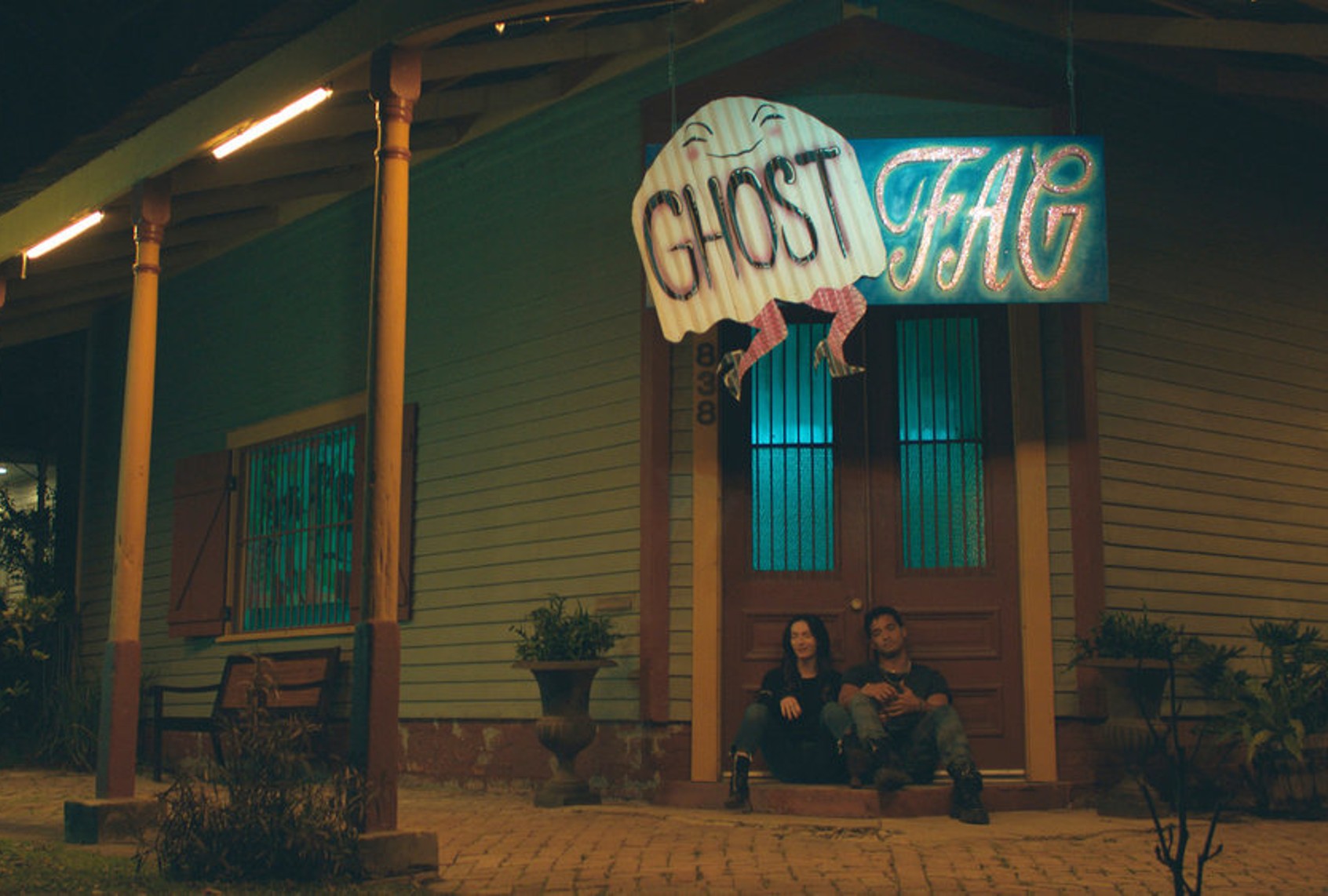
In “Queer as Folk,” still reeling from the shooting at Babylon, the group of friends and lovers we grow close to during this first season create a DIY space called Ghost Fag, which is a tongue-in-cheek reference to hate-crime graffiti they encounter post-tragedy. Mixing different sub-cultures within the LGBTQ scene along the lines of drag culture, punk culture, sex-worker culture, and a mishmash of all of the above, the Ghost Fag scenes reminded me of my favorite gay event I’ve ever attended in New Orleans, which was a party called Big Dick’s House of Big Boobs. Ghost Fag, much like Big Dick’s shows queer life at its best, a room full of loud music, sweaty bodies of every variety, and nary a Catholic leaflet or corporate sponsor to be found. The cast of “Queer as Folk” found hope here, and I found hope watching them find it. 

Read more:

The teen sleep crisis: Early school start times are terrible for our kids’ health

My first encounter with Lisa Lewis was over email, when, in 2017, she reached out about a campaign to let teenagers sleep

“I’m excited to let you know about a recently introduced state bill about healthy school start times in California, which would require public middle and high schools to start at 8:30 a.m. or later!” her note read. 

School start times may not seem like a political issue apt to mobilize parents, yet every day, for years, they see the effect of school schedules on their children. Two years earlier, Lewis had been no chipper activist —just a mom whose ninth-grader struggled with a 7:30 a.m. start time.

 “I was driving him to school, and I could just look over and see he was barely awake. And then every afternoon he’d come home, and more often than not, he’d take a nap.” The journalist in her took over. After doing some digging, she was alarmed at what she found. “What I quickly realized was this was not (a) a new issue or (b) unique to our community,” Lewis told me. “There’s a huge body of research about teen sleep.” 

“Because their body clock shifts at puberty, they’re not ready to go to sleep as early as they used to be, and they’re also not ready to wake as early.”

Back in 1996, a school in Edina, Minnesota pushed its start time later. Fairfax County Public Schools in Virginia did the same thing. Seattle Public Schools soon followed. The research on teen sleep was sinking in, at least in some districts. “Hundreds of schools ranging from one to an entire city or county” were getting hip, Lewis said. But the momentum really picked up in 2014, when the American Academy of Pediatrics issued a statement, and 2015, when the CDC released a report on school start times. As Lewis’s son was riding to school sleepy and withdrawn, “the issue was finally hitting critical mass,” she said.

Her work eventually led to an entire book on the topic, “The Sleep-Deprived Teen.” After getting a sneak peek, I asked Lewis if I could pick her brain. Our exchange has been edited for length and clarity.

You write that, “School start times can change whereas biology can’t.” I felt that viscerally, since my daughter will be 13 soon, and every night at 9:00 she gets a second wind and wants to engage right when I’m ready to crash.

That tracks. And it’s because their body clock shifts at puberty, and they’re not ready to go to sleep as early as they used to be, and they’re also not ready to wake as early. Melatonin is being released on a later schedule, and melatonin is what primes us to feel sleepy. Generally speaking, teens aren’t ready to sleep until closer to 11:00 p.m. And then if you just do the simple math, they are supposed to be getting 8-10 hours every night, so having to be at their desks at 7 or 7:30 a.m. makes that impossible.

RELATED: As the culture war engulfs their schools, kids say adults aren’t listening to them at all

And this is something we didn’t know until relatively recently, right? We just assumed humans need a ton of sleep as infants and taper down until adulthood. But then research showed otherwise?

The Stanford Summer Sleep Camp was held on the Stanford campus from 1976 to 1985, and that’s really where a lot of the initial important findings about teen sleep were made. They called them “campers,” and they’d take them bowling and play volleyball, but it was a study. The kids had electrodes glued to their skulls. What they found was that actually, kids and teens all needed the same amount: right around 9.25 hours. I spoke with the woman who ran this, professor Mary Carskadon, and to one of the former campers, who is now a grown man. He remembers it being fun!

It must have been for them to keep coming back each year! The topic of fun reminds me of the story of NBA player Andre Iguodala. You wrote that he rehabbed his sleep routine, and his points-per-minute increased by 29 percent! But you make the case that sleep is even more impactful for teens.

First of all, there is nothing positive that comes from being sleep-deprived. It affects your reaction times and your coordination. It increases your risk of injuries. It does nothing to make you a better athlete. In fact, getting enough sleep is what enables recovery from injuries and even just from workouts. When you look at it in the classroom, there’s three key ways that being sleep-deprived affects learning: It hampers the process of acquiring new information, the likelihood that they are going to retain that information, and being able to retrieve it when they need to use it. And then on an even more basic level, if you were to walk into an early-start high school, students are asleep on their desks.

What about mental health?

The less sleep teens get the more their suicide risk goes up, which, as a parent, just sends chills down your spine. The odds for a range of risky behaviors go up: substance use, etc. There’s a condition called anhedonia, which is where you really just can’t derive pleasure from life. 

You talk about rates of depression and anxiety being enhanced with sleep loss, and also emotions like fear and anger. On the flip side, you wrote that being well-rested provides an emotional buffer, so fewer fights with parents, more self-control …

Sleep really does boost our emotional resiliency, and it makes it easier to deal with stressors. That’s true for all of us, but teens more so than adults. A lot of them outwardly start resembling adults, but they’re very much still in development. Their brains are pruning and remodeling. One of the neuroscientists I interviewed compared it to upgrading a dirt road to a paved freeway. At the end of it, teens are able to make better decisions, focus their attention more effectively, and behave less impulsively — but they’re not there yet.

So while the road is still being paved, their schedules are different. But many high schools don’t accommodate that, with a national average start time of 8:03 a.m. And what surprised me is that 100 years ago, that number was 9:00 a.m. 

Yes, school start times have drastically drifted earlier because of consolidation into larger schools and using one set of buses to transport batches of different-aged kids. Who goes earliest? They didn’t have that research on the teen sleep schedule and thought, well, high school students are older so they should be the ones. These are legacy schedules. Which is why I’m so excited our law goes into effect on July 1. There are about 3 million kids in public middle and high schools in the state of California, so this is going to have a tremendous impact.

I loved reading about the arguments against moving start times later — like, we won’t have daylight left to practice soccer — and what we actually see happen after a shift.

“The bottom line was, when school start times move later, teen crashes go down.”

Yeah, there’s a natural resistance to change. But when people understand why, that teen sleep deprivation is a public health issue like asbestos or lead paint, it puts it into perspective. Information helps. Studies on schools that have made the switch have not seen any decline in the level of students participating in sports, and the same goes for the effect on after-school jobs, because those tend to be service jobs, the dinner shift. 

One of the arguments was that kids are just going to stay up later, that we’ll be giving them another hour to mess around online. Do we see that happen?

Kids do stay up slightly later but they more than make up for it by the amount that they are able to sleep in the morning. So going back to Seattle, the largest city to-date to have shifted its start times, they did a pre- and post-survey. Students slept an additional 34 minutes per night. When it comes to sleep research, that kind of improvement is considered huge. And when researchers go back in two years later, the students are still getting that additional sleep.


Want more parenting and health stories in your inbox? Subscribe to Salon’s weekly newsletter The Vulgar Scientist.


It sounds like there are also fewer car accidents. The obvious explanation is that rested teens have better judgment and reaction times, but you mentioned another theory: that a later dismissal just narrows the window of time they’re on the road.

Yes, and the bottom line was, when school start times move later, teen crashes go down.

Another piece of this puzzle that grabbed me was the notion that not all teens are affected the same way. You talked about disparities around adolescent sleep.

Biological females take longer to fall asleep than boys and men, they have a higher risk of insomnia, and this all starts in puberty. Their sleep can be affected by hormones and monthly menstrual pain. Then you also have the issue that sexual minority teens sleep worse. And that’s a pretty large group. In the most recent Gallup poll, more than 20 percent of the Gen Z respondents said they identify as LGBTQ, higher than any other generation surveyed.

And that’s because experiencing discrimination and lacking a sense of belonging makes it harder to sleep?

That’s what one researcher thinks is driving this. The issue of discrimination is also something that comes up when you look at teens of color who are disproportionately likely to have trouble falling asleep and feel sleepier the next day. And that’s everything from microaggressions on up. There’s also the whole issue of socioeconomic impact. If you are in crowded living conditions or if where you live is noisy, or if you don’t feel safe, or if you are hungry when you are going to bed, all of those can impact sleep.

That makes so much sense. I want to go back to gender for a second and talk about socialization, because not all of the disparity is biological. You quoted psychologist Lisa Damour saying girls tend to co-ruminate, going over issues again and again via Facetime or Snapchat, and all that talking can keep a problem alive. 

Yes, absolutely. And the issue of social media and tech is a huge one, too. There are three ways that tech impacts sleep: (1) it literally takes time away from sleeping, (2) the stimulating interaction, which is the piece you were just talking about, and (3) the impact of blue light. We hear a lot about blue light, and we definitely need to dim our lights, but the people I spoke with really thought light was probably the lesser of those three. It’s more that if you are up until 1:00 AM playing video games, of course that disrupts your sleep time.

And it also displaces things that could be calming before bed, right? If you are on your phone, you’re not taking a warm bath.

A wind-down routine is really important. We are not like computers, we can’t just flip off the switch and boom, you fall asleep. The official recommendation is no tech at least an hour before bedtime.

But you also wrote, “Even if teens were to chuck their smartphones … it’s likely they still wouldn’t be able to get enough sleep, given how early they have to wake to get to school on time.” A lot of the advice we get these days focuses on improving our personal habits. And your message is that there’s room for that, but you go back to structural issues.

Yes. Studies show that teens at earlier starting schools are getting to bed earlier than their peers at later starting schools, but they’re still getting less sleep. So it just goes to show that there’s only so much you can do. Groups like Start School Later have been involved in advocacy for this since 2011. It’s a straightforward change that doesn’t put the onus back on families. 

And individuals reading this can help, right? A lot of the stories you recounted in the book are about parents like you who said, “This sucks,” and then went to a board meeting, formed a local group, or wrote to their state legislators.

Absolutely. And getting back to mental health, sleep is one specific thing that we can do to help our teens. So much of the rest of what is going on is out of our control, but we can help them get more sleep. 

Read more from Gail Cornwall’s parenting column Are We There Yet?:

Novavax missed its global moonshot but is angling to win over mRNA defectors

Novavax hitched its wagon to the global coronavirus pandemic. Before most Americans truly grasped the scope of the danger, the small Maryland biotech startup had secured $1.6 billion in U.S. funding for its covid vaccine. Its moonshot goal: delivering 2 billion shots to the world by mid-2021.

Although the U.S. commitment eventually expanded to $1.8 billion, hardly any Novavax shots have found arms due to manufacturing issues, and most of the world has moved on. Novavax stock has plummeted from $290 a share in February 2021 to around $50 recently.

The FDA finally appears poised to authorize the company’s vaccine, however. If it does, Novavax would target the tens of millions of Americans who are not vaccinated against covid-19 or would benefit from boosters but have avoided mRNA vaccines because of health concerns or conspiracy theories about their dangers.

In clinical trials, Novavax’s two-dose vaccine has worked well and had few safety problems. It appears to cause fewer unpleasant reactions — fever, chills, and exhaustion — associated with mRNA vaccines produced by Moderna and Pfizer-BioNTech.

Novavax also relies on a more time-tested technology, using recombinant proteins grown in cell cultures. An influenza vaccine produced much the same way as Novavax’s shot has been on the market in the United States for nearly a decade.

“I do think there is a minority group who would take a protein vaccine over an mRNA vaccine,” said Dr. Kathleen Neuzil, director of the Center for Vaccine Development and Global Health at the University of Maryland. She was a researcher in a major U.S. trial of the Novavax vaccine, which found it 100% effective at preventing anything worse than mild covid.

With the FDA’s authorization, Novavax’s product would be the first vaccine produced in India for U.S. consumption. Novavax turned to the Serum Institute of India, a seasoned manufacturer that makes vaccines for poor countries, when its subcontractor in Texas, Fujifilm Diosynth Biotechnologies, stopped producing the vaccine last summer after it was dinged by FDA inspectors for inadequate contamination control, missing records, and other problems.

Founded in 1987, Novavax has never marketed a vaccine in the United States. It has boasted about the potential of a secret proprietary ingredient, Matrix-M, an immune system booster derived from Chilean soapbark trees. Those who’ve observed the company’s string of failures over the past decade see its June 7 FDA advisory committee meeting as the last chance to market its covid vaccine here, although it has obtained more than $2 billion in contracts with the U.S. government and nonprofit organizations.

Pharma giants Sanofi and GSK are jointly developing a similar vaccine. European Union reviewers began an examination of the drugmakers’ vaccine in March, and the companies expect to request an FDA review “in coming weeks,” Sanofi spokesperson Sally Bain said.

Even with FDA authorization, Novavax may be too late. While its vaccine is licensed in 41 countries and at least 42 million doses have been distributed, the world is overstocked with covid vaccine.

“They are applying for an emergency authorization” from the FDA, said Manon Cox, a vaccine industry consultant and the former CEO of Protein Sciences Corp., which made a similar vaccine. “What’s the emergency?”

Demand for covid vaccines is sluggish everywhere. About 13 million doses of the Novavax vaccine had been distributed in European Union countries as of mid-April, but fewer than 200,000 were administered. Distribution of the vaccine has been negligible since then.

Gavi, a nongovernmental organization, has suspended a 2021 agreement to buy at least 350 million Novavax doses for the COVAX program, which distributes vaccines at a deep discount to poor countries.

The U.S. market, however, shows promise for Novavax’s shot as an alternative to mRNA vaccines, especially now that the FDA has limited the use of a fourth vaccine, made by Johnson & Johnson, because of a serious though rare safety risk.

“The anti-vaxxers have been getting more and more aggressive about mRNA vaccine safety, including in recent months claiming these vaccines cause AIDS,” said John Moore, a professor of microbiology and immunology at Weill Cornell Medicine. “It’s all utter BS. But some people do buy into this garbage.”

Neuzil said the Novavax shot could prove more durable than the mRNA shots, whose capacity to prevent infection seems to fade after several months, although they are effective at keeping people out of the hospital.

“Realistically, there probably aren’t that many unvaccinated people who will now decide to take Novavax,” Moore said. “Being unvaccinated is mostly down to politics, not science, sadly.”

Most of the demand would be for boosters. But the FDA has indicated Novavax’s shots would be authorized initially as a first dose, not a booster, John Trizzino, Novavax’s chief commercial officer, told KHN in an interview. FDA officials also have bruited the possibility of requiring vaccine manufacturers to modify their shots by this fall to target the omicron variant.

Novavax has data showing its shot effectively boosts people who received mRNA vaccines, Trizzino said. And although the company is skeptical about the need to modify its shot, Novavax recently began testing an omicron-targeted vaccine and expects results in late summer, he said.

It’s surprising that Novavax should face this quandary now. The company announced May 9 that it had made its first-ever quarterly profit, of $203 million on $586 million in vaccine sales.

Novavax expects revenue of $4 billion to $5 billion this year in global sales, Trizzino said, noting “this is not just a pandemic question, it’s an ongoing vaccination question.” At an April 6 meeting, federal officials strongly suggested that covid vaccination will become an annual recommendation, like the flu shot.

“We were slightly behind providing supply into the pandemic period, unfortunately,” Trizzino said, “but there’s going to be at least some kind of annual revaccination.”

Trizzino said the company was negotiating with U.S. officials on how much of the remainder of its $1.8 billion contract would pay for shots as opposed to research. Beyond the contract, Novavax can charge the U.S. government a higher per-unit price for additional vaccine, he said.

The Biden administration’s budget contains no mention of further Novavax contracts, but if federal purchases end, Novavax could sell on the commercial market. Medicare officials have set the price for covid vaccines at about $60 per dose — approximately three times what Novavax has been getting from the U.S. and European government buyers, Trizzino said.

The company has come a long way from its first product, a microscopic fat particle designed to encase vaccines that instead was employed in skin care products and Girl Scout cookies, according to “The First Shots,” an account by journalist Brendan Borrell. Novavax spent hundreds of millions to develop a vaccine against respiratory syncytial virus, an infection that is especially harmful to babies and the elderly, but the product failed in 2016, after the company brushed aside a design feature originating in the National Institutes of Health laboratory of Dr. Barney Graham. That feature, which involves shaping the viral protein to allow the immune system to better recognize it, is now a key part of all the U.S. covid vaccines, including the Novavax shot.

In 2019, Novavax sold its vaccine production facility and laid off all but about 100 employees. A year later it was revived by Operation Warp Speed, the massive public-private effort to produce covid vaccines.

To make its shot, the company genetically alters an insect virus called a baculovirus to produce covid proteins in moth cells. The system was developed by Gale Smith, first at Protein Sciences Corp., which used it to license an influenza vaccine. Sanofi in 2017 bought Protein Sciences and its vaccine.

Smith, who has worked at Novavax since 2003, saw the moth cell system as a safer, faster alternative to traditional methods of growing vaccine viruses in eggs or monkey and dog kidney cell cultures, which were prone to contamination with potentially dangerous viruses. Baculoviruses don’t grow in people.

But the baculovirus system is messy, according to Kevin Gilligan, a senior consultant at Biologics Consulting Group in Alexandria, Virginia, and a former federal pandemic preparedness official. The product of the moth cell bioreactors can be a sticky mixture of cellular debris, and insect and viral proteins.

“It’s a whole soup of all kinds of things,” Cox said. “You go through a purification process and hopefully end up with that 90-plus percent pure protein you want.”

According to one report, some lots produced at the Texas plant were only 70% pure. So Novavax turned to the Serum Institute of India, one of several companies in the U.S., Asia, and Europe with which it had signed manufacturing agreements in 2020.

In the meantime, Novavax’s executives reaped record payouts in 2020. CEO Stanley Erck got $48 million, mostly in stocks and bonuses, while Trizzino and others got payouts of $20 million or more each. Over the past year, company executives cashed out stocks worth more than $150 million.

Shareholders have sued Novavax over sagging stock prices following missed deadlines for its vaccine.

In June 2021 Novavax hired a leading process engineer, Indresh Srivastava, from Sanofi. The company’s manufacturing problems are “well past us,” Trizzino said.

In an unusual twist, while U.S. taxpayers may come to rely on the Indian version of a vaccine they heavily funded, another Indian company, Biological E, is making a vaccine invented by Peter Hotez, Maria Elena Bottazzi, and colleagues at Baylor College of Medicine. Their only government funding was a $400,000 NIH grant, Hotez said, and Baylor is giving the shot away to companies that will make it cheaply in lower-income countries.

About 45 million doses of the vaccine have been administered so far to Indian teens — with a cost to the Indian government of $1.86 per shot.

Behind the scenes of “Fire Island,” from filming sexy rain encounters to endearing dance-offs

Andrew Ahn, who directed the sensitive. moving dramas “Spa Night” and “Driveways,” shows his talent for comedy with Hulu’s “Fire Island.” The film, written by and starring Joel Kim Booster, is a contemporary take on Jane Austen’s “Pride and Prejudice,” with an almost-all gay male cast. (Margaret Cho, playing a lesbian den mother, is the sole woman).

In the film, Noah (Booster) helps his best friend Howie (Bowen Yang) connect romantically with Charlie (James Scully), a hot doctor who seems attracted to him. However, as Noah meddles in Howie’s affairs, obstacles arise for the potential couple. What is more, Noah is both attracted to and repelled by Charlie’s friend, Will (Conrad Ricamora, exceptional in the Darcy role). 

The plot is an excuse for all the characters to attend parties, drink and do drugs, have sex (or not), and consider the meaning of love and friendship. Ahn allows the large ensemble of out gay actors (which includes Matt Rogers, Tomás Natis, Torian Miller, and Zane Phillips) to lean into the material with wit that is both droll and campy. But “Fire Island” also addresses themes of race and class in addition to sexuality.

RELATED: The best new movies to watch from home, from “Everything Everywhere All at Once” to “Fire Island”

Ahn chatted with Salon about “Fire Island.”

This film is a comedy, which is certainly a change of pace from your previous features which were more serious in tone. Can you talk about how you approached the material?

“It was letting our cast take the lead. They were so good at being funny and improvising with each other, I wanted to let them find the tone themselves.”

I think on a macro level, my goal is the same as a director whether I am directing a drama or a comedy. I am searching for emotional truth. Audiences have to believe the moment unfolding in front of them. That’s always my first priority. There are many different elements that are involved in finding that emotional truth. A big part of it is performance, another part is tone, and that’s where there are the micro-level differences between a drama and a comedy. With a comedy, you have to surprise audiences constantly. That’s a how a laugh works — it’s a surprise. That can get distracting. That is what often leads to bad comedies; they reach for the joke rather than have it come organically from the story or the characters.


Want a daily wrap-up of all the news and commentary Salon has to offer? Subscribe to our morning newsletter, Crash Course.


I did a lot of prep work in the conceptualization of the film, trying to understand the tone of the movie. I had a lot of conversations with Joel and did a lot of dramaturgical work, looking for places in the screenplay to emphasize humor, de-emphasize humor, overplay or underplay a joke, and then it was letting our cast take the lead. They were so good at being funny and improvising with each other, I wanted to let them find the tone themselves. I was creating an environment where they could experiment and have fun. I tried to have a light touch. If I overmanipulated this, I would be forcing a tone instead of finding a tone. I think comedy is very precise. The difference between a joke working and a joke not working could be a single word, it could be a gesture, or it could be a couple frames in the edit. It was a real learning experience for me. It was very craftsman-ly. I had to work with my team to finesse every joke in the movie to maximize that feeling of surprise and ensuring it would get a laugh. I hate watching a comedy I made. If people don’t laugh, it’s a terrible feeling. There’s less pressure watching a drama like “Spa Night” or “Driveways.”

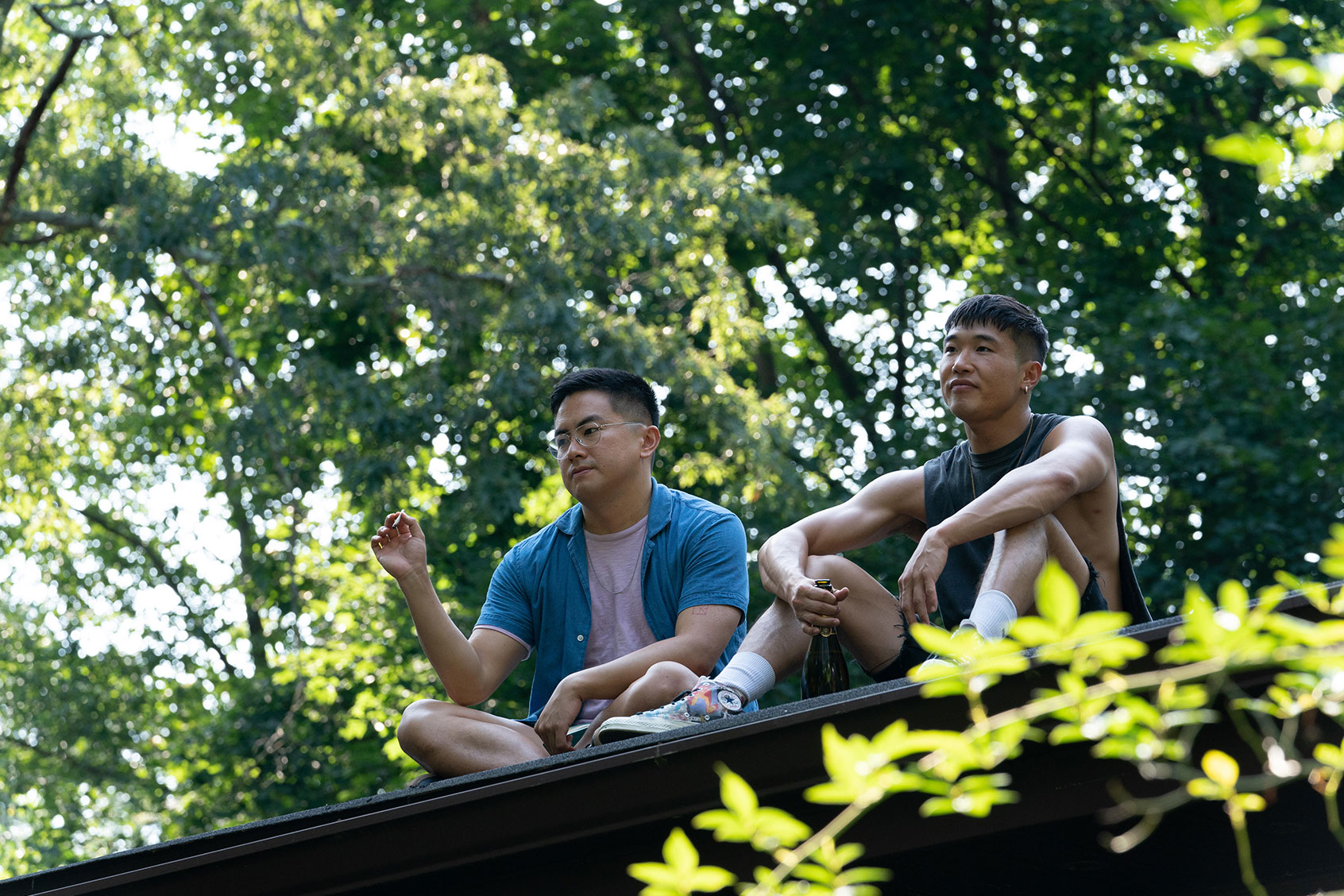
Fire IslandNoah (Joel Kim Booster) and Howie (Bowen Yang) in “Fire Island” (Jeong Park/Searchlight)

“Fire Island” is one of the few gay male Asian rom-coms I’ve seen — “Front Cover” being another. What can you say about representing the gay, Asian community? Is there pressure or opportunity to do this?

There’s definitely pressure, but it has less to do with the film and more to do with the fact that this is a film that has this kind of opportunity. It has marketing money behind it and a platform like Hulu. I have seen gay Asian rom-coms before. “Front Cover,” Alice Wu‘s “Saving Face,” and very significantly for me, Ang Lee’s “The Wedding Banquet.” There have been many movies; they just have not necessarily gotten the exposure that we are getting with “Fire Island.”

Making the film, I had to focus on the film itself. I benefitted from being an indie filmmaker; I have no expectations of my work being seen. [Laughs] I just enjoy making the work, so that was my main goal. But now in the distribution of it, I understand and feel the pressure of it. My hope is that I can take this opportunity to help other queer and Asian American filmmakers make their own work and that “Fire Island” will help them in their pitch meetings so there are more and more of these, and we can shoulder that pressure together as opposed to place it all on one movie at a time. It is only in creating a canon of films that we were able to relieve ourselves of that burden of representation

I appreciate that you emphasized the shirtless hotness of Joel Kim Booster and Conrad Ricamora. Can you discuss how you filmed these guys to make them “hot and powerful” (as one character says) and how their costumes changed throughout the film to reflect their identity shifts and their appeal? The tiger shirt, Noah wears, for example. 

“My cinematographer Felipe Vara de Rey and I wanted to show these characters as beautiful beings. We were very inspired by the Tom Bianchi Polaroids.”

There is definitely an arc to both characters that we wanted to underscore with the costuming, and David Tabbert is a really emotional costume designer. He thinks about the characters; it is not just aesthetics. I really appreciated that. We wanted to soften Will as the film goes on. We wanted to see Noah’s walls come down, and that is subtly but clearly emphasized. 

I really wanted to show how beautiful this cast is. We looked at a lot of photography. My cinematographer Felipe Vara de Rey and I wanted to show these characters as beautiful beings. We were very inspired by the Tom Bianchi Polaroids. Even the aspect ratio, which was different than standard — we shot 1:76 — was a choice so we could see more bodies and gesture, and shape, and form. More widescreen you go, the more it becomes about the face. We made choices to really see them. That was important for me, that you understood these people as a holistic whole, and not just pieces. I love the tiger shirt. I am Year of the Tiger. It was Joel’s pick.

Fire IslandNoah (Joel Kim Booster) and Will (Conrad Ricamora) in “Fire Island” (Jeong Park/Searchlight)

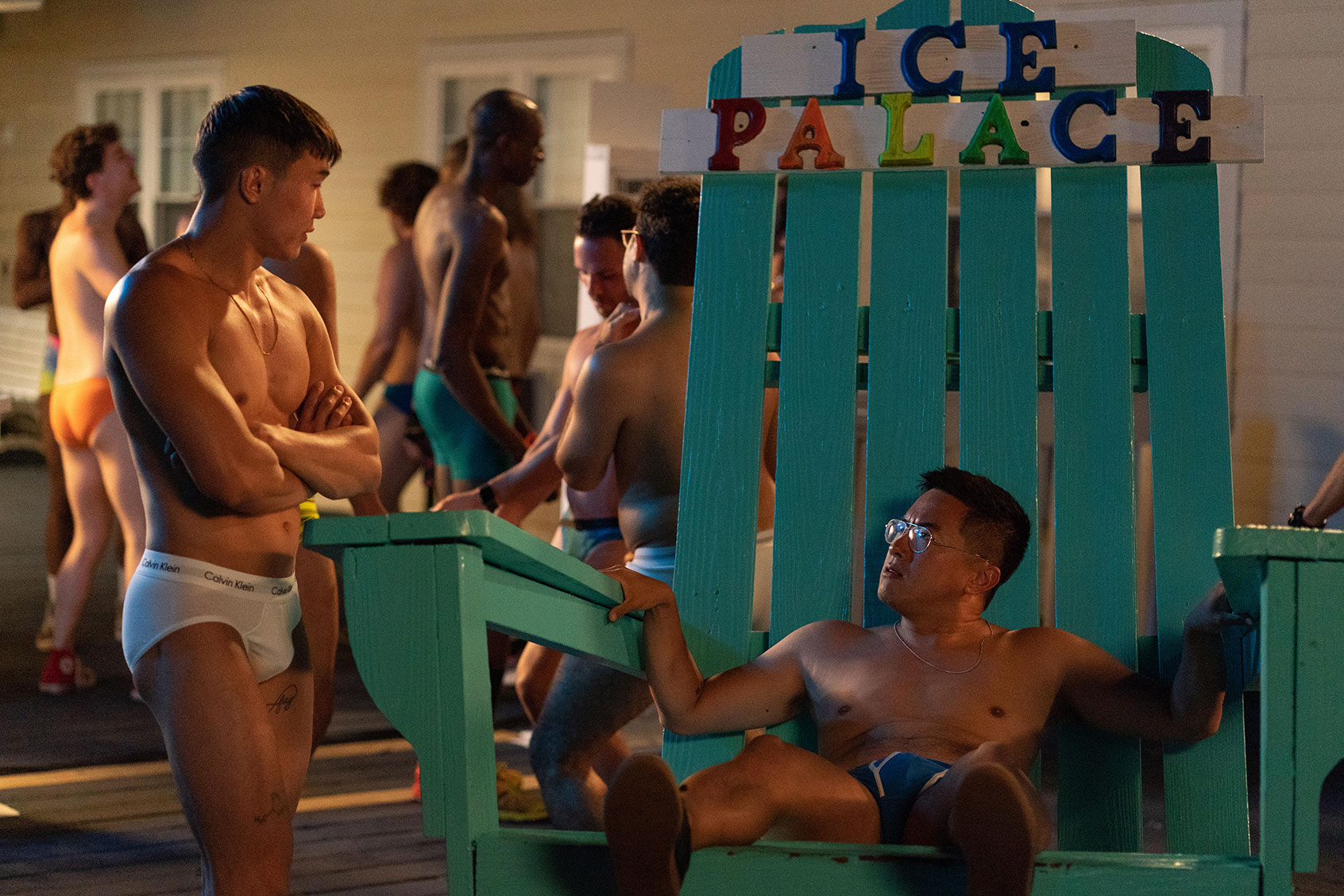
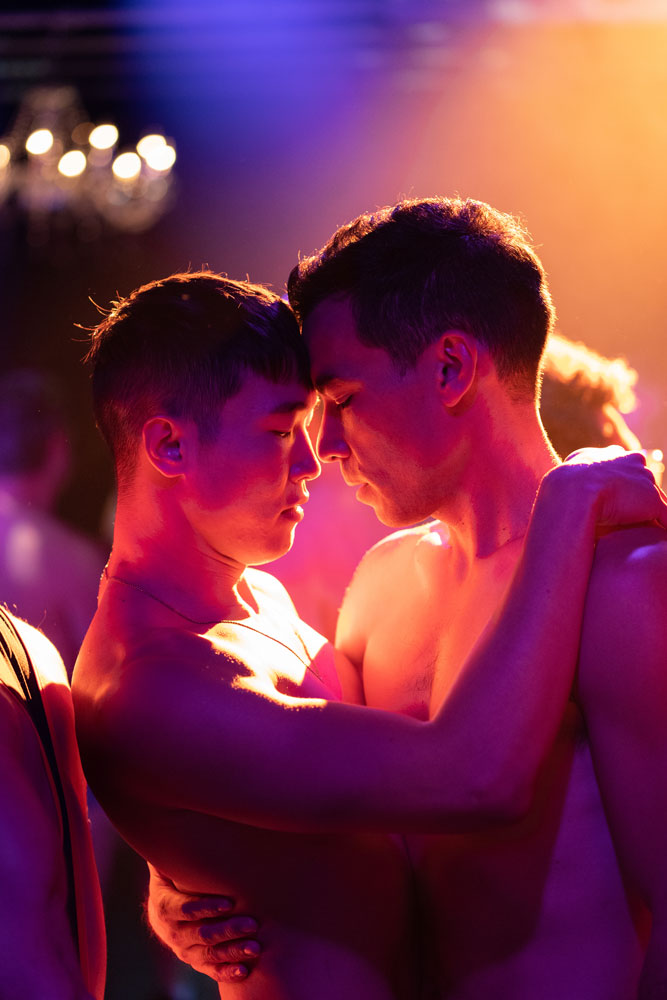
A scene of Noah and Will dancing at an underwear party is sexy, and there is also the scene of them in the rain. Can you talk about developing their sexual tension?

I think with both of those scenes, again I was really interested in capturing bodies and the proximity and the shape and contour and so we had two visual strategies. One was to go wide and see the distance between them, whether it was big or small. The other strategy was to go very, very tight. And it is that tension between those two visual strategies that adds to the tension of the characters’ desires.

I remember with the dance scene a lot of what makes something sexy is what you don’t see, so the light coming in and out was really effective in doing that. Actually, when the light hits very hard, it blows out the image. You end up not seeing something in the highlight. I found that really exciting, cinematically. Similarly, with the rain scene, the darkness hides a lot and I think that that is really sexy. You don’t see them super brightly lit and clear. What you don’t see adds to the sexiness of the moment.

Like in the backroom sequence. Speaking of which, there is a sex video as a plot point, and Noah does walk in on an orgy, but the film is more romantic than erotic, which is appropriate. Was there a deliberate decision to steer away from sex for the sake of the story? How did you approach the sexual scenes in the film?

I wanted to show sex in the film in that sex happens on Fire Island. I didn’t want to avoid it. At the same time, very strangely, these characters are not having a lot of sex, namely because of this plot device of Noah having to get Howie laid before he gets laid. So, the film is more about the search for sex, or sexual connection, than the actual act itself. I was taking my cues from the story. I think it’s important we [showed] sex in the film, and I think we had a good philosophy about it, which was that we weren’t going to sensationalize it. It was a natural part of this environment and gay culture.

“I think queer people are often very good at performing. We have had to learn that skill as a survival technique.”

The sex tape was the most difficult aspect of the story because it’s a trauma, and Joel and I talked a lot about how we wanted to treat that. I had a discussion with Matt Rogers, we had an intimacy coordinator. We talked about its connection to “Pride and Prejudice.” We found a way to portray it and address it in a way that felt appropriate for this film. It was definitely what Joel and I talked about the most.

What about the ideas running through the film that most gay men are horny idiots, that the monogamy industrial complex is not for them, or the incredible self-loathing these men have because they do not feel good enough? Are you worried about perpetuating stereotypes and myths?

I am not really worried about that. I think the film does a good job of showing two different perspectives on love and sex and really validating both. There is definitely some commentary on the two, but I think the film doesn’t judge Howie or Noah for how they want to pursue relationships. It shows that gay culture is not a monolith and there are probably many other different perspectives on love and sex. That criticism has less to do with our film and more to do with the society that we live in which is often very judgmental. We are trying to show that there are different perspectives on this.

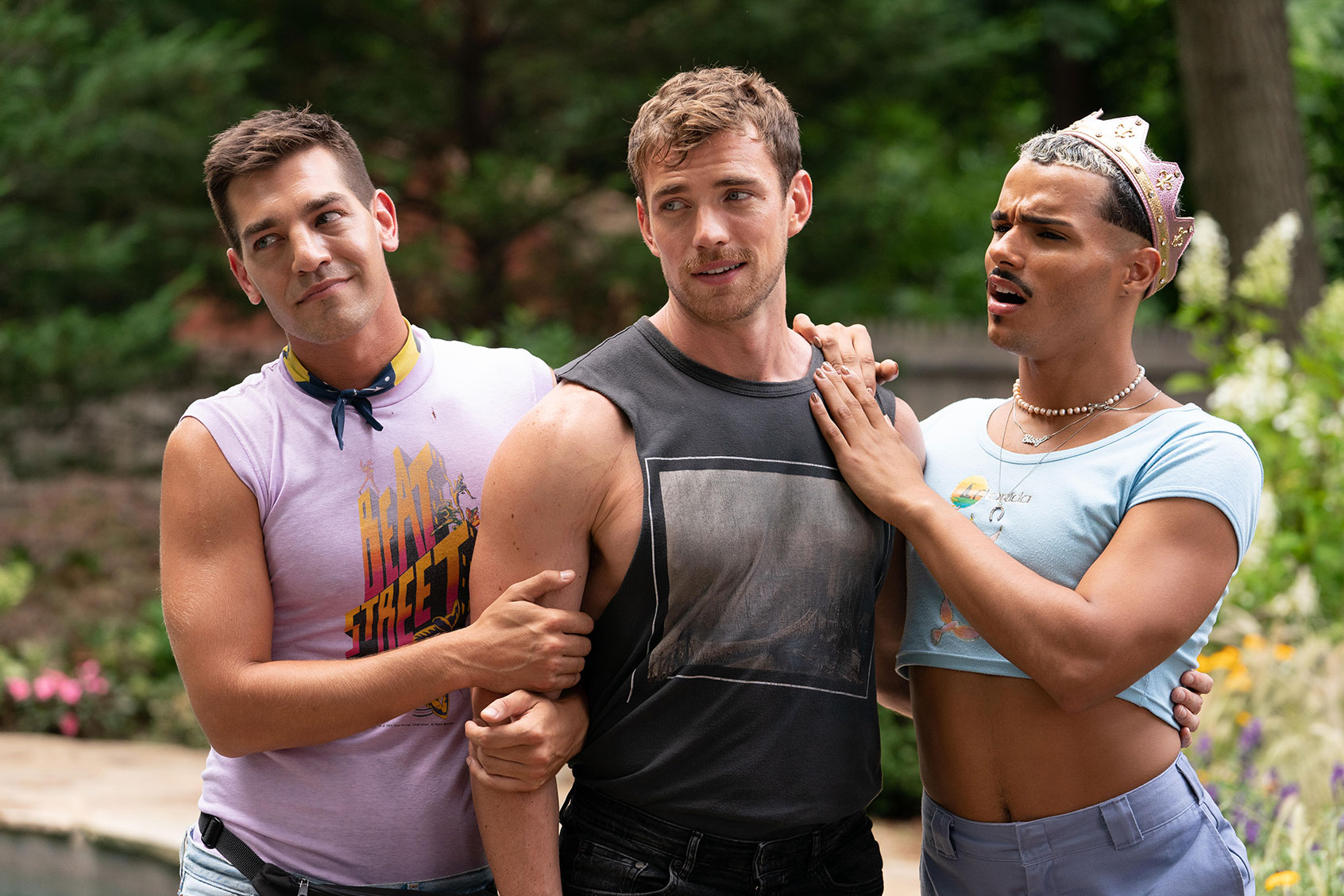
Fire IslandLuke (Matt Rogers), Dex (Zane Phillips) and Keegan (Tomás Matos) in “Fire Island” (Jeong Park/Searchlight)

Will tells Noah that Dex (Zane Phillips) “hides who he really is.” Will is politely warning Noah about this guy, but Noah is not picking up the clues. What are your thoughts about how gay men project a false front and can even abuse each other, which was also a theme in your film “Spa Night”?

I think queer people are often very good at performing. We have had to learn that skill as a survival technique. So, once we learn how to control it, we can use it against each other sometimes. That’s the beauty of Joel’s screenplay. You could interpret it as encouraging queer people to let go of the performance to live a more honest life, and to live it with people who love you for who you are without the performance to gain their love.

“You can’t perform a different race. As gay Asian Americans, this is something that we can’t escape, and I think that’s where we feel we don’t have control.”

Fire IslandFire Island (Jeong Park/Searchlight)The film also deals with the very real issue of “invisibility” and the fetishizing of gay men of color in places like Fire Island. There is a running joke about Noah being in the wrong house when he goes to visit Charlie and Will. What observations do you have about how the flip side of performing, which is invisibility and wanting to be seen?

There is something about performance, again; once we understand how to use it, it’s an opportunity for us to use it to our advantage and part of that is sexual exploit and desire and wanting to be desired. I think the film is making an observation that there are certain things we can’t perform our way out of, and one of those things is race. You can’t perform a different race. As gay Asian Americans, this is something that we can’t escape, and I think that’s where we feel we don’t have control. To a certain extent, these characters feel the helplessness of it. It was always important for me and Joel to find the power in it. I think that that comes with the friendship between Howie and Noah. When Noah says to Howie, “We’re the hottest ones here.” In a friendship, how can you find energy and power instead of letting society take it away from you?

I really liked the scene where Howie and Noah have a heart-to-heart and Howie talks about wanting to feel vulnerable even if it hurts. It’s really moving. We rarely get to see men, even gay men, talk honestly about their feelings on screen. Can you talk about that scene and working with Joel and Bowen on creating their friendship?

I love that scene. It is really powerful to see two people who have such an intense connection have very different life philosophies. I really love that some people might think of it as Howie’s lowest moment in the film, but in many ways it’s a declaration of his individuality. There’s strength in what he is saying. It’s not a pity party. A lot of people don’t understand that there is strength in being vulnerable. Noah doesn’t understand that. That was a note I gave Bowen on set. I loved how Bowen found a dignity to that character and that moment. Another actor would have fallen into wallowing.

I love Joel’s performance in that scene as well. He is holding space for Howie in a really beautiful way. There’s a witnessing. There is something very selfless about his performance there that is rooted in the fact that he is real-life friends with Bowen, and he really does want the best for his friend. There’s a lived-in quality in that conversation. It stems from the fact that there are two people who dropped acid and held each other on the beach watching the sunrise. True story.

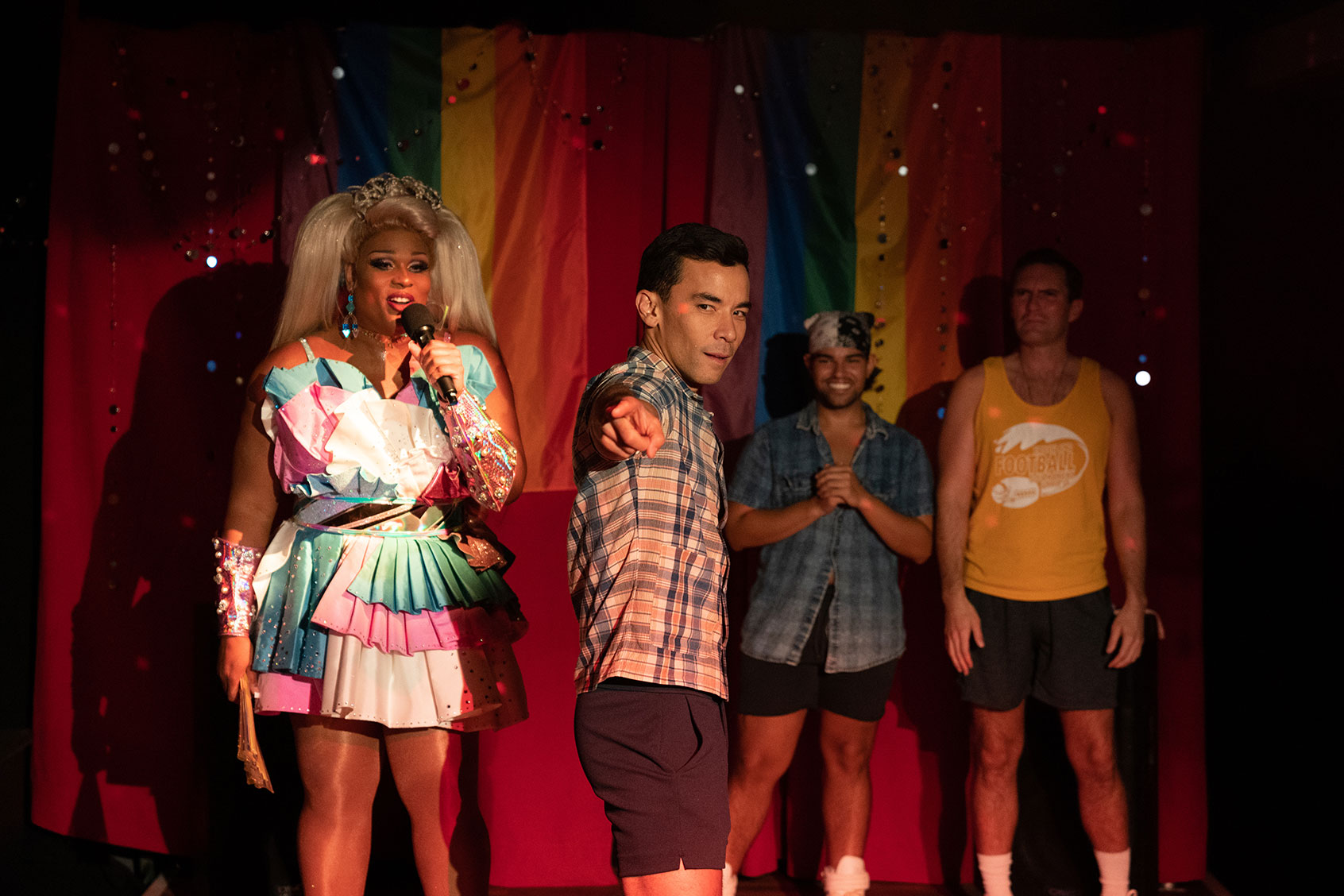
There are party scenes, karaoke scenes, and even a dance off with a drag queen emcee. Can you talk about staging these sequences and how you created the film’s queer vibe?

I was very inspired by my cast and encouraged them to bring themselves into it. That karaoke scene of Britney Spears‘ “Sometimes,” that was Bowen’s suggestion. In the script it was written in as “Will You Still Love Me Tomorrow.” Bowen brought a queerness to it by choosing Britney Spears. Luke (Matt Rogers) and Keegan (Tomás Matos), their choreography was all Matt and Tomás. I didn’t suggest it. In their movement, because they are queer people, there’s a queerness to it. Being open as a director and encouraging self-expression just suffused this entire film with a queer sensibility. I was happy we had an all-queer cast for this. It allows this process to work. I didn’t have to control so much of it myself to bring a queer sensibility. I knew it would organically happen.

” Conrad is a really good dancer — he’s a great dancer … All that choreography was Conrad Ricamora being the cheeseball that he is.

Fire IslandWill (Conrad Ricamora) in “Fire Island” (Jeong Park/Searchlight Pictures)

I need to know about Conrad’s dance scene. How did that come to be? Was he prompted to do that or is he that creative?

We had never rehearsed that scene before that day. The cast and I had gone out dancing the first weekend of the shoot. Conrad is a really good dancer — he’s a great dancer. That’s kind of the humor of it. Will is not a bad dancer. He’s awkward and maybe a little too studied. I love that about Conrad’s performance. I remember telling Conrad that Will has seen a lot of dancing, knows what dancing should look like, and I gave different prompts. I’d say “breakdancing,” or “think early 2000s boy band.” All that choreography was Conrad Ricamora being the cheeseball that he is, and loving to dance, but having to do it badly in this case. He is such a cheeseball. It’s really endearing.

All of your films are about families, albeit different kinds of families. What can you say about your penchant for telling these kinds of stories?

I think there is such of depth of emotion when we talk about family. Everybody has an opinion and a relationship to family, whether you are queer or straight. It’s so universal. There is something about family that stresses me out because there are expectations and responsibilities. Drama naturally springs from the concept for family very easily. I am drawn to it because it’s just such an intense subject matter. I want to emphasize it. With “Fire Island” I saw what Joel was getting at, and I wanted to push this family aspect even further. A different director would emphasize the romance. But I feel very strongly that it’s really what brings us together is this concept of family.

More stories to check out:

What really caused the war in Ukraine? Global anarchy — and there’s a way to fix it

Sometimes it takes a crisis to reveal the reality of a situation. The COVID pandemic revealed the sorry state of public health infrastructure in the U.S., along with many other uncomfortable truths. Now, the war in Ukraine is stripping bare the fundamental flaws of the political organization of the world.

A debate has emerged between various factions of political progressives about the causes of Russia’s attack on Ukraine. Some see the war as resulting primarily from NATO expansion to Russia’s western borders, along with the expansion of U.S. military and financial aid to Ukraine, which has made Russia feel threatened. How would the U.S. react, they ask, if Mexico wanted to join a military alliance led by China? In fact, how did the U.S. react in 1962, when Cuba decided to host Soviet nuclear missiles? For the sake of peace, this argument holds, Ukraine must remain neutral.

Others are outraged by this position. Ukraine is a sovereign nation, they point out, and should be able to determine its own future. Why should smaller countries have to remain in the shadows of their larger, more powerful neighbors? And what kind of message would it send if Russia is allowed to benefit from its own aggression? 

As critical as this debate may be in the short term, its real importance may lie in forcing us to confront the truth of world anarchy. 

RELATED: Russia, the U.S. and the Ukraine war: Dance of death in an age of self-delusion

At the international level, the world is anarchic. There is no global legislature, no courts that can issue binding decisions on most issues, no police. A nation under attack has no choice but to defend itself, hoping that perhaps its allies or the UN Security Council will come to its aid. 

In an anarchic situation, the weak are always at the mercy of the strong. National self-determination becomes a cruel joke. What good is national sovereignty if another country can bomb your cities into rubble for exercising it? 

The strong are not safe either in that kind of dog-eat-dog world — they are at risk from each other. No matter how positive relations with another country may be at any given moment, you can never be sure an ally won’t become an enemy at some point. The best assurance of survival lies in economic and military power, so you grow your economy and build up your army. That makes your neighbors worry because they also can’t be sure your forces are purely defensive. This is what international relations theorists call the security dilemma. At best, such competition is a waste of resources; at worst, it actively makes war more likely. But as long as a global state of anarchy persists, there is no way out of this dynamic.


Want a daily wrap-up of all the news and commentary Salon has to offer? Subscribe to our morning newsletter, Crash Course.


Both the weak and the strong are also at risk from any nation that happens to acquire nuclear weapons. Nukes are a great equalizer, but they hold everybody on the planet hostage to disputes among the great powers. Currently, nine countries have nuclear weapons and two — the U.S. and Russia — have enough to wipe out civilization. But even smaller weapons and smaller arsenals can wreak devastation on an unprecedented scale.

Anarchy and the rule of the strong also allow nations to run roughshod over human rights. For example, China has been imprisoning and torturing hundreds of thousands of Uyghur Muslims for years. The world’s response has been largely symbolic: sanctions against a few Chinese officials, or world leaders refusing to attend the Beijing Olympics. This response is appalling but, under the circumstances, both rational and understandable. China is simply too powerful for any other country to do anything substantive about its actions.

The logic of power can lead to enormous hypocrisy. The U.S. launched an illegal, unprovoked invasion of Iraq in 2003, and was not subject to the kinds of sanctions Russia faces now. We all understand why.

The same logic has led to many of the world’s great hypocrisies. In 2003, the U.S. launched an illegal and unprovoked invasion of Iraq. Can anyone doubt that the reason the U.S. was not subject to the kind of punishing economic sanctions that Russia now faces for its illegal and unprovoked invasion of Ukraine is simply that the U.S. is much more powerful, economically and militarily, than Russia?

Power is not the only reason world organization is profoundly undemocratic. The institutions designed to ameliorate the situation are, too.

Perhaps the least undemocratic of global organizations is the UN General Assembly, where each country has exactly one vote. The problem with the General Assembly is that each country has exactly one vote. Tuvalu, with its population of 12,000, has the same representation as India, with its population of 1.4 billion. Countries, not actual human beings, are represented. On top of that, General Assembly resolutions are totally unenforceable. They are expressions of world opinion — or, more accurately, the opinions of ambassadors chosen by the executive branches of their countries’ governments — but nothing more.

The UN Security Council is even worse from a democracy standpoint. While its resolutions are enforceable, at least in theory, it can do nothing without the agreement of its five permanent members — the victorious nations of World War II (or their successors). This holds even when one of those permanent members, such as Russia, is the subject of a resolution. A model of democracy, or of common sense, this is not. On top of that, Security Council resolutions can only be enforced by sanctions or military action.

One idea for bringing more democracy to the UN is the proposal for a Parliamentary Assembly, a new deliberative body that, at first, would likely be made up of existing members of national legislatures, but could eventually be directly elected. In the long run, such a parliament could become the core of a democratic global government.

Whether created from a UN Parliamentary Assembly or by other means — many other possibilities have been described — some form of democratic world federation is the way out of our current international anarchy. It could both end the rule of the strong over the weak and even end war itself.

A world federal government on top of national governments would fundamentally change the way nations relate to one another. Just as within nations, this government would have a monopoly on the use of force. Nations would not be able to attack or physically threaten one another, any more than US states or Swiss cantons do. Larger and wealthier nations would not be able to bully smaller and poorer ones. Nations would continue to exist, in this imagined future, but national militaries would not.

The basic idea is that a world legislature representing the people (and maybe also nations as political entities) would create laws governing international or global matters, as well as fundamental human rights, while nations would deal with everything else. There might be world laws addressing marine pollution or the right of girls to get an education, but not about street fights or most business contracts, which can easily be handled at lower levels.

No one claims a democratic world federation will happen tomorrow, or next year. Making that happen may require the largest worldwide movement in human history.

This kind of democratic world federation would not have anything like an army, because it would have no need for one. It would have a police force like the FBI or the Secret Service to pursue individual criminals, and it would have prosecutors empowered to sue national governments that do not comply with world laws, much the way the U.S. Department of Justice sues states that violate federal laws.

Clearly, a world federation will not come into being tomorrow or next year. Indeed, its creation may require the largest worldwide movement in human history. But if the alternative is the status quo of periodic mass violence with a nonzero risk of nuclear apocalypse, it starts looking downright practical. As Supreme Court Justice William O. Douglas wrote, “World federation is an ideal that will not die. More and more people are coming to realize that peace must be more than an interlude if we are to survive; that peace is a product of law and order; that law is essential if the force of arms is not to rule the world.”

The first step toward meeting this challenge is to recognize the nature of our current situation. That’s how we can someday accomplish the transformation that former Republican congressman John Anderson, the longtime president of the world federalist organization Citizens for Global Solutions, called for: replacing the law of force with the force of law.

Read more on the war in Ukraine and its ripple effects:

Starbucks CEO pushes harder against unions

Starbucks CEO Howard Schultz made it clear Thursday that he does not intend to hold good-faith negotiations with Starbucks Workers United—the union that has won elections at more than 140 coffee shops nationwide since December—potentially exposing the corporation to a fresh legal fight with the National Labor Relations Board.

When asked by Andrew Ross Sorkin of the New York Times if he could ever see himself “embracing the union,” Schultz responded tersely: “No.”

“The customer experience,” the billionaire claimed during a live interview, will be degraded “if a third party is integrated into our business.”

As Jordan Zakarin of More Perfect Union reported Friday, Schultz’s comment “marks a significant and potentially illegal shift in the company’s public statements about its relationship” with Starbucks Workers United.

“Schultz’s statement could run afoul of the National Labor Relations Act, which requires a constructive approach from employers when its workers vote to form a union,” Zakarin noted. “The law demands that during collective bargaining, employers must ‘confer in good faith with respect to wages, hours, and other terms and conditions of employment.'”

He continued:

Up to this point, Starbucks executives have been careful to insist that the company would bargain in good faith—often in those exact terms.

In December, immediately following the union’s first victories in Buffalo, Rossann Williams, Starbucks president for North America, stated in a public letter that “we will bargain in good faith with the union that represents partners in the one Buffalo store that voted in favor of union representation.”

Similar statements, from Schultz, Williams, and spokespersons for the company, have been made regularly for the past seven months.

Veteran labor journalist Steven Greenhouse responded to the interview by saying that Schultz in his remarks “seems to declare permanent war against the union.”

“Schultz sounds so hugely anti-union,” Greenhouse continued, “that he seems totally willing to refuse to cooperate in any way whatsoever with the union to help make Starbucks a better company and serve its customers better.”

“If I were a Starbucks shareholder,” he added, “this refusal to work with the union would worry me.”

Greenhouse also pointed out the hypocrisy of Schultz’s derogatory reference to the union as a “third party.”

Referring to high-level company executives and the union-busting law firm hired by Schultz to fend off worker organizing, Greenhouse said that “Starbucks didn’t call the dozens of managers and $500-an-hour Littler Mendelson lawyers it flew to Buffalo from out of town a ‘third party.'”

Peter Certo of the Institute for Policy Studies, meanwhile, responded to Schultz’s comments by issuing a caustic reminder that “Hillary Clinton was going to make this man her labor secretary.”

Rudy Giuliani faces ethics charge for backing Trump’s election fraud claims

Former New York City mayor Rudy Giuliani is facing an ethics charge as a result of a case brought against him by the District of Columbia office that regulates attorneys.

According to Business Insider, the District of Columbia bar is alleges that Giuliani —who was also an ally and personal attorney to former President Donald Trump— “pushed baseless claims about fraud in the 2020 presidential election in a Pennsylvania court and accused him of violating two professional conduct rules in the state.”

The court documents filed on Friday, June 10, also highlight Giuliani’s support of a lawsuit filed in Pennsylvania by the Trump campaign seeking to overturn the results of the state’s election. The latest debacle with the D.C. bar comes one year after Giuliani’s one-year suspension from practicing law in the state of New York. Now, his law career is in jeopardy in the District of Columbia as he may also be forced to refrain from practicing law in that district.

Following Trump’s election loss in 2020, the Pennsylvania lawsuit argued that more than 1.5 million mail-in ballots were invalid because they were not in compliance with state election law. The filing notes that Giuliani was the attorney to seek an emergency ruling in hopes of blocking the certification of the presidential election. He also had a hand in filing other orders to have the Pennsylvania assembly select its own electors and deem Trump the winner of the state’s election.

According to the court filing, Giuliani “brought a proceeding and asserted issues therein without a non-frivolous basis in law and fact for doing so” and “engaged in conduct prejudicial to the administration of justice.”

The lawsuit filed in Pennsylvania was dismissed.

The D.C. Bar argues that the affidavits were “(a) unsupported, (b) unrelated to Trump voters (c) involve conduct outside the seven Defendant Counties, and (d) by their own terms were isolated incidents that could not have affected the presidential election’s results by offsetting the Biden majority of over 80,000 votes.”

A hearing will now be scheduled and Giuliani will have an opportunity to respond.

Long wait for justice: People in jail face delays for mental health care before they can stand trial

Beau Hampton’s long wait for psychiatric treatment began last year, after he was accused of attacking his foster father and charged with a misdemeanor.

The 18-year-old Hampton, who has a long history of mental illness, sat in jail east of Atlanta for four months waiting for an expert to evaluate whether he was mentally fit to stand trial. In February, a state psychologist found Hampton incompetent.

Then Hampton had to wait to get a placement in a state psychiatric hospital so he could receive treatment to meet the legal threshold for competency. The treatment delay frustrated a Walton County judge, who said Hampton’s condition worsened in the crowded jail and in March ordered him to be transferred within 24 hours to a state hospital. The Georgia Department of Behavioral Health and Developmental Disabilities, which runs those psychiatric hospitals, didn’t comply, and the judge held the agency commissioner in contempt of court a month later.

Such long delays for state psychiatric hospital services are playing out in jails across the United States. People in jail with serious mental illness — and who cannot stand trial because of their condition — are waiting months, or even more than a year, to start receiving the care needed to “restore” their competency to stand trial. The legal standard is that an individual charged with a crime must be able to participate in their defense.

In Georgia, 368 people who have been deemed incompetent sit in local jails waiting to get treatment to stand trial, according to the state. More than 900 are waiting for just the first step in the process, a “forensic evaluation.”

Similar delays have sparked litigation in many other states.

The Indiana Protection and Advocacy Services Commission filed a lawsuit in May against state officials over the lag in psychiatric services, claiming the delays violate defendants’ due process rights. Oregon has faced strict time limits set through a 2002 court case, and its backlog stood at 55 people as of May 20.

Alabama faces a consent decree, but “folks are still waiting, on average, a couple hundred days to be admitted to the facilities to undergo either those evaluations or the treatment,” said Shandra Monterastelli, a senior staff attorney at the Alabama Disabilities Advocacy Program.

North Carolina’s waitlist for “restoration” treatment has risen to 140, while Colorado — another state under a consent decree — has 364 waiting. In Texas, the number is much higher — more than 2,000 — a backlog that has prompted a lawsuit. Montana has had dozens waiting as well.

“It would be hard to overstate how big a concern mental health issues are in county jails,” said Michele Deitch, a criminal justice expert at the Lyndon B. Johnson School of Public Affairs at the University of Texas-Austin.

More than 2 million people with serious mental illness are booked into jails nationwide each year, often for nonviolent “nuisance” crimes such as loitering or vagrancy, according to a 2020 report from the National Association of State Mental Health Program Directors. Once jailed, people with mental illness are incarcerated twice as long as other defendants, the report said, and few receive treatment for their condition.

People with mental illness also typically get worse in jail during long waits for a psychiatric hospital bed, said Philip Fornaci, a senior staff attorney for the National Disability Rights Network. “It’s an obvious constitutional problem,” he said. “Jails are really chaotic, pretty violent places.”

For some people accused of a misdemeanor, the wait for what’s known as inpatient competency restoration can be longer than if the individual had been tried, convicted, and sentenced under such charges, said Dr. Robert Trestman, chair of the American Psychiatric Association’s Council on Healthcare Systems and Financing.

The delays in transfers to inpatient treatment facilities, state officials say, have increased during the pandemic, amid worsening shortages of state hospital staff. Yet several legal cases — including those in Alabama, Colorado, Oregon, and Washington state — were filed years before covid-19 surfaced.

Shannon Scully, senior adviser for justice and crisis response policy at the National Alliance on Mental Illness, said that as mental health provider shortages continue, delays in restoring defendants’ mental competency will likely get worse.

In Georgia, the state mental health agency said it has had a net loss of almost a third of its psychiatric hospital staffers since January 2020. Temporary workers are filling some vacancies, but the state reports several unfilled jobs for the forensic psychologists tasked with evaluating the competency of people in custody.

Beau Hampton has a history of psychiatric care beginning at age 3, including multiple hospitalizations, according to court documents. He is described as having autism, bipolar disorder, and other mental health diagnoses.

In March, while in custody at the Walton County Jail, Hampton was wounded in a fight and required stitches. He also faced a pending felony assault and a misdemeanor battery charge in a nearby county.

But state officials said Hampton didn’t rise to the top of the waitlist for inpatient treatment despite the court order, his age, his diagnoses, and his difficulties in jail. The list is based on the date of someone’s court order for hospitalization and the patient’s condition.

The average wait for a male inmate who needs such care in Georgia is 10 months, state officials said at a court hearing on Hampton’s case in April. The judge, Cheveda McCamy, gave the state 21 days under the contempt order to get Hampton placed in a hospital.

Hampton could not be reached for comment. The public defender assigned to his case, Julia Holley, said the competency questions — and not his actual criminal charges — consumed much of her time. Because of Hampton’s age and condition, and his being in the foster care system, she said, the case has “broken my heart the most.” She added, “He deserves a chance.”

Jails like Walton County’s are feeling the burden of caring for people who have mental illnesses. Such inmates often cannot afford bail or bond, said Trestman, and smaller jails have fewer services than big ones. Jails are “not places designed for treatment,” he added. “It’s not a warm and fuzzy environment.”

Incarceration costs are much higher for those with mental illness — about four times as much as for others, said Capt. Terry Mays, administrator of the Wayne County Jail, in southeastern Georgia.

In southwestern Georgia, Capt. Steven Jones, acting administrator of the Thomas County Jail, said one man waited more than a year for such a placement. During that time, Jones said, the man tried to kill himself by jumping from a railing, breaking both ankles and damaging his spine. The delay for the psychiatric hospital bed “was ridiculously long,” Jones said.

Especially for misdemeanor offenses, experts said, getting treatment more quickly in a community setting may make sense. And several states are moving to increase outpatient treatment.

Neil Gowensmith, associate professor of forensic psychology at the University of Denver, said outpatient competency restoration has several benefits. “It costs a lot less,” he said. “Public safety is not compromised. Humanitarian-wise, it’s a civil liberty issue.”

He cited the 1999 Supreme Court ruling in Olmstead v. L.C., a groundbreaking decision that supported the least-restrictive level of care for people with disabilities. “That can be a group home, that can be a supervised living arrangement, it could be independent living,” Gowensmith said.

South Carolina passed legislation this year that will allow both outpatient and jail-based restoration options.

Georgia has limited options for outpatient services. Ashley Fielding, assistant commissioner of the state mental health agency, said in a statement that it’s “actively working on solutions” to the competency backlog, citing raises given to all state employees and expansion of nonhospital restoration alternatives.

On the 20th day of the Walton County judge’s contempt order — one day before her deadline — the agency transferred Hampton to a state psychiatric facility in Milledgeville. The state mental health agency declined to comment on the case other than to say it had complied with the judge’s order. More than eight months had passed since Hampton was arrested.

KHN (Kaiser Health News) is a national newsroom that produces in-depth journalism about health issues. Together with Policy Analysis and Polling, KHN is one of the three major operating programs at KFF (Kaiser Family Foundation). KFF is an endowed nonprofit organization providing information on health issues to the nation.

Subscribe to KHN’s free Morning Briefing.

My city kid summer camp nightmare

A week after school ended, I was sitting shotgun in the car with Dad, aka Big Dwight, with my seat a little leaned back as usual. My shoes propped up on top of my black Nike duffel bag loaded with camp clothes, shorts and tank tops, listening to his slow jams—Al Green, Luther, Frankie Beverly, and the rest of the songs that only bumped on 95.9, the radio station for old Black people. He liked to tilt the roof up, just enough for the sun to gleam over his waves. He obsessed over his curls for hours every day with all types of grease, sheen, and exotic oils, usually sealed tight under his do-rag, all the way up till he did the big reveal, peeling the cap off, making us seasick with the dark waves he had worked so hard on.

“Do you really wanna go?” he asked.

I didn’t want to go, but I didn’t want to look scared either. But I was scared.

RELATED: The deep roots of outdoor recreation’s diversity gap

I was raised in an environment where fear was lied about, even if you were nine years old. I’d never been away from my family, or even outside of Baltimore, so any other place my fear could have been natural. But it wasn’t for me. The people I respected taught me that fear was the worst thing a man could be. I had to hold it during the drive, and it felt like I was the only person in the world capable of harvesting this weak emotion, so I did what any guy in this situation would do: I lied.

“I’m not scared of anything,” I said, with a straight face.

 “Good, you shouldn’t be,” he said. “But I didn’t ask you if you were scared, I asked if you really wanted to go.”

I looked at my feet. Last year’s Jordans –– the fire-red version of the 3s. The same as Ant had last year, and just as clean and new. Classics now. My new-new Jordans were in my bag. My 3s had a bit of a crinkle in the center now because I wore them so much. I’d laced them with the whitest shoestrings anybody has ever seen. I washed them in Clorox, then let them soak in a cup of Clorox overnight, before washing them in Clorox again. “It seems like we never have any bleach,” my mom commented one day, scratching her head.

“I don’t wanna go, Dad, I don’t care about a fucking camp,” I said. “I told Ma it sounds stupid, like, why I gotta do this? Why me?” 

“Well, I think you should try new things. I’ve never been to camp,” he said. “Maybe you’ll like it.” 

Fathers have one job. It looks like many jobs—but all of the jobs fall under the same umbrella: Protect.

Fathers are supposed to protect. 

We were both scared. We couldn’t say how scared we were. 

I slung my duffel over my left shoulder and we walked toward the pickup location at this west Baltimore church. A bunch of kids were standing in front in a collage of brown — boys, girls, fat kids with acne, skinny kids, long-faced kids, young and older kids, some bald, others hairy. They wore bright-colored Nike, Fila, and Etonics and carried big luggage, or stuffed book bags that wouldn’t zip shut, and duffels like mine, or trash bags — so many kids had their belongings in trash bags.

I scanned the crowd, not a cousin in sight.

 “Didn’t Ma say some of my cousins were comin’ too?” “She definitely told me that,” Dad replied. “You’ll be okay, though.” He spread his arms wide and wrapped them around me — squeezing me breathless, burying my fade into his chest. He said to call him if anything went wrong. I played it cool as I bopped off, my bag in hand. I glanced back; he stood by his car swinging his hand in a slow wave. I shot him a peace sign and got on the bus.

We were both scared. We couldn’t say how scared we were. 

* * *

After the longest bus ride of my life with a bunch of kids I didn’t know, a wooden sign that read “Camp Farthest Out” greeted us as we pulled into a parking lot next to another group of buses. The kids bolted off. One hour had felt like ten hours. I didn’t know what I was pulling into.

Camp Farthest Out was established in 1962 with the purpose of “providing a camping experience for a wide range of disadvantaged youths of all races and creeds,” is what its mission statement says. The thirty-seven-acre camp site is situated in the Carroll County section of Sykesville, Maryland, and allegedly provided “healthful surroundings in the great outdoors, with a nature trail, an in-ground swimming pool, a playing field, and a basketball court,” just like my mom said.

RELATED: I grew up in the city, not hiking or camping. As an adult, I want my family to enjoy nature’s beauty

“Line up!” a neckless, wide, tree-stump-shaped man yelled. “Shut up and line up!” he said again to us kids. “The quicker we get you into your cabins, the quicker we can start our two weeks of fun!”

A group of mid-teens and early twenty-somethings in khaki shorts and tattered sneakers assembled in front of us. I scanned the crowd — again, no cousins. Just a sea of brown faces, even more now with all the buses unloaded, all strangers.

People looked at me. I looked at them. Some with direct eye contact and others eyeing my sneakers. A few pointing them out to the person that they were talking to.

It felt like everybody had somebody, except me.

“N***a! What the fuck yew lookin’ at!” a short, pretty-eyed girl in pink spat in my direction. “I’ll get yew fucked up!”

“Huh?” I replied.

“Ya lil freak-ass, lil dick-suckin’ whore! Shit-ball lil bitch, fuck you!” screamed a lanky, long-toothed guy over my shoulder.

“”Don’t get killed before the week out!”

She charged past me with an overhand right, and the guy bobbed, grabbed her arm, and sent her spirally until she tripped and slid into the dirt. Her pink was now dust brown. She popped back up, rushing again, only to be intercepted by a female counselor. A male counselor grabbed the long-toothed dude by his neck and squeezed until we could see every long tooth inside of the kid’s mouth; he must have had sixty molars. His busted track shoes dangled as the man-sized counselor lifted him off of the ground.

“Don’t get killed before the week out!” the counselor yelled.

I put my head down. I’d have to get through these two weeks without being choked out, or “killed.”

“Oh, he was here last summer, that dude don’t play,” some boy behind me mumbled.

The cabins were based on gender and age. Each of the counselors held up cards — the seven- to ten-year-old boys were to go with the man holding the 7–10 card, and seven- to ten-year-old girls were to bunk with the lady, but I decided to line up with the thirteen- to fifteen-year-olds. My cousins were a few years older than me, so if they did make it to the camp, I would be in their group.

I towered over most nine-, ten-, and eleven-year-olds, with a size 10 shoe, so no one questioned my age. Unfortunately, the counselor for thirteen- to fifteen-year-olds was the neckless stump guy. His name was Heavy.

“Get in a straight line and follow me to the cabin!” Heavy instructed. “Get out of line, get fucked up!”

We marched to one of the many cabins on the boys’ side of the site. The inside was lined with wall-to-wall beds, the thin kind like those in jails or military bases on television. The other boys wasted no time claiming bunks. I flopped my bag on a vacant bed near the center.

“Yo, my cousin bed is next to yours, let me get that so I can be by my cousin,” said a tall pie-faced boy. He had man-sized shoulders and a thousand freckles. He was built like an uncle, stockier than everybody in the cabin. I thought the kid was too yellow to be Black, like he was mixed with something, but he had to be Black, because everybody else was. I didn’t push back, I just picked up my bag and found another bed across the room. Him and his cousin burst out laughing.

As we settled, I noticed again that everybody seemed to be laughing and joking like they knew each other for years. I realized this camp was something they did every summer.

“Yo, Heavy, where da bathroom?” one of the kids asked.

“It’s out the back door, and three minutes up that pathway,” Heavy replied, pointing, jaws wobbling just like the meat that hung from his arms. “But at night, it’s a bucket out back for you to piss in.”

“Yuck!” a number of us said in unison.

“Aye! Aye! You can’t go through dem woods at night!” Heavy screamed over us. “You can’t go through dem woods at night!” he repeated. “The KKK is known to snatch up young n***as in doze woods!”

“What’s a KKK?” a small mousy kid whispered to me. “That’s racist white people who dress up in all white sheets like ghosts and try to kill you,” I replied. “I never seen any ’round my way. I really never see white people at all, except the cops.”

“Shorty, shut the fuck up when I’m talkin’!” Heavy breathed in my direction, barreling through the crowd. “You think you tough?”

I stood silent.

“Fuck is you deaf?” he continued, stepping closer, eyeballs blood-beat red like he plucked them out of his head and soaked them in cheap vodka every night. His neck and shoulders straight, chest inflated, forehead and eyebrows clenched into an angry fist.

With one swing he knocked away the two boys in front of me to get closer, foam and spit-ash growing around his mouth.

Next thing I knew Heavy’s arms were wrapped around my neck. I was in a headlock, my forehead lost in his arm meat, my breath slipping away.

“Nah, I ain’t deaf,” I said. “You told us to shut the fuck up.” The cabin shook with boys’ laughter, and “Yo crazzzzzies!” Next thing I knew Heavy’s arms were wrapped around my neck. I was in a headlock, my forehead lost in his arm meat, my breath slipping away, the cabin still laughing, harder now. “You still funny, n***a?” he asked, squeezing my head tighter, his slimy arm fluid oozing into my face, my hair, my nostrils, my mouth. Smothered, I was fading. He dumped me on the floor.

The fire in me wanted to pop up, square up with my chin dipped, and give him an overhand right, a left, and another right to knock him on his fat ass.

I wanted that respect, that fear — I wanted the other people in the cabin to fear me, like I feared them.

But I just laid there, balled up, defeated.

“Where you from, lil n***a?” Heavy breathed, standing over me. “Never seen you, where you from?”

“Down the hill, n***a!” I barked, wiping his sweat off of me. “Down the hill.”

“Ohhhhhhhhhhh!” they all yelled. “Yoooooo!” Heavy included.

“Yous a lil ova east n***a!” Heavy laughed. “Boy, this a Murphy Fuckin’ Homes cabin!”

Murphy Homes was a housing project in west Baltimore, located near the church where the bus picked us up. All of these kids were strangers to me because they were from west Baltimore. East and west Baltimore are two different worlds. They might as well be two different planets — we don’t come on their side, and they don’t come on ours. There’s no history on why we’re so divided; however, I’d bet my money on it having something to do with Baltimore’s historically poor public transportation. A ride from my east Baltimore block to the center of west Baltimore takes about thirteen minutes by car, and probably one and a half hours by bus.

“Okay, lil n***as!” Heavy yelled, dragging a small dingy towel across his face. “Line up, we gonna march down to meet with the rest of the campers for orientation.”

“Get ya shit together, lil East Side,” Heavy huffed in my direction. “This gonna be a long two weeks for you!”

* * *

We spiraled down a dusty trail of rocks and trampled grass — dirt brushed my Jordans. I wished for my cousins to appear; they would crack Heavy in the head with a baseball bat, they’d be happy to do it. They cared about me, and that’s how they showed it. If my cousins were there, I thought, he wouldn’t have ever put his hands on me. 

But they weren’t there, and they weren’t coming, and I knew it.

I was alone and would have to figure it out alone.

“Yo, are you okay?” that mousy kid squeaked. “Hey man, what is your name?” he continued as if I hadn’t ignored him, tapping my shoulder. “What they call you?”

“D,” I said, without turning around. “And I’m good, fuck Heavy.”

“I’m Antwan, everybody call me Twan. Heavy is okay for the most part, just don’t give him a reason to mess with you.” 

Twan was bony, even skinner than I was, so skinny he didn’t have shoulders. He had a flat fade, accompanied by a bird-ish face and mannerisms to match. He was from Murphy Homes housing project too, like every other kid in our bunk except me. He was also my age but opted to stay in his older cousin’s group. His cousin was Jabari, the freckled pie-face guy that asked me to switch beds. I guess everybody was Jabari’s cousin.

The counselors, our “big brothers and sisters,” were our judge and jury.

We reached the end of the trail where all the different age groups sat on the ground or on benches or chairs in front of an older Black man with salt-and-pepper hair, in one of those short-sleeved button-ups that only older Black men wear, with jeans and church shoes. He shared the laws of the land. No sex, no fighting, no drugs, no kissing, no touching, and the counselors, our “big brothers and sisters,” were our judge and jury — and if we were bad, we weren’t being sent home, so we shouldn’t even think about acting up or out.

He continued with the shower rules, and how we’d learn to swim, become Red Cross certified, praise Jesus; and how we’d go on a five-mile hike, be fed three meals a day with dessert, hear camp stories, and play ball, and how we’d remember our time at Camp Farthest Out forever.

His speech was followed by a huge feast—crispy chicken nuggets with white meat inside, not the gray stuff I was used to, curly fries, chocolate cake, milk, juice, Neapolitan ice cream, and we could take as many servings as we wanted.

After dinner, we all challenged each other to foot races, and shared stories about our families, the sneakers we loved, and dirt bikes. I shared how I had rode a PW50 and was going to get a CR80 when I got bigger. We revealed our crushes and what they looked like, being happy to be able to swim all day whenever we wanted, how good those nuggets were, and how good it felt to be out of our neighborhoods even though Heavy was probably going to knock all of our teeth out by the last day. I didn’t want to come, but camp was starting to seem okay. I felt the power of independence — it was freeing in a way.

In my neighborhood, sounds of nature were sirens and gunshots.

I returned to the cabin and stretched across my bunk, dozing off to a sound I had never heard in real life: crickets. It sounded like there were millions of crickets screaming through my window. In my neighborhood, sounds of nature were sirens and gunshots. Crickets were probably eaten by all of the mouse-sized cockroaches that were scattered all over the place.

Something crawled in my nose—it’s a dream, back to sleep—no something definitely is in my nose. I swatted my face with my right hand, and heard boys giggling by my bed- side. I felt something wet in my left hand and opened my eyes. My hand was covered in mustard.

“Yoooooo, I thought you was left-handed from how you hooped,” a beady-eyed boy named Kareem chuckled, hold- ing a perfectly twisted piece of paper. “You was supposed to smash mustard in ya face!” 

Jabari was next to him, and passed me the squeezable French’s mustard bottle. “Come on, East Side, get the fuck up. You gotta help us get somebody now,” he ordered, yanking me out of bed. 

I wiped the mustard on a towel that belonged to the kid in the next bunk, and followed them across the room. The glow from the moon shone just enough for me to see through the rows of sleeping Black boy faces. We were all exhausted after dinner, likely from the bus ride, the racing, the chicken nuggets, the unspoken anxiety.

“Get him,” Kareem whispered, pointing to a plump kid. “Look, get him.”

The kid was in a deep sleep, resting flat on his back with his mouth wide open. The plan was to put some mustard in his hand while someone else used the twisted paper to tickle his nose, so that he’d react, rubbing mustard on his face. I thought it was stupid.

Kareem and Jabari made their way to their beds and got into position to pretend to be asleep as I screwed the top off of the mustard, centered the container above the plump kid’s head, and dumped a glob of mustard right onto the center of his face. I don’t know if he was dreaming or allergic to mustard or just scared, but he let out a scream like I’d never heard before, “TAAAAAAAAAAA! YAAAAAAAAAAA!” It sounded like a bag of baby kittens had been dropped into a pot of boiling grease. I jetted to my bed and dived under the paper-thin covers as everyone woke up wondering what the heck that was. Jabari even fake-rubbed his eyes like, “What’s goin’ on, yo? Why y’all so loud?”

As the fat kid started to wipe the mustard off with a shirt, our cabin rumbled with laughter.

We cackled loud until Heavy entered.

He made his way to the kid’s bed, knocked the shirt out of his hand, and punched him hard.

He made his way to the kid’s bed, knocked the shirt out of his hand, and punched him hard, knocking the mustard off of his face — knocking some blood out too. “Bitch,” he yelled. “You fuckin’ bitch!” 

The laughing stopped, all of the noise stopped — we just sat there and watched Heavy pound until he was tired of pounding. “Keep cryin’, bitch, and I’ma do it again!”

Finally, Heavy hunched his way back to his room, exhausted.

Kareem tucked his head under his cover and kept it there. Jabari giggled.

I just watched.

* * *

The next morning the plump kid’s bed was vacant, and his bags were gone.

Rumors circulated about him being sent home or transferred to another cabin. It was all my fault. I was just messing around. I wasn’t a bully. I hated bullies. I didn’t want to pick on anyone. I never knew it would lead to a beating. Heavy just plows through people as if there’s no consequences, I thought, as if we don’t have family that he’ll have to answer to. 

“I got that lil bitch sent to another cabin,” Heavy said to us as we lined up for breakfast, his big face still Brailled with beads of sweat, always wiping himself with a beige napkin or towel that used to be white. “Any other of you lil bitches wanna switch cabins?” 

I wanted to raise my hand, I wanted to bunk with kids my age. By now I knew that my cousins weren’t coming, nobody’s coming and these dudes are crazy, I thought. Camp is bullshit, ain’t no Jesus here. I told Ma, but she didn’t listen, she never listens — maybe she’ll listen if Heavy smashes my skull in and they send me home in a pine box.


Want a daily wrap-up of all the news and commentary Salon has to offer? Subscribe to our morning newsletter, Crash Course.


More stories about summer camp experiences: 

From #SwedenGate to a food-less wedding, why are we obsessed with stories of hospitality gone wrong?

In the epic ancient Greek poem, “The Odyssey,” hospitality is perhaps the foremost moral theme. While Odysseus’ wife is being badgered by a houseful of uncouth suitors eager to take her husband’s place and wealth, the titular hero is trapped on the island of the goddess Calypso. Finally, the heavens hear his pleas to return home, and they grant him passage to the country of the Phoenicians. 

Before entering the city, Odysseus thinks to himself, “What kind of people have I come amongst? Are they cruel, savage, and uncivilized, or hospitable and humane?” 

In Greek society at the time, there would have been no in-between; one was either hospitable or uncivilized. Xenia, the Greek word used for hospitality in the text, roughly translates to “guest friendship” and was multifaceted. Guests would have been undeniably entitled to certain things, such as shelter, drinks, a place to bathe, safe passage to their next location — and, of course, food

Related: Real women are still expected to cook: From sitcoms to the Food Network, the “angel in the kitchen” pressure on women prevails

Such was not the case at a recent Disney-themed wedding. 

On June 4, a newlywed bride posted a query on the popular subreddit r/AmItheA**hole (AITA for short). 

Disney is such an important part not only to us, but to our marriage,” the bride wrote. However, family members had started to gripe about the couple’s wedding. 

“The issue was with our decision to not offer catering services/bar services at our wedding due to routing the money towards having a wedding Minnie and Mickey make appearances at our special day,” she continued. “The cost of having both Minnie and Mickey for a good chunk of time (30 minutes) was almost exactly what our parents allotted for our catering budget, so we scheduled an appearance during our first dance and our wedding photos, forgoing served food.” 

Attendees had the option to purchase meals at the venue or from vending machines. (It’s unclear from the post whether the wedding was held at one of the Disney theme parks or a resort.) However, no catered food was provided to the guests, some of whom publicly complained after the fact. 

The bride took to Reddit to find out if she was, in fact, the a**hole. 

While there’s seemingly room for moral ambiguity in the AITA online community when it comes to all manner of personal conflicts (such as whether reporting rude wait staff to management, resulting in their dismissal, falls into an ethical gray area), the judgment was swift in the case of the foodless Disney wedding. 

Not only was the couple roundly mocked for, as one commenter put it, “spend[ing] $5,500 on fake mice,” they were accused of something far more serious: being inhospitable to their guests. 

This is only the latest dispute over how and when to feed guests that has taken the internet by storm. From #Swedengate to horror over Venmo-backed dinner parties, there seems to be an outsized fascination in dissecting the intricacies of hospitality (and a lack thereof) in a contemporary world as of late. Why? There are likely a few reasons. 

The concept of hospitality is a near-universal virtue that is regarded as so important, it’s knitted throughout world religion and history.

The concept of hospitality is a near-universal virtue that is regarded as so important, it’s knitted throughout world religion and history. The Ancient Greeks’ xenia was shaped by the idea that a wandering stranger could be a god in disguise.The Biblical book of Hebrews states something similar: “Do not neglect to show hospitality to strangers, for by doing that some have entertained angels without knowing it.” 

The societal importance we place upon hospitality is further reflected in the tomes of etiquette advice that have been written and distributed throughout history, perhaps most famously in the U.S. by Emily Post. Much of the author’s original advice centered on the prospect of having someone in your home or entering someone else’s home while maintaining proper etiquette, which she noted is more than simply knowing what fork to use. Etiquette is “the science of living. It embraces everything. It is ethics. It is honor.”

The point being, for many, the concept of hospitality is loaded with strong emotions and expectations. However, in our increasingly interconnected world, it’s easy to forget that hospitality itself is contextualized by culture. Sometimes, this is dictated by broader geography. 

In May, the term #Swedengate began to trend online after a user on Reddit recalled once going to a Swedish friend’s house “and while we were playing in his room, his mom yelled that dinner was ready. And check this. He told me to WAIT in his room while they ate.”

Swedes agreed that this was a common practice. “As a Swede, I can confirm this,” tweeted @CarlWilliamKul1. “I would find it weird to feed someone else’s kid if they [were] just over to play.”


Want more great food writing and recipes? Subscribe to “The Bite,” Salon Food’s newsletter.


Many readers from other countries were aghast at what appeared to be a long-standing tradition of inhospitality. However, Swedes argued that what had occurred was the opposite. First of all, they said, the parents who are hosting wouldn’t want to step on any dinner plans that the visiting child’s parents may have already made because that would be disrespectful. 

Secondly, as Richard Tellström, a food historian at Stockholm University, told NPR, some Swedes think that feeding a guest can create a sense of obligation “and in a society that values equality and independence, people don’t want to put a burden on someone or feel like they owe someone something.” 

This practice is distinct from countries where sharing a meal is a core element of hospitality. This is so much the case in Saudi Arabia, many Twitter users pointed out, that the country had to make a special PSA to discourage residents from inviting census workers in for coffee and a snack because it was making it impossible for said workers to do their jobs in a timely manner. 

That said, sometimes the cultural context for hospitality is a little more narrow. For instance, my own parents still tell the story of moving to an Atlanta suburb from Chicago. A new neighbor knocked on the door and invited them to a barbecue, though they declined to mention until the day-of that it was BYOM — “bring your own meat.” 

While this was a foreign concept to my parents (enough so that it has become a running joke in the family), a culture had developed among the rest of the neighbors where that was the expectation for these get-togethers. Hospitality norms can be even more narrowly defined and flexed within friend groups and families, and they can shift over time. 

Behind a computer screen, that nuance is often forgotten. It becomes easy — and honestly, sometimes really satisfying — to narrativize perceived hosts’ slights like a modern-day parable. Instead of said inhospitality being punished by Zeus, we’re the gods — and we draw the line at a food-less Mickey Mouse wedding.

Behind a computer screen, that nuance is often forgotten. It becomes easy — and honestly, sometimes really satisfying — to narrativize perceived hosts’ slights like a modern-day parable. Instead of said inhospitality being punished by Zeus, we’re the gods — and we draw the line at a food-less Mickey Mouse wedding. Let perpetrators feel our collective wrath (i.e. internet mockery). 

With so much that feels uncontrollable in the world, it occasionally feels good to be the moral authority in the situation where answers seem so cut-and-dry. 

However, underlying all these questions about hospitality, there are some big, finicky questions at play. Who do we want to be to strangers? Who do we want to be to guests and loved ones? In what ways do the perceptions of our actions as a host define our goodness? And, in a world that is inhospitable to many, what does it look like to be truly welcoming? 

Through the lens of those questions, food isn’t just food. It can be a token of camaraderie, love and community; it can also be a sticking point in forging those relationships. 

I think of when podcaster Amber Nelson tweeted in March about being invited to someone’s house for dinner, then receiving a payment request for $20 via Venmo after the fact. “[T]his is weird, right?” Nelson wrote. “This makes me not want to accept offerings in the future.” 

A friend of mine sent the tweet to our group text with the note: “I would die of embarrassment before billing my guests.” 

Another responded, “And I would die of embarrassment if I received the bill.” 

As stay-at-home restrictions have lifted, it’s like much of the country is collectively refiguring out which vestiges of gathering in the Before Times they want to maintain and which ones they’re ready to let fade away. However, the basics seem to remain the same. Post wrote of good manners, saying they’re really “nothing but courteous consideration of other people’s interests and feelings.” Good hospitality is the same. 

More from this author: 

Hot days call for this adaptable sesame, peanut, soba and kale salad

As temperatures everywhere begin to climb steadily, I find myself veering away from dishes that require extensive prep work, energy, and worst of all a hot kitchen.

In my mind, everything in life this time of year should be as crisp and refreshing as a summer roll. This salad is inspired by one of my favorite spots in Brooklyn, LuAnne’s Wild Ginger. It has a little bit of everything in terms of texture, flavor, and best of all, it’ll keep you full without feeling too heavy. You’ve got the chewy soba noodles, the heartiness of the peanut dressing,  the crunch of the kale, and the cool smooth silken tofu. It’s also a great dish to meal-prep with, because it’s simple to prepare and none of the ingredients are too precious to last in the fridge.

Related: Summer meal prep: How to heat up your kitchen just once to eat all week

As a bonus, it’s adaptable to your personal tastes. View this as a how-to guide, rather than a strict recipe. 

To start out, you’ll want to take one bunch of kale, preferably curly, and prepare it for a relaxing massage. Kale has many reputations, and being one of the tougher cruciferous greens is one of them. By massaging the kale, you’ll reach the perfect medium between crunch and sharpness. It’s pretty simple too — after rinsing and drying, you’ll run your hands along the stalk to rip the leaves off. Then, stack the stalks on top of each other, and chop them into bite sized pieces. 

Next, you’ll take your kale and add it into a large mixing bowl with a tablespoon of sesame oil and a tablespoon of soy sauce. Massage your kale for about 3 to 5 minutes, or until the kale begins to feel a bit softer. This will also infuse the kale with the sesame and soy sauce flavor.

You’ll just let that sit. Next, prepare your soba noodles by following the instructions on the package, and rinsing them with cold water once you’re done. Set them aside in another bowl next to the kale.

Now you’ll need to prepare your dressing. I make this in large batches and keep it on hand for just about anything; dumplings, stir fry and now this salad. 

Take about a half cup of your preferred peanut butter and add to a small mixing container. Then add about two tablespoons of sesame oil, one tablespoon of soy sauce, a tablespoon of rice wine vinegar, half a tablespoon of lemon juice, half a tablespoon of Sriracha hot sauce, and a drizzle of maple syrup, to your taste. As you combine the ingredients, you may find that the mixture is not as liquid as you’d like it to be, so add hot water sparingly until it is your desired consistency. Modify your proportions to make the sauce as sweet, spicy, or tart as you’d like.

Once your dressing is mixed, add to your noodles and toss until they are generously coated. Set aside.

Finally, you’ll take the smooth, cool star of the show; firm silken tofu! It’s a different texture than the tofu you might be used to and is often used in desserts. Take the tofu out of the package and slice into small, bite sized pieces. Now, it’s time for construction.

Grab your preferred Big Ass Salad Bowl™ and add in your coated soba noodles first. Then, layer your massaged Kale on top, and gently lay your cubed tofu as the topper. 

The dish at Luanne’s usually tops it off with an amazing spicy kimchi, so if you have a ferment of choice on hand, I heavily recommend adding that as an acidic touch. The beauty of this dish is how easily you can customize it. I could easily see some simple additions like black beans, or crispy cubed potatoes, or some sauteed mushrooms for extra umami. If you don’t feel like going the extra mile, a drizzle of chili crisp and some leftover dressing will do. And if you find yourself in New York City, make sure to check out LuAnne’s and try the real deal!

Our favorite 2- and 3-ingredient recipes: 


The best grass stain remover is already in your pantry

A few years ago on a trip to Block Island, Rhode Island, I went for a walk along a hill in the early evening, looking out over the ocean. The sun was getting lower and the sky was still luminously blue. I bought lemonade and a slice of watermelon from a nearby food truck, ate it on the highest part of the hill, then sprawled out on the grass, flat on my back, and blissfully thought, “This is peak summer.” I also thought: “Did I just get a grass stain my white shirt?”

Unfortunately, many of our favorite carefree summer activities are likely to leave us with bright green grass stains on our clothes. In anticipation of many more picnics and lawn games to come before summer’s through, I tested out common DIY solutions to treat grass stains. I tried four pre-treatment methods and compared the results after laundering to a sample that was washed with detergent only.

Here’s the good news: All five solutions — which I discovered on WikiHowPopSugar, and Mother Nature Network — worked amazingly well, though one solution worked much better than others. Here are the results in order of “pretty darn good” to “can’t tell that you spent all day in a field.”

The best ways to remove grass stains

5. Rubbing alcohol

The method: Generously blot the stain with rubbing alcohol, air dry, and then rinse with cold water. Cover the stain with some detergent and scrub it in vigorously (I used an old toothbrush). Let sit for 10 minutes and rinse in cool water again.

The verdict: After seeing rubbing alcohol touted online as a foolproof solution for grass stains — something about the solvent breaking down the organic material — I had high hopes. So color me surprised when this was the least effective method out of the bunch. It still removed much of the stain, but left a faint, but visible pale yellow splotch behind.

4. Regular detergent

The method: Add your usual detergent to the stain, brush in vigorously with a brush, let sit for about 10 minutes, and rinse with cool water.

The verdict: This test was meant to serve as a comparison to the four DIY pre-treatments, but good ol’ detergent (like Persil or Tide) and some scrubbing worked well. It still left a small yellow spot, which is why it lands in fourth place.

3. Hydrogen peroxide and baking soda

The method: Mix a tablespoon of baking soda with a few drops of hydrogen peroxide to form a thick paste. Smooth it over the grass stain and let sit for about 30 minutes. Aggravate the paste with a brush and rinse with cool water, then work in detergent, let it sit, then rinse in cool water again.

The verdict: This solution made more of a mess than the others because the paste dried into a cake-y powder that gets everywhere when you start scrubbing with a brush. However, after the detergent scrub, it left only the slightest hint of yellow-green so I guess the results are worth it.

2. Hydrogen peroxide and dish soap

The method: Mix a bit of hydrogen peroxide with a few squirts of dish soap (no need to be super scientific about it). Soak the stain, let sit for about 30 minutes, then scrub and rinse in cool water. Add some more detergent, scrub, sit, and rinse.

The verdict: In terms of results, this method is tied with the hydrogen peroxide/baking soda method. It left only the tiniest shade of the grass stain, but it’s much less messy.

1. And the winner: vinegar

The method: Mix one part distilled white vinegar with one part water. Coat the stain, let sit (30 minutes worked well for me), scrub, and rinse in cool water. Then repeat the usual steps with the detergent: scrub, sit, and rinse.

The verdict: Though all of these solutions got about 95% of the stains, vinegar was by far the most effective way to remove grass stains. Once I was done laundering, the test cloth was bright white again — no sign of green or yellow at all. Plus, it’s an inexpensive solution and the ingredient is likely to be be in your pantry already.

As always, test these solutions in a small unnoticeable area first, particularly with colorful clothes and never on any delicates or dry-clean-only fabrics. And be sure to only use cold water with grass stains — heat and hot water will set them instead.

Now that you’re armed with these five simple solutions for grass stains, feel free to somersault down hills and lay around in the park to your heart’s content. Yes, even in your white tees.

This post contains products independently chosen (and loved) by our editors and writers. Food52 earns an affiliate commission on qualifying purchases of the products we link to.

With an Elon Musk-like villain, “For All Mankind” launches a new season into orbit

In the new summer novel “The Peacekeeper,” writer B.L. Blanchard, an enrolled member of the Sault Ste. Maria Tribe of Chippewa Indians, envisions a North America that was never colonized by white Europeans. Indigenous people still have their land, and the U.S. and Canada never existed. Police don’t exist, either. 

Alternative history, a genre of speculative fiction where certain historical events happen differently from how they did in real life, is an evocative place to set a story. TV shows from “The Man in the High Castle,” based on the Philip K. Dick novel where the Axis powers win World War II, to “Motherland: Fort Salem,” where witches are part of the American military, have made use of this device. 

The Apple TV + series “For All Mankind” is a stunning example. In the show, now entering its third season, cosmonauts – not U.S. astronauts – reach the moon first. And that’s only the beginning of the tweaks, huge and small, to actual history that propel the very character-based story like rocket launchers. In the eight episodes given for review of the new season, there’s also a quasi-villain who seems all too real – and familiar.

RELATED: Netflix’s “Return to Space” filmmakers on why people follow Elon Musk: “He always sees the problem”

“For All Mankind,” created and written by Ronald D. Moore, Matt Wolpert and Ben Nedivi, asks big questions like: what if the space race with the USSR never ended? What if we colonized the moon? What if a woman, a former astronaut and a Republican, hiding who she really is to fulfill her dreams, ran for the nation’s highest office?

Like Ross Perot jumping into the 1992 presidential campaign, we have a third and incredibly well-funded entry into the space race, to compete with NASA and the Russians.

In the series, Senator Edward Kennedy, who lost a presidential bid, becomes president (and leaves a party early from Chappaquiddick Island, thereby avoiding the real Edward Kennedy’s fate). John Lennon is still alive. Prince Charles first marries Camilla Parker-Bowles and never Diana (good for Diana). Key to the show: women become NASA astronauts much sooner, prompted in part by the Russians showing us up. 

As the third season begins, both the U.S. and the USSR (here we go again) are eyeing Mars. Aging, cranky astronaut Ed Baldwin (Joel Kinnaman) is hoping to be chosen to lead the first manned mission to the Red Planet, as is astronaut Danielle Poole (the luminous and likable Krys Marshall). “For All Mankind” always jumps ahead in time, which is fun for historical events but must not be fun for the makeup department. Characters are supposed to have aged but most look like they’re in makeup and wigs for a high school play.

The show is also not shy about killing off characters. I’m still a little heartsore about two big deaths in the last season, which not only ended the compelling storylines of a couple of leading, complex characters, but did so in a graphic way the series chose to show viscerally. In the third season, many characters (like me) are still reeling from the deaths, including Casey W. Johnson as Danny, an astronaut who, despite his young age, is monumentally annoying as is his storyline from last season. Barely more than a teen, he had an affair with the much-older Karen Baldwin (Shantel VanSanten), Ed’s then-wife. Unfortunately the show has chosen not to drop this ill-advised, queasy subplot, but lean into it this season. Fortunately, there’s still a lot more going on.

Helios’ space suits look like puffy Amazon Prime delivery drivers, so maybe there’s a bit of Jeff Bezos thrown in there.

This being “For All Mankind,” we’re going to have more death. Like Ross Perot jumping into the 1992 presidential campaign, we have a third and incredibly well-funded entry into the space race, to compete with NASA and the Russians: a private company known as Helios, which lets rich people go into space on vacation. 

Kelly works for Helios now. She’s rich because of it, as she helped start the company along with Dev Ayesa (Edi Gathegi). Described by The Hollywood Reporter as a charismatic visionary,” he’s our Elon Muck stand-in, except . . . charismatic? Dev, as what passes for the season’s villain (other than time, mechanical failure and gravity), is predictably egotistical. He dreams big, yells bigger and is determined to get to Mars first, no matter the cost, including a human one. Helios’ space suits look like puffy Amazon Prime delivery drivers, so maybe there’s a bit of Jeff Bezos thrown in there too. 

The show has learned from the mistakes of its first season, which had a very slow start. The initial episode of the current season feels as heart-pumping as a blockbuster action movie: “The Poseidon Adventure” in space, and the season has more than one extreme adventure storyline up its puffy, pressurized sleeve. “For All Mankind” does this kind of thing really well, plus it looks great doing it, with CGI that is actually breathtaking.


Want a daily wrap-up of all the news and commentary Salon has to offer? Subscribe to our morning newsletter, Crash Course.


For all its visually stunning, tense action sequences, “For All Mankind” is a people-powered show: how the characters navigate not only the stars, but, to paraphrase Kate Bush, the constellation of their hearts. An American scientist falls in love with a Russian (she’s not the only one). Ed is stuck in a space with the increasingly unhinged man who basically caused his marriage to end. 

Back home, Karen, the former astronaut’s wife, tries to comfort a current wife, and we watch the dark skies and wait for any news on the latest calamity the astronauts have gotten themselves into. That’s the thing about space — about history, real and imagined, and about love: there are plenty of jams. 

“For All Mankind season 3 is now streaming on Apple + TV. Watch the trailer via YouTube here:

More stories like this


Sally Rooney’s “Conversations with Friends” – how British attitudes have become tougher on adultery

At the heart of Sally Rooney’s novel “Conversations with Friends” and the new BBC adaptation of it, is an affair between young writer Frances and an older, married actor, Nick. Before they sleep together for the first time, Frances tells Nick that she doesn’t want to be “a homewrecker.” Nick responds that his marriage has “survived several affairs already.” It becomes clear as the story progresses that Nick has no intention of leaving his wife, Melissa, despite both of their infidelities.

The novel was described by The New Yorker as “a new kind of adultery novel” and BBC Three’s marketing of the series has emphasised the “very unconventional and modern” relationship dynamics at its centre. The questions that the story asks about marriage, intimacy and fidelity are not new but reflect changing understandings of adultery over the last century.

You might assume that our perception of infidelity has become more liberal as conversations around non-monogamous relationships grow and people have become more positive about sex. However, the history of adultery in British society might just surprise you.

When love entered the equation

In the British context, before the 20th century, adultery was understood as both a breach of the wedding vows and as a challenge to the legal relationship between husband and wife. However, it was rare for adultery to lead to divorce. Divorce was expensive, and adultery often difficult to prove definitively, and so many marriages withstood it.

In the 20th century, attitudes towards adultery and infidelity shifted. Although people often think of the final decades of the 20th century as a “sexual revolution,” with society becoming more permissive, statistics suggest a hardening of public attitudes against adultery.

In 1983, when the British Social Attitudes Survey asked participants’ opinions about “a married person hav[ing] sexual relations with someone other than his or her partner,” 59% of respondents described this as “always wrong” with a further 26% deeming this “mostly wrong.” When the question was repeated 30 years later, in 2013, an even greater percentage (65% of respondents) thought extra-marital sex was “always wrong.”

These attitudes reflect broader shifts in understandings of marriage across the 20th century. Where marriage had once been seen as an economic partnership and an arrangement for raising children, over time compatibility, sexual fulfilment and romantic love became increasingly important components of marriages.

The period between the second world war and the 1970s has been described as a “golden age” of marriage. The social and cultural historian Claire Langhamer has argued that this period witnessed an “emotional revolution” as romantic love became the foundation of marriage.

As love became more important in marriage, the consequences of adultery became more damaging. Mid-century visions of romance-based marriage viewed commitment and fidelity as cornerstones of these relationships. What was at stake when partners had affairs was not just the religious or legal contract they had signed but the emotional relationship at the heart of marriage. This led many people to see adultery as unforgivable.

What counts?

On one level, the acceptance of infidelity in “Conversations with Friends” challenges these attitudes. Yet, monogamous marriage was not the only type of relationship possible in the 20th century.

“Conversations with Friends” speaks to growing awareness of non-monogamy and open relationships but the complex dynamics of sex, romance and marriage it explores are not completely new.

While social surveys show an overwhelming intolerance of adultery, definitions of “what counts” as adultery have long been blurry. It isn’t clear, for example, how people answering the social surveys might account for the “free love” advocates of the early 20th century or the rise of “wife-swapping” parties since the 1970s. These couples would not necessarily describe having sex with someone other than their spouse as “adultery” and often saw extra-marital sex as something that enhanced rather than damaged their marriages.

Similarly, commentators in the past often drew distinctions between different types of adultery. Women’s infidelity was often considered more serious than men’s. In part, this was related to the concern that a husband could end up raising another man’s child without knowing it. It also reflected gendered understandings about women’s nature. In 1923, the Conservative MP, Henry Maddocks, quoted Shakespeare in a debate over the status of men’s adultery in divorce law: “a good man, or the best men, are moulded out of faults, and are rather the better for being a little bad. You would not say that of a woman.”

People have also differentiated between single instances of sex and longstanding affairs, which many people consider more troubling. In 1968, Dodie Wells, the agony aunt for Petticoat magazine explained:

“One act of adultery has never seemed, to me anyway, a sufficient reason for giving up a marriage [. . .] In the context of a good marriage it shouldn’t be allowed to assume disproportionate dimensions.”

While the institution of marriage is often caricatured as being static and “traditional,” what it means to individuals continues to evolve in surprising ways. Love has changed the game, and the types of dynamics explored in “Conversations with Friends” represent a 21st-century version of longstanding questions. Throughout the 20th century, different couples (and individuals within couples) could have very different understandings of what was important to their relationships and what types of behaviour were acceptable. The meaning of adultery was not fixed and evolved as understandings of romantic love, sexuality, intimacy and marriage shifted. So yes, perceptions of adultery have become more hardened rather than more liberal, and love is, arguably, partly to blame.

Hannah Charnock, Lecturer in British History, University of Bristol

This article is republished from The Conversation under a Creative Commons license. Read the original article.

Meet the “superworm” that can digest plastic

Polystyrene is perhaps the most notorious of all the polymers that together we call “plastics.” They are used in packing peanuts and styrofoam containers, in bottles and disposal cutlery and jewel cases. In other words, polystyrene is absolutely everywhere — and, like so many other plastic products, lasts for millennia. Its inability to break down in the environment is a big reason why humans have lost control of plastic pollution and are searching for technology that might solve the problem.

Enter a species of darkling beetle larvae known as Zophobas morio. While the so-called “superworms” resemble elongated and slippery orange caterpillars, and are frequently used as food for pet reptiles, a new study in the scientific journal Microbial Genomics reveals that Zophobas morio has a bacterial enzyme in its gut that could put humans on the right track. In particular, the scientists discovered that “genera including Pseudomonas, Rhodococcus and Corynebacterium that possess genes associated with polystyrene degradation.”

RELATED: Microplastics are so insidious that they have made it into the human bloodstream, study finds

The method behind the study was simple: Researchers took various samples of Zophobas morio and raised them either on a bran diet, on a polystyrene diet, or on a starvation diet. In so doing, they saw what kinds of enzymes developed in the superworms’ guts, and found that many of them did indeed have the capacity to degrade both styrenes and polystyrenes.


Want more health and science stories in your inbox? Subscribe to Salon’s weekly newsletter The Vulgar Scientist.


At the same time, the scientists noted that the worms which survived off a strict polystyrene diet suffered a loss of microbial diversity in their guts. That could offset the potential benefits of using this method to deal with plastic pollution, if it makes the worms less healthy.

“Our results support previous suggestions that superworms can help to reduce [polystyrene] waste,” the authors write. But, they noted, the worms didn’t gain a lot of nutrients from a polystyrene diet. The “minimal weight gain” of the larvae is apt to “hamper their use in the [polystyrene] recycling process,” they continue. That may also mean that it would be difficult to perhaps use the worms’ natural abilities for biodiesel production, something that one can do with “superworms raised on regular feed.” Superworms; Zophobas morioSuperworms (Zophobas morio), larvae (Getty Images/MirekKijewski)The authors added that one trick which might help is diversifying the diets of worms intended to produce the necessary enzymes: specifically, by isolating microbes that degrade polystyrene, and then engineering them on a amss scale, they could “utilitze the superworm microbiome” to degrade polystyrene on a large scale. 

In short, while their study demonstrated that these creepy-crawlies could help humans fight plastic pollution, it also raises many other challenges.

Plastic pollution is one of the chief threats to Earth’s future, clogging up the oceans and land-based wilderness in equal measure. Among the many problems caused by plastic pollution, plastics are also linked to infertility. Dropping sperm counts have already been attributed at least in part to chemicals in many types of plastic products, and experts are concerned that humanity could be facing a mass infertility crisis.

“Chemicals in plastic (phthalates, bisphenols and others) as well as pesticides, lead and other environmental exposures are linked to impaired reproduction including sperm count and quality,” Dr. Shanna Swan, a professor of environmental medicine and public health at Mount Sinai School of Medicine in New York City, told Salon in March. “Some, like phthalates and BPA, have a short half-life in the body (4-6 hours), so it is possible to reduce the body’s exposure if we can stop using products containing these.”

The superworms are not the first organism to be considered as a possible savior in the plastic crisis. In April scientists published a paper about efforts to create bacteria that produce plastic-dissolving enzymes. They specifically found that there is an enzyme which targets polyethylene terephthalate after finding bacteria “eating” bottles outside of an Osaka, Japan plant.

“The new species, Ideonella sakaiensis, breaks down the plastic by using two enzymes to hydrolyze PET and a primary reaction intermediate, eventually yielding basic building blocks for growth,” the scientists explained. They added that “plastics pollution represents a global environmental crisis. In response, microbes are evolving the capacity to utilize synthetic polymers as carbon and energy sources.”

For more Salon articles about plastic pollution:

So, you’ve built a vegetable garden — here’s how to take care of it

You can Grow Your Own Way. All spring and summer, we’re playing in the vegetable garden; join us for step-by-step guides, highly recommended tools, backyard tours, juicy-ripe recipes, and then some. Let’s get our hands dirty.

The most exciting parts of vegetable gardening, for most, are the wide-eyed shopping spree for seedlings (or seeds) and the long-awaited celebration of harvest. But there are obviously quite a few things to do in the days between. Let’s face it, gardening can seem like a lot of work, but it doesn’t have to be overwhelming — especially if you can break down the tasks into bite-size goals that you can tackle through the week (or in some cases each month).

I know that popping in to examine leaves for pests might not sound as thrilling as watching your first tomato change color, but it’s necessary. In fact, the more comfortable and consistent you get with observing your plants through the growing season, the quicker you’ll be able to spot any suspicious events and swoop in before the damage is done. A few minutes walking around the garden each week will save you a lot more time in the long run; let’s just say, it’s a lot easier to jet off a dozen aphids with a hose than it is to resuscitate a plant that has been devoured.

Where every season has its specific laundry list of to-dos, this particular checklist is a great place to start no matter when you’re growing. Think of this as your starter guide for keeping your garden plot (or your patio pots) happy and healthy from beginning to end. Don’t feel like you need to tackle every one of these chores in one afternoon, either. It’s up to you to schedule out chunks of time throughout the week or month, making maintenance more of a rhythmic routine rather than a mad dash to correct an overwhelming state of affairs. Besides, you might find deadheading late-season blooms to be a meditative form of self-care! So make the most of this list, and remember that even just a few moments dedicated outside can be incredibly healing for your plants . . . and yourself.

The checklist

Health check

Pests and diseases are a major bummer when discovered in the garden, but it’s not a death sentence! In fact, the sooner you get on top of the issue, the quicker your plant will bounce back. By checking in often, you’ll be able to notice any early changes like leaf discoloration or nibble marks and be able to take action before your plant suffers.

Soil care

Healthy soil equals healthy plants. Compost, mulching, and staying on top of weeds are three of the most important things you can do. Compost enriches your soil with beneficial microbes, while mulch helps retain moisture​​ and suppresses weeds. If you’d like to add in a fertilizer feeding routine, apply a nutrient-rich liquid one such as algae or kelp every 3 to 4 weeks after planting and throughout harvest time.

Watering schedule

How often and how much you give your plants to drink really depends on the weather, location, and type of vegetable you’re growing. That being said, there are a lot of variables, and a lot can change when temperatures spike . . . or your drip line decides to stop working. By checking in on irrigation systems and soil wetness, especially during the early transplant/growing days, you’ll work out a routine that jives for your specific plan. Be mindful of the 10-day forecast, like possible heat waves or frost warnings, so you can prep your plants before the event.

Snip sesh

Routine pruning and the removal of damaged or diseased foliage are very important as your plants mature. Even if you don’t detect any issues, the overcrowding of leaves can lead to future issues. It’s good practice to thin out overgrowth (tomatoes, squash, and greens like Swiss chard particularly benefit from this) to increase airflow between leaves. Just remember to clean your shears if snipping any sickly-looking stems and leaves, to stop the spread between plants. If you’re adding flowering companion plants into the mix (my three go-tos are marigolds, calendula, and borage), don’t forget to deadhead spent blooms to encourage even more blossom production.

Support group

Some vegetables have jaw-dropping growth spurts that happen overnight. What may look manageable one day, might be a towering tangled nightmare the next. Arm yourself with the appropriate trellising, stakes and/or clips and get them in place before your plant is too large to incorporate them. By appropriately supporting your climbing, vining, and towering vegetables (think tomatoes, beans, and cucumbers), you’ll be providing additional strength and avoiding any snapped or damaged stems as they start carrying the weight of ripening fruits. Once plants start producing, it’s a great time to check back in on new fruit that might need additional support.

Succession planting

If you’re not familiar with the term, this is the practice of direct-sowing seeds every 7 to 21 days in order to maintain a consistent crop throughout the season (basically, the garden that keeps on giving). This is particularly successful for root vegetables (carrots, beets, radishes), herbs, leafy greens, and onions. I highly encourage you to experiment with this in both garden beds and patio pots alike. It’s also a good backup plan to have a second, third, or fourth round of goods coming through as you learn what your particular plants need.

Harvesting

This seems like a no-brainer, but it’s important to pick your produce! You’d be surprised how a few days can be the difference between fresh and funky. Not to mention there are some garden plants, like herbs (hello, basil!), that increase production the more that you pluck them. So encourage your plant to keep on giving, and don’t be shy about harvesting your goods!

Next season prep

It’s hard to think about what to grow next when you’re loving the current state of affairs (and by affairs I mean being neck-deep in “name your favorite vegetable here”), but every season has its lead time, and you need to make sure you’ve got the appropriate space cleared — and seeds and starts ready to go into the ground — on time. This is especially true for the accelerated pace that is spring blurring into summer and the lightning round that is fall. Where winter is a great downtime to rest and reflect on what worked and what didn’t, you should still dedicate a little bit of mid-season time to think about what might be needed as the new growing season approaches.

Tool maintenance

You’ve probably already heard me sing the praises of keeping things clean in the garden. But it’s worth mentioning again: Keep those snips, shears, and grow pots disinfected, not only when working with problematic plants, but at the end of each growing season, to give yourself a head start and refresh for the next.

“Body Parts” examines the labor of movie nudity – the good, the bad and the merkins

“Your body no longer belongs to you,” is one statement, repeated several times and in multiple iterations by numerous actresses in Kristy Guevara-Flanagan’s illuminating documentary, “Body Parts.” This film, which is receiving its World Premiere at the Tribeca Film Festival, astutely analyzes how women are treated and presented in Hollywood films and television.

Guevara-Flanagan traces the way women had power in front of and behind the camera as far back as the 1920s and 1930s — until the Hays Code changed the rules. In the 1960s, women went from “romance without sex” to “sex without romance,” as a series of films broke down barriers for female sex and nudity on screen. Jane Fonda, who is interviewed in the documentary, describes playing prim ingenues in the 1950s and 1960s and then doing her famous striptease over the opening credits in “Barbarella,” a film directed by her then-husband, Roger Vadim.  

Women are often seen as scantily clad extras, peripheral to the main, male characters. Depictions of male aggression range from women being “kissed into submission,” to rape-revenge narratives…

Women are often asked to get naked as a way of “paying their dues” as several women claim; some actresses have lost jobs if they don’t — forget what was agreed upon in the contract or nudity rider. But the perils extend far beyond the simple unfair treatment of how women are filmed and undressed. There is the experience many actresses have where they must disassociate to “get through” having to perform a nude and/or sex scene. There is negative body image and shaming (especially where weight is a consideration). There is the gif that will live forever on the internet, and social media reactions.

In addition, there is the lack of pleasure women have on screen. Women are often seen as scantily clad extras, peripheral to the main, male characters. Depictions of male aggression range from women being “kissed into submission,” to rape-revenge narratives that do not offer “strong” female heroines, but actually depict brutalized women who have to survive trauma. And these points are all magnified for women of color, disabled, and trans performers, who are given far less screen opportunities to play roles that allow them to be sexual and have desires. 

RELATED: Jane Fonda weighs in on #MeToo perpetrators

As “Body Parts” shows, women have (successfully) lobbied for intimacy coordinators to monitor consent and what is done on a film set and seen in the final product. They have fought for advocacy and protection against harassment. And they are starting to get more jobs in powerful positions to change the status quo. But a seismic change still needs to happen. 

Guevara-Flanagan spoke with Salon about her fantastic new documentary. 

I admire your documentary short, “What Happened to Her,” about how women are often portrayed as dead and nude in films and TV and the impact of that. This film takes a deeper dive at how we look at images of women on screen. Can you talk about your growing interest in this topic of representation?

“Body Parts” was born from that short, “What Happened to Her.” When I made that film, I thought there was something very powerful about pairing images from film and TV with an actual person who played a dead body, Danyi Deats. It just intrigued me, and I thought about making three short films, one about death, one about sex, and one about birth and labor in film and TV, which I am still very interested in.

I started to research sex and nudity and spoke to actresses and there was so much more at stake in what they were being asked to do. There were so many players involved from legal to who they were acting with, that it started to expand. And it started to expand further when I started interviewing actors. Sheryl Lee was one of the first people I spoke with. Then I got an interview with Jane Fonda. I thought, “OK, this had to be a bigger film.” A year into looking at this and talking to people, the Harvey Weinstein scandal blew up and TimesUp and #MeToo brought these concerns to a national consciousness. That became interwoven into the film as well. It really snowballed. I didn’t plan for it, but I was captivated by labor and what goes on behind the scenes that audiences don’t necessarily consider when they are watching a screen.


Want a daily wrap-up of all the news and commentary Salon has to offer? Subscribe to our morning newsletter, Crash Course.


What decisions did you make regarding the narrative — the topics you presented, the participants you interviewed, and the film clips you chose to illustrate examples? 

I became obsessed with the connecting of the dots and researching. The film took five years to make. While the pandemic shut down production completely, it allowed us to dive into editing and begin thinking about the Hollywood archive and how to amass these images. With my short and images of dead women, I could corral that, but sex and nudity is all over the place. It was about being representative of different eras and different genres — the good and the bad and the ugly. I was also very influenced by the work of the experts, Linda Williams, who has written about sex on screen, and Mick LaSalle, who wrote really captivating work about women of the pre-code. My job was to figure out clever ways to fold in their arguments. It was hard not to not include certain moments, but the film had a tipping point. I had some historical aspects, contemporary stories, some verité of behind-the-scenes processes, and reenactments. I needed to glue it together. I am very fascinated with historical perspectives of sex on screen. 

“‘Fast Times at Ridgemont High’ was a touchstone film … it wasn’t over-the-top in terms of its comedic sexual content. … I thought it was one of the few films that spoke to me about that stuff as a young woman

I appreciated the idea expressed in the film that movies teach us about sex. What films were flashpoints for you in terms of sexual expression or education?

Definitely, for me — and I have to give a shout-out to Katrina Longworth, I love her podcast. I did not know she did one on the erotic ’80s until I finished my film. I’m really enjoying that. “Fast Times at Ridgemont High” was a touchstone film. I grew up in that generation, and that it wasn’t over-the-top in terms of its comedic sexual content. There is comedy, but I remember taking it pretty seriously as a young woman and I thought it was one of the few films that spoke to me about that stuff as a young woman. I do also remember seeing “The Blue Lagoon” with my grandma, and being, “Oh, My God! There are naked people!” and feeling very awkward about the nudity and sexual content in that. When I was growing up, sex in film was caught by accident. We didn’t have the means to access that. We had a cable box, and occasionally something explicit would come across it. 

Body PartsBody Parts (Frazer Bradshaw)

The psychological impact of actresses filming sex scenes is well presented. I was very gratified that you showed not just the work of intimacy coordinators but also the situations that prompted the need for them on set. What observations do you have about their effectiveness of advocates and the fact that there is also still a lack of protection for some performers; it seems that women can or do still lose their jobs if they don’t get naked on camera.

It’s an area I was less familiar with, not being an actor. Actors are in these extremely vulnerable positions — especially young ones that are just starting out and female ones, of course. You are moving from set to set, and there is no HR supervision. It is very hard to protect yourself in that kind of a situation when there is a very distanced oversight mechanism.

“I was very interested in that aspect, too — when is nudity un-sexualized? I would say that Lena Dunham was wonderful in bringing that to audiences.”

Beyond intimacy coordination, there are many ways in which the power dynamics are still not great, and people are not protected. You can still go to an audition and be asked to strip down to your underwear or wear a bathing suit. You are asked up front whether you would consider nudity before even knowing exactly what the role might be. You have to make decisions right away on what you are willing or not willing to do. It seems like such a make-or-break thing. If you do it once, you will keep getting asked to do it over and over again. You are someone who does that. And if you don’t do it, what opportunities are you missing? There is, I think, still a “paying your dues” perspective in the industry for actors who are starting out and trying to establish themselves. I don’t know how to level that playing field, but it is one in which power can certainly be abused and people can be taken advantage of.  


On that same point of not feeling like women can say “no,” Rosanna Arquette describes the sadness she felt having to do a nude scene at 19, and Michelle Krusiec explains her despair playing Asian stereotypes and the lack of female pleasure in cinema. In contrast, Alexandra Billings talks proudly about doing a nude scene to show a trans character being sexual, and Lauren “Lolo” Spencer explains the importance of giving disabled actresses roles that allow them to be sexual. What can you say about the way women are both powerless and powerful when it comes to having control over their bodies?

Part of the problem I would say in terms of representation is that there is a narrow script of who is allowed to be sexual and sexy, and how they are filmed. That is where the industry starts to have an impact on the audience, and who they think is sexy, and who they can ask out, and how they can behave. That’s part of the problem when you have straight men who control the lens of who gets to be seen as this beautiful ideal and how those women should act and what sex even should look like. It has been very narrow, especially in American cinema. That leaves out the audience and affects us on how we feel about ourselves and how we engage with each other. 

I also wanted to make a film that didn’t just say it is all bad, that we shouldn’t have sex and nudity. I agree with the actors who said sex is a beautiful thing and worth exploring. We just want to see different perspectives. Those perspectives are so important to audiences — to see themselves in romantic situations. I love what Alexandra Billings says, that nudity can be natural and everyday, and is not sexual. I was very interested in that aspect, too — when is nudity un-sexualized? I would say that Lena Dunham was wonderful in bringing that to audiences. This kind of nudity that was awkward and different and everyday. People didn’t know what to do with it. It was about our bodies and seeing different bodies on screen. 

“It was hard to get people to agree to speak on camera … There is so much concern for women actors being labeled difficult for speaking up.”

I appreciated Rose McGowan‘s comments as well as those by Sarah Scott who spoke out about harassment. These are baby steps to solving a larger, more systemic problem. “Body Parts” features clips from films including “9 to 5” and “Bombshell” to illustrate women being victimized in the workplace. You also address Bikini Days at studio castings. Can you talk about this issue and the fear or reluctance some women have about coming forward in this particular industry? 

People are still really concerned about their reputations. It was hard to get people to agree to speak on camera, and even just to be associated with a film that talks about sex and nudity on screen. A lot of people would rather there wasn’t that focus, and even if they have done it, they don’t want to be known for doing it. #MeToo and TimesUp really amplified voices for women who have been put in certain situations feel comfortable in coming forward. It is still very tight-lipped and people concerned about reputations. They don’t want to be seen as difficult. Even Emily Meade has said she didn’t work for a long time after “The Deuce,” and she doesn’t know if it was because she did so much nudity in that show or if it had to do with speaking out and asking for an intimacy coordinator being brought to the show. It is hard to know. There is so much concern for women actors being labeled difficult for speaking up. There are so many people trying to get into the industry that you are seen as replaceable when you don’t go along with things. I feel like this film scratches at this surface. 

“Body Parts” features some segments that show a merkin maker, a body double, and a visual effects artist whose “beauty work” cheats what we see on screen. I am not sure I will look at a performer in the same way again. What can you say about these jobs and how they influence the industry and what we see — or think we see?

It is one of the aspects I was really interested in early on and wanted to include as much as possible. Bringing nudity to screen requires so much work, when you are basically not wearing anything. Why is this army of people necessary? It seemed like there was this Frankensteinian process of putting a woman’s body together. This is where the title comes from. You need to make this ideal from body doubles or digital beauty work done afterwards — you can’t just leave the body as it is. It has to be hyper-ideal. It’s not that we all don’t want to look and feel good, but it’s a slippery slope. These are not realistic images by any stretch. The merkin maker was so interesting and it was not what I would expect in that women felt more comfortable wearing them because it was a layer on top of their nudity, like a costume piece. It was a revealing process to representing women’s bodies on screen. The movie magic is fascinating to me. 

You film makes the point that more power for women, people of color, and queer and trans talent in front of and behind the camera can change representation. How can we as viewers change our habits to improve things? 

The film is really showing audiences that you can know more about the films that you consume, like you would an ingredients list. What went into this? If you can’t figure out if an intimacy coordinator was used, for example, then who made the film? Who directed it, who lensed it, who wrote it? What perspective are they coming from? I think more attention will be paid to that in the future. Audiences can also just support women-made content. I remember before the pandemic I tried to see only films made by women at the movie theater, and it was really hard. I ran out of films! Voting with your pocketbook to supporting these projects so they can stay in theaters and on TV. That is important, and I love all these efforts happening now to advance female critics and the role they play in swaying opinion and giving films the ability to have more weeks at the box office. Those aspects are really important for general audiences to consider and take part in.

More stories to check out:


Elegy for a lost America: Will the Jan. 6 committee really change anything?

On cable news they called Thursday night’s first hearing of the House Jan. 6 committee “somber,” and “powerful.” I listened instead of watched, driving through the darkening early summer evening on the first day of a cross-country drive with my 13-year-old. An elegant old road, Route 20 across upstate New York. Farms and fields and haunted Victorians, broken silos and dead motels, their doors banged open amidst a pale tide of Queen Anne’s lace and purple lupine and the ghost yellow false bloom of wild parsnip, which stings before it burns. So maybe it was the fact that via satellite radio I could hear but not see the presentation, or maybe it was the setting, but to my ear the tone of the first hearing was elegiac. A lament, an expression of longing, a wish that it had been and will be otherwise, threaded with the knowledge that it likely will not. There’s little chance the hearings will result in even some small justice, much less bind the nation back into the functioning democracy that in truth it never has quite been. 

“An audience of one,” said CNN’s Anderson Cooper, an echo of the phrase applied so often to the former president that New York Times critic James Poniewozik titled his book on the 45th president “Audience of One: Donald Trump, Television, and the Fracturing of America.” But according to Cooper the “one” on Thursday was Merrick Garland. Who, it was reported, would watch “as much as he was able.” Perhaps he had another obligation. Or maybe he just wanted to catch up on “Stranger Things.” 

RELATED: Big boys playing dress-up: Proud Boys and Oath Keepers are dangerous — and deeply embarrassing

“Halloween costume after Halloween costume,” droned Bob Woodward, speaking of the insurrection. “This is not a joke,” he assured us, attempting to summon, once more, the gravitas of Watergates past. But it is a dull one, second time farce. Not because the hearing was not well-produced, but because we are left with little more to do but admire its production values. Not because Liz Cheney failed to play her part as conservative-with-a-conscience, but because we know that this has become an obsolete role. Not because Bennie Thompson, and brave Officer Caroline Edwards — “slipping in people’s blood,” she remembered, “catching them as they fell” — did not speak true but because they did. Then, after the hearing, Laura Ingraham, who at 2:33 p.m. on Jan. 6, 2021, text-fretted to Trump’s chief of staff that “we lose all credibility… if things go South,” brought onto “The Ingraham Angle” the grieving aunt of a “persecuted” January Sixer who “loved animals” and who pled guilty to four counts before hanging himself in advance of his sentencing, which was to have taken place last April Fool’s Day.  

I clicked back and forth between stations as I drove, between one martyr and another, “theirs” and “ours.” Which is not, of course, to say “both sides.” Officer Brian Sicknick — “ghostly pale,” recalled Officer Edwards, who, let’s be honest, made great television — died of a stroke shortly after he was injured defending the Capitol, while Ingraham’s subject committed suicide because “his heart broke and his spirit died” after the FBI caught him. He had promised on video that the insurrection was “not over,” but then, for him, it was.


Want a daily wrap-up of all the news and commentary Salon has to offer? Subscribe to our morning newsletter, Crash Course.


But for us it isn’t. My 13-year-old and I passed the miles by keeping count of the flags: the Stars and Stripes drained of color but for the one blue line, a flag marketed as a police rebuttal to Black Lives Matter; the coiled snake-on-yellow of the Gadsden “Don’t Tread on Me” flag and its variations, such as a “Don’t Tread on Trump” flag beneath a big white cross and beside a display of hummingbird feeders for sale; the red “Trump Nation” flag, the pink “Women for Trump” flag, the blue Trump “Save America Again” flag and the black flag of Trump-as-Rambo, ready to save us with his assault rifle. The Confederate flag, the Confederate flag overlaid with an assault rifle and all the many varieties of “Fuck Joe Biden.” We lost count.

My 13-year-old and I passed the miles counting flags: Blue Lives Matter, the coiled snake-on-yellow, “Trump Nation,” “Women for Trump,” the Confederate flag and endless variations on “F**k Joe Biden.”

My 13-year-old fell asleep sometime during one of the hearing’s later video presentations. Absent the visuals — or perhaps because of the visuals around us, the ruined beauty and the passing tick-tock of fascist display — the videos were mostly the white noise (emphasis on white) of rage. The hearing, appropriately, did not address this rage, did not seek to account for it but to hold it accountable. But it can do neither. Instead, for all of its precision and sorrow, the hearing could only measure the smallness of the question left to it to answer: What happened on Jan. 6, 2021? What is happening now meanwhile, with American fascism strangling backroads like knotweed or kudzu, the number of Republicans who believe Biden stole the election rising even as the number of everyone else with faith that he can win the next one slides, the very concept of “numbers,” in the sense of a democracy’s majority rule, increasingly in doubt — all this the hearing could not speak to. 

There was a sense, especially as I listened to the Wyoming laconic of Liz Cheney settling scores (Kevin McCarthy, she noted, said he was “quote-scared-unquote”) of at best laying down a marker for history. At one point Cheney noted that the insurrection raged before a painting of George Washington “voluntarily relinquishing power.” A “noble act,” she insisted. 

I could almost hear Trump in front of his TV in Mar-a-Lago, sneering at the first president: “What a loser.” George Washington, Liz Cheney, all of us watching and listening to the hearings as if the illness Trump made fully manifest — the many-colored hate flying in the night breeze along this highway — might still somehow be quarantined to that one terrible day in January.

Read more on the Jan. 6 committee and its explosive revelations:

Notes on “E.T.,” now that we are both in our 40s

Let’s begin with the pre-history: the horror film that never was, John Sayles‘ script for “Night Skies,” Steven Spielberg’s first idea for a sort of spiritual sequel to “Close Encounters of the Third Kind,” intended as a fright feature based loosely on the real-life 1955 Kelly UFO encounter in rural Western Kentucky, with its infamous little green men waging war on local farmers. Except maybe in reality they were just territorial owls dodging shotgun blasts, the supposed invading spaceships nothing more or less miraculous than a meteor shower. Who’s to say? One person’s terror is another’s farce.

The Kelly Encounter did get its movie, kind of, a few years after Sayles’ “Night Skies” script was scrapped (to be reimagined as the standalone story “E.T. the Extraterrestrial,” which premiered 40 years ago on June 11, 1982). The 1986 horror-comedy “Critters” borrowed some of its premise from the Kelly Encounter and became a cult classic, spawning four sequels and a TV series reboot.

In real life, the actual Kentucky community of Kelly now celebrates its notorious encounter every year with Little Green Men Days, a family-friendly festival featuring flying saucer-shaped bounce houses and enough green face paint to cover a barn: revision as reclamation, the likeliest war to break out started by a full funnel cake stomach invading the Gravitron’s spin.

* * *

In this homage economy, a lack of sequels doesn’t necessarily mean a story can be at rest.

There is no “E.T.” cinematic multiverse to keep track of. Spielberg considers it “a closed story,” which means no tortured sequels, no painful animated spin-off where the kids and the alien botanist, I don’t know, solve mysteries and thwart the hapless feds, no reboot starring a smart-alecky kid with cool hair. We don’t always know how to leave a good thing alone. But when the alien botanist tells Elliott, “be good,” what he means is, you are. End of story.

In this homage economy, a lack of sequels doesn’t necessarily mean a story can be at rest. For instance, E.T.’s bony fingerprints, including his iconic bicycle flight, are all over Netflix’s horror-nostalgia series “Stranger Things.” The currency chain of allegiance passes through so many hands: From Michael speaking in Yoda’s voice and Elliott walking E.T. through the “Star Wars” cast of action figures to Eleven hiding out in Mike’s house, wandering Hawkins, Indiana, in a wig and dress. Each of these bits carries the texture of its antecedents; together they operate under a grand unified theory of if you know, you know

RELATED: “Stranger Things” and the frustrations of Gen X’s ’80s nostalgia habit

“Once we were young, and films were beautiful,” wrote TIME film critic Richard Corliss on the occasion of the 20th anniversary of “E.T.,” a feeling which is impossible to recapture as adults, and yet still we try, recycling motifs and borrowing images and collaging them into a map that will lead us back to that feeling. The industry has long rewarded this fidelity — sequel pressure predates “E.T.” — but the intensity of the dedication to franchise has started to feel like a never-ending school reunion: Class of 1990-Whatever, together forever, in hologram form even after death.

“We could grow up together,” Elliott pleaded, trying to convince E.T to stay with him instead of flying back to his home planet. But E.T. was already grown. Was he born knowing how to heal? Unlikely. Probably he studied, and apprenticed, and made a lot of mistakes, took what he learned and made it his own. Magic is just our word for the moment when sustained attention finally, suddenly, snaps into its intended shape. Maybe there’s no real harm in focusing much of that attention on small revisions to what has already been done, in trading discovery for comfort. But love demands we leave ourselves room to grow apart, a lesson we forget over and over, no matter Elliott’s promise, Eleven’s incandescent rage. We would rather revel in a curse: May you live long enough to see all your formative memories revised first into references, then into kitsch.

* * *

To get back to where I am trying to go, I have to wait, walk, ride, turn around, go again. 

Which is how I should feel about the E.T. Adventure dark ride at Universal Studios, but I confess I don’t. Riding it is a ritual that feels like stepping back in time, which is at least half the point of visiting a theme park as an adult. On my personal map of holy sites, it ranks somewhere between the Ryman Auditorium and the actual Muir Woods. This ride is more than 30 years old, does not require 3-D glasses, and features a lot of Day-Glo and a John Williams score. If they ever try to tear it down for a “Despicable Me” expansion, I will do my best to start a BMX riot.

You enter and stand in line on a path ringed with fabricated redwoods and illuminated in alien green, then mount up on janky bikes designed to look like the ones we rode as children, a crate strapped to the front with a shrouded little body tucked inside. Attached to a track, we glide past NASA scientists in space suits and federal agents, up, up, over the tops of the cop cars, their red and blue lights spinning, into the trees and then breaking out of the forest, the town twinkling in miniature below, further, further, past the Amblin moon and through a blanket of stars, then into a hyperspace jump and now we’re on the botanist’s Green Planet, little dudes like him everywhere, and it’s lush and damp and ringed with gigantic psychedelic blooms. 

Manufactured as it is, the simplicity of the story, with its beginning, middle and end — a bike, a flight, the discovery of another world — is soothing and best savored on repeat, like re-watching a favorite movie. Exit through the gift shop to replay the ritual. To get back to where I am trying to go, I have to wait, walk, ride, turn around, go again. 

* * *

Elliott is a child in mourning, which nobody around him wants to talk about or help him through.

Although Spielberg decided against making a horror movie, enlisting the magical Melissa Mathison to write a screenplay about a friendship between a lonely boy and an abandoned alien that became “E.T. the Extra-Terrestrial” instead, he still made a story built on pain. Spielberg says the movie was informed by his parents’ divorce; for my money, also it’s the best movie I’ve seen about a child losing a parent and no adults taking your grief seriously even though it disrupts every known rule of your universe. How the pain sneaks into your house and takes up residence in your closet without ever being acknowledged. How it can touch all your stuff, feed on little bits of you freely given because you can see yourself as well as some unknowable darkness in its wide, hungry eyes. How it comforts you when nothing else can. 

Elliott is a child in mourning, which nobody around him wants to talk about or help him through. His father has disappeared, and he’s expected to carry on, not be selfish, not make it about what he has lost. Kids were supposed to be resilient. “He’s in Mexico with Sally,” but his father might as well be on the moon, might as well have landed on some distant planet in another solar system, not going to be home for dinner tonight or any other, working late for lightyears to come.

A parent, or an idea of a family, becomes extra-terrestrial like that — severed from the world, scattered into distant points you’ll spend the rest of your life connecting, dot by dot, into a constellation outline of a whole body, no distress signal powerful enough to reach.

* * *

Dissection isn’t always the best way to understand a body.

When Elliott shows the alien botanist where he is on the globe, it’s clearly Southern California. In the southwestern suburban desert I knew, with similar colors and textures woven through the landscape around the set of their family home, there was no Endor, no towering redwoods a bike ride away. Here, also, a dreamscape cornfield touching the edge of the nighttime yard. What scrubby desert cul-de-sac had such green for its borders? But the dissonance didn’t confuse me. Hadn’t I once woken up in a city facing skyscrapers and gone to bed in the shadow of the Gila Mountains? If the botanist could travel here from another planet, why couldn’t Elliott bike from the outskirts of Los Angeles to almost Oregon in a few minutes?

“Elliott thinks its thoughts?” the clueless adult asks.

“No. Elliott feels his feelings,” his brother answers.

There’s a video called “Everything Wrong with E.T. the Extra-Terrestrial,” made by the people who make those videos that count a movie’s sins, which is to say, story quirks we once accepted on faith. It has more than 1.3 million plays and counting. It’s fast and entertaining, but it’s also a model for how we can lose the distinction between criticizing and criticism, between the first and second definitions, walking into one and coming out the other.

Dissection isn’t always the best way to understand a body. To love is also to suspend disbelief in death for long enough to form a bond. “Be good,” the botanist says by way of saying goodbye. Loss, and what follows, can make tinkering monsters out of us all.

* * *

There is no trusted mentor adult in “E.T.,” just kids experiencing their world as it was and as it could be.

When “E.T.” turned 20, Spielberg made some adjustments. Gone were the FBI agent guns, replaced digitally by walkie-talkies. As if guns were the horror in the film and not the image of astronauts cresting the subdivision hill, their slow march to Elliott’s house backlit by the setting sun. The men in the moon suits, our heroes, invading with ill intent, the wonder we projected onto them inverted against us.

Among the many things about “E.T.” that feel too real to be included in a mainstream kid’s movie now because they were: insults like “penis-breath,” the invocation of a lurking pervert, haphazard home furnishings, casual classroom brutality toward animals, unintentional emotional neglect, the parentification of Michael. And there is no trusted mentor adult in “E.T.,” just kids experiencing their world as it was and as it could be and learning fast how the authorities would fight to preserve the power of the status quo. You could put pool noodles in the cops’ hands, and it wouldn’t change a thing about that.

Ten years later, Spielberg restored the guns with a mea culpa, saying he realized “I had robbed people who loved ‘E.T.’ of their memories of ‘E.T.'” The revision was a betrayal of a kind, however well-intentioned. But it’s not that we loved or even needed the guns themselves. It’s just a different kind of horror to be told by the man in charge that we didn’t see what we knew we saw.

* * *

I lost that toy like I lost my own father: here one day, gone the next.

ET figurine holding the beer, hanging out in a houseplantET figurine holding the beer, hanging out in a houseplant (Photo provided by Erin Keane)

There is nothing left to say about the transfiguration of M&Ms in the script to Reese’s Pieces. (M&Ms have controversial individual personalities now, as we all regret to know, but “Everything Wrong with Literally Everything” is not-great SEO.) Let us instead talk about Coors, about E.T. downing a can right out of the refrigerator and sending his buzz straight to Elliott in school.

As a kid, I had a tiny figurine of E.T. frozen at that moment, which in the ’80s must have seemed OK but might not be found in the toy aisle today. The botanist’s pose: can in hand, head turned to see where that racket was coming from, wearing that blue flannel shirt. A father conjured slant, made small enough to fit in a kid’s hand.

I lost that toy like I lost my own father, just a couple of months before “E.T.” premiered: here one day, gone the next. I replace him, I lose him again. But there is eBay. This is what the internet excels at — never forcing us to move on. Over the course of my bidding, I have picked up other figurines, too, when packaged as a set: E.T. wrapped in the blanket, toting a Speak & Spell; E.T. in the wig and dress disguise; E.T. holding the blooming flowers. I tuck them inside the pots of my own plants which are always in need of something I can’t figure out how to give: more or less light, drier or damper soil, the right food.

The tropical maranta leuconeura — the prayer plant, we call it — is native to Brazil, but I make myself believe it can thrive in my home office, that I can give it what it needs to grow. When water lifts its leaves from their drooping torpor, the minor act of resurrection makes me feel like I have powers. When I try to picture a prayer plant growing in the wild ground, my mind instead puts me back on the Universal Studios E.T. Adventure ride, gliding past an oversized plastic version, neon green with pink slashes, growing out of the fabricated rock, always thriving, always the same each time I pass it on the bike track. 

* * *

A family is never a closed story; there’s always a revision waiting for the original script.

When I watch “E.T.” now, in my 40s, I think about that six-pack of beer and how Elliott’s mother probably looked forward to cracking one open after a long day in a ruffled blouse navigating her stupid sexist office politics, the kids’ bickering following them to bed. I can finally see how tired and scared and beautiful and young she is, how madly she is scrambling to hold her family together as it frays.

A family is never a closed story; there’s always a revision waiting for the original script. “He hates Mexico!” she cries, a shitty memory of her shitty ex stuck playing on a loop in her head while he lives out his sequel with Sally. How she snaps when Elliott cries, “Dad would understand!” I get it now. I have been Elliott, nursing my hurt. I am relieved that I can watch the movie now and not feel his pain in the same way. 

A slight fudge on the question of a sequel: In 2019, there was an extended cable-internet ad showing E.T. returning to Earth to visit Elliott, played once again by Henry Thomas, for the holidays. There is snow on the ground where Elliott lives, in a polished, ordered suburban home with a wife and two sweet, cheerful kids, to whom E.T. first reveals himself. Toys still befuddle the alien botanist; candy delights. It’s fine for a commercial. All the fun beats remain — blink and you’ll miss that Elliott still plays D&D — but the fear has been carefully excised, even though there’s an ominous thing called the internet now, which the short movie slash long commercial is trying to sell by reminding us of when we were young and movies were beautiful, as if we are ever allowed to forget.  

This is only a commercial, and maybe I should be offended by its egregious pandering to my cohort’s nostalgia. But do you know what is missing in Elliott’s serene adult cable internet-promoting home? There are no “Star Wars” action figures E.T. once touched in display cases, no vintage Speak & Spell mounted on the wall, no conspiracy map of reported UFO encounters since 1982. This is a choice, to go against the mood of the moment to deliver on the promise of Spielberg’s original hopeful ending. Elliott has not become a bitter, broken crank, critically wounded by his brief encounter with magic abandoning him before he was ready, casting about for meaning, on a mission to deaden or redeem his pain. He has not, as far as we can tell, repeated the mistakes of his father or spent the last several decades years pining for a time before he left. He just grew up; he found his own ways to heal. Maybe it’s still a fantasy, this one designed to sell us comfort in middle-age. But it is also an adulthood Elliott deserves. 


Want a daily wrap-up of all the news and commentary Salon has to offer? Subscribe to our morning newsletter, Crash Course.