Spring Sale: Get 1 Year, Save 58%

Why you should get excited about anise spirits

Here’s our cheat sheet to a formerly forbidding spirit that, in 2021, is easy to drink and easy to understand.

The European tradition of serving a herbaceous, botanical-influenced drink before or after a meal (as an aperitif or digestif) has gained ground in America over the past few years thanks to the surge in popularity of amaro, the bittersweet Italian liqueur. For many of us this is a whole new category of beverage, sips that can be lead-ins to wine with dinner or provide a last energy surge for the night.

Drinkers’ interest in amari has led craft distillers to experiment with different flavor profiles, notably anise, which has been a popular spirit ingredient in cultures around the globe, but which has been less popular in the states. Lately it seems that Americans are more open to anise and affiliated flavors like fennel and licorice, and it’s clear that makers are finding new ways to tweak or balance the distinctive taste, too. We’ve made a guide to our favorite bottles with this flavor profile, including both newer American versions and some of the best traditional bottles. Trying them out can be an opportunity to socialize over drinks in a new way, or to explore the rituals of different cultures, or to connect with the history of botanical spirits, which primarily started out as medicines. It’s also a chance to try your favorite craft distiller’s favorite product. Booze nerds love to make these bottles because they get to us different processes to get coax the color and taste out of the base ingredients, allowing for a lot of creativity. Anise spirits come under a number of regional names and brand names and in many different varieties (using different neutral-spirits bases, with added sugar or not, landing at a higher or lower proof, using different kinds of anise, adding various other flavorings). The telltale across all categories is the louche, or the way a spirit laden with anise will turn cloudy and pearlescent when mixed with water. Call it magic or call it chemistry, it’s just one more reason to try something new.

Absinthe

Absinthe, an anise spirit of Swiss origin with notes of wormwood and fennel, was once believed to cause hallucinations or insanity (it doesn’t).

Doc Herson’s “Green Absinthe,” “Red Absinthe,” or “Poppy White Absinthe” (66% ABV)

These smoother, softer absinthes from an American craft distiller come in three colors and have reduced the powerful anise and bitter wormwood notes, balancing them with other botanicals such as mint, hibiscus, and poppy seeds. They’re good mixed with club soda or used for home bartending — the white especially is versatile and can substitute for a dry vermouth.

Wigle Whiskey “Absent Minded Absinthe” (62.5% ABV) Or “Bird In Hand Ready To Drink Cocktail”

An organic, mostly locally sourced absinthe from a meticulous Pittsburgh craft distillery, the Absent Minded combines anise flavorings with a wealth of dried botanicals to create a subtle, layered effect. Shake it with whiskey to make a cocktail similar to a Sazerac, or try Wigle’s bottled-cocktail version, the “Bird in Hand.”

Aguardiente

The unofficial national spirit of Colombia, aguardiente translates to “fiery water,” and is distilled from sugarcane.

Cumbé Aguardiente (29% ABV)

A new Colombian brand making the first premium version of Aguardiente available in the United States, Cumbé tames the fire in “firewater” by using high-quality ingredients such as locally sourced sugarcane to brew the base alcohol, water from a glacial source, and mellow Andean Pimpinella anise for flavoring. Short-term oak barrel aging further smooths out the taste, making Cumbé excellent for sipping neat or for knocking back as shots while dancing, as is the local tradition.

Arak

The first anise spirit, made as early as the 12th century, arak is based on a neutral alcohol made from grapes, and is the classic beverage of the Levant, or the eastern Mediterranean region.

Arak Razzouk Distillery “Arak Razzouk” (50% ABV)

Arak Razzouk Distillery was the first in Lebanon to bottle arak and sell it commercially (it was previously sold from earthenware vessels in the markets). Its fresh, nutty, powerfully aromatic version adds nothing more than aniseed and is aged in clay. Mix it with water or serve over ice as an aperitif, and accompany with traditional meze, especially dishes that include parsley, raw tomato, garlic, lemon, and mint.

Wild Arc Farm Arak (50% ABV)

Experimental Hudson Valley winemaker Todd Cavello is known for low-intervention wines and for reintroducing the world to piquette. He has a brand-new, limited-release arak, distilled from a base wine of Merlot, which he made as a tribute to his Palestinian grandmother, who died last year from complications of COVID-19. Available only to mailing-list subscribers.

Gin

Innovations by American craft distillers mean anise is popping up in unexpected beverages, even gin.

Forthave Spirits “Blue” (43% ABV)

A duo of craft makers in the Bedford-Stuyvesant section of Brooklyn make an all-natural gin inspired by traditional medicines, employing a sugarcane-based neutral spirit and adding a strong enough hint of anise to produce a sexy, light louche. Drink on ice or with club soda — you’ll want to taste this one.

Pastis

A classic French anise-flavored spirit, pastis was developed after absinthe was banned in 1915, and differs primarily by omitting the wormwood.

La Muse Verte “Pastis D’Autrefois” (45% ABV)

A producer of Armagnac bought a cache of family recipes from a distiller of pastis and absinthe in 2003, and now makes one of the better imported versions of both. Its pastis is made from a sugar-beet neutral-spirit base and flavored with Chinese star anise and Turkish aniseed. Try it the long, slow French way — mix with water, add ice, and then nurse for hours by slowly adding more water to the glass.

Sambuca

Ubiquitous in Italian-American restaurants, Italy’s anise-flavored spirit is sambuca, a liqueur (which means it’s sweetened) flavored primarily with star anise, and usually served with espresso.

Poli Distillerie “Poli Elisir Sambuca Liquore” (40% ABV)

Renowned grappa producer Poli Distillerie stopped making its smooth, elegant sambuca, which tastes like fresh fennel, in the 1980s, but recently brought it back due to the surge in demand. Consume it as they do in the Veneto, as a “rasentin,” the Venetian phrase for “rinse,” by putting a few drops into a seemingly empty espresso cup to capture one last taste of the coffee.

Tsipouro

The better-known anise-flavored spirit from Greece is ouzo, but the even more aromatic tsipouro, made from a grape-based neutral alcohol, is often flavored with aniseed, and is just as popular in the Greek Islands.

Lazy Eye Distillery “Raki Tsipouro Finished With Anise” (42.5% ABV)

Lazy Eye is a southern New Jersey distillery that started as an homage to a Greek-immigrant patriarch who bootlegged homemade spirits to the Greek immigrant community, and it sells the only tsipouro made in the U.S. Its version is distilled from a wine made from local grapes, and we’d recommend drinking it diluted as an aperitif or to accompany a Mediterranean seafood meal, or at full strength with a dessert incorporating coffee, fruit, or nuts.

The (cheap) tools that will transform your cooking in 2022

You don't need a fancy equipment to be a good cook. The good news is that there is no five hundred dollar blender, no state of the art oven, that is standing between you and making a decent meal today. If you love your sous vide or your Instant Pot, great — I feel pretty evangelical about my KitchenAid Mini stand mixer. But I also feel that way about my wooden spoons. The items that give us confidence in the kitchen, that make the act of preparing food a pleasure instead of a chore, are often the smallest, simplest things.

The holidays, like wedding season, seem to make our minds collectively turn longingly to extravagant, big ticket appliances. Yet the rest of the time, too many of us appear to try to bravely get by on our one spatula with a slightly melted handle. Maybe it's a false sense of toughness, or a fear of looking like some loser whose life is cluttered with useless unitaskers. But if among your New Year's resolutions is to step up your culinary game in 2022, can I suggest — why not do it by embracing some legitimately useful, joy-sparking tools, none of which cost more than a few dollars?


Want more great food writing and recipes? Subscribe to Salon Food's newsletter.


When, a few weeks ago, I talked to Preppy Kitchen's John Kanell, he offered some wise advice to aspiring bakers — "If you can just invest in something, grab a scale," he said. "This little tool is going to make your life so much easier." Take it from a guy with 2.6 million YouTube subscribers, a scale really will change your life. "You might be scooping up your flour, innocently thinking you're using a measuring cup the right way," he explained. "But you're packing all that flour down, and you're adding like 50% more to that beautiful, melt in your mouth cake recipe so it becomes just not so beautiful and melt in your mouth."

Do yourself a favor and listen to John Kanell here. My own scale is about the size of the palm of my hand, is perfectly flat and set me back less than twenty bucks. It has also improved my baking more than even my KitchenAid Mini. Kanell also says that "Normal wooden skewers are a lifesaver" to straighten cakes and test for doneness, and that he likes "a set of graduated circle cookie cutters to make biscuits and everything else."

My conversation with Kanell made me wonder what my Salon colleagues couldn't live without, and their responses were simple and inspiring. Their answers make it clear there is no one size fits all, indispensable kitchen tool. There is only ever the thing that you wind up using all the time, because you chop a lot of herbs or juice a lot of citrus. It's the thing that didn't cost a fortune, that feels like it was made for your hands, and that makes your life easier and more delicious, every single day.

RELATED: Skip single-use gadgets: Learn creative uses for everyday kitchen tools instead

Erin Keane likes her T-shaped peeler. "I used this crummy all metal vertical peeler for years and it made me hate peeling vegetables. Horizontal blade made all the difference," she says. She adds that her Bellemain lemon squeezer  "changed my life." "If you make a lot of cocktails like I do," she says, "it's a godsend. If you like a squeeze of lemon or lime to brighten up a dish while it's cooking or just before serving, it's also perfect. It's hardy, but dishwasher safe, and the silicone handles make it comfortable to use. I feel like King Kong when I squash limes with it." (I am similarly devoted to my OXO Good Grips citrus juicer, which lets me squeeze a lemon, strain it, and measure the juice all in one go, like a genius.

Ashlie Stevens  says that  "After over a year of cooking from home way more (and battling occasional joint pain and inflammation along the way), the first thing that I got sick of was chopping and mincing ingredients. Now I use the Ninja Express Chop probably daily for everything from mincing a few cloves of garlic to making smoothies." She adds that "Another cooking item that has changed my time in the kitchen for the better this year" has been her Ginkgo Japanese butter knife for cold, yet spreadable butter. "This was a gift from my best friend," she says, "and I have used it non-stop."  

Amanda Marcotte, meanwhile, loves her Yarkor tofu press. "Having messed around with different ones, I found this to be the best, by far," she says. "Life changing, really presses tofu well and allows it to soak up any marinade." She also says she's "a big fan of herb scissors."

As for me, my own kitchen is laughably small, and every item in it has to prove its value. Among the tools in my personal hall of fame:

Knife sharpener

Because I buy cheap knives and then treat them disrespectfully, I long refused to see the point of getting a sharpener. Now I see the error of those ways. If you have good knives, a sharpener keeps them in top condition. If, however, you have some nameless blade rattling around in a drawer, a sharpener will also keep it in good condition. I think I spent ten dollars on my sharpener, and my cucumber slices have never been less than paper thin since.

Tongs

You need tongs. You need them to turn your food as you're cooking it, you need them to pull out individual elements of a dish. They're also fun to go clack clack clack with as you dance around the kitchen. Related: A nice wide fish spatula (a pancake's best friend) and a kitchen spider or strainer, for moving things around and digging things out.

Meat thermometer

Sure, you could continue to lie to yourself that you "know" when your steak or chicken is done. You could cut into it, letting all those beautiful juices run and dry out your dish. Or you could just find out its internal temperature and know for sure. My little guy takes up no space and has saved innumerable dinners.

Parchment paper sheets

I wouldn't turn on my oven without them. I'm not saying that tearing off parchment from the roll was ever a big chore, but the day I discovered I could just grab one perfectly sized sheet at time without even taking the box out of the cabinet, I felt like I'd discovered a new planet.

Microplane

I'm addicted to my microplane. I use it to shower my pasta in cheese, my cakes in chocolate. I use it for nutmeg and ginger. Mostly, though, I zest lemon into everything. One way or another, I rarely finish cooking a dish without busting out the microplane.

Aroma Rice Cooker

The biggest ticket item on this list, still dirt cheap. I have owned two Aroma rice cookers in my entire life. The last one died after twenty years of faithful service, and the current one, with exactly one button, seems destined for similar longevity. In the morning, I cook steel cut oats in it — I just flip in on, shower, and have a hot breakfast waiting for me. For dinner, I cook lentils and farro and barley and yes, rice, in it. Sometimes I put some tender vegetables on top, like spinach or shredded carrots, and then most of the meal is taken care of. Best $25 I ever spent? Maybe. Hardest working appliance in my kitchen? Absolutely. This year, maybe it'll be yours too.

More of our favorite kitchen gear: 

New Year’s resolution: Buy more ingredients from your local foragers

Up until recently, I lived in an apartment complex that had a wall of package lockers right in the lobby and my midday dog walking schedule linked up with daily deliveries. This coincided with a time when I was receiving a lot of random ingredient deliveries via mail. 

After delivering a couple of these oddly-shaped packages, Lee, the neighborhood mailman, began to playfully inquire about the contents. I liked Lee a lot; he was an older man with a slow, honey-dipped accent from his time working on his family’s farm in eastern Kentucky and a shock of white hair. “Whaddya got coming today?” he’d ask while passing me a padded envelope. “Don’t tell me they’re shipping liquor in manila envelopes now.” 

RELATED: Make the most of spring ramps with this baked cheddar and bacon dip

This ongoing guessing game continued for a few months, through deliveries of hot sauces, yuzu koshō, a baggie of dried persimmons, corn husks, a, yes, a bottle of bourbon or two. Then one day, in early spring, Lee held an insulated envelope that was still cool to the touch. A vague smell of alliums wafted through the air as he waved it in my direction. 

“Now, I don’t even need to guess what’s in here.” Lee said. “You got yourself some ramps!” 

Indeed I had. As I wrote in May, ramps are wild leeks that can be foraged from damp woodlands. They have a garlicky, onion flavor and enjoy something of a cult following. Many regional farmers’ markets have a “ramp man” whose stall will cause a line around the block, while potential foraging locations are shared in whispers and annual secret group chats. 

That season, however, I let someone else do the foraging — specifically an Etsy vendor named Susie — and had the ramps shipped straight to my door. I plan on doing the same thing this year, too. 

Foraging is one of those activities that became part of the early pandemic zeitgeist, as master foragers like Alexis Nikole Nelson (who is often recognized by her Instagram handle @blackforager) and Megan Howlett (whose hunt for a witch’s egg mushroom garnered over 240,200 views on TikTok) became household names. Much like baking one’s own bread or starting a backyard garden, the concept of foraging quite literally fed our collective, COVID-fueled desire for increased self-sufficiency as supply chain disruptions resulted in flurry of bare grocery aisles and purchasing limits on steaks and toilet paper. 

And while you can absolutely go out and forage yourself — after educating yourself about what’s safe to eat and where to look, of course — I’d encourage you, in this new year, to support your local and regional foragers, much in the way people support their local farmers. Whether done in-person at local shops or farmer’s markets, or via online shops like Etsy and Goldbelly, sourcing unique products for your kitchen has never been easier. 

What types of items should you keep an eye out for? You can start by simply Googling “Wild edibles in [Insert your state or city name].” When I lived in Kentucky, for instance, the list looked like this: Blackberries, persimmons, pawpaws, dandelions, acorns, mushrooms and, of course, ramps. From there, dig around to see who in your area forages and sells their finds! 


Want more great food writing and recipes? Subscribe to Salon Food’s newsletter.


Use some basic caution. You’ll obviously want to find someone who has a good reputation and knows what they are doing (preferably they are certified or teach well-attended foraging classes), especially if you are ordering your items online. If you ever feel uncertain about the product you’ve received, be safe rather than sorry. Put it in front of a reputable local forager or toss it. 

But using foraged ingredients in your kitchen is a really easy way to feel more in touch with your local food systems — and sometimes it’s even better when elements of that local food system are delivered straight to your front door. 

Simple recipes from Salon: 

In PBS’ playful “Around the World in 80 Days” David Tennant channels Jules Verne’s liberated spirit

“Why can’t we catch a train like normal people?”

This plea emanates from a hot air balloon as it drifts over Paris in “Around the World in 80 Days,” the PBS Masterpiece period adaptation of Jules Verne’s famed 1873 novel. But as the audience will soon find, a Victorian-era train ride is not without its dangers either.

By rail or by sea, stagecoach or even camelback, multiple means of transportation are utilized to speed this tale along, even as other challenges beset its compelling travelers. And given its gorgeous photography and a rousing score by Hans Zimmer and Christian Lundberg, this version gives Verne’s globe-trotting novel the grandness, the humor and emotional scope it deserves, while tweaking its more problematic aspects. It only took about 150 years.

David Tennant stars as the mustachioed Phileas Fogg, a wealthy Englishman who is convinced of his ability to circumnavigate the globe in 80 days given 1872’s latest advances in transportation technology, even wagering 20,000 pounds on his success. Understanding that his creaky butler would not make for the speediest companion, Fogg hires on new manservant Passepartout (Ibrahim Koma). The seemingly foolhardy bet creates a media sensation, and determined journalist Abigail “Fix” Fortescue (Leonie Benesch) tags along in order to chronicle the ambitious trip. 

Wait, Fix who? 

RELATED: Victorian-lifestyle hipsters unleash “Masterpiece Theater”-level trolling on tech-tethered readers

At this point, storytelling license is expected in adapting such a classic work. After all, previous screen versions have alternately imagined Passepartout as Chinese (Jackie Chan in 2004’s wretched box-office bomb) or even an anthropomorphic cat (animated in an ’80s Spanish-Japanese cartoon). Even the iconic balloon ride that feels canon was never a scene in the original story. Instead, onscreen adaptations have drawn from the author’s other adventurous works, inflating an already packed story with more fascinating delights of the era.

Therefore, the addition of a woman breaking up the boys’ club of Fogg and Passepartout isn’t out of order, and in fact, writers Ashley Pharoah and Caleb Ranson are drawing on two different “Around the World” traditions in creating this character. First, she shares the name Fix with the detective in Verne’s novel who is dogging Fogg for most of his journey, mistaking him for a certain gentleman bank robber (which is a device that quickly becomes tiresome). Also, the show’s Fix is a nod to the real-life journalist Nellie Bly, who set a record for circumnavigating the globe a la Fogg in 1890.

In any case, the new trio’s dynamic works – beginning with Tennant’s beleagured version of Fogg, a man of precision and privilege who’s also seen as a milksop by his Reform Club peers. It takes a while to warm up to this rather remote enigma, which is not unlike the original incarnation. He’s insufferable when he insists on playing the entitled gentleman – like when he’s high-handed about Passepartout’s valet duties – but becomes more brilliant and human with each challenge overcome. Tennant brings his signature intensity to Fogg, whether he’s repressing rage or bursting with bonhomie for a cow in India, and by journey’s end he becomes a sort of stand-in for Verne himself – a man who’s had earlier disappointments yet comes alive when breaking out of the perceived expectations for him.

Leonie Benesch, Ibrahim Koma and David Tennant in the Hong Kong leg of “Around the World in 80 Days” (PBS)

Meanwhile, Koma is quite the charmer as Passepartout, a quick-witted polyglot who’s traveled extensively. Thankfully he’s unlike his novel counterpart; there’s nothing servile about his manner for one. That’s not to say Passeportout is without humor as Verne clearly couldn’t resist punning with that name. But here he’s usually in on the joke versus playing the buffoon, and suffers the silliness of his employer with the tolerance of a parent with a bilious child. It’s also apparent that Passepartout has far more to his past than a life of service, something that Fix sees through immediately.

“You’re very forward for a servant or waiter or whatever you are tonight,” she observes with an insight that Fogg lacks. 

While Fix is the youngest in the group she provides the steadiest emotional leg to this triangle. Benesch is able to imbue Fix with wisdom and calm fortitude, demonstrating easily why she is able to hold her own while simultaneously reporting on this trip. That she is a Victorian woman and also a reporter provide opportunities for examination of what that means both in that time period and today. When the travelers encounter the notorious libertine Jane Digby (Lindsay Duncan), she challenges Fix to question what she has accepted about men’s power over women and the written word. Who knew journalistic ethics and consent would be part of this romp?


Want a daily wrap-up of all the news and commentary Salon has to offer? Subscribe to our morning newsletter, Crash Course.


Naturally, Passepartout isn’t exempt from storylines about his identity either, whether it’s as a Frenchman or being Black in the Old West during the Reconstruction era. It’s clear that this is written by Brits since Passepartout only experiences racism once he steps upon American soil (although it should be noted that any poor treatment of him earlier is attributed to classism). As production on the show had to shut down temporarily in March 2020 for the early days of COVID, it’s possible the series was also informed by the Black Lives Matter protests that came shortly after. Regardless, the series is deft in handling issues of racism in the American leg of the trip dealing with a Black lawman, and wisely eliminates Fogg’s run-in with Native people who are portrayed as savages in the book. 

Could Fogg have had more meaningful interactions with the people of color? Sure, if the show were longer. As a 19th-century Englishman, Fogg’s travels through India and Hong Kong under control of the British Empire is such that in the book he barely interacts with the local people except in an embattled way. The series adds more Asian faces, but the British colonization of both areas is still front and center. As Fogg has a deadline, it’s somewhat understandable that he is still portrayed as less involved than a tourist (who nevertheless gets embroiled in several shootouts, an accidental poisoning, a wedding and a jewelry heist).

Instead, the story is firmly focused on the trio and how they grow as their journey strips away their defenses and pretenses – eventually becoming actual friends and acknowledged equals. It’s not hard to appreciate how this series also shares DNA with another of Tennant’s series, “Doctor Who,” which puts a timey-wimey spin on the colorful, family-friendly swashbuckler with conflicts that always comes down to love – love lost, familial bonds, platonic connections and sometimes the romantic. But fear not – there’s enough acknowledgement of corruption and malice to add a balancing menace to those sappier aspects. 

Director Steve Barron, who helms six of the eight episodes, uses his music video background to great effect in creating a brisk rhythm and visual drama to the series. When the trio land in Paris, a giant “DAY 2” displays on the screen waving blue, white and red like the French flag. It’s not just a stylish way to indicate the timeline, but also conveys the theme and tone to the viewer. This early leg of the trip is specifically about the struggle for French liberation

But the idea of freedom is carried throughout the series. As most of us are staying put to avoid the latest strain of the plague, this version of “Around the World” offers a similar taste of adventure outside our bubble that Verne’s serial readers must’ve craved. Similarly, as Fogg, Passepartout and Fix are the first to take on this particular style of circumnavigation they have liberated themselves from imposed borders and human limitations. They also rid themselves of their personal demons in the process.

By journey’s end – which is satisfying even if viewers believe they know what to expect – our affection for the trio has grown. It’s no wonder that the studios have already wagered on a second round of more Verne-inspired adventures.

“Around the World in 80 Days” premieres Sunday, Jan. 2 at 8 p.m. on PBS. Watch a trailer for the series below, via YouTube.

More stories you might like:

In an East Coast first, New Jersey will phase out diesel trucks

The New Jersey Department of Environmental Protection earlier this week adopted a rule to phase out diesel-powered trucks – meaning anything bigger than a delivery van – starting in 2025. Based on California’s Advanced Clean Trucks rule, or ACT, New Jersey’s policy will require between 40 to 75 percent of new truck sales in the state be pollution-free, zero-emission by 2035. 

“New Jersey is already experiencing the adverse impacts of climate change, but we have the power and obligation to reduce its worsening in the years ahead by acting now to limit our emissions of climate pollutants,” Shawn LaTourette, the state’s commissioner for the Department of Environmental Protection, said in a press release about the new rule.

Contributing to about 40 percent of New Jersey’s total carbon emissions, the transportation sector is the largest greenhouse gas source in the state. In turn, the almost 423,000 medium and heavy trucks that make up NJ’s fleet represent about 20 percent of vehicles’ greenhouse gas emissions, according to a report from the Natural Resources Defense Council, or NRDC, and Union of Concerned Scientists analyzing the benefits of implementing the rule. These vehicles are also responsible for large quantities of pollutants, including nitrogen oxide and particulate matter, which have been linked to multiple health issues like premature deaths, asthma, pulmonary cancer, and cardiovascular disease. 

Adopting the ACT rule can reduce ozone and particulate matter emissions by 43 and 13 percent, respectively, saving the state nearly $1 billion in public health costs over the next 30 years, found the NRDC and the Union of Concerned Scientists report. 

In 2020, California became the first state in the country to pass legislation to gradually phase out diesel trucks. The ACT rule proposes a timeframe to reduce the percentages of fossil fuel-powered truck sales in the state while increasing the percentage of electric vehicles sold. Besides New Jersey, Oregon and Washington have also adopted the rule. Several others are considering the act, including Pennsylvania, Maryland, Massachusetts, and Colorado. Together, the states that have both adopted the rules and those considering it represent 20 percent of the nation’s medium-and-heavy-sized truck fleet, according to the Environmental Defense Fund.

Implementing the new legislation comes with challenges. Right now, there are only 600 public charging stations for electric vehicles in New Jersey, not nearly enough to support the hundreds of thousands of trucks that circulate through the state every day, according to the state’s ​​Department of Environmental Protection. In January, Governor Phil Murphy signed an order to install at least 75 fast-charging stations along major roads. A few months later, he signed an ordinance streamlining the process for counties to approve and install them.

Despite celebrating the decision, some environmental justice groups have also pointed out that the legislation doesn’t explicitly regulate already existing pollution, which overburdens communities living near the state’s ports where trucks as old as 23-years are authorized to operate.

The Coalition for Healthy Ports, made up of environmental justice organizations from New Jersey and New York, called to implement truck policies that replace the port diesel fleet with zero-emission alternatives, as well as implementing “zero-emission zones and corridors” in the affected communities.
“We know switching to all-electric powered trucking and goods movement will not happen overnight,” Amy Goldsmith, the New Jersey director of the nonprofit Clean Water Action, said in a statement. “But it is an essential element to protecting public health and addressing the climate crisis regardless of the zip code you live in.”


Dr. Anthony Fauci: CDC is considering changes to COVID-19 isolation guidance after backlash

White House COVID-19 adviser Dr. Anthony Fauci said during an interview Sunday that the Centers for Disease Control may amend its isolation guidance for Americans who test positive for COVID-19 — again — following backlash over recent changes that some saw as unduly deferent to business interests that have been clamoring for more lenient guidelines.

Fauci, speaking with host George Stephanopoulos on ABC’s “This Week,” said there “has been some concern” from public health officials over the CDC’s decision to shorten the amount of time it advised positive but asymptomatic people to isolate. Last week, the agency cut the quarantine period from 10 days to five, a policy that mirrored requests made by red-state governors and business leaders who were worried about the effects of a new COVID-19 surge on commerce.

Many Americans subsequently questioned why the guidance wouldn’t at least require a negative test — a criticism that Fauci addressed during his conversation with Stephanopoulos.


Want a daily wrap-up of all the news and commentary Salon has to offer? Subscribe to our morning newsletter, Crash Course.


“You’re right, there has been some concern about why we don’t ask people at that five-day period to get tested. That is something that is now under consideration,” Fauci said.

“I think we’re going to be hearing more about that in the next day or so from the CDC,” he added.

In a separate interview on CNN’s “State of the Union” Sunday, Fauci explained the rationale behind the CDC’s decision, saying, “the likelihood of transmissibility is considerably lower” after five days of your body battling the virus. 

Read more on the hardships frontline workers face during the pandemic:

All the space exploration missions to look forward to in 2022

Most of us will remember 2021 as the year we got vaccinated, the year President Joe Biden took office, or the year that started with the Jan. 6 insurrection. But let’s not forget that space exploration and astronomy had a very good year indeed, one that ended with the launch of the highly anticipated James Webb Telescope.

In 2021, NASA’s Perseverance rover successfully landed in Mars’ Jezero Crater. Ingenuity, the 4-pound helicopter that hitched a ride to Mars on Perseverance, became the first powered-controlled flight to occur on another planet. Private citizens got to experience Earth as a small blue dot, marking a new era for space tourism. And, as previously mentioned, the James Webb Space telescope, the most powerful space telescope to ever exist, kicked off its mission and is currently unfurling its sun-shield somewhere in space.

At this point last year, it would have been hard to imagine that we’d be facing another coronavirus surge, this time fueled by the hyper-contagious omicron variant. And though it might not seem like it in this dark moment, there is a lot to look forward to in 2022, especially in the realm of space news. Indeed, many love space exploration because it is a hopeful venture — putting into perspective our place in the world and reminding us that there is still wonder and awe out there in the unknown.

NASA’s return to the moon begins with Artemis rocket launch

NASA’s Artemis program is set to bring the first crew back to the moon since Apollo 17. Specifically, to the lunar south pole, by 2025. But preparation for such a mission takes time — and lucky for us, the ball will start rolling in big ways in 2022. Currently, NASA is targeting a launch in March or April 2022 for its Artemis 1 flight, which will be an uncrewed mission around the moon in the Orion crew capsule. The launch will happen at NASA’s Kennedy Space Center in Florida. If all goes well, Orion will orbit the moon again with a crew in 2024, preparing for a crewed lunar landing in 2025.

Russia’s LUNA-25 launch

Speaking of the moon, Russia’s moon lander mission Luna-25 is scheduled to launch in May 2022 and make its way to the moon’s south polar region. Once it lands, the lander will study the composition of the polar regolith, the plasma and dust components of the lunar polar exosphere.

Space tourism will reach new heights

Jeff Bezos’ Blue Origin, which flew three trips to suborbital in 2021, is planning to fly six or more flights in 2022. Richard Branson’s Virgin Galactic is also planning to start offering commercial service on its suborbital spaceplane for space tourists who are willing to pay the big bucks.

ExoMars will launch

The ExoMars mission, a collaboration between Europe and Russia, will take off for Mars in 2022. The goal of the mission is to determine whether or not there has ever been life on Mars, in addition to better understanding the role water played on the planet millennia ago. The mission’s rover is named Rosalind Franklin, and is equipped with drills to access the subsurface of Mars. The launch is expected to take place in September 2022, and land in June 2023.

The James Webb Telescope will open its eyes

What did the universe look like 13.5 billion years ago, when galaxies and stars first started to form? The James Webb Telescope, the most powerful space telescope to ever exist, will open its eyes and start to gather data that will surely change our understanding of the universe in June 2022, six months after its Dec. 25 launch.

DART will attack an asteroid

The Double Asteroid Redirection Test (DART) spacecraft, a joint project of NASA and the Johns Hopkins Applied Physics Laboratory, launched in November 2021. It is currently on its ten-month mission to reach the Didymos asteroid system. Once it arrives, it will literally ram into Didymos’ smaller asteroid moonlet, Dimorphos, in an attempt to change its orbital path. The projectile-spacecraft is considered a proof-of-concept for a theoretical planetary defense system that would protect Earth from an asteroid.  This test is expected to occur on September 26, 2022.


Want more health and science stories in your inbox? Subscribe to Salon’s weekly newsletter The Vulgar Scientist.


Don’t toss that burnt pan! Here’s how to clean it

I’ve burned a few pans in my life (who hasn’t?), but my mom definitely takes the cake. I recently got a text from her that read: “Lovely start to my day. Ruined my favorite pan and burned the porch.” This was the photo that came along with it:

A burnt pot, aka a kitchen nightmare.
A burnt pot, aka a kitchen nightmare. Photo by Camryn Rabideau. 

Apparently she walked away while making hummingbird food — which is essentially just sugar water — and somehow turned it into this monstrosity that looks more like volcanic rock. When she smelled the burning, she grabbed the pot off the stove and put it outside on the porch, forgetting that a hot pan on wooden flooring would result in even more burning. Oops.

She was fairly distraught over the state of her stainless steel sauce pan (understandably so), but I assured her that she could salvage it. As a writer specializing in various home categories, I’ve learned my fair share of pan-cleaning techniques. Here are a few of the tactics I recommended to her — and have tried on pots I’ve accidentally burnt myself.

How to clean a burnt pan

There are many types of pans out there — stainless steel, ceramic, cast iron, you get it — and each one has a slightly different method of cleaning burnt bits. I’ve got tips for the specific pans below, but here is a little cheat sheet that works for most pans. The one exception is cast iron — never soak your cast iron pan!

Whether you have a serious mess like my mom or just a mildly burnt pan, the first step is usually to take the pot off the stove and scrape off whatever you can while it’s still warm. Just make sure to use a wooden spoon to avoid scratching the pan’s finish.

After the pan has cooled down, fill it up with a generous squirt of dish soap and warm water. You can also try adding a dryer sheet to the mix, just remember to rinse it very well afterward. Let it sit overnight and then go back in with your trusty wooden spoon or a sponge to scrape things off. Repeat the soaking process, if needed, or try boiling water and dish soap to further loosen things up.

If soaking in soap and water still isn’t cutting it, you might have to up the ante.

1. Deglaze with water or white vinegar

You’ve probably used the deglazing technique while cooking. Turns out it can help when cleaning pans, too! Heat the pan up on the stovetop, and when it’s hot enough that a drop of water sizzles on it, slowly pour in a cup of water or vinegar. You can then go in with your wooden spoon to scrape off the burnt-on bits.

2. Use a dishwashing tablet

So, this technically isn’t a pantry item, but dishwashing tablets can be used to clean tough stains — after all, they’re formulated to help break down caked-on food. Fill the burnt pot with water, then drop in a tablet. Bring the water to a boil, then reduce it down to a simmer for 10 minutes. The burnt bits should lift right off.

3. Boil with hydrogen peroxide

As suggested by one of our readers, hydrogen peroxide can help lift stains without scrubbing. Simply fill the bottom of your pot or pan with ½ inch of the liquid, then bring it to a boil on your stove. (You’ll probably want to open a window, as this can start to smell.) Reduce the heat and let it simmer for 10 minutes, and the stains should come off with minimal effort.

How to clean burnt stainless steel and aluminum pans

For mild burns on stainless steel and aluminum pans, you can usually make do with a few pantry staples. However, these tactics do require some manual power, so roll up your sleeves and get ready to scrub.

1. Scrub with baking soda

Baking soda is the jack-of-all-trades that no pantry should be without, so it should come as no surprise that it can help clean burnt pans. Mix the powder with a bit of water to create a paste, then spread it over the burnt area. You can go in with a gentle sponge and start scrubbing, or you can spray a little white vinegar over the paste to make it foam, and then scrub.

2. . . . or cream of tartar

Similar to baking soda, this common baking ingredient is mildly abrasive, making it great for scrubbing off tough gunk without damaging pans. Plus, it’s acidic so it helps break down baked-on food. To use it on your burnt pan, create a thick paste using cream of tartar and white vinegar, then use it to scrub the trouble areas.

3. Soak in ketchup

No, that’s not a typo! The acetic acid in ketchup effectively breaks down the copper oxide that forms when you burn food, so you can use the condiment to clean up burnt pans. Just slather the burn in ketchup, let it sit for about 30 minutes, and scrub away.

4. Swap your sponge for tin foil

If your regular sponge isn’t making a dent in the burnt-on mess at the bottom of your pan, here’s a useful hack. Crumple up a piece of aluminum foil into a ball, and sprinkle a generous layer of baking soda into the pan. Use the aluminum foil to scrub and get ready to be wowed by how easily it removes stains! This method should only be used on metal pans because it will scratch nonstick or ceramic finishes.

Best cleaning products for stainless steel and aluminum pans

If your poor pot is still crying out for help, you might want need to grab a heavy-duty cleaner.

1. Bar Keepers Friend, $9.26 $7.79

Bar Keepers Friend is an extremely popular cookware cleaner that you can use on most pans — stainless steel, porcelain, enamel, copper, and more. The product’s combination of oxalic acid and fine abrasive particles will lift off even the toughest stains. Just be sure to thoroughly wash and rinse your pans after using it.

2. Bon Ami, $9.49

Bon Ami is another highly-touted kitchen cleaner that can be used to banish burns and stains. It uses all-natural ingredients, and some people say its smell is less offensive than Bar Keepers Friend.

How to clean burnt cast iron pans

If you have a cast iron that needs cleaning, you shouldn’t soak cast iron in water or even use soap or cleaners as it can damage the pan’s seasoning.

Instead, you’ll want to use a “cleaner” like Ringer — a piece of chainmail that you use like a washcloth to scrape off food particles — or simply rub down the pan with lemon and coarse salt, which will clean the pan without harming the finish.

How to clean burnt nonstick pans

With nonstick pans, you want to avoid any type of abrasive cleaner or sponge that can damage the finish (though if you’re having problems with food sticking to the surface, it may already be damaged). Instead, fill the pan with water and add a generous sprinkling of baking soda. Bring the contents to a boil, then let it simmer for 10 to 15 minutes. This should help to loosen up the baked-on gunk so you can scrape it away with a spoon.

All products are independently selected by Food52 editors, and Food52 may earn an affiliate commission.

Ivanka visited Donald Trump “at least twice” on Jan. 6 to stop the violence, Liz Cheney reveals

Former President Donald Trump’s daughter Ivanka visited at least twice on Jan. 6, 2020 in an effort to stop the attack on the U.S. Capitol, according to Rep. Liz Cheney (R-WY).

During an interview on ABC, Cheney explained why the Jan. 6 Select Committee could consider criminal charges for Trump.

“We are learning much more about what former President Trump was doing while the violent assault was underway,” Cheney told ABC host George Stephanopoulos. “The Committee has firsthand testimony now that he was sitting in the dining room next to the Oval Office watching the attack on television as the assault on the Capitol occurred.”

“The briefing room at the White House is just a mere few steps from the Oval Office,” she continued. “The president could have at any moment walked those very few steps into the briefing room, gone on live television and told his supporters who were assaulting the Capitol to stop, he could have told them to stand down, he could have told them to go home and he failed to do so.”


Want a daily wrap-up of all the news and commentary Salon has to offer? Subscribe to our morning newsletter, Crash Course.


Cheney said that there was “no question” that Trump’s failure to act was a “dereliction of duty.”

“But I think it’s also important for the American people to understand how dangerous Donald Trump was,” she asserted. “We know, as he was sitting there in the dining room next to the Oval Office, members of his staff were pleading with him to go on television, to tell people to stop. We know Leader [Kevin] McCarthy was pleading with him to do that.”

“We know members of his family,” she added, “we know his daughter — we have firsthand testimony that his daughter Ivanka went in at least twice to ask him to please stop this violence. Any man who would not do so, any man who would provoke a violent assault on the Capitol to stop the counting of electoral votes, any man who would watch television as police officers were being beaten, as his supporters were invading the Capitol of the United States is clearly unfit for future office, clearly can never be anywhere near the Oval Office ever again.”

Watch the video below from ABC:

Read more on Rep. Liz Cheney and the Jan. 6 committee:

Have you seen these people? Here are some of the 350 insurrectionists the FBI is still looking for

It has been a year since President Donald Trump’s supporters attacked the U.S. Capitol and threatened to assassinate Vice President Mike Pence.

While the FBI said that they’ve arrested 725 people they linked to the attack, there are still 350 more that the FBI has identified that are still at large.

According to videos and photos they have collected from the day, these people are among the final chunk of people who have been able to evade arrest by laying low and none of the people in their lives turning them in.


Want a daily wrap-up of all the news and commentary Salon has to offer? Subscribe to our morning newsletter, Crash Course.


Thus far there have been 165 guilty pleas and the punishments vary from probation to years in prison depending on the level of the offense and previous criminal behavior.

You can see the list of photos that the FBI has of attackers they’re still searching for here.

Below you can find some of those that the FBI is still searching for:

A modest proposal: Let’s heal America’s wounds — with reparations for white people

The unresolved cruelties of America’s past are a common topic in our politics, and many believe Native Americans and African Americans deserve compensation for the injustice suffered by their ancestors. While in no way denying the merit of these prior claims, we might also consider those things about to happen — the things we know lie ahead. Aside from reparations for things in the past, we should also consider reparations for things in the near future, and compensate in advance for an injustice which has not yet happened, but certainly will.

This impending, gross injustice is the inexorable demographic shift that will, within decades, make white people a minority in America. Yes, the people who discovered America, explored the vast continent and built this nation from nothing (or so they like to insist), will at some point be less than half our population. From the birth of this nation, white Americans have been able to dominate the country by a combination of our grotesque political structure, our byzantine election laws and their aggressive, often unapologetic suppression of other groups. But now, white dominance is slipping away by the force of immigration and disproportionate birth rates, and the day looms when their tenure of dominance will end. And when that day comes, we can imagine them crying out, as they always do when things don’t go their way, that it’s just not fair.

If they did no more than mewl and whine about it, adding to the general din and clamor on the right, we might ignore it as background noise. But these people are dangerous and will act out their frustrated fantasies, as we all learned last Jan. 6. So, in the spirit of reparations for the injustice of this pending historical shift, and in the hope of preventing more outbreaks of violence — for which the white population is fully armed and prepared — we should consider payment to white Americans before demographics do their damage. Yes, pay them beforehand, soften the blow in advance and conciliate their good will while we still have the chance.

RELATED: Reparations are overdue: “Confronting the truth” about slavery means paying for it

Now, many people will say this is a ridiculous proposal. (I would prefer to describe it as modest.) For one thing, there are many white Americans who accept their declining demographic with equanimity, and have no need of reparations for an injustice they do not perceive. Clearly, my proposal is not intended for these tolerant citizens (among whom, in full disclosure, I choose to count myself.) But there is a significant proportion of the white population that sees the matter in a different light, and in any society with a claim to being a democracy, everyone must be heard and their views considered — all the more so if the disaffected citizens are strongly disposed to violence.

In the last election, 74 million Americans voted to continue a racist, corrupt and incompetent administration, and the most vehement among these voters, supposedly convinced that they had been cheated of their election victory, acted out their frustration in a violent insurrection at the nation’s Capitol. These people, too, are Americans — indeed, they insist they are the only real Americans, the living embodiments of American values— so we must appeal to them in a way they will understand. We must make them an offer they cannot refuse, or at least one they are highly unlikely to, while calling on what they prize most — the highest of all American values: money.

Fortunately, the white right in America has displayed such boundless avarice and self-regard that we may safely assume that its alleged fervor for electoral justice will diminish with the prospect of financial reward. After all, the white right sells its votes in every election, and has done so for decades. Its members take money in exchange for their ballots when they vote for the party that promises them the largest tax cut. To be sure, that money is cleverly disguised in the garb of reduced taxes, but it’s a sale nonetheless. Indeed, we might point out to these citizens that selling their votes for a tax cut amounts to being paid with their own money. Just imagine how much more appealing it will be to sell their vote for other people’s money

A new federal agency might be required to administer this, but it’s unlikely that the white right’s aversion to “big government” would extend to an entity that serves its own financial interests. How will applicants prove they are qualified? All they need is a copy of their birth certificate (a short form will do), and also a supporting document to establish “whiteness,” for example, membership in any established organization of the far right: the Proud Boys, Three Percenters, Oath Keepers, Boogaloo Boys, Ku Klux Klan or, if we must, the spineless sycophantic rump remnant of the white right known as the Republican Party. 

Once the qualified pool is identified, how are we to determine the amount to pay? For reasons explained below, I suggest $5,000 — paid every two years, coinciding with federal elections, for a period of 20 years. This would spread out the financial burden over an extended period of time. Recognizing the political views of the white right, the program would have to be funded with no new taxes; one method that comes to mind would be ending our current subsidies for Afghan drug lords and using this money to address injustice in our own country. Who would object to something so sensible?


Want a daily wrap-up of all the news and commentary Salon has to offer? Subscribe to our morning newsletter, Crash Course.


And how will the money actually be paid? One method seems especially appealing. It’s widely understood that many people on the white right, if not most, carry some degree of financial burden, often in the form of crushing credit card debt. I suggest that the biennial $5,000 should be paid directly toward the qualified white applicant’s credit card debt. That is, directly to MBNA, Citibank, Capital One and so forth — such lenders would certainly embrace this bold reform, which in turn would relieve them from the burden of chasing down deadbeats from one rural forwarding address to another, while members of the white right would be liberated to charge even more to their credit cards and American retailers (especially those who sell liquor, guns, pharmaceuticals and electronics) would have a fresh infusion of cash. It’s a win-win-win!

On the farthest fringes of the white right there may indeed be some solvent citizens who will condemn this program as socialism. But really, is there anyone within that demographic who has ever rejected a Social Security check, Medicare benefits, a military pension or so-called socialism in any other form? Certainly not. Of course, they will insist that their benefits have been fairly earned or paid for with salary deductions over a lifetime, and that socialism means any benefit that isn’t earned or paid for, like welfare. We all know that money paid to white people, by definition, cannot be welfare. They, after all, have always insisted that government must never give anyone a free ride

Well, OK: Let’s take them at their word. If we are to provide them with reparations for an injustice that has not happened yet, and which some might describe as no injustice at all — this dreaded demographic shift which they call replacement, neglecting to mention the millions of people who were already here but replaced by Europeans — and if they insist on the principle of no free lunch, then they should be willing to meet one simple condition: In exchange for these payments of $5,000 every two years, they must agree not to vote in federal elections for the next 20 years. That’s it: Take the money, and give up your vote. 

Who could possibly object? In the past, this cherished American demographic has sold their votes for tax cuts and symbolic culture-war policies, and then had to bother to vote in order to get what they wanted. Now they will sell their votes for cash upfront — and then simply stay home on Election Day. Such a deal! They’ll have the money in hand and be spared the bother of figuring out which candidate is offering them a bribe. No more tiresome thinking about the issues, no standing in line at the polls, no anxious wait for the vote count — and no reason to care. 

The biennial amount of $5,000 might have to increase gradually over the period to maintain continued support, lest the white right begin to think that $5,000 is not enough and their new entitlement is not keeping up with the cost of living, leading them to the firm conviction that it’s not fair! But whatever the cost, the return on investment for the rest of the American public will be quickly apparent. We can readily imagine the benefits of having this system in place for the next 10 biennial election cycles, beginning in November 2022. With the votes of the white right neutralized over a 20-year period, Americans may at last put an end to the Electoral College, voter suppression, gerrymandering, the filibuster and other forms of electoral chicanery that have perpetuated minority rule since the founding of this country. Indeed, we might even decide to pay reparations to those other Americans who believe the debt to them is long overdue.

Moreover, there will be the added benefit of a greater sense of security, with the hope that the white right, having received reparations before demographics makes them a minority — not to mention long before any hypothetical discrimination or oppression — will accept its new status with equanimity. And perhaps, just perhaps, with this system in place we may even hope that the white right will at last give up its vision of crushing the rest of America under their boots.

Read more about the struggles of white people in America:

This combination portable campfire and grill simplifies fireside cooking — Sponsored

BioLite has been the most exciting name in outdoor cooking for the better part of a decade. The FirePit+, a combination portable campfire and grill, is their most approachable product to date.

The FirePit+ uses the battery-powered airflow technology the brand perfected with their backpack-friendly stoves to maintain a safe, efficient and adjustable charcoal or wood fire. Sturdy foldable legs keep the unit elevated, while the warmth — and visuals — delivered by the FirePit+’s mesh body are spectacular.

FirePit+

FirePit+

Wood & Charcoal Burning Fire Pit

For anyone who wants to get outdoors more but is a little intimidated by campfire management, this is an essential product and perfect gift.

Buy for $250

At around 20 pounds, the FirePit+ isn’t ultralight by any stretch, but it’s perfect for car camping, backyard grilling, beach nights, tailgating and even balcony use (check your local fire codes). For anyone who wants to get outdoors more but is a little intimidated by campfire management, this is an essential product and perfect gift.

At $250, the FirePit+ is certainly an investment. Those who plan to cook with their FirePit+ regularly should definitely consider the optional Lid and Griddle, with the opportunity to save 10% when buying any four FirePit products (including the FirePit+). It’s not going to make better burgers than say, a pellet grill, but intuitively adjustable fire intensity does offer a lot more precision than much of the competition. You can make those fire tweaks and monitor battery usage via Bluetooth and an app, but unless you’re controlling multiple other BioLite products like lighting (which you should be), that option is mostly a novelty.

The FirePit+ is everything most people need in both a grill and portable fire, and it’s simple and safe enough to be used by anyone. 

BioLite splits their efforts between innovating in the recreational outdoor activities category and bringing safer, more efficient and more sustainable sources of energy to emerging markets.

Because no campfire is complete without S’Mores: 

Salon Food writes about stuff we think you’ll like. Salon has affiliate partnerships, so we may get a share of the revenue from your purchase.

The power of jumpsuits on “Claws”

When TNT’s  “Claws” last aired in 2019, everyone was talking about that iconic black “Fleabag” jumpsuit. Worn with slinky insouciance by Phoebe Waller-Bridge in the second season of her irreverent comedy, the garment exuded aspirational style and confidence.

But before there was “Fleabag,” Niecy Nash’s peek-a-boob denim and Versace-inspired prints made the jumpsuit synonymous with the Florida nail artist-cum-crime queen she plays on “Claws,” now in its fourth and final season. Created by Eliot Laurence, the dark comedy roared to life in 2017, delighting viewers with its tales of dazzling and determined salon owner Desna (Nash) ushering her nail technicians into the world of mobsters and money-laundering. And she did it all while looking flawless.

“Starting with season 1, the character of Desna has really brought back the onesie,” “Claws” costume designer Dolores Ybarra told Salon. “I’ve noticed, whether it’s in editorial or in [music] videos, people wear onesies a lot more than they used to.”

RELATED: “Claws” is the reverse “Sopranos”: Jason Antoon is redefining diversity on TNT’s “Claws”

Take, for example, the royal blue velvet jumpsuit replete with flamenco-esque cuffs in the opening episode of this season, or the third-season pearl-encrusted playsuit Desna sports while strutting to En Vogue’s “Free Your Mind.” These instantly iconic scenes are what Ybarra refers to as “Clawsian moments.”

“When the script we get says ‘Clawsian moment,’ I can get a little more out of the box; a little more creative or showy or out of normal; a little more fashion,” Ybarra says. “That one particular scene, that’s a Clawsian moment. When I see that in the script, I get excited because I can go a little out of their character and go up a notch.”

The Clawsian moment is instantly recognizable, and not just because it’s primed for sharing on social media. Whether it’s a slo-mo scene, accompanied by a killer nostalgia track or shot like a music video, these meta moments allow Desna & Co. to really strut their stuff. But these scenes serve more than showing off outrageous outfits; they also allow the viewer to drink in the glorious power of these women – often just before an intense action sequence puts them and their wardrobes to the test.

“As designers, we have to think about what’s gonna work for what the girls are actually doing in that scene well as making a statement. They all have their own character, but they all have to look amazing, and stand out; they each have their own styles, especially Desna.”

The embattled history of the jumpsuit

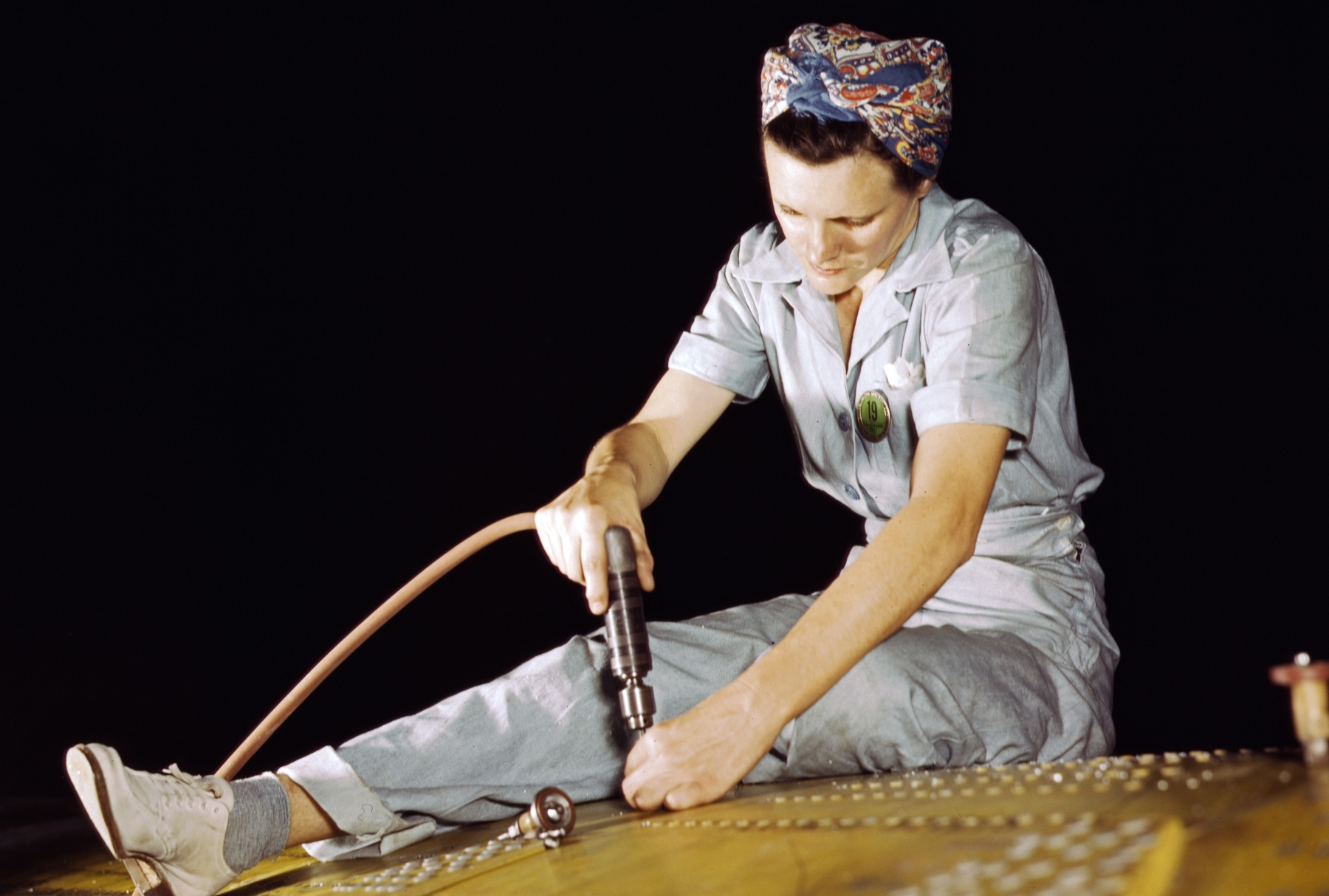
A woman, a la Rosie the Riveter, drilling on a Liberator Bomber, Consolidated Aircraft Corp, in Fort Worth, Texas, 1942 (Universal History Archive/Universal Images Group via Getty Images)
A sort of uniform to get her through her stressful life, Desna’s jumpsuits echo the 1910s origins of flight suits for pilots and later as wartime garb for World War II soldiers. Desna, reminiscent of the pilot Amelia Earhart, parachutes into the drug money laundering business and finds herself embroiled in battles between drug Mafias of the Dixie, Russian and Haitian persuasions and the DEA, not to mention trying to keep her ragtag crew of nail technicians and neurodivergent brother out of trouble.

As the jumpsuit roared into the 1920s, Italian artist and designer Ernesto Michahelles, under the moniker Thayaht, created one he dubbed the TuTa. Initially conceived of as an emblem of working class simplicity, it was however co-opted by the Florentine aristocracy as the fashion of the day. The German Bauhaus artists movement and Spanish anti-fascists identified with Thayaht’s vision of simplicity and practicality, though, and adopted the TuTa as their unofficial uniform.

The untility of the jumpsuit was soon also embraced by American women. Who can forget the headscarf-wearing, denim-clad Rosie the Riveter flashing her guns? This character was intrumental for the World War II defense campaign, became synonymous with the feminist movement and is still an enduring image of gender equality today.

Fast-forward to the ’70s when the jumpsuit became a staple of the dancefloor. The skimpy, sparkly versions worn by the likes of Cher, Debbie Harry, ABBA and the “Charlie’s Angels” stars are much closer in appearance to those worn by Desna, even if, metaphorically, hers still retain some of the jumpsuit’s original essence.

Even millennial icon Britney Spears’ red catsuit from the 2000 video for “Oops! I Did It Again” originally was supposed to signal a coming of age for the pop star who shot to fame dressed as a schoolgirl two years earlier in “. . . Baby One More Time,” but it takes on a whole new meaning today. After the #FreeBritney movement, the superstar was released from her 13-year conservatorship this year, and it now feels like the ensemble of emancipation.

Today’s jumpsuit means business

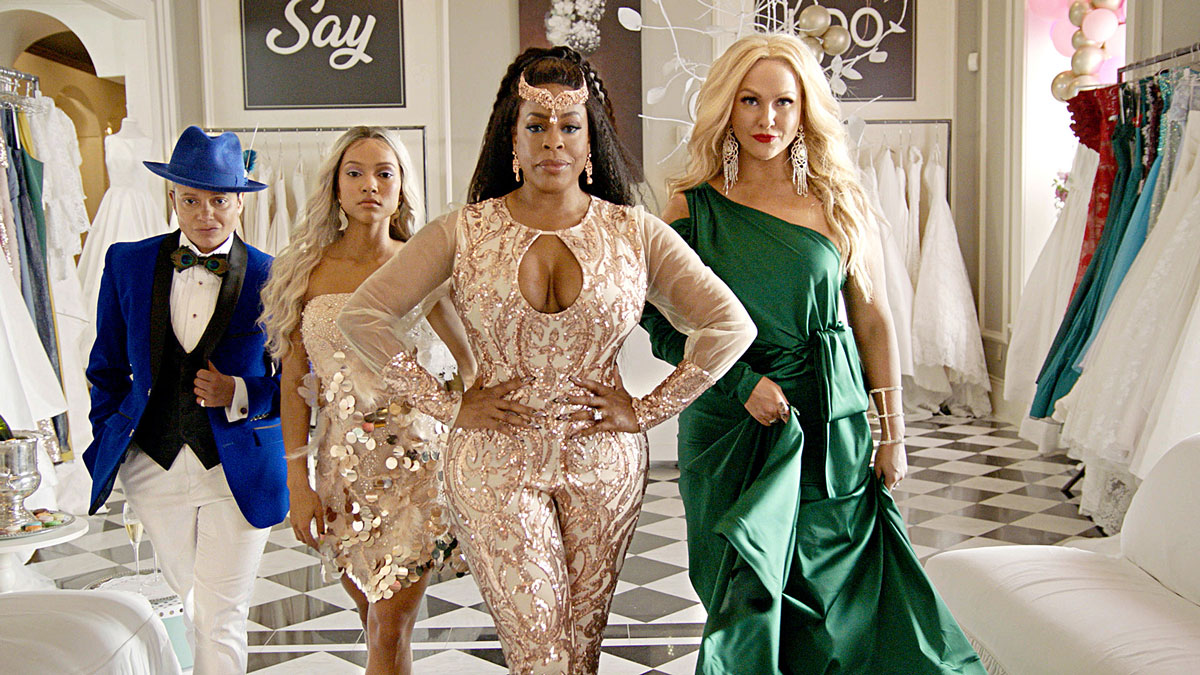
Claws cast“Claws” cast (TNT)

In today’s pop culture, jumpsuits are perhaps most commonly seen on superheroes with the comic book adaptation reigning supreme on screen. Positioning Desna alongside Cat Woman and Captain Marvel, Nash has said that the Claws costumes make her feel like a “strip-mall superhero” which is exactly what Ybarra is going for.

“[Desna] takes care of her brother, she’s the type of character who wouldn’t have the time to kind of figure out what to put on, matching tops to pants. So the onesie, as we call it, [is] easy peasy, you can put it on, and it works, it’s not really an outfit you have to think about it,” Ybarra says.

Calling back to the TuTa’s double meaning, we can see Desna’s struggle to rise above the so-called “low class” trades of drug money laundering and nail art that exist side by side in the Palmetto (nicknamed “Palm-ghetto”) strip mall in which “Claws” is set. It’s fitting that she employs the jumpsuit to prepare for her daily battles.

“I guess you could say it’s part of her armor of her being secure with her body, yes, but more in terms of being comfortable and being able to move while looking fashionable as well,” Ybarra agrees.


Want a daily wrap-up of all the news and commentary Salon has to offer? Subscribe to our morning newsletter, Crash Course.


Desna’s use of the jumpsuit also signals another step in the evolution of the outfit embraced by Rosie, Cher and Britney before her. And it’s specific to her empowerment as a Black woman.

“Desna’s jumpsuit is feminist,” says Essence editor Brooklyn White. “Being curvy hasn’t always been in style. And to be frank, Black women’s bodies are still heavily critiqued. ‘Claws’ is a femme-centric show, and the women are occupying space in their own lives that others might allow men to fill.”

Desna also takes up the mantle of modernizing the jumpsuit by embellishing it with accessories, shoes and, of course, nails. 

But it’s never just about the jumpsuit.

In a season 3 scene, Desna ponders the amount of jumpsuits $50,000 could buy.

“I don’t just want the jumpsuit,” Desna says. “I want the purse and the shoes to match.” 

On the glossy shellac exterior, it would seem Desna is talking purely about her appearance. But in the character’s struggle for upward mobility and to provide for her family throughout the course of the show, being able to freely spend money on a complete outfit signifies Desna’s desire for more.

“She’s now the boss, and she’s taken a role of being a lot more glamorous and looking boss-like, but in her own style,” Ybarra says.

“Claws” does this both figuratively but also literally in the body types of the characters on the show, particularly Desna’s.

“[The jumpsuit is] not just for a slender, thin person that’s 5’9″. Desna’s not a 5’9″. She’s a 5’2″ and she’s curvy and I think it’s made other people that have a voluptuous curvy body feel confident in thinking, ‘Hey, I can rock this as well and still look sexy and look good,’ and feel good about themselves,” Ybarra says. “I love being able to work with [Nash’s] curves and making her character feel confident and sexy at the same time.”

Through the many readings of the show’s jumpsuits, “Claws” has left a legacy of body positivity, inclusivity and the take-charge power of fashion.

Move over Fleabag. Niecy Nash is the jumpsuit fashion icon we need now.

“Claws” airs Sundays at 9 p.m. on TNT.

More stories you might like: 

Twitter permanently bans Marjorie Taylor Greene’s account for spreading COVID misinformation

Twitter has permanently suspended one of Rep. Marjorie Taylor Greene’s accounts for “repeated violations” of its COVID-19 misinformation policy, a spokesperson for the service confirmed Sunday.

The suspended account, @mtgreenee, was her personal and more prolific account. She will still be allowed to post from her official Congressional page, @RepMTG.

Her final tweet falsely referenced “extremely high amounts of Covid vaccine deaths” — a phenomenon with no basis in reality that nonetheless has been often repeated across right-wing media. The social media giant called it her fifth and final “strike.”

The controversial representative has been suspended from Twitter temporarily in the past for spreading false information about COVID-19 and conspiracies related to the 2020 election. The company warned her back in August that it would permanently take down her account if she violated its policies again, calling a post about vaccines “failing” her fourth “strike.” She was also suspended from the platform less than a month earlier for another post that claimed COVID-19 was not dangerous to anyone unless they are obese or elderly.

“We’ve been clear that, per our strike system for this policy, we will permanently suspend accounts for repeated violations of the policy,” Katie Rosborough, a Twitter spokeswoman, told The New York Times in a statement.


Want a daily wrap-up of all the news and commentary Salon has to offer? Subscribe to our morning newsletter, Crash Course.


Twitter’s decision to permanently ban a sitting congressperson comes just one year after it decided to hand down a similar ban to then-President Donald Trump in the wake of the Jan. 6 Capitol riot.

In response to the ban, Greene released a statement on alternative social platform Telegram, a favorite of the far-right for its lax moderation strategies.

“Social media platforms can’t stop the truth from being spread far and wide. Big Tech can’t stop the truth. Communist Democrats can’t stop the truth. I stand with the truth and the people. We will overcome!”

Read more on MTG (if you must):

Could ending period poverty be the secret to world peace?

For a few days there this past fall, I thought maybe I had the secret to world peace all figured out. It has to do with tampons. It’s a little complicated, though.

Back in October, United Nations Secretary-General António Guterres was moved to speak after viewing a UN photography exhibition by female photographers showcasing the “diverse experiences, knowledge and expertise” of women in peacekeeping around the world. “Too often, women remain on the periphery of formal peace processes, and they’re largely excluded from rooms where decisions are made,” he told a group of ambassadors. “We can no longer exclude one half of humanity from international peace and security.”

I was at the time taking a course in Peace and Conflict Studies, and Guterres’s remarks set me thinking about all the reasons why women are excluded from those rooms where decisions are made — and about all those other rooms they’re excluded from along the way. It’s hard to make it to the corridors of power when you can’t even go to school. It’s hard to go to school when you can’t even leave your home.


Want more health and science stories in your inbox? Subscribe to Salon’s weekly newsletter The Vulgar Scientist.


Lack of access to clean, safe period products is a staggering problem in every corner of the world. Advocacy group Global Citizen estimates that “500 million people live without adequate menstrual hygiene.” The repercussions are immense. (Of course, not everyone who menstruates identifies is female and not every cis female menstruates, but the majority of those affected by period poverty are female-identifying.) In a 2018 survey of girls funded by Always maxi pads, one in five said they had at some point “either left school early or missed school entirely because they did not have access to period products.”

A 2020 UNICEF and the World Health Organization study, meanwhile, found that “significant proportions of women in many developing countries are still struggling to safely manage their periods, lacking access to menstrual products, water and private places to wash and change.” The report found, for example, that “One in five girls and women in Ethiopia, Samoa and Laos, and one in seven in Niger and Burkina Faso used no suitable menstrual products during their periods, putting them at risk of infection and other health problems. More than half of women in Bangladesh said they are not participating in everyday activities while menstruating. In Chad and the Central African Republic, one in three said they were missing out.”

What’s striking isn’t just the difficulty so many women and girls face in managing their periods. It’s that, as CNN noted back in July, this study was “one of the first to collect and analyze data on menstrual health across a number of countries.” The very real and constant challenges of period management are often made all the more difficult because of silence, shame, ignorance and willful disinterest. As Amy Smith of Penn Nursing’s Center for Global Women’s Health observed about “The State of Period Poverty in the US” in 2019, “Without these items, women’s movement and ambitions are tampered. During these times, they may not feel able to leave their homes, go to work, or participate in civic life.” That’s a terribly wasted opportunity.

RELATED: More women are giving birth after uterus transplants — and experts say they could even be put in men

In 2020, the World Economic Forum noted that while “Girls are more likely than boys to miss out on school…. Every $1 spent on girls’ rights and education would generate a $2.80 return — equivalent to billions of dollars in extra GDP.” And as the Institute for Economics & Peace reports in turn, “Economic performance and peace are often mutually reinforcing. Better economic performance assists in building peace and vice versa.”

If you want further evidence of the potential here, just look at the significant overlap between the places where women are succeeding the most — like the global “Female Empowerment Hotspots” identified by UK company William Russell — and assessments like the Global Peace Index. It can’t be a coincidence that nations like Iceland, Ireland, Denmark, Finland, Norway, and Sweden and Canada place highly in both.

In the past several years, there’s been a stronger, more public push to fight period poverty. In India, “sanitary pad revolutionary” Arunachalam Muruganantham’s pad-making machine has helped create jobs for rural women, as well as delivering clean supplies to them. Resources like Days for Girls send kits for making washable, reusable pads all around the world. It stands to reason then that anything that helps girls and women attend school and go to work, to do all the things they need to get done in their lives, makes a better world for everybody. Here’s where it gets strange, though. When I started to look for evidence, I found almost zero hard data on the long term effects of these improvements.

I looked for reports from organizations that work on bringing menstrual supplies to communities in need, and their information about results was scant. Where was the proof that dropout rates were lowering, that grades were improving, that women’s incomes were rising in places where menstrual health had become a priority? When NEA News reported in 2020 that “In New York City, a pilot project showed attendance increased by 2.4 percent at schools with free period products,” that small uptick was viewed as evidence of success. Menstrual advocate Nancy Kramer, founder of Free The Tampons, told the publication at the time that “When they saw that, they voted to make it citywide, and then the state followed suit.”

I reached out to public health experts. Plenty of them had powerful stories of the negative impacts of period poverty, but almost nobody could tell me what got better once those gaps began to close. I had a chief medical officer for one organization tell me, “If more places provided these items, we could lessen this health crisis and offset preventable health conditions caused by period poverty,” but she couldn’t get more specific than that.

Finally, a representative for one menstrual health organization explained why I couldn’t find their data on metrics like school attendance or achievement. It’s because the don’t collect it.

They have good reasons not to. First of all, it’s challenging, especially in places with strong taboos around menstruation, to get people to talk about their periods. Beyond that, “If you measure this and your data is positive, the criticism of it is, what about other factors that contributed?” the representative explained. “How do you know it was the intervention? If the data is not as positive, there are so many factors that would contribute to a girl not being able to attend school or how she performs academically that it can’t solely be tied to an intervention.” As she told me, “It’s not just about menstrual health.”

I also talked to Amaia Arranz, COO & Social Impact Director of Ruby Cup, a European menstrual cup brand that has a buy one, give one imperative that has helped distribute 100,000 cups around the world. She told me that “The reports we have say that girls say they feel more confident in class. They are less scared of getting up and say, ‘I know the answer to this.'” But she acknowledged, “It seems to be very difficult to get any hard data on whether they stay in a school longer, if they married later in life, they avoid teenage pregnancy.” She explained that there are often many other compelling, systemic issues like poverty at play. “There’s so many obstacles stopping them from staying in a school and thriving that I think it would be too much of an ask to expect one thing to overcome all the other obstacles.”

Then she said the one thing I needed most to hear. “I also think that being able to manage one’s own period safely,” she said, “is a good outcome in itself. Sometimes I think, why do we need to show that these girls are getting better results in a school or they’re marrying later? Isn’t the fact that they don’t have to be using socks from their sneakers every month a good enough result? Do they also have to do something else to get their dignity respected?”

I’d been looking at this all wrong, all along. I still believe firmly that helping girls and women exist in a safe and healthy way makes the world a better place for all humans. But I also have a new appreciation now for the simple idea that girls and women shouldn’t have to plead their case so hard on this front either. What if every person who menstruates, regardless of their academic or vocational potential, could just bleed in peace?

Encouragingly, it’s getting better. In 2020, Scotland became first nation in the world to make period products free to “anyone who needs them.” Here in the US, in 2021, Ann Arbor became the first American city to “require by law the providing of menstrual products in public restrooms,” while Oregon schools enacted the Menstrual Dignity Act, “requiring free menstrual products” in schools. Similar bills are cropping up all over the country. Also in 2021, for the first time, the Joint Monitoring Program for Water Supply and Sanitation presented “emerging national data on menstrual health,” citing data collected from 42 countries as part of its goal of achieving “adequate and equitable sanitation and hygiene for all.”

More of these initiatives are in the pipeline, though there is opposition in some quarters.

“I don’t think the state of New Hampshire should be micromanaging schools regarding how and where to provide these products,” Republican Representative Judy Aron, a sponsor of a bill to undo her state’s requirement to provide free menstrual products in public schools, said in a House Education Committee hearing earlier this year. Voting against a bill to provide free menstrual products in her state’s public schools, Connecticut Republican representative Nicole Klarides-Ditrea similarly said, “I spoke to my superintendents and they said students all have access in the nurse’s office whenever they need to get them.”

Regardless of setbacks and pushback, though, menstrual rights are finally becoming a signifiant priority in communities all across the globe. Because they’re human rights. And as California Assemblymember Christina Garcia said after her state passed its own The Menstrual Equity for All Act in October, “Having convenient and free access to these products means our period won’t prevent us from being productive members of society.”

More women’s reproductive health stories: 

Nursing homes bleed staff as Amazon lures low-wage workers with Prime packages

ERLANGER, Ky. — The sleek corporate offices of one of Amazon’s air freight contractors looms over Villaspring of Erlanger, a stately nursing home perched on a hillside in this Cincinnati suburb. Amazon Prime Air cargo planes departing from a recently opened Amazon Air Hub roar overhead. Its Prime semi-trucks speed along the highway, rumbling the nursing home’s windows.

This is daily life in the shadow of Amazon.

“We haven’t even seen the worst of it yet,” said John Muller, chief operating officer of Carespring, Villaspring’s operator. “They are still finishing the Air Hub.”

Amazon’s ambitious expansion plans in northern Kentucky, including the $1.5 billion, 600-acre site that will serve as a nerve center for Amazon’s domestic air cargo operations, have stoked anxieties among nursing home administrators in a region where the unemployment rate is just 3%. Already buckling from an exodus of pandemic-weary health care workers, nursing homes are losing entry-level nurses, dietary aides and housekeepers drawn to better-paying jobs at Amazon.

The average starting pay for an entry-level position at Amazon warehouses and cargo hubs is more than $18 an hour, with the possibility of as much as $22.50 an hour and a $3,000 signing bonus, depending on location and shift. Full-time jobs with the company come with health benefits, 401(k)s and parental leave. By contrast, even with many states providing a temporary covid-19 bonus for workers at long-term care facilities, lower-skilled nursing home positions typically pay closer to $15 an hour, often with minimal sick leave or benefits.

Nursing home administrators contend they are unable to match Amazon’s hourly wage scales because they rely on modest reimbursement rates set by Medicaid, the government program that pays for long-term care.

Across the region, nursing home administrators have shut down wings and refused new residents, irking families and making it more difficult for hospitals to discharge patients into long-term care. Modest pay raises have yet to rival Amazon’s rich benefits package or counter skepticism about the benefits of a nursing career for a younger generation.

“Amazon pays $25 an hour,” said Danielle Geoghegan, business manager at Green Meadows Health Care Center in Mount Washington, Kentucky, a nursing home that has lost workers to the Amazon facility in Shepherdsville. The alternative? “They come here and deal with people’s bodily fluids.”

The nursing home industry has long employed high school graduates to feed, bathe, toilet and tend to dependent and disabled seniors. But facilities that sit near Amazon’s colossal distribution centers are outgunned in the bidding war.

“Chick-fil-A can raise their prices,” said Betsy Johnson, president of the Kentucky Association of Health Care Facilities. “We can’t pass the costs on to our customer. The payer of the service is the government, and the government sets the rates.”

And while gripes about fast-food restaurants having to close indoor dining because of a worker shortage have ricocheted around Kentucky, Johnson said nursing homes must remain open every day, every hour of the year.

“We can’t say, ‘This row of residents won’t get any services today,'” she said.

Reaching Upstream

Nationwide, long-term care facilities are down 221,000 jobs since March 2020, according to a recent report from the American Health Care Association and National Center for Assisted Living, an organization that represents 14,000 nursing homes and assisted living communities caring for 5 million people. While many hospitals and physicians’ offices have managed to replenish staffing levels, the report says long-term care facilities are suffering a labor crisis worse “than any other health care sector.” Industry surveys show 58% of nursing homes have limited new admissions, citing a dearth of employees.

Kentucky and other states are relying on free or low-cost government-sponsored training programs to fill the pipeline with new talent. Luring recruits falls to teachers like Jimmy Gilvin, a nurse’s aide instructor at Gateway Community and Technical College in Covington, Kentucky, one of the distressed River Cities tucked along the Ohio River.

On a recent morning, Gilvin stood over a medical dummy tucked into a hospital bed, surrounded by teenagers and young adults, each toting a “Long-Term Care Nursing Assistance” textbook. Gilvin held a toothbrush and toothpaste, demonstrating how to clean a patient’s dentures — “If someone feels clean, they feel better,” he said — and how to roll unconscious patients onto their side.

The curriculum covers the practical aspects of working in a nursing home: bed-making, catheter care, using a bedpan and transferring residents from a wheelchair to a bed.

“It takes a very special person to be a certified nursing assistant,” Gilvin said. “It’s a hard job, but it’s a needed job.”

Over the past five years, Gilvin has noticed sharp attrition: “Most of them are not even finishing, they’re going to a different field.” In response, nursing schools are reaching further upstream, recruiting high school students who can attend classes and graduate from high school with a nurse’s aide certificate.

“We’re getting them at a younger age to spark interest in the health care pathways,” said Reva Stroud, coordinator of the health science technology and nurse’s aide programs at Gateway.

Stroud has watched, with optimism, the hourly rate for nurse’s aides rise from $9 an hour to around $15. But over the years that she’s directed the program, she said, fewer students are choosing to begin their careers as aides, a position vital to nursing home operations. Instead, they are choosing to work at Walmart, McDonald’s or Amazon.

“There is a lot of competition for less stress,” Stroud said. A staunch believer in the virtue of nursing, she is disheartened by the responses from students: “‘Well, I could go pack boxes and not have to worry about someone dying and make more money.'”

Even for those who want a career in nursing, becoming a picker and packer at Amazon carries strong appeal. The company covers 100% of tuition for nursing school, among other fields, and has contracted with community colleges to provide the schooling.

Amazon is putting Kayla Dennis, 30, through nursing school. She attended a nursing assistant class at Gateway but decided against a career as a nurse’s aide or certified nursing assistant. Instead, she works at the Amazon fulfillment center in Hebron, Kentucky, for $20.85 an hour with health insurance and retirement benefits while attending school to become a registered nurse, a position requiring far more training with high earning potential.

“Amazon is paying 100% of my school tuition and books,” Dennis said. “On top of that, they work around my school schedule.”

Waiting for a Rising Tide

The nursing home workforce shortages are not a top concern for the state and local economic development agencies that feverishly pursue deals with Amazon. Cities nationwide have offered billions of dollars in tax breaks, infrastructure upgrades and other incentives to score a site, and the spoils abound: Amazon has opened at least 250 warehouses this year alone.

Amazon has been a prominent force in northern Kentucky, resurfacing the landscape with titanic warehouses and prompting pay bumps at Walmart, fast-food franchises and other warehouse companies. The company has “made significant investments in our community,” said Lee Crume, chief executive officer of Northern Kentucky Tri-County Economic Development Corp. “I’m hard-pressed to say something negative.”

Amazon representatives did not respond to interview requests for this story.

Some labor experts said Amazon’s “spillover effect” — the bidding up of wages near its hubs — suggests companies can afford to compensate workers at a higher rate without going out of business.

Clemens Noelke, a research scientist at Brandeis University, said that is true — to a point. Because Amazon draws workers indiscriminately from across the low-wage sector, rather than tapping into a specific skill profile, it is hitting sectors with wildly different abilities to adapt. Industries like nursing homes, home health care agencies and even public schools that rely on government funding and are hampered in raising wages are likely to lose out.

“There are some employers who are at the margin, and they will be pushed out of business,” Noelke said.

A survey conducted in November by the Kentucky Association of Health Care Facilities found 3 in 5 skilled nursing facilities, assisted living communities and care homes were concerned about closing given the number of job vacancies.

The solutions proffered by state legislators rely largely on nurse training programs already offered by community colleges like Gateway. Republican Rep. Kimberly Poore Moser, a registered nurse who chairs the state’s Health and Family Services Committee, said that while legislators must value health care jobs, “we have a finite number of dollars. If we increase salaries for one sector of the health care population, what are we going to cut?”

Moser said Kentucky’s bet on Amazon will pay off, eventually. “The more we inject into our economy, the more our Medicaid budget will grow,” she said.

That confidence in a rising-tide-lifts-all-boats approach frustrates Johnson, president of the Kentucky Association of Health Care Facilities. Lawmakers have difficulty grasping the complexity of financing a nursing home, she said, noting that Kentucky’s Medicaid reimbursement rates stagnated at a one-tenth of 1% increase for five years, before receiving a larger increase to offset inflation the past two years.

The Biden administration’s Build Back Better Act, still before Congress, would infuse billions of dollars into in-home care and community-based services for seniors, largely through federal Medicaid payments. It includes funding aimed at stimulating recruitment and training. But the measure is focused largely on expanding in-home care, and it’s not clear yet how it might affect nursing home pay rates.

For now, the feeding frenzy continues. Just off Interstate 65 in Shepherdsville, Wendy’s, White Castle and Frisch’s Big Boy dangle offers of “work today, get paid tomorrow.” FedEx signs along the grassy medians that once advertised $17 an hour are stickered over with a higher offer of $23. The colossal Amazon warehouse bustles with workers in yellow safety vests.

And in nearby Mount Washington, Sherrie Wathen, administrator of the Green Meadows nursing home, strains to fill a dozen vacancies, knowing she can’t match Amazon’s package for her entry-level slots. Instead, Wathen, who began her own nursing career at 18, tells prospective employees to consider life at a factory: “You’re going to have the same day over and over.”

At the nursing home, she said, “I am the only family this lady has. I get to make an impact rather than packing an item in a box.”

KHN (Kaiser Health News) is a national newsroom that produces in-depth journalism about health issues. Together with Policy Analysis and Polling, KHN is one of the three major operating programs at KFF (Kaiser Family Foundation). KFF is an endowed nonprofit organization providing information on health issues to the nation.

Being Desi Arnaz: The “flawed genius” that “Being the Ricardos” doesn’t show – or see

That bickering you hear? It’s fans of old Hollywood vivisecting Aaron Sorkin’s “Being the Ricardos,” the loudest voices devoted to the question of the sufficiency of Nicole Kidman’s transformation into comedy legend Lucille Ball. “Nicole Kidman Embodies Lucille Ball in First Full-Length ‘Being the Ricardos’ Trailer” was The Hollywood Reporter‘s Nov. 10 headline, but now that I’ve seen the film, I would argue that more wondrous is Javier Bardem’s metamorphosis — his speech, his swagger, his capacity to command a room — into Ball’s husband and “I Love Lucy” costar, Desi Arnaz.

Given that “Being the Ricardos” is a portrait of a troubled Hollywood marriage, why does it seem to be framed as Ball’s-slash-Kidman’s movie? I throw no shade in Kidman’s direction in saying this, but as I watched, I became convinced that the singing, scene-stealing Bardem, playing a character who behaves in ways that risk eroding audience sympathy, is doing the heavy lifting. How fitting, I can’t help but think, given that the real Arnaz was arguably doing the heavy lifting on “I Love Lucy.” 

Nothing will unseat Ball as a master of physical comedy, but “I Love Lucy” offers a different viewing experience when seen through a Desi-centric lens, which is the way I watched the sitcom some years ago when I was writing about “A Book,” Arnaz’s bawdy and almost ceaselessly entertaining 1976 autobiography. I stand by what I wrote at the time: “What he was doing on-screen was deceptively complicated: holding his own against Lucille Ball, building a sympathetic killjoy character, making you believe he would never divorce his lunatic wife, and keeping a straight face, sometimes while unleashing a logorrheal burst of Spanish.” I forgot to mention that he also had to sing.

RELATED: 16 nostalgia-inducing classic TV shows to watch with kids

And yet I haven’t found much of anything written on Arnaz’s performance as Ricky Ricardo. It must have smarted that he was the only one of the “I Love Lucy” four principals not nominated for an acting Emmy for the show. One would hope that applause for his behind-the-scenes accomplishments somewhat offset the sting: not only was Arnaz a crack executive at Desilu, the television production company he started with Ball, but he invented the three-camera technique for filming TV shows. By all accounts, this was a necessity-born innovation: it meant that he and Ball didn’t have to go to New York to make “I Love Lucy”; they could film the show in California, where they were starting a family and trying to patch their already fraying marriage. 

Lucie Arnaz, the actress-singer daughter of Lucy and Desi, doesn’t think her dad has gotten his due. (This I gleaned while the never-ending reel of YouTube interviews with old-Hollywood legends and their progeny coddled me through the worst days of the pandemic.) I’d have to agree. It’s an inconvenient truth for raving feminists like me that, while the unsung-woman-behind-her-more-famous-man story is more typical (see “Fosse/Verdon,” “How I Became Hettie Jones,” et cetera), there do exist gender-switcheroo examples of the at-least-as-talented guy overshadowed by his gal.

“Being the Ricardos” does reserve screen time for Desi’s unhappiness with being Lucy’s perceived sidekick. In one scene, efforts are made to placate bruised second banana Desi with an executive producer credit for “I Love Lucy.” There are also real-life tales of his demoralization. According to the TCM podcast “The Plot Thickens,” which commits its third season to Ball (and is not, it’s reasonable to conclude, taking the narrative liberties that Sorkin does in his movie), Desi blew a gasket in 1959 while on vacation with Lucy after he received a package addressed to “Mr. Ball.” The incident, according to one of Lucy’s relatives, exacerbated his already dedicated drinking.

In “The Plot Thickens,” Lucie Arnaz indicates that, when it came to underappreciating Desi, his parents were at the head of the line. He was born in 1917 in Santiago de Cuba, a city of which his father was at one point the mayor. During the Batista revolution of the 1930s, the well-heeled Arnaz family lost everything, and teenage Desi and his father fled to Miami to start life over again. Desi’s rise — musician turned bandleader turned actor turned cofounder of a production company with a hit TV show costarring him — was objectively impressive, but for the senior Arnazes it wasn’t enough. In “The Plot Thickens,” Lucie Arnaz says that her dad “had PTSD from the revolution, and from parents who never really said, ‘You know what? You’re phenomenal. What you’ve done is spectacular.’ They went, ‘Is that it? Is that all we got? Is there anything in there for me?'”


Want a daily wrap-up of all the news and commentary Salon has to offer? Subscribe to our morning newsletter, Crash Course.


In a 1977 TV interview with Barbara Walters conducted during what I’ve come to think of as Ball’s Phyllis Diller period, she acknowledges that within the industry, Arnaz wasn’t recognized for his contributions, and that his background played a part: “Even while they were building, they would not believe that he was doing the building. And he was doing the successful building of a very well-run empire. I was doing the acting and having the children. I had no part of it — I took that on much later. But I knew what he had suffered — really. And how he did not deserve that. And just because he was Cuban and once a bongo player did not warrant calling him any of those names.” 

After I saw “Being the Ricardos,” I wondered if, had Desi been alive to see it, he would have accepted the film as a form of restitution. I emailed my question to Lucie Arnaz, one of the people who presumably knew Desi best. (She was with her dad when he died of lung cancer in 1986, having finally gone into alcohol rehab not long before his diagnosis.) Lucie, who executive-produced “Being the Ricardos” and posted a video of herself in which she calls the film “frickin’ amazing,” told me this: “Both of them, I am certain, [would have been] very happy with the way they are portrayed in the picture. My father was portrayed with a great deal of professional respect and an enormous amount of love. Much the way I think Aaron Sorkin is hoping people will remember him: a flawed genius.”

Desi’s fatal flaw was his weakness for the ladies, and his affairs were at the heart of his and Lucy’s 1960 split, after two decades of marriage. “Being the Ricardos” doesn’t look at whether Desi’s chronic cheating had a psychological basis (an urge to hurt Lucy? Self-sabotage?) or whether his philandering might have reflected an unshakable cultural norm. (From “A Book”: “Having two houses and two sets of children was very common among Latin men of means, and Latin women understood this and didn’t make a fuss about it.”) To be fair, sticky psychosocial territory wasn’t within the scope of a snappy biopic like “Being the Ricardos.” And yet the film’s lopsidedness niggles at me. While it includes moments from Lucy’s perspective — there’s that key scene when she’s doing the laundry, for one — I don’t recall any scenes from Desi’s point of view. Had a scene of Desi alone been included, what might it have shown? What was Desi like, not just when the cameras weren’t rolling but when no one was watching him at all?

More stories you might like:

Mussolini seized full power 97 years ago: Does Donald Trump long to follow suit?

Any democratic government that decays into dictatorship will have its Mussolini moment, sooner or later. The original Mussolini moment came 97 years ago this week, when Italy’s government, up till then a constitutional monarchy with a democratically-elected parliament, officially abandoned any pretense of democracy. 

Before that, Benito Mussolini had been prime minister for three years, and his government administration had made considerable effort to convince the world that things were not as bad as they seemed and Italian democracy was just fine. (Thus illustrating Rochefoucauld’s famous premise that “hypocrisy is a tribute that vice pays to virtue.”)  After ascending to power in 1922, Mussolini did relatively little at first to undo Italy’s democratic institutions. He clearly wanted to remake Italian society for fascism, but also wanted to proceed with caution and avoid squandering his political capital. But after leading Italian socialist Giacomo Matteotti alleged that the fascists had used violence and fraud to win in the 1924 general election, Mussolini’s allies concluded that he had to act dramatically. Assassins tied to Mussolini assassinated Matteotti, leading anti-fascists to urge King Victor Emmanuel III to remove the prime minister from power. Meanwhile, Mussolini’s fascist followers, known as the blackshirts, gave him an ultimatum: Seize full power or watch his paramilitary crush the liberal and leftist opposition without him.

So on Jan. 3, 1925, Mussolini uttered these immortal words: “I, and I alone, assume the political, moral and historical responsibility for all that has happened.”

Making it clear that Matteotti had been killed on his behalf because of him, and that the justice system would do nothing about it, Mussolini put an end to any remaining illusions that he was not the supreme leader of Italy. Not even the king could hold him accountable, let alone police, prosecutors or judges. From that moment on, Il Duce (“The Leader”) openly behaved like a dictator, and held power for nearly 20 years, through his infamous alliance with Hitler, war with the Allies and complicity in the Holocaust.

RELATED: Fascism in America: It’s nowhere near as new as you might think

Mussolini had started out as a schoolteacher and socialist, only switching to fascism and the far right after World War I. In 1921 he was elected to the Chamber of Deputies (the lower chamber of Italy’s parliament) and quickly emerged as the leader of the country’s growing fascist party. On domestic policy, he preached rule by the nation’s economic elites, claiming they would lead a “revolutionary nationalism” that promoted the nation’s best interests. Mussolini believed in class hierarchy, but stimulated a working-class through grandiose displays of Italian nationalism, meant to inspire enthusiasm for a nation-state that had only existed for about 50 years. (Before that, the Italian peninsula had been divided into various different kingdoms, duchies and principalities.)

Mussolini also wanted to inculcate militant values into the nation’s youth, training a nation of supposedly hyper-masculine warriors who would restore Italy to its ancient glory and wage war against socialism and other egalitarian ideologies. His foreign policy vision was overtly racist and imperialist, even though the modern Italian state was far too weak, both in military and economic terms, to build a new Roman Empire.

These ideas drew together various right-wing factions in Italian society — workers alienated by socialism, the wealthy, idealistic young men, Catholic conservatives and young men seduced by adventurous rhetoric. In October 1922, Mussolini had enough momentum to lead a coup d’état known as the March on Rome. Prime Minister Luigi Facta wanted to declare martial law and send in the army to stop the fascists, but King Victor Emmanuel refused to allow it, worried that such a confrontation would lead to wider violence and possibly civil war. Instead, the king gave in to Mussolini’s demands and appointed him prime minister. That was the beginning of the end: Empowered and emboldened, Mussolini instructed the legislature to grant him extraordinary powers, broke up unions and restructured the state to concentrate power in his own hands (and those of his fascist allies). 

So by the time Mussolini openly seized power, roughly 26 months later, it was essentially a fait accompli. Many people opposed him, and many were horrified, but they no longer had the strength to stop him. So that’s a Mussolini moment: When a dictator announces to the world that he’s a dictator — as his adversaries have been saying all along — and it’s too late to do anything about it.


Want a daily wrap-up of all the news and commentary Salon has to offer? Subscribe to our morning newsletter, Crash Course.


If all that sounds a little too close to home, it probably should. Donald Trump planted the seeds for his Big Lie about the 2020 election years ago, and his opponents — including many Republicans, at least at first — didn’t take him seriously. In refusing to accept defeat, he broke the United States’ 220-year precedent of peaceful transfers of power, forever changing the dynamics of how presidents are expected to behave. And that’s all before we get to the lame-duck president urging a mob of supporters to attack the Capitol last Jan. 6, with the apparent goal of overturning Joe Biden’s electoral victory. 

While Trump hasn’t yet succeeded in overthrowing democracy, he also has not been held accountable, despite two impeachment trials, and apparently will not be prosecuted by the Biden administration. As with Mussolini, Trump’s actions during the 2020 election cycle demonstrated that he viewed himself as above the law. And like Mussolini, Trump remains beholden to his most extreme followers. When far-right supporters like Alex Jones denounced him for supporting COVID-19 boosters vaccines, Trump shifted position. That also happened during his presidency, as when he briefly flirted with endorsing gun control laws, until the NRA and its allies let him know that was off limits. 

Trump repeatedly tried to declare himself the winner after the 2020 election; it simply didn’t work. If he or someone like him runs in 2024, we’re likely to see that again — and if Trump or his proxy loses, they’ll have loyalists installed in key positions throughout swing states ready to reverse the results. So the next time Trump (or whoever follows him) simply claims to be the legitimate president regardless of the actual results, that person may already have the machinery in place to create America’s Mussolini moment.

Read more on the fascist resurgence in America:

Not all calories are equal – a dietitian explains how eating different kinds of foods matter

A calorie is a calorie is a calorie, at least from a thermodynamic standpoint. It’s defined as the amount of energy needed to raise the temperature of 1 kilogram of water by 1 degree Celsius (2.2 pounds by 1.8 degrees Fahrenheit).

But when it comes to health and your body’s energy balance, not all calories are equal.

For example, some studies have reported that diets that are high-protein, low-carbohydrate or a combination of the two do yield greater weight loss than diets with other levels of fat, protein and carbs.

If every calorie in food were the same, you wouldn’t expect to see weight-loss differences among people who eat the same number of calories that are doled out in different types of food.

Dietitians like me know there are many factors that influence what a calorie means for your body. Here’s what we understand about calories and nutrition so far.

Energy actually available to your body

In the late 1800s, chemist W.O. Atwater and his colleagues devised a system to figure out how much energy – that is, how many calories – various foods contain. Basically, he burned up food samples and recorded how much energy they released in the form of heat.

Not every bit of energy in food that can combust in the lab is actually available to your body, though. What scientists call metabolizable energy is the difference between the total energy of the food consumed and the energy that passes out of your body, undigested, in feces and urine. For each of the three macronutrients – proteins, carbohydrates and fats – Atwood devised a percentage of the calories they contained that would actually be metabolizable.

According to the Atwater system, one gram of each macronutrient is estimated to provide a certain number of calories. The U.S. Department of Agriculture still uses these calculations today to come up with an official calorie number for every food.

How much energy you use

What you eat can affect what scientists call your body’s energy expenditure. That’s how much energy it takes to keep you alive – energy you use breathing, digesting, keeping your blood flowing and so on – along with what you exert moving your body. You might have heard this referred to as metabolism.

Diet quality can alter the body’s energy expenditure, which is also called the thermic effect of food. For example, in one study, people eating the same number of calories per day but on either a low-carbohydrate diet or a low-fat diet had differences in total energy expenditure of about 300 calories per day. Those eating very low-carb diets used the most energy, while those eating low-fat diets used the least.

In another study, high-fat diets led to lower total energy expenditure than high-carb diets did. Other researchers reported that although substituting carbs for fat did not alter energy expenditure, people who increased their protein intake to 30%-35% of their diet used more energy.

In general, diets high in carbohydrates, fat or both produce a 4%-8% increase in energy expenditure, while meals high in protein cause an 11%-14% increase above the resting metabolic rate. Protein has a higher thermic effect because it’s harder for the body to break down. Although these variations aren’t huge, they could contribute to the obesity epidemic by encouraging a subtle average weight gain.

Quality of the calories you eat

Dietitians pay attention to a food’s glycemic index and glycemic load – that is, how quickly and how much it will increase your blood glucose levels. A rise in blood glucose triggers the release of insulin, which in turn influences energy metabolism and storage of excess energy as fat.

Foods like white rice, cakes, cookies and chips are all high on the glycemic index/load. Green vegetables, raw peppers, mushrooms and legumes are all low on the glycemic index/load. There is some evidence to suggest that foods lower on the glycemic index/load may be better for keeping blood sugar levels regulated – regardless of the calories they contain.

Reward centers in the brain light up when people eat high glycemic index/load foods, highlighting the pleasurable and addictive effect of foods like candy or white breads.

The fiber content of food is another thing to consider. Your body can’t digest fiber – found in plant foods like fruits, vegetables, whole grains and beans – for energy. So foods high in fiber tend to have less metabolizable energy and can help you feel full on fewer calories.

Empty calories – those from foods with minimal or no nutritional value – are another factor to consider. Things like white sugar, soft drinks and many ultra-processed snacks don’t provide much, if any, benefit in the form of protein, vitamins or minerals along with their calories. The opposite would be nutrient-dense foods that are high in nutrients or fiber, while still being relatively low in calories. Examples are spinach, apples and beans.

And don’t think of empty calories as neutral. Nutritionists consider them harmful calories because they can have a negative effect on health. Foods that are the biggest contributors to weight gain are potato chips, potatoes, sugar-sweetened beverages and meats, both processed and unprocessed. On the other hand, foods that are inversely associated with weight gain are vegetables, whole grains, fruits, nuts and yogurt.

More to health than calories and weight

It is indisputable that for weight loss, the difference between the number of calories consumed and the number of calories exerted through exercise is the most important factor. But don’t fool yourself. While weight plays a role in health and longevity, weight loss alone doesn’t equate to health.

Yes, some high-protein diets seem to promote weight loss at least in the short term. But epidemiologists know that in areas where people live the longest – close to 100 years on average – they eat a primarily plant-based diet, with very low or no animal-based protein and low or moderate fat in the form of mono- and polyunsaturated fats.

I often hear friends or clients say things like “it’s those carbs that are making me fat” or “I need to go on a low-carb diet.” But these complaints drive dietitians like me, well, nuts. Carbohydrates include foods like Coca-Cola and candy canes, but also apples and spinach. Cutting down on simple carbs like soft drinks, refined-flour bakery items, pasta and sweets will definitely have a positive impact on health. But eliminating carbohydrates like vegetables and fruit will have the opposite effect.

A plant-based diet high in plant-based protein and carbohydrates mostly from vegetables, fruit, nuts and legumes is the healthiest diet researchers know of for longevity and prevention of chronic diseases like heart disease, cancer, hypertension and many other conditions.

The modern Western diet suffers from an increase in quantity of calories consumed with a concurrent decrease in the quality of calories consumed. And researchers now know that calories from different foods have different effects on fullness, insulin response, the process of turning carbs to body fat, and metabolic energy expenditure.

Where your health is concerned, count more on the quality of the calories you consume than the calorie count.


Terezie Tolar-Peterson, Associate Professor of Food Science, Nutrition & Health Promotion, Mississippi State University

This article is republished from The Conversation under a Creative Commons license. Read the original article.

My mom finally made her choice, after a lifetime colored by the one she wasn’t allowed

My mother’s death was as peaceful as her life had been tumultuous. After years of dementia and a recent bout of sepsis, she slipped away quietly in her sleep earlier this month, in the care facility where she’s resided for the past year and a half. When I got the call, I immediately remembered how often when I was growing up, she’d casually express how she wished she could fall asleep at night and never wake up. It gives me comfort to know that in the end, she got the death she would have chosen for herself. Most of her life, my mother didn’t have a choice at all.

She had just turned 21 when she learned she was pregnant by her ex-boyfriend, a man who had recently dumped her. She had already started dating someone else. She was living with her parents. She had a low wage job in a department store, a high school diploma, and a mother who told her she’d kick her out if she didn’t get married. This was before Roe v. Wade, and the poor girl was Catholic to boot.


Want a daily wrap-up of all the news and commentary Salon has to offer? Subscribe to our morning newsletter, Crash Course.


My parents were strong armed into doing the seemingly right thing. There are no photos of their wedding. There is only one picture of the two of them together at all. They are sitting outside in a wicker loveseat, their faces inscrutable. My mother is six months pregnant. My father will leave her a few days later, heading out for work in the morning and telling her simply, “I’m not coming back.” In the third trimester, my father decided he really didn’t want a baby, so he exercised his right not to have one.

My mother never tired of telling me how harrowing her pregnancy and early motherhood was. I can’t recall ever not knowing of her botched attempts at miscarriage, or how she wished it had been cancer instead. I remember her telling me how she had prayed she would die when she was in labor, and how, when her brothers would wander in and out of the house, free and unencumbered by family obligations, she envied them. (She never once, however, expressed a wish she’d been able to have an abortion. That would have been a sin.) As I grew older, she told me just as frankly how difficult it was for her that I resembled my father so strongly, and that I’d had so many opportunities she’d never been granted. After I hit 21 myself, she never acknowledged a milestone in my life without commenting, “When I was your age, I was raising a child.”

She didn’t say those things to me to be cruel — her cruelties had an altogether different tenor. She said them because she had so much shame around her feelings, and like any good Catholic girl, she felt a need to confess. I just think she wanted forgiveness. A child is always supposed to be a blessing, and motherhood is always supposed to be your highest purpose as a woman. It was true in her day, and it’s still very much the default expectation now. I can only imagine how deeply all of her frustration and pain around the subject troubled her.

RELATED: The Christian right didn’t used to care about abortion — until they did

I know that my mother loved me, and I can look back on my early years and recognize how much good there was in them. I can see myself next to her in the front seat of her car — because child safety had not been invented yet — singing along with every pop song on the radio. She was young, after all. She loved music. She loved to dance. She looked cute in everything she wore. And when I could function as her similarly cute little friend, we always had a great time. It was the parenting part she always wrestled with.

There’s no way of telling what my mother might have become had she not been forced to become a single mother at such an early age. Her social class, gender and family history of mental illness would have been just the same. But she might have had a more fair shot at a life of her own making. If nothing else, she would have had more time. Time to be that spirited, carefree young woman that I sometimes caught glimpses of, and remember most fondly. I have never felt that lost opportunity more acutely than I have these past few days, knowing that she is gone and everything she might have been is gone with her as well.

I was not much older than she had been when she had me when I endured a contraceptive failure and a late period of my own. In that brief, panicked period of wondering, before the reassuring verdict of a home pregnancy test, I vividly imagined two futures for myself. Because I could. I could choose motherhood, just as I could choose abortion. The path would have been mine to take. The foes of reproductive freedom always seem to make it out that choice equals abortion. It’s actually so much simpler — choice means choice. When you hear those stories of supposedly brave women who faced an unplanned pregnancy and “chose life,” just remember, that would not be possible if you took away the choice part.

Over the years, several of my friends have faced similar dilemmas, because roughly one in three women will have an abortion in her lifetime. In my unscientific observation, I don’t know a single woman who has regretted her abortion, just as I don’t know a single woman who has regretted having her children. That’s the incredible gift that so many of us (though fewer and fewer all the time) who’ve come of age after Roe have been given — not just for us, but our kids too.

There are plenty of people walking around in this world whose conceptions were not planned but whose presence nine months later was still welcomed and cherished. And there are others whose mothers clearly and explicitly wanted not to be pregnant, whose circumstances were truly dire, and who never got a say in the matter. It is not easy being either the mother or the offspring in that latter population. Forcing women to have babies is nothing short of punitive. It is punitive toward them, it is punitive toward the children they bear.

My firstborn is 21 now. When her grandmother was that age, she’d no doubt have told her, she was raising a child. Looking at her, it really does blow my mind. My daughter is, in so many ways, just a kid. But she is first and foremost her own woman, which means that at least for now, she gets to decide when and if she has children. Her younger sister is currently applying to colleges, and the two sisters had a rueful laugh on Christmas when their cousin in Austin asked if there were any Texas universities on the shortlist.

It’s infuriating that my children’s generation faces more serious obstacles to their reproductive rights than mine has. It is outrageous that we have a Supreme Court with judges who cavalierly wave away women’s legitimate concerns by babbling about safe havens, as if childbirth in this country is not for many a physically and psychologically dangerous proposition. I’m not going to change anybody’s mind by saying this; it doesn’t negate the truth of it.

My father’s retreat had been singular and abrupt; my mother’s was cumulative and slow. In retrospect, I had seen it coming my whole life. I’m not qualified to offer a psychiatric diagnosis, but I have my own guesses, and I witnessed firsthand how much she struggled with her mental health. That struggle manifested in multiple ways, including in the icy silences she instituted for family members and friends when she grew angry at them, or simply weary of their company. With me, things started to change when I had my own children. She found excuses not to come to birthday parties and Christmases. Then she stopped answering her phone. Eventually, she cut herself off from everyone — her siblings, her in-laws, everybody — except her second husband.

My mother did her best, she really did, and I turned out OK. I still love her and grieve for her, and I will be doing both for the rest of my life. But nothing can change the fact that a sheltered girl, loved only conditionally by her parents and her community and not at all by the man who got her pregnant, was let down by everybody when she was at her most frightened and vulnerable. Nothing can change that my good life came at the expense of hers.

My mother didn’t want to be a mother, not like that anyway, and she spent the remaining decades of her life traumatized because she was made to become one regardless. In time, though, she found a way to extricate herself from that identity, just like a trapped animal will leave behind a limb as the price of escape. In her final years, my mother made a choice. And when I stepped back in to her life after my stepfather died suddenly in 2020, I was not particularly surprised to learn how many of my mother’s care providers had no idea that she’d ever had a daughter.

More life stories: 

Trying to recreate Hamburger Helper was the best thing for my cooking in 2021

One of the best things that I did this year for my cooking practice, if you will, was embarking on a journey to make the perfect homemade version of Hamburger Helper. As I’m typing this out, I recognize how ridiculous it sounds, but to borrow and bastardize a line from the “Royal Tenenbaums,” immediately after making this statement, I realized that it was true.

It took a few months, and a few more dirtied pots, but the process was absolutely worth it. Like many folks, the last two years have brought a lot of cooking from home. There were times that I actively leaned into that new normal, perfecting my challah braiding and growing a scallion on my windowsill along with the rest of the country. Then, there were times when I couldn’t shake the feelings of fatigue that ulderlied seemingly simple tasks, like shopping for groceries or making dinner

RELATED: Burned Out: How to grocery shop when you’re sick of cooking

It was during one of those times that I found myself within the aisles of my local Kroger, staring at a wall of boxed pasta. All of my standards for “simple” — spaghetti carbonara, cacio e pepe, aglio e olio — felt either unexciting or like too much effort and I didn’t have the mental energy to whip up a replacement on the spot. 

Almost without thinking, I took a few steps to the left and grabbed a box of Hamburger Helper from the shelves. I ducked over to the meat counter for a pound of ground beef and suddenly I had a complete dinner in my basket. I probably hadn’t made Hamburger Helper since college, but that night, it seemed exceptionally good. I mean, it hits all the right “comfort food” notes, without being particularly nuanced. It’s cheesy and creamy with just a little pep from the dehydrated vegetables and spices. 

Is it fine dining? No, but amid a constant flurry of promises from recipe writers and food TikTokers — sheet pan dinners, five-ingredient fixes, no-mess food prep —  here was the platonic ideal of the one-pot meal, and I wanted to make it my own. I fished the box out of the top of the trash and took a glance at the ingredient list: 

Enriched Macaroni, Corn Starch, Salt, Modified Whey, Sugar. Contains 2% or less of: Tomato*, Cheddar Cheese*, Onion*, Garlic*, Citric Acid, Vegetable Oi, Buttermilk*, Whey*, Yeast Extract, Annatto Extract , Spice, Monoglycerides, Sodium Phosphate, Gum Arabic, Natural Flavor, Silicon Dioxide. 

I noted that anything with an asterisk next to it was dried, and the process felt a little bit like the start of one of pastry chef Claire Saffitz’s “Gourmet Makes” videos, which she used to produce through Bon Appetit. In each episode, Saffitz would be tasked with recreating a well-known junk or comfort food, ranging from Ruffles potato chips to Girl Scout cookies

When I first stumbled upon the series in early 2020, I initially wondered why someone would spend their time in the kitchen attempting to recreate something that was so singular, but just as quickly I was hooked. I watched Saffitz strategize and stress about technique. She often went back to the test kitchen drawing board more than once in order to translate back-of-packet lists filled with unpronounceable ingredients into a grocery list of recognizable food. 

In doing some research about the series, I came across an interview with Into the Gloss that Saffitz had done. She told the publication that she remembers in one video making an Oreo that turned out really well.

“I remember tasting the homemade Oreo and thinking, ‘Wow, it really tastes like an Oreo,’ and then trying the original Oreo and thinking, ‘Oh, it tastes kind of bad,'” she said. “The best possible outcome is when the homemade version tastes the way you thought the original tasted when you were a kid. That’s like peak nostalgia.” 

I felt like that was a solid goal to which to aspire: Make a homemade Hamburger Helper that tastes as good as the boxed version did on the night I became re-enamored with it. With this came a few loose guidelines: 

  • Use only items that are available at the local supermarket 
  • Keep it affordable; I kept a (generous) $20 cap 
  • Keep the dish a one-pot meal

The ingredient list on the back of the box was my original guide. Boxed macaroni, grated cheddar cheese, white onion, minced garlic, tomato sauce, whole milk and ground beef. I followed the basic steps — make the pasta, brown and drain the beef, saute the minced garlic and onion in the same pot. I started to build a sauce by whisking the tomato sauce, milk and cheese over medium heat until it began to bubble and thicken. The pasta went back in the pot followed by the meat and a few generous pinches of salt and pepper. 

It was a decent first attempt, but it wasn’t quite right. Despite being thickened, the sauce was still too loose and didn’t taste quite “lactic” enough; it was overwhelmingly tomato-heavy. It also needed some kind of punch (likely the “spice” and “natural flavor” on the original ingredient list). 

Thanks to being a little heavy-handed with Italian seasoning, the second round veered too far into weird spaghetti sauce territory, while chipotle chili powder led — perhaps unsurprisingly — to a pot of chili mac. Smoked paprika, however, when paired with a little dried thyme and oregano hit all the right notes. 

I knew that cheddar was the right cheese to use, but it alone wasn’t achieving the slightly sour, tangy flavor that Hamburger Helper from the box has. It wasn’t yogurt, it wasn’t a last-minute swirl of sourcream and, despite the clue on the box, it wasn’t fresh buttermilk. Ultimately, the right combination ended up being good, fresh butter, a little cream and dried buttermilk powder, which you can typically find in the baking aisle by the pancake and waffle mixes. 

The ingredient list bloated, slimmed down and shifted through time. I eventually strayed from elbow macaroni and experimented with wagon wheel-shaped pasta. I’d initially stuck to thin-minced white onions, but it turns out a few shallots or even a small red onion do in a pinch. 

I played around with process, too, from experimenting with whether or not you really need to drain the beef (you do!) to whether the final product benefits from a little time in the oven (it does!). I finally stumbled upon the right version, the one that honestly tasted better than the stuff from the box, with its slightly oven-browned cheese crust and a sprinkling of fresh-sliced scallions. 

It’s not necessarily the most faithful adaptation, but looking at that final iteration, I realized that I’d learned a lot. For instance, tomato paste, when mixed with a little good beef stock, has the most beautiful umami flavor. Or that making a roux to thicken a sauce is almost always worth the effort. Or that buttermilk powder is my new favorite ingredient to achieve tanginess. But perhaps most importantly, the process made me remember that culinary inspiration can come from unexpected places. Look for the helpers — particularly those with hamburger.

More super simple dinners: 

This 5-ingredient ‘nduja butter orzo is a spicy, buttery one-pot meal

In 2009, Greg Morago of the Houston Chronicle interviewed chef and TV host Claire Robinson, who was in the midst of promoting the fourth season of her hit Food Network program “Five Ingredient Fix.” As the title suggests, Robinson, who is a French Culinary Institute graduate, would craft dishes from five ingredients (not counting pantry staples like salt, pepper and oil) that would work for both weeknight dining and special entertaining. 

Morago asked Robinson why she had decided on five ingredients. Why not four, six or 10? 

“Five is an amount of ingredients I can always remember at the store on one hand, yet still the amount of ingredients needed to put together an amazing-tasting recipe,” Robinson responded. “Each recipe is full of flavor but not the end of taste possibility. Therefore, rather than limiting myself, I am choosing the essential ingredients for a wonderful recipe and allowing people to add to it, if they choose, and be a chef in their own home, or just cook it as I do, and enjoy the great flavors I have put together.”

RELATED: Cacio e pepe pie is an insanely easy pasta dinner to make on nights when you don’t feel like cooking

The series was a hit; it ran for six seasons and 70 episodes. In a recent Reddit poll on which early ’00s Food Network fans would like to bring back, “Five Ingredient Fix” was a clear frontrunner, receiving the second highest number of votes. 

Food media has changed a lot in the ensuing decade — it’s more prevalent and much of it is more tailored to an audience who views cooking as either a competitive sport or an intricate hobby. However, it’s clear from that poll that people are still (pardon the pun) hungry for meals that come together simply and quickly but pack a big bunch of flavor. 

I was thinking about this the other day when I was short on time and tote bag space on a quick shopping trip. I wanted something celebratory to mark the release of a book to which I’d contributed. However, it was a Wednesday evening, and I didn’t have a ton of bandwidth. I thought, “What would Claire Robinson do?” She’d pick five ingredients that really shine individually — and especially when paired together. 


Want more great food writing and recipes? Subscribe to Salon Food’s newsletter.


I started with orzo, a quick-cooking pasta that kind of looks like jumbo grains of rice. I contemplated a variety of sauces while poking around the store before I came across a small packet of ‘nduja, which is a fully-cooked spreadable pork sausage. That was it! A few years ago, I’d had crispy potatoes brushed with ‘nduja butter — which was made by simply whipping good unsalted butter and ‘nduja together — and the combination was life-changing. Why not use ‘nduja butter as a play on simple buttered pasta? 

I grabbed a bunch of arugula to add some green to the dish and echo the peppery notes in the sausage, as well as some good parmesan cheese. I left the store with my five ingredients and set to work.

Before we dive in — what are your favorite recipes that are made using five ingredients or less? What “superhero” ingredients do you find yourself reaching for to make a meal feel complete? Let us know by sending us a note at food@slaon.com. (FYI: This recipe was first found in Salon Food’s weekly newsletter. Don’t forget to subscribe to ensure you don’t miss any future editions.)

***

Recipe: ‘Nduja Butter Orzo with Arugula 

Yields: 4-6 servings 
Prep Time: 10 minutes
Cook Time: 20 minutes  

Ingredients

  • 1 pound of orzo (reserve 1/2 cup of pasta water) 
  • 4 ounces of ‘nduja 
  • 4 ounces of unsalted butter
  • 2 loosely packed cups of arugula 
  • Grated parmesan 

Directions

1. Cook the orzo according to the package directions, reserving 1/2 cup of pasta water before draining. 

2. Meanwhile, whip together the ‘nduja and butter — by hand or using a small blender — until it’s smooth and cohesive. 

3. Return the orzo to the pan, along with the ‘ndjua butter and the arugula. Over medium-low heat, stir until the butter begins to coat the pasta and the arugula begins to wilt; add the pasta water, a tablespoon at a time, until the ‘nduja butter becomes more like a glossy sauce. 

4. Divide the orzo between serving bowls and garnish with grated parmesan. 

Here are five of our favorite five-ingredient (or less) recipes 

The absolute best way to cook shrimp, according to so many tests

In Absolute Best Tests, our writer Ella Quittner destroys the sanctity of her home kitchen in the name of the truth. She’s seared more porterhouse steaks than she cares to recall, tasted enough types of bacon to concern a cardiologist, and ranked potatoes from “most forgettable” to “potatoes we’d like to marry.” Today, she tackles shrimp.


Humankind’s first known shellfish feast occurred sometime around 163,000 B.C., in a cave on the southern coast of South Africa. Many millennia later, excavators found a bowl of roughly two dozen edible creatures, including mussels and at least one barnacle that had previously resided on the belly of a whale.

Humankind’s most bizarre known shellfish feast occurred sometime around 7 a.m. last Tuesday in my apartment. It consisted of just me, a whole pound of butter, and more shrimp than would comfortably fit in my crisper drawer. I emerged several hours later, grease-battered, weary, and surprised by several of my findings. It was, in other words, an average Absolute Best Tests trial day.

Let’s make like a crustacean and dive in:

Controls

I stripped out as much accoutrement and seasoning from the recipes as I could, but left basics like oil, butter, lemon, salt, red pepper flakes, cayenne, and garlic. I used differently sized shrimp — sometimes with the shell or head still affixed, sometimes peeled — depending on what best suited the method. My salt of choice is Diamond Crystal.

A quick note on shrimp versus prawn terminology: In her book “What’s the Difference?,” Brette Warshaw explains, “Anyone who tries to tell you that shrimp and prawns taste different is wrong.” That said, Warshaw details the differences between the two shellfish, noting that, “Both shrimp and prawns are decapods, which mean they have external skeletons and ten legs. Prawns live in fresh water, while shrimp can come from either fresh water or salt water. Generally speaking, prawns are larger than shrimp — though this depends on the species.” All of the methods below can be used with either prawns or shrimp.


Methods and Findings

Sear

Adapted from Food52.

  • 1 pound large shrimp, deveined, shell on
  • Finely grated zest of 1/2 lemon
  • 1/2 teaspoon kosher salt
  • 1/8 teaspoon cayenne pepper
  • 1/4 cup unsalted butter, cut into tablespoons
  • 4 garlic cloves, minced
  • 3 tablespoons freshly squeezed lemon juice
  1. In a bowl, toss the shrimp with the lemon zest, salt, and cayenne until it’s coated well.
  2. In a large frying pan or wok, heat 3 tablespoons of butter over medium-high heat. Once the butter is foaming, add the garlic and lemon juice. Sauté for about 2 to 3 minutes, until the garlic has softened.
  3. Add the shrimp. Sauté until they cook through and turn pink, about 3 minutes. Take the pan off the heat and stir in the remaining butter.

I tested this method with both shell-on and peeled shrimp. The latter was fine, with shrimp that were less tender than some of the slower-cook methods like roast. But the shell-on test produced buttery, juicy shrimp that stole the show (the show being me, barefoot, eating shrimp in the morning). I suspect that the extra layer kept the shrimp from drying out as quickly when cooked over high heat. The shell also trapped the lemon, fat, and seasoning, which lent the meat more hearty, deeper-seated flavor than the peeled batch.

Pros: Efficient, moderately delicious. 
Cons: Less tender when the shrimp are pre-peeled.

Roast

Adapted from Food52.

  • 1 pound medium shrimp, peeled and deveined
  • 1/2 teaspoon kosher salt
  • 4 garlic cloves, grated
  • 2 tablespoons extra-virgin olive oil
  • 1/2 teaspoon red pepper flakes
  • 1 lemon, zested and juiced
  • 2 tablespoons unsalted butter
  1. Heat the oven to 450°F.
  2. On a half sheet pan, toss the shrimp, salt, garlic, olive oil, red pepper flakes, and lemon zest. Let sit for 10 minutes.
  3. Roast for 7 to 9 minutes, until pink and just cooked through. Remove from the oven, add the butter, and toss the shrimp until coated. Spritz with fresh lemon juice.

Roasting the shrimp for 8-ish minutes at a consistent temperature — instead of blasting them with high heat in a pan — produced meat that was sweeter and softer than the sear batch. The real standout, though, was the garlic, which began to caramelize into sticky, savory bits on each individual shrimp. I ate a whole half-batch myself before 8 a.m. Over rice, with a drizzle of soy and tart vinegar, they could overthrow any other entrée.

Pros: So, so, so good. 
Cons: Took twice as long as the sear and broil methods.

Fry

Adapted from Grandbaby Cakes.

  • 2/3 cup all-purpose flour
  • 1/3 cup yellow cornmeal
  • 2 teaspoons kosher or seasoned salt
  • 3/4 teaspoon ground cayenne
  • 1/2 cup buttermilk
  • 1 large egg
  • 2 teaspoons hot sauce (I used Tabasco)
  • 1 pound medium shrimp, peeled and deveined
  • Neutral oil (such as vegetable)
  • Lemon wedges
  1. In a brown bag or ziplock bag, shake together the flour, cornmeal, salt, and cayenne.
  2. In a shallow bowl, whisk together the buttermilk, egg, and hot sauce. Take each piece of shrimp and dip it in the wet mixture, then add it to the bag with the flour mixture. Once half of the shrimp are in the bag, seal and shake to coat each piece well. Place the coated shrimp on a baking sheet and repeat with the rest.
  3. While the coating sets, add 2 to 2 1/2 inches of oil to a deep pot and heat over medium-high heat. Fry the shrimp until golden and curled into a C shape, a couple minutes. Be careful not to overcook — you can always cut into a piece to check whether it’s cooked through. Drain on paper towels.
  4. Serve with lemon wedges for squeezing on top.

The breaded and fried shrimp were an unqualified success. The breading was crispy and gently sweet, and provided a spicy swaddle for super-succulent meat. This method would work for any size shrimp, which I feel compelled to mention in case you’d like to invite me over and feed me a vat of popcorn bay shrimp!

Pros: Flavorful, crispy, ideal. 
Cons: More steps than some of the simpler methods, but what else do you have to do???


Photo by MJ Kroeger. Prop stylist: Molly Fitzsimons. Food stylistL Lauren Lapenna.

Braise

Adapted from Food52.

  • Extra-virgin olive oil
  • 1 large yellow onion, diced
  • 1 red bell pepper, diced
  • Kosher salt
  • 2 bird’s-eye chiles, halved and seeded
  • 2 garlic cloves, peeled
  • Zest of 1 lemon
  • 1 pound large head-on shrimp, deveined, shell on
  • Juice of 1 lemon
  1. Set a large skillet or wok over medium heat. Add a thin layer of oil. Add the onion and bell pepper. Season with salt and sauté until translucent and beginning to brown. Add the chiles and cook for an additional 2 minutes, until tender.
  2. Transfer the contents of the skillet to a blender. Add the garlic and lemon zest. Add 3 tablespoons of oil and blend until smooth, stopping to scrape down the sides of the blender with a rubber spatula as needed. If the sauce looks too thick, you can add 1 tablespoon of water at a time until you reach a saucy consistency.
  3. Set a large skillet over high heat and add a thin layer of oil. When the oil is glistening and just about to start smoking, add the shrimp. Season with salt and let the shrimp cook undisturbed for about 1 minute, until the bottom of each shrimp is bright pink and browned. Flip. Keep cooking until the other side is crispy and browned. Reduce the heat to low and add the sauce to the skillet. Simmer until the shrimp are fully cooked through, another few minutes. Remove from the heat and add the lemon juice. Stir the sauce and then taste it. Adjust with salt as necessary.

Everything about this braise method was delightful. I drank some of the sauce straight from my blender and shouted “holy hell!” into the void (my empty apartment). The resulting shrimp was deeply flavored. The original recipe calls for peeled shrimp (with the head still on), but after trying it both ways, I found the shell-on, head-on shrimp retained much more flavor and moisture.

Pros: An entire dish as is, and a killer one at that. Are people still saying killer? My only friends are shrimp.
Cons: If, like me, you cook in a New York City kitchen, you have to do the horrible dance of taking out your blender or food processor.

Simmer

Adapted from The New York Times.

  • 1/4 cup unsalted butter
  • 2 tablespoons extra-virgin olive oil
  • 4 garlic cloves, minced
  • 1/3 cup dry white wine
  • 3/4 teaspoon kosher salt, or to taste
  • 1/8 teaspoon crushed red pepper flakes, or to taste
  • 3/4 pound large shrimp, shelled and deveined
  • Freshly squeezed juice of half a lemon
  1. In a large skillet, melt the butter together with the olive oil. Add the garlic. Sauté until fragrant, about 1 minute.
  2. Add the wine, salt, and red pepper flakes and bring to a simmer. Let the wine reduce by half, about 2 minutes.
  3. Add the shrimp and sauté just until they turn pink, 2 to 4 minutes, depending upon their size. Stir in the lemon juice.

The scampied shrimp were the most tender of the stovetop batches (searboil), with the exception of the braise. Each bite proffered so much buttery, acidic broth, I began to forget what I was tasting for, and instead started pawing blindly around my kitchen for a hunk of crusty bread until my hand landed on a hot kettle and I had to call it quits. Is that a good thing, or a bad thing? It’s scampi!

Pros: Scampi!
Cons: Slightly less tender than the shell-on braise batch.

Broil

Adapted from The New York Times.

  • 1 garlic clove
  • 1 teaspoon kosher salt
  • 1/2 teaspoon ground cayenne
  • 1 tablespoon lemon juice
  • 2 tablespoons olive oil
  • 1 pound medium shrimp, peeled and deveined
  1. Turn on the broiler and put the rack close to the heat.
  2. Mash the garlic with the salt until it forms a paste.
  3. Add to it the cayenne, lemon juice, and olive oil. Rub the paste all over the shrimp.
  4. Lay the shrimp in a single layer on a skillet or half sheet pan. Broil, 2 to 3 minutes per side.

The broil method produced somewhat clenched shrimp. They were still delicious when hot from the oven, but as they cooled, became less appealing than the room-temp roast and sear batches. Because they cooked for so little time and didn’t include the marinade step of the roast method, the broil shrimp were also less flavorful. The garlic paste was delicious and crispy, so I might use this method again in a time crunch (i.e., if I needed to pop shrimp in my mouth ASAP before running out the door), but if I had an extra 15 minutes, I’d opt to roast instead.

Pros: Incredibly fast with minimal cleanup.
Cons: Less tender, less flavorful shrimp.

Boil

Adapted from Add a Pinch.

  • 1 tablespoon kosher salt
  • 1 pound large shrimp, deveined, tail and shell on
  • Lemon wedges
  1. Add 1 quart of water and the salt to a large pot over high heat. Bring to a boil.
  2. Stir in the shrimp, cover, and remove the pot from heat. Let sit for 5 to 8 minutes, until all the shrimp are cooked through to a bright pink shade.
  3. Drain through a colander. Transfer the shrimp to a serving bowl or platter. Serve with lemon wedges.

The boil method generated super tender, almost plush shrimp that appeared overcooked at first blush — they were curled into little Os, not loose Cs — but had excellent texture. They were a bit lacking on the flavor front, since I seasoned the water with just salt, but I imagine cooking them with other shellfish, corn, and seasonings would’ve produced something delightful. The trial with shell-on shrimp made for much juicier meat than the peeled.

Pros: Shrimp pillows! 
Cons: On the plain side.

Steam

Adapted from The Suburban Soapbox.

  • 1 pound medium shrimp, deveined, tail and shell on
  • 1/4 cup apple cider vinegar
  • 2 lemons, halved
  • Kosher salt
  1. Arrange the shrimp in a steamer basket and set aside.
  2. Add 2 quarts of water, the vinegar, and lemons to a large stockpot (that the steamer basket will fit on top of with a lid). Bring the water to a boil over high heat.
  3. Place the steamer basket in the pot, being sure the water isn’t touching the bottom of the basket. Sprinkle a few pinches of salt over the shrimp and toss to coat. Cover.
  4. Reduce the heat to medium and steam for 4 to 6 minutes, depending on the size. Remove the lid and toss the shrimp with tongs to ensure even cooking. Continue until the shrimp have turned pink and are opaque. The shrimp should form the shape of a C.
  5. Transfer the shrimp to a platter and serve.

The steam method produced extremely moist, surprisingly flavorful shrimp. The vinegar in the water wasn’t blatantly discernable, but its presence, along with the lemon, gave the meat a distinct freshness. These shrimp would be excellent chopped up and tossed with mayonnaise and fresh herbs, then piled onto buttered bread.

Pros: Silky-tender. 
Cons: Less auxiliary flavorings.


Photo by MJ Kroeger. Prop stylist: Molly Fitzsimons. Food stylistL Lauren Lapenna.

Ceviche

Adapted from The New York Times.

  • 1 pound small or bay shrimp, shelled and deveined
  • Juice of 2 limes
  • Juice and grated rind of 1/2 orange
  • 2 ripe tomatoes, peeled, seeded, and chopped
  • 1/2 cup finely chopped sweet onion
  • 1 fresh mild to hot red chile, seeded and finely chopped, or to taste
  • Kosher salt and red pepper flakes, to taste
  1. Combine the shrimp with lime juice, orange juice, and orange rind. Allow to marinate at least 2 hours, until the shrimp are opaque.
  2. Combine with the remaining ingredients and refrigerate until ready to serve.

I love acid-cured seafood more than most. That said, it wasn’t my favorite method for cooking shrimp, which take longer than a soft-fleshed white fish to “cook” all the way through, and already have so much flavor on their own that they don’t need as much boost from citrus as something milder might.

Pros: Delicious on a saltine or tortilla chip; a method that requires no heat source.
Cons: Takes hours!

Grill

Adapted from All Recipes.

  • 1 large garlic clove
  • 1 teaspoon kosher salt, plus more
  • 1/2 teaspoon ground cayenne
  • 2 tablespoons extra-virgin olive oil
  • 2 teaspoons freshly squeezed lemon juice
  • 1 pound large shrimp, deveined, shell on
  • Neutral oil, for the grill
  • Lemon wedges
  1. Heat the grill to medium.
  2. In a small bowl or mortar, use a fork or pestle to mash the garlic with the salt. Mix in the cayenne, then stir in the oil and lemon juice to form a paste. In a large bowl, toss the shrimp with the garlic paste until evenly coated.
  3. Use neutral oil to lightly grease the grill grates. Cook the shrimp for 2 to 3 minutes per side, until opaque. Transfer to a serving dish. Finish with fresh lemon juice and salt.

Grilling lends any protein a smoky flavor, and shrimp is no exception. I tested with both shell-on and peeled, and the former produced much juicier, tender shrimp. I found that grilling peeled shrimp led to drier specimens, with less consistent interior texture.

Pros: A smokier flavor that would suit “surf and turf” better than the other methods. 
Cons: Unless you use a grill basket, it’s pretty easy to lose the little guys between the grates!


The Absolute Best Ways To Cook Shrimp

  • For speedy shrimp with the best texture and flavor, roast
  • For buttery, tender shrimp that beckon a baguette, simmer
  • For near-silky, gently flavored shrimp, steam
  • For a big batch of shrimp to pair with an exciting side and/or sauce, boil
  • For saucy, spicy shrimp that won’t dry out, braise
  • For the crispiest, juiciest boys, fry

“Emily in Paris” is aging well

The second season of Netflix’s “Emily in Paris” has an episode with an exercise bike. But unlike “And Just Like That,” the HBO Max “Sex and the City” reboot that kills off recurring character Mr. Big (Chris Noth) in its initial episode, after a cigar and some ill-fated exercise, no one dies on this ride.

Much of “Emily in Paris,” at least initially, pokes fun at the differences between American and French culture, as the titular character, a young marketing employee from Chicago (Lily Collins) who doesn’t speak the language and apparently eats well-done steaks, is sent to Paris for work. She’s a last-minute replacement for her boss (Kate Walsh) who, upon finding herself unexpectedly pregnant, simply cannot go to France as planned.

As a person who gave birth in America with its dismal infant mortality and postpartum care rates and lack of paid family leave, I can think of worst countries to be in while pregnant than France. But that’s beside the point. 

It’s a flimsy construct, and the first season of the Darren Star show faltered, as insubstantial as some of the outfits Emily wears, its dialogue as awkward as her bucket hats. But in the second season, Emily — still in Paris! the internet marveled — gets better at speaking the language, and surprisingly, the show gets better too. That’s largely due to the supporting cast, especially Emily’s boss, Sylvie (Philippine Leroy-Beaulieu).

RELATED: “Emily in Paris” brings all the ugly American tropes to the dining table

Emily, unlike the world-weary Carrie Bradshaw, is an ingenue, wandering around (only select neighborhoods of) Paris wide-eyed and in heels, making blunders and facing no real consequences for her many mistakes; she is a conventionally attractive young white girl, after all. Fortunately, she has at least one area where she actually excels — and that’s work. 

Weirdly compelling in the first season of “Emily in Paris” were its fictional agency’s marketing campaigns. Emily’s dreamed-up stunts included making a virtual poll asking if a client’s nude ad was sexy or sexist, pairing a signature scent with a luxury hotel, and rebranding a bumper crop of champagne as something to shake up and “spray” in celebration, not to drink: a sort of Zhampange for the French set. 

As someone who both receives daily pitches from publicists and has had to participate in the marketing of my books, it’s nice to see this side of the business, work that feels at least slightly more plausible than say, the publishing world of “Younger.”

“Emily in Paris” is centered around work while “Sex and the City” . . . well, it was always centered around drinking: going to this club or fancy restaurant or that party or mimosa brunch. There is certainly that element in “Emily in Paris” — one of the love interests, Gabriel (Lucas Bravo), is a chef, and a lot of Emily’s business involves client dinners and launch parties — but work always seemed like a side note in “Sex and the City.” It’s virtually non-existent in “And Just Like That,” because of the characters’ wealth.  

Miranda has the financial security to simply quit her unfulfilling, high-paying job. Charlotte doesn’t work. Carrie, along with an inheritance from Mr. doomed money bags Big, has . . . a podcast? Which pays well?

Meanwhile, Emily goes to work every day in an un-airconditioned office, where co-workers drop by her open floor plan desk, and boss Sylvie has an “no food at work” rule. Unless Sylvie has allegedly had sex the night before, in which case she unceremoniously drops a bag of pastries off for her employees.

The treatment of older women in “Emily in Paris” marks one clear way the Netflix show pulls ahead of “And Just Like That.” The women of HBO Max seem surprised to find themselves the age they are. Charlotte talks about Miranda’s fully gray hair as though it just happened overnight. The three women all act as confused about this modern land with its pronouns and its privilege as Dorothy coming out of her ruined, black and white house into a world of color and munchkins.

Their seeming inability to understand the world they’ve been presumably living in all this time, “reduces the original characters to a baffled trio,” according to The Guardian. The women all behave much older than they are, feigning technological ignorance incongruous with characters only supposed to be in their 50s. 

And while “Sex and the City” clothes were always flamboyant, in “And Just Like That” they look desperate, not in pace with what women of substantiable means would wear. Costume designers for the show said they “didn’t think about age at all.” But maybe they should have. “Just because it’s expensive doesn’t mean it’s luxury,” as Sylvie says.

Leroy-Beaulieu, who is 58, wears a bikini in “Emily in Paris,” coming out of the sea like Venus, or Phoebe Cates in “Fast Times at Ridgemont High.” The sight stuns Emily, a beat long enough to give the viewer pause; it certainly wouldn’t be Emily’s worst romantic choice. 

But, like all of the French actors in the show who both act better and look better than the Americans in every scene, Sylvie captures attention whether in an evening dress with a gold arm band or high-necked sweater dress. Compared to Emily in her clownish outfits (and the general buffoonery of the women Sylvie’s age in “And Just Like That”), Sylvie looks radiant and acts like an understated queen. 

She slips from French to English to Italian as effortlessly as flicking a long white shawl over her shoulder. She’s married, though only on paper (still, she makes out with her estranged husband sometimes). She’s been the mistress of a perhaps older, definitely married man, and now she’s the girlfriend of a younger, unmarried, and devoted one. She’s the head of Emily’s marketing firm, and is soon to run her own business. But she’s not the French Samantha Jones; Sylvie is more competent than the bumbling women of “And Just Like That,” even the one who got away

She also doesn’t have the coldness of Miranda Priestly (Meryl Streep) in “The Devil Wears Prada,” although she has been set up as a kind of designer dress villain boss. Sylvie has too much heart for that, and she’s also a better supervisor, which becomes clear when Walsh’s Madeline finally makes it to Paris and micromanages her way into mess after mess. People matter to Sylvie, even Emily. Warmth radiates from Leroy-Beaulieu’s eyes, and when she does dismiss or correct Emily, it’s fleeting and perfunctory. She also keeps on saving her.

Sylvie is the fixer, quietly capable, devoted to her staff — to whom she keeps stressing work/life balance and reminding not to work on the weekend — and more maternal than Miranda or Charlotte, who actually have kids. She cares. She cares a lot, and though Emily’s name is on the title, Leroy-Beaulieu’s Sylvie is the reason to watch. 


Want a daily wrap-up of all the news and commentary Salon has to offer? Subscribe to our morning newsletter, Crash Course.


And that exercise bike? It’s called Pelotech; perhaps “Emily in Paris” could not get the sweet, misguided approval of Peloton that “And Just Like That” received. It’s the subject of an episode late in the second season, when an American fitness company tries a Paris launch. None of the French marketing employees will have it, however — “Why would anyone want this when you can ride outside?” wonders employee Luc (the lovable Bruno Guoery) — and the sample bike disappears from the office . . .

. . . only to reappear in Sylvie’s light-filled apartment, where we see her ride it, making sweatpants elegant, as a cat runs by. 

We see Sylvie in her apartment again, alone in her bathrobe, when her ex-lover (the still married one) calls and describes her current relationship with a younger man as “silly.” 

“I could give a flying f**k about how silly I look to you,” Sylvie says. She bends to the floor to feed her cat, straightens. The camera spends a few moments on her face as she stands there, thinking, making up her mind to join her lover at a lunch with his friends, a lunch she had refused to attend earlier, worried what the younger friends would think of her.

It’s a quiet, frankly lovely moment of still reflection, and a rare glimpse into the inner life of a female character who is not 25, reminding me a bit of Diane Lane in the 2002 film “Unfaithful.”  

But “Emily in Paris” is aspirational, the kind of hopeful stuff that sent a flock of “Sex and the City” fans, for better or worse, into New York City in the 2000s to look for publicity and media jobs that maybe didn’t exist and to bankroll Magnolia cupcakes. Season 2 of “Emily in Paris” doesn’t make me want to actually go to Paris. But it makes me look forward to growing older — or at least, not to fear it as much as the scare-mongering caricature of women of a certain age that is “And Just Like That.”

More stories like this: