Spring Sale: Get 1 Year, Save 58%

Why I wish George Jetson a happy birthday — whenever it is

“‘The Jetsons’ are f**kin’ stupid,” Big Greg said to a group of us kids while he sat on the steps of the chicken box joint, shinning his chrome pistol with a soiled rag. “‘Flintstones,’ all that s**t dumb.” 

I could agree with his “Flintstones” argument. It’s not that I didn’t watch the cartoon, I did. But Fred Flintstone was always mad angry and looking for an excuse to yell — Wilma didn’t deserve that. And Barney was just a yes man, constantly on the wrong side of Fred’s bullying. He had to be secretly living in pain as a result. Also, the Flintstones abused animals, using them to wash their bodies, dishes and cars, and as a zoo-hating six-year-old who once told my mother, “I never want to go to animal jail again,” I easily equated the show with that experience. Now “The Jetsons” was different, though. There was nothing basic or prehistoric, using-your-raw-feet-to-stop-your-stone-wheeled-car nonsense about that show. Greg clearly didn’t get it. 

“You just don’t understand,” I said. “It’s for kids, not 38-year-olds.”

“I’m 26, dumbass,” Greg spat back, concealing the weapon he just polished. Sometimes we used to pile up on the corner around older dudes to listen and learn game. They often sent us kids to the store to bring back other types of food when they were sick of eating chicken boxes, or to buy loose cigarettes, brown liquor and rolling papers. We’d always get back just in time for these kinds of debate. At times they were right, telling us what we needed to hear to get to the next day. And other times, those older guys were extremely wrong. 

“I’m eight, and I know I’m going to be up in a flying car one day.” I protested. “Watch me, if you not old by that time.” 

“Yeah, OK, shorty,” Greg said, dismissing me and the rest of us kids to tend to his block business — greeting other older guys, talking trash, gambling and exchanging money. 

Fast forward about 34 years after I pushed back on Greg’s limited “Jetsons” critique and George Jetson, the goofy father from the space-age cartoon, was set to be born in 2022. 

It wasn’t strange for me to be sitting in the house, halfway through a bowl of cereal, watching George Jetson get reamed out by his boss, and hear shots ring out.

I didn’t tell the guys on the corner this back when I was eight, but I had a sick obsession with “The Jetsons” during that time, even though the cartoon premiered in 1962, decades before I was born. The show’s futuristic technology — the modern furniture, the machines that dressed them, the designer-looking sneakers, the transportation tube that shot them from home to work or school, the robot maids, space surfing on the back of flying cars, eating meals in the form of pills — made me feel inspired and gave me something to look forward to outside of the addiction and violence that plagued my neighborhood. In a way, “The Jetsons” made me feel safe. Safety was extremely important during that time period. We were in the beginning of what came to be known as The Crack Era, and guys like Greg didn’t just clean and carry pistols for show. They used them. 

According to my dad, our neighborhood was in the middle of civil war over crack territory and people were being shot left and right. Three people from my block were murdered that year. It wasn’t strange for me to be sitting in the house, halfway through a bowl of cereal, watching George Jetson get reamed out by his boss, Mr. Spacely, and hear shots ring out. I didn’t know at the time that I was 42 years older than my guy George — that he hadn’t even been born yet.

Last weekend, the Internet decided to celebrate George’s day of birth as July 31, 2022. While George was probably born in 2022 — he stated that he was 40 during season 1, which was set in 2062, a reasonable deduction — the definite date of his birth has never been revealed. But sure, let’s go with it: July 31, 2022. 

“You know why I don’t like ‘The Jetsons?'” Todd, who was older than me but younger than Greg, said during the same debate. “Because it’s no Black people on there. Like how you gonna write n****s out the future.” 

“Exactly!” Greg chimed in. “F*** ‘The Jetsons.'” 

I never watched that cartoon, or any cartoon, the same after that. As an adult I reflected on some of the programming I consumed as a child. Maybe there were no Black neighbors in prehistoric Bedrock, but what excuse did “The Jetsons” have? We were here and living and making history when the show aired — what were they suggesting had happened between 1962 and 2062? As a Black person, it’s wild to think we were so invisible that cartoonists couldn’t even imagine us in the future. 

It’s wild to think we were so invisible that cartoonists couldn’t even imagine us in the future. 

As a child, I thought the older guys were trying to get me to toughen up and not watch cartoons because that was kid stuff. But now I understand they couldn’t connect because they didn’t feel seen — they just didn’t always articulate that in the most authentic way.

One day I called Greg, who had spent 15 years in prison and has had a world of life experiences since the late ’80s, back when we first discussed “The Jetsons,” and told him a new “Jetsons” series was reportedly in the works.

“I don’t be on HULU and all that,” he laughed. “They hire anybody Black on the reboot?” 

We shared a few more laughs before I thanked him for noticing the problem with the show. 

“You know D, you was a good kid at the core, before all that street stuff,” Greg said. “I wasn’t nobody’s example, you know that. But other than Fat Albert, they never put no Black people on no cartoon.” 

I then recapped our exchanges from back when I was a kid, and told Greg that it was George Jetson’s birthday, that this was the year, and maybe even the week, the character was supposed to be born.

“Damn, George gotta birthday? I lived long enough to share time with the Jetson family?” he laughed. “Who would have knew?” 

“Same thing I said,” I replied. “We here. Happy birthday to George!” 

“Happy birthday to George.”

Beguiling Paul McCartney box set of eponymous solo albums showcases the former Beatle’s deep range

As a member of the Beatles and as a solo artist, Paul McCartney’s musical achievements are difficult to describe, given the vast nature of his work and its impact upon world culture. The Beatles are, unquestionably, popular music’s outlier, which makes Paul the über-outlier.

Over his long career, Beatle Paul has fashioned himself as the veritable master of the pop event. And the new limited vinyl edition box set, “McCartney I II III” — that’s “McCartney” (1970), “McCartney II” (1980) and “McCartney III” (2020) — is no exception. Significantly, it captures the ex-Beatle’s most interesting long-running project, outside of his experimental Fireman concept.

The release of “McCartney” occurred during the fallout from his announcement of the Beatles’ disbandment, acting as an artistic statement, a blueprint if you will, for much of his early solo career, including the Wings era. With McCartney playing all of the instruments as a kind of one-man band, the LP served notice about the homespun nature of his post-Beatles work, particularly evident on such early records as “Ram” (1971) and “Wild Life” (1971).

But “McCartney” was no mere trifle, featuring the career-defining “Maybe I’m Amazed” and highlighting throughout Paul’s unmatched talents as vocalist and multi-instrumentalist. Songs like “Junk” and “Every Night” continued his efforts, refined during his Beatles heyday, as a balladeer for the ages.

In many ways, “McCartney II” is the most beguiling entry among the eponymous trio, with its brash experimentation and techno sound — rendered, pointedly, before techno was cool. His estranged songwriting partner John Lennon famously heard the album’s lead single “Coming Up” on the car radio that spring, later citing the tune as a watershed moment in his coming return to the music business. “I thought that ‘Coming Up’ was great,” he remarked later that year, in an interview with Robert Hilburn. “And I like the freak version that he made in his barn better than that live Glasgow one,” adding that “if I’d have been with him, I’d have said, ‘That’s the one to do.'”

Along with “Coming Up,” “McCartney II” features such fan favorites as “Temporary Secretary,” a masterpiece of spellbinding electronica, and “One of These Days,” the LP’s showstopping acoustic ballad.

Which brings us to “McCartney III,” which he recorded during the early months of the pandemic — or “rockdown,” as he termed it, in reference to our near global lockdown in 2020. Arriving 50 years on the heels of “McCartney,” the third LP in the trilogy finds the musician as fresh and inventive as ever.

With songs like “Long-Tailed Winter Bird,” “The Kiss of Venus,” and “Find My Way,” “McCartney III” reminds us that as long as there is air flowing through his lungs, Paul will continue producing unparalleled popular music. Long may he reign.


Love the Beatles? Listen to Ken’s podcast “Everything Fab Four.”


Kyrsten Sinema says she’ll “move forward” on Manchin deal after using leverage to help rich donors

Sen. Kyrsten Sinema, D-Ariz., announced on Thursday she would “move forward” on the Democrats’ Inflation Reduction Act after successfully lobbying to strip a tax measure targeting wealthy investors and scale back another tax aimed at big corporations.

Sinema, who has stayed mum on her views on the climate and health care deal cut by Sen. Joe Manchin, D-W.Va., and Senate Majority Leader Chuck Schumer, D-N.Y., pushed to eliminate a provision tightening a loophole allowing hedge funds and private equity managers to pay lower tax rates. Sinema, who was reportedly miffed she was left out of negotiations, said after getting her way on Thursday that she would support the deal as long as the Senate parliamentarian signs off.

“We have agreed to remove the carried interest tax provision, protect advanced manufacturing, and boost our clean energy economy in the Senate’s budget reconciliation legislation,” Sinema said in a statement. “Subject to the Parliamentarian’s review, I’ll move forward.”

Sinema added that she would work with Sen. Mark Warner, D-Va., to “enact carried interest tax reforms, protecting investments in America’s economy and encouraging growth while closing the most egregious loopholes that some abuse to avoid paying taxes.”

One of those abused loopholes is the carried interest loophole, which allows wealthy investors to pay a 21% capital gains tax on income instead of the 37% top marginal tax rate. Manchin’s original proposal would not have closed the loophole but would have required investors to keep their assets for at least five years. The plan was projected to raise $14 billion over the next decade.

Manchin told reporters that he was “adamant” about including the provision in the bill, arguing that it allows the “wealthiest one-tenth of 1% of Americans to take advantage” of a loophole without “any risk at all.”

“I just want someone to explain. I can’t understand it,” Manchin told Fox News.

Rep. Katie Porter, D-Calif., called out Sinema for using her leverage to focus on a tax loophole that mainly helps “private equity titans and hedge fund managers.”

“Kyrsten Sinema should be putting the needs of the American people first, and the American people benefit from a fair tax code,” Porter told MSNBC. “There’s a reason we call it a loophole.”

Even former President Donald Trump called to eliminate the carried interest loophole, complaining in 2016 that hedge funds were “getting away with murder.”


Want a daily wrap-up of all the news and commentary Salon has to offer? Subscribe to our morning newsletter, Crash Course.


Sinema’s statement also signaled that Democrats scaled back their proposal to impose a 15% minimum tax on corporations that make over $1 billion per year. The exact change is unclear but is expected to benefit some manufacturers, The Washington Post reported, after “many corporate executives, including Arizona business leaders, had petitioned Sinema” in recent days.

To make up for the lost revenue from ceding to Sinema’s demands, Democrats will instead include in the proposal a 1% tax on corporate stock buybacks, according to CNN. The measure is projected to raise $73 billion. Democratic negotiators also agreed to Sinema’s request to add drought resistance funding.

The statement does not mean Sinema is definitely on board since the Senate parliamentarian could still rule that some of the measures in the bill may not be included in the budget reconciliation process, which allows Democrats to pass legislation with a simple majority. Democrats do not need to accept the guidance of the parliamentarian but Sinema has insisted on it.

Manchin and Schumer’s deal initially called for $768 billion in new revenue, largely funded by addressing tax avoidance with the tax measures and money for the IRS to crack down on tax cheats. The deal will also allow Medicare to negotiate certain prescription drug prices. The legislation will provide more than $360 billion in funding for climate measures and extend Obamacare subsidies to about 13 million people for another three years. Manchin also insisted that the deal include $300 billion in deficit reduction. It’s unclear how the changes to pacify Sinema will affect the breakdown but Schumer told reporters that the bill will still reduce the deficit by $300 billion.

Schumer is looking to hold a vote on the bill as soon as Saturday. If the bill gets 50 votes, there will be 20 hours of debate followed by a so-called “vote-a-rama,” a marathon series of amendment votes, followed by a final vote on the bill. The House would then have to pass the legislation and send it to President Joe Biden.

Biden in a statement on Thursday called the deal a “critical step toward reducing inflation and the cost of living for America’s families.”

“I look forward to the Senate taking up this legislation and passing it as soon as possible,” he said.

While progressives and other members of the party have gotten behind Manchin’s deal, which includes just a fraction of the climate and social funding initially sought by Biden and progressives, Sinema’s last-minute push on behalf of wealthy donors — after she already sank Democrats’ efforts to pare back the Trump tax cuts on the rich and watered down the Medicare drug pricing measure — left a bad taste in some Democrats’ mouths. Sinema previously drew ire for opposing her party’s efforts to reform the filibuster, getting her censured by the Arizona Democratic Party and raising the prospects of a progressive primary challenger.

“Sinema will either not run or lose her primary and take a job at a private equity firm,” predicted Sawyer Hackett, a Democratic strategist. “Even Republicans don’t go to the mat for carried interest like this.”

Outraged Uvalde residents stand up to NRA, get local gun giveaway canceled

A fundraising event planned by charity for National Rifle Association (NRA) in Hondo Texas, some 40 miles away from the Robb Elementary School shooting, was canceled after relatives of the victims demanded that the Hondo City Council nix the fundraiser. 

The Hondo City Council voted 4-to-1 on Monday to deny Friends of the NRA, the foundation that planned the fundraiser, a space for the event in the city’s Medina Fair Hall after relatives protested the affair. 

“It is a slap in the face to all of Uvalde, especially the ones that lost a loved one, some of us being here today. What’s an even harder slap in the face is the AR-15 you get if you donate $5,000 to the NRA,” Jazmin Cazares, whose sister died in the Uvalde massacre, told CNN. “What you guys decide to do next with this NRA meeting either proves me right or proves me wrong about how I feel about Hondo.”

RELATED: Texas Lt. Gov. Dan Patrick backs out of NRA convention as Trump defends his speech

“Us as parents deserve better than this. I mean, you can’t sit here and try to sell a rifle strikingly similar to the one that killed our children, you know, less than 60 days after they passed away,” Angel Garza, the stepfather of a child who was killed in the massacre, echoed to a CBS affiliate.

The event would have taken place just months after an 18-year-old shooter in Uvalde, Texas stormed the Robb Elementary School with a semiautomatic assault rifle, gunning down nineteen students and two teachers. 

Just days after the shooting, numerous gun reform advocates called on the NRA to cancel its convention in Houston. However, the group refused to do so, allowing thousands of attendees, along with numerous conservative lawmakers, to sell pro-gun paraphernalia and parrot talking points about the importance of preserving the Second Amendment’s right to bear arms. 


Want a daily wrap-up of all the news and commentary Salon has to offer? Subscribe to our morning newsletter, Crash Course.


RELATED: The truth about Uvalde: Will this mass shooting wake Americans up to the need for police reform?

This week, planners of the event stressed that the fundraiser is not technically affiliated with the NRA and that it had been months in the making. 

“These events are planned months in advance with the goal of raising funds for local programs that promote safe and responsible gun ownership,” Lars Dalseide, a spokesperson for the NRA, told CNN. “Penalizing hundreds of volunteers and participants at the 11th hour for the crimes of a sick, evil criminal is misguided and wrong.”

The fundraiser has taken place consistently over the past fifteen years. Event planners were expected to conduct a gun raffle.

Think Trump’s first term was a nightmare? Wake up — if he wins again, the worst is yet to come

Donald Trump is a type of fascist terminator. He will not stop. He will not get tired. He is relentless in his pursuit of power and will do anything to get and keep it. And he is here right now.

He is not alone. Many of Trump’s followers are willing to engage in acts of terrorism and other violence at his command. Others in Trump’s orbit are using him as a weapon to advance their own agenda of creating a new American apartheid Christian fascist plutocracy. They have no use for Trump personally. Some of them will even acknowledge, in private, that he is very dangerous. But they have convinced themselves that Trump can be deployed to do their bidding. To this point, they have been proven correct.

Ultimately, Donald Trump’s first regime was but a preview of the American nightmare he and the Republican-fascists are advancing. If Trump returns to power in 2024 or beyond, matters will be far worse. Donald Trump and his coup confederates must be prosecuted, tried, convicted and given the maximum punishment allowed under the law as a necessary first step in saving American democracy and the country’s future from the rising fascist tide.

The House Jan. 6 committee hearings have confirmed that Trump’s coup attempt was much closer to succeeding than many among the mainstream American news media and the country’s political class wanted to believe. As part of that plot, Trump and his confederates embedded their agents in critical positions throughout the United States government at the highest levels – including the national security state. Their role in the coup and subsequent attempts to hide and otherwise conceal and/or destroy evidence is still being revealed. These agents remain loyal to Donald Trump and the Republican-fascist movement. Presumably, they will be used again in any future coup or other attempt to nullify American democracy and the rule of law.

Trump’s coup plot was disrupted by members of his administration as well as career civil servants who were more loyal to the Constitution and the rule of law than to his fascist personality cult. If and when Trump takes power again, he will remove such obstacles to his authoritarian rule.

In a critically important recent article at Axios, Jonathan Swan explained how such a plan will be enacted:

Former President Trump’s top allies are preparing to radically reshape the federal government if he is re-elected, purging potentially thousands of civil servants and filling career posts with loyalists to him and his “America First” ideology, people involved in the discussions tell Axios.

The impact could go well beyond typical conservative targets such as the Environmental Protection Agency and the Internal Revenue Service. Trump allies are working on plans that would potentially strip layers at the Justice Department — including the FBI, and reaching into national security, intelligence, the State Department and the Pentagon, sources close to the former president say.

Swan continues:

They intend to stack thousands of mid-level staff jobs. Well-funded groups are already developing lists of candidates selected often for their animus against the system—in line with Trump’s long-running obsession with draining “the swamp.” This includes building extensive databases of people vetted as being committed to Trump and his agenda. The preparations are far more advanced and ambitious than previously reported. What is happening now is an inversion of the slapdash and virtually non-existent infrastructure surrounding Trump ahead of his 2017 presidential transition. These groups are operating on multiple fronts: shaping policies, identifying top lieutenants, curating an alternative labor force of unprecedented scale, and preparing for legal challenges and defenses that might go before Trump-friendly judges, all the way to a 6–3 Supreme Court.

Donald Trump’s former White House advisor Stephen Miller would play a key role in deciding who is “qualified” for the new regime per its loyalty and other ideological litmus tests, “identifying and assembling a list of lawyers who would be ready to fill the key general counsel jobs across government in a second-term Trump administration,” Swan writes. “Miller has his eye out for general counsels who will aggressively implement Trump’s orders and skeptically interrogate any career government attorney who tells them their plans are unlawful or cannot be done.”


Want a daily wrap-up of all the news and commentary Salon has to offer? Subscribe to our morning newsletter, Crash Course.


In a new article at the New York Times, leading sociologist and political scientist Theda Skocpol explained to Thomas Edsall how “Trump, in a second term, would bring in like-minded loyal and lawless authoritarians from the get-go, especially to run Justice, Homeland Security and Defense.” 

Skocpol also explained that America’s political and other governing institutions “would not survive another Trump term, especially because of parallel reinforcing developments in a majority of states and in the federal courts. Discouragement and outright repression and popular threats of violence would push most centrists and liberals into full retreat.”

This minority rule, Skocpol notes, would push the nation into “a major new decades-long era of U.S. politics. We may already have done so, given the 6-3 SCOTUS majority devoted to eviscerating federal government power for many Democratic Party agenda priorities”

None of this should be a surprise.

Trump’s speech last week and his threats of “law and order” are a prime example of how fascists and other authoritarians expand their power.

Trump has a deep attraction to violence. As such, he admires authoritarian leaders such as Putin, Orbán, Erdogan, Duterte, Mohammed bin Salman and Bolsonaro, and how they de facto have the power to kill at will and engage in acts of wanton cruelty and violence against their “enemies” and others in the name of “law and order,” “safety,” “security” and “unity.”

In a speech last week at the America First Agenda Summit in Washington, D.C., Donald Trump detailed the reign of terror he would unleash if he were to somehow be “reelected” to the presidency. One of Trump’s main priorities will be to further dehumanize and brutalize the homeless, drug addicts and other vulnerable and marginalized individuals and communities. Trump is also biting at the bit to use the National Guard as his personal shock troops to impose his and the Republican-fascists’ will on “Democrat-led” majority black and brown cities to “stop crime.”

During his speech to America First Trump said:

We have blood, death and suffering on a scale once unthinkable because of the Democrat Party’s effort to destroy and dismantle law enforcement all throughout America. It has to stop and it has to stop now. …If we don’t have safety, we don’t have freedom, we don’t have a country. America first must mean safety first. We have to have safety. Starting with our new majorities in Congress next year and continuing onto the next Republican president, we need an all out effort to defeat violent crime in America and strongly defeat it and be tough and be nasty and be mean, if we have to. Here’s what we must feel to restore public safety….

This cannot go on anymore. Every other approach has been considerably tried, and they tried the weak approach, they’ve been trying it for years… It’s not working. It’s time to go a different direction. And only one option remains. The next president needs to send the National Guard to the most dangerous neighborhoods in Chicago until safety can be restored….We’re living in such a different country for one primary reason: there is no longer respect for the law and there certainly is no order. Our country is now a cesspool of crime.

We have to take back our streets and public spaces from the homeless, the drug addicted, and the dangerously deranged. What’s happened to our cities?….

Donald Trump, like other fascist and authoritarian leaders have done in the past (and present), wants to “disappear” the homeless and other “undesirables”:

Perhaps some people will not like hearing this, but the only way you’re going to remove the hundreds of thousands of people, and maybe throughout our nation millions of people,…is open up large parcels of inexpensive land in the outer reaches of the cities, bring in medical professionals…build permanent bathrooms and other facilities, make ’em good, make ’em hard, but build them fast, and build thousands and thousands of high-quality tents, which can be done in one day. One day. You have to move people out.

Trump’s speech last week and his threats of “law and order” are a prime example of how fascists and other authoritarians expand their power and control, criminalize dissent, and intimidate and otherwise brutalize any individuals or groups who dare to oppose them in any way.

Writing at Defense One, Kevin Baron offers this warning about Trump’s plans and the danger they pose to American democracy and the basic principle that the country’s military is not supposed to involve itself in domestic politics:

Donald Trump just said he wants to build concentration camps in America and assume direct control over the National Guard in a way that sounds a lot like the Nazi SS force.

…So, on Tuesday, in a speech meant for the ears of Republican primary voters, Trump said the next American president should send the National Guard to Chicago. That would require, at minimum, invoking the Insurrection Act, which is supposed to be reserved for natural disaster or civil violence “to such an extent that the constituted authorities of the State or possession are incapable of maintaining public order.” But it also would ignore the Illinois governor, the 1878 Posse Comitatus Act, and the advice of top National Guard generals who strongly resist federalization. (We’ve been through this debate before.) 

And that’s how extreme partisan politics could change the U.S. military forever, if Americans want. …It’s not just control of the House that’s on the ballot; it’s control of the U.S. military.

The law is not neutral, “blind” or fair in the authoritarian regime that Donald Trump and his Republican-fascist allies and movement want to impose on the American people. The law is instead an extension of the Great Leader’s, the ruling party’s and other elites’ will, whims and desires. For such rulers, the law is but a means for exerting power and control to advance their narrow personal and political interests by snuffing out human freedom.

It is important to understand that Donald Trump’s and the Republican-fascists’ and larger white right’s plans for a new America do not exist in isolation. They are part of a much larger global project that takes inspiration from Vladimir Putin’s goal to make Russia into a type of White Christian Empire as well as Hungarian leader Victor Orbán’s fake right-wing populism and white supremacist nationalist agenda.

Orbán is a particularly alluring role-model and guide for the American neofascists. In a speech two weekends ago, Orbán boldly and without qualification or hesitance channeled Adolf Hitler saying that: “We [Hungarians] are not a mixed race … and we do not want to become a mixed race.”

The Guardian offered this additional context, “On Saturday, he made frequent nods to the “great replacement” conspiracy theory, which claims there is a plot to dilute the white populations of the US and European countries through immigration. He said it was “an ideological trick of the internationalist left to say the European population is already mixed race.” He named demographics, migration and gender as the main battlefields of the future, on the same day that thousands of people rallied in Budapest for the city’s annual Pride march.”

As part of his campaign against “diversity” and “multiculturalism,” Orbán’s government and followers have targeted the LGBTQ community, feminists, immigrants, migrants, Muslims, “leftists” and others deemed to be human pollution in the type of “ethnically pure” and “strong” “white” “Christian” society he is trying to create in Hungary and other parts of Europe.

Leading right-wing opinion leaders such as Fox News personality Tucker Carlson have been mainstreaming Orbán’s racial authoritarianism and outright fascist talking points about “white civilization” being “under siege,” “imperiled” or somehow at risk of being “replaced” to their public across the right-wing hate media propaganda echo chamber.

The Republican Party and other leading members of the American right-wing have not properly denounced, renounced or otherwise condemned Orbán’s hateful and incendiary comments. Instead, Orbán is a featured speaker this week in Dallas.

Donald Trump and the other Republican-fascists are transparent and direct with their plans to end America’s pluralistic multiracial democracy. As I have repeatedly warned in my essays here at Salon, the Republican-fascists and larger white right tell you what they are going to do and then they do it. It is foolhardy and dangerous to ascribe some other meaning to their threats and plans or otherwise attempt to impose some more kinder and gentler explanation for their cruelty. Unfortunately, too many Democrats, liberals, progressives and so-called pro-democracy Americans continue out of desperation and unending naïveté to make that mistake.

In a recent Twitter post, journalist David Atkins echoes this warning: “When Republicans say they will do terrible things, they mean it! It’s not just politics. If you give them power, they will do the terrible things. You don’t have the luxury of “sending a message” or making grumpy votes about gas prices that presidents don’t control.”

Donald Trump’s ex-wife Ivana died on July 14. They were married for 14 years and maintained a close relationship after the divorce. Donald Trump buried her on July 20 at Trump National Golf Club in New Jersey. Ivana Trump’s grave is not “simple” or “modest.” It is basically unmarked, and looks like the type of grave that one would find at potters field or some equivalent space where the indigent are interred. In many ways, Ivana Trump’s grave is a literal metaphor for Donald Trump and his lack of care and concern for other human beings. Some experts have even speculated that Donald Trump likely buried his ex-wife at his golf resort as a way of receiving a tax break for his property because it could then be deemed to be a “cemetery” under state law. If Donald Trump would treat his ex-wife and mother of his three children with such gross disregard, imagine what he would do to the American people (again) if he were to return to the White House, fueled even more by vengeance and evil, and possessing even more power.

Chris Cuomo’s comeback tour: Elite lapdogs are always welcome

The return of Chris Cuomo to television is the latest reminder that there is little accountability to speak of in corporate news media. Chris was ousted from CNN in late 2021 amidst an ethics investigation that claimed he utilized his position at the cable news juggernaut to advise his brother, then-New York Gov. Andrew Cuomo, who was facing a series of sexual misconduct allegations. Chris used his professional connections to identify what reporters knew about the allegations, and then used that information to consult Andrew on how to respond, all while hosting Andrew on his daily CNN program. In July 2022, Cuomo returned to television to promote his podcast The Chris Cuomo Project. Cuomo appeared on Dan Abrams’ show on NewsNation (where Cuomo recently secured a position and I have served as an expert guest) and “Real Time with Bill Maher.

Cuomo’s appearances – both of which were with close friends, Maher and Abrams – were clearly an attempt to rebrand himself from unethical propagandist to fearless journalist. Cuomo explained that he was an optimistic person who was not bitter about what had happened at CNN. Looking back on his departure from CNN he said “I feel like I lost a sense of purpose for a while because of how things ended.” Cuomo’s recollection concealed that he was clearly bitter, so much so that he threatened a lawsuit against CNN and demanded $125 million in restitution for the damages to his reputation. 

Nonetheless, Cuomo claimed that he wanted to serve the American people with his podcast and broadcast program by breaking the hyper-partisan frame used in most reporting. This is rich coming from someone whose success is owed to a CNN program that preached to the Democratic Party choir by ritually lampooning Trump.

Chris also took the opportunity to rewrite the historical record on what happened at CNN. Chris‘ version of events is that while he used his professional contacts to consult his brother and it was unethical, anybody would do the same for their family. Fair enough, but still unethical, and that is not the entire story. He also utilized his platform – with the approval of CNN leadership – to effectively campaign for his brother. Andrew appeared frequently on Chris’ show where they performed lighthearted sketches that humanized Andrew, such as debating who their mother loved more or Chris bringing in a giant Q-tip as a prop to mock the size of his brother’s nose. This fed into media narratives at the time that claimed that Andrew was “America’s governor” during the COVID-19 pandemic and a potential presidential contender in 2020.

The jovial segments were propaganda, distracting from the corruption of Andrew Cuomo’s reign as governor. At the time, Andrew was forcing nursing homes to take COVID-19 patients when hospitals were full. This raised the chances of spreading the virus to the most vulnerable – older and sick people. Moreover, Andrew concealed from the public the actual number of deaths that this policy caused. To make matters worse, Andrew granted immunity to nursing homes – known as a liability shield – for their mismanagement of care after they donated to his campaign. The cute segments with his brother concealed the deadly crisis Andrew’s corruption had wrought on New York’s most vulnerable citizens. In addition to re-writing history about the impact of his CNN reporting, Chris failed to report that CNN fired him, in part, due to his sexual misconduct.

Sadly, Chris Cuomo’s return to news media after being exposed as a propagandist does not make him an outlier. For example, Judith Miller was rewarded for lying to New York Times readers to garner support for the 2003 U.S. invasion of Iraq with a job at Fox News. Brian Williams, who manufactured stories of being shot down in a helicopter in a war zone, was given a brief respite before returning to MSNBC. Similarly, Bill O’Reilly remained at Fox News after falsely claiming he was an earwitness to the gunshot suicide of Lee Harvey Oswald associate, George de Mohrenschildt. Rachel Maddow was rewarded with a $30 million annual contract from MSNBC after fear-mongering about Russia, often baselessly for years, in what has come to be known as Russiagate. Even those who made a career out of lying in government are often welcomed guests in corporate media: Oliver North of Iran-Contra fame (Fox News), and Karl Rove who perpetuated the WMD lie (Fox News).


Want a daily wrap-up of all the news and commentary Salon has to offer? Subscribe to our morning newsletter, Crash Course.


Audiences’ lack of faith in news media has not been lost on the industry. Case in point, in an effort to address the credibility gap in news media, the New York Times ran a July 2022 series titled “I Was Wrong About” which actually underscored rather than addressed the problem. The series saw opinion writers admit they had been wrong about some things. Paul Krugman apologized for his work on inflation. Michelle Goldberg did the same about Al Franken, David Brooks on Capitalism, Zeynep Tufekci wrote about The Power of Protest, Farhad Manjoo wrote about Facebook, and Gail Collins wrote about Mitt Romney.

Rather than restore faith in legacy media, the articles reveal the ways in which dominant legacy media manufacture the consent of the public for elite opinion, even when it is baseless. For example, Bret Stephens professed that his sin was chiding Trump supporters rather than understanding the disruption to their communities. In the article, he admits that his judgment was clouded by the groundless claims regarding Russiagate. While it is great that someone in dominant legacy media admits that the Russia fear-mongering was overblown, it does nothing to repair the careers of those who were shunned for holding the same opinion four years earlier. Nor does it alleviate the fact that four years of Russia fear-mongering distracted from other stories – including substantive ones regarding corruption in the Trump administration. Worse, Stephens’ atonement does not change the fact that baseless Russian conspiracies remain acceptable and digestible excuses to dismiss and marginalize pundits and policymakers from the left and the right of the ideological spectrum.

In terms of manufacturing consent for elite opinion, Stephens cannot hold a candle to Thomas Friedman. With four decades worth of options, one has to wonder how Friedman chose only one topic for the “I Was Wrong About” series. He has been wrong about so many issues from domestic policy to education to the international economy. In 2000, he incorrectly proclaimed that Colin Powell would not be challenged or overruled in the George W. Bush administration. In 2001, he encouraged readers to “keep rootin’ for Putin” because he would lead Russia to be a democracy and U.S. ally. Within the first months of the Afghanistan invasion, Friedman told readers that “America has won the war in Afghanistan,” “the Taliban are gone,” and the talk of civilian casualties was nonsense. Discussing what Friedman has been wrong about is more of a dissertation topic than an op-ed.

In his article for the “I Was Wrong About” series, Friedman admitted that he was too optimistic in believing that China would become a free and open society once they adopted the free market and global trade. Friedman’s article was not exactly revelatory as others in the news media had noted previously that he was wrong on the issue of China. Regardless, Friedman’s articles primed readers to accept free trade and other global policies that not only failed to deliver a more democratized world as promised — indeed democracy is threatened around the globe — it also did not improve and in some cases worsened economic conditions for the majority of U.S. citizens. Rather than hold writers like Friedman accountable for the damage caused by misleading the public to adopt elite opinion, they are lauded for admitting they were wrong. 

These articles and Cuomo’s homecoming illustrate that corporate media personalities are not accountable to the public. They are accountable to the elites they serve. It is elites, not the public, who can provide them with a privileged platform and improved material conditions regardless of the magnitude or frequency of their errors, corruption, or ineptitude. To be clear, errors in journalism are expected and that is why corrections are a standard part of reporting. However, errors should only be excused when the circumstances mislead the reporter, not when the reporter misleads the people, gets caught, and feigns surprise. This is what happened to Chris Cuomo. Cuomo was not ousted for a temporary lapse in judgment or an error that any rational person would make. He was ousted for abusing his privilege and position to serve elite interests. That does not make him a reputable media figure in the tradition of respectable journalism, but it does make him a quintessential prototype for corporate media.

Alex Jones’ lawyer requests mistrial due to fumble with text messages

The lawyer for conspiracy theorist Alex Jones called for a mistrial in his defamation damages trial on Thursday after inadvertently sending a trove of cell phone data to the attorney representing the family of one of the Sandy Hook parents.

But Travis County District Judge Maya Guerra Gamble denied the request, saying “I don’t think it’s a mistrial based on this,” according to a report from Business Insider.

Jones’ lawyer, F. Andino Reynal, also filed for an emergency motion to protect the contents of Jones’ phone. The lawyer asked that the plaintiff attorneys “return” all documents and “destroy” any they have, the publication reported.

In a dramatic moment during the trial on Wednesday, attorney Mark Bankston revealed that Jones’s own attorneys had accidentally sent him evidence.

“Twelve days ago, your attorneys messed up and sent me an entire digital copy of your entire cell phone with every text message you’ve sent for the past two years,” the attorney informed him, later adding “Do you know what perjury is?”

The jury on Wednesday began weighing how much in damages a prominent far-right US conspiracy theorist should pay for claiming that the massacre of 20 children and six teachers at Sandy Hook Elementary School was a “hoax.”

Jones, founder of the website InfoWars and host of a popular radio show, has been found liable in multiple defamation lawsuits brought by parents of the victims of the 2012 shooting in Newtown, Connecticut.

The 48-year-old Jones claimed for years on his show that the Sandy Hook shooting was “staged” by gun control activists and the parents were “crisis actors,” but has since acknowledged it was “100 percent real.”

A 12-person jury in Austin, Texas, heard closing arguments on Tuesday in the first of the multiple defamation cases against Jones to reach the damages phase.

The case was brought by Neil Heslin and Scarlett Lewis, the parents of six-year-old Jesse Lewis, who was among the children slain by a 20-year-old gunman in the worst-ever school shooting in the United States.

Heslin and Lewis delivered emotional testimony about the impact of Jones’ false claims on their lives, including harassment, online abuse and death threats.

They are seeking compensatory damages of at least $150 million from Jones, an ally and supporter of former president Donald Trump, who appeared frequently on his radio show during his 2016 presidential campaign.

“We’re here to make sure Alex Jones and his company pays for the reckless lies that they told,” Kyle Farrar, an attorney for the parents, said in his closing argument.

Jesse’s parents have been the victims of a “continuous year after year campaign of defamation and intentional infliction of emotional distress,” Farrar said.

Jones spread misinformation and was “profiting off of their pain,” the lawyer said, reaping tens of millions of dollars from online traffic and sales of InfoWars-branded products.

“He spews hate, that’s what gets people riled up,” Farrar said.

Reynal told the jury that the InfoWars founder should not be held responsible for any of the actions of his listeners.

“Alex ran with a story and he made a mistake,” Reynal said. “He trusted the wrong people. And he ran with a story that ended up being false.”

InfoWars declared bankruptcy in April and another company owned by Jones, Free Speech Systems, filed for bankruptcy last week.

Dick Cheney calls Trump a coward in campaign ad for Liz Cheney

Former Vice President Dick Cheney appeared in a new campaign ad for his daughter – Representative Liz Cheney (R-Wyoming) – who is facing a tough reelection fight ahead of her state’s August 16th Republican primary.

Cheney serves as the co-chair of the House Select Committee to Investigate the January 6th Attack on the United States Capitol, which has placed her at odds with the GOP.

The 60-second spot, which was released on Thursday, features the elder Cheney tearing into ex-President Donald Trump for his efforts to steal the 2020 election, as well as his pathological dishonesty.

“In our nation’s 246-year history, there has never been an individual who was a greater threat to our republic than Donald Trump. He tried to steal the last election using lies and violence to keep himself in power after the voters had rejected him. He is a coward. A real man wouldn’t lie to his supporters. He lost his election and he lost big. I know it, he knows it, and deep down, I think most Republicans know it,” Cheney said.

Cheney also praised the Congresswoman’s willingness to put the country ahead of her party and her political career.

“Lynn and I are so proud of Liz for standing up for the truth, doing what’s right, honoring her oath to the Constitution, when so many in our party are too scared to do so. Liz is fearless. She never backs down from a fight. There is nothing more important she will ever do than lead the effort to make sure Donald Trump is never again near the Oval Office. And she will succeed,” Cheney continued. “I am Dick Cheney. I proudly voted for my daughter. I hope you will too.”

Watch below:

“Virgin River” writer on small towns, twists and next season: “Cameron lives to fight another day”

Patrick Sean Smith is a fan. The writer for the next season of Netflix’s smash hit “Virgin River” is new to the job. But he’s been watching faithfully, noting every turn in the episodic show twistier than its famous river. And he takes his part very seriously. As he says, entering Season 5 as “the new guy,” Smith is “looking at what resonates so successfully with so many people and making sure that I hit those marks.”

And what marks they are. The most recent season had over 87 million hours of viewing time the week of July 25 alone. It’s been in the top slot on Netflix since the new season premiered. After a brief dethroning by the limited series “Keep Breathing,” it’s No. 1 again.

Smith has come onto a show where the fans are devoted and the plotlines both convoluted and compulsively watchable. At the end of Season 4: everybody’s still pregnant, but not necessarily impregnated by the people we expect. Hope’s dealing with a difficult diagnosis and her surprise, sort-of grandson is dealing with one of his own too. The new guy may be out or our beloved heroine Mel may be out (probably not though). And Jack is drinking. Again.

Meanwhile, something is happening with the drug-running logging camp involving treachery, cash and threats (that storyline is more thorny and difficult to follow than the hike out of the woods). The man who assaulted Brie is back in her life, without her permission. And Preacher is once again saving everybody’s existence while also feeding them delicious, somehow healthy meals from Jack’s Bar. 

Smith, a writer for “Dolly Parton’s Heartstrings” and the creator of “Greek,” understands the weight of his role in the beloved series, adapted from the novels by Robyn Carr: “I want to do right by the show and its fans.”

He spoke to Salon on the set of his new job in the midst of filming the next season of “Virgin River,” ducking into a trailer to escape the heat of Vancouver, which stands in for Northern California on the show. “We’re in it now,” he says, “but I’m excited for everybody to see it.” 

This interview has been lightly edited for length and clarity.

“Virgin River” is loved by so many people, including my mom. She’s excited that I’m talking with you. What do you think makes the show so appealing? What do you think makes it loved?

I think it’s a really interesting blend of things. I think in the beginning: the fact that it wasn’t dark. That it’s hopeful. That it’s gentle in its storytelling. That it’s thoughtful. That it is timely. That it also doesn’t forget the importance of twists, surprises and cliffhangers, and kind of the fun popcorn element that you want with entertainment, that people get excited about. I think a lot of people see it as a sort of straightforward character drama, but I think it’s really unique in all the elements it has that you have to sustain.

https://www.instagram.com/p/Cgz2E1CP6Tm/?hl=en

One of the things that I love about it is community. Just that the town is so vivid and loving and supportive. Few shows have that now, I feel. How do you create that sense of real community?

“We shouldn’t look at entertainment and feel bad because something is about community.”

It’s inspiring just by seeing it already in the cast. I know it seems like the cliche of everybody’s like a family, but there is such a closeness in this cast that I think is rare and special. That translates to the chemistry that they all have on screen. 

With so much that’s seemingly fractured in our world today, to be able to watch people get along and support each other and challenge each other, and then also to love each other — I talked to somebody and they said: I hate to admit it, but I watched the show and it just makes me feel good. And I was like, that shouldn’t be controversial. We shouldn’t look at entertainment and feel bad because something is about community or is about loss or grief or love and think: going darker is better. 

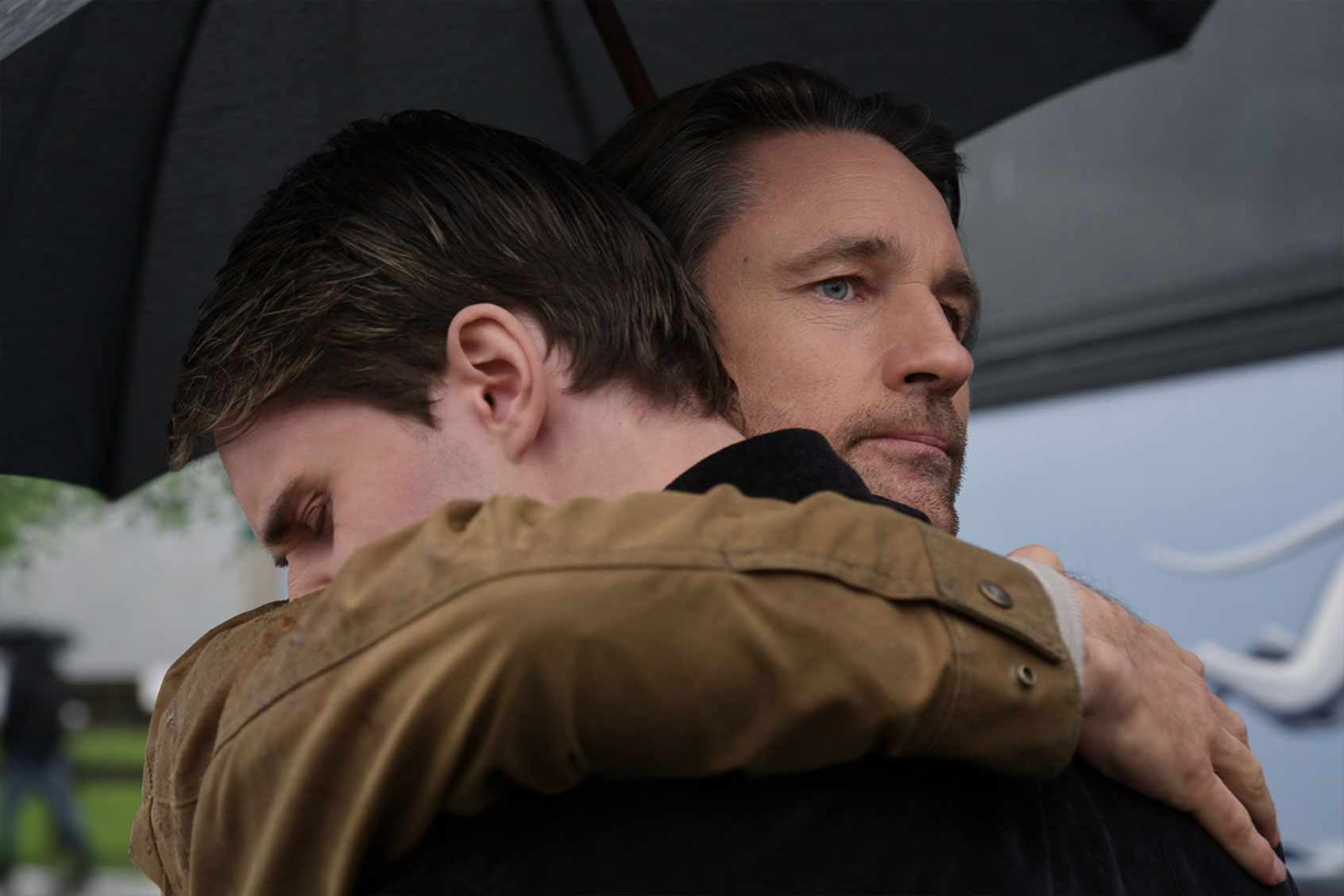
Virgin RiverAlexandra Breckenridge as Mel Monroe and Martin Henderson as Jack Sheridan in “Virgin River” (Courtesy Of Netflix)And the idea of the community: I grew up in a small town, so I’ve kind of had that experience. But the thing that I also appreciate about the show is that, some shows about small towns go quirky or go whimsical. Even with the kind of grittier crime stories that I think keep the show timely, the show feels real. They feel like real people. It feels like a town that you would drive through. You would stop at a place like Jack’s Bar and these are the people that you would see there. [The show] never tries to be cloying or like it has to present a small town in a way for it to be acceptable to a mass audience, which is: something that is cute and funny. 

You mentioned some of the grittier storylines. There’s a lot of trauma in “Virgin River” and some of it’s very unrealistic and some of it is actually very real: Jack’s PTSD from being a combat veteran and Brie’s PTSD, from sexual assault. As a writer, how do you handle those storylines?

Respectfully and responsibly. We do our research. We reach out to organizations that offer resources. And there are so many out there. Any form of entertainment, if they’re not reaching out for the sake of authenticity, they’re missing out on an incredible resource. 

With Brie’s storyline, we’re working with RAINN specifically, and they’ve been incredibly insightful as to what her experience would be. I think our approach to writing the show is when it comes to something like that, if we haven’t had it, how do we presume to be able to tell it fairly and accurately? So, to work in concert with an organization [whose] goal is to help survivors and through storytelling, help them to see their stories accurately, is a great opportunity.

Virgin RiverGrayson Maxwell Gurnsey as Ricky and Martin Henderson as Jack Sheridan in “Virgin River” (Courtesy Of Netflix)With PTSD and people in the military, we work really really hard to do all of our homework. Even some scripts, they’ll go through three, four, five different organizations . . . and also, as we’re coming up with the stories, we use [organizations] as a resource. 

It’s also important that those storylines aren’t dropped, that they’re an ongoing issue for characters as they would be in life. They keep coming back for Brie and for Jack.

It’s not just entertaining people, but it’s also speaking to people intimately.

There were a few times where we were called out for not taking those storylines into a necessarily sensationalistic place, that we’re not exploiting it for the sake of entertainment, but really trying to tell these stories with respect and with a sense of responsibility . . . We have such a profound medium, and assuming the responsibility of what you’re putting out there was really important.

We also had some new characters last season, including Cameron, who I’m a fan of. I actually wrote a piece on justice for Cameron, in defense of Cameron. Can we expect to see him in the future? Is he going to come back in Season 5?

Well, I can’t say to what extent, but we did have a little bit of a spoiler through social media. You could see the actor Mark [Ghanimé] was at our first table read. So, I will say Cameron lives to fight another day, at least in one episode. But for all the Cam fans, you guys will just have to see subsequent episodes to see what happens with this story. 

How has it been dealing with fan reactions? Because of its popularity, there’s probably so much pressure coming into this show and so many expectations. How are you handling all that?

I don’t handle it directly. Nobody cares about me. They have a much prettier cast to latch onto, but I will say as the cast read scripts, if there’s something that they want to address or talk about, it’s a lot through fan outreach. I know that Zibby [Allen], who plays Brie, has heard a lot from a community of people who have gone through sexual assault. We talk about domestic violence as well. I think when they hear from fans directly, we all assume a bigger responsibility to know that the show has an impact. The show has an effect. It’s not just entertaining people, but it’s also speaking to people intimately. 

Virgin RiverBenjamin Hollingsworth as Brady and Zibby Allen as Brie in “Virgin River” (Courtesy Of Netflix)You’ve inherited a lot of cliffhangers too. How are you balancing all these plot lines? 

It was a gift. I have so much respect and admiration first for what Sue Tenney created. As a writer who also loves to tell character stories, the fact that she was able to do that without a dead body in the beginning or zombies or an apocalypse, it’s resonated with so many people. I think that’s another thing that I feel very responsible [for], to carry on that legacy. 

What can you tease for the next season? 

We’re just shooting the first two episodes now . . .  I hope [Season 5] comes out next year. I don’t know when. I couldn’t speculate, but what I’m really excited to do — and I think I have the gift of perspective, being the outside guy who’s watched the first four seasons — one of the things I wanted to do when I came in was start to see characters that I haven’t seen interact in a long time, like Jack and Hope. 

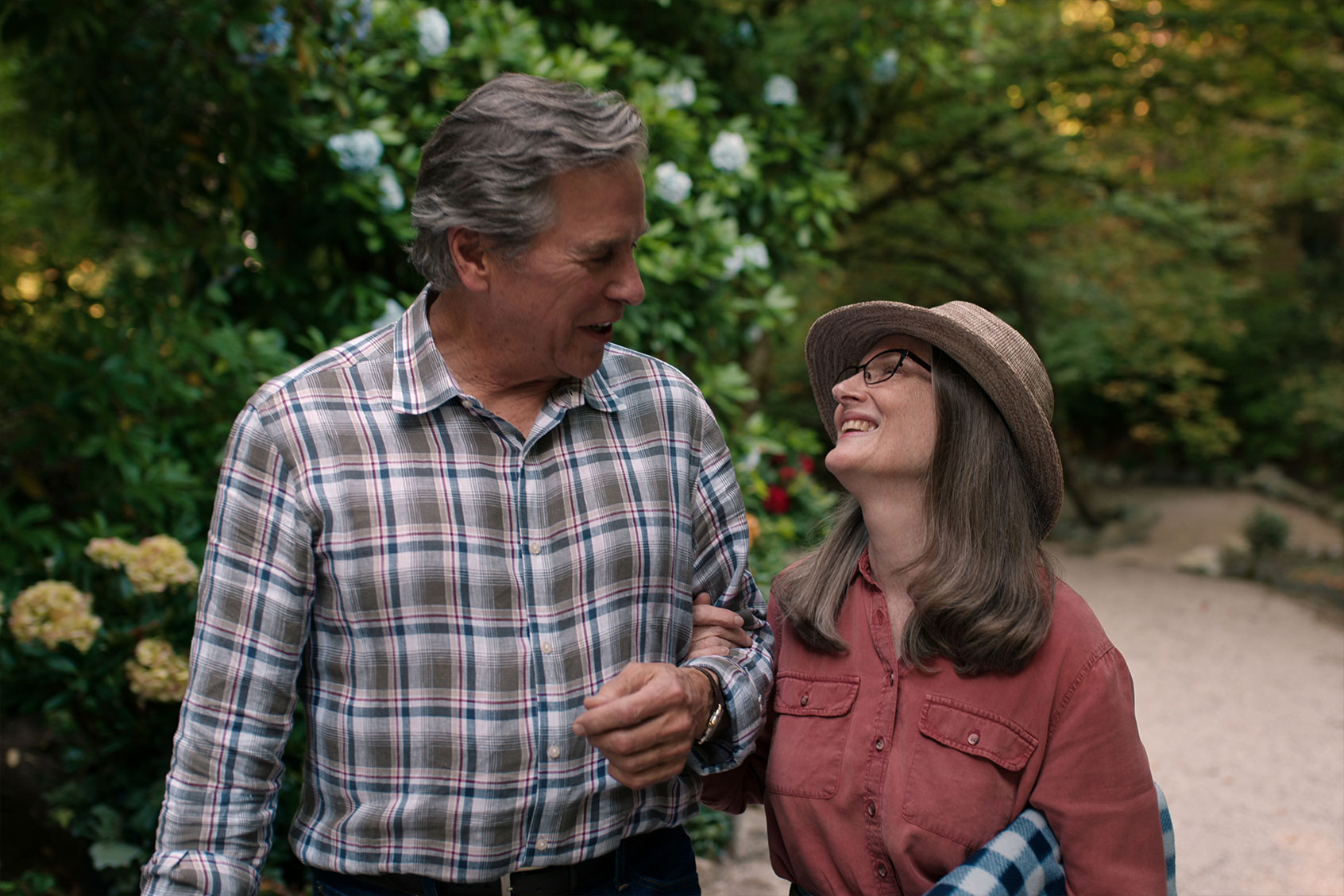
Virgin RiverTim Matheson as Doc Mullins and Annette O’Toole as Hope in “Virgin River” (Courtesy Of Netflix)They had a really big storyline out of Season 1 and into Season 2, which I thought spoke well of their relationship. It creates so many questions for me as to how they came into each other’s lives and what role do they play in each other’s lives? I feel like we haven’t seen that in a while. I’m hoping that Season 5 will feel like the previous seasons, but with new ways into the characters you already know about.


Want a daily wrap-up of all the news and commentary Salon has to offer? Subscribe to our morning newsletter, Crash Course.


You have such a rich canvas. There is that town to draw from. It makes sense that we want to see people interacting with characters they haven’t before, having new stories with them. 

It’s a bit of a trip in the show in that all the cliffhangers set a certain pace for the story and sometimes it’s hard to get characters to cross, because they’re already in their own story . . . It’s very challenging, but I think we set the intention to be able to bring these characters together in a way that we haven’t seen. It will feel like something you’ve been wanting, but you might not have known that you wanted it until you see it.

My mom has a request and her request is more episodes. She said there were not enough episodes. So, she wants more in this next season, please.

[To publicist] Did you get that? Can you take that to your colleagues?

Publicist: I have no pull in the episodes. There will be more.


The best non-alcoholic spritzes to buy or make at home

No drink so readily evokes the carefree, al fresco everything feeling of summer like the spritz. The traditional Italian cocktail is bitter and bubbly, with just enough sweet and tart flavors for balance, best served over ice in a balloon glass so big it goes past absurd into downright glamorous. Those who don’t want to drink alcohol don’t have to be left out of la dolce vita either, since there are plenty of options available for a zero proof spritz, from the classic Aperol or Campari flavor profile to more unusual combinations of fruits, herbs, spices, and, of course, bitters.

To make a spritz, the traditional ratio is two parts bitter aperitif, three parts sparkling white wine, and one part sparkling water, in that order. You want to make sure that the aperitif goes in first in order to preserve the bubbles. A spritz is built in the glass over ice, so you won’t need any fancy barware — you don’t even need to stir it.

Once you’ve learned the basics of spritz making, you can modify the ratio of non-alcoholic spirits, sparkling wine alternatives, and seltzer water to your taste and get adventurous with your ingredients. Try mixing reverse spritzes with bitter sodas like Sanbitter, Chinotto, and the offerings from Casamara Club and Bettera. Use flavored seltzers to add additional complexity or replace the need for sparkling wine altogether. Swap out the non-alcoholic prosecco for sparkling rosé or red wine alternatives, kombucha, or fruit forward bubblies like Non.

If you want: a classic spritz, no alcohol involved

Traditionalists looking for non-alcoholic aperitifs to use for the base of their spritz should use Lyre’s Italian Spritz for a pitch perfect imitation of bittersweet, candied orange colored Aperol, or AperTease by Sexy AF Spirits as a stand-in for Campari’s pithy pomegranate punch. For a slightly unusual option that has the candy apple red hue of Campari with a bitter orange flavor closer to Aperol, but with a blast of cooling clove, Willford’s Aperitif has wonderful mouthfeel and holds its own when mixed with sparkling non-alcoholic wine and seltzer water.

For these spirits, you’ll want to use a relatively dry non-alcoholic sparkling white to balance their intense sweetness. I suggest a crisp and acidic option like FreISH Sparkling, or Lyre’s Classico to balance Italian Spritz or AperTease, while the buttery, shortbread notes of No & Low Sparkling Chardonnay pair beautifully with the clove in Willford’s. In a pinch you can skip the n/a sparkling wine and go straight to bubbly water.

Either seltzer water, club soda, or a sparkling mineral water will work. Just make sure it (and the wine alternative) are ice cold, to keep your bubbles from evaporating too quickly. No one loves a flat spritz!

If you want: a refreshing non-alcoholic twist on a spritz

While the “original” aperitivo spritzes are great, there’s no reason to stop there. Roots Divino’s red and white de-alcoholized vermouths are both great, complex foundations for spritz experimentation. For a pleasantly tart spritz with notes of fresh raspberry and aromatics including jammy rose, earthy gentian, and biting wormwood, blend equal parts Roots Divino Aperitif RossoSomething & Nothing Rose & Hibiscus seltzer, and No & Low Non-Alcoholic Sparkling Chardonnay.

Roots Divino Bianco, with its candied rosemary and wild thyme flavors that boost the lemon juice note in Fre White Sparkling Wine, play beautifully with the soft, round flavor of Something & Nothing Cucumber Seltzer. In the traditional ratio of two parts aperitif, three parts sparkling wine, and one part seltzer, it’s as fresh as plunging head first into the Mediterranean on a hot day.

For a reverse spritz with traditional Italian aperitif flavors, blend 2 parts of the botanical distillate Wilderton Lustre with 3 parts good quality chinotto soda like Lusitania or San Pelligrino and a splash of Chateau del ISH Sparkling White for extra long lasting bubbles. Lustre’s bright, sweet orange and cool tarragon lighten the deep, dark bitter orange and heavy caramel of chinotto, while Chateau del ISH balances with dry, long-lasting bubbles and a hint of ripe peach in this very easy-to-drink combo.

Negroni lovers will enjoy a spritz that’s an exquisite blend of dark red fruits and bitter herbs and spices: rich, concentrated pomegranate and goji flavors from Melati, a non-alcoholic, herbal apéritif, meet a bushel of assorted red and dark berries from the non-alcoholic rosé style Sparkling Jukes 8, and a hint of juniper and gentian flavors from the cocktail-inspired Casamara Club Alta for a gorgeous magenta hued refresher that’s as pretty to look at as it is to drink.

If you want: something less sweet, more herbal

While the traditional spritz gets its bitterness from the spirit base, bitter sodas work just as well to add the right balance to sweet or tart non-alcoholic spirits, making a “reverse” spritz. I especially love to combine a bitter soda with adaptogenic extractions, like those made by Solbrü, to give a boost of adaptogenic benefits to my beverage.

If you’re not into sweet drinks, I highly recommend a base of one part Solbrü Elevate, with cooling herbs like holy basil, peppermint, rosemary, and lemon verbena, and energy boosting cordyceps, topped with three parts Non #5: Lemon Marmalade & Hibiscus, and a splash of Betera Rhubarb and Hibiscus for a dry, crisp, slightly vegetal option that will please fans of Spanish style G&Ts.

For something a bit fruitier, try two parts Solbrü Inspire with three parts Lyre’s Classico sparkling wine alternative and two parts Casamara Club Onda. Inspire’s sweet, honey crisp apple notes, along with inflammation fighting lion’s mane, late summer lavender, and soothing chamomile blend beautifully with the sour green apple of Lyre’s Classico, and the bright lemon and earthy, early autumn sage of Casamara Club Onda, bringing together a lush orchard of flavors you’ll enjoy well into September.

Gnista Floral Wormwood is another lovely summer spritz ingredient, and I love two parts of the sprightly bitter spirit with two parts of Chateau del ISH Sparkling Rose, and a big 3 part glug of grapefruit-forward Casamara Club Sera. The resulting combination is floral and bright, and tastes unexpectedly like a cross between a hefeweizen and an IPA.

If you want: an easy, unfussy, super-portable spritz

Minimalists, rejoice! Thanks to some of the more complex non-alcoholic spirits and wine alternatives, as well as some good quality premixed non-alcoholic spritzes, you now have the option to pare down to just one or two essentials for summer sipping.

Jukes Cordialities’ ready-to-drink Jukes Sparkling 1 and Casamara Club Como marry citrus and herbal flavors into the platonic ideal of a white wine spritzer: refreshing, light, big on bubbles, and easy on both bitter and sweet. Top one part Pentire Adrift’s green and bitter samphire and sharp sea salt, with three parts Something & Nothing’s sunshine-in-a-can Yuzu Seltzer, for a perfect day at the beach in a glass. Transport yourself to a picnic in the cool shade of a Pacific Northwest forest with my absolute favorite alternative spritz: pour three or four parts Grüvi Bubbly Rosé, with its intense strawberry flavor, over one part of the bracing, Douglas fir forward, hemp infused spirit The Pathfinder for an unexpected but uniquely delicious combination. And for an easier-to-make version of the original orange summer spritz, just add seltzer water to For Bitter For Worse’s Eva’s Spritz (and even that is too much work, they now have cans of pre-mixed Eva’s, too!).

When nothing but ready-to-drink will do, both ISH and Lyre’s have lovely single serving, zero-proof canned spritzes you can throw in a cooler for the beach, a bike ride, or a picnic. SpritzISH is half way between an Aperol and a Campari spritz in flavor, and, in my opinion, tastes better than either one, with a more natural tasting blend of sweet and bitter oranges than the former’s strangely artificial peach candy flavor, and a touch of the astringent-but-juicy pomegranate I love from the latter, without its overwhelming bitterness. Lyre’s Amalfi Spritz is the ready-to-drink version of their Italian Spritz non-alcoholic spirit and Classico Grande prosecco alternative.

The simple spritz is a platform that invites playfulness, so while I stand behind these flavor combinations, feel free to experiment with other zero-proof spirits, non-alcoholic sparkling wines, exotic sodas, and flavored seltzers to make your own signature spritz this summer! What big, bubbly drinks are you mixing up this season?

Saucy, savory shrimp give this version of mofongo an additional layer of flavor

“This humble meal is today considered Puerto Rico’s unofficial national dish, and a family favorite for many. Growing up, mofongo was a dish reserved for special occasions and almost always served with ‘camarones a la criolla,’ or Creole shrimp. My version takes my family’s recipe and incorporates a few tricks I’ve picked up along the way growing up in Brooklyn. ¡Buen provecho!” — César Ramón Pérez Medero

Essential Equipment: mortar and pestle
— Food52

Watch this recipe

Mofongo de Camarones (Shrimp Mofongo) from César Ramón Pérez Medero
Yields
2 servings
Prep Time
30 minutes
Cook Time
45 minutes

Ingredients

  • 12 large shell-on shrimp, peeled and deveined, shells reserved
  • 1 teaspoon Diamond Crystal kosher salt, plus more to taste
  • 1/2 teaspoon dried oregano
  • 1/2 teaspoon dried thyme
  • 1/2 teaspoon garlic powder
  • 1/2 teaspoon onion powder
  • 1/2 teaspoon freshly ground black pepper
  • 1/4 teaspoon smoked paprika
  • 1/4 teaspoon ground annatto
  • 1/4 teaspoon ground cumin
  • 4 tablespoons extra-virgin olive oil, divided
  • 2 green plantains
  • 3 sprigs culantro (aka recao, sawtooth coriander, or chadon beni), chopped
  • 3 sprigs cilantro, chopped
  • 1 small shallot, minced
  • 7 garlic cloves, 4 peeled and halved, 3 peeled and whole
  • 5 ají dulce sweet peppers, minced
  • 1 small green cubanelle pepper, seeded and minced
  • Canola oil, for deep frying (at least 2 cups)
  • 1 dried bay leaf
  • 4 ounces Spanish-style tomato sauce or 2 tablespoons tomato paste
  • 1/2 cup light beer (Medalla Light or any pilsner)
  • 2 tablespoons unsalted butter, divided
  • 2 ounces chicharrones (fried pork rinds)


Directions

  1. In a small bowl, toss the shrimp with the salt, oregano, thyme, garlic powder, onion powder, black pepper, paprika, annatto, cumin, and 1 tbsp of extra virgin olive oil. Cover and refrigerate. 
  2. Simmer reserved shrimp shells in 2 cups water until reduced by half, about 30 minutes. Strain and discard the shells.
  3. Cut off both ends of the plantains. With the tip of your knife, cut a shallow slit down the length of each ridge, making sure to not go too deep. Gently slide a butter knife down between the flesh and skin of the plantain, lifting up slightly as you go. If the skin is being stubborn, run the plantain under cold water as you repeat these steps. After your plantains are peeled, cut into 2-inch rounds and hold in a bowl of cold salty water. 
  4. Now make the sofrito: Add your culantro, cilantro, shallot, 4 halved garlic cloves, ají dulce peppers, and cubanelle pepper to a mortar. Sprinkle with salt and use a pestle to mash until you’re left with a paste. 
  5. In a medium pot or Dutch oven over medium-low heat, heat the canola oil to 325°F. This’ll be ready for the frying of the plantains by the time you’re done cooking your shrimp.
  6. To make the sauce, heat 2 tablespoons of olive oil over medium-high heat. Add sofrito mixture along with the bay leaf and tomato sauce. Stir and cook for 2 minutes. Add the beer and cook for another 3 minutes, until just cooked through. Add the marinated shrimp and cook for about 1 minute, just until they start to turn opaque. Remove from heat and stir in 1 tablespoon cold unsalted butter.
  7. Remove plantains from salt water and pat dry. Gently drop into the 325°F oil and deep-fry until lightly golden and cooked all the way through, about 12 minutes. Stir plantains occasionally, keeping an eye on the temperature of the oil. (A burnt plantain will be dry, dark brown, and hard to mash.) Remove from oil and drain on paper towels.
  8. In your mortar and pestle, mash the remaining 3 garlic cloves with a pinch of salt until you’re left with a paste. Add half of the fried plantains, the remaining 1 tablespoon of extra virgin-olive oil, 1 tablespoon unsalted butter, the chicharrones, and ½ cup of shrimp stock. Mash very well until no chunks of plantain remain. Add the remaining fried plantains and continue to mash until smooth, like a very thick mashed potato. Add a little more butter and oil if the mixture is too dry.
  9. Using a small bowl, mold mofongo into two half spheres and plate. Top with shrimp, sauce, and a bit of chopped cilantro. Eat right away with an ice cold Medalla.


The 7 most heinous “Trainwreck: Woodstock ’99” revelations from Netflix’s docuseries

Woodstock, the three-day music & art extravaganza first held in August 1969, wholeheartedly embraced love, unity and harmony within its festivities. The outdoor jamboree, which was attended by at least 400,000 people, showcased how music can be a form of peaceful protest and later became a defining symbol of the counterculture generation.

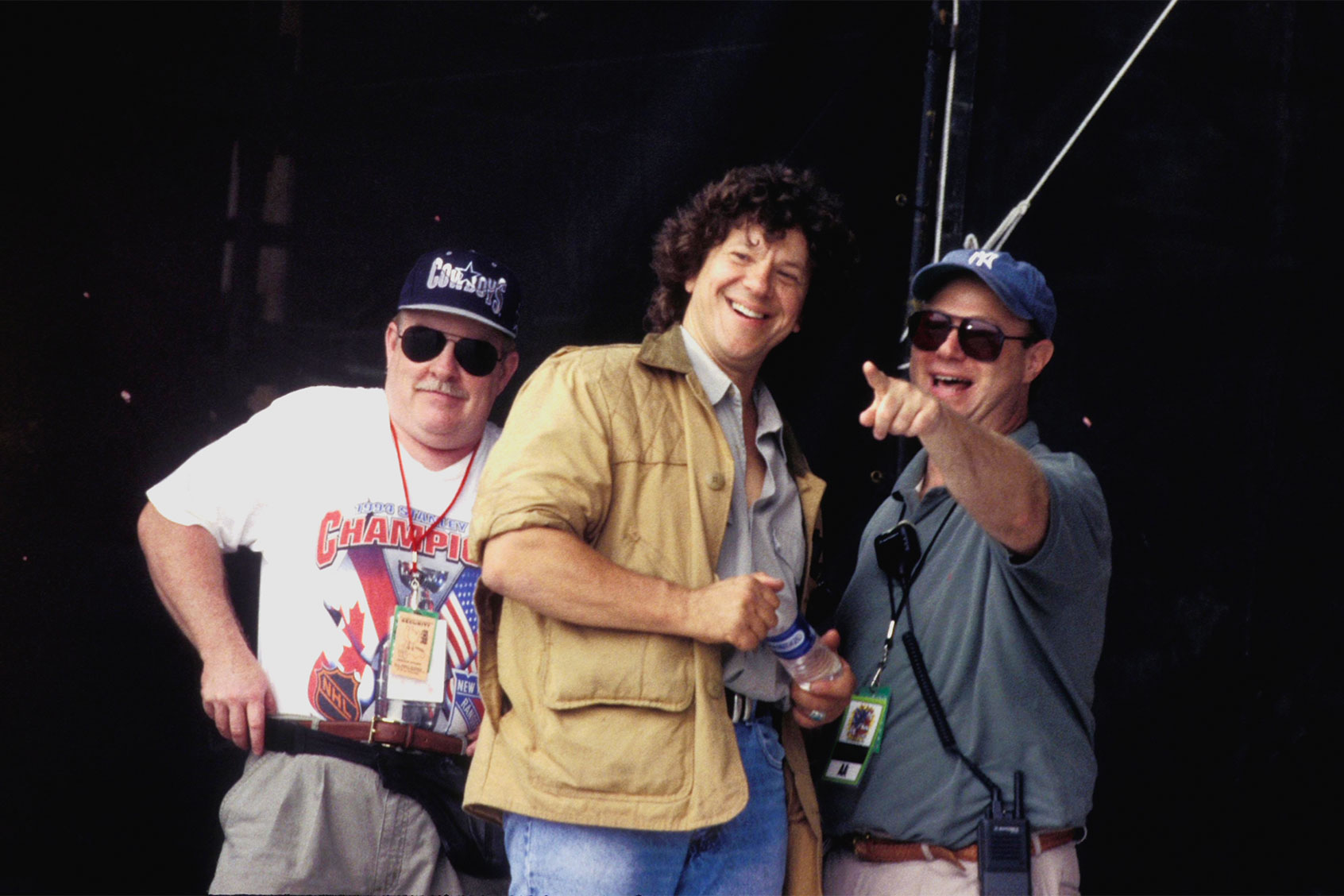
Thirty years later, Woodstock was revived by its original founders — Michael Lang, Artie Kornfeld, Joel Rosenman, and John P. Roberts — who attempted to bring a similar experience to a new group of youth. But despite the high hopes, Woodstock ’99 was tarnished by poor venue facilities, riots, vandalism, assault, destruction and corporate greed, making it one of the most infamous festivals in music history.

Netflix’s latest documentary, “Trainwreck: Woodstock ’99,” explores what went wrong in the making and execution of the 1999 shindig. Over the course of three episodes, the series highlights everyone from the festival’s attendees and performers to its organizers, producers and business partners.

Here are 7 shocking revelations from the series:

01
Profits over health and safety
Trainwreck: Woodstock '99Trainwreck: Woodstock ’99 (Netflix)
Woodstock’s security protocols prohibited festivalgoers from bringing their own food and water bottles into the venue. Instead, they had to purchase food from onsite vendors, even though most of the available snacks, meals and refreshments were incredibly expensive.
 
“It was so hot that you literally needed to drink a gallon of water an hour yourself to stay hydrated,” said Sara, who attended Woodstock ’99 as a teenager. “There were definitely fountains there. But there was at least a 25-minute wait . . . So, we went to get just a simple bottle of water. Nobody could afford that water.”
 
The average price for a bottle of water in the late ’90s was around 65 cents. At Woodstock ’99, however, a single bottle cost an astounding $4.00, which then went up to $12.00 when vendors ran low on stock. Per old footage featured in the documentary, one concertgoer complained that a small drink and a measly side salad cost $9.00 in total.
 
Several members of the festival’s production team, including Colin Speir, Lee Rosenblatt and Pilar Law, noted that the price hikes were prompted by the Woodstock founders and organizers. The higher-ups were hellbent on making a considerable profit, especially after their previous revival, Woodstock ’94, tanked financially due to overcrowding and security issues.
 
It became clear that Woodstock ’99 was no longer emulating the “peace, love and flower power” vibes established by the original Woodstock; it was purely “a money-making venture.”
 
“That was the moment for me where it stopped becoming about the concert-goer or the festival-goer experience,” Rosenblatt said. “It was just cutting budgets, cutting budgets. We need to make changes. We’re not making profits. Their goal was to make money.”
 
Rosenblatt continued, saying those in charge of organizing Woodstock ’99 decided to sell all the food rights to an affiliate corporate group, who had complete control over vendor pricing. Once the deal was sealed, the prices were set and none of the staffers could do anything to challenge them.
 
“All hopes and dreams of ‘Peace, Love and Understanding 1969’ went out the window.”
02
The endless piles of garbage
Trainwreck: Woodstock '99Trainwreck: Woodstock ’99 (Netflix)
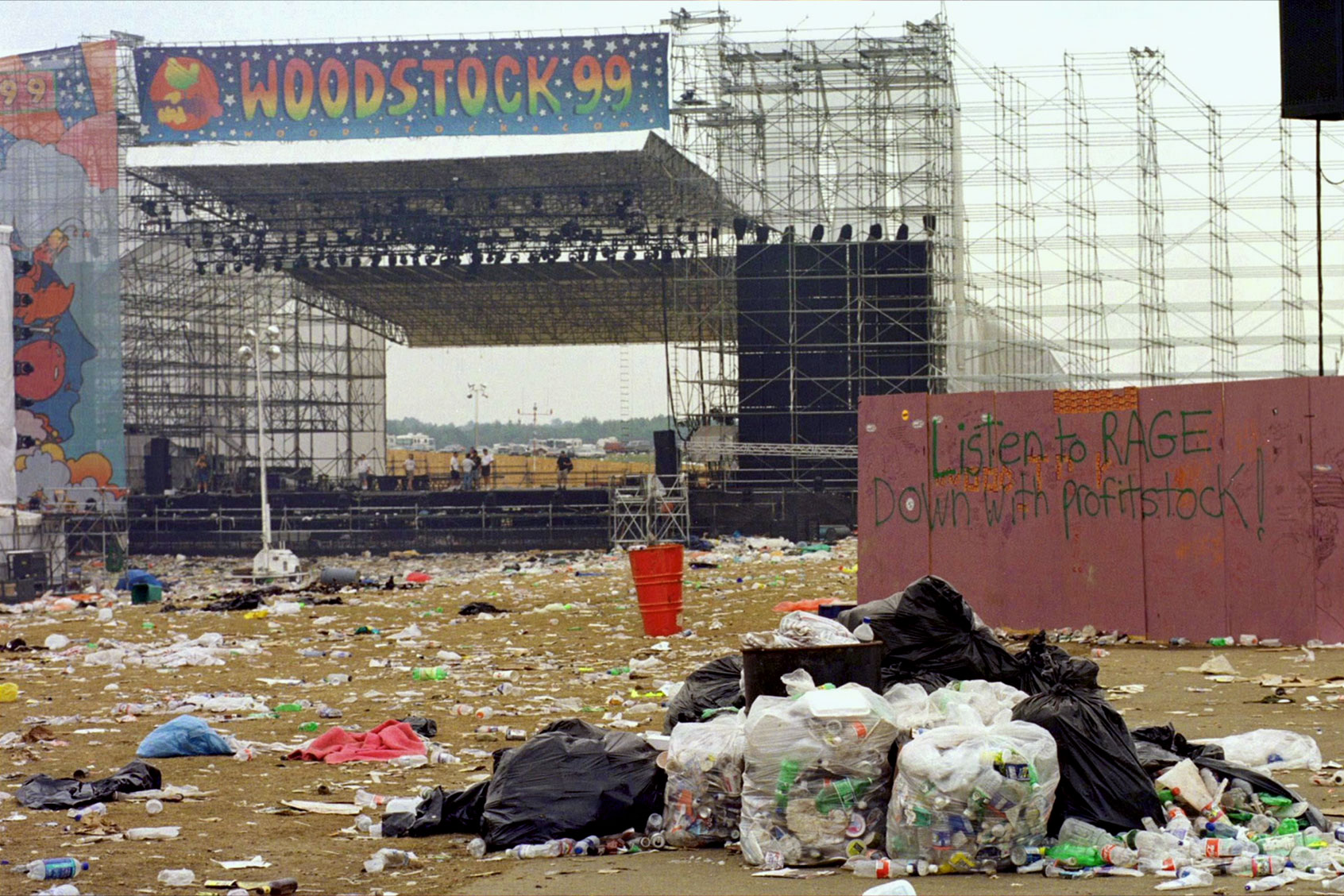
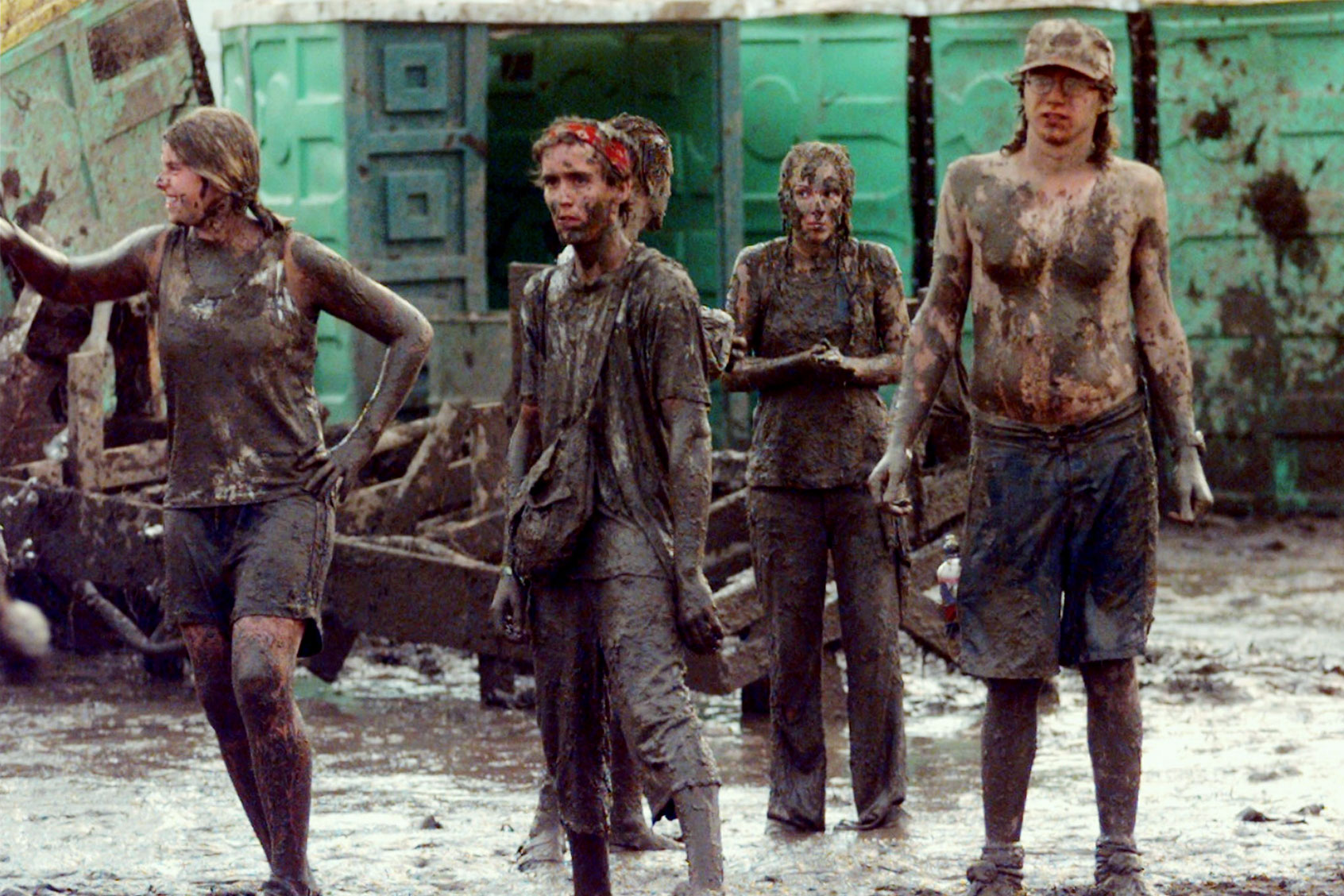
After the chaos of day one, the entire Woodstock venue was covered in a layer of trash, from empty food packages to liquor bottles and beer cans. The place was so unkempt that festivalgoers had to shuffle through piles of trash just to get to the main stage.
 
The outhouse facilities were also a mess, with human waste pooling over the toilet seats and covering the surrounding floors. Many attendees recalled the horrid, overbearing smell and said they had to step in urine and feces while using the bathrooms.
 
“Like all departments, the Sanitation Department had budget cuts,” Rosenblatt explained. “Trash services and the sewage services were all farmed out. So we’re relying on all these subcontractors . . . And unfortunately, they did not do their jobs.”
 
Lisa Law, a photographer, filmmaker and Woodstock ’69 attendee, believed the widespread grime was going to cause the downfall of Woodstock ’99. Law, who was determined to clean up the space, took it upon herself to distribute trash bags to festivalgoers, urging them to pick up their own filth.
 
“One person said to me, ‘I paid $150 to be here. You should clean it up,'” she recounted. “And I said, ‘Well, this is a different kind of Woodstock.'” 
03
Security was a complete joke
Trainwreck: Woodstock '99Trainwreck: Woodstock ’99 (Netflix)

Crowds of men groping and sexually harassing young women took place without repercussions, mainly because the security at Woodstock ’99 was both insufficient and inexperienced. There was not enough security available to closely monitor a crowd of 250,000 people, which encouraged mass crime to occur uncontrolled.


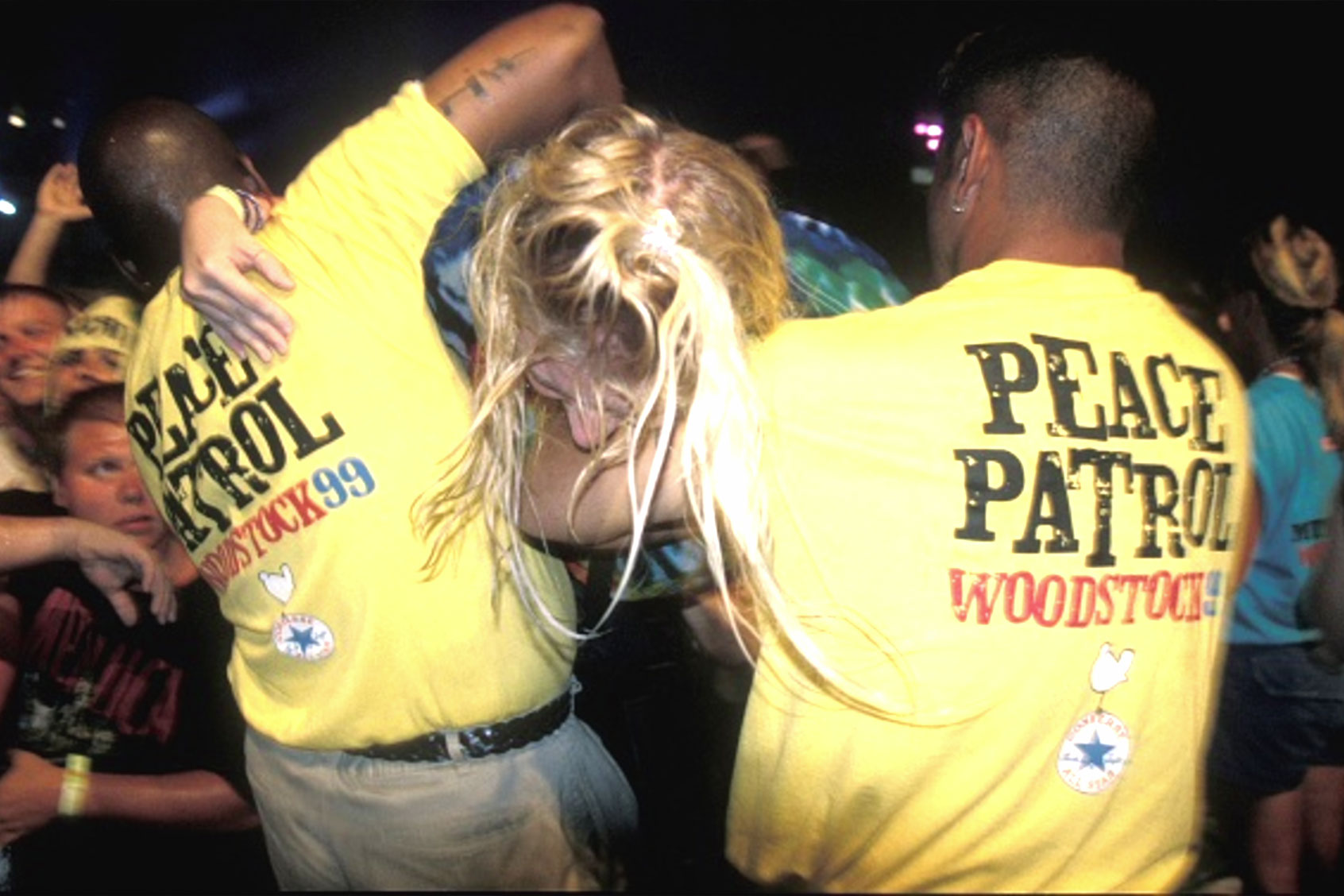
“Security at Woodstock ’99 was kind of a joke,” said Tim Healy, a former presenter at MTV. “It was like, you know, kids with yellow T-shirts.”


In the documentary, Lang explains his reason for not hiring law enforcement, stating, “We didn’t want anybody uniformed or anybody carrying a gun. We didn’t want the influences of the government or of the police state or whatever. So the security that we hired, they were not armed. They were peace patrol.”


One of those peace patrols was Cody, who was 18 years of age at the time. He signed up to work at Woodstock ’99 because the hiring process was quick and simple — all he had to do was sign a form — and the $500 pay was quite generous too.

   
Despite the official title, there was nothing “peaceful” about the peace patrol. Many of the patrols engaged in reckless behaviors themselves, whether it was doing drugs while on the clock or selling yellow security shirts to random festivalgoers for some extra cash. For one unnamed patroller, Woodstock ’99 was simply a place for “money and sex and b*tches . . .”


“It was laughable, you know? Like, ‘Look at this. What a joke this is,'” Cody continued. “We could see how this is gonna go.”

04
Limp Bizkit’s rambunctious crowd
Trainwreck: Woodstock '99Trainwreck: Woodstock ’99 (Netflix)
The energy at Woodstock ’99 was pandemonic from the get-go — young festivalgoers were riled up by the loud music and the copious amounts of drugs and alcohol they were consuming. But once Limp Bizkit took center stage, the crowd finally reached its tipping point.
 
“The crowd was undulating. They were almost one organism,” said David Blaustein, a former news correspondent for ABC News. On a similar note, Kyle, who worked stage security at the festival, likened the effect Limp Bizkit had on their crowd to a “hand grenade.” That metaphorical “grenade” finally exploded when the band performed their 1999 hit single “Break Stuff.”
 
Who is to blame for what happened afterward is still up for debate. But many Woodstock ’99 organizers, including John Scher, pointed fingers at the band’s lead vocalist, Fred Durst, for encouraging his crowd to go out of control.
 
During the opening of his performance, Durst asked his fans, “How many of you people here ever woke up one morning and just decided it wasn’t one of those days, and you’re gonna break some s**t?”
 
“Well, this is one of those days, y’all, where everything’s f**ked up,” he continued, partially quoting the song’s lyrics. “And you just wanna break some s**t. It’s just one of those days when you don’t wanna wake up.”
 
Durst didn’t stop there. He addressed his crowd again, this time urging them to “reach deep down inside [and] take all that negative energy and let that shit out of your f**king system.”
 
“Now, when this song kicks in I want you to f**king kick in.”
 
At that point, the crowd went completely berserk. People in the mosh pit were diving into each other, getting trampled and coming out with bloody heads and broken legs. A mob surrounding the stage’s sound towers began ripping apart the plywood planks and climbing up the poles. Those broken pieces of plank were also used to crowd surf.
 
“It’s like a scene where zombies are coming over the castle walls,” described Kyle.
05
The feces-tainted water
Trainwreck: Woodstock '99Trainwreck: Woodstock ’99 (Netflix)

By day three, festivalgoers were exhausted, frustrated and agitated. To make matters worse, the festival’s showering stations were sparse, thus prompting a few individuals to recklessly smash the water pipes.

 
Because the shower facilities were also near the bathrooms, the clean supply of water mixed in with runoff from the nearby porta-potties to create a nasty slush that looked like a mud slide. So unbeknownst to few boisterous festivalgoers, the “mud” they were fooling around in was actually feces.

 
Alongside the showers, the onsite drinking faucets were either broken or running murky, brown water. Joe Paterson, a public health investigator, examined samples of the drinking water available at Woodstock ’99 and found that they were all severely contaminated with feces.

 
“The thought that people are out there, drinking this, exposing themselves, bathing in this stuff . . . It was like the worst nightmare,” Paterson said.

06
The shameless downplaying of the mayhem
Trainwreck: Woodstock '99Trainwreck: Woodstock ’99 (Netflix)

Despite the inhumane conditions and complaints from festivalgoers, Woodstock ’99 organizers continued to lie to members of the press, confidently telling them that everything was fine.


“We’re happy. All is well,” said Scher in a press conference that took place after festivalgoers violently tore down an elaborate wall of artwork displayed at the venue. “We haven’t had any tough incidents.”


When asked about the art wall, Lang told reporters, “I think the exterior wall just makes an amazing souvenir, and people just couldn’t resist it. They were breaking it up into small pieces, I guess, just to have a piece of Woodstock.”


Even the former mayor of Rome, New York, Joe Griffo, praised the event, saying, “I think it’s been a memorable, exciting concert for all those involved and all those who covered it, and the community as a whole.”


“I saw what was going on. I had spoken to enough people. I knew that they were full of shit,” Blaustein said of the Woodstock organizers.

07
All hell breaks loose
Trainwreck: Woodstock '99Trainwreck: Woodstock ’99 (Netflix)

The final act at Woodstock ’99 was the Red Hot Chili Peppers. During the band’s closing set, the festival organizers handed out 100,000 candles to the crowd for a staged vigil mourning the victims of the Columbine school shooting, which took place a few months prior. The demonstration was meant to spotlight a new generation of youth taking a stance against gun violence.

 
As expected, the showcase backfired and instead, fueled festivalgoers, who were now fed up with their mistreatment, to start a riot. The candles were used to set a few fires in the crowd. Scraps of trash, stray pieces of wood and broken artwork were then thrown in, causing the fires to grow in intensity.

 
The crazed festivalgoers also targeted the venue’s speaker tower, shaking it violently until it fell to the ground. They lit nearby trailers and trucks on fire. And afterwards, they attacked the cluster of food vendors by knocking down their tents and smashing their ATM machines, which contained around $60,000 to $70,000 in cash.


“To give flames to an audience that is three days into being treated like animals . . . It was not a very smart decision,” said Rosenblatt, who warned Scher and Lang to not give out the candles but was ultimately told to shut up.


Years after the havoc, Scher and Lang are still standing by their actions. The organizers refuse to acknowledge any of their own wrongdoings, including the inadequate planning in preparation for Woodstock ’99 and severe budget cuts, and blame the festivalgoers for what went down.


“They’re the lunatic fringe. That segment of the population was both entitled and fearful of growing up, of having a real job and, you know, have a family and stuff like that,” Scher said. “And they had lots of angst. Lots and lots of angst.”


When asked what he thought went wrong with Woodstock ’99, Rosenblatt shared a different and more apt reason:


“I can say it in one word: greed.”

“Trainwreck: Woodstock ’99” is streaming on Netflix. Watch a trailer for the series, via YouTube:


Missing the Choco Taco? It’s insanely easy to make this copycat version at home

To be honest, I’ve always been more of a straight-up ice cream sandwich person. But when the news broke that the Choco Taco, dubbed by the New York Times as the “Ice Cream Snack of American Summers,” was being discontinued, I grieved nonetheless.

Invented in 1983 by Philadelphia entrepreneur Alan Drazen, the Choco Taco is an ingenious vehicle for delivering chocolate, ice cream, nuts and cone to the happy eater in every single bite. It’s nothing if not a perfectly executed concept, like a Beyonce album except for ice cream.

Like any you don’t know what you had ’til it’s gone situation, the extinction of the Choco Taco ignited within me an urgent desire to recreate one and keep the masterpiece in my own freezer. But while conspiracy theorists insist it’s just a matter of time until the real thing returns, I’ve meanwhile moved on to making my own version of the classic.

By borrowing from a brilliant Hungry Girl trick for turning frozen waffles into edible shells, I was already effortlessly halfway to copycat Choco Taco town. And because I knew that I’d just crush the shells into crumbs if I handled them too much, I didn’t attempt to fully line mine with chocolate. Instead, I used a “chocolatey chip” waffle to pump more chocolatey flavor into every bite, and I substituted chocolate ice cream for the traditional vanilla swirl.


Want more great food writing and recipes? Subscribe to “The Bite,” Salon Food’s newsletter.


In the end, the results surpassed my wildest expectations. 

These waffle tacos not only taste incredible but also look like the real thing, approximating the original’s dimensions and heft. If you hold one, you’ll feel like you’re standing near an ice cream truck parked close to an open fire hydrant, a slightly warped jingle summoning every sunburned and famished family in a 10-block radius. The experience is pure bliss.

Best of all, you get to eat the closest thing to a real Choco Taco, secure in the knowledge that you can make as many as you want, any time you want.

***
 

Inspired by Hungry Girl and Choco Taco

Copycat Choco Tacos
Yields
 4 servings
Prep Time
 10 minutes
Cook Time
 5 minutes, plus chill time

Ingredients

  • 4 frozen waffles, thawed
  • 1 cup chocolate Magic Shell, store-bought or homemade
  • 1 cup honey-roasted peanuts, or your favorite nuts
  • 1 pint of your favorite ice cream


Directions

  1. Preheat the oven to 350 degrees. 
  2. Lay one waffle on a clean, dry surface. Using a rolling pin or wine bottle, flatten the waffle as much as possible. Repeat with the remaining 3 waffles.
  3. Grab a potholder and very carefully remove one of the racks from the middle of the oven. Drape the flattened waffles on the rungs so they hang evenly.
  4. Bake until just about crisp, about 5 to 7 minutes. 
  5. Meanwhile, pulse the nuts in a food processor, or put them in a Ziploc bag and bash them with a rolling pin or wine bottle. Pour the chocolate shell into a shallow bowl.
  6. When the waffles are ready, put the potholders on and gently remove them from the oven. Transfer the waffles to a sheet pan, taking care to avoid tears. To get the perfect size taco opening, carefully pry them open just a bit.
  7. Dip each waffle taco in the chocolate shell, then generously sprinkle with nuts. Allow to completely cool.
  8. A few minutes before you’re ready to assemble, take the ice cream out of the freezer to soften.
  9. Gently fill the waffle tacos with softened ice cream, taking care not to overfill them. 
  10. Put the waffle tacos back in the freezer to firm up. An hour or more is best, but I get it if you simply can’t wait.  

Salon Food writes about stuff we think you’ll like. Salon has affiliate partnerships, so we may get a share of the revenue from your purchase.

“I bake for every emotion” — Zoë François on finding connection through cake

Zoë François knows that carob is a lie. She knows a blowtorch is an excellent kitchen tool. And she knows that it’s okay to bake your feelings. The baker, recipe developer, author of several books, including “Zoë Bakes Cakes,” is also the host of “Zoë Bakes” on Magnolia Network, now in its second season, and was recently a judge on the Magnolia special “Silos Baking Competition.” She joined me on “Salon Talks” to discuss working one’s way up to croquembouche, and why whatever else happens in life, “There’s always a cake at the end of it.”

The following interview has been lightly edited for clarity and length.

I want to ask you about this latest season, and the choices that you make in deciding, “This is going to be an episode about cheesecakes. This is going to be an episode about New Year’s Eve. This is going to be episode about breakfast,” and then incorporating the dishes and the stories of your friends and family. What was that process for you? What is the story you want this season to tell?

Each one is its own individual, and each one has a different inspiration. The cheesecake one that you mentioned was a direct request from my son. He loves cheesecake and wanted to do that episode with me.

I really love all baking and my mood changes daily in what I want to bake. I’m really lucky that with the show I get to do that. I get to play in all the different areas, do all kinds of different recipes. Sometimes it’s inspired by somebody that I either know or I’ve heard about who’s doing something really magnificent in my community and I want to go and see what they’re up to. Then the recipes get inspired by that field trip. Sometimes it starts with a recipe and I figure out where I need to go in the community to make that recipe happen.

There isn’t a basic formula to it, maybe because I don’t know enough about how TV really works. They sort of come together organically, and I’ve been able to just go with whatever mood I’m in. I think I’m really lucky. 

One of the things I really appreciate about your style as a baker is you are ambitious for us, the home bakers. You say, “Look, people are going to be intimidated by pie dough. People are going to be intimidated by merengue.” You just put it out there. You’re not saying, “I don’t know. Take it easy.” You’re just, “Let’s make a croquembouche.” You really go for it with us. 

I have to say, I was surprised the network went for that. I was so proud of myself and them and everybody that that happened.

I feel like so much of baking the conversation has to be around “Don’t be afraid. It’s going to be okay. Don’t worry.” But Zoë‘s like, “I’m going to bust out my blow torch.” Baking is so much scarier for a lot of people than regular old cooking at the pot is. What do you want us to know about being ambitious for ourselves as bakers?

For me, it comes out of a genuine love of baking. I feel total joy and serenity and absolute love of not just the eating, and not just producing something beautiful. The process of it really is sort of my Zen place. Because that’s how I feel about baking, I just naturally put that out into the world. I found out through writing the bread books, really, how intimidated people are by it. My way of being in baking is not necessarily how everybody feels. I really have to show not only my joy and my love of it but also sharing the techniques.

Really, it’s one step at a time, and you get to a croquembouche. It’s not like you have to know everything in the beginning. I will carry you through the entire process and show you how to do absolutely everything. It’s just like any craft. We don’t necessarily intuit how to do all of these things. But once you see it, it becomes accessible. It becomes doable.

So I think it’s the combination of my genuine, innate love of this craft and my ability to teach. That’s what I really discovered — that even more than being a baker, I’m a teacher and that’s what I love to do. More than me producing something beautiful, I love to see what other people are making.

It’s important to note that you give us a lot of off-ramps. Maybe you don’t want to make an entire croquembouche. Maybe you’re just going to make the cream puffs. That’s okay. Or if you want to know about cake decorating, just work on decorating and do that. Do it with, as you’ve said, with mayonnaise or with butter and work on that.

That’s exactly right. It’s that piecing it all together. Going from the beginning.

When you’re talking about croquembouche, it’s this really basic dough called choux paste. And from there you can get a cream puff and then you just make enough cream puffs to glue them all together. And before you know it you’re at a croquembouche.

Zoë, you had such an interesting origin story. You grew up on a commune, where you were told that raisins were candy. Obviously you took a swerve in the direction of the sugar, and yet there is still the influence and the impact of that upbringing in what you do. I want to ask you what that did for you and how that built you as a baker and what you bring into your baking now.

“The biggest lie they told me was that carob was chocolate.”

In the beginning, I was so mad and resentful. What are you talking about? Raisins? And then the biggest lie was carob. They told me carob was chocolate. I don’t even know that people still even know what carob is, but it’s not chocolate.

At first it was a real rebellion to get into baking and pursue this thing that I was just not allowed to have as a child. As I got older and I learned more, I came to appreciate my parents, as we do when we get older, and how cool they were and what they were doing and what they were building and growing. They grew all of our food. They raised bees for honey. I realized — somewhat I have to admit, through making the show — how cool my folks are. And that they really weren’t wrong in limiting the amount of sugar for a small child.

But it was that upbringing. It was that void of sweets that brought me to the career I’m in. Because I craved them and I wanted them and I wanted to know more about them.Now I feel like I have this better mix of understanding. And I love honey and maple syrup and whole wheat and all of the things I grew up with. I just have them in balance with all of the sugar and chocolate and delicious other things that there are on offer.

I can see in your story this love of community, love of food as a shared conversation. Bringing people together at the table, in the preparation, in the eating. It’s very clear from your show, that is authentic. 

Thank you. That’s the highest compliment. Because it’s not just the food that’s bringing us together, but it’s also me going out and exploring my community. I don’t think very many people know Minneapolis or Minnesota at all. We are such a food producing community, from the farming, from the agriculture standpoint, but also the bakers and the chefs and the restaurants that we have. It’s been such a joy to have the freedom to go out into my community and show off all the incredible things that are happening here. It’s also a little bit selfish because I get to learn what they’re doing, I get to bring everybody into Minneapolis, but I also get to learn from what they’re showing. It’s basically a dream. 

And showing in that way that food is such an expression of love and is such an expression of joy, expression of grief, even. Food is a language for all of that and baking is a language for all of that.

“I bake for every emotion. When I’m stressed out or down or overjoyed or celebrating, there’s always a cake at the end of it.”

I bake for every emotion. When I’m stressed out or down or overjoyed or celebrating, It all happens. There’s always a cake at the end of it. Everything that I need to say, I can say in food. It’s also one of those things that there isn’t an occasion, a wedding or a funeral, that you don’t gather around a table and share a meal together. Or bring somebody food when they’re in need. It’s such a natural medium for gathering and community and expression. There’s so much to be said with so many different things to eat.

And sometimes you want to say it with a Baked Alaska. But maybe that’s not where we start. For people who are just considering going into the kitchen and want to get a little taste of the absolute high that I understand that comes from giving people cookies, what are some recipes or what are some dishes that you think are a good starting place?

Well, also I don’t bake a croquembouche or Baked Alaska every day. I make chocolate chip cookies and I make blueberry muffins and banana bread. Those are my day to day things, or a loaf of bread. So I take you through all of my different moods. Sometimes it’s the perfect blueberry muffin, or I make a star bread. That’s so easy, and one of those things that’s get the kids in the kitchen and get their hands in the dough. It’s one of those things that’s really fun to do together. There’s very, very simple recipes on the show. And then, , there’s some that are a little bit more of a project and a little bit more aspirational. They’re both fun and I take you through how to do all of it.

The cool thing about baking is that it really doesn’t take much to get a wow factor. The Dutch baby is one of the easiest things in the world to make. Or a parfait. You don’t have to have a great deal of technical skill. 

Absolutely. Or equipment. I sent my son to college with a cast iron pan and that Dutch baby recipe. He makes them for himself at school. It’s just one of those things that he will always make. We used to do it when he was little little. And like you’re saying, the wow factor. That’s a super basic simple recipe, but the wow factor is the seasonal fruit that you’d put on it or powdered sugar. You wouldn’t think of powdered sugar as a wow factor, but it’s that last little step that brings it all together. Simple can be spectacular.

For beginning bakers or bakers who are in a small kitchen, what are your absolute, ride or die, this has to be in my pantry these are the pieces of equipment that I’m in love with.

I’m on a bit of a crusade to get Americans to use scales. It’s something that the rest of the world has all used and has been using forever. We are really the last people not to be using weights. It’s just so much easier. It’s so much more precise and consistent in your baking. So I would say a kitchen scale. They range in price from $20 to $100, so just a simple kitchen scale is great. I love my Danish dough whisk. It’s a super basic, cool tool that I use for mixing bread dough and thick batters. Because it has this wire instead of a flat surface, it doesn’t give as much resistance. I even travel with this. If I’m going somewhere, I always bring it. And it’s a great gift too.

Of course my stand mixer, but not everybody has the room, the budget. And so you can really get away with not having one. If you can, great.

The pantry. There’s some real basics for baking that almost every recipe has. Sugar, brown sugar, flour. One of the things that came out of the pandemic was the flour shortage. I think now we’re back to having flour. What came out of it is that the big commercial flour companies weren’t able to keep up with supply. So these tiny little local flour companies and millers took up the slack because they had flour. People discovered how delicious they were. So experiment with different kinds of flours in different recipes. And of course, baking powder, baking soda, all of those. Oh, I almost forgot butter.

Good butter. And good chocolate.

And good chocolate. Absolutely use whatever is your favorite chocolate. But if you ever have the opportunity to do a chocolate tasting. There’s really a big difference in the different brands of chocolate. Give them all a try. There’s a whole world out there. It’s like wine. They all have their different flavor profiles, so it’s fun and geeky.

One of the things this show does really well is it makes it clear that there is no one sacred text. There is no one ultimate anything. You talk to Sarah Keiffer about her absolutely wild, amazing, fantastic pan banging cookies. I’m curious, do you have a recipe that you feel, “I’ve stopped, I’ve done it. This is the perfect one.” Or are you always tweaking?

I would say I’m always tweaking. That’s mostly because of curiosity. Part of the love of this for me is the process, so I can never stop fiddling with it. I have to, because my publisher says I have to. I have to hand in the manuscript at some point. But there will always be more and more cakes I could have made. I could have put 500 cakes into that book.

I just love the process of it. I love what other people are doing. You brought up Sarah Keiffer. She’s terrific and such a brilliant baker and thinks of things in different ways. I love that I get to collaborate with other bakers like that, too. Because even though I’ve been doing this for 30 years, I’m always learning and I’m always striving to learn. 

I want to ask you also about the “Silos” competition because that was such a lovely thing to watch. It’s such a different thing outside of your usual zone. What did you learn from watching those bakers and their process?

I’m so glad that you described it as being a lovely thing to watch. Sometimes these competition shows make me so anxious. My whole spirit of being a baker and the spirit of my show is sharing what I know with people and trying to get them to love it and relaxing people into baking. Sometimes I feel like these competition shows are just frenzy and anxiety ridden. And I loved this. It was just a group of the most dedicated, passionate, not necessarily professional bakers. But they were so into it and they loved it so much and they loved it for each other. Which is a very rare thing to see on a competition show, that they’re rooting for each other.

I’m getting goosebumps just talking about it. It all had just that right feeling. It shared. It was generous. There was definitely competition going on. I think each one of them had their own way of going through it. Now we know the winner, but she was just confident and quiet and steadfast in what she was doing. Others baked their things multiple times to make sure that they had just the right one.

It was a really fun experience for me. I think it’s different than just about every other competition show out there. I’m glad for that. 

Zöe, I can’t let you leave without asking you one last question I’m going to be an empty nester soon. I bake with love. I bake for the people I love. I will continue to bake for my guests. But also I want to know what can I do as a baker when I’m just baking maybe for one or for two. What’s my thing? What am I going to do?

There’s a couple of things that come to mind for me. One is going back to the scale. If you’re baking with weights, it’s really easy to cut a recipe in half. You can do that and just use a smaller pan. The one thing that you have to keep in mind is the baking time. If you’re baking something smaller, it’s not going to take as long to bake so you may want to check it halfway through and get a feel for it and figure out how long. The other thing is freezing. So if you’re making a batch of cookies, what I do is I make the batch of cookies, I scoop them out and I freeze them, so that when I’m in the mood for a cookie I just take one of those cookie balls out of the freezer and I bake off one or two. That way I’m not feeling rushed to eat them because they might go stale, or feel compelled to eat them all because they’re sitting there. The freezer can be a really good friend.

Author Elaine Castillo talks about empathy, Jane Austen adaptations, and “How to Read Now”

“Literature shouldn’t be politicized.” “Separate the art from the artist.” “Books build empathy.” These are very silly and simplistic ideas, and Elaine Castillo would like to encourage you to shed them.

After achieving success with her breakthrough debut novel “America Is Not the Heart,” Castillo found herself traveling the world, engaging with audiences and writers, and as she puts it, “thinking about how to read.” Not in the simplistic, reading group guide way. Definitely not, as she says, to “Make better white people.” Instead, she understood that “The way we read now is simply not good enough,” and that this not good enough reading applies to everything — “films, TV shows, our history, each other.” So she is not going to fix you or tell you what books to put on your shelf to offer the appearance of being sufficiently progressive. Instead, with her new book of essays, “How to Read Now,” she’s going to explain why comfortable obliviousness makes for bad critical thinking. “I can’t say I love this world or living in it if I don’t bother to know it,” she writes, “indeed, be known by it.”

Salon talked to Castillo recently via Zoom about “How to Read Now,” the myth of empathy and the trouble with Jane Austen adaptations.

This conversation has been edited for length and clarity.

Tell me what you wanted to express in this book, in this story that is so personal but is also a guidepost for all of us.

Besides it coming out from my entire reading life, I started writing it when I was in New Zealand. It was about a year into book tour, and it was really one of those somewhat like epiphanic experiences of travel. I was at the Sydney Writers Festival and then the Auckland Writers Festival. That period, especially being in New Zealand, felt altering and eye-opening, but also formative in a way. I remember I was just in the hotel room, writing sort of in a fugue state.

What I was writing was obviously coming out of the experiences that I’d had on book tour already. I’d been touring for about a year, a year of experiencing what it was like to not just be a writer but to be a published author and a published author of color on the book festival circuit, and how the books of writers of color were being discussed and the discourse that was being applied to them. And the difference between that discourse and the kinds of discourse I would see applied to white authors, or white middle class authors.

I probably always would have written a book about the classics or about Asian film. It ultimately came out of passion. All of the things that I write about in the book are things that I feel passionate about. I’m vulnerable to have felt myself in a state of submission, which is the  feeling that you have when you encounter a work of art that changes you, that moves you, that alters something in you.

“It was either I write this book or I was just going to get out of literature entirely.”

I also wrote the book because it was either I write this book or I was just going to get out of literature entirely. It felt untenable to continue working if I didn’t put down in writing some of the things that I was thinking and feeling. So despite the fact of having been an obsessive, inveterate reader all my life, it was a time where I felt what I assume religious people would consider a kind of crisis of faith about literature or being in what would probably more accurately be called the literary industry.

You talk in the book about that experience in New Zealand and your experience of readers, and white readers in particular.

My overwhelming experience of New Zealand was one of complete love. I’ve been thinking recently about the genre of travel writing, because it’s such a fraught genre. Obviously it has neocolonial histories and it’s fraught with fetishism, exoticism. But I also remember really reading and loving the tradition of writers of color writing abroad.

Probably the biggest example of that is James Baldwin writing about Europe, and Paris and Switzerland in particular. There was this tradition of writers of color writing about being outside of America and their experiences of being outside of America that I felt a kinship towards, even though travel writing is a very tricky genre. But it’s something that I think about. I left the States when I was 25 and I lived in England for almost a decade.

The experience of the American abroad is not new. But I think writers like James Baldwin give writers, and writers of color in particular, who want to write about travel, a blueprint for how to write about other places in ways that illuminate your relationship to your own place, because that’s really what being there did. If you can make travel writing about finding connections between disparate places, as opposed to being like, “Oh, our man in Havana now talks about Havana to all of the middle class people back home to titillate them,” I think there is something still to be salvaged in travel writing.

You start very early on by addressing with this idea of, “Reading builds empathy.” Tell me, why is that a fiction? Why is that an easy, calming idea that we need to go deeper into?

It’s a really way of turning books into a specific type of technology, like a type of app. I apply this and then suddenly, zoop! “Oh, I know how to be empathetic about Southeast Asian people. I know everything there is to know about Filipinos now because I read this particular book.”

This is not a case against empathy. I don’t have a wholesale argument against empathizing with other human beings and what they’ve gone through. I also live with other people and live in a society. But I think about the way that it’s applied in books, in literature, in art generally. It’s true of the television and the film we consume. I’m speaking as a writer and as a reader, because books are the industry and the world that I find myself in the most. When we think about empathy, usually what it means with marginalized people, with people of color, with queer writers, that becomes the vehicle through which to justify the presence of these writers on our bookshelves. “I’m reading about queer writers because I’m not homophobic. I’m reading Filipino writers because I’ve learned a lot about the Philippines through it.” But we don’t ever say the kinds of books. Peter Handke, for example, the Austrian writer that I talk about in one essay, who the New York Times defended for being apolitical.

We don’t talk about his books, as someone who has very publicly been a fascist apologist for the regime of Slobodan Milošević, that his books also oblige a very specific type of empathy fo the kinds of white characters that he puts forth in his books. What ends up happening is that we go to writers of color to learn the specific and we go to white writers to feel the universal. So it’s like, when I read a white author’s book, I’m just reading about marriage. But if there’s a book by a writer of color about a Filipino marriage, then I say, “Well I’m reading ethnographically about what Filipino marriage is like.”

The ways that empathy is instrumentalized for writers of color means writers of color in turn are instrumentalized to provide this essentially therapeutic relationship for predominantly white readers, or readers outside of that particular writer’s community.

Then literature becomes a case study. As opposed to what you talk about, which is the idea of solidarity, being able to sit with someone else’s experience. It is not, “I know what it feels like to be you, because I read a book.”

It also contributes to this idea of the only one, or that false narrative of scarcity that I think a lot of writers of color feel. “If there’s one Filipino author, then there can be one or two and then we’ve learned everything from them.” I think that’s changing, but certainly I remember other writers of color being like, “We checked our quota for that.” But I don’t really hear, “We’ve checked our quota for white middle class authors from Brooklyn.”

The whole concept of separating the art from the artist, as you say, is absurd. It doesn’t deepen our reading. It doesn’t deepen our understanding of literature. It creates this very superficial experience. What do you think is the fear? That if I know more about the historical context of a Jane Austen novel, I won’t be able to enjoy that Dakota Johnson movie?

I don’t think I really criticized Jane Austen so much as the fervor around protecting her. Or protecting her work from the stain of politics. It’s not just absurd, it’s just very boring. It’s just very boring, anodyne, not particularly curious or rigorous or historically accurate. It’s just not readership, basically. It’s just willful misreading. I mean, “Persuasion” . . .  That’s my Austen. I was telling somebody, “Anne Elliot is the Jane Austen character for earth signs. Virgos feel very offended by the transformation of Anne Elliot into a fire sign. She’s not a Leo. She is not feisty, stop this. She’s a Virgo or a Taurus. You’ll need to stop.”

Anne Elliot is a sensible person.

Sensible people representation is under attack.

And we can have something like “Fire Island” as an example of putting Austen in context. Austen is very political. Shakespeare wrote plays that were literally about politics. You really are talking about looking at things critically, which is what the humanities teach us to do. It’s okay to read in a way that deepens our understanding of the world.

“There’s that anxiety about suddenly being suddenly not being able to have a pure, neutral, ahistorical, apolitical relationship to a work. “

There’s that anxiety about suddenly being uncomfortable within a work or suddenly not being able to have a pure, neutral, ahistorical, apolitical relationship to a work. Apparently people are very attached to that. Well, I’ve never been able to have that relationship to authors. Plenty of readers have never been able to have that relationship to authors. Just speaking for myself, the experience of being a young Pinay reader, in elementary school and high school reading predominantly white authors, that’s never been an experience of, “Wow. I really have this pure, ahistorical, apolitical relationship to this book that is saying extremely racist things.”

I don’t think anyone should be able to read ahistorically or apolitically. What we’re talking about is dismantling the illusory idea that some people are allowed to. I just have never experienced that. So the idea of other people being like, “What if this damages my relationship to art?” I’m like, “We’ve all been here.” There’s tons of people who have had to navigate art in that way, literally their entire lives. The fact that you only are reaching that point now after college or whatever, that’s enormous. I don’t discount that might be an undertaking, but there’s kids of color at seven who are having to navigate it.

It’s kind of the same argument when people are like, “I don’t want my kids to learn about queer people,” or the conversation that’s around children’s books that might be about race or politics. Kids of color experience racism in their classes, but you don’t want them to read children’s books about it? You don’t want them to learn history about it? Make that make sense.

I don’t know if I can point to how I built those muscles, because ultimately it was my life that made me the kind of reader that I am. I had a father who was such a huge, voracious reader and passed that down to me and passed down a very idiosyncratic, non-hierarchical, vast but expansive — I don’t think he would’ve said diverse, even though it was — view of what to read and how to read and to read everything, and to not feel like things were beyond me.

I inherited that from him, for which I’m grateful. And because of that, I had experiences very early on about being uncomfortable in books. I don’t even think I would’ve characterized it as being uncomfortable. I don’t think I felt discomfort because that was the baseline feeling of what it was to be in books. Instead of thinking about that discomfort as something to be afraid of, that’s something that is just part and parcel. It’s uncomfortable being a person. It’s not like it’s a cakewalk to be vulnerable in the world, but it’s also not a cakewalk to be vulnerable in a book. That’s what it asks of us.The least we can do to show up for it.

There’s a kind of gatekeeping that to me is so deeply elitist, because it says there’s only one right way to read things. And that if have a response that’s different from my response, you’re wrong. Which is so discouraging.

That’s the experience certainly that I had in the writers program that I was in. And I don’t think my experience was in any way unique. I think that accusation is really leveled at, especially students of color or writers of color, readers of color, who dare to read a book beyond what we would think of as the politically neutral aesthetic. “Let’s just talk about sentence construction and how beautiful these sentences are and nothing that gets into the politics of a rape scene in a book and how it’s deployed in the book and how it’s buried in discussions about the book,” or things like that.

It is discouraging. I know it was discouraging to some fellow students because of after hours or after class extracurricular conversations you have with other students, especially students of color, and not even my fellow students. I remember talking about it with other writers of color who’ve been in similar programs. And after the sh*tshow of the class, the most life-giving stuff would be being in the bar after, with your drinks and with your cigarettes and doing the postmortem of everything that you just experienced. And then also just having to vent.

I don’t consider myself easily discouraged, just because I’m a Virgo for one. I’m generally very combative. But even for me, the second year of my program I was like, “I’m just not going to talk anymore.” I would see it even with other students, if there’s a certain climate about what can and cannot be said within the classroom, especially students of color who might not be as combative or as confrontational as others, or as I would be.

A lot of those writers might never come back to writing because they think, “Oh, well this is what literature is about. This is what writing pedagogy is. This is what it means to be a writer.” Or, “And I can’t speak that language,” or, “I feel alienated from that.” That’s the very definition of gatekeeping.

What do you think about where the state of books is now, where the state of reading is now? Do you feel hopeful? What are you seeing that’s maybe different now than when you started writing this book?

I’m excited by the books that I read nowadays. I also really love reading across generations. I don’t also only read contemporary books. That’s something that I think it’s important to point out, it’s not only the books now necessarily that are teaching us about how to read now, or that are the most progressive or are the most sort of disruptive.

Even something like Toni Morrison’s “Playing in the Dark.” For me, it’s almost cliche to be recommending it. Then I remember, “Oh wait, you’re old. Some people haven’t read it.” That’s also something that I try to remember, that I want to continue reading across generations to remember that it’s not just the literature of the now that has answers for us. Whatever we think that we’re looking for, there were already generations before us that were working on that, and that were writing about it.

The language around hope is tricky. I think about it. Obviously, I think about it more specifically when I think about everything that’s happening around Roe V Wade. We’re often given this fantasy, essentially, that we’re all on this ever moving forward, progressive sort of march towards ever more progressive equity, ever more democratic. The fact of the matter is that the trajectory towards justice or the trajectory towards equity is not linear. It’s not.

And because it’s not linear it can’t be taken for granted as well. It’s easy to forget that the practice of hope is just constant, small incursions by individuals working together, ultimately. That is how I feel about the state of literature now. That’s such a big, capital letters, concept word. The most I can do is to write the kinds of books that I believe in and to practice the kind of reading, and to practice it publicly, that I feel is an antidote to some of the types of reading that are taught to us. Am I a hopeful person generally? I don’t know that I can always answer that in the positive. But a determined person, a person with conviction? Then yeah. 

“The View” adds two Republicans as co-hosts for new season, fans revolt

“The View” has named two Republicans, Alyssa Farah Griffin and Ana Navarro, as permanent co-hosts on the show’s upcoming season.

A televised announcement was made during a Thursday segment of the popular daytime talk show. The new season is slated to premiere in September.

Farah Griffin and Navarro, two self-proclaimed Republicans with clashing political takes, will provide conservative commentary on the show. The pair will also join the current lineup of panelists, which includes Whoopi Goldberg, Joy Behar, Sunny Hostin and Sara Haines.

Navarro first joined “The View” in 2015 as a contributor on the show’s 19th season and in November 2018, appeared as a guest co-host on the show’s 22nd season. Per Variety, she will continue appearing recurringly on the show — despite her full time position — due to her additional role as a political commentator on CNN and Telemundo, which requires her to travel between New York City and Miami.  

“‘The View’ is an institution and incomparable platform for women of different backgrounds to share their opinions and insights,” Navarro said in a statement. “It’s been a long courtship, but we’re finally making it official. I love being on the show, and I love living in Miami. I’m happy I will be able to do both. Thank you to ABC News, ‘The View’ family and our loyal viewers for their continued support.”

Farah Griffin, who previously served as the White House Director of Strategic Communications under the Trump administration, has made 29 total appearances as a guest co-host throughout Season 25. Her personal political takes, specifically on issues like gun control, mask mandates and abortion, have landed her in heated arguments with the show’s more liberal-leaning co-hosts.

Prior to her gig on “The View,” Farah Griffin worked as a press secretary for former Vice President Mike Pence from 2017 to 2019 and a press secretary for the United States Department of Defense before joining Trump’s White House staff. In 2021, she joined CNN as a political commentator, a role she’ll continue while serving as a “View” panelist.

“I couldn’t be more honored and thrilled to join the ladies of ‘The View.’ The show paved the way for women speaking up and speaking out on TV,” Farah Griffin said in a statement. “At a time when our country is so divided, often on partisan lines, I’m honored to represent the conservative perspective. I hope to model what is too often lost by our elected leaders: learning from others, disagreeing respectfully, and focusing on finding real solutions for our country.”

News of an available full time co-host seat first popped up in July, after “View” insiders revealed that a deal was being finalized between ABC executives and Farah Griffin. Controversy soon ensued, with viewers and guests vehemently opposing the decision.

According to a July 19 Daily Beast article, actor and comedian Wanda Sykes, who was set to appear on the show just two weeks prior, suddenly pulled out after learning about Farah Griffin’s potential casting. “She didn’t want to be part of helping a Trumper launder her reputation,” a close source to “The View” later disclosed.


Want a daily wrap-up of all the news and commentary Salon has to offer? Subscribe to our morning newsletter, Crash Course.


On Twitter, fans threatened to stop watching the show if Farah Griffin’s appointment became a reality.

“I get the feeling they will hire Alyssa full time. I’m not a fan all,” wrote one viewer. “They should keep the rotating guest host.”

Another user wrote in response, “If she is hired I’m out all over again! Do the producers not see how excited we all were when Meghan left?!! I have not missed her for one second! We don’t need toxic Trump rejects for this show to be interesting!”

Farah Griffin, who became an outspoken Trump critic following the Jan. 6 insurrection, will be joining the table as a co-host in the “conservative seat,” a press release from ABC specified.

In previous years, the hot seat was occupied by Meghan McCain, who appeared on “The View” from 2017 through 2021, and Elisabeth Hasselbeck, who appeared on the show from 2003 to 2013. 

Brittney Griner sentenced to 9 years for transporting cannabis vape cartridges into Russia

Brittney Griner, a basketball player for the W.N.B.A. team The Phoenix Mercury, was sentenced to 9 years in a Russian penal colony after being found guilty of drug smuggling and possession charges. This sentencing comes nearly six months after Griner was detained at Sheremetyevo International Airport near Moscow where several cannabis vape cartridges were found amongst her belongings. Griner had traveled to Russia to compete with UMMC Ekaterinburg, a Russian women’s basketball team she’d been part of for the last seven years during her W.N.B.A off-season.

In NPR coverage of Griner’s sentencing they make clear that Russia has a conviction rate of 99% in their criminal courts, yet the judge’s ruling still registered as a shock to many weighing in on her sentencing via social media. For others, like Fox News commentator Tomi Lahren, the 9 year sentence registered as something else.

“Brittney Griner is a cautionary tale. Hate America? Think it’s oppressive? Go to another country, play stupid games and find out what oppression and “No justice” looks like,” says Lahren on Twitter. “Too bad too sad.”

“It seems like the Russians are doing to Griner what the Biden administration is doing to non-violent January 6 protesters,” Dinesh D’Souza said, in a similar frame of mind as Lahren. “Hard for us to feign indignation when the same thing is going on here!”

In a statement issued by President Joe Biden following Griner’s sentencing on Wednesday, he calls Russia’s detainment of the star athlete “unacceptable.”

“Today, American citizen Brittney Griner received a prison sentence that is one more reminder of what the world already knew: Russia is wrongfully detaining Brittney,” Biden says at the start of his full statement. “It’s unacceptable, and I call on Russia to release her immediately so she can be with her wife, loved ones, friends, and teammates. My administration will continue to work tirelessly and pursue every possible avenue to bring Brittney and Paul Whelan home safely as soon as possible.”

Former U.S. Marine Paul Whelan is currently being held in Russia under suspicion of espionage, with the United States attempting to make a deal for his freedom, as well as Griner’s, in exchange for handing over convicted arms dealer Viktor Bout.

“We’ve made a serious proposal, made a serious offer, and we urge the Russians to take that offer because it was done with sincerity and we know we can back it up,” White House national security spokesman John Kirby told reporters during a briefing Tuesday, as reported on by The Hill. In that same report, a quote from Whelan sheds further light on what the next steps may be in terms of his possible exchange, as well as Griner’s.

“My assumption is … that it will be many months yet before we see any sort of outcome,” Whelan said in a phone interview reported on by The Hill. “I don’t know that the discussions will even start until after Ms. Griner’s case has been resolved.” 


Want a daily wrap-up of all the news and commentary Salon has to offer? Subscribe to our morning newsletter, Crash Course.


In NPR’s coverage of Griner’s sentencing they highlight that “the basketball star was prescribed medical marijuana by a U.S. doctor to treat chronic pain in the offseason — and still had never failed a drug test.”

“What does this show?” said defense counsel Maria Blagovolina. “It shows that Brittney Griner used marijuana only at home and only in very small doses and that she had no intention to bring the substance into Russia.”

In earlier coverage by NPR they state that Griner admitted to “bringing cannabis into the country” but that she’d “packed in a hurry and did not intend to break the law.”

“Brittney Griner has been convicted and sentenced to 9 years in prison for bringing into Russia two cartridges of cannabis oil,” says Barb McQuade, legal analyst for NBC News and former US Attorney. “Russia is not our friend. It is a hostile foreign adversary preying on an innocent person as a political pawn as trade bait for a prisoner exchange.”

“Americans *should* be outraged that Russia sentenced Brittney Griner to 9 years in prison for a non-violent cannabis charge, echos Former Ohio State Senator, Nina Turner. “We should all speak out *and* reflect on the fact that many Black and brown Americans face similar sentences here.”

Watch video from Griner’s sentencing here:

Abortion pill “reversals” are “unscientific.” Anti-choice groups are hawking them anyway

Last weekend, outrage ensued in the wake of a disturbing profile in the Washington Post of anti-choice advocate Jana Pinson, who is building a massive $10 million crisis pregnancy center in south Texas. In one of the more shocking moments in the profile, Pinson explains how pregnant girls who are barely post-pubescent should embrace motherhood.

“I’ve seen a lot of 13-year-olds do phenomenal” as mothers, Pinson said. “It doesn’t have to be a negative thing.” The comments went viral on social media, obviously due to the horror of them, as Salon’s Amanda Marcotte recently opined. In the profile, Pinson — whose crisis pregnancy center is far from a pipe dream in part thanks to an already purchased plot of land, blueprints, and a vision for a “coffee shop and a thrift store visible from the road” — also explained how she plans to expand their offerings for “abortion reversals.”

This idea of a so-called “abortion reversal” has been touted by anti-abortion advocates for years. The procedure was first introduced by a self-described “pro-life” doctor, George Delgado, in 2012. The thinking behind this offering goes like this: In a political landscape in which abortion rights are no longer guaranteed, more women are forced to self-manage medication abortions in states with bans; hence, pregnancy crisis centers can intervene and try to convince such women to “reverse” their medication abortion with the hormone progesterone.

“There is no such antidote to the abortion pill — you cannot reverse it [and] it is not supported by any real scientific claim.”

While the procedure is not based in science — notably, it was denounced by the American College of Obstetricians and Gynecologist — and there is no evidence to prove it works or is safe, obstetrician-gynecologists are worried about the impact of these crisis centers promoting and conducting a procedure that many in the medical field have described as “dangerous” and “unscientific.”

“There is no such antidote to the abortion pill — you cannot reverse it [and] it is not supported by any real scientific claim,” says Melissa Simon, an obstetrician gynecologist at Northwestern Medicine. Simon said the idea of an abortion reversal “create[s], add[s] to, promote[s], and sustain[s] confusion and fear.”

As recently reported by The Markup, Facebook has allowed advertisements for the procedure circulate on the social media platform lately.

“We have seen that anti-choice advocates have paid money to put ads up that push this unproven, unscientific procedure, sometimes targeting minors,” NARAL Pro-Choice America’s research director Dina Montemarano told Salon. “And that Facebook has chosen to often leave those ads up, despite the fact that scientists and medical experts have repeatedly claimed this is not backed by science […] it’s really unfortunate that they’re still able to put that information in front of somebody.”

Dr. Mitchell Creinin, a professor of Obstetrics and Gynecology at the University of California-Davis health department who has conducted research on the procedure, told Salon he is also concerned about disinformation being promoted.

“I’m concerned in the same way that as a medical professional, virtually all health care providers were concerned about the promotion of hydroxychloroquine and ivermectin during early parts of COVID,” Creinin said. “When anyone, whether they are a health care professional or not, promotes something that has not been proven to be safe or effective, then we are going in the wrong direction.”


Want more health and science stories in your inbox? Subscribe to Salon’s weekly newsletter The Vulgar Scientist.


Medication abortions issued under the brand name Mifeprex, which has been approved by the FDA for use for more than 20 years, are a two-step process. First, a pregnant woman takes a mifepristone pill. Either 24 to 48 hours later,  she can take a second pill containing misoprostol. Medication abortion works up to 70 days after the first day of a person’s last period — usually when they are 10 weeks pregnant.

In the so-called “abortion pill reversal” promoted by pregnancy crisis centers, a hypothetical pregnant woman who presumably regrets taking the first pill  — a phenomenon that is pretty rare — can “stop” the abortion by taking progesterone after the first pill. Anti-choice organizations like Abortion Pill Reversal falsely claim progestrone given orally or through an intramuscular injection can “outnumber and outcompete the first abortion pill in order to reverse the effects.”

“The idea is that mifepristone binds incredibly strongly to the progesterone receptor, and if you get way more progesterone all of a sudden mifepristone will say, ‘Yeah, forget it, I won’t even bother binding to the receptor anymore,’ and that you can overcome it — but it makes absolutely no sense,” Creinin says.

“Mifepristone and misoprostol when used together are a very safe, very effective regimen for a medication abortion — but tell somebody it’s okay not to take the second medicine, whether they get progesterone or not, and I have no idea what those risks are,” Creinin said.

Creinin previously discerned the safety of this procedure in a study funded Society of Family Planning. In it, Creinin initially sought out to enroll 40 women in the study who were scheduled to have in-clinic abortions, but consented to delay the procedure for two weeks. These women would take the first dose of mifepristone and then follow it up with either a placebo or progesterone. The study was halted after 12 women had been enrolled; three of the participants experienced vaginal hemorrhaging or excessive bleeding. Creinin said it’s not likely the progesterone that is causing hemorrhaging, but rather what happens when mifepristone and misoprostol aren’t taken together. 

“Mifepristone and misoprostol when used together are a very safe, very effective regimen for a medication abortion — but tell somebody it’s okay not to take the second medicine, whether they get progesterone or not, and I have no idea what those risks are,” Creinin said.

The results of the study were published in the journal Obstetrics & Gynecology; it is the only study of its kind.

A more pressing concern, doctors tell Salon, is that promoting this unproven and possibly dangerous procedure will sow doubt and confusion in pregnant women who are seeking medication abortions — not necessarily uncertainty about their decision, but around the safety and legal parameters of medication abortions.

“It exists to cast doubt on a pregnant person’s thoughtful determination that abortion is right for them, and is another way that the untrained volunteers at crisis pregnancy centers try to manipulate the people who are going to them seeking care and support,” Dr. Nisha Verma, an OB-GYN with a specialty in complex family planning and a Darney-Landy Fellow at American College of Obstetricians and Gynecologist, told Salon via email.

“There’s still a lot of confusion and misconceptions out there, and the anti-choice movement wants to take advantage of that,” Montemarano from NARAL said. “They want to fill in those gaps to continue to scare and confuse people.” Montemarano expects anti-choice crisis pregnancy centers to do that by spreading disinformation online and in clinics.

“They want to convince whoever they can to stop the treatment,” Montemarano said. “But they also want to scare people out of seeking it.”

Read more

of Salon’s coverage of reproductive rights and care:

Keeping pet pigeons is a lesson in learning to let go

“Want to adopt pigeons?”

This was the text I sent to my husband, Richie, after I found a listing for two pigeons on the MSPCA website. Beautiful bright silver and glistening, they were described as “gray rock doves” and seemed more majestic and elegant than regular street pigeons. The larger one was named Mayonnaise and the smaller one was named Tartar Sauce and had a little ruffle of feathers under his chin like an ascot.

Richie loves pigeons. Growing up watching “Sesame Street,” he loved how Bert and Ernie had pet pigeons that they would feed on the window sill of their apartment. When he got to go to Venice, Italy, in high school, Richie was thrilled to be surrounded by the birds in Piazza San Marco. A city kid — Richie was born and raised in South Boston — he has affinity for what he calls “trash birds” (seagulls, crows and pigeons), i.e. birds that are actually pretty smart and scrappy and resourceful, but that get dismissed as “rats of the sky.” Richie also liked the idea of being “that weirdo in the neighborhood who has pigeons.” So, of course, Richie responded to my text in the affirmative, and we went to the MSPCA that weekend to meet Mayonnaise and Tartar Sauce. A couple days and one giant bird cage later we had two pet pigeons, whom we renamed Ernie and Bert.

Pigeons are unusual birds, somewhere between wild and domesticated. Reading Rosemary Mosco’s “A Pocket Guide to Pigeon Watching,” I learned that all of the pigeons you see on the street are actually feral — descendants of domesticated pigeons brought with immigrants to North America. Pigeons can be found on all continents except for Antarctica, and they come in hundreds of incredible varieties. Richie figured out that Bert (formerly Tartar Sauce) was a Valencian Figurita, bred specifically to have that little feather ruffle on the neck. I started reading about fancy pigeon shows (like the Westminster Kennel Club Dog Show, but for pigeons) and racing pigeons (pigeon races are how fast a flock can fly home from a central starting point, not how fast they can fly a specific route or track). I’d grown up with many pets of all different kinds — finches and parakeets, tortoises and turtles, dogs and hamsters — but none quite like a pigeon. Bert and Ernie were a little bit wild and a whole lot skittish and we had an understanding — they didn’t exactly enjoy Richie and my company, but started to associate our presence with food.

But as with all of my pets, I did my best to make sure they were happy and healthy and safe. And, as with everyone I have ever loved, I worried about Bert and Ernie. The pair took up residence in a large enclosure in our backyard, and I found myself checking on them regularly — always making sure they had enough food and water, access to both sun and shade, and even a couple times I scared off a curious juvenile hawk who seemed to be trying to figure out if Bert and Ernie would make a good snack, if only he could figure out how to break through the chicken wire.

“What if I hadn’t been working from home today?” I said to Richie later, when I recounted the close call and showed the video I had taken. “The hawk was so close!”

But I knew what would have happened. Keeping pet pigeons, I was learning, was a lesson in learning to let go.

This really began to sink in after we’d had Ernie and Bert for a month, when Richie was cleaning their enclosure one Sunday afternoon and Ernie took the opportunity to, quite literally, fly the coop. He and Bert never seemed to get along, and our theory was that Ernie was a trained homing pigeon and had probably homed back to wherever he was born. I had known this was a possibility — to keep pet pigeons seems to be saying, at least for right now, you live with us. But there’s no guarantee. My friend, Jaime, grew up with a flock and told me how one time after a fight with her sister, Jaime’s sister intentionally left the loft door open overnight; not all of the birds came back. I’d read about pigeons racing through storms and harsh weather. I’d heard about a man in Brooklyn who races pigeons who lost all of his birds during Hurricane Sandy. I’d had many pets before in my life, but I was learning that, in loving pigeons, one has to be even more open to loss than with other pets.

But we still had Bert. We gave him plenty of fresh bird seed and water, let him live outside during the nice weather and brought him indoors for blizzards. Even though I knew I couldn’t control all the factors, I tried to manage what I could.

In loving pigeons, one has to be even more open to loss than with other pets.

A year later, I was on Pet Finder, helping friends look for a Great Dane to adopt. Instead, I found a pigeon. This one was all white — what most would call a regular old dove, but is actually a King Pigeon. Big, glowing white birds, King Pigeons are bred for their breast meat. This pigeon had also been named Lieutenant Dan by the Lowell Humane Society and was missing a toe, and so Richie and I immediately felt affection for this weird special bird. We drove to Lowell that weekend and brought Dan home.


Want more health and science stories in your inbox? Subscribe to Salon’s weekly newsletter The Vulgar Scientist.


So, this is the part when I explain that while we had been using male pronouns for both Bert and Dan, we didn’t really have any idea what their actual sexes were. The staff at the MSPCA hadn’t seen Ernie and Bert build a nest or engage in any courtship behavior. Similarly, Lieutenant Dan had been in an enclosure with another King Pigeon named Forrest (who had passed away or we totally would have adopted him too), and they hadn’t shown any signs of nesting or mating either. Pigeons, unlike other birds, don’t have distinctive markings or size differentials to indicate their sex. The guy at the MSPCA told us you only “really know for sure if you see one lay an egg.” So the assumption had been that both pairs were made up of two males. You know what they say about what happens when you assume.

Right away when we introduced them, Bert and Dan started cooing at each other. The Lowell Humane Society had suggested we keep the birds separated until we were sure they’d get along, but after only a couple days it became clear that Bert and Dan really wanted to hang out. They spent a lot of time sitting next to each other on the perch, and I pointed this out to Richie: “Do we have gay pigeons?”

“Maybe they’re just good buddies,” Richie replied. “Men are allowed to show affection for their friends, too.”

Then one night that winter, when both Bert and Dan were inside waiting out the freezing temperatures, Richie walked in on them.

“So, Bert is definitely a male,” Richie told me later. “And it seems Lieutenant Dan is more of a Lieutenant Danielle.”

A couple weeks later on a Friday night, Richie and I checked on the pigeons in their indoor enclosure, and we saw the saddest thing: a small egg, broken in half on the bottom of the cage. The yolk had slipped out and it looked like the perfect miniature sunny side up. Not sure what to do, we removed the remains of the egg from the cage and put a couple old cardboard boxes inside. I told my dad what happened, and he immediately started emailing me listings for egg incubators and nesting boxes. I thanked him, but said we were just going to wait and see what happened.

A few more weeks later, I was in Maine with friends when Richie texted me the photo of one small perfect white egg in the bottom of a cardboard box. I screamed when I saw the egg and showed my friends like an ultrasound photo. The next day, Dan laid a second egg, and then we didn’t see the eggs again for three weeks. Fiercely protective, either Dan or Bert was always on the nest.

So we waited.

I screamed when I saw the egg and showed my friends like an ultrasound photo.

Each day we checked on the birds, looking for any changes or new sounds, but Bert and Dan hunkered down. Finally, on the last day of March, I went downstairs and found Dan up on the perch feeding, while Bert sat on the nest. As I cleaned their food and water dishes, I noticed a piece of eggshell stuck to Dan’s butt. I listened intently, but didn’t hear anything. I sat and watched for a bit, but both Bert and Dan just continued to glare at me until I left them alone.

The first day of April, I went to check on the pigeons again. This time, I sat a little further away from the enclosure, on the floor behind a chair, hoping Bert and Dan would forget I was there after a while. Bert stayed glued to the nest, but suddenly he started to shift back and forth. His feathers fluffed up as he seemed like he was trying to balance on something moving below him, and he adjusted positions until there it was — just for a second — a scrawny beige little pile of flesh that looked like an animated raw chicken wing. I gasped, and Bert quickly plopped back down, covering the baby pigeon from sight, and glared at me until I left. But I didn’t leave them for long.

There’s a joke about how no one has ever seen a baby pigeon. Rosemary Mosco points out that is because baby pigeons grow up fast, and by three to four weeks old, they already look like adult pigeons. And in the time leading up to that, the parent pigeons are extremely protective of the baby. But I spent hours watching Bert and Dan, hoping for a glimpse of Murray, which is what Richie and I named the baby.

Murray started to sprout fuzzy yellow feathers like a baby chicken, his (her?) enormous eyes still sealed shut and her (his?) large beak and scaly feet like a dinosaur. A couple times I caught Bert or Dan feeding Murray. Baby pigeons drink “pigeon milk” that the baby sucks out of the back of the parents’ throats. After only a week, Bert and Dan started to leave Murray alone in the nest so they could both go off to eat bird seed together, and by two weeks old he was wandering out of the nest on his own to explore the bottom of the enclosure.

The second egg that Dan had laid didn’t seem to be viable if it hadn’t hatched at that point, and I removed it from the nest. Richie gently broke it open to reveal a small pigeon embryo with no heartbeat. We buried it under a tree in the yard. With pet pigeons, it seemed, I was closer to the fleetingness of life and the nearness of death than with any other animals I’d had before.

I remembered the hungry hawk. I recalled Jaime’s story about losing some of her childhood pigeons after a “weasel massacre.”

Murray, however, continued to grow. His feathers shockingly came in a beautiful reddish brown. Who knew that crossing a white pigeon and a gray pigeon would make a brown pigeon? He stopped looking like a horrifying dinosaur and began to look like an actual pigeon by three weeks. He stared out of the cage and out the downstairs window, seeming to be considering the great world beyond.

One day Richie turned to me and said, “You know, this is a pretty small space for three adult-sized pigeons.”

I had known this day was coming. Winter was long over, and it was time to move Bert, Dan, and now Murray, too, back outside. They’d have much more space, more stimulation with all the plants and bugs and other birds to watch. Maybe they even could eventually be trained to be homers, flying out during the day to explore the world and returning to their loft at night. But I was scared. I remembered the hungry hawk. I recalled Jaime’s story about losing some of her childhood pigeons after a “weasel massacre.” I thought about fast-moving hurricanes and Nor’easter winds and curious neighborhood kids who might leave the door unlatched. But how does the saying go? If you love something, let it go.

Richie and I moved the trio outside to the outdoor loft. Murray seemed thrilled with all the new space, hopping around, eating bird seed, flapping his wings and taking little practice jumps. One day in early May, I went out to feed and water the birds, and I didn’t see Murray in his usual spot. I began to panic. Had a raccoon gotten in? Was there an opening somewhere and had Murray flown out and was now lost? I looked at Bert and Dan who were both glaring at me again, and then I saw Dan glance up to the highest perch of the loft. There was Murray! He’d flown up there all by himself! I gasped out loud, so proud of this accomplishment. I immediately texted my friends to share the news: Our baby pigeon wasn’t a baby anymore. We’d given him the room, and he had learned to fly, all by himself.

When anxiety claws at my throat, all I want to do is clamp down my hold on things even harder. But you can’t control everything — not even for the people and pets you love that live safely inside, protected from hawks and weasels and hurricanes. I can see the pigeon loft through the window next to my desk, and when I’m working from home, I often glance to the left and see Bert, Dan and Murray flapping around, sitting on their perches, basking in the sun. You can’t protect those you love from fate, and part of learning to love is learning that loss is inevitably part of it. But when you accept that, and when you give the ones you love the room they need, such remarkable things can happen all on their own. Richie and I never intentionally bred Bert and Dan, we didn’t do anything to assist with Murray’s birth, and we definitely didn’t do anything to help him learn to fly. It all just happened, and we were lucky to witness it.

Josh Hawley ripped by fellow Republican senators

Republican senators are ripping Sen. Josh Hawley, R-Mo., for casting the lone vote to reject Finland and Sweden’s admission to NATO as tensions between the U.S. and Russia continue to escalate. 

Hawley’s solitary vote came on Wednesday amid a bipartisan push to pass a resolution that would allow NATO membership for both countries, a move that advocates have argued is a “slam dunk” for bolstering national security. 

Days before the resolution was passed, the Missouri senator released an op-ed arguing that expanding NATO would deplete resources that could be used to guard against military and economic encroachment from China. 

“U.S. resources are not unlimited. Already we spend the better part of a trillion dollars a year on defense. And our manpower is already stretched thin across the globe. The United States must prioritize the defense resources we have for the China effort, while there is still time,” Hawley wrote earlier this week. “Until our European allies make the necessary commitments to their own national defense, we must not put more American lives at risk in Europe while allowing China’s power to grow unchecked.”

That argument has not sat well with just about any of Hawley’s party colleagues, who have stressed that expanding NATO in fact further protects the U.S. from China. 


Want a daily wrap-up of all the news and commentary Salon has to offer? Subscribe to our morning newsletter, Crash Course.


“We don’t beat China by retreating from the rest of the world,” Sen. Ted Cruz, R-Tex., told Politico. “We beat China by standing with our allies against our enemies.”

“A strong and unified NATO is a powerful asset in the contest with Beijing,” Sen. Marco Rubio, R-Fla., echoed in his own op-ed. “When Finland and Sweden join the alliance’s ranks and the free peoples of Europe become stronger than ever, more US resources will be available to focus on countering Communist China.”

Sen. Tom Cotton, R-Ark., meanwhile said it would be “strange indeed for any senator who voted to allow Montenegro or North Macedonia into NATO to turn around and deny membership to Finland and Sweden,” alluding to the fact that Hawley supported the entrance of both countries to NATO back in 2019, as Insider noted.

It isn’t the first time that Hawley has deviated from the congressional majority on matters of foreign policy. Back in May, Hawley joined a cohort of eleven Republican senators who opposed providing Ukraine, which was under invasion by Russia, with $40 billion in military and economic aid. At the time, he expressed fears that the move would encourage Europe to “freeload” off of the U.S.

“God, no, not another case”: COVID-related stillbirths didn’t have to happen

ProPublica is a Pulitzer Prize-winning investigative newsroom. Sign up for The Big Story newsletter to receive stories like this one in your inbox.

Late one afternoon last October, Dr. Shelley Odronic sat in her office and, just as she had thousands of times before, slid a rectangular glass slide onto her microscope.

A pathologist who works in rural Ohio, Odronic leaned forward to examine tissue from the placenta of a woman who had recently given birth. She increased the magnification on the microscope. Never had she seen so many tiny, congealed reservoirs of blood or such severe inflammation of the tissue, a sign the placenta had been fighting an infection.

“Right away, I knew it wasn’t compatible with life,” Odronic said.

She asked her secretary to print out the patient’s chart. In dark letters were the words “fetal demise.” A stillbirth, the death of a fetus at 20 weeks or more of pregnancy. But that didn’t solve the mystery. Odronic had examined many placentas from pregnancies that ended in stillbirth. None looked like this — withered and scarred.

Odronic kept reading. No chronic medical conditions. Good prenatal care. Then, buried in the middle of the report, she spotted something. Seven days before the stillbirth, the mother had tested positive for COVID-19. Odronic wondered if the virus could explain the damage to the placenta. In the world of placenta pathology, a new affliction is unusual, especially one so dramatic in presentation and so devastating in effect.

Her mind traveled to Dr. Amy Heerema-McKenney, a pathologist at Cleveland Clinic and an expert on the placenta, who had trained Odronic during residency. Odronic went to sleep that night with a pit in her stomach and a plan to call her former teacher in the morning.

Heerema-McKenney was in her office when the phone rang. As she listened, she knew that what Odronic was describing was what she and her colleagues had observed repeatedly over the past several months: a patient positive for the coronavirus, a placenta destroyed by COVID-19, a baby stillborn.

Their next discovery was equally stunning. None of the stillbirths they studied involved a pregnant person who had been fully vaccinated. The doctors checked with colleagues across the country and around the world. The fatal pattern held.

Unvaccinated women who contracted COVID-19 during pregnancy were at a higher risk of stillbirths. They also were more likely to be admitted to the intensive care unit, give birth prematurely or die. Yet their greatest protection — the COVID-19 vaccine — sat largely untouched, buried under doubt, polluted by disinformation.

Pharmaceutical companies and government officials failed to ensure that pregnant people were included in the early development of the COVID-19 vaccine, a calamitous decision made amid the urgency of a rapidly spreading pandemic. That decision left pregnant people with little research to rely on when making a critical decision on how best to keep the babies growing inside of them safe.

At the same time that research was excluding pregnant people from vaccine trials, a full-scale assault on vaccination was unfolding online. Taking advantage of the lack of data, conspiracy theorists, anti-vaxxers and even some medical professionals spread false claims about the vaccine’s safety in pregnancy, leading many pregnant people to delay or refuse the vaccine. Even now, with numerous studies unequivocally announcing the safety of the vaccine for pregnant people, some doctors have failed to communicate the dangers of COVID-19 to pregnant people or the vaccine’s role in mitigating it.

The Centers for Disease Control and Prevention contributed to the confusion with vague early messaging about whether pregnant people should get vaccinated. While Americans lined up at pharmacies and stalked vaccine websites in hopes of securing a shot last year, pregnant people had some of the lowest vaccination rates among adults, with only 35% fully vaccinated by last November. Meanwhile, many Americans were already moving on to their boosters after federal officials that month expanded eligibility for the additional shots to anyone 18 or older. And much of the country was beginning to return to pre-pandemic life. The Sunday after Thanksgiving, for instance, set the record for the busiest day of air travel since March 2020.

November also marked a key moment in the understanding of COVID-19’s impact on stillbirths. A CDC study looking at 1.2 million births in the first 18 months of the pandemic found that more than 8,000 pregnancies ended in stillbirths, including more than 270 of them in patients with a documented COVID-19 diagnosis at the time of delivery.

Although stillbirths were rare overall, babies were dying. The risk of a stillbirth nearly doubled for those who had COVID-19 during pregnancy compared with those who didn’t. And during the spread of the delta variant, that risk was four times higher.

Indeed, doctors discovered that some stillbirths resulted from COVID-19 directly infiltrating the placenta, a condition they named SARS-CoV-2 placentitis. Cases were found even in people whose COVID-19 symptoms were mild or nonexistent. In some cases, however, placentas were discarded with medical waste without being tested for COVID-19, and parents never learned what led to their baby’s stillbirth.

COVID-19 also led to stillbirths among pregnant people who became exceedingly ill after contracting the virus. It damaged their lungs and clotted their blood, putting their babies in such severe distress that they were born before they could take their first breath.

“These are pregnancies that should not have ended,” Heerema-McKenney said.

She and others had tried to alert the CDC as well as maternal and state health organizations to their findings, but she said they either didn’t get a response or were told they needed to collect more data and publish studies. Pathologists are experts in disease diagnosis, dealing with death and illness from the safe distance of their labs. Convincing obstetricians who met with patients daily or doctors who were making policy recommendations was a challenge.

“I tried to sound the alarm. We tried so hard to get people to listen,” Heerema-McKenney said. “It was a really frustrating place to be as pathologists doing these autopsies, looking at these placentas and saying, ‘God, no, not another case.'”

Around the same time Heerema-McKenney was examining the damaged placentas, Ginger Munro was on life support in a hospital 250 miles away in another part of Ohio.

She and her husband, Kendal, had been trying to have a child for five years. They hadn’t expected that she’d get pregnant in the middle of a pandemic. But when her pregnancy test came back positive in the spring of 2021, she rushed to post a picture of it in an online pregnancy group. “Is it just me or can you see the 2 lines??” she asked.

The pandemic had already brought much change to their lives. Ginger, who lives in the small town of Washington Court House in southwest Ohio, quit her job as assistant nutrition director with the county’s Commission on Aging. She stationed hand sanitizer throughout her house and in her car, and she only went grocery shopping early in the morning. If she noticed someone in an aisle, she skipped it.

“I knew the virus was real,” she said, “but I was terrified to take the vaccine.”

Ginger worried that the vaccine’s development had been rushed, and she hadn’t seen any data showing it was safe for pregnant people. At this point, the CDC had not explicitly recommended the vaccine during pregnancy. Ginger already worried she was tempting fate by getting pregnant at 40; she said she didn’t want to risk endangering her baby by taking the vaccine.

Besides, if it was really important, her doctor would have mentioned it, and, she said, she would have followed his advice. But, she said, he never did. Her family hadn’t gotten vaccinated either. In a mostly rural county where less than half of the residents were vaccinated, they were hardly alone.

Her doctor declined to comment through a spokesperson at the hospital system where he works; the spokesperson said the hospital couldn’t disseminate information about the vaccine to pregnant patients before it was recommended.

Ginger’s pregnancy progressed without complications. She and Kendal shared the news of a new baby with Ginger’s two daughters from a previous marriage. At their kitchen table, near a sign that read “eat cake for breakfast,” Sophia, then 14, covered her mouth with both hands while Hailee, then 18, simply beamed.

At a backyard gender reveal three months later, Ginger’s growing belly resembled a basketball against her tiny frame. She leaned in to kiss her husband, her long, dark hair falling onto her shoulders. Red confetti rained down on the deck.

Kendal, an aircraft maintenance and avionics manager at an airport two counties away, worked through the pandemic. In the summer, when they realized his cough was actually COVID-19, it was too late. Ginger was sick.

Having trouble reaching her doctor, she went to two different emergency rooms. One, she said, declined to treat her with monoclonal antibodies, which research had shown can be an effective treatment for pregnant people with COVID-19. The other, which described her in medical records as “an exceedingly pleasant individual admitted with symptomatic COVID-19 pneumonia,” transferred her about an hour away to the University of Cincinnati Medical Center. There, records show, she was admitted with acute respiratory distress syndrome due to COVID-19.

The University of Cincinnati doctor asked Ginger and Kendal — who was on FaceTime because of the hospital’s COVID-19 protocols — about “fetal priority.” Ginger made her wishes clear: Save the baby, their baby, the baby they had tried so hard to have. Kendal, who was worried about both his wife and their unborn child, said he went along with Ginger in that moment.

“You were so scared,” Kendal wrote in a notebook that night. “We told each other over and over how much we loved each other.”

They hung up so the doctors could insert a breathing tube. Before they could begin, Kendal called back three more times just to hear her voice.

Doctors put Ginger on ECMO, a form of life support reserved for the sickest patients. Kendal, Hailee, Sophia and Ginger’s mother and sister were later allowed in the hospital two at a time, and they prayed at her bedside nearly every night. Ginger was sedated, her face swollen and obscured by tubing, her cheeks flattened by the crush of the ventilator straps, her wrists tied down so she wouldn’t accidentally pull out her breathing tube.

Her family took solace in knowing the baby’s heartbeat was steady and her ultrasounds were normal. The doctors gave Ginger medication to help the baby’s lungs mature in case she was born early. After more than 30 days on ECMO, doctors took Ginger off the machine only to put her back on the next morning. She was the first patient in the hospital’s history to be placed on ECMO twice.

The plan, records show, was to deliver at 28 weeks. But the day after Ginger was put back on life support, Kendal got the call telling him the baby was on her way. As doctors prepared for the delivery in Ginger’s intensive care room, the family camped out in the waiting room, jittery from excitement and vending machine snacks. They talked about baby names and future family outings. They pulled the waiting room chairs together to form makeshift beds and covered themselves with blankets they brought from home.

They don’t know if they actually fell asleep before a nurse burst through the doors screaming at them to follow. “She’s coming! She’s coming!” They didn’t make it far before they were blocked by doctors and nurses, some huddled over an incubator in the middle of the hall and the rest crowded around Ginger.

Hailee tried to peer over the sea of blue scrubs to catch the first glimpse of her little sister. She smiled beneath her black mask. She’ll be OK, she said to herself.

But after a few minutes of trying to revive the baby, a doctor told Kendal it was time. Kendal nodded, asked for a chair and collapsed as he tried to process his daughter’s death.

Then another wave of grief washed over him. Someone would have to tell Ginger.

Ginger’s medical records describe a baby born at 27 weeks “without signs of life” after an “uncomplicated delivery.” Her placenta had separated from the wall of the uterus, the risk of which studies have shown increases with COVID-19.

When Ginger woke up, she looked down at her sunken belly and realized she had given birth. She assumed her daughter was in the newborn intensive care unit. Ginger was barely able to speak around the tube in her trachea, but after a few days in which no one brought the baby to her, she couldn’t wait any longer. Ginger turned to her mother and sister and mouthed the words, “Where’s the baby?”

The room fell silent. They called Kendal, who rushed to the hospital. He told her what had happened. He described their daughter’s dark hair and her long fingers and toes, just like her mother’s.

Ginger, who had always loved the sweet smell of a newborn’s breath, whispered to her husband.

“Did you smell her breath?”

“She wasn’t breathing,” he said.


In the hurried quest for a safe and effective COVID-19 vaccine, pharmaceutical companies and government officials did not include pregnant people in their initial plans. It’s a failure that continues to reverberate.

“They absolutely should have been included in COVID vaccine trials from the beginning,” said Kathryn Schubert, president and CEO of the Society for Women’s Health Research, a Washington, D.C.-based nonprofit that advocates for the inclusion of women in research and clinical trials.

Researchers and advocates have spent more than four decades trying to dismantle the belief that it’s unsafe or unethical for pregnant women to participate in clinical trials. A couple years ago, it seemed like they had finally prevailed.

Shortly before leaving office, President Barack Obama signed into law the 21st Century Cures Act, which established the Task Force on Research Specific to Pregnant Women and Lactating Women. The group found longstanding obstacles, including liability concerns, to including pregnant and lactating people in clinical research. It concluded that recommending halting medication or forgoing treatment while pregnant may actually endanger the health of the mother and her fetus more than the treatment itself.

The need for everything from asthma to depression medication doesn’t stop when a person gets pregnant, and when a catastrophic event such as a pandemic hits, experts said, pregnancy should not preclude someone from receiving life-saving treatment.

Around the same time, researchers discovered that the Zika virus, which was mainly transmitted through mosquitoes, could pass from a pregnant person to their fetus and cause severe birth deformities. A second group of experts joined together to develop separate guidance on including pregnant people in the research, development and deployment of pandemic vaccines.

Both groups pushed to remove pregnant women from a list of vulnerable populations that required additional review before being allowed to participate in research. Instead of proving that pregnant women should be included, manufacturers would need to provide compelling evidence for why they shouldn’t.

In 2018, the federal task force issued recommendations calling for including pregnant and breastfeeding people in biomedical research, and the Department of Health and Human Services adopted some of the guidance. But a gap remained between what the task force and others insisted was needed and what was actually happening.

“We were frustrated because COVID-19 provided an opportunity to implement the recommendations of the task force,” said Dr. Diana Bianchi, the director of the Eunice Kennedy Shriver National Institute of Child Health and Human Development and the chair of the task force.

In February 2021, Bianchi and her colleagues published an article lamenting the exclusion of those who were pregnant or breastfeeding from the initial COVID-19 vaccine clinical trials. “Pregnant and lactating persons should not be protected from participating in research, but rather should be protected through research,” they wrote.

Ruth Faden, the founder of the Johns Hopkins Berman Institute of Bioethics, helped lead the group that issued the guidance after Zika. She and others urged manufacturers to include pregnant people in the development of the COVID-19 vaccine as part of Operation Warp Speed, the federal program that provided billions of taxpayer dollars to pharmaceutical companies to speed up vaccine production.

“There is a playbook in place so that when the U.S. launches Operation Warp Speed, it should be pretty obvious what should be done,” she said. “It’s not like no one knows how to do this, either ethically or technically.

“Nevertheless, it doesn’t happen,” Faden added. “Once again, pregnant people are left behind.”

A spokesperson for Pfizer said the company followed guidance from the Food and Drug Administration. Although pregnant people were not included in the initial vaccine clinical trials, Pfizer tested its vaccine on pregnant rats and did not identify any safety concerns. The company subsequently launched a clinical trial with pregnant women but halted it because at that point the vaccine had already been recommended for pregnant people.

Similarly, Moderna also studied its vaccine on pregnant animals, but the company said it made the decision “to prioritize the study of the safety and efficacy” of the vaccine in adults who weren’t pregnant. It called that approach “consistent with the precedent to study new vaccines in pregnant women only after demonstration of favorable benefit and risk in healthy adults.”

In response to questions from ProPublica, Johnson & Johnson referred a reporter to its website, which didn’t address the relevant issues.

Some government officials, including several from the Food and Drug Administration, said they support having pregnant women take part in clinical studies of vaccines for emerging infectious disease, including COVID-19. A spokesperson for the National Institute of Allergy and Infectious Diseases, which is part of the National Institutes of Health, said the agency did not “dictate the protocol development” for the trials and said that responsibility lies with the companies.

The failure to include pregnant people early on in COVID-19 vaccine trials was, at least in part, a casualty of the tremendous urgency to respond to an intense public threat and develop the vaccine as quickly as possible, Faden said. But multiple groups had published road maps on how to ethically include pregnant people without slowing down that process.

“I can’t tell you how many pregnant people might not have died or how many stillbirths might not have occurred if the playbook had been followed,” she said, “but I’m willing to bet it was a significant chunk that would have been prevented if there had been a full-throated, evidence-based recommendation for COVID-19 vaccines in pregnancy almost simultaneous to when it was available for the rest of the adult population.”

By the time the CDC specifically recommended the vaccine for pregnant people, in August 2021, the damage had been done.

A dizzying and vague series of advisories led to confusion and delayed vaccinations. When the COVID-19 vaccines were first made available in December 2020, the CDC said health care workers and residents of long-term care facilities should be prioritized, but the shots were not explicitly recommended for pregnant people. Instead, the agency said on its webpage for vaccines and pregnancy that pregnant health care workers “may choose to be vaccinated.” In explaining that decision, the CDC said that experts had considered how mRNA vaccines, which do not contain the live virus, work. They concluded that the vaccines “are unlikely to pose a risk for people who are pregnant.”

“However,” the CDC added, “the potential risks of mRNA vaccines to the pregnant person and her fetus are unknown because these vaccines have not been studied in pregnant women.”

In January, the World Health Organization recommended against pregnant people getting the vaccine unless they faced increased risk, such as complicating comorbidities or exposure to the virus due to a job in health care, but the agency later reversed course.

A few months later, in March 2021, the CDC continued its lukewarm messaging that pregnant people “may choose” to be vaccinated. The agency listed some points for pregnant people to consider discussing with their health care providers, starting with how likely they are to be exposed to COVID-19.

After a promising study showed that the vaccine was safe for pregnant people, CDC Director Dr. Rochelle Walensky said at a White House briefing in late April that the CDC was recommending the vaccine for them. But the CDC did not update its website to reflect her comments and said the agency’s guidance had not changed: Pregnant people “may choose to be vaccinated.”

Once again, pregnant people were put in the precarious position of receiving ambiguous and inconsistent recommendations. In May 2021, the CDC reiterated that pregnant people faced an increased risk of getting severely ill from COVID-19, but the language surrounding the vaccine — “If you are pregnant, you can receive a COVID-19 vaccine” — was noncommittal.

A CDC spokesperson, responding to questions from ProPublica, said in an email that pregnant people were part of the first recommendations in December 2020 that encouraged people 16 and older to get vaccinated. At that time, data about the safety and efficacy of the vaccine during pregnancy was limited “because pregnant people had been excluded from pre-authorization clinical trials,” so the CDC included additional supporting language for pregnant people, saying they were eligible and could choose to receive the vaccine. The agency said its recommendations were based on available evidence and evolved throughout the pandemic.

Before making changes to its guidance, the CDC had its team of scientists review available data to ensure that there was “an abundance of evidence.”

“For each update to the statement of risks during pregnancy, multiple types of studies and the strength of evidence for each were reviewed,” another CDC spokesperson said. “These reviews of the evidence were accompanied with discussions among subject matter experts both internally and externally with clinical partners for an ultimate determination of risk.”

Dr. Cynthia Gyamfi-Bannerman, a perinatologist and chair of the department of obstetrics, gynecology and reproductive sciences at the University of California, San Diego School of Medicine, shared the daunting task of making vaccine recommendations for pregnant people as part of COVID-19 task forces for two leading organizations, The American College of Obstetricians and Gynecologists and the Society for Maternal-Fetal Medicine.

In the beginning, she said, the only pregnancy-specific data they had came from a few dozen participants who were inadvertently included after becoming pregnant during the clinical trials and from some pregnant animal data.

“It played out in real time in the COVID pandemic because we see the effects of not including pregnant people in these trials,” Gyamfi-Bannerman said. “We couldn’t make a strong recommendation, so pregnant people were hesitant. I think that directly led to fewer people using the vaccine than we would have wanted.”

At the end of June 2021, the CDC added a general update to its website to reflect the dangers of the delta variant tearing across much of the country. “Getting vaccinated prevents severe illness, hospitalizations, and death,” it wrote. “Unvaccinated people should get vaccinated and continue masking until they are fully vaccinated.”

But it wasn’t until Aug. 11, eight months after the first vaccine was administered, that the CDC issued its formal recommendation that pregnant and breastfeeding people get vaccinated.

“The vaccines are safe and effective,” Walensky said in a statement at the time, “and it has never been more urgent to increase vaccinations as we face the highly transmissible Delta variant and see severe outcomes from COVID-19 among unvaccinated pregnant people.”

August would prove to be the deadliest month for COVID-19-related deaths of pregnant people. The CDC issued an emergency call the next month strongly recommending the vaccine to pregnant people, noting that approximately 97% of pregnant people hospitalized with COVID-19 were unvaccinated. The dangers to symptomatic pregnant people included a 70% increased risk of death, and their developing babies could face a host of perils, including stillbirths.

Researchers have yet to determine exactly why some pregnant people with COVID-19, vaccinated and unvaccinated alike, deliver stillborn babies, while others do not. Attempts to answer that question have been hindered, in part, by incomplete data. The CDC’s statistics on COVID-19-related fetal and maternal deaths are undercounts. The CDC has data on less than 73,000 birth outcomes following a mother’s confirmed COVID-19 diagnosis in 2020 and 2021, of which 579 were pregnancy losses.

That information was sent in by fewer than three dozen health departments, and those estimates don’t include states like Mississippi, which in September reported 72 COVID-19-related stillbirths since the start of the pandemic, nearly double what the state would have expected, according to data from the Mississippi State Department of Health. Preliminary state data shows total stillbirths increased there in 2020 then dipped in 2021, but were still higher than pre-pandemic numbers.

A separate CDC database shows more than 220,000 COVID-19 cases and at least 305 deaths among pregnant people.

“CDC recognizes that pregnant people faced challenging decisions about how to best protect themselves in the setting of uncertainty related to both the infection and the COVID-19 vaccine,” a CDC spokesperson said, adding, “COVID-19 vaccination remains one of the best ways to protect yourself and your family from serious illness from COVID-19.”


Heartbroken and determined, Jaime Butcher has emerged as an unofficial ambassador for the vaccine, posting in online pregnancy and stillbirth forums about the risks of being pregnant and unvaccinated.

No one, she said, told her of the risks. Doctors, the CDC and health officials, she continued, aren’t doing enough to inform people. Even now, well into the pandemic’s third year, the message still isn’t getting through.

“I kept seeing it happening more and more to women and it wasn’t talked about,” she said. “They just say, ‘Oh, get the vaccine,’ which is great, but they don’t talk about what getting the virus can do to pregnant women.”

As a wedding planner, Butcher was surrounded by love. She found it with her husband, then in the daughter growing in her belly, who they named Emily after Butcher’s grandmother.

Butcher suffered five miscarriages before, she said, she opened an email from an in-vitro fertilization clinic confirming her pregnancy in the summer of 2020. She screamed, and her husband rushed to wrap her in a hug.

They waited until she was five months along to announce her pregnancy at Thanksgiving. The next day, Black Friday, they bought a high chair, a tummy time mat and pink onesies.

They were taking precautions, Butcher said, especially since the vaccine wasn’t yet available to her or her husband. But a week later, she woke up with a runny nose, though she didn’t think much of it. Still, she went to the hospital to make sure everything was OK. An ultrasound came back normal.

When her daughter’s kicking slowed the next morning, she called her doctor’s office again. They told her to eat something sweet to get the baby moving. She tried everything she could find: orange juice, Cheerios, Twix, graham crackers, peanut butter and jelly. Nothing worked.

A few hours later, Butcher drove herself to the hospital, where she followed her daughter’s heartbeat on the screen. Steady. Then slow. Then still.

She delivered at 23 weeks. Butcher didn’t know she had COVID-19 until they tested her at the hospital. A lab report later revealed extensive damage to the placenta.

“I was in shock. I was in shock that I lost my daughter, in shock that I had COVID,” Butcher said. “She should be alive, but it’s because of COVID that I lost her.”

A week later, she parked in front of Kohl’s to return the high chair, the clothes still on tiny hangers and the stroller her mom gave her. As she made her way to the register, she saw a baby in an identical stroller. The tears stung all the way down her cheeks.

“You see what you want right in front of you,” she said, “and it’s like, ‘My baby should be here. This shouldn’t have happened.'”

Even before the pandemic, almost a quarter of all stillbirths may have been preventable. The stillbirth crisis has simmered silently in the U.S., claiming the lives of more than 20,000 babies annually. But parents often suffer alone, overwhelmed by grief and guilt.

Butcher, now 45, scheduled her vaccine as soon as she could. Her second dose fell on what was supposed to be Emily’s due date. After getting the shot, she and her husband drove up to Cleveland to visit their daughter’s grave and tell her that her mother got the vaccine in her honor. They let her know how much she was loved and how desperately they wished she was still safe inside her mother’s womb.

They didn’t linger long that spring day. It was a quiet visit. Butcher brought Emily pink flowers, always pink, and said goodbye.

They didn’t know it at the time, but they’d be back in a year to introduce her to her little brother.


Amid the devastation of the pandemic, Heerema-McKenney sees a glimmer of hope. The antibodies from the vaccine have been shown to transfer through the placenta. That immunity in the womb, research shows, reduces the risk of the youngest infants being hospitalized with COVID-19. She continues to encourage pregnant patients to get vaccinated and boosted. If not for them, for their baby.

While 71% of pregnant people were fully vaccinated as of mid-July, a figure not much lower than national vaccination rates for people 18 or older, only around 2% received at least one of their shots while they were pregnant — suggesting that persuading people who are already pregnant to get vaccinated remains a challenge. Research points to a substantial waning in immunity five to eight months after getting the first vaccine, yet only 58% of pregnant people were boosted. Like with booster rates among those who aren’t pregnant, Black and Hispanic people trail behind.

Heerema-McKenney said obesity, high blood pressure, age and diabetes may also increase the risk of stillbirth, but, she said, it appears the strongest risk factor is not being vaccinated.

“We have a set of data saying that the vaccination is safe, and we have a set of data saying that COVID causes an increase in stillbirth. When you’re seeing those two,” she said, “to me it says, ‘Get the vaccine.'”

Another reason for optimism is that the height of SARS-CoV-2 placentitis appears to have coincided with the dominance of the delta variant; Heerema-McKenney said she has not seen a case of COVID-19 directly infiltrating the placenta for months.

Neither has Odronic, who is relieved to get back to her routine work of cancer biopsies after the punishing period last fall when she saw one to two stillbirths a week. Her hospital honored her in November as Physician of the Year for the “tireless leadership she demonstrated during the COVID response,” the first time the award was given to a pathologist.

But, doctors warn, the virus continues to mutate and the risk of stillbirth remains.

“Maybe we’re out of the woods with this, but we just don’t know,” Heerema-McKenney said. “There’s nothing more tragic than seeing a healthy pregnancy end because of something that’s potentially preventable.”

Back in southwest Ohio, doctors released Ginger from the hospital at the end of October, two and a half months after she was admitted. Her oldest daughter, Hailee, who is now 19, got vaccinated shortly after her mother was hospitalized. Ginger said she wanted to get vaccinated when she awoke in the hospital, but she said her doctors told her to wait a bit.

Since then, she said, her fear of the vaccine came flooding back.

At a recent appointment, Ginger listened carefully as her doctor urged her to get vaccinated, which, the doctor said, would be even more important if she were to get pregnant again. Ginger trusted her. “There’s no agenda behind it,” Ginger said. “I will get the vaccine.”

Ginger continues to wrestle with feelings of gratitude and guilt for surviving when her baby did not. In December, the family held a memorial service for the daughter they named Elliotte Jo and called Ellie. Ginger and Kendal were still too grief-stricken to speak, so Hailee and her uncle prepared remarks.

“You have the best dad that I know would have given you everything under the sun and protected you with every ounce of his being,” Hailee said. “And you also have the best mom to guide you through life. Having two older sisters, you would have had the best wardrobe and many visits to Starbucks.”

She breathed laughter into the room, if only briefly.

In June, the family traveled to Florida. As the waves lapped against the shore and the sunrise turned the sky pink, they etched Elloitte’s name in the sand.


Alex Jones busted: How the Sandy Hook trial could lead to accountability for Donald Trump

Until Wednesday, Infowars founder and host Alex Jones seemed unfazed about the possibility of consequences. For years, the right-wing fabulist has been in a court battle with the parents of the young children murdered in the Sandy Hook massacre. The surviving parents are suing Jones for false claims that the school shooting never happened. Most people facing a lawsuit from such sympathetic plaintiffs would respond by showing humility and remorse. Jones, however, has turned this situation into a clown show by refusing court orders to turn over evidence, not showing up for trial, and going on air regularly to tell even more defamatory lies about the families and the judge presiding over the case. 

He has good reason to believe shamelessness will work out for him. Through the power of bullshit, Alex Jones has evaded consequences for his actions for decades. His strategy is simple: Lie to the audience by claiming to be the victim of a vast conspiracy. This opens a fountain of loyalty and, crucially, money.

It worked after Jones was kicked off various hosting services for repeatedly breaking rules about disinformation and defamation. The Infowars audience rallied to his side. Jones made millions after being de-platformed, often raking in as much as $800,000 in a day. This Donald Trump-like audacity seemed like it might work for Jones in this legal battle over his Sandy Hook lies, as well. He has barely put up a legal defense. Instead, taking his case to the airwaves, where his lies risk no perjury charges. Coupled with stonewalling and financial shenanigans that look an awful lot like hiding money, it’s clear what the goal is: amass so much wealth and support that even a major judgment against him won’t cause any significant damage.

On Tuesday, the parents of Jesse Lewis, a 6-year-old murdered in the 2012 shooting, testified in Austin, Texas about the damage done by Jones and his lying. For much of the time, however, Jones wasn’t even in court, choosing instead to livestream on Infowars. Jones spent that time raving about how the parents were being manipulated by a “Democrat” conspiracy, calling the judge a “goblin,” and falsely claiming that he was being railroaded. He then begged his audience to send him money to fend off this supposed “deep state” conspiracy. 

On Wednesday, however, Jones came to court and was subjected to a brutal cross-examination. And finally, he blinked.


Want more Amanda Marcotte on politics? Subscribe to her newsletter Standing Room Only.


Mark Bankston, the lawyer for the Sandy Hook parents, revealed that he was in possession of the entire contents of Jones’ cellphone, something Jones clearly didn’t realize. Bankston also played an Infowars clip of Jones implying that the judge conspires with pedophiles, and laid waste to Jones’ attempt to plead poverty to keep the jury from giving the family the $150 million they’re asking for. The video of Jones getting rattled swiftly went viral.

Jones, who has decades of experience as a gaslighter, kept chattering and accusing the lawyer of trying to have a “Perry Mason moment.” Still, it’s hard to deny that a flicker of concern crossed his face, a small sign of fear that this may, after all this time, be a problem that Jones can’t escape through lying and bombast. Jones, New York Times reporter Elizabeth Williamson tweeted, was later seen “sweating so much his hair is soaked and dripping onto his *blue* collar.”

To make the moment even more delicious, the newly freed cell phone records may now be finding their way into the investigation of the January 6 insurrection, which Jones played a heavy hand in hyping.

The House committee investigating the Capitol riot has indicated an interest in getting the phone records. During recess, Bankston was heard saying into a hot mic, “You know what nobody’s thought about yet? What happens when that phone goes to law enforcement.” On Thursday, Bankston said in court that he’s producing Jones’ phone records to the committee immediately after the hearing unless the judge orders him not to, to which the judge replied that she wasn’t sure he could even refuse to do so. 

Through the power of bullshit, Alex Jones has evaded consequences for his actions for decades.

If I do this, what do I have to lose?

That’s how Trump justified both the Big Lie and the resulting coup effort that culminated in the January 6 insurrection, according to testimony offered to the committee by a former Trump appointee. Alas, Trump’s belief that he will evade political and legal consequences for trying to overthrow democracy has, so far, proven true. Yes, he lost the 2020 election and his coup failed, but the Big Lie has only metastasized since then. Republicans across the country have come to share Trump’s confidence that, as long as they never break character as Big Lie believers, they will eventually build enough power and momentum to finally land the kill shot on American democracy. And they’re not wrong to believe that. Recent wins by election deniers in Arizona’s Republican primary move the GOP closer to a chance to steal that state’s electoral votes for Trump in 2024 — which could be enough to steal the entire presidential election. 


Want more Amanda Marcotte on politics? Subscribe to her newsletter Standing Room Only.


One of the most demoralizing aspects of the past few years is how effective Jones, Trump and their fellow authoritarian leaders have been with this never-blink strategy. Even when they lose, they seem to win, growing in power and wealth while legal authorities seem incapable of holding them to account. Instead, prosecutors falter, flagrant law-breaking is ignored, and the coffers of anti-democracy leaders keep filling.

Indeed, the sickness is spreading, as more people get intoxicated by the idea that there’s no limit to the wealth and power that can be accumulated, so long as you abandon any lingering attachment to truth or decency. Witness how the former “left wing” writers have been shilling for Jones, pretending he’s a “free speech” hero instead of a man being held responsible for torturing the parents of murdered children. It’s unlikely these men are stupid enough to believe their own rhetoric. It’s just that the cult of shamelessness is just that alluring. As Trump said, what do they have to lose? 

If Jones suffers a real consequence for this, it would boost hopes that accountability is possible.

That’s why the Jones trial feels like it has weight outside of the already hefty question of whether he should pay for defaming the families of mass shooting victims. If Jones suffers a real consequence for this, it would boost hopes that accountability is possible. It would allow people to believe we don’t actually have to lay down and let evil men walk all over us. There is a limit to how far shamelessness can get you. 

The recent guilty verdict for former Trump aide Steve Bannon for his refusal to answer a subpoena offers a similar ember of hope. Bannon also had no real rejoinder in the face of his obvious guilt, and instead tried to save himself through sheer bellicosity. So far, that doesn’t seem to be working, though the fight isn’t over until he’s actually in prison. He still seems to feel he can beat this with relentless gaslighting. His lawyers called no witnesses and offered no evidence in his defense during his recent trial. On Infowars, this fact was already being used to spin out a story about how Bannon was not “allowed” to defend himself, which is a lie. But it’s a clever lie, which sets Bannon up to collect more money and support by pretending his lack of defense was due to being railroaded, instead of an active choice from his own team. Whether he can leverage those resources into escaping prison is the remaining question. 

In one of the most iconic scenes in both the “Game of Thrones” TV series and books, the royal aide Varys remarks, “Power resides where men believe it resides. No more and no less.” It’s a truth that has served Trump, Jones, and their fellow travelers well. By creating the illusion of invincibility, these authoritarians have turned invincibility into a reality. That’s a terrifying power, but it also suggests a vulnerability. It means that even small cracks in the armor create hope that they aren’t untouchable. These men can be stopped — if people have the will and stamina to fight back.

It’s another sign of the depravity of our time that the burden of leading this fight has fallen on the shoulders of the parents of murdered children. But in all that darkness, there is this hope: Alex Jones blinked. Now we know that he knows he is not unbeatable. 

“It’s about damn time”: DOJ charges 4 Louisville cops in deadly Breonna Taylor raid

Following two years of racial justice activism, the U.S. government on Thursday charged four current and former Louisville, Kentucky officers for alleged federal crimes related to the March 2020 killing of Breonna Taylor, a 26-year-old unarmed Black woman who was shot dead in her own home during a botched police raid.

Joshua Jaynes, Brett Hanikson, Kelly Hanna Goodlett, and Kyle Meanie are facing federal charges that U.S. Attorney General Merrick Garland said include “civil rights offenses, unlawful conspiracies, unconstitutional use of force, and obstruction offenses.” The Louisville Courier-Journal reports Jaynes was arrested by FBI agents.

“The federal charges announced today allege that members of a Police Investigations Unit falsified the affidavit used to obtain the search warrant of Ms. Taylor’s home and that this act violated federal civil rights laws, and that those violations resulted in Ms. Taylor’s death,” Garland told reporters.

Civil rights defenders welcomed the prospect of justice for a police killing that fueled Black Lives Matter and other racial justice protests during the summer of 2020.

“Today, by moving forward with criminal charges against the four police officers involved in the killing of Breonna Taylor as she slept in her bed, federal officials are recognizing what we have all known for years: Breonna Taylor should be alive today, and the people who killed her must be held accountable,” Judith Browne Dianis, executive director of Advancement Project, said in a statement.

Browne Dianis continued:

Police departments across the country routinely use excessive force or murder Black people without facing accountability. These killings are horrific and unacceptable.  That’s why people across the country took to the streets in the uprisings of 2020, sparked by the murders of George Floyd, Breonna Taylor, and others, to urgently call for an end to police violence. They recognized that policing does not create safe communities.

It is critical to bring police to account for the use of violence against communities they have sworn to protect. And yet, these charges will not bring back Breonna and will never make her family and community whole again. To truly address the criminalization, arrests, and killings of people like Breonna Taylor, we must build a world that fundamentally values and protects Black people.

Rep. Nikema Williams, D-Ga., tweeted that “on March 13, 2020, Breonna Taylor was murdered by Louisville law enforcement. Today is finally a step toward justice for her mother, Tamika Palmer, who led the way to ask the Justice Department to hold accountable the officers responsible. #SayHerName.”

Edward Ahmed Mitchell, national deputy director at the Council on American-Islamic Relations, said in a statement, “We commend the Justice Department for pursuing federal charges against the officers involved in the killing of Breonna Taylor. When local officials like Attorney General [Daniel] Cameron fail to conduct proper investigations into police shootings, the federal government should step in to ensure accountability.”

Rep. John Yarmuth, D-Ky., tweeted: “Justice delayed is justice denied. But it’s never too late to do the right thing. Despite Daniel Cameron’s best efforts, accountability is finally coming for those responsible for Breonna Taylor’s death. It’s about damn time.”

Cameron was accused of lying multiple times while attempting to explain why a grand jury did not charge any of the officers involved in Taylor’s death. The state attorney general eventually admitted that he never asked the jurors to consider charging the officers with homicide.

Not just Trump: Other 2024 Republicans back purge to replace career federal workers with loyalists

Multiple potential candidates for the GOP’s 2024 presidential primary race support former President Donald Trump’s plot to make it easier to purge civil servants deemed disloyal to their prospective administrations, Axios revealed Wednesday.

Noah Bookbinder, president and CEO of the government watchdog Citizens for Responsibility and Ethics in Washington (CREW), responded with alarm to the new reporting.

“It is distressing that leading contenders from one of our major political parties—not just Donald Trump—are reportedly committed to undercutting nonpolitical government employees, another step to significantly weaken our system of checks and balances,” he said.

Former Secretary of State Mike Pompeo and Sen. Ted Cruz, R-Texas, confirmed they “support using a measure like Schedule F to reform the federal bureaucracy,” according to Axios‘ Alayna Treene.

Florida Gov. Ron DeSantis along with Sens. Josh Hawley, R-Mo., Marco Rubio, R-Fla., and Rick Scott, R-Fla., “wouldn’t speak to Schedule F specifically, but they showed openness to the approach,” Treene noted.

Meanwhile, former Vice President Mike Pence, former U.S. Ambassador to the United Nations Nikki Haley, Sen. Tom Cotton, R-Ark., and Rep. Liz Cheney, R-Wyo., declined to comment.

Shortly before losing the 2020 presidential election, Trump signed an executive order to create a new Schedule F category of federal employees who are easier to fire.

Though President Joe Biden rescinded the order, if Trump runs again in two years and wins, he is expected to revive the plan to reclassify thousands of workers, which has been condemned as “authoritarianism 101” and “a fascist takeover of our government.”

Donald Moynihan, a professor at Georgetown University’s McCourt School of Public Policy, recently wrote for Slate that “Schedule F would burn down the civil service system. It would be a government of the lawless leading the incompetent.”

Fears about a Republican administration taking such action have grown since U.S. Rep. Chip Roy, R-Texas, last week unveiled the Public Service Reform Act, which he said would “empower federal agencies to swiftly address misconduct and remove underperforming or ill-willed employees.”

As Common Dreams reported, Don Kettl, professor emeritus and former dean of the University of Maryland School of Public Policy, said of Roy’s move that “this is obviously a huge and major change, an effort to gear up a major assault on the federal employment system.”

Kettl also warned that such efforts “aren’t just Trump necessarily, and if Republicans take control of Congress following the midterms, this may very well go from idea to specific action.”

Democrats—and a few Republicans—in Congress have responded with efforts to protect federal workers.

As U.S. Rep. Gerry Connolly, D-Va., wrote in late July for The Washington Post:

Our federal workforce consists of roughly two million federal employees hired based on their acumen, and they work each day for the American people—serving in myriad capacities to improve this nation and America’s posture abroad. These impartial civil servants research vaccines, help families in the wake of hurricanes and deadly fires, and inspect our food[s] to ensure they are free of disease. They deserve protection from political interference from a president who would place preserving his power above following the law.

Congress must assert itself and ensure no future president can repeat what Trump has already tried to do once, and now is reportedly planning to do again. For nearly two years, I have been trying to warn congressional leadership that protecting our 139-year, merit-based, civil service is fundamental to protecting our democracy.

That is why I have introduced the Preventing a Patronage System Act. The bipartisan legislation, co-sponsored by Rep. Brian Fitzpatrick (R-Pa.), was passed by the House this month but has yet to be taken up by the Senate.

Though Sens. Ben Cardin, D-Md., Dianne Feinstein, D-Calif., Tim Kaine, D-Va., Alex Padilla, D-Calif., Chris Van Hollen, D-Md., and Mark Warner, D-Va., introduced the legislation in the upper chamber on Tuesday, it would require GOP support to reach Biden’s desk.