Spring Sale: Get 1 Year, Save 58%

Amazon and MGM merge in $8.5 billion deal

Amazon finalized an $8.5 billion merger deal on Thursday for the acquisition of MGM, folding their vast catalog of film and TV into the already massive scroll of Amazon Studios and Amazon Prime offerings. 

According to an Amazon spokesperson sourced by Deadline, Amazon plans to welcome all of MGM’s existing employees, and aside from Mike Hopkins staying on as Senior Vice President of Amazon Studios and Amazon Prime, no further announcement has been given as to how, or if, things will restructure moving forward to include MGM upper-level management in the merger.

Related: Amazon walkout: Dozens of warehouse workers protest low pay and bad working conditions

“MGM has a nearly century-long legacy of producing exceptional entertainment, and we share their commitment to delivering a broad slate of original films and television shows to a global audience,” said Hopkins. “We welcome MGM employees, creators, and talent to Prime Video and Amazon Studios, and we look forward to working together to create even more opportunities to deliver quality storytelling to our customers.”

Amazon Studios and Prime Video are part of the same Amazon division that also includes their podcast, music, audio books and video games, all led by Jeff Blackburn who heads up Global Media & Entertainment for Amazon. According to Variety Blackburn was an executive for Amazon for decades and parted ways with the company in February 2021 to join Bessemer Venture Partners, only to return later that summer to take on the position as head of Global Media & Entertainment.


Want a daily wrap-up of all the news and commentary Salon has to offer? Subscribe to our morning newsletter, Crash Course.


 “This deal is the first in a long-anticipated marriage of deep-pocketed big tech players and Hollywood,” says Jill Goldsmith for Deadline.

“MGM has been responsible for the creation of some of the most well-known and critically acclaimed films and television series of the past century,” says Chris Brearton, chief operating officer of MGM. “We look forward to continuing that tradition as we head into this next chapter, coming together with the great team at Prime Video and Amazon Studios to provide audiences with the very best in entertainment for years to come.”

MGM brings with them power-punching titles such as “The Wizard of Oz,” “Singin’ In The Rain, “Ben Hur,” and the James Bond franchise. 

“At one time, MGM was the most prestigious studio in Hollywood,” Leonard Maltin, a film critic and historian, told CNN Business. “It had a glory period that ran for decades.”

Read more:

Nursing homes bleed staff as Amazon lures low-wage workers with Prime packages 

Feds open investigation into Amazon warehouse practices following deadly tornadoes 

The ever-surprising Pete Davidson is going to space as an “honorary guest”

A Second Civil War and too many plotholes plague “DMZ,” HBO Max’s latest dystopian adaptation

HBO Max’s “DMZ” holds you in a state of wanting more. In this era of episodic cliffhangers designed to feed binge frenzies, that may read like an endorsement. Not quite.

Neither is it an outright dismissal, or else a person wouldn’t be frustrated enough to think about what could have been. What we have in this limited series is the making of what could be a thoughtful fable about the toll of long-term conflict on those lacking the means to flee or who simple refuse to be driven out.

The story itself – of a self-governed, demilitarized section of Manhattan cordoned off and abandoned in the midst of America’s Second Civil Warhas an obvious relevance right now, when much of the global stability we once took for granted feels like it could disintegrate in a flash. The title is designed to stir visions of such no-man’s-lands, imagined or actual. Its premise, of an America torn apart by rebellious militias originating from Midwestern states, hits a little closer to home these days.

RELATED: In the coming second American Civil War, which side are you on?

In this reality and the tale’s speculative version, the corruption of patriarchal governance is inevitable, part of a ceaseless cycle of lording over others by seizing control of wealth.

But Brian Wood and Riccardo Burchielli took six years, three months and 72 issues of Wood’s Vertigo comic book series to build out this world. “DMZ” showrunner Roberto Patino received four hours to tell a story that needs at least twice the time, guaranteeing the narrative’s shortchanging.

Still, it’s tough to determine whether inadequate time or time management is the problem. What is certain and obvious is how hurried everything plays out, with characters leaping great chasms where remedial blocks of relationship development should be. When the main hero vaults from an outsider nobody knows to a messianic hope within two episodes for no reason that feels natural or makes sense, believing pretty much everything that occurs afterward becomes impossible. The exception would be if the circumstances are too raucous or explosive to be discounted. “DMZ” favors drama and solemnity.

At least that part works. Patino enacts a few intelligent shifts away from Wood’s original story, such as making the protagonist a woman and a medic named Alma instead of yet another heroic male journalist. As Alma, Rosario Dawson channels a granite determination into her character’s anguished search for her boy.

Nearly a decade before the events of “DMZ,” New York City came under attack after the secessionist Free States army turned against the U.S. government. The show itself doesn’t clearly establish this, by the way, which is its first mistake, and an especially glaring one, as if to trust that the reasons for this dystopia coming into being matter less than the hell itself.

The flipside is that the DMZ’s reputation in what remains of the United States, a crumb of which is presented as a dimly lit, gray scale industrial wasteland, is in many ways worse than its reality. And this is a surprise for Alma, who lost her teenage son Christian during the attack and ended up in the U.S. without him.

Eight years later, she’s determined to return to the reputed netherworld of the DMZ to find him – and her first clue that her U.S. saviors may not have been entirely honest about this place harboring “people at their worst” is the blaring, jubilant walls covered in art and what looks like a block party with people dancing and sharing food.

Dawson excels at physically demanding action roles, and that part of her repertoire comes into play here despite the series preferring to evoke its danger through tension and measured bursts of violence.

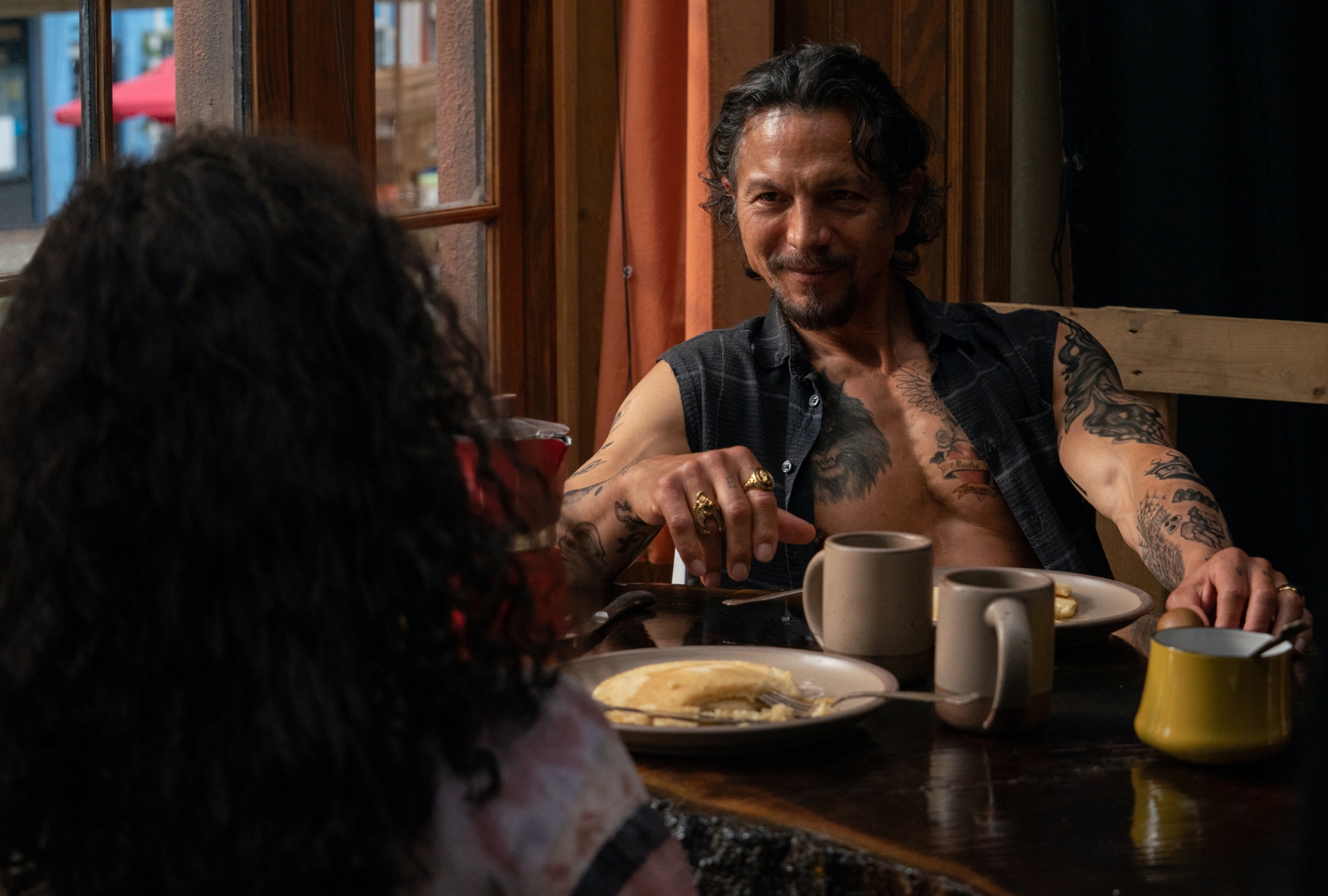
Benjamin Bratt in “DMZ” (Richard DuCree/HBO MAX)She’s top billing in a show that boasts an impressive cast, including Benjamin Bratt, Freddy Miyares, Alano Miller, Nora Dunn, Rutina Wesley and Hoon Lee. Executive producer Ava DuVernay establishes a sharp, color-saturated cinematic style in the first episode, which she directs, and which fellow director Ernest Dickerson carrying through the rest of the series.

Together they conscientiously render the DMZ as a place where its denizens prioritize vibrant creativity as part of their survival, even in its most dangerous colors. The sheer exuberance of the wild, overgrown landscape, the flamboyant reds and pops of blue speak of motley ingenuity, warmth and community in a time of scarcity.

This is in keeping with each filmmaker’s best past stories, particularly DuVernay’s “When They See Us” (where she previously worked with Miyares), where they present a view from inside communities that most white people fear to enter but are quick to disparage. Alma’s first discovery about this supposed death pit is that folks still take care of each other.

Yet the danger is real. The New York that the rest of the fractured country left behind is less of a democracy than a territory divided into tribalist fiefdoms run by an assortment of trigger-happy warlords and predatory killers like Skel (Miyares)  with two men, Parco (Bratt) and Wilson (Lee), vying for the position of governor. Alma happens to have a personal connection with each that she leverages in the hope of locating her son. But her eight-year absence makes her a stranger to them and everybody else – even family.

People who know and love their post-apocalyptic B-movies will recognize shades of “Escape from New York” and “The Warriors” playing out in “DMZ.”  That isn’t necessarily to its detriment, save for the complete absence of camp.  But the story also resists the urge to portray this place as a meat grinder. That makes it fairly watchable despite the clunky execution of the second, third and fourth episodes.


Want a daily wrap-up of all the news and commentary Salon has to offer? Subscribe to our morning newsletter, Crash Course.


But in the same way “Station Eleven” makes a case for our innate need to sustain joy at the worst of times, the parts of “DMZ” that work best are the moments when secondary characters such as Jordan Preston Carter’s streetwise scavenger Odi extend kindness to those less fortunate than they are. This is one part of the series’ broader exploration of marginalized people making a kingdom out of leftovers.

Patino has a good time playing with tropes, including Wilson’s tactic of surrounding himself with female bodyguards like some boss out of a ’90s Hong Kong action flick. It’s a goofy move that plays into a popular stereotype, which Wilson acknowledges in a way that only Lee could pull off.

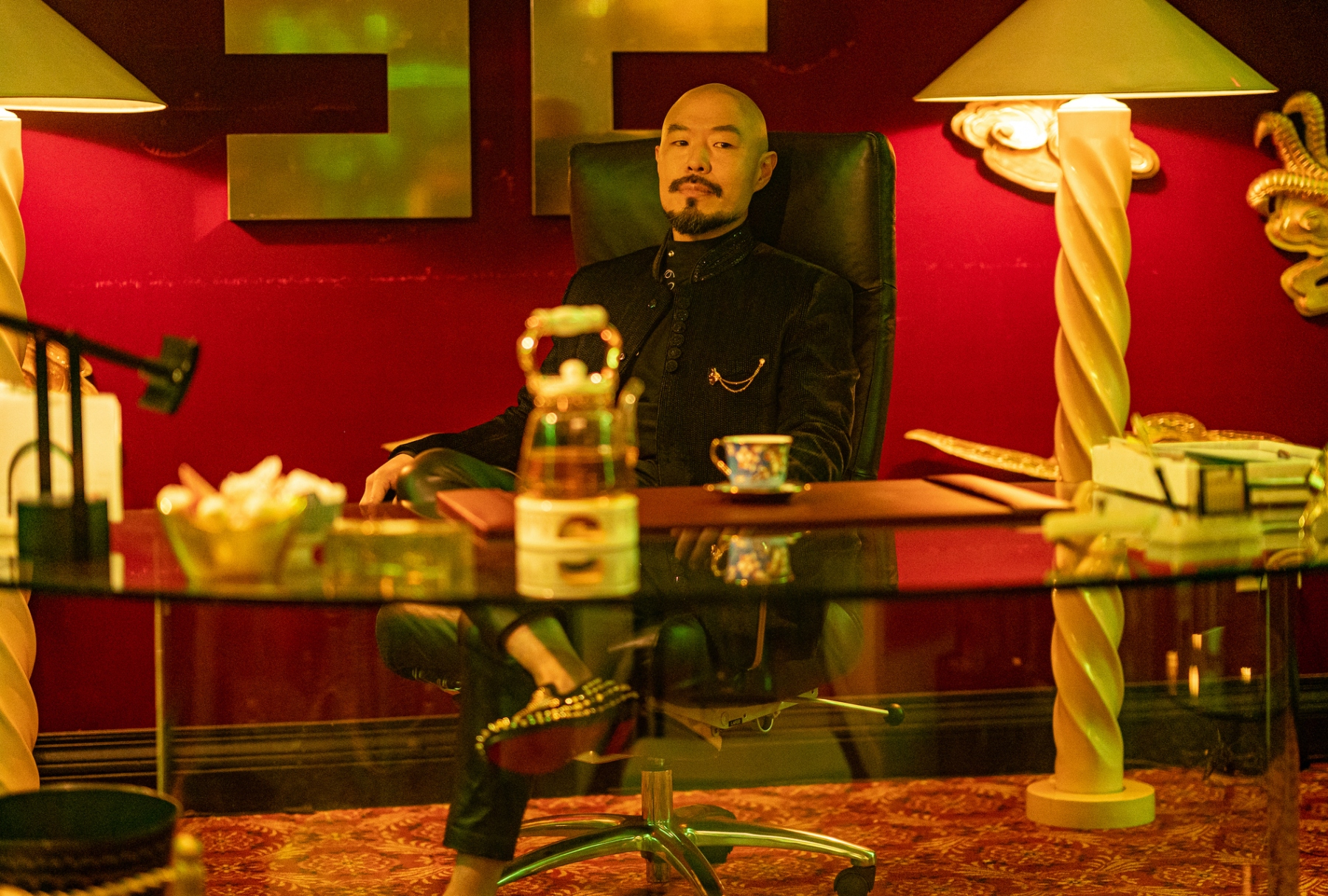
Hoon Lee in “DMZ” (Eli Joshua Adé/HBO MAX)“DMZ” presents yet another opportunity to appreciate how versatile and underutilized of an actor he is, especially when he goes toe-to-toe with Bratt’s gold-and-leather dripped kingpin. As Parco, Bratt employs the charisma he wields as a protagonist the way an assassin might secret a blade in a shirt sleeve. His malevolence is plain, but Bratt makes it easy to understand why Parco’s constituents are drawn to him. As ably as he does this, Lee makes his adversary even more deceptively reasonable.

All of these are virtues that turn into problems once it becomes apparent that Patino doesn’t have the room to thoughtfully add humanizing dimensions these characters or write fortifying layers into their relationships with each other. The actors stretch mightily in their performances to sell the many plot holes that “DMZ” requires us to ignore as we travel with Alma. Other details, including a ticking-down clock in the first episode, have no real purpose at all.

Whether the poignant performances and rousing visuals are enough to carry viewers through its inconsistent flow is as tough to say. Similarly, who knows if Patino would have satisfactorily filled in the gaps displaying his plot incompleteness with extra hours? What we can see is that “DMZ” gives incredible performances while asking us to ignore some massive flaws, trusting that an outstanding cast and timely premise are enough to compensate for the messy, pothole-ridden landscape it asks us to travel with Alma.

All episodes of “DMZ” are currently streaming on HBO Max. Watch a trailer for it below, via YouTube.

More stories like this:

Does butter need to be refrigerated? Well, it depends

Do you store butter in the fridge, freezer, or at room temperature?

When I floated this to home cooks on social media, the most common answer wasn’t, actually, any of the above. It was all of the above.

Yes, plenty of people store butter solely in the fridge. Because that’s what their mom did. Because they live in a warm climate. Because they don’t eat a lot of butter. Because their dog or cat would jump at the chance to eat a lot of butter.

But beyond fridge loyalists, more people, myself included, like to pick and choose. Because it’s fun to be picky! Because it’s fun to be choosy! It all depends on what you need the butter for: Sautéed kale? Pound cake? English muffin? Pie crust?

According to the USDA, “Butter and margarine are safe at room temperature. However, if butter is left out at room temperature for several days, the flavor can turn rancid so it’s best to leave out whatever you can use within a day or two.”

Likewise, Harold McGee writes in “On Food & Cooking,” “Because its scant water is dispersed in tiny droplets, properly made butter resists gross contamination by microbes, and keeps well for some days at room temperature.”

This means that butter with a higher fat content, like a European-style variety, is a better bet to leave on the counter. If you want to be an overachiever, opt for a salted variety — more flavor, duh, but also because the salt acts as a preservative. And keep the butter in a dish that stamps out as much light and air as possible.

From a food-safety perspective, the least risky option is the freezer (where butter will keep for several months), followed by the fridge (where butter will keep for a couple months). But what about from a toast perspective? What about the toast?

Some math: Butter becomes spreadable at 60 degrees Fahrenheit. Butter melts at 85 degrees Fahrenheit. The butter in my fridge is 43 degrees Fahrenheit. And the butter on my counter is 65 degrees Fahrenheit. All of which adds up to my own answer to my own question:

Where do I store butter? Anywhere and everywhere. Here’s my system:

Freezer

Emergency butter so you never have to worry about running out of butter. Good for other people, usually unnecessary for me, because I plow through the butter in my fridge so swiftly.

Fridge

At least two pounds of unsalted, American-style butter for cooking and baking. Plus backup butter for the counter.

Fridge slash counter

Butter that spends most of its life in the fridge but moves to the counter 12 to 24 hours before I bake a cake or cookies.

Counter

Salted, European-style, four ounces or fewer so it doesn’t have to be out for long. For noodles, rice, and, especially, toast.

Am I right or am I right? What’s your belief system when it comes to butter storage? Let me know in the comments below.

17 best St. Patrick’s Day cake recipes, from the very green to chocolate stout

When you think of St. Patrick’s Day food, a plate of corned beef and cabbage and a pint of Guinness probably come to mind. But we’re here to encourage you to make a little bit of room on your table for cakes. Is there such a thing as a traditional St. Patrick’s Day cake? Not exactly. So instead, we turned to quintessentially festive flavors and ingredients like dark, malty stouts, Irish cream liqueur, whiskey, chocolate, and lots and lots of green food coloring. The cake recipes that most say “St. Patrick’s Day” either get their hue from gel food coloring or naturally green ingredients like matcha powder, mint, parsley, or pistachios. And when you can’t find yourself faced with a pot of gold, there’s always gold leaf for decorating.

Best St. Patrick’s Day cake recipes

1. Fudgy Chocolate Stout Cake

You can’t celebrate St. Patrick’s Day without consuming a pint of dark beer one way or another. If you can’t imagine sipping a stout, bake a cake with it! Oh, and this super fudgy chocolate cake just happens to be vegan.

2. Matcha and Coconut Mochi Cake

On St. Patrick’s Day, I want all of my food to be so green that I just naturally turn into a leprechaun. This coconut-y, green tea cake is perfect for that.

3. Roberta’s Parsley Cake

Five cups of herbs (four cups of parsley and one cup of mint) turn an otherwise ordinary yellow cake into an earthy green masterpiece. “It’s festive and shamrock-forward, but also a bright spot at the end of a dense, salty meal,” says our editors.

4. Pistachio Cake with Lemon, Cardamom, and Rose Water

One cup of ground pistachios teams up with a cup of almond flour to make this gluten-free, light-as-air cake extra-green for St. Patrick’s Day.

5. “Gala” Grasshopper Pie

Chocolate and mint are a no-fail duo and one we will die on the Cliffs of Moher for. There’s minty fresh flavor in both the chocolate cookie crumb crust, the creamy mint filling, and (drumroll please) the chocolate-mint whipped cream on top.

6. Mini Pistachio-Vanilla Birthday Cake

This pistachio-studded cake is just as apt for a birthday party as it is a delicious dessert to finish a rich St. Patrick’s Day feast.

7. The Snake Bite

“The slightly effervescent pear cider-cream cheese frosting swoons contentedly upon a truly dark, rich, and delicious chocolate stout cake. I think you’ll like it,” writes recipe developer Arielle Clementine. I think you’re right.

8. Matcha Swiss Roll

Way easier to make than a traditional bûche de Noël and even more appropriate for St. Patrick’s Day is this matcha-infused fluffy cake.

9. One-Bowl Vanilla Cake

Is there anything particularly festive or Irish about this vanilla cake recipe than this one.

10. Food-Processor Pistachio Cake with Raspberry Cream

We love an unfussy cake and this one hits the mark — you don’t even need a stand mixer to make it! The cake batter comes together entirely in a food processor, which results in a light and fluffy texture.

11. Champagne Cake

Celebrate St. Patrick’s Day with this super festive cake glistening with dark chocolate ganache and edible gold because why not?

12. Peppermint Hi-Hat Cake

Food52’s Resident Baking BFF describes this dessert as a single, tall devil’s food cake topped with an almost equally tall mound of peppermint seven-minute frosting. There’s nothing inherently Irish about it, other than that it promises a good time.

13. Coconut Caramel Sheet Cake Layer Cake

If you’re getting together with a big group to celebrate St. Patrick’s Day, then a sheet cake is surely in the cards. It feeds more than enough party attendees, and it requires a little bit less work and way less decorating to make it look presentable.

14. Triple-Chocolate No-Bake Cheesecake

Technically this over-the-top cheesecake has four layers of chocolate — there’s a chocolate cookie crumb crust, plus three layers of dark, milk, and white chocolate mousse for a St. Patrick’s Day cake that no one will refuse.

15. Irish Coffee Cupcakes

Give the baker of these Irish cupcakes a big ole kiss. The coffee cupcake batter also has a generous splash of whiskey, while the icing on top is made with Bailey’s Irish cream.

16. Rye and Rhubarb Anytime Cake

Rhubarb season and St. Patrick’s Day naturally sync up, so take advantage of this pretty-in-pink vegetable for just a short time with this crumb cake.

17. Fudgy Gluten-Free Chocolate Cake with Hazelnut Frosting

“Frankly, this is just a really good chocolate cake, which happens to be gluten-free. It’s a single layer, but a hefty one, an absolute dream to slice into,” writes recipe developer Shilpa Uskokovic. Anyone who gets to taste a rich, fudgy slice should consider themselves lucky.

This one-pan Mexican dish is the epitome of comfort food — and it comes together in only 15 minutes

The German language really gives and gives. There’s schadenfreude, of course, but there’s also backpfeifengesicht (a slappable face) or fremdschämen (secondhand embarrassment). And then there’s kummerspeck. It literally means “grief bacon,” but also refers to that extra weight you carry around when you’ve been doing your share of sad eating.

My bacon as of late is grief bacon. My eggs are mourning eggs. My cake is bereavement cake. In the span of less than 12 weeks of each another, my mother and mother-in-law recently ended their journeys with dementia and died. I’ve spent a lot of time crying across various Cheesecake Factory locations in the Tri-state area. At home, I’ve catatonically made many meals, one of which really spoke to me. It’s not quite grief bacon. It’s piggy beans. 

RELATED: Ina Garten’s sheet pan trick will change how you make bacon

As described by Pati Jinich in her “Treasures of the Mexican Table,” frijoles puercos are a popular appetizer in Jalisco that you can easily recreate at home and “make as piggy as you desire.” Soft refried beans get combined with meat and cheese and kicked in the pants with green olives and pickled jalapeños. My German side loves the briny zing the olives and peppers bring to the whole dish to cut through the fatty richness — it’s basically grief bacon with pickles. 

Jinich makes her piggy beans with homemade beans, bacon and chorizo. I heeded her simplifying tip and used canned beans. For the “Quick & Dirty” version, I also omitted the chorizo. You can add or substitute freely here — ham, cooked pork, sausage, you get the gist.


Want more great food writing and recipes? Subscribe to Salon Food’s newsletter.


Any way you make them, these beans come together in less than 30 minutes in a single pan — and they’re the epitome of comfort food in any language. Though traditionally served an appetizer, you can enjoy them as the main course with a green salad and a perfectly balanced margarita. So, gather your loved ones at the table, remember those who aren’t present and keep passing the chips.

***

Recipe: Piggy Beans (Frijoles Puercos)
Inspired by Pati Jinich’s “Treasures of the Mexican Table

Yields
4 servings
Prep Time
5 minutes
Cook Time
15 minutes

Ingredients

  • 2 cans refried pinto beans
  • 1/2 pound thick-cut bacon, coarsely chopped
  • 2-3 green onion stalks, chopped
  • 1⁄3 cup pimiento-stuffed green olives, chopped
  • 1⁄3 cup chopped pickled jalapeños, plus 1 tablespoon brine
  • 1⁄4 cup grated Cotija or Añejo cheese, or crumbled Queso Fresco
  • Sea salt and black pepper, to taste


Directions

  1. Heat a large Dutch oven or skillet over medium heat.
  2. Add the bacon and cook until just crisp, about 5 minutes. Remove from the pan and reserve. (I put it on the platter I use to serve the dish.)
  3. Add the onions to the bacon fat and cook until soft, about 3 minutes.
  4. Add the refried beans and cook with the ingredients already in the pan, stirring until everything comes together. Season with salt and pepper to taste. (You may want to add a little water to loosen the mixture up. It should be thick but not stiff.) 
  5. Stir in the olives, jalapeños and brine.
  6. Spoon the mixture into a bowl or onto a platter. Top with the crisped bacon, your choice of cheese and additional onions and peppers, if you like.
  7. Serve with corn chips and a green salad, if you’re feeling in need of a vegetable. Definitely finish things with some popsicles.

More Quick & Dirty recipes we love: 

Salon Food writes about stuff we think you’ll like. Salon has affiliate partnerships, so we may get a share of the revenue from your purchase.

Biden Administration invests in cleaning up the polluted Great Lakes

Almost 53 years ago, sparks from a passing train were enough to ignite the Cuyahoga River. On June 22, 1969, an oil slick burst into flames by a Cleveland steel mill just before noon. To residents of the Rust Belt city, the fire came as no surprise — not even making the front page of either daily. To the nation, it was a wake up call that animated a bipartisan conservation movement. 

Just one county over in the city of Lorain, Ohio, President Joe Biden paid homage to that history last month with a show of across-the-aisle environmentalism. On the banks of Lake Erie, President Biden stood in a shipyard at the mouth of the Black River to announce a $1 billion investment into the Great Lakes Basin via the Bipartisan Infrastructure Law.

“Pollution from industry, runoff from agriculture, poor wastewater treatment put the Great Lakes and everyone who depends on them at risk,” he asserted. “For decades, there was a lot of talk, a lot of plans, but very little progress. It was slow. That changes today.”

Without fatalities or notably high costs, not much had set the 1969 fire apart from the last 12 major fires on the river until an Aug. 1 article in Time magazine put it in the limelight. The following year, President Richard Nixon established the Environmental Protection Agency, and the Clean Water Act passed despite his veto in 1972.  

RELATED: The battle for the rights of nature heats up in the Great Lakes

Featuring an image of a much larger 1952 fire, the story turned the burning Cuyahoga River into the poster child for water pollution. Although the Cuyahoga River never endured another major fire, it was not alone then and neither is it now.

“There were no fish here in this section of river,” described Chief of Resource Management at Cuyahoga Valley National Park Chris Davis, a plant ecologist. “There was the explicit oil burning on the surface of the river, but then below, the water was also just basically a biological dead zone. That was all related to historic pollution that had just been accumulating since the 1800s.”

Half a century ago, industrial waste had already polluted large parts of these ecosystems all around the former manufacturing heart of the US. Outlining 14 “beneficial use impairments” that chemical, physical or biological damage could inflict, the United States and Canada sought to define “areas of concern” (AOCs) and protect their shared natural resource in the 1987 Great Lakes Water Quality Agreement. 

“We know these sites were dangerously polluted for decades,” President Biden acknowledged. “We’re committed to clean them up. Three decades ago, we made this commitment. And, yes, we’ve gotten a couple of them done, like right here.”

A relative success story, the Black River is among 17 severely damaged sites categorized as areas of concern in the United States that have undergone complete remediation. Little progress actually took place until the Great Lakes Restoration Initiative sought to fast-track restoration goals in 2010. With new funding, the EPA projects complete restoration of 11 out of 14 remaining areas of concern by 2030. 


Want more health and science stories in your inbox? Subscribe to Salon’s weekly newsletter The Vulgar Scientist.


“The Great Lakes are a vital economic engine and an irreplaceable environmental wonder, supplying drinking water for more than 40 million people, supporting more than 1.3 million jobs, and sustaining life for thousands of species,” said EPA Administrator Michael S. Regan in a statement. “Through the investments from President Biden’s Bipartisan Infrastructure Law, we will make unprecedented progress in our efforts to restore and protect the waters and the communities of the Great Lakes basin. Building a better America means investing in our natural resources and the communities they support.”

During his remarks, President Biden described “the historic investment” as the “most significant restoration of the Great Lakes in the history of the Great Lakes.” Though certainly a notable contribution, this assertion doesn’t hold up to historical scrutiny.

In 1969, Time reported $1.1 billion of federal spending to clean up sewage plants around Lake Erie alone. Adjusted for inflation that amounts to about $8.5 billion today. In recent history, $3.7 billion have gone toward the Great Lakes Restoration Initiative since it was introduced under the Obama administration in 2010. 

Still, funds from the infrastructure bill should accelerate cleanup of most areas of concern. According to the EPA, “the bulk” of this investment will go toward restoration of the Great Lakes, North America’s largest source of freshwater. Promising more details in the coming months, the EPA has yet to provide information about distribution and even the amount of funds going directly to conservation at all.

Eileen Deamer, an EPA spokesperson for the Great Lakes region, stated that restoration and remediation actions for the Cuyahoga River AOC will be complete by 2026 with a total cost of over $100 million.

“We have already made progress in cleaning up the Cuyahoga River AOC,” Deamer wrote to Salon. “Working in close partnership with our state, local and federal partners, three of the original nine BUIs [Beneficial Use Impairments] have been removed. A number of important habitat projects have also been completed including the removal of Brecksville Dam and the restoration of floodplains at Cascade Valley View.” Beneficial Use Impairments is a term that refers to “change[s] in the chemical, physical or biological integrity of the Great Lakes system sufficient to cause significant environmental degradation,” according to the Environmental Protection Agency.

Likewise, Davis gave a rough estimate of at least $50 million for Cuyahoga Valley National Park alone, which accounts for 22 of the 46.5 miles of river.

“With this investment, President Biden is delivering major environmental, public health, and economic wins for the Great Lakes region,” said White House Senior Advisor and Infrastructure Implementation Coordinator Mitch Landrieu. “Building a better America requires us to confront legacy pollution and clean up the environment – ensuring our kids drink clean water and creating good-paying jobs in the process. We know that cleaning up these waterways and improving the health of the Great Lakes will also create great economic opportunities for communities across the eight-state region and beyond.”

On Tuesday, President Biden also signed the Consolidated Appropriations Bill, with a $348 million Great Lakes Restoration Initiative budget, adding another chunk of change to the overall restoration budget. 

Read more on the Great Lakes:

After Trevor Noah says Kanye needs therapy, rapper spews racial slurs that gets him suspended online

Kanye “Ye” West has become a controversial figure amid his public feuds with former family members and celebrities. And his increasingly angry and outsized reactions have prompted some to feel that he requires more scrutiny and maybe even medical help. But it doesn’t seem like he’s receptive to those suggestions.

Take his latest attack on Trevor Noah, the latest public figure to call out the rapper’s troubling behavior. In a video clip uploaded on Tuesday, Noah said that people should “pay attention to” the fallout from Kim Kardashian‘s divorce from West and noted that “over time, Kanye has become more and more belligerent in how he tries to get Kim back.”

Beyond all the persistent texts and social media messages to this ex, West has also publicly issued death threats to Kardashian’s current boyfriend, “Saturday Night Live” star Pete Davidson. In West’s latest music video, a clay-animated version of West is seen kidnapping, decapitating and burying alive a Davidson look-alike. Many saw that macabre wish fulfillment as a red flag.

RELATED: The emotional labor of being a Kanye West fan is not paying off

“I do understand that art can be therapy . . . But I also understand that therapy can be therapy,” Noah continued. “And what’s weird about the situation is that Kanye West has told us that he struggles with his mental health. So I get it, you want to have art as therapy, but here’s what’s weird. What Kanye doesn’t understand is that what we’re seeing is . . . it makes you uncomfortable.”

He added, “You may not feel sorry for Kim because she’s rich and famous. But what she’s going through is terrifying to watch. And it shines a spotlight on what so many women go through when they choose to leave [toxic relationships]. . . .  What we’re seeing here is one of the most powerful, one of the richest women in the world unable to get her ex to stop texting her, to stop chasing after her, to stop harassing her.”

Noah also mentioned his own childhood of growing up in an abusive household and how his mother was constantly reprimanded by police, family members and even strangers for “overreacting” or being unable to stand up to her abuser.  


Want a daily wrap-up of all the news and commentary Salon has to offer? Subscribe to our morning newsletter, Crash Course.


“You see a world where women are questioned for what is happening to them as opposed to people questioning what is happening to them,” he said.

Naturally, West was not about to let that speech go unanswered. On Wednesday, the rapper  launched racial slurs at “The Daily Show” host on Instagram, which suspended West for 24 hours. Per TMZ, the now-deleted post featured a picture of Noah and a caption with the lyrics that put a racist spin on the Black spiritual song “Kumbaya”: “K**n baya my lord k**n baya K**n baya my lord K**n baya Oooo’ lord K**n baya.”

Noah’s recent comments contribute to a larger discussion about West’s bipolar disorder diagnosis and the mockery of his abuse towards Kardashian, her family and Davidson. West has frequently addressed his custody battles on Instagram, alleging that Kardashian barred him from seeing their children and antagonized him with daughter North’s social media posts. In a deleted comment posted earlier this week, Kardashian called out his version of events.

“Please stop with this narrative, you were just here this morning picking up the kids for school,” she wrote.

A spokesperson for Meta — the technology conglomerate that owns Instagram — told Variety that West’s suspension was initiated after he had violated policies on hate speech, bullying and harassment. In accordance with Meta’s policy to restrict accounts that have violated these rules multiple times, West will no longer be able to post, comment and send direct messages for a limited period of time. Meta said it will continue to monitor the situation and place more restrictions if additional violations are made.

More stories you might like:

Millions will “suffer” if Congress doesn’t approve COVID-19 funding, experts say

Last week, the House of Representatives passed a $1.5 trillion federal spending bill that included aid for Ukraine — and in turn, cut the package that would fund the government’s COVID-19 response effort. Though it might seem the pandemic is winding down (which may prove to be a false hope), a lack of funding from the federal government would have a detrimental effect on the country’s COVID-19 response — and infectious disease doctors are becoming increasingly concerned about the prospect of facing another surge without the federal government’s support.

The White House is now urging Congress to pass $22.5 billion in additional pandemic funding as the country stares down the possibility of another wave of COVID-19 infections in the coming months. In a letter to lawmakers on Tuesday, Natalie Quillian, deputy coordinator for the White House COVID-19 response team, warned of the dire consequences if funding isn’t passed — including the inability to purchase more boosters doses if a fourth dose is needed, as well as making it so the Uninsured Program can no longer accept new claims for testing and treatment. The latter means that providers will have to absorb the costs of testing and treatment themselves, or turn away uninsured people.

According to NPR, Democrats are going to try to pass a standalone COVID-19 funding bill in the coming days, but Republicans oppose the plan. Time is of the essence, as due to a lack of funding, the White House is already forced to cut back shipments of monoclonal antibody treatments — which have been especially helpful in treating those who are immunocompromised — to states by 30 percent next week. The country’s supply of treatment could run out as soon as May if funding isn’t provided.

RELATED:  COVID-19 death toll hugely undercounted

Doctors on the ground are worried about what a lack of funding could mean for the next stage of the pandemic, especially as the country faces the possibility of another surge. As Quillian noted in her letter, waiting to provide funding until another surge occurs “will be too late.”

“Currently, almost all the medical countermeasures used for COVID-19 — oral antivirals, monoclonal antibodies, diagnostic tests — are available only under emergency use authorization with the government being the exclusive (or almost exclusive) buyer,” said Amesh Adalja, an infectious disease and critical care medicine doctor. “There is no commercial market (yet) for the oral antivirals and monoclonal antibodies so if the government has no funds to purchase them.”

“There really is no means for people to access them,” he continued.

“Without the funding, antivirals will run out, and in those cases, [the] immunocompromised will suffer.”

This news arrives at a moment when authorization of a second booster (or a fourth shot for those who got a two-dose vaccine initially) seems increasingly likely. On Tuesday, pharmaceutical giants Pfizer and BioNTech announced they were seeking emergency authorization for a second booster shot of their vaccine for adults 65 and older. Quillian said in her letter that the federal government doesn’t have enough funding to purchase enough booster shots for all Americans; however they do have enough doses available for immunocompromised people to get a fourth dose.

Yet the COVID-19 situation could become more acute in the event that a variant-specific booster is needed yet lacks proper funding.


Want more health and science stories in your inbox? Subscribe to Salon’s weekly newsletter The Vulgar Scientist.


Without funding, the federal government won’t be able to maintain its testing capabilities beyond June, or continue research on next-generation vaccines. Experts say testing and vaccine sites are critical to maintain to be prepared for another surge.

“We do need to maintain the testing networks that have been developed in the states so that we can continue testing, and we do need to have vaccines in hand especially if a fourth [shot] is needed,”  L.J Tan, chief strategy officer for the Immunization Action Coalition, told Salon. “And these products are needed regardless of what COVID funding that is already in states.”

A lack of federal funding would also restrict the government from buying more oral antiviral treatments like Paxlovid. Currently, the government has only secured 20 million treatments.

“Unfortunately, without this designated Congressional funding, the federal government will be unable to provide Evuheld (a monoclonal antibody to protect immunocompromised) to states, purchase more Paxlovid for outpatient treatment, perform further testing during surges or perform wastewater surveillance, or provide vaccines to low-income settings,” said Dr. Monica Gandhi, infectious disease doctor and professor of medicine at the University of California, San Francisco. “This additional funding is absolutely vital to stay vigilant in this endemic stage of the virus with surveillance, vaccination and treatment.”

According to NPR, Republicans want Democrats to provide a more detailed analysis of exactly how the government spent the roughly $6 trillion in COVID-19. Yet the more time politicians waste arguing over funding, the more that Americans — especially those who are immunocompromised and uninsured — will suffer because of them. 

“I think that the most important thing is that the three major buckets of the funding bill are all things that are needed on the ground,” Tan said. “For example, antivirals are in short supply and without the funding, antivirals will run out, and in those cases, [the] immunocompromised will suffer.”

Read more about COVID-19:

Baileys, Jameson and plenty of greens: 5 of our favorite St. Patrick’s Day recipes

Once the Chicago River went green over the weekend, I knew the countdown to St. Patrick’s Day had officially begun.

Growing up in Chicago, I remember how every March the river would be dyed with vegetable dye — a tradition that began in 1962 — in preparation for the holiday, as patrons decked in green T-shirts and beads cram into area pubs like Schinnick’s and Hinky Dink’s.

In the U.S. especially, St. Patrick’s Day has become a drunken celebration of all things green, beer included. It’s a far cry from the original, more solemn observances of St. Patrick’s Day, Ireland’s patron saint, which usually involved Irish Catholics attending morning mass and perhaps partaking in a feast later in the day. The Connaught Telegraph once described the Irish holiday by saying, “St. Patrick’s Day was very much like any other day, only duller.”

RELATED: The best Irish brown bread is baked at Clonbrock Castle — here’s how to make it

While the conversation generally skews toward drinks, another fun way to get festive on March 17 is with food. That’s why we’re sharing 5 of our favorite St. Patrick’s Day recipes from the Salon Food archives today. You’ll feel lucky if any of these gems are part of your celebration:

1 Baileys Irish Cream Cookie Sandwiches

This recipe for Baileys Irish Cream Cookies comes from Meghan McGarry, the proud Irish American owner of Buttercream Blondie. Wondering what they taste like? Well, think of an Irish coffee — which beautifully combines espresso, a little whiskey and cream — in cookie sandwich form. 

“I paired Irish whiskey and coffee together, because they’re the ultimate power couple,” McGarry previously told Salon Food. “The Baileys floating through the cookie is very delicate, and in the filling is the espresso for an extra shot of flavor that beautifully cuts through the sweetness.”

For an extra touch of festiveness, reach for a Shamrock cookie mold. Don’t have one? No worries! Grab any 3-inch cookie cutter and some green sprinkles for a thematic touch. 

2 Baileys Irish Cream Brownies

Have some leftover Baileys on your hands? Follow McGarry’s lead again and consider using it to spike a batch of brownies. A single shot really enhances the batter. You can follow her homemade recipe, reach for a box mix or maybe give Salon’s extra-dark espresso-infused variety a try. 


Want more great food writing and recipes? Subscribe to Salon Food’s newsletter.


3 Jameson Mule

As Salon’s Erin Keane wrote for “The Oracle Pour,” “Why is a grown-up St. Patrick’s Day toast so hard to imagine? Celebrating this holiday as an American adult shouldn’t have to be a choice between an obnoxious public event or a demented solo living room reading of ‘The Lieutenant of Inishmore.’ (Play the Pogues, hide the cat.)” 

Celebrate finding a middle ground between those options with a Jameson Mule. It’s a 5-ingredient play on the Moscow Mule, the backbone of which, as the name suggests, is Jameson Irish Whiskey. According to Jameson expert and mixologist Jane Danger, the bold flavor of ginger beer perfectly complements the complex flavors found in Jameson Irish Whiskey. 

“The balance of spicy, nutty and vanilla notes in Jameson Original are heightened with hints of sweet sherry and exceptional smoothness,” Danger told Keane. “The lime cuts the sweetness and adds a finishing touch of citrus to bring out the fresh Granny Smith apple notes.”

4 Copycat McDonald’s Shamrock Shake

“Like countless Irish Americans, I find St. Patrick’s Day a real mixed pot o’ gold,” Salon’s Mary Elizabeth Williams once wrote. “On the one hand, I’m proud of my heritage and my melancholy, pugilistic people. On the other hand, is there anything about the way the holiday is celebrated in the U.S. that isn’t just . . . gross?” 

Williams had a similarly fraught relationship with McDonald’s Shamrock Shake — the annual “limited-time only,” mint flavor-packed, drive-thru darling. To her, the faux mint-flavoring was a bit much. So, she decided to — as another famous fast-food chain puts it — have it her way. That meant ditching the mint, upping the vanilla and subbing in a glug or two of whiskey. 

5 All the Greens

Perhaps you want to enjoy something green that isn’t green beer? Be sure to check out this list of our favorite beans and greens recipes. To start, we’ve got a gorgeously crunchy kale salad inspired by Molly Baz. If you’re looking for something a little heartier, David Kinch’s beans and greens gratin blends a healthy amount of melting cheese with cannellini beans and torn kale, all of which gets topped with a crispy breadcrumb crust. Jackie Freeman’s cauliflower and lima bean gratin is a similar recipe — use either as a jumping-off point based on what you have in your own fridge and pantry. 

Read more: 

Putin’s invasion of Ukraine exposes the Fox News-QAnon feedback loop

One of the currently preferred rationalizations pro-Russia propagandists are using to justify the invasion of Ukraine appears to have emerged from an American social media network known for hosting QAnon, neo-Nazis and other assorted deplorables. As Justin Ling at Foreign Policy explained it earlier this month, the new theory is that “Moscow is launching airstrikes on Ukraine to destroy bioweapon-manufacturing labs in order to prevent the American infectious disease expert Anthony Fauci from creating a sequel to the COVID-19 virus.” 

The notion that Ukraine has “bioweapons” and that Russia is invading to stop some dastardly Ukrainian plot didn’t even emerge until after the invasion had begun. Prior to that, the laughably thin rationale was based on Vladimir Putin’s asinine claims that Ukraine, whose president is of Jewish ancestry, is being run by Nazis. When that didn’t really fly, a new justification emerged, from what look to be American sources.

RELATED: QAnon followers are casting Putin in a positive light

As Ben Collins and Kevin Collier of NBC News have traced — and as the Fauci-centric nature of the theory would indicate — this nonsense seems to have started in right-wing circles and only spread after the Russian invasion started. Memes illustrating the conspiracy theory originated on Gab, a Trump-worshipping social media network rife with neo-Nazis and QAnon fans. Soon they were copied to Twitter and spread by QAnon accounts, many which were eventually deleted for spreading disinformation. But by then, of course it was too late: The conspiracy theory had reached Fox News. 

On March 9, Fox News hosts Tucker Carlson and Sean Hannity offered cleaned-up versions of the conspiracy theory. Instead of explicitly justifying the invasion of Ukraine, they presented the bioweapons claim as a “theory,” simply being offered as a counterbalance to the supposed pro-Ukraine bias of the mainstream media. The next day, another Fox News host, Jeanine Pirro, hauled the Fauci part of the conspiracy theory out of the weeds, first burbling on about “biolabs” and then adding, “Isn’t it interesting that we haven’t heard or seen Fauci in weeks?”


Want more Amanda Marcotte on politics? Subscribe to her newsletter Standing Room Only.


Welcome to the QAnon-Fox News feedback loop. Conspiracy theories first surface in the right-wing swamplands and spread through social media channels. They get picked up and then, crucially, laundered on right-wing media outlets like Fox News. Dwellers of the right-wing swamps are emboldened by seeing their ideas on Fox News and other “mainstream” conservative outlets and “ordinary” Fox News viewers (presuming they exist) are driven to social media to “learn” more, where they get hit with the harder stuff from QAnon. Rinse and repeat, and pretty soon every GOP voter in the country is full to the brim with ideas first floated by the absolute worst people on the internet.

I don’t just mean QAnon, of course, but all manner of neo-Nazis and right-wing nuts. And it isn’t just Fox News, but all manner of right-wing media. Still, for the sake of simplicity, we can call this the QAnon-Fox News feedback loop. 

With this bioweapons hoax, we can see how it works. The original conspiracy theory was, of course, absolutely nuts and Fox News hosts know better than to assert it as straightforwardly as their QAnon sources do. Instead, they reframe it in “just asking questions” mode and leave it up to their audience to make the connections. The Fox hosts never come out and say that the Ukraine invasion was justified by this nonsense hypothetical. They just “ask questions” about whether Ukraine is really the innocent victim the hated mainstream media portrays it as, and they trust — with good reason — that their viewers know how to use Google and social media and will find the hardcore conspiracy theories for themselves. 

RELATED: “The View” calls out Tucker Carlson and media pawns “telling lies about the Russian people”

We have seen how this works in all manner of right-wing nuttery. QAnon and QAnon-adjacent circles started floating the idea that the Jan. 6 insurrection was a “false flag” created by the FBI. Soon, Carlson was making documentaries about it and Sen. Ted Cruz tried it out during a Senate hearing. The idea that horse paste was a COVID-19 cure-all started on right-wing social media and, sure enough, was soon being ventilated in “just asking questions” style on Fox News and, sigh, among Senate Republicans. Now we’re seeing the same thing with Florida’s “don’t say gay” bill, where QAnon lies about Democrats being pedophiles, stripped of the blood-drinking, are presented as fact on Fox News

The QAnon-Fox News feedback loop is grim on its own, especially since so many congressional Republicans have inserted themselves into it. But it’s now even more deadly, because Putin and his propagandists are riding along. As disinformation expert Jared Holt explains at the Daily Beast, “while Russia first used narratives and disinformation related to biolabs” to demonize Ukraine in the past, it was only after the QAnon conspiracy theory about Fauci and Ukraine began to spread that Russia adopted it as a justification for the invasion. Ling notes that this QAnon theory is now promoted “by one Russian embassy, an official Russian state propaganda outlet, and media channels in Serbia and China.” It is, after all, a better lie than the “de-Nazification” crap Putin spewed at first. 


Want more Amanda Marcotte on politics? Subscribe to her newsletter Standing Room Only.


QAnon and its adjacent conspiracy theory communities online have created a way to crowdsource right-wing propaganda. Fox News figured out long ago how useful that is, because the online ecosystem helps sort out which conspiracy theories will do well with their target audience. QAnoners do all the work honing and refining the ideas, and all Fox News has to do is repackage it — just asking questions! — and they’re good to go. 

Now Putin is exploiting the same online ecosystem. There was a lot of talk, and rightfully so, about Russian-sourced disinformation during the 2016 election.  But increasingly, that looks like a two-way street, with American right-wingers generating and refining conspiracy theories that Russian propagandists can use. Similarly, as Eric Kleefeld notes at Media Matters, Putin’s latest televised tirade “could have been copied from right-wing media in the United States,” so much so that he even complained about the liberal elites trying to “cancel” him.

Russian propagandists turning to QAnon to sharpen their lies makes a lot of sense, in a sad and dark way. America’s freewheeling social media networks provide the ability to crowdsource and refine conspiracy theories in a way that isn’t available in the top-down and heavily censored media ecosystem of Russia. Fox News figured out how to mine the best output of the online lie-generation machine long ago. It was just a matter of time until Putin did. 

For the moment, most Republican voters say they oppose both Putin and the invasion of Ukraine. But those same folks also used to be pro-vaccine. That changed after months of being caught in the QAnon-Fox News feedback loop. But even if Carlson and company can’t convince their audiences to love Putin and hate Ukraine, this situation has already done immense damage. Every day, Russian troops are murdering and kidnapping Ukrainians in this unprovoked war — and using American-made propaganda to justify it. 

Read more on the Ukraine war and the surrounding propaganda:

Fintan O’Toole on Ireland’s transformation — and the reverse version now underway in America

Fintan O’Toole never puts it this directly in his new book, “We Don’t Know Ourselves: A Personal History of Modern Ireland,” but beneath his account of the remarkable transformation of that green island nation on the western edge of Europe, there’s a clear narrative through-line. Many of the things that are the most heavily mythologized about Irish culture and Irish history, in his account — the boozing, the intense relationship with the Catholic Church, the nationalist violence, the compulsive storytelling, the attachment to a manufactured vision of the past — were profoundly destructive.

There were reasons why those phenomena existed, of course, and why they became so strongly associated with Irish nationhood and Irish identity over the course of many centuries of colonialism, intermittent rebellion and internalized repression. O’Toole would agree that none of those factors was entirely negative all the time — as he observed during our long and winding Salon Talks conversation, the fact that Ireland “punches above its weight” in literary terms has a lot to do with the national tendency toward evasion, prevarication and sublimation.

But over time those factors produced a culture that was backward, insular, fueled by tangible self-hatred and constitutionally incapable of telling the truth — about the sexual hypocrisy that made possible long-standing bans on divorce and abortion, for example, or about the rampant sexual abuse of children within the church. At just about the time O’Toole was born in 1958, Ireland began a long, slow, uneven process of integration with the modern world, which was full of tangents and detours and tragic or hilarious reversals, and which to a large extent creates the narrative arc of his book. (His title refers to a specifically Irish colloquialism: “We don’t know ourselves” is an exclamation that might accompany the purchase of a new gas cooker, the move to a new suburban house or a winter vacation to Florida or Spain.)

To break out of its self-constructed isolation and become an approximately modern, approximately European nation, Ireland had to leave some of those mythological elements behind, or at least had to deal with them in a different way and in a global context. The challenge now is how to define being “Irish” when that identity now encompasses immigrants from Africa, South Asia and Eastern Europe alongside the supposedly Celtic natives, but without erasing the island’s rich and distinctive traditions. Much of my conversation with O’Toole inevitably revolved around the relationship between Ireland and the United States, which has shaped Irish history and the Irish economy since at least the late 19th century. It also defines us as individuals. He was born and raised in Dublin but knows America well: He holds a faculty position at Princeton and has written extensively about U.S. politics in his regular column for the Irish Times. I was born in California but spent portions of my childhood and young adulthood in Ireland; I witnessed parts of the dramatic transformation he describes in “We Don’t Know Ourselves,” but only halfway understood it. If we had a couple of hours and a few pints, I could go into the areas where O’Toole and I view these events differently, and why. But he wrote the book and I didn’t; fair play to him.

Fintan, your book is being published in America just in time for St. Patrick’s Day, which is certainly appropriate. Even more so considering that, as far as I know, St. Patrick’s Day was an invention of Irish America, exported very effectively back to the homeland.

Yeah, completely. I have a suspicion, historically — and this is the even worse secret — that it was invented by the British army.

Really? Surely not.

The British army were very good about sort of integrating the Scots and the Welsh, making them feel British. And I think they started off with a day for the Scots where they could parade around in their kilts. There’s a play by Richard Brinsley Sheridan from the 1780s called “St. Patrick’s Day,” which is the first reference I know of anywhere. And it’s all about the British army. So what a dark secret that would be, if the British army invented St Patrick’s Day.

RELATED: St. Patrick’s walk of shame: Ireland’s leader calls on Trump, with the wrong message

There was definitely a period, right around the early 1800s, when the British made a serious effort to integrate the Irish into the Union.

Yeah. It’s sort of hard for us to get our heads around, but before the Great Famine in Ireland, Ireland was one-third of the population of the United Kingdom. So I think like a third of the British army was Irish. Wellington of course, was famously from Dublin and set off his Irish troops at the battle of Waterloo saying, “I don’t know what they’ll do to the enemy, but by God they terrify me.”

There’s so much going on in this book, and the relationship between Ireland and America is a central theme. It’s obviously a big question for Irish Americans, people in the Irish diaspora: How has Ireland changed and how do we understand that? For somebody like me, an American who spent a significant amount of time in Ireland growing up, it presents a particularly illuminating view of things that I witnessed while they were happening, but did not completely understand. To me there are three strands to this book. One is a chronicle of all the things that have changed in Ireland during your lifetime. It’s also a bit of a personal and professional memoir. And running throughout all that is a general theme, which is about the duality or contradiction or hypocrisy that has characterized so much of Irish society and Irish political life over that period.

Yeah. So I suppose the title — I don’t know whether the pun quite works in America, but you’re probably Irish enough to know that “We don’t know ourselves” is used in Ireland as, “Oh, things are just fantastic. We don’t know ourselves since we got the new lawn mower,” but also more literally. So I was trying to reflect the fact that Ireland is transformed, and by and large transformed for the better, during my lifetime.


Want a daily wrap-up of all the news and commentary Salon has to offer? Subscribe to our morning newsletter, Crash Course.


I’m 64, I was born in 1958, which was really when this kind of social revolution and economic revolution in Ireland began. And there’s no doubt about the fact that it’s simply a vastly better place for most people. But it also, over that period of time, has this strange capacity to not know things. Donald Rumsfeld talked about the “known unknowns” and the “unknown unknowns.” He missed the Irish one, which is the “unknown known.” The thing that everybody knows but is not talked about or not addressed.

I know all societies function in that way to some extent, but I think it’s just particularly pronounced in Ireland. In the year I was born, in 1958, Ireland was doing the sort of thing you usually do with a bloody revolution, but doing it kind of pretending it wasn’t really doing it, doing it kind of peacefully and slowly. Which was essentially deciding to be modern, to undergo this process of modernity, which in many ways it had missed out on — and it was going to do that by importing it. 

So the other story — I think it’s obviously fascinating to those of us who are Irish or of Irish extraction, but it’s also interesting in terms of globalization, whatever we mean by that. You have this society which is the great outlier in Western Europe, the backwater, the place that even missed out on the 1950s postwar boom, and it rapidly becomes one of the most economically globalized places on earth. And over the course of that process, it manages to sort of hold itself together by not facing what was happening, by pretending it was still the most Catholic country in the world and that we all still lived by a certain kind of code. 

So for most of my lifetime, you could not legally buy contraceptives in Ireland. For most of my lifetime, you could not get divorced. Never mind abortion being subject to life imprisonment from the moment of conception, all that stuff. So Ireland maintained, for a very long time, this symbolic sense of itself as being exceptionally holy while at the same time desperately trying to be like everybody else and to enjoy sex and money and consumerism and all those kind of things that Irish people really wanted.

When I was reading your book, I kept flashing back to personal experiences I hadn’t really grasped at the time. I remember visiting my cousins on the north side of Dublin, at some point in the ’80s, and at first being bewildered that one of my cousins played in a cover band that only did Eagles songs. But when I went to hear them play, at some dreadful pub in a shopping mall, I understood that in some way I could not articulate as the most Irish thing ever. That kind of mixture is a lot of what your book is about.

Yeah. You know, in one way, it’s the source of Irish creativity and imagination, being able to live in two worlds at the same time is pretty good for writing. Maybe it’s one of the reasons why Ireland tends to punch above its weight in literary terms. But socially it can be very destructive. There was a lot of cruelty involved in Ireland’s self-image as the most Catholic nation on earth and all that. That was purchased at the expense of vulnerable people, particularly women and children. There had to be a kind of terror which was, we are going to maintain this facade and this fiction really over your body, not your dead body but your living body, if you step out of line.

I mentioned in the book that I knew two words for as long as I can remember, along with “mama” and “dada.” I remember Letterfrack and Daingean. These are place names in Ireland, quite far away from where I grew up in Dublin. How did I know these names? They were the names of so-called industrial schools, places where bad children were sent, and they were very real. We really only grasped the horror of what went on in these kind of institutions in the very end of the 20th century. We’re still dealing with the legacy of that: People may have heard of the Magdalene laundries, where “errant women” were locked up.

Again, for most of my lifetime, the laws in Britain that were used to prosecute Oscar Wilde in the 1890s were still enforcing Ireland. So for gay men — there were friends of mine just left Ireland quietly in the 1980s because they just couldn’t stand it anymore. They had good jobs, it wasn’t economic. They just couldn’t stand being second-class citizens anymore. So there is a price to paid for maintaining a very high opinion of yourself which is based on lying.

One of your central contentions, as you say, is that all these things — especially the widespread physical and sexual abuse of vulnerable women and children — were both known and not known. But while the hypocrisy around abortion and contraception and homosexuality was right there on the surface, the abuse scandals were a bit different. How widely do you think ordinary Irish people knew that was happening?

So I don’t think most people knew the details. If you read the reports into the industrial schools on what happened to children, some of it’s almost unimaginable. It’s so dark that you really don’t want to go there. So particularly with the sexual stuff, I mean, most people just didn’t want to think about that. They knew that the schools were violent places and places that kids were terrified of. They knew the kids were constantly running away, for example, because they were always sending them back. The social function they had was to be terrifying. And the Magdalene laundries, which were institutions in which women who were thought to be in moral danger or causing moral danger to others — very often just women who were disobedient in some way — could just be locked up in these laundries. Essentially they were slave institutions. In Dublin, from the center of the city, you could walk between five and 10 minutes to a huge Magdalene laundry. It’s not like these places were way off out in the sticks where people couldn’t know about them. They were very much part of the society and again, they couldn’t really have functioned in the way they were supposed to function if they weren’t quite visible. And then you had to be able, mentally, to send your laundry down to be done by these incarcerated young women and think that was OK.

Again, I’m not saying Ireland is unique in this. We know historically that people’s capacity to see evil around them and not comprehend it or not take it into their view of the world is very strong. But I think there’s a particular Irish thing, which is to do with mass immigration. If you’ve had generation after generation of raising your children for export, I think you have to compartmentalize. I mean, how could you raise a kid and think… For so much of our history, when it wasn’t like you could fly over to New York and do your shopping. It was like death. I mean, as you probably know, up to the 1950s, there was this thing called the “American wake.” You would more or less have somebody’s funeral before they left for America, because you’d never see them again.

So that does something to the mentality, I think, over a long time. You get used to saying, the people that are gone, that’s it. And we don’t really want to know too much about them because it’s too painful. We’ll just sell them an image of Ireland we think they would like: “Oh, it’s still nice thatched cottages and red-haired maidens and ‘The Quiet Man,’ and if you like that, that’s absolutely grand. We’ll play up to it somehow.” I think that’s one of the reasons why you have this neurosis.

I think there was a tendency through those years for that sentimental narrative or sentimental vision of Ireland to become an exportable commodity. People in Ireland really didn’t believe in it, but it was useful to cover up some of the realities that people didn’t want to talk about. I certainly became dimly aware of certain contradictions between the image of Ireland that I inherited and what I saw on the ground when I was there.

Very much so. It’s sort of on a loop, isn’t it? Which is, we reinforce your dreams of Ireland and then you come back and tell us how wonderful Ireland is because you’re living up to this. And the key moment — I wrote a chapter in the book about this — was John F Kennedy’s visit in 1963. That was really the epitome of all this because Kennedy is the Irish dream: The Catholic family who have left poor Ireland and reached the pinnacle. He’s in the White House, he’s young, he’s glamorous, he’s beautiful, he’s sexy — although we never said sexy back then — and of course it was this image of himself and Jackie and the children as the perfect Irish Catholic family. Which we all now know is completely true, of course — John was never with another woman. [Laughter.]

So he comes back to Ireland, that was really important to him and I think all his advisers thought he was completely nuts. Three days going to villages in Ireland so people can adore you — why do you need this? So there’s also the Irish American need for that validation, along with our need for him. What I describe in the book it’s not something that you find in most accounts of that visit. There was a garden party at the Irish president’s mansion in Dublin, and all the great and good of our society were invited. Every fancy hat shop in Dublin was sold out. And then they have a riot, essentially. Kennedy comes out with the Irish president, who was a very old man, a hero of the 1916 rebellion, and they rush at them, they nearly knock over the ancient Irish president just to try to get at JFK, to touch him: “Jack, Jack — look at me.” It was a bizarre moment of loss of control. 

It’s almost where all this stuff that you’re talking about kind of begins to look completely crazy, which it is. There’s some illusion here that we need you to recognize, and it’s almost personal: I want you to look at me when I look at you. Kennedy himself, in his speeches, does this stuff which, looking back on it, it’s amazing. He gives this speech in New Ross, which is where his ancestors came from. A nice small town on the south coast, but a pretty depressed kind of place back then. He does this speech which is basically saying, “If I hadn’t left, I might be working over there in that factory.”

The factory is pretty much shit. It’s really pretty terrible. And it’s sort of funny, but he’s also saying, “If I’d stayed here, I’d be just a schmuck like you, and look at me now!” It’s a funny, strange symbiotic relationship of Irish America wanting to be validated as having overcome all these terrible Irish circumstances, while Ireland wanted to be accepted as being like America and on the road to becoming properly American.

How do you reckon with the concerns over the last 40 or 50 years about whether Ireland is becoming too “Americanized”? First we have to decide what the question means: You do mention the, if I may say it, ridiculous houses that some people built in the Irish countryside. But that aside, there’s been a lot of tension around that question: Is there some important national identity that we are sacrificing in this process?

You’re absolutely right that it’s a huge concern in the 1960s and ’70s among artists and intellectuals and poets, and it’s not unreasonable. OK, we’ve opened the place up now to all of this American industry, we’ve sort of adopted JFK, particularly, of course, in death as our icon. What about all that revolutionary history? What about the Irish language, the music, the deep sense of a very localized identity, what’s going to happen to that? It wasn’t unreasonable because that traditional Irish culture was extraordinary. And it’s still thriving, by the way, this is the thing. If you hear what they call Sean-nós, unaccompanied singing in the Irish language, like, your heart stops. I mean, it’s the most beautiful thing, but it does not sound European. It doesn’t sound anything like European classical music or anything like that. And the Irish language is a very, very old language, outside of the classical languages the oldest written vernacular language we have in Europe. So there are these traditions which were held onto through oppression and colonialism and all those things, and it’s perfectly understandable to have this sense that, “Oh, this is being destroyed now by becoming Americanized.”

But I think what that misses is that actually a lot of that culture… Just to give you a simple example, if you were starting out now as an Irish traditional musician, you really want to play the fiddle, learn the tunes. You would get a book of tunes written down in Chicago by the chief of police in the 19th century. Because so much of that traditional culture — the poorer people were the bearers of traditional culture. They were the ones who had to emigrate, they were the people who were most affected by the famine. They took their music, their culture, their storytelling to America.

So when I think about something like “Riverdance,” which became this big modern symbol of Irishness around the world, a lot of people complained about it as strip-mining traditional Irish culture and all that. I loved it! I thought it was actually very truthful in a way, because it’s Broadway plus traditional Irish dancing, refashioned for an American commercial world. So this circular process of stuff coming and going, I think, is more the way to think about the way the culture really works. So I was never really hung up on it. I think if you said to people, “What is your culture?” Well, actually being able to stay in my own country would be a start, and not being locked up by some lunatic who thinks I’m a moral danger. It would be a start being able to be the person that I am and tell the story that I want to tell.

If you look at it now, I mean, there’s an astonishing flowering of Irish writing, and particularly writing by young Irish women. People think of it as the Sally Rooney phenomenon, but it’s not just Sally. I find it, as a reader, stressful in a really good way, because it’s really hard to keep up with: Who’s the new writer I need to know about? So I don’t think the culture has been in that sense weakened or adulterated, I think it’s actually kind of finding its feet, in negotiating between its own indigenous local instincts and this very globalized world.

Yeah, I think I’ve been persuaded to that point of view. A cousin of mine who is an Irish traditional musician and and an Irish speaker and lives in Connemara, tells me how diverse the scene is out there. There are Irish people and Irish Americans and people from England and Australia and all over Europe. He works with a singer who is, I believe, both of Irish and Arab ancestry and brings those musical influences together.

I mean, culture is and has always has been about exchange, doesn’t it? Writing, for example comes to Ireland quite late, comes with Christianity. And Christianity comes late, in the 5th century. And scholars can identify, almost immediately there’s an Irish way of writing. It looks like… any scholar can tell that’s Irish and of course this is true of everywhere, isn’t it? In early Christian Ireland, you find images of Christ which are clearly mixed with pre-Christian images of some other god. I mean, go back as far as you can: What was the “pure” Irish thing? When did that ever exist?

I think it’s difficult to convey to people how strange and unusual the Ireland of the ’30s, ’40s and ’50s was. I don’t know if there’s another example in history of a revolutionary society, which is what that was, being so fundamentally conservative after the new order takes over. 

Well, Kevin O’Higgins, who was one of the first ministers in the first Irish government a hundred years ago, said, “We’re the most conservative bunch of revolutionaries in world history.” I think there’s two good ways of identifying yourself in general. I mean, one is “us” and the other is “not them.” And the Irish thing, for all its strengths and all its power, was of course very complex because of mass migration, and also because of the Protestant-Catholic divide: Were Protestant people properly Irish? Did you have to be Catholic to be Irish? I mean, once you started asking questions about Irishness, it’s actually much more complex and fragile and ambiguous than anybody thought it was.

So the “us” stuff was a bit difficult. But “not them” was — well, we knew who they were. That was the Brits. So it was a nationalist revolution and it was all about saying, “We’re not British.” And for very good reasons. If I’d been around in those times, I would’ve probably been out with a gun or whatever. But the problem with it psychologically is that Britain is Protestant, and therefore Catholicism becomes an essential marker of Irishness. This doesn’t mix with Irish Republicanism, which was very much influenced by the American Revolution, by the French Revolution.

RELATED: How a failed rebellion changed the world: The Easter Rising’s strange centennial

But we had to be Catholic, and then because Britain was the epitome of industrial culture, we had to be rural. If, like me, you were growing up in the city, you weren’t properly Irish because the real Ireland was, as you say, out in Connemara playing Irish music and speaking Irish. So you just take what the other thing was and reverse it and it actually becomes almost as oppressive. It becomes this turning inside out of the very thing that was repressing you. I think it’s taken us a long time to get comfortable with the idea that maybe being us is OK, we don’t have to be “not them.” And maybe being us means embracing a sort of openness and plurality and multiplicity and being comfortable with that. Actually, I think Ireland is interesting right now in that it’s one of the few Western European countries that doesn’t have a far-right political party, for example an anti-immigrant political party.

That’s an excellent point. So was the breaking of the Catholic Church’s power in Ireland, which happened very recently, a necessary key to creating this possibility of a new idea of Irish identity or Irish nationality?

Yes. You had to break that idea that there was this thing called “Irish Catholicism,” which wasn’t either Catholicism or Irishness. It was this fusion of nationality and religion, which we know, again, from anywhere around the world, it’s not what you particularly want to create. It’s bad for nationality and bad for religion. The great irony in Ireland was that the reason it lasted so long and the reason it collapsed so quickly, I think, are the same reason: It had no immune system. If you were Catholic in France or Spain or Italy, there were anti-clerical traditions going back a long way. So if you were a conservative Catholic, you had to be on your toes. You had to have newspapers and artists and create a Catholic culture. In Ireland, you didn’t have to do that because it was all Catholic. So the church had this unchallenged power for a very, very long time, but it didn’t have any immune system.

Here’s a simple thing I’ll say: Try to think of a single Irish writer, one great writer, who was a practicing Catholic. I mean, isn’t it weird? You think about this incredibly Catholic culture where over 90% of its population is not just Catholic, but believing, practicing Catholic. And name me one orthodox Catholic writer or artist of any kind. It was like the whole of the Irish imagination had to migrate out of this very repressive culture, which meant that it just didn’t have these weapons, these deeper roots of having a place in the Irish imagination.

I quote the great novelist John McGahern. He lived in rural Ireland on a small farm and one of his neighbors said to him, “John, you don’t go to mass.” And he said, “No, I don’t.” And the neighbor said, “Why do you not go to mass?” And he said, “Well, I don’t believe, so I would feel I would be a hypocrite,” and the neighbor said “But you know, John, none of us believes, we just go to see all the other hypocrites.” It’s fantastic: We’re all in on the same game of ambiguity, what we’re saying, what we’re not saying.

Once that unraveled, it just unraveled very quickly. Once that starts, it becomes impossible to stop. The speed with which it went was astonishing in one way, you think about this institution which has been so powerful for 1,500 years, just gone. But the seeds of it, I think, were in that very doubleness which made it so powerful. That was also the thing that meant that once you crossed that line and people didn’t play this game anymore, it was gone.

It must be strange, given that you spend part of your life in the United States now, to see this country starting to veer back toward almost exactly the kind of hypocritical, repressive society that Ireland more or less escaped from. I mean, this year we will see the Supreme Court overturn Roe v. Wade, there’s no doubt about that. They may well revisit the privacy decision that effectively overturned all the laws against contraception and homosexuality. It’s like we’re seeing an organized movement to recreate the Ireland of the early ’60s in a vast and diverse nation with a hundred times the population. It’s surreal.

It is completely surreal. I would have thought, like, if there’s anything in my book that might be a warning — I hope it’s enjoyable and pleasurable, but also it’s a warning, which is that you really don’t want to go there. You really don’t want to go back to a theocracy, which is essentially what a lot of the American right is pushing for, to redefine American citizenship as fundamentally religious, to bring those religious values there and to reconstruct a kind of white supremacy,

On the separation of church and state, and just how extraordinary that idea is — this is a great irony to so many millions of Irish people who left over the years. Because of course being Catholic was a bad thing, a disadvantage, but they were able to make a way in American society because that could be overcome, and you had the Constitution on your side. Of course it was much easier when you were white. But I think of that whole great story of Irish America — and it frankly disgusts me to see the number of Irish Americans around Donald Trump, for example, replaying the Irish story not as a story of liberation and opportunity and generosity, but as a story of, “Well, we did it, why can’t you? If you people are failing, it’s because there’s something wrong with you.” The appalling hypocrisy of it.

RELATED: How did my fellow Irish-Americans get so disgusting?

But also, apart from that, all this stuff they want to do — the thing to remember is that even in its own terms, it doesn’t work. I mean, trying to control what women do with their bodies and with reproduction has never worked. It’s not going to work here and it didn’t work in Ireland. It just leads to greater and greater hypocrisy, cynicism and cruelty, and a lot of people have to pay a price in their own lives. The Irish Catholic church would have been much better off trying to separate church and state. Keep their own sense of identity, their own belief, their own passions about what motivates them, which I deeply respect. Keep those separate from cynical power politics. Because once you let cynical power politics take over, you’re destroying your own religion and you’re destroying your own set of beliefs. If I was an American conservative, I might read my own book as a kind of a warning: Don’t go there.

The coziest way to eat *so* many greens

Every week in Genius Recipes — often with your help! — Food52 Founding Editor and lifelong Genius-hunter Kristen Miglore is unearthing recipes that will change the way you cook.


This is the recipe you need any time your body and mind are craving deep nourishment, when they say to you, “We want comfort,” but also, “Enough with the chips.”

You might be surprised at the quantity of greens you’ll eat when they’re this lovingly cooked and seasoned. As the legendary author and cooking teacher Julie Sahni wrote in her second cookbook “Classic Indian Vegetarian and Grain Cooking,” “If children were introduced to such tastefully prepared greens as these, we probably would never need Popeye!”

The recipe, called Sarsoon ka Saag, comes from the Punjabi Sikhs of Amritsar in northwestern India, and the coziness is no accident. The silky greens are traditionally served in colder months, when they’re both in season and, better yet, Julie tells me, “They create inner heat — so it’s like having a Brandy in winter.”

Typically in Amritsar, the greens are a combination of mustard greens, fenugreek leaves, and bathua (or lamb’s quarters), but when Julie wrote her recipe for an American audience in 1985, she modified it to work with locally available greens. She even included the option of using frozen and dried versions, to make the recipe even more accessible and swift to prep.

To turn a mountain of greens into a meal that needs little else, Julie cooks them down gently in a small amount of water simmering with corn flour or cornmeal, plus asafetida and green chiles for deep flavor and heft.

She simmers the greens until they’re good and tender, then blends and thickens them one last time with a cornstarch slurry before serving with the especially comforting addition of a tarka — in this case plenty of ghee with toasted shreds of ginger and slices of garlic, barely swirled in.

As for the texture, traditionally this dish was made using a mathani, a time-honored wooden tool. “It crushes and blends simultaneously,” Julie told me as she showed me the beautiful designs in the video above, “but it does it so gently.” When she wrote the recipe in “Classic Indian Vegetarian and Grain Cooking,” however, she called for a food processor or blender. “In the time when these recipes were created, they didn’t have these gadgets, so this is what they worked with,” Julie told me. “Probably if they had a blender or immersion blender, they would have used it because it’s much faster and easier.” Whatever tools and texture you aim for, she only cautions not to over blend to the point that the greens foam, which can lead to separating.

In Amritsar, Sarsoon ka Saag is served with puddle of melting sweet butter on top and yellow cornmeal roti to cradle it all, as you see here. Julie also recommends pita bread, basmati rice, or crispy potatoes, pan-seared in honey and black pepper.

In every case, no matter what else you get to the table, Sarsoon ka Saag will carry the meal, and you.

Recipe: Sarsoon ka Saag (Fragrant Butter-Laced Puréed Mustard Greens) from Julie Sahni

Yields
6 servings
Prep Time
15 minutes
Cook Time
1 hours 30 minutes

Ingredients

  • 1 1/4 – 1 1/2 pounds fresh mustard greens (before trimming), or 1 1/2 10-ounce packets frozen chopped mustard greens
  • 1 pound fresh spinach greens (before trimming), or 1 10-ounce packet frozen leaf spinach, stems trimmed
  • 1/4 pounds fresh fenugreek leaves or 3 tablespoons dry fenugreek leaves (kasoori methi)
  • 1/4 cups corn flour or cornmeal (preferably yellow)
  • 2 hot green chilies, chopped
  • 1/2 teaspoons asafetida, or 1/2 cup minced onion
  • 2 1/2 cups water
  • 1 medium-size sweet green pepper, seeded and chopped
  • 2 teaspoons cornstarch dissolved in 2 tablespoons water
  • 1 1/4 teaspoons coarse salt, or to taste
  • 4-6 tablespoons usli ghee or sweet butter
  • 1/4 cups shredded or sliced fresh ginger
  • 2-4 tablespoons thickly sliced garlic


Directions

  1. Snip the stems off the tender leaves of both the mustard and spinach greens. For more mature spinach leaves, fold the leaf vertically along the stem and with one hand pull away the stem, including the portion attached to the leaf’s underside.
  2. Rinse the mustard, spinach, and fenugreek in several changes of water until all the sand has been washed away. Chop the greens coarsely.
  3. Put the corn flour, chilies, asafetida, and 2 1/2 cups water in a deep pot and bring to a boil. Add the chopped greens, or, if you are using frozen and dried greens, add them now. Add the green pepper and cook, stirring, until the greens have wilted and the liquid comes to a boil. lower the heat and cook at a low simmer, covered, for 1 hour, or until the greens are thoroughly cooked. When the greens are slightly cool, purée them in batches, using a blender or food processor, until smooth and creamy.
  4. Return the purée to the same pot, add the cornstarch mixture, and cook over low heat until thickened and smooth (6-10 minutes). Add salt to taste, and keep the purée on a low simmer while you make the spice-perfumed butter.
  5. Heat the ghee or butter in a small frying pan until hot. Reduce the heat to medium-low and add the ginger and garlic and let cook, sizzling, for 3 minutes or until the seasonings begin to brown. Turn off the heat.
  6. Transfer the purée to a large shallow serving dish and gently pour the butte with the ginger and garlic over it. Stir it just a few times to lace the purée with butter in streaks.

Trump rules out Pence as his 2024 running mate: “I don’t think the people would accept” him

Donald Trump has yet to officially announce his candidacy in the 2024 presidential election. But if he does, Trump said, former Vice President Mike Pence will not be along for the ride.

On Tuesday, the former president ruled out Pence as his potential running mate, saying, “I don’t think the people would accept” him for another term. 

“Mike and I had a great relationship except for the very important factor that took place at the end. We had a very good relationship,” Trump told The Washington Examiner. “I haven’t spoken to him in a long time.”

Trump also called Pence a “really fine person,” though he noted that their relationship has likely come to an end. 

RELATED: No, Pence can’t start a coup: Despite Trump’s bullying, VP has no power to “reject” Joe Biden’s win

Pence and Trump’s schism came after the January 6 Capitol riot, when Pence was presiding over the certification of Joe Biden’s presidential win. At the time, Trump had expected the former vice president to “de-certify” the electoral votes cast by a number of battleground states — a maneuver that federal law and the Constitution does not allow, according to election law experts — in order to reverse the 2020 election in the former president’s favor. Pence ultimately refused to go along with the president’s plan, ensuring that the House and Senate had no procedural windows to nullify the election. 

That move did not sit well with Trump, who immediately castigated Pence for not doing his bidding.


Want a daily wrap-up of all the news and commentary Salon has to offer? Subscribe to our morning newsletter, Crash Course.


“Mike Pence didn’t have the courage to do what should have been done to protect our Country and our Constitution,” Trump wrote on Twitter just minutes after hearing the former vice president was evacuating the building as rioters — some of whom were later heard chanting “hang Mike Pence” — breached the Capitol building on January 6. 

A week after the riot, a former Pence advisor indicated that Pence’s relationship with the former president was over, telling Politico that Pence was “done with Trump’s bullshit.” The former vice president himself has said that he and Trump may “never see eye to eye” on the insurrection. 

In a Federal Society speech last month, Pence claimed that Trump was “wrong” about the vice’s president’s ability to overturn the election. “I heard this week that President Trump said I had the right to overturn the election,” Pence said. “President Trump is wrong.”

RELATED: Mike Pence finally speaks up — too late! Trump’s takeover of GOP is virtually complete

Trump has not yet announced his 2024 presidential bid, though current polling indicates that he would come out on top of other Republican contenders, as Politico noted.

During a straw poll at last month’s last month’s Conservative Political Action Conference (CPAC), the president won 59 percent of the vote, with Florida Gov. Ron DeSantis garnering roughly half that amount. 

Last week, the Wall Street Journal found that Trump and Biden were deadlocked in a presidential rematch, with voters completely split at 45% for both potential candidates.

More coverage of Trump’s possible 2024 run for president: 

Why I’m going to Ukraine: We deserve the truth — and that’s my job

It turned out to be just another Monday at the White House circus. The clowns came and went. The trapeze artists did their high-wire act. The elephants crapped all over the place and someone forgot to clean up after them. 

Under Donald Trump, such apt descriptions were used to define the administration. Today I use it to define the White House press corps. While the world is on fire, we’re critiquing the wallpaper.

It’s not like that everywhere, but if you’re looking for reporters to push the envelope to get a story, best steer clear of the White House. I heard a reporter complain on Monday about losing money in the candy machine.

To tell the truth, there is still a lot of decent reporting going on, and people are literally dying for it.

If truth is the first casualty of war, then the best way to kill the truth is to kill those who tell the truth: reporters.

RELATED: Trump tells Fox News host there’s “a lot of love” behind Putin’s invasion of Ukraine

Rumors have circulated for the last week that Russian terrorist teams are targeting reporters in and around Kyiv. Two American journalists have died in the last week covering the current war in Ukraine. According to the Committee to Protect Journalists, 15 journalists have been killed in Ukraine in the last 30 years. 

At least three of those have died since Russia invaded three weeks ago.

Camera operator Yevhenii Sakun died when Russian military forces shelled a television tower in Kyiv about three weeks ago. Then documentary filmmaker Brent Renaud, a well-respected veteran of many conflict zones who has worked for Vice and the New York Times, was shot and killed on March 13 in the Ukrainian city of Irpin, outside Kyiv.

And the latest casualty is Fox News cameraman Pierre Zakrzewski, a conflict-zone veteran who was killed while news-gathering outside Kyiv on Monday,

“I don’t know what to say. Pierre was as good as they come. Selfless. Brave. Passionate. I’m so sorry this happened to you,” Fox reporter and former White House correspondent Trey Yingst tweeted Tuesday. Yingst is himself in Kyiv as I write this, trying to report the news while coming under sporadic fire and in constant danger.

All  these people represent the best of what reporters do for us, and even so they are often unappreciated. Everyone who dislikes Fox News paints the entire network with the brush that Tucker Carlson gives them because of his disingenuous, monotonous and Putin-happy rants. Zakrewski was an experienced and ethical combat photographer, who was trying to show people the horrors of war. The criticism of Fox as a network should no way extend to Zakrewski, who died trying to do his job. 


Want a daily wrap-up of all the news and commentary Salon has to offer? Subscribe to our morning newsletter, Crash Course.


You cannot compare what we do in the White House briefing room, even if it is done well, to what is done in a conflict zone. One is reporting, and the other is acting as a mere stenographer.

I asked during Monday’s briefing with press secretary Jen Psaki whether Russian hit squads were roaming the countryside in Ukraine looking for reporters. It makes sense that Putin would target us in the field. He doesn’t want anyone to know what he’s doing. He’s responsible for the deaths of many reporters during his career, and he’ll be responsible for many more if we let him.

So as the briefing ended and no one had asked the question, I spoke up: 

Q: Jen, can you confirm or deny the rumors that there are Russian hit squads in Kyiv going after journalists?
 
Psaki:  I don’t have any details on that for you. 
 
Q: But you’ve heard of it?
 
Psaki: I can see if there’s more.

On Tuesday another reporter asked a similar question. This time Psaki was better prepared:

Q: Is there any reason to conclude that the Russians are deliberately targeting them [journalists]?
 
Psaki: We have seen from the beginning that they have targeted hospitals, they’ve targeted journalists. In terms of these individual cases, I can’t make an assessment of that from here. But certainly, we’ve seen, you know, barbaric and horrific actions by the military on the ground, and this is consistent with that.

Putin is a tyrant. He’s been a danger on the international scene since he emerged as the leader of Russia. He wants to re-establish the Soviet Union, he’s tried to undermine democracies and destroy NATO. He is the most dangerous irritant on the planet today.

His regime has murdered reporters while sowing seeds of distrust worldwide — and Donald Trump wanted to be just like him. 

We in the United States barely escaped that noose. It was reporters who pushed back against Trump — sometimes in the briefing room — and it was reporting that, despite all the threats and intimidation, helped to break the back of our American oppressor.

You want the truth? You can’t lump everyone at Fox News into the same basket, any more than Trump could call us all “fake news” or the “enemy of the people.” You can’t toss everyone in the White House press corps in the garbage bin either. There are individuals who know what has to be done and are determined to do it. We need to encourage more of that.

RELATED: Is America really disintegrating? If so, it’s been coming for a long time

H.L. Mencken noted the problems in modern journalism nearly a century ago. There is a career in journalism, he wrote, for the young person “of original mind and forceful personality — a career leading to power and even to a sort of wealth. In point of fact, it has always attracted” such people, Mencken noted. “It would attract a great many more of them if its public opinion were more favorable to them — if they were less harassed by the commands of professional superiors of no dignity, and the dislike of fellows of no sense. Every time two of them are drawn in they draw another. The problem is to keep them. That is the central problem of journalism in the United States today.”

The three journalists who recently lost their lives in Ukraine were not the highly-paid and expensively styled anchors, or the pundits who get wads of cash to offer expert advice on information they’ve learned second-hand. They aren’t sitting in panel discussions on cable news pontificating on things they know little about. They died while trying to inform the rest of us what is going on in Putin’s chosen war.

Through these efforts, we can frame the narrative and come to understand Putin’s motives. We can see the war crimes on video and through reporting. We understand the desperate nature of the conflict and understand how Ukrainian President Zelenskyy is holding out, and why he gave a live video address to Congress while rallying his people to their cause. Seeing the destruction, hearing the cries of Ukrainian children and other desperate people may be an assault on the senses. But it must be done so we can be informed. Social media is aiding in the exposition of Putin’s cruelty and propaganda, but trusted, disinterested third-party observers, (i.e., reporters) can dispassionately frame the narrative while also dispelling rumors, myths and fiction by being eyewitnesses.

When I was a young reporter working in Laredo, Texas, I had a city editor, Peter Lee, who told me that most people run away from a burning building. First responders and reporters, he reminded me, run toward them. “And nobody wants the reporter there,” he said with a smile.

It’s not a new sentiment and it has stuck with me over the years. Some will appreciate the reporter’s sacrifice, many will disparage it and many more won’t understand it.

Most war correspondents are not remembered through history, although the history they record is often remembered by everyone. Yates McDaniel comes to mind. Jack Torry, in his recent book “The Last One Out,” writes about McDaniel, a young reporter who took astonishing chances to provide credible eyewitness news to the public during World War II.

At a time when journalism is under siege by the right and the left for reasons both real and imagined, it would do us all well to remember that there are still those in this profession who take the view that a wealth of knowledge is more important than a wealth in currency, and that being an eyewitness to history and informing our fellow citizens is among the highest callings we can answer.

If that sounds like dreck to you, so be it. 

But many of these people are truly selfless. I’ve known photographers and reporters who willingly put their lives on the line for no other reason than to show and tell everyone what they see — with no pretense, no prejudice and no ulterior motive. The cynics among us often see bias where none exists — unable to accept the facts as presented to them, they question the motives of those who risk their lives to provide the information rather than question their own predetermined mindset.

As long as humankind continues its inhumanity against itself, reporters will be there to chronicle the events. It is inevitable. They will be unarmed. They will carry notepads, pens, cameras, laptops, cellphones and microphones. They will continue to put themselves in harm’s way for one simple reason: We need to know.

That’s why I’m going to Ukraine.

Read more from Brian Karem on politics and the Biden White House:

Inflation is at a 40-year high. Is clean energy the solution?

Over the past several months, Americans have learned how bad a “good” economy can feel. On the one hand, wages are up and the country’s economy is growing at its fastest clip since 1984. The unemployment rate has fallen to just 3.8 percent

But all those gains can’t make up for an ongoing, precipitous spike in the cost to live, eat, and drive. Used cars cost 41 percent more than they did a year ago; in some areas, the cost of a gallon of gas has reached $5. Thanks to a combination of supply chain crises, high energy costs exacerbated by the Russian invasion of Ukraine, and booming consumer demand, prices have jumped by 7.9 percent in the past year, a 40-year high. To paraphrase Biden’s State of the Union speech a few weeks ago, inflation is “robbing” Americans of any income gains.

Normally, when inflation is high, presidents turn to the Federal Reserve to raise interest rates or stop buying long-term bonds — both of which slow down the economy and cause Americans to buy less stuff. But in his State of the Union, Biden offered a different suggestion, one that he claimed could slow inflation and cut greenhouse gas emissions at the same time: invest in clean energy and American manufacturing. 

It’s a strange idea, but one that economists and experts say could work — at least in the long-term. The argument is that while fossil fuels are inherently inflationary, clean energy sources like wind or solar power are inherently deflationary. Fossil fuels get harder to extract all the time, as humans deplete the most easily accessible oil and gas reserves; oil is also largely controlled by the Organization of Petroleum Exporting Countries, which can cut supply and raise prices at will. Renewable energy, on the other hand, has an initial up-front cost and then becomes virtually free — maintenance costs are minimal, and no one has to pay for the sun to shine. 

“Fossil fuel prices have tended to go up over time,” said Geoffrey Heal, a professor of economics at the Columbia Business School. “But you put up a solar power station and then you have free electricity for the next 25 years. There are no running costs — there are no fuel costs that have to go up.” 

Biden recently banned fossil fuel imports from Russia, and blamed inflation hikes on rising energy costs as markets react to the invasion. “In the long run,” he said in a statement, “the way to avoid high gas prices is to speed up – not slow down – our transition to a clean energy future.” 

The transition from gasoline-powered to electric vehicles could have a similar effect. Gas prices are a huge driver of inflation: According to one analysis, rising oil prices have accounted for almost a third of excess price increases since the pandemic began. 

“Electric vehicle growth will immediately reduce oil consumption,” said Paul Bledsoe, a strategic advisor for the Progressive Policy Institute and a former climate advisor for President Bill Clinton. That will also cut oil demand, taking the edge off one of the most inflationary commodities in the modern world. Meanwhile, EVs are already cheaper than gas-powered vehicles over the long-term due to lower fuel costs and lower maintenance costs (electric vehicle engines have fewer moving parts that need to be replaced, and no oil that needs to be changed). 

Biden’s second argument — that American manufacturing can slow inflation — is more complicated. Two decades ago, according to Heal, it was significantly cheaper to manufacture goods abroad and import them into the U.S.; wages in China were low, and transportation costs were also low. But now, as fuel prices spike and supply-chain bottlenecks slow the movement of goods, that calculus is starting to shift. “Stuff used to come in six to eight weeks, and now it takes six to eight months,” Heal said. “You’re beginning to see a lot of companies seriously considering relocating manufacturing to the U.S. or Canada or Mexico.” 

Some things are unlikely to shift to American manufacturing: clothing, for example, will likely continue to be made abroad. But Heal says that in sectors that require skilled workers — think electronics or cars — shifting to the U.S. could help cut costs. 

But even if Congress passes legislation to boost American manufacturing or dole out money for clean energy, it won’t have an immediate effect on inflation. Building new solar farms or electric car factories will take time. “We’re talking about years, not months,” Heal said. 

In the meantime, it will be up to the Federal Reserve to curb prices, if they can. But there, the Biden administration has run into problems — Republicans are blocking the nomination of several of Biden’s picks for the central bank, arguing that some of the nominees are too hawkish on climate.

And clean energy, to be clear, isn’t guaranteed to be inflation-free. Oil and gas have headlined the current inflation crisis, but in the long term, supply crunches for minerals like lithium, copper, or cobalt — key ingredients in batteries, solar panels, and wind turbines — could cause prices to rise in the renewable space as well. In the past few months, the cost of building a solar panel or lithium-ion battery has risen for the first time in years, as key ingredients become more expensive. 

Though technologies for renewables are continually changing, said Ellen Hughes-Cromwick, former chief economist for the U.S. Chamber of Commerce and senior resident fellow for climate and energy at the D.C.-based think tank Third Way. Engineers, for example, are currently working to develop solid-state batteries that don’t require lithium.

Still, Bledsoe argues that framing clean energy as an anti-inflation tool could help the U.S. pass its biggest climate bill ever. He hopes that rising prices, combined with a newfound desire for energy security in the wake of the Russian invasion of Ukraine, will spur the Democratic Party to take action on the clean energy components of Biden’s “Build Back Better” agenda. And there are signs that the party is moving in that direction. Senator Joe Manchin of West Virginia, who previously blocked the Build Back Better Act, said recently that he was prepared to endorse a package with money for clean energy and prescription drugs. 

“I think the president and the Democrats are going to emphasize the security and anti-inflationary benefits of clean energy tremendously over the next few weeks,” Bledsoe told Grist. “And I believe that will lead to the passage of the bill.” 

The far right’s national plan for schools: Plant charters, defund public education

In recent years, Hillsdale College, a small private Christian school in Michigan, has quietly become a driving force in America’s ongoing fights around education. A “feeder school” for the Trump administration, Hillsdale led President Trump’s controversial 1776 Commission and serves as a testing ground for the right’s most ambitious ideas: For instance, that diversity erodes national unity, that Vladimir Putin is a populist hero and that conservatives should lure so many children out of public schools that the entire system collapses.

Hillsdale has inconspicuously been building a network of “classical education” charter schools, which use public tax dollars to teach that the U.S. was founded on “Judeo-Christian” principles and that progressivism is fundamentally anti-American. In January, Tennessee Gov. Bill Lee announced plans to partner with Hillsdale to launch as many as 50 such schools, which public education advocates fear could be a tipping point in the privatization battle.

In this three-part series, Salon looks at Hillsdale’s multifaceted and far-reaching role in shaping and disseminating the ideas and strategies that power the right. In our first installment, we met Hillsdale president Larry Arnn, a Winston Churchill scholar who led Trump’s short-lived 1776 Commission and has used his connections to right-wing thought leaders like Ginni Thomas and Betsy DeVos to turn his school into a political powerhouse. In the second installment, we explored the curriculum taught at Hillsdale and widely promoted through its national network of charter schools, which is informed by a deeply conservative understanding of American history, an “originalist” reading of the U.S. Constitution and an explicit desire to undo progressive educational reforms of the last 100 years.

The Orange County Classical Academy (OCCA), part of Hillsdale College’s Barney Charter School Initiative, opened its doors in August 2020 with a combative flair. The school flew a pro-police “Thin Blue Line” flag and announced its adoption of a sex-ed curriculum “designed to support parent authority and family values,” which, an ACLU review has found, includes the suggestion that LGBTQ students may outgrow their orientations or identities, and that women who have abortions are “destroying” themselves. While other school districts around the country stressed over masking or whether to open in person at all, OCCA advertised its complete lack of pandemic restrictions.

Students primarily read the works of white men, since “the great leaders, thinkers, scientists, writers, and artists of Western Civilization have mostly been white men.”

An FAQ on the school’s website makes clear that, like Hillsdale itself, it offers a classical education focused primarily “on the history and cultural achievements of Western civilization,” which it sees as “the heritage of every scholar at OCCA,” no matter where they come from. Students primarily read the works of white men, since “the great leaders, thinkers, scientists, writers, and artists of Western Civilization have mostly been white men.” While teachers will discuss historical bigotry or discrimination “when appropriate,” they won’t judge historical figures by modern standards.

In sum, it’s a plan tailor-made to address the conservative complaints of the past two years, which OCCA co-founder Jeff Barke says has now earned the school a 1,000-student waitlist, largely from conservative homeschooling families. But it wasn’t an easy road to get there. 

Barke and his OCCA partner, Mark Bucher, had to try multiple times before the Orange Unified School Board (a local elected body, not the county-wide board led by Mari Barke) finally approved their petition in December 2019, after a contentious, five-hour meeting that lasted past 1 a.m. 

At that meeting and before, critics both among the public and board raised a number of red flags about the OCCA proposal. The school’s supporters, noted board members, seemed to have gathered signatures for their petition by canvassing minority neighborhoods and making the unfounded promise that OCCA graduates would receive preferential consideration and scholarships to nearby Chapman University, where one of Mari Barke’s colleagues on the Orange County Board of Education (OCBE) is a dean and that colleague’s husband is president. (Chapman is also where Trump coup planner John Eastman taught until last year.) 

Over his years of education advocacy, board member Kathryn Moffat said, Bucher had been involved in a handful of scandals: There was a bus privatization contract that left students stranded on the street, and a school whose charter was revoked after accusations of nepotism, self-dealing and the fraudulent use of more than $25 million in taxpayer funds. The woman OCCA first proposed as its headmaster had caused public outcry the year before over a Facebook post in which she called Colin Kaepernick an “anti-American thug.” 

Even the administrator of an area Christian school wrote in to warn that OCCA’s plan amounted to illegal public funding of religious schools. 

Amid the final 2019 hearing, three of the seven Orange United board members opposed the OCCA petition, calling it a “fiscal” and “curricular nightmare” with a transparent religious and cultural bias, and saying that Barke and Bucher weren’t professional educators but “ideological and political activists.” Even the administrator of an area Christian school wrote in to warn that OCCA’s plan amounted to illegal public funding of religious schools. 

RELATED: Charter schools are pushing public education to the breaking point

But the three critics on the board were in the minority, up against four conservatives, two of whom had received nearly their entire campaign budget from a PAC affiliated with the California Charter Schools Association. 

“Clearly they needed to recuse themselves,” said Lynne Riddle, a retired federal judge who spoke at the meeting to warn about the apparent conflicts of interest. “If you ask anybody, anywhere, which way you might lean if you get almost 100 percent of your money from one donor and the donor is a party to a decision you’re going to make, it’s not rocket science.”

Barke and Bucher also brought more than 100 supporters to pack the meeting, squaring off against a cadre of opponents affiliated with the teachers’ union, whom Barke later described, in an interview with the right-wing Epoch Times, as resembling members of “antifa.” 

In an interview with Salon, Barke chalked the criticism he and Bucher received up to “character assassination” from unions that hate OCCA “because we’re competition.” He said neither he nor Bucher would ever financially profit from the charter, and that, to the contrary, he’d donated much of his own time and money to the school. He dismissed the suggestion that OCCA was “a religious school in disguise” as “a flat-out lie designed to stir up opposition.” That said, he continued, the school is “not afraid to teach kids about the deep religious founding of our country and the beliefs of our founders that were steeped in Judeo-Christian values.” 

In the summer of 2020, amid Jeff Barke’s growing celebrity as an anti-lockdown activist, Mari Barke used her position at the OCBE to issue a set of guidelines calling for in-person schooling without masks, social distancing or reduced class sizes. Those guidelines were ostensibly the result of an expert panel OCBE convened that June, but were actually written by the panel’s moderator, Will Swaim, president of the California Policy Center, the right-wing think tank where Mari Barke works. (Swaim later admitted that he’d written most of the document before the panel even met.) When the guidelines drew significant national attention, four of the panelists distanced themselves or asked to have their names removed from the document. Nonetheless, Mari Barke cited it soon thereafter in written testimony for a lawsuit seeking to compel Gov. Gavin Newsom to reopen California schools. 


Want a daily wrap-up of all the news and commentary Salon has to offer? Subscribe to our morning newsletter, Crash Course.


This January, Jeff Barke echoed him, urging the congregation at Calvary Chapel Chino Hills to “Leave the government schools! … And if you’re not going to do that, then run for the school board.”

Over the summer, Mari Barke suggested that parents looking for in-person education should consider charters, and Jeff Barke promised that OCCA would open that fall “with no restrictions.” That July, Swaim said that OCCA would somehow “operate under the aegis” of the California Policy Center, and, like the Barkes, urged parents angry about pandemic restrictions to seek out charters as a rebuke to the regular public school system. “If we can get parents switched into charter schools or private schools,” he told the Los Angeles Times, “we’re going to make those union schools pay for their failings.” 

“If your child isn’t in school, they won’t have the money, the unions won’t get funded, and those schools will close down.” 

If public schools began mandating vaccines for children, he added, hundreds of thousands of people should descend on Sacramento in protest. “If enough of us stand up, and enough of us say, ‘If you do this, my child will no longer be in a government school,'” he told the church, they could win. “Because with your child comes the education dollars, and if your child isn’t in school, they won’t have the money, the unions won’t get funded, and those schools will close down.” 

Until recent years, the term “government schools” was pejorative rhetoric used almost exclusively by the Christian right, which for decades has called on believers to leave public schools. But through the pandemic, both that language and the sentiment behind it — that a slow war of attrition might cause the public education system to collapse — have gone mainstream. 

When I asked Jeff Barke about this, he doubled down, suggesting that the “silver lining of COVID” is a “mass exodus from traditional government schools,” and calling for the abolition of the federal Department of Education. 

But none of that, he says, is political. “It’s not our desire to fight politics in education,” Barke told me. “It’s our desire to rescue education from politics.” 

“Orange County is a hotbed of extremism and has been for a while, but it’s really exploded over the past couple of years,” said Katie Hill, a parent activist in nearby Riverside who has tracked the Barkes’ influence on local schools closely. “People in Orange County are pretty tuned into the radicalization of the school boards and their fellow community members. It’s just a matter of what you can do to stop it, because there is so much money funding all of this.” 

During Mari Barke’s tenure, the OCBE has emerged as a culture-war force unto itself. The board opens its meetings with a prayer, and when a school board in nearby Chino voted in 2019 to drop its long-standing legal battle to allow prayer and Bible readings during public meetings, the OCBE picked up the case on Chino’s behalf. The OCBE has sued Orange County’s superintendent twice in the last few years, in addition to its three lawsuits against Gov. Newsom, all on the public dime. The board’s primary purpose, Mari Barke says, is to serve as a sort of appellate court for charter schools that have been rejected at the local level, and in such cases, the charters almost always win.

But she dismissed the notion that campaign donations she or her OCBE colleagues have received from pro-charter groups represent a conflict of interest. “I don’t do what I do because they support me,” she said. “They support me because of my beliefs and because I am pro-school choice.” 

As even conservative local media have pointed out, OCBE has repeatedly hosted public meetings on topics over which it has no control, largely to serve as a platform for angry right-wing parents, as with a July 2021 forum on “critical race theory,” organized in response to new state standards for ethnic studies courses and one such course proposed at a local county high school. (Jeff Barke also wrote a series of letters to the editor during that conflict, suggesting that approving the course would somehow lower property values in the surrounding neighborhood.) 

At one point in 2021, Mari Barke also spoke at another Calvary Chapel church, in Silverado, urging congregants to show up at local meetings on school oversight and pandemic restrictions, describing the scene they’d encounter as “kind of like a mini-Trump rally out in our parking lot.” 

“Every meeting, show up,” she continued. “If we all fight, we’ll win.” 

Nine days later, noted Hill, a contingent of Proud Boys and other far-right activists from outside Orange County showed up to protest a Los Alamitos school board meeting, leading police to recommend the board cancel their in-person session. 

RELATED: Right-wing authoritarianism is winning — but higher education is where we can fight back

This January, after Orange County began a post-census redistricting process, and a bill was proposed to move school board elections to align with general elections in November — when the electorate is likely to be much larger and more liberal — the OCBE’s conservatives counterattacked, describing the plans as a partisan Democratic effort to “break up our board majority fighting for parental rights.” On the night Jeff Barke spoke at Jack Hibbs’ church, he said many OCCA parents had gone to a different local meeting instead, to protest “evil forces that are trying to prevent [Mari] and her board from doing what they’re doing.” 

Two weeks later, a related hearing was held at the county’s Committee on School District Organization, where one of Mari Barke’s conservative OCBE colleagues led supporters in prayer in the parking lot outside. Riddle recalled that meeting as a bizarre experience, with a parade of speakers, many wearing OCCA shirts, testifying against the plan and in favor of the OCBE. “They were led to believe that something untoward was going on in this discussion that put them or others like them in jeopardy,” she said. “Some of them were actually weeping — about things that had nothing to do with putting their children at risk, nothing to do with this mapping process.” 

Eventually the meeting devolved into shouts that the redistricting committee was discriminating against the parents, that they were Communists or Nazis or “white racist bitches.” Now the OCBE is suing that committee too. 

*  *  *

The drama around OCCA has been particularly volatile, thanks to both the pandemic politics swirling around Jeff Barke and Mari Barke’s seeming conflicts of interest. But similar dramas have played out around the country, if often more quietly, as Hillsdale’s charter school initiative has spread. 

“It takes place school-by-school, district-by-district, and so doesn’t get that much national attention.”

“This is the sort of campaign that goes under the radar. It takes place school-by-school, district-by-district, and so doesn’t get that much national attention,” said Jeff Bryant, a journalist with the Independent Media Institute who covered a Hillsdale charter fight in Colorado seven years ago, which sparked heated accusations that the proposed school was seeking to offer religious instruction in disguise. That charter ultimately passed, despite its request for numerous exemptions from state laws related to bullying, student privacy and discrimination, among others.

More recently, a school board director outside Colorado Springs sought to introduce Hillsdale’s 1776 Curriculum so students would “know what it means to be an American.” 

He wasn’t the first. In the mid-2010s in Michigan, Tea Party activist Pasquale Battaglia tried to open a BCSI charter, the Livingston Classical Academy, in order to “train up American Citizen Patriots.” Local critics highlighted the fact that Battaglia initially proposed the school under the name “Livingston Christian Academy,” and for years discussed plans to build a “God and Country” education project to return schooling to the days in which “The first and foremost ‘text book’ is always the Holy Bible.” They also pointed to Battaglia’s track record of posting inflammatory material online, including calling climate change a “Prog ploy,” sharing a meme comparing Michelle Obama to “The Predator,” declaring “The only way to successfully negotiate with Islam is to present them their complete destruction,” and quoting Joseph Stalin as perverse inspiration: “Education is a weapon whose effects depend on who holds it in his hands and at whom it is aimed.” 

In Florida, the principal of Naples Classical Academy, a BCSI charter, similarly came under scrutiny for his social media history, including posts about Muslim “gang rape marathons,” “Muslim indoctrination in US schools,” and purported revelations about ties between Common Core curriculum and “Libya, Qatar, Saudi Arabia.” (Asked about these examples, a spokesperson for Hillsdale responded that Hillsdale “does not own, govern, or manage any of its affiliated schools,” but that if “uncivil behavior comes to our attention,” they flag it for school leaders.)

Sometimes BCSI schools have had to shop around extensively before finding an authority willing to approve their petition. In Michigan, the Livingston Classical Academy eventually opened as a BCSI charter, though not under Battaglia, after a roundabout method of obtaining a “cyber charter” authorization to open what is in practice primarily an in-person school. (In 2021, the school’s board announced it would not renew its partnership agreement with BCSI.)

In Indiana, said MaryAnn Ruegger, a board member of the Indiana Coalition for Public Education, Hillsdale has repeatedly sought to make inroads in a state that’s already a locus of the “school choice” movement. It has only managed to open one school so far, the Seven Oaks Classical Academy, which was twice denied by Indiana’s Charter School Board, on which Ruegger now sits. On its third try, the charter was authorized by Grace College, a small private evangelical school in Winona Lake, a town with deep roots in fundamentalist Christian history and the onetime home of famed evangelist Billy Sunday.

Last year, BCSI turned to a Native American tribal college in Wisconsin to authorize that state’s first Hillsdale charter, the Lake Country Classical Academy, after all other potential authorizers rejected their application. Critics noted that the academy didn’t serve children of that Native tribe, and that the school’s curriculum notably downplays the historical crimes committed against Native Americans. 

As Wisconsin Examiner editor-in-chief Ruth Conniff noted in a December investigation, there’s a financial incentive for groups that authorize charters, since sponsors receive a percentage of all per-pupil funding contributed by the state. Conniff also reported that Lake Country benefited from friends in high places, with a state conservative Supreme Court justice — himself the co-founder of a private Christian school that bans LGBTQ teachers or students — attending the charter’s open house in December. 

In many states where Hillsdale has planted a flag, BCSI charters enjoy political connections, but the pattern in Florida is particularly egregious.

In many states where Hillsdale has planted a flag, BCSI charters enjoy political connections, but the pattern in Florida is particularly egregious. Former Collier County School Board member Erika Donalds is one example. The wife of Rep. Byron Donalds — who was a speaker at this year’s CPAC, where he declared that “the battle for our future” runs through the nation’s schools — Erika Donalds helped found an alternative association for conservative Florida school board members and later served on the educational transition team for Gov. Ron DeSantis. When she left the school board after one term in 2018, Donalds founded a consultancy group called the Optima Foundation, specifically to help launch BCSI charters. Her website reports she has worked with four such schools in Florida to date. 

Sue Woltanski, author of a public-school advocacy blog and a member of the Monroe County School Board in the Florida Keys, says the political influence runs deep. “If you look at who opened any of the charter schools in Florida,” she said, “you’re going to find either Erika Donalds and Optima or someone who used to be in the Florida legislature.” 

Another example is Anne Corcoran, who is married to Florida education commissioner Richard Corcoran, and who served as both a board member and director of BCSI’s Tallahassee Classical School until 2019. That was when local newspapers noted a conflict of interest, after Richard Corcoran recruited Hillsdale to help the state draft a new, more “patriotic” civics curriculum. 

Richard Corcoran — who has reportedly suggested cutting the public school system by two-thirds and whose brother has worked as a lobbyist for a charter school management company — spoke at Hillsdale the same year, telling the school’s attendees to view education as the battlefield where Republicans could win the political war. In that fight, Corcoran said, steady progress toward school privatization was being made. 

As Florida Republicans move closer to achieving their stated long-term goal of making 100 percent of the state’s students eligible for school vouchers, Corcoran suggested that once the state manages to lure 1.5 million students away from public schools — to get those kids “across that Rubicon,” as he put it — the resultant loss of funding and forced consolidation would alter the educational landscape so radically that not even future Democratic governors could change it back. Indeed, they might be getting close already, he said, with almost a third of that number already using vouchers or in charters.

“You can’t take those 500,000 kids and bring them back into the public school system.”

“You can’t take those 500,000 kids and bring them back into the public school system. So you have to keep doing what we’re doing, as quickly as we’re doing it,” he said. To illustrate his point, Corcoran turned to the example of Tennessee. “Dr. Arnn was talking about Tennessee asking for 100 Barney initiative charter schools. That’s a game-changer. Once you have that, and all of a sudden the governor leaves … and it’s a liberal that comes in there, you can’t put the animals back in the barn.” 

What that means, explains Amy Frogge, a former member of the Metropolitan Nashville Board of Education in Tennessee and executive director of the public-school advocacy organization Pastors for Tennessee Children, is that charter expansion on a large scale poses an existential threat to public education. “As charter schools proliferate, they strip public schools of adequate funding,” she said, “and in Tennessee, our schools have been inadequately funded for 30 years. At the same time, they ‘cream’ students from traditional schools.”

RELATED: Fighting back against CRT panic: Educators organize around the threat to academic freedom

What happens then, Frogge continued, is something of a death spiral: “Public schools are left serving increasing numbers of high-needs, high-cost students who are being deprived of the resources they need to succeed. Bringing charters and voucher schools into the school system is a recipe for failure for the public school system. Nationally, what we’re seeing is a very intentional effort to dismantle public education in this fashion.” 

Describing the charter campaign in Indiana, Ruegger agreed: “If enough of this pushes through here, whether it’s Barney or other charters, my little hometown will lose its public school,” since the same small class sizes that charters advertise as a perk are used as justification to shut down and consolidate public schools.

Almost a year after Corcoran’s prediction, that promise is on its way to being fulfilled. Along with Tennessee Gov. Bill Lee’s announced partnership with Hillsdale and an initial funding commitment of $32 million, the state legislature is acting to speed up the charter school application process, allowing petitioners to bypass local school boards and apply directly to a state commission with a history of overruling local opposition. The bill also drastically eases the path for authorized charters to expand through purchasing “underutilized” school buildings for a $1 fee, while requiring the public school district to bear the cost of any major repairs or outstanding debts. 

“It’s a billionaire’s movement, and I believe that all the controversy about critical race theory and those issues are being stirred up in order to drive a ‘failing schools’ narrative.” 

“The privatization push is very well-developed by PR firms,” said Frogge. “It’s a billionaire’s movement, and I believe that all the controversy about critical race theory and those issues are being stirred up in order to drive a ‘failing schools’ narrative.” 

In many small towns, she continued, where schools are the linchpin of the community, that’s a difficult task. “Most communities love their local public schools. They have high school football games, and their friends and family members teach at the schools. The only way the privatization movement can gain ground is to create controversy and distrust of the public school system.” 

“That’s what all of this,” Frogge said — meaning the book bans, the CRT panic, the attacks on teachers and school staff — “is about.” 

*  *  *

On Feb. 2 at the Orange County Board of Education meeting, Jeff Barke’s bid to begin opening new OCCA campuses around the county passed by a 3-1 vote, with Mari Barke abstaining. (Legal questions around the petition could not be addressed by the OCBE’s regular general counsel — a guest contributor to the California Policy Center who’s helped the board fight the county superintendent — who also had to recuse himself because he also works with OCCA.) 

A particularly painful moment arrived when Beckie Gomez, the lone board member outside the OCBE’s conservative majority, as well as its sole trustee of color, objected to Mari Barke remaining on the dais during the debate. When Gomez suggested that her presence could still influence the proceedings, from the audience, OCCA parents who had come to support the expansion plan burst out laughing, prompting an exasperated plea from Gomez that everybody try to “be kind.” When the board member acting in Mari Barke’s stead put the question to a vote — joking that he wasn’t married to Barke, and she couldn’t influence him — everyone but Gomez voted to allow Mari to remain. Less than an hour later, the board approved OCCA’s unconditional expansion and the room broke into cheers. 

Watching a livestream of the meeting from home, Briana Walker, a local mother who’s been drawn into activism around OCCA, logged off in disgust at the seeming inevitability of the outcome. 

“I don’t think people realize what this entails,” Walker said. Once these kinds of schools are approved, “there’s almost no way to get them unapproved. It’s never going to happen. They’re going to be able to run amok in our county.” Just last month, she noted, came news that an OCCA board member will run against Orange County’s incumbent superintendent, potentially increasing their influence even more.

Oropeza agreed, warning that “by the time a [BCSI] school is in your community,” a lot of groundwork has already been laid to secure its success. She compared the situation to the proliferation of model bills written by corporate interests and then enacted by Republican lawmakers in state legislatures around the country: “You put it together, and it’s impossible for people who learn about this plan a year or two later to fight the momentum these people have created for themselves.” 

The long-term goal of the entire Hillsdale-driven educational universe, as Sue Woltanski of Florida’s Monroe County School Board sees it, is no mystery: moving a critical mass of children out of the public schools, as a means of destabilizing and then destroying them. 

RELATED: Republicans’ war on education is the most crucial part of their push for fascism

“They basically allow for segregation academies. They’re allowed to fund their own Christian views.”

“I think, like Corcoran said, the battle for America will be won in education,” she said. “There are so many wins for conservatives by privatizing education. They get to control the message, decrease taxes and get access to the hearts and minds of all the children in America. They get to kill the teachers’ union — that one can’t be stressed enough. They basically allow for segregation academies. They’re allowed to fund their own Christian views. All of these things are connected.” 

And it’s happening on multiple levels, Oropeza says — federal, state and local. “They’re going to keep plugging away because they have the resources, they have the connections and they have the vision. They’re playing the long game, and while Hillsdale might not seem important now, with their 53 schools, all they have to do is get a few states to adopt their standards, and the game changes.”

That game-changing moment may have arrived last month. But unlike previous BCSI charter efforts, which have largely gone unnoticed outside affected local communities — and, as journalist Jeff Bryant notes, have drawn little protest from Democrats — Gov. Lee’s grandiose plans for Tennessee have sparked substantial pushback. State Democratic leaders have criticized the plan as academically unnecessary, an attack on public education and, in the words of Democratic state Sen. Raumesh Akbari, the retailing of a “warped version of history.” Local journalists have accused Lee of seeking to create “a network of publicly-funded, private Christian schools” and Hillsdale of a backdoor form of money-laundering. On Feb. 28, the ACLU of Tennessee filed an open records request seeking all records related to Lee’s partnership with the college. 

To Frogge, this is a heartening wake-up call. “I’ve been advocating for public education for 10 years, and the last couple of years have been extremely difficult,” she said. “It seems sort of hopeless, and like everything is just rolling through the legislature.” 

This time, things seem different: “Perhaps it’s the overreach, but I think it has awakened a lot of people to what the privatization movement is all about, which is not the well-being of students.”

Read more of Kathryn Joyce’s reporting on the far right:

Donald Trump, Michael Flynn call for violence — they’re not kidding, but the media doesn’t care

Donald Trump, Steve Bannon, Tucker Carlson, Michael Flynn and the other leaders of the American neofascist movement are very generous, in their own sinister fashion. They make their escalating threats of right-wing violence, insurrection and other forms of mayhem in public. There is little skulduggery or subterfuge involved.

Why are they so bold? Because they have suffered no serious long-term negative consequences for their behavior. And for the most part, the Republican fascists and the larger white right are winning in their war against American democracy. Momentum is on their side. Why should they conceal their intentions?

When disaster follows — be it some version of Jan. 6 (which is almost inevitable) or other acts of right-wing terror — the American people and their leaders will not be able to claim ignorance. They have repeatedly been warned and have chosen to ignore those warnings.

RELATED: In the coming second American Civil War, which side are you on?

Last Saturday at a rally in Florence, South Carolina, Donald Trump continued with his threats of white supremacist violence. He suggested that his political cult members should enter into a lethal blood pact and fight an existential battle against the phantasm of “critical race theory” as proof of their loyalty:

Getting critical race theory out of our schools is not just a matter of values, it’s also a matter of national survival. We have no choice…. The fate of any nation ultimately depends upon the willingness of its citizens to lay down — and they must do this — lay down their very lives to defend their country…. If we allow the Marxists and communists and socialists to teach our children to hate America, there will be no one left to defend our flag or protect our great country or its freedom.

Trump’s commands are part of a larger pattern of behavior. At recent rallies in Arizona and Texas, he made similar hints at a “race war”, and other appeals to fascist violence. His threats are becoming ever clearer and less veiled: His suggestion that his followers must be willing to die in order to stop the imaginary threat of “critical race theory” almost directly echo the infamous neo-Nazi “14 words” slogan and pledge.

How did the American mainstream news media respond to Trump’s most recent white supremacist threats of violence and “race war”? For the most part, they ignored it. If an obligatory comment was offered about Trump’s hate rally in South Carolina, it was derisive. Those reporters who did write about Trump’s speech defaulted to obsolescent and dangerous habits of “horse race”  political journalism, or whitewashing Trump’s speech by focusing on “policy issues” or his signals that he is likely to run for president again in 2024. Such an approach normalizes, and therefore empowers, Trumpism and neofascism.

America’s mainstream news media and larger political class continue to demonstrate that they are unwilling to respond to the escalating threats posed by the Trump movement and the larger white right.


Want a daily wrap-up of all the news and commentary Salon has to offer? Subscribe to our morning newsletter, Crash Course.


Michael Flynn, the former national security adviser and U.S. Army general turned coup plotter, spoke last weekend at a “ReAwaken America” event in Southern California that brought together election-fraud truthers, QAnon adherents and other conspiracy theorists. He also threatened violence against educators who resist the Republican moral panic over “critical race theory”: 

We need you to charge the machine gun nest…. Maybe I’m just asking you to dig a little bit deeper there or hold this side of the line, or form up cause we’re gonna counterattack over here, and that counterattack is, we’re gonna go after school boards.

Flynn’s summoning of violence was not random hyperbole: He was an intelligence officer and is a trained expert in psy-ops, propaganda and manipulation.

Ron Filipkowski, a former federal prosecutor and an expert on right-wing extremism, was among the first people to sound the alarm about Flynn’s recent comments. He offered further context in an email to Salon:

Flynn’s general message is that there is a global cabal that runs the world, which is controlled by elites who want to erode national sovereignty. The supposed global elites use the media, universities and other institutions to manipulate and control the population. Part of these claims is that there is a “deep state” of career civil servants and government officials who really run things and that elected officials do not.

I am most concerned with supervisor of elections and secretary of state races. These officials in swing states, most of whom were establishment Republicans, refused to go along with the Big Lie and did their duty in 2020. That is why it is a high priority for Trump, Flynn, Bannon and others to replace them. These are low profile and low dollar races that can be won with far less effort than others. These are also races that the GOP is intensely focused on and the Democrats are not. If election fraud conspiracy theorists take over the offices that run and administer our elections, coupled with all the new “voter fraud” legislation, that would be a huge threat to the survival of our democracy.

As with Trump, the mainstream news media was largely mute in response to Flynn’s comments.

In the Age of Trump and beyond, the Republican fascists’ tactics of stochastic terrorism in combination with increasingly overt and direct threats of political violence against Democrats, liberals, Black and brown people and other targeted “enemy” groups have proven highly effective. The Capitol attack of January 2021 was a direct result of these tactics.

Domestic terrorism and other law enforcement experts are warning that right-wing extremists have been empowered by events such as Jan. 6, and continue to be a great (and growing) threat to the country’s safety and security. The Department of Homeland Security has warned of an increased likelihood of right-wing terrorism and other political violence during the 2022 midterms and the 2024 presidential election.

Election board members and other public officials, particularly including school board members, find themselves under siege by threats of violence and intimidation. Public opinion and other research has shown that millions of Trump supporters are willing to support political violence and terrorism in order to “save” their notion of “traditional” America. 

In recent interview at the Washington Post, political scientist Barbara Walter, an expert on civil wars and political violence, discussed the escalating threats America now faces: 

There are definitely lots of groups on the far right who want war. They are preparing for war. And not talking about it does not make us safer.

What we’re heading toward is an insurgency, which is a form of a civil war. That is the 21st-century version of a civil war, especially in countries with powerful governments and powerful militaries, which is what the United States is. And it makes sense. An insurgency tends to be much more decentralized, often fought by multiple groups. Sometimes they’re actually competing with each other. Sometimes they coordinate their behavior. They use unconventional tactics. They target infrastructure. They target civilians. They use domestic terror and guerrilla warfare. Hit-and-run raids and bombs.

We’ve already seen this in other countries with powerful militaries, right? The IRA took on the British government. Hamas has taken on the Israeli government. These are two of the most powerful militaries in the world. And they fought for decades. And in the case of Hamas I think we could see a third intifada. And they pursue a similar strategy.

Here it’s called leaderless resistance. And that method of how to defeat a powerful government like the United States is outlined in what people are calling the bible of the far right: “The Turner Diaries,” which is this fictitious account of a civil war against the U.S. government. It lays out how you do this. And one of the things it says is, Do not engage the U.S. military. You know, avoid it at all costs. Go directly to targets around the country that are difficult to defend and disperse yourselves so it’s hard for the government to identify you and infiltrate you and eliminate you entirely.

Walter continued by explaining that she was not surprised by the events of Jan. 6, 2021, and that in fact her “biggest emotion was just relief”:

It was just, Oh my gosh, this is a gift. Because it’s bringing it out into the public eye in the most obvious way. And the result has to be that we can’t deny or ignore that we have a problem. Because it’s right there before us. And what has been surprising, actually, is how hard the Republican Party has worked to continue to deny it and to create this smokescreen — and in many respects, how effective that’s been, at least among their supporters. Wow: Even the most public act of insurrection, probably a treasonous act that 10, 20 years ago would have just cut to the heart of every American, there are still real attempts to deny it. But it was a gift because it brought this cancer … out into the open.

The American political class, most of the news media and other elites remain committed to denial and happy-talk fables about the dire realities now facing the country. That applies to most of the public as well. But because of their experience with slavery, Jim  and Jane Crow and other forms of white supremacy and fascist violence, Black Americans — as well as others who have suffered under power — know to take these threats seriously.

In a previous essay at Salon, I warned that the fascist train is bearing down on the American people and that too many of them have convinced themselves that if they ignore the danger, they will somehow magically escape the destruction. Many white Americans in particular believe, consciously or otherwise, that white privilege (or their class, their gender or their religion) will protect them from the fascist onslaught. That is a massive and potentially fatal error of both assumption and inference. American fascism is being powered by white privilege in its most lethal form, but ultimately it will spare no one, of any race or color. 

Read more on the rising threat of political violence in America:

Georgia Republicans speed through another massive “anti-voter bill” inspired by Trump’s Big Lie

Georgia Republicans this week advanced a sweeping voting bill that voting rights advocates worry will hurt cash-strapped election offices, disenfranchise voters and open the door to endless partisan ballot reviews.

Georgia Republicans last year passed Senate Bill 202, a far-ranging 98-page law that restricted ballot access and opened the door to potential election subversion by the Republican-led state legislature, leading to corporate boycotts and comparisons to Jim Crow-era voter suppression laws. The state House voted down party lines on Tuesday to approve House Bill 1464, yet another 40-page voting omnibus bill  introduced just hours before it advanced through a committee vote last week. That came despite Gov. Brian Kemp’s vow that the state would not implement any new voting laws after last year’s bill.

The new legislation would, among other things, empower the Georgia Bureau of Investigation to investigate election issues, restrict outside funding to election offices and open voters’ paper ballots for public inspection.

State Rep. James Burchett, who sponsored the bill, said it was intended to “address issues that we’ve seen in the elections process.” But voting rights advocates say the new legislation, just like SB 202, is motivated by former President Donald Trump’s repeatedly-debunked claims about election fraud. Multiple recounts and investigations have found no evidence of widespread voter fraud or irregularities that could have impacted the outcome of the 2020 election.

Andre Fields, political director of the Stacey Abrams-founded voting rights group Fair Fight Action, called the package an “anti-voter bill that will devastate local elections, harm county administration and undermine our democracy.”

The bill seeks to “intimidate” voters and election administrators, while doubling down on “anti-voter tactics” that particularly harm voters of color, Fields said at a press conference on Tuesday.

RELATED: “What voter suppression looks like”: Rejected ballot requests up 400% after new Georgia voting law

The broad bill would touch on numerous aspects of election administration, which critics worry will create new barriers to voters and overburden local election officials.

For instance, the new law would open original paper ballots for public inspection, a measure sought by Trump allies searching for fraud in the 2020 election. The state already publishes digital ballot images online but voter fraud conspiracy theorists argue that the only way to investigate potential fraud is by reviewing paper ballots, which currently require a judge’s order to unseal. This provision would “make it easier for Big Lie pushers to open up sham ballot reviews, putting even more work on our election officials who are already strapped with resources,” tweeted Hillary Holley, organizing director for the voting rights group Fair Fight.

The legislation could further strain local election budgets, banning outside organizations from giving money directly to county election offices. Republicans in multiple states have complained about millions of dollars in donations that election officials received from the Center for Tech and Civic Life, a nonprofit funded by Facebook founder Mark Zuckerberg that helped counties administer elections during the pandemic. The organization donated to both Republican and Democratic-led election offices, but Republicans have alleged partisan bias because Democratic areas, which tend to be more urban and populous, received a greater share of the funding.

County election offices received more than $43 million in outside funding for election administration during the 2020 election cycle. Under the bill, any outside funding would have to first be approved by the Republican-led State Election Board. Voting rights advocates say the measure would undermine local control over election administration and creates new hurdles for election offices that could lose vital funding if their requests are denied. The bill would also ban third parties from donating food or water to counties and polling stations, going even beyond the restrictions on distributing food and water to voters in long lines in SB 202.

The legislation also includes a number of unfunded chain-of-custody rules and ballot seal requirements that could cut into local election budgets as well.

“Instead of giving counties the resources they need, Republicans are pushing a bill to appease conspiracy theorists, dramatically undermining confidence in our elections while doing nothing at all to make them more secure,” Fields said.


Want a daily wrap-up of all the news and commentary Salon has to offer? Subscribe to our morning newsletter, Crash Course.


Georgia has already seen an increase in ballot application rejections as a result of SB 202 and states like Texas have seen the number of rejected ballots skyrocket since they passed a similar set of restrictions.

Fields joined lawmakers and other advocates from a growing coalition of voting rights groups in protest of HB 1464 on the state Capitol steps Tuesday, where the coalition announced a seven-figure ad buy to oppose the bill. 

“This bill further restricts our voting rights and access to the ballot box,” Hannah Gebresilassie, the executive director of Protect the Vote Georgia, told reporters. “This bill takes us backward, not forward.”

Some advocates are particularly concerned about a portion of the bill that would give the Georgia Bureau of Investigation (a state police agency) the power to subpoena election records in fraud investigations. Most election investigations are currently led by Secretary of State Brad Raffensperger’s office, though the GBI assisted with probes into the 2020 election and found no evidence of wrongdoing. The state legislature previously stripped Raffensperger of his role as the head of the State Election Board after he repeatedly pushed back on Trump’s attempts to overturn Georgia’s election results.

Voting rights advocates raised concerns that voters may be targeted for innocuous behavior, like helping others vote, if the GBI has the authority to investigate new election crimes created in SB 202, such as assisting other people submit their ballots.

“It’s wrong for politicians in Georgia to force voters to worry about being investigated by the GBI for actions as simple as helping their neighbor vote,” Isabel Otero, the Georgia policy director with the Southern Poverty Law Center Action Fund, said in a statement. “Any misinformation Gov. Kemp and politicians in the legislature may use to defend their maneuvers represent nothing but a Trojan horse for their real goal, to hijack state agencies and use them to undermine democracy and diminish the voices of Georgia voters.”

Read more:

A new bird flu spreads across US poultry farms — and it may affect your grocery shopping

The supply chain crisis precipitated by the pandemic resonates in just about all consumer goods, from microchips to food. In the case of the latter, consumers were specifically struck by price hikes in their poultry: Turkey production, for instance, went down as factory workers were sent home for public health reasons, which in turn has affected Thanksgiving and other celebrations where turkey is consumed.

Now, a pandemic is afflicting the poultry industry — but not the COVID-19 pandemic. This time, it’s a particularly virulent strain of bird flu, which could have a ripple effect on an already-tenuous poultry industry if not controlled.

Outbreaks of a lethal strain of Highly Pathogenic Avian Influenza (HPAI) have been found in poultry from Maryland to South Dakota, according to reports from the U.S. Department of Agriculture. The discoveries reinforce concerns that wild birds may be spreading the disease to domesticated flocks. That could have bracing ramifications for the poultry industry. By law, farmers are required to kill their flocks once infection has been detected.

RELATED: Scientists think they know why hundreds of birds mysteriously fell from the sky in Mexico

Dr. Andrew Bowman, an associate professor at Ohio State University’s College of Veterinary Medicine, told Salon that the wild birds detected with the disease have included waterfowl, while on the “commercial” side there have been infected chickens and turkeys.

“That disease is caused by various Type A influenza viruses,” Bowman explained. “The one that we’re seeing now causing this disease seems to be a fairly widespread virus, at least as we’re picking it up, as we’re seeing it detected from the eastern coast of us all the way into the Midwest, so it’s likely spreading through wild birds. Then from there we’re having spillover into domestic culture, whether that’s in small backyard flocks or in larger commercial operations.”


Want more health and science stories in your inbox? Subscribe to Salon’s weekly newsletter The Vulgar Scientist.


Dr. Alejandro Banda, a clinical professor of veterinary medicine at Mississippi State University, told Salon by email that this outbreak of avian influenza is not like those which preceded it.

“In very short time, there have been detections in several states of different geographic areas, that involve different types of poultry species, including turkeys, layers, broilers, backyard flocks and several detections in wild birds,” Banda explained.

There are more problems here than simply the widespread nature of the disease. As recently as last month, studies confirmed that the virus is capable of surviving on raw chicken meat in harsh conditions. In order to stop it from spreading, farmer will need to be careful and thorough.

“Some highly pathogenic avian influenza viruses may contaminate the meat, and this meat could serve as a vehicle to disseminate the virus to other zones,” Banda told Salon. “That is the reason of the movement controls and restrictions in the movement of poultry-related products that affected states may establish as a response of an outbreak.”

Dr. Samuel G. Custer from Ohio State University told Salon by email that the poultry industry currently “should not see any effects from the influenza,” adding that “the virus has been controlled for the most part. A significant outbreak would cause disruptions. Therefore producers continue to operate at elevated bio-security levels.”

At the same time, consumers have little cause for alarm in terms of their personal safety.

“The commercial poultry industry in the United States has very strict and effective controls for the processing, inspection and distribution of poultry meat and eggs, therefore it is very unlikely that products contaminated with this virus could reach the table of final consumers,” Banda told Salon. “Furthermore, avian influenza viruses are very susceptible to temperatures reached by standard cooking procedures.” As a result, there is no immediate health concern to the general public, although as usual (Banda wrote with emphasis) “the proper handling and cooking of all poultry and eggs to an internal temperature of 165°F is always recommended as a general food safety precaution.”

Bowman echoed Banda’s warning.

“I think the important thing for consumers to remember is that proper handling of poultry products and proper cooking of poultry products is always important, whether it’s for this or for other pathogens like salmonella that we are all kind of familiar with as being in poultry products,” Bowman told Salon. “So as long as we have a proper way of handling the cooked chicken we should be fairly okay from a health risk standpoint.”

For more from Salon on birds:

Marjorie Taylor Greene says Ukraine should give up

Rep. Marjorie Taylor Greene (R-GA) on Wednesday slammed President Joe Biden for sending more military aid to Ukraine, and said that things would be better off if Ukrainians just gave up their efforts to resist the Russian invasion.

In a Facebook address to her supporters, Greene laid out the case against helping the Ukrainians with more weapons.

“If we truly care about suffering and death on our television screens, we cannot fund more of it by sending money and weaponry to fight a war they cannot possibly win!” she said. “The only effect of more arms and more money from America will be to prolong the war!”

Greene went on to say that America was giving Ukrainian President Volodymyr Zelenskyy and his people “false hope about a war they can’t win.”

In fact, many military experts think that Russia’s invasion has broadly stalled, and Ukraine reports that it has killed four different Russian generals after less than a month of fighting, which suggests that the possibility for victory by the Ukrainians is far from hopeless.

Greene concluded by saying that she wanted to stop the Ukrainain arms shipments because “as Christians” she didn’t want to produce “any more human suffering.”

Watch the video below.

Docs show CIA used prisoner for torture training

A prisoner at a Central Intelligence Agency “black site” in Afghanistan was used as a training prop to teach U.S. operatives how to torture other prisoners, leaving him with serious brain damage and other ailments, newly declassified documents published this week affirmed.

Ammar al-Baluchi, a 44-year-old Kuwaiti national, is currently imprisoned at the U.S. prison at Guantánamo Bay, Cuba, where he is one of five men awaiting trial by military commission for alleged involvement in plotting the September 11, 2001 attacks on the United States. The case, which has been delayed due to disputes over the admissibility of defendant testimony extracted through torture, has been in pre-trial hearings for more than a decade.

A subject of the U.S. government’s extraordinary rendition program, al-Baluchi was captured in Pakistan in 2003 and then transferred to secret CIA prison known both as Cobalt and the Salt Pit north of Kabul, Afghanistan. The so-called black site gained international attention after revelations that prisoner Gul Rahman was tortured to death there in 2002, and that instead of being punished, the CIA officer in charge of the site was subsequently promoted.

“Twenty years later, none of the those responsible for the CIA’s heinous regime of torture were ever prosecuted,” U.S. Rep. Ilhan Omar (D-Minn.) tweeted Tuesday in response to a Guardian report on al-Baluchi’s experience. “Instead they got promotions.”

According to a declassified 2008 report by the CIA inspector general’s office, agency officials knew that al-Baluchi no longer posed a terror threat but rendered him to the Salt Pit, where he was subjected to techniques that were approved under the George W. Bush administration’s “enhanced interrogation” regimen, as well as unauthorized torture.

Not only was al-Baluchi was subjected to the authorized torture of “walling”—in which naked prisoners were slammed against plywood and, in departures from the approved method, concrete walls—he was also used a training prop to teach trainee interrogators how to perform the technique.

According to the declassified report, “all the interrogation students lined up to ‘wall’ Ammar so that [the instructor] could certify them on their ability to use the technique.”

The torture training sessions “typically… did not last for more than two hours at a time,” the document states.

“They smashed my head against the wall repeatedly. It continued until I lost count at each session,” al-Baluchi recounted. “As my head was being hit each time I would see sparks of lights in my eyes. As the intensity of the sparks were increasing as a result of repeated hitting, all of a sudden I felt a strong jolt of electricity in my head then I couldn’t see anything and everything went dark and I passed out.”

Previously declassified documents state that James Mitchell—who along with his associate John “Bruce” Jessen was paid $81 million by the CIA to oversee the torture and interrogation of prisoners in the so-called War on Terror—told one of al-Baluchi’s lawyers that it “looks like they used your client as a training prop.”

In 2018, al-Baluchi underwent an MRI examination which found “abnormalities indicating moderate to severe brain damage” which “were consistent with traumatic brain injury.”

According to a neuropsychologist’s evaluation, al-Baluchi also suffers from anxiety, depression, and post-traumatic stress disorder.

The inspector general’s report notes that al-Baluchi’s torture did not produce any useful intelligence and that he “fabricated the information he provided” in an effort to end his torment.

The document also paints al-Baluchi in a sympathetic light, referring to him as “one of the more cooperative, likable, even ‘gentle’ detainees,” and as “one of the more intelligent or ‘bookish'” prisoners. Some interrogators expressed remorse for their actions, with one saying “there is no honor in it” and another stating that he “wished he had never been asked” to participate in torture.

Al-Baluchi was subsequently transferred to numerous other black sites, including one in Vilnius, Lithuania where he was tortured by the notorious CIA operative known as “The Preacher” due to his penchant for infusing interrogation sessions with religious fervor. In 2006 al-Baluchi was transferred to Guantánamo.

The inspector general’s report concludes the CIA’s rationale for detaining al-Baluchi was “fuzzy and circular.”

“We now know that the CIA’s brutalization of Ammar at the black sites was secretly condemned by the agency itself,” Alka Pradhan, one of al-Baluchi’s military commission attorneys, told Forever Wars‘ Spencer Ackerman. “But it didn’t stop the U.S. government from holding him in a CIA facility at Guantánamo, and trying to execute him using evidence derived from that very same treatment.”

On Tuesday, The New York Times reported that U.S. military prosecutors are engaged in talks with lawyers for five Guantánamo defendants including al-Baluchi and his uncle, alleged 9/11 mastermind Khalid Shaikh Mohammed, to possibly negotiate plea deals that will spare the men from execution but result in their lifetime imprisonment.

The issue of torture has proved an impediment to the prosecution of terrorism suspects, and may at least partially explain prosecutors’ newfound willingness to negotiate plea agreements.

Last November, seven out of eight members of a military jury convened to hear the case against Guantánamo detainee Majid Khan recommended clemency after the defendant testified how he endured torture including rape, being hung from a ceiling beam, and being subjected to the interrupted drowning method known as waterboarding.

The jurors called Khan’s treatment “an affront to… the concept of justice” and “a stain on the moral fiber of America.”

Numerous Guantánamo prosecutors have also resigned their posts in protest, with former lead prosecutor Col. Morris Davis condemning what he called “rigged” military commissions designed to ensure that every defendant is convicted.

Disney employees arrested in human trafficking sting

A six-day human trafficking sting in Florida operating under the name “Operation March Sadness 2” has concluded with the arrests of 108 people. Listed among those detained for allegedly seeking prostitutes and minors for sexual purposes were four Disney employees and a former judge, according to police reports obtained by CBS

“The arrests of a human trafficker and four child predators alone makes this whole operation worthwhile,” Polk County Sheriff Grady Judd said Wednesday. “Where there is prostitution, there is exploitation, disease, dysfunction and broken families.”

Detectives working the sting operation used online postings from various prostitutes to entrap would-be predators, some of whom believed to be communicating with minors as young as 14.

Related: Jury finds Ghislaine Maxwell guilty on 5 of 6 counts in sex trafficking trial

The four Disney employees detained in the sting were identified as Xavier Jackson (27), a lifeguard at the Polynesian Resort for Walt Disney, Wilkason Fidele (24), a worker at the Cosmic Restaurant at Walt Disney World’s Tomorrowland, Shubham Malave (27), a software developer for Disney, and Ralph Leese (45) who worked in IT for Disney. 


Want a daily wrap-up of all the news and commentary Salon has to offer? Subscribe to our morning newsletter, Crash Course.


“We protected some little girl someplace that was groomed or potentially groomed by these evil, deviant criminals, thugs, that’s all they are,” Judd said about the four suspects at a press conference reported on by CBS. “They’re dangerous people.” 

“What amazes me is we could do another operation starting next week and fill this board up again,” Judd said. “And be sure of one thing: These chiefs and I will do just that. We’ll be back and if you violate the law, we’re going to take you to jail. That’s a guarantee.” 

Among the others detained was a man named Daniel Peters (66) a former Cook County judge. Peters was charged with soliciting a prostitute. 

Read more:

Big changes are coming to Starbucks. Here’s everything you need to know

For Starbucks, big changes are on the horizon. 

Howard Schultz is coming back, while single-use cups are being phased out.

And those are only a few of the headlines that poured into the news this week in the run up to the coffee chain’s annual shareholders meeting. 

Here are four things to know, plus a look back at when we unpacked the mystery of the $7 Starbucks macchiato:

The head of Starbucks is stepping down 

Kevin Johnson, the president and CEO of Starbucks, is retiring on April 4. The move was made public in the hours leading up to Wednesday’s shareholder event. 

Johnson said he previously “signaled” a desire to step down once he had determined that Starbucks had sufficiently weathered the COVID-19 pandemic.

RELATED: McDonald’s, Starbucks and other major food brands cut ties with Russia

“A year ago, I signaled to the Board that as the global pandemic neared an end, I would be considering retirement from Starbucks,” Johnson said in a statement. “I feel this is a natural bookend to my 13 years with the company.”

Johnson, who spent five of those 13 years as CEO, leaves with profits back on track. In the final quarter of 2021, sales were up 11% over the fourth quarter of 2019, according to National Restaurant News.

In the meantime, Howard Shultz is returning

Schultz, the longtime former leader of Starbucks, is stepping into the position of acting CEO as a volunteer. The billionaire‘s compensation will be $1. 

Schultz will remain in the role until a permanent replacement is found. The Starbucks Board of Directors anticipates that a new will be announced by the fall. 

Union wins continue to rack up 

At the shareholders meeting, Starbucks Board Chair Mellody Hobson acknowledged the recent unionization push by Starbucks employees, who are referred to as “partners.” 

“We hear the feedback, and we are committed to finding new ways to enhance and elevate what we call the partner experience,” Hobson reportedly said. “We truly believe the company has and can continue to deliver far more in direct partnership with our people.”


Want more great food writing and recipes? Subscribe to Salon Food’s newsletter.


As Salon’s Manuela Lopez Restrepo earlier reported, however, workers have “described union busting tactics from their employer, which included the shutdown of stores amid organization efforts, as well as the switching and transferring of employees in attempts to deter them from continuing their organization efforts.” 

Those efforts are moving forward. Last week, three more Starbucks stores in New York successfully voted to join the union Workers United. This week, the National Labor Relations Board issued a complaint against the coffee company. 

Single-use cups are on the way out 

Starbucks runs through roughly 7 billion disposable cups every year. However, the company wants all customers to use reusable cups by 2025 — which they will either bring from home or be provided.

What changes can customers expect to see in the meantime? “By the end of next year, Starbucks customers will be able to use their own personal reusable cups for every Starbucks order in the United States and Canada,” Amelia Lucas reported for CNBC. “That includes drive-thru and mobile orders, which are currently excluded.”

While Starbucks has offered a 10-cent discount on every order prepared in a personal cup or mug since the late 1980s, the company is about to see how customers react to new financial deterrents, like a fee for single-use cups, and incentives, such as a 50-cent discount for bringing a personal mug. 

While we’re on the subject of Starbucks . . .

Michael Karlis compared the prices of his go-to Starbucks order in America’s 30 largest cities. The results surprised him, and they’ll likely surprise you, too. 

You can read “Unpacking the mystery of the $7 Starbucks macchiato” by clicking here

More stories about coffee: 

Volodymyr Zelenskyy’s political satire series, “Servant of the People,” is back on Netflix

In addition to starring in multiple rom-coms and voicing the cheeky Paddington in Ukraine’s dubbed version of the eponymous film, Ukrainian president Volodymyr Zelenskyy also starred in — and created and executive produced — a political satire series, which is now available to watch on Netflix.

“Servant of the People” stars Zelenskyy as Vasyl Petrovych Goloborodko, a high school teacher who suddenly becomes president after his online rant against national corruption goes viral, thanks to his students, social media and a successful campaign. The series, which premiered in November of 2015, officially came to an end in 2019, when in real life Zelenskyy ran for president under a new, centrist political party, also called Servant of the People. He later achieved a landslide victory, winning more than 73% of the votes and booting incumbent Petro Poroshenko.

The three-season series previously streamed on Netflix between 2017 to 2021, per The Hollywood Reporter. Only the first season of “Servant of the People” and its 23 episodes are back on the platform currently.

RELATED: Politics & performance: Why Zelenskyy succeeds where others fail

“It’s quite an old show already, [but] of course, given the circumstances, it’s become very, very, very interesting for everybody,” Nicola Söderlund, a managing partner for the show’s distribution company, told the Associated Press.  

“People get surprised that a comedian can be a politician, but he was,” Söderlund added. “His skills in getting compelling messages to the people, which is what to do if you’re a TV host, have helped him a lot becoming a politician.”


Want a daily wrap-up of all the news and commentary Salon has to offer? Subscribe to our morning newsletter, Crash Course.


Amid Russia’s ongoing military invasion of Ukraine, Zelenskyy emerged as an admirable political figure and a symbol of hope and bravery. Regarding his past talents as a performer, Pennsylvania State University professor Sophia A. McClennen wrote, “Zelenskyy’s comedy was not principally just slapstick humor; it was satire — specifically, satire connected to a clear struggle for social change.” Zelenskyy was also part of the Kvartal 95 traveling comedy troupe, which frequently put together various political skits.  

“The series is a comedy but also an important document of where Zelenskyy comes from,” Söderlund continued on the Netflix rerun. “His fictional president is a normal man, who grows into his role as a heroic and adored leader. While the real-world scenario facing Zelenskyy and the Ukrainian people is far more grim and appalling than the comedy of the series, there are obvious parallels with the real-world situation, and ‘Servant of the People’ is a fascinating, important and historic piece of television.”

“Servant of the People” season 1 is now streaming on Netflix.

More stories you might like: