Spring Sale: Get 1 Year, Save 58%

“Around the World in 80 Days” co-creator on the twist ending, David Tennant and where to go next

“I can’t believe I mislaid an entire day!”

Phileas Fogg, played by David Tennant, utters these words in disbelief but also in celebration over a snifter of brandy in the finale of “Around the World in 80 Days.” 

It turns out that PBS’ adaptation of the classic Jules Verne novel – despite many updates to the story – couldn’t resist keeping the original twist ending the French author wrote in 1873. In the TV series, Fogg and his two traveling companions – valet Passepartout (Ibrahim Koma) and reporter Abigail “Fix” (Leonie Benesche) – make it back to England with plenty of time to win the wager of circumnavigating the globe in 80 days using modern transportation technology. 

But just when they catch a whiff of victory, Fogg is detained on an arrest warrant, which should’ve been canceled after he was exonerated. He’s finally released, but a day late . . . or so he thinks. Fogg’s elderly valet Grayson (Richard Wilson) explains that by moving eastward through all the time zones in the prescribed period means the travelers think they’re on Day 81, but they’re actually a day behind. The friends literally run to the Reform Club and win the bet in the knick of time.

RELATED: In PBS’s playful “Around the World in 80 Days,” David Tennant channels Jules Verne’s liberated spirit

“We always wanted that fantastic twist,” series co-creator and writer Ashley Pharoah tells Salon in a Zoom interview. “A lot of people haven’t read that book, so I’m sure a lot of people didn’t see that coming. I actually just extracted that speech from Jules Verne because if I were actually honest, I still couldn’t explain to you quite how that works where they’re a day ahead. But Jules Verne did so I just put that in there.”

Although that ending is lifted straight from Verne, the rest of “Around the World” has updated and veered from the source material. The time period and general premise is the same, but Fogg’s adventures and personality are less problematic than they were in the 19th century.

“When they approached me first I thought, ‘Does the world really need another Phileas Fogg?'” said Pharoah. “At the time in the UK, we were going through a very bitter and nasty, divisive Brexit debate, and everything was a bit gray and closed down. I thought, here’s an opportunity to tell a story, a family story just to show other cultures and just embrace that world of color, other people’s cuisine and languages. It just seemed a really, ridiculously good thing to do that I got quite excited by that. 

“And then of course, COVID came and none of us could travel for two years anyway. So yeah, I didn’t mean for it to be quite that relevant.”

Check out the rest of the interview with Pharoah, who discusses Tennant’s version of Fogg, setting episodes on a deserted island and in the Old West, and where the show can go in season 2.

The following interview has been edited for length and clarity.

The Phileas Fogg seen in Verne’s novel is a stickler for precision, timetables and predictability. He’s incredibly confident, annoyingly so. Why did you create this new Fogg, who is rather meek and besieged with doubt?

He’s the worst man in the world to go around the world. I think the Phileas Fogg from the book is a bit one-dimensional, that sort of Englishman where nothing seems to affect him. We thought about a man who’s not very good at life. He’s sat in that Reform Club for 20 years, eating the same food, saying the same thing to the same people. There’s just the sense that he has so much to give, but he’s this fearful of life. 

Almost at the same time, David Tennant came on board and David as you know, has a very specific energy. So rather than having this sort of dull English gentleman, here was a man that seems almost with mental health issues. In episode 2, there’s a problem where a sort of a alpha male has a slight go at him, and he just goes completely into his shell, goes into his carriage, rolls up in a ball. I think it’s quite a brave bit of performance from David because in some ways, Fogg is not a very likable man at times. By the end, he’s learned through the prism of the world and the journey to see who is and understand who he is. 
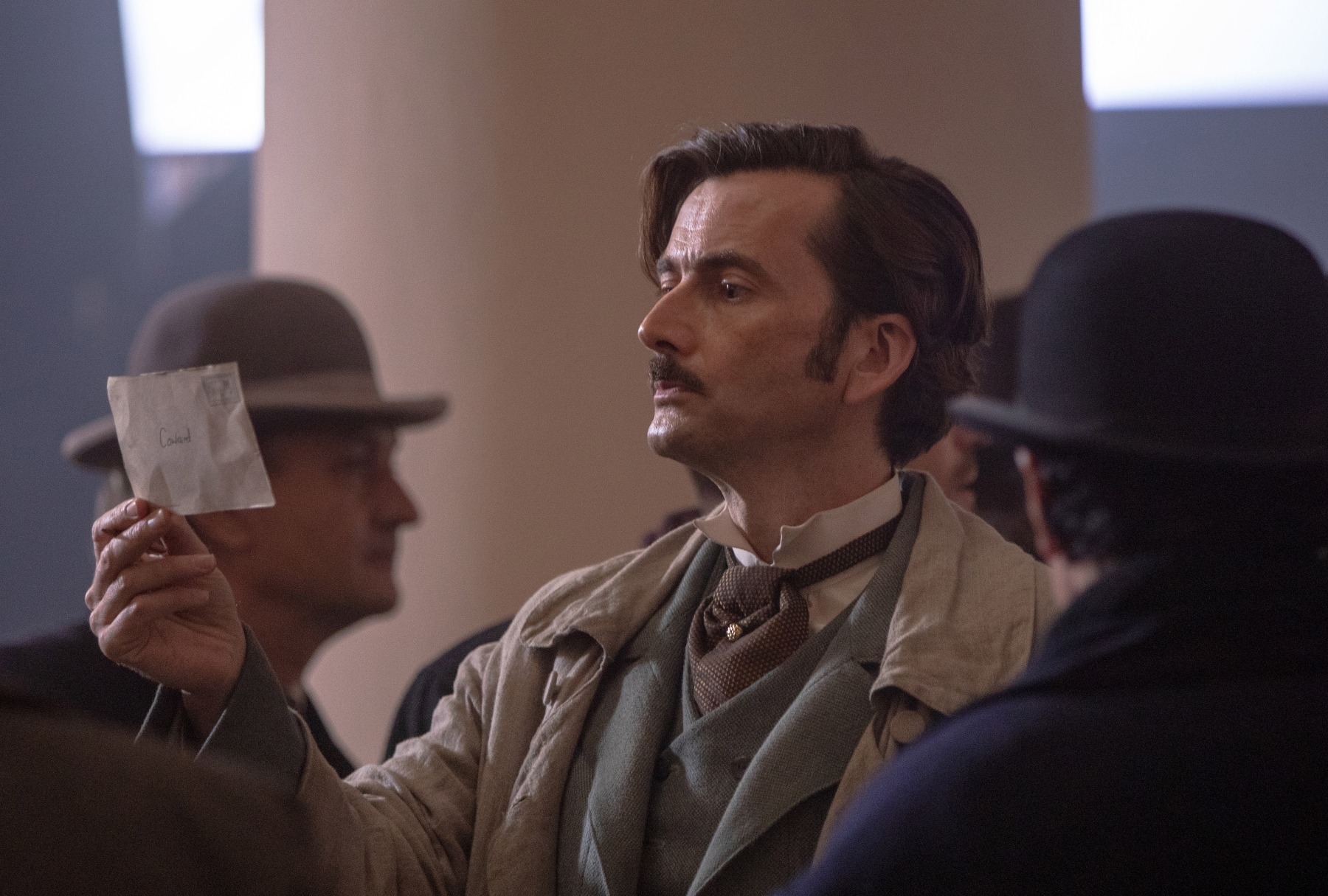
David Tennant in “Around the World in 80 Days” (PBS)

In the finale, we finally meet Estella (Dolly Wells), the woman Fogg abandoned 25 years ago just before they were supposed to travel the world. What led to that backstory and their meeting in Grand Central Station after all these years?

The core of that last episode for me are the Grand Central scenes where he meets Estella. We just stop the action and have two characters on a bench at a train station and have massive conversations about if he had had the guts back then. I just tried to imagine what it would have been like for him 25 years ago with those awful friends of his. He loved this woman, and she loved him back. [The friends] would have been jealous probably; the pressure they would have put on him. “Don’t do it. It’s not for people like you.” And then his cowardice in actually going as far as the ship and getting off and letting her go. 

So the idea was that for the first weeks, she sent a postcard from everywhere. She was in Rome or Paris saying, “Get back on the boat. You can still do this.” She’s the one back in episode 1 who sends him the postcard of that clock with the word “coward,” almost goading him.

When they actually meet in America, he says, “Well, was it a good life?” and she said, “It was a life. There were wonderful things in it. And there are bad things in it. That’s what life is. It’s what you haven’t done because you haven’t had the courage.” And her saying to him, “This is not over. You have to go back and show the men like Bellamy what you’re made of,” it just gave us that big engine into the last act really.


Want a daily wrap-up of all the news and commentary Salon has to offer? Subscribe to our morning newsletter, Crash Course.


Why is Bellamy (Peter Sullivan), Fogg’s so-called friend, so against him? It was bad enough to start the wager, but as we saw from the telegram, he actually encourages his hired man to “use any means necessary,” which could imply murder, to stop Fogg. And in the end, he took Fogg’s money anyway, even though he lost the bet.

They’re friends in the sense that they sit next to each other all day, but you can imagine what they were like in school. Bellamy would have bullied Fogg at school. And now he bullies him in the Reform Club. In the first episode when Fogg says, “You know what, I’m going to do it,” you see this whiplash of anger in Bellamy. “How dare he? How dare you not be my patsy that I can bully every day?” 

I think that for that sort of Englishman at that time, to suddenly be poor would’ve been just horrific. He’s a victim of that class at that time, this weird sense of what being a man meant. The thoughts going through his head are like, “If I lose this bet I lose everything,” which is what he does do in the end. He tries to bully him one more time, doesn’t he? When he walks out he tries to keep his dignity but he’s actually a ruined man. He’s quite villainous

Fogg was better but still quite annoying with how high-handed he was treating Passepartout, who is his valet. Did David Tennant, who’s also an executive producer on this, have any input into creating this Fogg?

He’s such a precise actor. There was a scene, the first thing they shot was in episode 3 and he’s in his hotel room in Arabia and Passepartout comes in. And all David did was just that [Pharoah spreads his arms out wide]. In other words, “Please take my shirt off now.”  That’s not in the script at all, but it’s so brilliant and visual. 

I think for him the challenge of playing this up-and-down man is very intriguing, this sort of buttoned-down guy who in his past was once in love but an act of cowardice in the moment has damaged him. David didn’t often say anything but when he did I really listened. It was always smart. It would be things like, “At the end of the episode, is that hook hard enough and big enough?” You go back and think, “Hmm, you’re right; it’s not.”
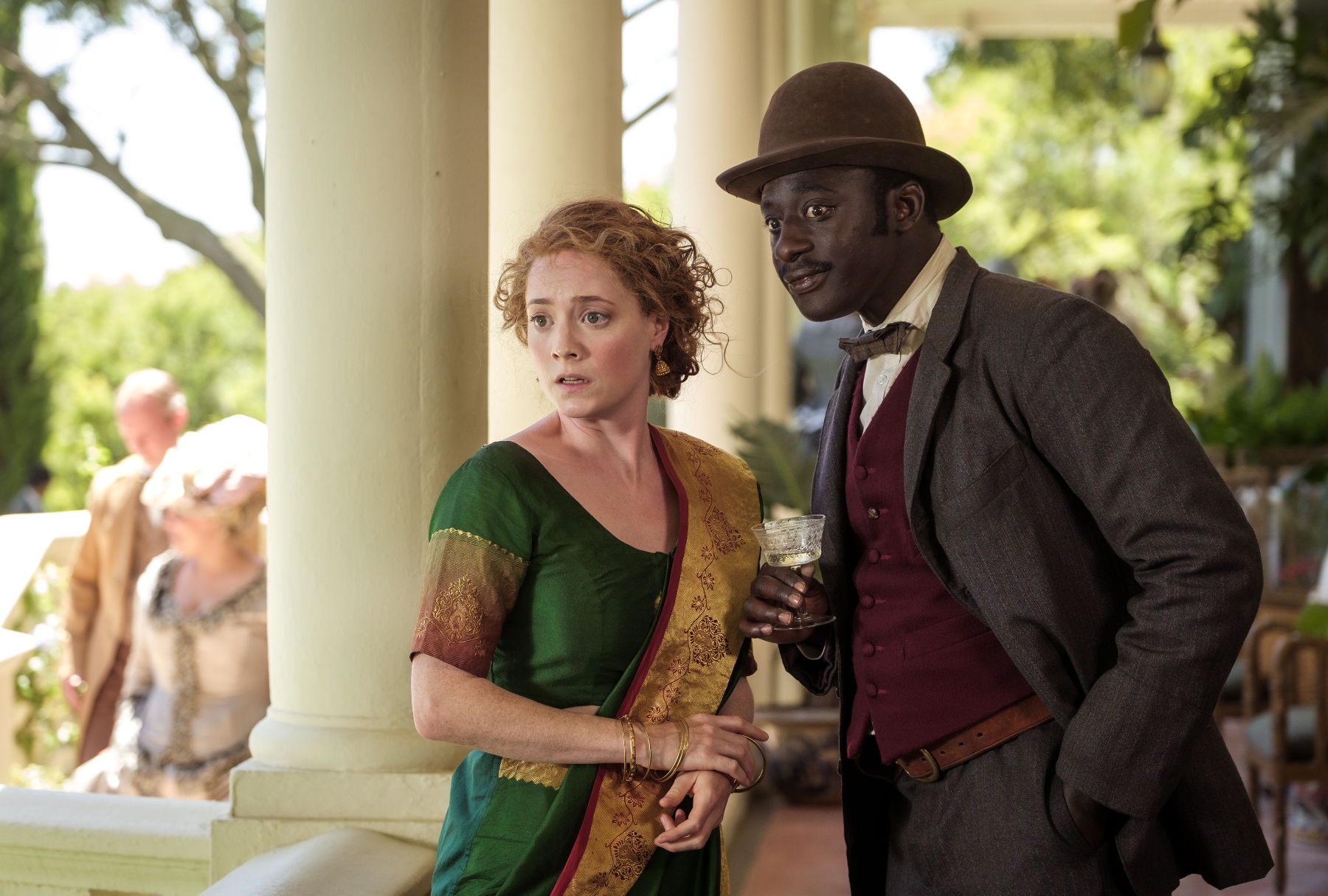
Leonie Benesch and Ibrahim Koma in “Around the World in 80 Days” (PBS)

How did you conceive of both Passepartout, this incredibly savvy Frenchman, and Fix, a female journalist? What did you want from their characters, especially since it seems that Fogg sees them as equals almost, or at least partners in adventure, by the end?

It just amused me to have a valet who’s so much better at going around the world than the man who is employing him. Passepartout’s got his own backstories and difficulties and his own demons he has to overcome. So you see, as the journey goes on, they cease to be servant and gentleman and become by the end, almost good friends I think. 

That’s Fix too. Abigail Fix isn’t in the novel, as you know. I was accused over here by some of the right-wing press of being woke by having a woman in the piece, let alone a Black Frenchman. That was never my intention, but purely as a dramatist, half the population I hear are women these days. Also, it would just be funny to have this Englishman who didn’t spend any time with women – there are no women around down in the club – and she’s suddenly at his side for going around the world. 

Nellie Bly was a huge inspiration [for writing Fix]. I think she actually did go around the world; I think she did it in 72 days. I liked the idea that [Fix] is not just a journalist, not like her dad, just thrashing out copy. But she brings an emotional side to her prose. You know in that episode in Hong Kong, when she writes about Fogg – although it was a mistake – the actual piece of writing is a fine piece of writing. So that was my invention on my part I guess. But don’t tell Jules Verne.

I was relieved that Fix was not supposed to be Fogg’s love interest. When I saw the first images for the show, I was afraid that was going to happen. 

He’s damaged. He’s nowhere near being ready for someone.

Instead you pair up Passepartout and Fix, who was the first person to see through his facade of being this servant. But it’s not some fairy tale ending for them, as we see from their dance on the ship.

I watched that scene about 10 times. It was so touching because they’re about to go back to London. You know being a Black man with a white upperclass woman is not going to be easy, but for five minutes they can just be themselves. So Fogg is missing Estella, and almost at the same moment they’re dancing together. That just gave all three of them a way to slam into the ending.
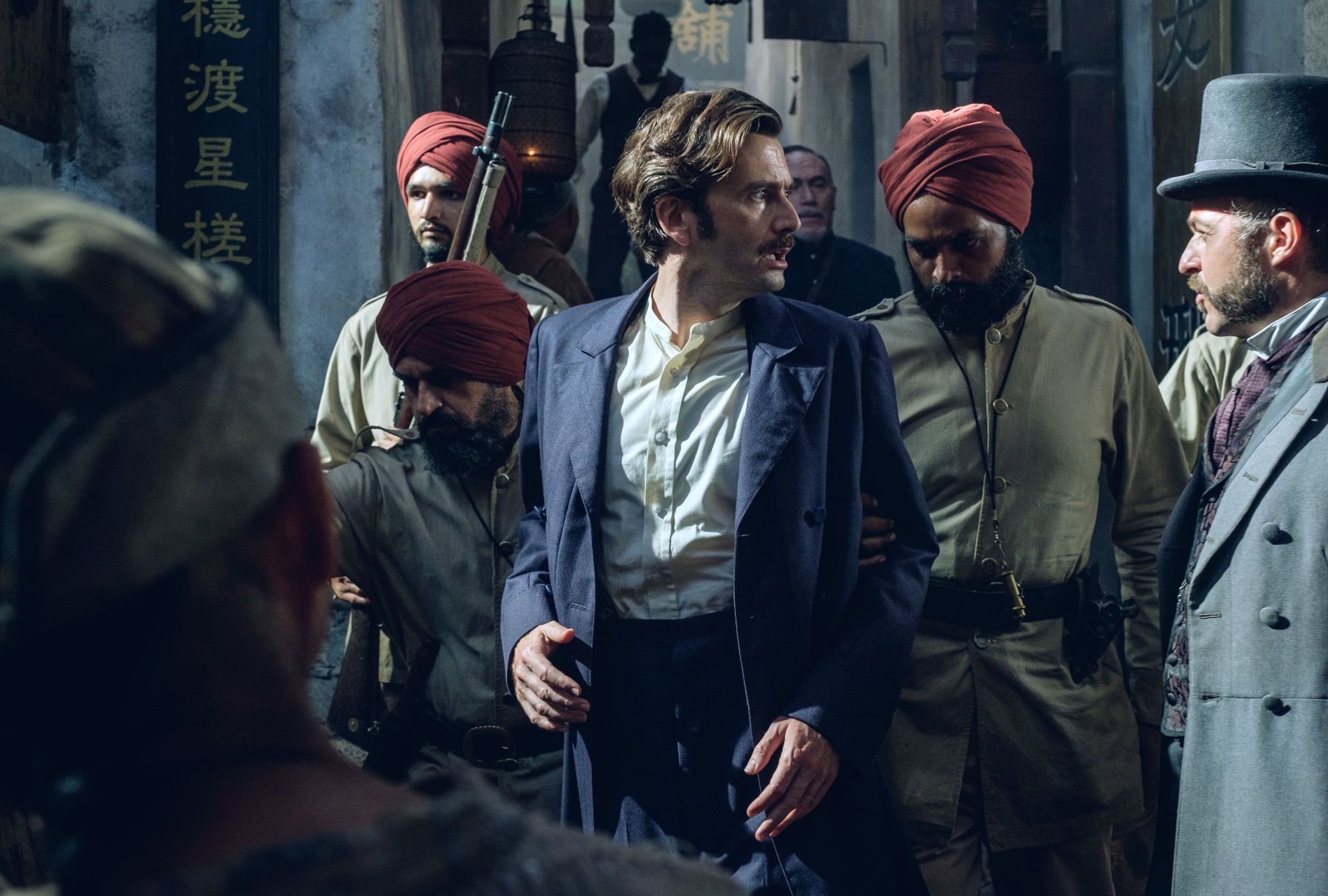
David Tennant in “Around the World in 80 Days” (PBS)

Let’s go back to some of the episodes. I was surprised by quite a bit, including the Hong Kong episode in which Fogg is accused of stealing jewelry and even gets whipped for it. What were the discussions for including that scene? His friends save him but not until after he gets one lashing.

We talked about it a lot, obviously, because it is a family show. But in the end, I knew David would want to do it. I knew he wouldn’t be afraid of pushing the material that way. And I feel like it’s episode 5, and I bet everybody thought, “Oh are they gonna run in just as the chap’s about to lash him?” And I thought, let’s not do that. 

I was a bit worried about having such a down ending for an episode, but I thought if we can’t do it at that point in the narrative, you can never do it. So we thought collectively, “Let’s go for it.” I don’t know what time it screens in America, but over here, it’s been going out with BBC at 10 past six on a Sunday evening. We did get a few complaints about that, I’m afraid. But we didn’t know when we were making it that BBC were going to show it at that time. That scene would have gone out before seven, which is for kids, probably a bit near the bone if you excuse the pun. 

But also the thinking behind it is that you have Passepartout, who had made this massive error in taking a bribe and letting Fogg pay the price. Then you’ve got somewhere to go the next episode I think. The episode on the island works because of the Hong Kong episode, because you’ve got so much damage has been done to these three. 

“Around the World in 80 Days” (PBS)

The desert island episode right afterward is such a departure for an “Around the World in 80 Days” story. Not only are they stuck, so there’s not that race against time element, but they’re also alone, so it’s a three-hander at that point. What went into conceiving this episode?

It is what often happens in series television – you’re sitting around saying, “Oh my god, we’ve run out of money. What are we going to do?” It’s three characters basically on a beach for an hour. And luckily by then, you’ve had five, six hours of knowing these characters by now. So you know they all have secrets but they’re all basically decent human beings who have made mistakes. So there’s something delicious in watching all that stuff and them spinning out. David’s very funny in it I think.

And finally Fix acknowledges how they’ve taken advantage of Passepartout and ignored his pain. His brother was killed at the beginning of the trip!

Yes, it’s a very cathartic episode for all of them. Probably from that moment on, they are friends in a very different way than they were before. That’s a classic thing about desert islands – everybody’s the same. When you’re fighting to survive, there are no servants and masters really.
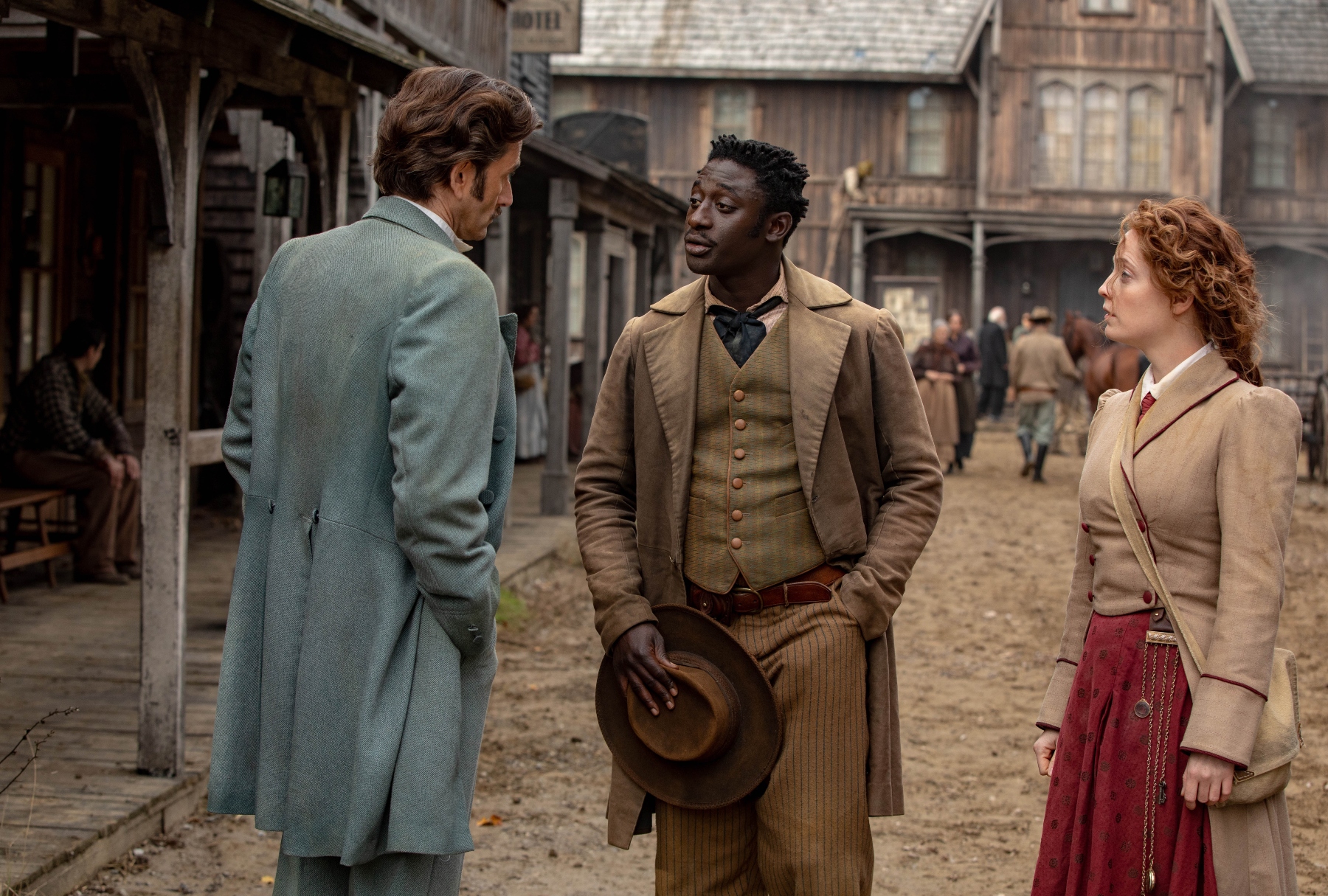
David Tennant, Ibrahim Koma and Leonie Benesch in “Around the World in 80 Days” (PBS)When the trio lands in America, the show becomes an almost classic Western. They meet Bass Reeves (Gary Beadle) a Deputy U.S. Marshal who is based on a real lawman, who is transporting a white Southerner to stand trial. But then it leads to a shootout between these Klan members and Fogg’s group who is allied with Reeves. What inspired that storyline?

That episode was written by Stephen Greenhorn, a senior writer over here. He said, “Can I write a Western? I love Westerns an have always wanted to write a Western.” That was his idea to use that real character. The sheriff in episode 7 was based on a real astonishing American character. 

He wanted to use all the tropes of Westerns, like having the posse come after them. It was also a way of taking our three characters out of their comfort zone and letting them see what issues of race were like in America at the time in a harsher environment than England. 

RELATED: The extraordinary resurgence of Jules Verne

I remember us talking about how high we wanted to bring in the race issues. But when they’re in that carriage, the five of them cramped into those seats, it seemed impossible not to talk about it. [The prisoner] is sort of from Fogg’s class. So when he gets on board, Phileas shakes his hand, just like he would with another gentleman. It’s only when he started saying things about, “Aren’t you meant to be looking after [Fix] for your best friend?” that Fogg is pulled into the tension.

Also, I can’t remember the quote, but [the prisoner] says, “a place for everyone and everyone in their place.” Sounds pretty fair, till you realize what he means; it’s disgusting. We have gotten a bit of a bashing on some of the right-wing press, saying, “It’s not in Jules Verne. Jules Verne . . . blah, blah.” So I almost take that as a badge of pride that in annoys some of those people.

How was it decided that Fix would be the marksman of the group?

We wanted Fix not just to be a passive woman letting men fight. And then we thought, well she would [know how to shoot] from that class. They’re very used to having guns, shooting pheasants, rabbits and foxes. So it makes complete sense. Whereas Fogg wouldn’t go anywhere near a gun.
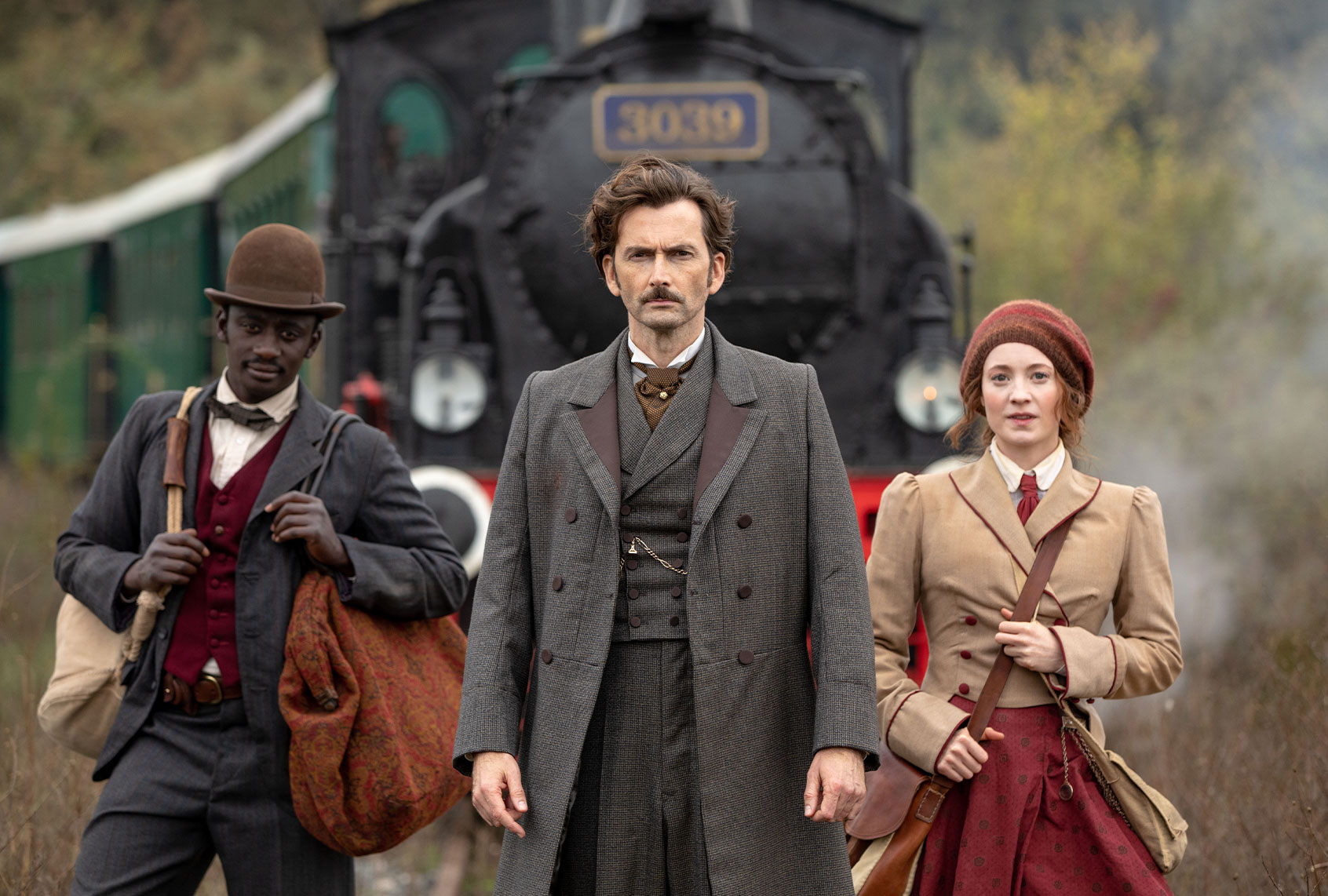
Around the World in Eighty DaysIbrahim Koa, David Tennant and Leonie Benesch in “Around the World in Eighty Days” (PBS)The show was already renewed for a second season, which is good since it seems that Fogg and friends want to continue having adventures. But they just finished a whirlwind trip . . .

I think they all three realize what they’ve just had, they can’t have that just being in London and normal again. The only way they can do that again is to have another adventure. My instinct was to have the three of them on their own again.

In the end they also discuss hearing about a sea creature, perhaps a narwhal. Is this merely a fun homage or do you think you’d want to tackle some aspect of Verne’s “20,000 Leagues Under the Sea” for their next adventure? 

I think we probably won’t be doing that because Disney is doing a massive-budget version of that. Thank you, Disney. Thank you, mouse. “20,000 Leagues” is an incredible story, dark and strange. What Disney will do will be very interesting because it’s not naturally a family story. 

I also heard that you were adapting another Verne novel, “Journey to the Center of the Earth” for a separate project.

I’m just kicking around that idea to see if it can be done, probably not with these characters though. Again, those books are very dated in many ways. So I think you have to take quite radical steps to make them relevant to an audience. Technically I don’t need to do it in period.

Verne has plenty of other stories – he had a series of “Extraordinary Voyages” – that could provide inspiration for the next installment of “Around the World.” 

When I do adaptations, I hope that will send some people back to the books because he is an astonishing novelist. I mean, the breadth of his imagination is incredible, the science.

The show actually has gone down very well over here. David Tennant wants to do more, which is great. After this I’ve run out of road; there’s no more book for me to use, but writing those three characters again will be fun. So whether we use other Verne book and put them in there, or whether I come up with a completely new adventure remains to be seen. But it feels to me like there are legs in those three.

More stories to read: 

“Doctor Who” producer downplays falling ratings for season 13

Doctor Who” season 13 was a little different from what had come before. Instead of a set of standalone episodes, season 13 told one story, dubbed “Flux,” across six episodes. Part of this was an attempt to experiment with the format, and part of it was compensating for the filming difficulties brought on by the pandemic.

But whatever the reason for the format change, the ratings were kinda meh. Per Digital Spy, the episodes had an average viewership of 4.8 million, which was down from an average of 5.4 million the previous season.

Should the “Doctor Who” team be worried? According to executive producer Matt Strevens, not really. “What’s fascinating to me is the way ‘Doctor Who’ viewing figures are obsessed over, unlike many other shows on TV,” he told Doctor Who Magazine. “And that’s fine, because I think it’s a testament to the fact that people are still always keen to read about ‘Doctor Who.’ So that’s probably a positive thing.”

Of course, you get the odd juggernaut, like “Vigil,” but by and large, 5-odd million is really healthy for any drama on terrestrial. And on streaming services, they can only dream of figures like that. So I think our ratings are really respectable.

Strevens thinks it’s a bit disingenuous “when overnight figures are reported and compared to previous consolidated figures, in order to make the most dramatic headline.” That’s goes double when you consider how many different ways people consume TV today. “‘Doctor Who’ is available on iPlayer, so audiences can still watch it whenever and wherever they choose,” he said.

Strevens will be exiting the show alongside showrunner Chris Chibnall and lead actor Jodie Whittaker after two more “Doctor Who” specials to air later this year. Russell T. Davies, who revived the show back in 2005, is returning to oversee things for season 14. The actor who will play the new Doctor has yet to be revealed.

Parents were stuck inside with their kids. A rise in ADHD diagnoses soon followed

Children are bored, isolated, and oversaturated with technology, but what’s new? Well for starters, during lockdowns their parents got a glimpse of what teachers see every day. That led to something curious happening: having millions of children cooped up at home with their parents, instead of at school, led to an increase in diagnoses of Attention-Deficit/Hyperactivity Disorder (ADHD).

Yet the rise in diagnoses has renewed a long-standing debate over ADHD in children: is it under-diagnosed, or over-diagnosed? Answering that is harder to suss out — and may even depend on who you ask.

Longstanding stigma against mental illness permeates American culture, especially when it comes to cognitive functioning. Nevertheless, ADHD diagnoses have consistently increased since the 1990s. Roughly one out of every 10 children and adolescents between the ages of 3 and 17 living in the US have a current ADHD diagnosis. That number stands to grow further after many parents witnessed firsthand how their children struggled to stay attentive in remote classes. 

Learning deficits such as ADHD sometimes go unaddressed for years or even a lifetime, the impact of which is demoralizing if not outright dangerous. Risks associated with ADHD — substance abuse, criminal behavior, academic adversity, and significantly greater social and financial hardship — are generally more severe in the absence of cognitive behavioral therapy and, yes, medication when appropriate. Nobody — save for pharmaceutical companies — wants to see droves of children endlessly and pointlessly prescribed Ritalin as a catch all for “inconvenient” behavior. For children with ADHD, a diagnosis is the first step toward building a toolkit to not only function but also have the ability to thrive.

RELATED: Advice from a home-school veteran: Ditch the schedule and let your kids play

“We know in giving that correct diagnosis that they transition through adolescence safer — with less high-risk behavior; they’re safer drivers; there’s a big picture as to why we need to be correctly diagnosing these kids,” Dr. Judith Hunt explained.

Although ADHD is the most common neurodevelopmental disorder among children, it remains underdiagnosed, she asserted. 

“The overdiagnosis of children gets much more attention and press because that is a conflict zone, but the underdiagnosis of children is actually what I see more,” she reported in reference to her pediatric practice in Payson, a town of 15,000 in the heart of Arizona.

When school moved online, Dr. Jonathan Cartsonis saw his 13-year-old son disengage from his studies. As an educator, Dr. Cartsonis understands the importance of experiential components of learning. Specializing in rural healthcare, he emphasizes individualized learning strategies and community engagement with his own medical students. Then the diagnosis came. It was for ADHD, but after in-person learning resumed Dr. Cartsonis thought otherwise. 


Want more health and science stories in your inbox? Subscribe to Salon’s weekly newsletter The Vulgar Scientist.


“It was a byproduct of too many hours sitting at the computer, too much homework, not enough social engagement, and not enough exercise,” he wrote to Salon. “The supposed ADHD symptoms evaporated when he was back in person, in school.”

A greater willingness among parents to acknowledge problems when they arise offers a cautious dose of optimism. Cases of misdiagnosis do not negate that fact. Rather, they indicate the necessity for more open and honest dialogue about developmental challenges as they arise. Dr. Hunt says this is exactly what happened, and we have pandemic lockdowns to thank. Perceptions of educators and parents are more connected than ever.

“When the parents weren’t quite as involved in the child’s learning all day long — parents would sometimes discount what the school was saying, and then when they had the child at home for doing school learning, I received a lot more phone calls from parents saying that I do think that my child needs help.”

She added, “It was parents calling in because they were feeling desperate and trying to help their child learn.”

Even after in-person learning resumed Dr. Hunt has seen more parents seeking a diagnosis of ADHD for their children, indicating a significant attitude shift toward mental health. Ultimately, there may not be an increased rate of diagnoses, though it is quite likely. Because the US suffers from abysmally slow and antiquated reporting for childhood health data, it will be quite some time before we know for sure whether anecdotal evidence is accurate.

Preparing to answer that question once more data is available, a November 2021 study published in Nature’s peer-reviewed journal Nature Reports examined pre-pandemic data on ADHD to supply a baseline for socioeconomic and geographic risk factors. Dr. Goran Bozinovic suggested the report demonstrates the need for a significant overhaul in the way ADHD diagnoses are reported in the US. If the speed and precision with which the US government reported COVID-19 data is any indication, the problem is in the mechanism of collection itself.

“To effectively model and mitigate the ADHD epidemic and similar national health crises, the U.S. should rely on comprehensive, county-specific, near real-time survey and epidemiological data reporting,” the report read. “Such data streams paired with longitudinal data normalized to census numbers are critical components of a primary prevention program development and implementation.”

While ADHD diagnoses have become dramatically more prevalent since the 1990s, the increase has often been conflated with an epidemic without evidence. In part, the increase is a natural progression as dismissive attitudes about mental illness started to abate. However, the actual number of people with ADHD, diagnosed or not, is simply not well understood. 

“When we talk about an epidemic, we’re talking about why you need a good reference point — to see how the trend actually changes over time,” he responded when asked to clarify the use of the term. “It depends how you break the data down.”

Read more on ADHD research:

Like creamed spinach? Then you’ll love this 5-ingredient spinach pasta

One of my favorite sub-genres of cookbooks are those that fix a laser-focused lens on a single ingredient, preferably produce. The shelves at Myopic Books in Chicago’s Wicker Park are packed with little, tattered paperback gems that have one-word titles like “Corn” or “Broccoli.” That selection is one of the reasons I could spend hours combing through the shelves. 

And when I’m back at home and find myself faced with a crisper drawer of produce that I desperately need to use up, I try to channel those authors’ enthusiasm for whatever vegetable or green is lying at my feet. Most recently, I made an online grocery order and the courier provided me with an extra bundle of spinach. 

RELATED: Should you actually add oil to your pot of pasta water? Here’s what an expert chef says

It doesn’t sound like a lot, but if you’ve ever cooked with spinach, you know that the clock is ticking before it turns into a pool of limp, sludgy leaves. If one of those author’s was faced with an extra bundle, I asked myself, what would they do? Obviously, they would make it the star of the show. 

I considered some of my favorite spinach-forward preparations and one kept coming to mind: old-school creamed spinach. It’s, of course, decadent, but not to the point of overpowering the mild and slightly sweet spinach. That sweetness is, instead, amplified by the tiniest pinch of nutmeg. 

What if you took that tremendous balance of flavor and transformed it into a pasta dish? The result is delectable — and surprisingly low-ingredient. Not accounting for pantry staples like olive oil and salt, you have a five-ingredient meal that comes together in about 30 minutes and shines a spotlight on spinach. 


Cook’s Notes

While I kept this recipe purposefully minimal, you can, of course, augment with some other ingredients. For a gratin-like feel, incorporate a heaping tablespoon of parmesan cheese into the pasta and top with toasted Panko breadcrumbs (and perhaps more parmesan cheese?). Jarred and prepared artichoke hearts would also be a lovely addition to the pot.

Recipe: Creamed spinach-inspired pasta  

Yields
4 servings
Prep Time
5 minutes
Cook Time
20 minutes


Ingredients
Pantry Staples

Olive oil 

Salt 

Pepper

Ingredients 

1 pound of pasta

1 cup of roughly chopped, fresh spinach

½ cup of full-fat ricotta (this also works surprisingly well with Kite Hill’s almond milk ricotta for a vegan option) 

1 shallot, minced

1 1/3 teaspoons of nutmeg 


Directions

  1. Cook the pasta according to package directions and drain, reserving at least one cup of pasta water. Set aside. 
  2. Using a blender or food processor, pulse the spinach, ricotta, shallot and nutmeg with a few tablespoons of olive oil until it looks thick, creamy and light green. Continue to blend and add the pasta water a tablespoon at a time. When the mixture has the same consistency as alfredo sauce, season with salt and pepper to taste. 
  3. Combine the cooked pasta and spinach sauce in a shallow pot or pan and cook over medium heat until warmed through (feel free to add another tablespoon of pasta water or ricotta to adjust the consistency of the sauce to your liking). 
  4. Divide among four bowls and, if desired, garish with another pinch or two of nutmeg 


More recipes for pasta night: 

On the promise and joy found in the cookbook section of used bookstores

There’s something really special about the promise found in the cookbook section of a used bookstore. I love trawling through the shelves and pulling out random titles. Some are busts, while some are absolute hidden gems, indicative of a particular time and place. 

For instance, my family and I vacation in Hilton Head, South Carolina, every year and there is an antique and used bookstore on the island. At least once during the summer, I would lose myself in the aisles and pull out locally-published community center and church cookbooks centered on lowcountry and Gullah-Geechee cuisine. 

From them, I was introduced to Sallie Ann Robinson, a cookbook author who writes about West African-influenced Gullah cooking and whose recipe for “Ol’ ‘Fuskie fried crab rice” is life-changing. I also found a story of dueling blackberry dumplings buried within the laminated pages of a Presbyterian women’s group cookbook. 

When you inherit someone else’s cookbook, there are stories contained within it beyond the author’s words; there are stained pages, dog-eared recipes and notes in the margins that point to family dinners, special occasions and, occasionally, a disastrous night thanks to an unedited recipe (I once found a cookbook where someone had used Sharpie marker to “X” out a recipe for oven-baked macaroni and cheese — which called for a shocking 6 tablespoons of salt —  and written “Utter Trash!!!” in all-caps). 

A few nights ago, I wandered into The Gallery Bookstore, a Chicago institution that’s a few train stops from my apartment and has a few simple rules: Check your bag at the front, turn your phone on silent and, if you opt to keep it on your person while browsing the very crowded shelves, don’t use it to take any photos. The owner, a burly man with a sizable beard and fingerless gloves, patiently delivers these directives to every single person who enters the door.  

Immediately, I loved it. 

The section names are hand-scrawled and slightly esoteric (“women’s mythology” and “herb books” were two of my favorites), but I quickly found my way back to the cookbooks and was immediately greeted with dozens of titles I had never seen. A slim paperback edition immediately caught my eye: “Café Mima: Cocina Cubana” by Yoly N. Perez. 

On the back, there is a small inscription: Mi abuela Dorinda abrió el restaurante Café Mima en Cuba en el 1931. He reunido algunas de sus recetas y con gusto las compartos con ustedes. Espero que este libro enriquesca su conocimiento de las tradiciones y comida Cubana. 

Perez has collected the recipes that his grandmother, Dorinda, had pioneered in her restaurant Cafe Míma, which she opened in Cuba in 1931. The cookbook is packed with descriptions of the tiny cafe Perez’s grandmother had built. It had green park benches out front, several tables in the back and an eat-in bar counter at the front. 

“The café’s large garage-like front doors opened for breakfast and lunch — allowing the aroma to seep out onto the streets,” Perez wrote. 

Perez continues to write that while he had never been back to Cuba after immigrating with his parents when he was three years old, but thanks to his grandmother’s recipes, he understood what his roots taste like. It’s a beautiful encapsulation of the power of culinary histories and what we gain when we share and seek them out — something that I’m sure I’ll ruminate on further when I start working my way through Perez’s cookbook, starting with the seasonally-appropriate potaje de garbanzo, a chickpea stew. 

This writing originally appeared in The Bite, Salon’s food newsletter. Each weekend, we publish unique stories, essays and recipes, as well as beautiful pieces from our archive. This week, here are some of our favorites that center on using food as a way to understand or explore a place.


Want more great food writing and recipes? Subscribe to Salon Food’s newsletter.


Essays and Recipes 

My pasta, myself: Forging a home in New Mexico through Hatch green chile pasta

Last fall, writer Maggie Hennessey and her husband  packed up all the movable parts of their 15-year life in Chicago and uprooted to Southern New Mexico. 

“Moving is a disorienting business; we are after all, creatures of habit,” she writes. “I was thus entirely unsurprised that I craved my creature food, pasta, above all else as I uneasily navigated my new environs in a perennially dusty green pickup truck.” 

While exploring her new home, Hennessy, of course, comes into contact with Hatch-grown green chiles; the state is known for them and you can find them on everything from greasy cheeseburgers to hominy-dotted pozole. Inspired by this ingredient, Hennessy went on to create a recipe that’s the perfect bridge between her old and new homes. 

Why stand in line for TikTok famous cookie pies when you can bake them yourself?

As Salon’s Mary Elizabeth Williams wrote, there is a long lineage of foods that become cultural obsessions: cronuts, cruffins, cereal milk soft serve, unbaked cookie dough. Now, there is a new kid on the block — anything from Crumbl, a new TikTok-famous bakery. 

“Perusing the Crumbl menu this week, I was intrigued by the banana cream pie cookie,” she wrote. “The thought of ‘creamy, smooth banana pudding stuffed into a buttery pie crust and topped with a vanilla wafer’  really called to me.”

Interview with Vivian Aronson (Yuan Qian Yi 袁倩祎), author of “The Asian Market Cookbook: How to Find Superior Ingredients to Elevate Your Asian Home Cooking”

A few weeks ago, I spoke with chef Vivian Aronson. She was born and raised in Chendgu, China, and knows that within the aisles of American Asian markets, there are ingredients that often serve as the keys to making better, more authentic dishes. However, navigating these markets can come with a steep learning curve, especially for novices who may not know where to begin. 

In her new cookbook, she makes sense of her life in America, how it differs from China and how shopping at local Asian markets enables her — much like Yoly N. Perez — to taste her roots. 


Shooting leaves one dead and five injured at Portland Black Lives Matter Protest

Authorities in Portland have taken two people into custody after a shooting at a police reform protest in Portland, local media reports.

“The shooting happened near Normandale Park in Northeast Portland. According to flyers circulated on social media, a group of demonstrators had planned to gather at the park for a ‘Justice for Amir Locke’ event. Minneapolis police killed the 22-year-old Locke after serving a no-knock warrant on a downtown apartment Feb. 2,” Oregon Public Broadcasting reports.

According to the New York Times, “The Portland Police Bureau said a woman was dead when officers arrived. Two men and three other women were taken to a nearby hospital, the police said. Information on their conditions was not immediately released,” adding, “The shooting took place near a park in Portland that has been the staging ground for a number of protests against police killings in recent years. Neighbors said several shots were fired.”

“Several demonstrators on scene told OPB they saw a person come out of a nearby home and confront a group of about 50 protesters. The person then reportedly shot at the crowd of people. It was not immediately clear if more than one person used a weapon,” Oregon Public Broadcasting reports.

Watch the local report on KOIN 6 via YouTube:

“Abraham Lincoln” and “Lincoln’s Dilemma” clarify a few things about uncomfortable history

Presidential historian and best-selling author Doris Kearns Goodwin has a knack for bringing her History miniseries to air when they’re most acutely needed. Her latest, the seven-and-a-half hour “Abraham Lincoln,” arrives on basic cable in the midst of a(nother) ridiculous push in multiple states to ban books and legislate “uncomfortable” historical accounts out of our educational system.

This would effectively erase, rewrite or downplay the most significant contributions by figures who aren’t white, straight or Christian from school texts even more than they already have been. And this bolsters the efforts to cement structural inequality in place.

Understanding this in the context of this documentary series is crucial, since partisans have battled to claim Lincoln’s legacy for decades, long before the ginned-up hysteria over “critical race theory” came into being.

RELATED: Higher education vs. white supremacy

Republicans reflexively remind people that Lincoln was one of theirs, citing his reputation as the Great Liberator whenever they deny their party’s devotion to racist campaign tactics and legislative policies. Progressives return fire by pointing to writings in which he declared African Americans to be unequal to whites, and his proposed plan to resettle emancipated Black people to Central and South American colonies.

The truth of the man is somewhere in between these definitions, as Goodwin and the experts she calls upon illustrate in “Abraham Lincoln,” former president Barack Obama among them. He’s one of several who provide a diplomatic, nuanced interpretation of Lincoln’s writings as those of a man who was “limited and constrained by his time in ways that are disappointing.”

“And then,” he adds, “I can also say, ‘Yeah, but look at what he did. That took courage and took skill.'”

That, and a willingness to listen to abolitionists like Frederick Douglass, whose devotion to emancipation and equality for  Black Americans, free or formerly enslaved, helped shift Lincoln’s political fortunes and his views.

Christy Coleman, the executive director, Jamestown-Yorktown Foundation, eloquently sums up the man, and the core purpose of this series thusly: “Lincoln is moved to understanding and belief in what the nation could and should be despite his own prejudices and concerns when he starts. He is wise enough to know that he has them, and wise enough to know that his nation needs to move beyond them.”

History’s “Abraham Lincoln,” based on Goodwin’s bestselling “Leadership: In Turbulent Times,” joins a President’s Day weekend lineup that already includes AppleTV+’s four-part “Lincoln’s Dilemma,” which forgoes the reenactments to recreate flashpoints in Civil War history and Lincoln’s presidency with subtle animation and illustrations, along with the standard archival photography, drawings and political cartoons. You can’t go wrong with either.

“Lincoln’s Dilemma” is the more celebrity packed of the two, with Jeffrey Wright narrating, Bill Camp providing the voice of Lincoln and Leslie Odom, Jr. bringing Douglass’ words to life.

History Channel puts its star power behind its bench of academics in addition to dramatizing key moments in Lincoln’s life from his boyhood leading up to that fateful night out at the theater in 1865, with Graham Sibley starring as Lincoln.

Watch a trailer for History’s “Abraham Lincoln” below, via YouTube.

Reenactments in projects like these still have a bad reputation owing to years of the channel’s over-utilization of the tool in its quest to give its subjects a populist gloss. But neither Sibley nor his co-stars, including Oluwasanya Adegbola as Douglass, overplay their hand. Helpfully the actor also bears a natural resemblance to Lincoln that can be disconcerting at times, particularly in the scenes from his pre-presidential years.

It’s impossible to watch either series without recognizing parallels between America in the Civil War-era fractures and where we are now.  “Lincoln’s Dilemma” puts a fine point on this by bookending its four hours with scenes from last year’s Jan. 6 insurrection at the beginning, and the removal of Confederate monuments in recent years and the construction of the Lincoln Memorial in 1922 as a symbol of unity.


Want a daily wrap-up of all the news and commentary Salon has to offer? Subscribe to our morning newsletter, Crash Course.


During these closing moments, New Yorker writer and professor Jelani Cobb points out the irony of our tendency to look to Lincoln for inspiration in trying times, perhaps forgetting that he had to be smuggled into Washington D.C. for his first inauguration, much in the way the National Guard had to occupy the city to ensure the safe transition of power on January 20, 2021.

More viewers have access to History Channel and “Abraham Lincoln,” which pulls rock stars of academia and politics on par with Goodwin, the series’ executive producer, to provide their takes. But their familiarity doesn’t detract from the depth of their insights, nor should Obama’s inclusion ward off those who don’t agree with his political views.

Bill Clinton similarly contributed to 2020’s “Washington,” providing a perspective on the pressures his predecessor faced that only a living president can fully understand. Obama also shares his experience of reading documents Lincoln authored, sharing telling nuances like the certainty of his signature on a consequential document. Ninety-nine percent of us will never lay eyes on these papers.

Alongside him are observations from retired Gen. Stanley McChrystal, who served under George W. Bush and Obama for a time before the latter demanded his resignation, as well as contributions from  from author and historian Manisha Sinha; Clint Smith, author of the bestseller “How the Word is Passed”; professor Mary Frances Berry, former chairwoman of the United States Commission on Civil Rights, and a slew of other academics.

This inclusive lineup of voices adds to the sense of the production’s spectrum of viewpoints, which helps to highlight the appreciation of what Lincoln endured and overcame along with his mistakes, the most lasting being his failure to fully contend with what one expert accurately describes as the parent issue of slavery: racism.

“Abraham Lincoln” is more courageous and comprehensive in this respect, settling the shoddy textbook question as to whether the Civil War was about slavery. The short version is yes, in the end, because Lincoln’s views evolved along with that of the Union’s soldiers and populace. Moreover, it establishes how vital Black soldiers were to tipping the scales in the Union army’s favor once Lincoln opened the ranks for them to enlist.

“Lincoln’s Dilemma” presents a more comprehensive view of the Black experience during the Civil War as part of its narrower focus on Lincoln’s presidency and the war as opposed to expressly profiling the man.

The History series incisively analyzes the major battles whereas Apple TV+’s  brings us inside lesser known but important conflicts – including the brutality visited upon Black soldiers massacred by racist Confederates at the Battle of Fort Pillow in 1864, led by a 19th century slave trader and Confederate general Nathan Bedford Forrest. If that name sounds familiar, it may because of its association with the ugliest Confederate statue that ever existed – a specific example of the way “Lincoln’s Dilemma” connects the events of nearly 160 years ago to the present day.

One wishes Goodwin brought a sharper focus upon on the lesser-known moments like this within the series’ broad view.  Nevertheless, if the aim is to educate us of the perils about our present situation and inspire hope, “Abraham Lincoln” meets that mission, especially  in moments such as Goodwin’s characterization of Lincoln’s refusal to drop emancipation from his re-election platform as an act of courage.

 “That’s what a leader does,” she says. “That’s what events do. That’s what movements do. They change public sentiment.”

“Abraham Lincoln” airs Sunday-Tuesday, Feb. 20-22  at 8 p.m. across three nights on the History Channel. 

“Lincoln’s Dilemma” is currently streaming on Apple TV+. Watch a trailer for below, via YouTube.

More stories like this:

Study: Maintenance is a major driver of unaccounted-for emissions

A new study published in the journal “Science suggests that there’s a lot more methane leaking out of oil and gas extraction sites than previously accounted for. The authors of the study estimate that between eight and 12 percent of the oil and gas industry’s methane emissions, around eight million metric tons per year, are attributable to “ultra-emitting” bursts from wells and pipelines, due to accidents or regular maintenance. For years, scientists and policymakers have puzzled over a sizable gap between reported methane emissions and actual field measurements of the potent greenhouse gas, and these results begin to fill it.

Many of these bursts are intentional; companies will simply release built-up methane from a well or pipeline before doing repairs or other service on it. The United States is the third-largest contributor of emissions from these super-emitting events – and that’s without the Permian Basin, which produces 10 percent of the nation’s natural gas but was not included in this study due to the close proximity of extraction sites, which makes the source and size of individual methane plumes more difficult to measure.

These findings are alarming in that they add to the long list of under-measured contributions to the methane crisis. Any well that is drilled will eventually stop producing oil and gas, and when that happens it needs to be properly sealed and cleaned up. However, that process is costly and complex, and it has been easier for oil and gas companies to simply not do it and hope they won’t ever have to deal with the consequences – leaving a host of “orphaned wells.” A Grist investigation into this issue in Texas and New Mexico indicated that orphaned wells are significantly undercounted nationwide, and one estimate of the number of orphaned wells in the United States is as high as 4 million.

This is also a significant issue in Appalachia, due to the longevity of oil and gas’ presence in the region. An Environmental Defense Fund report on orphaned wells suggested that such undercounting may be more severe in Pennsylvania than anywhere else in the United States, since oil and gas extraction in the state dates back to the mid-19th century when there was no obligation to record the drilling of a well.

And a December 2021 report from the Ohio River Valley Institute found that there are 177,000 “stripper wells” in the region which spans Kentucky, Ohio, West Virginia, and Pennsylvania. These are, essentially, pre-orphaned wells: sites that are producing very little oil and gas, but are kept operational by their owner companies to avoid the costs and logistics of cleanup. In the Ohio River Valley, stripper wells are releasing close to 200,000 tons of methane annually, which is approximately equivalent to the carbon emissions of 553 million gallons of gasoline.

The Biden administration has committed $4.7 billion to the ordeal of plugging orphaned wells around the country, which will be distributed by the Department of the Interior starting this year. That announcement – and availability of funds, albeit criticized as an insufficient amount – has precipitated a remarkable increase in states’ reporting of orphan wells. 

The expectation effect: How to “think” yourself out of a stressful situation

There’s pessimism. There’s optimism. Then there’s another, lesser explored but deeply significant state — expectation. That feeling of knowing, or believing we know, what’s going to happen. And while wishing doesn’t make things so and doomsday predictions don’t bring about bad luck, there’s no denying that our mindsets can profoundly impact our outcomes.

UK science writer David Robson’s “The Expectation Effect: How Your Mindset Can Transform Your Life” is a fascinating exploration of the ways in which our brains can sabotage or save us in our most challenging moments. Robson, who previously wrote “The Intelligence Trap,” draws on meticulously researched and reviewed scientific data to show the power of our minds to quantifiably affect our physical and mental health. In the process, he proposes that harnessing its resources can help us sleep better, eat better, and even age more slowly.

Doing so is not about miracles or magical thinking. It’s about making the best of what we’re dealt, and training our brains to recognize, as Robson says, the difference between what’s “dangerous” and merely “unfamiliar.” 

Salon talked to the author via Zoom recently about the impact of expectation, and how little shifts can make big differences in our lives. 

This conversation has been lightly edited and condensed for clarity.

Let’s start with what we mean when we say “expectation.” You say early on that it’s different from typical big-picture optimism and pessimism.

The expectation effect is about how we can create self-fulfilling prophecies, in which our beliefs shape our behavior, our perception, and our physiology. In general, the positive thinking movement has been very vague. It’s been this idea of the law of attraction. You feel good, you think good things, good things will come to you. This is very different from that, because I’m talking about our specific expectations about specific events or situations or phenomena.


Want more health and science stories in your inbox? Subscribe to Salon’s weekly newsletter The Vulgar Scientist.


Traditionally with positive thinking, you might have been told to imagine that you’re not stressed. “Tell yourself you’re relaxed. Say a mantra, visualize.” But what we’re saying here with the expectation effect is, don’t try to change the way you’re feeling, because often that’s impossible. You can change the way that you interpret your stress — whether you see it as this wholly negative thing, or whether you accept that it’s unpleasant but can also serve a useful purpose. By having that mental shift, which I think is much more manageable for most people, that that can have profound effects on your lives and can improve your mental and physical health.

Let’s talk about the evidence for these expectation effects, because it’s compelling. It’s not, “If I think about things differently, then I’ll have different outcomes.”  

The evidence base is so big now that we almost need to stop thinking about the mind-body connection as this magical, mystical thing, and accept it and think more carefully about how we can use that and apply it practically. We’re really at that point of the research. The foundation of all of this comes from the research on the placebo effect, which scientists have been studying seriously for about 70 years now. That’s a huge body of evidence. I would be surprised if any scientists now denied that the placebo effect exists — that it’s important and that it can produce real physiological change in patients.

RELATED: Do “attachment styles” really matter in relationships?

What’s happened really in the last 10 years is that people have taken this out of the clinical settings. We’ve started to realize that placebo-like responses and nocebo-like responses — the negative, opposite of the placebo effect, they’re not just happening when you’re in hospital or when you go to a doctor’s surgery. They’re affecting you in every area of your life — exercise, diet, sleep, even how we age. We’re seeing the same physiological mechanisms are affecting us in all of these areas.

What are the limitations? When we talk about these placebo effects, in terms particularly of pain relief or antidepressants, what is and is not possible?

What I find really frustrating with a lot of this previous conversation about the mind-body connection, is that it’s often treated as if it’s an alternative to scientifically proved, evidence-based medicine. It’s not. It should never be considered that. It’s another important tool that doctors and patients can use to improve the outcomes of surgery, or of taking antidepressant pills, taking any kind of medication. Changing our expectations about side effects could even reduce some of the side effects you have from the COVID vaccine. That’s what I really see it as, something that we need to be considering to make the most of the effects of all of these other measures that we know have been proven.

That’s why the book is really based on such solid scientific evidence. I have more than 450 citations of peer-reviewed papers. I’ve been really careful to only mention the things that have been proven with good scientific studies and that form this larger body of research. I’ve tried to pick apart what works, and ignore all of those grander claims that haven’t been proven. All of the things that I cover have a plausible physiological mechanism.

A lot of it is about how the brain is altering the expression of hormones. For example, when you feel stressed or when you feel anxious about surgery, we know that these things are happening to patients already, whether or not you try to apply the expectation effect. The expectation effect is teaching us how to do that systematically for our own good, rather than maybe suffering from the negative expectation effects that have been ignored previously.

It’s a tricky line to walk. We want to acknowledge and respect people’s pain and experiences, while also setting them up for success. How do we do that in a way that is sensitive?

A lot of the positive expectation effects that doctors and healthcare providers can create, come from explaining the science behind the treatments. Knowledge is power in that way. There’s a study that I absolutely love of these kids who had bad peanut allergies. They were going through this immunotherapy program where you increase the dose of the protein from very small to a whole peanut by the end of the six months. The idea is training the immune system to learn to deal with this protein without having a full on allergic reaction.

Along the way, a lot of these children do suffer some side effects. Their body is responding to the protein with some kind of moderate allergic reaction. They still might get hives, or they might get a kind of funny sensation in their mouth. They might feel a little bit unwell as they’re building up their strength against the protein. What they researchers did was tell them to reinterpret those sensations. They told them that in the same way that when we exercise, our muscles start aching as we build strength, all of the things they were feeling are a sign that their body is responding to the protein, and that the treatment is working essentially. That it’s building up the strength of the immune system.

They weren’t trying to get the patients to deny what was happening. They were telling them an objective truth, that is what was happening in the body. But by understanding that and changing the interpretations, the children stopped seeing those side effects as being so scary and saw them as something that could be quite positive. That not only improved their comfort and reduced their anxiety, but it also improved the efficacy of the treatment itself. You could measure that in their biological reaction, that by the end of the trial, they had higher levels of these good antibodies that were helping to prevent the full allergic reaction to the peanut.

That’s really where I’m come coming from here, presenting facts and making sure that people understand the facts. You can remove all of the negative catastrophic thinking, and that’s enough to have a real noticeable difference for people’s wellbeing.

It’s not about the glass being half-full or half-empty. It’s about it being both at the same. We do create expectations. We need to, to survive. We need to feel stress. It’s not about fighting that. So what can we do, then?  

The best example here would be about anxiety. If you’re entering a new unfamiliar situation, like doing public speaking for the first time, it’s really natural that you’re going to feel anxious about that. Because you care, you want to perform your best. When people have tried to suppress that anxiety, that only backfires. It’s much worse for you to try to tell yourself you’re not feeling it, or to distract yourself, which often isn’t possible. What you have to ask yourself there is, well, what is the purpose of this anxiety?

We developed all of these stress responses because they’re evolutionarily beneficial to us. When your heart is racing, it’s pumping blood around your body. It’s making sure your limbs are oxygenated, but also your brain. So it sharpens your thinking.

What the research has shown, really strongly, is to shift your mindset from thinking that the anxiety is debilitating. That’s certainly how I felt before public speaking. I felt like if I’m anxious, I won’t perform well. That only increases your anxiety and is not helpful at all. But you can think, “This anxiety is here because it’s helping me to deal with a big mental challenge and physical challenge to maintain my poise and to project my voice.” Realizing that the anxiety can be beneficial has been shown to improve performance in all kinds of different areas.

It also changes the physiological response. It moderates it. What happens is that you still have cortisol, the stress hormone, which can be helpful for sharpening your thinking, making sure you’re really on the ball. But you also see higher levels of anabolic hormones — things like DHEAS and testosterone that are important for cellular growth and repair. What that means is that afterwards, you recover from the situation a lot better. The high level of cortisol isn’t causing so much wear and tear on your tissues because you also have this natural antidote within your system too.

That was obviously beneficial for us in the past. Whenever we were facing these scary challenges, you’ve got this inbuilt mechanism to make sure you perform well in the moment but you don’t cause damage afterwards. We are trying to make sure that you have that response, rather than if you see anxiety as fully debilitating and you are more likely to get into this situation where you see a real threat to yourself. If that’s prolonged over a long period of time, that’s when you’re going to have the damage to your body.

We’re also living now in a time when we can see the danger of a Dunning-Kruger effect — I’m right, I know I’m right, I know exactly what’s going to happen. It feels like we are in an epidemic of overconfident expectation.

Overconfidence is a really interesting one, because I think people are overconfident about what they know, and maybe about things like intelligence. The Dunning-Kruger effect has been shown in so many different areas. We do have overinflated expectations there. In other situations, we often do have this negativity bias. I think it really depends on the context. With something like intelligence or creativity, there is some good evidence that when people have higher perceptions of what they can achieve, that that can be quite beneficial to their performance. I’m not saying that we should all tell ourselves we’re right, everyone else is wrong. What we can do is if you find yourself being overly negative about your abilities in some area — like say you’re a kid at school and you tell yourself, I can’t do math — you can start questioning yourself. You don’t have to think you’re a brilliant mathematician, but you can start questioning, is that really objectively true? Or is it possible that I could make improvements to my performance? That’s what’s really important, is to push yourself out of your comfort zone, incrementally. Rather than creating an overly optimistic expectation, it’s more to question whether your negative expectations are as true and objective as you think they are.

When you face things like frustration — like if you’re learning math, or if you are facing writer’s block if you’re a writer — rather than interpreting that frustration as a sign that you are not capable of doing it, you could think of that as a sign that your brain is working hard. You are dealing with a lot of complexity. It’s a really important point for you for growth, for learning, for improving yourself. Avoiding the extremes k is what we need to do. We need to keep an open mind about what we can achieve and then test our assumptions.

When you were writing this book, was there something in particular that really jumped out at you in all of the research?

The research on the effects of our expectations on dieting were really spectacular for me. I like that example because it’s so far removed from this idea of positive thinking. You might have been told in the past, visualize yourself as being thin and toned and that’s going to happen to you. This is much more specifically about your expectations of the food that you’re eating.

People unrealistically expect that healthy foods have fewer calories and are going to be less satisfying. That in turn means that then they feel a greater hunger later on, and that’s also reflected in the hormonal response. What you need there is to think about what your body really needs and what this food is providing, to try to make any food that you eat a kind of celebration and cultivate those feelings of indulgence. I found that incredibly helpful.

I would also say the work on sleep was really useful for me. We know that chronic insomnia is bad for your health, but a lot of us are overly pessimistic about the effects of moderate sleep loss. We assume that the day after we’ve had a disturbed night, we’re going to have poor concentration and great fatigue and we’re going to be grumpy. Well, it turns out that is an expectation effect. In the lab, you can give people sham feedback about their sleep. Whether it’s positive or negative feedback explains all of those symptoms. That was totally revealing to me.

Finally, the work on aging. Our beliefs about what we associate with old age can then affect not our risk of things like Alzheimer’s, but also our longevity by as much as seven and a half years. I found that incredible. What I loved about that research was that when I was looking into this, it sounds incredible, but then you find the behavioral and physiological mechanisms, and they’re so solid. What researchers have done is now joined all those dots. It shows that things that ageism can be a real threat to our health and that we need to fight that. This is bigger than the individual. It’s something that we should be thinking about for the whole of society.

I love that you end the book by talking about how we’re always a work in progress.

That is exactly what we need to learn.

What does that mean in terms of our neurological systems, when we say we’re always a work in progress?

We’ve known for a long time now that our brains have neuroplasticity. I think 75 years ago, 100 years ago, there was this assumption that you get to adulthood and you’re fully formed. We’ve now come to realize that development continues long after childhood and adolescence. There’s some research showing that some cognitive skills don’t peak until your 70s. You’re constantly evolving and changing, and your brain is rewiring, becoming more efficient at the things that you’re more practiced at.

In terms of the expectation effect, we need to remember this point of view. One of the big barriers for people applying the expectation effect is they might realize that they’ve got certain mindsets that aren’t helpful to them, but they might also feel like it’s impossible for them to change those mindsets. What we know from neuroplasticity, from the science of personality, from all of these things, is that you can change. You can make quite big changes to your psychology. It needs a bit of work. You can’t change it overnight, I’m not suggesting that. But with small steps, day after day, you might find that over the course of a few months or a year, that you achieve something quite spectacular that you never realized beforehand.

More Salon brain science: 

God save Queen Elizabeth II, who tested positive for COVID with “mild cold-like symptoms”

Queen Elizabeth has tested positive for COVID-19, announced Buckingham Palace Sunday morning.

“Buckingham Palace confirm that The Queen has today tested positive for COVID,” the statement reads. “Her Majesty is experiencing mild cold-like symptoms but expects to continue light duties at Windsor over the coming week.

“She will continue to receive medical attention and will follow all the appropriate guidelines.”

Those “light duties” apparently include congratulating the Team GB Women’s Curling team‘s gold medal win at the Olympics. Or at least not stopping the statement from being sent out on Sunday.

While the Queen was confirmed to have received the first COVID vaccination in January 2021, the palace has remained mum on subsequent vaccinations, citing privacy. However, according to The Daily Mail, Her Majesty is understood to be “triple-jabbed,” meaning she’s received both vaccinations plus the booster chaser. If this is the case, she’s in the best position to fight off the virus and hopefully recover quickly.

RELATED: Queen Elizabeth II has a speech prepared if World War III happens

The Queen’s contraction of the virus follows a positive test for her son, Prince Charles only 10 days before (after he also tested positive in March 2020). At the time, the Prince of Wales began to self-isolate. A source had told CNN that there are actually “a number of cases” in the Windsor Castle team. The Queen had recently met with the prince, although the palace would not confirm when.

Everyone’s been keeping an eye on the Queen lately, after she retreated from public events last year after she had been admitted to a hospital overnight for undisclosed reasons. 

As expected, the Queen has received an outpouring of support, including one from Boris Johnson, who tweeted, “I’m sure I speak for everyone in wishing Her Majesty The Queen a swift recovery from COVID and a rapid return to vibrant good health.”

Several others joined in the chorus, including Home Secretary Priti Patel who wrote, “Wishing Her Majesty a quick recovery. God save the Queen.”


Want a daily wrap-up of all the news and commentary Salon has to offer? Subscribe to our morning newsletter, Crash Course.


Johnson was expected to announce the upcoming lifting of pandemic restrictions Monday, so the Queen’s diagnosis may or may not put a crimp in those plans, according to the New York Times

The Queen is 95 and recently released a message looking forward to celebrating her Platinum Jubilee for her 70th year on the throne, which she first ascended on February 6, 1952.

More stories to read: 

If you love cinnamon buns, you’ll really love kanelstang

The Perfect Loaf is a column from software engineer turned bread expert (and Food52’s Resident Bread Baker) Maurizio Leo. Maurizio is here to show us all things naturally leavened, enriched, yeast-risen, you name it—basically, every vehicle to slather a lot of butter on. Today, a sourdough version of Danish kanelstang.


If you’ve ever baked pain d’épi, which is a classic French baguette made to look like a stalk of wheat, you’re familiar with the charm of rolling, snipping, and twisting, yielding a baked good that livens up any dinner table. Instead of scoring the dough with a razor blade and letting it rise straight up, the bread is cut with scissors into alternating petals. The Danish kanelstang (which translates to “cinnamon stick”) has the same vibe as the pain d’épi, but just filled with sugar, butter, and warm spices. Think American-style sweet cinnamon roll with fancy French shaping—a mix of flavor and aesthetic that’s perfect for a morning or afternoon treat.

Use Your Sourdough Starter

Typically, kanelstang is made with commercial yeast, but in my version, I went with 100 percent natural leavening. With most sweet baked goods, I tend to make a dedicated levain to ensure minimal sourness and ample yeast activity (for more rise). However, in testing, I found this kanelstang tasted fantastic and rose sufficiently well when I simply used my ripe sourdough starter in the mix. And while you could always make a dedicated levain if you’d like (I’d go with 100 percent all-purpose flour and a quick 3- to 5-hour ripening time), it’s hard to beat simply waking up in the morning and, with little to no planning, starting a dough and ending up with delicious snack later in the day. Just be sure you use your sourdough starter when it’s ripe, meaning it has fermented for some number of hours (for me, that’s overnight). At the time you’d typically give it a feeding (refreshment), simply pour off some into your dough mix. From there, feed the starter with fresh flour and water.

Use Alternate Fillings

While I adore a cinnamon-sugar filling, the enriched dough base for my kanelstang would do well to house just about any sweet (or savory, like a Parmesan and ricotta) filling. One of my favorite additions is a pinch of ground cardamom, which brings a special warmth to the filling. In my kanelstang recipe, I’d start with ½ teaspoon of ground cardamom added to the cinnamon filling. Then, if you want more cardamom flavor, add ½ teaspoon of ground cardamom to the flour when mixing the kanelstang dough.

Or perhaps you’re drawn to chocolate-filled pastries? For something similar to a chocolate babka filling, I’d start with my cinnamon filling from the kanelstang recipe and add 10 grams of unsweetened cocoa powder. If you want even more chocolate, add in 50 grams of mini semisweet chocolate chips to the filling along with the cocoa powder.

Finally, if you’ve ever eaten a Danish kringle, you know how wonderful marzipan can be inside of an enriched and baked dough. So again, starting with my cinnamon filling from the kanelstang recipe, add 50 grams of marzipan to the filling and omit the cinnamon.

Use Alternate Toppings

In my sourdough kanelstang recipe, I mix up a typical white icing (a mixture of confectioners’ sugar and milk), but this treat could be topped after baking with just about anything you think would sound delicious. I’m thinking melted chocolate, Nutella, an orange-infused cream cheese icing, or even a mixed berry compote. Instead of the sliced almonds, my first choice would be pecan meal for a rich, buttery twist. Another typical Danish topping often seen on a kanelstang or kringle is pearl sugar; when sprinkled on top, it brings an extra punch of sweetness and visual flourish.

Recipe: Sourdough Kanelstang

Christian nationalism is rooted in stupid tough-guy misogyny: What would Jesus say?

During my time as a boy attending an evangelical church and then later, when I attended an evangelical seminary, it was hard not to notice an underlying misogyny that seemed consistently present. As a man, I would be the head of the household. I was like Christ to my future wife. In fact, I once heard a sermon by prominent evangelical minister Tony Evans where he declared that wives must refer to their husbands as “Lord.” In my church youth groups, we were separated by sex and the boys had bizarre discussions on the type of men we should become. There was a strong emphasis on being what they considered to be manly and tough, whereas young girls, of course, were encouraged to be nurturing, submissive and, most important, sexually pure. 

When contemporary evangelical leaders push a message around Christian nationalism, I can promise you it always refers back to a time when the “traditional” roles of American households held fast. Making America “great again” is truly about bringing back a time when women were subject to their husbands’ wills and whims, and the husbands were lords of the house.

Someone recently wrote to me, in response to one of my previous articles, wondering why so many evangelicals chose Donald Trump, a vulgar misogynist who shows no understanding of any element of the Christian faith, over other candidates who were much closer to the evangelical movement. The difficult answer is that most evangelical men long for the days when misogyny was cool, when women were under the thumb of their husbands and sexual harassment was almost universally accepted. Trump exemplified that approach — and a great many evangelicals loved him for it. Trump remains the favorite of the evangelicals not because any commitment to Christ or the Christian way of life — since he has none — but because of the widespread desire among evangelicals to take back control over their lives, and their wives. One of the major ways this has been expressed lately is through the ideology known as Christian nationalism.  

RELATED: Christian nationalism drove Jan. 6: Now it’s embraced the Big Lie, and wants to conquer America

As I understand it, Christian nationalism is an idea now widely accepted within the evangelical church that the U.S. is a Christian nation founded upon Christian principles — no matter what it may say in the Constitution. This commitment to the Christian faith, as a nation, is the reason God blessed the U.S. as the greatest nation that ever existed. God will only continue to bless this nation, however, as long as it remains a Christian nation. As America becomes more progressive and increasingly secular in terms of politics, culture and faith, then in this view God will remove his blessing and protection and great evils will befall our nation.


Want a daily wrap-up of all the news and commentary Salon has to offer? Subscribe to our morning newsletter, Crash Course.


This remarkable theory has no connection to any of the teachings of Jesus Christ or his followers, and is completely irrelevant to the Christian faith. I will certainly admit that I have a heart for American idealism. I have officiated at numerous Veterans Day and Memorial Day services, and I have felt the love of country enormously, on those days and all the days in between. None of that, however, has anything to do with Christianity. God does not play favorites when it comes to nations, people or cultures. That entire idea is morally and theologically absurd.   

In truth, Christian nationalism is based not in the Bible or the teachings of Jesus Christ, but on the idea of the traditional American family. As roles for women have changed, as divorce becomes more common, as same-sex marriage gains a firmer footing, and now with the movement for transgender rights and visibility becoming more public, the panic of the Christian nationalists becomes ever more desperate. This is where all that rage among evangelicals is coming from. Understand, most people are motivated politically based on how they perceive policy decisions affecting their day-to-day life. Nothing affects our lives more than what is happening to our families. When things fall apart at home, it can feel helpful — even if it’s not healthy — to blame someone or something besides ourselves. For myself, I know that all my personal failures are mine alone. I can’t blame MTV or Eminem or the LGBTQI population, the evangelical church, Trump, Biden, Obama, my mom, my dad or anyone else. The problem is in the mirror, as it is for everyone. Any effort to pass that blame along to others is quite human, and quite wrong. 

My final point on Christian nationalism is around all the macho tough-guy stuff that seems to be on the lips of every right-wing leader. Being “tough” seems to be the only thing conservative commentators and evangelical leaders care about. Trump is supposedly the epitome of that and his little posse loves him for it. I won’t pretend to understand it. After I graduated middle school, being tough just didn’t seem that important. But for people like Sean Hannity, Tucker Carlson, Jerry Falwell Jr. (before his fall) and of course Trump himself, it’s important to keep pretending that they are a bunch of tough guys, even though they also claim to stand with Jesus Christ, a humble, meek and homeless teacher.

I’m no tough guy but I am happy to offer a challenge to any of these fake tough guys. Debate me anywhere, anytime. I am truly blue-collar, a member of the American working class. I am a Bible-believing minister and a flaming liberal. I believe that the Christian nationalist message comes from the devil himself. I am trying to save the name of the Christian faith and to stand up for American idealism. I oppose every part of the hypocritical, fake-populist agenda of the Christian nationalists and their enablers. I double-dog dare any of them, here and now, to stand up and take me on in public debate. Odds are they never will. 

Read more from Nathaniel Manderson on evangelicals and politics:

Ted Cruz says Joe Biden announcing a Black Supreme Court pick should be “illegal”

Sen. Ted Cruz (R-TX) suggested on Sunday that it should be “illegal” for President Joe Biden to announce that he will nominate a Black woman to the Supreme Court without considering white people.

“Democrats today believe in racial discrimination, they’re committed to it as a political proposition,” Cruz told Fox News host Bill Hemmer. “I think it is wrong to stand up and say we’re going to discriminate, this administration is going to discriminate. What the president said is that only African-American women are eligible for this slot. They said that 94% of Americans are ineligible.”

“I think our country has such a troubled history on race, we ought to move past discriminating based on race,” he continued. “The way Biden ought to do it is to say I’m going to look for the best justice, interview a lot of people. And if he happened to nominate a justice who was an African-American woman, great. But you know what? If Fox News put a posting, we’re looking for a new host for Fox News Sunday and we will only hire an African-American woman or a Hispanic man or a Native American woman, that would be illegal. Nobody else can do what Joe Biden did.”

Cruz also vowed to consider Biden’s nominee based on their qualifications, not their race.


Bridget Everett on finding herself in “Somebody Somewhere”: “This experience is changing my life”

Like most people who are familiar with Bridget Everett, my introduction came by way of her musical numbers of Comedy Central’s “Inside Amy Schumer.” In those clips this force of curves and bawdy confidence regaled her audience with a few of her cabaret show’s top bangers, including “What I Gotta Do” and “Eat It, Eat It.”

That second one doesn’t refer to the veal special, as this lyric sample tells you. “Here’s the combination to my lovely lady locker/ She’ll pop in your mouth like Orville Redenbacher!” Everett growls, before inviting a bit of TV-14 audience participation involving whipped cream and her thigh.

That Bridget Everett is nothing like the version we meet in her outstanding HBO comedy “Somebody Somewhere,” although it’s plain that her meek 40-something Midwesterner Sam comes from a real place.

RELATED: Echoes of that “Ted Lasso” Midwest niceness in “Somebody Somewhere”

Everett’s live performances at Joe’s Pub at The Public Theater have made her a New York City comedy legend. But Sam can’t bring herself to leave her Kansas hometown after her sister’s death. Much like the hulking, abandoned mall in the center of town, Sam has a lot potential but little tangible progress to show for it.

But something shifts when her high school friend Joel (Jeff Hiller), who works with her at a spiritless educational testing center, introduces her to a hidden treasure within that mall: a euphoric, welcoming gathering place inside a small Presbyterian church. It’s called Choir Practice, but it’s actually a queer-friendly underground performance space where folks gather to drink, sing and relax together in community.

Choir Practice helps Sam finds her voice, and her people, in a place that has otherwise fooled her into thinking life’s chances have passed her by. She needs it, and its regulars frequently let her know how much they need her.

This is only one part of what makes “Somebody Somewhere” such a feel-good treat. Sam’s Manhattan, Kansas, is a place where everyone has space to become the best versions of themselves – or in the case of the fantastic Choir Practice emcee Fred Rococo (Everett’s longtime friend and fellow performer Murray Hill) continue to be terrific.

But it’s also where Sam finds the fortitude to stand up to her other sister, who belittles her, and help her father confront the truth about her mother’s health struggles. Through Sam, Everett and her series co-creators Hannah Bos and Paul Thureen have created a story about finding what you need anywhere that you’re rooted, including – and especially – in a Midwestern farming town like Manhattan.

“Somebody Somewhere” was recently picked up for a second season on HBO, but Everett and I chatted before that good news broke about the difference between her stage persona and the one she’s crafted for her show, as well as the affirming significance of playing a 40-something woman who doesn’t have her life figured out yet.

Watch our “Salon Talks” episode here or read a transcript of the interview below.

This interview has been edited for length and clarity.

This is such a touching show, but I wanted to back up a little bit, because when I was preparing for this interview, I of course looked at your official site. And one of the things that I saw that I just wanted to quote back to you was the Flavor Wire quote of, “There’s probably no performer as exciting or frankly terrifying as Bridget Everett.”  This is not the Bridget Everett we meet and spend time with in “Somebody Somewhere,” and yet this character feels so close to your heart.

Yeah. Sam is definitely not like my stage persona. Which as you said, it’s a little exciting and a little dangerous. But Sam is more like the real Bridget. I spent a lot of time in my 20s, 30s and early 40s just drifting through life, and not being able to find my people and find my voice. That’s what Sam is going through. She’s grieving the loss of her sister. She’s just trying to plant her feet somewhere and feel at home, but she’s also kind of . . . comfortable, drifting through life alone.

It presents this small town in Kansas we see is economically struggling. . . . There’s the mall, which is this great meeting place, but at the same time it’s very empty. And yet here’s this little pocket of magic inside the church, inside the mall. Let’s talk a little bit about that.

Yeah. That’s such a great way of putting it. You know, Paul and Hannah have like an obsession with dying malls. It’s true because when I was in high school, when I lived there, that’s where the prom was or that’s, like, where we went, when it was like so thrilling to get a mall. And now a lot of malls . . . even where we were shooting in Illinois, like the mall that was shot in, a lot of stores were closed and it felt like kind of like ominous in a way? But I love the idea of the Choir Practice because it’s, maybe this doesn’t exist in my actual hometown, something like that. But people finding a place to have their sanctuary, especially the sort of doing it in a mall, I thought was a fantastic idea. So I was all on board with that.

One of the things that I hope people are connecting with, certainly I have been connecting with, is the whole idea of connection and community and how that’s so important to find. I think in any time that idea would resonate. But I think [it does] especially now, as people are really thinking about having to be separate, a lot of people are still quarantining and a lot of public spaces are either limited or still closed.

. . . I do feel like we got kind of lucky with the moment that I feel like the message of the show kind of meets a moment, in a way, that you’re describing – with needing to connect to people. I was sort of worried we were telling this small story. It’s not, like, a cool show. It’s not flashy. It’s kind of a quiet ride and maybe more meditative than like, “Bump, set, spike jokes, jokes, jokes!”

But we just wanted to do this sort of slice of life kind of thing. . . . It used to be if you wanted to find your people and you’re kind of like a show person or whatever, you had to move to New York or LA or some city or whatever. But, I don’t think that’s necessarily the case anymore. And I don’t know, just, for so many years, I can relate to Sam so much, just not really knowing where you fit. As you’re saying, it’s something that we’re all kind of working through right now. Or I am anyway.

No, I think we all are. That’s actually the next part that I wanted to talk to you about. There are two things. One is that this version of a Midwestern town I haven’t seen on television really explored. By that I mean, a farming based Midwestern town. A lot of times when we see shows where it’s about a family, they’re in the suburbs. They’re kind of adjacent to farm country, but it’s not on a farm unless you’re talking about “Superman and Lois.”

Yeah, exactly.

. . . Bringing that aspect of life onto your show, how did that affect the tone of it? And was that something that you intentionally wanted to bring to the audience when you were first putting it together?

We wanted to . . . first of all, Paul who is one of the writers, his dad is a farmer. So that was part of his heart that was in the show as far as like the family and stuff goes. I think that we all wanted to show the Midwest in a way that we felt like we hadn’t seen it. Just kind of slice a life, the different aspects of living in Manhattan, where I’m from in Kansas . . . Just to feel the world, like we wanted to feel it and less, like, hit it over the head.

. .  . I never wanted to look down on the Midwest or anything because we’re all we’re from there. There are reasons I left Kansas, but there are things that I love about it. And the family element is something that like HBO kept coming back to, they wanted to know more about the family and so we kept digging into that. Coincidentally, as we were filming, or as we were in the writer’s room, my own family had started a Zoom, a family Zoom. My brother and my mom both live in my hometown, and so it was kind of like rediscovering family, again. Both in doing the scripts, but also in my personal life. And just knowing, finding the things that I loved about it, and also the things that annoy me about it, putting those in the show.


Want great food writing and recipes? Subscribe to Salon Food’s newsletter, The Bite.


The music in the show is so important in that it expresses these inner lives. Specifically, Sam’s inner life.

The music was obviously super important to me, because that’s my love language. I hate to say that love language word, but music is my heart. It’s my first love, and I wanted it to . . . we all did. We wanted it to be a reflection of how music lives in her life. It could be the emotional outlet of singing in front of people, which is very vulnerable and scary and thrilling. But it’s also just like the sitting in a car with your friend and singing them a little thing off the top of your head or knowing that the greatest gift that you can give somebody is to sing them a song, a very personal thing, but it also makes you laugh.

I don’t know for me, music has all different purposes in my life. Like in my [stage] show, I sing songs about body parts and all sorts of ridiculous things. But it’s also the way that I can tell somebody I love them. We wanted not to just be like, “Stop, here comes a musical number!” and show choir hands. But just how it might live in her life and how it lives in their lives. So, that was what we tried to do.

I wanted to go back to something that you were saying, just in terms of being in one’s 40s and kind of still figuring things out, floating. There are a lot of stories right now on TV, about women in their 40s. In fact, on HBO [Max], there’s this very big show about women in their 50s kind of finding their way, but they have glamorous careers, they have lots of money, and they live in Manhattan.

Sam is, I wouldn’t necessarily say struggling, but she’s figuring things out . . . Which is something we see a lot of with men on TV and in movies. But we don’t see that a lot with women. What made you want to put Sam at this stage in her life and have her be the way she is, just kind of figuring out where she fits?

Well, because I can relate to it and it’s not something that I feel like I’ve seen a bunch of on television. Like we’ve all seen the “Oh, I’m sort of struggling. I’m chasing my dreams. I’m going to move to New York. I’m going to move to LA. I’m going to figure it out. And I’m going to go on ‘America’s Got Talent’ and be a superstar!” or whatever. It’s not really about that. I think [Sam’s] given up on herself and just figured that this is it. This is how life is going to be, and meeting somebody like Joel – played by Jeff Hiller, who’s just so incredible – he has such a disarming, easy charm about him that is undeniable to her. So she kind of has no choice but to snap back into life because he makes it feel safe for her.

And I can just really relate to that feeling of giving up. . . . When Paul and Hannah picked the song, “Don’t Give Up,” I remember listening to it and crying. And I think it’s something a lot of people struggle with and I haven’t seen a lot of Midwestern women not knowing what to do next.

Was it difficult to get the rights for that? Or do you know?

Oh I know. They always tell us, “Well that one’s going to run about so, and that’s our whole budget plus.” And I’m like, “Well, it’s the right song.” It’s like same thing with “Piece of My Heart.” It had to be that song. It had to be something explosive, it had to be. And then other places we might have made compromises where we use a different song or something. Luckily a lot of the stuff that comes later is like original stuff. So they could get that for a bargain because I wanted it to be on there.

I’m wondering if the experience of “Somebody Somewhere” is going to impact your stage presence or the [live] show at all?

I don’t know. I was thinking about that because I was like, there’s going to be people that show up that have only seen the television show that don’t know the live experience. And I’m like, well, here it comes because I’ve got to be me. This experience is changing my life and my focus and so I’m sure some of that will bleed out into the live show.

New episodes of “Somebody Somewhere”  air at 10:30 p.m. Sundays on HBO, with previously-debuted episodes available to stream on HBO Max.

More stories like this:

Humilitainment: Why the internet thrives on other people’s humiliation

With its volley of gruesome slapstick, serious bodily injuries and overall emphasis on public humiliation, “Jackass Forever” was number one at the domestic box office its opening weekend. The enduring popularity of the “Jackass” series attests to an interesting trend in entertainment, known as “humilitainment”: taking pleasure in watching the suffering or pain of others, whether emotional or — in the case of “Jackass” — physical.

Of course, co-creator Johnny Knoxville and his comrades are not alone in making mint on human suffering. The humilitainment genre lives largely online, rather than in the movie theater. Social media is full of shaming campaigns in which users — whether sincerely motivated by social justice concerns or not — seem to get off on the downfall of public figures and ordinary citizens alike. Old TV shows like “To Catch a Predator” are still popular online, with YouTube personalities forming careers off analyzing and mocking creeps who get their just desserts. While most people would agree that those subjects deserve their fate, it is harder to say the same thing about people like “American Idol” and other reality TV show contestants who become public laughingstocks because of mortifying performances.

Yet the rise and normalization of humilitainment may not be entirely psychologically healthy — both for the viewers and, obviously, for the people being humiliated. 

According to media researchers Steven Reiss and James Wiltz, people who take enjoyment out of the public humiliation witnessed on reality TV generally have two motives: “a desire for prestige and self-importance and a desire to get even or a sense of vindication.” In the case of the former, it involves believing that they are somehow superior types of humans because they have not embarrassed themselves in the manner seen by the humiliated subject. For the latter, it is because they feel it is valid to enjoy seeing justice done to those who deserve it — an emotion that Dr. Colin Wayne Leach, professor of psychology and Africana Studies at Barnard College, has referred to as “genugtuung.”

RELATED: It’s not that weird to feel schadenfreude when COVID-deniers get COVID, psychologists say

Speaking to Salon by email, Leach explained that entertainment which focuses on humiliating people — colloquially known by the portmanteau “humilitainment” — is “problematic for a lot of reasons.”

“Emotions are defined by what they are about (a point taught us by the philosopher of emotion Robert Solomon),” Leach explained. “The more common forms of pleasure at misfortune often involve someone getting their comeuppance — being put in their (‘rightful’) place or losing an unfair gain or advantage, perhaps because they took advantage of a pitied adversary.” That said, those types of misfortunes can be seen as righteousness occurring on its own, and therefore as a sign that morality has prevailed. This is different than simply enjoying seeing people get degraded.

“Norman Feather likens this to the pleasure of seeing ‘tall poppies’ cut down to size,” Leach explained. “If one is experiencing pleasure at a genuine sense of seeing justice done, I call the pleasure genugtuung.” This is contrasted with schadenfreude, in which the victim is not perceived as morally deserving but the suffering is relatively minor, and therefore it feels less malicious to enjoy their downfall.

“Gloating is taking pleasure in causing another the misfortune of losing or otherwise being bested,” Leach explained. “It is more pleasurable than schadenfreude.  That is partly because our victory against a rival “entitles” us to some outward pride and even a boastful display that rubs their face in our victory and their loss.  Obviously, gloating is more and more antagonistic than schadenfreude.”


Want more health and science stories in your inbox? Subscribe to Salon’s weekly newsletter The Vulgar Scientist.


Dr. Aaron Balick, psychotherapist and author, told Salon by email that it can be helpful to think of emotions as existing on a spectrum, rather than having clearly defined categories.

“At the far end you could say that sadism is the enjoyment of actually inflicting pain on another (though sometimes this is consensual) whereas something like schadenfreude is a natural (though not entirely noble) form of pleasure one gets from somebody else’s misfortune,” Balick told Salon. He also acknowledged that sometimes people feel justice is done when they see humiliation inflicted — and people have been this way since the start of recorded history.

“Unfortunately this does seem to be a rather universal human trait that goes back some ways,” Balick explained. “We see this in the burning of witches, crucifixion, throwing Christians to the lions, the public stocks, etc. These days we tend to see it played out more in relation to public humiliation in the media — the collapse of celebrities, show trials, and social media pile-ons.”

The difference today is that these traits, though always present in human nature, have been exaggerated.

“Contemporary culture is just an amplification of natural human tendencies,” Balick told Salon. “You could argue that humans were ‘made’ to occupy hunter-gatherer groups of 150 people or less, and that these traits were originally useful in helping to create cohesion amongst small groups (where one’s own social group projected their ire onto outside groups, or scapegoats within their own group).” Now that we live in a global society, however, these same tendencies can be used for less noble purposes like dehumanizing foreign countries or political opponents.

“We no longer have public hangings, which I think is a good thing,” Balick explained. “But at the same time, we do can have ‘mob justice’ being meted out online without fair trial, and though people are rarely murdered to this effect, it can ruin reputations for a lifetime — and sometimes does end in people taking their own lives.”

Perhaps the most important takeaway is for people who enjoy the suffering of others to ask themselves what exactly it says about them that they feel this way. The issue is not unique to the modern era, but we have the tools to better understand it while it is happening — and determine if it reflects poorly on the individuals who feel that way.

“Genugtuung tells us that people care about justice and thus they feel good at seeing justice done (in their eyes),” Leach explained. “Schadenfreude tells us that people can use another’s minor misfortune to feel better about themselves by noting the fallibility of others. Gloating tells us that some people are poor winners who want to add to the joy of winning by putting themselves above those they’ve defeated. The most serious, sadistic, pleasure tells us that these people enjoy seeing the suffering of others itself.”

He added, “There is no deeper psychological purpose in this. It is a sort of fetishization of others’ suffering.”

Read more stories on psychology:

Trump is a “walking perjury case” says ex-GOP spokesperson

Appearing on MSNBC on Saturday afternoon, former Republican Party spokesperson Kurt Bardella — who now advises the DNC — claimed that Donald Trump and his supporters are over-inflating a report from special counsel John Durham to distract from the horrific series of legal setbacks the former president suffered this past week.

Speaking with host Alex Witt, Bardella was asked about Durham having to come forward and call out conservatives for misrepresenting his filing, and the former Republican who abandoned the party in 2017 due to Trump, claimed the former president is doomed if he has to sit down and answer questions under oath.

“Well, it’s very clear when you look at the timing,” he explained. “Donald Trump is in trouble. He’s in legal jeopardy, court filings are going against him left and right all week long.”

“His kids are going to have to testify under oath, he’s going to have to testify under oath on the SDNY stuff and that’s pretty much game over because he’s a walking perjury case all to himself, and here comes this great conspiracy theory from the same chorus that brought Hillary’s e-mails, pulling nonsense stuff, language that doesn’t actually exist,” he continued, “and it’s clear misdirection, an effort to take any attention away from what’s going on with Donald Trump and put it on somebody else.”

Pointing out that Hillary Clinton fired back at the report in a highly publicized speech, he added, “It says a lot, by the way, that after Hillary Clinton called it out, and pretty much laid out how it’s defaming her, and could be a legal issue for those propaganda outlets that carry John Durham’s water here, that all of a sudden yesterday there was hardly any mention of it on Fox. It went away when they realized, ‘Oh, crap, we may be breaking the law by defaming Hillary Clinton.'”

State constitutions vex conservatives’ strategies for a post-Roe world

Republican lawmakers in a handful of conservative states have stumbled on a roadblock to what they thought would be a clear path to setting new restrictions on abortion if the Supreme Court upends the landmark Roe v. Wade decision: right-to-privacy protections enshrined in their own state constitutions.

In states where courts have ruled that their constitutions’ explicit privacy rights extend to the right of a woman to have an abortion, the procedure would continue to be legal even if the Supreme Court’s 1973 ruling is overturned, legal scholars and abortion-rights advocates said.

In Montana, the issue is playing out in the courts, where a state judge temporarily blocked three new anti-abortion laws. The state’s Republican attorney general appealed to the state Supreme Court, asking the justices to overturn a 23-year-old ruling that extended the state’s constitutional right to privacy to the right to have an abortion.

If that effort fails and if Roe v. Wade is overturned, conservative Montana could find itself a sanctuary for women seeking abortions from neighboring Wyoming, Idaho, North Dakota, and South Dakota, states where access is more tenuous, said an analyst for a research organization that supports abortion rights. 

“If half the states ban abortion, you are talking about people, if they can, traveling vast distances to get that right to care,” said Elizabeth Nash, a policy analyst at the Guttmacher Institute. “And if access remains protected in Montana, then Montana will be a place where people seek that care.”

In the coming months, the U.S. Supreme Court is expected to rule in a case challenging a Mississippi law that bans most abortions after 15 weeks of pregnancy. The court recently let stand a Texas law that bans most abortions after six weeks and turns enforcement over to citizens who can file lawsuits against people who aid in the abortion.

The ruling in the Mississippi case, legal experts speculate, could upend the Roe decision that guaranteed abortion rights around the country and allow individual states to set their own laws. In that scenario, the Guttmacher Institute predicts, abortion is certain or likely to be banned in 26 states.

Meanwhile, lawmakers and citizens in other states — including New Jersey, New York, and Colorado — are working to protect or expand abortion rights.

The original Roe v. Wade ruling was largely based on protecting the right to privacy under the due process clause of the 14th Amendment. But the words “right to privacy” aren’t actually written in the U.S. Constitution, a point frequently raised by abortion opponents.

Those words are, however, written into the constitutions of 11 states, adding an unexpected twist to sorting out a post-Roe legal landscape.

It’s not an issue for left-leaning states like California, which passed a 2002 law protecting abortion rights that cited its constitutional right to privacy for personal reproductive decisions. In that state, leaders are preparing for a potential rush of women from other states in search of medical care if the Supreme Court weakens or throws out its Roe decision. 

But in conservative Alaska, abortion rights advocates say the constitutional right to privacy will protect a woman’s option there regardless of what the U.S. Supreme Court does. Voters will decide in November whether to call a constitutional convention, which abortion opponents see as an opportunity to amend the constitution to ban abortions.

In Florida, the state constitution says that “every natural person has the right to be let alone and free from governmental intrusion into the person’s private life.” In 1989, the Florida Supreme Court found that the provision protects the right to an abortion.

Louisiana’s state constitution protects its citizens against invasions of privacy, but voters passed a constitutional amendment in 2020, inserting that “nothing in this constitution shall be construed to secure or protect a right to abortion or require the funding of abortion.”

Right-to-privacy provisions are also found in the constitutions of Arizona, Hawaii, Illinois, Montana, New Hampshire, South Carolina, and Washington.

Montana’s constitution says, “The right of individual privacy is essential to the well-being of a free society and shall not be infringed without the showing of a compelling state interest.” 

In 1999, the Montana Supreme Court ruled that includes the right of citizens to make their own medical decisions. “We held that this right protected a woman’s right to procreative autonomy and her ability to seek and obtain a lawful medical procedure, which abortions were and are, free from interference from the government,” retired Montana Supreme Court Justice James Nelson, who wrote the court’s unanimous opinion, said in a recent interview.

Caitlin Borgmann, the executive director of the Montana ACLU, succinctly described the importance of the ruling. “It is essentially Montana’s Roe v. Wade,” she said.

The Republican-controlled Montana Legislature, buoyed by the state’s first Republican governor in 16 years, passed a slate of anti-abortion bills last year. They included a ban on most abortions after 20 weeks of pregnancy, the requirement that providers give a woman the opportunity to view an ultrasound before an abortion, and constraints on the use of abortion pills, ​​including that an authorized abortion provider first examine and then give the woman the drug in person, an added obstacle in a rural state like Montana.

Planned Parenthood of Montana filed a lawsuit that said those bills violate the state’s constitutional right to privacy, along with rights to equal protection, safety, health and happiness, individual dignity, free speech, and due process. Billings Judge Michael Moses in October granted a preliminary injunction to block the laws from taking effect.

That ruling prompted one Republican lawmaker, Rep. Derek Skees, to call for throwing out “Montana’s socialist rag of a constitution,” according to the Flathead Beacon. “There’s no basis in our constitution to use the right to privacy to murder a baby,” he told the newspaper.

Attorney General Austin Knudsen has asked the Montana Supreme Court to overturn Moses’ injunction and nullify the 1999 ruling that linked privacy rights to medical decisions. Knudsen said the court’s seven members have a chance to correct what he called “unrestrained judicial activism,” according to legal filings.

David Dewhirst, Montana’s solicitor general under Knudsen, called the 1999 decision “sloppy” and “a mess.”

“This is not some sort of political stunt,” Dewhirst said. “The case is wrongly decided.”

Martha Fuller, president and CEO of Planned Parenthood of Montana, said she believes Knudsen’s attempt to overturn the state court’s 1999 privacy ruling echoes the larger national debate over court precedents in abortion law. “The law is the law and not based on, ‘This judge said this, and this other judge said that,'” Fuller said. “That’s not where the integrity of our legal system comes from.” 

If the state’s high court rules against Knudsen, abortion advocates anticipate that lawmakers will ask voters to alter the state’s constitution, either through an amendment or by initiating a constitutional convention, which would be Montana’s first in more than five decades.

Changing the state’s constitution, however, is purposefully difficult, said Anthony Johnstone, who teaches constitutional law at the University of Montana. Just to ask voters to consider an amendment or a convention requires 100 votes in the state’s 150-seat legislature.

“Montanans always have the last word in amending our constitution,” Johnstone said.

The rise and fall of Bing Dwen Dwen, Beijing’s insidious Olympics mascot

A comet hurtles towards earth while an oblivious panda grasps at a stalk of bamboo. It sounds like the setup for another “fiddling while Rome burns” joke, but we are actually a few seconds into the two-minute ad introducing the official Beijing Olympic mascot. Bing Dwen Dwen, whose name roughly translates to “chubby ice child,” is an improbably cute bear: a round panda with raccoonish eyes and a ready smile.

The comet turns out not to be an extinction event but a portal to the Winter Olympics. It conveys Bing Dwen Dwen down a slope, which inadvertently summons Plato’s allegory of the cave. Except in this scenario, our panda does not ascend toward enlightenment but descends to a mysterious light source. Landing with a soft thump, Bing Dwen Dwen finds itself surrounded by shadowy silhouettes of athletes snowboarding and skiing. The bear is then sucked into the vortex of the iridescent comet. No sooner is it transported into another dimension than it is encased in a transparent astronaut suit with a rainbow ringing its face.

This is no ordinary suit, however: it endows the panda with lightning speed. We see it effortlessly glide through the air, eat up miles on magically materializing skis, and wield a hockey stick like a pro. It also propels itself to outer space and high-fives an astronaut. The ad stops just short of suggesting the bear has a direct line to the heavens: it advocates a firmly secularized celebration of athleticism. 

The official line from the Beijing 2022 Organizing Committee is that the panda’s spacesuit — a shell of ice — is meant to be a “tribute to new technologies for a future with infinite possibilities.” Yet it also suggests something more insidious: a cryogenically preserved baby. While the animated panda moves around in an infinitely labile suit, plush versions of the toy, which have fueled supply shortages, are all but immovable: one paw is raised in greeting (or is it a salute?) while its entire body is swaddled in a silicone shell.

One option is to liberate the panda from its suit. At this point, though, we are so used to seeing the panda in its obligatory suit in video after video that to see it sans armor delivers a jolt, like seeing a nun without her habit. Yet why should this unsettle us? Isn’t the alternative spookier? Who wants to see the potential of children frozen in amber? 

RELATED: The etymology of 15 weird and wonderful Olympic words

The two versions of the mascot cancel each other out — or otherwise induce cognitive dissonance when one tries to make space for dual realities. The effect is especially eerie when one compares Bing Dwen Dwen to Jingjing, the panda mascot for the 2008 Olympic Games, also held in Beijing. One of five official mascots for the 2008 Games, JingJing bears a lotus flower on its head, symbolizing the forest. None of the 2008 mascots takes on superpowers — their aesthetic leans more traditional and you get the sense that the mascots would be perfectly content to chase each other around endless loops and nap the day away. Even the ads promoting the 2008 Games are more subdued: one such ad featuring all five mascots is more patriotic tone-poem than paean to technological innovation. In the intervening 14 years, China has secured its status as a global superpower, which it seems eager to reinforce in its determinedly forward-looking promo videos for the 2022 Games. 

When the Bing Dwen Dwen ad first premiered ahead of the Winter Olympics, its creator, a professor at Guangzhou Academy of Fine Arts, could hardly have predicted the stratospheric popularity of the mascot. It was panned as “out of this world ugly” and compared to a “sesame ball with its filling leaking out” when it was first unveiled. An aggressive campaign of “targeted promotion,” orchestrated by the Chinese government, contributed to its soaring popularity. Twitter — a platform that is not accessible in China — has seen an unusual outpouring of love for the panda. Some of the hype, it turns out, was manufactured. As one news source reported, up to 20% of Twitter accounts expressing fondness for Bing Dwen Dwen were created by the Chinese government in January alone. 

That hasn’t stopped hordes of consumers from lining up to acquire panda tchotchkes. Its likeness appears on key chains, snow globes, pillows and even an airplane. Facing a supply shortage, many stores have capped the number of plush pandas each customer can buy. It is not uncommon to see hundreds of people camped outside Olympic memorabilia stores in Beijing in the hopes of snagging one of the fluffy toys. Only three factories are authorized to make Bing Dwen Dwen toys, with production being limited to 4,000 toys per day in one of those factories. Replicas of the mascot normally retail for around $30, but in the UK, souvenirs are being resold for up to £317. (The Winter Olympics has another mascot: Shuey Rhon Rhon, an anthropomorphized lantern child who is the ambassador for the Paralympics. So far, there has been no analogous social media craze for Shuey, whom many have derided as “ugly.”) Everywhere one looks in Beijing, one sees Bing Dwen Dwen. Eight-foot-tall mascots are especially telegenic: they enthusiastically jump up and down in the stands, cheering on athletes who compete for the chance to win miniature replicas of the panda wreathed in gold.


Want a daily wrap-up of all the news and commentary Salon has to offer? Subscribe to our morning newsletter, Crash Course.


Then, one day on Feb. 8, all of China’s shrewdly banked sympathy for its mascot started to collapse. The incident played out like a gender reveal party from hell. Flouting Olympic protocol, a life-sized panda approached Chinese freestyle skier Yang Shuorui and spoke — in the gravelly voice of a middle-aged man. The offender was a reporter, who had donned an inflatable suit to interview the athlete. In an instant, the widely shared illusion that Bing Dwen Dwen was a loveable baby panda was shattered. 

If reality is “nothing but a collective hunch,” to quote Lily Tomlin, the imagination is a more seditious bunch — but only up to a point. Many Chinese citizens who took to Weibo, China’s Twitter-like platform, to complain agreed upon one thing: the panda should not sound like a 50-year-old man.

“I don’t want to hear the avuncular voice of Bing Dwen Dwen. It’s just a little cute panda,” commented one person. Another also testified to feeling betrayed: “When I went to buy a Bing Dwen Dwen key ring, I could only hear the voice of a middle-aged man.” One post critiquing Bing Dwen Dwen’s “disgusting” voice received more than 20,000 reposts. The cumulative sense was that a nation had been grievously wronged, as if it had woken up to find a relative donning a Santa Claus costume. All this furor prompted CCTV, which had aired the program featuring the now-notorious interview, to quickly pull it from its website. (For good measure, censors also banned hashtags like “Bing Dwen Dwen talking” in hopes of quelling the controversy.)

It made for an ironic plot twist. The mascot, as some have alleged, was heavily publicized in order to distract the world from China’s treatment of Uyghurs. Bowen Yang, impersonating Chinese trade minister and Olympic Games organizer Chen Biao on a recent “SNL” skit, rhetorically asked about an image of Bing Dwen Dwen: “Is this the face of a country that would violate human rights?” A week into the Games, the shoe was suddenly on the other foot: the panda was being condemned for speaking tout court and was even repudiated as a “fake Bing Dwen Dwen” by government officials hoping to dispel this as an adventitious incident. 

The panda’s media snafu, of course, changes nothing materially for the Uyghurs and other Muslim minorities who are warehoused in Xinjiang province and who face rape, torture, and other acts of violence. Several countries, including the U.S., Canada, and Britain, have imposed a diplomatic boycott of the Games over China’s campaign of genocide against Uyghurs. In its opening ceremony in February, China attempted to put up a façade of a peaceable, welcoming nation of diverse ethnicities: it chose Dinigeer Yilamujiang, a 20-year-old athlete of Uyghur descent, to kindle the Olympic flame in Beijing’s Bird’s Nest stadium — a choice that was met with cries of gaslighting from critics of the Chinese government.

Yet the mascot’s Icarian fall hints at something endogenous: the coiled contempt that many nationalist Chinese are ready to spring at the merest whiff of waywardness. There’s a distorted sense of scale at work in both China’s oppression of 1 million Uyghurs and Muslims and its censorship of an outspoken mascot. That one can mention both in the same breath — that both can be accounted an apotheosis of intolerance — points to a sublimated malaise. China’s sanctions in both situations form a pernicious pattern. Just last year, Chinese tennis phenom Peng Shuai mysteriously disappeared after claiming that a former Beijing official had sexually assaulted her. China has also banned foreign athletes at the Olympics Games from making political statements, on pain of facing punishment. Perhaps this should come as no surprise in a country that demands obedience to its national creed and cultural orthodoxy, encapsulated in “Xi Jingping Thought.” A habit of self-censorship, to misquote Beckett, “is the ballast that chains a dog to his vomit.”

RELATED: “It’s not worth it”: Karolyis’ ruthless gymnastics empire

The case of the vocal bear is not all that it seems. As has been pointed out on social media — with all the post hoc bumptiousness of reply guys — International Olympic Committee rules dictate that mascots are not supposed to speak at all. The idea is to foster the illusion of gender-neutral mascots. Yet one can safely chalk up the “panda-monium” to something more visceral: not the fact that the mascot had run afoul of rules, but that its deep masculine voice was at incongruous, obliterating odds with its youthful visage. 

Having heard the deep voice from one Bing Dwen Dwen, one can’t unhear it. It’s unlikely there would have been such a hullabaloo had it spoken in dulcet tones more befitting a child. The Chinese journalist probably did not anticipate the intensity of the media crackdown. For a splinter of a few seconds, a nation watched as a fantasy of its beloved national animal — as a vivacious child, as an ethereal ambassador for sports, as hospitality incarnate — was brought to its knees. Reality was being reconstituted on the hoof. Instead of silence, there was sound.

More stories to read: 

Adlai Stevenson and the H-bomb: When a losing candidate mattered

A long, long time ago in a galaxy far away, it was possible to lose a presidential campaign and take solace in an important moral victory. Given the climate of our times, that history warrants closer inspection. 

The candidate I’m talking about is Adlai Stevenson, a leading American liberal of the mid-20th century who had served in various government positions under Franklin D. Roosevelt and Harry Truman. Stevenson was elected governor of Illinois in 1948, and planned to run for re-election in 1952, when Democrats seemed likely to lose the White House after 20 years in power (first under Roosevelt and then Truman). But Stevenson — who was not a declared presidential candidate — wowed that year’s Democratic National Convention with a stirring speech, urging the delegates to run a principled, issue-oriented campaign, and not ignore their own party’s mistakes simply in an effort to beat the Republicans.

“Where we have erred, let there be no denial, and where we have wronged the public trust, let there be no excuses,” Stevenson said. “Self-criticism is the secret weapon of American democracy, and candor and confession are good for the political soul. But we will never appease, and we will never apologize for our leadership of the great events of this critical century all the way from Woodrow Wilson to Harry Truman.”

RELATED: Can Democrats break the midterm curse? Maybe — consider the example of 1934

As Stevenson’s biographer John Bartlow Martin later observed, Stevenson’s 1952 campaign became a legendary liberal crusade in a decade when their cause was broadly in retreat. The Republican nominee was of course Dwight Eisenhower, a war hero who was politically moderate and widely admired; even his opponents generally agreed he was likable. Meanwhile, the red-baiting crusade led by Sen. Joe McCarthy of Wisconsin had created a climate of fear in which even faintly left-of-center Democrats were accused of Communism. Truman originally intended to run again in 1952, but was hampered by a flailing economy, the unpopular Korean War and his firing of Gen. Douglas MacArthur, a World War II folk hero. After losing the New Hampshire primary to Sen. Estes Kefauver of Tennessee, Truman dropped out of the race. (Truman later claimed that he had made that decision before his defeat.)

Thus it was that the eloquent, intellectual and idealistic Stevenson came out of nowhere to fill the void. Truman wanted him to run, but Stevenson was initially reluctant. There was no clear winner heading into the Democratic convention in Chicago, and after finally agreeing to declare himself a candidate, Stevenson was nominated on the third ballot — the last time more than one ballot was necessary at a national convention for either party.

In ordinary political terms, Stevenson’s general election campaign was a disaster: He was not comfortable on television, then a brand-new medium, saying, “This is the worst thing I’ve ever heard of, selling the presidency like breakfast cereal!” Conservative newspaper columnist Joe Alsop branded Stevenson an “egghead” (today we might say “out-of-touch elitist”) and the nickname stuck. Stevenson carried only nine states, losing to Eisenhower in the Electoral College by 442 to 89. Liberals loved him anyway, with many arguing (not without reason) that the circumstances of 1952 would have doomed any Democrat.


Want a daily wrap-up of all the news and commentary Salon has to offer? Subscribe to our morning newsletter, Crash Course.


Stevenson came back for more in 1956, marking the last time that two successive presidential elections featured the same two candidates (although that could happen again in 2024). Eisenhower remained widely popular as ever among most Americans, and while liberals still admired Stevenson, it seemed evident he lacked any political secret sauce that could neutralize Ike’s likability. Many Democrats favored Kefauver, who had endeared himself to the left by supporting civil rights, to the right by battling organized crime and to pop culture by donning a coonskin cap, and might have had a better chance against the aging former general. Stevenson and Kefauver fought for the nomination through a grueling series of primaries — in that sense, it was the first modern Democratic presidential campaign — which ended with Stevenson as the nominee and Kefauver as his running mate (although a little-known Massachusetts senator named John F. Kennedy was also considered after Stevenson made the unprecedented choice to throw his vice presidential selection to the delegates). 

Stevenson clearly understood that his second run against Eisenhower was an extreme long shot, and in all honesty probably expected to lose. Whether this was foolish or noble or both at once, he built his campaign around an issue hardly anyone in America talked about: nuclear weapons testing, especially around the newly-developed “hydrogen bomb,” the first true thermonuclear device, which had vastly greater destructive power than the atomic bombs dropped on Japan during World War II. 

Although he first broached the issue of halting H-bomb testing in April 1956, Stevenson’s big moment came in a speech to the American Legion that September, when he said there could be no “real peace while more than half of our federal budget goes into an armaments race . . . and the earth’s atmosphere is contaminated from week to week by exploding hydrogen bombs.” Millions of Americans, likely a large majority believed that the nation needed to “win the arms race” to stay safe from the Soviet Union and creeping Communism, but Stevenson refused to back down, arguing throughout the campaign that nuclear weapons testing presented an existential threat to humanity. His proposed solution was a moratorium on nuclear testing that could eventually become a lasting ban.

Stevenson couldn’t have known this for sure in 1956 — although Kefauver brought it up as an unsubstantiated rumor — but in essence the Eisenhower administration agreed with him. Decades later, declassified State Department and National Security Council documents revealed that Eisenhower and his advisers had already considered proposing a moratorium on nuclear testing, but decided against it because the proposal had been Stevenson’s idea. Furthermore, many Republicans — including Sen. Barry Goldwater of Arizona, who eight years later would become the leader of a right-wing revolution — strongly favored a rapid arms buildup. It simply wasn’t feasible for Eisenhower to come out in favor of a test ban, even though he and his advisers privately acknowledged that it was a national security necessity.

Publicly, their message was quite different. Eisenhower denounced Stevenson for potentially weakening America’s defenses. Vice President Richard Nixon called Stevenson’s ideas “catastrophic nonsense.” Lewis Strauss, chair of the Atomic Energy Commission, gathered prominent scientists to condemn Stevenson’s proposed ban and endorse Eisenhower’s nuclear weapons policy. After Soviet premier Nikolai Bulganin wrote a letter criticizing the Eisenhower administration for its approach to the issue, some commentators in the press somehow used that to argue that Stevenson had emboldened America’s enemies.

Thankfully for our survival as a species, this story does not end with Stevenson losing to Eisenhower in their rematch — as widely expected, an even bigger landslide than in 1952 — and then slinking off into the night. Just two years later, Eisenhower and Soviet leader Nikita Khrushchev agreed to a moratorium on nuclear testing and the beginning of a test ban treaty. Those talks continued through the presidency of John F. Kennedy, who appointed Stevenson as ambassador to the United Nations. Eventually, the two-time presidential loser’s ideas formed the basis of the Partial Test Ban Treaty in 1963, about a year after Stevenson had helped to avert nuclear war during the Cuban missile crisis.

Stevenson’s policy influence didn’t end there: During the 1956 campaign he was the first major party presidential nominee to propose a government health care program for retirees, known to us now as Medicare, and also proposed generous funding for STEM education decades before that became a buzzword. Yet his advocacy for a ban on nuclear testing stands out for its continuing relevance and planetary importance. The most obvious comparison here would be the way another defeated Democratic candidate, Al Gore, became the most significant global voice on climate change — another issue that threatens the survival of our species (and many others). Like Gore, Stevenson never became president, but despite losing, he accomplished more than most presidents ever do. 

Read more on the Democratic Party’s struggles:

Ben Shapiro seems fine with Elon Musk comparing Justin Trudeau to Adolf Hitler

Right-wing podcaster Ben Shapiro on Friday defended Tesla and SpaceX founder Elon Musks’s Wednesday tweet comparing Canadian Prime Minister Justin Trudeau to Adolf Hitler.

Trudeau earlier this week invoked his emergency powers as a means of quelling the disruptions caused by the “Freedom Convoy” brigade of truckers – some of whom have flown Confederate and swastika flags – that have blocked key commerce hubs between the United States and Canada over opposition to COVID-19 vaccine mandates.

Since its inception in late January, however, the rolling protest has morphed into a far-right conspiracy movement that has begun to trickle down into American conservative circles.

Musk deleted the Twitter post amid ferocious public outcry and accusations of antisemitism. But Shapiro, who is Jewish, believes that Musk’s analogy was appropriate.

He said on The Ben Shapiro Show:

This is frightening stuff. All of this should frighten you. So, but here’s the thing: what was the left all hot and bothered about yesterday? What the left was hot and bothered about was the fact that Elon Musk tweeted out an internet meme about Hitler. This is what the left was super worried about. So, just to get this straight, if a Black Lives Matter activist attempts to murder a Jew in Louisville, this is not antisemitism. Even if his page is loaded with antisemitism, not antisemitism. However, if Elon Musk makes a Hitler joke about a leader who has now invoked an emergencies act to freeze bank accounts and utilize dictatorial power, Elon Musk must be, secretly, a vicious antisemite.

And he tweeted out a meme of Hitler that said, ‘Stop comparing me to Justin Trudeau. I had a budget.’ OK, that’s a very old internet joke, right? What’s the difference between X politician and Hitler? Hitler had a mustache. Right? These are very old internet jokes. They’re not antisemitic. Ok, like, let me explain as a person who’s been attacked with, probably, more antisemitism than nearly anyone in American public life, I can safely say that is not an antisemitic meme.

But here’s the thing. The left gets angry at memery that they can try to generate outrage about antisemitism but actual attacks on Jews, they don’t give any craps. They don’t care at all. Like, not one iota. Because always the double standard applies. If you’re on the left, you must be good. If you’re on the right, you must be bad. If you’re libertarian – if you just don’t agree with the left – you must be bad. The true antisemitism is Elon Musk tweeting out Hitler memes – not about the Jews – but about Justin Trudeau’s treatment of dissent. That’s, that’s real antisemitism. Black activists trying to murder a Jew, not antisemitism.

Inmates who died asked for release before falling ill with COVID

Rory Adams did not know that Christmas in a small rural hospital in West Virginia would be the last time he saw his wife alive. She’d entered prison in early January 2021 to serve a 42-month sentence for failure to collect payroll taxes. She was supposed to return to North Carolina, their two adult children, and their quilting business this summer.

But when he saw her, she was heavily sedated. A ventilator was helping her breathe as she struggled with covid-19. Rebecca “Maria” Adams, 59, died 18 days after Christmas in the same hospital bed.

The pandemic has proved especially deadly behind bars. Inmates are more than twice as likely to die of covid as the general population. And the deaths continue to pile up.

Adams was the second of three women incarcerated at Alderson Federal Prison Camp to die of covid in less than a week in January. The prison that holds fewer than 700 inmates had 50 cases as of Feb. 8. When U.S. case numbers surged in December because of the omicron variant, an understaffed and still underprepared federal prison system was once again swamped by covid cases.

The deaths of these three women imprisoned in West Virginia reflect a federal prison system plagued by chronic problems exacerbated by the pandemic, including understaffing, inadequate medical care, and few compassionate releases. The most recent statistics from the Federal Bureau of Prisons report 284 inmates and seven staff members have died nationwide because of covid since March 28, 2020. Medical and legal experts say those numbers are likely an undercount, but the federal prison system lacks independent oversight.

Alderson, where Adams was incarcerated, was one of the first federal prisons to have a covid outbreak in December in this latest national surge. But as of the first week of February, 16 federal facilities had over 100 cases. More than 5,500 federal inmates and over 2,000 BOP staffers had tested positive for covid, according to BOP data. At one prison in Yazoo City, Mississippi, over 500 inmates — almost half the prison — tested positive in late January. Including the three women from Alderson, 12 federal inmates died while sick with covid in January.

The Bureau of Prisons has come under fire in the past few months after investigations by The Associated Press and The Marshall Project alleged widespread corruption and called the agency a “hotbed of abuse.” In January, before all three Alderson inmates died, the head of the BOP, Michael Carvajal, announced his resignation, although he remains in charge until a successor takes the helm.

The criticism of the agency continued in congressional testimony in January after the deaths at Alderson. Legal and medical experts specializing in the federal system, as well as members of Congress, accused the BOP of hiding covid deaths and cases, repeatedly failing to provide adequate health care, and failing to properly implement the compassionate release program meant to move at-risk inmates to home confinement. Five recently released inmates, two incarcerated inmates, and six family members of women incarcerated at Alderson, confirmed these allegations to KHN.

The Alderson inmates and their families reported denial of medical care, a lack of covid testing, retaliation for speaking out about conditions, understaffing, and a prison overrun by covid. Absences by prison staff members sickened by the virus led to cold meals, dirty clothes, and a denial of items like sanitary napkins and clean water from the commissary.

In an email, BOP spokesperson Benjamin O’Cone said the agency does not comment on what he called “anecdotal allegations.” He said the BOP follows covid guidance from the Centers for Disease Control and Prevention.

O’Cone pointed to the BOP’s online dashboard about covid statistics when asked how many inmates have died since Dec. 1 and how many had tested positive for covid before death. A day after KHN emailed the BOP about the deaths of the three inmates from Alderson, two appeared on the dashboard and news releases were published. The women had been dead for almost a week.

All three women — Adams, Juanita Haynes, and Bree Eberbaugh — had sought compassionate releases because of preexisting medical conditions that made them more susceptible to dying from covid, including Type 2 diabetes, hypertension, congestive heart failure, obesity, and chronic obstructive pulmonary disease.

Nationwide, over 23,000 people were released from the federal system from March 2020 to October 2021, but more than 157,000 people are still imprisoned. After early pandemic releases, the prison population in the U.S. is climbing back to pre-pandemic levels. Some of the early drop was due to inmate deaths, which rose 46% from 2019 to 2020, according to the most recent data from the Bureau of Justice Statistics.

For people like Adams, compassionate release never came. The BOP reports that only two women have been granted compassionate release from Alderson since the outbreak began in December. One was Haynes, who was granted release while intubated. She died four days later, in the hospital.

“They will literally be released so they don’t die in chains,” Alison Guernsey, clinical associate professor of law at the University of Iowa, said in congressional testimony in January. She called BOP facilities “death traps,” referring to the BOP’s “inability or reticence to control the spread of covid-19 behind bars by engaging in aggressive evidence-based public-health measures.”

Guernsey testified that the BOP death data is “suspect” because of delayed reporting, the exclusion of deaths in prisons run by private contractors, and those released just in time to “die free.” Haynes’ death, for example, is not counted in BOP data even though she got sick with covid while incarcerated because she was freed through compassionate release right before she died in January, months after her first applications were denied.

Guernsey questions the BOP’s covid infection numbers because the agency does not report the number of tests administered, just the number of positive tests. “The BOP can hide whether low infection rate is due to low covid cases or inadequate testing,” she said. All these factors mean the numbers of deaths and cases are likely “substantially” greater than reported, Guernsey said.

The impact of incorrect data trickles down to the denial of compassionate release requests. One factor that judges consider is the level of covid cases and risk within that prison. Eberbaugh, the third inmate from Alderson to die in January, applied in March 2020 for compassionate release from her 54-month sentence, citing preexisting medical conditions.

In August 2020, a court denied Eberbaugh’s motion, in part citing the lack of covid cases in the prison. A few days later, she responded in a handwritten letter, appealing for legal counsel from the public defender’s office. “Your honor, it is only a matter of time before it reaches here and I am in fear of my life,” she wrote.

The court denied that appeal in April 2021. Within nine months, she had died of covid.

“The Eyes of Tammy Faye” helped me reconsider my painful Evangelical childhood

Spiritual warfare. Faith healing. Speaking in tongues. Called by God. Prayer warrior. These are not just terms and scenes depicted by Best Actress nominee Jessica Chastain in her portrayal of Tammy Faye Bakker in “The Eyes of Tammy Faye.” They were an everyday part of my life as a child growing up in small town Iowa.

During one of the opening scenes of the movie, as a young Tammy Faye approaches the altar of her parents’ Evangelical church, I watched a look of horror spread across my son’s 12-year-old face.

“What is she doing?” he asked as Faye begins speaking in tongues and is subsequently “slain in the spirit” and collapses onto her back on the wooden church floor.

It’s difficult to keep the sneer out of my voice.

“Ugh,” I said. “This is what it was like at the church I went to every Sunday of my childhood.”

RELATED: The devil and Aunt Sis: Horror films and my Holiness childhood

My son looks at me with a mixture of unease and incredulity on his face, and I barely stop myself from telling him that this is the reason I can’t stand organized religion. This is why we don’t go to church.

I suck in my cheeks and snap my lips closed to keep the angry dialogue in my head. The mom in me doesn’t want to impose my own bitterness about religion on my children, to sour them on faith or spirituality. My bitten cheeks stop the words from pouring out, but the act does little to stop my elevated heart rate or the trajectory of my thoughts, which have gone inward and turned to the past.

* * *

Baby J’s family had been church members almost since its inception, so the entire congregation rallied around them when the child was born in ill health. Even my 13-year-old narrow-minded angst melted when, despite his many challenges, Baby J smiled his gummy grin and peered at me through his impossibly thick infant glasses. When it was my turn to work in the church nursery, I loved the smell of his baby-powdered body snuggled into my arms. On many occasions Dad held him, and my heart soared to see my father smile and to hear him speak in a loving tone — one that had become a painfully distant memory in my own life.

It was the Jim and Tammy Faye Bakker era — the “Name it and Claim it” years of Evangelical faith. Christians didn’t have to suffer for their faith. Our treasures didn’t have to only be stored in heaven; we could have them here on earth, too. We only needed to pray, to tell God our heart’s desires and then believe it would happen. So, when Baby Joshua had to wear glasses with impossibly thick lenses as an infant and be seen regularly by doctors, it was no surprise when the self-proclaimed prayer warriors, my mother included, began the laying-on of hands and intercessory prayer sessions to claim healing for him.

RELATED: Underneath all the makeup, who was the real Tammy Faye?

Whether Pastor was inspired by Christian music star Carmen’s rap/song about Lazarus — the Biblical story of Jesus raising a man from the dead — or by other happenings in the world, he preached about Lazarus in a Sunday service shortly before Baby J’s little body stopped fighting. We were a church of believers. This miracle wasn’t relegated to the past, to Biblical times — Jesus was still raising people from the dead.

If you were one of the faithful, you had to believe this.

So, it was on the day of Baby J’s funeral, swept up by sorrow, and the sight of tears openly streaming down my dad’s face as he publicly raised his hands to God in prayer, my heart opened wide to emotions I normally worked hard to close off. I allowed myself to believe faith in a miraculous God was the answer. I furrowed my brow and repeated my own silent prayer over and over at the beginning of the service.

“If you’re really there and listening, God, please bring him back,” I prayed. “Please bring him back to his mom and dad.”

What began as a normal funeral service rapidly resembled the summer tent revivals we attended on the outskirts of town. The piano and guitar music swelled, and I was swept up in an enveloping presence; the Holy Spirit joined and moved among us. A full-out worship service ensued. People strode the perimeter of the pews, raising hands and speaking in tongues, and then silence fell until someone across the way interpreted the prophecy. Again and again, we heard from the Lord this way. People raised their hands and swayed and danced in the Holy Spirit. Intercessors laid hands on the tiny casket and lifted fervent, prayerful voices toward the ceiling. I pictured the prayers bursting through the peaked roof of the church and rocketing into heaven, landing at the feet of Jesus. He would pick up the prayers, the broken body of the toddler, and make him whole again. Like Lazarus, the child would “come forth” not only alive, but also healed from the infirmities he’d bore since his birth.

With my eyes and stomach clenched like fists, I prayed. My shoulders ached from their hunched position. My head throbbed. My consciousness soared above and outside my body as the music and the frenetic, Evangelical energy crescendoed around and inside me.

This was going to work. Jesus would perform a miracle in our little church, and I would bear witness to it.

But as the minutes, then an hour, then more time ticked by, the music mellowed and so did the atmosphere. An empty, awkward quiet settled in the church, and a hollow, cold sensation crept in and took up a corner of my soul. Part of me understood it wasn’t quite fair to ask God to prove his existence with such a fantastic feat, but another part of me said it was totally fair.

RELATED: We’re still watching, Tammy Faye

It became clear God’s miracle wasn’t happening in the church, and while we murmured to one another and made our way outside, the questions I wasn’t supposed to think, would never be allowed to ask, careened through my mind. Why give us all these stories of magic in the Bible? Why promise they were attainable if we just had enough faith? I’d believed the baby would be healed long before he died. I’d prayed so hard my stomach and jaw had hurt from the earnestness of my meditation.

If faith was all it took, why was Baby J dead in the first place?

Pastor finally encouraged the prayerful believers to move on to the next part of the day, and Mom was nearly distraught when we entered our station wagon to process to the graveside burial service. She alternately sobbed and rallied herself.

“Maybe God wants it to be a true miracle and He’s waiting to do it at the graveside,” she said.

I feared where this was leading. Mom was a woman of great faith; she had enough to take up the yolk of my wishy-washiness and Dad’s opposition. Every breath she breathed was about struggling against her fleshly desires, her sinful human nature. In these times of tragedy, afraid to take it out on God, Mom turned her anger inward. She blamed herself for not being faithful enough. She searched her soul for her own failings that had kept her from God’s perfect will. If this little baby didn’t come back to us, she would bear the burden on her conscience. And it wouldn’t be totally fair to her, because I’d given up halfway through the service at church. 

At the gravesite another mini service filled with impassioned pleas for God to show Himself to the world through the miraculous resurrection of this lost life. My neck strained and ached from the effort to press my chin to my chest while the prayers and laying of hands on the casket went on for an interminable amount of time. I couldn’t bear to lift my gaze and possibly catch another glimpse of Mom’s blotchy, tear-stained face with her swollen, now make-up free eyes. Only the collar of her dress held evidence of the hour she’d spent “putting on her face” that morning. My face stung at the thought of her naked face twisted in anguish, while her mouth moved around a tongue that flapped out the Holy Spirit’s special language.

The version of Dad with which I was most familiar had returned. The tension was barely contained in his body, but we kids were hyper-aware of every gesture he made. It was a rare occasion that Mom defied his wishes, but she stoically ignored his cues for her to “wrap this up.” He finally walked us kids to the station wagon when Mom, her body rigid in prayer and face drained of color, refused to leave the prayer vigil.

“This is just ridiculous,” Dad said, his eyes glaring behind the driver’s side window of the car. “Your mother is making an ass of herself.”

We all sat in the wood paneled wagon in hushed silence, watching the hunched, prayerful bodies at a distance across the cemetery. Occasionally an insistent, “Ah-shondadal-i!” from an intercessor speaking in tongues rode toward us on a breeze.

That numbness and sour taste was back, and it had moved itself throughout my body. Other sensations had joined it. My face and stomach burned as we sat in the car. I watched the caretakers with their shovels standing awkwardly on the outskirts of the prayer circle. They’d made small motions at first, quietly putting away flowers and other pieces of funeral accouterments, but now their actions became larger, more intrusive. Still, the intercessory bubble surrounding the faithful remained unpunctured.

“They look like a bunch of idiots, that’s what they look like,” Dad said. “God’s not raising people from the dead.”

A zapping sensation snapped at my heart, and my face flushed hotter. I wanted to defend Mom’s actions in the face of the cruel words sure to be hurled at her by Dad. On the other hand, shame and embarrassment gripped me. My eyes darted around the cemetery, and then around the busy street beyond it. I hoped none of my friends from school drove by and witnessed this weird display of our religion. It was bad enough I had to explain we couldn’t celebrate Halloween because it’s Satan’s holiday — I was sure none of my Catholic school friends ever attended funerals that led to this sort of prayer circle.

RELATED: My night in Judgement House, the church play about hell that made me a teenage born-again zealot

When the caretakers finally made use of their shovels and moved in on the faith healers, Dad met his limit.

“All right. That’s enough of this crap.”

He jerked the shifter into gear and crunched along the gravel path until he was close enough to get Mom’s attention. I could tell by her crumpled, gray face and even puffier eyes that Mom was spent and heartbroken.

God had really screwed up on this one. Mom was going to have a difficult time climbing her way back up the mountain to reach the peak of faith she had to have just catapulted from today. My heart sagged into my stomach when I saw the silent tears slide down her ashen cheek.

He’d never done it, so I had no reason to expect it, but there was a tiny light of hope somewhere in the dark truth. Maybe this would be the time he reached out and held her hand or tried to comfort her in some way. Maybe just this once He’d validate, or at least accept that her emotions, her grief were what led her to this latest public debacle. Maybe just once He’d attempt to understand and react with kindness. Dad as usual, though, was not feeling so generous.

“I hope you know how ridiculous you all looked,” he said. “Those guys have been standing there trying to do their job forever, while you all attempt to prove God is alive and going to perform some ludicrous miracle because it’s what you want to happen.”

In my mind I reached my hand through the gap in the between her seat and the passenger door to comfort her. No physical touch transpired, but I willed her to feel the presence of my love extending to her.

Mom slumped over in the passenger seat, the side of her head resting on the passenger window.  She sobbed silently because she knew, like the rest of us knew, crying out loud around him only made it worse.

“Just please don’t, JR,” she murmured.

But she had gone beyond testing his patience. She’d ignored Dad’s usual signals, hadn’t been the dutiful, subservient Christian wife, had refused to acknowledge the eggshells upon which she usually walked for him. And now the child had not risen from the dead like Lazarus, just as Dad had predicted. I longed to leave my body, to become lost in a book. Instead, I was forced to remain in the emotionally suffocating vehicle and listen to his tirade against her — against anyone weak and stupid enough to believe God would deign to give in to such demands.

“People kick the bucket every day,” he said. “There’s no sense in getting all worked about it.”

* * *

These memories play silently in my mind both during and at the end of our viewing of the film. At some point in the middle of the movie, though, my desire to spew judgmental comments at the TV lessened.

Because in our living room in Grand Rapids, Michigan, my husband, our three sons, and our rescue dog, Lola, surround me. There is so much love here. Yes, I’m a mom and it’s my job to raise good children, to do my best to keep them from harm. Right now, that feels like protecting them from the brand of faith I was raised in a few decades ago.

And as the end credits roll on “The Eyes of Tammy Faye,” the sharp edges of my judgment have softened. Like my mom, Tammy Faye Messner, who died in 2007, was a woman of faith who spent her life genuinely seeking God and trying to do His work.

It’s not the life or belief system I want my own children exposed to, but in sneering at my past and at current believers, I’m covering up the pain of it. My desire is to raise children who can think for themselves, who feel free to question, to seek answers and their own truth.

And the truth I’ve come to realize is that Tammy and Jim, my mom and dad, those church members who prayed over the body of a dead baby and wished him back to life — were and are just human beings, wounded souls seeking answers: solace. Who am I to judge?


Want a daily wrap-up of all the news and commentary Salon has to offer? Subscribe to our morning newsletter, Crash Course.


More Salon stories about Evangelical Christianity: 

The best kitchen wisdom from our favorite cookbook authors

Thanks to the incredible array of authors who’ve had cookbooks come out in the past twelve months, I’ve made some of the best meals and most mind-blowing desserts of my life over the past year,. Some of them were legends like Nigella Lawson and Lidia Bastianich; some were debut authors like Joshua Weissman and Molly Baz. From their books, I’ve gained new family favorite recipes and clever tips. And from our conversations for Salon, I’ve gained insight into ways good cooks approach the eternal questions of what to eat and how to prepare it.

As Quick & Dirty celebrates its first birthday, I thought it would be illuminating to look back at some of those interviews, and the best advice from them. Some of this wisdom wound up included with the recipes we ran, some appears now for the first time from the original transcripts. We hope they motivate, encourage and inspire you.


Want more great food writing and recipes? Subscribe to Salon Food’s newsletter.


Getting started

“I refuse to accept that there are just people who can’t cook. I would say 90% of those people actually can, and are just afraid to make a mistake. We’ve all been through stuff in life, we’ve all done so many different things and had to learn so many things. And it’s like, if somebody can get through figuring out how to write a check, or becoming a parent, or building a business? You can cook a chicken. Relax, you’re okay.” — Joshua Weissman, author of  “An Unapologetic Cookbook”

“I think a lot of people don’t cook or struggle to cook for reasons that have more to do with not feeling good enough about yourself, about feeling like you have somehow failed at adulting by not being this cook in a way that you imagine in your mind. That makes it so much harder to step into the kitchen each time, and it really hurts people. With ‘Good and Cheap,’ I would get so many emails or people reaching out and saying, ‘Thank you for that section that’s just called stuff on toast. It makes me feel like I have permission to eat this way and that I’m not eating poorly.'” — Leanne Brown, author of “Good Enough. A Cookbook” 

“I always say to people, ‘Cook for yourself. No one else is going to judge you. Your shoulders will lower, you’ll learn what you like and what you don’t like away from that feeling of judgment.’ We live in an era of clickbait that there’s this proliferation of articles that say, ‘You’ve been cooking scrambled eggs wrong all your life,’ as if there’s ever one way to cook anything, or one way to eat scrambled eggs. If one person wants them as dry curds and the other person wants it more or less as a drink, fine.” — Nigella Lawson, author of “Cook, Eat, Repeat”

“Jerry and I have committed to four dinners a week together that are vegan. Then he goes out with his friends. That’s fine. But as a family, we’ve decided, ‘Let’s do four nights a week, see how it goes.'” — Jessica Seinfeld, author of  “Vegan, at Times: 120 Recipes for Every Day or Every So Often.”

Easy dishes and superstar ingredients

“Honestly, canned chickpeas are my go-to. Drain them off. Roast them in the oven while something else is cooking, and then throw together some sort of salad of roasted root vegetables, greens, roasted chickpeas. Whatever random condiment is in there, that ends up being our dinner most of the time. Canned chickpeas, they’re my girl Friday. They’re so versatile.” — Abra Berens, author of “Grist: A Practical Guide to Grains, Beans, Seeds, and Legumes” 

“Homemade croutons are so much better than stuff you get the bag. They’re so delicious. They add texture and flavor, not just to salads. You can like crush them up on pasta. You can turn them into a situation with your fruits and vegetables, just dump them in soup. They’ve always been like on the top of my list of favorite things to eat, period, and so I’m just singing their praises.” — Dawn Perry, author of “Ready, Set, Cook”

RELATED: My year of cooking quick and dirty: How I lowered the bar and set myself free

“I have a spaghetti pomodoro. You take tomatoes, you chop them, you sauté them in the pan. It takes, seriously, 5 minutes to do it. It’s olive oil, clove of garlic, a bit of tomatoes chopped. Then you cook your pasta on the side, you mix it together. It’s very quick and easy to make and it’s one-stop.” — Eric Ripert, author of  “Vegetable Simple,” 

“A good pantry staple is tahini. It’s not just a spread for bread or for mixing in with hummus. I use it a lot in my cooking for sauces and dressing. It thickens a lot of things. Sometimes I put it in gravies. It’s a good neutral base that has fattiness and a creaminess. Even though we’re eating plant-based, we can still definitely eat good fats and incorporate that as much as we want into our meals.” — Lauren Toyota, author of “hot for food all day” 

Making it stretch

“Are you familiar with Richard Olney? For me, he is the greatest. Really super uncompromising on many different levels, but he was a huge fan of the whole concept of gratin with leftovers. So you have a leftover roast from the night before, or leftover vegetables. His whole thing was just to chop everything up, mix it together, dot it with butter, sprinkle some bread crumbs in there, pour a little bit of cream or no cream at all, and cheese on it, and just bake into the oven. It just completely changes everything around.” — David Kinch, author of “At Home in the Kitchen” 

“The classic is really eggs, and what you can do with eggs — making a frittata with lots of whatever it is in the refrigerator and some kind of cheese and running it under the broiler. Then at least you’ve got something that looks like something.” — Dorothy Kalins, “The Kitchen Whisperers: Cooking with the Wisdom of Our Friends”

“Sometimes, I invest in making something that I know will last for more than one meal so I can put it in the fridge and have a couple of dinners that way.” —  Frances Moore Lappé, author of “Diet for a Small Planet” 

“Something that you can like prep a bit in advance or the day before is really good. Yesterday I j prepared a chicken and put it in the fridge. When I’m done talking with you, I can put it in the oven and then I can spend an hour talking with the kids or helping them with the homework. An hour later, dinner it’s ready. Or make a large portion of something, so you actually want to eat two days in a row. It’s important to have small tricks that makes everything a bit more easy.” — Mikkel Karstad, author of “Nordic Family Kitchen: Seasonal Home Cooking”

Store bought is fine

“I don’t shame anyone for doing anything in the kitchen. It’s fine if you want to buy store bought things. Palmiers using store bought puff pastry is super easy. Just throw some nuts and sugar on there and roll it up and bake it, and it feels like it’s some fancy French dessert.” — Kristina Cho, author of “Mooncakes and Milk Bread” 

“Sometimes I make my own pie crust, sometimes I don’t. Especially with Graham cracker crust, you can literally go to the store and buy one. I call it cheat codes. Like when you’re playing video games, you get to skip something and to the next level.” — Vallery Lomas, author of  “Life Is What You Bake It” 

Techniques worth knowing

“This is an argument in favor of more cowbell, always. I’ve long said the reason that restaurant food tastes better than home-cooked food so often is because they use more butter and salt than you can imagine, and that’s true. I also think that once you realize that, you can kind of expand your understanding of that to say that actually, you need more hot sauce, you need more lime juice, you need more yogurt, you need more. If you can do that, it’s going to taste pretty damn good. I also like the fact that my experience is I’m talking a lot about big flavors here, but I’m not talking about big portions. One of the interesting things about cooking for yourself and cooking for your family like this is, I bet your portion sizes come down.” — Sam Sifton, author of “The New York Times Cooking No Recipe Recipes” 

“This is how I cook. I pull a pot, and try to get everything in there. Very Italian to put vegetables with proteins all together. Maybe at the most, a pot of water for the pasta or for the starch. But otherwise, it’s all in that one pot. Time is precious, it’s limited. How do we cut all the extra time and get to the basics? Cut down to the chase. Let’s get something in the pot or let’s get something in the oven, and we have dinner ready.” —  Lidia Bastianich, author of  “Lidia’s a Pot, a Pan, and a Bowl: Simple Recipes for Perfect Meals: A Cookbook,” 

“Nacho success — You have to do a single layer on a sheet pan. I do is half the cheese first, and that creates a fat layer between the soggier toppings and the chips, and it’s better to keep them crispy. And I make sure things are small, so you can get each of those chip bites with all of your different toppings.” —  Dan Whalen, author of”Nachos for Dinner

“Basic knife cuts, like the slicing, dicing, mincing, are really great to be armed with in the kitchen.” — Brette Warshaw, author of “What’s the Difference?: Recreational Culinary Reference for the Curious and Confused,”

‘What I’ve been practicing myself is the swoopy, rustic frosting. It’s something that anyone can do. If you just practice your swoops a little bit, and you get infinite numbers of redos when you’re swooping, you can just keep swooping to your heart’s content. It looks so stunning. There’s something very nostalgic and just beautiful about a rustically swooped cake that just is very inviting, even more so than a perfectly decorated, completely smooth cake with amazing decorations on top. It just says, ‘Come and eat me.'” — John Kanell, creator of Preppy Kitchen


More Quick & Dirty cooking: 

A 3-ingredient hot chocolate with a buttery secret

When I was in college, the coldest and snowiest days were always an excuse for my roommates and me to trudge to the Dollar Store and stock up on sugar free instant hot cocoa. While this was far from the most questionable of my life choices from that era, I do look back and wonder, why? Why drink a thin, watery, gritty, powder-flecked beverage when there are so many better options?

In the battle between hot cocoa (made with duh, cocoa) and hot chocolate (made with melted chocolate) I will always be team chocolate. My platonic ideal hot chocolate will forever remain the thick, decadent version that Maury Rubin perfected at the now defunct City Bakery. Over the years, I have aimed to recreate Rubin’s masterpiece in my home kitchen, a mission that becomes harder and harder the more time passes since tasting the original. So instead, I now chase my own personal best.


Want more great food writing and recipes? Subscribe to Salon Food’s newsletter.


Thick hot chocolates usually rely on the Italian technique of adding cornstarch or the Viennese one of adding an egg yolk. They often also rely on additional sugar. I prefer to sacrifice some of that density for a simpler and utterly foolproof process, but one that throws one unexpected flourish nevertheless.

If butter can show up in coffee and rum, It deserves a place in a recipe that’s basically  drinkable ganache anyway. You know how a pat of butter just somehow finishes whatever it touches? That. And when it’s browned? Oh my God, forget about it. You can pull this beauty together in less than 15 minutes, by the way, if you’re looking to impress in a hurry.

RELATED: A chocolate sandwich tastes exactly as comforting as it sounds

Several great recipes for European style hot chocolate call for both milk and heavy cream, so I just split the difference here and use half & half. You can play with proportions of milk and cream to suit your own taste, or use the milk of your choice here. (Just don’t use skim milk and expect to have your mind blown.) Top with whipped cream or marshmallows, and if by some remarkable chance there’s any left over, treat yourself to some amazing cold chocolate milk tomorrow.

***

Recipe: Brown butter hot chocolate
Inspired by The Stay at Home Chef


Yields
2 servings
Prep Time
5 minutes
Cook Time
10 minutes

Ingredients

  • 2 tablespoons of butter 
  • 2 cups of half and half, or milk or your choice
  • 1 cup chopped dark chocolate or chocolate chips (I like Ghirardelli 60% Cacao Bittersweet Chocolate Premium Baking Chips and Lindt 70% Cocoa Dark Chocolate 
  • Optional: pinch of sea salt and/or 1/2 teaspoon of vanilla extract


Directions

  1. Melt butter in a medium saucepan over low heat, until it turns a deep amber color.
  2. Slowly pour in the milk. Simmer, stirring constantly.

  3. Add the chocolate and stir until melted and thoroughly combined.

  4. Add salt and vanilla, if using. Enjoy immediately.


Cook’s Notes

If you have a hand blender or milk frother and are so moved, it’s a nice touch to give your chocolate a solid whipping before serving, just to incorporate everything and make it extra voluminous.


More chocolate recipes we love: