Spring Sale: Get 1 Year, Save 58%

Soju swirls and hangover soup — Korean drinking traditions, explained

My Korean parents never drink. On occasion, during his birthday party perhaps, my dad will drink one beer and his face will immediately turn beet red. My mother can barely stand the smell—one whiff and she’ll complain of an oncoming headache. So it’s a mystery to them how I, their first-born daughter, came to be the best drinker of all time.

This is hubris, of course, but hubris is what drives the Korean drinking experience. It’s common to be asked, “How many bottles of soju can you drink?” as a measure of sizing up someone’s abilities. Drinking is not only a challenge in Korean society, but a way of life—you learn how to accept a drink from your elders, drink socially with your friends, commiserate over drinks with coworkers, meet for drinks with clients to land big deals, and pour a glass to honor your ancestors.

As an American, I learned to drink at college parties, and then at bars all around New York City. But as a Korean (because I am both), I learned to drink by watching my uncles, and then through Korean dramas, and eventually by drinking with my cousins and friends in Korea. My experience, and the associated hubris, comes from two things: I never get the Asian glow, and I have a high tolerance. 

Since then, I’ve become something of a “Korean drinking trainer” when it comes to teaching the distinctly Korean approach to drinking—and now I’m here to help you, too.

I should caveat, as my doctor would implore me: Please drink responsibly.

What To Drink

The two most common types of alcohol in Korea—or at a Korean restaurant serving Korean drinks—are soju and beer. There are only a handful of brands for each alcohol type, which makes them easy to remember and easy to order.

Soju most often comes in iconic green bottles branded Chamisul or Chum Churum, and more recently also in a light blue bottle called Jinro. Today’s soju is lower proof than it was in past decades (as a way of keeping prices cheap). When modern soju was first introduced in 1965, it it was typically 35% alcohol by volume, but these days bottles will typically range between 12 to 20  % ABV, never exceeding 24%. Historically speaking, Hite and Cass have been the most common Korean beers, with Kloud and Terra being the popular newcomers on the scene. Most Korean beers are light, pale lagers, made for easy drinking and pairing with soju.

Less common than beer and soju, makgeolli (or Korean rice wine) is a very traditional style of alcohol that comes with its own customs and pairings. While you can find makgeolli sold in bottles, it’s often listed as a “house” makgeolli. The milky white liquor is decanted into a copper kettle, made to be poured into copper rice bowls, as a nod to its history as a farmer’s alcohol commonly brewed at home with rice.

How To Order

When drinking with a friend or two, I like to start with one bottle of soju and one or two large 500-milliliter bottles of beer. The soju will be served with shot glasses, while the beer is often served with small beer glasses. These beer glasses are key for making “somaek,” or soju mixed with maekju (Korean for “beer”).

Consecutive rounds can be ordered—the amount in each bottle of soju is half that of standard wine bottles, around 375 milliliters, and the alcohol percentage is relatively low. Some Korean pochas (or vendors) will even encourage you to self-serve from refrigerators located in the dining room to save the staff from constantly running back and forth.

How To Serve

The eldest, or the person paying for dinner, will open the bottle of soju. It’s common (and fun!) to shake or twirl the bottle to create a whirlpool; This practice is a holdover from when soju bottles came corked, and the swirling would separate any falling cork material from the liquid. The person serving will then pour for the table one at a time, and once everyone else is served they’ll have someone else pour their glass for them.

Regardless of whether you’re drinking soju, beer, or makgeolli, it’s considered impolite to refuse the first drink offered to you, or any drink offered by someone older than you. This means there tends to be a lot of age comparison conversation during any drinking gathering. From then on, it’s respectful to keep everyone else’s glasses filled, but to never pour your own drink.

How To Pair

One of the best parts of drinking in Korea (or at your favorite Korean restaurant) is all the food you can pair your drinks with. In America, it’s common to see drink minimums at bars or clubs, but in Korea it’s often the reverse; alcohol is so cheap that food must be ordered to sit at a table.

While pretty much any food can be paired with alcohol, there are some classically delicious Korean pairings to seek out. Grilled pork belly, or samgyupsal, is a must-have with shots of cold soju, while fried chicken and beer go hand in hand (a combo dubbed “chimaek”). On a rainy day, Koreans love to seek out a glass of makgeolli with jeon, a fried Korean pancake, because the pitter patter of the rain recalls the soft sizzle of hot oil frying.

How To ‘Cha’

A typical night out in Korea entails several rounds, called “cha.” For the first round, or 1-cha, we like to lay down a hearty dinner of Korean barbecue and kick the night off with somaek. Our 2-cha, or second round, might be spent at a cocktail bar for an experience that’s a bit fancier and boozier. Once we’re feeling good, our 3-cha sometimes happens at a karaoke bar—where there will be more drinks—before we head over to a pojangmacha (Korean pub) for 4-cha. There, we’ll order a ton of anju (drinking snacks), like spicy rice cakes or clam soup before calling it a night.

Even the morning-after-drinking care has its own unique culture in Korea. Hangovers are traditionally treated with haejangguk, or hangover soup, which is an entire category of soup in the Korean lexicon. They range from filling beef broth simmered with dried napa cabbage and vegetables, to ox blood soup (seonjiguk), blood sausage soup (soondaeguk), and even just a cup of instant ramyun from the convenience store. While you’re fueling up, you can also look for hangover drinks. This trend is still relatively new in Korea, complete with bottles, capsules, and jellies that contain a mix of vitamins and traditional medicinal ingredients purported to help alleviate your alcohol-induced headaches and queasiness.

While the many rules and etiquette above may seem daunting for a first-timer, Korean drinking serves a gateway to Korean culture as a whole. It’s a way to enjoy the country’s delicious food, make fast friends, and experience more in one night than you might in a week.


“My failures taught me more than a perfect cake did”: 3 expert tips to become a better baker

Mastering a cake recipe shouldn’t be intimidating, yet if you’ve ever attempted a cake from scratch — or at least watched a season or two of “Bake Off” contestants sweat it out in the tent — then you’ll know that there’s a lot that can go wrong, from crumbling edges to soggy bottoms. 

That’s one of the reasons that I was really excited when I received a copy of Mandy Merriman’s newest cookbook “I’ll Bring The Cake: Recipes for Every Season and Occasion,” which was released on April 4. As the description reads, “Mandy’s recipes get great results because she’s taken the margin for error out of the experience. Her doctored-up cake mix recipes taste the same as, if not better than, from-scratch cake recipes, and they are always reliable.” 

While I’m a big fan of project recipes, as I read through “I’ll Bring the Cake,” I was struck by how taking some of the guesswork out of the cake-baking process really enables Merriman to focus on how to become a more observant and intuitive baker. Amid all the gorgeous pastel frosting swirls and eye-catching flavor combinations, it’s incredibly technique-driven — even though bakers are starting with boxed cake mix. Readers can expect a primer on everything from checking cake doneness to whipping up a buttercream that will actually stick to your finished product. 

And according to Merriman, that is all very intentional. 

She spoke with Salon Food about “I’ll Bring the Cake” and provided three big tips for home bakers who want to improve their cakes. 

Treat your kitchen like a laboratory 

“Personally in my early days of baking, I noticed how sometimes the recipes didn’t work out the way I wanted,” she said. “Cake layers sank or crumbled, my buttercream consistency wasn’t quite right — often it was too soft — my cake layers weren’t straight, my ganache drip was too thin or thick, and my buttercream swirls liked to slip off the cake!” 


Want more great food writing and recipes? Subscribe to Salon Food’s newsletter, The Bite.


She continued: “But I think what I did to continue to improve was to trust that all these failures lead to my deeper learning and understanding of cakes and baking.” 

The way Merriman speaks and writes about the baking process very much reminds me of how a scientist friend of mine would talk about the work he did in his lab. It wasn’t in terms of success or failure (unless we were talking about institutional funding); rather, it was in terms of what knowledge the latest experiment had yielded. If the experiment didn’t turn out in a way that was predicted, it was simply an indicator that the process needed to be reexamined. 

That always struck me as a pretty zen view, especially as someone who sometimes tends to take life’s little failures a little too personally. It’s also a great attitude to take into the kitchen, which is a laboratory in its own way. 

“My failures taught me more than a perfect cake did,” Merriman said. “Trusting that process and applying what I learned helped me on my next cake. So each time I stepped into the kitchen I was able to improve. The process became second nature instead of intimidating. This also helped me learn how to better teach others. I failed so many times  — so I knew how to help new bakers find their footing faster than I did the first time.” 

Tip: I’m a real notebook nerd (I have dedicated journals for work, creative writing and general note-keeping, and I always want more). But getting a journal dedicated to recording cooking and baking projects was one of the best things that I did for my cooking process. I took notes throughout the process — on steps I found confusing, on any swaps or substitutions I made, on how the recipe looked visually at certain points. If the recipe turned out perfectly, I recorded that. If it fell short in some way, I recorded that, too, and looked back through my notes to reexamine the process. 

Step outside your “frosting comfort zone” 

While reading through “I’ll Bring the Cake” before Easter, I was struck by how visually elegant her holiday cakes are. For instance, she has a Robin’s Egg Speckled Cake — decorated with a beautiful light blue buttercream icing, hand-painted black specks and pastel Cadbury eggs — that is fun enough to appeal to kids, but is sophisticated enough to serve as a grown-up holiday brunch centerpiece

“I put a lot of thought into how I want a cake to come together for the final look,” Merriman said. “Some cakes are purposefully more simple, practical, and classic in flavor and decoration. Some cakes are more elaborate and technical, to reflect something a bit more in my head at the time.”

She said this helps her cakes appeal to new bakers, as well as more seasoned bakers who are looking for a new style to try or technique they’ve wanted to master. To that end, Merriman has a tip: Find what style makes you happy, but don’t be afraid to step outside your “frosting comfort zone.” 

“Try a new technique here and there to keep things fresh and interesting,” she said. “You may find a style of baking or frosting design that becomes your new favorite, and as long as you keep your heart in it, your cakes will show that.” 

To improve your decorating technique, try new styles and patterns — as well as new tools and frosting tips. Inspiration can be found all around you, from your local bakery to Instagram to cookbooks like Merriman’s. Go out on a limb and you may surprise yourself. 

Keep hunting for new inspiration 

Speaking of inspiration, one of the hallmarks of a confident baker is the ability to ideate and then actually bake a new recipe. That requires spending some time thinking about cake (which is my second-favorite thing to do after actually eating cake) and determining which flavors you’d like to try out, combine and highlight. 

Merriman derives some of her inspiration from seasonality; her book is actually divided up into sections based on the seasons. It fittingly opens on spring recipes

“I love that cakes can be enjoyed all year round, but there were certain flavors that sounded more spring-like to me than others,” she said. “My lemon cake with white chocolate almond buttercream would be a fun Easter or Mother’s Day cake, and my pistachio cake with pistachio buttercream and marshmallow filling sounded fun (and green!) for around St Patrick’s day, and my chocolate dipped strawberry cake sounded perfect for February because it sounded like Valentine’s Day in my head.” 

Merriman also recommends home bakers allow themselves to be inspired by the things they taste and love that aren’t cake.  

“I can’t tell you how many cakes I make that are inspired by a cookie flavor, ice cream combination, or other desserts I’ve tried. I love to mimic the flavor profile — for instance, my strawberry cheesecake cake — and make those textures, flavors, and fillings and make them into a cake,” she said. “I keep a notebook with me and am always writing down flavor combinations I think of, and even after writing my second cookbook, the list still goes on and on.” 

Start with a recipe base you love, Merriman said, and don’t be afraid to try flavoring it with extracts, emulsions, freeze dried fruits, and other flavorings. 

“Taste as you go, and start making your own flavor combinations from there,” she said. 

Mandy Merriman’s newest cookbook “I’ll Bring The Cake: Recipes for Every Season and Occasion” was released on April 4th. If you would like to read more of her tips and recipes, consider picking it up. 

Salon Food writes about stuff we think you’ll like. While our editorial team independently selected these products, Salon has affiliate partnerships, so making a purchase through our links may earn us a commission. 

Buona Pasqua! The history (and joy) of the Colomba di Pasqua, Italy’s sweet Easter bread

Buona Pasqua!

For so many Italians and Italian-Americans, this is a very special weekend. No matter if you’re enjoying roasted lamb with fresh mint, a hulking honey-glazed ham, a bevy of Easter eggs, pastiera di grano, jelly beans or chocolate bunnies, the sheer cornucopia of Easter foods and offerings is amazing. 

For many, though, the Colomba di Pasqua — a light-as-air, sweet-but-not-too-sweet, aromatic, dove-shaped cake — is the centerpiece of the whole shebang. And for good reason! 

In order to delve into the specifics of the iconic Italian classic, I spoke with Nicola Olivieri, owner of Veneto-based bakery Olivieri 1882, which has been making the cake for over 140 (!) years. 

The following interview was translated from Italian to English, and has been lightly edited for clarity and length.

What is the history of the Colomba di Pasqua throughout Italy?

There are various theories throughout Italy on the origins of the Easter Colomba. In my home region of Veneto, the story goes that the Colomba recipe descended from fugassa veneta, also known as focaccia veneta. Fugassa is a traditional Easter yeasted cake far more rustic than the Colomba, a dolce dei poveri. To celebrate Easter Sunday, families would splurge once a year and bake a cake using bread dough and then gussy it up with sugar, butter and eggs (at the time expensive ingredients). Over time, this sweet evolved into the Colomba, a dove-shaped yeasted cake rich in vanilla, butter and candied orange, topped with a pearl sugar and almond glaze. Then, there’s the popular legend that says the Colomba was brought as a gift to King Alboin following the conquest of Pavia on the day of Pasqua in 572 AD and proved so delicious that he freed his captives and declared the dove — and the cake — a symbol of peace and renewal. Some believe that the Colomba is an offshoot of panettone as it’s similar in style, panettone’s springtime counterpart. 

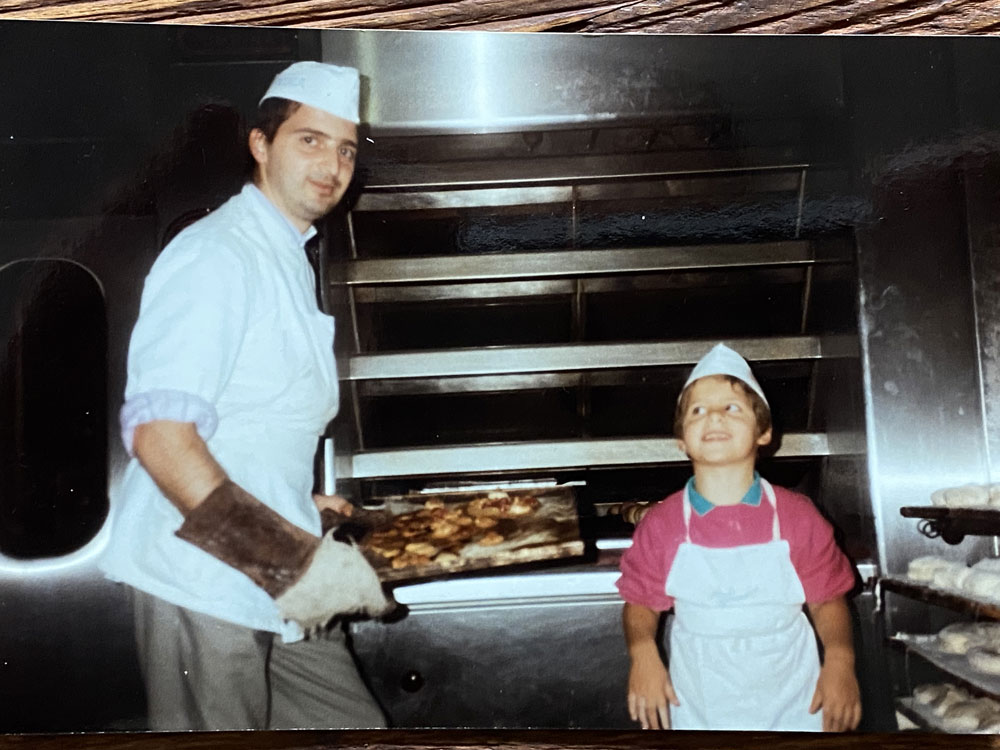
6th-generation/current head baker and owner Nicola Olivieri at work in the laboratorio producing colombe6th-generation/current head baker and owner Nicola Olivieri at work in the laboratorio producing colombe (Courtesy of Olivieri 1882)

Can you tell me a bit about the production process for the Colomba di Pasqua? I know it’s incredibly involved and time consuming. 

It is a yeasted bread that involves two doughs and a long, natural fermentation. In the case of our bakery, Olivieri 1882, each Colomba batch takes a total of four days to produce from start to finish. We begin with the care and keeping of the mother yeast or starter, which is refreshed daily and attended to meticulously. In the evening we will start with the first dough and when it’s complete we let it leaven and rise overnight. The following morning, we will add more butter, eggs and flour and begin to shape our dough. Most producers will let their dough rise and then immediately glaze and bake them; we wait an additional night before glazing and baking our Colomba cakes. Once they are baked, we then hang them upside down overnight so the cakes don’t cave in or sink in the middle. After all of this, the Colomba is ready to be packaged and purchased for Easter. 

Nicola as a child with his father Oliviero OlivieriNicola as a child with his father Oliviero Olivieri (Courtesy of Olivieri 1882)

What are the ingredients in a traditional Colomba di Pasqua vs. your signature version? 

Our version contains four times more eggs than the average Colomba recipe, which gives it a lovely richness and bright yellow color. In our “Ricetta Storica — Colomba Classica,” or historical recipe, we also add candied orange paste in place of chopped, candied orange. This is a nod to the focaccia veneta mentioned above, a Colomba cake that is closer to what my grandparents would have made.


Want more great food writing and recipes? Subscribe to Salon Food’s newsletter, The Bite.


For those who think of bunnies, jelly beans and Peeps before Colomba di Pasqua when it comes to Easter foods, what can you say about the legacy and iconic stature about Colomba di Pasqua for Italians and Italian-Americans? 

For us Italians, the Colomba cake represents spring, the arrival of blue skies and sunshine and time with family and friends. The Colomba for me conjures up a peaceful Easter Sunday with my family and kids or perhaps a picnic in the countryside on Pasquetta (Easter Monday). It is the center of the Easter table from North to South.  

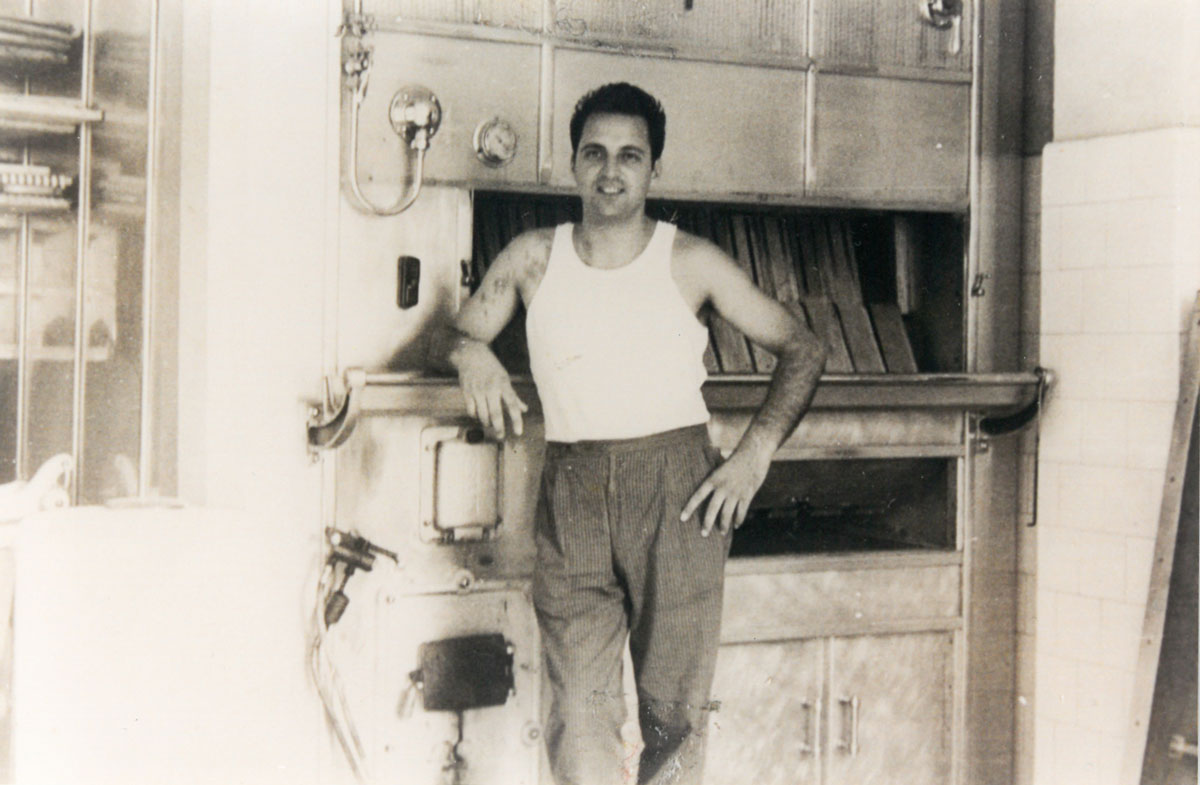
Bianco Olivieri, Nicola's grandfatherBianco Olivieri, Nicola’s grandfather (Courtesy of Olivieri 1882)What other types or flavors of Colomba di Pasqua do you sell?

Along with the Colomba Classica or traditional recipe, we also offer nine other flavors. Besides the classic, our best sellers are Triple Chocolate and Apricot and Salted Caramel. This year, my “muse” is Italian citrus: Brand new 2023 entries include Lemon and Vanilla; Orange, Tangerine and Cardamom; and Sour Cherry, Lemon and Pistachio.

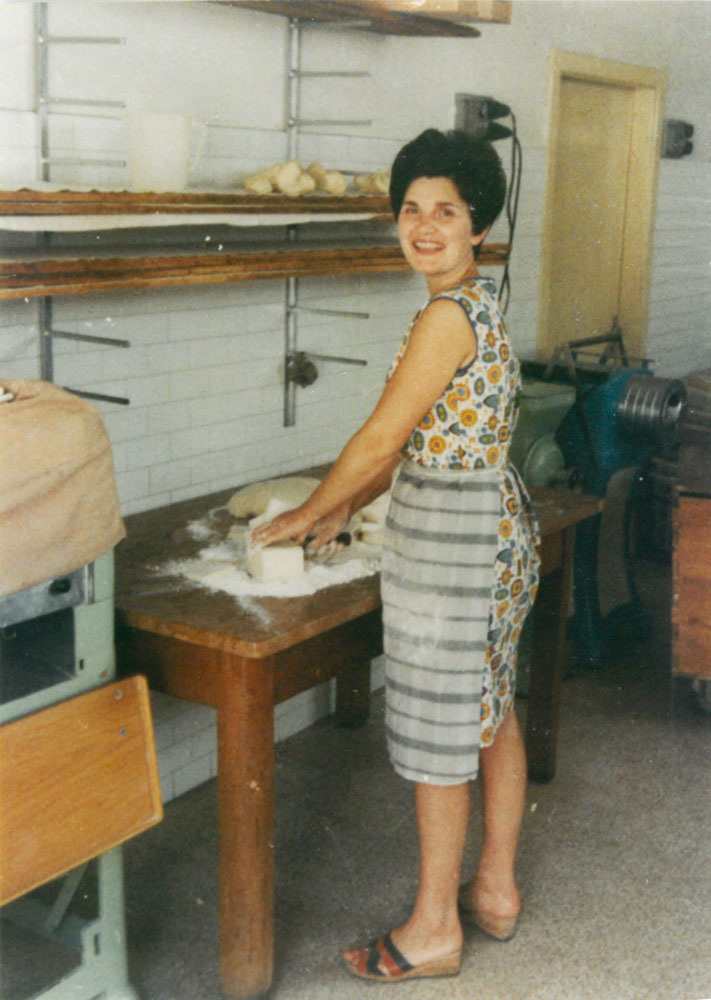
Nicola's grandmother, Nonna MirandaNicola’s grandmother, Nonna Miranda (Courtesy of Olivieri 1882)

Is a Colomba di Pasqua similar to Pastiera Di Grano, another classic Italian Easter dessert classic? 

The Pastiera is very different; its prep is far more low maintenance. It’s a baked cake, not yeasted like the Colomba. But, they are similar in that they are both beloved Easter sweets in Italy (the Pastiera is an Easter staple in the southern region of Campania specifically). 

What is the meaning or symbolism of the dove shape? 

The dove shape is a symbol of peace and inextricably linked to Easter symbolism.  

“Air” doesn’t do justice to Sonny Vaccaro, much less sneakerheads

Ben Affleck’s new movie “Air” is not about sneakers. 

If you are a sneakerhead or hungry for the glorious Air Jordan origin story, this film may not be for you. As a certified Jordan addict, I went in looking for the earliest members of my tribe and didn’t find find them; however, I did learn about the meteoric disconnect between executives in a cool company and actual cool people, and that was entertaining. 

Nike and Jordan might not have sparked that billion-dollar empire if Vaccaro wasn’t a pest.

I was born in 1980 when Magic Johnson led the Los Angeles Lakers to a championship against Julius Dr. Jay’s Erving’s 76ers, proving that the NBA Showtime era was real and here to stay. Jordan made his way into the league in 1984, with his signature shoe the Air Jordan 1 being released to the public in 1985 – making me the perfect age to be aware of the sneakers that drove the older kids in my neighborhood crazy. The Jordan brand does about $4 billion annually now, but raked in an impressive $162 million during their first year, when the projected sales were approximately $3 million. 

Red and black Air Jordan 1’s flooded my block – almost instantly becoming a required sneaker in my neighborhood. The basketball players hooped in them, and the hustlers hustled in them. The dads paired them with blue jeans on Friday nights as soon as they got off work. Even the white kids who hung out by East Point Mall were hitting kickflips in them. So when my dad walked me into the shoe store at six years old, and then asked me what I wanted, I didn’t look at the Converse and couldn’t care less about shell-toe Adidas – the only logical answer was Air Jordans.

But how did we get to that moment? Ben Affleck attempts to take us there in the new Amazon film, “Air.” 

“Air” is centered around basketball and sneaker deal guru Sonny Vaccaro (Matt Damon). Vaccaro has had dealings and connections to multiple sneaker brands – but “Air” zeroes in on his time at Nike basketball. Nike founder Phil Knight (Affleck) was ready to tank the basketball division because they had yet to make a dent in the market. Nike was known for making running shoes, and Knight was a runner who competed on the collegiate level durning his days at Oregon. He had initially got into the sneaker business with his college track coach Bill Bowerman and loved to hire runners, or ex-runners every chance he got. I believe it was a passion thing; Knight loved to run – not shoot hoops. 

The dude has always been slicker than a can of oil with the ability to sell snow cones in the middle of a blizzard.

But before Vaccaro could even attempt to flip Knight, he had to get past the equally talented and high-strung Rob Strasser (Jason Bateman), Nike’s marketing manager, one of the company’s earliest employees and a guy who didn’t want to exhaust the entire budget on Michael Jordan. 

It wasn’t personal. Converse already had the three best players: Dr. Jay, Magic Johnson and Larry Bird. Magic delivered a jolt into the unstable NBA with his larger-than-life smile and no-look passes in legendary battles with Boston and Detroit. But in the ’80s, the NBA didn’t have the same prestige as the NFL or MLB; the league was still relatively young and known as a collection of dudes that liked to fight and do cocaine.

Michael Jordan was a once-in-a-lifetime kind of athlete, but what happen to this guy once he is in the NBA? Wouldn’t it be wiser to bet on a few good players than just one person who isn’t even the top draft pick, a player that could potentially tank?

Vaccaro convinced both Knight and Strasser that it was worth the gamble. 

“Air” shows how Vaccaro was the driving force behind this deal. I’m always confused when people leave his name out of the Jordan conversation; he was the guy. Nike and Jordan might not have sparked that billion-dollar empire if Vaccaro wasn’t a pest. I expected to see Matt Damon rock that Sonny V ‘fro and maybe the use of AI technology to recreate those big sleepy eyes – but we only get the belly. I could live with Damon not looking identical to Sonny, but what the film missed was a hard dose of Vaccaro’s style.

The movie is not really about sneakers, but more a tale of possibility and the American dream. 

I don’t know what it is about Vaccaro, but the dude has always been slicker than a can of oil with the ability to sell snow cones in the middle of a blizzard. Add that to the fact that Black people from all over the country loved that guy. Anyone who played basketball on the AAU circuit would light up at the sight of Sonny V in the crowd because they knew his presence meant something special was about to happen. The film is based around the business dealings of Vaccaro, Knight and Michael Jordan’s mom Deloris Jordan (Viola Davis) – but we wouldn’t get that  exchange between Mrs. Deloris Jordan and Vaccaro without knowing what made Vaccaro, Vaccaro. 

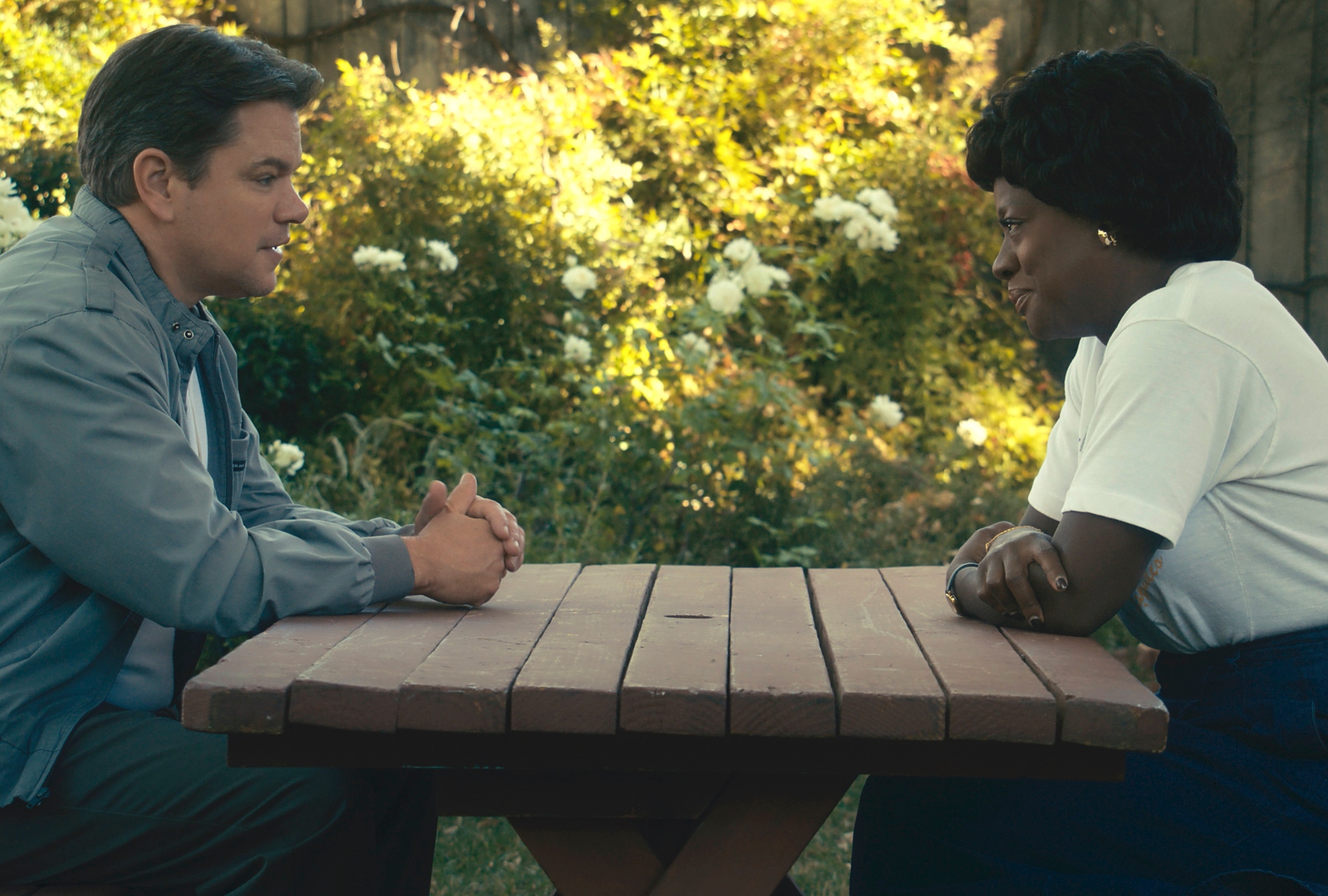
Matt Damon as Sonny Vaccaro and Viola Davis as Deloris Jordan in “Air” (Amazon Studios)No one in life would ever mistake me for a basketball prospect; however, I saw Vaccaro twice in my hometown of Baltimore, one of the Blackest cities in America, surrounded by all Black people in places where the only white people are the ones with badges. 

The first time was during the summer league game, Sonny V was standing next to a gate at the legendary Bocek basketball court when some Dunbar players performed spectacularly against some loudmouth West side dudes who shouldn’t have been on the court. Sonny mixed in with the winners like he had known them forever. On the other occasion I watched Sonny climb out of a parked car from a second-story window as he made his way across Central Avenue toward the Somerset housing projects on a 1,000-degree day to see Bear and a few other NBA prospects sink jump shots from half-court on a broken rim. Like at Boceks, he smiled, admired the talent and looked like he was home. And that is what “Air” is genuinely about: home. Sonny earning his keep at home. Mrs Jordan protecting her home. Mr Knight expanding his home. 

Sneakerheads and shoe lovers may flock to this film looking for things about the historic Jordan deal that they may not have known – but if you are in the culture, there are few surprises. Everybody knew then Michael Jordan wanted to sign with Adidas, and he almost didn’t even take a meeting with Nike. Everybody knew about the $5,000 fines Nike agreed to pay if Jordan played in the banned shoes. (He played in the shoes but the NBA never fined him.) Everyone knew that his parents played a huge part in him signing with Nike. That’s why the movie is not really about sneakers, but more a tale of possibility and the American dream. 

It’s about Deloris Jordan wanting more for her family. It’s about Phil Knight being brave enough to listen to his Nike employees despite the Board, in an effort to grow his company, which no one believed in, in the first place. It’s about Sonny Vaccaro wagering his career and future along with Rob Strasser on a hunch that one kid, who also happened to be a dreamer, could accomplish the unthinkable.


Want a daily wrap-up of all the news and commentary Salon has to offer? Subscribe to our morning newsletter, Crash Course.


These are a collection of American stories through the lens of sneakers that have been worn by every single demographic in America, from the top 1% to people in public housing to the working stiffs, to the tech startup guys, to high school teachers, to nurses, to fire fighters to the good guys on packed corners – and  can even be spotted on the feet of the cops that lock people up. The Jordan Brand is an American story, “Air” is most effective in capturing the essence of extreme risk. 

If you are interested in a film that could explain how a superstar from Wilmington, North Carolina, a self-made millionaire from Portland, and a basketball whiz from Trafford, Pennsylvania, can perfectly unite and change the world because they all speak the same language of dreamers – then watch “Air,” it’s for you. 

Are we implicitly biased against men? New study finds a “positive” bias towards women

Just because our world doesn’t treat women better, it doesn’t necessarily mean that it doesn’t feel good about them. In an illuminating study published in the Journal of Personality and Social Psychology, researchers uncovered a consistently favorable bias among participants — toward females.

As study author Paul Connor, now a postdoctoral scholar with the Adversarial Collaboration Project at the University of Pennsylvania tells Salon, “We found that the strongest driver of positive versus negative evaluations was the target’s gender — people were much more positive towards the female targets than the male targets. The effect of gender was much stronger than the other variables, stronger than social class, race and age.”

The second most persuasive factor? Social class.


Want more health and science stories in your inbox? Subscribe to Salon’s weekly newsletter The Vulgar Scientist.


The study of implicit bias looks at the unconscious motivators of our thoughts and behaviors towards certain groups, favorably or unfavorably. Implicit Association Tests (IATs) usually study bias through one particular lens, like race or age. For example, “In the classic IAT,” explains Connor, “your task is simply, ‘If you see a white face, press this key, if you see a Black face, press this key. If you see a positive word, press this key, and if you see a negative word, press this key.'” 

This is a way of measuring attitudes towards something like, in this example, race, without actually asking directly. Few people will admit openly to having biases, and many people with biases are unaware they even have them; these tests measure bias by studying the subjects’ unconscious minds. 

“We’re not actually asking you about your racial attitudes, we’re trying to measure them by seeing, do you find it slightly easier to categorize these words and stimuli when white is paired with ‘good’ and when Black is paired with ‘bad’?” Connor said. “We use this reaction time data to make an inference about somebody.” 

Notably, not every psychologist agrees that one’s reaction time always correlates to bias. “This is why they’re still controversial,” Connor added. “There’s been decades of research, and people are still arguing about what these effects really mean.”

In any case, this recent study, a collaboration of scholars from Columbia University, Rhodes College, and the University of California, Berkeley, was unique because it attempted to interrogate “Intersectional Implicit Bias,” and the ways in which different combined variables “operate in real-world settings.” 

The inspiration for the study came from a desire for a less binary evaluation of implicit bias.

“When we’re interacting with other individuals in the world,” says Connor, “we’re at least perceiving their age, their gender, their race, their social class, all these things at once. We were asking, if we let people respond spontaneously to more complex targets — full body full color photographs of individuals so their race, their age, their gender, and their social class is visible via signals in clothing, etc.— which of these variables evokes the more positive response? Which of these complex target individuals do people find it easier to categorize, paired with positive stimuli? Which, with more negative stimuli? Can we tease apart the effect of race from the effect of social class from the effect of age, from the effect of gender? Can we look at the relative effects of those different variables? Are there interaction effects? Or is there sort of a specific subgroup that people are particularly positive towards or particularly negative towards, and just start to make the task a little bit more like real life in terms of responding to a more complex, multiply categorizable individual?” 

“What we didn’t know… is that gender is going to emerge as the most powerful predictor of people’s biases.”

And as Eric Dolan reported recently in PsyPost, the participants, culled from nearly 6,000 university undergraduates and American adults recruited from online platforms, clearly showed “female targets receiving more positive evaluations than male targets across all three methods used to measure implicit evaluations.”

Connor observes, “What we didn’t know is that if you let people respond spontaneously to complex targets, gender is going to emerge as the most powerful predictor of people’s biases.”

The results are intriguing, in no small part because of how “positive” words play a role in “positive” associations. Other implicit bias studies, focusing exclusively on gender, have produced other interesting conclusions.  For example, a 2020 study published in Nature Human Behavior examining  “women’s under-representation in scientific fields” found an implicit “science = male” from scientific committees they evaluated. And a 2018 study from The European Journal of Finance found financial advisors assessed female investors having “less control over their investment portfolios relative to men, [and less] knowledgeable about investments than men.” (In both studies, by the way, the participant pool was gender diverse.)

So if we think that “positive” means scientifically or financially astute, our perceptions of females still appear to lag. But other words have other associations.

“I don’t want to go too far beyond the data, but I often am in the situation of reminding people that it’s not super surprising that people would associate females with ‘good’ and men with ‘bad,’ if we’re purely talking about positive words,” says Connor. “The kind of words that are used in these tasks are things like, ‘wonderful,’ ‘beautiful,’ ‘lovely,’ and then the negative words are like ‘horrible,’ ‘awful,’ ‘tragedy.'”

“I think that it’s probably true that people do generally think women are better than men. “

That seems to be key to our understanding of this apparently pro-female bias. Maybe it’s just that women seem nice.

“Although people have very strong gender stereotypes, I think that it’s probably true that people do generally think women are better than men. Men commit most of the crime in society, men can be most of the violence. In all our art and literature, the villains are almost always men. Most of history’s atrocities have been committed by men,” says Connor. “I think it’s not altogether that surprising that if implicit bias does function as this relatively automatic threat detection mechanism, that we may have evolved to respond very quickly to perceived threats in our environment. It’s really not surprising that we would have relatively automatic negative associations with men — and relatively positive associations with women.”

How a buttermilk cake from Oklahoma won the 1955 World Series for the Brooklyn Dodgers

I’ll admit, I was skeptical when I first took this buttermilk cake out of the oven; visually, there’s very little to distinguish it from an average pound cake. But there’s more to this dessert than meets the eye.

I unexpectedly came across a version of this recipe in “Tales From the Dodger Dugout,” a book written by former Brooklyn Dodgers pitcher Carl Erskine that’s full of colorful anecdotes from his 12 years with the team. As a baseball fan who also happens to be a professional chef, one story stood out: how an unassuming buttermilk cake from Oklahoma became the team’s good luck charm during their unforgettable 1955 championship season.

Sharp and witty at 96 years old, Erskine is one of only two living players from the Dodgers’ 1955 World Series-winning roster. His book offers a glimpse of what it was like to play alongside Jackie Robinson for a beloved team—remembered by fans as the “Boys of Summer”—that personified the borough of Brooklyn by way of their diversity, grit, and perseverance. I recently had the chance to speak with Erskine, who explained that the buttermilk cake first appeared as a gift in the mail, sent by teammate Frank Kellert’s family in Oklahoma. The story goes that the team snacked on the cake for a few days in a row, winning each game during that stretch of time. When the cake ran out, the Dodgers went on a losing streak. Superstition has long played a role in Major League Baseball, so Kellert was asked to request more cake, and it soon became a fixture in the clubhouse.

“It seemed like that buttermilk cake was some kind of magic for us, to keep winning,” Erskine said. “They sent cakes in for the rest of that season. I couldn’t tell you how many different cakes came in, but there were more than just a few. It became a very big superstition. We didn’t want to go into the World Series without a supply of buttermilk cake.”

Equipped with ample amounts of their good luck charm, the Brooklyn Dodgers beat the New York Yankees in the seventh game of the 1955 World Series—the team’s first-ever championship, and their only one in Brooklyn before permanently moving to Los Angeles in 1958. “Those Brooklyn Dodger teams of that era are one of the most storied teams in the history of baseball,” legendary sportscaster Bob Costas told me. “That team had come so close so many times, with near misses against the Yankees (always the Yankees) in the World Series, and finally in ’55 they break through. So did the buttermilk cake really help them do it? There are a lot of superstitions in baseball—I’d never heard of that one, but if it worked, then it was a good idea.”

Luckily, the cake is more than just a fun anecdote; it’s utterly delicious, too. The aromas of vanilla and buttery pecan fill the air as it bakes in the oven. That first warm taste is perfectly sweet (but not overly so) and nutty, with a subtle tang that invites bite after bite. A crisp exterior gives way to a light, yet tender interior that remains moist even days later. Whether you’re slathering a slice with softened butter and a pinch of Maldon salt or toasting it under the broiler and serving it with a dollop of whipped cream and berries, you can easily snack on this cake for a week straight and never grow tired of it.

“The buttermilk cake was the single most important food item that had anything to do with our success,” Erskine said. “It was symbolic of winning. It’s a strange way to have it happen, but it did happen.”

You can see the full recipe for the Buttermilk-Pecan Bundt Cake here


Matt Damon and George Takei, check out “White Savior,” a samurai satire challenging beloved movies

We’ve seen the white savior trope, in which a white hero swoops in to save people of color from their misfortunes. But you’ve probably never seen it written like it is in the new Dark Horse comic “White Savior.”

Co-authors Scott Burman and Eric Nguyen, who’s also the illustrator, spoke with Salon about “White Savior,” which attacks the tired theme with a refreshing humor that flips it on its head and subverts stereotypes. The four-part comic series features 20-something Todd Parker, a film teacher, who claims that despite his Japanese American heritage he has “more in common with McDonald’s and Domino’s Pizza” than with “any of the Seven Samurai.” 

“I love Matt Damon. If he wants to be in ‘White Savior,’ sign him up.”

Todd learns about an ancient prophecy from the village of Inoki, that stated an outsider with “snow-colored skin” would save the villagers and lead them through the battle with their rival. But this outsider ends up being an “awful, drunken idiot.” When Todd and his friends, Maggie and Neal, are thrown back in time to feudal Japan, they become responsible for showing the people of Inoki the truth and rescuing them from the impending damage their white savior is going to cause. 

Nearly every page of the comic includes a clever joke — like Todd being asked which Japanese clan he’s a part of and answering, “Uh . . . the Wu Tang Clan?”

“I think a lot of times, you hear about stories like this and usually they take a much more serious approach,” said Burman, who likes to joke about being the white guy involved with “White Savior.”

“I think, and who can ever say this about their own thing, but I think with us we were always comedy-first, and that will get the message through a lot better than just heavy handedly pushing this,” he added. 

While Nguyen has been working in comics for over 15 years, illustrating for Marvel and DC, Burman didn’t have any previous experience in comics before “White Savior” was picked up. 

The pair decided to work together seven years ago, after Burman reached out to Nguyen over email and sent him a script. Burman’s sense of humor sold Nguyen, who was looking for a lighter and funnier project, on working together. 

The two sat down, over video call, to talk about the making of “White Savior,” and where it might be going in the future. 

“White Savior” (Dark Horse)You’ve said that you went into this not intending to make a social statement, but just to make something fun and funny. What was it like to realize that it’s being viewed as and ultimately is part of a bigger statement?

Eric Nguyen: For me, I thought it was great. We didn’t go into it with a specific notion we’re stating about this whole idea of white savior, white entitlement and all that stuff. We did like the fact that we were poking fun at this whole Hollywood trope. The movie that really got me was not really Tom Cruise’s “The Last Samurai,” but it was Matt Damon’s “The [Great] Wall.” 

It was ridiculous. Like I’ve been saying in other interviews, I love Matt Damon. If he wants to be in “White Savior,” sign him up . . . It was kind of just over-the-top for me. So that’s what got us, and when we came up with the title “White Savior,” it just sounded perfect.

Scott Burman: Eric, of the two of us, understandably is pretty fearless. Whereas me, I’m afraid of everything. I’m like, “‘White Savior,’ that’s so funny.” Then a minute later, I’m like, “People are gonna Google my name and they’re gonna see ‘White Savior’ next to it. I’m not sure if this is the best idea.”

“We know people are going to hear the title and they’re going to hate this book.”

It’s a very funny dichotomy between the two of us. But initially, we were like, OK, it’s gonna be really, really funny. And then as we were going into it more and watching the movies and looking up past things . . . We were like, OK, wait a minute, as funny as this is, we know we’re tapping into something here.

We know people are going to hear the title and they’re going to hate this book . . . but our goal was to get people to give this a shot. Take any preconceived notions, put them to the side, and just read a funny and entertaining book.

Nguyen: Not even put them to the side. Come in with your preconceived notions and just enjoy the book. I mean, that’s what I’m hoping. Everyone’s gonna have an idea of what a white savior is, but if we surprise them then that, for me, I think that’s awesome — if they enjoy the comedy, enjoy the book.

And we don’t just stop at just poking fun at the white savior. We push other ideas, other stereotypes that I like to make fun of as well. I mean, I’m Asian. The whole idea of chopsticks and the utility of chopsticks was something that always comes up . . . I like poking fun at that stuff.

Burman: When I do it, the message doesn’t come across the same way for some reason. I can’t figure out why.

Nguyen: We also play with the ideas of different people with different strengths, like Maggie is actually our enforcer, and she’s actually the crazy one of the trio. She’ll do things that undoubtedly will surprise people. Maggie is not not your typical girl.

“White Savior” (Dark Horse)I love the part that you put in where she said, “Can we please not do the whole ‘I’m a girl so I get pink narration boxes’ thing?” 

Nguyen: Little things like that, I’m glad that people pick it up. We hear so many different little things from others, from different people’s backgrounds, what they pick up and what they find amusing. I enjoy it when I hear people pick up little things like that. 

“I will state 100% that the George Takei joke that we have in the book has an ulterior motive.”

I did want to talk about your characters a little bit. Todd Parker makes a joke about assimilation and how he has “the whitest name ever.” How was that kind of joke, that part of his character, influenced by your own experiences? 

Nguyen: I totally relate to Todd Parker. When we came over here — I’m from Vietnam, I came over in 1975 — we did the assimilation thing. We lived in Texas, and initially my parents had us speak only English. We were going to a majority white school and all that stuff. 

I actually do have a similar mindset as Todd Parker. I’m just an average person, I just happen to be Asian American. I don’t really define myself as my culture. I’m Asian American — I’m no more, no less American than anyone else.

Was there a reason why you decided to not make your main character Vietnamese and to set the story in Japan?

Nguyen: That’s actually on Scott.

Burman: When Eric and I started this, we didn’t have a publisher. We had no idea if this would get picked up, we had no idea if we could sell it, we had no idea of anything. We came up with the idea and we started writing, and Eric started drawing some of it. And then he got a job, I think “Wolverine” for Marvel. And Marvel was paying him a lot more than me, which was nothing. So he took that job, and we had to take a little time off.

In the meantime, I got an idea. I said, let’s take the script and let’s email it to famous people. Let’s email it to famous Asian Americans and maybe we’ll be able to use their likeness in the book and sell the book that way. Basically, if you were an Asian American celebrity, you got an email from myself or Eric.

We had one person, and I don’t want to say their name, who was on board with it. And then that person fell off a bit, and we’d already done a lot. That’s why we made it Japanese. It seems weird in hindsight, that Eric’s Vietnamese and we made [Todd] Japanese, but it’s because we thought we’d be able to get a better deal with the celebrity we had on board.

Nguyen: It also turned out to be perfect anyway, because Japanese culture, their ideology and their principles are so strong. I just thought it made perfect sense anyway, the Japanese and how they see themselves, it [lent] itself to how they can believe in this white savior prophecy. 

Can you talk a little bit more about the inspiration behind some of the other characters like Maggie, Neal or any of the other characters? 

Nguyen: There’s not just one person that’s really the protagonist, it’s all three of them . . . It’s actually Scott who does a lot of the scripting, where they do a lot of back-and-forth interaction. I think that a lot of us, with our friends, do that all the time. We throw out random subject matter and sass each other while we’re doing something, and I thought that was great. We wanted that sort of relationship from these three. 

So, it’s not really we wanted a specific inspiration for this person, then a specific inspiration for another. They just turned out to be that way because of their dynamic with each other. Like how Maggie and Neal are always sassing Todd about being, you know, he’s definitely not masculine . . . He talks about a lot of random stuff, but he can’t really do much.

Burman: When we originally wrote this, it was double the length. We had in mind eight issues. And when we were talking to Dark Horse, they said they typically do four issues . . . Dark Horse was phenomenal, and they would have let us do anything, but we just thought we could maybe condense this into four. And in some ways, it made it stronger.

Because of that, though, the only thing that I would have done is have a little bit more of Neal, Todd’s best friend. Probably my favorite joke of the entire book is in the third issue — I might spoil it but it shouldn’t matter too much. But Neal comes back in the story, and we have an editor’s note about how to check out what happened with Neal: “Be sure to read our special one issue story of Neal.” Then, underneath that note, there’s another note that says, “Hi, I’m the real editor of this book. Eric and Scott have been writing their own editor’s notes. We told them there’s not going to be any one shot until we see the sales of this one.” And it’s my absolute favorite thing in the book. 

Nguyen: We do give this little hint that we do have a “Dark Savior” story. And that’s Neal. I would love to do that “Dark Savior” story. 

How did you split up the work and what was your work dynamic and the writing process like? 

Nguyen: I got the short end of the stick. I had to draw this whole damn thing.

Burman: We thought it up together and then Eric and I just plotted it out. I probably was more on the structure of it when we were plotting it out, and I would literally say to Eric, “Well, what do you want to draw? What do you want to put in this? What do you want to do?” And I would take all the points that we had and I’d put them into a basic script. And then we’d sit down, and we’d expand on it. 

We’d create the jokes together, go back and forth . . . Eric would draw it, and he would tell me some ideas he had when drawing it, and then we’d come together and throw the jokes on the page, essentially.

“White Savior” (Dark Horse)

There are so many good jokes with pop culture references, including to the Wu Tang Clan and George Takei. What makes those references important to the story? 

Nguyen: That’s all Scott right there. He likes to throw in nuggets for the future. Once we blow up, it’ll all make sense.

Burman: There’s a lot of different, very weird, random references in this, and I think that’s part of my writing style. But also, some of them do have ulterior motives. I will state 100% that the George Takei joke that we have in the book has an ulterior motive. Not only is it a joke, but also, we’re waving the flag to George Takei saying, “You need to read this book. You need to get in the movie.” 

Speaking of that, you’ve made some comments about making a movie or pitching it to Netflix. What would your ideal cast look like?

Nguyen: Initially, we started throwing out names for casting. But now, since we’re actually talking with people who may have the ability to take this into let’s say Netflix or a film —

Burman: It’s tricky because, now that we’re talking to these people, we don’t want to say other people’s names. We don’t know what the heck we’re doing, we’re trying to figure out what the right or wrong thing to say is. Eric, help me out.

Nguyen: We’re getting so much support from the Asian community. We’ve talked to people who are actors in Netflix, we’ve talked to people who have produced shows for Netflix, we’re talking to people who have produced comedies for ABC. I think we’re on the right track. We just need to let them take charge, and whoever they think will make the best adaptation for this, we’re on board with that. I only know how to draw, and my world is comics. Let the smart people take over and do what they need to do to make this thing.

“White Savior” (Dark Horse)What has it been like to see so much support from the Asian community and the Asian community in the industry? 

Nguyen: I never thought I would be anywhere in close proximity to actors and these influencers and stuff. Scott just had a great meeting with someone who’s pretty well-known at Netflix, doing the shows there. And I’m surprised he didn’t get a picture with those people, because that would have been my first thing on Instagram.

Burman: Well, for the record I gave them the comic, and the idea is let them take a picture with the comic. I’m not important, the comic is important. The white guy in “White Savior” is gonna step to the side in this one. But it’s been interesting. For me, it’s really funny. We went on the “They Call Us Bruce” podcast. What’s really funny is that they’ve had some of the biggest Asian American names ever on their podcast. They’ve had 188 episodes, me and Eric were on their 189th episode, and I was the first-ever white guy [guest]. We made a joke about that.

“George Takei — can we send you a copy? … We want to make sure you play the grandpa in the movie.”

This is my first thing that I’m ever getting out there to the world, and so it’s been really nice to hear people enjoying the comedy that I’ve done. But also, it has been extremely nice, with the Asian American community, to know that we’re doing more than just telling jokes, that we’re sending this message out. In my case, I’m a supporter and Eric’s much more the face, I would say. 

Nguyen: The support has been amazing, especially from the Asian community.


Want a daily wrap-up of all the news and commentary Salon has to offer? Subscribe to our morning newsletter, Crash Course.


What would you want the future of “White Savior” to look like? Are you thinking about continuing the comic or pursuing other opportunities? 

Nguyen: Definitely, we want this out there in other forms, other than comics. I definitely see it on TV or on film. That would make my day . . . But we do have other stories, we do have other ideas coming up that we’re excited about. We do have some pitches from Marvel and DC, and so we’re working on those things right now. 

Burman: And I still think Eric is crazy, because for some odd reason, he wants to stick with me. He was like, “Let’s pitch to Marvel and DC together!” And I’m like, “Yeah!” We have, basically, a smorgasbord of ideas. We just want to make sure the next one is going to be the right one

Eric’s been drawing up a storm, so we’ve got stuff [ready] to go and we’ve got both sequels and spin-offs. We think it could also lend itself to other, non-Asian creators — Indian American, African American, Native American — and it can spin off and tell their stories, their versions of “The Last Samurai,” if you will. There’s a lot of different ways we can go, and we’re just excited at the opportunities that will present themselves.

Is there anything else that either of you would like to add about “White Savior” or anything else you’ve got coming up?

Burman: George Takei — can we send you a copy? You can write that in capital letters. George, we want to send you a copy, let’s get moving on this thing. We want to make sure you play the grandpa in the movie. That’s the only casting we can say 100% George Takei, grandpa. I don’t think there’s any substitutes. 

Infant formula shortage often led to alternative, less-healthy means of nourishment

One-third of families who relied on formula to feed their babies during the COVID-19 pandemic were forced by severe infant formula shortages to resort to suboptimal feeding practices that can harm infant health, according to our research published in the journal Maternal and Child Nutrition.

Infant formula shortages left 70% of U.S. store shelves bare in May 2022, with 10 states reporting out-of-stock rates of 90% or greater.

As psychology researchers who study breastfeeding, this situation left us concerned for the safety of infant nutrition. With two colleagues who focus on public health, we conducted an online survey of over 300 infant caregivers in the U.S. to understand how many families had trouble obtaining infant formula and what they fed their babies when they did.

Considering the scope of the formula shortages, we were not surprised that 31% of the formula-feeding families we surveyed reported challenges obtaining infant formula, the most common being that it was sold out and they had to travel to more than one store.

But their babies still needed to eat. Being unable to get their hands on infant formula pushed caregivers to potentially unhealthy or even dangerous stopgaps. For example, 11% of the formula-feeding families surveyed said they practiced “formula-stretching” – diluting infant formula with extra water to make formula supplies last longer, which provides a baby with less nutrition in each bottle.

Furthermore, 10% of formula-feeding families reported substituting cereal for infant formula in bottles, 8% prepared smaller bottles and 6% skipped formula feedings for their infants, which all provide infants with less nutritious meals.

Exclusively breastfeeding families were insulated against these supply disruptions. Almost half of breastfeeding families surveyed reported that COVID-19 lockdowns actually allowed them time to increase their milk supply.

Why it matters

Our study suggests that the waves of formula shortages from 2020 to 2022 in the U.S. were more than just an inconvenience for parents. Instead, this study is the first to document that formula shortages likely had real and widespread adverse impacts on infant nutrition, given that a large proportion of parents surveyed resorted to feeding their baby in ways that can harm infant health.

For instance, studies have shown that adding extra water to “stretch” formula can result in infant malnutrition, growth and cognitive delays and even seizures and death in extreme cases. Adding cereal to bottles increases the risk of choking-related deaths and severe constipation. Moreover, feeding infants age-inappropriate foods can have lifelong consequences for cognitive development and growth, leading to a higher risk for chronic illnesses like obesity and cardiovascular disease.

Given that approximately 75% of infants in the U.S. are fed with infant formula in the first six months of life, formula shortages could put roughly 2.7 million babies each year at risk for suboptimal feeding practices.

What’s next

A perfect storm of formula recalls, ingredient shortages and shipping delays contributed to COVID-19-related formula shortages in the U.S. Although President Joe Biden’s administration has taken some steps to improve distribution infrastructure, the U.S. does not currently have infant nutrition disaster plans in place beyond common-sense recommendations for individuals.

Unfortunately, climate change will likely increase the risk of formula-supply disruptions over the next century because of the increased frequency of natural disasters.

The best way to protect infant nutrition from supply chain issues is to promote and support breastfeeding, which provides optimal infant nutrition and insulates infants from those disruptions. Since not all babies can be breastfed, though, governmental policies could help prevent and address acute formula shortages and ensure equitable formula access for all.


Jessica A. Marino, Doctoral Student in Health Psychology, University of California, Merced and Jennifer Hahn-Holbrook, Assistant Professor of Psychology, University of California, Merced

This article is republished from The Conversation under a Creative Commons license. Read the original article.

“Hyenas are communists”: Right-wing story hour, part 1 — the banality of celebrity

It was a recent Wednesday morning in Washington. The crowd was small,  the headliner was late and none of the expected counter-protesters had materialized. 

Jack Posobiec didn’t seem concerned. The 38-year-old conservative influencer, a celebrity of sorts in the MAGA world since Pizzagate, was sitting on the floor of the Cleveland Park Public Library. He was wearing a white button-down shirt against a dark suit jacket. Squatting forward, he looked unnaturally bulky at the shoulders and hips, his slim frame swallowed up in his crouch, so that the first thing you noticed was the sharp horn of hair, gelled with great care above his high-cresting forehead.

To an audience of maybe a dozen children Posobiec was introducing “The Island of Free Ice Cream,” a picture book he purportedly wrote about predators who lure unsuspecting animals to their doom. The children’s parents watched from further back.

“Wolf Island was a dark and spooky place, full of shadows,” he explained. He glanced up, past the adults, toward a camera that had been set up by Real America’s Voice, a streaming and television venue that rose to prominence by hosting Steve Bannon. “And full of communists,” he added.

He laughed. So did the parents. After a beat the children did, too.

Posobiec was the first reader in the Freedom Island Story Hour, organized by the Texas publisher Brave Books to promote its series of children’s stories commissioned, according to the company’s website, “to honor God… and instill a love of truth.” It was part of a nationwide tour for the latest Brave Books release, “As You Grow,” by child actor turned evangelist Kirk Cameron, meant as a conservative counter to the popular Drag Queen Story Hour, which emphasizes “the gender fluidity of childhood… and queer role models.” In addition to Cameron and Posobiec, Chaya Raichik, creator and proprietor of the social media account Libs of Tik Tok, as well as Sean Spicer, Donald Trump’s former White House press secretary, were scheduled to read.

If on this early-spring morning in our nation’s capital you happened to drop by your neighborhood library — curious, perhaps, about the multiple law enforcement vehicles parked out front — what you discovered in the main reading room would probably have seemed like a total bust.

The reading itself started more than a half-hour late, and Kirk Cameron didn’t arrive until a few minutes after that. “There’s a lot of people trying to find a place to park,” Eric Presley, Brave’s creative director, explained. The initial police presence had dispersed, given the lack of turnout. What’s more, everyone in attendance had to first pass by a prominent display, arranged by the library staff, of LGBTQ-themed books and Pride flags. Over the course of the morning the reading room was, at best, half full. 

For Jack Posobiec, however, everything he needed was already in place. Before he’d even sat down on the thin carpet, he had spent the morning diligently assembling the event into a broader narrative: the one he’d arrived at the library intending to share. “On my way to the book reading,” he tweeted just before 9 a.m. to his 2 million followers — which is more than the National Review and the Heritage Foundation combined. “Good morning, Libs!” At 9:25 a.m. he wrote: “BREAKING: Heavy police presence outside the library this morning. Pray for us.” In response to the library’s prominent display of queer reading material and rainbow banners, he quipped, “Not one American flag.” “They wanted to make sure our children saw,” he added.

He proceeded to appear live from the lobby on Bannon’s podcast “War Room,” joking with the onetime Trump Svengali about how all the authors in attendance should have dressed in drag. Afterward, he posted a short video of flash-cuts from the event, in which he added a personal summary of “The Island of Free Ice Cream”: “It’s like Cuba and East Germany and the Soviet Union all together.” 

Posobiec read from his book for just over 10 minutes to the parents and children in the room. “The hyenas were there and helping them,” he said, once again looking past the families assembled in front of him — as if past props and stand-ins — toward the real audience, the millions beyond the camera’s lens, who would experience this event solely from the material he was providing. “Because hyenas are communists too.”


Want a daily wrap-up of all the news and commentary Salon has to offer? Subscribe to our morning newsletter, Crash Course.


This banality of celebrity, with its distinctive architecture — lackluster real life, set against  rarefied online latticework — is what makes someone like Posobiec, at least in this current moment, inescapable. “He has a platform that most American politicians would envy,” the Guardian’s Washington bureau chief David Smith wrote in March, “and could help decide the Republican presidential primary race in 2024… [his] recent online activity includes crude attacks on Antifa, The New York Times 1619 Project, and transgender rights (‘Genital Gestapo’) — ready made talking points for candidates.”

Posobiec’s approach embodies the broader desire of the GOP’s mainstream for accountability in the guise of action — for creating a confrontational event that, at least in its second life as an online spectacle, can counter the supposed unexamined orthodoxy of liberal arguments on issues like race, sexuality and education. 

Posobiec is not looking to strike nuanced positions: In response to Trump’s indictment, he vowed to go after the prosecutor, and has called for a coordinated MAGA attack to bring down the American financial system.  

Posobiec, of course, is not looking to strike a nuanced position or engage in genuine debate; across the board he conveys an uncanny instinct for the most extreme position. He characterizes his opponents as pedophiles and murderers, language that, like the rest of his activism, is best understood as akin to a physical gesture: The act of expression is the meaning.

Over the last half decade, Donald Trump has praised Posobiec repeatedly. In response to the former president’s recent indictment, Posobiec vowed to go after the prosecutor in the case, and has called for a coordinated MAGA attack to bring down the American financial system.  

I first came across Jack Posobiec in December of 2016, in the wake of the Pizzagate scandal: a proto-QAnon conspiracy theory about Democrats operating a child sex and torture ring based at Comet Ping Pong, a pizzeria and bar in northwest Washington, D.C., that happens to be a personal favorite of mine. It’s one of the few places in the city where you can meet a colleague for a drink, take your kids out to a fun family dinner and, on a weeknight, catch a performance by a local band. After Posobiec implied that he’d glimpsed a secret door during his own visit to the pizzeria, an AR-15-wielding gunman from North Carolina stormed the place and fired off a few rounds that mercifully hit no one, before eventually surrendering to police. Hours earlier, I’d met a friend for drinks at Comet’s small bar. It was difficult to fathom how close we’d come to being there.

Half a decade later, in the wake of everything Posobiec had gone on to do, from promoting “Stop the Steal” to calling Shakespeare fans Nazis to getting banned from the dating app Bumble, it takes a moment, seeing his name again, to contextualize what he’s become. Republican voters, Dave Weigel wrote in a recent Semafor newsletter, see him as “the most cited influencer, by far” — someone “who will matter as much to the future GOP voters as Washington Post columnist George Will did to Republicans a generation ago.”

For Posobiec, the key to the culture war is that it has no limits. Instead, the future is simply terrain across which this never-ending battlefield might expand, providing an endless supply of material he can then package into his potent, easily accessible brand of outrage. 

Up close and in person — amid the poor turnout of a local children’s story hour — the true extent of his influence isn’t necessarily apparent. Instead, he comes across as someone not all that far removed from his own biography

Jack Posobiec III was born in Norristown, Pennsylvania, a suburb of Philadelphia, in 1984. His father was a psychiatric nurse. His mother worked for a pharmaceutical company. Both voted for Bill Clinton twice. Both were lifelong NRA members. In high school, attending Kennedy Kenrick Catholic, he worked at a deli, where he became interested in the local music scene. He taught himself to play guitar. He joined a band called China Syndrome. He was a fan of David Bowie. For college he went to nearby Temple University, where he first got interested in politics, joining the Republican club in response to his professors’ advocacy, in class, of liberal positions. After graduation he interned for Rick Santorum’s U.S. Senate campaign. He worked on down-ballot tickets too, his first in-depth experience with political pranksterism.

His next move took him halfway across the world, to Shanghai, where he worked for the American Chamber of Commerce. While abroad he played a minor role as a street thug in the 2008 martial arts film “Forbidden Kingdom.” The following year he returned home, and after brief stints as a sales rep at a local radio station and a staffer for a failed gubernatorial campaign, he decided to join the Navy. He went to bootcamp and scored so well on the aptitude test he qualified for intelligence service and was sent on a 10-month deployment to the prison at Guantánamo Bay, where he worked closely with detainees. In 2015, he turned down an offer from Ted Cruz’s campaign to join Citizens for Trump, where, under the tutelage of Roger Stone, he learned the dark arts of ratfuckery: “Attack, attack, attack. Never defend. Admit nothing, deny everything.

By the 2016 presidential campaign,  Posobiec had stopped writing on Twitter about films and TV shows. At last he began to assume the identity he continues to develop today: “a  hyper partisan social media assassin,” as the late Jonathan Valania wrote in an exhaustive 2017 profile for Philadelphia magazine, “and a frighteningly good one at that, able to blur the lines between truth and fiction and right and wrong and, uncannily, make the ensuing confusion go viral in the gaslit midnight of the American Century.”

By 2016, Posobiec began to assume his current identity: “a  hyper partisan social media assassin, and a frighteningly good one at that, able to blur the lines between truth and fiction and right and wrong.”

He’s come a long way in a short time. The Cleveland Park Library is only a mile-and-a-half walk down Connecticut Avenue from Comet Ping Pong, the initial shore from which he launched his first major attack, spawning his thousand-ship assault on reality that seems only to have grown in strength. Still, his recent story-time stunt was just another stop.

The following week, he held  a demonstration in lower Manhattan, alongside Rep. Marjorie Taylor Greene, to protest Donald Trump’s arrest and arraignment. Standing on a park bench, Posobiec shouted into the receiver of a bullhorn, “They can’t gag all of us.” He was wearing black sunglasses and his blue suit jacket, with the collar of his shirt open. 

“This is the funeral procession of the Republic!” he proclaimed. It was hard to tell from the video he provided just how many people had attended, or whether members of the press outnumbered Trump supporters. All of which, perhaps, is beside the point. For the rest of the day he retweeted multiple clips of the speech. Later that evening, on Truth Social, Trump reposted Posobiec’s line about not being silenced, which Posobiec then posted to Twitter as a screenshot, along with the comment: “Thank you, Mr President.”

Clarence Thomas’ benefactor collects Hitler memorabilia

Harlan Crow, the billionaire benefactor to Justice Clarence Thomas, owns a collection of Hitler artifacts which he keeps on display at his home in Dallas. 

Word of this came via a report from Washingtonian on Friday, the same week in which Thomas made headlines after it was revealed he’d been accepting lavish trips from Crow — which Thomas failed to disclose, in violation of a law passed after Watergate.

Having been so closely tied to Crow in recent headlines, this latest news of his benefactor’s private Hitler collection has brought about further backlash.

“Let’s normalize Supreme Court Justices (Clarence Thomas) not taking secret gifts from billionaire donors (Harlan Crow) who collect Nazi memorabilia,” tweets political commentator, Keith Boykin.

In a series of tweets written on Saturday morning, sociotechnical researcher, Danah Boyd describes visiting Crow’s home years ago while attending a meeting about the future of Democracy, during which she viewed his collection first-hand.

“I didn’t know who Harlan Crow was at the time,” says Boyd. “I was told he was a major GOP fundraiser . . . Years later, I still shudder thinking about the Nazi uniform decorations in Harlan Crow’s house. And the painting. And the book. And the statues. And the “antebellum” (pro slavery) artifacts. I’m glad others are questioning the acceptability of those materials.”


Want a daily wrap-up of all the news and commentary Salon has to offer? Subscribe to our morning newsletter, Crash Course.


As detailed in the Washingtonian report, Crow’s collection contains “two of [Hitler’s] paintings of European cityscapes, a signed copy of ‘Mein Kampf,’ and assorted Nazi memorabilia—plus a garden full of statues of the 20th century’s worst despots.”

According to Crow, he collects such things because “he hates communism and fascism.”

Max Greenfield on why “The Neighborhood” endures and how Schmidt helped “New Girl” break rules

Max Greenfield is exactly where he wants to be. Although he’s best known for his seven seasons as the quotable Schmidt on “New Girl,” his career bucket list always also included something a little more like “Seinfeld” or “Cheers.” 

“I really wanted to do a traditional multi-cam,” the actor and children’s book author told me recently on “Salon Talks.” “I used to joke when we were on ‘New Girl,’ ‘Just knock down a wall and put it in a live studio audience, and then we’ll be making a real show.'” Now, he’s got his wish. His CBS comedy “The Neighborhood” is celebrating its 100th episode, and Greenfield has no intention of slowing down. “It’d be nice,” he says, “to do 100 more.”

Greenfield also talked to us about writing books about not wanting to read books, working with Cedric the Entertainer, answering Ryan Murphy’s phone call and why he says, “I can’t believe how well it’s worked out.” Watch Max Greenfield on “Salon Talks” here or read a Q&A of our conversation below.

This conversation has been lightly edited for clarity and length.

You’re coming up on a really big milestone on “The Neighborhood.” To celebrate 100 episodes, you have a special episode directed by your co-star, Cedric the Entertainer. Tell me about what you wanted as a cast and a crew to celebrate with this milestone episode.

You can be on a show and as confident as you could ever be in that show, and with the content and the people involved in it, to get past a pilot and then 13 episodes and then get a full season and then a second season, you just know that there’s so many hurdles in front of you and so much of it’s not in your control or has nothing to do with whatever quality of the show it is.

So to get to 100 episodes is such a surreal feeling, and for me in particular, and with other people on our show as well, who’ve experienced this, this is twice now for both myself and Cedric, Tichina [Arnold], Beth [Behrs]. All of us collectively just have this tremendous amount of gratitude. But it really is not so much just about us as a cast, but it’s more about everybody who works on the show, and especially in a multi-cam like that, where you have so many people that are on stage and you’re with them on a daily basis. It’s a much more intimate environment, and I think we just all celebrated it together quietly and happily and gratefully, and with the feeling that it’d be nice to do 100 more.

You’ve got some special guests coming in.

“You fall in love with a character. You don’t necessarily want to see them change.”

It was really fun to have Cedric direct the episode. Obviously this is his show. He not only is the lead of the show, but he also is so instrumental in setting the tone and the stories of the show. So to have him direct it felt very fitting. It was his idea to have a fun crossover with another CBS show. We have the people from “The Talk” on. Jerry O’Connell, who’s a longtime friend of mine, he comes on the show and we go over to their show and it was a lot of fun. It was good. It mixes it up.

Has your character Dave changed much over the 100 episodes? 

I don’t know. I think this is such a traditional sitcom in that the change in the characters is really slow and gradual. You don’t want to see him change that much because the audience started watching the show and liked it from the beginning a certain way, and you fall in love with a character, and you don’t necessarily want to see them change. That’s part of what’s so interesting about really traditional episodic television.

“New Girl” was very different, but I was in a very different position on that show. I think that character changed a lot while Zooey [Deschanel], who was the lead of that show, and Jake [Johnson]‘s character gradually moved forward. They experienced a lot of their change through the events of things that were happening to my character. It was a very much different, very non-traditional way of doing it. 

I don’t know that Dave has changed that much as a character, and that’s one of the things I respect a lot about the show is that they’ve really stayed true to who he is and where he comes from. I think he’s learned a lot and he has learned a lot in this new environment that they’ve moved into, but I think the change has been very gradual and slow.

I read somewhere that you were concerned that your character on “New Girl” was, and I’m quoting, a little too douchey. What was different about that? 

I don’t know that he was too anything. I just knew that I didn’t want him to be one note. One of the wonderful things that we did on that show was very early on, they had set up this relationship with Hannah Simone’s character, and she was so wonderful on that show too, and we were able to build this relationship early that opened up a much different [side to mine]. I mean, that character typically is just running around and with all of these different women who would come on as stars every week. But instead, Hannah’s character was established as the love of this guy’s life very early on and he never really wavered from that.

You were talking before about “The Neighborhood” being a traditional sitcom. It feels like almost a unicorn to have a show that you can sit down and watch with the whole family. Is there an episode or a moment that you feel particularly proud of in the last five years looking back now?

What I think the show does really beautifully is it doesn’t provide answers. It just allows these characters to communicate and live next to each other. More times than not in a really fun way, which I think is, to me, is the really great part about the show is that it doesn’t ever get too heavy.

Were there shows that influenced you or impacted you when you were coming up as a young actor?

All the traditional multi-cam shows, whether it be “Cheers,” or “Taxi” was a big one for me. I really love “Taxi.” I love the acting on “Taxi,” but “Cheers,” “Taxi,” “Seinfeld” was a huge one. I used to joke when we were on “New Girl,” I’d be like, “Just knock down a wall and put it in a live studio audience, and then we’ll be making a real show.” And it was funny, but I’m not joking, I would say that all the time. 

I really wanted to do a traditional multi-cam. And when “New Girl” ended, they’re tough to find because you got to do it right. There’s a lot of times you walk into a situational comedy and you’re like, “Well, this is a fun situation for an episode, but I don’t know that it lends itself to 100 episodes,” which is where you want to get. I felt so fortunate that this sort of showed up and it happened in a wild kind of way, but I can’t believe how well it’s worked out.

Did you feel the chemistry right away with the cast?

“What I think the show does really beautifully is it doesn’t provide answers.”

I came on to it much later, and so Cedric and Tichina, Marcel [Spears], Sheaun [McKinney], everybody was on there already. I got to see what they were doing and knew how special Tichina was. And obviously Cedric, Marcel and Sheaun looked like they had been doing this for 100 years. That dynamic that they created with the Butler family was so strong that I just thought, “Man, if we can somehow match what they’re doing and level this out, it just felt like a show that had been on for a really long time and you just never had seen it before.” You were like, “Oh, OK, cool.” And I think that’s really nice about having people who, especially with Cedric and Tichina, and it’s like you know these people, this is just a different setting and if we can get this right, this feels like it could be seamless. And that’s what it has been.

Between other projects you’ve done like “American Horror Story” or “Promising Young Woman” or “The Valet,” you seem to just have a gravitational pull towards ensembles. It’s interesting seeing the way that then plays out in a horror or a thriller format. For somebody who’s known mostly for comedy, what do you think comedy brings to horror and thrillers?

In terms of comedy and jumping into the other, I have no idea. But the idea of being a part of a lot of ensembles and just dipping into other things in general, and even this is what happened with “The Neighborhood” too, I like working with people. I like when cool people and interesting people and talented people seem to be a part of something and I have an opportunity to join them, that’s always exciting to me. So when you talk about when Ryan Murphy calls you, obviously you show up and then when he calls again, it’s like the most exciting moment of your life.

“The Valet” was the same thing. I was such a huge fan of Eugenio [Derbez]. To get to be a part of that and watch him work and be on set with him was really exciting. When I got to see Cedric and Tichina again, it was blast to be a part of this. So looking at those people, I said, “We can figure this out.” You know, I don’t necessarily think too much about the character and this and that. My brain doesn’t work that way. I’m like, “They seem really good, they seem really talented. Let’s match what they’re doing and then we’ll figure it out from there.”

In your past two TV shows you have played a dad, and you’re very public about being a father as well. What do your kids think about your performance as a dad on TV? 

My son is just starting to realize that I’m an actor, but I don’t think he really knows what an actor is. He’s seen “The Neighborhood” a couple times. I think he’s really intrigued by the laugh track, so now he keeps trying to get laughs.

At home?

Oh yeah, at home, any setting, which is really good for me because it keeps me entertained. And he is genuinely funny. He’s got to work on some of his material, but his delivery is outstanding. And then my daughter goes back and forth with it. She’s 13, and it’s not ideal. Actually, I don’t know. I would assume this is something that will work out eventually in therapy much later on in her life. But Schmidt is her dad, and all her friends are watching that show. It’s available to anybody, and it’s weird. It’s a weird thing. I don’t know what to make of it. I’m still sort of processing it all right now. I’ll let you know in seven years how bad it was.

You are so immersed in your kids’ lives. You’ve written a couple of books, not just for them, but for all of us. How did that come about? 

It was during the pandemic, and I was stuck at home with my daughter. We’d just finished the show. I think we had one or two days left before everything shut down. So I was preparing myself to be at home for a little bit. And then everything went down, and we were at home, and my daughter was at home, and they sent a curriculum and I said, “Whoa, this is not good for either one of us.” And we started doing these fun videos to break up the day and we put it on Instagram and they got this incredible response. There was responses from teachers who were saying, “Gosh, we miss our students, and these videos are so great or reminds me of being in class.” And so we felt pressure to do more. And then first responders were reaching out to us and like, “Oh my God, these videos are great” and we felt more pressure.

“When Ryan Murphy calls you, obviously you show up and then when he calls again, it’s like the most exciting moment of your life.”

We got this tremendous response from doing them. And in the middle of that, a wonderful agent of mine who I’d never met, Albert, had called me and said, “Hey, would you ever do a book?” And I thought, “Well like a full length book because that’s not going to happen.” And he goes, “Well what about a picture book?” And I thought, “Well it’s interesting.” And I thought, “Well, if I was ever going to do a picture book, it’d be all the reasons why you don’t want to read a book, and by the end of the book you’ve read a book.” Because my kids don’t like to read, and I argue with them every night about reading.

He was like, “Great, can I go pitch that?” And I go, “Yeah, sure.” And I thought, “It’s actually a really good idea. It’s a shame nothing think will ever happen with that.” And then he called me three days later and was like, “Penguin wants to do it.” And I had so much fun writing, and it couldn’t have turned out any better. I had such a great time with Penguin and Mike Lowry who illustrated it. 

We felt like there was more to say, so we had the opportunity to do a second book, which is “This Book Is Not a Present.” It’s just a lot of the ideas from not wanting to read a book that’s sort of mixed up in what it’s like for a kid who doesn’t like to read to get a book as a present and what that experience feels like. And then we have another one coming out later on this year. I guess I can talk about it, called, “I Don’t Want to Read This Book Aloud,” which is for kids who don’t like to read out loud.

Because there’s a lot of kids who aren’t traditional learners or readers. I love that. I think that’s really cool that it’s speaking to the non-readers and giving them a place at the table too.

Yeah. I’ve read the book before for people and some of them are like, “It seems like you don’t want kids to read.” And I was like, “Well it’s also a book.” I’m like, “If I was throwing these ideas around in a YouTube video it may be problematic, but it is formatted as a book, sir.” I’ve done readings and have had a couple people going like this. “Well, I don’t get. It doesn’t seem like you don’t like reading at all.” Oh, OK, man.

Schmidt is so memeable and quotable. I want to know when you are out in the world or you are on social media, what is the Schmidt quote that you hear the most? 

Oh, I get a lot of “29.” I get a lot of “all day.” Those are probably the two big ones. I get some though that I don’t remember having said on the show, and then it’s a really disappointing moment for everyone. Because they’ll say it and they get very excited, and then I make a face like what are you talking about? And then they have to explain the line to me and then I think I’m losing my mind because a lot of the time I’m like, “I don’t know what you’re talking about.” And I’m also not going to go back and watch it.

Casper Van Dien’s career reflections, from “Starship Troopers” to his recent “creepy white dude” era

Casper Van Dien may forever be associated with his character Johnny Rico in Paul Verhoeven’s “Starship Troopers,” but in the past 25 years, the square-jawed actor has appeared in more than 100 films and TV series from “Sleepy Hollow” and “Tarzan and the Lost City,” to B-movies such as “Ratpocalypse.” 

Currently Van Dien stars in “Hunt Club” as Carter, a man who stages a “Most Dangerous Game”-like hunt where captive women including Cassandra (Mena Suvari) must stay alive for 24 hours to earn $100,000. Moreover, Carter hopes to make “a man” out of his gender fluid son, Jackson (Will Peltz), by taking him on his first hunt. If this sounds unpleasant, rest assured, “Hunt Club” is a feminist revenge flick directed by a woman, Elizabeth Blake-Thomas.

Coincidentally, in “Daughter,” a claustrophobic slow-burn thriller released earlier this year, Van Dien also chains up a woman. The actor plays “Father,” a creepy man who kidnaps a young Vietnamese woman (Vivien Ngô) and hopes that she will become a member of his family through Stockholm Syndrome.

In a recent zoom interview, Van Dien proved he is nothing like the toxic male characters he plays in either “Hunt Club” or “Daughter.” He is self-effacing and ingratiating, and not ashamed to acknowledge if he had given a bad performance.

The actor talked with Salon about his career and making “Hunt Club.” 

I’ll start with a softball question. Have you been hunting? Do you hunt things?

No, I do not. I am a vegan.

Carter is an intense and unlikeable character. What can you say about taking this role? 

The way it was written is really interesting. David Lipper wrote this, and he’s an old friend of mine. He called me up and said, “I wrote this and think you’re great for it.” I read it and I said, “What the heck are you talking about? Why do you think this is me?” He said, “This is good. I know you can pull it off. It’s going to have a woman director, and a lot of women on the crew.” 

It’s a women’s revenge film, but it has to have that initial setup where I have that charisma with Mena’s character. My character loves his [unmasculine] son and think he’s “fixing” him. That is a huge issue in our society. Everyone has an opinion on this, and it’s unfortunate; everyone should be allowed to grow and learn and become what they want to become. This was a challenging role, and seeing how we treat women in the film is very hard to watch. But watching the premiere, all the women in the audience were so loud and energized when the men get their comeuppance. 

Carter has a speech about “reclaiming masculinity” and talks with disdain about the social constructs and equality. What observations do you have about this agenda, and the crisis of masculinity — a word that Carter says, “Is rarely used without the word “toxic” in front of it?” 

It is a time where other voices are getting heard and that is fearful for some “masculine” men. As if anything is going to change how we are as men or women — even if we put laws and rules and regulations on it. People can hopefully grow or become better. David [Lipper] needed me to do this. He needed someone who isn’t that character. Will Peltz played Jackson’s vulnerability and confusion well. He was able to pull off this more fluid character who was offending Carter’s sense of masculinity.

You also cowboy up with some fancy duds. How did Carter’s look inform your character?

When I first read it, I thought everything was going to be done with tactical things. But the women who made the film had so much influence even down to the costumes. David asked me, “Did you see it like this when you read it” I was like, “No, I saw us in camo and with top-of-the-line guns.” But it’s cool that the wardrobe was like a skin for the characters to be unique and different. 

And we need to mention Mickey Rourke shows up in “Hunt Club” with some dogs. What was working with him like? 

We got to improv our three scenes, and now I know why he’s Mickey Rourke. He was throwing stuff at me, and it was all unscripted. I wanted to match him. He is kind of a shy guy, which is interesting. I liked that. When I saw him do this [style of acting] and connected with him in the scene it was amazing. I would think his character in the film would have been Carter. But he’s playing my character’s help and a guy with the dogs, which is kind of Mickey. His ego didn’t get in the way.

Movie poster for “Daughter” (Darkstar Pictures)What are your thoughts on playing powerful, creepy men in “Hunt Club” and “Daughter”What do you tap into that you excel at these characters?

They are totally two different roles and creepy in different ways. When I read “Daughter” my manager said, “I don’t think you’re going to want to do this,” but my agent read it and thought it was a great script. I read it, and I was like, “I’m in.” The director based it on real events, and I was creeped out. “Daughter” is a slow burn. You feel claustrophobic and the genius was you are waiting for something to happen, and you keep waiting, and you feel you are there with her character, feeling what she does. I was the creepy white dude in it, which I’m getting used to. I’m shooting the season finale of “All American,” and I play a not such a great dad in that; he’s alcoholic and racist. 

Carter is trying to make his son into something he is not. He is trying to “fix” him. And in “Daughter” Father is trying to keep his son “safe.” What do you think about fathers who try to reshape their sons? 

I have five children, and Grace (of “Stranger Things“) is the only one in the business. I never told them what to do. I can only do what I do. Grace is a better actor and talent than I ever was — maybe because she has been on sets since she was in the womb. I would never steer to make them be something they are not. My mom is an interfaith minister in Florida and has married more gay couples than straight ones. I am not like my character. If my son was a fluid guy that is what I’d want him to be. I think that Carter is afraid, and fear drives people to do things that are not right and can be extremely harmful and cause more damage.

The film is a rape and revenge film, but the violence is not as grisly as torture porn. It is disturbing though. What are your thoughts about that?

The rape scene is not gratuitous — it is hard enough to watch as it is — but it cuts at the right moment because your imagination takes you to places they couldn’t film. I cannot watch that. I don’t have the stomach.

You had a breakout role in “Starship Troopers,” and made some Hollywood films (“Tarzan,” “Sleepy Hollow”), but you mostly work in low-budget B-movies these days. What thoughts do you have about your career opportunities?

I’m lucky to work with good people. I work with friends, and I keep trying to do better and better films. I want to — it’s always my goal — and my intention is not to do a bad job, but I have, and I’ve seen that, and I try to grow from that. I love being on set and being around actors, and crew. It is my passion. I think entertainment is so key to help with imagination and get involved with things. Art and literature and music and movies are important. I’m grateful to be a part of that and do what I love.

You have directed a few films. Are you planning to do more behind the camera?

I might be directing again this summer. I want to keep working. I have to provide for a family and pay for ex-wives. [Laughs] I first got a chance to direct “Sleeping Beauty,” which I put my daughter in, and we got it on Redbox. Then I got two films on Lifetime. But I’ve turned down [directing] movies for the past eight years because I want to do something that is a passion project, that will be my voice.


Want a daily wrap-up of all the news and commentary Salon has to offer? Subscribe to our morning newsletter, Crash Course.


“Hunt Club” is directed by a woman, and features women taking agency against men who kidnap, chain them up, physically abuse them, sexually abuse them and kill them. What can you say about the feminist themes in “Hunt Club”?

I don’t think men should make movies like this anymore. If we are going to do these films, we should give the voice back to the women. I disagree with taking back Roe v. Wade. I think women are entitled to be in control of their bodies. No woman is going to tell me what I can do with my body. We shouldn’t be able to control them. 

When you make a story about women’s empowerment, we have seen enough “Kill Bills” but it’s nice to see a woman take control — but it is still hard. Having a women director doing this film, her voice was heard. David who wrote this script said it had to be directed by a woman. I agree 100%. 

We have to talk about “Starship Troopers.” What do you recall about the experience? 

I love it, and still get folks yelling quotes at me from it. I just worked on a short and a guy on the crew shows me a pic and it’s him and I as Troopers. That movie had so many people work on it. It was one of the greatest films for me. On set, I looked over and saw Paul Verhoeven, Ed Neumeier, Phil Tippett and Jon Davison, who all made “RoboCop,” and I was like, Peter Weller was No. 1 on his call sheet and I’m No. 1 on this. So, I’m Murphy!

Someone once asked me if it was true that I did not know “Starship Troopers” was satire. I said, “Have you not seen a Verhoeven film?” [Laugh] Two actors said they didn’t know it was. I looked at them and said, “How could you not know this wasn’t a comedy? Did you not see ‘RoboCop'”? ‘Elle‘ is one of the best movies Verhoeven ever made. You are laughing but it is so creepy!” I hope to work with him again. That may be coming up soon. I think he should be a treasure for our industry, but he is not respected enough by the higher-ups. But every director I’ve ever worked with loves him. He asked me to introduce him at a Total Verhoeven program in New York. I thought no one else must have been available, but he asked for me and I was there for Verhoeven. 

“Hunt Club” is available on digital platforms and DVD April 4.

“Daughter” is available on Digital and On Demand Now and on DVD on May 9.

What happens when we run out of water? Thanks to climate change, a dystopian premise is coming true

Arguably the most important question for humanity in the 21st century is how we will adapt to climate change. While climate change is a multifaceted problem that is going to wreak all kinds of havoc on Earth and its life, humans will inevitably need to focus on preserving resources that are most fundamental to sustaining us. Water is foremost among them. The inorganic compound covers 71 percent of the Earth’s surface and is without question one of the most vital resources. Humans cannot survive for more than three days without consuming it, and water is essential to growing and raising the plants and animals that humans rely on for food. Since only three percent of Earth’s water is freshwater, and less than half of that is potable (safe for drinking), it would be a very bad thing if climate change made potable water more scarce.

“Climate change is making dry regions drier — and wet regions wetter.”

Unfortunately, experts say that is exactly what is happening.

Water is becoming scarce both in quantity and quality, explains East Carolina University associate professor of geology Dr. Alex K. Manda in an email to Salon. Manda added that we can expect “reduction in precipitation amounts due to changing climate, persistent drought conditions [and] excessive withdrawals of groundwater from aquifers.” Meanwhile, the quality of freshwater is diminishing, too, owing to “saltwater intrusion [and] pollution of water resources.”

Dr. Michael E. Mann can attest to this from his own experience. A professor of Earth and Environmental Science at the University of Pennsylvania, Mann and a team of scientists studied the so-called “water tower” of Asia, the Tibetan Plateau — a natural feature so massive and significant that 2 billion people rely on water from its downstream flow. According to their research, “in a ‘business as usual’ scenario, where we fail to meaningfully curtail fossil fuel burning in the decades ahead, we can expect a substantial — that is, nearly 100% loss — of water availability to downstream regions of the Tibetan Plateau,” as Mann explained in the report. This will imperil the water supplies for “central Asia, Afghanistan, Northern India, Kashmir and Pakistan by the middle of the century.”

Nor will the issues be limited to potability.

“One thing we know is that stronger hurricanes and more severe flooding events can wreak havoc on factories and refineries, releasing hazardous chemicals into the environment, as we’ve seen in Houston, Louisiana, and Alabama,” Mann told Salon by email.


Want more health and science stories in your inbox? Subscribe to Salon’s weekly newsletter The Vulgar Scientist.


Dr. Ali S. Akanda, an associate professor and graduate director of civil and environmental engineering at the University of Rhode Island, spoke to Salon by email about a different dimension of the climate change/water problem — one of extremes getting more extremes.

Humans rely on irrigated agriculture so heavily that it accounts for roughly 90 percent of our species’ total water consumption.

“In short, climate change is making dry regions drier — and wet regions wetter,” Akanda says.  As such, “the water scarcity problems are getting worse … we are seeing longer and warmer drought cycles, and over larger geographic areas.” He mentioned that urban development is exacerbating water scarcity issues that are already being worsened by warming temperatures (Phoenix, for instance, may in the near future be close to uninhabitable). “Human practices are also playing a major role as urbanization is intensifying the demand in many arid regions where water is already scarce (Dubai, Los Angeles, etc.) and also due to civil unrest and conflicts which are destroying the infrastructure and limiting supplies (Yemen, Ethiopia, etc).”

Humans rely on irrigated agriculture so heavily that it accounts for roughly 90 percent of our species’ total water consumption, and is responsible for 40 percent of our total food consumption. Despite that, we are just beginning to figure out ways to meet the biggest challenges caused by our impending water scarcity crisis. Dr. Lorenzo Rosa, the Principal Investigator at Carnegie Institution for Science at the Department of Global Ecology at Stanford University, specializes in this problem and referred Salon to his 2022 report for the journal Environmental Research Letters. As Rosa explains, because our population is expanding, humans will need to expand irrigated agriculture to underutilized rainfed croplands in order to meet future global food demand. Yet we’ve only begun to quantify how to make irrigation sustainable, despite it being “one of the land management practices with the largest environmental and hydroclimatic impacts.” Rosa’s study detailed the areas where sophisticated policies will be necessary, ranging from global food security and water quality to energy use and water storage infrastructure.

“Agricultural interventions adopted under current climate conditions may be ineffective under future global warming,” Rosa writes. “By the end of the century, freshwater limitations could require the reversal of 60 million hectares from irrigated to rainfed. However, climate change is altering rainfall patterns in a way that will exacerbate water-stress over 70 million hectares of currently rainfed croplands, which provide food for 700 million people worldwide.” Even worse, climate change will increase the intensity and length of heat waves, so people will be hotter even as crop yields go down.

While humanity’s water future is bleak, it is not hopeless. Akanda, for one, had plenty of policy suggestions.

“There are many,” Akanda wrote to Salon. “First and foremost, governments need to do a far better job of risk communication — sharing the science, explaining the details and the potential impacts on food, health, and livelihoods to the affected public.” Akanda said another focus should be in forecasting, and sharing resources in that realm. “For example, in a big river basin, all the riparian countries should invest together in a basinwide forecasting scheme instead of unilateral developments,” he opined.

Akanda also advocated for better disaster management and contingency planning, all of which “goes without saying,” but added that “those are all post-event responses. Governments need to be proactive and preemptive … armed with early warning systems and efficient plans for adaptation and protection.”

Jill Biden owes the LSU women a full apology

The worst takes on Louisiana State University’s (LSU) first national championship in women’s basketball last weekend seemed to come from aggrieved white men on Twitter, upset over a young Black woman displaying bravado analogous to her male counterparts on the court. 

This sudden interest in women’s basketball, complete with overwrought outrage about non-gentlemen’s antics, started when their easily offended eyes saw Tigersstar Angel Reese, the Most Outstanding Player of the NCAA’s Final Four, deliver one of the most hilarious sports taunts ever to University of Iowa sensation Caitlin Clark as LSU’s 102-85 victory was secured. With under a minute remaining, and Clark standing next to her at the free throw line, Reese served up to her rival the Flava Flav/Tony Yayo “You Can’t See Me” taunt (that John Cena humbly appropriated). She followed it up by pointing to her ring finger in Clark’s direction from one end of the court to the other.

Outrage ensued from the usual suspects like former respected MSNBC and ESPN anchor turned basket case Keith Olbermann, who called Reese a “f—king idiot,” to Barstool Sports owner Dave Portnoy, who presides over a sports media company that has been rife with racism, misogyny and sexism with him greatly contributing to that, labeling the expressive Tigers’ center “a classless piece of s–t.” Of course, they either weren’t versed in women’s college basketball before that title game or were engaging again in toxic white hypocrisy, since Clark’s own taunting at opponents has been as synonymous with her elite game as the Iowa Hawkeyes standout’s shooting has been. 

But just when their irrelevant double standard temper tantrums were slowly going to subside as the worst example for that historic women’s sports event, up came someone who you would expect not to wade into the treacherous “All Lives Matters” waters — or in this instance, “All Teams Matters” waters. First Lady Jill Biden, after being in attendance for the game in Dallas,  said the next day at the Colorado state capitol in Denver that Clark and her mostly white teammates deserved the ultimate participation trophy. 

“I know we’ll have the champions come to the White House, we always do, so we hope LSU will come,” Biden said in a moment where she would top her husband, President Joe Biden, for gaffe of the week. “But, you know, I’m going to tell Joe I think Iowa should come too, because they played such a good game.” 

One not detailed in White House tradition for sports teams would see that as just a benevolent, warm classy move by Biden, to not leave Iowa out of the celebration of the most watched women’s basketball game of all time. An exemplar of good sportsmanship: there are no losers here. 

But there was one major problem with Biden’s comments that garnered instant pushback and outright scorn: Only one team representing a notable sport obtains the coveted White House visit (except if it’s a Donald Trump White House), the champions. 

Not the second-place team, not the third-place team, not the last-place team. The champions. 

This is  Biden’s third year as First Lady. Coupled with being part of this country’s highest political world at least since she and the current president began dating in the 1970s she is fully versed in the history that winning championship sports teams have usually been the sole group that gets the White House invite since the 1924 Washington Senators of Major League Baseball received the public RSVP from Calvin Coolidge. That’s why she knew instantly that LSU would get a White House invite, like every women’s basketball champion (and only the champion) has since the first, the Cheryl Miller, McGee twins-led University of Southern California, was invited in 1984 by Ronald Reagan.  

It was shocking for Biden to utter that, but not surprising considering the deep “both sides” centrism that she and her husband have been known for. Although there is a myriad of more important things in the world to be currently livid over, the reason why this resonated so swiftly, with heavy criticism from whole swaths of Black Americans pivotal to putting her and her husband in their current positions, is more than just a silly sporting matter. Biden’s desperate request served as a paradigm for the subtle, insidious ways some white Americans remain subconscious, intentionally or unintentionally, with their racial bias or even outright racism. Consider this: No one asked Biden whether Iowa should come to the White House. Instead, the first lady expressed that sentiment in an unprompted fashion. She clearly was not pleased by Reese’s actions of gloating in Clark’s direction and felt bad for the runner-up Hawkeyes. She wanted them to feel good and even claimed that they represented sportsmanship, a hilarious assessment considering Clark’s own lack of notable sporting decorum


Want a daily wrap-up of all the news and commentary Salon has to offer? Subscribe to our morning newsletter, Crash Course.


When the First Lady’s dream scenario was brought to their attention, the LSU team was obviously not pleased. Reese instantly tweeted out a “A JOKE” to the ESPN link on Biden’s hopes while guard Alexis Morris wrote a request to Michelle Obama, asking, “Can we (LSU NATIONAL CHAMPS) come celebrate our win at your house?” Reese became even more peeved, saying “WE NOT COMING” on an Instagram post to the joint LSU-Iowa celebration plans of Biden. 

Seeing how the displeasure over Biden’s words was rising in Black and sports circles, her press secretary, Vanessa Valdivia, provided an unconvincing statement that only made things worse, writing that Biden’s ” comments in Colorado were intended to applaud the historic game and all women athletes. She looks forward to celebrating the LSU Tigers on their championship win at the White House.” 

Reese, however, was not here for any of that perceived “apology.” 

“I’m not gonna lie to you, I don’t accept the apology because you said what you said, I said what I said,” she said in an interview with the I Am Athlete podcast. “You can’t go back on certain things that you say.”  

The saddest thing about Reese having to respond to Valdivia’s words for Biden is the fact that there was no clear apology there. At all. 

There was no sorry, no complete regret, from Jill Biden for giving an uncommon invite that completely went against the usual standard decorum when it comes to sports team champions only earning the White House visit. There hasn’t been any statement from her since on the topic and it speaks to a level of white arrogance from her to not fully acknowledge how wrong she was to give a runner-up team an equal, lofty prize. 

First Lady Biden, at her next public outing or interview, wherever that may be, needs to fully apologize to the LSU women’s basketball team. Not a statement through Valdivia or White House press Secretary Karine Jean-Pierre,the first Black press Secretary in American history, but her own, genuine words. Because from Reese to many Black people to even white sports commentator Skip Bayless ,who to his credit has always been very critical when he sees subtle white bias or racism in sports, many feel that if Iowa were the clear winner and not LSU, Biden wouldn’t be desperately touched to invite a runner-up Tigers squad like she did the Hawkeyes. 

Until that full penitence happens from Jill Biden, this story will unfortunately linger and take more attention away from a landmark event in women’s basketball, women’s sports and the LSU team deserving of all the usual exclusive champion perks. 

And it will serve as the one invite that really was quite the insult. 


Watchdog accuses right-wing Supreme Court takeover architect of funneling $73M in non-profit funds

Several tax-exempt organizations linked to right-wing legal activist Leonard Leo appear to have funneled more than $73 million to his for-profit firms the BH Group and CRC Advisors, according to a complaint filed this week by the nonprofit watchdog group Campaign for Accountability.

The complaint calls for an investigation into whether the seven Leo-affiliated nonprofits have diverted substantial portions of their income and assets, directly or indirectly, to the personal benefit of Leo, who helped engineer the right-wing takeover of the Supreme Court.

As former President Donald Trump’s adviser on judicial nominations, Leo helped build the Supreme Court’s conservative supermajority, and in the meantime, also grew his personal wealth substantially.

“People should be concerned when one person has such an extraordinary influence on who becomes a justice appointed for life on our Supreme Court and they should also be concerned about the personal political agenda of a person and anyone who would have such a role, and Leonard Leo has that singular role,” said Lisa Graves, the executive director of the watchdog group True North Research, which tracks dark money.

CfA’s complaint concludes that Leo “caused” several recently formed non-profits “to pay him (directly or indirectly) more than $73 million over a six-year period from 2016 through 2021.”

The non-profits include the Rule of Law Trust, 85 Fund, Concord Fund, Federalist Society for Law & Public Policy Studies, Freedom and Opportunity Fund, Wellspring Committee and Marble Freedom Trust.

Although the Leo-affiliated nonprofits have made millions of dollars in payments to Leo’s for-profit businesses, such as BH Group, the complaint says, the details of each transaction, such as contracts for consulting or public relations services, are not publicly available.

“We are still waiting to understand what services were rendered by these for-profit companies to the nonprofits,” said Michelle Kuppersmith, executive director of Campaign for Accountability. “$73 million is a whole lot of money to flow through nonprofits.”

Some evidence, according to the complaint, suggests that Leo’s for-profit businesses, BH Group and CRC Advisors, which received millions of dollars for alleged consulting, “may have either not have provided those services at all or may have provided services at a level not commensurate with the payments received.”

“The important thing here is that these types of organizations are not supposed to be laundromats for for-profit companies,” Kuppersmith said. 

Leo, whose funders have long remained a mystery, saw his own personal wealth grow when his fundraising prowess accelerated after he was tapped as an unpaid adviser to Trump on Supreme Court justices, Politico reported last month.


Want a daily wrap-up of all the news and commentary Salon has to offer? Subscribe to our morning newsletter, Crash Course.


Operating as an unofficial judicial adviser to Trump and not a government employee, Leo wasn’t required to fill out the standard financial disclosures that employees of the White House are, Graves said. 

“Those financial disclosures are designed to detect potential conflicts of interest, tell you where someone is getting a substantial increase in assets while they’re performing government service,” Graves explained.

As Leo counseled Trump on judicial picks, he and his allies raised money for nonprofits that under IRS rules do not have to disclose their donors, The Washington Post reported

A network of nonprofits, funded mostly by anonymous donors, poured in millions of dollars in donations to promote conservative judges and causes.

Leo’s list of potential Supreme Court nominees, which included Neil Gorsuch, Brett Kavanaugh and Amy Coney Barrett, helped Trump secure conservative and evangelical voters. All three voted to overturn the Roe v. Wade ruling protecting abortion rights nationwide.

Prior to Trump’s victory in 2016, Leo served as the vice president of The Federalist Society, an influential nonprofit organization, through which he helped advise Republican presidents on the selection of Supreme Court justices. During that period, he maintained a largely middle-class lifestyle. 

But once he took on the role of Trump’s “judge whisperer,” Leo’s wealth skyrocketed, allowing him to accumulate “two new mansions in Maine, four new cars, private school tuition for his children, hundreds of thousands of dollars in donations to Catholic causes and a wine buyer and locker at Morton’s Steakhouse,” according to Politico’s review of public records.

One day before the Senate took a procedural vote to move forward on Kavanaugh’s nomination, Leo bought a $3.3 million mansion in Mount Desert, Maine, according to Politico. 

“If someone who was playing such a singular role in who gets on the court is suddenly becoming very wealthy, acquiring huge assets, that raises all sorts of red flags,” Graves said. “Who has been paying him? What are his sources of income? How did he come into that much money in such a crucial time in the history of the Supreme Court?”

Making this information transparent to the American people is vital, Graves argued, adding that citizens should know who is playing such a significant role in trying to influence the outcome of the law and the donors that are backing him.  

Most recently, Leo’s Marble Freedom Trust received a $1.6 billion donation from a single donor to promote conservative causes ahead of last year’s midterm elections. 

Leo defended the influx of money, telling The Post it was “high time for the conservative movement to be among the ranks of George Soros, Hansjörg Wyss, Arabella Advisors and other left-wing philanthropists, going toe-to-toe in the fight to defend our constitution and its ideals.”

CfA is urging the IRS to investigate Leo’s activities as well as BH Group, CRC Advisors, and other Leo-affiliated nonprofits to see if the services rendered by the groups were for the public good or just “a way of passing money through tax-exempt organizations,” Kuppersmith said.

“We always say that sunlight is the most effective disinfectant and it’s really important that we make sure that that example is set,” Kuppersmith added. “Here is a place where dark money is flowing freely… We want Leonard Leo or anyone that is engaged in behavior like this to know that you’re being watched.”

“Disaster”: Trump judge suspends approval of key abortion medication

District Court Judge Matthew Kacsmaryk of Amarillo, Texas, imposed a nationwide injunction revoking the U.S. Food and Drug Administration’s (FDA) approval of mifepristone. As a result, it will pull the abortion pill from shelves nationwide. Notably, this is not a nationwide ban on all forms of medication abortion. Misoprostol, which is used in conjunction with Mifepristone, is still available. However, it’s technically not approved by the FDA to be used for abortions on its own.

According to The Washington Post on Friday, “The Biden administration will probably appeal to the U.S. Court of Appeals for the 5th Circuit, and the case could make its way to the Supreme Court.”

The decision stems from a lawsuit filed last November by the Alliance for Hippocratic Medicine, an anti-abortion group which proposes that the longstanding approval of mifepristone should be revoked because it was allegedly based on incomplete data. The anti-abortion organization Alliance for Hippocratic Medicine claimed that the FDA failed to protect women when it approved the drug. 

“The lawsuit alleges that the side effects of mifepristone were not reported adequately 23 years ago when they were reported to the FDA, or that there are more side effects,” Seema Mohapatra, a professor of law at SMU Dedman School of Law, explained to Salon. “That is actually scientifically disputed, there are tons of studies showing how safe and effective mifepristone is.”

The nation was expecting the decision to be made in February. However, the American College of Obstetricians and Gynecologists, the American Medical Association and the Society for Maternal-Fetal Medicine, and nine other prominent medical organizations submitted an amicus brief including a list of evidence that shows mifepristone is safe and effective.

“Medication abortion including mifepristone is safe and effective,” the brief states. “This is not an opinion—it is a fact based on hundreds of medical studies and vast amounts of data amassed over the course of two decades; the FDA based its initial approval on robust evidence which showed mifepristone was extremely safe.”

In 2020, medication abortions accounted for nearly 53 percent of all abortions in the United States;  98% of medication abortions used a regimen of mifepristone and misoprostol. Without nationwide access to mifepristone, Guttmacher Institute estimates that abortion access will be even more restrictive to at least 2.4 million women across the country. As of March 12, 2023, abortions were highly restrictive, if not nearly entirely banned, in 12 states. Guttmacher Institute predicts that procedural abortions will rise amid the mifepristone ban where abortions are still legal.

“Without medication abortion using mifepristone as an option, demand for procedural abortions could increase significantly—leading to overwhelmed clinics and providers, much longer wait times, further unnecessary delays, and more complicated and costly logistics for many patients,” the Guttmacher Institute said in a recent updated analysis predicting the outcome. “It would be difficult, if not outright impossible, for providers that only offer medication abortion using mifepristone to switch to offering procedural abortions instead.”

The Guttmacher Institute added: “Some of these providers will pivot to offering medication abortion using only misoprostol, while others will be forced to stop offering abortion services entirely.”

Medication abortions often occur through the brand name drug Mifeprex, which has been approved by the FDA for use for more than 20 years. In this two-step process, a pregnant person first takes a mifepristone pill which block progesterone, a hormone needed to support pregnancy. Either 24 to 48 hours later, a second pill containing misoprostol is taken, which is used to contract and dilate the cervix to expel the embryo. Medication abortion works up to 70 days after the first day of a person’s last period — usually when they are 10 weeks pregnant. 

“Medication abortion using mifepristone offers several benefits that might make it a preferable option over procedural abortion for people with few financial resources,” Guttmacher Institute stated. “Banning mifepristone and potentially forcing patients to receive in-clinic procedural abortion care would create significant additional burdens that could delay or deny care.”

“Today’s decision is a disaster for the American people,” Protect Our Care Chair Leslie Dach said in a statement on Friday. “We are talking about a right-wing judge overruling the opinion of top scientists and other medical experts at the FDA. Taking away a safe, effective medication for abortion is dangerous, especially for rural women, people of color, and other vulnerable groups. This decision also means that judges now have the power to rip away other medications at the whim of their political motivations. This ruling must not stand.”

“Pretty Baby: Brooke Shields”: The 10 most heartbreaking revelations from the Hulu doc

Life in front of the camera began at a very young age for Brooke Shields. In fact, it began way before she took her first steps.

From then on, it didn’t take long for Shields to become a household name thanks to her striking looks, which stole the hearts of millions of Americans and thrust her into the dark underbelly of Hollywood. Her glamour, it turns out, came with a hefty price: incessant sexualization and a loss of agency.

At just 11 years of age, she secured her first major film role as a child prostitute in Louis Malle’s infamous 1978 film “Pretty Baby.” At 15 years of age, she starred in the coming-of-age film “Blue Lagoon” opposite Christopher Atkins, who played both her cousin and lover. And at 16 years of age, she starred in the 1981 romance film “Endless Love,” which initially received an X rating from the MPAA before it was re-edited to receive an R rating.

The tale of the overly sexualized teenage star is, unfortunately, not an uncommon one. We’ve seen it with Shields. We’ve seen it with Drew Barrymore. We’ve seen it with Mara Wilson. And, more recently, we’ve seen it with Millie Bobby Brown and Billie Eilish.

As for Shields, the ’80s icon is now retelling her story in “Pretty Baby: Brooke Shields,” a new ABC News documentary that’s named after the 1978 film of the same name. Directed by Lana Wilson, the two-part feature chronicles Shields’ tumultuous life and career through extensive archival footage along with interviews with Shields herself, her close friends and culture reporters and film historians.

“The entirety of my life, it was, ‘She’s a pretty face. She’s a sex symbol,”’ Shields says in the series. “Over and over and over and over and over. And that always just seared me.”

From Shields’ first kiss at the age of 11 to her bombshell relationship with Michael Jackson, here are the 10 most heartbreaking revelations from “Pretty Baby: Brooke Shields”:

01
Shields began modeling at just 11 months old
“Pretty Baby: Brooke Shields” (ABC News)

Shields was born in Manhattan, New York, on May 31, 1965 to former model Teri Shields and Revlon executive Francis Alexander Shields Jr. In 1966, Shields began modeling after her mother’s close friend, Francesco Scavullo, photographed her for a television spot for Ivory Soap.


“I always knew she was beautiful,” Teri said in an old interview featured in the documentary. “The moment I brought her home from the hospital I just knew she’d be a star. A star.”

02
Shields had her first kiss at the age of 11 with her 29-year-old co-star
“Pretty Baby: Brooke Shields” (ABC News)

Shields revealed that her very first kiss was with “Pretty Baby” co-star Keith Carradine — who is 16 years her senior. While filming the scene, Shields struggled to not react with disgust when kissing Carradine, who later stepped in to help calm her nerves.   


“Keith was the one who asked to have a word with me and said to me, ‘Hey, you know what? This doesn’t count. It’s pretend. This is all make-believe,'” Shields recounted.


Following the film’s release, Shields said everything then changed for her:


“I was no longer just a model who was an actress. I became a focal point for so many things — good and bad.”

03
Randal Kleiser said “Blue Lagoon” was when Shields transformed from girl to woman
“Pretty Baby: Brooke Shields” (ABC News)

When asked about Shields’ nude scenes with Atkins in “Blue Lagoon,” director Randal Kleiser said, “It’s real. She’s going from child to a woman during the filming.” Shields was 15 years old while Atkins was 18 years old.


“They wanted to make it a reality show,” Shields said. “They wanted to sell my actual sexual awakening.” 


The irony of it all was that Shields wasn’t even familiar with her own sexuality at the time. Growing up Catholic, Shields said sex was a forbidden topic in her household and one that was tied to both shame and guilt.

04
Shields never deemed her Calvin Klein jeans ads to be sexual
“Pretty Baby: Brooke Shields” (ABC News)

In one of her most famous ads, a 15-year-old Shields wears a brown button-down shirt that exposes her midriff along with a pair of slim-fit Calvin Klein jeans. Her gaze is fixed on the camera, and her right leg is kicked up while she balances on her arms, albeit uncomfortably. Accompanying the ads is the tagline, “You want to know what comes between me and my Calvins? Nothing” — insinuating that the underage Shields was not wearing underwear.  


“There was nothing in me that ever had the idea that it was sexual,” Shields said of the commercials, which were subsequently banned from being shown on CBS and ABC in the U.S. 


More recently, Shields reiterated her lack of understanding on Dax Shepard’s podcast “Armchair Expert,” saying, “I didn’t think it had to do with underwear, I didn’t think it was sexual in nature. I would say it about my sister, ‘Nobody can come between me and my sister.'”

05
Shields said she was hit on when she made her court appearance
“Pretty Baby: Brooke Shields” (ABC News)

In 1981, Shields’ mother sued fashion photographer Gary Gross on the grounds of selling nude photos of Shields that allegedly destroyed her reputation. The photos show a 10-year-old Shields, naked and covered in oil and makeup, standing suggestively in a marble bathtub. 


At the time of the photoshoot, Shields’ mother signed a contract that allowed Gross to take the pictures of her daughter.


In the documentary, Shields said that when she made her court appearance, a man who was across the room from her came on to her by locking his eyes with hers and running his tongue across his lips. Shields was 16 years of age at the time.


Shields and her mother ultimately lost their case after a New York Court of Appeals ruled that Gross could continue to market the photos as long as he did not sell them to pornographic publications.

06
Franco Zeffirelli touched Shields while she filmed a sex scene in “Endless Love”
“Pretty Baby: Brooke Shields” (ABC News)

Shields revealed that “Endless Love” director Franco Zeffirelli became literally hands-on when he was displeased with the faces she made while filming her sex scenes.


“Zeffirelli kept grabbing my toe and, like, twisting it so that I had a feeling — so I had a look of — I guess, ecstasy, but it was more angst than anything because he was hurting me,” Shields said. “You know his thing was, ‘The look on your face — it has to be ecstasy.’ And I was like, ‘I don’t know what that is.’ I didn’t want to appear stupid or untalented, so I just dissociated.


“They paid me. I did the thing. They sold it. Everybody’s happy. You know, it was transactional.”

07
Michael Jackson once told Shields that they should adopt and raise a child together
“Pretty Baby: Brooke Shields” (ABC News)

Although many speculated that Shields and Michael Jackson were dating, Shields asserted that they were only friends. Their “very child-like” friendship began when Shields was 13 and Jackson was 20.


“We both were quite juvenile in some ways and quite mature and experienced in others, so we were just really friends, but he always wanted to be seen with me,” Shields said.


In one instance, Jackson suggested to her that they should “adopt a child and raise a child together.”


The friendship eventually fell apart after Jackson lied and told Oprah Winfrey in a 1993 television interview that he was dating Shields. Shields said she felt hurt and “eventually sort of lost touch with him.”

08
Shields says she was raped by a Hollywood executive
“Pretty Baby: Brooke Shields” (ABC News)

In the documentary, Shields reveals for the very first time that at 22, she was raped by an unnamed Hollywood filmmaker. 


“He was right on me,” she said of the incident, which took place following a dinner that she believed was a work meeting. “It was like wrestling. I didn’t want to. I was afraid I would get choked out or something.”


Shields continued, “I didn’t fight that much. I didn’t. I just absolutely froze. I thought my one ‘no’ should have been enough. And I just thought stay alive and get out. And I just . . . ‘voomp,’ just shut it out. And God knows I knew how to be disassociated from my body. I had practiced that.”


Afterwards, when a friend told Shields that she had been raped, Shields said that she wasn’t willing to believe that:


“I believed somehow I put out a message, and that was how the message was received,” she said. “I drank wine at dinner. I went up to the room. I just was so trusting.”

09
Shields’ journey to parenthood took a toll on her mentally
“Pretty Baby: Brooke Shields” (ABC News)

Shields said that she and her husband, film director and screenwriter Chris Henchy, experienced difficulties when trying to conceive. Shields decided to try in vitro fertilization (IVF), which was unsuccessful, and later, experienced a miscarriage three months after she got pregnant for the very first time. When recounting her journey, Shields said she thought she was being “punished.”


“I was like, something’s wrong with me. I’m not meant to be a mother,” she added.


After trying six more times for a child, Shields eventually became pregnant and gave birth to her first daughter Rowan in 2003. Shortly afterwards, Shields experienced postpartum depression and began taking antidepressants. Her medical decision was criticized by Tom Cruise, her former “Endless Love” co-star, who said on the “Today Show” in 2005 that she didn’t “understand the history of psychiatry” when she wrote in her memoir that antidepressants had ultimately saved her.  


Shields shot back at Cruise in a New York Times op-ed titled, “War of Words.” In it, she wrote, “If any good can come of Mr. Cruise’s ridiculous rant, let’s hope that it gives much-needed attention to a serious disease. Perhaps now is the time to call on doctors, particularly obstetricians and pediatricians, to screen for postpartum depression.”

10
Shields’ tumultuous relationship with her mother
“Pretty Baby: Brooke Shields” (ABC News)

Shields explained that her relationship with her mother was incredibly co-dependent. So much so that at one point, she “used to believe that if my mother died, I would die.”


At just 13 years old, Shields staged an intervention for her mother, whose alcoholism made her “emotionally abusive” towards Shields.


“You never know what to expect with an alcoholic,” Shields said. “It wasn’t abusive, but it was emotionally abusive because I felt sort of abandoned every time she wasn’t herself.”


Shields’ mother initially agreed to stop drinking, solely for Shields’ sake. But that promise was short-lived. Her alcoholism worsened over the years, and in 2012, Shields’ mother passed away at the age of 79 from dementia. 


“I had sort of said goodbye a long time ago,” Shields said tearfully.

“Pretty Baby: Brooke Shields” is currently available for streaming on Hulu. Watch a trailer for it below, via YouTube:


“Laura Loomer is mentally unstable,” says MTG about Trump’s potential new hire

On Friday, word spread via an article from The New York Times that Trump has tapped anti-Muslim activist and one-time congressional candidate, Laura Loomer, as a potential new hire for his 2024 campaign — and even Rep. Marjorie Taylor Greene thinks that’s a bad idea.

Taking to Twitter to voice her complaints, Greene said, “Laura Loomer is mentally unstable and a documented liar. She can not be trusted. She spent months lying about me and attacking me just because I supported Kevin McCarthy for Speaker and after I had refused to endorse her last election cycle. She loves the alleged FBI informant and weirdo Nick Fuentes. She tried to get hired on the Ye campaign after the infamous Maralago dinner, but Kanye West refused to hire her so now she’s running to Trump. Never hire or do business with a liar. Liars are toxic and poisonous to everything they touch. I’ll make sure he knows.”

Responding to Greene’s statement, Loomer took to Twitter herself to fire back saying, “The only liar is YOU! You hired the foreign National who set up the dinner at Mar a Lago, and you spoke at AFPAC where you were more than happy to embrace Fuentes. Ye Asked me to work on his campaign, and I SAID NO because I told him I endorse Donald Trump, but I support his right to free speech. You are a liar.” 

Later, Loomer took a calmer tone, offering to have a sit-down with Greene to talk it out.


Want a daily wrap-up of all the news and commentary Salon has to offer? Subscribe to our morning newsletter, Crash Course.


According to The New York Times’ report, Trump expressed his interest in hiring Loomer to his aides and anonymous sources chimed in that she was in attendance at the former president’s Mar-a-Lago event on Tuesday.

“I’m not going to comment on private conversations that I had with the president,” Loomer said in a quote for the Times’ coverage. “The president knows I have always been a Trump loyalist and that I’m committed to helping him win re-election in 2024.”

Why should kids have all the fun? Deep dish pizza cupcakes are for everyone

I’ve always bristled at the notion of “kid-friendly” food. It isn’t because I raised my own daughters on truffles and raw oysters. Like everybody else, they grew up on chicken nuggets and Kraft Mac & Cheese. It’s the idea that certain foods are inherently juvenile which just seems silly.

When my kids were little, I would serve Sabrett pigs in a blanket and Velveeta queso at their birthday parties, and it was always the parents who demolished them first. Grownups deserve fun food, too.

I realized this last week when I was in an enormous suburban supermarket with animatronic singing bananas and the biggest, most tempting frozen foods section I had ever seen in my life. It was there that I became the last person in America to discover pizza cupcakes. I truly had no idea that little pizzas had progressed past the English muffin versions of my youth. Let me tell you: It was a revelation.

Pillowy, cheesy bite-sized pizza isn’t officially a kid food, though the toddler I saw having a meltdown at Stew Leonard’s made a compelling case for the treat’s intended fan base. However, when I began researching how to create pizza cupcakes at home, that onerous phrase “kid-friendly” was never far behind. With my youngest away in college, I wanted pizza cupcakes just for me.


Hungry for more great food writing and recipes? Subscribe to Salon Food’s newsletter, The Bite.


I first considered making my own pizza cupcakes as a sort of stuffed popover, perhaps with an easy flatbread dough. Most of the recipes I found, however, called for canned biscuit or crescent dough. In the end, I decided this was one of those situations where store-bought biscuit dough couldn’t possibly be improved upon. Why make life harder than it has to be?

While pepperoni and regular mozzarella are classics for a reason, I’ve decided here to up the glamour ever so slightly with bocconcini and smoky prosciutto. Consider it the culinary equivalent of a tucked-in shirt. You can, of course, go in any direction you prefer here. And while these would be a big hit passed around at your next party, they’re equally suitable to enjoy while sitting around in your pajamas watching cartoons — as long as you save just enough room for a Snack Pack afterward.

* * *

Inspired by Bake Me Some Sugar and Eating on a Dime

Deep Dish Pizza Cupcakes
Yields
 8 servings
Prep Time
 10 minutes 
Cook Time
 10-12 minutes

Ingredients

  • 1 tube store-bought biscuit dough 
  • 1 cup of your favorite tomato sauce for pasta or pizza
  • 8 mini mozzarella balls (bocconcini)
  • 4 slices prosciutto, cut lengthwise in half 
  • Your favorite jarred pesto


Directions

  1. Preheat the oven to 350 degrees Fahrenheit and oil your muffin tin.

  2. Separate your biscuit dough into 8 individual portions. Add 1 to each muffin tin cup until you have used all of the dough.

  3. Using a spoon or your fingers, push the dough up and down along the inner walls of the cups. (This won’t be precise.)

  4. Spoon 1 to 2 tablespoons of sauce onto the dough. Nest the cheese in the sauce, then roll up the prosciutto and place it on top. Finally, spoon a dot of pesto on top.

  5. Bake for 10 to 12 minutes, until golden and baked through.


Cook’s Notes

You may customize this recipe to your heart’s content. Reach for shredded mozzarella if you prefer, omit the meat if meat isn’t your thing or even add your favorite vegetables. Make this entirely your own because you’re worth it.

Salon Food writes about stuff we think you’ll like. While our editorial team independently selected these products, Salon has affiliate partnerships, so making a purchase through our links may earn us a commission.

Secretive religious group “The Family” tied to anti-LGBTQ+ death penalty bill — again

One of a series about the Fellowship Foundation, the secretive religious group that runs the National Prayer Breakfast and is popularly known as The Family. This series is based on Family documents obtained by TYT, including lists of breakfast guests and who invited them.

When Pres. Joe Biden greeted his virtual guests at this year’s National Prayer Breakfast – and told them, “I’m grateful you’re able to be joining us in prayer this morning and lift up one another” – the people he was welcoming included government officials from a country now poised to enact the death penalty for some LGBTQ people.

Although he was speaking on Capitol Hill, he also addressed, remotely, the NPB Gathering a few miles away at the Hilton. Both of the Feb. 2 events were being run by insiders at The Family (a secretive Christian group formally known as the Fellowship Foundation), including some who were around in 2009, the first time Uganda pursued what came to be known as “Kill the Gays” legislation.

This time, after Uganda’s parliament last month passed what’s officially called the Anti-Homosexuality Bill, there is much less global uproar.

Family insiders, however, are still involved with and supporting the Ugandans behind the bill, TYT has learned. And this time, Family leaders have yet to publicly condemn the legislation or those behind it.

Instead, The Family invited Uganda’s first lady, a friend of The Family’s point man in Uganda, to the NPB Gathering that Biden greeted on video. The Family also invited a Ugandan member of Parliament who appears not to have taken a public position on the bill, which is almost universally supported by Ugandans; only two members of Parliament voted against it.

And the Family’s Ugandan point man, Tim Kreutter, is still a key player in the Ugandan National Prayer Breakfast, which is chaired by the bill’s original father and has been a central rallying event for Ugandan anti-LGBTQ sentiment. Kreutter has also stayed involved with the Ugandan parliamentary prayer group, some members of which have led the push for the bill.

Its provisions include the death penalty for “aggravated homosexuality,” including not just criminal sex acts against minors but also “serial offenders.” The law also criminalizes “promotion” of homosexuality.

Reporting out of Uganda has obscured the bill’s provenance. Media accounts identified the bill’s sponsor as a Muslim member of the opposition party, but parliamentary records show that the bill actually originated with a ruling-party Christian clergyman backed by at least one leader of the Family’s Ugandan offshoot, who was instrumental in pushing the 2009 bill.

See: The Genesis of Uganda’s “Kill the Gays” Bill

There’s no indication that any Family insiders support the bill now, but neither have any leaders of The Family’s U.S. breakfasts publicly condemned the bill this time around. The Family this year split the U.S. National Prayer Breakfast into two events – including a new one on Capitol Hill ostensibly just for Congress, the president, and top government officials – but both events are controlled by longtime Family insiders with a history of involvement in the U.S. breakfast and, in some cases, its Ugandan relationships. (Former Sen. Mark Pryor (D-AR) has suggested to TYT that he hopes to include new blood on the board of the Capitol Hill prayer breakfast.)

Family insiders who did not respond to TYT’s requests for comment include spokesman Larry Ross; former Rep. Zach Wamp (R-TN), who’s involved in both of The Family’s breakfast events; and Grace Nelson, wife of NASA Administrator and former Sen. Bill Nelson (D-FL).

The first time Uganda’s David Bahati, then a member of Parliament, introduced an anti-LGBTQ+ death-penalty bill, it sparked global outrage and protests – leading both Pres. Barack Obama and Secretary of State Hillary Clinton to raise the issue at the 2010 U.S. National Prayer Breakfast (which they nevertheless attended despite the pleas of LGBTQ protesters).

See: The Family’s Secret History in Uganda

At the time, Family leaders said they told Bahati they opposed the bill. Bahati insisted otherwise. The truth may be something in between – that The Family relayed its sentiments by relaying the widespread criticism, which Bahati may have interpreted as The Family explaining that it was politically constrained against supporting the bill.

“They Provided the Gun”

The quandary for The Family: It exalts Biblical inerrancy, but insiders privately suggest that powerful LGBTQ+ forces will punish you for saying so – and that makes it hard to convince allies abroad of genuine opposition to Biblical legislation. Especially when you’ve spent decades creating networks that support such laws.

In other words, The Family in Uganda – as it has in UkraineGuatemala, and elsewhere – stood up a theocratic political machinery engineered not just to weave individual religious beliefs into government, but to prioritize religion above governance.

As journalist Jeff Sharlet put it in his book, “C Street,” assessing culpability for Bahati’s 2009 bill, “The Family didn’t pull the trigger; they provided the gun.” The predictable outcome is one America’s founders sought to avoid by barring Congress from embracing religion and one The Family has seen for itself over and over as a result of its covert efforts around the world: Division, despite The Family’s unshakeable faith in the unifying power of prayer.

Whatever the truth about the 2009 bill, Bahati continued his crusade, getting Pres. Yoweri Museveni to sign the bill several years later. When a court killed it soon after, Uganda’s LGBTQ+ population breathed a sigh of relief, and advocates may have thought the fight was over.

But that law was killed on a technicality, lack of quorum, not on the substance. And in the intervening years, Uganda’s religious and political leaders, as well as Ugandan media, maintained a drumbeat of anti-LGBTQ+ narratives: Grooming; recruitment; child molestation; the canard that homosexuality is instilled via indoctrination.

When Member of Parliament Fox Odoi-Oywelowo, one of only two MPs to vote against the bill last month, spoke publicly about its origins, he told openDemocracy, “radical Pentecostal communities from the US were sponsoring the introduction of anti-LGBTQ laws throughout Africa.” Odoi-Oywelowo continued:

There are still a few US pastors – I call them hate-mongers because that’s all they excel in – vending hatred in Uganda. Their initial point of entry was the [Ugandan] National Prayer Breakfast, a collection of religious and radical people here who introduced that ideology of hate. They sit over breakfast and pray and make radical hate speeches. They also introduced some money.

Speaking with TYT, Odoi-Oywelowo went further, naming individual Ugandan politicians who support the bill and are currently embedded in The Family’s Ugandan offshoot and the parliamentary prayer groups.

And Kreutter, The Family’s point man in Uganda who Sharlet said never explicitly condemned the bill, appears never to have left Bahati’s side despite his crusade.

In the past, Kreutter’s operations in Uganda were subsidized by The Family, millionaire Republican donors, or both. Whether that continues today is unknown, as The Family’s tax returns no longer identify individual recipients.

Kreutter’s work has been backed by retired Republican businessman Michael Timmis. It was Timmis who provided the seed money when his son teamed with Kreutter and a friend three decades ago to start a Ugandan school known as Cornerstone, which teaches even Muslim children to put the teachings of Jesus Christ into practice, and set out to forge a new generation of Christian leaders to transform the nation.

They’ve succeeded. Cornerstone grads and officials went on to hold office in Uganda and, with prayer breakfast invitations from The Family, got to network with like-minded potential allies from the U.S. and elsewhere.

In his recent book, Timmis credits another longtime Family leader, GOP mega-donor Ronnie Cameron as a “dear friend” and “probably the most generous man I have ever met.” Cameron has given millions to The Family and, according to Timmis, has funded some African operations, though Timmis identified only Rwanda and Tanzania specifically.

Timmis’s son returned to the U.S. years ago, but Kreutter, whose family has generations of history in Africa, remained in Uganda and continued working with Bahati.

At the 2020 Ugandan National Prayer Breakfast, Bahati, the chair, said, “Tim Kreutter works with us, works with the Cornerstone movement of the National Prayer Breakfast.”

Bahati explained that, “This [Ugandan] National Prayer Breakfast was started by his excellency the president when he first attended the Washington National Prayer Breakfast and since then it has been growing.” Addressing Museveni directly, Bahati added, “So, Excellency, we want to thank you that the mustard seed you planted with the National Prayer Breakfast is growing.”

Museveni told the assemblage, “As you preach the word of God, I think it’s important for people to know that the wages of sin is death and the wages of righteousness is being blessed.”

Kreutter, one of the only white people in an audience drastically reduced in number due to COVID, listened silently.

Later that day, Kreutter posted online about the event. “I have been involved in supporting this annual event for the past 20 years,” Kreutter wrote. “I also help to host and facilitate Ugandan leaders who travel to the US National Prayer Breakfast every year in Washington DC. As a dual citizen of both Uganda and the US -I felt honoured to serve this vision.”

This vision, Kreutter wrote, “remind[s] national leaders… We can find common ground for shared values… [and] Despite our racial, religious, or political differences – we are brothers and sisters.” Kreutter did not include differences of sexuality or gender.

Then, in September of last year, the possibility of another “Kill the Gays Bill” resurfaced. And the following month, as TYT reported, the 2022 Ugandan NPB served as a rally against western pressure for LGBTQ+ tolerance. Kreutter can be seen in cutaway shots of the audience.

Museveni told the gathered worshipers, “We have been having pressures from some of these groups who say that there are two ways of life…the normal way and the parallel way of the homosexuals… But this is not our interpretation.”

He also cited earlier remarks at the breakfast by Prof. Christiaan Alting, who said, “[D]on’t allow other countries outside Africa and certain NGOs [non-governmental organizations] and international organizations to dictate to you how you should run your families, schools, and communities.”

A Ugandan MP Blames the Prayer Breakfast

Just days after the bill passed last month, openDemocracy published an interview with Odoi-Oywelowo. “There are still a few US pastors – I call them hate-mongers because that’s all they excel in, vending hatred in Uganda. Their initial point of entry was the [Ugandan] National Prayer Breakfast, a collection of religious and radical people here who introduced that ideology of hate,” Odoi-Oywelowo said.

Speaking with TYT over the weekend, Odoi-Oywelowo said, “We all know that the Bahati bill was crafted, sponsored, drafted by the radical Pentecostal movement,” and identified Bahati as Pentecostal. “We know one of the vehicles that they use for preaching their radical agenda is the National Prayer Breakfast in Uganda.”

And, according to Odoi-Oywelowo, the true genesis of the Bahati bill has been obscured. While the sponsor has been identified by international media – including even the Associated Press – as Member of Parliament Asuman Basalirwa, a Muslim in the opposition party, Odoi-Oywelowo says they’ve got it wrong. And parliamentary transcripts back him up.

“The motion seeking leave to introduce that Private Member’s Bill was sponsored by the Reverend Father [Charles] Onen, a Catholic priest, a member of parliament,” Odoi-Oywelowo told TYT. “So Father Onen was the principal sponsor.”

A copy of the motion to introduce the bill confirms Odoi-Oywelowo’s account, listing only Onen as moving the bill, and Basalirwa as just one of multiple seconders. In fact, Onen rose to object when Uganda’s speaker successfully downplayed the central role that Onen, a member of the ruling party, had played.

According to the transcript, after the speaker called on Basalirwa to introduce the bill on Feb. 28, but Onen tried to reclaim sponsorship. The speaker shot him down:

Onen: “…uploaded there on the computer, it shows that I am the mover of this motion. But my fear -” Speaker: “It does not matter. It is not a computer that is chairing the House. Are you seconding or are you -?” Onen: “Yes, I am here to second.” Speaker: “If you want to speak about moving the motion, then first sit down.”

But the speaker herself, Anita Among, introduced Bahati, as the “original mover of the motion” when she introduced him to address Parliament, even though he’s no longer a member.

Rising, Bahati shared the credit. “The work which was started in 2009 has been completed and completed well.” Bahati, too, put Basalirwa, the Muslim MP, at center stage in the new effort. “I remember the biblical work of Moses was completed by Joshua, who now is Honorable Asuman.”

But Asuman Basalirwa wasn’t the bill’s only Joshua. Others hailed from Bahati’s prayer groups and the breakfast movement.

One of Bahati’s Joshuas was identified by Sharlet as chair of the weekly Family meeting in Parliament back when it took up the 2009 bill. “Both the disease – homosexuality, that is – and its diagnosis had been exported from the West, said Dr. James Nsaba Buturo, Uganda’s minister of ethics and integrity,” Sharlet wrote. “But the solution, [Buturo] added proudly, was Ugandan, an idea that came from the people.”

Today, Buturo is a member of Parliament. And Odoi-Oywelowo told TYT, “Nsaba Buturo was a seconder [of the current bill]. He and Bahati, they’re the driving brain.”

Buturo himself told Sharlet that the bill began in the parliamentary Fellowship group.

And when asked about Buturo’s and Bahati’s ties to the Ugandan National Prayer Breakfast, Odoi-Oywelowo says, “They’re not even gold card members … they’re higher.” Sharlet wrote that the two men, Anglicans both, shared a pastor, Archbishop Luke Orombi, whose church opposed the death penalty, but who also reportedly rejected homosexuality as “a human right.”

Another MP who publicly backed Bahati’s bill (reading it into the record in Parliament) was Robina Rwakoojo, chair of the Legal and Parliamentary Affairs Committee. She, too, Odoi-Oywelowo says, is part of Bahati’s Thursday parliamentary prayer group, modeled on the weekly prayer breakfasts in the U.S. Congress.

In fact, Odoi-Oywelowo says, “She’s been encouraging the members of the committee to attend the Thursday meeting of the [Ugandan Parliamentary] Fellowship. She keeps on telling us, ‘First of all, you will grow with Christ; secondly, we plan to travel to Israel. Last year they were in Israel, that group of the prayer breakfast.”

According to Odoi-Oywelowo, “The Thursday morning meeting is run by the [Ugandan] National Prayer Breakfast. I have attended one such meeting… When I walked in they were having those prayers and… I remember Bahati making comments that the lord Jesus had dragged me to salvation.

That same group, Odoi-Oywelowo says, “also came to the Legal and Parliamentary Affairs Committee headed by the chaplain and made representations. They quoted Leviticus that the Bible commands to stone to death all homosexuals.”

Parliamentary records show that Pastor Martin Ssempa, a key player in the 2009 “Kill-the-Gays Bill,” was also in the public gallery for the March 21 vote.

Asked about Americans connected to the parliamentary prayer group, Odoi-Oywelowo says he saw one white man there but couldn’t say whether it was Kreutter. “I cannot name one by one the Americans that are involved with sponsoring that bill,” Odoi-Oywelowo says. “I know – and have confirmed this from Bahati – that this is a battle sponsored by the Pentecostal community from the U.S.”

As a Catholic, Onen attends a different parliamentary prayer group, Odoi-Oywelowo says. Bahati’s group is Pentecostal.

“That is the connection with the radical Pentecostal groups,” Odoi-Oywelowo says. “Father Onen approached the speaker in 2022 in September, seeking leave to introduce that bill. So they have been working on it from the time we defeated them in court in 2016. They have never given up.”

Odoi-Oywelowo also blames his country’s religious institutions. “The leaders here – the churches, the mosques, the Pentecostal movement – have for almost 20 years whipped up homophobia in this society to the extent that it’s almost suicidal to stand up against them,” he says.

As to whether Museveni will do so now, Odoi-Oywelowo says that the president and the ruling party have never officially supported the current bill. Members of both parties, he says, were voting as individuals.

Odoi-Oywelowo also draws a distinction between Museveni and the first lady. “The first lady’s a Pentecostal,” Odoi-Oywelowo says. “You can say the president is religious but not fundamentalist. He’s very pragmatic.”

According to Sharlet’s 2010 book, “[Kreutter] counted the dictator Museveni, and especially his wife, Janet, as personal friends.”

The Musevenis have also been connected to Timmis, Kreutter’s conservative patron.

Several right-wing Christian members of Congress have also been engaged with The Family’s Uganda efforts.

Speaking with Sharlet after introducing the original bill, Bahati said, “We have talked to a number of conservatives in America who believe what we are doing is right, and that if we do not close the door to homosexuality at this time, it would be too late for us to breathe.” Bahati added, “They wish that homosexuality was confronted and fought severely in America.”

Bahati refused to name them. But Sharlet did identify some of the American Christian politicians with whom Bahati was involved.

Nelson, the wife of NASA’s administrator, now sits on the board of the new National Prayer Breakfast Foundation that hosted Biden in February, and she was on the board of The Family from 2001 through 2003, during which Family funding for Cornerstone, Kreutter’s Ugandan schools, ran into the hundreds of thousands of dollars.

The Family stopped disclosing its Ugandan beneficiaries, but its tax filings indicate that millions of dollars have gone to a school or schools in Uganda in the years since. While some reporting has implied that The Family’s funding is directly backing anti-LGBTQ+ activism in the country, there’s no evidence of that.

Instead, the funding appears to have paid for nurturing and educating thousands of young Ugandans – while simultaneously instilling The Family’s views of Jesus and creating the network now doing what the Bible commands; Leviticus, specifically. The Family also subsidized Kreutter’s life in Uganda as a crucial go-between, elevating like-minded Ugandans, including Cornerstone alumni, by connecting them with U.S. politicians.

For instance, internal Family documents obtained by TYT show that Kreutter was able to bring to the U.S. National Prayer Breakfast a number of Ugandans connected to Cornerstone and other affiliated organizations, including the Africa Youth Leadership Forum, which Kreutter cofounded and which Bahati reportedly ran.

A group called Youth Corps, another Cornerstone offshoot, is listed in Family documents obtained by TYT as submitting guest names for NPB attendance, as well.

In 2015, The Family’s DC prayer breakfast guest list included six Ugandans. One was Pastor Christine Ondoa, reportedly part of a ministry the leader of which once said LGBTQ people “should be killed.” The Family documents don’t reveal who invited the 2015 guests, but indicate that Ondoa shared a table with Sen. Steve Daines (R-MT), an opponent of LGBTQ+ rights. A Cornerstone guest was seated with Rep. Ken Buck (R-CO), an active player in The Family’s efforts to aid anti-LGBTQ+ Guatemalan Pres. Jimmy Morales.

The following year, Kreutter and Youth Corps invited several Ugandans who ended up not attending. They included a member of the U.S.-based Pentecostal group, Full Gospel Businessman’s Fellowship International; someone from Cornerstone; and Museveni advisor Tim Lwanga. The Kreutter/Youth Corps invitees who did attend included another Cornerstone guest along with Kreutter himself and his wife.

In 2018, Kreutter invited then-Member of Parliament Alex Mungoma Burundo, of Uganda’s ruling party; and MP Apollo Ofwono, who at the time already had a record of falsely claiming a stolen election and refusing to pay a court-ordered fine for the lie. Ofwono was seated with Sen. Mike Lee (R-UT) (another Guatemala player); and an advisor to Burundi’s president, who one month later used his own country’s prayer breakfast to attack LGBTQ+ people.

Ofwono, along with Kreutter’s third MP guest, Anne Mary Tumwine, were present for last month’s vote, the roll call shows, indicating that they voted for the Anti-Homosexuality Bill.

Another 2018 guest, from the Africa Youth Leadership Forum, was invited by Youth Corps, the Cornerstone offshoot.

Nelson, now helping run the Capitol Hill prayer breakfast, invited two guests for 2018 (the last year for which TYT has obtained Family records). One was Sister Rosemary Nyirumbe, a globally acclaimed leader of efforts to help victims of Joseph Kony’s Lord’s Resistance Army. Nyirumbe’s sister, another member of Parliament, was also invited by Nelson.

That was MP Catherine Mavenjina. Last month’s roll call doesn’t indicate that Mavenjina, who is elderly, was there for the vote. But Odoi-Oywelowo told TYT she was. “She was in the house that day and she voted yes,” Odoi-Oywelowo said.

“The Ugandan parliament is 520 voting members,” he said. “You have only two people who are not homophobic or who can stand up and oppose that bill.”

Odoi-Oywelowo also told TYT, as did another source, that Mavenjina was at this year’s NPB Gathering – the Family event that Biden greeted by video. “[Mavenjina] attended the last National Prayer Breakfast held in the U.S.,” Odoi-Oywelowo said. “On the day they were returning, I was at the airport seeing off my son.”

Who invited her this year, along with Uganda’s first lady, The Family won’t say.

Museveni has until April 20 to veto the Anti-Homosexuality Bill or recommend revisions. Otherwise it will become law.

With additional research by TYT Interns Nathan Galang and Madison Shaw.

Florida GOP election bill aims to make it harder for Gen Z to vote

Florida Republican state senators have advanced a new elections bill that would create additional burdens for a number of voting groups — particularly college and university students.

Senate Bill 7050 was submitted on Monday and forwarded by the Senate Ethics and Elections Committee for full consideration by the state Senate just 24 hours later, giving the public very little time to comment on the legislation.

“This bill came out of nowhere,” said state Rep. Anna Eskamani (D). “This is a 98-page elections bill that was filed with 24-hour notice to be heard at first committee.”

The bill would bar people from voting by mail if they don’t have a verified Social Security number, a valid state-issued driver’s license or a Florida ID card. Those stipulations could deter thousands of college students who attend school in Florida, especially students from out of state who don’t have licenses or ID cards, or whose verified Social Security information might be elsewhere.

Under the bill’s rules, students who lack these documents but have other forms of acceptable ID would have to vote in person.

The provision would affect “tens of thousands of students from out of state,” said Jayden D’Onofrio, president of Florida Voters of Tomorrow, adding that many would soon be “moving here for the fall semesters and will not have a Florida ID or Florida driver’s license and will now be required to get that in order to register.”

Other provisions of the bill would likely disenfranchise people of color in the state. The legislation would require third-party groups that register voters — which are instrumental in registering Black, Latinx and young voters across Florida — to register themselves with the state after each general election cycle. Such groups would have to provide receipts to each person they register, an action that could significantly lengthen the registration process. The bill would also increase fines for such organizations if they accidentally violate state laws on voter registration.

“It makes it much less likely that third-party groups are going to continue to try to register voters, if they think they might have to pay a $500 or $1,000 fine for each person that somehow they don’t get quite right by these new state rules,” said University of Central Florida political science professor Aubrey Jewett.

The bill also creates confusion for voters by changing what is written on voter registration cards, adding a phrase stating that the issuance of such a card doesn’t necessarily mean a person is legally allowed to vote in Florida.

The provision puts the burden of determining one’s registration status on voters, especially those who have been ineligible to vote in prior elections (such as those who were once convicted of a felony in the state). It also shifts blame away from the state if a card is sent to a resident who is not actually eligible to vote — and the wording will likely sow doubt about who is actually registered, making even people who are eligible think twice before voting.

Although the measure is moving fast in the state Senate, it has not yet been introduced in the state House of Representatives, though some observers have said that it will likely be introduced soon.

The bill comes as GOP-controlled state legislatures across the country have introduced a wave of measures aimed at targeting young voters. An election bill that passed into law in Ohio, for example, eliminates a day of early voting, shortens the deadline to apply for and return mail-in ballots, and limits each county (regardless of population size) to having a single drop-box for returning ballots. The new law also reduces the number of acceptable IDs a person can use to vote.

“If allowed to go into effect, each of these new provisions will make it more difficult — if not impossible — for Black, Indigenous, Hispanic, Disabled youth of color in Ohio to cast votes and to have those votes counted,” read a statement from Civic Influencers, a nonpartisan group that aims to increase youth voting and civic power, specifically among Black, Indigenous and youth of color (BIYOC).

Voting rights groups say GOP-authored bills like these are specifically targeting young people, who are generally more progressive, and thus are a threat to Republicans. Even if state proposals to restrict voting fail, it’s likely that Republicans are merely testing the waters, and it’s possible that such legislation will be resubmitted — and potentially passed — in the future.

“When these ideas are first floated, people are aghast,” Chad Dunn, the co-founder and legal director of the UCLA Voting Rights Project, told The New York Times. “Then, six, eight, 10 years later, these terrible ideas become law.”

The bill also comes as many conservative pundits have pushed for raising the voting age in response to Gen Z overwhelmingly supporting Democrats in the 2022 midterm election.

“The fact that these youth voters are coming in so strong in an off-year is very concerning. It looks like they’ve been brainwashed,” said Fox News’s Jesse Watters after the election.

“Raise the voting age to 21,” said far right anti-Muslim activist Brigitte Gabriel on social media. “We were promised a red wave and we got a red puddle.”

Young voters should pay close attention to threats to their voting rights, Smith College professor Loretta Ross told Ms. magazine earlier this year.

“Gen Z voters should take voter suppression threats extremely seriously,” Ross said. “The Gen Z voters that [Republicans] are scared of are their own children, are their neighbors’ children. They can’t hide in their gated communities from their own children.”

“We’re all made of lies”: “Yellowjackets” gives us more of Misty’s origin story in “Digestif”

After every episode of “Yellowjackets,” as the credits roll and that final song plays, my brain is simply buzzing with thoughts. We’ve been given a lot to chew on, just three episodes in to Season 2, but after sitting through “Digestif,” cannibalism, men with no eyes and blood-clot beehives weren’t at the top of my mind. I was thinking about online dating.

About 20 years ago, I met a girl on Facebook who lived in Australia and, over the course of a few months and about 2,000 exchanged messages, fell in love with her. That love grew not from the photos she shared with me, or the things that she wrote to me, but from what I built up in my own mind about her. I didn’t know this person. We never met in real life or even talked on the phone, but I carried her in my heart every day until all of a sudden — I didn’t. She met someone in Australia. I met someone in Chicago. And that whole thing, which felt so real for so long, was just done. Thinking of this situation, and how describing it to my friends at the time would elicit looks of deep concern or even pity, I can easily draw a comparison to Misty Quigley — played as a teen by Samantha Hanratty and as an adult by Christina Ricci — who is also a master of making something out of nothing.

For as large of a role as Misty plays in this show, and for as much as she talks, we know the least about her. And what we have learned about her seems to be comically conflicting. She was an equipment manager for a soccer team in high school, but seems to have no interest in sports otherwise. She used her first aid skills to be of use after she and the rest of the team crashed into the Canadian wilderness — and furthered those skills into a career in nursing as an adult — yet is shown to be malicious and manipulative towards those under her care. She was in hot pursuit of Coach Ben (Steven Krueger) in the wilderness, and kept that same vibe going as an adult — pursuing men and luring them to her home for purposes that don’t seem genuine or even romantically inclined — seemingly uninterested in anyone other than her “friends” from the team. And she loves birds, but is consistently shown with clothing and other accessories featuring cats, their most likely predator. Put together, the pieces of her life don’t fit because they’re affectations. Like she’s putting on a play of her life rather than living it. And in “Digestif,” we see how she learned to do that.

After Lottie (Courtney Eaton) suggests that the girls put together a baby shower for Shauna’s (Sophie Nélisse) soon-to-be-born child (which Lottie somehow knows will be a boy), Misty isn’t sure what to present as a gift until her new BFF, Crystal (Nuha Jes Izman) steps in with a suggestion.

“Fake it till you make it” has a much deeper meaning when there is no real “you” to be in the first place.

Bonding over a love for theatre, Misty says, “I’m always in awe whenever I can see someone becoming someone else,” but worries that she won’t be able to follow the prompt to “find what’s true” in her newfound babycoming thespianism.

“Then do what my acting coach said,” Crystal tells her. “Find the biggest truth of all. We’re all made of lies.”

This advice not only leads Misty to deliver a crowd-pleasing rendition of Sally Field’s heart-wrenching graveside monologue from “Steel Magnolias,” it serves as the origin story for the coping mechanism that will carry her through adulthood. “Fake it till you make it” has a much deeper meaning when there is no real “you” to be in the first place.

Nuha Jes Izman as Teen Crystal, Samantha Hanratty as Teen Misty and Alexa Barajas as Teen Mari (Kailey Schwerman/SHOWTIME)

One of the reasons why it’s so hard to figure out what’s real and what’s delusion in “Yellowjackets” is because, in a sense, everything we’re being shown is delusion. The events we’re shown, which we as viewers athletically build theories on, are either recounted as memories of severe trauma or given to us via the actions and tellings of extremely unreliable adult narrators. None of these main characters can be trusted, the actors playing them and the showrunners who created them have warned of this since the beginning. Circling back to my intro, if any of the adult Yellowjackets were to dip into the world of online dating, they’d all likely be catfish. Misty especially.

In the present-day timeline, while adult Shauna (Melanie Lynskey) uses the carjacking of her family’s minivan as an excuse to hornily threaten to murder a man, we see Misty’s acting skills in action. To the tune of a highly anticipated Veruca Salt needle-drop, “Seether” plays over a scene in which she walks the distance from her car to Walter’s boat as though she’s never been in public in her life. 

In last week’s recap, I questioned if Javi (Luciano Leroux) would end up being the guy who’d been living at the same motel as Natalie, but that was wishful thinking. Which I’ve already proven here that I have a history of doing. That their would-be informant is Randy (Jeff Holman) ends up being way more useful though, in terms of advancing the plot, because he knows that Jeff (Warren Kole) was the blackmailer in Season 1, not Adam (Peter Gadiot) and soon Misty will too, which will lead to Shauna having to explain why she implicated everyone in a murder for no reason.


Want a daily wrap-up of all the news and commentary Salon has to offer? Subscribe to our morning newsletter, Crash Course.


At first, their interrogation of Randy seems like it yielded no information that will get them closer to finding Natalie, but then they realize that his mention of weirdos in purple guzzling Fanta from the motel’s vending machine can produce a much needed piece of evidence. Walter (Elijah Wood) gets their credit card info from the machine and traces it back to a location in New York. Next episode we’ll see them on a road trip that will likely lead them to Lottie’s cult, where Misty will be reunited with Natalie, an event that will be blissful for Misty alone. 

In snippets from the Season 2 trailer, we see Misty dressed in purple, banging on a bongo alongside a bunch of Lottie’s followers. So that leads us to believe that even after locating Natalie, they don’t leave right away. Is it that Natalie needs convincing to leave, or does Misty decide that her next “role” is that of a cult member? Let’s not forget who was kneeling next to teen Lottie at the bear heart altar at the end of Season 1. Misty was on one side of Lottie, and Van was on the other. We’ll see her in the next episode too. If you didn’t quite catch what Taissa’s “bad one” said to her in the mirror during the scene that took place at Simone’s (Rukiya Bernard) hospital, it was “Go to her.” For Van’s (Lauren Ambrose) sake, let’s hope she learned how to tie a stronger knot over the past 25 years. 

QUICK BITES:

  • Ben’s fantasies about staying with Paul (François Arnaud) and never getting on that plane to nationals were heartbreaking. If only he’d taken those keys.
  • Tai ate Jackie’s face. SHE ATE HER FACE!
  • “You should never swing an axe that close to your hand, you could hurt yourself.” Even when Natalie is being menacing, she’s still so reasonable.
  • Mossy tree soaked in blood at Lottie’s cult and hallucinations of bloody beehives . . . seems like she’s got some “blood on her hands” we’ll learn more about later. As Lottie is crying about her bees, a cult member comes behind her and is heard saying “il veut du sang,” which translates to “It (or he) wants blood.” This, of course, only happened in Lottie’s mind, but it shows that she hasn’t fully healed as much as she’d like to put on, and that the darkness is still calling to her, same as the others. 
  • Jeff telling Shauna that strawberry lube is only for bisexuals and goths is such a Jeff thing to say. As is, “Have you ever churned butter?”
  • “Your cat is disgusting,” – Chop shop guy
  • Shauna holding that gun was very this
  • Walter’s boat being named Great Expectations was such a missed opportunity. Should have been named The Hobbit. 
  • “Have you ever peeled the skin off a human corpse?” Ma’am, this is a Wendy’s. 
  • Why did Tai call Jessica Roberts on her way out of the hospital to go find Van? 

How to survive the “nepo baby” label, win friends and influence people

According to New York Magazine, 2022 was the year of the nepo baby. Because humans have a proclivity to do favors for close friends and family and also create unfair systems that reserve opportunities for a select few regardless of their capabilities, nepo babies have likely existed in every industry since the beginning of time. However, the internet — I mean, Gen Z — discovered the phenomenon in Hollywood last year, and celebrity interviews will never be the same. 

“Nepo baby” is an accusation and a value judgment.

Obviously, nepotism is not good. It’s unfair and boxes other people out of opportunities that they are equally or more qualified for. It functions to support the people already in power, and we know those people are disproportionately white, rich and male. Questioning Hollywood’s nepo babies comes from a place of challenging these larger systems of oppression and advocating for more diverse film, TV and music industries. Calling out these people online has helped us see just how common it is to have a family member already in the industry and the privileges that can afford. It seems so clear that Brooklyn Beckham would not have a photography book and Lily-Rose Depp would not have modeled for Chanel at just 5’3″ if they didn’t have the parents they do. 

The term “nepo baby” has transformed online. It is liberally applied and not often deployed with nuance. Any celeb with a parent in a similar industry has been called into question. “Nepo baby” is an accusation and a value judgment, but if you respond correctly you can earn your rightful place in Hollywood in the eyes of the chronically online. The days when famous children were seen as royalty are behind us. Now, if you’re the child of someone famous, chances are that fateful moment when a journalist asks you to speak on your nepo baby status will come, if it hasn’t already. How you respond determines if you’re the newest subject of the internet’s rage.

Throughout the past year and especially after the Vulture article was published in December, more and more nepo babies have had to answer for their privilege. Maude Apatow, daughter of filmmaker Judd Apatow and Leslie Mann, said that the label made her “sad” because it felt like people were not judging her based on her talent. Emma Roberts, niece of Julia Roberts, called the label “ridiculous” and “obviously not true” since she’s been turned down for roles before. Lily-Rose Depp, daughter of Johnny Depp and Vanessa Paradis, also downplayed the role her parents played in getting her jobs, overshadowing her point that “I just hear it a lot more about women, and I don’t think that it’s a coincidence.” Zoe Kravitz, daughter of Lenny Kravitz and Lisa Bonet, rightly pointed out, “It’s completely normal for people to be in the family business.” None of them quite passed the internet’s vibe check. 

Beating the nepo baby allegations is not just about distancing yourself from your parents or proving that you worked hard.

The conversation has been different for older generations of nepo babies like Drew Barrymore, Tracee Ellis Ross, George Cloonery, Jane Fonda, Ben Stiller and Jamie Lee Curtis. They had decades to prove themselves and started out in times when having famous parents wasn’t compromising. Most importantly, they’ve had impressive careers that we’ve all loved to follow. They should give hope to the nepo babies that come after them. Still, Curtis’ Oscars win this year didn’t go without people mentioning her parents. 

Oscar acting winners Ke Huy Quan, Michelle Yeoh, Brendan Fraser and Jamie Lee Curtis in the press room during the 95th Annual Academy Awards at Ovation Hollywood on March 12, 2023 in Hollywood, California (Rodin Eckenroth/Getty Images)As a member of Gen Z and therefore an arbiter of who is and isn’t a good nepo baby, I know that beating the nepo baby allegations is not just about distancing yourself from your parents or proving that you worked hard. Allison Williams, daughter of Brian Williams, was widely praised for her response and is even having a bit of a renaissance online between promoting her movie “M3GAN” and old clips of her character Marnie on “Girls” circulating. She gave a masterclass on how to field the nepo baby questions on “Watch What Happens Live.”

First, she quickly accepts the label and doesn’t get touchy about it. It’s completely valid that nepo babies have feelings about being called nepo babies, but if they want to pass the internet’s test, they can’t share them. This is why people were unhappy with Apatow. Next, Williams acknowledges her privilege, saying, “I was born on third base.” Then, she sympathizes with us non-nepo babies, agreeing, “I’m not an underdog,” and “It’s not fun to root for me.” Williams doesn’t attempt to prove that she worked hard like others have. She knows that no matter how hard a nepo baby works day-to-day, the hardest part, breaking into the industry, was done for them. 

Then there’s Romy Croquet Mars, who is not quite a nepo baby yet. Mars is Sofia Coppola and Thomas Mars’ 16-year-old daughter. In late March, Romy Croquet Mars uploaded her first public TikTok where she attempts to make pasta alla vodka since she is grounded because she tried to charter a helicopter with her dad’s credit card to visit a camp friend. So much is packed into Mars’ 49-second film debut. We learn that she doesn’t know the difference between an onion and garlic (or an onion and a shallot for that matter), that she jokingly calls her babysitter and her babysitter’s boyfriend her “replacement parents” and that she’s not allowed public social media because her parents “don’t want me to be a nepotism kid.” 


Want a daily wrap-up of all the news and commentary Salon has to offer? Subscribe to our morning newsletter, Crash Course.


The internet loved her. Mars’ approach to nepotism is far from Williams’ polished response, but she gave us something else: good content. The video is inexplicably sped up. It includes a shot of her smiling and wielding a knife. Her babysitter’s boyfriend goes on a bizarre tangent about using the word “fiasca” instead of “fiasco” to supposedly make the world feminine. It’s utter chaos and it’s delightful.

Mars is able to sidestep backlash for a statement so privileged it doesn’t sound real (“I’m grounded because I tried to charter a helicopter from New York to Maryland on my dad’s credit card because I wanted to have dinner with my camp friend”) because she just says it outright. She’s self-aware and authentic. Being a good nepo baby in the eyes of the public isn’t about distancing yourself from your parents or your privilege since one of the biggest problems we have with nepo babies is how hidden they feel, even if they share their famous parents’ last name. Nepo babies have a sense of dishonesty, and this is one of our biggest problems with them. Plus, Mars is raging against her powerful parents, who are the people that the nepo baby discourse is ultimately most upset with. 

The stakes have never been higher for the children of the rich and well-connected, but Williams and Mars show us how to respond best. Be upfront about who you are, have the talent to back it up, and at the very least give us some good content. If you do that, you can join the elite group of nepo babies who make important contributions to the world, like Drew Barrymore’s entire TikTok account or Jane Fonda’s “80 For Brady.” My favorite nepo baby, Dakota Johnson, took down Ellen

Trader Joe’s 6 best Easter buys to spruce up your holiday spread

Easter Sunday is just around the corner, meaning it’s time to prep your holiday menus and stockpile an assortment of spring-themed ingredients. At the crux of the annual festivity, which commemorates the Resurrection of Jesus Christ, is religiously symbolic foods. A typical Easter feast includes lamb, which symbolizes Jesus’ self-sacrifice as the “Lamb of God” in Christianity and the spring equinox in Paganism; and ham, which symbolizes luck. There’s also eggs, which symbolize renewal and rebirth; and bread, which symbolizes fertility.

Of course, no Easter meal is complete without dessert, like classic cinnamon rolls, carrot cake and lemon meringue pie. Whether you’re hosting your first dinner or attending as a guest, choosing which ingredients to include can be both difficult and overwhelming. That’s why Trader Joe’s is here to help with their wide selection of options!

From spiral sliced ham to savory pastry bites, here are 6 menu helpers to grab from Trader Joe’s for a delicious, hassle-free Easter.


Want more great food writing and recipes? Subscribe to Salon Food’s newsletter, The Bite.


Per TJ’s, their bone-in-ham is 100% antibiotic-free, nitrates and nitrites-free and comes only from vegetarian-fed pigs. The best part is that each ham comes fully cooked and only needs to be warmed at 275ºF for 12 to 15 minutes per pound before serving.


TJ’s Spiral Sliced Uncured Ham is best enjoyed with a homemade glaze made from the requisite ingredients, such as brown sugar, honey, and/or mustard, plus other additions like spices, maple syrup or even fruit juices. If you’re looking to infuse a little booze, try adding some bourbon to the mix!


The glazed ham can be served on its own or alongside red beans and rice or a roasted vegetable medley.

This seasonal appetizer is both comforting and hearty, making it the perfect treat to share before dinner. Made from roasted butternut squash, macaroni, cheddar, gouda, Béchamel sauce and plenty of spices (like sage, nutmeg and thyme), the bites are then dipped in batter, rolled in breadcrumbs and lightly fried. Enjoy them with homemade tomato sauce or an Easter-inspired cozy soup.


If your local TJ’s no longer carries the Butternut Squash Mac & Cheese Bites, be sure to pick up TJ’s signature Mac and Cheese Bites instead. The latter is made from not two but six blends of cheese — cheddar, havarti, Swiss, Gouda, Monterey Jack and Pecorino Romano — and lots of cream cheese. Yum!

Another great appetizer option is TJ’s bite-sized pastries made from puff pastry, creamy feta, cream cheese and caramelized onions. This simple ingredient list is enough to make our mouths water.


TJ’s Pastry Bites Feta Cheese & Caramelized Onions are perfectly sweet and salty, which means they can be enjoyed before dinner, with beer or wine or during as a side dish. Serve them alongside your spiral sliced uncured ham, steak, chicken, fish or salad (like this gnocchi pasta salad with lemony vinaigrette). TJ’s also recommends trying the pastry bites with their other bite-sized appetizers like the Parmesan Pastry Pups, Spizzico di Pizza, Mini Chicken Tacos and Party Size Mini Meatballs.

Spring vegetables, like TJ’s Extra Fine French Green Beans, are a must-have at Easter dinner. The long and vibrant vegetables are especially tasty because they’re grown “by a trusted French produce supplier,” per TJ’s. The beans are flash-freezed at the “very peak of their freshness, to ensure that once you heat them up at home, they’ll be as sweet and tender as they’d be if you’d picked them yourself.”


Enjoy the beans with diced onions and slivered almonds or in a green bean casserole. They’re also great steamed or sautéed in olive oil alongside TJ’s Organic Riced Cauliflower (which can be used to make a delicious, low-carb risotto).

This traditional Dutch dessert — akin to mini fluffy pancakes — is made from sweet, yeasted batter and shaped in a specialized skillet called a poffertjespan. Luckily, you don’t have to travel all the way to the Netherlands to enjoy these treats, thanks to TJ’s ready-to-eat Maple Poffertjes.      


TJ’s frozen Poffertjes are flavored with rich maple sugar to mimic the taste of pancakes covered in maple syrup. To prepare, simply pop the Poffertjes into the microwave and warm for less than a minute. Enjoy them for dessert with melted butter and a sprinkling of powdered sugar. Or, top them with a drizzle of your favorite chocolate syrup and caramel sauce.

06
TJ’s Chocolate Mousse Eggs

These Chocolate Mousse Eggs are literally made for Easter. Each sweet “egg” includes a layer of chocolate mousse and chocolate cake that’s encased in a smooth chocolate shell. Seriously, these are so good you’ll be struggling to not finish the entire pack in one sitting.


If you’re looking for another reason to pick up these chocolate eggs, take it from the TJ’s enthusiasts over at Reddit, who are also huge fans of the dessert:


“My mom sent these to my husband and I (we do an Easter basket exchange) and omg they’re so good!” wrote user u/IndecisiveLlama. “I can’t wait to find them for other seasons!” Similarly, user u/lifeisgood50 wrote, “Whenever these are available — as pumpkins, flowers, little presents, etc — I get a couple of packs and put them in the freezer.”