Spring Sale: Get 1 Year, Save 58%

Elon Musk, Twitter and the future: His long-term vision is even weirder than you think

Elon Musk, the richest person on the planet, has apparently struck a deal to buy Twitter, by all accounts “one of the world’s most influential platforms.” Many people are trying to understand why: what exactly is motivating Elon Musk? Is it just a matter of (his hypocritical notion of) free speech? Are there deeper reasons at play here? In truth, virtually no one in the popular press has gotten the right answer. I will try to provide that here.

Let’s begin with an uncontroversial observation: Elon Musk does not care much about others, you and me, or even his employees. As his brother Kimbal Musk told Time magazine, “his gift is not empathy with people,” after which the article notes that “during the COVID-19 pandemic, [Musk] made statements downplaying the virus, [broke] local health regulations to keep his factories running, and amplified skepticism about vaccine safety.”

Nonetheless, Elon Musk sees himself as a leading philanthropist. “SpaceX, Tesla, Neuralink, The Boring Company are philanthropy,” he insists. “If you say philanthropy is love of humanity, they are philanthropy.” How so?

RELATED: The cult of Elon Musk: Why do some of us worship billionaires?

The only answer that makes sense comes from a worldview that I have elsewhere described as “one of the most influential ideologies that few people outside of elite universities and Silicon Valley have ever heard about.” I am referring to longtermism. This originated in Silicon Valley and at the elite British universities of Oxford and Cambridge, and has a large following within the so-called LessWrong or Rationalist community, whose most high-profile member is Peter Thiel, the billionaire entrepreneur and Trump supporter.

“Longtermists” like Nick Bostrom imagine a future in which trillions of human beings lead “happy lives” inside vast computer simulations powered by the energy output of stars.

In brief, the longtermists claim that if humanity can survive the next few centuries and successfully colonize outer space, the number of people who could exist in the future is absolutely enormous. According to the “father of Longtermism,” Nick Bostrom, there could be something like 10^58 human beings in the future, although most of them would be living “happy lives” inside vast computer simulations powered by nanotechnological systems designed to capture all or most of the energy output of stars. (Why Bostrom feels confident that all these people would be “happy” in their simulated lives is not clear. Maybe they would take digital Prozac or something?) Other longtermists, such as Hilary Greaves and Will MacAskill, calculate that there could be 10^45 happy people in computer simulations within our Milky Way galaxy alone. That’s a whole lot of people, and longtermists think you should be very impressed.

But here’s the point these people are making, in terms of present-day social policy: Let’s say you can do something today that positively affects just 0.000000000000000000000000000000000000000000001% of the 10^58 people who will be “living” at some point in the distant future. That means, mathematically, that you’d affect 10 trillion people. Now consider that there are roughly 8 billion people on the planet today. So the question is: If you want to do “the most good,” should you focus on helping people who are alive right now or these vast numbers of possible people living in computer simulations in the far future? The answer is, of course, that you should focus on these far-future digital beings. As longtermist Benjamin Todd writes:

Since the future is big, there could be far more people in the future than in the present generation. This means that if you want to help people in general, your key concern shouldn’t be to help the present generation, but to ensure that the future goes well in the long-term.

So why is Musk spending $44 billion or so to buy Twitter, after dangling and then withdrawing the $6.6 billion needed “to feed more than 40 million people across 43 countries that are ‘on the brink of famine'”? Perhaps you can glimpse the answer: If you think that “the future is big,” in Todd’s words, and that huge numbers of future people in vast computer simulations will come into existence over the next billion years, then you should focus on them rather than those alive today. As Greaves and MacAskill argue, when assessing whether current actions are good or bad, we should focus not on their immediate effects, but on their effects a century or millennium into the future!


Want a daily wrap-up of all the news and commentary Salon has to offer? Subscribe to our morning newsletter, Crash Course.


This doesn’t mean we should entirely neglect current problems, as the longtermists would certainly tell us, but in their view we should help contemporary people only insofar as doing so will ensure that these future people will exist. This is not unlike the logic that leads corporations to care about their employees’ mental health. For corporations, people are not valuable as ends in themselves. Instead, good mental health matters because it is conducive to maximizing profit, since healthy people tend to be more productive. Corporations care about people insofar as doing so benefits them.

For longtermists, morality and economics are almost indistinguishable: Both are numbers games that aim to maximize something. In the case of businesses, you want to maximize profit, while in the case of morality, you want to maximize “happy people.” It’s basically ethics as capitalism.

Musk has explicitly said that buying Twitter is about “the future of civilization.” That points to his peculiar notion of philanthropy and the notion that no matter how obnoxious, puerile, inappropriate or petty his behavior — no matter how destructive or embarrassing his actions may be in the present — by aiming to influence the long-term future, he stands a chance of being considered by all those happy people in future computer simulations as having done more good, overall, than any single person in human history so far. Step aside, Mahatma Gandhi, Mother Teresa and Martin Luther King Jr. 

Why does Musk care about climate change? Not because of injustice, inequality or human suffering — but because it might snuff us out before we can colonize Mars and spread throughout the universe.

If you wonder why Musk wants to colonize Mars, this framework offers an answer: Because Mars is a planetary stepping-stone to the rest of the universe. Why does he want to plug our brains into computers via neural chips? Because this could “jump-start the next stage of human evolution.” Why does he want to fix climate change? Is it because of all the harm it’s causing (and will cause) for poor people in the Global South? Is it because of the injustice and inequality made worse by the climate crisis? Apparently not: It’s because Musk doesn’t want to risk a “runaway” climate change scenario that could snuff out human life before we’ve had a chance to colonize Mars, spread to the rest of the universe, and fulfill our “vast and glorious” potential — to quote longtermist Toby Ord. Earlier this year, Musk declared that “we should be much more worried about population collapse” than overpopulation. Why? Because “if there aren’t enough people for Earth, then there definitely won’t be enough for Mars.”

There is a reason that Musk is on the scientific advisory board of the grandiosely named Future of Life Institute (FLI), to which he has donated millions of dollars. It’s the same reason why he has donated similar sums to Bostrom’s Future of Humanity Institute (Oxford) and the Centre for the Study of Existential Risk (Cambridge), that he holds a position on the scientific advisory board of the Centre for the Study of Existential Risk, and likes to talk about us living in a computer simulation and how superintelligent machines pose a “fundamental existential risk for human civilization.”

By definition, an existential risk is any event that would prevent humanity from completely subjugating nature and maximizing economic productivity, both of which are seen as important by longtermists because they would enable us to develop advanced technologies and colonize space so that we can create as many happy people in simulations as physically possible. (Again, this is capitalism on steroids.) Bostrom, whom Elon Musk admires, introduced this term in the early 2000s, and it has become one of the central research topics of the “Effective Altruism” movement, which currently boasts of some $46.1 billion in committed funding and has representatives in high-level U.S. government positions (such as Jason Matheny). Reducing “existential risk” is one of the main objectives of longtermists, many of whom are also Effective Altruists.

From this perspective, the best way to be philanthropic is to not worry so much about the lives of present-day humans, except — once again — insofar as doing so will help us realize this techno-utopian future among the stars. Bostrom has described the worst atrocities in human history, including World War II and the Holocaust, as “mere ripples on the surface of the great sea of life. They haven’t significantly affected the total amount of human suffering or happiness or determined the long-term fate of our species.” 

Leading longtermists say we shouldn’t “fritter away” altruistic energy on “feel-good projects” like world hunger, systemic racism or women’s rights. Saving the lives of people in rich countries is “substantially more important.”

More recently, Bostrom has said that “unrestricted altruism is not so common that we can afford to fritter it away on a plethora of feel-good projects of suboptimal efficacy,” such as helping the poor, solving world hunger, promoting LGBTQ rights and women’s equality, fighting racism, eliminating factory farming and so on. He continued: “If benefiting humanity by increasing existential safety achieves expected good on a scale many orders of magnitude greater than that of alternative contributions, we would do well to focus on this most efficient philanthropy” [emphasis added]. In a 2019 paper, he suggested that we should seriously consider implementing a centralized, invasive, global surveillance system to protect human civilization from terrorists.

Indeed, another leading longtermist and Effective Altruist, Nick Beckstead, wrote in his much-cited-by-other-longtermists dissertation that since the future could be so large, and since people in rich countries are better positioned to influence the long-term future than people in poor countries, it makes sense to prioritize the lives of the former over the lives of the latter. In his words:

saving lives in poor countries may have significantly smaller ripple effects than saving and improving lives in rich countries. Why? Richer countries have substantially more innovation, and their workers are much more economically productive. [Consequently,] it now seems more plausible to me that saving a life in a rich country is substantially more important than saving a life in a poor country, other things being equal.

When one examines Elon Musk’s behavior through the lens of longtermism, his decisions and actions make perfect sense. Sure, he makes misogynistic jokes, falsely accuses people of pedophilia, rails against pronouns and trans people, and spreads COVID misinformation. Yes, he exchanged messages with Jeffrey Epstein after Epstein pleaded guilty to sex trafficking minors, joked that he thought Bernie Sanders was dead, mocked support for the Ukrainian people and so on. (See here for a nauseating list.)

But the future may very well be disproportionately shaped by Musk’s decisions — which are made unilaterally, with zero democratic influence — and since the future could be enormous if we colonize space, all the good that will come to exist (in the reckoning of longtermists) will dwarf all the bad that he may have done during his lifetime. The ends justify the means, in this calculus, and when the ends are literally astronomical value in some techno-utopian future world full of 10^58 happy people living in computer simulations powered by all the stars in the Virgo Supercluster, you can be the worst person in the world during your lifetime and still become the best person who ever existed in the grand scheme of things.

Elon Musk wants power. This is obvious. He’s an egomaniac. But he also subscribes, so far as I can tell, to a big-picture view of humanity’s spacefaring future and a morality-as-economics framework that explains, better than any of the alternatives, his actions. As I have noted elsewhere:

[Longtermism is] akin to a secular religion built around the worship of “future value,” complete with its own “secularised doctrine of salvation,” as the Future of Humanity Institute historian Thomas Moynihan approvingly writes in his book “X-Risk.” The popularity of this religion among wealthy people in the West — especially the socioeconomic elite — makes sense because it tells them exactly what they want to hear: not only are you ethically excused from worrying too much about sub-existential threats like non-runaway climate change and global poverty, but you are actually a morally better person for focusing instead on more important things — risk that could permanently destroy “our potential” as a species of Earth-originating intelligent life.

It is deeply troubling that a single human being has so much power to determine the future course of human civilization on Earth. Oligarchy and democracy are incompatible, and we increasingly live in a world controlled in every important way by unaccountable, irresponsible, avaricious multi-billionaires. Even more worrisome than Elon Musk wanting to buy Twitter is his motivation: the longtermist vision of value, morality and the future. Indeed, whether or not the deal actually goes through — and there are hints that it might not — you should expect more power-grabs like this to come, not just from Musk but others under the spell of this intoxicating new secular religion.

Read more on Elon Musk’s Twitter-quest:

5 best tools to help you upgrade your lunch game, according to our editors

Some say breakfast is the best meal of the day, while others turn their focus to dinner. This week at Salon Food, however, lunch takes home the top prize. We’ve been diving into essays, how-tos and recipes all about lunch. 

I know it’s easy to dismiss lunch as an endless parade of sad desk salads and not-so-flavorful leftovers, but let’s think about it. Lunch is really the perfect time to pair savory creations — whether it’s a fancy fish sandwich or a three-ingredient broccoli cheese soup — with sweet treats like butterscotch pudding cups or chocolate-coated, date-filled peanut butter balls.

From dino nuggets, to classic PB&J, the possibilities are fun and endless.

Lunch foods are also quick to prepare and aesthetically pleasing, especially when packed in your favorite baggies and boxes. Best of all, lunch is arguably the one meal where you can feed your inner-child. From dino nuggets, to classic PB&J and vegetable crudités, the possibilities are fun and endless! 

To help make lunch easier to prepare and assemble, Salon’s editorial team is sharing their favorite tools for whipping up an assortment of midday meals. From a collapsible salad spinner to a nonstick frying pan skillet, here are 5 tools for upgrading your lunch game: 

1. Sistema To Go Collection Bento Box

My home lunches are usually leftovers, random vegetable drawer dregs and a piece of chocolate. A bento box brings order to the chaos and makes lunch seem not like a messy potluck but rather intentional — and even fun. — Mary Elizabeth Williams, senior writer

Sistema To Go Collection Bento Box


Sistema To Go Collection Bento Box

BPA-free multi-compartment box for lunch and leftovers

Microwave-safe and dishwasher-safe. Comes with easy-locking clips and an extended flexible seal to help keep foods fresh.

Buy for $13.49

2. Silicone Fruit and Vegetable Shaped Savers

OK, I’ll admit it: My fridge is a disorganized mess. Every day around lunchtime, like clockwork, I dig in there for sandwich ingredients only to find mysterious tinfoil-wrapped fruits and vegetables. Ever since I started using these silicone containers, I no longer find mushy half-chopped tomatoes and almost-rotten avocados hiding in the crisper drawer. — Jillian Kestenbaum, partnerships & engagement coordinator 

Silicone Fruit & Vegetable Shaped Savers


Silicone Fruit and Vegetable Shaped Savers

4-piece set perfect for keeping produce fresh

Durable design prevents cracking and allows for air-tight sealing. Reusable and washable.

Buy for $20.99

3. Prepworks by Progressive Collapsible Salad Spinner

In my quest to eat more greens without spending a lot of time actually washing greens, I’ve come to treasure my collapsible salad spinner. It takes up as much room as a Frisbee, but it does a bang-up job of keeping the grit out of my lunchtime soups and salads. — MEW 

Prepworks Collapsible Salad Spinner


Prepworks by Progressive Collapsible Salad Spinner

Dish-washer safe spinner also works as a serving bowl

Internal basket and external bowl collapses to almost half the expanded size for easy storage.

Buy for $19.99

4. GreenPan Ceramic Nonstick 8″ Frying Pan Skillet

This nonstick pan is one of the most-used tools in my kitchen, especially for lunch. I use it for everything from reheating leftovers to making egg scrambles and quick grilled cheeses. Clean up is easy (it really is nonstick!) and lunch is that much more stress-free. — JK

GreenPan Nonstick 8


GreenPan Ceramic Nonstick 8″ Frying Pan Skillet

Scratch-resistant pan with stainless steel handle

Ceramic pan that’s free of lead and will never release toxic fumes, even when overheated.

Buy for $24.99

5. Tronco Stainless Steel Reusable Metal Straws

I like to feel like I’m eating out (even though I rarely get out for lunch). Hence, my metal straws. A metal straw in a tall, icy glass of iced tea or water brings a little restaurant civility to my desk. — MEW

Stainless Steel Reusable Metal Straws


Stainless Steel Reusable Metal Straws

100% BPA free straw set made from premium food-grade stainless steel

Comes with flexible, detachable silicone elbow tips that are easy to clean and safe to put in the dishwasher.

Buy for $9.98

Some of our favorite lunch recipes from the Salon Food archives: 

Salon Food writes about stuff we think you’ll like. Salon has affiliate partnerships, so we may get a share of the revenue from your purchase.

Paul McCartney’s “Tug of War” at 40: A self-aware solace written in the wake of John Lennon’s death

In hindsight, it’s incredible that Paul McCartney actually finished his third solo album, “Tug of War.” He was in the middle of recording it at the George Martin-founded AIR Studios London in December 1980 when his former Beatles bandmate John Lennon was killed in New York City. After (understandably) taking a recording break, he finished “Tug of War” in 1981, moving locations to AIR Studios Montserrat for more privacy.

Surprisingly, McCartney ended up heading to the studio in London in the direct aftermath of the terrible news about Lennon’s death. That day, he worked on “Rainclouds,” which ended up as the b-side of “Ebony And Ivory.” The December session wasn’t necessarily productive, although it provided a refuge from press and offered familiarity at a time of great grief. 

For McCartney, recording music had long represented solace in times of great turmoil.

Chieftains member Paddy Moloney, who was at AIR Studios that day to record Uilleann pipes for the song, was quoted in John Glatt’s “The Chieftains: The Authorized Biography,” about the experience. “Afterwards a lot of people said they thought it was unusual that Paul had gone into the studio after John’s death. But I thought, ‘What else would he do?'”

RELATED: Paul is still dead! Fake news that shook the world, 50 years later

For McCartney, recording music had long represented solace in times of great turmoil. His debut solo album, a 1970 self-titled affair, emerged from the Beatles’ breakup. His second solo full-length, “McCartney II,” arrived in 1980 as Wings were falling apart. “Tug of War,” meanwhile, certainly hints at trying to balance discord.

However, McCartney had an elliptical answer when asked about “Tug of War” being a concept album, admitting to Club Sandwich:

“I like the idea of a little bit of regimentation, but a lot of stuff that was just kind of free-flying amongst it all. This is a sort of loose concept, sort of starts with a concept, flows into some stuff that you could vaguely say was in the concept, but it starts sort of free-flowing all over the place. But eventually, by the time it gets to the end of the album, it sort of returns to the concept. So, you know, it’s just like a very loose one.”

McCartney might be underselling the loose concept claim a bit. “Tug of War” is often about the push and pull of opposing forces: reconciling racial tension (“Ebony & Ivory”), stock market volatility (“The Pound Is Sinking”), interpersonal friction (“Ballroom Dancing”). “Take It Away” is even a lighthearted look at an aspiring young band (“You never know who may be/Listening to you”) who balances wanting fame with loving to play. “Wanderlust,” meanwhile, is a true story about dealing with conflicting personalities: On a long-ago recording trip, McCartney and his group switched boats — the new one was appropriately named “Wanderlust” — because they meshed better with the captain’s personality.


Want a daily wrap-up of all the news and commentary Salon has to offer? Subscribe to our morning newsletter, Crash Course.


Interestingly enough, “Tug of War” is generally less direct when mentioning Lennon, as if McCartney wants to tread lightly about the give-and-take between them. The title track has oblique references to their songwriting dynamic (“With one thing and another/We were trying to outdo each other/In a tug of war”) while “Somebody Who Cares” is a long-distance reminder to a friend that they aren’t alone. 

“Tug of War” is generally less direct when mentioning Lennon, as if McCartney wants to tread lightly about the give-and-take between them.

The notable exception is “Here Today,” which has remained in McCartney’s setlist all these years later, even on opening night of his new Got Back Tour. The touching song directly references the divergent nature of the pair’s post-Beatles lives: “You’d probably laugh and say/That we were worlds apart/If you were here today.” However, McCartney’s sentimentality once again peeks through like a lone sunbeam, as simple strings swell as a backdrop: “For me, I still remember how it was before / And I am holding back the tears no more / I love you.”

The circumspect nature makes sense, as McCartney initially was reluctant to honor his friend. “I worried that it might not be good enough and that someone might think I was trying to cash in on it or something,” he told The Los Angeles Times. However, he noted that his pragmatic side eventually took a backseat. “I’ve always had two sides to me: the creative and judicial. The creative starts to do something, and the judicial starts to question and second-guess: ‘Is that right? Does that make sense? What will people think?’ I’ve begun trying to make sure the judicial doesn’t interfere with the creative.”

Fittingly, “Tug of War” is an excellent example of McCartney balancing his judicial (read: sentimental pop) and creative (’80s rock) sides. That balance wasn’t quite aligned on his previous solo album, “McCartney II.” Released in 1980, the album drew on then-new equipment such as synths and sequencers while referencing blues songs and interpolating silly wordplay from a children’s book. A song like the jittery, synth-pop cult classic “Temporary Secretary” especially nodded to the nervy new wave and keyboard-heavy music beginning to dent the pop charts. 

RELATED: The day George Harrison walked out of the Beatles

“Tug of War” also embraces modern sounds, but these moments fit in effortlessly. “Dress Me Up As a Robber” boasts an easygoing disco-sizzle vibe and flamenco guitar and pleasing falsetto vocals, while “What’s That You’re Doing?” is pure robo-funk thanks to guest Stevie Wonder. “It originally just started off with Stevie Wonder jamming – Stevie is an inveterate jammer, as they say – and he was on the Yamaha CS80 synthesizer and started playing,” McCartney told Club Sandwich. 

It’s notable that McCartney did turn to a whole crew of familiar collaborators for “Tug of War”: studio icons George Martin and Geoff Emerick, his Wings bandmates Denny Laine and Linda McCartney, even Ringo Starr. In contrast, “McCartney II” was born from solo studio sessions where McCartney played every instrument and wrote and perfected every song himself. Making a record with other people allowed McCartney to achieve better balance — the ability to perfectly triangulate his past (including Beatles and Wings) with his present solo guise. 

“Somebody Who Cares” is a lovely, meditative gem with melancholy guitar and a chorus of lush backing vocalists. “Ballroom Dancing” has Fab Four irreverence in the way it conjures a lively dancefloor, with peppy horns, jaunty piano and bouncy grooves from guest Ringo Starr. “Get It,” with guest Carl Perkins, flashes back even further, to McCartney’s long-held love of ’50s rock ‘n’ roll. Yet the unabashedly pop moments — the U.K. and U.S. hits “Take It Away” and chart-topping “Ebony & Ivory” — absolutely feel like McCartney proving he can hold his on with any ’80s pop and rock upstarts.  

On “McCartney II,” McCartney embraced solitude and introspection. Looking inward led to lyrics inspired by what matters to him: home, family, and love. In fact, despite solitary roots, the trilogy concludes that being in the world surrounded by (and connected to) other people brings solace and joy. “Tug of War,” meanwhile, reflects the deep self-awareness McCartney has about his place in the world — and the way he knows his grief will be under a microscope. As someone who’s been extremely famous since he was young, McCartney navigates this thorny challenge with ease, revealing hard truths and expressing what matters while allowing space for everyone else to fill in their own emotional blanks.

More stories to check out:

“Ozark” is back to close out its final season

After a midseason break in January the Netflix crime drama “Ozark” is back to finish its fourth and final season with seven episodes to close out what has been a darker than expected series. 

Since the show first debuted in 2017 we’ve been gripping the edges of our seats to see what will become of Marty Byrde (Jason Bateman), his wife Wendy Byrde (Laura Linney), and their kids Charlotte (Sofia Hublitz) and Jonah (Skylar Gaertner) as they dig themselves deeper and deeper into what started out as a Hail Mary money laundering scheme and has now placed them as public enemy No. 1 in the eyes of local law enforcement, the FBI, and various higher-ups within the Mexican drug cartel. 

There’s no option for a return to “normal” here when normal was never in the cards for this family from the jump.

On shifty footing from the very beginning when he relocated his family from Chicago to Missouri to operate a number of businesses all in an effort to launder money for his often crabby cartel associates, Marty now finds himself facing possible death at every turn as more and more of his safety net goes up in flames. There’s no option for a return to “normal” here when normal was never in the cards for this family from the jump.

The rest of the Byrde family is in equal near-constant danger, especially Wendy, who has devolved into the selfish sort of two-faced villain many viewers of the show, myself included, no longer find value in rooting for. These last few episodes come pre-loaded with a warning air of “shocking death,” and there’s no way everyone from the Byrde family is walking away from this alive. Maybe none of them will make it. But if only one character has to be sacrificed to the gods of event television, my vote’s for Wendy. 

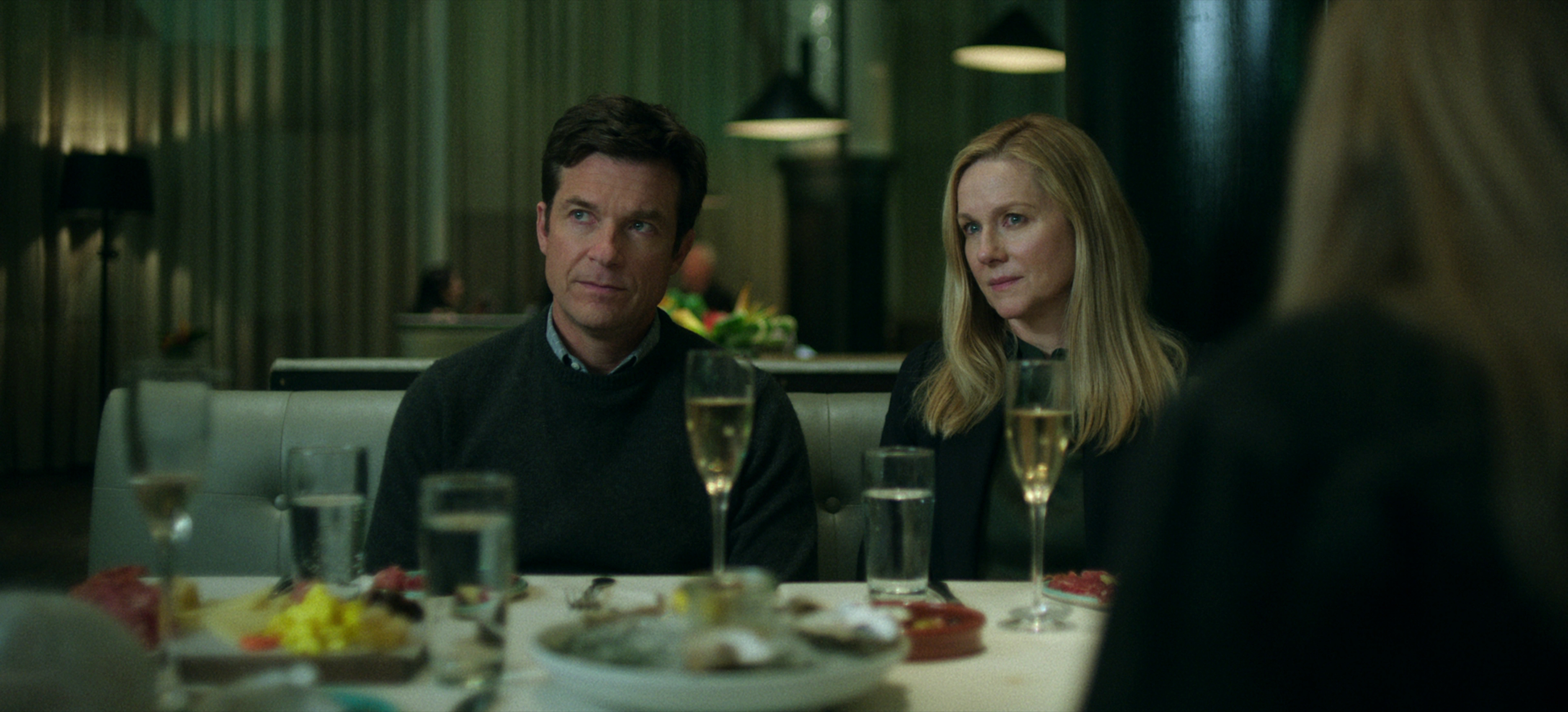
Jason Bateman as Marty Byrde and Laura Linney as Wendy Byrde in Ozark (COURTESY OF NETFLIX)
RELATED“Inventing Anna” takes a good story, imprisons it in unnecessary excess and robs of us our time

Greed has turned into murder, time and time again as a result of Marty’s financial dealings, and the family he strives to protect has the tendency to turn on each other when their own individual interests are threatened. When Wendy’s brother Ben (Tom Pelphrey) talks a bit too much about the Byrde family’s drug ties he winds up dead. And although Wendy didn’t pull the trigger herself, she saw it coming and did nothing to stop it. This event led to a major rift between her and her son, Jonah, which they’ve yet to recover from, but Wendy doesn’t seem all that upset about it provided Jonah doesn’t also get in her way, lest he wind up dead as well. I certainly wouldn’t put it past her.

Problems within the Byrde family have a way of seeping elsewhere, becoming the problems of other families to an often bloody end. 

Problems within the Byrde family have a way of seeping elsewhere, becoming the problems of other families to an often bloody end. When Wyatt Langmore (Charlie Tahan) gets killed for having become wrapped up in the love life of heroin distributor Darlene Snell (Lisa Emery), his cousin, and heralded scene-stealer of “Ozark,” Ruth Langmore (Julia Garner) sets out to avenge his death, which catches us up to part two of season four, titled in my mind as the “You’re gonna have to f**kin kill me” season. 


Want a daily wrap-up of all the news and commentary Salon has to offer? Subscribe to our morning newsletter, Crash Course.


Ruth is, and always has been, the heart of “Ozark,” and watching her drive to Chicago daydreaming about joyful times spent with Wyatt since they were little is a sharp and needed contrast to the much darker goings-on of the Byrdes. Ruth is loud and rough around the edges and bases her decisions on instinct and loyalty. While the Byrde family is quiet, reserved, and from the sort of privilege that breeds normalcy in your actions and your emotions working separately for so long that they often separate all together.

“You don’t know the first thing about being f**king rich,” Ruth says to Wyatt in a flashback. Although they are also interested in money, and would definitely do just about anything to have more of it, that doesn’t steer them into disloyalty and other similar dirty dealings in the way it does the Byrdes, which makes for a superior, although far more difficult way of living. Ruth is on the right side of justice here, no matter how many people she kills.

Ruth doesn’t know what Javi, her cousin’s killer, looks like, but she begs that information from Charlotte and Jonah, as well as where she can find him. The next day Ruth drives to Shaw Medical in Chicago where Javi will be meeting with Marty, Wendy, and Clare Shaw (Katrina Lenk) but chickens out on her first opportunity to shoot. Marty spots her driving away from the building and keeps calling until she eventually picks up. He makes his best effort to talk her out of killing Javi, but telling her that Javi dying will mess up their business deal only fuels her flame more. She forces Clare and the Byrdes to lure Javi back to the building and this time she kills him on first sight.

With Javi dead, every bit of security, financial and literal, that the Byrdes had accumulated for themselves goes up in smoke. Their only remaining option is to leverage Javi’s uncle, Omar Navarro (Felix Solis) to get whatever protection they can get from the FBI in exchange for manipulating Navarro however they’re able. But manipulating someone as powerful and dangerous as that guy is a risky move, and one that we’ll see the consequences of play out in the remaining episodes.

Towards the end of the second episode of Season 4’s back half (technically this season’s Episode 9) we get a harsh example of the kind of betrayal Wendy is capable of. While Ruth is attending the funeral of her cousin, which Marty organized in an effort to save face, Wendy is back home packing up go-bags to save her own ass and abandon her family. While, on one hand, they’d honestly be better off without her, this just says so much about the kind of woman she is. 

Before Wendy can make it out the door two of Navarro’s guys come in to the house, scaring her to death, but she puts on a calm mask of negotiation as her defenses kick in. 

One of the men, Father Benitez (Bruno Bichir), Navarro’s priest, gives a creepy monologue about Wendy needing to repent in order to be saved, to which she replies that she can save herself.

“You can try,” Benitez says, chillingly.

With the latest of many attempts to sell out her family thwarted, Wendy has no other option but to nuzzle up to Marty again, circling the wagons to come up with a new plan for saving their lives and, if it’s convenient, the lives of their children. But for every minute they spend occupied, Ruth is gobbling up allies and resources that once belonged to them. If all goes well, she’ll see it through till the credits roll on the final episode of the series. But it’s still anyone’s game at this point. Well, aside from all the people who were already made casualties of all this mess.

Read more:

Influencer culture is everywhere — even in academia

The number of prefixes one can affix to “-fluencer” knows no bounds. Among the “side hustle” hyphenates making headlines in recent weeks: pharma-influencers, ag-influencers, doctor-TikTokers, and fin-fluencers (a portmanteau of financial advisor and influencer). By some accounts, these professionals-turned-internet personalities are fulfilling a laudable public service mission. More often, they are denigrated as shallow, performative, and — at times — unscrupulous.

Such narratives confirm the wider public’s contempt for social media self-promotion and the career exemplars it has born: YouTubers, TikTokers, Instagrammers, and the like. Influencers are especially vulnerable to “stars-behaving-badly-esque” fame-shaming, replete with barely concealed gender bias. It’s not incidental that pop culture’s caricature of the influencer—the one shilling products at Coachella, demanding comped meals, and preening for her Instagram boyfriend—is unequivocally feminine. But instead of mocking those with the pluck and luck to fashion a career on social media, we might fruitfully turn the critical focus on our own activities.

Several years ago, while writing a book on social media labor, I noticed how the accounts furnished by aspiring YouTubers and Instagrammers resonated deeply with my experiences as a then-junior academic. These social media hopefuls had an acutely perceived need to remain “on brand” and an unabashed pursuit of metrics. As an academic, this felt all too familiar. Their media kit was my tenure dossier, except “likes” and “views” were swapped out for Google Scholar citations and h-indexes–two indices of our “impact.” I felt compelled to be eminently visible — not unlike the pressures on influencers to “game” the algorithms or ratchet up their engagement.

RELATED: The authoritarianism at the heart of influencer culture

In the persistent wake of the pandemic, the pressure for scholars to self-promote has only intensified. Starved for opportunities to share our latest findings at in-person conferences, we take to Twitter, Instagram, or perhaps our email signature to hype our new books and articles. Some have even joined the ranks of #ProfessorsofTikTok or more discipline specific communities like #twitterstorians.

These social media hopefuls had an acutely perceived need to remain “on brand” and an unabashed pursuit of metrics. As an academic, this felt all too familiar.

Of course, the directive to self-promote extends well beyond academia. Earlier this year, after Steven Perlberg chronicled the ascent of “influencer-journalists,” a fierce debate broke out on Twitter.  And it seems that nary a week goes by without a business feature prodding executives to burnish their self-brands-albeit authentically.

The question then, is why so many of us feel compelled to emulate influencer practices—even while wringing our hands about it.

Labor precarity is, for many, a driving impetus. To be sure, the uncertainty we glibly associate with work in the era of COVID was set into motion well before March 2020. But the pandemic exacerbated job insecurity as employers hemorrhaged resources and social safety nets went from fraying to threadbare. Widespread unemployment has been compounded by a continued gig-ification of nearly all professional sectors, including higher education. The side hustle as a strategy of risk containmentnamely staving off unemployment—makes sense in this context.

But crude labor market statistics tell only part of the story. Changes wrought by work-from-home culture — especially the demand to be “always on” and mechanisms of surveillance from the metonymic “algorithmic boss” — have prompted a rising tide of worker dissatisfaction. Given the state of the conventional labor market in my students’ lifetimes, it’s no small wonder that these so-called Gen Zers find the bootstrapping career of a YouTuber or live-streamer much more appealing than a proverbial 9-to-5. The lure is less about unadulterated fame than we give them credit for. More often, they desire the autonomy and flexibility that a self-enterprising career promises—if only superficially. 

 For those gainfully employed, the quest for social media visibility likely has a different impetus, namely claim-staking in our expert domains.  Both misinformation and disinformation are rampant online, and declining trust in public institutions is both a symptom and consequence of this din. Expert-influencers — particularly in the realms of medicine, science, and health — are thus important arbiters within decentralized knowledge networks. While the efforts of digitally enabled thought leaders may be in the lofty spirit of public engagement, they are also in thrall to employer- and funder-demands. Jefferson Pooley has, for instance, described how academia is increasingly configured by a “‘metric tide’ imposed from above,” by which he means that the obsession with metrics that signify engagement has trickled down from employers to employees.


Want more education and science stories in your inbox? Subscribe to Salon’s weekly newsletter The Vulgar Scientist.


But crucially, academic researchers and scientists who “put themselves out there” are — much like influencers — ready-made targets for criticism, hate, and harassment. As Tressie McMillan Cottom has argued, the thin line between visibility and vulnerability is particularly tenuous for women, scholars of color, and members of the LGBTQ+ community. Perhaps not surprisingly given his questionable history, members of marginalized communities are especially daunted by Elon Musk’s recent acquisition of Twitter, a platform that, as Jean Burgess recently argued, is an “essential infrastructure for journalists and academics.”

The incessant push to be visible has another catalyst, too — one that far too often fades into the background: the charge from platform companies. These companies, which harness the content and free labor of users under the guise of connectivity, depend on experts, educators, and entertainers in various domains. And so, the more the corporate mouthpieces of Meta and TikTok compel us to orchestrate influencer-level self-promotion campaigns, the more data and attention they have in their arsenals. As Nancy Baym compellingly argues in her book on labor and promotion in the music industry, “the money in social media flows between sites’ owners, investors, and advertisers” much more than between creators and audiences.  

It’s easy to blame glib narcissism for a marketing-orientation that has configured nearly every professional domain (yes, even religion). And there are no doubt individuals seduced by the glittering promise of social media fame. Naive exuberance may distract them from the rigged nature of the creator economy, including staggering social inequity. But more often, the charge to social media promotionalism is imposed upon us and appears, to many, to be the best worst option for exposure, opportunity, and meaningful engagement.

Read more on how social media is changing us:

Bill Maher on DeSantis, Cruz and “sexy Disney”

Bill Maher referenced a Salon article on Friday’s episode of “Real Time With Bill Maher” as part of a segment in which Maher discusses Ted Cruz and Ron DeSantis’ building concerns over a “sexy Disney.”

“…DeSantis today, he looks like he stepped in it here, and not in a good way, with getting in the middle of Disney,” Maher said. “He was kinda coming in on the Ted Cruz opinion. Ted Cruz said, and I think we have a headline here, ‘Mickey and Pluto going at it.’ … “And DeSantis today said ‘you know, when we were kids we didn’t have to worry what was in cartoons.’ I thought, these guys are crazy, and then I look at some of the movies that Disney has coming out. They may be on to something with this grooming and highly sexualized content,” Mahers jokes, readying a list of facetious examples.

RELATED: “Authoritarian socialist”: Democratic governor slams Ron DeSantis’ Disney stunt

  1. “Bedknobs & Nipple Clamps”
  2. “The Love Plug”
  3. “Who Cucked Roger Rabbit?”
  4. “The Little Spermaide”
  5. “Honey, I Transitioned The Kids”
  6. “Mary Poppers”
  7. “Around The World For 80 Bucks”
  8. “The Sorcerer’s Appendage” 

Want a daily wrap-up of all the news and commentary Salon has to offer? Subscribe to our morning newsletter, Crash Course.


Florida Gov. Ron DeSantis was in the news on Friday as his feud with Disney escalates over “additional legislative action” DeSantis is pushing for the company’s special tax district, according to CNN

“There’s going to be additional legislative action,” said DeSantis in a quote pulled from CNN. “We’ve contemplated that. We know what we’re going to do, so stay tuned. That’ll all be apparent.”

Last week DeSantis signed a bill to “dissolve the Reedy Creek Improvement District, effective June 1, 2023,” per CNN’s coverage.

“Disney will pay its debts. Disney will, for the first time, actually live under the same laws as everybody else in Florida. Imagine that,” DeSantis said.

This seems to all be the consequence of Disney pushing against Florida’s “Don’t Say Gay” law that puts a thumb on talks of sexuality and gender in public schools.

Watch Maher’s full clip below:

Read more:

Is the U.S. in a proxy war with Russia? Sergey Lavrov and Lloyd Austin seem to think so

With heavy weapons like first-line tanks, multiple rocket launchers, 155mm howitzers, attack helicopters and updated anti-aircraft systems flooding into Ukraine and beginning to reach the battlefield, the only thing missing from an all-out war between NATO and Russia are allied soldiers. 

Russian Foreign Minister Sergey Lavrov responded to the upsurge in weapons shipments this week when he said, “NATO is, in essence, going to war with Russia through a proxy and arming that proxy.” Lavrov accompanied that with some nuclear saber-rattling, and then said that NATO and the U.S. were running the risk of turning the war global and involving nuclear weapons: “The risk is serious, real. It should not be underestimated,” he said Monday night on Russian state television. “Under no circumstances should a third world war be allowed to happen. There can be no winners in a nuclear war.”

No shit, Sherlock. Sixty-four days after Russia invaded Ukraine, it’s finally dawning on the billionaires in charge over there that they might have made the proverbial mistake of biting off more than they can chew. On the same day reality appeared to slap Lavrov in the face in Moscow, Secretary of Defense Lloyd Austin, at a meeting with more than 40 NATO and non-NATO defense officials in Germany, announced a new American strategy intended to degrade Russia’s military so that it cannot threaten other nations with war in the future. “We want to see Russia weakened to the degree that it can’t do the kinds of things that it has done in invading Ukraine,” Austin told reporters. 

RELATED: Ending the Ukraine war is possible, but time is running out: Here’s how U.S. can help

President Biden backed up the new strategy by announcing that his administration is seeking $33 billion in military, economic and humanitarian aid for Ukraine, far more than the U.S. has committed so far in the conflict. “We either back Ukrainian people as they defend their country, or we stand by as the Russians continue their atrocities,” Biden said at the White House on Thursday. The Washington Post reported that administration sources confided that the new spending package “is meant to not only defend Ukraine but to weaken and deter Russia in a conflict that shows few signs of ending. U.S. leaders are increasingly open about their hopes that the conflict will result not just in Ukraine’s survival, but also in a significantly weakened Russia.”

The new strategy reflects what has already happened on the ground. Russia’s attack on Ukraine has been crippled by clever tactics and counterstrikes by the much less well-equipped and smaller Ukraine military forces. An all-out assault on the Ukrainian capital of Kyiv was turned back, sending Russian forces retreating into safe havens on Russian and Belarus soil where they had massed earlier in the year before their late February attack. According to Ukrainian drone footage seen by the Daily Mail, fields that surveillance photos once showed lined with row after row of Russian tanks, armored personnel carriers and supply vehicles are now littered with burned-out skeletons of the same military hardware. 

Ukraine’s military reported last week that it had destroyed 839 Russian tanks, more than 2,000 armored personnel carriers, a mix of 393 self-propelled and towed howitzers, 108 multiple rocket launchers and 76 fuel tankers. Ukraine’s foreign ministry said on Thursday that 187 Russian military fixed-wing aircraft and 155 combat helicopters had been destroyed, along with 215 drones the Russian military had been using for surveillance and as missile launch platforms. Not to mention the Russian missile cruiser Moskva, now at the bottom of the Black Sea.

Russia has been using older T-72 tanks but has also fielded some newer, more high-tech and expensive T-80s. The T-72 tank, in service since the 1970s, cost about $2 million apiece when new. The T-80 tanks, also in service since the mid-1970s but upgraded since then, cost about $3 million. Russian armored personnel carriers (APCs) cost about $500,000. All those photos you’ve seen of blown-up and burned-out low-slung tracked vehicles that don’t have large-caliber turreted guns are APCs. No matter who’s counting, the Russian military appears to have lost thousands of them.


Want a daily wrap-up of all the news and commentary Salon has to offer? Subscribe to our morning newsletter, Crash Course.


Forbes reported this week that the initial Russian invasion force in February involved 120 battle tactical groups (BTGs), composed of 85 armored vehicles each, about 12,000 armored vehicles total. Forbes assesses that Ukrainian numbers for Russian battlefield losses are “optimistic,” and cites the open-source intelligence website Oryx as probably more accurate. Relying entirely on photographic evidence of destroyed, damaged or captured vehicles, Oryx on Tuesday reported that Russia had lost 562 tanks and 1,200 armored personnel carriers for a total of 1,762. 

Taking an average of figures reported by Ukraine, Oryx and the Pentagon, Forbes concluded that Russia has lost somewhere between 2,000 and 3,000 of its armored fighting vehicles, meaning that 20 to 25 percent of the entire military force Russia initially put on the battlefield in Ukraine has been knocked out. Relying on the same sources, Forbes estimates that Russia has suffered 15,000 battlefield deaths. Every soldier who is killed has to be replaced, and training soldiers costs real money. According to the Army’s Training and Doctrine Command (TRADOC), it currently costs about $200,000 to recruit and put one U.S. soldier through basic training. All soldiers continue their training in advanced courses, and some take as long as two years to fully qualify certain specialties, making the real cost of taking a citizen from civilian life to being ready for combat much more expensive, no matter which country is spending the money.

No matter whose numbers you accept, Russia is suffering heavy, expensive and potentially unsustainable battlefield losses in Ukraine.

No matter whose figures you accept, Russia is suffering heavy and very expensive battlefield losses in Ukraine. “Some units are much more devastated than others. We’ve seen indications of some units that are literally, for all intents and purposes, eradicated,” a senior U.S. defense official said at a background briefing of reporters earlier this month. “There’s just nothing left of the BTG except a handful of troops, and maybe a small number of vehicles, and they’re going to have to be reconstituted or reapplied to others.”

So the degradation of Russia’s military is already happening on the battlefield in Ukraine. With $20 billion of the new Ukraine aid package earmarked for combat equipment, ammunition, resupplies, military rations and other battlefield gear, the U.S. seems to be employing a rope-a-dope strategy with Russia: Lure  them into throwing as much of their military forces as they can muster into Ukraine and then spend them into the ground, much as the U.S. did during the Cold War, when our military advances and expenditures ended up bankrupting the Soviet Union by exploding its defense budget.

That strategy also depends on how well Western sanctions work against Russia. Every Russian tank, helicopter, fighter jet, rocket launcher and drone lost in Ukraine has to be replaced. All modern military weapons make heavy use of computers, which need chips, and as we all know, computers break and parts need to be replaced. Technology import restrictions have been imposed on Russia under sanctions approved by the U.S., NATO and other countries. Russia will doubtlessly try to figure out ways around the restrictions, but that will cause delays, shortages and problems repurposing dual-use computer hardware and software imported from countries that have not joined the sanctions. There are no timeouts in war. Enemies on the attack don’t wait. 

If the U.S. is in a proxy war with Russia, it’s a war of attrition that will last a while. “Degrading” Russia’s military capability means slowing down its ability to equip and man its forces. Vladimir Putin is learning a truth that has endured through the centuries: If you take too big a bite on the battlefield, you die. There are no Heimlich maneuvers in war. 

Read more on the conflict in Ukraine:

It’s not just physicians and nurses. Veterinarians are burning out, too

At the park near Duboce Triangle in San Francisco, 5 p.m. is canine happy hour. About 40 dogs run around, chasing balls and wrestling, as their owners coo and ’90s hip-hop bumps out of a portable speaker.

One recent afternoon, a Chihuahua mix named Honey lounged on a bench wearing a blue tutu and a string of pearls. Her owner, Diana McAllister, fed her homemade treats from a zip-close bag, then popped one into her own mouth.

After spending two years at home through the pandemic, it’s clear that for a lot of these owners, their dogs are their children.

“I always say, dogs are people, so I love him,” said Yves Dudley, looking on as her 9-month-old collie-schnauzer mix played in the grass.

Across the country, about 23 million families adopted a pet in the first year of the pandemic. Other pet owners, working from home, started paying more attention to their animals’ daily routines, noticing symptoms like vomiting or coughing. The resulting spike in pet health concerns has been straining a corner of the medical world that doesn’t get as much attention as doctors and nurses: veterinarians.

The overwork and staffing shortages of the pandemic have affected veterinarians as much as other doctors and nurses, and dealing with the constant moral dilemmas and emotional output was driving many to burn out even before 2020. The mean salary for vets is about $110,000 per year, according to the Bureau of Labor Statistics, about half that of physicians catering to people.

At the Society for the Prevention of Cruelty to Animals’ veterinary hospital in San Francisco, so many vets and technicians have left that the clinic has had to cut back its hours, said veterinarian Kathy Gervais.

Dog owners say they’ve had to wait months for vet appointments or drive to vets far from home to get care.

“Getting your dog in to see the vet is as competitive as trying to buy Coachella tickets online,” said Laura Vittet, whose golden retriever, Gertrude, is 1½ years old. “You have to wait by the phone, you have to be ready to refresh your browser. It’s a very intense experience.”

Gervais said she works 12-hour days, constantly zigzagging from new puppies to dying cats. And the whole time, she takes care of their humans, too.

“To these people, and especially in these times, this is their love,” she said, thinking especially of the owners who dress and coif and cook for their dogs. “This is their being, this is what they live for. And for vets, it’s very hard for us to draw the line.”

Empathy overload and compassion fatigue affect veterinarians’ mental health. They carry the weight of having to euthanize animals that could be saved but whose owners can’t afford the care. Gervais said her practice euthanizes about five animals every day. Some upset owners become downright abusive when a pet is in distress, berating vets or later bullying them online.

“I dare you to try to talk to a veterinarian who’s been in practice more than five years who doesn’t know somebody who has committed suicide,” said Gervais. “I, unfortunately, can count on more than 10 fingers: classmates, colleagues, people I’ve dated.”

One in 6 veterinarians have considered suicide, according to studies from the Centers for Disease Control and Prevention. While male vets are 1.6 times as likely to die by suicide as the general population, female vets are 2.4 times as likely, and 80% of vets are women.

In the early months of the pandemic, Gervais could see things getting worse. She helped organize the Veterinary Mental Health Initiative, which offers free support groups and one-on-one help to vets across the country.

All the facilitators have doctorate-level training, said founder and director Katie Lawlor, also a psychologist, and they’re all familiar with the issues troubling vets.

“Burnout, compassion fatigue, managing panic attacks, how to communicate with both supervisors, colleagues, and clients when you’re under extreme deadlines or very intense stress,” she said. “And the loss of their own companion animals.”

The initiative helped Dr. Razyeeh Mazaheri work through the anxiety she was feeling every day caring for animals at a clinic outside Chicago last year. The clinic was regularly double- or triple-booked. As a new vet — Mazaheri graduated from veterinary school last spring — juggling so many cases was terrifying.

“I just feel like if I make a mistake, that is a problem. And if I make a mistake and kill something, that is my fault,” she said, tearing up. “I just knew that I was burned out.”

Through the support groups, Mazaheri was able to see that others shared her concerns and she learned coping tools. The initiative, housed under the nonprofit Shanti Project, has groups specifically for emergency vets, vet technicians, recent grads like Mazaheri, and longtime vets like Kathy Gervais who have more than 20 or 30 years of experience.

“I’ve had people look at me sometimes when they’ve seen me really tired, going, ‘Kathy, walk away,'” she said.

“I’m not ready to do it because, bottom line, I love my job. It is a vocation. It is a passion. And it’s hard to walk away from that,” she said. “But if it’s going to kill me on the flip side, I would hope I could just say, ‘OK, that’s it. I’m done.'”

This story is part of a partnership that includes KQEDNPR and KHN.

Republicans’ rush to block Biden from forgiving student debt backfires

Over the last two years, Republicans argued that President Biden, who made a campaign promise to cancel student debt, does not have legal authority to fulfill that pledge, insisting that the tens of millions of Americans currently crushed by student loans should be forced to pay them down. But now, amid new reports that Biden is considering a partial jubilee, Republicans are backing a bill that would prevent the president from pulling the trigger – a tacit acknowledgment Biden appears to have the power to finally make good on his promise.

On Wednesday, five Senate Republicans introduced the “Stop Reckless Student Loans Action Act,” a measure that would end Biden’s ability to continue suspending debt payments (for debtholders of a certain income) and prohibit the president from canceling the debt altogether in the case of a national emergency.

The bill’s sponsors – Sens. John Thune, R-S.D., Richard Burr, R-N.C., Mike Braun, R-Ind., Bill Cassidy, R-La., and Roger Marshall, R-Kansas – have attempted to frame the measure as a bulwark for American taxpayers.

RELATED: “Cancel it. Every penny”: Poll shows 83% of Democrats want Biden to nix student debt

“As Americans continue to return to the workforce more than two years since the pandemic began, it is time for borrowers to resume repayment of student debt obligations,” Thune said in a statement. “Taxpayers and working families should not be responsible for continuing to bear the costs associated with this suspension of repayment. This common-sense legislation would protect taxpayers and prevent President Biden from suspending federal student loan repayments in perpetuity.”

Braun has meanwhile claimed that a jubilee would force people without college degrees to “pick up the tab” for graduates. 

“This transfer of wealth is not a move to ‘advance equity,’ but rather a taxpayer handout to appease far-left activists,” he said.

The Republican-led measure comes just weeks after Biden extended his student loan repayment pause for the sixth time over the course of his administration. According to the Federal Reserve, Biden has saved borrowers, who hold roughly $1.7 trillion debt, about $5 billion in interest a month. Those savings have been a lifeline for over 40 million student debtholders, 11.1% of whose loans prior to the pandemic were in default or delinquent by at least 90 days. 

RELATED: Student debt is still awful. So why are we students still taking out loans?

Toward the beginning of Biden’s presidency, many Republicans and establishment Democrats were adamant that the president could not forgive student debt by executive order. Some experts suggested that only Congress could rubber-stamp such a move, in part because it was the legislature – not the president – that appropriated the funds loaned out to borrowers.

But now, with the GOP waging a pre-emptive counteroffensive amid reports that Biden might relieve the debt, there’s more reason to believe that the president has that very authority, as The American Prospect’s David Dayen wrote this week.

“There would be no need for such [the GOP’s] bill if there was not already authority granted by Congress to the executive branch to suspend, defer, or cancel student loan payments,” Dayen argued. “The bill represents an effort to claw that authority back, or at the very least clarify the statute to remove all doubt.”

Republicans appear to be targeting provisions contained within the HEROES Act of 2003, an amendment to the Higher Education Act that “allows the secretary of education to waive or modify any requirement or regulation applicable to the student financial assistance programs” in a time of national emergency.

RELATED: “Now let’s cancel them,” Demands AOC as Biden extends pause on student loan payments

The Stop Reckless Student Loans Action Act would prohibit the president from using the HEROES Act to pause repayments for any longer than 90 days. It would also means-test these pauses and make them subject to the Congressional Review Act, an esoteric law that allows the legislature to overturn actions taken by federal agencies, like the Department of Education.

To be sure, it’s unlikely that the Stop Reckless Student Loans Action Act will be approved by a Democratic-majority Senate, paving the way for Biden to leverage the HEROES act without opposition. But even then, Biden will undoubtedly face a deluge of legal challenges, which could stop a jubilee in its tracks. 

At present, very little legal precedent exists on whether Biden has the unilateral power to forgive  student debt. No president before him has attempted the move, and “no court has considered where the outer boundaries of the Secretary’s HEROES Act authorities lie,” as the Congressional Research Services wrote last year. 


Want a daily wrap-up of all the news and commentary Salon has to offer? Subscribe to our morning newsletter, Crash Course.


Luke Herrine, Yale Law Ph.D. who has studied the legality around a potential jubilee, describes the predicament as “a vague terrain.”

“Who would sue? I mean, that’s the real question,” Herrine said. “The [debt] servicers are probably the most plausible, but there are a number of problems with them having standing […]  They are not guaranteed any amounts of payments under their contracts with the Department of Education, so it’s not really clear what their claim is.”

RELATED: Income-based repayment becoming a costly solution to student loan debt

There’s also the question of whether sweeping debt relief would qualify as a mere “modification” or “waiver,” as the Congressional Research Services noted. In the 1992 case MCI Telecommunications Corp. v. AT&T, the Supreme Court declined to defer to the Federal Communications Commission’s interpretation of what the company felt was a modification to its tariff policies. 

“If a court deemed the HEROES Act sufficiently analogous to the statute in MCI, it might conclude that the power to ‘modify any statutory or regulatory provision applicable to the’ Title IV programs likewise does not authorize the Secretary to make fundamental changes to statutes or regulations,” the Congressional Research Services wrote.

And all of this legal analysis, Herrin said, will have to be weighed against the “political calculus” of issuing a jubilee whose economic implications are still ill-defined. 

“First of all, do we think this is good policy? Is it regressive or is it progressive? Is it good politically?” Herrine explained. “I think that’s the calculus that’s really changed over the past few months.”

RELATED: Top Betsy DeVos appointee abruptly quits, calls for canceling $925 billion in student loan debt

Biden’s pause on student debt repayments is set to expire on May 1. On Monday, Biden indicated to the Congressional Hispanic Caucus that he is open to both extending the repayment suspension and wiping away a portion of the debt, according to The Washington Post.

“I feel very confident that he is pushing on his team to do something, and to do something significant,” Rep. Tony Cárdenas, D-Calif., a member of the caucus, told the Post. “That’s my feeling.

Abortion providers sue to block Oklahoma bans

A coalition of Oklahoma abortion providers and national reproductive justice groups filed a pair of lawsuits in state court on Thursday to block two draconian abortion bans passed this month by the GOP-controlled Legislature.

“To limit a person’s freedom and autonomy is unconscionable and unconstitutional,” Alexis McGill Johnson, president of Planned Parenthood, said in a statement. “Unless these abortion bans are stopped, Oklahomans will be robbed of the freedom to control their own bodies and futures.”

“We’ve told Oklahoma politicians loud and clear: keep your bans off our bodies,” said Johnson. “Today, we’re taking the state to court to stop these bans from robbing Oklahomans of abortion access.”

S.B. 1503, which the Center for Reproductive Rights called a “bounty-hunting scheme” modeled after S.B. 8, Texas’ devastating law, would reward vigilantes with at least $10,000 each time they successfully sue a person who provides or helps someone access an abortion after six weeks—before many people know they are pregnant. It was passed Thursday with no debate or questions allowed and would become effective as soon as Republican Gov. Kevin Stitt signs it, which he has promised to do.

Another forced-pregnancy bill, S.B. 612, was approved by right-wing lawmakers and signed into law by Stitt earlier this month. The legislation, scheduled to take effect this summer, criminalizes virtually all abortions at any stage of pregnancy, threatening healthcare workers who provide one with a felony punishable by up to 10 years in prison and/or a $100,000 fine.

In a move reserved for constitutional crises and other pressing situations, the challenge to S.B. 1503 was filed directly in Oklahoma Supreme Court. Plaintiffs requested an emergency order to stop the law from going into effect while litigation moves forward.

The challenge to S.B. 612, submitted to trial court, was attached to an existing lawsuit challenging five other abortion restrictions enacted last year in Oklahoma, all of which are currently blocked. Petitioners asked to have S.B. 612 temporarily enjoined like these other laws as litigation proceeds.

“The Oklahoma Supreme Court has repeatedly found that the state Legislature’s extreme attempts to restrict abortion are unconstitutional, and these bans are some of the most extreme yet,” said Nancy Northup, president of the Center for Reproductive Rights. “We are asking the state courts to uphold the State Constitution and apply Oklahoma precedent to block these insidious abortion bans before they take effect.”

“Oklahoma is a critical state for abortion access right now, with many Texans fleeing to Oklahoma for abortion care,” Northup added. “These bans would further decimate abortion access across the South.”

Planned Parenthood released data in March showing that, in the first four months after S.B. 8 took effect, more than half of the patients at its Oklahoma health centers were from Texas, up from less than 10% in the previous year. Overall, during that period, there was a nearly 2,500% increase in Texas patients.

Tamya Cox-Touré, co-chair of the Oklahoma Call for Reproductive Justice, stressed that Oklahoma’s bans “will push abortion access out of reach for many communities who already face often insurmountable barriers to healthcare, including Black and brown communities, low-income communities, and people who live in rural areas.”

Oklahoma is poised to become the second state this year, after Idaho, to follow Texas’ example in cutting off access to reproductive healthcare at the earliest stages of pregnancy even while Roe v. Wade—which affirmed in 1973 that women in every U.S. state have the constitutional right to obtain an abortion—still stands.

The right-wing U.S. Supreme Court’s anti-choice supermajority has refused to prevent Texas’ S.B. 8 from taking effect. The high court is expected to rule on Mississippi’s 15-week abortion ban later this year. That ruling could result in the overturning of Roe, but Republican lawmakers are not waiting for a decision in the case before carrying out a nationwide assault on abortion rights.

“Reproductive healthcare is in crisis,” Shaunna Thomas, executive director of UltraViolet, which is not a plaintiff in the Oklahoma lawsuits, said Thursday. “In Texas, Mississippi, Idaho, Florida, and now Oklahoma, state lawmakers are criminalizing those who seek access to reproductive healthcare and anyone who provides it. We are imminently encroaching toward an era where Roe v. Wade is no longer federally enforceable. This should terrify everyone.”

Dr. Alan Braid, a plaintiff from Tulsa Women’s Reproductive Clinic, said that the GOP’s wave of anti-choice laws is “designed to threaten and intimidate physicians into not providing constitutionally protected healthcare, and force pregnant people to travel hundreds of miles to receive care.”

“The pain this has caused in Texas is unfathomable,” he added, “and I will fight alongside these other providers and advocates to prevent this law from taking effect in Oklahoma.”

The Center for Reproductive Rights said that “although federal challenges to Texas’ similar ban have been unsuccessful in blocking the law, there is significant precedent in Oklahoma state court to support plaintiffs’ arguments for relief preventing this ban from going into effect.”

Meanwhile, The Nation‘s justice correspondent Elie Mystal said Thursday that Oklahoma is in violation of the U.S. Constitution and argued that President Joe Biden “should send abortion providers to the state clothed in federal power and provide constitutional services to those who need them.”

The Women’s Health Protection Act (WHPA) would protect healthcare professionals’ right to provide abortions and patients’ right to receive care.

All but one Democrat in the U.S. House of Representatives supported the bill’s passage in September, shortly after Texas’ ban went into effect. However, Sen. Joe Manchin (D-W.Va.) in February joined with the upper chamber’s Republicans to block the measure.

Why Fox News is obsessed with Johnny Depp, its Manliness Under Siege mascot

In 2017, when Johnny Depp jokingly asked his British audience at that year’s Glastonbury Festival, “When was the last time an actor assassinated a president?” then-Fox News host and eternal Donald Trump water bearer Eric Bolling lost his mind.

“Depp, you damn fool. You think you can say these things without repercussions?” he boomed in the monologue for his show “Fox News Specialists” which, if you blinked, you probably missed.

He went on to add, “Maybe Americans will show their distaste for your comments by steering clear of your movies,” and advised Depp to take on a role better suited for him, about a man who “abuses drugs and alcohol to the point of being accused of abusing his beautiful young wife, played by Amber Heard. Anyway, this guy ends up a burned-out wasted fool of a man. Wait, that’s not a movie role. That’s your life!”

RELATED: A breakdown of Johnny Depp’s two-day testimony against ex-wife Amber Heard in defamation case

Cut to five years later and a few days into Fox News’ exhaustive coverage of Depp’s defamation trial against his now ex-wife Heard, broadcast live from Virginia’s Fairfax County Courthouse. Bolling has moved his shtick over to Newsmax.

Not to worry, because current and very popular Fox News host Greg Gutfeld has picked up the Depp beat. He opened the April 22 episode of his late night talk show, “Gutfeld!” with this reaction to the fallen star’s testimony: “There’s a bigger story here beyond the seedy salaciousness. The fact is, Depp is humiliating himself for a good reason. He’s bearing the most pathetic, saddest part of his life because he feels it must be done. . . . So he’s baring his horrible existence warts and all to billions of strangers. How can he do that? Well, somehow he’s immunized himself against the effects of embarrassment. And that’s a superpower.”

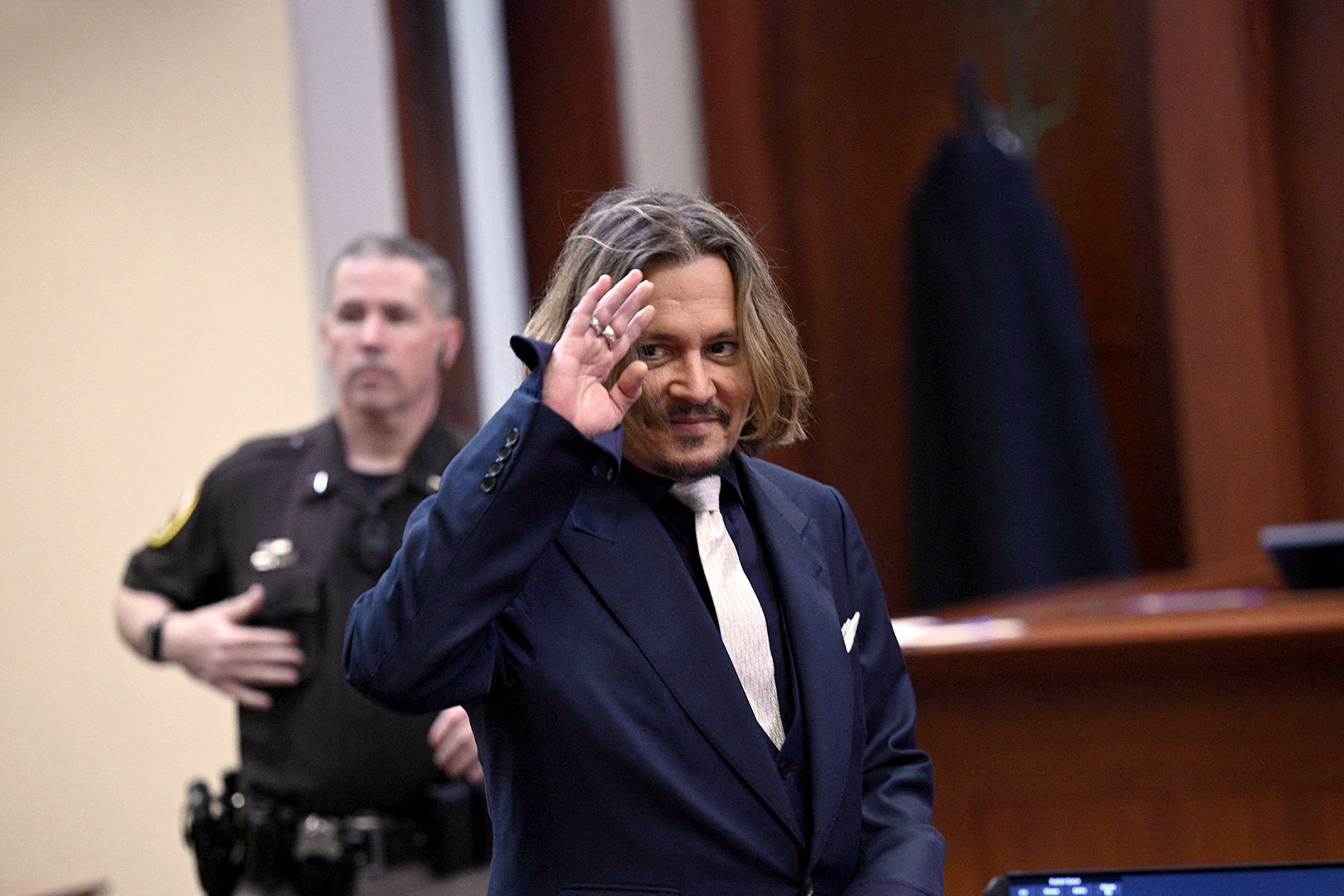
Johnny DeppUS actor Johnny Depp waves inside the courtroom during the $50 million Depp vs Heard deformation trial at the Fairfax County Circuit Court April 12, 2022, in Fairfax, Virginia. (BRENDAN SMIALOWSKI/POOL/AFP via Getty Images)Gutfeld went on to admit to feeling “somewhat liberated” by Depp’s unburdening. “Give us any embarrassment of riches, and we could turn it into an embarrassment of embarrassment,” he observed. “But what makes you immune to suffering is your ability to cease judging other people even as they judge you.”
Hats off to the person who wrote that monologue, whether it was Gutfeld or a writer on his show’s staff. Aside from the poop jokes, that prose was aglow with empathy. If it only it were coming out of the mouth of a person whose career wasn’t built on sneering at and judging people, and wasn’t referring to a man accused of intimate partner violence.

But the honesty behind those words matters less than the position they establish, which falls in line with the rest of Fox News’ angle on this celebrity trial. Depp may be a wino and a recreational drug vacuum who joked about assassinating Trump in 2017, but to Fox News in 2022, he’s the celebrity poster model for the channel’s crusade against the war on masculinity.

Depp brought his lawsuit in reaction to an opinion piece published in The Washington Post in which Heard described herself as a survivor of domestic abuse. He claims its publication led to Disney cutting ties with him, ending his starring role in the “Pirates of the Caribbean” franchise.

The trial is a potent strain of catnip, bred from the conflict between a once rich and successful male sex symbol and the “difficult” woman who he claims laid him low.

Understand, Fox News isn’t taking an official view on America’s supposed testosterone depletion crisis. That’s Tucker Carlson’s bag, stemming from his kooky infomercial sounding the alarm on the nation’s declining sperm count and testicular fortitude based on pseudoscientific data. Carlson’s advocacy for scrotal tanning may be a nut too far for even his regulars. But Depp’s performance as a crumbling shell of a man under assault by a she-devil he says he regrets marrying? That’s something lots of people will, and are, getting behind.

Courtroom conflagrations like this are the reason cable news was invented. The celebrities in question didn’t murder anyone and aren’t accused of child molestation, questions that justified the wall-to-wall coverage of O.J. Simpson’s and Michael Jackson’s trials decades ago. But together and separately Depp and Heard are a flaming mess, adding to the prurient interest of it all.

For Fox hosts like Nancy Grace, who accurately likened it to watching “two wet cats in a barrel – we’re hearing more than we ever wanted to know,” the trial is a potent strain of catnip, bred from the conflict between a once rich and successful male sex symbol and the “difficult” woman who he claims laid him low.

Heard never mentioned Depp’s name in the 2018 piece, but he alleges the inference was enough to destroy his career. Depp’s reputation for trashing hotel rooms and putting hands on strangers has been common knowledge for decades. But since the dawn of his stardom, Depp’s reputation for being Gen X’s Marlon Brando has led fans to give him a pass.

Since his time on “21 Jump Street,” he’s played sensitive, broken heroes. He dusted off one version of such a performance for the cameras. “I don’t believe that I’m the only human being that’s ever punched a door or broken something,” he calmly said in response to accusations of violent behavior, backed up by video showing him splintering a cabinet he slammed shut in his kitchen.

Asked if anyone other than Heard expressed concerns about his drinking, Depp replied, “Sir, if anyone had a problem with my drinking at any time in my life, it was me. The only person I’ve ever abused in my life is myself.”

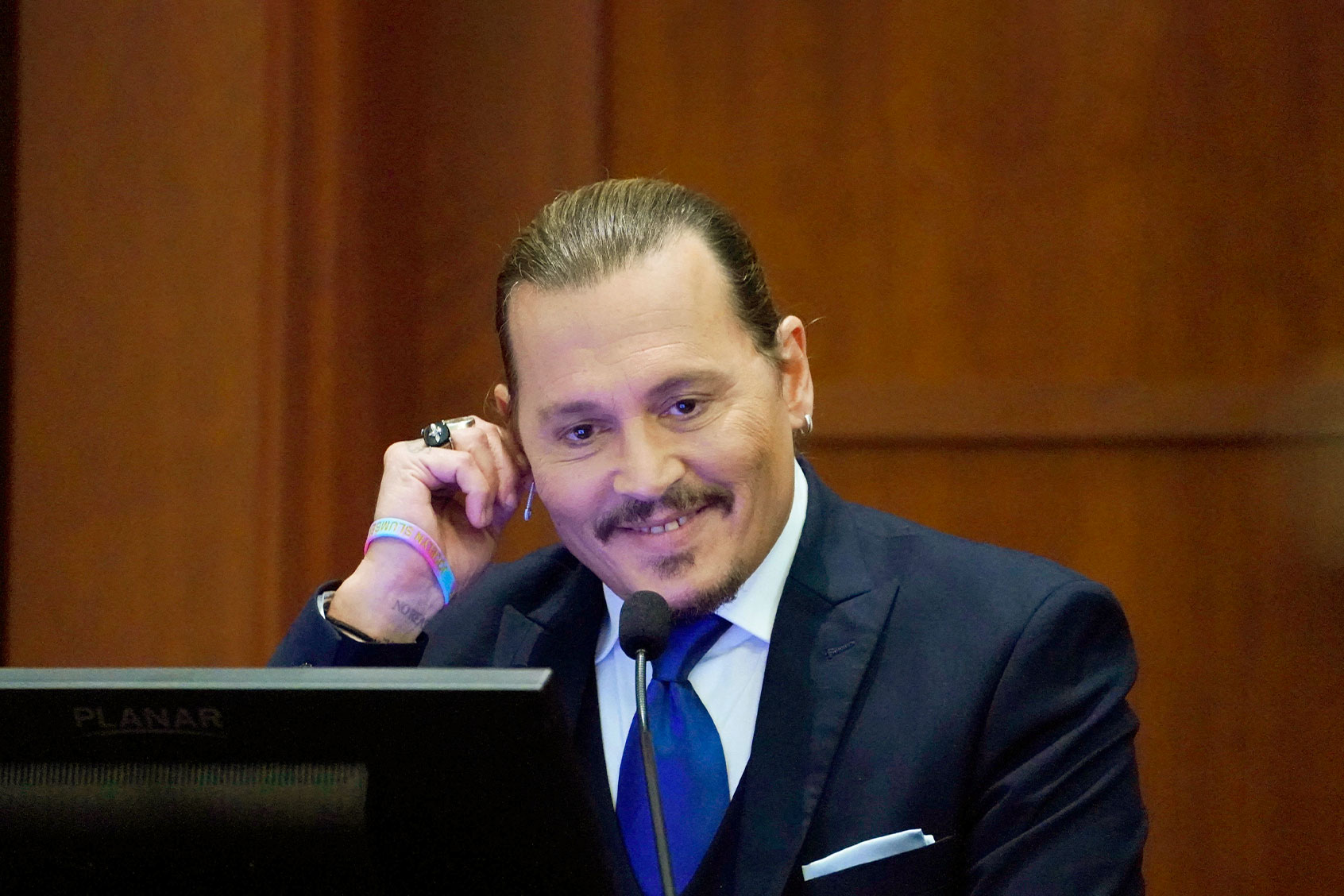
Johnny DeppActor Johnny Depp testifies in the courtroom at the Fairfax County Circuit Courthouse in Fairfax, Virginia, April 25, 2022. (STEVE HELBER/POOL/AFP via Getty Images)In an explanation regarding one of his texts that imagines Heard as a “burnt corpse,” the actor claims it was a “Monty Python” reference, “irreverent and absurd humor.” This was presented alongside his insistence that he, too, is a victim of domestic abuse, first at his mother’s hands and later at Heard’s.

Heard, who filed a $100 million countersuit against Depp in the summer of 2020, takes the stand next week. But she’s already sustained an “ordeal by water”-style dunking in the brutish court of public opinion. Testimony by a clinical and forensic psychologist working for Depp’s legal team claimed she exhibits signs of borderline personality disorder and histrionic disorder. Depp’s claim that she defecated in his bed further bolsters his claims that she’s unstable (which, it must be pointed out, is a go-to tactic in domestic abuse and intimate violence cases). Deep even gave the act a highly hashtag-able nickname, calling it a “grumpy.”

Whether Depp wins or loses… there’s only upside for the purveyors of Manliness Under Siege hysteria.

Depp’s debut as Jack Sparrow in the first “Pirates of the Caribbean” movie in 2003 rekindled his adolescent pull even though he was 40 when it came out and made him richer than he already was. Following the article’s publication in 2018, when the #MeToo movement was set back on its heels by Brett Kavanaugh’s confirmation to the Supreme Court, Depp says Disney cut ties with him.

Relatedly, reports of Depp’s profligate life and spending habits have been giving tabloid readers a contact high for decades; as has their schadenfreude at hearing he was on the verge of going broke. Those stories were circulating long before Heard penned her account but blew up substantially when The Hollywood Reporter ran a 2017 story enumerating all the ways Depp allegedly blew through $650 million from the perspective of his former accountant, who Depp sued and accused of fraud and mismanagement.

In contrast, Heard could never claim to have a fandom anywhere nearly as extensive and rabidly supportive as Depp’s.

Social media has treated their divorce and continued bickering in the press like a sports team rivalry since 2016, with Depp’s aggressive fanbase supporting his allegations that she lied in court documents about enduring “excessive emotional, verbal and physical abuse from Johnny.” Understandably, domestic violence advocates found the public’s reduction of Heard’s serious, alarming accusations to entertainment fodder to be highly disturbing.

But in 2022, with the political right inculcating its messages about #MeToo, “wokeness” and so-called “cancel culture” destroying innocent lives, Depp and Heard’s legal meltdown brings all its fears to life, with A-list actors portraying the parts. Gutfeld’s review raves that this play is “sad, kinda gross, kinda riveting. But it’s also kinda inspiring.”

“Up in the Air” author Walter Kirn, one of Gutfeld’s panelists, summed it up as “one long personal ad for the most screwed up lady in the world.”

Another contributor, professional wrestler George Murdoch (who works as Tyrus), empathized with Depp’s dudely struggle with a “we’ve all been there, who among us?” reaction to Depp’s tendency to break stuff. “He’ll never get a movie again if he’s known, if you’re known as a sexual harasser or a domestic violence guy . . . you will never work again. But a drug addict? You can get some work.”

(Indeed. Consider the demonstrably permanent cancellation of that guy who recently won the Grammy for  Best Comedy Album, who definitely isn’t working.  Or Bolling, who Fox fired for sending unsolicited photos of his junk to at least three female colleagues. Or, and always and forever, Mel Gibson.)

All this creates a special opportunity for Fox, a right-wing cable channel capitalizing on Carlson’s manufactured fears of a Low T pandemic. Whether Depp wins or loses, as he did when a similar case was brought before the British courts, there’s only upside for the purveyors of Manliness Under Siege hysteria. His win is a victory in the fight to halt the erosion of American masculinity. His defeat may been seen by paranoid sacks as evidence that their endangerment by the feminist vagenda is real. No matter what the outcome is, all of us who would rather not be subjected to this dumpster will be left feeling a few smudges grumpier.

More stories like this:

Ghislaine Maxwell to be sentenced for only one out of three conspiracy charges

Ghislaine Maxwell, convicted of sex trafficking young women for deviant sexual use by her former cohort, Jeffrey Epstein, is still in the midst of an ongoing trial that continued today with new developments leading up to sentencing in late June. 

U.S. District Judge Alison J. Nathan concluded that while there is sufficient evidence to convict Maxwell on sex trafficking charges, she can only be sentenced for one out of three conspiracy charges as they essentially count towards the same crime. 

RELATED: Jury finds Ghislaine Maxwell guilty on 5 of 6 counts in sex trafficking trial

“This legal conclusion in no way calls into question the factual findings made by the jury,” U.S. District Judge Alison J. Nathan said in a quote obtained from ABC News. “Rather, it underscores that the jury unanimously found — three times over — that the Defendant is guilty of conspiring with Epstein to entice, transport, and traffic underage girls for sexual abuse.”

With this change factored in, Maxwell now faces sentencing for one count of sex-trafficking, one count of transportation of an individual under the age of 17 with intent to engage in illegal sexual activity, and three out of the five conspiracy counts; although her lawyers did ask for her entire verdict to be thrown out due to lack of evidence, which did not end up being the case here, per the judge.


Want a daily wrap-up of all the news and commentary Salon has to offer? Subscribe to our morning newsletter, Crash Course.


 Judge Nathan described Maxwell’s guilty verdict as “readily supported by the extensive witness testimony and documentary evidence admitted at trial,” according to The Guardian. “Further, those counts of conviction matched the core of criminality charged in the Indictment, presented by the government at trial, and on which the jury was accurately instructed,” the judge furthered.

All told, Maxwell now faces up to 50 years in federal prison, brought down from 65, with a final determination to be had on June 28.

Read more:

Gaspar Noé on dementia in “Vortex,” witches in “Lux Æterna” and the “shamanic side to cinema”

Gaspar Noé‘s new film, “Vortex,” is sure to make audiences uncomfortable — but not in the way his earlier, outrageous films, “Irréversible,” or “Climax,” have done. Here, the Argentine-born, France-based filmmaker is depicting the very real and very painful moments in the lives of an elderly couple (Dario Argento and Françoise Lebrun). She suffers from dementia and is on the decline; he too, has health issues. 

Noé shoots “Vortex” in split screen, which is not gimmicky, but rather reveals the tragedy when she destroys his work while he is in the shower, or the parallels between father and son, Stéphane (Alex Lutz), who stops by from time to time. Noé films most of “Vortex” inside the very cluttered (almost labyrinthine) home of the couple, which only adds to the feeling of being emotionally overwhelmed. 

Because the couple refuses to move into an assisted living facility, things only get worse as she mixes pills or leaves the gas on. “Vortex” is relentless in its depiction of this increasingly difficult and depressing situation. 

RELATED: “Irreversible” director Gaspar Noé defends nine-minute rape scene: “There are no bad deeds, just deeds”

Noé also has another film, “Lux Æterna,” out May 6. This 2019 short feature, which runs under an hour, also employs a split screen approach as it depicts actress Béatrice Dalle trying to make a film about witches with Charlotte Gainsbourg, while all kinds of disruptions and disturbances take place on set and off. 

Watch a trailer for “Lux Æterna” below via YouTube.

The filmmaker chatted with Salon about his two very different films. 

“Vortex” is full of emotion, which ebbs and flows as we follow the characters. What prompted you to tell this story and create the situations and episodes that shaped the narrative? 

It’s closer to my life. The other films I’ve made are about characters doing drugs, or a woman being raped and her boyfriend taking revenge on her aggressor, or dancers whose [drinks] are spiked and they turn crazy. Those stories are more distant from everybody’s life and my life. “Love” and this film were closer to my life — this one even more so, because my mother had dementia for eight years then she died. I knew the subject. My producers asked me if I had an idea for a film with two to three characters in an apartment, because COVID made any production complicated. I said I had an idea about an old woman who has dementia, her husband is trying to take care of her, and their son is useless when they need him. It’s a very simple story most people can relate to if you are over 45-50. 

Yes, your film is very grounded in reality. 

Before I shot this film, I lost three men who were close to me all who were around 80. [Argentine filmmaker] Fernando Solanas, who was my father’s best friend. I started as an assistant director with him. He was like my artistic father. I lost Philippe Nahon, my first actor, who died of COVID, and I lost the father of Lucile [Hadzihalilovic, Noé’s wife], who was like a second father to me. They all died in the same year. Three father figures dying in a row. I was in a ghastly mood. [Laughs] The good thing about [pandemic] confinement, I watched classics of Japanese cinema that are really cruel melodramas for an adult audience.


Want a daily wrap-up of all the news and commentary Salon has to offer? Subscribe to our morning newsletter, Crash Course.


We learn some details about the characters over the course of the film, but mostly, we are immersed in their current lives. What can you say about working with the acters on the characters, their history, and their memories?

“The film feels like a documentary because I did not give them any lines to learn. They were improvising their dialogue.”

For me, the couple are successful intellectual leftists who lived in the ’60s and ’70s. Old age is a biological problem. It’s a clock inside every human being, and there’s a breaking point, and the rest is just a fall-down. You can never say how good the characters were in their professions. Seen from the outside, as they are depicted, they seem to have been good and successful and very intelligent, but they are just living their last days. The film feels like a documentary because I did not give them any lines to learn. They were improvising their dialogue — the father and son. In the case of Françoise, I told her to mumble rather than talk; you have problems finding words and sentences, so present yourself from talking. You can talk with your eyes. Everything film is fresh because they were writing their own dialogue with their own vocabulary.

You shot “Vortex” in a split screen format. Each sequence forces the viewer to follow one action over the other. It’s easy to follow him when she is sleeping (or vice versa), but there are also moments of drama and scenes that overlap. Can you discuss your approach here? 

I had made “Lux Æterna” with split screen and some scenes had a triple screen and I enjoyed that gimmick. I even did a fashion short for Saint Laurent, “Summer of 21,” and when I finished it some people said it looked like a Dario Argento movie. I called [Dario] and said, “I was copying you.” When I started writing the 10-page treatment of “Vortex,” Dario was the first person who came to mind for the film. He doesn’t use split screen, but I thought of two films directed by Paul Morrissey — “Chelsea Girls,” which he codirected with Andy Warhol, and “Forty Deuce,” which was shot with two cameras. I remember seeing that film at film school in France. It was about male prostitutes on 42nd street. Forty years later, I thought I can try to do the whole film with a split screen, and it would make more sense. It’s a couple living under the same roof, but they are in two separate realities, each reality is like a bubble. 

I’ve seen “Chelsea Girls,” and you can only hear one soundtrack because the projectionist controls the volume and what you hear from each of the two scenes as they are shown simultaneously. 

I could have had different dialogues on both sides, but I knew it wouldn’t work — it would have damaged the understanding of either story.

The film is claustrophobic, being shot almost entirely with the characters dominating the frame and surrounded by clutter. I marveled at the set design of the apartment. Can you talk about the way you framed the film and used space? Again, the history of the couple’s lives and their memories invades every shot.

“When you empty an apartment, you feel like you are stabbing your parents because that is their life.”

It’s very claustrophobic because the ceiling is extremely low. I can touch it with my hand. I wanted to shoot in that particular flat because the ceiling was so low it felt like a bubble. What I noticed when you use split screen is that it looks better when two frames are the same level. Close-up on one side, the other needs the same on the other to be level. If one image is still the other should be still, or if I could not stabilize the image on the right, I would make the image on the left, I would shake it in post-production.

I was inspired by a famous film critic who lived a block from my house. He had books all over his apartment. When you empty an apartment, you feel like you are stabbing your parents because that is their life. The film is what happens after parental death.  

There are several points the film makes, from lying to Stéphane to keep him from worrying, and the need for communication; the lack of health care aides to monitor the couple; as well as the issue of medicating/drug use as salve. Was there an agenda here to raise points about how we care (or don’t care) for as the film says, “those whose brains decompose before their hearts?”

Stephané says he was a heroin addict, and you see him smoking smack again, but they are all addicted to something — their own psychiatric pills or tension pills, or heroin. We are all addicted. I can tell you are addicted to books, because I see the books behind you. I’m addicted to Blu-rays. I was addicted to parties, but I’ve calmed down a lot. Addiction makes your life. I started early; I have this hardcore mental disease called collecting — comic books, and I wondered why the f**k I am spending so much time buying books, magazines, posters, records. I have never had to go to a psychiatrist to stop anything, but if there was a psychiatrist who specialized on how to stop eBay, I would go. 

Let’s talk about your other film, “Lux Æterna,” which depicts chaos that happens on a film set. How did you come to make this film, which feels like a fun side project between features, or a way for you to experiment with split screen and stroboscopic effects?

“I more often make movies about losers than winners, and part of the fact of being a loser is not being able to communicate.”

That movie started when Anthony Vaccarello, the art director and stylist who designs for Yves Saint Laurent, asked if I would be interested in making a short film if he could finance it. I said, “What are the conditions?” He said, just use clothes for our brand and the icons for our brand, Charlotte Gainsbourg and Beatricé Dalle. Initially, I thought it would be 6-10 minutes and I’d shoot it with long takes like “Climax,” but the first day was so messy, I knew I had to do something else, so I reshot what I did with two to three cameras, and it became a collective creation. I knew I wanted the lights behind the three witches to be stroboscopic with colors and lights. I like improvising as much as possible on set. I never expected the film to be this good or 52 minutes, and we went to Cannes, and it was a big, joyful event. Then it happened so spontaneously, you can tell you we had fun on set contrary to characters who are suffering because they are making a movie.

Both “Vortex” and “Lux Æterna” deal with issue of communication or misunderstanding. This is a theme that runs through all of your work. What are you trying to express?  

The real world is so much more instinctive and complex. I don’t think I have greater communication problems than others. I think I have less communication problems than most people. But I more often make movies about losers than winners, and part of the fact of being a loser is not being able to communicate.

“It doesn’t break your balls, but it breaks your eyes a bit.”

You quote filmmakers and talk about raising film to an art form. In “Vortex” you have discussions about cinema as a place to expose dreams. What are your thoughts about cinema, and how do films like “Lux Æterna” and “Vortex” contribute to your ideas? 

Movies, when they are good, sometimes can be like conducted dreams. There is a very shamanic side to cinema. You create a story, project it on a big screen, people are in a dark box. You feel like you are in some kind of shamanic ceremony, and the director is the priest giving the story of the past to the audience that is sitting in the dark. Most directors feel like the Wizard of Oz, or wish they were the Wizard of Oz. I’ve said it a thousand times, but I believe my best psychedelic experience ever was watching the end of “2001” at the age of 6 or 7. When I saw it on the big screen, I thought, “What the f**k is this?” The good thing about “Lux Æterna” is that when it ends, you are happy. It doesn’t break your balls, but it breaks your eyes a bit.

“Vortex” opens Friday, April 29. Watch a trailer for it below, via YouTube.

“Lux Æterna” opens on May 6. 

More stories to read:

“Black Box” filmmaker on making a plane crash thriller that requires you to listen closely

The gripping French film “Black Box” asks audiences to listen closely. Sound is the key to Mathieu’s (Pierre Niney) job as a black box analyst for BEA, the French organization that investigates plane crashes. Mathieu can discern words and noises altering the levels of a recording — not unlike Gene Hackman’s character in “The Conversation,” or John Travolta’s in “Blow Out.” 

Director/cowriter Yann Gozlan’s thriller, which is as mesmerizing as those American films, opens with a tracking shot from the cockpit to the CVR (cockpit voice recorder) as a Dubai to Paris flight goes down — the crash itself is not shown — killing 300 people and 16 crew members. Mathieu’s boss, Victor Pollock (Olivier Rabourdin), who is in charge of the investigation, does not ask Matheiu to assist him, which frustrates Matthieu. However, when Victor goes missing, Mathieu is asked to head up the investigation. Listening to the CVR, he considers that the crash could be a terrorist attack or a mechanical problem. As Mathieu digs deeper, he is unsure: were the pilots saying, “Emergency descent” or “Emergency Delta”? 

Matthieu becomes obsessed with the case (as any thriller protagonist does), and in the process, develops some conspiracy theories, commits some crimes, jeopardizes his marriage to Noémie (Lou de Laâge), and risks his career and hers. But he insists on knowing the truth. “Black Box” will keep viewers enthralled right up through the final credits.

RELATED: Terror in the Alps: Behind the dark allure of the Germanwings disaster

With the assistance of interpreter Ellen Sowchek, Salon spoke with Gozlan to uncover the secrets contained within “Black Box.”

There is some incredibly specific technical information in the film, but it is all presented clearly.  What can you say about the knowledge you needed and research you had to do to tell this story realistically? 

I was really fascinated by this whole world of aviation, particularly civil aviation. Since I didn’t really know much about this world, I realized I would have to do a lot of research into it. And I understood quite quickly that technology would be one of the major themes of the film. I got in touch with the U.S. NTSB to talk about the possibility of doing a film about a fictional crash, which is going to be investigated by the BEA, which is the French equivalent of the U.S. NTSB.

The scale of the film is impressive. I’m curious about how you got access to flight simulators, airplanes, and even the floor map of a cabin, among other details?

In the post-2001 era, it is very difficult because there are a lot of controls that have been implemented and security is very tight. I knew that I was going to have to fight to have access to planes, cockpits, airports, and tarmacs, but it was fundamental to making the film. I wanted to plunge the viewer and get them immersed in this whole backstage world.


Want a daily wrap-up of all the news and commentary Salon has to offer? Subscribe to our morning newsletter, Crash Course.


“I wanted to show where the black box location is in the plane, and, in a very precise manner, show all of the actions that preceded the crash.”

I love the opening scene, a tracking shot from the cockpit through the plane, ending on the CVR in the tail. Can you talk about that?

When you write a script, the technical details are not incorporated. I wanted to open the film with this long sequence where we begin in the cockpit and travel through all the classes in the plane — business, economy — until we end up to the tail end of the plane. There was a real purpose behind this whole long sequence. I wanted to show where the black box location is in the plane, and, in a very precise manner, show all of the actions that preceded the crash. This is really important because all of the clues are there. If you look very carefully in the first scene you will see that.

Actually, it is a “false” sequence because the first part, which takes place in the cockpit, was done in a flight simulator. The second part, which is the whole length of the plane, was shot in a real plane. Finally, the last part, which takes place in the tail, where the black box is, was a set that was specifically constructed for the shot. The real challenge was to make the transitions seem seamless, as if it was just one take.

The sound in the film is, of course, critical, but so too are images from dashcams, and the flight that crashes. Can you talk about creating the recordings, the sound design, and the visuals for the film?

With regard to the sound, what we wanted to focus on what was what was happening on the CVR, the cockpit voice recorder, which is the place where all the [action] is recorded. What I did was a lot of preparation work beforehand. I had access through the BEA to transcripts. I didn’t listen to recordings from the CVR, but I read the transcripts. I was able to immerse myself in them so I had an idea how one of those recordings would really sound so I could create the soundtrack for it. I also wanted to be sure that it was a classic style of CVR, and not referencing any real accident that took place, but something that would be very authentic to someone who was knowledgeable of cockpit voice recordings. 

[Cowriter and sound designer Nicolas Bouvet-Levrard jump in for this question.]

Nicolas Bouvet-Levrard: We thought about the sound when we wrote the script. It is like a character for the film, and when we did the sound editing, everything was planned in our heads. I edited the film in my room for two months during COVID, sitting on my bed – 

Gozlan: Like making a short film in college! 

Bouvet-Levrard: My neighbors never complained! [Laughs] We wanted the sound to play an important part in the script because the film is about sound recording. I worked closely with Yann and with the BEA. We never had the opportunity to hear real crash audios, but they gave us transcripts and technical info and a lot of scenarios we put in the story. 

What was funny was they are working with the kind of software we use with sound editing when they have to process sounds. Often it is very bad sound because the mics in the plane are very bad. They clean every sound, and we use the same equipment for sound editing. For the film, we created several CVR audios, with different iterations and deteriorations and “parasite” sounds with different layers so during the film you could, like the character, understand what happened during the crash. It was hard material to work with until the sound re-recording, but it was great fun. 

Yann, Pierre Niney is best known for his comedic films, but he is really intense here. Can you describe why he was right for this role and how you worked with him on the character?

“Pierre threw himself in it wholeheartedly. He lost weight, so the tension within him becomes even more evident.”

He was someone I worked with before and wanted to work with again. This was the first time I wrote a screenplay with the actor in mind for the role. He’s perfect! He is a very good actor and is required to play a character who is in a state of permanent tension throughout the film, and he is able to embody this and transmit it to the viewers. You get a sense of what is happening to him internally. What was important for me was to enable the audience to enter into the psyche of his character. Pierre has that ability.

He has matinee idol looks, but if you film him from another angle, he can look very disturbing, and that makes him rather ambiguous, and I wanted this ambiguity for the audience. I wanted them to identify, but also wonder, “Is he getting lost within this investigation and falling for these conspiracy theories?” He was very good at conveying that. Before we started filming, Pierre met with investigators at BEA the guy who does the job Mathieu does in the film. He filmed the investigator at work to see how he gets started and manipulates the keyboard when he is trying to show you how the software is being accessed. Pierre threw himself in it wholeheartedly. He lost weight, so the tension within him becomes even more evident. In very tense moments, you can see a vein running down his forehead. The physical effects on him were very powerful. When he finished shooting, he really ended the shoot exhausted emotionally and physically.

The film is a conspiracy thriller. What decisions did you make leaning into the genre and even paying homage to the classics? 

“There is a fine line that separates the quest for truth and stepping over in that whole world of conspiracy theories.”

“The Conversation” and “Blow Out” are, of course, classics of the genre, and films that are for me, from a period of American cinema that I admire. I wasn’t trying to surpass these masterpieces. What I wanted to do was not make an homage, but a film that can stand on its own. I was obsessed with exploring this world of aeronautics. It was new for film. There are films about air crashes, but this one deals with steps involved once crash has happened. The scene of the black box being opened — I don’t think that has never been done before in a film. I was obsessed with the accuracy and show what happens as technology is progressing. What is its effect in world of aeronautics? 

If you are a filmmaker and want to make a thriller, you immediately think of Hitchcock. But you are not going to make your film like Hitchcock made his film. While I had these films in back of my mind, “Black Box” was not a tribute or them or “In the style of . . .” I was trying hard, even though this is a fictional film, to be accurate and to show issues that this whole world of aeronautics is having to deal with today. Films like “The Conversation” and “Blow Out” were very reflective the paranoia that existed at that time in the ’70s. If we look to today, where there is a great deal of fake news, it’s important, because the technology has advanced to the point where we can falsify images and falsify sound. We can create fake news. So, in a sense, the paranoia is almost even greater. There is a fine line that separates the quest for truth and stepping over in that whole world of conspiracy theories. This was one of the major themes of the film and something I wanted to talk about in the film. 

There is a suggestion in the film about automating pilots. What are your thoughts on this aspect of aviation? 

I think this is another theme that is very important in the film — this idea of planes versus automation, and on a larger scale, man vs. machine. We are talking about the conflict that can arise between the two. While technology is progressing and enabling us to do far more that we were able to do in the past — particularly in regard to security – I think this is something happening right now. There are pilots who are very critical of more automation in the cockpit. Most crashes are attributed to human error, and there is this idea that humans are failable, whereas machines are not failable. Artificial intelligence is also making its way into the cockpit. I know that Airbus and Boeing are working on prototypes for self-flying planes. Would you want to get on a self-flying plane? These are the issues that we are going to have to confront.


“Would you want to get on a self-flying plane?”

The problem that arose with the Boeing 737 Max 8 recently is an example of this. What happens when this anti-stalling software was being put into a place and was in conflict with what the pilots could and could not do in the cockpit? The technology may have started out with good intention, but it evolved into something else. I think another problem is that as automation has developed, pilots have become less fliers of the planes, and more engineers for the planes. This shift from being a pilot to being an onboard engineer has resulted in pilots actually forgetting how to fly. If they have to disable the automated systems and take over flying on own, some of them are just not competent to do it because they are not being trained or focused in that area. This happened 10 years ago in the Paris-Rio crash

What can you say about the morality in the film? I love how almost every character behaves badly in some regard.

I don’t think they are all badly behaved. As Mathieu becomes more paranoid, he starts to think [people] are conspiring against him. The film presents people who are ambivalent, ambiguous, and have flaws. They are human. I am fascinated by these obsessed characters who will stop at nothing to follow logic through to its conclusion. He’s ready to put his wife in danger because he is persuaded that he is on the path of the truth, and he knows the truth. But what happens if his truth is not the truth?

Do you think your film will impact people’s fear of flying or trust of airplanes? 

Honestly, I don’t know. I myself am always afraid to get on a plane, and you can sense this fear in the opening part of the film. But in the course of doing all the research and documentation for the film, I was convinced that there are a lot of processes in place and safety measures being implemented to make air travel much safer than it was. But I think that the real danger is the hegemony of technology and the idea that while technology can make our lives easier, it can also make our lives more complicated and bring problems that did not exist before.

“Black Box” opens in theaters Friday, April 29. Watch a trailer for it below, via YouTube.

More stories to check out:

From Ruby on “Black-ish” to CEO on “I Love That for You,” Jenifer Lewis is not just everybody’s mama

“What are you selling me?” This one of the first questions Jenifer Lewishome shopping channel boss Patricia asks Vanessa Bayer’s Joanna Gold in their new Showtime comedy “I Love That For You.” Patricia is all polish and no nonsense. Joanna, an awkward woman whose lifelong dream is to be a host but whose previous sales experience involved handing out samples at Costco, thinks her new boss is talking about place mats.

What Patricia is asking of Joanna is for her to embody an aspiration, a personality viewers can buy along with their housewares. “Honey, you’re going to be selling to millions of people,” Patricia tells Joanna in a tone dripping with syrupy condescension. “And if they’re going to buy from you, they’re gonna need to know who you are!” 

Then Patricia’s tone changes, and out comes the person who clawed her way into the Fortune 500. “This isn’t a f**king Sunglass Hut!”

Ask the same question of Lewis, and she’ll answer like she’s running a marathon — in heels. An entertainment industry veteran with more than four decades of roles on Broadway, movies and television, Miss Jenifer is always selling fabulousness. She’s proud to call herself an actor, activist and author of the 2017 memoir,  “The Mother of Black Hollywood.”

RELATED: You should be watching “Black-ish” with your kids

But she’s done playing a mother figure for the time being, having recently said goodbye to ABC’s “Black-ish” and her scene-stealing grandmother Ruby Johnson. On “I Love That For You,” she is the boss. Lewis co-stars alongside star Bayer and Molly Shannon, who plays home shopping channel SVN’s star host Jackie, who became Joanna’s role model when she was a child battling cancer. Lewis describes Patricia as “light years” from Ruby, a change that she relishes and does not take for granted.

“I had a fight with my friend once and I was like, ‘I’ve worked my ass off.’ And he said, ‘You have never worked a day in your life.’ He was right. I’m one of the lucky ones,” she observes in her recent conversation on “Salon Talks.” “I got to do what I love to do.”

In Lewis’ return visit to Salon, she discusses her transition from a history-making network sitcom to a premium cable comedy, what it’s like working with a pair of “Saturday Night Live” alumni and how her activism connects with her acting career. Watch our “Salon Talks” episode here or read it below.

This transcript has been lightly edited for length and clarity.

The last time that Salon talked to you was for your memoir in 2017.

Oh, wow. Here it is, I might as well show it, “The Mother of Black Hollywood.” It was a very successful book.  It was very difficult to write, to have to go back to all of the childhood trauma. But that’s what people are interested in: that American Dream, coming from using an outhouse with my little booty on a frozen hole. And now of course I got five bathrooms. Hey, watch out now! Five, y’all. Yeah, I use them all.

That is incredible. But you sound a lot like – and of course everyone’s going to ask you about this of I’m sure – your character, Patricia,  is the CEO —

And founder [of home shopping network SVN].

And founder, and that is important to note. Now in all of your roles, one of the things you say, partly joking but there’s a lot of truth to it, was like, “I’m always playing somebody’s mama.”

But people ask and they say, “Jenifer, why you play everybody’s mama?” I tell them, “Honey, for that kind of money, I’ll play the daddy.” OK, I mean, let’s get real. It’s showbiz. Yeah, I started my mother career in “What’s Love Got To Do With It,” and it took off from there. And I didn’t mind it because I was representing middle-aged Black women who, yes, bring that sass and brings that straight shooter, honest. But I always made sure to give them heart because the struggle from my generation was certainly more difficult than it is today. They deserve good representation.

Even if I wasn’t a Black woman, I would say that Black women are the Earth mothers of Earth. Girl, I don’t need to go through the history. “Black-ish” was just inducted into the African American Museum of History and Culture. I was privileged to be on “Black-ish.” I loved playing Ruby.

But coming over to “I Love That for You,” it’s so cool. I mean, look at the happiness in just the advertising. And when I arrived on this set, my chest was lighter. The character was challenging. And yet I tell people the only difference between Patricia and Jenifer Lewis is Patricia has billions, I’ve got about $500 left.

I mean, she is the CEO of this major network and she’s a tarantula, but . . . as the series unfolds you will see that she has a big heart. Most people who have all that bravado and walls up, eventually we break as humans and we are brought to our knees and we have to be humble.

And working with Molly and Vanessa, these two women are comedic giants coming right out of “Saturday Night Live.” Honey, I had to step up to the plate. But you know, I can do that.

. . . And I am the only one, I’ve been in a lot of interviews with Molly and Vanessa, they’re more humble than I am. I’m 65 so I can say it out loud: the show is a hit.

Well, you’ve also earned that ability to say, “Yes, I’m going to brag about this.”

I mean, I know what’s good. Come on, I’ve been in the business, what, 10,000 years now?

Not only that, this is a role, and you’ve said this a couple of times, it’s light years from Ruby.  One thing that I love particularly about this role is that it does show you, you said, as the founder. This is someone who is, as you say, a billionaire, a Black woman who’s a billionaire and has very visible role, seen shaping her company from the ground up, from everything that goes on the air.

Absolutely.

When you were building this character, did you base it on anybody or was it one of those things where . . . I mean, obviously talking to you, you know what it is to be a boss.

Yeah. My mother was . . . Wow. I mean, you can imagine the woman that raised me. I always bring a piece of her to all of my characters, because she was such an honest, direct, bigger-than-life woman. I’ve stolen from her eight sisters that I watched as a child. I went out and looked at Black billionaires. What are they like? What are they doing? Are they charitable? How are they giving back?

“Even if I wasn’t a Black woman, I would say that Black women are the Earth mothers of Earth. “

I’ve become an activist now, I am in the game. Now my platform is informing, educating and entertaining. Stacey Abrams returned my call the other day. Yes! Maxine Waters returned my call. Yes! I was in DC when Ketanji [Brown Jackson] became a Supreme Court Justice. Yeah! And I’m so excited. It’s the time of the woman. . . . We’re coming up and we came to slay like Beyonce said. We got hot sauce in our bags, swag, the women are coming up.


Want a daily wrap-up of all the news and commentary Salon has to offer? Subscribe to our morning newsletter, Crash Course.


And in this show, ” I Love That for You,” the dynamic between these three women is so magical. Molly having come from her tragedy and bringing herself up in the world. Vanessa, the same, and me. So when we meet it’s magic because there’s no fear and everybody’s loving.

. . . And I did, I had to step up to the plate. I mean, we all know I’m good, but still, this was a new environment. And, girl, when I got there, I was so nervous.

Why?

Because I’d just come out of Ruby. And even one time on set, a little Ruby came out. I said, “Cut. Wait a minute, let me get back into Patricia.” Because very few people will go from one series, especially eight years, right into another. Let’s face it, it is exhausting work.

My second book is called “Walking in My Joy,” and that is what I’m doing now. I mean, I’ve had all these great successes, knock on wood, and now I’m enjoying it.

My activism, the next generation, and I’m going to cry, the next generation has to be privy to the American Dream like I was. I’m not going to let these administrations take from this next generation. And I will bring them together, darling, I have a platform. They will unite. They did when they laid down in the streets and blocked traffic and said, “No, we want justice.” And I just admire it. And I’m excited about using my leadership abilities and my abilities to speak well. And let me tell you what else has changed. Now that I know who I am, still in progress but pretty solid on my feet, I just want to give back.

“That’s what I tell the kids: You’ve got to find your passion, pumpkin, so it’ll get you up out of bed. “

Let me ask you about that connection between the work that you do as an actor and, as you say, through “Walking in Your Joy,” activating your activism. How do the roles that you take feed into bolstering your activism and bolstering your platform?

You can only bring you to the set. That’s why, if you show up and you’re not feeling bad, use it. If you are walking in your joy, use it. That’s what acting is all about. We study people, we study ourselves, and you can only bring those experiences to the character. And that’s what I tell the kids: You’ve got to find your passion, pumpkin, so it’ll get you up out of bed. Something has to make you move. . . . They ask me, “Ms. Lewis, how do you do that?” Well, I had a passion, pumpkin, and that is what got me out of bed. Even with the depression, you see? So find your passion.

And I never thought I’d run around quoting the Constitution, but we have a right to pursue happiness. You must. Life is hard. Nobody promised you a rose garden. There are thorns, darling. So go on through it, go on through it and get there. And I will champion them on. I say at the end of “Walking in My Joy,” “Come here. You’re not alone. I’m right here. Come on.”

Do we see that in Patricia as “I Love That for You” goes on?

Girl, Patricia’s a hot mess. Patricia’s controlling.

 You did describe her as a tarantula. I can’t let you go without explaining that.

Yeah, she wears a brooch that’s like a scorpion. Patricia puts on that mask and she walks in it. She moves her employees around like a chess game. Sometimes she’ll purposefully hurt their feelings so they can get up and keep their job, make that money. Patricia’s all about money, but as the season goes on you’ll see all of the levels of Patricia. She’s a very interesting woman and I am so enjoying playing her.

Once again: light years from Ruby.

I want to ask you one more question before I let you go. And that is, how do you feel that roles have changed for you, but also in Hollywood, since “Black-ish” came on the air? There have been a number of shows that have come on that are written and created by Black women, by Black creators, since “Black-ish” became a success. How do you think things have changed?

Oh sweetie, it’s changed so much. Wow. These kids have the technology now where they don’t have to go to a studio to get their stories out there. I am extremely proud of what African Americans are doing right now in show business. They are telling their stories authentically. They are bold in their writing. They’re unafraid, and I love that.

And if Kenya Barris didn’t teach them anything, the creator of “Black-ish,” he taught them that. Be unafraid, speak to the N-word, speak to police brutality, speak to justice, speak to depression. Don’t hold back, live and tell the truth and then you can’t lose. And they are building it and the people are coming. I’m very proud of all of them – all of them, I’m so proud.

“I Love That For You” premieres Friday, April 29 on streaming and on Showtime on demand, and on Sunday, May 1 at 8:30 p.m. on Showtime. New episodes stream Fridays before premiering Sundays on Showtime. 

More stories like this:

Why a positive test result may not mean what you think it does

Testing positive for a disease can be a life changing event.  All of us are likely familiar with the various tests for COVID-19, but the ability to detect and treat disease has exploded in recent decades, from HIV, to early markers of cancer, to early signs of dementia.

Getting a positive test can be devastating.  The mind whirls, simultaneously sinking into dread and denial.  How can I have that disease?  It must be a mistake.  Are you sure it was my sample you really tested? 

Lab errors certainly do occur but are quite uncommon.  Regardless, what a positive test really means is often misinterpreted. More curiously, the chance of a positive test being wrong (i.e. a false positive) can change depending on your own circumstances.

* * *

Typically, people think of a positive or a negative test as just that: they do, or do not, have an illness. It’s a binary determination.

Regrettably, the real world is not that clear cut. The performance of diagnostic tests is described by two measures.  The “sensitivity” indicates how likely the test is to detect a disease you really have (a true positive).  The “specificity” indicates how likely the test is to be negative when you really don’t have a disease (a true negative).

Oddly enough, when you get the result of a diagnostic test, its meaning is a function of how likely you were to have had the disease in the first place.  That is not common sense – actually, at first consideration, it may sound pretty stupid.

If 100 people who really have a disease are tested, a test with 99% sensitivity will be positive in 99 people (true positives) but miss the disease in 1 person (false negative).  If 100 people who do not have a disease are tested, a test with 99% specificity will be negative in 99 people (true negatives) but detect the disease in 1 person, when it really isn’t there (false positive).  But there is much more to it than that.

Oddly enough, when you get the result of a diagnostic test, its meaning is a function of how likely you were to have had the disease in the first place. That is not common sense – actually, at first consideration, it may sound pretty stupid.

Consider two different people who get tested for HIV. Neither has symptoms, but both are worried — the first because they received a blood transfusion last year, the second because they abuse I.V. drugs. The test has a sensitivity of 100%; it will always detect HIV if someone is really infected.  The test has a specificity of 99%. Only 1% of people who are not infected will test positive.   

Both people test positive and are despondent at their results.  With a false positive rate of only 1%, then there is only a 1% chance that their test is wrong, and they aren’t actually infected. They have a 99% chance of actually having HIV.  This calculus is a commonsense interpretation of medical testing, often carried out by patients and even in some cases by physicians.  However, it is as incorrect as it is seemingly obvious.

RELATED: How reliable are at-home COVID tests?

The meaning of the test changes based upon the risk of being infected with HIV. Currently, 1 out of every 1.5-2.0 million units of blood in the USA contains HIV.  So, assuming the transfusion recipient had no other risk factors, a conservative guess is that the probability that they were transfused with HIV positive blood is 1/1,500,000, or  a .000067% chance.  In stark contrast, the United Nations estimates that 1 in every 6.25 I.V. drug users in the United States is HIV positive, or a 16% chance.    

A test that has the same false positive rate on any sample that is tested has a very different diagnostic meaning based upon the likelihood of having the disease in the first place.

Think of the transfusion recipient as a population of 1.5 million people, only one of whom really has HIV.  If you ran the test on the whole population, then you would get a positive test for the 1 person who really was infected.  Because the false positive rate is 1%, there would also be 15,000 false positive tests in the 1,499,999 people who were not infected. Thus, a positive test result in the population of transfusion recipients with no other risk factors indicates an actual likelihood of HIV infection of 1/15,001, or a 0.0067% chance.  This is a far cry less than the 99% chance that common sense indicated.  Rather, this is closer to the lifetime risk of being struck by lightning (~ 0.0065%).     

What about the I.V. drug abuser?  if 1.5 million I.V. drug abusers were tested, and 16% are actually infected, then you would get a true positive result on the 240,000 people who are really infected (16% of 1.5 million), but also another 12,600 false positive tests due to a rate of 1% in the 1,260,000 people who aren’t infected.  This means, that a positive test will indicate an infected person in 240,000/252,600 instances, which equals 95%.   

* * *

This is why a test that has the same false positive rate on any sample that is tested has a very different diagnostic meaning based upon the likelihood of having the disease in the first place. It is an issue of understanding that the chance of a positive test being a true positive is a function of how many false positives there are, which is a function of how many people don’t have the disease in the population being tested. 

In the extreme, consider the diagnostic utility of running the very best available prostate cancer screen on two different groups of people, assigned male or female at birth, respectively.  The test itself performs identically in both groups, but a positive test will indicate a very different risk of actually having prostate cancer in the two groups — the latter having 100% of the positive tests being false positives.  

It is for the above reasons that your physician takes a careful medical history, listens to your current symptoms, performs a physical exam, and considers your risk factors when deciding what tests to order.  If you have signs and symptoms of a disease, or other risk factors, your likelihood of having the illness goes up and the diagnostic power of the test increases.  This explains why healthcare providers are very hesitant to run panels of esoteric tests on people who are at very low risk for having a disease, and why post-test counseling is so very important.  

Read more on statistics and medicine:

“The Flight Attendant” recap: Don’t mace Brenda

The creative choice to introduce visitations from Cassie’s (Kaley Cuoco) messier former selves as a way to both help with exposition in this season of “The Flight Attendant,” as well as create a bit of extra conflict for our favorite sky hostess turned CIA asset, felt exciting in the first episode but now, four episodes in, it’s starting to feel a bit silly.

Going from a pretty straightforward thriller that put its own fun twist on a comfortable genre with a certain narrative pacing that’s proven to work without any extra futzing, and then taking a big swing by diluting the interior and exterior dialogue of the show’s main character was a gamble. And, as of now, I’m not confident that gamble is paying off. 

It would resonate so much stronger watching present-day Cassie navigate this turmoil without the extra elements popping up to tempt her, Tyler Durden-style. She’s plenty tempted as is.

Even a solid year into her sobriety, with a would be/could be healthy relationship to additionally congratulate herself for, Cassie is still plenty messy enough without the assistance of a ghosts of cocktails past peanut gallery. A year is not nearly enough time for an alcoholic to ease up on the panic that they might slip up and drink at any given moment, so we already assume she’s jonesing well enough on her own. It would resonate so much stronger watching present-day Cassie navigate this turmoil without the extra elements popping up to tempt her, Tyler Durden-style. She’s plenty tempted as is. 

RELATED: “The Flight Attendant” pours out an intoxicatingly mysterious first two episodes in season 2

In episode three we follow Cassie to Reykjavík to track down Megan (Rosie Perez) who I thought was maybe being held captive by Charlie (Margaret Cho); which would have had so much comedic potential; but it turns out that Charlie’s been helping her hide out from a group of North Koreans who’ve put a 500k bounty on her head. 

In order to make it to Reykjavík in the first place Cassie had to ditch her friends Annie (Zosia Mamet) and Max (Deniz Akdeniz), who are in Los Angeles visiting, and also her boyfriend Marco who I’m starting to think has some darker plan in the works because no one is as nice as he appears to be. At least not on this show. 

“F**king Carol.”

Having been grounded from working for Imperial Atlantic by the CIA after her “mark” exploded in front of her eyes, Cassie needs to take a jump flight to Iceland but is told that she’ll have to wait because someone is already in line for the next flight. That someone is “f**king Carol,” (Alanna Ubach) a fellow flight attendant with seniority. Cassie makes up a sick grandma story in an effort to get Carol to allow her to take her spot, but Carol could not care less. Persistent, and desperate, Cassie blackmails her for the spot saying she knows that Carol sells “buddy passes” and that everyone calls her “black market Carol” because of it. 

“We even made shirts,” Cassie says.


Want a daily wrap-up of all the news and commentary Salon has to offer? Subscribe to our morning newsletter, Crash Course.


While en route to hunt for Megan, who’s actively being hunted by a variety of other bad guys including Gabrielle Diaz (Callie Hernandez) and Esteban Diaz (J.J. Soria) – the creepy couple posting up in the hostage situation house across from Cassie’s home – Annie and Max are trying to help Cassie while also grappling with their own personal issues. 

Deniz Akdeniz and Zosia Mamet from “The Flight Attendant” (Jennifer Rose Clasen/HBO Max)

Max wants to start a family with Annie, and gave her an engagement ring to prove it, but she’s uncomfortable wearing it and seems on the fence about the whole deal. When Max takes her to meet his parents for the first time she takes off the ring before they go in and, later, it gets stolen by the Diaz’s when they break in and torture them in an attempt to find out where Cassie is. 

When Cassie finally tracks down Megan, which she does by going into just about every bar in Reykjavík, refusing drink offers at every turn, Megan tells her that she read the emoji chain she sent incorrectly and she was actually supposed to bring the Puffin key-chain elsewhere in Long Island. The key is for a lockbox where Megan is keeping information about the North Koreans and as long as she has this she’s in danger, and so is Cassie for being so closely tied to her. 

Danger is actually coming for Cassie from all sides because while she’s helping Megan, Cassie’s blond doppelganger is making further progress in framing her for multiple murders. When Cassie’s card is declined at an awkward dinner with Shane (Griffin Matthews) – also on the hunt for Megan – she learns that it was used to buy materials at a hardware store that are later put to use killing and disposing of two more bodies. And these bodies (bad news for Cassie) belong to two CIA handlers that her own handler, Benjamin (Mo McRae) is close with. Paying a visit to Benjamin to give him a long overdue debriefing about Berlin, Cassie finds him drowning his sorrows over the death of the handlers, and the whole scene is too much for her to resist. Tempted by both the bottle of booze at Benjamin’s feet, and Benjamin himself, she picks the lesser problematic of the two terrible ideas flooding her mind and jumps into Benjamin’s lap. As they go at it we see the version of Cassie wearing Marco’s ring toss the ring to the ground and storm off. The possibility of that life with him now a blocked off road. 

When we get to episode four Cassie and Megan are both safely back in the states, thanks to Miranda (Michelle Gomez), who manifested in the back room of Blue Sincerely, the bar that Megan was found in, and fought their collective way to the safety of a private jet home. Ah the perks of a former assassin, but this may be Miranda’s last ride. She tells Cassie she wants out of the biz, and would prefer to lounge by her pool and avoid getting shot from now on. She leaves Cassie with a little gift to remember her by: mace, a personal alarm, and cold-pressed olive oil that she pressed herself. 

Shortly after Cassie and Miranda’s moment, we see another goodbye play out. Forced to part with Charlie, who needs to get back to her side hustle of running Blue Fin fishing boat out of Nova Scotia to sell on the black market, Megan thanks her for all her help and is gifted with a gold heart pendant, stacks of “Blue Fin bucks,” and some poison mushroom powder, “just in case.”

“Who will I dance with now?” Charlie asks Megan in a moment of poignancy.

Since it won’t be long until everyone searching for Megan homes in, Cassie takes her to her sponsor Brenda’s house in Westwood to hide out for the night, but Megan fights her on it, wanting to return to her family that she’s been away from for so long.

“Do not mace Brenda,” Cassie warns, finally getting her to agree to stay there while she makes her way back home to Max, Annie, and her boyfriend who is definitely/probably gonna try to kill her soon; given more incentive now that Cassie has all but thrown his heart into the trash by way of her hot and heavy dalliance with Benjamin. 

Petition to make “Do not mace Brenda” into “Flight Attendant” merch. I’d buy a sweatshirt with that on it. And maybe a mug too. 

Read more:

Elisabeth Moss says it’s a “lie” that cursing is “almost a sacrament” in Scientology

When Elisabeth Moss won her first Emmy for her performance in “The Handmaid’s Tale” in 2017, she thanked her mother, watching from the audience, in her acceptance speech for teaching Moss “you can be kind and a f**king bada**.” Backstage in an interview with Entertainment Tonight, Moss defended her onstage cussing (bleeped for the television audience), saying: “You guys got off easy. That was nothing.”

RELATED: Hulu’s tiresome “Handmaid’s Tale” should learn from the sins of “Planet of the Apes”

Cussing came up again this week in an interview Moss – who stars in the new Apple TV+ series “Shining Girls” – gave to The New Yorker. The interviewer asked her to respond to a subsequent story by The Hollywood Reporter where a “Scientology whistle-blower” categorized curse words as “almost a sacrament” in Scientology, tracing the importance of well-timed f-bombs to Scientology founder, science fiction writer L. Ron Hubbard, who once served in the United States Navy. (Everyone knows sailors curse, right?) Hubbard was also the son of a Navy officer. 

The Hollywood Reporter article also links cussing to the “tone-scale” in Scientology where members allegedly adjust the way they communicate with someone based on that person’s perceived importance to them: “Not everyone requires swearing. Journalists and gay people, for example, are classified as “1.1” on the scale, which signifies “covert hostility.” “


Want a daily wrap-up of all the news and commentary Salon has to offer? Subscribe to our morning newsletter, Crash Course.


Moss was born into Scientology to member parents, including a jazz musician father. Unlike some prominent former Scientology members who joined as young children with their parents but later left, notably Leah Remini, Moss has stayed with the controversial Church of Scientology throughout her adulthood. And while she says she does not want something like the religion, accused by many of abusive practices, to distract viewers, comparing Scientology to romantic dalliances or hobbies — “I know that she just broke up with that person, or, I know that she loves to do hot yoga, or whatever it is“— she also talked forcefully about the sacrament story.

That pissed me off,” Moss said, calling the story a “lie,” and saying: “I didn’t deserve that, and it was wrong.” But a former senior executive in the Church of Scientology also quoted in The New Yorker piece, stressed the importance Scientology places on communication in general, as a “fundamental concept that is sold to new people to get them into Scientology.”  

The former Church executive, Mike Rinder, said: “You can’t say that’s a lie. It’s a great line to use, because it’s one of those things that you can’t really challenge.”

Is cussing a part of communication for Scientology believers, one officially sanctioned or dictated? In statements, the Church has denied it. But as with many things Scientology, who f**king knows. 

More stories like this:

The cult of Elon Musk: Why do some of us worship billionaires?

Less than 24 hours after agreeing to purchase Twitter, Tesla CEO Elon Musk may have already broken the deal which allowed him to perform a hostile takeover of the social media company. Although one of the terms is that he may only tweet about the acquisition “so long as such tweets do not disparage the Company or any of its Representatives,” he posted two tweets on Tuesday which parroted right-wing talking points that attacked specific employees.

Normally there would not be many individuals applauding a wealthy CEO who purchased a company and then immediately attacked vulnerable employees, almost certainly knowing that doing so would instigate mass harassment against said employees (which is exactly what happened). In normal contexts, such a person would be classified as nothing more than a bully. Then again, when you are a billionaire with a cult of personality, there will always be people who applaud your actions.

How does a billionaire like Musk come to attract a horde of ardent fans? Psychologists say that many of us fantasize about being billionaires, meaning that when they root for Musk, they’re really rooting for what they perceive as a version of themselves — namely, as masters of the universe, “winners” in every sense that mainstream society deems worthy. In the process, they also reveal their own deep feelings of inadequacy.

RELATED: Susan Collins encourages Elon Musk to let Trump back on Twitter

“Most people aspire to a lifestyle that they’re not willing to work for or that they can’t afford,” explained Dr. Tara Bieber, a neuroscientist at the Massachusetts Institute of Technology. In her interview with Salon, she emphasized that she was speaking from a strictly scientific perspective; this was not a question of any individual’s political beliefs. It was, instead, a manifestation of the same trends that has caused past billionaire equivalents to amass cults of personality alongside their dollars: automotive entrepreneur Henry Ford, business magnate Howard Hughes, and more recently Apple founder Steve Jobs. Each of them possessed an undeniable charisma that drew people to them, and each carefully cultivated a public image consistent with the aspirational values of their time.

And, unsurprisingly, they also checked the right demographic boxes to benefit from various forms of societal privilege. For one thing, they are almost always white. For another, they are almost always male.

“Some of the psychopathic traits are being very charming, being very persuasive, being fearless and ruthless.”

“One immediate commonality that I see is that all of these famed, admired, and perhaps infamous business leaders are male, and the stories we tell about them reflect an admiration for prototypical male qualities,” Karen M. Landay, PhD, Assistant Professor of Management at the Henry W. Bloch School of Management at the University of Missouri-Kansas City, told Salon by email. Yet it is not the maleness that allows them to develop a billionaire cult of personality; that is only their foot through the door.

The next step is having psychopathic traits.


Want more health and science stories in your inbox? Subscribe to Salon’s weekly newsletter The Vulgar Scientist.


“I don’t want to comment on whether [Musk] is one or not, because he’s not my patient,” Bieber told Salon. “But some of the psychopathic traits are being very charming, being very persuasive, being fearless and ruthless.” All of these qualities were attributes to people like Ford, Hughes, Jobs and Musk, and each one can work to the benefit of society — if channeled correctly.

“Basically the difference between what we would call a psychopath and people that we admire — a surgeon or a killer, a judge or a gangster — they may have some of the same characteristics, but are either at a different intelligence level or they’re doing things that are actually unacceptable to society,” Bieber explained. As Landay added, psychopathic tendencies consist of three personality traits: boldness, “such as interpersonal dominance”; lack of empathy and a tendency toward being mean; and disinhibition, “such as impulsivity.”

“Essentially, individuals with psychopathic tendencies have the potential to be a much worse than average jerk, yet because of those very qualities, it’s plausible that they might find great success in business organizations,” Landay told Salon. These can be used to benefit humankind — or only to glorify the billionaire’s own ego. In the case of Musk taking over Twitter, the exhilaration from his supporters seems to stem both from a belief that he will help right-wing causes and from the sense that Musk can say or do whatever he wants without consequences. It is a dream come true for them, albeit lived out by another man.

“They’re being fed the messages from society that you should be rich,” Bieber told Salon. “You should have a nice car. You should have a beautiful girlfriend. And so they look at him and he’s got those things and they want to be like him.”

Nor is that the only fantasy Musk is living out for these admirers.

“They’re being fed the messages from society that you should be rich,” Bieber told Salon. “You should have a nice car. You should have a beautiful girlfriend. And so they look at him and he’s got those things and they want to be like him.” Since they cannot actually acquire those things — and, if they try to create a poor facsimile in their own lives, will almost certainly know on some level that it is fraudulent — they respond in toxic ways.

“Unfortunately, I think it gives some people permission to behave badly, to say mean things on social media, to treat their family members badly,” Bieber explained. Even though they are not Musk and will never be Musk, “they’ll take the aspects of his behavior and personality that they can play out and they’ll do those in their real life.”

If it seems like there is a macho subtext to all of this glorification, that isn’t a coincidence.

“Interestingly, my own research on psychopathic tendencies revealed that when men and women engage in similar behaviors indicative of psychopathic tendencies, while men are rewarded, women are punished,” Landay told Salon. “That is, men displaying these bold, mean, disinhibited behaviors are more likely to become leaders and be viewed as effective leaders, whereas women displaying those same behaviors are less likely than men to become leaders and more likely to be viewed as ineffective leaders.”

Emma Haslett of The New Statesman used a similar lens to analyze Musk’s behavior in a November article, one that assessed how Musk has leveraged his cult of personality into a volatile asset for his business brand.

The answer lies, at least in part, in Musk and his unfiltered personality. The New York Times described him as “at once a capitalist hero, a glossy magazine celebrity and a bomb-throwing troll”. His communiques – like the “Tits university” and its “epic merch” – have given him cult-like status. He has smoked weed on a podcast, he tweets whatever he wants (including unsubstantiated accusations of paedophilia), and in 2018 he caused outrage (and a drop in shares) when he bemoaned analysts’ “boring, bonehead” questions. Traditional investors see him as dangerously volatile – but his followers regard him as relatable and refreshingly down-to-earth.

At the end of the day, the cult of Elon Musk can best be understood using the same lens that Musk himself seems to apply to his day-to-day life: self-interest.

“Those who benefit from Musk’s behavior will celebrate it, whereas those who don’t (or perceive some loss due to his behavior) will decry it,” Landay wrote to Salon. “In the case of Musk’s purchase of Twitter, because of events such as the infamous ban of Donald Trump, based on Musk’s prior comments, people on the right of the political spectrum are likely expecting a benefit in the form of loosening those restrictions and possibly a return of Trump’s famously erratic Twitter behavior. For people on the left of the political spectrum, Trump’s ban has been a welcome reprieve, so with Musk’s ownership of Twitter, they’re likely expecting to lose that reprieve.”

For more Salon articles on Elon Musk:


Liberty University faces federal probe, lawsuit alleging it punished student who reported rape

The federal Department of Education has begun investigating Liberty University’s handling of student reports of sexual assault. In a statement to ProPublica, the school pledged its “full cooperation” with the investigation.

Last October, ProPublica revealed how the school, which was founded by evangelist Jerry Falwell, had discouraged students who tried to report being sexually assaulted. Some students who came forward were encouraged to sign forms acknowledging they might have broken Liberty’s moral code of conduct, “The Liberty Way.” Others described being encouraged to pray instead of reporting their cases.

Federal law requires that universities receiving federal funds properly handle claims of sexual assault. Liberty students receive hundreds of millions of dollars in federal aid. Following our story, senators urged the U.S. Department of Education to investigate.

Liberty students told ProPublica that federal agents have been at the school’s campus in Lynchburg, Virginia, this week. In an email viewed by ProPublica, a Department of Education official reached out to student advocates to arrange meeting times. An agency spokesperson declined to comment, citing a policy not to discuss ongoing investigations.

“Liberty University welcomes the U.S. Department of Education’s review of our Clery Act compliance program,” the university said in its statement to ProPublica. The federal Clery Act requires schools to inform students who report sexual assaults about the option of going to law enforcement and to assist in that reporting if necessary.

Sen. Tim Kaine, D-Va., one of the senators who had called for the investigation, praised the government’s move. “I’m glad the Department of Education is investigating Liberty’s handling of sexual assault,” he said in a statement to ProPublica. “I hope the Department looks into it thoroughly.”

In another development, an unnamed former Liberty University student filed a federal lawsuit against the school on Wednesday, claiming the university failed to properly investigate after she reported a rape to school authorities a year ago. The plaintiff also alleged that when she reported being sexually assaulted, she was penalized by the school for violating The Liberty Way, because she had been at a party where alcohol was consumed.

A spokesperson for Liberty declined to comment on the suit.

In November, two weeks after ProPublica’s investigation, Liberty pledged to launch an “independent and comprehensive review” of the school office tasked with handling discrimination and abuse. The school has not responded to ProPublica’s request for an update on the status of that review.

How not to serve legal papers – or what the CinemaCon incident taught us about bored servers

In a bizarre on-stage moment during Tuesday night’s CinemaCon showcase, actor Olivia Wilde was given a mysterious-looking manila envelope while presenting her latest directorial release “Don’t Worry Darling.” To be precise, the envelope was actually tossed at her feet by an unnamed man who hastily approached her from the front rows of the stage.  

The contents of the envelope, which was marked “personal and confidential,” were initially believed to have been an unsolicited script by someone hoping she’d be moved to produce or direct it. However, Deadline reports that later it was revealed that the envelope contained child custody documents from Wilde’s ex-husband and “Ted Lasso” actor Jason Sudeikis.

According to People, Wilde and Sudeikis had an “amicable” split in 2020. The pair share two children together — Otis Alexander, 8, and daughter Daisy Josephine, 5 — and were transitioning to a “great co-parenting routine.” Tuesday’s hoopla, however, proved to be anything but amicable.

Sudeikis reportedly “had no prior knowledge of the time or place that the envelope would have been delivered,” a spokesperson for the actor said on Wednesday. The actor, however, knew the papers had been filed against his ex-wife, but was unaware that his own attorneys had arranged for the custody documents to be handed to Wilde during her CinemaCon presentation.

RELATED: How Olivia Wilde reinvented herself

Sudeikis’ spokesperson added that the actor “would never condone her [Wilde] being served in such an inappropriate manner.”

How the hell did this happen? 

“Inappropriate” is putting it mildly. This is the type of ridiculous scene that’s more appropriate to a cheesy rom-com or sitcom – not with real people whose lives are involved. 

In Las Vegas, where the incident took place, divorce papers must be hand-delivered by a “disinterested person,” meaning someone who is neither a party in the case nor invested in its outcome. The defendant may be served anywhere — work, school, home . . . CinemaCon. The judge expects the server to do “everything possible” to locate the defendant within 120 days after the complaint was filed, but the server may request to serve by alternate means, such as by email or social media. 

The creative, undercover serve is by no means common; most are very boring. You get a knock on the door. Once they confirm your name, you get an envelope. Simple. But for the server drunk on court-sanctioned power, the task may bear an uncanny resemblance to Ashton Kutcher’s hidden camera pranks on MTV’s “Punk’d.” The methods can range from comedic to cruel. One Reddit user witnessed his little league coach get served by a faux hot dog seller. Another described a server who flirted with a defendant over Facebook messenger and served him divorce papers on their first “date.” A Quora user slipped divorce papers in a pizza box, donned his son’s old pizza delivery uniform and handed the pizza to his unwitting victim. “Enjoy your pizza!” he called as he strolled away. 

Servers tend to only employ drastic measures when dealing with particularly evasive defendants who flout the law regularly. While celebrities certainly may not be easy to access by the public, they’re not exactly hiding. Wilde is not Emily Dickinson, and Hollywood legal servers probably have access to the usual clubs, day cares, and supermarkets frequented by stars.

Wilde’s onstage ambush seems extreme and unnecessary, reflecting that it was less about Wilde and more about feeding the server’s ego. The spectacle was humiliating for Wilde and possibly her two children, who may have to endure ridicule about the incident in school. And while Sudeikis had nothing to do with the shameful affair, it did bring the pair’s personal lives into the spotlight in a way that can’t be pleasant for either party.

Wilde is not the first celebrity to be served at a public event (Tyga was served at his own sneaker release party.) But as long as servers have free rein to employ any method of serving divorce papers, the public and schadenfreude-laden nature of this latest incident may embolden other servers to try and top it. The question becomes, what will come next as the stakes to stage increasingly shocking spectacles and embarrass public figures are raised? The nightly news? Award shows? Debates?

Whoever this server was, we couldn’t see wanting to employ them again. While ingenuity might be useful for the trickier targets, often these legal issues are to resolve everyday but uncomfortable situations. They’re not for the entertainment of the presumably bored, power-mad or highly inappropriate server.

What this means for Cinemacon

After opening the envelope, Wilde maintained her composure and continued addressing her audience. However, the brief yet random interjection raised eyebrows and concerns about security at CinemaCon and also, the legal integrity of the proceedings. How someone was able to bypass security staff and make such a grand, public scene without any immediate repercussions still remains a major question.

In their report, Deadline noted that “non-industry attendees need to purchase a badge” in order to enter the Colosseum — the theatre that hosts studio presentations and screenings — for CinemaCon. The outlet also added that the handling of legal documents is usually an “orchestrated” process and certainly not one that is done both haphazardly and disrespectfully.

In response to the incident, CinemaCon said they will reevaluate their security measures. Employees working at the Colosseum during Wilde’s presentation later said they did not know how the unidentified man was able to enter the building. CinemaCon producers allegedly allowed the presentation to continue following the disturbance.

“We have never in the history of the convention had an incident where a delegate has approached the stage who was not authorized to be there. In light of this incident, we are reevaluating our security procedures to ensure the safety of all our attendees,” said Mitch Neuhauser, the Managing Director of CinemaCon, in a statement to Deadline.


Want a daily wrap-up of all the news and commentary Salon has to offer? Subscribe to our morning newsletter, Crash Course.


“To protect the integrity of our studio partners and the talent, we will reevaluate our security protocols,” Neuhauser also told Variety. “We will act accordingly because it’s the right thing to do. We want to do the safe, proper thing.”

Wilde’s upcoming thriller film “Don’t Worry Darling” stars Florence Pugh as a 1950’s housewife who lives with her husband, played by Harry Styles, in a seemingly utopian society with underlying dark secrets. According to Wilde, her film is “a love letter to movies that push the boundaries of our imagination.”

More stories you might like:

New emails: Trump officials overruled CDC on church COVID rules despite fears of mass outbreaks

Donald Trump’s administration disregarded guidance from the Centers for Disease Control and Prevention (CDC) in May 2020 and refused to allow the public health agency to advise religious groups to consider holding virtual services as a means of limiting the spread of the coronavirus.

Emails released Friday morning by the House panel investigating the government’s response to the COVID-19 pandemic indicate that the Trump White House considered that advice “problematic” and rewrote the CDC guidance to remove “all the tele-church suggestions,” The Washington Post reports.

The CDC’s proposed recommendations for virtual religious gatherings were prompted by reports that dozens of people were infected with the virus – and three people had died – after church events in Arkansas. It also noted that 87 percent of the attendees at a choir practice in a Washington state house of worship tested positive.

The United States surpassed 100,000 COVID-19 deaths in May of 2020 but that didn’t stop the Trump administration from putting the brakes on the CDC’s science-based declaration that houses of worship had become “hot spots” for coronavirus transmission.

The Washington Post reports: “The guidance subsequently published by the agency did not include any recommendations about offering virtual or drive-in options for religious services, clergy visits, youth group meetings and other traditionally in-person gatherings

Trump’s acquiescence to religious groups’ pleas to encourage in-person gatherings forced the CDC to remove from public health warnings statements that singing in church choirs could spread the virus, even though its studies had found that actually was the case.

Why Madison Cawthorn triggers Republicans

In a world where so much news is just plain depressing, it’s an unexpected delight to watch the Republican establishment pull out their bag of dirty tricks and ratf**k one of their own. And boy, it couldn’t be happening to a nicer guy: Rep. Madison Cawthorn of North Carolina, part of the freshman class of Republicans who work more as full-time trolls than traditional lawmakers. Man, Republicans really hate this guy.

In just the past week, the efforts to destroy Cawthorn have included GOP-funded attack ads against him, a push to have his alleged financial crimes exposed, and, what’s most fun of all, an “oppo dump” of embarrassing photographs. First, Politico published photos of Cawthorn at a party, drinking and wearing lingerie. 

RELATED: Madison Cawthorn’s cocaine-and-orgies brouhaha blows up the GOP’s QAnon plan

When he blew that off, another bit of blackmail was leaked to the Daily Mail, this time a video of one of Cawthorn’s male staffers patting him near the crotch.


Want more Amanda Marcotte on politics? Subscribe to her newsletter Standing Room Only.


As New York Times opinion columnist Jamelle Bouie references in that tweet, the reason that Republicans are apparently pulling out all the stops to destroy Cawthorn has nothing to do with his flirtations with Nazism, his regular run-ins with the law or his unsubtle incitement language. Nah, it’s because he went on a podcast run by something called the “Warrior Poet Society” and declared that Republican congressmen in their 60s and 70s invite him to orgies and do cocaine in front of him. 

The Cawthorn scandal is a hilarious good time and no one should feel bad about laughing over it.

Considering that breathless urban legend-style stories are the lingua franca of right-wing media, one would think that Republicans would just blow this one off as Cawthorn doing what he usually does, which is talking smack to get attention. But no! Instead, the party has gone all-out to destroy him, which only has the effect — as Bouie noted — of making the story seem more plausible by dint of their extreme defensiveness.

RELATED: What is a “warrior poet”? The neologism that connects New Agers and Madison Cawthorn, explained

Republicans are plenty media-savvy, especially around dirt-flinging, so there’s little doubt that they understand the dangers of the Streisand effect. This anti-Cawthorn campaign suggests that they are willing to make a trade-off, however: Keep the story alive in the mainstream media in order to destroy Cawthorn’s reputation in right-wing media. In other words, as silly as all this is, there’s actually a substantive takeaway: This story shows just how much more Republicans depend on an elaborate and often subterranean conservative media system than they do on mainstream media. They’re way more worried about cocaine-and-orgies talk on a Christian podcast — one that few people in the legacy media had ever heard of until last week — than what’s printed in the New York Times. 

The GOP has been incredibly successful at convincing their voters to reject all forms of reality-based information in favor of a contained bubble of right-wing disinformation. Worse, that bubble isn’t even primarily composed of media outlets that ordinary news consumers have at least heard of, like Fox News. Conservative media consumers are embedded in a seemingly infinite swirl of smaller and often independent outlets that fly under the radar of most people who aren’t inside the bubble. Until this scandal, the “Warrior Poet Society” was totally unknown to outsiders. But outlets like that are the primary media diet of many people on the right: That show has more than a million YouTube subscribers! And on the rare occasion when right-wingers do interact with mainstream media sources, they’ve been inoculated in advance by being told, over and over again, that it’s all “fake news.” 


Want more Amanda Marcotte on politics? Subscribe to her newsletter Standing Room Only.


It isn’t a huge shock news to consumers of mainstream media to hear reports that Republicans on Capitol Hill like to tie one on. New York Magazine published photos and details in 2017 of one of the infamous parties at the Washington townhouse of former Trump adviser Steve Bannon. True, neither sex workers nor cocaine was mentioned in the article, but a reader walks away with a strong sense that Republican parties can get pretty wild, especially by the standards of their Midwest Christian voters. 

This anti-Cawthorn campaign suggests that they are willing to make a trade-off, however: Keep the story alive in the mainstream media in order to destroy Cawthorn’s reputation in right-wing media. 

But neither Bannon nor his guests cared much. Why should they? None of that information will penetrate the information bubble Republican voters have constructed for themselves, of fundamentalist YouTubers and Facebook personalities like Ben Shapiro and Candace Owens. Inside that bubble, the image of Republican politicians is very different: They’re all pious, clean-living Christians who spend their Saturday nights in prayerful reflection instead of sucking down overpriced cocktails at the bar in Trump’s D.C. hotel. Indeed, the image Cawthorn was trying to construct of himself on the “Warrior Poet Society” podcast was that of a teetotaling naïf who simply could not believe the deviance he was exposed to in the big city. 

RELATED: Fellow Republican rips freshman GOP Rep. Madison Cawthorn over “insane” threat of “bloodshed”

That’s why the leakers of these photos and video believe they will damage Cawthorn. All this suggests that he isn’t the wide-eyed Christian ingenue who is shocked that people stay out past 10 p.m. Even more telling is how tame the content of the oppo dump is. The lingerie photos clearly are clearly just a goof. The supposed crotch-touching video is really more of a leg-touching video, only really scandalous to men so homophobic they think any physical contact between men will make them gay. But for people who live inside the conservative media bubble, this sort of stuff could easily be read as Satanic decadence.

The Republican goal here is clearly to get Cawthorn out of Congress and, more crucially, out of the right-wing media ecosystem. There’s little he can say to mainstream reporters that could damage the Republican brand, but there’s a real and present danger that his need for attention could cause him to blow up their spot on the only media outlets they care about,  these unknown-to-outsiders right-wing sources. 

RELATED: Can Fox News viewers be deprogrammed? Paying them to watch CNN makes them less gullible

Recently, a study was released by Yale and U.C. Berkeley researchers showing that, if Fox News viewers are paid to switch to CNN, their engagement with reality dramatically increases. They rapidly got better at understanding scientific information and more cognizant of facts. But as soon as they returned to Fox News, they slipped right back under the waves, into a world of right-wing fiction that has no relationship to reality. 

Imagine how much worse that effect is for the millions of Republicans — the most energized and active members of the base — whose media diet is largely made up of YouTube shows and right-wing podcasts and Facebook personalities. For those folks, Fox News is the “mainstream” source that they watch to validate the even more delusional crap they get off their internet buddies. Keeping those people ignorant and fired up about nonsense is the backbone of Republican political strategy. That’s why the GOP is intensely worried about what their politicians say on YouTube shows, and don’t especially care what they say on cable news or to the Washington Post. 

None of which is to deny that Republican voters have agency and autonomy. They actively choose to live in the world of right-wing fantasy. They could turn on CNN or read a newspaper if they wanted to. They prefer stuff like “Warrior Poet Society” because it flatters their basest instincts. They want to be ignorant, and their leaders want them to stay that way.

The Cawthorn scandal is a hilarious good time, and no one should feel bad about laughing over it. But it also speaks to the darker truth about how much Republicans depend on voters who self-insulate from reality — and what lengths they will go to in order to keep their voters inside that right-wing media bubble. 

“Big Oil is intentionally profiteering from the war”: Exxon profits double after Putin’s invasion

Chevron and ExxonMobil announced Friday that their profits surged during the first quarter of 2022, prompting fresh calls for a windfall tax as the U.S.-based oil giants continue to exploit Russia’s war on Ukraine to hike prices at the pump and lobby for more drilling.

“This is robbery,” Jamie Henn, director of Fossil Free Media, said in response to the new profit figures. “Big Oil is intentionally profiteering off the war in Ukraine—a crisis they helped create by working with Putin for decades to expand Russian oil and gas production.”

“We need a Big Oil windfall profits tax,” Henn added.

The first three months of 2022 marked a banner quarter for Chevron and Exxon, which respectively saw their profits quadruple and double compared to the previous year even as the U.S. economy contracted.

Chevron’s profits soared to $6.3 billion—their highest level in a decade—as the company reaped benefits from the global energy market chaos spurred by Russia’s invasion of Ukraine, which has sparked a “fossil fuel war” between Moscow and the West.

Exxon’s profits, meanwhile, jumped to $5.5 billion, a number that would have been significantly higher had the company not shut down operations in Russia in response to the Ukraine war. Exxon announced that it would use the windfall to reward shareholders by tripling its stock buyback program to $30 billion.

“Consumers should not get punched in the face so that Big Oil can stuff its overflowing coffers,” said Robert Weissman, the president of Public Citizen. “There’s no secret as to why their profits are soaring: Big Oil has fixed costs of production while the market price of oil is skyrocketing, thanks to Russia’s invasion of Ukraine and other reasons. This is a classic situation of windfall profits.”

The earnings reports came as U.S. oil giants faced mounting scrutiny from Democratic members of Congress, New York’s attorney general, and climate campaigners for price-gouging consumers in an effort to extract as much profit as possible from Russia’s devastating assault on Ukraine.

“Just imagining Exxon’s and Chevron’s executives toasting their record profits and laughing at how they’ve duped so many people into blaming climate action for high prices, when that’s the only long-term solution to stop Big Oil gouging us at the pump,” Henn wrote in a Twitter post on Friday.

To combat Big Oil’s war profiteering, Democratic lawmakers introduced legislation in March that would impose “a per-barrel tax equal to 50% of the difference between the current price of a barrel of oil and the pre-pandemic average price per barrel between 2015 and 2019.” Revenue from the tax would be paid out to U.S. consumers as a quarterly rebate.

Survey data released last month showed that the proposal is overwhelmingly popular, with 80% of U.S. voters—including 73% of Republicans—expressing support.

“If Congress bothered to tax windfall profits, these two companies would face a combined bill of $5.4 billion for just three months of war profiteering and price gouging,” Lukas Ross, program manager at Friends of the Earth, said in a statement. “Letting polluters rake in obscene profits at the expense of consumers and the climate is simply unconscionable. It’s time to send Big Oil an invoice.”

Mitch Jones, managing director of policy at Food & Water Watch, sent a similar message, condemning oil giants for “cashing in on the global energy crunch, pinching American families, and sending excess profits back to shareholders and Wall Street speculators.”

“This demands a policy response—namely, a windfall profits tax like the one introduced by Rep. Ro Khanna and Senator Sheldon Whitehouse, that would recover much of these ill-gotten gains and return them to struggling households,” said Jones. “Lawmakers who complain about corporate concentration and inflation should do something about it—like tackling the damage being caused by polluting profiteers.”

“Speaker Pelosi and Majority Leader Schumer should bring this legislation forward for a vote,” Jones added.