Spring Sale: Get 1 Year, Save 58%

Why spoonbread matters

While driving outside of Richmond, Virginia, one day, I passed a seafood restaurant called Stuart’s Fresh Catch. Posted outside was a vinyl sign advertising lake trout, crabs, fresh fish, and spoonbread. Clearly one of those things wasn’t like the others, and I made a mental note to come back the next day to try spoonbread.

Spoonbread is one of the oldest Southern delicacies. When executed properly, it is incredibly light, even though it has a similar texture to grits, and almost tastes like an incredibly moist piece of cornbread. “A properly prepared dish of spoonbread can be taken as continued testimony to the perfectibility of humankind,” as John Egerton, author of “Southern Food,” wrote, The ingredients for spoonbread are cornmeal, milk, butter, eggs, sugar, and baking powder (although some recipes call for flour), and the lineage of spoonbread can be traced back hundreds of years in Virginia. Spoonbread was originally called “Batter Bread,” and a recipe for it appears in Mary Randolph’s 1824 cookbook, “The Virginia Housewife,” which is considered to be the first Southern cookbook by many culinary historians.

It’s reasonable to conclude that Randoph used recipes from James Hemings, who was enslaved by Thomas Jefferson and was the chef de cuisine at Monticello. Although many recipes and ingredients listed throughout the cookbook, such as okra and gumbo, were traditionally used and prepared by enslaved African Americans, one of the best examples to support this theory is Batter Bread. The dish is baked in small ramekins, similar to a soufflé, and fits perfectly into the half-Virginian, half-French dishes that Hemings was renowned for.

When Jefferson became the ambassador to France in 1784, he brought Hemings to France from Virginia to learn how to cook under French chefs. Upon Hemings’ return, he worked in the kitchen of Monticello, and taught other enslaved cooks how to recreate the technically difficult dishes he learned. Those dishes and service quickly became the template for fine dining in America. “One can see the French influence in several soul food dishes like spoon bread . . . Most likely we owe such dishes to the French chefs who taught recipes and techniques to enslaved cooks,” wrote Adrian Miller in his book, “The President’s Kitchen Cabinet.”

Famed African-American chef Edna Lewis was born in Freetown, Virginia (about twenty miles from Monticello), grew up eating spoonbread, and included it in her cookbook, “In Pursuit of Flavor.” She calls the dish “Orange County Spoonbread” as a nod to her origins, and notes that she grew up eating it, although her version has a lighter texture, because instead of using flour, she grates fresh corn and blends it into liquid.

Recipe: Cheesy Chive Spoonbread

Today, however, finding spoonbread in a restaurant is a rarity, even in the South. The erasure of spoonbread would be a tragic loss, not just because it is delicious, but because if we lose spoonbread, we lose a part of our culinary history. Hundreds of years of history and the melding of different groups of people can be tasted in one spoonful — the interesting combination of corn from Indigenous people, the European technique of soufflés, and the expertise of enslaved African Americans who elevated this dish to a refined staple on Southern tables. Spoonbread isn’t just cornmeal or eggs or sugar. Rather, it is the intermingling taste of countless tears and joy, and the story of how people have adapted over the centuries while holding on to the promise that life will be better for the next generation. This is the power of food, to not only sustain us physically, but emotionally as well.

The day after I saw the sign outside Stuart’s, I ordered a large spoonbread to go. The cashier at Stuart’s handed me a warm styrofoam container filled to the brim with a fresh batch, and after making sure to grab a spoon, I headed to the car to see what a centuries-old recipe tasted like. The spoonbread was rich, sweet, and creamy, and quite delicious. Although I wasn’t transported to another world or filled with nostalgia, it did make me slow down for a moment and enjoy what I was tasting. And maybe that is all that was needed.

It’s time for McDonald’s to bring back the Snack Wrap, their best lunch item ever

The time? 2008. The place? A German McDonald's. There, supermodel Heidi Klum — whose career as a Victoria's Secret Angel and "Project Runway" host was red hot — held up a plastic tray carrying three tortilla-wrapped pieces of breaded chicken garnished with shredded lettuce. The event was called "Snack Meets Style with Heidi Klum," and it served as a promotion for the McDonald's Snack Wrap. 

The photographs from the event, which eventually made their way to American tabloids, are a weird little time capsule. In them, Klum blows kisses to the camera with one hand and holds a Snack Wrap in the other, or gives a wide smile while holding up several Snack Wraps spread out like playing cards. 

Related: Szechuan Sauce, the cult-favorite condiment of "Rick and Morty" fans, returns to McDonald's

But during a period of time where it feels like everything that was old is now new again — jelly slides, bucket hats, "Saved By the Bell" — and chain restaurants are bringing back retro favorites in droves, I'm humbly asking McDonald's to bring back the Snack Wrap, a.k.a the best lunch item they ever carried. 

The Snack Wrap was simple, though customers had a few options. You could get either grilled or crispy chicken; ranch dressing or honey mustard. It came in a soft flour tortilla with just enough iceberg for crunch and a thin layer of slightly-melted cheddar jack cheese. When they first debuted in 2006, after being created and tested by Culinary of Institute of America chefs, the Snack Wraps sold for a cool $1.29. 

They were light, portable and cheap, all attributes that McDonald's touted in initial press releases about the item. 

"McDonald's developed the Snack Wrap to accommodate the lifestyles of our customers who are always on the go and want a quality product made with premium ingredients," said Ralph Alvarez, president of McDonald's North America in 2006.  "The portability, value, and overall great taste of the Snack Wrap take snacking to a whole new level."

The Snack Wraps were an immediate hit, enough so that it kicked off a Snack Warp War akin to the ongoing, and frankly tedious, Chicken Sandwich War between fast-food chains. KFC attempted a "Toasted Wrap,"  made with a flour tortilla, a chicken strip, lettuce, pepper mayo, and a three-cheese blend. Wendy's followed shortly thereafter with a Spicy Chicken Go-Wrap (which, it should be noted, were also very good, enough so that people on Reddit continue to attempt to unlock a viable at-home copycat). 

Things went along swimmingly for the McDonald's Snack Wrap for the next decade — the decade during which I learned to drive and would frequently grab one on my way to figure skating practice or between classes. They had enough protein to get me through the next few hours, but were inexpensive enough that they became a cornerstone of my high school and college diet. It was an ideal lunch on-the go or late in the day snack. 

But then came 2015. Franchise owners had complained for years that the Snack Wraps were too time-intensive; a classic burger takes ten seconds to put together, while the wraps took closer to a minute thanks to a 20-second steam time needed to make the tortilla pliable. Over the next year, McDonald's phased the wraps out. 

There was some initial backlash, including multiple online petitions, but short of going to Canada where the wraps are still on offer in some provinces, American consumers were out of luck. 

However, as fast food chains have brought back fan-favorites like Taco Bell's Mexican Pizza or McDonald's Szechuan Sauce, there's a renewed interest in bringing the Snack Wrap back. As Lillian Stone wrote for The Takeout, a TikTok user recently shared "what appears to be a promotional graphic from McDonald's. The flyer reads: 'Now there's a whole new way to snack: McDonald's Honey Mustard Snack Wrap.'" 

She continued: "On top of the flyer, the TikToker has added text that reads 'SNACK ATTACK IS BACK' above a date line that reads 'MAY 15TH, 2022.'"

Unfortunately, Stone reached out to a representative from McDonald's who confirmed that "at this time, there are no plans to bring Snack Wraps back to nationwide menus in the U.S. or Canada." 

That said, the viral TikTok has caused other millennials like myself to become nostalgic for what was truly McDonald's perfect lunch. Perhaps it really is time for the snack attack to come back. 

Read more: 

“Barry” star Sarah Goldberg loves playing her unlikable role: “Make her a monster. I’m all for it”

Getting a TV show made can be a notoriously cutthroat affair. Ask anyone in the business. Better yet, tune in to the third season of “Barry,” where Sarah Goldberg’s determined actor Sally Reed has finally realized the goal she’s been working toward since she first landed in Gene Cousineau’s (Henry Winkler) acting class: She’s created and stars in a TV drama based on her life called “Joplin.”

Realizing a lifelong dream should, in theory, make a person more gracious. But Sally is still the same self-involved spotlight hunter that Bill Hader’s assassin Barry met in the first season, when he’s immediately struck by her talent for making fake emotions seem real. Now that he needs her, she’s less present than ever, to the point of staging their public demonstrations of affection.

The people Sally works with have it worse, since she uses the power she’s given to softly berate and belittle her support system. Sally is, in a word, horrid. But the worse Sally gets, the more the Emmy-nominated Goldberg enjoys playing her. Goldberg comes across as the absolute opposite of the character she plays; she’s as mindful about what her character could have been in the hands of less skilled writers as she is of what the typical viewer might have expected Sally to be.

But “Barry” is a show about “morally corrupt people making bad decisions,” the actor reminds me in our thought-provoking “Salon Talks” episode. Why should Sally play nice when nearly every other major character is a contract killer, a cartel boss or, in Gene’s case unbearable enough to be blackballed by producers and fellow actors?

“I was really adamant about Sally not falling prey to the likability barometer and not becoming any kind of moral litmus test for this show, just as the only female character,” she said. Now that she’s running her own TV show, getting that kind of power after years of being without it brings out behavior in Sally that Goldberg characterizes as its own type of violence.

Find out what Goldberg means by that, along with other aspects of Sally’s third season mission, in this excerpt from our full “Salon Talks” conversation.

This transcript has been edited for length and clarity.

RELATED: “Barry” returns three years later and is funnier and darker than ever

“Barry” is entering its third season, and Sally has evolved so much since the first time we met her. Before we go into the intricacies of the third season – without giving anything, away of course — I just wanted to look back at a couple of things from Season 1, from the perspective of where Sally is now. And specifically there’s this idea, and I saw it in a couple of headlines, that she was referred to as dislikable. There was one that referred to her as “wretchedly self-absorbed.” I just wonder from your perspective as Sarah, what was that like for you, knowing what the character was and knowing where the character was going?

“if you want to call her unlikable, let’s make her a monster. I’m all for it. “

I was thrilled with that response, because we were never setting out to write her as a likable character. . . . I found it fascinating invariably that we have a show here about people who kill people, and we don’t seem to have any issue watching men shoot each other, but a woman who’s a little bit self-involved is wretched.

That was a good mirror-to-society moment that I found fascinating. . . . I feel like Sally, Season 2 and now going into Season 3, we do get to see a lot of what makes her tick and why she behaves the way that she behaves. And I find the psychology of it really fascinating. She’s someone who’s bullied, but then when she’s in a position of power, what does she do with the power? Does she become a generous leader or does she bully herself? And sadly it’s the latter.

So it’s fun stuff to play. I felt like if you want to call her unlikable, let’s make her a monster. I’m all for it. . . . She’s as violent as the others, in a different way.

It’s interesting to hear you call it violent in a way, that she’s her own kind of violent, but I’m also wondering if that context of knowing that Sally has lived in trauma and is dealing with it, adds a different element to how she reacts when she has power.

Definitely. And I think that what’s really interesting about it is Sally has had a traumatic past and she has not had the financial means to get any therapy. And she hasn’t had the proximity to the help that she actually needs. Instead she goes to Gene Cousineau, who’s not a licensed therapist, to explore her trauma in front of a room full of also self-involved acting students. And so it’s a dangerous cocktail and what she thinks she’s working through, she’s not necessarily working through it.

What becomes interesting this season . . . is, what do you do when that trauma actually becomes commodified in some way? She is using her trauma as a currency at this point. And what do you lose and what do you gain from that? And is there any real catharsis in that space or are you just entering the corporate world with no armor?

. . . What we do in this season with the world that she’s working in, it’s a very female space and we’re playing with the hierarchy within that ecosystem.

And we didn’t want to make it one-dimensional. We wanted to show this ecosystem where Sally is working with her boss, and when she’s in that space, she doesn’t have the status. . . . Then quickly we flip it and she’s with her longtime friend, Natalie, who D’Arcy Carden plays, who she feels she’s elevated into a job. But she orders her around and immediately becomes the bully. So without any awareness . . . cruelty just oozes out of her. So we were interested in showing all of that workspace violence, I suppose, as well.

This is the first season where that corporate hierarchy – in this case, at a TV network – is introduced. And we actually get to see how the industry looks at Gene, which seeing that trickle down where there’s this idea that Gene Cousineau is genius, and teaching everybody how to method act. Then watching that trickle down from the outside world gives us a new understanding of this paradigm that has absorbed both Barry and Sally, which is so interesting.

Yeah. And who we are to different people. Who are we kind to, and who are we cruel to, and who are you in one scenario? No, speaking of corporate structure, I really tried to steal from Matthew Macfadyen’s brilliant performance as Tom on “Succession” this season, because that’s the perfect example of somebody who when they’re in the vulnerable position, you really feel for them. And then just one whiff of that power, and they become the bully and behave in the way in which they have been so far done by before. So that is something with all of these characters that is interesting to play. Who Barry is with Sally is not who Barry is with Fuches, and we all wear a lot of masks.

I wanted to go back to something that you said about the commodification of trauma. One of the commentaries within this season is that there’s another show that’s similar to Sally’s show “Joplin.” What exactly are the writers and you, what are you trying to tell us about this whole idea that these traumatic stories sell?

“I don’t think art is a place for therapy, but I do think that art is a place for expression of what you might have been through in your life. “

Well, I think with all art, what are we looking for? We want to connect or we want to be entertained. And ultimately, I think people putting their trauma into their art is important. It’s how we heal or how we find each other or how we relate. But at the same time, we live in a fast world and where the bottom line tends to win, particularly in a corporate structure that is some of the TV world, not all of it. And I think that the show is trying to put a lens on that. I think Sally’s really trying to do something and she’s being met with someone who’s not getting it. And I think the other show, we’re showing how you can truncate something, how you can give something a . . .  sexy poster and attract an audience to something and not actually dive into something that deserves more nuance and attention.

I don’t think art is a place for therapy, but I do think that art is a place for expression of what you might have been through in your life. And that’s what we’re all trying to do, we’re trying to tell stories that people can find themselves and feel a little better about something in their life. So Sally is trying to do that. She’s just not necessarily the right person for the job because she’s not so healthy herself. And I think she hasn’t fully formed where she’s at, with everything she’s been through, and then introducing it to a corporate world is dangerous.


Want a daily wrap-up of all the news and commentary Salon has to offer? Subscribe to our morning newsletter, Crash Course.


I want to go back to one more aspect about the first season that I really think informs going into this season. I believe the first thing that we see Gene Cousineau ask Sally is, “What do you want?” And I’m wondering if in this new season, she truly has the answer to that question.

That is a great question. And I think the truth is that Sally thinks she knows what she wants, but she doesn’t really know what she wants. . . . Acting is a funny profession because there’s a lot of highs and lows. . . . And the resilience that you have to build to navigate that kind of life takes a lot. And there’s such a luck element to be an actor that you can work so hard, but you’ve got to be met by that luck. And Sally has been working so hard for something for so long, and then she is met with some luck and she’s standing on top of the mountain.

I think the view isn’t what she thought. And I think there’s a really dangerous thing that happens to actors where you can easily compare yourself or it’s just that next job. And it’s the thing around the corner. And that’s just bottomless. I mean, that could be your entire career. And I feel like you’ve got to enjoy what you’ve got when you’ve got it.

On “Barry,” we have great scripts, a great cast. There’s not a day that I’m not delighted to be there. And Sally hasn’t got that. She got where she thought she wanted, but the goal post immediately shifts and . . . she’s not fulfilled by it.

Long answer to your question, I feel like she doesn’t know what she wants. She hasn’t even begun to figure that part of life out yet. And I think it’s dangerous to get success before that.

I was thinking about what you just said, and a particular scene came to mind . . . that’s an example of how there seems to be this switch in every season, and we see it more prevalent with each season, between that comedy and that other darkness, by nature of what we’re seeing. Just like you said, at the beginning, these are a lot of people who do violence to other people and to each other. And so I’m wondering where you see that balance is, with this third season. People who have seen the second season know that Barry is consistently unraveling, while Sally is seeming to get it more together. But as we know, we discussed, that’s acting.

So I’m wondering . . . how do you see that balance in the third season between that complete darkness and comedy?

I think that the comedy in the show we’ve always tried to pull from the darkness, and there’s actually a lot of macabre humor in the darkest moments. One of my favorite moments in cinema is in “Manchester by the Sea” when . . . I don’t want to expose if no one’s seen it, but there is a scene where a bed is being pushed into an ambulance. And it’s a really incredibly dark emotional moment in the movie and it’s devastating, and . . . then the ambulance drivers go to lift the wheeled bed into the ambulance and they can’t get it in and they keep jamming the wrong way. And it’s suddenly this really macabre humor. And I read an interview with Kenneth Lonergan and he said it was an accident and they ended up keeping it in the movie.

I find it to just be one of the most beautiful examples of the clumsiness of humans even in our darkest hour. And I think the humor that comes out of “Barry” is this kind of clumsy real-life, real-time situations while the stakes around these characters happen to be very, very high. And then within that, you just have a tiny, very human exchange or human moment.

We see that again and again in “Barry.” And I think it’s a kind of comedy that works very well. I think that we push the darkness in the show. We haven’t shied away from these characters becoming more and more complex. And we’re enjoying that process, but we try to get a few laughs in there as well. We’ll see. It gets heavy.

“Barry” airs Sundays at 10 p.m. on HBO.

More episodes like this:

It’s raining harder than ever. New research says climate change is to blame

The old cliche is more accurate than ever before: When it rains, it pours. According to an analysis of hourly rainfall data released Wednesday by the nonprofit science and media organization Climate Central, the U.S. has seen widespread increases in rainfall intensity since the 1970s. These extremes elevate the risk of dangerous flash floods, soil erosion, and the destruction of crops. And climate change is largely to blame.

“This is directly related to temperature increases,” said Andreas Prein, a project scientist at the National Center for Atmospheric Research who wasn’t involved in the report. “The warmer it gets, the more extreme the rainfall rates get.

To conduct its analysis, Climate Central considered the amount of yearly rainfall divided by the number of hours of rain in the United States, what’s known as the rainfall intensity index. This index rose across 90 percent of the 150 weather stations that Climate Central examined, with an average increase of 13 percent between 1970 and 2021. Ninety-five of them showed a surge in hourly rainfall intensity of 10 percent or more.

Some of the largest jumps in extreme rainfall were in typically dry places: El Paso, Texas, experienced a 40 percent swell in hourly rainfall intensity despite having an average annual precipitation rate of less than 9 inches. And Reno, Nevada saw 30 percent more intense rainfall despite getting just 7.4 inches of rain per year. In fact, all but one of the top 10 locations with the greatest increase in extreme rainfall are also places where yearly precipitation is below the national average. According to Climate Central, this highlights the paradoxical risks of extreme precipitation everywhere — even in places becoming drier.

What’s behind the heavier rainfall? Rising temperatures play a significant role. With every degree Fahrenheit of warming, the air can hold 4 percent more moisture — and since the U.S. has warmed by roughly 2.6 Fahrenheit since 1970, American skies can now be weighed down by about 10 percent more water. This water is increasingly being released in short, intense bouts across the country. The trend is particularly pronounced in the Northeast and Midwest, where the rainiest days became up to 55 percent wetter between 1958 and 2016

“More extreme rainfall isn’t a distant future possibility,” the report said. Already, supercharged storms have devastated devastated American communities with heavy rains and floods. Rainfall from Hurricane Harvey in 2017 claimed nearly 90 liveswhen it deluged the Texas Louisiana coasts, also displacing more than 30,000 people and causing more than $125 billion in damages. Studies estimated that Harvey was 15 percent more intense as a result of climate change.

If governments fail to cut carbon emissions and prepare for more intense rainfall, it could get even worse. According to a paper published in the journal Nature earlier this month, a high-emissions scenario could cause U.S. flash floods to become 8 percent “flashier” by the end of the century, threatening infrastructure, the food system, and lives. Milder floods are projected to increase too, disproportionately jeopardizing poor communities and communities of color, as these groups are often left out when it comes to federal disaster relief.

Rob Moore, a senior policy analyst at the nonprofit Natural Resources Defense Council, said the U.S. is woefully unprepared for extreme rainfall and the flooding that it will cause — and not just from hurricanes. Storm surges caused by intense rainfall threaten a large number of cities whose stormwater systems were designed decades ago. These systems were never intended to deal with today’s intensifying rainfall, Moore said, let alone an even wetter future.

“We need much better, climate-informed decision-making in this country,” Moore said, calling on policymakers to incorporate the flood risks of 2070 into building codes, flood maps, and infrastructure being built today. Not doing so — trusting the precipitation data of the cooler past — is like driving with only the rearview mirror. It works on a straight road, Moore said, but as soon as you hit a curve? “You’re going to plow right off the road.”

Megan Fox and Machine Gun Kelly are drinking each other’s blood. Here’s what that does to the body

In January, Megan Fox and Machine Gun Kelly not only made headlines for their engagement — but for peculiar coda Fox included on her Instagram announcement.  “I said yes,” Fox wrote. “…and then we drank each other’s blood.”

It was a strange way to end an engagement announcement, but celebrities say and do peculiar things. Fast forward to this week, Fox did an interview with Glamour UK confirming that the blood drinking thing wasn’t a joke. Instead, it turns out, she and her fiancé actually do drink each other’s blood.

“Yeah. So, I guess to drink each other’s blood might mislead people or people are imagining us with goblets and we’re like ‘Game of Thrones,’ drinking each other’s blood,” Fox said. “It’s just a few drops, but yes, we do consume each other’s blood on occasion for ritual purposes only.”

RELATED: Tucker Carlson’s ‘testicle tanning’ quackery

While this sounds very vampiric, the concept of blood drinking — and sometimes blood hoarding — appears recurrently in pop culture history. Who can forget Angelina Jolie and Billy Bob Thornton making headlines for wearing necklaces with each other’s blood in them? There is such a thing as a “real vampire” community that lives in New Orleans, according to an investigation by The Conversation, where people allegedly need to consume each other’s blood to “feel healthy.”

So, is drinking another person’s blood safe? Blood is an essential part of how our bodies function. Sure, blood is rich in iron, but ask any doctor if a blood transfusion via mouth is safe, and the answer is “no,” this isn’t something you want to try at home.

“This is definitely not advised,” Dr. Leo Nissola, an immunotherapy scientist and cancer researcher, told Salon. “There is absolutely no reason why you would want to be consuming human blood — especially given all the given all the diseases out there right now.”

Nissola said, in his opinion, the number one concern about drinking another person’s blood is that a person might now know what they have in terms of viruses, bacteria or blood-borne pathogens.


Want more health and science stories in your inbox? Subscribe to Salon’s weekly newsletter The Vulgar Scientist.


“Drinking someone else’s blood that hasn’t been screened or that hasn’t been tested for sexually transmitted disease, and other illnesses, can potentially put you at risk,” Nissola said.

Dr. Shikha Jain, an hematology and oncology physician at the University of Illinois–Chicago, agreed.

“There are a lot of reasons why it’s not safe to drink other people’s blood, especially individuals you don’t know, they may be blood-borne, they might have viruses or other infections that might put you at risk,” Jain said. “There are different infectious diseases that can be transmitted through bodily fluids.”

“If one of them has an infection, drinking the blood of that person would be dangerous,” Dr. Andrew I. Schafer says. “Otherwise I don’t see any major risk, although it’s certainly a very unnatural practice.”

Indeed, Hepatitis B, Hepatitis C and HIV are all diseases that could be contracted through ingesting infected blood. But what if a partner has been screened for such diseases?

“If one of them has an infection, drinking the blood of that person would be dangerous,” Dr. Andrew I. Schafer, a professor of medicine in Hematology-Oncology at Weill Cornell Medicine, told Salon via email. “Otherwise I don’t see any major risk, although it’s certainly a very unnatural practice.”

However, Nissola added there’s “another layer” to this that extends beyond the point of concern for disease. Specifically, ingesting human blood — especially large amounts of it — can irritate the digestive system, and harm a person’s stomach lining.

“It can cause your stomach lining to decay, it can cause you to vomit. It can cause bleeding at times, even bleeding itself, so you’d be losing blood that way,” Nissola said, adding that a dangerous immune reaction can occur, too. “The most concerning part for me as an immunologist would be that the immune reaction, hemolytic transfusion reactions (HTR) can occur.”

HTR can occur in blood transfusions when a person’s red blood cells are incompatible, and can be life-threatening.

Jain added there’s a condition called hemochromatosis, which is also a concern.

“Where if you ingest too much of it, you can actually impact your liver function — it can damage your liver, it can result in a buildup of fluid in your lungs, and it can actually cause dehydration because you’re drinking blood as opposed to things like water,” Jain said. “It can actually increase your risk of heart disease, which is the effect of hemochromatosis or iron overload, and it can cause symptoms like shortness of breath, chest pain, chronic fatigue, itchy skin, leg swelling.”

“I would say that [drinking blood] is not going to give you any benefit,” Jain concluded.

Read more about health misinformation:

Fennel is, without a doubt, our favorite spring herb

Every week we get Down & Dirty, in which we break down our favorite unique seasonal fruits, vegetables, and more.

This week we’ve got fronds on the brain — fennel fronds, that is. You can find fresh fennel year round, but it really peaks during spring. Once you get your hands on fennel, you’ll probably be taken by the pleasant, anise-like aroma and then immediately think to yourself: “OK . . . but what do I do with this?” Because as cool as fennel is to look at, and as lovely as it smells, it’s not the most common herb to cook with. Adding crushed fennel seeds to meatballs? Duh! But roasted fresh fennel wedges as part of a weeknight meal? Can’t say that’s exactly in my repertoire. 

So if you want to start cooking with fennel, we’ll go over what to look for when selecting fennel, how to store it, and how to use every part of the plant from bulb to stalk to fronds — and more! Licorice haters fear not, there might be hope for you and fennel after all.

What to look for

First things first: select small to medium-sized white fennel bulbs that are heavy and firm with bright green feathery fronds. Avoid bulbs that are really large, have moist spots, or appear shriveled and dried out. If there are brown spots, leave the fennel on the shelf. Bulbs and stalks should be free of cracks, splits, and any discoloration or bruising.

The fennel you buy at the market is also known as bulb fennel, Florence fennel, or finocchio, though due to its similar flavor, it sometimes gets confused with anise. Fact: anise is an entirely different plant, but the two do come together to flavor absinthe. (Think about that the next time you sip one of these.) 

As for fennel seeds, you’ll find those with other dried spices. For reference, they’re a little bit bigger than chia seeds but smaller than cardamom pods. You can use them whole or crush them in a mortar and pestle so they’re more powder-like, removing some of the texture while highlighting their pungent earthy flavor.

How to store fennel

Similar to carrots, if you’re storing fennel in the fridge, you’ll want to separate the stalks from the bulb and store the two parts separately in plastic bags. Because of the delicate nature of the fronds, they tend to go bad more quickly than the bulbs. For a non-plastic-encased option, try storing fennel upright in a cup of water on the counter like a bouquet of flowers. Either way, try to use your fennel within a few days — any more than that, and it starts to lose flavor.

Root-to-stem dining

Like celery, the entire fennel plant can be consumed — there’s a ton of flavor in every part of it. Here’s how to make the most of every last bit.

Bulb 

If you’re still craving comfort foods, try roasted fennel on a flatbread, paired with celery in a gratin, or with braised potatoes. To roast fennel, cut the bulbs lengthwise, cut out the core, and slice it as thin or thick as you like. Toss the fennel with olive oil, salt, and pepper, and roast in a 425℉ over for 25 to 30 minutes. Spring can’t come fast enough? Then use your fennel bulb in a Greek salad or a shaved salad with celery. If you’re not a fan of licorice, ease yourself into fennel’s charms by roasting it. Pair it with couscous, or blend it into this white bean dip; roasting fennel will bring out its sweetness and soften its flavor.

Stalks

According to “The Barbeque! Bible,” you can dry fennel stalks in the oven to preserve them. Just remove all fronds, and arrange the stalks in one layer on a baking sheet. Bake them at 200°F for 3 hours, then turn off the heat and let them hang out in the oven overnight to finish drying. Mark Bittman suggests grilling fish on the stalks (keep the fronds attached for this one, or use your just-dried stalks), and they can also be used to make broths, infused oils, or in place of celery in dishes.

Fronds

Chop up the fronds and use them like you would other fresh herbs. They’re lovely in a pesto, an egg or potato salad, or as a garnish, like on this soup.

Seeds

You’re probably familiar with seeing fennel seeds in sausages and stews (those “seeds” are actually fruits, but everyone refers to them as seeds). Aside from using them in crackers or a genius cabbage recipe, their subtle licorice flavor and nuttiness can even serve as a zippy breath freshener!

Pollen

It may be a little more elusive, but fennel pollen has some diehard fans. It’s been said that “If angels sprinkled a spice from their wings, this would be it.” Sold yet? The pollen can be sprinkled on meat and fish, paired with mushrooms, or even with ice cream. Look for it in specialty stores or online, or if you have fennel in your garden, you can let it go to seed and collect your own: be patient, forgo harvesting the bulbs, and you’ll be rewarded with sunny yellow pollen-filled flowers. If you want to be truly wild, go foraging.

Yes, the economy is slowing — but 2021 was the hottest year since 1984. Who gained the most?

The U.S. economy unexpectedly shrank in the first quarter, according to gross domestic product data released on April 28. While the reasons were technical and weren’t seen as signs of weakness, they add to worries that the U.S. might be headed for another recession as the Federal Reserve seeks to fight inflation by raising interest rates.

But before we fret too much about what 2022 will bring, I believe, as a financial economist who studies the decisions people and companies make with money and the resulting impacts, it’s worth reflecting on 2021, which saw the strongest economic growth in almost four decades.

GDP, which provides a snapshot of the economy by measuring the total value of all goods and services consumers produce and exchange, surged 5.7% in 2021 after accounting for inflation, the fastest pace since 1984.

So who benefited from all this growth?

Record gains in American net worth

A useful way to assess how economic growth affects individuals is by looking at personal financial wealth. This is measured by net worth, or the difference between what someone owns and owes.

By that measure, it’s likely that the vast majority of Americans are better off than they were in 2020 — or even before the COVID-19 pandemic — meaning they have less debt relative to their assets. This is in no small part thanks to the trillions of dollars in pandemic-related spending by the U.S. government.


Want a daily wrap-up of all the news and commentary Salon has to offer? Subscribe to our morning newsletter, Crash Course.


Overall, Americans’ net worth increased by more than $18 trillion during 2021 to $142 trillion, likely the biggest increase ever.

It amounts to an average gain of almost $55,000 for every American.


The wealthiest got most of that

Of course, the average hides tremendous variation across groups.

It’s already been thoroughly reported that billionaires saw their wealth soar during the pandemic.  This was driven largely by double-digit gains in the value of their stock holdings and businesses, while their liabilities grew only 1%.

In 2021, the wealthiest 1% of Americans saw their net worth grow $6.7 trillion to about $46 trillion, making up well over a third of the overall gains. Another $6.2 trillion went to the next 9%. Meanwhile, just $1.5 trillion went to the bottom 50%.


But those in the bottom half grew the fastest

The richest may have gotten the most, but the net wealth of the bottom half jumped at the fastest pace.

The bottom 50% saw their wealth grow 64% in 2021. That’s the biggest calendar-year growth of any of these groups since at least 1988, dwarfing the percentage gains of the richest.

This happened largely because homeowners saw real estate assets grow a lot faster than mortgage debts.

While these changes are positive for Americans, both on average and in general, this has not changed the overall distribution of wealth that much.  

The bottom half of Americans accounted for 5.5% of the country’s assets before the pandemic and at the end of 2021 owned 5.9%. Though this is the highest level since 2013, it still lags behind levels it saw during the 1990s, when the share rose to nearly 9%.

White people gained most, but still saw share fall

Similar to the income-level story, most of the gains went to white Americans, who saw their net wealth soar $14.5 trillion in 2021 to $119 trillion. Black Americans gained $1.3 trillion, and Hispanics saw growth of $683 billion.

But the percentage gains were highest for people of color —’ 26% for African Americans and 24% for Hispanics. That compares with 14% for white Americans.

As a result, the overall share held by white people fell to 83.6%, the lowest since at least 1988 and very likely the lowest ever. Black net wealth increased to 4.4% of the pie, the most since 1992. Hispanics held 2.5% of total U.S. net wealth.

For context, non-Hispanic white Americans make up about 60% of the population, versus 13.4% for Black Americans and 18.5% for Hispanic or Latino Americans.

What happens next, as economic growth slows, is hard to say. A large chunk of the coronavirus-related aid went to poorer Americans, which helps explain the gains for the bottom 50% as well as for Black people and Latinos. That aid has now ended.

Still, the market for workers remains on fire, with unemployment at 3.6% at the end of March 2022, near a half-century low. And economists have been forecasting pretty solid growth.

Will this strong economic growth continue?

Count me as one economist hoping Americans continue benefiting from improving job prospects to build wealth – even as the economic picture gets a bit cloudier.

This article is republished from The Conversation under a Creative Commons license. Read the original article.

The Conversation

Read more on inequality and the pandemic:

“Grace and Frankie” blessed us with a “9 to 5” reunion for their series finale

SPOILER ALERT: Do not read if you have not watched the final episode of “Grace and Frankie,” now streaming on Netflix.

After seven delightful seasons so fun to watch they felt like the equivalent of taking vitamins filled with pure joy, “Grace and Frankie” is coming to an end; but not without giving us one final gift.

In the very last episode of the series titled “The Beginning,” Grace Hanson (Jane Fonda) and Frankie Bergstein (Lily Tomlin) suffer an unexpected martini related accident that has them both tumbling outta life and stumbling to the pearly gates of Heaven, where they’re met by a familiar face. 

Dolly Parton as Agnes in “Grace and Frankie” (Courtesy of Netflix)Frankie, struggling with her body’s limitations and the looming threat of not only her death, but the eventual death of her dear friend, Grace, has taken to moping around the house and can only be lured to her feet by the offer to officiate the wedding of her son, Coyote (Ethan Embry). But once Frankie has a microphone in her hand she takes the opportunity to have an emotional conversation with Grace while everyone is stuck in their seats as a captive audience. 

RELATED: Lily Tomlin immortalized in TCL Chinese Theatre hand and footprint ceremony

“It’s not death I’m afraid of,” Frankie says to Grace. “I’m afraid to get sick and not be able to walk, or use my hands, or any of the things that make me me.” 

Grace goes up to hug Frankie after hearing this, but accidentally spills her martini on the microphone in Frankie’s hand, electrocuting them both. They fall to the ground in a clump of breathable fabrics and come to in a tell-tale white and peaceful room.


Want a daily wrap-up of all the news and commentary Salon has to offer? Subscribe to our morning newsletter, Crash Course.


“Oh my God. We’re dead?” Grace says, seated behind a table with brochures on it titled “So you’re dead. Here’s what you need to know.”

“Yes, and you killed me.” Frankie says. I knew it. You’re my murderer.”

“See. This is why I’m not a hugger,” Grace replies. “Nothing good ever comes from it.”

LILY TOMLIN as FRANKIE BERGSTEIN and JANE FONDA as GRACE HANSON in GRACE & FRANKIE (Suzanne Tenner/Netflix)

The two walk towards a white door and, opening it, find a woman seated at a small desk, facing away from them.

“Well, hi, girls!” Says Agnes the working class angel. AKA, DOLLY PARTON!!

“We have always said, ‘We need Dolly.’ Who doesn’t? We knew we wanted something for Dolly, and once we knew about heaven, it clicked. It was ideal,” Marta Kauffman, creator of “Grace and Frankie” says in an interview with Variety on the finale, and Dolly’s role as Agnes. 

After explaining to Grace and Frankie that she’s not “the almighty,” just an angel, Agnes gives a little wink to “9 to 5,” the film that Fonda, Tomlin and Parton all starred in together, saying “of course I haven’t had a promotion in 250 years, but the benefits are heaven!”

Ever the negotiator, Grace has Agnes check her paperwork to see if there’s been some mistake and Agnes finds that while Grace is not supposed to have died, Frankie’s name is on her list. But after watching them in their tearful goodbyes; which gave me full-bodied goosebumps to such a degree that they were actually painful; Agnes turns her back so Frankie can stamp “returned” on her own paperwork as well. 

It’s been over 30-years since Fonda, Tomlin and Parton played their roles as Judy Bernly, Violet Newstead and Doralee Rhodes in “9 to 5,” but the impact of those performances is indelible, and seeing the three reunite is powerful beyond just nostalgia. 

“It’s not just the fact that Dolly shows up. It’s how she shows up. What the story is that brings her on. It’s just beyond perfect,” Fonda says in a quote pulled from Entertainment Tonight. “We were both just so moved when she turned that chair around and there she was.”

We’ll miss you, “Grace and Frankie!” 

Read more:

Should “Top Chef” contestant Jackson have disclosed he lost his sense of taste from COVID?

I had made it to the final round of the academic interview, a multi-stage progress that takes months, for a coveted tenure-track teaching job. Unfortunately, this round of the interview was a large group dinner in a loud, crowded bar, and I am half deaf. That’s not something I had disclosed during the course of my interview (grad school professors, none of whom were disabled themselves, had strongly advised me to stay silent) but now the chair of the hiring committee was seating me under a blaring speaker.

Quickly and plainly, I disclosed my disability, asking if I could sit on the opposite side of the table to hear the group better.  

The chair made a face. I didn’t get the job – who knows why; academia is a festering trash fire – but I’ll forever link disclosing on that night with someone making a distasteful expression. Disclosure when it comes to disability, the reveal of information particularly for reasonable accommodation purposes, is an important, personal decision. It can also have unpredictable consequences, particularly at work.

RELATED: Controversial new “Top Chef” champion crowned amidst harassment allegations

This season’s “Top Chef” set in Houston features contestant Jackson Kalb, a chef based in Los Angeles who had lost much of his sense of taste and smell after surviving COVID, contracting a case he described as “mild” just a few weeks before filming began. After making it to the final eight, fan-favorite Kalb was eliminated following the show’s popular Restaurant Wars, where contestants design and execute a restaurant concept for the judges and for diners. 

Jackson had disclosed to “Top Chef” producers about his lost sense of smell and taste, but not only did they not forbid him from continuing in the competition, they kept it a surprise.

Long COVID is defined by the World Health Organization as a condition occurring in individuals “usually 3 months from the onset of COVID-19 with symptoms that last for at least 2 months and cannot be explained by an alternative diagnosis.” One of the possible symptoms of Long COVID is a loss of or change in smell or taste. Foods can taste bland, salty, metallic, smell like nothing or smell off. A friend with Long COVID described a constant smell and taste of char or burning while another said that some foods now taste too much like grease to even try.

Long COVID is classified as a disability under the Americans with Disabilities Act (ADA). Some researchers believe the condition is more likely to occur after an initial case of relatively mild to moderate COVID, such as Kalb described, and while differences or absence of taste or smell are some of the leading symptoms, they’re certainly not the only ones, which can also include fatigue, brain fog, cognitive impairment, breathing difficulties and heart changes.

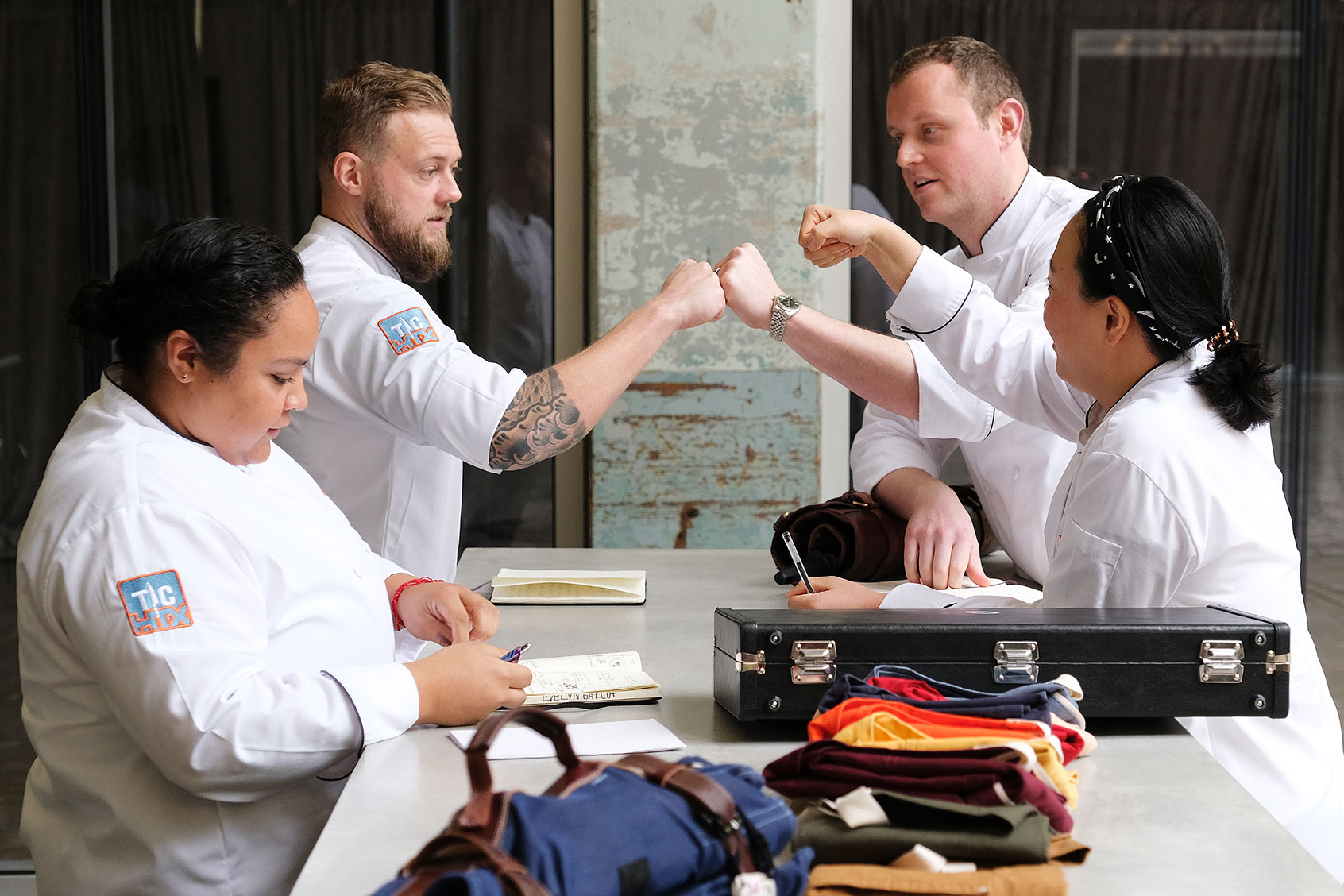
Top Chef: HoustonEvelyn Garcia, Luke Kolpin, Jackson Kalb and Jae Jung on “Top Chef: Houston” (Photo courtesy of David Moir/Bravo)Jackson had not told his fellow chefs that he had lost his sense of taste and smell, worried that it would be seen as a “weakness” in the competitive cooking contest and the others might take advantage of him. But Jackson compensated for the loss, coming out in the top three and even as the winner of multiple challenges. He said in an interview with The Los Angeles Times: “I would try my food and often plug my ears and close my eyes, and try to piece together what I think it would taste like while I chewed. I was relying completely on texture.”

Before he was eliminated, he looked as if had a good chance to make it to the end and possibly even win the title. “I guess my instincts were better than I thought they were, just for seasoning purposes,” he told People.

Jackson had disclosed to “Top Chef” producers before filming began about his lost sense of smell and taste, but not only did they not forbid him from continuing in the competition, they kept it a surprise from the others, perhaps thinking his secret disability made for exciting television. “At the end of the day, they’re making a TV show,” he said.

This smacks of “CODA” vibes, when the plot twist is at the expense of disabled people and for the benefit of a non-disabled audience – and it didn’t sit well with fans.

It was relatively unclear for viewers whether or not Jackosn had disclosed to his fellow competitors, until what would be his final episode (this made my family, avid “Top Chef” watchers, instantly suspicious; you know when an episode unduly focuses on one chef, their number is up). Some fans expressed anger or annoyance that Jackson had kept his disability hidden. 

Perhaps the small group challenges may have been a chance for Jackson to disclose to the other chefs, but disclosing a disability, even like Long COVID, is an individual decision. And it’s complicated. Yes, individuals with disabilities are protected under the ADA. In theory. But just because something like workplace discrimination or being passed over for a job or promotion due to disability is illegal, doesn’t mean it doesn’t happen. All the time.

A study published by the National Bureau of Economic Research with composite job applicants found that those applicants who disclosed a disability “received 26% fewer expressions of employer interest than those without disabilities.” All the applicants were experienced; disability was the only differing factor, “indicating that higher qualifications do not erase the labor market disadvantages associated with disability.” A similar study in France found only 2% of real applicants who disclosed a disability received interest in their job applications.

As Lizz Schumer writes in the New York Times, “the gap between the letter and application of the law can swallow people whole,” giving example after example of workplace discrimination of disabled people and writing, “All of these stories are horrifying. Many are technically illegal. None are particularly unique.”

Fellow contestant Luke Kolpin was shown turning on Jackson the moment he did disclose his Long COVID. Luke assumed he would be sent home and accused Jackson of calling his dish too salty (the judges then thought it was under-seasoned). Can you blame Jackson for being hesitant to disclose? 

What could the potential 23 million Americans with Long COVID learn from the chef who couldn’t taste?

Luke did not go home, and Jackson was not the only person to believe the dish over-salted. But “Top Chef” was edited in a way to place blame squarely on Jackson, the faulty taster, and Jackson alone. Not only is this disingenuous, it’s ableist.

To be clear, Jackson was not sent home because of Luke’s dish – which was ultimately his own responsibility to spice – rather all the other bad decisions Jackson had made during Restaurant Wars, including deciding to send out two dishes at once, the hand-scrawled “Welcome Judges” sign, a dismal front of house performance and a rather uninspired dessert.

With reality shows, it’s aways hard to know what’s actually happening, thanks to the magic of editing and television’s spin. Regardless, “Top Chef” missed a big opportunity to talk openly about Long COVID, not to mention to shine a light on what exactly made Jackson’s cooking successful without relying on taste and smell — touch, sense memory, innovation, tried and true recipes? 

What other senses are involved in making food? What could the potential 23 million Americans with Long COVID learn from the chef who couldn’t taste?

Long before COVID, superstar chef Grant Achatz of Alinea lost his sense of taste from tongue cancer. A whole episode of Netflix’s “Chef’s Table” is devoted to him, his restaurant and his journey. He’s still thriving at work, and his story could have played a part in Jackson’s narrative on the show.


Want a daily wrap-up of all the news and commentary Salon has to offer? Subscribe to our morning newsletter, Crash Course.


Though his time on “Top Chef” is over, and Jackson reports his sense of smell and taste have now almost fully returned, as he said: “No matter what happens, it’s not the outcome of this specific show that matters, it’s what you do with it afterward.”

“Top Chef: Houston” airs Thursdays at 8 p.m. on Bravo.

More stories like this:

The race to design a bacteria that can eat plastic

Though its effects are not always visible to the naked eye, plastic is choking life on Earth. Birds are dying from plastic accumulating their intestines. Animals are full of microplastics, and humans are unintentionally eating a credit card’s worth of plastic every week, which is seeping into our bloodstream. And the ocean is becoming an open plastic dump to the extent that microplastic particles may outnumber zooplankton. 

These harrowing scenes could come to define our planet’s future. The process for manufacturing plastic exacerbates climate change, and the prevalence of plastic in the environment has led to heartbreaking sights like sea turtles with straws stuck up their noses. Yet because plastic is designed to be durable and lasting, scientists who dream of permanently removing it from our environment have often despaired of solutions. 

One oft-floated pipe dream as to how to alleviate plastic pollution: can we breed something that will consume it?

RELATED: How plastic pollution threatens our health, food systems, and civilization itself

A new study suggests that an enzyme which targets polyethylene terephthalate (PET) — a widely-used polymer found in a majority of consumer packaging products that comprises 12 percent of all global waste — could make that scientific dream, which is also planetary necessity, into a reality.

The key ingredient was a natural enzyme known as PETase, according to the paper published in the scientific journal Nature. Using a machine learning model, scientists at the University of Texas at Austin’s Cockrell School of Engineering and College of Natural Sciences figured out what mutations would cause the enzyme to be able to quickly break down the targeted types of plastic waste.

“Collectively, our results demonstrate a viable route for enzymatic plastic recycling at the industrial scale,” the researchers conclude in their paper.


Want more health and science stories in your inbox? Subscribe to Salon’s weekly newsletter The Vulgar Scientist.


“Enzyme scale-up has been a well-explored problem in many industries,” Hal Alper, professor in the McKetta Department of Chemical Engineering at UT Austin, told Salon by email when asked how long it would take for this enzyme to be available on a wide scale. “Therefore, we feel that this part of the problem is easily achievable in a short period of time. The more challenging aspect will be implementing enzyme degradation on a large scale with mixed stream plastics.” (Mixed stream plastics are all non-bottle plastics collected from the waste stream, or the entire life cycle of the garbage produced in a community.)

This was not the first effort to find biological means of solving the plastic pollution problem. In March 2016, Japanese researchers found a bacteria known as Ideonella sakaiensis that, they marveled, would “eat” the plastic outside of an Osaka bottle factory until it turned into sludge.

Alper added, when asked about how the new team’s research built on previous efforts to address plastic pollution, “We utilized the enzymes that have been found in bacteria evolved to use PET. By starting with this enzyme as a scaffold, we applied machine learning techniques to substantially improve upon function.”

As Alper’s reply indicates, this was not the first effort to find biological means of solving the plastic pollution problem. It all began, as much of scientific history does, with a random crucial discovery. In March 2016, Japanese researchers found a bacteria known as Ideonella sakaiensis that, they marveled, would “eat” the plastic outside of an Osaka bottle factory until it turned into sludge. “The new species, Ideonella sakaiensis, breaks down the plastic by using two enzymes to hydrolyze PET and a primary reaction intermediate, eventually yielding basic building blocks for growth,” the scientists wrote.

Plastic-eating bacteria was later discovered in Oregon and Germany by subsequent researchers, demonstrating to scientists that there could be a biological solution to the plastic problem. By 2020, scientists at the University of Portsmouth had managed to alter the PETase enzyme to create a supposed “cocktail” that could digest plastic up to six times faster than normal. In the abstract of their paper, the researchers singled out the discovery of the Ideonella sakaiensis as vital to their research, as well as addressing an international catastrophe.

“Plastics pollution represents a global environmental crisis,” the authors wrote. “In response, microbes are evolving the capacity to utilize synthetic polymers as carbon and energy sources.”

Last year, scientists at the University of Edinburgh announced that E. coli, a common bacteria, could be used to convert PET into vanillin, the primary component of extracted vanilla beans. They even suggested that the vanillin might be able to be safely consumed by humans, although they emphasized that further experiments would be required.

Joanna Sadler, a biotechnology professor at the University of Edinburgh who was not involved in the most recent study but was involved in the E. coli study, seemed hopeful about the developments in the latest paper. Sadler characterized the new enzyme as the “fastest enzyme reported to date” in terms of the speed at which it can “depolymerise” different plastic substrates. 

“This makes it a very promising technological development in the field, and demonstrates the ‘evolvability’ of this enzyme,” Sadler said.

Alper, not surprisingly, echoed Sadler’s hopeful tone.

“Our enzyme is up to 30x more efficient than reported enzymes and operates at lower temperatures and thus saves on energy input and improves the ease of downstream processing,” Alper wrote to Salon.

For more Salon articles on plastic pollution:

Emergency contraception marks a new battle line in Texas

COLLEGE STATION, Texas — “Mysterious Dolphin” needed an emergency contraception pill dropped off on a porch outside of town.

Allison Medulan, a sophomore at Texas A&M University who had just come from biology class, saw the request on her cellphone via an anonymous text hotline. She gathered a box of the one-dose contraceptive, a pregnancy test, and a few condoms from her apartment and headed over. Inside a bewildering development of modest townhomes, Medulan tucked the plastic delivery bag next to the doormat.

Closing the car door, she stared ahead and took a breath. Medulan, 20, didn’t know the woman’s real name. It had been converted into a moniker by another volunteer operating the hotline.

“I’ve done what I can,” she said.

In this college town in farm country about two hours north of Houston, Medulan and other volunteers for Jane’s Due Process, an Austin-based nonprofit, are trusted allies for panicked young women scrambling for a solution after contraceptive failure or unprotected sex.

Sexual health advocates have long sought to expand access to emergency contraception — over-the-counter medications that prevent fertilization if taken within days of sexual intercourse — with the aim of preventing unplanned pregnancies that can derail educational and professional goals for women and teenagers. A bill that recently passed the Illinois General Assembly would require public universities to offer emergency contraception in vending machines, and volunteer distribution networks exist in numerous states, including Pennsylvania, Alabama, and Georgia.

But in Texas, these grassroots efforts in College Station, Lubbock, Austin, and the Rio Grande Valley have taken on heightened urgency after state lawmakers banned nearly all abortions after around six weeks of pregnancy. Demand for emergency contraception has skyrocketed. Nurx, an online prescription company, registered a 173% increase in orders from Texas in September 2021, the month the law took effect, compared with the previous month. Every Body Texas, an Austin-based group that awards federal birth control funding, received more than 200 requests for emergency contraception the first week its website began taking orders.

“There is anxiety around these laws and feeling like you’re going to be punished for having sex and pregnancy is that punishment,” said Graci D’Amore, 33, program and operations manager at Jane’s Due Process.

Jane’s Due Process reaches out to teens on Instagram and Facebook with digital ads that clear up fallacies about who can buy emergency contraception and where. Minors in Texas and nearly two dozen other states, including teen mothers already raising a child, must have their parents’ consent to get a prescription for hormonal birth control.

Emergency contraception, which is available without a prescription, is exempted from those restrictions. But the medication can be difficult to find in rural areas of Texas. And many pharmacies that do carry it keep it in locked cases or behind the pharmacy counter, requiring purchasers to ask for access. At a cost of $35 to $50 a pill, the medication is unaffordable for some young people.

The Jane’s Due Process “repro kits,” delivered free to those who request a pill via text message or phone call, include a booklet that lists the nearest abortion clinic, often hours away for Texans outside the state’s metropolitan areas.

“It is a Texas teen’s right to buy emergency contraception, pregnancy tests, and condoms,” said D’Amore. “Not only are we trying to provide access but also education.”

In many ways, these groups operate in an educational desert when it comes to abortion, contraception, and even sex. In Texas, many Planned Parenthood and other sexual health clinics that helped an earlier generation of women are long gone, replaced by hundreds of crisis pregnancy centers that counsel women against abortion and do not offer contraception.

As Texas swerved sharply to the right in recent decades, anti-abortion politicians vowed to run Planned Parenthood out of the state, enacting a cascade of restrictions. In 2011, Republican lawmakers slashed funding for the state family planning program by 66%, and more than 80 family planning clinics closed.

The impact was swift. Researchers found that from 2011 to 2014 the number of women using the most effective forms of birth control — IUDs, implants, and injections — declined by a third in the counties that had been serviced by a Planned Parenthood affiliate, while births by poor women on Medicaid increased 27% in those counties. The state partially restored funding in recent years, but many clinics never reopened.

To fill that gap, enter a network of volunteer groups, nearly all made up of women — young and old. With the politics of abortion and contraception converging, they know they are the next target. Many of the people seeking to ban abortion entirely in Texas also want to ban emergency contraception. They contend that life begins at fertilization and that any medication that interrupts that process violates their religious beliefs.

Religious activists in Texas have been out front in this effort, harnessing the state and local governments in their mission. Texas is the only state that does not pay for any form of emergency contraception for low-income women and girls in its state family planning program. Local councils in at least 40 Texas towns have adopted an ordinance that declares them “sanctuary cities for the unborn.” The movement, which began in Waskom, Texas, along the Louisiana border, criminalizes abortion and bans emergency contraception.

Other states are making similar moves.

In Arizona, Arkansas, Georgia, Idaho, Illinois, Mississippi, and South Dakota, pharmacists can refuse to dispense emergency contraception if it conflicts with their religious beliefs, and Arkansas and North Carolina exclude the medication from mandatory contraceptive coverage, according to the Guttmacher Institute, a research group that supports abortion rights. Alabama lawmakers have introduced legislation that would prohibit the state health department from using state funds to pay for emergency contraception.

Many conservative Catholics and evangelical Protestants contend that the pills — marketed under the brand names Plan B and Ella — and intrauterine devices are forms of abortion. But emergency contraception is entirely different from the medications prescribed to induce abortions.

Plan B is a hormonal medication that prevents pregnancy by delaying the release of an egg from the ovary or preventing fertilization. It does not harm an existing pregnancy. IUDs generally work by preventing sperm from reaching an egg, and some forms make the uterus lining inhospitable to attachment of a fertilized egg.

For Nimisha Srikanth, a public health major at Texas A&M in College Station, pushing back against that conservative tide has become an ethical crusade. “People have sex because they feel good, not because they want a kid,” she said, sitting at the kitchen table in her tidy off-campus apartment. “Taking that away from them is morally incorrect.”

A petite 21-year-old with hip-length black hair, Srikanth keeps boxes of donated Plan B, condoms, and pregnancy tests tucked under her bed. As president of Feminists for Reproductive Equity and Education, known as FREE Aggies, she operates an emergency contraception text hotline and delivers free pills to any A&M student who contacts her, usually meeting them at the student center and handing over a brown paper bag.

Since she began running FREE Aggies, she has rooted out spies from campus anti-abortion groups who crashed online meetings and switched to the private chat platform Discord. “If A&M requests our correspondence, Discord can’t give it to them,” she said.

The emergency contraception deliveries by volunteers with FREE Aggies and Jane’s Due Process are legal, but their clandestine nature fuels the stigma that young people caring for their sexual health is shameful, said Holly Musick, who attended Texas A&M in the late 1970s, a few years after abortion became legal nationwide.

“It was a much more liberal time,” she told Medulan when they met recently at the student center. “There was a Planned Parenthood on the north side of town, and students could walk to get birth control pills.”

Now, Musick, 64, volunteers for the Jane’s Due Process hotline, dropping off pills around town. The precariousness of women’s access to sexual health care scares her. She signed up for a delivery that had been requested during a narrow window of time at a specific place. “It got canceled right before I left my house, and I’m thinking, ‘This poor girl.'”

Medulan brims with anger. She was raised to think she could be anything in life but sees how abortion politics in Texas have circumscribed her world. Her boyfriend often accompanies her to make deliveries. He worries an anti-abortion radical will try to kill her. She’s been asked to leave the pills under a car, under a doormat, in a fake plant outside a house.

“It shouldn’t be shameful,” she said. “It shouldn’t be something you have to hide in a bush and make sure no one sees you grab this unmarked bag.”

KHN (Kaiser Health News) is a national newsroom that produces in-depth journalism about health issues. Together with Policy Analysis and Polling, KHN is one of the three major operating programs at KFF (Kaiser Family Foundation). KFF is an endowed nonprofit organization providing information on health issues to the nation.

Ti West on anyone walking out of his slasher film “X”: “What did you think you were signing up for?”

Many people around the world are experiencing a living nightmare. The coronavirus pandemic has killed more than six million people. The planet is burning. Climatologists and other scientists are frantically sounding the alarm that the Earth is reaching a point of no return in terms of global warming and the resulting extreme weather that may end human civilization as we know it.

The global plutocrats are accruing even more resources and power as they profit from (and create) a dystopian present and future. This antisocial and sociopathic cabal truly are the world’s puppet masters with all of the misery and suffering that implies for the rest of us.

The global right and its neofascist forces are continuing their long march to victory in the United States and other failing (and failed) democracies around the world. Vladimir Putin’s Russia is waging war on the Ukrainian people. His military is committing war crimes and other acts of barbarism as millions of Ukrainians have been displaced and many thousands killed in that war of aggression. Putin is now threatening nuclear war as his forces face defeat in Ukraine.

RELATED: “Everything” star Stephanie Hsu on playing all-powerful: “We would just unleash ultimate chaos”

What is the role of horror movies (and other entertainment media and the horror genre more generally) in a time of such real-life misery and terror? Ti West’s new film “X” offers an answer: it is a provocative, wonderfully absurd, exhilarating, smart, and very self-aware film about sex, aging, and the body – and the attraction(s) to violence that can turn some of us into human monsters. In the film, aspiring porn actor Maxine Minx (Mia Goth) and her producer/boyfriend Wayne (Martin Henderson) take a road trip through rural Texas with a ragtag cast and crew to shoot an adult film on the property owned by an elderly couple – Howard and Pearl – but find themselves threatened by a killer.

For horror fans – and those who appreciate smart and bold genre filmmaking “X” is just a fun time at the movies. In a moment where so much of real life feels so very wrong and horrible, West has given moviegoers a great gift.

In this wide-ranging conversation, West (“The Innkeepers,” “The Sacrament” and “In a Valley of Violence”) shares the pandemic’s influence on the film, capturing Texas in the 1970s, surprising film influences, thoughts on whether horror needs subtext and the film’s recently announced prequel, “Pearl.”

The following interview has been edited for length and clarity.

With of the challenges of this moment and the last few years, how are you maintaining your balance and being creative for a living?

I’m an only child, so I am a very self-motivated and driven person. I have that willpower to keep pushing forward mentality. In many ways when everything got locked down and people were staying home during the pandemic, I used that time to just write like crazy. I got a lot done. We made two movies during that time. During so much of the weirdness of the last two years I’ve been working. I just threw myself into the work. That is my personality.

How has being an only child impacted your personhood and creativity?

I can be by myself and my imagination and I’m comfortable in that place. I don’t feel uncomfortable there. I’m just inventive in that regard and I’m also self-driven. If you look at any of my movies I write, direct, edit, and produce them. That is very only-child-like behavior.  I’m used to doing everything myself. I feel comfortable in that space even though sometimes it’s a great deal of responsibility to take on and sometimes it’s easier and better to have help. But I still believe in the beginning that I am going to do everything myself. That’s just my nature.

What are some of the strengths and weaknesses of that approach?

Sometimes you figure it out and sometimes you don’t. It’s a tricky process as they say. You don’t want to drive yourself crazy – and it’s easy to do that if one is not careful. You also have to make sure that the people you are asking for help are actually the best people to be asking. There are many people who on a basic level do not know how to really help you achieve your goals. I try to internalize the wisdom that sometimes a person has to know their limitations.

We have to know when to push our egos aside when it is better to have someone else take on a task who can do it better than we could ourselves. It is also good to know that you can push yourself to do more than you’re already doing and to not stop at 40% or something. It’s always just a balance.  

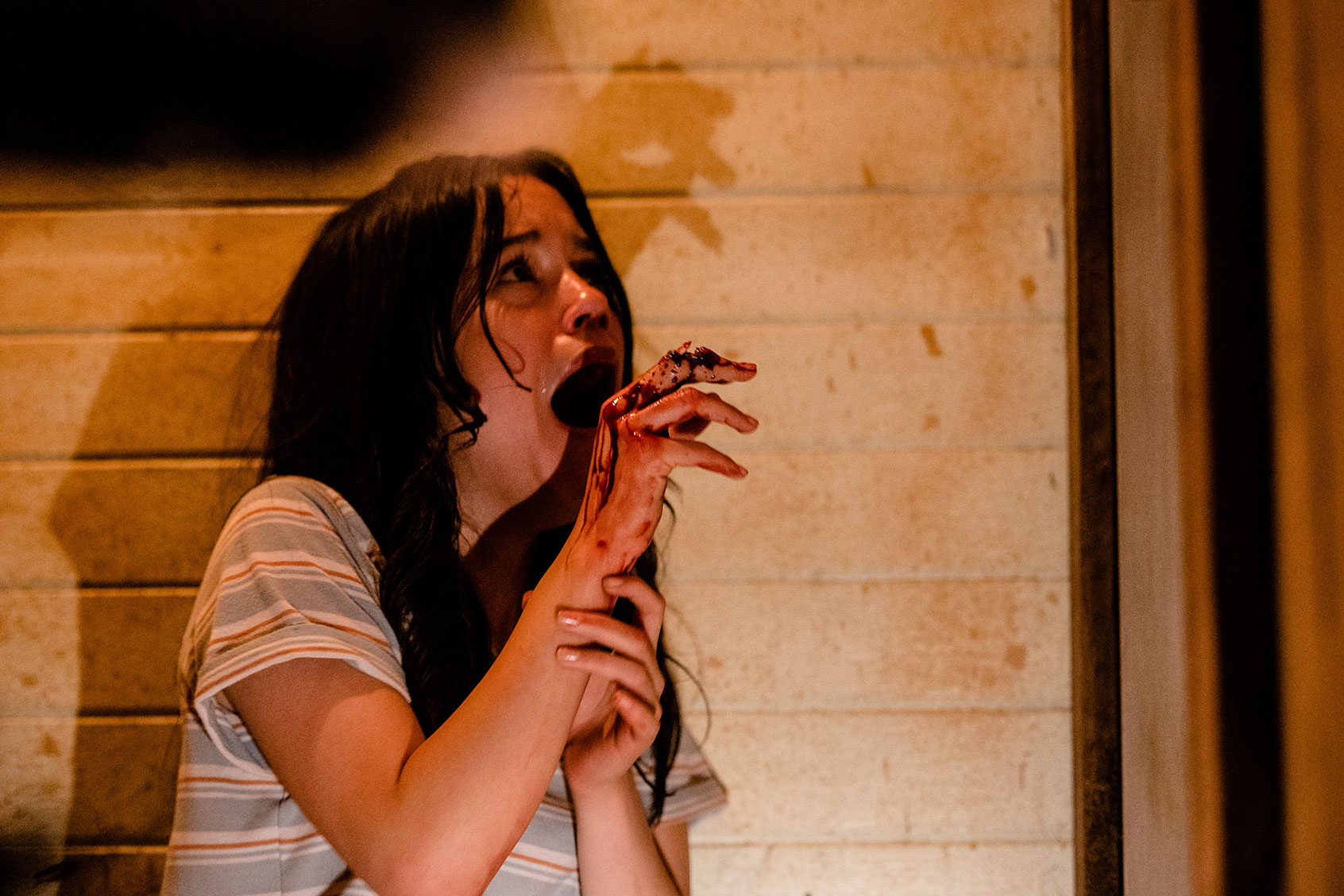
XOwen Campbell, Brittany Snow, Mia Goth, Scott Mescudi and Jenna Ortega in “X” (Photo by Christopher Moss/A24)A great film is a result of a many different people working together – and also some lucky choices and happy accidents along the way. How did that come together for “X”?

I was fortunate with “X” because I was able to get together a group of people who all wanted to make the same type of movie. On a basic level that is what you are really trying to do. We went to A24 first with the script. They were the first and only people I went to and they wanted to do the movie. That was great.

The entire crew were comprised of people who I’d worked with before. They wanted to work on “X,” and they really got what the vision was for the film. They got the humor. They got the style.

They understood the challenge. The set and production designer, costume designer, composer, the whole team really came together. I think everybody sort of clicked in a way. Whatever department it was, everybody was there to bring their best up to another level.


Want a daily wrap-up of all the news and commentary Salon has to offer? Subscribe to our morning newsletter, Crash Course.


Was there any one moment or perhaps a few where you knew you had something special with the actors and the group of people you assembled to make “X”?

The day that everybody was done with their costume fittings. I felt good about everyone prior to then. But the day we took their first photos in costume was the moment it definitely felt like everything was correct.

Given the state of the world where so many things are broken and horrible, what does it mean to make a horror movie in such a time as this?

I don’t necessarily associate them as the same thing. “X” is a pretty outrageous concept for a movie. Yes, it is certainly very violent and gory, and it is a horror movie in many ways, but it wasn’t a nihilistic movie. That was a big part of why everyone wanted to be part of it in my opinion.

“X” is a really upbeat, fun, crazy night out at the movies, even though it also has these weird, dark, subversive elements too. The film wasn’t really done in this dark nihilistic way. It was done in a cinematic event kind of way. My way of grappling with these matters is that I don’t want people to leave the movie theater feeling awful about the tragedies of life. I’m just trying to give you a night out at the movies. “X” has some subtextual meaning of course regarding existential questions, but it is also escapism too from some of the heavier aspects of life.

What is your approach to horror as a genre on a conceptual level? The emotions, themes, the morality tale, and then catharsis and release and closure (or not)?

I understand the sense of the question, but as someone who makes movies, I just start with the story and its visual language and then it all just starts to snowball and come together. I don’t start with the subtext and deep meaning of the film; I am just trying to make the movie. In terms of horror, I also don’t focus on those questions too much either. Of course, there are deeper meanings on some level but that is a function of us being human beings who have made a film.

Fundamentally, I’m always just interested in a story and then I’m interested in the cinema of how best to communicate that story.

Anything beyond that is a great addition. When a movie has a deeper meaning in terms of cultural criticism or politics that makes it better and richer, but I don’t begin the process by looking for that. I start by looking for an interesting story and then an interesting cinematic language for the movie.

My biggest passion in life is filmmaking and cinema so that’s the way that I approach movies.

What are some of the other films that were in your mind when you were making “X”? An obvious one would likely be “Texas Chain Saw Massacre.”

Oddly enough, less “Texas Chain Saw Massacre” than one would think. If you make a movie in the 1970s that is set in Texas it is hard to avoid the shadow of “Texas Chain Saw Massacre.” That movie is going to be looming over you. I decided that I might as well just embrace that reality and let people think the first 15 minutes of the movie are going to be like “Texas Chain Saw Massacre” and then zig instead of zag.

When we were putting up pictures on the wall or talking about movies with the crew the inspirations were more like “Two-Lane Blacktop” than horror movies. Perhaps that is because the horror movie influence was more obvious to me, and I didn’t feel the need to talk to other people about it as much. The influences also included moves like “Smokey and the Bandit,” that type of 1970s Americana was more in my head than any specific horror movie.

How is Texas a character in the movie?

To make a movie about moviemaking, I wanted the film to be set in the middle of the country and in a place that had a type of entrepreneurial ethic.

I also wanted to start the story in a urban environment and then move to a rural environment. I also didn’t want the setting to be too rural either. Texas has an entrepreneurial feel about it and the setting works for a story about a group of people who are trying to make a movie outside of the system. And of course, that place needed to have alligators too!

There are some scenes in “X” where I said to myself, “OK, it takes lots of money to look this cheap.” In particular, I was thinking of the scenes in the van. The aesthetic of the movie is just so very intentional. It is spot on.

The choices we made were not as expensive as they could have been, but it was not like we just found a van hopped in it and began shooting the film.

We shot in New Zealand. Just to get a van from the 1970s where the steering wheel was on the correct side was a miracle in itself. The van that we got looked nothing like that at first. We completely gutted the van, completely repainted it and changed all of the inside.

All of the wardrobe was made from scratch. It was a lot of work to get that very specific feeling. Yes, the lens choices and cinematography and other details were all part of that process. There is so much to getting that feeling right. Most of it is invisible.

It was a tremendous amount of effort to get the movie to look that specific to the time period and milieu.

XBrittany Snow and Scott Mescudi in “X” (Photo by Christopher Moss/A24)“X” is a slasher movie. It is also part of the larger tradition of exploitation movies. What was your thought process about humanizing the “monsters”? How did you figure out the balance?

I felt that I was subverting many of those genre archetypes through the structure of the film. I always thought of Howard and Pearl as villains – if you want to use that type of language. But I really wanted them to be human in a basic way. They are not supernatural. But I also wanted to treat them like the monsters in a monster movie but to still have some humanity in them.

As the movie develops, you can’t condone anything they’re doing. What they are doing is really outrageous and awful. But you as the viewer can also relate to why they’re doing it. You can at least understand their resentment. I felt that was an interesting way of approaching the villains in a horror movie like “X,” and one that I had not seen done very much. Likewise, Maxine as the “final girl” archetype also does not follow the typical rules for that character and trope.

Through Howard and Pearl “X” also grapples with mortality and that there are certain things that society deems as being best left for the young. Some people age very gracefully and have a great time getting older and others have a hard time with it and become resentful and angry and the like. I always thought that those themes were very relatable and therefore a good starting point for a crazy horror movie.

How did you approach the anxieties that many viewers — and American society as a whole – may have about sex and the elderly and the aging body?

That is a function of who is watching the movie. It’s a subjective experience in the sense that when we were shooting, for example the Howard and Pearl sex scene, the meaning was not lost on the folks there. There was this feeling of wow, this is an outrageous scene to be shooting today. But such a reaction then begs the question of, why?

When people can have different experiences with the movie that creates for an interesting conversation and a reason to re-watch the movie.

There’s more and more to gain from “X” each time you watch it because we did spend a lot of time trying to plant little seeds throughout the movie.

The last act of “X” is wonderful spectacle. It really does tap into the core absurdity of the horror genre and the filmic imagination you were drawing from.

It’s certainly intentional. And I think that I just thought of it as, OK, we’re going to have these old people having sex. We still have a horror movie going on. There are so many things happening at the end of a movie that ordinarily would not, and the showdown is so very larger than life. But that is the movie the viewer signed up for. For me to worry too much about plot is to somewhat miss what is more important about the overall feeling of the movie. I’ve never been that interested in plot.

Plot is a good reason to set up a story. Unless you’re making an Agatha Christie movie, I don’t really care that much about it. But I do care about the things that happen along the way.

During one of my viewings of “X,” a group of young women got up and walked out. They were very vocal and were complaining about how Pearl’s physical arousal during the first kill was so “disgusting” and “uncomfortable.” What types of feelings were you trying to summon within the viewer? I took their walking out as a win for the film.

People have very intense reactions. Having made a lot of horror movies sometimes you know when there is a scene that might lose some people in the audience.

Then again there are other scenes and moments where I am surprised that I lost some viewers because it never would have occurred to me that it would have been that element which did it.

What’s funny to me are the number of people that would go to horror movies who would then even consider walking out. What did you think you were signing up for? I don’t know what to make of it. I’ve never been so offended to need to walk out of a movie per se, but it happens.

Maybe that’s just a testament to “X” working. My goal wasn’t, “Hey, at this moment, I hope to provoke people to get up and leave the movie.” But that is also a moment in “X” where things get pretty wild. If that first kill in the movie pushes it further than you were comfortable with then maybe that is in fact a good time to leave.

XJenna Ortega in “X” (Photo by Christopher Moss/A24)When you say that “a film is working” what does it mean? How do you know?

You feel it. I don’t watch my movies very much with an audience. That is too painful for me. But in the few times that I do, one can just feel it when the movie’s working. That’s what you hope for. You hope that the story lands and that the audience gets what you are trying to do.

“X” has been so warmly received by the critics. I’m very grateful for it. I’m taken aback by it in many ways. People are really enjoying the movie and having a good time with it, and “X” to me was really a love letter to cinema.

James Gaylyn and Simon Prast play the roles of a sheriff and televangelist, respectively. They have some much weight and power in their performances. How do you manage that energy, two folks who are scene stealers, when you are shooting a scene?

You let them steal the scene. For the televangelist role, it is one of those things that is just a pastiche of the movie but then then you realize the character is much more than that. To get someone like Simon who could really pull that off in a convincing, genuine way but then also stick the landing of the reveal at the end of the movie is certainly easier said than done. It is a credit to Simon for being so amazing. A lot of that performance came from his audition and the intangibles he brought to the role.

James is in the beginning of the movie and the end of the movie. I told him that he has to stick the landing on this last line. The movie’s relying on you sending everybody home with the right feeling. It is a credit to him.

I told James your presence has to be known in this movie. He got it. He carried himself in a way that I was like, OK, this guy, even in this audition has a presence and when we get him in the space and I tell him what the spirit of the movie is, I know that he’s go it.

There is going to be a prequel to “X.”  All too often in horror movies and their many sequels the “monster” becomes the anti-hero if not outright hero because he or she is the most interesting part of the story. How are you going to take on the challenge of keeping the mystery of “X” without humanizing Pearl and Howard too much?

The best answer I can give is that you will find out soon enough. “Pearl” is done. The prequel will come out. It won’t be a secret for that much longer. That movie takes place in 1918 and it’s about young Pearl.

It’s stylistically very different from “X.” You do not need to see “X” to appreciate Pearl and you don’t need to see “Pearl” to appreciate “X,” but they do enrich each other tremendously. There is a lot of connective tissue, even though they are standalone movies. What we do in “Pearl,” it’s different enough from “X,” but in that spirit.

Again, I have to be cagey talking about it because we kept “X” a secret for so long and I think that’s been a benefit to the movie.

The more you go into the prequel and the less you know the better, but “X” is a slasher movie. And it wouldn’t be a slasher movie if we didn’t make a bunch of sequels. It also wouldn’t be a compelling slasher movie if the villain didn’t have a little bit more lore to them than perhaps in other genres. “Pearl” exists on it’s own terms and it is its own very inspired movie. I believe that if you liked “X” then you’ll love “Pearl.” Whatever you expect it to be, it’s not.

Are monsters made or born?

That is somewhat of the question to be answered by “Pearl.” It is the chicken or the egg question. It’s hard to really know for sure.

“X” is currently available on demand and will be released on Blu-ray on May 24.

More stories to check out:

Jimmy Carter’s landmark moment: The birth of the disability rights movement

Standing up could be intensely painful for Franklin D. Roosevelt, but he was determined that the public would never know.

Roosevelt was paralyzed from the waist down in 1921 — it’s not clear whether that was caused by polio or Guillain–Barré syndrome — and went to great lengths to conceal his disability. Aside from his inner circle of confidants and journalists who covered his political career, few Americans ever understood that FDR, who became the longest-serving president in our history, could not stand or walk unaided. He stood upright only with clunky, awkward braces that placed constant pressure on his abdomen. Yet he bore this burden silently, and when necessary went above and beyond the non-disabled people around him.

One incident stands out: A moment during the 1932 presidential election when Roosevelt remained standing during an unexpected rainstorm, even as everyone around him ran for cover. This was more than showmanship, although it certainly helped his public image as he campaigned to defeat President Herbert Hoover that year. Roosevelt, at the time governor of New York, also remained standing in order to doff his hat to every National Guard platoon commander who passed him on parade. More than a quarter-century later, a Hungarian Jewish immigrant who was a corporal in the 71st Infantry at the time wrote a letter to Eleanor Roosevelt recalling what he had observed (the former First Lady replied with gratitude):

I noticed that all of the occupants in the car had covered their heads or were endeavoring to ward off the rain, but there stood President Roosevelt, hat over his heart, the rain beating down over him, never flinching, every inch a man. This was an example of military, moral and spiritual courage. I have never forgotten it.

That infantry corporal almost certainly didn’t know that Roosevelt had a significant disability, and was essentially standing there locked in place. Disabled people throughout history have had to make those kinds of sacrifices, or cover up their limitations even at risk of pain or injury, simply to function in society.

RELATED: “Autism is not a disease — it’s a disability”: Journalist Eric Garcia debunks autism myths

Roosevelt’s suffering was not for nothing. Among other things, he founded a comprehensive disability treatment facility in Warm Springs, Georgia, which today is named for him. Over the years, Warm Springs has become a political mecca for aspiring public officials and others who wish to express support for the disability rights movement. When another Democrat, Jimmy Carter, decided to establish himself as a supporter of disability rights during the 1976 presidential election, he visited Warm Springs to make that promise. After he was elected president, however, Carter often struggled to implement key parts of his agenda, and disability rights was no exception. So disabled people had to step in to do the work that the non-disabled simply couldn’t get done on their own.

Prior to Carter’s presidency, disability activists had struggled to convince government officials to take their concerns seriously. When Congress in the early 1970s passed a law to expand states’ abilities to provide comprehensive vocational rehabilitation services, a staffer at what was then called the Department of Health, Education and Welfare (HEW) added a few sentences protecting disabled individuals from discrimination. No one expected that to be controversial; it was worded to resemble the Civil Rights Act of 1964, and merely extended that bill’s logic and language to another marginalized group. Yet this provision, known as Section 504, would become the cornerstone of a massive controversy and an entire movement. It stated that any entity that received federal funding could not discriminate against disabled people, at risk of losing that funding. 

Richard Nixon and his successor, Gerald Ford, weren’t especially sympathetic to Section 504, and supported the arguments of business advocates who claimed it was unenforceable and overly expensive. At first Republicans wanted to kill the bill entirely, with Nixon vetoing two versions, in 1972 and 1973, because he thought the Section 504 language was too strong. After the first veto, a group of 80 disability activists in New York, many in wheelchairs, protested by stopping traffic on Madison Avenue. Eventually there was enough pressure from Democrats (who controlled Congress at the time) to compel Nixon to sign the law, but both he and Ford delayed implementing it. Even after a judge ordered the Republican administration to cease “unreasonable delays,” regulations needed to implement the law remained unsigned through the end of Ford’s tenure.


Want a daily wrap-up of all the news and commentary Salon has to offer? Subscribe to our morning newsletter, Crash Course.


Activists were heartened when Carter took office because, starting with his visit to Warm Springs in 1976, he had cast himself as their ally. While Carter’s heart was in the right place, he often waffled when it came to following through on his goals — not a problem of intention, perhaps, but conceivably one of competence. Carter wound up passing the buck on Section 504 to his new HEW head, Joseph Califano, who formed a task force on the issue — that included no people with disabilities. 

Around that time, activist and advocacy groups run by people with disabilities were emerging, and a number merged into the American Coalition of Citizens with Disabilities. The coalition found out that Califano’s task force was likely to weaken the regulations needed to be implemented Section 504, in an effort to strike a compromise with the business community. So the ACCD told the Carter administration it would launch a series of protest actions if the existing regulations weren’t signed unchanged.

“I think this was brilliant, because rather than waiting until watered-down regulations were issued publicly and then responding, issue by issue, this meant the government would have to respond to the demonstrators,” wrote Disability Rights Education & Defense Fund activist Kitty Cone, who participated in the protests. “Additionally, it was not that easy to organize people, particularly people with physical disabilities, in those days, due to lack of transit, support services and so on. A sit-in meant people would go and stay, until the issue was resolved definitively.”

So began the 504 sit-ins, in which activists organized by the ACCD either occupied or picketed HEW offices in Washington, Atlanta, Boston, Chicago, Denver, Los Angeles, New York, Philadelphia and Seattle. Like Roosevelt forcing his body to remain standing in the rain, the protesters willingly underwent physical and emotional pain because they believed they were doing so for a just cause. The most notable protest was a San Francisco sit-in that lasted more than three weeks. One of the organizers, activist Judith Heumann, recalled that “at the start of our demonstration at the HEW offices, officials treated us with condescension, giving us cookies and punch as if we were on some kind of field trip.”

Once authorities realized that the protesters really weren’t going to go home, the magnitude of the moment became clear. This was a highly diverse group of people with different kinds of disabilities: injured Vietnam veterans, lifetime wheelchair users, deaf people, blind people, individuals with mental disabilities. Asking the cops to roust them out of the building would have been terrible optics. Carter’s administration was in a bind. More important still, this was effectively the first moment that Americans in general were compelled to confront their condescension and lack of comprehension when it came to disabled individuals. Cookies and punch weren’t going to cut it.

As one activist later recalled, “discomfort and anxiety was the order of our day to day existence. Everyone faced these questions, How can I get my meds? Where will I sleep? What about food?” People lost their sense of privacy as they performed intimate personal care in close proximity to strangers. Two protesters suffered long-term exacerbation of their multiple sclerosis symptoms because of going for a prolonged period without treatment. People had to live without catheters, back-up ventilators and medicines. The food problem was mitigated for one reason: Black Panthers stepped in and made sure the protesters, at the very least, would not starve.

It worked — and to a greater degree than most activists expected. In the most immediate triumph, the Section 504 regulations were signed intact on April 28, 1977. From that moment on, the climate around disability in America was forever transformed: No longer could an employer fire a disabled person just because having them around was too much trouble, or made others uncomfortable. While the stereotype of disabled people as helpless is still with us, the Section 504 protesters demonstrated that they could fight for their rights just like anyone else. Furthermore, they accomplished that by establishing an alliance based on the premise that everyone with a disability was in the same boat, regardless of the specifics. Finally, Section 504 laid the foundations for the landmark bill that would arrive more than a decade later, the Americans with Disabilities Act of 1990.

I am an autistic person with a hand-eye coordination disability, and am among the millions of beneficiaries of the Americans with Disabilities Act, and by extension of Section 504. I am also the grandson of the Hungarian Jewish immigrant who saw Franklin D. Roosevelt standing through that rain, and was so impressed in 1932 when he witnessed Roosevelt’s inspiring act of physical sacrifice during that storm. I never met Laszlo Rozsa, who died three years before I was born. I know he was head of the proof room at the New York Times, working the “lobster shift” and continuing the family tradition of newspaper jobs that began with his father, a Budapest printer named Morris Rozsa. Laszlo’s only child, Lance Rozsa, worked in education rather than journalism (he became a school superintendent in New Jersey). My passion is for both: I’m getting my PhD in history at Lehigh University and I’ve been a journalist for 10 years (and a staff writer at Salon for six).

When I interviewed Jimmy Carter in 2018, I thanked him for his support of Section 504 and for what he had done for the disability community. I also asked him what advice he had for younger Americans today. He responded: “Never give up, and follow the advice of my school teacher: ‘We must accommodate changing times but cling to principles that do not change.'”

Read more from Salon’s coverage of disability:

Trump supporters flock to canceled Nebraska rally

The risk of severe weather canceled a Trump rally in Nebraska that drew a crowd from across the country.

In a statement announcing the postponement, the man who held rallies during a pandemic said that the safety of his supporters was his top priority.

“Thank you to all who waited in line for our Save America Rally tonight in Greenwood, Nebraska. Because of severe weather, including the possibility of 60 mph+ wind, hailstorms, and maybe even tornadoes, I will not be coming to Nebraska tonight, but rather, weather permitting, will be there this Sunday night, May 1st. The most important thing is to keep you safe, and that cannot be done with such a terrible forecast,”

Some Trump supporters have been traveling from rally to rally, touring the country in a manner similar to that made famous by devotees of the Grateful Dead.

“Prior to the postponement, the parking lot was filling up around 8 a.m. on Friday. Walking through the parking lot, you saw plates from Texas, Illinois, Iowa, California and even Canada,” KLKN-TV reported.

Right Side Broadcasting Network interviewed a Trump supporter, with a son dressed as Trump, who said they had been to rallies all over the country.

“Even though doors weren’t going to open until the evening, many people stood in line all day waiting to get in,” WLKN-TV reported. “Even with the high number of people coming in for the rally, many didn’t want to lose their spot in line, so businesses were not as busy as anticipated.”

Matt Gaetz’s inaccurate diagnosis of rising insulin costs

At the end of March, after the House passed a bill that would cap the cost of insulin at $35 per month for insured consumers, Rep. Matt Gaetz (R-Fla.) tweeted about why he voted against the legislation.

“Insulin price increases have more to do with increased consumer demand than the bad behavior of Big Pharma, which I am quick to condemn,” Gaetz wrote.

He continued, in a 10-part Twitter thread, to offer weight loss as a potential solution to insulin costs rather than capping prices: “90-95% of people with diabetes have type 2 diabetes, which ‘can be prevented or delayed with healthy lifestyle changes, such as losing weight, eating healthy food, and being active.’ Arbitrary price controls are no substitute for individual weight control. Since 2000, the number of diabetes cases in the U.S. has nearly doubled. The demand for insulin has increased and the requisite price increase has followed suit. In other words, the price of insulin increases as waistlines increase.”

The tweet picked up attention on social media and from news outlets, but we wondered whether there was any connection between demand for insulin and the rising cost of the drug. One economic principle states that, for some products, if demand increases, prices will follow.

Does that hold true for insulin, a drug that millions of Americans need to survive?

We reached out to Gaetz’s office to ask for the evidence to back up his claim but received no response.

So we asked the experts to explain what’s going on with insulin prices.

Types of Diabetes and Treatment

Insulin was first discovered in 1921 and patented two years later. The hormone is essential for people with Type 1 diabetes because their pancreas no longer makes natural insulin, needed to regulate blood sugar. An extremely high blood sugar level can be deadly. These patients make up about a tenth of the total number of people with diabetes in the country.

Some patients need to inject insulin often, at least twice a day.

The majority of people with diabetes, however, have Type 2, which has been linked to obesity. Excess weight may interfere with the body’s ability to effectively use insulin, leading to high blood sugar levels.

“As obesity increases, diabetes increases as well,” said Dr. Paresh Dandona, a professor at the University at Buffalo’s medical school who studies diabetes.

But many of these patients are not prescribed insulin as a treatment. Around 30% of people with Type 2 diabetes use insulin when other drug options are not successful in treating the disease, Dandona said. For some Type 2 patients, exercising and a healthier diet “may help reduce the insulin dose, but it doesn’t eliminate its use.”

How Insulin Drug Pricing Works

Drug pricing experts said there’s no question that insulin’s list price (the amount charged to consumers and their health plans) has risen over the past decade. A 2020 study found that the list price of insulin products increased by 262% from 2007 to 2018, while a 2021 study found that from 2014 to 2018 the list price of insulin products increased by 40%.

Is there a reason the price has ballooned?

Not really, said the experts, except that the manufacturers and other stakeholders benefit from higher list prices. For example, pharmacy benefit managers — which manage prescription drug benefits on behalf of health plans — are paid based on the rebate amount they get from insulin manufacturers. If they can negotiate a more favorable spot for a manufacturer’s insulin on a drug formulary list (a plan’s list of covered drugs), they receive a bigger rebate. Insurance companies also benefit from higher prices, because they collect a higher amount from a patient’s portion of cost sharing and can also reap rebates from the pharmacy benefit managers. In addition, consumers have little bargaining power because insulin is typically an essential purchase.

“The insulin manufacturers set prices based on whatever the market will bear, not based on demand for their products,” said Dr. Jing Luo, an assistant professor of medicine at the University of Pittsburgh whose research focuses on drug pricing and use.

However, the pharmaceutical industry disagrees with this assessment. PhRMA, the trade industry group representing pharmaceutical companies, told KHN that while it acknowledges drug manufacturers are responsible for raising the list price of insulin, the manufacturers aren’t reaping the benefits of the price increase. Instead, manufacturers are forced to raise the list prices to provide bigger discounts and rebates to the insurers and pharmacy benefit managers. But PhRMA argues that manufacturers are not receiving higher profits because of higher list prices.

“Rebates lower what health plans pay for insulins by roughly 84% and these savings should be shared with patients at the pharmacy,” said Brian Newell, a spokesperson for PhRMA. “Until we fix this broken system, patients will continue to face high costs for insulin.”

Although high demand, according to economic principles, can cause prices to rise because it is difficult to push out enough of a product, production isn’t an issue with insulin because it’s easy to ramp up supplies and there’s not a set amount of insulin that can be made, said Matthew Fiedler, a fellow at the USC-Brookings Schaeffer Initiative for Health Policy. So demand for insulin shouldn’t affect prices.

“Production costs are unlikely to change very much when more people buy insulin since production can be scaled up fairly easily, at least in the long run,” Fiedler wrote in an email. “In fact, production costs could conceivably fall when more people buy insulin if manufacturers respond by developing more efficient production techniques.”

At the end of the day, the list price for insulin is set by the manufacturers, and they along with every player in the drug pricing system benefit from higher prices, except for the consumers who have to purchase it to survive, said the experts.

“As we are all aware, increased demand does indeed drive up prices,” said Luo. “This is especially true for commodities. Unfortunately, brand-name prescription drugs like insulin are priced far differently than simple commodities.”

Would Weight Loss Help Reduce Insulin Costs?

In his Twitter thread, Gaetz said that diabetes cases have almost doubled since 2000. That is true.

According to data from the Centers for Disease Control and Prevention, about 12 million Americans were diagnosed with diabetes in 2000. In 2018, the annual number of new diagnoses had risen to about 27 million.

But a diabetes diagnosis is not always related to a person’s weight or overall health, especially for those with Type 1 diabetes, who are dependent on insulin treatment for life.

“In fact, those with Type 1 diabetes are usually very thin,” said Dr. Eron Manusov, a professor in the medical school at the University of Texas-Rio Grande Valley.

In addition, most people with diabetes have Type 2, which is linked to weight gain but not always treated with insulin.

Other factors can play a role in the risk of developing Type 2 diabetes, such as genetics, lifestyle, and age, Manusov said.

Alleviating and treating diabetes is not as simple as eating healthier and exercising more, Dandona said. Those factors may “help control diabetes and it may reduce the insulin dose, but it doesn’t eliminate its use,” he said.

If everyone ate the same healthy diet and exercised the same amount, some people would still become diabetic because a person’s genes and the environment they grew up in matter, he added.

“To expect that somehow magically insulin requirements will vanish if patients lose weight is really talking in cuckoo land,” Dandona said.

The experts concluded that while both insulin list prices and diabetes cases have risen along the relatively same timeline, they’re not related.

“While higher obesity rates have likely increased diabetes prevalence, it is doubtful that this has had much effect on insulin prices,” said Fiedler, the health economist. “Also, obviously none of this is to say that reducing obesity or reducing diabetes is a bad thing. It just does not have much to do with insulin prices one way or the other.”

How Is Congress Addressing Insulin Prices?

The House bill would cap the cost of insulin at $35 per month for individuals who have private insurance or for those on Medicare. However, the bill does nothing to help the uninsured who need insulin.

Democrats unanimously supported the legislation, as did 12 Republicans. But there was significant opposition, with 193 Republicans voting against it, including Gaetz.

The bill now goes to the Senate, where members are considering other strategies to control insulin prices. Details are in the works.

Our Ruling

Gaetz said the reason for the rising cost of insulin was because more people were being diagnosed with diabetes, thus increasing demand for the products. And he pegged that rise in diabetes cases to the increase in the number of people who are overweight in the U.S.

Health economists and diabetes experts told us that though Gaetz is right that diabetes cases are on the rise, his overall point is not accurate. His statement is based on a cause-and-effect argument that doesn’t exist.

They said the increase in insulin prices is not tied to great demand for insulin or to any production problems that pressure creates.

In addition, although the rising prices come as more cases of obesity are reported, medical experts said they are not necessarily related. Many people who are overweight and develop Type 2 diabetes are not treated with insulin and the experts point out that many other factors help determine whether an individual will develop diabetes.

We rate this statement False.

Heart’s Ann Wilson on the Beatles and gender, her new song “Greed” and covering George Harrison

Acclaimed rock vocalist Ann Wilson, who says “there’s nothing I like more than discussing the Beatles,” joined host Kenneth Womack to do just that on the season 3 finale of “Everything Fab Four,” a podcast co-produced by me and Womack (a music scholar who also writes about pop music for Salon) and distributed by Salon.

Wilson and her younger sister Nancy make up the legendary, Rock and Roll Hall of Fame-inducted band Heart — the first hard rock group fronted solely by women — who were behind such hit songs as “Magic Man,” “Crazy On You” and “Barracuda.” As Ann tells Ken, their mother “always played music in the house” but it wasn’t until she was 12 and her older sister Lynn brought home the “Meet the Beatles” album that everything changed. “I don’t think she realized what it would do to me,” she says. “It was all over.”

RELATED: Nancy Wilson of Heart: “We weren’t looking to marry or date the Beatles. We wanted to be them

Being struck by their “Englishness,” Ann was soon speaking with a Liverpool accent, wearing turtlenecks and smoking fake cigarettes. As she explains, it wasn’t about being a boy or girl: “In my heart, I felt androgynous … you could be one of the Beatles without a gender role. They opened up a whole world of intelligence and imagination. They gave you another periscope to see your gender from.”

LISTEN TO THE CONVERSATION:

Subscribe today through Spotify, Apple Podcasts, GooglePodcasts, Stitcher, RadioPublic, Breaker, Player.FMPocket Casts or wherever you’re listening.

She and Nancy went from watching the Beatles on “The Ed Sullivan Show” to seeing them live at the Seattle Coliseum in 1966 (“How do you come down from something like that? I don’t think you do.”), to playing music themselves. And in following the band’s artistic trajectory, Ann says they “always took lessons from the Beatles about things we could add to our lives.”

Calling each album from “Rubber Soul” to “Revolver” to “The White Album” full of “songs to die for,” the Wilson sisters incorporated what they learned into their own music, from Heart’s “Dreamboat Annie” in 1975 to Ann’s new solo album, “Fierce Bliss,” out now. It includes the song “Greed,” which she thinks John Lennon would have a lot to say about in terms of its commentary on the current state of the world.

A highlight of her career was performing George Harrison’s “Beware of Darkness” at the George Fest tribute concert in 2014, which she says Harrison’s widow Olivia and son Dhani were thrilled with. And with both John and George sadly being gone now, Ann says she named her new album with the thought that you can’t take anything in life for granted. “Happiness or bliss … I feel it all the way down to the ground.”

Listen to the entire conversation with Ann Wilson on “Everything Fab Four” and subscribe via SpotifyApple PodcastsGoogle, or wherever you’re listening.

Host Kenneth Womack is the author of a two-volume biography on Beatles producer George Martin, the bestselling book “Solid State: The Story of Abbey Road and the End of the Beatles,” and most recently “John Lennon, 1980: The Last Days in the Life.”


Want a daily wrap-up of all the news and commentary Salon has to offer? Subscribe to our morning newsletter, Crash Course.


More “Everything Fab Four” conversations: 

Stolen sandwiches and microwaved fish: Returning to the bizarre politics of office lunch

In the season two opener of the cult-favorite sketch comedy series, “I Think You Should Leave,” Tim Robinson plays Pat, an office worker who has just been informed of an unexpected midday meeting. “But it’s lunch,” Robinson says, loosening his grip on the hot dog in his hands. 

“We pushed lunch to 1:30 so Dennis could make the flight back to Chicago,” his coworker responds with a sigh, before she heads down the hall. Pat thinks for a moment, before muttering to himself: “I don’t know if you’re allowed to do that.” 

However, Pat does dutifully enter the board room for the meeting, walking with an oddly rigid cadence, one arm extended parallel to the floor. Once he sits down, it becomes apparent that he is concealing his hot dog in the sleeve of his blazer. He takes a pseudo-discreet bite under the guise of scratching his chin. 

Related: The only thing my quarantine brain wants to watch right now is sketch comedy

Eventually, he holds his head in his hands for another bite, then places his head on the board room table for another. “Is that a hot dog?” a colleague hisses. Pat responds that he’s tired, “the most tired he’s ever been,” in fact.

“Pat, we know you’re eating a hot dog under there,” his boss finally chimes in, before Pat suddenly goes limp and silent. Someone reaches for Pat’s arm to ensure he’s okay, and Pat leaps from his chair — hot dog stuck between his throat and mouth. All his coworkers attempt to help him dislodge the hot dog, but Pat begins to flail like a rabid animal. They finally press him into a corner, all while Pat maintains a chokehold on some dude in a button down, and the hot dog is finally dislodged. 

Pat looks at them with tears in his eyes, but instead of offering thanks or an apology, he delivers a single piece of wisdom. 

“You can’t skip lunch, you just can’t, guys,” he says, tears in his eyes. 

That sketch became an instant internet-age classic, inspiring oil paintings, remote office protocol and visits to real-life hot dog stands. It’s one of those pieces of comedy that is bigger than the sum of its parts and, as such, pretty much lives rent-free in my brain. I think, aside from the feel-it-in-your-gut physical comedy, it’s because there is definitely something inherently ridiculous about office lunch.

I’ve been thinking about this a lot (an embarrassing amount, to be honest) as more and more people I know are returning to their jobs in actual office buildings, spending their days Slacking each other from behind the partial gray walls of their cubicles. We as a society toss people into this sterile, but emotionally supercharged environment — where deadlines, layoffs and budgets loom — and expect them to act normally, but it doesn’t always work out that way. 

There are unspoken rules and petty office politics underpinning day-to-day interactions. As Tim Robinson so eloquently pointed out, everyone needs to eat lunch; often that’s when those simmering tensions begin to boil over, much like cafeteria lunch for the school-age set. 

There are unspoken rules and petty office politics underpinning day-to-day interactions. As Tim Robinson so eloquently pointed out, everyone needs to eat lunch; often that’s when those simmering tensions begin to boil over, much like cafeteria lunch for the school-age set.

In part, that’s why the archives of business advice columns like Ask A Manager are packed with food-related questions. There are a number of memorable scandals, ranging from a manager who kept asking an employee to share food with her (and would get moody if the employee didn’t comply), the Keto-obsessed coworker who wouldn’t stop shaming the office snacks, and the woman who made NSFW noises while tasting the chocolate cake a coworker had baked. 

Most of the questions, however, involve food getting stolen out of a communal office refrigerator. It’s such a bizarre violation. You’ve got food that someone has either made or purchased — and, let’s be real, has likely been looking forward to since packing it that morning — and someone in the office feels entitled enough to just reach into the refrigerator and take it. It inspires a singular kind of rage, as well as an obvious question: “What kind of person would do this thing?” 

It’s a seemingly perennial issue. In 1998, the “Friends” episode “The One With Ross’ Sandwich” first aired. In it, Ross is unraveling in the face of his pending divorce and recent eviction. “The only good thing going on in [his] life,” is the Thanksgiving leftover sandwich he packed to eat at work. Inevitably, it is stolen, despite the fact that he left a note, which read: Knock-knock. Who’s there? Ross Geller’s lunch. Ross Geller’s lunch, who? Ross Geller’s lunch, please don’t take me. Okay?

A little over two decades later, Ask a Manager posts a question from a reader that could have easily been a scrapped plot from a sketch comedy series or sitcom. 

“My food is always really, really spicy,” the advice-seeker wrote. “I just love it that way. Anyway, I was sitting at my desk when my coworker came running out, having a hard time breathing. He then ran into the bathroom and started being sick. Turns out he ate my clearly labeled lunch. (It also was in a cooler lunch box to keeps it cold from work to home, as it’s a long drive.) There was nothing different about my lunch that day. In fact, it was just the leftovers from my dinner the night before.” 

Fast-forward a day and the individual’s boss asks if the advice-seeker had attempted to poison the coworker. Human Resources got involved. An in-office affair was revealed and the advice-seeker was eventually cleared — but not before being briefly terminated. 

It’s one of those advice column write-ins where you question for a minute if the dilemma is actually based in truth. However, just a few weeks ago, I saw a viral Reddit post in which there was a photo of a water cooler. On the cooler was a note: “Hello Water Drinker, If you would like to enjoy this delicious POLAND SPRING WATER please see Sandra or Michelle to get signed up for the very cool WATER CLUB. This water ain’t free yo. Members are currently enjoying unlimited refills for $5 a month.” 

Initially, I retweeted the photo thinking it was a joke until several folks I know — primarily academics and government workers — responded that their departments had implemented water clubs, too, since returning back to in-person work. It was one of those bizarre bits of office protocol that also feels like it could be spun into a sketch, but to which they were adjusting in real-time. 

There are even full articles written about the etiquette of eating in an office environment, further proving the point that we as humans forget how to behave normally within the confines of the office kitchen. 

There are even full articles written about the etiquette of eating in an office environment, further proving the point that we as humans forget how to behave normally within the confines of the office kitchen. 

I’m partial to this piece by Alyse Whitney: “7 Office Microwave Etiquette Rules to Follow So Your Co-Workers Don’t Hate You.” The rules are pretty self-explanatory — don’t microwave brussels sprouts or seafood, use splatter protection, clean up after yourself — but I like the framing. 

One of the things that I’m most curious to see play out is how, after over two years of many office workers shifting to at-home work, the return to communal lunch plays out. Publications ranging from the BBC to Scientific American have already established that people have almost forgotten how to be sociable; will there be new ways in which office politics rears its ugly head in the lunchroom? Or will it simply be more cases of stolen sandwiches and microwaved salmon? I suppose only time, and future editions of Ask a Manager, will tell. 

Make your office lunch fun again: 

You’re 5-ingredients away from this genius smoked salmon and dill pasta salad

Often when I find myself in a cooking rut, I think about my favorite dishes and try to present those flavor combinations in a different way. At first glance, I recognize that this advice seems like a recipe for creating the types of dishes that dominated my Midwestern church potlucks of my youth  — hamburger soup, chili mac, chicken pot pie hand pies —but it has led me (and other cooks) in really interesting directions. 

An Epicurious recipe that has been in heavy rotation in my house recently is this Pantry Pasta with Garlic, Anchovies, and Parmesan, which, if you think about it, is really just all the best bits of Caesar salad in pasta form. One of my favorite brunch recipes comes from Chicago’s Tweet; it’s a stack of cornmeal cakes topped with avocado slices, an over-easy and crumbled chorizo that is a gorgeous mash-up of arepas and flapjacks. 

And, as we’re heading into warmer weather, I’ve been playing around with variations of pasta salad, one of my favorite summer lunches. The other day, I had all the makings of a delicious bagel sandwich — smoked salmon, some fresh dill, sweet red onion — but no bagels. 

At that point, hunger took over. I grabbed a box of rigatoni and poured it in some boiling, salted water. While it cooked, I surveyed what else I had in the refrigerator. Instead of reaching for cream cheese, I tossed a few scoops of whole-fat Greek yogurt in the food processor along with the dill and a healthy pinch of salt, a move that was inspired by this delectable lamb pasta recipe by Andy Barraghani. 

I blitzed it until it was smooth and completely cohesive, then set aside. 

I flaked the smoked salmon into bite-sized chunks and minced the red onion. Once the pasta had been drained and cooled completely, I folded it into the dill-yogurt sauce, topped it with the salmon and minced red onion, and gave everything a good toss. I scrounged through my pantry until I found my go-to Everything But the Bagel seasoning and used it to garnish the pasta salad. 

Not to pat myself on the back, but it was absolutely amazing. It’s light enough to dole out as a side, but it also has enough flavorful contrast to work as lunch. If you wanted to riff based on what’s in your refrigerator — a squeeze of lemon, a smattering of scallions or chives, diced tomato, capers — that would be fun, too. 

***

Recipe: Smoked salmon and dill pasta salad 

Yields
4 servings
Prep Time
10 minutes
Cook Time
10 minutes

Ingredients

  • 1 pound of pasta of your choice (I like rigatoni, rotini or shells) 
  • ¾ cup of whole-fat Greek yogurt 
  • 4 to 6 tablespoons of fresh dill, depending on your taste (#teammoredill) 
  • 8 ounces of smoked salmon, flaked into bite-sized pieces
  • ¼ red onion, minced 
  • Salt and pepper to taste
  • Optional: Everything But the Bagel seasoning, scallions, capers


Directions

  1. Cook your pasta according to package directions, then drain and set aside to cool. 

  2. In a small blender or food processor, combine the Greek yogurt and fresh dill. Blend until completely smooth and salt and pepper to taste. 

  3. In a large bowl, combine the cooled pasta, dill sauce, smoked salmon and minced red pepper. Toss until the pasta is fully coated with the sauce.

  4. Serve cool or at room temperature. 


This recipe originally appeared in Salon’s weekly food newsletter, The Bite. Sign up below for exclusive recipes, how-tos and essays about food. 


Want more great food writing and recipes? Subscribe to Salon Food’s newsletter.


Stories from Salon’s Lunch Week 

Seeds vs. plants: A buying guide for vegetable gardeners

You can Grow Your Own Way. All spring and summer, we’re playing in the vegetable garden; join us for step-by-step guides, highly recommended tools, backyard tours, juicy-ripe recipes, and then some. Let’s get our hands dirty.

Vibrant, marbled pineapple tomatoes; adorable Easter Egg radishes without a single crack, unblemished rainbow Swiss chard leaves: looking at the images of vegetables in seed catalogs can be inspirational but also disappointing because you know that none of your homegrown veggies will ever look like this. The kaleidoscope of those images is an effective tactic, though: it makes you buy more seeds than you need. It also makes you buy seeds for vegetables that you’re probably better off buying as seedlings.

While I have been gardening for almost two decades now, I’m still not immune to those temptations. But following a set of clear criteria — what to grow from seed and what to buy as seedings, and in what quantity — has helped me become a much more realistic shopper for my vegetable garden.

And that brings me straight to my first guiding criterion: Am I being realistic?

The reality check

Everything you plant, whether it’s grown from seed or plants from a nursery, needs watering, fertilizing, possibly pruning, weeding, inspecting for pests and diseases and prompt treatment, harvesting, and processing. New gardeners often get overwhelmed and give up because they did not expect it to be so much work. Think in small steps and be reasonable in your expectations. It is essential that before shopping for seeds or seedlings you make a blueprint of your garden plotraised beds, or containers to find out how much space you have, and what you can actually fit in it. Unless you have a large homestead-style garden and can devote most of your free time tending to it all summer, expect that your homegrown vegetables will only supplement what you buy and that you won’t be able to live off the land.

The heirloom hunt

Seed companies will carry tons more varieties of any given vegetable than what you’ll be able to find already growing at a nursery. There are more than 10,000 different tomato varieties available as seeds, while a well-stocked nursery might carry two dozen varieties at best. If you have your mind set on more unusual varieties (including heirlooms) that you cannot find as plants, starting from seed is the way to go. Keep in mind that root vegetables such as beets and parsnips don’t transplant well, and they should be directly seeded in the garden, as should be beans, peas, and leafy greens such as lettuce and spinach.

Find the light

The need for sufficient light for seed starting cannot be overstated. I have found that the often-recommended sunny window for your seedlings just won’t do — soon they start bending toward the light, and the seedlings get leggier with every inch they are removed from the light source. Unless you are the lucky owner of a greenhouse, you will need full-spectrum growth lights that simulate sunlight. A new trick I tried last year is to use the LED lights from my hydrogarden after removing the water bowls and grow decks and the seedlings were the strongest I have ever grown.

Prepare for a commitment

Ask yourself whether you can invest the time and effort to start from seeds. It means watering daily, usually twice a day. Letting seeds dry out even the slightest bit during germination is an absolute no-no, and keeping them consistently moist is key.

You also need to monitor the temperature. For example, tomato seeds germinate best at 65°F to 85°F; anything lower or higher will delay germination — or the seeds won’t germinate at all.

Consider the timing

When you start seeds indoors to get a head start on the growing season, the proper timing with the start of warm weather is crucial. Start your seeds too soon, and your plants will reach the size where they need to be transplanted when it is still too cold for the tender seedlings to survive outdoors. Leaving them indoors longer is not an option because the seedlings tend to get weak and spindly — they need natural light to get stronger.

. . . and the overall cost

Seed packets are often touted as cheaper than buying plants, but once you add up all the costs of a proper setup for seed starting, plus figure in your time and effort, it might be more economical to just buy plants. It’s the safer way, too, as you don’t have to deal with the uncertainties of seed starting.

Seed packets usually contain much more than you will be able to fit in your garden, but you don’t have to use all the seeds in one year; some seeds are good for at least another year. I love Fairy Tale eggplants, which are difficult to find at local nurseries; that’s why I start them from seed and split the packet with a friend. It cuts down on the cost, and this way I get to reorder fresh seeds every year.

The quantity factor

How many plants of a particular vegetable and variety you want is also a factor. For tomatoes, I like a bunch of different varieties — mostly the famous San Marzano tomatoes for sauce and canning, plus beefsteak, red and yellow cherry tomatoes for eating fresh. Buying a seed packet of each variety, just to get a couple of plants, does not make much sense. The same applies to bell peppers and hot peppers.

For herbs, it depends. If you just need a few basil leaves for caprese or a batch of pesto, buy a plant or two. But if you’re like me, you can never have enough basil for pesto, freezing, and drying, so growing basil from seed is the best option. The same holds true for parsley. To make, say, tabbouleh, one plant doesn’t get you very far.

Another consideration is that you can keep harvesting certain annual herbs only until they start blooming. To ensure a constant supply of cilantro and dill, you’ll need consecutive generations of plants, so growing them from seed is best. By the time you need a new cilantro plant, all the nurseries will be likely sold out.

Rosemary, thyme, sage, marjoram, oregano, and many other herbs are perennials, and one plant is usually enough to cover your needs. In this case, buying a plant makes more sense than starting from seed. Plus, herbs are slow and finicky to germinate — parsley takes 14 to 30 days.

Whatever you decide, don’t delay your shopping — because of the increased interest in gardening, the demand for both seeds and plants has skyrocketed in the past two years.

“Come Away With Me” at 20: Norah Jones reflects on “hopeful, romantic” record but won’t call it jazz

The title of Norah Jones’ debut record, “Come Away With Me,” offers truth in advertising. Its collection of songs serves as an invitation to enchantment, blending elements of jazz, country, and singer/songwriter pop to charm the listener into a world of romance, joy, and the melancholic subtleties of deep feeling.

Released on the storied Blue Note Records label in 2002, it went from selling 10,000 copies in its first week to moving over 27 million and counting. It also won eight Grammy awards, including in the categories of Album of the Year, Record of the Year, and Song of the Year. The record possesses beautiful intimacy and maturity throughout its 14 songs, and the massive hits that propelled its commercial success represent it well: “Don’t Know Why,” written by former bandmate and songwriting partner, Jesse Harris, a cover of “Turn Me On,” which was originally released by Mark Dinning in 1961 and later performed by Nina Simone, and the Norah Jones-penned title track. 

In the two decades that have followed, Jones has steadily built an oeuvre of remarkable consistency. Whether at her jazziest on “Day Breaks,” released in 2016, or experimenting with alternative pop on 2012’s “Little Broken Hearts,” Jones’ music is tasteful, elegant, and emotive, broadcasting the reality of Wynton Marsalis’ assertion that often the best music is “soft, but intense.” 

Jones has collaborated with Marsalis, in addition to many other musicians, including Willie Nelson, Wayne Shorter, Jeff Tweedy, Mavis Staples, Billie Joe Armstrong, and the members of her side project bands, Puss n Boots and The Little Willies. 

RELATED: Norah Jones’ “Feels Like Home”

To celebrate the opening salvo of a brilliant career, Blue Note has released a “super deluxe edition” of “Come Away With Me.” The box set includes a remastered edition of the 2002 album, but also two discs of previously unreleased demos, outtakes, and finished songs that did not make the final cut. Most interesting and enjoyable is an alternative version of “Come Away With Me” that Jones recorded using different arrangements. Unlike the typical superstar box set, which seems superfluous, the updated and expanded “Come Away With Me” provides an essential experience for anyone interested in Jones’ artistry. 

It also contains lengthy liner notes in which the singer/songwriter explains the album’s genesis. After studying jazz piano in the late 1990s at the University of North Texas, near her hometown, she moved to New York. Armed with demos that she recorded in her high school band room, which are included on the box set, she began playing clubs and restaurants. 

Norah Jones; Come Away With Me: 20th Anniversary Super Deluxe EditionNorah Jones | Come Away With Me: 20th Anniversary Super Deluxe Edition (Photo courtesy of Blue Note Records)On her 21st birthday, Jones played a jazz brunch with a trio at The Garage. Duly impressed by her performance, a representative from EMI publishing arranged for her to meet the late Bruce Lundvall, then president of Blue Note. Less than two years later, “Come Away With Me” hit the airwaves. 


Want a daily wrap-up of all the news and commentary Salon has to offer? Subscribe to our morning newsletter, Crash Course.


Norah Jones and I discussed the rest of the story of “Come Away With Me,” as well as her reflections on the record over the phone.

The interview has been edited for length and clarity – including the deletion of when she took a break from the conversation to tell her dog, Ralph, to “chill,” because he was barking at FedEx truck. 

You have such a marvelous body of work, but today we’ll spend most of our time talking about “Come Away With Me,” which was your musical introduction to most of the world. How did you develop the style that we hear on that record, combining elements of jazz, country, and singer/songwriter pop?

“I was longing for my Texas roots. I think that’s where that came from … finding a way to bring country back into the mix, or realizing that it had been there all along.”

That’s most of it, but there is also blues and soul – all the great American musical artforms. It came from growing up in a house, listening to Ray Charles, Aretha Franklin, Dolly Parton, and Willie Nelson. Then, later in high school with Bill Evans and Miles Davis, and I got deep into jazz, and that became my focus for awhile. When I moved New York, I was still deep into jazz, but was beginning to open up to other styles. I started going to the Living Room in New York City, and seeing all these songwriters. I had written a couple of songs in high school, but they embarrassed me so badly that I never wrote after that, but when I started going to singer/songwriter clubs, like the Living Room, I was inspired to start writing songs again. Also, in New York, I started missing country music. I was longing for my Texas roots. I think that’s where that came from – either missing my roots, and finding a way to bring country back into the mix, or realizing that it had been there all along. 

One of the most enjoyable aspects of this box set is to hear all of the different versions of the songs on “Come Away With Me,” and the different possibilities for the record that existed. What was your criteria for choosing the material that made it on the record – both the songs you wrote and the covers?

It was sort of an evolution. I had a meeting with Bruce. I had jazz demos, and I had songs I had written with my friend, Jesse Harris, and Bruce wanted to hear more. So, we went into the studio. I had done jazz for so long, but this band with a different sound that Jesse and me had started playing with at the Living Room, was kind of cool. So, we decided to make more recordings with that band, and that informed the recording of “Come Away With Me.” One of the demos we made was “Don’t Know Why,” we never beat the demo version. So, that’s the version that made it on the record. Once I got the record deal, I wanted to stretch out and try new things. I loved Cassandra Wilson’s record, “New Moon Daughter,” and I loved the producer Craig Street’s work. So, I asked if I could meet with him. I went into the studio with Craig and all these incredible musicians – Brian Blade on drums, Kevin Breit on guitar, Bill Frisell on guitar – and we recorded 21 songs over five days. We thought we made the record, but the label sort of rejected it. It wasn’t what they fell in love with. The demos were much more straightforward. So, I went back into the studio with producer, Arif Mardin, and he helped me put the record together from those two sessions, and we also recorded nine more songs in the same vein as the demos with same band.

Earlier you mentioned Bill Evans, and you just mentioned Cassandra Wilson. When you listen to it now, who are some of the influences that you can hear yourself assimilating into your own style?

“‘Come Away With Me’ definitely has a looking-forward, hopeful, romantic quality to it, which was age-appropriate at the time.”

I was always a fan of Ray Charles‘ piano playing, Aretha Franklin‘s piano playing, Bobbie Nelson, who just passed – her piano playing. Those and Bill Evans are my top four piano players who I have always tried to imitate in some way. The influence comes from, simply, listening to all their records. I wasn’t highly aware that I was doing it. It was just what I liked hearing and playing. As far as singers go, I’ve had so many influences and favorites, but I don’t think I sound like any of them on that record. More than anything I wanted to sound like myself, and I think I pulled it off on that record, even at such a young age. 

Norah JonesNorah Jones (Photo by Joanne Savio)As I listened to the record over and over again recently, it stuck me how there is a quality similar to the Ernest Hemingway novel, “The Sun Also Rises.” There is a really melancholic quality to the record, but the lyrics are so romantic, and there is often a sense of joy. That makes for a moving moving emotional contrast. Was that something you were conscious of at the time, or is it something you think about now?

I definitely was thinking that exact same thing yesterday. I’ve been playing these songs to prepare for the live show we’ve put together, and I realized that I used to think that “Come Away With Me” was such a mellow record, but it is actually a sweet little record. Is it melancholy? Yes, but it also has so many hopeful notes to it. I don’t even know how to do that sometimes now (laughs), because I am usually drawn to the sad lyric – maybe it is my age now, maybe it is from just living life. But “Come Away With Me” definitely has a looking-forward, hopeful, romantic quality to it, which was age-appropriate at the time. I definitely didn’t think that at the time, though. I thought it was mellow. You know, I had grown up singing old soul songs. I used to sing “Lush Life” in high school. I didn’t even know what the song was about then, but I was always drawn to the slow songs, the ballads, the sad songs.

I’m sure that’s one reason why, in addition to how it sounds, because it is such a beautiful record, that it was so successful. 

Yes, it isn’t so dark. It is mellow, but it has a light and hopeful message. I think the combination contributed to the success. That’s true.

Speaking of the record’s success, how did you react at the time? It was staggering – millions of records sold, multiple Grammy awards.

It was pretty weird, but I just dealt with it. You just do your thing, and keep doing it. We were doing it – playing gig after gig, doing interview after interview. I thought there was no way the record could get any bigger after the first jump in sales, but then the Grammys happened, and it was just insane. 

“The record company wanted a remix of ‘Don’t Know Why’ that they could sell to pop radio. At the time, I was horrified by the idea.”

Were there any commercial pressures in the immediate aftermath? You’ve had such authenticity and consistency in your body of work. Even when you experiment and collaborate, there aren’t any frivolous fads. But was there pressure to go in that direction?

Well, the record was already made. So, that ship was sailed. We just did what we did, and it was straight from the heart and honest. I do remember that the record company wanted a remix of “Don’t Know Why” that they could sell to pop radio. At the time, I was horrified by the idea. It went against everything that the song was to me. Now, I’d actually be more open to it, and embrace the opportunity for creative collaboration, but I said no at the time. So, we didn’t do it, but we got on pop radio anyway, and to this day, I don’t know how. It was baffling to me. Other than that, I was lucky to be on Blue Note. The whole team became my family, and everyone watched out for me. Bruce was my friend and a mentor. No one expected me not to be myself. Plus, I was pretty stubborn those days, and I was pretty hot under the collar if anyone tried to tell me to do something that didn’t make sense. I get that from my mom.

Do you ever feel like, even if jazz is just one element of your work, that, because of your success in pop that you are an ambassador for this traditional form of music?

I’ve never taken that on. I love that artform, but I’m the first to say that my first record is not a jazz record. There was some confusion there with people. It certainly leans that way, but I have too much respect for the artform of jazz to say that it was a jazz record. If I was in college and someone tried to say that something like “Come Away With Me” was a jazz record, I would have been like, “No, it’s not!” I try not to think about genre too much.

What approach did you take with “Feels Like Home,” your second record? Did the “Come Away with Me” experience change your approach to songwriting or performing?

Well, I was pretty new to songwriting at that point. There are only three songs that I wrote on “Come Away With Me.” So, during the entire period, I was really excited about writing and inspired, and so was my band. We had been on the road for a year at that point, and we had a lot of songs we had written. So, I recorded a song from everyone in my band. Lee Alexander, the bassist, and I had written several songs together. We were listening to a lot of bluegrass and country at the time. So, the record leans a little more toward the country side. But, I was excited just to be playing music, which meant that that “follow up” pressure didn’t get into the studio. We just did what we did.

RELATED: How Miles Davis electified jazz

That reminds me of what you said just a moment ago in reference to your vocals on “Come Away With Me”: You are just trying to sound like yourself. There are probably many people who consider that easier said than done. How do you manage that?

In high school, I was obsessed with Sarah Vaughan, specifically her live recording, “My Funny Valentine.” I was so into imitating her. I also did a pretty good Billie Holiday impression. I was even cast in the role of Billie Holiday for a high school musical. It was a Black History program that they did every year at my school. I loved mimicking other singers. I would put on Aretha Franklin records, and pretend to be one of her background singers. That was how I learned to sing. I don’t know, though. After high school, I just started to sing without worrying about the rest. Part of it was probably because I felt like a natural singer since I was young. I never felt like I had to struggle to sing, whereas with piano I had to work hard to learn. With singing, I did feel like it was a natural thing. This isn’t to say that I don’t ever sound like other people, or that I’ve never tried on different voices that don’t quite fit. I do feel, though, that I shed that by time I got to New York.

Looking back 20 years later, what do you feel that the Norah Jones of 2002 was right about, and if you could tell the Norah Jones of 2002 anything now, as an artist, what would it be?

As an artist, I don’t think there are wrongs. You are on your path. The record represents where I was at that time exactly. It is an exact record of where you are when you are making it. That’s what it means. It is a recorded moment, literally. So, “Come Away With Me” is a snapshot of my musicality of my time. I guess I would tell myself at that time to enjoy everything a little more. It is OK to stop and smell the roses. I had a lot of fun, because I was surrounded by my best friends. They were all in my band. We had a lot of fun, but I was very uptight at the time. It was a stressful time for my family. It was a weird time for me personally, and success made it weirder. But, I would tell younger self to stress less, and try to enjoy what you’re doing.

Watch the “Come Away With Me” 20th anniversary livestream, via YouTube.

Read more stories: 

25 Things you might not know about Thomas Jefferson

Thomas Jefferson (1743-1826), the third president of the United States, penned one of the greatest documents of the modern world in the Declaration of Independence. While that’s certainly a career highlight, it’s far from the only interesting thing about him. For more on Jefferson’s life, accomplishments, and controversies, take a look at this assembly of 25 facts.

1. Thomas Jefferson was addicted to learning

Born April 13 (April 2 on the pre-Gregorian calendar), 1743 at his father’s Shadwell plantation in Virginia, Jefferson was one of 10 children (eight of whom survived to adulthood). While he attended the College of William and Mary, he was said to have studied for 15 hours daily on top of violin practice. The hard work paid off: Jefferson moved into law studies before becoming a lawyer in 1767. Two years later, he became a member of Virginia’s House of Burgesses, the Virginia legislature. His autodidact ways continued throughout his life: Jefferson could speak four languages (English, Italian, French, Latin) and read two more (Greek and Spanish).

2. His greatest work was a study in contradiction

As a member of the Second Continental Congress and the “Committee of Five” (a group consisting of John Adams, Roger Sherman, Benjamin Franklin, Robert Livingston, and Thomas Jefferson brought together for this purpose), Jefferson was tasked with writing the Declaration of Independence, an argument against the 13 colonies being held under British rule. While the Declaration insisted that all men are created equal and that their right to liberty is inherent at birth, Jefferson embraced the institution of slavery. In any given year, Jefferson enslaved up to 200 people, with roughly half under the age of 16. He perpetuated acts of cruelty, sometimes selling enslaved people and forcibly relocating them away from their families as punishment. Yet in a book titled “Notes on the State of Virginia” (which he began writing during his stint as governor and published in 1785), Jefferson wrote that he believed slavery was unjust and “tremble[d]” at the idea of God exacting vengeance on those who perpetuated it. Though Jefferson acknowledged slavery as morally repugnant — and also criticized the slave trade in a passage that was cut from the Declaration of Independence “in complaisance to South Carolina and Georgia” — he benefitted personally from it, a hypocrisy that haunts his legacy through the present day.

3. Thomas Jefferson didn’t like being rewritten

After drafting the Declaration, Jefferson waited as Congress pored over his document for two days. When they broke session, Jefferson was annoyed to find that they were calling for extensive changes and revisions. He disliked the fact the passage criticizing the slave trade was to be omitted, along with some of his harsh words against British rule. Benjamin Franklin soothed his irritation, and the finished Declaration was adopted July 4, 1776, spreading via horseback and ship throughout that summer.

4. He recorded everything

After inheriting his family’s Shadwell estate, Jefferson began constructing a new brick mansion on the property he dubbed Monticello, which means “little mountain” in Italian. For operations at Monticello and the properties he would acquire later in life, Jefferson was preoccupied with recording the minutiae of his daily routine, jotting down journal entries about the weather, his expansive garden, and the behavior of animals on his property. He kept a running tally of the hogs killed in a given year, mused about crop rotations, and noted the diet of the enslaved people there.

5. Thomas Jefferson doubled the size of the country

Jefferson’s greatest feat as president, an office he held from 1801 to 1809, was the Louisiana Purchase, a treaty-slash-transaction with France that effectively doubled the size of the United States. The deal took careful diplomacy, as Jefferson knew that France controlling the Mississippi River would have huge ramifications on trade movements. Fortunately, Napoleon Bonaparte was in the mood to deal, hoping the sale of the 830,000 square miles would help finance his armed advances on Europe. Bonaparte wanted $22 million; he settled for $15 million. Jefferson was elated, though some critics alleged the Constitution didn’t strictly allow for a president to purchase foreign soil.

6. He fought pirates

Another instance where Jefferson pushed the limits of his Constitutional power was his fierce response to Barbary pirates, a roving band of plunderers from North Africa who frequently targeted supply ships in the Mediterranean and held them for ransom. Under Jefferson’s orders, American warships were dispatched to confront the pirates directly rather than capitulate to their demands. The initial Navy push was successful, but the pirates were able to capture a massive American frigate — which an American raiding party subsequently set fire to so the ship couldn’t be used against them. A treaty was declared in 1805, although tensions resumed in what was known as the Second Barbary War in 1815. Again, naval ships forced Algerian ships to retreat.

7. He helped popularize ice cream in the U.S.

Jefferson spent time in France in the 1700s as a diplomat, and that’s where he was likely introduced to the dessert delicacy known as ice cream. While not the first to port over recipes to the United States, his frequent serving of the dish during his time as president contributed to increased awareness. Jefferson was so fond of ice cream that he had special molds and tools imported from France to help his staff prepare it; because there was no refrigeration at the time, the confections were typically kept in ice housesand brought out to the amusement of guests, who were surprised by a frozen dish during summer parties. He also left behind what may be the first ice cream recipe in America: six egg yolks, a half-pound of sugar, two bottles of cream, and one vanilla bean.

8. He bribed a reporter

Presidential scandals and dogged newspaper reporters are not strictly a 20th or 21st century dynamic. In the 1790s, a reporter named James Callender ran articles condemning several politicians — including Alexander Hamilton and John Adams — for various indiscretions. In 1801, he turned his attention to Jefferson, whom he alleged was having a relationship with a woman he enslaved named Sally Hemings. Callender went to Jefferson and demanded he receive $200 and a job as a postmaster in exchange for his silence. Disgusted, Jefferson gave him $50. Callender eventually broke the news that Hemings and Jefferson had been involved and had several children together. Jefferson supporters ignored the story — which modern-day DNA testing later confirmed — but Callender was never in a position to gather more evidence: He drowned in the James River in 1803.

9. He had a pet mockingbird

Even before the American Revolution, Jefferson had taken a liking to mockingbirds, and he brought this affection to the White House, which they filled with melodious song. (And, presumably, bird poop.) But he was singularly affectionate toward one mockingbird he named Dick. The bird was allowed to roam Jefferson’s office or perch on the president’s shoulder. When Jefferson played his violin, Dick would accompany with vocals. Dick and his colleagues followed Jefferson back to Monticello when he was finished with his second term in 1809.

10. He invented a few things

Not one to sit idle, Jefferson used his available free time to consider solutions to some of the problems that followed him at his Monticello farming endeavors. Anxious to till soil more efficiently, he and his son-in-law, Thomas Mann Randolph, conceived a plow that could navigate hills. He also tinkered with a way of improving a dumbwaiter, the elevator typically used to deliver food and other goods from one floor to another.

11. His wife had an awkward connection to Sally Hemings

Jefferson was married for just 10 years before his wife, Martha Wayles, died in 1782 at age 33 of unknown causes. Jefferson’s involvement with Sally Hemings was part of Martha’s convoluted family tree. Martha’s father, John Wayles, had a relationship with Sally’s mother, Elizabeth Hemings — meaning, most historians think, that Sally and Martha were half-sisters.

12. Thomas Jefferson is credited with creating a catchphrase

During his second term as president, Jefferson was said to have run into a man on horseback near Monticello who proceeded to engage him in a lengthy complaint of everything wrong in Washington. Reportedly, the man had no idea he was speaking to the commander-in-chief until Jefferson introduced himself. The man, deeply embarrassed, quickly spouted “my name is Haines” and then galloped away. True or not, Jefferson is credited with originating the resulting catchphrase that was popular in the 1800s, with people saying “my name is Haines” whenever they wanted to feign embarrassment or were forced to leave abruptly.

13. He was served with a subpoena

Long before Richard Nixon landed in hot water, Thomas Jefferson resisted attempts to compel him to testify in court. The matter unraveled in 1807, when James Wilkinson insisted he had sent Jefferson a letter informing him of Aaron Burr’s plot to invade Mexico. Government attorneys wanted Jefferson to appear with the letter, but the president — who said that the country would be left without leadership if he traveled to Richmond to answer the subpoena—refused to appear, an act of executive willpower that was never challenged in court.

14. He had a secret retreat

Though Monticello remained Jefferson’s pride and joy, he had another residence for times when he wanted to be alone. Poplar Forest, located near Lynchburg, Virginia, was an octagonal home that he had built to exacting detail: The windows were measured so they would bring in only Jefferson’s preferred amount of sunlight. The home took years to construct and was nearly ready by the time he left office in 1809. It’s now open to the public.

15. He was a shabby dresser

After taking office, Jefferson offended some in Washington who believed the president should be an impeccably dressed and polished social host. While many of his stature would opt for a carriage, Jefferson rode a horse and dressed in plain and comfortable clothing. He acknowledged only two official White House celebrations annually: the 4th of July and New Year’s Day.

16. He was an early wine connoisseur

Centuries before wine appreciation became a national pastime, Jefferson was busy accumulating an eclectic wine cellar. His love for the drink coincided with his trip to France, where he was introduced to the various tastes and textures. He kept a well-stocked collection at Monticello and also tried growing his own European grapes, but was never successful.

17. Thomas Jefferson shocked people by eating a tomato

Jefferson’s multitudes of crops included what were, for their time, unique and sometimes puzzling additions. He grew tomatoes when their consumption in Virginia was uncommon, and, according to one account from 1900, Jefferson reportedly appalled some onlookers when he would consume one in front of witnesses.

18. He probably had a fear of public speaking

Without today’s methods of addressing the public — radio, television, and Twitter — Jefferson was largely free to succumb to his reported phobia of speaking in public. While working as a lawyer, he found himself unable to deliver orated arguments as eloquently as he could write them. When he did speak, it was apparently with a meek disposition. One listener to his inaugural address in 1801 described Jefferson’s speech as being in “so low a tone that few heard it.”

19. He harvested opium

At Monticello’s sprawling vegetable and plant gardens, Jefferson grew over 300 different kinds of crops, flowers, and other sprouts. Among them were Papaver somniferum, the poppy seed that can be used to create opioid drugs. Common in Jefferson’s time, the plant is now under much closer scrutiny and the estate was forced to pull up their remaining crop in 1991.

20. Abraham Lincoln was not a fan of Thomas Jefferson

Though they weren’t contemporaries, Abraham Lincoln sometimes seethed with animosity toward Jefferson. William Henry Herndon, Lincoln’s onetime law partner, wrote that Lincoln “hated” Jefferson both for his moral shortcomings and his political views. But Lincoln also recognized the potency of the Declaration, citing its words as proof of equality among the population. “All honor to Jefferson,” he said, for making the document a “stumbling block” for anyone arguing in favor of tyranny. But he still never liked the guy.

21. He sold a lot of books to the Library of Congress

Jefferson, a voracious reader, was dismayed when the War of 1812 resulted in British forces burning the Capitol in Washington and reducing its 3000-volume library of books to ashes. To repopulate the repository of knowledge, Jefferson sold Congress his entire personal library of 6707 titles for $23,950. The sale was finalized in 1815, and the books were sent via wagon from Virginia to Washington.

22. He helped found the University of Virginia

A fierce advocate of education, Jefferson used his later years to propagate an institution of higher learning. Jefferson began planning the resources for a Virginia state university during his presidential term, writing to the Virginia House of Delegates that a college should not be solely a house but a “village.” In the proceeding years, Jefferson arranged funding, contributed design ideas, and helped shepherd the University of Virginia toward its formal opening in March 1825. Known as the “founding father” of the school, his influence has not always been welcomed. In April 2018, protesting students spray-painted the words rapist (in reference to his relationship with Sally Hemings) and racist on a campus statue.

23. He was always in debt

Status, salary, and opportunities should collude to make sure presidents are in solid financial shape during and after their tenure in office. Jefferson was an exception. Despite inheriting his father’s estate, he was plagued by debtfor most of his life. He often spent beyond his means, expanding his property and making additions and renovations with little regard for the cost involved. His father-in-law, John Wayles, carried debt, which Jefferson became responsible for when Wayles died in 1774. Jefferson himself died owing $107,000, or roughly $2 million today.

24. Thomas Jefferson and his onetime nemesis died on the same day

Before Jefferson passed away on July 4, 1826, he had finally made amends with John Adams, the president who preceded him in office and for whom Jefferson served as vice president. The two men, once on the same side, had grown to resent the other’s approach to diplomacy and politics, with Jefferson lamenting Adams’s preference for centralized and meddlesome government — though according to Jefferson, the major issue was the so-called “Midnight Judges,” appointments that Jefferson felt “were from among [his] most ardent political enemies.”

Strangely, Adams passed away the same day as Jefferson, just five hours later. The date, July 4, was also the 50th anniversary of the Declaration of Independence being adopted.

25. He wrote his own epitaph

Jefferson wasn’t willing to leave his final resting place in the hands of others. He was exacting in how he wanted his grave marker to look and how his epitaph should read. He also directed the marker be made of inexpensive materials to dissuade vandals from bothering it. Following his death in 1826, several people chipped away at his grave in Monticello as souvenirs. Congress funded a new monument in 1882, which is still toured by visitors to the estate today. The engraving reads:

“Here was buried
Thomas Jefferson
Author of the Declaration of American Independence
of the Statute of Virginia for religious freedom
& Father of the University of Virginia”

This time, no one had the temerity to rewrite him.

A perfumer’s obsessive quest to recreate the fragrance of lost love

A woman leaves a room, and her perfume lingers. She is gone, but something of her presence remains. The woman, perfumer Mandy Aftel, has slipped into another wing of her home in search of a relic. 

Scents are like souls, Marcel Proust wrote. They endure death and destruction, “remembering, waiting, hoping…”

Fragrances are alive for Aftel, too. She calls them “my friends,” and once charmingly addressed a shelf of essential oils directly, asking, “Is everybody here?”

Aftel is heir to a tradition that traces back six thousand years to Egypt, where incense was burned to purify sacred spaces. Later, in Mesopotamia, the desire for more complex aromatics inspired some of humanity’s earliest chemistry experiments. One cuneiform tablet dating to 1200 BC names the world’s first-recorded chemist, a female perfumer named Tapputi. From that era onward, precious fragrances proliferated via the Silk Road, reached mass adoption in the “Perfumed Court” of King Louis XV, and currently comprise a 30 billion dollar global industry that includes Aftel’s cozy atelier here in Berkeley, California.   

The seventy-four-year-old returned clutching a notebook. “This is it,” she announced. The pages document seasons of struggle as the artist attempted to recreate the precise natural scent of someone she had loved and lost – a perfume she would eventually name Memento Mori. “The process mirrored the relationship itself,” she confessed. “Torturous.”

It had been a solitary period, reminiscent of the perfumer’s childhood in 1950s Detroit. Growing up in a synthetic miasma of “asphalt, detergent, and chlorinated swimming pools,” the scents of her youth were unfriendly ones.

“I wasn’t particularly well thought of in my family,” she recalled. “I wasn’t very pretty. I was dyslexic, and did terrible in school. Failure wasn’t scary for me; I had already failed. I just kind of marched along, and tried to figure things out on my own.”

Aftel got married, briefly, to a local boy. She became a mother. She moved to Berkeley in 1970. She became a weaver. She wrote an oral history of the musician Brian Jones, just after his death. She lived for months with the singer Donovan and his wife in Joshua Tree. She became a successful psychotherapist.

Finally, two decades later, on a whim, she decided to write a novel about a perfumer. It was a subject she knew nothing about. Yet as she submerged herself deeper and deeper into the alchemy of the artform, Aftel’s identity began to meld with that of the protagonist. Soon, she had shuttered her therapy practice and committed fulltime to the vocation of crafting bespoke perfumes.

Research demonstrates that humans can smell ovulation, reproductive compatibility, and general health — often changing our behavior as a result. One study of males found that the scent of a women’s tears lowered testosterone, sexual arousal, and perceived attractiveness of female faces.

In her book “Fragrant,” Aftel describes it as a love affair. “I took in the oils in all their gorgeous diversity. It was as if a mirrored sensation were occurring inside of me; I felt as if I were becoming one with the oils, as if they were entering me. I couldn’t tell where they left off and I began.”

Inside Aftel’s atelier and museum, one is immediately engulfed by the artist’s “scent organ,” comprised of hundreds of bottles in rows filled with essences. The perfumer presents the bottles to her clients, one by one, and watches carefully. “When people smell their favorite scents,” she observed, “they always close their eyes like they’re about to be kissed. It’s primal.”

Accordingly, olfaction is our oldest evolutionary sense. Every living cell ever studied is capable of assessing the chemicals in its environment. As higher order animals, we are often led by the nose beyond our understanding. Research demonstrates that humans can smell ovulation, reproductive compatibility, and general health — often changing our behavior as a result. One study of males found that the scent of a women’s tears lowered testosterone, sexual arousal, and perceived attractiveness of female faces.

Aftel’s scents often elicit strikingly precise responses. “They’ll say, ‘Oh that’s my grandmother,’ or ‘That’s a motorcycle ride I took one time in Germany.’ Sometimes, it’s a bad memory, or you can just see them get lost.”

She learned early on to avoid assumptions. “Reactions to ingredients come from such a non-verbal, animal part. I’ve had people come in for a custom perfume, looking super corporate, super conventional, maybe cold — and they pick out the sexiest, dirtiest stuff I have. You never know who a person is inside.”


Want more science stories in your inbox? Subscribe to Salon’s weekly newsletter The Vulgar Scientist.


One of those sexy, dirty elements is jasmine. Aftel plucked a bottle from the shelf, and pulled the stopper. I inhaled deeply.

“What do you get from that?” she inquired.

“I wanted to make a perfume that smells like a body,” she continued. “I wanted the sensual pleasure that you draw from being physically close to someone you love, and the smell of them, and the touch of them. I wanted to capture what it is to be close to somebody and lose them, and know that it’s never coming back.”

I struggled for a moment, realizing how little of our language is devoted to the olfactory. “It smells like nostalgia… bittersweet.”

“One of the things that’s really interesting about jasmine is that it has two parts,” Aftel replied. “It’s got a very beautiful part and a very putrid part.” The putrescence comes from the molecule indole, which is in certain flowers like orange blossom and magnolia, as well as in excrement. “Jasmine is a fecal-floral,” Aftel continued. It derives its power from the contrast of opposites, the ugly and the beautiful. “That’s what makes it such a perfect aphrodisiac.”

“It smells human,” I added.

“It does,” she confirmed, “and if you put it on a scent strip, it will evolve over time. It changes, it moves. I feel like that’s how it should be. My perfumes don’t last. The thing that makes perfume last on the body is synthetic, and I only use natural essences. Anyone who buys perfume from me — I teach them how to be my customer.”

“You teach them to embrace the ephemeral?”

“Yes,” she concluded. “When something disappears, you treasure it more.”

Another figure particularly beguiled by jasmine was Napoleon Bonaparte. The olfactophilic Emperor, who famously forbade his wife to bathe, reportedly went through sixty bottles of jasmine extract per month.

The word “jasmine” appears repeatedly in Aftel’s notebook, scribbled among hundreds of other ingredients, nearly all stricken through by Xs. The story of Memento Mori, in many ways, is a story of creation through deletion. “I never had so much trouble making a perfume in my life,” the artisan confessed, flipping through the pages. “I cried the whole time I was making it. It just goes on, and on, and on — crossing out possibilities. I gave up so many times, but I always went back.”

“I wanted to make a perfume that smells like a body,” she continued. “I wanted the sensual pleasure that you draw from being physically close to someone you love, and the smell of them, and the touch of them. I wanted to capture what it is to be close to somebody and lose them, and know that it’s never coming back.”

Even now, over a decade since the end of the relationship that inspired her perfume, Aftel avoids specifics. “It’s still just too raw,” she gasped, eyes glistening. “I can’t.” She spoke in words that contoured her loss — never describing it directly. There was no name, or even a pronoun attached. Aftel only ever referred to her former beloved as “this person,” constructing the perfect void for her perfume to fill.

Building her fragrance in layers, she began at the surface of the absent body. “I was looking for the texture of skin – that comfort you get from someone’s skin from the time you’re a baby till you die, being physically close to someone you love. Just a very special feeling.”

In fact, our first olfactory associations begin even earlier, in utero. Odors found in amniotic fluid are later emitted during lactation to guide the suckling infant to the breast. Beginning at birth, the newborn will prefer its mother’s scent above all others.

Aftel kept returning to a bottle containing the essence of butter. “If you smell butter,” she described, “it’s kind of animal and soft. It has a tinge of sweetness and a little funkiness.”

She eventually added ambergris, an exceedingly rare and expensive substance produced when sperm whale intestines are wounded by the beaks of giant squid. Ambergris can be carried by ocean waves for a hundred years or more before washing up on the shore and being bottled. “The ambergris gives the skin its shimmery note,” Aftel explained.

Of all the senses, smell has the strongest, most enduring connection to memory. The olfactory bulb bypasses the moderating influence of the thalamus, directly infiltrating the amygdala and hippocampus, where emotions and memories form.

Next, came Turkish Rose. “It smells childlike,” I noted. “Yes,” Aftel replied. “When you add this to the other oils it begins to move around them, body-like, giving it three-dimensional form.”

As we sat in her atelier inhaling, one by one, the essences of her signature perfume, Aftel closed her eyes, as if preparing to be kissed. Of all the senses, she noted, smell has proven scientifically to have the strongest, most enduring connection to memory. The olfactory bulb bypasses the moderating influence of the thalamus, directly infiltrating the amygdala and hippocampus, where emotions and memories form. I was not just asking her to remember her past, she concluded, I was asking her to relive it. 

As the fragrances began to combine, the perfume began to take on a life of its own. “I was just lost in it,” Aftel recalled, “like I was in the relationship. The perfume would be one way, awesome, and then a couple days later, the scent would morph. It would be awful. The perfume would just pick up and move from where I last left it. I was out of control. I would take the perfume apart and do it again, and again, and again.”

Writing about the history of scent, Aftel described her utopia, a remote hunter-gatherer society called the Ongee. These people of the Andaman Islands equate scent with selfhood. Death is imagined as a dissipation of one’s personal aroma. “An inner spirit is said to reside within the bones of living beings,” historian Constance Classen writes of the Ongee. “While one is sleeping, this internal spirit gathers all the odours one has scattered during the day and returns them to the body, making continued life possible.”

Eventually, like a bone spirit herself, Aftel felt that she had finally been able to gather all the scents of her beloved and seal them away in a bottle. The perfume premiered to savage professional reviews. “Not everyone loves everything I do,” Aftel remarked, “but I never get terrible reviews. There was one that compared Memento Mori to rancid cheese.”

Still, like a blossom that has evolved to attract a single species of insect, Aftel saw the pull her perfume has over the grief-stricken. The brokenhearted, she claims, often “magically” gravitate towards the fragrance without knowing anything about it. 

RELATED: People missing the scent region of their brain can still smell

“Soon after Memento Mori came out, someone who had just gone through a breakup came in,” the perfumer observed, “and they bought a whole bottle. Later, they wrote to say that they could feel what went into the perfume, and that it was helping them grieve.”

The fragrance, she claimed, seemed to function as a kind of exposure therapy. A related approach was successfully used to treat 9/11 survivors for PTSD. Many experienced a strong scent trauma from the unique stench of Ground Zero, described as “rubbery, bitter, and sweet at the same time.” Researchers at Monell Chemical Senses Center in Philadelphia were able to use a similar “synthetic odor bouquet” to desensitize witnesses to their traumatic memories.

For Aftel, the creative process itself was healing too. “For anyone who’s going through loss,” Aftel offered, “if you can make something out of that loss artistically, it lets you move a little further from it. In the beginning, your grief is your whole life, but eventually your life begins to grow around the grief.”

Before he died, Leonard Cohen requested to be buried with the perfume that Aftel had made for him. The fragrance is built around the essence of Oud.

“The grief is equal to the love, so I know that I will grieve forever,” she added. “But, as Leonard Cohen would say, ‘We’re all broken.'”

Throughout our interview, the songwriter’s words were ever on Aftel’s lips. As an ardent fan, she had once composed a perfume specially for Cohen, called Oud Luban. She mailed it to him, and he wrote back in gratitude. It was the beginning of a deep friendship that lasted for over twenty years. In Aftel’s universe, Cohen represents an enduring grace that she feels “balances” the cruelty of her lost relationship. She quoted Cohen again: “None of us deserving the cruelty or the grace.”

Painfully shy, Aftel would only interact with Cohen via correspondence. For two decades, she dodged his many invitations to meet. Only when he lay dying of leukemia did she relent. “He was just so kind and generous about me and my work,” she remembered of their meeting. “I was so scared, I wanted to leave right away, but he said, ‘I have a new song. Would you like to hear it?’ I kept thinking, ‘Don’t start crying!’ So, he played it for me, and it was unbelievable, and he just went on until he had played the whole album. And, I just don’t have words for what a transcendent experience love is.”

Before he died, Cohen requested to be buried with the perfume that Aftel had made for him. The fragrance is built around the essence of Oud. At forty-four thousand dollars a pound, it is the most expensive ingredient in the world of perfume. Oud is extracted from the endangered agarwood. It only develops inside the diseased core of the tree. Fittingly, like the ambergris in Memento Mori, the scent of Oud is the scent of a wound.

After his death, Aftel worked with Cohen’s family to prepare his funeral. “It’s hard to believe any of this happened,” the perfumer confided, “but I think it did.” She brought incense burners and arranged them on the altar. As it has done since antiquity, the fragrant smoke undulated skyward, a thin thread seeking to unite us on earth with something above. For a long time after the service had ended, even after the burial itself, the fragrance remained. 

Read more on perfume and scent:

11 chicken appetizers that are the life of the party

When the Super Bowl, March Madness, or World Series is on TV, I’m not paying attention to the game. There’s only one thing that has my undivided attention and that’s the snacks. And what’s a game day spread without chicken wings, tenders, and potstickers?

Of course, these chicken appetizers have a life outside of the arena. Serve a platter of chicken meatballs for a holiday happy hour or make a batch of chicken nachos for a casual get-together with friends.

Our best chicken appetizers

1. Greek Chicken Meatballs

Every holiday party needs a meatball appetizer; usually it’s Swedish meatballs but we love this swap — chicken meatballs mixed with dried oregano, dried mint, and crumbled feta. They’re served alongside, what else, but a Greek yogurt sauce.

2. Dry-Rubbed Chicken Wings with Barbecue Sauce

Nearly a dozen dried spices (you probably have most of them in your pantry already) are mixed together to create a dry rub for chicken wings, which are roasted in the oven and served alongside a homemade barbecue sauce (yes you can).

3. Chicken Potstickers

These simple potstickers from Molly Yeh are such a favorite. The wrappers are made with homemade dough, but it’s easy to make and even more satisfying than store-bought wrappers.

4. Mark Bittman’s Minimalist Buffalo Chicken Wings

Most recipes for Buffalo wings call for deep-frying the meat, but that’s messy and potentially, a fire hazard. Instead, we present you with this: Genius broiled chicken wings tossed in homemade Buffalo sauce (just hot sauce, butter, vinegar, and garlic).

5. Super (Bowl) Chicken and Black Bean Nachos

This is the MVP of chicken appetizers, the one for big gatherings with hungry guests. We love it because, in addition to being super crowd-friendly, it’s customizable with your favorite nacho toppings.

6. Red Curry Chicken Fingers with Crispy Onion Breading

Amp up the flavor of chicken fingers — one of our all-time favorite chicken appetizers — by dipping them in yogurt and Thai red curry paste, then rolling in panko and fried onions. “They’re baked on a rocket-hot sheet pan with butter and oil, an easier, speedier, and less messy way to go versus frying them in batches on the stovetop,” writes recipe developer EmilyC.

7. Malaysian Satay with Peanut Sauce

The key to really good chicken satay is the char, which is responsible for both the texture and flavor of the meat. The spicy, savory peanut sauce for dipping doesn’t hurt though.

8. Tuscan Chicken Liver Crostini (Crostini di Fegatini)

“The classic Tuscan antipasto would not be complete without crostini di fegatini,” writes recipe developer Emiko Davies. It’s a salty chicken appetizer that will make your heart soar all the way to Italy and back.

9. Buffalo Chicken Potato Skins

Two game day appetizers — Buffalo chicken wings and loaded potato skins — in one bite? Yes please!

10. Persian Grilled Chicken Kabobs

The secret to these chicken kabobs is a saffron-yogurt marinade that gives the meat a sunny hue, so much tenderness (thanks to the cultures from the yogurt), and a subtle floral flavor.

11. Chicken Gyoza with Yuzu Dipping Sauce

These dumplings are pan-fried, then steamed for the perfect appetizer; you can even make them in advance and freeze them to save time in the kitchen before hosting.

Randy Rainbow, singing truth to power

Here’s how you know you’re watching your first Randy Rainbow video. For a few seconds, you’re wondering whether you’ve played the wrong one, because some well-dressed talking head seems to be interviewing, say, Marjorie Taylor Greene, a politician you loathe. You’re thinking, I thought this was supposed to be funny. Before you can scroll away, though, you realize something’s just . . . not . . . real.

The graphic in the lower left corner of the screen reads “Fake News,” not Fox News. The interviewer starts insulting Greene right to her face. He responds to her first comment by muttering “Who gives a s**t?,” donning a pair of sparkly glasses, and calling her a few names you really wish you could call her yourself . . . and then it gets interesting.

Suddenly, the “interview” becomes a music video. That talking head is now wearing a lab coat and singing “Gurl, You’re a Karen” while Lauren Boebert — another of your “favorites” — rambles behind him. As you keep listening, the melody starts to feel familiar. Is that . . . a show tune? (It is. It’s “Dentist!” from “Little Shop of Horrors.”) Wait: now he’s in drag. Now there are THREE of him in drag! This thing is spectacular!

Welcome to Randy Rainbow.

His chief comedic achievement is his mastery of the song parody. Videos from his ever-growing catalog, like “Cheetoh Christ, Stupid-Czar” and “Braggadocious,” are routinely streamed by millions. Scrolling through his YouTube channel is like salivating over a tray of petit fours in an exquisite patisserie. Every song he produces is yummy, delightful, and expertly artificial. Sharing a new one on social media is like bringing the dessert everyone ends up raving about to the party. It really doesn’t hurt that they’re easy to look at, too.

RELATED: 10 musicians who refused to let “Weird Al” Yankovic parody their songs

Rainbow himself, however, is more than just a pretty face framed by his signature pink glasses. For more than a decade, bit by bit, he has constructed a magnetic persona that serves as an avatar for contemporary rage and bewilderment, giving voice to our collective anxieties throughout the Trump-and-COVID era.

Rainbow … has constructed a magnetic persona that serves as an avatar for contemporary rage and bewilderment.

Lest anyone mistake that persona for the real man, Rainbow has written a fetching memoir, “Playing with Myself” (St. Martin’s Press) that reveals more of who he really is and where he comes from, both comedically and personally.

“I really wanted to write this book to kind of introduce myself because people came to know me just through this sort of two-dimensional version of me,” he explained in an interview with Salon. “And I really wanted to take down the curtain. I was craving, like, being real a little bit.”

Still, it’s Rainbow’s comedic character — which he describes as “a slightly arrogant, somewhat ignorant, hopefully loveable, part gossip girl, part man-about-town, part vapid social media star”—that has met the present moment so perfectly.

Playing With Myself by Randy RainbowPlaying With Myself by Randy Rainbow (Dirty Sugar Photography)Although he started releasing videos in 2010, Rainbow became a cultural touchstone during the 2016 presidential election campaign. While Donald Trump shattered political norms left and right, conventional media struggled to keep up with his torrent of falsehoods. Guided by Steve Bannon’s insidious strategy, Trump “flooded the zone” with what Kellyanne Conway later called “alternative facts.” All the major newspapers and networks wrestled with whether to call them lies while new lies replaced the originals.

America’s best-known political satirists — Stephen Colbert, Samantha Bee, and John Oliver — gamely rose to the occasion, calling out Trump’s falsehoods and dissecting his unreal universe night after night. They engaged in what humor theorist James Caron (author of “Satire as the Comic Public Sphere”) has called “satiractivism,” counteracting the effects of Trump calling real stories “fake news” by presenting real news on fake news programs. No matter how funny they were, though, their satire never fully succeeded, largely because you can’t shame a man who, by all accounts, has no shame. 

Rainbow’s campy caricature proved to be far more effective at skewering the absurdity of the modern GOP than their faux news shows, largely because as he developed his oeuvre, he put comedy and entertainment before rhetoric.

“I really just wanted to be, you know, Carol Burnett and Julie Andrews and Barbra Streisand and maybe some Jerry Lewis,” he said.


Want a daily wrap-up of all the news and commentary Salon has to offer? Subscribe to our morning newsletter, Crash Course.


Rainbow inherited his devotion to entertainment from his family. “That’s in my blood,” he said. “You know, that old Borscht Belt kind of Jewish humor and performance.” Indeed, his great-grandmother Estelle was even a Borscht Belt singer. His grandmother Nanny, a major influence, was a live wire. He describes her in his memoir as “savagely quick-witted, a Michelango of sarcasm, the greatest story-teller around.”

Over time, though, Rainbow realized that comedy could do more than generate laughter. “I began to appreciate what an effective tool it actually was for delivering political and social commentary on such widely polarizing issues,” he noted in “Playing with Myself.” His humor became more personal and took on more of an agenda.

“I think there’s always a pearl of my truth in there,” he said. “In any comedy, there’s always a pearl of truth.”

RELATED: Jackie Mason’s thorny career: Once a beacon for Jewish pride, the comedian later turned to bigotry

Throughout the Trump administration, while Rainbow continued to release videos, Americans found themselves trapped in social media bubbles. Sociologist Jean Boudrillard called the social world a “simulacrum,” a hyper-reality full of noise, images, and symbols designed to mesmerize the mind and replace the boring real world.

To satirize the falsity of conservative politics, he would have to co-opt their methods.

With the advent of that simulacrum, the line between reporting and editorializing was erased. News on social media was delivered via cutesy memes and bot-written tweets. The result was a lack of distinction between news and entertainment, fact and fiction.

“There’s no categories any more,” Rainbow said. “People are scrolling through their feeds. They see a tweet from Kamala Harris, and then Marjorie Taylor Greene, and then they see something from MSNBC, and then they see Randy Rainbow, and it’s all in the same font, so I think people don’t take the time to put it into its proper category.”

While mainstream comedy largely tried to mock the simulacrum from outside, Rainbow knew the real fight had to take place inside the matrix instead. To satirize the falsity of conservative politics, he would have to co-opt their methods. Caron calls Rainbow’s approach “truthiness satire,” exposing the simulacrum by creating a competing, obviously false reality, exposing both worlds as fakes.

When Trump’s e-troops marched in misleading rhetorical lock-step from tweet to tweet, Rainbow countered by creating digital clones of himself to sing in perfect harmony. Trump coiffed his impossible hair, turned his face orange, and donned ill-fitting suits, and Rainbow responded with wigs, makeup, costumes, and clever video editing. Trump raged, and Rainbow sang back at him, delivering bravura performances that matched the former President’s outsized ego with his own larger-than-life character.

In “Playing with Myself,” Rainbow offers glimpses of where that character originated. As a boy, he wore yellow pajama pants on his head to imitate the blonde pigtails of the girls he knew at school, foreshadowing his future array of wigs. By middle school, he’d amassed an impressive collection of Broadway cast recordings. (Most of the songs he parodies are from musicals.) As an overweight adolescent, he carried note cards with snappy comebacks in his pocket to defuse the taunts of schoolyard bullies, getting an early start at using words to punch up, just as he does now with his deft lyrics.

The Randy Rainbow persona doesn’t seem very far from the man himself. 

“I might be saying, as the persona, exactly what I feel,” he told Salon, “but it might be perfectly scripted and well-timed, or through song, or it might be in a sassy, witty response that I might not necessarily come up with on the fly if I were just having a conversation with somebody.”

Randy RainbowRandy Rainbow (Dirty Sugar Photography)

“I don’t think that I can really trust other people to know what to do with me.”

It took Rainbow years to become who he is now. After graduating high school, he made the classic leap of faith for an actor — moving to New York to find work — but struggled like so many others before him. 

“I was just too afraid to audition,” he said. “I didn’t have the confidence. I had been on stage my entire life leading up to that point, but to come to New York, that was big-time.”

After being fired from a production of “South Pacific” — he was just “not butch enough,” they told him — he realized that in order to make it, he would have to follow a less conventional path. That path began with a revelation.

“I don’t think that I can really trust other people to know what to do with me.”

Weary of waiting for someone else to say yes to his ample talent, Rainbow decided to say yes to himself. With little more than a wardrobe full of costumes and a homemade green screen, he transformed his dextrous wit and encyclopedic knowledge of musical theater into a profoundly successful career.

“I was able to make the decision to produce myself,” he said, “and that was ultimately my success.”

RELATED: “Head of the Class” and the man behind the ’80s comedy’s progressive, even radical agenda

In the 21st century, anyone with a cell phone and a Twitter account can shoot videos and try to win the attention of an increasingly distracted modern audience. Billions make the attempt, in fact, their voices becoming the internet’s background hum, but very few succeed. Rainbow is the rare stand-out exception. His self-produced comedy has earned him both industry recognition — including three Emmy nominations — and the viral enthusiasm of countless fans.

Surprisingly, some of those fans seem to come from across the deep partisan divide.

“I receive lots of email from people telling me things like, ‘I’m a strict, conservative, Republican, QAnon anti-vaxxer, but I just love your videos!'” he wrote in “Playing with Myself.”

While not naive, Rainbow remains hopeful that he might have some small effect on people.

“I have to assume that while they’re laughing and singing along,” he wrote. “They might also be ingesting at least a few secondhand ideas that are, shall we say, alternative to their own.” 

Conservatives aren’t the only ones who might have had their minds opened by Rainbow’s work. The performer himself seems to have learned a thing or two as well.

“The comedy I’ve been doing really has also helped me find my voice in other ways,” he told Salon. “As a human citizen and also as a comedian.”

That voice continues to be necessary in a world that remains stubbornly resistant to reality. With the threat of Elon Musk’s acquisition of Twitter and Mark Zuckerberg ownership of both Facebook and Instagram, we may need Rainbow more than ever. His continued viral presence could be essential to resisting the privileged and powerful from the inside as they try to control their social media narratives. Anything they can do, after all — to borrow, of course, from “Annie, Get Your Gun” — he can certainly do better.

More stories from the world of Jewish comedy: